
Biological Classification Questions And Answers
Question 1. What is a domain?
Answer.
Domain:
The category above kingdom is the domain. In 1977, Carl Woese first used the term domain.
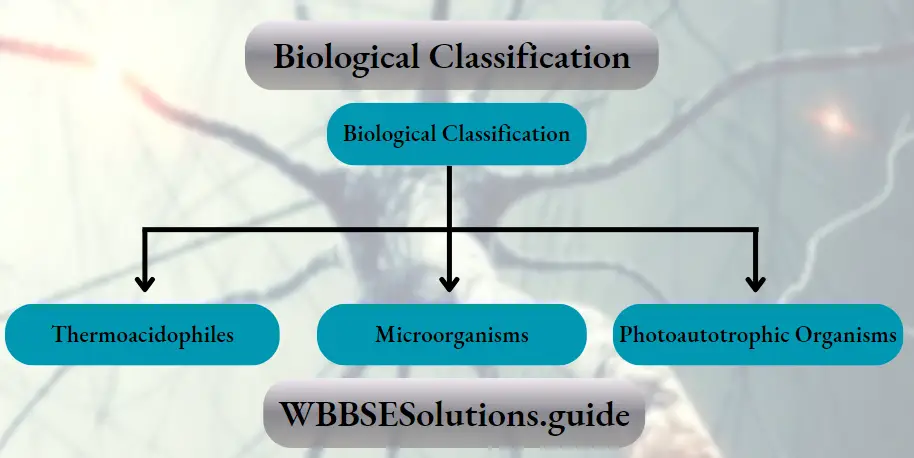
Question 2. In how many domains is the living world classified and what are they?
Answer.
Carl Woese classified the living world into three domains. These are—archaea, eukarya and bacteria.
Question 3. What are thermoacidophiles?
Answer.
Thermoacidophiles
The obligate anaerobic bacteria or archaebacteria that thrive at places with high temperatures (110°C) and low pH (pH 2.0) are called thermoacidophiles.
Biological classification questions and answers PDF
| Class 11 Biology | Class 11 Chemistry |
| Class 11 Chemistry | Class 11 Physics |
| Class 11 Biology MCQs | Class 11 Physics MCQs |
| Class 11 Biology | Class 11 Physics Notes |
Question 4. What are aerotolerant microorganisms?
Answer.
Aerotolerant microorganisms
The bacteria that can carry out anaerobic respiration at low concentrations of oxygen are called aerotolerant microorganisms. E.g., Lactic acid fermenting bacteria.
Question 5. What are the dissimilarities found between bacteria and archaebacteria?
Answer.
Archaebacteria and bacteria differ in genetic constitution and biochemical constituents. The cell wall of bacteria possesses peptidoglycan but the cell wall of archaebacteria lacks peptidoglycan.
Read and Learn More WBCHSE Solutions For Class 11 Biology
Question 6. What are photoautotrophic organisms?
Answer.
Photoautotrophic organisms
The microorganisms (bacteria) that contain photosynthetic pigment (such as bacteriochlorophyll, bacteriophaeophytin) and can prepare their food in the presence of sunlight, are called photoautotrophic organisms: E.g., Chlorobium sp.
Question 7. What are myxamoeba, plasmodium and pseudoplasmodium of slime moulds?
Answer.
The unicellular vegetative body of slime mould is called myxamoeba. Plasmodium is its naked protoplasm containing many nuclei. When myxamoeba fuse, the structure formed is called pseudoplasmodium.

Question 8. What is the basis of the five-kingdom classification?
Answer.
The basis of the five kingdom classification is—
- Complexity in the body system,
- Complexity in cellular organisation,
- Mode of nutrition,
- Variations in the ecosystem,
- Phylogenetic relationship.
Question 9. What are lichenology and mycology?
Answer.
The study of lichens is called lichenology and the study of fungi is called mycology.
Question 10. Why are lichens called indicators of air pollution?
Answer.
Lichens cannot survive in increased concentrations of air pollutants, mainly in high sulphur dioxide concentrations. So, the death rate of lichens is considered an indicator of air pollution.
Question 11. What is known as virion?
Answer.
Virion
The nucleic acid containing and protein encapsulated pathogenic virus or its single unit is called a virion.
Question 12. What are prions?
Answer.
Prions
The smallest infectious pathogen that lacks nucleic acid and is composed of only proteins is called prions. It is responsible for some diseases of the nervous system.
Question 13. What are dinoflagellates?
Answer.
Dinoflagellates
The unicellular, photosynthetic, golden brown protists, that possess two flagella are called dinoflagellates. E.g., Gonyaulaxs p., Gymnodinium sp.
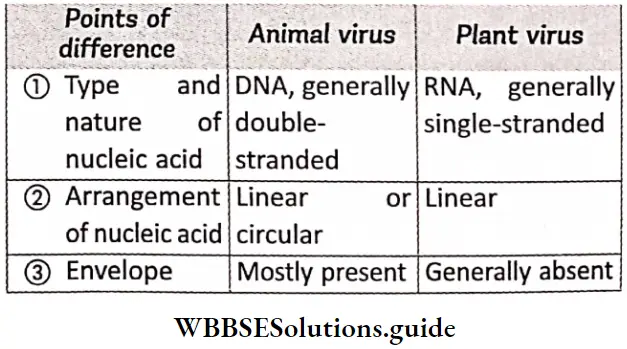
Question 14. Write two differences between animal viruses and plant viruses.
Answer.
Differences between animal and plant viruses are as follows—
Biological Classification Very Short Answer Type Questions
Question 1. Who propounded the five-kingdom classification?
Answer: R.H. Whittaker propounded the five-kingdom classification of organisms.
Question 2. Name the five kingdoms of organisms.
Answer: The five kingdoms are—Monera, Protista, Fungi, Plantae and Animalia.
Question 3. Name the kingdoms whose organisms possess cell walls.
Answer: The cells of organisms of the kingdom Monera, Fungi and Plantae possess cell walls.
Question 4. Name the protein present in the flagella of bacteria.
Answer: Flagellin
Question 5. What is the full form of PPLO? What is its other name?
Answer: The full form of PPLO is Pleuro Pneumonia Organisms. It is also called mycoplasma.
Question 6. Which component is found in the cell wall of fungus?
Answer: Fungal cell walls have fungal cellulose or chitin. Besides, it also has polysaccharides, proteins, lipids, etc.
Question 7. Name the smallest free-living microorganism.
Answer: The smallest free-living microorganism is Mycoplasma.
Question 8. Which class of fungi is called club fungi?
Answer: Fungi of class Basidiomycetes are called club fungi.
Question 9. Which class of fungi is called sac fungi?
Answer: Fungi of the class Ascomycetes are called sac fungi.
Question 10. What type of stored food is found in fungi?
Answer: Glycogen is present as stored food in fungi.
Question 11. Name two symbiotic relations of fungi.
Answer: Two symbiotic relations of fungi are—lichen (fungi and algae) and mycorrhiza (fungi and roots of advanced plants).
Question 12. Which group of bacteria is known as ray fungi?
Answer: Bacteria belonging to the group Actinomycetes are called ray fungi.
NEET biological classification important questions with answers
Question 13. Name the chemical component present in the cell wall of bacteria.
Answer: The chemical component present in the cell wall of bacteria is peptidoglycan or murein.
Question 14. Name the causative agent of ‘black rust disease1 of wheat.
Answer: The causative agent of black rust disease of wheat is Puccinia graminis vartritici.
Question 15. Name the protozoa that cause malaria.
Answer: The causative agent of malaria is Plasmodium.
Question 16. Which phylum of Protista shows a resemblance with animals and fungi.
Answer: The phylum euglenophyta of the kingdom Protista shows a resemblance with animals and fungi.
Question 17. Why are some fungi classified as fungi imperfect?
Answer: Some fungi are classified as fungi imperfecti because they lack a sexual reproductive stage or perfect stage in their life cycle.
Question 18. Name one organism having a eukaryotic nucleus and lacking chlorophyll.
Answer: Fungi have eukaryotic nuclei but lack chlorophyll.
Question 19. Who first crystallised the virus?
Answer: The virus was first crystallised by W. M. Stanley.
Question 20. Who coined the term virus?
Answer: The name virus was coined by M.Beijernick.
Class 11 biology biological classification Q&A
Question 21. What genetic component is present in TMV?
Answer: The genetic component of TMV is RNA.
Question 22. Name one RNA molecule that shows features of a virus.
Answer: Viroids are RNA molecules showing features like viruses.
Question 23. Name the causative agent of AIDS.
Answer: The causative agent of AIDS is HIV (Human Immunodeficiency Virus).