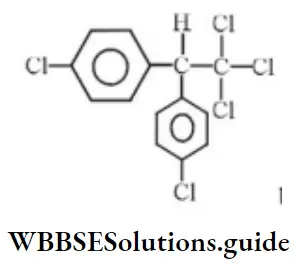
NEET General Organic Chemistry Naming Of Organic Compounds Containing A Functional Group Notes

Naming Of Organic Compounds Containing A Functional Group

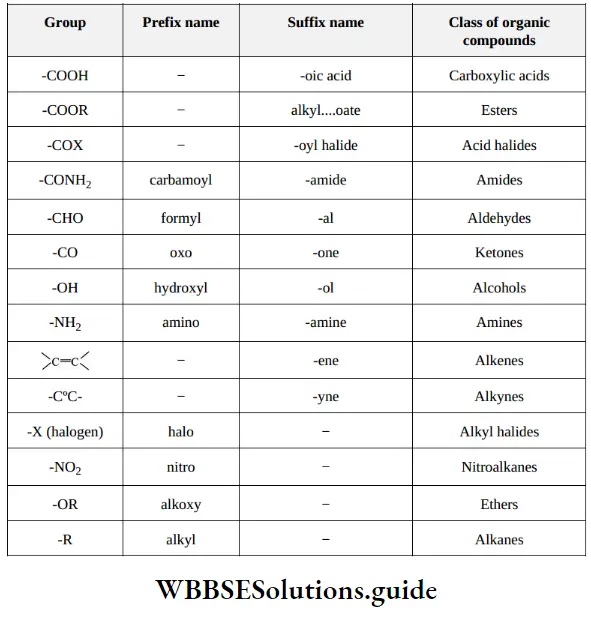
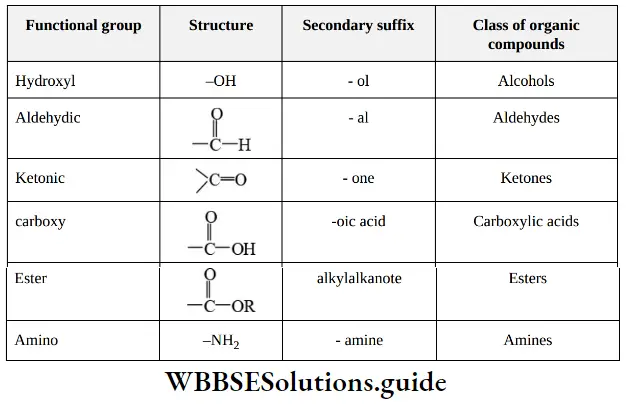
Prefix and suffix names of a few common functional groups and their decreasing order of priority are given in the table.

NEET General Organic Chemistry Naming Of Organic Compounds Containing A Functional Group Decreasing Order Of Priority

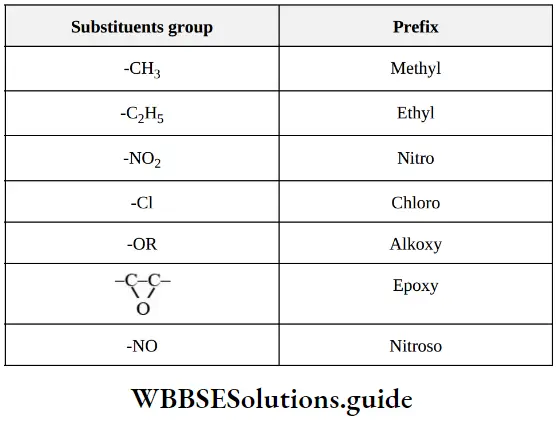
It may be noted that the groups -R, -OR, -NO2, -X, etc. are considered as substituents and are indicated as prefixes.

Read And Learn More: NEET General Organic Chemistry Notes, Question And Answers

  1. Longest chain– The parent chain is the one which has a functional group directly attached to it, even if it violates the longest chain rule.
  2. Numbering of parent chain-The numbering should be done in such a way that the carbon linking to the functional group gets the lowest number even if it violates the lowest sum rule or locant rule. When the functional group itself contains carbon atom, then that carbon atom is assigned as number 1.
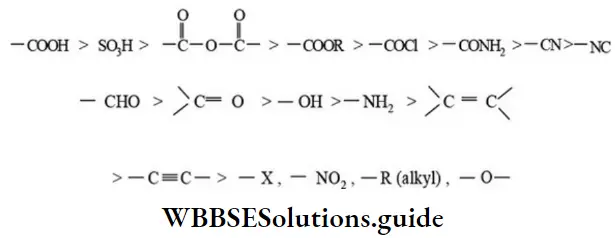
  3. Naming of compounds with polyfunctional group- If there is more than one functional group present in a compound, then one of the functional group is chosen as the principal functional group (secondary suffix) and the remaining functional groups are treated as (substituents) subordinate functional groups.

NEET General Organic Chemistry Naming Of Organic Compounds Containing A Functional Group Naming Of Compound With Polyfunctional Group

NEET organic chemistry naming of compounds notes

The functional group with higher priority in the sequence given below is termed as principal functional group.

Nomenclature Of Substituted Benzene Compounds

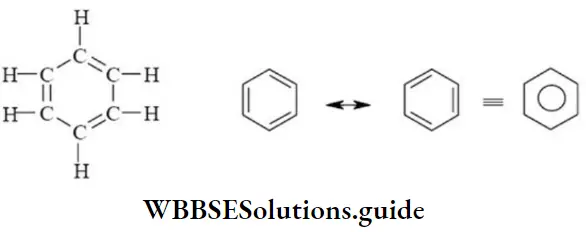
Benzene is a six-membered cyclic compound with alternate single and double bonds. It is represented in any one of the following ways:

NEET General Organic Chemistry Naming Of Organic Compounds Containing A Functional Group Nomenclature Of Substituted benzene Compounds

1. Naming of monosubstituted benzene

It is derived by adding the name of the substituent with the word benzene. Substituent + benzene 23/11 substituted benzene

NEET General Organic Chemistry Naming Of Organic Compounds Containing A Functional Group Notes

IUPAC nomenclature of organic compounds for NEET

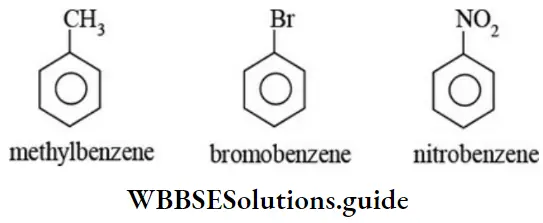
Naming of monosubstituted benzene Example:

NEET General Organic Chemistry Naming Of Organic Compounds Containing A Functional Group Naming Of Monosubstituated Benzene

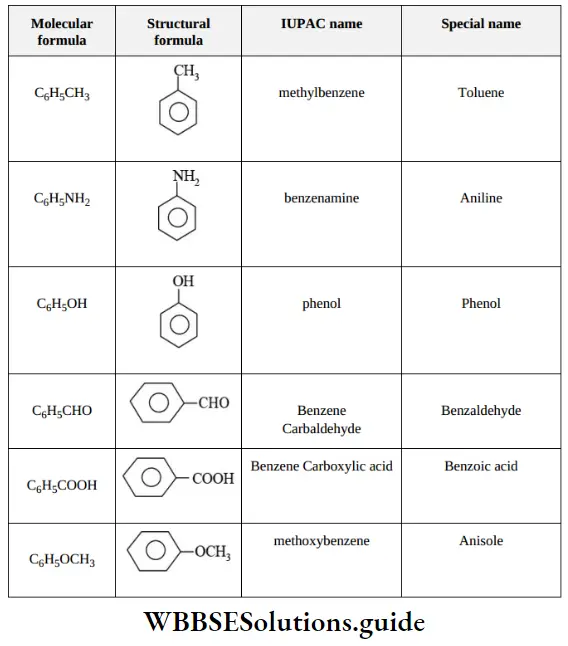
Special names of some monosubstituted benzene compounds

NEET General Organic Chemistry Naming Of Organic Compounds Containing A Functional Group Special Named Of Some Monosubstituted Benzene Compounds

Naming of organic compounds containing functional groups NEET notes

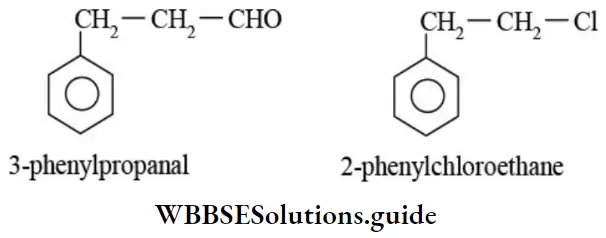
If the functional group is attached to the carbon chain connected to benzene ring, then benzene ring is considered as a substituent and is prefixed before the root word as phenyl.

NEET General Organic Chemistry Naming Of Organic Compounds Containing A Functional Group 2, 3 Phenylchloroethane

2. Naming of disubstituted benzene

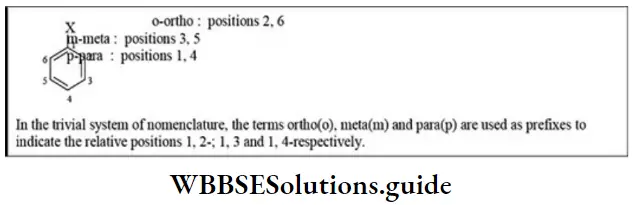
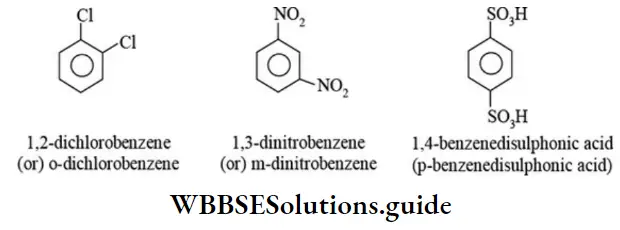
If the substituents are the same: In such case, the relative position of the substituents must be indicated by adding the symbols o – (1, 2); m – (1, 3) ; p – (1, 4).

NEET General Organic Chemistry Naming Of Organic Compounds Containing A Functional GroupNaming Of Disubstituted Benzene

NEET chemistry IUPAC naming rules and tricks

Naming of disubstituted benzene Example:

NEET General Organic Chemistry Naming Of Organic Compounds Containing A Functional Group The Substitutens Are Same In Disubstituted Benzene

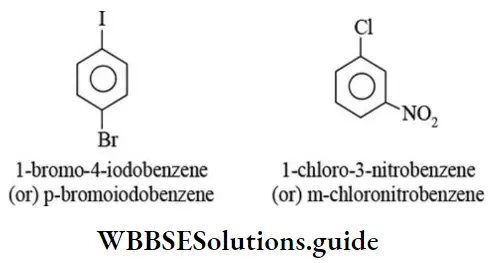
If the two substituents are different: The substituents are named in alphabetical order.

NEET General Organic Chemistry Naming Of Organic Compounds Containing A Functional Group Two Substituents Are Different

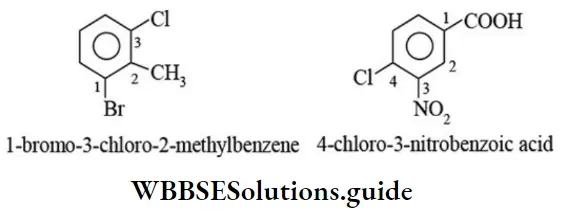
If there are more than two substituents: The numbering is done in such a way that it satisfies the lowest sum rule.

NEET General Organic Chemistry Naming Of Organic Compounds Containing A Functional Group There Are More Than Two Substitutents

Functional group priority order in IUPAC nomenclature NEET

Nomenclature Of Bicyclo Compounds

Bicyclo Compounds

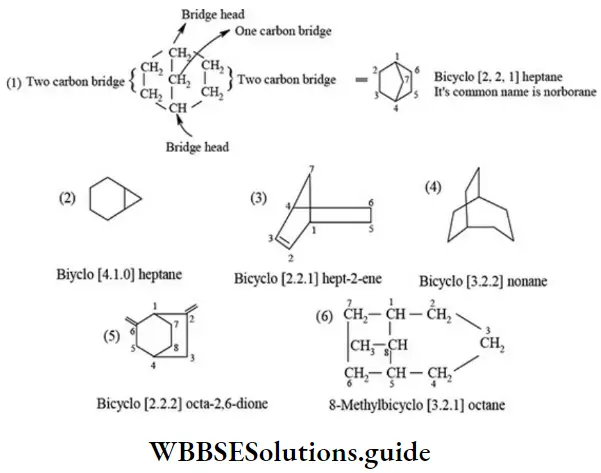
Bicyclo compounds contain two fused rings with the help of a bridge. We use the name of the alkane corresponding to the total number of carbon atoms as the base name.

  1. The carbon atoms common to both the rings are called bridgeheads, and each bond or chain of atoms connecting the bridgehead atoms is called a bridge.
  2. While naming the bi-cycloalkane we write an expression between the word bicyclo and alkane (in square bracket), that denotes the number of carbon atoms in each bridge. The numerals are written in descending order and the numbers are separated by a point.
  3. If substituents are present, we number the bridged ring system beginning at one bridgehead, proceeding first along the longest bridge to the other bridge head, then along the second next longest bridge back to the first bridge head. The shortest bridge is numbered in the last.

Nomenclature of Bicyclo compounds Example:

NEET General Organic Chemistry Naming Of Organic Compounds Containing A Functional Group Nomeclature Of Bicyclo Compounds

NEET General Organic Chemistry Nomenclature Of Organic Compounds Notes

Nomenclature Of Organic Compounds

The nomenclature deals with the naming of millions of organic compounds. The following systems are employed.

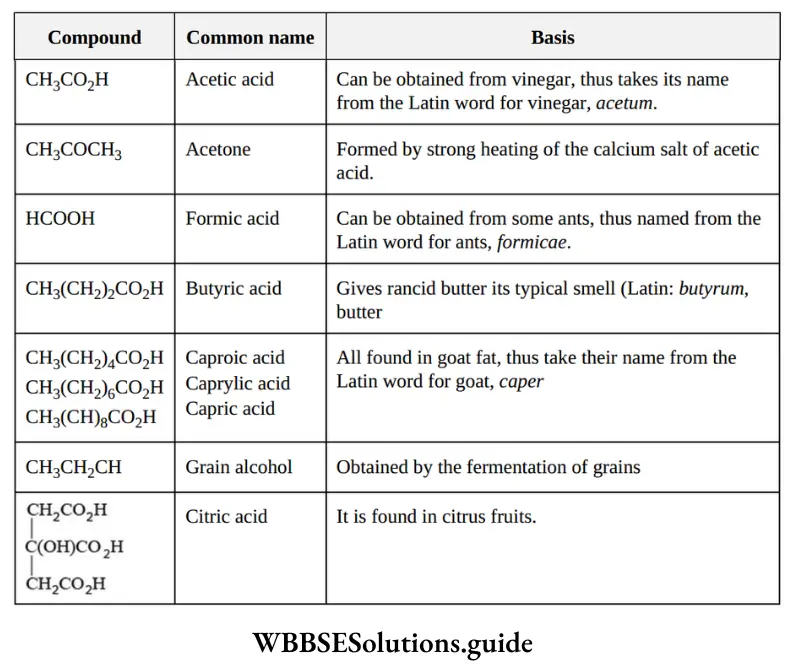
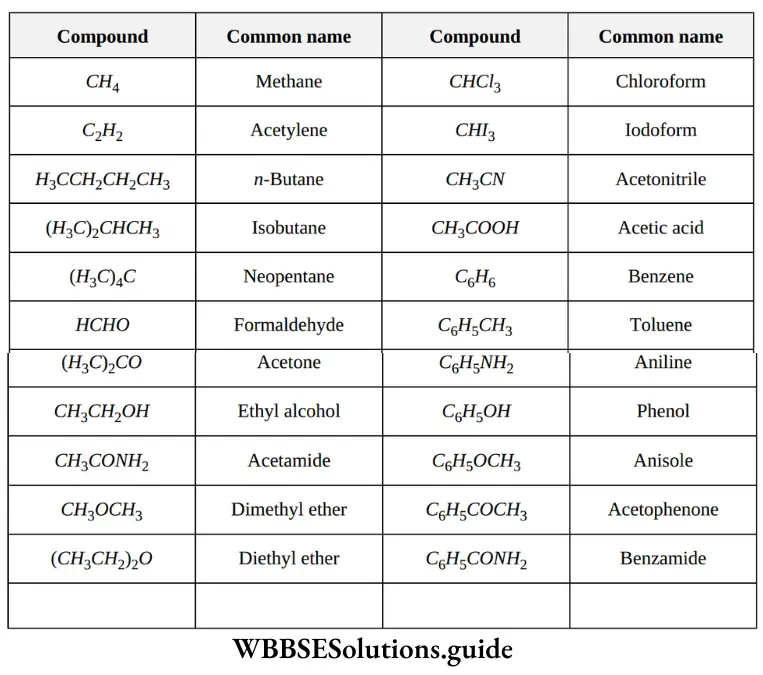
1. Trivial system (common system): It is the oldest system of naming organic compounds. In the early stages of the development of organic chemistry, organic compounds were named after the source from which they were first isolated. Generally, the names chosen had Latin or Greek roots. The following illustrations justify the statement.

Read And Learn More: NEET General Organic Chemistry Notes, Question And Answers

NEET General Organic Chemistry Nomenclature Of Organic Compounds Trivial System

NEET organic chemistry nomenclature notes

Iupac Nomenclature
NEET General Organic Chemistry Nomenclature Of Organic Compounds Nomenclature Of Organic Compounds

NEET General Organic Chemistry Nomenclature Of Organic Compounds Trivial Common System

IUPAC nomenclature of organic compounds for NEET

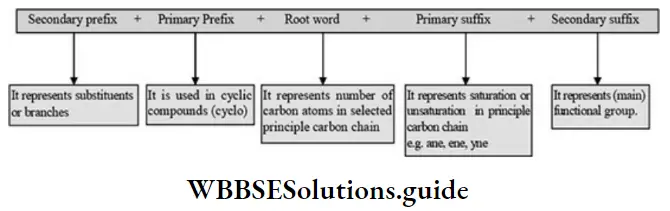
2. IUPAC System – Saturated hydrocarbons are the parent compounds and other organic compounds as their derivatives obtained by substituting one or more hydrogen atoms with functional groups. IUPAC name of any organic compound may consist of three parts. “prefix-root word-suffix”.

NEET General Organic Chemistry Nomenclature Of Organic Compounds IUPAC System

NEET General Organic Chemistry Nomenclature Of Organic Compounds Notes

NEET chemistry nomenclature rules and examples

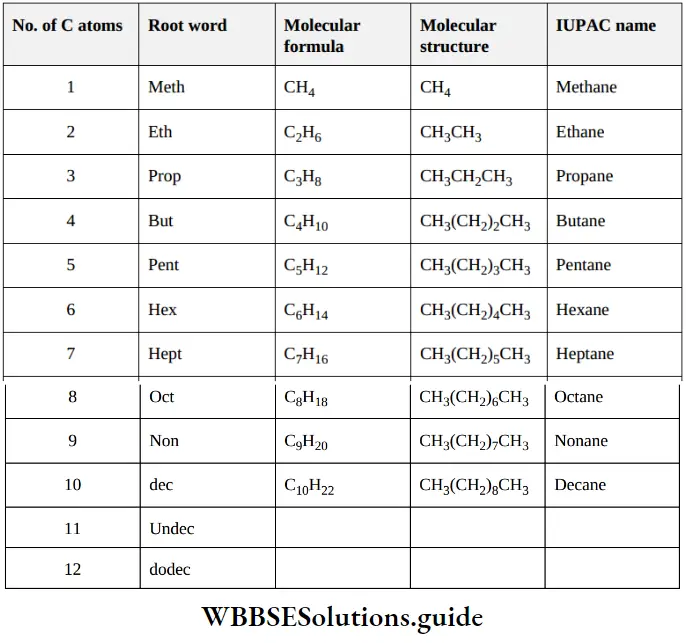
Root word- is assigned to organic molecule based on the number of carbon atoms present in the main parent chain

NEET General Organic Chemistry Nomenclature Of Organic Compounds Root Word

IUPAC naming of organic compounds chart for NEET

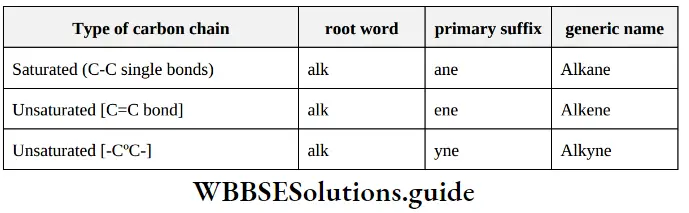
Suffix – is based on the nature of bonds and functional group present in the molecules. It is of 2 types,

(1) Primary suffix: A primary suffix is added next to the root word to indicate whether the parent chain is saturated or unsaturated.

Note: A carbon-carbon double bond or triple bond must be included in parent chain even if it contains less number of carbon atoms.

NEET General Organic Chemistry Nomenclature Of Organic Compounds Primary Suffix

(2) The secondary suffix added next to the primary suffix to indicate the presence of a functional group in organic compounds which determines the class of organic compounds.

NEET General Organic Chemistry Nomenclature Of Organic Compounds Secondary Suffix

NEET important nomenclature questions with answers

Secondary suffixes of a few functional groups are given.

Note – While adding the secondary suffix, the letter ‘e’ of the primary suffix (i.e., ane, ene, and yne) is dropped if the secondary suffix begins with a vowel (a, e, i, o, or u). It is retained if a secondary suffix begins with a consonant.

3. Prefix (substituent): All the groups which are not names in parent chain and functional groups are called as substituents. Its name placed before the root word. Example: – Alkyl group, halo atoms, nitro group

NEET General Organic Chemistry Nomenclature Of Organic Compounds Prefix

Shortcut tricks to learn IUPAC nomenclature for NEET

Alkyl Groups

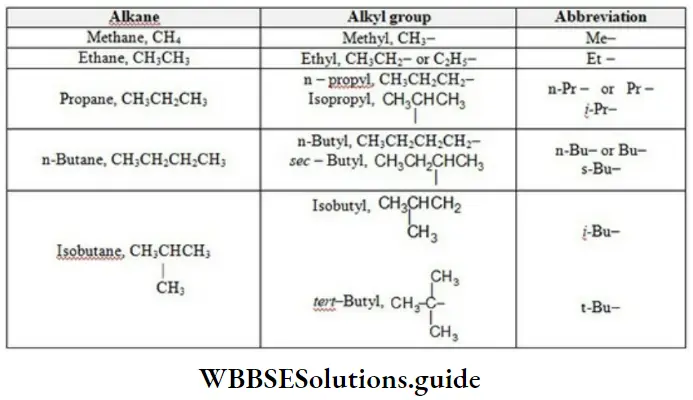
Alkyl groups  derived from an alkane, by removing a hydrogen atom bonded to carbon. These groups are named simply by dropping -ane from the name of the corresponding alkane and replacing it by -yl. R is a general symbol, general formula for an alkyl group is CnH2n+1, because it contains one less hydrogen atom than the parent alkane, CnH2n+2.

NEET General Organic Chemistry Nomenclature Of Organic Compounds Alkyl Groups

NEET chemistry nomenclature solved examples

Among the alkyl groups we encounter the problem of isomerism.

  • While only one alkyl group can be derived from methane (the methyl, CH3-)
  • Ethane (the ethyl, CH3CH2-)
  • Two or more alkyl groups can be derived from higher alkanes.

Alkyl groups Examples

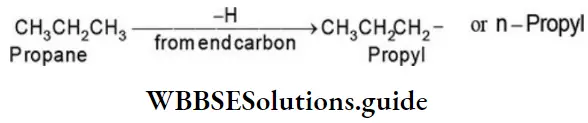
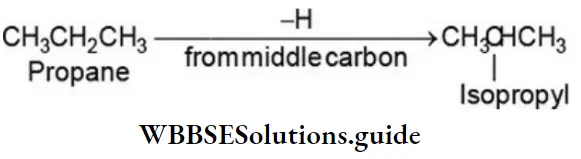
1. From propane (C3H8), two alkyl groups can be derived. Removal of one of the hydrogens from one of the end carbon atoms gives an alkyl group that is called the propyl group or n-propyl group.

NEET General Organic Chemistry Nomenclature Of Organic Compounds n-propyl Group

Removal of one of the hydrogens from the middle carbon atom gives an alkyl group that is called the isopropyl group.

NEET General Organic Chemistry Nomenclature Of Organic Compounds Isopropyl Group

Both these alkyl groups contain the propane chain but differ in the point of attachment of the group to the rest of the molecule.

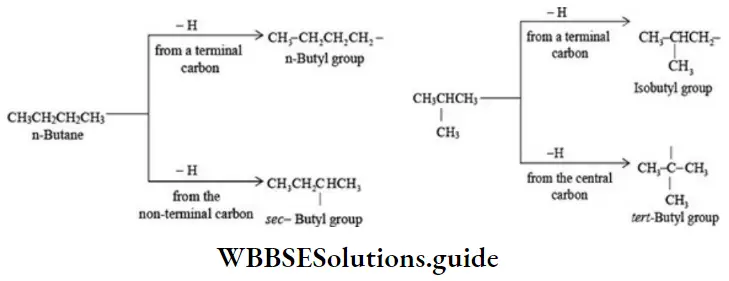
2. There are four butyl groups, two derived from the straight-chain n-butane, and two derived from the branched-chain isobutane. These are given the designations: n- (normal), sec¬secondary), iso-, and tert- (tertiary) as shown below:

NEET General Organic Chemistry Nomenclature Of Organic Compounds iso- and Tertiary

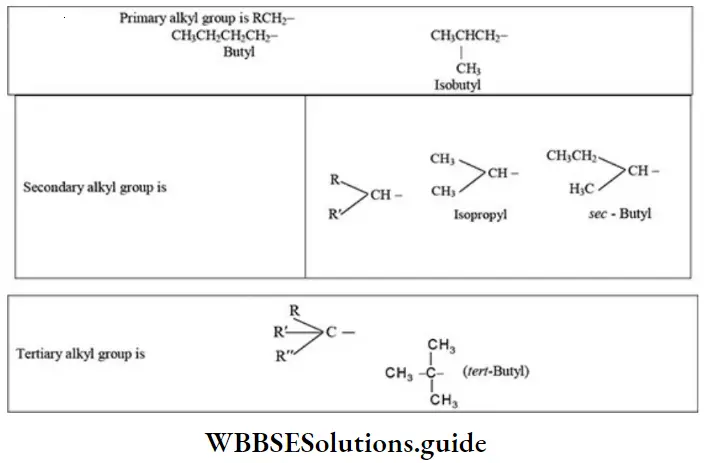
An alkyl group is described as,

  • Primary if the carbon at the point of attachment is bonded to only one other carbon,
  • As secondaryif bonded to two other carbons,
  • Tertiary if bonded to three other carbons. Thus, if r is any hydrocarbon radical, the different kinds of alkyl groups are

RCH2 -Primary

R2CH– Secondary

R2C- Tertiary

Alkyl Group Problems

Problem 1: Classify each of the following alkyl groups as primary, secondary, or tertiary: Butyl, Isopropyl, Isobutyl, sec-butyl, and tert-Butyl.

Solution:

NEET General Organic Chemistry Nomenclature Of Organic Compounds Primary And Secondary And Teritary Alkyl Group

Best notes for organic chemistry nomenclature NEET

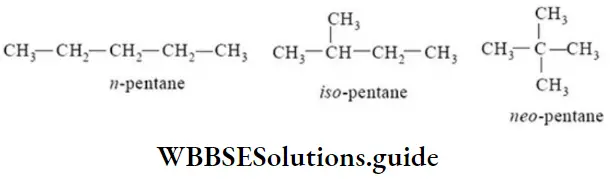
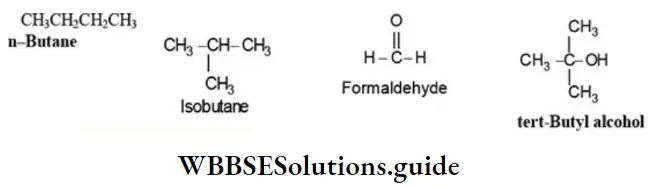
EPrefix n-(normal) is used for those alkanes in which all the carbon atoms form a continuous chain with no branching.

CH3CH2CH2CH3 (n-butene)

CH3CH2CH2CH2CH3 (n-pentane)

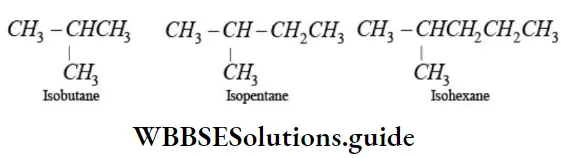
EPrefix iso is used for those alkanes in which one methyl group is attached to the next-to-end carbon atom (second last) of the continuous chain.

NEET General Organic Chemistry Nomenclature Of Organic Compounds Eprefix Iso

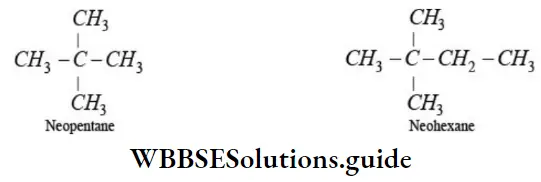
EPrefix neo is used for those alkanes which have two methyl groups attached to the second last carbon atom of the continuous chain.

NEET General Organic Chemistry Nomenclature Of Organic Compounds Eprefix Neo

Rules for naming of open chain Organic compound.

Iupac Nomenclature Rules

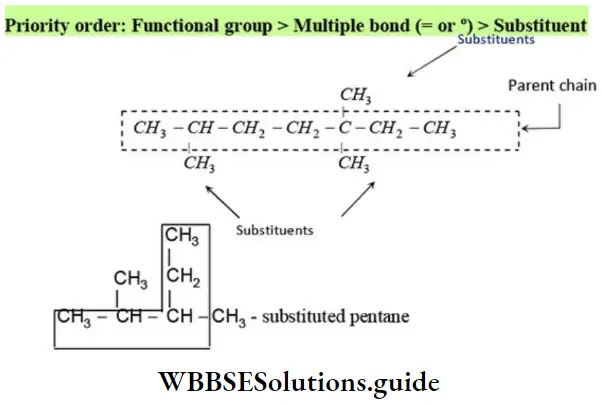
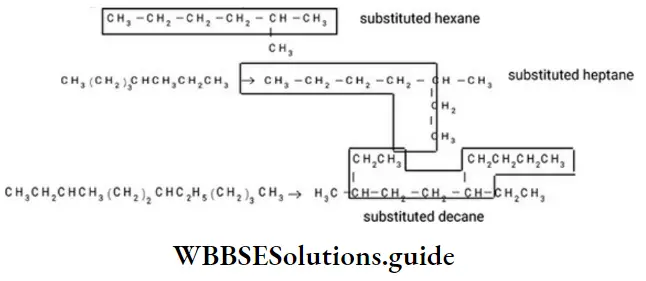
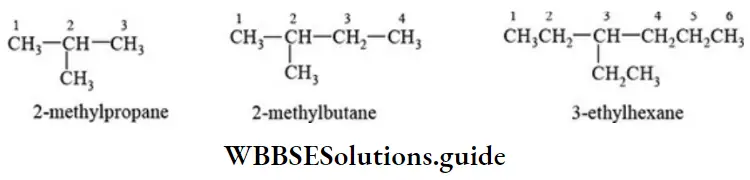
Rule 1 – Longest chain rule (root word rule): The continuous carbon chain containing maximum carbon atoms including the function group is selected. It is called the parent chain. For one to four carbon atoms of the parent chain, special root words are used but for chains of five or more carbon atoms Greek number roots are employed.

The generic root word for any parent chain is ‘alk’.

NEET General Organic Chemistry Nomenclature Of Organic Compounds Longest Chain Rule

Similarly, the following hydrocarbon will be regarded as a substituted hexane because the longest continuous carbon chain (parent chain/ root chain) contains six carbon atoms.

NEET General Organic Chemistry Nomenclature Of Organic Compounds Locant Chain

Note – If two different chains of equal length are possible, the chain with maximum number of side chains or alkyl groups is selected. The number used to specify the position of the substituents is called locant.

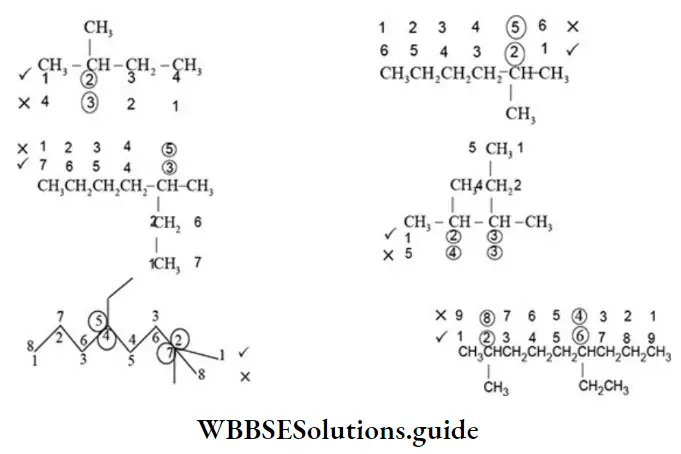
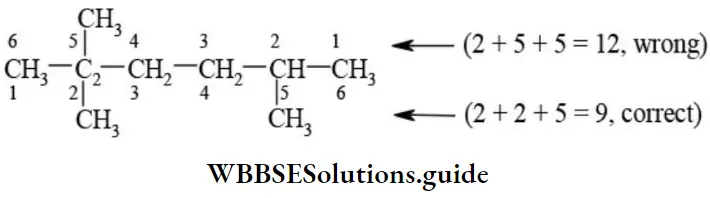
Rule 2 – Lowest sum rule (rule of locant): Parent carbon chain is numbered using Arabic numerals 1, 2, 3, 4, and 5 in such a way that functional groups or substituents containing carbon receive least number.

NEET General Organic Chemistry Nomenclature Of Organic Compounds Lowest Sum Rule

E When the parent chain contains two or more substituents, the numbering is done from the end where the sum of the locants is least.

NEET General Organic Chemistry Nomenclature Of Organic Compounds Rule Of Locant

E Parent chain with one substituent: Prefix the name of the substituent to the root word of parent chain and indicate its position. The name of the substituent is separated from its locant by a hyphen (-). The name of the organic compound is written as one word.

NEET General Organic Chemistry Nomenclature Of Organic Compounds E Parent Chain With One Substituent

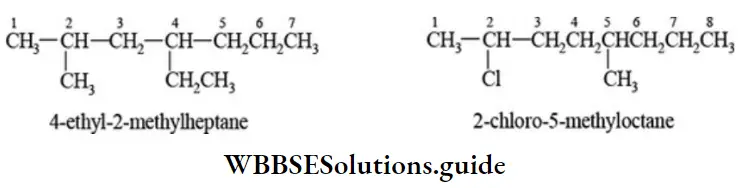
E Naming of different substituents: When two or more different substituents are present on the parent chain, they are named in alphabetical order along with their appropriate locants.

NEET General Organic Chemistry Nomenclature Of Organic Compounds E Naming Of Different Substituents

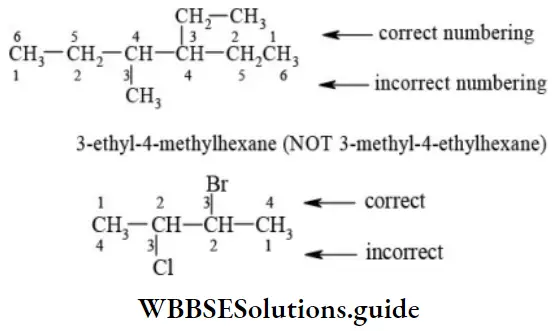
E Numbering of different substituents at equivalent positions: If two different alkyl or halo groups are present at equivalent positions, the numbering of the parent chain is done in such a way that the substituent which comes first in the alphabetical order gets the lower number.

NEET General Organic Chemistry Nomenclature Of Organic Compounds E Numbering Of Different Substitutes

E Presence of the same substituent more than once: If the same substituent occurs more than once, the prefixes di, tri, tetra are prefixed to the name of the substituent. It may be noted that the position and name of the substituent are separated by a hyphen (-) whereas the numerals representing the positions of the substituents are separated by commas.

NEET General Organic Chemistry Nomenclature Of Organic Compounds E Presence Of The Same Substituent More Than Once

E Naming a complex substituent: In case the substituent on the parent chain is complex (i.e., it has a branched chain), it is named as a substituted alkyl group by numbering the carbon atom of this group attached to the parent chain as 1. The name of complex substituent is enclosed in the bracket to avoid confusion with the numbers of parent chain.

NEET General Organic Chemistry Nomenclature Of Organic Compounds E Naming A Complex Substituent

If same complex substituent occurs more than once on the parent chain, prefixes bis, tris, tetrakis, etc., are used before the name of the complex substituent. The application of IUPAC rules to the structure of a molecule to arrive at IUPAC name is illustrated as follows.

NEET General Organic Chemistry Nomenclature Of Organic Compounds IUPAC Structure

Functional group priority in IUPAC nomenclature NEET

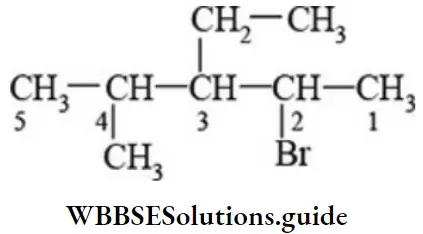
  • Parent chain has 5 carbon atoms, and it has more substituents. The root word is ‘pent’.
  • The primary suffix is ‘ane’
  • Sum of locants is 9, the substituent that comes first in alphabetical order gets the lower number.
  • Prefixes to the rootword are bromo, ethyl, and methyl. Hence, IUPAC name is “2-bromo-3-ethyl-4-methyl pentane”

NEET General Organic Chemistry Nomenclature Of Organic Compounds 2-bromo-3-ethyl-4-methylpentane

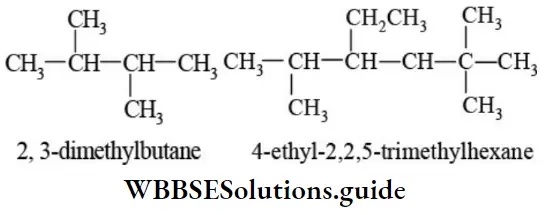
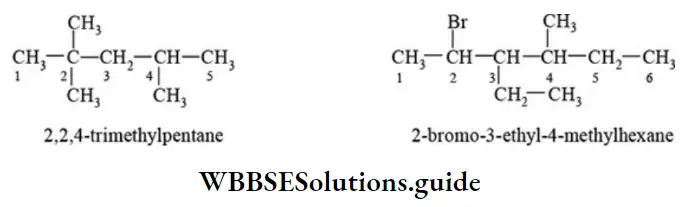
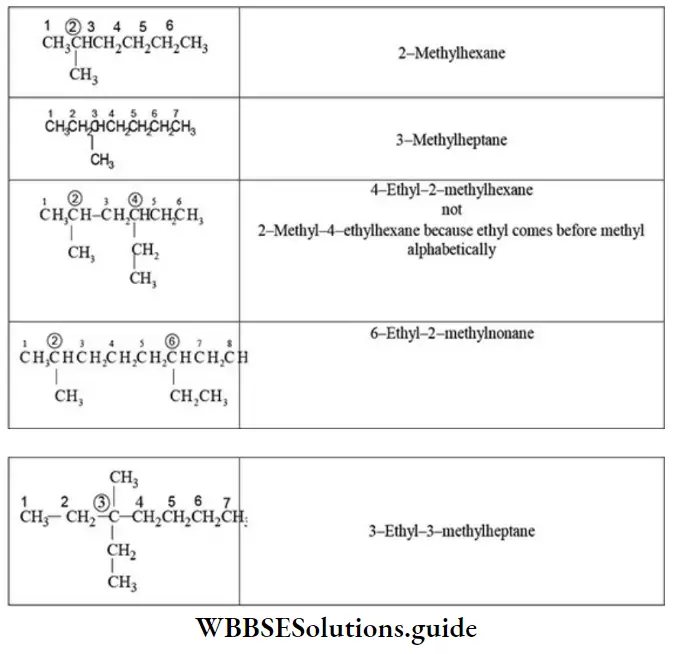
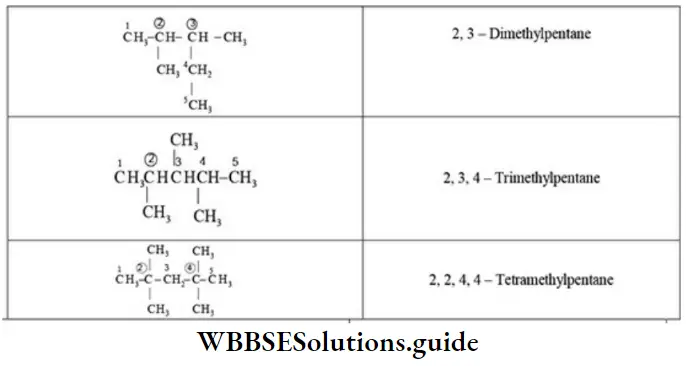
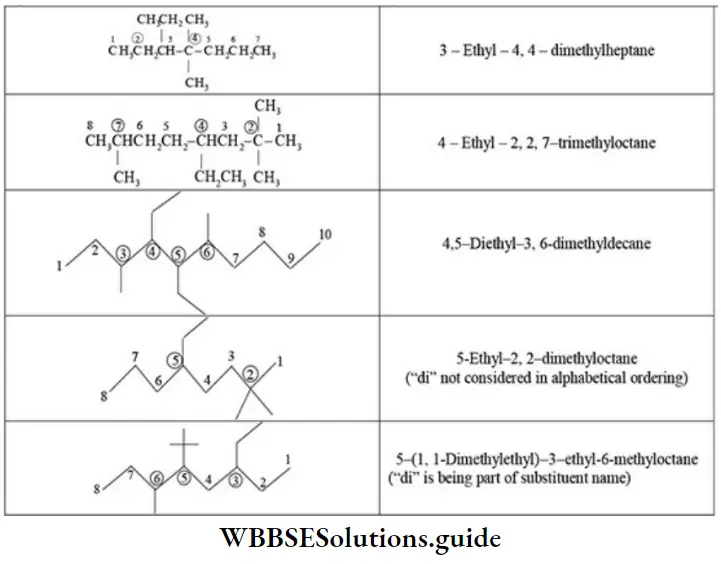
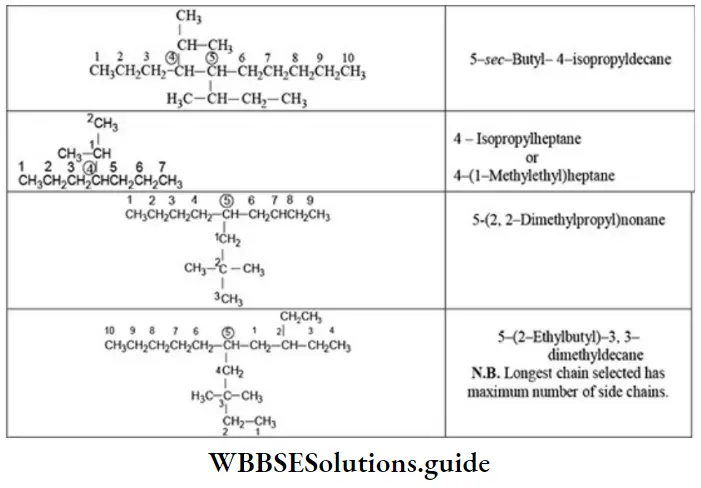
A few examples are given below:

NEET General Organic Chemistry Nomenclature Of Organic Compounds 2-methyhexane To 6 Ethyl

NEET General Organic Chemistry Nomenclature Of Organic Compounds 2,3,4 Ethylene

NEET General Organic Chemistry Nomenclature Of Organic Compounds 3, 4 Ethylene

NEET General Organic Chemistry Nomenclature Of Organic Compounds 4, 5 Ethylene


NEET General Organic Chemistry Functional Groups Notes

Functional Groups

Functional Groups Definition:

A functional group is defined as “an atom or group of atoms present in a molecule which decides the chemical properties of the organic compounds”. Double and triple bonds are also considered as functional groups.

The organic compounds are further classified into different classes depending upon the nature of functional group.

NEET General Organic Chemistry Functional Groups Notes

NEET organic chemistry functional groups notes

Classification of organic compounds based on functional group is summarised in the table.

NEET General Organic Chemistry Functional Groups Functional Groups

Read And Learn More: NEET General Organic Chemistry Notes, Question And Answers

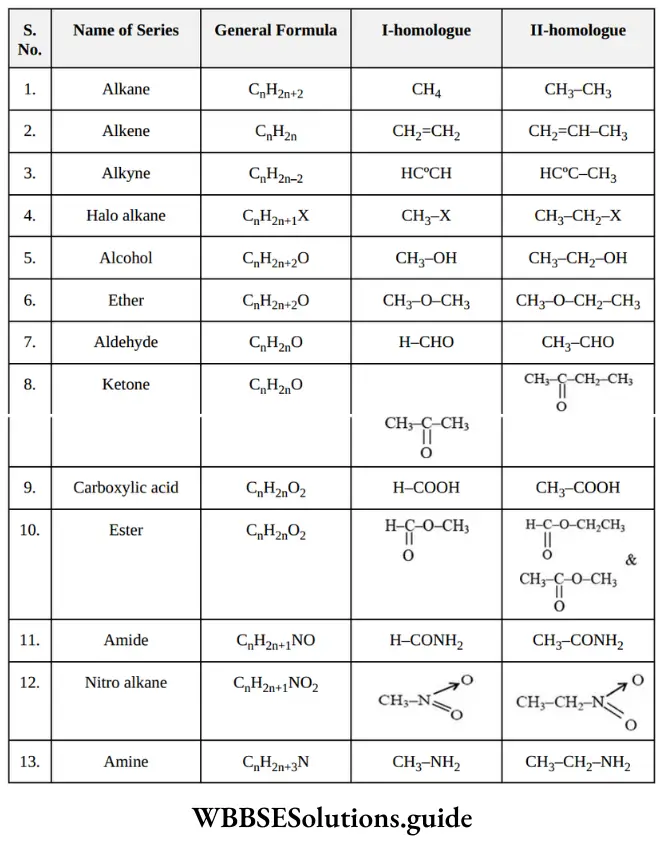
Homologous Series

A series of structurally related organic compounds with a same functional group can be represented by a general formula and differ by -CH2 group is called homologous series. The individual members of such series is called homolouge and this phenomenon is known as homology.

Functional groups in organic chemistry for NEET

NEET General Organic Chemistry Functional Groups Homologous Series

General organic chemistry functional groups NEET study material

Characteristics of a homologous series are as follows.

  • Each homologues series can be represented by general molecular formula.
  • Exp – General molecular formula of alkane is CnH2n+2. Molecular formula CnH2nO2 represents alkanoic acids (carboxylic acids) and alkyl alkanoates (esters).
  • All the members of a given homologous series (homologues) possess the same functional group.
  • The successive members of a homologous series differ by a -CH2– group or by mass units.
  • Homologues of a homologous series can be prepared by general methods.
  • The physical properties such as boiling point, melting point, density, etc., of the members of a homologues series show a regular gradation with increase in molecular mass.
  • Chemical properties of the members of a homologous series are similar though the first homologue may vary considerably from the rest of the homologues.

NEET General Organic Chemistry Classification Of Organic Compounds Notes

Classification Of Organic Compounds

Organic Compounds

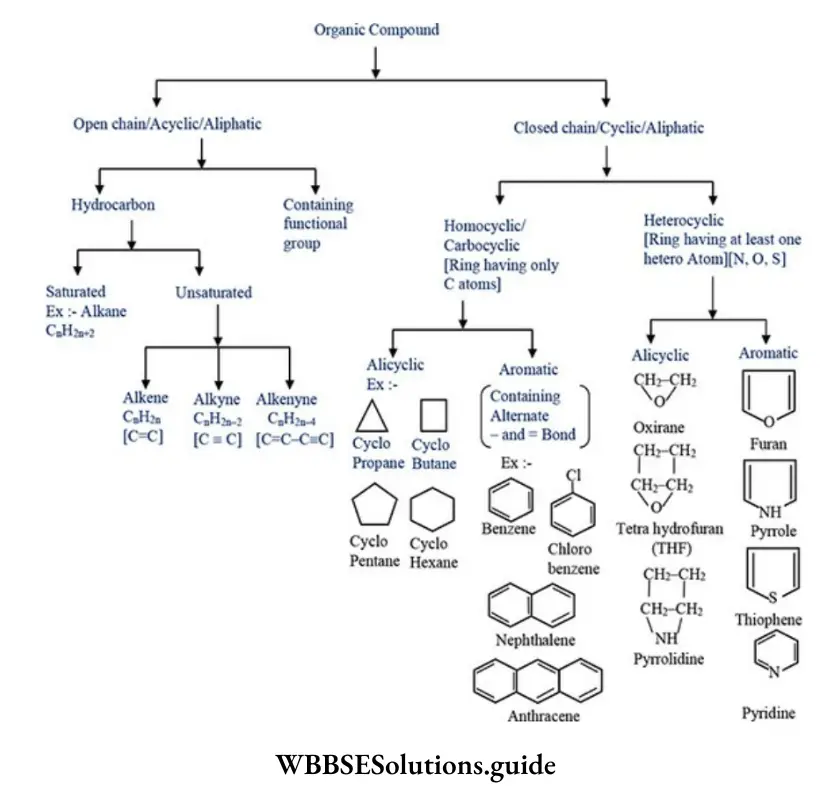
The compounds with C and H are called hydrocarbons. Organic compounds are considered as the derivatives of hydrocarbons obtained by replacing H-atoms by other atoms or groups. Based on the C – skeleton, organic compounds are divided as below,

Read And Learn More: NEET General Organic Chemistry Notes, Question And Answers

Acyclic Compounds

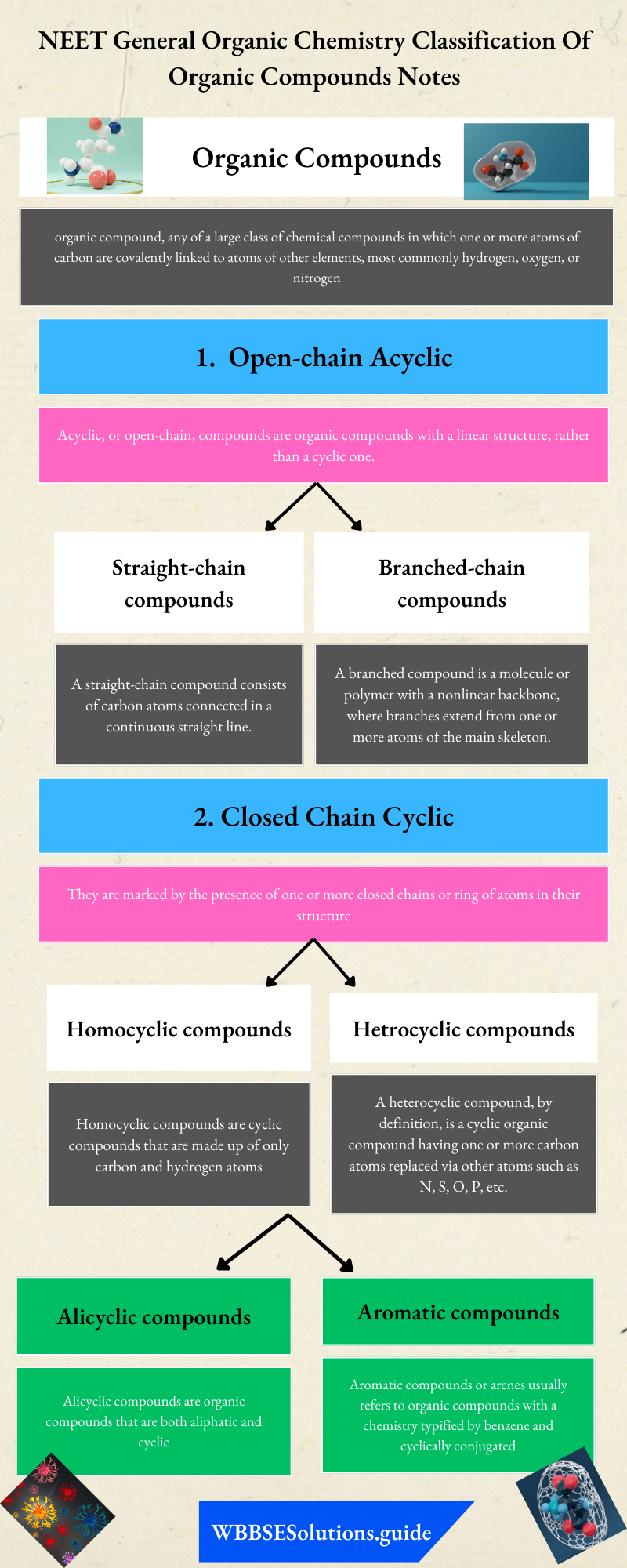
The open-chain organic compounds are called acyclic compounds. The carbon chains may be linear or branched. The open-chain compounds are classified into two groups.

Saturated compounds: Open-chain compounds in which carbon atoms of parent chain are bonded with single bonds are called saturated acyclic compounds.

Saturated compounds Example:

NEET General Organic Chemistry Classification Of Organic Compounds Saturated Compounds

NEET General Organic Chemistry Classification of Organic Compounds Notes

Unsaturated compounds: The open-chain organic compounds in which parent chain contains one or more carbon-carbon double bonds or triple bonds are called unsaturated acyclic compounds.

Unsaturated compounds Example:

NEET General Organic Chemistry Classification Of Organic Compounds Unsaturated Compounds

Functional Groups and Homologous Series NEET Notes

Cyclic Compounds

Here carbon atoms are linked by covalent bonds to form ring structures are called cyclic compounds. Depending upon the constituents of ring, these compounds are further classified into two groups.

Carbocyclic compounds(Hoinocydiccoinpoimds): The cyclic compounds containing only carbon atoms in their ring are called carbocyclic compounds. They are further divided into two groups.

Alicyclic compounds

The carbocyclic compounds which resemble with aliphatic compounds in most of their properties are called alicyclic compounds.

NEET General Organic Chemistry Classification Of Organic Compounds Alicyclic Compounds

Classification of Organic Compounds NEET Notes

NEET General Organic Chemistry Classification Of Organic Compounds Notes

NEET Chemistry Classification of Organic Compounds Important Notes

Aromatic Compounds

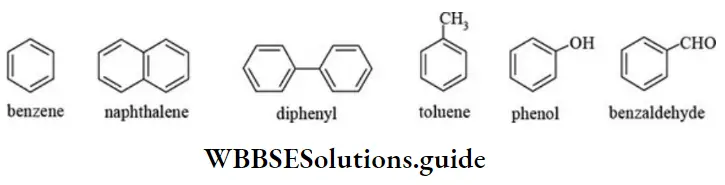
Benzene is the parent aromatic hydrocarbon. The organic compounds containing one or more isolated or fused benzene rings and their functionalised derivatives are called aromatic compounds or benzenoid compounds.

Aromatic compounds example:

NEET General Organic Chemistry Classification Of Organic Compounds Benzenoid Compound

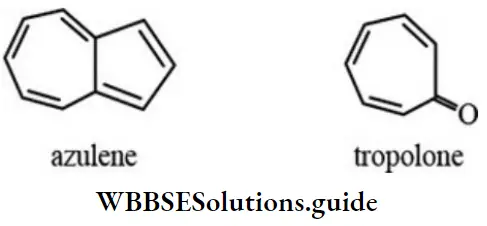
The aromatic compounds that resemble benzene in most of their properties are called non-benzenoid aromatic compounds

Non-Benzenoid Aromatic compounds For example:

NEET General Organic Chemistry Classification Of Organic Compounds Benzenoid Aromatic Compounds

Classification of Organic Compounds NEET Key Concepts and Summary

Heterocyclic Compounds

The cyclic compounds containing one or more heteroatoms (atom other than C it may be O, N, S, etc.,) in their ring are called heterocyclic compounds. Depending upon their chemical behaviors, they are further classified into two groups.

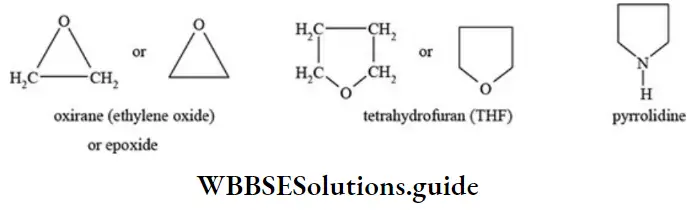
Alicyclic heterocyclic compounds: The aliphatic cyclic compounds containing one or more hetero atoms in their ring are called alicyclic heterocyclic compounds.

Alicyclic heterocyclic compounds For example:

NEET General Organic Chemistry Classification Of Organic Compounds Alicyclic Heterocyclic Compounds

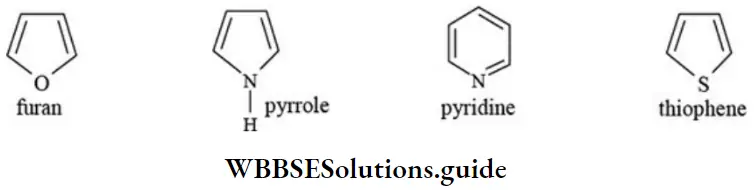
Aromatic heterocyclic compounds: The aromatic cyclic compounds containing one or more hetero atoms in their molecules are called aromatic heterocyclic compounds.

Aromatic heterocyclic compounds For example:

NEET General Organic Chemistry Classification Of Organic Compounds Aromatic Heterocyclic Compounds

NEET Chemistry General Organic Chemistry (GOC) Chapter Classification of Organic Compounds Notes

NEET General Organic Chemistry Classification Of Organic Compounds Organic Compounds

NEET General Organic Chemistry Introduction Notes

General Organic Chemistry Introduction

Chemistry

‘The branch of chemistry dealing with these compounds, which are widely distributed in nature and play an important role in our daily lives’, is called organic chemistry.

In the earlier period of development of chemistry, compounds were classified into two types:

  1. Organic compounds derived from ‘living matter’ (plants and animals).
  2. Inorganic compounds prepared from ‘non-living matter’ (mineral sources).

Read And Learn More: NEET General Organic Chemistry Notes, Question And Answers

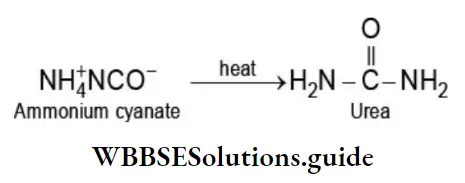
Berzelius, a Swedish chemist proposed the mistaken notion that a ‘vital force’ present in living matter was essential for the synthesis of organic compounds. However, the synthesis of urea an organic compound present in urine, from ammonium cyanate, an inorganic compound by Frederich Wohler in 1828 effectively destroyed the myth of organic compounds being associated with a ‘vital force’.

NEET General Organic Chemistry Introduction Notes Berzelius

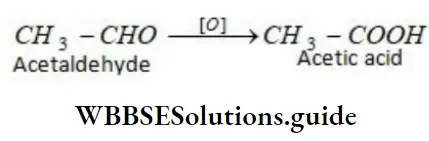
Soon afterwards the pioneering work of Herman Kolbe who synthesized acetic acid and of Berthelot who synthesized methane showed conclusively that organic compounds are essentially the compounds formed by carbon with itself and other elements and that they can be synthesized in a laboratory as easily as inorganic compounds.

NEET organic chemistry introduction notes

NEET General Organic Chemistry Introduction Notes Acetaldehyde

The chemistry of hydrocarbons and their derivatives constitutes organic chemistry.

The number of organic compounds available today are more compare to total inorganic compounds of all elements except carbon. This is due to unique catenation property of Carbon.

Catenation: is the property of an element where a large number of its own atoms join together through covalent bonds. Due to which it forms single as well as multiple covalent bonds with other carbon atoms.

It is further supplemented by the fact that it also forms covalent bonds with atoms of other elements like hydrogen, oxygen, nitrogen, Sulphur, phosphorus, and halogens in a variety of ways (i.e., single and multiple bonds). This property gives a scope for the Chemists to synthesize new compounds.

NEET General Organic Chemistry Introduction Notes

General organic chemistry NEET notes

Tetravalency Of Carbon Atom

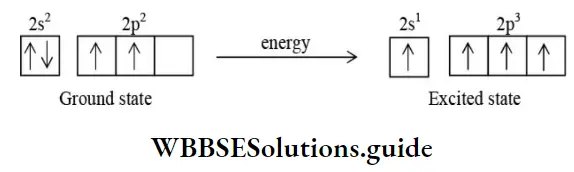
The atomic number of carbon is 6 and it has four electrons in its valence shell. In order to acquire a stable noble gas configuration, it can share its 4 electrons with the electrons of its atom or electrons of other atoms to form four covalent bonds. The bonds can be sigma(σ) or pi(π).

NEET General Organic Chemistry Introduction Notes Four Covalent Bonds

Introduction to general organic chemistry for NEET

The type of bond determines the hybridization of carbon atoms and the geometry of the molecules.

Hybridisation In Carbon Compounds

Hybridization is defined as the intermixing of degenerate orbitals (orbitals at nearly the same energy) to produce an entirely equivalent number of new orbitals of same energy, identical shapes and symmetrically disposed of in planes. The orbitals formed are called hybrid orbitals.

NEET chemistry GOC (General Organic Chemistry) study material

  • The orbitals of an isolated atom can undergo hybridization.
  • Number of hybrid orbitals generated are equal to number of contributing atomic orbitals.
  • The hybrid orbitals orient in space providing definite geometry to molecules or ion.
  • Like atomic orbital, a hybrid orbital cannot have more than two electrons of opposite spins.

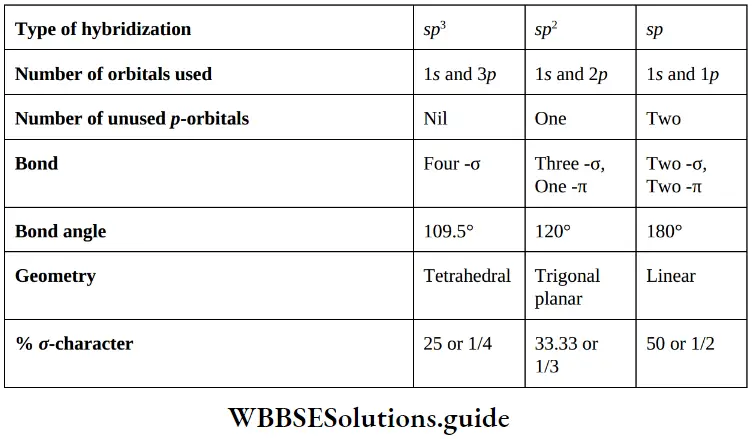
There are three types of hybridization,

  1. sp3 hybridization (contain saturated organic compounds with only single covalent bonds)
  2. sp2 hybridization (here organic compounds having carbon atoms linked by double bonds)
  3. sp hybridization (here organic compounds having carbon atoms linked by a triple bonds).

NEET General Organic Chemistry Introduction Notes Hybridisation In Carbon Compounds

Basics of organic chemistry for NEET

Prediction of hybridization It can be done by two methods,

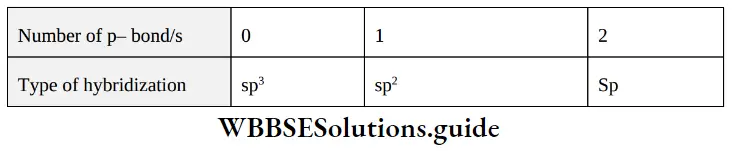
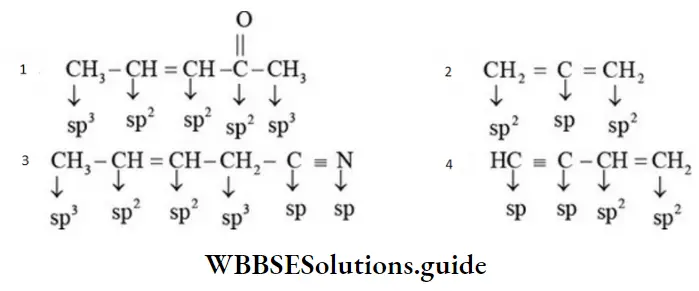
1. First Method: In this method hybridization can be known by the number of bonds present on that particular atom.

First Method Examples:

NEET General Organic Chemistry Introduction Notes Prediction Of Hybridization

NEET General Organic Chemistry Introduction Notes Prediction Of Hybridization First Method Examples

NEET organic chemistry concepts and basics explained

2. Second Method: (Electron pair method)

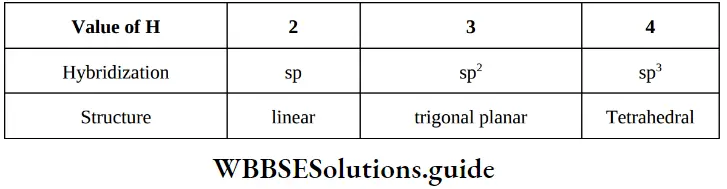
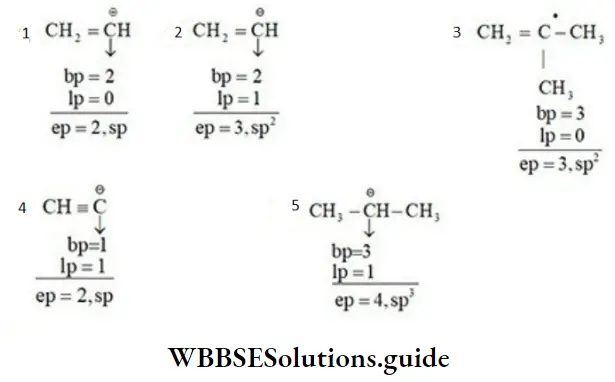
The hybridized state of an atom of a molecule or an ion or radical can be predicted by calculating number of orbitals or electron pairs involved in hybridization (H) which is evaluated as follows.

H = (number of a bonds formed with adjected atom/s + number of lone pairs of electrons)

∴ ep = bp + lp;

where, ep = electron pair present in hybrid orbitals,

bp = bond pair present in hybrid orbitals

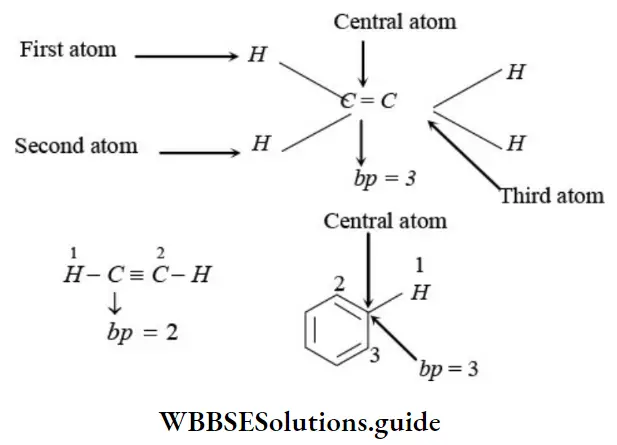
Number of bp = Number of atoms attached to the central atom of the species (do not include π electron pairs).

NEET General Organic Chemistry Introduction Notes Prediction Of Hybridization Second Method

NEET General Organic Chemistry Introduction Notes Prediction Hybridzation Second Method Structure

Number of lp’s can be determined as follows,

  1. If carbon has – bonds or positive charge or odd electron, thanlp on carbon will be zero.
  2. If carbon has negative charge, then Ip will be equal to one.

Second Method Example:

NEET General Organic Chemistry Introduction Notes Number lps In Prediction Of Hybridization

Applications Of Hybridisation

1. Size of the hybrid orbitals: Since – orbitals are closer to the nucleus than – orbitals, it is reasonable to expect that greater the character of an orbital the smaller it is. Thus, the decreasing order of the size of the three hybrid orbitals is opposite to that of the decreasing order of orbital character in the three hybrid orbitals. sp3 > sp2 > sp

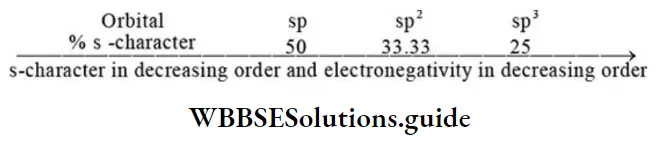
2. Electronegativity of different orbitals

  1. The electronegativity of s-orbital is maximum.
  2. Electronegativity of hybrid orbital ∝ % s-character in hybrid orbitals
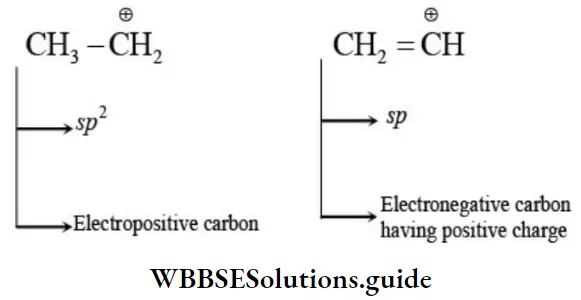
    • Thus Sp-hybrid carbon is electronegative and it is electropositive in character and sp3-hybrid carbon can behave as electropositive in character sp2 -hybrid carbon can behave as electropositive (in carbocation) as well as electronegative (in carbanion) in character.
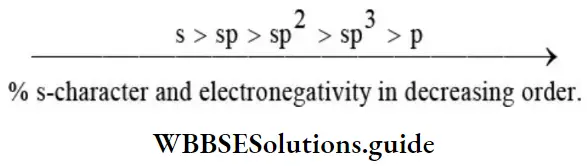
  3. Electronegativities of different hybrid and nonhybrid orbitals in decreasing order is as follows

NEET General Organic Chemistry Introduction Notes Application Of Hybridisation Electronegativity Of Different Orbitals

NEET General Organic Chemistry Introduction Notes Electro Carbon Positive And Negative

NEET General Organic Chemistry Introduction Notes Electornegativities Of Different Hybrid And Unhybrid

General organic chemistry important topics for NEET

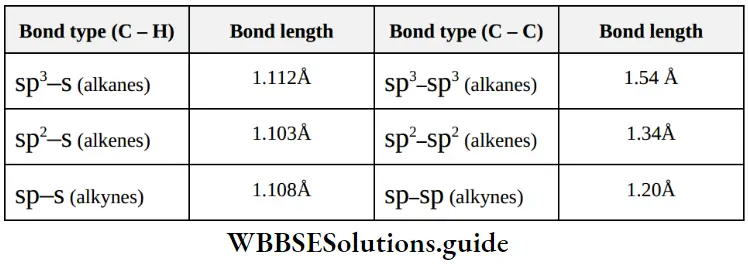
3. ond length variation in hydrocarbons

⇒ \(\% \text { of s orbital character } \propto \frac{1}{\mathrm{C}-\mathrm{C} \text { bond length }} \propto \frac{1}{\mathrm{C}-\mathrm{H} \text { bond length }}\)

NEET General Organic Chemistry Introduction Length Variation In Hydrocarbons

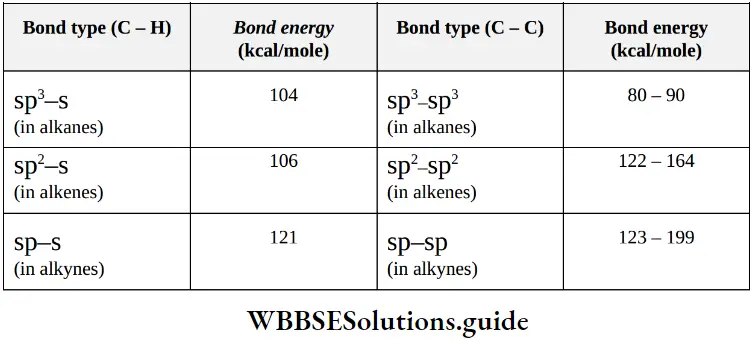
4. Bond strength in hydrocarbons: The shorter is the bond length, the greater is the compression between atomic nuclei, and hence greater is the strength of that bond.

NEET General Organic Chemistry Introduction Notes Bond Strength In Hydrocarbons

Structural Representation Of Organic Compounds

Structural formula (structure) is the sequence in which different atoms constituting the molecule are bonded to one another. Structures of molecules of organic compounds can be described in various ways.

The most common types of representations are:

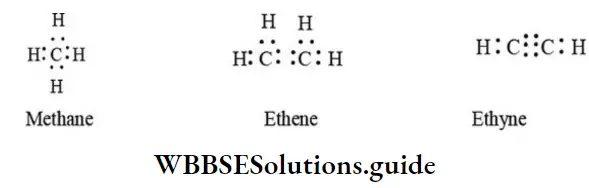
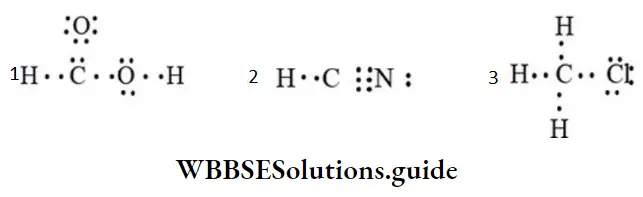
1. Lewis structure (or electron dot structure) Here dots are used to represent all of the valence electrons of all the bonded atoms in the molecule:

NEET General Organic Chemistry Introduction Notes Structural Representation Of Organic Compounds Lewis Structure

General organic chemistry tricks and shortcuts for NEET

Writing dot structure is tedious and time-consuming. The other representations are more convenient and are, therefore, more often used.

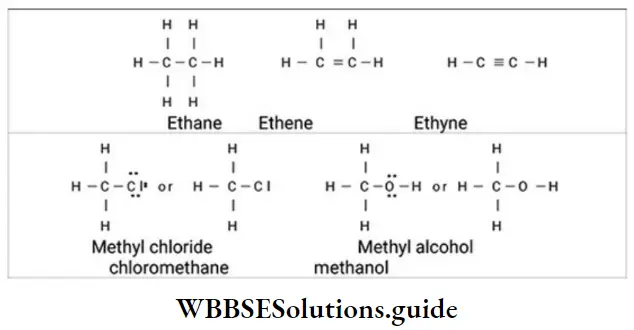
2. Dash structural formula The Lewis structure can be simplified by representing a shared electron pair by a ‘stick’ (dash, -) between the bonded atoms. When there is one dash between two atoms, the atoms are said to be bonded by a single covalent bond.

  • A double covalent bond, in which two pairs of electrons are shared, is shown by two dashes between the atoms. A triple bond is represented by three dashes between the atoms. The valence electrons that are not included in covalent bonds are called nonbonding electrons (lone pairs). These are assigned to specific atoms and are represented by dots drawn next to the symbols for these atoms.
  • Lone pair of electrons on hetero atoms (for example, oxygen, nitrogen, sulphur, phosphorus, halogens) may or may not be shown. Such structural formulae which focus only on the valence electrons involved in bond formation are called complete structural formulae.

NEET General Organic Chemistry Introduction Notes Dast Structural Formula

3. Condensed structural formula Complete structural formulae can be shortened by leaving out some or all of the covalent bonds and by denoting the number of identical groups attached to an atom by a subscript. The resulting description of the molecule is called a condensed structural formula. Thus,

CH3CH3 or C2H6 Ethane

H2C = CH2 or C2H4 Ethene

HC ≡ CH or C2H2 Ethyne

CH3CH2Cl or C2H5Cl Ethyl Chloride

CH3CH2CH2OH or CH3(CH2)2OH Methanol

CH3CH2CH2CH2CO2H or CH3(CH2)3CO2H Pentanoic Acid

Condensed structural formulae are easier to write than dash formulae. In condensed formulae, all of the hydrogen atoms that are attached to a particular carbon are usually written immediately after the carbon. In fully condensed formulae, all of the atoms that are attached to the carbon are usually written immediately after that carbon, listing hydrogens first.

NEET General Organic Chemistry Introduction Notes Condensed Structural Formula

How to study organic chemistry for NEET beginners

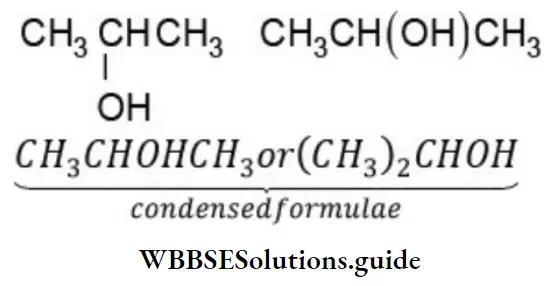
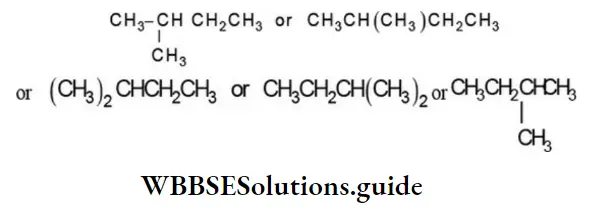
For example, the condensed formula for isopropyl alcohol can be written in four different ways:

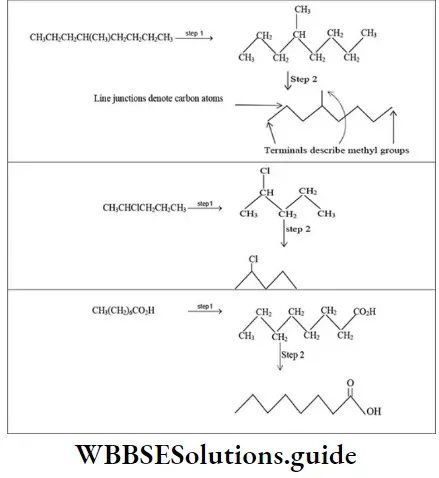
4. Bond-line structural formula: For further simplification, only lines are used to represent the structures of organic molecules. In this bond-line structural formula of organic molecules, carbon, and hydrogen atoms are not shown. The lines denoting the carbon-carbon bonds are drawn in a zig-zag fashion. The only atoms especially written are the hetero atoms (oxygen, nitrogen etc). They are neither carbon nor hydrogen bonded to carbon.

The termini describe methyl (CH3-) groups (unless denoted otherwise by a functional group). The line junctions indicate carbon atoms bonded to suitable number of hydrogens needed to satisfy the covalency of the carbon atoms: Thus

NEET General Organic Chemistry Introduction Notes Bond Line Structural Formula

The bond-line representation is the quickest of all to write because it shows only the carbon skeleton.

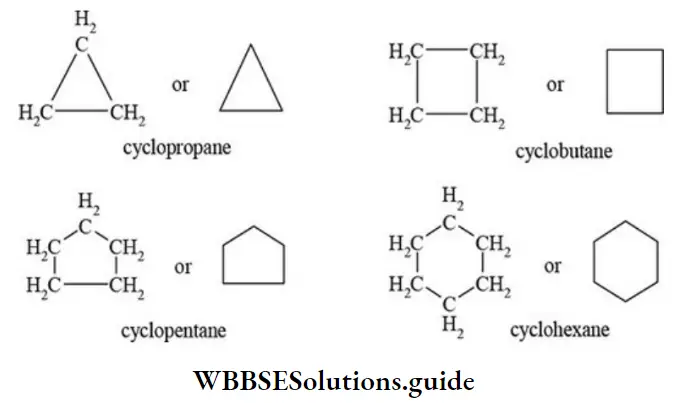
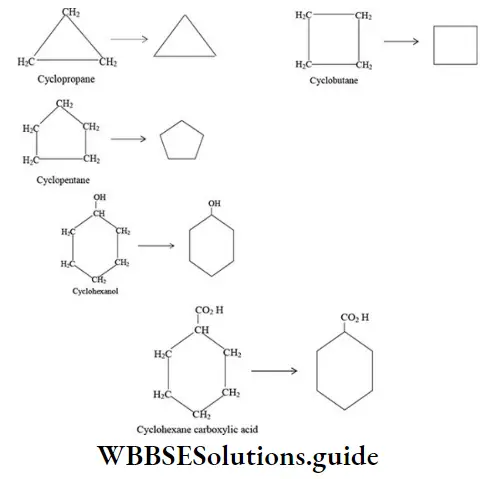
Ring or cyclic compounds: An organic compound in which carbon atoms are not bonded in chain but are bonded in closed structures called rings are known as cyclic compounds. Such a compound containing one or more rings is represented by drawing the suitable ring (polygon) without indicating the carbon and hydrogen atoms. The corner of the polygon denotes a carbon atom and its sides represent a carbon-carbon bond. An atom or a group of atoms (other than hydrogen) bonded to the carbon is however shown in the structure.

Bond-line formulae of some cyclic compounds are:

NEET General Organic Chemistry Introduction Notes Ring IOr Cyclic Compounds

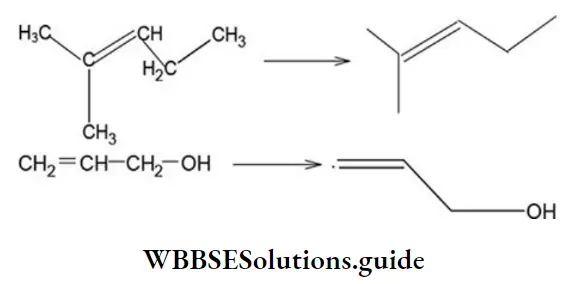
Multiple bonds are also indicated in bond-line formulae.

Multiple bonds example:

NEET General Organic Chemistry Introduction Notes Multiple Bonds

Structural Representation Of Organic Compounds Examples

Example 1: Convert each of the following Lewis structures into complete structural formulae:

NEET General Organic Chemistry Introduction Notes Convert Lewis Structure Into Structural Formula

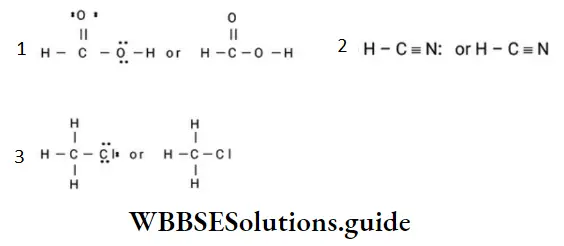
Solution: Use the dash to represent the shared electron pair.

NEET General Organic Chemistry Introduction Notes Shared Electron Pair

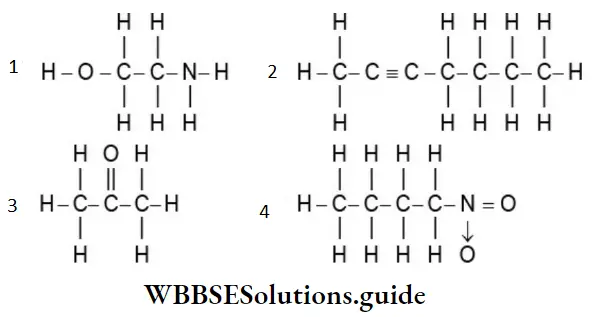
Example 2: Convert each of the following complete structural formulae into condensed formulae.

NEET General Organic Chemistry Introduction Notes Structural Formulae Into Condensed Formulae

Solution: Omitting some or all of the dashes and indicating the number of identical groups by a subscript we get

  1. HO(CH2)2NH2
  2. CH3C=C(CH2)3CH3
  3. H3CCOCH3
  4. CH3(CH2)3NO2

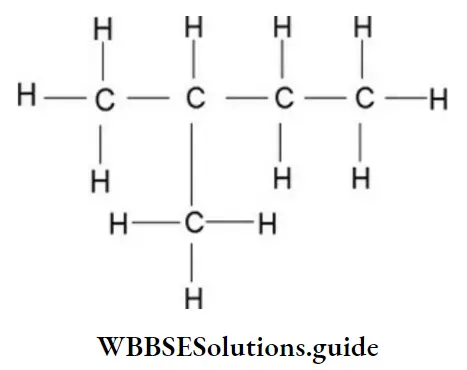
Example 3: Write the condensed structural formulae for the compound that follows in different ways.

NEET General Organic Chemistry Introduction Notes Condensed Strutural Formula

Solution:

NEET General Organic Chemistry Introduction Notes Condensed Structural Formulae Different Ways

Example 4: Write the bond-line formula for

NEET General Organic Chemistry Introduction Notes Bond Lijne Formula

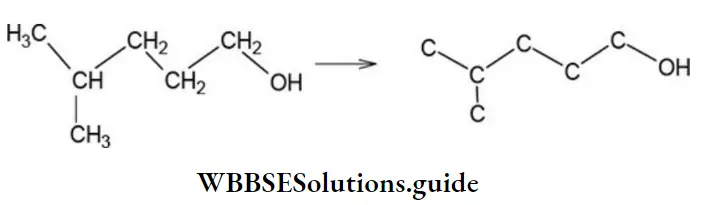
Solution: First, outline the carbon skeleton, including the OH group as follows:

NEET General Organic Chemistry Introduction Notes Outline The Carbon Skeleton

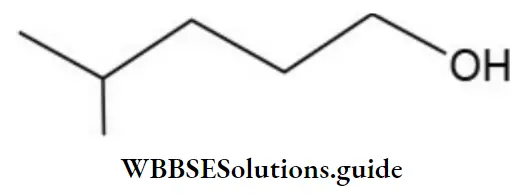
Thus, the bond-line formula is

NEET General Organic Chemistry Introduction Notes The Bond Line Formula

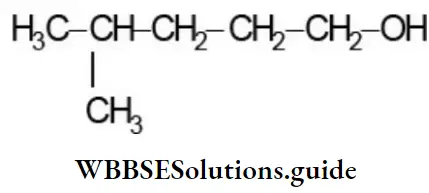
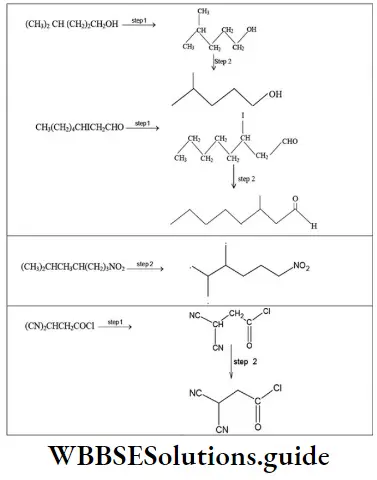
Example 5: For each of the following condensed formulae write the corresponding bond-line formula.

  1. (CH3)2CH(CH2)2CH2OH
  2. CH3(CH2)4CHICH2CHO
  3. (CH3)2CHCH3CH(CH2)3NO2
  4. (CN)2CHCH2COCl

Solution:

In the bond-line formula carbon and hydrogen atoms except those that are part of the functional groups are not shown. We show only the carbon skeleton. The number of hydrogen atoms necessary to fulfill the carbon atoms’ valences are assumed to be present, but we do not write them in.

NEET General Organic Chemistry Introduction Notes Corresponding The Bond line Formula

Other atoms (for example, Cl, O, N) are written in. Each intersection of two or more lines and the end of a line represent a carbon atom unless some other atom is written in.

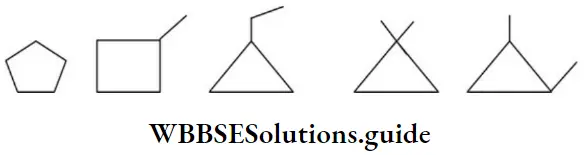
Example 6: Draw all possible bond-line formulae for a cyclic compound, C5H10.

Solution: Start with the maximum number of carbon atoms in the ring and move towards the ring of 3 carbon atoms. Explore all sorts of possibilities on this route:

NEET General Organic Chemistry Introduction Notes Cyclic Compound Formula

Three-dimensional representation of organic molecules

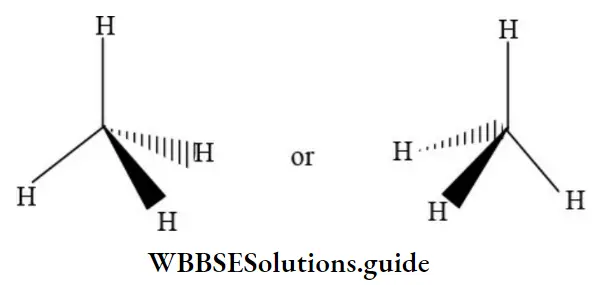
None of the formulae that we have described so far convey any information about how the atoms of a molecule are arranged in space. Shape or the three-dimensional (3-D) structure of organic molecules can be described on a paper (two-dimensional) by exploring certain conventions. For instance, by using solid and dashed wedge formula the 3-D image of an organic molecule can be perceived on a two-dimensional paper.

In solid-wedge NEET General Organic Chemistry Introduction Notes Solid and dashed-wedge NEET General Organic Chemistry Introduction Notes Dashedwedge description the solid-wedge denotes a bond projecting out of the plane of the paper towards the viewer. The dashed wedge depicts the bond projecting behind the plane of the paper and going away from the viewer. Both the wedges are drawn in such a way that the broad end of the wedge is near the viewer. The other two bonds lying in the plane of the paper are shown by using a normal line (________).

Let’s consider the wedge- and dashed-wedge representation of methane (CH4) molecule: The two carbon-hydrogen bonds represented by normal lines are in the plane of paper, whereas the carbon-hydrogen bond represented with a solid wedge is aimed to be in front of the plane of paper.

NEET General Organic Chemistry Introduction Notes Wedge And Dashed Wedge Og Methane

The hydrogen bonded to carbon by dashed edge is intended to be behind the plane of paper. Note that the carbon atom is lying in the plane of paper. Wedge and dashed-wedge formulae are important tool for clearly showing three dimensions.

NEET General Organic Chemistry Introduction Notes Organic Molecule In Three Dimensional Molecule

Nomenclature of Organic Compounds Question And Answers – NEET General Organic Chemistry

Nomenclature Of Organic Compounds

Question 1. The IUPAC name of the compound (CH3)2CH-CH=CH-CHOH-CH3 is

  1. 5-methyl-hex-3-en-2-ol
  2. 2-methyl-hex-3-en-5-ol
  3. 2-hydroxy-5-nethyl-3-hexene
  4. 5-hydroxy-2-methyl-3-hexene

Answer: 1. 5-methyl-hex-3-en-2-ol

Solution: Follow IUPAC rules.

The IUPAC name of the compound (CH3)2CH-CH=CH-CHOH-CH3 is 5-methyl-hex-3-en-2-ol

Read And Learn More: NEET General Organic Chemistry Notes, Question And Answers

Question 2. Which of the following represents the condensed formula for pentanes?

  1. CH3(CH2)3CH3
  2. (CH3)3CCH3
  3. (CH3)2CHCH2 CH3
  4. All of these

Answer: 4. All of these

Solution: In condensed structural formula, parenthesis is used for the identical groups of atoms.

NEET organic chemistry nomenclature questions and answers

Question 3. Which is the most stable carbocation?

  1. isopropyl cation
  2. Triphenylmethyl cation
  3. Ethyl cation
  4. n-propyl cation

Answer: 2. Triphenylmethyl cation

Solution: Aryl carbonium ions are more stable than the alkyl carbonium ions. The order of stability of carbocation is

Triphenyl methyl >Diphenyl methyl> Benzyl>Allyl>30>2°>1°> methyl carbocation.

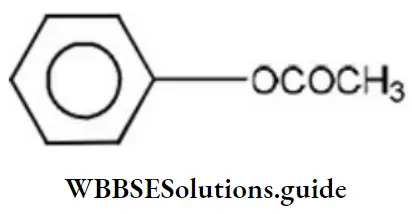
Question 4. Which of the following is phenyl ethanoate?
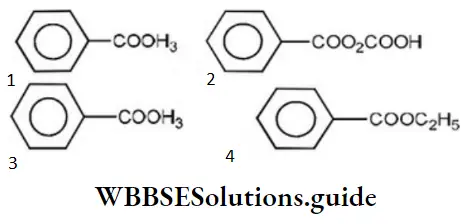
NEET General Organic Chemistry Nomenclature Of Organic Compounds Phenyl Ethanoate

Answer: 3

NEET General Organic Chemistry Nomenclature Of Organic Compounds Staructure Of Phenyl Ethanoate

Solution: Esters are named by prefixing the name of the alkyl or aryl group (of OR’ part) before the name of the parent acid and changing the suffix “ic” acid to ate. Hence, the structure of phenyl ethanoate is

IUPAC nomenclature NEET previous year questions with solutions

Question 5. IUPAC name of CH2=CH—CH(CH3)2 is:

  1. 1,1-dimethyl-2-propene
  2. 3-methyl-1-butene
  3. 2-vinyl propane
  4. 1-isopropyl ethylene

Answer: 2. 3-methyl-1-butene

Solution: Follow IUPAC rules.

NEET General Organic Chemistry Nomenclature of Organic Compounds Question And Answers

NEET chemistry nomenclature MCQs with answers

Question 6. In the structure, the number of carbon atoms are:
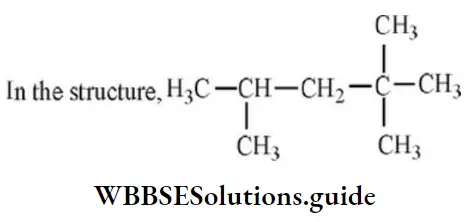
NEET General Organic Chemistry Nomenclature Of Organic Compounds In This Structure Number Of Carbon Atoms

  1. One primary, two secondary and one tertiary
  2. Four primary, two tertiary and one secondary
  3. One primary, one secondary, one tertiary and one quaternary
  4. Five primary, one secondary, one tertiary and one quaternary

Answer: 4. Five primary, one secondary, one tertiary and one quaternary

Solution: A primary carbon is one which is joined to one carbon atom. A secondary carbon atom is joined to two carbon atoms and the tertiary carbon is attached to three carbon atoms. A quaternary carbon has all its four valencies attached to carbon atoms.

Question 7. IUPAC name of the following compound is
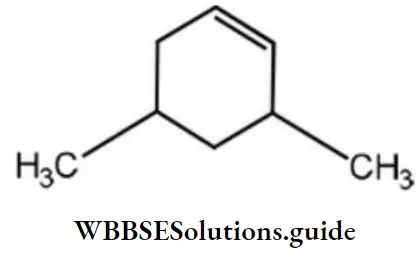
NEET General Organic Chemistry Nomenclature Of Organic Compounds IUPAC Compound is 3, 5 Dimethylcyclohexene

  1. 3, 5-dimethylcyclohexene
  2. 3, 5-dimethyl-1-cyclohexene
  3. 1, 5-dimethyl-5-cyclohexene
  4. 1, 3-dimethyl-5-cyclohexene

Answer: 1. 3, 5-methylcyclohexane
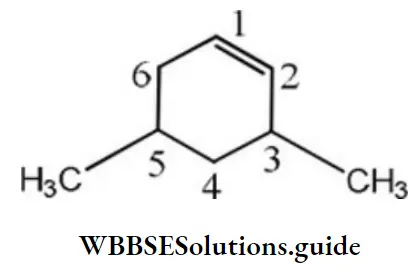
NEET General Organic Chemistry Nomenclature Of Organic Compounds 3, 5 Dimethylcyclohexene

Solution: Its IUPAC name is 3,5-dimethylcyclohexene.

Important nomenclature questions for NEET organic chemistry

Question 8. IUPAC name ofis
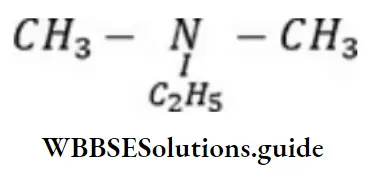
NEET General Organic Chemistry Nomenclature Of Organic Compounds N,N Dimethylethanamine

  1. N, N- dimethylethanolamine
  2. N-methyl, N-ethylmethanamine
  3. Dimethyl-ethylamine
  4. None of the above

Answer: 1. N, N- dimethylethanolamine

Solution: Follow IUPAC rules.

Question 9. The IUPAC name of CH3-CH=CH-C=CH is

  1. Pent-3-en-1-yne
  2. Pent-3-en-4-yne
  3. Pent-2-en-4-yne
  4. Pent-2-en-3-yne

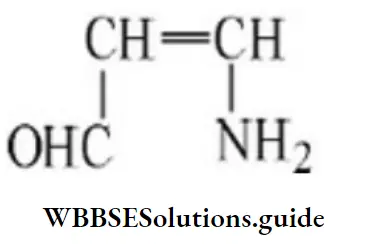
Question 10.

NEET General Organic Chemistry Nomenclature Of Organic Compounds 3 Amino Prop 2 Enal

  1. 1-amino prop-2-enal
  2. 3-amino prop-2-enal
  3. 1-amino-2-formyl ethene
  4. 3-amino-1-oxoprop-2-ene

Answer: 2. 3-amino prop-2-enal

Solution: Follow IUPAC rules.

Question 11. The IUPAC name of an unsymmetrical ether with the molecular formula of C4H10O is

  1. Ethoxy propane
  2. Methoxy ethane
  3. Ethoxy ethane
  4. Methoxy propane

Answer: 4. Methoxy propane

Solution: Only two unsymmetrical ethers are possible from the formula C4H10O viz
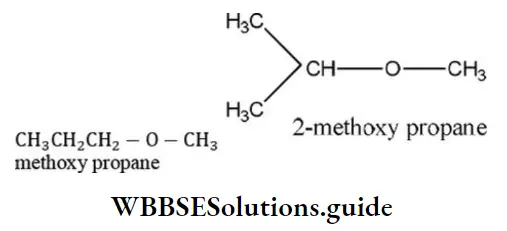
NEET General Organic Chemistry Nomenclature Of Organic Compounds Unstmmetric Ethers Methoxy Propone

CH3 CH2 CH3-O-CH3

Question 12. IUPAC name of urea is:

  1. Diamino ketone
  2. 1-aminoethanamide
  3. 1-aminomethanamide
  4. amino acetamide

Question 13. IUPAC name of C6 H5 CN is:

  1. Phenyl nitrile
  2. Benzene nitrile
  3. Benzyl nitrile
  4. Phenyl cyanide

Answer: 2. Benzene nitrile

Solution: Follow IUPAC rules.

Question 14. The IUPAC name of the compound is
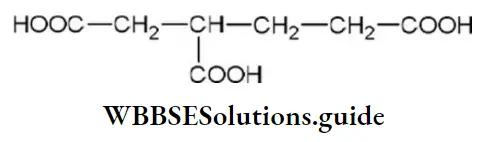
NEET General Organic Chemistry Nomenclature Of Organic Compounds 3 Carboxuhexane-1, 6-Iodic Acid

  1. 2(carboxymethyl)-pentane-1,5-dioic acid
  2. 3-carboxy hexane-1, 6-dioic acid
  3. Butane-1, 2, 4-tricarboxylic acid
  4. 4-carboxy hexane-1, 6-dioic acid

Answer: 2. 3-carboxy hexane-1, 6-dioic acid
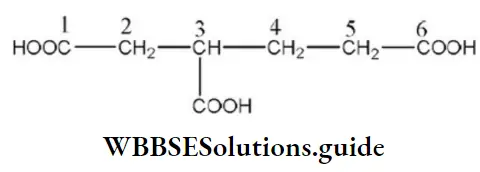
NEET General Organic Chemistry Nomenclature Of Organic Compounds 3 Carboxymethyl-1, 6-Idioic Acid

Solution: IUPAC name of the above compound is 3-carboxyhexane-1, 6-dioic acid.

NEET organic chemistry IUPAC naming practice questions

Question 15. IUPAC name of
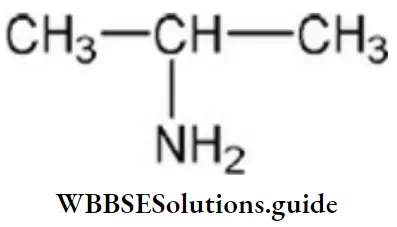
NEET General Organic Chemistry Nomenclature Of Organic Compounds 2 Propanamine

  1. Dimethyl amine
  2. 2-amino propane
  3. Isopropyl amine
  4. 2-propanamide

Answer: 4. 2-propanamide

Solution: 2-propanamide
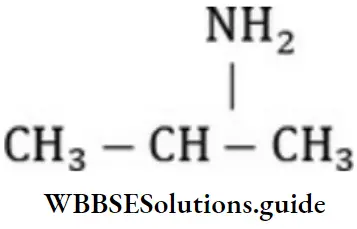
NEET General Organic Chemistry Nomenclature Of Organic Compounds IUPAC Name is 2 Propanamine

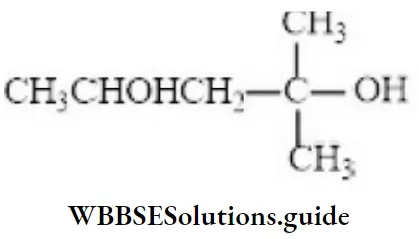
Question 16. The IUPAC name of

  1. 1, 1-dimethyl-1, 3-butanediol
  2. 2-methyl-2, 4-pentanediol
  3. 4-methyl-2, 4-pentanediol
  4. l, 3, 3-trimethyl-1, 3-propanediol

Answer: 2. 2-methyl-2, 4-pentanediol

Solution: Follow IUPAC rules.

Question 17. The IUPAC name of the compound is
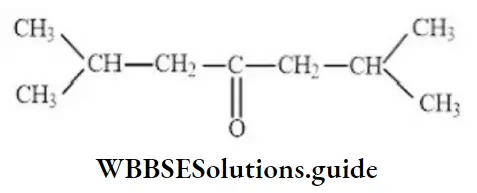
NEET General Organic Chemistry Nomenclature Of Organic Compounds IUPAC Is 2, 6 Dimethylheptanone 4

  1. 2,4-dimethylhexanone-3
  2. 2,6-dimethylheptanone-4
  3. 2,6-dimethylhexanone-4
  4. 2,6-dimethylheptanone-5

Answer: 2. 2,6-dimethylheptanone-4

Solution: Follow IUPAC rules.

Question 18. Lactic acid is:

  1. Propionic acid
  2. ^-hydroxy propanoic acid
  3. a-hydroxy propanoic acid
  4. None of the above

Answer: 3. a-hydroxy propanoic acid

Solution: Lactic acid is also called as a-hydroxy propionic acid or 2-hydroxy propanoic acid.

Question 19. The compound which contains all the four 1°, 2°, 3° and 4° carbon atoms is

  1. 2, 3-dimethyl pentane
  2. 3-chloro-2, 3-dimethyl pentane
  3. 2, 3, 4-trimethylpentane
  4. 3, 3-dimethyl pentane

Answer: 2. 3-chloro-2, 3-dimethyl pentane

Solution: 3-chloro-2, 3-dimethyl pentane contains all the four 1°,2°, 3° and 4° carbon atoms.
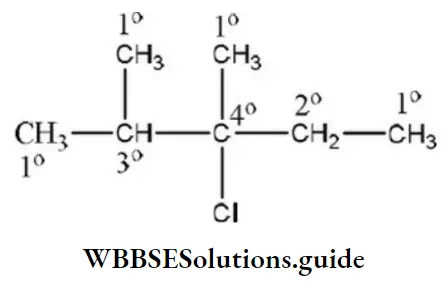
NEET General Organic Chemistry Nomenclature Of Organic Compounds 3 Chloro 2, 3 Dimethyl Pentane Contains Four Carbon Atoms

Question 20. The name formic acid was given for HCOOH because it was prepared from:

  1. Acetum
  2. Ant
  3. Wood
  4. Oxalis plant

Answer: 2. Ant

Solution: Formic acid was obtained from ant (Formica in Greek). This is the trivial name for HCOOH.

Question 21. The IUPAC name of the compound having the formula CH= C — CH=CH2 is:

  1. 1-butene-3-yne
  2. 3-butene-1-yne
  3. 1-butyn-3-ene
  4. But-1-yne-3-ene

Answer: 1. 1-butene-3-yne

Solution: Follow IUPAC nomenclature.

Question 22. The IUPAC name of the below compound is
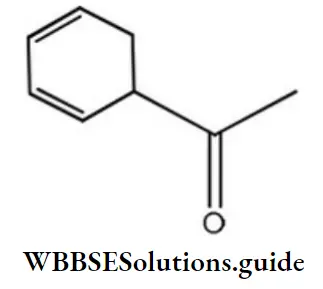
NEET General Organic Chemistry Nomenclature Of Organic Compounds 1 Cyclohexa 2, 4 Dienylethanone

  1. 1- cyclohexane-2,4-dienylethanone
  2. 3- cyclohexane-2,4-dienylethanone
  3. 1- cyclohexane-3,5-dienylethanone
  4. 3- cyclohexane-3,5-dienylethanone

Answer: 1. 1- cyclohexane-2,4-dienylethanone

Solution: Follow IUPAC nomenclature.

Question 23. The IUPAC name of the below compound is

  1. 1-methyl-1-amino propane
  2. 2-amino butane
  3. 2-methyl-3-amino propane
  4. None of the above

Answer: 2. 2-amino butane

Solution: Follow IUPAC rules.

Question 24. The correct IUPAC name of (C2 H5)4 C is:

  1. Tetraethyl methane
  2. 2-ethyl pentane
  3. 3,3-diethyl pentane
  4. None of these

Answer: 3. 3,3-diethyl pentane

Solution: Follow IUPAC rules.

Nomenclature of organic compounds NEET question bank

Question 25. Which IUPAC name is wrong?
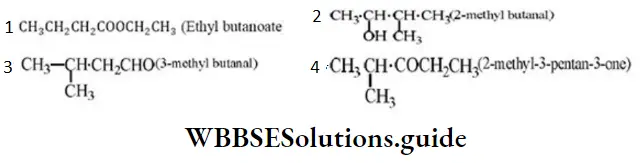
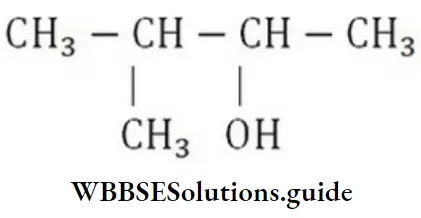
NEET General Organic Chemistry Nomenclature Of Organic Compounds IUPAC Name Is 3 Methyl Butan 2 ol

Answer: 3

NEET General Organic Chemistry Nomenclature Of Organic Compounds 3 Methyl Butan 2 ol

Solution: It is 3-methyl butan-2-ol.

Question 26. The structural formula of 2,2,3-trimethyl hexane is:

Answer: 3

Solution: Follow IUPAC rules.

Question 27. IUPAC name of acraldehyde is

  1. But-3-en-1-al
  2. Propenyl aldehyde
  3. But-2-ene-1-al
  4. Prop-2-en-1-al

Answer: 4. Prop-2-en-1-al

Solution: IUPAC name of acraldehyde
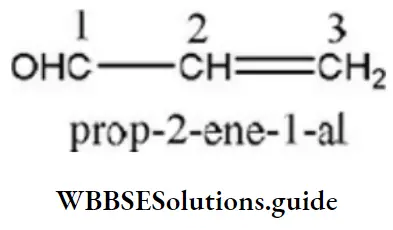
NEET General Organic Chemistry Nomenclature Of Organic Compounds Prop-2-en-1-al

Question 28. The IUPAC name of the compound is
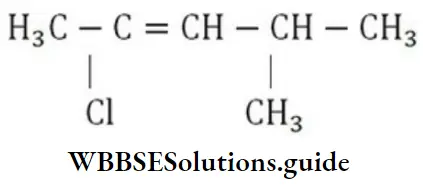
NEET General Organic Chemistry Nomenclature Of Organic Compounds 2-chloro-4-methyl-2-pentene

  1. 2-chloro-4-methyl-2-pentene
  2. 4-chloro-2-methyl-3-pentene
  3. 4-methyl-2-chloro-2-pentene
  4. 2-chloro-4, 4-dimethyl-2-butene

Answer: 1. 2-chloro-4-methyl-2-penton

Solution: Follow IUPAC rules.

Question 29. 2-methyl pent-3-ene is achiral because it has:

  1. A centre of symmetry
  2. A plane of symmetry
  3. Symmetry at C2 carbon
  4. Both centre and a plane of symmetry

Answer: 4. Both centre and a plane of symmetry

Solution: If the structure of the compound is drawn then we find that a plane of symmetry is present in this compound. The two halves are equal hence the compound does not have a chiral point, in addition to this it has a Centre. The two sides of the compound on the different sides of the centre atom are similar. Both the reasons are present which signifies that the molecule is achiral.

Question 30. The IUPAC name of the compound is
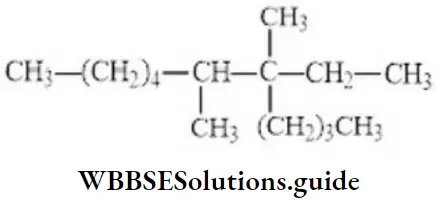
NEET General Organic Chemistry Nomenclature Of Organic Compounds 4-ethyl-4, 5-dimethyldecane

  1. 3,4-dimethyl-3-n-propyl nonane
  2. 4-ethyl-4,5-dimethyl decane
  3. 6,7-dimethyl-7-n-propyl nonane
  4. 6,7-dimethyl-7-ethylene

Answer: 2. 4-ethyl-4,5-dimethyl decane

Solution: Follow IUPAC rules.

Question 31. Give the correct IUPAC name for
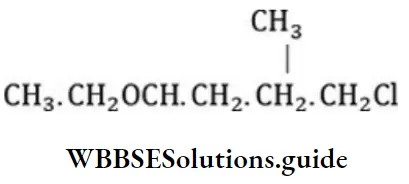
NEET General Organic Chemistry Nomenclature Of Organic Compounds IUPAC Name Is 2-ethoxy5-chloropentane

  1. 2-ethoxy-5-chloroethane
  2. l-chloro-4-ethoxy-4-methyl butane
  3. 1-chloro-4-ethoxy pentane
  4. Ethyl-1-chloropentylether

Answer: 1. 2-ethoxy-5-chloroethane

Solution: According to the IUPAC system, ether is named as alkoxy alkane. The larger alkyl group forms the parent chain while the lower alkyl group takes in ethereal oxygen and forms a part of the alkoxy group.
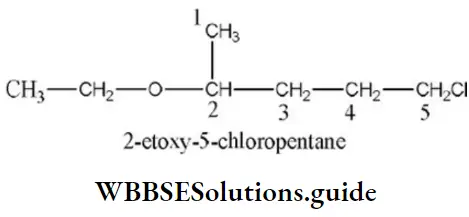
NEET General Organic Chemistry Nomenclature Of Organic Compounds 2 etoxy-5-chloropentane

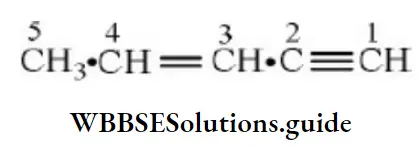
Question 32. The IUPAC name of the compound, CH3 CH = CHC = CH is:

  1. Pent-4-yn-2-ene
  2. Pent-3-en-1-yne
  3. Pent-2-en-4-yne
  4. Pent-1-yn-3-ene

Answer: 2. Pent-3-en-1-yne

Solution: Follow IUPAC rules.
NEET General Organic Chemistry Nomenclature Of Organic Compounds Pent-3-en-1-yne

Question 33. The IUPAC name of C6 H5 COCl is

  1. Benzoyl chloride
  2. Benzene chloro ketone
  3. Benzene carbonyl chloride
  4. Chloro phenyl ketone

Answer: 1. Benzoyl chloride

Solution: Follow IUPAC rules.

NEET chemistry IUPAC nomenclature quiz with answers

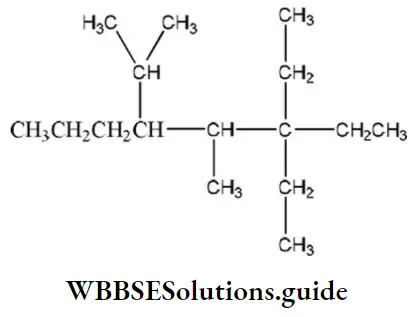
Question 34. IUPAC name of the compound
NEET General Organic Chemistry Nomenclature Of Organic Compounds 3-3-dimethyl, 3-ethyl-5-isopropyl octane

  1. 5- methyl-4-isopropyl-6, 6’diethyloctane
  2. 3, 3-dimethyl, 3-ethyl-5- isopropyl octane
  3. 3, 3-diethyl-4-methyl-5-(1,1-dimethyl) octane
  4. 3, 3- diethyl-4-methyl-5-(1’-methylethyl) octane

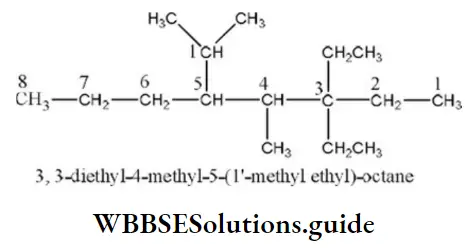
Answer: 4. 3, 3- diethyl-4-methyl-5-(1’-methyl ethyl) octane

Solution: Select the longest possible carbon atom chain, number it and name the compound according to IUPAC rules.
NEET General Organic Chemistry Nomenclature Of Organic Compounds IUPAC Name Is 3,3-diethyl-4-methyl-5-octane

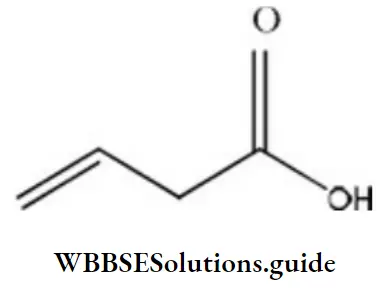
Question 35. The IUPAC name of is

NEET General Organic Chemistry Nomenclature Of Organic Compounds But-3-enoic acid

  1. But-3-enoic acid
  2. But-1-enoic acid
  3. Pent-4-enoic acid
  4. Prop-2-enoic acid

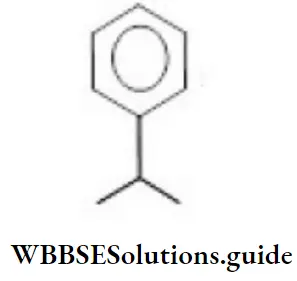
Question 36. The correct IUPAC name of the below molecule is
NEET General Organic Chemistry Nomenclature Of Organic Compounds 2-phenyl- propane

  1. Isopropyl benzene
  2. Cumene
  3. Phenyl isopropanol
  4. 2-phenyl propane

Answer: 4. 2-phenyl propane

Solution: Follow IUPAC rules.

Question 37. The IUPAC name of the compound is
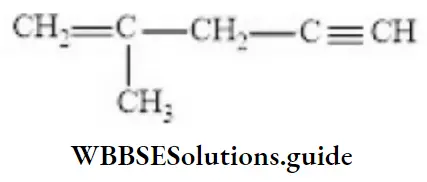
NEET General Organic Chemistry Nomenclature Of Organic Compounds 2-methylpent-1en-4-yne

  1. 2-methyl pent-1-en-4-yne
  2. 4-methyl pent-4-en-1-yne
  3. 2-methyl pent-2-en-4-yne
  4. 4-methyl pent-1-en-4-yne

Answer: 1. 2-methylpent-1-en-4-yne

Solution: Follow IUPAC rules.

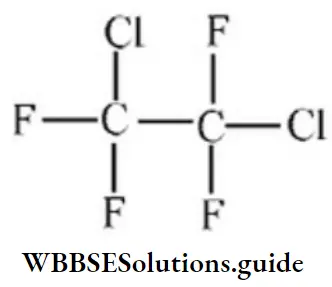
Question 38. Freon-114 is an organic compound. k is chemically called 1,2dichlorotetrafluoroethane. Its correct structural formula is:
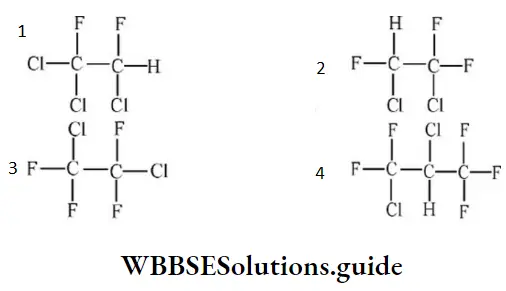
NEET General Organic Chemistry Nomenclature Of Organic Compounds Froen-114 An Organic Compound

Answer: 3

NEET General Organic Chemistry Nomenclature Of Organic Compounds 1,2 dichlorotetrafluoroethane

Solution: Follow IUPAC rules.

Question 39. The IUPAC name of the following compound is
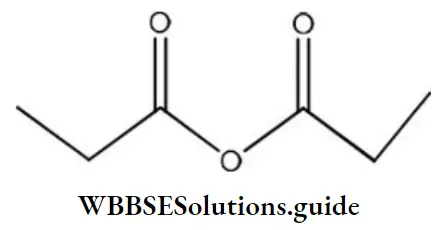
NEET General Organic Chemistry Nomenclature Of Organic Compounds Propionic Anhydride

  1. Propionic anhydride
  2. Di propanoic anhydride
  3. Ethoxy propanoic acid
  4. Propanoic anhydride

Answer: 4. Propanoic anhydride

Solution: In the IUPAC system, anhydrides are named as alkanoic anhydride.
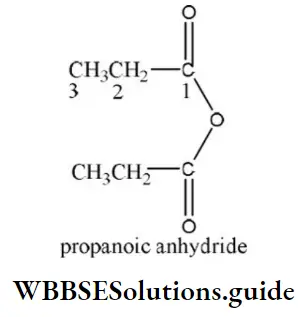
NEET General Organic Chemistry Nomenclature Of Organic Compounds Propanoic Anhydride

Question 40. IUPAC name of the compound is
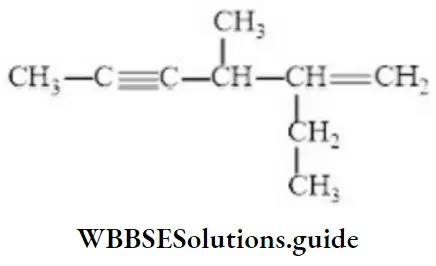
NEET General Organic Chemistry Nomenclature Of Organic Compounds 2-ethyl-3-methyl-hexa-1-en-4-yne

  1. 2-ethyl-3-methyl-hexa-l-en-4-yne
  2. 5-ethyl-4-methyl-hexa-2-yn-5-ene
  3. 3-methylene-4-methylhepta-5-yne
  4. 5-methylene-5-ethyl-4-methylhepta-2-yne
  5. Answer: 1. 2-ethyl-3-methyl-hexa-l-en-4-yne

Solution:-do-

Question 41. Bicyclo (1,1,0) butane is
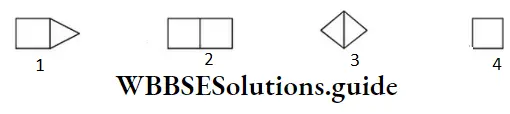
NEET General Organic Chemistry Nomenclature Of Organic Compounds Bicyclo

Answer: 3

NEET General Organic Chemistry Nomenclature Of Organic Compounds Bicylo 1,1,10 Butane

Its IUPAC name is bicyclo [1,1,0] butane.

Question 42. t-butyl alcohol is

  1. 2-methyl propane-2-ol
  2. 2-methyl propane-1-ol
  3. 3-methyl butane-1-ol
  4. 3-methyl butane-2-ol

Answer: 1. 2-methyl propan-2-ol

Solution: 2-methyl propan-2-ol is tert-butyl alcohol.
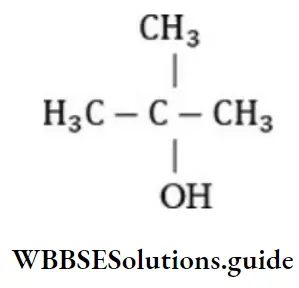
NEET General Organic Chemistry Nomenclature Of Organic Compounds 2-methyl propan-2-l Is Tert Butyl Alochol

Question 43. IUPAC name of C6 H5 COCl is:

  1. Benzal chloride
  2. Benzenechloro ketone
  3. Benzene carbonyl chloride
  4. Chloro phenyl ketone

Answer: 3. Benzene carbonyl chloride

Solution: Follow IUPAC rules.

Question 44. The IUPAC name for tertiary butyl iodide is

  1. 4-iodo butane
  2. 2-iodo butane
  3. 1-iodo-3-methyl propane
  4. 2-iodo-2-methylpropane

Answer: 4. 2-iodo-2-methylpropane
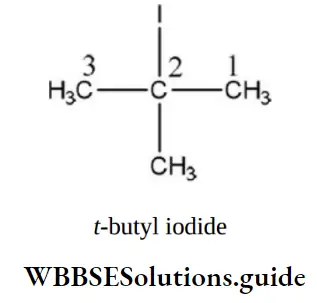
NEET General Organic Chemistry Nomenclature Of Organic Compounds 2-iodo-2-methyl Propane

Solution: Its IUPAC name is 2-iodo-2-methyl propane.

Question 45. The correct structure of dimethyl butane is:

  1. CH3CH3—C=C—CH2 CH3
  2. (CH3)3C —C —C≡CH
  3. CH3—C=CCH(CH3)2
  4. NEET General Organic Chemistry Nomenclature Of Organic Compounds Dimethylbutyne

Answer: 2. (CH3)3C —C —C≡CH

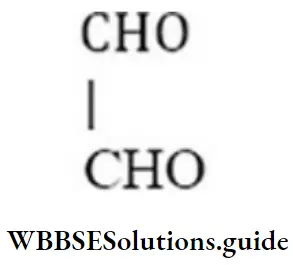
Question 46. Glyoxal is

  1. CH2OH-CH2OH
  2. CHO-CH2OH
  3. COOH-CO-COOH
  4. CHO-CHO

Answer: 4. CHO-CHO

Solution:

NEET General Organic Chemistry Nomenclature Of Organic Compounds Glyoxal

Question 47. Give the IUPAC name for,
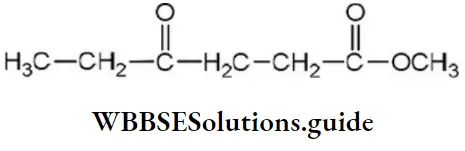
NEET General Organic Chemistry Nomenclature Of Organic Compounds Methyl 4-oxo Hexanoate

  1. Ethyl-4- oxo heptanoate
  2. Methyl-4- oxo heptanoate
  3. Ethyl-4- oxo hexanoate
  4. Methyl 4- oxo hexanoate

Answer: 4. Methyl 4- oxo hexanoate

Solution: Follow IUPAC rules.

Question 48. The IUPAC name of the compound,
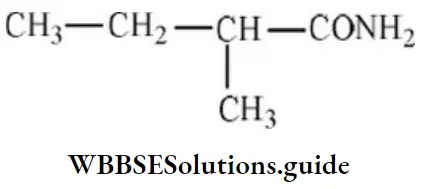
NEET General Organic Chemistry Nomenclature Of Organic Compounds 2-methylbutanamide

  1. 2-ethylbutanamide
  2. 2-methylbutanamide
  3. 1-amino-2-methylpropane
  4. None of the above

Answer: 2. 2-methylbutanamide

Solution: Follow IUPAC rules.

Question 49. The IUPAC name of CH3 COCH(CH3)2 is

  1. Isopropyl methyl ketone
  2. 2-methyl-3-butanone
  3. 4-methyl isopropyl ketone
  4. 3-methyl-2-butanone

Answer: 4. 3-methyl-2-butanone

Solution:
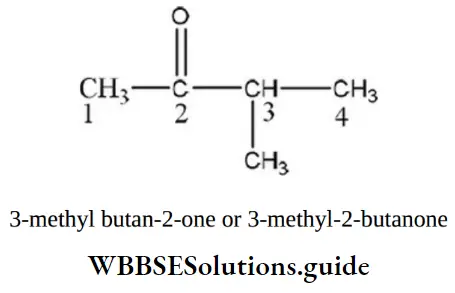
NEET General Organic Chemistry Nomenclature Of Organic Compounds 3-methyl-2-butanone

The keto functional group is given priority.

Question 50. The IUPAC name of the following compound is
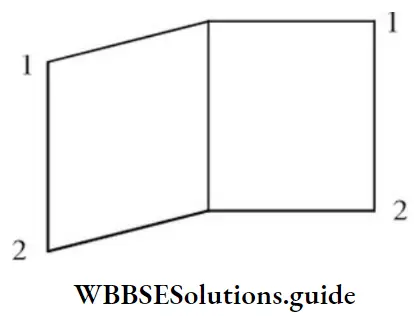
NEET General Organic Chemistry Nomenclature Of Organic Compounds Bicyclo 2, 2, 0 Hexane

  1. Bicyclo [2,2,0] octane
  2. Bicyclo [0,2,2] hexane
  3. Bicyclo [2,1,1] hexane
  4. Bicyclo [2,2,0] hexane

Answer: 4. Bicyclo [2,2,0] hexane

Solution: Hence, the correct IUPAC name is bicyclo [2,2,0] hexane.
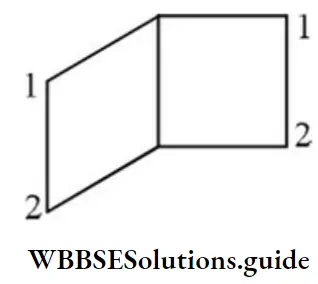
NEET General Organic Chemistry Nomenclature Of Organic Compounds IUPAC Is Bicyclo 2,2,0 Hexane

Nomenclature of organic compounds NEET sample paper

Question 51. The IUPAC name of the compound,
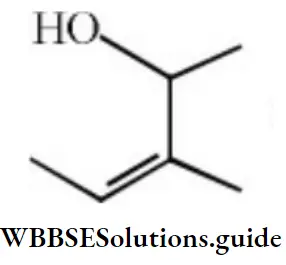
NEET General Organic Chemistry Nomenclature Of Organic Compounds 3-methylpent-3-en-2-ol

  1. 1,2-dimethyl-2-butenol
  2. 3-methylpent-3-en-2-ol
  3. 3,4-dimethyl-2-buten-4-ol
  4. 2,3-dimethyl-3-pentenol

Answer: 2. 3-methyl pent-3-en-2-ol

Solution: Follow IUPAC rules.

Question 52. IUPAC name of (CH3)3 CCl is

  1. n-butyl chloride
  2. 3-chloro butane
  3. 2-chloro 2-methyl propane
  4. t-butyl chloride

Answer: 3. 2-chloro 2-methyl propane

Solution: Follow IUPAC rules.

Question 53. What is the correct IUPAC name of the compound?
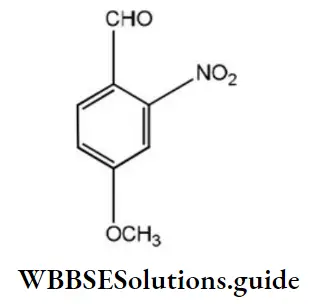
NEET General Organic Chemistry Nomenclature Of Organic Compounds 4-methoxy-2-nitrobenzaldehyde

  1. 4-methoxy-2-nitrobenzaldehyde
  2. 4-formyl-3-nitro anisole
  3. 4-methoxy-6-nitrobenzaldehyde
  4. 2-formyl-5-methoxy nitrobenzene

Answer: 1. 4-methoxy-2-nitrobenzaldehyde

Solution: Follow IUPAC rules.

Question 54. What is the correct IUPAC name of the compound?
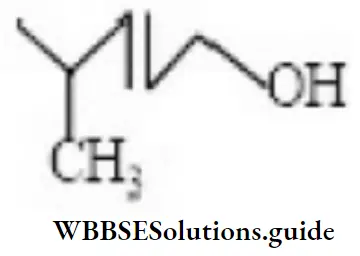
NEET General Organic Chemistry Nomenclature Of Organic Compounds 4-methylpent-2-enol

  1. 5-methyl hexanol
  2. 2-methyl hexanol
  3. 2-methylhex-3-enol
  4. 4-methyl pent-2-enol

Answer: 4. 4-methyl pent-2-enol

Solution: —do—

Question 55. The IUPAC name of the compound is:
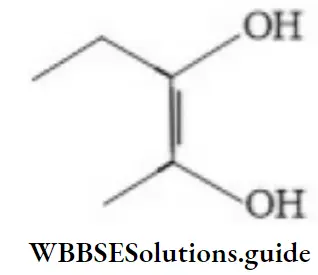
NEET General Organic Chemistry Nomenclature Of Organic Compounds Pent-2ene-2, 3-diol

  1. But-2-ene-2,3-diol
  2. Pent-2-ene-2,3-diol
  3. 2-methylbut-2-ene-2,3-diol
  4. Hex-2-ene-2,3-diol

Answer: 2. Pent-2-ene-2,3-diol

Solution: Follow IUPAC rules.

Question 56. Which nomenclature in IUPAC is incorrect?

  1. Pentyne-3
  2. Pentyne-2
  3. Hexyne-3
  4. None of these

Answer: 1. Pentyne-3

Solution: CH3 C = CCH2 CH3; It is always pentyne-2 and never pentyne-3.

Question 57. The IUPAC name of the compound CH3 CONHBr is

  1. 1-bromoacetate
  2. Ethanoylbromide
  3. N-Bromoethanamide
  4. None of these

Answer: 3. N-Bromoethanamide

Solution: Follow IUPAC rules.
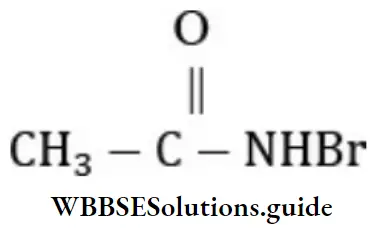
NEET General Organic Chemistry Nomenclature Of Organic Compounds N-Bromoethanamide

Question 58. The IUPAC name of the compound is:
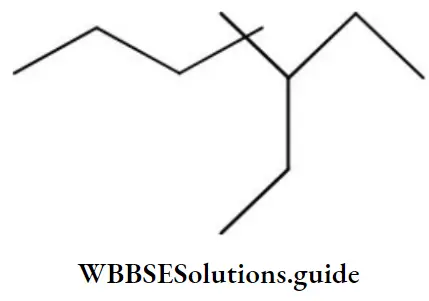
NEET General Organic Chemistry Nomenclature Of Organic Compounds 3-ethyl-4, 4-dimethylheptane

  1. 3-ethyl-4,4-dimethyl heptane
  2. 1,1-diethyl-2,2-dimethyl pentane
  3. 4,4-dimethyl-5,5-diethyl pentane
  4. 5,5-diethyl-4, 4-dimethyl pentane

Answer: 1. 3-ethyl-4,4-dimethyl heptane

Solution: Follow IUPAC rules.

Question 59. The correct IUPAC name of the compound is:
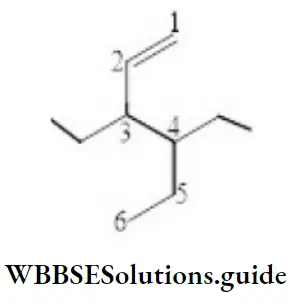
NEET General Organic Chemistry Nomenclature Of Organic Compounds 4-Ethyl-3-propyl hex-1-ene

  1. 3-(1-ethyl propyl) hex-1-ene
  2. 4-Ethyl-3-propyl hex-1-ene
  3. 3-Ethyl-4-ethenyl heptane
  4. 3-Ethyl-4-propyl hex-5-ene

Answer: 2. 4-Ethyl-3-propyl hex-1-ene

Solution: Follow IUPAC rules.

Question 60. The IUPAC name of the following compound is
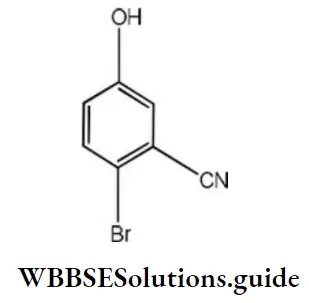
NEET General Organic Chemistry Nomenclature Of Organic Compounds Cyano Group

  1. 4-bromo-3-cynophenoal
  2. 2-bromo-5-hydroxy benzonitrile
  3. 2-cyano-4-hydroxybromobenzene
  4. 6-bromo-3-hydroxy benzonitrile

Answer: 2. 2-bromo-5-hydroxy benzonitrile

Solution: The Cyano group has the highest priority therefore, parent name must be benzonitrile. Br occurs at 2- position, and hydroxyl at 3-position, hence the IUPAC name is 2-bromo-5-hydroxy benzonitrile.
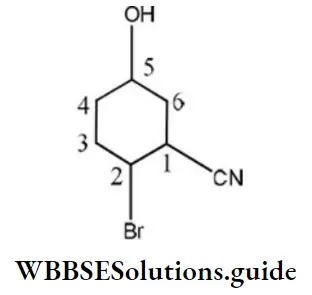
NEET General Organic Chemistry Nomenclature Of Organic Compounds 2-bromo-5-hydroxybenzonitrile

Question 61. IUPAC name of the compound is
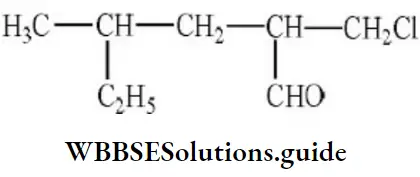
NEET General Organic Chemistry Nomenclature Of Organic Compounds 2-chloromethyl-4-methyl-hexanal

  1. 2-chloromethyl-4-methyl-hexanal
  2. 1-chloro-4-ethyl-2-pentanal
  3. 1-chloro-4-methyl-2-hexanal
  4. 1-chloro-2-aldo-4-methyl hexane

Answer: 1. 2-chloromethyl-4-methyl-hexanal

Solution: Follow IUPAC rules.

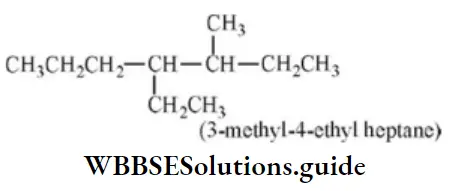
Question 62. Which one is not in the IUPAC system?
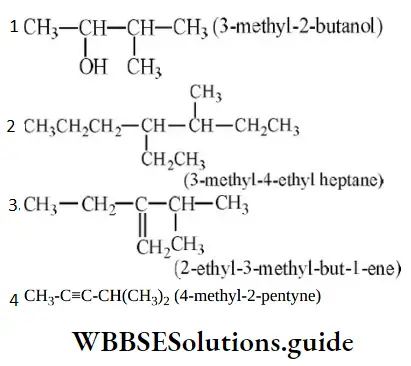
NEET General Organic Chemistry Nomenclature Of Organic Compounds IUPAC System 4-ethyl-3-methyl heptane

Answer: 2

NEET General Organic Chemistry Nomenclature Of Organic Compounds 4-ethyl-3-methyl heptane

Solution: It should be 4-ethyl-3-methyl heptane.

Question 63. The correct IUPAC name is
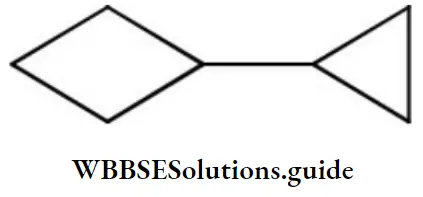
NEET General Organic Chemistry Nomenclature Of Organic Compounds 1-cyclopropyl Cyclobutane

  1. 1- cyclopropyl Cyclobutane
  2. 1, 1-cyclobutane
  3. 1- cyclobutane-1- cyclopropane
  4. None of the above

Answer: 1. 1- cyclopropyl Cyclobutane

Solution: Follow IUPAC rules.

Question 64. The IUPAC name of the compound
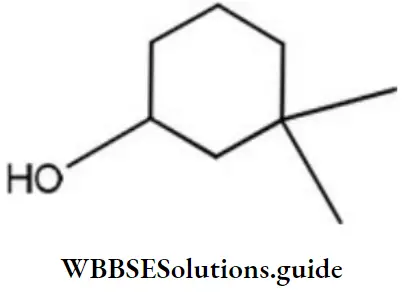
NEET General Organic Chemistry Nomenclature Of Organic Compounds 3, 3-dimethy-1-cyclohexanol

  1. 3, 3-dimethyl-1-hydroxy cyclohexane
  2. 1, 1-dimethyl-3- hydroxy cyclohexane
  3. 3, 3- dimethy-1- cyclohexanol
  4. 1,1-dimethyl-3-cyclohexanol

Answer: 3. 3, 3- dimethyl-1- cyclohexanol

Solution: Carbon with – OH group is given C1 thus it is 3, 3-dimethyl-1-cyclohexanol.
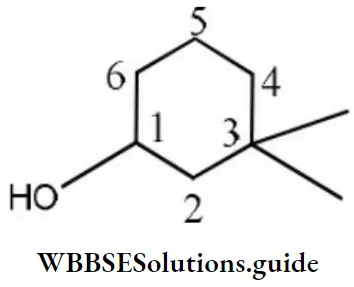
NEET General Organic Chemistry Nomenclature Of Organic Compounds Carbon With OH Group 3,3-dimethyl-1-cyclohexanol

Question 65. The IUPAC name of the compound is
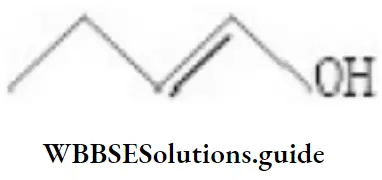
NEET General Organic Chemistry Nomenclature Of Organic Compounds But-l-en-l-ol

  1. But-2-en-l-ol
  2. l-hydroxy but-l-ene
  3. 4-hydroxy butene-3
  4. But-l-en-l-ol

Answer: 4. But-l-en-l-ol

Solution: Follow IUPAC rules.

Question 66. The name of (CH3)2 HC—O—CH2—CH2—CH3 is:

  1. Isopropyl propyl ether
  2. Dipropyl ether
  3. Di-isopropyl ether
  4. Isopropyl propyl ketone

Answer: 1. Isopropyl propyl ether

Solution: Ether group (—O—) has propyl and isopropyl groups on its two sides.

Question 67. IUPAC name of, CH3 CH(OH) CH2 CH2 COOH is:

  1. 4-hydroxy pentanoic acid
  2. 1-carboxy-3-butanoic acid
  3. 1-carboxy-4-butanol
  4. 4-carboxy-2-butanol

Answer: 1. 4-hydroxy pentanoic acid

Shortcut tricks for IUPAC nomenclature NEET with practice questions

Question 68. The prefix name of —SH group in IUPAC system is:

  1. Mercapto
  2. Thiol
  3. Sulphide
  4. None of these

Answer: 1. Mercapto

Solution: Follow IUPAC rules.

Question 69. The correct structure of 4-bromo-3-methyl-but-1-ene.

  1. Br-CH=C(CH3)2
  2. CH2=CH-CH(CH3)-CH2 Br
  3. CH2=C(CH3)CH2 CH2 Br
  4. CH3-C(CH3)=CHCH2-Br

Answer: 2. CH2=CH-CH(CH3)-CH2 Br

Solution: Follow IUPAC rules.

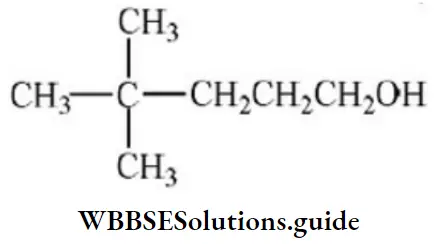
Question 70. Which of the following represents neo-pentyl alcohol?

  1. CH3CH(CH3)CH2CH2OH
  2. (CH3)3C-CH2OH
  3. CH3(CH2)3 OH
  4. CH3CH2CH(OH)C2H5

Answer: 2. (CH3)3C-CH2OH

Solution: (CH3)3C-CH2OH is neo-pentyl alcohol.

Question 71. IUPAC name of the compound, ClCH2 CH2 COOH is:

  1. 3-chloropropanoic acid
  2. 2-chloropropanoic acid
  3. 2-chloroethanoic acid
  4. Chlorosuccinic acid

Answer: 1. 3-chloropropanoic acid

Solution: Follow IUPAC rules.

Question 72. Which of the following IUPAC names is correct?

  1. 2-methyl-3-ethyl pentane
  2. 2-ethyl-3-methyl pentane
  3. 3-ethyl-2-methyl pentane
  4. 3-methyl-2-ethyl pentane

Answer: 3. 3-ethyl-2-methyl pentane

Solution: -do-

Question 73. IUPAC name of, (C2H5)2CHCH2OH is:

  1. 2-ethyl butanol-1
  2. 2-methyl pentanol-1
  3. 2-ethyl pentanol-1
  4. 3-ethyl butanol-1

Answer: 1. 2-ethyl butanol-1

Solution: Follow IUPAC rules.

Question 74. 3-phenylpropanoid acid is IUPAC name of:

  1. Mendaleic acid
  2. Pyruvic acid
  3. Succinic acid
  4. Cinnamic acid

Answer: 4. Cinnamic acid

Solution: C6 H5—CH=CHCOOH is cinnamic acid.

Question 75. IUPAC name of the compound is:
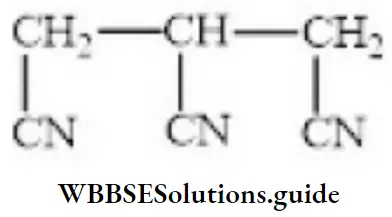
NEET General Organic Chemistry Nomenclature Of Organic Compounds Propane 1, 2, 3 Tricarbonitrile

  1. 1,2,3-trieyanopropane
  2. Propane-1,2,3-tricarbonitrile
  3. 1,2,3-cyclopropane
  4. Propane triarylamine

Answer: 2. Propane-1,2,3-tricarbonitrile

Solution: Follow IUPAC rules.

Question 76. IUPAC name of the compound is
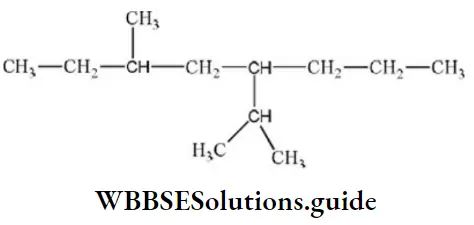
NEET General Organic Chemistry Nomenclature Of Organic Compounds 2-etoxy-5-chloropentane

  1. 4-isopropyl, 6-methyl octane
  2. 3-methyl, 5-(1-methyl ethyl) octane
  3. 3-methyl, 5-isopropyl octane
  4. 6-methyl, 4-(1-methyl ethyl) octane

Answer: 2. 3-methyl, 5-(1-methyl ethyl) octane

Solution: IUPAC name of compound.
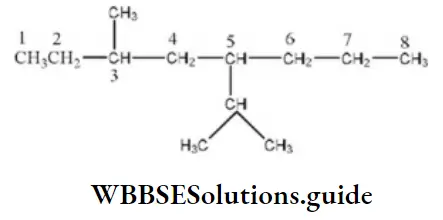
NEET General Organic Chemistry Nomenclature Of Organic Compounds Straight Chain 3-methyl, 5-1-methylethyl octane

Straight chain which contains a large number of side chains is taken as the parent chain and the counting starts from that side where the side chain is nearest.

Question 77. IUPAC name of the compound is:
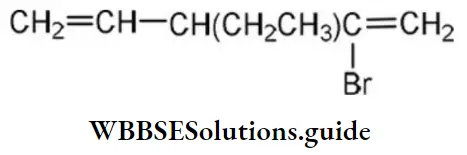
NEET General Organic Chemistry Nomenclature Of Organic Compounds 2-bromo-3-ethyl-1, 4 pentadiene

  1. 4-bromo-3-ethyl-1,4-pentadiene
  2. 2-bromo-3-ethyl-1,4pentadiene
  3. 2-bromo-3-ethyl-1-5-pentadiene
  4. None of the above

Answer: 2. 2-bromo-3-ethyl-1,4pentadiene

Solution: The IUPAC name of this molecule is 2-bromo-3-ethyl-1, 4-pentadiene.
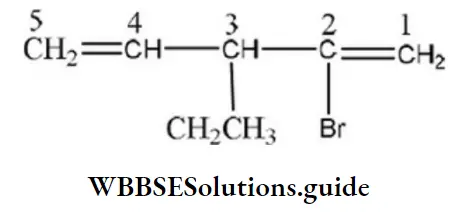
NEET General Organic Chemistry Nomenclature Of Organic Compounds IUPAC Name Is 2-bromo-3-ethyl-1, 4-pentadiene

Question 78. IUPAC name of the compound is:
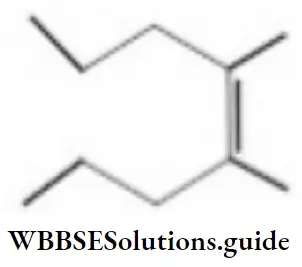
NEET General Organic Chemistry Nomenclature Of Organic Compounds 4, 5-dimethyl oct-4-ene

  1. 4,5-dimethyl oct-4-ene
  2. 3,4-dimethyl oct-5-ene
  3. 4,5-dimethyl oct-5-ene
  4. None of the above

Answer: 1. 4,5-dimethyl oct-4-ene

Solution: Follow IUPAC rules.

Question 79. The correct IUPAC name of the following compound is
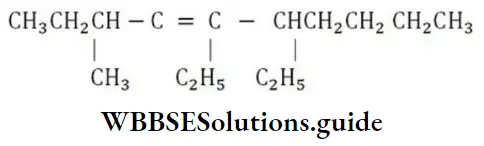
NEET General Organic Chemistry Nomenclature Of Organic Compounds 5, 6-diethyl-3-methyl dec-4-ene

  1. 5, 6-dimethyl-8-methyl dec-6-ene
  2. 6-butyl-5-ethyl-3-methyl oct-4-ene
  3. 5, 6-diethyl-3-methyl dec-4-ene
  4. 2, 4, 5-triethyl non-3-ene

Answer: 3. 5, 6-diethyl-3-methyl dec-4-ene

Question 80. Which of the following compounds has incorrect IUPAC nomenclature?
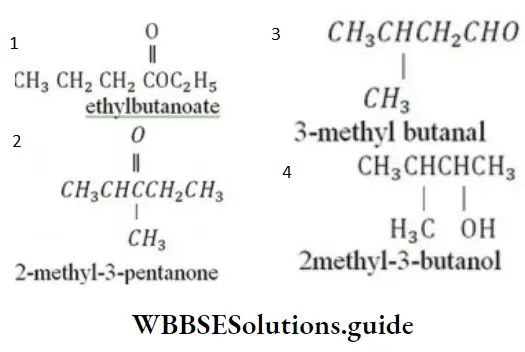
NEET General Organic Chemistry Nomenclature Of Organic Compounds 2 Methyl-3-Butanol

Answer: 4

NEET General Organic Chemistry Nomenclature Of Organic Compounds 3-methyl butan-2-ol

Question 81. The IUPAC name of the compound is
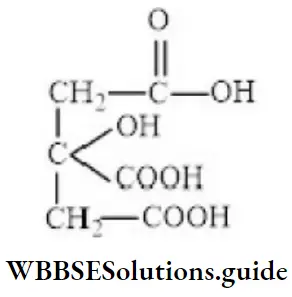
NEET General Organic Chemistry Nomenclature Of Organic Compounds 3-carboxy-3-hydroxy-1, 5-pentanedioic acid

  1. 1,2,3-tricarboxylic-2,1-propane
  2. 3-carboxy-3-hydroxy-1,5-pentanoic acid
  3. 3-hydroxy-3-carboxy-1,5-pentanoic acid
  4. None of the above

Answer: 2. 3-carboxy-3-hydroxy-1,5-pentanoic acid

Solution: Follow IUPAC rules.

Question 82. IUPAC name of NEET General Organic Chemistry Nomenclature Of Organic Compounds Bicyclo 2, 1, 0 Pentane is

  1. Bicyclo (2,1,0) pentane
  2. 1,2-cyclopropyl Cyclobutane
  3. Cyclopentane (4,3) annulene
  4. 1,2-methylene Cyclobutane

Answer: 1. Bicyclo (2,1,0) pentane

Solution: Follow IUPAC rules.

Question 83. The IUPAC name of neopentane is:

  1. 2,2-dimethylpropane
  2. 2-methylpropane
  3. 2,2-dimethylbutane
  4. 2-methyl butane

Answer: 1. 2,2-dimethylpropane

Solution: Follow IUPAC rules.

Question 84. The IUPAC name of compound shown below is
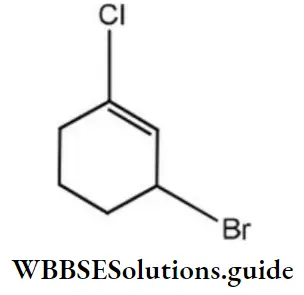
NEET General Organic Chemistry Nomenclature Of Organic Compounds 3-bromo-1-chlorocyclohexene

  1. 2-bromo-6- chlorocyclohex-1-ene
  2. 6-bromo-2-chlorocyclohexene
  3. 3-bromo-1-chlorocyclohexene
  4. 1-bromo-3-chlorocyclohexene

Answer: 3. 3-bromo-1-chlorocyclohexene

Solution:
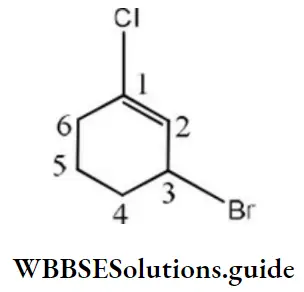
NEET General Organic Chemistry Nomenclature Of Organic Compounds IUPAC Name Is 3-bromo-1-chlorocyclohexene

Unsaturation (double bond) is given priority over halogen, then the lowest set of locants. So, the correct IUPAC name is 3-bromo-1-chlorocyclohexene.

NEET important nomenclature problems with step-by-step solutions

Question 85. The IUPAC name of 
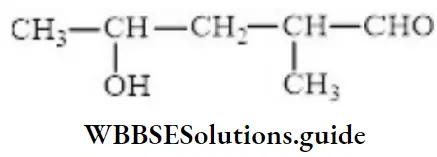
NEET General Organic Chemistry Nomenclature Of Organic Compounds 4-hydroxy-2-methylpentana

  1. 4-hydroxy-1-methylpentanal
  2. 4-hydroxy-4-methyl pent-2-en-1-al
  3. 2-hydroxy-4-methyl pent-2-en-5-al
  4. 2-hydroxy-3-methyl pent-2-en-5-al

Answer: 2. 4-hydroxy-4-methyl pent-2-en-1-al

Solution: Follow IUPAC rules.

Question 86. IUPAC’s name of is 
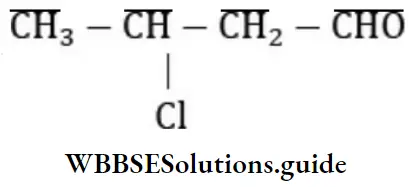
NEET General Organic Chemistry Nomenclature Of Organic Compounds 3-chlorobutanaldehyde

  1. 3-chlorobutanol
  2. 3-chlorobutanaldehyde
  3. 3-chlorobutanol
  4. 2-chlorobutanol

Answer: 3. 3-chlorobutanol

Solution:
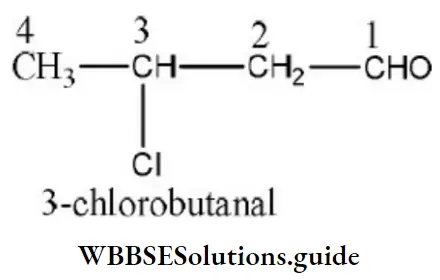
NEET General Organic Chemistry Nomenclature Of Organic Compounds IUPAC Name Is 3-chlorobutanal

The order is priority is -CHO > -Cl

Question 87. The IUPAC name of is 
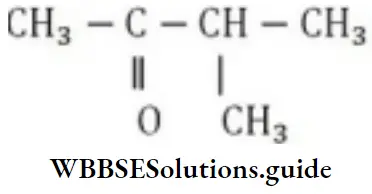
NEET General Organic Chemistry Nomenclature Of Organic Compounds 3 methyl

  1. 2-methyl-3-butanone
  2. 3-methyl-butan-2-one
  3. 3-methyl butanone
  4. None of these

Answer: 2. 3-methyl-butane-2-one

Solution: Follow IUPAC rules.

Question 88. The IUPAC name of compound is NEET General Organic Chemistry Nomenclature Of Organic Compounds 2-ethylprop-2-en-1-0l
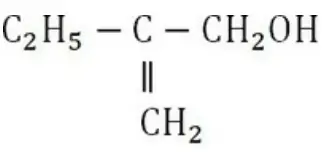
  1. 2-ethyl prop-2-en-1-ol
  2. 2-hydroxymethylbutan -1-ol
  3. 2-methylenebutan-1-ol
  4. 2-ethyl-3-hydroxypropyl-1-ene

Answer: 1. 2-ethyl prop-2-en-1-ol

Solution:
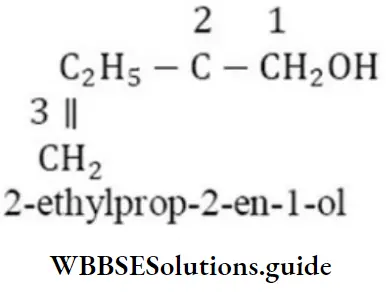
NEET General Organic Chemistry Nomenclature Of Organic Compounds IUPAC Name Is 2-ethylprop-2-en-1-ol

Question 89. Which nomenclature is not according to the IUPAC system?
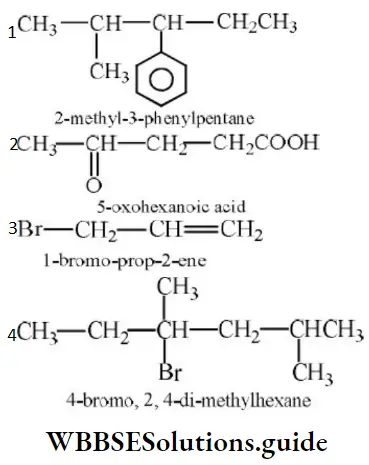
NEET General Organic Chemistry Nomenclature Of Organic Compounds 1-bromo-prop-2-ene (2)

Answer: 3

Solution: CH2=CH-CH2-Br is allyl bromide. Its IUPAC name is 3-bromopropene or 3-bromoprop-1-ene. Because here double bond is a functional group while halogen is a substituent. Double bond is given more priority and hence numbering starts from left.

Question 90. Acetonitrile is

  1. CH3CN
  2. CH3COCN
  3. C2H5CN
  4. C6H5CN

Answer: 1. CH3CN

Solution: CH3 C=N is known as acetonitrile or methyl cyanide.

Question 91. Isobutyl chloride is:

  1. CH3CH2CH2CH2Cl
  2. (CH3)2CHCH2 Cl
  3. CH3CH2CHClCH3
  4. (CH3)3C-Cl

Answer: 2. (CH3)2CHCH2 Cl

Solution: It should contain (CH3)2CH- group to be named as iso.

Question 92. The given compound in IUPAC is called as
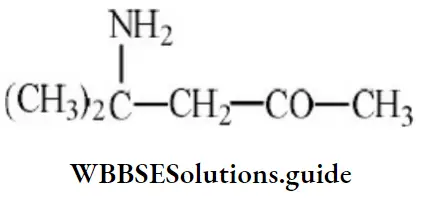
NEET General Organic Chemistry Nomenclature Of Organic Compounds 4-amino-4-methylpentan-2-one

  1. Diacetone
  2. Acetone amine
  3. Diacetone amine
  4. 4-amino-4-methyl pentane-2-one

Answer: 4. 4-amino-4-methyl pentane-2-one

Solution: Follow IUPAC rules.

Question 93. The IUPAC name of compound is
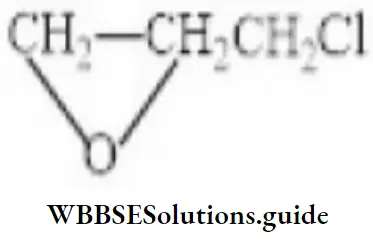
NEET General Organic Chemistry Nomenclature Of Organic Compounds 3-chloro-1, 2-epoxypropone

  1. 1-choloro-2,3-epoxypropane
  2. 3-chloro-1,2-epoxypropane
  3. 1-chloroethoxymethane
  4. None of the above

Answer: 2. 3-chloro-1,2-epoxypropane

Solution: Follow IUPAC rules.

Question 94. Neo-heptyl alcohol is correctly represented as:
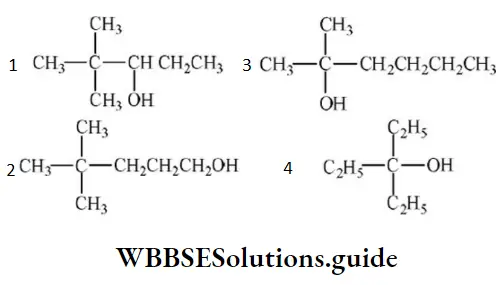
NEET General Organic Chemistry Nomenclature Of Organic Compounds NeoHepthyl Alochol

Answer: 3

NEET General Organic Chemistry Nomenclature Of Organic Compounds Neo-Heptyl- Alochol

Solution: Follow IUPAC rules.

Question 95. IUPAC name of the compound is CH3 CH2 C(Br)=CH-Cl

  1. 2-bromo-1-chloro butene-1
  2. 1-chloro-2-bromo butene-1
  3. 3-chloro-2-bromo butene-2
  4. None of the above

Answer: 1. 2-bromo-1-chloro butene-1

Solution: Follow IUPAC rules.

Question 96. The IUPAC name of CH3-CH2-CHO is

  1. Propanal-1
  2. 2-methyl butanal
  3. Butanal-1
  4. Pentanal-1

Answer: 1. Propanal-1

Solution: IUPAC name of CH3 CH2 CHO is propan-1-al.

Question 97. The IUPAC name of is
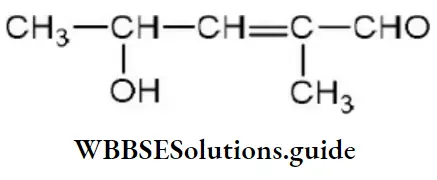
NEET General Organic Chemistry Nomenclature Of Organic Compounds 4-hydroxy-4-methylpent-2-en-1-al

  1. 4-hydroxy-1-methylpentanal
  2. 4-hydroxy-2-methylpentanal
  3. 3-hydroxy-2-methylpentanal
  4. 3-hydroxy-3-methylpentanal

Answer: 2. 4-hydroxy-2-methylpentanal

Solution: Follow IUPAC rules.

Question 98. Select the correct statement:

  1. The prefixes are written before the name of compound
  2. The suffixes are written after the name of compound
  3. The IUPAC name of a compound is always written as one word
  4. All of the above

Answer: 4. All of the above

Solution: These are the IUPAC rules.

Question 99. Pick out the correct statement from the following and choose the correct answer from the codes given below

  1. Hexa-1, 5-diene is a conjugated diene
  2. Prop-1, 2-diene is conjugated diene
  3. Hexa-1, 3-diene is a conjugated diene
  4. Buta-1, 3-diene is an isolated diene
  5. Prop-1, 2-diene is a cumulative diene


  1. 1, 2
  2. 2, 3
  3. 4, 5
  4. 2, 5

Answer: 3. 4, 5

Solution: In conjugated diene alternate single and double bonds are present while in cumulative diene, double bonds are present at adjacent positions.
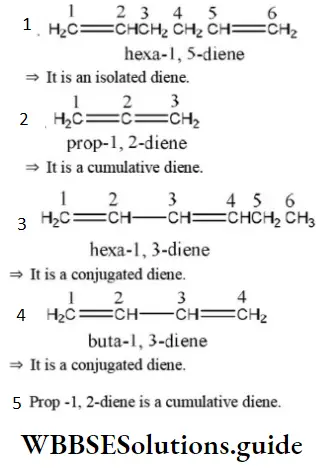
NEET General Organic Chemistry Nomenclature Of Organic Compounds Hexa-1, 3-diene is a Conjugated Diene, Prop-1, 2-diene Is A Cummulative Diene

Hence, statements 3 and 5 are correct.

Question 100. The IUPAC name for
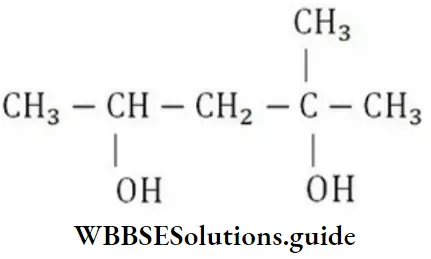
NEET General Organic Chemistry Nomenclature Of Organic Compounds 2 Methyl 2, 4 Pentanediol

  1. 1,1-dimethyl-1,2-butanediol
  2. 2-methyl-2,4-pentanediol
  3. 4-methyl-2,4-pentanediol
  4. 1,3,3-dimethyl-1,3-propanediol

Answer: 2. 2-methyl-2,4-pentanediol

Solution: -do-

Question 101. Formulae of phenyl carbinol and chloral are respectively:

  1. C6 H5.CH2 CH2 OH and CHCl2 CHO
  2. C6 H5 CH2 OH and CCl3 CHO
  3. C6 H5 OH and CH2 Cl.CHO
  4. C6 H5 CHO and CHCl2 CHO

Answer: 2. C6 H5 CH2 OH and CCl3 CHO

Solution: Carbinol is trivial name for HCH2 OH. Thus, C6 H5 CH2 OH is phenyl carbinol and chloral is CCl3 CHO.

Question 102. The correct name for the following hydrocarbon is
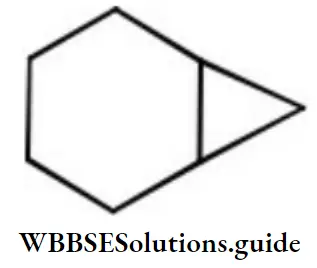
NEET General Organic Chemistry Nomenclature Of Organic Compounds Bicycloc4, 1, 0

  1. Tricycle [4.1.0] heptane
  2. Bicyclo [5.2.1] heptane
  3. Bicyclo [4.1.0] heptane
  4. Bicyclo [4.1.0] hexane

Answer: 3. Bicyclo [4.1.0] heptane

Solution:
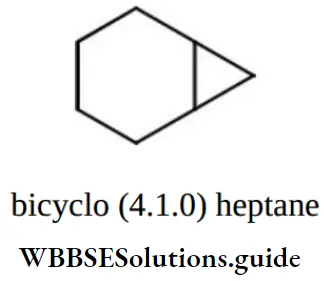
NEET General Organic Chemistry Nomenclature Of Organic Compounds Bicyclo 4, 1, 0 Heptane

This compound contains 7 carbon atoms, so the corresponding alkane is heptane. Two bridges contain 4 and 1 carbon atom respectively and one bridge does not contain any carbon atom. So, the name of the compound is Bicyclo (4,1,0) heptane.

Question 103. The IUPAC name of the compound is:
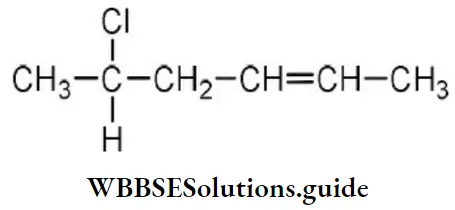
NEET General Organic Chemistry Nomenclature Of Organic Compounds 5-chloro-hex-2-ene

  1. 5-chloro-hex-2-ene
  2. 2-chloro-hex-5-ene
  3. l-chloro-1-methyl-pent-3-ene
  4. 5-chloro-5-methyl-pent-2-ene

Answer: 1. 5-chloro-hex-2-ene

Solution: First the longest continuous chain of carbon atoms is selected. Number the chain from the side containing senior functional group (i.e., the group placed above in the seniority table).
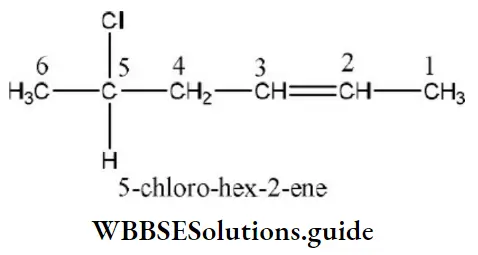
NEET General Organic Chemistry Nomenclature Of Organic Compounds IUPAC Name Is 5-chloro-hex-2-ene

Question 104. The IUPAC name of the compound is:
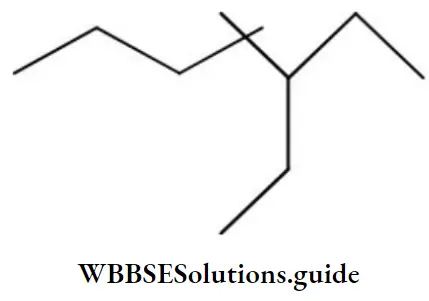
NEET General Organic Chemistry Nomenclature Of Organic Compounds 3-ethyl-4, 4-dimethylheptane

  1. 1,1-diethyl1-2, 2-dimethyl pentane
  2. 4,4-dimethyl-5,5-diethyl pentane
  3. 5, 5-diethyl-4,4-dimethyl pentane
  4. 3-ethyl-4,4-dimethyl heptane

Answer: 4. 3-ethyl-4,4-dimethyl heptane

Solution: -do-

Question 105. 2, 3-dimethyl hexane contains _______ tertiary ____ secondary and ______ primary carbon atoms, respectively

  1. 2, 2, 4
  2. 2, 4, 3
  3. 4, 3, 2
  4. 3, 2, 4

Answer: 1. 2, 2, 4

Solution: The structure of 2, 3-dimethyl hexane is
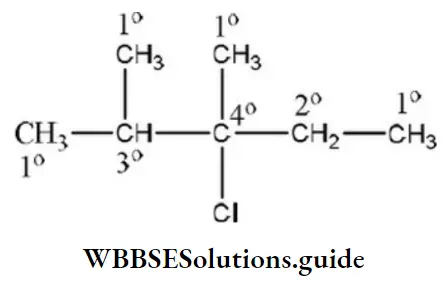
NEET General Organic Chemistry Nomenclature Of Organic Compounds 3 Chloro 2, 3 Dimethyl Pentane Contains Four Carbon Atoms

So, the number of tertiary carbon atoms = 2

The number of secondary carbon atoms = 2

The number of primary carbon atoms = 4

Question 106. IUPAC name of following compound is:
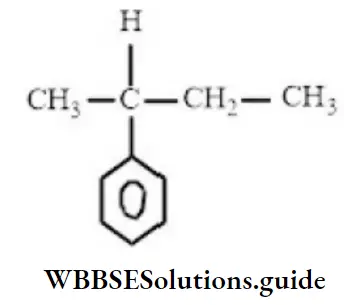
NEET General Organic Chemistry Nomenclature Of Organic Compounds 2-phenylbutane

  1. 2-cyclohexyl butane
  2. 2-phenylbutazone
  3. 3-cyclohexyl butane
  4. 3-phenylbutazone

Answer: 2. 2-phenylbutazone

Solution: Follow IUPAC rules.

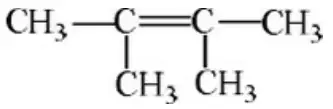
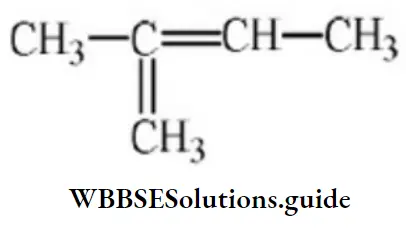
Question 107. 2-methyl-2-butene will be represented as:
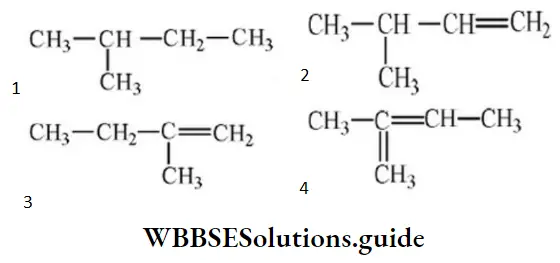
NEET General Organic Chemistry Nomenclature Of Organic Compounds 2-methyl-2butene

Answer: 4

NEET General Organic Chemistry Nomenclature Of Organic Compounds IUPAC Name Is 2-methyl-2-butene

Question 108. Pick out the alkane which differs from the other members of the group

  1. 2,2-dimethyl propane
  2. Pentane
  3. 2-methyl butane
  4. 2, 2-dimethyl butane

Answer: 4. 2, 2-dimethyl butane

Solution: 2, 2-dimethyl butane is 6-carbon hydrocarbon (C6 H14)
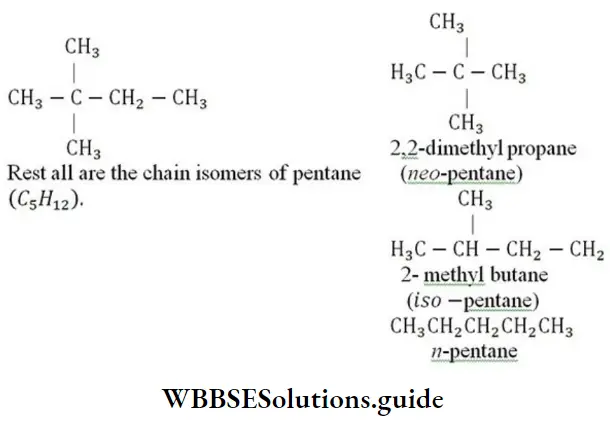
NEET General Organic Chemistry Nomenclature Of Organic Compounds 2, 2-dimethyl Butane Is 6-carbon Hydrocarbon

Question 109. In IUPAC suffix name of —COX is:

  1. Oyl halide
  2. Halo carbonyl
  3. Carbamoyl
  4. None of these

Answer: 1. Oyl halide

Solution: Follow IUPAC rules.

Question 110. IUPAC name of following compound is:
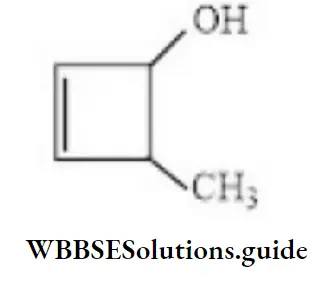
NEET General Organic Chemistry Nomenclature Of Organic Compounds 4-methyl cyclo-2-buten 1-ol

  1. 3-methyl cyclo-1-buten-2-ol
  2. 4-methyl cyclo-2-buten-1-ol
  3. 4-methyl cyclo-1-buten-3-ol
  4. 2-methyl cyclo-3-buten-1-ol

Answer: 2. 4-methyl cyclo-2-buten-1-ol

Solution: Follow IUPAC rules.

Question 111. The correct IUPAC name of the acid is
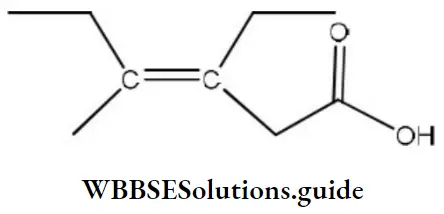
NEET General Organic Chemistry Nomenclature Of Organic Compounds Z-3, 4-diethylpent-3-en-1-oic Acid

  1. Z-3-ethyl-4-methyl hex-3-en-1-oic acid
  2. Z-3-ethyl-4-methyl hexanoic acid
  3. Z-3, 4-diethyl pent-3-en-1-oic acid
  4. E-3-ethyl-4-methylhex-4-en-1-oic acid

Answer: 3. Z-3, 4-diethyl pent-3-en-1-oic acid

Solution:
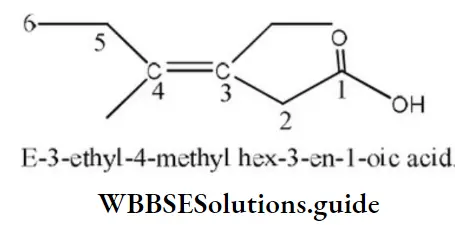
NEET General Organic Chemistry Nomenclature Of Organic Compounds E-3-ethyl-4-methyl hex-3-en-1-oic acid

[The configuration of this compound is E because bulkier groups are present opposite of the double bond.]

Question 112. The IUPAC name of aldehyde is

  1. Prop-2-en-1-al
  2. Propenyl aldehyde
  3. But-2-en-1-al
  4. Propenal

Answer: 1. Prop-2-en-1-al

Solution: CH2=CH-CHO (Prop -2-en-1-al)

Question 113. Write the IUPAC name of the below compound.
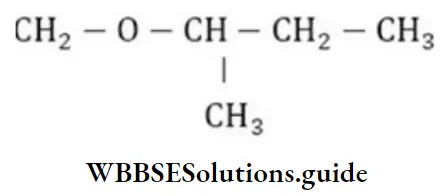
NEET General Organic Chemistry Nomenclature Of Organic Compounds 2-methoxy butane

  1. 3-methoxy butane
  2. 2-methoxy butane
  3. 3-methyl-3-methoxy propane
  4. Butoxy methane

Answer: 2. 2-methoxy butane

Solution: According to the IUPAC system ethers are named as alkoxy alkanes. The larger alkyl group forms the parent chain while the lower alkyl group is taken with the ethereal oxygen and forms a part of the alkoxy group.
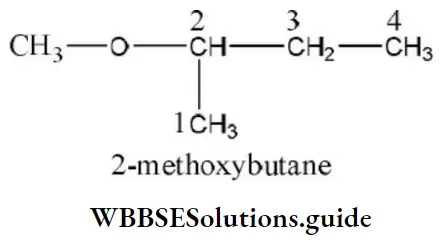
NEET General Organic Chemistry Nomenclature Of Organic Compounds IUPAC Name Is 2-methoxybutane

Question 114. IUPAC name of the compound is
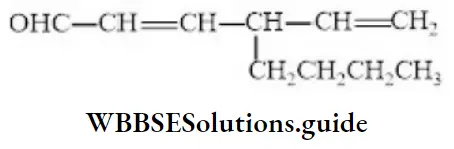
NEET General Organic Chemistry Nomenclature Of Organic Compounds 4-butyl-2, 5-hexadien-l-al

  1. 4-butyl-2,5-hexadien-l-al
  2. 5-vinyloct-3-en-l-al
  3. 5-vinyloct-5-en-8-al
  4. 3-butyl-1,4-hexadien-6-al

Answer: 1. 4-butyl-2,5-hexadien-l-al

Solution: Follow IUPAC rules.

Question 115. The IUPAC name of the compound is
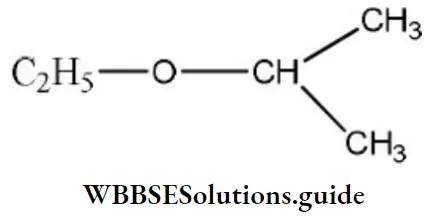
NEET General Organic Chemistry Nomenclature Of Organic Compounds 2-ethoxy Propane

  1. Ethoxy propane
  2. 1, 1-dimethyl ether
  3. 2-ethoxy zso-propane
  4. 2-ethoxy propane

Answer: 4. 2-ethoxy propane

Solution:
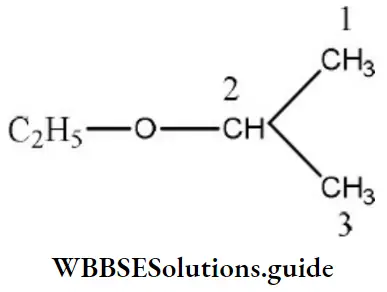
NEET General Organic Chemistry Nomenclature Of Organic Compounds IUPAC Name Is 2-ethoxy Propane

The above compound is an ether and its name is written as alkoxy alkane. Oxy is attached to the lower group. Hence, the IUPAC name of the above compound is 2-ethoxy propane.

Question 116. The IUPAC name of the compound

  1. Ethane nitrile
  2. Methane isonitrile
  3. Ethane isonitrile
  4. None of these

Answer: 2. Methane isonitrile

Solution: CH3NC is methaneisonitrile.

Question 117. The structural formula of methyl aminomethane is:

  1. (CH3)2 CHNH2
  2. (CH3)3 N
  3. (CH3)2 NH
  4. CH3 NH2

Answer: 3. (CH3)2 NH

Solution: IUPAC name is N-methyl methanamine.

Question 118. The IUPAC name of CH3-CCH(CH3)2 is

  1. 4-methyl-2-pentyne
  2. 4, 4-dimethyl-2-butyne
  3. methyl isopropyl acetylene
  4. 2-methyl-4-pentyne

Answer: 1. 4-methyl-2-pentyne

Solution: Follow IUPAC rules.

Question 119. Which one of the following is the correct formula for dichlorodiphenyltrichloroethane?
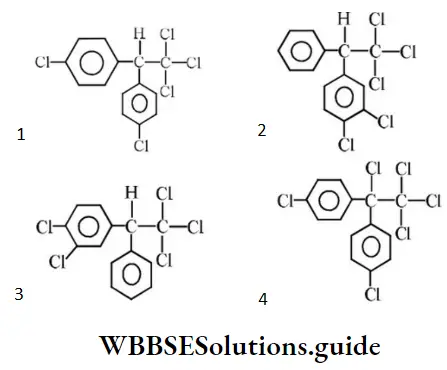
NEET General Organic Chemistry Nomenclature Of Organic Compounds Dichlorodiphenyltrichloroetane

Answer: 1

NEET General Organic Chemistry Nomenclature Of Organic Compounds Di-chloro-di-phenyltrichloroethane

Solution: Follow IUPAC rules.

Question 120. IUPAC name of (CH3)2N-C2H5 is:

  1. Dimethyl ethyl amine
  2. Dimethyl aminomethane
  3. Dimethyl aminoethane
  4. N, N-dimethylethanolamine

Answer: 4. N, N-dimethylethanolamine

Question 121. 3-methyl penta-1,3-diene is:

  1. CH2=CH(CH2)2CH3
  2. CH2=CHCH(CH3)CH2CH3
  3. CH3CH=C(CH3)CH=CH2
  4. CH3-CH=CH(CH3)2

Answer: 3. CH3CH=C(CH3)CH=CH2

Solution: Follow IUPAC rules.

Question 122. The IUPAC name of the compound is
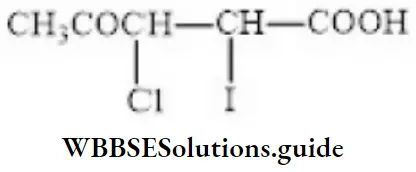
NEET General Organic Chemistry Nomenclature Of Organic Compounds 3-chloro-2-iodo-4-oxo-pentanoic Acid

  1. 2-iodo-3-chloro-4-pentanoic acid
  2. 4-oxo-3-chloro-2-iodo Pentanoic acid
  3. 4-carboxy-4,3-chloro-2-butanone
  4. 3-chloro-2-iodo-4-oxo-pentanoic acid

Answer: 4. 3-chloro-2-iodo-4-oxo-pentanoic acid

Solution: Report prefixes in alphabetical order.

Question 123. The IUPAC name for CH3COCH(CH3)2 is:

  1. 4-methyl isopropyl ketone
  2. 3-methyl-2-butanone
  3. Isopropyl methyl ketone
  4. 2-methyl-3-butanone

Answer: 2. 3-methyl-2-butanone

Question 124. Give the IUPAC name of the compound
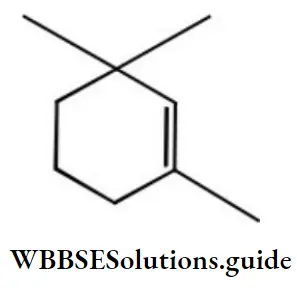
NEET General Organic Chemistry Nomenclature Of Organic Compounds 1, 3, 3-Trimethylcyclohex-1-ene

  1. 1,1,3-trimethyl cyclo hex-2-ene
  2. 1,3,3-trimethyl cyclo hex-l-ene
  3. 1,1,5-trimethyl cyclo hex-5-ene
  4. 2,6,6-trimethyl cyclo hex-l-ene

Answer: 2. 1,3,3-trimethyl cyclo hex-l-ene

Solution: Follow IUPAC rules.

Question 125. The name of the compound is:
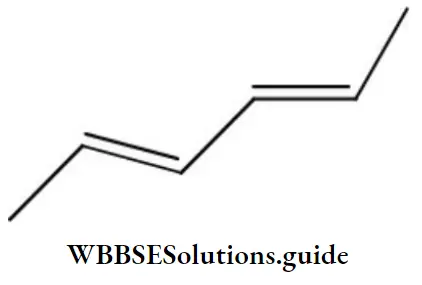
NEET General Organic Chemistry Nomenclature Of Organic Compounds 2Z, 4Z-2, 4-hexadiene

  1. (2Z,4Z)-2, 4-hexadiene
  2. (2Z-, 4E)-2, 4-hexadiene
  3. (2E, 4Z)-2, 4-hexadiene
  4. (4E, 4Z)-2, 4-hexadiene

Answer: 1. (2Z,4Z)-2, 4-hexadiene

Solution: The name of the compound is (2Z,4Z)-2, 4-hexadiene.

Question 126. The IUPAC name of the compound is
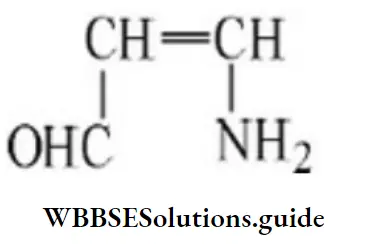
NEET General Organic Chemistry Nomenclature Of Organic Compounds 3 Amino Prop 2 Enal

  1. 2-amino-3-hydroxy propanoic acid
  2. l-hydroxy-2-amino propan-3-oic acid
  3. l-amino-2-hydroxy propanoic acid
  4. 3-hydroxy-2-amino propanoic acid

Answer: 1. 2-amino-3-hydroxy propanoic acid

Solution: Follow IUPAC rules.

Question 127. What is the formula of tertiary butyl alcohol?

  1. CH3-CH(CH3)-CH2-OH
  2. CH3-(CH2)2OH
  3. CH3-CH(OH)-CH2-CH3

Answer: 4. CH3-CH(OH)-CH2-CH3

Solution:
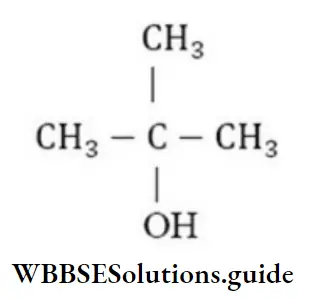
NEET General Organic Chemistry Nomenclature Of Organic Compounds Tertiary Butyl Alochol

is the formula of tertiary butyl alcohol as in it – OH group is attached to tertiary carbon.

Question 128. The IUPAC name of the compound is
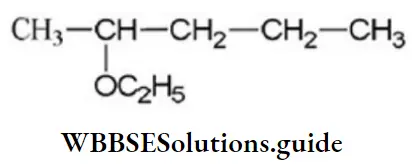
NEET General Organic Chemistry Nomenclature Of Organic Compounds 2-ethoxy pentane

  1. 2-ethoxy pentane
  2. 4-ethoxy pentane
  3. Pentyl-ethyl ether
  4. 2-pentoxy ethane

Answer: 1. 2-ethoxy pentane

Solution: Follow IUPAC rules.

Question 129. The IUPAC name of the compound is
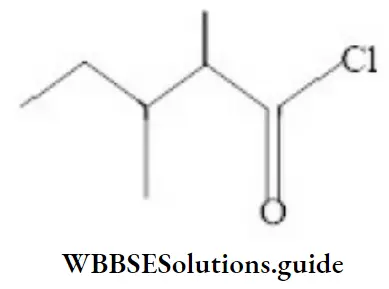
NEET General Organic Chemistry Nomenclature Of Organic Compounds 2, 3-dimethylpentanoyl Chloride

  1. 2-ethyl-3-methyl butanol chloride
  2. 2,3-dimethyl pentanol chloride
  3. 3,4-dimethyl pentanol chloride
  4. l-chloro-l-oxo-2,3-dimethyl pentane

Answer: 2. 2,3-dimethyl pentanol chloride

Question 130. The IUPAC name of the compound is
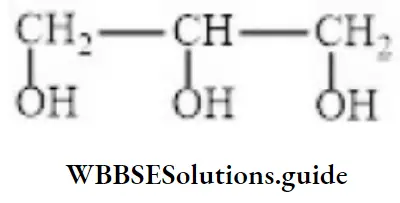
NEET General Organic Chemistry Nomenclature Of Organic Compounds 4-hydroxy-2-methylpentanal

  1. 1,2,3-trihydrosypropane
  2. 3-hydroxy pentane-l,5-diol
  3. 1,2,3-hydroxy-propane
  4. Propane-1,2,3-triol

Answer: 4. Propane-1,2,3-triol

Solution: Follow IUPAC rules.
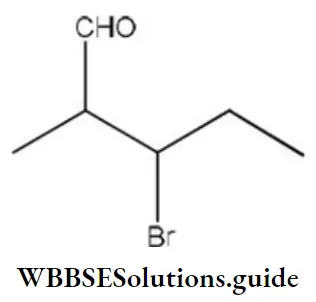
NEET General Organic Chemistry Nomenclature Of Organic Compounds IUPAC Name Is Propane-1, 2, 3-triol

Question 131. The IUPAC name of is

  1. 2-methyl-3-bromohexanal
  2. 3-bromo-2-methylbutanal
  3. 2-bromo-3-bromobutanal
  4. 3-bromo-2-methylpentanal

Answer: 4. 3-bromo-2-methylpentanal

Solution: Follow IUPAC rules.

Question 132. The IUPAC name of
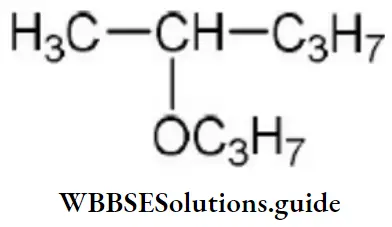
NEET General Organic Chemistry Nomenclature Of Organic Compounds 2-propoxy pentane

  1. 4-propoxy pentane
  2. Pentyl-propyl ether
  3. 2-propoxy pentane
  4. 2-pentoxy propane

Answer: 3. 2-propoxy pentane

Solution: Follow IUPAC rules.

Question 133. The systematic (IUPAC) name of the compound with the following structural formula shall be
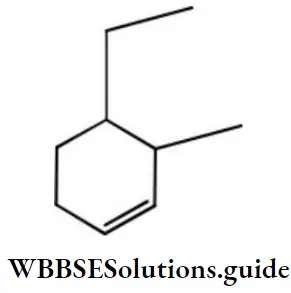
NEET General Organic Chemistry Nomenclature Of Organic Compounds 4-ethyl-2-methyl cyclohexene

  1. 1-ethyl-2-methyl cyclohexene
  2. 2-methyl-l-ethyl cyclohexene
  3. 3-ethyl-2-methyl cyclohexene
  4. 4-ethyl-3-methyl cyclohexene

Answer: 4. 4-ethyl-3-methyl cyclohexene

Solution: Follow IUPAC rules.

Question 134. Pyridine is:

  1. An aromatic compound and a primary base
  2. A heterocyclic amino compound and a tertiary base
  3. An aromatic amino compound forms salts
  4. A cyano derivative of benzene and a secondary base

Answer: 2. A heterocyclic amino compound and a tertiary base

Solution: Pyridine is a heterocyclic compound having six carbon-membered ring formed by C and N atoms
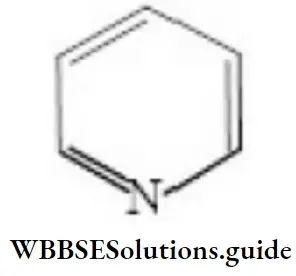
NEET General Organic Chemistry Nomenclature Of Organic Compounds Pyridine

Question 135. The IUPAC name of (CH3)3C-CH=CH2 is

  1. 1, 1, 1-trimethyl-2-propene
  2. 3, 3, 3-trimethyl-2-propene
  3. 2, 2-dimethyl-3-butene
  4. 3, 3-dimethyl-1-butene

Answer: 4. 3, 3-dimethyl-1-butene

Solution:
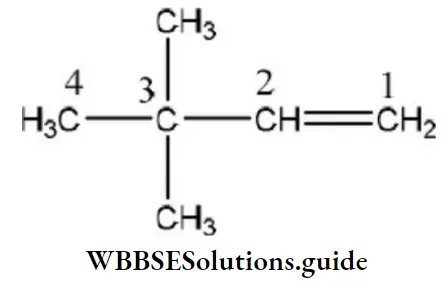
NEET General Organic Chemistry Nomenclature Of Organic Compounds 2-Pentanone

IUPAC name=3, 3-dimethyl-l-butene.

Question 136. The name of the compound is:
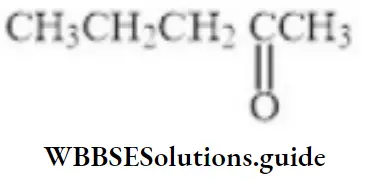
NEET General Organic Chemistry Nomenclature Of Organic Compounds 2 Pentanone

  1. 2-pentanone
  2. Pentanone-2
  3. Pentan-2-one
  4. All are correct

Answer: 4. All are correct

Question 137. Write the IUPAC name of
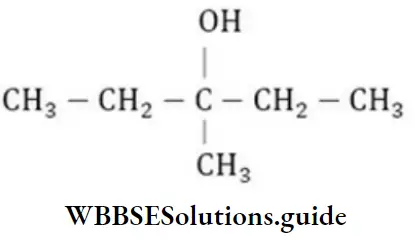
NEET General Organic Chemistry Nomenclature Of Organic Compounds 3-methylpentane-3-ol

  1. 3-methyl pentane-3-ol
  2. 3-hydroxy hexane
  3. 3-hydroxy-3-methyl pentane
  4. All of the above

Answer: 1. 3-methyl pentane-3-ol

NEET Physics Thermodynamics And Kinetic Theory Of Gases Notes

NEET Physics Thermodynamics And Kinetic Theory Of Gases Notes

Thermodynamics and Kinetic Theory of Gases

Ideal Gas or Perfect Gas
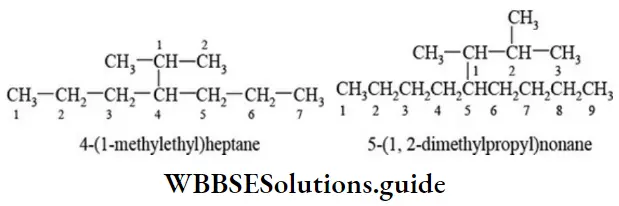
  1. Molecules of the ideal gas are point masses, with zero volume.
  2. There is no intermolecular force between the molecules of ideal gas.
  3. There is no intermolecular potential energy for the molecules of ideal gas.
  4. The molecules of ideal gas possess only the kinetic energy.
  5. The ideal gas can not be converted into liquids or solids. (This is the consequence of the absence of intermolecular force).
  6. The internal energy of an ideal gas depends only on temperature.

Ideal Gas Equation: The equation which relates all the macroscopic variables [P, V, T] of an ideal gas is called ideal gas equation. It is given by, PV = nRT

∴ n → number of moles R = 8.31 J mol-1 K-1

For one mole of gas, PV = RT

Read And Learn More: NEET Physics Notes

Avagadro’s Hypothesis

Equal volumes of all gases at the same temperature and pressure contain the same number of molecules.

  • One mole of every gas at NTP has same volume equal to 22.4 litres.
  • One mole of every gas contains same number of molecules called Avagadro’s number. NA = 6.023 x 1025
  • Avagadro’s number is also equal to the number of atoms in 12g of Carbon -12.

Kinetic Theory Of Gases Equation

Real Gases

  • The gases actually found in nature are called real gases.
  • The molecules of the real gas have a finite volume.
  • There is intermolecular attraction or repulsion between the molecules of the real gas.
  • The intermolecular force is attractive at larger intermolecular separation and repulsive when the molecules are too close to each other.
  • Molecules of real gas have intermolecular potential energy as well as kinetic energy.
  • Real gases can be liquified or solidified.
  • The internal energy of real gases depends on volume, pressure as well as temperature.
  • Real gases do not obey the equation.

PV = nRT

Real gases obey the ideal gas equation at very low pressure and very high temperatures.

NTP or STP

  • NTP stands for normal temperature and pressure.
  • STP stands for standard temperature and pressure.
  • NTP and STP both mean the same.
  • They refer to a temperature of 273K or 00C and 1 atm pressure.

NEET Physics Thermodynamics And Kinetic Theory Of Gases Notes

NEET Physics Thermodynamics and Kinetic Theory of Gases Notes

Absolute Zero Temperature: The absolute zero refers to the zero of the Kelvin scale. i.e., absolute zero = 0K = -273.150C

  • At the absolute zero, all molecular motion ceases.
  • The volume of ideal gas becomes zero at the absolute zero.
  • The pressure of the ideal gas becomes zero at absolute zero.
  • The molecular energy or internal energy of the ideal gas becomes zero at absolute zero.
  • All real gases get liquified before reaching absolute zero.

Degree of Freedom

The number of ways in which a gas molecule can absorb energy is called degrees of freedom. Total degree of freedom f = Translational degree of freedom (ft) rotational degree of freedom (fr) + vibrational degree of freedom (fv)

ft is present at all temperatures, fr is present at ordinary temperatures and fv is present only at high temperatures.

The degree of freedom can be calculated by using the relation, f = 3N – k

Where N = number of atoms in the molecule (atomicity) k is the number of relations or constraints.

For a monoatomic molecule, f= 3 x 1 – 0 =3

For a diatomic molecule, f = 3 x 2 – 1 = 5

  • At very low temperatures (<70K), the degrees of freedom corresponding to the rotatory motion are absent.
  • Hence, the diatomic molecule possesses only 3 degrees of freedom.
  • At very high temperatures diatomic molecules have 7 degrees of freedom.

NEET Physics Thermodynamics Important Formulas

In triatomic molecules, degrees of freedom depend on the structure of the molecules.

For linear triatomic molecules, (k = 2)  f = 3 x 3 – 2 = 7

For a non-linear triatomic molecule, (k = 3) f = 3 x 3 – 3 = 6

Degrees Of Freedom Example:

  • CO2 is a linear molecule with 7 degrees of freedom
  • O3 and H2O are non-linear molecules with 6 degrees of freedom.

Maxwell’s Law of Equipartition of Energy

This law states that the kinetic energy is equally distributed among all the degrees of freedom and energy associated with each degree of freedom is = \(\frac{1}{2} K_b \mathrm{~T}\)

Where T is the absolute temperature and Kb is the Boltzmann constant.

⇒ \(\mathrm{K}_{\mathrm{B}}=\frac{\mathrm{R}}{\mathrm{N}_{\mathrm{A}}}=1.38 \times 10^{-23} \mathrm{~K}^{-1}\)

The kinetic energy of a molecule having f degrees of freedom is given by

⇒ \(\mathrm{U}_{\mathrm{k}}=\frac{\mathrm{f}}{2} \mathrm{~K}_{\mathrm{b}} \mathrm{T}\)

Total kinetic energy of 1 mole of gas with f degree of freedom is given by

⇒ \(\mathrm{U}_{\mathrm{k}}=\mathrm{N}_{\mathrm{A}}\left[\frac{\mathrm{f}}{2} \mathrm{~K}_{\mathrm{b}} \mathrm{T}\right]=\frac{\mathrm{f}}{2} \mathrm{RT}\)

Where NA is Avagadro’s number and R is the universal gas constant.

Best Short Notes for Thermodynamics and Kinetic Theory of Gases NEET

Specific Heat Capacity of Gases

In an ideal gas, the total energy of the gas or internal energy U of the gas is equal to the total kinetic energy of all the molecules in the gas.

For one mole of a monoatomic gas, the total energy is U = \(\frac{3}{2} \mathrm{~N}_A \mathrm{k}_{\mathrm{B}} \mathrm{T}=\frac{3}{2} \mathrm{RT}\)

The specific heat at constant volume for a monatomic gas is,

⇒ \(\mathrm{C}_{\mathrm{V}}=\frac{\mathrm{dU}}{\mathrm{dT}}=\frac{\mathrm{d}}{\mathrm{dT}}\left(\frac{3}{2} \mathrm{RT}\right)=\frac{3}{2} \mathrm{R}\)

w.k.t., CP – CV = R

∴ \(C_P=C_V+R=\frac{3}{2} R+R=\frac{5}{2} R\)

γ = \(\frac{C_P}{C_V}=\frac{\frac{5}{2} R}{\frac{3}{2} R}=\frac{5}{3}=1.67\)

For a diatomic gas \(\mathrm{U}=\frac{5}{2} \mathrm{RT}\)

⇒ \(\mathrm{C}_{\mathrm{V}}=\frac{5}{2} \mathrm{R} \quad \mathrm{C}_{\mathrm{p}}=\frac{7}{2} \mathrm{R}\)

⇒ \(\gamma=\frac{\mathrm{C}_{\mathrm{p}}}{\mathrm{C}_{\mathrm{V}}}=\frac{7}{5}=1.4\)

For non-linear triatomic, U = 3RT

⇒ CV = 3R

⇒ CP = 4R

In general, for poly atomic gas molecules, \(=\left(1+\frac{2}{f}\right)\)

Thermodynamics and Kinetic Theory of Gases NEET Important Questions and Answers

Note:

  • Specific heat capacity of solids = 3R
  • Specific heat capacity of water = 9R

Mean Free Path: The average distance travelled by a molecule between two successive collisions is called the mean free path.

It can be shown that, \(\bar{l}=\frac{1}{\sqrt{2} \pi d^2 \mathrm{n}}\)

Where d is the diameter of each molecule and n is the number of molecules per unit volume If m is the mass of each molecule and ρ is the density of the gas,

⇒ \(\bar{l}=\frac{\mathrm{m}}{\sqrt{2 \pi \mathrm{d}^2 \rho}} \quad\left(because \mathrm{n}=\frac{\rho}{\mathrm{m}}\right)\)

Boyle’s Law

It states that, at constant temperature, the volume of the given mass of the gas is inversely proportional to its pressure P.

i.e., PV = constant.

NEET Physics Thermodynamics And Kinetic Theory Of Gases Notes Boyle's Law

NEET Study Material for Thermodynamics and Kinetic Theory of Gases

Charle’s Law

It states that, at constant pressure, the volume of the given mass of the gas is proportional to its absolute temperature.

i.e., \(\frac{\mathrm{V}}{\mathrm{T}}\) = constant

NEET Physics Thermodynamics And Kinetic Theory Of Gases Notes Charle's Law

Expression for Pressure Exerted By a Gas

⇒ \(P=\frac{1}{3} \rho v_{\mathrm{vos}}^2\)

P = \(\frac{1}{3} \frac{M}{V} v_{\mathrm{ras}}^2\)

Calorie: The quantity of heat required to raise the temperature of 1g of water from 14.50 C to 15.50 C

Kinetic Molecular Theory Of Gases

First Law of Thermodynamics

When a certain amount of heat is given to a system, a part of it is used to increase the internal energy, and the remaining part is used in doing external work.

∴ dQ = dU + dW

The first law of thermodynamics is in accordance with law of conservation of energy.

Sign Convention

  • Work done by the system is taken positive.
  • Work done on the system is taken negative.
  • Increase in U is taken positive.
  • Decrease in U is taken negative.
  • Heat added to the system is taken positive.
  • Heat given out from the system is taken negative.

Laws of Thermodynamics and Heat Transfer NEET Notes

Thermodynamic Processes

1. Isothermal process:

PV = constant

dQ = dU + dW

dQ = dW

⇒ \(C_r=\frac{d U}{d T}=\infty\)

Work done by isothermal process is,

W = \(2.303 R T \log _{10} \frac{V_2}{V_1}\)

or,

W = \(2,303 R T \log _{10} \frac{P_1}{P_2}\)

2. Adiabatic process:

dQ = dU + dW

dU + dW = 0

PVγ= constant

Work done in adiabatic process is \(W=\frac{R}{\gamma-1}\left[T_1-T_2]\right.\)

Thermodynamics and Kinetic Theory of Gases Class 11 NCERT NEET

3. Isochoric process:

ΔV = 0

dQ = dU

4. Isobaric process: ΔP = 0

Heat Engine: A device used to convert heat energy into useful mechanical work is called heat engine.

NEET Physics Thermodynamics And Kinetic Theory Of Gases Heat Engine

The efficiency of an engine is the ratio between work done by the engine and the amount of heat absorbed by the system.

⇒ \(\eta=\frac{W}{Q_1}=\frac{Q_1-Q_2}{Q_1}=1-\frac{Q_2}{Q_1}\)

The efficiency of Carnot’s heat engine is given by

⇒ \(\eta=1-\frac{Q_2}{Q_1} \quad \text { Or } \quad \eta=1-\frac{T_2}{T_1}\)

Refrigerator: Coefficient of performance, \(\beta=\frac{Q_2}{W}=\frac{Q_2}{Q_1-Q_2}\)

or, \(\beta=\frac{T_2}{T_1-T_2}\)

NEET Physics Thermodynamics And Kinetic Theory Of Gases Refrigerator

Cyclic Process: “A process in which the system after passing through various stages returns to its initial state” is called as cyclic process.

For a cyclic process, PV graph is a closed curve. The area under P-V graph gives work done by the substance. In a cyclic process there will be no change in the internal energy.

i.e., ΔU = 0

Therefore, ΔQ = ΔW

The total heat absorbed by the system equals the work done by the system.

NEET Physics Thermal Properties Of Matter Notes

Thermal Properties of Matter

Temperatures in different scales are related as follows:

⇒ \(\frac{\mathrm{C}-0}{100}=\frac{\mathrm{F}-32}{180}=\frac{\mathrm{K}-273.15}{100}\)

Or, \(\frac{\mathrm{C}}{5}=\frac{\mathrm{F}-32}{9}=\frac{\mathrm{K}-273}{5}\)

Temperature difference in Celsius scale = temperature difference in kelvin scale

i.e., (T2 – T1)0C = (T2 – T1)K

Linear Expansion Of Solids

w.k.t., Δl ∝ L0 and Δl ∝ ΔT

or, Δl – α L0ΔT

α = \(\frac{\Delta l}{\mathrm{~L}_0 \Delta \mathrm{T}}\)

Where Δl is the change in length, L0 is the original length, ΔT is the increase in temperature, and α is known as the coefficient of linear expansion.

The unit of α is 0C-1 or K-1.

Read And Learn More: NEET Physics Notes

Superficial/areal expansion of solids

ΔA = \(\beta \mathrm{A}_0 \Delta \mathrm{T}\)

β = \(\frac{\Delta A}{A_0 \Delta T}\)

Where ‘β’ is known as the coefficient of areal expansion.

NEET Physics Thermal Properties Of Matter Notes

NEET Physics Thermal Properties of Matter Notes

Cubical or volume expansion of solids

ΔV = \(\gamma \mathrm{V}_0 \Delta \mathrm{T}\)

γ = \(\frac{\Delta \mathrm{V}}{\mathrm{V}_0 \Delta \mathrm{T}}\)

Where ‘γ’ is known as the coefficient of volume expansion.

α, β, and γ are related as follows

α = \(\frac{\beta}{2}=\frac{\gamma}{3}\) ⇒ α:β:γ = 1:2:3

The time period of oscillation of simple pendulum is given by,

∴ T = \(2 \pi \sqrt{\frac{\ell}{g}}\)

Fractional change in time period of a simple pendulum is given by,

∴ \(\frac{\Delta \mathrm{T}}{\mathrm{T}}=\frac{1}{2} \alpha \Delta \theta\)

NEET Physics Thermal Properties of Matter Important Formulas

In summer length of the pendulum of the clock will increase. Therefore, time period also increases. i.e., the clock will lose time.

Time lost by the clock in a day is given by

Δt = \(\left(\frac{1}{2} \alpha \Delta \theta\right) \times 86400\)

Pendulums are made of invar as their coefficient of linear expansion is very small.

Thermal Properties Of Matter

Thermal Stress

When a rod is fixed between two rigid walls and the temperature is increased, thermal stress develops in the rod. Thermal stress, \(\frac{\mathrm{F}}{\mathrm{A}}\)= YA α θΔ

Anomalous expansion of water: Generally, all materials expand on heating, and contract on cooling.

But as the temperature of the water is increased from 00C to 40C it contracts. This unusual behavior of water is called anomalous expansion.

NEET Physics Thermal Properties Of Matter Notes Anamalous Expansion Of Water

Best Short Notes for Thermal Properties of Matter NEET

For a given mass of water,

  • Density is maximum at 4° C and
  • Volume is minimal at 4° C

Heat

The amount of heat given to a body depends upon its mass (m), change in temperature (Δθ), and nature of material.

i.e., Q = mc Δθ, where c is the specific heat

The amount of heat required to raise the temperature of 1g of water from 14.50C to 15.50C is called one calorie.

1 cal = 4.18 J

Heat always flows from a body of higher temperature to a body at a lower temperature.

Specific heat capacity: The amount of heat required to increase unit mass of the substance by unit degree is called specific heat capacity.

c = \(\frac{\mathrm{Q}}{\mathrm{m} \Delta \theta} \mathrm{J} \mathrm{Kg}^{-1} \mathrm{~K}^{-1}\)

Heat Capacity

The amount of heat required to increase the temperature of given mass of the substance by unit degree is called its heat capacity.

Heat capacity = \(\frac{\mathrm{Q}}{\Delta \theta} \mathrm{JK}^{-1}\)

Thermal Properties of Matter NEET Important Questions and Answers

Molar specific heat: The amount of heat required to be given to increase the temperature of 1 mole of the substance by unit degree.

i.e., Molar specific heat = \(\frac{\mathrm{Q}}{\mu \Delta \theta}\)

Where μ is the number of moles of the substance.

Principle of calorimetry: When 2 bodies at different temperature are mixed, heat will be transferred from body at a higher temperature to a body at lower temperature till their temperature become equal.

i.e., Heat lost = Heat gained

Principle of calorimetry is in accordance with law of conservation of energy.

Water equivalent: When the heat capacity of a body is expressed in terms of mass of water, it is called water equivalent of the body.

Or

Water equivalent is the mass of water which when given same heat as the body, changes the temperature of water through the same range as that of the body, w = mc

Amount of heat supplied to an object to change its state is directly proportional to its mass, Q = mL

Where L is latent heat.

The latent heat of the fusion of ice is, Lf = 80 cal/g

Latent heat of vaporization of water is, Lv = 540 cal/g

Law of thermal conductivity: Consider a rod of length of ‘l’ and area of cross-section A whose faces are maintained at temperatures θ1 and θ2. The rod is insulated in order to avoid leakage of heat.

NEET Physics Thermal Properties Of Matter Notes Law Of Thermal Conductivity

NEET Study Material for Thermal Properties of Matter Chapter

Thermal Properties Of Matter

In steady state the amount of heat flowing from one face to the other face in time ‘t’ is given by,

Q = \(\frac{\mathrm{KA}\left(\theta_1-\theta_2\right) \mathrm{t}}{l}\)

Where ‘K’ is the thermal conductivity of material of the rod.

If the rod has variable cross-section, then

⇒ \(\frac{\mathrm{dQ}}{\mathrm{dt}}=-\mathrm{KA} \frac{\mathrm{d} \theta}{\mathrm{dx}}\)

The equation Q = \(\frac{\mathrm{KA}\left(\theta_1-\theta_2\right) \mathrm{t}}{l}\) can be written as,

⇒  \(\mathrm{H}-\frac{\mathrm{Q}}{\mathrm{t}}=\frac{\mathrm{KA} \Delta \theta}{l}\)

Or \(\mathrm{H}=\frac{\Delta \theta}{\left(\frac{l}{\mathrm{KA}}\right)}\)

Which is analogous to, I = \(\frac{\mathrm{V}}{\mathrm{R}}\)

∴ Thermal resistance is given by \(\mathrm{R}_{\mathrm{t}}=\frac{l}{\mathrm{KA}}\)

Series combination of metallic rods:

Equivalent thermal resistance is given by, RS = R1 + R2 + …… + Rn

Equivalent thermal conductivity is given by,

⇒  \(\mathrm{K}_{\mathrm{s}}\) = \(\frac{\mathrm{n}}{\frac{1}{\mathrm{~K}_1}+\frac{1}{\mathrm{~K}_2}+\ldots+\frac{1}{\mathrm{~K}_{\mathrm{a}}}}\)

For two rods, \(\mathrm{K}_{\mathrm{s}}=\frac{2 \mathrm{~K}_1 \mathrm{~K}_2}{\mathrm{~K}_1+\mathrm{K}_2}\)

Parallel combination of metallic rods: Equivalent thermal resistance is given by,

⇒  \(\frac{1}{R_s}=\frac{1}{R_1}+\frac{1}{R_2}+\ldots \ldots+\frac{1}{R_2}\)

Equivalent thermal conductivity is given by,

K = \(\frac{\mathrm{K}_1 \mathrm{~A}_1+\mathrm{K}_2 \mathrm{~A}_2+\ldots+\mathrm{K}_{\mathrm{a}} \mathrm{A}_{\mathrm{a}}}{\mathrm{A}_1+\mathrm{A}_2+\ldots+\mathrm{A}_{\mathrm{a}}}\)

For ‘n’ slabs of equal area, K  \(\frac{\mathrm{K}_1+\mathrm{K}_2+\ldots+\mathrm{K}_{\mathrm{a}}}{\mathrm{n}}\)

For two slabs of equal area, K = \(\frac{\mathrm{K}_1+\mathrm{K}_2}{2}\)

Thermal Properties of Matter Class 11 NCERT NEET

When ‘Q’ amount of energy falls on a surface, then a portion of energy gets reflected (Qr), a portion of energy gets transmitted (Qt) and a portion of energy gets absorbed (Qa) by the surface.

i.e., Q = Qa + Qt + Qr

1 = \(\frac{Q_{\mathrm{a}}}{Q}+\frac{Q_t}{Q}+\frac{Q_r}{Q}\)

Where, a = \(\frac{\mathrm{Q}_2}{\mathrm{Q}}\) is called absorptance.

t = \(\frac{Q_t}{Q}\) is called transmittance.

r = \(\frac{Q_f}{Q}\) is called reflectance.

Thermal Properties Of Matter

Stefan’s Law

Total power radiated by an object is given by, P = e σ AT4

Where 0 is called Stefan’s constant cr = 5.67×10 Wm K, e is emissivity and T is absolute temperature.

For a perfect black body, e = 1,

∴ P = σ AT4

Newton’s law of cooling: The rate of fall in temperature of a body is directly proportional to the temperature difference between the body and surroundings. (The temperature difference should not exceed 400C)

i.e„ \(\frac{\mathrm{d} \theta}{\mathrm{dt}}=-\mathrm{k}\left(\theta-\theta_0\right)\)

Where θ is the temperature of the body and θ0 is the temperature of the surrounding.

During the experiment if θ changes from θ1 to θ2, then

Heat Transfer and Specific Heat Capacity NEET Notes

⇒ \(\frac{\mathrm{d} \theta}{\mathrm{dt}}=\mathrm{k}\left[\frac{\theta_1+\theta_2}{2}-\theta_0\right]\)

NEET Physics Thermal Properties Of Matter Notes Newton's Law Of Cooling

Wien’s Displacement Law

According to Wien’s law λmT = b = constant

Where λm is the wavelength corresponding to maximum energy emission and b is known as Wien’s constant b = 2.93 x 10⁻³ mK

Solar constant: It is the rate at which energy reaches the earth’s surface from the sun.

In SI units,

Solar constant, S = 1388Wm-2

NEET Physics Electric Charges And Fields Notes

Electric Charges And Fields

Some Basics Of Electric Charge

  • S.I. Unit of charge is coulomb (C).
  • Dimensional formula [Q] = [AT]
  • The process of sharing charges with the earth is called grounding or earthing.
  • When we rub two insulating objects against each other, we provide energy to overcome friction between the objects.
  • This energy is used to remove the electrons from one object and transfer them to other.
  • The electrons are removed from the object where they are less tightly held and transferred to the object where they are tightly held.
  • The object losing electrons becomes positively charged and the object gaining electrons will become negatively charged.
  • For example, when glass rod is rubbed with silk, some of the electrons are transferred from the glass rod to the silk cloth.
  • Thus, the rod gets positively charged and silk cloth gets negatively charged. No new charge is created during rubbing.
  • The number of electrons that are transferred is a very small fraction of the total number of electrons in the material body.

Concept of Electric Field Lines and Flux for NEET Physics

The substances which allow electric charges to pass through them easily are called conductors. The substances which do not allow electrical charges to pass through them easily are called insulators.

Read And Learn More: NEET Physics Notes

  • When some charge is transferred to a conductor, it readily gets distributed over the entire outer surface of the conductor.
  • Due to mutual repulsion between like charges, they always remain on the outer surface of the conductor.
  • Distribution of charge on the surface of the conductor depends upon the shape of the conductor.
    If some charge is put on an insulator, the charge stays at the same place.
  • In other words, the charges remain localised on an insulator.
  • 6.25 x10¹⁸ electrons constitute one coulomb of charge in magnitude.
  • When ‘n’ electrons are removed from a body, charge on the body will be +ne.
  • When ‘n’ electrons are added to a body charge on the body will be -ne.

Properties Of Charges

If a system has charges q1, q2, . . . . . qn the total charge of the system is given by the algebraic sum.

∴ qnet = q1 + q2 + . . . . + qn

i.e., charges are additive in nature.

  • Total charge on an isolated system is constant. (charge is neither be created, nor be destroyed) i.e., charge is conserved.
  • Charge on a body should be integral multiple of ‘e’. i.e., charge is quantised, q = ± ne, n = 0, 1, 2, . . . .
  • Like charges repel each other, and opposite charges attract each other.
  • Accelerated charges radiate energy in the form of electromagnetic waves.
  • Charge is a scalar quantity

NEET Physics Electric Charges And Fields Notes

Electric Charges and Fields NEET Important Questions

Coulomb’s Law

The force of attraction or repulsion between two point charges is directly proportional to product of magnitudes of charges and is inversely proportional to square of the distance between them, and this force acts along the line joining the two charges.

Difference Between Conductors and Insulators NEET Questions

⇒ \(\text { i.e., } F-k \frac{q_1 q_2}{r^2}\)

⇒ \(\text { where, } \mathrm{k}=\frac{1}{4 \pi \mathrm{r}_9}-9 \times 10^7 \mathrm{Nm}^2 \mathrm{C}^{-2},\)

⇒ \(\varepsilon_0=8.854 \times 10^{-12} \mathrm{~N}^{-1} \mathrm{~m}^{-2} \mathrm{C}^2\)

⇒ \(\varepsilon_0\) is called the absolute permittivity of free space.

⇒ \(\left[\mathrm{E}_0\right]=\left[\mathrm{ML}^{-1} \mathrm{~T}^{-1} \mathrm{~A}^2\right]\)

Dielectric constant (K) or relative permittivity \(\varepsilon_r\)

K = \(\varepsilon_f=\frac{\mathbf{F}_{\text {air } / \text { racuum }}}{\mathbf{F}_{\text {medium }}}\)

Electric Field Or Electric Field Intensity

Electric field at a point in space is the force experienced by a unit positive charge when placed at that point.

i e., \(\overrightarrow{\mathrm{E}}-\frac{\overrightarrow{\mathrm{F}}}{\mathrm{q}}\)

S.I. Unit of I is Nm-1 or Vm-1

Electric field lines due to Isolated positive point charge.

NEET Physics Electric Charges And Fields Electric Field Lines Due To Isolated Positive Point Charge

Electric field lines due to isolated Negative point charge.

NEET Physics Electric Charges And Fields Electric Field Due To Isolated Negative Point Charge

Properties of Electric Field Lines

  1. They always start from positive charge and end at negative charge.
  2. (In a charge free region, electric field lines start from positive charge and end at infinity and they start from infinity and end at negative charge)
  3. They do not form closed loops
  4. They never intersect each other (if they intersect, at the point of intersection there will be two directions for the electric field, which is not possible.)
  5. The tangent drawn at any point on an electric field line will give its direction at that point.
  6. Electric lines are always perpendicular to the surface of a condutor (irrespective of its shape)
  7. Crowded electric field lines indicate stronger electric field.

Electric Flux

Electric flux through an area is a measure of number of electric field lines passing through that area.

⇒ \(\phi_E=\overrightarrow{\mathrm{E}} \cdot \overrightarrow{\mathrm{A}}=\mathrm{EA} \cos \theta .\)

Electric flux is a scalar quantity.

Dimensions of electric flux \(\left[\phi_E\right]=\left[\mathbb{L}^3 \mathrm{~T}^{-3} \mathrm{~A}^{-1}\right]\)

A neutral point is a point where resultant electric field is zero.

Force experienced by a charged particle q when it is placed in a uniform electric field E is given by

⇒ \(\mathrm{F}=\mathrm{qE}\left(because \mathrm{E}=\frac{\mathrm{F}}{\mathrm{q}}\right)\)

Tricks to Solve Electric Charges and Fields Problems for NEET

∴ The acceleration of the charge is, \(\mathrm{a}=\frac{\mathrm{F}}{\mathrm{m}} \Rightarrow \mathrm{a}=\frac{\mathrm{qE}}{\mathrm{m}}\)

Velocity acquired by a charged particle starting from rest in time ‘t’ is given by \(\mathrm{v}=\mathrm{u}+\mathrm{at} \Rightarrow \mathrm{v}=\frac{\mathrm{qE}}{\mathrm{m}} \mathrm{t}\)

Momentum of the charged particle is given by, \(\mathrm{p}=\mathrm{mv}=\mathrm{m} \frac{\mathrm{qEt}}{\mathrm{m}}\)

∴ p =qEt

Kinetic energy gained by the charged particle in time ‘t’ is \(\mathrm{K}=\frac{1}{2} m v^2=\frac{1}{2} \mathrm{~m}\left(\frac{\mathrm{q}^2 \mathrm{E}^2 \mathrm{t}^2}{\mathrm{~m}^2}\right)\)

∴ \(\mathrm{K}=\frac{\mathrm{q}^2 \mathrm{E}^2 \mathrm{t}^2}{2 \mathrm{~m}}\)

Kinetic energy gained by the charged particle in travelling a distance y in the direction of uniform electric field is

⇒ \(v^2=u^2+2 a y\)

⇒ \(v^2=2 a y \quad(because  u=0)\)

K = \(\frac{1}{2} m v^2=\frac{1}{2} m(2 a y)=m\left(\frac{q E}{m}\right) y \quad\left(because a=\frac{q E}{m}\right)\)

∴ K = qEy

Electric Dipole

A pair of equal and opposite charges separated by a small distance.

Electric dipole moment: It is a vector, whose magnitude is equal to product of either charge and separation between the two charges. The direction of electric dipole moment is from negative to positive charge.

⇒ \(\overrightarrow{\mathrm{p}}=\mathrm{q} \times 2 \mathrm{a} \dot{\mathrm{p}}\)

⇒ \(|p|-p=(q) 2 a\)

Coulomb’s Law and Gauss’s Theorem NEET Questions with Solutions

Axial electric field due to a dipole:

⇒ \(\overrightarrow{\mathrm{E}}_{\mathrm{u}}=\frac{1}{4 \pi \varepsilon_0} \frac{2 p r}{\left(\mathrm{r}^2-\mathrm{a}^2\right)^2} \overrightarrow{\mathrm{p}}\)

If a < < r, then

⇒ \(\overrightarrow{\mathrm{E}}_{\mathrm{a}}=\frac{12 \mathrm{p}}{4 \pi r_0 \mathrm{r}^3} \dot{\mathrm{p}}\)

Equatorial Field Due to a Dipole

⇒ \(\vec{E}_{e q}=-\frac{1}{4 \pi r_0} \frac{p}{\left(r^2+a^2\right)^{\frac{3}{2}}} \dot{p}\)

If a << r, then

⇒ \(\overrightarrow{\mathrm{E}}_{\bar{q}}=-\frac{1}{4 \pi \varepsilon_n} \frac{\mathrm{p}}{\mathrm{p}} \hat{\mathrm{p}}\)

Relation between axial and equatorial electric fields

⇒ \(\left|\overrightarrow{\mathrm{E}}_{\mathrm{xx}}\right|=2\left|\overrightarrow{\mathrm{E}}_{\text {cas }}\right|\)

The electric field at any point around a dipole is given by,

E = \(\left[\frac{1}{4 \pi \delta_0} \frac{p}{r^3}\right] \sqrt{3 \cos ^2 \theta+1}\)

When an electric dipole is placed in a uniform electric field E, then the torque experienced by it is given by,

⇒ \(\vec{\tau}=\vec{P} \times \vec{E}\)

⇒ \(\tau=P E \sin \theta\)

Gauss’s law

The total electric flux through a closed surface in air is equal to \(\frac{1}{\varepsilon_0}\) times the total charge enclosed by the surface.

⇒ \(\phi_{\mathrm{E}}=\frac{1}{\mathrm{~s}_0}\left(\mathrm{q}_{\mathrm{DEt}}\right)\)

Electric field due to infinite long straight charged conductor,

E = \(=\frac{\lambda}{2 \pi E_0 r}\)

If the conductor is of finite length then

NEET Physics Electric Charges And Fields Electric Field Due To Infinite Long Straight Charged Conductor

NCERT Summary of Electric Charges and Fields for NEET

where r is the perpendicular distance between the conductor and the point P.

Electric field on the axis of a charged circular ring carrying charge Q.

E = \(\frac{1}{4 \pi \varepsilon_0} \frac{Q x}{\left(R^2+x^2\right)^{\frac{3}{2}}}\)

NEET Physics Electric Charges And Fields Electric Field On The Axis Of A Charged Circular Ring Carrying Charge Q

  1. When x = 0, E = 0
  2. x » R, then, E = \(\frac{1}{4 \pi E_0} \frac{Q}{x^2}\)

Electric field due to infinitely long plane sheet of charge E = \(\frac{\sigma}{2 \varepsilon_0}\)

Where ‘ σ ’ is surface charge density (charge per unit area)

Note: Electric field due to an infinite plane sheet of charge is independent of distance.

Electric field due to a charged conducting shell

NEET Physics Electric Charges And Fields Electric Field Due To A Charged Conducting Shell

1. At a point outside the shell \(E_{out}=\frac{1}{4 \pi x_v} \frac{Q}{r^2}\)

2. At a point on the surface of the shell \(E_{\text {Sur}}=\frac{1}{4 \pi \varepsilon_0} \frac{Q}{R^2}=\frac{1}{4 \pi \varepsilon_0} \frac{\sigma\left(4 \pi R^2\right)}{R^2} \quad\left[\sigma=\frac{Q}{4 \pi R^2}\right]\)

⇒ \(E_{\text {Sur}}=\frac{\sigma}{\varepsilon_0}\)

3. At a point inside the shell Ein = 0

Chapter-wise Weightage for NEET Physics Electric Charges and Fields

Electric field due to a charged conducting sphere

NEET Physics Electric Charges And Fields Electric Field Due To A Charged Conducting Sphere

⇒ \(\mathrm{E}_{\text {out }}=\frac{1}{4 \pi \varepsilon_0} \frac{\mathrm{Q}}{\mathrm{r}^2}\)\

⇒ \(\mathrm{E}_{\mathrm{Sur}}=\frac{\sigma}{\varepsilon_0}\)

⇒ \(\mathrm{E}_{\text {in}}=0\)

Electric field due to a uniformly charged non-conducting sphere (or uniform spherical cloud of charge)

NEET Physics Electric Charges And Fields Electric Field Due To Uniformly Charged Non Conductiong Sphere

⇒ \(E_{\text {outside }}=\frac{1 \cdot Q}{4 \pi \varepsilon_4 r^2}\)

⇒ \(E_{\text {Surface }}=\frac{1}{4 \pi r_0} \frac{Q}{R^2}\)

⇒ \(E_in=\frac{1}{4 \pi \varepsilon_0 R^3}\)

where r is the distance from the center

Step-by-Step Solutions for Electric Charges NEET Problems

Variation of \(\overrightarrow{\mathrm{E}} \) with distance (r)

NEET Physics Electric Charges And Fields Variation Of E With Distance r

NEET Physics Waves Notes

Waves

Wave Definition:

The disturbance that is traveling through a medium or vacuum from one place to another by transferring the energy is called a wave.

Classification of waves based on the need for a material medium.

NEET Physics Waves Notes Waves

Classification based on the velocity of oscillation and the velocity of propagation:

NEET Physics Waves Notes Classification Of Longitudinal Waves And Transverse Waves

Classification of waves based on transmission of energy:

NEET Physics Waves Notes Classification Of Progressive And Stationary Waves

NEET Physics Waves notes

The wave velocity is given by, c = f λ.

Read And Learn More: NEET Physics Notes

Relation between path difference and phase difference

⇒ \(\frac{\Delta \mathrm{x}}{\Delta \phi}=\frac{\lambda}{2 \pi}\)

⇒ \(\Delta \mathrm{x}=\frac{\lambda}{2 \pi} \Delta \phi\)

where Δx is the path difference and Δ∅ is the phase difference

NEET Physics Waves Path Differences

Standing waves and harmonics NEET notes

NEET Physics Waves Phase Difference

Equation of one-dimensional progressive wave,

y = \(A \sin (\omega t \pm k x)\)

Or \(y=A \cos (\omega t \pm k x)\)

Important formulas of Waves for NEET

A → amplitudes

⇒ \(\omega=2 \pi \mathrm{f}=\frac{2 \pi}{\mathrm{T}}\)= angular frequency

⇒ \(\mathrm{k}=\frac{2 \pi}{\lambda}\)= propagation constant

⇒ \(\frac{\omega}{\mathrm{k}}=\frac{2 \pi}{\mathrm{T}} \times \frac{\lambda}{2 \pi}=\lambda \mathrm{f}=\mathrm{c}\), wave velocity.

⇒ \(\frac{\mathrm{dy}}{\mathrm{dt}}=\mathrm{v}\), particle velocity.

“Wave velocity is a constant but particle velocity is variable”

⇒ \(\frac{1}{\lambda}=\bar{v}\), is called wave number.

NEET Physics Waves Notes

Types of waves in Physics for NEET

Reflection Of Waves

The return of a wave from the surface of the separation of two media is called reflection. The reflection of the wave occurs according to the following laws.

  • The angle of incidence = angle of reflection.
  • On reflection, there is no change in the velocity, frequency, or wavelength of the wave.
  • A phase difference of 1800 is introduced when the transverse wave is reflected from a denser medium and the longitudinal wave is reflected from a rarer medium.

Note:

  1. A medium is said to be denser if the velocity of the ave in it is lower.
  2. Vacuum is the rarer medium for electromagnetic waves, but it is the densest medium for sound waves.

Sound waves of frequency less than 20 Hz are called infrasonics.

Sound waves of frequency greater than 20000 Hz are called ultrasonics.

“It is found that the sensation of sound received by our ear persists for about 1/10 th of a second. This is called persistence of hearing

Echo: It is a sound that reaches the observer after reflection from some surface or object.

Beats

The number of beats produced per second is found to be equal to the difference in the frequencies of the superposing sound waves.

⇒ \(v_{\text {beat }}=\left|v_1-v_2\right|\)

Condition for hearing beats

  1. The frequency difference of the two waves should not be more than 10.
  2. The amplitudes of the two waves must be nearly equal.
  3. The direction of propagation of waves should be the same

Velocity of sound:

In liquids, C = \(\sqrt{\frac{B}{\rho}}\)

Where B is the bulk modulus.

In air, C = \(\sqrt{\frac{\gamma \mathrm{P}}{\rho}}=\sqrt{\frac{\gamma \mathrm{RT}}{\mathrm{M}}}\) (PV=RT)

In a long rod, C = \(\sqrt{\frac{Y}{\rho}}\)

Wave motion and its characteristics NEET notes

Y → Young’s Modulus.

In general, C = \(\sqrt{\frac{P}{\rho}}\)

Where E is the modulus of elasticity.

Note:

  • \(C \propto \frac{1}{\sqrt{\rho}}\)
  • \(C \propto \sqrt{\mathrm{T}}\)
  • The speed of sound in air is independent of pressure.
  • \(\mathrm{C}_{\text {solid}}>\mathrm{C}_{\text {liqquids }}>\mathrm{C}_{\text {gases }}\)
  • The sound is reflected or refracted according to the same laws as the light does. Among the gases, the velocity of sound is the largest in hydrogen.
  • Sound travels faster in solids because of its larger value of elasticity.
  • For every one-degree rise in temperature the speed of sound increases by 0.61m/s.

Tuning Fork

The prongs execute transverse vibrations and the stem executes the longitudinal vibrations. Both vibrate with the same frequency.

NEET Physics Waves Tuning Fork

Sound waves and their properties NEET

  • If we add a little wax to one of the prongs of the tuning fork, it is said to have been loaded. Loading decreases the frequency of the tuning fork.
  • If we file the prong of the tuning fork to make it thinner, the frequency of the tuning fork increases.
  • If the stem of a tuning fork is loaded, then the frequency of the tuning fork will increase.

Determination of frequency of the tuning fork using the phenomenon of beats:

Step 1: Suppose, we have a standard tuning fork of frequency v3 = 580 Hz.

The standard tuning fork and the experimental tuning fork of unknown frequency are sounded together. Let the number of beats produced per second be 6.

Then the frequency of the experimental tuning fork is either 580 + 6 = 586 Hz or 580 – 6 = 574 Hz.

Step 2: Let the experimental tuning fork be loaded and it is sounded together with the standard tuning fork.

Suppose the beat frequency in this case is 4.

Then it is evident that the frequency of the loaded experiment tuning fork has decreased by 6 – 4 = 2.

Therefore, the frequency of the experimental tuning fork has become either 584 Hz or 572 Hz.

But 4 beats are possible only with 584 Hz.

Hence the original frequency of the experimental tuning fork is 586 Hz.

Doppler Effect

The apparent change in the frequency heard by the listener, due to the relative motion between the source and observer is called the Doppler effect.

In the Doppler effect, the apparent frequency of sound as heard by the listener will be,

⇒ \(v^1=\frac{C-C_L}{C-C_S} v\)

v → original frequency

v1 → app. frequency.

C → speed of sound.

CL → speed of listener.

CS → speed of the source.

CL and CS are taken positively when they are in the direction of ‘C’ and vice versa.

Superposition principle and interference NEET

Doppler effect in light: \(v^1=\frac{C-C_L}{C-C_S} v\)

If λ’ is the apparent wavelength, then

⇒ \(\frac{\mathrm{C}}{\lambda^{\prime}}=\frac{\mathrm{C}-\mathrm{C}_{\mathrm{L}}}{\mathrm{C}-\mathrm{C}_5} \frac{\mathrm{C}}{\lambda}\)

⇒ \(\lambda^{\prime}=\frac{\mathrm{C}-\mathrm{C}_{\mathrm{S}}}{\mathrm{C}-\mathrm{C}_{\mathrm{L}}} \lambda\)

1. CL = 0, CS = u (source comes towards)

⇒ \(\lambda^{\prime}=\left(\frac{\mathrm{C}-\mathrm{u}}{\mathrm{C}}\right) \lambda=\left(1-\frac{\mathrm{u}}{\mathrm{C}}\right) \lambda\)

⇒ \(\Delta \lambda=\lambda^{\prime}-\lambda=-\frac{\mathrm{u}}{\mathrm{C}} \lambda \quad \text { (blue shift) }\)

Beats and Doppler effect NEET questions

2. Source goes away: \(\Delta \lambda=\frac{\mathrm{u}}{\mathrm{C}} \lambda\) (red shift)

3. Observer approaches source: \(\Delta \lambda=-\frac{\mathrm{u}}{\mathrm{c}} \lambda\)

4. Observer recedes from source: \(\Delta \lambda=\frac{\mathrm{u}}{\mathrm{C}} \lambda\)

Doppler effect is not observed when,

  1. There is no relative velocity between the source and the listener.
  2. When source and listener move in mutually perpendicular directions.
  3. When only the medium moves.