WBCHSE Class 11 Chemistry Notes For Polar Covalent Bond – Definition, Properties, Examples

WBCHSE Class 11 Polar Covalent Bond Definition And Properties

The electronegativity of an element usually depends upon its atomic size. The smaller the size of an atom, the more it attracts the bonded electrons (the nucleus of the atom being closer), so the greater its electronegativity. The value of electronegativity also depends upon the state of hybridization (sp > sp2 > sp3).

In the periodic table, the value of electronegativity decreases down a group because the atomic size Increases. The value of electronegativity increases across a period until Group 17. The electronegativity of group 17 elements (the halogens) is the highest in every period.

  • A covalent bond is formed between two atoms when they share a pair of electrons. This shared pair is under the influence of both the atoms and one might expect the two atoms to have an equal hold over the shared pair of electrons. But this is not the case always.
  • How much hold each atom has over the shared pair of electrons depends on the value of its electronegativity. And when one atom has n greater hold over the shared pair of electrons and pulls it more towards itself, it acquires a partial negative charge while the other atom acquires a partial positive charge. If, on the other hand, the two atoms share the electron pair equally, no charge develops over either atom.
Basic Chemistry Class 11 Chapter 4 Bonding And Molecular Structure Ionic Character In HCl Molecule

  • Thus in molecules like HF, HBr, or KCl, the halogen atom being highly electronegative attracts the shared electron pair towards itself. On the other hand, in the case of a homonuclear diatomic molecule like H2, Br2, or N2, the electron pair is shared equally between the two atoms due to the same electronegativity.
  • Thus, electronegativity is an important factor affecting the nature of covalent bonds. Another way of saying this is that a covalent bond may be polar or nonpolar, depending upon the electronegativities of the bonded atoms.

Read and Learn More WBCHSE For Class11 Basic Chemistry Notes
WBCHSE Class 11 Chemistry Notes For Polar Covalent Bond – Definition, Properties, Examples

Nonpolar covalent bond: If two atoms of similar electronegativities form a bond by sharing a pair of electrons, the shared pair of electrons is equally attracted by the two and lies midway between the nuclei of the two atoms. Such a covalent bond is called a nonpolar covalent bond. The bonds formed between similar atoms, as in the case of H2,O2, N2, and are nonpolar covalent bonds.

Class 11 Biology Class 11 Chemistry
Class 11 Chemistry Class 11 Physics
Class 11 Biology MCQs Class 11 Physics MCQs
Class 11 Biology Class 11 Physics Notes

“WBCHSE Class 11 Chemistry, polar covalent bond, definition, properties, and examples”

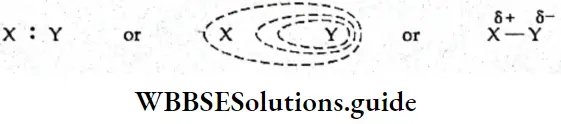
Polar covalent bond: When two atoms of different electronegativities share a pair of electrons, the shared pair of electrons does not lie midway between the two bonded atoms. It shifts towards the more electronegative atom. In other words, the distribution of electrons gets distorted, or the electron cloud is displaced towards the more electronegative atom.
Basic Chemistry Class 11 Chapter 4 Bonding And Molecular Structure Polar Covalent Bond

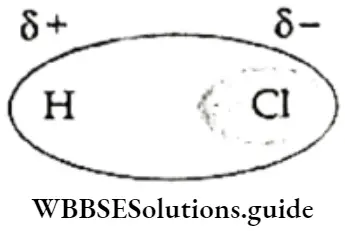
  • The slightly higher electron density around the more electronegative atom makes it acquire a partial negative charge (indicated as δ-). Tine-less electronegative atom acquires a partial positive charge (δ+). Thus, positive and negative poles are developed in the molecule. This type of bond is called a polar covalent bond, i.e., a covalent bond with a partial ionic character.
  • In the hydrogen chloride molecule, for example, chlorine is more electronegative than hydrogen, so the shared pair of electrons is displaced towards chlorine, i.e., the electron density is higher around the chlorine atom, and it acquires a fractional negative charge. The hydrogen atom, on the other hand, acquires an equal positive charge.
  • Molecules containing polar covalent bonds are called polar molecules. A molecule may contain more than one covalent bond, for example, NH3 and H2O.
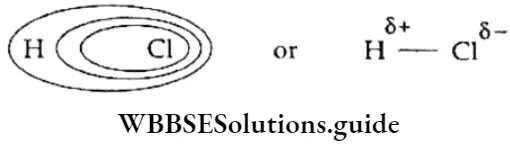
Basic Chemistry Class 11 Chapter 4 Bonding And Molecular Structure Polar Covalent Bond In HCl

The ionic character of polar covalent bond: One can look upon an ionic bond as an extreme case of a polar covalent bond. When two atoms of different electronegativities are bonded together by a covalent bond, the bond is polar as the shared electron pair shifts slightly towards the more electronegative atom.

When the difference in the electronegativities of the two atoms is very high, the shared pair of electrons is almost in complete possession of the more electronegative atom.

  • In such a case, it is more valid to say that an electron has been transferred from the less electronegative to the more electronegative atom and that a positive ion and a negative ion have been created. The two ions are then held together by mutual (electrostatic) attraction or an ionic bond.
  • When two atoms are linked together by a covalent bond having different electronegativities, the bond formed is polar, or the bond is said to possess a partial ionic character. The degree of ionic character of a bond is determined by the difference in electronegativities of the combining atoms. The greater the difference in the electronegativities, the greater the ionic character.
  1. If the difference between the electronegativities of the two atoms is 1.9, the bond is said to have 50% ionic and 50% covalent character.
  2. If the difference between the electronegativities of the two atoms is more than 1.9, the partial ionic character of the bond is more than 50% and the bond is taken to be ionic.
  3. If the difference between the electronegativities of the two atoms is less than 1.9, the bond is predominantly covalent.

Properties And Examples Of Polar Covalent Bonds In WBCHSE Chemistry

Dipole moment: One end of a polar molecule is negative and the other is positive, so the molecule behaves like an electric dipole. Since the negative charge is always equal in magnitude to the positive charge, the molecule as a whole is electrically neutral.

The dipole moment of a molecule is a measure of its polarity. It is the product of the magnitude of the negative or the positive charge (q) and the distance (d) between the charges, i.e., internuclear distance. It is usually denoted by ji. Mathematically this can be expressed as follows.

“Polar covalent bond, WBCHSE Class 11, chemistry notes, and key characteristics”

μ = q x d.

The charge q is of the order of 10-10 esu (electrostatic unit) and the internuclear distance d is of the order of 10-8 cm (A). Therefore, the dipole moment μ is of the order of 10-10 x 10-8 = 10-18 esu cm. The dipole moment is also expressed in debye (D).

1 D = 1 x 10-18 esu cm.

In SI units, 1 esu = 3.336 x 10⁻¹⁰ C

and 1 cm = 10-2 m.

∴ 1D = 3.336x 10-10 x 10-2 x 10-18 = 3.336 x 10⁻³⁰ Cm.

  • The dipole moment is a measure of the polarity, i.e., the extent of displacement of the electron cloud. The greater the difference between the electronegativities of the bonded atoms, the higher the value of the dipole moment.
  • For example, the dipole moment of HCI is greater than that of HBr though they have the same structure. This is because the difference between the electronegativities of chlorine and hydrogen is greater than the difference between the electronegativities of bromine and hydrogen.

Dipole moment and molecular structure: Dipole moment is a vector quantity, i.e., it has a magnitude and direction. It is represented by an arrow with its tail at the positive end and head pointing towards the negative end.

⇒ H-Cl

A molecule may have more than one polar bond. The polarity of a molecule with more than one polar bond is the resultant or the vector sunt of the dipole moments of all the bonded atoms, or the resultant of all the bond dipoles (the dipole moment of a bond is often referred to as the bond dipole).

“WBCHSE Class 11, chemistry notes, on polar covalent bond, and its formation”

Diatomic molecule In the case of a diatomic molecule in which the two atoms are bonded to each other by a polar covalent bond, the dipole moment of the molecule is just the dipole moment of that bond. For example, in the case of HC1, the molecular dipole moment is equal to the dipole moment of the H—Cl bond, i.e., 1.03 D.

The greater the difference between the electronegativities of the bonded atoms, the greater the dipole moment of the molecule. For example, the dipole moment of hydrogen halides are in the order,

H—F (1.91 D) > H—Cl (1.03 D) > H—Br (0.79 D) > H—I (0.38 D).

Comprehensive Guide To Polar Covalent Bonds For WBCHSE Class 11

Polyatomic molecule If a polyatomic molecule has more than one polar bond, its dipole moment is equal to the resultant of the dipole moments of all the individual bonds (or bond dipoles).

  • Since dipole moment is a vector quantity, the magnitude and direction of the resultant depends not only on the values of the individual dipole moments but also on their orientation or direction.
  • Thus, the dipole moment of a molecule may be zero even though it contains more than one polar bond. What the resultant of the individual dipole moments of the bonds in a molecule will be depends on the structure (spatial arrangement of atoms) of the molecule.

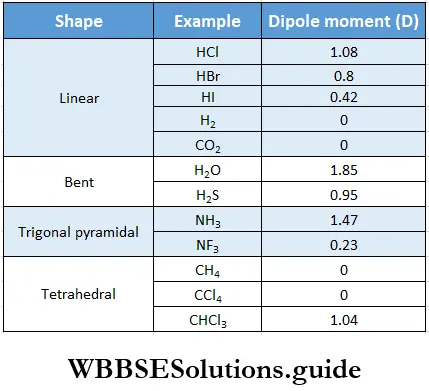
Dipole moments of CO2 and SO2 The carbon dioxide molecule has two C=0 polar bonds but its dipole moment is zero. This is because CO2 is a linear molecule in which the two C=O bonds are at 180° to each other, so the dipole moments are equal in magnitude and opposite in direction. The SO2 molecule has two polar bonds but unlike the CO2 molecule, its dipole moment is not zero. This is because the shape of the molecule is such that the resultant of the dipole moments of the two bonds is not zero.
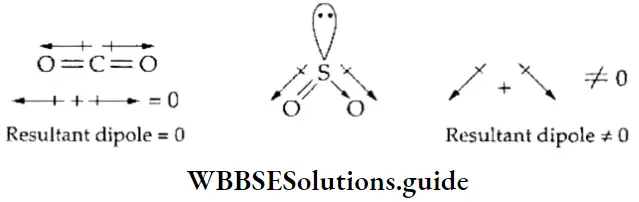
Basic Chemistry Class 11 Chapter 4 Bonding And Molecular Structure Diple Moment Of CO2 And SO2

Dipole moments of BF3 and NF3 In BF3, there are three polar B—F bonds but the dipole moment of the molecule is zero because the resultant of the dipole moments of any two of the bonds is equal and opposite to the third (parallelogram law of forces).

The NF3 molecule also has three polar bonds. But because of the presence of a lone pair of electrons, the arrangement of the electron pairs is distorted tetrahedral and the orientation of the bond dipoles is such that their resultant is 0.8 x 10⁻³⁰ Cm.

Generally, in symmetrical molecules, the resultant of all the dipole moments is zero.

  • If we compare the dipole moments of NFand NH3 (both have pyramidal shapes with a lone pair of electrons) the dipole moment of NF3 is expected to be more as fluorine is more electronegative than hydrogen.
  • But the dipole moment of NH3 (4.90 x 10⁻³⁰ C m) is more than that of NF3. This is because in NH3 the dipole due to the lone pair and the resultant dipole moments of N—H bonds are in the same direction. In NF3 the direction of the dipoles is opposite.
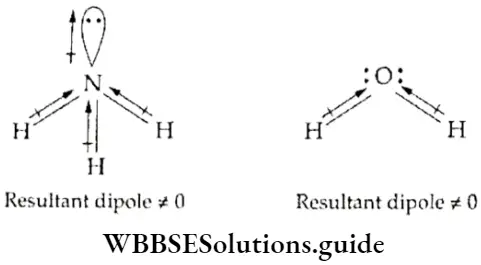
Basic Chemistry Class 11 Chapter 4 Bonding And Molecular Structure Dipole Moments Of NH3 And H2O Molecules (2)

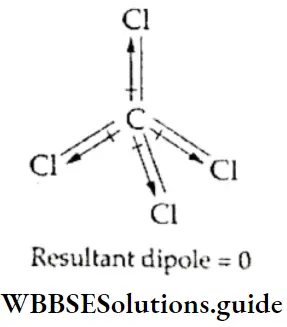
Basic Chemistry Class 11 Chapter 4 Bonding And Molecular Structure Dipole Moment Of CCl4

Basic Chemistry Class 11 Chapter 4 Bonding And Molecular Structure Dipole Moments Of Some Molecules

The usefulness of dipole moment: Knowing the value of the dipole moment of a molecule is useful in many ways.

Polarity of a molecule The value of the dipole moment is an indicator of the polarity of the molecule. The higher the value of the dipole moment the greater the polarity of the molecule (the greater the polarity of the bond if the molecule contains only one polar bond). The dipole moment of a nonpolar molecule is zero. So the dipole moment can help ascertain whether a molecule is polar or nonpolar.

The ionic character of a molecule All covalent bonds have a partially ionic character. We can predict the ionic character of a molecule by considering the magnitude of its dipole moment.

Shape of molecule The dipole moment of a molecule helps to predict the shape of the molecule. For example, experiments show that the dipole moment of BeF2 is zero. This can be possible only if the resultant of the dipole moments of the two Be—F bonds is zero.

“Polar covalent bond, definition, properties, and real-world examples, WBCHSE syllabus”

In other words, the two bond dipoles must be oriented in opposite directions, which is possible only if the molecule is linear. The H2O molecule, on the other hand, has a dipole moment of 1.85 D. Since the resultant of the dipole moments of the two bonds in the H2O molecule is not zero, the molecule cannot be linear, it must be angular.

Partial covalent character of ionic bonds: Just as partial ionic character is attained in a covalent bond, similarly a partial covalent character is induced in an ionic compound. Consider a system of two ions A+ and B together at an equilibrium distance (i.e., when the system acquires minimum energy).

The cation attracts the electron of the anion (B) and repels the nucleus; thus the anion gets distorted or polarised. The anion being larger gets more readily polarised than the cation, and thus the effect of an anion on a cation is less pronounced.

If the extent of polarisation is large, the electrons of the anion are drawn towards the cation (this means electrons are shared by the ions), and covalent character results.

WBCHSE Class 11 Chemistry Notes: Polar Covalent Bond Properties And Examples

The extent of distortion of an anion depends on two factors:

  1. The polarising power of the cation
  2. The polarisability of the anion (ease of distortion of anion).

Generally, small cations with high positive charge have greater polarising power, and large anions with loosely held electrons are easily polarisable. The factors favoring covalency (in ionic compounds) have been summarised by Fajans and are referred to as Fajans’ rules. According to these rules, covalency is favored by:

  1. More charge on either ion
  2. Small cation
  3. Large anion
  • Many transition metal ions and a few main group elements have high polarising power. Since a noble gas configuration (ns2np6, typical of alkali and alkaline earth metal cations) is most effective at shielding nuclear charge the ions with this configuration are not significantly polarising.
  • Let us consider NaCl and AlCl3. In both cases the anion is Cl whereas the cations are Na+ and Al3+. Al3+ (small size; high charge) has greater polarising power than Na+ (big size; small charge).
  • Therefore, AlCI3 is more covalent than NaCl. Now, let us consider NaCl, NaBr, and Nal. The cation being the same, covalency depends on the aruons. In all the cases tire charge is the same, but the size follows the order: Cl < BP < I. Thus polarisability also follows this order and the covalent character is maximum for Nal and least for NaCl.

Directional properties of bonds: As you already know, different orbitals have different shapes. The shape of the s orbital is spherical so the orbital is represented as a circle.

  • The p orbital consists of two lobes in contact at the origin. As you can see in the figure, p orbitals have a marked directional character, they have axes at right angles to each other. Hence they are known as px, py, and pz orbitals respectively.
  • The orbitals are equivalent to each other but for the directional property. One lobe of the p orbital is marked with a positive sign and the other -with a negative sign. These signs have no physical significance, they arise from the fact that a wave function can have both positive and negative regions.
  • In this context, it is important to remind you that the electron has a dual nature and it cannot be both particle and wave at the same time. According to wave mechanics, an electron is represented by a wave function \(\psi\).
  • It does not matter at all which lobe of the p orbital has been given a positive or negative sign. Similarly, an s orbital can be + or -. When \(\psi\) is zero, there is no likelihood of finding an electron in the region.
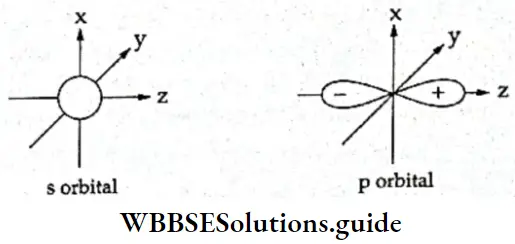
Basic Chemistry Class 11 Chapter 4 Bonding And Molecular Structure Directional Properties Of Bonds

Let us apply these relative signs to understand the overlap of atomic orbitals. Consider two hydrogen atoms, A and B combining. The 1s atomic orbitals of the two atoms overlap to give rise to a molecular orbital.

The two electrons, one in each atomic orbital, can be represented by wave functions \(\psi_{\mathrm{A}} \text { and } \psi_{\mathrm{B}}\). Two combinations of the wave functions are then possible:

  1. Overlap of the wave functions with the same sign
  2. Overlap of the wave functions with opposite sign
  • Wave functions with the same signs can be regarded as waves in the same phase which may add up to give a large resultant wave. On the other hand, wave functions with opposite signs cancel each other. In other words, when the overlap occurs between two regions with the same sign it results in a bonding orbital whereas in case of overlap between regions of the opposite sign, a nonbonding orbital results.
  • As it is dear from the Figure, the electron charge is concentrated in the region between two nuclei in case of the bonding orbital, thereby holding the two nuclei together. On the other hand, in the nonbonding orbital, the electron charge is withdrawn from the region between the two nuclei, which results in repulsion between the two nuclei.
  • Figure shows different combinations of s and p orbitals with positive, negative, and zero overlap. Overlap is said to be positive or negative if the signs of the overlapping lobes are the same or different respectively. In the case of zero overlaps, the extent of stabilization obtained by the overlap of orbitals of the same sign is equal to the extent of destabilization obtained by the overlap of orbitals of the opposite sign, so the net overlap is said to be zero.
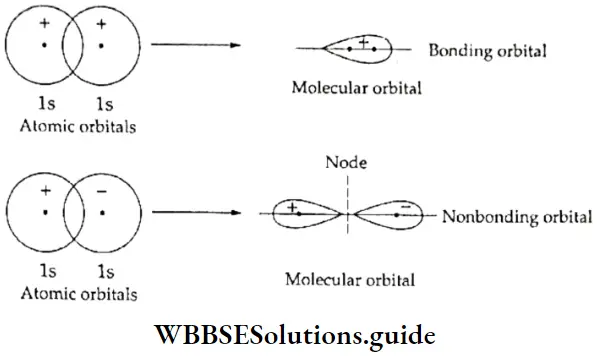
Basic Chemistry Class 11 Chapter 4 Bonding And Molecular Structure Formation Of Bonding And Non bonding Molecular Orbitals Form 1s Orbitals Of Two H Atoms

Molecular Orbital Theory: In valence bond theory, a chemical bond is identified as a shared electron pair. Electrons in atoms are present in atomic orbitals. The atomic orbitals of different atoms overlap to give rise to a chemical bond.

This theory could not explain certain properties like relative bond strengths, and the paramagnetic and the diamagnetic characters of a molecule. Another theory that is widely used to explain bonding in molecules is referred to as molecular orbital theory.

“WBCHSE Class 11 Chemistry, polar covalent bonding, electronegativity, and dipole moment”

This theory was proposed by Hund and Mulliken (1932). Unlike the valence bond theory, the molecular orbital theory considers the valence electron to be associated with the nuclei of all combining atoms.

The main features of this theory are as follows:

  1. Atomic orbitals that match in energy and symmetry combine to give molecular orbitals.
  2. The total number of molecular orbitals formed is equal to the total number of combining atomic orbitals.
  3. Unlike the electron in an atomic orbital, the electron in a molecular orbital is influenced by two or more nuclei corresponding to the number of atoms in the molecule. (An atomic orbital is called monocentric, while a molecular orbital is called polycentric.)
  4. When two atomic orbitals combine, they form two molecular orbitals—the bonding molecular orbital which has lower energy than the atomic orbitals, and the antibonding molecular orbital which has higher energy than the atomic orbitals.
  5. Like atomic orbitals, molecular orbitals represent electron probability distribution.
  6. The filling up of molecular orbitals is done by the Aufbau principle, Pauli exclusion principle, and Hund’s rule.
  7. The maximum number of electrons present in a molecular orbital is 2.

Linear Combination of Atomic Orbitals (LCAO) Method: You already know that according to wave mechanics, atomic orbitals are represented by a wave function vy which is obtained by solving the Schrodinger wave equation.

It is very difficult to solve the Schrodinger wave equation for a molecule (since a molecular orbital is polycentric). Here the difficulty in finding a solution arises from the dependence of the wave function on internuclear distances or because an electron interacts simultaneously with more than one nuclei.

  • Therefore, certain approximations have to be made to solve wave equations for molecules. The most common approximation is adopting the procedure of linear combination of atomic orbitals (LCAO). Why is a molecular orbital considered to be a linear combination of atomic orbitals? The answer to this lies in the fact that the electron with a larger region for movement or more freedom has lower energy.
  • Now the larger region for the movement is possible only when the atomic orbitals overlap with each other. The overlap is maximum when the orbitals are in the same plane. Thus the molecular orbital is considered to be a linear combination of atomic orbitals.

Consider two atoms A and B whose atomic orbitals are represented by the wave functions \(\psi_{\mathrm{A}} \text { and } \psi_{\mathrm{B}}\) respectively. During bond formation, these orbitals combine to give molecular orbitals. According to the LCAO method, the atomic orbitals of the individual atoms may combine in two ways—the wave functions may add to or subtract from each other.
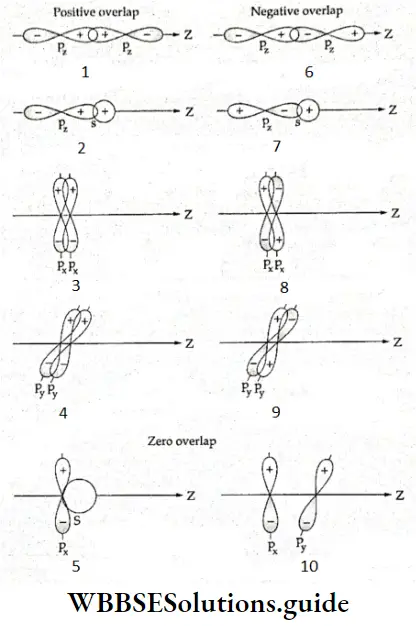
Basic Chemistry Class 11 Chapter 4 Bonding And Molecular Structure Positive, Negative And Zero Overlaps Of s And p Atomic Orbitals

The molecular orbital obtained by the addition of the wave functions may be represented as

∴ \(\psi_{(\mathrm{MO})}=\psi_{\mathrm{A}}+\psi_{\mathrm{B}}\).

The resultant molecular orbital (\(\psi_{(\mathrm{MO})}\)) is bonding. Here signs of both the wave functions are the same, this implies that two waves are in phase. When such waves combine the resultant wave has larger amplitude (amplitudes of both waves add—constructive interference).

The molecular orbital obtained by subtracting the wave functions is represented as \(\psi_{(\mathrm{MO})}^*=\psi_{\mathrm{A}}+\left(-\psi_{\mathrm{B}}\right)\).

The resultant molecular orbital obtained by adding two wave functions of opposite signs is antibonding. This corresponds to two waves that are completely out of phase and cancel each other by destructive interference. We have already discussed the bonding and antibonding molecular orbitals taking the H2 molecule as an example, earlier in the chapter.

  • Going back to the H2 molecule again, the bonding molecular orbital is denoted by \(\sigma_{15}\) while the antibonding molecular orbital is represented by \(\sigma_{1 s}^*\). It is called a because the overlap of atomic orbitals is along the internuclear axis and Is because the combining atomic orbitals are Is orbitals.
  • In a bonding molecular orbital, there is an increase in electron density in the internuclear region. The nuclei are shielded from each other so that the repulsion between them is very low. This results in a lowering of energy and leads to boning.
  • In the case of the antibonding molecular orbital, the electron density in the internuclear region is severely reduced. There is a nodal plane in the internuclear region. Therefore, the repulsion between the nuclei is high. The antibonding molecular orbital is higher in energy than the individual atomic orbitals.

The respective energy levels of the two combining atomic orbitals (1s) and the bonding and antibonding molecular orbitals are given in Figure.

  • The energy of the bonding molecular orbitals is lower than that of either of the combining atomic orbitals by an amount ΔE. The energy of the antibonding molecular orbital is more than that of the atomic orbitals by the same amount ΔE.
  • In H2 molecule the two electrons are present in the bonding molecular orbital and the system is stabilized by an energy factor corresponding to 2ΔE. As already stated, the bonding molecular orbital is lower in energy than the atomic orbital by a factor ΔE, so putting an electron in a bonding molecular orbital stabilizes the system by an energy factor ΔE.
  • As the hydrogen molecule has two electrons, the stabilization energy is 2ΔE. This energy parameter corresponds to the bond energy. The total energy of the two molecular orbitals is equal to the total energy of the two atomic orbitals. This is under the principle of conservation of energy.
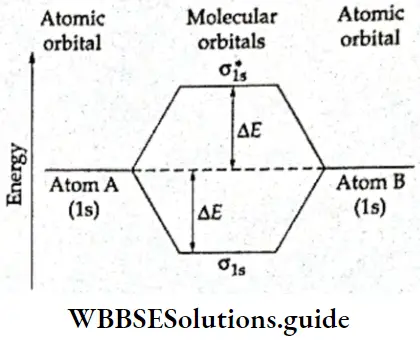
Basic Chemistry Class 11 Chapter 4 Bonding And Molecular Structure Relative Energies Of Bonding And Antibonding Molecular Orbitals

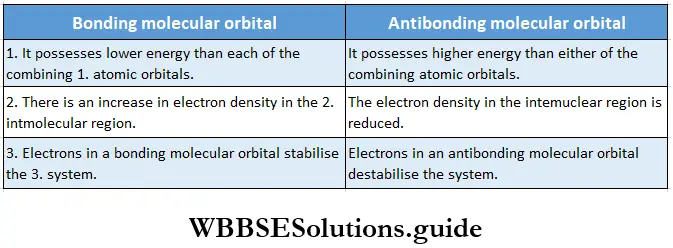
The main differences between molecular orbitals and atomic orbitals as well as between a bonding molecular orbital and an antibonding molecular orbital are as follows.
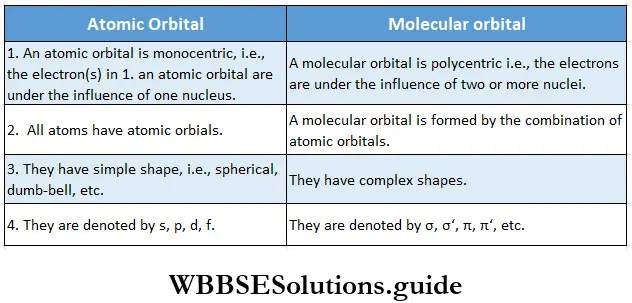
Basic Chemistry Class 11 Chapter 4 Bonding And Molecular Structure Differences Between Atomic And Molecular Orbital

Basic Chemistry Class 11 Chapter 4 Bonding And Molecular Structure Differences Between Bonding And Antibonding Molecular Orbital

Conditions for LCAO: The atomic orbitals which combine to form molecular orbitals should satisfy the following three conditions.

  1. The combining atomic orbitals should not differ significantly in energy. For example, a 1s orbital cannot overlap with a 2s orbital.
  2. The extent of overlap must be large, i.e., the atoms must be sufficiently close.
  3. The combining atomic orbitals must have the same symmetry along the intemuclear axis. By convention, the z-axis is considered to be the internuclear axis. Thus an s orbital cannot overlap with a px or py orbital, and a pz orbital cannot overlap with a px or py orbital.

Types of molecular orbitals: Molecular orbitals of diatomic molecules are designated as σ, π, and δ. We will restrict our discussion to σ and π orbitals only. A σ orbital is formed when the overlap of atomic orbitals occurs along the intemuclear line (z-axis).
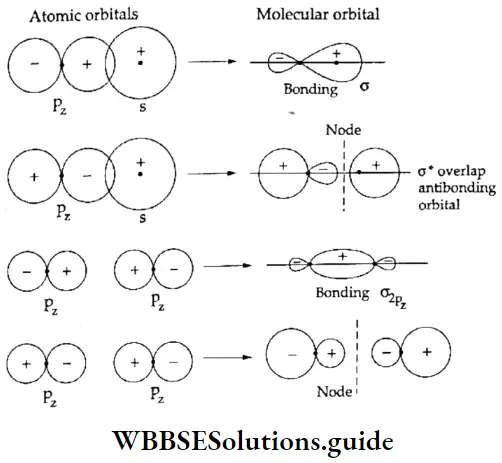
Basic Chemistry Class 11 Chapter 4 Bonding And Molecular Structure Pictrorial Representation Of Sigma Overlap

  • An s orbital is spherically symmetrical, so when two s orbitals overlap a a molecular orbital is formed. A σ molecular orbital is also formed when an s orbital overlaps with a pz orbital or when two pz orbitals overlap with each other. In both these cases overlap takes place along the internuclear line. A σ molecular orbital is symmetrical about the bond axis. If the overlapping lobes have opposite signs, it gives rise to antibonding orbitals.
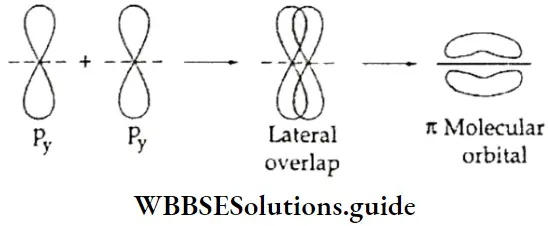
  • You already know that lateral overlap of orbitals results in the formation of π bonds. Therefore, when a px orbital overlaps with another px orbital (or py with py) a π molecular orbital is formed. In this combination both the lobes of each combining orbitals are perpendicular to the internuclear line.
  • The overlap does not occur along the internuclear line. In other words, a π molecular orbital is not symmetrical about the internuclear axis. In the case of π bonding molecular orbital, the electron density is large, above and below the internuclear line. The π* molecular orbital (antibonding) has a node between the two nuclei. All antibonding orbitals possess a nodal plane lying between the nuclei and perpendicular to the internuclear axis.
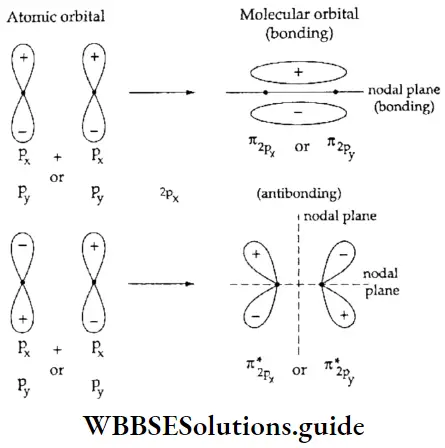
Basic Chemistry Class 11 Chapter 4 Bonding And Molecular Structure Pictorial Represenation Of Pi Overlap

Here it should be understood that the overlap of an s orbital with px or py or a pz orbital with a px or py orbital gives a nonbonding combination. The orientation is not proper for a bond to be formed.

Order of energy of molecular orbitals: In the same way as atomic orbitals have definite energies and can be distinguished by quantum numbers, each molecular orbital has a definite energy and is specified by four quantum numbers.

  • You are already familiar with the filling of atomic orbitals in accordance with the Pauli exclusion principle and Hund’s rule. The same applies to molecular orbitals. In the case of the molecular orbital method, the whole molecule is considered and the total number of electrons from all the constituent atoms are filled in the molecular orbitals.
  • The order of energy of molecular orbitals has been determined experimentally by spectroscopy for the elements of the second period. The increasing order of energies of the molecular orbitals in homonuclear diatomic molecules is

⇒ \(\sigma 1 s<\sigma^* 1 s<\sigma 2 s<\sigma^* 2 s<\sigma 2 p_z<\left(\pi 2 p_x=\pi 2 p_y\right)<\left(\pi^* 2 p_x=\pi^* 2 p_y\right)<\sigma^* 2 p_z\)

“Polar covalent bond, types, properties, and differences from non-polar bonds, WBCHSE notes”

The energies of \(\pi 2 p_x \text { and } \pi 2 p_y\) molecular orbitals are the same and they form a pair of degenerate orbitals. Similarly the \(\pi^* 2 p_x \text { and } \pi^* 2 p_y\) orbitals are also degenerate. The energies of \(\sigma 2 \mathrm{p}_z \text { and } \pi 2 \mathrm{p}_x / \pi 2 \mathrm{p}_y\) molecular orbitals are very close and the order given above is correct for 02 and F2 molecules. For other lighter elements of the second period of the periodic table, there is a reversal in the order of the energy of \(\pi 2 \mathrm{p}_x / \pi 2 \mathrm{p}_y \text { and } \sigma 2 \mathrm{p}_z\) orbitals. The order now becomes

⇒ \(\sigma 1 \mathrm{~s}<\sigma^* 1 \mathrm{~s}<\sigma 2 \mathrm{~s}<\sigma^* 2 \mathrm{~s}<\left(\pi 2 \mathrm{p}_x=\pi 2 \mathrm{p}_y\right)<\sigma 2 \mathrm{p}_z<\left(\pi^* 2 \mathrm{p}_x=\pi^* 2 \mathrm{p}_y\right)<\sigma^* 2 \mathrm{p}_z\).

Class 11 WBCHSE Chemistry: Polar Covalent Bond Definition And Examples

The main difference between the two is that for the lighter elements the energy of the \(\sigma 2 \mathrm{p}_z\), molecular orbital is higher than that of the \(\pi 2 \mathrm{p}_x \text { and } \pi 2 \mathrm{p}_y\) molecular orbitals.

  • While establishing molecular orbitals we deal with the concept that orbitals of atom A mix with orbitals of atom B if they are matched in energy and symmetry. However mixing occurs in all orbitals of comparable energy having proper symmetry. The energy differences between Is and 2s orbitals is large and we are justified in neglecting this mixing. The energy difference between 2s and 2p orbitals is less and varies with effective nuclear charge.
  • It increases drastically from 200 kJ mol-1 for lithium to 2500 kJ mol-1 for fluorine. The 2s orbital and 2pz orbital are matched in symmetry, and thus for the lighter elements mixing occurs. This phenomenon is the equivalent of hybridisation in valence bond theory.

Molecular Orbital Treatment of Homonudear Diatomic Molecules: The distribution of electrons among various molecular orbitals of a molecule is called the electronic configuration of the molecule. The stability and magnetic behaviour of the molecule depend on its electronic configuration.

Stability: A bonding orbital is lower in energy whereas an antibonding orbital is higher in energy than either of the two atomic orbitals which combine. Therefore, an electron in a bonding orbital leads to stabilization, and conversely an electron in an antibonding orbital leads to destabilisation.

Thus, the relative number of electrons in bonding and antibonding orbitals of the molecule give an idea about its stability. If the number of electrons in bonding orbitals is given by Nb and that in antibonding orbitals by Na, then the molecule will be stable if Nb>Na.

Bond order Tire stability of a molecule is given in terms of bond order. The bond order of a molecide is expressed as half of the difference between the number of electrons present in bonding and antibonding orbitals.

Bond order = \(\frac{1}{2}\left(N_b-N_a\right)\).

A positive bond order indicates a stable molecule whereas a negative or zero bond order indicates an unstable molecule. The value of the bond order decides the nature of the bond. Integral bond order values of one, two, or three correspond to single, double, and triple bonds respectively. The bond order is a useful parameter indicating characteristics of bonds. Bond order is inversely proportional to bond length.

Magnetic behaviour: The electronic configuration of a molecule indicates the magnetic behaviour of a molecule. The macroscopic magnetic properties of a substance arise from the total of the magnetic moments of its component atoms and molecules.

If all the electrons in the orbitals are paired then the molecule is diamagnetic. But in case of unpaired electrons present in the orbitals, the molecule is paramagnetic.

In diamagnetic substances, the magnetisation is in the opposite direction to that of the applied field. In paramagnetic substances, the net spin magnetic moments due to impaired electrons in the molecule can be aligned in the direction of the applied field.

Let us now discuss bonding in a few homonuclear diatomic molecules.
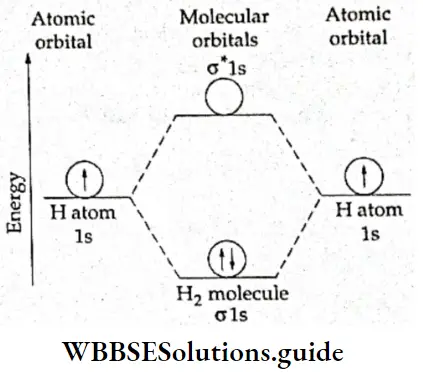
Basic Chemistry Class 11 Chapter 4 Bonding And Molecular Structure Molecular Orbital Diagram For H2 Molecule

1. \(\mathbf{H}_2^{+}\) molecule ion This is the simplest diatomic molecule obtained as a transient species when hydrogen gas [H2(g)] is subjected to electric discharge at reduced pressure.

The single electron is present in the bonding, σ1s molecular orbital. The molecular orbital configuration is σ1s1. The bond order is 1/2(1- 0) = 1/2. A positive bond order implies a/ certain amount of stability. The molecule is paramagnetic in nature due to the presence of single unpaired electron.

2. H2 molecule The total number of electrons in the molecule is two (one from each hydrogen atom). The electrons are placed in the bonding molecular orbital and the electronic configuration is σ1s2.

The molecular orbital diagram is shown in Figure. The bond order of the molecule = 1/2 (2 – 0) = 1. This implies that the two atoms are held together by a single bond. Since there is no unpaired electron, the molecule is diamagnetic.

The bond order of the molecular ion, \(\mathrm{H}_2^{+} \text {is } 1 / 2\) whereas that of hydrogen molecule is 1. This shows that the H2 molecule is more stable than the \(\mathrm{H}_2^{+} ion\). This is also obvious from their bond lengths which is 106 pm for \(\mathrm{H}_2^{+} ion\) ion and 74 pm for H2 molecules.

3. He2 molecule Each He atom has two electrons. Therefore, the He2 molecule has four electrons arranged as \((\sigma 1 s)^{\frac{2}{2}}\left(\sigma^* 1 s\right)^2\). The bond order is 1/2(2 – 2) = 0, which indicates that the molecule does not exist. Similarly it can be shown that the Be2 molecule does not exist.

4. Li2 molecule The electronic configuration of Li is 1s22s1. Thus in Li2, there are six electrons and the electronic configuration of the molecule is \((\sigma 1 s)^2(\sigma 1 s)^2(\sigma 2 s)^2(a2s)2\). This is shown in Figure.
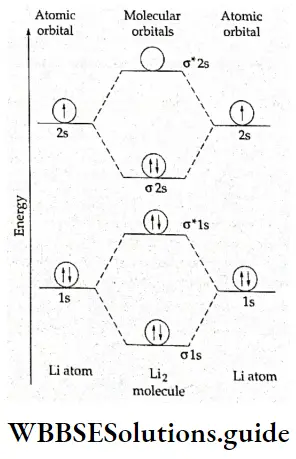
Basic Chemistry Class 11 Chapter 4 Bonding And Molecular Structure Energy Level Diagram For Li2 Molecule

The inner shell, i.e., σ1s and \(\sigma^{\circ} 1 \mathrm{~s}\), does not contribute much to the bonding. Therefore, the electronic configuration of the molecule can be written as KK(σ2s)2. KK refers to a closed K shell which includes two molecular orbitals \((\sigma 1 s)^2 \text { and }\left(\sigma^{\circ} 1 s\right)^2\).

The bond order is 1 [1/2(4 – 2)1 which shows that the Li2 molecule is stable. In fact, diamagnetic, Li2 molecules do exist in vapour phase.

5. B2 molecule Each boron atom has five electrons and the electronic configuration is \(1 s^2 2 s^2 2 p^1\). This is the first instance in the discussion where we have come across a molecular system with an electron in a p orbital. As stated earlier for lighter molecules like B2 and C2 the doubly degenerate π2p orbitals are lower in energy than the σ2pz orbital.
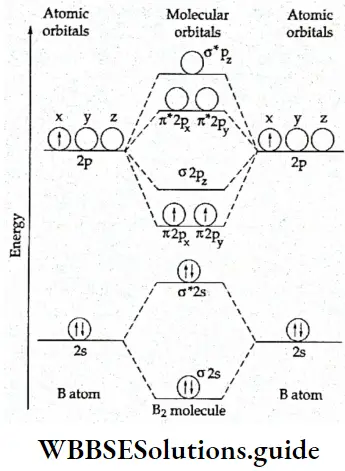
Basic Chemistry Class 11 Chapter 4 Bonding And Molecular Structure Energy Level Diagram For B2 Molecule

Therefore, the electronic configuration of the B2 molecule is \((\sigma 1 s)^2\left(\sigma^* 1 s\right)^2(\sigma 2 s)^2\left(\sigma^* 2 s\right)^2 \pi^1 2 p_x=\pi^1\) or \(operatorname{KK}(\sigma 2 s)^2\left(\sigma^* 2 s\right)^2 \pi^1 2 p_x=\pi^1 2 p_y\).

“WBCHSE Class 11, chemistry notes, on polar covalent bond, molecular polarity, and applications”

The molecular orbital diagram is given in Figure. The bond order is 1/2(6 – 4) = 1, which shows that the molecule is stable and, having two unpaired electrons, paramagnetic. The bond energy is 290 kJ mol-1 and the bond length is 159 pm.

6. C2 molecule Since the carbon atom has six electrons \(\left(1 s^2 2 s^2 2 p^2\right)\), the C2 molecule will have 12 electrons and the electronic configuration may be written as \(\left(\sigma_{1 s}\right)^2\left(\sigma^* 1 s\right)^2(\sigma 2 s)^2\left(\sigma^* 2 s\right)^2\left(\pi 2 \mathrm{p}_x\right)^2=\left(\pi 2 \mathrm{p}_y\right)^2\)

or \(\mathrm{KK}\left(\sigma^2\right)^2\left(\sigma^* 2 \mathrm{~s}\right)^2\left(\pi 2 \mathrm{p}_x\right)^2=\left(\pi 2 \mathrm{p}_y\right)^2\)

The bond order is 1/2(8 – 4) = 2, which shows the presence of a double bond in the molecule. But both pairs of electrons constituting the double bond are present in the π molecular orbitals.

Therefore, the double bond comprises two π bonds and not one σ and one π bond as in other molecules. There is no unpaired electron, so that the molecule is diamagnetic and exists in the vapour phase only. The bond energy is 620 kJ mol-1 and the bond length is 131 pm.

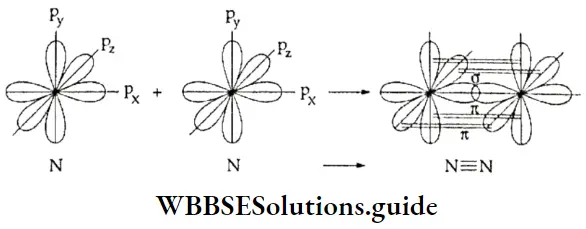
7. N2 molecule Each nitrogen atom has seven electrons (1s2 2s2 2p3) therefore, the N2 molecule will have fourteen electrons and the electronic configuration is

⇒ \(\left(\sigma_{1 s}\right)^2\left(\sigma^* 1 s\right)^2\left(\sigma_2\right)^2\left(\sigma^* 2 s\right)^2\left(\pi 2 \mathrm{p}_x\right)^2=\left(\pi 2 \mathrm{p}_y\right)^2\left(\sigma^2 \mathrm{p}_z\right)^2\)

or \(\mathrm{KK}(\sigma 2 s)^2\left(\sigma^{\circ} 2 s\right)^2\left(\pi 2 \mathrm{p}_x\right)^2=\left(\pi 2 \mathrm{p}_y\right)^2\left(\sigma 2 \mathrm{p}_z\right)^2\).

The bond order of the N2 molecule is 1/2(10 – 4) = 3.

Therefore, in the diamagnetic nitrogen molecule, the two atoms are held by a triple bond. The bond energy is 945 kJ mol-1 and the bond length is 110 pm.

Some ionic species formed by the N2 molecule The \(\mathrm{N}_2^{+}\) ion is formed by removing an electron from the N2 molecule present in the highest occupied molecular orbital, i.e., \(\sigma 2 \mathrm{p}_{\mathrm{z}}\). The electronic configuration for the ion is

⇒ \(\mathrm{KK}(\sigma 2 \mathrm{~s})^2\left(\sigma^* 2 \mathrm{~s}\right)^2\left(\pi 2 \mathrm{p}_x\right)^2=\left(\pi 2 \mathrm{p}_y\right)^2 \sigma^1 2 \mathrm{p}_z\)

The presence of an unpaired electron indicates that the ion will be paramagnetic. The bond order is 2.5, suggesting that it is less stable than N2. This is expected as an electron has been removed from a bonding molecular orbital.

Comprehensive Guide To Polar Covalent Bonds For WBCHSE Class 11

The \(\mathrm{N}_2^{-}\) ion is formed by adding an electron to the lowest unoccupied molecular orbital of N2, i.e., the \(\pi^{\circ} 2 p_x\) molecular orbital. The electronic configuration of \(\mathrm{N}_2^{-}\) is

⇒ \(\mathrm{KK}(\sigma 2 \mathrm{~s})^2\left(\sigma^* 2 \mathrm{~s}\right)^2\left(\pi 2 \mathrm{p}_x\right)^2=\left(\pi 2 \mathrm{p}_y\right)^2\left(\sigma^2 2 \mathrm{p}_z\right)\left(\pi^* 2 \mathrm{p}_x\right)^1\)

The bond order is 2.5 and the molecule is paramagnetic.

Considering the bond order values of the species N2, N+2, and N2, they can be arranged in order of increasing stability as
\(\mathrm{N}_2, \mathrm{~N}_2^{+} \text {and } \mathrm{N}_2^{-} \text {, }\).

8. O2 molecule Each oxygen atom has eight electrons \(\left(1 s^2 2 s^2 2 p^4\right)\). Therefore the total number of electrons in the O2 molecule is 16. The electronic configuration is

⇒ \((\sigma 1 \mathrm{~s})^2\left(\sigma^* 1 \mathrm{~s}\right)^2(\sigma 2 \mathrm{~s})^2\left(\sigma^* 2 \mathrm{~s}\right)^2\left(\sigma^2 \mathrm{p}_z\right)^2\left(\pi 2 \mathrm{p}_x\right)^2=\left(\pi 2 \mathrm{p}_y\right)^2\left(\pi^* 2 \mathrm{p}_x\right)^1=\left(\pi^* 2 \mathrm{p}_y\right)^1\)

or \(\mathrm{KK}(\sigma 2 \mathrm{~s})^2\left(\sigma^* 2 \mathrm{~s}\right)^2\left(\sigma 2 \mathrm{p}_z\right)^2\left(\pi 2 \mathrm{p}_x\right)^2=\left(\pi 2 \mathrm{p}_y\right)^2\left(\pi 2 \mathrm{p}_x\right)^1=\left(\pi 2 \mathrm{p}_y\right)^1\).

The energy level diagram of the molecule is shown in Figure. As oxygen is a heavier molecule the energy level sequence of molecular orbitals is different from that of B2, C2, etc. The \(\sigma 2 p_z\), molecular orbital is lower in energy than the \(\pi 2 p_x\) molecular orbital.
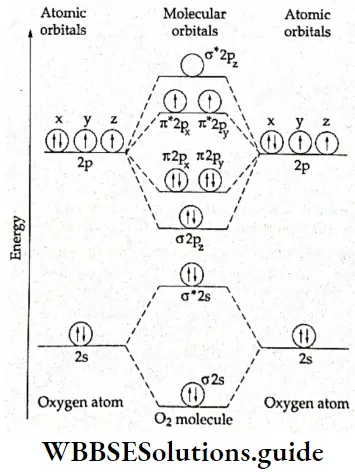
Basic Chemistry Class 11 Chapter 4 Bonding And Molecular Structure Energy Level Diagram For O2 Molecule

The \(\pi^{\circ} 2 p_x \text { and } \pi^* 2 p_y\) orbitals are singly occupied (by Hund’s rule). The presence of unpaired electrons gives rise to paramagnetism which is in accordance with experimental findings.

Thus, the molecular orbital theory successfully explains the paramagnetic nature of oxygen molecule, which was not explained by the valence bond depiction \((: \ddot{\mathrm{O}}=\ddot{\mathrm{O}}:)\) of the molecule. The bond order is 1/2(8-4) = 2, which corresponds to a double bond. The bond energy is 498 kJ mol-1 and the bond length is 121 pm.

Some ionic species formed by O2 molecule The \(\mathrm{O}_2^{+}\) ion contains one electron less than the O2 molecule whereas the \(\mathrm{O}_2^{-} \text {and } \mathrm{O}_2^{2-}\) ions contain one and two electrons more than the O2 molecule respectively. The electronic configuration, magnetic behaviour, and bond order of the ionic species are summarised below.
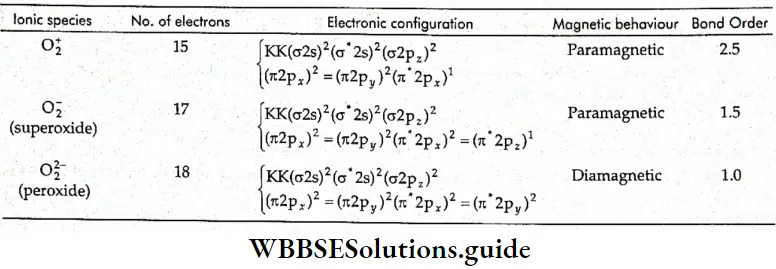
Basic Chemistry Class 11 Chapter 4 Bonding And Molecular Structure Electronic Configuration, Magnetic Behaviour And Bond Order Of The Ionic Species

The stability of the O2 molecule and the ionic species follows the order

∴ \(\mathrm{O}_2^{+}>\mathrm{O}_2>\mathrm{O}_2^{-}>\mathrm{O}_2^{2-} \text {. }\)

Similarly, the §ond length which is inversely proportional to bond order follows the sequence

∴ \(\mathrm{O}_2^{2-}>\mathrm{O}_2^{-}>\mathrm{O}_2>\mathrm{O}_2^{+}\)

9. F2 molecule The fluorine atom has nine electrons \(\left(1 s^2 2 s^2 2 p^5\right)\). Therefore, the F2 molecule contains 18 electrons arranged in the molecular orbitals as \(\mathrm{KK}(\sigma 2 \mathrm{~s})^2\left(\sigma^* 2 \mathrm{~s}\right)^2\left(\sigma 2 \mathrm{p}_z\right)^2\left(\pi 2 \mathrm{p}_x\right)^2=\left(\pi 2 \mathrm{p}_y\right)^2\left(\pi^* 2 \mathrm{p}_x\right)^2=\left(\pi^* 2 \mathrm{p}_y\right)^2\).

The bond order is one and the molecule is diamagnetic. The bond energy is 159 kJ mol-1 and the bond length is 143 pm.

10. Ne2 molecule The electronic configuration of the Ne2 molecule with 20 electrons (since each neon atom has 10 electrons) is

⇒ \(\begin{aligned}
\operatorname{KK}(\sigma 2 s)^2\left(\sigma^* 2 \mathrm{~s}\right)^2\left(\sigma 2 \mathrm{p}_z\right)^2\left(\pi 2 \mathrm{p}_x\right)^2 =\left(\pi 2 \mathrm{p}_y\right)^2 \\
\left(\pi^* 2 \mathrm{p}_x\right)^2 =\left(\pi^* 2 \mathrm{p}_y\right)^2\left(\sigma^* 2 \mathrm{p}_z\right)^2
\end{aligned}\)

The bond order is zero, which implies that the Ne2 molecule does not exist. In other words, neon is 1 monoatomic.

Example 1. Two p orbitals of one atom and two p orbitals of another atom combine to form molecular orbitals. How mam/ molecular orbitals will result from this combination? Give all the possibilities.
Solution:

Given

Two p orbitals of one atom and two p orbitals of another atom combine to form molecular orbitals.

We know that there are three degenerate p orbitals and the electronic configuration of each atom may be \(\mathrm{p}_x \mathrm{p}_y \text { or } \mathrm{p}_x \mathrm{p}_z \text { or } \mathrm{p}_y \mathrm{p}_z\).

Thus various probabilities are possible which are shown below.
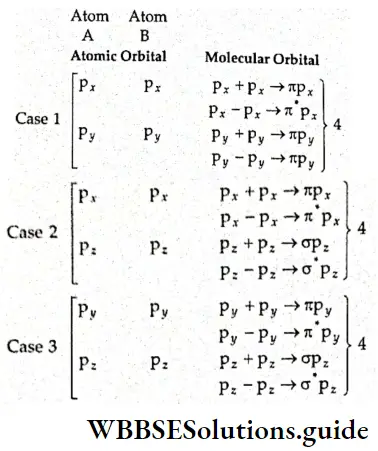
Basic Chemistry Class 11 Chapter 4 Bonding And Molecular Structure Molecular Orbitals Will Result

The overlap of px or py with pz or px with py will give a nonbonding combination of orbitals.

Example 2. Arrange the following in order of increasing stability. \(\mathrm{H}_2, \mathrm{H}_2^{+}, \mathrm{H}_2^{-}, \mathrm{H}_2^{2-}\)
Solution: 
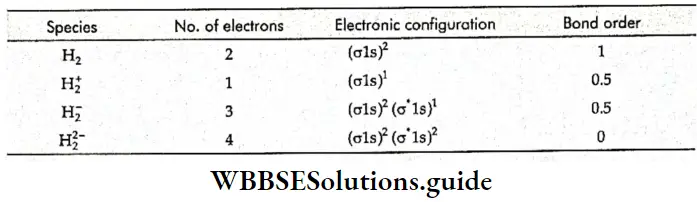
Basic Chemistry Class 11 Chapter 4 Bonding And Molecular Structure Increasing Stability Of H Atoms

Thus, the order of increasing stability is \(\mathrm{H}_2^{2-}<\mathrm{H}_2^{-}=\mathrm{H}_2^{+}<\mathrm{H}_2\)

“Polar covalent bond, examples, characteristics, and significance, WBCHSE Chemistry”

Example 3. Use the molecular orbital theory to explain why He2 does not exist.
Solution:

Each He atom has 2 electrons. Thus He2 has 4 electrons and the electronic configuration of the molecule is \((\sigma 1 s)^2\left(\sigma^* 1 s\right)^2\).

BO = 1/2 (2 – 2) = 0. Thus He2 does not exist.

Example 4. What is the bond order of the \(\mathbf{H}_2^{+}\) ion and the H2 molecule? Why is the bond length in H2 shorter than that in \(\mathbf{H}_2^{+}\)?
Solution:

The bond order of \(\mathbf{H}_2^{+}\) is 0.5 and that of H2 is 1. The bond order value for the H2 molecule is more than that for the \(\mathbf{H}_2^{+}\) ion. Since bond length decreases as bond order increases, the bond length of H2 is shorter.
WBCHSE Class 11 Chemistry Notes For Hybridization – Definition, Types and Features

WBCHSE Class 11 Hybridization Notes With Definition, Types, And Features

According to the valence bond theory, a covalent bond is formed by the overlapping of half-filled atomic orbitals of the valence shell. This does explain the formation of some molecules, like O2 and N2, but cannot explain the tetravalency of carbon, the bivalency of beryllium, or the trivalency of boron.

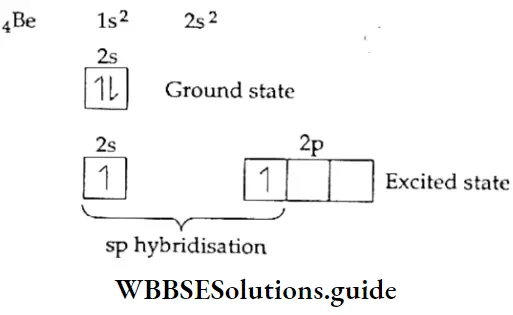
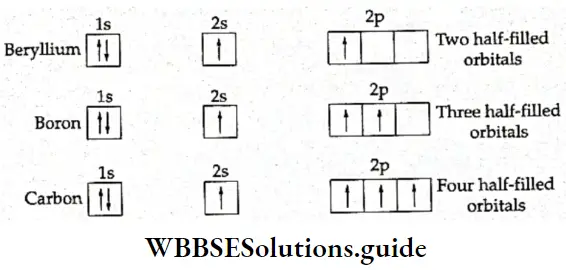
  • Carbon, with the electronic configuration of \(1 \mathrm{~s}^2, 2 \mathrm{~s}^2, 2 \mathrm{p}_x^1, 2 \mathrm{p}_y^1\) has only two unpaired electrons and should have been bivalent. The electronic configuration of boron is \(1 \mathrm{~s}^2, 2 \mathrm{~s}^2, 2 \mathrm{p}_x^1\) which means that it has only one half-filled orbital but it forms compounds like BF3. Beryllium, with the electronic configuration of 1s2, 2s2 has no impaired electron. Its covalency should have been zero, but it forms compounds like BeCl2.
  • To explain this apparent contradiction, the modem theory of bond formation assumes that these and other atoms acquire excited states before participating in bond formation. In the excited state, one of the electrons in the 2s orbital in the examples we are considering gets promoted to a vacant 2p orbital. Thus, for example, in the excited state, carbon has four half-filled orbitals. The energy used for excitation is compensated for by the energy released during bond formation.

Basic Chemistry Class 11 Chapter 4 Bonding And Molecular Structure Simple Excited State Electronic Configuration Of Be, B And C

The assumption that atoms acquire an excited state before forming bonds can explain some things like the tetravalency of carbon. But it leaves certain other questions unanswered. Take the formation of methane, for example. The carbon atom has four unpaired electrons in the excited state, one electron in the s orbital, and three in the p orbitals.

“WBCHSE Class 11 Chemistry, hybridization, definition, types, and features”

Read and Learn More WBCHSE For Class11 Basic Chemistry Notes

  • If these orbitals overlap with the Is orbitals of four hydrogen atoms, three p-s sigma bonds and one s-s sigma bond should be formed. In that case, the four bonds should not be equivalent, they should have different strengths, bond lengths, and bond angles. However, it has been seen experimentally that the four bonds are equivalent and that the bond length is 109 pm, while the H—C—H bond angle is 109°28′.
  • Pauling and Slater, two American scientists, introduced the concept of hybridization to explain this apparent discrepancy. According to them, before an atom forms bonds with other atoms, its orbitals get mixed and redistributed to form new, equivalent orbitals.
  • These equivalent orbitals are called hybrid orbitals and the phenomenon is called hybridisation. Thus, hybridization is the intermixing of atomic orbitals of comparable energies to form new orbitals of equivalent energy and identical shape. The energies of the orbitals get redistributed in the process.
Class 11 Biology Class 11 Chemistry
Class 11 Chemistry Class 11 Physics
Class 11 Biology MCQs Class 11 Physics MCQs
Class 11 Biology Class 11 Physics Notes

Going back to methane, the three 2p orbitals of the carbon atom intermix with the 2s orbital to produce four sp3 hybridised orbitals, which form four equivalent bonds with the Is orbitals of four hydrogen atoms.

WBCHSE Class 11 Chemistry Notes For Hybridization – Definition, Types and Features

Rules of hybridization: Hybridisation is a theoretical concept that is used to explain some structural properties of molecules. It would be useful to remember the following points about hybridization.

  1. The orbitals taking part in hybridization must have comparable (small difference) energies.
  2. An orbital doesn’t need to be half-filled to participate in hybridization. Vacant and filled orbitals can also be involved in hybridization. This means electrons may or may not be promoted from a lower to a higher subshell for the formation of hybrid orbitals.
  3. The electron density of a hybrid orbital is concentrated on one side of the nucleus, which means one lobe of the orbital is relatively larger than the other. Therefore, it Hybridised orbital can overlap to a larger extent than an s orbital or a p orbital.
  4. Hybridized orbitals have equivalent energies and identical shapes.
  5. The number of hybrid orbitals formed is always equal to the number of atomic orbitals taking part in hybridization.
  6. Hybrid orbitals form stronger bonds than pure atomic orbitals because they can overlap to a greater extent. They always form a bond because their electron cloud is parallel to the internuclear axis.
  7. A molecule adopts a particular shape not because of hybridization but to have the lowest favorable energy.

“Hybridization, WBCHSE Class 11, chemistry notes, and key concepts”

Types of hybridization: Hybridsation is a concept that applies to all types of atomic orbitals, viz., s, p, d, and f. Let us discuss a few of the simpler types.

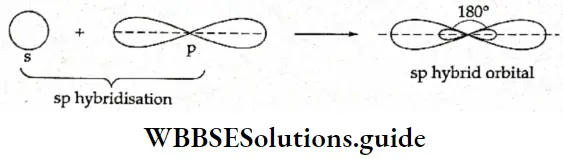
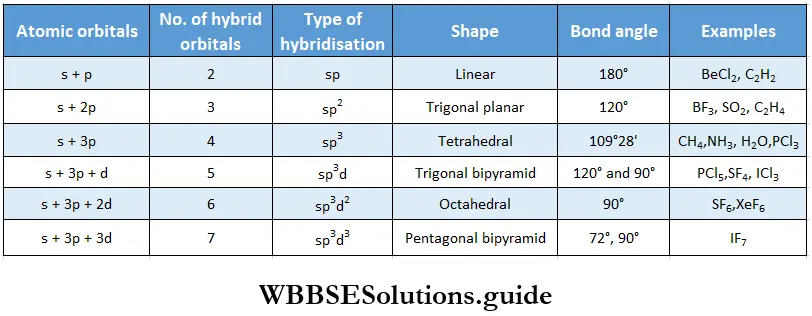
sp hybridization When one s and one p orbital belonging to the same shell of an atom hybridize to form two new orbitals, the type of hybridization is called sp hybridization. The new orbitals formed are called sp hybrid orbitals. The two sp hybrid orbitals orient themselves at an angle of 180° to reduce repulsion to the minimum.

Basic Chemistry Class 11 Chapter 4 Bonding And Molecular Structure Types Of Hybridisation

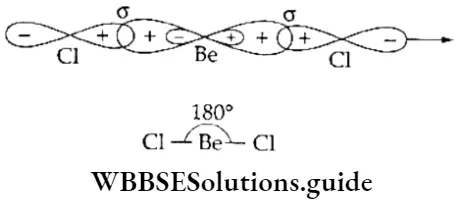
Let us consider beryllium chloride (BeCl2)- The central atom, Be, has two electrons in the 2s subshell. One of these electrons is promoted to the 2p subshell. Then the 2s and 2p orbitals undergo hybridization to form two sp-hybridized orbitals, which are linear (180° apart) and contain one electron each.

The two sp-hybridized orbitals overlap axially with the p orbitals of two chlorine atoms to form two σ bonds.

Basic Chemistry Class 11 Chapter 4 Bonding And Molecular Structure Beryllium Chloride

Basic Chemistry Class 11 Chapter 4 Bonding And Molecular Structure Beryllium Chloride-1

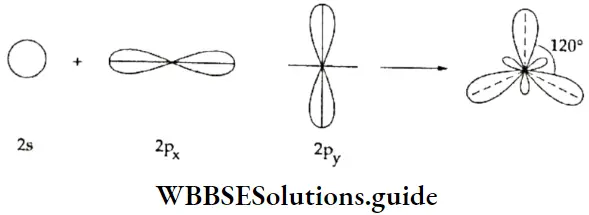
sp2 hybridisation When one s and two p orbitals of the same shell of an atom hybridise to form three hybrid orbitals of equivalent energy and identical shape, the hybrid orbitals are called sp2-hybridised orbitals.

“WBCHSE Class 11, chemistry notes, on hybridization, types, and molecular structure”

To reduce repulsion, the three sp2 hybrid orbitals orient themselves in such a way as to form angles of 120° with each other and lie in the same plane. In other words, the orbitals are directed towards the vertices of an equilateral triangle. If the sp2-hybridized central atom of a molecule is linked directly to three other atoms, the molecule is trigonal planar in shape.

Basic Chemistry Class 11 Chapter 4 Bonding And Molecular Structure Sp1 Hybridised Orbital

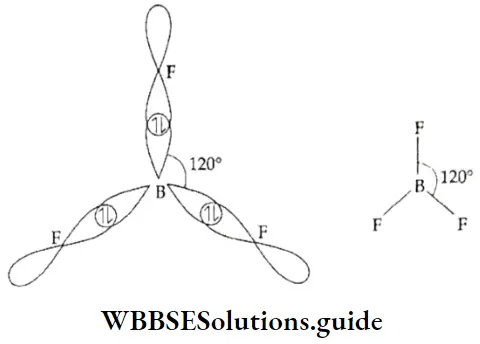
Take the case of BF3, in which the central atom, B, has three electrons in the valence shell (1s2, 2s2, 2p1). One electron is unpaired in the ground state. In the excited state, there are three unpaired electrons, one in the s and two in the p orbital.

Then one s and two p orbitals undergo sp2 hybridization, to form three sp- hybridised orbitals, which form σ bonds with the 2p orbitals of three fluorine atoms. The shape of the BF3 molecule is trigonal planar.

Basic Chemistry Class 11 Chapter 4 Bonding And Molecular Structure Structure Of BF3

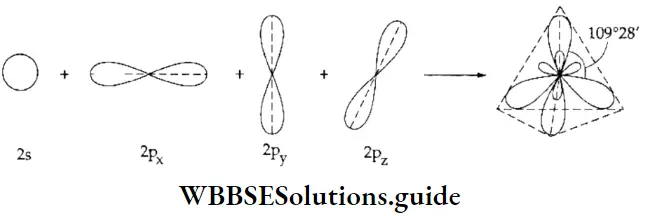
sp3 hybridization When one s and three p orbitals belonging to the same shell of an atom hybridize to form four hybrid orbitals of equivalent energy and identical shape, the new orbitals are called sp3-hybrid orbitals.

This type of hybridization is called sp3 hybridization. Molecules in which the sp3– hybridised orbitals of the central atom form bonds with four other atoms are tetrahedral in shape. This is because the sp3 -hybridised orbitals are directed toward the vertices of a tetrahedron.

The angle between sp3 – hybridised orbitals, and consequently the bond angle of tetrahedral molecules, is 109°28′.

Basic Chemistry Class 11 Chapter 4 Bonding And Molecular Structure Formation Of sp3 Hybridised Orbital

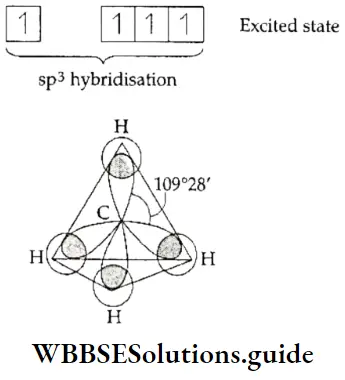
In methane, the carbon atom is sp3 – hybridized. It has four sp3 -hybridised orbitals containing one electron each. The carbon atom shares these electrons with four hydrogen atoms. In other words, all the hybridised orbitals of the central atom form bonds with four atoms. This is why the methane molecule has a regular tetrahedral shape and the bond angle is 109°28′.

Basic Chemistry Class 11 Chapter 4 Bonding And Molecular Structure Metyhane Molecule

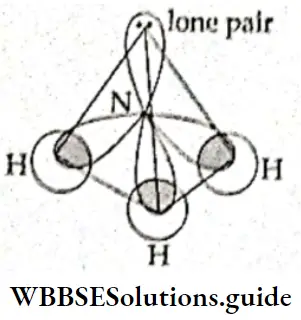
However, all molecules in which the central atom is sp3 hybridized do not have a regular tetrahedral shape. In NH3, for example, the central atom, nitrogen, has three unpaired electrons in its 2p subshell. To make three covalent bonds with three hydrogen atoms, nitrogen needs only three unpaired electrons.

“Hybridization, WBCHSE Class 11, solved examples, real-world applications, and concepts”

  • Therefore, in this case, the question of the promotion of an electron from a lower subshell does not arise. Nitrogen undergoes hybridization in the ground state. One s and three p orbitals hybridize to form sp3-hybridized orbitals. However, one orbital contains a pair of electrons that the atom does not share. The other three orbitals form sigma bonds with the Is orbitals of three hydrogen Atoms.
  • The shape of the molecule Is, thus, not regular tetrahedral because the orbital (of nitrogen) with the lone pair of electrons does not participate in bond formation. On account of unequal repulsions, the bond angle changes from the regular angle of 109°28′ to 107°, and the shape of the molecule is pyramidal.

“Hybridization, definition, types, and characteristics, WBCHSE Class 11 Chemistry”

Hybridization In Organic Chemistry WBCHSE Class 11 With Examples

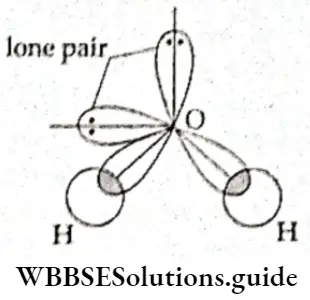
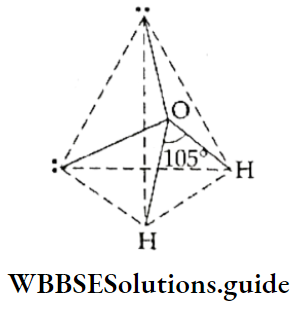
In water, the central oxygen atom sp3 hybridized, The configuration of the oxygen atom is 1s2, 2s2, 2p4. f wo p orbitals contain unpaired electrons which is all the oxygen atom needs to form bonds with two hydrogen atoms. The oxygen atom undergoes sp3 hybridization in the ground state.

Basic Chemistry Class 11 Chapter 4 Bonding And Molecular Structure NH3 Molecule

Basic Chemistry Class 11 Chapter 4 Bonding And Molecular Structure H2O Molecule

An s orbital containing two electrons, a p orbital containing two electrons, and two p orbitals containing an electron each undergoes hybridization. Two of the hybrid orbitals contain a pair of electrons each and do not participate in bond formation.

The other two (containing one electron each) form σ bonds with the 1s orbitals of two hydrogen atoms. The unequal repulsion on account of the two lone pairs of electrons reduces the bond angle to 105°.

“WBCHSE Class 11 Chemistry, hybridization, features, importance, and applications”

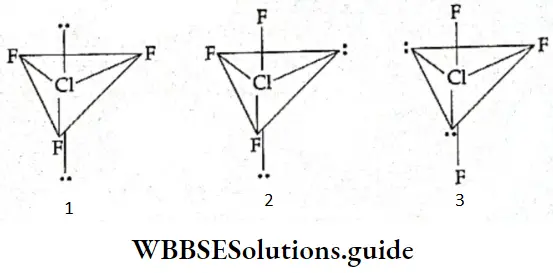
sp3d hybridization This type of hybridization entails the intermixing of one s, one d, and three p orbitals. Five equivalent sp3d hybrid orbitals are formed. The central atoms of PCl5, SF4, and ICl3 are sp3d hybridized.

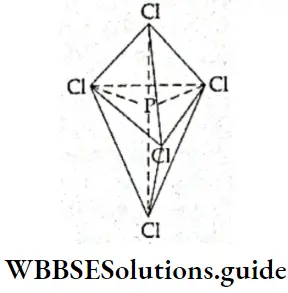
In PCI5, the central atom has only three unpaired electrons in its 3p subshell in the ground state.

⇒ \(\left({ }_{19} \mathrm{P}-1 \mathrm{~s}^2, 2 \mathrm{~s}^2, 2 \mathrm{p}^6, 3 \mathrm{~s}^2, 2 \mathrm{p}_x^1, 3 \mathrm{p}_y^1, 3 \mathrm{p}_z^1\right) \text {. }\).

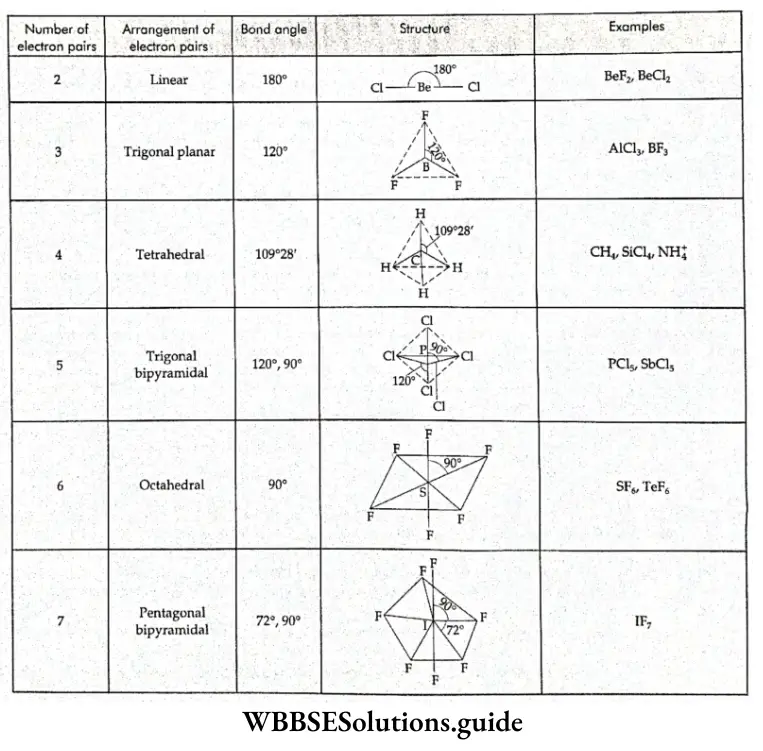
To make five covalent bonds with five chlorine atoms, phosphorus needs five unpaired electrons which are present in the excited state. Then one 3s, three 3p and one 3d orbital undergo sp3d hybridisation. The five hybrid orbitals form sigma bonds with the orbitals of five chlorine atoms. The shape of the molecule is regular trigonal bipyramidal and bond angles arc 120° and 90°.

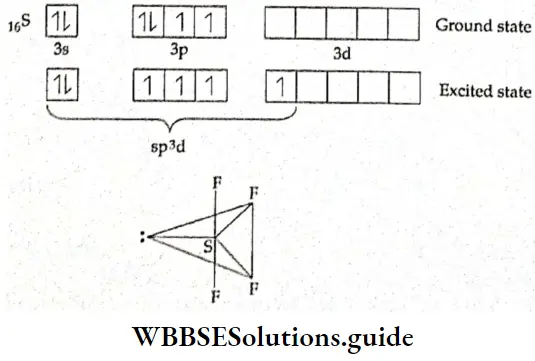
In SF4, the central atom, sulphur, has only two unpaired electrons \(\left(1 \mathrm{~s}^2, 2 \mathrm{~s}^2, 2 \mathrm{p}^6, 3 \mathrm{~s}^2, 3 \mathrm{p}_x^2, 3 \mathrm{p}_y^1, 3 \mathrm{p}_z^1\right)\).

“WBCHSE Class 11 Chemistry, hybridization, sp, sp², sp³ types, and examples”

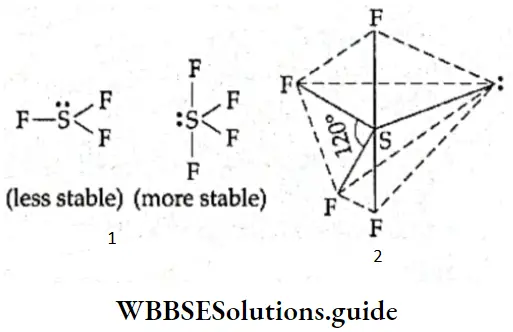
To make four covalent bonds the sulphur atom needs four unpaired electrons. Therefore, one electron from the 3px orbital is promoted to the 3d orbital. Then one s, three p, and one d orbitals undergo sp3d hybridisation. Four of the hybrid orbitals form sigma bonds with four fluorine atoms. The fifth hybrid orbital contains a lone pair of electrons.

Basic Chemistry Class 11 Chapter 4 Bonding And Molecular Structure SF4

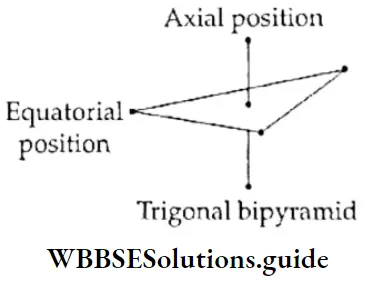
The central atom is, thus, surrounded by a lone pair and four bonded pairs of electrons. In order to reduce repulsion to the minimum, the lone pair occupies an equatorial position. ‘Hie unequal repulsion on account of the presence of a lone pair gives rise to a distorted trigonal bipyramidal geometry.

sp3d2 hybridisation This involves the intermixing of one s, three p, and two d orbitals. The sp3d2 hybridised f central atom of a molecule is linked directly to six other atoms, the shape of the molecule is regular octahedral.

⇒ \({ }_{16} s-1 \mathrm{~s}^2, 2 \mathrm{~s}^2, 2 \mathrm{p}^6, 3 \mathrm{~s}^2, 3 \mathrm{p}_x^2, 3 \mathrm{p}_y^1, 3 \mathrm{p}_z^1\)

  • Let us consider the formation of sulfur hexafluoride (SF6). The central atom in the ground state has two unpaired electrons in the 3p subshell. In the excited slate, the electrons from the 3s and the 3p subshell are promoted to the 3d subshell.
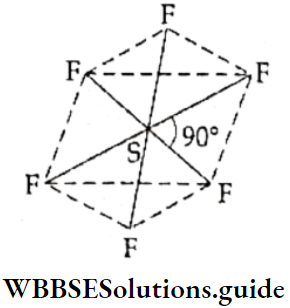
  • Thus one s, three p, and two d orbitals intermix to form six sp3d2– hybridised orbitals. All the hybrid orbitals participate in bond formation with six fluorine atoms. Hence the shape of the SF6 molecule is regular octahedral.

“Types of hybridization, orbital overlapping, and bonding, WBCHSE Class 11 notes”

sp3d3 hybridization This involves the hybridization of one s, three p, and three d orbitals to form seven hybrid orbitals. When sp3d3 -hybridized central atom of a molecule is bounded with seven other atoms, the geometry of the molecule is pentagonal bipyramidal.

  • For example, in the IF7 the central atom has seven valence electrons but only one unpaired electron. To make seven covalent bonds, iodine needs seven unpaired electrons. Therefore, three electrons are promoted to d orbitals. Then one s, three p, and three d orbitals hybridize to form seven hybridised orbitals. The IF7 molecule has a pentagonal bipyramidal shape and the bond angles are 90° and 72°.
  • We have already mentioned earlier in the chapter that there are many exceptions to the octet rule. While going through the discussion on hybridization, you would have observed that generally, the molecules in which bonds are formed using s-p-d hybrid orbitals are exceptions to the octet rule. This implies that the octet rule is broken when atoms have an extra energy level, which is close in energy to the p level. This means the octet rule is more likely to be violated in elements having vacant d orbitals.

Basic Chemistry Class 11 Chapter 4 Bonding And Molecular Structure Pentagonal Bipyramid

Basic Chemistry Class 11 Chapter 4 Bonding And Molecular Structure Types Of Hybridisation (2)

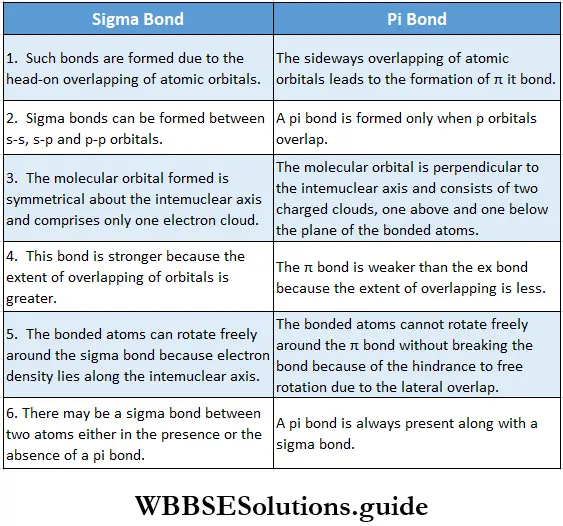
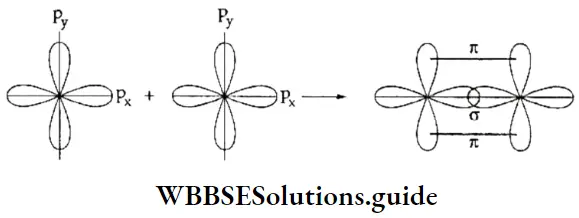
Molecules containing π bond: Pi bonds are formed by the sideways overlapping of atomic orbitals which have electron clouds perpendicular to the internuclear axis.

Hybrid orbitals cannot form π bonds since their electron densities are parallel to the internuclear axis. Only pure p and d orbitals with electron densities perpendicular to the internuclear axis can overlap laterally to form π bonds.

The π bonds are not responsible for the shape of a molecule. That it is determined by the σ bonds. Pi bonds just shorten the bond lengths in a molecule. Let us consider a few examples of the formation of π bonds.

“Hybridization, molecular shapes, bond angles, and examples, WBCHSE syllabus”

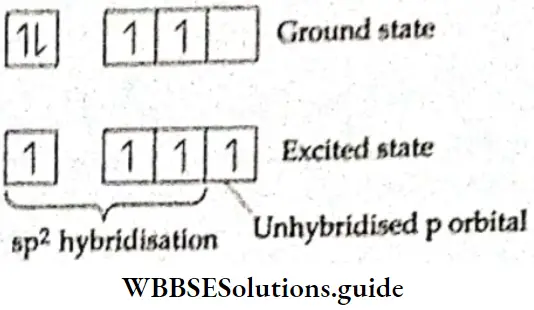
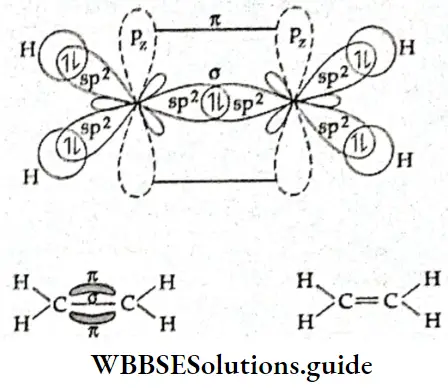
Structure of ethene In the ethene (C2H4) molecule, each carbon atom is sp2 hybridized. One of the 2s electrons gets promoted to the 2p subshell. Then one 2s and two 2p orbitals of the excited carbon atom undergo hybridization to form three sp2 hybridized orbitals. The remaining p orbital does not participate in hybridization.

⇒ \({ }_6 \mathrm{C}-1 \mathrm{~s}^2, 2 \mathrm{~s}^2, 2 \mathrm{p}_x^1, 2 \mathrm{p}_y^1\)

Class 11 WBCHSE Chemistry Hybridization Types And Their Applications

The three sp2– hybridized orbitals lie In some pi one and are at an angle of 120° with each other, One sp2 -hybridized orbital of one carbon atom overlaps axially with one sp2– hybridized orbital of the other carbon atom to form a σ bond. The remaining two sp2– hybrid orbitals of each carbon atom overlap with the half-filled Is orbital of H atoms along their respective Internuclear axes to form four σ bonds.

Basic Chemistry Class 11 Chapter 4 Bonding And Molecular Structure One p Orbital Of Each Carbon Atom In

The unhybridized 2p orbital of each carbon atom Is perpendicular to the plane of the hybridized orbitals, or the internuclear axis. These two pure p orbitals overlap sideways to form a rc bond between the two carbon atoms.

The C—C bond length in the ethanol molecule is 134 pm as compared to 154 pm in the ethane (C2H2) molecule. In the ethane molecule, like methane, the two carbon atoms are sp3 hybridized. All the bonds in the ethane molecule—one C—C and six C—H— are σ bonds.

“WBCHSE Class 11, chemistry notes, on hybridization, VSEPR theory, and geometry”

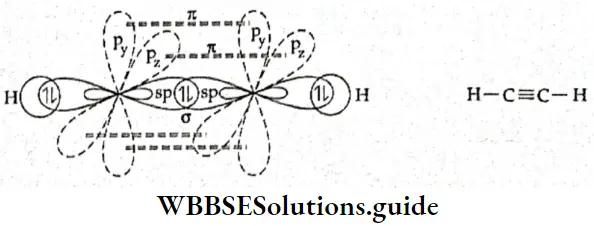
Structure of acetylene (ethyne) In acetylene (C2H2), each carbon atom undergoes sp hybridization. Each carbon atom has two sp- sp-hybridized orbitals oriented at an angle of 180° to each other and two pure p orbitals that arc perpendicular to each other and the plane of the sp-hybrid orbitals.

  • One sp-hybrid orbital of one carbon atom overlaps axially with one sp-hybrid orbital of the other carbon atom to form a C—C σ bond. The second sp-hybrid orbital of each carbon atom overlaps axially with the half-filled Is orbital of a hydrogen atom to form two C—H σ bonds.
  • The unhybridized 2py orbital of the first carbon atom overlaps sideways with the 2py orbital of the second carbon atom, forming a π bond between the two carbon atoms. Similarly, the unhybridized 2pz orbital of one carbon atom overlaps sideways with the 2pz orbital of the other carbon atom to form another n bond between the two carbon atoms.
  • All the carbon and hydrogen atoms lie linearly in the same plane. The electron clouds of one n bond lie above and below the internuclear axis, while the electron clouds of the other π bond lie in front and at the back of the axis. The C—C bond length in the ethyne molecule is 120 pm. This shows that pi bonds shorten the bond length in a molecule.

Basic Chemistry Class 11 Chapter 4 Bonding And Molecular Structure Formation Of Ethene Molecule

Basic Chemistry Class 11 Chapter 4 Bonding And Molecular Structure Structure Of Ethyne Molecule

WBCHSE Class 11 Chemistry Notes For Valence Bond Theory

WBCHSE Class 11 Chemistry Notes On VSEPR Theory and Molecular Shapes

So far we have discussed Lewis structures and geometrical shapes of molecules. Perhaps, the Lewis theory was the first explanation of a covalent bond in terms of electrons. The theory, however, fails to explain the difference in energies of similar bonds.

Similarly, the VSEPR theory fails to explain the formation of chemical bonds. To overcome these limitations two modem theories were proposed—valence bond theory and molecular orbital theory—which are based on quantum mechanics.

“WBCHSE Class 11 Chemistry, Valence Bond Theory, notes, and key concepts”

This concept is based upon the fact that all systems in the universe tend to have the lowest possible potential energy because the lowering of energy leads to stability. According to the modern theory of bonding, atoms form bonds with each other in order to have the minimum possible energy.

Another way of putting this is that atoms combine with each other only if such a combination is accompanied by a decrease in energy, or that bond formation is accompanied by the release of energy.

Read and Learn More WBCHSE For Class11 Basic Chemistry Notes

WBCHSE Class 11 Chemistry Notes For Valence Bond Theory

Valence bond theory: This theory was proposed by Linus Pauling who was awarded the Nobel Prize for chemistry in 1954. The basis of this theory is the Lewis concept of electron-pair bond.

  • To understand the theory qualitatively and know why the formation of a bond between two (or more) isolated atoms leads to the lowering of the energy of the ‘system’ of atoms of the molecule, let us consider the formation of a simple molecule—hydrogen.
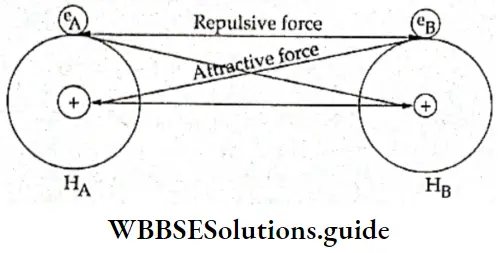
  • The hydrogen atom has only one electron, which is under the field of influence of the nucleus of the atom. Let us consider two such hydrogen atoms, HA  and HB, which have electrons eA and eB in their valence shells respectively. When these two atoms are far apart there are no forces of attraction or repulsion between them. Now suppose the two atoms start approaching each other.
  • At some point, the electron of one will start being attracted by the nucleus of the other. On the other hand, each nucleus will repel the other and the two electrons will also repel each other.

Basic Chemistry Class 11 Chapter 4 Bonding And Molecular Structure Forces Of Attraction And Repulsion Between Two Hydrogen Atoms

It has been found that in the beginning the magnitude of the forces of attraction is greater than that of the forces of repulsion. So, the atoms keep drawing closer and the potential energy of the system (i.e., the two atoms) keeps decreasing.

Class 11 Biology Class 11 Chemistry
Class 11 Chemistry Class 11 Physics
Class 11 Biology MCQs Class 11 Physics MCQs
Class 11 Biology Class 11 Physics Notes

“Valence Bond Theory, WBCHSE Class 11, chemistry notes, and explanation”

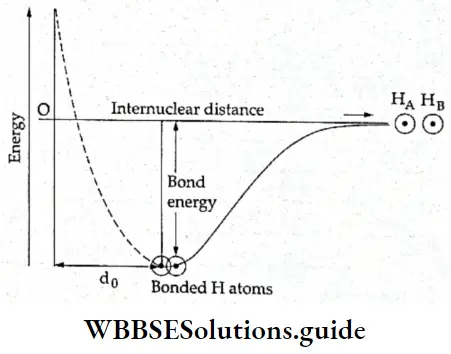
  • However, as the atoms approach each other, the magnitude of the repulsion forces keeps increasing and a point is reached where the forces of repulsion just balance the forces of attraction. This is the point at which the system has the lowest potential energy, and consequently, the greatest stability.
  • Let us call the distance between the two atoms at this point d0. If the atoms were to come closer than this distance, the magnitude of the repulsive forces would exceed that of the attractive forces and the energy of the system would increase, leading to the instability of the molecule. Figure shows the variation of the energy of the system with intemuclear distance (distance between the two atoms).
  • As shown in Figure, the energy of the two-atom system (or the molecule) is the least when the distance between them is d0. It is far less than the energy of the two isolated atoms. This is why atoms form bonds—to gain stability. The greater the number of bonds formed, the greater is the lowering of energy and the stability of the system.
  • In fact, some atoms even form more bonds than required to complete their octet, for example, phosphorus in PCI5, and sulphur in SF6. The quantum theory of bonding can, thus, explain why the octet rule is not always obeyed in bond formation.

Basic Chemistry Class 11 Chapter 4 Bonding And Molecular Structure Potential Energy Curve For Hydrogen Molecule

Bond length: The distance d0 between the centres of the nuclei of two bonded atoms is called the bond length. At this distance the forces of attraction and repulsion between the bonded atoms just balance each other, also the orbitals of the two atoms overlap partially.

The greater the extent of overlapping, the shorter is the bond length, and the stronger the bond. The bond length depends upon

  1. The size of the atoms and
  2. The nature of the bonds.
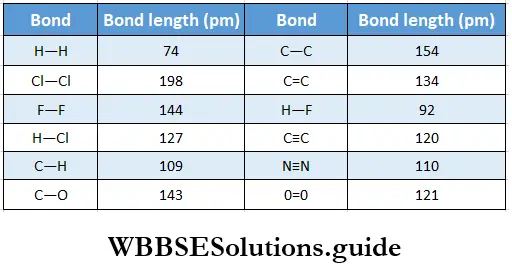
  • It increases with the size of atoms because the extent of overlapping of the orbitals decreases as the size of the atoms increases. For example, the H—Cl bond length in the HCl molecule is 127 pm, whereas the C—Cl bond length is 177 pm.
  • The bond length decreases with the multiplicity of bonds because the greater the number of electrons shared by two atoms, the greater is the force of attraction between them.

Basic Chemistry Class 11 Chapter 4 Bonding And Molecular Structure Bond Length Of Some Common Bonds

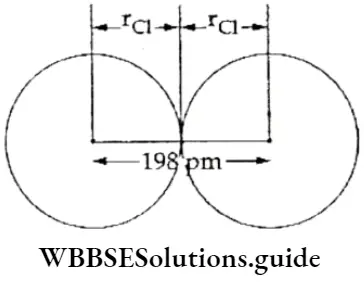
Each atom in a bond contributes to the bond length. The contribution of each atom, in case of a covalent bond, is the covalent radius of that atom. Consider a molecule of chlorine, where the two chlorine atoms are bonded together by a single covalent bond.

The bond length in the molecule is 198 pm. Here rCl is the covalent radius of the chlorine atom, which is 99 pm. Therefore, we may conclude that the bond length in a covalent molecule is equal to the sum of the covalent radii of the atoms which are bonded together.

Basic Chemistry Class 11 Chapter 4 Bonding And Molecular Structure The Bond Length In Chlorine Molecule

Bond enthalpy: The energy corresponding to the lowest point (minima) in the potential energy curve is called the bond energy. It is the amount of energy released when one mole of covalent bonds is formed.

“WBCHSE Class 11, chemistry notes, on Valence Bond Theory, and its postulates”

The amount of energy released during the formation of a bond between two atoms is also the amount of energy required to break the bond between the two atoms or to separate them.

This is called the bond dissociation enthalpy (or bond enthalpy). Thus, the bond dissociation enthalpy is the amount of energy required to break one mole of bonds of the same kind so as to separate the bonded atoms in the gaseous state. For a homonuclear diatomic molecule, the bond enthalpy is equal to the bond dissociation enthalpy.

Consider an example of a homonuclear diatomic molecule like H2

⇒ \(\mathrm{H}_2(\mathrm{~g}) \rightarrow \mathrm{H}(\mathrm{g})+\mathrm{H}(\mathrm{g}) ; \Delta_{\mathrm{g}} H^{\ominus}=435.8 \mathrm{~kJ} \mathrm{~mol}^{-1}\)

Similarly, for a heteronuclear diatomic molecule like HCl, we have

⇒ \(\mathrm{HCl}(\mathrm{g}) \rightarrow \mathrm{H}(\mathrm{g})+\mathrm{Cl}(\mathrm{g}) ; 4_{\mathrm{L}} H^{\ominus}=4310 \mathrm{~kJ} \mathrm{~mol}^{-1}\)

“Valence Bond Theory, sigma and pi bonds, resonance, and bonding strength, WBCHSE syllabus”

Molecular Geometry And Bond Angles For WBCHSE Class 11 Chemistry

  • The magnitude of the bond enthalpy depends upon the (1) size of the participating atoms and (2) the multiplicity of bonds. The larger the size of the atoms involved in bond formation, the lesser the extent of overlapping and the smaller the amount of energy released.
  • For example, the bond enthalpy of the C—C bond is 348 kJ mol-1, whereas that of the H—H bond is 433 kJ mol-1. Tire magnitude of the bond enthalpy increases with the multiplicity of bonds.
  • This is because the greater the number of shared electron pairs, the more is the attraction between two atoms, and the greater the energy released during bond formation. The bond enthalpies for the oxygen molecule (O=O) and nitrogen molecule (N≡N) are 498 kJ mol-1 and 946 kJ mol-1 respectively. A larger bond enthalpy implies a stronger bond.

Bond order: The bond order in a covalent molecule or polyatomic ion is the number of bonds present between the atoms of the molecule or ionic species.

  • If we consider the examples, O2 and N2, the bond orders will be 1, 2, and 3 respectively. The bond orders correspond to the number of shared electron pairs, which is one in hydrogen (H—H), two in oxygen (O=O), and three in nitrogen (N≡N).
  • Isoelectronic species have the same bond orders. Consider the example of the peroxide ion, \(\mathrm{O}_2^{2-}\) (Na2O2 contains a peroxide ion), and the fluorine molecule, F2. Both \(\mathrm{O}_2^{2-}\) and F2 have 18 electrons. The oxygen molecule contains a total of 16 electrons (2 + 6 = 8 in each oxygen atom).
  • Therefore, the \(\mathrm{O}_2^{2-}\) ion has 18 electrons. The atomic number of fluorine is 9. Therefore, the F2 molecule has 18 electrons (2 + 7 = 9 electrons in each atom). Both \(\mathrm{O}_2^{2-}\) ion and F2 molecule are formed by sharing of one electron pair between the two atoms. Thus, both \(\mathrm{O}_2^{2-}\) and F2 have bond order 1.
  • Generally speaking, with the increase in bond order, bond enthalpy increases and bond length decreases.

Bond angle: Covalent bonds are directional in nature. The atoms constituting a molecule have a three-dimensional arrangement which can be inferred from the spectral data of that compound. The positions of constituent atoms in a molecular structure are fixed.

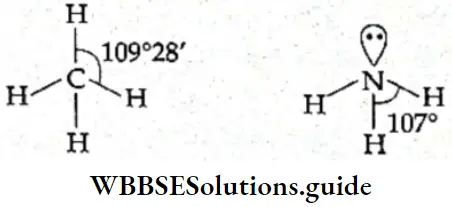
Basic Chemistry Class 11 Chapter 4 Bonding And Molecular Structure Bond Angles In CH4 And NH3

The position of each atom is determined by the nature of the chemical bond(s) that exist between that atom and the neighboring atoms. The angle that is formed between bonds sharing a common atom is called the bond angle.

The bond angle is expressed in degrees/minute/seconds. For example, the C—H bond angle in methane is 109°28′ and the N—H bond angle in ammonia is 107°.

“Valence Bond Theory, definition, importance, and applications, WBCHSE syllabus”

Concept of orbital overlap: When we say that two atoms are covalently bonded we mean that they share electrons. Take the case of the formation of the hydrogen molecule. The two isolated atoms form a molecule when their internuclear distance is d0 and the potential energy of the two atoms together is the least possible.

At this point, the electrons of the atoms are under the influence of both the nuclei. In other words, the two atoms share a pair of electrons.

  • Now two atoms cannot share electrons if the electrons occupy two different regions of space. In other words, the two electrons are contained by the molecular orbital formed by the overlapping of the atomic orbitals. Tire filling of the molecular orbital must take place in accordance with the Pauli exclusion principle, i.e., since the two electrons occupy the same region of space, they must have opposite spins. The two atomic orbitals which participate in overlapping thus must be half-filled.
  • This simple principle of orbital overlapping can explain not only the formation of the H2 molecule, but also why H3 and H4 are not formed, or why He2 is not formed. The hydrogen atom has a half-filled Is orbital. When two hydrogen atoms combine to form a molecule, the two Is orbitals (containing electrons with opposite spins) combine to form a molecular orbital.

“WBCHSE Class 11, chemistry notes, on Valence Bond Theory, and comparison with Molecular Orbital Theory”

  • This molecular orbital gets completely filled by the two available electrons and no electron is left over. So, the H2 molecule does not have the capacity to form bonds with more hydrogen atoms. This is why H3 and H4 do not exist.
  • The next question is why helium exists in the atomic state, or why He2 does not exist. The Is orbital of the helium atom is completely filled with the two electrons it contains. The Pauli exclusion principle forbids the overlapping of this orbital with the Is orbital of another helium atom. We can now summarise the orbital concept of the formation of covalent bonds.
  1. Covalent bonds are formed due to the overlapping of half-filled atomic orbitals.
  2. The atomic orbitals which overlap must contain electrons with opposite spins.
  3. Overlapping of atomic orbitals results in a decrease in energy.

The greater the extent of overlapping, the greater the energy released during bond formation and the stronger the bond.

Class 11 WBCHSE Chemistry Molecular Shapes And Geometry Explained

Types of covalent bonds: Covalent bonds are classified into two types based on the kind of overlapping that takes place between the atomic orbitals. These are

  1. The sigma (σ) bond and
  2. The pi (π) bond.

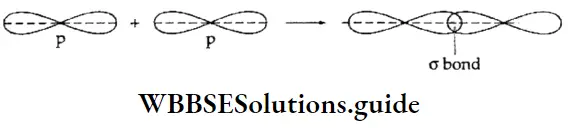
Sigma (σ) bond A σ bond is said to be formed between two atoms when their orbitals overlap along the internuclear axis. In other words, the axial or head-on overlapping of the orbitals of two atoms results in the formation of a σ bond between them.

“Valence Bond Theory, covalent bonding, hybridization, and limitations, WBCHSE notes”

The molecular orbital formed as a result of axial overlapping is symmetrical about the internuclear axis. This allows the rotation of the bonded atoms about the σ bond without breaking the bond.

The electrons constituting a σ bond are called sigma electrons. σ bonds can be formed by the overlapping of the following atomic orbitals.

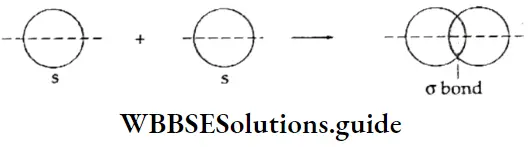
s-s overlapping The s-s σ bond is formed when the half-filled (s) orbitals of two atoms overlap.

Basic Chemistry Class 11 Chapter 4 Bonding And Molecular Structure s-s Overlapping

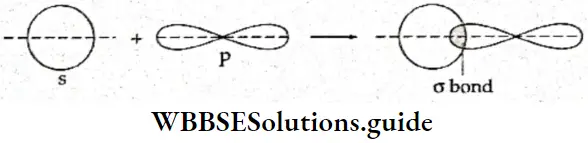
s-p overlapping The overlapping of the half-filled s orbital of one atom with the half-filled p orbital of another, leads to the formation of the s-p σ bond.

Basic Chemistry Class 11 Chapter 4 Bonding And Molecular Structure s-p Overlapping

p-p overlap The p-p σ bond involves the overlapping of the half-filled p orbitals of two atoms. The first bond formed between two p orbitals is a sigma bond because these atomic orbitals can approach each other head on.

Basic Chemistry Class 11 Chapter 4 Bonding And Molecular Structure p-p Overlap

Pi (π) bond The lateral or sideways overlapping of atomic orbitals is called a π bond. The overlapping occurs in such a way that the orbitals are parallel to each other, but perpendicular to the intemuclear axis. Two electron clouds are formed in this kind of bond formation—one above and one below the plane of the atoms involved in the formation of the bond.

Basic Chemistry Class 11 Chapter 4 Bonding And Molecular Structure pi Bond

The electrons participating in the formation of a π bond are called π electrons. The formation of a π bond between two atoms restricts the rotation of the atoms about the π bond.

The first bond formed between two atoms is always a σ bond because the atomic orbitals are free to approach head on. The extent of overlapping is greater in a σ bond than in a π bond, so σ bonds are stronger.

Pi bonds are formed in addition to sigma bonds, if two atoms share more than one pair of electrons.

Basic Chemistry Class 11 Chapter 4 Bonding And Molecular Structure Differences Between Sigma And Pi Bonds

Formation of N2 and O2 molecules The electronic configuration of the oxygen atom is \(1 \mathrm{~s}^2, 2 \mathrm{~s}^2, 2 \mathrm{p}_x^2, 2 \mathrm{p}_y^1, 2 \mathrm{p}_z^1\). The py and pz orbitals, containing one electron each, are half-filled.

One of the p orbitals overlaps axially with a half-filled p orbital of another oxygen atom and forms a p-p σ sigma bond. After the formation of the sigma bond, the remaining half-filled orbitals of the two atoms are not free to approach head-on. So, these orbitals overlap sideways to form a π bond.

Basic Chemistry Class 11 Chapter 4 Bonding And Molecular Structure Formation Of Oxygen Molecule

The electronic configuration of the nitrogen atom is \(I1 \mathrm{~s}^2 2 \mathrm{~s}^2 2 \mathrm{p}_x^1 2 \mathrm{p}_y^1 2 \mathrm{p}_z^1\). All three p orbitals are half-filled.

“WBCHSE Class 11 Chemistry, Valence Bond Theory, orbital overlap, and bonding”

The px orbital of one nitrogen atom overlaps with the px orbital of another nitrogen atom along the internuclear axis to form a σ bond. The py and pz orbitals of the two atoms overlap sideways to form two π bonds.

Basic Chemistry Class 11 Chapter 4 Bonding And Molecular Structure Formation Of Nitrogen Molecule

WBCHSE Class 11 Chemistry For Shapes Of Molecules In Chemistry Notes

WBCHSE Class 11 Chemistry Notes On Shapes Of Molecules

Molecules:

Molecules of different compounds exist in certain characteristic shapes. They exhibit linear, square planar, octahedral, trigonal planar, tetrahedral, or pentagonal bipyramidal geometric forms.

Many physical and chemical properties of a compound depend on the shape of its molecule.

  • For example, the double spiral shape of DNA, a biomolecule, is responsible for many of its properties. Covalent bonds involve the overlapping of atomic orbitals. The bond is directional and tire shared electron pairs are localized in a region between the nuclei of the bonded atoms. So, the atoms constituting the molecule occupy definite positions concerning each other.
  • This definite arrangement of atoms in a molecule is known as the geometry of the molecule and the three-dimensional model obtained by joining the points representing the bonded atoms represents the shape of the molecule.
  • The study of molecular geometry is a very interesting branch of chemistry. One of the theories that explain the shapes of simple molecules is the valence shell electron pair repulsion (VSEPR) theory.

Read and Learn More WBCHSE For Class11 Basic Chemistry Notes

WBCHSE Class 11 Chemistry For Shapes Of Molecules In Chemistry Notes

VSEPR theory: This theory was proposed by Gillespie and Nyholm in 1957. According to them, the orientation of bonds around the central atom of a molecule depends upon the total number of electron pairs (bonding as well as nonbonding) in its valence shell.

These electron pairs repel each other, so they would try to be as far away from each other as possible. In other words, the most favorable geometrical arrangement would be that in which the electron pairs are as far apart as possible to minimize repulsion so that the molecule can have maximum stability. This theory rests on the following four points.

“WBCHSE Class 11 Chemistry, shapes of molecules, notes and key concepts”

1. The electron pairs surrounding the central atom are as far apart as possible so that the repulsion between them may be the least and the molecule may have the maximum stability.

Class 11 Biology Class 11 Chemistry
Class 11 Chemistry Class 11 Physics
Class 11 Biology MCQs Class 11 Physics MCQs
Class 11 Biology Class 11 Physics Notes

2. The shape of the molecule depends upon the number of electron pairs (bonded and nonbonded) surrounding the central atom.

3. The repulsion between two lone pairs of electrons is the maximum and that between two bonded electron pairs is the minimum. The repulsion between electron pairs increases in the following order.

“Molecular geometry, bond angles, hybridization, and structural shapes, WBCHSE Class 11”

Bond pair-bond pair < bond pair-lone pair < lone pair-lone pair The difference in the force of repulsion exerted by electron pairs arises because a lone pair is under the field of influence of only one nucleus while a bond pair is under the influence of two nuclei.

4. Triple bonds cause maximum repulsion, followed by double and single bonds. Molecules have a regular geometry if the forces of repulsion between the various electron pairs around the central atom are equal. If all the electrons present in the valence shell of the central atom of a molecule participate in bonding then the central atom is surrounded only by bonded electron pairs which repel each other equally, so the molecule has a regular geometry.

Basic Chemistry Class 11 Chapter 4 Bonding And Molecular Structure Geometry Of Molecules (1)If, on the other hand, the central atom has both bonded and nonbonded electrons (lone pairs) in its valence shell, the molecule has an irregular geometry. This is because the different electron pairs do not repel each other equally.
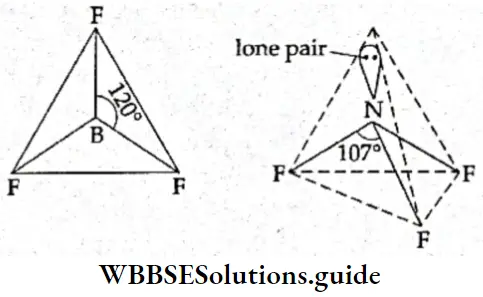
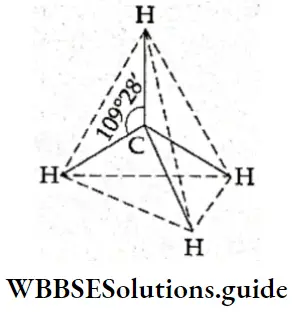
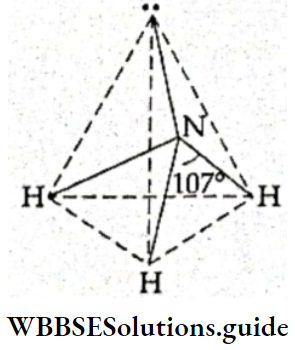
Shapes of BF3 and NF3 The electronic configuration of boron is 2, 3. In the BF3 molecule, the central atom (boron) has three electrons in its valence shell. It shares these with three fluorine atoms and forms three covalent bonds with these atoms.

Hence, all the electron pairs in the valence shell of the central atom of the BF3 molecule are bonded electron pairs, which repel each other equally. This is why the BF3 molecule has a regular trigonal planar shape and its bond angle is 120°.
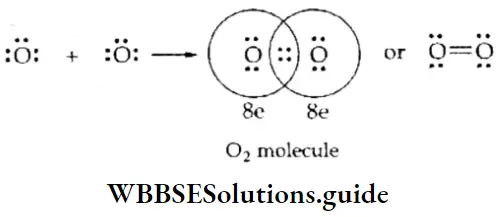
“Shapes of molecules, WBCHSE Class 11, chemistry notes, and VSEPR theory”

Shapes Of Molecules: Theory And Examples For WBCHSE Class 11 Chemistry

Shapes of Molecules and Bond Angles in Chemistry for WBCHSE Class 11

  • The electronic configuration of nitrogen is 2, 5. There are five electrons in the valence shell of the nitrogen atom but in the NF3 molecule, it uses only three of these to form covalent bonds with three fluorine atoms.
  • Thus the valence shell of the central atom of the NF3 molecule contains 4 pairs of electrons—3 bonded pairs and a lone pair. The electron pairs surrounding the central atom repel each other unequally, so the electron pairs are arranged in the shape of a distorted tetrahedron. The bond angle (107°) is less than 109.5°, which is the bond angle of a regular tetrahedral molecule.
  • Since one of the tetrahedral positions is occupied by a lone pair, the shape of the molecule is pyramidal.

Basic Chemistry Class 11 Chapter 4 Bonding And Molecular Structure Structure Of BF3 And NF3

Shapes of CH4, NH3, and H2O In methane (CH4), the central carbon atom (Z = 6) has four electrons in its valence shell. It uses all of them to form bonds with four hydrogen atoms. Thus, the central atom in methane is surrounded by four bonded electron pairs, which repel each other equally, resulting in a regular tetrahedral geometry.

  • In the ammonia molecule, the central nitrogen atom (Z = 7) has five electrons in its valence shell. It uses only three of these to form covalent bonds with three hydrogen atoms and is left with a lone pair of electrons. Thus, of the four pairs of electrons surrounding the central atom, three are bonded and one is the lone pair.
  • Had all four electron pairs been bonded, the shape would have been tetrahedral. But due to unequal repulsion, the different pairs of electrons are arranged in the shape of a distorted tetrahedron and the bond angle reduces to 107°. One of the tetrahedral positions is occupied by a lone pair, so the shape of the molecule is pyramidal.
  • In the water molecule, the central oxygen atom has six electrons in its valence shell (the electronic configuration is 2, 6). It uses two of these to form bonds with two hydrogen atoms and is left with two lone electron pairs. Thus, the central atom has four pairs of electrons in its valence shell and the shape of the molecule would have been tetrahedral, had all the pairs been bonded.

Basic Chemistry Class 11 Chapter 4 Bonding And Molecular Structure The Structure Of Methane Molecule

“WBCHSE Class 11 Chemistry, molecular shapes, electron pair repulsion, and bond angles”

But there are two bonded electron pairs and two nonbonded electron pairs which repel each other more strongly than the bonded pair. Tire electron pairs arrange themselves in the shape of a distorted tetrahedron and the angle reduces to 105°. Two of the tetrahedral positions are occupied by lone pairs, so the shape of the molecule is bent.

Basic Chemistry Class 11 Chapter 4 Bonding And Molecular Structure The Structure Of Ammonia Molecule

Basic Chemistry Class 11 Chapter 4 Bonding And Molecular Structure The Struture Of Water Molecule

Shapes of PCl3 and PCl5 In PCl3 the central phosphorus atom has five electrons in its valence shell (electronic configuration 2, 8, 5). It uses only three of these to make three covalent bonds and is left with a lone pair of electrons.

Due to the unequal repulsion between the bonded electron pairs and the nonbonded electron pair, the arrangement of electron pairs is distorted tetrahedral with bond angle 107°. The shape of the molecule is pyramidal.

“WBCHSE Class 11, chemistry notes, on molecular geometry, and bonding theories”

Class 11 Chemistry Notes On Molecular Shapes And VSEPR Theory WBCHSE

  • In PCl3, phosphorus uses all the five valence electrons to form covalent bonds with five chlorine atoms. Thus, the valence shell of the central atom of PCl3 contains five bonded electron pairs which repel each other equally. Hence, the shape of the molecule is (regular) trigonal bipyramidal.
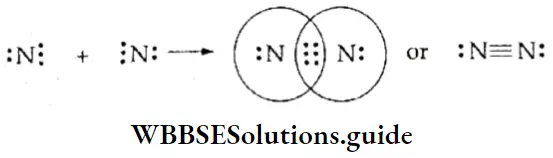
  • Note that the bond angles in a trigonal bipyramidal arrangement arc not equal. This is one of the few cases (like a pentagonal bipyramid) where the bond angles arround an atom are not the same. Out of the five P—Cl sigma bonds, three lie in one plane and make an angle of 120° with each other.
  • These are equatorial bonds. The other two P—Cl sigma bonds are oriented at right angles to the equatorial plane. One lies above and the other below the equatorial plane. In other words, the two bonds occupy axial positions and are known as axial bonds.

Basic Chemistry Class 11 Chapter 4 Bonding And Molecular Structure The Structure Of PCL5 Molecule

Shape of SF4, SF6, and ClF3 In SF4, the central atom (sulfur) has six electrons in the valence shell (electronic configuration, 2, 8, 6). It uses four of these to form covalent bonds with four fluorine atoms and is left with one unshared pair of electrons.

The total number of electron pairs surrounding the central atom is five, and the electron pairs arrange themselves in the shape of a trigonal bipyramid.

  • In a trigonal bipyramidal structure, each axial bond experiences repulsion from three equatorial bonds at 90° and one axial bond at 180° to it, whereas each equatorial bond experiences repulsion from two equatorial bonds at 120° to it and two axial bonds at 90° to it.
  • This means that the axial bond experiences greater repulsion from the other bonds. Therefore, if lone pairs are present in the molecule, they occupy equatorial positions to reduce repulsion. Also, the axial bonds are slightly longer and weaker than the equatorial bonds.

Basic Chemistry Class 11 Chapter 4 Bonding And Molecular Structure Trigonal Bipyramidal Structure

In SF4, the unshared pair of electrons occupies the equatorial position, and due to unequal repulsion, the arrangement of electron pairs is in the shape of a distorted trigonal bipyramid (see-saw shaped).

Basic Chemistry Class 11 Chapter 4 Bonding And Molecular Structure Arrangement Of Electrons In SF4 And Shape Of SF4

“Shapes of molecules, VSEPR theory, hybridization, and examples, WBCHSE Chemistry”

In sulphur hexafluoride (SF6), the central sulphur atom shares all six valence electrons to form covalent bonds with six fluorine atoms. Thus, there are six pairs of bonded electrons in the valence shell of the central atom of the molecule, which has an octahedral (regular) shape. The bond angle is 90°.

Basic Chemistry Class 11 Chapter 4 Bonding And Molecular Structure Shape Of SF4

ClF3 or chlorine trifluoride is isoelectronic with SF4. Tire central atom of the molecule is chlorine with 7 valence electrons. It uses three electrons to form covalent bonds with three fluorine atoms and is left with four electrons or two lone pairs.

Basic Chemistry Class 11 Chapter 4 Bonding And Molecular Structure Three Different Arrangement Of ClF3 Molecule

  • Thus, Cl atom in the ClF3 molecule has five electron pairs and is therefore expected to have a basic trigonal bipyramidal shape. Since all the bond angles are not the same trigonal bipyramidal is not a regular shape. Lone pairs occupy two corners and fluorine atoms occupy the other three comers. Theoretically, three different arrangements are possible for this molecule.
  • As a rule, if more than one lone pair exists in a trigonal bipyramid they will be located in the equatorial position rather than the axial positions to minimise the repulsive forces. On applying this to ClF3 molecule, we find the structure shown in Figure (T-shaped) to be the most stable, as lone pairs are in the equatorial position. Now let us summarise the shapes of few simple molecules with the central atom having one or more than one lone pair of electrons.

Basic Chemistry Class 11 Chapter 4 Bonding And Molecular Structure Types Of Molecules

The VSEPR theory can also be extended to molecules with multiple bonds. For example, CO2 and SO2. Carbon is sp hybridized in CO3 and the shape of the molecule is linear. Sulfur is sp2 hybridized in SO2 and the shape of the molecule is bent. The bond angle reduces only a little from 120° to 119.5°, and although bond pair-lone pair repulsion exists, the double bond occupies more space.

WBCHSE Class 11 Chemistry Notes For Covalent Bond – Definition, Formation, Properties And Types

WBCHSE Class 11 Chemistry Notes On Covalent Bonding And Its Applications Covalent Bond

Ionic bonds are formed when one atom loses electrons to achieve a stable configuration and the other atom accepts those electrons to complete the octet in its outermost shell. But what about atoms that have 4 electrons in their valence shell?

  • It would be difficult for such an atom to either lose or gain 4 electrons. And what happens when both the atoms are short of electrons? Neither can gain electrons from the other to complete its octet, for example, when two chlorine atoms combine to form a Cl2 molecule.
  • Lewis suggested that such atoms can complete their octets by sharing electrons. The bond formed between atoms of the same or different elements due to the mutual sharing of electrons is called a covalent bond.
  • In the formation of a covalent bond between two atoms, both atoms contribute an equal number of electrons. When two atoms contribute one electron each to form a bond, this shared pair of electrons is common to both atoms.
  • These two electrons which are responsible for the formation of the bond are called the bonded pair or shared pair of electrons. You have already studied the Lewis structures earlier in the chapter. Let us draw Lewis dot structures for a few covalent molecules.

Read and Learn More WBCHSE For Class11 Basic Chemistry Notes

WBCHSE Class 11 Chemistry Notes For Covalent Bond – Definition, Formation, Properties and Types

The chlorine molecule Each chlorine atom (Z = 17) has seven electrons in its valence shell (2, 8, 7) and needs one more electron to complete its octet. In the formation of the chlorine molecule, two chlorine atoms contribute one electron each and share two electrons.

“WBCHSE Class 11 Chemistry, covalent bond, definition, formation, properties, and types”

In this way both the chlorine atoms achieve the stable configuration of eight electrons in their outermost shell. The sharing of electrons by two chlorine atoms or the formation of a bond between them is shown in Figure.

Basic Chemistry Class 11 Chapter 4 Bonding And Molecular Structure Partial Overlapping Of Orbitals

  • The shared pair of electrons completes the outermost shells of both the bonded atoms and is present in a region between the two bonded atoms. These two electrons are attracted by the nuclei of both atoms. Thus they are held together by a strong attractive force, and form a covalent bond.
  • In the formation of a covalent bond, like the one between two chlorine atoms, there is a partial overlapping of atomic orbitals. In other words, a part of the electron cloud of each of the two half-filled atomic orbitals overlaps. Thus, the covalent bond is formed in the direction of overlapping, and unlike an ionic bond, it is directional.
  • All the electrons in the valence shell may or may not be involved in bonding. In the formation of the chlorine molecule, for example, there is only one shared pair of electrons. Each chlorine atom is left with three pairs of unshared electrons. Such electron pairs are called nonbonding, unshared, or lone pairs of electrons.
Class 11 Biology Class 11 Chemistry
Class 11 Chemistry Class 11 Physics
Class 11 Biology MCQs Class 11 Physics MCQs
Class 11 Biology Class 11 Physics Notes

The Ammonia Molecule A nitrogen atom has five electrons in the outermost shell. It shares three of these and attains an octet. Hydrogen has only one electron, it needs one more electron to complete its Is orbital.

The nitrogen atom and each of the hydrogen atoms contribute one electron each to the bonded pair. The electron pair left unshared on the nitrogen atom is the lone pair.

Basic Chemistry Class 11 Chapter 4 Bonding And Molecular Structure Ammonia Molecule

The Carbon Tetrachloride Molecule A carbon atom has four valence electrons. It shares all four electrons with four chlorine atoms to attain an octet in the carbon tetrachloride molecule. Each of the chlorine atoms also attains an octet.

Basic Chemistry Class 11 Chapter 4 Bonding And Molecular Structure Carbon Tetrachloride Molecule

Multiple Covalent Bonds: When two atoms share only one pair of electrons, the bond formed between them is called a single covalent bond. The chlorine, ammonia, and carbon tetrachloride molecules contain single covalent bonds.

There is one single covalent bond in a chlorine molecule. The ammonia and carbon tetrachloride molecules contain three and four single covalent bonds respectively.

“Covalent bond, WBCHSE Class 11, chemistry notes, and key concepts”

Properties Of Covalent Bond In Class 11 Chemistry WBCHSE

Now, two atoms can share more than one pair of electrons. When two atoms share more than one pair of electrons, the bond between the atoms is called a multiple covalent bond.

When two atoms share two pairs of electrons, the bond between the atoms is called a double covalent bond and when three pairs of electrons are shared by two atoms, the bond formed between them is called a triple covalent bond.

The Oxygen Molecule The oxygen atom (Z = 8) has six electrons in its valence shell (2,6), so it needs two more electrons to complete its outermost cell. In the formation of the 02 molecule, the two oxygen atoms, therefore, contribute two electrons each and share two pairs of electrons. Thus, in the oxygen molecule, the two oxygen atoms are held by a double bond.

Basic Chemistry Class 11 Chapter 4 Bonding And Molecular Structure Multiple Covalent Bond Oxygen Molecule

The Nitrogen Molecule The nitrogen atom (Z = 7) has five electrons in its valence shell (2,5) and needs three more electrons to complete its outermost shell. In the nitrogen molecule, therefore, each nitrogen atom contributes three electrons and the two atoms share six electrons, or three electron pairs. Thus, the nitrogen atoms in the N2 molecule are held by a triple covalent bond.

Basic Chemistry Class 11 Chapter 4 Bonding And Molecular Structure Multiple Covalent Bonds Nirogen Molecule

The Ethene Molecule An ethene molecule is formed by bonding between two carbon atoms and four hydrogen atoms. Each of the two carbon atoms combines with two hydrogen atoms forming two single covalent bonds (by sharing two of its electrons). The remaining two electrons of each carbon atom form a double bond between e two carbon atoms.

Basic Chemistry Class 11 Chapter 4 Bonding And Molecular Structure Multiple Covalent Bond Ethene Molecule

The valency of an element in a covalent compound is known as covalency or the number of electrons that it contributes to form a covalent bond in that compound. For example, the valency of Cl in Cl2 is 1, of O in O2 is 2. Similarly, the covalency of C in CCl4 is 4 and that of N in N2 is 3.

“WBCHSE Class 11, chemistry notes, on covalent bond, formation, and characteristics”

WBCHSE Class 11 Chemistry Notes On Covalent Bond Definition And Formation

Coordinate Covalent Bond: Certain atoms that have a complete octet and contain a lone pair of electrons can donate this pair to another atom that is short of electrons. When two atoms participate in this kind of sharing of electrons they are said to be bound by a coordinate bond. The coordinate bond can be looked upon as a special type of covalent bond.

  • The difference is that in the formation of a coordinate bond, the pair of electrons is contributed by only one of the bonded atoms. The atom that donates an electron pair is called the donor, while the atom that only shares the electron pair is called the acceptor. The bond is represented by an arrow (→) pointing from the donor to the acceptor.
  • From the point of view of the orbital theory, a coordinate bond involves the overlapping of an orbital (of an atom) containing a lone pair of electrons with a vacant orbital of another atom.

Basic Chemistry Class 11 Chapter 4 Bonding And Molecular Structure The Structure Of Ozone Molecule

Formation of O3 A molecule of oxygen contains two oxygen atoms that share two pairs of electrons to complete their octets. In the formation of ozone, one of these oxygen atoms donates a pair of electrons to a third oxygen atom, which contains only six electrons.

A combination that contains only NH3 and BF3 In ammonia, nitrogen has five valence electrons. Three of these are shared with three hydrogen atoms to form three covalent bonds. Ammonia still has a lone pair of electrons which can be donated to any electron-deficient atom or molecule like BF3.

Basic Chemistry Class 11 Chapter 4 Bonding And Molecular Structure Formation Of Coordinate Bond Between BF3 And NH3

Formation of SO2 Sulphur and oxygen both have six electrons in their valence shell. Each needs two more electrons to complete its octet, so they share two electrons each, thus forming a double bond with each other.

  • Now the sulfur atom still has two unshared pairs of electrons. It donates one of these pairs to another oxygen atom, which is short of two electrons.
  • Thus, in the sulfur dioxide molecule, there is a covalent bond between one of the oxygen atoms and the sulfur atom and a coordinate covalent bond between the other oxygen atom and the sulfur atom.
  • We have used Lewis dot structures to represent bonding in molecules in this chapter. These structures help to understand bonding in molecules in terms of the number of shared pairs of electrons. Thus, we get an idea about the formation of a molecule, so that a few of its properties can be predicted.
  • Remember the following basic steps while writing the Lewis dot structures of a molecule or ionic species for which the molecular formula, along with the charge (in the case of ionic species) has been given.

Basic Chemistry Class 11 Chapter 4 Bonding And Molecular Structure The Structure Of Sulphur Dioxide Molecule

  1. Write the valence shell configurations of the combining atoms. Add their valence electrons to obtain the total number of electrons required for representing the structure.
  2. For cations, subtract one electron for each positive charge from the total number of valence electrons. For anions add one electron for each negative charge to the total number of valence electrons.
  3. Write the skeletal structure of the molecule. Generally, the least electronegative atom occupies the central position in the molecule. The hydrogen atom usually occupies a terminal position in a molecule.
  4. Distribute the total number of electrons as shared pairs (for single bonds) between the atoms. The remaining electron pairs are either involved in multiple bonds or constitute lone pairs.
  5. Ensure that each bonded atom gets an octet of electrons. Now, let us write the Lewis dot structures for a few molecules.

“Covalent bond, definition, how it forms, properties, and examples, WBCHSE Chemistry”

The Nitric Acid Molecule

1. To find the total number of valence electrons available for bonding in a nitric add (HNO3) molecule, write the valence shell configurations of the combining atoms.

⇒ \(\mathrm{H}\left(1 \mathrm{~s}^1\right), \mathrm{N}\left(2 \mathrm{~s}^2 2 \mathrm{p}^3\right), \mathrm{O}\left(2 \mathrm{~s}^2 2 \mathrm{p}^4\right)\)

The total number of valence electrons is [1 + 5 + 3 x (6)] = 24.

2. The skeletal structure of HNO3 is

Basic Chemistry Class 11 Chapter 4 Bonding And Molecular Structure Skeletal Structure Of HNO3

You can write the above skeletal structure by considering the atomic structure and elemental properties of the combining atoms, which we have already studied in previous classes. Although hydrogen is the least electronegative atom, nitrogen is placed in the center of the molecule. The valency of nitrogen is 3, whereas that of hydrogen is 1. For the same reason, N is bonded with three oxygen atoms, and the hydrogen atom is bonded to one of the oxygen atoms.

3. Draw a single bond between each pair of bonding atoms and complete the octets on each oxygen atom.

Basic Chemistry Class 11 Chapter 4 Bonding And Molecular Structure Multiple Bonding Between One Of The Oxygen Atom

4. This does not complete the octet on the nitrogen atom. Therefore, we resort to multiple bonding between one of the oxygen atoms and the nitrogen atom so that each bonded atom gets an octet of electrons.

Basic Chemistry Class 11 Chapter 4 Bonding And Molecular Structure Multiple Bonding Between One Of The Oxygen Atom

The carbonate ion \(\left(\mathrm{CO}_3^{2-}\right))\)

1. To find the total number of valence electrons available for bonding, write the valence shell configurations of the combining atoms.

∴ \(C\left(2 s^2 2 p^2\right) O\left(2 s^2 2 p^4\right)\)

The total number of valence electrons is [4 + 3 x (6)] = 22. The total number of electrons available is 24 since the carbonate anion carries two negative charges.

“WBCHSE Class 11 Chemistry, covalent bonding, types, and molecular structure”

2. The skeletal structure of carbonate is

Basic Chemistry Class 11 Chapter 4 Bonding And Molecular Structure Skeletal Structure Of Carbonate

Here carbon is the least electronegative atom and therefore centrally located in the ion.

3. Draw a single bond between each pair of bonding atoms and complete the octet on each of the oxygen atoms.

Basic Chemistry Class 11 Chapter 4 Bonding And Molecular Structure Octet On Each Of The Oxygen Atom

4. In the structure, the octet of carbon is incomplete. Therefore, we resort to multiple bonding between carbon and one of the oxygen atoms.

Basic Chemistry Class 11 Chapter 4 Bonding And Molecular Structure Octet Of Carbon Is Incomplete

The octet of each bonded atom is now complete in the structure of the carbonate ion.

  • In the carbonate anion, the net negative charge is possessed by the ion as a whole and not by any individual atom (here carbon or oxygen). It is however feasible that each atom carries a charge and the charges on each atom of the polyatomic ion sum up to give the net charge.
  • Thus each atom constituting a polyatomic ion or a molecule has a formal charge. The total of formal charges in the case of a polyatomic ion should be equal to the net charge on the ion. The total of the formal charges of each atom in a neutral molecule should be equal to zero. The formal charge on an atom is the number of electrons of that atom involved in bonding. While working out the formal charge on an atom,
  1. Any nonbonding electrons associated with an atom are considered to belong to that atom, and
  2. The electrons in a bond are assigned half and half to the two atoms in the bond.
  • There is a difference between the number of valence electrons of an atom in the isolated state and the number of electrons assigned to that atom when it combines with other atoms in a molecule. This number is counted “by assuming that the atom in a molecule owns one electron of each shared pair and both the electrons of the lone pair.
  • This number varies for the same atom in different molecules. Therefore, the formal charge on an atom will not always be the same, though the number of valence electrons in the free atom is always the same. Also, different atoms of the same element in a molecule may have different formal charges.

Types Of Covalent Bonds And Their Properties WBCHSE Class 11

Consider the example of the ozone molecule. Its Lewis dot representation is

Basic Chemistry Class 11 Chapter 4 Bonding And Molecular Structure Ozone Molecule

Let us calculate the formal charge on each oxygen atom in the molecule. All the oxygen atoms have six valence electrons. The central oxygen atom marked 1 has one lone pair and three bond pairs.

∴ formal charge on oxygen atom marked 1 = 6 – 2- 1/2 x 6 = +1

The oxygen atom marked 2 has two lone pairs and two bond pairs,

∴ formal charge on oxygen atom marked 2 = 6 – 4- 1/2 x 4 = 0.

The oxygen atom marked 3 has three lone pairs and one bond pair.

∴ formal charge on oxygen atom marked 3 = 6 – 6 -1/2 x 2 = -1

Since O3 is a neutral molecule, the sum of the formal charges is zero.

In general, this simple formula can be used to calculate the formal charge (FC) on an atom in a molecule:

FC = (total number of valence electrons in the free atom) – (total number of electrons in the lone pairs) – 1/2 (total number of shared electrons)

The formal charge is calculated for the species involved in covalent bonding. If there are several possible Lewis structures for a molecule, then the values of the formal charges on its atoms help to determine the lowest energy structure. Generally, the structure with the smallest formal charges on the atoms is the one with the lowest energy.

“Types of covalent bonds, single, double, triple bonds, WBCHSE Class 11 notes”

Properties of covalent compounds, or compounds formed by covalent bonding, have the following common characteristics.

State Covalent compounds, unlike ionic compounds, exist as individual molecules in which the atoms are held together by the sharing of electrons. The intermolecular force of attraction in such compounds is generally weak. So most of these compounds exist in the liquid or gaseous state at room temperature.

Melting and boiling points Covalent compounds generally have low melting and boiling points because the inter-molecular force of attraction in such compounds is weak and not much energy is required to overcome this force.

Conductivity They are generally poor conductors of electricity because they do not contain free electrons or ions to conduct electricity.

“WBCHSE Class 11, chemistry notes, on covalent bond, polarity, and bonding strength”

Solubility They are usually insoluble in water because of the lack of interaction between the polar molecules of water and the nonpolar molecules of such compounds. But they dissolve in nonpolar solvents like benzene.

Molecular reactions Covalent compounds do not produce ions when dissolved. So, when such compounds react with other reagents, the reaction does not involve the combination of ions. It involves the cleavage of the covalent bond in the reacting species and the formation of new covalent bonds in the product molecules. Such reactions are naturally much slower than ionic reactions.

Some Basic Concepts Of Chemistry Multiple Choice Questions

Some Basic Concepts Of Chemistry Multiple Choice Questions

WBCHSE For Class11 Multiple Choice Questions Some Basic Concepts Of Chemistry

Question 1. The number of significant figures in 0.0450 is

  1. 3
  2. 4
  3. 5
  4. 2

Answer: 1. 3

Question 2. The number of significant figures in 2.345 x 10⁴ is

  1. 1
  2. 2
  3. 3
  4. 4

Answer: 4. 4

Class 11 Biology Class 11 Chemistry
Class 11 Chemistry Class 11 Physics
Class 11 Biology MCQs Class 11 Physics MCQs
Class 11 Biology Class 11 Physics Notes

“Some basic concepts of chemistry, multiple choice questions, and answers”

Question 3. Which of the following is/are mixtures?

  1. 20-carat gold
  2. Iodized salt
  3. Milk
  4. Distilled water

Answer:

  1. 20-carat gold
  2. Iodized salt
  3. Milk

Question 4. 1 mol of oxygen atoms represents

  1. 16 g of oxygen
  2. 6.022 x 10²³ atoms of oxygen
  3. 22.7 L of oxygen at STP
  4. 32 g of oxygen

Answer:

  1. 16 g of oxygen
  2. 6.022 x 10²³ atoms of oxygen
  3. 22.7 L of oxygen at STP

“MCQs on some basic concepts of chemistry, with solutions and explanations”

Question 5. Which of the following is/are heteroatomic molecules?

  1. CH4
  2. H2O
  3. O2
  4. Br2

Answer:

  1. CH2
  2. H2O

Question 6. The sum of the atomic masses of the two elements is 407.8 u. If one of them is mercury, the other element is

  1. Silver
  2. Tin
  3. Lead
  4. Bismuth

Answer: 3. Lead

Some Basic Concepts Of Chemistry MCQs For WBCHSE Class 11

Question 7. Which of the following represent/s 1 mol?

  1. 11.2 L of a gas at stp
  2. 18 g of water
  3. 23 g of sodium
  4. 100 g of calcium carbonate

Answer:

2. 18 g of water

3. 23 g of sodium

4. 100 g of calcium carbonate

“Multiple choice questions, on chemistry basics, with detailed solutions”

Question 8. The molarity of a solution containing 2.8 g of KOH in 200 mL of water is

  1. 2.8 M
  2. 0.5 M
  3. 0.28M
  4. 0.25M

Answer: 4. 0.25M

Question 9. Which of the following contains the most molecules?

  1. 1 g of H2S
  2. 1 g of H2
  3. 1 g of H2O
  4. 1 g of CH4

Answer: 2. 1 g of H2

“Basic chemistry concepts, multiple choice questions, and practice quiz”

Question 10. Which of the following has the least weight?

  1. 1 mol of water
  2. 3 gram-molecules of Cu2
  3. 0.2 mol of sucrose
  4. 1 gram-atom of Na

Answer: 1. 1 mol of water

Question 11. Which of the following will have the least volume at stp?

  1. 5g of HCl
  2. 5g of HBr
  3. 5g of HF
  4. 5g of HI

Answer: 4. 5g of HI

Question 12. According to Dalton’s atomic theory’, which of the following happens during a reaction?

  1. Atoms are destroyed.
  2. Atoms are created.
  3. Atoms are rearranged.
  4. Atoms are converted into other kinds of atoms.

Answer: 3. Atoms are rearranged.

“Some basic concepts of chemistry, important MCQs, for competitive exams”

Question 13. 1 gram-atom of nitrogen weighs

  1. 28g
  2. 14 g
  3. 7g
  4. 56g

Answer: 1. 28g

Question 14. The volume occupied by 1 mol of hydrogen is

  1. 2.24 L
  2. 11.2 L
  3. 224 L
  4. 22.7 L

Answer: 4. 22.7 L

“Some basic concepts of chemistry, MCQs, for NEET, JEE, and board exams”

Question 15. The isotopes of an element differ in

  1. The number of electrons
  2. The number of protons
  3. The number of neutrons
  4. The number of electrons + protons

Answer: 3. The number of neutrons

Question 16. The mass of a silver atom is

  1. 187.8g
  2. 6.022 x 10²³ g/m
  3. \(\frac{107.87}{6.022 \times 10^{23}} g\)
  4. 3.01 x 10²³ g

Answer: 3. \(\frac{107.87}{6.022 \times 10^{23}} g\)

Question 17. The number of grams of oxygen in 0.10 mol of Na2CO4 -10H2O is

  1. 20.8
  2. 16
  3. 32
  4. 8

Answer: 1. 20.8

“Chemistry fundamentals, multiple choice questions, and answer key”

Question 18. 1 mol each of ammonia and oxygen are made to react according to the following equation.

⇒ \(4 \mathrm{NH}_3+5 \mathrm{O}_2 \longrightarrow 4 \mathrm{NO}+6 \mathrm{H}_2 \mathrm{O}\)

Which of the statements below is/are true?

  1. 1 mol of H2O is produced.
  2. 1 mol of NO is produced.
  3. All the ammonia is consumed.
  4. All the oxygen is consumed.

Answer: 4. All the oxygen is consumed.

WBCHSE Class11 Notes For Chemical Equation – Definition, Components and Examples

Chemical Equation

Chemical Equation:

A chemical reaction can be represented by a chemical equation in which the reactants and products are represented by their molecular formulae. In other words, a chemical equation is a symbolic representation of a chemical change.

Essential of chemical equation

1. A chemical equation should represent a true chemical change. For example, the following equation represents a true chemical change.

⇒ \(2 \mathrm{NaCl}+\mathrm{H}_2 \mathrm{SO}_4 \longrightarrow \mathrm{Na}_2 \mathrm{SO}_4+2 \mathrm{HCl}\)

On the other hand, silver and hydrogen do not react to form silver hydride, so the equation given below is not a chemical equation since it does not represent a true chemical reaction.

⇒ \(2 \mathrm{Ag}+\mathrm{H}_2 \longrightarrow 2 \mathrm{AgH}\)

2. A chemical equation must be balanced, i.e., the number of atoms of each element on both sides of the equation must be the same. This follows from the law of conservation of mass.

Class 11 Biology Class 11 Chemistry
Class 11 Chemistry Class 11 Physics
Class 11 Biology MCQs Class 11 Physics MCQs
Class 11 Biology Class 11 Physics Notes

“WBCHSE Class 11 Chemistry, Chemical Equation, definition, components, and examples”

3. It should be molecular, i.e., every species involved in the reaction must be represented in its molecular form. The equation \(\mathrm{Zn}+2 \mathrm{HCl} \longrightarrow \mathrm{ZnCl}_2+2 \mathrm{H}\), for example, represents a true chemical change and is balanced, but it is still not a complete equation since hydrogen has not been expressed in its molecular form. The correct representation would be

⇒ \(\mathrm{Zn}+2 \mathrm{HCl} \longrightarrow \mathrm{ZnCl}_2+\mathrm{H}_2\)

Read and Learn More WBCHSE For Class11 Basic Chemistry Notes

Significance of a chemical equation: A chemical equation conveys a lot of information about the reaction, both qualitative and quantitative.

  1. It gives the names of the reactants and products taking part in the chemical reaction.
  2. It indicates the relative number of moles of the reactants and the products.
  3. It shows the relative masses of the reactants and products.
  4. It indicates the relative volumes of gaseous reactants and products.

Consider the information provided by the following equation.

⇒ \(\underset{\frac{40+12+3 \times 16}{100}}{\mathrm{CaCO}_3}+\underset{\frac{2(1+35.5)}{73}}{2 \mathrm{HCl}} \rightarrow \underset{\frac{40+2 \times 35.5}{111}}{\mathrm{CaCl}_2}+\underset{\frac{2 \times 1+16}{18}}{\mathrm{H}_2 \mathrm{O}}+\underset{\frac{12+2 \times 16}{44}}{\mathrm{CO}_2}\)

  1. It shows that calcium carbonate reacts with hydrochloric acid to produce calcium chloride, carbon dioxide, and water.
  2. It also shows that one molecule (one mole) of calcium carbonate reacts with two molecules (two moles) of hydrochloric acid to produce one molecule (one mole) each of calcium chloride, carbon dioxide, and water.
  3. It indicates that 100 parts by weight of calcium carbonate reacts with 73 parts by weight of hydrochloric acid to give 111 parts by weight of calcium chloride, 44 parts by weight of carbon dioxide, and 18 parts by weight of water.

A chemical equation does provide a lot of valuable information about a chemical reaction, but it has a number of limitations. We can overcome these limitations by using certain appropriate additional symbols in the chemical equations.

To begin with, the state of reactants and products can be indicated by (s) for solid, (l) for a liquid, (g) for gas, and (aq) for an aqueous solution. The arrow pointing upwards (↑) indicates the evolution of a gas whereas that pointing downward (↓) signifies precipitation.

⇒ \(\mathrm{AgNO}_3(\mathrm{aq})+\mathrm{NaCl}(\mathrm{aq}) \longrightarrow \mathrm{AgCl}(\mathrm{s}) \downarrow+\mathrm{NaNO}_3(\mathrm{aq})\)

The conditions (temperature, pressure, and catalyst) can be indicated on the arrow. The heat changes accompanying a chemical reaction can be indicated by change in enthalpy AH.

⇒ \(\mathrm{N}_3(\mathrm{~g})+3 \mathrm{H}_2(\mathrm{~g}) \underset{\text { Fe(anlyst) }}{\stackrel{773 \mathrm{~K}, 350 \mathrm{~atm}}{\longrightarrow}} 2 \mathrm{NH}_3(\mathrm{~g})\)

⇒ \(\mathrm{CH}_4(\mathrm{~g})+2 \mathrm{O}_2(\mathrm{~g}) \rightarrow \mathrm{CO}_2(\mathrm{~g})+2 \mathrm{H}_2 \mathrm{O}(\mathrm{l}) ; \Delta H^{\oplus}=-890.4 \mathrm{~kJ} \mathrm{~mol}^{-1}\)

“Chemical Equation, WBCHSE Class 11, chemistry notes, and key concepts”

The superscript Θ denotes standard conditions of temperature and pressure.

The reversible nature of a reaction is indicated by a double-head arrow,

∴ \(2 \mathrm{SO}_2+\mathrm{O}_2 \rightleftharpoons 2 \mathrm{SO}_3\)

Balancing chemical equation: According to the law of conservation of mass a chemical equation must be balanced, Le., the number of atoms of a particular kind on one side of the equation must he equal to the number of atoms of the same kind on the other side of the equation. Consider, for example, the reaction between hydrogen and oxygen to form water.

∴ H2 +O2 → H2O

Writing the equation, as shown above, is not correct because the oxygen atoms on the two sides of the equation are not balanced. An equation of this kind is called skeleton equation. To balance an equation, use suitable coefficients such that the number of atoms of each species is the same on both sides of the equation. You can use one of the following methods to do this.

  1. Trial and error method
  2. Partial equation method

1. Trial and error method This method needs skill and practice. One has to keep trying until the equation is balanced. You can proceed in the following manner.

  1. Write the skeleton equation, using symbols and formulae of the reactants and products.
  2. Change elementary gases (like hydrogen, oxygen and nitrogen), if present, to their atomic states.
  3. Start balancing the equation by selecting the formula containing the maximum number of atoms and balance the number of atoms of each of its constituents on both sides of the equation by multiplying with suitable numbers. Then proceed to balance the other atoms, if they are not balanced already.
  4. Alternatively, first balance the atoms of the element which appear the least number of times on both sides of the equation. Then proceed to balance the other atoms.
  5. Once the equation is balanced, change the elementary’ gases to their molecular form and multiply the other atoms by two.

Example: When steam is passed over iron, the products formed are magnetic oxide of iron (Fe3O4) and hydrogen. Write a balanced equation for the reaction.
Solution:

Given

When steam is passed over iron, the products formed are magnetic oxide of iron (Fe3O4) and hydrogen.

Let us write the skeleton equation first.

⇒ \(\mathrm{Fe}+\mathrm{H}_2 \mathrm{O} \longrightarrow \mathrm{Fe}_3 \mathrm{O}_4+\mathrm{H}_2\)

Changing the elementary gas (hydrogen) to its atomic form:

⇒ \(\mathrm{Fe}+\mathrm{H}_2 \mathrm{O} \longrightarrow \mathrm{Fe}_3 \mathrm{O}_4+\mathrm{H}\)

“WBCHSE Class 11, chemistry notes, on Chemical Equation, balancing, and significance”

Fe3O4 has the largest number of atoms, so it should be balanced first. Let us start by multiplying Fe by 3 and H2O by 4 on the left of the equation. This gives us 4 molecules of H2O which contain 8 atoms of H on the left side. To balance hydrogen atoms on both sides, let us multiply H by 8 on the right side. The equation now becomes

⇒ \(3 \mathrm{Fe}+4 \mathrm{H}_2 \mathrm{O} \longrightarrow \mathrm{Fe}_3 \mathrm{O}_4+8 \mathrm{H}\)

The last step is to convert hydrogen to its molecular form and writing the balanced equation as shown below.

⇒ \(3 \mathrm{Fe}+4 \mathrm{H}_2 \mathrm{O} \longrightarrow \mathrm{Fe}_3 \mathrm{O}_4+4 \mathrm{H}_2\)

This method is rather tedious and also difficult to use when the same element is repeated in a number of compounds in an equation. This method does not povide any information about the mechanism or pathway of a reaction either.

Partial equation method This method involves a number of steps which provide an insight into the mechanism of the reaction. The reaction is broken up into several steps and each step is represented by a partial equation.

These equations are individually balanced by the trial and error method. If necessary, the partial equations are multiplied by suitable integers in order to cancel the intermediate products which do not occur in the final equation. The partial equations are then added to obtain the final balanced equation.

Example: Zinc reacts with dilute nitric acid to produce zinc nitrate, nitrous oxide and water. Write the balanced equation for this reaction.
Solution:

Given

Zinc reacts with dilute nitric acid to produce zinc nitrate, nitrous oxide and water.

The skeleton equation for the reaction is given below.

⇒ \(\mathrm{Zn}+\mathrm{HNO}_3 \longrightarrow \mathrm{Zn}\left(\mathrm{NO}_3\right)_2+\mathrm{N}_2 \mathrm{O}+\mathrm{H}_2 \mathrm{O}\)

The partial equations for the possible steps in the reaction are as follows

⇒ \(\mathrm{Zn}+\mathrm{HNO}_3 \longrightarrow \mathrm{Zn}\left(\mathrm{NO}_3\right)_2+\mathrm{H}\)

⇒ \(\mathrm{HNO}_3+\mathrm{H} \longrightarrow \mathrm{N}_2 \mathrm{O}+\mathrm{H}_2 \mathrm{O}\)

“Chemical Equation, definition, types, and components, WBCHSE syllabus”

Balancing the partial equations by the trial and error method

⇒ \(\begin{gathered}
{\left[\mathrm{Zn}+2 \mathrm{HNO}_3 \longrightarrow \mathrm{Zn}\left(\mathrm{NO}_3\right)_2+2 \mathrm{H}\right] \times 4} \\
2 \mathrm{HNO}_3+8 \mathrm{H} \longrightarrow \mathrm{N}_2 \mathrm{O}+5 \mathrm{H}_2 \mathrm{O} \\
\hline 4 \mathrm{Zn}+10 \mathrm{HNO}_3 \longrightarrow 4 \mathrm{Zn}\left(\mathrm{NO}_3\right)_2+\mathrm{N}_2 \mathrm{O}+5 \mathrm{H}_2 \mathrm{O}
\end{gathered}\)

Stoichiometric calculations: A balanced chemical equation provides information about the quantitative relations between the various reactants and products or the mass and volume relations between them. This aspect of an equation, or the relative proportions in which the reactants react and the products are formed, is called stoichiometry (from the Greek word meaning ‘to measure an element’).

The quantitative information provided by an equation can be used to make the following calculations.

  1. If the mass of one of the reactants or products is given, the mass of another reactant or product can be calculated.
  2. If the mass or volume of one of the reactants or products is given, the mass or volume of another reactant or product can be calculated.
  3. If the volume of one of the reactants or products is given, the volume of another reactant or product can be calculated.

While doing any such calculation, proceed step by step. First, write the balanced chemical equation. Then, write the number of moles, gram-atomic, or gram-molecular masses of the reactants and the products. If one of the reactants or products is gas, write its volume at stp instead of the number of moles, gram-atomic, or gram molecular mass.

Example: Methane bums in oxygen to form carbon dioxide and water, raising the amount of oxygen required to bum 4.0 g of methane. The balanced chemical equation for the reaction is \(\mathrm{CH}_4+2 \mathrm{O}_2 \rightarrow \mathrm{CO}_2+2 \mathrm{H}_2 \mathrm{O}\).
Solution:

⇒ \(\underset{1 \mathrm{~mol}}{\mathrm{CH}_4}+\underset{2 \mathrm{~mol}}{2 \mathrm{O}_2} \longrightarrow \underset{1 \mathrm{~mol}}{\mathrm{CO}_2}+\underset{2 \mathrm{~mol}}{2 \mathrm{H}_2 \mathrm{O}}\)

⇒ \(\underset{16 \mathrm{~g}}{12+4} \underset{164 \mathrm{~g}}{2 \times 32}\)

16 g of methane needs 64 g of oxygen for complete burning.

∴ 4 g of methane will need 64/16 x 4 = 16 g of oxygen for complete burning.

Limiting reagent: A chemical reaction always takes place in the molar ratio given by the balanced chemical equation. If the reactants are present in this ratio, they will be consumed completely. But what if they are not? Then the reaction will stop as soon as one of the reactants is used up completely.

Suppose A and B react in the molar ratio 1 : 2 and that the amounts of the reactants taken in an experiment are in the ratio 2 : 2. Then the reaction will stop as soon as the reactant B is completely used up and half the amount of A will be left unused. In such cases B is called the Untiling reagent, because the amount of B present determines when the reaction will stop, or rather, the amount of the product formed. One could define the limiting reagent as the reactant which is completely consumed during a reaction. This aspect is also important in stoichiometric calculations. The following solved example will make it clear.

Example: How much water can be obtained from 2.00 g of hydrogen and 2.00 g of oxygen by the reaction \(2 \mathrm{H}_2+\mathrm{O}_2 \rightarrow 2 \mathrm{H}_2 \mathrm{O}\)? Which is the limiting reagent in this case? Calculate the amount of the other reactant that will be left behind.
Solution:

2.00 g of H2 = \(\frac{2.00}{2.00}\) = 1 mole of hydrogen.

2.0 g O2 = \(\frac{2.00}{32.00}\) = 0.062 moles of oxygen.

From the equation, 1 mol of oxygen reacts with 2 mol of hydrogen to form 2 mol of water. Therefore, 0. 062 mol of oxygen will react with 2 x 0.062 = 0.124 mol of hydrogen to form 0.124 mol of water.

∴ Hydrogen used up = 0.124 mol

∴ hydrogen left = 1 – 0.124 = 0.876 mol.

∴ Mass of hydrogen left = 0.876 x 2 = 1.752 g

Mass of water formed = 0.124 x 18 = 2.132 g

The limiting reagent is obviously oxygen since all of it is consumed.

Reactions in solution: A solution is a homogeneous mixture of at least two non reacting substances. The component present in the smaller amount is called the solute, while the other component is called the solvent.

“WBCHSE Class 11 Chemistry, components of a chemical equation, reactants, and products”

The relative amounts of solvent and solute present in a solution is expressed in terms of concentration. The concentration is usually expressed in terms of mass percent, mole fraction, molality, or molarity.

Mass percent It is the grams of solute in 100 g of the solution and is obtained by the following relation:

∴ Mass percentage = \(\frac{\text { mass of solute }}{\text { mass of solution }} \times 100\)

WBCHSE Class11 Notes For Chemical Equation – Definition, Components and Examples

Example 1. A solution is prepared by adding 5 g of cane sugar in 20 g of water. Calculate the mass per cent of the solute.
Solution:

Given

A solution is prepared by adding 5 g of cane sugar in 20 g of water.

Mass percent of solute = \(\frac{\text { mass of cane sugar }}{\text { mass of solution }} \times 100 \)

= \(\frac{5 \mathrm{~g}}{5 \mathrm{~g} \text { of cane sugar }+20 \mathrm{~g} \text { water }} \times 100 \)

= \(\frac{5 \mathrm{~g}}{25 \mathrm{~g}} \times 100=20 \% \).

Mole fraction The mole fraction (x) of any component in a solution is given by the number of moles of the component divided by the total number of moles making up the solution (including the solvent). For example, if nA moles of substance A is dissolved in nB moles of substance B then the mole fraction of A(xa) and that of B (xb), respectively, are

⇒ \(x_{\mathrm{A}}=\frac{n_{\mathrm{A}}}{n_{\mathrm{A}}+n_{\mathrm{B}}} \text { and } x_{\mathrm{B}}=\frac{n_{\mathrm{B}}}{n_{\mathrm{A}}+n_{\mathrm{B}}} \text {. }\)

Note that a mole fraction has no units (it is a ratio) and has a value between 0 and 1 (since xa + xb = 1). Except in a few situations, mole fractions are not often used for liquid solutions but for calculations involving gaseous mixtures.

Example 2. 58,5 g of sodium chloride is dissolved in 180 g of water. Calculate the mole fraction of sodium chloride in the solution.
Solution:

Given

58,5 g of sodium chloride is dissolved in 180 g of water.

58.5 g of sodium chloride = 1 mol.

∴ 180 gof H2O = 10 moL

Mole fraction of NaCl = \(=\frac{\text { number of moles of } \mathrm{NaCl}}{\text { total number of moles of solution }}\)

= \(\frac{1}{1+10}=\frac{1}{11}=0.090\)

Molality It is defined as the number of moles of solute present in 1 kg of the solvent and is denoted by m.

Molality (m) = \(\frac{\text { number of moles of solute }}{\text { mass of solvent in } \mathrm{kg}} \text {. }\)

Molarity The molarity of a solution is the number of moles of the solute per litre of the solution. The unit of molarity js mol L-1. A more common unit is mol dm-3.

“Chemical Equation, law of conservation of mass, and balancing techniques, WBCHSE notes”

⇒ \(\text { Molarity }(M)=\frac{\text { number of moles of solute }}{\text { volume of solution in litres }(V)}\)

⇒ \(\text { Number of moles }=\frac{\text { weight of solute }(W)}{\text { molecular weight }(M) \text { of solute }}\)

∴ \(\text { Molarity }=\frac{\text { weight of solute }}{\text { molecular weight of solute }} \times \frac{1000}{\text { volume of solution in } \mathrm{mL}}\)

⇒ \( M=\frac{W}{M} \times \frac{1000}{\mathrm{~V}(\mathrm{~mL})}\)

If some more solvent is added to a solution, it becomes more dilute, but the number of moles present in if does not change. Suppose the molarity of a solution is M1 and its volume is V1. Thus the number of moles of solute present in it is M1, V1. Now suppose this solution is diluted to volume V2 and the molarity of the diluted solution is M2. Then the number of moles present in the dilute solution, i.e., M2V2, must be the same as the number of moles in the original solution.

∴ M1V1=M2V2.

This equation is called the molarity equation. The molarity of a solution depends upon temperature because volume is temperature-dependent,

Example 3. Find the molality 0.02M NaCl solution.
Solution:

Since M = 0.02 mol L-1,

0. 02 moles of NaCl are presept ip 1 L of water.

In case of water, for dilute solutions:

1000 mL = 1000 g (since the density of water Is 1 g mL-1)

So the mass of the solvent (HO) is 1000 g = 1 kg

Molality(m) = \(\frac{\text { no. of moles of solute }}{\text { mass of solvent in } \mathrm{kg}}\)

= \(\frac{0.02 \mathrm{~mol}}{1 \mathrm{~kg}}=0.02 \mathrm{~mol} \mathrm{~kg}^{-1}\)

Example 4. A solution sodium hydroxide is prepared by dissolving 20.0 g of sodium hydroxide (NaOH) in distilled water to give 250mL of a solution. Calculate the molarity of the sodium hydroxide solution.
Solution:

Given

A solution sodium hydroxide is prepared by dissolving 20.0 g of sodium hydroxide (NaOH) in distilled water to give 250mL of a solution.

Molar mass of NaOH = \(\frac{20.0 \mathrm{~g}}{40.0 \mathrm{~g} \mathrm{~mol}^{-1}}=0.50 \mathrm{~mol}\)

Volume of solution = 250 mL = 0.25 L.

Molarity = \(\frac{0.50 \mathrm{~mol}}{0.25 \mathrm{~L}}\) = 2.0 molL = 2.0 M.

Example 5. 250 cm3 of a solution of oxalic acid contains 1,26 g of axqlic acid. Calculate its molarity.
Solution:

Given

250 cm3 of a solution of oxalic acid contains 1,26 g of axqlic acid.

Weight of solute = 1.26 g.

Volume of solution = 250 cm3 = 250 mL.

Molecular weight of oxalic acid [(COOH)2-2H2O] = 126.

M = \(\frac{1.26}{126} \times \frac{1000}{250}\) = 0.04 M

Example 6.

  1. When 4.2 g of NaHCO3 was added to a sample of acetic acid (CH3COOH) weighing 10.0 g, 2.2 g of CO2 was produced and the residue left weighed 12.0 g. Show that these observations are in agreement with the law of conservation of mass.
  2. In another experiment, 6.3 g of NaHCO3 Teas was added to 15.0 g of acetic acid. The residue weighed 18.0 g. Find the mass of CO2 released in the reaction.

Solution:

1. The given reaction can be represented by the following chemical equation.

⇒ \(\mathrm{NaHCO}_3+\mathrm{CH}_3 \mathrm{COOH} \longrightarrow \mathrm{CH}_3 \mathrm{COONa}+\mathrm{H}_2 \mathrm{O}+\mathrm{CO}_2\)

Sum of the masses of the reactants = 4.2 + 10.0 = 14.2g.

Sum of the masses of the products = 12 + 2.2 = 14.2 g.

Thus, sum of the masses of the reactants is the same as that of the products. This is in accordance with the law of conservation or mass.

2. According to the law of conservation of mass, the mass of the reactants must be the same as the mass of the products.

⇒ \(\mathrm{NaHCO}_3+\mathrm{CH}_3 \mathrm{COOH} \longrightarrow \underbrace{\mathrm{CH}_3 \mathrm{COONa}+\mathrm{H}_2 \mathrm{O}}+\mathrm{CO}_2 \uparrow\)

Mass of NaHCO3 = 6.3 g. (given)

Mass of CH3COOH = 15.0 g.

Mass of CH3COONa + H2O = 18 g,

∴ Mass of CO2 = (15.0 + 6.3) -18 = 3.3 g.

Example 7. Phosphorus trichloride contains 22.55% of phosphorus, phosphine contains 91.18% phosphorus, while HCl contains 97.26% of chlorine. Shore that this data illustrates the law of reciprocal proportions.
Solution:

Given

Phosphorus trichloride contains 22.55% of phosphorus, phosphine contains 91.18% phosphorus, while HCl contains 97.26% of chlorine.

In PCI2, weight of phosphorus = 22.55 g and weight of chlorine = 100 – 22.55 = 77.45 g,

i.e., 22.55 g of P combines with 77.45 g Cl.

∴ 1 g of P will combine with \(\frac{77.45}{22.55}\) = 3.43 g of Cl.

In PH3, weight of phosphorus = 91.18 g.

and weight of hydrogen = 100 – 9118 = 8.82 g,

i.e., 91.18 g of P combines with 8.82 g of hydrogen.

∴ 1 g of P combines with \(\frac{8.82}{91.18}\) = 0.096 g of H.

In HCl, the weight of chlorine = 97.26 g.

and weight of hydrogen = 100 – 97.26 = 2.74 g,

i.e. 2.74 g of hydrogen combines with 97.26 g of chlorine.

∴ 1 g of hydrogen combines with \(\frac{97.26}{2.74}\) = 35.49 g of chlorine.

Basic Chemistry Class 11 Chapter 1 Some Basic Concepts of Chemistry Phosphorus Trichloride

The ratio of the weights of H and Cl which combine with a fixed weight of P (1 g) = 0.096 : 3.43 = 1:35.7.

The ratio of the weights of H and Cl which combine directly with each other = 2.74:97.26 = 1:35.49.

Thus, the two ratios are the same, in accordance with the law of reciprocal proportions.

Example 8. Carbon combines with hydrogen to form three compounds A, B, and C. The percentages of hydrogen in A, B, and C are 25,14.3, and 7.7 respectively. Which law of chemical combination does this example illustrate?
Solution:

Basic Chemistry Class 11 Chapter 1 Some Basic Concepts of Chemistry Carbon Combine With Hydrogen

Given

Carbon combines with hydrogen to form three compounds A, B, and C. The percentages of hydrogen in A, B, and C are 25,14.3, and 7.7 respectively.

In compound A, 25 parts of carbon combine with 75 parts of hydrogen.

∴ 1 part of carbon combines with \(\frac{75}{25}\) = 3 parts of H.

In compound B, 14.3 parts of carbon combine with 85.7 parts of hydrogen.

∴ 1 part of carbon combines with \(\frac{85.7}{14.3}\) = 6 parts of hydrogen.

In compound C, 7.7 parts of carbon combine with 92.3 parts of hydrogen.

∴ 1 part of carbon combines with \(\frac{92.3}{7.7}\) = 12 parts of hydrogen.

This example illustrates the law of multiple proportions because the weights of hydrogen that combine with a fixed weight of carbon bear a simple whole-number ratio to one another, viz., 3:6:12, or 1: 2:4.

Example 9. When 5.625 g of the higher oxide of a metal was heated it produced 5.325 g of the lower oxide. The sample of the lower oxide, on reductions yielded 5.025 g of the metal. Show that this illustrates the law of multiple proportions.
Solution:

Given

When 5.625 g of the higher oxide of a metal was heated it produced 5.325 g of the lower oxide. The sample of the lower oxide, on reductions yielded 5.025 g of the metal.

Weight of lower oxide = 5.325 g.

Weight of higher oxide = 5.625 g.

Weight of oxygen in lower oxide = 5.325 – 5.025 = 0.300 g.

Weight of oxygen in higher oxide = 5.625 – 5.025 = 0.600 g (because the weight of the metal is the same in both the oxides).

Therefore, the ratio of the weight of oxygen that combines with a fixed weight of the metal in the two oxides = 0.300: 0.600 = 1:2.

This is a simple whole-number ratio, so the experiment illustrates the law of multiple proportions.

Example 10. Iron reacts zvith steam to produce iron oxide (Fe3O4). Calculate the zveight of iron zuhich will be converted into its oxide (Fe3O4) by 9 g of steam.
Solution:

Given

Iron reacts zvith steam to produce iron oxide (Fe3O4).

The balanced chemical equation is 3 \(\mathrm{Fe}+4 \mathrm{H}_2 \mathrm{O} \longrightarrow \mathrm{Fe}_3 \mathrm{O}_4+4 \mathrm{H}_2\)

(4 x 18) g of steam reacts with (3 x 56) g of iron

or 72 g of steam reacts with 168 g of iron.

∴ 9 g of steam will react with \(\frac{168}{72}\) x 9 = 21 g of iron.

Thus 9 g of steam can convert 21 g of iron into its oxide.

“WBCHSE Class 11, chemistry notes, on Chemical Equations, stoichiometry, and reaction types”

Example 11. How much potassium chlorate ivould be required to produce 1.12 L of oxygen at stp?
Solution:

The balanced chemical equation for the reaction is

⇒ \(\underset{2(39+35.5+3 \times 16) \mathrm{g} / \mathrm{L}}{2 \mathrm{KClO}_3} \longrightarrow 2 \mathrm{KCl}+\underset{3 \times 227}{3 \mathrm{O}_2}\)

From the equation, 22.7 x 3 L of oxygen is produced by 2(39 + 35.5 + 3 x 16)g of KCIO3

∴ 1.12 L of oxygen can be obtained from \(\frac{245}{68.1}\) x 1.12 = 4.03 g of KCIO3.

The required amount of KCIO3 is 4.03 g.

Example 12. How much hydrochloric acid (HCl) is produced by 0.8 g of hydrogen and an excess of chlorine?
Solution:

The balanced chemical equation for the reaction is

∴ \(\mathrm{H}_2+\mathrm{Cl}_2 \longrightarrow 2 \mathrm{HCl}\)

From the equation, 2 g of hydrogen will yield 2(1 + 35.5) = 73 g of HC1.

∴ 0. 8 g of hydrogen will yield \(\frac{73}{2}\) x 0.8 = 29.2 g of HCl.

The amount of HCl produced is 29.2 g.

Example 13. 2 g of an impure sample of magnesium sulfate was dissolved in water and treated with an excess of barium chloride. The weight of the dry precipitate of BaSO4 produced was 3.0 g. Calculate the percentage purity of the sample.
Solution:

Given

2 g of an impure sample of magnesium sulfate was dissolved in water and treated with an excess of barium chloride. The weight of the dry precipitate of BaSO4 produced was 3.0 g.

The chemical equation for tlie reaction is

⇒ \(\mathrm{MgSO}_4+\mathrm{BaCl}_2 \longrightarrow \mathrm{BaSO}_4+\mathrm{MgCl}_2\)

From the equation, (137 + 32 + 4 x 16) g of BaSO4 is obtained from (24 + 32 + 4 x 16) g of MgSO4 or 233 g of BaSO4 is obtained from 120 g of MgSO4.

∴ 3.0 g of BaSO4, will be obtained from \(\frac{120}{233}\) x 3.0 = 1.54 g of MgSO4.

This means that 2 g of the impure sample of MgSO4 contains 1.54 g of pure MgSO4.

∴ 100 g of the impure sample will contain \(\frac{154}{2}\) x 100 = 77.0 g of pure MgSO4.

Therefore, the percentage purity of MgSO4 is 77.0.

Example 14. What is the volume of oxygen that will be required to burn 1L of methane completely? How much carbon dioxide will be produced in the process?
Solution:

The chemical equation for the reaction is

⇒ \(\mathrm{CaCO}_3+2 \mathrm{HCl} \longrightarrow \mathrm{CaCl}_2+\mathrm{H}_2 \mathrm{O}+\mathrm{CO}_2\)

According to the equation, 2 mol of CH4 combines with 3 mol of O2 to produce 2 mol of CO2 and 2 mol of water vapour

or 2 volumes of CH4 combine with 3 volumes of O2 to produce 2 volumes of CO2 and 2 volumes of water vapour

or 2 L of CH4 combine with 3 L of O2 to produce 2 L of CO2 and 2 L of water vapor,

i. e., 2 L of CH4 require 3 L of O2.

∴ 1L of CH4 requires — = 15 L of oxygen.

Also 2 L of CH4 yield 2 L of CO2

∴ 1 L of CH4 yields 2/2 = 1L of CO2.

Example 15. What is the volume of carbon dioxide measured at stp that would be obtained by the action of dilute hydrochloric acid on 15.0 g of calcium carbonate?
Solution:

The chemical equation representing the reaction is

⇒ \(\mathrm{CaCO}_3+2 \mathrm{HCl} \longrightarrow \mathrm{CaCl}_2+\mathrm{H}_2 \mathrm{O}+\mathrm{CO}_2\)

From the equation (40 +12 + 3 x 16) g = 100 g of CaCO3 reacts with HCl to produce 22.7 L of CO2 at stp.

∴ 15 g of CaCO3 will produce \(\frac{22.7}{100}\) x 15 L = 3.41 L of CO2 at stp.

Example 16. How much oxygen will be required at stp for the complete combustion of 300 cm3, of acetylene? How much CO2 will be produced in the process?
Solution:

The chemical equation for the reaction is

⇒ \(2 \mathrm{C}_2 \mathrm{H}_2+5 \mathrm{O}_2 \longrightarrow 4 \mathrm{CO}_2+2 \mathrm{H}_2 \mathrm{O}\)

From the equation, 2 volumes of C2H2 bum in 5 volumes of qxygen to produce 4 volumes of CO2, and 2 volumes of water vapour.

Using Gay-Lussac’s law of gaseous volumes, 300 cm3 of acetylene would require 5/2 x 300 = 750 cm3 of oxygen at stp for complete combustion.

Also, 2 volumes of acetylene produce 4 volumes of CO2 at stp.

∴ 300 cm3 of acetylene will produce \(\frac{4}{2}\) x 300 = 600 cm3 of CO2 at stp.

Example 17. How much hydrogen will be liberated if 6.5 g of Zn is added to 1 L of a hydrochloric acid solution containing 3.65 g of HCl per litre? Which reactant will be left behind when the reaction stops? How much of it will be left behind?
Solution:

Number of moles of Zil taken = \(\frac{6.5}{65}\) = 0.L

Number of moles of HCl in solution = \(\frac{3.65}{36.5}\) = 0.1

The equation for the reaction is

⇒ \(\mathrm{Zn}+2 \mathrm{HCl} \longrightarrow \mathrm{ZnCl}_2+\mathrm{H}_2\)

According to the equation, 1 mol of Zn reacts with 2 mol of HCl to produce 1 mol of H2.

⇒ 0.1 mol of Zn Would require 0.2 mol Of HCl.

But the solution contains 0.1 mol of HCl.

“Chemical Equations, exothermic and endothermic reactions, and their importance, WBCHSE syllabus”

Therefore, the limiting reagent is HCl. The reaction will stop when all the HCl is used up. Number of moles of H2 liberated = 0.05.

∴ mass of H2 liberated = 0.05 x 2 = 0.10 g.

∴ Number of moles of Zn used up = 0.05.

The number of moles of Zn left = 0.1 – 0.05 = 0.05.

∴ mass of Zn left = 0.05 x 65 = 3.25 g.

Example 18. Determine the number of moles of barium phosphate produced when 0.2 mol of sodium phosphate is treated with 0.1 mol of barium nitrate if the reaction proceeds according to the following equation.

⇒ \(2 \mathrm{Na}_3 \mathrm{PO}_4+3 \mathrm{Ba}\left(\mathrm{NO}_3\right)_2 \longrightarrow \mathrm{Ba}_3\left(\mathrm{PO}_4\right)_2+6 \mathrm{NaNO}_3\)

Solution:

According to the equation, 2 mol of Na3PO4 reacts with 3 mol of Ba(NO3)2 to produce 1 mol of Ba3(PO4)2.

Therefore, 0.1 mol of Ba(NO3)2 will react with \(\frac{2}{3}\) x 0.1 = 0.066 mol of Na3PO4. Thus, barium nitrate is the limiting reagent.

0.1 mol of Ba(NO3)2 will produce \(\frac{1}{3}\) x 0.1 = 0.033 mol of Ba3(PO4)2.

Example 19. Find the number of moles o/KMn04 required to oxidise 1.35 g of oxalic acid completely in an acidic medium. How much 0.05-M KMnO4 will be required for the above oxidation? The reaction takes place according to the following equation.

⇒ \(2 \mathrm{KMnO}_4+3 \mathrm{H}_2 \mathrm{SO}_4+5 \mathrm{H}_2 \mathrm{C}_2 \mathrm{O}_4 \longrightarrow \mathrm{K}_2 \mathrm{SO}_4+2 \mathrm{MnSO}_4+10 \mathrm{CO}_2+8 \mathrm{H}_2 \mathrm{O}\)

Solution:

Molecular mass of oxalic acid = 2×1 + 2×12 + 4×16 = 90.0 u.

∴ number of moles of oxalic acid in 1.35 g of it = \(\frac{135}{90}\) = 0.015.

According to the equation given, 5 mol of oxalic acid is oxidised by 2 mol of KMnO4.

∴0.015 mol of oxalic acid will require \(\frac{2 \times 0.015}{5}\) = 0.006 rnol of KMnO4.

It is given that 0.05 mol of KMnO4 is present in 1000 cm of the solution.

∴ 0.06 mol KMnO4 will be contained in \(\frac{1000}{0.05}\) x 0.006 = 120 cm3 of the solution.

So the required volume of the 0.05-M KMnO4 solution = 120 cm3

Example 20. 100 cm3 of a solution of NaOH contains 2.0 g of NaOH. Calculate its molarity.
Solution:

Given

100 cm3 of a solution of NaOH contains 2.0 g of NaOH.

Weight of solute = 2.0 g.

Volume of solution = 100 cm3 = 0.1 L.

Molecular weight of NaOH = 23 + 16 + 1 = 40.

∴ Molarity = \(\frac{\text { weight of solute }}{\text { molecular weight }} \times \frac{1000}{\text { volume }\left(\mathrm{cm}^3\right)}\)

= \(\frac{2}{40} \times \frac{1000}{100}=0.5 \mathrm{M}\) .

Example 21. Calculate the amount of NaOH required to prepare 250 cm3 of a 0.1 M NaOH solution.
Solution:

Weight of solute = molarity x molecular weight x volume (L)

= 0.1 x 40 x \(\frac{250}{1000}\) = 1 g.

Example 22. How many grams 0f BaSO4 will beformed when 500 cm3 of a 0.250-M Na2SO4 solution is added to an aqueous solution of 15.00 g o/BaCl2?
Solution:

The balanced equation for the given reaction is

⇒ \(\mathrm{BaCl}_2+\mathrm{Na}_2 \mathrm{SO}_4 \longrightarrow 2 \mathrm{NaCl}+\mathrm{BaSO}_4\)

According to the equation,1 mol of BaCl2 reacts with 1 mol of N2SO4 to form 1 mol of BaSO4.

Number of moles of BaCl2 =\(\frac{\text { weight of } \mathrm{BaCl}_2}{\text { molecular weight of } \mathrm{BaCl}_2}=\frac{15}{208.4}=0.072\)

“Chemical Equations, WBCHSE Class 11, real-world applications, and importance in chemistry”

Number of moles of Na2SO4 = molarity x volume (L) = 0.250 x \(\frac{500}{1000}\) = 0.125

Thus the limiting reagent is BaCl2.

0.072 mol of BaCl2 will react with 0.072 mol of Na2SO4 to yield 0.072 mole of BaSO4.

∴ mass of BaSO4 = 0.072 x 233.4 =16.80 g.

Example 23. Commercially available concentrated sulphuric acid is 98% by mass. Its density is 1.84 g cm-3.

  1. Calculate the molarity of the solution.
  2. What is the volume of concentrated H2SO4 that will be required to prepare 2 L of a 5-M sulphuric acid solution?

Solution:

1. The concentration of the given solution can be determined by two methods.

Density of solution = 1.84 g cm3.

∴ weight of 1000 cm3 of solution =184 x 1000 =1840 g.

Concentration of solution = 98% by mass

i.e., 100 g of solution contains = 98 g of H2SO4.

∴ 1840 g of solution contains =\(\frac{98 \times 1840}{100}\) g of H2SO4

“WBCHSE Class 11 Chemistry, Chemical Equation, solved examples, and step-by-step explanations”

Molarity = \(\frac{\text { weight of solute }}{\text { molecular weight }} \times \frac{1}{\text { volume in litre }}\)

= \(\frac{98 \times 1840}{98 \times 100}=18.4\)

Alternative method

Volume = \(\frac{\text { mass }}{\text { density }}\)

Volume 100 g of the solution = \(\frac{\text { mass percentage }}{\text { molecular weight }} \times \frac{1000}{\text { volume }\left(\mathrm{cm}^3\right)}\)

= \(\frac{98}{98} \times \frac{1000}{54.3}=18.4 \mathrm{M}\)

2. M1V = M2V2

M1 = 18.4 M; V1 = ?

M2 = 5 M; V2 = 20 L66

∴ \(V_1=\frac{M_2 V_2}{M_1}=\frac{5 \times 20}{18.4}=5.43 \mathrm{~L}\)

The volume of the concentrated H2SO4 required is 5.43 L

WBCHSE Class 11 Notes For Mole Concept- Formula, Explanations, Examples

Mole Concept Formulas And Examples For WBCHSE Class 11

When we are dealing with elements and compounds and the reactions between them, it often becomes necessary (or more convenient) to know the number of atoms or molecules that a sample of an element or compound may contain.

This is because atoms or molecules are the basic units taking part in a chemical reaction. Reactions take place between atoms of reactants and molecules of products are formed. Consider one example.

“WBCHSE Class 11 Chemistry, mole concept, formula, explanations, and examples”

We know that one molecule of oxygen combines with two molecules of hydrogen to produce two molecules of water vapor. Suppose we wish to take molecules of oxygen and hydrogen in the ratio 1: 2 so that all the molecules of the reactants are used up in a reaction. How do we do so, since we cannot count molecules? The mole, a chemist’s unit for counting atoms and molecules, was introduced to solve such problems.

  • Let us go back to the concept of (relative) atomic mass. The ratio of the masses of the hydrogen atom and the oxygen atom is 1.008:16, so the ratio of the masses of the hydrogen molecule and the oxygen molecule is 2.016: 32. Then the ratio of the mass of n molecules of hydrogen to that of n molecules of oxygen must also be 2.016: 32.
  • In that case, if the ratio of the mass of a sample of hydrogen to the mass of a sample of oxygen is 2.016: 32, they must both contain the same number of molecules. In particular, a sample of hydrogen weighing 2.016 g and a sample of oxygen weighing 32 g must contain the same number of molecules. Let us say this number is N. By the same logic a gram-molecule of any compound (or element) must contain the same number of molecules as 2.016 g of hydrogen, i.e., N. This equals the number of molecules present in one gram-molecule of a compound (or element).
  • As mentioned earlier, units like the gram-atom and gram-molecule have been replaced by the mole. A mole of a substance contains tire Avogadro number of elementary particles. These elementary particles may be atoms or molecules or any other discrete particles such as ions, electrons, and protons.
  • A mole is defined as the amount of a substance that contains as many entities (atoms, molecules, or other particles like ions) as there are atoms in exactly 0.012 kg (or 12 g) of the carbon-12 isotope. In SI units, we represent mole by the symbol mol.

WBCHSE Class 11 Notes For Mole Concept- Formula, Explanations, Examples

Read and Learn More WBCHSE For Class11 Basic Chemistry Notes

To determine the number of atoms in 12 g of 12C isotope, the mass of a carbon-12 atom was determined by a mass spectrometer, which came out to be 1.992648 x 10⁻²³ g. Knowing that 1 mol of carbon weighs 12 g, the number of atoms in it is equal to

⇒ \(\frac{12 \mathrm{~g}}{1.992648 \times 10^{-23} \mathrm{~g}}=6.022137 \times 10^{23}\) = 6.022137 x 10²³

Thus, we can say that a mole has 6.022137 x 10²³ atoms, molecules, ions, etc. This number is denoted by the symbol NA and is known as the Avogadro constant as it is a physical quantity and not a pure number.

In most of the calculations, its value with four significant figures is used, i.e., 6.022 x10²³. Put simply, the mole is the chemical counting unit used by chemists for 6.022 x 10²³ particles of a substance.

Class 11 Biology Class 11 Chemistry
Class 11 Chemistry Class 11 Physics
Class 11 Biology MCQs Class 11 Physics MCQs
Class 11 Biology Class 11 Physics Notes

“WBCHSE Class 11, chemistry notes, on mole concept, and relation to chemical equations”

  • Although, while using the term mole, the kind of particles involved are specified, this may not always be the case. If we simply refer to one mole of a substance, it means we are talking about the naturally occurring form of that substance. For example, one mole of oxygen contains 6.022 x 10 23 oxygen molecules. Similarly, one mole of sodium contains 6.022 x 10²³ atoms of sodium, and one mole of sodium carbonate (Na2CO3) contains 6.022 x 10²³ molecules of sodium carbonate.
  • According to Avogadro’s hypothesis, equal volumes of all gases under similar conditions of temperature and pressure contain equal numbers of molecules. This means 6.022 x 10²³ molecules of any gas at stp (0°C and 1 bar pressure) must have a particular volume. This volume has been found experimentally to be equal to 22.7 L and is called the molar volume. Put simply, 1 mole of any gas at stp has a volume of 22.7 L.
  • It should be clear from the preceding discussion that a mole can be expressed in terms of mass, number, or volume.
  • In terms of mass, a mole is defined as the amount of a substance whose mass in grams is numerically equal to its atomic mass (if the substance is atomic) or molecular mass (if the substance is molecular) in amu or u.

∴ 1 mole of oxygen (atomic) weighs 16 g.

∴ 1 mole of oxygen (molecular) weighs 32 g.

∴ 1 mole of carbon (atomic) weighs 12 g.

∴ 1 mole of H2O (molecular) weighs 18 g.

WBCHSE Class 11 Chemistry Mole Concept Notes

Here again, we must remember that one mole of hydrogen weighs 2.0 g if it has not been specified whether we are talking of atoms or molecules. Similarly, one mole of sodium weighs 23.0 g and one mole of sodium carbonate weighs 106.0 g. The mass of one mole of any substance will be its molar mass.

∴ Molar mass of hydrogen (H2) = 2.0 g/mol-1

∴ Molar mass of sodium (Na) = 23.0 g mol-1.

∴ Molar mass of sodium chloride (NaCl) = 585 g/mol-1.

  • Therefore, the molar mass is equal to the atomic mass or molecular mass expressed in grams, depending upon whether the substance contain atoms or molecules.
  • In terms of volume (related to gases), a mole is the amount of a gas that occupies a volume of 22.7 L at stp. This means 1 mole of oxygen (gas) or 1 mole of CO2 (gas) occupies 22.7 L at stp.
  • Tire mole concept can also be applied to ionic compounds. Ionic compounds do not contain molecules. They are made up of positively and negatively charged ions. The formula of an ionic compound does not represent one molecule, but provides the ratio between the constituent ions.
  • The formula of sodium chloride, for example, does not represent a molecule of sodium chloride—it merely expresses the ratio of sodium and chloride ions in sodium chloride. While referring to ionic compounds, we use the term formula unit, rather 6.022 x 10²³ formula units. The mass of one mole of formula units of an ionic compound is equal to its formula mass (rather than molecular mass) expressed in grams, or gram-formula mass.

“Mole concept, WBCHSE Class 11, chemistry notes, and key formulas”

Thus, a mole of NaCl weighs 58.5 g (1 gram-formula mass) and contains 6.022 x 10²³ formula units of NaCl or 6.022 x 10²³ Na+ ions and 6.022 X 10²³ Cl ions. Similarly, a mole of ferric chloride (FeCl3)weighs 161.7 g and contains 6.022 x 10²³ FeCl3 formula units or 6.022 x 10²³ Fe3+ ions and 3 x 6.022 x 1023Cl ions.

As you know, the mole is a counting unit used for a huge number of particles (Avogadro constant). Thus, the mole is not a useful measure for things much larger than atoms or molecules. Further, being an SI unit, it can be used with prefixes.

“Mole concept, step-by-step explanation, and problem-solving techniques, WBCHSE notes”

For example, 1 m mol = 10-3 mol,

∴ 1 μ mol = 10-6 mol,

∴ 1 n mol =10-9 mol.

We can conveniently convert a larger number of entities (atoms, molecules, etc.) into a number of moles and vice versa using the Avogadro constant.

⇒ Number of moles of entities/particles = \(\frac{\text { number of entities } / \text { particles }}{N_{\mathrm{A}}}\)

How To Solve Mole Concept Problems For WBCHSE Chemistry

The following summary should help you remember what you have learned about the mole and the Avogadro constant.

Basic Chemistry Class 11 Chapter 1 Some Basic Concepts of Chemistry The Mole

The mole concept and Avogadro constant are used in various types of chemical calculations.

“WBCHSE Class 11 Chemistry, mole concept, molar mass, and gram-mole relationship”

  • Molar masses are also used as conversion factors between masses in grams and several moles. To find out the number of moles of an element we divide the mass of the element by its molar mass. To calculate the number of atoms in a given number of moles of a substance, we multiply the number of moles by the Avogadro constant. To calculate the mass of one atom we divide the atomic mass by the Avogadro constant.
  • It is easier to calculate the molar volume of a liquid or solid if we know the molar mass and density at any given temperature and pressure as these do not change much with variation in temperature and pressure.

Basic Chemistry Class 11 Chapter 1 Some Basic Concepts of Chemistry Mole

Example 1. Calculate the mass of

  1. An atom of copper and
  2. A molecule of sulfur dioxide.

Solution:

1. Atomic mass of copper = 64 u.

∴ mass of 1 mole of copper atoms = 64 g.

⇒ mass of 6.022 x 10²³ atoms of copper = 64 g.

∴ mass of 1 atom of Cu = \(\frac{64}{6.022 \times 10^{23}}\) = 10.63 x 10⁻²³ g.

2. Molecular mass of SO2 =1×32 +2×16 = 64 u.

∴ mass of 1 mole of SO2 = 64 g

⇒  mass of 6.022 x 10²³ molecules of SO2 = 64 g.

∴ mass of 1 molecule of SO2 = \(\frac{64}{6.022 \times 10^{23}}\) = 10.63 x 10⁻²³ g.

“WBCHSE Class 11, chemistry notes, on mole concept, Avogadro’s number, and calculations”

Example 2. Calculate the number of ozone molecules and that of oxygen atoms present in 64 g of ozone.
Solution:

Given

64 g of ozone

The molecular mass of ozone (O3) = 16 x 3 = 48 u.

∴ mass of 1 mole of ozone molecules = 48 g.

⇒ 48 g of ozone contains of 6.022 x 10²³ molecules.

∴ 64 g of ozone will contain \(\frac{6.022 \times 10^{23}}{48}\) x 64 = 830 x 1023 molecules.

1 molecule of ozone contains 3 atoms of oxygen.

∴ 830 x 1023 molecules of ozone will contain 3 x 830 x 1023 = 24.9 x 10²³ oxygen atoms.

Example 3. Assuming that the density of water is 1 g cm-3, calculate (a) the volume of one molecule of water and (b) the radius of a water molecule, taking it to be spherical.
Solution:

Given

Assuming that the density of water is 1 g cm-3,

1. Volume of 1 mole of H2O = 18 cm3 (because density of H2O = 1g cm-3 and mass of 1 mole of H2O = 18 g)

⇒ volume of 6.022 x 10²³ molecules of H2O = 18 cm3.

∴ volume of 1 molecule of H2O = \(\frac{18}{6.022 \times 10^{23}} \mathrm{~cm}^3\) = 2.99 x 10⁻²³ cm3.

2. Let R be the radius of a water molecule. Then

4/3 πR3 = 2.99 x 10⁻²³ cm3 (volume of a sphere of radius r =4/3 πr3).

∴ R3 = 7.13 x 10-24 = (7.13)1/3 x 10-8= 1.92 x 10⁻⁸ cm.

“Mole concept, definition, formulas, and numerical problems, WBCHSE syllabus”

Example 4. Calculate the number of moles in the following.

  1. 460 g of H2SO4
  2. 67,2 L of CO2 at stp

Solution:

1. Mass of 1 mole of H2SO4 = 2 x 1 + 32 + 4 x 16 = 98 g.

∴ number of moles in 460 g of H2SO4 = 1/98 x 460 = 5.

2. 1 mole of CO2 occupies 22.4 L at STP.

∴ 67.2 L of CO2 at stp contains 1/22.4 x 67.2 = 3 moles of CO2.

WBCHSE Class 11 Notes For Chemical Combination Overview, Laws and Examples

WBCHSE Class 11 Chemistry Chemical Combination Notes

Laws Of Chemical Combination:

The laws of chemical combination are the outcome of the dedicated work of Lavoisier. Son of a wealthy French lawyer, Lavoisier graduated in law but was far more fascinated by chemistry and spent his life studying chemical phenomena.

He was perhaps the first chemist to realise how important quantitative measurements are to the study of chemical processes. Unfortunately, he was guillotined (beheaded) during the French Revolution.

It was Lavoisier who showed that weighing substances before and after a chemical change could be an important tool in understanding chemical phenomena.

Through careful weighing, he proved that mercury combines with the oxygen present in air to form a red solid, mercuric oxide, which when heated strongly gives the same amount of mercury as was used to prepare the mercuric oxide originally.
“WBCHSE Class 11 Chemistry, chemical combination, overview, laws, and examples”

⇒ \(2 \mathrm{Hg}+\mathrm{O}_2 \longrightarrow 2 \mathrm{HgO}\)

⇒ \(2 \mathrm{HgO} \stackrel{\text { heat }}{\longrightarrow} 2 \mathrm{Hg}+\mathrm{O}_2\)

Read and Learn More WBCHSE For Class11 Basic Chemistry Notes

This proved that mercuric oxide is not an element, but a compound. Lavoisier’s studies revealed the nature of combustion and proved that air consists of oxygen, which supports combustion, and nitrogen, which does not.

Out of the work of Lavoisier and other scientists after him arose a few experimental laws on how elements combine to form compounds. These laws were based entirely on observations related to the weight-weight, weight-volume, and volume-volume relationships between reacting substances and the products formed. These laws are listed below.

Class 11 Biology Class 11 Chemistry
Class 11 Chemistry Class 11 Physics
Class 11 Biology MCQs Class 11 Physics MCQs
Class 11 Biology Class 11 Physics Notes
  1. Law of conservation of mass (Lavoisier, 1774)
  2. Law of constant compositions (Proust, 1799)
  3. Law of reciprocal proportions (Richter, 1792)
  4. Law of multiple proportions (Dalton, 1803)
  5. Gay-Lussac’s law of combining volumes (Gay-Lussac, 1808)

1. Law of conservation of mass: This law states that in a chemical change, the total mass of the products is equal to the total mass of the reactants. In other words, matter can neither be created nor destroyed. Landolt, a chemist, experimented to verify this law. The experiment has come to be known as Landolt’s experiment.

Basic Chemistry Class 11 Chapter 1 Some Basic Concepts of Chemistry Landolt's Experiment

He took a solution of sodium chloride (NaCl) and a solution of silver nitrate (AgNO3) in the two limbs of an H-shaped tube (called Landolt’s tube), sealed the tube and weighed it. Then he allowed the two solutions to mix and react by shaking the tube. After the AgNO3 and NaCl solutions had reacted to form a white precipitate of AgCl he weighed the tube again.

⇒ \(\mathrm{AgNO}_3(\mathrm{aq})+\mathrm{NaCl}(\mathrm{aq}) \longrightarrow \mathrm{AgCl}(\mathrm{s})+\mathrm{NaNO}_3(\mathrm{aq})\)

“Chemical combination, WBCHSE Class 11, chemistry notes, and key concepts”

He found that the weight of the tube and its contents after the reaction was the same as its weight before the reaction. This proved Lavoisier’s law of conservation of mass or indestructibility of matter.

Example: When 4.48 g of KClO3 is heated, 1.73 g of oxygen is produced and the residue of KCI left behind weighs 2.75 g. Show that these observations illustrate the law of conservation of mass.
Solution:

Given

When 4.48 g of KClO3 is heated, 1.73 g of oxygen is produced and the residue of KCI left behind weighs 2.75 g.

The chemical equation is

⇒ \(\underset{4.48 \mathrm{~g}}{2 \mathrm{KClO}_3} \stackrel{\text { heat }}{\longrightarrow} \underset{2.75 \mathrm{~g}}{2 \mathrm{KCl}}+\underset{1.73 \mathrm{~g}}{3 \mathrm{O}_2}\)

The total mass of the products (2.75 + 1.73 = 4.48 g) formed is equal to the mass of the reactant (4.48 g).

This proves that the law of conservation of mass holds good for this reaction.

The discovery of nuclear reactions and radioactive disintegration has changed this view of the indestructibility of matter. The change in mass in such reactions is very significant. The mass that seems to be lost is actually converted into energy by Einstein’s equation, E = mc2,

∴ where m is the mass in kilograms, E is the energy in joules, and c is the velocity of light (3 x 10⁸ ms-1).

“WBCHSE Class 11, chemistry notes, on chemical combination, and fundamental laws”

Because of such reactions, the law of conservation of mass has now been modified and is known as the law of conservation of mass-energy. According to the modified law, mass and energy are interconvertible and the sum of the mass and energy of the system remains constant.

You may wonder why there is no decrease in the mass of the reactants in a chemical reaction in which heat is liberated, or why there is no gain in mass in reactions in which heat is absorbed.

The truth is that the gain or loss in mass in such (chemical) reactions is too small to be detected by ordinary methods of chemical analysis. If, for example, the energy produced (heat liberated) in a reaction is of the order of 9 x 10⁷ kJ, the corresponding loss in mass is only 0.001 g. This is why the law of conservation of mass holds good for all chemical reactions.

2. Law of constant composition: This law, postulated by Joseph Louis Proust (1799), a French chemist, states that a sample of a pure chemical compound always consists of the same elements combined in the same definite proportion by mass. For example, carbon dioxide will always contain only carbon and oxygen combined in the ratio of 3: 8 by mass, no matter what its source.

  • Similarly, pure water, obtained from any source, will always contain hydrogen and oxygen combined in the ratio of 1: 8 by mass. This may sound very obvious to you now, but when Proust came up with this conclusion, after painstaking observations, it was a breakthrough in chemistry. The law of constant composition is also called the law of definite proportions.
  • The law of constant composition is not valid if the same compound is obtained from isotopes of an element since the mass of each isotope is different. For example, two samples of sodium chloride obtained from two isotopes of chlorine (Cl35 and Cl37) have different compositions. The ratio of the masses of the elements in the two samples would be 23:35 and 23:37 respectively.
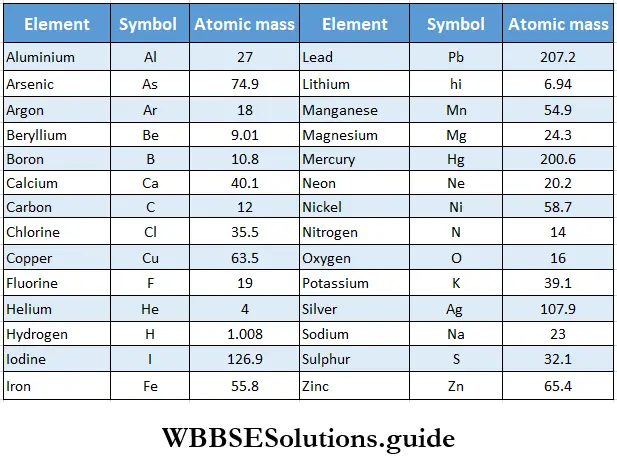
Example: A sample of copper nitrate was obtained by dissolving 1.58 g of copper in nitric acid. This sample of copper nitrate yielded on ignition 1.97 g of copper oxide. In another experiment, 1.02 g of copper was dissolved in nitric acid and precipitated as copper hydroxide by adding sodium hydroxide to the solution. The sample of copper hydroxide (after being washed and dried) produced 1.26 g of copper oxide when it was ignited. Show that the results of the tivo experiments illustrate the law of constant composition.
Solution:

Given:

A sample of copper nitrate was obtained by dissolving 1.58 g of copper in nitric acid. This sample of copper nitrate yielded on ignition 1.97 g of copper oxide.

In another experiment, 1.02 g of copper was dissolved in nitric acid and precipitated as copper hydroxide by adding sodium hydroxide to the solution.

The sample of copper hydroxide (after being washed and dried) produced 1.26 g of copper oxide when it was ignited.

In the first experiment, 100 g of copper oxide contained \(\frac{1.58}{1.97}\) x 100 = 80.1g of copper.

In the second experiment, 100 g copper oxide contained \(\frac{1.02}{1.28}\) x 100 = 79.9 g of copper.

The percentage of copper in the two samples of copper oxide is nearly the same, so the results illustrate the law of constant composition.

“Chemical combination, laws of chemical combination, and examples, WBCHSE syllabus”

3. Law of multiple proportions: John Dalton, a British chemist and physicist, formulated this law in 1803. In essence, this law states that there is a simple relationship between the masses of elements which combine to form different compounds.

  • A more precise way to say this is, that when two elements A and B combine to form two or more compounds (for example,  AB, A2B, AB2), the different masses of one of the elements (say A) that combine with a fixed mass of the other (say B) (or vice versa) are in a simple ratio. For example, nitrogen and oxygen combine to form 5 oxides, viz., nitrous oxide (N2O), nitric oxide (NO), nitrogen trioxide (N2O3), nitrogen tetraoxide (N2O4) and nitrogen pentoxide (N2O5). Calculations show that the masses of oxygen which combine with a fixed mass of nitrogen to form these oxides are in the simple ratio 1:2:3 :4: 5.
  • Similarly, if two pure samples of cuprous oxide (Cu2O) and cupric oxide (CuO) are heated strongly in two crucibles, while a current of hydrogen is passed over them, it can be shown that the weights of copper combined with the same weight of oxygen in the two samples are in the ratio 2:1. The weights of copper are obtained by first weighing the empty crucibles, then the crucibles with the samples of Cu2O and CuO and finally, the crucibles after they have been heated strongly in a current of hydrogen.

⇒ \(\mathrm{CuO}+\mathrm{H}_2 \stackrel{\text { heat }}{\longrightarrow} \mathrm{Cu}+\mathrm{H}_2 \mathrm{O}\)

⇒ \(\mathrm{Cu}_2 \mathrm{O}+\mathrm{H}_2 \stackrel{\text { heat }}{\longrightarrow} 2 \mathrm{Cu}+\mathrm{H}_2 \mathrm{O}\)

Importance Of Chemical Combination In Chemistry WBCHSE

Example: Three oxides of nitrogen contained 63.6%, 46.7%, and 30.4% nitrogen respectively. Show that these figures illustrate the law of multiple proportions.
Solution:

Given

Three oxides of nitrogen contained 63.6%, 46.7%, and 30.4% nitrogen respectively.

The first oxide of nitrogen contains 63.6% N

⇒ 63.6 g of N reacts with (100 – 63.6) g of O = 36.4 g of O.

∴ 1 g of N will react with \(\frac{36.4}{63.6}\) g of O = 0.57 g of O.

The second oxide of nitrogen contains 46.7% N

⇒ 46.7 g of N reacts with (100 – 46.7) g of O = 53.3 g of O.

∴ 1 g of N will react with \(\frac{53.3}{46.7}\) g of O = 1.14 g of O.

The third oxide of nitrogen contains 30.4% N

⇒ 30.4 g of N reacts with (100 – 30.4) g of O = 69.6 g of O.

∴ 1 g of N will react with \(\frac{69.6}{30.4}\) g of O = 2.26 g of O.

This means the ratio of the masses of oxygen which combine with 1 g of nitrogen is 0.57:1.14:2.26, i.e., 1:2:4. This is obviously by the law of multiple proportions.

“WBCHSE Class 11 Chemistry, laws of chemical combination, and their significance”

4. Law of reciprocal proportions: This law, postulated by Richter in 1792, also deals with the relationship between the masses of elements that combine.

According to Richter, when two elements (say A and B) combine separately with the same weight of a third element (say C), the ratio in which they do so is the same or some simple multiple of the ratio in which they (A and B) combine.

  • Take sulphur, oxygen, and hydrogen, for example. Sulphur and oxygen combine with hydrogen to form hydrogen sulphide (H2S) and water (H2O) respectively. They also combine to form sulfur dioxide (SO2). According to this law, the ratio of the weights of S and O which combine with the same weight of H will either be the same or a simple multiple of the ratio in which S and O combine.
  • This can be easily verified. In H2S, two parts by weight of hydrogen combine with 32 parts by weight of sulphur. In H2O, two parts by weight of hydrogen combine with 16 parts by weight of oxygen. Therefore, the ratio of the weights of S and O which combine separately with a fixed weight (2 parts) of hydrogen is 32:16 or 2 :1. And the ratio of S and O in SO2 is 32: 32, or 1 :1. The two ratios are related to each other as (2/1): (1/1)/ or 2 :1. Which means that the first ratio is a simple multiple of the second.

Example: Methane contains 75% carbon and 25% hydrogen, carbon dioxide contains 27.27% carbon and 72.73% oxygen and water contains 11.10% hydrogen and 88.96% oxygen. Can you use these to prove the law of reciprocal proportions?
Solution:

Given

Methane contains 75% carbon and 25% hydrogen, carbon dioxide contains 27.27% carbon and 72.73% oxygen and water contains 11.10% hydrogen and 88.96% oxygen.

In methane, 1 g of H combines with \(\frac{75}{25}\) g of C = 3 g of C.

In water, 1 g of H combines with \(\frac{88.96}{11.10}\) g of O = 8 g of O.

∴ the ratio of weights of C and O which combine with 1 g of H = 3:8 = 1: 2.66.

In the CO2 ratio of the weights of C and O = 27.27: 72.73 = 1: 2.68.

∴ The two ratios are nearly the same, which proves the law of reciprocal proportions.

“Laws of chemical combination, conservation of mass, definite proportions, and multiple proportions, WBCHSE notes”

5. Gay-Lussac’s law of gaseous volumes: While studying reactions between gases, Joseph Louis Gay-Lussac, a French chemist and physicist, found that there is a simple relationship between the volumes of gaseous reactants and products.

Gay-Lussac’s law of combining volumes (as his law is called) states that under similar conditions of temperature and pressure, gases react with each other in volumes which bear a simple ratio to one another and the volumes of the products (if those too are gases). It can be shown experimentally, for example, that 1 volume of hydrogen reacts with 1 volume of chlorine to produce 2 volumes of hydrogen chloride.

⇒ \(\underset{\text { 1 volume }}{\mathrm{H}_2}+\underset{\text { 1 volume }}{\mathrm{Cl}_2} \longrightarrow \underset{2 \text { volumes }}{2 \mathrm{HCl}}\)

The ratio between the volumes of the reactants and the product in this reaction is 1:1:2, which is a simple ratio.

WBCHSE Class 11 Notes For Chemical Combination Overview, Laws and Examples

Berzelius Hypothesis

Dalton’s theory could not explain Gay-Lussac’s law of combining volumes, which made Dalton doubt Gay-Lussac’s observations. A Swedish scientist, Jons Jacob Berzelius, convinced of the correctness of Gay-Lussac’s observations, put forward a hypothesis to reconcile Dalton’s theory with Gay-Lussac’s experimental law.

Berzelius stated that equal volumes of all gases under the same conditions of temperature and pressure contain the same number of atoms.

However, this hypothesis seemed to have a drawback. Let us apply it to the formation of hydrochloric acid gas from hydrogen and chlorine to see what the drawback was. It can be shown experimentally that one volume of hydrogen combines with one volume of chlorine to form two volumes of hydrochloric acid gas.

“Chemical combination, theoretical explanation, experimental evidence, and applications, WBCHSE syllabus”

⇒ \(\underset{1 \mathrm{vol}}{\text { Hydrogen }}+\underset{1 \mathrm{vol}}{\text { Chlorine }} \longrightarrow \underset{2 \mathrm{vol}}{\text { Hydrogen chloride gas }}\)

Let one volume of a gas contain n atoms. Then

⇒ \(\text { Hydrogen }+ \text { Chlorine } \longrightarrow \text { Hydrogen chloride gas }\)

⇒ \(\begin{array}{lll}
n \text { atoms } & \text { atoms } & 2 \text { ri compound atoms } \\
1 \text { atom } & 1 \text { atom } & 2 \text { compound atoms } \\
\frac{1}{2} \text { atom } & \frac{1}{2} \text { atom } & 1 \text { compound atom }
\end{array}\)

The Berzelius hypothesis would imply that one compound atom of HC1 is formed by the combination of half an atom each of hydrogen and chlorine. However, the possibility that atoms may undergo division during a chemical reaction is against Dalton’s theory. This is why this hypothesis could not be accepted.

Avogadro’s Hypothesis

In 1811, an Italian physicist and lawyer, Amedeo Avogadro, finally resolved the problem that Berzelius had been unable to resolve. This was another flash of insight, a seemingly simple idea possible only for a great mind to conceive of.

  • Avogadro suggested that matter consists of two kinds of particles—atoms and molecules. An atom is the smallest particle of an element which participates in chemical reactions, but it may or may not have independent existence.
  • A molecule, according to Avogadro, is the smallest particle of an element or compound which is capable of independent existence. Based on this view of the smallest particles of matter, Avogadro put forward a hypothesis which was a modification of the one proposed by Berzelius. He said that equal volumes of all gases under the same conditions of temperature and pressure contain the same number of molecules. This hypothesis has been found to hold for all gaseous reactions.

Let us apply Avogadro’s hypothesis to the reaction we considered in the previous section.

⇒ \(\begin{gathered}
\text { Hydrogen } \\
1 \mathrm{vol}
\end{gathered}+\underset{1 \mathrm{vol}}{\text { Chlorine }} \longrightarrow \underset{2 \mathrm{vol}}{\text { Hydrogen chloride }}\)

Let us assume that 1 volume of a gas contains n molecules.

\(\text { Hydrogen }+ \text { Chlorine } \longrightarrow \text { Hydrogen chloride }\)

⇒ \(\begin{array}{lll}
n \text { molecules } & n \text { molecules } & 2 n \text { molecules } \\
\frac{1}{2} \text { molecule } & \frac{1}{2} \text { molecule } & 1 \text { molecule }
\end{array}\)

“WBCHSE Class 11, chemistry notes, on chemical combination, Gay-Lussac’s law, and Avogadro’s law”

This implies that one molecule of hydrogen chloride contains half a molecule of hydrogen and half a molecule of chlorine. A molecule is the smallest particle of an element (or compound) which is capable of independent existence and may contain two or more atoms, so according to Avogadro’s hypothesis the existence of half a molecule is possible. In the case of hydrogen and chlorine half a molecule contains one atom, as both are diatomic molecules. Therefore, a half-molecule will contain at least one atom, which is in agreement with Dalton’s atomic theory.

Atomicity of gases: The number of atoms present in one molecule of a gas is known as its atomicity. We know now that the number of hydrogen atoms in a hydrogen molecule is two, the number of oxygen atoms in an oxygen molecule is two and the number of oxygen atoms in a molecule of ozone is three, so the atomicity of hydrogen is two, the atomicity of oxygen is two, and that of ozone is three.

Avogadro’s hypothesis can be used to find the atomicity of a gas. Consider hydrogen. Two volumes of hydrogen combine with 1 volume of oxygen to form 2 volumes of water vapour.

⇒ \(\underset{2 \text { vol }}{\text { Hydrogen }}+\underset{1 \text { vol }}{\text { Oxygen }} \rightarrow \underset{2 \text { vol }}{\text { Water vapour }}\)

Class 11 WBCHSE Chemistry Chemical Combination

Assuming that 1 volume of a gas contains n molecules

\(\text { Hydrogen }+ \text { Oxygen } \longrightarrow \text { Water vapour }\)

⇒ \(\begin{array}{lll}
2 n \text { molecules } & n \text { molecules } & 2 n \text { molecules } \\
1 \text { molecule } & \frac{1}{2} \text { molecule } & 1 \text { molecule }
\end{array}\)

Thus, 1 molecule of water contains 1/2 molecule of oxygen. It has been found experimentally that 1 molecule of water contains 1 atom of oxygen.

Hence 1/2 molecule of oxygen = 1 atom of oxygen.

or 1 molecule of oxygen = 2 atoms of oxygen.

∴ the atomicity of oxygen = 2.

WBCHSE Class 11 Notes For Atomic Mass Of Elements

Atomic Mass Of Elements Class 11 WBCHSE

Atomic Mass:

After Dalton said that the atoms of a substance had a particular mass, the problem that assailed scientists was how to find this mass. An atom is too small to be seen or isolated, so it was not possible to determine its mass by weighing.

Theoretically, though the mass of an atom could be determined by weighing a large sample of an element and then dividing it by the number of atoms it contained. However, no one could come up with a method to count the number of atoms in a sample of an element.

“Atomic mass, definition, relative atomic mass, and isotopes, WBCHSE syllabus”

  • Avogadro’s hypothesis at least provided a way to find the relative masses of elements. Since equal volumes of different gases under similar conditions of temperature and pressure contain equal numbers of molecules it stands to reason that if one weighs equal volumes of hydrogen and oxygen under the same temperature and pressure one would be able to know the weights of equal numbers of hydrogen and oxygen molecules.
  • Comparing the two weights, one would be able to determine how much heavier (or lighter) an oxygen molecule is compared to a hydrogen molecule. This is exactly what scientists did and they found that a molecule of oxygen is 16 times heavier than a molecule of hydrogen. They knew by then that one molecule of hydrogen contains two atoms of hydrogen and that one molecule of oxygen contains two atoms of oxygen, so they concluded that an atom of oxygen is 16 times heavier than an atom of hydrogen.

Read and Learn More WBCHSE For Class11 Basic Chemistry Notes

Similarly, the relative (compared to hydrogen) atomic masses of other gases were determined. Berzelius and the Italian chemist Stanislao Cannizzaro (separately) did some pioneering work in determining the relative atomic masses of various elements. The atomic mass of hydrogen was taken as one, and the relative atomic masses of other elements were determined with the hydrogen atom as the reference. The choice of this reference was made by Dalton because hydrogen is the lightest element.

WBCHSE Class 11 Notes Atomic Mass of Elements

Atomic Mass Of Elements

  • The relative atomic mass of oxygen was found to be 15.88 on this scale. Later, the oxygen atom was chosen as the reference and it was assigned a mass of 16. This was done for convenience because with the oxygen atom as the reference the relative atomic masses of the other elements worked out to whole numbers or close to whole numbers. Also, oxygen was considered more reactive, forming a large number of compounds. On this scale, the mass of a hydrogen atom works out to 1.008.
Class 11 Biology Class 11 Chemistry
Class 11 Chemistry Class 11 Physics
Class 11 Biology MCQs Class 11 Physics MCQs
Class 11 Biology Class 11 Physics Notes

“WBCHSE Class 11 Chemistry, atomic mass of elements, notes, and key concepts”

  • Much later, the exact mass of the hydrogen atom was determined by an indirect method and turned out to be L66 x 10-24 g. However, to get back to the determination of relative atomic masses, in 1961, the International Union of Chemists selected a new reference for expressing them. They accepted 12C with the mass number 12 (the stable isotope of carbon) as the standard for comparing the atomic and molecular masses of elements and compounds. Today this scale depends upon measurements of atomic mass by mass spectrometers. A mass spectrometer is an instrument used for making accurate measurements of mass by comparing the mass of an atom with the mass of a particular atom chosen as the standard.
  • Now, when we refer to the atomic mass of an element, we mean its relative atomic mass compared to 1/12 of the mass of an atom of 12C, which is taken as 12. In other words, 1/12 of the mass of a 12C atom is taken as the standard and is referred to as 1 atomic mass unit (AMU). However, IUPAC has recommended a symbol (u) (unified mass) in place of amu. The average atomic masses of hydrogen, oxygen, nitrogen, and sulfur on this scale work out to 1.008,16,14 and 32 u respectively. The atomic masses of some common elements with the carbon-12 isotope as the reference are given in Table.

Basic Chemistry Class 11 Chapter 1 Some Basic Concepts of Chemistry Atomic Masses Of Some Common Elements

Average atomic mass: A large number of elements occur in nature as a mixture of several isotopes. The abundance of an isotope is defined as the percentage of atoms of that isotope in a sample of the element. The relative abundance of an element is fixed, thus independent of its state.

For example, chlorine exists as two isotopes of masses Cl-35 and Cl-37. The relative abundance (percent occurrence) of Cl-35 is 75.770 and that of Cl-i7 is 24.229. Also, the precise f atomic mass of both the isotopes Cl-35 and Cl-37 are 34.9698 u and 36.9659 u respectively. The average atomic mass of chlorine can be calculated as follows.

Atomic Mass Of Common Elements

Average atomic mass of chlorine = \(=\frac{(34.9698 \times 75.770)+(36.9659 \times 24.229)}{100}=35.45 \mathrm{u}\)

“Atomic mass of elements, WBCHSE Class 11, chemistry notes, and explanation”

The gram-atomic mass of an element is that quantity of it whose mass in grams is numerically equal to its atomic mass. In other words, it is the atomic mass of an art element expressed in grams. It is also known as one gram-atom of the element. The atomic mass of oxygen = 16 u.

Gram-atomic mass of oxygen (or one gram-atom of oxygen) = 16 g.

Atomic Mass Short Notes For WBCHSE Chemistry

Molecular mass: The average relative mass of a molecule compared to 1/12 of the mass of an atom of carbon (12C) is called its molecular mass. In other words, the molecular mass of a substance indicates how many times a molecule of it is heavier than l/12th the mass of an atom of carbon. The molecular mass of carbon dioxide, for example, is 44.0 u, which means a carbon dioxide molecule is 44 times heavier than 1/12th of a carbon atom.

The molecular mass of a compound or an element can be calculated by adding the atomic masses of all the atoms in one molecule of the compound or element. For example, the molecular formula of water is H2O.

Atomic Weights Of Elements

Therefore, the molecular mass of water (H2O) = (2 x 1008 u) for 2 hydrogen atoms + (1 x 16.0 u) for one oxygen atom = 18.02 u.

In the case of ionic substances, we find out the relative formula mass instead of the molecular mass. The formula mass of a substance is the sum of the atomic masses of all the atoms in a formula unit of the compound. For example, the formula mass of NaCl is 58.5 u. The atomic masses of sodium and chlorine are 23.0 u and 35.5 u respectively.

“WBCHSE Class 11, chemistry notes, on atomic mass, calculation, and significance”

The molecular mass of a substance (element or compound) expressed in grams is called its gram-molecular mass. The amount of the substance is referred to as one gram-molecule of the substance.

∴ The molecular mass of CO2 = 44.0 u.

Gram-molecular mass of CO2 (or one gram-molecule of CO2) = 44.0 g.

Note: Units like the gram-atom, gram-molecule, and gram-equivalent are no longer used by scientists. The mole has replaced these units.