Morphology of Leaf – Structure, Types, Parts & Modifications

The Leaf

The Leaf Definition: The green, flattened, exogenously growing lateral appendages of stems are called leaves.

The Leaf Characteristics:

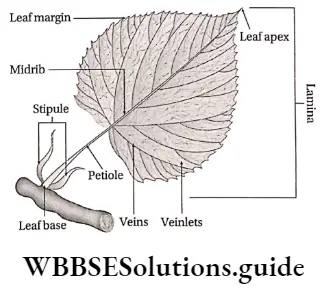
  1. A typical leaf consists of leaf base» petiole and lamina.
  2. Leaves always contain buds in their axil
  3. The lamina has veins and veinlets, which help in the conduction of food and water across the eaves and other parts of plants.
  4. In some plants, structures called stipules are present at the leaf base.
  5. The leaves develop exogenously from the nodes of the stems and branches.

Read and Learn More: WBCHSE Notes for Class 11 Biology

Different Parts Of A Typical Leaf And Their Functions

A typical leaf has three main parts—
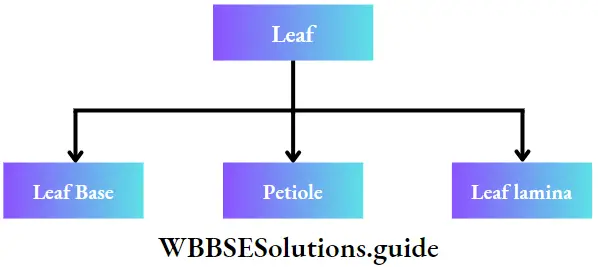
Morphology Of Flowering Plants Leaf

Morphology Of Flowering Plants Different parts ofa typical leaf

Leafbase Or Hypopodium

Hypopodium Definition: The lowermost portion of a leaf, which remains attached to the stem or branch is called the leaf base.

Class 11 Biology Class 11 Chemistry
Class 11 Chemistry Class 11 Physics
Class 11 Biology MCQs Class 11 Physics MCQs
Class 11 Biology Class 11 Physics Notes

Hypopodium Function: It attaches the leaf firmly to the branch or the stem.

Hypopodium Types: Different types of hypopodium are discussed as follows.

Morphology of leaf structure and its modifications 

Pulvinus: These swollen cushion-like, leaf bases, This type of leaf base is found in Mimosa pudica and Mangifera indica.

Morphology of Leaf Structure Types Parts And Modifications

” modifications of leaves”

Amplexicaul: Sometimes, the leaf base becomes flattened and it forms a complete sheath around the internodal region of the stem, known as amplexicaul. This type of leaf base is also known as sheathing leaf base. This type of leaf base is found in Polygonum sp., Aethusa cynapium, etc.

Semi-amplexicaul: In most monocotyledonous plants the leaf base becomes flattened and forms a partial sheath around the internodel region of the stem as seen in palm leaves.

It is called the semi-amplexicaul type. This is also a type of sheathing leaf base. In some plants, the leaf bases become much extended to form a stem-like structure. This type of leaf base is found in Musa balbisiana and Musa paradisiaca.

Decurrent: In certain plants, the leaf base and petiole both become flat, broad, and winged. They form a sheath around the internodal region of the stem. This is known as a decurrent leaf base. This type of leaf base is found in Symphytum officinale, Laggera sp.

Types of leaves and their modifications with examples 

Ligule: Ligule is the membranous, scaly, or hairy tongue-like outgrowth that occurs at the sheathing leaf base. This structure is commonly found in grasses, Oryza sativa, etc.

Auricle: The auricle is the winged expansion of the leaf base, which is continuous with the lamina. Common examples of this type of leaf base are Oryza sativa, Aegialitis rotundifolia, Lonicera caprifolium, etc.
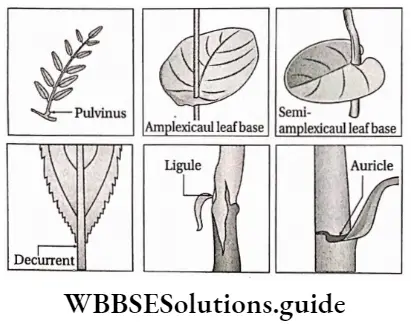
Morphology Of Flowering Plants Types ofleafbase

Classification of leaves on the basis of life span

Leaves are of three types based on their life span—caducous, deciduous, and persistent.

  1. Caducous or fugacious: The leaves that fall off in their early stages of development, are known as caducous leaves. example, Acacia recurve.
  2. Deciduous or annual: The leaves that fall off after one growing season are known as deciduous leaves. example Bombax ceiba (silk cotton), and Ficus benghalensis (banyan).
  3. Persistent or evergreen or perennial: The leaves that persist and remain active for more than one season and fall off after aging are known as evergreen leaves. example Artocarpus heterophyllus (jack), Mangifera indica (mango).

Detailed structure of a leaf with labeled diagram 

Complete and incomplete leaves, leaf scar

  1. Complete leaf: The leaf that consists of all three parts (leaf base, petiole, and lamina) is known as a complete leaf. example mango leaf.
  2. Incomplete leaf: A leaf that lacks any of the three parts is known as an incomplete leaf. example petiole is absent in the leaf of Calotropis sp
  3. Leaf scar: The mark left by a leaf after it falls off from the stem, is known as the leaf scar.
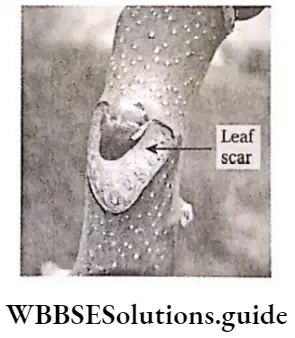
Morphology Of Flowering Plants Leafscar

Petiole or mesopodium or leafstalk

Petiole or mesopodium or leafstalk Definition: The connecting region of the leaf base and leaf blade is referred to as the petiole.

Usually, petioles are solid and cylindrical (for example, Ficus religiosa), but they can be flattened, grooved, or soft (for example Musa paradisiaca) or a hollow tube (for example Carica papaya).

Petiole or mesopodium or leafstalk Location: It usually remains attached to the base and the posterior part of the leaf lamina. On the basis of the presence or absence of petiole, leaves are of different types.

Petiolate leaf: The leaves with petioles are known as petiolate leaves. example Hibiscus sp.

Sessile leaf: The leaves without petioles are known as sessile leaves. exampleGloriosa superba.

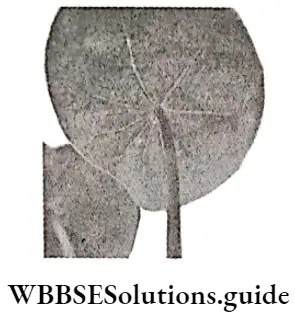
Peltate leaf: The leaves where the petioles remain attached to the lower surface of lamina, are known as peltate leaves. This gives the leaf a shield-like appearance. example lotus (Nelumbo nucifera).
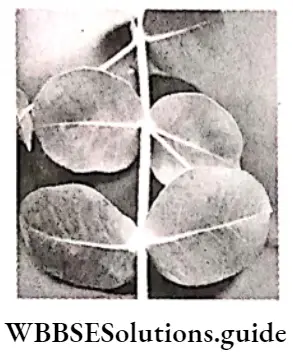
Morphology Of Flowering Plants Sessile leaf

“structure of leaf diagram “

Morphology Of Flowering Plants Peltate leaf

Modification of petioles: The petioles can be modified in various ways. They are—

Winged petiole: In this case, the petiole becomes flattened and wing-shaped. It looks like leaf lamina and is involved in photosynthesis. example Citrus sp. In Nepenthes sp., the petiole becomes partly winged and partly tendrillar.

Swollen or bulbous petiole: This type of petiole is filled with air and becomes swollen and spongy. It is observed in some aquatic plants. This structure helps the plant to float on water. example Trapa bispinosa, Eichhornia crassipes, etc.

Phyllode: Seedlings of some plants bear normal compound leaves. After maturation, these leaves fall off. The petioles then become flattened and look like foliage leaves. These are known as phyllodes. This type of petiole decreases the rate of transpiration and takes part in photosynthesis. example Acacia sp.

Simple and compound leaf types with examples 

Tendrillar petiole: In some plants, the petiole takes the shape of a tendril and helps the plant to climb upwards. This type of petiole is called tendrillar petiole, for example, Aristolochia indica, Clematis gouriana, etc.

Spiny petiole: The lamina falls off after maturation, leaving behind the petiole that gradually develops into a rigid spine. example Quisqualis malabaricum.

Functions of petiole:

  1. It helps in the transportation of nutrients and water in and out of the leaf.
  2. It can orient the leaf lamina to get sufficient light for photosynthesis.
  3. Some plants have swollen and spongy petioles. Such a petiole helps the plant to float on water.
  4. Petioles get modified and help the plant in various ways. For example, the tendrillar petiole helps the plant to climb up on a support.
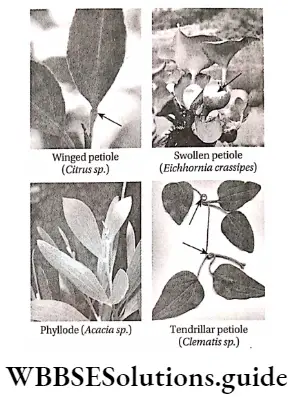
Morphology Of Flowering Plants Modifications ofleafpetiole

Leafblade or epipodium or lamina

Leaf-blade or epipodium or lamina Definition: The green, thin, and expanded apical portion of the leaf is called the leaf blade.

Leafblade or epipodium or lamina Characteristics:

  1. The leaf blade or lamina is usually thin and dorsoventrally differentiated.
  2. A strong vein runs from base to apex through the middle of the lamina. It is called the midrib (main vein). Smaller and thinner veins grow from the midrib and may divide again into minute branches, called veinlets. The veins may run parallel to the midrib or form a reticulate arrangement along with the veinlets. Thus, two types of venation are found
    1. Reticulate venation and
    2. Parallel venation.

“parts of the leaf and their functions “

Leaf-blade Functions:

  1. Lamina contains chlorophyll and carries out photosynthesis.
  2. The lamina bears stomata and thus helps in gaseous exchange.
  3. The veins of leaves, help in the conduction of water and food into the lamina.

Variations in lamina: Lamina shows many variations in shape, margin, surface, etc.

The shape of Lamina: The shape of the lamina depends on the apex, length of the leaf, and the terminal end Different types of lamina are described below.

Lamina has almost the same width throughout

  1. Acicular: Lamina is needle-shaped. example Pinus sp.
  2. Linear: Lamina is long, flat, narrow, and almost uniform in width. example,tube-rose, rice, wheat, grasses, etc.
  3. Lanceolate: Lamina is like a lance, i.e., broader in the middle portion and gradually tapers towards both ends. example Nerium indicum, Polygonum orientate, etc.
  4. Oblong: Lamina is more or less rectangular and elongated. example Musa paradisiaca, Musa balbisiana, etc
  5. Falcate: Lamina is like a sickle or a beak of a falcon. example Carya illinoinensis, Acacia falcata, etc.

Lamina is widest at the base

  1. Subulate or awl-shaped: The long and narrow lamina tapers gradually towards the apex. Examples are Salsola kali, Isoetes sp., etc.
  2. Ovate or egg-shaped: The base of the lamina is wider than the round apex. example Banyan, china-rose, etc.
  3. Cordate: The lamina is heart-shaped. example Piper betel, Sida cordifolia, and Abutilon indicum.
  4. Sagittate: The lamina is arrow-shaped. example Sagittaria sagittifolia, Ipomoea aquatica, etc.
  5. Hastate: Lamina is arrow-shaped,r but the two lower lobes are directed outwards. Example Jyphonium trilobatum, etc.
  6. Reniform or kidney-shaped: The lamina is bean or kidney-shaped. exampleCentella asiatica.
  7. Lunate: Lamina is half-moon-shaped with pointed basal lobes. example Adiantum lunatum, Passiflora lunata, etc.

Leaf modifications in different plants with examples 

Lamina is widest at the apex

  1. Obovate: The shape of the lamina is like an inverted egg (reverse of ovate). Example lamina of Artocorpus heterophyllus, cassia obovata, etc.
  2. Obcordate: The shape of the lamina is like an inverted heart example variegata, Oxalis corniculata, etc.
  3. Spathulate or spathe-shaped: The Leaf lamina of some plants becomes broad and rounded at the apex and gradually becomes narrow towards the base. example lamina of Phyla nodiflora, Duranta repens, etc.
  4. Cuneate or wedge-shaped: Lamina looks like the hood of a snake. example Pistia stratiotes.
  5. Lyrate: Lamina looks like a lyre (an instrument) having a large oval terminal lobe and two or more smaller lobes. example lamina of Raphanus sativus, Brassica nigra, etc.

Lamina which is symmetrical

  1. Elliptical or oval: Lamina looks like an ellipse. example Ficus elastica, Psidium guajava, etc.
  2. Orbicular (circular) or rotund or peltiform: In certain plants, the shape of the lamina is circular and the petiole is attached at the lower surface of the leaf. example Nelumbo nucifera (lotus).
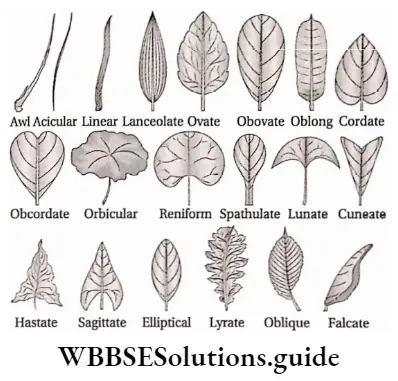
Morphology Of Flowering Plants Types ofleaflamina

Base lamina:

The base of the lamina may be of the following types—

Auriculate: The sessile leaves form two lobe-like wings at the base, which partially encircle the stem. example Argemone mexicana.

Perfoliate: The lobes of the sessile leaf at the base fuse and the leaf encircles the stem completely example Consent perfoliate.

Connate: the type, the bases of two sess.le leaves with opposite PhVllPtaxy are fused together completely. exampleCanscora diffusa, Swertia chirata, etc.

Decurren: Winged leaf base is fused to the stem example Laggera alata, Sphaeranthus indicus, etc.

The surface of Lamina: The surface of the lamina is of different types—

Glabrous: Both the surface of the lamina is smooth and hairless. examplePongamia glabra, Dianthus chinensis.

Glaucous: In some plants, the surface of the lamina bears a waxy covering and thus, appears to be shiny. example Solarium glaucoma.

“types of leaves with names “

Viscose: The surface of the lamina becomes sticky due to the viscous exudation of secretory glands present in leaves. exampleCleome viscosa and Polanisia icosandra, etc.

Scabrous: The surface of the lamina becomes rough due to elevated tiny rigid hair-like structures. example, Ficus hispida.

Venation in leaves and its types with diagram 

Rugose: The surface of the lamina appears a little bit wrinkled. example., Rubus rugosus.

Gland-dotted: The surface of the lamina remains covered with glands. example Citrus auratifolia.

Hairy: The surface of the lamina is covered with hairs. example, Calotropis sp., tomato.

Spinose: The surface of the lamina is covered with small prickles. example brinjal.

Margin of Lamina:

The margin of the lamina can be of the following types—

Entire: Margin is smooth and devoid of any notch. example Mangifera indica, Ficus benghalensis, etc.

Serrate: Margin of lamina appears as saw teeth, pointed upwards. example, Hibiscus rosa-sinensis.

Biserrate: In this lamina the toothed margin is further serrated upwards. example, elm tree.

Retroserrate: Margin is toothed and pointed downwards. example leaves of dandelion.

Repand: In this type, the margin is wavy with notches. example Polyalthia longifolia.

Dentate: Margin is toothed and the teeth are pointed outward at right angles to the midrib. example water-lily.
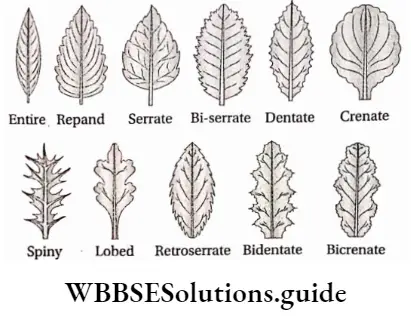
Morphology Of Flowering Plants Types of leaf margins

Bidentate: Margins are toothed and the teeth are further dentate. example Carex oxylepis.

Create: The margins are marked with a rounded tooth. example, Centella Asiatica.

Bicrenate: Margin is toothed. Each tooth of the margin is again divided into rounded teeth.

Spiny: The teeth apices of the dentate margin become pointed and form spines. example Argemone mexicana, Solarium xanthocarpum, etc.

Incised or lobed: Margin is cut into various depths and divided into small lobes. example Brassica nigra, Raphanus sativus.

Apex of Lamina: Different leaf lamina bears different types of apices (singular: apex).

Acute: Apex is pointed and narrow. example found in Mangifera indica, Hibiscus rosa-sinensis, etc.

Acuminate: Apex is slender and prolonged like a long tapering tail. example Ficus religiosa, Bauhinia acuminata, etc.

Obtuse: Apex is blunt with a large terminal angle. example Ficus benghalensis (banyan).

Mucronate: Apex is broad and forms a sharp point. example Catharanthus roseus

Cuspidate or spiny: Apex forms a hard, pointed structure. example Phoenix sylvestris, Agave cantula, etc.

Tendrillar: The leaf apex is narrow, and elongated and forms a tendril. example Gloriosa Superba.

Cirrhose: Apex ends in a fine coiled or curved thread-like structure. example Musa paradisiaca.

Phyllotaxy in plants – types and examples 

Truncate: Apex is cut across almost at a right angle to the midrib. example Indigofera linifolia, Paris polyphylla, etc.

Refuse: Apex is obtuse and slightly notched. example, found in Clitorea ternatea, Pistia stratiotes, etc.
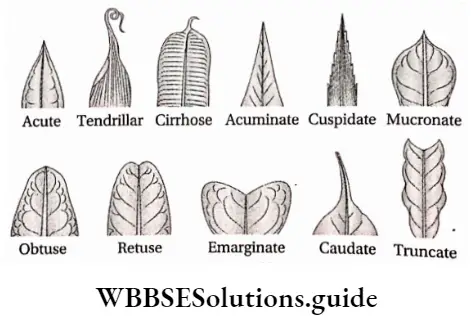
Morphology Of Flowering Plants Types ofleafapex

Emarginate: Apex is obtuse and deeply notched, for example, found in Bauhinia variegata.

Leaf morphology important questions for NEET and exams

Coriaceous: Thick and leathery leaf lamina, as found in Mangifera indica.

Herbaceous: Thin and membranous leaf lamina, as found in Hibiscus rosa-sinensis.

Succulent: Fleshy and brittle leaf lamina, as found in Aloe indica.

Gland-dotted or glandular: Dotted and glandular leaf lamina. The glands are filled with essential oils, as found in Citrus limon.
Root System – Roots, Types of Roots and Functions of Roots Notes

The Root

Root develops from the radicle.

The Root Definition: The root is the underground descending, non-green part of a plant, which bears lateral branches and is devoid of leaves, buds, nodes, and internodes.

The Root  Characteristics of roots:

  1. Roots are usually achlorophyllous (without chlorophyll) and so cannot perform photosynthesis.
  2. They are negatively phototropic (move away from light), positively geotropic (move in the direction of gravity), and positively hydrotropic (grow in water medium).
  3. Usually, they do not bear leaves, flowers, etc., but sometimes roots may bear vegetative buds.
  4. The growing root apex remains protected by the root cap or calyptra. In some aquatic plants, a loose thimble-like structure develops at the apex, called a root pocket.
  5. Root also bears unicellular ] hair-like projections of the epidermal cells called root hairs.
  6. The lateral branches of the root develop endogenously (from inside).

Read and Learn More: WBCHSE Notes for Class 11 Biology

Types Of Root

According to structure and mode of development,

The roots are classified into two types

  1. Adventitious roots, and
  2. True or tap root.

Taproot or Tree Root

Tree root Definition: The main root which is formed by the continuous growth of the radicle along with its branches and sub-branches is known as tap root or tree root.

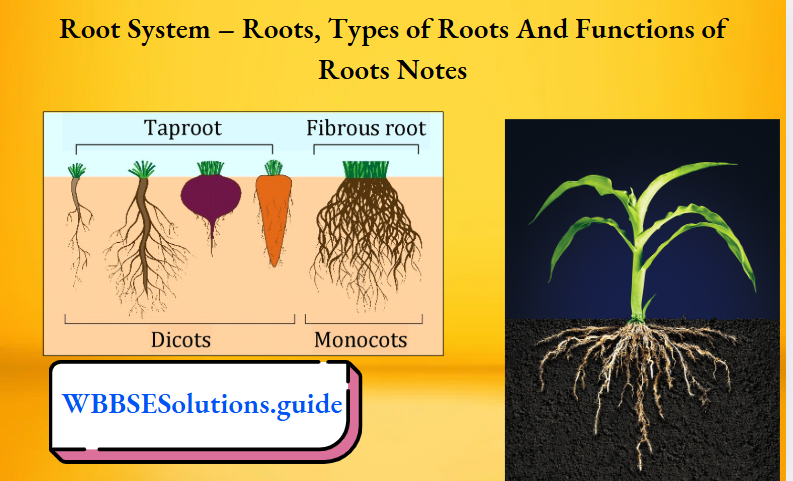
Usually, tap roots are found in all dicotyledonous plants. Example Mangifera indica.

Class 11 Biology Class 11 Chemistry
Class 11 Chemistry Class 11 Physics
Class 11 Biology MCQs Class 11 Physics MCQs
Class 11 Biology Class 11 Physics Notes

Tree root  Characteristics:

  1. In dicot plants, the growing radicle moves straight downwards into the soil, forming the main root known as the primary root or tap root.
  2. Some thin and narrow roots that develop transversely from the tap roots are known as secondary or branch roots.
  3. The secondary roots further give rise to small, fine hair-like structures known as tertiary roots.
  4. All these roots together form the tap root system.
  5. Tertiary branches divide again and again to produce finer rootlets.
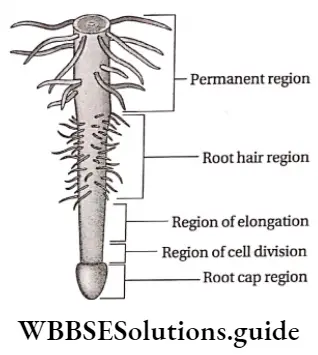
  6. A typical root has five regions— root cap region, region of elongation, root hair region, region of cell division, permanent region, or region of maturation.

types of roots

Adventitious Roots

Adventitious Roots Definition: The roots that develop from any region of the plant body other than the radicle are known as adventitious roots.

Examples Of Adventitious Roots Are As Follows—

  1. From leaves, for example, Bryophyllum calycinum and Kalanchoe laciniata,
  2. From stems, for example, Zea mays (maize), Bambusa tulda (bamboo) Saccharum officinarum (sugarcane), and
  3. From the lower end of stem cuttings, for example, Hibiscus rosa-sinensis (china-rose), Rosa centifolia (rose), etc.

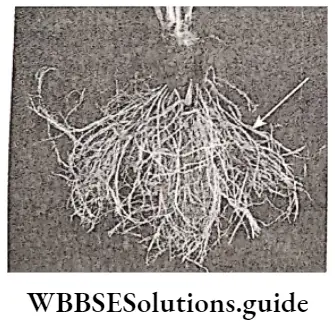
Fibrous Root System

In monocotyledonous plants, the tap root system is not well developed and may degenerate after some time. After degeneration of the primary root, some thin, thread-like, temporary roots develop from the base of the radicle. These roots are known as seminal roots.

After some time, some more fiber-like roots develop from the base of the plumule. These are called fibrous roots and together they form the fibrous root system. For example, Roots of wheat, grass, etc.

Morphology Of Flowering Plants Fibrous roots

5 functions of roots

Different Regions Of A Typical Root And Their Functions

A typical root consists of the following five regions—

Root cap region: The root apex of the main root and its branches remain covered by a cap-shaped multicellular structure, called a root cap or calyptra.

Root cap region Characteristics:

  1. The root cap is formed of multicellular parenchymatous cells.
  2. Root cap is not found in aquatic plants. But in some aquatic plants (Eichhomia sp., Pistia sp., etc.), a thimble-like structure is found at the root apex. It is known as a root pocket.
  3. The root cap degenerates gradually with the growth of the root. In this case, new root caps originate from the region of elongation.
  4. Multiple root caps are found in the root tips of stilt roots of Pandanus sp., and prop roots of Ficus benghalensis.

Morphology Of Flowering Plants Differentparts ofa typical root

Root cap region Function:

  1. The root cap protects the root tip from the damage caused by friction with the soil particles.
  2. It secretes a mucilaginous substance, which helps the root tip to move easily into the soil by making it slippery.

Region of cell division: This region is present just above the root cap region. The cells of this region are isodiametric, thin-walled with dense cytoplasm and a large nucleus.

Region of cell division Characteristics: Cells of this region divide continuously to form new cells.

Region of cell division Function: Growth of the roots at this region takes place by continuous mitotic cell division.

Region of elongation: The small region, just above the region of cell division and below the root hair region, is known as the region of elongation.

Region of elongation Characteristics:

  1. This region consists of a soft and smooth outer wall
  2. ln this region’s cells elongate and enlarge raPidlY’ compared to other regions of the root.

Root System – Roots, Types of Roots And Functions of Roots Notes

Region of elongation Function: This region helps in root elongation.

Root hair region: This region is situated just above the region of elongation and is covered by clusters of very thin, unicellular tubular outgrowths, known as root hairs.

“root plants examples “

Root hair region Characteristics:

  1. The root hairs grow exogenously from the epidermal cells of the root.
  2. They remain alive for a few days or weeks.
  3. This region is also known as the piliferous region.
  4. Root hairs can remain active for up to 3 years in plants like Helianthus annus.

Root hair region Function:

  1. The root hairs help in both anchorage and absorption.
  2. They help in the absorption of water and minerals from the soil.
  3. Root hairs increase the surface area for absorption.

Permanent region: The region situated above the root hair region up to the base of the shoot, is known as the permanent region or Zone of Maturation.

Permanent region Characteristics:

  1. Branches are produced endogenously from this region.
  2. Cell division does not occur in this region. As a result growth of this region stops permanently.

Permanent region Function: It helps in the anchorage of plants to the soil and transportation of substances absorbed by root hairs.

Different Types Of Root Modification

In addition to normal functions, roots also perform some special functions such as storage of food, respiration, etc., in certain cases. For all these special functions, roots get modified in various ways.

” different types of roots with examples “

Different types of tap root modifications

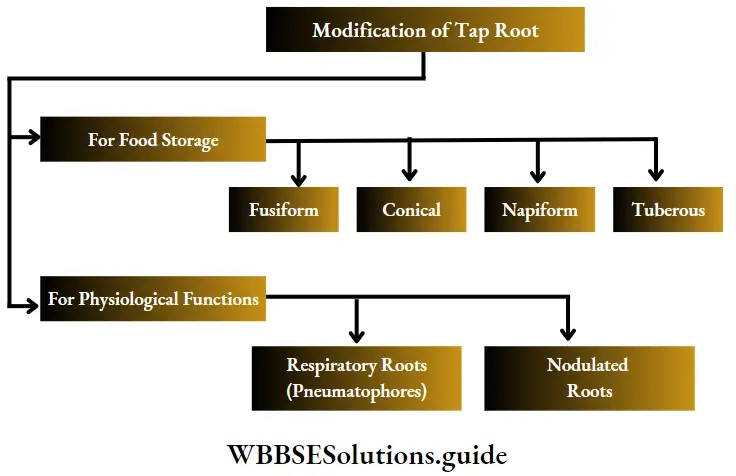
The tap roots are completely or partially modified according to their functional need. The different modifications of the tap root have been depicted in the following flow chart.

Morphology Of Flowering Plants Modifications of tap root

Modification for food storage: Due to the accumulation of reserve food, the tap roots of some plants develop into fleshy and swollen structures. The branch roots remain unchanged. These are of various shapes.

According to the shape, these tap roots are classified into the following types—

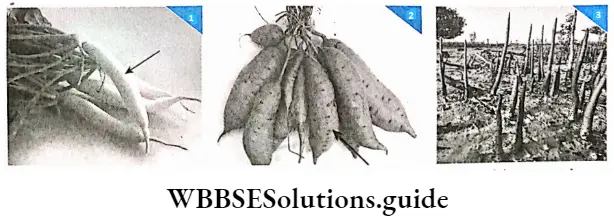
Fusiform: These roots are swollen in the middle and gradually taper at both ends. Secondary and tertiary roots develop. For example, as found in radish (Raphanus sativus)

Conical: These roots are broad at the base and gradually taper at the lower end forming a cone. The lower end of these roots contains branch roots. For example, as found in carrots (Daucus carota).

Napiform: These are much swollen. at the basa portion forming a spherical or globular structure, but abruptly taper towards the lower end. Numerous branch roots appear at the lower end. For example, as found in beetroot (Beta vulgaris), and turnip (Brassica rapa).

Tuberous: These roots become swollen without any definite shape. For example, as found in Ruellia tuberose.

” function of the root system”

Modifications for physiological functions: In many cases, the roots are modified to perform various physiological functions.

These modified roots are classified as follows—

Nodulated root: In leguminous plants, nodules are formed on the main root as well as on the branch roots. This happens due to the endogenous growth of nitrogen-fixing bacteria like Rhizobium. These types of roots are known as nodulated roots. For example, as found in Pisum sativum.

Morphology Of Flowering Plants Different types ofmodification oftap roots

Respiratory root (Pneumatophores): In halophytes, some of the branches of the tap root grow vertically above the soil or water level for respiration.

The apical region of these roots bears pores, known as pneumatophores, through which gaseous exchange takes place. These roots are called pneumatophores or respiratory roots. example as found in Rhizophora mucronata (mangrove).

Different types of adventitious root modifications

The adventitious roots are variously modified for different functions. These are discussed below.

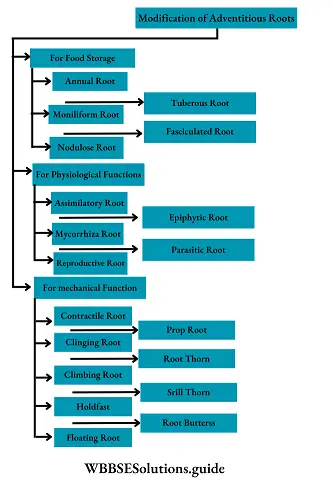
Morphology Of Flowering Plants Modifications of adventitious roots

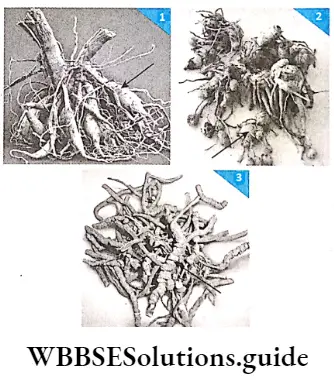
Modification for food storage: Different types of modification of adventitious roots for food storage are discussed as follows.

Tuberous roots: These tuber-like roots grow from fixing bacteria nodes of the prostrate stem (stem that grows along the ground) and become swollen irregularly by storing food. example found in Ipomoea batatas.

Fasciculated roots: These swollen tuberous roots grow in clusters, from a common point of origin at the base of the stem. example found in Asparagus racemosus.

Nodulose roots: These adventitious roots come out of the underground rhizomes. The roots become swollen at their apex forming nodule-like structures due to storage of food. example found in mango ginger (Curcuma amada).

” fibrous root examples with names “

Moniliform roots: These roots show alternate swollen and constricted regions. Thus, appear as beaded structures. example found in Dioscorea alata, Momordica sp.

Annulated roots: These thick roots look like an aggregation of rings in a series. example found in Ipecac (Cephaelis ipecacuanha).

Morphology Of Flowering Plants Modifications ofadventitious rootsfor storage purpose

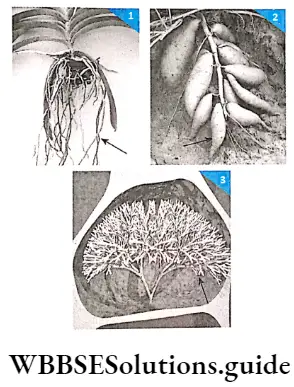
Modifications for physiological functions:

Different types of adventitious root modifications to carry out certain physiological functions are described below.

Epiphytic or hygroscopic roots: Some epiphytic orchids have freely hanging aerial roots along with clinging roots. The aerial roots are covered with a thin layer of spongy tissues, known as velamen. This layer absorbs moisture from the air and helps in Photosynthesis. example as found in Vanda tesselata.

Parasitic roots or haustoria or sucking roots: These are small, sucking roots found in parasitic plants. These roots penetrate the conducting tissues of the host plant and absorb nutrients from them. they may penetrate the vascular strands of the xylem and phloem of the host plants, for example as found in Dodder (Cuscuta reflexa).

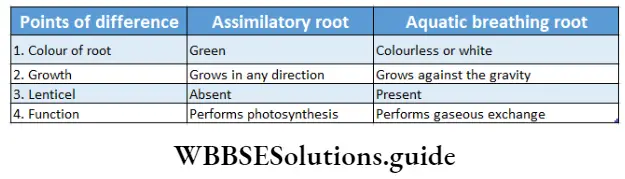
Assimilatory or photosynthetic roots: These are long, chlorophyll-containing roots. These roots are able to be found in Podostemon sp Trapa sp. and Tinospora cordifolia.

Reproductive roots: These fleshy adventitious roots develop vegetative buds. These buds serve as the means of reproduction. The buds get separated from the mother plant and give rise to new plants getting favorable conditions. Example as found in sweet potato (Ipomoea batatus) and Dahlia sp.

root systems in plants

Morphology Of Flowering Plants Modifications of adventitious roots for physiological functions

Mycorrhizal Roots: The roots of some plants are infested with fungal mycelia (singular: mycelium) which forms a symbiotic association with the plants. Such roots are called mycorrhizal roots.

The mycelia absorb nutrition from the soil which is used by both the plant and the fungi. example found in Pinus sp., Corallorhiza innata.

Modification for mechanical functions:

Different types of adventitious root modifications to carry out certain mechanical functions are described as follows.

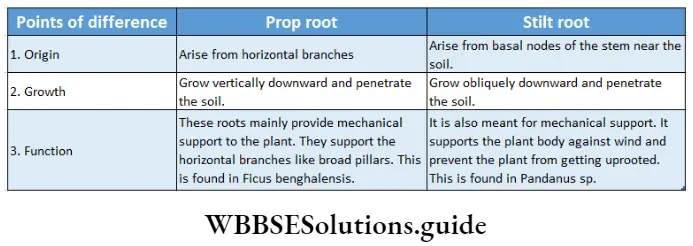
Prop roots: These roots grow vertically downward, from the horizontal branches of the stem. Initially, the roots are hygroscopic (can absorb moisture from the air) but after reaching the soil each root grows into a thick and woody pillar-like structure.

They provide mechanical support to the branches. example found in Indian rubber (F’cus elastica) and banyan (Ficus benghalensis).

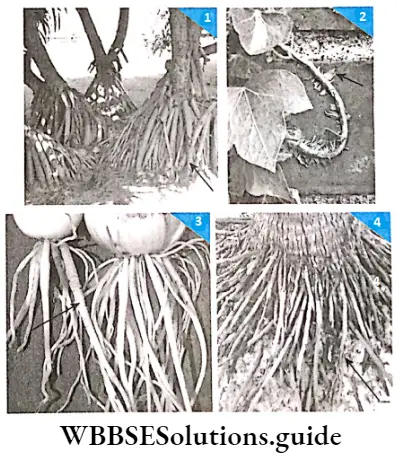
Stilt roots: These strong and stout roots are found in plants growing on soft soils, where anchorage is not so strong. They emerge obliquely from the basal node of the stems.

They provide mechanical support to the plant and help the P|ants to remain erect- stilt roots Perform the function of anchorage and prevent the plant from being uprooted.

Examples are found in screw pine (Pandanus foetida) and maize (Zea mays), sugarcane (Saccharum officinarum), and Sorghum (Sorghum vulgare).

Climbing roots: These roots grow from the nodes or internodes of some plants with weak stems. They help the plants to climb higher by attaching on to a stick or a tree as support.

The root tips of these plants secrete a viscous substance that helps the roots to stick to the supporting j structures. example found in betel vines (Piper betel).

Morphology Of Flowering Plants Modifications ofadventitious rootsfor mechanicalfunction

Clinging roots: These are very small roots developing from the nodes of certain parasitic plants. Clinging roots help the plant to anchor to the host plant and absorb nutrients from it example found in Vonda tessellata(Orchid).

Contractile or pull roots: This type of root develops from different underground stems like rhizome, bulb, corm, etc., in addition to other types of roots. These roots can contract and expand to maintain the proper position of the underground and the aerial parts of the underground stem. example found in Allium spv Crocus sp., Canna sp.

Root thorns: Some plants adventitiously develop sharp and pointed thorn-like structures from the lower nodes of the stem. These are called root thorns. These structures protect the plants from animals. example found in Pathos armatus.

Rootless plants

There are some rootless angiosperms such as Urticularia sp., a submerged aquatic plant. They have some finely dissected leaves which carry out the functions of the root.

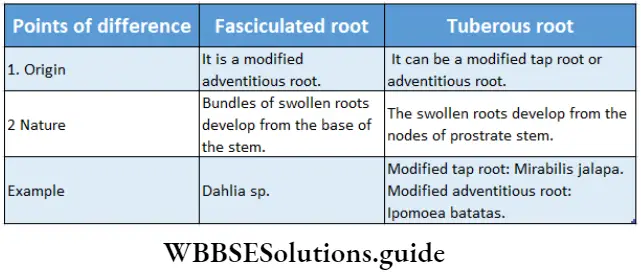
Morphology Of Flowering Plants Differences between fasciculated root and tuberous root

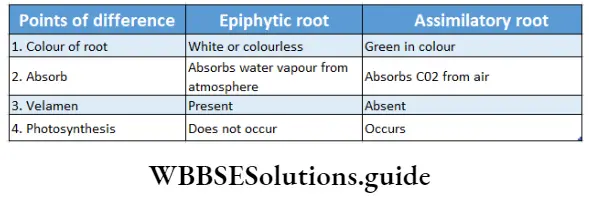
Morphology Of Flowering Plants Differences between epiphytic root and assimilatory root

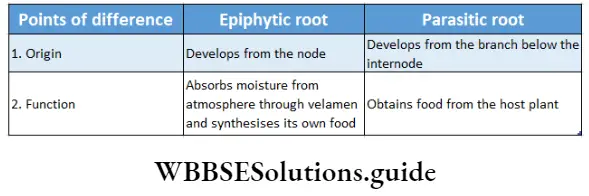
Morphology Of Flowering Plants Differences between epiphytic root and parasitic root

Morphology Of Flowering Plants Differences between prop root and stilt root

Morphology Of Flowering Plants Differences between assimilatory root and aquatic breathing root

Functions Of Root

The functions of roots are as follows—

Primary functions:

The primary functions of roots are discussed as follows—

Mechanical function: The root system helps the plant to anchor in the soil and keep the plant upright.

Physiological Function:

Roots perform different physiological functions—

  1. Absorption: The root absorbs water and minerals from the soil.
  2. Conduction: Roots indirectly play an important role in the ascent of sap (upward movement of water in the plant body). These help in the conduction of water and minerals to different parts of the shoot system.
  3. Storage of food: Many roots help in food storage.

Special functions of modified roots: Besides the above primary functions, some roots get modified to carry out some special functions.

They are as follows

Mechanical Function:

  1. Prop roots of the banyan tree support the huge horizontal branches and maintain the erect position of the tree.
  2. Clinging roots (of orchids) and climbing roots (of betel vine) help the plants to climb on supporting objects (like a stick or a tree trunk).
  3. Some roots also provide support to the weak plants, for example, the stilt root of screw pine (Pandanus foetida).
  4. Roots also provide protection to the plants. For example, the root thorns of Pathos armatus protect the plants from herbivorous animals.

Physiological Function:

  1. Assimilatory roots help in carbon assimilation by photosynthesis. example assimilatory root of Trapa sp.
  2. Certain modified roots help in food storage. example storage root of sweet potato.
  3. Roots help in the absorption of moisture from the air. example epiphytic roots of orchids.
  4. In parasitic plants, certain roots help in J absorbing nutrients from the host plants. example haustoria of dodder (Cuscuta reflexa).
  5. Breathing roots or pneumatophores carry out gaseous exchange, Pneumatophores are observed in mangrove plants (for example Avicennia alba).
  6. Reproductive roots help in J reproduction by producing buds. example reproductive root of sweet potato (Ipomoea batatas).

Plant Stem – Structure and Functions Notes

The Stem

The main part of the shoot is the stem that bears bud leaves, branches, flowers, fruits, etc.

The Stem Definition: The ascending, positively phototropic, and negatively geotropic axis of the plant, developing from the plumule of the embryonic axis and usually present above the soil, is known as the stem.

Characteristics of Stem:

  1. The stem bears branches, leaves, buds, flowers, and fruits.
  2. The stem is differentiated into nodes and internodes.
  3. The apex of the stem usually contains a bud.
  4. Stems may or may not bear multicellular hairs.
  5. Leaves and branches grow exogenously and acropetally (upward from the origin) on the stem.
  6. Young stems are green in color. Some stems gradually become dark brown with maturation.
  7. On the outer surface of the stem, there is a cuticle layer.
  8. The stem may be unbranched (for example many palms) or branched (for example mango).

Read and Learn More: WBCHSE Notes for Class 11 Biology

Different Parts Of A Typical Stem

A typical stem, along with all its parts, is known as a shoot. Let us learn about the different parts of a typical stem.

Morphology Of Flowering Plants Different parts ofa typical stem

Node: A stem has some swollen parts at regular intervals along its length, from which leaves, buds, etc., develop. These are known as nodes. These are prominent in some plants (for example bamboo) whereas these are not visible in others (for example china-rose).

Node Function: Serves as the origin of leaves, axillary buds, branches, fruits, and flowers that develop from this region.

Internode: The region between two successive nodes is known as the internode. it does not bear any branches, leaves, flowers, or fruits.

Class 11 Biology Class 11 Chemistry
Class 11 Chemistry Class 11 Physics
Class 11 Biology MCQs Class 11 Physics MCQs
Class 11 Biology Class 11 Physics Notes

Internode Function: It keeps the stem erect.

“plant stem structure and functions notes for class 11”

Leaf: These are flat, generally green, thin structures, with limited lateral outgrowth. They develop from nodes of stems or branches.

Leaf Function: It helps to produce food by photosynthesis. Leaves also help in gaseous exchange between the plants and the outer environment.

Axil: The angle formed by the leaf with the stem is known as axil.

Axil Function: Axil gives rise to leaves, branches, fruits, and flowers.

Bud: It is an immature condensed shoot. The internodes of this condensed shoot are very short and thus appear condensed. The immature leaves completely enclose the growing region at the apex of the shoot.

The buds that are found at the apical region of the mature shoot are known as apical buds. On the other hand, the buds that are found at the axils are known as axillary buds.

Bud Function:

  1. Apical buds help to increase the length of the plant.
  2. At certain stages, the axillary bud produces leaves and branches, then it is known as a vegetative bud.
  3. During reproduction floral buds develop from the axils. These buds are also known as reproductive buds.

Branches: The stem-like structures that develop from the axil are known as branches.

Branches Function: The branches bear leaves and flowers.

Flower: The reproductive part of the plant that originates from the floral bud is known as a flower.

Flower Function: Flowers help in reproduction.

Plant Stem – Structure And Functions Notes

Types Of Stem

The nature, shapes, and texture of stems vary among plants. They are categorized on the basis of these features.

Classification of Stems According To Nature

Depending on their nature, the stems are classified as herbaceous and woody.

Herbaceous: The stems which are soft with less number of branching are known as herbaceous stems The plants with this type of stems are known as herbaceous plants or herbs.

Depending on the lifespan, the herbs can be divided into four groups—

  1. Annuals,
  2. Biennials,
  3. Perennials And
  4. Ephemerals.

“parts of a plant stem “

Annuals: Herbs completing their life cycle within a year are known as annuals. example mustard (Brassica nigra), and rice (Oryza sativa).

Biennials: Herbs completing their life cycles within two successive seasons are known as biennials. They grow vegetatively in the first season and initiate reproductive growth in the following season to develop flowers and fruits. example carrot (Daucus carota), and radish (Raphanus sativus).

Perennials: Herbs living for more than two seasons are known as perennials. example turmeric (Curcuma longa) and ginger (Zingiber officinale).

“detailed notes on plant stem anatomy and functions”

Ephemerals: Herbaceous plants completing their life cycles within a few days in the favorable season are called ephemerals. example Balanites aegyptica, and Arabidopsis thaliana.

Woody stems: These stems are hard and strong.

Plants are of three types

  1. Shrubs,
  2. Undershrubs And
  3. Trees.

Shrubs: These plants are of medium size with strong and woody stems. example china-rose (Hibiscus rosa-sinensis), rose (Rosa centifolia), custard apple (Annona squamosa), etc.

Undershrubs: These plants are intermediate between herbs and shrubs. example brinjal (Solanum melongena) and chilli (Capsicum frutescens).

Trees: These plants are taller with strong, hard, and woody stems. Mostly, the main erect axis remains unbranched for some distance and is termed a trunk.

The rest of the portion above generally becomes profusely branched to form a canopy. example mango (Mangifera indica), tamarind (Tamarindus indicus), and banyan (Ficus benghalensis).

Trees are again classified into the following types—

  1. Deciduous: These are trees that shed all their leaves in a particular season of the year. example Quercus alba (oak).
  2. Evergreen: These are the trees that shed their lea gradually and not all at the same time. They remain green throughout the year. example Mangifera indica.

Morphology Of Flowering Plants Different parts Herb and Shrub and Tree

Aerial stems may be strong or weak. Strong stems stand erect on the ground as weak stems need support to remain upright.

Strong (Erect) stem: These stems are more or less cylindrical and may be unbranched or branched. They are strong enough to keep the plant erect.

They are of the following types—

Excurrent: The main erect axis becomes thick at the base and gradually tapers towards the tip with racemose (indefinite) branching. The tree thus takes the shape of a pyramid. example Polyalthia longifolia, Pinus sp., etc.

Deliquescent: The stem starts branching profusely after some distance above the ground. Here, the tree canopy becomes dome-shaped. example Mangifera indica Ficus benghalensis.

Caudex: This type of stem is erect and unbranched with prominent leaf scars (impressions left by the leaf bases). It has a crown of leaves at the apex. example coconut palm (Cocos nucifera) and palmyra palm (Borassus flabellifer).

“plant stem functions and adaptations explained”

Culm or haulm: These stems are erect and hollow at the internodes but solid at the nodes. They appear to be jointed. example, bamboo (Bambusa tulda) and sugarcane (Saccharum officinarum).

Scape: This is the erect unbranched shoot, produced by the underground or underwater stem of some monocotyledonous plants. example Allium cepa.

Morphology Of Flowering Plants Caudex and Excurrent

Weak stem:

These stems are soft and delicate with less woody parts. They are not strong enough to remain erect.

The weak stems are of different types—

Trailer: This type of stem trails over the surface of the ground without producing any adventitious roots.

It is of two types—

  1. Procumbent: This stem grows along the soil surface and is mostly spread in one direction. exampleIpomoea reptans, Basella rubra.
  2. Decumbent: This stem grows along the ground for some distance and then rises upward at the apices. example Tridax procumbens, and Lindenbergia indica.

Creeper: This stem grows along the soil surface and develops adventitious roots from each node. It also produces small branches which are distributed in all directions. example Centello asiatka, and Phyla nodiflora.

“importance of plant stem structure and its functions”

Climber: These weak and flexible stems climb up on supports by producing certain special structures.

These items are classified as follows—

  1. Stem climbers or twiners: These are climbers that climb up around the support by twining. The growing apex of the stem coils around the support, either in the clockwise (for example Dioscorea alata) or anti-clockwise (for example, Clitoria ternatea) direction.
  2. Tendril climbers: When the climbers climb up with the help of a very sensitive thread-like, leafless structure called tendrils, they are known as tendril climbers. The tendrils gradually curl around the support for gripping.
    The tendrils can be modified stems (grapevine), leaves (Lathyrus aphasia), stipule {Smilax zeylanica), leaflet (Pisum sativum), leaf apex (Gloriosa superba), petiole (Clematis guarana), and inflorescence axis (Quisqualis malabaricum).
  3. Root climbers: These climbers climb up with the help of adventitious roots. These roots gradually become profusely branched to anchor the support. example Pothos aureus, and Piper betel.
  4. Scramblers or ramblers: This type of climber climbs up on supports with the help of thorns, spines, or prickles. example Calamus rotang, Bougainvillea spectabilis, and Capparis sepiaria.
  5. Hook climbers: These climbers climb up with the help of hooks, formed by the modifications of floral stalks, i.e., pedicels (Artabotrys uncinatus), terminal leaflets (Bignonia unguiscati) and inflorescence axis (Artabotrys uncinatus).
  6. Adhesive climbers: These climbers possess adhesive discs or pads on the climbing roots. These discs help them to climb up even on flat and smooth surfaces. example Parthenocissus sp.
  7. Lianes: These are woody climbers who twine and climb the big trees in deep forests. example Bauhinia sp., Marsdenia volubilis.

Morphology Of Flowering Plants Twiner

“plant stem types, structure, and functions notes”

Classification of Stems According to Texture

According to texture, stems are of the following types—

Glabrous: The outer surface of this type of stem is smooth and is devoid of any emergence (for example stem of Hibiscus rosa-sinensis).

Glaucous: These stems have a smooth and shiny outer surface (for example stems of Zea mays).

Hispid or hairy: The outer surface of this stem is covered with hairs (for example stems of Helianthus annuus).

Prickly or spiny: The outer surface of this stem is covered with prickles or spines (for example stem of a rose).

Morphology Of Flowering Plants Spiny stem

Morphology Of Flowering Plants Hairy stem

Branching Pattern Of Stem

Branches develop from the axillary buds or as bifurcation of the growing tip of the main stem. The arrangement of branches on the main stem is known as a branching pattern.

Types Of Branching

Two types of branching patterns are found in angiosperms—dichotomous and lateral.

Dichotomous branching: It occurs due to the bifurcation of the growing apex of the main axis. The branches may or may not develop equally. The main axis remains at the base of the two diverging branches and is referred to as the foot or podium. The forked region again develops branches

Monopodial dichotomy: In this type, the apex of the main stem bifurcates and gives rise to two daughter branches of equal vigor. This type of branching is found in pteridophytes. This type of branching is found in plants like Selaginella monospora, Lycopodium clavatum, Psilotum nudum, etc.

Sympodial dichotomy: In this type, the main axis bifurcates into two daughter branches of unequal vigor. One of them grows more rapidly than the other.

It is further divided into two types—

  1. Helicoid and scorpioid.
  2. Helicoid: This branching type shows growth on any one side of the main axis.
  3. Scorpioid: This branching type shows growth on both sides of the main axis.

Lateral branching: In this type, the branches develop from the sides of the main axis due to the activity of lateral axillary buds.

It may be of two kinds—

  1. Racemose or monopodial or indefinite and
  2. Cymose or sympodial or definite.

Racemose or indefinite: In this type, the main axis grows indefinitely and the branches develop from the axillary buds arranged in an acropetal (from the base towards the apex) manner. The terminal bud remains active throughout the lifespan of the plant.

Here the main axis forms the single foot and supports the lateral branches. This type of branching is also known as monopodial branching. The plant with this type of branching looks like a pyramid i.e., excurrent. example Polyalthia longifolia, Lawsonia alba, Pinus longifolia, etc.

“plant stem function “

Cymose or definite: In this type, the growth of the terminal bud ceases soon and the active lower lateral buds develop into branches. This type of branching is also known as sympodial branching. Due to this type of branching, the tree becomes dome-shaped i.e., deliquescent (for example mango, banyan, etc.).

It can be of three types—

  1. Uniparous,
  2. Biparous And
  3. Multiparous.

Uniparous: In this type, only one branch develops from the axil.

It is again divided into two types—

  • Helicoid, and
  • Scorpioid type.
    1. Helicoid: When the successive branches develop only on one side, then it is termed as helicoid type. example Saraca indica.
    2. Scorpioid: Successive branches develop alternately from both sides (left and right). example Vitis quadrangularis.
    3. Biparous: Two branches develop from the axils of the main axis. example Carissa Carandas, and Mirabilis Jalapa.
    4. Multiparous: Many branches develop from the axils of the main axis. example, Croton bonplandianum.

Morphology-Of-Flowering-Plants-Branching-PatternMorphology Of Flowering Plants Types of lateral branching

Morphology Of Flowering Plants Types ofdichotomous branching

Modified Stem

In certain cases stems are modified differently for different purposes such as for storing food, for protection, for reproduction, etc.

On the basis of position, modified stems are of three types—

  1. Aerial,
  2. Subaerial and
  3. Underground or subterranean.

Morphology Of Flowering Plants Branching Pattern

Modified subaerial stems

Subaerial stems develop from the axillary buds and grow along the ground. These stems give rise to new plants. Following are the different modified subaerial stems—

Runner: It is a slender, prostrate, creeping aerial stem. After running a short distance over the earth it develops roots and leaves, to form a new plant. This produces another runner from its leaf axil, which behaves similarly. example Oxalis corniculata, Centella asiatica, Ipomoea aquatica, etc.

“short notes on plant stem for NEET and board exams”

Stolon: It is an elongated, arched runner, that does not grow horizontally above the ground. It initially grows upward like normal branches, then arches down towards the soil. At the point of contact with the soil, it produces adventitious roots. example, Mentha piperita, Fragaria vesca, etc.

Morphology Of Flowering Plants Different types ofmodified subaerial stem

Offset: These are horizontal branches with shorter I and thicker internodes. The terminal ends of the S branches develop a cluster of roots towards the lower portion and a rosette of aerial leaves. Examples,Pistia stratiotes, Eichhornia crassipes, etc.

Sucker: They originate from the underground basal part of the aerial shoot. After growing for a certain distance, the sucker develops adventitious roots, while the apex emerges upward and produces a leafy aerial shoot. example Mentha viridis, Chrysanthemum coronarium, etc.

Modified underground or subterranean stems

These stems grow fully or partially under the ground. These stems produce leaves and flowers during favorable conditions. They store food to prevent unfavorable seasons and also to help in vegetative propagation. These stems consist of apical bud, axillary bud, nodes, internodes, scale leaves, or other modified leaves.

“plant stem internal and external structure with diagrams”

Modified underground stems are of the following types—

Rhizome: The rhizome is an elongated, thick, fleshy, and irregularly shaped underground stem. It is differentiated into nodes and internodes. The stem bears scale leaves at the nodes and axillary buds.

Some of the axillary buds produce aerial shoots. Many adventitious roots develop from the lower portion of the rhizome. The apical bud grows to elongate and develops new aerial shoots.

Examples; are Zingiber officinale and Curcuma longa, Musa paradisiaca, etc.

Morphology Of Flowering Plants Rhizome

Stem-tuber or tuber: These are the fleshy, round, oval, or oblong-shaped underground branches developed from the axils of leaves. The apices of these branches swell up due to stored food and are modified into tubers. Each tuber has numerous depressions known as eyes.

These stems have many nodes and internodes with rudimentary buds in the axils of scale leaves in the eyes. Example. Solarium tuberosum, Cyperus rotundus, etc.

Morphology Of Flowering Plants Tuber

Corm or solid bulb: The corm is more or less round, solid, stout, and fleshy underground stem or rootstock. The entire body of the corm is covered with scale leaves. Buds are developed at the nodes in the axils of the scale leaves. Some buds develop into new corm and the older portions gradually die.

Adventitious roots originate from the base or from the whole body. Corm bears a large apical bud that develops into large foliage in early spring and finally blooms. example Amorphophallus campanulatus, Colocasia sp., Crocus sativus, etc.

Morphology Of Flowering Plants Corm

Bulb: Bulb is a modified underground stem in which the stem is extremely reduced to a small convex disc with compressed internodes. Thick and fleshy scale leaves are produced from the upper portion of the stem.

A bulb consists of apical buds and axillary buds. Axillary buds may develop into new bulbs. Adventitious roots are produced from the lower surface of the stem.

“plant stem modifications and their functions notes”

Bulb is of two types—

Tunicated or coated bulb: In this type, the fleshy leaves are arranged on the disc in a concentric manner, The outer leaves become dry and scaly to form tunica (covering sheath).

Example Allium cepa. Scaly or naked bulb: In this type, the fleshy leaves overlap each other on the margins and do not remain covered with a tunica. example Lilium candidium and Tulipa gesneriana.

Morphology Of Flowering Plants Tunicated bulb

Metamorphosed (highly modified) aeria stems: In some cases, the stem shows extreme structural modifications. Its nature can be determined by its origin and internal structure. Such extremely modified stems are termed metamorphosed stems.

They are of various types—

Thom or stem spine: In some plants, the axillary buds are metamorphosed into hard and sharp pointed thorns or spines. These thorns act as a defense organ. They may be modified axillary buds, as in Duranta plumieri, Hygrophyla auriculata, Aegle marmelos etc. They may also be modified terminal buds, as in Carissa carandas. As they grow in the leaf axils, they often bear foliage and lateral branches. They also have anatomical features like the stems.

Stem tendril: Some parts of a weak stem or branch sometimes metamorphose into a tendril to climb the support. It may be axillary (for example, Passiflora suberosa) or terminal (for example Vitis quadrangularis).

Phyllodade or mesophyll: This is formed from the metamorphosis of stem, into a flat leaf-like structure consisting of many nodes and internodes. It performs the functions of a leaf. In this case, the original leaves may either fall off or become very rudimentary or modified into spines.

This helps to reduce the rate of I transpiration. Sometimes it may store water or food and become succulent. These are mostly found in xerophytes. This type of metamorphosis is observed in plants like Opuntia dillenii, and Muehlenbeckia platyclados.

“vascular system in plant stem and its role”

Cladodes: These are the metamorphosed leaf-like stems or branches consisting of only one internode Cladodes are green in colour, flattened or cylindrical in shape. Cladodes develop in the axils of very small scaly or spiny leaves. They perform the function of foliage leaves, i.e., photosynthesis. example Asparagus racemosus.

Pseudobulbs: It is a modified stem found in some orchids. Generally, the internodes swell up into a fleshy and tuberous structure. They serve as storage organs, primarily for water, which helps the plants to survive during drought. example Bulbophyllum sp.

Bulbil: In some plants, the axillary buds develop into swollen structures known as bulbil. They serve as organs of food storage. They also help in vegetative propagation by producing new plants. example Dioscorea.

Thalamus: It is the modified shoot on which floral leaves develop. It is a condensed axis with very closely placed nodes and suppressed internodes.

At the condensed nodes, the thalamus bears different parts of the flower (floral leaves)- calyx, corolla, stamen, and carpel, which are actually modified leaves. It is found in most of the typical flowers like Hibiscus rosa-cinensis.

Morphology Of Flowering Plants Different types ofmetamorphosed aerial stem

Morphology Of Flowering Plants Comparison among bulb, rhizome, tuber and corm

Morphology Of Flowering Plants Comparison among runner, stolon, sucker and offset

Morphology Of Flowering Plants Differences between phyllodade and cladode

Functions of stem

Functions of the stem can be divided into two groups.

They are as follows—

Primary functions:

The primary functions of stems are as follows—

Mechanical: Stem bears fruits, leaves, flowers, buds, and branches on it. Stem provides mechanical support to all the other parts of the plant.

Physiological: It helps in the conduction of water containing dissolved minerals to different parts of the plant body through xylem vessels. It also transports food and many other macromolecules prepared by leaves to different parts of the plant body through phloem tissue.

Special functions:

The special functions of stems are as follows—

Food and water storage: Stores water (as seen in many cacti) and food (as seen in many underground modified stems).

Photosynthesis: Young stems and some modified leaf-like stems (cladodes and phylloclades) are involved in the production of food through photosynthesis.

Protection: In some plants stems get modified into thorns which protect the plants from animals. example Aegle I marmelos and Duranta plumieri.

Support: The stems are modified to various structures such as tendrils, thorns or hooks. These structures provide support to the weak plants. example Vitis vinifera.

“plant stem structure and functions PDF notes download”

Vegetative reproduction: The underground and subaerial-modified stems help in vegetative repro(junction or propagation. example Runner in grass sto|ons |n Mentha sp., and tuber in potato.

Perennation: The function of perennation (survival during unfavorable environmental conditions) is found in underground modified stems such as corms, rhizomes, tubers, etc.

Floating: Specially modified stems of certain aquatic plants contain aerenchyma. This helps the plant to float on water.

Morphology Of Flowering Plants Differences between tuberous root and tuber

Morphology Of Flowering Plants Differences between underground stem and true root

Moraphology Of Flowering Plants Differences between root and stem

Cell Cycle And Cell Division Question and Answers

Class 11 Biology WBCHSE Cell Cycle And Cell Division Questions and Answers

Question 1. Which substances control the cell cycle?
Answer:

Some proteins and enzymes present in the cytoplasm, such as cyclin, and cyclin-dependent kinase (Cdks), control the cell cycle.

Cell Cycle And Cell Division

Question 2. Which is the longest stage of the cell cycle?
Answer:

The G2 phase of interphase is the longest stage and maximum growth of the cell occurs at this stage.

Cell cycle and cell division questions and answers PDF

Question 3. What is the G0 stage?
Answer:

G0 stage

The point of the G1 phase at which the cell cycle stops is
known as the G0 stage. Although the cells at this stage are metabolically active, they do not divide. Animal nerve cells remain at this stage permanently.

Class 11 Biology Class 11 Chemistry
Class 11 Chemistry Class 11 Physics
Class 11 Biology MCQs Class 11 Physics MCQs
Class 11 Biology Class 11 Physics Notes

Question 4. Why is amitosis called ‘direct division’?
Answer:

In amitosis, cells divide directly without spindle formation and chromosome segregation. Thus, it is also known as direct division.

Cell Cycle And Cell Division Question And Answers

Question 5. What is the composition of spindle fibres?
Answer:

Composition of spindle fibres

Tubulin protein (95-97%), RNA (3-5%) and a small amount of lipid are constituents of spindle fibres.

Question 6. What are meiocytes and meiospores?
Answer:

Meiocytes and meiospores

The diploid cells which undergo meiosis are called meiocytes, such as spermatocytes, oocytes. The haploid spores that are formed due to meiosis are known as meiospores.

Read and Learn More WBCHSE Solutions For Class 11 Biology

Question 7. What is a diploid cell?
Answer:

Diploid cell

A cell consisting of two complete sets of chromosomes, receiving one from each parent is called a diploid cell. Human somatic cells are diploid (2n – 46).

Question 8. What is a haploid cell?
Answer:

Haploid cell

The cells which contain half the number of diploid chromosomes or one complete set of chromosomes are called haploid cells. Human gametes are haploid (n=23).

Question 9. What is midbody?
Answer:

Midbody

At the end of anaphase in animal cells, microtubules are arranged at the equatorial plane like a thick plate or string. This structure is known as the midbody.

NEET cell cycle and cell division important questions with answers

Question 10. What is endomitosis?
Answer:

Endomitosis

The type of meiosis in which repeated DNA replication occurs without the occurrence of nuclear division and formation of daughter nuclei by chromosomal segregation is known as endomitosis.

Example polytene chromosome in the salivary gland of order Diptera of insects, etc.

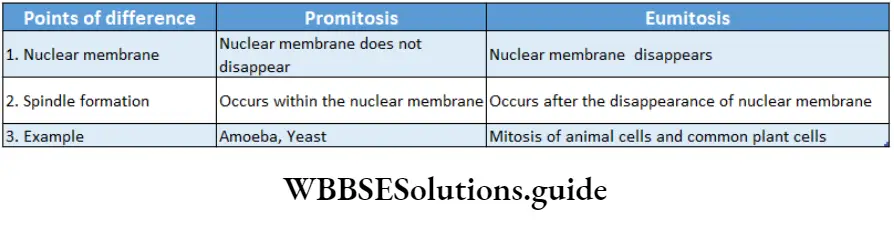
Question 11. What are the differences between pro-mitosis and mitosis?
Answer:

The differences between pro-mitosis and mitosis are as follows—

Biology Class 11 Chapter 8 Cell Cycle And Cell Division Difference Between Promitiosis And Eumitosis

Question 12. What is synapsis?
Answer:

Synapsis

The phenomenon of pairing of homologous chromosomes at the zygotene subphase of prophase I in meiosis is known as synapsis.

Question 13. What is known as bivalent?
Answer:

Bivalent

The pair of homologous chromosomes formed as a result of synapsis at the zygotene subphase of prophase I in meiosis are called bivalents.

Question 14. How many times does DNA replication occur in meiosis? Why?
Answer:

DNA replication occurs only once. It occurs before meiosis I during S phase of interphase. DNA replication does not occur between meiosis I and meiosis II, i.e., at the interkinesis stage. It is because chromosome division does not take place at meiosis I, DNA remains duplicated.

Question 15. What is interkinesis?
Answer:

Interkinesis

The short period between the telophase of meiosis I and the prophase of meiosis II is known as interkinesis.

DNA replication does not occur at this phase but biochemicals are synthesised.

Question 17. What is metakinesis?
Answer:

Metakinesis

The process by which chromosomes at the prometaphase stage align themselves at the centre of a cell, is known as metakinesis.

Question 18. What is disjunction?
Answer:

Disjunction

The phenomenon of segregation of homologous chromosomes during anaphase I of cell division is known as disjunction.

Class 11 biology cell cycle and cell division Q&A

Question 19. What is non-disjunction?
Answer:

Non-disjunction

When segregation of homologous chromosomes does not occur during cell division, it is known as non-disjunction. So, after division, the daughter cell receives either more or less number of chromosomes than usual.

Question 20. Why amitosis does not occur in advanced organisms?
Answer:

Amitosis causes unequal distribution of chromatin material in daughter cells. So, the uniformity in chromosome number will not be maintained.

As a result, structural and functional abnormalities would arise in daughter cells which would hamper the normal metabolic functions of the organisms.

Question 21. What is a cell plate?
Answer:

Cell plate

During cytokinesis in plant cells, the thin plate-like structure formed by the fusion of phragmosomes at the equatorial region of the plant cell, is known as cell plate.

Class 11 Biology WBCHSE Cell Cycle And Cell Division Very Short Answer Type Question

Question 1. What is metacentric chromosome?
Answer:

Metacentric chromosome

A chromosome with a centrally placed centromere that divides the chromosome into two arms of approximately equal length, is called a metacentric chromosome.

Question 2. What is the average cell cycle span for a mammalian cell?
Answer:

The average cell cycle span of a mammalian cell is 24 hours.

Question 3. Given that the average duplication time of E.coli is 20 minutes, how much time will E.coli cell take to become 32 cells?
Answer:

Number of cells = 2n, where n is number of divisions.
Total no. of cells = 32 As, 32 = 21 2 3 4 5 n = 5
Hence, time required for five generations is—
5 x 20 = 100 minutes.

Question 4. What is mitosis?
Answer:

Mitosis

The indirect process of division of a somatic cell
which produces two daughter cells that are structurally and genetically identical to each other and to the parent cell is known as mitosis.

Short answer questions on cell cycle and cell division

Question 5. Can there be DNA replication without cell division?
Answer:

Yes, DNA replication can occur without cell division. We can see this situation in two following processes—endomitosis and free nuclear division.

Question 6. What is a cell cycle checkpoint?
Answer:

Cell cycle checkpoint

The particular type of signalling mechanism or regulation that may prevent the cell from continuing to tire the next phase of the cell cycle is called the cell cycle checkpoint.

Question 7. What do you mean by a haploid set of chromosomes?
Answer:

Haploid set of chromosomes

A single set of chromosomes present in cells is known as a haploid set of chromosomes.

Question 8. What is the G1 phase?
Answer:

G1 phase

The stage of the cell cycle that exists from the birth of a new cell till the onset of the S phase during interphase is known as the Gi phase.

Question 9. Can there be mitosis without DNA replication in S
Answer:

No, because DNA is required to be distributed in daughter cells during mitosis.

Cell cycle and cell division chapter-wise questions with solution

Question 10. Why is mitosis called equational division?
Answer:

For the distribution of genetic material in daughter cells equal to that of parent cells, DNA replication is required prior to cell division.

Question 11. What do you mean by homologous chromosomes?
Answer:

Homologous chromosomes

Mitosis is also called equational division because the number of chromosomes in daughter cells, after mitosis remains the same as that of the parent cell.

Question 12. Which of the phases of the cell cycle has the longest duration?
Answer:

A pair of chromosomes in the offspring, obtained one from each parent, that are similar in length, gene position and centromere location, are called homologous chromosomes.

Question 13. What is the function of the spindle apparatus?
Answer:

Function of the spindle apparatus

The spindle apparatus is responsible for chromosome movements first towards the equator and then towards the poles. It helps in the segregation of sister chromatids during cell division.

Question 14. Which part of the human body should one use to demonstrate stages of mitosis?
Answer:

Bone marrow.

Question 15. Two key events take place during the S phase in animal cells: DNA replication and duplication of centriole. In which parts of the cell do these events occur?
Answer:

DNA duplication takes place in the nucleus and centriole divides in the cytoplasm.

Question 16. What do you mean by criminalisation?
Answer:

Criminalisation

The process of the movement of interstitial chiasmata to the terminal ends of bivalent during the diplotene of prophase I in meiosis I is known as terminalisation.

Biology Class 11 WBCHSE

Question 17. A cell has 32 chromosomes. It undergoes mitotic division. What will be the chromosome number (N) during metaphase? What would be the DNA content (C) during anaphase?
Answer:

The number of chromosomes is 32 at metaphase. DNA content becomes double that of the parent cell at anaphase.

Question 18. What do you mean by recombination?
Answer:

Recombination

The exchange of genetic materials between homologous chromosomes by the process of crossing over is known as recombination.

Objective questions on cell cycle and cell division with answers

Question 19. If a tissue has at a given time 1024 cells, how many cycles of mitosis had the original parental single cell undergone?
Answer:

Ten generations [210= 1024 cells].

Biology Class 11 WBCHSE

Question 20. What is carcinoma?
Answer:

Carcinoma

Carcinoma is a type of cancer of epithelial tissue.
Example Lung carcinoma.

Question 21. An anther has 1200 pollen grains. How many pollen mother cells must have been there to produce them?
Answer:

300 pollen mother cells are needed to produce 1200 pollen grains.

Question 22. In which phase of cell division does DNA replication take place?
Answer:

In the cell cycle, DNA synthesis takes place during the S phase (synthesis phase.)

Cell Cycle And Cell Division Multiple Choice Question And Answers

Cell Cycle And Cell Division Multiple Choice Questions

Question 1. Anaphase Anaphase-promoting complex (APC) is a protein degradation machinery necessary for proper mitosis of animal cells. If APC is defective in a human cell, which of the following is expected to occur?

  1. Chromosomes will be fragmented
  2. Chromosomes will not segregate
  3. Recombination of chromosome arms will occur
  4. Chromosomes will not condense

Answer: 2. Chromosomes will not segregate

Question 2. Which of the following options gives the correct sequence of events during mitosis?

  1. Condensation → nuclear membrane disassembly → arrangement at equator → centromere division → segregation → telophase
  2. Condensation → crossing over → nuclear membrane disassembly → segregation → telophase
  3. Condensation —arrangement at equator → centromere division → segregation → telophase
  4. Condensation → nuclear membrane disassembly → crossing over → segregation → telophase

Answer: 1. Condensation → nuclear membrane disassembly → arrangement at equator → centromere division → segregation → telophase

Read and Learn More WBCHSE Multiple Choice Question and Answers for Class 11 Biology

Question 3. Zygotic meiosis is characteristic of—

  1. Fucus
  2. Funaria
  3. Chlamydomonas
  4. Marchantia

Answer: 3. Chlamydomonas

Question 4. A cell at the telophase stage is observed by a student in a plant brought from the field. He tells his teacher that this cell is not like other cells. telophase stage. There is no formation of a cell plate and thus the cell contains more chromosomes as compared to the other dividing cells. This would result in —

  1. Polyploidy
  2. Somaclonal variation
  3. Polyteny
  4. Aneuploidy

Answer: 1. Polyploidy

Cell Cycle And Cell Division Multiple Choice Question And Answers

Question 5. Which of the following is. not a characteristic feature during mitosis in somatic cells?

  1. Disappearance of nucleolus
  2. Chromosome movement
  3. Synopsis
  4. Spindle fibres

Answer: 3.

Question 6. In meiosis, crossing over is initiated at—

  1. Leptotene
  2. Zygotene
  3. Diplotene
  4. Pachytene

Answer: 2. Zygotene

Class 11 Biology Class 11 Chemistry
Class 11 Chemistry Class 11 Physics
Class 11 Biology MCQs Class 11 Physics MCQs
Class 11 Biology Class 11 Physics Notes

Question 7. Which of the following statements is not true for cancer cells in relation to mutations?

  1. Mutations destroy telomerase inhibitor
  2. Mutations inactivate the cell control
  3. Mutations inhibit the production of telomerase
  4. Mutations in proto-oncogenes accelerate the cell cycle

Answer: 3. Mutations inhibit the production of telomerase

Question 8. During cell growth, DNA synthesis takes place in—

  1. S phase
  2. G2 phase
  3. G2 phase
  4. M phase

Answer: 1. S phase

Question 9. When a cell has stalled the DIMA replication fork, which checkpoint should be predominantly activated?

  1. G-l/S
  2. G2/M
  3. M
  4. Both G2/M and M

Answer: 1. G-l/S

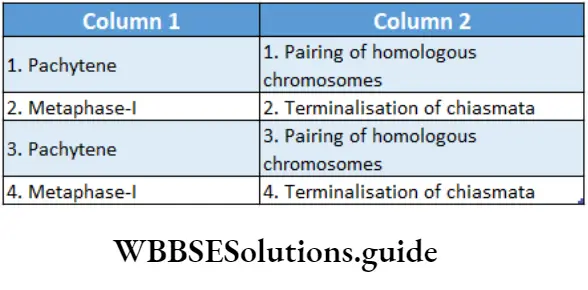
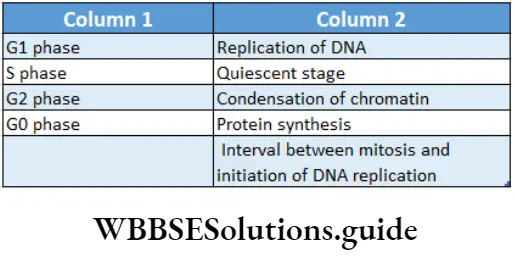
Question 10. Match the stages of meiosis in column 1 to their characteristic features in column 2 and select the correct option using the codes given below:

Biology Class 11 Chapter 8 Cell Cycle And Cell Division Match the Columns Question 10

  1. 1-3,2-4,3-2,4-1
  2. 1-1,2-4,3-2,4-3
  3. 1-2,2-4,3-3,4-1
  4. 1-4,2-3,3-2,4-1

Answer: 1. 1-3,2-4,3-2,4-1

Question 11. Arrange the following events of meiosis in the correct sequence—

  1. Crossing over
  2. Synapsis
  3. Terminalisation of chiasmata
  4. Disappearance of nucleolus

Choose the correct opition 

  1. 2, 3, 4, 1
  2. 2, 1, 4, 3
  3. 2, 1, 3, 4
  4. 1, 2, 3, 4

Answer: 3. 2, 1, 3, 4

Question 12. During which phase(s) of the cell cycle, does the amount of DNA in a cell remain at 4C level if the initial amount is denoted as 2C?

  1. G0 and G1
  2. G1 and S
  3. Only G2
  4. G2 and M

Answer: 3. Only G2

Question 13. In the S phase of the cell cycle—

  1. The amount of dna doubles in each cell
  2. The amount of dna remains the same in each cell
  3. Chromosome number is increased
  4. The amount of dna is reduced to half in each cell

Answer: 1. The Amount of dna doubles in each cell

Question 14. The enzyme recombinase is required at which stage of meiosis?

  1. Pachytene
  2. Zygotene
  3. Diplotene
  4. Diakinesis

Answer: 1. Pachytene

Question 15. Select the correct statement related to mitosis—

  1. Amount of DNA in the parent cell is first halved and then distributed into two daughter cells
  2. Amount of DNA in the parent cell is first doubled and then distributed into two daughter cells
  3. Amount of DNA in the parent cell is first halved and then distributed into four daughter cells
  4. Amount of DNA in the parent cell is first doubled and then distributed into four daughter cells

Answer: 2. Amount of DNA in the parent cell is first doubled and then distributed into two daughter cells

Question 16. Average duration of cell cycle of a human cell is—

  1. 12 h
  2. 16 h
  3. 20 h
  4. 24 h

Answer: 2. 16 h

Question 17. Mattch the following Coloumns:

Biology Class 11 Chapter 8 Cell Cycle And Cell Division Match THe Coloumns Question 17

  1. 1-3,2-5,3-1,4-2
  2. 1-5,2-4,3-1,4-3
  3. 1-5,2-1,3-4,4-2
  4. 1-5,2-2,3-3,4-4

Answer: 3. 1-5,2-1,3-4,4-2

Question 18. Males produce sperm by mitosis in

  1. Periplaneta americana
  2. Apis mellifera
  3. Drosophila melanogaster
  4. Lepisma sp.

Answer: 2. Apis mellifera

Question 19. The centrosome duplicates during the—

  1. S phase of cell cycle
  2. G2 phase of cell cycle
  3. G2 phase of cell cycle
  4. Prophase of cell cycle

Answer: 1. S phase of cell cycle

Question 20. The correct sequence of the sub-stages of

  1. Diakinesis → Pachytene → Diplotene → Zygotene → Leptotene
  2. Leptotene → Zygotene → Pachytene → Diplotene → Diakinesis
  3. Pachytene → Diplotene → Diakinesis → Dioplotene → Diakinesis
  4. Leptotene → Zygotene → Diplotene → Diakinesis → Pachytene

Answer: 2. Leptotene → Zygotene → Pachytene → Diplotene → Diakinesis

Question 21. What are the spindle fibres that connect the centromere of chromosome to the respective poles called?

  1. Astral rays
  2. Interpolar fibres
  3. Chromosomal fibres
  4. Inter chromosomal fibres

Answer: 1. Astral rays

Question 22. During which stage of prophase-l genetic recombination of parental characters, takes place?

  1. Zygotene
  2. Pachytene
  3. Diplotene
  4. Diakinesis

Answer: 2. Pachytene

Question 23. Which of the following ions are necessary for the assembly of microtubules?

  1. Na+ and K+
  2. Ca2+ and Cl-
  3. Ca2+ and Mg2+
  4. Na+ and C2+

Answer: 3. Ca2+ and Mg2+

Question 24. Which one of the following is the best stage to observe the shape, size and number of chromosomes in a cell?

  1. Interphase
  2. Prophase
  3. Metaphase
  4. Telophase

Answer: 3. Metaphase

Question 25. A stage in cell division is shown in the figure. Select the answer which gives correct identification of the stage with its characteristics?

  1. Telophase-Nuclear envelope reforms, Golgi complex reforms
  2. Late anaphase-Chromosomes move away from equatorial plate, Golgi complex not present
  3. Cytokinesis-Cell plate formed, mitochondria distributed between two daughter cells
  4. Telophase-Endoplasmic reticulum and nucleolus not reformed yet

Answer: 1. Telophase-Nuclear envelope reforms, Golgi complex reforms

Question 26. Meiosis takes place in

  1. Meiocyte
  2. Conidia
  3. Gemmule
  4. Megaspore

Answer: 1. Meiocyte

Question 27. During the cell cycle, RNA and non-histone proteins are synthesised in—

  1. S phase
  2. G0 Phase
  3. G2 Phase
  4. M Phase

Answer: 3. G2 Phase

Question 28. During the cell cycle, RNA and non-histone proteins are synthesised in—

  1. G1 phase
  2. G2 Phase
  3. S Phase
  4. G0 Phase

Answer: 3. S Phase

Question 29. During the cell cycle, RNA and non-histone proteins are synthesised in—

  1. Homotypic without cytokinesis
  2. Reductional without cytokinesis
  3. Somatic followed by cytokinesis
  4. Meiotic followed by cytokinesis

Answer: 1. Homotypic without cytokinesis

Question 30. Chromatid formation takes Place in

  • S Phase
  • Metaphase
  • G1 phase
  • G2 Phase

Answer: 1. S Phase

Question 31. 56 Cells Are Produced in meiosis is-

  1. Equal
  2. Reduction
  3. Mitosis
  4. None Of these

Answer: 2. Reduction

Question 32.  Longest phase of meiosis—

  1. Prophase-1
  2. Prophase-2
  3. Anaphase-1
  4. Metaphase-2

Answer: 1. Prophase-1

Anatomy Of Flowering Plants Questions And Answers

Class 11 Biology WBCHSE Anatomy Of Flowering Plants Questions And Answers

1. Why do waste products not get stored in meristematic tissue?
Answer:

Waste products not get stored in meristematic tissue because

The cells, present in the meristematic tissues are very active, so, they cannot store any waste materials in them.

Anatomy Of Flowering Plants

Question 2. What do you mean by homogeneous and heterogeneous cells?
Answer:

Homogeneous cell: The cells which have the same structure and function are known as homogeneous cells.

Heterogeneous cell: The cells which have different structure and function are known as heterogeneous cells.

Biology Class 11 WBCHSE

Question 3. How will you identify whether a stem is a dicot or monocot, by observing its cross-section under the microscope?
Answer:

It can be identified by the characteristics given in the following table

Anatomy Of Flowering Plants Some Important Questions 3

Question 4. What is a bundle cap?
Answer:

Bundle cap

In some dicotyledonous plants (for example sunflower), 3 to 4 layers of sclerenchyma cells form cap-like structures on the vascular bundles. This layer of sclerenchyma cells is known as a bundle cap.

Read and Learn More WBCHSE Solutions For Class 11 Biology

Question 5. Write down the nature of tissue in the cambium. phellogen and ground meristem.
Answer:

Cambium: Secondary meristematic tissue. Phellogen: Secondary meristematic tissue. Ground meristem: Primary meristematic tissue

Class 11 Biology Class 11 Chemistry
Class 11 Chemistry Class 11 Physics
Class 11 Biology MCQs Class 11 Physics MCQs
Class 11 Biology Class 11 Physics Notes

Question 6. Write down the names of the sclereids found in apples, leaves of water lilies and peas.
Answer:

Apple: Brachysclereid.

Leaf of water lily: Trichosclereid. Leaf of pea: Osteosdereid.

Anatomy Of Flowering Plants Questions And Answers

Question 7. How will you differentiate metaxylem and protoxylem primarily?
Answer:

The Lumen of the protoxylem is smaller than the metaxylem.

Question 8. Name the dead cells present in the xylem and phloem tissues.
Answer:

Dead cells in xylem tissue: Tracheids, trachea and xylem fibres.

Dead cells in phloem tissue: Phloem fibres.

Question 9. Name the living cells of the xylem and phloem tissues.
Answer:

Xylem: Xylem parenchyma.

Phloem: Companion cell, phloem parenchyma and sieve tube.

Question 10. Define the following fibres—Surface fibre, Extra-xylary fibre, and Perivascular fibre.
Answer:

Surface fibre: The fibres present in any part of the plant are known as surface fibres. example coconut fibre.

Extra-xylary fibre: The fibres found on the outer portion of the xylem tissue, are known as extra-xylary fibre. example surface fibre.

Perivascular fibre: The fibres present near the endodermis, are known as perivascular fibres. example, pericycle fibres.

Question 11. Which cambium is required for the formation of a cambium ring?
Answer:

Interfascicular cambium, as well as intrafascicular (fascicular) cambium, is required for the formation of a cambium ring.

Class 11 Biology WBCHSE Anatomy Of Flowering Plants Very Short Answer Type Question

Question 1. Name the cavity of the vascular bundle in the monocot stem.
Answer:

Lysigenous cavity

Question 2. What are the components of cuticles in leaves?
Answer:

Cutin

Question 3. Secondary meristematic tissue develops from which tissue?
Answer:

Permanent tissue

Question 4. In which type of stem vascular bundles are arranged in a ring?
Answer:

Dicotyledonous stem

Question 5. Name the vascular bundle where the phloem surrounds the central strand of the xylem.
Answer:

Hadrocentric or amphicribral vascular bundle

Biology Class 11 WBCHSE

Question 6. Name the tissue that gives mechanical support to the plant.
Answer:

Sclerenchyma

Question 7. Which part subterminalises apical meristem of root?
Answer:

Root cap region

Question 8. Give an example of two fruits having sclerite.
Answer:

Guava and pear

Question 9. Name the layer of the root tissue system from which lateral roots emerge.
Answer:

Pericycle

Question 10. From which part of the dicot stem cambium ring forms during its secondary growth?
Answer:

Interfascicular cambium and intrafascicular cambium join to form cambium ring

Question 11. Which tissues form calyptrate?
Answer:

Apical meristematic tissue

Question 12. Write the name of the tissue that is involved with growth in height and width of plants.
Answer:

Lateral growth of plant occurs due to the growth of the cambium and an increase in width occurs due to the division of apical meristematic tissue.

Question 13. Which tissue is called living mechanical tissue? Write its types.
Answer:

Collenchyma. It is of three types—

  1. Tangential collenchyma,
  2. Angular collenchyma,
  3. Lacunar collenchyma.

Question 14. Name the tissue responsible for secondary growth.
Answer:

Secondary meristematic tissue (cambium and cork cambium)

Question 15. Companion cell belongs to which type of permanent tissue?
Answer:

It is a component of phloem.

Question 16. Name the tissue of plants whose cells have thin cell walls and are capable of division even after maturation.
Answer:

Parenchyma cell

Question 17. Name two sieve components found in phloem.
Answer:

Sieve cells and sieve tubes

Biology Class 11 WBCHSE

Question 18. The product of photosynthesis is transported from the leaves to various parts of the plant and stored in c some cells before being utilised. What are the I cells/tissues that store them?
Answer:

Parenchyma

Question 19. The protoxylem is the first formed xylem. The protoxylem lies next to the phloem, what kind of arrangement of xylem would you call it?
Answer:

Exarch

Question 20. What is the function of phloem parenchyma?
Answer:

Its function is lateral conduction of food and water from the xylem.

Question 21. What is the epidermal cell modification in plants which prevents water loss?
Answer:

Epidermal hai

Question 22. What is present on the surface of the leaves which helps the plant prevent loss of water but is absent in roots?
Answer:

Cuticle layer and wax

Question 23. What constitutes a cambial ring?
Answer:

Interfascicular and intrafascicular cambium strips

Class 11 Biology WBCHSE

Question 24. The cross-section of a plant material showed the following features when viewed under the microscope—
Answer:

Dicot roo

  1. Vascular bundles were radially arranged
  2. Four xylem strands with exarch I conditions of protoxylem. To which organ should it be assigned?

Question 25. What do hardwood and softwood stand for?
Answer:

Hardwood mainly consists of xylem vessels whereas the chief constituent of softwood is tracheids.

Question 26. Write one difference between root hair and stem hair.
Answer:

Root hair absorbs water from soil and stem hair reduces the rate of transpiration

Anatomy Of Flowering Plants Multiple Choice Question And Answers

Anatomy Of Flowering Plants Multiple Choice Questions

Question 1. Identify the wrong statement in the context of Heartwood—

  1. It is highly durable
  2. It conducts water and minerals efficiently
  3. It comprises dead elements with highly lignified walls
  4. Organic compounds are deposited in it

Answer: 2. It conducts water and minerals efficiently

Question 2. The vascular cambium normally gives rise to—

  1. Primary phloem
  2. Secondary xylem
  3. Periderm
  4. Phelloderm

Answer: 2. Secondary xylem

Anatomy of flowering plants MCQs with answers

Question 3. Which of the following is made up of dead cells?

  1. Collenchyma
  2. Phellem
  3. Phloem
  4. Xylem parenchyma

Answer: 2. Phellem

Question 4. The cortex is the region found between—

  1. Epidermis And Stele
  2. Pericycle And Endodermis
  3. Endodermis And Pith
  4. Endodermis And Vascular Bundle

Answer: 1. Epidermis And Stele

Read and Learn More WBCHSE Multiple Choice Question and Answers for Class 11 Biology

Question 5. The balloon-shaped structures called tyloses—

  1. Originate in the lumen of vessels
  2. Characterised the sapwood
  3. Are extensions of xylem parenchyma cells into vessels
  4. Are linked to the ascent of sap through xylem vessels

Answer: 3. Are extensions of xylem parenchyma cells into vessels

WBCHSE Anatomy Of Flowering Plants Multiple Choice Question And Answers

Question 6. Read the different components from (a) to (d) in the list given below and tell the correct order of the components with reference to their arrangement from the outer side to the inner side in a woody dicot stem—

  1. Secondary cortex
  2. Wood
  3. Secondary phloem
  4. Phellem

The correct order is—

  1. 4,3,1,2
  2. 3,4,2,1
  3. 1,2,4,3
  4. 4,1,3,2

Answer: 4. 4,1,3,2

Class 11 Biology Class 11 Chemistry
Class 11 Chemistry Class 11 Physics
Class 11 Biology MCQs Class 11 Physics MCQs
Class 11 Biology Class 11 Physics Notes

Question 7. Tracheids differ from other tracheary elements in—

  1. Having Casparian strips
  2. Being imperforate
  3. Lacking nucleus
  4. Being lignified

Answer: 2. Being imperforate

Question 8. You are given a fairly old piece of dicot stem and a dicot root. Which of the following anatomical structures will you use to distinguish between the two?

  1. Secondary xylem
  2. Secondary phloem
  3. Protoxylem
  4. Cortical cells

Answer: 3. Protoxylem

Question 9. Which of the following tissues provide maximum mechanical support to plant organs?

  1. Sclerenchyma
  2. Collenchyma
  3. Parenchyma
  4. Aerenchyma

Answer: 1. Sclerenchyma

MCQs on anatomy of flowering plants for NEET

Question 10. Which of the following parts of the dicot root is made up of cells with suberin deposition in tangential as well as radial walls?

  1. Epidermis
  2. Endodermis
  3. Cortex
  4. Pericycle
  5. Xylem

Answer: 1. Epidermis

Question 11. Which of the following characters are not applicable to the anatomy of the dicot stem choose the correct options given below.

  1. Collenchymatous hypodermis
  2. Polyarch xylem
  3. The presence of Casparian strips on the endodermis
  4. Open vascular bundle

The presence of medullary rays of these Select the correct answer using the codes given below—

  1. 1,4, and 5
  2. 2 and 3
  3. 2 and 5
  4. 1,2, and 3
  5. 3,4 and 5

Answer: 2. 2 and 3

Question 12. Which of these characteristics does/does not apply to the vascular bundle of the monocot stem?

  1. Conjoint
  2. Endarch protoxylem
  3. Open
  4. Phloem parenchyma is absent

Select the correct answer using the codes given below—

  1. 1 and 2
  2. 2 and 3
  3. 3 and 4
  4. only 3
  5. 1 and 4

Answer: 4. only 3

Question 13. When one wood is lighter in colour with a lower density, the other wood is darker with a higher density. They are—

  1. Springwood and autumnwood
  2. Heartwood and latewood
  3. Springwood and earlywood
  4. Sapwood and springwood
  5. Autumn wood and springwood

Answer: 1. Springwood and autumn wood

Question 14. The epidermal hairs present on the stem of the plant are called

  1. Trichomes
  2. Root hair
  3. Stomata
  4. Guard cells

Answer: 1. Trichomes

Question 15. Choose the incorrect statement

  1. Gymnosperms lack vessels in their xylem
  2. The cell wall of collenchyma is made up of cellulose, hemicellulose and pectin
  3. The first formed primary xylem elements are called protoxylem
  4. The cell wall of parenchyma is made up of pectin
  5. Gymnosperms have albuminous cells and sieve cells in their phloem

Answer: 4. The cell wall of parenchyma is made up of pectin

Question 16. In a dicotyledonous stem, which of the following is the sequence of tissues from inside to outside?

  1. Pith, phloem, cambium, protoxylem, metaxylem, pericycle, parenchyma, collenchyma, endodermis and epidermis
  2. Pith, cambium, phloem, protoxylem, metaxylem, pericycle, endodermis, parenchyma, collenchyma and epidermis
  3. Pith, phloem, protoxylem, metaxylem, cambium, pericycle, endodermis, parenchyma, collenchyma and epidermis
  4. Pith, protoxylem, metaxylem, cambium, phloem, pericycle, endodermis, parenchyma, collenchyma and epidermis

Answer: 4. Pith, protoxylem, metaxylem, cambium, phloem, pericycle, endodermis, parenchyma, collenchyma and epidermis

Question 17. A piece of wood having no vessels (trachea) must belong to

  1. Teak
  2. Mango
  3. Pine
  4. Palm

Answer: 3. Pine

Question 18. Which one of the following has bast fibres?

  1. Parenchyma
  2. Sclerenchyma
  3. Phloem
  4. Xylem

Answer: 3. Phloem

Question 19. The arrangement of vascular tissue in the androcentric vascular bundle is—

  1. Concentric
  2. Radial
  3. Collateral
  4. Bicollateral

Answer: 1. Concentric

Question 20. A simple, living permanent tissue which is absent in roots is—

  1. Collenchyma
  2. Chlorenchyma
  3. Aerenchyma
  4. Parenchyma

Answer: 2. Chlorenchyma

Question 21. A layer of cells impervious to water because of a band of suberised matrix is called the—

  1. Endodermis
  2. Caspairan strip
  3. Plasmodesmata
  4. None of these

Answer: 2. Caspairan strip

Question 22. Which is a living mechanical tissue?

  1. Phloem
  2. Parenchyma
  3. Collenchyma
  4. Sclerenchyma

Answer: 3. Collenchyma

Question 23. The age of a tree can be estimated by—

  1. Its height and girth
  2. Biomass
  3. Number of annual rings
  4. Diameter of its heartwood

Answer: 3. Number of annual rings

Multiple choice questions on plant anatomy

Question 24. Which one of the following characters is not found in the transverse section of the monocot stem?

  1. Sclerenchyma bundle sheath
  2. Lysigenous cavity
  3. Sclerenchymatous hypodermis
  4. Starch sheath

Answer: 4. Starch sheath

Question 25. Identify the correct pair of statements.

  1. The functions of sieve tubes are controlled by the nucleus of companion cells.
  2. Albuminous cells are present in angiosperms.
  3. In dicot root, the vascular cambium is completely secondary in origin.
  4. Cylindrical meristems contribute to the formation of the primary plant body.

Choose the correct answer

  1. 1 and 3
  2. 3 and 4
  3. 1 and 2
  4. 2 and 3

Answer: 1. 1 and 3

Question 26. Interfascicular cambium is a—

  1. Primary meristematic tissue
  2. Primordial meristem
  3. Type of protoderm
  4. Secondary meristematic tissue

Answer: 4. Secondary meristematic tissue

Question 27. Which of the following is calcium carbonate?

  1. Raffides
  2. Druces
  3. Cystolith
  4. All of these

Answer: 3. Cystolith

Question 28. In pteridophytes, phloem is without—

  1. Sieve cells
  2. Sieve tubes
  3. Companion cells
  4. Bast fibres

Answer: 3. Companion cells

Question 29. Hydrophytes are characterised by

  1. The presence of sclerenchyma
  2. The presence of aerenchyma
  3. The absence of aerenchyma
  4. The presence of root nodules

Answer: 2. The presence of aerenchyma

Question 30. Casparian strips are present in the

  1. Epiblema
  2. Cortex
  3. Pericycle
  4. Endodermis

Answer: 4. Endodermis

MCQs on anatomy of plants with explanations

Question 31. Interfascicular cambium develops from—

  1. Medullary rays
  2. Xylem parenchyma
  3. Endodermis
  4. Price

Answer: 1. Medullary rays

Question 32. Which one of the following pairs is an example of lateral meristem?

  1. Phellogen and phelloderm
  2. Phellogen and fascicular cambium
  3. Procambium and phelloderm
  4. Interfascicular cambium and phellem

Answer: 2. Phellogen and fascicular cambium

Permanent Tissue Notes

Permanent Tissue

Permanent Tissue Definition: The tissues that are composed of mature cells derived from meristematic tissues which have lost their dividing property are known as permanent tissues.

Permanent Tissue  Distribution: Permanent tissues are found all over the plant body.

Permanent Tissue  Characteristics:

  1. Mature cells are unable to divide.
  2. These cells are either living or dead.
  3. Living cells contain protoplasm while the dead cells lack it.
  4. the cells have thin or thick cell walls. thick cell walls often show various ornamentations due to plate meristem uneven deposition of cell wall materials.
  5. Cells are of definite shapes and are vacuolated.
  6. The cells may be homogeneous (cells are similar in size, shape, and structure) or heterogeneous (cells differ in size, shape and structure).
  7. Intercellular space may or may not be present.

Read and Learn More: WBCHSE Notes for Class 11 Biology

Permanent Tissue  Function:

  1. Food production,
  2. Food and water storage,
  3. Provide mechanical support,
  4. Transports water, dissolved minerals and food.
  5. Secretion and excretion of different substances.

“permanent tissue notes for biology students”

Anatomy Of Flowering Plants Differences between meristematic tissue and permanent tissue

Permanent Tissue  Classification: Based on organisaion and function, permanent tissues are of three types—simple permanent tissue, complex permanent tissue and secretory tissue.

Permanent Tissue Notes

Simple permanent tissue

Simple permanent tissue Definition: The tissues that are composed of the same type of cells and are thus homogeneous are known as simple permanent tissues.

Class 11 Biology Class 11 Chemistry
Class 11 Chemistry Class 11 Physics
Class 11 Biology MCQs Class 11 Physics MCQs
Class 11 Biology Class 11 Physics Notes

Simple permanent tissue Types: There are three types of simple permanent tissues in plants.

  1. Parenchyma,
  2. Collenchyma and
  3. Sclerenchyma. Details are given in the following chart.

“simple permanent tissue function “

Anatomy Of Flowering Plants Simplepermanent tissue

Parenchyma

Parenchyma Definition: The term parenchyma refers to simple permanent tissue, composed of isodiametric, living and thin-walled cells, that have cell walls made up of cellulose.

Parenchyma Origin: Parenchyma cells originate from protoderm and ground meristem. Secondary parenchyma cells originate from secondary meristems. Parenchyma cells of vascular bundles originate from the procambium.

“detailed notes on permanent tissue in plants”

Parenchyma Distribution: It is the most common simple permanent tissue in plants and occupies major portions of the plant body. Parenchyma mainly occupies the softer, non-woody portions of the plant body like the epidermis of root, stem and leaves, cortex of root and stem, mesophyll of leaves, pulp of the fleshy fruits, embryo and endosperm of the seeds, etc.

Parenchyma Characteristics:

  1. At the beginning of a plant’s life, during embryo development parenchymatous tissues develop.
  2. Parenchyma is composed of isodiametric cells with very prominent intercellular spaces.
  3. The cells have functional protoplasts with nuclei.
  4. These tissues are connected with various physiological functions of the plant.
  5. Individual parenchyma cells usually have thin walls which are made up of cellulose.
  6. The internal structure of the parenchyma cells varies according to its function
  7. The parenchyma cells possess a distinct nucleus and the cytoplasm is vacuolated.
  8. In the matured parenchymatous cell cytoplasm remains as a primordial cuticle because of the presence of a large central vacuole.
  9. Parenchyma cells may be oblong and arranged in parallel as in the palisade cells of the mesophyll tissue, in the medullary rays, etc They may be multilobed or folded as found in spongy cells of the mesophyll tissue.
  10. The non-green parenchyma cells contain leucoplasts.
  11. In storage regions of plants, the cell walls of parenchyma may be thick due to hemicellulose deposition, as found in the endosperm of date palm seeds. Primary pit fields may be present in the wall.
  12. Parenchyma tissue is considered to be primitive as the multicellular plants of the lower groups consist only of parenchyma.
  13. It is the fundamental tissue of the plant body as it provides the ground for other tissues. Parenchyma tissue is the precursor of all other tissues. So, the parenchyma tissue is considered to be the most primitive tissue, both phylogenetically and ontogenetically.

“types of permanent tissue with examples”

Anatomy Of Flowering Plants Parenchyma tissue

“two types of tissue in plants “

Parenchyma Types: On the basis of structure and function, parenchyma is classified into the following types—

  1. Chlorenchyma: The parenchyma cells, usually observed in the cortical region of young stems and mesophyll tissue of leaves contain chloroplasts and are called chlorenchyma. These tissues take part in photosynthesis. In leaf, chlorenchyma is of two types, palisade and spongy parenchyma.
  2. Aerenchyma: A spongy, parenchymatous tissue with large air spaces found in the intercellular spaces of cortical regions of aquatic plants is known as aerenchyma. The aerenchyma cells store air to provide buoyancy in an aquatic environment and allow the circulation of gaseous substances.
  3. Prosenchyma: The parenchyma cells which become elongated and thick-walled, are known as prosenchyma. These cells are found in the pericycle region and provide mechanical strength to the plants.
  4. Idioblast: There are certain specialised parenchyma cells containing oils, tannins, crystals of calcium oxalate, etc., which are called idioblasts. These cells act as storage of reserves, excretory material, pigments etc. They differ from the surrounding cells in size, content and functions.
  5. Stellate parenchyma: The star-shaped parenchyma cells with long arms and air cavities are called stellate parenchyma. These cells are found in the stems of Scirpus, Juncus, etc., and in the mesophyll tissues of Canna leaves.
  6. Xylem and phloem parenchyma: In vascular bundles, two types of parenchyma are found—xylem and phloem parenchyma. Xylem parenchyma helps in the transportation of water, and dissolved minerals and phloem parenchyma transport food, as components of the xylem and phloem tissues respectively.

“simple and complex permanent tissue notes”

Anatomy Of Flowering Plants Different types ofparenchyma tissues

“simple tissue definition “

Parenchyma Function:

  1. Parenchyma cells in the mesophyll tissue manufacture food through photosynthesis.
  2. Xylem and phloem parenchyma are involved in the transport of water, dissolved minerals and food respectively.
  3. Epidermal cells of stems, roots and leaves protect the inner tissues from desiccation.
  4. Aerenchyma in aquatic plants gives buoyancy, helps in gaseous exchange and to withstand mechanical stress in aquatic environments.
  5. Parenchyma cells also help in the secretion and storage of various useful products like oils, nectar, resin, etc.
  6. They can store food and water.
  7. Parenchyma cells play an important role in the healing of wounds and regeneration of damaged tissues.
  8. Prosenchyma provides mechanical strength to the plants.
  9. Epidermal parenchyma of the leaves is modified to form guard cells and stomata.

Shoot Apex Notes

Shoot Apex Notes

Shoot apex Definition: The region, situated immediately above the uppermost leaf-forming cell or leaf primordium, is known as the shoot apex.

root and shoot apical meristem

Shoot apex Characteristics:

  1. It occurs as a terminal (at the tip of the stem) and axillary bud (at the axil of a leaf).
  2. The shoot apex is protected by the leaf primordia. Sometimes they are protected by structures called bud scales.
  3. The vegetative shoot apex is the apical meristem, responsible for unlimited growth to form the different parts of the plant.
  4. The shoot apex is more or less convex in the longitudinal section.
  5. It shows changes in shape with the emergence of new leaves. The shoot apex becomes broadened during the initiation of leaf primordia.
  6. The number of leaf primordia and the direction of broadening of the shoot apex is determined by phyllotaxy.
  7. The time period between the initiation of two successive leaves is called plastochron. The changes that occur in the shoot apex during this period are; known as plastochronic changes.
  8. The size of the shoot apex also varies among the seeded plants.
  9. In pteridophytes, the shoot apex is formed of a single cell, whereas in the case of gymnosperms or angiosperms, it is multicellular.
  10. Due to reproductive changes, the shoot apex gets transformed into the reproductive shoot apex, During this process, the tip of the shoot becomes swollen and gradually changes into a flower.
Class 11 Biology Class 11 Chemistry
Class 11 Chemistry Class 11 Physics
Class 11 Biology MCQs Class 11 Physics MCQs
Class 11 Biology Class 11 Physics Notes

“shoot apex notes for class 11 biology”

Read and Learn More: WBCHSE Notes for Class 11 Biology

Anatomy Of Flowering Plants Active plastochronic region

shoot apical meristem

Theories related to the structural organisation of shoot apex:

To explain the structure and activity of shoot apex, many theories have been propounded by different scientists. Some important theories related to the structure and activity of shoot apex are discussed below.

Shoot Apex Notes

root apical meristem diagram

Histogen theory: The histogen theory was propounded by Hanstein (1868). He distinguished the shoot apex of angiosperms into three zones. These zones are known as histogen (Greek: histos=’tssoe’ gennaein=’to produce’). The three zones are

  1. The outermost single layer or from which the epidermis of the stem and leaf are formed is known as dermatogen.
  2. The middle zone from which the endodermis and cortex develop is known as the periblem.
  3. The central history, from which the stele (the core of the plant made up of pith, vascular bundles and pericycle) develops, is known as the plerome.

Anatomy Of Flowering Plants L.S. ofshoot apex showing regions according to the histogen theory

1. Tunica-Corpus theory: Schmidt (1924) proposed the Tunica-Corpus theory for the angiosperm shoot apex development. According to this theory, the shoot apex is divided into two regions, the tunica and the corpus.

“detailed notes on shoot apex structure and function”

Tunica is the outermost layer of the meristematic tissue, formed of one or more cell layers. The tunica surrounds the inner cell mass—the corpus. Cells of the tunica region are smaller than the cells of the corpus region.

“shoot apex meristem types and functions explained”

The cells of tunica divide anticlinally. If tunica is single-layered, it forms only the epidermis. If it is multilayered, the epidermis evolved from the outermost layer, while the inner layers took part in the formation of leaf primordia and cortex. The tunica enlarges the surface area.

2. The corpus is the central mass of cells surrounded by tunica cell layers. The corpus cells are larger. They divide in various planes so that a mass of irregularly arranged cells is formed, hence corpus increases in volume.

The corpus develops from its own initials situated beneath those of tunica. The corpus zone gives rise to the pith, the vascular bundles and a part of the cortex.

Anatomy Of Flowering Plants L.S. ofa shoot apex showing distritution oftunica and corpus

” organization of root apical meristem “

Nucleoplasm – Function, Components Notes

Nucleoplasm

Nucleoplasm Definition: The semi-liquid, slightly acidic, non-pigmented, almost transparent, granular fluid present in the space between the nuclear membrane and nucleolus, is called nucleoplasm.

Nucleoplasm Ultrastructure: It contains nucleic acid, protein, different types of enzymes (DNA polymerase, RNA polymerase, nucleotide transferase, nucleoside phosphorylase, kinase, dehydrogenase, endonuclease, etc.), cofactors (CoA, ATP), minerals (calcium, magnesium, phosphorus), RNP granules (ribonucleoprotein particles) and fewer lipids.

Nucleoplasm Functions:

  1. It helps in the synthesis of DNA, and RNA. It also acts as a storehouse of the components required for protein synthesis.
  2. It maintains the turgidity of the nucleus.
  3. It houses nucleolus and chromatin.

Nucleoplasm Definition:

Thread-like coiled, elongated structure, present in the nucleoplasm and stained with basic stain and which condenses during cell division, to form chromosomes is called chromatin.

Nucleoplasm function and components explained 

During interphase stage i.e., during the non-dividing stage, chromatin appears like thread and forms a reticular structure. These are known as chromatin fibers.

During cell division, the chromatin condenses into thick, compact, and dense structures. This structure is known as a chromosome.

Nucleoplasm - Function Components Notes

” components of nucleus “

Ultrastructure: Chromatin is mainly composed of a combination of DNA, proteins (histones and non-histones), and some RNA (DNA-31%, RNA-5%, histone- 36%, non-histone protein-28%).

The histones form disc-like structures around which portions of the DNA wrap themselves to form structural units, called nucleosomes. This structure resembles beads along a string.

Class 11 Biology Class 11 Chemistry
Class 11 Chemistry Class 11 Physics
Class 11 Biology MCQs Class 11 Physics MCQs
Class 11 Biology Class 11 Physics Notes

The chromatin fibers are distributed in the nucleoplasm.

Chromatin exists in two conformational states—

Heterochromatin The condensed and more coiled, deeply stained, non-functional, inert regions of the chromosome are known as heterochromatin. These regions possess highly repetitive base sequences of DNA that are genetically inactive (i.e., do not take part in gene expression).

Components of nucleoplasm and their role in the nucleus 

Heterochromatin is late replicating in nature i.e., replicates in late S-phase.

Heterochromatin is of two types—

  1. Facultative and
  2. Constitutive heterochromatin.

“define nucleoplasm “

Facultative heterochromatin: The chromatin, that remains condensed and non-functional (heterochromatin-like) in certain cell types or in special stages of development, is known as facultative heterochromatin.

It remains euchromatin-like in other stages. For, one of the X chromosomes in somatic cells of mammalian females gets heterochromatinised to form a ‘Barr body’ (inactive X-chromosome) during interphase.

Constitutive heterochromatin: The chromatin, that remains permanently condensed and nonfunctional throughout the cell cycle, is known as constitutive heterochromatin.

Constitutive heterochromatin is found in the centromeric region of the chromosome and the greater part of the human Y chromosome.

Nucleoplasm vs cytoplasm – differences and functions 

Euchromatin: The less coiled, lightly stained functional part of the chromatin is known as euchromatin.

These regions possess less repetitive base sequences of DNA which is genetically active (i.e., it takes part in gene expression through mRNA and during protein synthesis) during interphase. It replicates during the early ‘S’ phase.

Biology Class 11 Chapter 8 Cell The Unit Of Life Nucleus And Its Parts

“nucleoplasm function “

Functions: Chromatin constitutes genes. It carries and transfers genes in living organisms. The euchromatin associated with acidic proteins, is involved in the transcription process to synthesise RNA from DNA.

Biology Class 11 Chapter 8 Cell The Unit Of Life Ultrastructure Of Nucleus

Nucleolus

Nucleolus Definition: The deeply stained, spherical, non-membranous structure that is composed of protein and nucleic acids, is found within the nucleus and which plays an important role in ribosome synthesis is called the nucleolus.

Origin and location: It originates from one or two nuclear chromatins. It emerges from the nuclear or SAT chromosome (a part of the chromosome that is separated from the main chromosome body by a secondary constriction) during the telophase stage (phase of cell division) and attaches to the nuclear organizer region (secondary constriction).

It does not form from each chromosome. The Nucleolar Organiser region (NOR) is composed of tandem repeats (repetition of one or more adjacent nucleotides) of rRNA genes, which can be found in several different chromosomes.

Discovery: The nucleolus was discovered by Fontana and its detailed structure was studied by Wagner (1832). The term ‘nucleolus’ was coined by Bowman.

Number a ltd shape: Generally, a nucleus may contain 1-4 nucleoli. The shape and number depend on the metabolic activity of the cell.

In highly active cells (neurons, oocytes, secretory cells kidney cells, etc.) where proteins, enzymes, and other substances are synthesized more, their size enlarges and they also increase in number.

Nucleoplasm vs cytoplasm – differences and functions 

Again, in less active cells, the nucleolus is either absent or smaller in size.

Ultrastructure: Nucleolus is not surrounded by a membrane. It is believed that calcium ion maintains its structural integrity.

Its four main components are—

  1. Chromatin part,
  2. Pars amorpha or amorphous matrix,

The dense fibrillar component (dfc) or pars fibrillosa and 0 granular components (gc) or pars granulosa.

Chromatin part: The chromatin thread formed from DNA at the exterior of the nucleolus, is known as perinucleolar chromatin.

A part of this chromatin takes a tubular shape and extends to the matrix. This is known as intranuclear chromatin. It helps in rRNA formation.

Pars amorpha: Proteinaceous matrix that contains floating granular and thread-like parts.

Pars fibrillose: It is a centrally located thin thread (50-80A) of ribonucleoprotein. It is also known as nucleolonema.

Pars granulosa: They are the ribonucleoprotein granules (150-200A diameter) in the matrix. Ribosomes are synthesized from here.

Functions:

  1. The nucleolus is known as the ribosome factory as it is involved in the synthesis of ribosomes.
  2. It stores ribosomal protein.
  3. It participates in the formation of spindle fibers.

Biology Class 11 Chapter 8 Cell The Unit Of Life Ultyrastructure Of Nucleolus

Functions of nucleus

Controls cellular metabolism: Nucleus controls all the metabolic activity of cells and so, is known as the brain of the cell.

Carrier of genetic material: Chromatin of the nucleus carries genes through which hereditary features pass from one generation to the next.

Control of protein synthesis: Nucleus controls gene expression through the synthesis of different types of RNA and protein.

Formation of ribosomes: Nucleolus helps in the formation of ribosomes.

Pronucleus: Nucleus containing haploid chromosomes (n), at the stage before fertilization.

nucleoplasm

Amphinucleus: Nucleus with diploid chromosome. E.g., a nucleus of body cells.

Heminucleus: Nucleus carrying haploid chromosome. E.g., the nucleus of gametes.

Macronucleus and Micronucleus: The Nucleus that is larger in shape is the macronucleus and the smaller one is the micronucleus. (Found in Paramoecium)

Biology Class 11 Chapter 8 Cell The Unit Of Life Difference Between Nucleus And Nucleoid

Biology Class 11 Chapter 8 Cell The Unit Of Life Cell Difference Between Euchromatin Heterochromatin

Biology Class 11 Chapter 8 Cell The Unit Of Life Difference Between Nucleus And Nucleolus

Cytoplasmic Inclusion

Cytoplasmic Inclusion Definition: All the non-living substances produced during the metabolic activity of the cell, together are known as cytoplasmic inclusions.

In plant cells, these are called ergastic substances and in animal cells, they are called metaplastic bodies.

Types: These are divided into groups which are as follows—

Biology Class 11 Chapter 8 Cell The Unit Of Life Cytoplasmic Inclusions

Some main cytoplasmic inclusions: The major cytoplasmic inclusions are discussed below.

Reserve food: The end products of metabolism stored in the cell for future use are known as reserve food. They may be carbohydrates, proteins, fats, and oils.

Carbohydrates: These include starch, glycogen, and inulin. These are described below

Starch is a polysaccharide made up of glucose units. It is stored in plant cells,

Glycogen is a polysaccharide made up of glucose units. The stored glycogen in the animal body is called animal starch.

Inulin is a polysaccharide made up of fructose units.lt remains dissolved in the cell sap.

Protein: In animal cells, protein mainly forms the cytoskeleton but in plant cells, they are present as aleurone grains in seeds of castor, maize, wheat, etc.

Fats and oils: They are formed of fatty acids and glycerol. In plants, these are stored in the endosperm and cotyledons of seeds of mustard, nut, castor, etc. In animals, they are stored in the adipose tissue and liver cells.

Secretory materials: The secretory materials are stored in the form of zymogen granules, hormones, neurotransmitters, enzymes, and nectar.

Zymogens: These are inactive precursors of enzymes like pepsinogen (precursor of pepsin), trypsinogen (precursor of trypsin), etc. They appear like membrane-bound granules.

Nucleoplasm function in eukaryotic and prokaryotic cells 

Hormones and neurotransmitters: These are chemical messengers that control various metabolic functions. Hormones are found in both plants and animals while neurotransmitters are found only in animals.

Enzymes: These catalysts are present in both plant and animal cells. They catalyze different metabolic reactions.

Nectar: In plants, nectar is secreted by nectar glands or special cells in flowers. It attracts the insects for pollination. A honey bee collects the nectar for the synthesis of honey.

Excretory products: Different types of metabolic end products are produced within plant and animal cells. In animal cells, the waste products are toxic, hence they are eliminated or excreted out of the body.

In plant cells, most of the excretory products are non-toxic and stored as cell inclusions within the cell.

Some of the excretory products of plant cells are—

Gums: Gums are hydrophilic, viscous, amorphous, colloidal substances, found in the stems of plants like acacia, google, and camphor.

Resin: Resins are excretory substances soluble in ether and alcohol. These are present in the leaves and stems of pine trees, opium plants, saal trees, etc. These are used as medicine and polish.

Latex: It is a milky, viscous, white colloidal substance found in specialized cells or ducts called laticifers of stems and leaves of banyan, papaya, jackfruit, etc.

Tannins: These are the nitrogenous wastes of plants as granular masses In the leaves and barks of tea, pine, date palm, hemlock, etc.

Essential oils: These are volatile oils found in petals (rose, jasmine), stems, and leaves (Eucalyptus).

Nucleoplasm and its importance in genetic material storage

Alkaloids: Different types of nitrogenous compounds, stored in the cells of different parts of the plant body are known as alkaloids. E.g., Quinine (root and stem of Cinchona), caffeine (in coffee), nicotine (leaves of tobacco), etc. These excretory substances have medicinal value.

Mineral crystals: Mineral crystals are formed by mineral salts. E.g., calcium salts are deposited in the form of calcium crystals in special parenchymatous cells of the plant body.

These are of two types—

Cystolith: Cystoliths are calcium carbonate crystals that appear like a bunch of grapes. They are deposited within special, enlarged cells of plants, called lithocysts. For, leaves of banyan, fig, and rubber have deposits of cystolith.

Raphide: Raphides are crystals of calcium oxalate. These are deposited within special, enlarged cells of plants, called idioblasts. E.g., leaves of Colocasia, water hyacinth, yam, onion.

Pigments: Few cells synthesize certain pigments like chlorophyll, anthocyanin, carotene, etc. that give color to the plant cells or organs like flowers, fruits, leaves, roots, etc. Similarly, in animal cells, different types of pigments are present like hemoglobin in the RBCs, melanin in skin and hair cells, etc.