WBBSE Notes For Class 8 General Science And Environment Chapter 9 Endocrine System And Adolescence

Chapter 9 Endocrine System And Adolescence

Have you noticed yourself and your friends and relatives of your age or one or two years elder in school, family and neighbourhood? After a few days of observation, you will notice some behavioural, physical and mental changes of these people.

If you note down the changes then you will find some physical changes like increasing height, and weight, change of voice [harsh voice (in boys) or shrill in girls] appearance of a thin line of moustache in boys and breast development and the onset of the menstrual cycle in girls, also a change of smoothness of the skin.

Read and Learn more WBBSE Notes For Class 8 General Science And Environment

You will also find some behavioural changes among your classmates too. They are more aggressive and try to establish himself or themselves in every event happening around them, getting angry, feeling jealous, feeling offended. Girls will also experience some physiological changes like the onset of the menstrual cycle.

“WBBSE Class 8 General Science Chapter 9 notes, Endocrine System and Adolescence”

Class 8 General Science Class 8 Maths
Class 8 History Class 8 Science LAQs
Class 8 Geography Class 8 Science SAQs
Class 8 Maths Class 8 Geography
Class 8 History MCQs Class 8 History

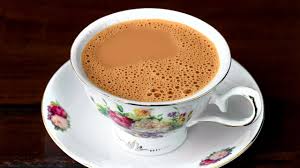
Around us you may notice some short-height (dwarf) and long or very long-height (gigantic) person. If you go to a tea stall you will see some people are asking for tea without sugar and someone taking tea with sugar.

All these events mentioned above are controlled by some chemical substance of the body. This chemical substance is known as a hormone and the system that controls all these are known as the Endocrine system.

Your observation (in two-six months intervals)

Sex Male/ Female Age Height Weight Change of nature of behaviour
1
2
3


  1.  The term hormone is derived from the Greek word “hormone” which means ‘to urge on’ or “to set in motion”
  2. Hormone’ the term coined by W. Bayliss and E. Starling, in 1905.

Chapter 9 Endocrine System And Adolescence Hormone

Hormone

The hormone is a chemical substance secreted by the endocrine glands (ductless glands) transported through blood (in most of animals) to the site of action, the target cell or organ and regulates the biological processes in the organism and destroys after a function.

  1. Different changes in our mind and body occur from our birth to the end of our life. Hormones control these changes in our bodies. Thus hormones play a vital role in our bodies. Hormones play an important role to control our emotional feelings such as feeling good, feeling depressed, angry, crying, smiling etc.
  2. Hormones are produced in our body according to need sometime within seconds and are destroyed after completion of work. However, some hormones remain in the blood throughout our life.

Properties of hormone

  1. Hormones are made up of proteins.
  2. Hormones are effective in very low concentrations.
  3. Hormones do not provide energy or building materials but they do have effects on the growth, differentiation and metabolic activities of their target cells or organs.
  4. Hormones are transported from their origin (endocrine or ductless gland) to the target place through blood (except local hormones) and destroyed after completion of work.
  5. Excess or deficiency of hormones leads to disorder.
  6. The hormone is called a chemical messenger because as a chemical substance that it carries. the message of coordination or activities.
  7. Both hormonal and nervous systems control and coordinate the body’s functions and work in coordination to maintain a steady state condition (called homeostasis).

WBBSE Class 8 General Science And Environment Chapter 9 Endocrine System And Adolescence

Chapter 9 Endocrine System And Adolescence Co-Ordination

Co-Ordination

Coordination is the working together of various organs of the body in a proper manner to stimuli. In our body, two types of coordination occur. One control by. nervous system (Physical coordinator) and other by the endocrine system. When mosquitoes or any other insect-like cockroaches etc.

come contract with our skin through merve brain receives the signal and then brain reacts.—Order the hand to remove them. This is an example of nervous coordination.

The endocrine system is a chemical coordination system in the body. It comprises endocrine glands, their hormones and their mode of action. It is directly or indirectly under the control of the nervous system. Therefore, the nervous system and endocrine system are often collectively called on neuroendocrine systems.

“Class 8 WBBSE General Science Chapter 9 notes, Endocrine System study material”

After getting the necessary order the hormone is produced in its proper position (endocrine glands) and reaches to the target organ via blood or body fluid. The target here is called the receptor. Hormones in most cases start their work slowly but its effect persists for a long time.

Hormone 4 is destroyed after the completion of work excess or deficiency of hormone levels in the blood or particular parts of the body lead to many disorders.

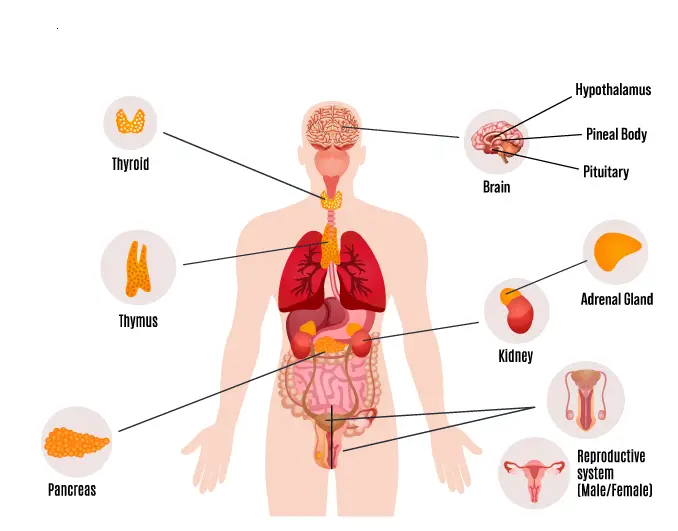
The human body possesses different types of glands.

The gland is a cell or a group of cells which secret or release specific substances such as endocrine glands secrete hormones, and digestive glands secrete enzymes.

Glands in our body are of two types-

  1. Endocrine glands and
  2. Exocrine glands.

Exocrine glands have ducts and endocrine glands are ductless.

1. Endocrine glands:

Glands which have no ducts (ductless) and pass their secretion into the surrounding blood for transport to the site of action e.g. pituitary gland, thyroid gland etc.

2. Exocrine glands :

Glands which have ducts and release secretion out through ducts, for example, the Salivary gland, Sweat glands. ‘

There are some glands which are both endocrine and exocrine in nature, these glands are called mixed glands. Such as the pancreas secrets enzymes present in pancreatic juice through ducts and the endocrine because they secrete some other hormones directly into the bloodstream.

  1.  The pituitary gland is known as the master endocrine gland as because it controls the activities of other endocrine glands.
  2.  Hypothalamus is called the ‘master of master gland’.

Chapter 9 Endocrine System And Adolescence Main Endocrine Glands Of Humans and Their Functions

1. Pituitary gland :

It is a small two-lobed gland found in the base (hypothalamus) of the brain (forebrain). The upper and lower part of the gland is known as the Anterior pituitary and posterior pituitary respectively.

A hormone secreted from Anterior Pituitary glands are –

  1.  Somato trophic hormone (STH) – stimulates the growth of the body.
  2. Thyroid-stimulating hormone-(TSH)- stimulates the activity of the thyroid gland and secretion from it.
  3. Adrenocorticotrophic hormone – (ACTH) – stimulate the production and secretion of hormone secreted from the adrenal cortex.
  4. Gonadotrophic hormone – (GTH) – control the production of sex hormones from the ovary and testis. Besides these vasopressin or Antidiuretic hormone (ADH), Oxytocin are secreted from the posterior pituitary.Hyposecretion of STH in childhood cause Dwarfism (3 ft height) and Hypersecretion of STH in childhood causes Gigantisms (7-8 ft. height) and Acromegaly (Gorila-like height and elongated jaw).WBBSE Notes For Class 8 General Science And Environment Chapter 9 Endocrine System And Adolescence Endocrinesystem

Chapter 9 Endocrine System And Adolescence Thyroid

Thyroid

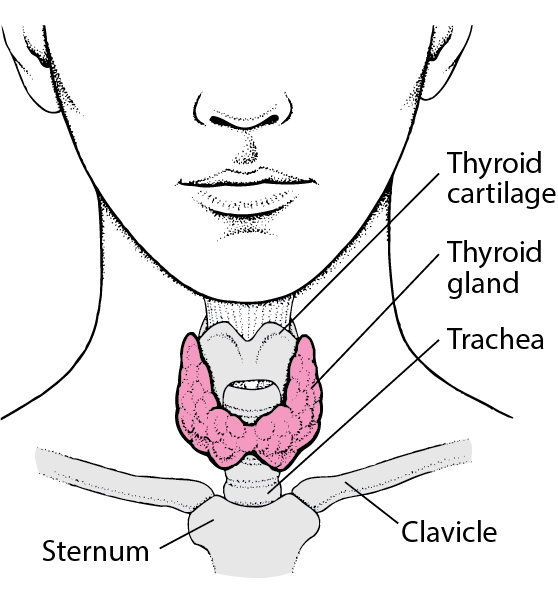
It is the largest endocrine glands human body. It lies below the larynx on each side and anterior to the trachea. It also has two lobbed glands. The hormone secretes from this gland is Thyroxine. Iodine is needed for the formation of this hormone.

Thyroxine regulates the basal metabolic rate (BMR) and calcium balance of the body. It Enlarged thyroid gland controls the respiration rate and energy production of cells, increases heart rate, also helps in growth by increasing muscle and bone and also develops mental faculties.


WBBSE Notes For Class 8 General Science And Environment Chapter 9 Endocrine System And Adolescence Thyriod

Hyperthyroidism-

It is the condition caused due to high secretion of thyroxine and leads to theJSraves’ disease or an exophthalmic goitre (enlarged eyes), enlargement of the thyroid gland which may cause a bulge in the neck (goitre). You may see it in some people’s necks.

Hypothyroidism:

It is caused due to decreased secretion of thyroxine and leads to the diseases-Critinism retardation of physical and mental development in infants and children.

Criticism-

Is a condition produced in infants and children where retardation of physical and mental development occurs? The abdomen becomes swollen, the tongue hangs out.

Goitre enlargement of the thyroid gland— causes when the dietary Iodine intake falls below normal, and thyroid hormone synthesis is inadequate. Myxedema (= Gull’s disease) developed in middle-aged persons. Symptoms loss of energy and appetite, weight gain, mental dullness and dry, puffy skin

Chapter 9 Endocrine System And Adolescence Pancreatic Gland

Pancreatic Gland

This gland is a mixed gland which are partly endocrine and partly exocrine in function.

location Of Pancreatic Gland :

It is the second largest gland in the body located below the stomach in the loop (V turn) of the duodenum. Endocrine [Darts of the pancreas is called islets of Langerhans [discovered by Langerhans (1869)] Main hormone secret from isolates of Langerhans of the pancreas is insulin, (This gland also secrets glucagon and somatostatin hormone).

  1. Insulin performs an important function in body—it enables the liver and muscles to store glucose as glycogen (glycogenesis).
  2. Insulin lowers the blood glucose level. It helps glucose to enter into the cell from the blood.
  3. It reduces the breakdown of proteins and fats in the body. Insulin is called an anti-diabetic hormone.
  4. Hypo-secretion of insulin causes the disorder of the body ceÿs °f >slets °f Langerhans of known as diabetes mellitus (Hyperglycemia).

Insulin is secreted from the Beta cells of islets of Langerhans of the pancreas. In diabetes Mellitus beta cells (\)) of Islets of Langerhans are unable to produce adequate Insulin, ns a result the movement of glucose ‘ from blood to the cell is hampered, Some of the glucose Is excreted In the urine, as well as loss ‘ of water also caused due to excessive urination. This causes excessive thirst (it s one of the symptoms of this disorder).

A common symptoms of diabetes Mellitus-

  1. Weakness
  2. The healing power of any cut delayed
  3. Excessive thirst
  4. Excessive urination.

In diabetes, a Mellitus person becomes very weak. The functional power of the kidneys, heart and eyes is reduced.

Chapter 9 Endocrine System And Adolescence Adrenal Gland

Adrenal Gland

Adrenal glands (= supra renal gland) are paired triangular glands present on the top (upper part) of the kidney, Adrenal glands look like caps set on the kidney, v Adrenal has two distinct parts Adrenal cortex and the Adrenal medulla.

Adrenaline (= epinephrine)hormone is secreted from the Adrenal medulla. Adrenaline helps to combat different emergency situations. So this hormone is termed as an emergency hormone.

Important functions of Adrenaline are

  1. Increase respiratory rate, heart rate, and pulse rate
  2. Body temperature, blood pressure
  3. Adrenalin provides energy for work.

Heartbeat—

Pulsation of the heart including one complete systole and diastole. Contraction of the heart is known as systole and expansion of the heart is known as diastole. It controls urine production. It also controls different mental conditions like fear, conflict, anger etc. Increases respiratory rate.

Hypersecretion of adrenaline the face becomes rounded and swollen this is known as Moon’s face. The skin of the face becomes rougher and more pale. Due to hypo secretion the healing of wounds, hypo delayed, poor digestion and weakness in the muscle.

“WBBSE Class 8 Science Chapter 9, Endocrine System and Adolescence study guide”

In general, adrenaline prepares the body to face emergency conditions of physical and emotional stress, like a fall in blood pressure, muscular exertion, pain, cold, injury, anger, fear tension etc. So this hormone is called an Emergency hormone. The adrenaline hormone is known as the fight or flight response hormone.

Chapter 9 Endocrine System And Adolescence Reproductive Glands

Gonads-

The gonads are the sex glands of the body such as the ovary and testis these reproductive glands ovary and testis produce ova and sperms respectively. These glands also secret hormones. Estrogen, progesterone and testosterone are called sex hormones. These hormones became active after a specific age in males and females.

Ovary :

Present in the female body. The important hormones secret from the ovary are oestrogen and progesterone.

Testis :

The reproductive gland is present in males. The important hormone secreted from the testis is Testosterone.

The function of Oestrogen :

Helps to develop the female body and the normal functioning of female secondary sex organs such as the uterus, vagina etc,

  1. Regulate female sexual behaviour.
  2. Control the development of female secondary characteristics- like breast enlargement, broadening of the pelvis, and control menstrual cycle.
  3. Oestrogen helps deposit fat below the skin.

Chapter 9 Endocrine System And Adolescence Testosterone

Testosterone

This male hormone is secret from Testis. During adolescence testosterone is more active, the appearance of a moustache and beard, change of voice, development of muscles, and strengthening of bones all are due to the testosterone hormone. Testosterone stimulates the formation of sperm.

  1. Testosterone secretes from interstitial cells of Leydig (Leydig cells) of the testis.
  2. Testosterone stimulates the growth and development of male secondary sex organs and secondary sexual characters.

Oestrogen is also found in the male body as well as testosterone is also found in the female body but both are in lesser amounts. Progesterone stimulates and regulates various body functions in females such as ovulation (release of egg from an ovary) and plays a major role in maintaining pregnancy.

Adrenaline is a hormone secreted by the adrenal medulla during stress. This is called as an emergency hormone because it initiates a quick reaction which makes the individual to think and respond quickly to the stress. The hormone increases metabolic rate.

Observe your locality and note down the symptoms of the hormonal disorder and make a table

Symptoms Responsible hormone
1.    Very short height (dwarf)
2.    Unusual growth of body and bones
 3.    Rounded moon-like face thickening of the skin
4.    Weakness, excessive urination, healing power delayed
 5.    Swelling of glands around the neck.


Chapter 9 Endocrine System And Adolescence Adolescence

Adolescence

It is one of the most important phases in human life. Several changes occur during this phase. Adolescence is the period between childhood and adulthood. This phase is commonly known as ‘teenage’. According to the World Health Organization (WHO), adolescence is the phase between 10 to 19 years of age. Rapid changes occur in the body and mind during this phase.

You also may notice changes in your body. During this phase you may have seen changes of physical structure such as weight, height, and complexion, you may also seen mental and behavioural changes. Endocrine glands and hormone secretion from them play a vital role in bringing about these changes.

WBBSE Notes For Class 8 General Science And Environment Chapter 9 Endocrine System And Adolescence Adolescence

During this phase of development adolescents begin to transition from childhood to adulthood. Eating disorders, mood-changing disorders, aggressiveness etc are usually occurrences. It is characterized by rapid physiological changes and psychosocial maturation.

Adolescence is also the stage when young people extend their relationships beyond parents and family and are intensely influenced by their peers and the outside world in general. This is a period of active growth and development of physical, sexual, social and emotional.

“WBBSE Class 8 Endocrine System and Adolescence notes, General Science Chapter 9”

During this phase problems in growth and hormonal balance may occur. Height may be short or tall, irregularities in the menstrual cycle, obesity and the appearance of acne are common among adolescent girls and boys. Besides physical changes, emotional changes also occur during this phase.

Chapter 9 Endocrine System And Adolescence Psychological Changes In The Adolescent Period

Overjoyed, enthusiasm, togetherness, some sort of aggressiveness, eagerness to make a relationship, feel attraction to the opposite sex and others. Hormones play an important role. Hormones are capable of making a person more emotional and sensitive than usual. Teenage body not capable to cope with sudden changes so teenagers show some.

very odd behaviour and reactions. For elderly persons of the family, teachers and parents should be soft and keep in touch wit t e teenage boys and girls and should explain why these are happening such as the appearance of a pimp, swings of moods, anger, and aggressiveness are common to all.

All of them have crossed these stag During this phase teenage boys and girls compare themselves and if not he or she thinks up the mark he or she feels depressed. But adolescent boys and girls should remember that all individuals are beautiful in his/h own way. All of them have something to its own and can impress others.

Pimples and some other physical problems would be solved if they maintain proper hugs and exercise.

Emotion management-

Teenagers are more emotional. They feel happy after listening to (hearing) good songs and seeing movies. They show their joyfulness when their favourite team win and are morose at their defeat, they get angry and depressed to hear their criticisms.


WBBSE Notes For Class 8 General Science And Environment Chapter 9 Endocrine System And Adolescence Emotion management


Tears come to my eyes very often to hear the misfortune of others. All these are normal behaviour. But an uncontrolled expression of happiness, anger or sorrow affects our physical and mental health. Some uncontrolled expressions such as continuous playing horns of car and explosion of crackers without interruption after winning a game or vote.

Ranshake of car, shops in aggression. We need to control our emotions. We need to understand our feelings before expressing ourselves. We must understand our uncontrolled emotions and feeling that can damage others’ happiness. Therefore, we need to understand these things.

Teenagers must try to control their emotions and feeling. But if we suppress all these emotions in their mind then it will affect their mind and health. So it is needed to sublimate of emotions through other things like play, cultural programmes, deleting programmes etc.

Chapter 9 Endocrine System And Adolescence Lists Of Some Feelings And Emotions

  1.  Fear
  2.  Anger
  3. Crying
  4. Depression
  5. Happiness
  6. Sorrow
  7. Satisfaction
  8. Offended
  9. Grievance etc.

expression of some feelings are

  1. Sweating of palms
  2. Choking of voice
  3. Muscle cramps
  4.  Headache
  5. Trembling of hands and limbs.

If the boys and girls who are passing the adolescence stages remember that

I am a good child of my parents because I love them they love me they have faith on me and I will be able to do something good for them in a different way. I want to see them happy.

WBBSE Notes For Class 8 General Science And Environment Chapter 9 Endocrine System And Adolescence Self realization

  1. There are so many ways to be happy so I should not morose in one or two incidents.
  2. I am a good friend because I feel his or her feeling, I can stand by him/her and in a difficult situation as well as his/her good condition.
  3.  I can take some responsibility, I have confidence if I fail in one or two occasions I would not depressed. I have the power in myself that I will recover it. Everyone does not get success in every case there are lot of stories of failure of great and successful people in the world.
  4. My special ability is—it may be a good artist, good player, good organizer, good cook or other skill.
  5. I am loved by many people if one or two or a few may not love me but there are lot of people who love me, in the classroom, in my local area or in other places all my parents and kith and kin. ‘
  6. I am a good student in class because I never try to ignore or violate school rules. Rules in any place are good for society. If I am given some light punishment I should understand why this or that was given to me. Hope you will get the reason.
  7.  Doing something in a group or togetherness is good but before doing this I should analyse whether it is good or not and should control of my emotions before doing this.

Chapter 9 Endocrine System And Adolescence Adolescence And Life Skill Education

Life skill education is a special behaviour which helps us to face various needs and challenges and try to control our emotions. During teenage or adolescence rapid changes occur. To cope with these changes we need to acquire life skill education to face the pressure of uncertainty of the environment and the challenge.

According to WHO—

Life skill—The abilities for adaptive and positive behaviour that enable individuals to deal effectively with the demands and challenges of every day.


WBBSE Notes For Class 8 General Science And Environment Chapter 9 Endocrine System And Adolescence Different activities


According to WHO recommendation life skill education are as follows-

1. Self-awareness-

We need to identify our own liking and disliking successes and failures and learn to control them according to the situation.

2. Critical thinking-

After facing various, problems, solving them after proper analysis and changing behaviour accordingly. We also have to learn this.

What is Life skills? As recommended by UNICEF

Life skills-based education is a behaviour change or behaviour development approach designed to address a balance of three areas— knowledge, attitude and skill.

3. Decision-making-

We need to take proper decisions by controlling different confusing thinking patterns.

4. Creative thinking-

Need to take part in different creative acts like dance, drama, painting, sports, song and other cultural activities that will help to control emotions.

5. Problem-solving-

Identify the root of the problem and search for a suitable way to overcome this.

Problems Solving Four basic steps in problem-solving

  1.  Defining problems—
    Predict the problem
    Understand the root cause and not the symptoms
    Understand the complexity.
  2. Generating alternatives (Brainstorming tools and techniques) .
  3.  Evaluating and selecting alternatives (Decision making tools and techniques)
  4.  Implementing solutions.


WBBSE Notes For Class 8 General Science And Environment Chapter 9 Endocrine System And Adolescence Problem Sloving

6.  Interpersonal communication-

It is very important to develop the habit to be a patient listener. It is also important to learn what to speak and how to speak.

7. Interpersonal relationship-

It is important to build perfect bonds with family members, friends, neighbours and other people around you. Good relationship-making is an art and an important part of life skill education. Problem-solving is a systematic approach to defining the problem and creating a vast number of possible solutions without judging this solution.


WBBSE Notes For Class 8 General Science And Environment Chapter 9 Endocrine System And Adolescence Perfect bonds with family members

8. Empathy –

Understand the problems and feelings of others and treat it and express them.

9. Stress management

Identify the cause of mental pressure and practice the measures to reduce them. Engage yourself in a different type of work.

“Class 8 WBBSE General Science Chapter 9, Endocrine System easy explanation”

10. Emotion management-

Need to be aware about one’s own feelings and express those feelings properly. Need to control your emotions before expressing it. Say’No’ if the situation demand. We often fear if we say ‘no’ it will harm our relationship but if saying ‘no’ is good to solve the problem then it is right.

Life skills:

Life skills include psycho-social competence and interpersonal skills that help people make informed decisions solve problems, think critically and creatively communicate effectively build healthy relationships empathize with others and cope with managing their lives in a healthy and productive manner.

Why Life Skills Education?

Life Skills Education Because Of

  1. Early identification of problems early intervention and support at key moments in the lives of young people is vital. Development of psycho-social abilities.
  2. To build different dimensions of well-being by building self-image and self-worth which in turn help individuals to be less vulnerable to the variations within a given context.

WBBSE Notes For Class 8 General Science And Environment Chapter 8 Human Food Production

Chapter 8 Human Food Production Crop And Crop Diversity And Crop Production

All of us take food. Not only that, food is required by every living organism for their survival growth and development. Early human beings to meet their food requirements started hunting animals and collecting fruits, roots, and other parts of forest plants.

Among all the living organisms only green plants are autotrophs as they make their own food. On the other hand animals, as well as human beings are heterotrophs because they depend on plants and other animals for food.

Read and Learn more WBBSE Notes For Class 8 General Science And Environment

Food:

  1. Foods are the edible substances which are used by the body for the growth, repair of body parts, body protection and to furnish energy.
  2. Carbohydrates, Fat, Protein, minerals, vitamins, and water are the components of food.

Since primitive times after settling human beings have been doing farming and rearing animals to meet their food requirements. Man discovered the methods of growing food. This was the beginning of Agriculture.

Class 8 General Science Class 8 Maths
Class 8 History Class 8 Science LAQs
Class 8 Geography Class 8 Science SAQs
Class 8 Maths Class 8 Geography
Class 8 History MCQs Class 8 History

“WBBSE Class 8 General Science Chapter 8 notes, Human Food Production”

Agriculture is connected with discovering new and improved varieties of crops i.e. rice, wheat pulses, and rearing of different animals such as fowl, sheep, goats, cows, buffalo, etc. to get more eggs, meat, and milk.

Agriculture :

  1. Agriculture is a branch of applied science that deals with the mass production of plants and animals useful to human beings.
  2. Agriculture also involves soil cultivation, breeding, and management of crops and domestic animals.

Crops:

Crops are the same type of plants grown in communities in a larger area. For example Paddy (rice), wheat, pulses, etc.

Crops are of various types :

Types of Crops Example
1. Cereal Paddy, Wheat, etc.
2. Roots and tubers Potato, Ginger, etc.
3. Pulses Musur, Gram, Pea, etc.
4. Edible oil Mustard, Sunflower, etc.
5. Vegetables Tomato, Cabbage, etc.
6. Fruits Bananas, Grapes, Cucumber, etc.
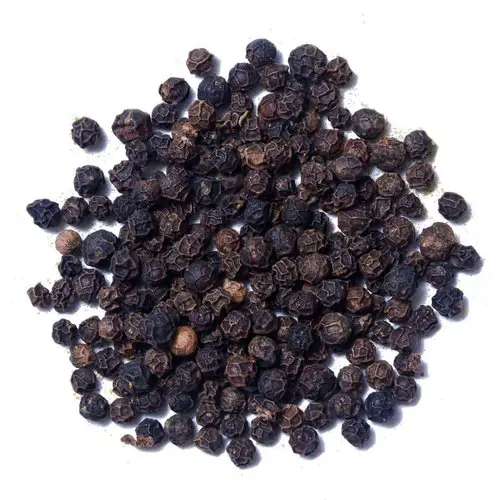
7. Spice Clove, Coriander, black paper, etc.
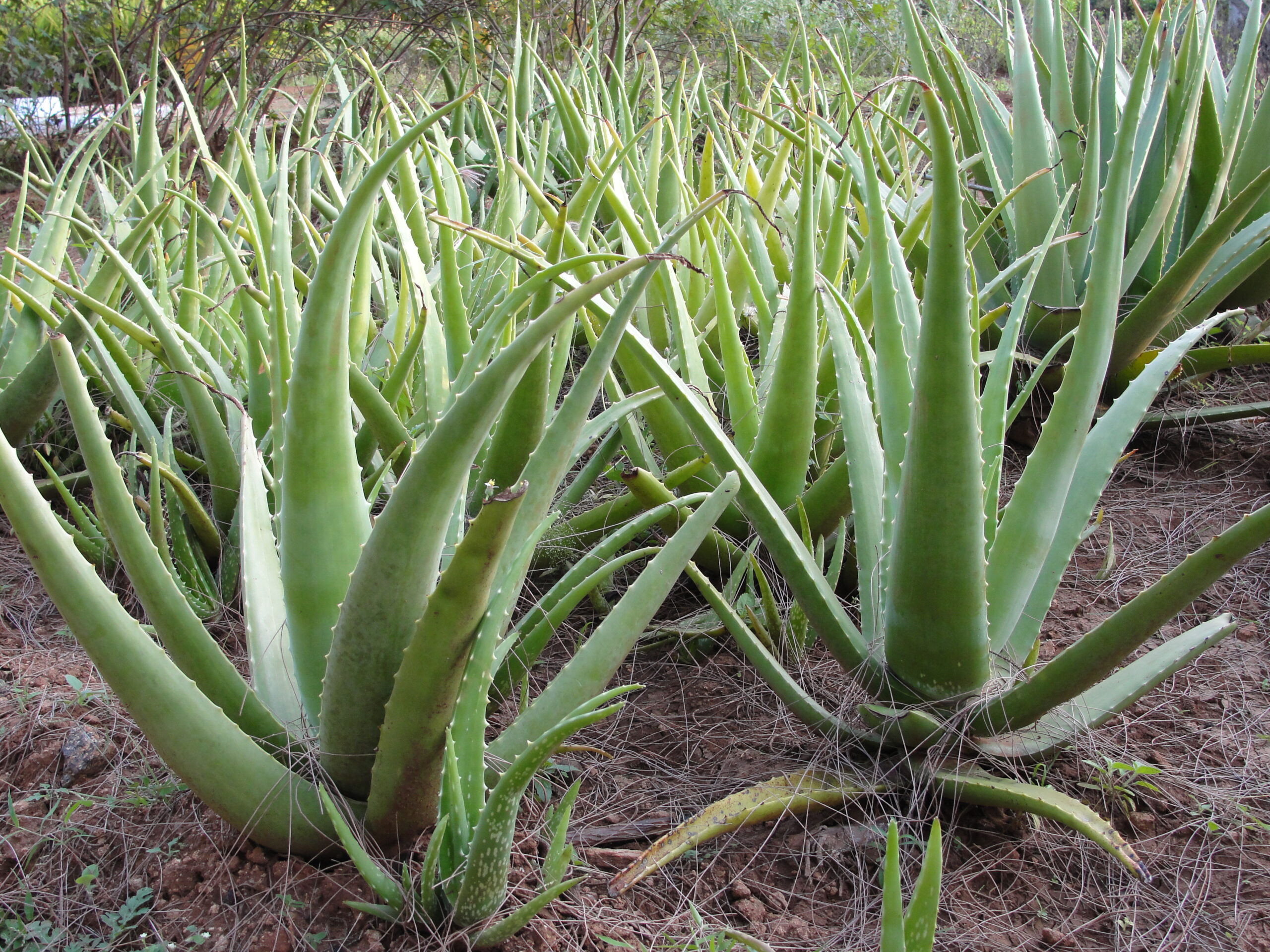
8. Medicinal Aloe vera, Serpentine, Cincona
9. Flowers Rose, Jasmine, Marigold (Gandha)
10. Fibrous Jute, Cotton
11. Ornamental Plants Cactus, Bougainvillaea etc.
12. Drink Producing Plants Tea, Coffee
13. Sugar crop Sugarcane


One of the important sister branches of Agriculture Is Horticulture* Horticulture Is the science of growing vegetables, fruits, ornamental plants, etc.

Chapter 8 Human Food Production Season Oriented Crops

In normal conditions, you will not see to grow watermelons in winter, oranges, and apples in summer. Growing of crops depends on several factors such as temperature, humidity, rainfall or water supply, quality of soil, etc. Some grow better In moderate temperatures, some are In low temperatures.

WBBSE Class 8 General Science And Environment Chapter 8 Human Food Production

Crops are divided In two types based on ‘ seasons—

1. Kharif Crops :

Kharif crops usually grow during June— July to September—October. High to moderate rainfall and temperature are needed for the production of Kharif crops, the production of these crops depends on the southwest monsoon. Growing and harvesting time respectively June-July and September-October. Examples of some kharif crops are paddy, maize, cotton, Jute, etc.

WBBSE Notes For Class 8 General Science And Environment Chapter 8 human Food Production Kharif Crops

Starting time Time of harvesting Weather condition Example of crops
June-July September- October moderate to high temperature and rainfall Paddy, (Rice), Maize (Jowar) Cotton, Jute, etc.


2. Rabi Crops :

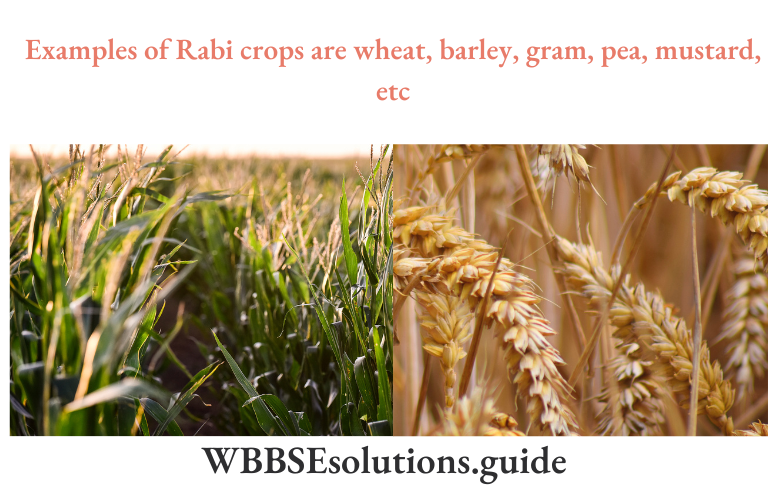
Rabi crops usually grow between October-November to March-April. Low to moderate temperature and comparatively less rainfall is suitable for the production of this type of crop. The beginning time is October – November and the harvesting time March-April. Rabi crop cultivation are not dependent on monsoon.

WBBSE Notes For Class 8 General Science And Environment Chapter 8 human Food Production Rabi Crops


Examples of Rabi crops are wheat, barley, gram, pea, mustard, etc. Besides these two types of main crops, some crops are cultivated in between Rabi and Kharif during summer these are known as summer crops (During March to June), some pulses and rice, Maize are also grown during this season if the areas are well irrigated.

Rabi Crops :

Starting time Time of harvesting Weather Condition Example of crop
October -November March-April low to moderate temperature and less rainfall wheat, barley grams, pea, potato, mustard, etc.


Chapter 8 Human Food Production Crop Production

Farmers have to take on different activities for a certain period of time to produce crops. The steps of activities or agricultural practices are as follows :

  1.  Preparation of soil of cultivable land.
  2. Sowing of seeds.
  3. Adding manure and fertilizers.
  4. Irrigation.
  5. Crop protection- from weeds, pests, and diseases.
  6. Harvesting.
  7. Storage.

1. Preparation Of Soil Of Cultivable Land:

Plants grow in soil. So before plantation or sowing seeds soil have to be prepared properly. Soil is one of the most important natural resources which support the growth of plants. Soil is a complex mixture of several components both of inorganic and organic.

The composition of soil differs from place to place. You have noticed that the soil of near the seashore and Sundarban area are different that of the hilly region of Bankura and Birbhum.

  1. Water
  2.  Air
  3. Organic matter or humus (soil With more organic substances such as dead and decomposed organic substances of plants, animals, and micro-organisms.)
  4. Living organisms such as microorganisms (bacteria, fungi, algae, etc.), helminths, earthworms, insects (ants, termites), etc.

Before showing seeds or plantation loosening of the soil is very much needed. Turning of the usually made by the help of hoe or plow or by a tractor. It makes the soil airier and water enters inside easily.

Earthworms, insects, lice, ants, termites, etc also make hole which tern the soil airier and nutrient-rich. Earthworm is known as the friend of the farmer, because they make hole in the soil to allow more air, losing the soil and enriching the soil dropping with nutrient mix excreta.

Beneficial microbes also add nutrients to the soil by decomposing organic substances present in the soil. Topsoil, the upper few centimeters of soil is nutrient rich. Turning of soil helps to get the plant its nutrient from the soil easily.

WBBSE Notes For Class 8 General Science And Environment Chapter 8 human Food Production Ploughing

Chapter 8 Human Food Production Tools Of Ploughing

Turning of soil is the first stage of the cultivation process, we already understood the importance of turning of the soil. The process of turning the soil is known as ploughing.

WBBSE Notes For Class 8 General Science And Environment Chapter 8 human Food Production Plough

Tools:

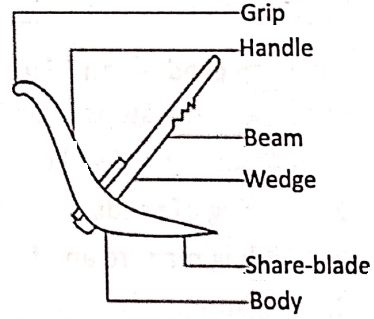
  1. Plough — It is one of the oldest tool of ploughing and used in cultivation from ancient times. A wooden tool with a sharp blade at the end is usually pulled by animals.
  2. Hoe-Hoe is another tool which is used for removing weeds and loosening the soil.
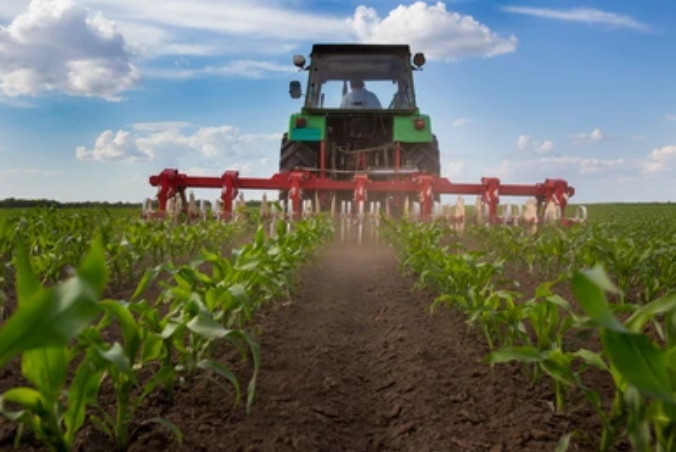
  3. Cultivator– Presently for ploughing large agricultural land in a short time tractors are used, Cultivator is attached behind the tractor. For small agricultural land now a days power tiller is also used.

WBBSE Notes For Class 8 General Science And Environment Chapter 8 human Food Production Hoe


After ploughing a wooden or iron (Harrow or Leveller) is used to level the uneven agricultural land. It minimizes the soil erosion due to the action of water and air. Sometimes different organic fertilizers are mixed with the soil during the phase.

WBBSE Notes For Class 8 General Science And Environment Chapter 8 human Food Production Tractor

2. Sowing of seeds :

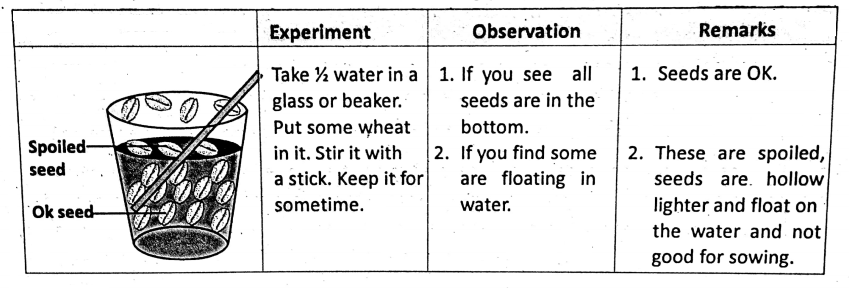
After the preparation of the field (soil) next step is showing of seeds. It is also a very important phase. Before showing the seeds it is important to verify whether the seeds are good quality or not-such as whether the see are healthy, drought or excess rain resistant and are free from any infection (fungus, bacteria, etc.) or suitable for the soil where it will be placed (sowing).

Nowadays with the advancement of science Agricultural Department recommend seeds suitable for the soil and its productivity.

Simple experiment

WBBSE Notes For Class 8 General Science And Environment Chapter 8 human Food Production Simple experiment

Chapter 8 Human Food Production Tools For Sowing Seeds

  1. From the early ages, it was the general practice of farmers to sow seeds by hand.
  2. Sometimes farmers use funnel-shaped object whose upper part is funnel-like and the lower end have two or three sharp channels and with an aperture. The sharp ends of the object pierce the ground. Then seeds slide down the funnel and pass through the sharp channels to the pit of the soil.
  3. Sometimes farmers sow seeds in the furrow or channel created by plough by attaching a funnel and sharp channels.

Seed Drill :

Nowadays improved sowing tools are used such as seed drill to sow the seeds. Through this tool seeds can be sowed at the right distance and requisite depth. The advantage of this tool is that it covered the seed by soil as a result birds cannot get access of the seeds.

“Class 8 WBBSE General Science Chapter 8 notes, Human Food Production study material”

The use of this tool also save time and labor. Why the farmers sowing seeds at dusk? To keep the moisture of soil around the seed and to protect the seeds from birds. Recently some cases farmers use some chemical substances with the seed in the pit to reduce the chance of infection of seeds.

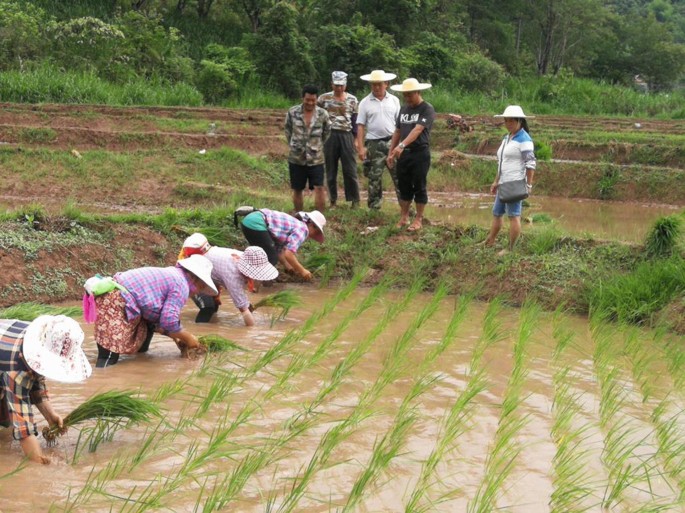
WBBSE Notes For Class 8 General Science And Environment Chapter 8 human Food Production Transplantation of seedings

In case some crop and vegetable (paddy, chili, tomato, etc.) seeds are sowed in seedbed randomly. After the seedlings come out and grow up to a certain limit, suitable seedlings are taken from the seed bed and replanted these in the previously prepared field. Transplanted seedlings after settling in new place grow there and produce crops. In such cases production increases.

3. Adding manure and fertilizer:

Plants require some minerals for proper growth. The different minerals (elements) found in the soil are called nutrients. Some of these nutrients are needed in large amounts and some are needed in very small amounts. The nutrients are needed in large amounts and are essential for plant growth are called macronutrients or macroelements.

WBBSE Notes For Class 8 General Science And Environment Chapter 8 human Food Production Fertilizers are used

Macroelements or macronutrients are

  1. Carbon (C)
  2. Hydrogen (H)
  3. Oxygen (0)
  4. Nitrogen (N)
  5. Phosphorus (P)
  6. Potassium (K)
  7. Calcium (Ca)
  8. Magnesium (Mg) and
  9. Sulphur (S).

The minerals or elements required by plants in a very small amounts (traces) are called micronutrients or microelements or trace elements.

Micronutrients or trace elements

  1. Iron (Fe),
  2. Copper (Cu),
  3. Zinc (Zn)
  4. Boron (B),
  5. Molybdenum (Mo),
  6. Chlorine (Cl) etc.

The deficiency of any of the macro and micronutrients in the soil reduces crop yield. Plants get most of the nutrients from soil. Although these nutrients are identified as elements but actually taken by plants as compounds.

  1. Macronutrients/ Macroelements- C, H, 0, N, S, P, Mg, K, Ca
  2. Microelements – Fe, Mo, Zn, Cl, B

Repeated use of the same piece of land for crop production creates a deficiency of soil nutrients. The crop yield becomes low. The deficiency of plant nutrients and organic matter in the soil is made up by adding manures and fertilizers to the soil of crop fields.

Chapter 8 Human Food Production Manure

Manure

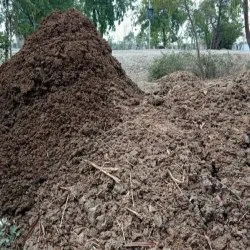
Farmers have been using cow dung as manure to improve the fertility of the soil for a long time. Manure contains a mixture of various organic nutrients suitable for plant growth.

Manure are of organic substances obtained from the decomposition of animal wastes, dead plants, and animals by the action of microbes. Manures are natural fertilizers. Manure is not very rich in nutrients (such as N, P, K, etc.) but it is rich in organic matter.

Soil nutrients are of two types—

  1.  Organic manure and
  2.  Inorganic fertilizers.

1. Organic manure—

Organic manure is produced by the decomposition of animal wastes, dead plants, and animals. Farmers dump these types of waste products in a pit for a few days to a few months. By the action of microbes, these organic products turn into organic manure.

WBBSE Notes For Class 8 General Science And Environment Chapter 8 human Food Production Organic manure Cow Dung

The problem with manure is that it acts slowly and occupies a lot of storage space and also take a long time to form Moreover, manure is not nutrient-specific. In the requirement of a particular nutrient, it is not effective. For this reason, chemical fertilizers which provide specific nutrients are also used in soil.

Compost Manure

It is prepared from straw, sewage waste, vegetable, and animal refuse weeds, fecal matter of animals, cow dung, etc. It is a biological process in which anaerobic and aerobic micro-organisms decompose organic matter.

Green manuring :

It is the practice of ploughing nodules bearing green leguminous plants into the soil for improving fertility. Mainly to increase soil nitrogen (N).

Fertilizer:

Fertilizers are inorganic chemicals synthesized in industries. They contain essential plant nutrients like nitrogen (N), phosphorous (P) or potassium (K). (= NPK)

These three important components are mixed in different proportions to produce NPK fertilizer. Fertilizers are available in the form of granules, water-soluble powders or solutions. Different kinds of fertilizers are available in the market.

Chapter 8 Human Food Production Three Major Types of Fertilizer

Fertilizer     Example
(1) Nitrogenous Urea (an organic fertilizer), ammonium sulfate, ammonium nitrate, etc.
(2) Phosphatic Superphosphate (Calcium hydrogen phosphate), Ammophos.
(3) Potassium Potassium nitrate, potassium chloride, etc.
(4) NPK Combine fertilizer of N, P, and K.


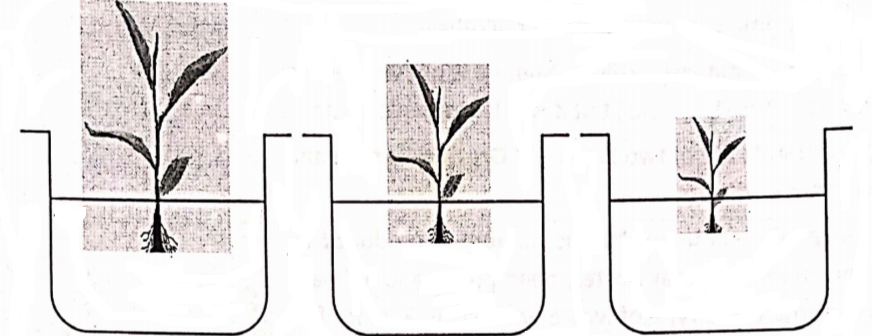
Experiment: Take three beakers filled up with the same type of soil.


WBBSE Notes For Class 8 General Science And Environment Chapter 8 human Food Production same type of soil in three beakers

Beaker No – 1-Soil + Add urea
Beaker No – 2-Soil + Organic manure cow-dung.
Beaker No – 3-Soil + without any manure or fertilizer.

Add an equal amount of water in these beakers and placed the same type of.3 seedlings in three beakers. Observe it for a few days (10 -12 days).

Note your observations – the growth of seedlings in three beakers.

Beaker No Observation (Plant growth) Remarks
1
2
3


Calculate the growth rate and draw a conclusion- showing the effect of manure, and fertilizer.

  1.  Organic fertilizer- Urea
  2. Inorganic fertilizer- ammonium sulfate

Chapter 8 Human Food Production Problems With Fertilizer Or Disadvantages Of Fertilizer Use

Farmers often use chemical fertilizers to yield more production (crop). The excessive and unwise use of chemical fertilizers change the nature of soil- making it either too acidic or too alkaline and use of this type of fertilizer also kill the beneficial microorganism of the soil. Ultimately the fertility of soil decreases.

Inorganic fertilizer when used unwisely or not applied without testing the nature of the soil it does more harm than good.

For example-

When inorganic fertilizer like sodium nitrate (NaN03) is used in the field nitrate part is used by the plant and the sodium part remains in the soil. Repeated use of this type of fertilizer increases the amount of sodium of the soil which after mixing with water makes the soil alkaline (for NaOH).

On the other hand, the ammonium part of fertilizer- Ammonium sulfate [(NH4)2S04] is used by plants, accumulated sulfate part in soil then combines with soil water-form (H2S04). sulphuric acid which turns the soil acidic.

“WBBSE Class 8 Science Chapter 8, Human Food Production study guide”

Moreover, excessive use of chemical fertilizers creates environmental hazards. These fertilizers finally reach the aquatic system (ponds, lakes, rivers, etc.) by rainfall, and irrigation making the water unfit for human consumption as well as destroying many aquatic life (fish and other aquatic animals and plants).

So presently effort has been taken to reduce the use of inorganic fertilizers and increase the use of organic manures. Now the question-Why the use of organic manure is better than inorganic fertilizers?

Chapter 8 Human Food Production Advantages Of Use Of Organic Manure

  1.  It increases the water retention capacity of the soil.
  2. It enriches the soil with nutrients.
  3. The organic matters of manures provide food for the soil organisms (fungi, bacteria, etc.)
  4.  Helps soil to become more aerated make the soil.
  5.  More porous.
  6.  It improves soil texture.

Fertilizers should be used only when they are required.

Chapter 8 Human Food Production Natural Treatment Of Soil

Several studies are been done how to retain and improve the natural condition of soil.

Use of biofertilzers –

Organisms which enrich the soil with nutrients are called biofertilizers. Biofertilizers are renewable and non-pollutant sources of plant nutrients such as nitrogen. Biofertilizers are used for specific crop plants such as pulses, legumes oil seeds, rice, etc. Biofertilizers make the soil porous and increase the air content of the soil.

Crop rotation-

Different plants use different types of nutrients. Particular soil loses essential plant nutrients when the same plants are cultivated repetitively in the same soil. Rotation of plants (crop) help to maintain the soil nutrients and able to restore the loss of nutrient because different type of plants use different, type of nutrients.

Crop rotation :

It is the practice of growing different crops in succession in the same field or soil.

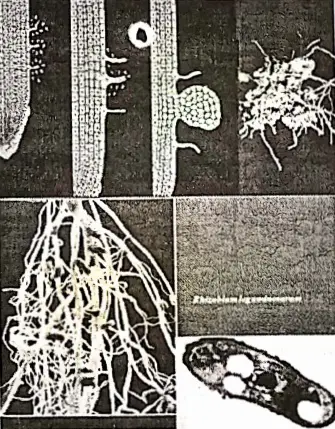
Usually, leguminous plants (pulse-crop) are grown between two cereal crops (paddy, wheat, – maize, etc.). Cereal crops take away nitrogenous compounds from soil. The nitrogenous fixing bacteria. Rhizobium present in the nodules of leguminous plant (pulse crops) roots restores these compounds in the soil.

“WBBSE Class 8 Human Food Production notes, General Science Chapter 8”

Rhizobium is a symbiotic bacteria (Rhizobium). These bacteria take nitrogen from the atmosphere and transfer it into nitrogenous compounds that plants can use. Some this use by the plant and remain mixed in the soil.

 The benefit of crop rotation

Crop rotation helps to maintain soil fertility, and moisture and control pests and diseases.

4. Irrigation :

Water is the most important natural resource. No organism can live without water.

WBBSE Notes For Class 8 General Science And Environment Chapter 8 human Food Production Method of irrigation

Water is needed for the

  1. Germination of seeds,
  2. Growth of plants,
  3. Transportation of foods, nutrients, and other substances,
  4. Development of flowers, fruits, and seeds,’
  5. Plants absorb different nutrients from the soil, through water,
  6. The water content of soil is very important in cultivation, and maintaining soil humidity.
  7. For good production of crops, a regular supply of water is very much needed the supply of
  8. Water to the crop field at definite intervals is known as irrigation.

Chapter 8 Human Food Production Water Sources

Water Sources

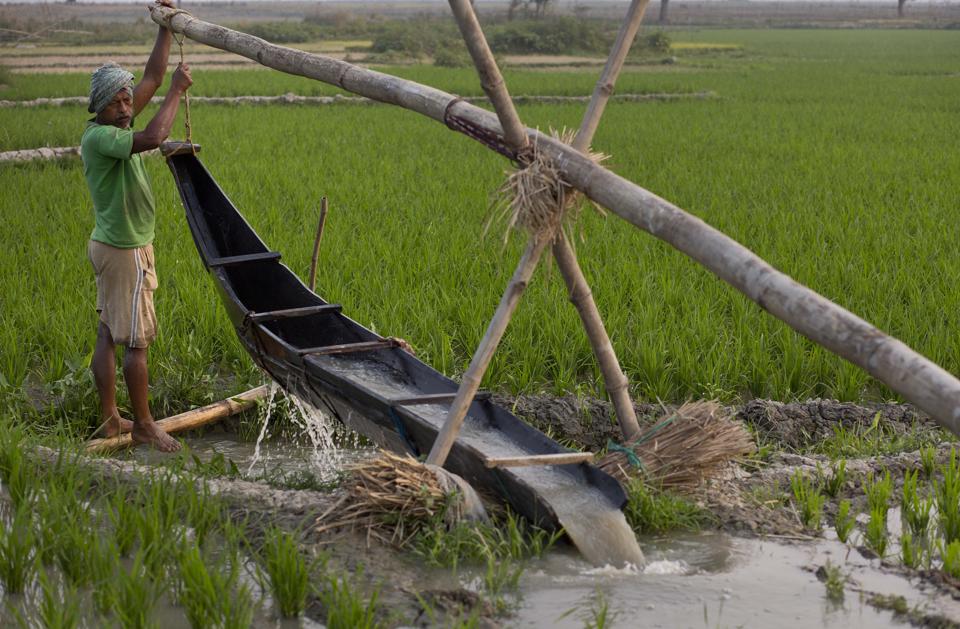
Generally, water sources are rivers, canals, reservoirs, lakes, ponds, tanks, wells, and underground water extracted through pumps and tube wells. The main thing of irrigation is to supply water from the water sources to the crop fields through canals, pipes, etc.

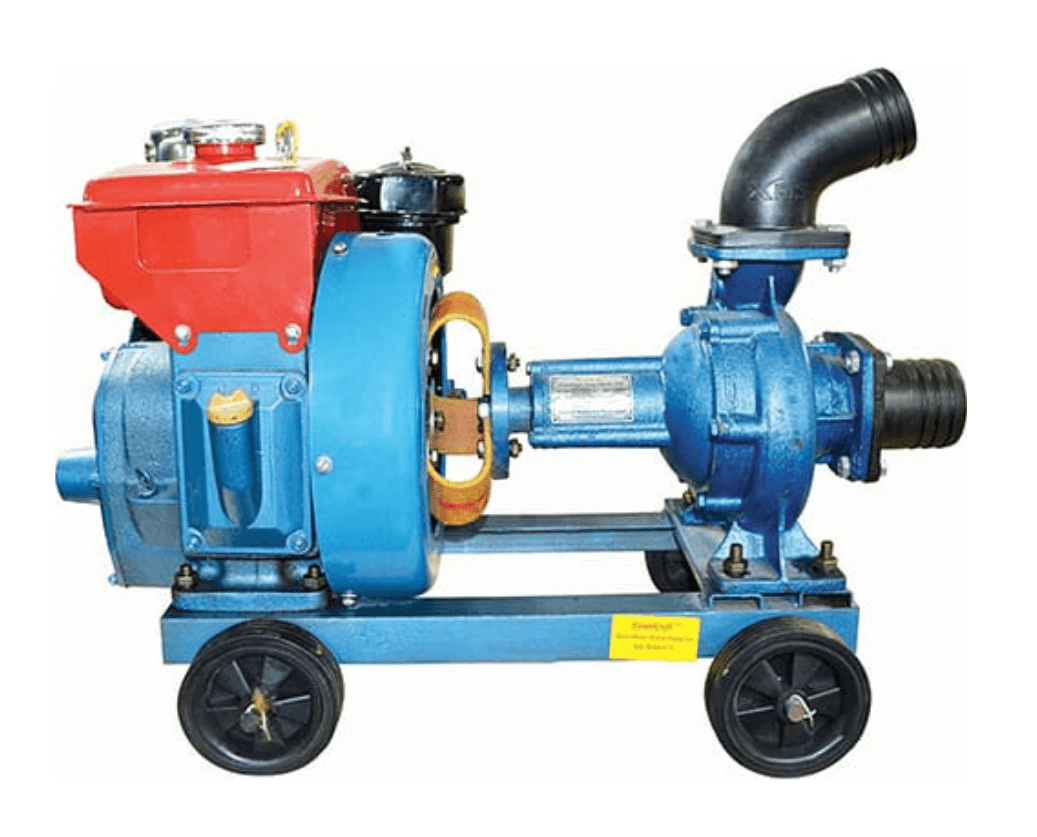
WBBSE Notes For Class 8 General Science And Environment Chapter 8 human Food Production Diesel pump

Electricity or Diesel pumps usually use to lift groundwater and water from ponds tanks and water sources and supply the water to fields by pipes or canals. Sometimes solar energy or biogas is used instead of electricity or diesel.

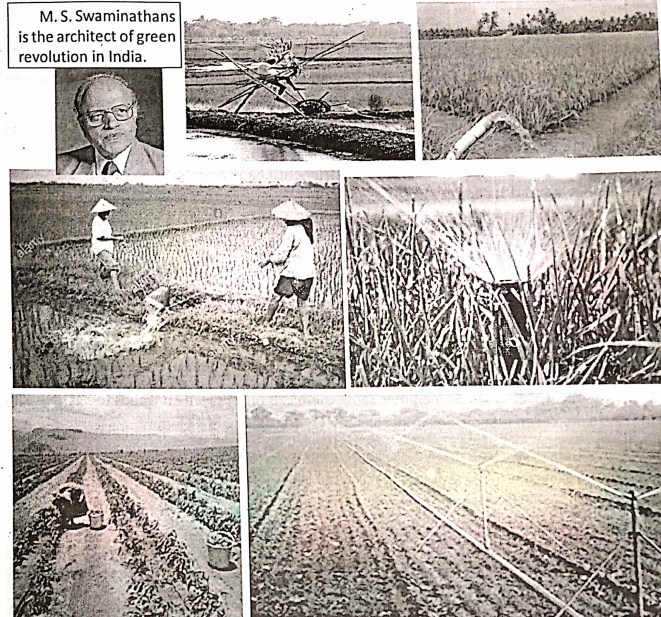
During earlier days and in some remote places traditional methods are used. The traditional methods are cheaper but are less effective. In this process misuse of water happens.. Plant bodies contain nearly 90% water.

Chapter 8 Human Food Production Modern Method

To control the misuse of water during irrigation water is sprinkled on the crop plants in the agricultural field like a fountain. This method is known as the Sprinkler system.  Water is supplied near the roots of the crop plant in drop by drop with the help of a pipe. This method is known as the Drip system.


WBBSE Notes For Class 8 General Science And Environment Chapter 8 human Food Production Different methods of Agiriculture

5. Crop protection :

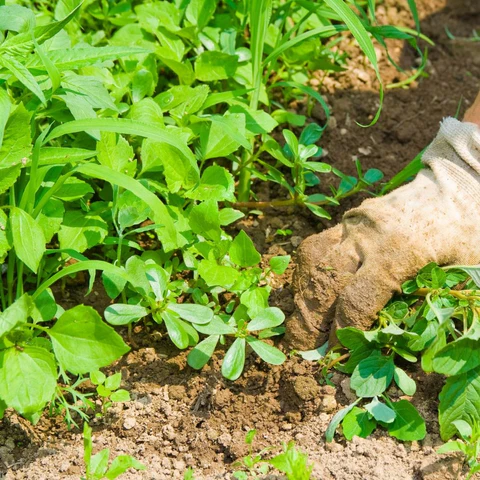
During cultivation, crop plants face different types of hazards which hamper crop production. Production-hampering agents may be weeds, pests or disease-causing micro-organisms. These agents need to be controlled. Protection from weeds – Many unwanting plants grow along with cultivated crops. These unwanted plants are called weeds.

WBBSE Notes For Class 8 General Science And Environment Chapter 8 human Food Production Weeding

Weeds compete with crop plants for water, minerals, light, and space. Thus their growth in crop fields is very harmful for cultivated plants. They hamper production as well as the. quality of the crop. Weeds also harbour pests and spread crop pests and crop diseases.

Weeds also create problems in harvesting the crop. It is, therefore, essential to remove these weeds from time to time. The farmers use different methods to remove it.

Chapter 8 Human Food Production Methods Of Weed Control

1. Mechanical method :

The farmers remove the weeds by hand (uprooted). Sometimes they cut the weeds very near to the crop fields and in between the rows by Khurpi or harrow [a comb-like tool (instrument)] hand hoeing.

  1. Small-sized unwanted plants which grow along with a cultivated crop in a crop field 1 V are called weeds.
  2. ’Some common weeds are—Parthenium, Chenopodium, Amaranthus, short and long 1 grass, etc.
  3. The process of removing the weeds from crop fields is called weeding.
  4.  Ploughing helps in removing a large number of weeds because it uproots the weeds.

2. Chemical Methods :

Sometimes some chemicals are sprayed on weeds to destroy (kill) them. These are called weedicides or herbicides. (2, 4-D, Dalapon, Picloram)

3. Biological control of weeds :

Involves the deliberate use of insects or some other organisms which consume and specifically destroy the weed plants but not damage the crop. Some common weeds are Parthenium, Chenopodium, Amaranthus, grass, Convolvulus, and wild oat.

6. Protection from pests (Pest control)

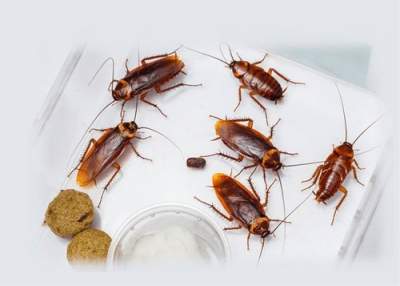
Many insects (locusts, aphids, termites, mites bugs, weevils, beetles, etc.) rodents (rats), and birds feed on crops or damage crops. These are known as pests.

WBBSE Notes For Class 8 General Science And Environment Chapter 8 human Food Production Pest

Pest:

  1. An organism that harms the environment, food, health or properties of human beings is called a pest. Actually, those hamper the well-being of human is pests.
  2.  In agriculture, any organism that damages crop plants is called a pest. e.g. aphid, rat, locust, etc.

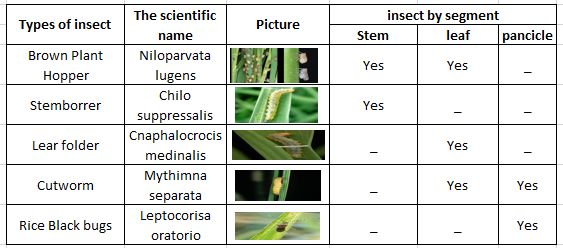
The insect pests like locusts fly in hordes and cause severe damage to the crop field. They eat the leaves of the plants. Some stem borer (insects) grow (Majra poka—Tryporyzo) inside the stem, and termites feed on the roots and stem. Pests also spread many diseases of plants.

WBBSE Notes For Class 8 General Science And Environment Chapter 8 human Food Production insect and scientific name,pictures

Many microbes such as bacteria, fungi, and viruses also spread many diseases and reduce crop production. Fungi (Phytophthora) cause late-blight disease of potato and rust diseases (by— Puccinia) in wheat. Bacteria cause wilt disease. Common Paddy Pest is yellow stem borer Majra.

Poka—Scirphaga is incredulous it is previously known as Tryporyza inertias. Green leaf hoppers is also a common pest that transmits viral disease.

Pest control

Chemical and biological methods are employed to control pests.

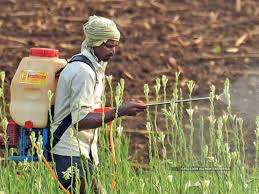
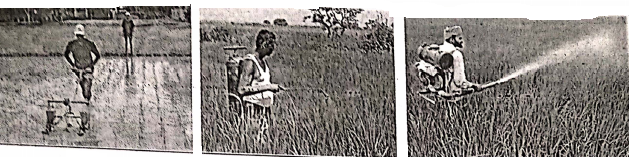
In the chemical method of controlling pests some pesticides (chemical mix with water or oil) are sprayed in the field by hand-operating machines or by power sprayers. Some commonly used pesticides are DDT (Dichloro diphenyl trichloroethene)

BHC (Benzene hexachloride or Gammexane) Malathion, zinc sulfide/zinc phosphide (use to control rats and other rodents, etc.

Different Types of Pesticides and Their Applications

  1. Insecticides – to kill or control insects
  2. Rodenticides- to kill or control rodents, (Rat)
  3. Fungicides – to kill or control fungus
  4. Nematicide – to kill or control nematodes (warm)
  5. Weedicides – to kill or control weeds

Though use of chemical pesticides yield good and quick result initially but these have some nfler effects. Chemical pesticides are not environmentally friendly.

WBBSE Notes For Class 8 General Science And Environment Chapter 8 human Food Production Different chemical method of controlling pests are used

Chapter 8 Human Food Production Harmful Effects Of Chemical Pesticides

  1. Most pesticides are not biodegradable (not break down naturally in nature) they remain in fields and the atmosphere causing environmental pollution.
  2. Not only that the crop plant absorbs these and directly or indirectly passes to the animals including human beings (by fruits, vegetables, cereals, etc.), and accumulate inside the tissue and .causing ill-effect (diseases).
  3. The pests can develop resistance against a specific chemical (pesticide). Therefore, the next use of that particular pesticides are less effective.
  4. Chemical pesticides by irrigation and rainwater pass to the river, tank, pond, lake, and other water sources and cause water pollution.
  5. Pesticides can damage the numbers or group representative of the food chain, (e.g. frog, snake, etc.)
  6. Chemicals sometimes kill the beneficial microorganisms of soil and other animals of nature (like butterflies, Honey bees, earthworms, snakes, frogs, etc.)

To avoid the hazards of chemical pesticides biological control methods have been taken to control pests.

Biological Control method

In this method, one organism is used to control another one. Such as some birds, insects or other organisms are deliberately put into the field to kill the pests selectively. Ladybird beetles and some ant-like insects (Hymenopteran-Parasitoids insects) are used to kill the VVphids’one of the harmful pests of crops.

“Class 8 WBBSE General Science Chapter 8, Human Food Production easy explanation”

Some fungi, Protozoa, bacteria, and viruses are also used to control pests. Biological control is a slow method but it is highly specific and nonpolluting.

7. Harvesting :

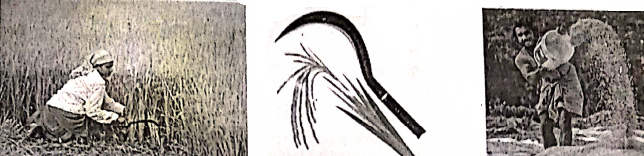
After the maturation of food grains or crops Harvesting is done. Some crops are harvested by hand (usually vegetables). Sometimes some tools are used such as sickle to cut the crop plant very near to the ground level (crops like paddy, wheat, Bazar, mustard, etc.)


WBBSE Notes For Class 8 General Science And Environment Chapter 8 human Food Production Sickle is used to cut the crop plant

Threshing –

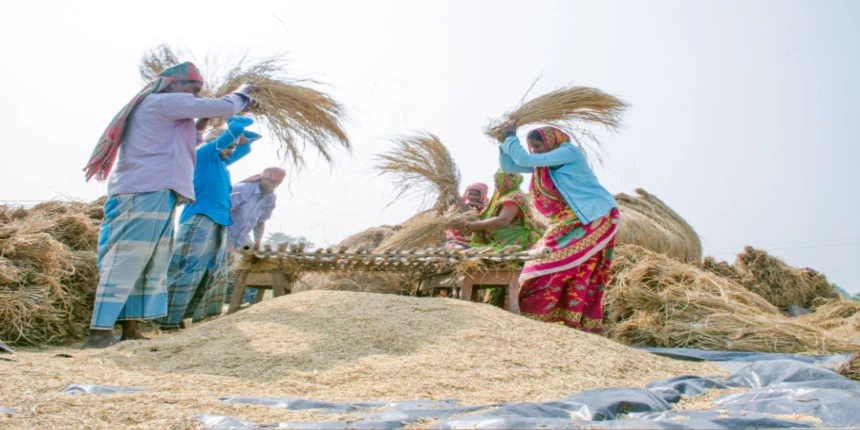
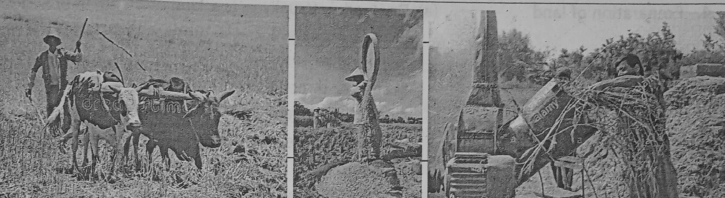
Threshing is a process where the edible part of the grain crops (such as paddy, wheat, mustard, etc.) are separated from the crop plants. Sometimes it is done by beating the harvested plant part against the ground or any hard substances sometimes cows are used to separate of grains from crop plants. Harvesting and threshing both can be done with the help of a machine known as a combine.

WBBSE Notes For Class 8 General Science And Environment Chapter 8 human Food Production Threshing

Winnowing :

Small farmers who have small cultivated land usually use this process. Usually, they take grains already been separated by threshing and drop it into the ground from a certain height in a wind-blowing area.

The chaffs fly away as they are light and grains fall below in the ground. Just below. Combine machines can serve all these three purposes harvesting, threshing, and winnowing.

8. Storage :

Most crops are harvested only once a year some time twice. Thus they are available in plenty during a selective time, (such as paddy during Nov – Dec). For getting seasonal foods regularly throughout the year food grains are stored in safe storage. Storage of food is a hard task. It involves a great range of activities and precautions.

WBBSE Notes For Class 8 General Science And Environment Chapter 8 human Food Production Storage of crops grain silos

The primary condition of storage of food grains it should be reasonably safe and prevent damage. For a long time storage measures should be taken to protect the food grains from insects, rats, and microbes (viruses, fungi, bacteria).

The fresh crop has more moisture before storage grains are dried under the sun before storage. Infestation of microbes (such as viruses, bacteria fungi) and insects can be resisted if the food products have less humidity.

Food materials can be stored usually in two ways depending upon whether they are dry (nonperishable) or spoil at room temperature (perishable). Dry or nonperishable food products such as cereals, pulses, flour, sugar, spices, nuts, etc. are stored in room temperature in suitable containers or bags. This mode of storage is called ‘ ‘dry storage’.

On the other hand, the food products such as fruits, vegetables, fish, meat, eggs, milk, etc. (perishable food material) are stored at a low temperature. This method of storage is called Cold storage. The farmers store grains in Jute bags (Basta) or metal containers.

For large-scale storage of grains (Dry storage), granaries or air-tight rooms or Silo are used. Grain Silos are steel-bodied cylindrical structures. They are constructed in such a way that provides for aeration, and temperature control protection from insects worms, rodents, birds, and other animals.

They have the facilities to spray pesticides, and fumigants,s and for inspection. Nowadays Nitrogen gas is continuously circulated through the granaries to prevent pests. Nowadays” liquid nitrogen is also used to preserve seeds (cryopreservation)

Chapter 8 Human Food Production Different Types Of Plant-Based Food Production

Paddy :

One of the most important principal food in the world is rice. Bice is the product of paddy. Paddy is one of the major crops of India as well as West Bengal. You can gather much information if you ask the people associated with cultivation-How many types of paddy are cultivated in India? What are their sowing and harvesting times in major paddy-producing states, different control methods of paddy pests, etc?

Major paddy-cultivating states of India

Paddy is cultivated in almost all the states of India. The major paddy-producing states are West Bengal, Uttar Pradesh, Andhra Pradesh, Odisha, Tamilnadu, and Punjab. Before going to different types of paddy, let’s see the nutritive value of rice –

Rice contains 79.1 % carbohydrates, 6% Protein, fat 1 – 2% of and another element of 04% including vitamins, minerals, etc. Rice also contains vitamin B complex. Oil is also produced from rice bran.

Chapter 8 Human Food Production Types Of Paddy

On the basis of season and method of cultivation, paddy are of three major types-

  1. Aush or Autumn paddy
  2. Arrian or Winter paddy
  3.  Boro or Summer paddy.

work for students: 

Months of year Name of the paddy Now what type of paddy cultivation going on Season of paddy


On the basis of productivity, paddy are of two types –

  1. Less yielding. variety and
  2. High-yielding variety.

Aush

Aush is generally sowed in the field after the Rabi crops and usually sowed directly in the Agricultural field. Aush paddy can grow more or less in all types of soil such as alluvial, loamy, and clayey. In some areas, Aush seeds are sowed in a prepared seed bed instead of direct showing in the field.

Aman

It is a monsoon crop. Cultivated during monsoon season such as during the rainy season. Aman paddy produces better result in clay soil, though this paddy is also cultivated in any other type of soil. The main paddy cultivation in our state (West Bengal) is Aman.

Our country have many varieties of Aman paddy. Different indigenous varieties are known by different names in different regions.

Good varieties of Aman paddy are –

  1. Jhingasal
  2. Bhashamanik
  3. Roghusal
  4. Basmoti
  5. Patnai-23.

Aman paddy is cultivated in two phases – seedlings are prepared in seedbeds and these seedlings are then planted in the well-prepared agricultural field. Usually, seeds are to be treated properly before sowing them in the field.

Boro is a summer paddy after cutting the Aman paddy seed bed for Boro is prepared. Seedlings are transplanted later to the main cultivating land. Boro paddy is harvested in March – April. Boro paddy is mainly cultivated in the field where irrigation facilities are present. Some paddy grows faster, some medium, and some are slow growers.

On the basis of time duration or time is taken for maturity paddy are of three types-

  1. Early duration varieties or Jaldi-mature very fast. Example -‘Ratna’ mature within 95¬115 days.
  2. Medium duration varieties or Majhari -This type of paddy take moderate time to mature, for example – Jaya, Jayanti, etc. varieties mature within 115 135 days. –
  3. Long-duration varieties or Nabi – These type of paddy takes a longer time to mature. For example-Pankaj, Masuri, Swama, etc. varieties take 140 -150 days to mature.

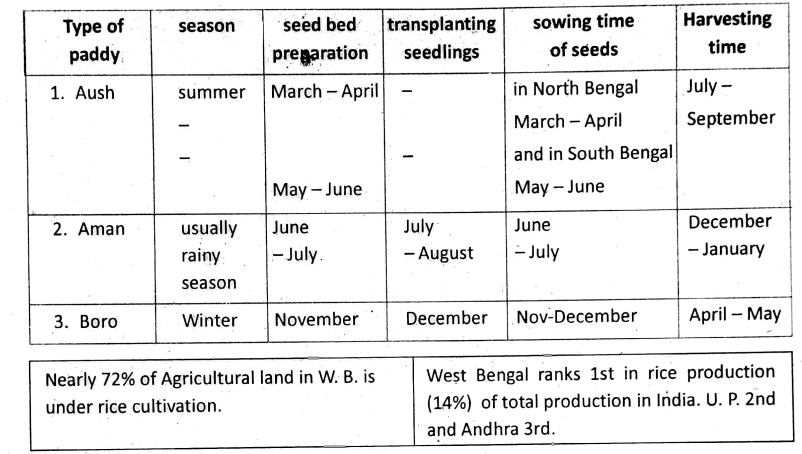
A comparative study of three types of major paddy – cultivating time, seedbed preparation, transplantation of seedlings, showing seeds, and harvesting time.

WBBSE Notes For Class 8 General Science And Environment Chapter 8 human Food Production Types of paddy


Chapter 8 Human Food Production Method Of Cultivation Of Paddy


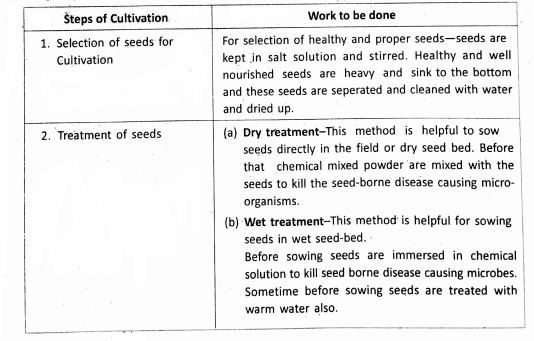
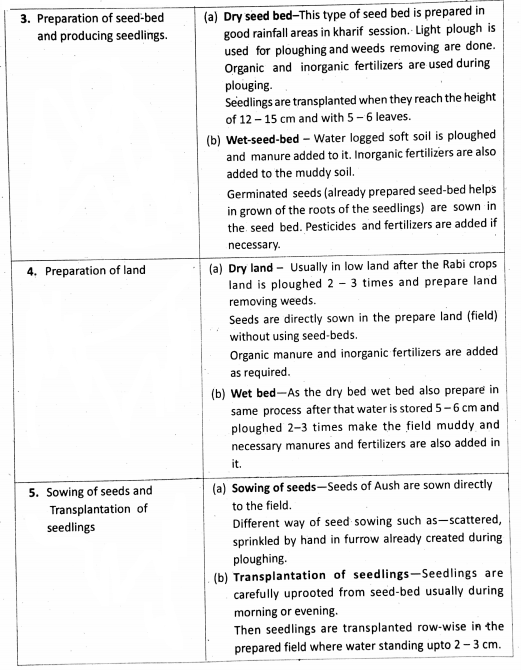
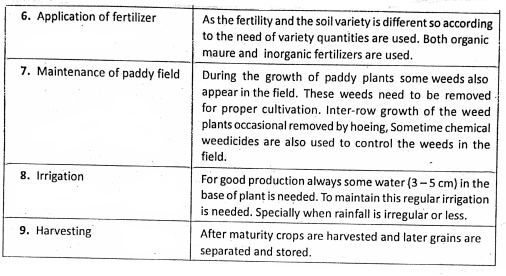
WBBSE Notes For Class 8 General Science And Environment Chapter 8 human Food Production Methods of cultivation of paddy 1WBBSE Notes For Class 8 General Science And Environment Chapter 8 human Food Production Methods of cultivation of paddy 2WBBSE Notes For Class 8 General Science And Environment Chapter 8 human Food Production Methods of cultivation of paddy 3


WBBSE Notes For Class 8 General Science And Environment Chapter 8 human Food Production Threshing, Winnowing, Threshing and winnowing


Chapter 8 Human Food Production Mango

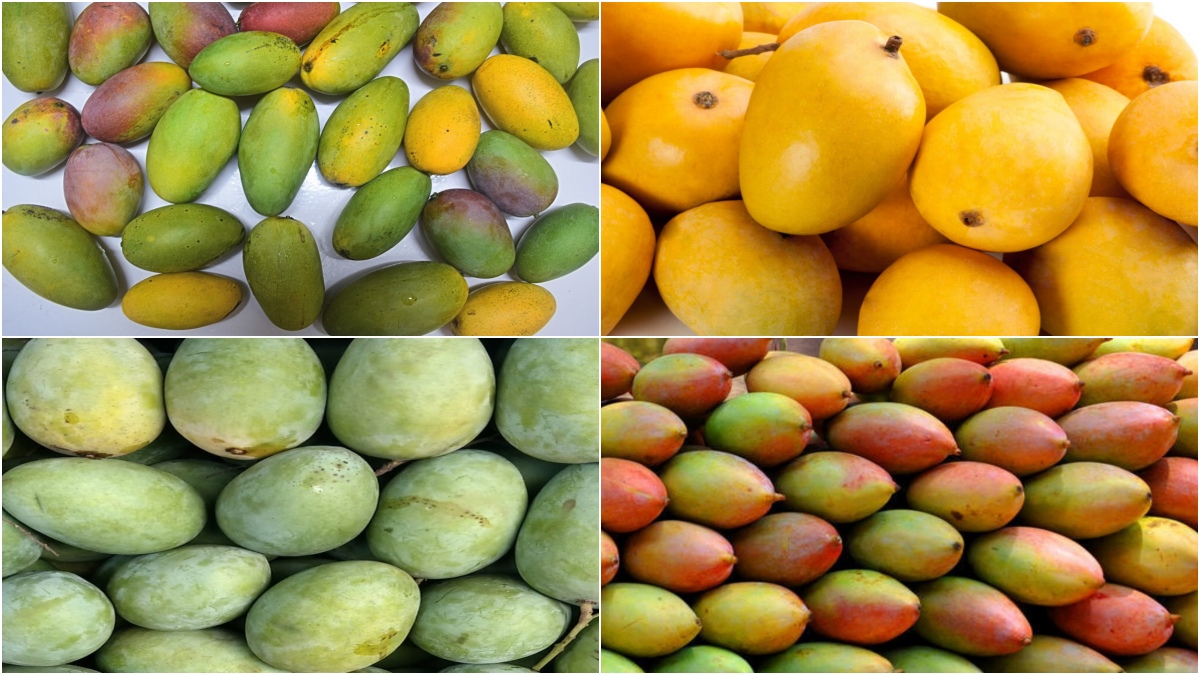
Most of you have seen mango. It is known as the king of fruits. It is a juicy fleshy fruit with a special odour of some varieties. Especially during summer if you go to a fruit market you will find different varieties of mango.

Try to make a list. (One example given).

Mango type Growing time / Season Photograph/characteristics
1. Himsagar April-June medium size, sweet juice.
2.
3.
4.


Distribution :

The original home of mango is India (indigenous to India). Later it spread to other countries like Srilanka, Myanmar, Malaysia, Indonesia, East Indian islands, etc. The scientific name of the Mango plant is Nanjifera Indica. Mango is found more or, less all over India. In West Bengal, the major mango-producing districts are Malda, Murshidabad arid Nadia.


WBBSE Notes For Class 8 General Science And Environment Chapter 8 human Food Production Mango


Food value or Nutritional value of mango :

Mango contains carbohydrates, protein, fat, and minerals (Ca, P, Fe, etc.). It also contains vitamins A, B-complex, and C in good quantities. Mango is a yellow fruit, it contains Beta carotene, water, and also some fiber. Beta carotene helps to better eyesight.

Weather:

Though mango can grow up to a height of 1500 meters or more above sea level. But for its proper growth clear sky and an absence of snowfall and mists is needed. So their growth is high in plain land. Rainfall and mist damage mango buds.

Chapter 8 Human Food Production Type Of Soil Require For Mango Plant Growth

A mango tree can grow in different soil. But the most suitable type of soil for mango plant growth is the alluvial soil of the river basin and fertile loamy soil. Sandy and clay soil are not suitable for mango cultivation.

Chapter 8 Human Food Production Varieties Of Mango

Some varieties of mango usually grow in India are— Alfonso, Amrapali, Bombai, Dasheri, Dudhiya, Phazli, Himsagar, Langra, Mallika, Mulgoba, Neelam, Totapuri, Begumfuli, Chausa, Bearti, Golapkhash, Peyaraphuli, Jhumka-phase, etc.

WBBSE Notes For Class 8 General Science And Environment Chapter 8 human Food Production Varieties of mango

Some mango have specific test and flavours. Some mango grows in large quantities. Although their products are varies in different parts and at different times.

Propagation-

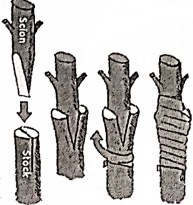
Propagation of mango from seed is common practice. But seed c(pes not have all the original characteristics of the mango tree. Therefore, nowadays seedlings produced by grafting have been practiced. Seedling produced by this grafting process has all the original good qualities.

Grafting-

Grafting is a horticultural technique where tissues of plants are joined so as to continue their growth together. In grafting the upper part (known as ‘scion’) of one plant grows on the root system (known as ‘stock’) of another plant.’Scion and Stock’ The upper high-quality plant part (scion) attach with stock the lower part (stock) during grafting.

WBBSE Notes For Class 8 General Science And Environment Chapter 8 human Food Production Grafting


This grafting process of the mango plant is usually done in July – August. There are many types of grafting processes are used, such as veneer grafting, chip budding, stone grafting, etc.

Process:

  1. Some part is cut from the seedling plant (stock) and the branch of the high-quality mango tree (scion).
  2. Then these two portions are joined (cutting is done as such way that their shape compensates each other) – the part of (upper part) scion and the lower part (stock). The seedling is watered regularly until they joined completely.
  3. After the joining of both plant parts, the upper part of the seedling (stock) and lower part of (scion) are cut off in 2 or 3 phases, (as per fig)
  4. This plant are then kept for some days in shades then it is transplanted in the nursery.

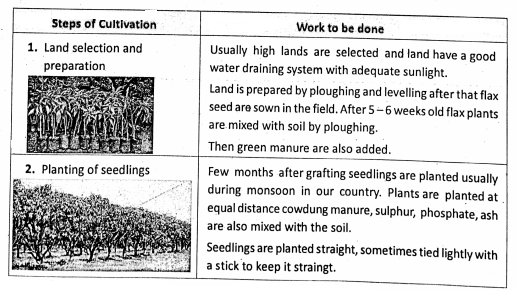
Chapter 8 human Food Production Method Of Cultivation Of Mango

WBBSE Notes For Class 8 General Science And Environment Chapter 8 human Food Production Method of cultivation of mango
Chapter 8 Human Food Production Tea

Tea:

The World’s largest number of people have an experience of Tea. The term ‘Tea’ most probably comes from the Chinese word ‘Tey’. Tea is the dried leaf of a bush (Tea plant) plant. It contains theine and caffeine (a type of alkaloid) and when it is added to boiling water, with or without sugar or milk it gives a very cheap stimulating drink.

“WBBSE Class 8 Science Chapter 8 notes, Human Food Production PDF”

Thus it is the most important beverage crop of India. Tea-producing countries—World’s largest tea-producing countries are China, India, Srilanka, Kenya, and Indonesia. The tea plant (Camellia sinensis) is native to East Asia, the Indian subcontinent, and South East Asia.


WBBSE Notes For Class 8 General Science And Environment Chapter 8 human Food Production Tea


But pow it is cultivated across the world in tropical and subtropical countries. In India Assam, West Bengal, Tamilnadu, Karnataka, and Kerala are the main tea-producing states. In West Bengal entire Tea is produced in three northern districts Darjeeling, Jalpaiguri, and Coochbehar (nearly 25%).

Most of the Tea plantations in India are found at elevations varying from 600 to 1800 meters above sea level, where rainfall is heavy but no water logging.

Soil type for tea—

Tea is cultivated in acidic humus-reached soil mainly in the slopes of the hills where rainfall is good but no water logging. Virgin forest soils rich in humus and iron content are good for Tea plantations. Different types of Tea are grown in India among them. Darjeeling Tea, Assam Tea, and Nilgiri Tea are famous.

Three types of Tea are commercially found in the market,

  1. Black Tea,
  2. Green Tea,
  3. Oolong Tea.

Black Tea accounts for nearly 75% of world production. Tea bush is a tropical and sub-tropical plant and thrives well in hot and humid climates. The ideal temperature for its growth is 20° -30°C and temperatures below 10°C and above 35°C are not suitable for the plant.

Chapter 8 Human Food Production Nutritional Value Of Tea

Tea is an aromatic beverage. It is the most consumed beverage in the world. Tea has a variety of positive health benefits.

  1. Tea contains caffeine which stimulates the body.
  2. Tea contains flavonoids, vitamin B-complex, and volatile oils which are good for health.
  3. Polyphenols present in Tea help to reduce the cholesterol level of the blood. It has antioxidant properties that can also help to prevent cancer, however, research is going on.
  4. Pantothenic acid, theophylline and caffeine present in Tea stimulate the nerves and are good for heart.
  5. The fluoride content in Tea leave prevents tooth decay.
  6. Black Tea contains a good amount of vitamin B-complex and folic acid which are anti-ulcer and anti-carcinogenic in nature.
  7. Green Tea contains vitamin K which prevents internal hemorrhages, rheumatic inflammation, and myocardial infarction.
  8. 150 – 250 cm annual rainfall is helpful.
  9. High humidity, heavy dew, and morning fog favor the rapid development of young leaves.

Humus and iron-containing forest soil is good for Tea plantations. A relatively large proportion of phosphorus and potassium in the soil gives special flavor to Tea as is the case in Darjeeling. Darjeeling Tea is famous in the world for its flavor.

Chapter 8 Human Food Production Types Of Tea Plant

Three major types of Tea plants are cultivated. These three under the genus Camellia are

  1.  China-type – (C. sinensis sinensis) small-leaved plants.
  2. Assam type (C. sinensis assamica) large-leaved plants. In 1840 tea seeds were imported from China and commercial tea plantations were set up in Brahmaputra valley (Assam).
    Later in 1859. Tea cultivation had been spread in lower Assam and Darjeeling and later in Nilgiri Hills in South India. Tarai along the foothills of the Himalayas and Himachal Pradesh.
  3.  Cambodian hybrid type Camellia also have many other species which does not produce the Scientific name of the Tea plant is Camellia Tea.
    Propagation – Tea plants are propagated both from seeds and plant parts.
    From seeds – Growing Tea plants from seed is much slower than other propagation methods. First of all healthy, strong fresh seeds of good quality are selected.


WBBSE Notes For Class 8 General Science And Environment Chapter 8 human Food Production Grafting technique

Germination of seeds is done on the sand bed. Seeds can be germinated faster by placing them in a plastic bag and covered with sphagnum mass for moisture maintenance. Seeds germinate within a month or so. Germinated seeds are transferred to the nursery beds in polythene packets.

“WBBSE Class 8 General Science Chapter 8, Human Food Production important questions”

Nursery beds should have a water draining system and germinated seeds should also be kept in moist condition pots are to be kept in a warm location with bright indirect light. Seedlings become ready in 15 – 18 months for transplantation.

Vegetative Propagation

An alternative process to grow Tea plants is cutting or layering. For cutting an angle cut on the stem or branches (with node area) of the plant and dip it into the rooting hormone. Thus the branch are bended and placed in the soil. After the appearance of the root then cut it from the mother plant and plant it to another place.

In grafting 3-4 centimeters (cm) long branches are cut with leaf and a swollen dormant axillary bud and fixed with stock portion of other plant and are kept as in the previous process.

Chapter 8 Human Food Production Method Of Cultivation Of Tea Plant

Steps of Cultivation Works done
1. Preparation of Jand For the preparation field, old plants are first removed then fields are ploughed. The same grass or other plants are cultivated in the field for the source of different minerals. Organic manures and NPK type of inorganic fertilizers are also applied according to need. Humus content of the soil to be increased.
2. Transplantation of seedlings Deep holes are made in the field one week of the plantation. These holes are filled with topsoils containing humus. Then 12 -18 months seedlings are transplanted. Wet leaves, straws, etc. are kept at the base of the transferred seedlings.
3. Additional arrangement Tea plants are grown under shade in tropical and subtropical regions. Trees are provided shade and shade reduces the surrounding temperature by absorbing some part of solar radiation. Fallen leaves of shaded trees enrich the amount of humus in the soil.
4. Weed control Weedicides are sprayed to control the mono and dicotyledonous weeds.
5. Application of fertilizers Urea, ammonium-sulfate, ammonium nitrate, calcium, and phosphate-containing fertilizers are used to maintain the minerals balance mainly for nitrogen.
6. Irrigation During less rainfall or dry season (October – February) generally, the sprinkler method of irrigation is practiced.
7. Harvesting The tender part of plant branches like 2 – 3 leaves and one bud are plucked. Quality of production very much depends on the plucking of Tea leaves. 35 – 40 rounds of plucking in a year is general practice in commercial Tea plants.
 8. Tea Manufacturing Plucked parts after drying pass through many steps to become consumable parts. Different machinery are used in this process.
9. Tea tasting Experience Tea-Taster are used for their process. They test the color, and flavor before marketing.


WBBSE Notes For Class 8 General Science And Environment Chapter 8 human Food Production tea plantation, cultivation and manufacturing

Different Types Of Animal Based Food Production

We have learned that plants are the major source of our food. From animal sources, we also get food items. We get eggs, honey, milk, meat, fish, etc. from animals. These items give us mainly proteins, fat (lipid), vitamins, and minerals. We have to take care to improve animal food productivity.

Animal Husbandry is a branch of agriculture that deals with the breeding, feeding, and care of domestic animals which is the main source of food products.

Animal Husbandry:

The branch of agriculture deals with the breeding, feeding, and carrying of domestic animals.

Chapter 8 Human Food Production Honey Bee

Honey Bee

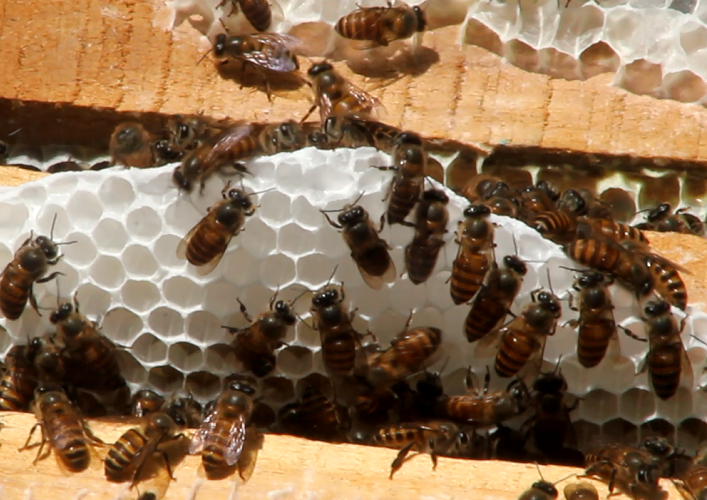
Most probably all of us have get the test of honey. Many of you have seen honeybee. Some of you may have experience of honey string. Honey-bee forms their nest known as beehives in the branches of trees, corners of houses, bushes or in other places.

We get honey and wax from honey-bee. These two are extracted from beehives. Besides the beehives in the branches of trees, corners of houses etc. artificial beekeeping and beehive are also made. The scientific method of beekeeping is known as Apiculture.


WBBSE Notes For Class 8 General Science And Environment Chapter 8 human Food Production Honey bee


Types of Honey-bees – Honey-bees are of four types—

  1. Rock bee (Apis dorsata) —Largest Indian variety, builds large Comb.
  2. Little bee (Apis florea)—Small-sized honey¬bee builds small comb.
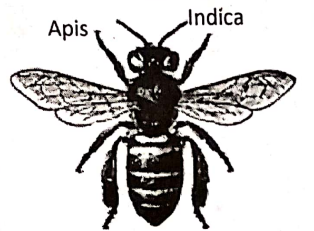
  3. Indian bee (Apis indico)—Common Indian bee of plains and forests.
  4.  European bee (Apis mellifica)—Common bee of Europe smaller in size.


WBBSE Notes For Class 8 General Science And Environment Chapter 8 human Food Production Little bee


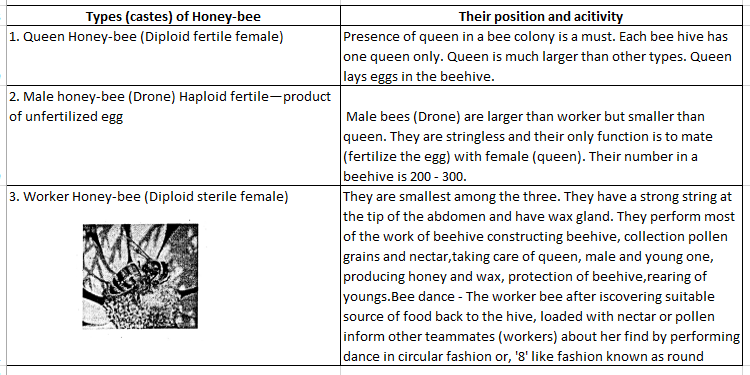
Honeybee is a social animal (Insect). They have a well-organized society with a division of labor (specific job).

  1. Honey-bee is an Insect under Phylum Arthropoda.
  2. The scientific name of the common honey-bee is Apis indigo

WBBSE Notes For Class 8 General Science And Environment Chapter 8 human Food Production Types of honey bee and their position and activity

Construction of beehive and Production of honey 

Worker honey-bees construct the bee hive with the wax present in the wax gland in their abdomen. Numerous hexagonal chambers known as cells are present in a beehive. The cells of the comb are of various types ‘storage cells/ brood cells’,’ queen chamber’ etc.

Chapter 8 Human Food Production Role Of Worker Bee

Formation of a honeycomb or hive, worker bees collect nectar and pollen from flowers. They store the nectar and pollen in their honey sac of their own body. In a honey sac nectar mixes with saliva, to form honey. Worker bee vomits this mixture in the honey chamber and fan it with their wings. As a result, water is vaporized and produces honey.


WBBSE Notes For Class 8 General Science And Environment Chapter 8 human Food Production Role of worker bee

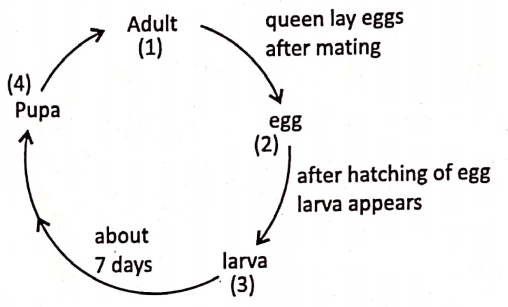
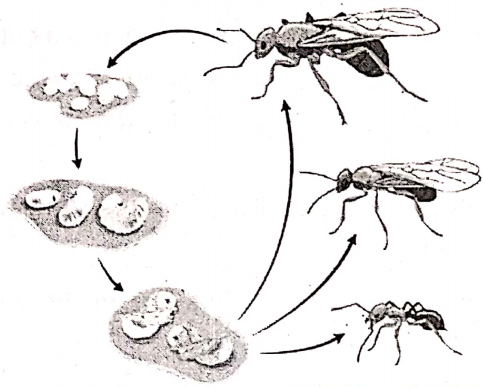
The life cycle of honey bee

It is necessary to know the habit and life history of honeybees. Artificial bee culture needs all these. In the life cycle of a honeybee has 4 stages.

Egg→ Larva→ Pupa→ Adult

During the first 2-3 days all larvae are fed on a special food “Royal Jelly” secreted by the pharyngeal glands of the young workers. After this important food “Bee bread” (mixture of honey and pollen .grain) is given to the larva. Queen-forming larvae are fed on royal jelly for full larval life.

WBBSE Notes For Class 8 General Science And Environment Chapter 8 human Food Production Different types of honey bee


Honey :

Honey is a sweet, viscous fluid obtained from a honeycomb prepared by a honeybee. Honey is a mixture of nectar pollen and the saliva of a honey bee.

Chapter 8 Human Food Production Composition Of Honey

Honey is composed of water, sugar (levulose, sucrose, dextrin, dextrose) minerals (like calcium, iron, phosphates, and manganese) vitamins B-complex, A, and C.

  1. Honey is an antiseptic and contains formic acid which acts as a. preservative.
  2. The color, flavor, and odour of honey usually depend on the flowers from which nectar is gathered.
  3.  Honey is an energy-rich food and easily digestible.

Artificial beekeeping :

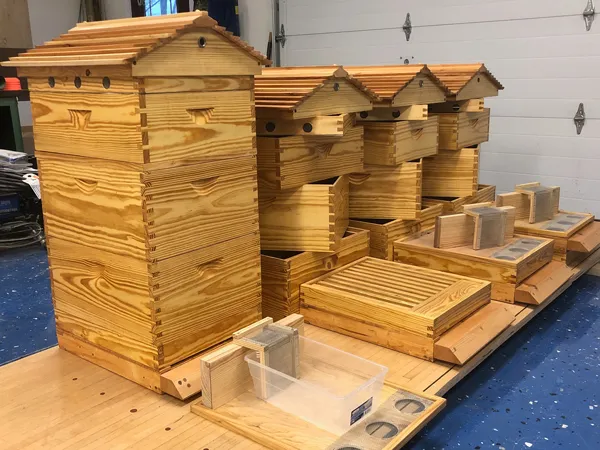
The amount of honey from beehives of wild honeybees are very little and are not regularly available. To overcome these difficulties artificial beekeeping has been introduced. The scientific method of beekeeping has been developed after extensive studies of bee behavior. A rearing place for honey-bees be it natural or artificial is termed as apiary.

WBBSE Notes For Class 8 General Science And Environment Chapter 8 human Food Production Artificial bee culture

Chapter 8 Human Food Production Types Of Rearing Of Honey-Bees

1. Indigenous method –

Beehives in natural conditions such as in the branches of trees, on the wall or on cornices of roofs, are found out. Sometimes wooden boxes, pitchers, (earthen vessels) are. placed along the route of honey-bees movement. Honeybees may construct beehives there.

WBBSE Notes For Class 8 General Science And Environment Chapter 8 human Food Production Bee dance

Later the honey-bees of this comb are driven put from the hives by using smoke, fire, water or fumes. Beehives are collected after honey-bee living the comb and honey is extracted from the hives.

2. Modern method –

In this method, the artificial beehive is constructed based on natural beehives. In this device chamber for rearing the young ones is placed at the bottom and the honey chamber is located at the top. One queen and some worker honeybees are collected and are placed in the artificial beehive.

It is seen that within few days some more honey-bee have come and joined with the team of honey-bee. Within a short time lots of honey bees are produced from the eggs laid by the queen. Worker honey bees collect nectar from nearby plants.

For this reason near the apiary, there should be some plants like mango, Jamun, lemon, guava and some different type of flowering plants. A special type of honey extractor are used for extracting pure honey from the artificial beehive.

Bee wax:

Beewax is secreted from wax gland of worker bee. They use it in the construction of hives. This is used by human being for several purpose like manufacturing of cosmetic goods, cold creams, shaving creams, candles, lipsticks, lubricants, etc.

Chapter 8 Human Food Production Fish And Fisheries

Fish is a valuable and easily accessible source of food, rich in protein content. Fish provides us with nutritious food, oil, fertilizers, and many other useful products. The fishery is the scientific culture of fish and other edible aquatic animals such as prawns, crabs/snails, mussels, etc.


WBBSE Notes For Class 8 General Science And Environment Chapter 8 human Food Production Varieties of carp (fish)

Pisciculture is the culture of fish:

Chapter 8 Human Food Production Type Of Fishery


WBBSE Notes For Class 8 General Science And Environment Chapter 8 human Food Production Types of fishery 1

Fishes are cultured in inland water reserves mainly in ponds, Canals, Paris, etc. Actually, fish are only captured from other inland sources like rivers, lakes, etc., and also from marine sources.

On the basis of the management of fish production fish can be of two types


WBBSE Notes For Class 8 General Science And Environment Chapter 8 human Food Production fish production


In the water reserves of inland like ponds, bhari, canals, and shallow water mainly fresh water and brackish water fishes are reared.

Pisciculture in freshwater-

Three major crops like Catla, Rohu, and Mrigal are indigenous to our country and enjoy much popularity in our markets under proper cultural conditions they grow well.

Exotic carp (foreign carp which cope up with our environment and grow) like Grass carp, Silver carp, and Cyprinus carp (American Rohu) were introduced during the post-independence period in the country.


WBBSE Notes For Class 8 General Science And Environment Chapter 8 human Food Production Carp


Carp

Carps are freshwater bony fishes covered by large scales, absence of scales on triangular head, accessary respiratory organ, and teeth in the jaw but have a swim bladder. example Catla, Rohu, Bata, etc.

Aquaculture: Using various types of water resources the production of useful aquatic plants and animals like prawns, fish, lobsters, crabs, mollusks, etc. are called aquaculture.

Pisciculture – The production and management offish is called pisciculture.

Chapter 8 Human Food Production Stages Of Fish Culture

1. Collection of eggs and spawns :

During monsoon months (June to August) when the rivers are overflooded the fish migrate to adjoining shallow water lands. (This is also the breeding season of fish). These submerged shallow areas act as breeding grounds for the carp. The eggs are collected 12 -14 hours after fertilization.

Fertilization is a process of the unification of sperm and ovum (egg). Fertilization of fish is external and occurs outside the body. Instead of collecting eggs from the breeding ground egg are allowed to hatch in hatching pits. After hatching fries (spawns) may directly be collected from the breeding ground by specially made frets. Sometimes fertilized eggs are also collected and rear them in a hatching pit.

Artificial method of breeding or induced breeding :

Major carp do not breed in tanks, ponds or any other short confined water. To overcome this both male and female major carp are injected with pituitary extracts injection and are forced to release sperms and ovum (eggs) in the water where fertilization occurs. This process is called induced breeding.

Induced breeding –

Induced breeding (= hypohydration) helps to get sperm as required, minimize the carrying cost, and to get pure fertilized eggs of a particular type.


WBBSE Notes For Class 8 General Science And Environment Chapter 8 human Food Production Induced breeding .


In Induced breeding of carp –

Pituitary glands of fishes are collected and after some processing pituitary injection is made. Two male and female mature fishes are selected for this purpose. Both of them are injected during this process. After some time both males and females release sperm and ovuk respectively.

Development of Adult fishes from spawns

Fertilized eggs collected by the fish farmers are reared in a small ponds to produce spawns. This pond is known as a hatchery. The spawns then are reared in different ponds or tanks one after one to produce adult carp.


Development of adult fishes from spawns


Chapter 8 Human Food Production Composite Fish Culture


For better results and full utilization of different food levels of ponds both indigenous (Rohu, Catla, and Mrigal) and exotic fishes (such as Grass carp, Silver carp, and Cyprinus carp) are cultured together in the same tank. This combined culture is known as Composite mixed fish culture or Polyculture.


WBBSE Notes For Class 8 General Science And Environment Chapter 8 human Food Production Composite of fish culture

The culture of major indigenous carp like Catla, Rohu, and Mrigal is known as Composite fish culture. Fish used in this system include Catla and Silver carp which are surface feeders Rohu and column grass carp are feeders and Mrigal and common carp which are bottom feeders.

Composite fish culture :

Fish a layer of food collection In water
Indigenous exotic upper layer
1. Catla Silver carp
2. Rohu Grass carp middle layer
3. Mrigal Americal carp or common carp lower layer


Importance of composite fish culture :

  1.  Production of fish increases many times than normal.
  2. Full utilization of pond food products occurs.

Sewage-fed fish culture

Sewage water is generally black colour and mixed with waste products of houses, factories, and municipalities excreta and urine also remain mixed with this water. Various organic and inorganic substances are present as solids in sewage. An inorganic substance is present in the sewage water as fertilizer.

WBBSE Notes For Class 8 General Science And Environment Chapter 8 human Food Production Fishing 1

As a result phosphorus and nitrogen increase in water. These help the growth of phyto¬planktons. With the production of large quantities of lshinB phytoplankton, zoo-planktons, and other insects are also increased in number. Fishes use these phyto and zoo planktons and other insects as food.

So there is no need to supply supplementary food from outside. However, it should be kept in mind that using untreated sewage in culture tanks or ponds harms the fish. Prior treatment of sewage is needed before mixing with water in cultural ponds. Sewage is used in fish culture in East Kolkata Bharies.

WBBSE Notes For Class 8 General Science And Environment Chapter 8 human Food Production Fishing

Food value of fish :

Fishes are protein-rich food with essential amino acids, fatty acids, and various minerals, such as Ca, P, Na, K, Mg, S, etc., and some vitamins like vitamin A, D, C, and B- complex.

Chapter 8 Human Food Production Poultry

Poultry provides the best source of animal protein and fats. The practice of keeping and breeding of the birds like hens, ducks, turkeys, and geese is called poultry farming. In India chicken (domestic fowl) is the most favorite domestic poultry bird. We get major quantities of eggs from poultry birds.

Classification of Fowls (on the basis of usefulness)

WBBSE Notes For Class 8 General Science And Environment Chapter 8 human Food Production Fowl

The poultry industry has improved a lot in the last two decades. A huge increase in egg production in India is called the silver revolution.

WBBSE Notes For Class 8 General Science And Environment Chapter 8 human Food Production Poultry breeds

Fowls are of two types on the basis of weight-

WBBSE Notes For Class 8 General Science And Environment Chapter 8 human Food Production Flows types

Fowls lay eggs but not all type of fowls incubate their eggs. These are of two types.

WBBSE Notes For Class 8 General Science And Environment Chapter 8 human Food Production Fowl 1

Chapter 8 Human Food Production Rearing Of Fowls

The practice of poultry farming needs good care for food, shelter, and disease control of fowls. Basically, two systems are commonly followed in our country, rearing fowls in battery cage / or cage systems and the Deep litter method.

Battery cages are the predominant form of housing for laying hens. In this method, the separate cage is allowed to each fowl. Fowl can easily sit or stand in the limited space of a cage. Many such cages are arranged side by side.

WBBSE Notes For Class 8 General Science And Environment Chapter 8 human Food Production Battery cage 1

The floor of the cage is sloped as soon as fowl lays an egg, it is deposited in the groove protruding (outer projection.) from the cage. Food and water containers are attached outside the cage. The container for collecting the excretion are located below the cage.

Space is limited inside the cage the fowls get little opportunity to move their body. As a result, most of their energy came from food are used in bodybuilding and the production of eggs.

Chapter 8 Human Food Production Deep Litter Method

The deep litter method is one sustainable method of managing chicken litter in the chicken coop that many small poultry owner use. Deep litter system based on the repeated spreading of straw or sawdust or both and some other materials in indoor booths.

An initial layer of litter is spread for the animals to use for bedding material and to defecate in and as the litter is soiled new layers of litter are continuously added by the farmer.

In this process, a greater number of birds are reared per limited of area.

  1.  It helps in the production of clean eggs and a comparatively more number of eggs.
  2.  Feed efficiency and egg weight were better in caged birds.
  3. This system is economical hygienic comfortable and safe to birds.

Litter is a bed made on a clean floor for the animal with small pieces of straw, sawdust, dry leaves, paddy, cotton seeds bran of barley, maize, mango peels, etc. Straw and other substances spread over sawdust and a thick bend of 10 -15 centimeters are made.

As the Fowls begin to inhabit the excreta of fowl mixes with the litter then new 5 cm litter layer form over the old one as a result 15 – 20 cm permanent litter is made. The litter bed containing room should be airy and be well lighted. The beneficial microbes and nematodes of litter make a healthy environment.

WBBSE Notes For Class 8 General Science And Environment Chapter 8 human Food Production Battery cage 2

Food and water are placed outside the wall of the deep litter room in such a way that the fowl can easily get their food and drinks through the bars. A nest is placed in the wall of the room where the fowl go and lay eggs.

Through the deep litter method, farmers get the following benefits –

  1. It does not take a lot of time to manage.
  2.  It ends up in compost manure the high nitrogen manure is called ‘green’.

Chapter 8 Human Food Production Nutritional Value Of Eggs

Eggs and meat contain high-quality protein and with all nine essential amino acids. Eggs are an excellent source of choline, calcium, and selenium and a good source of vitamin A, vitamin D, vitamin B12, Phosphorus, and riboflavin.

“Class 8 General Science Human Food Production notes, WBBSE syllabus”

Both egg and meat contain a good quantity of minerals. An egg and meat contain nearly the same amount of iron (Fe), however, the iron in meat can be better absorbed by the body than the egg. This is because that the phosphate in the egg yolk will combine with the iron affecting the absorption of iron. Meat contains more potassium but less sodium than the egg.

Poultry disease :

Poultry birds suffer from various disease-causing agents such as—viruses (Fowl pox, Ranikhet), bacteria (Tuberculosis, Cholera, Diarrhoea), fungi (Aspergillosis), parasites (worms, mites, etc.) They also suffer from nutritional deficiency diseases.

WBBSE Notes For Class 8 General Science And Environment Chapter 8 human Food Production Deep little

Broiler — Broiler is a hybrid fowl. They are used for meat only. They are the product of the mating of male Cornish variety of fowl with female white Plymouth variety.

Male Cornish + Female Plymouth = Broiler

They grow very fast. They reach marketable size within 5-7 weeks whereas others take 12-16 weeks.

WBBSE Notes For Class 8 General Science And Environment Chapter 7 World Of Microbes

Chapter 7 World Of Microbes Diversity Of Microbes

If you look around you will see a large variety of living organisms. It may be plants, animals, fungi, etc. But there are also several organisms that you cannot see with your naked eyes yet these organisms are around you.

Those organisms which are not visible with the naked eye and are viewed under a microscope only are called Microbes. If you increase the area of observation, the range and variety of organisms that you see would increase. This is the biodiversity of organisms.

“WBBSE Class 8 General Science Chapter 7 notes, World of Microbes”

Biodiversity :

(Bios = life, diversity = forms) Biodiversity in short is the number and types of organisms present on earth.

Microbes :

The word microbe (microorganism) is used to describe an organism that is small and normally it cannot be seen without the aid of a microscope example viruses, bacteria, fungi, Protista, etc.

Read and Learn more WBBSE Notes For Class 8 General Science And Environment

Activity :

WBBSE Notes For Class 8 General Science And Environment Chapter 7 World Of Microbes Diversity Of Microbes

  1. Collect some water from different places—drains, ponds, or other water bodies.
  2. Collect some fresh water—wash a leaf and collect the water again.
  3. Collect some wet soil and mix it with some water into a beaker, and collect the water from the upper surface.
    See all the water samples under the microscope separately. You will find different types and numbers of microorganisms or microbes.
  4. Virtually Microbes are found everywhere.

WBBSE Class 8 General Science And Environment Chapter 7 World Of Microbes

Chapter 7 World Of Microbes Microbes

Microbes or microorganisms are many large, extremely diverse groups of organisms. They cannot be seen without the use of a microscope.

“Class 8 WBBSE General Science Chapter 7 notes, World of Microbes study material”

Microbiology—Scientific study of microbes.

Microbes are the most primitive organisms that have existed from the beginning of life to Earth till now. The first existence of microbes (cyanobacteria) has been recorded 3-5 billion (350 crores) years back. Microbes include—viruses, bacteria, fungi, archaea, and Protista.

WBBSE Notes For Class 8 General Science And Environment Chapter 7 World Of Microbes Microbes

  1. About 60% of the mass of all living organisms are microbes.
  2. Nearly half (50%) of the oxygen inhaled by us comes into the atmosphere from microbes.
  3. Nearly 10 lakh types of microbes in the soil.
  4. About 100 crore microbes may be present in 1 gram of soil sample.

Chapter 7 World Of Microbes Characteristics Of Microbes :

Characteristics Of Microbes

  1. Microbes are microscopic organisms that can only be seen under the microscope and are not visible to the naked eye because they have a size of 0.1 mm or less.
  2. They are found almost everywhere—land, water, and air in animals, plants, food products, dead wood, and clothes virtually everywhere. They are found also in extremely cold conditions (poles) to extremely hot conditions (deserts).
  3. Microbes are also found inside or outside the body. They are found in the human alimentary canal as well as in termites (insects).
  4. Microbes generally do not have complex multicellular structures. Microbes belong to diverse groups of organisms.
  5. Bacteria, archaea (prokaryotes), fungi, microscopic plants, viruses, and viroids are also included among microbes.
  6.  The majority of microbes use oxygen for their survival few can live in low oxygen concentrations but few can survive without oxygen.
  7. Moist (damp), dark or less lighted areas are preferable for microbes’ growth and survival.
  8. Direct sunlight destroys some microbes.
  9. Some microbes collect their food from dead and decaying organic substances. Some take shelter to other plants or animals and collect their food from these organisms (host) and
  10. Live as a parasite. Algae and some microbes are able to synthesize their own food (autophytic)10. Microbes can survive at places where no other organisms can live. For example microbes in hot springs and hydrothermal vents with temperatures of 100°C (Thermophilic bacteria-heat loving) and several meters under thick snow several degrees below 0°C. Microbes can also live in a highly saline or extremely acidic environment. Usually, microbes can grow better between 25°C—38°C.
Class 8 General Science Class 8 Maths
Class 8 History Class 8 Science LAQs
Class 8 Geography Class 8 Science SAQs
Class 8 Maths Class 8 Geography
Class 8 History MCQs Class 8 History

Staining :

Microbes are. microscopic organisms. Before observing microbes under the microscope these organisms are colored by different substances, these coloring substances are known as stains and the process is known as staining.

Types Of Microbes :

Microbes are mainly belong to 4-major groups.

  1. Bacteria (Monera—kingdom).
  2. Protozoa (Protista—kingdom)
  3. Fungi (Fungi—kingdom)
  4. Algae (Plantae—kingdom)

Viruses though acellular are also treated as microbes, Virus can be seen only by an electron microscope.


Chapter 7 World Of Microbes Bacteria

Bacteria

  1. Bacteria are simple, small, single-cell (unicellular) prokaryotes.
  2. Bacteria are of various shapes—rounded, coma, rod or spiral-shaped.
  3. They have some similarities with plant cells. They have an outer cell wall but its composition is not like that of the plant cell wall.
    Plant cell wall—have cellulose (Complex carbohydrate)
    Bacteria—cell walls have sugar and amino acid (peptidoglycan)
  4. True nucleus is absent (Prokayotic) cell contain circular or spiral DNA as genetic material (true chromosome absent)
  5. Cells have no membrane-bounded organelles like Golgi bodies, mitochondria, lysosomes, plastids etc but have membrane-less organelle ribosomes (the 70s) in the cytoplasm.

In many cases have a sac-like structure, (outgrowth from plasma membrane) mesosome, helps in respiration.


WBBSE Notes For Class 8 General Science And Environment Chapter 7 World Of Microbes Bacteria


  1. Antony Von Leeuwenhoek, 1674 first time reported the existence of bacteria, observing under his own made microscope. –
  2. Ehrenberg, 1828, used the term bacteria for the first time.
  3. Bacteria have been placed in the kingdom Monera.
  4. Robert Koch: discovered two important human Pathogen—Cholera and Tubercu

Protozoa :

  1.  Unicellular, have one or more nuclei in the cell,
  2.  Protozoa were placed under Protista.
  3. They are variously shaped— such as rounded, oval, elongated or flat. Some form a colony. (e:g. volvox). Some are parasitic (live and collect food from host body).
  4. They have different types of locomotory organs such as Cilia (hair-like) flagella (whip-like) pseudopodia (a finger-like outgrowth of cytoplasm), which are the main locomotory organs.

Some protozoa have pigments that can produce food in their body such as Euglena.


WBBSE Notes For Class 8 General Science And Environment Chapter 7 World Of Microbes Protozoa (Microbes)


Chapter 7 World Of Microbes Fungi

Fungi

  1.  Their body cannot be differentiated into root, stem, and leaves.
  2. They have no photosynthetic pigment. Therefore, they are not able to produce their own food in their body. They collect food from decaying substances.
  3. They may be unicellular (yeast), or multicellular (Penicillium). Cells of the body connect each other and form a (filamentous) ribbon-like structure, hyphae. Often hyphae divide in branches, Hyphae combine to form a structure called mycelium (for example Penicillium, Mucor).
  4. Fungi have rigid cell-wall having chitin. (a nitrogenous compound) and glycan in it. They have no plastid in their cells! So they are unable to produce food.
  5. They are eukaryotic and have true nuclei.
  6. Fungi can be found in wetlands and dark and damp places.

WBBSE Notes For Class 8 General Science And Environment Chapter 7 World Of Microbes Fungi


Algae :

  1.  Algae are unicellular or multicellular or sometimes cells join together and form a colony.
    Unicellular algae—Chlamydomonas.
    Multicellular—(Ribbon-like)— Spirogyro.
    Colony forming (Ball like structure)—Volvox.
  2. The body of algae like fungi cannot differentiate into root, stem, and leaves..(thallus-like- body) . Algae possess chlorophyll (green pigment) containing chloroplast as well as some have other types of pigments, such as (red, yellow, etc). As they have chlorophyll in their body they can produce their own food with the help of sunlight, C02, and water.
  3. The cells of algae are eukaryotic type and have true nuclei and other cell organelles including chloroplast.
  4. Algae are mainly aquatic (freshwater or marine) though it also grows in wet and moist places.WBBSE Notes For Class 8 General Science And Environment Chapter 7 World Of Microbes Algae

Chapter 7 World Of Microbes Virus :

Virus

The virus has not a typical cell. Viruses are called acellular because they have no protoplasm and they only behave like living organisms when they come in contact with a living organism.

Viruses can only be seen by electron microscope. Their possible existence was first noticed by Edward Jenner during his research with smallpox victims in Europe in 1796. But until the discovery of the Electron microscope, their detailed study could not be done. The term Virus’ means ‘poison’ (the Latin word)


WBBSE Notes For Class 8 General Science And Environment Chapter 7 World Of Microbes Different types of virus


  1. Viruses may be rounded, tadpole like, or maybe of I different form.
  2. They have either DNA or RNA (nucleic acid) and a protein coat outside (capsid) the nucleic acid (DNA or RNA).
  3. They are parasitic in nature, they can grow and multiply within living organisms. Outside the host body, they are inert particles.
  4.  Viruses are one of the main disease-causing agents.

Interrelationship With Living World—Symbiosis And Saprophytism

Some disease-causing microbes enter Into a particular part of the body or a particular type of cell (such as malarial parasite inter RBC, liver cells). Their growth and reproduction depend on the host cell.


WBBSE Notes For Class 8 General Science And Environment Chapter 7 World Of Microbes Harmful protozoa Entamoeba histolytica


They collect food and get shelter in particular cells or organs. These microbes later hamper the normal functioning of the host cell and system. The interrelationship between the host and parasite is called parasitism.


WBBSE Notes For Class 8 General Science And Environment Chapter 7 World Of Microbes Hamful microbes

“WBBSE Class 8 Science Chapter 7, World of Microbes study guide”

Microbes influence man in many ways. Microbes are known to cause various diseases in man and other organisms and for Deteriorating food, .clothing, furniture, etc. But some of their activities are useful for us. Such activities include medicine (antibiotic production. Production of dairy products and fermented beverages, sewage treatment, etc.


Chapter 7 World Of Microbes Harmful Effect Of Microbes

Harmful Effect Of Microbes

Many diseases of humans, plants, and other animals are caused by microbes. Microbes can enter inside the human body through air, water, food, blood, and also sometimes by a simple touch.


Disease causing agents Diseases
(1) Bacteria (Bacterial diseases) (1) Tuberculosis, a certain type of Diarrhoea
Cholera, Typhoid, Diptheria, Tetanus, whooping cough, Pneumonia, etc.
(2) Virus (viral diseases) (2) Influenza, Pox, Polio, Measles, Hydrophobia Dengue, AIDS, etc.
(3) Fungi (Fungal diseases) (3) Ringworm, Allergy diseases of the throat and lung, food poisoning sometime Diarrhoea, Aspergillosis
(4) Protozoa (Protozoal diseases) (4) Amoebiasis, Giardiasis, Malaria, Kala-azar, Sleeping sickness, etc.


 Activity Work :

Make a list of ways of the entrance of microbes In the body and cause diseases.

  1. Through drinking water—Amoebiosis, Giadiarsis, Diarrhoea,…..
  2. Through cough, and sneezing—Tuberculosis, …..
  3. Through food—Amoebiasis, Diarrhoea, ……
  4. Through blood—Hepatitis, AIDS,…..
  5. Through carrier (vector)—Malaria, Dengue, Kalazar,……

Microbes help in human welfare :

Nitrogen is an essential element (Macro element) which is important for plant body formation. (Protein formation) and growth. Plants collect their nitrogen from the soil. Some Microbes (N2-fixing—bacteria) fix atmospheric nitrogen in the soil. Some free-living nitrogen-fixing bacteria present in soil are Azotobacter and Clostridium.


WBBSE Notes For Class 8 General Science And Environment Chapter 7 World Of Microbes Posionous mushroom


Few species of mushrooms are poisonous. Many of these deadly fungi bear an unfortunate resemblance to edible species, for example, Amanita (Deata cap, colorful)


Chapter 7 World Of Microbes Symbiotic N2 Fixing Bacteria


Some nitrogen-fixing bacteria form a mutually beneficial association with the plant. This association is called symbiosis and these bacteria are called symbiotic bacteria: The most important of the symbiotic nitrogen-fixing bacteria is Rhizobium. They live in the nodules of leguminous plants root such as peas, grams, beans, etc.

Rhizobium produces Nitrogenous compounds for the plant and shares it to plant, on the other hand, plants give them shelter.E.coli and some other symbiotic bacteria present in the intestine of human beings (getting food and shelter they’re) help in the production of Vitamin B12  which helps in the production of hemoglobin of RBC.

Leguminous plants before the preparation of cultivating fields are mixed with soil to increase soil nitrogen. Sometimes more than one organisms live together and share its nutritional product.

For example Lichen – an association in between algae and fungi. The fungus partner supplies water and minerals to the algae partner and the algae prepares food for itself and share it with the partner. partner.

“WBBSE Class 8 World of Microbes notes, General Science Chapter 7”

Many fungi and bacteria take part in the decaying process,, or decomposition. The process of collecting nutrients from dead decaying organic body and completing of the nutrition of their own is known as saprophytism.

Saprophytisms :

Many Microbes grow on dead animals and plants and help in the decay of organic matter. They break down complex organic matter into simple forms by the secreting enzymes. They also consume some nutrients after breaking down the complex organic forms Role of microbes in Environment.

Agriculture :

Free-living nitrogen-fixing bacteria (microbes) fix nitrogen in the soil such as Azotobacter, Clostridium, and Plants collect it from the soil. Symbiotic nitrogen-fixing bacteria Rhizobium forming nodules in the root of leguminous plants. (Pea, Gram, Pulse).

WBBSE Notes For Class 8 General Science And Environment Chapter 7 World Of Microbes Nodules of leguminus plant

Plants take Nitrogen (N2 ) from the atmosphere and form nodules after the decomposition of the nodules nitrogen content of soil increases. During the preparation of green manure many leguminous and nonleguminous crops are grown in the field and plowed back into the soil when they are still young and green.

This practice helps to enrich soil nitrogen, phosphorus, calcium, sulfur, and other minerals. Nitrogen-fixing Cyanobacteria (blue-green algae)symbiotic association with several plants, for example, Azolla (fern). Most of plants, use soil, Nitrogen when it is in the form of Nitrate (N03 ) or NH4+.


Chapter 7 World Of Microbes Azolla :


Anabaena is Of great importance to agriculture. Anabaena (Azolla) resides in the leaf cavities of the fern Azolla and it fixes nitrogen. The decaying fern plants used in the field, before cultivation, as green manure. They decompose and, enrich the field for the next crop.

Some microbes present in soil also break the organic nitrogenous compounds and release NH3 (ammonia) the process is called ammonification and again ammonia converted into nitrite and then nitrite (N03) by some nitrifying bacteria.

Organic decaying compound
This process of (Nitrate) N03 formation from Ammonia (NH3) is called nitrification. There are some other microbes (bacteria) that break nitrogen compounds and free nitrogen from compounds; this process is known as denitrification.

You may have noticed that after cutting Jute stem have been submerged in water for few days.

WBBSE Notes For Class 8 General Science And Environment Chapter 7 World Of Microbes Lactobacillus

  1. Jute fibers separated from Jute stem, decomposing the pectin (complex carbohydrate) present in the cell wall by microbes.
    Food processing—by microbes.
    Curd, cheese, and other food substance production.
  2. Curd—When Lactic acid bacteria (LAB) Lactobacillus are added to milk (hot milk at 37°C) it converts the lactose sugar of milk into lactic acid. Lactic acid causes the coagulation of milk protein (casein). Milk is changed into curd. Different microbes also help to produce yogurt and cheese.
  3. Using the fermentative activity of microbes we can prepare a number of products, such as Alcohol, Idli, Dosha, Cake Vinegar, etc.

Production of medicine

Many life-saving drugs, Antibiotic medicine are produced from microbes mainly fungi and bacteria. Some organic compounds produced by these microbes can arrest the growth of other bacteria, for example, Streptomycin, Ampicillin, Chloromycetin, etc. Antibiotics are chemical substances the secreted by some microorganisms which inhibit the growth and development of other microbes (pathogens).


WBBSE Notes For Class 8 General Science And Environment Chapter 7 World Of Microbes fungus


Alexander Flemming the father of antibiotics, first discover penicillin from the fungus Penicillium notatum. This was the first antibiotic which inhibit the growth of bacteria. This saves the life of millions and millions of people all over the world.


WBBSE Notes For Class 8 General Science And Environment Chapter 7 World Of Microbes Alexander Flemming


Chapter 7 World Of Microbes Vaccine

Vaccine

After the entry of some microbes like viruses, bacteria, protozoa, and fungi, they produce some toxic substances inside the body. These harmful agents (proteins) which enter into the body is called an antigen.

“Class 8 WBBSE General Science Chapter 7, World of Microbes easy explanation”

To prevent this antigen body produces some proteinous substance that prevents the entry and harmful activity of antigen called Antibody. Antibody attack and destroy the antigens. The natural system of body protection is called immunity.


WBBSE Notes For Class 8 General Science And Environment Chapter 7 World Of Microbes Vaccination

To prevent some diseases some dead or weak microbes (viruses, bacteria) have been introduced in the body, which tiger body produces antibodies to fight against these antigens. The natural system of body protection is called immunity.

To Prevent some diseases some dead or Weak microbes (viruses, bacteria) have been introduced in the body. which tiger body produces antibodies to fight against these antigens. This process is called vaccination.

By this process, body is able to protect these diseases such as, polio, typhoid, cholera, diphtheria, etc. The process of improvement of body immunity is called immunization.

Vaccine and Vaccination :

A vaccine is a biological preparation that provides immunity (active acquired immunity) to a particular disease and the process by which immunity can grow by using a vaccine is called vaccination.

“WBBSE Class 8 Science Chapter 7 notes, World of Microbes PDF”

Immunization :

Immunization is the process by which a person or animal becomes protected from disease.


WBBSE Notes For Class 8 General Science And Environment Chapter 7 World Of Microbes Edward Jenner


Treatment Of ‘Waste Product’

If human feces, urine, food residue, and decaying substance are not treated properly some infections may happen. These are risks for human health. Some microbes (bacteria) live in less oxygenated conditions can break these compounds. into utilizable and harm less products.

  1. Microbes also help in biogas production. Biogas is a methane-rich fuel gas produced by
  2. Break down of biomass with the help of methanogenic bacteria (anaerobic) Some algae (microbes) are used in space centers and space shuttles to clean air.
  3. Microbes are also used in the biological control of pests.


WBBSE Notes For Class 8 General Science And Environment Chapter 11 Plant Kingdom And Environment Arounds Us

Chapter 11 Plant Kingdom And Environment Around Us Some Important Plants For Environment

Plant Kingdom:

All of we know is that plants have a great role in our life. We collect different ingredients from plants for our food, clothes, medicines, and household materials. Plants parts are used in industries as raw materials (like Tea, timber, etc.). Animals inhaled oxygen which comes from plants during the process of photosynthesis.

Besides some plants reduce the extent of environmental pollution by absorbing pollutants. Plants prevent soil erosion, organic manures are also made from plant parts. Plants have a great role in controlling the temperature of surroundings rainfall wind velocity. ‘

Read and Learn more WBBSE Notes For Class 8 General Science And Environment

Chapter 11 Plant Kingdom And Environment Around Us Bamboo

Bamboo

Bamboo is a common plant have no or fewer branches. Bamboos are evergreen perennial flowering plants. Bamboos like other grass (bamboo is a type of grass of the family Poaceae) have long stems whose nodes are solid and whose inter-nodes are long and hollow.

Bamboo are one the fasted growing plants in the world. Certain species of bamboo can grow 91 to 100 cm (3ft) within a 24-hour period at a rate of almost 4 cm (.1-5 inch) per hour. Giant bamboos are the largest members of the grass family.

Bamboo grove. Bright green plants. Background

Bamboos are of notable economic and cultural significance in South Asia, South-East Asia, and East Asia, being used for building materials as a food source,s and versatile raw product. Bamboo has a higher specific compressive strength.

Class 8 General Science Class 8 Maths
Class 8 History Class 8 Science LAQs
Class 8 Geography Class 8 Science SAQs
Class 8 Maths Class 8 Geography
Class 8 History MCQs Class 8 History

“WBBSE Class 8 General Science Chapter 11 notes, Plant Kingdom and Environment Around Us”

The appearance of flowers in the Bamboo plant is very irregular, in fact many flowers at intervals as long as 65 or 120 years. Bamboo plant ethereal mass flowering plant. There are different hypotheses regarding the flowering of bamboo plants. Rats and rodents like the flower.

WBBSE Notes For Class 8 General Science And Environment Chapter 11 Plant Kingdom And Environment Arounds Us

Chapter 11 Plant Kingdom And Environment Around Us Uses Of Bamboo Plants

Uses Of Bamboo Plants

  1. Bamboo is used as a building material. Bamboo is best known for its hard stem (culms) that are used in place of wood for a variety of applications including furniture, flats, fence posts, flooring, bridge, bamboo roofing, and handle of umbrellas in many cases.
  2. Bamboo is used in medicinal purposes. In China ingredients from the black bamboo shoot help to treat kidney diseases. Tabashir an important medicine for asthma, colds and cough, and many infectious diseases is made from silicon dioxide and silicic acid derived from the internode of bamboo. (Bambusa arundinacea)WBBSE Notes For Class 8 General Science And Environment Chapter 11 Plant Kingdom And Environment Arounds Us uses of bamboo plants
  3.  Bamboo is used to make necklaces, bracelets, earrings, and other types of ornament. Bamboo toys are used as eco-friendly material instead of plastic goods. Bamboo is a type of grass and the fastest growing plant in the world.
  4.  Bamboo shoots are used mainly in food preparation. Bamboo leaves and shoots are the chief food of Panda another endangered species and elephants and some other animals.
  5. Beautiful and intricately crafted beds, chairs,s and tables are made from bamboo.
  6. Bamboo is used to make beer.
  7.  Different bamboo-made utensils are used to prepare and distribute of food usually in rural areas.
  8.  Bamboo fibers are used in fabrics and clothing, bedding made of bamboo fibers is as soft as or softer than most cotton bedding.
  9. Different delicious dishes are also prepared from soft young stems coming out from the base of bamboo. Different beverages are also being prepared from these young stems.
  10.  Different weapons are made such as archery bow and arrow stick (hathi) Javline (Barsa) etc.
  11.  A type of insect grows at the base of bamboo plants in some parts of China, Laos, Myanmar and Thailand their larva are good food of these people.

WBBSE Notes For Class 8 General Science And Environment Chapter 11 Plant Kingdom And Environment Arounds Us Eichhornia crassipes


Chapter 11 Plant Kingdom And Environment Around Us Water-Hyacinth

Water-Hyacinth

Water hyacinth is an aquatic free-floating perennial plant native to the Amazon basin. This aquatic plant can grow to a height of 3 feet. Leaves are dark green, leave blades are circular to elliptical in shape. Petiole are inflated and spongy.

The water hyacinth was introduced from its native home in South America to various countries as an ornamental plant and keep cool the ponds and lakes. Water hyacinth has a negative impact on aquatic ecosystem and its propagation need to control.


WBBSE Notes For Class 8 General Science And Environment Chapter 11 Plant Kingdom And Environment Arounds Us Water Hyacinth


Due to its rapid reproductional ability, this plant can spread all over the .pond within a very short time. Due to the rapid growth of water hyacinths, other aquatic plants are being deprived of getting adequate sunlight and dissolved oxygen. Fishes and other animals face severe problems and succumb to death.

“Class 8 WBBSE General Science Chapter 11 notes, Plant Kingdom study material”

Aedes mosquitoes propagate in the densely grown water hyacinth plants. Besides this, a type of small snail like this plant and this snail propagate a helminth disease.


Chapter 11 Plant Kingdom And Environment Around Us Uses of Water Hyacinth

Uses of Water Hyacinth

  1. It ferments rapidly due to its high water content and can supply biomass for biogas production.
  2. This plant is used as a water-clearing agent as a substrate for mushroom production and as an ornamental species. The stems of this plant in some countries use as a source of fibers for garment industries.
  3.  Water hyacinths are another source of raw material for the manufacturing of paper.
  4. As a water purifier-Water hyacinth can purify polluted dirty water by absorbing heavy metals like chromium, cadmium, nickel, cobalt, mercury, lead, etc. Therefore, the water became pollutant-free and become suitable for other work.
  5. Water hyacinth have the power of absorbing cyanides so it is used to treat the pollutant water of goldmine area. This plant can eliminate arsenic from arsenic-rich water.
  6. Nitrogen-fixing bacteria present in the root of water hyacinth play important role in nitrogen fixation by the nitrification process.

SAL :

Sal (Shorea robusta) is a large perennial, woody, deciduous dicotyledonous economically important tree. Sal is moderate to slow-growing plant and takes 25 to 30 years to be mature.

WBBSE Notes For Class 8 General Science And Environment Chapter 11 Plant Kingdom And Environment Arounds Us sal

Sal attains Leaves of sal are broad and shed most of its leaves during spring. heights of 30 to 35 m and a trunk diameter of up to 2 – 2.5 m. Leaves of sal are broad and shed most of its leaves during spring.


Chapter 11 Plant Kingdom And Environment Around Us Importance Of  Wood

Importance Of  Wood

  1. Sal is one of the most important sources of hardwood timber in India.
  2. The wood is especially suitable for constructing frames for doors and windows, boats, floors, and many other woody structures (bridges, jetties, etc.)
  3. Sal tree is used in making poles (electrical) woods are resinous and durable.

Leaf:

In northern and eastern India the ury leaves of sal are a major source of the production of leaf plates and leaf bowls.
Leaves are also used for readymade food and used leaves for the food of cattle goats, cows, etc.

Gum :

Gum from the sal tree red resins in the form of gum released. From it resin is made and used in the work of wood polish and crack filler.

Resin :

Resin also used for making spirit and varnish.

Tannin :

Tannins derived from bark are used in leather industries and used as pan marshalls.

Oil :

Seed oil is extracted from seeds and used as cooking oil after refining and also used for lighting lamps, cooking, and chocolate making.


Chapter 11 Plant Kingdom And Environment Around Us Sundari

Sundari

Sundari is a type of evergreen mangrove tree. It is the dominant mangrove tree of the Sundarbans. It is a major timber-producing tree. The IUCN (International Union for Conservation of Nature and Natural resources)-has assessed this plant as being endangered.

The Sundari tree is medium size growing to a height of 15 to 25 meters. They grow in muddy places its base may wash twice by the tide. The roots are shallow and spreading and their small branches come above the soil. They bear many pores and are capable of respiration these roots are called pneumatophores.


WBBSE Notes For Class 8 General Science And Environment Chapter 11 Plant Kingdom And Environment Arounds Us Sundari


They grow in soft soil therefore trunks develop buttresses. Some curved adventitious roots project in a curved manner from the base of the stain and penetrate in loose soil for providing mechanical strength to the plant These roots are called stilt roots.

“WBBSE Class 8 Science Chapter 11, Plant Kingdom and Environment study guide”

The trunk has a few large branches and the canopy is open. The leathery leaves (covered by waxy substances) glisten, the lower surface is light green. Pink or orange bell-shaped flower. The fruit is egg-like. New seedlings came out from the seed present within the fruit.

Uses of Sundari

  1. Timber produced from Sundari is hard to fine-grained tough and elastic. The heartwood is dark red or reddish brown and is used as poles, furniture, house construction, bridge building, and boat-building. These plant parts are also used as firewood.
  2. A high amount of tannin is produced from Sundari which is used leather and dye industries.

Chapter 11 Plant Kingdom And Environment Around Us Spices And Plants

Spices And Plants

We like tasty cooked food. Spices is the ingredient to make our cooked food tasty. Best-quality spices are found in India. Different visitors and tourists came from different parts of the world for the attraction of Indian spices.

Indian spices include a variety of spices grown across the Indian sub-continent with different climates in different parts of the country. India produces a variety of spices many of which are native to the subcontinent.

Uses of spices :

  1.  Make the cooked food tasty.
  2. Use as a preservative.
  3. Help in digestion increasing appetite.
  4. Help mouth cavity / Buccal cavity) germ-free.

Table

Plant part Name of plant use as species
1.    Bark 1. Cinnamon
2.    Fruit 2. Black pepper, cardamom
3.    Leaves 3. Mint, cassia (Tejpata)
4.    Bulbs 4. Onion, Garlic
5.    Rizomes 5. Ginger, Turmeric
6.    Seed 6. Mustard, Ajowan
7.    Buds 7. Clove
8.    Floral part 8. Saffron
9.    Kernel 9. Nut


Chapter 11 Plant Kingdom And Environment Around Us Black Paper

Black Paper

Black pepper is a perennial flowering vine cultivated for its fruit. This is usually dried and used as a spice and seasoning. When dried the fruit is known as a peppercorn. Its unripe fruit is green when ripe became red and when dried became black. The dry fruit is used as a spice.

Usage—Beside make our cooked food tasty, potassium another mineral in black pepper helps to improve our stomach’s ability to digest food and promote intestinal health. Black pepper is used as a whole or in powder form. Its hot test is for Piperine.

WBBSE Notes For Class 8 General Science And Environment Chapter 11 Plant Kingdom And Environment Arounds Us Black pepper

Because black pepper is a carminative it discourages intestinal gas formation and helps in the breakdown of fat cells. Black pepper is used in cough, toothache, bleeding gum, pain in gum, and indigestion.

Chapter 11 Plant Kingdom And Environment Around Us Cinnamon

Cinnamon

Hope you have seen cinnamon in some sweet in food like ‘polao’ and ‘fried rice’. Cinnamon is a spice obtained from the inner bark of the plant genus of Cinnamomum. It is an evergreen tree. The term ‘cinnamon’ also refers to its mid-brown color. Cinnamon is of two types-thick bark and thin bark.
WBBSE Notes For Class 8 General Science And Environment Chapter 11 Plant Kingdom And Environment Arounds Us ClinnamonUsage :

  1. Cinnamon bark is used as a spice. It is mainly used as flavoring food.
  2. Cinnamon has its own sweet test. It is used in small pieces or as a powder.
  3. Volatile oil prepared from cinnamon, its relief in arthritic pain.
  4.  Its also use in nausea diarrhoea and colds.

Chapter 11 Plant Kingdom And Environment Around Us Turmeric

Turmeric

You will not find anyone who have not seen turmeric. Turmeric is a rhizomatous (modified stem) perennial herb. Turmeric is native to Southeast Asia. Turmeric’s aerial stem is not visible, only leaves are visible outside.

“WBBSE Class 8 Plant Kingdom notes, General Science Chapter 11”

The part use is the modified stem. Commercially turmeric is prepared from the underground yellow bulb of the plant;
The bulb (stem) of Turmeric is yellow an underground part, it may be used raw but usually, the bulb are boiled in water (for half an hour). After that, it is dried and powdered.

Usage—

Turmeric is used in most of the cooking vegetables, fish, and meat dishes. Besides, it is used for making color. Turmeric has an antibiotic role. It is used in Ayurvedic medicine. A mixture of lime and turmeric are used as medicine to relieve from bone pain due to injury.

People use it in different festivals and social occasions. Turmeric helps to prevent anemia because it reaches in iron. Research shows that turmeric is effective in controlling cholesterol level in the blood.

Chapter 11 Plant Kingdom And Environment Around Us  Cardamom

Cardamom:

Cardamom is a herbaceous perennial plant in the ginger family native to Southern India. It has rigid and erect aromatic leaves which form the aerial part of the plant. It is the most common of the spices whose seeds are used as a spice called cardamom. black paper is the king of spices cardamom is the queen of spices.

“Class 8 WBBSE General Science Chapter 11, Environment Around Us easy explanation”

Cardamom is one of the world’s most expensive spices after saffron. It has a sweet burning taste and very distinct spicy odor. Cardamom is mainly of two types. Greater cardamom and lesser cardamom. Greater cardamom when dry is coppery in colour. The fruit is used as cardamom. The fruit of lesser cardamom becomes light brown when dried artificially.

WBBSE Notes For Class 8 General Science And Environment Chapter 11 Plant Kingdom And Environment Arounds Us Cardmon plant and its different parts
Usage—

It has a special flavor. To bring taste and special flavour of dishes cardamom is used. It is also frequently used in different sweet dishes (Payes, Halua, etc.) and also in different types of sweets.

Cardamom is used in medicine of stomach-related problems, gum related problems, used as a mouth freshener, and seeds of greater cardamom alleviate nausea. Garam masala-Garam masala is a preparation of mixing of clove, cardamom, cinnamon, black pepper mace, and nutmeg.

Chapter 11 Plant Kingdom And Environment Around Us Ginger

Ginger

Ginger is a flowering perennial herb. Stem is rhizome type (modified stem). Aerial parts like narrow green leaves and yellow flowers appear annually from the rhizome. Ginger plants have been extremely popular though out Asia especially in India from ancient times used extensively for cooking and to treat cough, cold, joint pain, etc.

WBBSE Notes For Class 8 General Science And Environment Chapter 11 Plant Kingdom And Environment Arounds Us Ginger

Use of Ginger :

  1. Ginger is widely used as a spice or a folk medicine.
  2. Ginger is used along with onion and garlic in different food dishes. In many cases, ginger alone are used. Ginger is also used in preparing sauces.
  3. Ginger has an important role in traditional ayurvedic medicine.
  4. Fresh as well as dried ginger is used to spice tea and coffee, especially in winter.
  5. Ginger is also used in the sweet candy and bakery industry, in the beer -factories.
  6. Ginger is useful in stomach upset it stimulates several digestive enzymes. It also helps to suppress nausea and vomiting tendencies.

WBBSE Notes For Class 8 General Science And Environment Chapter 11 Plant Kingdom And Environment Arounds Us Ginger tea

It is also used in cough syrup.

Make a table of food and other things where ginger is used :

Food Products Use of ginger (part)
Other than food as medicinal
value.


Chapter 11 Plant Kingdom And Environment Around Us Garlic

Garlic

Garlic is closely related to the onion, a perennial flowering plant. Its stem is modified bulb type (bulbous plant). A round bulb of garlic consists of 6-30 small bulb-like parts These are called grates of garlic. The whole bulb is covered by a light dry covering.

“WBBSE Class 8 Chapter 11 General Science, Plant Kingdom and Environment solutions”

Allin a sulfur-containing compound found in garlic which is mainly the compound most responsible for the “hot sensation” of raw garlic and its our. Allin is odorless when it comes to contracting with an alliinase enzyme (cut or crushed) and converting it into allicin. This is responsible for the pungent odor.

Usage: Spice: Garlic is most often used as a flavoring agent. Garlic is used with onion and ginger as a paste for the cooking of fish and meat. It is also uÿtomake tasty of some vegetable dishes. Make a jable of cooking where garlic is used as a spice.

WBBSE Notes For Class 8 General Science And Environment Chapter 11 Plant Kingdom And Environment Arounds Us Garlic plant

Other usages:

Garlic has medicinal food of beneficial to value the alleviation. Garlic or anti-oxidant properties of Allicin. It is also beneficial to regulate blood pressure and blood sugar.

  1.  Garlic has also antiseptic properties. It helps to alleviate gas-related problems.
  2. Garlic helps in food digestion by stimulating many enzymes.

Chapter 11 Plant Kingdom And Environment Around Us Medicinal Plants


From ancient times, humans gathered knowledge about the medicinal properties of plants. India has a long tradition of using indigenous plants or plant parts as medicine.

“WBBSE Class 8 Science Chapter 11 notes, Plant Kingdom and Environment PDF”

Ayurvedic medicines have been documented in the ‘Atharva Veda’, ‘Rig Veda, and ‘Sushruta Samhita’ in our country. According to WHO (World Health Organization), nearly 80% of the world’s population depends upon traditional medicines for their primary treatment and most of them originate from some medicinal plants.

We come to know from recent studies that more than 20,000 plants have medicinal properties (it may increase in the coming days) of these 8500 plant species are only in Asia. At present nearly 3500 species of medicinal plants are found in our country.

Chapter 11 Plant Kingdom And Environment Around Us Some Common Medicinal Plants Of Out Country


Neem [Azadirachta Indica) :

Many of you have seen the Neem tree. It is a medium-sized (15 – 20 meters) first-growing evergreen tree. Neem is native to the Indian subcontinent i.e India, Bangladesh, Nepal, Pakistan, Srilanka, and Maldives. The fruit is oval to nearly roundish yellow in colour. Different parts of the neem tree i.e leaves, bark, and fruits are used for different purposes.

Chapter 11 Plant Kingdom And Environment Around Us Medicinal Properties Of Neem :

Medicinal Properties Of Neem

  1. The tender shoots and flowers of the neem tree are eaten as vegetables in India. In Bengal, tender neem leaves are fried with ‘Begun’ (Brinjal) called ‘nimbegun’ eaten with rice as an appetizer.
  2.  Juice of neem leaves are used to control diabetes.
  3.  Neem oil is used for healthy hair to improve liver function, detoxify the blood and balance blood sugar levels.
  4. Neem leaves are also used to treat skin diseases.
  5. A bitter tonic prepared from the bark of root and stem is also used in some areas as medicine of fevers, (like malaria)
  6.  Neem oil is used in many cosmetic products such as soap, shampoo, toothpaste, powder, cream, etc.
  7.  Neem oil is used as a pesticide.
  8. Neem leaves have repellent properties-insects and birds avoid it presence.
  9.  The antibiotic properties of neem has been acknowledged.
  10.  Besides its use in traditional, Indian medicine, the neem tree is of great importance for its anti-desertification properties and possibly as a good carbon dioxide (C02) sink.

WBBSE Notes For Class 8 General Science And Environment Chapter 11 Plant Kingdom And Environment Arounds Us Neem tree

Collect neem leaves dry it keep it in your books and exercise katas. Observe the result. ‘Nimbidin’ is the main active antibacterial ingredient of neem.

Chapter 11 Plant Kingdom And Environment Around Us Bael

Bael

Bael is the most ancient sacred tree native to India. Bael is a medium-sized deciduous tree. Owing to its hard nature bael tree has wide adaptability to adverse soil and climatic condition.

“WBBSE Class 8 General Science Chapter 11, Plant Kingdom important questions”

Bael has enough medicinal value because of the presence of various alkaloids (nitrogenous excretory products of plant) polysaccharides and essential oil. It also contains mucilage and pectin.

WBBSE Notes For Class 8 General Science And Environment Chapter 11 Plant Kingdom And Environment Arounds Us Bael tree with fruits

Chapter 11 Plant Kingdom And Environment Around Us Medicinal properties


  1. The juice of the fruit gives comfort from constipation and dyspepsia. This is also used against viral and intestinal parasites.
  2. Unripe or partly unripe fruit increases appetite and digestive power.
  3. The fruits are used to prepare squashes and cold drinks. It contains a good amount of vitamin B (riboflavin B12)WBBSE Notes For Class 8 General Science And Environment Chapter 11 Plant Kingdom And Environment Arounds Us Bael
  4. The unripe fruits can be used to prepare sweet tasty ‘Morrabbwa’ food.
  5. Recent investigations have revealed the antibiotic and anti-fungal properties of beal leaves.
  6. Its leaves contain an alkaloid (rotation) which is useful in treating high blood pressure and diabetes. Oil extracts from bael also use to resist cold.

Benefits of Bael fruit

  1. Control cholesterol
  2. Relive constipation
  3. Antimicrobial properties
  4. Anti-inflammatory property
  5. Reduce skin rash.
  6. Control diabetes
  7. Wound healing properties

Emblica (Amlaki) : (Phyllanthus emblica)

The common name Amla is a small leafy tree that grows throughout India and bears an edible fruit.

WBBSE Notes For Class 8 General Science And Environment Chapter 11 Plant Kingdom And Environment Arounds Us Emblica

Chapter 11 Plant Kingdom And Environment Around Us Medical Properties


  1. Amla is very rich in vitamin C and it keeps the immune system well.
  2. Amlaki enhances food absorption and balances stomach acid.
  3. Amlaki is useful in the swelling of the gum.
  4. Emblica fruit works well in nausea and constipation.

Seeds of Amla is useful in asthma, and biliary disease.

WBBSE Notes For Class 8 General Science And Environment Chapter 11 Plant Kingdom And Environment Arounds Us Emblica (Amlaki)Triphala :

Triphala is a kind of Ayurvedic combination of ‘three fruits’ Bibhitaki (bara), Amlaki (Emblica), and (chebulic) heritage. It is primarily used to maintain a healthy digestive tract. Triphala is deeply nourishing and cleansing to all tissues and is a very effective detoxifier. Triphala also benefits for the lungs, skin, and eyes.

Chapter 11 Plant Kingdom And Environment Around Us Catharanthus

Catharanthus

Catharanthus is a tropical plant used for medical purposes mainly. Nayantara or Catharanthus is an annual herb short sighted flowering plant. The leaves are oval the flowers are white to dark pink. The species has long been cultivated for herbal medicines and as an ornamental plant.

WBBSE Notes For Class 8 General Science And Environment Chapter 11 Plant Kingdom And Environment Arounds Us Nayantara plant

Medicinal properties :

  1. Its leaf is a good medicine for diabetes.
  2. Vinblastine and Vincristine’ are two alkaloids present in Catharanthus are now used . as chemotherapy medicine for blood cancer (leukemia) and another type of cancer (lung).
  3.  It decreases blood pressure.
  4. Plant extract is useful for the treatment of dysentery and diarrhea, and having diuretic properties.
  5. Flower petals and seeds have antioxidant properties.
  6. It is also useful for the treatment of nose bleeding, and gum bleeding as well as the treatment of bleeding hemorrhoids. An alkaloid Raubasine is present in the root and helps to remove obstacles, in blood circulation mainly in the brain.
  7. The plant is used against insect bites.

Mint (Pydana):

Mint or pudina is also known as ‘Mentha’. It is a perennial herb.

WBBSE Notes For Class 8 General Science And Environment Chapter 11 Plant Kingdom And Environment Arounds Us Mint tree

Benefits :

  1. Promotes digestion.
  2.  Improve oral health.
  3. Quick and effective remedy for
  4. Nausea
  5. Clear congestion of nose, throat, and lungs.
  6. Natural stimulant relieves from fatigue and depression.

Chapter 11 Plant Kingdom And Environment Around Us Medicinal Properties


  1. Mint sharbat is a great appetizer and it promotes digestion and increases bile secretion.
  2. Mint leaves especially fresh crushed leaves help to deal with nausea and headache.
  3. Mint is a natural anti-microbial agent, and breath freshener.
  4. Mint plants contain an anti-oxidant and anti-inflammatory agent (rosmaripic acid) it is effective in relieving allergy and work as a pain reliever.
  5. Mint contains mental (a natural aromatic decongestant) that helps to break up phlegm and mucus and have a cooling effect that can help relieve a sore throat.
  6. The mint ointment is used to give relieve arthritic pain and headache.
  7. Pudina also used to relieve IBS (irritable bowel syndrome).

“Class 8 General Science Plant Kingdom and Environment notes, WBBSE syllabus”

Alovera (Aloe i/era) :

Alovera is a perennial herb succulent with long thick leaves that grows wild in tropical climates around the world and is cultivated for agriculture and medicinal uses. It is used in many consumer products including beverages, skin-lotion, cosmetics- or ointments for minor burns and sunburns though their permanent effects yet to be established.

WBBSE Notes For Class 8 General Science And Environment Chapter 11 Plant Kingdom And Environment Arounds Us Aloe vera

Medicinal propirties :

  1.  Extract of aloe vera leaves contains vitamins, minerals,- amino acids, carbohydrates,s and fat. Its leaf extracts use to reduce acidity and prevent bold thickness.
  2. Acemannan (a complex carbohydrate) is found in aloe vera gel it them allows and nutrients at the same to reach time their live cells them of toxins. It is used in Ayurvedic medicine.
  3. Alovera is rich in vitamin ‘C’ and 99% water. So it is used in moistening the skin and the elasticity of the skin. These extracts increase blood and oxygen supply to the skin. Prevent skin loosening.

WBBSE Notes For Class 8 General Science And Environment Chapter 11 Plant Kingdom And Environment Arounds Us Aloevera leaf

It promotes hair growth prevent itching on the scalp, reduces dandruff, and condition hair. Extract of aloe vera leaves is used to reduce stress and tension.


WBBSE Notes For Class 8 General Science And Environment Chapter 6 Structure Of Living Organism

Chapter 6 Structure Of Living Organism

Suppose you are sitting in your classroom—look around what you will see. Chair, benches, ack-board, chalk, duster/ teacher, your classmate’s other students. If you give a close look to the corner of your classroom—you may find one or two spiders who are busy forming their nets.

You may find some ants or a housefly. Then if you look outside the window you may see some birds, and squirrels beside some grasshoppers in the lash green playground outside your classroom.

Now you can easily classify the living and non-living things around you. Chair, table, chalk, duster etc. all are unable to move and can’t respond to any stimuli. But the teacher, your friends, spider, housefly, birds, grasses etc can either move or respond to stimuli or both.

Read and Learn more WBBSE Notes For Class 8 General Science And Environment

The former group is non-living and the latter is living—is it not right?

Living things—Why they are so?

Let’s see what are the functions usually living being do—

Respiration:

Inhaling and exhaling of air (02 – C02)

Digestion:

Intake of food and break-down of food into small parts.

Excretion:

Elimination of waste materials through urine which is produced in the body through particular organs or organs by metabolism.

Class 8 General Science Class 8 Maths
Class 8 History Class 8 Science LAQs
Class 8 Geography Class 8 Science SAQs
Class 8 Maths Class 8 Geography
Class 8 History MCQs Class 8 History

Co-ordination:

(Nervous system including the brain)—Receiving stimuli and conveying ir different parts, adjusting body functions as well as making an adjustment with the surrounding environment.

Circulation:

The heart receives blood from different parts of the body and pumps to those places that help in transport.

The organs performing these functions are respectively lungs (respiration), stomach and small intestine (digestion), Kidney (excretion), Brain and spinal cord (Nervous system ordination), and Heart (Circulation).

WBBSE Notes For Class 8 General Science And Environment Chapter 6 Structure Of Living Organism

Chapter 6 Structure Of Living Organism Relationship between different parts of the body


  1. Let’s see the relationship between different parts of the body.
  2. The structural and functional unit of the body is a cell, like a brick is the structural unit of the wall of the house. The smallest unit of living organisms is the cell —> cells combine to form tissue. Different tissues forming organ—organs combine to perform one or two specific functions thus form a system. – the system with all other things forms a body.

WBBSE Notes For Class 8 General Science And Environment Chapter 6 Structure Of Living Organism Structural unit cell of body

structural similarities between the Body of organisms and building complex

WBBSE Notes For Class 8 General Science And Environment Chapter 6 Structure Of Living Organism Body organism and buliding complex

  1. The cell is the structural and functional unit of life.
  2. The cell is the building block of all living organisms.
  3. The cell is the smallest unit of life capable of all living functions.

The smallest structural and functional (egg of unit of the organism (body) is called a cell.


Chapter 6 Structure Of Living Organism Microscope

Microscope:

Cells are so small except very few (eggs of birds, Jute fibres etc.) that we can’t see it only by our naked eye. We can see after magnifying it by a tool or instrument. The tool through which we can see the cell and its parts by magnifying it is called Microscope.

A microscope is an instrument that, gives an enlarged or magnified and clear (resolution) image of an object (cell or its parts) that is not visible to the naked eye.

WBBSE Notes For Class 8 General Science And Environment Chapter 6 Structure Of Living Organism cell Robert Hooke and the microscope discovered by him

Chapter 6 Structure Of Living Organism Discovery of cell

Robert Hooke, an English Scientist in 1665 discovered and named the ‘cell’ while examining a thin section of bottle cork under his self-made primitive Microscope.

Robert Hooke observed in this section of cork honeycomb-like many empty small compartments under Microscope. Hooke named these honey comb compartments as ‘cells’. This word cell is derived from the Latin word ‘cellulite’ which means a little room.

“WBBSE Class 8 General Science Chapter 6 notes, Structure of Living Organism”

Robert Hooke observed the dead cells which was hollow, only cell walls where there no protoplasmic substances in them. In 1674 Anton von Leeuwenhoek made an improved microscope and observed living cells. (Human sperm cells, blood cells, protozoans etc.) Robert Hook’s work was published in the book “Micrographia” in 1665.

WBBSE Notes For Class 8 General Science And Environment Chapter 6 Structure Of Living Organism Leeuwenhoek

Chapter 6 Structure Of Living Organism Type of Microscope

Microscopes are a high-resolution and magnifying instruments that are used for observing fine structures of very minute objects.

Two common type of microscope are usually used —

  1. Light Microscope
  2. Electron MicroscopeWBBSE Notes For Class 8 General Science And Environment Chapter 6 Structure Of Living Organism Light Microscope

Light Microscope is of two types —

  1.  Simple Light Microscope
  2. Compound Light Microscope

1. Simple Light Microscope or Binocular Microscope.

It is simple in structure and very easy to use. It has only one ocular lens, binocular eyepieces. It is usually used during dissecting of plants and tiny animal parts dissection. So it is called a dissecting microscope. It can magnify or enlarge 15 – 20 times image of the original specimen.

WBBSE Notes For Class 8 General Science And Environment Chapter 6 Structure Of Living Organism Binocular microscope

2. Compound Light Microscope.

Two or more lenses are usually used in this microscope — ocular lens, objective lens and sometimes with condenser lens. In this type of Microscope lens combined together and their magnification power range from 300 to 4000 times.

WBBSE Notes For Class 8 General Science And Environment Chapter 6 Structure Of Living Organism Compound light Microscope

3. Electron Microscope

This is a large and complex instrument of very high magnification. In this Microscope beams of electrons are used as a source of illumination of objects instead of light and electro-magnets are used in place of glass lenses. The magnification power of this type of Microscope is 50,000 to 300,000 times. . The image of the object is obtained on a photographic plate or in a screen.

WBBSE Notes For Class 8 General Science And Environment Chapter 6 Structure Of Living Organism Electron Microscope

Viruses, bacteria, various complex structures of cells (mainly cell organelles), and different cellular components (such as DNA, RNA, protein etc.) are usually observed through Electron Microscope. Electron Microscope Through this microscope detail and complex structure of objects can be seen and understood.

Chapter 6 Structure Of Living Organism Diversity Of Cells

In the living world some organisms such as Amoeba (Protozoa), Yeast (Fungi), and Vibrio cholera (bacteria, germ of cholera) consist of single cells, they are called unicellular whereas plants and animals are more complex organisms and consist of many cells, these are. called multicellular organisms.

In unicellular organisms all activities are carried out by the same cell, whereas in multicellular organisms the cells show division of labour i.e. a different group of cells perform different functions. Multicellular organisms can adapt better to the changing environment.

WBBSE Notes For Class 8 General Science And Environment Chapter 6 Structure Of Living Organism Types of cells

All cells whether these are of unicellular or multicellular organisms carry out certain functions – such as respiration, nutrition, growth, reproduction, excretion etc.

Chapter 6 Structure Of Living Organism Shape And Size Of Cells

If you observe different sections of different parts of plant and animals under a microscope, you will find cells of these sections not alike. They are of different shapes and size. Cells may be oval, elongated, rectangular, columnar, filamentous, polygonal etc.

WBBSE Notes For Class 8 General Science And Environment Chapter 6 Structure Of Living Organism Diatom

In multicellular organisms, the shape and size of the cells depend on their position and metabolic activity or nature of the function, such as cells of squamous epithelial are flat, and polygonal whereas the inner lining cells of the intestine is columnar (pillar-like).

Some Plant cells of different

WBBSE Notes For Class 8 General Science And Environment Chapter 6 Structure Of Living Organism Some plant cells of different

Some cells (animal) and their shape :

WBBSE Notes For Class 8 General Science And Environment Chapter 6 Structure Of Living Organism Some cells (animal) and their shape

Chapter 6 Structure Of Living Organism Observation Of Some Cells :

There are many varieties in cell structures both in animals and plants. Some animal cells structure are discussed here :

Amoeba :

Amoeba is a free-living unicellular organisms. Amoeba often changes its shape, and small finger-like cytoplasmic out-growth or projections come-out from its body known as pseudopodia (pseudo = false, poda = leg) at the time of locomotion and food capture. Some human WBC (leucocytes) also form (produce) pseudopodia during phagocytosis and can change their shape.

WBBSE Notes For Class 8 General Science And Environment Chapter 6 Structure Of Living Organism Amoeba

Phagocytosis is the process of engulfing of micro-organisms (pathogen) or foreign bodies surrounding it, by producing pseudopodia.

Chapter 6 Structure Of Living Organism Red Blood Cells (RBC) :

Human RBC are circular and flattend at the centre (disc-shaped). Its shape helps RBC to carry more oxygen and can move easily through blood vessels of different diameters.

WBBSE Notes For Class 8 General Science And Environment Chapter 6 Structure Of Living Organism Red blood cells

Human RBCs lack of a nucleus, mitochondria, ER, ribosome and centrosome. Therefore, it has more space to hold haemoglobins (the iron-containing respiratory pigment) and its own oxygen consumption is very low due to lack of organelles. Thus it carries more oxygen (02) to the tissue cells.

Chapter 6 Structure Of Living Organism Muscle Cells :

Muscle cells are elongated or may be spindle-shaped (non-striated). Both ends of it are tapering. Voluntary (Striated or skeletal) muscle cells are long cylindrical multinucleated (many nuclei). Within this cell numerous fine contractile thread-like structures are present, known as myofibrils.

This structure helps in contraction and relaxation. This contraction and expansion property of these cells helps in movement, passing things in different body canals such as food passing in the alimentary canal, air in the trachea, opening and closing of apertures, beating of heart etc.

WBBSE Notes For Class 8 General Science And Environment Chapter 6 Structure Of Living Organism Muscle cell

Chapter 6 Structure Of Living Organism Nerve Cells :

Nerve cells (neurons) are usually elongated with some branches. It’s extended star-shaped or rounded shaped part is known as the cell body. A neurone or nerve cell has two types of processes—branched dendron and usually unbranched comparatively long part axon.

Nerve cells receive stimuli (both external and internal) like light, sound, touch, heat, pressure etc. and transmit the message to different parts of the body. Nerve cells or neurons is the structural and functional unit of the nervous system. Which coordinates between the external and internal environment of animals.

Besides this more than two hundred types of cellular varieties are observed in vertebrates.

Chapter 6 Structure Of Living Organism Shape Of Some Plant Cells :

Plant cells also are of different shapes such as oval, round, hexagonal, polygonal, rectangular, and elongated tube-like (xylem, phloem) cells associated with transport. Parenchyma cells of roots, and stems, are generally oval or spherical, schlerenchyma cells are elongated and have a hard cell wall.

WBBSE Notes For Class 8 General Science And Environment Chapter 6 Structure Of Living Organism Different shape of plant cells in different tissue

The cells of the apical region of the root and stem are usually in shape and a have the power of division constantly. The cells associated with the transport of water and food are usually cylindrical in shape.

Table: Try to complete the table (one example cited).

WBBSE Notes For Class 8 General Science And Environment Chapter 6 Structure Of Living Organism cell region, shape related funtions

Chapter 6 Structure Of Living Organism Cell size :

Very few plant and animal cells are visible to the naked eye like eggs of birds, the fibre of Jute, and Acetabularia – a type of algae (10 cm height). However, the majority of cells are visible only with a microscope because they are only a few micrometres or microns in diameter.

WBBSE Notes For Class 8 General Science And Environment Chapter 6 Structure Of Living Organism cell size

A micrometre or micron (p,m) is one-thousandth of a millimetre. The size of the majority of cells are of 5 – 10 microns. In a single full stop, O I micron area of 400 cells may accommodate. Then you can imagine how small the cells are.

WBBSE Notes For Class 8 General Science And Environment Chapter 6 Structure Of Living Organism cell size 1

The shape of cell may change, like RBC can change shape when it moves through blood vessels, and cancer cells change the shape of the cell. Cell shape also changes during cell division. WBC also change shape. Some WBC also changes its shape.

Chapter 6 Structure Of Living Organism Relationship of cells with size of organisation.

Do you think the cells of a Blue whale or elephant is much larger than the cells of rat? The answer is no. The size of cells not depend on the size of the organism. What is the reason of cells to change their shape—Cell change their shape mainly due to their specific function and location.

⇒ \(1 \mathrm{mp} \text { micron (micrometer) }=\frac{1}{1000} \mathrm{~mm}=0.001 \mathrm{~mm}\)

⇒ \(1 \mathrm{~nm}(\text { nanometer })=\frac{1}{1000000}=0.000001 \mathrm{~mm}\)

⇒ \(1 \mathrm{~A}^{\circ}(\text { Angstrom })=\frac{1}{10000000}=0.0000001 \mathrm{~mm}\)

Chapter 6 Structure Of Living Organism Cell Number :

The number of cells in multicellular organisms usually is correlated with the size of an organism such as larger the size more the number of cells. In a normal human being the number of cells is estimated at 100 trillion (1014) approx.

Smallest cell— Mycoplasma leidlawii
Longest plant cell— Cells of the bark of Reme tree
Longest animal cell— Neurone (Nerve cell)
Largest animal cell— the egg of Ostrich Largest plant cell— Acetabularia

Different physiological functions and Specialisation of cells

WBBSE Notes For Class 8 General Science And Environment Chapter 6 Structure Of Living Organism Different phyiological function and specialisation of cellsTypical cell range from 5-50 micrometres

  1.  Smallest cell Mycoplasma only 0.l-0.2 micrometre.
  2. Despite differences, all cells contain DNA and are surrounded by a thin membrane—cell membrane.

Plants also perform different physiological functions, such as—

  1. Transport of water, from soil to leaves and after photosynthesis (production of food) foods from leaves to different parts of the plant body.
  2. Elimination of excess water in the form of vapour—transpiration
  3. Standing erect.
  4. Formation of flowers, fruits and seeds.
  5. Storage of food. etc.

Relationship of Body-organ-tissue-cell

WBBSE Notes For Class 8 General Science And Environment Chapter 6 Structure Of Living Organism Relationship of body organ tissue cell

The shape of the cell varies with the functions it performs. Few examples-

WBBSE Notes For Class 8 General Science And Environment Chapter 6 Structure Of Living Organism Cell varies with the functions it performNow just think of your body which is consists of many organs such as the heart, liver, lung, ovary/ testis etc. which are the part of different systems such as circulatory, digestive, respiratory, reproductive etc.

“Class 8 WBBSE General Science Chapter 6 notes, Living Organism structure study material”

Each organ consists of many tissue like the heart consists of muscular tissue (cardiac muscle) connective tissue, epithelial tissue etc. And each tissue consists of many cells of more or less similar structure and origin and also perform the same function.

The structural steps of a multicellular organism are—

organism→ organ-system → organ→ tissue → cell.

Tissue –

A group of cells usually similar in structure and origin that work together to perform a particular function is called tissue.

Chapter 6 Structure Of Living Organism Plant Tissue :

Plant tissue are of mainly two types

WBBSE Notes For Class 8 General Science And Environment Chapter 6 Structure Of Living Organism Plant tissue

Meristematic tissue :

Thin-walled living group of cells having active cell division capacity.

Location :

These tissues are present in the apical parts of the plant which is responsible for continuous growth.

Function :

  1.  Helps in the formation of new tissue and organ.
  2. Increase the length of the root, shoot, and branches.
  3.  Formation of new leaves, buds, and flowers.
  4. Helps to form a protective covering.

“WBBSE Class 8 Science Chapter 6, Structure of Living Organism study guide”

Chapter 6 Structure Of Living Organism Permanent Tissue :

Mature cells with thin to hard cell-wall which are not capable of cell division.

Location :

Root, stem and leaves.

Function :

  1.  Synthesis
  2.  Storage
  3.  Conduction of water and food
  4. Provide Mechanical strength and rigidity of plant.

Different type of Animal tissue and their functions (Major animal tissue)

WBBSE Notes For Class 8 General Science And Environment Chapter 6 Structure Of Living Organism Different types of animal tissue and their functions.

Chapter 6 Structure Of Living Organism Function Of Epithelial Tissue

  1. Protection: Form a protective covering over the free surface of body both inside and outside.
  2. Absorption: Some epithelial cells of the intestine absorb digested food. ‘
  3. Secretion: Some epithelial cells secrete some substances like mucous.
  4. Excretion: Some epithelial cells eliminate harmful waste products (excretion).
  5. Forms many useful exoskeletal structures such as hair, nails, scales, feathers, horns, claws etc.
  6.  Receiving sensory stimuli.

Chapter 6 Structure Of Living Organism Function Of Connective Tissue

  1. Attachment: Attaches different structures such as muscles with skin or bones.
  2. Fat controlled body temperature.
  3. Store fat. Fat-controlled body temperature
  4. Fluid connective tissue like blood and lymph transport gases, food, waste materials etc.
  5. Provide mechanical support
  6. Serve as packing materials.
  7.  Body defence (WBC by phagocytosis)
  8. Skeletal tissue (bone and cartilage) forms a strong framework

Chapter 6 Structure Of Living Organism Ligament:

  1. Cord like the structure of fibrous elastic connective tissue binds bones to bone
  2. Blood is a fluid connective tissue.
  3. Blood .consists of plasma and blood cells (RBC, WBC, thrombocytes).

Connective tissue contains two types of fibres—

  1.  White or collagen fibre
  2.  yellow or elastic fibre.

Fat cells ( = adipocytes) store fat in the form of large fat globules.

Tendon :

Connective tissue cord-like structure (bundles of parallel run white fibres), non-elastic, join the muscles with bone.

Chapter 6 Structure Of Living Organism  Function Of Muscular Tissue

Three types of muscles-striated. (skeletal or voluntary), nonstriated (smooth or involuntary) and cardiac.

Myofibrils:

muscle cells contain many highly contractile (myosin) parallelly arranged threads are called myofibrils. Muscular tissue is formed of elongated and highly contractile muscular cells. Muscle contract and relax to make the movement of the body possible.

Functions :

  1. Helps in the movement of limbs-(hands and legs) and different parts of the body which help in locomotion.
  2. Helps in the peristaltic movement of the alimentary canal.
  3. Control body posture.

“WBBSE Class 8 Structure of Living Organism notes, General Science Chapter 6”

Chapter 6 Structure Of Living Organism Nerve Tissue :

Nerve cells or neurons and some supporting cells form the nerve tissue. Neurone is the structural and functional unit of the nervous system.

WBBSE Notes For Class 8 General Science And Environment Chapter 6 Structure Of Living Organism Prokaryotic cellFunction :

  1. Receive stimuli.
  2. Conduct nerve impulses, coordinate internal and external environment.
  3. Control most of the muscle contraction.
  4. Control secretion of glands.WBBSE Notes For Class 8 General Science And Environment Chapter 6 Structure Of Living Organism Eukaryotic cell

Chapter 6 Structure Of Living Organism Animal cell

The cell is defined as a mass of protoplasm (gely-like matrix) bounded by the plasma membrane structural and functional unit of an organism.

  1. Cells are of two types—Prokaryotlc-the simple cell without a typical nucleus and membrane-covered organelles, for example. Bacteria.
  2. Eukaryotic— Cells with a typical nucleus and membrane-covered organelles, for example, Plant and animal cells.

The major two types of Eukaryotic cells are Animal cells and Plant cells.

Different structural parts of Animal cell

WBBSE Notes For Class 8 General Science And Environment Chapter 6 Structure Of Living Organism Animal Cell

Chapter 6 Structure Of Living Organism Plasma Membrane Or Cell Membrane :

Cell membrane

Each cell is bounded by a thin elastic living membrane, called the plasma membrane or cell membrane. Plasma-membrane is made-up of mainly lipids (fat) and protein.

Though this membrane has some pores but it is a selectively permeable membrane because it allows water and some selective substances (minerals etc) into the cell and out of the cell. The exchange of materials depends on the size and its nature.

WBBSE Notes For Class 8 General Science And Environment Chapter 6 Structure Of Living Organism Plasma membrane

Functions Of Cell membrane:

  1. It gives shape and arid rigidity to the cell.
  2. Protecting the internal structures.
  3. Regulates the entry and exit of substances.
  4. Helps in the formation of ER, Golgi bodies, nuclear membrane and some other cell organelles.

Protoplasm :

The substance inside the cell is collectively known as protoplasm.

Cytoplasm :

The jelly-like semi-liquid (colloidal) substance of the cell except the nucleus is called the cytoplasm.

Cytoplasmic organelles are present within this. This is the actual place of different metabolic functions of the cell.
Protoplasm = Cytoplasm + Nucleus
Cytoplasm = Protoplasm – Nucleus

Chapter 6 Structure Of Living Organism Nucleus :

The dense rounded or oval structure usually present in the middle of the Cytoplasm is called the nucleus. Human RBCs have no nucleus.

WBBSE Notes For Class 8 General Science And Environment Chapter 6 Structure Of Living Organism ultrastructure of nucleus

The nucleus is the controlling centre of all cellular activities (biochemical) so it is called the “brain of the cell”. The nucleus is surrounded by a porous membrane (double-layered) called a nuclear membrane which separates the nucleus from the surrounding cytoplasm.

The dense sap present inside the nuclear membrane is known as nuclear sap or nucleoplasm. A fine thread-like structure present inside the nucleus is known as Chromatin. Chromatin is formed of DNA (Deoxyribonucleic acid) and protein.

DNA is a macromolecule consisting of two fine threads which coiled together (double helical structure). The chromatin is called, chromosome during cell division (at that time it is thicker).

“Class 8 WBBSE General Science Chapter 6, Structure of Living Organism easy explanation”

The chromosomes COntain Stretches of DNA which carries information for protein synthesis. This functional part of DNA is known as a gene. The characteristics of parents pass to offspring through genes.

For this reason, the ‘gene’ is called the hereditary unit (hereditary material). within the nucleus present a dense rounded structure where ribosomes are synthesized is known as a nucleolus.

Chapter 6 Structure Of Living Organism Gene :

The functional part of DNA of a chromosome which transmits hereditary characters from parents to offspring.

  1. The chromosome Number is constant in every living organism of a species.
  2.  The human somatic cell contains 46 chromosomes.
  3.  By chromosomal structure and number, species can be differentiated.
  4.  The nuclear structure is different in prokaryotic and eukaryotic cells. In a prokaryotic cell nuclear membrane and nucleus is absent (for example Bacteria, cyanobacteria) whereas all four components are present in a eukaryotic cell (plant and animal cell).
  5. Eukaryotic chromosomes are larger than that of prokaryotes. A prokaryotic chromosome contains a covalently closed circular DNA whereas eukaryotic chromosome contains linear DNA with two ends.

‘Pro’ = primitive, ‘Karyon’ = nucleus, ‘Eu’ = advance

WBBSE Notes For Class 8 General Science And Environment Chapter 6 Structure Of Living Organism lAnimal cellThe function of the Nucleus :

  1. Control the functions of the cellular organelles.
  2. Transmit hereditary characters from one generation to other.
  3.  Helps in protein synthesis, RNA synthesis and ribosome synthesis.

Chapter 6 Structure Of Living Organism Other Cell Organelles

Mitochondria (Singular – Mitochondrion) Mitochondrial DNA is their own DNA. They are maternally inherited (come from the mother). Mitochondria are small and usually rod-shaped and may be rounded or oval scattered and distributed through out the cytoplasm. Each mitochondrion is bounded by two membranes—outer and inner.

Many finger-like projections (out-growth) come-out from the inner membrane, these finger-like projections are called cristae. Within the cristae present some tennis bat-like structures, known as oxysome.

WBBSE Notes For Class 8 General Science And Environment Chapter 6 Structure Of Living Organism Mitochondria

The ground substance present inside the mitochondria is called a matrix, the matrix possesses different enzymes, DNA, RNA, ribosome, and proteins. Different enzymes are also present in the inner membrane. They are involved in energy production.

Function Of Mitochondria:

Mitochondria provide energy for the vital activities of living cells for this reason mitochondria is known as the “Power House of the cell”. Cellular respiration occur within this organelle.

Chapter 6 Structure Of Living Organism Endoplasmic Reticulum (ER)

The endoplasmic reticulum is a network of membrane-bounded tubular structures of different shapes and size. It usually forms a net-work between the plasma membrane and nuclear membrane.

Sometimes ribosome is attached to it (ER) then it is called rough ER (RER) and sometimes without ribosome attachment then it is called smooth ER (SER). Rough ER (RER) with the help of ribosome manufacture protein and smooth ER (SER) helps in the manufacture of fat molecules or lipids.

  1. ER helps in the secretion and transport of materials to different parts of the cell.
  2. It helps in storage and also gives cell mechanical support.
  3. Some cellular organelles are also formed from ER.

Chapter 6 Structure Of Living Organism Golgi bodies / Golgi complex :

Golgi bodies are membrane-bounded organelles present near the nucleus formed from ER. Golgi bodies consist of .tube-like structures (cisternae), large vacuoles and small vesicles. Tube-like structures (cisternae) are usually arranged in parallel to each other. In plant cell golgi bodies are known as dictyosomes (distributed scattered).

WBBSE Notes For Class 8 General Science And Environment Chapter 6 Structure Of Living Organism Endoplasmic reticulum

Function Of Golgi bodies:

Helps in secretion/storage, transportation and formation of other cellular organelles like lysosomes. Scientist Camillo Golgi first describes Golgi bodies.

Lysosome :

Lysosome is a single membrane-bounded sac-like small spherical vesicle. Lysosome originates from golgi bodies and contains enzymes (hydrolytic) which help in intracellular digestion.

Lysosome is polymorphic (have different forms). Lysosome is found in animal cells and meristematic cells of a few plants. Lysosome helps in digestion as well as destroys pathogens (bacteria) and old cellular substances.

WBBSE Notes For Class 8 General Science And Environment Chapter 6 Structure Of Living Organism Lysosome

Excessive lysosomal activities (secretion) lead to cancer. Sometimes lysosomes digest it’s own organelles and destroy their own cells, hence lysosomes are called ‘suicidal bags’.

Chapter 6 Structure Of Living Organism Ribosome

Ribosomes are very small, rounded cell organelles not bound by any membrane. Ribosome has two subunits (larger and smaller). Ribosomes are found freely in the cytoplasm as well as attached with some organelles like the endoplasmic reticulum, and nuclear membrane.

WBBSE Notes For Class 8 General Science And Environment Chapter 6 Structure Of Living Organism Ribosome

Ribosomes are also seen inside of some organelles like mitochondria and chloroplast. Ribosomes are composed of ribonucleic protein (ribonucleic acid and protein). The main function of ribosomes is protein synthesis. (Workplace for the synthesis of proteins).

“WBBSE Class 8 Science Chapter 6 notes, Structure of Living Organism PDF”

Chapter 6 Structure Of Living Organism Centrosome :

Centrosome is a distinct region of the cytoplasm close to the nucleus. It ‘usually has two centrioles which are arranged at a right angles to each other. The area surrounding the centrioles is known as the centrosphere.

WBBSE Notes For Class 8 General Science And Environment Chapter 6 Structure Of Living Organism Centrosome

The centrioles are membrane-less cylindrical, hollow structures made of microtubules (hollow straw-like structures).

Functions Of Centrosome:

  1. The main function of centrioles are to form spindle fibres which help in the movement of chromatids during cell division.
  2. Centrioles help in the formation of cilia and flagella.

Study the plant cell (Activity) / animal cell (activity)

WBBSE Notes For Class 8 General Science And Environment Chapter 6 Structure Of Living Organism Plant cell and animal cell 1
WBBSE Notes For Class 8 General Science And Environment Chapter 6 Structure Of Living Organism Plant cell and animal cell 2


Chapter 6 Structure Of Living Organism Plant cell :

If you observe a plant cell under a microscope (see activity). You will find some new parts which you have not noticed in an animal cell. A rigid covering (cell wall), oval or rounded, pigmented organelle (plastids) and some small to large space (vacuoles) in the cytoplasm.

Cell wall :

In plants, cells have an additional protective wall outside the cell membrane or plasma membrane. This relatively thick, rigid, non-living covering of plant cells is called the cell wall. Cell wall- is permeable and is made up of cellulose (A type of carbohydrate).

The cell wall provides extra protection to plant cell (which much require as the plants are usually stationary). Cell wall provide a particular shape to the cell and prevents drying up (desiccation) of cells. Cell walls have a number of pores through which the exchange of various substances occurs.

WBBSE Notes For Class 8 General Science And Environment Chapter 6 Structure Of Living Organism Structure of the cell wall

It also maintains osmotic pressure.

The difference you can notice between Cell wall and Cell membrane.

WBBSE Notes For Class 8 General Science And Environment Chapter 6 Structure Of Living Organism difference between cell waii and cell membrane

Chapter 6 Structure Of Living Organism Plastids :

Why the cell wall is so strong?

Cell wall is so strong Because of:

The temperature in nature is much variable often increases and decreases. Humidity and wind flow also increase or decrease. More over plant can not able to move (stationary). So they have to face much unfavourable conditions. Therefore they need hard cell wall.

“WBBSE Class 8 General Science Chapter 6, Structure of Living Organism important questions”

In plant cell double membrane bounded round or oval-shaped scattered distributed cytoplasmic organelle is plastid. Most of them possess different types of Pigments. The green pigment (chlorophyll)containing plastids are called chromoplasts

WBBSE Notes For Class 8 General Science And Environment Chapter 6 Structure Of Living Organism Plastids

Various other coloured pigments (red, orange, etc.)the colourless plastids are containing plastids are called chromoplasts and the colourless plastids are called leucoplasts (devoid of chlorophyll and other coloured pigments).

Chloroplast have two distinct regions—’grana’ and ‘stroma’ (the matrix). Granum (singular) is a pillar¬like structure and composed of the discoid sac (Thylacoids) containing chlorophyll or other pigments. The homogeneous matrix in which grana are embedded is called the stroma. Nucleic acid (DNA, RNA), ribosomes and different types of enzymes are present in stroma.

WBBSE Notes For Class 8 General Science And Environment Chapter 6 Structure Of Living Organism Plant cell and animal cell

Function Of Chloroplast:

Chloroplast helps in making food (photosynthesis).

Chromoplast:

Provide colour to different parts of the plant.(flower, fruits, some leaves) and help in the pollination and dispersal of seed and fruit.

Leucoplast:

Helps in the storage of food (usually present in root cells).

Chloroplast:

Green plastids have green pigment, chlorophyll. Chloroplast present usually in the green leaves and green parts of plants (stem, fruits etc.) Helps in photosynthesis (food production).

Chromoplast:

Variously coloured plastids (containing different types of pigments like- red, orange, yellow etc.). Usually present in flowers, fruit and parts of the leaf.

Leucoplast:

Colourless plastids, not bearing pigments. The main function is storage (carbohydrate, fat, protein).

Chapter 6 Structure Of Living Organism Vacuoles :

The small and large fluid-filled (sap) space in the cytoplasm of cell is called a vacuole. In animal cell vacuoles are smaller in size and lesser in number than plant cells.

WBBSE Notes For Class 8 General Science And Environment Chapter 6 Structure Of Living Organism Vacuoles

In mature plant cells the major portion is occupied by vacuoles. In some plant cells (Spirogyra and many others) this type of arrangement (large vacuoles) pushed the cytoplasm to the periphery as thin layer. This is called Primordial utricle.

Tonoplast:

It is a membrane separating a vacuole from the surrounding cytoplasm.

Vacuoles play an important role to maintain water balance, internal pressure, osmotic pressure, and storage of different substances including waste products. It also helps in cell growth.

  1. The brain of cell—Nucleus.
  2. Kitchen of the cell—Chloroplast
  3. Protein industry—Ribosome
  4. Suicidal bag—Lysosome
  5. Cytoskeleton—Microtubules and microfilaments
  6.  Power House of cell— Mitochondria.WBBSE Notes For Class 8 General Science And Environment Chapter 6 Structure Of Living Organism Plant cell

Cell-organelles—their location and specific functions

WBBSE Notes For Class 8 General Science And Environment Chapter 6 Structure Of Living Organism cell organanelles their location and specific functions
WBBSE Notes For Class 8 General Science And Environment Chapter 6 Structure Of Living Organism cell organelles their location and specific functions 1.

Chapter 6 Structure Of Living Organisms Different Natural Environments And Their Influence On Cell

Organisms live in an environment. The physical and biological condition in which an organism lives and with which it interacts is called the environment.

An organism cannot survive in all environments, such as a Polar bear or a Penguin used to live in a very cold environment would not survive in a desert. Similarly, Camel and Ostrich would not survive in the polar regions. It is clear that the environment in which an organism lives must suit its needs.

“Class 8 General Science Structure of Living Organism notes, WBBSE syllabus”

Environment: The surroundings of organisms in which it lives and interacts.

Habitat: The place where an organism lives.

Living organisms adapt to different environments for their survival. The organism which cope well with a particular environment such as dry desert, cold pollar region or aquatic (fresh or saline) condition need to adapt themselves for the condition. Several structural and functional diversities are observed in the body of living organisms while they try to adapt in
different environment.

WBBSE Notes For Class 8 General Science And Environment Chapter 6 Structure Of Living Organism Environment some examples 1
WBBSE Notes For Class 8 General Science And Environment Chapter 6 Structure Of Living Organism Environment some examples 2

The changes that occur in the body of the organisms are also observed in the cellular level. Let’s see some of the adaptations in the cellular level of some organisms who are living in different environments.

WBBSE Notes For Class 8 General Science And Environment Chapter 5 Analysis Of Natural Phenomena

Chapter 5 Analysis Of Natural Phenomena Concept Of Electrical Charging And Discharging

As mentioned earlier that an atom usually consists of an equal number of protons (positive charges) and electrons (negative charges) and is, therefore, electrically neutral.

If, however, the charges are not balanced, an electrically neutral object becomes electrically charged (either positively or negatively charged depending upon the number of protons and electrons).

WBBSE Notes For Class 8 General Science And Environment Chapter 5 Analysis Of Natural Phenomena Charging and Discharging .

Such a charging can be done by any of the following methods, like

  1. Charging by friction.
  2. Charging by conduction.
  3. Charging by induction.

Read and Learn more WBBSE Notes For Class 8 General Science And Environment

For example, when a plastic comb is rubbed with dry hair or a plastic refill is rubbed with polythene, the objects (comb and hair, refill and poly-then) acquire electric charges. The objects are then called electrically charged objects.- Let us see the following figures to have an idea how charging is done.

How do the charges transfer?

Charges Transfer As follows

Generally, electric charges can be transferred from one charged body to an uncharged body, when they come in contact with one another through a metal conductor so that the electric charges jump from the charged body to the uncharged body till the charges on both of the bodies are equalized. The process is known as charging.

Class 8 General Science Class 8 Maths
Class 8 History Class 8 Science LAQs
Class 8 Geography Class 8 Science SAQs
Class 8 Maths Class 8 Geography
Class 8 History MCQs Class 8 History

“WBBSE Class 8 General Science Chapter 5 notes, Analysis of Natural Phenomena”

On the other hand, the charged bodies lose their charges through air, vacuum or any other gas. The process is known as discharging. An electric spark (which we see at electric switches when they are being turned off) is an example of an electric discharge.

WBBSE Class 8 General Science Notes

Natural current and natural potential difference :

Throughout the day and night, all over the earth, there is a continuous flow of electric current flowing downwards in the air. The current is very feeble and we never feel it around us. The current is known as natural current.

  1.  When a charged body directly or directly comes in contact with the earth, then the charges are discharged through the earth and the process of such discharging is known as ‘earthing’.
  2. Our houses, mains and most of the electrical appliances are ‘ earthed’ to protect our lives from electric shocks due to any leakage of electric current.
  3.  Lightning is a huge electric spark in the atmosphere.

What is the source of this current?

Source of this current

There is a potential difference of about .400,000 volts existing between the earth and the atmosphere around 50 km above the earth’s surface. The charged particles (various ions, other minute charged particles) in the airflow due to such a massive potential difference (Which is known as natural potential difference) give rise to the flow of natural current.

Chapter 5 Analysis Of Natural Phenomena Lightning

Lightning occurs because of the transfer of massive electric charges from cloud to cloud, or from one part of the cloud to another part, even from a cloud to the ground.

WBBSE Notes For Class 8 General Science And Environment Chapter 5 Analysis Of Natural Phenomena This is how lighting could happen

Let us explain lightning in terms of charges produced by rubbing. It is the fact that the air currents move upward while the water droplets floating in the air move downward. Such vigorous movements separate out electric charges within the clouds, such that, the negative charges accumulate in the lower portion of the clouds while the upper portion carries positive charges.

WBBSE Notes For Class 8 General Science And Environment Chapter 5 Analysis Of Natural Phenomena Sheet lighting

These charges keep building up and initially, they can not flow through the air, as air is an insulator. But when the magnitude of accumulated charges becomes extremely large, the air is no longer able to resist the flow of the charges. Negative and positive charges meet, i.e., electric discharge occurs.

WBBSE Notes For Class 8 General Science And Environment Chapter 5 Analysis Of Natural Phenomena Fork Lighting

The electric lightning is accompanied by large amounts of electric current and very very high temperatures. Both discharges occur between two or more clouds, or between the earth and the clouds, and we see streaks as lightning. how the accumulation of charges leads to lightning. show respectively how sheet lightning and for lightning occur in the upper sky.

Chapter 5 Analysis Of Natural Phenomena Lightning Safety

Lightning usually strikes, tall towers, buildings and trees. In this article, we are to discuss about some safety measures to be adopted during a thunderstorm.

WBBSE Notes For Class 8 General Science And Environment Chapter 5 Analysis Of Natural Phenomena Lightning Safety

Famous scientist Benjamin Franklin proved in 1752 that lightning and the spark which see in our woollen or polyester clothes are essentially the same phenomena.

WBBSE Notes For Class 8 General Science And Environment Chapter 5 Analysis Of Natural Phenomena Benjamin Franklin

To find a safe place :

  1. A house or a building or inside a car (i.e. indoor shelter) is a safe place.
  2. Open cars or other open vehicles are not safe.
  3. Not to run across an open field.
  4. Not to take shelter under a tall tree. If in a forest, then shorter trees are safer.
  5. Not to carry an umbrella during thunderstorms. Stay away from metal poles or other metal objects.
  6. Not to lie on the ground. Rather, placing hands over the knees and the head between the hands, may lower the risk.
  7. During thunderstorms, contact of electrical wires, telephone wires, and metal pipes are quite dangerous. So, avoid these. It is safer to use mobile phones.
  8. Valuable electrical appliances example Tv, washing machine, refrigerator, computer, etc. should be unplugged immediately

WBBSE Notes For Class 8 General Science And Environment Chapter 5 Analysis Of Natural Phenomena Lightning safety 1

Chapter 5 Analysis Of Natural Phenomena Lightning Conductors

A lightning conductor is a safety device used to protect tall towers and buildings from the damaging effect of lightning. It comprises of a metallic rod, taller than the building, running from top to bottom along the outer wall of the building. The upper end of the rod is kept out in the air, while the lower end is buried at least 5-6 ft deep in the ground.

WBBSE Notes For Class 8 General Science And Environment Chapter 5 Analysis Of Natural Phenomena Lightning conductor

It provides a direct, easy path for the transfer of electric charge to enter the ground without passing through the building. Even if lightning strikes the house, no damage occurs, as the high voltage is transferred to the earth through the easy path of the lightning conductor.

Chapter 5 Analysis Of Natural Phenomena Epidemic

All of us more or less have a feeling of disease. We are very much familiar with the term -“Disease”. The disease is a condition of the body or part of it in which functions are disturbed or shown some abnormalities.

“Class 8 WBBSE General Science Chapter 5 notes, Natural Phenomena study material”

When a large number of people (hundreds or thousands) die at the same time or in a short period of time, such as within a few weeks, or months or in every year due to break out of fatal diseases, then this type of disease is called an epidemic.

WBBSE Notes For Class 8 General Science And Environment Chapter 5 Analysis Of Natural Phenomena Cholera Epidemic

Sometimes you have noticed that many people die of Diarrhoea, Cholera, Dengue, Black fever or SARC then this disease is declared as an epidemic into that area.

Now the question is why particular diseases turn into an epidemic.

A disease is called an epidemic when it spreads rapidly among a large number of people in a community at the same time period.

Before understanding it we have to find the answers of some questions :

  1. When the disease has been noticed and where has it occurred?
  2. Whether this disease occurs for the first time or not?
  3. How widely the disease has been spread?
  4. What type of people have been affected?
  5. What is the cause of the outbreak of this disease?
  6. What measures could have been taken to avoid its outbreak?
  7. What steps should be taken to its protection?

If you find the answers of these questions you will understand why a particular disease has become an epidemic.

Types of Epidemic :

Knowledge about various types of epidemics and the condition (such as environment, host, population etc) under which they are occurred can be helpful in managing epidemics.

Common Source Of Epidemic (Epidemic From Common Source)

This type of epidemic is caused by a single source of infection of the diseases causing agents for example poisoning of food, water (Minamata disease), or air (Bhopal MIC gas tragedy). A very common example of this type of the epidemic is causing of food poisoning due to the consumption of contaminated food in the feast.

Sometimes you may notice that a good number of people have been transferred to the hospital after taking contaminated Biryani or other types of food like Lassi etc.

Propagate Epidemic Or Epidemic From Infection

This type of epidemic is generally of infectious origin. In this type of disease-causing agent is directly transmitted from one person to another. This type of epidemic is more likely where a large number of susceptible individuals gather such as at fairs, festivals, playgrounds, meetings etc.

Examples of these types of diseases are Small Pox, Measles, Influenza etc.

Chapter 5 Analysis Of Natural Phenomena Epidemic Of Non-Communicable Diseases (Non-Infectious Epidemics)

Change of lifestyle, less physical activity, and intake of frequent junk-food, causes some diseases like—hypertension, heart disease, diabetes, mental diseases, obesity, lung cancer, etc. These are non-infectious diseases, that break out as epidemics known as non-infectious epidemics.

Besides these major types of epidemics, there are some other types of epidemics on the basis of time periods or seasons.

1. Cyclical epidemics :

Some epidemic diseases break out in cyclic order, such as day, week, month or even years.

“WBBSE Class 8 Science Chapter 5, Analysis of Natural Phenomena study guide”

For example, it has been reported that before the discovery of vaccines of Measles generally occur in intervals of 2-3. years, Influenza in the intervals of 7—10 years.

2. Seasonal epidemics :

Some diseases have a close relationship with the seasons of the year. An epidemic which occurs in particular seasons are known as a seasonal epidemic.

For example, Influenza, Pneumonia, and upper respiratory tract infections are common in the winter season whereas diarrhoea and intestinal infections are more common during the summer and rainy seasons. Measles and chicken pox usually break out on the onset of spring.

Different types of epidemics and their Characteristics :

Epidemic type Characteristics Example
1. Common source epidemic 1. Single-source infection 1. Food poisoning (by some toxication) Water Poisoning, Air Poisoning etc.
2. .Propagate epidemic or epidemic from infection. 2. Infectious origin, transmitted from one person to another  directly or indirectly 2. Influenza, Malaria, Smallpox, Measles etc.
3. Non-infectious epidemic 3. Change of lifestyle, food habits, pollution etc is the cause of the epidemic. 3. Lung cancer, Heart disease, Diabetes, Obesity etc.


1. Cyclical epidemic 1. Occur in cycles of time-Period. 1. Influenza, Measles
2. Seasonal epidemic 2. Usually breakout in particular season 2. Diarrhoea and intestinal infections during the rainy season.


An endemic disease is a disease which has regular occurrence in a given geographic area example, cholera.

Chapter 5 Analysis Of Natural Phenomena Some Diseases :

Cholera :

Germ :

Cholera is caused by tiny germ (bacteria) Vibrio cholera.

Entry of germ :

This germ (V. cholera) enters the human body through contaminated water and food and through not properly washed contaminated utensils and unwashed hands. Fly also plays a role to contaminate food. An unhygienic environment favours bacteria to growth.

Symptoms :

In cholera severe but painless diarrhoea flowed by sudden vomiting. Loss of water (body fluid) occurs which leads to dehydration of the body. It losses the equilibrium of sodium and potassium and other salts of the body. Other symptoms are muscular cramps, and skin becoming cold and wrinkled.

WBBSE Notes For Class 8 General Science And Environment Chapter 5 Analysis Of Natural Phenomena Robert koch

  1. 80% of cholera cases today can be prevented by applying a rehydration solution.
  2. One of the first documented epidemics of cholera occurred in 1817 along the coastal region near the mouth of River Ganges.
  3. Robert Koch (1883 ) discover the germ of cholera and Tuberculosis.

Prevention :

Dehydration can be prevented by giving the patient ORS or salt-sugar solution. Cholera is a deadly disease if not treated properly patients may die. A hygienic environment should be maintained.

ORS = Oral Rehydration Solution
ORT = Oral Rehydration therapy.

WBBSE Notes For Class 8 General Science And Environment Chapter 5 Analysis Of Natural Phenomena Bacteria

Chapter 5 Analysis Of Natural Phenomena Malaria :

Malaria

The world ‘Malaria’ means “bad air”. Malaria fever is one of the oldest most dreadful diseases of mankind. Even now when science and medicine has so advanced about half a million people die every year in the world by malaria.

WBBSE Notes For Class 8 General Science And Environment Chapter 5 Analysis Of Natural Phenomena Distribution of Malaria

Germ :

PlasmodiumThis disease vox is caused. falciparum by a tiny and other species of genus Plasmodium. Plasmodium spreads by female Anopheles mosquito (vector) from an infected person to a healthy person. 25th April is observed as World Malaria Day.

Entry of germ :

Plasmodium enters into the mosquitoes body during blood sucking from infected persons and then are transmitted to a healthy person’s body through saliva injected by the mosquito before sucking blood from that person (Some development of Plasmodium also done inside the mosquito’s body therefore Anopheles mosquito is known as a vector).

WBBSE Notes For Class 8 General Science And Environment Chapter 5 Analysis Of Natural Phenomena Anophelis mosquito

Malaria is the most important of the transmissible parasitic disease over 90 million cases occur each year.

Chapter 5 Analysis Of Natural Phenomena Carriers or vector

Carriers or vector

Though vector and carrier have some differences, you will know it in higher classes. These are those living organisms that spread the germ (Pathogen) from an infected person to a healthy, person. (Some times development of some stages of life cycle of the germ occurs inside them). Vector (example, mosquito), but when direct transmission—carrier (example, house fly).

Symptoms :

The main symptoms of malaria are periodic attacks of shivering followed by high fever (up to 105°F), headache, and muscular pain are also common. When the temperature of the body drops patients sweat heavily. In persons suffering from malaria for a long time the spleen and liver become enlarged. The attack of malaria increases during the summer and rainy seasons with the increase of mosquitoes.

WBBSE Notes For Class 8 General Science And Environment Chapter 5 Analysis Of Natural Phenomena Symptoms of Malaria

Prevention :

Malaria can be prevented if we able to control its vector, such as, the Anopheles mosquito. Malaria may be fatal if not treated properly

“WBBSE Class 8 Analysis of Natural Phenomena notes, General Science Chapter 5”

Chapter 5 Analysis Of Natural Phenomena Dengue :


Germ:

Dengue is another fatal mosquito-borne Viral (Flavivirus) disease.

Entry of Germ :

Aedes Egypt mosquito carries the germ (Flavivirus) of dengue from an infected person to a healthy person. Dengue fever is also known as “break-bone fever” for its joint pain-causing features.

WBBSE Notes For Class 8 General Science And Environment Chapter 5 Analysis Of Natural Phenomena Aedes egypti

Symptoms :

Symptoms of dengue fever are high fever, headache, joint pain, lowering of platelets count and WBC (White Blood corpuscles), and sometimes rashes come out in the body.

Dengue Fever Symptoms Information Banner Template Vector Illustration

Prevention :

Plenty of water to be taken and the patient should be under proper treatment and rest. Prevention from a mosquito bite.

“Class 8 WBBSE General Science Chapter 5, Natural Phenomena easy explanation”

Dengue spread to more than 100 countries in Asia, the Pacific, the Americas, Africa and the Caribbean islands. According to WHO (World Health Organization), nearly 50—100 million people are infected by Dengue in every year

Chapter 5 Analysis Of Natural Phenomena Plague :


Germ :

Plague Is a bacterial disease transmitted by rat fleas (Xenopsylla coreopsis). The bacteria responsible for the plague is Yersinia pestis.

WBBSE Notes For Class 8 General Science And Environment Chapter 5 Analysis Of Natural Phenomena Plauge

Entry of Germ :

Rat fleas leave the rats (plague infected) that die of Plague and bite human beings and infect the person. This disease can be transmitted by various other means also such as sneezing, and direct body contact. Plague germ be spread through the air.

Symptom :

The main symptoms of plague are high fever, extreme weakness, enlargement of lymph glands, vomiting tendency, headache, lung infection, blood clotting, and blood comes with cough. The plague epidemic in Europe in 1347 was so severe that the population of the continent was reduced to one-third.

Prevention :

This dreadful disease can be avoided in a great extent by an awareness of cleaning the environment and can be controlled by prompt and proper treatment. In 1899 a devastating plague broke out in Calcutta (now Kolkata). Sister Nivedita with her team took a great role to fight against this disease. Waldemar Haffkine (1897) invented a vaccine of the Plague in Bombay (Now Mumbai).

Chapter 5 Analysis Of Natural Phenomena Smallpox :


Germ :

Smallpox is a highly infectious viral disease also known as “Red plague”. Variola virus is the causative agent of smallpox.

WBBSE Notes For Class 8 General Science And Environment Chapter 5 Analysis Of Natural Phenomena Small pox virus

Entry of germ :

Before the invention of the vaccine of smallpox, it was so a deadly disease that ruined many civilizations. It spread through air. Most infections are caused by body contact.

WBBSE Notes For Class 8 General Science And Environment Chapter 5 Analysis Of Natural Phenomena Sister Nivedita

Symptoms :

Infection occurs in the veins and venules of the skin, in the mouth, in the throat may be in other organs. Affected body parts get covered with liquid-filled blisters. Pockmarks after drying leave permanent marks on the skin. In many cases, vision of the patient have been affected. Initially, fever, body aches, headache, and rash appear 48-72 hours after initial symptoms.

WBBSE Notes For Class 8 General Science And Environment Chapter 5 Analysis Of Natural Phenomena Edward Jenner

Edward Jenner introduced vaccination against smallpox for the first time. He used the cowpox virus to create resistance power in the human body against smallpox. The earliest evidence of smallpox is found in the ‘Egyptian mummies’, people who died some 3000 years ago.

Prevention :

Now this disease has almost been eradicated from the globe after the discovery of the vaccine.

WBBSE Notes For Class 8 General Science And Environment Chapter 5 Analysis Of Natural Phenomena Upendranath Brahmachari

Chapter 5 Analysis Of Natural PhenomenaKala Azar (Leishmaniasis)


Germ :

Kala-azar is commonly known as ‘Dumdum fever’ or ‘Black fever’. Kala-azar is caused by tiny unicellular protozoa – Leishmania Donovan. Sand-fly is the carrier of Leishmania. Germs spread by the bite of sand fly from the infected person to a healthy person.

WBBSE Notes For Class 8 General Science And Environment Chapter 5 Analysis Of Natural Phenomena Sand fly and Germ Of Kala Azar

Symptoms :

Symptoms of the disease are continuous fever, loss of appetite and weight, fatigue, anaemia, and enlargement of the spleen and liver. In 1901 British physician Lishman first noticed the germ. Charles Donovan confirm it. So the name of this germ is Leishmania Donovan.

Indian (Bengali) Scientist Upendra Nath Brahmachari invented the medicine of Kala-azar. He was nominated for the Nobel prize though he did not get it.

Prevention :

Now, this disease is curable and can be controlled by proper treatment. A clean environment also helps to control the disease. Kala-azar acquired its name because of patchy muscular darkening of the skin caused by deposits of melanin (a pigment), these develop later on in the disease. Patches are most marked over the forehead and temples and on the mid-abdomen.

Chapter 5 Analysis Of Natural Phenomena Diarrhoea (To Flow) :


Many of you have an experience of diarrhoea. Diarrhoea is the passing of loose stool at frequent intervals.

Germs :

Various agents may responsible for diarrhoea like protozoans, bacteria, viruses, food poisoning etc.

WBBSE Notes For Class 8 General Science And Environment Chapter 5 Analysis Of Natural Phenomena Rotavirus

Entry of Germ :

From recent studies, it has been found that the most common diarrhoea-causing virus is the Rotavirus. This virus is normally spread by the faecal-oral route. Contaminated mainly through water and contaminated food.

Symptoms :

During diarrhoea body loses water, it leads to dehydration of the body. The skin, tongue, and inner parts of the mouth became dry, patient may also have fever, stomach pain, vomiting tendency, and weakness. Sometimes blood appears in stool. Salt and acid-alkali equilibrium of the body is disturbed.

Preventions :

Frequent intake of ORS, as well as [ORS = Oral rehydration solution], salt-sugar solution, helps to maintain water-salt balance. Diarrhoea can be controlled by drinking pure water and contamination-free food.

Personal hygiene and community hygiene to be maintained to check this disease. A good percentage (%) of cases may be checked by washing of hands before taking food.

Chapter 5 Analysis Of Natural Phenomena SARS :


SARS (SARS = Severe acute respiratory syndrome)

Germs :

SARS is a deadly and highly infectious viral disease. SARS was the first broke out in Asia in 2003. Then it spread to Europe and America.

WBBSE Notes For Class 8 General Science And Environment Chapter 5 Analysis Of Natural Phenomena Sars .


Entry of Germ :

It enters into a healthy person’s body from infected persons through air, sneezing, coughing etc.

Symptoms:

Symptoms of SARS is high fever, severe headache, including muscle aches, sometimes diarrhoea, in late stage shortness of breath, and dry cough with a high fever.

Prevention :

Personal hygiene, and avoid inhaling contaminated air. If not treated properly patient may die. The use of a mask covering the nose and mouth is effective. It is an airborne viral disease.

Chapter 5 Analysis Of Natural Phenomena Tuberculosis (TB) :


Germs :

Tuberculosis is caused by the bacteria Mycobacterium tuberculosis. Though in tuberculosis mainly the lung is affected but it may occur in other parts of the body, such as bone, lymph glands, intestine etc.

WBBSE Notes For Class 8 General Science And Environment Chapter 5 Analysis Of Natural Phenomena Mycobacterium Tuberculosis

Entry of germs:

Tuberculosis is a highly infectious disease and is transmitted by air from one person to another person infected by droplets released through coughing, sneezing, and spitting by the patient.

WBBSE Notes For Class 8 General Science And Environment Chapter 5 Analysis Of Natural Phenomena Infected Lung

Symptoms Of Tuberculosis :

Symptoms of Tuberculosis include continuous mild fever, sweating at night, loss of appetite, fatigue, weight loss, and late-stage blood in cough, and chest pain. TB can be prevented with proper care and treatment.

“Class 8 General Science Analysis of Natural Phenomena notes, WBBSE syllabus”

Preventions For Tuberculosis :

This disease now can be cure completely by using a continuous specific drug.

DOTS (Directly Observed Treatment short course) is a popular treatment and children should be immunized with BCG (Bacille Calmitte Guerin) vaccine. According to WHO India has the highest number of TB cases reported in 2016.

“WBBSE Class 8 Science Chapter 5 notes, Analysis of Natural Phenomena PDF”

Chapter 5 Analysis Of Natural Phenomena Hepatitis :


Germs :

Hepatitis is mainly a viral disease of the liver. Hepatitis are of five types— Hepatitis A, B, C, D, E. It is an inflammatory condition of liver. Hepatitis may also be caused by drugs, alcohol or certain medical condition.

WBBSE Notes For Class 8 General Science And Environment Chapter 5 Analysis Of Natural Phenomena Transmission of TB gems through air

Entry of germs :

Among these types hepatitis A and E infections are caused by contaminated water and food (faecal oral route) and the other three types i.e. Hepatitis B, C, and D by body fluid and blood.

Symptom :

Due to liver infection liver cells are damaged, releasing yellow pigment— ‘bilirubin’. WHO has declared 28th July as World Hepatitis Day.


WBBSE Notes For Class 8 General Science And Environment Chapter 5 Analysis Of Natural Phenomena Hepatitis virus


General symptoms of hepatitis is yellowing of the skin and eyes, temperature, fatigue, general weakness, loss of appetite, nausea, vomiting tendency, and stomach pain. This condition is referred to as ‘Jaundice’.

Prevention :

Hepatitis is dangerous if not treated properly. Adequate rest and proper treatment is very much needed for hepatitis patient. About 250 million people globally are thought to be affected by hepatitis C and while300 million people are thought to be carriers of hepatitis B.

Chapter 5 Analysis Of Natural Phenomena Influenza Or Flu :


Germs:

It is a highly contagious viral disease (Myxoviruses) mainly infected the respiratory tract (nose, throat arid lung). Besides common influenza different other types of flu are found, among them swine flu and bird flu deserve special attention. Influenza occurs more commonly in the colder months and colder region.

“WBBSE Class 8 General Science Chapter 5, Natural Phenomena important questions”

Entry of Germ :

Influenza is spread easily from person to person contact and by droplet infection via coughing, sneezing or talking. H1N1Swine flu is an influenza virus that was found in April 2009. It causes illness in people worldwide (Pandemic). Many people die of this disease.

WBBSE Notes For Class 8 General Science And Environment Chapter 5 Analysis Of Natural Phenomena Influenza virus

symptoms Of Influenza Or Flu :

The common symptoms of influenza on set of chills, discharge from nose, sneezing, fever, headache, muscular pains, joint pain, coughing, general weakness.

Prevention Of Influenza Or Flu :

Personal hygiene, adequate rest, and plenty of water intake relieve patients, it usually stays 3-7 days.

Chapter 5 Analysis Of Natural Phenomena AIDS (AIDS – Acquired Immune Deficiency Syndrome) :


Germs :

AIDS is a fatal viral disease. It causes by the retrovirus known as Human Immuno¬deficiency virus (HIV).

Symptoms Of AIDS :

AIDS virus attacks human WBC (White Blood cells) particularly lymphocytes (T4 helper cells) and destroys the self-defence mechanism or human body immunity.

AIDS patients are prone to many other diseases such as tuberculosis, influenza, diarrhoea, fever, skin disease and many other secondary problems as the body’s immunity power weakens or is destroyed. AIDS spreads by sexual contact, blood transfusion, and the use of contaminated syringes.

Entry of Germ :

AIDS is transmitted through blood, (during blood transfusion), or through cuts, if come into contact with an infected person blood or body fluid (mucous, vaginal fluid, siemens etc) or through infected needles. AIDS virus also can be transmitted from mother to child during pregnancy.

WBBSE Notes For Class 8 General Science And Environment Chapter 5 Analysis Of Natural Phenomena Structure of a HIV

Prevention Of AIDS :

As there is not yet any direct medicine to cure AIDS, prevention is the best method to combat this fatal disease. Social awareness to be developed from every corner.

What Is the basic difference between an epidemic and a Pandemic

Basic difference between an epidemic and a Pandemic

An epidemic occurs when an Infectious disease spreads quickly and affects many people at once In at a short or moderately large area. While pandemic is a global outbreak of disease that kills millions of people in larger areas.

For example—the epidemic of SARS killed 800 people in 2003, while the Spanish flu pandemic killed as many as 50 million people in 1918. Asian influenza pandemic that killed 2 million people In 1957. Cholera In early 19th century.

Some Days to be remember
  4th February World Cancer day
24th March WorldTuberculosis day
7th April World Health Day
25th April World Malaria Day
28th July World Hepatitis Day
!st December World AIDS Day


Contaminated disease Complete the table (One example given)

Name of the Disease Responsible germ/Causative agent Types of germ Mode of Transmission Prevention
1. Cholera Vibrio cholera Bacteria Contaminated by water, food Personal hygiene, pure water and not taking any contaminated food.
2. Malaria
3. Dengue
4. Plague
5. Influenza
6; Tuberculosis
7. Kala-azar
8. Hepatitis
9. SARS
10. AIDS
11. Diarrhoea


Chapter 5 Analysis Of Natural Phenomena Table 2

The epidemic of non-infectious diseases

Food habits and lifestyle Symptom/ diseases
1. Excess food intaking,. Junk food intaking, less physical work •. 1. Obecity 2. Diabetes
3. Heart Disease
2. Excess fat Intake, alcohol consumption 1. Fatty liver 2. Heart disease
3. Irregular food habits, Junk food, intake Heart disease,
gastric ulcer.


WBBSE Notes For Class 8 General Science And Environment Chapter 4 Occurrence Of Carbon And Its Compounds In Nature

Chapter 4 Occurrence Of Carbon And Its Compounds In Nature Carbon And Carbon Compounds

Carbon And Carbon Compounds

Carbon and its compounds are widely distributed in nature both in a free state and in a combined state. In the free state, carbon occurs as diamond, graphite, coke, coal, gas carbon, etc.

And in the combined state it occurs as minerals e.g. limestone (CaCO3), marble (CaCO3 ), dolomite (MgCO3.CaCO3 ), calamine (ZnCO3 ), magnesite (MgOO3 ), siderite (FeC03 ), and in the gaseous state as carbon dioxide (CO2 ), LPG, CNG, natural gas, etc.

Read and Learn more WBBSE Notes For Class 8 General Science And Environment

WBBSE Notes For Class 8 General science and Environment Chapter 4 Occurrence Of Carbon And Its Compounds In Nature Carbon in diffent state

It is the chief constituent of all living organisms. It is present in carbohydrates, fats, proteins, cellulose, vitamins, hormones, enzymes, DNA, RNA, etc. Besides these, it plays important role in providing clothing materials like cotton, silk, nylon, rayon, jute, etc.

“WBBSE Class 8 Science Chapter 4, Occurrence of Carbon and Its Compounds in Nature study guide”

And also provides different medicines example quinine for malaria, penicillin for pneumonia, Chloromycetin for typhoid, etc. and provides mostly used paper, soap, perfumes, pigments and so on.

WBBSE Notes For Class 8 General science and Environment Chapter 4 Occurrence Of Carbon And Its Compounds In Nature CarbonCycle

Chapter 4 Occurrence Of Carbon And Its Compounds In Nature Carbon Cycle

Carbon Cycle

It is the continuous circulation of carbon from the ‘environment’ through organic and inorganic substances, and then ‘back to the environment’ such that the concentration of carbon remains the same in the environment.

Steps involved in the carbon cycle :

1. Removal of carbon from the environment:

Carbon is mostly removed as carbon dioxide from the environment in a various ways, such as


WBBSE Notes For Class 8 General science and Environment Chapter 4 Occurrence Of Carbon And Its Compounds In Nature Shells of Snails and Stalagmite


  1.  During photosynthesis, carbon is absorbed as carbon dioxide by the chlorophyll of green plants to synthesise carbohydrates. The process is also known as ‘carbon assimilation’,
  2.  Some aquatic creatures like snails, corals, clams, etc. form their shells (made of CaCO3 ) through the absorption of carbon dioxide dissolved in water.
  3. Limestone, marbles, dolomite, etc. are the ores in which carbon is stored as carbonate. These metallic carbonates are also formed by the absorption of CO2 from the atmosphere. For example, in limestone caves, columns of stalactites (hang as like as inverted conical shape) and stalagmites (rise upwards originating from the base of the cave),
  4.  A portion of atmospheric carbon dioxide dissolved in rainwater falls down the seawater where some of the aquatic animals convert it into limestone and chalk.

“WBBSE Class 8 Occurrence of Carbon and Its Compounds notes, General Science Chapter 4”

Class 8 General Science Class 8 Maths
Class 8 History Class 8 Science LAQs
Class 8 Geography Class 8 Science SAQs
Class 8 Maths Class 8 Geography
Class 8 History MCQs Class 8 History

2. Addition of carbon to the environment :

Carbon comes to the environment by

  1.  Animal respiration
  2.  Decay of plants and animals.
  3.  Burning of coal and other carbonaceous substances.
  4.  Volcanic eruptions.
  5.  Fermentation of plants and plant products.
  6.  Forest fire.
  7.  Heating shells of marine organisms.

WBBSE Notes For Class 8 General science and Environment Chapter 4 Occurrence Of Carbon And Its Compounds In Nature Addition Of Carbon To the environment


Chapter 4 Occurrence Of Carbon And Its Compounds In Nature Allotropy


Some elements like carbon, sulphur, phosphorus, etc. may exist in more than one form, having more or less different properties. For example, carbon exists as diamond, graphite, coal, coke, gas carbon, charcoal, etc.

sulphur exists in five different crystalline varieties, phosphorus as red and white phosphorus, oxygen molecules exist in oxygen gas (02 ) and ozone gas (03 ), etc. Such different forms are termed as allotropes and the element is said to exhibit the property known as allotropy.

WBBSE Notes For Class 8 General science and Environment Chapter 4 Occurrence Of Carbon And Its Compounds In Nature Allotropy

Definition :

The property by virtue of which an element can exist In two or more forms having different physical properties but same chemical properties is called allotropy and the different forms are called allotropes.

Causes of allotropy :

The property of allotropy happens to occur due to the

  1. The difference in the crystal structure.
  2. The difference in the number of atoms in the molecules.
  3. The difference in internal energy of the molecules.

All the allotropic forms of an element arc in the same physical state, i.e, if one allotrope be solid, then all other allotropes would be solid. Similarly, if one allotrope be gas, all other allotropes would be gas. Each of the allotropes bears the same basic characteristic features by which we can easily identify them as one and the same element.

WBBSE Notes For Class 8 General Science And Environment Chapter 4 Occurrence Of Carbon And Its Compounds In Nature

Chapter 4 Occurrence Of Carbon And Its Compounds In Nature Allotropes Of Carbon


The allotropes of carbon are mainly divided into two groups—

  1. Crystalline (having well-defined crystal structures) and
  2. Amorphous (having no definite structure or micro-crystalline).

The naturally occurring crystalline allotropes of carbon are

  1. Diamond.
  2. Graphite and
  3. Fullerene. [The allotrope fullerenes are discovered in the laboratory in the late 20th century.]

“Class 8 WBBSE General Science Chapter 4, Carbon and Its Compounds easy explanation”

On the other hand, the amorphous forms of carbon are of four types—

  1. Charcoal, carbon.
  2. Coke,
  3. Lamp black and
  4. Gas carbon.

Charcoal has two different distinct forms depending on the source such as

  1. Plant charcoal and
  2. Animal charcoal.

Plant charcoal has also two different forms like

  1. Wood charcoal and
  2. Sugar charcoal.

Animal charcoal is also divided into

  1. Bone charcoal and
  2. Blood charcoal.

WBBSE Notes For Class 8 General science and Environment Chapter 4 Occurrence Of Carbon And Its Compounds In Nature Diffent Allotropes Of Carbon


Let us now describe the allotropes of carbon one by one:

Diamond :

It is the second hardest solid (the hardest is crystalline boron) of high density (3.51 g. cm-3) and high melting point. The crystals of a diamond is octahedral in which each carbon atom is linked to four neighbouring carbon atoms by covalent bonds (the distance, the C—C bonds are very tightly bound in its structure and that’s why diamond is so hard.

“WBBSE Class 8 Science Chapter 4 notes, Occurrence of Carbon and Its Compounds PDF”

It is a colourless, transparent, lustrous substance. It has a high refractive index (2.415), due to which it produces a maximum total internal reflection of light rays incident on it, that’s why it looks so bright. When properly cut and polished, it acquires amazing lustre. One of the world-famous gems is Kohinoor of weighs 1.6 carats (1 carat = 0.200g).


WBBSE Notes For Class 8 General science and Environment Chapter 4 Occurrence Of Carbon And Its Compounds In Nature Structure of diamond


Uses Of Diamond :

  1. Diamond is used as a precious gem due to its lustre.
  2. The black or dark variety of diamonds (called boart or carbonado) is comparatively harder and tough and has no value as a gem. It is used for cutting, drilling and polishing glass, stones, rocks, metals, etc.
  3. Natural diamond is transparent to X-rays, whereas diamond-like lustrous imitations are opaque. Using this property, a natural diamond can be identified from glass and imitations with the help of X-rays.

“WBBSE Class 8 General Science Chapter 4, Carbon and Its Compounds important questions”

Graphite :

Like diamonds, graphite is also a pure form of carbon. It is a dark grey soft solid, greasy to the touch having a metallic lustre. It marks white paper black and is hence called ‘black lead’. It is lighter than a diamond.


WBBSE Notes For Class 8 General science and Environment Chapter 4 Occurrence Of Carbon And Its Compounds In Nature Structure of graphite


In graphite crystals, each carbon atom is linked to three adjacent carbon atoms forming different parallel layers one over another. The length of C—C bonds in different layers is about 1.42A.

  1. Graphite is a good conductor of heat and electricity at room temperature. Diamond is a very good conductor of heat, but a poor conductor of electricity.
  2. Graphite is chemically inert, but it is slightly more reactive than diamond

Uses Of Graphite :

  1. Graphite is used for making the cores of lead pencils used for writing or marking,
  2. It is used as a lubricant in the industry because of its slippery nature.
  3. It is used in making electrodes, and electric furnaces because it is a good conductor of electricity.
  4.  It is also used.in making high temperature-resistant crucibles

Fullerenes :

In 1985, another crystalline allotropic form of carbon, other than diamond and graphite, was discovered. It contains about 60, 70 or even greater number of carbon atoms joined together.

WBBSE Notes For Class 8 General science and Environment Chapter 4 Occurrence Of Carbon And Its Compounds In Nature Fullerene

These are called fullerenes. The smallest fullerene C-60 is the most common. The shape of it is like that of a hollow football, called a ‘bucky ball’. Fullerenes are in a stage of research. It is believed that these may find applications in electronics and medicine.

Amorphous allotropes of Carbon :


Destructive distillation of wood and others. carbonaceous matter of plant origin or animal origin in absence of oxygen results in the formation of charcoal. It is a black porous substance. Its density being very less, it can float on water.

Due to its porosity, the wood charcoal can absorb the solute of a substance and poisonous gases and also for purifying water. That is why it is used for making gas masks.

Destructive distillation of bones and animal blood brings out the products bone charcoal and blood charcoal respectively. Animal charcoal is used for purifying and producing white sugar in sugar industries, for making ivory black (paints used by artists), etc.

“Class 8 General Science Occurrence of Carbon and Its Compounds notes, WBBSE syllabus”

Sugar charcoal is the purest form of carbon and it is used as a reducing agent. Lamp black is prepared by burning rich carbonaceous substances such as kerosene oil, turpentine oil, etc. in a limited supply of air and collecting the soot on wet blankets.

It is used for making carbon papers, shoe polishes, Japanese paint, etc. And in vulcanising rubber. Coke, another form of amorphous carbon, is used in the manufacture of fuel gases. Gas carbon has a wide use for making electrodes as it is a good conductor of electricity.

Coal, the main form of amorphous carbon, is mainly used as fuel in steam engines, steam boilers, etc. On destructive distillation in absence of air, coal gives a number of products such as coal gas, coal, tar, perfumes, coke, etc.

Chapter 4 Occurrence Of Carbon And Its Compounds In Nature Calorific Value Of Fuels

Fuels are the substances that produce heat and light energy on burning in air or oxygen. The commonly used fuels are wood, coal, kerosene, petrol, diesel, LPG, CNG, gobar gas, etc.

These are used in various purposes such as heating, cooking, running automobiles, generating of electricity and so on. Some fuels produce more energy than others. The choice of fuel depends upon its cost, availability, and the extent of pollution it may cause.

Solid fuels Liquid fuels Gaseous fuels
Wood, coal, charcoal, cow-dung cakes, etc. Kerosene, petrol, diesel etc. Petroleum gas, natural gas, biogas, LPG, CNG, etc.


Types of fuels especially, its heating value or calorific value. The calorific value of a fuel is defined as the amount of heat produced on complete burning or combustion of unit mass of the fuel.

That is, the higher the calorific value of a fuel, the better is the fuel as it produces more heat on burning in air. Thus, an ideal fuel should have a high calorific value. Calorific value of a fuel is usually expressed in kilojoules per gram (KJ/g).

  1.  Hydrogen has the highest calorific value and hence, it is considered the best fuel.
  2.  LPG and methane have fairly high calorific values. Thus, they are considered as ideal fuel for domestic use.
  3.  Petrol, and diesel are mainly used in automobiles.
  4.  For cooking and other usual domestic purposes, wood, cow dung cakes, kerosene, biogas, etc. are used.

Hazardous effects on the environment due to the burning of fossil fuels :

The use of fossil fuels like petrol, diesel, coal, etc. adds many undesirable harmful substances (called pollutants) in our environment.

Fuels Calorific Value (KJ/g)
Cow dung cakes 7
Wood 17
Coal 25-33
Coke 33
Petrol 47
Kerosene 48
Diesel 47-48
LPG 50
Methane 55
Hydrogen 150


These pollutants adversely affect the life of plant and animal kingdom, such as—

  1.  An increase in the level of CO2  in the air gives rise to the increase of atmospheric temperature which is called global warming. It leads to changes in climatic patterns worldwide, causing the melting of polar ice caps, and rising the sea level.
  2.  The incomplete burning of fossil fuels produces carbon monoxide gas, which can cause headaches, and dizziness and even lead to coma or death.
  3.  Oxides of sulphur (SOX ), and oxides of nitrogen (NOX ) released into the atmosphere by the burning of coal, petrol, diesel, etc. react with oxygen and water vapour to produce sulphuric acid and nitric acid respectively, which fall on the earth as acid rain. The soil gets acidic, in turn, it reduces the fertility of the soil and also damages aquatic lives.

Energy crisis:

Most of our energy requirements are met by the burning of fossil fuels. But their stocks are very limited. So, we are to be careful to conserve fossil fuels to the extent possible. This can by done

  1.  By the judicious use of the existing resources and
  2. To use ‘alternative sources of energy’ such as solar energy, wind energy, water energy, geothermal energy, biogas, nuclear energy, etc. to meet up our energy needs.

Chapter 4 Occurrence Of Carbon And Its Compounds In Nature Alternative Sources Of Energy :

1. Solar energy:


It is the cleanest form of energy. It causes absolutely no environmental ‘ pollution. Today scientists are able to make solar cookers, solar water heaters and many other devices which work on solar energy. Solar cells are used to generate electricity on a small scale example in watches, transistors, calculators and for domestic purposes in remote village areas.

WBBSE Notes For Class 8 General science and Environment Chapter 4 Occurrence Of Carbon And Its Compounds In Nature Solar Panel

Solar batteries are used in space flight. To obtain more electricity and more electric power, a large number of solar cells are joined together to form a solar panel. These are used in artificial satellites, space stations, water pumps, street lighting, etc.

2. Wind energy :

“WBBSE Class 8 Chapter 4 General Science, Occurrence of Carbon and Its Compounds solutions”

The energy obtained from very fast-moving wind is called wind energy. The kinetic energy of wind is converted into electrical energy by the windmills.

WBBSE Notes For Class 8 General science and Environment Chapter 4 Occurrence Of Carbon And Its Compounds In Nature Windmill

A windmill is used :


  1. To run a water lifting pump to pull water from wells ;
  2. To run flour mills ;
  3. To produce electricity by means of the wind generator. Windfarms are generally established at places where wind blows continuously with high speed.

The advantages of wind energy are :

  1.  Wind energy is a natural resource. It is available in high-wind regions without any cost.
  2.  Wind energy causes no pollution.

3. Geothermal energy :

It is the energy obtained from the heat of the core of the earth. Magma (hot molten lava) below the surface of the earth can heat nearby rocks and water as hot as 400-500°C. Some of such hot water reaches the earth’s surface as hot springs (what we see in Bakreshwar). Using a turbine, the hot water can be used to generate electricity.

WBBSE Notes For Class 8 General science and Environment Chapter 4 Occurrence Of Carbon And Its Compounds In Nature Geothrmal energy


4. Tidal energy :

It is the energy obtained from rising tides in coastal areas. High tide and ebb of ocean water constituting a water current can be used to rotate the turbine to produce electricity. Modern scientists are working to tidal energy on a large scale.

5. Biomass :

A mixture of waste materials and dead plants of living beings is known as biomass. Biomass concludes excreta of animals, crop residue, garbage, sewage, wood fillings and industrial wastes. Biomass can be used as a source of energy, likewise,

  1.  Dry biomass, like cow-dung cake, is burnt to produce heat energy, which is then used for cooking purposes.
  2. In biogas plants, cow dung and sewage are used to produce biogas. The residue is used as manure in the fields.

Advantages and disadvantages of renewable resources in comparison to Non-renewable resources :

Renewable resources Advantages :

Renewable resources

  1.  Can be replenished,
  2.  Are easily available,
  3. Cause less pollution.

Renewable resources  Disadvantages :

In comparison with non-renewable resources, the renewable resources

  1.  Produce less amount of energy,
  2. Cannot be used by simpler mechanisms.

“WBBSE General Science Class 8 Carbon and Its Compounds, Chapter 4 key concepts”

6. Biogas :

When the slurry of cattle-dung and water (or crop residue, sewage or other waste materials, poultry droppings, etc.) is allowed to make fermentation in absence of oxygen, they produce a mixture of methane, carbon dioxide, hydrogen and traces of hydrogen sulphide. This mixture is called biogas.

WBBSE Notes For Class 8 General science and Environment Chapter 4 Occurrence Of Carbon And Its Compounds In Nature A biogas plant

The fermentation is carried out by anaerobic bacteria which decompose the carbon compounds present in biomass into methane gas. Some of these bacteria decompose biomass to form carbon dioxide, hydrogen and other components. Finally, these combine to form methane and water.

It causes no environmental pollution. It can be used for street lighting and for running engines. The waste products such as nitrogen and phosphorus left from biogas plants are used as fertilisers.

7. Nuclear energy :

A large amount of energy is produced when the nucleus of an atom splits or when two or more nuclei of different lighter atoms combine together to form heavier nuclei. Energy stored inside heavier elements like uranium, radium, thorium, etc. is nuclear energy. This energy is used to generate electricity. It is a non-renewable energy.

Chapter 4 Occurrence Of Carbon And Its Compounds In Nature Carbon Dioxide

Occurrence :

Carbon dioxide is present in nature both in the free state and in the combined state. It is present in the atmosphere to the extent of about 0.03% by volume. Being slightly soluble in water, it remains dissolved in natural water.

In the combined state, it occurs as minerals (carbonates and bicarbonates) such as limestone (CaC03 ), dolomite (MgC0-CaC0) magnesite (MgC0), Calamine (ZnC0), etc.

Uses Of Carbon Dioxide In Chemical Industries :

It is used—

  1. In the manufacture of urea—a nitrogenous organic fertilizer essential for good production of crops. In the laboratory, carbon dioxide reacts with ammonia gas at 200°C temperature under a pressure of about 200 atm to form urea.Carbon dioxide in chemical industries
  2.  In the manufacture of washing soda (NaCO3  .10HO) by Solvay process.
  3.  In the preparation of different soft drinks example. soda water, lemonade, etc.
  4.  To extinguish a fire in fire extinguishers.
  5.  In the preparation of dry ice, which is used as a refrigerant for the preservation of food. Carbon dioxide liquefies under a pressure of about 70 atm at normal temperature. On the sudden release of pressure, the liquid suddenly starts to evaporate to be transformed into solid carbon dioxide (whose temperature is about – 78°C), it looks like white ice, but it does not contain water. Such solid carbon dioxide is known as dry ice.
  6. ln, the manufacture of glass.WBBSE Notes For Class 8 General science and Environment Chapter 4 Occurrence Of Carbon And Its Compounds In Nature Dry ice

Chapter 4 Occurrence Of Carbon And Its Compounds In Nature Preparation Of Carbon Dioxide Gas :


Carbon dioxide gas can be prepared using metal carbonates and bicarbonates in two ways:

1. By the action of dilute mineral acids on metal carbonates and bicarbonates :

Mineral acids on metal carbonates and bicarbonates

2. By heating metal carbonates and bicarbonates :

Metal Carbonates and Bicarbonates 1
Metal Carbonates and Bicarbonates 2

3. By burning carbon (for example coke, charcoal) in the air:

c + o2  → co2


Chapter 4 Occurrence Of Carbon And Its Compounds In Nature Laboratory Preparation Of Carbon Dioxide :


WBBSE Notes For Class 8 General science and Environment Chapter 4 Occurrence Of Carbon And Its Compounds In Nature Preparation of carbon dioxide

Chemicals required:

Pieces of marble stone or calcium carbonate (CaC0) and dil. hydrochloric acid (HCl).

Apparatus required :

Woulfe bottle, thistle funnel, a delivery tube and gas jar.

Principle:

Carbon dioxide is prepared in the laboratory by the action of cold and dil. HCl on marble pieces.

Procedure :

Small pieces of marble are taken in a preparation of carbon dioxide Woulfe bottle fitted with a thistle funnel and a delivery tube. The other end of the delivery tube reaches almost to the bottom of a gas jar.

“WBBSE Class 8 General Science Chapter 4, Occurrence of Carbon and Its Compounds summary”

Marble pieces are covered with water. Dilute hydrochloric acid is poured into the Woulfe bottle through the thistle funnel. As the acid comes in contact with the marble, a chemical reaction takes place with the effervescence of carbon dioxide which escapes out through the delivery tube.

Sulphuric acid is not used in this method because it reacts with marble to form insoluble calcium sulphate thereby forming a layer on the marble pieces. This insoluble layer prevents the marble from coming in contact with the acid and soon the reaction ceases.

CaC03 + HS04  CaS0 + C0↑ + H0

Collection:

As carbon dioxide is about 1.5 times heavier than air, it is collected by the downward displacement of air. Carbon dioxide is soluble in water, so it can not be collected by the displacement of water.

Physical Properties Of Carbon Dioxide

WBBSE Notes For Class 8 General science and Environment Chapter 4 Occurrence Of Carbon And Its Compounds In Nature C02 is the heavier than air

  1.  It is a colourless, properties odourless gas with a slight sour taste.
  2.  It is about 1.5 times heavier than air. Invert a gas jar filled with C0over an air-filled gas jar and remove the cover. After some time, remove the upper gas jar. Put a burning candle in the bottom gas jar. The candle extinguishes, as C0 from the upper gas jar comes down to the lower gas jar displacing air upwards. This proves the fact that C0 is heavier than air.
  3. It is non-poisonous but does not help in respiration. Animals die in suffocation in excessive C0 gas due to lack of oxygen.
  4.  It is fairly soluble in water in the ratio of the same volume at normal conditions. The solubility of C0 in water increases with an increase in pressure. The solution is acidic to litmus—it turns blue litmus paper red.
  5. The gas can be liquified by the application of a pressure of 70 atm at ordinary temperature.

Chapter 4 Occurrence Of Carbon And Its Compounds In Nature Chemical Properties Of Carbon Dioxide :

1. Combustibility:

It is neither combustible nor a supporter of combustion. For example, a burning wood chip when inserted into a gas jar filled with C02, it extinguishes and also the gas does not burn.

Certain active metals such as sodium, potassium and magnesium continue burning in a jar filled with CO2 gas.

4Na + 3CO   2Na2CO+ C

4K + 3CO 2 KCO3 + C

2Mg + CO→ 2MgO + C

“WBBSE Class 8 Science Chapter 4 Carbon and Its Compounds, definitions and examples”

2. Acidic property :

Carbon dioxide is an acidic oxide, as it dissolves in water and carbonic acid (a weak acid) is formed.
co + HO→ HCO3
carbonic acid

3. Reaction with bases or alkalis :

Because of acidic properties, CO2 reacts with alkalis like sodium hydroxide (NaOH) and sodium carbonate (Na2CO3) to form salt and water.

Reaction with bases or alkalis

When C0 gas is allowed to pass through clear lime water, it turns milky as insoluble calcium carbonate (salt) is formed. The milkiness however disappears on the passage of excess of C0 through it, when soluble calcium bicarbonate (salt) is formed.

Reaction with bases or alkalis 2
Metal Carbonates and Bicarbonates 3

4. Oxidising property:

On introducing a burning magnesium wire into a jar of CO2, it burns with a dazzling light. In the reaction, Mg is oxidised to magnesium oxide and CO is reduced to black carbon.

Oxidising Property .
This reaction proves that

  1.  C02 acts as an oxidising agent
  2.  C02 contains C
  3.  C02 allows combustion under forcing conditions.

In the following reactions, C02 is reduced to carbon.

C02 + C →2CO
Fe + C02→ FeO + CO
Zn + C02→ZnO + CO

Chapter 4 Occurrence Of Carbon And Its Compounds In Nature Greenhouse Effect


The greenhouse is a house made of glass walls and a glass roof, which allows the sun’s heat to go in freely but do not allow the inside heat to go out. That is, it traps the sun’s heat inside and keeps the plants inside it warm, even in winter.

Carbon dioxide and methane, the main greenhouse gases, when accumulated in the atmosphere, form a blanket above the earth. The blanket allows the infrared radiation of short wavelengths from the sun to reach the earth to warm it, but it does not allow infrared radiation of long wavelengths from the earth to escape into the space.

WBBSE Notes For Class 8 General science and Environment Chapter 4 Occurrence Of Carbon And Its Compounds In Nature Green house


The retention of heat by these gases in the atmosphere is called the greenhouse effect. The increase of atmospheric temperature due to the greenhouse effect is called global warming. Global warming has introduced tremendous changes in the weather worldwide.

WBBSE Notes For Class 8 General science and Environment Chapter 4 Occurrence Of Carbon And Its Compounds In Nature Green house effect

It has caused the melting of glaciers and polar ice caps which led to the rise in the sea level. Some scientists believe that an intensified greenhouse effect could alter the ecological balance on earth.

Chapter 4 Occurrence Of Carbon And Its Compounds In Nature  Carbon Containing Polymers And Their Uses

A polymer is a very large or giant molecule formed by the union of a very large number of smaller molecules. The term ‘polymer’ is derived from the Greek word ‘Poly’ means ‘many’ and ‘meros’ means ‘parts’. Nowadays, polymers are also known as macromolecules.

The smaller molecules which form the complex polymers are known as monomers. The formation of a polymer from single units is called polymerisation. For example, molecules of polythene, are made up of thousands of ethylene or ethene (C2H4) molecules together in the form of long chains. Hence, polythene is the ‘polymer’ and ethene is the ‘monomer’.

WBBSE Notes For Class 8 General science and Environment Chapter 4 Occurrence Of Carbon And Its Compounds In Nature Polymers

Polymers are of two kinds—

  1. Natural polymers (for example cellulose, proteins, carbohydrates and their derivatives, nucleic acids, etc.) and
  2. Synthetic or man-made polymers (for example ‘ polythene, plastic, refill of ball-pens, nylon, Teflon, thermocol, terylene, PVC pipe, etc.).

Natural polymers are biodegradable—as they are naturally decomposed by micro¬organisms like fungi and bacteria, whereas the synthetic polymers are non-biodegradable—as the molecules of such polymers are not decomposed by any bacteria or fungi.

“Class 8 WBBSE Science Chapter 4 Carbon and Its Compounds, multiple-choice questions”

Besides these, there are special type of bacteria which can produce certain biodegradable polymers, which when discarded, microbes decompose them slowly. Such polymers are used to make biodegradable plastics. There are very much eco-friendly.

Now, let us explain the properties and uses of some widely used synthetic polymers.

Name of Polymers Properties Uses
1. Polythene (Polymer of ethene) Partially solid, partially flexible, whitish, translucent of moderate strength, insulator of heat* and electricity, non-reactive with chemicals. In preparing buckets, cups, discs, water pots, carry bags, flexible containers, bottles, toys,’ packing films, table cloths, electric cables, etc.
2. Teflon (Polymer of tetrafluoro ethelene) Very tough material, resistant towards heat, a bad conductor of electricity, inactive toward acids or bases, non-sticky towards water or oil. For making non-stick cooking utensils, gaskets, pump packings, chemical; equipment, electrical insulators, valves, seals, non-lubricated bearings, etc.
3. PVC (Full name. polyvinyl chloride; polymer of vinyl chloride) Hard horny material, thermoplastic polymer, plasticity can be increased by the addition of plasticises, inactive towards water, oil or other chemicals. In the manufacture of raincoats, curtain clothes, gum boots, gramophone records,- slippers, artificial flooring, electrical goods, water pipes, etc.
4. Thermocol Solid but not hard, not extensible, water or oil resistant. In making food dishes, plates; bowls, etc.


Harmful hazards of using excessive polythene :

“WBBSE Class 8 General Science Occurrence of Carbon and Its Compounds, revision notes”

Due to excessive garbage of polythene, ‘ the porosity of soil is destroyed. Polythene being a non-biodegradable material, does not undergo bacterial decomposition and does not mix with the soil.

On burning, it produces pollutant gases, which cause air pollution. So, the limitless use of polythene becomes a dangerous problem to us.


WBBSE Notes For Class 8 General Science And Environment Chapter 3 Know About Some Common Gases

WBBSE Chapter 3 Know About Some Common Gases

The study of chemistry involves many experiments carried out in the chemistry laboratory with the help of a number of laboratory apparatuses. Here we will describe about some simple chemical apparatus used in the chemistry laboratory which include :

WBBSE Notes For Class 8 General Science And Environment Chapter 3 KnowAbout Some Common Gases Chemisty laboratory

Thermometer, electric cell, switch, wire, bulb, LED, chemical balance, clamp and stand, bunsen burner, spirit lamp, test tube, beaker, round bottom flask, conical flask, Woulfe bottle, gas jar; watch glass, measuring cylinder, tripod stand, wire gauze, glass rod, pipette and burette, funnel, thistle funnel, delivery tube, trough, filter paper, test tube holder, test tube rack.

Read and Learn more WBBSE Notes For Class 8 General Science And Environment

WBBSE Notes For Class 8 General Science And Environment Chapter 3 KnowAbout Some ComDifferent apparatus used in chemistry laboratory for doing scientific tests

Different chemical apparatus and their uses :


WBBSE Notes For Class 8 General Science And Environment Chapter 3 KnowAbout Some Common Gases Chemical apparatus and their uses

Chapter 3 KnowAbout Some Common Gases Oxygen

Occurrence :

Oxygen is present in nature as a free element and in different compounds. Air contains about 20-6% by volume and 23% by mass, water contains 88-8% of oxygen by mass. It is the most abundant of all the elements present in the earth’s crust as oxides, nitrates, carbonates, sulphate compounds, etc.

“WBBSE Class 8 General Science Chapter 3 notes, Know About Some Common Gases”

Class 8 General Science Class 8 Maths
Class 8 History Class 8 Science LAQs
Class 8 Geography Class 8 Science SAQs
Class 8 Maths Class 8 Geography
Class 8 History MCQs Class 8 History

Types Of Gas

Besides these, the plant and animal tissues contain 60-70% of oxygen by mass. During 1778, Swedish scientist Scheele, English chemist Joseph Priestly, and French scientist Lavoisier were able to prepare oxygen gas. Priestly named the gas ‘active air’ as it is very much reactive. Lavoisier gave the name ‘oxygen’, meaning ‘acid producer’.

Chapter 3 KnowAbout Some Common Gases Uses of oxygen :

Oxygen is used

  1.  For artificial respiration to patients suffering from respiratory problems.
  2.  For the production of oxy-hydrogen (2000°C) and oxy-acetylene (3200°C) flames are used for cutting and welding of metals.
  3. For the industrial manufacture of sulphuric acid, nitric acid, etc.
  4.  As an oxidising agent in the laboratory.
  5.  As a liquid fuel for rockets and missiles.

Physical properties of oxygen :

  1. Oxygen is a colourless, odourless, tasteless gas under normal conditions.
  2.  It is slightly soluble in water (about 2ml in 100 ml of water) which is just sufficient to support the life of aquatic plants and animals.
  3.  It is slightly heavier than air.
  4.  The gas liquefies at -183°C, and on further cooling to -219°C, it solidifies.

Chemical properties of oxygen :

1. Oxygen is not combustible, but a great supporter of combustion. On introducing a glowing splint into a gas jar containing oxygen, the glowing splint rekindles inside the gas jar, but the gas does not burn itself.

WBBSE Notes For Class 8 General Science And Environment Chapter 3 KnowAbout Some Common Gases Oxygen supports combustion

2. Reaction with hydrogen :

Hydrogen burns in oxygen with a blue flame producing water vapour.
2H2 + 02 →2H20

3. Respiration :

In the living cells, food is oxidised in the presence of oxygen to produce energy. The process is known as respiration.
C6H12O6 + 602 6C02 + 6H2 + heat

  1. Oxygen is neutral—neither acidic nor basic.
  2. Oxide is a binary compound of two elements, one of which is oxygen,
  3. In general, non-metallic oxides are acidic and metallic oxides are basic.

WBBSE Class 8 Scinece Notes Common gases

4. Reactivity:

Oxygen gas reacts with most metals and non-metals to form their oxides.

“Class 8 General Science WBBSE notes, Common Gases chapter”

Reaction with non-metals :

1. Carbon (red hot charcoal) burns over oxygen to form carbon dioxide, which in reaction with water produces carbonic acid (H2CO3).

C + O2→ CO2

CO2 H2O→ H2CO3 (turns moist blue litmus red)

WBBSE Notes For Class 8 General Science And Environment Chapter 3 KnowAbout Some Common Gases Carbon

2. Sulphur burns in oxygen with a blue flame to form sulphur dioxide, which produces sulphurous acid (H2SO3) with water. It turns moist blue litmus red.

S + O2→ SO2 ; SO2 + H2O→ H2SO3


WBBSE Notes For Class 8 General Science And Environment Chapter 3 KnowAbout Some Common Gases Sulphur

3. Phosphorus burns in oxygen forming dense white fumes of phosphorus pentoxide (P2O5), which on dissolution with water produces phosphoric acid (H3PO4).
4P + 5O2→ 2P2O5 ; P2O25+ BH2O →2H3PO4

Chapter 3 KnowAbout Some Common Gases Reaction With Metals:

Common Gases Reaction With Metals

1. On heating a piece of sodium in a jar of oxygen, it bums with a golden yellow flame producing sodium oxide (Na20), which produces sodium hydroxide or caustic soda (NaOH) with water. The solution is alkaline and it turns moist red litmus blue.

4 Na + O2→ 2Na2O

Na2O + H2O →  2NaOH (alkali)

WBBSE Notes For Class 8 General Science And Environment Chapter 3 KnowAbout Some Common Gases Reaction with Sodium


2. Burning calcium continues burning in a jar of 02 producing a white solid calcium oxide (CaO), which being treated with water produces calcium hydroxide [Ca(OH)2]. It is an alkali.
2Ca + O2→ 2CaO ; CaO + H2O→Ca(OH)2


WBBSE Notes For Class 8 General Science And Environment Chapter 3 KnowAbout Some Common Gases Burning Calcium

3. Burning magnesium burns in 02 with a dazzling white flame and magnesium oxide (white powder) is produced, which on dissolution with water produces magnesium hydroxide [Mg (OH)2]; an alkali.

2Mg + O2 → 2MgO ; MgO + H2O→ Mg(OH)2

4. Zinc and aluminium react with oxygen to produce zinc oxide (ZnO) and aluminium oxide (Al203) respectively. These amphoteric oxides react with acids and bases separately to produce salt and water.

WBBSE Notes For Class 8 General Science And Environment Chapter 3 KnowAbout Some Common Gases Amphoteric oxide

Absorber of Oxygen :

  1.  Alkaline potassium pyrogallate solution absorbs oxygen and turns brown.
  2.  Ammonical cuprous chloride solution absorbs oxygen and turns blue.

Preparation of oxygen gas :


WBBSE Notes For Class 8 General Science And Environment Chapter 3 KnowAbout Some Common Gases Preparation of oxygen

1. From a dilute solution of hydrogen peroxide using MnO2 as a catalyst :

An aqueous solution of hydrogen peroxide is taken in a test tube. A small amount of Mn02 is added to the solution. A reaction takes place with the evolution of a gas. The gas is oxygen as it rekindles a glowing splinter.

“WBBSE Class 8 Environment Chapter 3, Know About Some Common Gases study guide”

Reaction :

2H2O2 + [MnO2] 2H2O + O2↑ + [MnO2]

In the reaction, Mn02 enhances or accelerates (i.e. catalyses) the decomposition of H202 without undergoing any change in itself and thus/Mn02 acts as a positive catalyst. The reaction takes place at ordinary room temperature.

2. From solid sodium peroxide (Na2O2) :


WBBSE Notes For Class 8 General Science And Environment Chapter 3 KnowAbout Some Common Gases Preparation of Oxygen at room temperature

Chemicals required :

Sodium peroxide (Na2O2) and water.

Condition :

In the laboratory, oxygen is prepared by the action of water on Na202 at the ordinary room, temperature.

Reaction :

2Na2O2 + 2H2O → 2NaOH + O2

Procedure :

Solid sodium peroxide is taken in a conical flask filled with a dropping funnel and a bent delivery tube. The other end of the delivery tube is inserted into a vertical gas jar filled with water into a pneumatic trough.

“WBBSE Class 8 Know About Some Common Gases notes, General Science Chapter 3”

From the dropping funnel, water is slowly dropped over solid sodium peroxide. A vigorous reaction takes place with the evolution of oxygen gas which is collected in the gas jar via a delivery tube by downward displacement of water.

3. Laboratory preparation from potassium chlorate (KCIO3) :

Chemicals required :

A mixture of potassium chlorate (KClO3) and manganese dioxide (Mn02) in the ratio of 1: 4 by mass.

Condition :

On heating the mixture at a temperature of about 200-230°C, oxygen gas is prepared. In this reaction, Mn02 accelerates the decomposition of KClO3 rapidly and easily, but itself remains unchanged in mass and composition. Thus, MnO2 acts as a positive catalyst.

Reaction :

2KClO3 + [MnO2] = 2KCl + 3O2↑ + [MnO2] .

WBBSE Notes For Class 8 General Science And Environment Chapter 3 KnowAbout Some Common Gases Laboratory Method Preparation of Oxygen

Procedure :

  1. A hard glass test tube is almost half filled with the said mixture and a bent delivery tube is filled at the mouth of the test tube through a rubber cork.
  2. The test tube is clamped on a stand at a slightly slanting position. The other end of the delivery tube is inserted into a pneumatic trough field with water.
  3. The test tube is heated gently by a bunsen burner. Then oxygen gas emerges through the delivery tube.
  4.  Now an inverted gas jar filled with water is held over the delivery tube. O2 gas is collected In the gas jar by downward displacement of water. When the gas is filled completely, the mouth of the gas jar is covered with a glass lid and kept erect.

Precautions :

  1.  KClO3 and MnO2 should be mixed well.
  2.  Mn02 should be pure from charcoal dust, to avoid explosion.
  3. The test tube should be kept slightly slanting so that heating is done gently from front to backside.
  4.  At the end of the experiment, the end of the delivery tube is removed from the trough before removing the bunsen burner otherwise water rushes into the tube causing a crack.

Chapter 3 KnowAbout Some Common Gases Hydrogen


Occurrence :

Hydrogen gas is rarely found in free elemental state in the air (only 1 part per million). It is found in minute traces in volcanic gases and the gases evolved from petroleum mines.

The main sources of hydrogen are water, acids, alkalis, cotton, wood, oil, fat, petroleum products and other organic substances. In plant and animal tissues, it occurs as carbohydrates, proteins and vitamins.

“WBBSE Class 8 Environment Chapter 3, Know About Some Common Gases study guide”

Hydrogen gas is the lightest of all the elements in the universe. In 1756, English scientist cavendish first prepared the gas. Lavoisier named it hydrogen (in Greek, hydro = water, gen = producer) as it produces water when burnt in oxygen.


Chapter 3 KnowAbout Some Common Gases  Uses of Hydrogen:


Hydrogen gas is used

  1. As a reducing agent in the laboratory.
  2.  In producing oxy-hydrogen flame (2000°C) used for cutting and welding of metals.
  3.  For preparing hydrochloric acid, alcohols, etc.
  4.  For the manufacture of fertilizers like ammonia, urea, etc.
  5.  In converting vegetable oils into vanaspati ghee by hydrogenation.
  6.  Liquid hydrogen as a liquid fuel.
  7.  In hydrogenating coal for preparing fuels like petrol.

Physical properties of hydrogen :

  1. Hydrogen is a colourless, odourless and tasteless gas under normal conditions.
  2. It is the lightest of all the elements. Air is about 14-4 times as heavy as hydrogen. Balloons filled with hydrogen float in the air.
  3. The gas is almost insoluble in water. ‘
  4. Hydrogen is the best conductor of heat among the gases.

Chapter 3 KnowAbout Some Common Gases Chemical properties of hydrogen :

1. Combustibility :

Hydrogen gas is combustible, but not a supporter of combustion. When a lighted splinter is inserted into a gas jar filled with hydrogen, it is put off but the gas burns with a blue flame.

WBBSE Notes For Class 8 General Science And Environment Chapter 3 KnowAbout Some Common Gases Hydrogen is combustible


2. Reaction with non-metals :

Hydrogen forms non-metallic hydrides with non-metals.

Reaction with chlorine :

Equal volumes of hydrogen and chlorine react in diffused sunlight to form hydrogen chloride gas.

“WBBSE Class 8 Know About Some Common Gases notes, General Science Chapter 3”

The reaction is negligible in the dark and explosive in direct sunlight.

Reaction with sulphur:

Hydrogen gas reacts with boiling sulphur to form hydrogen sulphide gas.
H2 + S→H2 S

Reaction with nitrogen :

Hydrogen reacts with nitrogen at 500°C and 200-1000 atmospheric pressure in presence of finely divided iron (as a catalyst) to form gaseous ammonia.
Reaction with nitrogen3. Reaction with metals :

Strong electro-positive metals like Na, Ca, etc. react with hydrogen when they are heated and form metallic hydrides. The metallic hydrides react with water to produce hydrogen. For example,

4. Reducing Property :

Hydrogen is a very good reducing agent. If hydrogen is passed over heated black cupric oxide (Cuo), the latter is reduced into red metallic copper (Cu) and hydrogen is oxidised into water (H2 0).

Reaction with non-metals
5. Occlusion :

At ordinary temperatures, large quantities of hydrogen are adsorbed by certain finely divided metals like palladium, platinum, nickel, iron, and cobalt on their surfaces. Such adsorption is called occlusion. On heating, the adsorbed gas is set free.

Adsorption is the process of accumulation of gas on the surface of a metal.

Palladium can adsorb 900 times of its own volume at ordinary temperature.

Preparation of hydrogen gas :

Laboratory preparation

chemicals required :

Impure commercial granulated zinc (Zn) and dil. sulphuric acid (H2 S04 ).

Principle :

In the laboratory, hydrogen is prepared by the reaction of zinc turnings with dil. H2 S04 at room temperature.

Reaction :

Zn + H2 S04→ ZnS04 + H2

Procedure :

  • Some granulated zinc is taken in a Woulfe bottle with air-tight corks containing water. A thistle funnel and a delivery tube are fitted through two corks of the woulf-bottle so that
  • the lower end of the thistle funnel dips under water and the end of the delivery tube is kept under water within a bee-hive self in a pneumatic trough.

“WBBSE Class 8 Science Chapter 3 notes, Know About Some Common Gases PDF”

  • The total set-up is made perfectly air-tight.
  • Dil. H2 S04 is added through the thistle funnel. As dil. H2 SO4 comes in contact with Zn, the reaction takes place and hydrogen evolves and comes out through the delivery tube.
  • After some time, a gas jar filled with water is inverted over the end of the delivery tube. Then, the gas is collected in the gas jar by the downward displacement of water.

WBBSE Notes For Class 8 General Science And Environment Chapter 3 KnowAbout Some Common Gases Prepation of Hydrogen

Precautions :

  1. The apparatus must be made air-tight. As H2 is a combustible gas, so no open flame should be brought near the apparatus.
  2. The lower end of the thistle funnel must be kept under water in the Woulfe bottle, otherwise hydrogen gas may leak through it.
  3. The zinc granules must be under the dilute acid.
  4. Hydrogen gas is collected after all the air in the Woulfe bottle escapes out.

Pure zinc reacts very slowly with dilute acids, and a thin film of H2 gas is formed on its outer surface. So, contact of Zn with acid is lost and the reaction I stop. On the other hand, in impure zinc, no such layer is formed.

“Class 8 WBBSE General Science Chapter 3, Common Gases summary”

The wholfe bottle and all the joints must be completely airtight since the mixture of hydrogen and air is explosive. Hydrogen gas is not collected by the downward displacement of air since the air-hydrogen mixture is highly explosive.

Conc. H2S04 is not used in the preparation of H2 gas from Zn granules. This is so because cone. H2S04 is a strong oxidising acid. It oxidises zinc into zinc sulphate (ZnSO4) and itself reduces to form sulphur dioxide gas (S02). Thus, the reaction does not produce hydrogen gas.


WBBSE Notes For Class 8 General Science And Environment Chapter 2 Nature Of Matter

Chapter 2 Nature Of Matter Nature Of Matter

Physical and Chemical properties of matter

All substances have a set of characteristic properties utilizing which we can distinguish one substance from another. Properties of matter are of two types :

  1. Physical properties and
  2. Chemical properties.

Physical properties are those which are exhibited by a substance externally without any change in its composition. For example, water is a colourless, odourless, tasteless liquid. These are the physical properties of water.

Read and Learn more WBBSE Notes For Class 8 General Science And Environment

The important physical properties are :

colour, odour, taste, nature (touch), density, solubility, melting and boiling point and magnetic properties.

WBBSE Notes For Class 8 General Science And Environment Chapter 2 Nature Of Matter.

On the other hand, the properties that a substance exhibits when it undergoes a complete change of its initial composition and arrangement due to the action of some other substances or influenced by heat, electricity, sound, etc. are known as the chemical properties. For Example, when a magnesium ribbon burns in the air, it produces white fumes.

Class 8 General Science Class 8 Maths
Class 8 History Class 8 Science LAQs
Class 8 Geography Class 8 Science SAQs
Class 8 Maths Class 8 Geography
Class 8 History MCQs Class 8 History

“WBBSE Class 8 General Science Chapter 2 notes, Nature of Matter”

These fumes get deposited over a cold surface as a white solid. The white solid is magnesium oxide, which is different from the original substance. It proves the fact that magnesium is combustible—it is a chemical property.

The important chemical properties are :

Chemical reactions with→Acids, Bases or other chemicals.

WBBSE Notes For Class 8 General Science And Environment Chapter 2 Nature Of Matter


Physical Properties Of Some Substances

1. Colour :

It is such a physical property that helps us in recognising the substance.

Colour of solids :

Colour of solids

Colour of liquids :

Colour Of liquids

Colour of gases :

Colour Of gases

2. Odour:

Usually, we recognise naphthalene, bleaching powder, kerosene, petrol, etc. by their characteristic odour.

The odour of gases :

Odour

3. Taste: Some gases have taste and some are tasteless.

Taste

4. Touch :

Touch

5. Nature of some gases :
Nature of some gases

6. Solubility :
Common salt, sugar, copper sulphate, etc. are soluble in water while sulphur, chalk, etc. are insoluble in water.

Solubility of some gases:
Solubility of some gases .

7. Melting point of solids and boiling point of liquids :

Different solids melt at different temperatures. So, their melting points are different. For e.g., melting point of ice is 0°C, that of copper is 1080 C, etc. Every liquid has its own boiling point. For instance, under normal atmospheric pressure, the boiling point of water is 100°C, that of chloroform is 61°C, etc.

8. Magnetic properties :

Magnetic substances such as iron, nickel, cobalt and their alloys are attracted by a magnet whereas non-magnetic substances such as copper, aluminium, etc. are not attracted by a magnet.

WBBSE Notes For Class 8 General Science And Environment Chapter 2 Nature Of Matter Magnetic Properties

Chapter 2 Nature Of Matter Nature Of Matter Chemical Properties Of Some Substances


1. Action of heat :

Different substances behave differently towards heat, using which their chemical properties are changed.

Action of heat

WBBSE Notes For Class 8 General Science And Environment Chapter 2 Nature Of Matter Chemical Properties of some substances


2. Treatment with water :

Treatment with water

3. Action with acids :

Dilute sulphuric or’ dilute hydrochloric acid reacts with zinc granules or small pieces of magnesium wire or iron powder to produce hydrogen gas. The gas burns with a slight explosion (a ‘pop’ sound) when a glowing split is brought into the gas. But the acid makes no reaction in ordinary condition on copper.WBBSE Notes For Class 8 General Science And Environment Chapter 2 Nature Of Matter Action With Acids


Also, when dilute sulphuric acid is added to ferrous sulphide, a gas with a rotten egg smell evolves, and the glowing splint gets extinguished. The evolved gas is hydrogen sulphide.

4. Action with alkalies :

Ammonium chloride is a colourless, odourless solid but soluble in water. If it is heated with a base like lime or caustic soda, ammonia gas is evolved.

“Class 8 General Science WBBSE notes, Nature of Matter chapter”

Again, sodium chloride (a colourless crystal) does not show any change on being heated with caustic soda. Thus, the action of caustic soda helps to distinguish ammonium chloride and sodium chloride from one another.

Chapter 2 Nature Of Matter Study Of Metals And Non-Metals


Based on their physical and chemical, properties, the elements are often divided into two main categories—metals and non-metals. Besides these, the elements which behave both as a metal and a non-metal constitute a third category—called metalloids or semi-metals.

WBBSE Notes For Class 8 General Science And Environment Chapter 2 Nature Of Matter Elements

Metals are the elements which are, in general, lustrous (shiny), hard crystalline solids with high melting and boiling points, malleable and ductile, good conductors of heat and electricity and sonorous.

Non-metals are the elements which are, in general, not lustrous (non-shiny), exist as liquids or gases or soft solids with low melting and boiling points, are brittle if solids, are bad conductors of heat and electricity, and are not sonorous.

Chapter 2 Nature Of Matter General Physical Properties Of Metals And Non-Metals


Metals and non metals 1

Metals and non metals 2

Chapter 2 Nature Of Matter General Chemical Properties Of Metals And Non-Metals

It is obvious that the physical properties of metals and non-metals explain only a partial description. So it is useful to mention their chemical properties also.

Malleability :

The ability of a substance that can be hammered into thin sheets.

WBBSE Notes For Class 8 General Science And Environment Chapter 2 Nature Of Matter Malleability

Ductility :

The ability of a substance that can be drawn into wires.

WBBSE Notes For Class 8 General Science And Environment Chapter 2 Nature Of Matter Ductility

  1. Gold and silver are. highly malleable. Non-metals are not malleable, rather they are transformed, into powder when, hammered hard.
  2. Metals are ductile. Gold can be drawn into very thin wire.
  3. Metals conduct heat and electricity, but non-metals are unable to behave so, except diamond and graphite. Diamond is a very good conductor of heat, but a poor conductor of electricity.

The reaction of acids :

Acids react with active metals to liberate hydrogen gas. Let us take seven test tubes A, B, C, D, E, F, and G and fill them partially by dil. hydrochloric acid. Now add equal amounts of Fe, Mg, Al, Zn, Cu, S and C respectively in the test tubes.

“WBBSE Class 8 Environment Chapter 2, Nature of Matter study guide”

1. A colourless gas is evolved in the test tubes A, B, C and D. Hold a glowing splinter near the mouth of the test tubes and a ‘pop’ sound is heard. So the evolved gas is hydrogen.

Reactions : (In test tube A)

Fe + 2 HCl →FeCl2 + H2 ↑
(In test tube B)
Mg + 2HCl → MgCl2 + H2 ↑
(In test tube C)
2AI + 6 HCl →2ACl 3H2 ↑
(In test tube D) Zn + 2HCl→ZnCl2 + H2 ↑

(2) From the test tubes E, F and G, no gas is seen to evolve. This means that dil. HCI does not react with Cu, S and C.


WBBSE Notes For Class 8 General Science And Environment Chapter 2 Nature Of Matter Reaction of metals and non-metals with dil. Hcl


Chapter 2 Nature Of Matter The Reaction Of Water With Metals

How do the metals react with water ?

Metals react with water as follows

It can be explained with the help of the ‘Activity series of metals, which is a series of metals arranged in the decreasing order of their reactivity. The series helps us to explain many types of reactions (including displacement reactions) depending on the position of the metal in the activity series of metals. A metal which is placed higher in the activity series is more reactive than those placed below it.

1. Most active metals like K, Na and Ca which have a higher positions than hydrogen in the activity series, displace hydrogen from cold water.

For example,

2K + 2H2 O→2KOH + H2 ↑
2Na + 2H2 O → 2NaOH + H2 ↑
Ca + 2H2 O→ Ca(OH)2 + H2 ↑

2. Mg, Al, Zn, and Fe react with boiling water or steam producing their respective oxides.

Mg + H2O → MgO + H2
2AI + 3H2O→ Al2O3 + 3H2
Zn + H2O → ZnO + H2
3Fe + 4H2O Fe3O4 + 4H2 ↑

3. Metals placed below hydrogen in the activity series do not displace hydrogen from cold water or steam.

4. Iron, whose position is higher than copper in the activity series, reacts with copper sulphate solution. However, copper does not react with iron sulphate solution as copper is less reactive than iron.

“WBBSE Class 8 Nature of Matter notes, General Science Chapter 2”

5. Silver does not react with zinc sulphate.
Ag + ZnSo4 →  No reaction

6. Silver does not react with copper sulphate solution.
Ag + CuS04 → No reaction

7. Zinc reacts with copper sulphate solution to form zinc sulphate and copper.
Zn + CuS04 → ZnS04 + Cu

Chapter 2 Nature Of Matter Uses Of Metals And Non-Metals

Uses Of Metals And Non-Metals

In our daily life, we use metals, non-metals and their alloys in various purposes. Here we mention the uses of some common metals and non-metals.

Uses of metals and non metals 1
Uses of metals and non metals 2

Importance Of Metals And Non-Metals In Human Life

Like all living organisms human body also needs food to obtain energy and different materials (mainly minerals) for the growth, development and repair of damaged cells, and tissues. Most of the foods that we take are of plant and animal origin containing C, 0, H, N, S, P, Na, K, Ca, Mg, and Fe.

In order to get all the essential nutrients (carbohydrates, fats, proteins, vitamins, minerals, etc.), we need to take a variety of food items. Especially, minerals which are the metallic and non-metallic elements are needed for the normal functioning of the body. They are the building materials of soft tissues, muscles, bones, teeth and blood.

The importance of some common minerals and their deficiency symptoms are listed “below :

mineral, importance and Deficiency symptoms

Some important life functions related to the usefulness of metals and non-metals are explained here :

1. Importance of water in human body :

About 90% of our body is made up of water. It is also the main component of most food items. In fact, water acts as a medium in most of the chemical reaction that takes part in our body. Water regulates our body temperature and helps in eliminating waste products from our bodies.

2. Formation of bones and teeth :

Ca, Mg and P4 are mainly useful for the building of strong bones and teeth.

3. Formation of blood in the body :

In adults, the RBCs are produced in the marrow of long bones. The RBCs contain a respiratory pigment called haemoglobin (Hb) which is formed of an iron-containing part (haemin) and a protein (globin).

4. Acid-base balancing :

Acidity inside cellular fluid increases with a lower intake of K, Na, Mo, etc. through different food items. An increase in acidity causes increases in alkalinity within extracellular fluids. The K, Na, etc. metals initiate to maintain acid-base balancing between the inner and outer fluid parts of a cell.

5. Well-functioning of heart :

The circulation of blood in the heart starts with the contraction of two auricles, and at the same time, the two ventricles relax. Therefore, blood passes from auricles to the ventricles. Next, the ventricles contract and the auricles relax. Such contraction and relaxation is controlled by metals like Ca, K, etc.

Now let us explain how several diseases are caused in human body due to excessive intake of some metals and non-metals like lead, aluminium, arsenic, fluorine, mercury, cadmium, etc. exceeding the limit of tolerance from the environment.

Metals and source

Chapter 2 Nature Of Matter Structure Of Atom

Consent of atoms

Kanad, the ancient Indian sage, for the first time introduced the idea that every matter is composed of very small particles. Greek philosopher Democritus also proposed the same idea and he named these particles as atoms.

“Class 8 WBBSE General Science Chapter 2, Nature of Matter summary”

The word ‘atom’ has been derived from the Greek word ‘atoms’ meaning ‘indivisible’. They approached no more and left the idea vague. In the 19th century a famous’ British chemist John Dalton first developed a scientific theory regarding the structure of matter.

WBBSE Notes For Class 8 General Science And Environment Chapter 2 Nature Of Matter John Dalton

He suggested that every substance consists of a large number of minute indivisible particles which are known as ‘atoms’. He proposed his John Dalton’s atomic theory’.

Chapter 2 Nature Of Matter The Postulates Of Dalton’s Atomic Theory Are

  1.  All matter is made up of very minute, indivisible particles called ‘atoms’ which can neither be created nor destroyed.
  2.  Atoms of the same element are all identical in size, mass and other properties. But, atoms of different elements have different properties.
  3.  When different elements combine to form compounds, the combination takes place among the atoms in definite ratios of whole numbers.

Till the end of the 19th century, scientists believed that atoms are the smallest individual parts of an element. In the late 19th and early 20th century, experiments of J. J. Thomson, Goldstein, Rutherford, Chadwick, Sommerfield, Niels Bohr and many others brought a revolutionary change of this idea.

WBBSE Notes For Class 8 General Science And Environment Chapter 2 Nature Of Matter Scientists


Modern research have proved that atoms are divisible. An atom is made up of three fundamental sub-atomic particles, namely, electrons, protons and neutrons.

Chapter 2 Nature Of Matter Discovery of Electrons

J. J. Thomson studied the structure of the atom and he found out by experiment that atoms contain negatively charged particles called ‘electrons’.

WBBSE Notes For Class 8 General Science And Environment Chapter 2 Nature Of Matter Discovery of electrons

Chapter 2 Nature Of Matter Discovery of Protons

Goldstein further studied the structure of the atom. He assumed that the atoms are electrically neutral. To withstand with this idea, he considered the existence of positively charged particles in the atoms. These particles are called ‘protons’.

WBBSE Notes For Class 8 General Science And Environment Chapter 2 Nature Of Matter Discovery of Protons


Chapter 2 Nature Of Matter Discovery of The Nucleus


Ernest Rutherford, an eminent scientist, studied the ‘atomic model’ and concluded that each atom consists of a small, dense and positively charged space at the centre. It is known as the nucleus. It contains positively charged protons. The electrons revolve around the nucleus.

WBBSE Notes For Class 8 General Science And Environment Chapter 2 Nature Of Matter Discovery of Nucleus

Chapter 2 Nature Of Matter Discovery of Neutrons

James Chadwick studied the sub-atomic particles and concluded that in the nucleus there are ‘neutral particles’ called ‘neutrons’.


WBBSE Notes For Class 8 General Science And Environment Chapter 2 Nature Of Matter Discovery of neutrons

Modern atomic model :

Niels Bohr proposed the modern atomic model. According to him, an atom contains a central nucleus having positively charged protons and neutral neutrons.

“WBBSE Class 8 Science Chapter 2 notes, Nature of Matter PDF”

The electrons revolve around the nucleus in different orbits or shells, where the number of electrons in the outer shells are exactly equal to the number of protons inside the nucleus. So, the net positive and negative charges are the same. That is why an atom is electrically neutral.

Features of sub-atomic particles :

Features of sub atomic particles 1
Uses of metals and non metals 2

Atomic number:

The number of protons present in the nucleus of an atom is called the atomic number. It is usually denoted by ‘Z’. Since a neutral atom contains an equal number of protons and electrons, so the atomic number also specifies the number of electrons also for a neutral atom.

The atomic number of each element is a fundamental property. Because, each element has a fixed, atomic number and no two elements can have the same atomic number.

Charge of the nucleus = Atomic number x Charge of an electron.

Mass number:

The mass number is the sum of the numbers of protons and neutrons in its nucleus, i.e., it is equal to the number of nucleons inside the nucleus. It is usually denoted by ‘A’. Thus,
Mass number (A) = Number of protons (Z) + Number of neutrons (n)
or, Number of neutrons (n) = Mass number (A) – Number of protons (Z)

Nuclide symbol :

In general, the mass number and atomic number are shown as a superscript and a subscript respectively on the left of the symbol of an element. Such representation is known as the nuclide symbol. For example, an atom of element X is written as Axz. [A and Z are atomic numbers and mass number respectively].

Nuclide symbol

Isotopes :

Atoms of the same element having the same atomic number but different mass numbers due to different numbers of neutrons in their nuclei are known as isotopes of one another.

Few examples of isotopes

Isotopes .

Physical properties like mass, density, etc. of the isotopes of an element are different. This is so because the isotopes contain a different number of neutrons in their nuclei. But, the chemical properties of all isotopes of an element are similar.

Because, the chemical properties of an element are mainly determined by the number of electrons in different shells and their arrangement—which is same for all the isotopes of an element. After the invention of isotopes, the postulate of Dalton’s atomic theory that all atoms of the same element have equal masses has been proved to be wrong.

Isobars and Isotones :

Atoms of different elements which have an equal mass numbers but different, atomic numbers are called isobars of one another.

Examples are : 14C6 and 14N7: 40Ar and 49Ca20 etc.

But, atoms of different elements which have different atomic numbers and different mass numbers but equal numbers of neutrons in their nuclei are called isotones of one another. For Example, ^60 and J4c are isotones of one another, as both the nuclei have 8 neutrons.


Chapter 2 Nature Of Matter Concept Of Molecules


John Dalton regarded an atom as the tiniest indivisible particle of an element taking part in a chemical reaction. He called atoms of elements as ‘simple atoms’ and atoms of compounds as ‘complex atoms. So, the distinction between element and compound became difficult.

This difficulty was first removed by Amedeo Avogadro. He told that the atoms of the gaseous elements like hydrogen, nitrogen, etc. cannot exist in nature freely, but they are present as particles joining two atoms together.

WBBSE Notes For Class 8 General Science And Environment Chapter 2 Nature Of Matter Avogadro

He called these P as molecules. That is, atoms of the same or different elements combine to form a molecule. Later Cannizzaro, Berzelius and others supported the existence of molecules. Thus, a molecule is the smallest particle of a substance than can normally exist independently in nature. For example—

WBBSE Notes For Class 8 General Science And Environment Chapter 2 Nature Of Matter Molecule


Chapter 2 Nature Of Matter Valency And Chemical Bond

How a compound is formed ?—Atoms or molecules of different elements combine in a fixed proportion to form a compound. One atom of an element will combine with how many atoms of other elements depending on their combining capacities. The valency of an element is described as the combining capacity of an atom of the element.

It is found on analysis of compounds that the valency or combining capacity of hydrogen is the least and it is assumed to be 1 (one). Thus, in measuring valency, hydrogen has been chosen as the standard.

The valency of an element is expressed by the number of hydrogen atoms which can combine (or displace) one atom of the element (or radical) to form a compound.

Valency and chemical bond

However, the valency of some elements which do not combine with hydrogen atoms is determined by the combining capacity with another element of known valency. For example, gold does not combine with hydrogen, and neither can displace hydrogen from its combination.

However, one atom of gold combines with three atoms of chlorine forming auric chloride -(AUCI3). Thus, the valency of gold = 3 (as the valency of chlorine = 1). Most of the elements can combine with oxygen and hence, it becomes convenient to find out valency with reference to oxygen. Remember that the valency of oxygen with reference to hydrogen is 2, and a valency is always a whole number.

Valency and chemical bond 1

Some elements, however, have different valencies in different compounds.

Different valencies in different compounds

If sodium sulphate (Na2S04 ) solution is added with barium chloride (BaCl2) solution, there appears a white precipitate of barium sulphate (BaS04 ).

Valency and Chemical bond 1
Here, S04, a group of atoms of different elements, passes from Na2S04 and enters unchanged into the formation of BaS04, such a group of atoms of different elements which acts collectively as a single atom, is called a radical.

Valency and Chemical bond 2
Ions:

Under certain conditions, an atom can give up one or more electrons from its outermost shell or can accept one or more electrons. Due to this fact, a neutral atom is changed into an ion. Thus, ions are charged particles and they have an unequal number of protons and electrons, A cation is a  positively charged ion. An anion is a negatively charged ion.

“Class 8 General Science Nature of Matter notes, WBBSE syllabus”

Chapter 2 Nature Of Matter  Positive And Negative Valency

The valency of all metals (and hydrogen and ammonium radical) is considered ‘positive’; whereas the valency of all nonmetals (and non-metallic radicals) is considered ‘negative’.

Symbolic representation:

The ions M1+, M2+, and M3+ correspond to metallic ions and the ions A1-, A2-, and A3- correspond to non-metallic ions.

Symbolic representation

Variable valency :


Certain elements show more than one valency while the formation of different compounds. These.are known as variable valency. Examples are :

Variable valency


Chapter 2 Nature Of Matter Formation of Ionic Compounds :

Ionic Compounds

The ionic compounds are made up of oppositely charged ions held together by the electrostatic force of attraction. this gives rise to the formation of an ionic bonds such that the total positive charge on the cations must be equal to the total negative charge on the anions.

Formation of ionic compounds 1.

Formation of ionic compounds 2


Chapter 2 Nature Of Matter  Formation Of Covalent Compounds

Covalent Compounds

In covalent compounds (like 02, H2, H20, Cl2, CH4, CCl4; S02, P205, etc.), two or more atoms are bounded to each other by sharing of electron; pairs between them. Thus, a covalent bonding forms a true molecule by sharing electrons. In general, covalent ‘bonds are formed by non-metals. Let us now take some examples :

Covalent bonding :

WBBSE Notes For Class 8 General Science And Environment Chapter 2 Nature Of Matter Covalent Bonding 1

WBBSE Notes For Class 8 General Science And Environment Chapter 2 Nature Of Matter Covalent Bonding 2


What is meant by the covalency of an atom ?—

The covalency of an atom refers to the number of electrons shared by it for the formation of shared electron pairs to form covalent bond. As hydrogen or chlorine shares one pair of electrons, so they have a covalence of 1.

Oxygen shares two pairs of electrons, so it has a covalence of 2. Nitrogen shares three pairs of electrons and has a covalence of 3. Carbon shares four pairs of electrons and has a covalence of 4.

“WBBSE Class 8 Science Chapter 2, Nature of Matter important questions”

Chapter 2 Nature Of Matter Chemical Reactions


Fetors affecting chemical reactions

Let us first know what is a chemical reaction.
A chemical reaction is a chemical change by means of which matter changes into a new substance or substance. A chemical equation represents the result of such a chemical change. For e.g. we may consider the simple reaction between zinc and dil. sulphuric acid.

Zinc + Sulphuric acid →Zinc sulphate’ + Hydrogen.

Zn + H2 SO4 (dil.) → ZnSO4 + H2 (g)

Here Zn and H2S04 (dil.) are the reactants; ZnS04 and H2(g) are the products; Also, the arrow sign indicates the direction of the reaction. Thus, reactants are the substances which take part in a chemical reaction and products are the substances which are produced as a result of a chemical reaction.

A chemical reaction is influenced by various conditions (or factors) such as the supply of heat, the presence of light, pressure, electricity, catalyst, solvent, etc.

Supply of heat:

1. When mercury is heated in sufficient air or oxygen, it produces red mercuric oxide.

Factors affecting chemical reactions 1


2. Lead dioxide on heating gives lead monoxide and oxygen.


Factors affecting chemical reactions 2

3. Blue, crystals of hydrated copper nitrate kept at room temperature, does not show any change; but when copper nitrate is heated, produces black powder of cupric oxide and reddish brown nitrogen dioxide gas.

Factors affecting chemical reactions 3

Presence of light :


1. Hydrogen gas combines with chlorine in presence of diffused sunlight. The reaction is explosive in direct sunlight and negligible in dark.

Hydrogen gas + Chlorine gas→ Hydrogen chloride gas

Presence of light

2. Green plants use carbon dioxide and water to produce carbohydrates (sugar, starch, etc.) in the presence of light energy and chlorophyll. The reaction is

Green plants


Presence of pressure :

Like heat, light, electricity, etc. pressure may sometimes bring ‘about chemical changes. Ordinary crackers (bhuipatka) made of potassium chlorate and sulphur or arsenic sulphide explode on percussion. There are some chemical reactions which take place only when the reactants are subjected to high pressure.

In the Haber process, nitrogen and hydrogen react only if the pressure is above 200 atmospheres. In this reaction, a finely divided iron catalyst (whose temperature is about 500°C) is used.

Nitrogen + Hydrogen→ Ammonia
Presence of pressure

Presence of electricity :


On passing d.c. current through water acidulated with little amount of sulphuric acid, water is decomposed into hydrogen and oxygen. No gas is evolved unless d.c. current is passed.

Presence of electricity


Chapter 2 Nature Of Matter Presence of Catalyst and Catalysis

Catalyst

Catalyst is a substance which being present in small amounts, increases or decreases the rate of a chemical reaction, without itself undergoing any permanent change in mass and composition.

The rate of a chemical reaction is accelerated by a positive catalyst and decelerated by negative catalyst. The action of a catalyst is known as catalysis.

For example:

1. potassium chlorate (KCI3) requires to be heated to a very high temperature of about 630°C, to yield oxygen gas, but it produces the same gas at a comparatively low temperature of 200-240°C on being mixed with a little amount of manganese dioxide (MnO2).

“Nature of Matter WBBSE Class 8 notes, General Science Chapter 2”

Here, manganese dioxide accelerates the decomposition of potassium chlorate, but itself remains unchanged chemically and in mass and composition. Hence, manganese dioxide acts as a positive catalyst.

positive catalyst

2. Hydrogen peroxide is a colourless liquid. At room temperature, it is not very stable and itself decomposes very slowly into water and oxygen gas.

2H2O  →  2H2O + O2
WBBSE Notes For Class 8 General Science And Environment Chapter 2 Nature Of Matter Positive and Negative Catalyst


If a small quantity of manganese dioxide is added to the aqueous H202 solution, then the rate of evolution of oxygen increases rapidly. That is, Mn02 causes smooth decomposition of H202. Now, if phosphoric acid (H3P04) is added to the aqueous H202 solution, the rate of evolution of oxygen decreases. Hence, Mn02 acts a positive catalyst and H3P04 acts as a negative catalyst.


Chapter 2 Nature Of Matter Importance of Catalyst

Importance of Catalyst

Catalysts in different forms are very important for carrying out different chemical reactions like the industrial manufacture of ammonia, sulphuric acid, nitric acid, etc.

1. In the Haber process, for the manufacture of ammonia on a large scale, nitrogen and hydrogen in volume ratio 1 : 3 are treated in presence of a finely divided Fe catalyst at 500°C temperature and 200—1000 atmospheric pressure.

Haber process


2. In Contact process, for the manufacture of sulphuric acid, the oxidation of sulphur dioxide to sulphur trioxide takes place in presence of a solid catalyst vanadium pentoxide V205 or platinized asbestos at 400-500c temperature.

contact process

3. In Ostwald’s process, for the industrial manufacture of nitric acid, ammonia (NH3) gets oxidised by sufficient volume of air to nitric oxide (NO) while passing through platinum catalyst heated to 800°C, at about 8-8 atm pressure.

Ostwald's process

Organic catalysts or Enzymes are organic compounds. They control different biochemical reactions in the body.

Enzymes and hormones play a catalytic role in the chemical processes of life. There are some life processes such as digestion, respiration etc. Which are fulfilled by different enzymes which undergo different chemical changes.

Without Enzymes the digestion of carbohydrates, proteins, lipids of cell membranes etc. present in food cannot occur. Enzymes also specify different activities of body cells.

“WBBSE Class 8 Chapter 2 General Science, Nature of Matter solutions”

The inner wall of the stomach is lined by millions of gastric glands which secret gastric juice rich in enzymes such as pepsin and renin. Pepsin changes larger protein molecules into smaller protein molecules called peptones and proteoses. The gastric juice is also rich in hydrochloric acid and it kills bacteria and also helps in the digestion of proteins.


Chapter 2 Nature Of Matter Endothermic And Exothermic Reactions

Endothermic Changes

Physical or chemical changes which occur with the evolution of heat are called exothermic changes, while those which occur with the absorption of heat from the surroundings are called endothermic changes.

Exothermic Changes

In an exothermic change, the evolution of heat is due to the release of some other form of energy contained in the materials undergoing such a change. On the other hand, in an endothermic change, cooling occurs due to the absorption of heat from its surroundings by the materials undergoing such a change.

Let us now take some examples of these two types of changes :


Chapter 2 Nature Of Matter Exothermic physical change


When cone, sulphuric acid. (H2S04) mixes in water, or when caustic soda (NaOH) or caustic potash (KOH) dissolves in water, plenty of heat is evolved in each of the physical changes.


Chapter 2 Nature Of Matter Exothermic chemical change


1. When coal burns in the air, the evolution of heat takes place.

C + O2 → CO2 + heat

2. Slaking of lime :

When water is sprayed on small lumps of quicklime (CaO), then it changes into slaked lime [Ca(OH)2] with the evolution of a huge amount of heat. It is an example of exothermic chemical change.

CaO + H2O →Ca(OH)2 + heat
Quicklime      Slakedlime

3. Combustion of methane (CH4) in air also takes place with the evolution of heat.

CH4 + 2O2→ CO2

4. Burning of magnesium wire in air or oxygen produces white powder of magnesium oxide (MgO), along with the evolution of heat.

2Mg + O2 → 2MgO + heat

Sometimes, in exothermic reactions both heat and light are produced. While burning wood, gas, candle, kerosene oil, etc. this occurs.

“WBBSE General Science Class 8 Nature of Matter, Chapter 2 explanations”

Oxy-acetylene flame (whose temperature is about 3200°C) used for welding, is produced by the burning of the mixture of oxygen and acetylene gas kept at high pressure. Here also heat and light are produced. 2C2H2+ 5O2→ 4CO2 + 2H2O + heat

“WBBSE Class 8 General Science Nature of Matter notes, easy explanation”

Chapter 2 Nature Of Matter Endothermic Physical Change


  1. When solid ammonium chloride (NH4CI) dissolves in water, a lowering of temperature occurs.
  2. A decrease of temperature also takes place when an aqueous solution of ammonium nitrate (NH4N03) is prepared.

Chapter 2 Nature Of Matter Endothermic Chemical Change

1. When the sulphur vapour is passed over red-hot charcoal, a colourless compound carbon disulphide (CS2) is formed with the absorption of heat.

C + 2S → CS2 – heat

2. When a mixture of hydrogen gas and iodine vapour is passed over hot platinum wire gauze, the hydroiodic acid (HI) is formed with a decrease of temperature.

H2 + l2 → 2Hl – heat

3. When methane and chlorine react with each other to form methyl chloride (CH3CI)and HCI, then a lowering of temperature takes place.

CH2 + Cl2→CH3Cl + HCl – heat

endothermic chemical change

Reaction of solid hydrated barium hydroxide [Ba(0H)2.8H20] and solid NH4Cl is a very good example of an endothermic reaction. In this reaction, the temperature is decreased so much that the water droplets accumulated over the outside wall of the glass container soon freeze into ice. Ba(0H)2.8H20 + NH4CI→BaCl2.2H20 + 2NH3+ 8H20—heat


Chapter 2 Nature Of Matter Oxidation And Reduction


Concept of Oxidation :

Definition :

Oxidation is a chemical reaction which is associated with

  1.  Addition or increase in the proportion of oxygen or any electronegative element or radical (Cl, F, N, OH etc.) to a substance or
  2.  Removal or decrease in the proportion of hydrogen or any electropositive element or radical (K, Na, Ca, NH4+, etc.) from a compound.

Examples of oxidation :

Addition of oxygen :

1. Carbon, sulphur, phosphorus, sodium, etc. burn in oxygen to be oxidised respectively into carbon dioxide, sulphur dioxide, phosphorus pentoxide, sodium peroxide, etc.

Examples of oxidation.


2. When copper is heated in sufficient air or oxygen, red-coloured copper is oxidised to black copper oxide. ‘ – . .

Examples of oxidation 1


3. Burning of magnesium ribbon in oxygen :

Burning of magnesium ribbon in oxygen

Increase in the proportion of organs:


Nitric oxide (NO) oxidised to nitrogen dioxide by the addition of oxygen.
Increase in the proportion of oxygen

Chapter 2 Nature Of Matter Addition of Chlorine


1. When stannous chloride (SnCl2) or
2. Ferrous chloride (FeCI2) is treated with an excess amount of chlorine gas, they are oxidised respectively to stannic chloride (SnCI4) or ferric chloride (FeCI3).

Addition of chlorine


Chapter 2 Nature Of Matter Removal of Hydrogen


1. On passing hydrogen sulphide (H2S) gas into bromine water (red in colour), H2S is oxidised to sulphur (yellow in colour).

Removal of hydrogen


Chapter 2 Nature Of Matter Concept of Reduction


Definition :

Reduction is a chemical reaction which is associated with

  1.  Addition or increase In the proportion of hydrogen or any electropositive element or radical (K, Na, Ca, NH4+ etc.) to a substance or
  2. Removal or decrease In the proportion of oxygen or any electronegative clement or radical (Cl, F, N, OH, etc.) from a compound.

Examples of reduction :

Addition of hydrogen :

1. On passing chlorine gas through hydrogen sulphide (H2S), yellow deposits of sulphur along with the formation of hydrogen chloride (HCl) takes place. In this reaction, chlorine is reduced to hydrogen chloride.

Examples of reduction

2. Nitrogen is reduced to ammonia.

Examples of reduction

Removal of oxygen :

1. On passing H2 over red-hot black copper oxide (CuO), the later is reduced to red-coloured metallic copper.

Examples of reduction


Addition Of Electropositive element :
Addition of electropositive element 1


Removal Of electronegative element:

removal of electronegative element1


Chapter 2 Nature Of Matter Modern Electronic Concept of Oxidation And Reduction


According to this concept, oxidation is such a chemical reaction in which an atom or ion loses electrons, while reduction is such a chemical reaction in which an atom or ion gains electrons. That is, on losing or gaining electrons, the atom or ion is oxidised or reduced respectively.

Examples of oxidation :

1. Atoms like Na, K, Ca, Al, etc. lose electrons to be oxidised into their corresponding ions.

Na – e →Na+; K – e -> K+ ; Ca – 2e → Ca2+ ; Al – 3e → Al3+

2. Cations like Fe2+ are oxidised to Fe3+ by the loss of electrons.
Fe2+-e → Fe3+ .

3. Anions like Cl, S= etc. lose electrons to be oxidised into their corresponding atoms or molecules.
2Cl —2e → ; S= — 2e → S

“Class 8 WBBSE Nature of Matter Chapter 2, General Science revision”

Examples of reduction :

1. Atoms like Cl, 0, S’ etc. gain electrons to be reduced into their corresponding anions.
Cl + e → Cl ; 0 + 2e → 0= : S + 2e → S=

2. Cations like Cu2+, and Fe3+ gain electrons to be reduced to metals or lower valency ions.

Cu2+ + 2e →  Cu ; Fe3+ + e → Fe

Oxidant (or oxidising agent) and Reductant (or reducing agent) :

Definition: A substance that oxidises another substance and itself gets reduced is called an oxidant.

A substance that reduces another substance and itself gets oxidised is called a reductant. On the basis of electronic theory, an oxidant is an electron acceptor while a reductant is an electron donator.

For example :

O +2e → O(0 is oxidant)
Cl + e → Cl (Cl is oxidant)
H – e → H+ (H is reductant)
Al – 3e → Al3+ (Al is reductant)

State, Oxidant and Reductant

Chapter 2 Nature Of Matter Oxidation And Reduction Take Place Simultaneously


When one substance is oxidised, another substance must be reduced. That is, oxidation and reduction go hand-in-hand. Such type of reactions are also known as Red-ox reactions.

Oxidation and reduction take place simultaneously

In this reaction, oxygen has been removed from CuO, so it is reduced; and oxygen has been added to H2, so it is oxidation. Hence, CuO has been reduced and H2 has been oxidised simultaneously. Here, CuO is the oxidant and H2 the reductant.


Chapter 2 Nature Of Matter Electronic Explanation of Red-ox Reactions


In such a reaction, the total number of electrons or total charge remains the same before and after the reaction.

For example :

1. If a shining naif is immersed in aqueous solution of copper sulphate, a reddish-brown coating of metallic copper deposits over the immersed portion of the nail.


WBBSE Notes For Class 8 General Science And Environment Chapter 2 Nature Of Matter Electronic explanation of red- ox reactions 1

The reaction is :

Fe  + CuS04 → FeS04 + Cu ↓

Before the reaction, there were cupricions (Cu2+) in the solution and Electronically,

Fe° – 2e→ Fe2+ (Oxidation)
Cu2+ + 2e → Cu (Reduction)

Hence, oxidation and reduction take place simultaneously.

WBBSE Notes For Class 8 General Science And Environment Chapter 2 Nature Of Matter Electronic explanation of red- ox reactions 2

2. lf some small pieces of zinc (grey in colour) are put in an aqueous solution of copper sulphate, reddish-brown patches of copper are seen to appear over the surface of the zinc.

The reaction is :

Zn + CuS04 → ZnS04 + Cu↓. Before the reaction, there were Cu2+ ions in the solution and Zn atoms.

Electronically, Zn° – 2e→Zn2+ (Oxidation)
Cu2+ + 2e→Cu (Reduction).

3. When Cl2gas is passed into FeCl2 solution (light green in colour), the colour of the solution changes to yellow. The reaction is

Oxidation and reduction


Electronically,  2Fe2+ – 2e →2Fe3+ (Oxidation)
                       Cl°2 + 2e 2Cl (Reduction)

4. H2S + Cl22HCl + S

Electronically, S2--2e S (Oxidation)
Cl°2 + 2e 2Cl (Reduction)

5. Cu + 2AgN03 CU(N03)2 + 2Ag

Electronically, Cu° – 2e 4 Cu2+ (Oxidation)
2Ag+ + 2e 2Ag° (Reduction)

Rusting of iron :

It is our common experience that when a piece of shining iron nail is kept in moist air, a reddish-brown, flaky coating is formed around it. We call the reddish-brown deposit rust and the phenomenon is known as rusting of iron. It is a chemical reaction.

WBBSE Notes For Class 8 General Science And Environment Chapter 2 Nature Of Matter Rusted iron

Rust is hydrated ferric oxide. Its formula is Fe203. nH20, where n being the number of water molecules which is not fixed. Both water vapour and oxygen are essential for rusting.

During rusting, the iron atoms (Fe) first oxidised in presence of 02 to ferrous ions (Fe2+) and by further oxidation ferric ions (Fe3+) are produced. A small amount of heat is evolved also during rusting, that is why rusting is called a slow combustion process.

Prevention :

The rusting of iron is an undesirable reaction. Rusting once starts goes on rapidly. As a result, iron articles become weaker with time. Rusting can be prevented if iron is protected against the attack of water vapour and oxygen. This can be done in many ways, some of which are :

WBBSE Notes For Class 8 General Science And Environment Chapter 2 Nature Of Matter Qutab minar a mettalurgical wonder


  1.  By applying a coating of coal tar, oil paint, red oxide, etc. over iron.
  2. By galvanizing or tin-plating, nickel-plating, chromium-plating, etc. Galvanization is a process by which a coating of zinc is made over iron.
  3. By producing an adherent film of ferrosoferric oxide (Fe304) on the surface of iron on a dipping iron article in a cone. HN03.

Fact File :

Corrosion is a process of slow eating away of a metal due to its reaction with oxygen and moisture present in the atmosphere. Not only iron, but other metals also experience such a phenomenon. For example, copper articles get coated with a green substance (called copper carbonate) with time.

WBBSE Notes For Class 8 General Science And Environment Chapter 2 Nature Of Matter Greenisg layer of copper carbonate

Chapter 2 Nature Of Matter Chemical Effects Of Electricity

Electrolytes and Non-electrolytes

Compounds, which conduct electricity in a molten or aqueous solution state,-are called electrolytes. These compounds consist of ions in a molten or aqueous solution state e.g. sodium chloride, sodium bromide, etc. Compounds, which do not conduct electricity in a molten or aqueous solution state, are called non-electrolytes.

They consist of molecules, not the ions e.g. pure water, glycerol, molten sulphur, wax, kerosene, benzene, sugar solution, ether, etc. An electrolyte in the molten or aqueous solution dissociates into electrically charged ions [cations (+), anions (-)]. The electric current is carried by these ions.

But non-electrolytes (like cane sugar, pure water, wax, glycerol, kerosene etc.) do not conduct electricity because of the absence of such ions.

For example, acidulated

Acidulated


WBBSE Notes For Class 8 General Science And Environment Chapter 2 Nature Of Matter Distilled water does not conduct electric current


Strong electrolytes

In the molten or aqueous solution, dissociate to a large extent e.g. H2S04′ NCI, HN03, NaOH, NaCl, KCI, etc: On the other hand, weak electrolytes in the molten or aqueous solution, dissociate only a slight and most of the electrolytes exist as unionized molecules.

Example : CH3COOH, HCOOH, NH4OH, etc.

Copper is a good conductor of electricity, but not an electrolyte :

Copper conducts electricity due to the presence of free electrons in it, but as it cannot be dissociated into cations or anions, it is not an electrolyte. This is the reason.


WBBSE Notes For Class 8 General Science And Environment Chapter 2 Nature Of Matter Hcl is a better conductor of electricity

  1. Metals allow an electric current to pass through them by the flow of free electrons; but in electrolytes, the current is carried by the flow of ions.
  2.  On the passage of electricity, metals undergo no chemical change; but electrolytes decomposed to form new products.

WBBSE Notes For Class 8 General Science And Environment Chapter 2 Nature Of Matter Acetic acid is a poor conductor of electricity


Chapter 2 Nature Of Matter Electrolysis

The chemical decomposition of a compound in a molten or aqueous solution state (i.e. electrolytes) into ions by the passage of electric current through it is called electrolysis. The called a Voltameter. Note that, a voltameter is used to carry out electrolysis, while a voltmeter is used to measure the potential difference between two points in an electric circuit.

WBBSE Notes For Class 8 General Science And Environment Chapter 2 Nature Of Matter Voltameter

The electrode connected to the positive terminal of a battery is the anode and the electrode connected to the negative terminal of the battery is the cathode. During electrolysis, the cations (positive ions) move towards the cathode and are discharged at the cathode by gaining electrons.

“WBBSE Class 8 Science Chapter 2 Nature of Matter, key concepts”

Hence reduction occurs at the cathode. On the other hand, the anions (negative ions) move towards the anode and are discharged at the anode by losing electrons. Hence, oxidation occurs at the anode. From this point of view, electrolysis may be considered as a redox reaction.

Let us now consider two examples of electrolysis :

1. Dissociation of acidulated water using platinum electrode :
Electrolysis 1

Reaction at the cathode : H+ + le → H ; H + H →H2
Reaction at the anode : OH – le → OH ; 40H → 2H20 + 02

2. The electrolytic dissociation of molten sodium chloride can be represented as :
Electrolysis 2

Na+ ions move towards the cathode and Cl ions move towards the anode.
Reaction at the cathode : Na+ + le → Na (reduction)
Reaction at the anode : CP – le  Cl (oxidation) ; Cl + Cl → Cl2

Chapter 2 Nature Of Matter Uses Of Electrolysis

Electrolysis is used in many ways in industry, such that,

  1. Purification of metals
  2. Extraction of metals from their ores and
  3. Electroplating.

Metals like copper and silver can be refined by electrolysis. In the electrorefining of Cu, a slab of impure Cu is made the anode and a thin plate of pure Cu is made the cathode and CuS04 solution is used as electrolyte. Highly electropositive metals like Na, Mg, Ca, Al are extracted from their ores by electrolysis.

What is electroplating?

Electroplating is an electrolytic process in which a thin layer of a superior metal is deposited on another metallic article. The article to be electroplated is made the cathode and a bar of the pure metal by which electroplating to.be made is taken as the anode and a solution of $ salt of the metal is used as electrolyte.

For example,

1. In silver-plating, the article to be electroplated is cleaned and made the cathode, a pure silver bar is made the anode and silver nitrate (AgN03) or potassium argento cyanide K[Ag(CN)2] is used as electrolyte.

WBBSE Notes For Class 8 General Science And Environment Chapter 2 Nature Of Matter Silver Plating

2. Electroplating of an article with nickel:

Cathode: The article to be electroplated. Anode: Pure block of nickel metal. Electrolyte: Nickel sulphate (NiSO4)

“WBBSE Class 8 Nature of Matter notes, Chapter 2 question answers”

3. For gold plating over a base metal :

Cathode: The article to be electroplated. Anode: Pure block of gold metal. Electrolyte: Potassium auro cyanide K[Au (CN)2].

4. Electro-refining of copper:

Cathode: Thin plate of pure copper. Anode: Slab of impure copper. Electrolyte: Acidified copper sulphate solution (CuS04).

Main purposes of electroplating :

  1.  Electroplating helps to protect iron articles against rusting.
  2.  It is also done for making artificial jewellery attractive.


WBBSE Notes For Class 8 General Science And Environment Chapter 1 Physical Environment

Chapter 1 Physical Environment Force And Pressure

What is the exact connection between force and motion?

The exact connection between force and motion

In the previous classes, we have learned about the motion of an object (or a body) along a straight path in terms of its displacement, velocity, and acceleration. Here, we are to learn about the causes of such motion.

Read and Learn more WBBSE Notes For Class 8 General Science And Environment

Let us take some common questions from our everyday experience :

Why does o football (at rest) move when kicked? What makes a moving ball on the ground, to stop on its own? What makes a spring or a rubber band to increase or decrease in length? Why does a body accelerate or decelerate? Why does a body move in a circular path ?…. It is our common experience that an external force is to be applied in each case.

Chapter 1 Physical Environment Effects Of Force

A force can be realized only by the effects that it can produce on the objects. In the effects of force are shown. Considering the effects of force can be stated as follows :

  1. A force can cause motion in a stationary body.
  2. A force can stop a moving body.
  3. A force can change the direction of motion of a body.
  4. A force can change the speed of a moving body.
  5. A force can change the shape and size of a body.
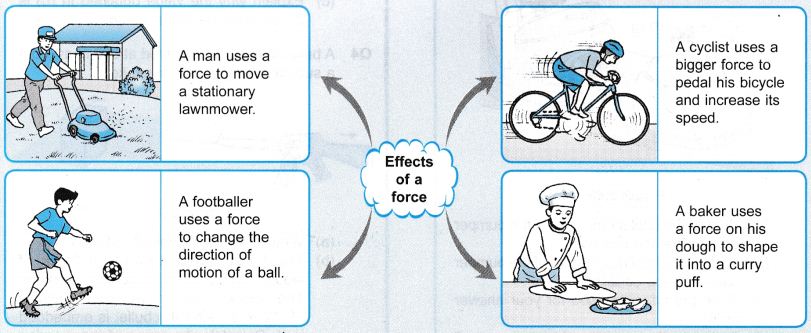
 

WBBSE Notes For Class 8 General Science And Environment Chapter 1 Physical Environment Effects of force


Thus, we can define that force is the external cause acting on a body which changes or tends to change the state of rest or of uniform motion, or the direction of motion, or the shape and size of a body.

Chapter 1 Physical Environment Newton’s Laws Of Motion

Sir Isaac Newton put forward three laws of motion related to all moving bodies in the universe in 1687. These laws are known as Newton’s laws of motion. These were published in the famous book Principia.

Basically, these laws are the foundations of Classical or Newtonian mechanics. Newton’s first law of motion gives the idea that when the net force on a body is zero, its state does not change.

That is, a body continues to be in its state of rest or of uniform motion in a straight line unless an external force is applied on it. So that force is the external cause which changes or tends to change the state of rest or of uniform motion of a body.

“WBBSE Class 8 General Science Chapter 1 notes, Physical Environment”

Thus, the first law defines the force only qualitatively. A force can change the state of motion of a body, i.e., a force can produce an acceleration in the body. Newton’s second law of motion relates force to acceleration when the net force is not zero.

That is, the second law gives the quantitative value of force. The second law of motion states that ‘the external net force acting on a body (whose mass remains unchanged) is equal to the product of its mass and acceleration and the acceleration takes place in the direction of the force applied.’

Class 8 General Science Class 8 Maths
Class 8 History Class 8 Science LAQs
Class 8 Geography Class 8 Science SAQs
Class 8 Maths Class 8 Geography
Class 8 History MCQs Class 8 History

The first law and second law do not explain how does the force act on a body? This is explained in Newton’s third law of motion. The third law describes the relationship between the forces that two interacting bodies exert on each other (One of the forces is called ‘action’ and the other is called ‘reaction’).

The third law of motion states that ‘for every action, there is an equal and opposite reaction. The second law of motion describes the method to measure force, by the mathematical expression:   F = ma or, force = mass x acceleration

Absolute units of force :

On this basis, the S.l. unit of force is newton (symbol N), and in. the C.G.S. system, the unit of force is dyne (symbol dyn).

Definition :

1 newton is the force which acting on a mass of 1 kg produces’ an acceleration of 1 m.s-2. That is 1N = 1 kg x 1 m.s-2.

1 dyne is the force which acting on a mass of Kg produces an acceleration of 1 cm.s-2. That is, 1 dyne = Kg x l cm.s-2

The mass of a body is the measure of its inertia :

From equation F = mo we have a = F/m. If an equal amount of force  Facts on two bodies of mass mv m2 and av a2 are their respective accelerations then

WBBSE Notes For Class 8 General Science And Environment Chapter 1 Physical Environment Mass of a body is the measure of its intertia.
  That is, the acceleration produced in a body is inversely proportional to its mass. This means that a lighter body can be moved more easily than a heavier body.

Weight :

The weight of a body is the force with which the earth attracts the body toward its center. So, weight is the force of gravity. It is related to mass as follows :

W = mg or, weight = mass x acceleration due to gravity.

The value, of ‘g’, is 9.8 m.s”2 (in the S.l. system) and 980 cm.s-2 (in the C.G.S. system).

Gravitational units of force :

It is kilogram-force (symbol KGF) in S.l. system and gram force (symbol gf) in the C.G.S. system.

1 Kgf = Force of gravity on a mass of 1 kg
= 1 kg x g ms-2 = g kg.ms-2 = g newton = 9.8 newton
1 gf = Force of Gravity on a mass of 1g = 1g x g cms-2 = g g.cms-2 = g dyn = 980 dyn
WBBSE Class 8 Physical Environment Notes

Chapter 1 Physical Environment Measurement Of Force :

The force acting on a body (or the weight of a body) is measured by a spring balance. It contains a coiled spring having a hook at one end and the other end being free. The spring gets stretched when a force is applied to its free end.

The extent by which the spring gets stretched is a measure of the applied force and it is indicated by a pointer attached to the spring on a graduated scale. The reading on the scale indicates the magnitude of the force.
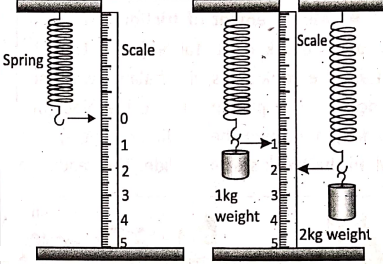


WBBSE Notes For Class 8 General Science And Environment Chapter 1 Physical Environment Scale and suspended spring, Scale and spring with weight


When the spring balance is held vertically it can be used to measure the weight of the body hung from its hook. While when the spring balance is held horizontally and its hook is attached to an object add pulled by hand it is said to measure the force applied.

If the reading on the scale of the spring balance is 2kg, we will mean that the applied force is 2 kgf or (2 x 9.8)N or 19.6 N. Also, for the reading 3 kg, the force is 3 kgf or (3 x 9.8) N or 29.4N.
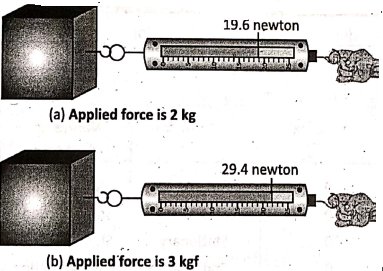


WBBSE Notes For Class 8 General Science And Environment Chapter 1 Physical Environment Applied Force is 2 Kg, and 3 kgf


Chapter 1 Physical Environment The Force Of Friction

It is our common experience that a ball moving on the ground gradually slows down and stops on its own after traveling a distance. According to Newton’s first law of motion, the ball after being pushed should have to continue its motion with a uniform velocity in absence of any external force.

“Class 8 General Science WBBSE notes, Physical Environment chapter”

This means the existence of an external force that is required to stop the ball. This force opposes the motion of the proving ball and occurs between the two surfaces which are in contact with each other and also act in a direction opposite to the direction of motion of the moving ball. This force is called the force of friction or simply frictional force.

Definition :

The force that always opposes the motion of an object over another object (in contact) when they slide or tend to slide over one another.

Chapter 1 Physical Environment Measurement Of Friction



WBBSE Notes For Class 8 General Science And Environment Chapter 1 Physical Environment Measurement Of Friction


Place a wooden block on a table. Attach the hook of a spring balance with the block. Apply a pulling force to the block by hand. Note down the reading on the spring balance at each stage, as shown in Table.

Observation No. The magnitude of pulling force (F) The magnitude of frictional force (f) Net force (F-f) State of the block Nature of  friction
1 0 0 0 Stationary No friction
2 9.8N 9.8N 0 Stationary Static friction
3 19.6 N 19.6 N 0 Stationary Static friction
4 22.6N (say) 22.6N (say) 0 Stationary Limiting Friction
5 29.4N 20.4N (say) 9 N (say) In motion Sliding friction


when the block starts to slide. This reading on the spring balance gives the magnitude of the Note that in observation No. 4, for some pulling force, the frictional force becomes maximum, it is called limiting friction. Also, when the block starts to slide the magnitude of the force of friction cannot be determined directly from the reading of the spring balance.

Chapter 1 Physical Environment Different Kinds Of Friction

The frictional force offered when an object remains stationary on a surface even being pulled with a force is called static friction. The frictional force offered when sliding of an object takes place over a surface is called sliding friction.

Factors affecting friction :


1. Friction is not the same for all surfaces. It depends on the smoothness or roughness of the two surfaces which are in contact with one another. This is explained in.
 

WBBSE Notes For Class 8 General Science And Environment Chapter 1 Physical Environment Factors affecting friction.


It is clear that different surfaces offer different amounts of friction to sliding. In general, rough surfaces offer more friction than smooth surfaces. As shown in suppose an iron block starts to slide over a wooden table when the pulling force is 19 newtons; while the same iron block starts to slide over a smooth glass table by a lesser amount of pulling force (say, 26 newtons).

2. The force of friction does not depend on the area of contact between two surfaces. In the frictional force remains the same for the horizontal and vertical position of a block over the wooden table. Note that the area of contact is more for the horizontal position of the block than that for. its vertical position.


WBBSE Notes For Class 8 General Science And Environment Chapter 1 Physical Environment Capture


3. Frictional force between two surfaces depends on the force with which the surfaces are pressed together. In it is explained that frictional force increases as the weight of an object increases.


WBBSE Notes For Class 8 General Science And Environment Chapter 1 Physicalforce between two surface depends on the force with the surface are pressed together.


Chapter 1 Physical Environment Density

Let us take two identical plastic bottles of equal volume—one is completely filled with normal water and the other with kerosene oil. Hang them separately from the hook of two identical spring balances, From the reading of the spring balances, it is observed that normal water is heavier than kerosene oil, although the bottles are of equal volume.
 

WBBSE Notes For Class 8 General Science And Environment Chapter 1 Physical Environment Density


In this way, we can compare the ‘heaviness’ or ‘lightness’ of different, substances, by comparing their masses of the same volume. We do this with the help of a physical quantity, called the density of the substance.

Definition: The density of a substance is defined as its mass per unit volume.

If M be the mass of a substance and V be the volume then by definition the density of the substance is, D = M/V, i.e., M = D x V. Sometimes, greek letter P(rho) is used as a symbol of density. It’s S. I. unit is kilogram per cubic meter (symbol kg.m-3) and the C.G.S. unit is gram per cubic centimeter (symbol g.cm-3 )


Substances Density in kg.m-3
Water 1000
Ice 916
Mercury 1360
Kerosene oil 800
Iron 7800
Cork 200
Copper 8900
Gold 19300


If a mass of 1 kg of a substance occupies a volume of 1m then its density is said to be 1 kgm-3. And, if a mass of 1g of a substance occupies a volume of 1 cm3 then its density is said to be 1 g.cm-3.

Relation between this two units :
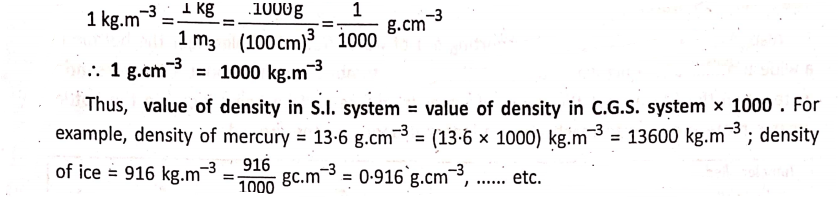
 

WBBSE Notes For Class 8 General Science And Environment Chapter 1 Physical Environment Relation between this two units

“WBBSE Class 8 Environment Chapter 1, Physical Environment study guide”

Chapter 1 Physical Environment Pressure Of Liquid

A brick exerts maximum pressure on the ground when it is kept with its longest side vertical while the pressure is minimum when the brick is placed with its shortest side vertical. So, a solid exerts pressure due to its weight only on the surface on which it is placed.

In class VI, we have learnt that pressure is the force acting normally on unit area to the surface of a substance. If F be the force acting normally on an area A, then, pressure P = normal force/area = F/A.
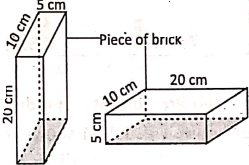
 

WBBSE Notes For Class 8 General Science And Environment Chapter 1 Physical Environment Pressure of liquid


For example, the area of the pointed edge of a nail is too small. Hammering its head by a large force, the pressure at the edge becomes high enough and the nail can enter the surface easily.

“WBBSE Class 8 Physical Environment notes, General Science Chapter 1”

Similarly, a liquid also exerts pressure due to its weight on the bottom as well as on the walls of the container because of its tendency to flow. If a hole is made at any point on the wall of a water bottle, water spurts out normally with the wall. If we try to block the flow of water by a finger, we feel the pressure. The spurting out of water depends upon its pressure (but not on the force).
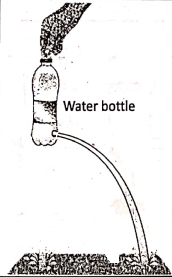


WBBSE Notes For Class 8 General Science And Environment Chapter 1 Physical Environment Liquid exerts pressure due to its weight


Definition :

Pressure at a point inside a liquid is the force exerted by the liquid, normally on a unit area around the point.

Features of liquid pressure :

  1.  Liquid exerts pressure equally in all directions—upward, downward, and sideways (lateral pressure).
  2.  Pressure at a point inside a liquid increases with the increase in its depth from its free surface.
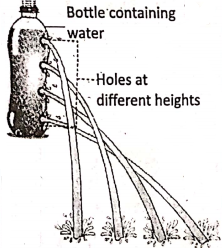


WBBSE Notes For Class 8 General Science And Environment Chapter 1 Physical Environment Pressure increaseswith depth


In four small holes are made on the wall of a water bottle at different heights. It is seen that as depth increases, more is the displacement of water on the ground. Here the depth of a point is measured from the free surface of the water.

Also, shows that the spurting out of water from the holes near the bottom of a wide tumbler and a big water bottle. Although the tumbler contains about 8-10 times more water than the bottle, but the depth of water from the free surface being larger in the bottle, creates more pressure to reach water a longer distance on the ground.


WBBSE Notes For Class 8 General Science And Environment Chapter 1 Spurting out of water from the holes near the bottom of a wide tumbler and a big water bottle


3.  Pressure at the same depth is different in different liquids. It increases with the density of the liquid. shows that normal water exerts more pressure than kerosene oil at the same depth from the free surface.

4.  A liquid seeks its own level. Pressure determines the direction of the flow of a liquid. when the stopcock is opened, water flows from tube A to tube B, until water attains the same height in both tubes. water is found to attain the same height m both the limbs of a U-shaped tube. Also, shows that water attains the same height in all the containers.


WBBSE Notes For Class 8 General Science And Environment Chapter 1 PhysicalA liquid seeks its own level. Pressure determines the direction of flow of a liquid 1


Factors affecting the pressure at a point inside a liquid :

It depends directly on the following three factors :

  1.  Depth of the point from the free surface (h).
  2.  The density of liquid (p), and
  3. Acceleration due to gravity (g).

Mathematically, P = hpg = depth x density of the liquid x acceleration due to gravity.


WBBSE Notes For Class 8 General Science And Environment Chapter 1 PhysicalA liquid seeks its own level. Pressure determines the direction of flow of a liquid 2


Chapter 1 Physical Environment Air Pressure

Each and every substance has weight and anything that has weight can exert pressure. Air is light no doubt, but it is not weightless. So, air can exert pressure.

The air above the earth’s surface is considered to be divided into several air columns. Each and every air column has to bear the weights of the columns above. Hence, the weight of air column exerts a thrust (a force acting normally) on the earth’s surface, which gives rise to atmospheric pressure.

Definition :

The thrust exerted by an air column per unit area on the earth’s surface is called atmospheric pressure. The pressure at sea level is taken as the normal atmospheric pressure. It has been found by experiments that the pressure exerted by the atmosphere on a 1 cm2 area at sea level is about 1.033 kgf.

Naturally, the larger the height of a place above the sea level, the lower is the pressure. Air exerts pressure equally in all directions—upward, downward, and sideways (lateral pressure) and so we do not. feel it. ‘

Chapter 1 Physical Environment Measurement Of Air Pressure :

Torricelli’s experiment provides us with a method for measuring atmospheric pressure. Take a hard glass tube of about 1 meter in length closed at one end and fill it completely with pure mercury such that no air bubble remains inside. Holding open end of the tube with the thumb, the tube is inverted vertically into a trough of mercury and the thumb is then removed quickly.


WBBSE Notes For Class 8 General Science And Environment Chapter 1 Physical Environment Torricelli's Experiment


It is observed that the mercury level in the tube falls (due to gravity) till its height from the mercury level in the trough becomes 76 cm. This happens when the pressure exerted by the mercury column in the tube becomes equal to the atmospheric pressure on mercury in the trough. Thus, the mercury column of height of 76 cm is a measure of atmospheric pressure.

“Class 8 WBBSE General Science Chapter 1, Physical Environment summary”

As the density of water is low (1000 kgm-3), Torricelli argued that air pressure would push water up to a height equal to about 10.34 m. So, air pressure forces water up to a height of about 10.34 m and mercury up to a height of 76 cm. That is why a lift pump can not made to lift water beyond a height of 10.34 m.

Chapter 1 Physical Environment Buoyancy, Immersion, And Archimedes’ Principle

If a piece of cork or an empty can is pushed into the water, we feel an upward force acting on the object so that we find it difficult to push it further into the water. This upward force is buoyant force and the property of liquid to exert such a force is called buoyancy.

Definition:

When a body is partially or completely immersed inside a liquid, it experiences an upward force. This upward force is known as upthrust or buoyant force. It is due to the buoyant force that a body partially or completely in a liquid, appears to be lighter than its true weight.

Factors on which the buoyant force depends on:

  1. The volume of the body immersed and
  2. The density of the liquid.


WBBSE Notes For Class 8 General Science And Environment Chapter 1 Physical Environment More volume means more upthrust, Denser the liquid, more is the upthrust


More volume means more upthrust shows that the more is the volume of the body immersed in a liquid more is the upthrust as more amount of liquid is displaced. Denser the liquid, more is the upthrust indicates that the denser is liquid, the more is the upthrust.

Chapter 1 Physical Environment  Archimedes’ Principle


When a body is partially or completely immersed in a liquid (or a fluid), it experiences an apparent loss in weight (due to upthrust) and this apparent loss in weight is equal to the weight of the liquid displaced by the immersed portion of the body.

Sinking and flotation of a body inside a liquid:

When a body is immersed in a liquid, two forces act on it:
 

WBBSE Notes For Class 8 General Science And Environment Chapter 1 Physical Environment Sinking and flotation of a body inside a liquid


The forces are :

  1.  Its weight, W1  acts vertically downward. This force has a tendency to sink the body.
  2. The upthrust or buoyant force, W2, is applied by the liquid on the body, acting vertically upwards. This force has a tendency to move the body upwards.

Depending upon the values of W1 and W2, the following three situations may arise :
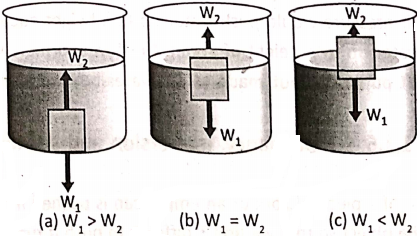


WBBSE Notes For Class 8 General Science And Environment Chapter 1 Physical Environment Cases of sinking and floation


Case-1: W1 > W2, i.e., the weight of the body is greater than the buoyant force.

In this case, the net force is (W1– W2), which acts on the body vertically downward and the body will sink by the action of net force. Such a situation arises when the density of the body is nearly more than that of the liquid.

Case-2: W1= W2, i.e., the weight of the body is equal to the buoyant force.

In this case, the net force acting on the body is zero and the body floats just under the liquid surface. Such a situation arises when the density of the body is nearly equal to the density of the liquid.

Case-3: W1= W2, i.e., the weight of the body is less than the buoyant force.

In this case, the net force is (W2-W1), which acts on the body vertically upward and the body will remain in a floating condition with some portion above the liquid surface. Such a condition happens when the density of the body is less than the density of the liquid.

Examples of immersion and flotation :

  1. An iron nail sinks in water, but a ship made of iron floats. This is because the weight of iron nail is greater than the upthrust of water on it (as the density of iron is greater than that of water).On the other hand, a ship having a larger surface area displaces much more amount of water by its submerged part such that the weight of the displaced water becomes equal to the total weight of the ship and thus it floats.
  2.  An egg sinks in freshwater but floats in a strong salt solution.
  3. Icebergs being lighter than water floats in the sea.
  4. An iron nail floats on mercury. This is so because the density of iron is less than that of mercury.
  5. It is easier for a man to swim in seawater than in river water. Due to the presence of salt and other minerals, the density of seawater is much more than that of river water. So, when a part of the body is submerged in seawater, it experiences a larger amount of upthrust than the upthrust experienced in river water. Thus, a man swims in sea water more easily.
  6.  A ship submerges more as it sails from seawater to river water.

Chapter 1 Physical Environment Forces Active Without Contact

Non-Contact force

A force that can be exerted by an object over another object even from a distance without coming in physical contact with each other is known as a non-contact force. Examples of non-contact forces are :

  1. Gravitational force,
  2. Electrostatic force and
  3. Magnetic force.

Features of non-contact forces :

The magnitude of the non-contact forces depends upon

1. The distance between the objects and
2. Nature of the medium between two objects (except for gravitational force).

In general, the non-contact force is inversely proportional to the square of the distance between two objects.

Chapter 1 Physical Environment Gravity and Gravitation :


If we drop a stone from a height, it falls down towards the earth. Also, a stone thrown upwards falls back to the earth. Similarly, a leaf falls down from a tree, a fruit also falls down, rain falls down, and water in a river flows downwards. Also, we feel a downward pull on keeping a stone on one palm.

This is because the earth exerts a gravitational force of attraction on all the bodies and pulls them downwards. The force with which the earth pushes the objects towards its center is called the force of gravity (or simply gravity).

“WBBSE Class 8 Science Chapter 1 notes, Physical Environment PDF”

Isaac Newton made the bold statement that every object in the universe pulls every other object with a certain force, similar to the force that pulls a body falling towards the earth.

The force of attraction (or pull) exerted between any two objects in the universe possessing mass is called gravitation or the gravitational force, In this sense, the gravitation between the earth and any other object is called gravity.

Chapter 1 Physical Environment Newton’s Law of Gravitation :

In 1687 Isaac Newton published his work on the law of gravitation in Mathematical Principles of Natural Philosophy. The law is applicable only for two-point masses. Although the earth, sun, moon, and other planets are very large in size, but their total mass is considered to be concentrated at their centers.

Statement:

Every particle in the universe (small or big) attracts every other particle along the line joining their centers with a force that is directly proportional to the product of their masses and inversely proportional to the square of the distance between their centers.

Newton introduced a mathematical equation to calculate gravitational force :
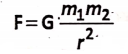
WBBSE Notes For Class 8 General Science And Environment Chapter 1 Physical Environment Calculate gravitional force


WBBSE Notes For Class 8 General Science And Environment Chapter 1 Physical Environment The gravitational force


where two particles of masses m1  and m2 are separated by a distance r between their centers; G is a constant called the universal gravitational constant. In S.l. system, the vajue G is 6.67 x 10⁻¹¹ N.m2 . kg-2. The values of ‘G’ is the same everywhere in the universe. The above equation is applicable for all bodies having a spherical shape placed anywhere in the universe even in space.

However, if r increases, the magnitude of F decreases. Theoretically, the effect of gravitation on any object happens to exist up to an infinite distance. Actually, after a certain distance, such an effect becomes negligible. The gravitational force between two stones is so weak that it cannot be detected easily.

Acceleration due to gravity ort the surface of the earth: It is the acceleration produced in a body due to the force of gravity.

Suppose a body of mass m is placed on the surface of the earth. If M be the mass and R be the radius of the earth, then by Newton’s law of gravitation, the force of attraction between these two bodies is
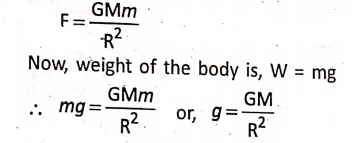
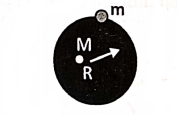
WBBSE Notes For Class 8 General Science And Environment Chapter 1 Physical Environment The force of attraction between these two bodies


WBBSE Notes For Class 8 General Science And Environment Chapter 1 Physical Environment The accelaration due to gravity


It is evident from this relation that the value of g is

  1. Maximum at the surface of the earth,
  2. More at the poles than at the equator,
  3. Decreases with a height from the surface of the earth and
  4. Decreases with depth from the surface of the earth.

The direction of gravity :

The direction of gravity is always toward the earth. However, when an object is thrown upwards in any direction (making an angle with the horizontal plane) [like a cricket ball, javelin, discus throw], the object reaches the ground following a curved path. This is so because the speed of the moving object continuously changes from point to point due to the earth’s gravity.
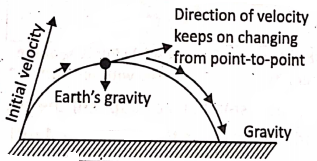


WBBSE Notes For Class 8 General Science And Environment Chapter 1 Physical Environment Direction og gravity


Motion due to gravity :

What we see if a stone and a piece, of paper (or a feather), are allowed to fall at the same time from the top of a tower ?—We see the stone reaches earlier than the piece of paper. Galileo proved the fact that while falling, the objects are to overcome air resistance.

The size and shape of the piece of paper being larger, the air resistance is larger for it. If there is no air, the two objects reach the ground at the same time. Galileo proved the fact from his famous Guinea-Feather Experiment.

Laws of falling bodies: There are three laws:

  1.  All freely falling bodies whether heavy or light fall with the same rapidity.
  2. The velocity attained by a freely falling body at a particular instant of time is directly proportional to the time of fall.
  3.  The height traversed by a freely falling body at a particular instant of time is directly proportional to the square of the time of fall.

Chapter 1 Physical Environment Concept Of Electrostatic Force And Charge

If we bring a plastic comb near small bits of paper, the comb does not attract them. But, when the same comb is rubbed on dry hair or on nylon or woolen substance and brought near the paper bits, it attracts them. If the hair is not dry, then rub.
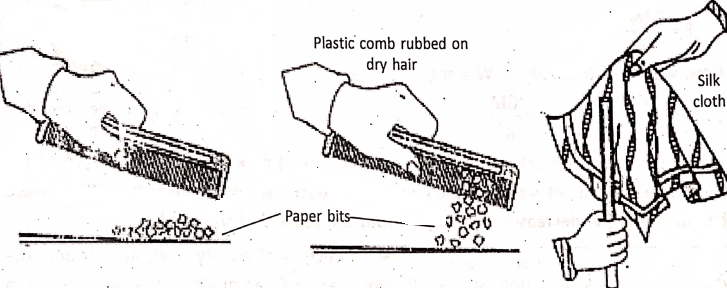
 

WBBSE Notes For Class 8 General Science And Environment Chapter 1 Physical Environment Concept of electrostatic force and charge


Similarly, an ordinary glass rod rubbed with silk cloth, attracts small bits of paper. If the silk cloth is brought near the paper bits, it is noticed the silk cloth also attracts them. In a similar way, a balloon rubbed with a woolen substance sticks with a wall, which falls down if not rubbed so. Also, two inflated balloons rubbed with the same woolen substance repel each other.
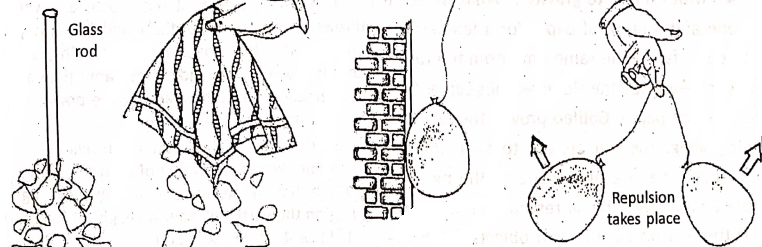


WBBSE Notes For Class 8 General Science And Environment Chapter 1 Physical Environment Concept of electrostatic force and charge 1


To explain the reason of such facts, English scientist William Gilbert stated that the materials get charged on rubbing. That’s why the materials attract the bits of paper. It is not an isolated property of any matter, but much general property and holds good for glass, silk, fur (cat skin), ebonite, sealing wax, cotton, resin, amber, etc.

Thus, an attractive property (or attractive force) is developed in the materials due to rubbing. The force is called the electrostatic force. In the above examples, the comb, glass rod, silk cloth, and balloon are said to be electrically charged on rubbing.

“Class 8 General Science Physical Environment notes, WBBSE syllabus”

Charging a material by cubbing it with another material is called charging by friction. And, the charges that remain bound to the surface of a material and do not flow are called static electricity.

Chapter 1 Physical Environment Different Types Of Electric Charges :

Highlights the fact that there seems to be possible the existence of two different types of electric charges. Benjamin Franklin referred to them as negative charge and positive charge.

Conventionally, we use Electric Series to determine which material will acquire which type of charge when rubbed with another material. In general, if anyone is rubbed with any other higher-up in the series, the first one gets negatively charged and if rubbed with a lower one in the series, then it gets positively charged.

Example :

If a glass rod is rubbed with silk cloth then the glass rod gets positively charged, while a glass rod rubbed with fur gets negatively charged. Similarly, when one ebonite rod is rubbed with fur, the ebonite rod gets negatively charged, while fur gets positively charged.

To show the existence of two types of electric charges :

If two glass rods being rubbed with silk cloth are brought near each other, it is observed that the glass rods repel each other Similarly, two ebonite rods being rubbed with fur also repel each other when they are brought near each other. But, when a glass rod being rubbed with a silk cloth and an ebonite rod being rubbed with fur are brought closer, it is observed that both the rods attract each other.
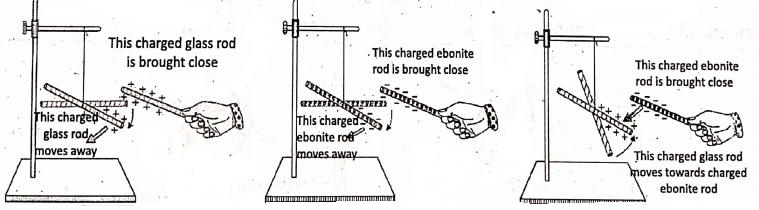


WBBSE Notes For Class 8 General Science And Environment Chapter 1 Physical Environment To show existence of two types of electric charges


So, we can conclude :

  1. There are two types of electric charges called positive charge and negative charge.
  2. Like charges repel each other.
  3. Unlike charges attract each other.

Explanation of charging on rubbing by the simple orbital model of an atom :

All matter is made up of very small entities called atoms. An atom consists of a central positively charged core called the nucleus, containing still smaller particles protons, and neutrons. A proton is a positively charged particle while a neutron has no charge. An atom on the whole is electrically neutral.

The electrons revolve around the nucleus in certain permitted orbits. An electron is a negatively charged particle. In the normal state, the total negative charge of the electrons in an atom is equal to total positive charge of the protons.


WBBSE Notes For Class 8 General Science And Environment Chapter 1 Physical Environment Structure of an atom


When two bodies are rubbed together then due to heat provided by friction, electrons are torn off from the body in which they are less tightly bound and transferred to the body .in which they are more tightly bound. Thus, the body which gains free electrons becomes negatively charged while the body which loses free electrons becomes positively charged.

 

WBBSE Notes For Class 8 General Science And Environment Chapter 1 Physical Environment orbital model of an atom


For example, when a glass rod is rubbed with a silk cloth, some electrons are transferred from glass to silk as the electrons are less tightly bound in glass than in silk. Due to such a deficit of electrons, the glass rod becomes positively charged while due to the gain of an equal number of electrons, the silk cloth becomes negatively charged.

Similarly, on rubbing an ebonite rod with fur, the electrons from the fur are transferred to’ an ebonite rod as the electrons in fur are less tightly bound than in ebonite. Thus, the ebonite rod acquires a negative charge while fur acquires an equal but opposite amount of positive charge.
 

WBBSE Notes For Class 8 General Science And Environment Chapter 1 Physical Environment Movement of electrons from glass rod to silk cloth, fur to ebonite rod


So, we can conclude :

  1. On rubbing, the body gains electrons. becomes negatively charged and the body which loses electrons becomes positively charged,
  2. Charges developed on two bodies are equal in magnitude but opposite in nature.

Chapter 1 Physical Environment Measurement of Electrostatic Force: Coulomb’s Law :


French physicist Charles Augustin de Coulomb derived a formula to calculate the (attractive, or repulsive) force acting between two point charges.

According to Coulomb’s law :

The magnitude of the force between two charged particles is directly proportional to the product of the magnitude of the charges and inversely proportional to the square of the distance between them.


WBBSE Notes For Class 8 General Science And Environment Chapter 1 Physical Environment Measurement of electrostatic force


If q1 and qare the magnitudes electrostatic of two charges and r is the distance between them, then the force is
WBBSE Notes For Class 8 General Science And Environment Chapter 1 Physical Environment force


where k is the constant of proportionality, the value of which depends upon the nature of the medium separating two charges and the system of units in which various quantities in the above expression are expressed. Thus, the value of k is different for different media in different systems of units. For example, in C.G.S. system k = 1 for vacuum and in S.l. system k = 9 x 10⁹ newtom meter2   coulomb-2 (symbol N.m2  .C-2)

It is evident from the above expression that

  1. If the magnitude of the charges are doubled and tripled respectively then the force becomes (2 x 3) or 6 times
  2. If the distance between the charges is halved, then the force becomes 1/(½)or 4 times, and.
  3. If the distance between the charges is halved, then the force becomes  1/(2)2 or  1/4 th of the previous force.

Chapter 1 Physical Environment Motion Due To Electrostatic Force :


The rotation of an electron around the nucleus of an atom requires a centripetal force to be acted on the electron towards the center of the circular orbital path.
 

WBBSE Notes For Class 8 General Science And Environment Chapter 1 Physical Environment Measurement of electrostatic force 1


This force is supplied by the electrostatic force between the electron and the nucleus. The fact is similar to the planetary motion around the sun, where the required centripetal force js supplied by the gravitational force between the sun and the planet.

Chapter 1 Physical Environment Heat

The direction of flow of heat

When two bodies at different temperatures are placed near one another or kept in contact, heat flows from the body at a higher temperature to the body at a lower temperature. Even if different parts of a body differ in their temperatures, then also heat flows from its higher temperature portion to the lower temperature portion.

The flow of heat continues until the two bodies attain at the same temperature. When such a state is reached, the two bodies are said to be in a state of thermal equilibrium, and their common temperature is called neutral, temperature.

Chapter 1 Physical Environment Factors Affecting The Heat Energy Gained Or Lost By A Body

Measurement of heat :

The amount of heat gained or lost by a body is found to depend on three factors :

  1. Mass of the body,
  2. Change in its temperature (i.e. either increase or decrease in temperature), and
  3. Nature of material of the body.

Let us now perform the following activities one by one in order to study the effect of these three factors.

Chapter 1 Physical Environment Activity 1:

Let us take two identical beakers A and B. Pour 500 ml of water in beaker A and 1 liter of water into beaker B. Now, put the beakers on two identical separate stands and heat them by two identical bunsen burners. Let us note down the time taken by water in each beaker for boiling.

We will note that water in beaker B takes almost double the time than the water taken in beaker A for boiling. As the time taken is almost double, so the heat supplied in water in beaker B is almost double. This proves the fact that the amount of heat gained by a body depends on its mass.


WBBSE Notes For Class 8 General Science And Environment Chapter 1 Physical Environment Factors affectind the heat energy gained or last by a body 1


Chapter 1 Physical Environment Activity 2:

Let us take a beaker and pour 500 ml of water into it. Record the temperature of this water by a thermometer. Let it be 20°C. Now, put the beaker on a tripod stand and heat it by a bunsen burner.

Note the time taken to raise the temperature of the water up to a certain temperature, say 50°C [temperature rise being (50-20)°C = 30°C]. Again, note the time taken to raise the temperature of the same quantity of water to another temperature, say 80°C [temperature rise being (80° – 20)°C = 60°C).

“WBBSE Class 8 Science Chapter 1, Physical Environment important questions”

We will note that the time taken in the second case is almost double that in the first case. This proves the fact that the amount of heat gained by a body depends upon the rise in its temperature.
 

WBBSE Notes For Class 8 General Science And Environment Chapter 1 Physical Environment Factors affecting the heat energy gained or lost by a body 2


Chapter 1 Physical Environment Activity 3:

Let us take two identical beakers A and B. Pour 500 ml of water in beaker A and 500 ml of mustard oil in beaker B. Put a thermometer in each beaker. Let the initial temperature of water and mustard oil is 20°C.
 

WBBSE Notes For Class 8 General Science And Environment Chapter 1 Physical Environment Factors affecting the heat energy gained or lost by a body


Now, heat both beakers by two separate identical bunsen burners simultaneously for the same duration of time. We will notice that the rise in temperature in the two thermometers is different. This proves the fact that the amount of heat gained by a body depends upon the nature of its material.

If Q be the amount of heat gained by a body of mass m to rise its temperature to t° then according to the above activities we can write: Q ∝ m and Q ∝ t

Combining these two, we can write Q mt or, Q = mst. where s is the constant of proportionality and it is called the specific heat capacity of the material of the body.

  1. Thus, heat gained by a body = mass x specific heat capacity x rise in its temperature. Similarly, if the temperature of a body falls.
  2. Then the heat lost by the body = mass x specific heat capacity x fall in its temperature.

Units of heat :

In C.G.S; system, the amount of heat is measured in the unit of calories (cal). One calorie is the amount of heat required to raise the temperature of 1 g of pure water by 1°C (actually from 14-5°C to 15-5°C).

A calorie is a small unit, so a bigger unit kilocalorie (kcal) is often used. 1 kcal = 1000 cal. Since heat is a form of energy, so the unit of heat is the same as that of energy. The S.l. unit of heat is the joule (abbreviated as J). The units calorie and joule are related as 1 cal = 4.186 J (or nearly 4.2 J)

Change of state

A material can exist in any of the three states namely solid, liquid, and gas under different conditions of temperature and pressure. The process of change of a substance from one state to another at a constant temperature is called its change of state. shows a complete cycle of change of state.

Melting or Fusion :

It is the process during which a solid change to its liquid state by the absorption of heat. The fixed temperature at which a solid melt to its liquid state under normal atmospheric pressure is called the melting point of the solid.

For example, ice melts into the water at a temperature of 0°C under normal pressure.
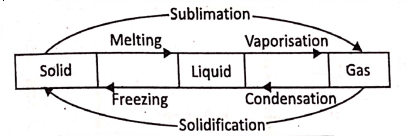
 

WBBSE Notes For Class 8 General Science And Environment Chapter 1 Physical Environment Melting or Fusion


Boiling or Vaporisation :

It is the process during which a liquid changes to its gaseous state by the absorption of heat. The fixed temperature at which a liquid changes into its gaseous state under normal atmospheric pressure is called the boiling point of the liquid.

For Example, water boils or vaporizes to steam at a temperature of 100°C under normal pressure.

Condensation :

It is the process during which the vapor of a substance changes to its liquid state by releasing heat. The fixed temperature at which the vapour of a substance changes to its liquid state under normal atmospheric pressure is called the condensation point of the vapor.

For Example, the steam condenses to water at 100°C under normal pressure.

Freezing :

It is the process during which a liquid changes into its solid state by releasing heat. The fixed temperature at which freezing occurs under normal atmospheric pressure is called the freezing point.

For Example, water freezes into ice at 0°C under normal pressure.

Sublimation :

It is the process in which a solid directly changes into its gaseous state at all temperatures without being liquified.

For Example camphor, naphthalene, iodine, ammonium chloride, etc. directly perform the act of sublimating from solid state to gaseous state.

Solidification :

It is the process in which a substance directly changes from a gaseous state to its solid state.

For Example, carbon dioxide gas solidifies into dry ice at a very low temperature.

Chapter 1 Physical Environment Change Of Volume During Melting And Freezing

In general, the solids increase in volume during melting and the liquids decrease in volume during freezing. But there are some exceptions. There are some solids like ice, cast iron, antimony, bismuth, etc. which contract during melting and expand during freezing.

For example, 11 cm3 of water solidifies to form 12 cm3 of ice.

Examples :

  1. Water pipelines, rocks, etc. are found to burst during very cold winter nights. This is due to the fact that water expands on freezing, such that it exerts a larger amount of pressure on the pipes, rocks, etc. So, they burst.
  2. In cold countries, when the atmospheric temperature falls below 0°C, the water at the surface of a pond contracts into ice. Now, ice being lighter than water, ice floats on the upper surface of the water. As a result, the aqua life of fish and other animals is possible in the water of a pond, although the water at the surface has been frozen into ice.
  3. Iron, type metal, etc. are used for casting press letters. Because these metals expand on cooling and form sharp casting.

Chapter 1 Physical Environment Factors Affecting Melting Point

Two factors affect the melting point of a solid.

The factors are :

  1. Pressure and
  2. Impurities.

Effect of pressure on melting point :

Pressure plays an important role as far as the process of melting is concerned.

  1. For substances which contract on cooling (like wax), the melting point increases with the increase in pressure.
  2. For substances which expand on cooling (like ice), the melting point decreases with the increase in pressure.

Regelation :

If two pieces of ice are pressed together tightly for a few seconds, and then released,.they are found to join to form a single piece. When pressure is applied, the ice at the interface of two pieces melts at a temperature below 0°C and forms water.

As the pressure is released, the melting point is raised to 0°C. So that the water re-freezes thereby joining the two pieces. The fact.is known as regelation.

Definition :

The process of melting of ice by applying pressure and re-freezing of molten ice by releasing pressure is called regelation.

Effect of impurities on melting point :

In general, impurities lower the melting point of a solid substance. If common salt is mixed with ice (in ration 1: 3), the temperature falls below its melting point (0°C) to about -23°C.

Also, a mixture of anhydrous CaCI2 and ice (in the ratio 3 : 2) produces a temperature of about -50°C. Such a mixture which can produce a lower temperature is called a freezing mixture.

Uses of freezing mixture :

It is usually used

  1. For making ice creams and kulphies,
  2. To retain the freshness of fish, meat, etc. from being damaged with contact in air, and
  3. In several practical purposes to maintain lower temperatures in the laboratories.

Chapter 1 Physical Environment Concept Of Latent Heat

It is found from experiments that the temperature of a substance does not rise or fall, as long as the change of state takes place, although heat is supplied or removed in the process. Where does the heat go away?

In fact, heat is utilized to convert changes of the physical state of a substance. It appears to be ‘hidden’ or ‘concealed’ in the substance. The heat is known as ‘hidden heat’ or ‘latent heat’.

Chapter 1 Physical Environment Activity 1 :

Let us take some ice cubes in a beaker and put a thermometer into it so that its bulb is completely covered with ice. The thermometer reads CTC. Now, heat the beaker gently over a flame. We will notice that on heating, ice starts melting into water, but the thermometer reading remains at 0°C till whole of the ice melts.


WBBSE Notes For Class 8 General Science And Environment Chapter 1 Physical Environment Soild to liquid and gas(vaporisation)


On further heating, the temperature of water starts rising till it attains a temperature of 100°C. We will notice that water starts boiling at 100°C and the thermometer reading remains the same till whole of the water changes into steam.

Definition :

The amount of heat absorbed or released by a unit mass of a substance to change its state without any change in temperature is called the latent heat of the substance of that particular change of state.

It is usually denoted by T. So, by definition, if Q. be the amount of heat absorbed or released by a substance of mass m, then


Units :

The S.l. The unit of latent heat is joule per kg or J. kg-1  and the C.G.S. unit is calorie per gram or cal. g-1  .

Different kinds of latent heat:

Experimentally it is found that the melting point of ice and the freezing point of water are the same (0°C). So, the values of latent heat of fusion (melting) of ice and freezing of water are the same.

The value is 80 cal. g-1  . This means that the amount of heat required to change 1g of ice at 0°C into lg of water, at the same temperature is 80 cal. OR, the amount of heat released by 1g of water at 0°C to be changed into 1g of ice at the same temperature is 80 cal.

Likewise, the latent heat of the vaporization of water and that of condensation of water vapour are the same and it is 537 cal. g”1. This means that the amount of heat required to change 1g of water at 100°C into 1g of water vapour at the same temperature is 537 cal. OR, the amount of heat released by 1g of water vapour at 100°C to be condensed into 1g of water at 100°C is 537 cal.

Ice at 0°C is colder than water at 0°C. This is so because that there is a lack of heat of amount 80 calorie per gram in ice at 0°C than in water at 0°C.

Water at 100°C is less harmful than steam at 100°C. Because there is an excess of the heat of amount 537 calories per gram in steam at 100°C than in water at 100°C.

Suppose in a big ice block, there is a hole which is filled with water at 10°C. What will happen ?—Initially, the water at 10°C gives out heat as it is in contact with the ice block.
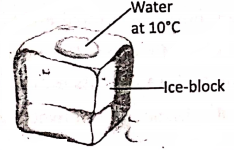
 

WBBSE Notes For Class 8 General Science And Environment Chapter 1 Physical Environment ice block hole which is filled with water


At a particular stage, both the ice block and the water inside the hole acquire the same temperature (0°C). Thereby, the exchange of heat stops, and the water can no longer give out 80 calories of heat per gram to be converted into ice.

Vaporization

There are two ways through which a liquid can be changed into its vapour state, namely,

  1. Evaporation and
  2. Boiling.

1. Evaporation :

If we take a drop of ether on our palm, we notice that ether disappears immediately and the palm feels cold. This happens due to the evaporation of ether.

Evaporation takes place at the free surface of a liquid, at all temperatures (below the boiling point). It is a slow process but the rate of evaporation increases with an increase in temperature and also, with an increase in the surface area of the liquid.

For Example wet clothes dry rapidly when spread in the sunshine.

Definition :

The (slow) process of conversion of a liquid into its vapor at all temperatures (below its boiling point) from its free surface is called evaporation.

Evaporation causes cooling :

When a liquid evaporates, it requires the latent heat of vaporization. If the heat is not supplied from outside, then the liquid takes the required heat. from its own body and its surroundings causing a fall of temperature.

A few examples of this are :

1. In summer, water gets coolecUivan earthen pitcher:

The pitcher being made of clay has a large number of pores through which water comes out and evaporates. The required latent heat for evaporation is taken from the water and the pitcher, causing a fall of temperature. But the water kept in a metal pot is not cooled, as it has no pores.

2. Wet cloth is put on the forehead of a fevered person:

The water from the wet cloth evaporates taking the latent heat of vaporization from the body of the patient. So, the body temperature of the patient is lowered.

3. Dogs hang out their tongues in summer:

They do not perspire through their skin. The saliva, as well as, sweat from their tongues evaporates taking latent heat from their body. This gives a comfortable sensation of cooling to the dogs.

2. Boiling :

proves the constancy of the temperature during boiling. It takes place at a fixed temperature which is the boiling point of the liquid> over its entire surface area. Boiling is a rapid and violent process.

Definition :

The (rapid) process of conversion of a liquid into its vapour at a fixed temperature over its entire surface area is called boiling.

The distinction between evaporation and boiling :


Evaporation Boiling
(1)    Takes place at all temperatures. (1)    Takes place at a fixed temperature.
(2)    Takes place only from the exposed surface area of the liquid. (2)    Takes place from all parts of the liquid.
(3)    Slow and silent process. (3)    Rapid and violent process.
(4)    Evaporation causes cooling. (4)    Boiling causes heating.


Chapter 1 Physical Environment Factors Affecting Boiling Point :

1. Effect of pressure :

Water boils at a temperature higher than 100°C if the atmospheric pressure is more than the normal pressure (76 cm of Hg) and vice versa. Thus, the boiling point of a liquid increases with the increase in pressure. Cooking in a pressure cooker is such an application.

A pressure cooker consists of an aluminum container, to which a lid is fitted. The lid is made air-tight with a rubber pad. At the center of the lid, there is a heavy safety pin valve. A handle of non-conducting material is attached to the cooker.
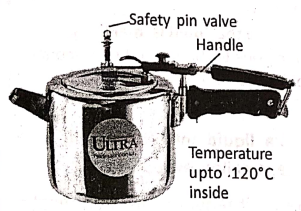


WBBSE Notes For Class 8 General Science And Environment Chapter 1 Physical Environment Pressure cooker


As long as the wafer boils inside the cooker, the steam so-produced cannot escape, so that the pressure inside the cooker increases more and more. Due to it, the boiling point of water increases from 100°C to about 120°C. This makes cooking much easier and quicker.

2. Effect of impurities:

It is seen that when a little amount of common salt is added with water, the water boils at a temperature of about 109°C. Thus, the boiling point of a liquid increase by the presence of impurities in it.

Condensation

There are a few natural examples of condensation of water vapour present in the atmosphere such as dew, fog, cloud, etc.

Formation of dew :

At night, the earth radiates heat to be cool down. So, the air in contact with the surface of the earth cools down very rapidly by radiating heat. In this way, the temperature of the air comes down gradually.

Especially in winter, the temperature of air quickly reaches the dew point. With the further lowering of temperature, some amount of water vapor present in the atmosphere condenses into small droplets and deposits as dew on thin, exposed objects like grass, and leaves near the ground mainly in the morning or evening.

“Physical Environment WBBSE Class 8 notes, General Science Chapter 1”
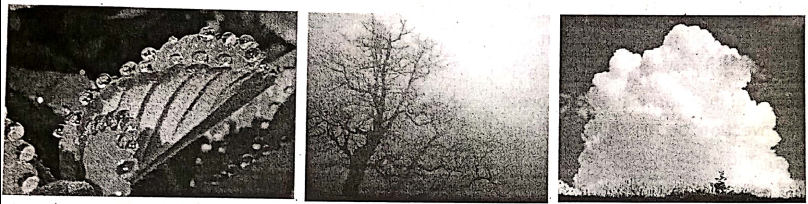
 

WBBSE Notes For Class 8 General Science And Environment Chapter 1 Physical Environment Condensation


Formation of fog:

If the temperature over a wide region of the atmosphere near the surface of the earth comes closer to the dew-point or sometimes falls below the dew-point, the water vapor present in the atmosphere condenses into small droplets of water which float in air on the dust particles, smoke particles, coal dust, etc.

This is known as fog or mist. Fog is very often seen in industrial areas where there are plenty of pollutant particles on which fog can deposit. Fot reduces the range of normal visibility. It disappears at noon.

Formation of the cloud :

Air containing water vapor becomes lighter, and goes high up, where due to very low pressure, the air expands in volume. This makes the air to be cooling. Due to such successive coolings, at one stage, the temperature of air falls below the dew point.

Then, the moisture present in the air are condensed into small droplets on the suspended dust particles. The layer of such droplets is known as a cloud.

Chapter 1 Physical Environment Transfer of heat

So far we have studied that heat can flow from higher temperatures to lower temperatures of different bodies or different parts of the same body. This transfer of heat occurs through three different distinct processes called

  1. Conduction.
  2. Convection and
  3. Radiation.

If we place one end of a metal spoon in the fire holding its other end by hand, within a very short time, it is seen that the other end becomes too hot to be held by hand. This shows the conduction of heat in metals.
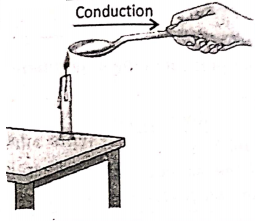
 

WBBSE Notes For Class 8 General Science And Environment Chapter 1 Physical Environment Conduction


Illustrates heating by conduction, convection, and radiation. In the hand is placed in three different positions near the fire.

Position-1:

One end of a metal rod is placed in the fire. After a very short time, the other end of the rod will become so hot by conduction that it would be held by a gloved hand (shown at the upper right).
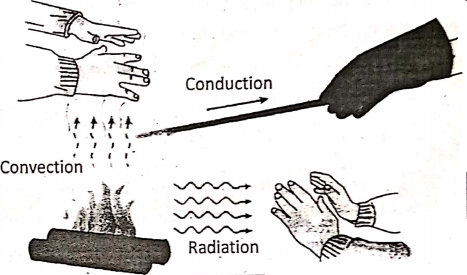


WBBSE Notes For Class 8 General Science And Environment Chapter 1 Physical Environment Transfer of heat


Position-2 :

The hands at the left (above the fire) are becoming hot by the convection of rising hot air.

Position-3 :

The hands at the lower right feel hot by radiation. The process of conduction is prominent in solids, while the process of convection occurs in liquids and gases, and radiation occurs with no need of substance to be present in the space between the bodies. Perhaps, radiation is common in all three states of matter. Now, let us discuss the processes one by one in more detail.

Chapter 1 Physical Environment Conduction

Definition :

Conduction is the process of transfer of heat from the hotter end to the colder end of a solid without any actual movement of the particles of the medium.

Activity :

Take an iron rod or a knitting needle AB. Fix four board pins in a row along its length using a few drops of candle wax . Clamp the end B of the rod on a vertical stand and heat the end A. We will observe that after some time, the board pins start falling down one by one starting from the end A. This implies the fact that heat travels along the length of the rod from its hotter end to the colder end.
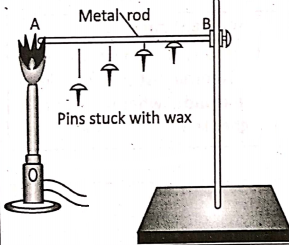
 

WBBSE Notes For Class 8 General Science And Environment Chapter 1 Physical Environment Condution.


Good and bad conductors of heat:

Materials which conduct heat readily are called good conductors of heat. Most metals like silver, copper, aluminium, iron, nickel, etc. and their alloys like brass, bronze and stainless steel are good conductors of heat. However, different metals conduct heat differently.

Materials that do not conduct heat readily are called insulators or bad conductors of heat. Glass, wood, paper, plastic, wool, porcelain, stone, water and air are bad conductors of heat. All liquids (except mercury) and gases are insulators of heat.

Activity  : (Ingen Hauz’s experiment) :

Take a metal trough with five holes drilled in one of its sides near the lower edge. Take five rods of different metals, but exactly of the same size and shape.

Insert them into the holes such that an equal portion of each rod remains outside. The outside portion of each rod is coated with a uniform layer of candle wax. Now, fill the trough with boiling hot water. Wait for 5-10 minutes.
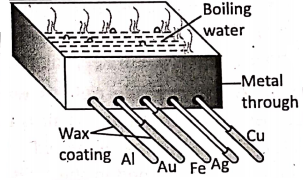


WBBSE Notes For Class 8 General Science And Environment Chapter 1 Physical Environment Different metals conduct heat differently


It is observed that the wax has melted up to different lengths in different rods. It shows that different metals conduct heat differently. Out of the metals, silver, and copper are the best conductors of heat.

Chapter 1 Physical Environment Activity  :

Wrap a strip of wire gauze around a piece of ice cube and drop it in a test tube that is filled with water. Heat the surface of the water over a burner. Continue heating till the water at the surface starts boiling.
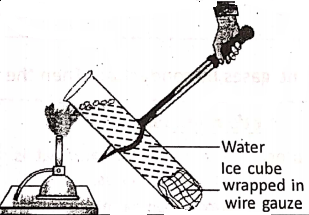


WBBSE Notes For Class 8 General Science And Environment Chapter 1 Physical Environment Continue heating till the water at the surface starts boiling


It is observed that the water at the surface starts boiling, but the ice cube at the bottom of the test tube does not melt. This proves that water is a bad conductor of heat, otherwise ice would melt.

Uses off good and bad conductors of heat:

  1.  Cooking utensils are made up mostly of metals and some alloys like copper, aluminum, brass, and stainless steel as they are good conductors of heat. Heat quickly reaches the food for easily being cooked. But, their handles are made of insulators like wood, plastic, and bakelite. Being insulators, they do not become hot with the utensils and we can ‘ easily hold the handles with our hands. Similarly, we can use hand gloves! or any other insulator to hold a hot dish out of an oven.
 

WBBSE Notes For Class 8 General Science And Environment Chapter 1 Physical Environment Cooking pan, Fry Pan


2. Cooling coils of air conditioners and refrigerators are made of copper. Because copper is a better conductor of heat than most other metals.

3. Slabs of ice are usually covered with a thermally insulating material like sawdust. This prevents outside heat from melting the ice.

4. Mercury is a good conductor of heat. So, mercury is used as a thermometric liquid and it acquires the temperature of the object very quickly, without making an abrupt change in the temperature of the object.

5. Woolen clothes have fine pores filled with air. Both the wool and air are bad conductors of heat. In winter, they do not allow the heat of the body to flow outwards and keep our body warm.

6.  A newly made quilt is warmer than an old one. Because a more amount of air is trapped in a newly made quilt compared to that in an old one. When we use quilt in winter, the air trapped in the quilt does not allow the heat to flow outwards from our body.

7. Eskimos make their houses (called igloos) out of snow. Because the large amount of air trapped in snow acts as an insulator. So that the heat within the igloo does not flow out and thus, it. keeps the inside warm.
 

WBBSE Notes For Class 8 General Science And Environment Chapter 1 Physical Environment An Igloo


Chapter 1 Physical Environment Convection

We’ve learned that heat is not transferred through liquids and gases by conduction. Then the question arises, how the heat is transmitted through them ?—Actually, when a liquid or a gas is heated, the molecules near the source of heat, absorb heat and expand, ultimately becoming lighter and rising up while the colder molecules move downward to take their place.

“WBBSE Class 8 Chapter 1 General Science, Physical Environment solutions”

Now, these molecules also get heated and rise up. This process (convection) continues till the entire liquid or gas acquires the same temperature. Such a circulatory movement set up in the medium is known as a convection current.

Definition :

Convection is the process of transfer of heat in liquids and gases due to the actual movement of the medium particles.

Chapter 1 Physical Environment Activity 1:

Fill a glass beaker three-fourths with water and carefully drop a crystal of potassium permanganate into the beaker. Heat the beaker using a bunsen burner. It is seen that the violet color of potassium permanganate starts moving upwards. This is actually the convection currents of water molecules.
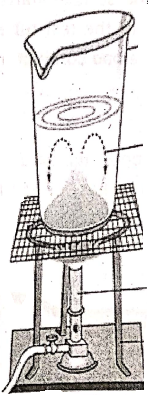
 

WBBSE Notes For Class 8 General Science And Environment Chapter 1 Physical Environment Convection


Chapter 1 Physical Environment Activity 2:

Take a rectangular hollow glass box with two glass chimneys A and B on its topside as shown in. Light a candle and place it under chimney A and hold a smoldering agarbatti (incense stick) just above the mouth of chimney B.
 

WBBSE Notes For Class 8 General Science And Environment Chapter 1 Physical Environment Convection 2


Now, watch the direction of flow of smoke.’ It is seen that the smoke entering through the chimney B, comes out of the chimney A . It shows that convection currents are set up in the air inside the hollow box. In factories the smoke and hot gases rise up due to convection currents and escape out through the chimneys.

Chapter 1 Physical Environment Application of convection :

1. Sea breeze and Land breeze :

During the daytime, the land gets heated more rapidly than the seawater. So, the air above the land becomes warmer and lighter, hence rises upwards. In turn, cooler air above the seawater blows in to fill up the air towards the land that rises up, thereby giving rise to sea breeze.


WBBSE Notes For Class 8 General Science And Environment Chapter 1 Physical Environment Sea breeze, Land breeze


After sunset, the land cools down faster than the seawater. So, the air above the seawater remains warmer than the air above the land and rises upwards. This creates a current of air to blow from land towards the sea, giving rise to the land breeze.

2. Ventilation :

The air, we breathe out, is warmer and lighter than ordinary air. It passes out through the ventilators (openings near the roof) provided in our houses. In turn, fresh air being heavier enters the house through the doors and windows.


Chapter 1 Notes For Class 8 Physical Environment Radiation


Radiation is the process of transfer of heat from a hot body to a cold body directly, without heating the space between the bodies.

Chapter 1 Physical Environment Activity 1:

Hold a thermometer below the flame of a lighted candle. The thermometer will show an increase in temperature. As air is a bad conductor of heat, so heat could neither have reached the thermometer by conduction nor by convection as convection current rises upward, rather than sideways.
 

WBBSE Notes For Class 8 General Science And Environment Chapter 1 Physical Environment Radiation 1


Therefore, the bulb gets heat by another process, known as radiation. Furthermore, if a thin cardboard or any other insulator is placed between the flame and the thermometer, it no longer becomes hot. This proves that air does not get heated by radiation.

All hot bodies—solids, liquids, and gases emit heat radiation, called radiant heat. For example, we feel hot in front of a fire, electric heater, electric iron or electric bulb, or from any other hot body.

Radiation requires no medium. For example, the heat of the sun reaches us by radiation without heating the space (the vast space between the sun and the earth is a vacuum).

Absorption and reflection of radiant heat by a body :

When radiant heat is incident on an object, a part of it is reflected and the remaining part is absorbed by the object. The amount of heat radiated by an object depends on its temperature, colour, and nature (dull or shiny). It has been proved that

  1. Black bodies are good absorbers, as well as, good radiators (i.e., bad reflectors) of heat and
  2. Shining bodies are poor absorbers and poor radiators, and good reflectors of heat.

Chapter 1 Notes For Class 8 Physical Environment Activity  :

Take two identical cans having small holes in their lids. Paste black paper over one and keep the other remain as it is. Pass two similar thermometers through the holes into the cans. Place the cans in the sun for about an hour.
 

WBBSE Notes For Class 8 General Science And Environment Chapter 1 Physical Environment Radiation 2


After some time we will notice that the thermometer in the can with black surface shows more rise in temperature than the other. This proves that a black surface is a good absorber of heat than the white surface.

Now, take the cans in a dark room. We will notice that the temperature drop in the thermometer of the can with black surface becomes more than the other. It follows that a black surface is a good radiator while a shiny surface is a poor radiator.

Applications of radiation :

  1.  We wear white and light-colored clothes in summer because they absorb the minimum amount of heat from the surroundings and keep us cool. However, we wear black and dark-colored clothes in winter because they absorb the maximum amount of heat from the surroundings, and keep us warm.
  2.  The outside bottom of cooking utensils is painted black while the other outer sides are kept sparkling bright. This is done so that the bottom portion can absorb the maximum amount of heat from the source of heat and gets heated quickly. But, to keep the food contents warmer for a longer time, the minimum amount of heat is radiated from the polished outer sides.
  3.  A teapot is brightly polished so that a little amount of heat can be radiated from hot tea and it remains warm for a longer time.
  4.  The radiators of automobiles and air conditioners are often painted black to radiate away the heat easily.

Chapter 1 Notes For Class 8 Physical Environment Thermos (Or Vacuum) Flask

A thermos flask, also called Dewar flask after its inventor Sir James Dewar, is a special type of insulated flask that can store liquids with very little changes in temperatures over a long time. That is, a thermos flask keeps a hot liquid hot and a cold liquid cold for few hours.

The flask consists of a double-walled glass vessel with both the inner and outer surfaces of the walls being silvered, like a mirror. The space between the walls is completely evacuated and the opening through which air is evacuated is sealed. The mouth of the flask is closed with a stopper (cork or plastic).


WBBSE Notes For Class 8 General Science And Environment Chapter 1 Physical Environment Thermos flask


The double-walled glass vessel is fitted securely inside a plastic or metal case and is supported on corks at the sides and at the bottom. The thermos flask stops the transfer of heat by conduction, convection, and radiation so that a liquid in the thermos flask retains its temperature for a long time.

  1. As glass and cork are poor conductors of heat, so heat loss by conduction is minimized.
  2. The vacuum in between the walls prevents heat loss by conduction and convection (as conduction and convection require a medium).
  3. The silvered walls reflect all radiations. This prevents the heat loss by radiation.

The distinction between Conduction, Convection, and Radiation


Conduction Convection Radiation
(1) Conduction requires a medium for heat transfer, without actual movement of the medium particles. (1) Convection requires a medium for heat transfer and it occurs through the actual movement of the medium particles. (1) Radiation does not require a medium.
(2) It mainly occurs in metallic solids. (2) It mainly occurs in liquids and gases. (2) It occurs without heating the medium.
(3) It is a slow process. (3) It is faster than conduction. (3) It is a fast process. It happens at the speed of light.
(4) Transfer of heat may take place in any direction. (4) Heat is transferred mainly in a vertically upward direction only. ‘ (4) Heat travels in straight lines.


Chapter 1 Notes For Class 8 Physical Environment Light

Reflection

When, a beam of light traveling through a medium (like air) strikes a surface (a wall, a floor, a mirror or anything around us), some of the incident light bounces back or travels back into the first medium. We say this the reflection of light. It can be compared with the bouncing of a ball from the ground.

 

WBBSE Notes For Class 8 General Science And Environment Chapter 1 Physical Environment Reflection of light


It is a matter of fact that all surfaces reflect light. That is how we see the world around us. A plane mirror is an ideal reflector and is used in the study of reflection in plane surfaces.

Definition :

When a ray of light traveling in a medium strikes a surface leading into another medium, a part of the incident ray bounces back into the first medium. This bouncing back of light in the same medium is termed as a reflection of light.

Regular and irregular reflection :

Usually, a reflection of light is of two kinds depending on the nature of the reflecting surfaces-

  1. Regular reflection and
  2. Irregular or diffuse reflection.


WBBSE Notes For Class 8 General Science And Environment Chapter 1 Physical Environment Regular and irregular reflection


  1.  When a beam of light falls rays become parallel to each other. This type of reflection is known as regular reflection.
  2.  When a beam of light falls on’ a rough, uneven or irregular surface, the reflected rays of light are scattered in all directions. This type of reflection is known as irregular reflection.

Terms related to reflection :

In, MM’ is a plane reflecting surface (like a plane mirror), AO the incident ray, OB the on a smooth and very well polished surface, the reflected ray, 0 the point of incidence of the incident ray AO, ON the normal drawn on the surface MM’ at o, ∠AON = i = angle of incidence and ∠Bon = r = angle of reflection.
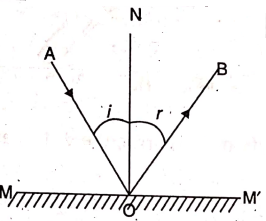
 

WBBSE Notes For Class 8 General Science And Environment Chapter 1 Physical Environment Terms related to reflection


laws of reflection of light are as follows :

  1. The incident ray, the reflected ray, and the normal drawn at the point of incidence all lie in the same plane.
  2. The angle of incidence (i) is equal to the angle of reflection (r).

Formation of image By a plane mirror :

In our daily experience/ when looking through a plane mirror, we see our own image appear to form behind the mirror. But, light rays cannot pass through the mirror and go beyond it.

How then the image can be formed? :

Actually, light from our body is reflected by the mirror and enters our eyes such the reflected rays appear to come from an image behind the mirror. However, if a screen is placed at the position from where the reflected rays appear to be coming, we will not be able to see an image. Such an image that cannot be formed on a screen is called a virtual image.

“WBBSE General Science Class 8 Physical Environment, Chapter 1 explanations”

The position of the image formed by a plane or mirror can be located by making a ray diagram, as shown in.

When the object is very small, like a point:

Suppose 0 be the point object in front of a plane mirror M1  M2. Consider two rays OA and OB from the object that fall at A and B on the mirror. They will be reflected along AC and BD respectively, with the angle of incidence equal to the angle of reflection at each point. These rays do not converge at a point.
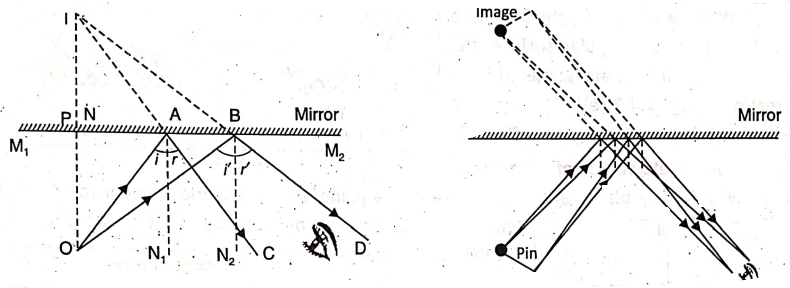


WBBSE Notes For Class 8 General Science And Environment ChapteThe image is as far behind the mirror as the obects is in front of it, image are of the same size


If we extend the reflected rays AC and BD backward, they meet at the point I behind the mirror, from which the reflected rays appear to be coming from. Therefore, I represents the virtual image of object O. On measuring the distances of the object 0 and its image I from the mirror, the distances are found to be equal. That.is, OP = IP.

Chapter 1 Notes For Class 8 Physical Environment The Image Formed By An Extended Object:

An extended object is a combination of several point objects. To draw the ray diagram, consider the rays emerging from the upper and lower ends of the object to fall on the mirror and the rays being reflected by the mirror appear to come from its virtual (extended) image.

Formation of real image :

Images formed by a camera or on the retina of the human eye are real images. Also, the pictures projected on the screen in the cinema hall are real images. We are able to see the rays of light coming from the projector and falling on the screen.

Thus, the rays of light often being reflected by a mirror, actually meet at a point to form an image, called a real image. Such as image can be formed on a screen.

Characteristics of an image formed by a plane mirror :

The image formed by a plane mirror is

  1. Virtual and erect (upright);
  2. Of the same size as that of the object;
  3. As far behind the mirror as is the object ‘ in front of the mirror; and
  4. Laterally inverted (if the object is not symmetrical).

What is a lateral inversion of the image ?—Standing in front of a plane mirror, we see our left hand appears right of the image and vice versa. Such interchange of the left and right sides in the (nonsymmetrical) object and its image is due to reflection. of light by a plane mirror is called lateral inversion of image.



WBBSE Notes For Class 8 General Science And Environment Chapter 1 Physical Environment Lateral inversion


Note that the lateral inversion of the image is not noticeable for the objects which are symmetrical like the alphabets A, H, I, M, V, W, X, Y; while lateral inversion is noticeable for the objects which are not symmetrical like the alphabets B, C, D, E, F, G, J, K, L, P7 Q, R, S, Z.

This is due to the fact the word Ambulance’ is printed laterally inverted in front of an ambulance—so that it may appear accurate in the rear-view mirror of the driver in front.

Formation of the image by a pair of plane mirrors :

When two plane mirrors are placed at an angle, reflecting surfaces facing each other, and an object is placed between them, multiple images are formed. This is due to the fact that multiple reflections occur at the mirrors such that the image formed in one mirror acts as an object for the other mirror. The number of images formed depends on the angle between the mirrors. Mathematically, it is proved that, if 0 be the angle between two mirrors, then the number of images formed is
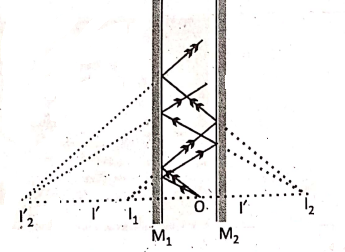
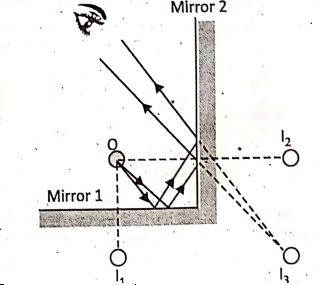


WBBSE Notes For Class 8 General Science And Environment Chapter 1 Physical Environment Multiple images formed by a pair of Parallel mirrors

WBBSE Notes For Class 8 General Science And Environment Chapter 1 Physical Environment Multiple images formed by a pair of perpendicular plane mirrors


Case-1: When 0 = 0°, i.e., the two mirrors are placed parallel to each other, then an infinite number (theoretically) of images are formed.

0 is the position of an object. The rays from 0 produce an image l1 on the mirror M1 such that OM1 = l1 M1. Now, l1 acts as a virtual object for the mirror M2 and by further reflection at M2 it produces the image l2, such that l1 M2 = l2 M2.

“WBBSE Class 8 General Science Physical Environment notes, easy explanation”

The next image l2 is formed by M1, such that = M1l2  = M1 l2. In this way several successive reflections may occur in the two mirrors and the brightness of the remote images keeps on decreasing due to the loss of energy by successive reflections.

In actual practice (e.g., in. a showroom or in a barber’s shop) only the first few images can be seen clearly.

Case 2: When 0 = 90°, then n = 360°/90° = 4-1 = 3, i.e., when the two mirrors are placed perpendicular to each other, four images are formed.

0 is the position of an object. Each mirror forms an image. The images l1 and l2 are formed after reflection at the two mirrors 1 and 2 respectively. A third image is formed behind the line where the mirrors meet.

Chapter 1 Notes For Class 8 Physical Environment Applications of Plane Mirrors :

We find wide applications of plane mirrors in our daily life. Some of these are :

  1. As a looking mirror in the bedroom or washroom.
  2.  In the showroom or optician’s room to increase the effective length of the room.
  3.  In the barber’s shop for looking the hairs at the back of my head.
 

WBBSE Notes For Class 8 General Science And Environment Chapter 1 Physical Environment Action of a periscope using plane mirrors


4.  In a periscope, two parallel plane mirrors M1 and M2 are inclined at an angle of 45° with The vertical sides.of.a long tube at two opposite ends with two openings X and Y . A periscope enables us to see objects over an obstacle.

A ray of light OA coming from a distant object in front of the opening X falls on the mirror at an angle of incidence of ‘ 1 45° and is reflected vertically downward making an angle of reflection of 45°, and finally being reflected by mirror M2 reaches at the eye through the opening Y. The observer then sees the object above the obstacle.

5. In a kaleidoscope, three strips of plane mirrors of equal size, inclined at an angle of 60° with each other, are used. A simple kaleidoscope is shown the three mirrors are taped with each other to form a triangular tube, Tape a small polythene pouch to two sides of the triangular tube and put some pieces of colored beads, and bangles into the pouch. Then, another end of the tube is covered with stiff paper and makes a hole in it. In this way, a kaleidoscope is formed. If we look through the hole and rotate the kaleidoscope, multicolored images are seen.
 

WBBSE Notes For Class 8 General Science And Environment Chapter 1 Physical Environment Kaleidoscope

Chapter 1 Notes For Class 8 Physical Environment Refraction

Refraction is the phenomenon by means of which a ray of light deviates from its original path while passing obliquely from one transparent homogeneous optical medium to another transparent homogenous optical medium. It is essentially a surface phenomenon.
 

WBBSE Notes For Class 8 General Science And Environment Chapter 1 Physical Environment Refraction


Light travels with different speeds in different media. The speed of light in a vacuum is 3 x 10⁸ ms-1. Light travels faster in air (speed being 3 x 10⁸ms-1) than in water (speed being 2.25 x 10⁸ ms-1) or glass (speed being 2 x 10⁸ms-1). Here, the air is the optically rarer* medium while water or glass are the optically denser** media.

When light travels

  1.  From a rarer medium to a denser medium, it bends toward the normal.
  2. From a denser medium to a rarer medium it bends away from the normal.

PO is the incident ray; OR, the refracted ray; NON’, the normal drawn to the surface XY at the point of incidence 0; ∠PON, the angle of incidence (i); and ∠RON, the angle of refraction (r). The deviation of the refracted ray is, δ = (i – r), as i> r; and the deviation is, δ = (r- i), as i < r.

Chapter 1 Notes For Class 8 Physical Environment Laws of Refraction

Refraction of light at the boundary of separation of two media obeys the following two laws :

  1. The incident ray, the refracted ray and the normal drawn at the point of incidence on the boundary of separation of two media, all lie on the same plane.
  2. For a given pair of media, the ratio of the sine of the angle of incidence (i) to the sine of the angle of refraction (r) is constant.

WBBSE Notes For Class 8 General Science And Environment Chapter 1 Physical Environment Laws of refraction


This constant (μ) is known as the refractive index of the second medium with respect to the • first medium. The second law is known as Snell’s law. For example, the refractive index of glass is 1.5. This means that—if a ray of light travels from air to glass, then the ratio of the angle of incidence in the air to the angle of refraction in glass is 1-5.

Some common examples of refraction :

  1. A stick dipped in water appears to be short and bent at the water’s surface,
  2. An ink spot appears to be raised when a glass block is placed over it.
  3. A tank full of water appears shallower than its actual depth,
  4. A coin placed at the bottom of a water vessel is not visible from the edge of the vessel,
  5. The twinkling of stars, etc.

Chapter 1 Notes For Class 8 Physical Environment Critical Angle And Total Internal Reflection Of Light

Consider the refraction of light from a denser medium (say, glass) to, a rarer medium (say, air). Starting with a small angle of incidence, the ray is bent away from the’ normal where i < r. As the angle of incidence in the denser medium increases, the angle of refraction in the rarer medium also increases. Finally, at a certain angle of incidence i(=θc ), the angle of refraction becomes equal to 90°. This angle ‘θc‘ is termed as the critical angle for the pair of media.
 

WBBSE Notes For Class 8 General Science And Environment Chapter 1 Physical Environment Critical angle and total internal reflection of light


However, if the angle of incidence is increased beyond θc, the ray is not refracted at all, but it gets reflected internally into the denser medium. (Since it is not possible to get an angle of refraction more than 90°). This phenomenon is known as the total internal reflection of light.

Definition :

The critical angle is the angle of incidence in the denser medium for which the angle of refraction in the rarer medium is 90°, while a ray of light passes from a denser medium to a rarer medium.

When a ray of light traveling in a denser medium is incident at the surface of a rarer medium at an angle of incidence greater than the critical angle for the pair of media, the ray gets totally reflected back into the denser medium. The phenomenon due to which this happens is called total internal reflection of light.

Essential conditions for total internal reflection of light :

  1. The light must travel from a denser medium to a rarer medium.
  2. The angle of incidence in the denser medium must be greater than the critical angle for the given pair of media.

The distinction between ordinary reflection and total internal reflection :

  1. For ordinary reflection, light may incident from any medium to any other medium at any angle of incidence. But, for total internal reflection, light must travel from a denser medium to the interface of a rarer medium, at an angle of incidence greater than the critical angle for  the given pair of media.
  2. In ordinary reflection, the incident light is partially reflected, while in total internal reflection, the entire amount of the incident light is reflected.

Chapter 1 Notes For Class 8 Physical Environment Some Facts Of Total Internal Reflection


1. Small beads of water on lotus leaves appear shiny. Because a layer of air sticks to the drops of water within the wax-like coating on lotus leaves.

 

WBBSE Notes For Class 8 General Science And Environment Chapter 1 Physical Environment Small beads of water on lotus leaves appear shiny.


When light rays passing through water strike the water-air interface at an angle more than the critical ‘ angle between the pair of media, concerned, the light rays suffer total internal reflection and finally enter in to our eyes.

2. In general, the critical angle of precious stones are small. For example, it is about 24-5° for diamonds. A piece 0f diamond is cut in such a fashion that the rays of light pass through the diamond at angles more than the critical angles, and suffer repeated total internal reflection through its different faces and finally emerge out to reach into our eyes. Thus, a piece of diamond appears shining.

3. A crack in a glass window pane appears silvery. This happens due to the occurrence of total internal reflection from the layer of air between the two glass surfaces.

4. Formation of mirage :

The mirage is a natural phenomenon, and it occurs due to the occurrence of total internal reflection of light at the surface separating two layers of air of different densities. In the desert, the sand becomes excessively hot during the daytime and heats the layer of air in contact with it, causing a lowering in density. But, layers of air in the upper side are comparatively cold, i.e., denser. Thus, successive layers of air going upwards are denser than the layers below them.

Light rays emerging from a distant tree are refracted away from the normal while coming from an optically denser medium to an optically rarer medium. This continues till a stage comes when the angle of incidence becomes more than the critical angle between the interface of two layers.

“Class 8 WBBSE Physical Environment Chapter 1, General Science revision”

Then total internal reflection takes place and the rays reach into the eye of a person such that the rays appear to come from an inverted image of the tree . Moreover, due to continuous changes of temperature and convection currents in the air, the image of the tree shimmers, and it adds to the illusion of the presence of water (virtual image). This is known as the mirage in the desert or inferior image.
 

WBBSE Notes For Class 8 General Science And Environment Chapter 1 Physical Environment Mirage in a desert and cold countries


In cold countries, the layers of air near the ground are colder and denser than the layers above it. So, the rays of light passing upwards from an object near the ground are totally reflected downwards when the angle of incidence becomes more than the critical angle between the interface of two layers of air and produces an inverted image hanging in the air. This is known as a mirage in cold countries or a superior image.
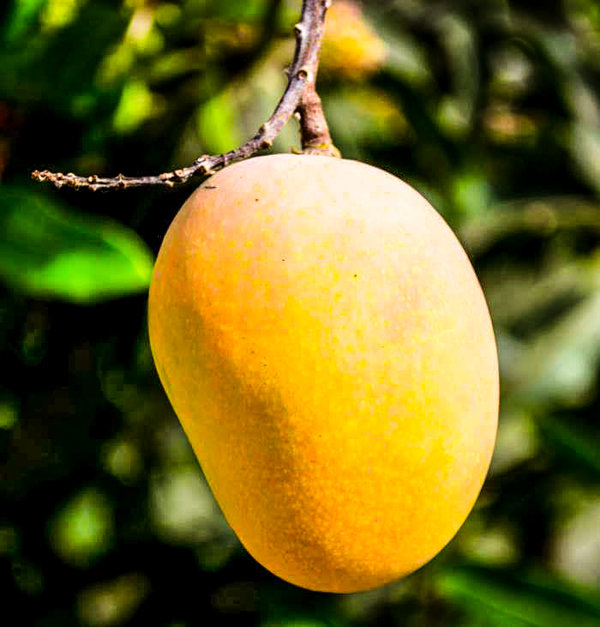
5. On hot sunny days, similar reflections occur on tarred roads.