NEET Physics Work Energy And Power Notes

Work Energy And Power

Work is said to be done if there is a displacement in the direction of applied force.

Work done is the dot product of force and displacement.

W = \(\overrightarrow{\mathrm{F}} \cdot \overrightarrow{\mathrm{x}}\)

W = Fx cosθ

Work is zero, if F = 0, x = 0 or cosθ = 0 (θ= 90°)

NEET Physics Work Energy and Power notes

Example: 

  • Work done by gravitational force of earth on its satellite is zero. (Since angle between gravitational force and instantaneous displacement is 900)
  • Work done by force of tension of string on the bob of simple pendulum is zero. (Since angle between tension in the string and instantaneous displacement of the bob is 900)
  • When a charged particle is moving in a uniform magnetic field in a circular path, work done by magnetic field is zero. (Since angle between magnetic force and instantaneous displacement of the charged particle is 900)

Read And Learn More: NEET Physics Notes

Potential Energy

Energy possessed by a body due to its position or configuration.

Example:

1. If a body is raised to a height ‘h’ from the ground, then its potential energy is given by,

U = mgh

2. P.E. of a spring is given by,

U= \(\frac{1}{2} \mathrm{kx}^2\)

Where k is spring constant and x is elongation/extension.

F=\(-\frac{\mathrm{dU}}{\mathrm{dx}}\)

Where U is potential energy.

NEET Physics Work Energy And Power Notes

Important formulas of Work Energy and Power for NEET

When the system is in equilibrium

\(\frac{\mathrm{dU}}{\mathrm{dx}}\)=0

Relation between kinetic energy and linear momentum

The kinetic energy of a body of mass ‘m’ and moving with velocity ‘v’ is given by

⇒ \(\mathrm{K}=\frac{1}{2} \mathrm{mv}^2\)

⇒ \(\mathrm{K}=\frac{1}{2} \mathrm{mv}^2 \times \frac{\mathrm{m}}{\mathrm{m}}=\frac{\mathrm{m}^2 \mathrm{v}^2}{2 \mathrm{~m}}=\frac{\mathrm{P}^2}{2 \mathrm{~m}}\)

⇒ \(\mathrm{K}=\frac{\mathrm{P}^2}{2 \mathrm{~m}}\)

⇒ \(\mathrm{P}=\sqrt{2 \mathrm{mK}}\)

Conservation of mechanical energy NEET questions

Conservative Force

A force is said to be conservative if work done by the force is independent of path. Or A force is said to be conservative if work done by the force depends only on initial and final position. Or A force is said to be conservative if work done by the force in a cyclic process is zero.

Work-Energy Theorem

If the forces acting on a body are conservative then change in kinetic energy of the body is equal to work done by the net force.

ΔK = W

Kf – Ki = W

Work Energy theorem NEET questions

Work Done By Variable Force

Constant force is rare in nature.

When there is variable force area under force versus displacement graph has to be calculated by the method of calculus.

⇒ \(\mathrm{W}=\int_{\mathrm{x}_1}^{\mathrm{x}} \overrightarrow{\mathrm{F}} \cdot \overline{\mathrm{dx}}\)

(Work done is the definite integral of force over displacement).

Area under F versus x graph gives work done.

Power

The rate at which work is done is called power.

⇒ \(P=\frac{W}{t}\)

⇒ \(P=\frac{\vec{F} \cdot \vec{x}}{t}\)

⇒ \(\mathrm{P}=\overrightarrow{\mathrm{F}} \cdot \overrightarrow{\mathrm{v}}\)

(i.e., power is the dot product of force and velocity)

Motion Of A Body In A Vertical Circle

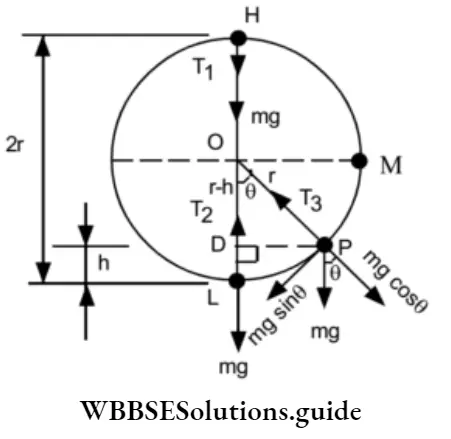
NEET Physics Work Energy And Power Vertical Circle

Power and efficiency NEET Physics notes

If the body moving in a vertical plane has to complete a vertical circle, at the highest point,

⇒ \(\frac{m v_H^2}{r}=m g\)

So the minimum condition is

⇒ \(\frac{m v_H^2}{r}=m g\)

⇒ \(\mathrm{T}_{\mathrm{H}}=\frac{\mathrm{mv_{ \textrm {H } } ^ { 2 }}}{\mathrm{r}}-\mathrm{mg}\) ____________ (1)

⇒ \(\mathrm{T}_{\mathrm{A}}=\mathrm{T}_{\mathrm{B}}=\frac{\mathrm{mv_{ \textrm {A } } ^ { 2 }}}{\mathrm{r}}=\frac{\mathrm{mv_{B } ^ { 2 }}}{\mathrm{r}}\) (∵VA=VB)________________(2)

⇒ \(\mathrm{T}_{\mathrm{L}}=\frac{\mathrm{mv_{ \textrm {L } } ^ { 2 }}}{\mathrm{r}}+\mathrm{mg}\)____________(3)

In general, the tension at any point P is given by,

⇒ \(\mathrm{T}_{\mathrm{P}}=\frac{\mathrm{mv_{ \textrm {p } } ^ { 2 }}}{\mathrm{r}}+\mathrm{mg} \cos \theta\)

w.k.t., (TH)min= 0

⇒ (∵ at minimum condition \(\frac{\mathrm{mv}_{\mathrm{H}}^2}{\mathrm{r}}=\mathrm{mg}\))

∴(1) ⇒ \(0=\frac{m v_H^2}{r}-m g\)

⇒ \(\frac{m v_{\mathrm{H}}^2}{\mathrm{r}}=\mathrm{mg}\)

⇒ \(\mathrm{v}_{\mathrm{H}}=\sqrt{\mathrm{gr}}\)

Therefore the minimum velocity to be given at H so that the body completes a vertical circle is \(\sqrt{\mathrm{gr}}\)

Now, using law of conservation of mechanical energy we will calculate the minimum velocity to be given at L in order to complete a vertical circle.

KH + UH = KL + UL

⇒ \(\frac{1}{2} m v_{\mathrm{H}}^2+m g(2 r)=\frac{1}{2} m v_{\mathrm{L}}^2+0\)

⇒ \(\frac{1}{2}(\mathrm{gr})+2 \mathrm{gr}=\frac{1}{2} \mathrm{v}_{\mathrm{L}}^2\)

⇒ ∵ \(\mathrm{v}_{\mathrm{H}}=\sqrt{\mathrm{gr}}\)

⇒ \(g r+4 g r=v_L^2\)

⇒ \(\mathrm{v}_{\mathrm{L}}=\sqrt{5 \mathrm{gr}}\)

Similarly, it can be shown that,

⇒ \(\mathrm{v}_{\mathrm{A}}=\sqrt{3 \mathrm{gr}}\)

∴ \(T_A=\frac{m v_A^2}{r}=\frac{m(3 g r)}{r}\)

⇒ \(\mathrm{T}_{\mathrm{A}}=3 \mathrm{mg}\)

⇒ \(\mathrm{T}_{\mathrm{L}}=\frac{\mathrm{mv_{ \textrm {L } } ^ { 2 }}}{\mathrm{r}}+\mathrm{mg}=\frac{\mathrm{m}}{\mathrm{r}} 5 \mathrm{gr}+\mathrm{mg}\)

⇒ \(\mathrm{T}_{\mathrm{L}}=6 \mathrm{mg} .\)

⇒ \(\left(T_H\right)_{\min }=0\)

⇒ \(\left(T_A\right)_{\min }=\left(T_B\right)_{\min }=3 \mathrm{mg}\)

⇒ \(\left(\mathrm{T}_{\mathrm{L}}\right)_{\mathrm{mg}}=6 \mathrm{mg}\)

⇒ \(\left(\mathrm{V}_{\mathrm{H}}\right)_{\min }=\sqrt{\mathrm{gr}}\)

⇒ \(\left(\mathrm{V}_{\mathrm{A}}\right)_{\min }=\left(\mathrm{V}_{\mathrm{B}}\right)_{\min }=\sqrt{3 \mathrm{gr}}\)

⇒ \(\left(\mathrm{V}_{\mathrm{L}}\right)_{\min }=\sqrt{5 \mathrm{gr}}\)

⇒ \(T_L-T_H=6 m g\)

Always,

Workdone in pulling a uniform chain on a frictionless table

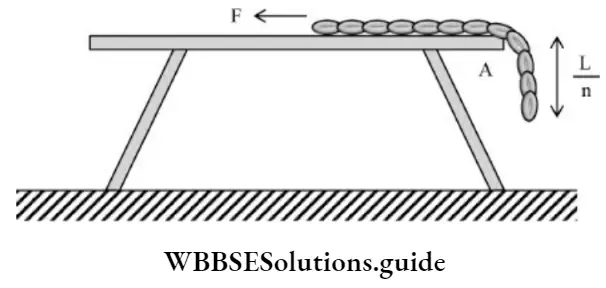
NEET Physics Work Energy And Power Uniform Chain On A Frictionless

Let mass of chain be M and length L.

Workdone in pulling the hanging portion is given by,

⇒ \(\mathrm{W}=\left(\frac{\mathrm{M}}{\mathrm{n}}\right) \mathrm{g}\left(\frac{\mathrm{L}}{2 \mathrm{n}}\right)^2\)

⇒ \(\mathrm{W}=\frac{\mathrm{MgL}}{2 \mathrm{n}^2}\)

( centre of mass of hanging portion is a point A it is a distance of from the top).

Velocity of the chain when it just leaves the frictionless table

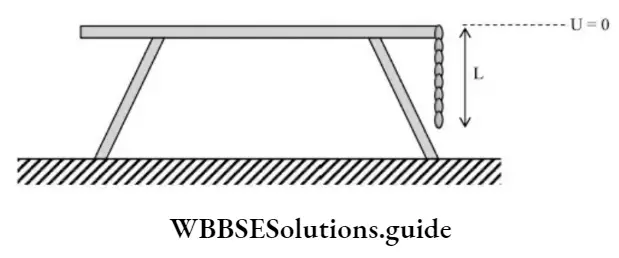
NEET Physics Work Energy And Power Chain When It Just LeavesThe Frictionless

Kinetic and potential energy NEET problems

P.E. when \(\frac{\mathrm{L}}{\mathrm{n}}\) portion is hanging is given by,

⇒ \(\mathrm{U}_{\mathrm{i}}=-\frac{\mathrm{MgL}}{2 \mathrm{n}^2}\)

P.E. when the chain just leaves the table surface is,

⇒ \(\mathrm{U}_{\mathrm{f}}=-\frac{\mathrm{MgL}}{2}\)

w.k.t., K.E. gain = P.E. loss

⇒ \(\frac{1}{2} \mathrm{mv}^2=-\frac{\mathrm{MgL}}{2 \mathrm{n}^2}-\left[-\frac{\mathrm{MgL}}{2}\right]\)

⇒ \(\frac{1}{2} \mathrm{mv}^2=\frac{\mathrm{MgL}}{2}-\frac{\mathrm{MgL}}{2 \mathrm{n}^2}\)

⇒ \(\mathrm{v}^2=\mathrm{gL}-\frac{\mathrm{gL}}{\mathrm{n}^2}\)

⇒ \(\mathrm{v}^2=\mathrm{gL}\left(1-\frac{1}{\mathrm{n}^2}\right)\)

⇒ \(\mathrm{v}=\sqrt{\mathrm{gL}\left(1-\frac{1}{\mathrm{n}^2}\right)}\)

Collison

A body is said to undergo collision if there is an abrupt change in its velocity.

The collision is said to be perfectly elastic if there is no kinetic energy loss.

The collision is said to be inelastic if there is a kinetic energy loss during collision.

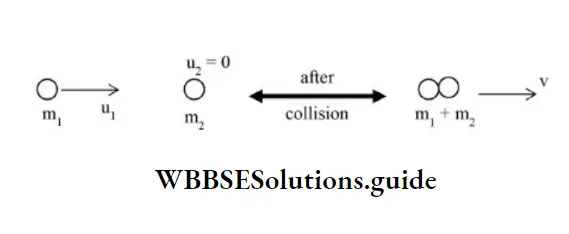
The collision is said to be perfectly inelastic if bodies undergoing collision move together with common velocity after collision.

Expression of K.E. loss in the case of perfectly inelastic collision in 1-D:

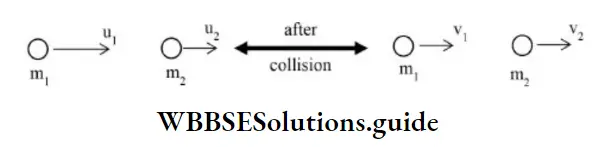
NEET Physics Work Energy And Power Inelastic Collision

ΔK=\(\frac{1}{2} \frac{m_1 m_2}{m_1+m_2} u_1^2\)

Expression for final velocities when two bodies undergoing elastic collision in 1-D

NEET Physics Work Energy And Power Elastic Collision

Work done by variable force NEET questions

⇒ \(v_1=\left(\frac{m_1-m_2}{m_1+m_2}\right) u_1+\frac{2 m_2 u_2}{m_1+m_2}\)

⇒ \(v_2=\left(\frac{m_2-m_1}{m_1+m_2}\right) u_2+\frac{2 m_1 u_1}{m_1+m_2}\)

If u2 = 0, then

⇒ \(v_1=\frac{\left(m_1-m_2\right)}{m_1+m_2} u_1\)

⇒ \(v_2=\frac{2 m_1 u_1}{m_1+m_2}\)

Case 1. If mx = m2, then vx = 0 & V2 = %

Case 2. If mx >> m2, then vx = ux & V2 = 2ux

Case3. If mx << m2, then vx = -ux & V2 = 0

Coefficient of Restitution (e)

⇒ \(\mathrm{e}=\frac{\mathrm{v}_2-\mathrm{v}_1}{\mathrm{u}_1-\mathrm{u}_2}=\frac{\text { Relative velocity of separation }}{\text { Relative velocity of appraoch }}\)

For perfectly elastic collision, e = 1

For perfectly inelastic collision, e = 0

For all other collisions, 0 < e < 1

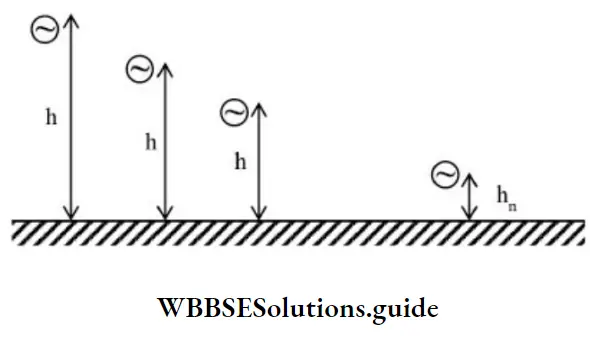
If a ball is dropped from a height ‘h’,

NEET Physics Work Energy And Power Ball Of Height

Maximum height attained by the ball decreases progressively due to K.E. loss. After 1 collision the height attained is h1

∴ e = \(=\frac{\sqrt{2 g h_1}}{\sqrt{2 g h}}=\sqrt{\frac{h_1}{h}}\)

⇒ \(\mathrm{e}^2=\frac{\mathrm{h}_1}{\mathrm{~h}}\)

⇒ \(\mathbf{h}_{\mathrm{l}}=\mathrm{he}^{2 \times 1}\)

After 2 collisions,

⇒ \(\mathrm{e}=\frac{\sqrt{2 \mathrm{gh}_2}}{\sqrt{2 \mathrm{gh}_1}}=\sqrt{\frac{\mathrm{h}_2}{\mathrm{~h}_1}}\)

⇒ \(\mathrm{e}^2=\frac{\mathrm{h}_2}{\mathrm{~h}_1}=\frac{\mathrm{h}_2}{\mathrm{he}^2}\)

∴ \(h_2=h^4 \Rightarrow h_2=h e^{2 \times 2}\)

∴ After ‘n’ collisions.

⇒ \(h_n=h e^{2 n}\)

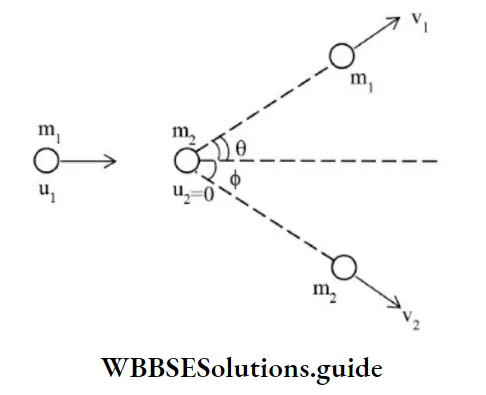
Collision in 2D

NEET Physics Work Energy And Power Collision In 2D

According to the law of conservation of linear momentum,

m1u1=m1v1cosθ+m2v2cosΦ

NEET Biology Pedigree Analysis And Genetic Disorders Multiple Choice Question And Answers

Biology MCQ For NEET With Answers Pedigree Analysis And Genetic Disorders

Question 1. What is pedigree analysis?

  1. Record of inheritance pattern
  2. Linkage map
  3. Quantitative genetic
  4. Polygene analysis

Answer:  1. Record of inheritance pattern

Pedigree is a record of inheritance of certain genetic traits for two or more than two generations, represented in the form of a diagram.

Read And Learn More: NEET Biology Multiple Choice Question And Answers

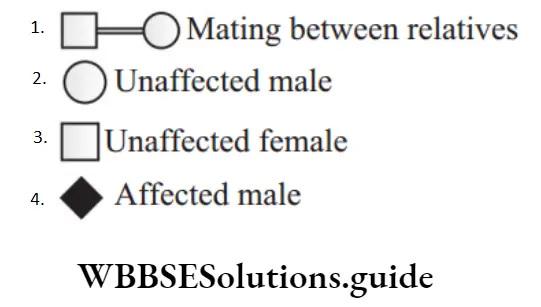
Question 2. Which one of the following symbols and its representation, used in human pedigree analysis is correct?
NEET Biology Pedigree Analysis And Genetic Disorders Humanpedigree Analysis

Answer:
1.  Option (1) is correct. Rest other options are incorrect and can be corrected as

  • Option (2) is unaffected female,
  • Option (3) is unaffected male and
  • Option (4) is affected individual with sex unspecified.

“pedigree analysis questions “

Question 3. The individual from which a pedigree analysis is initiated is called

  1. Proposita
  2. Propositus
  3. Both 1 and 2
  4. origin

Answer: 3. Both 1 and 2

If pedigree is initiated from male, it is called propositus. If pedigree is initiated from female, it is called proposita. So, an individual from which a pedigree is initiated could be proposita or propositus. Thus, option (3) is correct.

Biology MCQ For NEET With Answers

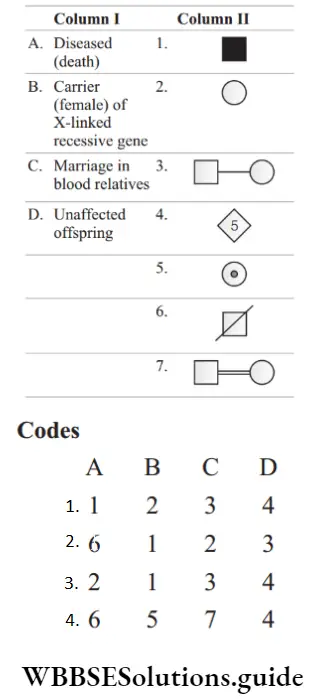
Question 4. Match the symbols with statement.
NEET Biology Pedigree Analysis And Genetic Disorders Question 4 Match The Symbols

Answer:  4. A–6, B–5, C–7, D–4

NEET Biology Pedigree Analysis MCQs with answers

Question 5. Name the principle on which pedigree analysis work?

  1. Regression
  2. Probability
  3. Random mating
  4. ANOVA

Answer:  2. Probability

“principles of inheritance and variation pyq neet “

Pedigree analysis is used to study the transmission genetics where controlled process is not possible and it works on the principle of probability.
NEET Biology Pedigree Analysis And Genetic Disorders Multiple Choice Question And Answers

Question 6. The given symbol indicates.

NEET Biology Pedigree Analysis And Genetic Disorders Symbol Indicates

  1. Carrier female
  2. Unaffected female
  3. Death of female
  4. Normal female

Answer: 1. Carrier female

Generally, the carriers are females therefore, they are rounded structure. Carrier is represented as dot or small circle within the gender symbol.

Question 7. Study the pedigree chart of a certain family given in figure and select the correct conclusion which can be drawn for the character.
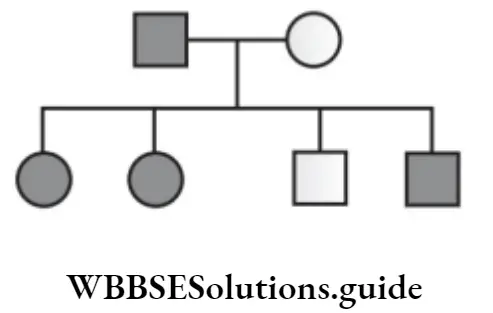
NEET Biology Pedigree Analysis And Genetic Disorders Chart Of A Certain Family

“inheritance and variation mcq “

  1. The female parent is heterozygous
  2. The parents could not have had a normal daughter for this character
  3. The trait under study could not be colour blindness
  4. The male parent is homozygous dominant

Answer: 1. The female parent is heterozygous

The given pedigree chart shows that both the daughters received the gene from the parents, while son may be normal or affected. It shows that the female parent is heterozygous.

Biology MCQ For NEET With Answers

Question 8. Pedigree analysis represents

  1. Still birth
  2. Still death
  3. Still carrier
  4. Still mating

Answer: 1. Still birth

Symbol in pedigree chart represents still birth. It refers to foetal death at or after 20-28 weeks of pregnancy.

Question 9. Identify the symbols given below and the correct option with respect of A, B and C.
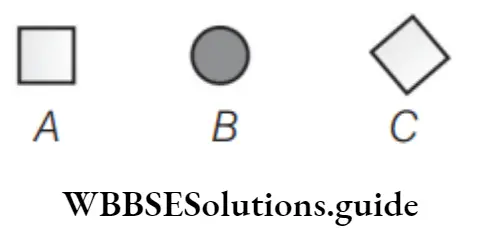
NEET Biology Pedigree Analysis And Genetic Disorders Question 9

  1. A-Male, B-Affected female, C-Sex unspecified
  2. A-Affected male, B-Female, C-Sterile male
  3. A-Male, B-Female, C-Fertile
  4. A- Affected female, B- Sex unspecified, C- Male

Answer: 1. A-Male, B-Affected female, C-Sex unspecified

A–Male, B–Affected female, C–Sex unspecified

Important MCQs on Pedigree Analysis for NEET

Question 10. The given diagram A and B indicates.
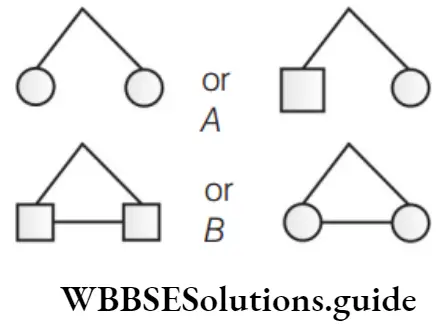
NEET Biology Pedigree Analysis And Genetic Disorders Question 10

  1. A-Zygotic twins, B-Dizygotic twins
  2. A-Dizygotic twins, B-Identical twins
  3. A-Zygotic twins, B-Identical twins
  4. A-bizygotic twins, B-Dizygotic twins

Answer:  2. A-Dizygotic twins, B-Identical twins

“pedigree questions “

  • A–Dizygotic twins are twins, which result from the fusion of two sperms with two ova. It is very rare in case of human beings.
  • B–Monozygotic twins (identical twins) are twins, which result from the fusion of one sperm with one ovum leading to zygote formation.
  • This zygote on division, give rise to two or more zygotes. In this, cells of all progenies have the identical genome. Thus, twins are identical.

Question 11. Following pedigree chart show.
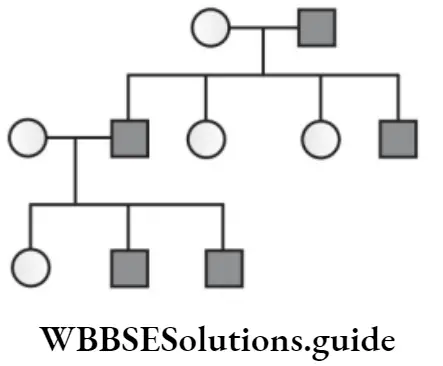
NEET Biology Pedigree Analysis And Genetic Disorders Pedigree Chart Show.

  1. The trait is carried by Y-chromosome
  2. The trait is sex-linked recessive
  3. The trait is sex-linked dominant
  4. The trait is recessive autosomal

Answer: 1. The trait is carried by Y-chromosome

In the given pedigree chart, only males are affected. So, it can be easily inferred that the given trait is connected to Y-chromosome. The genes, which are present on the Y-chromosome are called holoandric genes and express in males only.

Biology MCQ For NEET With Answers

Question 12. Consider the following chart.
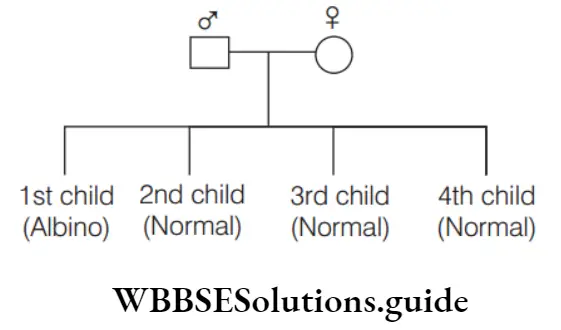
NEET Biology Pedigree Analysis And Genetic Disorders Question 12

The first child of a couple is albino. Whereas, their second, third and fourth children are normal. Given that, A= normal and a = Albino, find the genotype of the mother and father.

Father – Mother

  1. Aa – AA
  2. AA – Aa
  3. AA – AA
  4. Aa – Aa

Answer:  4. Albinism is the recessive trait which occurs only when a homozygous condition is present. In the given cross, the progenies are both albino and normal. This is possible only when their parents are heterozygous for normal colour (Aa).
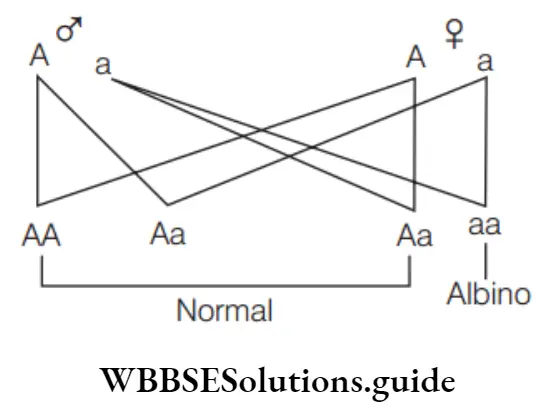
NEET Biology Pedigree Analysis And Genetic Disorders Albinism Is The Recessive Trait

Question 13. Find out the genotype of father and mother in the given pedigree chart.
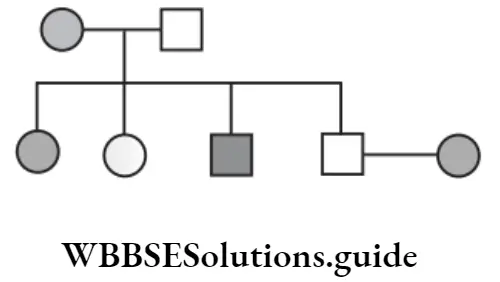
NEET Biology Pedigree Analysis And Genetic Disorders Genotype Of Father And Mother

Mother Father

  1. AA AA
  2. Aa Aa
  3. AA aa
  4. Aa Aa

Answer:  4. aa Aa

The expected genotype of father and mother is Aa and aa, respectively. Since 50% male and female progenies are affected, mother would be homozygous recessive (aa) and father is heterozygous (Aa).

“monohybrid test cross ratio “

Question 14. Following pedigree chart show.
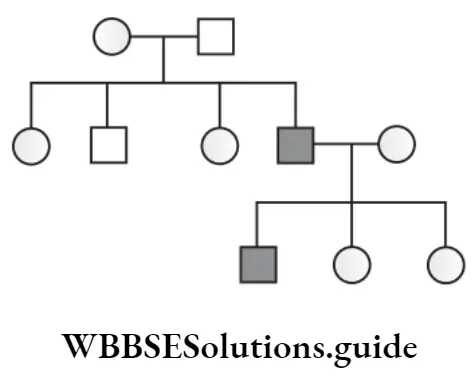
NEET Biology Pedigree Analysis And Genetic Disorders Question 14

  1. Recessive and autosomal
  2. Recessive and sex-linked
  3. Dominant and sex-linked
  4. Dominant and autosomal

Answer:  2. Recessive and sex-linked

Given pedigree analysis indicates the transmission of recessive sex-linked trait from parents to their offspring because only 25% male progenies are affected.

Biology MCQ For NEET With Answers

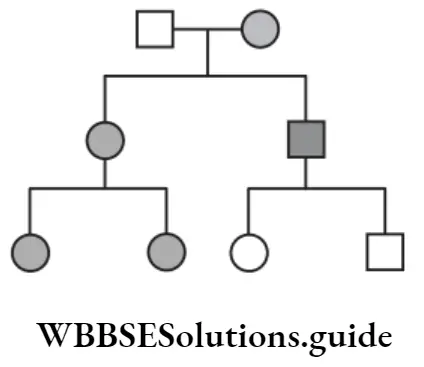
Question 15. Identify the type of inheritance in the given diagram.
NEET Biology Pedigree Analysis And Genetic Disorders Question 15

  1. Dominant X-linked
  2. Recessive X-linked
  3. Dominant Y-linked
  4. Cytoplasmic or mitochondrial inheritance
  5. Both 2 and 3

Answer:  4. Cytoplasmic or mitochondrial inheritance

  • Cytoplasmic or mitochondrial inheritance is the inheritance in which the trait pass only from mother to all of their offspring.
  • The genes of that inheritance present in the cytoplasm of ova that is way these genes go to all of their offspring. As sperm have very less cytoplasm, so this inheritance is not applicable for males.

NEET quiz on Pedigree Analysis and Genetic Disorders with solutions

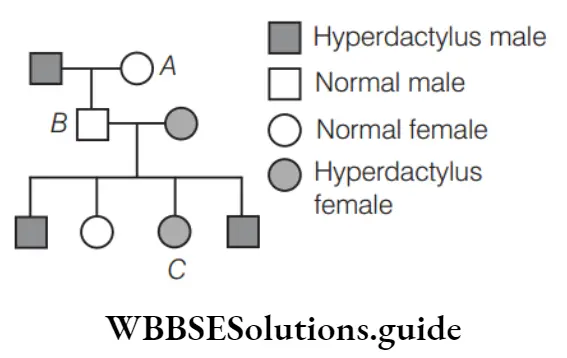
Question 16. Hyperdactyly (the possession of more than 12 finger) is determined by the dominant allele (H) and normal condition by recessive allele (h). Observe the image given below. It represents family tree in which some members of the family are hyperdactylus. Identify A, B and C
NEET Biology Pedigree Analysis And Genetic Disorders Hyperdactyly

Find out the genotype of A, B and C.

  1. A-Hh, B-Hh, C-hh
  2. A-HH, B-Hh, C-hh
  3. A-Hh, B-HH, C-hh
  4. A-HH, B-HH, C-HH

Answer:  1. A-Hh, B-Hh, C-hh

  • Dominant allele shows its effect in homozygous or heterozygous condition and recessive allele shows its effect only in homozygous condition.
  • Given pedigree chart is possible only when the male parent in heterozygous (Hh) for hyperdactyle. If it is homozygous for hyperdactyle then the son would also be the hyperdactyle as well. Thus, option (1) is correct.

Biology MCQs with answers for NEET

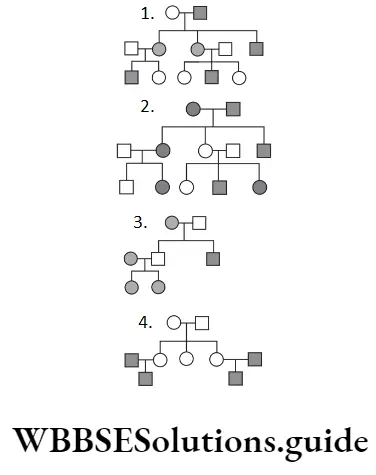
Question 17. In a family, the father carried a trait which the mother did not. All their offspring displayed this trait. Though their daughters married normal males, a few grand-daughters carried this trait. Choose the correct pedigree chart for this condition.
NEET Biology Pedigree Analysis And Genetic Disorders Question 17

Answer: 1. Criss-cross inheritance is a type of sex-linked inheritance where a parent passes the traits to the grand child of the same sex through offspring of the opposite sex.

It appears in opposite sex progeny in subsequent generations. Pedigree chart in option (a) depict this inheritance pattern correctly.

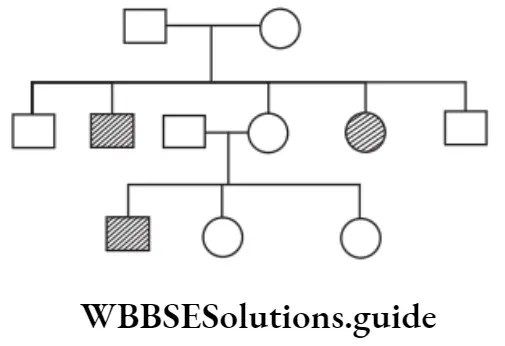
Question 18. Study the pedigree chart given below. What does it show?
NEET Biology Pedigree Analysis And Genetic Disorders Question 18

  1. Inheritance of a condition like phenylketonuria as an autosomal recessive trait
  2. The pedigree chart is wrong as this is not possible
  3. Inheritance of a recessive sex-linked disease like haemophilia
  4. Inheritance of a sex-linked inborn error of metabolism like phenylketonuria

Answer: 1. Inheritance of a condition like phenylketonuria as an autosomal recessive trait

The given chart shows inheritance of an autosomal recessive trait like phenylketonuria.An autosomal recessive trait may skip a generation but it affect both males and females equally. It appears in case of marriage between two heterozygous individuals.

“monohybrid cross ratio “

Question 19. Given below is a pedigree chart of a family with five children. It shows the inheritance of attached ear-lobes as opposed to the free ones. The squares represent the male individuals and circles represents the female individuals.
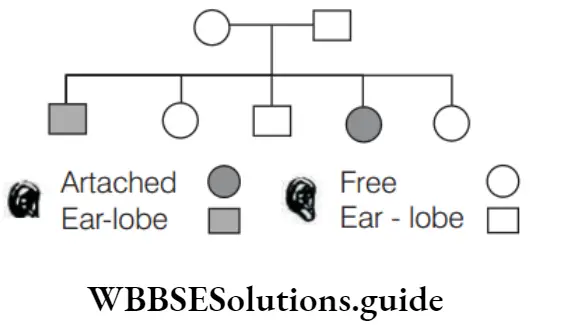
NEET Biology Pedigree Analysis And Genetic Disorders Question 19

Which one of the following conclusions drawn is correct?

  1. The parents are homozygous recessive
  2. The trait is Y-linked
  3. The parents are homozygous dominant
  4. The parents are heterozygous

Answer:  4. The parents are heterozygous

The parents are heterozygous. It is an autosomal inheritance trait. It is controlled by a rare dominant allele say ‘E’ (free ear lobe). Here, the recessive homozygotes which do not have a dominant ‘E’ have attached ear lobes.

Biology MCQs with answers for NEET
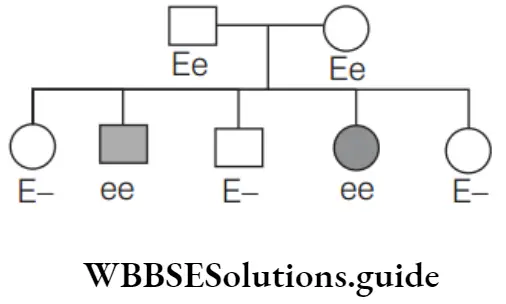
NEET Biology Pedigree Analysis And Genetic Disorders Attached Ear Lobes

Question 20. Given below is a pedigree chart showing the inheritance of a certain sex-linked trait in humans.
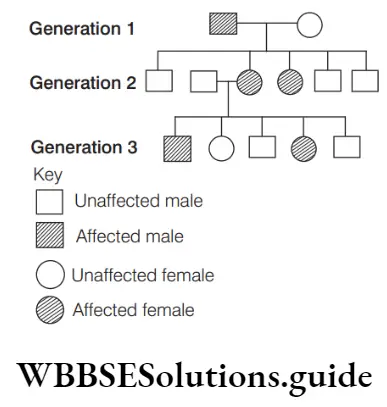
NEET Biology Pedigree Analysis And Genetic Disorders Sex Linked trait In Humans

The trait traced in the above pedigree chart is

  1. Dominant X-linked
  2. Recessive X-linked
  3. Dominant Y-linked
  4. Recessive Y-linked

Answer:  1. Dominant X-linked

  • The trait traced in the given pedigree is dominant X-linked. As seen in the figure, in first generation, male is affected, but female is not affected, i.e. female carries normal chromosomes in heterozygous condition.
  • In second generation, both females are affected, but none of the males are affected. This shows that in spite of carrying single X-linked trait, they are affected, i.e. the trait is dominant.
  • Likewise in the third generation when X-linked traits are again crossed with normal male, then, both male and female offspring carrying single Xlinked trait are affected. Thus, we can say that the trait is dominant X-linked.

Question 21. Assertion (A) In a pedigree analysis, represents five unaffected offspring. Reason (R) In pedigree analysis, the offspring are numbered with Arabic numerals (1, 2, 3 …..) and a generation is numbered with roman numerals (I, II, III ….).

  1. Both A and R are true and R is the correct explanation of A
  2. Both A and R are true, but R is not the correct explanation of A
  3. A is true, but R false
  4. Both A and R are false

Answer:  2. Both A and R are true, but R is not the correct explanation of A

Biology MCQs with answers for NEET

Both A and R are true, but R is not the correct explanation of A. In pedigree analysis, unaffected offspring are represented as non-shaded circle, square or diamond, representing the gender of progeny. The number of progenies are written in Arabic numerals within the gender symbol.

Question 22. Match the following columns.
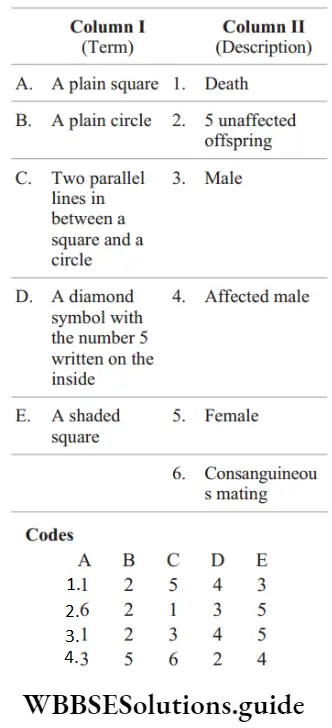
NEET Biology Pedigree Analysis And Genetic Disorders Match The Following Column Question 22

“monohybrid ratio “

Answer:  4. A–3, B–5, C–6, D–2, E–4

Question 23. Which of the following is true for a recessive disease in family A and B?
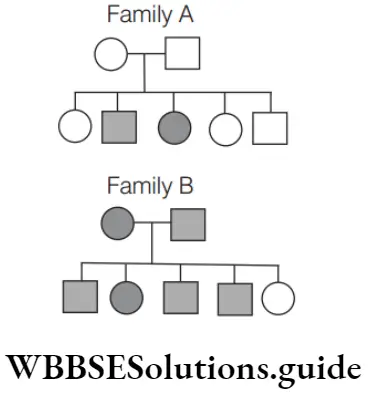
NEET Biology Pedigree Analysis And Genetic Disorders Question 23

  1. In family A, both the parents are homozygous recessive
  2. In family B, both the parents are homozygous dominant
  3. In family B, both the parents are heterozygous recessive
  4. In family A, both the parents are heterozygous recessive

Answer:  4. In family A, both the parents are heterozygous recessive

  • Option (4) is true whereas option (1), (2) and (3) are incorrect. Incorrect options can be corrected as In family A, if both the parents are homozygous recessive, then both should be diseased and should have 100% diseased progeny.
  • In family B, if both parents are homozygous dominant, they would not have got the recessive disease in first place. If both are heterozygous recessive, then also they would not have got the disease, neither 80% of progeny would be diseased.

Question 24. In the following human pedigree, the filled symbols represent the affected individuals. Identify the type of given pedigree.
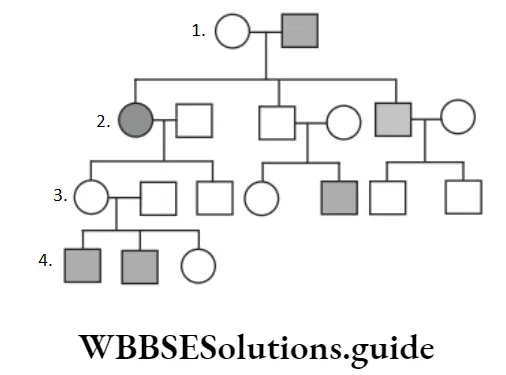
NEET Biology Pedigree Analysis And Genetic Disorders Question 24

  1. Autosomal recessive
  2. Autosomal dominant
  3. X-linked dominant
  4. X-linked recessive

Answer: 1. Autosomal recessive

Autosomal recessive traits are the traits which are caused by recessive autosomal genes when present in homozygous condition. The given pedigree can be explained as follows.
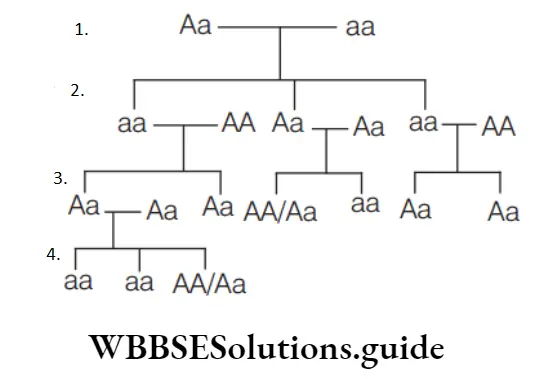
NEET Biology Pedigree Analysis And Genetic Disorders Autosomal Genes

As the trait appears only in homozygous recessive individuals (aa), therefore it is an autosomal recessive trait.

Question 25. Which one is the incorrect statement with regard to the importance of pedigree analysis?

  1. It helps to trace the inheritance of a specific trait
  2. It confirms that DNA is the carrier of genetic information
  3. It helps to understand whether the trait in question is dominant or recessive
  4. It confirms that the trait is linked to one of the autosome

Answer:  2. It confirms that DNA is the carrier of genetic information

  • Statement in option (2) is incorrect and can be corrected as Pedigree is a chart showing the record of inheritance of certain genetic traits for two or more ancestral generations of an individual, abnormality or disease.
  • It does not confirm that DNA is the carrier of genetic information. Rest statements are correct with regard to the importance of pedigree analysis.

Biology MCQs with answers for NEET

Question 26. The process of mating between closely related individuals is

  1. Self breeding
  2. Inbreeding
  3. Hybridisation
  4. Heterosis

Answer:  2. Inbreeding

Inbreeding is the process of mating between closely related individuals. It leads to the expression of recessive characters, most of which are harmful.

Question 27. The square, blackened shape and horizontal lines in pedigree analysis represents

  1. Female, healthy individual, parents
  2. Female, affected individual, parents
  3. Male, affected individual, parents
  4. Male, affected individual, progeny

Answer:  3. Male, affected individual, parents

In pedigree, square represents male, blackened square or circle represents affected individual. Horizontal line represents parents.
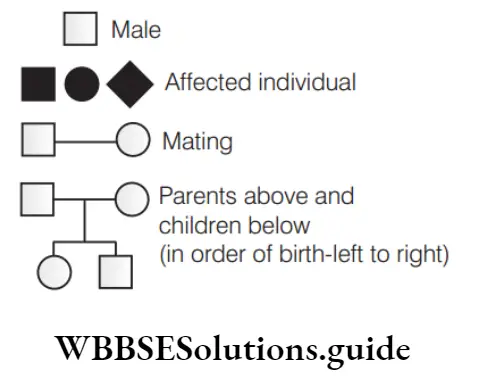
NEET Biology Pedigree Analysis And Genetic Disorders Question 27

Question 28. Double lines in pedigree analysis show

  1. Unaffected offspring
  2. Sex unspecified
  3. Normal mating
  4. Consanguineous marriage

Answer:  4. Consanguineous marriage

Double lines in pedigree analysis represent mating between relatives, i.e. consanguineous mating. Normal mating is shown by single line. Unaffected offspring are depicted by open and clear symbols (i.e. for male and O for female).

Question 29. Eugenics is defined as

  1. The study of diseases resulting from environmental cause
  2. The study of congenital defects in man
  3. The study of human genetics from the point of view of the improvement of the genetic composition of the human stock during gestation or birth
  4. The diseases caused by consanguinity

Answer:  3. The study of human genetics from the point of view of the improvement of the genetic composition of the human stock during gestation or birth

Eugenics is the study of human genetics from the point of view of the improvement of the genetic composition of the human stock during gestation or birth.

Biology MCQs with answers for NEET

Question 30. The term ‘eugenics’ was given by Francis Galton and inborn errors of metabolism were studied by

  1. Galton
  2. Garrod
  3. Barr
  4. Both 1 and 2

Answer:  2. Garrod

The term inborn errors of metabolism were coined by a British physician, Archibald Garrod (1857– 1936), in 1908. He is known for work that prefigured the ‘one gene-one enzyme’ hypothesis, based on his studies on the nature and inheritance of alkaptonuria.

NEET expected MCQs on Pedigree Analysis 2025

Question 31. A heterozygous individual carrying recessive sex-linked gene is called

  1. Carrier
  2. Crossing over
  3. Transmitter
  4. Albino

Answer: 1. Carrier

An individual with one abnormal gene (but no symptoms) is called a carrier. A heterozygous individual carrying recessive sex-linked genes is called carrier.

Question 32. A hereditary disease which is never passed on from father to son is

  1. Autosomal linked disease
  2. X-chromosomal linked disease
  3. Y-chromosomal linked disease
  4. None of the above

Answer:  2. X-chromosomal linked disease

X-chromosome linked diseases can never be passed on from father to son because the X-chromosome of the father can only be transferred to daughter and Y-chromosome is only passed on to the son.

Question 33. Y-linked recessive gene is transferred from

  1. Father to son
  2. Mother to son
  3. Father to daughter
  4. Mother to daughter

Answer: 1. Father to son

Because only males have a Y-chromosome, in Y-linked inheritance, a mutation can only be passed from father to son.

Question 34. Mendelian disorder may be of

  1. Recessive
  2. Dominant
  3. Both 1 and 2
  4. Cannot be determined

Answer: 3. Both 1 and 2

Mendelian disorder may be dominant or recessive type, e.g. haemophilia, colour blindness, sickle cell anaemia, cystic fibrosis, phenylketonuria, thalassaemia. Thus, option (4) is correct.

Question 35. Sex linked disorder is

  1. Colour blindness
  2. Tuberculosis
  3. Diphtheria
  4. Leprosy

Answer: 1. Colour blindness

Colour blindness is a recessive sex-linked trait in which the eye fails to distinguish red and green colours. The gene for the normal vision is dominant.

Question 36. Which are sex-linked traits?

  1. Osteomalacia
  2. Dental disorders
  3. Pellagra
  4. Haemophilia and hypertrichosis

Answer:  4. Haemophilia and hypertrichosis

NEET Biology Mcq

Sex-linked traits are the traits whose determining genes are found on the sex chromosomes. All the sex-linked traits present on a sex chromosome are inherited together. For example, haemophilia and hypertrichosis are sex-linked traits.

Question 37. Identify a Mendelian disorder from the following.

  1. Down’s syndrome
  2. Turner’s syndrome
  3. Phenylketonuria
  4. Klinefelter’s syndrome

Answer:  3. Phenylketonuria

The pattern of inheritance of Mendelian disorders can be traced in a family by the pedigree analysis. Some common Mendelian or gene related human disorders are phenylketonuria, alkaptonuria, albinism, sickle cell anaemia and cystic fibrosis, etc.

Question 38. Which of these is not a Mendelian disorder?

  1. Down’s syndrome
  2. Sickle-cell anaemia
  3. Colour blindness
  4. Haemophilia

Answer: 1. Down’s syndrome

  • Mendelian disorders are determined by mutations in single genes. They are transmitted to the offspring as per Mendelian principles.
  • The pattern of inheritance of such Mendelian disorders can be traced in a family by the pedigree analysis. Down’s syndrome is chromosomal not Mendelian disorder.

Question 39. Identify a non-hereditary disease from the following.

  1. Thalassemia
  2. Haemophilia
  3. Cystic fibrosis
  4. Cretinism

Answer:  4. Cretinism

Cretinism is a congenital deficiency of thyroid hormone. It is a non-hereditary disease.

Question 40. A man and a woman, who do not show any apparent signs of a certain inherited disease, have seven children (2 daughters and 5 sons). Three of the sons suffer from the given disease but none of the daughters affected. Which of the following mode of inheritance do you suggest for this disease?

  1. Sex-linked dominant
  2. Sex-linked recessive
  3. Sex-limited recessive
  4. Autosomal dominant

Answer:  2. Sex-linked recessive

Traits governed by sex-linked recessive genes produce disorders in males more often than in females or express themselves in males even when represented by a single allele because Y-chromosome does not carry any corresponding alleles.

NEET Biology Mcq

Question 41. Huntington’s chorea is

  1. Recessive mutation associated with chromosome 14
  2. Dominant mutation associated with chromosome 4
  3. Recessive mutation associated with chromosome X
  4. Sex-linked disease

Answer:  2. Dominant mutation associated with chromosome 4

Huntington’s chorea is a progressive brain disorder caused by a single defective gene on chromosome-4. This defect is dominant as anyone who inherit it from a parent will develop the disease.

Its symptoms include difficulty in concentrating, memory lapses, depression, mood swings, etc.

Question 42. The traits which are expressed in only a particular sex though their genes occurs in the opposite sex too are known as

  1. Sex-linked trait
  2. Sex influenced trait
  3. Sex-limited traits
  4. None of the above

Answer:  3. Sex-limited traits

  • Sex-limited traits are genes that are present in both sexes of sexually reproducing species but are expressed in only one sex and remain ‘turned off’ in the other.
  • In other words, sex limited genes cause the two sexes to show different traits or phenotypes, despite having the same genotype.

Question 43. The recessive genes located on X chromosome in humans are always

  1. Lethal
  2. Expressed in males
  3. Sublethal
  4. Expressed in females

Answer:  2. Expressed in males

X-linked recessive genes are expressed in females only if there are two copies of the gene (one on each X-chromosome). However, for males, there needs to be only one copy of an X-linked recessive gene in order for the trait or disorder to be expressed. Thus, these are always expressed in males.

Question 44. A diseased man marries a normal woman. They give birth to three daughters and five sons. All the daughters were diseased and sons were normal. The gene of this disease is’

  1. Sex-linked dominant
  2. Sex-linked recessive
  3. Sex-limited character
  4. Autosomal dominant

Answer:  1. Sex-linked dominant

Since only daughters are affected, the disease is X-linked. Daughters get one copy of affected X chromosome from father and other normal copy from mother. The trait is expressed in daughter in heterozygous condition, therefore it is a dominant trait. Thus, the gene of this disease is sex-linked dominant.

NEET Biology Mcq
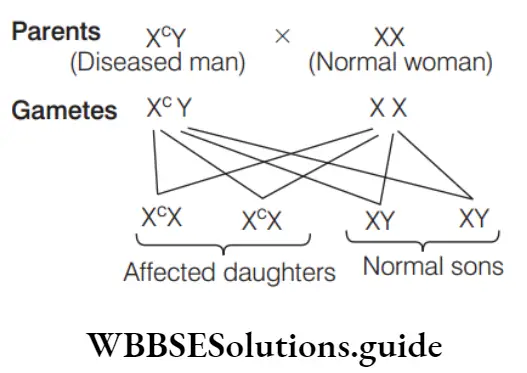
NEET Biology Pedigree Analysis And Genetic Disorders Question 44

Question 45. Abnormal gene is replaced by normal gene by

  1. Gene therapy
  2. Mutation
  3. Cloning
  4. None of these

Answer:  1. Gene therapy

  • If a child or an embryo (foetus) is diagnosed to carry a defective gene leading to disability, this defect can be corrected by replacement of defective gene with a normal gene.
  • It is done by correcting the defective gene through gene targeting or by gene augmentation either through increasing the number of copies of the gene or through a higher level of expression of the introduced gene. Such a correction of genetic defect is described as gene therapy.

Question 46. Which one of the following techniques is employed in human genetic counselling?

  1. Serological technique
  2. Polyploidy
  3. Pedigree analysis
  4. Genetic engineering
  5. Amniocentesis

Answer:  3. Pedigree analysis

Pedigree analysis is the techniques which is employed in human genetic counselling because it shows the phenotypes and family relationships of the individuals through charts of family histories.

Question 47. Which of the following is an inherited disorder?

  1. Leprosy
  2. Goitre
  3. AIDS
  4. Albinism
  5. Parkinson’s disease

Answer:  4. Albinism

Out of the given options, only albinism is an inherited disorder. Albinism is the recessive trait which occurs only when a homozygous condition is present.

Question 48. Carrier of genes of colour blindness are present in

  1. Father
  2. Mother
  3. Father and mother
  4. None of the above

Answer:  2. Mother

Colourblindness is a X-linked recessive trait. A man possesses only one gene for colour vision, whereas woman possesses two. Therefore,
only mother will be a carrier when she has gene for colour blindness in one X-chromosome.

NEET Biology Mcq Chapter Wise

Question 49. A marriage between normal visioned man and colourblind woman will produce

  1. Colourblind sons and 50% carrier daughters
  2. 50% colourblind sons and 50% carrier daughters
  3. Normal sons and carrier daughters
  4. Colourblind sons and carrier daughters

Answer:  4. Colourblind sons and carrier daughters

  • Colour blindness is the inability of certain human beings to distinguish red from green colour. It is produced by a recessive gene which lies on X chromosome.
  • A marriage between a normal visioned man (XY) and colourblind woman (Xc cX ) results in
    colourblind sons (XcY) and carrier daughters (XXc).
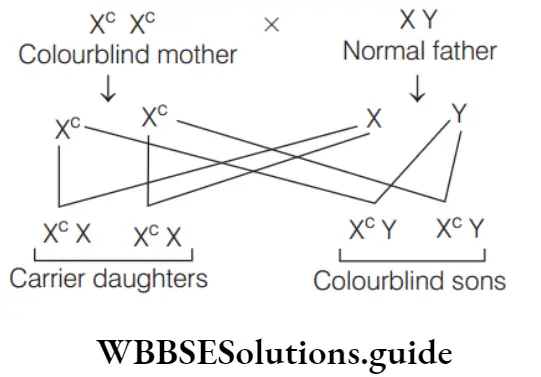
NEET Biology Pedigree Analysis And Genetic Disorders Question 49

Question 50. Which is true for colour blindness?

  1. It is a sex-linked disorder
  2. A person is not able to recognise red and green
  3. The person lacks red and green pigments differentiating cells in eyes
  4. All of the above

Answer:  4. All of the above

All the given statements are true for colour blindness. Thus, option (d) is correct.

Question 51. A person whose father is colourblind marries a lady whose mother is a daughter of a colourblind man. Their children will be

  1. All sons colourblind
  2. Some sons normal and some colourblind
  3. All colourblind
  4. All daughters normal

Answer:  4. All daughters normal

To solve the given quesiton, genotype of different individuals is needed to be predicted in steps. To find out the genotype of person, whose father is colurblind.

XCY × XX

Offspinings XCX, XCX, XY, XY

As all sons will be normal, therefore the genotype of the person will be XY. ….

To find out the genotype of lady whose mother is a daughter of colourblind man

XCY × XX

XCX, XCX, XY, XY

So, the mother of lady would be carrier, having genotype XCX … Performing cross between to find out lady’s genotype.

XX × XCY

XCX, XX, XCY, XY

As 50% daughters are carrier and 50% daughters are normal. So, the lady can be normal or carrier having genotype XX, XCX, respectively. …

Now considering both the genotypes of the lady and the genotype of the person, the result would be as follows

XY × XCX

XCX, XY, XY, XCY, XY × XX

XX,XX, XY , XY

Above cases show that if, mother (lady) is carrier then option (1) and (3) are not true. Option (2) is true and option (4) stating all daughters normal (though phenotypically) is also true. If mother is normal then options (1), (2) and (3) are not true and option (4) is true. So, from both the cases, it is concluded that option (4) is true.

NEET Biology Mcq Chapter Wise

Question 52. More men suffer from colour blindness than women because

  1. Women are more resistant
  2. Male sex hormone, testosterone causes the disease
  3. The colourblind gene is carried by Y-chromosome
  4. Men are hemizygous and one defective gene is enough to cause colour blindness

Answer:  4. Men are hemizygous and one defective gene is enough to cause colour blindness

  • More men suffer from colour blindness than women because men are hemizygous and one defective gene is enough to cause colour blindness.
  • Also colourblindness is a sex-linked recessive disease. The recessive genes located on X-chromosome of humans are always expressed in males.

Question 53. If a colourblind woman marries a normal visioned man, their sons will

  1. All be colourblind
  2. All be normal visioned
  3. Be one-half colourblind and one-half normal
  4. Be three-fourths colourblind and one-fourth normal

Answer: 1. All be colourblind

A marriage between normal visioned man (XY) and colourblind woman (XCXC), results in colour blind sons (XcY) and carrier daughters (XXc). Thus, all sons will be colourblind.

Question 54. A woman with normal vision, but whose father was colourblind, marries a colourblind man. Suppose that the fourth child of this couple was a boy. This boy

  1. May be colourblind or may be of normal vision
  2. Must be colourblind
  3. Must have normal colour vision
  4. Will be partially colourblind since he is heterozygous for the colourblind mutant allele

Answer:  1. May be colourblind or may be of normal vision

Colour blindness is a recessive sex-linked trait. Since the woman’s father was colourblind. She should be carrier of the colourblind gene (X cX). When she marries to colourblind man their progeny could be as given below
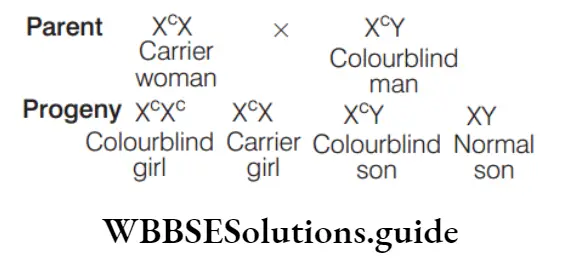
NEET Biology Pedigree Analysis And Genetic Disorders Question 54

Thus, the boy progeny of this couple may be colourblind or normal visioned.

Question 55. A normal woman, whose father was colourblind is married a normal man. The sons would be

  1. 75% colourblind
  2. 50% colourblind
  3. All normal
  4. All colourblind

Answer:  2. 50% colourblind

Woman whose father is colourblind would have genotype XcX. So, woman is carrier. She marries a normal man, then progeny are
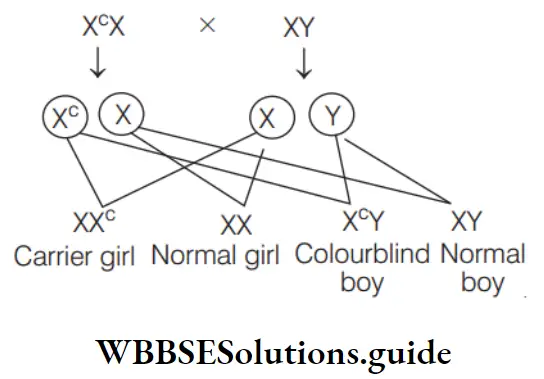
NEET Biology Pedigree Analysis And Genetic Disorders Question 55

Thus, 50% colourblind sons would born.

Question 56. If all the sons of a couple are colourblind then

  1. Mother is homozygous colourblind
  2. Mother is homozygous and father is normal
  3. Mother is homozygous and father is colourblind
  4. Mother is normal and father is colourblind

Answer:  1. Mother is homozygous colourblind

Whenever mother is homozygous colourblind, all her sons will be colourblind irrespective of their father’s genotype.
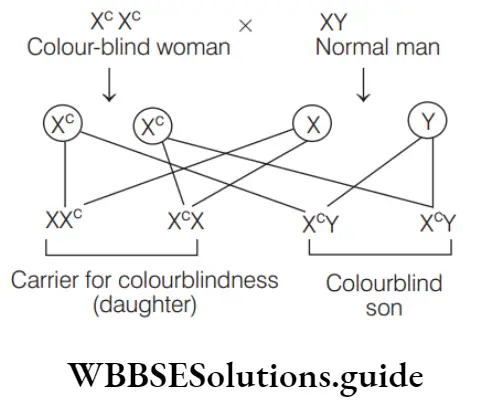
NEET Biology Pedigree Analysis And Genetic Disorders Question 56

So, option (1) is correct.

NEET Biology Mcq Chapter Wise

Question 57. A child’s father is colourblind and mother has also a gene for the same. The probability of the girls to be colourblind is

  1. 100%
  2. 50%
  3. 25%
  4. 75%

Answer:  2. 50%

If the mother carries the gene but is not colourblind (X XC ) and father is colourblind (X YC ) then, there is a 50% chance that their sons and daughter will be colourblind.

Question 58. Both husband and wife have normal vision though their fathers were colourblind. The probability of their daughter becoming colourblind is

  1. 0%
  2. 25%
  3. 50%
  4. 75%

Answer:  1. 0%

The probability of the daughter becoming colourblind arises only when the father is also colourblind. Husband-XY, Wife – XXC (wife is carrier because her father is colourblind and husband is normal).
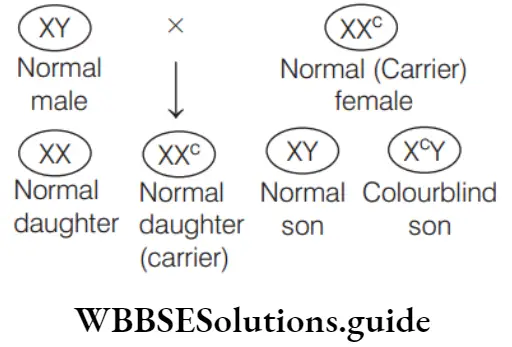
NEET Biology Pedigree Analysis And Genetic Disorders Question 58

So, probability of their daughter becoming colourblind is 0%.

Question 59. I. Haemophilia

  1. Cystic fibrosis
  2. Sickle-cell anaemia
  3. Colour blindness
  4. Cancer
  5. Plague
  6. Phenylketonuria
  7. Down’s syndrome

Choose the correct options for Mendelian disorders.

  1. 1, 2, 3, 4, 6, 8
  2. 1, 2, 3, 4, 7
  3. 1, 2, 3, 4, 5, 6
  4. 1, 2, 3, 4, 5, 8

Answer:  2. 1, 2, 3, 4, 7

  • Option (2) is correct. Genetic disorder mainly caused due to alternation and mutation in a single gene.
  • These genes are transmitted to offspring by the principle of inheritance. Mendelian disorders can be dominant or recessive, e.g. haemophilia, colour blindness, sickle-cell anaemia, cystic fibrosis, phenylketonuria, thalassaemia. Rest other diseases do not represent Mendelian disorder.

Question 60. A colourblind man, whose parents had normal vision and whose paternal and maternal grandparents had normal vision, probably inherited the gene for colour blindness from his

  1. Maternal or paternal grandmother
  2. Maternal or paternal father
  3. Father
  4. Mother

Answer:  4. Mother

A male always carries X- chromosome from his mother. Thus, if a male is colourblind, this gene is inherited from his mother only.

NEET Biology Mcq Chapter Wise

Question 61. The cure for night blindness is administration of vitamin …p… medicines but colour blindness is not curable because it is a …q… disease. Identify p and q.

  1. p-A, q-genetic
  2. p-B, q-autosomal
  3. p-C, q-non-genetic
  4. p-D, q-genetic

Answer:  1. p-A, q-genetic

Question 62. A colourblind man marries the daughter of another colourblind man whose wife has a normal genotype for colour vision. In their progeny

  1. All the children would be colourblind
  2. All their sons are colourblind
  3. None of the daughters would be colourblind
  4. Half of their sons and half of their daughters would be colourblind

Answer:  4. Half of their sons and half of their daughters would be colourblind

Colour blindness is a X-linked recessive disorder. It shows criss-cross inheritance. A colourblind man has a genotype XcY. He married daughter of a colourblind man (XCY) and a normal woman (XX), thus his wife should have XCX genotype. The genotypes of their children can be worked out as follows
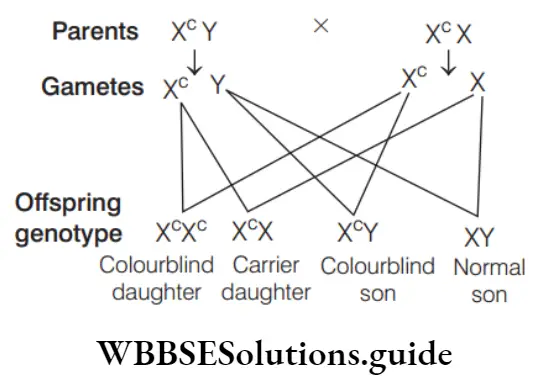
NEET Biology Pedigree Analysis And Genetic Disorders Question 62

Thus, 50% of their sons and 50% of their daughters would be colourblind.

Question 63. If daughter of colourblind marries another colourblind then possibility of their first daughter to be colourblind is

  1. 50%
  2. 25%
  3. 7%
  4. None of these

Answer:  1. 50%

  • Daughter of a colourblind person will be a carrier of the disease and only one of the two X-chromosomes will bear the recessive gene for the disease (X Xc ).
  • If she marries another colourblind man (X Y)c then the possibility of first daughter to be colourblind is 50%.

Question 64. A colourblind man marries a woman with normal sight who has no history of colour blindness in her family. What is the probability of their grandson being colourblind?

  1. Nil
  2. 0.25
  3. 0.5
  4. 1

Answer: 3. 0.5

When a colourblind man (XCY) marries a normal woman (XX), all of their daughters are carriers and all of their sons are normal, as shown in following cross.
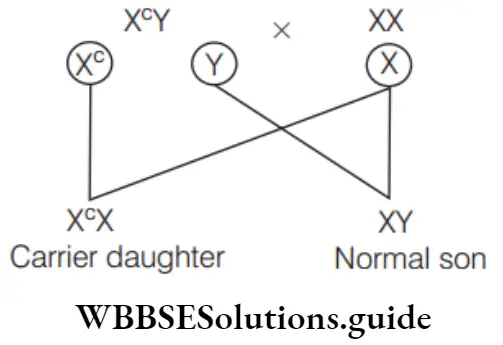
NEET Biology Pedigree Analysis And Genetic Disorders Colourblind Man Marries

When the carrier daughter (XXC) is married to a normal man, the probability of their son being colourblind is 0.25, as shown in following cross.
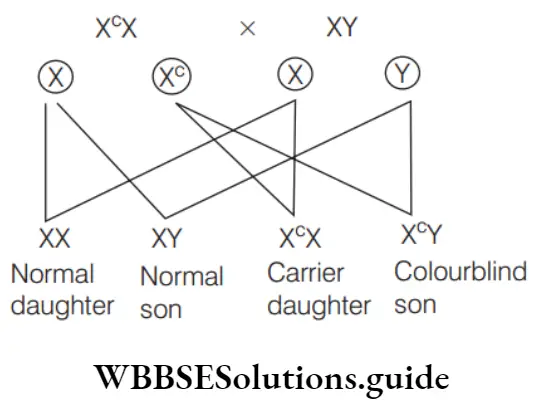
NEET Biology Pedigree Analysis And Genetic Disorders Carrier Daughter Married

From above crosses, it is clear that the probability of occurrence of colour blindness in the grandson of a colourblind man and a normal woman is 0.5.

Question 65. Proportion of colourblind children when normal man marries to carrier woman is

  1. 25%
  2. 50%
  3. 75%
  4. 100%

Answer: 1. 25%

When a normal man (XY) marries a carrier woman (XCX) for colour blindness, then 25% of progeny would be colourblind.

Question 66. A normal-visioned man whose father was colourblind, marries a woman whose father was also colourblind. They have their first child as a daughter. What are the chances that this child would be colourblind?

  1. 100%
  2. 0 %
  3. 25%
  4. 50 %

Answer:  2. 0 %

If a normal-visioned man marries a woman whose father was also colourblind, then his wife would be carrier of this disease (if her mother was normal).

This trait is passed to children but daughters produced by this couple are carrier not the colourblind.
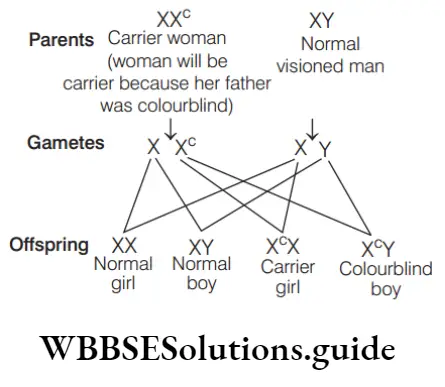
NEET Biology Pedigree Analysis And Genetic Disorders Question 66

Thus, 0% daughters are colourblind.

Question 67. Red-green colour blindness in humans is governed by a sex-linked recessive gene. A normal woman whose father was colourblind marries a colourblind man. What proportion of their daughters is expected to be colourblind?

  1. 3/4
  2. 1/2
  3. 1/4
  4. All

Answer:  2. 1/2

Normal woman whose father was colourblind would be a carrier (XCX). She married a colourblind man (XCY) and thus, half (1/2) of their daughters are expected to be colourblind.

Question 68. In colour blindness, a person fails to differentiate between

  1. Red and blue
  2. Red and green
  3. Red and black
  4. Red and white

Answer:  2. Red and green

Red and green colour blindness results in defect in either red or/and green cone cells of eye, resulting in failure to discriminate between red and green colour.

Question 69. Of both normal parents, the chance of a male child becoming colourblind are

  1. Nil
  2. Possible only when all the four grandparents had normal vision
  3. Possible only when father’s mother was colourblind
  4. Possible only when mother’s father was colourblind

Answer:  4. Possible only when mother’s father was colourblind

On crossing carrier colourblind woman with a normal man, the sons become colourblind. This is an example of criss-cross inheritance. The genes for colour blindness is inherited from mother’s father.

Question 70. A colourblind son will be born when

  1. Mother is carrier and father is normal
  2. Mother is colourblind and father is normal
  3. Mother is carrier and father is colourblind
  4. All the cases are correct

Answer:  4. All the cases are correct

A colourblind son will be born to a carrier mother and a colourblind mother irrespective of father being colourblind or not. A carrier mother is a normal female who carries recessive allele for colour blindness in heterozygous state. Thus, option (d) is correct.

Question 71. Anish is having colourblindness and married to Sheela, who is not colourblind. What is the chance that their son will have the disease?

  1. 100%
  2. 50%
  3. 25%
  4. 0%

Answer: 2 & 4 50% & 0%

If Sheela (mother) is a carrier then chances of having colourblind son are 50%. If Sheela is normal then chances of their son being colourblind are 0%. It can be represented as follows
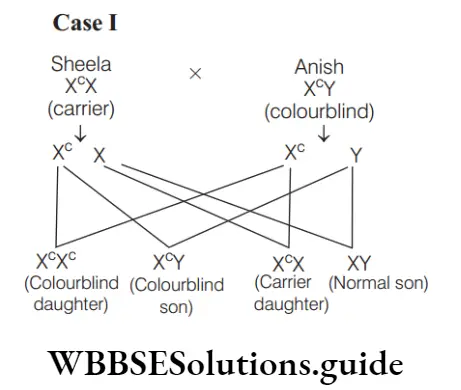
NEET Biology Pedigree Analysis And Genetic Disorders Colour Blind Case 1

Thus, there are 50% chances of their son being colourblind.
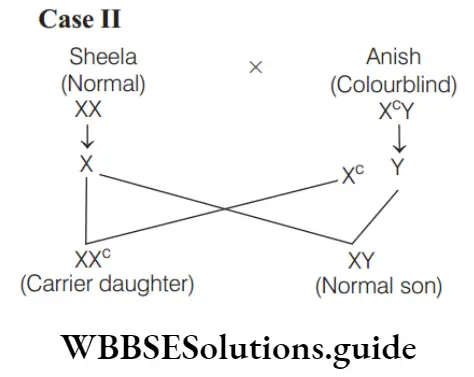
NEET Biology Pedigree Analysis And Genetic Disorders Colourblind Case 2

Thus, there are 0% chances of their son being colourblind. Thus, both options (b) and (d) are correct.

Question 72. Colour blindness, in which all the colours are perceived as grey, is termed as

  1. Monochromasia
  2. Chromasia
  3. Dichromasia
  4. All of these

Answer:  1. Monochromasia

  • Colour blindness is the inability of certain human beings to distinguish between colours. It is produced by an X-linked recessive gene by causing lack of one of the primary cone pigments of the retina.
  • Colour blindness, in which all colours are perceived as grey, is termed monochromasia. The person suffering from this disease is completely colourblind.

Question 73. If both parents of a male child are normal, what are the chances of the child being colourblind?

  1. It is impossible
  2. It is possible only if father’s mother was colourblind
  3. It is possible only if mother’s father was colourblind
  4. It is possible even when all the four grandparents had normal vision

Answer:  3. It is possible only if mother’s father was colourblind

  • In this problem, an X-linked recessive allele is passed from an affected male, to a daughter who is a heterozygous carrier and subsequently to an affected grandson.
  • Thus in given case, maternal father is likely to be colourblind. Such criss-cross trait is called as diagynic trait.

Question 74. If a colourblind man marries a woman who is homozygous for normal colour vision, the probability of their son being colourblind is

  1. 0
  2. 0.5
  3. 0.75
  4. 1

Answer: 1. 0

If a colourblind man marries a woman who is homozygous for normal colour vision, the probalility of their son being colourblind is zero.

Question 75. X h is the chromosome with gene for haemophilia and X is the chromosome with normal gene. Which of the following individuals will act as carrier for haemophilia?

  1. Xh Y
  2. XY
  3. Xh Xh
  4. Xh X

Answer:  4. Xh X

Males are never the carrier of sex-linked recessive traits, e.g. haemophilia Heterozygous female for this condition (e.g. X X)h acts as carrier. XY is normal male. X Xh h and X h Y are haemophilic.

Question 76. Haemophilic man marries a normal woman. Their offsprings will be

  1. All haemophilic
  2. All boys haemophilic
  3. All girls haemophilic
  4. All normal

Answer:  4. All normal

  • Haemophilia is a defect of blood which prevents its clotting. It is caused by a recessive gene located in the X-chromosome.
  • When a haemophilic man (X h Y) marries a normal woman (XX), they would produce carrier girls (XX h ) and normal boys (XY), i.e. all their offspring will be normal.
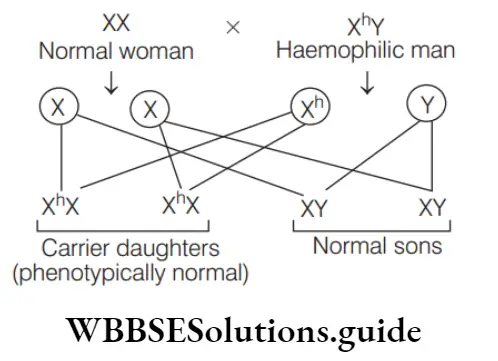
NEET Biology Pedigree Analysis And Genetic Disorders X Chromosome

Thus, option (4) is correct.

Question 77. The most common type of haemophilia results from the congenital absence of

  1. Factor 2
  2. Factor 5
  3. Factor 8
  4. Factor 11

Answer: 3. Factor 8

  • Haemophilia is a group of inherited blood disorders in which the blood does not clot properly.
  • It is caused by a fault in one of the genes that determine how the body makes blood clotting factor 8 or 9. These genes are located on the X-chromosome 10.

Question 78. A man known to be a victim of haemophilia marries a normal woman whose father was known to be a bleeder. Then it is expected that

  1. All their children will be bleeders
  2. Half of their children will be bleeders
  3. One fourth of their children will be bleeders
  4. None of their children will be bleeder

Answer:  2. Half of their children will be bleeders

Man is haemophilic with genotype XhY. The normal woman whose father was bleeder or diseased, would be a carrier of disease (XhX).
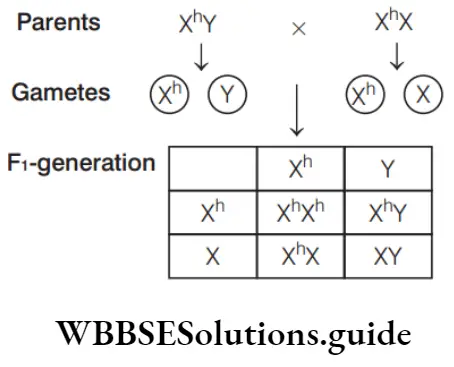
NEET Biology Pedigree Analysis And Genetic Disorders Question 78

Thus, half of their children (50% girls and 50% boys) would be bleeders.

Question 79. Haemophilic female marries a normal male, the theoretical ratio of their offsprings regarding haemophilia will be

  1. All offspring are haemophilic
  2. All girls are haemophilic
  3. All sons are haemophilic
  4. Half daughters and half sons are haemophilic

Answer: 3. all sons are haemophilic

When a haemophilic female (XhXh) marries a normal male (XY), all sons would be haemophilic .
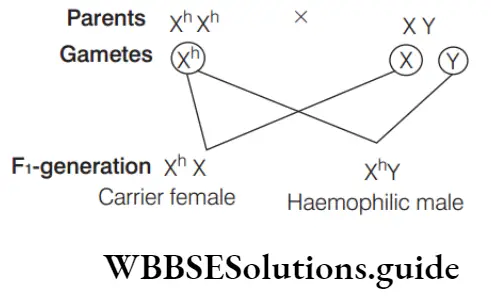
NEET Biology Pedigree Analysis And Genetic Disorders Question 79

Question 80. If a boy’s father has haemophilia and his mother has one gene for haemophilia, what is the chance that the boy will inherit the disease?

  1. 25%
  2. 50%
  3. 75%
  4. 100%

Answer:  2. 50%

The boy’s father is haemophilic and mother is carrier.
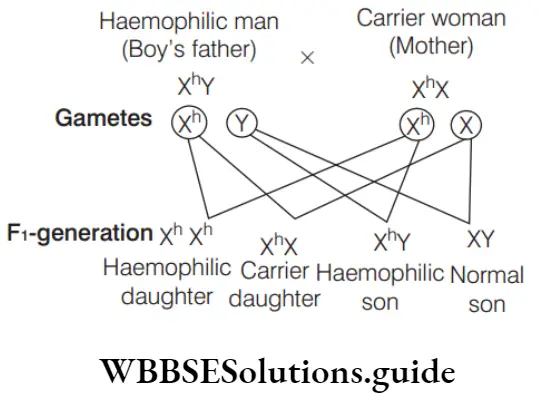
NEET Biology Pedigree Analysis And Genetic Disorders Question 80

Thus, there are 50% chances that boy will inherit the disease.

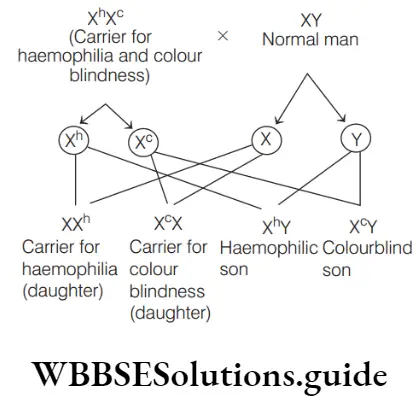
Question 81. A woman carrier with two genes for haemophilia on one X-chromosome and for colour blindness on other X-chromosome marries a normal man. How will the progeny be?

  1. 50% haemophilic colourblind sons and 50% normal sons
  2. 50% haemophilic daughters (carrier) and 50% colourblind daughters (carrier)
  3. All sons haemophilic and colourblind
  4. Haemophilic and colourblind daughters

Answer: 3. All sons haemophilic and colourblind

  • Haemophilia is a defect of blood which prevents its clotting. Colour blindness is the inability of certain human beings to distinguish red from green colour.
  • Both these diseases are produced by a recessive gene which lies on the X-chromosomes. A woman having one gene for haemophilia on one X-chromosome and other gene for colour blindness on another X-chromosome will have genotype X Xh c.
NEET Biology Pedigree Analysis And Genetic Disorders Question 81

Thus, sons would either be colourblind or haemophilic and daughters will be the carriers.

Question 82. Of a normal couple, half the sons are haemophilic, while half the daughters are carriers. The gene is located on

  1. X-chromosome of father
  2. Y-chromosome of father
  3. One X-chromosome of mother
  4. Both the X-chromosomes of mother

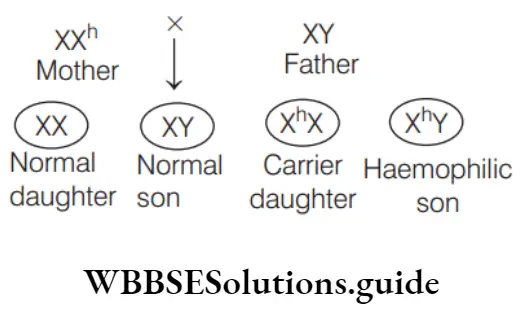
Answer: 3. One X-chromosome of mother

Of a normal couple, half the sons are haemophilic, while half the daughters are carriers. The gene is located on one X-chromosome of mother. Cross between a haemophilic carrier female X h X and normal male would yield 50% of the sons being haemophilic and 50% of the carrier daughters.
NEET Biology Pedigree Analysis And Genetic Disorders Question 82

Question 83. Assertion (A) Haemophilia is a genetically linked disease. Reason (R) It is predominantly found in females.

  1. Both A and R are true and R is the correct explanation of A
  2. Both A and R are true, but R is not the correct explanation of A
  3. A is true, but R is false
  4. Both A and R are false

Answer:  3. A is true, but R is false

  • A is true, but R is false. Reason can be corrected as Haemophilia predominantly occurs in males, since the gene can be passed from mother to son.
  • A single copy of defected gene can cause disease in males. In contrast, woman is affected in the presence of two defected alleles which is a rare phenomena.

Question 84. Which is genetically not possible?

  1. Haemophilic father transfers the haemophilic gene to his son
  2. Haemophilic father transfers the haemophilic gene to his daughter
  3. Carrier mother transfers the haemophilic gene to her son
  4. Carrier mother transfers the haemophilic gene to her daughter

Answer: 1. Haemophilic father transfers the haemophilic gene to his son

  • Statement in option (1) is not possible and can be corrected as Haemophilia is a sex-linked disease. It follows criss-cross inheritance in which father does not pass the sex-linked allele of a trait to his son.
  • The same is passed to the daughter, from where it reaches the grandson, i.e. diagynic. It is because the males have only one X-chromosome which is transferred to the female offspring.

Question 85. Which of the following diseases is also called Christmas disease?

  1. Sickle-cell anaemia
  2. Haemoglobinuria
  3. Myocardial infarction
  4. Haemophilia-B

Answer:  4. Haemophilia-B

Haemophilia-B occurs due to deficiency of factor IX (Christmas factor). The patient may experience prolonged bleeding following any injury or wound and in severe cases there is spontaneous bleeding into muscles and joints.

Question 86. Which of the following most appropriately describes haemophilia?

  1. Recessive gene disorder
  2. X-linked recessive gene disorder
  3. Chromosomal disorder
  4. Dominant gene disorder

Answer:  2. X-linked recessive gene disorder

  • Genes related with haemophilia are always present on X-chromosome and it is a recessive gene disorder as it expresses itself in females when it comes a homozygous condition.
  • It causes a defect in the clotting factor formation, thus a simple cut can bleed continuously leading to even death. Thus, it is also known as ‘Bleeders’ disease or ‘Royal Disease’ as Queen Victoria is a carrier for this disease.

Question 87. One child is haemophilic (sex-linked trait), while its fraternal twin brother is normal. Which one of the following information is most appropriate?

  1. The mother must have been heterozygous
  2. The child is a monozygotic twin
  3. The other child is a female and the father is haemophilic
  4. The haemophilic child is a male

Answer:  1. The mother must have been heterozygous

The mother must have been a heterozygous haemophilic carrier (X h X). One of the twins would have inherited the normal X-chromosome and the other would have received the X-chromosome carrying the gene for haemophilia.

Question 88. Choose the incorrect statement with regard to haemophilia.

  1. It is a recessive disease
  2. It is a dominant disease
  3. A single protein involved in the clotting of blood is affected
  4. It is a sex-linked disease

Answer: 2. It is a dominant disease

Statement in option (2) is not correct. Haemophilia is sex-linked recessive disease. Rest statements are correct with regard to haemophilia.

Question 89. G-6-P dehydrogenase deficiency is associated with haemolysis of

  1. Leucocytes
  2. Lymphocytes
  3. Platelets
  4. RBCs

Answer:  4. RBCs

  • Glucose-6-P dehydrogenase is the first enzyme of glucose oxidation during pentose phosphate pathway.
  • RBC contains haemoglobin which combines with oxygen to form oxyhaemoglobin which gives its oxygen for oxidation of food. In haemolysis, there is destruction of RBCs with release of haemoglobin into plasma resulting in jaundice.
  • Thus, RBCs cannot provide oxygen for oxidation of food thereby, causing deficiency of G-6-P dehydrogenase.

Question 90. A female becomes haemophilic definitely if

  1. Mother is carrier
  2. Father is carrier
  3. Father is affected
  4. Both mother and father affected

Answer:  4. Both mother and father affected

Males and female are definitely haemophilic, if their father and mother, both are haemophilic.

Question 91. A male human is heterozygous for autosomal genes A and B and is also hemizygous for haemophilic gene h. What proportion of his sperms will be abh?

  1. 1/8
  2. 1/32
  3. 1/16
  4. 1/4

Answer:  1. 1/8

Chance of getting ‘a’ = 1/2

Chance of getting ‘b’ = 1/2

Chance of getting ‘h’ = 1/2

Chance of getting sperms with abh

1/2 × 1/2 × 1/2 = 1/8

Question 92. Marriages between close relatives should be avoided because it induces more

  1. Blood group abnormalities
  2. Mutations
  3. Recessive alleles to come together
  4. Multiple births

Answer: 3. Recessive alleles to come together

The risk of a child inheriting two copies of a dangerous recessive allele is elevated in marriages between close relatives as compared to non-related marriages since they have a greater chance of inheriting the same recessive allele from their common ancestors.

Question 93. Haemophilia is a genetic disorder, in which

  1. Blood fails to coagulate after an injury
  2. There is delayed coagulation of blood
  3. Blood clots in blood vessels
  4. Blood cell count falls

Answer: 1. Blood fails to coagulate after an injury

Haemophilia is a defect of blood which prevents its clotting or coagulation after an injury. It is produced by a recessive gene which lies on the X-chromosomes.

Question 94. In which disease, the RBC of a person becomes half moon-shaped?

  1. Haemophilia
  2. Sickle-cell anaemia
  3. Thalassemia
  4. Leukemia

Answer:  2. Sickle-cell anaemia

Sickle-cell anaemia is a biochemical disorder in which shape of RBCs become sickle-shaped or half moon-shaped due to the defective haemoglobin. Haemoglobin becomes useless for oxygen transport.

Question 95. Haemophilia is related to which of the following?

  1. Colour blindness
  2. Polio
  3. Cataract
  4. Tumour

Answer: 1. Colour blindness

Haemophilia and colour blindness are sex-linked (X-linked recessive) disease. Option (a) is correct.

Question 96. Which one is ineffective against antibiotics?

  1. Bacterial infected wound
  2. Bacterial infected throat
  3. Haemophilia
  4. Bacterial infected gonorrhoea

Answer: 3. Haemophilia

Haemophilia is a genetic disease. Therefore, it is not affected by any antibiotics. These are used to treat bacterial diseases.

NEET Biology Genetic Disorders MCQs with explanations

Question 97. The α and β-globin chain is coded by genes located on chromosome number

  1. 16 and 11
  2. 10 and 12
  3. 9 and 8
  4. 15 and 16

Answer: 1. 16 and 11

The genes that encode the alpha (α) globin chains are on chromosome 16. Those that encode the non-alpha or β-globin chains are on chromosome 11.

Question 98. Persons suffering from sickle-cell anaemia normally do not suffer from

  1. Cholera
  2. Malaria
  3. High blood pressure
  4. Hepatitis

Answer:  2. Makaria

  • Sickle-cell anaemia is caused by the formation of an abnormal haemoglobin called haemoglobin-S which differs from normal haemoglobin-A in only one amino acid, i.e. 6th amino acid ofβ-chain.
  • Despite having harmful effect, the allele for sickle-cell anaemia continues to persist in human population because it has survival value in malaria infested areas like tropical Africa.
  • Malarial parasite is unable to survive in abnormal shaped erythrocyte. Thus, persons suffering from sickle-cell anaemia normally do not suffer from malaria.

Question 99. Sickle-cell anaemia, a hereditary disease was first described by

  1. James B Herrick
  2. William Harvey
  3. Carl Landsteiner
  4. J Priestley

Answer: 1. James B Herrick

James Bryan Herrick (1861-1954), an American physician was credited with the description of sickle-cell anaemia (an autosomal hereditary disorder). He was one of the first physicians to describe the symptoms of myocardial infarction.

Question 100. The gene of sickle-cell anaemia is inherited by

  1. Blood cells
  2. Bone cells
  3. Sex chromosomes
  4. Autosomes

Answer:  4. Autosomes

Sickle-cell anaemia is inherited in an autosomal recessive pattern, which means that both copies of the gene in each cell have mutations.

Question 101. Assertion (A) Sickel-cell anaemia is a genetically determined disorder affecting many newborn babies. Reason (R) It is caused by heterozygosity for allele HbS producing a single amino acid substitution in the α-chain of the normal haemoglobin molecule determined by allele Hb A.

  1. Both A and R are true and R is the correct explanation of A
  2. Both A and R are true, but R is not the correct explanation of A
  3. A is true, but R false
  4. Both A and R are false

Answer: 3. A is true, but R false

A is true, but R is false. Reason can be corrected as Sickle-cell anaemia is caused when Hb S allele is present in homozygous condition. It is the resultant of single amino acid substitution in β-chain of haemoglobin.

Question 102. Sickle-cell anaemia results due to mutation caused by

  1. Substitution
  2. Insertion
  3. Deletion
  4. Duplication

Answer: 1. Substitution

  • Sickle-cell anaemia is caused due to inheritance of a defective allele coding for β-globin. It results in the transformation of Hb A into Hb S in which glutamic acid is replaced by valine at sixth position in each of two β -chains of haemoglobin.
  • The substitution of amino acid in the globin protein results due to the single base substitution at the sixth codon of the beta globin gene from GAG (Glu) to GUG (Val). Sickle-cell anaemia is a disease where the red blood cells become sickle-shaped instead of biconcave disc-shape.

Question 103. Genetic or chromosomal symbol used for the person who is having sickle-cell anaemia is

  1. Hb HbS S
  2. Hb Hba a
  3. Hb Hbg g
  4. Hb Hbb b

Answer: 1. Hb HbS S

Genetic or chromosomal symbol used for person who is having sickle-cell anaemia is Hb S Hb S.

Question 104. Both sickle-cell anaemia and Huntington’s chorea are

  1. Congenital disorders
  2. Pollutant-induced disorders
  3. Virus-related diseases
  4. Bacteria-related diseases

Answer: 1. Congenital disorders

  • Sickle-cell anaemia is a biochemical disorder in which shape of RBCs become sickle-shaped due to the defective haemoglobin.
  • Huntington Chorea in a disease in which atrophy of brain occurs resulting to respiratory irregulations, articulation of speech and irregular limb movements take place. They both are genetic disease present in any person since birth hence, called congenital diseases.

Question 105. Sickle-cell anaemia is a case of

  1. Single mutation in a gene on chromosome 10
  2. Pleiotropism
  3. Both 1 and 2
  4. None of the above

Answer:  2. Pleiotropism

Sickle-cell anaemia is a classic example of the mixed benefit given by the staying power of pleiotropic genes, as the mutation to Hb-S provides the fitness benefit of malaria resistance to heterozygotes, while homozygotes have significantly lowered life expectancy.

Question 106. In sickle-cell anaemia, the sequence of amino acids from the first to the seventh position of the β -chain of haemoglobin-S(HbS ) is

  1. His, Leu, Thr, Pro, Glu, Val, Val
  2. Val, His, Leu, Thr, Pro, Glu, Glu
  3. Thr, His, Pro, Val, Pro, Val, Glu
  4. Glu, His, Leu, Pro, Val, Glu, Glu
  5. Val, His, Leu, Thr, Pro, Val, Glu

Answer:  5. Val, His, Leu, Thr, Pro, Val, Glu

The amino acid sequence in person with sickle-cell anaemia is Val, His, Leu, Thr, Pro, Val, Glu.

Question 107. Sickle-cell anaemia is caused due to the substitution of

  1. Valine at the 6th position of beta globin chain by glutamine
  2. Valine at the 6th position of alpha globin chain by glutamic acid
  3. Glycine at the 6th position of alpha globin chain by glutamic acid
  4. Glutamic acid at the 6th position of beta globin chain by valine
  5. None of the above

Answer:  4. Glutamic acid at the 6th position of beta globin chain by valine

Sickle-cell anaemia is the example of point mutation in which the glutamic acid (Glu) is replaced by valine (Val) at the sixth position of β-globin chain of haemoglobin molecule.

Question 108. A marriage between two carriers of sickle-cell anaemic gene will result into

  1. 1 normal and 2 carriers
  2. 1 sickle-cell anaemic
  3. 2 normal and 2 sickle-cell anaemic
  4. Both 1 and 2

Answer:  4. Both 1 and 2

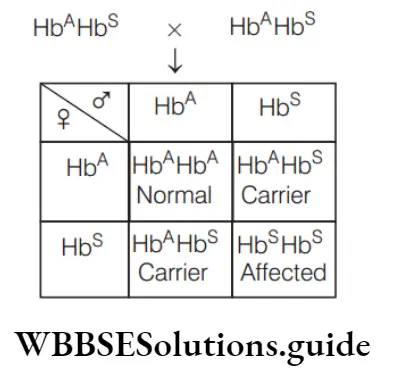
Sickle-cell anaemia occurs when a person inherits two sickle-cell genes, one from each parent. If both partner carry sickle-cell gene, there will be 1 normal, 2 carriers and 1 sickle-cell anaemic progeny.
NEET Biology Pedigree Analysis And Genetic Disorders Question 108

Question 109. Marriage between two sickle-cell carriers results into normal and sickle-cell carrier progenies in the ratio of

  1. 2: 1
  2. 3: 1
  3. I: 2 : 1
  4. 1: 2

Answer:  4. 1: 2

Question 110. A couple, both carriers for the gene sickle-cell anaemia planning to get married, wants to know the chances of having anaemic progeny?

  1. 100%
  2. 75%
  3. 50%
  4. 25%

Answer:  2. 25%

A marriage between two carriers of sickle-cell anaemia will produce normal, carrier and anaemic with progeny in 1: 2: 1 ratio. Out of this 25% are diseased or anaemic, 50% are carrier and 25% are normal.

Question 111. Choose a false statement with reference to sickle-cell anaemia.

  1. Have genotype Hb / HbS S
  2. Have genotype Hb / HbA A
  3. Substitution of glutamic acid to valine
  4. Have sickle shape RBC

Answer: 2. Have genotype Hb / HbA A

Statement in option (2) is false and can be corrected as Genotype- Hb A /Hb A represents a normal individual. Whereas sickel-cell anaemia is represented by genotype Hb S/Hb S Rest options are correct.

Question 112. Sickle-cell anaemia has not been eliminated from the African population because

  1. It is not a fatal disease
  2. It provides immunity against malaria
  3. It is controlled by dominant genes
  4. It is controlled by recessive genes

Answer: 2. It provides immunity against malaria

Question 113. Sickle-cell anaemia occurs as a result of …A… mutation in …B… of haemoglobin. Fill the correct option for A and B.

  1. A–point, B– β-chain
  2. A–chromosomal, B– β-chain
  3. A–allele, B– β-chain
  4. A–non-allele, B– α-chain

Answer:  1. A–Point, B–β-chain.

Question 114. In sickle-cell anaemia, GAG is replaced by

  1. GGA
  2. GUG
  3. UUG
  4. GGG

Answer:  2. GUG

GAG that code for glutamic acid in haemoglobin mRNA is replaced by GUG code which code for valine in haemophilic haemoglobin mRNA. So, in sickle-cell anaemia GAG is replaced by GUG.

Question 115. The genotype of a carrier carrying a gene for sickle-cell anaemia is

  1. HbS
  2. HbA/HbS
  3. HbA
  4. HbO

Answer: 2. HbA/HbS

Sickle haemoglobin is often shortened to S or Hb S. If a person have only one copy of the sickle haemoglobin along with one copy of the more usual haemoglobin (A or Hb A ) he is said to have sickle-cell trait. This is not an illness but means that he ‘carry’ the gene and can pass it on to children.

Question 116. Which type of thalassemia is more dangerous?

  1. Thalassemia minor
  2. Alpha thalassemia
  3. Thalassemia junior
  4. None of the above

Answer: 2. Alpha thalassemia

Thalassemia minor is a less serious form of the disorder. There are two main forms of thalassemia that are more serious. In alpha thalassemia, at least one of the alpha globin genes has a mutation or abnormality. In beta thalassemia, the beta globin genes are affected.

Question 117. Which of the following disease is called Cooley’s anaemia?

  1. Down’s syndrome
  2. Thalassemia
  3. Haemophilia
  4. Turner’s syndrome

Answer: 2. Thalassemia

Thalassemia major or Cooley’s anaemia is the most severe form of beta thalassemia in which the complete lack of beta protein in the haemoglobin causes a life-threatening anaemia that requires regular blood transfusions and extensive ongoing medical care.

Question 118. Thalassemia and sickle-cell anaemia are caused due to a problem in globin molecule synthesis. Select the correct statement.

  1. Both are due to a qualitative defect in globin chain synthesis
  2. Both are due to a quantitative defect in globin chain synthesis
  3. Thalassemia is due to less synthesis of globin molecules
  4. Sickle-cell anaemia is due to a quantitative problem of globin molecules

Answer:  3. Thalassemia is due to less synthesis of globin molecules

  • Statement in option (3) is correct. Other statements are incorrect and can be corrected as
  • Thalassemia is a quantitative problem whereas sickle-cell anaemia is a qualitative problem. Thalassemia occurs due to either mutation or deletion resulting in reduced rate of synthesis of one of globin chains of haemoglobin.
  • In sickle-cell anaemia due to point mutation, glutamic acid (Glu) is replaced by valine (Val) at the sixth position ofβ-globin chain of haemoglobin molecule.

Question 119. The disease caused due to the quantitative abnormality of polypeptide chain of globin chain synthesis is

  1. Down’s syndrome
  2. Thalassemia
  3. Turner’s syndrome
  4. Klinefelter’s syndrome

Answer:  2. Thalassemia

In thalassemia, the reduced production of one of the globin chains upsets the balance of alpha to beta chains and causes abnormal haemoglobin to form or causes an increase of minor haemoglobin components, such as HbA2. Thus, it is caused due to quantitative abnormality of globin chains.

Question 120. Thalassemia is

  1. An autosomal recessive disease
  2. An autosomal dominant disease
  3. A sex-linked dominant disease
  4. A sex-linked recessive disease

Answer:  1. An autosomal recessive disease

Thalassemiais is an autosome-linked recessive disease. It occurs due to either mutation or
deletion resulting in reduced rate of synthesis of one of globin chains of haemoglobin.

Question 121. Which of the following statement about Huntington’s disease is true?

  1. Genetic test to detect the presence of the allele responsible for Huntington’s disease do not exist at this time
  2. The onset of Huntington’s disease is typically between birth and three years of age
  3. There is currently no effective treatment of this disease
  4. It is caused by the expression of recessive allele

Answer:  3. There is currently no effective treatment of this disease

  • Statement in option (3) is true. Other statements are false and can be corrected as Genetic test to detect Huntington’s disease counts the number of CAG repeats in HD gene, using DNA from blood sample.
  • The presence of 36 or more repeats confirms the disease. Huntington’s disease develops between 30 and 50 years of age. It is not caused by the expression of recessive allele.

Question 122. Which of the following disease is characterised by excessive trinucleotide repeats (CAG)?

  1. Cystic fibrosis
  2. PTC testing
  3. Dwarfism
  4. Huntington’s disease

Answer:  4. Huntington’s disease

Question 123. In α -thalassemia, the ……………… chromosome is affected.

  1. 16th
  2. 17th
  3. 18th
  4. 22nd

Answer: 1. 16th

In α-thalassemia, production of α-globin chain is affected. It is controlled by the closely linked genes HBA1 and HBA2 on chromosome 16. It occurs due to the mutation or deletion of one or more of the four genes.

Question 124. If parents are carriers for thalassemia, which is an autosomal recessive disorder, what are the chances of pregnancy resulting in an affected child?

  1. 50%
  2. 25%
  3. 100%
  4. No chance

Answer: 2. 25%

  • In the given case, both the partners are unaffected carriers for the gene, i.e. have heterozygous genotype Tt. People homozygous for the autosomal recessive gene of thalassemia suffer from severe haemolytic anaemia.
  • Heterozygous people are also not normal, but show the defect in a less severe form (Thalassemia minor). Genotype of carrier parents is Aa (male parent) and Aa (female parent).
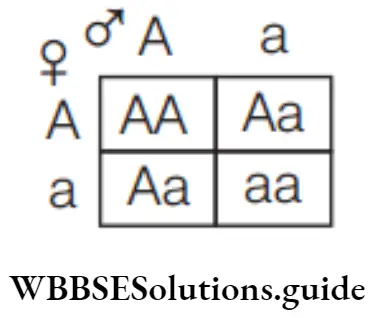
NEET Biology Pedigree Analysis And Genetic Disorders Question 124

AA → Normal child (25%)
Aa → Carrier child (50%)
aa → Affected child (25%)

Question 125. Phenylketonuria disease is a

  1. Autosomal dominant
  2. Autosomal recessive
  3. Sex linked recessive
  4. Sex linked dominant

Answer:  2. Autosomal recessive

Phenylketonuria is an autosomal recessive disease that is being carried on chromosome 12.

Question 126. With respect to phenylketonuria identify which statement is not correct.

  1. It is a case of aneuploidy
  2. It is an example of pleiotropy
  3. Caused due to autosomal recessive trait
  4. It is an error in metabolism

Answer:  1. It is a case of aneuploidy

Statement in option (1) is incorrect and can be corrected as Phenylketonuria occurs due to defective gene of chromosome 12, not due to aneuploidy.

Question 127. In phenylketonuria, the phenylalanine gets converted to

  1. Acetic acid
  2. Phenyl acetic acid
  3. Phenyl pyruvic acid
  4. Pyruvic acid

Answer: 3. Phenyl pyruvic acid

Due to the absence of phenylalanine hydroxylase, the phenylalanine changes into phenyl pyruvic acid in phenylketonuria. Lack of this enzyme is due to autosomal recessive defective gene on chromosome number 12.

Question 128. In order to lessen the suffering of phenylketonurics, their diet should have

  1. No phenylalanine and no tyrosine
  2. Low phenylalanine and normal requirement of tyrosine
  3. Normal recommended amount of phenylalanine
  4. Normal recommended amount of both phenylalanine and tyrosine

Answer:  2. Low phenylalanine and normal requirement of tyrosine

  • Phenylketonuria is an inborn error of metabolism in which an individual lacks an enzyme (phenylalanine hydroxylase PAR) that converts amino acid phenylalanine into tyrosine.
  • In order to lessen the suffering of phenylketonurics, their diet should have low phenylalanine and normal requirement of tyrosine.

Mock test on Pedigree Analysis for NEET preparation

Question 129. Assertion (A) Phenylketonuria is an inborn error of metabolism. Reason (R) Phenylalanine is not converted into alanine in individuals suffering from this disease.

  1. Both A and R are true and R is the correct explanation of A
  2. Both A and R are true, but R is not the correct explanation of A
  3. A is true, but R false
  4. Both A and R are false

Answer: 3. A is true, but R false

  • A is true, but R is false. Phenylketonuria is an inborn, autosomal, recessive metabolic disorder in which the homozygous recessive individual lacks the enzyme phenylalanine hydroxylase needed to change phenylalanine (amino acid) to tyrosine (amino acid) in liver.
  • It results in hyperphenylalaninemia, which is characterised by accumulation and excretion of phenylalanine, phenylpyruvic acid and related compounds.
  1. Question 130. A person affected with phenylketonuria, lacks an enzyme that converts the amino acid phenylalanine intoValine
  2. Proline
  3. Histidine
  4. Tyrosine
  5. Methionine

Answer:  4. Tyrosine

Question 131. The disorders such as alkaptonuria and phenylketonuria are referred to as

  1. Acquired disease
  2. Congenital disease
  3. Infectious disease
  4. All of the above

Answer:  2. Congenital disease

Alkaptonuria and phenylketonuria are inborn metabolic disorders (congenital).

Question 132. Albinism and phenylketonuria are disorders due to

  1. Recessive autosomal genes
  2. Dominant autosomal genes
  3. Recessive sex genes
  4. Dominant sex genes

Answer: 1. Recessive autosomal genes

Albinism and phenylketonuria are recessive autosomal trait which occurs only when a homozygous condition is present.

Question 133. Condition of sex chromosomes in male child with Patau’s syndrome is

  1. XX
  2. XY
  3. XO
  4. XXY

Answer:  2. XY

Patau’s syndrome is a serious rare genetic disorder caused by having an additional copy of chromosome 13 in some or all of the body’s cells. It’s also called trisomy 13.Thus, the genetic makeup of male child would be normal, XY.

Question 134. Progressive degeneration of skeletal muscle, mostly due to genetic disorder occurs in

  1. Myasthenia gravis
  2. Muscular dystrophy
  3. Tetany
  4. Osteoporosis
  5. Arthritis

Answer: 2. Muscular dystrophy

  • Muscular dystrophy is a group of muscle diseases, marked by weakness and wasting of selected muscles, in which there is a recognisable pattern of inheritance.
  • The affected muscle fibres degenerate and are replaced by fatty tissue. The muscular dystrophies are classified according to the patient’s age at onset, distribution of the weakness, the progression of the disease and the mode of inheritance. Isolated cases may occur as a result of gene mutation.

Question 135. Muscular dystrophy is

  1. Dominant
  2. Sex-linked dominant
  3. Sex-linked recessive
  4. All of the above

Answer: 4. All of the above

Muscular dystrophy is inherited as X-linked, autosomal dominant or autosomal recessive trait.

Question 136. Match the type of syndromes listed under Column 1 with the causes given under Column 2.
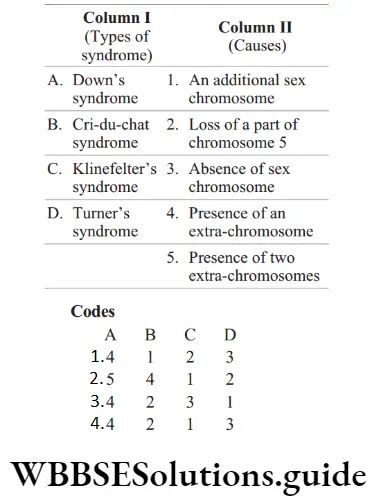
NEET Biology Pedigree Analysis And Genetic Disorders Match The Following Column Question 136

Answer: 4. A–4, B–2, C–1, D–3

Question 137. The hereditary disease in which the urine of a person turns black on exposure to air due to the presence of homogentisic acid is known as

  1. Ketonuria
  2. Phenylketonuria
  3. Haematuria
  4. Alkaptonuria

Answer:  4. Alkaptonuria

Alkaptonuria is an autosomal recessive disorder and inborn metabolic disorders (congenital). Alkaptonuria in man is caused due to accumulation of homogentisic acid. On exposure to air, urine containing this acid turns black.

Question 138. Edward’s syndrome is an abnormality leading to mental deficiency caused by trisomy of chromosome number

  1. 5
  2. 9
  3. 15
  4. 18

Answer:  4. 18

Edward’s syndrome occurs due to trisomy of 18th chromosome.

Question 139. Which of the following disorder is not hereditary?

  1. Haemophilia
  2. Cataract
  3. Sickle-cell anaemia
  4. Colour blindness

Answer: 2. Cataract

Cataract is not hereditary. Some inherited genetic disorders that cause other health problems can increase the risk of cataracts.

Question 140. Which of the following is not a X-linked recessive disease?

  1. Haemophilia
  2. Colour blindness
  3. Thalassemia
  4. Glucose-6-phosphatedehydrogenase deficiency

Answer: 3. Thalassemia

Thalassemia is an autosomal recessive disease.

Question 141. Usually, the recessive character is expressed only when present in double recessive condition. However, single recessive gene can express itself in human beings when the gene present on

  1. Any autosomes
  2. The X-chromosome of the female
  3. The X-chromosome of the male
  4. Either can autosome or X-chromosome

Answer: 3. The X-chromosome of the male

  • Females have two X-chromosomes, whereas males have one X and one Y-chromosome. Genes on the X-chromosome can be recessive or dominant. Their expression in females and males is not the same.
  • Genes on the Ychromosome do not exactly pair up with the genes on the X chromosome. X-linked recessive genes are expressed in females only if there are two copies of the gene (one on each X-chromosome).
  • However, for males, there needs to be only one copy of an X-linked recessive gene in order for the trait or disorder to be expressed.

Question 142. Select the incorrect statement from the following.

  1. Galactosemia is an inborn error of metabolism
  2. Small population size results in random genetic drift in a population
  3. Baldness is a sex -limited trait
  4. Linkage is an exception to the principle of independent assortment in heredity

Answer: 3. Baldness is a sex -limited trait

Statement in option (3) is incorrect and can be corrected as Baldness is a sex influenced trait. The dominance of alleles may differ in heterozygotes of the two sexes. Rest other statements are correct.

Question 143. Consider the following statements.

  1. Myotonic dystrophy is an autosomal dominant trait.
  2. Sickle-cell anaemia is an autosomal recessive trait.
  3. Hypertrichosis is a holandric inheritance.
  4. Failure of segregation of alleles results in chromosomal gain.
  5. Cystic fibrosis is a Mendelian disorder.

Choose the correct option.

  1. 1, 2, 3 and 4
  2. 1, 3, 4 and 5
  3. 1, 2, 4 and 5
  4. 1, 2, 3, 4 and 5

Answer:  4. 1, 2, 3, 4 and 5

All the given statements are correct.

Question 144. Phenylketonuria, Huntington’s disease and sickle- cell anaemia are caused due to the disorder associated with

  1. Chromosome-7, chromosome-11, chromosome-12
  2. Chromosome-11, chromosome-4, chromosome-12
  3. Chromosome-7, chromosome-22, chromosome-46
  4. Chromosome-12, chromosome -4, chromosome-11

Answer:  4. Chromosome-12, chromosome -4, chromosome-11

Phenylketonuria–Chromosome 12 Huntington Diseases–Chromosome 4 Sickle-cell anaemia – Chromosome 11

Question 145. Mental retardation in man associated with sex chromosomal abnormality is usually due to

  1. Increase in X complement
  2. Moderate increase in Y complement
  3. Large increase in Y complement
  4. Reduction in X complement

Answer: 1. Increase in X complement

Mental retardation is usually found when there are one or more extra X-chromosomes in males.

Question 146. The interphase nuclei of a person are showing two sex chromatins/nucleus. The possible genotype of the person is

  1. 44 + XXY
  2. 44 + XYY
  3. 44 + XXX
  4. 44 + XXYY

Answer: 3. 44 + XXX

  • Soon after the start of cell division during embryonic development, one of the two X-chromosomes of the somatic cells in normal females becomes functionally inactive.
  • This inactive X-chromosome condense (heterochromatic) and can be seen as Barr body. Individual with two sex chromatins, show 44+ XXX genotype, in which only one remains active, while the others two are sex chromatins.

Question 147. In man, which of the following genotypes and phenotypes may be the correct result of aneuploidy in sex chromosomes?

  1. 22 pairs + XXY males
  2. 22 pairs + XX females
  3. 22 pairs + XXXY females
  4. 22 pairs + Y females

Answer: 1. 22 pairs + XXY males

Aneuploidy is the condition of cells having more or less than integral multiple of typical haploid chromosome number. Thus, 22 pairs + XXY is an extra sex chromosome due to non-disjunction of a pair of sex chromosome either in an ovum or sperm.

Question 148. The diagrammatic representation of the chromosomes of an individual is called

  1. Idiogram
  2. Karyotype
  3. Phenotype
  4. Diploidy

Answer: 1. Idiogram

The diagrammatic representation of the chromosomes of an individual is called idiogram whereas karyotype is the morphological representation of somatic chromosomes of an individual in descending order.

NEET practice test on Pedigree Analysis and Genetic Disorders

Question 149. The basic set of chromosomes in an organism is known as

  1. Karyotype
  2. Idiogram
  3. GTenome
  4. Plasmosome

Answer: 1. Karyotype

The basic set of chromosomes in an organism is known as karyotype.

Question 150. Given below is a highly simplified representation of the human sex chromosomes from a karyotype. The genes a and b could be of
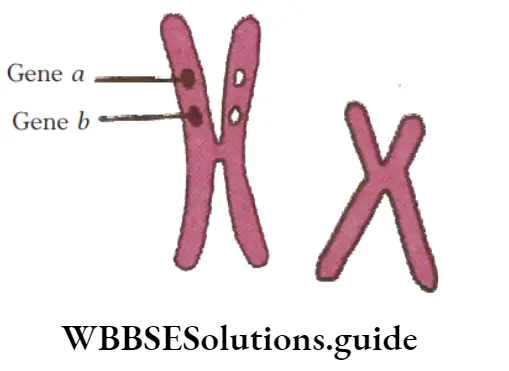
NEET Biology Pedigree Analysis And Genetic Disorders Chromosomes From A Karyotype

  1. Colour blindness and body height
  2. Attached ear lobe and Rhesus blood group
  3. Haemophilia and red-green colour blindness
  4. Phenylketonuria and haemophilia

Answer: 3. Haemophilia and red-green colour blindness

The figure shows, human sex chromosome with genes ‘a’ and ‘b’. So, ‘a’ and ‘b’ are sex linked genes, that are inherited through sex chromosomes of X type (X is larger than Y). The most important character of sex linked inheritance is colour blindness and haemophilia.

Question 151. Which of the following statement about Barr bodies is wrong?

  1. It was first discovered in female cat by Murray Barr
  2. It is also present in males
  3. It is present in all females
  4. It lies against the nuclear membrane and appears like rounded disc

Answer: 2. It is also present in males

Statement in option (2) is wrong and can be corrected as Barr body is a condensed heterochromatic copy of the X chromosome, visible by staining the interphase nucleus of somatic cells of the homogametic sex, e.g. the human female. It is not present in normal
males.

Question 152. Number of Barr body present in each somatic cell of a female is

  1. 1
  2. 2
  3. 3
  4. 4

Answer: 1. 1

One Barr body is present in each somatic cell of female (XX). The number of Barr bodies is one less than the number of X-chromosomes in the cell.

Question 153. Barr body is missing in the female suffering from

  1. Huntington’s disease
  2. Tay-sach’s disease
  3. Klinefelter’s syndrome
  4. Turner’s syndrome

Answer: 4. Turner’s syndrome

Turner’s syndrome (44 + XO) is a genetic disorder that affects only females. In this condition, cells of the affected female possess only one X-chromosome, instead of two. Due to the presence of only one X-chromosome, no Barr body is present in females suffering from Turner’s syndrome.

Question 154. Barr body is found in the cytoplasm during

  1. Interphase in cell of female mammal
  2. Interphase in cell of male mammal
  3. Prophase in cell of female mammal
  4. Prophase in cell of male mammal

Answer: 1. Interphase in cell of female mammal

Barr body is a mass of condensed sex chromatin in the interphase nuclei of normal female somatic cells due to inactive X-chromosome. Thus, Barr body represents the inactivated X-chromosome.

Question 155. Barr body is observed in

  1. Basophils of male
  2. Neutrophils of female
  3. Basophils of female
  4. Eosinophils
  5. Neutrophils of male

Answer: 2. Neutrophils of female

Barr body is found attached to nuclear envelope in oral mucosa, anywhere in the nucleus in nerve cells and as drumstick or small rod at one side of nucleus in neutrophil or polymorphonuclear leucocytes (Davidson and Smith).

Question 156. Which of the following genotypes of man shows presence of one Barr body?

  1. XY
  2. XXXY
  3. XXY
  4. All of these

Answer:  3. XXY

XXY type of genotypes of man shows presence of one Barr body. The total number of Barr bodies is always one less than the total number of X-chromosome present in the cell of the organism. Thus, XXY would contain one Barr body.

Question 157. Studies related to human sex-linked traits depicts that mostly

  1. Male are affected
  2. Female are carrier
  3. Both 1 and 2
  4. Neither 1 or 2

Answer: 3. Both 1 and 2

Males are affected and females are carrier in most cases regarding human sex-linked traits. The recessive genes located on X-chromosome of humans are always expressed in males, e.g. colour blindness is a recessive sex-linked trait in which the eye fails to distinguish red and green colours. The gene for the normal vision is dominant.

Question 158. Barr body is produced due to partial inactivation of one X-chromosome in female. This is called

  1. Dosage compensation
  2. Facultative heterochromatisation
  3. Both 1 and 2
  4. None of the above

Answer: 3. Both 1 and 2

  • Barr body is produced due to partial inactivation of one X-chromosome and development of facultative heterochromatin in it. Any of the two X-chromosomes can become heterochromatic.
  • It begins in the late blastocyst stage (roughly 16 day of embryonic life). Partial inactivation of one X-chromosomes in females is called dosage compensation.

Question 159. If the genetic complement of a person is XXXX, how many Barr bodies can you locate?

  1. One
  2. Two
  3. Three
  4. Four

Answer: 3. Three

The total number of Barr bodies is always one less than the total number of X-chromosomes present in the cell or the organism. Therefore, it should be 3 in case of XXXX.

Question 160. A medical technician while observing a human blood smear under the microscope notes the presence of a Barr body close to the nuclear membrane in the WBC. This indicates that the person under investigation is a

  1. Colourblind
  2. Haemophilic
  3. Normal female
  4. Normal male

Answer: 3. Normal female

The total number of Barr bodies is always one less than the total number of X-chromosomes present in the cell or the organism. Thus, presence of one Barr body indicates that person under investigation is normal female.

Question 161. Three copies of chromosome – 21 in a child with Down’s syndrome have been analysed using molecular biology technology to detect any possible DNA polymorphism with reference to different alleles located on chromosome – 21. Results showed that out of 3 copies, 2 of the chromosomes of the child contain the same alleles as one of the mother’s alleles. Based on this when did the non-disjunction event most likely occur?

  1. Paternal meiosis-1
  2. Maternal meiosis-1
  3. Paternal meiosis-2
  4. Maternal meiosis-2

Answer:  2. Maternal meiosis-1

  • Down’s syndrome is an autosomal aneuploidy, caused by the presence of an extrachromosome number 21. Both the chromosomes of pair 21 pass into a single egg due to non-disjunction during oogenesis.
  • The non-disjunction is more common in females. The frequency of non-disjunction of chromosome pair 21 increases with mother’s age. Usually non-disjunction of chromosomes takes place in maternal meiosis-I.

Question 162. G-6-P-O deficiency inheritance is an example of ………….. inheritance.

  1. X-linked recessive
  2. Autosomal dominan
  3. Autosomal recessive
  4. X-linked dominant

Answer: 1. X-linked recessive

Glucose-6- phosphatedehydrogenase deficiency is most common human enzyme defect. It (also known as favism) is an X-linked recessive genetic condition that predisposes to haemolysis (spontaneous destruction of RBCs) and results in jaundice in response to a number of triggers, such as certain food, illness or medication.

Question 163. Syndrome stands for

  1. A group of symptoms
  2. Viral disease
  3. Diseased condition
  4. Dwarf organism

Answer: 1. A group of symptoms

Syndrome stands for the group of symptoms, which indicates to a particular disease.

Question 164. Match the syndrome and chromosomal abnormalities given in columns 1 and 2, respectively.
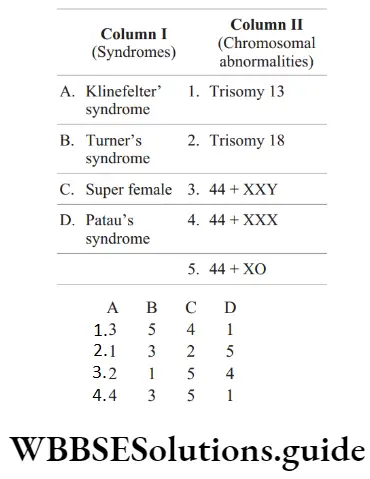
NEET Biology Pedigree Analysis And Genetic Disorders Match The Following Column Question 164

Answer: 1. A–3, B–5, C–4, D–1

Question 165. Trisomy 18 is

  1. Edward’s syndrome
  2. Patau’s syndrome
  3. Turner’s syndrome
  4. Klinefelter’s syndrome

Answer: 1. Edward’s syndrome

  • Edward’s syndrome is due to an extra chromosome number 18. Thus, the total number of chromosome is 47 instead of normal 46. Patau’s syndrome is due to trisomy of chromosome 13.
  • Turner’s syndrome is due to monosomy (2n –1), the individual has 45 chromosomes (44 + XO). Klinefelter’s syndrome is due to trisomy of sex (X) chromosome. The individual has 47 chromosomes (44 + XXY).

Question 166. Which of the following chromosomal constitution refers to Jacob’s syndrome in human?

  1. 44 + XO
  2. 44 + XXY
  3. 44 + XYY
  4. 45 + XYY

Answer: 3. 44 + XYY

Jacob’s syndrome is a rare genetic disorder that occurs due to aneuploidy. It is characterised by the presence of an extra Y-chromosome making the chromosome complement 44 + XYY. Diseased persons show higher growth rate. Any other symptoms are not prominent.

Question 167. The syndrome in which individual somatic cell contains three sex chromosomes XXX is called

  1. Klinefelter’s syndrome
  2. Turner syndrome
  3. Down’s syndrome
  4. Super female

Answer: 1. Klinefelter’s syndrome

Klinefelter’s syndrome is formed by the union of an XX egg and a normal Y sperm or normal X egg and abnormal XY sperm. The individual has 47 chromosomes (44 + XXY) or (47+XXX).

Question 168. Low pitched voice, bearding and moustaches are a type of

  1. Sex limited traits
  2. Sex linked trait
  3. Nullisomic traits
  4. Sex influenced traits

Answer: 4. Sex influenced traits

Low pitched voice, bearding and moustaches are a type of sex influenced traits.

Question 169. One of the following in man is controlled by dominant genes

  1. Colour blindness
  2. Brachydactyly
  3. Nyctalopia
  4. Juvenile glaucoma

Answer: 2. Brachydactyly

Brachydactyly is a shortening of the fingers and toes due to unusually short bones. This is an inherited condition, and in most cases does not present any problems for the person who has it. It is an autosomal dominant condition, which means you only need one parent with the gene to inherit the condition.

Question 170. Name the syndrome which is caused when there is trisomy of the sex chromosomes.

  1. Turner’s syndrome
  2. Down’s syndrome
  3. Klinefelter’s syndrome
  4. Patau’s syndrome

Answer: 3. Klinefelter’s syndrome

  • Klinefelter’s syndrome is formed by the union of an abnormal XX egg and a normal Y sperm or normal X egg and abnormal XY sperm. The individual has 47 chromosomes (44 + XXY) due to the trisomy of sex chromosomes.
  • Such persons are sterile males with undeveloped testes, mental retardation, sparse body hair and long limbs and with some femalecharacteristics such as enlarged breasts.
  • It is considered that the more the X-chromosomes, the greater is the mental defect. As the syndrome has two X-chromosomes, one Barr body is seen in this case.

Question 171. Which one of the following conditions in humans is correctly matched with its chromosomal abnormality/linkage?

  1. Klinefelter’s syndrome-44 autosomes + XXY
  2. Colour blindness – Y-linked
  3. Erythroblastosis foetalis – X-linked
  4. Down’s syndrome – 44 autosomes + XO

Answer: 1. Klinefelter’s syndrome-44 autosomes + XXY

  • Option (1) is correct as Klinefelter’s syndrome is a genetic disorder affecting men in which an individual gains an extra X chromosome, so that the usual karyotype of XY is replaced by one of XXY.
  • Other options are not correct. Colour blindness is X-linked, Down’s syndrome is 21 trisomy and erythroblastosis foetalis is related to Rh incompatibility.

Question 172. What is the genetic disorder in which an individual has an overall masculine development gynaecomastia and is sterile?

  1. Turner’s syndrome
  2. Klinefelter’s syndrome
  3. Edward’s syndrome
  4. Down’s syndrome

Answer: 2. Klinefelter’s syndrome

Individuals with Klinefelter’s syndrome have trisomy of sex chromosome as 44 + XXY (47). They show overall masculine development, gynaecomastia and are sterile.

Question 173. Spermatogenesis is absent in person suffering from

  1. Klinefelter’s syndrome
  2. Down’s syndrome
  3. Turner’s syndrome
  4. Thalassemia

Answer: 1. Klinefelter’s syndrome

Klinefelter Syndrome (KS) was first described by Harry F. Klinefelter in 1942 as a clinical entity characterised by gynecomastia, small testes, absent spermatogenesis, normal to moderately reduced Leydig cell function and increased secretion of FSH.

Question 174. In Klinefelter’s syndrome, the sex chromosome compliment is

  1. 22 A+ XXY
  2. 22A + XY
  3. 22A+XO
  4. 22 A + XX

Answer: 1. 22 A+ XXY

Klinefelter’s syndrome is formed by the union of an XX egg and a normal Y sperm or normal X egg and abnormal XY sperm. The individual has 47 chromosomes (22A + XXY).

Question 175. A man having Klinefelter’s syndrome is

  1. Intersex with secondary sexual characters on the side of female
  2. Male with secondary sexual characters of female
  3. Female with secondary sexual characters of male
  4. Normal fertile male

Answer: 2. Male with secondary sexual characters of female

Phenotypically Klinefelter individuals are males, but they can show some female secondary sexual characteristics and are usually sterile.

Question 176. Which of the following set of syndromes show 47 chromosomes in their genetic makeup?

  1. Down’s syndrome, Patau’s syndrome, Edward’s syndrome
  2. Turner’s syndrome, Edward’s syndrome, Klinefelter’s syndrome
  3. Klinefelter’s syndrome, Turner’s syndrome, Edward’s syndrome
  4. All of the above

Answer: 1. Down’s syndrome, Patau’s syndrome, Edward’s syndrome

  • Syndromes which show 47 chromosomes (instead of normal 2n = 46 chromosomes) in the genetic
    makeup of affected individual include Down’s syndrome, Patau’s syndrome, Edward’s syndrome and Klinefelter’s syndrome.
  • Individuals suffering from Down’s syndrome contain 45+XY chromosomes in males and 45 + XX chromosomes in females. Patau’s syndrome (13-trisomy) is due to an extra chromosome number 13 and Edward’s syndrome (18-trisomy) is due to an extra chromosome number 18.
  • Klinefelter’s syndrome occurs due to trisomy of sex (X) chromosome and the affected individual possesses 47 chromosomes (44+XXY). Turner’s syndrome occurs due to monosomy of sex chromosome and the affected individual possesses 2n = 45 chromosomes (44+XO) instead of 46.

Question 177. Edward, Patau, Down’s syndromes are

  1. Change in autosomes
  2. Change in sex chromosomes
  3. Mutation due to malnutrition
  4. Both change in sex chromosome and autosomes

Answer: 1. Change in autosomes

Edward’s, Patau’s and Down’s syndromes are disorders which occur due to autosomal chromosomal changes. Edward’s syndrome occurs due to trisomy of 18th chromosome, Patau’s syndrome arises due to trisomy of 13th chromosomes and Down’s syndrome occurs due to trisomy of 21st chromosomes.

Question 178. Number of sex chromosomes is normal in

  1. Super female
  2. Turner’s syndrome
  3. Klinefelter’s syndrome
  4. Down’s syndrome

Answer: 4. Down’s syndrome

Down’s syndrome is an autosomal aneuploidy. The 21st pair of chromosomes has three chromosomes instead of two. The sex chromosomes remain unchanged.

Question 179. Who reported that Down’s syndrome is due to extra 21st chromosome?

  1. JL Down (1866)
  2. Lejeune (1959)
  3. Klinefelter (1942)
  4. Huntington (1872)

Answer: 1. JL Down (1866)

  • For centuries, people with Down’s syndrome have been alluded in art, literature and science. It was not until the late 19th century, however, that John Langdon Down, an English physician, published an accurate description of a person with Down syndrome.
  • It was this scholarly work, published in 1866, that earned Down the recognition as the ‘father’ of the syndrome.

Question 180. In Down’s syndrome, karyotyping has shown that the disorder is associated with trisomy of chromosome number 21 usually due to

  1. Non-disjunction during egg cell formation
  2. Non-disjunction during sperm cell formation
  3. Non-disjunction during formation of egg cells and sperm cells
  4. Addition of extra chromosome during mitosis of the zygote

Answer: 3. Non-disjunction during formation of egg cells and sperm cells

Down’s syndrome caused by trisomy 21, arises due to an occasional non-disjunction during meiosis when a gamete comes to possess an extra chromosome (n+ 1).

Fusion of this chromosome with a normal gamete containing normal chromosome (n) result in [n + (n + 1)] trisomy.

Question 181. Freqeuency of Down’s syndrome increases when the maternal age is

  1. Above 35 years
  2. Below 35 years
  3. During 1st pregnancy
  4. If she is a mother of at least 3 children

Answer: 1. Above 35 years

The chance of a woman having a baby with Down’s syndrome increases as she gets older. Only 1 in 2000 births from teenage mothers are affected by Down’s syndrome, but this goes up to 1 in 10 in 48-years old women. The risk starts above 35 years of age

Question 182. Consider the following statements.

  1. Short statured with small round head.
  2. Tongue is furrowed and mouth partially opened.
  3. Also called Mongolian Idiocy.
  4. Physical, psycomotor and mental development is slow.

Choose the correct option.

  1. Down’s syndrome
  2. Turner’s syndrome
  3. Klinefelter’s syndrome
  4. Patau’s syndrome

Answer: 1. Down’s syndrome

All the listed symptoms belong to Down’s syndrome 21 trisomy.

Question 183. Down’s syndrome is caused by an extra copy of chromosome number 21. What percentage of offspring produced by an affected mother and a normal father would be affected by this disorder?

  1. 100 %
  2. 75 %
  3. 50 %
  4. 25 %

Answer: 3. 50 %

Down’s syndrome is the example of autosomal aneuploidy. Here, an extra copy of chromosome 21 occurs. As it is an autosomal disease, the offspring produced from affected mother and normal father should be 50%.

Question 184. Which of the following occurs due to monosomy of sex chromosome?

  1. Down’s syndrome
  2. Turner’s syndrome
  3. Haemophilia
  4. Sickle-cell anaemia

Answer: 2. Turner’s syndrome

  • Turner’s syndrome is caused due to the absence or monosomy of one of the X-chromosome, i.e. 45 chromosomes total with sex chromosomes as XO.
  • Such females are sterile as ovaries are rudimentary. Besides this, other features include lack of other secondary sexual characters, etc.

Question 185. Which is correct for Turner’s syndrome?

  1. It is a case of monosomy
  2. It causes sterility in females
  3. Absence of Barr body
  4. All of the above

Answer: 4. All of the above

  • All given statements are correct regarding Turner’s syndrome. It is a genetic disorder of women caused by the absence of the second sex chromosome (such women are XO, rather than the normal XX).
  • It is characterised by a lack of ovaries and menstrual cycle. Affected women are sterile and lack secondary sexual characteristics, In the case of Turner’s syndrome, it is 1 – 1 = 0, i.e. Barr bodies are absent. Thus, option (4) is correct.

Question 186. A sterile female having reduced mental ability is said to be suffering from

  1. Turner’s syndrome
  2. Klinefelter’s syndrome
  3. Down’s syndrome
  4. Edward’s syndrome

Answer: 1. Turner’s syndrome

  • Unlike some other genetic conditions, Turner’s syndrome does not cause mental retardation or decreased intelligence.
  • However, some girls with Turner’s syndrome have learning disabilities, especially in areas involving spatial skills, such as math. It can affect their ability to connect with others.

Question 187. The person with Turner’s syndrome has

  1. 45 autosomes and X sex chromosome
  2. 44 autosomes and XYY sex chromosomes
  3. 45 autosomes and XYY sex chromosomes
  4. 44 autosomes and X sex chromosome

Answer: 1. 45 autosomes and X sex chromosome

Turner’s syndrome is caused due to absence of one of the X-chromosomes, i.e. 45 with XO.

Question 188. Turner’s syndrome in humans is caused by

  1. Autosomal aneuploidy
  2. Sex chromosome aneuploidy
  3. Polyploidy
  4. Point mutation

Answer: 2. Sex chromosome aneuploidy

Turner’s syndrome is 23 monosomic (sex chromosome aneuploidy) conditions, in which only one X-chromosome is present.

Question 189. Turner’s syndrome was first discovered by

  1. JL Down
  2. Huntington
  3. HH Turner
  4. Lejeune

Answer: 3. HH Turner

Turner syndrome was first discovered in 1938 by Dr. Henry Turner while studying a group of 7 girls who all had the same unusual developmental and physical features.

Question 190. A human female with Turner’s syndrome

  1. Has 45 chromosomes with XO
  2. Has one additional X chromosome
  3. Exhibits male characters
  4. Is able to produce children with normal husband

Answer: 3. Exhibits male characters

  • Turner’s syndrome is due to monosomy (2n – 1). It is caused by the union of an allosome free egg (22 + 0) and a normal X sperm or a normal egg and an allosome free sperm (22 + 0).
  • The individual has 2n = 45 chromosomes (44 + XO) instead of 46. Such people are sterile
    females who have rudimentary ovaries filled with connective tissues (therefore, also called gonadal dysgenesis), undeveloped breasts, small uterus, puffy fingers, short stature, male like characters like beared, masculinity, etc.

NEET Biology Mutation Multiple Choice Question And Answers

Biology MCQs with answers for NEET Mutation

Question 1. Rarely observed phenotype in population is called

  1. Wild type
  2. Mutant type
  3. Variant type
  4. All of the above

Answer:  2. Mutant type

The gene whose chemical structure is altered is called mutated gene and the organisms carrying this mutated gene is called mutant. It is rarely observed phenotype in population.

Question 2. One of the parents of a cross has a mutation in its mitochondria. In that cross, that parent is taken as a male. During segregation of F2 progenies that mutation is found in

  1. One-third of the progenies
  2. 50% of the progenies
  3. All the progenies
  4. None of the progenies

Answer:  4. None of the progenies

questions about genetics

Mitochondria is an organelle present in the cytoplasm. A zygote receives its cytoplasm from the female parent gamete. Hence, in the given question, the F2 progenies do not receive the mitochondrial genome from the male parent and mutation is not passed to progenies.

Thus, option (4) is correct.

Read And Learn More: NEET Biology Multiple Choice Question And Answers

Question 3. Assertion (A) Muton gene has fewer nucleotides than a cistron. Reason (R) Benzer coined the term muton to the smallest unit of genetic material capable of mutational change.

  1. Both A and R are true and R is the correct explanation of A
  2. Both A and R are true, but R is not the correct explanation of A
  3. A is true, but R is false
  4. Both A and R are false

Answer:  1. Both A and R are true and R is the correct explanation of A

Both A and R are true and R is the correct explanation of A. Muton has fewer nucleotides than a cistron because muton is the smallest unit in chromosome that can be changed by mutation.

NEET Biology Mutation MCQs with answers

Question 4. Mutagens are

  1. Chemical agents which cause change in DNA
  2. Physical agents which cause mutation
  3. Cancer producing agents
  4. Both 1 and 2

Answer:  4. Both 1 and 2

Mutagen may be physical or chemical agents, which causes change in DNA sequence, e.g. mutation induced by UV-radiation, acridine dye, etc. Thus, option (4) is correct

Biology MCQs with answers for NEET

NEET Biology Mutation Multiple Choice Question And Answers

Important MCQs on Mutation for NEET

Question 5. Certain mutations are not eliminated from gene pool because they are carried by

  1. Homozygous individuals
  2. Recessive homozygous individuals
  3. Heterozygous individuals
  4. Dominant heterozygous individuals

Answer:  3. Heterozygous individuals

Harmful mutation does not get eliminated from the gene pool because most of the harmful mutations are recessive and they are carried in heterozygous condition by the individual. If they (mutation) are dominant, then they easily get eliminated by the death of an organism.

Question 6. Haploids are able to express both recessive and dominant alleles/ mutations because there are

  1. Many alleles for each gene
  2. Two alleles for each gene
  3. Only one allele for each gene in the individual
  4. Only one allele in a gene

Answer:  3. Only one allele for each gene in the individual

In haploid organisms, every gene irrespective of dominant or recessive and every mutation finds expression because there is only one allele for each gene in the haploid individual. Recessive allele is able to express as there is no alternative dominant allele for producing its masking effect on recessive allele.

“which of the following is a hereditary disease “

Question 7. Mutation is

  1. Recessive
  2. Useful
  3. Seldom useful
  4. Low frequency

Answer:  1. Recessive

Mutations are normally deleterious or recessive and therefore, majority of them are of no practical value.

Biology MCQs with answers for NEET

Question 8. Which of the following statements about mutation are true?

  1. Mutations are the source of new alleles for genes.
  2. Organisms are able to create mutations to meet their specific needs.
  3. Mutations are random events and can happen in any cell at any time.
  4. Most mutations tend to be harmful or have no effect on an organism.

Chooe the correct option.

  1. 1, 2 and 3
  2. 1, 2, 3 and 4
  3. 1, 3 and 4
  4. 1 and 3

Answer:  3. 1, 3 and 4

All given statements are true about mutation except II. Incorrect statement can be corrected as Mutation occurs itself. It is the spontaneous phenomena and organisms cannot create mutations on their own. Thus, option (3) is correct.

Mutation chapter-wise MCQs for NEET

Question 9. Mark the incorrect statement about mutation?

  1. Mutation is predestined
  2. Major source of evaluation
  3. Usually deleterious and recessive
  4. It is a reversible process

Answer:  1. Mutation is predestined

Statement in option (1) is incorrect and can be corrected as Mutations are the ultimate source of all genetic variations and these are spontaneous. Rest options are correct about mutation.

Question 10. A recessive mutant is one which is

  1. Not expressed
  2. Rarely expressed
  3. Expressed only in homozygous and hemizygous state
  4. Expressed only in heterozygous state

Answer:  3. Expressed only in homozygous and hemizygous state

A recessive mutation is one in which both alleles must be mutant in order for the mutant phenotype to be observed, i.e. the individual must be homozygous recessive (rr) or hemizygous (ro) for the mutant allele to show the mutant phenotype.

Question 11. Which of the following is correct for tetrasomic aneuploids?

  1. 2n + 2
  2. 2n + 2 + 2 + 2
  3. 2n – 1
  4. 2n – 1

Answer:  1. 2n + 2

Aneuploidy is also called as heteroploidy which is the condition of having fewer or extra chromosomes than the exact multiple of the genome or whole chromosome set. In tetrasomics, chromosome is present quadruplicate (four times). Among given options 2n+2 represents tetrasomic aneuploids.

Question 12. Monosomic trisomy is represented as

  1. 2n – 1 – 1
  2. 2n – 1 + 1
  3. 2n – 1
  4. 2n + 1 + 1
  5. 2n + 1

Answer:  2. 2n – 1 + 1

Monosomy is the absence of one chromosome (2n-1 )and trisomy is presence of an extra chromosome ( 2n+1) The absence of single chromosome and presence of antoher chromosome simultaneously is called monosomic trisomy (2n-1+1 ).

Biology MCQs with answers for NEET

Question 13. Find out the correct statement.

  1. Monosomy and nullisomy are the two types of euploidy
  2. Polyploidy is more common in animals than in plants
  3. Polyploids occur due to the failure in complete separation of sets of chromosomes
  4. 2n-l condition results in trisomy
  5. Non-homologous chromosomal duplication results in autopolyploidy

Answer:  1. Monosomy and nullisomy are the two types of euploidy

“principles of inheritance “

Statement in option (1) is correct. Other statements are incorrect and can be corrected as 2n+1 condition results in trisomy. Polyploidy is common in plants only. Polyploidy occurs due to duplication of chromosomes and homologous chromosomes duplication results in autopolyploidy.

Question 14. A condition characterised by multiples of haploid set of chromosomes is called

  1. Polyploidy
  2. Symploidy
  3. Aneuploidy
  4. All of the above

Answer: 1. Polyploidy

Polyploidy is the condition in which the chromosome number is a higher multiple than two of the haploid number (23) of chromosomes.

NEET quiz on Mutation with solutions

Question 15. Polyploidy can result from

  1. Parthenogenesis
  2. Monospermy
  3. Colchicine
  4. All of the above

Answer:  3. Colchicine

Polyploidy is a condition in which the chromosome number is two or more times than normal haploid number found in gametes. It may occur in nature or can be induced artificially by using colchicine. This type of mutation includes all the cases in which any change in number of chromosomes in set occurs.

Biology MCQ For NEET With Answers

Question 16. Abnormal cell with random number of chromosomes is

  1. Aneuploid
  2. Polyploid
  3. Heterokaryotic
  4. Haploid

Answer:  1. Aneuploid

Aneuploidy is the condition of cells having more or less than integral multiple of typical haploid chromosome number. Thus, 22 + XXY is an extra sex chromosome due to non-disjunction of a pair of sex chromosome either in an ovum or sperm. So, abnormal cell with random number of chromosomes is aneuploid.

Question 17. An example for an allotetraploid is

  1. Triticum aestivum
  2. Gossypium species
  3. E. coli
  4. Mango

Answer:  2. Gossypium species

An example of an allotetraploid is Gossypium species of cotton. An allotetraploid is a hybrid that has a chromosome set 4 times that of a haploid organism.

Question 18. Chromosome complement with 2n -1 is called

  1. Monosomy
  2. Trisomy
  3. Nullisomy
  4. Tetrasomy

Answer:  1. Monosomy

Option (1) is correct. Monosomy occurs due to loss of a single chromosome (2n – 1). Other options are not correct and can be corrected as Nullisomy occurs due to loss of one pair of chromosomes (2n – 2). Hyperploidy may either involve addition of a single chromosome, trisomy (2n + 1) or a pair of chromosomes, tetrasomy (2n + 2).

NEET expected MCQs on Mutation 2025

Question 19. A chromosome may be lost or gained during cell division due to failure of segregation of chromatids. This condition is referred to as

  1. Aneuploidy
  2. Hypopolyploidy
  3. Hyperpolyploidy
  4. Polyploidy

Answer:  1. Aneuploidy

Chromosomal disorders are caused due to excess, absence or abnormal arrangement of one or more chromosomes. Sometimes the chromatids fail to segregate during cell division, resulting in gain or loss of a chromosome. This is called aneuploidy or heteroploidy.

Biology MCQ For NEET With Answers

Question 20. Occurrence of cells in diploid organisms containing multiples of the 2n genomes is known as

  1. Aneuploidy
  2. Haploidy
  3. Amphidiploidy
  4. Allopolyploidy

Answer:  1. Aneuploidy

Aneuploidy is the occurrence of cells in diploid organisms containing multiplies of the 2n genomes. For example, a human cell having 45 or 47 chromosomes instead of the usual 46. It does not include a difference of one or more complete sets of chromosomes.

Question 21. Trisomy and monosomy is represented by

  1. 2n – 1 and 2n + 1
  2. 2n + 1 and 2n – 1
  3. 2n and 2n + 1
  4. 2n and 2n – 1

Answer:  2. 2n + 1 and 2n – 1

Monosomy occurs due to loss of a single chromosome (2n – 1) whereas trisomy occurs due to addition of a single chromosome (2n + 1).

Question 22. Match the following column.

NEET Biology Mutation Question 22 Match The Following Column

Answer:  1. A–5, B–1, C–4, D–2, E–3


Mutation Extra Questions

Question 1. Sudden and heritable change in a character of an organism is called

Mutation
Heterosis
Inbreeding
Selection
Answer: 1. Mutation

Mutations are the sudden alteration in the chemical structure of a gene or the alteration in its position on the chromosome by breaking and rejoining the chromosome.

Biology MCQ For NEET With Answers

Question 2. Errors during DNA replication, repair or recombination can lead to base-pair substitution. Such changes are

Conditional mutations
Mutagens
Spontaneous mutations
Saltatory changes
Answer: 3. Spontaneous mutations

All types of mutations are produced spontaneously, e.g. base substitutions, frame shifts, insertions and deletions. Errors during DNA replication can lead to spontaneous mutations.

Question 3. Mutations can be induced with

Infrared radiations cbse
IAA
Ethylene
Gamma radiations
Answer: 4. Gamma radiations

Mutation is the process by which genetic variations are created through changes in the base sequence within genes. It is possible to induce mutations artificially through the use of chemicals or radiations like gamma radiations.

“dihybrid cross questions “

Question 4. One of them is efficient in inducing mutations.

X-rays
Hybridisation
Colchicine
Crossing over
Answer: 1. X-rays

Two major causes of mutations are irradiation and chemical mutagens. Irradiation is exposure to radiation like X-rays and chemical mutagens are chemicals that cause changes in DNA sequences.

Thus, X-rays are efficient in inducing mutation.

Question 5. UV radiations cause

Formation of thymine dimers
Deletion of base pairs
Methylation of bases
Addition of base pairs
Answer: 1. Formation of thymine dimers

One of the major sources of DNA damage in all organisms is the UV component of sunlight. The predominant reaction induced by UV light on DNA is the dimerisation of adjacent pyrimidine bases.

Ultraviolet light induces the formation of covalent linkages localised on the C C== double bonds. In dsRNA, uracil dimers may also accumulate as a result of UV radiation.

Two common UV products are cyclobutane pyrimidine dimers (CPOs, including thymine dimers) and 6, 4 photoproducts. These premutagenic lesions alter the structure of DNA and consequently inhibit polymerases and arrest replication. So, UV radiation causes the formation of thymine dimers.

Biology MCQ For NEET With Answers

Question 6. The best chemical to induce polyploidy is

Maleic Hydrazide
ABA
Acenaphthene
Ethylene
Answer: 3. Acenaphthene

A number of chemicals are known to cause polyploidy, e.g. chloral hydrate, ethyl mercuric chloride, hexachlorocyclohexane and acenaphthene.

Question 7. The mutations are mainly responsible for

Increasing the population rate
Maintaining genetic continuity
Constancy in organisms
Variation in organisms
Answer: 4. Variation in organisms

Mutations are the sudden alteration of the chemical structure of a gene or the alteration of its position on the chromosome by breaking and rejoining of the chromosome. They rarely occur naturally but may be caused artificially by irradiation or by chemicals (mutagen), e.g. mustard gas.

They may occur in somatic cells or gametes in which case they can be inherited. They lead to variations in organisms and can be accordingly categorised into somatic mutations and gametic mutations.

Question 8. Mutations are caused by

Polyploidy
Hybridisation
Aneuploidy
All of these
Answer: 4. All of these

Mutations are caused by polyploidy, hybridisation and aneuploidy. In polyploidy, more than two paired sets of chromosomes are mutated.

In hybridisation, single-stranded DNA or RNA molecules anneal to complementary DNA or RNA.

Aneuploidy is a condition in which the number of chromosomes in the nucleus of a cell is not an exact multiple of the monoploid number of a particular species.

NEET Biology Mutation MCQs with explanations

Question 9. Change in single base pair Odisha

May change the phenotype
Quickly change the phenotype
Change the natural process
None of the above
Answer: 1. May change the phenotype

May change the phenotype change in single base pair due to mutation may or may not change the phenotype of an organism.

Question 10. Hereditary variation in plants has been obtained through the use of

X-rays or gamma rays
2, 4-D
DDT
GA
Answer: 1. X-rays or gamma rays

Radiation (X-rays or gamma rays) can increase the natural mutation rate by 1000 to 1 million fold, making the generation of genetic variation very effective.

NEET Biology Mcq

Question 11. The action of ultraviolet rays on DNA in Odisha

Induction of thymidine
Deletion of base pairs
Addition of base pairs
Methylation of base pairs
Answer: 1. Induction of thymidine

Commonly, UV radiations cause the formation of thymine dimers and induce mutation. Thus, the action of ultraviolet rays on DNA is the induction of thymidine

“pedigree questions “

Question 12. HJ Muller was awarded Nobel Prize for his

The discovery that chemicals can induce gene mutations
The discovery that ionising radiations can induce gene mutations
Work on gene mapping in drosophila
Efforts to prevent the use of nuclear weapons
Answer: 2. Discovery that ionising radiations can induce gene mutations

HJ Muller studied the effect of radiation on living organisms. He was awarded the Nobel Prize for discovering that ionising radiation can induce gene mutations.

Question 13. Which of the following is not considered a mutagen?

Uv radiation
Nuclear reaction
2-Aminopurine
Low temperature
Answer: 4. Low temperature

Mutation can be artificially induced with the help of mutagenic agents which can be broadly classified as – 1 Physical mutagens, 2 Chemical mutagens. Physical mutagens are mainly radiations like X-rays, gamma rays, beta rays and neutrons.

High temperature also causes mutations. Aminopurine is a chemical artificial base analogue of adenine. It can substitute adenine as well as can pair with cytosine.

Similarly, the nuclear reaction causes a great impact on the DNA and mutations are noticed in several generations due to nuclear reaction or explosion.

So, low temperature does not cause mutation

NEET Biology Mcq

Question 14. The mutation may result in the

Change in genotype
Change in phenotype
Change in metabolism
All of the above
Answer: 4. All of the above

In most cases, if there is a change in genotype then it ultimately leads to a change in phenotype and metabolism.

Question 15. The mutations can be induced in bacteria by Karnataka

Adding all required substances
Starving the bacteria
Exposure to high-energy radiation
Growing different strains
Answer: 3. Exposure to high-energy radiation

Mutations can be artificially induced in bacteria with the help of high-energy ionising radiation

Question 16. Chromosomal aberration is due to

Physical effects Manipal1995
Change in structure or number of chromosomes
Polyploidy
None of the above
Answer: 2. Change in structure or number of chromosomes

Chromosomal aberration (chromosome mutation) is a change in the gross structure or number of a chromosome.

The main types of chromosomal aberrations that occur due to changes in the structure are deletion, duplication, translocation, inversion and due to change in the number, i.e. euploidy and aneuploidy.

Mutation mock test for NEET preparation

Question 17. Chromosomal mutations occur due to

Deletion
Duplication
Translocation
Inversion
Choose the correct option.

1, 2 and 3
2, 3 and 4
1, 3 and 4
1, 2, 3, and 4
Answer: 4. 1, 2, 3, and 4

All the given ways are correct. The chromosomal mutation is the sudden inheritable change in the hereditary material of an organism. It is caused due to several ways like deletion, duplication, translocation, inversion, etc. Thus, option 4 is correct.

NEET Biology Mcq

Question 18. The gene mutation is UP

Mutation in the genes of DNA
Mutation in the phosphodiester linkage
Mutation in the chromosomes
Change in the sequence of nitrogenous bases
Answer: 4. Change in the sequence of nitrogenous bases

A gene mutation is a change in the sequence of the nitrogenous bases due to a change in the DNA sequence that makes up a gene

Question 19. A gene mutation which does not result in phenotypic expression is termed as

Non-sense mutation
Silent mutation
Mis-sense mutation
Frameshift mutation
Answer: 2. Silent mutation

Mutations which involve the substitution of a base by another base in such a manner that the new codon also codes for the same amino acid and thus, does not produce any faulty protein or no phenotypic changes are called silent mutations

Question 20. A non-sense mutation results into

Stoppage of transcription pm 2001
Change in protein structure
Stoppage of protein synthesis
Termination of the polypeptide chain
Answer: 2. Change in protein structure

A non-sense mutation is one which stops polypeptide synthesis due to the formation of a termination of the non-sense codon, viz. ATT(UAA), ATC (UAG), ACT(UGA)

Question 21. The creation of mutations is called

Mutagenesis
Evolution
Saltatory changes
Radiations
Answer: 1. Mutagenesis

Mutagenesis is a process by which the genetic information of an organism is changed, resulting in a mutation.

It may occur spontaneously in nature or as a result of exposure to mutagens. It can also be achieved experimentally using laboratory procedures. So, the creation of mutations is called mutagenesis.

NEET Biology Mcq

Question 22. Chemical mutagens are more dangerous than radiation. Justify from the following statements.

Exposure to them is more frequent
There is protection from radiation but no chemicals
Both 1 and 2
Chemically caused mutations are far more deleterious
Answer: 4. Chemically caused mutations are far more deleterious

A chemical mutagen is a substance that can alter a base that has already been incorporated into DNA and thereby, change its hydrogen bonding specificity.

Chemical mutagens are prevalent in the environment and a potential threat to the health of future generations.

Question 23. After a mutation at a genetic locus, the character of an organism changes due to the change in

Protein structure
DNA replication
Protein synthesis pattern
RNA transcription pattern
Answer: 1. Mutagenesis is a process by which the genetic information of an organism is changed, resulting in a mutation.

It may occur spontaneously in nature or as a result of exposure to mutagens.

It can also be achieved experimentally using laboratory procedures. So, the creation of mutations is called mutagenesis.

Question 24. Assertion 5-Bromouracil can cause mutations. Reason (R) It is called a base analogue.

Both A and R are true and R is the correct explanation of A
Both A and R are true, but R is not the correct explanation of A
A is true, but R is false
Both A and R are false
Answer: 1. Both A and R are true and R is the correct explanation of A

NEET practice test on Mutation

Question 25. Change in one base in mRNA leading to termination of the polypeptide is known as which type of mutation?

Non-sense
Mis-sense
Gibberish
Frameshift
Answer: 1. Non-sense

A non-sense mutation is one which stops polypeptide synthesis due to the formation of a termination of the non-sense codon, viz. ATT(UAA), ATC(UAG), ACT(UGA).

Other options are explained as A missense mutation is one which involves a change in a codon that produces a different amino acid at the specific site in a polypeptide, often resulting in its non-functioning.

Frame-shift or gibberish mutations are those mutations in which the reading of the frame of the base sequence shifts laterally either in the forward direction due to the insertion of one or more nucleotides or in the backward direction due to the deletion of one or more nucleotides.

Question 26. X-ray causes mutation by

Transition
Transversion
Deletion
Base substitution
Answer: 3. Deletion

High-energy radiations, such as X-rays, gamma rays, cosmic rays and UV light have been found to be mutagenic in almost all organisms. They produce mutations by causing breaks in the DNA molecule, i.e.
deletion.

Question 27. Name the type of mutation in which the cause of the mutation is not known.

Spontaneous mutation
Suppressor mutation
Non-sense mutation
Mis-sense mutation
Answer: 1. Spontaneous mutation

Spontaneous mutations are those in which the cause of the mutation is not known. These types of mutations arise due to a tautomeric shift in nitrogenous bases of DNA.

Question 28. Normally DNA molecule has A-T, G-C pairing. However, these bases can exist in alternative valency status, owing to re-arrangements called

Point mutation
Frameshift mutation
Analogue substitution
Tautomerisational mutation
Answer: 4. Tautomerisational mutation

Transitions may be tautomeric shifts (ionisation) of bases, which leads to mistaken A-C base pairing and more frequently mistaken G – T base pairing.

So, these bases can exist in alternative valency status, owing to rearrangement called tautomerization mutation.

NEET Biology Mcq

Question 29. Gibberish mutations are

Reverse
Frameshift
Transitions
Transversions
Answer: 2. Frameshift

Acridines (e.g. acriflavine, proflavine, flavine, acridine orange) enter the DNA chains in between two base pairs and cause deletion or addition of a few nucleotides.

The frame of the nucleotide sequence of DNA is thus, disturbed and read differently. It is also known as frame-shift or gibberish mutation

Question 30. Name the term given to the type of mutation which depends on the conditions of the environment.

Forward mutation
Reverse mutation
Conditional lethal mutation
Gain of function mutation
Answer: 3. Conditional lethal mutation

In conditional lethal mutation, lethality depends on the conditions of the environment, e.g. auxotrophs, temperature-sensitive mutants and suppressor mutation.

Question 31. Gene mutation occurs at the time of

DNA repair BHU 1996
RNA transcription
DNA replication
Cell division
Answer: 3. DNA replication

During replication, double strands of DNA are separated. Each strand is then copied to become another double strand.

About 1 out of every 100,000,000 times, a mistake occurs during copying, which can lead to a mutation. Mutations can also be caused by environmental foes. So, gene mutation occurs at the time of DNA replication.

Question 32. A genomic mutation involves

Change in genes am 2008
Change in chromosomal structure
Change in the number of chromosomes
All of the above
Answer: 3. Change in the number of chromosomes

The genomic mutation is the change in chromosome number due to errors in meiosis or mitosis

Question 33. The loss of a chromosomal segment is due to Kerala

Polyploidy
Deletion
Duplication
Inversion
Answer: 2. Deletion

The mutation involving the removal of one or more base pairs in the DNA sequence is called a deletion.

Question 34. Which of the following is the main category of mutation?

Somatic mutation
Genetic mutation
Heterosis
Both 1 and 2
Answer: 4. Both 1 and 2

Mutations may occur in somatic cells or gametes. In the latter case, they can be inherited. They lead to variations in organisms. So, they can be accordingly categorised into somatic mutations and genetic mutations. Thus, option 4 is correct

Question 35. Which of the following is not heritable?

Point mutation
Gene mutation
Somatic mutation
Chromosomal mutation
Answer: 3. Somatic mutation

Somatic mutations are those mutations which occur in a cell other than germ cells and are not passed to the next generations, i.e. these are not heritable.

Question 36. Point mutation may occur due to

Alteration in DNA sequence
Change in a single base pair of DNA
Deletion of a segment of DNA
Gain of a segment in DNA
Answer: 2. Change in a single base pair of DNA

Point mutation or gene mutation involves only the replacement of one nucleotide with another or a change in a single base pair of DNA.

One type of point mutation is a missense mutation. These are base changes that alter the codon for an amino acid resulting in its substitution with a different amino acid

Question 37. Which base is considered a hotspot for spontaneous point mutations?

5-bromouracil
50 methylcytosine
Guanine
Adenine
Answer: 3. Guanine

Mutations are rare events in nature and are described as spontaneous mutations. Some of these mutations originate from mistakes in the normal duplication of DNA.

Transitions may be produced by tautomeric shift or ionisation of bases which leads to mistaken, A-C base pairing and more frequently mistaken G-T base pairing.

Guanine pairs with the rare enol form of thymine and is thus, considered a hotspot for spontaneous point mutations.

Question 38. A mutation in which thymine is replaced by cytosine is called

Transition
Transversion
Mis-sense
None of these
Answer: 1. Transition

Transitions are substitution gene mutations in which a purine (say adenine) is replaced by another purine (say guanine), or a pyrimidine (say thymine) is replaced by another pyrimidine (say cytosine). Change of codon ATC to GTC or ATT or ACC is an example of a transition

Question 39. When purine is substituted by pyrimidine, the resulting mutation is

Transition mutation
Transversion mutation
Point mutation
Suppressive mutation
Answer: 2. Transversion mutation

A transversion is a substitution gene mutation in which a purine (A or G) is replaced by a pyrimidine (T or C) or vice-versa.

Question 40. Which of the following type of mutation involves the reverse order of genes in a chromosome?

Deletion Haryana
Duplication
Inversion
Reciprocal translocation
Answer: 3. Inversion

An inverse mutation is a type of intra-chromosomal modification in which the segment of chromosome separates and rejoins in the reverse position

Question 41. Frame-shift mutation and base pair substitution change the

Nucleotide structure
Nucleotide sequence
Nucleoside sequence
Sugar-phosphate sequence
Answer: 2. Nucleotide sequence

The nucleotide sequence is also called the base-pair sequence. In frame-shift mutation or base pair substitution, the nucleotide sequence gets changed.

Question 42. The mechanism that causes a gene to move from one linkage group to another is called

Inversion
Duplication
Translocation
Crossing over
Answer: 3. Translocation

Translocation is a phenomenon of transfer of a gene segment between non-homologous chromosomes, i.e. different linkage groups.

Question 43. A normal gene sequence in a chromosomal sequence is ABCDEFGH. If it is changed to ACGH, this is a case of

Frame-shift mutations
Deletions
Inversions
Duplication
Answer: 2. Deletions

In genetics, deletion is also called gene deletion or deficiency.

It is a mutation (a genetic aberration) in which a part of a chromosome or a sequence of DNA is left out during DNA replication. Any number of nucleotides can be deleted from a single base to an entire piece of chromosome.

Question 44. If the ABCDEFGH gene sequence changes to ABCABCDEFGH, then ………………. has occurred.

Deletion
Point mutation
Inversion
Duplication
Answer: 4. Duplication

A duplication consists of a piece of DNA that is abnormally copied one or more times. This type of mutation may alter the function of the resulting protein. In the given sequence, ABC duplication has occurred.

Question 45. Identify the type of mutation in the given diagram.


Inversion
Insertion
Deletion
Substitution
Answer: 2. Insertion

In the given diagram, there is an insertion of T in the given segment of the gene, so the diagram depicts the insertion type of mutation.

Question 46. The chromosome shown in the diagram below is broken at the points which are indicated by the arrows and the genes between these points became inverter. The resulting order of the genes will be

PQUTSRVW
WVUTSRQP
PQTURSVW
VWUTSRPQ
Answer: 1. PQUTSRVW


The given example represents inversion mutation in which the order of genes in a chromosome gets inverted. Thus, the resultant gene order would be PQUTSRVW

Question 47. Ochre mutations are mutations of ………… codon.

UAG
UAA
AUG
UGA
Answer: 2. UAA

Stop codons were historically given many different names, as they each corresponded to a distinct class of mutants that all behaved in a similar manner.

Amber mutations (UAG) were the first set of non-sense mutations to be discovered, isolated by Richard Epstein and Charles Steinberg and named after their friend Harris Bernstein (whose last name means ‘amber’ in German).

Ochre mutation (UAA) was the second stop codon mutation to be discovered.

Given a colour name to match the name of amber mutants, ochre mutant viruses had a similar property in that they recovered
infectious ability within certain suppressor strains of bacteria

Question 48. When a segment of chromosome breaks and later rejoins after 180° rotation, it is known as

Deletion
Duplication
Inversion
Interstitial translocation
Reciprocal translocation
Answer: 3. Inversion

In the inversion mutation, the chromosome breaks and later rejoins in an inverted (180° rotation) position.

Question 49. A transition type of gene mutation is caused when

GC is replaced by TA
AT is replaced by CG
CG is replaced by GC
AT is replaced by GC
Answer: 4. AT is replaced by GC

Transitions are substitution gene mutations in which a purine (say adenine) is replaced by another purine (say guanine) or a pyrimidine (say thymine) is replaced by another pyrimidine (say cytosine).

Change of codon ATC to GTC or ATT or ACC is an example of transition.

Question 50. Given below is a representation of a kind of chromosomal mutation. What is the kind of mutation represented?


Deletion
Duplication
Inversion
Reciprocal translocation
Answer: 3. Inversion

The kind of mutation represented is inversion. During inversion, a segment of the chromosome gets inverted in the process of reattachment.

Thus, a chromosome having the genes ABCDEFGH in linear order may get the segment BCD inverted. The new arrangement will be A D C B E F G H.

It is a chromosome aberration entailing two breaks in a chromosome followed by a reversal of the segment and consequently of the gene sequence in the segment.

Pericentric inversion includes the centromere in the inverted segment, whereas paracentric inversions do not include the centromere.

Question 51. Which of the following alterations of the codons ATTGCC is most serious?

ATCGCC
ATTGCA
ATTCCCGCC
ATTTGCC
Answer: 4. GC

In options 1 and 2, the given sequence is changed from ATTGCC to ATCGCC and ATTGCA respectively, by replacement of one base with another or substitution.

It changes only a single codon and thereby, replaces single amino acid with another, but the entire reading frame is not affected.

In option 3, the given sequence is changed from ATTGCC to TGCC by the addition of three bases and thus, one amino acid but there is no effect on the rest of the reading frame.

In option 4, the given sequence is changed from ATTGCC to AGC by the addition of T in 4th place.

The gene mutations that alter the base sequence of the whole genetic frame from the point of the mutation are called frame-shift mutations.

Here, the reading frame of the base sequence is shifted forward due to the insertion of one nucleotide base which in turn, changes the succeeding codon sequence from ATT- GCC to ATTTGC- C and causes the most serious alternation among the given options. Hence, option 4 is the correct answer

Question 52. The insertion or deletion of a base pair into the genetic code will cause a frame-shift mutation unless the number of base pairs inserted or deleted is

1
2
3
10
Answer: 3. 3

Frame-shift mutation occurs when one or two nucleotides are either added or deleted from DNA. The result of such mutation is the non-functioning of protein because the sequence of codons is altered.

However, when three or multiple of three base pairs are altered, frame-shift mutations do not occur

Question 53. In a mutational event, when adenine is replaced by guanine, it is a case of

Frameshift mutation
Transcription
Transition
Transversion
Answer: 3. Transition

Transitions are substitution gene mutations in which a purine (say adenine) is replaced by another purine (say guanine) or a pyrimidine (say thymine) is replaced by another pyrimidine (say cytosine).

Change of codon ATC to GTC or ATT or ACC is an example of transition.

Question 54. Translocation is a type of chromosomal aberration where

Parts of the chromosome are exchanged between homologous chromosomes
A part of one chromosome is exchanged between non-homologous counterpart
A part of one chromosome is shifted to its homologous counterpart
A part of one chromosome is shifted to another part of the same chromosome
Answer: 2. A part of one chromosome is exchanged between non-homologous counterpart

In translocations, when a portion of one chromosome is transferred to another chromosome.

There are two main types of translocations. In a reciprocal translocation, segments from two different chromosomes have been exchanged.

In a Robertsonian translocation, an entire chromosome has attached to another at the centromere; these only occur with
chromosomes 13, 14, 15, 21 and 22.

So, translocation is a type of chromosomal aberration where a part of one chromosome is exchanged between non-homologous counterparts.

Question 55. The type of chromosomal aberration indicated in the diagram is


Interstitial translocation
Reciprocal translocation
Pericentric inversion
Paracentric inversion
Interstitial deletion
Answer: 3. Pericentric inversion

The given diagram represents pericentric inversion as the centromere is included in it.

Question 56. Which one of the following is a wrong statement regarding mutations?

Deletion and insertion of base pairs cause frame-shift mutations
Cancer cells commonly show chromosomal aberrations
Uv and gamma rays are mutagens
Change in a single base pair of DNA does not cause mutation.
Answer: 4. Change in a single base pair of DNA does not cause mutation.

The statement in option 4 is wrong and can be corrected as a Change in single base pair of DNA is also a type of mutation called a point mutation.

It is a type of mutation that causes the replacement of a single base nucleotide with another nucleotide of the genetic material, DNA or RNA. For example, a point mutation is the cause of sickle cell disease. Rest all statements are correct regarding mutations.

NEET Biology Sex Determination Multiple Choice Question And Answers

Biology MCQ For NEET With Answers Sex Determination

Question 1. Sex-chromosomes are also called

  1. Autosomes
  2. Hybridisation
  3. Allosomes
  4. All of these

Answer:  3. Allosomes

Allosomes (also called sexchromosomes) are the chromosomes having a strong causal role in sexdetermination, usually present as a homologous pair in nuclei of one sex (homogametic sex), but occurring either singly (or with partial homologue) in those of other sex (heterogametic sex).

” pedigree analysis questions”

Question 2. The chromosomes except those associated with sex are known as

  1. Heterosomes
  2. Autosomes
  3. Allosomes
  4. Nucleosomes

Answer:  2. Autosomes

The 22 pairs of chromosomes are called autosomes, other than sex chromosome. So, autosomes are not associated with sex of organisms.

Read And Learn More: NEET Biology Multiple Choice Question And Answers

Question 3. Who discovered sex chromosome Y?

  1. Robert Brown
  2. MJD White
  3. Nettie Stevens
  4. GJ Mendel

Answer:  3. Nettie Stevens

The Y-chromosome was identified as a sex-determining chromosome by Nettie Stevens at Bryn Mawr College in 1905 during a study of the mealworm (Tenebrio molitor). Edmund Beecher Wilson independently discovered the same mechanisms in same year.

NEET Biology sex determination MCQs with answers

Question 4. Balance theory of sex-determination was proposed by

  1. Calvin Bridges
  2. Strassburger
  3. TH Morgan
  4. Waldeyer

Answer:  1. Calvin Bridges

“questions on principles of inheritance and variation “

The theory of genic balance was given by Calvin Bridges (1926). It states that instead of XY chromosomes, sex is determined by the genetic balance or ratio between X-chromosomes and autosome genomes. The theory is basically applicable to Drosophila melanogaster over which Bridges worked.

Biology MCQ For NEET With Answers

NEET Biology Sex Determination Multiple Choice Question And Answers

Sex determination multiple choice questions for NEET

Question 5. In which of these, the sex chromosome has been discovered for the first time?

  1. Melandrium
  2. Nephrolepsis
  3. Pinus
  4. Sphaerocarpus

Answer:  1. Melandrium

In Melandrium, the sex chromosome has been discovered for the first time.

Question 6. Sex-determination in an organism is given by, X/A=1.5, then organism will be

  1. Male
  2. Female
  3. Super female
  4. Intersex

Answer:  3. Super female

  • Genic balance theory gives sexdetermination in Drosophila melanogaster. It states the ratio of number of chromosome to that of complete set of autosome determine the sex of Drosophila.
  • According to this theory of sex- determination, if the ratio of X- chromosome to totalnumber of sets of autosome (X/A) is more than 1, the organism will be super female.
  • If the ratio of X-chromosome to total number of sets of autosomes (X/A) falls between 1 and 0.5, the genotype will show intersex phenotype.
  • The X/A value is 1.0 for normal female and 0.5 for normal male. Thus, in given condition, i.e. X/A=1.5, organism would be super female.

Biology MCQ For NEET With Answers

Question 7. For X-linkage, males are called as

  1. Heterozygous
  2. Hemizygous
  3. Autozygous
  4. Allozygous

Answer:  2. Hemizygous

inheritance and variation mcq

Hemizygosity is the condition, where only one gene pair is present that determines a particular genetic trait. Males are always hemizygous for X-linked traits, that is why, they can never be heterozygous or homozygous.

Question 8. In XX and XY chromosomal sexdetermination, females are

  1. Homogametic
  2. Heterogametic
  3. Undetermined
  4. All of these

Answer:  1. Homogametic

  • XX and XY type sex-determination seen in many insect and mammals including humans. Males have X and Y-chromosomes along with autosomes and females have pair of X- chromosome along with autosomes.
  • Thus, since females produce same type of gametes it is known as homogametic sexdetermination.

Question 9. Genes of sex-linked characters are located on the ………………. .

  1. Chromosome 18
  2. Chromosome 13
  3. Chromosome 14
  4. Sex chromosome

Answer:  4. Sex chromosome

The characters are said to be sexlinked if their genes are located on the sex chromosome. According to modern genetics, the X-chromosome linked character, is called sex-linked character, while Y-linked characters are called male limited characters.

Biology MCQ For NEET With Answers

Question 10. Males are haploid whereas females are diploid in

  1. Drosophila
  2. Amoeba
  3. Honeybee
  4. Neurospora

Answer:  3. Honeybee

  • Haplodiploidy is a sex-determination system in which males develop from unfertilised eggs and are haploid and females develop from fertilised eggs and are diploid.
  • Haplodiploidy determines the sex in all members of the insect orders– Hymenoptera (bees, ants, honeybee and wasps) and Thysanoptera (thrips).

“pedigree questions “

Question 11. In Melandrium, the sexdetermination type is

  1. XX-XY type
  2. XX-XO type
  3. ZZ-ZW type
  4. XY-XO type
  5. XO-ZZ type

Answer: 1. XX-XY type

In Melandrium, staminate or male plants are XY and pistillate or female plants are XX. So, Melandrium shows XX-XY type of sex-determination

Biology MCQs with answers for NEET

Question 12. In Melandrium plants, presence of 2 pairs of autosome and an allosomal composition of XXY would make them

  1. Males
  2. Females
  3. Sterile
  4. Intersexes

Answer:  1. Males

  • Melandrium album, a dioecious plant species, has two heteromorphic sex chromosomes. XY constitution is typical for male and the XX for female plants.
  • This plant represents an experimental model system of sex-determination in which the Y-chromosome plays a strongly dominant male role. In Melandrium plants, presence of 2 pairs of autosome and an allosomal composition of XXY would make them males.

Question 13. Holandric genes are ones situated on

  1. X-chromosome
  2. Y-chromosome
  3. Both 1 and 2
  4. Autosomes

Answer:  2. Y-chromosome

Holandric genes are present on the differential region of the Y-chromosome. The differential regions carry completely sex-linked genes and they do not undergo crossing over.

Important sex determination questions for NEET exam

Question 14. Homologous chromosomes which are present in male and female both are known as

  1. Heterosomes
  2. Replosomes
  3. Androsomes
  4. Autosomes

Answer:  4. Autosomes

Autosomes are homologous chromosomes, i.e. chromosomes which contain the same genes (regions of DNA) in the same order along their chromosomal arms.

Biology MCQs with answers for NEET

Question 15. Which one is found in the males only?

  1. X-chromosome
  2. Y-chromosome
  3. 2X-chromosomes
  4. X+X-chromosomes

Answer:  2. Y-chromosome

The sex chromosome of male is denoted by ‘Y’. Since, males are heterogametic, the chromosome component is written as 44 + XY. They do not contian two X-chromosomes together.

“mcq on principles of inheritance and variation “

Question 16. Sex-linked characters have one distinct feature.

  1. Always follow criss-cross inheritance
  2. Never follows criss-cross inheritance
  3. May be present on Y-chromosome
  4. Only present on X-chromosome

Answer:  1. Always follow criss-cross inheritance

Criss-cross inheritance is applicable to most sex-linked disorders in humans, e.g. red-green colour blindness, haemophilia. So, sex-linked characters always follow criss-cross inheritance.

Question 17. Recessive characters are expressed

  1. On any autosome
  2. When they are present on X-chromosomes of male
  3. On both the chromosomes of male
  4. When they are present on one X-chromosome of female

Answer:  2. When they are present on X-chromosomes of male

Recessive characters are expressed when they are present in homozygous condition or when other chromosome of the chromosome pair does not possess that character, e.g. in male, the sex chromosomes are XY, as Y does not possess any recessive gene, only X is enough to express that recessive characters.

Biology MCQs with answers for NEET

Question 18. In case of birds, the females are

  1. Homogametic
  2. Heterogametic
  3. Both 1 and 2
  4. None of the above

Answer:  2. Heterogametic

In birds, females are heterogametic, i.e. ZW, whereas males are homogametic, i.e. ZZ.

Solved MCQs on sex determination for NEET Biology

Question 19. Which of the following symbols are used for representing chromosome of birds?

  1. ZZ-ZW
  2. XX-XY
  3. XO-XX
  4. ZZ-WW

Answer:  1. ZZ-ZW

  • In birds, some reptiles and fishes, the females have heteromorphic (ZW) sex chromosomes and are hence they are heterogametic (A + Z, A + W).
  • W-chromosome determines the female sex. The males have homomorphic sex chromosomes (ZZ) and hence, they are homogametic (A+Z).

Question 20. Genic balance theory of sexdetermination, stated by CB Bridges, is related to

  1. Drosophila melanogaster
  2. Rumex
  3. Snapdragon
  4. None of the above

Answer: 1. Drosophila melanogaster

Biology MCQs with answers for NEET

Question 21. Criss-cross inheritance means

  1. X-chromosome from male will pass to a male of next generation
  2. X-chromosome from a male will pass to a female of next generation
  3. X-chromosome from female will pass to female of next generation
  4. X -chromosome from male will pass to either male or female of the next generation

Answer:  2. X-chromosome from a male will pass to a female of next generation

  • Criss-cross inheritance is a type of sex-linked inheritance, where a parent passes the traits to the grand child of the same sex through offspring of the opposite sex, that is, father passes the traits to grandson through his daughter (diagynic), while the mother transfers traits to her grand-daughter through her son (diandric).
  • It was first studied by Morgan (1910) in case of eye colour in Drosophila. Thus, option (b) is correct.

Question 22. Which one of the following conditions correctly describes the manner of determining the sex in the given example?

  1. XO type of sex chromosomes determine male sex in grasshopper
  2. XO condition in humans as found in Turner’s syndrome, determines female sex
  3. Homozygous sex chromosomes (XX) produce male in Drosophila
  4. Homozygous sex chromosomes (ZZ) determine female sex in birds

Answer:  1. XO type of sex chromosomes determine male sex in grasshopper

  • XO type of sex chromosomes determines the male sex in grasshopper. In grasshopper, the males lack a Y-sex chromosome and have only one X-chromosome.
  • They produce sperm cells that contain either an X-chromosome or no sex chromosome, which is designated as O.

“which of the following is a hereditary disease “

Question 23. In gynandromorphs,

  1. Some cells of body contain XX and some cells with genotype XY
  2. All cells have XX genotype
  3. All cells have XY genotype
  4. All cells with genotype XXY

Answer:  1. Some cells of body contain XX and some cells with genotype XY

  • Gynandromorphs arise when proper segregation of XX and XY-chromosome doe not take place in development phase of a organism.
  • Therefore, some cells gets XX-chromosome, while other get XY-chromosomes. As a result, some part of the organisms appears as female and some part appeared as male. Thus, option (1) is correct.

NEET Biology Mcq

Question 24. Calvin Bridges demonstrated sex determining factor is the ratio of number of

  1. X-chromosome and autosomes
  2. autosome and X-chromosome
  3. Y-chromosome and X-chromosome
  4. Y-chromosome and autosome

Answer:  1. X-chromosome and autosomes

Calvin Bridges (1926) stated that sex in Drosophila is determined by the genic balance or ratio between X-chromosomes and autosomes.

Question 25. …………… variations are inheritable.

  1. Germinal
  2. Physical
  3. Mental
  4. Accidental

Answer:  1. Germinal

Germinal variations arise due to changes in germ cells. They may be caused due to radiations, modification of chromosome structure. These variations are inheritable.

Question 26. Example of environmental determination of sex is/are

  1. Alligators
  2. Turtles
  3. Bonellia
  4. All of these

Answer:  4. All of these

  • All given options represents example of environmental sex-determination. In Bonellia, a marine worm, the swimming larva has no sex. If it settles on the bottom of the water body alone, it develops into a large (2.5 cm) female.
  • If it lands on or near an existing female, a chemical from female causes the larva to develop into a tiny (1.3 mm) male.
  • In turtles and alligators, a temperature below 28°C produces more males and temperature above 33°C produces more females.
  • Temperature between 28°C-33°C produces males and females in equal proportion. Thus, option (4) is correct.

“which of the following is a hereditary disease “

Question 27. Haploid-diploid mechanism of sexdetermination (haplodiploidy) takes place

  1. Bees
  2. Wasps
  3. Ants
  4. All of these

Answer:  4. All of these

Haploid-diploid mechanism of sex-determination (haplodiploidy) occurs in hymenopterous insect such as bees, wasps and ants. These insects have unique phenomena in which an unfertilised egg (N) develops into male and female develops from fertilised egg (2N).

NEET Biolopgy Sex Determination Question 27

Thus, option 4. is correct.

Genetic basis of sex determination NEET MCQs with answers

Question 28. Females in haplodiploidy sex determination are

  1. n
  2. 2n
  3. 4n
  4. 3n

Answer:  2. 2n

Females in haplodiploidy sex-determination are (2n).

NEET Biology Mcq

Question 29. In haplodiploidy, determination of male sex is

  1. Haploid
  2. Diploid
  3. Haplodiploid
  4. Diplohaploid

Answer:  1. Haploid

In haplodiploidy sexdetermination, male sex is haploid (N).

Question 30. How many conditions exhibit in dissimilar sex chromosomes?

  1. 2
  2. 3
  3. 4
  4. 5

Answer:  3. 4

Four conditions exhibit in dissimilar sex chromosomes. These are

    • XX and XY
    • XX and XO
    • ZW and ZZ
    • ZO and ZZ

Question 31. Drosophila with 2A+XO are

  1. Fertile female
  2. Infertile female
  3. Sterile male
  4. Intersexes

Answer:  3. Sterile male

  • If there is one X-chromosome in a diploid cell (1X:2A), the fly is male. If there are two X-chromosomes in a diploid cell (2X:2A), the fly is female (Bridges 1921, 1925).
  • Thus, XO Drosophila are sterile males. In flies, the Y-chromosome is not involved in determining sex.

NEET Biology Mcq

Question 32. A fruitfly is heterozygous for sex-linked genes. When mated with a normal female fruitfly, the male specific chromosome will enter egg cells in the proportion of

  1. 1: 1
  2. 1: 2
  3. 3: 1
  4. 7: 1

Answer:  1. 1: 1

In sex-determination, the male specific chromosome will have half as much chance as the other to enter the egg cell. Hence, the proportion will be 1: 1.

Question 33. XO type of sex-determination is seen in

  1. Man
  2. Grasshopper
  3. Drosophila
  4. Birds
  5. Horse

Answer:  2. Grasshopper

Insect, grasshopper, cockroaches and bugs have XX and XO type of sex determination in which XO happens to be male and XX happens to be female.

Question 34. In XO type of sex-determination,

  1. Females produce two different types of gametes
  2. Males produce two different types of gametes
  3. Females produce gametes with Y- chromosomes
  4. Males produce single type of gametes
  5. Males produce gametes with Y- chromosome

Answer:  2. Males produce two different types of gametes

  • In XX-XO type of sexdetermination, the females have two sex chromosomes and are designated as XX, while the males have only one sex chromosome X, therefore, they are designated as XO.
  • The females are homogametic because they produce only one type of egg (A + X). The males are heterogametic with half the male gametes carrying X-chromosome (A+X), while other half being devoid of it (A + O). The sex ratio produced in progeny is 1: 1.

NEET Biolopgy Sex Determination Question 34

Thus, males produce two different types of gametes.

Best multiple choice questions on sex determination for NEET preparation

Question 35. The condition in which females lack one sex chromosome whereas males are homogametic, the sex chromosomal representation is

  1. ZO-ZZ
  2. XY-XX
  3. XX-XO
  4. ZW-ZZ

Answer:  1. ZO-ZZ

ZO and ZZ type of sexdetermination mechanism occurs in certain butterflies and moths. The female is heterogametic and produces two types of eggs, half with Z and half without Z-chromosome. The males are homogametic and forms only one kind of sperms, each with Z-chromosome.

NEET Biolopgy Sex Determination Question 35

ZO-ZZ type of sex-determination

Question 36. ZW method of sex-determination is applicable to

  1. Birds
  2. Fish
  3. Butterfly
  4. All of these

Answer:  4. All of these

ZW and ZZ-type of sex determination mechanism operates in certain insects (butterflies and moths) and in vertebrates (fishes, reptiles and birds).

Question 37. Heterogamety is the term where an individual produces two types of gametes. The most appropriate answer is

  1. Male Drosophila fly
  2. Female Drosophila fly
  3. Female bird
  4. Both 1 and 3

Answer:  4. Both 1 and 3

  • Heterogamety is the term used where an individual produces two types of gametes. Depending upon the sex-determination mechanism in the species, either males or females can be heterogametic sex, producing two different types of gametes.
  • In Drosophila, female has XX genotype and male has XY genotype. In birds, female has ZW genotype and males have ZZ genotype. Thus, option (4) is correct.

Question 38. Match the following columns.

NEET Biolopgy Sex Determination Question 38 Match The Following

Answer:  1. A–2, B–4, C–1, D–3

NEET Biology Mcq

Question 39. The traits which are not expressed due to a particular gene, but are expressed by products of sex hormones are

  1. Sex influenced traits
  2. Autosomal traits
  3. Allosomic traits
  4. Sex-linked traits

Answer:  1. Sex influenced traits

  • The traits are not expressed due to particular genes, but are expressed by products of sex hormones are sex influenced traits, e.g. low pitched voice, bearding moustaches.
  • In males, pattern baldness is related to both autosomal genes as well as excessive secretion of testosterone.

Question 40. An unfertilised human egg contains

  1. Two X-chromosomes
  2. One X-and one Y-chromosome
  3. One Y-chromosome only
  4. One X-chromosome only

Answer:  4. One X-chromosome only

An unfertilised human egg contains only one X-chromosome. A human sperm contains either an X or a Y-chromosome, thereby determining the sex of the offspring after fertilisation (XX = female, XY = male).

NEET Biology X and Y chromosome sex determination MCQs

Question 41. If the expression of a trait is limited to one sex, it is sex ……………. trait.

  1. Linked
  2. Influenced
  3. Expressed
  4. Limited

Answer:  4. Limited

Sex limited genes are those which express characters in only one sex and are located on allosomes or autosomes. For example, beard in man due to testosterone and breast development in female.

Question 42. In human sex-determination, the key factor is

  1. Y-chromosome
  2. X-chromosome
  3. Both 1 and 2
  4. None of these

Answer:  1. Y-chromosome

The Y-chromosome carries a gene that encodes a testis determining factor. Unlike the situation in Drosophila, the mammalian Y-chromosome is a crucial factor for determining sex in humans.

Question 43. Human females have

  1. 46 autosomes
  2. 44 autosomes
  3. 2 pairs of allosomes
  4. 23 pairs of autosomes

Answer:  2. 44 autosomes

  • In humans, each cell normally contains 23 pairs of chromosomes, for a total of 46. 22 of these pairs, called autosomes, look the same in both males and females.
  • The 23rd pair, the sex chromosomes, differs between males and females. Thus, human female has 22 pairs or 44 autosomes and one pair or 2 allosomes

Question 44. As per Denver Convention, the autosomes of man have been classified in …….. groups.

  1. 7
  2. 4
  3. 3
  4. 16

Answer:  1. 7

  • The Denver system of classification divide human chromosomes including sex chromosomes into 7 groups from A to G in order of decreasing length.
  • Group A includes chromosomes pairs 1, 2, 3 group, B has pairs of 4 and 5 chromosomes, group C has pairs of 6 to 12 chromosomes, group D has pairs of 13 to 15 chromosomes, group E has pairs of 16 to 18 chromosomes, group F has pairs of 19 and 20 chromosomes and group G has pairs of 21 and 22 chromosomes.

Question 45. In man, sperms contain autosomes and

  1. Both X and Y-chromosomes
  2. Either X or Y-chromosomes
  3. Only Y-chromosome
  4. Only X-chromosome

Answer:  4. Either X or Y-chromosomes

XX and XY type of sexdetermination is seen in many insect and mammals including humans. Males have X and Y-chromosome along with autosome and females have pair of X- chromosome along with autosome. In man, sperm contains autosomes and either X or Ychromosomes.

Question 46. There are five daughters and no son in a family. It may be due to

  1. Father produced only X containing sperms
  2. Father produced no sperms at all
  3. Y type sperms are weaker and not effective
  4. By chance each time X sperm fertilised the egg

Answer:  4. By chance each time X sperm fertilised the egg

There are five daughters and no son in a family because by chance, each time X sperm fertilised the egg.

Question 47. Sex-limited and sex-linked genes are located on

  1. Autosomes
  2. X-chromosome
  3. Y-chromosome
  4. Both 2 and 3

Answer:  2. X-chromosome

The traits which are carried on sex chromosomes are called sex linked traits. The genes for the traits are only located on X-chromosomes (sex-linked and sex-limited) of both male and female organisms. X-chromosome is large and contains more genes, whereas Y-chromosomes are small.

Question 48. A couple has 6 children, 5 of which are girls and 1 is boy. The percentage of having a girl child on next time is

  1. 10%
  2. 20%
  3. 50%
  4. 100%

Answer:  3. 50%

Probability of child being boy or girl is 50% during each pregnancy.

NEET Biolopgy Sex Determination Question 48

Thus, option 3. is correct.

Question 49. Find out A, B and C in the diagram given below.

NEET Biolopgy Sex Determination Question 49

  1. A–Male gamete, B–Female, C–Gametes
  2. A–Male, B–Female, C–Sperm
  3. A–Female, B–Male, C–Gametes
  4. A–Gametes, B–Female, C–Male

Answer:  4. A–Gametes, B–Female, C–Male

A–Gametes, B–Female, C–Male

Question 50. A mother in a family of five daughters is expecting her sixth baby. The chance of this being a son is

  1. 0%
  2. 25%
  3. 50%
  4. 100%

Answer:  3. 50%

Humans has 22 pairs of autosomes and 1 pair of sex chromosome which are XX in females and XY in males. So, every time, the chance of son or daughter is 50% depending upon which sex chromosome from male fertilises the ovum.

Question 51. Gamete mother cells of the chromosome 44 + XY suffers from non-disjunction at first meiotic division. Identify the set of gametes in which this condition would occur

  1. 22 + XX, 22 + YY and 22, 22
  2. 22 + XY, 22 + XY and 22, 22
  3. 22 + X, 22 + Y and 22+Y, 22
  4. 22 + X, 22 +X and 22+Y, 22+Y

Answer:  2. 22 + XY, 22 + XY and 22, 22

  • Non-disjunction is the condition in which the separation of chromosome does not take place during cell division. In 44+XY gametes there is non-separation of XY gene.
  • It leads to the formation of sperm having genotypes, 22 + XY and 22. In such condition, XY would be inherited together due to non-disjunction of XY chromosome.

Question 52. Mr. Kapoor has Bb autosomal gene pair and d allele sex-linked. What shall be proportion of Bd in sperms?

  1. zero
  2. 1/2
  3. 1/4
  4. 1/8

Answer:  3. 1/4

Genotype of Mr. Kapoor will be Bb, hence one fourth of the sperms will have Bd.

Question 53. Probability of four sons to a couple is

  1. 1/4
  2. 1/8
  3. 1/16
  4. 1/32

Answer:  3. 1/16

In each pregnancy, there is 1/2 probability of having either sex, i.e. male or female. Hence, probability of four sons to a

(\(\frac{1}{2}\))4 = \(\frac{1}{2}\)×\(\frac{1}{2}\)×\(\frac{1}{2}\)×\(\frac{1}{2}\)

=\(\frac{1}{16}\)

NEET Biology Chromosomal Basis Of Inheritance Multiple Choice Question And Answers

Biology MCQ For NEET With Answers – Chromosomal Basis Of Inheritance

Question 1. The word chromosome simply refers to

  1. Painted body
  2. Coloured body
  3. Doubling body
  4. Thread-like body

Answer:  2. Coloured body

The word chromosome is derived from Chrom-coloured; some- body. Therefore, the meaning of chromosome is the coloured body.

Question 2. Chromosome theory of inheritance was proposed by

  1. Sutton and Boveri
  2. Bateson and Punnett
  3. TH Morgan
  4. Watson and Crick

Answer:  1. Sutton and Boveri

Read And Learn More: NEET Biology Multiple Choice Question And Answers

The chromosomal theory of inheritance proposed by Sutton and Boveri. It states that chromosomes are the vehicles of genetic heredity. Neither Mendelian genetics nor gene linkage is perfectly accurate, instead, chromosome behaviour involves segregation, independent assortment, and occasionally, linkage.

Question 3. Chromosome theory states that

  1. Genes are located on chromosome
  2. Chromosome is made up of DNA
  3. Chromosome is made up of RNA
  4. All of the above

Answer:  1. Genes are located on chromosome

inheritance and variation mcq

Chromosome theory states that genes are located on specific locations on chromosome. According to chromosomal theory of inheritance, the behaviour of chromosomes and its location can explain Mendel’s law of inheritance.

Biology MCQ For NEET With Answers

NEET Biology Chromosomal Basis Of Inheritance Multiple Choice Question And Answers

NEET Biology Cancer MCQs with Answers

Question 4. Sometimes chromosome number increases or decreases due to

  1. Mutagenic change
  2. Non-disjunction of chromosome
  3. Genetic repeats
  4. All of the above

Answer:  2. Non-disjunction of chromosome

Sometimes chromosome number increases or decreases due to non-disjunction of chromosome. It refers to condition of failure of homologous chromosomes or sister chromatids to separate during cell division.

Question 5. For the preparation of genetic maps, the recombination frequencies between genes are additive over short distances but not over long distances, due to

  1. Multiple crossover
  2. Lethal mutation
  3. Epistasis
  4. Synaptonemal complex

Answer:  1. Multiple crossover

  • The frequency of crossing over and hence recombination between two genes is directly proportional to the physical distance between the two.
  • In other words, two genes which are nearest to each other in the chromosomes will have least crossing over or recombination between them. On the other hand, two genes which have the maximum distance between them on the chromosome will have the maximum percentage of crossing over or recombination.
  • Thus, the recombination frequencies between genes are additive over short distances but not over long distances due to multiple crossover for the preparation of genetic maps.

inheritance and variation mcq

Question 6. Normally, all genes occur in pairs occupying position on the Xchromosome and not on Ychromosome. This indicates that

  1. Y-chromosome is larger than X-chromosome
  2. entire set of genes on X is different from those on Y-chromosome
  3. X-chromosome is larger than Y-chromosome
  4. X-chromosome is dominating with Y-chromosome

Answer:  3. X-chromosome is larger than Y-chromosome

Normally, all genes occur in pairs on the

  • X-chromosome and not on
  • Y-chromosome. This indicates that
  • X-chromosome is larger than
  • Y-chromosome. Y-chromosome is much shorter than the X-chromosome.

Biology MCQ For NEET With Answers

Question 7. Crossing over in diploid organism is responsible for

  1. Segregation of alleles
  2. Recombination of linked alleles
  3. Dominance of genes
  4. Linkage between genes

Answer:  2. Recombination of linked alleles

Exchange of chromatid segments between the non-sister chromatids of a bivalent is called crossing over. It occurs during pachytene of prophase-I and it is responsible for recombination of genes.

Question 8. Alleles of different genes that are on the same chromosome may occasionally be separated by a phenomenon known as

  1. Pleiotropy
  2. Epistasis
  3. Continuous variation
  4. Crossing over

Answer:  4. Crossing over

Crossing over is separation of alleles of different genes that are present on the same chromosome.

Important MCQs on Cancer for NEET Biology

Question 9. Genetic traits are often carried on separate chromosomes. Which of the following genotype represents a heterozygous dihybrid organism?

  1. TTRR
  2. TtRr
  3. Ttrr
  4. TtRr

Answer:  2. TtRr

Dihybrid organism is heterozygous for two particular factors. It is obtained by a cross between parents that are homozygous for two factors in consideration. A cross between TTRR and ttrr results into heterozygous dihybrid TtRr. Genetic traits are often carried on separate chromosomes.

Question 10. Recombination of alleles of two genes, A and B following crossing over will hypothetically result in four allelic recombinations. In the absence of crossing over, the two parental combinations would be formed as

  1. AB and ab type
  2. AB and Ab type
  3. ab and aB type
  4. AB, ab, Ab and aB

Answer:  1. AB and ab type

  • In normal conditions, there are chances of crossing over and four types of gametes are formed. These gametes show linkage in 50% of the gametes and 50% of the gametes are of recombination type.
  • The crossing over occurs in between the two non-sister chromatids of a homologous chromosome pair only and the other two chromatids are not involved. If there is no crossing over then, only two types of gametes will be formed. So, the parental combination would be AB and ab as 1:1 in the absence of recombination.

Biology MCQ For NEET With Answers

Question 11. Linkage was discovered by

  1. Miller
  2. Morgan
  3. De Vries
  4. Mendel

Answer:  2. Morgan

  • The hypothesis that linked genes tend to remain in their original combinations because of their location in the same chromosome was given by TH Morgan in 1991.
  • Morgan stated that the pairs of genes of homozygous parent tend to enter in the same gametes and to remain together, whereas same genes from heterozygous parent tend to enter in the different gametes and remain apart from each other.

inheritance and variation mcq

Question 12. The unit of linkage map is

  1. Map unit
  2. Morgan
  3. CentiMorgan
  4. Both 1 and 3

Answer:  4. Both 1 and 3

In genetics, a centiMorgan (abbreviated cM) or map unit (mu) is a unit for measuring genetic linkage. It is defined as the distance between chromosome positions (also termed loci or markers) for which the expected average number of intervening chromosomal crossovers in a single generation is 0.01.

Thus, option (4) is correct.

Question 13. Coupling and repulsion hypothesis was given by

  1. Bateson and Morgan
  2. Morgan and Punnett
  3. Bateson and Punnett
  4. Morgan and Muller

Answer:  3. Bateson and Punnett

Bateson and Punnett (1906) proposed that dominant alleles as well with recessive alleles tend to remain together due to gametic coupling. If dominant and recessive alleles are present in different parents, they tend to separate due to repulsion.

Causes and Types of Cancer MCQs for NEET

Question 14. The functional unit of gene is

  1. Cistron
  2. Muton
  3. Recon
  4. Exon

Answer:  1. Cistron

The functional unit of gene has been called cistron by Benzer because it is a chromosomal segment within which the cis-trans effect operates. The cistron represents a segment of the DNA molecule and consists of a linear sequence of nucleotides which controls some cellular functions.

Biology MCQ For NEET With Answers

Question 15. Linkage was first suggested by

  1. Sutton and Boveri
  2. Morgan
  3. De Vries
  4. Pasteur

Answer:  1. Sutton and Boveri

Linkage was first suggested by Sutton and Boveri when they formulated the famous ‘chromosomal theory of inheritance’. Betason and Punnett (1906) while working on sweet pea also noticed that some factors remain together and do not show recombination or segregation.

Question 16. Linkage and crossing over are

  1. Same phenomena
  2. Different phenomena
  3. Opposite phenomena
  4. Identical phenomena

Answer:  3. Opposite phenomena

  • Strength of linkage between two genes is inversely proportional to the distance of two genes. This means, if two genes are closely placed then they have high percentage of linkage and if, they are placed far then there is low percentage of linkage.
  • Linkage and recombination are two opposite phenomena. In linkage, two genes remain united and in recombination, the two genes go apart due to crossing over during gametogenesis (meiosis).

NEET Biology Mcq

Question 17. Which of the following banding group is used in staining both plant and animal chromosomes?

  1. C-group
  2. G-group
  3. R-group
  4. N-group

Answer:  1. C-group

inheritance and variation mcq

  • Group banding is used in staining both plant and animal chromosomes. Chromosomes are stained with special fluorescent dyes that have differential affinity for difficult parts of chromosomes.
  • There are many types of staining techniques, which show different banding patterns. C-banding is common to both plants and animals. It stains region having constitutive heterochromatin.

Question 18. Frequency of crossing over will be relatively more if

  1. Distance between the two genes is less
  2. Distance between the two genes is more
  3. Linked genes are more
  4. Both 2 and 3

Answer:  2. Distance between the two genes is more

  • Frequency of actual crossing over is always proportional to the distance between the two genes. If two genes (mutations or markers) are far apart, the chance of crossing over between them and producing recombinant chromosomes is large.
  • If two genes are close together, the chance of crossing over between them is small.

Question 19. After crossing two plants, the progenies are found to be male sterile. This phenomenon is found to be maternally inherited and is due to some genes which reside in

  1. Mitochondria
  2. Cytoplasm
  3. Nucleus
  4. Chloroplast

Answer:  1. Mitochondria

  • In several crops like maize cytoplasmic control of male sterility is known. In such cases, if female parent is male sterile, F1 progeny would also be male sterile because cytoplasm is mainly derived from egg obtained from male sterile female parent.
  • Many experiments have proved that factors responsible for cytoplasmic male sterility are located in mitochondrial DNA. A particular phenotype arises because of dominant mutations in the mitochondrial genome.

Topic-wise Cancer MCQs for NEET with Explanation

Question 20. Failure of the two homologous chromosomes to separate and move towards opposite poles during anaphase-I is called

  1. Crossing over
  2. Non-disjunction
  3. Linkage
  4. Recombination

Answer:  2. Non-disjunction

Non-disjunction is the condition in which the separation of chromosome does not take place
during cell division.

Question 21. Which of the following statements is not true about homologous recombination?

  1. Exchange of homologous segments
  2. Exchange takes place between two homologous DNA molecules
  3. It is also termed as general recombination
  4. It involves a direct exchange of sequences of DNA

Answer:  4. It involves a direct exchange of sequences of DNA

Statement in option (4) is not true and can be corrected as Homologous recombination involves
a reciprocal exchange of sequences of DNA. Rest other statements are true about homologous recombination.

Question 22. The cytoplasmic units of inheritance are called as

  1. Genome
  2. Lethal gene
  3. Plasmagenes
  4. All of these

Answer:  3. Plasmagenes

Cytoplasmic inheritance or non-chromosomal (extranuclear) inheritance is the passage of traits from parents to offspring through structures present inside the cytoplasm of contributing gametes. Plasmagenes occur in plastids, mitochondria, plasmids and some special particles like Kappa particles, sigma particles, etc. So, the cytoplasmic units of inheritance are called as plasmagenes.

NEET Biology Mcq

Question 23. A set of genes will be in a complete linkage when the progeny phenotypes for parental (P) and recombinant (R) types are

  1. P = 0%, R = 100%
  2. P = 50%, R = 50%
  3. P < 50%, R> 50%
  4. P = 100%, R = 0%

Answer:  4. P = 100%, R = 0%

  • In complete linkage, the progeny phenotypes are P = 100%, R = 0%. Here, P refers to parental type and R refers to recombinant type.
  • The genes located on the same chromosome do not separate and are inherited together over the generations due to the absence of crossing over.
  • It allows the combination of parental traits to be inherited and recombinant types are absent.

Question 24. The number of linkage group in E.coli is/are

  1. 4
  2. 2
  3. 1
  4. 5

Answer:  1. 1

  • Linkage group refers to the genes linked together in a single chromosome. Number of linkage groups in an organism is equal to its haploid number of chromosomes.
  • For example, in Drosophila, the haploid number (n) is 4 so linkage group is 4. But the number of linkage group in prokaryotes like E. coli is one. This is because bacteria being prokaryotes have a single circular chromosome only.

Question 25. Physical association of genes on a chromosome is called

  1. Repulsion
  2. Linkage
  3. Aneuploidy
  4. Duplication
  5. Polyploidy

Answer:  2. Linkage

Linked genes are present close together on a chromosome, making them likely to be inherited together. It refers to the physical association of genes on a chromosome. Thus, option (b) is correct.

inheritance and variation mcq

Question 26. In a test cross involving F1 dihybrid flies, more parental type offspring were produced than the recombinant type offspring. This indicates

  1. The two genes are linked and present on the same chromosome
  2. Both of the characters are controlled by more than one gene
  3. The two genes are located on two different chromosomes
  4. Chromosomes failed to separate during meiosis

Answer: 1. The two genes are linked and present on the same chromosome

If in a test cross involving F1 dihybrid flies more parental combinations appear as compared to the recombinants in F2 -generation, then it is indicative of involvement of linkage.

Linkage is the tendency of two different genes on the same chromosome to remain together during the separation of homologous chromosomes at meiosis.

Biology MCQ For NEET With Answers

Question 27. What is pseudoallele?

  1. Allele with similar function
  2. Allele with similar structure
  3. Alleles with similar function and structure
  4. Alleles with similar function and different structure

Answer:  4. Alleles with similar function and different structure

When two types of allele have similar functions, but different structures, these are called pseudoalleles. These are located in close proximity.

Question 28. In sweet pea, genes C and P are necessary for colour in flowers. The flowers are white in the absence of either or both the genes. What will be the percentage of coloured flowers in the offspring of the cross Ccpp × ccPp?

  1. 75%
  2. 25%
  3. 100%
  4. 50%

Answer:  2. 25%

It is a dihybrid cross, Ccpp x ccPp (both are white). We know that in Ccpp x ccPp, Male gametes are Cp, cp Female gametes are cP, cp Hence, ratio = l (coloured): 3 (white), i.e. 25% coloured flowers.

NEET Biology Chromosomal Basis Of Inheritance Question 28

Question 29. Recombination of genes occur at

  1. Prophase-1 in mitosis
  2. Prophase-1 in meiosis
  3. Prophase-2 in meiosis
  4. Metaphase-2 in meiosis

Answer:  2. Prophase-1 in meiosis

Recombination occurs when two molecules of DNA exchange pieces of their genetic material with each other. It occurs during pachytene stage of prophase-1, of meiosis-1.

Question 30. Assertion (A) The linked genes tend to get inherited together. Reason (R) The link between them fails to break.

  1. Both A and R are true and R is the correct explanation of A
  2. Both A and R are true, but R is not the correct explanation of A
  3. A is true, but R is false
  4. Both A and R are false

Answer:  1. Both A and R are true and R is the correct explanation of A

Both A and R are true and R is the correct explanation of A. When two genes are close together on the same chromosome, they do not assort independently and are said to be linked. The linked gene tends to get inherited together as the link between them fails to break.

Biology MCQ For NEET With Answers

Question 31. Distance between two linked genes upon a chromosome is measured in crossover units. It is

  1. Ratio of crossing over between them
  2. Crossover value
  3. Number of other genes between them
  4. None of the above

Answer:  2. Crossover value

  • Distance between two linked genes upon a chromosome is measured in crossover units or the crossover value. Crossover unit is the percentage of recombinant in an organism.
  • In diploid organisms, most easily measured method is by crossing the double heterozygote to the double recessive. The percentage can never exceed 50%. This value gives the map distance between the two loci, used in chromosome mapping.

Question 32. Neurospora is widely used in genetic studies. Pick out the false statement.

  1. They can be cultured easily in the lab
  2. Being haploid the recessive gene can express themselves
  3. Crossing over is rare phenomenon and it cannot be detected
  4. They have short life cycle of 10 days

Answer:  3. Crossing over is rare phenomenon and it cannot be detected

Statementin option (3) is false and can be corrected as Neurospora follow Mendelian genetics which means that even closely placed genes are segregated independently and do not show linkage, but follow crossing to form new genetic combination. Rest statements are true.

Question 33. Neurospora is useful in genetics because Uttaranchal

  1. 8 ascospores are arranged linearly in ascus
  2. 4 ascospores are arranged linearly in ascus
  3. Of formation of ascospores
  4. Of formation of sac-like fruit body

Answer:  1. 8 ascospores are arranged linearly in ascus

  • Neurospora is an ascomycete fungus, haploid and grows as a mycelium. It has two mating types and fusion of nuclei of two opposite types leads to meiosis followed by mitosis.
  • The resulting 8 nuclei generate eight ascospores, arranged linearly in an ordered fashion in a pod-like ascus so that the various products of meiotic division can be identified.

Biology MCQ For NEET With Answers

Question 34. Both chromosome and gene (Mendelian factors) whether dominant or recessive are transmitted from generation to generation in which form?

  1. Changed
  2. Unaltered form
  3. Altered form
  4. Disintegrated

Answer:  2. Unaltered form

Both genes and chromosomes (Mendelian factors) whether dominant or recessive are transmitted
from generation to generation in the pure or unaltered form. It is also called law of purity of gametes.

Question 35. A condition where a certain gene is present in only a single copy in a diploid cell is called

  1. Heterozygous
  2. Monogamous
  3. Homozygous
  4. Hemizygous

Answer:  4. Hemizygous

inheritance and variation mcq

  • A condition where only one gene or allele of allelic pair is present is called hemizygous condition. Other options are explained as Homozygous or pure organism have two similar genes or alleles for a particular character in a homologous pair of chromosomes, e.g. TT or tt.
  • Heterozygous or hybrid organism contains two different alleles or individuals contain both dominant and recessive genes of an allelic pair, e.g. Tt. Monogamy is the relationship of spending complete life with single partner

Question 36. If a gamete has 16 chromosomes, what will be the number of chromatids before anaphase-1?

  1. 8
  2. 16
  3. 32
  4. 64

Answer:  1. 8

After anaphase-I, the chromosome number doubles. As after anaphase-I, the number of chromosomes is 16. So, before anaphase-I, the number of chromosome would be n = 16/2 = 8 So, the cell has progressed from having 8 chromosomes to 16 chromosomes after anaphase-I.

Question 37. Chromosomes as well as genes occur in …A…. The two alleles of a gene pair are located on homologous sites on …B… chromosomes. Choose the correct choice for A and B.

  1. A-single, B-analogous
  2. A-pair, B-analogous
  3. A-pair, B-homologous
  4. A-single, B-heterozygous

Answer:  3. A-pair, B-homologous

Chromosome always occur in pair (A) and when located on homologous sites, they are called homologous (B) chromosome.

NEET Biology Oncogenes and Tumor Suppressor Genes MCQs

Question 38. Number of linkage groups in Pisum sativum

  1. 2
  2. 4
  3. 7
  4. 8

Answer:  3. 7

Number of linkage groups in Pisum sativum is 7 because it contain 14 chromosomes.

Question 39. The commonly used animal in genetics is

  1. Escherichia coli
  2. Drosophila
  3. Neurospora
  4. Chlorella

Answer:  2. Drosophila

  • A wide variety of animals have previously been used for animal testing including mice, flies and monkeys.
  • A particularly useful model organism is Drosophila melanogaster, a type of fruitfly. This fly has become the main invertebrate model used to study developmental genetics.

Question 40. Select the correct statement from the ones given below with respect to dihybrid cross.

  1. Tightly linked genes on the same chromosome show higher recombinations
  2. Genes far apart on the same chromosome show very few recombinations
  3. Genes loosely linked on the same chromosome show similar recombinations as the tightly linked
    ones
  4. Tightly linked genes on the same chromosome show very few recombinations

Answer:  4. Tightly linked genes on the same chromosome show very few recombinations

  • Statement in option (4) is correct with respect to dihybrid cross. When two genes are close together on the same chromosome, they do not assort independently and are said to be linked tightly.
  • They show less frequency of recombination. Whereas gene located on different chromosomes assort independently and have a recombination frequency of 50% .

Question 41. Name the sites of DNA, which have a high probability of crossing over?

  1. Cold spots
  2. Hot spots
  3. Covalent bond
  4. Hydrophobic bond

Answer:  2. Hot spots

There are certain sites on DNA, which have a high probability of crossing over. These are called hot spots. Those sites which have a low probability of crossing over are called cold spots.

Question 42. Determination of linkage and percentage of crossing over between two linked genes is important because

  1. It helps in the fixation of heterosis in the organism
  2. It helps in maintaining the heterozygosity in a given population
  3. It explains coupling and repulsion
  4. None of the above

Answer:  3. It explains coupling and repulsion

  • Coupling refers to the linkage of two dominant or two recessive alleles, whereas repulsion indicates that dominant alleles are linked with recessive alleles.
  • So, determination of linkage and percentage of crossing over between two linked genes is important because it explains coupling and repulsion.

Question 43. Which of the following is suitable for experiment on linkage?

  1. AaBB × aaBB
  2. AABB × aabb
  3. AaBb × AaBb
  4. AAbb × AaBB

Answer:  2.  AABB × aabb

AABB × aabb is suitable for experiment on linkage. Linkage is the tendency for certain genes to be inherited together, because they are on the same chromosome.

Thus, parental combinations of characters are found more frequently in offspring than non-parental characters..

Question 44. Which of the following statement is not true regarding linkage group?

  1. Group of physically linked genes
  2. Represent a haploid number of chromosomes
  3. Shown by linkage map
  4. Linkage groups are not correlated with each other

Answer:  4. Linkage groups are not correlated with each other

Statement in option (4) is not true and can be corrected as The number of linkage group can be
correlated as the number of homologous pairs. Rest statements are true regarding linkage group.

Question 45. The transference of genes from one chromosome to another during synapsis is termed as

  1. linkage
  2. dominance
  3. over
  4. Independent assortment

Answer:  3. C over

  • Crossing over is the reciprocal exchange of segments between non-sister chromatids of a pair of homologous chromosomes.
  • It results in recombination of genes. The non-sister chromatids in which exchange of segments take place, are known as crossovers or recombinants, while other chromatids not involved in exchange of segments are called non-crossovers or parental types.

Question 46.

Linked gene pair – Cross Value (COV)

T and U – 25

T and V – 5

V and U – 30

V and W – 10

In the table above, COV are mentioned for different linked gene pair. Find out the sequence of genes T, U, V, W on the chromosome.

VTWU

TVWU

BTWVU

VWTU

Answer:  1. VTWU

The genes which have higher COV (Cross Over Value) are placed farthest and genes which have lowest COV are placed close to each other. V and U have highest COV = 30, T and V have lowest COV = 5. After gathering the other COV, the sequence of genes will be VTWU. It can be understood by the linkage map given below.

NEET Biology Chromosomal Basis Of Inheritance Question 46

NEET Exam Cancer Detection and Treatment Most Repeated MCQs

Question 47. The distance between the genes a, b, c, and d in mapping units are a-d = 3.5, b-c = 1, a-b = 6, c-d = 1.5, a-c = 5 Find out the sequence of arrangement of these genes.

  1. Acdb
  2. Abcd
  3. Acbd
  4. Abdc
  5. Adcb

Answer:  5. Adcb

inheritance and variation mcq

Chromosome mapping is based on the fact that genes are linearly arranged in the chromosome and frequency of crossing over is directly proportional to the distance between two genes. So, the sequence of arrangement of given genes is adcb as shown below

NEET Biology Chromosomal Basis Of Inheritance Question 47

Question 48. Two genes R and Y are located very close on the chromosomal linkage map of maize plant. When RRYY and rryy genotypes are hybridised, the F2 segregation will show

  1. Segregation in the expected 9 : 3 : 3: 1 ratio
  2. Segregation in 3:1 ratio
  3. Higher number of the parental types
  4. Higher number of the recombinant types

Answer:  3. Higher number of the parental types

  • The closely located gene show the tendency of linkage and they are transmitted together to the next generation.
  • If two closely located genes show linkage, they do not show crossing over and result in formation of higher number of the parental type.

Question 49. The total number of progeny obtained through dihybrid cross of Mendel is 1280 in F2-generation. How many of them are recombinants?

  1. 240
  2. 360
  3. 480
  4. 720

Answer:  3. 480

The total number of progeny obtained through dihybrid cross of Mendel is 1280 in F2-generation. Out of these, 480 will be recombinant. In a dihybrid cross, the ratio of pure to recombinant is 10: 6. So, when total progeny is 1280, 800 would be pure and rest are recombinant.

Pure =  \(\frac{10}{16}\)× 1280

=  800

Recombinant =  \(\frac{6}{16}\)× 1280

= 480

Question 50. How many linkage groups are present in man?

  1. 23 linkage groups
  2. 46 linkage groups
  3. 22 linkage groups
  4. 44 linkage groups

Answer:  1. 23 linkage groups

Number of linkage groups in a species corresponds to its haploid number of chromosomes. Therefore, 23 linkage groups are present in man.

Question 51. Two linked genes, a and b show 20% recombination. The individuals of a dihybrid cross between ++/ ++ ab/ab shall show gametes

  1. + + 80 : ab: 20
  2. + + 50 : ab: 50
  3. + + 40 : ab 40: + a 10 : + b: 10
  4. + + 30 : ab 30: + a 20: + b: 20

Answer:  3. + + 40 : ab 40: + a 10 : + b: 10

The combined linkage frequency between parental combination ++ and ab is 80%. The combined recombination frequency between recombinant combination + a and + b is 20%. The individual frequencies would be half of combined frequency, i.e. ++ 40: ab 40: + a 10: +b: 10.

Question 52. Which of the following statements is not true for two genes that show 50% recombination frequency?

  1. The genes are tightly linked
  2. The genes show independent assortment
  3. If genes present on same chromosome, they undergo many crossover in every meiotic division
  4. The genes may be on different chromosomes

Answer:  1. The genes are tightly linked

  • Statement in option (1) is not true for two genes that show 50% recombination frequency and can be corrected as Tightly linked genes show more linkage than crossing over.
  • The genes that show 50% recombination frequency would undergo crossing over. Rest statements are true.

Question 53. Which of the following is site specific recombination?

  1. Modification
  2. Transposition
  3. Holiday junction
  4. Retrotransposons

Answer:  2. Transposition

Transposition is the process of recombination, which allows one DNA sequence to inserted in another without taking care of sequence homology.

Question 54. Bateson and Punnett (1909) discovered linkage while working on

  1. Pisum sativum
  2. Lathyrus odoratus
  3. Drosophila melanogaster
  4. Lychmis alba

Answer:  2. Lathyrus odoratus

Linkage was 1st discovered by Bateson and Punnett while experimenting on sweet pea, Lathyrus odoratus.

Question 55. Which of the following is not a recombination system?

  1. RecBCD
  2. RecE
  3. RecF
  4. DnaF

Answer:  4. DnaF

Homologous recombination was first described in bacterial systems. The three different recombination systems are RecF, RecE, and RecBCD. So, DNA F is not a recombination system.

Question 56. Percentage of recombination between A and B is 9%, A and C is 17%, B and C is 26%. Then the arrangement of genes is

  1. ABC
  2. ACB
  3. BCA
  4. BAC

Answer:  4. BAC

By manipulating the three possibilities of gene arrangements A-B-C, A-C-B and B-A-C, it was found that the three genes must be arranged in the order B-A-C with the distance between B-A being 9 cm and A-C being 17 cm and the distance between B-C being 26 cm. Order of genes is shown below

NEET Biology Chromosomal Basis Of Inheritance Question 56

Thus, option (4) is correct.

inheritance and variation mcq

Question 57. Assertion (A) The percentage frequency with which a gene successfully manifests its phenotypic effect is called expressivity. Reason (R) The extent or intensity of phenotypic expressions of certain genes may vary in different individuals due to environmental influences.

  1. Both A and R are true and R is the correct explanation of A
  2. Both A and R are true, but R is not the correct explanation of A
  3. A is true, but R is false
  4. Both A and R are false

Answer:  2. Both A and R are true, but R is not the correct explanation of A

  • Both A and R are true, but R is not the correct explanation of A. Expressivity is a measure for describing the range of phenotypic expression.
  • It measures the extend to which a given phenotype is expressed at the phenotypic level. Different degrees of expression in different individual may be due to variation in the allelic constitution of the rest of the genome or due to environmental factors.

Question 58. If you cross a white eyed female, Drosophila with a red eyed male, Drosophila what will be the colour of eyes for their male and female offspring?

  1. Both red eyed
  2. Both white eyed
  3. Red eyed daughter and white eyed son
  4. Red eyed son and white eyed daughter

Answer:  3. Red eyed daughter and white eyed son

  • Eye colour is a sex-linked trait. In this case, the F1 male progeny was red eyed, as the father only gave the Y-chromosome and not X which determines eye colour.
  • Then similarly, the F2 sons would be white eyed by allele from their mother, female will be red eyed as they get both alleles.

Question 59. Fruitfly is excellent model for genetics because of

  1. Small life cycle (two weeks).
  2. Can be bred on simple synthetic medium.
  3. Single mating produces large number of progeny.
  4. Clear differentiation of sexes.
  5. Many heredity variations can be seen with low power microscopes.

Choose the correct option.

  1. 1, 2 and 3
  2. 3, 4 and 5
  3. 1, 4 and 5
  4. 1, 2, 3, 4 and 5

Answer:  4. 1, 2, 3, 4 and 5

All given statements are correct in describing fruitfly as an excellent model for the genetics. Thus, option (4) is correct.

Biology MCQ For NEET With Answers

Question 60. Walter Sutton is famous for his contribution to

  1. Genetic engineering
  2. Totipotency
  3. Quantitative genetics
  4. Chromosomal theory of inheritance

Answer:  4. Chromosomal theory of inheritance

Chromosomal theory of inheritance was given by Walter Sutton. He worked with grasshopper chromosomes and showed that chromosomes occur in distinct pairs which segregate during meiosis.

Question 61. Out of 8 ascospores formed in Neurospora the arrangement is 2a: 4a: 2a showing

  1. No crossing over
  2. Some meiosis
  3. Second generation division
  4. First generation division

Answer:  3. Second generation division

In Neurospora, after crossing over between the gene and centromere, the paired arrangement of ascospores is AAaaaaAA or 2a: 4a: 2a. This is called second division segregation.

Immunotherapy and Chemotherapy MCQs for NEET

Question 62. Depending upon the distance between any two genes which is inversely proportional to the strength of linkage, crossovers will vary from

  1. 50-100%
  2. 0-50%
  3. 75-100%
  4. 100-150%

Answer:  2. 0-50%

  • Depending upon the distance between any two genes which is inversely proportional to strength of linkage, non-crossover will vary from 50-100%.
  • 100% non- crossover is a state where no crossing over takes place as in male Drosophila. The crossover will similarly vary from 0-50% and will never exceed 50 %.

Question 63. Which of the following shows linkage group in coupling phase?

NEET Biology Chromosomal Basis Of Inheritance Coupling Phase

Answer:  Diagram in option (1) shows linkage group in coupling phase. The two alleles A and B are located on same gene and are inherit together. In other three diagrams, the alleles A and B are located on different genes.

Biology MCQ For NEET With Answers

Question 64. Fusion of homologous chromosomes from the same parent is known as

  1. Auxesis
  2. Autosyndesis
  3. Wading
  4. None of the above

Answer:  2. Autosyndesis

Autosyndesis is the fusion of pair of homologous chromosomes from the same parent during meiosis in polyploids.

Question 65. Which of the following is true about linkage?

  1. It is phenomenon in which more recombinants are produced in F2 -generation.
  2. More parental combinations are produced in F1 -generation.
  3. Genotypes which are present in F1 hybrid reappear in high frequency in F2-generation.
  4. It is a phenomenon in which two chromosomes are linked.

Choose the correct option.

  1. Only 1
  2. Only 2
  3. 1 and 3
  4. 3 and 4

Answer:  2. Only 2

Only statement II is correct, while other three are incorrect. In linkage, two alleles of a gene are linked. So that the number of recombinants produced in F2-generation are very less or negligible.

inheritance and variation mcq

Question 66. The frequency of recombination between gene pairs on the same chromosome as a measure of the distance between genes was explained by

  1. TH Morgan
  2. Gregor J Mendel
  3. Alfred Sturtevant
  4. Sutton Boveri

Answer:  3. Alfred Sturtevant

Alfred Sturtevant explained chromosomal mapping on the basis of recombination frequency which is directly proportional to distance between two genes on same chromosome.

Question 67. Incomplete linkage is …A… whereas complete linkage is …B… . Choose correct option for A and B.

  1. A-common, B-rare
  2. A-rare, B-common
  3. A-impractical, B-practical
  4. A-practical, B-impractical

Answer:  1.  A-common, B-rare

Question 68. Study the given test cross and choose the correct option for F2-generation.

NEET Biology Chromosomal Basis Of Inheritance F2 Generation

  1. Hybrid cross (9:3:3:1)
  2. Hybrid cross (3:1)
  3. Dihybrid cross (12:4)
  4. Dihybrid linked gene cross (3:1)

Answer:  4. Dihybrid linked gene cross (3:1)

Option (4) is correct for F2 -generation. The linked genes do not show independent assortment but remain together and are inherited enblock producing only parental type of progeny. They give a dihybrid ratio of 3: 1 and a test cross ratio of 1: 1.

Question 69. Cytological basis of crossing over was first established by

  1. TH Morgan Chandigarh
  2. Correns
  3. Castle and Mendel
  4. CB Bridges

Answer:  1. TH Morgan Chandigarh

Cytological basis of crossing over was described in theory by Thomas Hunt Morgan. The physical basis of crossing over was first demonstrated by Harriet Creighton and Barbara McClintock in 1931.

Biology MCQ For NEET With Answers

Question 70. When the number of recombinant progeny is usually less than the number expected in independent assortment it is called

  1. Complete linkage
  2. Incomplete linkage
  3. Complete recombination
  4. Complete independent assortment

Answer:  2. Incomplete linkage

In incomplete linkage, some recombinant progenies are produced, but their percentage is very less as expected in independent assortment.

Question 71. Mendel conducted a number of crosses and studies but could never discover linkage. What could be the reason for this?

  1. Some genes are linked but they are too far apart for crossing over to be distinguished from
    independent assortment.
  2. Linked genes were never tested for the same time in same cross.
  3. The seven genes were present on the 7 chromosomes.
  4. The genes underwent mutations during subsequent crossings.

Choose the correct option.

  1. 1 and 2
  2. 2 and 3
  3. and 4
  4. Only 4

Answer:  1. 1 and 2

  • Statement 1 and 2 are correct while 3 and 4 are incorrect. Mendel could not find out linkage because all of his experimental characters of pea were not linked.
  • They were present far apart from each other on four different chromosomes. Thus, option (a) is correct.

Question 72. Mendel did not observe linkage due to

  1. Mutation
  2. Synapsis
  3. Crossing over
  4. Independent assortment

Answer:  4. Independent assortment

Principle of law of independent assortment is applicable to only those factors or genes which are present on different chromosomes. Mendel did not observe linkage due to independent assortment of alleles.

Role of Carcinogens and Mutations in Cancer MCQs for NEET

Question 73. The linkage map of X chromosomes of fruitfly has 66 units, with yellow body gene (y) at one end and bobbed hair (b) gene at other end. The recombination progeny between these two genes (y and b) should be

  1. <50%
  2. 100%
  3. 66%
  4. >50%

Answer: 1. <50%

  • X -chromosome has 66 crossover units with yellow and bobbed genes at two extreme ends of the map.
  • Recombination frequency never exceeds 50% (< 50%) between any two loci, but these 66 units will actually be obtained by making use of a mapping function.

Question 74. If the genes are located in a chromosome as A—B—C—D—E— O—-T. Which of the gene pairs will have least probability of being inherited together?

  1. C and D
  2. A and T
  3. A and B
  4. O and T

Answer:  2. A and T

Longer is the distance, lesser will be the probability of the two genes being inherited together as there will be a greater chance of recombination. Thus, A and T would not inherit together.

Question 75. Bateson used the term coupling and repulsion for linkage and crossing over. Choose the correct coupling and repulsion combination. Coupling Repulsion

  1. AABB, aabb AAbb, aaBB
  2. AABB, aabb AABB, AAbb
  3. AAbb, aaBB AaBb, aabb
  4. aaBB, aabb AABB, aabb

Answer: 1. AABB, aabb AAbb, aaBB

  • Bateson gave the coupling and repulsion hypothesis for linkage and crossing over. Similar genes remain together and do not undergo crossing over.
  • Bateson called them coupling genes. While on the other hand, dissimilar genes segregate and crossing over takes place. Bateson called them repulsion parent’s gene. The correct coupling and repulsing combination is AABB, aabb and AAbb aaBB, respectively.

Question 76. Number of linkage groups in Drosophila are

  1. 4
  2. 8
  3. 6
  4. 10

Answer:  1. 4

The number of linkage groups present in an individual corresponds to the number of chromosomes in its haploid genome. Fruitfly, Drosophila melanogaster has four linkage groups (4 pairs of chromosomes).

Question 77. The jumping gene in maize was discovered by

  1. HG Khorana
  2. Barbara McClintock
  3. Beadle and Tatum
  4. TH Morgan

Answer:  2. Barbara McClintock

Transposons or jumping genes was discovered by Barbara McClintock (1951) in maize.

Question 78. A diagram of the chromosomes of a fruitfly is given below. Labels A, B, C and D are marked to various chromosomes. Choose the correct option that indicates an autosome labelled.

NEET Biology Chromosomal Basis Of Inheritance Autosome Labelled

  1. C
  2. A
  3. B
  4. D

Answer:  3. B

Drosophila have 3 pairs of autosome and one pair sex chromosome. Sex-determination in Drosophila is exactly similar to the human beings, i.e. female is homogametic and male is heterogametic.

In the given diagrams, first diagram belongs to the female Drosophila and second diagram belongs to the male Drosophila.

  • Indicates X-chromosomes in female, Drosophila.
  • Indicates Autosome
  • Indicates X-chromosome in male, Drosophila.
  • Indicates Y-chromosome in male, Drosophila.

Thus, option (3) is correct.

Question 79. Maize has ten pairs of chromosomes. How many linkage groups will be present, if all the genes are mapped?

  1. 20
  2. 5
  3. 40
  4. 10

Answer:  4. 10

The number of linkage groups present in an individual corresponds to number of chromosomes in its haploid genome (all the chromosomes, if haploid or homologous pairs, if diploid). Maize has 10 linkage groups, as it has 10 pairs of chromosomes (haploid set is 10).

Question 80. A and B genes are linked. What shall be genotype of progeny in a cross between AB/ab and ab/ab?

  1. AAbb and aabb
  2. AaBb and aabb
  3. AABB and aabb
  4. None of the above

Answer:  2. AaBb and aabb

  • The tendency of potential combinations to remain together, which is expressed in terms of low frequency of recombinations (new combinations) is called linkage.
  • Genes present on same chromosomes show linkage. These genes are called linked genes. Since, A and B genes are linked they will be passed on together in the progeny. Thus, the genotype of progeny would be AaBb and aabb.

Question 81. Which one of the following information is essential to determine the genetic map distance between two genes located on the same chromosome?

  1. Length of the particular chromosome
  2. Number of genes present in the particular chromosome
  3. Number of nucleotides in the particular chromosome
  4. Percentage of crossing over or recombinant frequency between the two genes

Answer:  4. Percentage of crossing over or recombinant frequency between the two genes

A genetic map is a linear, graphic representation of the sequence and relative distances of various genes present in a chromosome. The distance between two genes located on the same chromosome is directly proportional to percentage of crossing over or recombination frequency between the two genes.

Question 82. Two dominant non-allelic genes are 50 map units apart. The linkage is

  1. Cis type
  2. Trans type
  3. Complete
  4. Absent/ incomplete

Answer:  4. Absent/ incomplete

When two dominant non-allelic genes are 50 map units apart, the linkage is absent or incomplete. At or above this distance, crossing over and formation of recombinants is favoured.

Question 83. In sex linkage, the speciality is

  1. Atavism
  2. Criss-cross inheritance
  3. Reversion
  4. Gene flow

Answer:  2. Criss-cross inheritance

  • Sex linkage or sex-linked gene (X-linked gene) has a characteristic inheritance pattern which is called ‘criss -cross inheritance’. In this case, the X-linked gene is transmitted from father to grandsons through its carrier daughters.
  • It was first studied by Morgan (1910) in case of eye colour in Drosophila. This type of inheritance is applicable to most sex-linked disorders in humans, e.g. colour blindness, haemophilia, etc.

Question 84. If 5% is the strength of linkage between two genes, then they are 5 map units apart on same chromosome. This statement is

  1. False
  2. Controversial
  3. True
  4. Either 1 or 3

Answer:  2. Controversial

Given statement is controversial. One Linkage Map Unit (LMU) is 1% recombination. Thus, the linkage map distance between two genes is the percentage of recombination (crossover) between these genes. Thus, percentage of strength of linkage does not express as map unit.

Question 85. Crossing over that results in genetic recombination in higher organisms occurs between

  1. Two different bivalents
  2. Sister chromatids of bivalent
  3. Non-sister chromatids of bivalent
  4. Two different nuclei

Answer:  3. Non-sister chromatids of bivalent

Crossing over takes place between non-sister chromatids of bivalent.In sisters chromatids, the crossing over does not take place.

Question 86. What map unit (centiMorgan) is adopted in the construction of genetic maps?

  1. A unit of distance between two expressed genes representing 10% cross over
  2. A unit of distance between two expressed genes representing 100% crossover
  3. A unit of distance between genes on chromosomes, representing 1% crossover
  4. A unit of distance between genes on chromosomes, representing 50% crossover

Answer:  3. A unit of distance between genes on chromosomes, representing 1% crossover

1 map unit represents 1% crossover. Map unit is used to measure genetic distance. This genetic distance is based on average number of cross over frequency. Thus, option (c) is correct.

Question 87. There are three genes a, b, c. Percentage of crossing over between a and b is 20%, b and c is 28% and a and c is 8%. What is the sequence of genes on chromosome?

  1. b, a, c
  2. a, b, c
  3. a, c, b
  4. None of these

Answer:  1. b, a, c

inheritance and variation mcq

Percentage of crossing over between a and b is 20%, so they are 20 map distance apart, b and c are 28 map distance apart and a and c are 8 map distance apart.

NEET Biology Chromosomal Basis Of Inheritance Percentage Of Crossing

So, that the correct sequence of genes on chromosomes will be b, a, c.

Question 88. In sex linkage, reciprocal cross yields

  1. Cross results
  2. Identical results
  3. Distinct results
  4. None of the above

Answer: 1. Cross results

In the case of sex linkage, reciprocal cross does not yield identical results, but it shows a criss-cross inheritance pattern, i.e. male transmits its sex-linked genes to all daughters, who in turn transmit them to half of their male progeny.


NEET Biology Principles Of Inheritance And Variation Miscellaneous Multiple Choice Question And Answers

Biology MCQ For NEET With Answers Principles Of Inheritance And Variation  Miscellaneous

Question 1. Which of the following is true regarding human genetics?

  1. Most characters are controlled by one gene
  2. Human skin colour is controlled by more than two genes
  3. Same characters are not inherited according to Mendel’s law
  4. All of the above

Answer:  2. Human skin colour is controlled by more than two genes

All statements are correct. In human, most characters are controlled by one gene, but some characters like human skin colour is controlled by more than one gene. These characters are not inherited according to Mendel inheritance pattern.

Read And Learn More: NEET Biology Multiple Choice Question And Answers

Question 2. Match the following columns

NEET Biology Miscellaneous Question 2 Match The Following Column

“pedigree analysis questions “

Answer:  1. A–2, B–3, C–1, D–4

Question 3. Assertion (A) Polytene chromosomes have a high amount of DNA. Reason (R) Polytene chromosomes are formed by repeated replication of chromosomal DNA without separation of chromatids.

  1. Both A and R are true and R is the correct explanation of A
  2. Both A and R are true, but R is not the correct explanation of A
  3. A is true, but R false
  4. Both A and R are false

Answer: 1. Both A and R are true and R is the correct explanation of A

Both A and R are true and R is the correct explanation of A. Polytene chromosomes are giant chromosomes. They begin as normal chromosomes, but through repeated rounds of DNA replication without any cell division (called endoreplication) or separation of chromatids, they become large, banded chromosomes having large amount of DNA.

Biology MCQ For NEET With Answers

NEET Biology Principles Of Inheritance And Variation Miscellaneous Multiple Choice Question And Answers

NEET Biology Principles of Inheritance and Variation MCQs with answers

Question 4. Which of the following match is correct?

  1. Independent assortment – Separation of factor
  2. Lamarck – Natural selection
  3. Hatch and Slack – Chemiosmotic theory
  4. Peter Mitchell – Proposed Z scheme

Answer:  1. Independent assortment – Separation of factor

  • Option (1) is correctly matched. According to law of independent assortment, the two factors of each character assort or separate, independent of the factors of other characters at the time of gamete formation and get randomly rearranged in the offspring.
  • Other options are incorrect and can be corrected as Darwin–Natural selection Peter Mitchell – Chemiosmotic theory Hatch and Slack –C 4 pathway

“principles of inheritance and variation pyq neet “

Question 5. Branching habit of sunflower plant is a …… character.

  1. Recessive
  2. Dominant
  3. Both 1 and 2
  4. None of these

Answer:  2. Dominant

  • Branching habit of sunflower is a dominant character over unbranching habit. Single copy of gene of branched habit is sufficient to express itself.
  • Since, the allele for branched habit can express itself in heterozygous condition, it is not a recessive character. When both recessive and dominant traits are expressed in a heterozygous genotype, it is codominance, but only branching habit of this plant is expressed in heterozygous condition.

Question 6. A plant with same genotype has different phenotype. Yes or No?

  1. No, because identical genotype give identical phenotype
  2. No, because of mutation
  3. Yes, due to environment affects on the phenotype
  4. Yes, because phenotype and genotype are depended on the area of growth

Answer:  3. Yes, due to environment affects on the phenotype

Environment can influence the phenotype of an organism due to which plant with same genotype can have different phenotype, e.g. human skin colour.

Question 7. Match the Column I with Column II and select the correct option.

NEET Biology Miscellaneous Question 7 Match The Following Column

Answer:  2. A–3, B–4, C–1, D–2

Important MCQs on Principles of Inheritance and Variation for NEET

Question 8. Match the name of scientist given in Column I with the contribution given in Column II.

NEET Biology Miscellaneous Question 8 Match The Following Column

“inheritance and variation mcq “

Answer:  2. A–1, B–2, C–3, D–4

Question 9. A nutritionally wild type of organism, which does not require any additional growth supplement, is known as

  1. Phenotype
  2. Holotype
  3. Autotroph
  4. Prototroph

Answer:  4. Prototroph

  • Prototroph is the nutritionally wild strain which is unable to grow in the minimal medium unless additional nutrients were added to the medium.
  • Phenotype is the kind of organism produced by the reaction of a given genotype with the environment. Holotype is one of the original types used to describe a new species. Autotroph are organism who make their own food.

Biology MCQ For NEET With Answers

Question 10. Match the following columns.

NEET Biology Miscellaneous Question 10 Match The Following Column

Answer:  1. A–3, B–4, C–1, D–2

Question 11. The number of genotypes produced when individual of genotype YyRrTt are crossed with each other?

  1. 4
  2. 64
  3. 28
  4. 27

Answer:  4. 27

  • Number of genotypes produced when individuals of genotype ‘YyRrTt’ are crossed with each other is 27. The number of genotypes produced can be calculated by n × n × n, where ‘n’ is the number of alleles in the given genotype.
  • In the given question, there are three types of alleles which shows that n = 3. Therefore, the number of genotypes produced when YyRrTt = 3 × 3 × 3 = 27.

“monohybrid test cross ratio “

Question 12. A normal, green male maize plant is crossed with albino female. The progeny is albino because

  1. Trait for albinism is dominant
  2. The albinos have biochemical to destroy plastids derived from green male
  3. Plastids are inherited from female parent
  4. Green plastids of male must have mutated

Answer:  3. Plastids are inherited from female parent

Besides nucleus, some genes are 3, 1, 2. also present in the cytoplasm of the female, parent and these genes are called plasmogens. In the given example, the progeny is albino because of inheritance of plastids from female parent.

Biology MCQs with answers for NEET

Question 13. What is the correct sequence of the following events?

  1. Formation of the chromosome theory of heredity.
  2. Experiments which proved that DNA is the hereditary material.
  3. Mendel’s laws of inheritance discovery.

Choose the correct answer

  1. 1, 3 and 2
  2. 1, 2 and 3
  3. 3, 1 and 2
  4. 2, 1 and 3

Answer:  3. 3, 1 and 2

  • Correct sequence of statements are 3, 1 and 2. Mendelian inheritance is a type of biological inheritance that follows the principles originally proposed by Gregor Mendel in 1865 and 1866, re-discovered in 1900 and popularised by William Bateson.
  • Chromosome Theory of Heredity was proposed in 1902. The HersheyChase experiments were a series of experiments conducted in 1952 by Alfred Hershey and Martha Chase that helped to confirm that DNA is genetic material. Thus, option (3) is correct.

NEET quiz on Inheritance and Variation with solutions

Question 14. One of the following is the correct statement.

  1. Mendel’s laws were not postulated by Mendel himself
  2. Mendel simply gave theortical and statistical explanation of his research work
  3. Correns represented the findings of Mendel into ‘laws of heredity’
  4. All of the above

Answer:  4. All of the above

All given statements are correct.

“monohybrid cross ratio “

Question 15. Preformation theory concerning transmission of characters was given by

  1. Swammerdam
  2. Aristotle
  3. Wolf
  4. Pythagoras

Answer:  1. Swammerdam

Preformation theory was proposed by two Dutch biologists, Swammerdam and Bonnet (1720-1793). This theory states that a miniature humen called homunculus was already present in the egg and sperm. In other words, a miniature human was preformed in the gametes.

Biology MCQs with answers for NEET

Question 16. ‘Law of filial regression’ was postulated by

  1. Mendel
  2. Morgan
  3. Watson and Crick
  4. Galton

Answer:  4. Galton

  • Law of filial regression is the principle that inherited traits such as tallness may revert to the mean of the population meaning offspring would be tall, but closer to the population mean.
  • Galton’s law of filial regression is another name for filial regression. Named after the English explorer and scientist Sir Francis Galton (1822–1911) who first drew attention to it.

Question 17. The phenomenon of ‘like begets like’ is due to

  1. Genetics
  2. Heredity
  3. Germplasm
  4. Variation

Answer:  2. Heredity

  • The phenomenon of genetic transfer of characteristics from one generation to the next, where an offspring expresses characteristics similar to that of the parent is like begets like.
  • This phenomenon is best understood when the offspring of a mango plant is a mango plant and that of a human is a human and not a monkey or a lion. So, the correct answer is heredity.

Question 18. Hypertrichosis is an example of which inheritance?

  1. Incomplete sex-linked
  2. Sex-limited
  3. Holandric
  4. Sex-influenced

Answer:  3. Holandric

Hypertrichosis is the excessive growth of hair on the body. It is an example of holandric inheritance. Genes responsible for this are located on Y-chromosomes only which are also known as holandric genes. Y-linked holandric genes are transmitted directly from father to son.

NEET Biology Mcq

Question 19. The longest chromosome is seen in

  1. Allium
  2. Lilium
  3. Trillium
  4. Zea mays

Answer:  3. Trillium

The size of chromosome is variable (0.25 – 30) and can be measured at metaphase during mitosis. The smallest chromosome is of 0.2 m observed in fungi and birds and the largest in some plant like Trillium (30).

Question 20. Match the following columns.

NEET Biology Miscellaneous Question 20 Match The Following Column

Answer:  1. A–4, B–1, C–2, D–3

NEET expected MCQs on Principles of Inheritance and Variation 2025

Question 21. Phenocopies have

  1. Different genotypes
  2. Different phenotypes
  3. Both of 1 and 2
  4. None of the above

Answer: 1. Different genotypes

“principles of inheritance and variation class 12 “

A phenocopy is a condition where the phenotype of an individual is altered because of an environmental factor and thus, the individual appears to have an altered genotype, though in
fact it does not.

NEET Biology Mcq

Question 22. Match the following columns.

NEET Biology Miscellaneous Question 22 Match The Following Column

Answer:  2. A–2, B–1, C–4, D–3

Question 23. Match the following columns.

NEET Biology Miscellaneous Question 23 Match The Following Column

Answer:  1. A–4, B–2, C–1, D–5

NEET Biology Inheritance and Variation MCQs with explanations

Question 24. Which of the following is incorrectly paired?

  1. ‘SRY’ gene–X chromosome
  2. 2n–2–Nullisomic
  3. Nucleoid Prokaryote
  4. Polytene chromosome–Drosophila
  5. Trisomy–Down’s syndrome

Answer:  1. ‘SRY’ gene–X chromosome

Option (1) is incorrectly paired and can be corrected as ‘SRY’ is the sex reversal gene which is found on Y- chromosome. Rest all options are correct.

Question 25. Mixing of paternal and maternal chromosomes is called

  1. Amphimixis
  2. Mutation
  3. Apogamy
  4. Apomixis

Answer:  1. Amphimixis

A synonymous term for sexual reproduction is amphimixis. However, the more precise definition of amphimixis is the union or the fusion between the male and the female gametes in sexual reproduction.

NEET Biology Sexually Transmitted Infections Multiple Choice Question And Answers

Biology MCQs with answers for NEET Sexually Transmitted Infections (STIs)

Question 1. Disease transmitted from an infected person during unprotected vaginal, anal and oral contact is called

  1. Sexually transmitted disease
  2. Waterborne disease
  3. Pathogenic disease
  4. Communicable disease

Answer:  1. Sexually transmitted disease

Sexually transmitted diseases transmit through body fluid discharge like vaginal secretion, semen, etc., during unprotected intercourse.

Read And Learn More: NEET Biology Multiple Choice Question And Answers

Question 2. Identify the correct match.

  1. STDs – Sexually Transmitted Diseases
  2. VD – Venereal Disease
  3. RTI – Reproductive Tract Infection

Choose the correct answer

  1. 1 and 2
  2. 2 and 4
  3. 1 and 3
  4. 1, 2 and 3

Answer: 4. 1, 2 and 3

All the given matches are correct. Thus, option (4) is correct.

“neetprep reproductive health “

Question 3. Incidents of STD are usually very high among people belonging to the age group of

  1. 15 to 35 years
  2. 15 to 30 years
  3. 15 to 24 years
  4. 15 to 45 years

Answer:  3. 15 to 24 years

Incidents of STDs are very high in the population of 15 to 24 years of age group due to active sexual interests.

NEET Biology sexually transmitted infections MCQs with answers

Question 4. Early stage symptoms of most STDs include

  1. Itching
  2. Fluid discharge
  3. Slight pain
  4. Swelling

Choose the correct option.

  1. 1, 2 and 4
  2. 1, 2 and 3
  3. 1, 3 and 4
  4. 1, 2, 3 and 4

Answer:  4. 1, 2, 3 and 4

All given symptoms, i.e. swelling, itching, fluid discharge, slight pain etc are the early symptoms of most STDs. Thus, option (d) is correct.

Biology MCQs with answers for NEET

NEET Biology Sexually Transmitted Infections Multiple Choice Question And Answers

Sexually transmitted diseases (STDs) multiple choice questions for NEET

Question 5. Which of the following statements is/are incorrect about STDs?

  1. STDs are called silent infection
  2. STDs lead to changing pattern of sexual behaviour
  3. Abstinence results into STD infection
  4. Pathogens of STDs develop resistance to antibiotics

Answer: 3. Abstinence results into STD infection

Statement in option 3 is incorrect and can be corrected as Abstinence means abstain from sexual intercourse, thus it can help in preventing STD infections. Rest statements are correct about STDs

“mcq reproductive health “

Question 6. Which one of the following statements is correct regarding Sexually Transmitted Diseases (STDs)?

  1. A person may contact syphilis by sharing food with person suffering from disease
  2. Haemophilia is one of the STDs
  3. Genital herpes and sickle-cell anaemia both are STDs
  4. The chance of a 5-year-old boy contacting a STD is rare

Answer: 4. The chance of a 5-year-old boy contacting a STD is rare

Statement in option 4 is correct. The chance ofa 5- old -year- boy contacting STD is very rare, since he is unlikely to have sex at this age. Rest statements are incorrect and can be corrected as

  • A person may contact syphilis by direct contact with a syphilitic sore, known as chancre.
  • Haemophilia is a X-linked recessive disorder.
  • Genital herpes is sexually transmitted infection, but sickle-cell anaemia is an inherited group of disorder.

Question 7. Later stage complications of STDs are

  1. Pelvic inflammation disease
  2. Abortion
  3. Still birth
  4. Ectopic pregnancies
  5. Infertility
  6. Cancer

Choose the option containing correct combinations.

  1. 1, 2, 3, 4 and 5
  2. 1, 2, 3. 5 and 6
  3. 1, 3, 4, 5 and 6
  4. 1, 2,3, 4, 5 and 6

Answer: 4.  1, 2,3, 4, 5 and 6

Consequences of delayed treatment of STDs are threatening. If proper and timely treatment is not given, STDs may lead to complications such as Pelvic Inflammatory Disease (PID), abortions, still birth, ectopic pregnancies, infertility or even cancer of the reproductive tract. Thus, option (4) is correct.

Biology MCQs with answers for NEET

Question 8. Select the option including all sexually transmitted diseases.

  1. Gonorrhoea, malaria, genital herpes
  2. AIDS, malaria, filaria
  3. Cancer, AIDS, syphilis
  4. Gonorrhoea, syphilis, genital herpes

Answer:  4. Gonorrhoea, syphilis, genital herpes

Gonorrhoea, syphilis and genital herpes, all are sexually transmitted diseases.

  • Gonorrhoea is caused by a bacterium, Neisseria gonorrhoeae. It is a Sexually Transmitted Disease (STD) that can infect both men and women.
  • It can cause infections in the genitals, rectum and throat. Syphilis is caused by a bacterium, Treponema pallidum. It starts as painless sore, typically on the genitals, rectum or mouth.
  • Genital herpes is caused by a virus type-II herpes simplex virus. It causes herpetic sores or painful bilsters (fluid-filled bumps) that can break open and ooze fluid.

“questions about reproductive health “

Question 9. STDs caused by viruses are

  1. AIDS
  2. Hepatitis-B
  3. Genital herpes
  4. Chancroid

Choose the correct answer

  1. 1, 2, 3 and 4
  2. 1 and 3
  3. 2, 3 and 4
  4. 1 and 2

Answer: 1. 1, 2, 3 and 4

All the given STDs are caused by viruses. Viral STDs are as follows:

NEET Biology Sexually Transmitted Infections Viral STDs

Important STI and STD questions for NEET Biology exam

Question 10. All the listed pathogens cause STD, except

  1. Bacteria
  2. Parasite
  3. Fungi
  4. Virus

Answer: 3. Fungi

STDs are caused by bacteria parasites and viruses. Fungi do not cause STDs.

Biology MCQs with answers for NEET

Question 11. A bacterial infection that cause genital inflammation and discharge is

  1. Treponema
  2. Syphilis
  3. Urethritis
  4. Gonorrhoea

Answer:  4. Gonorrhoea

  • Gonorrhoea is a bacterial infection that may result in yellowish discharge from the genitals accompanied by itching and burning.
  • Other options are explained as Treponema is responsible for diseases such as syphilis, bejel and yaws. Urethritis is the inflammation of urethra.

Question 12. Common STD in India is

  1. Syphilis
  2. Gonorrhoea
  3. AIDS
  4. Herpes

Answer: 2. Gonorrhoea

Gonorrhoea is the common sexually transmitted disease in India.

Question 13. It is a disease which mainly affects mucous membrane of urinogenital tract. In males, burning feeling on passing urine, after a yellow discharge occurs, that is accompanied by fever, headache and feeling of illness. The STD is

  1. Syphilis
  2. Gonorrhoea
  3. AIDS
  4. None of these

Answer: 2. Gonorrhoea

Gonorrhoea results in inflammed mucous membrane of urinogenital tract. Due to this, person experience burning senstation while urinating yellow discharge, fever, headache, etc.

Biology MCQ For NEET With Answers

Question 14. The sexually transmitted disease that can affect both the male and the female genitals and may damage the eyes of babies born of infected mothers is Karnataka

  1. AIDS
  2. Syphilis
  3. Gonorrhoea
  4. Hepatitis

Answer: 3. Gonorrhoea

Gonorrhoea affects the genital mucous membranes of both sexes. If a pregnant woman has gonorrhoea, her baby’s eyes may become infected during the passage through the birth canal at the time of delivery.

Solved MCQs on sexually transmitted diseases for NEET

Question 15. The gonorrhoea infection observed in girls prior to attaining puberty is

  1. Gonococcalophthalmia
  2. Gonococcal urethritis
  3. Gonococcal vulvovaginitis
  4. Gonococcal arthritis

Answer: 3. Gonococcal vulvovaginitis

Gonococcal vulvovaginitis is the most frequent gynecologic pathology among prepubertal females.

“reproductive health bank of biology “

Question 16. Gonorrhoea is caused by

  1. Treponema pallidum
  2. Neisseria gonorrhoeae
  3. Candida utilis
  4. Streptococcus gonorrhoea

Answer: 2. Neisseria gonorrhoeae

Gonorrhoea is an infection caused by the bacterium, Neisseria gonorrhoeae. Is is also known as gonococcus. It is a Gram negative diplococci bacterium.

Question 17. In gonorrhoea, incubation period is about ……… days.

  1. 1-5
  2. 6-9
  3. 2-5
  4. 10-20

Answer:  3. 2-5

In gonorrhoea, the incubation period, i.e. the time from exposure to the bacteria until symptoms develop is usually 2 to 5 days. But sometimes symptoms may not develop for up to 30 days.

Biology MCQ For NEET With Answers

Question 18. Non-gonococcal urethritis is caused by

  1. Neisseria gonorrhoeae
  2. Chlamydia trachomatis
  3. Treponema pallidum
  4. Trichomonas vaginalis

Answer:  2. Chlamydia trachomatis

Non-gonococcal urethritis is caused by Chlamydia trachomatis. It infects the columnar epithelium of cervix, urethra and rectum.

Question 19. Ceftriaxone is most effective against

  1. Chlamydiosis
  2. Gonorrhoea
  3. Syphilis
  4. AIDS

Answer: 2. Gonorrhoea

The drugs used in the treatment of gonorrhoea are ceftriaxone, ampicillin and penicillin.

Question 20. Match the following sexually transmitted diseases (Column I) with their causative agent (Column II) and select the correct option

NEET Biology Sexually Transmitted Infections Question 20 Match The Column

Answer: 1. A–2, B–3, C–4, D–1

Question 21. STDs caused by bacteria is/are

  1. Syphilis
  2. Chancroid
  3. AIDS
  4. Both 1 and 2

Answer:  4. Bacterial STDs are

NEET Biology Sexually Transmitted Infections Bacterial STDs

Question 22. Which of the following pairs represents correct pairing?

  1. Syphilis – Treponema pallidum
  2. AIDS – Bacillus conjugalis
  3. Gonorrhoea – Leishmania donovani
  4. Typhoid – Mycobacterium leprae

Answer:  1. Syphilis – Treponema pallidum

  • Option 1 represents correct pairing. Syphilis is bacterial disease caused by a spirochaete bacterium, Treponema pallidum.
  • Other options represent incorrect pairings and can be corrected as AIDS is a viral disease caused by Human Immuno Deficiency Virus HIV).
  • Gonorrhoea is a sexually transmitted disease and its causative organism is Neisseria gonorrhoeae. Typhoid is an acute infection caused by Gram (– ve) anaerobic flagellated bacillus bacterium, Salmonella typhi.

Biology MCQ For NEET With Answers

Question 23. A sexually transmitted disease symptomised by the development of chancre on the genitals is caused by the infection of

  1. Treponema pallidum
  2. Neisseria gonorrhoeae
  3. Human immunodeficiency virus
  4. Hepatitis-B virus.

Answer: 1. Treponema pallidum

Syphilis is caused by a spirochaete, Treponema pallidium. It is characterised by the development of chancre at the site of infection, e.g. genitals.

Symptoms and prevention of STIs NEET MCQs with answers

Question 24. Which statement is not correct about syphilis?

  1. Primary stage of disease shows the appearance of chancre on genitalia and lips
  2. During latent stage, syphilis, bacteria show severe symptoms and the person is contagious
  3. Secondary stage of disease shows the appearance of multiple lesions on mucous membrane of lips, mouth and genitalia
  4. Tertiary stage of disease shows the appearance of gumma on the skin

Answer:  2. During latent stage, syphilis, bacteria show severe symptoms and the person is contagious

  • Statement in option 2 is not correct. Syphilis is a bacterial infection usually spread by sexual contact.
  • The first stage involves a painless sore on the genitals, rectum or mouth. After the initial sore heals, the second stage is characterised by a rash.
  • Then, there are no symptoms until the final stage which may occur years later, it is called the latent stage.
  • Patient does not show any symptoms and is not contagious during this phase. The final stage can result in damage to the brain, nerves, eyes or heart.

Question 25. AIDS is Haryana

  1. Characterised by reduction in number of killer cells
  2. An autoimmune disease
  3. Characterised by reduction in number of helper T-cells
  4. The resist of inability of the body to produce interferon

Answer:  3. Characterised by reduction in number of helper T-cells

During AIDS, the virus replicates inside and kills T-helper cells, which are required for almost all adaptive immune responses. Thus, number of helper T-cells reduces significantly.

NEET Biology Mcq

Question 26. AIDS disease was first reported in

  1. Russia
  2. USA
  3. Germany
  4. France

Answer:  2. USA

AIDS was first reported in the United State of America (USA) in 1981 and has since became a major worldwide epidemic.

Question 27. The common means of transmission of AIDS is

  1. Sexual intercourse
  2. Blood transfusion
  3. Placental transfer
  4. All of the above

Answer: 4. All of the above

All given options are common means of transmission of AIDS. HIV (Human Immunodeficiency Virus) causes AIDS (Aquired Immuno Deficiency Syndrome) disease.

The most efficient means of transmission of AIDS is blood transfusion (60%), sexual intercourse (25%) and placental transmission (10%). Thus, option (d) is correct.

Question 28. Which of the following is correct regarding HIV, hepatitis-B, gonorrhoea, trichomoniasis?

  1. Trichomoniasis is a STD whereas others are not
  2. Gonorrhoea is a viral disease whereas others are bacterial
  3. HIV is a pathogen whereas others are diseases
  4. Hepatitis-B is eradicated completely whereas others are not

Answer:  3.  HIV is a pathogen whereas others are diseases

  • Option 3 is correct regarding HIV. HIV is a retrovirus that causes AIDS whereas hepatitis-B, gonorrhoea and trichomoniasis are categorised as STDs.
  • Other options are incorrect regarding HIV, hepatitis-B, gonorrhoea, trichomoniasis.
  • Gonorrhoea is a bacterial disease, hepatitis-B still affects chronically and can only be eradicated with vaccination.

Question 29. Match the name or diseases under the Column 1 with the name or causal organisms given under Column 2.

Choose the correct option from the codes given below.

NEET Biology Sexually Transmitted Infections Question 29 Match The Column

Answer:  A–5, B–3, C–2, D–4

Question 30. Detection technique for AIDS is

  1. PCR
  2. ELISA
  3. Both 1 and 2
  4. Clinical culture

Answer:  3. Both 1 and 2

Generally, AIDS detection is done by ELISA (Enzyme Linked Immuno Sorbent Assay). But sometime the results of this technique are not accurate.

So, by combining it with PCR (Polymerase Chain Reaction), the reliability of the detection of AIDS increases. Thus, option (c) is correct.

NEET Biology Mcq

Question 31. NACO stands for

  1. National Acid Control Organisation
  2. National AIDS Comprehending Organisation
  3. National AIDS Control Organisation
  4. National AIM for Control Organisation

Answer:  3. National AIDS Control Organisation

NACO stands for National AIDS Control Organisation. It was established in 1992 in India.

Best multiple choice questions on sexually transmitted infections for NEET preparation

Question 32. World AIDS Day and World Earth Day are celebrated on AIDS Day

  1. 22nd April 1st December
  2. 2nd December 24th April
  3. 1st December 22nd April
  4. 2nd December 24 th April

Answer: 3. 1st December 22nd April

World AIDS Day – 1st December World Earth Day – 22nd April

Question 33. Match the following columns.

NEET Biology Sexually Transmitted Infections Question 33 Match The Column

Answer:  A–2, B–1, C–3

Question 34. Which of the following STDs are not curable?

  1. Genital herpes, hepatitis-B, HIV infection
  2. Chlamydiasis, syphilis, genital warts
  3. HIV, gonorrhoea, trichomoniasis
  4. Gonorrhoea, trichomoniasis, hepatitis-B

Answer:  1. Genital herpes, hepatitis-B, HIV infection

Hepatitis-B, genital herpes and HIV infections are not curable. Other sexually transmitted diseases are completely curable, if detected early and treated properly.

NEET Biology Mcq

Question 35. Hepatitis-B and HIV are contacted through

  1. Sharing used needles
  2. Transfusion of contaminated blood
  3. Transfer of infection from infected mother to child
  4. All of the above

Answer:  4. All of the above

Mode of Infection of AIDS and hepatitis are same. Hepatitis-B and HIV is contacted through sharing used needles, transfusion of contaminated blood and transfer of infection from infected mother to child.

Thus, option 4 is correct.

Question 36. Which of the following diseases is not transmitted through contaminated water?

  1. Typhoid
  2. Cholera
  3. Amoebiasis
  4. Hepatitis-B

Answer:  4. Hepatitis-B

  • Hepatitis-B is caused by hepatitis-B virus which enters the body mainly by sexual contacts and from mother to child.
  • It cannot be transmitted through air or water. All the other diseases given in options are transmitted through contaminated water.

Question 37. Hepatitis-B virus is

  1. Double-stranded DNA virus
  2. Double-stranded RNA virus
  3. Single-stranded DNA virus
  4. Single-stranded RNA virus

Answer:  1. Double-stranded DNA virus

HBV abbreviated Hepatitis-B virus is a partially double-stranded DNA virus. It is a species of the genus Orthohepadnavirus and a member of the Hepadnaviridae family of viruses.

Question 38. Which of the following symptoms are observed in person suffering from hepatitis-B?

  1. Fatigue and nausea
  2. Abdominal pain and arthritis
  3. Jaundice
  4. All of the above

Answer: 4. All of the above

  • All given symptoms are observed in person suffering from hepatitis-B. Person suffering from hepatitis-B has acute illness with symptoms that last for several weeks, including yellowing of the skin and eyes (jaundice), dark urine, extreme fatigue, nausea, vomiting and abdominal pain.
  • Sometimes a person with acute hepatitis can develop acute liver failure, which can lead to death.

Thus, option 4 is correct.

NEET Biology Mcq Chapter Wise

Question 39. Which of the following sexually transmitted diseases do not specifically affect reproductive organs?

  1. Genital warts and hepatitis-B
  2. Syphilis and genital herpes
  3. AIDS and hepatitis-B
  4. Chlamydiasis and AIDS

Answer: 3. AIDS and hepatitis-B

  • AIDS and hapatitis-B are sexually transmitted diseases which do not specifically affect reproductive organs.
  • AIDS affects the overall immune system of the individual and hepatitis-B affects the liver. These are called STDs because these spread through unsafe or unprotected sex.

Question 40. Hepatitis-B is transmitted through

  1. Blood transfusion
  2. Intimate physical contact
  3. Sexually
  4. All of the above

Answer: 4. All of the above

Hepatitis-B virus is transmitted through intimate physical contact, blood transfusion and from mother to child. Thus, option (d) is correct.

Question 41. HBSAg test is performed to diagnose

  1. AIDS
  2. Herpes
  3. Hepatitis-B
  4. Syphilis

Answer: 3. Hepatitis-B

  • HBSAg (Hepatitis-B surface antigen A) ‘positive’ or ‘reactive’ test result means that the person is infected with hepatitis-B.
  • This test can detect the actual presence of the hepatitis-B virus (called the ‘surface antigen’) in the blood

NEET Biology HIV, AIDS, and other STDs MCQs

Question 42. Which of the following sexually transmitted diseases is not completely curable?

  1. Gonorrhoea
  2. Genital warts
  3. Genital herpes
  4. Chlamydiasis

Answer:  2. Genital warts

Genital herpes is caused by type-2 herpes simplex virus. At present, there is no cure for type-2 herpes simplex virus. Other non-curable STIs are hepatitis-B and HIV.

Question 43. Recurrence of watery blisters on the genitalia and swollen lymph nodes in groin are the symptoms of

  1. Genital warts
  2. Genital herpes
  3. Genital lesions
  4. Genital hepatitis

Answer:  2. Genital herpes

  • Genital herpes is a Sexually Transmitted Disease (STD).
  • This STD causes swollen lymph nodes and herpetic sores, which are painful blisters (fluid-filled bumps) that can break open and ooze fluid.

NEET Biology Mcq Chapter Wise

Question 44. Acyclovir is used in the treatment of

  1. HIV
  2. Hepatitis-B
  3. Genital herpes
  4. Gonorrhoea

Answer: 3. Genital herpes

Acyclovir is a drug used in the treatment of genital herpes. It inhibits the formation of new sores and interferes with the replication of viruses.

Question 45. Genital warts are caused by

  1. Human papilloma virus
  2. Human immunodeficiency virus
  3. Hepatitis-B virus
  4. Herpes simplex virus

Answer:  1. Human papilloma virus

  • Genital warts are soft growths that appear on the genitals. It is a Sexually Transmitted Infection (STI) caused by certain strains of the Human Papilloma Virus (HPV).
  • HPV infection is especially dangerous in women because some types of HPV can cause cancer of the cervix and vulva.

Question 46. Cancer of cervix, vulva, vagina and anus are caused by

  1. HBV
  2. HIV
  3. HSV
  4. HPV

Answer:  4. HPV

Cervical cancer is caused by sexually acquired infection with certain types of HPV. Two HPV types (16 and 18) cause 70% of cervical cancers and pre-cancerous cervical lesions.

There is also evidence linking HPV with cancers of the anus, vulva, vagina, penis and oropharynx.

  1. Genital herpes
  2. Genital warts
  3. Pubic lice
  4. AIDS

Answer:  2. Genital warts

Alpha interferons are used in the treatment of genital warts. Other treatments include condylox drug, freezing with liquid nitrogen, laser surgery, etc.
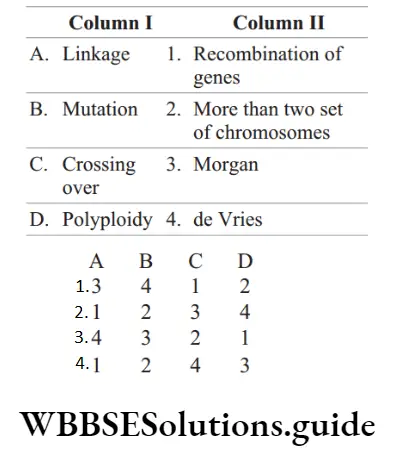
Question 48. Find the correct match.

  1. Trichomoniasis – Trichomonas vaginalis
  2. Genital warts – Herpes simplex virus
  3. Pubic lice – HBV virus
  4. Vaginal candidiasis – Candida utilis

Answer:  1. Trichomoniasis – Trichomonas vaginalis

  • Option (1) is correct match as Trichomonas vaginalis is a protozoan which causes trichomoniasis.
  • Other options are incorrect matches and can be corrected as Genital warts are caused by human papilloma virus.
  • Pubic lice is infested through sexual activity or through unhygenic way of living. Vaginal candidiasis can be caused by yeast, Candida albicans.

NEET Biology Mcq Chapter Wise

Question 49. Profuse, yellowish, greenish frothy smelling discharge from vagina is due to infection of

  1. Troponema pallidum
  2. Chlamydia
  3. Trichomonas vaginalis
  4. Neisseria

Answer: 3. Trichomonas vaginalis

  • Trichomoniasis is a common sexually transmitted infection caused by a parasite, Trichomonas vaginalis.
  • In women, trichomoniasis can cause a foul-smelling vaginal discharge, genital itching and painful urination. Men who have trichomoniasis typically have no symptoms.

Question 50. Which of the following antibiotic is used in the treatment of trichomoniasis?

  1. Miconazole
  2. Ceftriaxone
  3. Aureomycin
  4. Tetracycline

Answer:  3. Aureomycin

Trichomoniasis is treated using various drugs like aureomycin, terramycin and meteronidazole.

Question 51. Match the following columns.

NEET Biology Sexually Transmitted Infections Question 51 Match The Column

Answer:  2. A–1, B–2, C–3, D– 4, E–5

Question 52. Which one of the following pairs is not correctly matched?

  1. Syphilis – Treponema
  2. Sleeping sickness –Trypanosoma Gambiense
  3. Dengue fever – Arbovirus
  4. Plague – Entamoeba

Answer:  4. Plague – Entamoeba

Option 4 is not correctly matched pair and can be corrected as Plague is an infectious disease caused by the bacterium, Yersinia pestis and amoebiasis is an infection of the intestines caused by a parasite called Entamoeba.

Question 53. Phthirus pubis causes

  1. Vaginitis
  2. Pubic lice
  3. Syphilis
  4. Chlamydiasis

Answer:  2. Pubic lice

The most common way to acquire pubic lice is through sexual intercourse. Its causative agent is Phthirus pubis.

Question 54. Untreated chlamydiasis may lead to

  1. Pelvic Inflammatory Disease (PID)
  2. Urethra Inflammatory Disease (UID)
  3. Kidney Inflammatory Disease (KID)
  4. None of the above

Answer:  1. Pelvic Inflammatory Disease (PID)

  • Pelvic Inflammatory Disease (PID) leads to sterility in person suffering from untreated chlamydiasis.
  • Other options are explained as Urethra Inflammatory Diseases (UIDs) are caused by bacteria that enter the urethra from the skin around the urethra’s opening. Kidney Inflammatory Disease (KID) is caused by bacterial infection.

Question 55. Transmission of STDs can be prevented by

  1. Avoiding sex with unknown people
  2. Having multiple partner
  3. Following protected sex
  4. Avoiding sharing of any kind of syringes.

Choose the correct option.

  1. 1, 2 and 4
  2. 1, 2 and 3
  3. 1, 3 and 4
  4. 1, 2, 3 and 4

Answer: 3. 1, 3 and 4

Transmission of STDs can be prevented by avoiding sex with multiple or unknown partners, using condoms, disposal of syninges after single use, etc. Thus, option (3) is correct.
Question 56. Which of the following is an effective antibiotic for STDs?

  1. Tetracycline
  2. Erythromycin
  3. Rifampicin
  4. All of these

Answer:  4. All of these

  • All given options are effective antibiotics for STDs. Tetracycline is used to treat many different bacterial infections of the skin, intestines, respiratory tract, urinary tract, genitals, lymph nodes, and other body systems.
  • It is often used in treating severe acne or sexually transmitted diseases such as syphilis, gonorrhoea or chlamydia.
  • Erythromycin is used against against Chlamydia. Rifampin and its analogues are the most active of all antibiotics against Chlamydia trachomatis. Thus, option (d) is correct.

NEET Biology Deviation From Mendelism Multiple Choice Question And Answers

Deviation From Mendelism

Question 1. A phenomenon in which neither of the alleles of a gene is completely dominant over the other and hybrid is intermediate between the two parents is called

  1. Incomplete dominance
  2. Complete dominance
  3. Codominance
  4. Complementary dominance

Answer: 1. Incomplete dominance

Incomplete dominance is the phenomenon in which none of the alleles being dominant, and the hybrid produced by crossing two pure individuals is a mixture of the parents.

Question 2. The phenomenon of incomplete dominance was observed by

  1. De Vries
  2. Correns
  3. Tschermark
  4. None of these

Answer:  2. Correns

  • While Mendel’s work laid the foundation, it was German botanist Carl Correns (1864-1933) who was credited with the actual discovery of incomplete dominance.
  • In the early 1900s, Correns conducted similar research on four O’ clock plants. In his work, Correns observed a blend of colours in flower petals.

Read And Learn More: NEET Biology Multiple Choice Question And Answers

Question 3. An example of intragenic gene interaction.

  1. Incomplete dominance
  2. Codominant
  3. Multiple alleles
  4. All of the above

Answer:  4. All of the above

  • Post-Mendelian gene interaction involves the influence of alleles and non-alleles on the normal phenotypic expression of genes. It is two types, namely, intragenic (allelic) and intergenic (non-allelic).
  • In the intragenic interaction, the two alleles of a gene interact to produce a phenotypic expression different from typical dominant-recessive phenotype, e.g. incomplete dominance, codominance, multiple alleles.
  • In intergenic or non-allelic interaction, two or more independent genes present on the same or different chromosomes interact to produce different expression, e.g. epistasis, duplicate genes, complementary genes, supplementary genes, lethal genes, inhibitory genes, etc.
Thus, option (4) is correct.

law of incomplete dominance

Question 4. Genotypic and phenotypic ratio in monohybrid cross remains same in case of

  1. Sex-linked genes
  2. Pseudoallelic genes
  3. Intermediate inheritance
  4. Dominant and recessive genes

Answer:  3. Intermediate inheritance

Genotypic and phenotypic ratio in monohybrid cross remains same in case of intermediate inheritance.

NEET Biology Deviation From Mendelism Multiple Choice Question And Answers

NEET Biology Deviation from Mendelism MCQs with Answers

Question 5. Incomplete dominance is demonstrated in

  1. Antirrhinum majus
  2. Pisum sativum
  3. Hibiscus rosa-sinensis
  4. Abutilon indicum

Answer:  1. Antirrhinum majus

  • Carl Correns reported incomplete dominance in Antirrhinum majus and Mirabilis jalapa. In both the case, there are two types of flower colour in pure state, red and white.
  • When the two types of plants are crossed, the hybrid or plants of F1 -generation have pink flowers. The pink colour apparently appears due to mixing of red and white colours (incomplete dominance).

Question 6. Incomplete dominance is shown by

  1. Primrose
  2. Mirabilis
  3. Helianthus
  4. China rose

Answer:  2. Mirabilis

Question 7. Phenotypic ratio in plant snapdragon in F2 is

  1. 1: 1
  2. 2: 1
  3. 3: 1
  4. 1: 2: 1

Answer:  4. 1: 2: 1

Phenotypic ratio in snapdragon plant in F2 is 1:2:1.

Question 8. In Mirabilis, a hybrid for red (RR) and white (rr) flower produces pink (Rr) flower. A plant with pink flower is crossed with white flower, the expected phenotypic ratio is

  1. Red: pink : white (1: 2 : 1)
  2. Pink: white (1: 1)
  3. Red: pink (1: 1)
  4. Red: white (3: 1)

Answer:  2. Pink: white (1: 1)

Mirabilis jalapa shows incomplete dominance.

NEET Biology Deviation from Mendelism Mirabilis Jalapa

The ratio of pink and white flower is 1:1.

law of incomplete dominance

Question 9. Leaf colour in Mirabilis jalapa is an example of

  1. Non-Mendelian inheritance
  2. Mendelian inheritance
  3. Chemical inheritance
  4. Both 2 and 3

Answer:  1. Non-Mendelian inheritance

  • The inheritance due to the genes found in cytoplasm (mitochondria and chloroplast) is called cytoplasmic inheritance or non-Mendelian inheritance.
  • The leaves of Mirabilis jalapa may be green, white or variegated. This is due to cytoplasmic inheritance.

Question 10. RR (red) flowered plant is crossed with rr (white) flowered plant. All of the Rr offspring are pink. This is an indication that the R gene is

  1. Codominant
  2. Recessive
  3. Incompletely dominant
  4. Linked

Answer:  3. Incompletely dominant

The offspring Rr are pink due to partial expression of both alleles R and r. Thus, the gene R shows incomplete dominance.

NEET Biology DeviationFrom Mendelism Generations

Important MCQs on Deviation from Mendelian Genetics for NEET

Question 11. When phenotypic and genotypic ratio resembles in F2-generation. It is an example of

  1. Law of segregation
  2. Law of incomplete dominance
  3. Complimentary genes
  4. Epistasis

Answer:  2. Law of incomplete dominance

law of incomplete dominance

Incomplete dominance is not blending inheritance because parental characters reappear in F2-generation. Pink colour flower appear due to incomplete dominance of red colour trait over white flower trait. Both genotypic ratio and phenotypic ratio in the case of incomplete dominance are same, i.e. 1: 2: 1.

Question 12. A blue fowl was obtained after crossing between a white and black fowl. Then the ratio of their F1 – generation will be

  1. 3: 1
  2. 9: 7
  3. 1:2:1
  4. 13: 3

Answer:  3. 1:2:1

Since the cross between white and black fowl produced an intermediate phenotype, i.e. blue fowl, it is an example of incomplete dominance.

NEET Biology DeviationFrom Mendelism Question 12

Ratio = 1: 2: 1
Phenotypic ratio 1: 2: 1
(Black: Blue: White)
Genotypic ratio 1: 2: 1 (1BB: 2Bb 1bb)Thus, the correct answer is option (3).

Question 13. Two plants, one with black flower and other with white coloured flower were crossed in an experiment. In the next generation, grey coloured flowers were obtained. The reason for the result is

  1. Incomplete dominance
  2. Pseudodominance
  3. Codominance
  4. None of the above

Answer:  1. Incomplete dominance

  • The expression of the character in a hybrid or F1 individual is intermediate or a fine mixture of the expression of the two alleles of the parents.
  • If a plant with black flowers (say BB) on crossing with plant with white flowers (say bb), produced grey coloured flower (Bb), it means that the allele B is incompletely dominant over the recessive allele b. This is an example of incomplete dominance.

Question 14. Starch synthesis gene in pea plant is the example of

  1. Single gene producing more than one effect
  2. Multiple genes producing more than one effect
  3. Two genes producing more than one effect
  4. Multiple genes producing less than one effect

Answer:  1. Single gene producing more than one effect

  • Occasionally, a single gene product may produce more than one effect. For example, starch synthesis in pea seeds is controlled by one gene.
  • It has two alleles, B and b. Starch is synthesised effectively by BB and have bigger grains. In contrast, homozygous bb has lesser efficiency in starch synthesis and produce smaller grains.

law of incomplete dominance

Question 15. During the study of incomplete dominance, in a cross between true breeding red flowers (RR) and true breeding white flowers (rr), when F1 was self-pollinated, the resulted F2 ratio may be

  1. 1 (RR) red: 2 (Rr) pink: 1 (rr) white
  2. 2 (RR) red: 1 (Rr) pink: 1 (rr) white
  3. 1 (RR) red: 1 (Rr) pink: 2 (rr) white
  4. 3 (RR) red: 1 (rr) white

Answer: 1. 1 (RR) red: 2 (Rr) pink: 1 (rr) white

Cross between RR and rr would generate F2 generation as 1 RR: 2 Rr: 1rr.

Question 16. What will be the ratio of F2– generation, if red flowered variety of Mirabilis jalapa is crossed with white flowered variety?

  1. 1: 1: 1 : 1
  2. 3: 1
  3. 1: 2: 1
  4. 2: 3

Answer:  3. 1: 2: 1

Mirabilis jalapa show incomplete dominance. Thus, the F2-generation would have 1 : 2 : 1 ratio of red, pink and white flowers.

Question 17. The cross which will produce most pink flowers.

  1. Red × Red
  2. Red × Pink
  3. Pink × Pink
  4. Red × White

Answer:  4. Red × White

Pink colour flower is an intermediate character that is obtained by crossing homozygous red and white flowers.

Question 18. Andalusian fowl shows

  1. Codominance
  2. Incomplete dominance
  3. Multiple alleles
  4. All of the above

Answer:  2. Incomplete dominance

  • Andalusian fowl shows blending inheritance. It is also called as incomplete dominance. In Andalusian fowl, if a cross is made between black feathered fowl and white one, F1 -generation will have a blue feathered fowl.
  • After selfing, it produces black-blue and white feathers in the ratio of 1: 2 : 1. Refer to the cross in Ans. 12.

law of incomplete dominance

Question 19. In Antirrhinum, two plants with pink flowers were hybridised. The F1 plants produced red, pink and white flowers in the proportion of 1 red, 2 pink and 1 white. What could be the genotype of the two plants used for hybridisation? Red flower colour is determined by RR and white by rr genes.

  1. Rrrr
  2. RR
  3. Rr
  4. Rr

Answer:  3. Rr

The genotype of the two plants used for cross would be Rr

NEET Biology DeviationFrom Mendelism Question 19

The incomplete dominance of dominant allele (here R) over recessive allele (here r) could be due to mutations (insertion, deletion, substitution or inversion of nucleotides). The mutant allele generally produces a faulty or no product.

Question 20. All of given options obeys Mendel’s laws except

  1. Codominance
  2. Independent assortment
  3. Dominance
  4. Purity of gametes

Answer:  1. Codominance

In the given options, only codominance does not obey Mendel’s laws of dominance. It is an example of non-Mendelian intragenic interaction.

Question 21. When both alleles of a pair are fully expressed in a heterozygote, they are called

  1. Lethal
  2. Codominants
  3. Semidominants
  4. Recessive allele

Answer:  2. Codominants

law of incomplete dominance

  • Codominance is the condition that arises when both alleles in a heterozygous organism are dominant and are fully expressed in the phenotype.
  • For example, the human blood group AB is the result of two alleles, A and B, both being expressed equally A is not dominant to B, nor vice-versa.

Question 22. A gene showing codominance has

  1. Alleles that are recessive to each other
  2. Both alleles independently expressed in the heterozygote
  3. One allele dominant on the other
  4. Alleles tightly linked on the same chromosome

Answer:  2. Both alleles independently expressed in the heterozygote

Incomplete Dominance and Codominance MCQs for NEET

Question 23. Which Mendelian idea is depicted by a cross in which the F1 – generation resembles both the parents?

  1. Law of dominance
  2. Inheritance of one gene
  3. Codominance
  4. Incomplete dominance

Answer:  3. Codominance

In codominance, F1 -generation resembles both the parents, e.g. blood group inheritance.

Question 24. Assertion (A) There are cows of two colour coats. Reason (R) It is the case of codominance.

  1. Both A and R are true and R is the correct explanation of A
  2. Both A and R are true, but R is not the correct explanation of A
  3. A is true, but R false
  4. Both A and R are false

Answer:  1. Both A and R are true and R is the correct explanation of A

Both A and R are true and R is the correct explanation of A. There are cows of two colour coats, which is only possible in case of codominance where character of both the alleles are expressed.

Question 25. Identify the wrong statement.

  1. Alleles b and c also produce sugar
  2. Alleles IA and IB produce sugars
  3. When IB and b or i are present only IB is expressed
  4. Both IA and IB are present together and they express because of codominance

Answer:  1. Alleles b and c also produce sugar

  • Statement in option (1) is wrong because AB blood group in humans is controlled by three multiple alleles, i.e IA , IB and i.
  • The IA and IB alleles produce enzyme glycosyl transferase for the synthesis of sugars. Allele i does not produce any enzyme/antigen.
  • Both IA and IB are codominant and these both are dominant over i. Since, b and c represent recessive forms, they cannot produce sugar. Rest statements are correct.

Question 26. An example for codominance is

  1. Eye colour in Drosophila
  2. Seed shape and colour in pea plants
  3. AB blood group in man
  4. Haemophilia in man
  5. Baldness in man

Answer:  3. AB blood group in man

The phenomenon of expression of both the alleles in a heterozygote is called codominance. Alleles for blood group A (IA ) and for blood group B (IB) are codominant, so that when they come together in an individual, they produce blood group AB.

law of incomplete dominance

Question 27. Blood grouping in humans is controlled by

  1. 4 alleles in which A is dominant
  2. 3 alleles in which AB is codominant
  3. 3 alleles in which none is dominant
  4. 3 alleles in which A is dominant
  5. None of the above

Answer:  2. 3 alleles in which AB is codominant

The three alleles controlling the human blood groups are IA ,IB,IO in which AB is codominant.

Question 28. A child of blood group O cannot have parents of blood groups

  1. AB and AB/O
  2. A and B
  3. B and B
  4. O and O

Answer:  1. AB and AB/O

A child of blood group O cannot have parents of blood groups AB and AB/O.

AB blood group possesses the genotype IA IB. AB × AB would generate blood groups A, B or AB.
AB × O would generate blood groups A or B, but never O. In the presence of dominant alleles, recessive allele (i) cannot be expressed.

Question 29. If mother has ‘O’ blood group, child also has O group. What will be the blood group of father?

  1. O
  2. A
  3. B
  4. All of these

Answer:  4. All of these

law of incomplete dominance

The cross between blood group O and either O, A or B can produce progeny with blood group O. But in such condition, father should have heterozygous genotype (in case of blood group A or B).

NEET Biology DeviationFrom Mendelism Heterozygous Genotype

Thus, option 4 is correct.

Question 30. First husband of Asha had ABO blood type A and their child had type O. She remarried and her second husband had ABO blood type B and their child had type AB. What is the ABO genotype of Asha and also name her blood type?

  1. Ii, blood type O
  2. IB, blood type B
  3. IAIB, blood type AB
  4. IAi, blood type A

Answer:  4. IAi, blood type A

  • Asha’s child from her first husband had blood group type O, i.e. genotype (ii). It means that the child received two recessive alleles, one from each of his parents (i from father and i from mother Asha).
  • Asha’s child from second husband had blood group type AB, i.e. genotype IA IB. As the child’s father had blood group type B (genotype
    IBi/IBIB), it means that the child received IB allele from father and IA allele from Asha.
  • Above discussion makes it clear that Asha’s blood group type contains i and I A genes, thus her blood group type is A with genotype IA i.

law of incomplete dominance

Question 31. In the ABO blood group system in humans, if a person of type B blood has children with a person of type AB blood, what blood types could their children have?

  1. Type-AB, type-A and type-B
  2. Type-B and type-AB
  3. Type-AB, type-A, type-B and type-O
  4. Type-A and type-B

Answer:  1. Type-AB, type-A and type-B

Since, A and B alleles are codominant, the possible blood types of the children are type-AB, type-A and type-B.

Topic-wise Deviation from Mendelian Genetics MCQs for NEET with Explanation

Question 32. ABO blood group is determined by three different alleles. How many genotypes and phenotypes are possible? Genotypes Phenotypes

img

Answer: 2. 6 4

The 3 alleles IA , IB and i of gene I in ABO blood group system can produce six different genotypes and four different phenotypes as shown below

NEET Biology DeviationFrom Mendelism Question 32

Question 33. A man with A group of blood marries a woman with B group of blood. The possibility of blood group AB in their children will be

  1. 25%
  2. 75%
  3. 50%
  4. 100%

Answer: 1. 25%

  • In this case, the genotype of the partner with ‘A’ blood group will be either IA IA or IA 1. The genotype of the partner with ‘B’ blood group will be either IBIB or IBi.
  • The progeny can have all the four types of blood groups 25% O (2), 25% A (IA IA or IA i), 25% B (IB IB or IBi) and 25% AB (IA IB).

Question 34. A child of O group has B group father. The genotype of father will be

  1. IOIO
  2. IBIB
  3. IAIB
  4. IBIO

Answer:  4. IBIO

The genotype of the child with O blood group would be IOIO (recessive). Hence, the genotype of the father can only be I IB O, i.e. heterozygous B blood group.

Question 35. When both the parents are of blood group AB, children would be of blood group

  1. A, B, AB and O
  2. A, B and AB
  3. A and B
  4. A, AB and O

Answer:  2. A, B and AB

When both parents have blood group AB (IA IB) then offspring can have blood group A, B and AB.

NEET Biology DeviationFrom Mendelism Question 35

law of incomplete dominance

Question 36. Children have A and B types of blood. What are the blood types of parents?

  1. A and O
  2. AB and A
  3. AB and O
  4. A and B

Answer:  3. AB and O

Among given options, only AB and O can produce both A and B blood type in progeny.

NEET Biology DeviationFrom Mendelism Question 36

So, blood types of parents are AB and O.

Question 37. Blood group B can have alleles

  1. Ii
  2. IAIA
  3. IBIB
  4. IBIB or IBi

Answer:  4. IBIB or IBi

Blood group B can have two types of genotype. It can be found in homozygous (I IB B) or in heterozygous (I iB ) condition.

Question 38. If one parent belongs to A blood group and the other to O blood group, their children possibly represent

  1. A and B groups only
  2. AB only
  3. A and O groups only
  4. All four groups

Answer:  3. A and O groups only

Children with parents having blood groups A and O will have blood groups either A or O.

Question 39. Assertion (A) A woman can go to the court if a man refuses to own his child. He has blood group B and women has A, while child has O. Reason (R) Genetically she is right, he can be father of the child.

  1. Both A and R are true and the R is the correct explanation of A
  2. Both A and R are true, but R is not the correct explanation of A
  3. A is true, but R false
  4. Both A and R are false

Answer:  1. Both A and R are true and the R is the correct explanation of A

Both A and R are true and R is the correct explanation of A. Man has blood group B, it means he will have alleles I IB B or I IB O and woman has blood group A, that can have alleles I IA A or I IA O.

So there is possibility of a producing child with blood group O. In such condition, both man and woman are heterozygotes and have blood group genotype I IB 0 and I IA 0, respectively.

Question 40. Which of the following genotypes does not produce any sugar polymer on the surface of the RBC?

  1. IAIA
  2. IBi
  3. IAIB
  4. Ii
  5. IBIB

Answer:  4. Ii

Genotype ii does not produce any sugar polymer on the surface of the RBC because it is recessive allele. The blood group associated with this genotype is O.

Question 41. The genotypes of a husband and wife are I AI B and I A i. Among the blood types of their children, how many different genotypes and phenotypes are possible?

  1. 3 genotypes, 3 phenotypes
  2. 3 genotypes, 4 phenotypes
  3. 4 genotypes, 3 phenotypes
  4. 4 genotypes, 4 phenotypes

Answer:  3. 4 genotypes, 3 phenotypes

Mating between I IA B and I iA can produce 4 genotypes and 3 phenotypes as shown in cross given below.

NEET Biology DeviationFrom Mendelism Question 41

law of incomplete dominance

Question 42. A man of A blood group marries a woman of AB blood group. Which type of progeny would indicate that man is heterozygous?

  1. O
  2. B
  3. A
  4. AB

Answer:  2. B

  • Possible blood groups of children born to parents having A and AB groups are A, B and AB. These parents cannot have children possessing O group of blood.
  • AB blood group parent is always a heterozygote, while A blood group parent can either be a homo or heterozygote. If the male parent with blood group A in question is homozygote then no child with blood group B will be born.

NEET Biology DeviationFrom Mendelism Question 42

When the male parent is heterozygote then only blood group B of progeny shows that male parent is heterozygous.

NEET Biology DeviationFrom Mendelism Question 42.

Question 43. Four children belonging to the same parents have the following blood groups A, B, AB and O. Hence, the genotypes of the two parents are

  1. Parents are homozygous for ‘A’ group
  2. One parent is homozygous for ‘A’ and another parent is homozygous for ‘B’
  3. One parent is heterozygous for ‘A’ and another parent is heterozygous for ‘B’
  4. Parents are homozygous for ‘B’ group

Answer:  3. One parent is heterozygous for ‘A’ and another parent is heterozygous for ‘B’

Four children belonging to the same parents will have the blood groups A, B, AB and O, if the genotypes of one parent is heterozygous for ‘A’ (IA IO) and another parent is heterozygous for ‘B’ (IBIO). It is illustrated below

NEET Biology DeviationFrom Mendelism Question 43

IA IB = AB blood group
IA IO = A blood group
IBIO= B blood group
IOIO = O blood group

Question 44. With regard to the ABO blood typing system, if a man who has type B blood and a woman who has type A blood were to have children, what blood types could the children have?

  1. A or O
  2. B or O
  3. AB or O
  4. A, B, AB or O

Answer:  2. B or O

The man has type B blood and woman has type O blood. So, the genotype of their blood group will be IBIB or IBIO and IOIO, respectively. The blood type of child will be either B or O. This is illustrated below

NEET Biology DeviationFrom Mendelism Question 44 1B.

NEET Biology DeviationFrom Mendelism Question 44 IO

law of incomplete dominance

Question 45. Percentage of blood groups in India is given in the diagram below.

NEET Biology DeviationFrom Mendelism Percentage of blood groups

  1. Choose the correct option from the given statements.
  2. Only 10% of individuals are heterozygous for blood group allele
  3. Group A is the most common as it is the homozygous recessive group
  4. The alleles for blood group A and O are dominant to the allele for blood group O
  5. Any individual, selected at random from the sample population, has a 1 in 20 chance of being blood group AB

Answer:  4. Any individual, selected at random from the sample population, has a 1 in 20 chance of being blood group AB

As given in the pie chart, the AB blood group percentage is 5% in India. So, it can be said that any individual, selected at random from sample population has 1 in 20 chance of being blood group AB.

Question 46. A child’s blood group is ‘O’. The parent’s blood groups cannot be

  1. AB
  2. A and B
  3. B and O
  4. A and A
  5. None of these

Answer: 1. AB

A child’s blood group is ‘O’, i.e. it has no antigen, but group AB possess both the antigen A and B. Thus, it is not possible for the ‘O’ blood group individual to have parents with blood group AB. It is illustrated in cross given below

NEET Biology DeviationFrom Mendelism Question 46

NEET Biology Multiple Allelism and Pleiotropy MCQs

Question 47. Most popularly known blood grouping is the ABO grouping. It is named ABO and not ABC, because ‘O’ in it refers to having

  1. Overdominance of this type on the genes for A and B types
  2. One antibody only either anti-A or anti-B on the RBCs
  3. No antigens A and B on RBCs
  4. Other antigens besides A and B on RBCs

Answer:  3. No antigens A and B on RBCs

In ABO blood group, O refers to O blood group that has no antigen (A and B) on RBCs.

Question 48. The father has blood group AB and mother ‘O’. The child is supposed to have which of the following blood groups?

  1. B or O
  2. A or B
  3. Only B
  4. Only A

Answer:  2. A or B

  • The father has blood group ‘AB’ and mother has ‘O’. The child is supposed to have blood group ‘A’ or ‘B’. The genotype of father having blood group AB will be IA IB.
  • The genotype of mother having blood group O will be ii. Group ‘O’ blood has no antigens on RBC and has anti A and anti – B antibodies in serum.
  • Blood group AB has antigens A and B (but no antibodies in serum), thus the offsprings of AB and O blood groups would be ‘A’ or ‘B’. Refer to cross in Ans. 46.

Question 49. Which of the following characteristics represent ‘inheritance of blood groups’ in humans?

  1. Dominance
  2. Codominance
  3. Multiple allele
  4. Incomplete dominance
  5. Polygenic inheritance

Choose the correct answer

  1. 2, 3 and 5
  2. 1, 3 and 5
  3. 2, 4 and 5
  4. 1, 2 and 3

Answer:  4. 1, 2 and 3

  • Inheritence in the human blood group shows multiple alleles, dominance as well as codominance. Within the ABO blood group system, the A and B gene are codominant, i.e. these are expressed equally whenever present together. The O gene is recessive and only expressed when neither A nor B is present.
  • Three alleles are responsible for the different types of blood groups in human which shows multiple allelism. Alleles IA and IB show dominance on allele i.

Question 50. Parents of blood groups O and AB cannot have a child of group AB because

  1. Gene O is dominant over gene A
  2. Gene O is dominant over gene B
  3. Gene A or B is absent in one of the parents
  4. Gene A and B are absent in one of the parents

Answer:  3.  Gene A or B is absent in one of the parents

Parents of blood group O and AB cannot have a child of group AB because gene A or B is absent in one of the parents. Refer to Ans. 46.

law of incomplete dominance

Question 51. An individual with genotype I BIO has blood group

  1. A
  2. B
  3. AB
  4. O

Answer:  2. B

An individual with genotype I IB O has blood group B. As per law of dominance, allele IB is dominant and it will be expressed, whereas allele IO being recessive would not be expressed.

Question 52. If two people with ‘AB’ blood group marry and have sufficiently large number of children these children could be classified as ‘A’ blood group: ‘AB’ blood group: ‘B’ blood group in 1 : 2 : 1 ratio. Modern technique of protein electrophoresis reveals presence of both ‘A’ and ‘B’ type proteins in ‘AB’ blood group individuals. This is an example of

  1. Incomplete dominance
  2. Partial dominance
  3. Complete dominance
  4. Codominance

Answer:  4. Codominance

  • ABO blood group system in human beings is an example of codominant, dominant–recessive and multiple alleles.
  • Blood groups are controlled by the gene I located on 9th chromosome that has 3 multiple alleles, out of which any two are found in a person.
  • In codominance, both genes I IA and B express completely. So, given example in question is an example of codominance.

Question 53. An exception to Mendel’s law is

  1. Law of independent assortment
  2. Law of segregation
  3. Law of dominance
  4. Law of linkage

Answer:  4. Law of linkage

Linkage is the tendency of two or more genes to inherit together. Mendel’s laws are true only in the absence of linkage and gene interaction. Thus, linkage is an exception to Mendel’s law.

Question 54. Choose the incorrect one out.

  1. Codominant genes are never haplosufficient
  2. Dominant phenotype is expressed when a gene is haplosufficient
  3. Incomplele dominance is the presence of haplosufficiency
  4. In homozygous condition, an allele can express its phenotype be it the dominant or recessive allele in nature

Answer:  3. Incomplele dominance is the presence of haplosufficiency

Option (3) is incorrect and can be corrected as Haplosufficiency is the condition when an allele can express itself fully and produce its phenotype completely even in heterozygous condition. Incomplete dominance results from lack of haplosufficiency. Rest all options are correct.

Question 55. Failure in which of the following phenomenon would result in linkage?

  1. Law of dominance
  2. Law of segregation
  3. Law of independent assortment
  4. Law of separation

Answer:  3. Law of independent assortment

Failure of independent assortment would result in the linkage of genes on the chromosomes. Due to this, the two alleles present closely together fails to seggregate during gamete formation and thus inherit together.

law of incomplete dominance

Question 56. In genetic crosses showing recessive epistasis such as mice coat colour, F2 phenotypic ratio is

  1. 9 : 3: 4
  2. 9 : 6: 1
  3. 12 : 3: 4
  4. 13 : 3

Answer: 1. 9 : 3: 4

  • Epistasis due to recessive gene is known as recessive epistasis, i.e. out of the two pairs of genes, the recessive epistatic gene masks the activity of the dominant gene on the other gene locus.
  • In genetic crosses showing recessive epistasis such as mice coat colour, F2 phenotypic ratio is 9 : 3: 4.

Question 57. In a dihybrid cross, between two heterozygotes AaBb : AaBb, if we get 3:1 ratio among the offsprings, the reason for this may be

  1. Polygenes
  2. Linked genes
  3. Pleiotropic genes
  4. Hypostatic genes

Answer:  2. Linked genes

  • In case of dihybrid cross between AaBb × AaBb, if we get 3:1 ratio among the offsprings then it may be due to the presence of linked genes.
  • These genes are placed on the same chromosome and do not show independent assortment at the time of gamete formation. These genes show a dihybrid ratio of 3: 1. Complete linkage allows the gene combination of parental traits to be inherited together.

Question 58. TtRr represents heterozygous tall, heterozygous pink. If this plant is self-crossed then (T-dominant, t-recessive, R-dominant, r-recessive)

  1. 25% plants have red flower.
  2. 25% plants have white flower.
  3. 50% plants have pink flower.
  4. 50% plants are tall.

Choose the correct option.

  1. 1 and 2
  2. 1, 2 and 3
  3. 2, 3 and 4
  4. 1, 2,3 and 4

Answer:  2. 1, 2 and 3

TtRr represents (heterozygous tall and pink). Hence, in accordance with the ratio of incomplete dominance, i.e. 1 : 2 : 1, 25% plants have red flower, 25% plants have white flower and 50% plants have pink flower.

Question 59. The F2 dihybrid ratio 12:3:1 is explained on the basis of

  1. Epistatic interaction
  2. Complementary gene action
  3. Interaction between two alleles
  4. Both 1 and 2

Answer:  1. Epistatic interaction

Epistasis is a type of gene interaction in which one gene masks or prevents the expression of another. Such interactions give modified F2 ratio as 12: 3 : l.

Question 60. Which of the following ratio shows complementary gene interaction?

  1. 9:7
  2. 15:1
  3. 1:2:1
  4. 9:3:3:1

Answer: 1. 9:7

Complementary gene interaction was first discovered by William Bateson and Reginald Punnett in 1906.

9:7 ratio shows that 9 offspring have both dominant genes, while 7 is having either one dominant or both recessive genes.

Question 61. Independent assortment of genes does not takes place when

  1. Genes are located on homologous chromosomes
  2. Genes are linked and located on same chromosome
  3. Genes are located on non-homogenous chromosome
  4. All of the above

Answer:  2. genes are linked and located on same chromosome

Genes that are located on the same chromosome are not free to participate in independent assortment and are referred to as linked genes. These genes tend to be inherited together.

Question 62. Lack of independent assortment of two genes, A and B in fruitfly, Drosophila is due to

  1. Repulsion
  2. Recombination
  3. Linkage
  4. Crossing over

Answer:  3. Linkage

Lack of independent assortment of two genes, A and B in fruitfly Drosophila is due to linkage, in which genes are located close to each other and they do not assort independently.

Question 63. When two dominant independently assorting genes react with each other, they are called

  1. Collaborative genes
  2. Complementary genes
  3. Duplicate genes
  4. Supplementary genes

Answer:  2. Complementary genes

law of incomplete dominance

Two genes present on separate loci that interact together to produce a dominant phenotype are called complementary genes. In F2 -generation, 9:7 ratio is obtained by them.

Question 64. Multiple phenotype is seen in

  1. Dominance relationship
  2. Particulate inheritance
  3. Monogenic inheritance
  4. Polygenic inheritance

Answer:  4. Polygenic inheritance

  • Polygenic inheritance is a type of inheritance controlled by one or more genes in which the dominant alleles have cumulative effect with each dominant allele expressing a part or unit of the trait and the full trait being shown only when all the dominant alleles are present.
  • The genes involved in quantitative inheritance are called polygenes (also called cumulative genes). Quantitative inheritance is therefore, also called polygenic inheritance. It is also named as multiple factor inheritance as mutiple phenotypes are seen in it.

Cytoplasmic Inheritance and Gene Interaction MCQs for NEET

Question 65. Skin colour inheritance in man is

  1. Monogenic
  2. Polygenic
  3. Sex-linked
  4. Multiple alleles
  5. Epistasis

Answer:  2. Polygenic

Inheritance of skin colour in man is an example of polygenic inheritance. It shows cumulative effect, i.e. two independent dominant genes produce additive effect in an individual.

Question 66. Who gave first experimental evidence of the polygenic concept of inheritance?

  1. Galton (1883)
  2. Malthus (1828)
  3. Nilsson Ehle (1908)
  4. None of the above

Answer:  3. Nilsson Ehle (1908)

Continuous variation is due to the additive effect of two or more genes for a trait. Such type of inheritance is called polygenic inheritance. Nilsson Ehle gave first experimental evidence of the polygenic concept of inheritance.

Question 67. The total number of types of gametes produced in a cross between a negro and albino parent is

  1. 64
  2. 16
  3. 08
  4. 04

Answer:  3. 08

The F1 -generation has mullatoes with 8 types of gametes. The genetic combination is AaBbCc. As there are three pairs of heterozygous alleles, it will form 8 types of gametes.
Question 68. Select the statement which is not correct?

  1. Polygenic character is controlled by multiple alleles
  2. In case of polygenic inheritance, thousands of intermediate phenotypes are found between 2 extreme ones
  3. Height, weight, skin colour are polygenic
  4. Polygenic character is controlled by multiple genes

Answer:  1. Polygenic character is controlled by multiple alleles

  • Statement in option (1) is not correct. Quantitative or polygenic inheritance is that type of inheritance in which the complete expression of a trait is controlled by two or more genes.
  • The complete trait develops only by the cumulative effect of all homologous and non-homologous dominant alleles influencing that trait. Inheritance of skin colour in man is an example of polygenic inheritance. Rest all options are correct.

Question 69. The polygenic genes show

  1. Similar genotype
  2. Different karyotype
  3. Different phenotype
  4. None of the above

Answer:  4. None of the above

A polygenic trait is governed by more than one gene where dominant allele of each gene express a part of trait and full trait is expressed by dominant alleles of all genes. Depending upon genotype, it produce multiple or different phenotypes.

Question 70. Which one of the following pairs of features is a good example of polygenic inheritance?

  1. Human height and skin colour
  2. ABO blood group in humans and flower colour of Mirabilis jalapa
  3. Hair pigment of mouse and tongue rolling in humans
  4. Human eye colour and sickle-cell anaemia

Answer:  1. Human height and skin colour

Statement in option (a) is a good example of polygenic inheritance as Inheritance of human height and skin colour are examples of polygenic inheritance. Rest all options are false.

Question 71. The phenotypic ratio of polygenes representing skin colour in human is

  1. 1: 4 : 6: 4: 1
  2. 1: 2: 1
  3. 1: 6: 15: 20 : 15: 6: 1
  4. 1: 3: 1

Answer:  3. 1: 6 : 15: 20 : 15: 6: 1

The phenotypic ratio of polygenes representing skin colour in human is
1 : 6 : 15 : 20 : 15 : 6 : 1.

Question 72. Grain colour in wheat is determined by three pairs of polygenes. Following the cross AABBCC (dark colour) × aabbcc (light colour) in F2-generation. What proportion of the progeny is likely to resemble either parent?

  1. Half
  2. Less than 5%
  3. One third
  4. None of these

Answer:  2. Less than 5%

  • Polygene results in quantitative inheritance. This inheritance is characterised by the occurrence of intermediate forms between the parental types. There will be 7 phenotypes (l: 6: 15: 20: 15: 6: 1) when three polygene pairs are involved.
  • The total number of progeny would be 64. Out of these 64, only two are likely to resemble either parent. Hence, their proportion in F2-generation would be less than 5%.

law of incomplete dominance

Question 73. Multiple factor inheritance has been observed in which of the following characteristic of wheat?

  1. Height of the plant
  2. Colour of the grain
  3. Shape of legumes
  4. Number of spikelets

Answer:  2. Colour of the grain

A few instances of multiple factor inheritance are kernel or grain colour in wheat, cob length in maize, yield of crop plants including size, shape and number of seeds or fruits per plant.

Question 74. Which of the following is not the type of epistasis?

  1. Dominant
  2. Recessive
  3. Collaborative
  4. Supplementary

Answer:  3. Collaborative

All given options are types of epistasis except collaborative. Epistasis can be of many types based on the ability of an allele in masking and modification of gene effects. It can be of dominant, recessive, complementary or supplementary.

Question 75. Assertion (A) A gene affecting the character of another gene not located on similar locus of the homologous chromosome is called epistatic gene. Reason (R) Epistatic gene hides the expression of an allele at a different locus.

  1. Both A and R are true and R is the correct explanation of A
  2. Both A and R are true, but R is not the correct explanation of A
  3. A is true, but R is false
  4. Both A and R are false

Answer:  1. Both A and R are true and R is the correct explanation of A

Question 76. The process that involves intergenic suppression or the masking effect which one gene locus has upon the expression of another is called

  1. Epistasis
  2. Dominance
  3. Incomplete dominance
  4. Recessive
  5. Pleiotropy

Answer:  1 . Epistasis

  • Originally, the term epistasis meant that the phenotypic effect of one gene is masked by a different gene (locus).
  • Thus, epistatic mutations have different effects in combination, than individually. In epistasis, two independent non-allelic genes affect the same trait in such a way that one overmasks the expression of other.

Question 77. A pleiotropic gene

  1. Controls a trait only in combination with another gene
  2. Controls multiple traits in an individual
  3. Is expressed only in primitive plants
  4. Is a gene evolved during Pliocene

Answer:  2. Controls multiple traits in an individual

  • The ability of a gene to have multiple phenotypic effects because it influences a number of characters simultaneously is known as pleiotropy.
  • The gene having a multiple phenotypic effect because of its ability to control expression of two or more characters is called pleiotropic gene.
  • In human beings, pleiotropy is exhibited by syndromes like sickle-cell anaemia and
    phenylketonuria.

Question 78. Assertion (A) The phenomenon of a single gene influencing more than one character is pleiotropism. Reason (R) The gene responsible for phenylketonuria affects a number of abnormal phenotypic traits.

  1. Both A and R are true and R is the correct explanation of A
  2. Both A and R are true, but R is not the correct explanation of A
  3. A is true, but R false
  4. A is false, but R is true
  5. Both A and R are false

Answer:  2. Both A and R are true, but R is not the correct explanation of A

Both A and R are true, but R is not the correct explanation of A. The phenomenon of a single gene influencing more than one character is pleiotropism and phenylketonuria is its example.

Linked Genes and Crossing Over MCQs for NEET

Question 79. Pleiotropic genes have

  1. Repressed phenotype
  2. Hidden phenotype
  3. Multiple phenotype
  4. All of the above

Answer:  3. Multiple phenotype

Pleiotropic gene is such a gene which has a wider effect on phenotype, i.e. it controls several phenotypic, traits. It has mutliple phenotypes. Sickle-cell anaemia is caused by one such pleiotropic gene.

Question 80. The best example for pleiotropy is

  1. Skin colour
  2. Phenylketonuria
  3. Colour blindness
  4. ABO blood group

Answer:  2. Phenylketonuria

  • The best example for pleiotropy is phenylketonuria. In phenylketonuria, a single gene mutation that codes for enzyme phenylalanine hydrodxylase is seen.
  • This manifests itself through phenotypic expression characterised by mental retardation, reduction in hair and skin pigmentation.

Question 81. Name the phenomenon where two genes have the same expression of the character?

  1. Pleiotropy
  2. Phenocopy
  3. Penetrance
  4. Expressivity

Answer:  1. Pleiotropy

Pleiotropy is the condition where either a single gene has multiple functions in the body or two genes have the same expression of the single character.

Question 82. Match the following columns.

NEET Biology Deviation From Mendelism Question 82 Match The Following Column.

Answer:  2. A–2, B–3, C–4, D–1

law of incomplete dominance

Question 83. The presence of continuous phenotypic variation in an F1 -generation suggests that a character is inherited by

  1. Gene linkage
  2. Epistasis
  3. Polygenic inheritance
  4. Recombination

Answer:  3. Polygenic inheritance

  • Quantitative or polygenic inheritance is that type of inheritance in which the complete expression of a trait is controlled by two or more genes (i.e. the presence of continuous phenotypic variation in an F1 -generation).
  • The complete trait develops only by the cumulative effect of all homologous and non-homologous
    dominant alleles influencing that trait. Inheritance of skin colour in man is an example of polygenic inheritance.

NEET Biology Mendelism Multiple Choice Question And Answers

NEET Biology Mcq Mendelism

Question 1. Principle or laws of inheritance were enunciated by

  1. Mendel
  2. Morgan
  3. Bateson
  4. Punnett

Answer:  1. Mendel

Principle or laws of inheritance were enunciated by Mendel. There are four principles or laws of inheritance based on monohybrid and dihybrid cross.

Question 2. Under which topic, Mendel’s work was published in ‘Natural History Society of Brunn’?

  1. Mendel’s Laws of Inheritance
  2. Experiments in Plant Hybridisation
  3. Experiment on Heredity and Variation
  4. Origin of Species

Answer:  2. Experiments in Plant Hybridisation

“genetics questions “

Mendel’s paper ‘Experiments on Plant Hybridisation’ was published in proceedings of Natural Science Society of Brunn in 1866.

Read And Learn More: NEET Biology Multiple Choice Question And Answers

Question 3. Mendel’s findings were rediscovered by

  1. De Vries
  2. Correns
  3. Tschermak
  4. All of these

Answer:  4. All of these

In 1900, three workers independently rediscovered the principles of heredity already worked out by Mendel. These workers were Hugo de Vries (Holland), Carl Correns (Germany) and Erich von
Tschermak (Austria).

Thus, option 4 is correct.

NEET Biology Mcq

NEET Biology Mendelism Multiple Choice Question And Answers

NEET Biology Mendelism MCQs with answers

Question 4. Mendel’s law were true for situation in which

  1. Alleles are affected by their environment
  2. Alleles show complete dominance
  3. Alleles of a gene alter the affect of a different gene
  4. A given character is determined by more than one gene

Answer:  2. Alleles show complete dominance

Mendel’s law were able to predict accurately the pattern of inheritance for a situation in which alleles show complete dominance. Effect of the environment, other alleles, etc., were not explained by the Mendel. He was not aware of polygenic traits also.

“questions about genetics “

Question 5. Which of the following are the laws yielded by Mendel’s studies?

  1. Law of dominance
  2. Law of segregation
  3. Law of independent assortment
  4. All of the above

Answer:   4. All of the above

Mendel’s studies yielded three laws of inheritance, i.e. the law of dominance, the law of segregation and the law of independent assortment. Thus, option 4 is correct.

Question 6. It was during Mendel’s investigation that ….A…. and …..B….. were applied together in biology.

Choose the correct set of answers.

  1. A–statistical analysis, B–mathematical logic
  2. A–statistical analysis, B–physical logic
  3. A–statistical analysis, B–chemistry logic
  4. A–statistical analysis, B–genetic coding

Answer:  1. A–statistical analysis, B–mathematical logic

During Mendel’s investigation, statistical analysis (A) and mathematical logic (B) were applied
together in biology.

NEET Biology Mcq

Question 7. Which one from those given below is the period for Mendel’s hybridisation experiments?

  1. 1856-1863
  2. 1840-1850
  3. 1857-1869
  4. 1870-1877

Answer:  1. 1856-1863

Mendel conducted hybridisation experiments on pea plant for 7 years between 1856 -1863 and his data was published in 1865.

Important MCQs on Mendelism for NEET

Question 8. Mendel conducted hybridisation experiments on garden peas for

  1. 7 years
  2. 6 years
  3. 5 years
  4. 4 years

Answer:  1. 7 years

Question 9. Choose the correct statement.

  1. Mendel died in 1884 without getting any recognition during his lifetime
  2. Correns converted two generalisations of Mendel into two laws of heredity
  3. Mendel had maintained statistical records of all the experiments
  4. All of the above

Answer:  4. All of the above

All the given statements are correct.

Biology MCQs with answers for NEET

Question 10. During the experiments, Mendel called genes by the term

  1. Traits
  2. Characters
  3. Factors
  4. Qualities

Answer: 3.  Factors

  • Mendel proposed that inheritance is controlled by paired germinal units or factors, now called genes. They are present in all cells of the body and are transferred to the next generation
    through gametes.
  • Factors or genes are thus, physical basis of heredity. They represent small segments of chromosomes.

Question 11. The botanical name of garden pea is

  1. Pisum sativum
  2. Lathyrus odoratus
  3. Mangifera indica
  4. Solanum tuberosum

Answer:   1. Pisum sativum

The botanical name of garden pea is Pisum sativum. It is herbaceous annual plant of the family–Fabaceae.It is grown virtually worldwide for its edible seeds.

Question 12. The experimental material in Mendel’s experiment was

  1. Pisum sativum
  2. Oryza sativa
  3. Mirabilis jalapa
  4. None of the above

Answer:  1. Pisum sativum

Gregor Johann Mendel conducted hybridisation experiments on garden pea (Pisum sativum) and proposed the laws of inheritance in living organisms.

Biology MCQs with answers for NEET

Question 13. Pollination type adopted by Mendel in his experiment.

  1. Artificial pollination
  2. Cross pollination
  3. Natural pollination
  4. Both 1 and 2

Answer:  4. Both 1 and 2

Mendel conducted artificial pollination/cross-pollination using true breeding pea lines. A true breeding line is one that have undergone continuous self-pollination, shows stable trait inheritance and expression for several generation. Thus, option is correct.

Question 14. Mendel investigated characters in garden pea plant that were manifested in two ……………… trait.

  1. Similar
  2. Non-zygote
  3. Identical
  4. Opposite

Answer:  4. Opposite

Mendel investigated those characters in garden pea that were mainfested as two opposite traits, one was dominant and other one was recessive.

Question 15. Mendel was lucky to work on pea plants for his experiment because

  1. Pea flowers are normally self-pollinated, but can be readily cross pollinated
  2. There are several varieties in peas with observable alternative form of a trait
  3. The selected seven characters in the experiment are located on the same chromosome
  4. The selected seven characters were located on different chromosomes

Answer:  4. The selected seven characters were located on different chromosomes

  • Mendel worked on garden pea. He choose only those characters which showed consistent results. He worked on seven characters.
  • These characters showed complete independent assortment despite the seven characters chosen by him were present on four different chromosomes, i.e. 1, 4, 5 and 7.

“genetic questions “

Biology MCQs with answers for NEET Question 16. The number of contrasting characters studied by Mendel for his experiments was

  1. 14
  2. 4
  3. 2
  4. 7

Answer:  1.  14

Mendel selected 7 pairs or 14 characters of true breeding pea plant varieties for his experiment.

Question 17. Mendel’s laws of inheritance are applicable only for

  1. Protista
  2. Monera
  3. Diploid organism
  4. Haploid organism

Answer:  3. Diploid organism

  • Mendel’s laws of inheritance are applicable for the organisms, which are multicellular and diploid and form haploid gametes during sexual reproduction.
  • This law is applicable to organism having single gene pair containing two alleles, one dominant over the other. Protista and Monera, both are the unicellular organisms.

Question 18. Which of the following is correct about Mendel’s statement?

  1. 7 characters, 7 pair traits
  2. 7 paired characters, 7 traits
  3. 7 characters, 7 traits
  4. 7 pair characters, 7 pair traits

Answer:  2. 7 paired characters, 7 traits

Mendel conducted cross breeding experiments on garden pea (Pisum sativum). He studied the inheritance of 7 different pairs of contrasting characters or 7 traits in this plant, but considered only one pair at a time.

Question 19. Which one of the following traits of garden pea studied by Mendel was a recessive feature?

  1. Green pod colour
  2. Round seed colour
  3. Axial flower position
  4. Green seed colour

Answer:  4. Green seed colour

Recessive traits studied by Mendel were are wrinkled seed coat, green seed colour, white flower colour, constricted pod shape, yellow pod colour, terminal flower position, dwarf stem height.

Mendelian genetics MCQs for NEET with solutions

Question 20. The colour based contrasting traits in seven contrasting pairs, studied by Mendel in pea plant were

  1. 1
  2. 2
  3. 3
  4. 4

Answer: 3.  3

Out of the seven pairs of contrasting traits studied by Mendel in pea plants, yellow seed colour, violet flower colour, green pod colour were three colour based traits.

Question 21. Mendel selected Pisum sativum for his experimental investigations among various plants available in the Monastery garden. Which of the following can be a reason for this?

  1. It has a short life cycle
  2. It has distinctive, contrasting traits like tall and dwarf plant
  3. It easily undergoes self-pollination
  4. All of the above

Answer: 4.  All of the above

Biology MCQ For NEET With Answers

  • Mendel selected Pisum sativum due to following features Pure varieties of pea are available.
    Pea plants show a number of easily detectable contrasting characters.
  • The flower structure of pea allow controlled breeding. Pea flower normally remains closed and undergoes self- pollination. It is an annual plant with short lifespan and gives result within 3 months. A large number of seeds are produced per plant.
  • The plant is grown easily and does not require after-care except at the time of pollination. Though pea plant is self- pollinated, but it can be cross breed manually. F1 hybrids are fertile.

Thus, option 4 is correct.

Question 22. Mendel studied seven pairs of contrasting characters for his breeding experiment with Pisum sativum. Which of the following characters were not considered for his experiment?

  1. Pod shape
  2. Leaf shape
  3. Plant height
  4. Pod colour

Answer:  2. Leaf shape

“gene questions “

The seven pairs of contrasting characters studied by Mendel were Tall or dwarf nature of plants Axillary or terminal flowers Green or yellow coloured pods Smooth or wrinkled seed shape Inflated or constricted pods Yellow or green seed colour White or violet flowers. Thus, he did not considered leaf shape.

Question 23. Among the following characters, which one was not considered by Mendel in his experiments on pea?

  1. Stem – Tall or dwarf
  2. Trichomes – Glandular or non-glandular
  3. Seed – Green or yellow
  4. Pod – Inflated or constricted

Answer:  2. Trichomes – Glandular or non-glandular

Nature of trichomes, i.e. glandular or non-glandular was not considered by Mendel. Whereas stem, seed and pod were considered.

Question 24. Which character was dominant among the 7 characters in Mendel’s experiment?

  1. Plant height–Dwarf
  2. Flower position–Terminal
  3. Pod colour–Green
  4. Seed colour–Green

Answer:  3. Pod colour–Green

Among the given options, green pod colour is dominant, whereas the other three are recessive traits.

Characters >Dominant traits > Recessive traits Seed shape > Round > Wrinkled Seed colour >Yellow > Green Flower colour >Violet >White Pod shape >Full or inflated > Constricted Pod colour > Green >Yellow Flower position >Axial >Terminal Stem height > Tall >Dwarf

Question 25. According to Mendelism which character shows dominance?

  1. Terminal position of flower
  2. Green colour in seed coat
  3. Wrinkled seeds
  4. Violet flower colour

Answer:  4. Violet flower colour

Question 26. Mendel was successful in discovering the principles of inheritance as

  1. He took pea plants for his experiments
  2. He did not encounter linkage between the genes for the characters, he considered
  3. He had in depth knowledge on hybridisation
  4. He was a famous mathematician

Answer:  2. He did not encounter linkage between the genes for the characters, he considered

Mendel took only those traits for his studies which did not show linkage, interaction or incomplete dominance. Mendel was lucky in selecting those traits whose genes did not interact. They were either present on different chromosomes or showed complete recombination.

Question 27. Mendel, while studying the garden pea (Pisum sativum) observed its seven traits. Which one does not match with its dominant character?

  1. Flower colour–Purple
  2. Flower position–Axial
  3. Pod colour–Yellow
  4. Seed shape–Round

Answer:  3. Pod colour–Yellow

Option does not match with its dominant character because yellow pod colour is a recessive character. Rest options represents the correct match with their dominant characters.

Question 28. Some of the dominant traits studied by Mendel were

  1. Round seed shape, constricted pod shape and axial flower position
  2. Green pod colour, inflated pod shape and axial flower position
  3. Yellow seed colour, violet flower colour and yellow pod colour
  4. Axial flower position, green pod colour and green seed

Answer:  2. Green pod colour, inflated pod shape and axial flower position

Question 29. The genes controlling the seven pea characters studied by Mendel are now known to be located on how many different chromosomes?

  1. Seven
  2. Six
  3. Five
  4. Four

Answer:  4. Four

Biology MCQ For NEET With Answers

Question 30. Which of the following statements is not correct about pea plant?

  1. It is a plant with short annual life cycle
  2. Flowers are unisexual and cross pollinating
  3. They can undergo easy emasculation
  4. The offspring produced by cross-pollination are fertile

Answer:  2. Flowers are unisexual and cross pollinating

Statement in option is not correct and can be corrected as Flowers of pea plant are bisexual and self-pollinating. Rest statements are correct about pea plant.

Question 31. Mendel’s contribution for genetic inheritance was

  1. The idea that genes are found on chromosomes
  2. Providing a mechanism that explains patterns of inheritance
  3. Describing how genes are influenced by the environment
  4. Determining that the information contained in DNA codes for proteins

Answer: 2. Providing a mechanism that explains patterns of inheritance

Mendel gave the laws of inheritance, which provides the mechanism that explains the pattern of inheritance.

Question 32. In Mendel’s studies, inflated pod of pea is a/an

  1. Dominant character
  2. Incompletely dominant character
  3. Recessive character
  4. Abnormal character

Answer:  1. Dominant character

NEET quiz on Mendelism with solutions

Question 33. Among the seven pairs of contrasting traits in pea plant as studied by Mendel, the number of traits related to flower, pod and seed, respectively were

  1. 2, 2, 2
  2. 2, 2, 1
  3. 1, 2, 2
  4. 1, 1, 2

Answer: 1.  2, 2, 2

Mendel worked on garden pea and chose seven characters for his study. He studied 2 traits related to flower, i.e. colour and position, 2 traits related to pod, i.e. shape and colour and 2 traits related to seed, i.e. shape and colour and one trait related to stem, i.e. height.

Question 34. In Mendel’s seven contrasting traits of pea, total number of flower based characters studied by him was

  1. 2
  2. 3
  3. 4
  4. 5

Answer:  1. 2

In Mendel’s seven contrasting traits of pea, total number of flower based characters tested by him was 2. These were flower colour and position.

Question 35. The recessive character in Mendel’s pea plant was

  1. Green pod
  2. Yellow pod
  3. Axial flower
  4. Round seed

Answer:  2. Yellow pod

Question 36. Which is correct about traits chosen by Mendel for his experiment on pea plant?

  1. Terminal pod was dominant
  2. Constricted pod was dominant
  3. Green pod colour was dominant
  4. Tall plants were recessive

Answer:  3. Green pod colour was dominant

Option is correct about traits chosen by Mendel for his experiment on pea plant as green pod colour is dominant. Other options are incorrect and can be corrected as Terminal constricted pod is recessive trait whereas tall plant height is a dominant trait.

Question 37. Match the following columns.

NEET Biology Mendelism Question 37 Match Following Column

Answer:  1. A–1, B–2, C–3.

Question 38. In his classic experiments on pea plants, Mendel did not use

  1. Seed shape
  2. Flower position
  3. Seed colour
  4. Pod length

Answer:  4. Pod length

Mendel did not used pod length.

Biology MCQ For NEET With Answers

Question 39. Mendel always started his experiment (monohybrid and dihybrid cross) with

  1. Any pea plant
  2. A heterozygous plant
  3. A pureline plant
  4. A fresh new plant

Answer:  3. A pureline plant

For each of the characters that Mendel choose, he obtained pure lines of plants.

Question 40. The year 1900 AD is highly significant for geneticists due to

  1. Chromosome theory of heredity
  2. Discovery of genes
  3. Rediscovery of Mendelism
  4. Principle of linkage

Answer: 3.  Rediscovery of Mendelism

In the year 1900, Hugo de Vries, Carl Correns and von Tschermak independently rediscovered the research carried out by Mendel and his experiments on heredity or variations and laid the basis of modern genetics. Thus, the year 1900 AD is highly significant for geneticists.

Question 41. Mendel studied inheritance of seven pairs of traits in pea which can have 21 possible combinations. If you are told that in one of these combinations, independent assortment is not observed in later studies, your reaction will be

  1. Independent assortment principle may be wrong
  2. Mendel might not have studied all the combinations
  3. It is impossible
  4. Later studies may be wrong

Answer:  2.  Mendel might not have studied all the combinations

  • Law of independent assortment is applicable to only those factors or genes which are located on different chromosomes.
  • Probably the characters were present on same chromosome and showed linkage which Mendel might not have studied all the combinations.

Question 42. From his experiments, Mendel concluded that

  1. Recessive traits disappear in all crosses
  2. Individual characters blend with each factor
  3. Some factors are dominant
  4. Factors for the same trait are separated during fertilisation

Answer:  3. Some factors are dominant

On the basis of experiments performed, Mendel formulated that some factors are dominant. These
factors are able to express themselves in heterozygous condition, i.e. in the presence of other allele.

Question 43. Which of the following was not considered by Mendel?

  1. Test cross
  2. Linkage
  3. Back cross
  4. None of the above

Answer:  2. Linkage

  • Two or more loci and their representative genes are said to be linked if they occur on the same
    chromosomes.
  • Linkage was not considered by Mendel because the 7 pairs of characters chosen by Mendel were coincidently present on 7 different chromosomes, so the chances of linkage will negligible.

Question 44. Mendel failed to discover linkage because seven characters chosen by him were

  1. On 4 chromosomes on which they were closely placed
  2. On 4 chromosomes far apart
  3. On different seven chromosomes
  4. On different two chromosomes

Answer:  2. On 4 chromosomes far apart

Mendel could not find out linkage because all of his experimental characters of pea were present far apart from each other on 4 different chromosome. Linkage occurs between closely placed genes.

Question 45. The offspring of a cross between two individuals differing in at least one set of characters is called

  1. Polyploid
  2. Mutant
  3. Hybrid
  4. Variant

Answer:  3. Hybrid

The cross between two different homozygous lines produces an F1 hydrbid that is heterozygous, having two alleles, one contributed by each parent. For example, Triticale is the hybrid of crossing of wheat and rye.

Question 46. F1 -generation means

  1. First flowering generation
  2. First fertile generation
  3. First filial generation
  4. First seed generation

Answer: 3. First filial generation

The 1st generation obtained by crossing two parents is called as first filial generation or F1 -generation.

Question 47. F2 -generation is produced by

  1. Crossing F1 progeny with another plant having different trait
  2. Selfing the heterozygous progeny
  3. Selfing the parents
  4. A cross between recessive parents

Answer:  2. Selfing the heterozygous progeny

Mendel obtained F2 progeny from F1 plants by selfing the heterozygous progeny obtained from F1 cross.

Question 48. The recessive parental trait is expressed without any blending in the F2 – generation. We can infer, that F1plant produces gamete by the process of …A… and allele of parental pair …B… from each other and only one gamete is transmitted a gamete. Here, A and B are

  1. A–mitosis, B–aggregate
  2. A–meiosis, B–segregate
  3. A–meiosis, B–aggregate
  4. A–mitosis, B–segregate

Answer:  2. A–meiosis, B–segregate

Question 49. Monohybrid cross is

  1. A cross between two individuals differing in one trait
  2. A cross between two individuals having only one character
  3. A cross between the individuals of two different parents
  4. A cross between the two individuals that differ in two traits

Answer:  1. A cross between two individuals differing in one trait

A cross involving two individuals differing only in one character or trait is called monohybrid cross.

Question 50. Mendel’s first law is

  1. Law of segregation
  2. Law of independent assortment
  3. Law of variation
  4. Law of dominance

Answer:  4. Law of dominance

Mendel’s first law is known as law of dominance. According to this law, an individual, heterozygous for a pair of allele, expresses a trait pertaining to one allele, thus preventing other allele from expressing itself.

Question 51. A pure tall plant can be differentiated from a hybrid tall plant

  1. By measuring length of the plant
  2. By spraying gibberellin
  3. If all plants are tall after selfpollination
  4. If all plants are dwarf after selfpollination

Answer: 3.  If all plants are tall after selfpollination

A pure tall can be differentiated from a hybrid tall plant when crossed.

NEET Biology Mendelism Hybrid Tall Plant

If all plants are tall after self pollination, it shows that is pure tall plant (dominant character).

NEET expected MCQs on Mendelism 2025

Question 52. The character which appears in F1 -generation is called

  1. Recessive
  2. Dominant
  3. Latent
  4. None of these

Answer:  2. Dominant

The characters that appear in the F1 -generation are called dominant traits and those that appear for the first time in the F2 -generation are called recessive traits.

Question 53. By seeing the ratio of F1 and F2 generation, Mendel proposed that something was stably passed down unchanged over successive generation and called this something as

  1. Alleles
  2. Genes
  3. Chromosome
  4. Factors

Answer:  4. Factors

  • Based on the ratio of F2 and F1 – generation, Mendel proposed that something stable was being passed down from parent to F1 to F2 – generation and so on, unchanged, through the gametes.
  • He called these things as factors, now known as genes. Genes therefore, are the units of inheritance required to express a particular trait.

Question 54. Mendel crossed tall and dwarf plants in F2 -generation and obtained both the tall and dwarf plants. This indicates

  1. Blending of characters
  2. Atavism
  3. Non-blending of characters
  4. Recessive traits are not expressed

Answer: 3.  Non-blending of characters

Mendel crossed tall and dwarf plants in F2 -generation and obtained both the tall and dwarf plant. Dominant and recessive were expressed or appeared separately. This shows that there is no mixing or non-blending of characters.

Question 55. The phenotypic ratio of a monohybrid cross in F2 -generation is

  1. 3: 1
  2. 3:1:2
  3. 2 :1:1
  4. 9:3:3:1

Answer:  1. 3: 1

A Punnett square is used to understand a typical monohybrid cross conducted between true breeding tall plants and true breeding dwarf plants. The phenotypic ratio in F2 -generation,
in monohybrid cross is 3: 1.

NEET Biology Mendelism A Punnett square

Question 56. The genotypic ratio of a monohybrid cross in F2 -generation is

  1. 3: 1
  2. 1 : 2: 1
  3. 2: 1: 1
  4. None of these

Answer:  2. 1 : 2: 1

Question 57. The allele which does not express in F1 -generation in the presence of another allele is

  1. Dominant
  2. Recessive
  3. Codominant
  4. Incompletely dominant

Answer:  2.  Recessive

In F1 -generation, only dominant characters are expressed by dominant genes, while recessive genes and their expressions are suppressed.

Question 58. In Pisum sativum, the dwarfness of plant is a …………… character.

  1. Dominant
  2. Recessive
  3. Codominant
  4. Incomplete dominance

Answer:  2. Recessive

Question 59. Mendel’s work remain unrecognised for long time due to

  1. Communication was not easy.
  2. Concept of factors which did not blend was not accepted.
  3.  Use of mathematics to explain biological problem was unacceptable.
  4. He could not provide any physical proof for the existence of factors.

Choose the correct option.

  1. 1 and 2
  2. 2 and 3
  3. 3 and 4
  4. 1, 2, 3 and 4

Answer:  4. 1, 2, 3 and 4

All the given statements are correct.

Question 60. Pure tall plants are crossed with pure dwarf plants. In the F1 -generation, all plants were tall. These tall plants of F1-generation were selfed and the ratio of tall to dwarf plants obtained was 3: 1. This is called

  1. Dominance
  2. Inheritance
  3. Codominance
  4. Heredity

Answer:  1.  Dominance

The phenomenon given in the question expresses the monohybrid cross of Mendel. This is called the law of dominance. It states that when a pair of alleles or allelomorphs are brought together in F1 hybrid, then only one of them express itself while masking the expression of other completely.

Question 61. When alleles of two contrasting characters are present together, one of the characters expresses itself during the cross, while the other remains hidden. This is the

  1. Law of purity of gametes
  2. Law of segregation
  3. Law of dominance
  4. Law of inheritance

Answer:  3. Law of dominance

Biology MCQ For NEET With Answers

Question 62. In genetics, the use of checker board was done by

  1. Mendel
  2. Correns
  3. Punnett
  4. Darwin

Answer:  3. Punnett

Punnett square (British geneticist, RC Punnett,1927) is a checker board used to show the result of a cross between two organisms. It was first done by Punnett.

Question 63. A graphical representation using which the probability of all possible genotypes of an offspring in genetic cross can be calculated is called

  1. Burnett square
  2. Morgan square
  3. Punnett square
  4. Test cross

Answer:  3. Punnett square

Punnett square was developed by British geneticist Reginald C. Punnett. It is a graphical representation to calculate the probability of all possible genotypes of offspring in genetic cross.

Question 64. Choose correct option for A, B, C and D in the given figure.

NEET Biology Mendelism Question 64

  1. A–tt, B–TT, C–TT, D–TT
  2. A–Tt, B–Tt, C–Tt, D–Tt
  3. A–TT, B–TT, C–Tt, D–TT
  4. A–Tt, B–Tt, C–Tt, D–TT

Answer:  2. A–Tt, B–Tt, C–Tt, D–Tt

NEET Biology Mendelism Question 64.

NEET Biology Mendelian inheritance MCQs with explanations

Question 65. Match the following columns.

NEET Biology Mendelism Question 65 Match Following Column

Answer:  1. A–1, B–2, C–1

Question 66. The technique of hybridisation used by Mendel was

  1. Back cross
  2. Double cross
  3. Single cross
  4. Emasculation

Answer:  4.  Emasculation

The technique of hybridisation used by Mendel was emasculation, which means removal of anthers or stamens before anthesis, i.e. opening of flower to prevent self-pollination in bisexual flowers.

Question 67. The crossing of an organism with a double (homozygous) recessive in order to determine whether it is homozygous or heterozygous for a character under consideration is known as

  1. Back cross
  2. Test cross
  3. Reciprocal cross
  4. Dihybrid cross

Answer:  2. Test cross

Test cross is performed to determine the genotype of F1 plant. In a typical test cross, an organism showing dominant phenotype and whose genotype is to be determined is crossed with one that is homozygous recessive for the allele being investigated, instead of self-crossing.

The progenies of such a cross can easily be analysed to predict the genotype of the test organism.

Question 68. Which is a test cross?

  1. Ww × ww
  2. Ww × WW
  3. Ww × Ww
  4. WW × ww

Answer:  1. Ww × ww

A test cross is a cross between heterozygous F1 -generation and recessive parent, i.e. Ww
( F1 -generation) × ww (recessive parent).

Question 69. In hybridisation, Tt × tt gives rise to the progeny of ratio

  1. 1: 1
  2. 2: 1
  3. 1: 2
  4. 1: 2: 1

Answer:  1. 1: 1

In a test cross, individual is crossed with recessive parent.

NEET Biology Mendelism Test Cross

Ratio 1: 1

So, test cross gives rise to progeny whose ratio is 1: 1.

Question 70. The genotype of a plant showing the dominant phenotype can be determined by

  1. Test cross
  2. Dihybrid cross
  3. Pedigree analysis
  4. Back cross

Answer:  1. Test cross

Question 71. Select the correct statement.

  1. Genes located on same or different chromosomes, but distantly apart from each other assort independently.
  2. Genes which fails to assort independently are usually present very close, on the same chromosome
  3. Characters pass from parents to offsprings as factors, without blending or mixing
  4. All of the above

Answer:   4. All of the above

All the given statements are correct.

Question 72. Test cross is used to

  1. Check heterozygosity in F1-generation
  2. Check heterozygosity in F2 -generation
  3. Check independent assortment
  4. Check segregation

Answer:  1. Check heterozygosity in F1-generation

  • Crossing of F1 individual having dominant phenotype with its homozygous recessive parent is called test cross and the progeny of test cross is called test cross progeny. Test cross was devised by Mendel to prove that F1 obtained by crossing two pure breeding parents is heterozygous or hybrid.
  • If the unknown genotype is homozygous, half the progeny will exhibit the dominant trait and other half exhibit the recessive trait. So, a test cross is used to check heterozygosity in F1-generation.

Biology MCQ For NEET With Answers

Question 73. A test cross is carried out to

  1. Determine the genotype of a plant at F2
  2. Predict whether two traits are linked
  3. Assess the number of alleles of a gene
  4. Determine whether two species or varieties will breed successfully

Answer: 1.  Determine the genotype of a plant at F2

When a tall plant from F1 or F2

has TT or Tt composition, its genotype cannot be predicted. Therefore, to determine the genotype of a tall plant in F2, Mendel crossed the tall plant from F2 with a dwarf parent. Thus, was called test cross.

Question 74. Ratio of progeny, when a red coloured heterozygous crossed with a white coloured plant in which red colour is dominant to white colour is

  1. 3: 1
  2. 1: 1
  3. 1: 2 :1
  4. 9: 3: 3: 1

Answer:  2. 1: 1

The given condition represents a test cross in which heterozygous red progeny is crossed with homozygous recessive white coloured parent. The test cross gives 1: 1 ratio in monohybrid condition, whereas 1: 1: 1: 1 in dihybrid condition.

Question 75. Law of purity of gametes put forward by Mendel was proved by

  1. Monohybrid cross
  2. Dihybrid cross
  3. Test cross
  4. Out cross

Answer:  3. Test cross

  • A gamete may carry either the dominant or the recessive factor but not both, as we find in F1
    individuals. This is why it is called either as ‘principle of segregation’ or as ‘law of purity of gametes’.
  • While 3: 1 ratio in F2 -generation of a monohybrid cross suggested that segregation of alleles does take place, the test cross confirmed it.

Question 76. The best method to determine the homozygosity and heterozygosity of an individual is

  1. Self-fertilisation
  2. Back cross
  3. Test cross
  4. Mono cross

Answer:  2. Back cross

The best method to determine the homozygosity and heterozygosity of an individual is back cross. Crossing of F1 (dominant phenotype) with any one of the parent is called back cross.

Question 77. When a plant of F1 -generation is crossed with homozygous dominant parents, it is known as

  1. Simple cross
  2. Test cross
  3. Back cross
  4. Special cross

Answer:  3. Back cross

Crossing of F1 (dominant phenotype) with any one of the dominant or recessive parent is called
back cross.

Question 78. Which of the statement is correct?

  1. Each back cross is a test cross
  2. Each test cross is a back cross
  3. Test cross and back cross are the same
  4. Reappearance of similar characters in a test cross is called a back cross

Answer: 2. Each test cross is a back cross

Statement in option is correct as each test cross is a back cross, but each back cross is not a test cross. Thus, test cross is a type of back cross.

Question 79. Hinny and mule are the example of

  1. Test cross
  2. Dihybrid cross
  3. Back cross
  4. Reciprocal cross

Answer:  4. Reciprocal cross

A hinny is a domestic equine hybrid that is the offspring of a male horse, a stallion and a female donkey, a jenny. It is the reciprocal cross to the more common mule, which is the product of a male donkey, a jack and a female horse, a mare.

Question 80. Two crosses between the same pair of genotypes or phenotypes in which the sources of the gametes are reversed in one cross, is known as

  1. Test cross
  2. Reciprocal cross
  3. Dihybrid cross
  4. Reverse cross

Answer: 2.  Reciprocal cross

A reciprocal cross means that the same two parents are used in two experiments in such a way that if in one experiment A is used as the female parent and B is used as the male parent then in the other experiment, A will be used as the male parent and B as the female parent.

Question 81. Mendel’s reciprocal crosses gave identical results because

  1. Of segregation of characters
  2. Of complete dominance
  3. Characters are not sex-linked
  4. Of homozygous plants

Answer:  3. Characters are not sex-linked

  • Mendel’s reciprocal cross gave the same results, i.e. when a white flowered female plant was crossed with a red flowered male plant, the F1 was red.
  • In the reciprocal cross, red flowered female and white flowered male also gave a red flower. This was observed because the characters are not sex-linked.

Question 82. In monohybrid cross between pure tall and pure dwarf pea plant, how many types of genotypes are found in F2 -generation?

  1. 4
  2. 3
  3. 8
  4. 9

Answer:  2. 3

In monohybrid cross between pure tall and pure dwarf pea plant, three genotypes are found in F2 -generation, i.e. TT (pure tall), Tt (hybrid tall) and tt (dwarf).

Question 83. If a heterozygous tall plant is crossed with dwarf plant, what will be the ratio of dwarf plant in the progeny?

  1. 50 %
  2. 25 %
  3. 75 %
  4. 100 %

Answer:  1. 50 %

Heterozygous tall plant (Tt) will produce gametes T and t, whereas dwarf plant (tt) will produce gametes t. When heterozygous tall plant is crossed with dwarf plant, the progeny will show following combinations.

NEET Biology Mendelism Heterozygous Tall Plant

Thus, the population of tall and dwarf plants will be 50%.

Question 84. What result Mendel would have got, had he self-pollinated a tall F2 plant?

  1. TT and Tt
  2. All Tt
  3. No TT
  4. All tt

Answer:  1. TT and Tt

  • In F2 -generation, two types of tall individuals are obtained pure tall (TT) and hybrid tall (Tt). Self-pollination of pure tall F2
  • plant (TT) would give rise to all tall individuals of genotype TT, whereas self-pollination of hybrid tall F2
  • plant (Tt) would give rise to tall and dwarf individuals of genotypes TT, Tt and tt. Thus, option 1 is most appropriate answer.

Question 85. F1 progeny of a cross between pure tall and dwarf plant is always

  1. Tall
  2. Short
  3. Intermediate
  4. Half short and half tall

Answer:  1. Tall

After crossing a pure tall plant with a dwarf one, the plants of F1 -generation are all tall.

Question 86. Mendel crossed true breeding tall and dwarf plant varieties in his experiment. The tall character dominant first appeared in F1 and recessive character dwarf appeared in

  1. F1
  2. F2
  3. F3
  4. F2 and F3

Answer:  4. F2 and F3

The recessive trait appears in F2 and F3 -generation, but not in  F1 -generation.

NEET Biology Mendelism Appears Generations

Question 87. The law of dominance is illustrated in the garden pea by

  1. Heterozygous tall × heterozygous tall
  2. Homozygous tall × homozygous tall
  3. Pure dwarf × pure dwarf
  4. Homozygous tall × pure dwarf

Answer: 4.  Homozygous tall × pure dwarf

The law of dominance in garden pea is illustrated by TT × tt. The resultant F1 -generation would be tall (Tt) only.

Question 88. According to Mendel, plants of F1 -generation show

  1. Law of dominance
  2. Purity of gametes
  3. Independent assortment of genes
  4. All of the above

Answer:  1. Law of dominance

  • Law of dominance states that in a heterozygous condition, the allele whose characters are expressed over the other allele is called the dominant allele and the characters of this
    dominant allele are called dominant characters.
  • The characters that appear in the F1 -generation are called as dominant characters.Thus, plants of F1 -generation shows law of dominance.

Question 89. Match the following columns.

NEET Biology Mendelism Question 89 Match Following Column

Answer:  3. A–3, B–5, C–1, D–2

Mendelism mock test for NEET preparation

Question 90. A tall true breeding garden pea plant is crossed with a dwarf true breeding garden pea plant. When the F1 plants were selfed the resulting genotypes were in the ratio

  1. 1 : 2 : 1 :: Tall homozygous : Tall heterozygous : Dwarf
  2. 1 : 2 : 1 :: Tall heterozygous : Tall homozygous : Dwarf
  3. 3: 1 :: Tall: Dwarf
  4. 3: 1:: Dwarf: Tall

Answer:  1. 1: 2 : 1:: Tall homozygous: Tall heterozygous: Dwarf

When a tall true breeding garden pea plant is crossed with a dwarf true breeding garden pea plant and the plants were selfed, the resulting genotypes were in the ratio of 1:2:1, i.e. Tall homozygous : Tall heterozygous : Dwarf Parents :

NEET Biology Mendelism Tall homozygous Parents And Gametes

Question 91. 3: 1 ratio in F2-generation is explained by

  1. Law of partial dominance
  2. Law of dominance
  3. Law of incomplete dominance
  4. Law of purity of gametes

Answer:  2. Law of dominance

3:1 ratio in F2-generation is explained by law of dominance.

Question 92. Mendel self-pollinated the F2 plant and found that …A… plants continued to generate dwarf plants in …B… and …C… generations. He concluded that the genotype of the dwarf is …D… . Choose the correct option for A, B, C and D.

  1. A–dwarf, B–F3, C–F4, D–homozygous
  2. A–dwarf, B–F3, C–F4, D–heterozygous
  3. A–tall, B–F5, C–F6, D–homozygous
  4. A–tall, B–F5, C–F6, D–heterozygous

Answer:  1. A–dwarf, B–F3, C–F4, D–homozygous

Question 93. The crossing of a homozygous tall pea plant and homozygous dwarf pea plant would yield plants in the ratio of

  1. 2 tall:2 dwarf
  2. All homozygous dwarf
  3. All heterozygous tall
  4. One homozygous tall: one homozygous dwarf: two heterozygous tall

Answer:  3. All heterozygous tall

Crossing of homozygous tall (TT) and homozygous dwarf (tt) would yield all heterozygous tall (Tt) plants in F1 -generation.

Question 94. From a single ear of corn a farmer planted 200 kernels which produced 140 tall and 40 short plants. The genotypes of these offsprings are most likely

  1. TT and Tt only
  2. TT, Tt and tt
  3. Tt and tt only
  4. TT and tt only

Answer:  2.  TT, Tt and tt

  • Mature corn plants produce ears that contain hundreds of seeds or kernels. Each seed is formed by the fertilisation of an egg by a male gamet.
  • It has both the allele for height, i.e. T and t. So, the offspring produced by the crossing of Tt and Tt will have genotype as TT, Tt and tt. In this, 140 tall include TT and Tt gamete and 40 dwarf plants possess tt gametes.

Question 95. A plant is heterozygous for tallness (Tt). The possibility of t gamete fertilising either T or t is

  1. 1/8
  2. 1/2
  3. 1/4
  4. 1/6

Answer:  2. 1/2

Plant heterozygous for tall trait has two alleles, one governing tallness and other governing dwarf trait. This plant will produce two types of gametes, T and t. Hence, the possibility of fertilising either T or t is 1/2, i.e. 50%.

Question 96. In Mendelian monohybrid cross, phenotypic ratio in F2 is 3: 1. How many types of gametes are formed in F1 -generation?

  1. Only one type
  2. Two types
  3. Four types
  4. Eight types

Answer:  2. Two types

In a monohybrid cross only one trait of a character is crossed with other. Each character is governed by two alleles. Thus, after meiosis gametes formed in F1 -generation contain only one allele. The resultant gametes are hence of two types.

Question 97. F2 progeny of monohybrid cross shows

  1. Two phenotypes and two genotypes
  2. Two phenotypes and three genotypes
  3. Two genotypes and three phenotypes
  4. One phenotype and two genotypes

Answer:  2. Two phenotypes and three genotypes

F2 progeny of monohybrid cross shows two phenotypes and three genotypes. The cross between F1 progeny obtained from homozygous tall (TT) and homozygous dwarf (tt) plant yield (three types of genotypes) homozygous tall (TT), heterozygous tall (Tt) and homozygous dwarf (tt). The two phenotypes will be tall and dwarf.

Question 98. When red flowered plants are crossed with white flowered plants, the F2 -generation gives a ratio of 3:1. What do you conclude?

  1. That there are lethal genes
  2. That there is independent assortment
  3. That white colour is dominant
  4. That red colour is dominant

Answer:  4. That red colour is dominant

Crossing of red colour flower with white colour flower yield the progeny in ratio 3 : 1. As per law of dominance, the red colour flower is dominant, as it expressed maximally whereas the white colour in flower is a recessive trait.

Question 99. Haemolytic jaundice is caused by a dominant gene but only 20% of the people actually develop it. What proportion of the children would be expected to develop the disease if a heterozygous man marries a homozygous normal woman?

  1. 0.5
  2. 0.2
  3. 0.8
  4. 0.1

Answer:  4. 0.1

H allele is for haemolytic jaundice

NEET Biology Mendelism Haemolytic Jaundice

As shown above, there is 50% (half, 1/2) probability of progeny being haemolytic, but only 20% of people develop this disease so,

⇒ \(\frac{20}{100}\) × \(\frac{1}{2}\)

= \(\frac{10}{100}\)

= \(\frac{1}{10}\)

= 0.1

Question 100. If a heterozygous dominant plant (Tt) crossed with homozygous dwarf plant (tt), then the percentage of progeny having dwarf character is

  1. 60%
  2. 40%
  3. 50%
  4. 70%

Answer: 3. 50%

(Heterozygous tall) × (Homozygous dwarf)

NEET Biology Mendelism Questiom 100

Phenotypic ratio 1: 1 (50% tall, 50% dwarf) Genotypic ratio 1: 1. Hence, percentage of progeny having dwarf character is 50%.

Question 101. Find out the percentage of dominant phenotype in cross between Pp and Pp. P-dominant, p-recessive

  1. 25%
  2. 50%
  3. 75%
  4. 100%

Answer:  3. 75%

Cross between Pp × Pp Gametes P, p; P, p Progeny PP, Pp, Pp, pp First three progeny 1, 2, 3 have the dominant traits, whereas the fourth progeny has recessive trait. Therefore, the ratio between dominant of recessive progeny is 3:1 or percentage of dominant progeny is 75%.

Question 102. Find the percentage of recessive phenotype in a cross between pp and Pp, where P refers to dominant and p refers to recessive.

  1. 5%
  2. 50%
  3. 75%
  4. 100%

Answer:  2. 50%

Percentage of recessive phenotype = 50% (pp)
Percentage of dominant phenotype = 50% (Pp)

NEET Biology Mendelism Questiom 102

Question 103. Out of the four progenies obtained in F2 -generation by crossing pure tall and pure dwarf, how many of them will receive only recessive trait from both parents?

  1. All four
  2. One
  3. Two
  4. Three

Answer:  2. One

Only one progeny will receive recessive trait from both parents and therefore, it is dwarf (tt).

NEET Biology Mendelism Questiom 103

Question 104. Which of the following cross will produce terminal flower in garden pea?

  1. AA × Aa
  2. Aa × Aa
  3. Aa × AA
  4. AA × aa

Answer:  2. Aa × Aa

Axillary position (A) is dominant over terminal position. When Aa × Aa is crossed, we get 3:1 ratio, i.e. three axillary flowers and one terminal flower.

Among the given options, only Aa × Aa can produce terminal flower.

Question 105. Mendel crossed a pure white flowered recessive pea plant with a dominant pure red-flowered plant. The first generation of hybrids from the cross should show

  1. 50% white-flowered and 50% redflowered plants
  2. All red-flowered plants
  3. 75% red-flowered and 25% white flowered plants
  4. All white-flowered plants

Answer:  2. All red-flowered plants

The first generation of hybrids from the cross would show all red flowered plant, but they would exist in heterozygous state.

Question 106. A pea plant parent having violet coloured flowers with unknown genotype was crossed with a plant having white coloured flowers, in the progeny 50% of the flowers were violet and 50% were white. The genotypic constitution of the parent having violet coloured flowers was

  1. Homozygous
  2. Merozygous
  3. Heterozygous
  4. Hemizygous

Answer:  3.  Heterozygous

In the question, a test cross between plants having violet coloured flowers ( F1 hybrid) with plants having white coloured flowers (homozygous recessive parent) produces progeny with violet and white flowers in equal proportion, indicating that F1 hybrids are heterozygous

Question 107. The leaf colour of certain plants is controlled by one gene. For that gene, the allele G = orange and g = green. You have a plant with orange leaves, but do not know whether that plant’s genotype is GG or Gg. If you cross your unknown plant with one of the plants whose genotype is listed below, you will be able to determine your unknown’s genotype. With which plant would you cross it?

  1. GG
  2. Gg
  3. Gg
  4. Either of parents

Answer:  2. Gg

  • To know the genotype of dominant phenotype, we will cross that plant with the respective recessive phenotype. This is called test cross.
  • The progeny of such cross can easily be analysed to predict the genotype of test organism. So here, to know the genotype of the leaf colour of that plant, test cross would be performed with the recessive homozygous, gg plant.

Question 108. Rrrr (progeny): Red (dominant) flowered (heterozygous) were crossed with white flower. The result will be

  1. 350 red: 350 white
  2. 450 red: 250 white
  3. 380 red: 320 white
  4. None of the above

Answer:  1. 350 red: 350 white

The cross of red dominant heterozygous progeny with white flower is shown below

NEET Biology Mendelism Question 108

Thus, option 1 is correct.

Question 109. If a woman is homozygous normal and her husband is heterozygous for a genetically inherited recessive disease and they decide to become parents, what is the probability that they will have a healthy child?

  1. 1 out of 4
  2. 2 out of 4
  3. 3 out of 4
  4. 4 out of 4

Answer:  4. 4 out of 4

All of the children will be healthy since none of them can be homozygous recessive (aa).
However, there will be a 50% chance at each birth that the children will be carriers (Aa). The remaining 50% will be healthy homozygous dominant (AA).

Question 110. Mendel found that the reciprocal crosses yielded identical results. From that he concluded that

  1. There is independent assortment of trait
  2. Sex plays a role in deciding the dominance of a trait
  3. There is no dominance of any trait
  4. Sex has no influence on the dominance of traits

Answer:  4. Sex has no influence on the dominance of traits

  • A cross with the phenotype of each sex reversed as compared with the original cross, to test the role of parental sex on inheritence pattern is called reciprocal cross.
  • Reciprocal cross is made to eliminte the effect of cytoplasmic traits and to know whether the alleles are present on sex chromosome or autosomes.
  • Mendel found that reciprocal crosses yielded identical results. From that, he concluded that sex has no influence on the dominance of traits.

Question 111. Match the following columns.

NEET Biology Mendelism Question 111 Match Following Column

Answer:  1. A–2, B–4, C–1, D–3

Question 112. On inbreeding, the homozygous parents will produce

  1. All similar offspring
  2. 25% similar and 75% dissimilar
  3. 75% similar and 25% dissimilar
  4. 50% similar and 50% dissimilar

Answer: 1. All similar offspring

Inbreeding is the production of offspring from the mating or breeding of individuals or organisms that are closely related genetically. So, the homozygous parent will produce all similar offspring.

Question 113. What will be the genetic constitution of the offspring of a cross of individuals heterozygous (Zz) for an allele?

  1. All ZZ
  2. All zz
  3. 1/2 ZZ: 1/2 zz
  4. 1/4 ZZ: 1/2 Zz : 1/4 zz

Answer:  4. 1/4 ZZ: 1/2 Zz : 1/4 zz

NEET Biology Mendelism Questiom 113

Thus, the genetic constitution of the offspring of a cross of individuals heterozygous (Zz) for an allele would be 1/4 ZZ: 1/2 Zz: 1/4 zz

Question 114. Find out the genotype and phenotype of F1 -generation (R = dominant and red, r = recessive and white) from the given cross.

NEET Biology Mendelism Question 114

  1. Rr and white
  2. Rr and red
  3. Rr and pink
  4. RR and white

Answer:  2.  Rr and red

Genotype is Rr and phnotype is red because the R is dominant so, the F1 -hybrid will be red.

Question 115. Identify a cross in which l/4th of the offsprings show recessive trait?

  1. Rr × RR
  2. Rr × rr
  3. Rr × Rr
  4. Both 2 and 3

Answer: 3. Rr × Rr

A cross between two heterozygous dominant individual (e.g. Rr × Rr) would yield 1/4 th of offspring with recessive trait (i.e. rr) in F2 generation.

Question 116. tt mates with Tt. What will be characteristic of offspring?

  1. 75% recessive
  2. 50% recessive
  3. 25% recessive
  4. All dominant

Answer:  2. 50% recessive

On mating tt with Tt, 50% offspring would be recessive and 50% would be heterozygous dominant.

Question 117. The proportion of plants that were dwarf and tall in F2-generation of Mendel monohybrid experiment

  1. 1/ 4  th and  3/4 th
  2. 3/4 th and 1/4 th
  3. 2/3 th and 1/3 th
  4. 1/3 th and 4/3 th

Answer:  1. 1/4 th and 3/4 th dwarf and tall respectivley Refer to cross in Ans. 103.

Question 118. In a monohybrid cross between two heterozygous individuals, the percentage of pure homozygous individuals obtained in F1 -generation is

  1. 25%
  2. 50%
  3. 75%
  4. 100%

Answer:  2. 50%

Let us consider a monohybrid cross between two tall heterozygous plants (Tt). The genotype of the offspring in F1 -generation will be TT, Tt,Tt and tt. Hence, half of the offspring (i.e 50%) are pure homozygous (TT and tt).

Question 119. Heterozygous purple flower is crossed with recessive white flower. The progeny has the ratio

  1. All purple
  2. All white
  3. 50% purple and 50% white
  4. 75% purple and 25% white

Answer:  3. 50% purple and 50% white

If we cross heterozygous purple flowers with parental flowers (recessive white flower) then we get 50% purple and 50% white.

Question 120. If two pea plants having red (dominant) coloured flowers with unknown genotypes are crossed, 75% of the flowers are red and 25% are white. The genotypic constitution of the parents having red coloured flowers will be

  1. Both homozygous
  2. One homozygous and other heterozygous
  3. Both heterozygous
  4. Both hemizygous

Answer:  3. Both heterozygous

In given situation, genotype of parents having red coloured flowers will be heterozygous.

NEET Biology Mendelism Questiom 120

Question 121. In a certain plant, red colour flower (R) is dominant over white colour flower (r). When a heterozygous Rr plant is crossed 64 offspring are obtained. The number of white offspring is

  1. 64
  2. 0
  3. 16
  4. 32

Answer:  3. 16

The given condition represents monohybrid cross in which dominance to recessive ratio is 3: 1. Out of the total 64 offsprings, the number of red offspring is 48 and white offspring is 16.

Question 122. If a pure tall pea plant is raised in nutrient deficient media such that it grows to the size of a dwarf plant and is then selfed, the progeny in normal media will be

  1. Dwarf
  2. All tall
  3. 50% tall and 50% dwarf
  4. 75% tall and 25% short

Answer:  2. All tall

Insufficient nutrient only changes the phenotype, but not the genotype of the plant. Hence, the pure tall pea plant still grow into all tall plants on returning to normal nutrient media.

Question 123. Pure red flowers were crossed with pure white flowers. Red is dominant. After selfing of F1 -generation, the proportions of plants producing white flowers in progeny would be

  1. 3/4
  2. 1/4
  3. 1/3
  4. 1/2

Answer:  2. 1/4

NEET Biology Mendelism Questiom 123

So, the proportion of white flower is 1/4.

Question 124. If a cross is made between AA and aa, the nature of F1 progeny will be

  1. Genotypically AA, phenotypically a
  2. Genotypically Aa, phenotypically a
  3. Genotypically Aa, phenotypically A
  4. Genotypically aa, phenotypically A

Answer:  3. Genotypically Aa, phenotypically A

If a cross is made between AA and aa, where ‘A’ is dominant over ‘a’,then the result will be according to Mendelian principles

NEET Biology Mendelism Questiom 124

Genotype = Aa
Phenotype = Same as that of AA

Question 125. Percentage of homozygous offspring in a monohybrid F2 cross is

  1. 25%
  2. 0%
  3. 100%
  4. 50%

Answer:  4. 50%

  • A monohybrid cross is a genetic mix between two individuals with homozygous genotypes, which result in an opposite phenotype.
  • A monohybrid ratio is the phenotypic ratio of different types of individuals occurring in the F2-generation of a monohybrid cross.
  • The percentage of homozygous offspring in a monohybrid F2 cross is 50%, which is homozygous dominant and recessive.

Question 126. 190 grains of jowar from single plant when sown produce 140 tall and 50 dwarf plants. The genotypes of these offsprings may be

  1. TT, tt
  2. TT, Tt
  3. Tt, Tt
  4. TT, Tt, tt

Answer:  4. TT, Tt, tt

  • The phenotypes obtained from growing 190 grains of jowar are 140 tall and 50 dwarf. This is
    approximately equal to 3:1 ratio.
  • Hence, this will be F2-generation and there will be 3 genotypes and two phenotypes. The genotypes will be TT, Tt, tt.

Question 127. When homozygous dominant parent is crossed with heterozygous parent, the percentage of offspring with different phenotype than either parent is

  1. 0
  2. 25
  3. 50
  4. 75

Answer:  1. 0

When homozygous dominant parent (TT) is crossed with heterozygous parent (Tt), the offspring produced is of same phenotype as that of parents.

NEET Biology Mendelism Homozygous Dominant Parent

Hence , the percentage of offspring with different phenotype is ‘0’.

Question 128. If a cross between two individuals produces offspring with 50% dominant character (A) and 50% recessive character (a), then the genotype of parents are

  1. Aa × Aa
  2. Aa × aa
  3. AA × aa
  4. AA × Aa

Answer:  2. Aa × aa

If a cross between two individuals produces offsprings with 50% dominant character (A) and 50%
recessive character (a), then the genotypes of parents will be Aa and as

NEET Biology Mendelism Questiom 128

Question 129. One of Mendel’s pure strains of pea plants had green peas. How many different kinds of eggs could such a plant produce with regard to pea colour?

  1. 1
  2. 2
  3. 4
  4. 8

Answer:  1. 1

Since, the given pea plant is a pure strain, its genotype for green peas will be homozygous and thus, it will produce only one kind of gamete.

Question 130. A true breeding plant producing red flowers is crossed with a pure plant producing white flowers. Allele for red colour of flower is dominant. After selfing, the plants of first filial generation, the proportion of plants producing white flowers in the progeny would be

  1. 1/3
  2. 1/2
  3. 3/4
  4. 1/4

Answer: 4. 1/4

Genotype of true breeding plant producing red flower = RR Genotype of pure plant producing White flower = rr

NEET Biology Mendelism Questiom 130

Thus, white flower producing progeny is 1/4.

Question 131. Two pea plants were subjected for cross-pollination. Of the l83 plants produced in the next generation, 94 plants were found to be tall and 89 plants were found to be dwarf. The genotypes of the two parental plants are likely to be

  1. TT and tt
  2. Tt and Tt
  3. Tt and tt
  4. TT and TT

Answer:  3. Tt and tt

The genotypes of the two parental plants are likely to be Tt and tt. When, the parents are crossed, the next generation shows the following results

NEET Biology Mendelism Questiom 131

Total number of plants produced were 183 and tall: dwarf are 94 : 89, which is almost 1 : l (test cross ratio).

Question 132. When parents P1 and P2 were crossed, F2 progeny was produced with three fourth similar features in phenotype to P2 and F1 and one fourth possessed contrasting traits. If the traits being considered here are for height are, ‘T’ for tall and ‘t’ for short. What will be the possible genotype of P1 and one fourth of F2?

  1. tt and Tt
  2. Tt and tt
  3. Tt and Tt
  4. tt and tt

Answer:  4. tt and tt

The possible genotype of P1 and one fourth of F2 is tt and tt, respectively.

Question 133. Heterozyous tall (Tt) is crossed with homozygous tall (TT), the percentage of heterozygous tall in the progeny would be 

  1. 25
  2. 50
  3. 75
  4. 100

Answer:  2. 50

A cross between heterozygous tall and homozygous tall is shown below

NEET Biology Mendelism Questiom 133

So, 50% heterozygous tall plants are produced.

Question 134. Offsprings of which of the following cross are all phenotypically alike?

  1. Dd × Dd
  2. Dd × dd
  3. DD × Dd
  4. Ww × Ww

Answer:  3. DD × Dd

The offsprings of cross DD × Dd would be dominant only. Thus, they are phenotypically alike, but differ genotypically.

NEET Biology Mendelism Questiom 134

Question 135. If ‘A’ represents the dominant gene and ‘a’ represents its recessive allele, which of the following would be the most likely result in the first generation offspring when ‘Aa’ is crossed with ‘aa’ ?

  1. All will exhibit dominant phenotype
  2. All will be of recessive type
  3. Dominant and recessive phenotype will be 50%
  4. Dominant phenotypes will be 75%

Answer:  3. Dominant and recessive phenotype will be 50%

‘A’ represents the dominant gene and ‘a’ represents its recessive allele. The result in the first generation offspring when Aa cross with aa is shown in cross below

NEET Biology Mendelism Questiom 135

Dominantphenotype

= Aa Homozygous recessivephenotype

= aa

Aa: aa → 1: 1

Question 136. Right handedness is dominant over left handedness. Most probable gene types with 2 right handed parents having left handed child is

  1. RR × rr
  2. Rr × RR
  3. RR × Rr
  4. Rr × Rr

Answer:  4. Rr × Rr

  • Right handedness is dominant over left handedness. If both the parents are right handed, then they must have either pure right handed genotype or dominant right handed and recessive left handed genotype.
  • But if they are having a left handed child, then the genotype of the child is (rr). So, both the parents should have recessive‘r’ gene in their genotypes. Hence, the probable genotype of both the parents is Rr and Rr, i.e. hybrid right handedness.

Question 137. Mendel’s principle of segregation is based on separation of alleles during

  1. Gamete formation
  2. Seed formation
  3. Pollination
  4. Embryonic development

Answer:  1. Gamete formation

The law of segregation states that when a pair of allelomorphs are brought together in the F1

hybrid, they coexist or remain together in the hybrid without blending or in any way contaminating each other and they separate completely and remain pure during the formation of gametes.

Question 138. Law of segregation of gametes was proposed by

  1. Mendel
  2. Huxley
  3. de Vries
  4. Robert Hooke

Answer: 1. Mendel

Law of segregation of gametes was proposed by Mendel. It was the 2nd law given by him.

Question 139. Which of the following statement is/are correct regarding law of segregation?

  1. Alleles separate from each other during gametogenesis
  2. Segregation of factors is due to separation of chromosomes during meiosis
  3. Law of segregation is called as law of purity of gametes
  4. All of the above

Answer:  4. All of the above

  • All given statements are correct regarding law of segregation. The principle or law of segregation is also called the purity of gametes.
  • This law states that the two factors of a character present in individual keep their identity distinct separate at the time of gametogenesis (meiosis) or sporogenesis, factors get randomly distributed to different gametes and then get paired again in different offspring as per the principle of probability. The principal of segregation can be deduced in Punnett square.

Thus, option (4) is correct.

Question 140. According to Mendel’s principle of segregation, germ cells always receive

  1. One pair to four alleles
  2. One quarter of the genes
  3. One of the paired alleles
  4. Any pair of alleles

Answer:  3. One of the paired alleles

Law of segregation states that heredity characters in the form of allele segregate from each other during the formation of gametes. Half of the gametes carry one allele and other half carries other allele. So, germ cells receive one of the paired alleles.

Question 141. The law of segregation of characters is also called the law of purity of gametes because

  1. Gametes have only one of the two alleles for each character
  2. Gametes cannot be contaminated
  3. Gametes are very different type of cells
  4. Both tall and dwarf plants in 1:2

Answer: 1. Gametes have only one of the two alleles for each character

The law of segregation of characters as also called the law of purity of gametes because gametes have only one of the two alleles for each character.

Question 142. Law of Mendel which is not completely applicable is

  1. Codominance
  2. Law of segregation
  3. Law of independent assortment
  4. Law of dominance

Answer: 3. Law of independent assortment

Except codominance, other three options are laws of inheritance given by Mendel. Out of these, law of independent assortment is not completely applicable. This is applicable to only those factors or genes which are present on different chromosomes, i.e. non-linked gene.

NEET practice test on Mendelism and inheritance

Question 143. In garden pea, round shape of seeds is dominant over wrinkled shape. A pea plant heterozygous for round shape of seed is selfed and 1600 seeds produced during the cross are subsequently germinated. How many seedlings would have the parental phenotype?

  1. 400
  2. 1600
  3. 1200
  4. 800

Answer:  3. 1200

Since, this pea plant is heterozygous for round shape, its genotype would be Rr. Parents Rr × Rr (selfing) Progeny RR, Rr, Rr, rr Phenotypically, the ratio will be 3 : 1, i.e. only rr seedlings will show wrinkled phenotype, rest will show round shape (Parental phenotype).

∴ \(\frac{ 3}{4}\) × 1600= 1200

⇒ 1200 → Round shape (RR, Rr)

⇒ 400 → Wrinkled (rr)

Question 144. In wheat, when a green plant was self-fertilised, the progeny had 20 green seedling and 14 white seedling; this result indicates that the parents were

  1. True breeding
  2. Homozygous for one allele
  3. Heterozygous for one allele
  4. Heterozygous for two duplicate alleles

Answer:  3. Heterozygous for one allele

When green plant was self-fertilised, appearance of white seedling in progeny indicate parents were heterozygous for one allele, e.g. Gg × Gg. Where G represent dominant green allele and g is recessive white allele.

Question 145. Which of the following points further strengthened Mendelism?

  1. Law of independent assortment which was based on monohybrid cross
  2. Law of independent assortment which could be stated on the basis of segregation of gametes
  3. Incomplete dominance gave a new way to Mendel
  4. A character controlled by a pair of unit factors

Answer:  4. A character controlled by a pair of unit factors

Law of independent assortment is based on dihybrid cross. In this , two characters or genes do not influence each other and separate independently during gamete formation. The trait which did not appear in F1 – generation reappeared in F2. Mendel called the substance responsible for each trait as factor. He stated that a character is controlled by a pair of unit factos. Later, this factors were called alleles.

Question 146. Find odd one out.

  1. YyRr
  2. YyRr
  3. YYRr
  4. YYRR

Answer:  1. YyRr

The odd option is yyRr because the phenotype of this plant will be green round, whereas the phenotype of rest of the plants will be yellow round.

Question 147. What type of gametes will form by genotype rrYy?

  1. Ry, rY
  2. RY, Ry
  3. Ry, Yy
  4. RR, Yy

Answer:  1. Ry, rY

Only two types of gametes are formed by genotype rrYy, i.e. ry and rY.

Question 148. In Mendelian dihybrid cross, when heterozygous round yellow are selfcrossed, round green offspring are represented by the genotype

  1. RrYy, RrYY, RRYy
  2. Rryy, RRyy, rryy
  3. rrYy, rrYY
  4. Rryy, RRyy
  5. RrYy, rryy, Rryy

Answer:  4. Rryy, RRyy

In Mendelian dihybrid cross, when heterozygous round yellow (Rr Yy) are self crossed, round green offsprings- are represented by RRyy, Rryy genotypes.

NEET Biology Mendelism Questiom 148

RR, Rr – Round rr – Wrinkled Yy, YY – Yellow yy – Green

Question 149. The types of gametes formed by the genotype RrYy are

  1. RY, Ry, rY, ry
  2. RY, Ry, ry, ry
  3. Ry, Ry, ry, ry
  4. Rr, RR, Yy, YY

Answer:  1. RY, Ry, rY, ry

Number of gametes is calculated is 2n, where n = number of heterozygotes. RrYy is a dihybrid, so four types of gametes are formed ( )22 as RY, Ry, rY, ry.

NEET Biology Mendelism Questiom 149

Question 150. A dihybrid plant on self-pollination, produces 400 phenotypes with 4 types of genotype. How many seeds will have genotype TtRr?

  1. 200
  2. 100
  3. 50
  4. 150

Answer:  2. 100

The self-pollination of a dihybrid plant yields the genotypic ratio of 1 TTRR: 2 TTRr: 1TTrr: 2Tt RR: 4 TtRr: 2Ttrr : 1ttRR: 1ttrr. The ratio of genotype Ttrr is 4/16. Hence, out of total 400 phenotypes, number of seeds having TtRr genotype will be 4/16 × 400 = 100 F -generation2 TtRr × TtRr

NEET Biology Mendelism Questiom 150

Question 151. When a pure tall plant (TT) having rounded seeds (RR) is crossed with dwarf plant (tt) having wrinkled seeds (rr) and their  F1  progeny are crossed among themselves to produce F2-generation, how many phenotypes will be observed?

  1. 16
  2. 9
  3. 4
  4. 2

Answer:  3. 4

Four types of phenotypes will be observed. They are tall round, tall wrinkled, dwarf round, dwarf wrinkled.

Question 152. A cross between pure tall pea plant with green pods and dwarf pea plant with yellow pods will produce ………… tall F2 plants out of 16.

  1. 15
  2. 7
  3. 12
  4. 13

Answer:  3. 12

Tall is dominant over dwarf and yellow pods are dominant over green pods.

NEET Biology Mendelism Questiom 152

Tallgreen:Tallyellow:Dwarfgreen:Dwarfyellow Total tall plants = 12

Question 153. Assertion (A) In dihybrid cross, the two pairs of factors are located in two pairs of homologous chromosomes. Reason (R) Each chromosome bears two pairs of factors.

  1. A and R are true and R is the correct explanation of A
  2. A and R are true, but R is not the correct explanation of A
  3. A is true, but R is false
  4. Both A and R are false

Answer:  3. A is true, but R is false

  • A is true, but R is false because, in a dihybrid cross, two different characters are crossed together. For example, a cross between round yellow seeds with green wrinkled seeds. Here, two characters both texture and colour are involved. Such a corss is called a dihybrid cross.
  • These two characters are located on different homologous chromosomes. But a single chromosome does not bear two factors, they are located on two different chromosome.

Question 154. If there are 15 green wrinkled plants in a typical Mendelian dihybrid cross, what is the total number of plants obtained in the cross?

  1. 135
  2. 245
  3. 140
  4. 240

Answer:  4. 240

The phenotypic ratio of Mendelian dihybrid cross is 9 : 3 : 3: 1 in which 9 specifies yellow round, 3 specifies greeen round, 3 specifies yellow wrinkled and 1 specifies green wrinkled. Then the total number of plants obtained in the cross would be as follows
∴ 9 ×15 = 135
3 ×15  = 45
3 × 15  = 45
1 × 15 = 15
So, total number of plants obtained in the cross = 240.

Question 155. In cross between yellow round (YYRR) and green wrinkled (yyrr), find out the ratio between seeds, having yellow and green seed colour.

  1. 3: 2
  2. 3: 1
  3. 9: 7
  4. 7: 9

Answer:  2. 3: 1

3:1 ratio appeared as 9:3:3: 1 such ratio appeared for several characters that Mendel studied.

9/16= Yellow round

3/16 = Yellow wrinkled

3/16 = Green yellow

1/16 = Green wrinkled

Seed colour–Yellow (9 + 3 = 12) :

Green (3 + 1 = 4) or 3: 1

Seed texture–Round (9 + 3 = 12) :

Wrinkled (3 + 1 = 4) or 3: 1

Question 156. In a dihybrid cross AABB × aabb, F2 progeny of AABB, AABb, AaBB and AaBb occurs in the ratio of

  1. 1: 1: 1: 1
  2. 9: 3 : 3: 1
  3. 1: 2: 2: 1
  4. 1:2: 2: 4

Answer:  3. 1: 2: 2: 1

When a cross is made between AABB × aabb, in the F2 generation, the genotypic ratio is AABB-1, AABb-2, AaBB-2, AaBb-4, AAbb-1, Aabb-2, aaBB-1, aaBb-2, aabb-1. So, the correct option is (3).

NEET Biology Mendelism Questiom 156

Question 157. In Mendel’s experiments with garden pea, round seed shape (RR) was dominant over wrinkled seeds (rr) and yellow cotyledon (YY) was dominant over green cotyledon (yy). What are the expected phenotypes in the F1 -generation of the cross RRYY × rryy?

  1. Only round seeds with yellow cotyledons
  2. Only wrinkled seeds with yellow cotyledons
  3. Only wrinkled seeds with green cotyledons
  4. Round seeds with yellow cotyledons and wrinkled seeds with yellow cotyledons

Answer:  1. Only round seeds with yellow cotyledons

When a cross (dihybrid) is made between plants bearing round yellow (RRYY) and wrinkled green (rryy) seeds, all the plants in F1  – generation would have only round seeds with yellow cotyledons because these are dominant traits.

Question 158. When red wheat kernel is crossed with white wheat kernel, the probability of getting darkest red plant is

  1. 1/16
  2. 4/16
  3. 6/16
  4. 2/16

Answer:  1. 1/16

When red wheat kernel is crossed with white wheat kernel, the probability of getting darkest red plant, i.e. AABB, is 1/16

Question 159. When yellow round heterozygous pea plants are self-fertilised, the frequency of occurrence of RrYY genotype among the offspring is

  1. 9/16
  2. 3/16
  3. 2/16
  4. 1/16
  5. 6/16

Answer:  3.  2/16

Yellow round heterozygous pea plant may be represented by genotype RrYy.On selfing such plants, total 16 genotypes will be obtained in the nextgeneration, out of which the frequency of occurrence of RrYY genotype is 2 or 2/16.

Question 160. In a dihybrid cross, where two parents differ in two pairs of contrasting traits like seed colour yellow (YY) and seed colour green (yy) with seed shape round (RR) and seed shape wrinkled (rr), the number of green coloured seeds (yy) among sixteen products of F2-generation will be

  1. 2
  2. 4
  3. 6
  4. 8

Answer:  2. 4

Since, round seed shape is dominant over wrinkled seed shape and yellow cotyledon is dominant over green cotyledon, so RRYY individual is round yellow and rryy is wrinkled green.

Question 161. The percentage of yr gametes in YyRr is

  1. 25%
  2. 50%
  3. 75%
  4. 100%

Answer:  1. 25%

The gametes produced by YyRr will be YR, Yr, yR and yr. Hence, the percentange of yr gametes would be 4/16 or 25%.

Question 162. From a cross AABb × aaBb, the genotypes AaBB : AaBb : Aabb : aabb will be obtained in which of the following ratio?

  1. 0: 3: 1: 0
  2. 1 : 2: 1 : 0
  3. 1: 1: 1: 1
  4. 1 : 1: 1 : 0

Answer:  2. 1: 2: 1 : 0

In the cross AABb × aaBb, the genotypes obtained are AaBB, AaBb and Aabb in a ratio of 1:2:1, whereas genotype aabb is not obtained. So, the correct answer is 1:2:1:0.

NEET Biology Mendelism Questiom 162

Question 163. In a plant species, flower colour yellow is dominant over white and fruit shape round is dominant over elongated. Crossing was performed between two purelines, one having yellow flower and round fruit and another with white flower and elongated fruit. About 20 plants survived in F1 progeny. Plants of F1 were allowed to self-fertilise and about 960 plants survived in F2. If the traits follow Mendelian inheritance, the number of plants would have yellow flower and round fruit in F1 and F2 are respectively,

  1. 20, 960
  2. 20, 540
  3. 10, 180
  4. 10, 600

Answer:  2. 20, 540

  • In F1 -generation, all the 20 plants would be heterozygous for the trait and thus, would possess yellow flower and round fruit.
  • When heterozygous plant of F1 -generation undergo selfing, F2progeny gives 9 : 3 : 3 : 1 phenotypic ratio, where out of 16 plants, 9 will have yellow flower with round fruit. Thus, in the given case, yellow flower with round fruit in F2 are= × =960 9 16 540 Thus, option (2) is correct.

Question 164. In a plant, red fruit (R) is dominant over yellow fruit (r) and tallness (T) is dominant over shortness (t). If a plant with RRTt genotype is crossed with a plant that is rrtt

  1. 25% will be tall with red fruit
  2. 50% will be tall with red fruit
  3. 75% will be tall with red fruit
  4. All the offspring will be tall with red fruit

Answer:  2. 50% will be tall with red fruit

Since, red fruit colour is dominant over yellow fruit colour and tallness is dominant over shortness, 50% offspring will be tall with red fruit.

NEET Biology Mendelism Questiom 164

Question 165. A red and tall dominant character hybrid plant is crossed with recessive white dwarf plant (RrTt × rrtt). What will be the ratio of respective four combinations : red tall, red dwarf, white tall and white dwarf plants in the next generation?

  1. 9:3:3:1
  2. 15:1:0:0
  3. 9 : 3 : 4: 0
  4. 4: 4: 4: 4

Answer:  4. 4: 4: 4: 4

The dihybrid plant with genotype RrTt produces four types of gametes (RT, Rt, rT and rt). The double recessive white dwarf plant produces only single type of gametes (rt). Since, the ratio 4:4:4:4 is equal to the 1:1:1:1 ratio, the correct option is (4).

Question 166. Due to the cross between TTRr × ttrr the resultant progenies show what percent of tall, red flowered plants?

  1. 50%
  2. 75%
  3. 25%
  4. 100%

Answer:  1. 50%

The cross can be represented as

NEET Biology Mendelism Questiom 166

Tall red:  TtRr- 50%
Tall white:  Ttrr – 50%

Thus, 50% progeny would have tall, red-flowered plants.

Question 167. When a tall and red flowered individual is crossed with a dwarf and white flowered individual, phenotype in the progeny is dwarf and white. What will be the genotype of tall and red flowered individual?

  1. TTRR
  2. TtRR
  3. TtRr
  4. TTRr

Answer:  3. TtRr

Recessive allele in a zygote appears only if both of its parents have this allele, i.e. they are
heterozygotes. Thus, individual would have TtRr genotype.

Question 168. An individual heterozygous for two alleles (WWTt) produce two million sperms. How many of the sperms will have both the recessive alleles (in millions)?

  1. 1
  2. 2
  3. 0.5
  4. 0.25

Answer:  3. 0.5

  1. The given heterozygous individual will produce sperms having following genotype WT, Wt, wT, wt in the ratio 1:1:1:1.
  2. Thus, out of 2 million sperms, sperms having both the recessive alleles are 0.25 × 2 million = 0.5 million sperms. So, the correct answer is option (3).

Question 169. When a tall plant with round seeds (TTRR) crossed with a dwarf plant with wrinkled seeds (ttrr), the F1 -generation consists of tall plants with round seeds. What would be the proportion of dwarf plant with wrinkled seeds in F2 -generation?

  1. 1:4
  2. 1:16
  3. 0
  4. 1:2

Answer:  2. 1:16

In F1 -generation, there are no dwarf plants with wrinkled seeds. This is Mendel’s dihybrid cross in which ratio of dwarf plants with wrinkled seeds to total genotypes in F2 -generation is 1:16.

Question 170. Independent assortment means

  1. Separation of characters of one parent
  2. Non-separation of characters of one parent
  3. Combination of parental characters
  4. Separation of parental characters

Answer:  1. Separation of characters of one parent

According to law of independent assortment, the two factors of each character assort or separate independent of the factors of other characters at the time of gamete formation. They get randomly re-arranged in the offspring,producing both parental and new combinations of traits.

Question 171. If two genes experience independent assortment, which assumption is most likely true?

  1. They are located in close proximity on the same chromosome
  2. Crossing over between the genes does not occur
  3. The genes are located on different chromosomes or are far apart on the same chromosome
  4. The expression of one gene does not affect the expression of the other

Answer: 3. The genes are located on different chromosomes or are far apart on the same chromosome

Option (3) is most likely to be true as genes on different chromosomes split up independently during gamete formation.

These genes are mostly located on different chromosomes or far apart from each other when present on same chromosome.

Question 172. Which of the following statements is true?

  1. Segregation occurs at the time of fertilisation
  2. Segregation occurs at time of mitosis
  3. Independent assortment of alleles occurs during the formation of gametes by dihybrid cross
  4. Segregation occurs only in monohybrids

Answer:  3. Independent assortment of alleles occurs during the formation of gametes by dihybrid cross

Statement in option is true as Independent assortment of alleles occurs during the formation of gametes by dihybrid cross. Rest statements are false.

Question 173. How many different types of phenotypes would be produced in F1 progeny of AABBCC × aabbcc that obeys Mendel’s law of independent assortment?

  1. 8
  2. 32
  3. 16
  4. 1

Answer:  4. 1

In a cross between AABBCC and aabbcc, the gametes are ABC and abc respectively, hence the F1 -generation will have genotype as AaBbCc, i.e. only one type of phenotype.

Question 174.

NEET Biology Mendelism Depicts

The figure depicts

  1. Linkage
  2. Independent assortment
  3. Law of dominance
  4. Equational division

Answer: 2. Independent assortment

  • The process of gametogenesis or meiosis cell division is shown in the diagram given in question. This clearly indicates towards the Mendel’s law of independent assortment.
  • The two factors of each character assort or separate independent of the factors of other characters at the time of gamete formation (gametogenesis) and get randomly re-arranged in the offspring producing both parental and new combination of traits.

Question 175. A women with albinic father marries an albinic man. The proportion of her progeny is

  1. 2 normal:1 albinic
  2. All normal
  3. All albinic
  4. 1 normal :1 albinic

Answer:  4. 1 normal :1 albinic

The women is heterozygous as albinic condition is recessive hence when she marries an albinic man, the offspring are 50% normal and 50% albinic. So, the proportion of her progeny is 1 normal: 1 albinic.
Question 176. BB for black colour alleles. bb for brown colour alleles. If a black mouse is crossed with a brown mouse and their offspring is then interbreed then find out the percentage of black coat in them.

  1. 75%
  2. 50%
  3. Cross is not possible as black and brown mouse are different species
  4. 100%

Answer:  1. 75%

Black colour (B) is dominant over the recessive brown so by cross, it is easily inferred that 75% of the offspring are black and 25% are brown.

NEET Biology Mendelism Questiom 176

Thus, interbreeding of black offspring would generate 75% black coat and 25% brown coat.

Question 177. A human male produces sperms with the genotypes AB, Ab, aB and ab pertaining to two diallelic characters in equal proportions. What is the corresponding genotype of this person?

  1. AaBB
  2. AABb
  3. AABB
  4. AaBb

Answer:  4. AaBb

A person producing four type of gametes must have two heterozygote alleles. Only option represents such condition.

NEET Biology Mendelism Questiom 177

So, the corresponding genotype will be AaBb.

Question 178. How many different types of gametes can be formed by F1 progeny, resulting from the following cross AABBCC × aabbcc

  1. 3
  2. 8
  3. 27
  4. 64

Answer:  2. 8

NEET Biology Mendelism Questiom 178

8 gametes will be formed by F1 progeny. Number of heterozygotes is 3. Number of gametes will be 2n or 23 = 8.

Question 179. An individual with genotype SsTtUu will produce …………… gametes.

  1. 4 types
  2. All same
  3. 8 different types
  4. 4 of one type and rest of one type

Answer:  3. 8 different types

Gametes are calculated by the formula 2n , where n = number of heterozygous alleles in genotype. Here, n =3. Thus, the number of combinations = 23= 8. The possible combinations are: STU, STu, StU, Stu, sTU, stU, sTu and stu.

Question 180. A tobacco plant heterozygous for albinism (a recessive character) is self-pollinated and 1200 seeds are subsequently germinated. How many seedlings would have the parental genotype?

  1. 1250
  2. 600
  3. 300
  4. 2250

Answer:  2. 600

  • Suppose heterozygous for albinism is represented by Aa. If heterozygous for albinism tobacco plant is self- pollinated, 1200 seeds are germinated.
  • The genotypic ratio is 1AA: 2Aa: 1aa. This shows that 50% seedlings have the parental genotype. Thus, out of 1200 seeds, 50% or 600 seedlings would have the parental genotype.

Question 181. In rabbits, the gene for grey fur (G) is dominant over that for black fur (g). In a litter, if 50% rabbits are grey, then the possible parental cross combination is

  1. GG × Gg
  2. GG × GG
  3. gg × gg
  4. Gg × gg

Answer:  4. Gg × gg

When heterozygous grey individuals (Gg) are crossed with homozygous black individuals (gg), then grey and black individuals will be obtained in equal ratio. It is a type of test cross and can be illustrated as

Question 182. A cell is heterozygous at four gene loci. How many different type of gametes can it form?

  1. 2
  2. 3
  3. 6
  4. 16

Answer:  4. 16

Number of gametes = 2n

  n = 4 (given)

24   =  2× 2× 2 ×2 = 16

NEET Biology Introduction To Genetics Multiple Choice Question And Answers

Biology MCQs with answers for NEET Introduction To Genetics

Question 1. The branch of botany dealing with heredity and variation is called

  1. Geobotany
  2. Sericulture
  3. Genetics
  4. Evolution

Answer:  3. Genetics

Genetics is the branch of botany that deals with the study of heredity and variations.

Question 2. The term heredity refers to

  1. Transmission of characters
  2. Mixing of characters
  3. Blending of inheritance
  4. Both 1 and 3

Answer:  1. Transmission of characters

Heredity (L. Hereditas- Heirship or inheritance) is the transmission of genetic characters from parents to their offspring.

Read And Learn More: NEET Biology Multiple Choice Question And Answers

Question 3. ‘Father of Genetics’ is

  1. De Vries
  2. Mendel
  3. Bateson
  4. Robert Hooke

Answer:  2. Mendel

Gregor Johann Mendel (1822- 1884) is known as the ‘Father of Genetics’ because he was the first to demonstrate the mechanism of transmission of characters.

“mcq on genetics with answers pdf “

Question 4. Term genetics was coined by

  1. Morgan
  2. William Bateson
  3. Johannsen
  4. Carl Correns

Answer:  2. William Bateson

  • Genetics word is derived from the Greek word genesis, which stands for descent. Term genetics was introduced by Bateson in 1906.
  • Other options are explained as Morgan gave the function of chromosomes in transmitting heredity. Johannsen coined the term ‘gene’. Carl Correns explained incomplete dominance.

Biology MCQs with answers for NEET

NEET Biology Introduction To Genetics Multiple Choice Question And Answers

NEET Biology Introduction to Genetics MCQs with answers

Question 5. Variation is

  1. Differences between parents and offsprings
  2. Differences between individuals of same species
  3. Differences among the offspring of the same parents
  4. All of the above

Answer:  4. All of the above

  • All given options describes variation. Variation is the degree of difference in the progeny and between the progeny and the parents.
  • The term variation is also used for a single difference in a trait, which can be the difference between individuals of same species or among the offspring of the same parents.

Thus, option (4) is correct.

Question 6. Exact alikeness to parents is absent in humans because of

  1. Variations produced by crossing over at the time of gamete formation
  2. Variations produced by chance distribution of chromosome
  3. Both 1 and 2
  4. None of the above

Answer:  3. Both 1 and 2

“genetics questions “

  • Genetic variations arise because of recombination or crossing over during gamete formation. Recombination is a very important source of genetic variation among sexually reproducing organisms.
  • Variations are also produced by chance distribution or segregation of chromosomes during anaphase-I of meiosis and hence, exact alikeness to parents is absent.

Question 7. Which of the following is the unit of inheritance?

  1. Phenotype
  2. Genotype
  3. Gene
  4. None of the above

Answer:  3. Gene

A gene is the basic physical and functional unit of heredity. Genes are made up of DNA. Some genes act as instructions to make molecules called proteins.

Biology MCQs with answers for NEET

Question 8. Gene is

  1. One pair of allele
  2. Alternative form of a genome
  3. Present in allelic form on homologous chromosomes
  4. All of the above

Answer:  4. All of the above

Gene contain an allelic pair present on homologous chromosomes. These are the alternate form of genome.

Thus, option (4) is correct.

Important MCQs on Genetics for NEET

Question 9. Unit of inheritance that expressed a particular trait of organism.

  1. Factors
  2. Genes
  3. Phenotype
  4. Genotype

Answer:  2. Genes

Genes are the units of inheritance required to express a particular trait of organism. Mendel proposed that something stable was being passed down from parent to F1 to F2- generation and so on, unchanged through the gametes. He called them factors and now these are known as genes.

Biology MCQs with answers for NEET

Question 10. Which one of the following best describes a gene?

  1. A triplet of nucleotide bases
  2. A specific length of DNA responsible for the inheritance and expression of the character
  3. A specific length of single-stranded RNA
  4. Both 2 and 3

Answer:  2. A specific length of DNA responsible for the inheritance and expression of the character

Gene is a particular segment of DNA which is responsible for the inheritance and expression of particular character.

Question 11. Genes are composed of

  1. Histones
  2. Hydrocarbons
  3. Polynucleotides
  4. Lipoproteins

Answer: 3. Polynucleotides

A gene consists of a polynucleotide sequence that encodes a functional polypeptide or RNA sequence.

Question 12. Gene controls

  1. Heredity, but not protein synthesis
  2. Protein synthesis, but not heredity
  3. Both heredity and protein synthesis
  4. Biochemical action of some enzymes

Answer:  3. Both heredity and protein synthesis

Gene controls protein synthesis through controlling the synthesis of a specific protein and it controls heredity through transmission of hereditary characters from one generation to another. So, it controls both heredity and protein synthesis.

NEET previous year questions on Genetics

Question 13. Genes are arranged in

  1. Ribosome
  2. Chromosome
  3. Centrosome
  4. Lysosome

Answer:  2. Chromosome

  • Gene is a unit of heredity, composed of DNA and arranged on chromosomes.
  • It is a sequence of nucleotides of DNA concerned with a specific function, one or more of these structural genes, coding for protein, may be associated with other genes controlling their expression.

Question 14. The term factor for gene was coined by

  1. William Bateson
  2. Johann Mendel
  3. Johannsen
  4. F Griffith

Answer:  2. Johann Mendel

“questions about genetics “

During his experiments, Mendel called factors as ‘something unchanged that pass from parent to offspring through the gametes over successive generation’. So, the term factor for gene was coined by Johann Mendel.

Biology MCQ For NEET With Answers

Question 15. Alleles are

  1. Alternative forms of a gene
  2. Alternative forms of a gene that govern similar characters of trait
  3. Which govern only single character of trait
  4. All of the above

Answer:  1. Alternative forms of a gene

  • Alleles are alternative form of a gene that govern contrasting characters of single trait.
  • Alleles are various forms of a gene or Mendelian factor which occur on the same locus on homologous chromosome and control the same trait.

Question 16. Assertion (A) A pair of contrasting characters is termed as allele. Reason (R) Two alleles of a gene express equally in an individual.

  1. Both A and R are true and R is the correct explanation of A
  2. Both A and R are true, but R is not the correct explanation of A
  3. A is true, but R is false
  4. Both A and R are false

Answer:  3. A is true, but R is false

A is true, but R is false. Reason can be corrected as Some genes have just a few alleles, but others have many. A dominant allele is one that is expressed to a greater degree than the other alleles.

NEET quiz on Genetics with solutions

Question 17. The term ‘allelomorphic’ implies

  1. Any two characters
  2. A pair of contrasting characters
  3. Sex-linked characters
  4. A pair of non-contrasting characters

Answer:  2. A pair of contrasting characters

Allelomorphs control different expressions or traits of the same character. The term ‘allelomorphic’ implies a pair of contrasting characters.

Biology MCQ For NEET With Answers

Question 18. A gamete normally contains

  1. Many alleles of a gene
  2. All alleles of a gene
  3. Two alleles of a gene
  4. One allele of a gene

Answer:  4. One allele of a gene

A gamete is produced by the meiosis in cell division. When gametes are produced, the alleles of the gene separate and go into different sex cells. It means a gamete normally contains one allele of a gene.

Question 19. What is not true about alleles?

  1. Two or more alternative forms of gene are called alleles or allelomorphs
  2. Round and wrinkled form of genes are alleles of each other
  3. Alleles occupy different loci on homologous chromosome
  4. Alleles do not show incomplete dominance

Answer:  3. Alleles occupy different loci on homologous chromosome

  • Option (3) is not true and can be corrected as Genes which codes for a pair of contrasting traits is called alleles.
  • They are slightly different forms of the same gene, e.g. TT, tt, Tt. They occupy same locus on homologous chromosome. Rest options are correct about allele.

Question 20. If the genotype of an individual consists of only one type of genes at same locus it is known as

  1. Homozygous
  2. Heterozygous
  3. Monoallelic
  4. Uniallelic

Answer:  1. Homozygous

  • The diploid condition in which the alleles at a given locus are identical is called homozygous. In homozygous condition, organisms have two similar genes or alleles for a particular character in a homologous pair of chromosomes, e.g. TT or tt.
  • Organisms containing two different alleles or individual containing both dominant and recessive genes of an allele pair, e.g. Tt is known as heterozygous or hybrid.

Question 21. Pureline breed refers to

  1. Homozygosity
  2. Heterozygosity
  3. Homozygosity with only dominant genes
  4. Heterozygosity and linkage

Answer:  1. Homozygosity

Pureline breed continue to breed true and are formed in homozygous individuals that are identical. So, it refers to homozygosity.

Biology MCQ For NEET With Answers

Question 22. A homozygous individual produces gametes of ………… types.

  1. 1
  2. 2
  3. 3
  4. Many

Answer: 1. 1

A homozygous have only one type of alleles, so they produce only one kind of gamete.

NEET expected MCQs on Genetics 2025

Question 23. If a genotype consists of different types of alleles, it is called

  1. Homozygous
  2. Heterozygous
  3. Monoallelic
  4. Uniallelic

Answer:  2. Heterozygous

  • In heterozygous individuals or hybrids, a character is represented by two contrasting (different) alleles. Out of the two contrasting alleles, only one is able to express its effect in the individual.
  • It is called dominant allele. The other allele which does not show its effect in the heterozygous individual is called as recessive allele, e.g. in case of hybrid tall pea plants (Tt), ‘T’ is dominant allele, whereas ‘t’ is recessive allele.

Question 24. Types of gametes produced by a heterozygous individuals is/are

  1. 1
  2. 2
  3. 3
  4. Many

Answer: 2.  2

As heterozygous individual have two different types of chromosomes, they produce two types of gametes.

“questions about genetics “

Question 25. The allele which expresses itself in both homozygous and heterozygous condition is called

  1. Dominant allele
  2. Recessive allele
  3. Incomplete dominant allele
  4. Inherited allele

Answer:  1. Dominant allele

  • In heterozygous individuals or hybrids, a character is represented by two contrasting factors called alleles or allelomorphs.
  • Out of the two contrasting alleles, only one is able to express its effect in the individual. It is called dominant factor or dominant allele.
  • The other allele which does not show its effect in the heterozygous individual is called recessive factor or recessive allele.

Biology MCQ For NEET With Answers

Question 26. The factors which expresses only in homozygous condition is

  1. Dominant
  2. Recessive
  3. Hidden
  4. Cryptic

Answer:  2. Recessive

The allele which does not show its effect in heterozygous individual is called recessive factor or recessive allele. It expresses itself in the absence of dominant factor or allele or in homozygous condition.

NEET Biology Genetics MCQs with explanations

Question 27. Genotype is

  1. Genetic constitution of an organism
  2. Genetic constitution of somatic cells
  3. Genetic constitution of plastids
  4. Genetic constitution of germ cells

Answer:  1. Genetic constitution of an organism

Genotype designates the genetic make up or genetic constitution of an organism.

Question 28. Group of genes present in an ecosystem is called

  1. Genotype
  2. Gene pool
  3. Genome
  4. Phenotype

Answer:  2. Gene pool

Aggregate of all the genes and their alleles present in population is called gene pool.

Question 29. Gene flow is the

  1. Transfer of genes between genetically distinct, but inbreeding population
  2. Transfer of genes from outside to chromosomes
  3. Transfer of genes from females to males of an organism
  4. Transfer of genes from sperms to eggs
  5. None of the above

Answer:  1. Transfer of genes between genetically distinct, but inbreeding population

  • In population genetics, gene flow (also known as gene migration or allele flow) is the transfer of genetic variation from one population to another.
  • If the rate of gene flow is high enough, then two populations are considered to have equivalent allele frequencies and therefore, effectively be a single population. Thus, option (1) is correct.

NEET Biology Mcq Chapter Wise

Question 30. The total set of DNA present in a cell is called as

  1. Genome
  2. Codon
  3. Anticodon
  4. Gene

Answer:  1. Genome

In classical genetics, a genome is a haploid set of chromosome (gamete). In modern molecular biological term, the genome is the heredity information encoded in DNA. Genome is the total set of DNA present in a cell.

Question 31. Gametes are pure because

  1. They are formed from one parent
  2. They have one gene
  3. They have only one allele
  4. They have one character

Answer:  3. They have only one allele

“questions about genetics “

Gametes are pure because they have only one allele. A gamete may be defined as a haploid cell taking part in sexual fusion. Nuclei from both the gametes fuse to form a diploid zygote.

Question 32. Genes are responsible for the growth and differentiation in an organism through regulation

  1. Of translocation
  2. Of transduction and translation
  3. Of transformation
  4. Of translation and transcription

Answer:  4. Of translation and transcription

  • Different genes in an organism are meant for the synthesis of different proteins. A variety of mechanisms are now known, which regulate gene expression at different levels including transcription, i.e. processing of mRNA and translation.
  • Eukaryotic structural gene has two types of interspersed regions, i.e. exons and introns.

Genetics mock test for NEET preparation

Question 33. Identify the correct order of organisation of genetic material from largest to smallest.

  1. Genome, chromosome, gene, nucleotide
  2. Chromosome, genome, nucleotide, gene
  3. Chromosome, gene, genome, nucleotide
  4. Genome, chromosome, nucleotide, gene

Answer:  1. Genome, chromosome, gene, nucleotide

  • The correct order of organisation of genetic material from largest to smallest is genome, chromosome, gene, and nucleotide. In genome, all the genes are contained in a single set of chromosomes.
  • The instructions in our genome are present in the form of DNA. A gene is a segment of DNA or
    chromosome situated at a specific locus (gene locus).
  • A nucleotide is the basic unit of DNA, made up of a pentose sugar, phosphoric acid, and a nitrogenous base.

NEET Biology Mcq Chapter Wise

Question 34. Phenotype of an organism is the result of

  1. Genotype and environment interactions
  2. Mutations and linkages
  3. Cytoplasmic effects and nutrition
  4. Environmental changes and sexual dimorphism

Answer:  1. Genotype and environment interactions

  • The external manifestation, morphological, physiological expression of an individual with regard to one or more characters is called phenotype. For recessive genes, phenotype and genotype are similar.
  • For dominant genes, the phenotype is same for both homozygous states. Phenotype is influenced by environment as well as age. Many phenotypes are determined by multiple genes.
  • Thus, the identity of phenotype is determined by genotype and environment.