WBBSE Solutions For Class 10 Maths Chapter 23 Trigonometric Ratios And Trigonometric Identities Exercise 23.2

Maths WBBSE Class 10 Solutions Chapter 23 Trigonometric Ratios And Trigonometric Identities Exercise 23.2
WBBSE Solutions For Class 10 Maths Chapter 23 Trigonometric Ratios And Trigonometric Identities Exercise 23.2

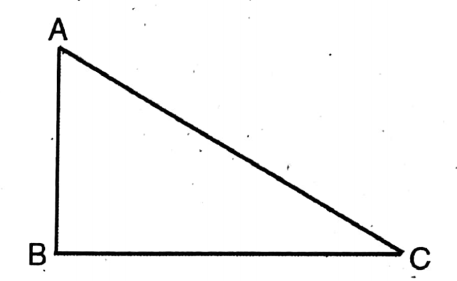
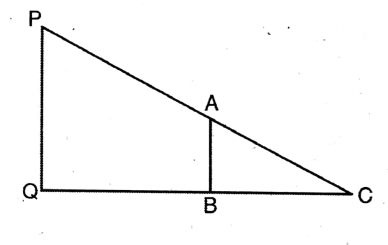
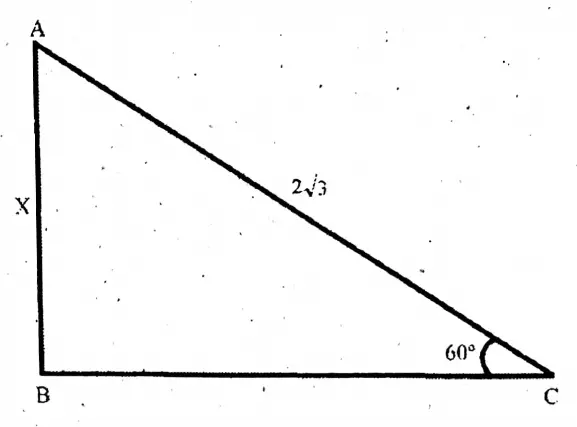
Question 1. In the window of our house, there is a ladder at an angle of 60° with the ground. If the ladder is 2√3 m long, then let us write by calculating the height of our window above the ground.

Solution:

Given

In the window of our house, there is a ladder at an angle of 60° with the ground. If the ladder is 2√3 m long

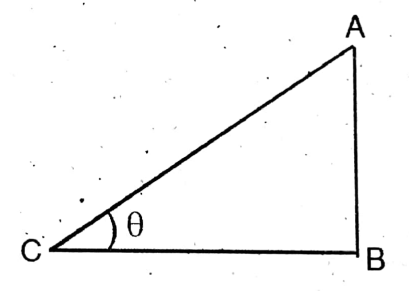
Let AB be the height of the window & AC be the ladder = 2√3 m.

∠ACB = 60°

∴ sin60° = AB/AC

 √3/2 = AB/2√3

or, 2 AB=2√3.√3 = 6

∴ AB 6/2 = 3 m.
WBBSE Solutions For Class 10 Maths Chapter 23 Trigonometric Ratios And Trigonometric Identities Exercise 23.2..

Read and Learn More WBBSE Solutions For Class 10 Maths
WBBSE Solutions For Class 10 Maths Chapter 23 Trigonometric Ratios And Trigonometric Identities 1

“WBBSE Class 10 Maths Trigonometric Ratios and Trigonometric Identities Exercise 23.2 solutions”

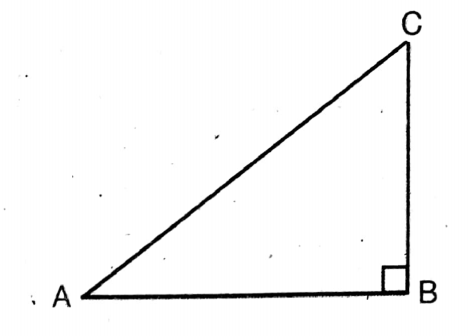
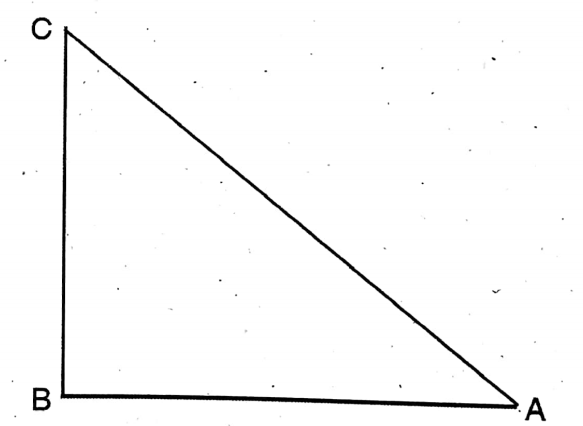
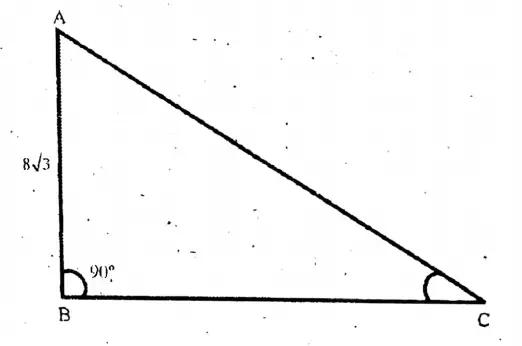
Question 2. ABC is a right-angled triangle with its B being 1 right angle. If AB = 8√3 cm and BC = 8 cm, then let us write by calculating, the values of ∠ACB and <BAC.

Solution:

Given

ABC is a right-angled triangle with its B being 1 right angle. If AB = 8√3 cm and BC = 8 cm

tan ∠ACB = AB/BC

= 83 cm / 8cm

= √3

= tan 60°

Class 10 Maths Class 10 Social Science
Class 10 English Class 10 Maths
Class 10 Geography Class 10 Geography MCQs
Class 10 History Class 10 History MCQs
Class 10 Life Science Class 10 Science VSAQS
Class 10 Physical Science Class 10 Science SAQs

∴ ∠ACB = 60°

∴ ∠BAC 180°= (90° +60°) 

= 180° – 150° 

= 30°
 

WBBSE Solutions For Class 10 Maths Chapter 23 Trigonometric Ratios And Trigonometric Identities 2

“West Bengal Board Class 10 Maths Chapter 23 Trigonometric Ratios and Trigonometric Identities Exercise 23.2 solutions”

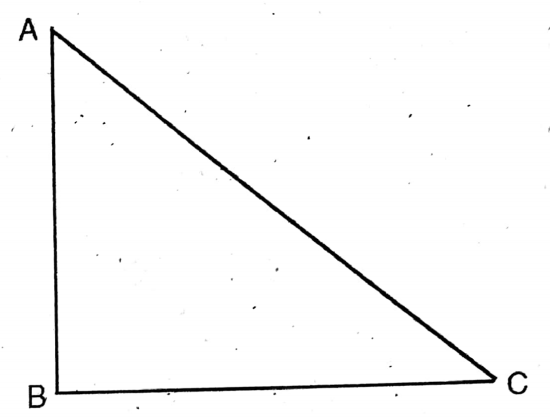
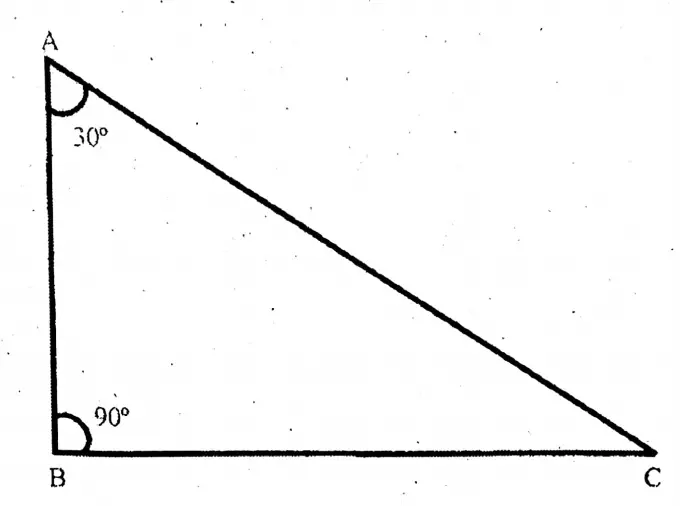
Question 3. In a right-angled triangle ABC, ∠B = 90°,∠A = 30°, and AC = 20 cm. Let us determine the lengths of the two sides BC and AB.

Solution:

In a right-angled triangle ABC, ∠B = 90°,∠A = 30°, and AC = 20 cm.

A 30°, B = 90°

∴ ∠C = 60°

sin60° = AB/AC

Or, √3/2 = AB/20

∴ AB = 20√3

= 10√3 cm.

Again, cos60° = BC/AC

1/2= BC/20

∴ BC = 20/2 

= 10cm.
WBBSE Solutions For Class 10 Maths Chapter 23 Trigonometric Ratios And Trigonometric Identities 3


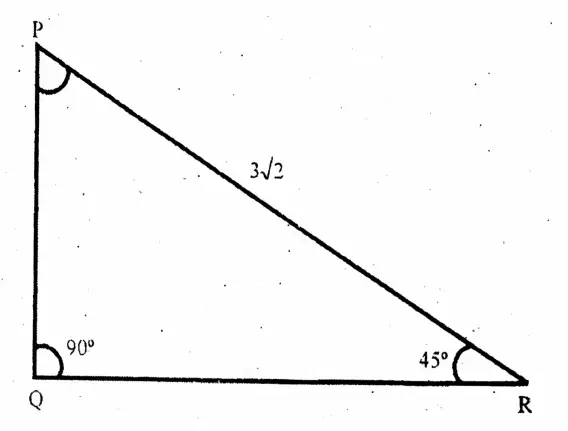
Question 4. In a right-angled triangle PQR, ZQ = 90°, ZR = 45°; if PR = 3√2, then let us find out the lengths of the two sides PQ and QR.

Solution:

Given

In a right-angled triangle PQR, ZQ = 90°, ZR = 45°; if PR = 3√2,

In ΔPQR, Q= 90°, R = 45°

∴ ∠P 90° – 45° = 45°

sin45° = PQ/PR

1/√2 = PQ/3√2

∴ PQ = 3√2/√2 

= 3 units.

cos45° = QR/PR

1/√2 = QR/ 3√2

√2QR = 3√2

∴ QR = 3√2/√2

= 3 units.
 

WBBSE Solutions For Class 10 Maths Chapter 23 Trigonometric Ratios And Trigonometric Identities 4

Question 5. Let us determine the values of 

1. sin? 45° cosec² 60° + sec² 30° 

Solution: sin² 45°- cosec² 60° + sec² 30°

= (1/√2)² – (2/√3)² + (2/√3)²

= 1/2 – 4/3 + 4/3 

= 1/2

sin² 45°- cosec² 60° + sec² 30° = 1/2

“WBBSE Class 10 Trigonometric Ratios and Trigonometric Identities Exercise 23.2 solutions explained”

2. sec² 45°- cot² 45°- sin² 30° – sin² 60° 

Solution: sec² 45°-cot² 45°- sin² 30° sin² 60°

= (√2)² -(1)² – (1/2)² – (√3/2)²

=2-1-1/4 -3/4

= 8-4-1-3 / 4

= 8-8/4

= 0/4

= 0

sec² 45°-cot² 45°- sin² 30° sin² 60° = 0

3. 3tan² 45°- sin² 60° – 1/3 cot² 30° – 1/8 sec² 45°

Solution: 3tan² 45°- sin² 60° – 1/3 cot² 30° – 1/8 sec² 45°

= 3(1)²- (√3 /2)² – 1/8(√2)²

= 3×1 3/4 – 1/3 x 3 – 1/8 x 2

= 3 – 3/4 – 1 – 1/4

= 12-3-4-1 / 4

= 12-8 / 4

=4/4

= 1.

3tan² 45°- sin² 60° – 1/3 cot² 30° – 1/8 sec² 45° = 1.


4. 4/
3 cot² 30° + 3 sin² 60°-2cosec² 60°-

Solution: 4/3 cot² 30° + 3 sin² 60° – 2cosec² 60°- tan² 30°

= 4/3(√3)²  + 3 (√3/2)² – 3/4(1/√3)

= 4/3 x 3 + 3/4 -2 4/3 x 3/4 x 1/3

= 4 + 9/4 – 8/3 – 1/4

= 48+27-32-3 / 12

= 75 – 35 / 12

= 40/12 

= 10/3

 = 3 1/3

4/3 cot² 30° + 3 sin² 60° – 2cosec² 60°- tan² 30°  = 3 1/3

WBBSE Solutions Guide Class 10

5. ⅓ cos 30°/ ½ sin45° + tan 60°/cos30°

Solution :  ⅓ cos 30°/ ½ sin45° + tan 60°/cos30°

= \(\frac{\frac{1}{3} \times \frac{\sqrt{3}}{2}}{\frac{1}{2} \times \frac{1}{\sqrt{2}}}+\frac{\sqrt{3}}{\frac{\sqrt{3}}{2}}=\frac{\frac{\sqrt{3}}{6}}{\frac{1}{2 \sqrt{3}}}+\frac{\frac{\sqrt{3}}{6}}{\frac{\sqrt{3}}{2}}=\frac{\sqrt{3}}{6} \times 2 \sqrt{2}+\sqrt{3} \times \frac{2}{\sqrt{3}}\)

= \(\frac{\sqrt{6}}{3}+2=\frac{\sqrt{6}+6}{3}=\frac{\sqrt{6}+6}{3}\)

6. cot²30°-2cos² 60°- 3/4 sec² 45°-4sin² 30°

Solution: cot²30°-2cos² 60°- 3/4 sec² 45°-4sin² 30°

= (√3)² -2(1/2)² – 3/4 (√2)²- 4(1/2)²

=3-2 x 1/4 – 3/4 x 2-4 x 1/4

= 3- 1/2 – 3/2 – 1

= 6-1-3-2 / 2

= 6-6 / 2

= 0.

cot²30°-2cos² 60°- 3/4 sec² 45°-4sin² 30° = 0.

7. sec² 60°-cot² 30°- 2tan30°cosec60° / 1+tan²30°

Solution: sec² 60° cot² 30°- 2tan30°cosec60° / 1+tan²30°

= \((2)^2-(\sqrt{3})^2-\frac{2 \times \frac{1}{\sqrt{9}} \times \frac{2}{\sqrt{3}}}{1+\left(\frac{1}{\sqrt{3}}\right)^2}\)

= \(4-3-\frac{\frac{4}{\sqrt{3}}}{1+\frac{1}{3}}=4-3-\frac{\frac{4}{3}}{\frac{4}{3}}=4-3-1=4-4=0\)

“WBBSE Class 10 Maths Exercise 23.2 Trigonometric Ratios and Trigonometric Identities problem solutions”

8. tan60° – tan30° / 1+tan 60° tan 30° + cos60° cos30° + sin60°sin30°

Solution: tan60° – tan30° / 1+tan 60° tan 30° + cos60° cos30° + sin60°sin30°

= \(\frac{\sqrt{3}-\frac{1}{\sqrt{3}}}{1+\sqrt{3} \cdot \frac{1}{\sqrt{3}}}+\frac{1}{2} \cdot \frac{\sqrt{3}}{2}+\frac{\sqrt{3}}{2} \cdot \frac{1}{2}\)

= \(\frac{\frac{3-1}{\sqrt{3}}}{1+1}+\frac{\sqrt{3}}{4}+\frac{\sqrt{3}}{4}=\frac{2}{\sqrt{3}} \times \frac{1}{2}+\frac{2 \sqrt{3}}{4}=\frac{1}{\sqrt{3}}+\frac{\sqrt{3}}{2}=\frac{2+3}{2 \sqrt{3}}=\frac{5}{2 \sqrt{3}}\)


9. 1-sin² 30°/1+sin² 30° x cos²60+ cos² 30°/cos ec²90°-cot² 90° ÷ (sin 60° tan30°)

Solution : 1-sin² 30°/1+sin² 30° x cos²60+ cos² 30°/cosec²90°-cot² 90° ÷ (sin 60° tan30°)

= \(\frac{1-\left(\frac{1}{2}\right)^2}{1+\left(\frac{1}{\sqrt{2}}\right)^2} \times \frac{\left(\frac{1}{2}\right)^2+\left(\frac{\sqrt{3}}{2}\right)^2}{1-0} \div\left(\frac{\sqrt{3}}{2} \cdot \frac{1}{\sqrt{3}}\right)\)

= \(\frac{1-\frac{1}{4}}{1+\frac{1}{2}} \times \frac{\frac{1}{4}+\frac{3}{4}}{1} \div\left(\frac{1}{2}\right)=\frac{3 / 4}{3 / 2} \times \frac{\frac{4}{4}}{1} \times 2\)


= 3/4 x 2/3 x 1 x 2

= 1/2 x 2

= 1

Question 6.

1. sin² 45° + cos² 45° = 1

Solution: sin² 45° + cos² 45° = 1

L.H.S. sin²45+ cos²45 = (1/√2)² + (1/√2)²

= 1/2 + 1/2 

= 1


2. cos60° =
cos²30° – sin²30°

Solution: cos60° = cos²30° – sin²30°

L.H.S. = cos60° = 1/2 

R.H.S = cos²30° – sin²30° 

= (√3/2)² – (1/2)²

= 3/4 – 1/4 

= 2/4 

= 1/2 

∴ L.H.S = R.H.S Proved.


3. 2 tan30°/1-tan²30° = √3

Solution:  2 tan30°/1-tan²30° = √3

L.H.S = \(\frac{2 \tan 30^{\circ}}{1-\tan ^2 30^{\circ}}=\frac{21 / \sqrt{3}}{1-\left(\frac{1}{\sqrt{3}}\right)^2}=\frac{2 / \sqrt{3}}{1-\frac{1}{3}}=\frac{2 / \sqrt{3}}{2 / 3}=\frac{2}{\sqrt{3}} \times \frac{3}{2}\)


= √3

∴ L.H.S = R.H.S Proved.


4.√(1+ cos30° / 1-cos30°)  = sec 60° + tan 60°

Solution:  √(1+ cos30° / 1-cos30°)  = sec 60° + tan 60°

L.H.S = \(\sqrt{\frac{1+\cos 30^{\circ}}{1-\cos 30^{\circ}}}=\sqrt{\frac{1+\frac{\sqrt{3}}{2}}{1-\frac{\sqrt{3}}{2}}}=\sqrt{\frac{2+\sqrt{3}}{2-\sqrt{3}}}=\sqrt{\frac{(2+\sqrt{3})^2}{(2-\sqrt{3})(2+\sqrt{3})}}\)

= \(\frac{2+\sqrt{3}}{4-3}=2+\sqrt{3}\)


= sec60° + tan60°

= 2+ √3

∴ L.H.S = R.H.S Proved.


5. 2 tan² 30°/1-tan²30° + sec² 45°- cot² 45° = sec 60°

Solution : 2 tan² 30°/1-tan²30° + sec² 45°- cot² 45° = sec 60°

L.H.S. = 2 tan² 30°/1-tan²30° + sec² 45°- cot² 45°

= \(\frac{2 \cdot\left(\frac{1}{\sqrt{3}}\right)^2}{2-\left(\frac{1}{\sqrt{3}}\right)^2}+(\sqrt{2})^2-(1 .)^2\)

= \(\frac{2 \cdot \frac{1}{3}}{1-\frac{1}{3}}-1-2-1\)

= \(\frac{2 / 3}{2 / 3}+1=\frac{2}{3} \quad \frac{3}{2}+1=1+1=2\)


R.H.S = sec 60° = 2

∴ L.H.S = R.H.S Proved.

6. tan² Π/4 sin Π/3  tanΠ/6 tan² Π/3 = 1 1/2 

Solution: tan²Π/4 sin Π/3  tanΠ/6 tan² Π/3 = 1 1/2

L.H.S. = tan2 Π/4 sin Π/3  tanΠ/6 tan2 Π/

= tan²45°sin60°tan30°tan260°

= (1)2. (√3/2) . 1/√3 . (√3)2

= 1/2 .3

= 3/2

= 1 1/2 = R.H.S.

.. L.H.S = R.H.S Proved. 

7.sinΠ/3 tanΠ/6 + + sinΠ/2 cosΠ/3 = 2sin²Π/4

Solution: sinΠ/3 tanΠ/6 + + sinΠ/2 cosΠ/3 = 2sin²Π/4

L.H.S. sin = Π/3 tanΠ/6 + sinΠ/2– cosΠ/3 

= sin60°tan30° + sin90°cos60°

= √3/2 . 1/√3 + 1 . 1/2

= 1/2 + 1/2  

R.H.S= 2sin² = 2. 

sin²45° = 2x (1/√2)²

= 2 x 1/2

= 1

∴ L.H.S = R.H.S Proved.

Question 7.

1. If x sin45° cos45° tan60° = tan² 45°- cos60°, then let us determine the value of x.

Solution: x sin45° cos45° tan60° = tan² 45° – cos60°

or, x . 1/√2 . 1/√2 .√3

= (1)² – 1/2 

= x√3/2

= 1/2

or, √3x = 1

2. If x sin 60° cos² 30° =  tan² 45° sec60° / cosec60° then let us determine the value of x.

Solution: x sin 60° cos² 30° = tan² 45° sec60° / cosec60°

or, \(x \frac{\sqrt{3}}{2}\left(\frac{\sqrt{3}}{2}\right)^2=\frac{(1)^2 \cdot 2}{2 / \sqrt{3}}\)

or, \(x \cdot \frac{\sqrt{3}}{2} \cdot \frac{3}{4}=\frac{2}{2 / \sqrt{3}}\)

or, \(x \frac{3 \sqrt{3}}{8}=\frac{2 \sqrt{3}}{2}\)

or, \(x=\frac{2 \sqrt{3}}{2} \quad \frac{8}{3 \sqrt{3}}=\frac{8}{3}\)

3. If x²= sin²30° + 4cot² 45°- sec² 60°, then let us determine the value of x. 

Solution: x² = sin²30° + 4cot² 45°- sec² 60°

or, x² = (1/2)² +4. (1)²- (1)²

or, x² = 1/4 + 4 – 4

x² = 1/4 

x = 1/2 

“Class 10 WBBSE Maths Exercise 23.2 Trigonometric Ratios and Trigonometric Identities step-by-step solutions”

Question 8. If x tan 30° + y cot 60° = 0 and 2x – y tan 45° = 1, then let us write by calculating, the values of x and y.

Solution: x tan 30°+ y cot 60° = 0

or, x . 1/√3 + Y . 1/ √3 = 0

or, x/√3 + y/√3 = 0

or, or, x + y = 0——–(1)

Again 2x – y. 1 = 1

or, 2x – y = 1 ——-(2)

∴ x + y = 0

2x – y = 1

Adding 3x = 1

∴ X = 1/3

∴ Y = -X            ∴ Y = – 1/3


Question 9. If A B 45°, then let us justify:

1. sin (A + B) = sin A cos B + cos A sin B

Solution: L.H.S= sin (A + B)

=sin(45° +45°) 

= sin90° 

= 0

R.H.S sinA cosB + cosA sinB

= sin45° cos45° + cos45° sin45°

= 1/√2 x 1/√2 x 1/√2  x 1/√2

= 1/2 + 1/2

= 1

∴ L.H.S = R.H.S


2. cos (A + B) = cos A cos B-sin A sin B

Solution: L.H.S= cos (A + B)

= cos(45° + 45°) = cos90° = 0

R.H.S. cosA cosB – sinA sinB

= cos45 cos45 – sinA sinB

= 1/√2 . 1/√2 – 1/√2 . 1/√2

= 1/2 – 1/2

= 0

∴ L.H.S = R.H.S

Question 10.

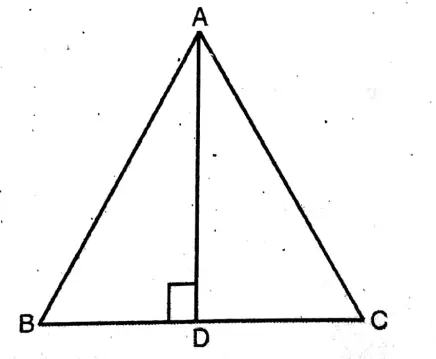
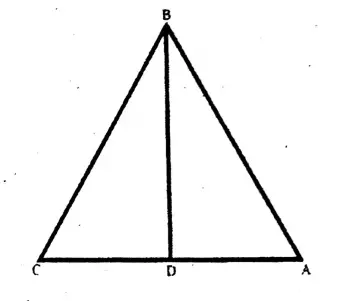
1. In an equilateral triangle ABC, BD is a median. Let us prove that, tan ∠ABD = cot <BAD.

Solution: L.H.S. tan ∠ABD = P/B

= AD/BD

R.H.S. cot <BAD = B/P

= AD/BD

∴ L.H.S. = R.H.S.
WBBSE Solutions For Class 10 Maths Chapter 23 Trigonometric Ratios And Trigonometric Identities 13

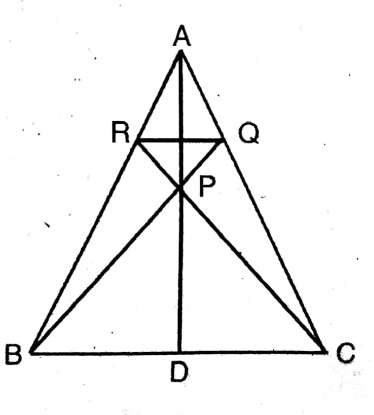
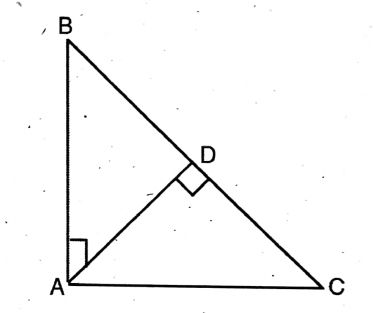
2. In an isosceles triangle ABC, AB = AC and <BAC 90°; the bisector of ∠BAC intersects the side BC at point D.

Solution: L.H.S = sec ∠ACD/sin <CAD

= AC/CD/CD/AC

= AC/CD x  AC/CD

= AC²/CD²

R.H.S. cosec² ∠CAD

=(AC/CD)² = AC²/CD²

∴ L.H.S = R.H.S Proved.
WBBSE Solutions For Class 10 Maths Chapter 23 Trigonometric Ratios And Trigonometric Identities 14

11. Let us determine the value / values of 0(0°≤ 0≤ 90°), for which 2cos²θ-3cosθ +10 wil be true.

Solution: 2cos²θ-3cosθ + 1 = 0

or, 2cos²θ – 2cos θ – 1cosθ + 1 = 0

or, 2cosθ (cosθ-1) – 1 (cosθ-1)=0

Either cosθ1=0            ∴ cosθ = 1 = cos0°

∴ 0 = 0°

Or, 2cosθ – 1 = 0

∴ 2cosθ = 1

∴ cosθ = 1/2 = cos60°

∴ 0 = 60°

∴ Values of = 0° or 60°. 

“WBBSE Class 10 Chapter 23 Trigonometric Ratios and Trigonometric Identities Exercise 23.2 solution guide”

Application 23. For 0° ≤ 0 ≤ 90°, let us write with reason whether sin = √3/2 and cos = 1/3 are possible or not.

Solution: sin θ = √3/2,  cos θ = 1/3

sin²θ + cos²θ = (√3/2)² + (1/3)²

= 3/4 + 1/9

= 27+4 / 36

= 31/36

∴ It is impossible as

we know sin² θ + cos² θ = 1

Application 26. I express cote and cosec e in terms of cos e. 

Solution: We know, sin² θ+ cos² θ= 1

∴ sin²θ= 1 – cos²θ

or, sin θ = √1-cos²θ

∴ cos θ = cos θ/sin θ = cos θ/√1-cos²θ

Again, sin θ= √1-cos²θ    ∴cosec θ = 1/sin θ

= 1/√1-cos²θ

Application 28. If tan θ = 3/4, then let us write by calculating, the value of (sinθ + cos θ) 

Solution: sec²θ = 1 + tan²θ = 1 +(4/3)²

= 1 + 16/9

= 9+16 / 9

= 25/9

= (5/3)²

Secθ= 5/3            ∴ cos θ = 3/5

sinθ = √1-cos²θ

= √1- 9 /25

= √25-9 / 25

= √16/25

= 4/5

∴ sinθ + cos θ = 3/5 + 4/5 

= 3+4 / 5

= 7/5

“West Bengal Board Class 10 Maths Exercise 23.2 Trigonometric Ratios and Trigonometric Identities solutions”

Application 34. If  5cote+cosec 0/5cot 0-cosec 0 = 7/3, then let us determine the value of cose.

Solution: 5cotθ+cosec θ/5cot θ-cosec θ = 7/3

= 35cotθ – 7cosecθ= 15cotθ + 3cosecθ

35cotθ – 15cotθ = 3cosecθ+7cosecθ

20cotθ = 10cosecθ

cot θ/cosecθ 10/20

cos θ/sinθ x sinθ = 1/2

∴ cosv =1/2


Application 35. From the two relations 2x= 3sine and 5y = 3cose, by eliminating, let us write the relation between x and y. 

Solution: 3sinθ = 2x   And 3cosθ = 5y

∴ sinθ=2x/3       ∴cosθ =5y/3

We know, sin² + cos² = 1

or, (2x/3)² + (5y/3)² = 1

or, 4x²/9 + 25y²/9 = 1

or, 4x²+ 25y² = 9.

Application 36. Let us eliminate from the two relations x = a sec e, y = b tan e. 

Solution: a secθ = x     And      b tan θ = y

∴ secθ= x/a                  ∴ tanθ = y/b

We know, sec²θ-tan²θ = 1

or, (x/a)² – (y/b)² = 1               ∴ x²/a² – y²/b² = 1

Application 37. If cosθ + secθ = 2, then let us determine the value of (cos¹¹θ + sec¹¹θ) [Let me do it myself]

Solution: cosθ + secθ = 2       or, cos²+1=2cos

or, cose + 1/cos Ꮎ = 2       

or, cos²0 – 2cose + 1 = 0            ∴(cose1)²= 0

        ∴ cose – 1 = 0

         sece= 1/cos 0 

          = 1/1

         = 1

cose + sece

= (cose)¹¹+ (sece)¹¹

=(1)¹¹+ (1)¹¹

=1+1

=2
WBBSE Solutions For Class 10 Maths Chapter 23 Trigonometric Ratios And Trigonometric Identities Exercise 23.1

Class 10 WBBSE Math Solution In English Chapter 23 Trigonometric Ratios And Trigonometric Identities Exercise 23.1

Application 3. 50 is an acute angle and if tan 5θ = tan (60° + θ), then let us determine the value of θ. 

We shall remember: Generally, 

1. sin 2 θ + 2 sineθ

2. sin α/sin ẞ =not  α/β

and 3. sina +- sinẞ not = sin (α +- β)

These rules are applicable also in the cases of cosine, tangent, etc….. of an angle. 

Solution: tan 5 θ = tan (60 + θ)

or, 5 θ = 60 + θ

or, 4 θ = 60°

∴ θ = 60°/4

θ = 15°

WBBSE Solutions For Class 10 Maths Chapter 23 Trigonometric Ratios And Trigonometric Identities Exercise 23.1

Read and Learn More WBBSE Solutions For Class 10 Maths

Application 5. It is a positive acute angle, and tan e = 8/15′ then let us determine the values of sine and cos θ and prove that sin20 + cos20 = 1. 

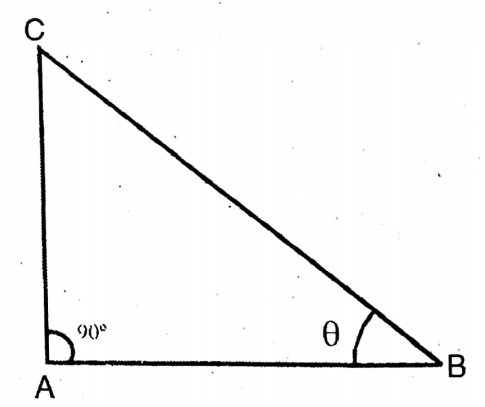
Solution: ABC is a right-angled triangle whose ABC = 90° and ACB = θ 

∴ tan θ = AB/BC = 8/15

Let, perpendicular AB = 8k units and base BC= 15k units [where k > 0]

AC² = AB² + BC²

= (8K)² + (15K)²

= 64K² + 225K²

= 289K²

Class 10 Maths Class 10 Social Science
Class 10 English Class 10 Maths
Class 10 Geography Class 10 Geography MCQs
Class 10 History Class 10 History MCQs
Class 10 Life Science Class 10 Science VSAQS
Class 10 Physical Science Class 10 Science SAQs

∴ sin θ = AB/AC = 8k/17k 

= 8/17

cos  θ =  base / hypotenuse 17k

∴ sin² θ+ cos² B = (8/17)² + (15/17)²

= 64/289 + 225/289

= 1

∴ sin2θ+ cos2θ = 1.

“WBBSE Class 10 Maths Trigonometric Ratios and Trigonometric Identities Exercise 23.1 solutions”

Application 6. If tan = 4/3, then let us show that, sin + cos = 7/5 

Solution: tan θ = 4/3     ∴ perpendicular = 4k & base = 3k

∴ Hypotenuse = √(4k)² + (3k)²= √16k² +9k²

∴ sinθ + cosθ =  4k/5k + 3k/5k = 7k/5k = 7/5  proved.

WBBSE Solutions For Class 10 Maths Chapter 23 Trigonometric Ratios And Trigonometric Identities 1

Application 7. In ΔABC, ∠B is the right angle and the length of its hypotenuse is √13 units. If the sum of the lengths of the other two sides is 5 units, then let us determine the value of sin C + sin A.

Solution:

Given

In ΔABC, ∠B is the right angle and the length of its hypotenuse is √13 units. If the sum of the lengths of the other two sides is 5 units

In the right-angled triangle ABC, AC is the hypotenuse.

AB is perpendicular with respect to ∠C and BC is perpendicular with respect to ∠A.

∴ sin C + sin A = AB/AC = BC/AC

AB+BC / AC

= 5/√13

Alternative Proof: Let, AB = x unit, 

BC = (5 – x) unit.

According to Pythagoras’ theorem, in a right-angled triangle ABC,

x² + (5-x)² = (√13)

or, x²+25+x-10x= 13 

or, 2x²-10x+12= 0 

or, x²-5x+6=0 

or, x2-3x-2x+6=0 

or, x(x-3)-2(x-3)=0 

or, (x-3)(x-2)=0

Either, x-3=0        ∴ x = 3

Or, x-2=0             ∴ x = 2

If AB is 3 units, then BC (5 – 3) units = 2 units.

Hence, sin C = AB/AC= 3/√13

and sin A = BC/AC = 2/√13

∴ sin C+ sin A = 3/√13 + 2/√13 = 5/√13

Again, if AB 2 units, then BC= 3 units and then sin C + sin A = 5/√13

WBBSE Solutions For Class 10 Maths Chapter 23 Trigonometric Ratios And Trigonometric Identities 2

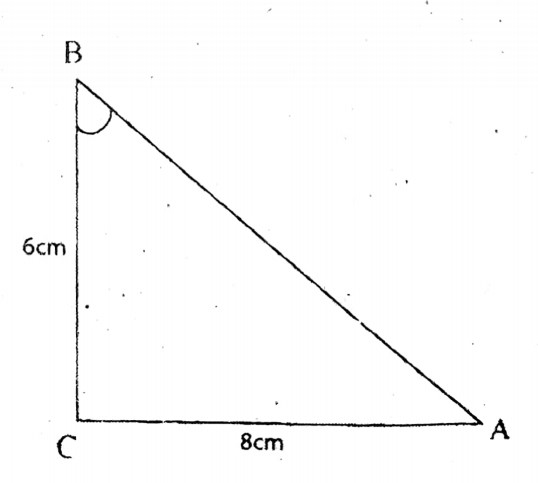
1. I have drawn a right-angled triangle ABC whose hypotenuse AB = 10 cm, base BC = 8 cm, and perpendicular AC = 6 cm. Let us determine the values of sine and tangent /ABC.

Solution:

Given

I have drawn a right-angled triangle ABC whose hypotenuse AB = 10 cm, base BC = 8 cm, and perpendicular AC = 6 cm.

Here base BC= 8 cm

& perpendicular AC = 6 cm.

∴ AB = √62 +82 

= √100 

= 10cm.

∴  sin ∠ABC = Perpendicular/hypotenuse

= 6/10 = 3/5

and tan ∠ABC = perpendicular/base

= 6cm/8 cm

= 6/8

= 3/4

WBBSE Solutions For Class 10 Maths Chapter 23 Trigonometric Ratios And Trigonometric Identities 3

“West Bengal Board Class 10 Maths Chapter 23 Trigonometric Ratios and Trigonometric Identities Exercise 23.1 solutions”

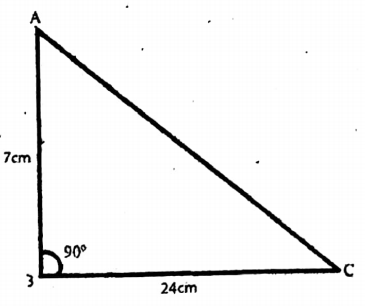
2. Soma has drawn a right-angled triangle ABC whose ABC= 90°, AB = 24 cm, and BC= 7 cm. By calculating, let us write the values of sin A, cos A, tan A, and cosec A. 

Solution:

Given

Soma has drawn a right-angled triangle ABC whose ABC= 90°, AB = 24 cm, and BC= 7 cm.

Here AC²= AB²+ BC²

= (24)² + (7)²

= 576 +49 = 625

∴ AC = √625 

= 25 cm.

sin A = BC/AC 7/25

cos A = BC/AC = 24/25;

tan A = BC/AC = 7/24

and cosec A = AC/BC = 25

WBBSE Solutions For Class 10 Maths Chapter 23 Trigonometric Ratios And Trigonometric Identities 4

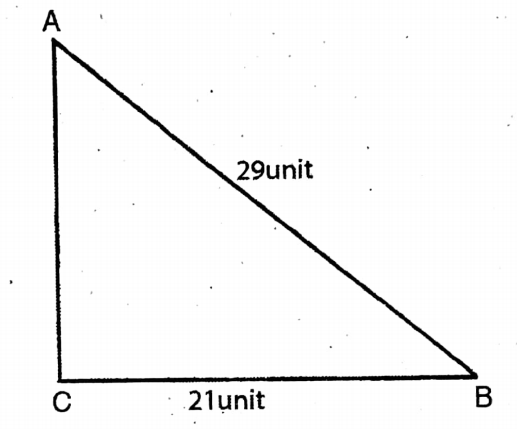
3. If in a right-angled triangle ABC, C = 90°, BC = 21 units, and AB = 29 units, then let us find the values of sin A, cos A, sin B and cos B.

Solution:

Given

If in a right-angled triangle ABC, C = 90°, BC= 21 units, and AB = 29 units,

Here AC² = AB² – BC²

= (29)²- (21)²

= 841-441= 400

∴ AC = √400 = 20 units.

sin A = BC/AC =  21/29

cos A = AC/BC = 20/29

sin B = AC/AB = 20/29

cos B = BC/AB = 21/29

WBBSE Solutions For Class 10 Maths Chapter 23 Trigonometric Ratios And Trigonometric Identities 5

“WBBSE Class 10 Trigonometric Ratios and Trigonometric Identities Exercise 23.1 solutions explained”

4. If cos θ = 7/5 then let us determine the values of all trigonometric ratios of the angle 0.

Solution: As cos θ = 7/25

∴ Base AB 7 unit 

Hypotenuse BC = 25 unit

AC² = BC²-AB² = (25)² – (7)²

= 625-49

= 576

= (24)²

∴ AC = 24 units

sin θ = P/H = AC/BC = 24/25               Here, let Perpendicular = P

cos θ = B/H = AB/BC = 7/25

tan θ = P/H = AC/AB = 24/7                     Base B Hyptenuse = H

cot θ = B/P = AB/AC = 7/24

Sec θ = H/B BC/AB = 25/7

cosec θ = H/P = BC/AC = 25/24

WBBSE Solutions For Class 10 Maths Chapter 23 Trigonometric Ratios And Trigonometric Identities 6


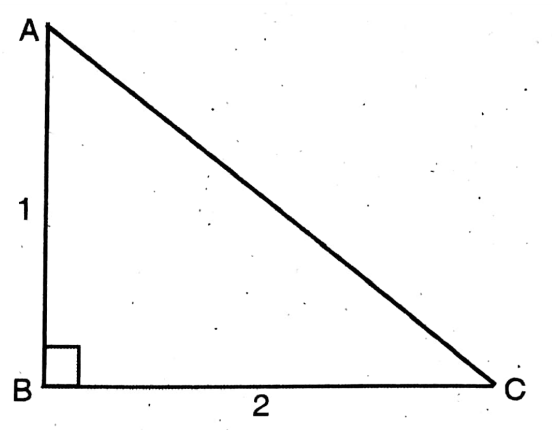
5. If cos θ = 2, then let us determine the values of tan e and sec e and show that 1 + tan²θ = sec² θ.

Solution: Here cote = 2 = 2/1 Base/Perpendicular = 2/1

∴ AC²= AB² + BC²

= (1)² + (2)²

∴ AC = √5

∴ tan e = P/B =1/2

Sece H/B = √5/2

L.H.S. = 1+tan20

= 1+(1/2)²

= 1+1/4 

= 5/4 

= (√5/2)²

= sec² θ

= R.H.S.

WBBSE Solutions For Class 10 Maths Chapter 23 Trigonometric Ratios And Trigonometric Identities 7

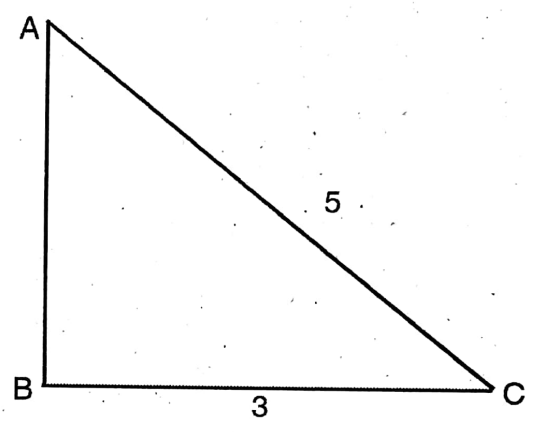
6. If cos θ 0.6, then let us show that (5sinθ – 3tanθ) = 0.

Solution: cos θ = 6/10 = 3/5 = B/H

∴ AB² = AC²-BC²

= (5)²- (3)²

=25 –

= 16

∴ AB = √16 

= 4

L.H.S = 5 sinθ – 3 tanθ

= 5 x 4/5 – 3 x 4/3 

=4-4

=0  R.H.S.

WBBSE Solutions For Class 10 Maths Chapter 23 Trigonometric Ratios And Trigonometric Identities 8

“WBBSE Class 10 Maths Exercise 23.1 Trigonometric Ratios and Trigonometric Identities problem solutions”

7. If cot A = 4/7.5 then let us determine the values of cos A and cosec A and show that 1+ cot² A = cosec² A.

Solution: cot A = 4/7.5 = B/P

∴ AB = 4, BC = 7.5

AC² = AB²+ BC²

=(4)² + (7.5)²

= 16+ 56.25 

= 72.25

∴ AC = 72.25

= 8.5 = H.

cos A = B/H = AB/AC = 4/8.5

cosec A = H/P = 8.5/15

L.H.S. 1+ cot2 A = 1 + 16/56.25

72.25/56.25

= 289/225

R.H.S. cosec² A = H/P = (72.25/7.5)²

= (17/15)²

= 289/225

∴ L.H.S = R.H.S.

WBBSE Solutions For Class 10 Maths Chapter 23 Trigonometric Ratios And Trigonometric Identities 9

8. If sin C = 2/3, then let us write by calculating, the value of cos C x cosec C.

Solution: sin C = 2/3

sin C = P/H = AB/AC = 2/3

BC² = (AC)²- (AB)²

= (3)² – (2)²

= 9 – 4

= 5

∴ BC = √5

cos C x cosec C

= B/H x H/P

= √5/3 x 3/2

= √5/2 

WBBSE Solutions For Class 10 Maths Chapter 23 Trigonometric Ratios And Trigonometric Identities 10

9. Let us write with reason whether the following statements are true or false 

1. The value of tan A is always greater than 1.

Solution. The statement is false

if the perpendicular is greater than the base then tan A will be greater than 1, but if the base is greater than the perpendicular then tan A is less than 1.


2. The value of cot A is always less than 1.

Solution. The statement is false.


3. For an angle 8, it may be possible that sin 0 = 4/3

Solution. The statement is false.

As sinθ = perpendicular/hypotenuse

i.e., sin θ = 4/3 here, the perpendicular of a triangle can not be greater than the hypotenuse.


4. For an angle a, it may be possible that secα =

Solution. The statement is true.

As sec θ = hypotenuse/base

i.e., secθ= 12/5, the hypotenuse is always greater than the base.

Maths WBBSE Class 10 Solutions


5. For an angle ẞ(Beta), it may be possible that cosecẞ:

Solution. The statement is false.

As cosec θ = hypotenuse/perpendicular

i.e., cosec θ = 5/13, the hypotenuse is less than perpendicular.


6. For an angle 0, it may be possible that cos e = 3/5

Solution. The statement is true.

As cose = base/hypotenuse

i.e., cos e = 3/5′ here base is less than the hypotenuse.

10. I have understood, cosec 45° = 1/sin 45° = √2

= sec 45° = 1/cos 45°

= 1/ 1/√2 = √2

& cot 45° = 1/tan 45° = 1

I have understood, cosec 30° = 2,

sec 30° = 2/√3

and cot 30° = 1/tan 30°

=√3

Application 9. If the kite would be flown with a string of 120 m in length and the kite is at an angle of 30° with the horizontal line, then let us calculate the height of the kite from Rina’s position from the ground, 

Solution:

Given

If the kite would be flown with a string of 120 m in length and the kite is at an angle of 30° with the horizontal line

AB is the height of the kite from the ground 

& AC is the length of string = 120 m. 

& angle of elevation (∠C) = 30°.

∴ sin30° = AB/AC     or, 1/2 = AB/120

∴ AB = 120/2 = 60 m.

∴ The kite is 60 m above the ground.

WBBSE Solutions For Class 10 Maths Chapter 23 Trigonometric Ratios And Trigonometric Identities 11

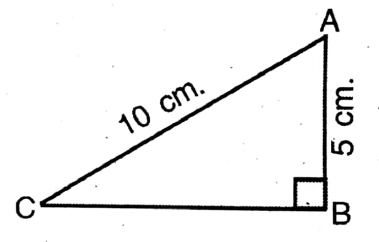
Application 11. In a right-angled triangle ABC, ZB is a right angle. If AB = 5. cm and AC 10 cm, then let us determine the values of ∠BCA and ∠CAB. 

Solution:

Given

In a right-angled triangle ABC, ZB is a right angle. If AB = 5. cm and AC 10 cm

In a right-angled triangle ABC, ∠B is a right angle,

AB 5 cm. and AC = 10 cm.

In a right-angled triangle, ABC, sin ∠BCA = AB/BC 

= 5/10 

= 1/2 

= sin 30°

∴ ∠BCA = 30°

∴ ∠CAB = 90° – 30° = 60°

WBBSE Solutions For Class 10 Maths Chapter 23 Trigonometric Ratios And Trigonometric Identities 12

“Class 10 WBBSE Maths Exercise 23.1 Trigonometric Ratios and Trigonometric Identities step-by-step solutions”

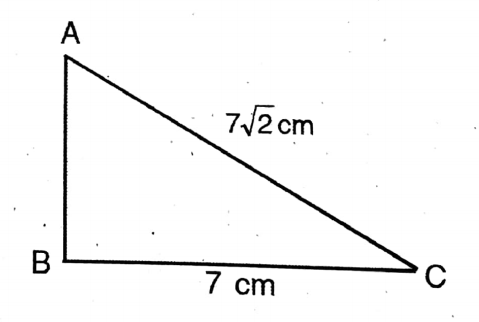
Application 12. In a right-angled triangle ABC, ∠B is a right angle. If AB = 7 cm and AC=7√2 cm, then let us write by calculating, the values of ∠BCA and ∠CAB. 

Solution:

Given

In a right-angled triangle ABC, ∠B is a right angle. If AB = 7 cm and AC=7√2 cm

cos∠CAB = AB/AC

= 7 cm/7√2 cm

= 1/√2

= cos 45°

∴ ∠CAB = 45°

WBBSE Solutions For Class 10 Maths Chapter 23 Trigonometric Ratios And Trigonometric Identities 13

Application 14. Let us show that, tan²60° + 1 = sec²60°

Solution: L.H.S = tan² 60° + 1

=(√3)+1

=3+1

=4

=(2)²

= sec²60°

= R.H.S.

“WBBSE Class 10 Chapter 23 Trigonometric Ratios and Trigonometric Identities Exercise 23.1 solution guide”

Application 17. Let us prove that, tan²60°-2sin60° = 3-cot30° 

Solution: L.H.S. = tan²60 – 2sin²60

=(√3)-2. √3/2 

= 3 – √3

R.H.S=3

cot30° = 3-√3. 

∴ L.H.S = R.H.S.

WBBSE Solutions For Class 10 Maths Chapter 22 Pythagoras Theorem Exercise 22.1

WBBSE Class 10 Maths Solutions Chapter 22 Pythagoras Theorem Exercise 22.1

On the chart, I am observing a right-angled triangle and there are 5 sticks in hypotenuse, 4 sticks in perpendicular, and 3 sticks in base.

(4) Area of the region of the trapezium ABCD =1/2 (a+b) x (a+b)

Again, the area of the region of the trapezium

ABCD


= area of DAE + area of CBE + area of CBE + area of DEC
∴ \(\frac{1}{2}(a+b)(a+b)=\frac{1}{2} a \times b+\frac{1}{2} a \times b+\frac{1}{2} c \times c\)
or, \((a+b)^2=a b+a b+c^2\)
or, \(a^2+2 a b+b^2=2 a b+c^2\)
∴ \(a^2+b^2=c^2\)
∴ I got, \((\text { base })^2+(\text { perpendicular })^2=(\text { hypotenuse })^2\)
“WBBSE Class 10 Maths Pythagoras Theorem Exercise 22.1 solutions”


Read and Learn More WBBSE Solutions For Class 10 Maths

Application 1. Taking different proper values of m and n, let us write the sides of two right-angled triangles. 

Solution: In the case of a right-angled triangle, if two sides & the hypotenuse of the triangle are (m² – n²) units, 2mn units & (m²+n²) units

respectively then (m²- n²)² & (2mn)² = (m2+N2)²

Now let m = 10, n = 6

∴ LHS = (10262)² + (2.10.6)²

= (64)² + (120)²=4096 +14400 = 18496

RHS = (102 +62)² = (136)² = 18496

∴ LHS = RHS

WBBSE Solutions For Class 10 Maths Chapter 22 Pythagoras Theorem Exercise 22.1

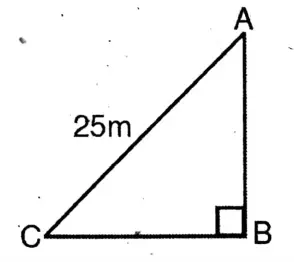
Application 2. In our garden, a ladder of 25 m in length is inclined to a guard wall at a height of 24 m above the ground. Let us write by calculating, the distance of the foot of the ladder from the guard wall.

Solution:

Given

In our garden, a ladder of 25 m in length is inclined to a guard wall at a height of 24 m above the ground.

Let the length of the ladder AC = 25 m, AB = 24 m,

Pythagoras’ theorem in right-angled triangle ABC, we get,

AB²+BC² = AC²

or, (24m)² + (BC)² = (25m)²

∴ BC = 7

or, BC² (25m)²- (24m)² = 49

The foot of the ladder is in 7m

distance from the guard wall.

WBBSE Solutions For Class 10 Maths Chapter 22 Pythagoras Theorem 3

“West Bengal Board Class 10 Maths Chapter 22 Pythagoras Theorem Exercise 22.1 solutions”


Application 3. If the lengths of two diagonals of a rhombus are 12 cm and 16 cm respectively, then let us write by calculating, the length of one side of this rhombus. 

Hints:

Given

If the lengths of two diagonals of a rhombus are 12 cm and 16 cm respectively

The two diagonals of a rhombus bisect each other, perpendicularly.

∴ OA = 12/2  cm = WBBSE Solutions For Class 10 Maths Chapter 22 Pythagoras Theorem 2 cm,       OB =  WBBSE Solutions For Class 10 Maths Chapter 22 Pythagoras Theorem 2 cm.

AOB is a right-angled triangle.      

From Pythagoras’ theorem, we get, AB²+ OB²

Class 10 Maths Class 10 Social Science
Class 10 English Class 10 Maths
Class 10 Geography Class 10 Geography MCQs
Class 10 History Class 10 History MCQs
Class 10 Life Science Class 10 Science VSAQS
Class 10 Physical Science Class 10 Science SAQs

We know, the diagonals of a rhombus bisect each other perpendicularly.

∴ Let BD 16 cm.    ∴ BO = OD = 8cm

& AC =12 cm.      ∴ AO OC = 6 cm.

∴ ∠AOB = ∠BOC = ∠COD = ∠AOD = 90° 

∴ BOC is a right-angled triangle.

BC = √BO² + CO²

= √82 +62

= √100 

= 10 cm.

WBBSE Solutions For Class 10 Maths Chapter 22 Pythagoras Theorem 4

WBBSE Solutions For Class 10 Maths Chapter 22 Pythagoras Theorem 5

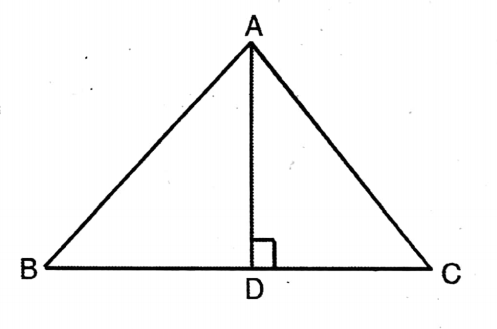
Application 4. If in ΔABC, ADL BC, let us prove that, AB²+ CD² = AC²+ BD²

Solution: To prove AB²+ CD² = AC² + BD²

In ΔABC, perpendicular drawn from

A, on BC, is AD.

∴ AD ⊥ BC

∴ ∠ADB = ∠ADC = 90°

From two right-angled triangles ABD & ADC,

AB² = AD² + BD²——-(1)

& AC² = AD²+ DC²———(2)

Subtracting (1) from (2), AB² – AC² = BD² – DC²

or, AB²+ CD² = AC²+ BD² Proved.

WBBSE Solutions For Class 10 Maths Chapter 22 Pythagoras Theorem 6

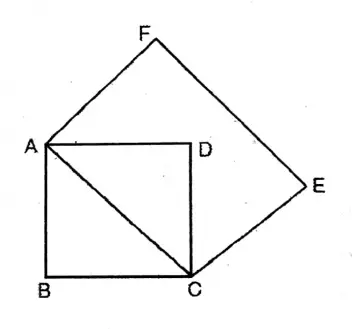
Application 5. Let us prove that the area of a square drawn on the diagonal of a square is twice of the area of that square. 

Solution: Area of ABCD square = AD²

Area of ACEF square = AC²

In ΔACD, ∠ADC = 90°

AD = CD [Side of a square]

AC = √AD²+DC² = √AD²+DC² = AD √2

AC² = (AD √2)²= 2AD²

WBBSE Solutions For Class 10 Maths Chapter 22 Pythagoras Theorem 7

Question 1. If the followings are the lengths of the three sides of a triangle, then let us write by calculating, the cases where the triangles are right-angled triangles

1. 8 cm, 15 cm. and 17 cm

2. 9 cm, 11 cm, and 6 cm.

Solution: In a right angle triangle, (Perpendicular)² + (Base)² = (Hypotenuse)² Here, 

(8)² + (15)² = (17)²

or, 64+ 225

= 289

∴ It is a right-angled triangle.

“WBBSE Class 10 Pythagoras Theorem Exercise 22.1 solutions explained”

Question 2. In the road of our locality there is a ladder of 15 m in length kept in such a way that it has touched Millis’ window at a height of 9 m above the ground. Now keeping the foot of the ladder at the same point of that road, the ladder is rotated in such a way that it touched our window situated on the other side of the road. If our window is 12 m above the ground, then let us determine the breadth of that road in our locality. 

Solution:

Given

In the road of our locality there is a ladder of 15 m in length kept in such a way that it has touched Millis’ window at a height of 9 m above the ground. Now keeping the foot of the ladder at the same point of that road, the ladder is rotated in such a way that it touched our window situated on the other side of the road. If our window is 12 m above the ground

In ΔABE, BE2 (AE)²- (AB)²

= (15)² – (9)²

= 225-81

= 144

∴ BE = √144 = 12

In Δ EDC = EC² = ED² – CD²

=152 – 122

= 225-144

= 81

∴ EC = 9

∴ BC =  BE + EC = 12+9 = 21 m.

∴ The breadth of the road = 21 m.

WBBSE Solutions For Class 10 Maths Chapter 22 Pythagoras Theorem 8


Question 3. If the length of one diagonal of a rhombus having a side of 10 cm length is 12 cm, then let us write, by calculating the length of the other diagonal.

Solution:

Given

If the length of one diagonal of a rhombus having a side of 10 cm length is 12 cm

The length of one diagonal of a rhombus of side 10 cm is 12 cm.

In △AOB, \(O B^2+O A^2=A B^2\)

Here, OB = \(\frac{12}{2}\) = 6 cm

& OA = 10cm.

∴ \(\mathrm{AO}^2=\mathrm{AB}^2-\mathrm{OB}^2\)

= \((10)^2-(6)^2\)

= 100 – 36 = 64

AO = √64 = 8


WBBSE Solutions For Class 10 Maths Chapter 22 Pythagoras Theorem 13


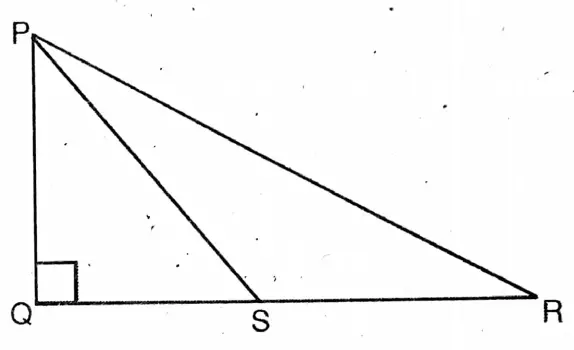
Question 4. I have drawn a triangle PQR whose ∠Q is a right angle. If S is any point on QR, let
us prove that PS²+ QR² = PR²+ QS².

Solution: In a right-angled triangle PQR, ∠Q = 90°

S is any point in QR

To prove \(P S^2+Q R^2=P R^2+Q S^2\)

Proof:  △PQS &  △PQR are two right angled triangles.

∴ \(\mathrm{PS}^2=\mathrm{PQ}^2+\mathrm{QS}^2\)

\(P R^2=P Q^2+Q^2\)

or, \(\mathrm{QR}^2=P R^2-\mathrm{PQ}^2\)

∴ \(P S^2+Q R^2=P Q^2+Q S^2+P R^2-P Q^2\)

= \(Q S^2+P R^2\)

∴ \(\mathrm{PS}^2+\mathrm{QR}^2=\mathrm{PR}^2+\mathrm{QS}^2\) Proved.


WBBSE Solutions For Class 10 Maths Chapter 22 Pythagoras Theorem 14

“WBBSE Class 10 Maths Exercise 22.1 Pythagoras Theorem problem solutions”

Question 5. Let us prove that the sum of squares drawn on the sides of a rhombus is equal to the sum of squares drawn on two diagonals.

Solution: AC & BD two diagonals of the rhombus ABCD, intersect each other at O.

To prove, \(A B^2+B C^2+C D^2+D A^2=A C^2+B D^2\)

We know the diagonals of a rhombus bisect each other perpendicularly.

i.e., AC ⊥ BD, & AO = OC & BO = OD

∴ △AOB, △BOC, △COD & △DOA

are four right angled triangles.

\(\mathrm{AB}^2=\mathrm{OA}^2+\mathrm{OB}^2 ; \mathrm{BC}^2=\mathrm{OB}^2+\mathrm{OC}^2\) \(\mathrm{CD}^2=\mathrm{OC}^2+\mathrm{OD}^2 ; A D^2=\mathrm{OD}^2+\mathrm{OA}^2\) \(\mathrm{AB}^2+\mathrm{BC}^2+\mathrm{CD}^2+\mathrm{AD}^2=\mathrm{OA}^2+\mathrm{OB}^2+\mathrm{OB}^2+\mathrm{OC}^2+\mathrm{OC}^2+\mathrm{OD}^2+\mathrm{OD}^2+\mathrm{OA}^2\)

= \(2\left(\mathrm{OA}^2+\mathrm{OB}^2+\mathrm{OC}^2+\mathrm{OD}^2\right)\)

= \(2\left(\mathrm{OA}^2+\mathrm{OC}^2+\mathrm{OB}^2+\mathrm{OB}^2\right)\)


WBBSE Solutions For Class 10 Maths Chapter 22 Pythagoras Theorem 15

Question 6. ABC is an equilateral triangle. AD is perpendicular on the side BC; let us prove that, AB²+ BC²+ CA² = 4AD².

Solution: In the equilateral triangle ABC, AD is perpendicular to BC.

To prove \(A B^2+B C^2+C A^2=4 A D^2\)

Proof: In  △ABC, AD ⊥ BC ∴ BD = DC

△ABD & △ACD are two right angled triangles

\(\mathrm{AB}^2=\mathrm{AD}^2+\mathrm{BD}^2 \& \mathrm{CA}^2=\mathrm{AD}^2+\mathrm{DC}^2\)

\(A B^2=A D^2+B D^2=A D^2+D C^2\)    [∵ BD = DC]


WBBSE Solutions For Class 10 Maths Chapter 22 Pythagoras Theorem 16

Question 7. I have drawn a right-angled triangle ABC whose A is a right angle. I took two points P and Q on the sides AB and AC respectively. By joining P, Q; B, Q and C, P, let us prove that BQ²+ PC² = BC² + PQ².

Solution:

Given

I have drawn a right-angled triangle ABC whose A is a right angle. I took two points P and Q on the sides AB and AC respectively.

To prove BQ²+ PC² = BC² + PQ²

△ABC, △ABQ, △APQ are all right angled triangles

where ∠A = 90°

\(\mathrm{BC}^2=\mathrm{AB}^2+\mathrm{AC}^2\) \(B Q^2=A Q^2+A B^2 ; P C^2=A P^2+A C^2 ; P Q^2=A P^2+A Q^2\)

Now, \(B Q^2+P C^2=A Q^2+A B^2+A P^2+A C^2\)

& \(\mathrm{BQ}^2+\mathrm{PQ}^2=A B^2+A C^2+A P^2+A Q^2=A Q^2+A B^2+\mathrm{AP}^2+\mathrm{AC}^2\)


BQ²+ PC² = BC² + PQ². Proved

WBBSE Solutions For Class 10 Maths Chapter 22 Pythagoras Theorem 18

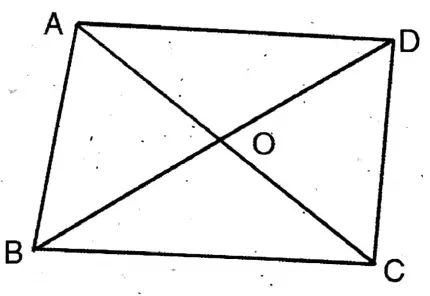
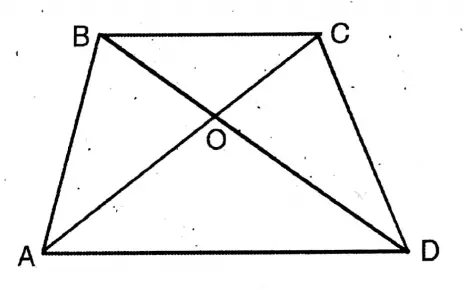
Question 8. If two diagonals of a quadrilateral ABCD intersect each other perpendicularly, then let us prove that AB²+ CD² = BC² + DA².

Solution: To prove, AB²+ CD² = BC² + DA²

AC & BD, the two diagonals of the quadrilateral ABCD, intersect each other perpendicularly at O.

∴  △AOB,  △BOC,  △COD &  △DOA are all right angled triangles.

∴ \(\mathrm{AB}^2=\mathrm{OA}^2+\mathrm{OB}^2\)

\(\mathrm{BC}^2=\mathrm{OB}^2+\mathrm{OC}^2\) \(\mathrm{CD}^2=\mathrm{OC}^2+\mathrm{OD}^2\) \(\mathrm{DA}^2=\mathrm{OD}^2+\mathrm{OA}^2\)

∴ \(A B^2+C D^2=O A^2+O B^2+O C^2+O D^2\)

& \(\mathrm{BC}^2+\mathrm{DA}=\mathrm{OB}^2+\mathrm{OC}^2+\mathrm{OD}^2+\mathrm{OA}^2\)


∴ AB²+ CD² = BC²+ DA². Proved.

WBBSE Solutions For Class 10 Maths Chapter 22 Pythagoras Theorem 19

“Class 10 WBBSE Maths Exercise 22.1 Pythagoras Theorem step-by-step solutions”

Question 9. I have drawn a triangle ABC whose height is AD. If AB > AC, let us prove that, AB² – AC² = BD² – CD².

Solution: In ΔABC, AD is the height of the AABC & AB > AC.

To prove, \(A B^2-A C^2=B D^2-C D^2\)

Proof: AD is the height of ABC, AD ⊥ BC.

△ABD &  △ACD are two right angled triangle

\(A B^2=A D^2+B D^2\)

& \(A C^2=A D^2+C D^2\)

\(A B^2-A C^2=A D^2+B D^2-A D^2-C D^2\)

= \(B D^2-C D^2\)

\(A B^2-A C^2=B D^2-C D^2\)   Proved.

WBBSE Solutions For Class 10 Maths Chapter 22 Pythagoras Theorem 20


Question 10. ABC is an isosceles triangle ‘whose C is a right angle. If D is any point on AB, then let us prove that AD²+ DB² = 2CD².

Solution:

Given

ABC is an isosceles triangle ‘whose C is a right angle. If D is any point on AB

To prove AD²+ BD² = 2CD²

From point D, DE & DF are two perpendicular on BC

& CA respectively,

& ∠DFC = 1 right angle

& ∠DEC = 1 right angle

In CEDF quadrilateral,

∠FCE = ∠DFC = ∠DEC = 1r. angle

In CEDF rectangle, CF || ED

∴ CA || ED & ∠ADB is the intercept

∴ ∠CAD = ∠EDB (corresponding)

∴ ∠EDB = ∠DBE ∴ DE = BE

as CAB = ABC,  △ABC is an isosceles triangle.


∴CF = DE = BF: Now, ΔADF, ΔBDE & ΔCDE are all right angles.

∴ AD² = AF² + FD²;

DB² = BE² + DE²;

CD² = CE² + DE²

Now, AD² + DB² = AF² + FD²+ BE² + DE²

= CE²+ CE² + DE² + DE² = 2CE² + 2DE²

=2(CE² + DE²) = 2CD² [AC – CF BC – BE, AF = CE & BE = DE]

= AD²+ DB²

2CD² Proved.

WBBSE Solutions For Class 10 Maths Chapter 22 Pythagoras Theorem 27


Question 11. In the triangle ABC, ZA is the right angle; if CD is the median, let us prove that BC² = CD² + 3AD².

Solution :

Given

In the triangle ABC, ZA is the right angle; if CD is the median

To prove BC² = CD² + 3AD²

In △ABC, CD is median AD = DB.

△CAB & △CAD are right angled triangles.

\(B C^2=A B^2+A C^2 \& C D^2=A D^2+A C^2\) \(A C^2=C D^2-A D^2\) \(B C^2=(2 A D)^2+C D^2-A D^2\)

= \(4 A D^2+C D^2-A D^2\)

= \(3 A D^2+C D^2\)

∴ \(\mathrm{BC}^2=\mathrm{CD}^2+3 A D^2\) Proved.

WBBSE Solutions For Class 10 Maths Chapter 22 Pythagoras Theorem 29

Question 12. From point O within a triangle ABC, I have drawn the perpendiculars OX, OY, and OZ on BC, CA, and AB respectively. Let us prove that AZ + BX2+ CY² = AY² + CX² + BZ².

Solution:

Given

From point O within a triangle ABC, I have drawn the perpendiculars OX, OY, and OZ on BC, CA, and AB respectively.

To prove, AZ²+ BX²+ CY² = AY² + CX²

AAZO; ABZO; ABXO; ACXO; ACYO; AAYO are all right angle triangles.

∴ AO² = AZ² – ZO²    or, AZ²2 = AO² – ZO²

CX² = CO²-OX²       or, CY² = CO² – YO²

or, AY² = AO² – OY²

∴ AZ² + BX² + CY² – (AY²+ CX² + BZ²)

= (AO²-OZ + BO²-OX²+ CO²-OY²)-(AO²-OY² + CO² – OX² + BO² – OZ²)

=(AO² – AO²)+(OZ²-OZ²) + (BO² – BO²)+ (OX² – OX²) + (CO²- CO²)+ (OY² – OY²) = 0 

∴ AZ²+ BX²+ CY² = AY²+ BZ²+ CX² Proved.

WBBSE Solutions For Class 10 Maths Chapter 22 Pythagoras Theorem 30

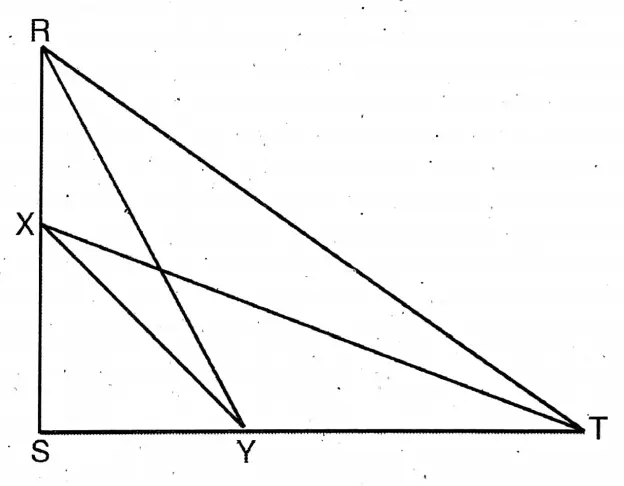
Question 13. In ARST, ZS is a right angle. The midpoints of the two sides RS and ST are X and Y respectively; let us prove that, RY² + XT² = 5XY².

Solution: To prove, RY² + XT² = 5XY²

Proof: From △RSY, \(R Y^2=R^2+S Y^2\)

From △XST, \(\mathrm{XTT}^2=\mathrm{ST}^2+\mathrm{SX}^2\)

∴ \(R Y^2+X T^2=\left(R S^2+S T^2\right)+\left(S Y^2+S X^2\right)\)

= \(R T^2+\left(\frac{1}{2} S T\right)^2+\left(\frac{1}{2} R S\right)^2\)

as \(S Y=\frac{1}{2} S T \& S \dot{x}^2=\frac{1}{2} R S\)

= \(R \mathrm{~T}^2+\frac{1}{4} R \mathrm{~T}^2\)

as \(X Y=\frac{1}{2} R T\)


∴ From (1) RY²+ XT² = 5XY² Proved.

WBBSE Solutions For Class 10 Maths Chapter 22 Pythagoras Theorem 32

WBBSE Solutions Guide Class 10 Maths Chapter 22 Pythagoras Theorem Exercise 22.1 Multiple Choice Questions

Question 1. A person goes 24 m west from a place and then he goes 10 m north. The distance of the person from starting point is

1. 34 m.
2. 17 m.
3. 26 m.
4. 25 m.

Solution: The distance of the person from the starting point

= √242+102 = √576+100 = √676 = 26 m.

Answer.  3. 26 m.

“WBBSE Class 10 Chapter 22 Pythagoras Theorem Exercise 22.1 solution guide”

Question 2. If ABC is an equilateral triangle and AD BC, then AD2 =

1. 3/2DC²
2. 2DC²
3. 3DC²
4. 4DC²

Solution: AD (Height of equilateral triangle)

= (√3/2)Side

= 3/4 Side²

= 3/4 (BC)²

= 3/4 × (2DC)²

=3/4 x 4DC²

= 3DC²

Answer. 3. 3DC²

WBBSE Solutions For Class 10 Maths Chapter 22 Pythagoras Theorem 33

Question 3. In an isosceles triangle ABC, If AC BC and AB² = 2AC², then the measure of ZC is

1. 30°
2. 90°
3. 45°
4. 60°

Solution: Here, AC BC & AB² = 2AC²

∴ AB² = AC² + BC²    ∴ ZC = 90°

Answer. 2. 90°

WBBSE Solutions For Class 10 Maths Chapter 22 Pythagoras Theorem 34

Question 4. Two rods of 13 m in length and 7 m in length are situated perpendicularly on the ground and the distance between their foots is 8 m. The distance between their top parts is

1. 9 m.
2. 10 m.
3. 11 m.
4. 12 m.

Solution: Here AC² = AB²+ BC²

= 62+82 = 100

∴ AC = 10 m.

Ans. 2. 10 m.

WBBSE Solutions For Class 10 Maths Chapter 22 Pythagoras Theorem 35

“West Bengal Board Class 10 Maths Exercise 22.1 Pythagoras Theorem solutions”


Question 5. If the lengths of two diagonals of a rhombus are 24 cm and 10 cm, the perimeter of the rhombus is

1. 13 cm.
2. 26 cm.
3. 52 cm.
4. 25 cm.

Solution: ∴ BD = 24 cm.          ∴ DO = 12 cm.

AC = 12 cm.       CO = 5 cm.

DC² = AO² + OC² = 122 + 52

= 144 +25

= 169

∴ DC = √169

= 13 cm.

:. Perimeter = 4 x 13 cm.

= 52 cm.

Answer. 3. 52 cm.

WBBSE Solutions For Class 10 Maths Chapter 22 Pythagoras Theorem 36

WBBSE Class 10 Maths Solutions Pdf In English Chapter 22 Pythagoras Theorem Exercise 22.1 True Or False

1. If the ratio of the lengths of three sides of a triangle is 3: 45, then the triangle will always be a right-angled triangle.

Answer: True

2. If in a circle of radius 10 cm in length, a chord subtends a right angle at the center, then the length of the chord will be 5 cm.

Answer: False

Fill In The Blanks

1. In a right-angled triangle, the area of a square drawn on the hypotenuse is equal to the area of the sum of squares drawn on the other two sides.

2. In an isosceles right-angled triangle if the length of each of two equal sides is 4 cm, then the length of the hypotenuse will be 8 cm.

3. In a rectangular figure ABCD, the two diagonals AC and BD intersect each other at point O, if AB = 12 cm, AP = 6.5, then the length of BC is 15 cm.

WBBSE Class 10 Maths Solutions Chapter 22 Pythagoras Theorem Exercise 22.1 Short Answer

Question 1. In AABC, if AB = (2a-1) cm AC = 2√2a  cm. and BC= (2a + 1) cm, then let us write the value of <BAC.

Solution.

Given

In AABC, if AB = (2a-1) cm AC = 2√2a  cm. and BC= (2a + 1) cm

AB = (2a – 1) cm.

AC = 2√2a cm.

BC (2a + 1) cm.

∴ AB²+ AC² = (2a-1)+(2√2a)²

= 4a² – 4a+1 + 8a

= 4a² + 4a + 1

= (2a + 1)²

O = BC²

∴ ∠BAC 90°

WBBSE Solutions For Class 10 Maths Chapter 22 Pythagoras Theorem 37

“Class 10 WBBSE Maths Exercise 22.1 solutions for Pythagoras Theorem”

Question 2. In the adjoining figure, point O is situated within the triangle PQR in such a way that, POQ = 90°, OP = 6 cm, and OQ = 8 cm. If PR = 24 cm and ∠QPR = 90°, then let us write the length of QR.

Solution.

Given

In the adjoining figure, point O is situated within the triangle PQR in such a way that, POQ = 90°, OP = 6 cm, and OQ = 8 cm. If PR = 24 cm and ∠QPR = 90°,

As ∠POQ = 90°

∴ PQ² = OP² + OQ² = 62+ 82 = 100

∴ PQ = 10 cm.

Again, ∠QPR = 90°

∴ QR² = PQ²+ PR²

= 100+ 576

= 676

QR = √676

= 26 cm.

WBBSE Solutions For Class 10 Maths Chapter 22 Pythagoras Theorem 38


Question 3. point O is situated within the rectangular figure ABCD in such a way that OB = 6 cm, OD = 8cm, and OA = 5 cm. Let us determine the length of OC.

Solution. 53


Question 4. In the triangle, ABC the perpendicular AD from point A on side BC meets side BC at point D. If BD = 8 cm, DC = 2 cm, and AD = 4 cm, then let us write the measure of <BAC.

Solution.

Given

In the triangle, ABC the perpendicular AD from point A on side BC meets side BC at point D. If BD = 8 cm, DC = 2 cm, and AD = 4 cm,

∠ADB 90°

∴ AB² = AD²+ DB²

= 42+ 82

= 16+6480

AC² = CD²+ AD²

= 4+16

=20

∴ Here, BC² = (2+8)² (10)²

= 100

∴ AB²+ AC²=80+20

=100

∴ <BAC = 90°.

WBBSE Solutions For Class 10 Maths Chapter 22 Pythagoras Theorem 39

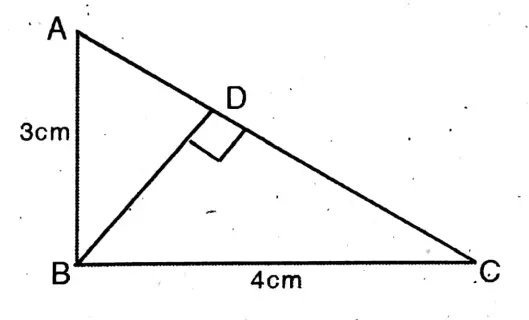
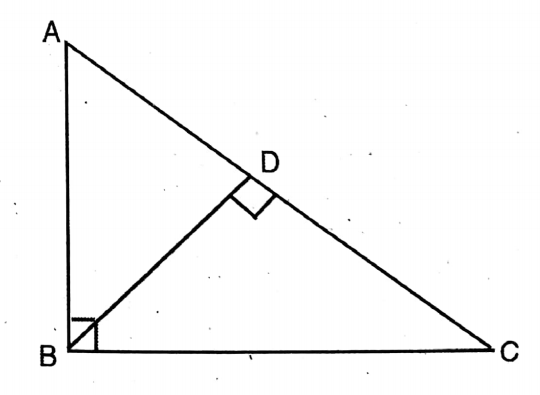
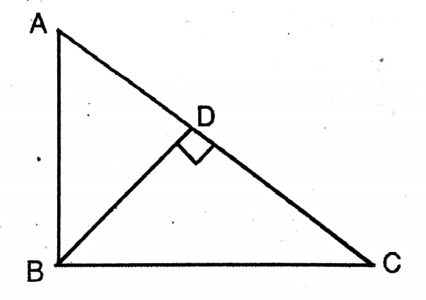
Question 5. In a right-angled triangle, ABC, ABC = 90°, AB = 3 cm, BC = 4 cm, and the perpendicular BD on the side AC from point B which meets the side AC at point D. Let us determine the length of BD.

Solution.

Given

In a right-angled triangle, ABC, ABC = 90°, AB = 3 cm, BC = 4 cm, and the perpendicular BD on the side AC from point B which meets the side AC at point D.

Here ABC ∼ BDC

AB/AC = BD/BC     AC² = AB² + BC²

3/5 = BD/4        

= 9+16

=25

∴ AC = √125

=5

∴ BD= 12/5 

= 2.4 cm.

The length of BD = 2.4 cm.

WBBSE Solutions For Class 10 Maths Chapter 22 Pythagoras Theorem 40

WBBSE Solutions For Class 10 Maths Chapter 21 Determination Of Mean Proportional Exercise 21.1

West Bengal Board Class 10 Math Book Solution In English Chapter 21 Determination Of Mean Proportional Exercise 21.1

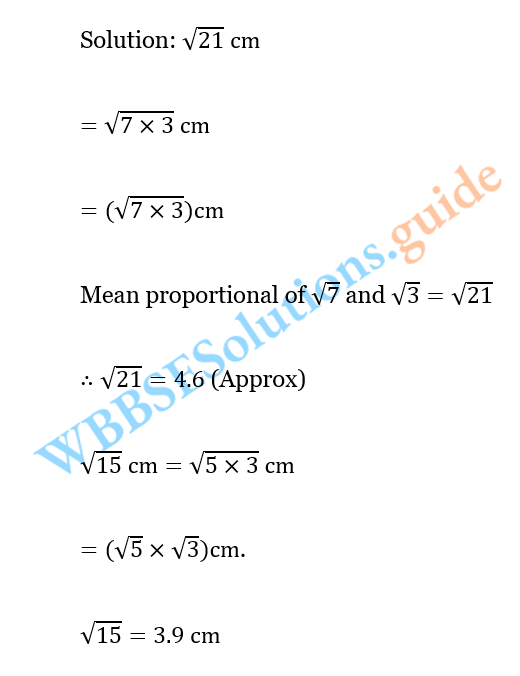
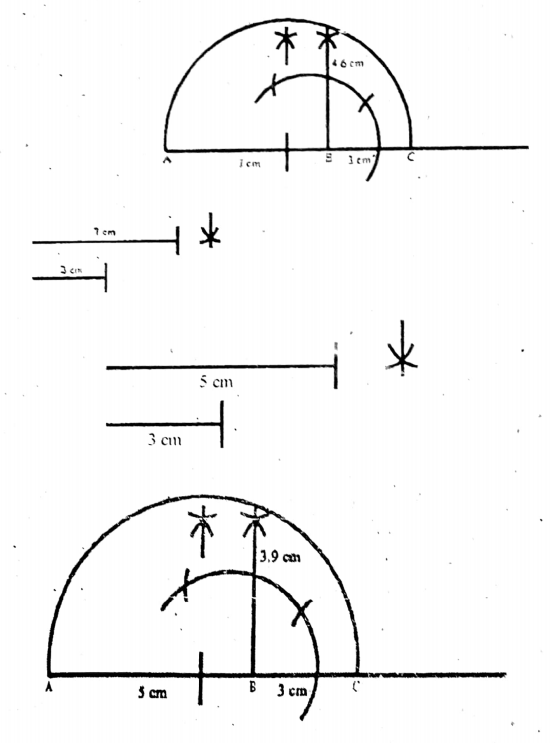
Application 1. I determined the values of √21 and √15 in the geometric method. Or, in the geometric method, I determine the square roots of 21 and 15.

Hints: 217 x 3. ∴ In this case, I take two line segments a and b whose lengths are 7 units and 3 units respectively, and in the same method, I shall determine to mean proportional of a and b. Again, 15 = 3 x 5, I draw it by taking the lengths of a and b properly.

WBBSE Solutions For Class 10 Maths Chapter 21 Determination Of Mean Proportional 1


.


“WBBSE Class 10 Maths Determination of Mean Proportional Exercise 21.1 solutions”

Read and Learn More WBBSE Solutions For Class 10 Maths

WBBSE Solutions For Class 10 Maths Chapter 21 Determination Of Mean Proportional 2

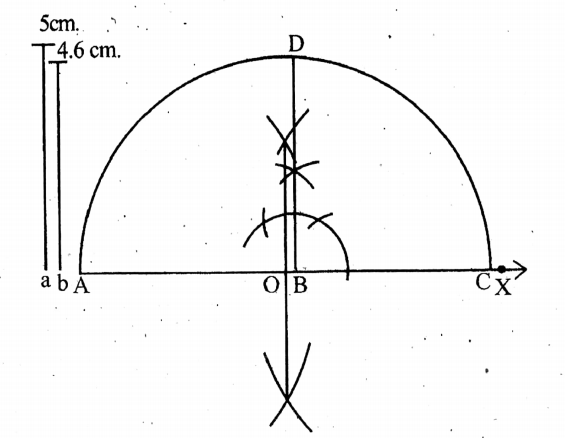
Application 2. I determine the value of √23 in the geometric method.

Solution: 23 = 5 x 4.6

1. I take two line segments a and b whose lengths are 5 cm and 4.6 cm respectively. 

Measuring with a scale; I am observing that BD = 4.79 cm. (Approx)

∴ √23 = 4.79 (Approx)

I have understood, i.e., if there is a two-digit prime number, for example, 17, 19, 29, 37, etc. then these numbers will be divided by 5,

WBBSE Solutions For Class 10 Maths Chapter 21 Determination Of Mean Proportional Exercise 21.1

“West Bengal Board Class 10 Maths Chapter 21 Determination of Mean Proportional Exercise 21.1 solutions”

 For example: 175 x 3.4, 19=5x 3.8, 29 = 5 x 5.8, 37 = 5 x 7.4, etc.

WBBSE Solutions For Class 10 Maths Chapter 21 Determination Of Mean Proportional 3

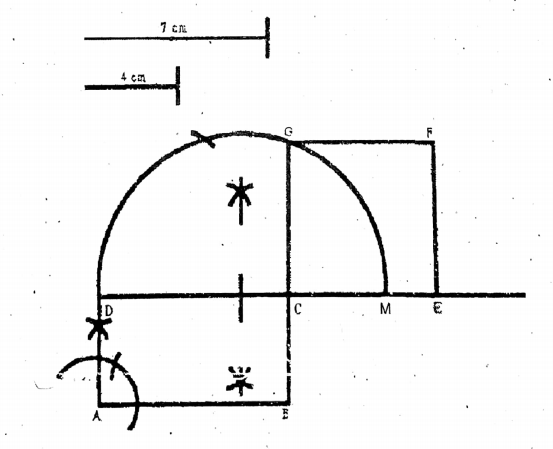
Application 3. Let us draw a square whose area is equal to the area of a rectangle of 7 cm in length and 4cm in breadth. 

Solution: Here area of the rectangle ABCD = the area of square CEFG.

Construction: Draw a rectangle ABCD whose AB = 7cm & BC = 4cm From produce DC, cut CM equal to BC.

Now draw a semi-circle with a diameter DM.

Produce BC which cut the semi-circle at G.

Now draw a square with CG as one side.

∴ CEFG is the required square.

WBBSE Solutions For Class 10 Maths Chapter 21 Determination Of Mean Proportional 4

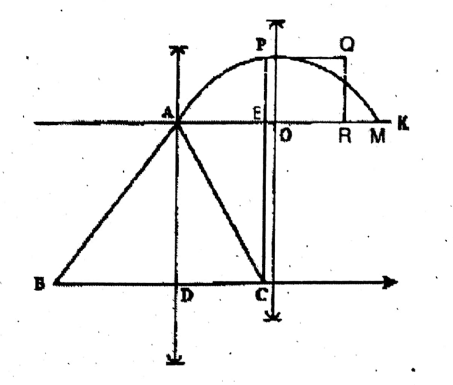
Question 1. I draw a square whose area is equal to the area of an equilateral triangle having a side 7 cm in length. 

Solution: First draw an equilateral triangle ABC whose each side is 7 cm. Now bisect the base BC at D.

Next, draw a straight line through A parallel to BC and bisect BC at D.

Class 10 Maths Class 10 Social Science
Class 10 English Class 10 Maths
Class 10 Geography Class 10 Geography MCQs
Class 10 History Class 10 History MCQs
Class 10 Life Science Class 10 Science VSAQS
Class 10 Physical Science Class 10 Science SAQs

Now draw a rectangle ADCE whose area is equal to the ABC, now from produce AE cut AM equal to CE.

Next, draw a semi-circle with a diameter AM.

Produce CE which cuts the circle at P.

Draw the square EPQR, whose area is equal to the ΔABC.

WBBSE Solutions For Class 10 Maths Chapter 21 Determination Of Mean Proportional 5


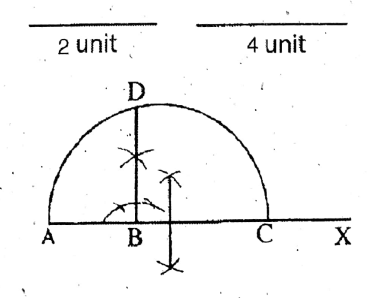
Question 2. Let us draw the mean proportional of the following line segments and let us measure the values of the mean proportionals in each case with the help of a scale 

1. 5 cm, 2.5 cm.

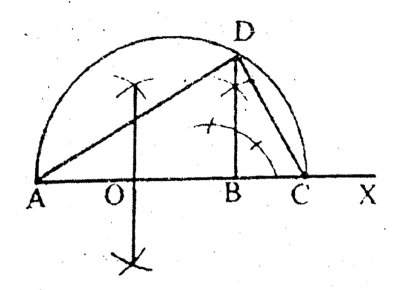
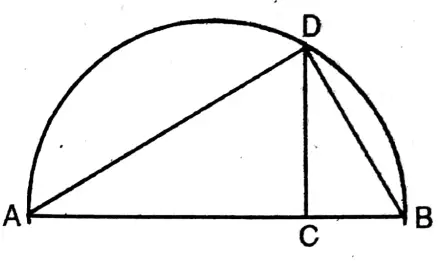
Solution: Take a line segment AX > 5 cm.

From AX cut AB = 5 cm & BC = 2.5 cm. Now, with AC as a diameter, draw a semicircle.

Now at B, draw a perpendicular on BC which cuts the semicircle at D.

The length of BD is the required mean proportional BD = 3 cm (by measuring with a scale).


WBBSE Solutions For Class 10 Maths Chapter 21 Determination Of Mean Proportional 6

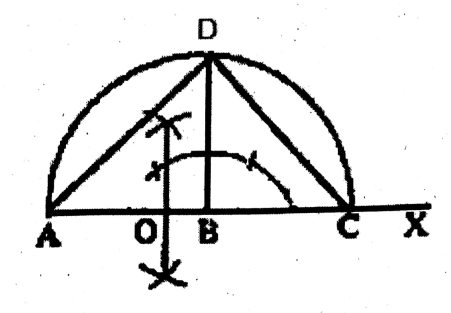
2. 4 cm, 3 cm.

Solution: Take a line segment AX > 4 cm. From AX, cut AB = 4 cm. & BC = 3 cm.

Now, with AC as a diameter, draw a semicircle.

Now at B, draw a perpendicular on BC, which cuts the semicircle at D.

The length of BD (= 3.5 cm, by measuring with a scale) is the required mean proportional.


WBBSE Solutions For Class 10 Maths Chapter 21 Determination Of Mean Proportional 7

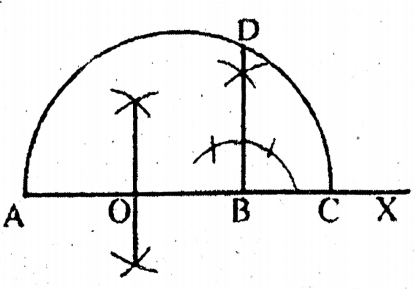
3. 7.5 cm, 4 cm.

Solution: Take a line segment AX > 7.5 cm. From AX, cut AB = 7.5 cm & BC = 4 cm. 

Now with AC as the diameter, draw a semicircle.

Now at B, draw a perpendicular on BC, which cuts the semicircle at D. 

The length of BD (= 3.5 cm, by measuring with a scale) is the required mean proportional.

∴ The required mean proportional is BD.

Length of BD = 5.7 cm.

WBBSE Solutions For Class 10 Maths Chapter 21 Determination Of Mean Proportional 8

“WBBSE Class 10 Determination of Mean Proportional Exercise 21.1 solutions explained”

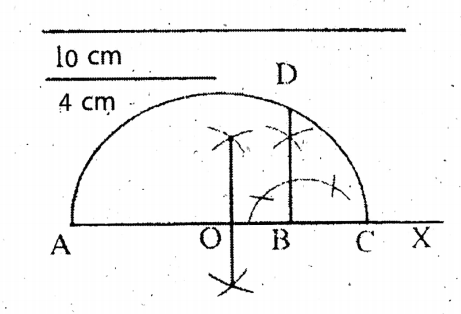
4. 10 cm, 4 cm.

Solution: From line segment AX, cut AB = 10 cm 

& BC = 4 cm. Draw a semicircle with AC as the diameter. 

Draw BD perpendicular to B.

∴ The required mean proportional is BD.

Length BD = 6.3 cm. (approx)

WBBSE Solutions For Class 10 Maths Chapter 21 Determination Of Mean Proportional 9

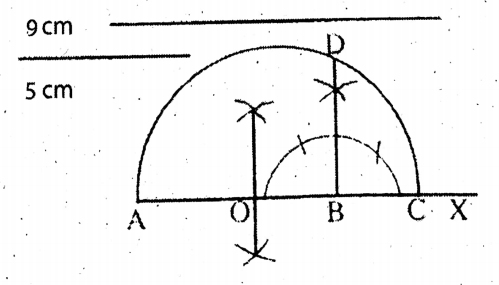
Solution: From line segment AX, cut AB = 9 cm & BC= 5 cm. 

Draw a semicircle with AC as the diameter. 

Draw BD perpendicular to B.

∴ The required mean proportional is BD.

Length BD 6.7 cm. (approx)

WBBSE Solutions For Class 10 Maths Chapter 21 Determination Of Mean Proportional 10

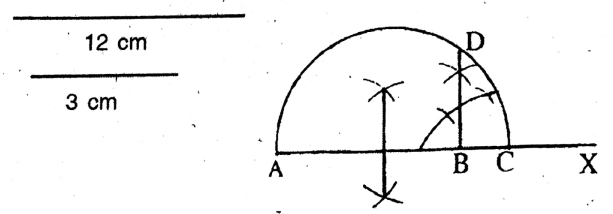
6. 12 cm, 3 cm.

Solution: From line segment AX, cut AB = 12 cm & BC= 3 cm.

Draw a semicircle with AC as the diameter. 

Draw BD perpendicular to B.

∴ The required mean proportional is BD.

Length BD 6 cm. (approx)


WBBSE Solutions For Class 10 Maths Chapter 21 Determination Of Mean Proportional 11

Question 3. Let us determine the square roots of the following numbers by the geometric method : 

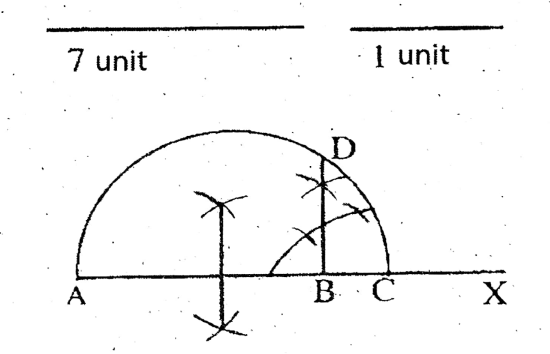
1. 7

Solution: From line segment AX, cut AB = 7 cm & BC = 1. cm.

Draw a semicircle with AC as the diameter.

Draw BD perpendicular to B.

∴ Required mean proportional is BD.

Length BD 2.6 cm.

∴ √7=2.6 (approx)

WBBSE Solutions For Class 10 Maths Chapter 21 Determination Of Mean Proportional 12

2. 8

Solution: From line segment AX, cut AB = 4 cm & BC= 2 cm.

Draw a semicircle with AC as the diameter.

Draw BD perpendicular to B.

∴ The required mean proportional is BD.

Length BD 2.8 cm.

∴ √8 = 2.8 (approx)

WBBSE Solutions For Class 10 Maths Chapter 21 Determination Of Mean Proportional 13

“WBBSE Class 10 Maths Exercise 21.1 Determination of Mean Proportional problem solutions”

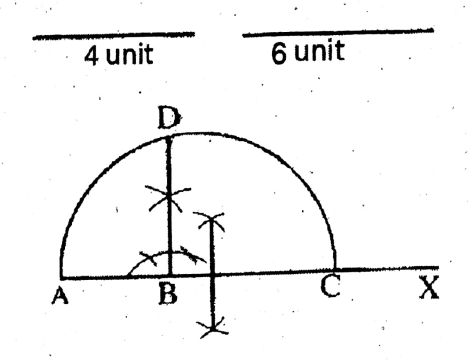
Solution: From line segment AX, cut AB = 4 cm & BC = 6 cm.

Draw a semicircle with AC as the diameter.

Draw BD perpendicular to B.

∴ Required mean proportional is BD.

Length BD 4.9 cm.

∴ BD=4.9 (approx)

WBBSE Solutions For Class 10 Maths Chapter 21 Determination Of Mean Proportional 14

4. 28

Solution: From line segment AX, cut AB = 4 cm & BC= 7 cm.

Draw a semicircle with AC as the diameter.

Draw BD perpendicular to B.

∴ Required mean proportional is BD.

Length BD 5.3 cm.

√28=5.3 (approx)

WBBSE Solutions For Class 10 Maths Chapter 21 Determination Of Mean Proportional 15

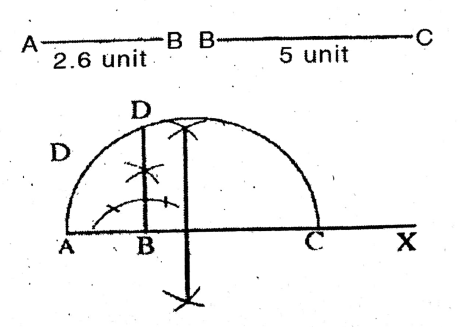
5. 13

Solution: 5.0 cm x 2.6 cm. From line segment AX, cut AB = 2.6 cm & BC= 5 cm.

Draw a semicircle with AC as the diameter.

Draw BD perpendicular to B.

∴ Required mean proportional is BD.

Length BD 3.6 cm.

∴ √13 = 3.6 (approx)

WBBSE Solutions For Class 10 Maths Chapter 21 Determination Of Mean Proportional 16

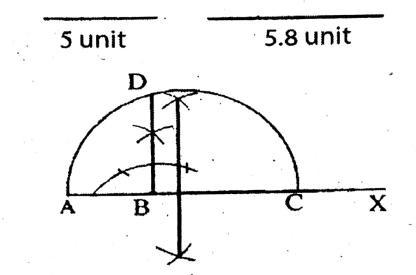
Solution: From line segment AX, cut AB = 5 cm & BC= 5.8 cm.

Draw a semicircle with AC as the diameter. 

Draw BD perpendicular to B.

The required mean proportional is BD.

Length BD 5.4 cm. (approx)

WBBSE Solutions For Class 10 Maths Chapter 21 Determination Of Mean Proportional 17

Question 4. Let us draw the squared figures by taking the following lengths as sides.

1. √14 cm.

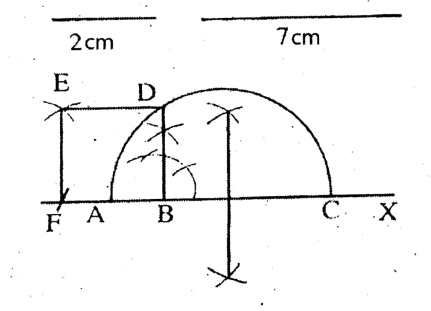
Solution: From a line segment AX, cut 2 cm & 7 cm.

Now draw the mean proportional of AB & BC.

BD is the mean proportional of length √14 cm.

Now draw a square whose one side = BD = 3.7 cm.

BDEF is required square.

WBBSE Solutions For Class 10 Maths Chapter 21 Determination Of Mean Proportional 18

2. √22 cm.

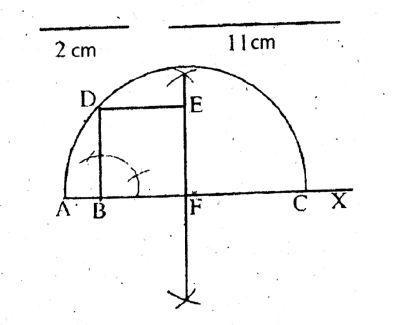
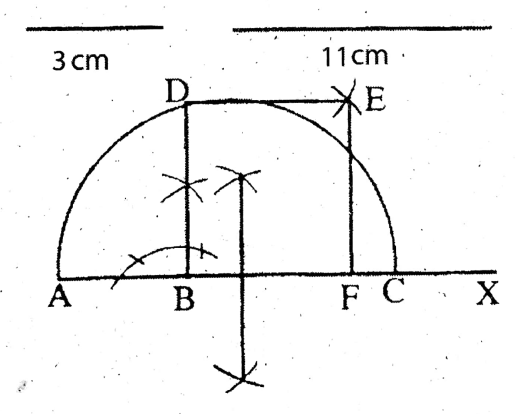
Solution: From a line segment AX, cut 2 cm & 11 cm. Now draw the mean proportional of AB & BC.

∴ BD is the mean proportional of length √22

Now draw a square whose one side = BD = 4.6 cm.

BDEF is required square.

WBBSE Solutions For Class 10 Maths Chapter 21 Determination Of Mean Proportional 19

3. √31 cm.

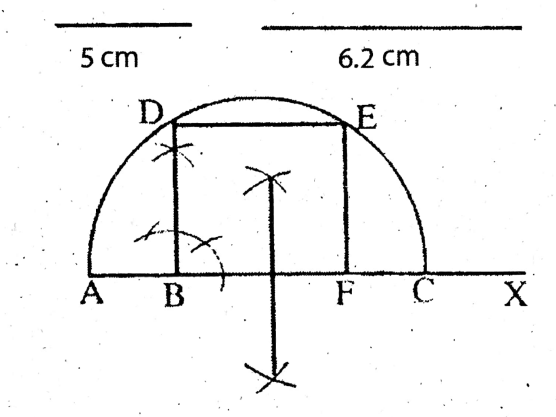
Solution: From a line segment AX, cut 5 cm & 6.2 cm.

Now draw the mean proportional of AB & BC.

∴ BD is the mean proportional of length √31

Now draw a square whose one side = BD 5.6 cm. 

BDEF is required square.

WBBSE Solutions For Class 10 Maths Chapter 21 Determination Of Mean Proportional 20

4. √33 cm.

Solution: From a line segment AX, cut 3 cm & 11 cm. Now draw the mean proportional

of AB & BC.

∴ BD is the mean proportional of length √33 cm.

Now draw a square whose one side = BD = 5.7 cm.

BDEF is required square.

WBBSE Solutions For Class 10 Maths Chapter 21 Determination Of Mean Proportional 21

“Class 10 WBBSE Maths Exercise 21.1 Determination of Mean Proportional step-by-step solutions”


Question 5. Let us draw the squares whose areas are equal to the areas of the rectangles by taking the following lengths as its sides :

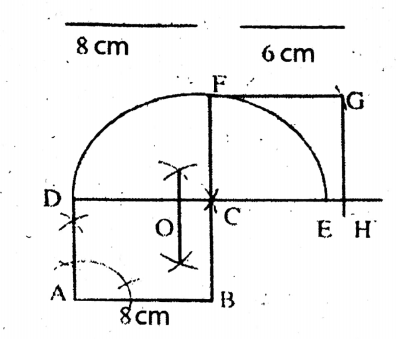
1. 8 cm, 6 cm.

Solution: Draw a rectangle ABCD with 8 cm & 6 cm.

From produced DC, cut CE equals CB.

Now draw a semicircle with DE as the diameter.

CF cuts the semicircle at F.

Now draw a square with CF as one side.

CFGH is the required square.

WBBSE Solutions For Class 10 Maths Chapter 21 Determination Of Mean Proportional 22

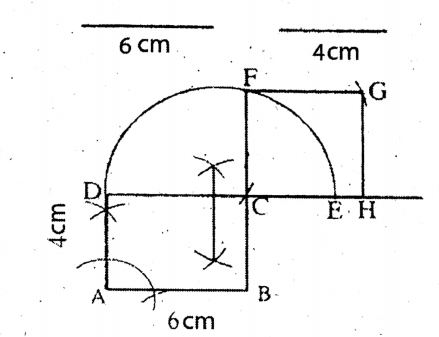
2. 6 cm, 4 cm.

Solution: Draw a rectangle ABCD with 6 cm & 4 cm.

From produced DC, cut CE equals CB.

Now draw a semicircle with DE as diameter, and CF cuts the semicircle at F.

Now draw a square with CF as one side.

CFGH is the required square.

WBBSE Solutions For Class 10 Maths Chapter 21 Determination Of Mean Proportional 23

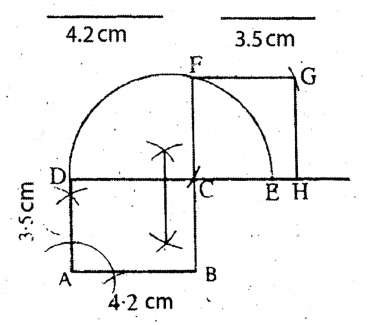
3. 4.2 cm., 3.5 cm.

Solution: Draw a rectangle with 4.2 cm & 3.5 cm.

From produced DC, cut CE equals CB.

Now draw a semicircle with DE as diameter, and CF cuts the semicircle at F.

Now draw a square with CF as one side.

CFGH is the required square.

WBBSE Solutions For Class 10 Maths Chapter 21 Determination Of Mean Proportional 24

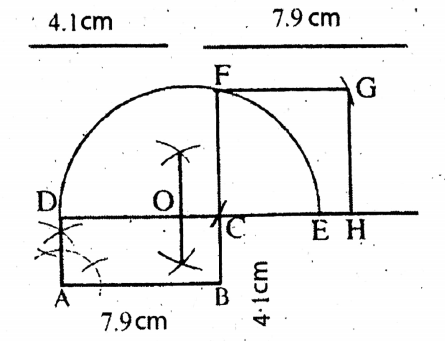
4. 7.9 cm., 4.1 cm.

Solution: Draw a rectangle with 7.9 cm & 4.1 cm.

From produced DC, cut CE equals CB.

Now draw a semicircle with DE as diameter, and CF cuts the semicircle at F.

Now draw a square with CF as one side.

CFGH is the required square.

WBBSE Solutions For Class 10 Maths Chapter 21 Determination Of Mean Proportional 25

“WBBSE Class 10 Chapter 21 Determination of Mean Proportional Exercise 21.1 solution guide”

Question 6. Let us draw the squares whose areas are equal to the areas of the following triangles :

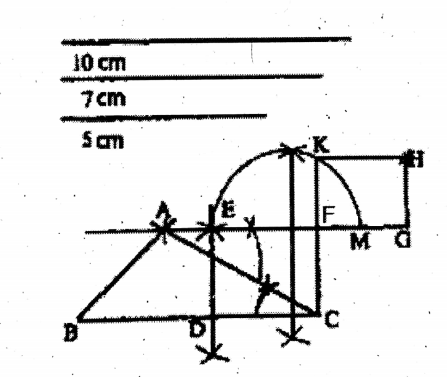
1. The lengths of the three sides of a triangle are 10 cm, 7 cm, and 5 cm respectively.

Solution:

Given

The lengths of the three sides of a triangle are 10 cm, 7 cm, and 5 cm respectivel

Draw a triangle ABC, whose AB = 5 cm, BC= 10 cm, & AC = 7 cm.

Bisect BC at D.

Draw a line parallel to BC, through A, which cut the perpendicular bisector of BC at E.

Take EF = DC.

CDEF is the required rectangle whose area is equal to ΔABC.

Now to draw a square from produce EF, cut EM equal to DE.

Draw a semi-circle with diameter EM to produce CF which cut the semi-circle at K.

Now draw the square FGHK, whose area is equal to ΔABC.

Proof : ABC = 1/2 × BC X DE = DC X DE = DC X CF

= EF X FM      [DC= EF and FC = FM]

= FK²       [ FD, EF & FM proportionate]

= FGHK Sq.

WBBSE Solutions For Class 10 Maths Chapter 21 Determination Of Mean Proportional 26

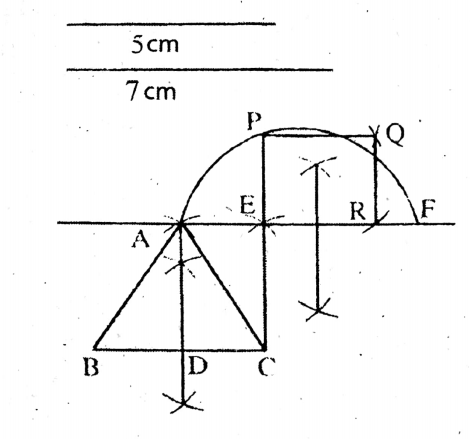
2. An isosceles triangle whose base is 7 cm in length and the length of each of two equal sides is 5 cm.

Solution:

Given

An isosceles triangle whose base is 7 cm in length and the length of each of two equal sides is 5 cm

Proof: PERQ sq.

= PE²

= AE.EF       [ PE. AE & EF proportionate]

= AE.EC      [ EF = EC]

= DC.EC     [AE = DC]

= 1/2 × BC x AD = ΔABC

WBBSE Solutions For Class 10 Maths Chapter 21 Determination Of Mean Proportional 27

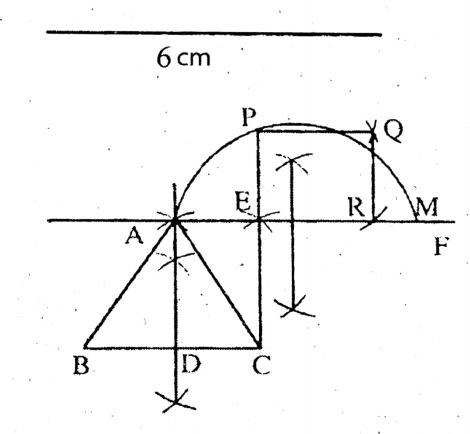
3. An equilateral triangle whose side is 6 cm in length.

Solution:

Given

An equilateral triangle whose side is 6 cm in length

Proof: AABC =1/2 BCX AD = DC X AD = AE X EC

= AE X EM = PE² [ PE, AE & EM proportionate]

= EPQR Sq.

WBBSE Solutions For Class 10 Maths Chapter 21 Determination Of Mean Proportional 28

First, draw an equilateral triangle ABC of side 6 cm. Now bisect the base BC at D.

Next draw a straight line through A, parallel to BC, bisect BC at D draw a rectangle ADCE whose area is equal to the AABC.

From produced AF cuts AM equal to CE.

Next, draw a semi-circle with a diameter AM.

Produce CE which cuts the semi-circle at P.

Draw the square EPQR, whose area is equal to the AABC.

WBBSE Solutions For Class 10 Maths Chapter 20 Trigonometry Concept Of Measurement Of Angle Exercise 20.1

West Bengal Board Class 10 Math Book Solution In English Chapter 20 Trigonometry Concept Of Measurement Of Angle Exercise 20.1


Question 1. I am observing that I have got a right-angled triangle whose ZACB is an  WBBSE Solutions For Class 10 Maths Chapter 20 Trigonometry Concept Of Measurement Of Angle 2 angle [acute/obtuse]
Answer. Acute.


Question 2. If any rotating ray rotates an angle of 30° more after two successive complete anticlockwise rotations from its initial position centering at its end, in that case, let us calculate the measurement of the angle that it will be.

Answer.

Given

If any rotating ray rotates an angle of 30° more after two successive complete anticlockwise rotations from its initial position centering at its end, in that case

The required measurement of angle = 2 x 360° + 30° = 750°

If any rotating ray rotates an angle of 45° more after three successive complete anticlockwise rotations, then in that case, let us calculate what will be the measurement of the angle

= 3 x 360° + 45° = 1125°

Read and Learn More WBBSE Solutions For Class 10 Maths


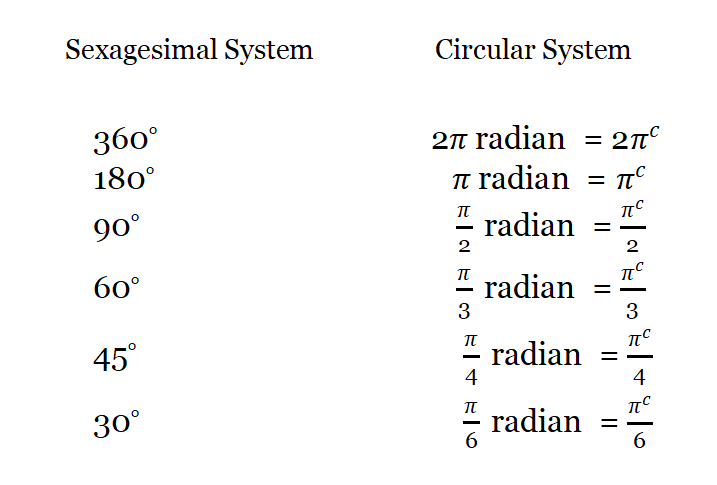
Question 3. We have got a relation between the units of two systems.

WBBSE Solutions For Class 10 Maths Chapter 20 Trigonometry Concept Of Measurement Of Angle 1

“WBBSE Class 10 Maths Trigonometry Concept of Measurement of Angle Exercise 20.1 solutions”

Application 1. The values of two angles of a triangle in the Sexagesimal system are 75° and 45° respectively; let us determine the value of the third angle in a circular system. 

Solution:

Given

The values of two angles of a triangle in the Sexagesimal system are 75° and 45° respectively

Let, in ΔABC, ∠ABC = 75° and ∠ACB = 45°

∴ <BAC 180° (75° + 45°) = 60°

Again, 180° = π,   .. 60°= π/3

:. The required value of the third angle in a circular system is π/3

Class 10 Maths Class 10 Social Science
Class 10 English Class 10 Maths
Class 10 Geography Class 10 Geography MCQs
Class 10 History Class 10 History MCQs
Class 10 Life Science Class 10 Science VSAQS
Class 10 Physical Science Class 10 Science SAQs

Application 2. If the Sexagesimal values of two angles of a triangle are 65° and 85° respectively, let us determine the Circular value of the third angle.

Solution:

Given

If the Sexagesimal values of two angles of a triangle are 65° and 85° respectively,

3rd angle 180° = (65° + 85°) = 180° – 150° = 30°

Circular value of 3rd angle = 30° x π/180° =π/ 6

“West Bengal Board Class 10 Maths Chapter 20 Trigonometry Concept of Measurement of Angle Exercise 20.1 solutions”

Application 3. A rotating ray rotates 30° more after two complete rotations in an anticlockwise direction; let us determine the Sexagesimal and Circular value of the angle.

Solution:

Given

A rotating ray rotates 30° more after two complete rotations in an anticlockwise direction

Since the ray is rotating anticlockwise direction,

∴ The angle will be negative [positive/negative]
For one complete rotation of the rotating ray, a 360° angle is formed.

∴ For 2 complete rotations, the angle will be 2 360° = 720° 

Since after 2 complete rotations, it rotates 30° more angle,

So, the sexagesimal value of the angle is 720° + 30° = 750°

Again, 180° = π,     

∴ 750° = (750/180 π) = 4 1/6 π

WBBSE Solutions For Class 10 Maths Chapter 20 Trigonometry Concept Of Measurement Of Angle Exercise 20.1

Application 4. I express 40° 16′ 24″ into radian.

Solution: 40° 16′ 24″

=40° +16+ 24″

=40° + 16′ + (24/60)     [ 60″ = 1′]
=40° + 16′ + 2‘/5 = 40° + (16 + 2/5)

= 40° + 82‘/5

= 40° + 6041°/150

Since 180°= π

∴ 6041/150 = Π/180 x 6041/150 = 6041/27000π


Application 5. Let me express 22°30′ into radian.

Solution: 22°30′

= 22° +(30/60)°

= 22° + (1/2)°

= 45°/2

Circular measurement = π/180 x 45/2 = πc/8

Application 6. I have drawn an equilateral triangle ABC. The line joining mid-point D of BC and the vertex A is AD; let us write by calculating, the circular value of ZBAD. 

Hints: In the equilateral triangle ABC, ∠BAC = 60° and the median of an equilateral triangle is the bisector of the corresponding angle.     

∴ ∠BAD = 30°

Solution:  ΔABC is an equilateral triangle

∴ <BAC = ∠ABC = ∠ACB = 60°

∴ AD is a median of the ΔABC

∴ AD ⊥ BC            ∴∠ADB = 90°

In ΔABD, ∠ABD = 60° & ZADB = 90°

∴ ∠BAD = 180° – (90° + 60°)

= 180° – 150°

= 30°

∴ Circular measure of BAD = π x 30° = π/6 radian.

WBBSE Solutions For Class 10 Maths Chapter 20 Trigonometry Concept Of Measurement Of Angle 3

Application 7. If the length of the radius of a circle is 6 cm, then let us write by calculating, the circular value of an angle which is subtended by an arc of 15 cm in length at the center.

Solution: Here the length of the arcs is 15 cm & radius is r = 6 cm.

∴ s=re

15= 6 x 0

∴ θ= 15/6 = 5/2 = radian.

Application 8. Let us write the value of the complementary angle of 27°27’27” in the sexagesimal system. 

Solution: Let θ be the complementary angle of 27°27’27”

∴ θ=90°-27°27’27” here 90° = 89°59’60” 

= 62°3233

= – 27°27’27” / θ = 62°32′33′′

∴ Complementary angle of 27°27’27” is 62°32’33”

Application 9. Let us write the supplementary angle of 85°32′36′′ in the sexagesimal system. 

Solution: Let α be the supplementary angle of 85°32’36”

∴ α= 180° – 85°32’36”

= 94°27’24”        here 180° = 179°59’60”

85°32’36” /94°27’34”

∴ Supplementary angle of 85°32’36” is 94°27’24”

“WBBSE Class 10 Trigonometry Concept of Measurement of Angle Exercise 20.1 solutions explained”

Question 1. Let us express the following into degrees, minutes, and seconds.

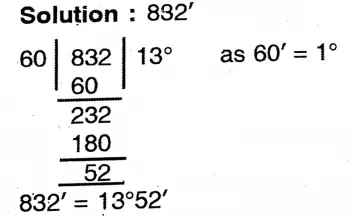
1. 832′

WBBSE Solutions For Class 10 Maths Chapter 20 Trigonometry Concept Of Measurement Of Angle 4

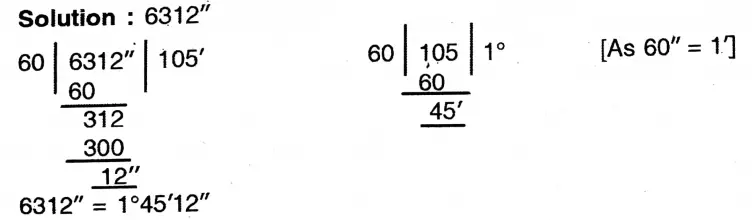
2. 6312″

WBBSE Solutions For Class 10 Maths Chapter 20 Trigonometry Concept Of Measurement Of Angle 5

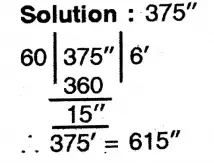
3. 375″

WBBSE Solutions For Class 10 Maths Chapter 20 Trigonometry Concept Of Measurement Of Angle 6

4. 27 (1/12)º

Solution: 271/12  °

= 27° + 1/12  °

= 27° + (1/12 x 60)

= 27°5′

271/12  °= 27°5′

5. 72. 04°

Solution: 72. 04°

= 72° + (0.04)° 

= 72° + (0.04 60)’

= 72° + 2.4′

= 72°+2′ + (0.4 × 60)” 

= 72°2′24′′

72. 04°= 72°2′24′′

Question 2. Let us determine the circular values of the following

1. 60°

Solution: 60°

πc/180 x 60 

= πc/3 [as 180°=πc      [.. 1° – Π/180  °]


2. 135°

Solution: 135°

= π/180 x 135c

=3πc/5

135°=3πc/5


3. – 150°

Solution:  -150°

= -π/180 x 135c

= -5πc/6

-150°= -5πc/6


4. 72°

Solution: 72°

Π/180 x 72° = 2πc/5

72° = 2πc/5


5. 22°30′

Solution: 22°30′

= 22 1/2  °

= 45°/2

=  Π/180 x 45c/2

= πc/8

22°30′ = πc/8


6. – 62°30′

Solution: 62°30′

= -62 1/2  °

= 125°/2

= Π/180(-125/2)c

= -25πc/72

62°30′ = -25πc/72

7. 52°52’30”

Solution: 52°52’30”

= 52°+ 52 1/2

= 52° + 105‘ /2

= 52° + 105/2 x 1/6  °

= 52° + 7/8  °

= (416+7 / 8)°

= 423° / 8

= π/8 x 423c/ 8 =  47c/ 64

52°52’30” 47c/ 64


8. 40°16’24”

Solution: 40°16’24”

= 40° + 16′ + (24/60)°

= 40° + 16′ + 2’/5

= 40° + 82‘/5

= 40° + (82/5 x 1/60)°

= 40° + (41/150)°

= 6041° / 150

= π/180 x 6041c/150

= 6041πc/27000

40°16’24” = 6041πc/27000

“WBBSE Class 10 Maths Exercise 20.1 Trigonometry Concept of Measurement of Angle problem solutions”


Question
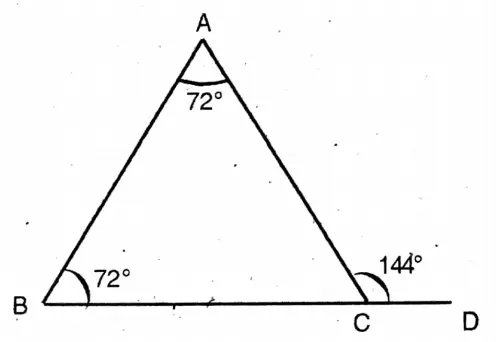
3. In ΔABC, AC = BC, and BC is extended up to point D. If ∠ACD = 144°, then let us determine the circular value of each of the angles of AABC. 

Solution:

Given

In ΔABC, AC = BC, and BC is extended up to point D. If ∠ACD = 144°

A = <BAC = 72°

=π/180 x 72° = 2πc/5

∠B =∠ABC = 72° = c/5

∠C = ∠ACB = 36° = π/180 × 36 radian = π/5 radian


Question
 4.
If the difference between two acute angles of a right-angled triangle is 2π/5 then let us write the sexagesimal values of the two angles.

Solution:

Given

If the difference between two acute angles of a right-angled triangle is 2π/5

2π/5 radian = 2×180°/5

= 72°

Let one acute angle = x° & other acute angle = y°

∴ x + y = 90°

& x – y = 72°

2x = 162°

∴ X = 81°    ∴ y 90°-81° = 9°

∴ Sexagesimal value of one angle = 81° & other angle = 9°


Question 5. The measure of one angle of a triangle is 65° and another angle is
π/12; let us write the sexagesimal value and circular value of two angles. 

Solution:

Given

The measure of one angle of a triangle is 65° and another angle is π/12

One angle of the triangle = 65°

another angle of the triangle = π/12 

= 180/12 

= 15°

∴ Third angle = 180° – (65° + 15°)

= 180° – 80° = 100°

= 100 πc/180 = 5π/9 radian.

∴ Sexagesimal value of the third angle = 100°

& circular value of the third angle = 5π/9 radian.

WBBSE Solutions For Class 10 Maths Chapter 20 Trigonometry Concept Of Measurement Of Angle 7

Question 6. If the sum of two angles is 135° and their difference is Π/12; then let us determine the sexagesimal value and circular value of two angles. 

Solution:

Given

If the sum of two angles is 135° and their difference is Π/12

Let one angle = x°

& the other angle = y° 

According to the problem, x + y = 135°

& x-y= Π/12

= 15°

Adding 2x = 150°

∴ x = 75°

∴ y = 135 – x = 135-75 = 60°

∴ Sexagesimal value of 1st angle = 75° 

& Sexagesimal value of 2nd angle = 60°

Again, circular value of 1st angle: Π/180 × 75 = 5Π/12  radian.

& Circular value of 2nd angle = Π/180 x 60

= Π/3 radian.

Question 7. If the ratio of three angles of a triangle is 2:3: 4, then let us determine the circular value of the greatest angle.

Solution: The ratio of the three angles of a triangle is 2: 3:4

∴ Let the value of 1st angle = 2x°

& value of 2nd angle = 3x°

& the value of 3rd angle = 4x°

∴ 2x + 3x + 4x = 180°

∴ 9x = 180

∴ X = 180/9 = 20°

∴ The value of the greatest angle = 4x= 4 x 20° = 80°

= Π/180 x 80 = 4π/9 radian.

Question 8. The length of a radius of a circle is 28 cm. Let us determine the circular value of the angle subtended by an arc of 5.5 cm in length at the center of this circle.

Solution: Radius of the circle = 28 cm.

∴ Circumference = 2πr = 2 × 22/7 x 28 cm = 176 cm.

We know, the circumference makes an angle of 27 at the center

Here 176 cm arc can make an angle of 2π at the center

∴ 5.5 cm arc can makes an angle = 2Π/176 x 55/10 = Π/16 radian.

Question 9. The ratio of two angles subtended by two arcs of unequal lengths at the center is 5:2 and if the sexagesimal value of the second angle is 30°, then let us determine the sexagesimal value and the circular value of the first angle. 

Solution:

Given

The ratio of two angles subtended by two arcs of unequal lengths at the center is 5:2 and if the sexagesimal value of the second angle is 30

Let the sexagesimal value of the 1st angle = x°

∴ x°: 30° = 5:2

or, x/30 = 5/2

or, x/30 = 5/2

or, 2x = 5 x 30   .. x = 5 x 30 / 2 = 75°

= Π/180 × 75 = 5π/12 radian.

∴ The sexagesimal value of the 1st angle = 75° 

& the circular value of the 1st angle

=5Π / 12 radian.

Question 10. A rotating ray makes an angle -5 1/12 π. Let us write by calculating, in which direction the ray has completely rotated and thereafter what more angle it has produced.

Solution: As the angle is negative, the ray is moving in a clockwise direction.

Now -5 1/12 Π = 

= -61/12 Π

= -61/12 x 180

= -61 x 15

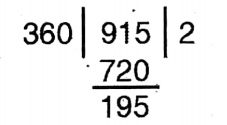
= -915° 

= (-2x 360+ 195)

WBBSE Solutions For Class 10 Maths Chapter 20 Trigonometry Concept Of Measurement Of Angle 8

∴ The ray will move 2 complete revolutions in a clockwise direction & makes an angle of 195°.

“Class 10 WBBSE Maths Exercise 20.1 Trigonometry Concept of Measurement of Angle step-by-step solutions”

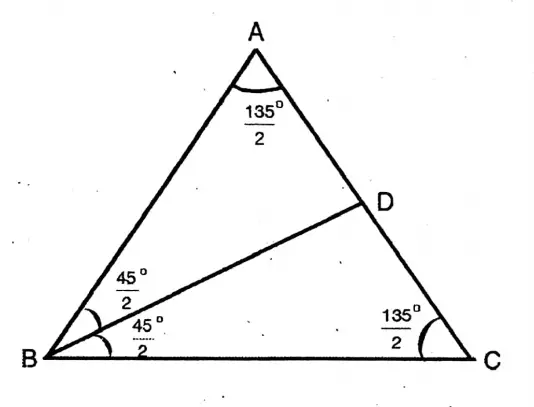
Question 11. I have drawn an isosceles triangle ABC whose included angle of two equal sides ABC = 45°; the bisector of ABC intersects the side AC at point D. Let us determine the circular values of ∠ABD,∠BAD, ∠CBD, and ∠BCD.

Solution: ABC is an isosceles triangle, AB = AB

Whose ∠ABC = 45°

∠BAC = ∠ACB

= 180°-45° / 2 = 135 / 2

&∠CBD = 45° /2

∠BCD = ∠BCA = 135° /2

Now  45° / 2

= 45/2 X π/180

= π/8

∴∠ABC = 45°/2 = π/8 ; ∠BAD =135°/2 = 3 π/8

∠CBD = 45°/2 = π/8;   ∠BCD = 135°/2 = 3 π/8

WBBSE Solutions For Class 10 Maths Chapter 20 Trigonometry Concept Of Measurement Of Angle 9

Question 12. The base BC of the equilateral triangle ABC is extended upto the point E so that CE = BC. By joining A, and E, let us determine the circular values of the angles of AABC. 

Solution:

Given

The base BC of the equilateral triangle ABC is extended upto the point E so that CE = BC. By joining A, and E

ABC is an equilateral triangle

∴ Each internal angle of the triangle = 60° 

Side BC is extended to E

Such that BC= CE

Join AE,

Find the circular value of the angles of AACE

As ∠ACB=60°   ∴ ∠ACE = 120°=120 π/180 

= 2π/3

Again in ΔACE, ∠ACE = 120°   & as AC = CE

∴ ∠CAE = ∠AEC = 180 – 120 / 2 = 30°

∴ ∠CAE 30° = π/180 X 30° = π

& ∠AEC = 30° = π/180 x 30° = π/6


Question 13. If the measures of three angles of a quadrilateral are
π/3, 5π/3, and 90° respectively, then let us determine and write the sexagesimal and circular values of the fourth angle.

Solution:

Given

If the measures of three angles of a quadrilateral are π/3, 5π/3, and 90° respectively,

1st angle = π/3 = 180°/3 = 60°

2nd angle = 5π/6 = 5×180°/6 = 5 X 30 = 150°

3rd angle 90°

∴ 4th angle 360° = (60° + 150° +90°)

360° – 300° = 60° = 60 x π/180 = πc/3

WBBSE Class 10 Maths Solutions Chapter 20 Trigonometry Concept Of Measurement Of Angle Exercise 20.1 Multiple Choice Questions

Question 1. The endpoint of the minute hand of a clock rotates in 1 hour

1. π/4 radian
2. π/2radian
3. π radian
4. 2л radian

Solution: The endpoint of the minute hand of a clock rotates in 1 hour = 360° = 2π radian.

Answer. 4. 2π radian

Question 2.  π/2 radian equals to

1. 60°
2. 450°
3. 90°
4. 30°

Solution: π/6 = 180°/6

= 30°

Answer. 4. 30°

Question 3. The circular value of each internal angle of a regular hexagon is

1. π/3
2. 2π/3
3. π/6
4. π/4

Solution: The circular value of each internal angle of a regular hexagon

= (180°- 360/6) x π/180 = 120 x π/180 = 2π/3

Answer. 2. 2π/3

“WBBSE Class 10 Chapter 20 Trigonometry Concept of Measurement of Angle Exercise 20.1 solution guide”

Question 4. The measurement of 0 in the relation to s = re is determined by

1. Sexagesimal system
2. Circular system
3. Those two methods
4. None of these

Answer. 2. Circular system

Question 5. In cyclic quadrilateral ABCD, if A = 120°, then the circular value of C is

1. Π/3
2. Π/6
3. Π/2
4. 2π/3


Solution: In cyclic quadrilateral ABCD, if A = 120° then the circular value of C

= (180°- 120°) x π

= 60 x π/180

= π/3

Answer. 1. Π/3

WBBSE Class 10 Maths Solutions Chapter 20 Trigonometry Concept Of Measurement Of Angle Exercise 20.1 True Or False

1. The angle, k formed by rotating a ray centering its endpoint in an anticlockwise direction is positive.

Answer: True

2. The angle, formed for completely rotating a ray twice by centering its endpoint is 720°.

Answer: False

Chapter 20 Trigonometry Concept Of Measurement Of Angle Exercise 20.1 Fill In The Blanks


1. π radian is a
Constant angle.

2. In the sexagesimal system 1 radian equals 57°16′22″ (approx)

3. The circular value of the supplementary angle of the measure 3Π/8 is 5π/8

WBBSE Class 10 Maths Solutions Chapter 20 Trigonometry Concept Of Measurement Of Angle Exercise 20.1 Short Answers

Question 1. If the value of an angle in degree is D and in radian is R; then let us determine the value of  R/D

Solution.

Given

If the value of an angle in degree is D and in radian is R

180° = π radian

1° = π/180 radian

∴ R° = л/180 D radian = Dл/180    ..лD/180 = R

or, 180R = лD

or, R/D = π/180


Question
2. Let us write the value of the complementary angle of the measure 60°35′15′′.

Solution. 90° 89°59’60”

-63°35’15” / 26°24’45”

The complementary angle of the measure 63°35’15” is 26°24’45”

“West Bengal Board Class 10 Maths Exercise 20.1 Trigonometry Concept of Measurement of Angle solutions”

Question 3. If the measures of two angles of a triangle are 65°56′55′′ and 64°3’5″, then let us determine the circular value of the third angle.

Solution.

Given

If the measures of two angles of a triangle are 65°56′55′′ and 64°3’5″,

1st angle = 65°56′55′′

2nd angle = 64°03′05′′

∴ Sum of two angles = 130°00’00”

Measure of 3rd angle = 180° – 130° = 50° = 50 x π/180 = 5π/18


Question
4. in a circle, if an arc of 220 cm in length subtends an angle of measure 63° at the center, then let us determine the radius of the circle. 

Solution.

Given

in a circle, if an arc of 220 cm in length subtends an angle of measure 63° at the center

Let the radius of the circle = r cm.

∴ Circumference = 2πr = 2 x 22/7 r cm = 44r/7 cm.

Now  360° angle is formed by an arc of 44r/7 cm.

1° angle formed by arc by 44r / 7×360 cm.

63° angle formed by arc of 44r / 7×360 x x 63 cm = 11r/10 cm.

11r/10 = 220

∴ r = 220×10 / 11 = 200

∴ The radius of the circle is 200 cm = 2m.

OR, 180° = π

1° = π/180

63° = π/180 × 63 = 7π/20 radian 

= 7/20 x 22/7 

= 11/10 radian.

∴ S = rθ

or, 220 = r x 11/10

∴ r= 220 x 10 / 11

= 200cm

= 2m.

“Class 10 WBBSE Maths Exercise 20.1 solutions for Trigonometry Concept of Measurement of Angle”

Question 5. Let us write the circular value of an angle formed by the endpoint of the hour hand of a clock in a 1-hour rotation.

Solution. In 12 hours angle produced by the hour hand of a clock is 2π radian

In 1 hour angle produced by the hour hand of a clock is 2π/12 = π/6 radian.

∴ Circular value of the angle = π/6 radian.

WBBSE Solutions For Class 10 Maths Chapter 18 Similarity Exercise 18.4

Maths WBBSE Class 10 Solutions Chapter 18 Similarity Exercise 18.4

Question 1. In AABC, ZABC = 90° and BD L AC; if BD = 8 cm and AD = 5 cm, then let us calculate the length of CD.

Solution:

Given

In AABC, ZABC = 90° and BD L AC; if BD = 8 cm and AD = 5 cm

In ΔADB, (AB)²= (BD)² + (AD)²

or, (AB)² = (8)² + (5)²= 64+ 25 = 89

∴ AB = √89

From ΔABC, (AB)² + (BC)² = (AC)²

or, AB²+ BC² = (AD + CD)²

AB² + BC² = AD²+2.AD.CD + CD²——–(1)

Again, from ABDC, BC² = CD²+ BD² —— (2) 

“WBBSE Class 10 Maths Similarity Exercise 18.4 solutions”

Read and Learn More WBBSE Solutions For Class 10 Maths

From (1) & (2),

AB²+ BC² – BC² = AD²+ 2AD.CD + CD² – CD²-BD²

or, AB² = AD²+2AD.CD – BD²

or, 89 = 25+ 10.CD-64

or, 10CD = 89 + 64-25 = 153-25 =

∴ CD = 12.8/10

= 12.8cm.

The length of CD = 12.8cm.

WBBSE Solutions For Class 10 Maths Chapter 18 Similarity 1

WBBSE Solutions For Class 10 Maths Chapter 18 Similarity Exercise 18.4


Question 2. AABC is a right-angled triangle whose B is right and BDL AC; if AD = 4 cm and CD = 16 cm, then let us calculate the lengths of BD and AB. 

Solution:

Given

AABC is a right-angled triangle whose B is right and BDL AC; if AD = 4 cm and CD = 16 cm

From ΔABC, AB² = BD²+ AD²————– (1)

& from ΔBDC, BC² = BD²+ CD².

Adding, AB²+ BC² = 2BD²+ AD² + CD²——-(2)

or, AC² = 2BD² + 16 + 256

or, (20)²= 2BD²

= 400-272 128

∴ BD² = 64 .. BD = 8.

From (1), AB² = BD² + AD²

or, AB² 64+16= 80

∴ AB = √80 cm 

= 4√5 cm.

“West Bengal Board Class 10 Maths Chapter 18 Similarity Exercise 18.4 solutions”

The lengths of BD and AB = 4√5 cm.

WBBSE Solutions For Class 10 Maths Chapter 18 Similarity 2

Question 3. AB is the diameter of a circle with center O. P is any point on the circle, the tangent drawn through point P intersects the two tangents drawn through points A and B, at points Q and R. respectively. If the radius of the circle is r, then let us prove that, PQ.PR = r2.

Solution:

Given

AB is the diameter of a circle with center O. P is any point on the circle, the tangent drawn through point P intersects the two tangents drawn through points A and B, at points Q and R. respectively.

Join OP, OQ, OR.

AQ & PQ are two tangents at A & P of the

circle with center O.

∴ ∠AOQ = ∠POQ

Similarly, as PR & BR are two tangents,

∴ ∠PQR = ∠BOR

∴ ∠AOQ + ∠BOR = ∠POQ + <POR

Again, (∠AOQ+ ∠BOR) + (∠POQ + <POR) = 180°

or, 2(∠POQ + ∠POR) = 180°

∴ ∠POQ + ∠POR = 90°

∴ ∠QOR = 90°

∴ ΔQOR is a right-angled triangle.

WBBSE Solutions For Class 10 Maths Chapter 18 Similarity 3

“WBBSE Class 10 Similarity Exercise 18.4 solutions explained”

Question 4. I have drawn a semicircle with a diameter AB. I have drawn a perpendicular on AB from any point ‘C’ on AB which intersects the semicircle at point D. Let us prove that CD is the mean proportional of AC and BC.

Solution:

Given

I have drawn a semicircle with a diameter AB. I have drawn a perpendicular on AB from any point ‘C’ on AB which intersects the semicircle at point D.

With AB diameter a semicircle is drawn. 

CD perpendicular is drawn on AB

which cuts the circumference at D.

To prove, CD is the mean proportional of AC & BC.

Join A, D, B, D

Proof, ∠ADB = 90°

Again, the CD is perpendicular to AB from D.

∴ ΔADC & ADBC are equiangular.

AC/DC = AC/DC = DC/CB

AC/DC = DC/CB

or, CD² = AC. CB

.. CD is the mean proportional of AC & BC.

WBBSE Solutions For Class 10 Maths Chapter 18 Similarity 4

“WBBSE Class 10 Maths Exercise 18.4 Similarity problem solutions”

Question 5. In the right-angled triangle ABC, A is a right angle. AD is perpendicular on the hypotenuse BC; let us prove that  ΔABC/ΔACD = BC²/AC².

Solution:

Given

In the right-angled triangle ABC, A is a right angle. AD is perpendicular on the hypotenuse BC;

In right-angled AABC, A = 90°, 

& AD is perpendicular on hypotenuse BC.

To prove ΔACD/ΔABC = BC∠/AC∠

Proof: ACD & ABC are equiangular.

AC/BC = AD/AB 

or, AC/BC = CD/AC

∴ AC² = BC. CD

Now, AABC/AACD = ½ BC X AD / ½ CD X AD =BC/DC

= BC²/BC.CD = BC²/AC²

WBBSE Solutions For Class 10 Maths Chapter 18 Similarity 5

Class 10 Maths Class 10 Social Science
Class 10 English Class 10 Maths
Class 10 Geography Class 10 Geography MCQs
Class 10 History Class 10 History MCQs
Class 10 Life Science Class 10 Science VSAQS
Class 10 Physical Science Class 10 Science SAQs

Question 6. AB is a diameter of a circle with center O. A line drawn through point A intersects the circle at point C and the tangent through B at point D. Let us prove that:

(i) BD2 = AD. DC;
(ii) The area of the rectangle formed by AC and AD for any straight line is always equal.

Solution:

Given

AB is a diameter of a circle with center O. A line drawn through point A intersects the circle at point C and the tangent through B at point D.

(1) Join B, C.

∴ ∠ACB is a semi-circle angle.

∴ ∠ACB = 90°

∴ ΔACB is a right-angle triangle.

Again, BD is a tangent at B on the diameter AB. 

∴ AB ⊥ BD

∴ ΔABC is a right-angle triangle. 

∴ ΔABD & ΔACD are similar.

BD/AD = CD/BD

∴ BD² = AD.CD Proved.

Solution: (2) Area of the rectangle formed by AD & AC = AD X AC

= Area of the square = AB² as AB is the mean proportional of AC & AD 

∴ AB² = AC.AD.

WBBSE Solutions For Class 10 Maths Chapter 18 Similarity 6

“Class 10 WBBSE Maths Exercise 18.4 Similarity step-by-step solutions”

Ganit Prakash Class 10 Solutions Pdf In English Chapter 18 Similarity Exercise 18.4 Multiple Choice Question

Question 1. In AABC and ADEF, if AB/DE = BC/FD = AC/EF then

1. ∠B = ∠E
2. ∠A = ∠D
3. <B = <D
4. ∠A = ∠F

Solution: B = <D

Answer. 3. <B = <D

Question 2. In ΔDEF and ΔPQR, if D = Q and R = E, then let us write which of the following is not right:

1. EF/PR = DF/PQ
2. QR/PQ = EF/DF
3. DE/QR = DF/PQ
4. EF/RP = DE/QR

Answer. 2. QR/PQ = EF/DF

Question 3. In AABC and ADEF, if ZA = ZE = 40°, AB : ED = AC: EF and F = 65°, then the value of B is

1. 35°
2. 65°
3. 75°
4. 85°

Solution:

Given

In AABC and ADEF, if ZA = ZE = 40°, AB : ED = AC: EF and F = 65°,

Here ∠A = ∠E = 40

AB:ED = AC:EF

& F = 65°    

∴ ∠∠C = 65 & ∠B = 180° (40° + 65°) = 75°

Answer. 3. 75°

WBBSE Solutions For Class 10 Maths Chapter 18 Similarity 7

Question 4. In AABC and APQR, if AB/QR = BC/PR = CA/PQ then

1. ∠A = ∠Q
2. ∠A = ∠P
3. ∠A = ∠R
4. ∠B = ∠Q

Solution :

Here as AB/QR = BC/RP = CA/PQ

∴ ∠A = ∠Q

Answer. 1. A=Q

WBBSE Solutions For Class 10 Maths Chapter 18 Similarity 8

Question 5. In AABC, AB = 9 cm, BC = 6 cm, and CA = 7.5 cm. In ADEF the corresponding side of BC is EF; EF = 8 cm and if ΔDEF~ ΔABC, then the perimeter of ADEF will be

1. 22.5 cm.
2. 25 cm.
3. 27 cm.
4. 30 cm.

Solution :

Given

In AABC, AB = 9 cm, BC = 6 cm, and CA = 7.5 cm. In ADEF the corresponding side of BC is EF; EF = 8 cm and if ΔDEF~ ΔABC

Perimeter of ABC = (9+6 +7.5) cm 

= 22.5 cm

Let the Perimeter of DEF = x cm. 

As ABC & DEF are similar

The perimeter of ΔABC/BC = Perimeter of ΔDEF/EF

22.5 cm/6 cm = x cm/8 cm

or, 22.5 /6 = X/8

or, 6x 8 x 22.5

x = 8×22.5

= 4 × 7.5 

= 30 cm.

Answer. 4. 30 cm.

WBBSE Solutions For Class 10 Maths Chapter 18 Similarity 10


WBBSE Solutions Guide Class 10 Chapter 18 Similarity Exercise 18.4 True Or False

1. If the corresponding angles of two quadrilaterals are equal, then they are similar.

Answer: False

2. In the adjoining figure, if ∠ADE = ∠ACB then ΔADE-ΔACB.

Answer: True

WBBSE Solutions For Class 10 Maths Chapter 18 Similarity 11

3. In ΔPQR, D is a point on the side QR so that PDI QR; so ΔPQD = ΔRPD.

Answer: False

WBBSE Solutions For Class 10 Maths Chapter 18 Similarity 12

Class 10 WBBSE Math Solution In English Chapter 18 Similarity Exercise 18.4 Fill In The Blanks

1. Two triangles are similar if their Similar sides are proportional.

2. The perimeters of ABC and DEF are 30 cm and 18 cm respectively. ABC ~ DEF; BC and EF are corresponding sides. If BC= 9 cm, then EF = 5.4 cm.

Solution: Perimeter of ADEF/Perimeter of ΔABC = Length of EF/Length of BC

or, 30 cm/18cm = 9 cm/Length of EF

.. Length of EF = 18×9 / 30

= 5.4 cm.

“WBBSE Class 10 Chapter 18 Similarity Exercise 18.4 solution guide”

Class 10 WBBSE Math Solution In English Chapter 18 Similarity Exercise 18.4 Short Answers

Question 1. In the adjoining figure, if ∠ACB = ∠BAD, ∠AC = 8 cm, ∠AB = 16 cm, and A∠D = 3 cm, then let us write the length of BD.

Solution.

Given

In the adjoining figure, if ∠ACB = ∠BAD, ∠AC = 8 cm, ∠AB = 16 cm, and A∠D = 3 cm

As ΔABD ~ ΔADC

or, AB/AC = BD/AD

.. BD = 16×3 / 8

6 cm.

WBBSE Solutions For Class 10 Maths Chapter 18 Similarity 13

Question 2. In the adjoining figure, ∠ABC = 90° and BDL AC; if AB = 5.7 cm, BD = 3.8 cm, and CD = 5.4 cm, then let us determine the length of BC.

Solution.

Given

In the adjoining figure, ∠ABC = 90° and BDL AC; if AB = 5.7 cm, BD = 3.8 cm, and CD = 5.4 cm,

Here ΔABD ~ ΔBDC

.. BD² = AD x CD

or, (3.8)² = AD x 5.4

∴ AD = 3.8×3.8 / 54 x 10

= 19×19 / 27 x 5 cm.

BC/AB = CD/BD

or, BC/5.7 = 5.4/3.8

BC = 5.4 x 5.7 / 3.8

= 54×57 / 38 x 10

= 8.1 cm.

WBBSE Solutions For Class 10 Maths Chapter 18 Similarity 14

Question 3. In the adjoining figure, ABC = 90° and BD AC; if BD = 8 cm and AD = 4 cm, then let us write the length of the CD.

Solution:

Given

In the adjoining figure, ABC = 90° and BD AC; if BD = 8 cm and AD = 4 cm

ΔABD ~ ΔBDC

∴ BD² = AD X AC

or, (8)² = 4 x AC

∴ AC = 8×8 / 4

= 16 cm.

WBBSE Solutions For Class 10 Maths Chapter 18 Similarity 15

Question 4. In trapezium ABCD, BC || AD and AD = 4 cm. The two diagonals AC and BD intersect at point O in such a way that, AO/OC = DO/OB = 1/2 Let us calculate the length of BC.

Solution.

Given 

In trapezium ABCD, BC || AD and AD = 4 cm. The two diagonals AC and BD intersect at point O in such a way that, AO/OC = DO/OB = 1/2

From ΔAOC & ΔAOD, we get

BO/OD = OC/AD = 1/2

Remaining BC/AD = 1/2 

or, AD/BC = 1/2 

or, 4/BC = 1/2

..  BC = 4 X 2

= 8

length of BC = 8

WBBSE Solutions For Class 10 Maths Chapter 18 Similarity 16

“West Bengal Board Class 10 Maths Exercise 18.4 Similarity solutions”

Question 5. ΔABC = ΔDEF and in AABC and ADEF, the corresponding sides of AB, BC, and CA are DE, EF, and DF respectively; if A = 47° and E 83°, then let us write the value of Z.

Solution.

Given

ΔABC = ΔDEF and in AABC and ADEF, the corresponding sides of AB, BC, and CA are DE, EF, and DF respectively; if ∠A = 47° and ∠E 83°

ΔABC ~ ΔDEF

In ΔABC, 47° ∠B + LC = 180°

& ∠B & ∠E are corresponding angles.

∴ ∠B = 83°

∴ ∠F = ∠C = 180° – (83° + 47°)

= 180°-130°

= 50°

∴ ∠C = 50°

WBBSE Solutions For Class 10 Maths Chapter 18 Similarity 17

WBBSE Solutions For Class 10 Maths Chapter 18 Similarity Exercise 18.3

West Bengal Board Class 10 Math Book Solution In English Chapter 18 Similarity Exercise 18.3

Question 1. Which pairs of the following triangles are similar let us write by calculating it.

Solution: ΔABC & ΔPQR are equiangular.

AB/QR =  BC/PQ = AC/PR = 1/2

Read and Learn More WBBSE Solutions For Class 10 Maths

WBBSE Solutions For Class 10 Maths Chapter 18 Similarity 1

Question 2. I look at the following pair of triangles and I write by calculating the value of ∠A.

Solution: ∠A 180° (75° + 65°)

= 180°-140°

= 40°

WBBSE Solutions For Class 10 Maths Chapter 18 Similarity 2

“WBBSE Class 10 Maths Similarity Exercise 18.3 solutions”

Question 3. In our field, a shadow of 4 cm length of a stick with a length of 6 cm has fallen on the ground. At the same time, if the length of the shadow of a high tower is 28 m, then let us write by calculating the height of the tower.

Hints:

Given

In our field, a shadow of 4 cm length of a stick with a length of 6 cm has fallen on the ground. At the same time, if the length of the shadow of a high tower is 28 m,

Let PQ be the tower and AB be the stick.

∴ BC= 4 cm, QC = 28 cm.

ΔPQC and ΔABC are similar.

PQ/AB = QC/BC

Solution: Let PQ be a tower & AB is a stick.

AB = 6 cm BC= 4 cm & QC = 28 m.

ΔPQC & ΔABC are equiangular.

∴ They are similar.

PQ/AB = QC/BC

PQ/6 = 28/4

4 PQ = 28 x 6

∴ PQ = 28×6 / 4 

= 42

∴ Height of the lower = 42 m.

WBBSE Solutions For Class 10 Maths Chapter 18 Similarity 3

WBBSE Solutions For Class 10 Maths Chapter 18 Similarity 4

“West Bengal Board Class 10 Maths Chapter 18 Similarity Exercise 18.3 solutions”

Question 4. Let us prove that the line segment joining the midpoints of any two sides of a triangle is parallel to the third side and is equal to half of it.

Solution: Let D & E be the midpoints of sides AB & AC of ΔABC. 

Join D, E.

To prove DE || BC & DE = 1/2 BC. 

Proof: As D is the midpoint of AB,

∴ AD = DB or, AD/DB = 1 ——(1)

Again, as E is the midpoint of AC,

∴ AE = EC or, AE/EC = 1 ——–(2)

From (i) & (ii),

AD/DB = AE/EC

∴ DE || BC.

Again, in triangles ADE & ABC, we get ∠DAE = ∠BAC & ∠ADE = ∠ABC. 

Class 10 Maths Class 10 Social Science
Class 10 English Class 10 Maths
Class 10 Geography Class 10 Geography MCQs
Class 10 History Class 10 History MCQs
Class 10 Life Science Class 10 Science VSAQS
Class 10 Physical Science Class 10 Science SAQs

∴ ΔADE & ΔABC are equiangular.

AD/AB = AE/EC = DE/BC

But AD/AB = 1/2  [as D is the midpoint of AB]

DE/BC = 1/2

or, DE = 1/2 BC Proved.

WBBSE Solutions For Class 10 Maths Chapter 18 Similarity 5

West Bengal Board Class 10 Math Book Solution In English Chapter 18 Similarity Exercise 18.3

Question 5. Two parallel lines intersect three concurrent straight lines at points A, B, C, and X, Y, and Z respectively. Let us prove that AB: BC = XY: YZ.

Solution:

Given

Two parallel lines intersect three concurrent straight lines at points A, B, C, and X, Y, and Z respectively.

Let OX, OY & OZ straight lines pass through O; two parallel straight lines ABC & XYZ cut them at A, B, C & X, Y, Z.

To prove, AB : BC = XY: YZ

Proof: In ΔOXY, AB || XY.

∴ ∠OXY = ∠OAB & ∠OYX = ZOBA

Now in ΔOXY & ΔOAB,

∠OXY = ∠OAB

& ∠OYX = ∠OBA

ΔOXY & ΔOAB are equiangular.

OA/OX = OB/OY = AB/XY

Similarly from, ΔOYZ & ΔOBC,

OB/OY = OC/OZ = BC/YZ

AB/XY = OB/OY = BC/YZ

AB/XY = BC/XY

or, AB/YZ = BC/YZ

WBBSE Solutions For Class 10 Maths Chapter 18 Similarity 6

Question 6. I have drawn a trapezium PQRS whose PQ || SR; if two diagonals PR and QS intersect each other at the point O, then let me prove that OP: OR = OQ: OS; if SR = 2PQ, then let me prove that the point O will be a tri-sector of each of the two diagonals. 

Solution:

Given

I have drawn a trapezium PQRS whose PQ || SR; if two diagonals PR and QS intersect each other at the point O, then let me prove that OP: OR = OQ: OS; if SR = 2PQ,

In trapezium PQRS, PQ || SR

& QS is the transversal

∴ ∠PQS = ∠QSR (alternate)

i.e., ∠PQO = ∠OSR

Again, PQ || SR & PR is a transversal.

∴ ∠QPR = ∠PRS (alternate)

i.e., ∠QPO = ∠ORS

& ∠POQ = ∠SOR (vertically opposite) 

Now in As ∠POQ & ∠SOR

∠PQO = ∠OSR; ∠QPO = ∠ORS & ∠POQ = ∠SOR

∴ ΔPOQ & ΔSOR are equiangular.

OP/OR = OQ/OS = PQ/SR

OP/OR = OQ/OS Proved.

Now, if SP = 2PQ

∴ OP/OR = PQ= 2PQ 1/2 

or, OQ = 2. OP. 

OR: OP = 2:1

OQ/OS = PQ = 2PQ = 1/2 or, OQ = 20S 

∴ OQ: OS = 2:1

WBBSE Solutions For Class 10 Maths Chapter 18 Similarity 7

Question 7. PQRS is a parallelogram. If a line passing through the point S intersects PQ and extended RQ at the points X and Y respectively, then let us prove that PS: PX = QY: QX = RY: RS.

Solution:

Given

PQRS is a parallelogram. If a line passing through the point S intersects PQ and extended RQ at the points X and Y respectively

In parallelogram PQ || SR & SX is a transversal.

∴ ∠XSR = 2PXS (alternate angles)

Again, SP || YR & SY is transversal P.

∴ ∠PSX = XYO (alternate angles) PS || YR & PQ is transversal.

∠SPX = YOX (alternate)

& ∠PXS = ∠QXY (vertically opposite)

Now, in triangles PXS & ∠OXY, ∠PSX = ∠XYQ; ∠SPQ = ∠YQX

& ∠PXS = ∠YXQ

∴ The triangles are equiangular.

PX/XQ = SX/XY = PS/QY

PX/XQ = PS/QY

or, PS/PX = QY/QX——–(1)

Again, PQ || SR & SY is transversal. 

∴ ∠YSR = ∠YXQ (Similar angle) 

Now, PQ || SR & YR is a transversal

∴ ∠YRS = ∠YQS (Similar)

Now, in ΔSYR & ΔXYQ 

∠YSR = ∠ΥΧQ

∠YRS = ∠YQS & ∠SYR = ∠XYQ 

∴ ΔSYR & ΔXYQ are equiangular.

SY/XY = YR/YQ = SR/QX

YR/YQ = SR/QS——-(2)

From (i) &. (ii),

PS/PX = QY/QS = RY/PS

∴ PS: PXQY: QX = RY: RS Proved.

WBBSE Solutions For Class 10 Maths Chapter 18 Similarity 8

“WBBSE Class 10 Similarity Exercise 18.3 solutions explained”

Question 8. The two acute-angled triangles AABC and APQR are similar. Their circumstances are X and Y respectively; if BC and QR are corresponding sides, then let us prove that BX: QY BC: QR.

Solution:

Given

The two acute-angled triangles AABC and APQR are similar. Their circumstances are X and Y respectively; if BC and QR are corresponding sides

As ABC & PQR are equiangular.

∴ ABC = PQR & ACB = PRQ

Now, in ΔABC

ABX = XBC [as BX is the bisector of ABC]

ACX = XCB [as CX is the bisector of ACB]

Now in ΔPQR,

PQY=YRQ [as QY is the bisector of PQR]

& PRY = YRQ [as YR is the bisector of PRQ]

∴ XBC= YQR & XCB = YRQ

∴ BXC & QYR are equiangular.

BX/QY = XC/YR= BC/QR

BX/QY = BC/QR

∴ BX: QY = BC: QR Proved.

WBBSE Solutions For Class 10 Maths Chapter 18 Similarity 9

Question 9. The two chords PQ and RS of a circle intersect each other at point X within the circle. By joining P, S, and R, Q, let us prove that APXS and ARSQ are similar. From this, let us prove that PX: XQ = RX: XS. or, If two chords of a circle intersect internally, then the rectangle of two parts of one is equal to the rectangle of two parts of the other.

Solution:

Given

The two chords PQ and RS of a circle intersect each other at point X within the circle. By joining P, S, and R, Q,

Join S, P & Q, R.

Proof: ∠SPQ &∠SRQ are the angles at the circumference on the same segment SQ.

∴ ∠SPQ ∠SRQ

or, ∠SPX = ∠XRQ

Again, ∠PSR & ∠PQR are the angles at the circumference on the same segment PR.

∴ ∠PSR = ∠PQR

Or, ∠PSX = ∠XQR

∴ ΔPSX & ΔROX are equiangular. Proved.

PX/RX = XS/XQ

or, PX. XQ = RX. XS Proved.

WBBSE Solutions For Class 10 Maths Chapter 18 Similarity 10

Question 10. The two points P and Q are in a straight line. At the points, P and Q, PR, and QS are perpendicular on the straight line. PS and QR intersect each other at the point O.OT is perpendicular to PQ. Let us prove that 1/OT = 1/PR = 1/QS

Solution:

Given

The two points P and Q are in a straight line. At the points, P and Q, PR, and QS are perpendicular on the straight line. PS and QR intersect each other at the point O.OT is perpendicular to PQ.

In ΔPQR, OR || RP [as OT ⊥ PQ & RP ⊥ PQ]

OT/PR = TQ/PQ

∴ PQ = TQ.PR/OT——–(1)

Again, in ΔPQS, OT || QS.

OT/QS = PT/PQ

∴ PQ = PT.QS/OT ——(2)

From (1) & (2), TQ. PR= PT. QS 

or, TQ. PR = (PQ – TQ). QS 

or, TQ. PR = PQ. QS – TQ. QS

or, TQ(PR+ QS) = PQ. QS

or, TQ(PR+QS) = TQPR.QS /OT

or, PR+QS/PR.QS = 1/OT

or, PR/PRQS + QS/PRQS = 1/OT

 or, 1/PR + 1/QS = 1/OT Proved.

WBBSE Solutions For Class 10 Maths Chapter 18 Similarity 11


Question 11. ABC is inscribed in a circle; AD is the diameter of the circle and AE is perpendicular to side BC, which intersects side BC at point E. Let us prove that AAEB and AACD are similar. From this, let us prove that AB.AC = AE.AD.

Solution:

Given

ABC is inscribed in a circle; AD is the diameter of the circle and AE is perpendicular to side BC, which intersects side BC at point E.

From ΔABE & ΔACD, we get ∠AEB = ∠ACD = 90° as AD is a diameter. 

∴ ΔBF = ΔDC (Both are on the same segment AC)

∴ <BAE=<DAC

∴ ΔABE & ΔACD are equiangular.

AB/AD = AE/AC

or, AB :AC = AD :AE Proved.

WBBSE Solutions For Class 10 Maths Chapter 18 Similarity 12

“WBBSE Class 10 Maths Exercise 18.3 Similarity problem solutions”

Application 1. In ΔABC, ∠ABC = 90° and BDL AC; if AB = 6 cm and BD = 3 cm, and CD = 5.4 cm, then let us write by calculating the length of BC. 

Solution:

Given  In ΔABC, ∠ABC = 90° and BDL AC; if AB = 6 cm and BD = 3 cm, and CD = 5.4 cm

Find BC.

∴ B 90°    

∴ CBD + DBA = 90°——–(1)

Again, in DBA, D = 90°   ..DBA + BAD = 90°

From (1) & (2), BAD = CBD

Again, DCB + CBD = DBA + BAD (= 90°)

or, DCB= DBA

∴ In ABD & CBD,

BAD = CBD; DCB = DBA; BDA = 90° = CDB

As ABD & CBD are equiangular.

AD/BD = BD/CD = AB/BC

AD = BDxBD/DC= 3 X 3 X 10 / 54 

= 5/3 

∴ BC= AB X BD / AD 

= 6 X 3/ 5/3 

= 54/ 5/3 

= 10 4/5

∴ BC = 10 4/5 cm.

length of BC = 10 4/5 cm.

WBBSE Solutions For Class 10 Maths Chapter 18 Similarity 13

WBBSE Solutions For Class 10 Maths Chapter 18 Similarity Exercise 18.2

West Bengal Board Class 10 Math Book Solution In English Chapter 18 Similarity Exercise 18.2

Question 1. A line parallel to the side BC of AABC intersects the sides AB and AC at points P and Q respectively.

1. If PB AQ, AP = 9 units, QC = 4 units, then let us calculate the length of PB. 

Solution:

Given

PB = AQ, AP = 9 unit, QC = 4 unit, PB.

As PQ || BC

AP/BP = AQ/QC

9/ AQ = AQ/4

∴AQ² = 36

∴ AQ= 6 unit

∴ Length of PB = 6 units.

Read and Learn More WBBSE Solutions For Class 10 Maths

2. The length of PB is twice of AB and the length of QC is 3 units more than the length of AQ, then let us write by calculating the length of AC.

Solution:

Given

The length of PB is twice of AB and the length of QC is 3 units more than the length of AQ,

PB = 2AQ,

QC = AQ + 3

AP/2AP = AQ/AQ+3

or, 1/2 = AQ/AQ+3

2AQ = AQ +3

∴ AQ = 3 unit

∴ QC 3+3 = 6 unit

∴ Length AC AQ + QC = 3 +6 = 9 unit.

WBBSE Solutions For Class 10 Maths Chapter 18 Similarity Exercise 18.2

3. If AP QC, the length of AB is 12 units and the length of AQ is 2 units, then let us calculate the length of CQ.

Solution:

Given, AP QC, AB = 12 units, AQ= 2 units.

Now, AP/ PB = AQ /QC

QC/PB = 2/QC

or, QC/AB – AP = 2/QC

or, QC² = 24 – 2QC

or, QC²+2QC – 24 = 0

or, QC²+6QC-4QC-24 = 0 

or, QC(QC+6)-4(QC +6) = 0 

or, (QC+6)(QC-4) = 4

∴ QC-6, QC = +4.

As length cannot be negative.

∴ CQ = 4 units.

WBBSE Solutions For Class 10 Maths Chapter 18 Similarity 1

“WBBSE Class 10 Maths Similarity Exercise 18.2 solutions”

Question 2. I took two points X and Y on the sides PQ and PR respectively of APQR.

1.  If PX = 2 units, XQ = 3.5 units, YR = 7 units, and PY = 4.25 units, then let us write with reason whether XY and QR will be parallel to each other or not.

Solution:

Given

If PX = 2 units, XQ = 3.5 units, YR = 7 units, and PY = 4.25 units,

Join X, Y.

Now, XY || QR if PX/XQ = PY/YR

Here given, PX = 2 unit, XQ = 3.5 unit

YR = 7 unit, & PY = 4.25 unit.

 PX/XQ = 4.25 x 100 / 7 x 100

= 425/700

= 17/28

∴ PX/XQ =not PY/YR

∴ XY is not parallel to QR.

Class 10 Maths Class 10 Social Science
Class 10 English Class 10 Maths
Class 10 Geography Class 10 Geography MCQs
Class 10 History Class 10 History MCQs
Class 10 Life Science Class 10 Science VSAQS
Class 10 Physical Science Class 10 Science SAQs

“West Bengal Board Class 10 Maths Chapter 18 Similarity Exercise 18.2 solutions”


2. If PQ = 8 units, YR = 12 units, PY = 4 units and the length of PY is less by 2 units than the length of XQ, then let us write with reason whether XY and QR will be parallel or not.

Solution:

Given, PQ = 8 unit; YR = 12 unit, PY = 4 unit & PY = XQ – 2.

∴ XQ = PY + 2 = (4+2) unit = 6 unit.

Now, PX = PQ-XQ 

= 8-6 

= 2 unit

∴ PX/XQ = 2/6

= 1/3 

& PY/YR = 4/12

= 1/3

∴ PX/XQ = PY/YR 

∴ XY || QR.

WBBSE Solutions For Class 10 Maths Chapter 18 Similarity 2

3. Let us prove that the line drawn through the mid-point of one side of a triangle parallel to another side bisects the third side. [Let us prove it with the help of Thales theorem.] 

Solution:

Let in ΔABC, a straight line is drawn from P, the midpoint of AB, parallel to BC cuts AC at Q.

To prove Q is the midpoint of AC, i.e., AQ = QC. 

Proof: In ΔABC, PQ is parallel to BC.

AP/PQ = AQ/QC but APPQ (as P is the midpoint of AB)

PQ/PQ = AQ/QC = 1/1

∴ AQ = QC

i.e., Q is the midpoint of AC.

WBBSE Solutions For Class 10 Maths Chapter 18 Similarity 3

4. P is a point in the median AD of AABC. The extended BP and CP intersect AC and AB at points Q and R respectively. Let us prove that RQ || BC.

Solution:

Given

P is a point in the median AD of AABC. The extended BP and CP intersect AC and AB at points Q and R respectively.

In ΔABC, AD is a median.

∴ ΔABD = ΔACD, again in ABPC, PD is the median.

∴ ΔBPD = ΔCPD

ΔABD – ΔBPD = ΔACD- ΔCPD

i.e., ΔABP = ΔACP

Now as P is a point on AD.

∴ ΔARP = ΔAQP

∴ ΔABP – ΔQRP = ΔACP – AAQP

ΔARP = ΔQPC

Now,ΔARP/ΔRPB = AR/RB

& ΔAQP/ΔQPC = AQ/QC

∴ AR/RB = AQ/QC i.e., RQ cut AB & AC of ΔABC proportionately.

∴ RQ || BC. Proved.

WBBSE Solutions For Class 10 Maths Chapter 18 Similarity 4

5. The two medians BE and CF of AABC intersect each other at point E and if the line segment FE intersects the line segment AG at point O, then let us prove that AO 3 OG.

Solution:

Given

The two medians BE and CF of AABC intersect each other at point E and if the line segment FE intersects the line segment AG at point O

Produced AG which cuts BC at H.

Proof: InΔABC, F is the midpoint of AB

& E is the midpoint of AC.

∴ ΔEF || BC & in ΔABH, FO || BH

G is the centroid of AABC.

∴ AG: GH = 2:1

or, AG/GH  2/1 or AO+OG / GH = 2/1

Again, GH = 1/3 or, AO+OG/ 1/3 AH = 2

or, AO + OG = ⅔ AH

Or, AO + OG = 2/3 X 2 OA[ AO = OH]

=4/3 OA

OG = 4/3 OA-OA 

= 1/3 OA

∴ OA = 3OG Proved.

WBBSE Solutions For Class 10 Maths Chapter 18 Similarity 5

6. Let us prove that the line segment joining the mid-point of two transverse sides of a trapezium is parallel to its parallel sides.

Solution: Let in the trapezium ABCD, P & Q are the midpoints of the two slant sides AD & BC.

To prove AB || PQ or PQ || DC.

Side DA & CB is produced & they meet at R.

Proof: In trapezium ABCD, AB || CD

∴ From ΔRDC, RA/ ½ AD

or, RA/AP = RB/BQ

∴ In ΔRPQ, AB || PQ

From (1) RA/AD +1 = RB/BC + 1

RA+AD / AD = RB+BC / BC

or, RD/AD = RC/BC

or, RD/½ AD = RC/½ BC

∴ RD/PD =DRC/QC

∴ From ARDC, PQ II DC. Proved.

WBBSE Solutions For Class 10 Maths Chapter 18 Similarity 6

7. D is any point on the side BC of AABC. P and Q are centroids of AABD and AADC respectively. Let us prove that PQ || BC.

Solution:

Given

D is any point on the side BC of AABC. P and Q are centroids of AABD and AADC respectively.

Join DP & DQ+ produced, they cut AB & AC at M & N points respectively. Proof The line DM passing through P, the centroid of ΔABD.

∴ DM is a median.

M is the midpoint of AB.

Similarly, from AADC N is the midpoint of AC

of ΔADC.

Now in ΔABC, M & N are the midpoints of the sides AB & AC of ΔABC.

∴ MN || BC

Now, from ΔDMN, DP/PM = 2/1 = DQ/QN

i,e., DP/PM = DQ/QN

∴ PQ || MN

Now, MN || BC & PQ ||MN

∴ BC || PQ,

i.e., PQ || BC.

WBBSE Solutions For Class 10 Maths Chapter 18 Similarity 7

8. I have drawn two triangles APQR and ASQR on the same base QR and on the same side of QR and their areas are equal. If F and G are two centroids of two triangles, then let us prove that, FG || QR.

Solution:

Join P, S. Produce PE & SG. They meet at O on QR.

Proof: As ΔPQR & ΔSQR are on the same side of base QR, & their areas are equal. 

∴ ΔPQR & ΔSQR are in between two parallel lines PS & QR.

∴ PS || QR

Now, OP is a median of APQR & OS is a median of ASQR.

OF: FP = 1:2

or, OG/GS = 1/2

∴ OF/FP = OG/GS

∴ FG cuts OP & OS of ΔPOS, proportionately

∴ FG|| PS.

Now PS || QR & FG || PS

∴ FG || QR.

WBBSE Solutions For Class 10 Maths Chapter 18 Similarity 8

9. Let us prove that the two adjacent angles of any parallel side of a trapezium are equal.

Solution: Let ABCD is an isosceles trapezium whose

AD = BC & AB || DC.

To prove ∠DAB = <CBA.

Produced DA & CB of the trapezium ABCD: They meet at P.

Proof: Now, in ΔPDC, the straight line || to DC cuts PD & PC at A & B

As AB cuts DP & CP internally,

∴ PA/AD = PB/BC or, PA/AD = PB/AD

∴ PA = PB

Now, in ΔPAB, PA = PB,    ∴ PA = PB

Now, ∠DAB = 180° – PAB &

∠CBA = 180° – ∠PBA

DAB = CBA Proved.

WBBSE Solutions For Class 10 Maths Chapter 18 Similarity 9

10. AABC and ADBC are situated on the same base BC and on the same side of BC. E is any point on the side of BC. A line through point E and parallel to AB and BD intersect the sides AC and DC at points F and G respectively. Let us prove that, AD || FG.

Solution:

Given

AABC and ADBC are situated on the same base BC and on the same side of BC. E is any point on the side of BC. A line through point E and parallel to AB and BD intersect the sides AC and DC at points F and G respectively.

Join A, D

Proof: From ΔABC, AB|| EF

∴ FC/FA = EC/FA———-(1)

&from (1) &(2), FC/FA= CG/DG

Again, from ΔADC, FC/FA = CG/DG

∴ FG||AD  Proved

WBBSE Solutions For Class 10 Maths Chapter 18 Similarity 10

Class 10 WBBSE Math Solution In English Chapter 18 Similarity Exercise 18.2 Multiple Choice Question

Question 1. A line parallel to the side BC of AABC intersects the sides AB and AC at points X and Y respectively. If AX = 2.4cm, AY 3.2cm and YC = 4.8cm, then the length of AB is

1. 3.6 cm.
2. 6 cm.
3. 6.4 cm.
4. 7.2 cm.

Solution:

Given

A line parallel to the side BC of AABC intersects the sides AB and AC at points X and Y respectively. If AX = 2.4cm, AY 3.2cm and YC = 4.8cm,

AB = 6 cm as AX/AB = AY/AC

Or, 2.4/AB = 32 / 3.2 + 4.8

∴ AB = 2.4 X 8/ 3.2

= 6

Answer. 2. 6 cm.

WBBSE Solutions For Class 10 Maths Chapter 18 Similarity 11

Question 2. The points D and E are situated on the sides AB and AC of AABC in such a way that DE || BC and AD: DB = 3: 1; if EA = 3.3 cm, then the length of AC is

1. 1.1 cm.
2. 4 cm.
3. 4.4 cm.
4. 5.5 cm.

Solution:

Given

The points D and E are situated on the sides AB and AC of AABC in such a way that DE || BC and AD: DB = 3: 1; if EA = 3.3 cm

AD/DB = AE/EC or, 3/1 = 3.3/EC

∴ EC = 1.1

∴ AC = AE +EC

= 3.3 + 1.1

=4.4

.. AC = 4.4 CM.

The length of AC is 4.4 CM.

Answer. 3. 4.4 CM.

WBBSE Solutions For Class 10 Maths Chapter 18 Similarity 12

Question 3. In the adjoining figure if DE || BC, then the value of x is

1. 4
2. 1
3. 3
4. 2

Solution:

Given

In the adjoining figure if DE || BC

 AD/DB = AE/EC

x+3 / 3x+19 = x / 3x +4

or, 3×2 + 19x = 3×2 + 13x + 12

or, 6x = 12

∴ x=2

Answer: 4. 2

WBBSE Solutions For Class 10 Maths Chapter 18 Similarity 13

Question 4. In the trapezium, ABCD, AB || DC, and the two points are situated on the sides AD and BC in such a way that PQ || DC; if PD = 18 cm, BQ = 35 cm, QC = 15 cm, then the length of AD is

1. 60 cm.
2. 30 cm.
3. 12 cm.
4. 15 cm.

Solution:

Given

In the trapezium, ABCD, AB || DC, and the two points are situated on the sides AD and BC in such a way that PQ || DC; if PD = 18 cm, BQ = 35 cm, QC = 15 cm

AP/PD = BQ/QC

or, AP/18 = 35/15

∴ AD = AP + PD

= 42+18

= 60 cm.

The length of AD is  60 cm.

Answer: 1. 60 cm.

WBBSE Solutions For Class 10 Maths Chapter 18 Similarity 14

“WBBSE Class 10 Similarity Exercise 18.2 solutions explained”

Question 5. In the adjoining figure, if DP = 5 cm, DE = 15 cm, DQ = 6 cm, and QF = 18 cm, then

1. PQ = EF
2. PQ || EF
3. PQ ≠ EF
4. PQ EFDP

Solution: 

Given

In the adjoining figure, if DP = 5 cm, DE = 15 cm, DQ = 6 cm, and QF = 18 cm

DP/DE = 5/15 = 1/3

& DQ/DP = 6/ DQ+QF

= 6/ 6+18

=6/24

=1/4

∴ DP/DE ≠ DQ/DP

∴ PQ E

Answer: PQ EF

WBBSE Solutions For Class 10 Maths Chapter 18 Similarity 15

WBBSE Solutions Guide Class 10 Chapter 18 Similarity Exercise 18.2 True Or False

1. Two similar triangles are always congruent.

False

2. In the adjoining figure, if DE || BC, then/BD = BD/CE

True

WBBSE Solutions For Class 10 Maths Chapter 18 Similarity 16


Chapter 18 Similarity Exercise 18.2 Fill In The Blanks

1. The line segment parallel to any side of a triangle divides the other two sides of the extended two sides  Proportional.

2. If the bases of two triangles are situated on the same line and the other vertex of the two commons, then the ratio of the areas of two triangles is to the  Equal ratio of their bases.

3. The straight lines parallel to the parallel sides of a trapezium divide the Proportional other two sides.

WBBSE Class 10 Maths Solutions Chapter 18 Similarity Exercise 18.2 Short Answers

Question 1. In the adjoining figure, if in ABC, AB/DB = AE/EC and ZADE = ZACB, then let us write the type of the triangle according to the side AD = AE

Solution.

Given

In the adjoining figure, if in ABC, AB/DB = AE/EC and ZADE = ZACB,

As in the ΔABC, AD/DB = AE/EC     ..DE || BC

∴ ∠ADE = ∠ABC

Again, ∠ADE = ∠ACB 

∴ ∠ABC = ∠ACB

∴ ΔABC is an isosceles triangle.

WBBSE Solutions For Class 10 Maths Chapter 18 Similarity 17

Question 2. In the adjoining figure if DE || BC and AD: BD = 3:5, then let us write the ratio of the area of ΔADE: area of ΔCDE.

Solution.

Given

In the adjoining figure if DE || BC and AD: BD = 3:5

As DE || BC,

∴ AD/BD = AE/CE

∴ AD/BD = 3/5

∴ AE/CE = 3/5

Join C, D. Perpendicular drawn from D, on AC, cuts AC at F

Let DF = h.

Now the area of AADE = Area of ACDE

= 1/2 AE x h: 1/2 CF x h

∴ AE: CE 3:5

WBBSE Solutions For Class 10 Maths Chapter 18 Similarity 19

Question 3. In the adjoining figure, if LM || AB and AL = (x-3) unit, AC = 2x unit, BM = (x-2) unit and BC = (2x + 3) unit, then let us determine the value of x.

Solution.

Given

In the adjoining figure, if LM || AB and AL = (x-3) unit, AC = 2x unit, BM = (x-2) unit and BC = (2x + 3) unit,

As LN || AB,

∴ AC/AL = BC/BM

or, 2x / x-3 = 2x+3 / (x-2)

or, 2x(x-2) = (2x+3)(x-3)

or, 2×2-4x = 2×2-3x-3

or,-4x+3x = -9

or, -x = -9

∴ x = 9

WBBSE Solutions For Class 10 Maths Chapter 18 Similarity 20

Question 4. In the adjoining figure, if in AABC, DE || PQ || BC and AD = 3 cm, DP = x cm, AE = 4 cm, EQ = 5 cm, QC = y cm, then let us determine the value of x and y. Ans. In the DE || PQ

Solution:

Given

In the adjoining figure, if in AABC, DE || PQ || BC and AD = 3 cm, DP = x cm, AE = 4 cm, EQ = 5 cm, QC = y cm

In the DE || PQ

∴ AD/PD = AE/QE

or, 3/x = 4/5  ∴ x = 15/4

Again ,PQ/BP = AQ/CQ

or, AD+PD = AQ/CQ

AD+PD / BP = AE+EQ / CQ

or, 3+ 15/4 / 4

= 4+5 / y

or, 27/16 = 9/y

∴y = 16/3

∴ x = 15/4 , y = 16/3

WBBSE Solutions For Class 10 Maths Chapter 18 Similarity 21

Question 5. In the adjoining figure, if DE || BC, BE || XC, and AD/DB = 2/1, then let us determine the value of AX/XB.

Solution:

Given

In the DE || BC

.. AD/DB = AE EC = 2/1

in ΔXC, BE || X C

∴ AB/XB = AE/CE

or, AB/XB +1 = AE/CE +1

or, AB+XB / XB = 2/1 +1

AX/AB = 3/1

∴ AX/XB = 3.

WBBSE Solutions For Class 10 Maths Chapter 18 Similarity 22

Question 3.

1. In the same way, like the following. (II) and (III), by putting AABC on APQR, I am observing that ∠B =  WBBSE Solutions For Class 10 Maths Chapter 18 Similarity 23  and C= WBBSE Solutions For Class 10 Maths Chapter 18 Similarity 23   

WBBSE Solutions For Class 10 Maths Chapter 18 Similarity 24

Ans. Q and C.

“WBBSE Class 10 Maths Exercise 18.2 Similarity problem solutions”


2. If the sides of the triangles are proportional then they are similar. 

Solution: In two triangles, ΔABC & ΔPQR sides are proportional.

i.e., AB/PQ = AC/PR = BC/QR

To prove that the triangles are similar.

ΔABC, Coincide on ΔPQR such that ∠A falls on ∠P.

i.e., ∠A = ∠P

Similarly, ∠C falls on ∠R & ∠B falls on ∠Q.

B = Q Proved.

WBBSE Solutions For Class 10 Maths Chapter 18 Similarity 25

3. We have understood that if two angles of one triangle are equal to two angles of another triangle, then their corresponding sides are proportional. Let me write by understanding the reason.

Solution: If the two triangles are equiangular,

then their corresponding sides are proportional. 

The angles B & C of ΔABC are equal to the angles E & F of ΔDEF.

∴ AB/DC = BC/EF = AC/DF

WBBSE Solutions For Class 10 Maths Chapter 18 Similarity 26

4. Like the above figure, I put ABC on DEF in such a way that vertex A and vertex D overlap with each other and side DE remains on side AB. 

Solution: I am observing that

1. the side AC overlaps with the side DF [ A = D],

and 2. BC/EF = 1.6 /2.6

Application 1. Let us see the adjoining figure and write the value of P by calculating it. 

Solution: In ΔABC and ΔPQR,

AB/PR = 5/10

= 1/2

BC/PQ = 4/8

= 1/2

AC/QR = 7/14

= 1/2

∴ AB/RP = BC/PQ = CA/QR = 1/2

ΔABC and ΔRPQ are similar>

∴ ∠A = ∠A , ∠A = ∠P and ∠C = ∠Q

∴ ∠P = ∠ B = 85º

WBBSE Solutions For Class 10 Maths Chapter 18 Similarity 27

Application 2. The perimeters of two similar triangles are 20 m and 16 cm respectively, if the length of one side of first triangle is 9 cm, then let us write by calculating, the length of the corresponding side of the second triangle. The perimeter of 1st triangle 

Solution:

Given

The perimeters of two similar triangles are 20 m and 16 cm respectively, if the length of one side of first triangle is 9 cm, then let us write by calculating, the length of the corresponding side of the second triangle.

We know the Perimeter of the 2nd triangle/Corresponding side of the 2nd triangle = One side of the 1st triangle /Corresponding side of the 2nd triangle

or, 20cm/16cm = 9cm/Corresponding side of 2nd triangle

5/4 = 9/Length of corresponding side of 2nd triangle

∴ Length of corresponding side of 2nd triangle = 9 x 4 / 5

= 36/5

= 7.2 cm.

“Class 10 WBBSE Maths Exercise 18.2 Similarity step-by-step solutions”

Application 3. In AABC, B = C, the points D and E are situated on BA and CA in such a way that BD = CE; let us prove that DE || BC.

Solution:

Given

In AABC, B = C, the points D and E are situated on BA and CA in such a way that BD = CE

To prove DE || BC.

∴ ABC, B = ∠ C ,

BD = CE

As ∠B = ∠C

∴ AB = AC,

or, AB/BD = AC/EC [as PB = EC]

∴ DE || BC Proved.

WBBSE Solutions For Class 10 Maths Chapter 18 Similarity Exercise 18.1

Maths WBBSE Class 10 Solutions Chapter 18 Similarity Exercise 18.1

Question 1. But will the two congruent figures be similar? Since the shape and size in the two congruent figures are equal, the two congruent are always  WBBSE Solutions For Class 10 Maths Chapter 18 Similarity 1 [similar/not similar]. 
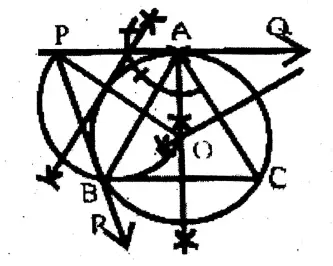
Answer. Similar.

Question 2. I observe whether the pictures in each group are similar or not.

Answer. I am observing that the pictures of groups 1, 2, and 4 are similar to each other. But the pictures of the grups 3 and 5 are not similar to each other.

Read and Learn More WBBSE Solutions For Class 10 Maths

WBBSE Solutions For Class 10 Maths Chapter 18 Similarity 2

Question 3. Let us write the right answer in WBBSE Solutions For Class 10 Maths Chapter 18 Similarity 1

1. All squares are  WBBSE Solutions For Class 10 Maths Chapter 18 Similarity 1  [congruent/similar]

Answer. Similar.

2. All circles are  WBBSE Solutions For Class 10 Maths Chapter 18 Similarity 1  [congruent/similar]

Answer. Similar.

3. All WBBSE Solutions For Class 10 Maths Chapter 18 Similarity 1 [equilateral/isosceles] triangles are always similar.

Answer. Equilateral.

“WBBSE Class 10 Maths Similarity Exercise 18.1 solutions”

Question 4. Two quadrilaterals will be similar if their corresponding angles are  WBBSE Solutions For Class 10 Maths Chapter 18 Similarity 1   [equal/proportional] and corresponding sides are  WBBSE Solutions For Class 10 Maths Chapter 18 Similarity 1   [unequal/proportional].

Answer. Equal and Proportional.

WBBSE Solutions For Class 10 Maths Chapter 18 Similarity Exercise 18.1

Chapter 18 Similarity Exercise 18.1 True or False 

1. Any two congruent figures are similar.

Answer: True

2. Any two similar figures are always congruent.

Answer: False

3. The corresponding angles of any two polygonal figures are equal.

Answer: True

“West Bengal Board Class 10 Maths Chapter 18 Similarity Exercise 18.1 solutions”

4. The corresponding sides of any two polygonal figures are proportional.

Answer: True

5. The square and rhombus are always similar.

Answer: False

Class 10 Maths Class 10 Social Science
Class 10 English Class 10 Maths
Class 10 Geography Class 10 Geography MCQs
Class 10 History Class 10 History MCQs
Class 10 Life Science Class 10 Science VSAQS
Class 10 Physical Science Class 10 Science SAQs

Question 5. Let us write examples of one pair of similar.

Solution:

WBBSE Solutions For Class 10 Maths Chapter 18 Similarity 3

Question 6. Let us draw a pair of figures which are not similar.

Solution:

WBBSE Solutions For Class 10 Maths Chapter 18 Similarity 4

The two 1 & 2 are similar and the two 3 & 4 are similar. Because their corresponding sides are WBBSE Solutions For Class 10 Maths Chapter 18 Similarity 1and their corresponding angles are equal.

Answer. Similar.

Question 7. Now by cutting off ∠AA, and B, and putting them on ABC, I am observing that the two angles are overlapping.

Solution: I have got AA3 B3 = ABC, which are corresponding angles.

∴ A3 B3BC

Similarly by joining A1,B1, we shall get \(\frac{\mathrm{AA}_1}{\mathrm{~A}_1 \mathrm{~B}}=\frac{\mathrm{AB}_1}{\mathrm{~B}_2 \mathrm{C}}=\frac{1}{6}\) and A1,B1 || BC

By joining A2,B2, we shall get \(\frac{\mathrm{AA}_2}{\mathrm{~A}_2 \mathrm{~B}}=\frac{\mathrm{AB}_2}{\mathrm{~B}_2 \mathrm{C}}=\frac{2}{5}\) and A1,B2 || BC [Putting = /||]

What we shall get by joining A4 , B4 or A5 , B5 or A6 , B5 or A6 , B6

“WBBSE Class 10 Similarity Exercise 18.1 solutions explained”

Question 8. In a similar way, I have drawn another triangle and a straight line that has divided any two other sides (or their extended sides) in the same ratio and I am observing that the straight line is parallel to the third side.

Solution: I draw ΔABC, straight line DE, cut AB & AC at D & E proportionately,

AD/BD = AE/EC

∴ DE || BC

Again I draw AABC, straight line DE produced cuts in proportion.

AB/AD = AC/AE

∴ BC || DE

Application 1. In adjoining, DE || BC of ΔABC; if AD = 5 cm. DB = 6 cm and AE = 7.5 cm, then let us write by calculating the length of AC.

Solution:

Given

In adjoining, DE || BC of ΔABC; if AD = 5 cm. DB = 6 cm and AE = 7.5 cm,

In ΔABC, DE BC,

AD/DB = AE/EC  [From Thales theorem]

5/6 = 7.5/EC

∴ EC = 7,5 + 6/5 cm 

= 9 cm.

∴ AC = AE + EC 

= 7.5cm + 9cm 

= 16.5cm.

Length of AC = 16.5cm.

WBBSE Solutions For Class 10 Maths Chapter 18 Similarity 6

Application 2. If BC || DE in AABC, AD/DB = 2/5, and AC = 21 cm, then let us write by calculating the value of AE 

Solution:

Given

If BC || DE in AABC, AD/DB = 2/5, and AC = 21 cm

As BC II BE  

∴ AD/DB = AE/EC = 2/5

Set AE = x cm

∴ EC = (2x – x) cm

∴ X/21-x = 2/5

Or, 5x = 42 – 2x

or, 7x = 42

∴ x = 6

∴ AE = 6cm

The value of AE = 6cm

WBBSE Solutions For Class 10 Maths Chapter 18 Similarity 7

“WBBSE Class 10 Maths Exercise 18.1 Similarity problem solutions”

Application 7. With the help of the converse of Thales theorem, let us prove that the line segment joining two mid-points of a triangle is parallel to its third side. 

Solution: In ΔABC,

D & E are the midpoints of AB & AC, respectively

Join D, E

∴ AD/BD = AE/EC = 1/1

∴ BC || DE

“Class 10 WBBSE Maths Exercise 18.1 Similarity step-by-step solutions”

∴ The line segment joining two midpoints of a triangle is parallel to its third side.

WBBSE Solutions For Class 10 Maths Chapter 18 Similarity 8

WBBSE Solutions For Class 10 Maths Chapter 17 Construction Of Tangent To A Circle Exercise 17.1

WBBSE Solutions For Class 10 Maths Chapter 17 Construction Of Tangent To A Circle Exercise 17.1

How many tangents can be drawn in a circle? Let us observe by drawing it. At a point in the circle,  WBBSE Solutions For Class 10 Maths Chapter 17Construction Of Tangent To A Circle 1

[1/2] tangent/tangents can be drawn. But from the point outside the circle WBBSE Solutions For Class 10 Maths Chapter 17Construction Of Tangent To A Circle 1 [1/2] tangent/tangents can be drawn on the circle.

 Answer. 1, 2.

Question1. Let us draw a circle with a radius of 3.2 cm length. Let us draw a tangent to the circle on any point of it.

Solution: In the PQ is a tangent at A to the circle with the centre O.

D:\Ameerun\chapter 17 images\WBBSE Solutions For Class 10 Maths Chapter 17Construction Of Tangent To A Circle 2.png

Read and Learn More WBBSE Solutions For Class 10 Maths

Question 2. By drawing a line-segment AB as a radius of 3 cm length. I draw a circle with centre A and a tangent to this circle at the point B.

Solution: In the PQ is the tangent at B to the circle with radius AB.

WBBSE Solutions For Class 10 Maths Chapter 17Construction Of Tangent To A Circle 3

“WBBSE Class 10 Maths Construction of Tangent to a Circle Exercise 17.1 solutions”

Question 3. I draw a circle with a radius of 2.5 cm in length. I take an external point at a distance of 6.5 cm from the centre. From this external point, I draw a tangent of the circle and measure the length of this tangent with a scale.

Solution:

In the AP is a tangent to the circle with centre O, from an external point A.

WBBSE Solutions For Class 10 Maths Chapter 17Construction Of Tangent To A Circle 4

“West Bengal Board Class 10 Maths Chapter 17 Construction of Tangent to a Circle Exercise 17.1 solutions”

Question 4. I draw a circle with a radius of 2.8 cm in length. I take a point which is at a distance of 7.5 cm. from the centre. From that external point, I draw two tangents of the circle. 

Solution: In the AP & AQ are two tangents from an external point A, of the circle with centre O.

WBBSE Solutions For Class 10 Maths Chapter 17Construction Of Tangent To A Circle 5

Class 10 Maths Class 10 Social Science
Class 10 English Class 10 Maths
Class 10 Geography Class 10 Geography MCQs
Class 10 History Class 10 History MCQs
Class 10 Life Science Class 10 Science VSAQS
Class 10 Physical Science Class 10 Science SAQs

Question 5. PQ is a chord of a circle with centre O. I draw the tangents of the circle at the points P and Q.

Solution: In the  AB & CD are two tangents at P & Q of the circle.

WBBSE Solutions For Class 10 Maths Chapter 17Construction Of Tangent To A Circle 6

“WBBSE Class 10 Construction of Tangent to a Circle Exercise 17.1 solutions explained”

Question 6. I draw a line-segment XY of 8 cm in length and draw a circle by taking XY as a diameter. I draw the tangents of the circle at points X and Y and write the relation between these two tangents.

Solution: In PQ & RS are two tangents to the circle at X & Y & PQ || RS.

WBBSE Solutions For Class 10 Maths Chapter 17Construction Of Tangent To A Circle 7

Question 7. By drawing any circle I draw two perpendicular diameters in it. I draw four tangents of the circle at four end points of two diameters and write the type of quadrilateral that is formed.

Solution: In the  AB & CD are two diameters which are perpendicular to each other, & OR, RS, SP & PQ are 4 tangents at A, D, B, and C, and four end points of diameters. Quadrilateral, so formed is a square.

WBBSE Solutions For Class 10 Maths Chapter 17Construction Of Tangent To A Circle 8

“WBBSE Class 10 Maths Exercise 17.1 Construction of Tangent to a Circle problem solutions”

Question 8. By drawing an equilateral triangle ABC with sides of 5 cm in length, a circumcircle of it is drawn. Let us draw the tangents to that circumcircle at points A, B and C.

Solution: Circumcircle of ΔABC is drawn. Three tangents IT, EF, and GH are drawn at A, B & C points.

WBBSE Solutions For Class 10 Maths Chapter 17Construction Of Tangent To A Circle 9

Question 9. I draw a circumcircle by drawing an equilateral triangle ABC with sides of 5 cm. length. I draw a tangent of the circle at point A and take point P on it such that AP is 5 cm. From point P, I draw another tangent of the circle and I write by observing the point at which this tangent has touched the circle.

Solution: ABC is an equilateral triangle, whose each side is 5 cm. PQ tangent is drawn at point A. Another tangent from P is drawn which touches the circle at B.

WBBSE Solutions For Class 10 Maths Chapter 17Construction Of Tangent To A Circle 10

WBBSE Solutions For Class 10 Maths Chapter 17 Construction Of Tangent To A Circle Exercise 17.1

Question 10. O is a point on the line segment AB and I draw a perpendicular PQ on AB at the point O. I draw two circles with centres A and B and radii of AO and BO length respectively and write the name of PQ in respect to these two circles. I draw other two tangents of the two circles from the point P.

Solution:

O is a point on the line segment AB and I draw a perpendicular PQ on AB at the point O. I draw two circles with centres A and B and radii of AO and BO length respectively and write the name of PQ in respect to these two circles.

In the PQ is a transverse common tangent with respect to two circles. From the point P other two tangents, PR & PS are drawn.

WBBSE Solutions For Class 10 Maths Chapter 17Construction Of Tangent To A Circle 11

“Class 10 WBBSE Maths Exercise 17.1 Construction of Tangent to a Circle step-by-step solutions”

Question 11. P is a point on a circle with centre O. I draw a tangent to the circle at point P and cut off a part ‘PQ’ equal in length to the radius of the circle from the tangent. I draw another tangent QR to the circle from point Q and write the value of∠PQR by measuring it with a protractor.

Solution:

P is a point on a circle with centre O. I draw a tangent to the circle at point P and cut off a part ‘PQ’ equal in length to the radius of the circle from the tangent.

In the other tangent QR is drawn from Q &∠PQR = 90°.

WBBSE Solutions For Class 10 Maths Chapter 17Construction Of Tangent To A Circle 12