WBBSE Solutions For Class 10 Maths Chapter 16 Right Circular Cone Exercise 16.1

West Bengal Board Class 10 Math Book Solution In English

Chapter 16 Right Circular Cone Exercise 16.1

Question 1. But what is point B of the 2 of the right circular cone called? 

Solution. Point B of the 2 is called the apex of the right circular cone. Again, the perpendicular AB on the circular base is called the Height of the right circular cone and BC is called the Slant height. The number of surfaces of a closed cone is 2. One is plane and the other is curved.

Question 2. Write the names of solid objects which are used in our house and whose shapes are like circular cones.

Solution. Names of 4 solid objects (cone); 

Conical hat; 

Conical toy; 

Funnel; 

Top of a sharp pencil.

To make a right circular cone with one face open, лrl sq. unit paper is required, where r = Radius of cone and l= Slant height of the cone.

Read and Learn More WBBSE Solutions For Class 10 Maths


Application 1. Let us calculate the curved surface area of a right circular cone whose radius of the base is 1.5 m and slant height is 2 m. 

Solution: Radius of the base of cone = r = 1.5 m.

Slant height (l) = 2 m.

Curved surface area = лrl = 22/7 x 1.5 x 2 sq m 

= 9.43 sq m.

“WBBSE Class 10 Maths Right Circular Cone Exercise 16.1 solutions”

Application 2. If the area of the base of a cone is 78/7 sq. cm and the slant height is 13 cm, then let us calculate its curved surface area.

Solution:

Given

If the area of the base of a cone is 78/7 sq. cm and the slant height is 13 cm

Let the length of the radius of the base of the cone be r cm.

According to the condition, 22/7 r2=78 4/7

∴r=5&h= 13 cm,

√132 +52 =√194 = 13.9 approx

∴ Curved surface area of the cone πrl sq. cm. = 218.23 sq. cm.

Class 10 Maths Class 10 Social Science
Class 10 English Class 10 Maths
Class 10 Geography Class 10 Geography MCQs
Class 10 History Class 10 History MCQs
Class 10 Life Science Class 10 Science VSAQS
Class 10 Physical Science Class 10 Science SAQs

Application 3. If the circumference of the base of a cone is 660/7 cm and the slant height is 25 cm, then let us calculate the curved surface area of the cone. 

Solution

Given

If the circumference of the base of a cone is 660/7 cm and the slant height is 25 cm

πrl= 2лrl/2 = 660/ 2×7 x 25

= 1178.57 sq cm.

Application 4. Let us write the total surface area of a cone whose length of the radius of the base is 1.5 cm and slant height is 2.5 cm.

Solution: The total surface area of the cone = 22/7 x 1.5(1.5+ 2.5) sq cm.

= 22/7 x 15/10 x 4 sq cm. 

= 18.86 sq cm.

“West Bengal Board Class 10 Maths Chapter 16 Right Circular Cone Exercise 16.1 solutions”

Application 5. Let us write the total surface area of a cone whose diameter of the base is 20 cm and slant height is 2.5 cm.

Solution: Radius of the base (r) = 20 cm/2

= 10 cm.

Slant height (l) 2.5 cm.

∴ Total surface area of the cone = πr(r + l)

= 22/7 x 10x (10+ 2.5) sq cm =

= 22/7 x 10 x 35 sq cm.

= 1100 sq cm.

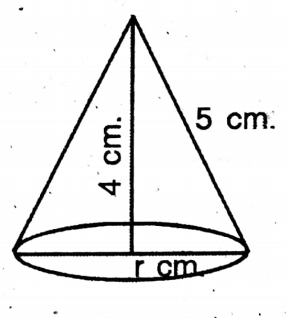
Application 6. Let us calculate the slant height of a right circular cone whose circumference is 660/7 cm and height is 20 cm. 

Solution: In the fig, Radius (OA) = r

& height (BO) = 20 cm.

∴ 2лr = 660/7

Or, 2 x 22/7 x r = 660/7

r =660/7 x 7/2×22

= 15 cm.

∴ AB²= OB² + OA²

= (20)² + (15)²

= 400+ 225 

= 625

∴ AB = √625 = 25 cm.

∴ The slant height of cone = 25 cm.
WBBSE Solutions For Class 10 Maths Chapter 16 Right Circular Cone 1

“WBBSE Class 10 Right Circular Cone Exercise 16.1 solutions explained”

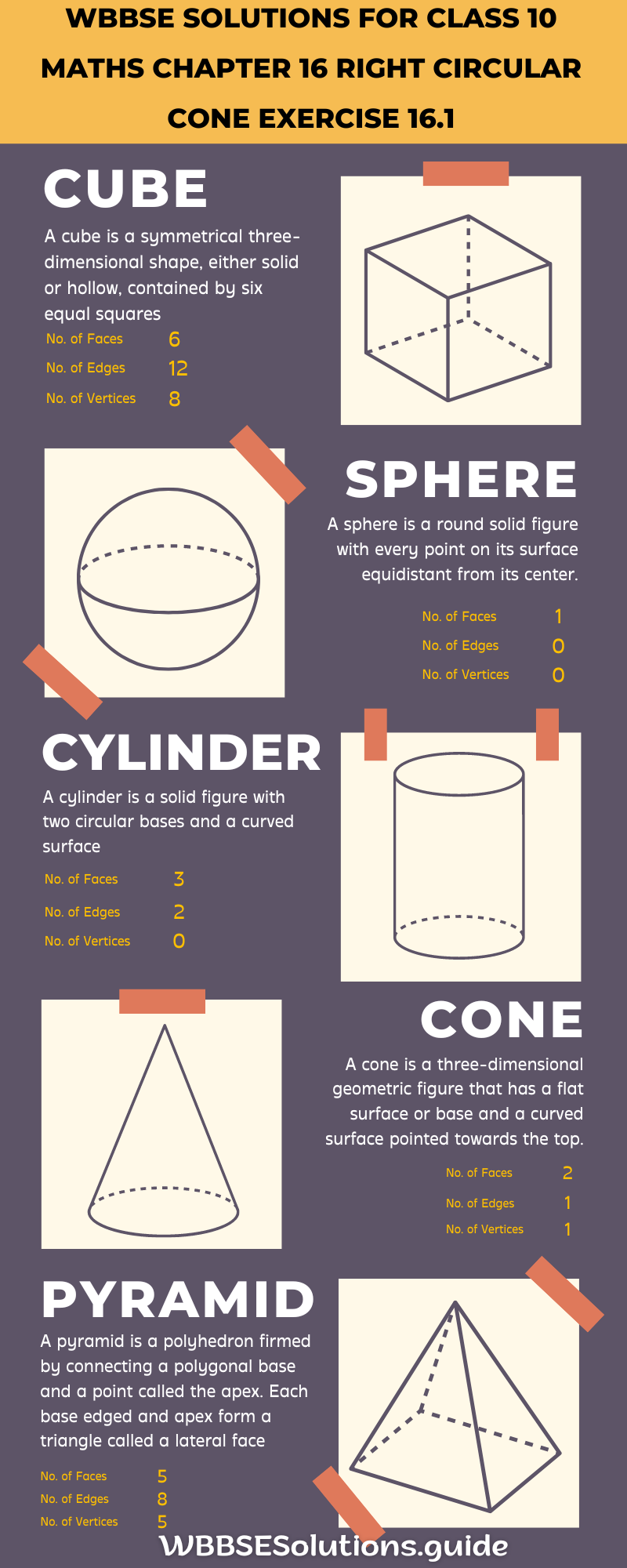
Application 7. If the height of a conical flask of the science laboratory of the school is 4 dcm and the slant height is 6 dcm, then let us calculate the quantity of water that can be held in the flask.

Solution:

Given

If the height of a conical flask of the science laboratory of the school is 4 dcm and the slant height is 6 dcm,

Let the length of the radius of the base of the conical flask be r dcm.

∴ (5)²= r²+(4)²

or, r²= 5²-4² = 9

∴r = ±3

But the length of the radius can not be negative.

∴ r ≠ -3. 

∴ r = 3

The quantity of water that can be held in that flask =1/3 x 22/7 x 3 x 3 x 4 = 37 cubic dcm.
WBBSE Solutions For Class 10 Maths Chapter 16 Right Circular Cone Exercise 16.1

Application 8. If the circumference of the base of the right circular cone is 2.2 m and the height is 45 cm, then let us write by calculating its volume of it. 

Solution:

Given

If the circumference of the base of the right circular cone is 2.2 m and the height is 45 dcm,

Circumference 2лr = 2.2m = 22 dcm

or, 2πr = 22

or, 2 x 22/7 x r = 22 

∴r= 7/2 

∴ Volume of the cone = 1/3 Tr2h

1/3 x 22/7 x 7/2 x7/2 x 45 cu dcm. 

= 577.5 cu dcm.

“WBBSE Class 10 Maths Exercise 16.1 Right Circular Cone problem solutions”

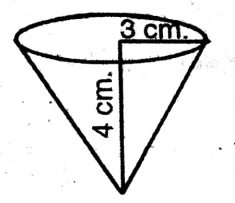
Application 9. The lengths of the two sides adjacent to the right angle of a right-angled triangle are 4 cm and 3 cm. Let us write by calculating the curved surface area, total surface area, and volume of the solid formed by completely revolving the triangle once by taking the longer side adjacent to the right angle as the axis. 

[ Hints: The height of the right circular cone formed will be 4 cm and the radius will be 3 cm.]

Solution:

Given

The lengths of the two sides adjacent to the right angle of a right-angled triangle are 4 cm and 3 cm.

Height of the cone (h) = 4cm 

& Radius of the cone (c) = 3 cm.

∴ Slant height (l) = √4²+3²

= √16+9

= √25 

= 5 cm.

1. Curved surface area = πrl 

= 22/7 x 3 x 5 sq.cm 

= 47.14 sq cm.

2. Total surface area = лr(r+ l) 

= 22/7 x 3 (5+3) sq cm. 

= 75.43 sq cm. 

3. Volume of the cone = 1/3 πr²h

=1/3 x 22/7 x 3 x 3 x 4 cu cm. 

= 37.71 cu cm. 
WBBSE Solutions For Class 10 Maths Chapter 16 Right Circular Cone 2

Application 10. If the ratio of the heights of two right circular cones is 2:3 and the ratio of the lengths of their radii is 3:5, then let us write by calculating the ratio of the volumes of two cones. 

Solution:

Given

If the ratio of the heights of two right circular cones is 2:3 and the ratio of the lengths of their radii is 3:5

Let the height of the 1st cone = 2x unit 

& radius of 1st cone = 3y unit. & height of the 2nd cone = 3x unit 

& radius of 2nd cone = 5y unit.

∴ Volume of 1st cone / Volume of 2nd cone = 1/3 π (3y)²2x / 1/3 π(5у)²3x

= 9y² . 2x / 25y² . 3x

= 18/75

= 6/25

∴ The ratio of volumes of two cones = 6: 25.

“Class 10 WBBSE Maths Exercise 16.1 Right Circular Cone step-by-step solutions”

Application 11. The area of the base of a right circular conical tent is 13.86 sq.m. For making the tent, triple the cost of Rs. 5775 is required and if the price of 1 sq m. the tent is Rs. 250, then let us determine the height of the tent. Let us write by calculating, the air in the tent in liter.

Solution:

Given

The area of the base of a right circular conical tent is 13.86 sq.m. For making the tent, triple the cost of Rs. 5775 is required and if the price of 1 sq m. the tent is Rs. 250,

Let the base radius of the tent be r m, 

height be h m, and slant height be l m. 

The area of the base is 13.86 sq. m.

According to the condition, 22/7 r² = 13.86 

∴ r = 21 m.

The length of the radius is 2.1 m.

The quantity of triple in Rs. 5775 at the rate of Rs. 250 per meter = 5775/250 sq. m

= 23.1 sq.m.

∴ Curved (lateral) surface area = лrl sq.m = 23.1 sq.m

or, 22/7 x 21/10 x l = 23.1

∴ l= 7/2

∴ Slant height = 7/2 m = 3.5 m.

∴ h = + √l² – r² [height can not be negative]

=  √(3.5)-(2.1)

= √(3.5+2.1)x(3.5-2.1) 

= √5.6×1.4 

= √7.84

∴ Height = 2.8 m

∴ The air occupied in the tent = 1/3 22/7 2.1 2.8 

= 12.936 cum 

= 12936 cu dcm

= 12936 liters.

“WBBSE Class 10 Chapter 16 Right Circular Cone Exercise 16.1 solution guide”

Question 1. I have made a closed right circular cone whose radius of the base is 15 cm and slant height is 24 cm. Let us calculate the curved surface area and total surface area of that cone.

Solution: Radius of base of cone = (r) 15 cm

& slant height (l) 24 cm.

Curved surface area = πгl = 22/7 x 15 x 24 sq cm.

= 1131.43 sq cm.

= Total surface area = πr(r + l)

= 22/7 x 15 (15+24) sq cm.

= 22/7 x 15 x 39 sq cm. = 1838.57 sq cm.

Question 2. Let us determine the volume of the cone when 

1. base area is 1.54 sq.m. and height is 2.4 m, 

2. the length of a base diameter is 21m and the slant height is 17.5 m. 

Solution: Let radius = r m & height (h) = 2.4 m.

Base area = πr2 = 1.54

or, 22/7 r2 = 1.54 

∴ r2 = 1.54 x 7 / 22

= 0.49

∴ r= 0.49 

= 7

1. Volume of the cone = 1/3 πr2h

= 1/3 x 22/7 x 7/10 x 7/10 x 24/10 cu m.

= 1.232 cu m.

 2. Diameter = 21 m

∴ Radius = 21/2

= 10.5 m.

h²= l² – r²

=(17.5)²- (10.5)²

= 196

∴ h= √196

= 14 m.

Volume of the cone = 1/3 лr²h

= 1/.x 22/7 x 10.5 x 10.5 x 14 cu m.

= 1617 cu m.

Question 3. Amina has drawn a right-angled triangle whose lengths of two sides adjacent to the right angle are 15 cm and 20 cm. Let us determine the curved surface area, total surface area, and volume of the solid which is formed by taking the side of length 15 cm which is formed by completely revolving the triangle once around the side of the triangle with the length of 15 cm, having been taken as an axis.

Solution:

Given

Amina has drawn a right-angled triangle whose lengths of two sides adjacent to the right angle are 15 cm and 20 cm.

Height of the cone (h) = 15 cm.

& Radius (r) = 20 cm.

∴ Slant height (l) = √h² +r²

= √15²+20²

= √225+400

= 625

= 25 cm.

Curve surface area = лrl = 22/7 x 20 x 25 = 1571.73 sq cm.

Total surface area of cone = лr(г+ l) = 22/7 x 20 x (20+25) sq cm.

= 22/7 x 20 x 45 2828.57 sqcm.

Volume of the cone = 1/3 πr²h

= 1/3 x 22/7 x 20 x 20 x 15 cu cm.

= 6285.71 cu cm.

“West Bengal Board Class 10 Maths Exercise 16.1 Right Circular Cone solutions”

Question 4. If the height and slant height of a cone is 6 cm and 10 cm respectively, then let us determine the total surface area and volume of the cone.

Solution:

If the height and slant height of a cone is 6 cm and 10 cm respectively,

Let the radius of the cone = r cm.

∴ r² = l²-h²

= (10)²- (6)²

= 100-36 

= 64

∴ r = √64 

= ± 8m.

As the radius cannot be negative

∴ radius (r) = 8 cm

∴ Total surface area of the cone = πг(г + l)

= 22/7 x 8 x (8+10) 

= 22/7 x 8 x 18 sq cm. 

= 452.57 sq cm.

Volume = 1/3 πr² = 1/3 x 8 x 8 x 6 cu cm.

= 402.28 cu cm.

“Class 10 WBBSE Maths Exercise 16.1 solutions for Right Circular Cone”

Question 5. If the volume of a right circular cone is 100 π cm3 and the height is 12 cm., then let us write by calculating the slant height of the cone.

Solution:

If the volume of a right circular cone is 100 π cm3 and the height is 12 cm.,

Let the radius = r cm.

∴ 1/3 x 22/7x r2 x 12 = 100 x 22/7

4r² = 100

∴ r² = 25

r = √25

= 5

Slant height (l)=√h² + r²

= √12² +5²

= √144+25 

= √169 

= 13 cm.

Question 6.77 sq.m. triple is required to make a right circular conical tent. If the slant height of the tent is 7 m, then let us write by calculating the base area of the tent.

Solution:

Given

77 sq.m. triple is required to make a right circular conical tent. If the slant height of the tent is 7 m,

Let the radius = r cm.

According to problem

πrl = 77 or,22/7 x r x 7

= 77 

∴ r = 7/2

∴ Area of the base = πr² = 22/7 x 7/2 x 7/2 sq cm. 

=  38.5 sq cm.

Question 7. The base area of a right circular cone is 21 m and the height is 14 m. Let us calculate the expenditure to color the curved surface at the rate of Rs. 1.50 per sq.m.

Solution:

The base area of a right circular cone is 21 m and the height is 14 m.

Radius of a base of the cone (r) = 21/2 m. 

& height (h)= 14 m.

∴ Slant height (0) = √h²+r²

=(14)² + (21/2)²

=√1225/4

= 35/2m.

∴ Curved surface area of cone = πrl = 22/7 x 21/2 x 17.5

= 577.5 sq m.

Cost of coloring the curved surface area at the rate of Rs. 1.50/sq m.

= Rs. 577.5 x 1.5

= Rs. 866.25.

Question 8. The length of base diameter of a wooden toy of a conical shape is 10 cm. The expenditure for polishing the whole surfaces of the toy at the rate of Rs. 1.50 perm∴2 is Rs. 429. Let us calculate the height of the toy. Let us also determine the quantity of wood which is required to make the toy.

Solution:

Given

The length of base diameter of a wooden toy of a conical shape is 10 cm. The expenditure for polishing the whole surfaces of the toy at the rate of Rs. 1.50 perm∴2 is Rs. 429.

Radius of the base of the toy (cone) = 10/2

= 5 cm.

The curved surface area of = πrl 

where l = slant height

According to the problem,

Trl Rs. 2.10 = Rs. 429

Or, 22/7 x 5 x l x2.10 = 429

 l = 429 x 7/22 x 1/5 x 10/21

= 13. cm.

∴Height = √l² – r²

= (13)² – (5)²

= 169-25 

=√144

= 12 cm.

Volume of the toy = 1/3 лr2h= 1/3 x 22/7 x 5 x 5 x12 cum.

= 314.29 cum.

Question 9. The quantity of iron sheet to make a boya of right circular conical shape is 75 3/7  m2. If the slant height of it is 5 m, then let us write, by calculating, the volume of air in the boya and its height. Let us determine the expenditure to color the whole surface of the boya at the rate of Rs. 2.80 per m2. [The width of the iron sheet is not to be considered while calculating.]

Solution:

Given

The quantity of iron sheet to make a boya of right circular conical shape is 75 3/7  m2. If the slant height of it is 5 m

Let the radius = rm, slant height = 5 m.

Total surface area = лr(r+l) = 528/7

or, 22/7 x r x (5+r)= 528/7

or, r(r+5)= 528/7 x 7/25

or, r2 + 5r – 24 = 0

(r+8)(r-3) = 0

= r = -8  or,3.[But radius cannot be negative]

r=3

∴Height = √l²- r²

= √(5)²-(3)²

= √25-9 

= √16 

= 4.

Volume of air in the boya = 1/3лr2h = 1/3 x 22/7 x 3 x 3 x 4

= 37 5/7cum.

Cost to color the whole surface of the boy a = Rs. 2.80 x 528/7

= Rs. 211.2.

Question 10. In a right circular conical tent, 11 persons can stay. For each person 4m2 space in the base and 20 m3 air are necessary. Let us determine the height of the tent put up exactly for 11 persons.

Solution:

Given

In a right circular conical tent, 11 persons can stay. For each person 4m2 space in the base and 20 m3 air are necessary.

Total space required to sit 11 persons in the conical tent = 11 x 4 = 44 sqm.

If the radius of the base of corner m,

& height of cone = h m.

∴πr² = 44

or,  22/7 r² = 44

∴ r² =  44×7 / 2

= 14 m.

:. The volume of the cone,  

= 1/3 лr2 = 1/3 x 22/7 x 14 x h

According to the problem,

1/3 x 22/7x 14 x h

= 20 x 11

∴ h = 20 x 11 x3x 7/22 x 1/14 

= 15m.

∴ Height of the tent = 15m.

Question 11. The external diameter of a conical coronet made off a thermocouple is 21 cm in length. To wrap up the outer surface of the coronet with foll, the expenditure will be Rs. 57.75 at the rate of 10 p per m2. Let us write by calculating, the height and slant height of the coronet.

Solution:

Given

The external diameter of a conical coronet made off a thermocouple is 21 cm in length. To wrap up the outer surface of the coronet with foll, the expenditure will be Rs. 57.75 at the rate of 10 p per m2

Radius of a conical coronet = r = 21/2 cm.

Curved surface area = лrl where l = slant height

Cost to wrap up the outer surface of the coronet at the rate of 10 p per sq cm

= πrl x 10p.

According to the problem,

Trl x 10 = 577.5

22/7 x 21/2 x l x 10

= 5775 / 10

l = 5775x7x2 / 10x10x22x21

= 175/10

= 17.5 cm.

∴ Height = √(17.5)²-(10.5)²

=√(17.5+10.5)-(17.5-10.5)

= √28×7 

= √2x2x7x7 

= 14 cm.

“WBBSE Class 10 Chapter 16 Right Circular Cone Exercise 16.1 problem-solving steps”

Question 12. A heap of wheat is in the shape of a right circular cone, its base diameter is 9 m and its height is 3.5 m. Let us determine the total volume of wheat. Let us calculate the minimum quantity of plastic sheet to be required to cover up this heap of wheat. [suppose π= 3.14, √130 = 11.4]

Solution:

Given

Diameter of base = 9 cm… 

Radius (r) = m; 

height (h) = 3.5 m.

∴Total volume of wheat = 1/3πr2h = 1/3 x 3.14 x 9/2 x 9/2 x 3.5 cum.

=74.18 cum.

Slant height(l)=√h² +r²

= √(3.5)²+(4.5)²

= √81/4 + 49/4

= √130/4

= 11.4/2

= 5.7m

 Minimum quantity of plastic sheet required = πrl

= 3.14 x 4.5 x 5.7 sqm.

= 80.54 sqm.

Maths WBBSE Class 10 Solutions Chapter 16 Right Circular Cone Exercise 16.1 Multiple Choice Question

Question 1. If the slant height of a right circular cone is 15 cm and the length of the base diameter is 16 cm, then the lateral surface area of the cone is

1. 60л cm²
2. 68π cm²
3. 120л cm²
4. 130π cm²

Solution: rπ.8 × 15 = 120π

Answer. 3. 120 cm²

(II) If the ratio of the volumes of two right circular cones is 1:4 and the ratio of the radii of their bases is 4: 5, then the ratio of their heights is

1. 1:5
2. 5:4
3. 25: 16
4. 25: 64

Solution: V1 : V2 = 1 : 4 & r1 : r2 = 4 : 5

∴ \(\frac{V_1}{V_2}=\frac{1 / 3 \pi(4)^2 h_1}{/ 3 \pi(5)^2 h_2}=\frac{1}{4}\)

∴ \(\frac{\mathrm{h}_1}{\mathrm{~h}_2}=\frac{25}{16 \times 4}=\frac{25}{64}=25: 64\)

Ans. 4. 25: 64

Question 2. Keeping the radius of a right circular cone the same, if its height of it is increased twice, its volume of it will be increased by

1. 100%
2. 200%
3. 300%
4. 400%

Solution: \(\frac{V_1}{V_2}=\frac{1 / 3 \pi r^2 h}{1 / 3 \pi r^2 \cdot 2 h}=\frac{1}{2}\)

∴ Volume will be increased by 100%


Answer. 1. 100%.

Question 4. If each of the radius and height of a cone is increased by twice its length, then its volume of it will be

1. 3 times 
2. 4 times
3. 6 times
4. 8 times the previous one.

Solution: \(\frac{V_1}{V_2}=\frac{1 / 3 \pi r^2 h}{1 / 3 \pi(2 r)^2 \cdot 2 h}=\frac{r^2 \cdot h}{4 r^2 \cdot 2 h}=\frac{1}{8}\)


Answer. 4. 8 times the previous one.

Question 5. If the length of the radius of a cone is r/2 then the total surface area is unit and its slant height of it is 20 units,

1. 2лr (l+r) sq. unit
2. πr(l + r/4)sq. unit
3. πr (l+r) sq. unit
4. 2πrl sq. unit

Solution: Whole surface area = π.r/2(2l + r/2) 

= πг(l + r/4) sq. unit

Answer. (b) πг(l + r/4) sq. unit

Chapter 16 Right Circular Cone Exercise 16.1 True Or False


1. If the length of the radius base of a right circular cone is decreased by half and its height is increased by twice of it, then the volume remains the same.

False

2. The height, radius, and slant height of a right circular cone are always the three sides of a right-angled triangle.

True

Maths WBBSE Class 10 Solutions Chapter 16 Right Circular Cone Exercise 16.1 Fill In The Blanks


1. AC is the hypotenuse of a right-angled triangle ABC, the radius of the right circular cone formed by revolving the triangle once around the side AB as the axis in
BC

2. If the volume of a right circular cone is V cubic unit and the base area is A sq. unit, then its height is 3V/A

3. The lengths of the base radii and the heights of a right circular cylinder and a right circular cone are equal. The ratio of their volumes is  3: 1


Chapter 16 Right Circular Cone Exercise 16.1 Short Answers


Question 1. The height of a right circular cone is 12 cm and its volume is 100 cm3. Let us write the length of the radius of the cone.

Solution.

Given

The height of a right circular cone is 12 cm and its volume is 100 cm3.

The volume of the cone 1/3 πr²h = 100л

oг,1/3 πr² x 12 = 100л

∴ r² = 100/4

= 25 

∴ r = +5

∴ The radius of the cone = 5 cm.


Question 2. The curved surface area of a right circular cone is √5 times its base area. Let us write the ratio of the height and the length of the radius of the cone.

Solution.

Given

The curved surface area of a right circular cone is √5 times its base area.

Let the radius = r unit & height = h unit & slant height = l unit.

πrl = √5πr²

∴ l = √5r

∴ h² = l² – r²

= 5r²-r²

= 4r². 

∴ h = 2r

.. Ratio of the height & the radius = 2/1

= 2:1


Question 3. If the volume of a right circular cone is V cubic unit, the base area is A sq. unit and the height is H unit, then let us write the value of AH/V

Solution.

Given

If the volume of a right circular cone is V cubic unit, the base area is A sq. unit and the height is H unit

Let the radius = r unit & height = h unit.

∴ V = 1/3 πr²h; 

А= r², H = h

AH/V = πr² xh / 1/3 πr²h 

= 3  

Question 4. The numerical values of the volume and the lateral surface area of a right circular cone are equal. If the height and the radius of the cone are H unit and r unit respectively, then let us write the value of 1/h² + 1/r²

Solution.

Given

The numerical values of the volume and the lateral surface area of a right circular cone are equal. If the height and the radius of the cone are H unit and r unit respectively,

The volume of the cone = 1/3 πr²h cu unit.

Surface area =πrl=sq unit. [l= slant height]

1/3 лr²h = лrl

1/3 rh = l

= 1/9 r²h² = l²

=h² + r² [as (2 = h² + r²]

or , 1/9 = h² / r²h² + r²/r²h²

or, 1/9 = 1/r² + 1/h²

∴1/h² + 1/r² = 1/9

“WBBSE Class 10 Maths Right Circular Cone Exercise 16.1 answers”


Question 5. The ratio of the lengths of the base radii of a right circular cylinder and a right circular cone is 3: 4 and the ratio of their heights is 2: 3; let us write the ratio of the volumes of the cylinder and the cone.

Solution.

Given

The ratio of the lengths of the base radii of a right circular cylinder and a right circular cone is 3: 4 and the ratio of their heights is 2: 3

Let the radius of the base of the cylinder = 3x unit &

radius of base of cone = 4x unit.

Again, the height of the cylinder = 2y unit &

height of the cone = 3y unit

Volume of cylinder / Volume of cone = л(3x)² x 2y / 1/3 л(4x)²x3y

= 9x² x 2y / 1/3 x 16x² x 3y

= 9/16

∴The ratio of the volume of cylinder and volume of cone = 9: 8.
WBBSE Solutions For Class 10 Maths Chapter 15 Theorems Related To Tangent Of A Circle Exercise 15.2

West Bengal Board Class 10 Math Book Solution In English

Chapter 15 Theorems Related To Tangent Of A Circle Exercise 15.2

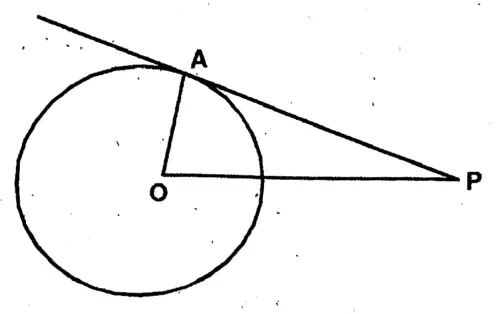
Question1. An external point is situated at a distance of 17 cm from the centre of a circle having a 16 cm diameter, let us determine the length of the tangent drawn to the circle from the external point.

Solution:

Given

An external point is situated at a distance of 17 cm from the centre of a circle having a 16 cm diameter

Let the diameter of the circle = 16 cm

∴ Radius = 16/2 

=8 cm

Distance of the external point from the centre (OP) =.17 cm

∴ In right angled ΔOAP,

AP = √OP² – OA²

=√(17)²-(8)²

= √289-64 

=√225

= 15

∴ AP 15 cm

Read and Learn More WBBSE Solutions For Class 10 Maths


WBBSE Solutions For Class 10 Maths Chapter 15 Theorems Related To Tangent Of A Circle 1

“WBBSE Class 10 Maths Theorems Related to Tangent of a Circle Exercise 15.2 solutions”

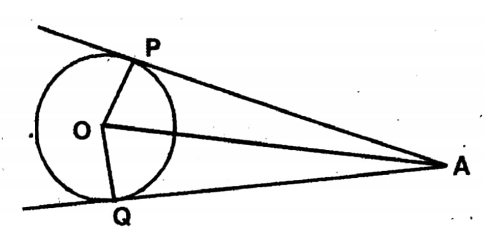
Question 2. The tangents drawn at points P and Q on the circumference of a circle intersect at A. If ZPAQ is 60°, let us find the value of ZAPQ.

Solution:

Given

The tangents drawn at points P and Q on the circumference of a circle intersect at A. If ZPAQ is 60°

Let AP & AQ be two tangents to the circle with centre O.

From an external point. A.

∴ AP = AQ

Class 10 Maths Class 10 Social Science
Class 10 English Class 10 Maths
Class 10 Geography Class 10 Geography MCQs
Class 10 History Class 10 History MCQs
Class 10 Life Science Class 10 Science VSAQS
Class 10 Physical Science Class 10 Science SAQs

ΔAPQ is an isosceles triangle.

∴ ∠APQ = ∠AQP

If ∠PAQ = 60°

∴ ∠APQ = 180°-60° / 2

= 60°

WBBSE Solutions For Class 10 Maths Chapter 15 Theorems Related To Tangent Of A Circle 2

Question 3. AP and AQ are two tangents drawn from an external point A to a circle with centre O. P and Q are points of contact. If PR is a diameter, let us prove that OA || RQ. 

Solution:

Given

AP and AQ are two tangents drawn from an external point A to a circle with centre O. P and Q are points of contact. If PR is a diameter,

AP & AQ are two tangents to the circle with centre O, from an external point A. 

∴ PA = QA & ∠AOP = ∠AOQ

Now in ΔPOR & ΔQOR,

OP = OQ,  ∠POR = ∠QOR & OR is common.

∴ ΔPOR ≅ ΔQOR

PR = QR

<PRO = <QRO

OR is standing on PQ

& ∠PRO = ∠QRO

∴ QR ⊥ PQ

i.e., OA⊥OQ 

Again, PR = QR

∴ OR ⊥ RQ.

WBBSE Solutions For Class 10 Maths Chapter 15 Theorems Related To Tangent Of A Circle 3

“West Bengal Board Class 10 Maths Chapter 15 Theorems Related to Tangent of a Circle Exercise 15.2 solutions”

Question 4. Let us prove that for a quadrilateral circumscribed about a circle, the angles subtended by any two opposite sides at the centres are supplementary to each other. 

Solution: ‘O’ is the centre of the circle. ABCD is a quadrilateral circumscribing the circle.

Let the circle touch the sides of the quadrilateral AB, BC, CD & DA at P, Q, R, S respectively.

∴ To prove, ∠AOB +∠COD = 180° 

or ∠AOD +∠BOC = 180°

Proof: As AP & AS are two tangents of the circle from A

∴ ∠AOP = ∠AOS

Similarly, ∠BOP = ∠BOQ

∴ ∠AOB=  ∠AOP + ∠BOP = ∠AOS + ∠BOQ

Again, DS & DR are two tangents as S & R

∴ ∠DOS = <DOR

Similarly from tangents R & Q

∠COR = ∠COQ

∴ ∠COD = ∠COR+ ∠DOR= ∠COQ + ∠DOS

∴ ∠AOB + ∠COD = ∠AOS + ∠BOQ + ∠COQ + <DOS

= (∠AOS + ∠DOS) + (∠BOQ + ∠COQ)

= ∠AOD + ∠BOC.

Again, ∠AOB + ∠BOC+ ∠COD +∠DOA = 360°

 or, (∠AOB +∠COD) + (∠AOB + ∠COD) = 360°

∴ 2x (∠AOB + ∠COD) = 360°

∴ 2 x (∠AOB + ∠COD) = 360°

WBBSE Solutions For Class 10 Maths Chapter 15 Theorems Related To Tangent Of A Circle 4

∴ ∠AOB + ∠COD = 360°/2 = 180°

or, 2(∠AOD + ∠BOC) = 360°

∴ ∠AOD + ∠BOC= 360°/ 2

= 180° Proved.

“WBBSE Class 10 Theorems Related to Tangent of a Circle Exercise 15.2 solutions explained”

Question 5. Let us prove that a parallelogram circumscribed by a circle is a rhombus. 

Solution: Let O is the centre of the circle & ABCD is a parallelogram circumscribing the circle. The circle touches the parallelogram at P, Q, R & S.

Join AO, PQ, BO, QO, RO & SO.

To prove ABCD is a rhombus

WBBSE Solutions For Class 10 Maths Chapter 15 Theorems Related To Tangent Of A Circle Exercise 15.2

Proof: AP & AS are two tangents at P & S.

∴ AP = AS & ∠AOP = ∠AOS.

Similarly, in the case of tangent BP & BQ

BP = PQ & ∠BOP =∠BOQ

Again, in the case of tangents SD & RD

SD = RD & ∠ODS = ∠ODR

Now in As BOP & BOQ,

1 ∠OPB = ∠OQB = 90°

2 ∠BOP = ∠BOQ & BP = BQ

∴ ΔBOP ≅ ΔBQO

∴ ∠PBO = ∠QBO

Similarly, from ΔDOS & ΔDOR we get ∠SDO = ∠RDO

Now, in a parallelogram ABCD, ∠ABC & ∠ADC are two opposite angles.

∴ ∠ABC = ∠ADC = ∠PBO = ∠RDO. 

Now in Δs BOP & ROD

∠BPO = ∠DRO; ∠PBO = ∠RDO & OP = OR

∴ ΔBOP ≅  ΔROD

∴ PB = DR

.. PB = SD

Now, AP + PB = AS + SD

i.e., AB = AD

∴ AB = BC = CD = DA.

∴ All the sides of the parallelogram ABCD are equal.

∴ ABCD is a rhombus.

WBBSE Solutions For Class 10 Maths Chapter 15 Theorems Related To Tangent Of A Circle 5


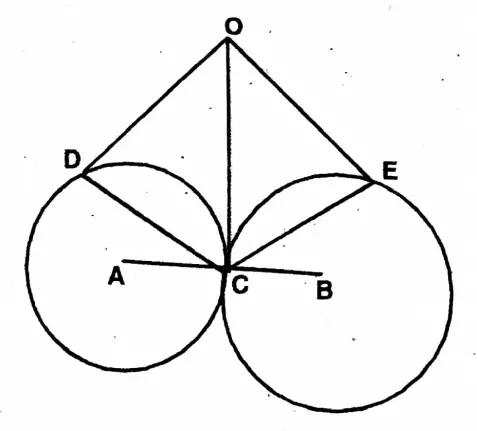
6. Two circles drawn with centres A and B touch each other externally at C. O is a point on the tangent drawn at C, OD and OE are tangents drawn to the two circles of centres A and B respectively. If ZCOD = 56°, ZCOE = 40°, ACD = x° and BCE = y°, let us prove that OD OC = OE and y – x = 8

Solution:

Given

Two circles drawn with centres A and B touch each other externally at C. O is a point on the tangent drawn at C, OD and OE are tangents drawn to the two circles of centres A and B respectively. If ZCOD = 56°, ZCOE = 40°, ACD = x° and BCE = y°

COD = 56°,

COE = 40°,

ACD = x°

& BCE = y°

To prove OD = OC = OE & y-x=8

Proof: OD & OC are two tangents to the circle with centre A at points D and C. 

∴ OD = OC & ∠ODC = ∠OCD

Again, OD & OE are two tangents of the circle with centre B at the points C & E 

∴ OC = OE & ∠OEC = ∠OCE

∴ OD = OC = OE

∠COD = 56° & ∠COE = 40° (given)

Let ∠ACD=x° & ∠BCE = y°

∴ ∠OCD = 180°-56°/2

= 124° / 2

= 62°

OC is the common tangent of the two circles & AB

is a straight line joining the centres?

∴ OC ⊥ AB

∴ ∠OCA = ∠OCB = 90°

∠ACD=90° – ∠OCD 90° = 62°- 28°.

∴ x = 28°

Again, ∠OCE= 180°-40° / 2

= 140°/2

= 70°

∠BCE = 90° – ∠OCE = 90°-70° 

= 20°

∴ y = 20°

∴ x – y = 28° -20° = 8 Proved.

WBBSE Solutions For Class 10 Maths Chapter 15 Theorems Related To Tangent Of A Circle 6

“WBBSE Class 10 Maths Exercise 15.2 Theorems Related to Tangent of a Circle problem solutions”

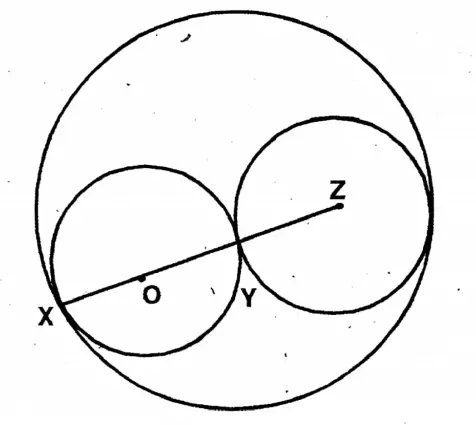
Question 7. Two circles with centres A and B touch each other internally. Another circle touches the larger circle externally at point x and the smaller circle externally at point y. If O is the centre of that circle, let us prove that AO+ BO is constant. 

Solution:

Given

Two circles with centres A and B touch each other internally. Another circle touches the larger circle externally at point x and the smaller circle externally at point y. If O is the centre of that circle

To prove AO+ BO = Constant

Join O, X, O, Y, O, A & Y, B

Two circles with centres A & B

The point of contact is on the line joining centres A &

centre B.

Again, the two circles with centre O & centre B, touch externally at Y.

Point Y is on the line joining YB.

Again, the two circles with centre O & A touch internally at X.

Point X is on the line joining OX.

Now, OA = AS – OX & OB = OY + YB

∴ AO+ BO = AX – OX + OY + YB 

= AX – OX + OX + YB.

AO + BO = AX + YB

= Constant Proved.

[as OX OY = radius of the circle with centre O & AX = Radius of the circle with centre A; YB = Radius of the circle with centre B.]

WBBSE Solutions For Class 10 Maths Chapter 15 Theorems Related To Tangent Of A Circle 7

Question 8. Two circles have been drawn with centres A and B which touch each other externally at the point O. I draw a straight line passing through point O which intersects the two circles at P and Q respectively. Let us prove that AP || BQ. 

Solution:

Given

Two circles have been drawn with centres A and B which touch each other externally at the point O. I draw a straight line passing through point O which intersects the two circles at P and Q respectively.

To prove AP || BQ.

Join A, P & B, Q

In ΔAOP, AO = AP (Radius)

∴ ΔAOP is an issoceles triangle. 

∴ ∠APO = ∠AOP

In ΔBOQ, BO = BQ (Radius) 

∴ ΔBOQ is an issoceles triangle.

∴ ∠BOQ = ∠QOB

Now, the two circles with centres A & B touch externally at O,

AB is the line joining their centres.

∴ ∠AOP = ∠BOQ (vertically opposite)

:. ∠APO = ∠BQO

PQ cuts AP & BQ at P & Q, & produces two equal angles.

∴ They are alternate angles.

∴ AP || BQ Proved.

WBBSE Solutions For Class 10 Maths Chapter 15 Theorems Related To Tangent Of A Circle 8

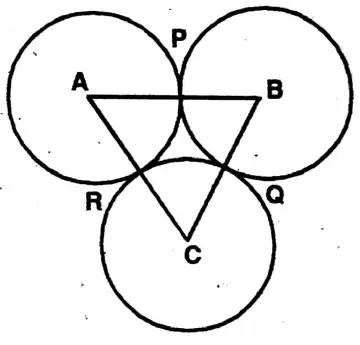
Question 9. Three equal circles touch one another externally. Let us prove that the centres of the three circles form an equilateral triangle.

Solution: Let the circles with centres A, B, and C touch externally at points P, Q and R. To prove ABC is an equilateral triangle.

Proof: Two circles with centres A & B touch each other at P.

∴ Point P is on the line, AB, joining the centre.

Similarly, point Q is on line BC & point R is on line CA.

As the radii of the three circles are equal, AP = PB = BQ = QC = CR + RA

∴ AP + PB = BQ + QC = CR + RA

i.e., AB = BC = CA

∴ ΔABC is an equilateral triangle.

WBBSE Solutions For Class 10 Maths Chapter 15 Theorems Related To Tangent Of A Circle 9

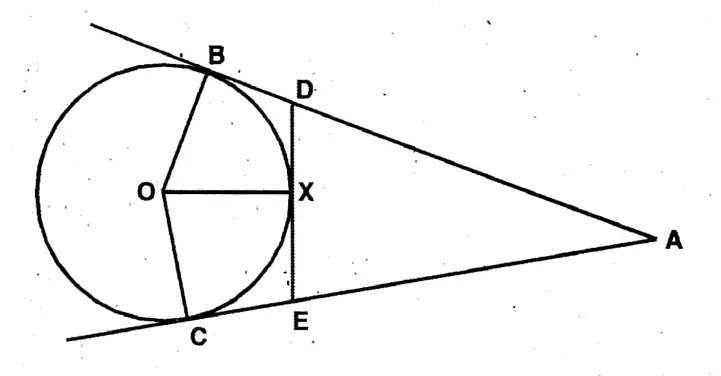
Question 10. Two tangents AB and AC drew from an external point A of a circle touch the circle at points B and C. A tangent drawn to point X lies on the minor arc BC intersects AB and AC at points D and E respectively. Let us prove which perimeter of AADE = 2AB.

Solution:

Given

Two tangents AB and AC drew from an external point A of a circle touch the circle at points B and C. A tangent drawn to point X lies on the minor arc BC intersects AB and AC at points D and E respectively.

To prove the perimeter of ΔADE = 2AB

Let O is the centre of the circle.

Join O,B, O,C, O,D & O,X In Quadrilateral OXDB

∠OBD = ∠OXD = 90°

∴ OXDB is a cyclic quadrilateral

whose OD is a diagonal?

Now in ΔOBD & ΔOXD,

1 OB = OX (Radii of the same circle)

2 OD common

& 3 ∠OBD = ∠OXD = 90°

∴ ΔOBD ≅ ΔOXD

∴ BD = DX

Similarly CE = XE

∴ (AD + DX) + (AE + EX) = (AD + BD) + (AE + CE)

AB+ AC = 2AB [∴ AB = AC]

Again, (AD + DX) + (AE + EX) AD+DE+ AE = Perimeter of ΔADE

∴ The perimeter of ΔADE = 2AB Proved.

WBBSE Solutions For Class 10 Maths Chapter 15 Theorems Related To Tangent Of A Circle 10

“Class 10 WBBSE Maths Exercise 15.2 Theorems Related to Tangent of a Circle step-by-step solutions”

Maths WBBSE Class 10 Solutions Chapter 15 Theorems Related To Tangent Of A Circle Exercise 15.2 Multiple Choice Question

Question 1. A tangent drawn to a circle with centre O from an external point A touches the circle at point B. If OB = 5 cm, AO 13 cm, then the length of AB is

1. 12 cm.
2. 13 cm.
3. 6.5 cm.
4. 6 cm.

Solution:

Given

A tangent drawn to a circle with centre O from an external point A touches the circle at point B. If OB = 5 cm, AO 13 cm

AB2 = AO2 – OB2 = 132 – 52

= 169-25

= 144

.. AB = 12 cm.

Answer. 1. 12 cm.

Question 2. Two circles touch each other externally at point C. A direct common tangent AB touches the two circles at points A and B. The value of ZACB is

1. 60°
2. 45°
3. 30°
4. 90°

Answer. 4. 90°


Question 2. The length of the radius of a circle with centre O is 5 cm. P is a point at a distance of 13 cm from point O. The length of two tangents are PO and PR from point P. The area of quadrilateral PQOR is

1. 60 sq cm.
2. 30 sq cm.
3. 120 sq cm.
4. 150 sq cm.

Solution:

Given

The length of the radius of a circle with centre O is 5 cm. P is a point at a distance of 13 cm from point O. The length of two tangents are PO and PR from point P.

Area of quadrilateral

= APQR + APOQ

=(1/2 x5x12) + (1/2 x 5 x 12) sqm.

= 60 sq cm.

Answer. 1. 60 sq cm.

“WBBSE Class 10 Chapter 15 Theorems Related to Tangent of a Circle Exercise 15.2 solution guide”

Question 4. The lengths of the radii of the two circles are 5 cm and 3 cm. The two circles touch each other externally. The distance between two centres of the two circles is

1. 2 cm.
2. 2.5 cm.
3. 1.5 cm.
4. 8 cm.

Solution:

Given

The lengths of the radii of the two circles are 5 cm and 3 cm. The two circles touch each other externally.

The distance between the centres

= Sum of their radii

= 5 cm + 3 cm = 8 cm

Answer. 4. 8 cm.

Question 5. The lengths of the radii of the two circles are 3.5 cm and 2 cm. The two circles touch each other internally. The distance between the centres of the two circles is

1. 5.5 cm.
2. 1 cm.
3. 1.5 cm.
4. None of these

Solution:

Given

The lengths of the radii of the two circles are 3.5 cm and 2 cm. The two circles touch each other internally.

The distance between the centres

= Difference between their radii

= (3.52) cm 

= 1.5 cm

Answer. 3. 1.5 cm.

Chapter 15 Theorems Related To Tangent Of A Circle Exercise 15.2 True Or False

1. P is a point inside a circle. Any tangent drawn on the circle does not pass through point P.

True

2. There are more than two tangents which can be drawn to a circle parallel to a fixed-line.

False

WBBSE Class 10 Maths Solutions Chapter 15 Theorems Related To Tangent Of A Circle Exercise 15.2 Fill In The Blanks


1. If a straight line intersects the circles at two points, then the straight line is called the Bisector of the circle.

2. If two circles do not intersect or touch each other, then the maximum number of common tangents that can be drawn is  4. (Four).

3. Two circles touch each other externally at point A. A common tangent drawn to the two circles at point A is a common Transverse tangent (direct/transverse)

Chapter 15 Theorems Related To Tangent Of A Circle Exercise 15.2 Short Answers

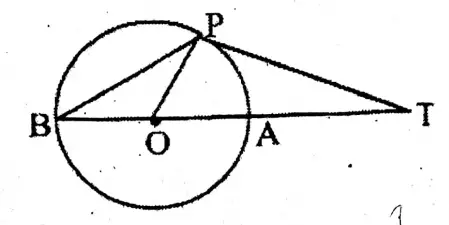
Question 1. In the adjoining figure, O is the centre and BOA is the diameter of the circle. A tangent drawn to a circle at point P intersects the extended BA at point T. If PBO is 30°, let us find the value of PTA.

Solution:

Given

In the adjoining figure, O is the centre and BOA is the diameter of the circle. A tangent drawn to a circle at point P intersects the extended BA at point T. If PBO is 30°,

∠PBO = 30°

∴ ∠BPO = 30°.

∴ ∠BPT = 90° +30° = 120°

∴ In ΔBPT, ∠BPT = 120°

∠PBO = 30°

∠PTA 180° (120° + 30°) = 30°

WBBSE Solutions For Class 10 Maths Chapter 15 Theorems Related To Tangent Of A Circle 11

WBBSE Solutions For Class 10 Maths Chapter 15 Theorems Related To Tangent Of A Circle 12

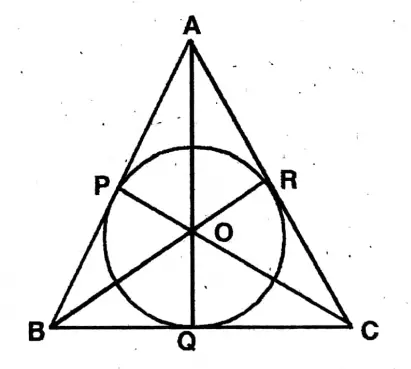
Question 2. In the adjoining figure, ABC circumscribed a circle and touches the circle at the points P, Q, R. If AP = 4 cm, BP = 6 cm, AC = 12 cm and BC = x cm, let us determine the value of x.

Solution.

Given

In the adjoining figure, ABC circumscribed a circle and touches the circle at the points P, Q, R. If AP = 4 cm, BP = 6 cm, AC = 12 cm and BC = x cm,

Join OP, OQ, OR & AO, BO, CO. 

AP = AR, BP = PQ, CQ = CR

∴ AR = 4 cm,

CQ = (10-4) cm

= 6 cm. 

BQ = 6 cm.

∴ x = BC = BQ + AC

= (6+6) cm 

= 12 cm.

WBBSE Solutions For Class 10 Maths Chapter 15 Theorems Related To Tangent Of A Circle 13

WBBSE Solutions For Class 10 Maths Chapter 15 Theorems Related To Tangent Of A Circle 14

Question 3. In the adjoining figure, three circles with centres A, B, and C touch one another externally. If AB = 5 cm, BC = 7 cm and CA = 6 cm, let us find the length of the radius of the circle with centre A.

Solution:

Given

In the adjoining figure, three circles with centres A, B, and C touch one another externally. If AB = 5 cm, BC = 7 cm and CA = 6 cm

AP = AB – BP

BP – BR =BC – CR

CR = CQ = AC – AQ

AP = AB – BC + CR

= AB- BC + AC – AQ

= AB+ AC (BC + AQ) 

= AB+ AC- (BC + AP)

AP + AP = AB+ AC – BC 

2AP=5+6-7=4

.: AP = 2 cm

∴ Length of the radius of the circle with centre A = 2 cm.

WBBSE Solutions For Class 10 Maths Chapter 15 Theorems Related To Tangent Of A Circle 15


WBBSE Solutions For Class 10 Maths Chapter 15 Theorems Related To Tangent Of A Circle 16

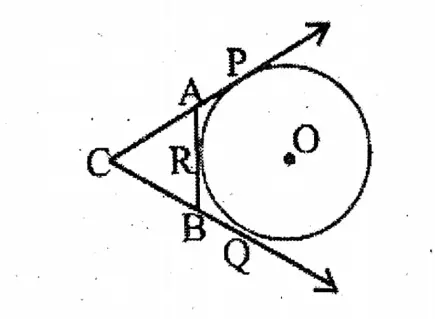
Question 4. In the adjoining figure, two tangents are drawn from external point C to a circle with centre O touch the circle at points P and Q respectively. A tangent drawn at another point R of a circle intersects CP and CA at points A and B respectively. If, CP is 11 cm. and BC= 7 cm, let us determine the length of BR.

Solution:

Given

In the adjoining figure, two tangents are drawn from external point C to a circle with centre O touch the circle at points P and Q respectively. A tangent drawn at another point R of a circle intersects CP and CA at points A and B respectively. If, CP is 11 cm. and BC= 7 cm

CP= CQ, CQ = 1 cm,

BQ = CQ- BC

= (11-7) cm = 4.cm.

Join R,Q

∴ From As BRD & ABQD

BR = BQ

∴ BR = 4 cm.

WBBSE Solutions For Class 10 Maths Chapter 15 Theorems Related To Tangent Of A Circle 17

WBBSE Solutions For Class 10 Maths Chapter 15 Theorems Related To Tangent Of A Circle 18

“West Bengal Board Class 10 Maths Exercise 15.2 Theorems Related to Tangent of a Circle solutions”

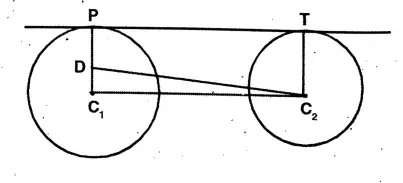
Question 5. The lengths of the radii of the two circles are 8 cm and 3 cm and the distance between their two centres is 13 cm. Let us find the length of a common tangent of two circles.

Solution: Let C1 & C2 are two centres of the two circles.

Radius of circle with center C1 = 8 cm,

& Radius of circle with center C2 = 3 cm.

PT is the common tangent

C1PC2T

Straight line from C2,

parallel to PT cuts C1P at D.

∴ PDC2 T is a parallelogram.

DP = C2T

& C2D = PT.

C1D = 8 – DP

= 8 – 3

= 5

∠DPT = 90°

∴ ∠C1D2 = 90°

\(\mathrm{DC}_2{ }^2=\mathrm{C}_1 \dot{\mathrm{C}}^2-\mathrm{C}_1 \mathrm{D}^2\)

= 13^2-5^2

= 12^2

∴ DC2 = PT = 12 cm.


WBBSE Solutions For Class 10 Maths Chapter 15 Theorems Related To Tangent Of A Circle 20

WBBSE Solutions For Class 10 Maths Chapter 15 Theorems Related To Tangent Of A Circle Exercise 15.1

Maths WBBSE Class 10 Solutions Chapter 15 Theorems Related To Tangent Of A Circle Exercise 15.1

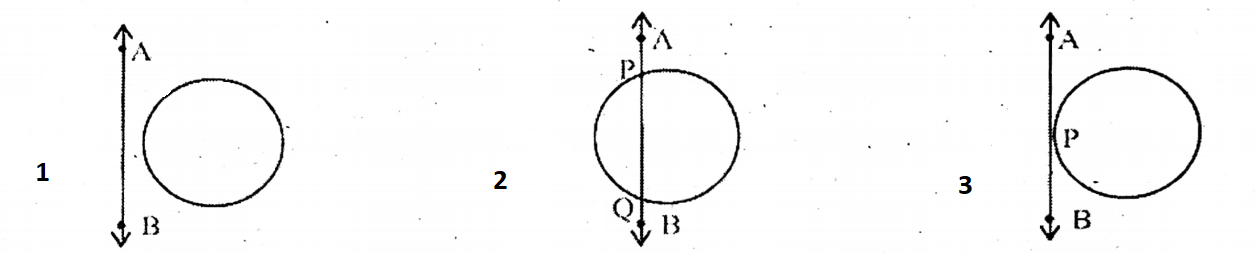
Question 1. But in no. 3 in what position are the stick AB and the circular ring? 

Solution: The stick AB touches the circular ring at point P. Like me, my friend Sumedha similarly drew in what positions a straight line and a circular ring can be to each other in her copy. We see, in picture no. 1 straight line AB does not intersect the circle. Again, in picture no. 2 the straight line AB intersects the circle at points P and Q.

Read and Learn More WBBSE Solutions For Class 10 Maths

Question 2. But in pictures no. 2 and 3 what is this straight line AB of the circle called? 

Solution: In picture no. 2 AB is a secant of a circle and PQ is a corresponding chord of secant AB. We see that in picture no 3 the common point of circle and straight line AB is P.

∴ The straight line AB touches the circle at point P.

“WBBSE Class 10 Maths Theorems Related to Tangent of a Circle Exercise 15.1 solutions”

Question 3. But in picture no. 3 what is the straight line AB of the circle called?

Solution: In picture no. 3 the straight line AB of the circle is called a tangent.

WBBSE Solutions For Class 10 Maths Chapter 15 Theorems Related To Tangent Of A Circle 1

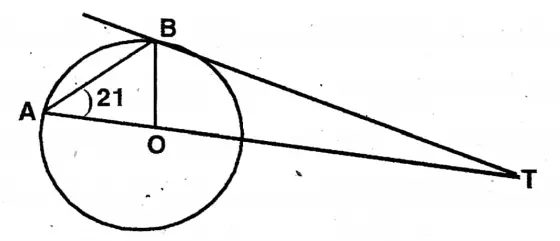
Question 4. Masum has drawn a circle with a center ‘O’, of which AB is a chord. I draw a tangent at point B which intersects extended AO at point T. If ∠BAT = 21°, let us write by calculating the value of BTA.

Solution:

Given

Masum has drawn a circle with a center ‘O’, of which AB is a chord. I draw a tangent at point B which intersects extended AO at point T. If ∠BAT = 21°,

∠TOB = ∠BAT + ∠ABO

=2∠BAT = 42°

Again in ΔBOT, ∠OBT = 90°

∴∠BTO = 180° (∠TOB + ∠OBT)

180°- (90° 42°) = 38°

The value of BTA = 38°

WBBSE Solutions For Class 10 Maths Chapter 15 Theorems Related To Tangent Of A Circle 2


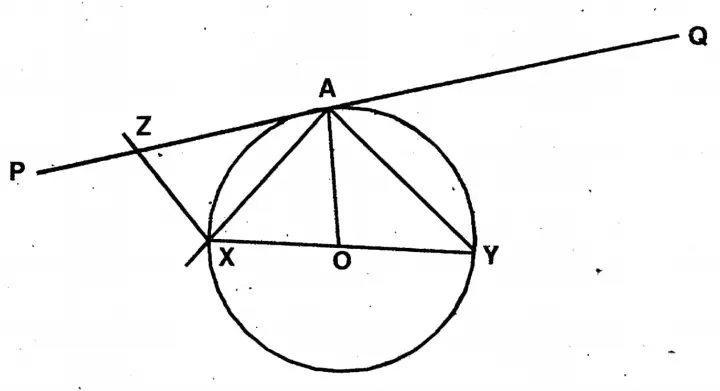
Question 5. XY is a diameter of a circle. PAQ is tangent to the circle at the point ‘A’ lying on the circumference. The perpendicular drawn on the tangent of the circle from X intersects PAQ at Z. Let us prove that XY is a bisector of ∠YXZ.

Solution:

Given

XY is a diameter of a circle. PAQ is tangent to the circle at the point ‘A’ lying on the circumference. The perpendicular drawn on the tangent of the circle from X intersects PAQ at Z.

Let O is the center of the circle.

Joint A, O as PAQ is a tangent. 

∴∠OAZ = 90°

Again, ∠OAZ = ∠OAX + ∠AZX     [AOAX isosceles Δ ]

∠OAX = ∠OXA 

∴ 90° =  ∠OXA + ∠ZAX

& 90° =  ∠ZAX + ∠ZXA

∴ ∠OXA + ∠ZAX = ∠ZAX + ∠ZXA

or, ∠OXA = ∠ZXA

∴ XA is the bisector of ∠YXZ.

WBBSE Solutions For Class 10 Maths Chapter 15 Theorems Related To Tangent Of A Circle 3

“West Bengal Board Class 10 Maths Chapter 15 Theorems Related to Tangent of a Circle Exercise 15.1 solutions”

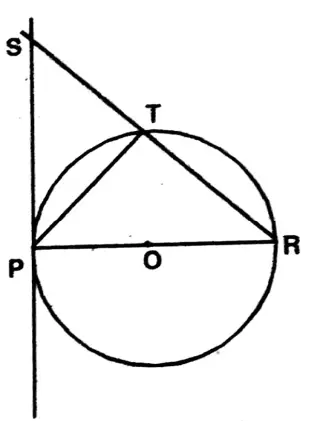
Question 5. I drew a circle having PR as a diameter. I draw a tangent at point P and point S is taken on the tangent of the circle in such a way that PR = PS. If RS intersects the circle at point T, let us prove that ST = RT = PT.

Solution:

Given

I drew a circle having PR as a diameter. I draw a tangent at point P and point S is taken on the tangent of the circle in such a way that PR = PS. If RS intersects the circle at point T

As ∠PTR is a semicircle angle.

∴ ∠PTR = ∠TSP + ∠TPS

Again, 90° = ∠TSP + ∠RPT

∴∠TSP =∠RPT

1 TSP = ZRPT; 

2 PR PS & 

3 PT is common.

.. APTS == APTR

.. ST = PT Proved.

WBBSE Solutions For Class 10 Maths Chapter 15 Theorems Related To Tangent Of A Circle 4


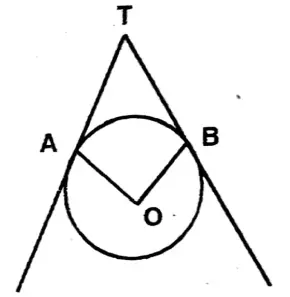
Question 6. Two radii OA and OB of a circle with center O are perpendicular to each other. If two tangents drawn at the points A and B intersect each other at point T, let us prove that AB = OT and they bisect each other at a right angle.

Solution:

Given

Two radii OA and OB of a circle with center O are perpendicular to each other. If two tangents drawn at the points A and B intersect each other at point T

Let O be the center of the circle.

In quadrilateral ΔOBT, AO = OB

& ∠AOB = ∠TAO = ∠TBO = 90°

Class 10 Maths Class 10 Social Science
Class 10 English Class 10 Maths
Class 10 Geography Class 10 Geography MCQs
Class 10 History Class 10 History MCQs
Class 10 Life Science Class 10 Science VSAQS
Class 10 Physical Science Class 10 Science SAQs

∴ ΔOBT is a square.

∴ Diagonal AB = OT.

They bisect each other perpendicularly.

WBBSE Solutions For Class 10 Maths Chapter 15 Theorems Related To Tangent Of A Circle 5

Question 7. Two chords AB and AC of the larger of two concentric circles touch the other circle at points P and Q respectively. Let us prove that PQ = 1/2 BC

Solution:

Given

Two chords AB and AC of the larger of two concentric circles touch the other circle at points P and Q respectively.

Let O be the center of two concentric circles. 

AB & AC the two chords of the big circle are the tangents of the small circles. 

Join A, O; B, O; C, O.

∴ AO = CO (Radius)

Again, OQ ⊥ AC

∴ AQ = QC.

Similarly, AP = PB.

∴ In ΔABC, P & Q are the midpoints of AB & AC.

∴ PQ = 1/2 BC.

WBBSE Solutions For Class 10 Maths Chapter 15 Theorems Related To Tangent Of A Circle 6

“WBBSE Class 10 Theorems Related to Tangent of a Circle Exercise 15.1 solutions explained”

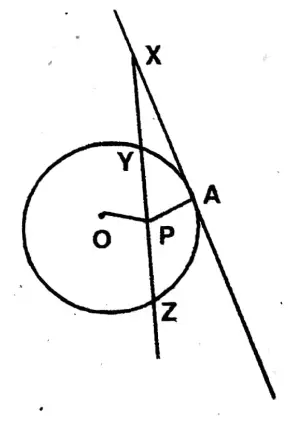
Question 8. X is a point on the tangent at the point A lies on a circle with center O. A secant drawn from a point X intersects the circle at the points Y and Z. If P is a mid-point of YZ, let us prove that XAPO or XAOP is a cyclic quadrilateral.

Solution:

Given

X is a point on the tangent at the point A lies on a circle with center O. A secant drawn from a point X intersects the circle at the points Y and Z. If P is a mid-point of YZ,

YZ is a chord of the circle. P is the midpoint of YZ.

∴ OP ⊥ YZ

Again, XA is a tangent at A.

∴ AO ⊥ XY.

∴ In the Quadrilateral XAPO,

∠OAX & ∠XPO are equal = 90°

∴ XAPO is a cyclic quadrilateral whose XO is a diameter.

WBBSE Solutions For Class 10 Maths Chapter 15 Theorems Related To Tangent Of A Circle 7

Question 9. P is any point on the diameter of a circle with center O. A perpendicular drawn on diameter at the point O intersects the circle at the point Q. Extended QP intersects the circle at the point R. A tangent drawn at the point R intersects extended OP at the point S. Let us prove that SP = SR.

Solution:

Given:

P is any point on the diameter of a circle with center O. A perpendicular drawn on diameter at the point O intersects the circle at the point Q. Extended QP intersects the circle at the point R. A tangent drawn at the point R intersects extended OP at the point S.

∠ORP + <PRS = 90°

or, ∠OQP+∠QQP = 90°

∴ ∠ORP = ∠OQP [as OQ = OR]

∴ ∠PRS = ∠QQP—–(1)

∴∠OPQ = ∠SPR——–(2) (Vertically opposite)

Again, ∠OPQ + ∠OQP = 90°

& ∠OQP+ ∠PQQ, = 90°

:. ∠OPQ = ∠PQQ,

∴ ∠SPR = ∠PRS

∴ Aln SPR, SP = SR Proved.

WBBSE Solutions For Class 10 Maths Chapter 15 Theorems Related To Tangent Of A Circle 8

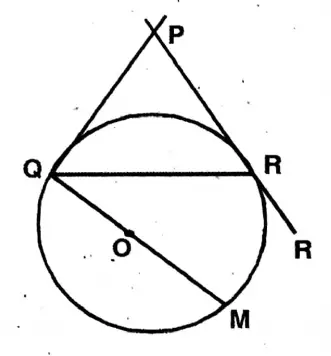
Question 10. Rumela drew a circle with center O, of which QR is a chord. Two tangents drawn at points Q and R intersect each other at point P. If QM is a diameter, let us prove that ZQPR = 2 ZRQM.

Solution:

Given

Rumela drew a circle with center O, of which QR is a chord. Two tangents drawn at points Q and R intersect each other at point P. If QM is a diameter

In Quadrilateral PQOR, ∠PQO = ∠PRO = 90°

∴ Opposite angles of the Quadrilateral PQOR are supplementary.

∴ PQOR is a cyclic quadrilateral whose ∠ORP = 90°. 

∴ PQOR is a square (OQ = OR).

∴∠ROQ 90° = ∠QPR.

& Aln QOR, OQ = OR.

∴∠RQM = 45°

∴ ∠OPR – 2 ∠RQM. Proved.

WBBSE Solutions For Class 10 Maths Chapter 15 Theorems Related To Tangent Of A Circle 9

Question 11. Two chords AC and BD of a circle intersect each other at point O. If two tangents drawn at points A and B intersect each other at the point P and two tangents drawn at points C and D intersect at the point Q, let us prove that ZP + ZQ = 22BOC.

Solution:

Given

Two chords AC and BD of a circle intersect each other at point O. If two tangents drawn at points A and B intersect each other at point P and two tangents drawn at points C and D intersect at point Q

Let ‘R’ be the center.

∴ ΔRBP is a cyclic quadrilateral.

∴ ∠A + ∠B 180°

∴ ∠ARB + ∠P = 180°

∴ ∠ARB = 2∠ACB

∴ 2∠ARB + P = 180°——(1)

Similarly, 2∠DAO + ∠Q = 180°

or, 2∠CBO + ∠Q = 180°——-(2)

∴ 2∠ACB + 2∠CBO + ∠P + Q = 360°

Adding (1) & (2),

<P+Q = 2 [180 – (∠ACB + <CBO)]

∴∠P + ∠Q = 2∠BOC.

WBBSE Solutions For Class 10 Maths Chapter 15 Theorems Related To Tangent Of A Circle Exercise 15.1

1. We take three colored cardboard.

2. Drawing three circles with the same measures with center O on white paper cut off the circular region and paste them on this colored paper.

WBBSE Solutions For Class 10 Maths Chapter 15 Theorems Related To Tangent Of A Circle 10


Solution: We see that in picture no. 1, i.e., two tangents can be drawn to a circle from any point outside it.

In no: 2 i.e., one tangent can be drawn to a circle from a point lying on the circle.
We understand that, from any  WBBSE Solutions For Class 10 Maths Chapter 15 Theorems Related To Tangent Of A Circle 11   [interior/external] point, no tangent can be drawn to the circle.
Answer. Interior.

“WBBSE Class 10 Maths Exercise 15.1 Theorems Related to Tangent of a Circle problem solutions”

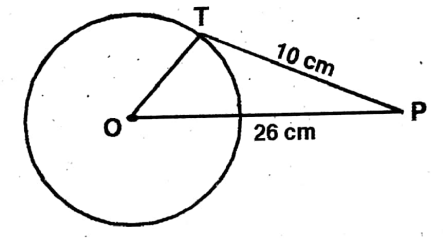
Application 1. If I draw a circle with center O, point P is 26 cm. away from the center of the circle and the length of the tangent drawn from point P to the circle is. 10 cm, let us write by calculating the length of the radius of the circle.
Solution:

Given

If I draw a circle with center O, point P is 26 cm. away from the center of the circle and the length of the tangent drawn from point P to the circle is. 10 cm,

PT = 10 cm., PO= 26 cm.

From right-angle triangle POT, we get,

PO² = PT²+ OT² [we get from Pythagoras theorem]

.. (26cm)² (10cm)² + PT²

or, OT² (26cm)²- (10cm)²= 576 cm.

.. OT = 24 cm.

The length of the radius of the circle = 24 cm.

WBBSE Solutions For Class 10 Maths Chapter 15 Theorems Related To Tangent Of A Circle 12

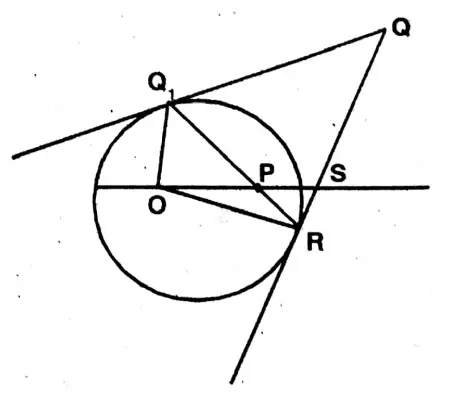
Question 12. Let us prove that the line segment joining a point outside a circle and the center bisects the angle included by two tangents drawn from the external point.

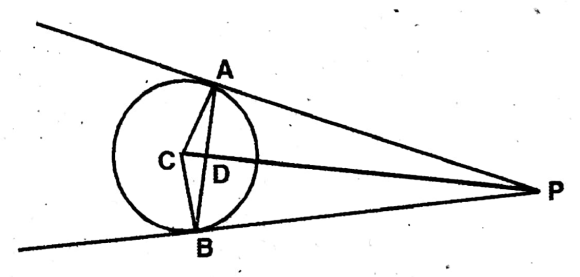
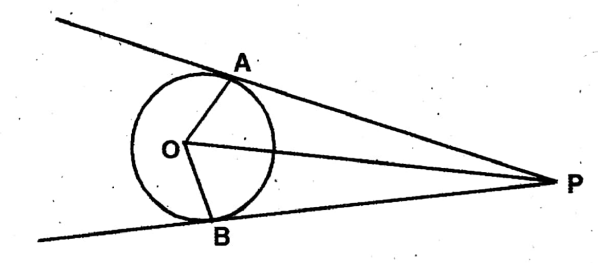
Solution: O is the center of the circle and two tangents PA & PB are drawn from the external point P.

Join O,A & O,B; O,P

In ΔAOP & ΔBOP

OA = OB; OP common

& ∠OAP ∠OBP common

∴ΔΟΑΡ ≅ ΔΟΒΡ

∴ ∠APO

∴∠BPO.

WBBSE Solutions For Class 10 Maths Chapter 15 Theorems Related To Tangent Of A Circle 13

Question 13. Let us prove that the bisector of an angle includes two tangents to a circle from a point outside it passes through the center.

Solution: Let O be the center of the circle and two tangents PA & PB are drawn from the external point P.

Join O, A, O, B & A, B.

PD, the bisector of ∠P, cuts AB at D.

∠OAP = ∠OBP = 90°

or, ∠OAD + ∠DAP = ∠OBD + ∠DBP

∠DAP = DBP

Now in ΔABD & ΔBPD,

1 ∠APD = ∠BPD, 

2 ∠DAP = ∠DBP

3 DP is common

∴ ΔAPD ≅ ΔBPD

∴ AD – BD & ∠ADP = BDP = 90°

Again, inΔOAD & ΔOBD, 

1 OA = OB; 

2 ∠OAD = ∠OBD; 

3 AD = BD. 

∴ΔOAD ≅ ΔOBD

∴ ∠ODA = ∠ODB = 90°

∴ AB ⊥OD & AB ⊥ PD

∴ Produced PD will pass through the center. Proved.

WBBSE Solutions For Class 10 Maths Chapter 15 Theorems Related To Tangent Of A Circle 14

Question 14. Let us prove that if two tangents drawn to a circle at two points it intersect each other, then the lengths of the line segments from the point of intersection to the points of contact are equal.

Solution: Let P & Q be two points on a circle with center O. 

Two tangents drawn at P & Q intersect each other at A. 

To prove AP = AQ.

Joint O, P, O, Q & O, R In AAOQ & AAOP,

1 OP = OQ; OA common & ZAPO = ZBQP = 90° 

∴ ΔAOP ≅ ΔAOQ

∴ AP = AQ Proved.

WBBSE Solutions For Class 10 Maths Chapter 15 Theorems Related To Tangent Of A Circle 15

“Class 10 WBBSE Maths Exercise 15.1 Theorems Related to Tangent of a Circle step-by-step solutions”

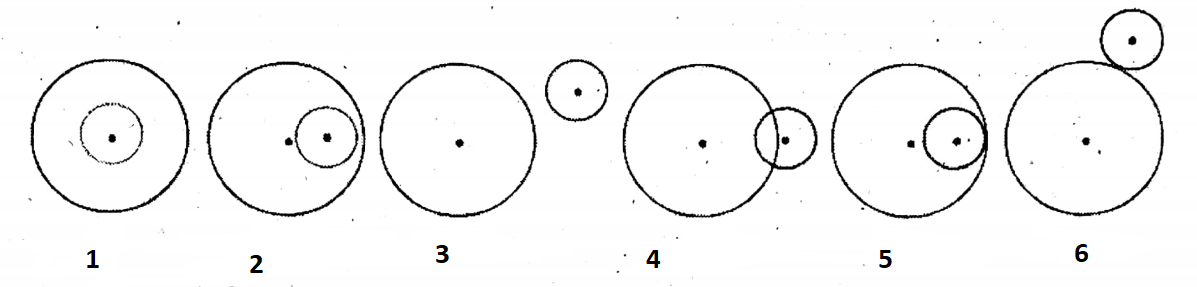
Question 15. I see the position of circular rings as being put by Rabeya and let us see the different positions of rings.

Solution: We see that in picture no. 1 two circles are concentric but in picture no. 2 two circles are not concentric, in picture no. 3 two circles do not intersect each other, in picture no. 4 the two circles intersect each other at two points.

WBBSE Solutions For Class 10 Maths Chapter 15 Theorems Related To Tangent Of A Circle 16

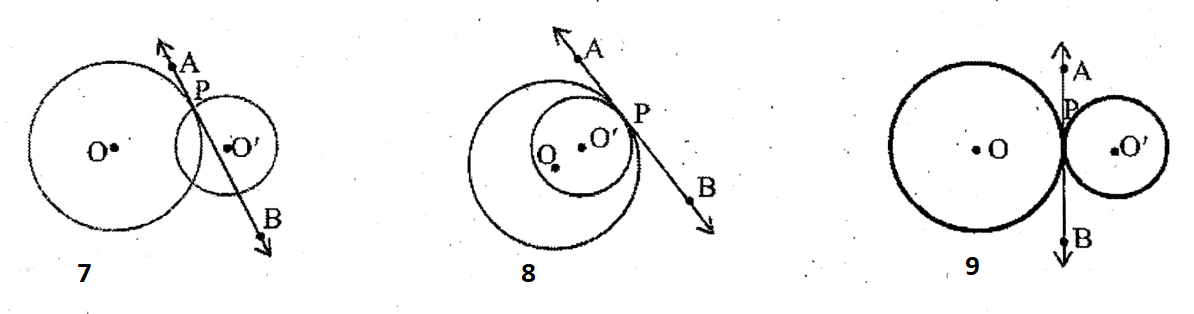
Question 16. How shall we understand that two circles touch each other?

Solution: There is only one intersecting point P. of two circles with center O and O’s in the same plane and if the tangent of a circle with center O touches the circle with center O’ at that point, then it is called the two circles touch each other at the point P. In picture no. 7 two circles do not touch each other.

In picture no. 7 and 9 two circles touch each other. In picture no. 7 two circles touch internally each other at the point P. AB is a common tangent of two circles. Again, in picture no. 9 two circles touch externally each other at point P. AB is a common tangent of the two circles.

WBBSE Solutions For Class 10 Maths Chapter 15 Theorems Related To Tangent Of A Circle 17

Question 17. But sometimes we see that the two circles are situated on the same side of the common tangents, again other times the two circles are situated on the opposite sides of the common tangents. What is this type of tangent called?

Solution:
If two circles lie on the same side of a common tangent the tangent, is said to be a direct common tangent and if two circles lie on the opposite sides of a common tangent, the common tangent is said to be a transverse common tangent.
We understand that the tangents of pictures no. 10 and 11 are direct common tangents. But in picture no. 12 there are two direct common tangents and 1 transverse common tangent. Again in picture no. 13, there are two direct common tangents and two transverse common tangents.

“WBBSE Class 10 Chapter 15 Theorems Related to Tangent of a Circle Exercise 15.1 solution guide”


Question 18. Let us prove with the reason that if two circles touch each other, the straight line through the center of one circle and the point of constant passes through the center of another circle. 

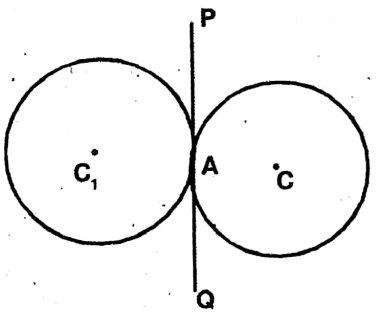
Solution: Let two circles with centers C1 & C2 touch each other at A externally,

PQ is a common tangent passing through A;

Join A, C1 & A, C2

C1APQ & C2APQ

∴ PAC1 = PA2C2 = 90°

∴ C1AC2 = 180°

∴ C1C2 straight line, passing through A.

In the picture beside, PQ = AP + AQ.

WBBSE Solutions For Class 10 Maths Chapter 15 Theorems Related To Tangent Of A Circle 18


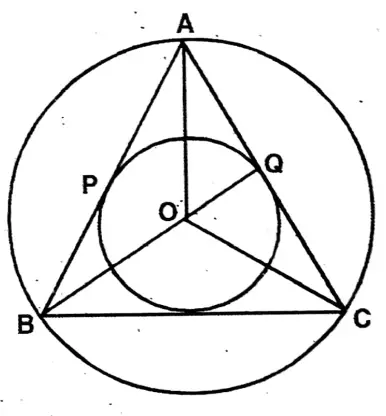
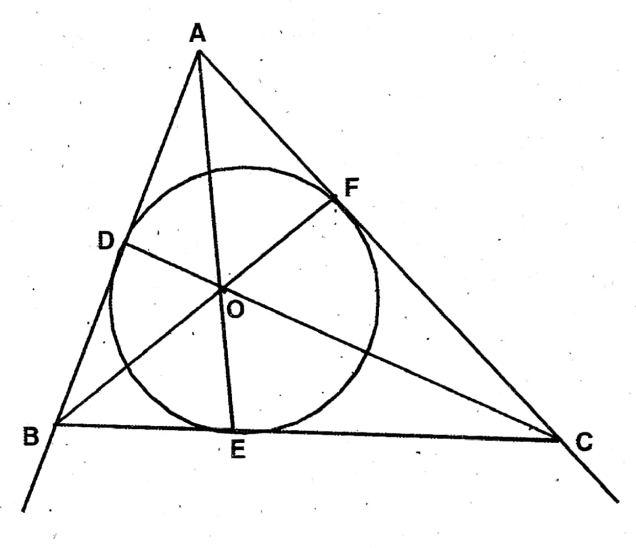
Application 1. In the adjoining figure, the incircle of AABC touches the sides AB, BC, and CA at points D, E, and F respectively. Let us prove that AD + BE + CF = AF + CE + BD = 1/2 (perimeter of AABC)

Solution:

Given

In the adjoining figure, the incircle of AABC touches the sides AB, BC, and CA at points D, E, and F respectively.

Join A, O; B, O; C, O.

In ΔBOD & ΔBOE,

1 ∠BDO = <BED

2 OD = OE (Radius)

3 OB is common

∴ ΔBOD ≅ ΔBOE,

∴ BD-BE———(1)

Similarly, from ΔCOE & ΔCOF, CE = CF———– (ii)

Similarly, from ΔAOD & ΔAOF, AF = AD—-—-(iii)

Adding (1), (2) & (3),

AD + BE + CF = AF+ CE + BD

Perimeter of AABC

= AB + BC + CA

= AD + BD + BE+ CE+ CF + AF

= 2(AD + BE + CF)

∴ AD + BE + CF = AF + CE + BD = 1/2 (AB + BC + CA)

= 1/2 of the perimeter of AABC Proved.

WBBSE Solutions For Class 10 Maths Chapter 15 Theorems Related To Tangent Of A Circle 19

WBBSE Solutions For Class 10 Maths Chapter 19 Real Life Problems Related To Different Solid Objects Exercise 19.1

West Bengal Board Class 10 Math Book Solution In English
Chapter 19 Real-Life Problems Related To Different Solid Objects Exercise 19.1

Application 1. But if the length of the outer diameter of a hollow iron cylinder with a height of 25 cm is 14 cm and the length of its inner diameter of it is 10 cm and if by melting the cylinder, a solid right circular cone having half of its height is made, then let us determine the length of the base diameter of the cone.

Solution:

Given

The length of the outer diameter of a hollow iron cylinder with a height of 25 cm is 14 cm and the length of its inner diameter of it is 10 cm and if by melting the cylinder, a solid right circular cone having half of its height is made

The length of the outer radius of the hollows cylinder (R) = 14/2 cm = 7 cm

the length of the inner radius (r) = 10/2 cm = 5cm,

and the height of the cylinder = 25cm.

∴ The quantity of iron in the cylinder =  π(R² – r²). 

height = (7² – 5²) x 25 cm3

=π x 24 x 25 cm3

The height of the solid cone =  25/2 cm.

Read and Learn More WBBSE Solutions For Class 10 Maths

Let the length of the base radius of the cone = r cm.

According, to the condition, 1/3  π x r² x 25/2 =  π x 24 25

r² = 24 x 2 x 3 = 144

∴ r = ±12

Class 10 Maths Class 10 Social Science
Class 10 English Class 10 Maths
Class 10 Geography Class 10 Geography MCQs
Class 10 History Class 10 History MCQs
Class 10 Life Science Class 10 Science VSAQS
Class 10 Physical Science Class 10 Science SAQs

But the length of the radius can not be negative.

∴ r-12, so, r = 12

∴ The base diameter of the cone = 2 x r cm. = 24 cm.

“WBBSE Class 10 Maths Real Life Problems Related to Different Solid Objects Exercise 19.1 solutions”

Application 2. The length of the external diameter of the face of a hemispherical bowl made of the silver sheet is 8 cm and the length of the internal diameter of it is 4 cm. By melting the bowl a solid cone is made whose diameter is 8 cm in length. Let us O calculate the height of the cone. 

Solution:

Given

The length of the external diameter of the face of a hemispherical bowl made of the silver sheet is 8 cm and the length of the internal diameter of it is 4 cm. By melting the bowl a solid cone is made whose diameter is 8 cm in length.

External radius of the hemispherical bowl = 8/2 cm = 4 cm.

& Internal radius of the hemispherical bowl = 4/2 cm = 2 cm.

The radius of the base of the solid cone = 8/2 cm = 4cm

Let the height of the cone = h cm.

According to the problem, the volume of the cone = Volume of the hemispherical bowl.

or, 1/3  π x (4)² x h = 2/3 π x (4³-2³)

= 1/3 π x 16 x h = 2/3 x π x (34-8)

16h = 2 x 56

∴ h = 2×56 / 16

= 7

∴ height of the cone = 7 cm.

Application 3. There is some water in the right circular drum. A conical iron piece having a diameter of 2.8 dcm and a height of 3 dcm is immersed completely in this water. For this, the water level of the drum is raised by 0.64 dcm. Let us determine the base diameter of the drum.

Solution:

Given

There is some water in the right circular drum. A conical iron piece having a diameter of 2.8 dcm and a height of 3 dcm is immersed completely in this water. For this, the water level of the drum is raised by 0.64 dcm.

The length of the base radius of the cone = 28/2 dcm = 1.4 dcm

and height= 3 dcm.

∴ Volume of the cone = 1/3 π x (1.4)² x 3 dcm³

Let the length of the base radius of the drum be r dcm.

For immersing the conical iron piece into the water of the drum, the water level is raised by 0.64 dcm.

∴ The volume of increased water in the drum = Volume of the conical iron piece.

∴ πr² x 0.64 = (1.4)² x 3 or, r² = ± 1.4×1.4/0.64

or, r± 3.0625

But the length of the radius can not be negative.    ∴ r= -3.0625

∴ r = 3.0625

∴ The length of the base diameter of the drum = 2 x 3.0625 

= 6.125 dcm.

The length of the base diameter of the drum = 6.125 dcm.

“West Bengal Board Class 10 Maths Chapter 19 Real Life Problems Related to Different Solid Objects Exercise 19.1 solutions”

Application 4. There is some water in the right circular cylinder with a diameter of 28 cm. Three solid iron spheres can be immersed completely into it. After immersing the spheres, the height of the water level is increased by 7 cm than it was before the immersion of the spheres into water. Let us determine the length of the diameter of the spheres.

Solution:

Given

There is some water in the right circular cylinder with a diameter of 28 cm. Three solid iron spheres can be immersed completely into it. After immersing the spheres, the height of the water level is increased by 7 cm than it was before the immersion of the spheres into water.

Let the radius of the sphere = r cm.

∴ The volume of the 3 spheres = 3 x 4/3 πr³ cu cm.

The radius of the base of the cylinder = 28/2 cm = 14 cm.

After immersing the spheres, the height of the water level is increased by 7 cm. 

∴ The volume of the 3 spheres volume of increased water in the cylinder

3 x 4/3 πr³ = π x 14 x14x7

∴ r³=7x7x7

∴ The diameter of each sphere = 2 x 7 cm = 14 cm.

∴ r=7

The length of the diameter of the spheres. = 14 cm.

WBBSE Solutions For Class 10 Maths Chapter 19 Real Life Problems Related To Different Solid Objects Exercise 19.1

Application 5. If recasting a solid metallic sphere of radius 2.1 cm into a right circular rod, then let us write by calculating, the length of diameter of the rod. 

Solution:

Given

If recasting a solid metallic sphere of radius 2.1 cm into a right circular rod,

Let us determine the ratio of total surface areas of the rod and sphere.

Let the length of the right circular rod be r cm.

According to the condition, r² x7 = 4/3π x (21)³ [ 2.1 dcm = 21 cm]

r² = 4/3 x 21x21x21/7       or, r = ±42

so, r ≠  -42

∴ r = +42

∴ The length of the radius of the rod is 42 cm.

∴ The length of diameter of the rod is 84cm.

∴ The ratio of total surface areas of the rod and the sphere is = 1: 3696.

Question 1. There is a solid iron pillar in front of Anowar’s house whose lower portion is right circular cylinder shaped and upper portion is cone shaped. The length of their base diameter is 20 cm, the height of the cylindrical portion is 2.8 m and the height of the conical portion is 42 cm. If the weight of 1 cm3 iron is 7.2 gm, then let us calculate the weight of the iron pillar.

Solution:

Given

There is a solid iron pillar in front of Anowar’s house whose lower portion is right circular cylinder shaped and upper portion is cone shaped. The length of their base diameter is 20 cm, the height of the cylindrical portion is 2.8 m and the height of the conical portion is 42 cm. If the weight of 1 cm3 iron is 7.2 gm,

Radius of the base of solid iron sphere = 20/2 cm = 10 cm

Height of the cylindrical portion = 2.8m = 280 cm. 

∴ The volume of the cylindrical portion = лr²h cu cm.

= 22/7 x 10 x 10 x 280 cu cm = 88000 cu cm.

& Volume of the conical portion = 1/3 лr2h cu cm.

= 1/3 x 22/7 x 10 x 10 x 42 cu cm = 4400 cu cm.

∴ The total volume of the iron pillar = (88000+ 4400) cu cm. 

= 92400 cu cm.

The total volume of the iron pillar = 92400 cu cm.

Question 2. The height of a solid right circular cone is 20 cm. and its slant height is 25 cm. If the height of a solid right circular cylinder, having as much volume as that of the cone, is 15 cm., then let us calculate the base diameter of the cylinder.

Solution:

Given

The height of a solid right circular cone is 20 cm. and its slant height is 25 cm. If the height of a solid right circular cylinder, having as much volume as that of the cone, is 15 cm

Let the radius of the base of the cone = r1 cm

∴ \((\text { Slant height })^2=(\text { radius })^2+(\text { height })^2\)

or, \((25)^2=r_1^2+(20)^2\)

or, \(r_1{ }^2=625-400=225\)

∴ \(r_1=\sqrt{225}=15\)

∴ Volume of the cone = \(\frac{1}{3} \pi r_2^2 \times \text { height }\)

= \(\frac{1}{3} \times \pi \times 15 \times 15 \times 20 \mathrm{cucm}\)

Again let the radius of the base of the cylinder = r2 cm

∴ Volume of the cone = \(\pi r_2^2 \times \text { height }\)

∴ According to the problem,

\(\frac{1}{3} \times \pi \times 15 \times 15 \times 20=\pi \times r^2 \times 15\)  [As height of the cylinder = 15 cm].

\(r_2{ }^2=100\)

∴ \(r_2=\sqrt{100}=10\)

∴ Diameter of the base of the cylinder = 2r2 = 2 x 10 cm = 20 cm.

“WBBSE Class 10 Real Life Problems Related to Different Solid Objects Exercise 19.1 solutions explained”

Question 3. There is some water in the right circular cylindrical can with a diameter of 24 cm. If 60 solid conical iron pieces with a base diameter of 6 cm and height of 4 cm are immersed completely in the water, then let us write by calculating, the increased height of the water level.

Solution:

Given

There is some water in the right circular cylindrical can with a diameter of 24 cm. If 60 solid conical iron pieces with a base diameter of 6 cm and height of 4 cm are immersed completely in the water,

Radius of the base of the cone = 6/2 cm = 3cm.

Volume of 60 cones = 60 xπ (3)² x 4 cu cm.

Let after immersing the cones, the height of water in the cylinder increased by h cm.

∴ The volume of increased water in the cylinder = (Tr²h)

∴ According to the problem,

The volume of increased water = Volume of 60 cones

π x 12 x 12 x h = 60×1/3π×3×3×4

∴ h= 60×3×4 / 12×12

= 5

∴ Increased height of water = 5 cm.

Question 4. If the ratio of the curved surface areas of a solid cone and a solid right circular cylinder having the same base radii and same height is 5: 8, then let us determine the ratio of their base radii and heights.

Solution:

Given

If the ratio of the curved surface areas of a solid cone and a solid right circular cylinder having the same base radii and same height is 5: 8

Let the height & radius of the base of the cone be h units & r units respectively.

∴ Slant height (l) = √h² +2 units.

∴ Area of the curved surface of cone = πrl = πr(h² + r²) sq units.

Area of the curved surface of cylinder = 2лrh where, height

& radius of the base of the cylinder = h & r respectively

πrx √h²+r²/ 2πrh = 5/8

∴ √h² +r² = 5/8

or,h² +r² /2h = 25/16

Or,1 + r²/h² = 25/16

r²/h² = 25/16 – 1

= 25-16 / 16

= 9/16

∴ r/h = √9/16

= 3/4

∴The ratio of the radius of base: height = 3: 4.

“WBBSE Class 10 Maths Exercise 19.1 Real Life Problems Related to Different Solid Objects problem solutions”

Question 5. By melting a solid iron sphere with 8 cm of radius, how many marble balls of 1 cm diameter can be obtained let us write by calculating it.

Solution: Volume of the sphere of radius 8 cm = 4/3 π (8)³

= 4/3 π x 8 x 8 x 8 cu cm.

Now the radius of a small (marble) sphere = 1/2 cm.

The volume of marble balls = 4/3 π(1/2)³

= 4/3π x 1/2 x 1/2 x 1/2 cu cm.

∴ Number of marble balls = 4/3π x 8 x 8 x 8 / 4/3π x 1/2 x 1/2 x 1/2 

= 8 x 2 x 8 x 2 x 8 x 2

= 4096.

Number of marble balls = 4096.

Question 6. The base radius of a solid right circular iron rod is 32 cm and its length is 35 cm. Let us calculate the number of solid cones of 8 cm radius and 28 cm height that can be made by melting this rod.

Solution:

Given

The base radius of a solid right circular iron rod is 32 cm and its length is 35 cm.

Let the number of cones to be made = n

∴ Volume of n cones = n x 1/3 π²h

=n x 1/3 π (8)² x 28 cu cm.  [Since radius = 8 cm & height = 28 cm.]

Again volume of a big cylinder with a radius of 32 cm & height = is 35 cm.

= π (32)² × 35

According to the problem,

n x 1/3π x 8 x 8 x 28 

= 1/3 π x 32 x 32 x35

∴ n = 20 x 3 = 60

∴ The number of cones = 60.

“Class 10 WBBSE Maths Exercise 19.1 Real Life Problems Related to Different Solid Objects step-by-step solutions”

Question 7. Let us determine the volume of a solid right circular cone that can be made from a solid wooden cube of 4.2 dcm edge length by wasting a minimum quantity of wood.

Solution: To make a cone from a wooden cube of 4.2 dcm edge length by wasting a minimum quantity of wood.

∴ Diameter of base of cone = One edge of cube 4.2 dcm.

∴ The radius of the base of cone R = 4.2/2 

= 2.1 dcm.

∴ The volume of the cone = 1/3 πr²h

= 1/3  x 22/7 2.1 x 2.1 x 4.2 cu dcm

= 1/3 x 22/7 x 21/10 x 21/ x  42/10 cu dcm.

= 22x21x42 / 10×10×10

= 19.4 cu dcm.

The volume of the cone = 19.4 cu dcm.

Question 8. If the radii and the volumes of a solid sphere and a solid right circular cylinder are equal then let us calculate the ratio of the radius and height of the cylinder. 

Solution: Let the radius of the sphere & cylinder = r units 

& height cylinder = h units. 

∴ The volume of the sphere = Volume of the cylinder

or, 4/3 π = r²h

∴ 4/3r = h

∴ r/h = 3/4

∴ Ratio of radius & height = 3: 4

Question 9. Let us determine the number of solid spheres with a diameter of 2.1 dcm. can be made by melting a solid copper rectangular parallelopiped piece with a length of 6.6 dcm, and a breadth of 4.2 dcm. and thickness of 1.4 dcm and also calculate the quantity of metal in dcm3 in each sphere.

Solution: Volume of solid rectangular parallelopiped = Area of base x height = 6.6 x 4.2 x 1.4 cu dcm.

The volume of n sphere = nx4/3 πx (2.1 / 2)³ cu dcm, 

where radius = 2.1/2  dcm.

According to the problem, 

= n x 4/3 x 22/7 x 21/20 x 21/20 x 21/20  

or, n x 21/2 

= 3 x 2 x 14

N = 3 x 2 x 14 x 2 / 21 

= 8.

∴ 8 solid spheres can be made & a volume of metal in each sphere

4/3 x  22/7 x 21/20 x 21/20 cu dcm

= 4.851 cu dcm.

4.851 cu dcm quantity of metal in dcm³ in each sphere.

Question 10. Let us determine the length of a right circular rod of 2.8 cm diameter made by recasting a solid gold sphere of 4.2 cm radius.

Solution: Let the height of the cylinder rod = h = cm

∴ The volume of the cylinder rod = π (2.8/2)² x h cu cm. [as radius = 1.4 cm.]

The volume of the sphere = (4.2)³ cu cm [as the radius of the sphere = 4.2 cm.]

According to the problem,

π(1.4)²x h = 4/3 π(4.2)³

or, 14/10 x 14/10 h = 4/3 x 42/10 x 42/10 x42/10

∴ Height of cylinder rod = 50.4 cm.

Question 11. If a solid silver sphere of a diameter of 6 dom le melted and recast Into a solid right circular rod, then let us determine the length of the diameter of the rod. 6

Solution:

Given

A solid silver sphere of a diameter of 6 dom le melted and recast Into a solid right circular rod

Radius of sphere = 6/2 dcm = 3 dcm.

∴ The volume of the sphere = 4/3 π(3)³ cu dom.

If the radius of the cylinder rod = r dcm.

∴  Its volume = πr²h = 22/7 x r2 x 1 cu dcm.

According to the condition,

πr²x1 = 4/3 π x 3 x 3 x 3

r² = 36      ∴ r = √36 = 6 dcm.

Diameter of the rod = 2r

= 2 x 6 dcm 

= 12 dcm.

The length of the diameter of the rod = 12 dcm.

“WBBSE Class 10 Chapter 19 Real Life Problems Related to Different Solid Objects Exercise 19.1 solution guide”

Question 12. The length of the radius of the cross-section of a solid right circular rod is 3.2 dcm. By melting the rod 21 solid spheres are made. If the radius of the sphere is 8cm., then let us determine the length of the rod.

Solution:

Given

The length of the radius of the cross-section of a solid right circular rod is 3.2 dcm. By melting the rod 21 solid spheres are made. If the radius of the sphere is 8cm.,

The radius of each sphere = 8 cm.

∴ Volume of 21 spheres = 21 x 4/3π(8)³ cu cm.

Let the height of the cylindrical rod = h cm.

& Radius of base = 3.2 dcm = 32 cm.

∴ The volume of the cylindrical rod = πr²h 

= π(32)²h

According to the problem,

π(32 x 32) x h = 21 × (8×8×8)

h = 4x8x8x8x7/32 x 32

= 14 cm.

∴ Height of the rod = 14 cm.

Question 13. Half of a tank of 21 dcm in length, 11 dcm. the breadth and 6 dcm depth is full of water. Now if 100 iron spheres of 21 cm diameter is immersed completely into the water of this tank, then let us calculate the rise of water level in dcm. 

Solution:

Given

Half of a tank of 21 dcm in length, 11 dcm. the breadth and 6 dcm depth is full of water. Now if 100 iron spheres of 21 cm diameter is immersed completely into the water of this tank

Diameter of the sphere = 2.1 dcm

∴ Radius (r) = 2.1/2 dcm.

∴ The volume of each sphere = 4/3 πx (2.1 / 2) cu dcm.

∴The volume of 100 spheres = 100 x 4/3 x 22/7 x 21/20 x 21/20 x 21/20 cu dcm.

Let after immersing 100 spheres, the height of the water level rises by h dcm. 

∴ The volume of increased water = 21 x 11 x h cu dcm. 

According to the problem,

21 x 11 x h = 100 x 4/3 x 22/7 x 21/20 x 21/20 x 21/10

h = 21/10 = 2.1 dcm.

∴ The water level will rise by 2.1 dcm.

Question 14. Let us determine the ratio of volumes of a solid cone, a solid hemisphere, and a solid cylinder of the same base diameter and same height.

Solution: Diameter & height of cone, hemisphere & cylinder are equal

∴ The length of their radius is also equal

Let the radius of cone = radius of hemisphere = radius of cylinder = r unit

Now the height of hemisphere = radius of hemisphere = r unit.

.. Volume of cone: Volume of the hemisphere: Volume of cylinder

= 1/3πr² r:πr³ : πr² .

= 1/3 : 2/3 : 1

= 1:2:3

The ratio of volumes = 1:2:3

Question 15. The external radius of a hollow sphere made of a lead sheet of 1 cm thickness is 6 cm If melting the sphere, a solid right circular rod of 2 cm radius is made, then let us calculate the length of the rod.

Solution:

Given

The external radius of a hollow sphere made of a lead sheet of 1 cm thickness is 6 cm If melting the sphere, a solid right circular rod of 2 cm radius is made,

External radius of the hollow sphere is 6 cm.

& Internal radius of the hollow sphere = (6-1) = 5 cm.

∴ Volume of the hollow sphere = 4/3π {6³ – 5³}

= 4/3π (216 – 125) cu cm.

= 4/3 π x 91 cu cm.

Let the height of the rod = h cm.

The volume of a solid cylindrical rod = π(2)2 x h [as the radius of the rod = 2 cm.]

∴ According to the problem,

π(2) h = 4/3 π x 91

4h = 4 x 31 / 3

∴ h = 91/3

= 30.33 cm.

The length of the rod = 30.33 cm.

Question 16. The cross-section of a rectangular parallelopiped wooden log of 2m in length is a square and each of its sides is 14 dcm in length. If this log can be converted into a right circular log by wasting a minimum amount of wood, then let us calculate what amount of wood (in m3) will be wasted.

[Hints: The circumcircle is inscribed in a rectangular figure, the length of the diameter of the circle is equal to the length of the side of the square.]

Solution:

Given

The cross-section of a rectangular parallelopiped wooden log of 2m in length is a square and each of its sides is 14 dcm in length. If this log can be converted into a right circular log by wasting a minimum amount of wood,

Length of each side of the square base of the rectangular parallelopiped of wooden log 14 dcm = 1.4 m.

& the height of wooden log = 2 m.

∴ The volume of the wooden log = Area of base x height

= 1.4 x 1.4 x 2 cu m = 3.92 cu m.

As the diameter of the wooden log = 1.4 m.

∴ radius of the wooden log = 1.4/2 = 0.7 m.

∴ The volume of wood in the remaining portion of the log

= Area of circular base x height

= π(-7)² x 2 cu m. = 3.08 cu.m.

∴ The volume of wood that remained in it = 3.08 cu m.

The amount of wood (in m³) will be wasted = (3.92 -3.08) cu m 

= 0.84 cu m.

0.84 cu m amount of wood (in m³) will be wasted.

Class 10 WBBSE Math Solution In English Chapter 19 Real-Life Problems Related To Different Solid Objects Exercise 19.1 Multiple Choice Question

Question 1. A solid sphere of r unit radius is melted and from it, a solid right circular cone is made. The base radius of the cone is

1. 2r unit
2. 3r unit
3. r unit
4. 4r unit

Solution:

Given

A solid sphere of r unit radius is melted and from it, a solid right circular cone is made.

Let the radius of the cone (R)

∴ According to the problem,

1/3 πR² x r = 4/3πr³r²

∴ R² = 4r²

∴ R = 2r.

The base radius of the cone is 2r.

Answer. 1. 2r unit

“West Bengal Board Class 10 Maths Exercise 19.1 Real Life Problems Related to Different Solid Objects solutions”


Question 2. By melting a solid right circular cone, a solid right circular cylinder of same radius is made whose height is 5 cm. The height of the cone is

1. 10 cm
2. 15 cm
3. 18 cm
4. 24 cm

Solution:

By melting a solid right circular cone, a solid right circular cylinder of same radius is made whose height is 5 cm.

Given

Let the height of the cone = h

∴ 1/3 πr²h = πr² x 5

∴ h=5 x 3 = 15 cm.

The height of the cone is 15 cm.

Ans.  2. 15 cm


Question 3. The length of the radius of a right circular cylinder is r unit and the height is 2r unit. The length of diameter of the largest sphere that can be kept in the cylinder is 

1. r unit
2. 2r unit
3. r/2 unit
4. 4r unit

Solution: Length of the diameter of the largest sphere of height 2r unit = 2r unitr.

Ans. 2. 2r unit


Question 4. The volume of the largest solid that can be cut out from a solid hemisphere of r unit radius is

1. 4πr³ unit³
2. 3πr³ unit³
3. πr³/4 unit³
4. πr³ unit³

Solution: Volume of the solid cone that can be cut out from the solid hemisphere = πr³/3

Answer. 4.πr³ unit³


Question 5. If from a solid cube with the edge of x unit length, the largest solid sphere is cut out, then the length of the diameter of the sphere is

1. x unit
2. 2x unit
3. x/2 unit
4. 4x unit

Solution: The diameter of the sphere is x unit

Answer. 1. x unit

WBBSE Class 10 Maths Solutions Chapter 19 Real-Life Problems Related To Different Solid Objects Exercise 19.1 Multiple Choice Question True Or False

1. If two solid hemispheres of the same type whose base radii are r units each and are connected along the base, then the total surface area of the connected solid is 67r² sq. unit. 

Answer: False

2. The base radius of a solid circular cone is r unit, height is h unit and slant height is unit. The base of the cone is joined along a base of a right circular cylinder. If the base radii and heights of the cylinder and cone are the same, then the total surface area of the connected solid is (πrl+2πrh + 2πr²) sq. unit. 

Answer: True

Maths WBBSE Class 10 Solutions Chapter 19 Real-Life Problems Related To Different Solid Objects Exercise 19.1 Fill In The Blanks

1. The base radii of a solid right circular cylinder and two hemispheres are the same. If two hemispheres are fixed with two surfaces of the cylinder, then the total surface area of the new solid = curved surface area of one hemisphere + curved surface area of Cylinder + curved surface area of another hemisphere.

2. The shape of a pencil cutting one face is a combination of cone and Cylinder

3. By melting a solid sphere, a solid right circular cylinder is made. The volume of the sphere and cylinder Equal

Chapter 19 Real-Life Problems Related To Different Solid Objects Exercise 19.1 Short Answers

Question 1. A solid right circular cylinder is made by melting a solid right circular cone. The radii of both are equal. If the height of the cone is 15 cm, then let us determine the height of the solid cylinder.

Solution.

Given

A solid right circular cylinder is made by melting a solid right circular cone. The radii of both are equal. If the height of the cone is 15 cm

Let the radius of cone & cylinder = r cm 

& height of cylinder = h cm 

& height of cone = 15 cm.

According to the problem,

 = πr²h = 1/3  πr² x 15

∴ h = 15/3 

= 5 cm.

The height of the solid cylinder = 5 cm.

“Class 10 WBBSE Maths Exercise 19.1 solutions for Real Life Problems Related to Different Solid Objects”

Question 2. The radii and volumes of a solid circular cone and a solid sphere are equal. Let us determine the ratio of the sphere and the height of the cone.

Solution:

Given

The radii and volumes of a solid circular cone and a solid sphere are equal.

Let the radius of the sphere = r unit & height of the cone = h unit

∴ 4/3πr³ = 1/3πr²h

∴ 4r = 4

or, 2r/h = 1/2

Ratio of the diameter of the sphere: height of cone = 1:2.

Question 3. Let us determine the ratio of the volumes of a solid right circular cone and a solid sphere of equal diameter and equal height.

Solution. Let the diameters of the cylinder, cone & sphere be equal.

∴ Length of their radius is also equal.

Let the radius of cylinder, cone & sphere: = r unit.

Height of sphere =’Diameter of sphere

& height of cylinder & cone = 2r unit.

∴ The ratio of the volume of a cylinder, cone & sphere

=πr² x 2 r:1/3πr². 2r:4/3πr³

= 2:2/3:4/3 

= 3:1:2

The ratio of the volumes = 3:1:2

Question 4. The shape of the lower portion of a solid is the hemisphere and the shape of the upper portion of it is a right circular cone. If the surface areas of the two parts are equal, then let us write by calculating, the ratio of the radius and height of the cone.

Solution.

Given

The shape of the lower portion of a solid is the hemisphere and the shape of the upper portion of it is a right circular cone. If the surface areas of the two parts are equal

Let the radius of hemisphere & cone = r unit 

& height of the cone = h unit. 

The surface area of the solid hemisphere = 3πr² sq unit.

The curved surface area of the cone = πr(r + l)sq unit.

= πr (r+ √h² + r² ) sq unit.

.. πr² + πr √h² + r²

= 3πг²

or, πr √h²+r² = 2π

or, √h²+r² = 2r

or, h² + r² = 4r²

or, h² = 3r²

or, h = √3r

∴ h:r = 1: √3

The ratio of the radius and height of the cone are √3 : 1

“WBBSE Class 10 Chapter 19 Real Life Problems Related to Different Solid Objects Exercise 19.1 problem-solving steps”

Question 5. The base radius of a solid right circular cone is equal to the length of the radius of a solid sphere. If the volume of the sphere is twice of that of the cone, then let us write by calculating the ratio of the height and base radius of the cone.

Solution.

Given

The base radius of a solid right circular cone is equal to the length of the radius of a solid sphere. If the volume of the sphere is twice of that of the cone

Let the radius of cone & sphere = r unit

& height of the cone = h unit

∴ 4/3 πr³ 2 x 1/3 πr2h

or, 2r= h

∴ h/r = 2/1

∴ The ratio of height & radius of the cone = 2:1

WBBSE Solutions For Class 10 Maths Chapter 12 Sphere Exercise 12.2

WBBSE Solutions Guide Class 10 Chapter 12 Sphere Exercise 12.2

Question 1. If the length of the radius of a sphere is 10.5 cm, let us write by calculating the whole surface area of the sphere.

Solution:

Given

If the length of the radius of a sphere is 10.5 cm,

Radius = 10.5 cm

Total surface area = 4πr²= 4 x 22/7 X (10.5)² sq cm.

= 4 x 22/7 x 10.5  10.5 sq cm 

= 1386 sq cm.

The whole surface area of the sphere = 1386 sq cm.

WBBSE Solutions For Class 10 Maths Chapter 12 Sphere Exercise 12.2

Read and Learn More WBBSE Solutions For Class 10 Maths

Question 2. If the cost of making a leather ball is Rs. 431.20 at Rs. 17.50 per square cm, let us write by calculating the length of the diameter of the ball.

Solution:

Given

If the cost of making a leather ball is Rs. 431.20 at Rs. 17.50 per square cm

Surface area of the leather ball = 4πr² (r= radius)

According to the problem,

4πr² x 17.50 = 431.20

.. 4πг² = 431.20 /17.50

= 24.64

or, 4 x 22/7 x r² = 24.64

r² = 24.64×7 / 2×22

= 1.96

∴ r=√1.96

r = 1.4

∴ Diameter = 2 x 1.4 cm = 2.8 cm.

The length of the diameter of the ball = 2.8 cm.

“WBBSE Class 10 Maths Sphere Exercise 12.2 solutions”

Question 3. If the length of diameter of the ball used for playing shotput in our school is 7 cm, let us write by calculating how many cubic cm of iron is there in the ball.

Solution:

Given

If the length of diameter of the ball used for playing shotput in our school is 7 cm

Radius of the ball /r=7/2 cm (as. Diameter = 7 cm)

Volume of the ball = 4/3 πг²

= 4/3 x 22/7 x 7/2 x 7/2 x 7/2

=539/2 cu cm.

=179 2/3 cu cm.

∴ 179 2/3 cu cm iron is in the ball.

Question 4. If the length the diameter of a solid sphere is 28 cm and it is completely immersed in the water, let us calculate the volume of water displaced by the sphere. 

Solution:

Given

If the length the diameter of a solid sphere is 28 cm and it is completely immersed in the water

Diameter = 28 cm.

Radius (r) = 28/2 

= 14 cm. 

Volume of the sphere = 4/3 πr³

= 4/3 x 22/7 x 14 x 14 x 14 cu cm.

= 11498.67 cu cm.

.. Volume of displaced water = 11498.67 cu cm.

“West Bengal Board Class 10 Maths Chapter 12 Sphere Exercise 12.2 solutions”

Question 5. The length of the radius of a spherical gas balloon increases from 7 cm to 21 cm as air is being pumped into it; let us find the ratio of surface areas of the balloon in two cases. 

Solution: 

Given

The length of the radius of a spherical gas balloon increases from 7 cm to 21 cm as air is being pumped into it

1st case radius (r) = 7 cm,

2nd case radius (r2) = 21 cm.

∴ Area of total surface of the 1st ball = \(4 \pi r_1{ }^2\)

= \(4 \pi(7)^2 \text { Sq. cm. }\)

Area of total surface of the 2nd ball = \(4 \pi r_2{ }^2\)

= \(4 \pi(21)^2 \mathrm{sqcm} .\)

∴ Ratio of their total surface areas = \(4 \pi(7)^2: 4 \pi(21)^2\)

= 49: 441

= 1: 9.

The ratio of their total surface area = 1: 9.

Class 10 Maths Class 10 Social Science
Class 10 English Class 10 Maths
Class 10 Geography Class 10 Geography MCQs
Class 10 History Class 10 History MCQs
Class 10 Life Science Class 10 Science VSAQS
Class 10 Physical Science Class 10 Science SAQs

Question 6. 127 sq cm of the sheet is required to make a hemispherical bowl. Let us write by calculating the length of the diameter of the forepart of the bowl.

Solution:

Given

A sheet of 127 sq cm is required to make a hemispherical bowl.

The surface area of the hemispherical bowl = 127 2/7 sq 

cm = 891/7 sq cm.

If the radius = r cm.

∴2πr² = 891/7

2 x 22/7 r²= 291/7

∴ r² = 891/7 x 7/22×2

=81/4

∴ r = 9/2 cm.

∴ Diameter = 2 x²

= 9 cm.

The length of the diameter of the forepart of the bowl = 9 cm.

“WBBSE Class 10 Sphere Exercise 12.2 solutions explained”


Question 7. The length of the radius of a solid spherical ball is 2.1 cm; let us write by calculating how much cubic cm iron is there and let us find the curved surface area of the iron ball. 

Solution:

Given

The length of the radius of a solid spherical ball is 2.1 cm

The radius of the spherical ball = 2.1 cm.

The volume of the sphere = 4/3 π x (2.1)³ cu cm.

= 4/3 x 22/7 x 2.1 x 2.1 cu cm. 

= 38.81 cu cm.

Total surface area = 4πr² = 4 x 22/7 x (2.1)2 sq cm.

= 4 x 22/7 x 2.1 x 2.1 sq cm. 

= 55.44 sq cm.

The curved surface area of the iron ball = 55.44 sq cm.

Question 8. The length of the diameter of a solid sphere of lead is 14 cm. If the sphere is melted, let us write by calculating how many spheres with a length of 3.5 cm radius can be made. 

Solution:

Given

The length of the diameter of a solid sphere of lead is 14 cm. If the sphere is melted

Diameter of the solid sphere = 14 cm.

∴ Radius (r) of the solid sphere = 14/2 π = 7 cm.

The volume of lead in the solid sphere = 4/3 π (7)³ cu cm.

The radius of the small sphere = 3.5 cm.

∴ Volume of small sphere =4/3 π (3.5)³ cu cm.

∴ No. of small sphere = 4/3π x7x7x7 /4/3π x3.5×3.5×3.5

=2x2x2 

= 8.

8 spheres with a length of 3.5 cm radius can be made.


Question 9. Three spheres made of copper having lengths of 3 cm, 4 cm and 5 cm radii are melted and a large sphere is made. Let us write by calculating the length of the radius of the large sphere.

Solution:

Given

Three spheres made of copper having lengths of 3 cm, 4 cm and 5 cm radii are melted and a large sphere is made.

Volume of 1st sphere with radius 3 cm = 4/3 π (3)³ cu cm.

The volume of the 2nd sphere with a radius of 4 cm = 4/3π (4)³ cu cm.

& Volume of 3rd sphere with radius 5 cm = 4/3π (5)³ cu cm.

Total volume of 3 small spheres= 4/3π(3)³ + 4/3 π(4)³ + 4/3π (5)³

= 4/3π(33 +43 +53) cu cm.

= 4/3π(27 +64 +125) cu cm.

= 4/3π x 216 cu cm.

Now, let the radius of the new big sphere = R cm.

.. Its volume = 4/3πR³

According to the problem,

4/3πR³=  4/3π x 216

.. R³ = 216

R=3√216

=6 cm.

The length of the radius of the large sphere =6 cm.

“WBBSE Class 10 Maths Exercise 12.2 Sphere problem solutions”

Question 10. The length of diameter of the base of a hemispherical tomb is 42 dm. Let us write by calculating the cost of colouring the upper surface of the tomb at the rate of Rs. 35 per square metre.

Solution:

Given

The length of diameter of the base of a hemispherical tomb is 42 dm.

Diameter of base of a hemispherical tomb = 42 dm.

.. Radius of base r = 42/2

= 21 dm.

Surface area = 2πr² = 2 x 22/7 x (21)² sq dm.

= 2 x 22/7 x 21 x 21 sq dm. 

= 2772 sq dm. 

= 27.72 sqm.

The total cost for colouring the upper surface of the tomb is Rs. 35 x 27,72= Rs. 970.20. 

Question 11. Two hollow spheres with lengths of the diameter of 21 cm and 17.5 cm respectively are made from sheets of the same metal. Let us calculate the volumes of sheets of metal required to make the two spheres.

Solution:

Given

Two hollow spheres with lengths of the diameter of 21 cm and 17.5 cm respectively are made from sheets of the same metal.

The radius of the 1st sphere = 21/2 cm and the radius of the 2nd sphere = 17.5/2 cm.

The total surface area of the 2nd sphere = 4π (21/2)2 sq cm.

The total surface area of the 2nd sphere = 4π (17.5/2)2 sq cm.

.. Ratio of metal sheet to make the two spheres

= 4π (21/2)2 : 4π (17.5/2)2

= 21×21 / 2×2 :  17.5×17.5 / 2xx

= 441/4:  5359.375 /4 

= 441 / 4

= 4/306.25

= 36: 25.

Ratio of metal sheet to make the two spheres = 36: 25.

“Class 10 WBBSE Maths Exercise 12.2 Sphere step-by-step solutions”

Question 12. The curved surface of a solid metallic sphere is cut in such a way that the curved surface area of the new sphere is half of the previous one. Let us calculate the ratio of the volumes of the portion cut off and the remaining portion of the sphere. 

Solution:

Given

The curved surface of a solid metallic sphere is cut in such a way that the curved surface area of the new sphere is half of the previous one.

Let the radius of the old sphere = R cm and the radius of the new sphere = r cm.

Surface area of the old sphere = 4πR² sq cm.

The surface area of the new sphere = 4πr²

According to the question, 1/2 4πR² = 4лг²

R=2r²

∴ R= √2r.

The volume of the old sphere =4/3 лг³

=(√2r)³ cu cm.

The volume of the new sphere = 4/3 лг³

Volume of the remaining sphere = (√2r)³ –

=(2√2-1)

.. Ratio of the volumes of the portion cut off and the remaining portions of sphere

=(2√2-1):

= (√2-1):1

Ratio of the volumes of the portion cut off and the remaining portions of sphere = (√2-1):1

Question 13. On the curved surface of the axis of a globe with a length of 14 cm radius, two circular holes are made, each of which has a length of radius 0.7 cm. Let us calculate the area of the metal sheet surrounding its curved surface. 

Solution:

Given

On the curved surface of the axis of a globe with a length of 14 cm radius, two circular holes are made, each of which has a length of radius 0.7 cm.

Radius of the globe = 14 cm

Surface area of the globe = 4π  x 14 x 14 = 4 x 22/7 x 14 x 14

= 2464 sq cm.

Radius of each hole = 0.7 cm.

∴ Area of two holes = 2 × π (0.7)³ = 2 × 22/7 x 7/10 x 7/10

= 308/100

= 3.08 sq cm.

∴ Area of the metal sheet surrounding its curved surface = (2464 – 3.08) sq cm

= 2460.92 sq cm.

Question 14. Let us write by calculating how many marbles with lengths of 1 cm radius may be formed by melting solid sphere of iron having an 8 cm length of radius. 

Solution: Radius of the solid sphere = 8 cm.

The volume of the solid sphere = 4/3 (8)³ cu cm.

Radius of the small sphere = 1 cm.

Volume of each small sphere = 4/3 (1)³ cu cm.

.. No. of small solid spheres may be formed from the big solid sphere

= 4/3π (8)³ / 4/3π (1)³

= 8x8x8/1x1x1.

= 512.

No. of small solid spheres may be formed from the big solid sphere = 512.

West Bengal Board Class 10 Math Book Solution In English Chapter 12 Sphere Exercise 12.2 Multiple Choice Question

Question 1. The volume of a solid sphere having a radius of 2r units length is

1. 32nr³/3 cubic unit
2. 16nr³/3  cubic unit
3. 8nr³/3 cubic unit
4. 64nr³/3 cubic unit

Solution: Volume of a solid sphere having the radius of 2r unit

= 4/3 π(2r)³ = 4π x 2rx 2rx2r/3 

= 32nr³/3 cu units

Answer: 1. 32πr³/3 cubic unit

Question 2. If the ratio of the volumes of two solid spheres is 1: 8, the ratio of their curved surface areas is

1. 1:2
2. 1:4
3. 1:8
4. 1: 16


Solution:
If the ratio of the volumes of two solid spheres = 1: 8

The ratio of their curved surface area = 1:4

“WBBSE Class 10 Chapter 12 Sphere Exercise 12.2 solution guide”

Ans. 2. 1:4

Question 3. The whole surface area of a solid hemisphere with a length of 7 cm radius is

1. 588π sq cm.
2. 392π sq.cm.
3. 147π sq cm.
4. 98π sq cm.

Solution: Whole surface area of a solid hemisphere of radius 7cm

= 3π(7)² sq cm 

= 147π sq cm.

Answer. 3. 147π sq cm.

Question 4. If the ratio of curved surface areas of two solid spheres is 16: 9, the ratio of their volumes is

(a) 64:27
(b) 4:3
(c) 27: 64
(d) 3:4

Solution: If the ratio of curved surface areas of two solid sphere is 16: 9.

∴ Ratio of their volumes = 64: 27

Answer. 1. 64: 27

Question 5. If the numerical value of curved surface area of a solid sphere is three times of its volume, the length of radius is

1. 1 unit
2. 2 unit
3. 3 unit
4. 4 unit

Answer. 1. 1 unit

Class 10 WBBSE Math Solution In English Chapter 12 Sphere Exercise 12.2 True Or False

1. If we double the length of radius of a solid sphere, the volume of sphere will be doubled.

False

2. If the ratio of curved surface areas of two hemispheres is 4 9, the ratio of their lengths of radii is 2: 3.

True

Fill In The Blanks

1. The name of a solid which is composed of only one surface is Sphere.

2. The number of curved surfaces of a solid hemisphere is One.

3. Solid hemisphere is 2r units, its whole surface area is 2r units, and its whole sur- face area is 12πr²r² sq units.

Chapter 12 Sphere Exercise 12.2 Short Answers.

Question 1. The numerical values of volume and whole surface area of a solid hemisphere are equal; let us write the length of radius of the hemisphere.

Solution:

Given

The numerical values of volume and whole surface area of a solid hemisphere are equal

Let the radius of the hemisphere = r unit.

Volume of the hemisphere=2/3 π r3 cu unit 

and total surface area = 3πr2 sq unit. 

According to the problem,

=2/3 π r3 = 3πr2

or, 2r=9

..r=9/2

= 4.5 unit.

Radius of the hemisphere is 4.5 units.

“West Bengal Board Class 10 Maths Exercise 12.2 Sphere solutions”

Question 2. The curved surface area of a solid sphere is equal to the surface area of a solid right circular cylinder. The lengths of both height and diameter of the cylinder are 12 cm. Let us write the length of radius of the sphere.

Solution.

Given

The curved surface area of a solid sphere is equal to the surface area of a solid right circular cylinder. The lengths of both height and diameter of the cylinder are 12 cm.

Let the radius of solid sphere = r cm.

Surface area of solid sphere = 47r² sq cm²

Again, height of the cylinder is 12 cm.

Radius of the cylinder = 6 cm.

Curved surface area of the cylinder = 2лrh = 2π x 6 x 12 sq cm. 

= 144π sq cm. 

According to the problem,

4πr² = 144π

r² = 36, 

or, r= 6

∴The radius of the sphere = 6 cm.

Question 3. The whole surface area of a solid hemisphere is equal to the curved surface area of the solid sphere. Let us write the ratio of lengths of radii of the hemisphere and the sphere.

Solution:

Given

The whole surface area of a solid hemisphere is equal to the curved surface area of the solid sphere.

Let the radius of the solid hemisphere = r1 unit

& The radius of the sphere = r2 unit

Total surface area of the hemisphere = \(3 \pi r_1{ }^2 \text { sq unit }\)

& Surface area of the sphere = \(4 \pi r_2^2 \text { sq unit }\)

According to the question,

\(3 \pi r_1^2=4 \pi r_2^2\)

or, \(\frac{\mathrm{r}_1^2}{\mathrm{r}_2^2}=\frac{4}{3} \text { or, } \frac{\mathrm{r}_1}{\mathrm{r}_2}=\frac{\sqrt{4}}{\sqrt{3}}=\frac{2}{\sqrt{3}}\)

Question 4. If the curved surface area of a solid sphere is S and the volume is V, let us write the value of S3/V2 [not putting the value of π]

Solution:

Given

If the curved surface area of a solid sphere is S and the volume is V

Let the radius of the sphere = r units

Surface area of sphere = s = \(4 \pi r^2\)

Volume of sphere = v = \(\frac{4}{3} \pi r^3\)

\(\frac{S^3}{V^2}=\frac{\left(4 r^2\right)^3}{\left(\frac{4}{3} \pi r^3\right)^2}=\frac{64 \pi^3 r^6}{\frac{16}{9} \pi^2 r^6}=\frac{64 \times 9 \pi^3}{16 \pi^2}=36 \pi\)

“Class 10 WBBSE Maths Exercise 12.2 solutions for Sphere”

Question 5. If the length of the radius of a sphere is increased by 50%, let us write how much per cent will be increased of its curved surface area.

Solution:

Given

If the length of the radius of a sphere is increased by 50%

Let the radius of the sphere = r unit

∴ Surface area = \(4 \pi r^2 \text { sq. unit }\)

if the radius of the sphere is increased by 50%,

New radius will be \(r+\frac{50}{100} r\)

= \(r+\frac{r}{2}\)

= \(\frac{3 r}{2}\) Unit.

∴ Surface area will be = \(4 \pi\left(\frac{3 \pi}{2}\right)^2\)

= \(9 \pi r^2\)

Area increased = \(9 \pi r^2-4 \pi r^2\) = 5r2

Increased percentage = \(\frac{5 \pi r^2}{4 \pi r^2} \times 100 \%\)

= 125%

125% will be increased of its curved surface area.

WBBSE Solutions For Class 10 Maths Chapter 13 Variation Exercise 13.1

Maths WBBSE Class 10 Solutions Chapter 13 Variation Exercise 13.1

Question 1. If the square art paper having sides of 60 cm length is covered with coloured paper on its four sides, then let us write by calculating how much length of coloured paper is required.

Solution:

Given

If the square art paper having sides of 60 cm length is covered with coloured paper on its four sides,

Coloured paper is required = 4 x 60 cm of length = 240 cm in length.

If the length of one side of the square art paper is 50 cm, then the coloured paper is required to cover the art paper of 4 x 50 = 200 cm length.

Question 2. Similarly, let us write by understanding that the number of pens (x) and the total cost price of the pen (y) are in direct variation. 

Solution: No. of pens (x)

The total cost of the pen (y)

Here No. of the pen (x) & Total cost price (y) are in direct variation such that,

= Constant, i.e., x $ y.

Read and Learn More WBBSE Solutions For Class 10 Maths

Question 3. Let us write four examples related to two variables, where the variables are in direct variations.

WBBSE Solutions For Class 10 Maths Chapter 13 Variation Exercise 13.1

We have got values of interrelated variables A and B :

Solution: Four examples related to two variables, where the variables are in direct variation are:

(a) Distance (x) & Time (t) is in direct variation when speed in constant.

(b) Base (b) & Area (A) of the triangle are in direct variation when height is constant.

(c) Area of base (b) & Volume (V) of the cylinder is in direct variation when height is constant.

(d) Temperature (T) in kelvin scale & volume of gas (V) are in direct variation.

Question 7. Let us find if there is any variation relation between P and Q.

Solution: Here the value of P increases/decreases, and the value of Q increases/decreases.

Here, P/Q =35/15 = 49/21 = 56/24 = 14/6 = 7/3

PaQ & the constant of variation = 7/3

“WBBSE Class 10 Maths Variation Exercise 13.1 solutions”

Application 1. y varies directly with the square root of x and y = 9 when x = 4, let us write the value of variational constant; and let us express y as a function of x and if y = 8, let us write the value of x.

Solution:

Given

y varies directly with the square root of x and y = 9 when x = 4,

Here, y varies directly with the square root of x

i.e., y $ √x

or, y = K√x

y = 9, when x = 4

∴ 9 K√4   k = 9/2

..y = 9/2 √x

or, 8 = 9/2 √x

or, √x = 8x 2 /9 

..X= 256/81

.. When y = 8, x = 256 / 81

The value of x= 256 / 81

WBBSE Solutions For Class 10 Maths Chapter 13 Variation Exercise 13.1

Application 2. By counting, we see that there are 24 coconut laddus in the tiffin box. We shall divide them equally without breaking any laddu, let us find how many laddus we shall each get.

Solution:

Given

By counting, we see that there are 24 coconut laddus in the tiffin box. We shall divide them equally without breaking any laddu

We shall each get 24 ÷ 2 = 12 laddus.

But Shibani too has joined us in this activity.

So, we shall divide 24 laddus among 3 persons. Now each will get 8 laddus.

But it was expected that three friends would come to the club room. If they will come we shall be 6 people in total.

So, if 24 laddus are divided among 6 persons then each will get 4 laddus. 

“West Bengal Board Class 10 Maths Chapter 13 Variation Exercise 13.1 solutions”

Application 3. I arranged 36 buttons in a rectangular size and let us write by understanding in each case if there is any inverse variation between buttons lying along the length and those of breadth. 

Solution:

WBBSE Solutions For Class 10 Maths Chapter 13 Variation Exercise 13.Application 3

Here no. of buttons lying in length increases but no. of buttons lying in breadth decreases. 

But x x y = (4 x 9); (2 x 18); (3 x 12); (9 x 4)

.. x α 1/y & variation constant = 36

Class 10 Maths Class 10 Social Science
Class 10 English Class 10 Maths
Class 10 Geography Class 10 Geography MCQs
Class 10 History Class 10 History MCQs
Class 10 Life Science Class 10 Science VSAQS
Class 10 Physical Science Class 10 Science SAQs

Application 4. Let us write two examples with two interrelated variables where the variables are in inverse variation. 

Solution: 1. Pressure (P) & Volume (V) gas are in inverse proportion.

2. Resistance (R) & Cross Section (A) of wire are in inverse proportion.

Application 5. The values of interrelated variables x and y are

WBBSE Solutions For Class 10 Maths Chapter 13 Variation Exercise 13.Application 5

“WBBSE Class 10 Variation Exercise 13.1 solutions explained”

Let us determine if there is any variation relation between x and y. 

Solution: Here x.y = Constant (54)

Application 6.

Solution: Let speed = 4 & Time = T

∴ V α 1/T

or, V = K. 

1/T [Where K is a constant]

or, 60= K.1/2

∴ K = 120.

When V = 80, V = K/T

or, 80 = 120 / T

∴ T = 120/80

T = 3/2

∴ Samir babu takes 1 1/2 hours to reach the station from his house.

Application 7. If A²+ B² x A² – B², let us prove that A & B 

Solution:

Given

A²+B²/ A² -B² = k/1  (Constant)

A²+B²+A² -B² / A²+B²-A²2+B²

or, 2A² / 2B² = K+1 / K-1

A/B = √K+1 / √K-1 = P (Constant)

Application 8. Here, is V in joint variation with T and 1/P? V = R. [R = constant] in this relation we can say V is in joint variation with P. number of persons engaged in that work and number of days they worked. 

Solution: Let total earning (A); No. of men B & No. of days = C.

.. Aα B when C is constant

& A αC when B is constant.

.. Aα BC when B & C both vary.

We can say, A is in joint variation with B & C.

“WBBSE Class 10 Maths Exercise 13.1 Variation problem solutions”

Application 9. If 5 men can cultivate 10 bighas of land in 9 days, let us calculate by the theory of variation how long will be taken 25 men for cultivating 10 bighas of land. 

Solution:

Given

5 men can cultivate 10 bighas of land in 9 days

Let No. of men = A, 

No. of days = B, & Area of land = C

No. of men is in direct variation with an area of land when no. of days remains constant, 

i.e., A αC when B is constant.

Again, No. of men is in inverse variation with no. of days when the area of land remains constant,

i.e., A α 1/B when C is constant.

.. According to the theorem on joint variation,

Αα C/B when B & C both vary

.. A K. C/B where K is a constant.

Given A=5, B= 9, C = 10

5=K 10/9 or, 

10K = 9×5 = 9/2

A = K C/B

25= 9/2 x 10/B

or, B = 9×10 / 2×25

=9/5

=1 4/5

“Class 10 WBBSE Maths Exercise 13.1 Variation step-by-step solutions”

Application 10. If x x y and y o z, let us prove that x2 + y2+ z2 α xy + yz + zx

Solution: x α y ∴ x = K1y

& y α z ∴ y = K1z

∴ x = K1y = K1K2z

Now, \(\frac{x^2+y^2+z^2}{x y+y z+z x}=\frac{\left(K_1 K_2 z\right)^2+\left(K_2 z\right)^2+z^2}{K_1 K_2 z \cdot K_2 z+K_2 z \cdot z+z \cdot K_1 K_2 z}\)

= \(\frac{K_1^2 K_2^2 z^2+K_2^2 z^2+z^2}{K_1 K_2^2 z^2+K_2 z^2+K_1 K_2 z^2}=\frac{z^2\left(K_1^2 K_2^2+K_2^2\right)}{z^2\left(K_1 K_2^2+K_2+K_1 K_2\right.}\) = P (Constant)

∴ \(x^2+y^2+z^2 \propto x y+y z+z x\) Proved.

“WBBSE Class 10 Chapter 13 Variation Exercise 13.1 solution guide”

Application 11. the volume of a sphere varies directly with the cube of the length of its radius. The length of the diameter of a solid sphere of lead is 14 cm. If the sphere is melted, let us find by applying the theory of variation how many spheres having a length of 3.5 cm radius can be made. (let the volume remain unchanged before or after melting.)

Solution:

Let the volume of a sphere of radius r is v.

Given

the volume of a sphere varies directly with the cube of the length of its radius. The length of the diameter of a solid sphere of lead is 14 cm. If the sphere is melted,

v α r3

or v = Kr3. Where K is a constant?

Diameter of lead sphere = 14 cm

∴ its radius (r) = 7  cm

∴ Volume = K(73) cucm

Volume of small sphere of radius 3.5 cm = K x (3.5)3 cucm.

As the volume remains same before & after melting,

no. of small spheres = \(\frac{K \times 7^3}{K \times(3.5)^3}=\frac{K \times 7 \times 7 \times 7}{K \times 3.5 \times 3.5 \times 3.5}=8 .\)


WBBSE Solutions For Class 10 Maths Chapter 13 Variation Exercise 13.2

West Bengal Board Class 10 Math Book Solution In English Chapter 13 Variation Exercise 13.2

Question 1. Corresponding values of two variables A & B are :

WBBSE Solutions For Class 10 Maths Chapter 13 Variation Exercise 13.2

If there is any variation relation between A and B, let us determine it and write the value of the variation constant.

Solution: Here when values of A increase/decrease, the values of B increase/decrease.

A/B = 25/10 = 30/12 = 45/10 = 250/100 = 5/2

∴ A B. & Variable Constant =

Read and Learn More WBBSE Solutions For Class 10 Maths

Question 2. The corresponding values of two variables x & y are :

WBBSE Solutions For Class 10 Maths Chapter 13 Variation Exercise 13.2.1

“WBBSE Class 10 Maths Variation Exercise 13.2 solutions”

Solution: Here when the value of A increases/decreases the value of B decreases/ increases.

x.y = 18x³=8x 24/7

= 12 x 9/2

= 6×9

= 54

χ α 1/y

& Variation Constant = 54.

Question 3.

1. A taxi from Bipin’s uncle travels a 14 km path in 25 minutes. Let us calculate by applying the theory of variation how many paths he will go in 5 hours by driving a taxi at the same speed.

Solution:

Given

A taxi from Bipin’s uncle travels a 14 km path in 25 minutes.

Let required time = T & required distance = S.

When time increases, distance increases when speed is constant.

∴ T & S are in direct variation.

∴ T α

or, T = KS where K is constant.

Here T = 25 & = 14

∴ 25 K x 14 or, 25/14

∴ T = 25/14 x s

Now when T = 300 [Show 300 minutes]

∴ 300 = 25/14

∴ S=300×14 / 25

= 168.

∴ He will go 168 km in 5 hours.

WBBSE Solutions For Class 10 Maths Chapter 13 Variation Exercise 13.2

“West Bengal Board Class 10 Maths Chapter 13 Variation Exercise 13.2 solutions”

2. A box of sweets is divided among 24 children in class one of our school, they will get 5 sweets each. Let us calculate by applying the theory of variation how many sweets would each get if the number of children is reduced by 4.

Solution:

Given

A box of sweets is divided among 24 children of class one of our school, they will get 5 sweets each.

Let no. of children = C & no. of sweet each will get = S

As total no. of sweets are fixed.

When C increases/decreases, S decreases/increases.

∴ C & S are in increased variation

∴ C α 1/S or, K/S [Where K is a Constant]

Here C = 24; & S = 5

24 = K/5

∴ 24 x 5

= 120

2nd case, C = 24-420, K = 120, S = ?

20 = 120/S  or, S = 120/20= 6

∴ Each student will get 6 sweets.

“WBBSE Class 10 Variation Exercise 13.2 solutions explained”

3. 50 villagers had taken 18 days to dig a pond. Let us calculate by using the theory of variation how many extra persons will be required to dig the pond in 15 days. 

Solution:

Given

50 villagers had taken 18 days to dig a pond.

No. of villagers = V & no. of days = D

When V increases/decreases, D decreases/increases.

∴ V & D are in inverse variation.

∴ V α 1/D

or, V = K/D [Where K is a constant]

Here V = 50, D = 18

∴ 50 K/12

∴ K = 50 x 18 = 900

2nd case V = ? D= 15, K = 900

∴ V = 900 / 15

= 60

∴ Extra villagers required = 60-50

= 10.

10 more extra persons will be required to dig the pond in 15 days

Class 10 Maths Class 10 Social Science
Class 10 English Class 10 Maths
Class 10 Geography Class 10 Geography MCQs
Class 10 History Class 10 History MCQs
Class 10 Life Science Class 10 Science VSAQS
Class 10 Physical Science Class 10 Science SAQs

Question 4.

1. y varies directly with the square root of x and y = 9 when x = 9. Let us find the value of x when y = 6.

Solution:

y varies directly with the square root of x and y = 9 when x = 9

y varies directly with the square root of x

ie, y α √ x     

∴y = K√x

When y = 9, x=9     9 = K√9  .. K = 9/√9

=9/3

=3

∴y = 3√x

When y = 6,

∴6 = 3√x

∴√x = 6/3 =2

∴ x = 2² = 4

The value of x = 4

“WBBSE Class 10 Maths Exercise 13.2 Variation problem solutions”

2. x varies directly with y and inversely with z. When y = 4, z = 5, then x = 3. Again, if y = 16, z=30, let us write by calculating the value of x.

Solution:

x varies directly with y and inversely with z. When y = 4, z = 5, then x = 3. Again, if y = 16, z=30

Here x x y when z is constant

xα1/z when y is constant.

xαy/z  when y & z are both variables.

x = K. y/z (Where K is a Constant)

Given x = 3, y=4 & z=5

3= k 4/3  or, K = 3x 5 / 4

=15/4

When y = 16, z = 30, x = ?

X = K.y/z

X = 15/4 x 16/30

= 2

∴ x = 2

The value of x = 2

3. x varies directly with y and inversely with z. When y = 5, z = 9 then x == 1/6 Let us find the relation among three variables x, y and z and if y = 6 and z = 1/5, let us write by calculating the value of x.

Solution:

x varies directly with y and inversely with z. When y = 5, z = 9 then x == 1/6

x α y when z is constant

χ α 1/z when y is constant.

.. x α y/z, when both y & z are variables. 

or, x = K, y x 1/z =Ky/z

Given x = ⅙, y=5 & z=9

..⅙ = K.5/9

..k = 9/5 x 6

=3/9

Now, x = 3/10 . y/z

X = 3y/10z

The value of x = 3y/10z

Question 5.

1. If x α y, let us show that x + y α x-y.

Solution: \(A \propto \frac{1}{C}\)

∴ A = K1

∴ \(\frac{\mathrm{K}_1}{\mathrm{C}}\)

Again, \(C \propto \frac{1}{B}\)

∴ \(\mathrm{C}=\mathrm{K}_2 \times \frac{1}{\mathrm{~B}}=\frac{\mathrm{K}_2}{\mathrm{~B}}\)

∴ \(\mathrm{A}=\frac{\mathrm{K}_1}{\mathrm{C}}\)

= \(\frac{\mathrm{K}_1}{\frac{\mathrm{K}_2}{\mathrm{~B}}}\)

= \(\frac{\mathrm{K}_1}{\mathrm{~K}_2} \mathrm{~B}\)

= PB [Where Constant P = \(\frac{\mathrm{K}_1}{\mathrm{~K}_2}\)]

∴ A α B Proved.

“Class 10 WBBSE Maths Exercise 13.2 Variation step-by-step solutions”

6. If x + y α x – y, let us show that

1. x²+ y² α xy

Solution: x+yαx-y.

or, x + y = K(xy) [Where K is a constant]

Or,x+y = K (x-y)

∴ x+y/x-y = k/1

or, (x+y)² / (x-y)² = k²/1

or, (x+y)²+(x-y)² / (x+y)-(x-y) = K²+1 / K²-1

Or, 2x/2y = K+1/K-1

Or, 2x² + 2y² / 4xy = K²+1/K²-1

or, 2(x²+y²)/24xy = K²+1/K²-1

∴x²+y² = 2(K²+1)/k²-1

∴ x²+y² α xy [Where 2(K²+1)/ K2-1is Constant.]

2. x³+ y³ α x³-y³

Solution: x + y x-y

∴ x+y = K(x-y) (Where K is constant)

x+y/x-y = K/1

or, x+y+x-y/x+y-x+y = K+1/K-1

or, 2x/2y = K+1/K-1 = p(let)

∴x/y = p

∴x = py (Where P is Constant)

Now, x³+y³/x³-y³ = (py)³ + y³ / (py)³ – y³

=y³+(p³+1) / y³-(p³-1)=Constant.

3. ax + by α px + ay [where a, b, p, q are non-zero constants] 

Solution: x + y α x-y or, x + y = K(x – y)

or, x+y/x-y = K/1

or, x+y+x-y / x+y-x+y = K+1 / K-1

or, 2x/2y = K+1 / k-1 = R(let) (Where K & R are Constants)

∴ x = Ry

ax + by / Px+qy = aRy+by / PRy+ay

= y(aR+b) / y(PR+q)

= aR+b / PR+q = Constant

∴ ax + by α px + qy.

Question 7.

1. If a² + b² α ab, let us prove that a + bx a-b.

Solution: a² + b² α ab

or, a²+ b² Kab

or, a² + b² = K/2

a²+b² / 2ab = K/2

or, a² + b² +2ab / a²+b²-2ab = K+2 /K-2

= (a+b)²/ (a – b)² = K+2/K-2

or, a+b / a-b = √K+2 / √K-2=Constant

∴a+b α a-b Proved.

“WBBSE Class 10 Chapter 13 Variation Exercise 13.2 solution guide”

2. If x³+ y³ α x³-y³, let us prove that x + y α x-y.

Solution: x³+ y³ α x³- y³

∴ x³+ y³ = K(x³-ya) (where K is a Constant)

X³+y³ / x³-y³ = K/1

x³ +y³ +x³-y³ / x³+y³-x³+y³ = K+1 / K-1

or, 2x³/ 2y³ = K+1/K-1

or, x³+y³ = K+1 / K-1

x+y = 3√K+1 / 3√k-1 R (let) (Where Ris Constant)

∴ (x+y) α (x-y) Proved.

Question 8. If 15 farmers can cultivate 18 bighas of land in 5 days, let us determine by using the theory of variation the number of days required by 10 farmers to cultivate 12 bighas of land.

Solution:

Given

If 15 farmers can cultivate 18 bighas of land in 5 days,

No. of farmers A, no. of days = B & area of land = C

No. of days is in inverse variation with no. of farmers when area of land remains constant

i.e., B α 1/A when C is constant

Again, No. of days is an indirect variation with an area of land, when No. of farmers remains constant

∴ B α C when A is Constant.

According to the theorem on joint variation,

Β α C/A when C & A both vary

∴ B = K C/A where K is a constant of variation.

Given A = 15, B = 5, & C = 18.

5 = K 18/15

or, K = 15 x 5 / 18 = 25/6

B = K C/A

=25/6 x 12/10

=5

∴ No. of days 5. Ans.

“West Bengal Board Class 10 Maths Exercise 13.2 Variation solutions”

Question 9. The volume of a sphere varies directly with the cube of its radius. Three solid spheres having lengths of 1 1/2, 2 and 2 1/2 metre diameter are melted and a new solid sphere is formed. Let us find the length of the diameter of the new sphere. [let us consider that the volume of the sphere remains the same before and after melting]

Solution:

Given

The volume of a sphere varies directly with the cube of its radius. Three solid spheres having lengths of 1 1/2, 2 and 2 1/2 metre diameter are melted and a new solid sphere is formed.

Let the volume of the sphere of radius r be v.

Given v α r³or v = Kr³ where K is the constant of variation.

The radii of 3 spheres are 3 / 4, 1 & 5/4 m.

∴ The volume of 1st sphere = K X (3/4)³ cu.m.

The volume of the 2nd sphere Kx (1)³ cu.m.

The volume of the 3rd sphere = K x (5/4)³ cu.m.

∴ If the radius of the new sphere = R

∴ Its volume = KR³

According to the problem,

KR³= K(3/4)³ + K(1)³ + Kx(5/4)³

KR³ = [27/64+1+125/64]

∴ R³ = 216+64

R = 6/4

R= 3/2

∴ Diameter of the new sphere = 2R = 2x 3/2 =3m.


Question 10. To dig a well of x dcm deep one part of the total expenses varies directly with x and the other part varies directly with x2. If the expenses of digging wells of 100 dcm and 200 dcm depths are Rs. 5,000 and Rs. 12,000 respectively, let us write by calculating the expenses of digging a well of 250 dcm depth.

Solution:

Given

To dig a well of x dcm deep one part of the total expenses varies directly with x and the other part varies directly with x2. If the expenses of digging wells of 100 dcm and 200 dcm depths are Rs. 5,000 and Rs. 12,000 respectively

Let total expenses to dig a well = Rs. y.

Of which part A is one part & other part B.

∴ y = A + B

Now, \(A \propto x \text { or, } A=K_r x\)

& \(B \propto x^2 \text { or, } B=K_2 x^2\)

∴ \(y=K_1 x+K_2 x \cdots R_2\)          …(1)

When x = 100dcm, y = 5,000

& when x = 200dcm, y = 12,000

∴ 5,000 = K1100 + K210,000

or, K1 + 100K2 = 50   …(2)

& 12,000 = K.200 + K240,000

or, K1 + 200K2 = 60         …(3)

(3) – (2), 100K2 = 10

∴ \(\mathrm{K}_2=\frac{1}{10}\)

From (2) K1 + 10 = 50

∴ \(\mathrm{K}_1=40\)

From (1) \(y=40 x+\frac{x^2}{10}\)       …(4)

Now, when x = 250 dcm

\(y=40 \times 250+\frac{(250)^2}{10}=10,000+6250=16250\)

Total expenses = Rs. 16,250.


Question 11. The volume of a cylinder is in joint variation with the square of the length of the radius of the base and its height. The ratio of radii of bases of two cylinders is 2: 3 and the ratio of their heights is 54, let us find the ratio of their volumes.

Solution:

Given

The volume of a cylinder is in joint variation with the square of the length of the radius of the base and its height. The ratio of radii of bases of two cylinders is 2: 3 and the ratio of their heights is 54

Let volume of cylinder = V,

Radius = R

& Height = H

∴ \(V \propto R^2 \mathrm{H}\)

∴ \(\mathrm{V}=\mathrm{KR}^2 \mathrm{H} (Where K is a constant of variation)\)

1st case let radius = 2r. & Height = 5h

2nd case radius = 3rd & Height = 4h

1st case volume = \(V_1=K,(2 r)^2 .5 \mathrm{~h}=K, 4 r^2, 5 \mathrm{~h}\)

2nd case volume = \(V_2=K,(3 r)^2, 4 h=K \cdot 9 r^2, 4 b\)

∴ \(\frac{V_1}{V_2}=\frac{K \cdot 4 r^2 \cdot 5 h}{K .9 r^2 \cdot 4 h}=\frac{4 \times 5}{9 \times 4}=\frac{5}{9}\)

 Ratio of their volumes = 5 : 9.


Question 12. An agricultural Co-operative Society of the village of Pachla has purchased a tractor. Previously 2400 bighas of land were cultivated by 25 ploughs in 36 days. Now half of the land can be cultivated only by that tractor in 30 days. Let us calculate by using the theory of variation, the number of ploughs work equally with one tractor. 

Solution:

Given

An agricultural Co-operative Society of the village of Pachla has purchased a tractor. Previously 2400 bighas of land were cultivated by 25 ploughs in 36 days. Now half of the land can be cultivated only by that tractor in 30 days.

Let no. of ploughs = N, area of Land A, no. of days = D.

∴ N α A & Nα1/D

According to the theorem of joint variation, Nα1/D

or, N = K 1/D (Where K is a constant of variation)

Now, A = 2400, N = 25; D = 36

∴ 25 =  K 2400/36

∴ K = 25x 36 / 2400 = 3/8

Now, N = K A/D

= 3/8 x 1200/30

As, A = 2400/2 = 1200 & D = 300

N = 15

∴ No. of ploughs = 15

∴ 15 plough work equally with one tractor.

“Class 10 WBBSE Maths Exercise 13.2 solutions for Variation”

Question 13. Volume of a sphere varies directly with the cube of length of its radius and surface area of sphere varies directly with the square of the length of radius. Let us prove that the square of the volume of a sphere varies directly with cube of its surface area. 

Solution:

Given

Volume of a sphere varies directly with the cube of length of its radius and surface area of sphere varies directly with the square of the length of radius.

Let volume of sphere V, radius = R & surface area of sphere = S

∴V α  R³ & S = R

or, V = mR³ or, S = nR² (Where m & n are constants of variation)

or, R³ = V/m or, R² = S/n

R = (V/m)⅓

∴R² = V/m)⅔

S/n = (V/m)

or, S = n.(V/m)

or, S³ = n³/m³.V²

∴V² = m²/n³ S³

∴V² α S³(as m²/n³ = Constant)

Chapter 13 Variation Exercise 13.2 Multiple Choice Question

Question 1. χ α 1/y, then

1. X = 1/y
2. y = 1/x
3. xy = 1
4. xy = non-zero constant.

Answer. 4. xy = non-zero constant.

Question 2. If x α y, then

(a) x²α ya
(b) x α y
(c) x α
(d) x² α

Answer. (d) x2 α y2


Question 3. If x
α y and y = 8 when x = 2; if y = 16, then the value of x is

1. 2
2. 4
3. 6
4. 8

Answer. (b) 4

Question 4. If x α y2 and y = 4 when x = 8; if x = 32, then the value of y is

1. 4
2. 8
3. 16
4. 32

Answer. 2. 8

Question 5. If y-z α 1/x, x-x α 1/y and x – y α 1/z, the sum of three variation constants is

1. 0
2. 1
3. -1
4. 2

Answer. 1. 0

Chapter 13 Variation Exercise 13.2 True Or False

1. If y α 1/x, y/x = non-zero constant.

True

2. If x α z and y α z then xy α z.

False

Chapter 13 Variation Exercise 13.2 Fill In The BLanks

1. If xα1/y and y α 1/z, then xα z.

2. If.x α y, x\(x^n\) α  y\(y^n\).

3. If x α y and x α z, then (y + z) α x.

Chapter 13 Variation Exercise 13.2 Short Answer

Question 1. If x α 1/y and y α 1/z, let us find if there be any relation of direct or inverse variation between x and z.

Solution:

Given

x α 1/y and y α 1/z

x = \(\frac{\mathrm{K}_1}{\mathrm{y}}\)

y = \(\frac{\mathrm{K}_2}{\mathrm{z}}\)

where K1 & K2 are constants of variation.

\(\mathrm{x}=\frac{\frac{\mathrm{K}_1}{\mathrm{~K}_2}}{\mathrm{Z}}=\frac{\mathrm{K}_2}{\mathrm{~K}_1} \mathrm{Z}\)

∴ \(x \propto z\) Proved.

“WBBSE Class 10 Maths Variation Exercise 13.2 answers”

Question 2. If x α yz and y α zx, let us show that z is a non-zero constant.

Solution:

Given

x α yz and y α zx

x = K1yz1

y = K2zx

∴  xy = \(\mathrm{K}_1 \mathrm{~K}_2 \mathrm{xyz}^2\)

or, \(\mathrm{z}^2=\frac{1}{\mathrm{~K}_1 \mathrm{~K}_2}\)

∴ z = Constant Proved.

“WBBSE Class 10 Chapter 13 Variation Exercise 13.2 problem-solving steps”

Question 3. If b ⊂ z³ and an increase in the ratio of 2: 3, let’s find in what ratio b will be increased.

Solution:

Given

If b ⊂ z³ and an increase in the ratio of 2: 3

B = Ka3

∴ \(b_1=K(2 a)^3\)

= \(\text { K. } 8 a^3 \& b_2\)

= \(K(3 a)^3\)

= \(\text { K. }\left(27 a^3\right)\)

\(\frac{b_1}{b_2}=\frac{K \cdot 8 a^3}{K \cdot 27 a^3}=\frac{8}{27}\)

∴ b will increased in the ratio of 8 : 27.


WBBSE Solutions For Class 10 Maths Chapter 14 Partnership Business Exercise 14.1

WBBSE Solutions For Class 10 Maths Chapter 14 Partnership Business Exercise 14.1

Question 1. Sulekha, Joynal, and Shibhu started a partnership business with a capital of Rs. 5,000, Rs. 4,500, and Rs. 7,000 respectively. If the profit is Rs. 11,550, at the end of the year, let us write by calculating the profit share by each of them

Solution:

Sulekha, Joynal, and Shibhu started a partnership business with a capital of Rs. 5,000, Rs. 4,500, and Rs. 7,000 respectively. If the profit is Rs. 11,550, at the end of the year,

The ratio of capitals of Sulekha, Joynal & Shibu are = 5000:4500:7000 10: 9:14.

Total profit = Rs. 11,550.

∴ Out of Rs. 11500, Sulekha will get = 10 / 10+9+14 x 11500 

= Rs. 3500.

Joynal will get = 9/10+9+14 x 11500 

= Rs. 3150

& Shibu will get = 14 / 10+9+14 x 11500 

= Rs. 4900.

Read and Learn More WBBSE Solutions For Class 10 Maths

Question 2. Mitadidi, Sahanabibi, and Amal uncle of our village started a business jam-jelly with a capital of Rs. 15,000, Rs. 10,000, and Rs. 17,500. But at the end of the year loss is Rs. 4250. Let us write by calculating how much more each of them will have to pay.

Solution:

Mitadidi, Sahanabibi, and Amal uncle of our village started a business jam-jelly with a capital of Rs. 15,000, Rs. 10,000, and Rs. 17,500. But at the end of the year loss is Rs. 4250.

In partnership business the ratio of investment of Mitadidi, Sahanabibi, and Amal uncle 15,000:10,000:17,500 = 6:4:7

Each partner shared their part of the loss in the ratio of their investment.

∴ In the loss of Rs. 4250, Mitadidi will pay = Rs. (7/6+4+7x 4250)

= Rs. 1,750.

In the loss of Rs. 4250, Sahanabibi will pay = Rs.(4/17 x4250) 

= Rs. 1,000.

In the loss of Rs. 4250, Amal uncle will pay

= Rs. 1,500.

“WBBSE Class 10 Maths Partnership Business Exercise 14.1 solutions”

Question 3. Mariya and Shayam started a partnership business with a capital of Rs. 25,000 and 35,000 respectively with the conditions that :

1. 1/3rd of the total profit at first will be equally divided among them; 

2. Later, the remaining profit will be divided into the ratio of their capital. If the profit at the end of the year is Rs. 36,000, let us find the share of profit each will get.

Solution:

1. of total profit will be equally divided i.e. Rs. 36,000 x-1/3) = Rs.

will be divided equally among Mariya and Shayam.

2. Remaining Rs. (36,000 – 12,000) = Rs. 24,000 will be divided in the ratio of their capitals.

Ratio of capitals of Mariya and Shayam = 25,000 : 35,000 = 5:7

∴ In the profit of Rs. 24,000 Mariya will get = Rs. (5/5+7 x 24000)

= Rs. 12000

In the profit of Rs. 24,000 Shayam will get = Rs. (7/5+7 x 24000)

= Rs. 14,000

∴ Mariya gets total = Rs. (12,000÷2+ 10,000) = Rs. 16,000. 

Shayam gets total = Rs. (12,000÷2+14,000) = Rs. 20,000.

∴ According to the agreement, Mariya will get Rs. 16,000 

and Shayam will get Rs. 20,000 of the profit of Rs. 36,000.

WBBSE Solutions For Class 10 Maths Chapter 14 Partnership Business Exercise 14.1

Question 4. Three retired persons invested Rs. 19,500, Rs. 27,300, and Rs. 15,600 respectively to set up a leather factory and after a year they had a profit of Rs. 43,200. If they divided 2/3 of this profit equally among themselves and of the remaining in the ratio of their capitals, let us find the share of each one of them.

Solution:

Three retired persons invested Rs. 19,500, Rs. 27,300 and Rs. 15,600 respectively to set up a leather factory and after a year they had a profit of Rs. 43,200. If they divided 2/3 of this profit equally among themselves and of the remaining in the ratio of their capitals

Total profit was Rs. 43200, & they will divide 2/3 of this profit equally among themselves

i.e., each will get = Rs.(43200 x 2/3)

= Rs. 28,800.

Remaining profit = Rs. (43200 – 28800)

= Rs. 14,400 

will divide among themselves in the ratio of their capitals.

Ratio of their capitals 19500: 27300 :15600 = 195 :273: 156 = 5:7:4 

Out of the Remaining profit Rs. 14400

1st man will get = 5/5+7+4 x Rs. 14400

Rs. 5/16 x 14400 = Rs. 4500

2nd man will get = 7 / 5+7+4 x Rs. 14400

Rs. 7/16 x 14400 = Rs. 6300.

3rd man will get = 4 / 5+7+4 × Rs. 14400

= Rs.4/16 x 14400 

= Rs. 3600.

 1st man will get total amount = Rs. (28800 ÷ 3+ 4500)= Rs. (9600+ 4500)= Rs. 14100.

2nd man will get total amount = Rs. (28800 ÷ 3+ 6300) = Rs. (9600 + 6300) = Rs. 15900.

3rd man will get total amount = Rs. (28800+ 3+ 3600) = Rs. (9600+ 3600) Rs. 13200.

“West Bengal Board Class 10 Maths Chapter 14 Partnership Business Exercise 14.1 solutions”

Question 5. Abhra, Tanbir, Amrita and Tathagata started a partnership business together with capital of Rs. 15,000, Rs. 21,000, Rs. 30,000 and Rs. 45,000 respectively with the condition that :

1 Abhra and Tanbir each partner will manage the business for a period of 6 months and each will get a share of 0.25 of the profit by dividing equally.

2. The remaining profit is to be divided among the four of them in the ratio of their capital. If the annual profit is Rs. 27232, let us write the share of each.

Solution: 

1. Rs. (0.25 part of 27232) = Rs. 6808 will be equally divided among Abhra and Tanbir.

2. Rs. (27323 – 6808)= Rs. 20424 will be divided among them in the ratio of their capitals.

The ratio of capitals of Abhra, Tanbir, Amrita and Tathagata

= 15,000 :21,000 :30,000 :45,000 = 5 : 7: 10: 15

∴ The remaining part of the profit of Rs. 20424 will be divided among them in the ratio of their capital

Abhra will get = Rs. 5 / 5+7+10+15 x 20424 = Rs. 2760.

Similarly, in Rs. 20424, let us write by calculating how much money Tanbir, Amrita and Tathagata will get.

.. Abhra will get total = Rs. (6808÷ 2 +5/37 x 20424) = Rs. (3404 + 2760) = Rs. 6164.

Tanbir will get total = Rs. (6808 ÷ 2 + 7/37 x 20424) = Rs. (3404 +3864) = Rs. 7268.

Amrita will get = Rs. 10/37 x 20424 Rs. 5520

& Tathagata will get = Rs. 15 / 37 x 20424 Rs. 8280.

Class 10 Maths Class 10 Social Science
Class 10 English Class 10 Maths
Class 10 Geography Class 10 Geography MCQs
Class 10 History Class 10 History MCQs
Class 10 Life Science Class 10 Science VSAQS
Class 10 Physical Science Class 10 Science SAQs

Question 6. Jaya aunty has started a small business of selling handcrafts with a capital of Rs. 10,000. After 6 months Sulekhadidi joined the business of Jaya aunty with a capital of Rs. 14,000. They make a profit of Rs. 5100. Let us write by calculating how much profit they will get.

Solution:

Jaya aunty has started a small business of selling handcrafts with a capital of Rs. 10,000. After 6 months Sulekhadidi joined the business of Jaya aunty with a capital of Rs. 14,000. They make a profit of Rs. 5100.

At first the time for which the capital invested in this business of Jaya aunty and Sulekhadidi will be settled for an equal period.

Let Jaya aunty sells an object of Rs. 10,000 in 1 month and get a profit of Rs. x.

She sells an object for Rs. 10,000 in 2 months and gets a profit of Rs. 2x.

She sells objects for Rs. 10,000 in 12 months and gets a profit of Rs. 12x.

Jaya’s aunty has to make a profit equal to Rs. 12x in a month; she should have to invest Rs. 12 x 10,000 = Rs. 1,20,000.

Again, similarly if in one month, Sulekhadidi has to make a profit equal to that she earns the profit investing Rs. 14,000, for 6 months, she should have invested Rs. (6 x 14,000) = Rs. 84,000.

∴ The ratio of capitals of Jaya aunty and Sulekhadidi = Rs. 1,20,000:84,000 = 10: 7 The profit is divided in the ratio of capitals,

i.e., profit is divided in the ratio of 10: 7

∴ In profit of Rs. 5100 Jaya aunty will get = Rs. (10 / 10+7 x 5100) = Rs. 3,000.

In profit of Rs. 5100 Sulekhadidi will get = Rs.(7/10+7 x 5100) = Rs. 2,100.

Question 7. Manisha has started a business with a capital of Rs. 3750. After 6 months Rajat joined the business with a capital of Rs. 15,000. If at the end of the year, there was a loss of Rs. 6900, let us write by calculating the money each must pay to make up the loss. 

Solution:

Manisha has started a business with a capital of Rs. 3750. After 6 months Rajat joined the business with a capital of Rs. 15,000. If at the end of the year, there was a loss of Rs. 6900

Capital of Manisha = Rs. 3750 x 12 = Rs. 45,000 

Capital of Rajat Rs. 15,000 x 6 = Rs. 90,000

The ratio of their capitals = Rs. 45,000: Rs. 90,000 1:2

Total loss = Rs. 6,900

∴Manisha will give = Rs. 1/3 × 6900 = Rs. 2,300

& Rajat will give = Rs. x 6900 Rs. 4,600.

“WBBSE Class 10 Partnership Business Exercise 14.1 solutions explained”

Question 8. Aminabibi, Ramenbabu and Ishitaunty of our village started a partnership business on the first of January of last year with capital of Rs. 50,000, Rs. 60,000 and Rs. 70,000 respectively. On the first of April, Ramenbabu invested Rs. 10,000 more money but on 1st of June Ishita aunty withdrew Rs. 10,000. If the total profit up to 13 December was Rs. 39240, let us write by calculating the profit share of each one of them on the basis of the ratio of their capitals.

Solution: Aminabibi has invested Rs. 50,000 for 12 months, if in a month she has to make a profit equal to that she gained in 12 months on that amount, she should invest Rs. (50,000 x 12), 

i.e., Rs. 60,000.

Similarly, Ramenbabu has invested Rs. 60,000 for 3 months and Rs. (60,000 + 10,000), 

i.e., 70,000 for 9 months. 

Thus his investment on a monthly sale should be Rs. {(60,000 x 3) + (70,000 × 9)} = Rs. 8,10,000.

Again, Ishita aunty has invested Rs. 70,000 for 5 months and Rs. (70,000 – 10,000) =Rs. 60,000 for 7 months.

Thus her investment on a monthly scale should be = Rs. ((70,000 × 5) + (60,000 × 7)} = Rs. 7,70,000

The ratio of capitals of Aminabibi, Ramenbabu and Ishita aunty = 6,00,000 :8,10,000 :7,70,000 = 60: 81 : 77

∴ The proportional part of the share of Aminabibi, Ramenbabu and Ishita aunty in the ratio of their capitals are

60/218, 81/218 and 77/218 respectively.

Profit share is divided by the ratio of their capital.

∴ In the profit of Rs. 39240, Aminabibi will get = Rs. (60 / 218 x 39240) = Rs. 10,800

In the profit of Rs. 39240, Ramenbabu will get = Rs. (81 / 218 x 39240) = Rs. 14,580

In the profit of Rs. 39240, Ishita aunty will get = Rs. (77/218 x 39240) = Rs. 13,860

Question 9. Nivedita and Uma have started a business with capitals of Rs. 3,000 and Rs. 5,000 respectively. After 6 months Nivedita invested Rs. 4,000 more but after 6 months Uma withdrew Rs. 1,000. If the profit at the end of the year is Rs. 6,175, let us write by calculating the profit share of each of them.

Solution:

Nivedita and Uma have started a business with capitals of Rs. 3,000 and Rs. 5,000 respectively. After 6 months Nivedita invested Rs. 4,000 more but after 6 months Uma withdrew Rs. 1,000. If the profit at the end of the year is Rs. 6,175

Total Capital of Nivedita = Rs. (3000 12) + Rs. (4000 x 6)

= Rs. (36,000+ 24,000) Rs. 60,000.

Total Capital of Uma = Rs. (5,000 6) + Rs. (5,000 – 1,000) x 6

= Rs. (30,000+24,000) = Rs. 54,000

The ratio of the capital of Nivedita & Uma = Rs. 60,000: Rs. 54,000 = 60:54 = 10: 9

Total profit Rs. 6175.

Out of this profit, Nivedita will get = 10/19 x Rs. 6175 = Rs. 3250

& Uma will get = 9/19 x Rs. 6175 = Rs. 2925.

“WBBSE Class 10 Maths Exercise 14.1 Partnership Business problem solutions”

Question 10. I and my friend Mala together have started a business with a capital of Rs. 15000 and Rs. 25000 respectively. If we make a profit of Rs.16,800 in a year, let us see the profit share we shall each get.

Solution: Ratio of my & Mala’s capital = Rs. 15,000: Rs. 25,000 = 15: 25 = 3:5

Total profit in a year = Rs. 16,800.

∴ My share of profit = 3 / 3+5 x Rs. 16,800 

=3/8 x Rs. 16,800 

= Rs. 6,300

& Mala’s share of profit = 5 / 3+5 x Rs. 16,800 

= 5/8 x Rs. 16,800 

= Rs. 10,500. 

Question 11. Priyam, Supriya and Bullu have opened a small shop of a grocery shop with capital of Rs. 15000, Rs. 10000 and Rs. 25000 respectively. But after a year there was a loss of Rs. 3000. Let us write by calculating what each must pay to make up the loss.

Solution:

Priyam, Supriya and Bullu have opened a small shop of a grocery shop with capital of Rs. 15000, Rs. 10000 and Rs. 25000 respectively. But after a year there was a loss of Rs. 3000.

Ratio of Priyam, Supriya &

Bulu’s capital = Rs. 15,000 :Rs. 10,000: Rs. 25,000 = 15: 10: 25 = 3:2:5

Total Loss = Rs. 3,000

To make up for the loss 

Priyam will pay 2 / 3+2+5 x Rs. 3,000 

= 3/10 Rs. 3,000 

= Rs. 900.

Supriya will pay = 2 / 3+2+5 x Rs. 3,000 = Rs.

= Rs. 600.

Bulu will pay = 5 / 3+2+5 x Rs. 3,000 = 

Rs. 5/10 x Rs. 3,000 

= Rs. 1,500.

Question 12. Shobha and Masud together bought a car for Rs. 250000 and sold it for 262,500. If Sobha paid 1 ½ times more than Masud, let us write by calculating their shares of profit.

Solution:

Shobha and Masud together bought a car for Rs. 250000 and sold it for 262,500. If Sobha paid 1 ½ times more than Masud

The sale price of a car is Rs. 2,62,500

Cost price of the car = Rs. 2,50,000

∴ Profit = Rs. (262500 – 250000) = Rs. 12,500.

Now, Ratio of Shobha’s & Masud’s capitals = 3/2 :1 = 3:2

∴ Shobha’s share of profit= 3 / 3+2 × Rs. 12,500

= 3/5 x Rs. 12,500 

= Rs. 7,500

& Masud’s share of profit = 2/3 +2 x Rs. 12,500 

= 2/5 x Rs. 12,500 

= Rs. 5,000.

“Class 10 WBBSE Maths Exercise 14.1 Partnership Business step-by-step solutions”

Question 13. Three friends started a partnership business by investing Rs. 5000, Rs. 6000 and Rs. 7000 respectively. After running the business for one year, they found that there is a loss of Rs. 1800. They decided to pay to make up that loss to undisturbed their capital. Let us write by calculating the amount they have to pay.

Solution:

Three friends started a partnership business by investing Rs. 5000, Rs. 6000 and Rs. 7000 respectively. After running the business for one year, they found that there is a loss of Rs. 1800. They decided to pay to make up that loss to undisturbed their capital.

Ratio of capitals of 3 friends = Rs. 5,000 Rs. 6,000 Rs. 7,000 5: 6:7.

Total loss Rs. 1,800.

1st friend will pay = 5 / 5+6+7 x Rs. 1,800 

= 5/18 x Rs. 1,800 

= Rs. 500.

2nd friend will pay = 6 / 5+6+7 x Rs. 1,800

= 6/18 x Rs. 1,800 

= Rs. 600.

3rd friend will pay = 7 / 5+6+7 x Rs. 1,800 

= 7/8 x Rs. 1,800 

= Rs. 700.

Question 14. Dipu, Rabeya and Megha started a small business by investing capital of Rs. 6500, Rs. 5200, and Rs. 9100 respectively and just after one year they make a profit of 2/3 of Rs. 14,400. If they divided of the profit equally among themselves and the remaining in the ratio of their capitals, let us find the profit share of each.

Solution:

Dipu, Rabeya and Megha started a small business by investing capital of Rs. 6500, Rs. 5200, and Rs. 9100 respectively and just after one year they make a profit of 2/3 of Rs. 14,400. If they divided of the profit equally among themselves and the remaining in the ratio of their capitals,

Ratio of Dipu’s, Rabeya’s & Megha’s capitals

= Rs. 6500: Rs. 5200: Rs. 9100 = 65 : 52: 91=5:4:7

Total profit = Rs. 14400

2/3 of profit = 2/3 x Rs. 14400 = Rs. 9600.

∴ If Rs. 9600 is divided equally among themselves, each will get

= Rs. 9600 ÷ 3 

= Rs. 3200.

The remaining amount of profit = Rs. (14400 – 9600)

 = Rs. 4,800

∴ Rs. 4800 will be divided among themselves in their ratio of capitals.

.. Dipu will get = 5 / 5+4+7 x Rs. 4800 

= 5/16 x Rs. 4800 

= Rs. 1500.

Rabeya will get  = 4 / 5+4+7 x Rs. 4800 

= 4/16 x Rs. 4800 

= Rs. 1200.

& Megha will get = 7 / 5+4+7 x Rs. 4800 

= 7/16 x Rs. 4800 

= Rs. 2100.

∴ Out of a total profit of Rs. 14400

Dipu’s share of profit = Rs. (3200 + 1500) = Rs. 4700. 

Rabeya’s share of profit = Rs. (3200+ 1200)= Rs. 4400. 

Megha’s share of profit = Rs. (3200+ 2100)= Rs. 5300.

Question 15. Three friends have started a business by investing Rs. 8000, Rs. 10000 and Rs. 12000 respectively. They also took an amount as a bank loan. At the end of the year, they made a profit of Rs. 13400. After paying the annual bank instalment of Rs. 5000 they divided the remaining money of the profit among themselves in the ratio of their capital. Let us write by calculating the profit share of each.

Solution:

Three friends have started a business by investing Rs. 8000, Rs. 10000 and Rs. 12000 respectively. They also took an amount as a bank loan. At the end of the year, they made a profit of Rs. 13400. After paying the annual bank instalment of Rs. 5000 they divided the remaining money of the profit among themselves in the ratio of their capital.

Ratio of the capital of three friends = Rs. 8000: Rs. 10000:Rs. 12000 = 8 :10 :12 = 4:56.

Total profit = Rs. 13400

Bank’s annual instalment = Rs. 5000

Remaining profit = Rs. (13400-5000) = Rs. 8400

∴Rs. 8400 will divide among themselves in the ratio of 4: 5: 6.

∴ 1st friend’s share of profit = 4 / 4+5+6 x Rs. 8400 

= 4/15 x Rs. 8400 

= Rs. 2240.

2nd friend’s share of profit = 5 / 4+5+6 x Rs. 8400 

= 5/15 x Rs. 8400 

= Rs. 2800.

3rd friend’s share of profit = 6 / 4+5+6 x Rs. 8400 

= 6/15 x Rs. 8400 

= Rs. 3360.

“WBBSE Class 10 Chapter 14 Partnership Business Exercise 14.1 solution guide”

Question 16. Three friends took loans of Rs. 6000, Rs. 8000 and Rs. 5000 respectively from a cooperative bank on the condition that they would not have to pay interest if they would repay their loan within two years. They invested the money to purchase 4 cycle rickshaws. After two years they made a profit of Rs. 30400 excluding all expenses. They divide the profit among themselves in the ratio of their capital and repaid back their individual loan amount to the bank. Let us write by calculating the amount of their individual share and the ratio of their shares.

Solution: Ratio of the capital of 3 friends = Rs. 6000: Rs. 8000: Rs. 5000 

= 60: 80: 50

= 6: 8:5

Total profit Rs. 30400.

.: 1st friend’s share of profit = 6 / 6+8+5 x Rs. 30400 

= 6/19 x Rs. 30400 

= Rs. 9600.

2nd friend’s share of profit = 8/6+8+5 × Rs. 30400 =

8 / 19 x Rs. 30400 = Rs. 12800.

3rd friend’s share of profit = 5 / 6+8+5 x Rs. 30400

5/19 x Rs. 30400 = Rs. 8000.

Now they repaid back their individual loans to the bank. 

∴ 1st friend’s share of profit Rs (96006000) = Rs. 3600. 

2nd friend’s share of profit = Rs. (12C-8000) = Rs. 4800. 

3rd friend’s share of profit = Rs. (8000-500; Rs. 3000. 

The ratio of their remaining profit = Rs. 3600:Rs. 4800: Rs. 3000

= 36:48 :30

= 6: 8:5.

Question 17. Three friends invested Rs. 12000, Rs. 15000 and Rs. 110000 respectively to purchase a bus. The first person is a driver and the other two are conductors. They decided to divide 2/5th of the profit among themselves in the ratio of 3:2:2 according to their work and the remaining in the ratio of their capital. If they earn Rs. 29260 in one month, let us find the share of each of them.

Solution: Ratio of capitals of 3 friends = Rs. 12000: Rs. 15000: Rs. 11000 = 12:15:11 

Total profit = Rs. 29260

They decided on 2/5  of the profit, 

i.e., 2/5 x Rs. 29260 

= Rs. 11704 will be divided among

themselves in the ratio of 3:2:2.

∴ 1st friend (Driver) will get = 3/7 x Rs. 11704 

= Rs. 5016.

2nd friend (Conductor) will get =2/7 x Rs. 11704 

= Rs. 3344

& 3rd friend (Conductor) will get = 2/7x Rs. 11704 

= Rs. 3344.

Rest amount = Rs. (29260 – 11704) 

= Rs. 1.1556 will be divided among themselves in the ratio of their capitals (i.e., 12 :15:11)

.: Driver will get = 12/38 x Rs. 11556 

= Rs. 5544. (as 12+15+11=38)

1st Conductor will get = 15/38 x Rs. 11556 

= Rs. 7930

2nd Conductor will get = 11/38 x Rs. 11556 = Rs. 5082

∴ The driver will get in total = Rs. (5016+ 5544) Rs. 10560. 

1st Conductor will get in total = Rs. (3344+ 7930) = Rs. 10274. 

2nd Conductor will get in total = Rs. (3344 + 5082) = Rs. 8426.

Question 18. Pradip babu and Amina bibi started a business by investing Rs. 24000 and Rs. 30000 respectively at the begining of a year. After 5 months Pradip babu invested capital of Rs. 4000 more. If the yearly profit was Rs. 27716, let us write by calculating the share of each of them.

Solution:

Pradipbabu and Aminabibi started a business by investing Rs. 24000 and Rs. 30000 respectively at the begining of a year. After 5 months Pradipbabu invested capital of Rs. 4000 more. If the yearly profit was Rs. 27716

Total capital of Pradipbabu throughout the year

= Rs. (24000 x 12 + 4000 x 7) = Rs. (288000+28000) = Rs. 316000

Total capital of Aminabibi = Rs. 30000 x 12 = Rs. 360000.

∴ The ratio of their capitals

Total profit = Rs. 27716.

Rs. 316000: Rs. 360000 316: 360 

= 79: 90

∴ Share of profit of Pradipbabu = 79 / 79+90 x Rs. 27716 =

= 79 / 169 x Rs. 27716

= Rs. 12956.

Share of profit of Aminabibi = 90 / 79+90 x Rs. 27716 

= 90 / 169 x Rs. 27716 

= Rs. 14760.

Question 19. Niyamat chacha and Karabi didi have started a partnership business together by investing Rs. 30000 and Rs. 50000 respectively. After 6 months Niyamat chacha has invested Rs. 40000 more but Karabi didi has withdrawn Rs. 10000 for personal need. If the profit at the end of the year is Rs. 19000, let us write by calculating the profit share of each of them.

Solution:

Niyamat chacha and Karabi didi have started a partnership business together by investing Rs. 30000 and Rs. 50000 respectively. After 6 months Niyamat chacha has invested Rs. 40000 more but Karabi didi has withdrawn Rs. 10000 for personal need. If the profit at the end of the year is Rs. 19000

Total capital Niyamat Chacha throughout the year

= Rs. (30000 × 12+ 40000 x 6) = Rs. (360000+ 240000) = Rs. 600000

& Total capital of Karabi didi = Rs. (50000 x 6 + 40000 x 6) = Rs. (300000 + 240000) = Rs. 540000.

∴ Ratio of their capitals = Rs. 600000 :Rs. 540000 = 60:54 

= 10: 9 

Total profit Rs. 19000.

Share of profit of Niyamat Chacha = 10 / 10+9 x Rs. 19000 

= 10/19 x Rs. 19000 

Rs. 10000. 

Share of profit of Karabi didi = 9 / 10+9 x Rs. 19000=

= 9 / 19 x Rs. 19000 

= Rs. 9000.

Question 20. Srikant and Soiffuddin invested Rs. 240000 and Rs. 300000 respectively at the beginning of the year to purchase a minibus to run on a route. After 4 months, their friend Peter joined them with a capital of Rs. 81000. Srikant and Soiffuddin have withdrawn that money in the ratio of their capitals. Let us write by calculating the share of each if they make a profit of Rs. 39150 at the end of the year.

Solution:

Srikant and Soiffuddin invested Rs. 240000 and Rs. 300000 respectively at the beginning of the year to purchase a minibus to run on a route. After 4 months, their friend Peter joined them with a capital of Rs. 81000. Srikant and Soiffuddin have withdrawn that money in the ratio of their capitals.

Ratio of capitals of Srikant & Soiffuddin = Rs. 240000:Rs. 300000

= 24:30 

= 4:5

After 4 months Peter joined them with a capital of Rs. 81000

& as this Rs. 81000 was withdrawn by Srikant & Soiffuddin in the ratio of their capitals.

∴Sritkant withdrawn = 4 / 4+5 x Rs. 81000 

= Rs. 36000

& Saiffuddin withdrawn: = 5 / 4+5 x Rs. 81000 Rs. 45000.

∴Total Capital of Srikant for 1 year = Rs. [240000 x 4+ (240000-36000)]

= Rs. (960000+204000 8) 

= Rs. (960000+ 1632000) 

= Rs. 2592000.

Total Capital of Soiffuddin for 1 year = Rs. [300000 x 4+ (300000-45000) x 8]

= Rs. (1200000 25000 x 8)

= Rs. (1200000+ 2040000)

= Rs. 3240000

Total capital of Peter = Rs. 81000 × 8 = Rs. 648000

∴ The ratio of capital of Srikant, Soiffuddin & Peter

=2592000 3240000

= 648000

= 2592:3240 :648 

= 72: 90: 18=4:5:1

Total profit = Rs. 39150

∴ Srikant’s share of profit = 4 / 4+5+1 x Rs. 39150=

= 4/10 x Rs. 39150 

= Rs. 15660.

Soiffuddin’s share of profit = 5 / 4+5+1 x Rs. 39150 

= 5/10 x Rs. 39150 

= Rs. 19575.

Peter’s share of profit = 1/4+5+1 x Rs. 39150 

= 1/10 X Rs. 39150 

= Rs. 3915. 

Question 21. Arun and Ajoy started a business jointly by investing Rs. 24000 and Rs. 30000 respectively at the beginning of the year. But after a few months, Arun invested Rs. 12000 more. After a year, the profit was Rs. 14030 and Arun received a profit share of Rs. 7130. Let us find out how many months Arun invest money in that business.

Solution:

Arun and Ajoy started a business jointly by investing Rs. 24000 and Rs. 30000 respectively at the beginning of the year. But after a few months, Arun invested Rs. 12000 more. After a year, the profit was Rs. 14030 and Arun received a profit share of Rs. 7130.

Let Arun invest Rs. 12,000 more after x months.

Arun’s Capital throughout the year

= Rs. [24000 x 12+12000 x (12-x)]

= Rs. (288000+ 144000 12000x) 

= Rs. (432000 12000x).

ajoy’s Capital throughout the year

= Rs. 30000 x 12 = Rs. 360000

The ratio of Arun’s Capital & ajoy’s Capital

=(432000 12000x): 360000

= 1000(432 – 12x): 360000

= (432-12x): 360 

= 12(36-x): 360 

= (36x): 30

Total profit Rs. 14030.

Arun’s share of profit = 36-x / (36-x)+30 x Rs. 14030.

= 36-x/66-x x Rs. 1.4030.

∴ According to the given problem,

14030 X 36-x / 66-x = 7130

or, 36-x / 66-x

= 7130/14030

= 713/1403

or, 713(66-x) = 1403(36-x)

or, 47058-713x = 50508-1403x

or, 1403x-713x= 50508-47058 or, 

690x = 3450

..x = 3450 / 690

= 5

∴ After 5 months Arun invested Rs. 12,000 more.

“West Bengal Board Class 10 Maths Exercise 14.1 Partnership Business solutions”

Question 22. Three clay modellers from Kumartuli collectively took a loan of Rs. 100000 from a cooperative bank to set up a modelling workshop. They made a contract that after paying back the annual bank instalment of Rs. 28100, they would divide half of the profit among themselves in terms of the number of working days and the other half will be equally divided among them. Last year they worked 300 days, 275 days and 350 days respectively and made a profit of Rs. 139100. Let us write by calculating the share of each in this profit.

Solution: Ratio of working days of 3 clay modellers

= 300 days: 275 days: 350 days = 12: 11: 14

Total profit Rs. 139100

They pay annual bank instalment = Rs. 28100

Remaining amount = Rs. (139100-28100) = Rs. 111000

1/2 of Rs. 111000 = Rs. 55500.

From Rs. 55500, each will get = Rs. (55500 ÷ 3) 

= Rs. 18500

The rest Rs. 55500 will be divided among themselves in the ratio of 12: 11: 10.

∴ 1st man will get in total = Rs. (18500 + 12/37 x 555000)             [12+11+ 14=37]

= Rs. (18500+ 18000) 

= Rs. 36500

2nd man will get in total = Rs. (18500 + 11/37× 555000)

= Rs. (18500+ 16500) = Rs. 35000

3rd man will get in total = Rs. (18500 + 14/37 × 555000)

= Rs. (18500 +21000) 

= Rs. 39500.


Question 23. Two friends invested Rs. 40000 and Rs. 50000 respectively to start a business. They made a contract that they would divide 50% of the profit equally among themselves and the remaining profit in the ratio of their capital. Let us write the share of profit of the first friend if it is Rs. 800 less than that of the 2nd friend.

Solution:

Two friends invested Rs. 40000 and Rs. 50000 respectively to start a business. They made a contract that they would divide 50% of the profit equally among themselves and the remaining profit in the ratio of their capital.

Ratio of capitals of two friends = Rs. 40000 Rs. 50000 4:5

Let the total profit = Rs. x.

50% of Rs. x = Rs. x/2  will be divided among the two equally.

∴ Each will get = Rs. x/2 x ½

=Rs. x/4

Remaining Rs.( x-x/2) = Rs.

Rs. x/2 will be divided among them in the ratio of their capitals.

∴ 1st friend will get = 4/9 x Rs. x/2 

= Rs. 2x/9

& 2nd friend will get 5/9 x Rs. x/2

= Rs. 5x/18

∴ In total

1st friend will get = Rs.(x/4 + 2x/9)

= Rs.9x+8x/36

= Rs. 17x/36

2nd friend will get = Rs. (x/4 +5x/18)

= Rs. 9x+10x / 36

= Rs.19x/36

∴ According to the problem,

19x/36 – 17x/36 = 800

or,2x/36 = 800

∴x = 800 x 36 / 2

∴ 1st friend will get = Rs.= Rs. 17 x 14400 / 36

= 6800

Question 24. Puja, Uttam and Meher started a partnership business with capitals of Rs. 5000, Rs. 7000 and Rs. 10000 respectively with the condition that

1. The monthly expense for running the business is Rs. 125; 

2. Puja and Uttam each will get Rs. 200 for keeping the accounts. If the profit is Rs. 6960 at the end of the year, let us write by calculating the profit share each would get.

Solution: Ratio of Capitals of Puja: Uttam: Mehar

= Rs. 5000:Rs. 7000:Rs. 10000 = 5:7: 10

Total yearly expenses = Rs. 125 x 12 = Rs. 1500

For keeping the accounts Puja & Uttam will get yearly = Rs. (2 x 200) x 12 = Rs. 4800 

Total profit= Rs. 6960.

Remaining profit after deducting expenses

= Rs. [6960 (1500+ 4800)] 

= Rs. (69606300) 

= Rs. 660

∴ Puka’s share of profit = 5/22 x Rs. 660        [5 +7 +10=22]

= Rs. 150.          

Uttam’s share of profit=7/22 x Rs. 660 

=Rs. 210.

Mehar’s share of profit = 10/22 x Rs. 660 Rs. 300.

∴ At the end of the year

Puja will get = Rs. (200 x 12 + 150) 

= Rs. 2400 + 150 

= Rs. 2550.

& Uttam will get = Rs. (200 x 12 + 210) 

= Rs. 2400 + 210 

= Rs. 2610.

Chapter 14 Partnership Business Exercise 14.1 Multiple Choice Question

Question 1. The capitals of three friends in a partnership business are Rs. 200, Rs. 150 and Rs. 250 respectively. After some time the ratio of their profit share will be

1. 5:3:4
2. 4:3:5
3. 3:5:4
4. 5:4:3

Solution: The ratio of capitals of 3 friends is = Rs. 200:Rs. 150: Rs. 250

= 20:15:25 

= 4:3:5

Answer. 2. 4:3:5


Question 2. Suvendu and Nousad started a business with capital of Rs. 1500 and Rs. 1000. After a year there was a loss of Rs. 75. then the loss of Suvendu is

1. Rs. 45
2. Rs. 30
3. Rs. 25
4. Rs. 40

Solution: Ratio of capitals of Suvendu & Nousad Rs. 1500 Rs. 1000 3:2 Total loss = Rs. 75

.. Loss of Suvendu = 3/5x Rs. 75 

= Rs. 45

Answer. 1. Rs. 45

Question 3. Fatima, Shreya and Smita started a business by investing a total of Rs. 6000. After a year Fatima, Shreya and Smita get profit share of Rs. 50, Rs. 100 and Rs. 150 respectively. Smita invested in this business.

1. Rs. 1000
2. Rs. 2000
3. Rs: 3000
4. Rs. 4000

Solution: Total Capital = Rs. 6000.

The ratio of profits = Rs. 50: Rs. 10: Rs. 150 = 1:2:3

∴ Ratio of Capitals = 1:2:3

∴ Smita’s Capital = 3 / 1+2+3 × Rs. 6000 

= 3/6 x Rs. 6000 

= Rs. 3000

Answer. 3. Rs. 3000

“Class 10 WBBSE Maths Exercise 14.1 solutions for Partnership Business”

Question 4. Amal and Bimal started a business. Amal invested Rs. 500 for 9 months and Bimal invested some money for 6 months. They make a profit of Rs. 69 in a year and Bimal gets a profit share of Rs. 46. The capital of Bimal in the business is

1. Rs.1500
2. Rs. 3000
3. Rs. 4500
4. Rs. 6000

Solution: Let Bimal invest Rs. x for 6 months.

∴ Amal’s capital = Rs. 500 x 9 = Rs. 4500

& Bimal’s capital = Rs. x x 6

= Rs. 6x

Total profit Rs. 69

Bimal’s profit = Rs. 46 & Amal’s profit = Rs. (6946)= Rs. 23

Amal’s Capital / Bimal’s Capital = Amal’s Profit / Bimal’s Profit

or, Rs. 4500 / Rs. 6x

Rs. 23 / Rs. 46 

or, 4500/6x = 1/2

or, 6x = 2

4500 = 9000

∴ X = 9000/6

= 1500

Capital of Bimal = Rs. 1500

Answer. 1. Rs.1500

Question 5. Pallabi invested Rs. 500 for 9 months and Rajiya invested Rs. 600 for 5 months in a business. The ratio of their profit shares will be

1. 3:2
2. 5:6
3. 6:5
4. 9:5

Solution: Pallabi’s total capital = Rs. 500 x 9 = Rs. 4500

Rajiya’s total capital = Rs. 600 x 5 = Rs. 3000

The ratio of their capitals = Rs. 4500:Rs. 3000 = 3:2

∴ The ratio of their profits = 3:2

Answer. 1. 3:2

Chapter 14 Partnership Business Exercise 14.1 True Or False

1. At least 3 persons are needed in partnership business.

False

2. Ratio of capital of Raju and Ashif in a business is 5: 4 and if Raju gets a profit share of Rs. 80 of the total profit, Ashif will get a profit share of Rs. 100.

False

Chapter 14 Partnership Business Exercise 14.1 Fill In The Blanks

1. Partnership business is of  Two types.

2. Without any other conditions in partnership business if the capitals of all the partners are invested for the same time, then such a business is called Simple.

3. Without any other conditions in the partnership business, if the capitals of all the partners are invested for different time periods, then such a business is called a Compound.

Chapter 14 Partnership Business Exercise 14.1 Short Answer


Question 1. In the partnership business, the ratio of capitals of Samir, Idrish and Antony are as 1/6: 1/5: 1/4 
If they make a profit of Rs. 3700 at the end of the year, let us write by calculating the profit share of Antony:

Solution.

In the partnership business, the ratio of capitals of Samir, Idrish and Antony are as 1/6: 1/5: 1/4  If they make a profit of Rs. 3700 at the end of the year,

The ratio of capitals of Samir, Idrish & Antony

= 1/6 : 1/5 : 1/4

= (1/6 x 60) : (1/5 x 60) : (1/4 x 60)

= 10:12:15

Total profit = Rs. 3700

∴ Antony’s share of profit = 15 / 10+12+15 x Rs. 3700 =

= 15/37 x Rs. 3700 

= Rs. 1500.

Question 2. If in partnership business the ratio of capitals of Pritha and Rabeya is 2 : 3 and the ratio of Rabeya and Jesmin is 4: 5, let us write by calculating the ratio of capitals of Pritha, Rabeya and Jesmin.

Solution.

If in partnership business the ratio of capitals of Pritha and Rabeya is 2 : 3 and the ratio of Rabeya and Jesmin is 4: 5

Ratio of capitals of Pritha & Rabeya = 2:3 = 8:12

& Ratio of capitals of Rabeya & Jesmin = 4 :5 = 12:15

∴ Ratio Capitals of Pritha, Rabeya & Jesmin = 8: 12:15

Question 3. The total profit is Rs. 1500 in a partnership business of two persons. If the capital of Rajib is Rs. 6000 and the profit is Rs. 900, let us calculate how much capital Abtab is.

Solution.

The total profit is Rs. 1500 in a partnership business of two persons. If the capital of Rajib is Rs. 6000 and the profit is Rs. 900

Total profit = Rs. 1500, 

Rajib’s profit = Rs. 900

∴ Aftab’s profit = Rs.

(1500-900) = Rs. 600

Rajib’s Capital / Abtab’s Capital = Rajib’s Profit / Abtab’s Profit

= Rs. 6000 / Abtab’s Capital

= Rs. 900 / Rs. 600 

= 3/2

∴ Aftab’s Capital = 3/2

“WBBSE Class 10 Chapter 14 Partnership Business Exercise 14.1 problem-solving steps”

Question 4. The ratio of capitals of three persons is 3: 8:5, and the profit of 1st person is Rs. 60 less than that of the 3rd person, let us calculate the total profit in this business. 

Solution.

The ratio of capitals of three persons is 3: 8:5, and the profit of 1st person is Rs. 60 less than that of the 3rd person

The ratio of capitals of 3 people = 3:8:5

∴ Ratio of profit of 3 people = 3: 8:5

Let profit of 1st person = Rs. 3x

Profit of 2nd person = Rs. 8x

Profit of 3rd person = Rs. 5x

Total profit = Rs. (3x + 8x + 5x) = Rs. 16x

Now, 5x-3x= 60

or, 2x 60  

∴ x = 30

Total profit = 16x

= Rs. 16 x 30 

= Rs. 480.

“WBBSE Class 10 Maths Partnership Business Exercise 14.1 answers”

Question 5. Jayanta, Ajit and Kunal started, a partnership business investing Rs. 15000. At the end of the year, Jayanta, Ajit and Kunal received Rs. 800, Rs. 1000 and Rs. 1200 respectively as profit shares. Let us calculate the amount of Jayanta’s capital that was invested in the business.

Solution.

Jayanta, Ajit and Kunal started, a partnership business investing Rs. 15000. At the end of the year, Jayanta, Ajit and Kunal received Rs. 800, Rs. 1000 and Rs. 1200 respectively as profit shares.

The ratio of profits of Jayanta, Ajit & Kunal

= Rs. 800:Rs. 1000:Rs. 1200 

= 8:10:12 

= 4:5:6

∴ Ratio of their capitals 4: 5: 6

Total capital = Rs. 15000

Jayanta’s capital = 4 / 4+5+6 x Rs. 15000 =

= 4/15 x Rs. 15000 

= Rs. 4000.

WBBSE Solutions For Class 10 Maths Chapter 12 Sphere Exercise 12.1

WBBSE Solutions For Class 10 Maths Chapter 12 Sphere Exercise 12.1

Question 1. If the diameter of a ball is 42 cm, let us calculate how much leather is required for making the ball.

Solution:

Given

Diameter of the ball = 42 cm.

∴ Radius of the ball = 42/2 cm. 

= 21. cm.

∴The whole surface area of the ball = 4 x (21)² sq cm.

= 4π x 22/7 x 21 21 sq cm.

= 5544 sq cm.

∴The ball contains 5544 sq cm of leather.

“WBBSE Class 10 Maths Sphere Exercise 12.1 solutions”

Read and Learn More WBBSE Solutions For Class 10 Maths

Question 2. The diameter of a sphere made of the iron sheet is 14 cm, let us calculate what is the cost of coloring the sphere at Rs. 2.50 per square cm. 

Solution

Given

The diameter of a sphere made of the iron sheet is 14 cm

Radius of the sphere (r) = 14/2

=7 cm.

Area of the curved surface = 4πr²

= 4 x 22/7 x 7 x 7 Sq cm. = 616 sq cm.

Cost of coloring the sphere at Rs. 2.50 per sq cm.

= Rs. 2.50 616

= Rs. 1540.

Question 3. The length of the diameter of a solid spherical ball is 14 cm. Let us write by calculating how much stone is there in the spherical solid ball.

Solution: The length of the radius of the solid spherical ball of stone = 14/2 cm = 7 cm.

∴ A solid spherical ball of stone contains a stone of volume = 4/3 x 22/7 x 73 cubic cm.

= 1437 1/3  cu cm.

WBBSE Solutions For Class 10 Maths Chapter 12 Sphere Exercise 12.1

Question 4. My spherical stone ball having a radius of 0.7 dcm in length is completely immersed in the water of the reservoir. Let us write by calculating how much water will be overflowed from the reservoir. 

Solution:

My spherical stone ball having a radius of 0.7 dcm in length is completely immersed in the water of the reservoir.

Radius of the spherical stone ball (r) = 0.7 dcm = 7/10 dcm.

The volume of the stone ball = 4/3 r²

= 4/3 x 22/7 (7/10)³ cu dcm.

= 4/3 x 22/7 x 7x7x7/10x10x10 cu dcm.

= 1.44 cu dcm.

“West Bengal Board Class 10 Maths Chapter 12 Sphere Exercise 12.1 solutions”

Question 6. If the length of the diameter of a hemispherical solid object is 14 cm, let us write by calculating its whole surface area.

Solution: Whole surface area = 3 x 22/7 x 14 x 14 sq units

= 1848 sq cm.

Class 10 Maths Class 10 Social Science
Class 10 English Class 10 Maths
Class 10 Geography Class 10 Geography MCQs
Class 10 History Class 10 History MCQs
Class 10 Life Science Class 10 Science VSAQS
Class 10 Physical Science Class 10 Science SAQs

Question 7. If it requires 173.25 sq cm of the sheet to make a hemispherical bowl they let us write by calculating the length of the diameter of the forepart of the bowl. 

Answer hints:

As the bowl is not a solid object, a curved surface area of the sheet will only be required.

Solution: Let the diameter of the hemispherical bowl = zπr cm. 

.. Radius = r cm. Area of on road surface = 2πr²

.. 2πr² =  173.25

or, 2 x 22/7

r² = 17325/100

r² = 17325 / 100 x 7/22×2

=1575×7/400

r° = ^ ^ 1575×7 / 400

= 105/20

= 5.25

∴Radius 5.25 cm & Diameter = 10.5 cm.

“WBBSE Class 10 Sphere Exercise 12.1 solutions explained”

Question 8. If the length of the radius of a solid hemispherical object is 14 cm, let us calculate the ratio of their volumes.

Solution: Stone contained in hemispherical paper weight is = 2/3 x 22/7 x 14 x 14 x 14 cubic units.

=17248 cu cm.

Question 9. If the ratio of lengths of radii of two spheres is 1:2, let us write by calculating the ratio of their whole surface areas.

Solution. Let the radius of the two spheres are r1 unit & 2r1 Unit respectively.

Total surface area of the 1st sphere = \(4 \pi r_1{ }^2\)

Total surface area of the 2nd sphere

= \(4 \pi\left(2 r_1\right)^2\)

= \(4 \pi \cdot 4 r_1^2\)

= \(16 \pi r_1{ }^2\)

∴ Ratio of total surface area of the 1st sphere total surface area of the 2nd sphere

= \(4 \pi r_1^2: 16 \pi r_1^2\)

= 1 : 4

“WBBSE Class 10 Maths Exercise 12.1 Sphere problem solutions”

Question 10. If two spheres with radii of 1 cm and 6 cm lengths are melted and a hollow sphere with a thickness of 1 cm is made, let us write by calculating the outer curved surface area of the hollow sphere.

Solution:

If two spheres with radii of 1 cm and 6 cm lengths are melted and a hollow sphere with a thickness of 1 cm is made,

Let the length of the outer radius of the sphere is r cm.

∴ The length of the inner radius of that sphere is = (r-1) cm.

By condition, 4/3 πr³ – 4/3 π(r-1)³

= 4/3π(1)³+4/3π(6)³

or, 4/3 π {r³ (r− 1)³} = 3π (1+216)

or, 3+3r²-3r+ 1 = 217

or, 32-3r-216=0

or, r²-r-72 = 0.

or, r²-9r+8r-72=0

or, r(r-9)+8(r-9)=0

or, (r-9) (r+8)= 0

Either, r-9=0 ..r=9

or, r+8=0 r=-8

∴Since r = not -8, as r is the length of radius, i.e., it can not be negative.

∴r=9

∴The length of the outer radius of the new hollow sphere is 9 cm.

∴ Outer surface area = 4 x 22/7 x 9 x9 sq cm = 1018 2/7 sq cm.

WBBSE Solutions For Class 10 Maths Chapter 11 Construction Of Circumcircle And Incircle Of A Triangle Exercise 11.2

WBBSE Solutions For Class 10 Maths Chapter 11 Construction Of Circumcircle And Incircle Of A Triangle Exercise 11.2

Question 1. Let us draw the following triangles and by drawing the incircle of each circle, let us write by measuring the length of the inradius in each case.

1. The lengths of the three sides are 7 cm, 6 cm, and 5.5 cm. 

Solution: The radius of the incircle is 1.8 cm.

Read and Learn More WBBSE Solutions For Class 10 Maths

WBBSE Solutions For Class 10 Maths Chapter 11 Construction Of Circumcircle And Incircle Of A Triangle 1

Question 2. The length of the two sides is 7.6 cm and 6 cm and the angle included by those two sides is 75°.

Solution: The radius of the incircle is 2 cm.

WBBSE Solutions For Class 10 Maths Chapter 11 Construction Of Circumcircle And Incircle Of A Triangle 2

WBBSE Solutions For Class 10 Maths Chapter 11 Construction Of Circumcircle And Incircle Of A Triangle Exercise 11.2

“WBBSE Class 10 Maths Construction of Circumcircle and Incircle of a Triangle Exercise 11.2 solutions”

Question 3. The length of one side is 6.2 cm and the measures of two angles adjacent to this side are 50° and 75°.

Solution: The radius of the incircle is 1.8 cm.

WBBSE Solutions For Class 10 Maths Chapter 11 Construction Of Circumcircle And Incircle Of A Triangle 3

WBBSE Solutions For Class 10 Maths Chapter 11 Construction Of Circumcircle And Incircle Of A Triangle 4

“Class 10 WBBSE Maths Exercise 11.2 Construction of Circumcircle and Incircle of a Triangle step-by-step solutions”

Class 10 Maths Class 10 Social Science
Class 10 English Class 10 Maths
Class 10 Geography Class 10 Geography MCQs
Class 10 History Class 10 History MCQs
Class 10 Life Science Class 10 Science VSAQS
Class 10 Physical Science Class 10 Science SAQs

Question 4. A triangle is a right-angled triangle whose two sides containing the right angle have lengths of 7 cm and 9 cm.

Solution: Radius of the incircle = 2.2 cm.

WBBSE Solutions For Class 10 Maths Chapter 11 Construction Of Circumcircle And Incircle Of A Triangle 5

“West Bengal Board Class 10 Maths Chapter 11 Construction of Circumcircle and Incircle of a Triangle Exercise 11.2 solutions”

Question 5. A triangle is an isosceles triangle whose two sides containing the right angle have lengths of 7 cm and 9 cm.

Solution: Radius of the incircle = 1.8 cm.

WBBSE Solutions For Class 10 Maths Chapter 11 Construction Of Circumcircle And Incircle Of A Triangle 6

Question 6. The triangle is an isosceles triangle having 7.8 cm. The length of the base and the length of each equal side are 6.5 cm and 10 cm.

Solution:

Given

The triangle is an isosceles triangle having 7.8 cm. The length of the base and the length of each equal side are 6.5 cm and 10 cm.

Length of the inradius = 2.1 cm.

WBBSE Solutions For Class 10 Maths Chapter 11 Construction Of Circumcircle And Incircle Of A Triangle 7

“WBBSE Class 10 Construction of Circumcircle and Incircle of a Triangle Exercise 11.2 solutions explained”

Question 7. A triangle is an isosceles triangle having a 10 cm length of the base and each of the equal angles is 45°.

Solution:

Given

A triangle is an isosceles triangle having a 10 cm length of the base and each of the equal angles is 45°.

Length of the radius of the incircle = 2.1 cm.

WBBSE Solutions For Class 10 Maths Chapter 11 Construction Of Circumcircle And Incircle Of A Triangle 8

“WBBSE Class 10 Maths Exercise 11.2 Construction of Circumcircle and Incircle of a Triangle problem solutions”

Question 8. Let us draw an equilateral triangle having a 7 cm length on each side. By drawing the circumcircle and incircle, let us find the length of the circumradius and inradius and let us write whether there is any relation between them.

Solution: ABC in an equilateral triangle. Here the length of in circle of two triangles is 2 cm & length of the radius of the circumcircle is 4 cm.

∴ Circumcircle = 2 x in radius

WBBSE Solutions For Class 10 Maths Chapter 11 Construction Of Circumcircle And Incircle Of A Triangle 9