WBBSE Solutions For Class 10 Physical Science And Environment Chapter 7 Atomic Nucleus

Class 10 Physical Science Solutions WBBSE

Chapter 7 Atomic Nucleus MCQs

Question 1. Which of the following are α-emitter?

  1. Helium-5
  2. Polonium-212
  3. Tritium

Answer: 2. Polonium-212

Question 2. Control rods of nuclear reactors are made up of:

  1. Cd
  2. Diamond
  3. Graphite
  4. Copper

Answer: 1. Cd

Read And Learn More: WBBSE Solutions For Class 10 Physical Science And Environment

Question 3. The moderator used in atomic pile is :

  1. Heavy water
  2. Uranium
  3. Iron

Answer:  1. Heavy water

“WBBSE Class 10 Physical Science and Environment Chapter 7 solutions, Atomic Nucleus”

Question 4. Which one of the following is not a synthetic element?

  1. Np
  2. Cm
  3. PU
  4. U

Answer:  4. U

WBBSE Solutions For Class 10 Physical Science And Environment Chapter 7 Atomic Nucleus

Question 5. Which emits b-particle?

  1. 1H3
  2. 6 C14
  3. 19 K40
  4. All of these.

Answer:  4. All of these.

Question 6. Choose the element which is not radioactive :

  1. Cm
  2. NO
  3. Mo
  4. Md

Answer: 3. Mo

Question 7.  1H1 + 1H3 + 1H4 represents:

  1. β-decay
  2. Fusion
  3. Fussion
  4. D-decay

Answer: 2. Fusion.

Question 8. What is the order of reaction of the decay of 92 U235 ?

  1. Zero
  2. First
  3. Second
  4. Third

Answer: 2. First.

Question 9. Which of the following has the maximum ratio?

  1. 16Ne
  2. 16F
  3. 16O
  4. 16N

Answer: 4.16N

“Class 10 WBBSE Physical Science Chapter 7 solutions, Atomic Nucleus study material”

Question 10. Which of the following radioactive elements is soluble in water?

  1. Radium
  2. Tritium
  3. Radon

Answer: 3. Radon.

Question 11. The relative penetrating power of a,ß,y and neutron (n) follows the order:

  1. α > β > γ> n
  2. n > γ > β >α
  3. β >α > n > γ
  4. None of these

Answer: 2. n > γ > B > α.

Class 10 Maths Class 10 Social Science
Class 10 English Class 10 Maths
Class 10 Geography Class 10 Geography MCQs
Class 10 History Class 10 History MCQs
Class 10 Life Science Class 10 Science VSAQS
Class 10 Physical Science Class 10 Science SAQs

Question 12. Which of the following nuclear reactions will generate an isotope?

  1. Newtron particle emission
  2. Positron emission
  3. β – particle emission
  4. α – particle emission

Answer: 1. Newtron particle emission.

Question 13. Nuclear energy is :

  1. Renewable
  2. Not renewable
  3. Sometimes renewable
  4. It is a matter of debate

Answer: 2. Not renewable.

Question 14. Nuclear fission is initiated by:

  1. Slow neutron
  2. By proton
  3. Fast newtron
  4. By α Particle

Answer: 1. Slow neutron.

Question 15. The source of energy of the sun is :

  1. Fission reaction.
  2. Fusion reaction
  3. Spalation reaction
  4. None of these

Answer: 2. Fusion reaction.

Question 16. Near the nuclear reactor, there is:

  1. Large neutron flux
  2. Large proton flux
  3. Large Particles flux
  4. Large β – ray flux

Answer: 1. Large neutron flux

Question 17. A decrease in atomic number is not observed during :

  1. α-emission
  2. β-emission
  3. Positron
  4. Electron capture

Answer: ????

Question 18. Identify the nuclear reaction that differs from the rest :

  1. Positron emission
  2. K-capture
  3. γ-decay
  4. β-decay

Answer:  3. γ- decay.

Question 19. Which of the following are β-emitters?

  1. Carbon-14
  2. Cobalt-60
  3. Tritium-3
  4. All of these

Answer: 4. All of these.

Question 20. Which of the following has the highest value for its radioactivity?

  1. 1g of Ra
  2. Ig of Ras 04
  3. 1g of RaBr2
  4. None of these

Answer: 1. Ig of Ra.

Question 21. Of the following which is not used as a moderator in a nuclear reactor?

  1. Heavy water
  2. Sodium
  3. Graphite

Answer: 2. Sodium.

Question 22. Control rods used in the nuclear reactor are made of:

  1. Nickel
  2. Iron
  3. Graphite
  4. Cadmium

Answer: 4. Cadmium.

Question 23. Which of the following processes causes the emission of an X-ray?

  1. Alpha emission
  2. Gamma Emission
  3. Electron emission
  4. Positron Emission

Answer: 3. Electron emission.

Question 24. Choose the incorrect one:

  1. 1 curie = 3.7 × 10¹⁰ ds-1
  2. 1 rutherford = 106 ds-1
  3. 1 fermi = 103 ds-1
  4. I becquerel = 1 ds-1

Answer: 3. fermi = 103 ds-1

Question 25. Mark the correct relation :

  1. No = Nett
  2. t= 1.44+0.5
  3. N= No(½)x
  4. To.5 = λln2

Answer: 4. To.5 = λln2

Question 26. Choose the natural element among the following:

  1. Uranium
  2. Astatine
  3. Neptunium

Answer: 1. Uranium.

Question 27. α-ray consists of a stream of

  1. H
  2. He-2
  3. Only electrons
  4. Only Neutrons

Answer: 2. He-2

Question 28. Which of the following combinations will give the most stable nuclear?

  1. Odd Z and odd N
  2. Odd Z and even N
  3. Even Z and odd N
  4. Even Z and even N

Answer: 4. Even Z and even N.

Question 29. Emission of a ẞ particle by an atom of element results in the formation of its 

  1. Iso tope
  2. Isomer
  3. Isobar
  4. Isomorph

Answer: 3. Isobar.

Question 30. Stable nuclides cannot be obtained for

  1. Z = 43, N = 35
  2. Z = 61, Z = 89
  3. A > 209
  4. All of these

Answer:  4. All of these.

Question 31. Which of the following nuclei are stable?

  1. 28 Ni60
  2. 6 C11
  3. 92 U233
  4. 4 Be8

Answer: 4. 4 Be8

Question 32. Which of the following nuclei is unstable?

  1. 5B10
  2. 7N14
  3. 8O16
  4. 4Be10

Answer: 4. 4 Be10

Question 33. A device used for the measurement of radioactivity is 

  1. Mass spectrometer
  2. Cyclotron
  3. G-M-Counter
  4. Nuclear reactor

Answer: 3. G-M-Counter.

Question 34. Which of the following radiations, the one most easily stopped by air is 

  1. X-rays
  2. α-rays
  3. β-rays
  4. γ -rays

Answer: 1. X-rays.

Question 35. y -Ray:

  1. Consist of particles that have mass
  2. Are energy waves.
  3. Have mass
  4. Are deflected by an electric field

Answer: 2. Are energy waves.

Question 36. Loss of B-particle is equivalent to 

  1. Increase of one proton
  2. Decrease of one neutron
  3. Combination of (1) and 2)
  4. None of the above

Answer: 3. Combination of  (1)and (2)

“WBBSE Class 10 Physical Science Chapter 7, Atomic Nucleus solved examples”

Question 37. Which of the following is the man-made radio-active disintegration series?

  1. Thorium series
  2. Actinium series
  3. Uranium series
  4. Neptunium series

Answer: 4. Neptunium series.

38. Question  13A27 is a stable isotope. It is expected to disintegrate by 

  1. α-emission
  2. β – emission
  3. β– emission
  4. Proton emission

Answer: 3. β-emission.

Question  39. Positron has a mass equal to 

  1. Electron
  2. α – particle
  3. Proton
  4. Deuteron

Answer: 1. Electron.

Question  40. Which of the following has a magic number of protons and neutrons?

  1. 8O17
  2. 13Al27
  3. 9Fl17
  4. 20Ca40

Answer: 4. 20Ca40

WBBSE Class 10 Physical Science Solutions Chapter 7 Atomic Nucleus Very Short Answer Type Questions

Question 1. Out of αβ and y rays which one is called hand rays?
Answer: γ rays.

Question 2. What are the magic numbers?
Answer: Magic numbers are 2, 8, 20, 50, 82 and 126.

Question 3. What is the value of the packing fraction for unstable nuclides?
Answer: Positive.

Question 4. What is the value of the packing fraction for stable nuclides?
Answer: Zero or negative.

Question 5. Do nuclear forces obey inverse square law?
Answer: Nuclear forces are not governed by inverse square law

Question 6. Out of a, ẞ and y rays which one causes maximum damage to the body tissues?
Answer: α-rays.

“WBBSE Class 10 Atomic Nucleus solutions, Physical Science and Environment Chapter 7”

Question 7. What is the density of the nucleus?
Answer: 1014/ Cm3

Question 8. What is the binding energy for a mass defect of 1 amu?
Answer: 931 5 Mev.

Question 9. What is the n/p ratio of lighter nuclides (Zup to 20)?
Answer: 1.

Question 10. What is the n/p ratio of 1ft1 ?
Answer: 0.

Question 11. What is the lifespan of a radioactive element?
Answer: The life span of a radioactive element is infinite.

Question 12. How many a and b particles are emitted from uranium series?
Answer: The uranium series emits 8α and 6β particles.

Question 13. What is artificial series?
Answer: (4n+1) is artificial series.

Question 14. What is the end product of the 4n series?
Answer: The end product of the 4n series is lead.

Question 15. Is the half-life of a radioactive element dependent on its physical and chemical state?
Answer: The half-life of a radioactive element is independent of its physical and chemical state.

Question 16. How mass defects can be converted into energy?
Answer: The mass defect can be converted into energy by using Einstein’s equation ΔE = mc2

“Class 10 WBBSE Physical Science Chapter 7, Atomic Nucleus easy explanation”

Question 17. Write an example of nuclear fission.
Answer:

92 U 235+ 0 n1 35 Br 87 +57 La146 + 3 0 n1

Question 18. Write an example of an isotope of carbon.
Answer: An example of an isotope of carbon C- 14.

Question 19. What is the value of the velocity of ẞ Particle?
Answer: The velocity of β particle is maybe up to \(\frac{9}{10}\) the velocity of light.

Question 20. Define.-Helions.
Answer: α particles are He ions or bare helium nuclei sometimes called helions.

WB Class 10 Physical Science Question Answer Chapter 7 Atomic Nucleus Fill In The Blanks

Question 1. Radioactivity was proposed by_________
Answer: Madam Curie.

Question 2. Measurement of radioactivity is done by _________
Answer: Geiger-Muller counter.

Question 3. The process of transforming one element into another is known as _________
Answer: Alchemy

Question 4. NO2 and CO2, are the examples of _________
Answer: Isosteres

Question 5. The density of the nucleus is of the order of_________
Answer: 1014

Question 6. Magic numbers are 2, 8, 20, 50, 82 and _________
Answer: 126

“WBBSE Class 10 Physical Science Chapter 7 solutions, Atomic Nucleus PDF”

Question 7. The difference between the total mass of the particles present in the nucleus of a nuclide and its real mass is called _________
Answer: Mass defect

Question 8. Due to the large mass, α particles possess large _________
Answer: Kinetic energy

Question 9. β-particles are _________ charged
Answer: Negatively

Question 10. γ rays are _________
Answer: Neutral

Question 11. γ-rays have the least effect on _________
Answer: Photographic plates.

Question 12. Isotopes of the same element possess the same number of _________
Answer: Protons.

Question 13. 1H2+ 1H32He4  is a  _________ reaction.
Answer: Fusion.

Question 14. The speed of y-rays is _________ speed of light reaction.
Answer: Equal to

Question 15. The atom bomb is based on nuclear _________ reaction.
Answer: Fission.

Question 16. A hydrogen bomb is based on nuclear _________ reaction.
Answer: Fusion.

Question 17. The source of the energy of the Sun is _________
Answer: Fusion.

Question 18. The number of neutrons in a radioactive isotope of hydrogen is _________
Answer: 2.

Question 19. The rate of disintegration of the active nucleus is known as _________
Answer: Activity.

Question 20. 7N14+0n→ a ____________ + 7H14
Answer: 6C14

Question 21. The energy equivalent to 1 amu is _________ me V.
Answer: 931.5.

Question 22. The time taken for the decay of half the initial amount of a radioactive nuclide is called _________.
Answer: Half-life period.

Question 23. The phenomenon of spontaneous emission of invisible radiation is called _________.
Answer: Radioactivity.

Question 24. B-particles are nothing but _________ moving at high speeds.
Answer: Electrons.

“WBBSE Class 10 Physical Science Chapter 7, Atomic Nucleus important questions”

Question 25. The phenomenon in which a stable nuclide is converted artificially into a radioactive substance is called _________.
Answer: Artificial radioactivity.

Question 26. Isotones are the nuclides having the same number of_________.
Answer: Neutrons.

Question 27. Atoms of the different elements possessing the same mass number are called _________.
Answer: Isobars.

Question 28. According to Einstein’s equation, the relation between mass and energy can be written as  _________.
Answer: E = mc2

Question 29. _________ is α- a-emitter.

Answer: Polonium-212.

Question 30. Positron has a mass equal to _________.
Answer: Electron.

WBBSE Class 10 Physical Science Solutions Chapter 7 Atomic Nucleus Short Answer Type Questions

Question 1. What do you mean by nuclear forces?
Answer:

Nuclear forces: The forces which held the nuclear together within the small nucleus are called nuclear forces.

These forces exist among P-P, P-n and n-n

Question 2. What are nuclear reactions?
Answer:

Nuclear reactions: Nuclear reactions are the reaction in which the nuclear of an atom undergoes a change.

Question 3. What is packing fraction?
Answer:

Packing fraction: Packing fraction was proposed by Aston and defined as the difference between actual isotopic mass and the mass number.

Question 4. What are nuclear isomers?
Answer:

Nuclear isomers: Nuclear species having the same atomic number and same mass number but different radioactive properties are called nuclear isomers.

Examples: 69Zn (7½ 13.8 hours) and 69Zn (7½, = 57 minute)

Question 5. What is Natural transmutation?
Answer:

Natural transmutation: It is a process in which elements such as radium undergo transmutation on their own.

Question 6. What do you mean by ‘Group Displacement Law?
Answer:

Group Displacement Law:

We know that an a-emission decreases the atomic number of the parent by 2 and P-emission increases the atomic number by 1.

Thus ‘In an a-emission, the parent element will be displaced to a group two places to the left and in ẞ-emission, it will be displaced to a group one place to the right.’

“Class 10 Physical Science and Environment Atomic Nucleus solutions, WBBSE syllabus”

Question 7. What is a spallation reaction?
Answer:

Spallation reaction: High-speed projectiles with energies of approximately 40M V may chip fragments from a heavy nucleus, leaving a small nucleus. This type of reaction is called spallation.

Examples: 92 U 235+ 0 n1 74W187 + 20 1H1+ 350 n1

Question 8. What is meant by ‘projectile capture reactions’?
Answer:

Projectile capture reaction: The bombarding particle is absorbed with or without the emission of γ radiations.

Examples: 92 U 238+2H4 92 U 239+ γ

Question 9. What is the disintegration series?
Answer:

Disintegration series: The whole series of elements starting with the parent radioactive element to the stable end product is called a radioactive disintegration series.

These series are- 4n (4n+1), (4n+2) and (4n+3)

Question 10. What do you mean by ‘Alchemy’?
Answer:

Alchemy: The process of transforming one element into another is known as Alchemy and the person involved in such experiments is called an alchemist.

Question 11. What is a disaster?
Answer:

Isoster: Molecules or ions with the same number of atoms and also the same number of electrons are said to form an isosteric group or more simple isosteres.

Examples: NO2 and CO2

Question 12. What is Radioactivity?
Answer:

Radioactivity: It is a process in which the nucleus of certain elements undergo spontaneous disintegration without excitation by any external me

“WBBSE Class 10 Chapter 7 Physical Science, Atomic Nucleus step-by-step solutions”

Question 13. What do you mean ny ‘isotopes’?
Answer:

Isotopes: The atoms of an element having the same atomic number but different mass numbers are called isotopes.

Examples: 1H1,1H2,1H3

Question 14. What is Nuclear fission?
Answer:

Nuclear fission: The process of artificial transmutation in which a heavy nucleus is broken down into two lighter nuclei of nearly comparable masses with the release of a large amount of energy is termed nuclear fission.

Examples: 92 U 235+ 0 n1 56Ba140+ 36Kr93+ 3 0 n1

Question 15. What is a half-life period?
Answer:

Half-life period: The half-life period of a radioactive isotope is the time required for one-half of the isotope to decay.

⇒ \(t \frac{1}{2}=\frac{0.693}{\lambda}\)

(λ = Disintegration constant)

Question 16. What is nuclear fusion?
Answer:

Nuclear fusion: A nuclear reaction in which two lighter nuclei are fused together to form a heavier nucleus is called nuclear fusion. 2. 3 4

Examples:  1H2 + 1H3 2He4 +17.6MeV

Question 17. What is Artificial radioactivity?
Answer:

Artificial radioactivity: It is the phenomenon in which the artificial transmutation of a stable nucleus leads to the formation of a radioactive nuclide.

Question 18. What do you mean by ‘Rutherford’?
Answer:

Rutherford: If a radioactive substance has 106 disintegrations per second, it is said to have an activity of one Rutherford.

Question 19. What are magic numbers?
Answer:

Magic numbers: Magic numbers are the numbers 2, 8, 20, 50, 82 and 126. Nuclides having a magic number of either protons or neutrons or both are more stable.

Question 20. What is Radioactive equilibrium?
Answer:

Radioactive equilibrium: Radioactive change being an irreversible process shows equilibrium when a daughter element disinter grates at the same rate at which it is formed from the parent element.

Question 21. What is the packing fraction of
Answer:

Packing fraction (isotopic mass-mass number) mass number

Packing fraction= \(\frac{(\text { isotopic mass }- \text { mass number })}{\text { mass number }} \times 10^4\)

= \(\frac{55.92066-56}{560} \times 10^4\)

= – 14.167

So, the packing fraction of 26Fe56 is  -14.167

Class 10 Physical Science WBBSE Question 22. How many a and ẞ particles will be emitted by 84 Ra218 in changing to 82 pb206?
Answer:

Let x and y be the number of a and ẞ particles involved in bringing about the change

⇒ 84 Ra218 82 pb206 +x 2He4+y -1e0

Comparing the mass number =  218

= 206 + 4x + 0y

⇒ 4x = 12

⇒ x = \(\frac{12}{4}\)

⇒ x= 3

Comparing the atomic numbers

84 = 82 + 2x + y

2x – y = 2

y = 2(3)- 2

y = 6- 2

y = 4

The number of a and ẞ particles emitted in the given nuclear reaction is 3 and 4.

Question 23. Calculate the number of neutrons in the remaining atom after the emission of a particle from the 92 U 238 atom.
Answer:

On emission of an a-particles atomic mass

If daughter element 238 – 4 = 234 (Mass)

Atomic number of daughter element = 92-2 = 90

Number of Neutrons =Atomic mass – Atomic number 234  – 90=  144.

Question 24. Short Note-y rays.
Answer:

γ rays: γ rays are high-energy electromagnetic waves. This can be shown by diffraction experiments. The penetration power of the y-rays is 10,000. There is no rest mase of γ -rays.

Question 25. Write four characteristics of γ-rays.
Answer:

Four characteristics of γ-rays

  1. The mass of y ray is none
  2. The nature of y-ray is electromagnetic waves
  3. The relative ionisation capacity of γ-rays is 1.
  4. The penetration power of γ-ray is 10,000.

Question 26. Short Note-a Gaiger Miller counter.
Answer:

Geiger Miller counter:

Particles produce scintillations on Zns screens and can easily be detected. One can detect and count the number of β -Particles with the help of the Geiger Muller counter. It consists of a tube fitted with two electrodes at the two ends and contains an inert gas like neon or argon.

Question 27. Short Note β -particles.
Answer:

β -Particles: By measuring the e/m of the B-particles by deflecting them in the an-electric field and a magnetic field it has been conclusively proved that the β – particles are nothing but high-speed electrons. In artificial radioactivity, however, β – particles can be emitted as positrons also.

Question 28. Short Notes a-particle.
Answer:

α-particles = α-particles are in fact. The ions or bare helium nuclei are sometimes called helions. That the a-particles are He can be easily proved in a laboratory, acquire squirt electrons from the surrounding and get neutralised to produce helium atoms. The spectrum of the gas obtained from the a-particles emitted from a radioactive source confirms this point.

As α-particles are neutralised to give helium atoms, uranium mines are always found to be a very good source of helium gas. One can early count the number of particles emitted by a radioactive source, in a given time from the scintillation in an Instrument called Spintharis cope.

It is from the ionisation in a Gelger-Muller counter. One can also measure the amount of positive charge imparted to a metal plate during the same period, one can now determine the number of units of charge each particle carries by dividing the total charge imparted to the metal by the total number of particles emitted during the period. It is found to be two units (taking the amount of electronic charge as a unit). ]

Question 29. Radioactivity is a nuclear phenomenon Explain it.
Answer:

Radioactivity is a nuclear phenomenon

If we take two compounds of a radioactivity element containing the same amount of the element, the measured amounts of radioactivity in the two cases appear to be the same in both cases.

This fact shows that radioactivity is a property of an element, not of a compound. While discussing the cause of radioactivity Rutherford and Soddy commented that radioactivity was an unclear phenomenon.

They presented the following arguments in flavour of Heir’s view. When an atom of radioactive element emits a particle the element loses its atomic mass by 4 units and is converted into an atom written the Uranum series of radioactive elements.
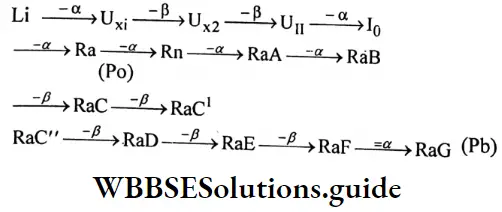
WBBSE Solutions For Class 10 Physical Science And Environment Chapter 7 Atomic Nucleus Uranum And Radioactive Elements

Question 30. Write four characteristics of -rays.
Answer:

Four characteristics of -rays

  1. The nature of β – rays is electrons
  2. The mass of β- the ray is \(\frac{1}{1856}\) AMU.
  3. The relative ionisation Capacity is 100
  4. The penetration power is 100.

Question 31. Short Note-Soddy Fajan’s rule.
Answer:

Soddy Fajan’s Rule:

A problem arose about the placement of the elements of the Uranium series in the periodic table soon after their discovery. It was observed that the element formed by the emission of a particle followed by the emission of two β – particles starting from U, with the atomic mass and atomic number producing an element which had the same chemical properties as that of U.

Question 32. Establish the equation of the rate of radioactive disintegration for a half-life period.
Answer:

We know \(\frac{\mathrm{dN}}{\mathrm{dt}}\) α N

\(\frac{\mathrm{dN}}{\mathrm{dt}}\) = λN ______ (1)

λ = Radioactive disintegration

Integrating the equation  (1)

N= Noe – λt______ (2)

Taking Lagarithm and simplification

λ = \(\lambda\frac{1}{7} \ln \frac{\mathrm{No}}{\mathrm{N}}=\frac{2.303}{7} \log \frac{\mathrm{No}}{\mathrm{N}}\)

λ =  \(\frac{1}{\frac{t_{01}}{2}} \ln _2=\frac{2.203}{\frac{t_1}{2}} \log 2=\frac{0.693}{t_{\frac{1}{2}}}\)

λ =  \(\mathrm{t}_{\frac{1}{2}}=\frac{0.693}{\lambda}\)

“WBBSE Class 10 Atomic Nucleus, Physical Science Chapter 7 key concepts”

Question 33. What is the integration form of the rate of radioactive disintegration?
Answer:

We know, \(\frac{\mathrm{dN}}{\mathrm{dt}}\) α N

\(\frac{\mathrm{dN}}{\mathrm{dt}}\)α N

\(\frac{\mathrm{dN}}{\mathrm{dt}}\) = λn

λ = Radioactive disintegration

Integrating the equation, N Noe – λt

No initial number of atoms of the radioactive element.

Question 34. Define isotope. Write an example of the isotope.
Answer:

Isotope

Isotope Some elements have the same atomic numbers though they have different numbers. They are called isotopes as they occupy the same position in the periodic table.

Example: 92U238

“WBBSE Class 10 Physical Science Chapter 7, Atomic Nucleus summary”

Question 35. Write about the rate of radioactive disintegration.
Answer:

The rate of radioactive disintegration

If there are N number of atoms of a radioactive element in a sample at a

The particular instant of time, the rate of disintegration at that instant will be proportion to N.

\(\frac{\mathrm{dN}}{\mathrm{dt}}\)α N

\(\frac{\mathrm{dN}}{\mathrm{dt}}\)= – λN

γ = Constant (radioactive disintegration).


WBBSE Solutions For Class 10 Physical Science And Environment Chapter 6 Current Electricity

WBBSE Class 10 Physical Science Question Answer In English

Chapter 6 Current Electricity MCQs

Question 1. How many electrons constitute the current of IA?

  1. 6.25 x 10⁹
  2. 6.25 x 10⁵
  3. 6.25 × 10¹⁸
  4. 6.25 x 10⁶

Answer: 3. 6.25 x 10¹⁸

Question 2. The material of a wire of a potentiometer is 

  1. Copper
  2. Steel
  3. Magnani
  4. Aluminium

Answer: 3. Magnanin.

Read And Learn More: WBBSE Solutions For Class 10 Physical Science And Environment

Question 3. The vertical component of Earth’s magnetic field is zero at a place where the angle of dip is :

  1. 60°
  2. 45°
  3. 90°

Answer: 1. 0°

Question 4. A magnetic needle suspended freely orients itself: in a definite direction upward

  1. In a definite direction
  2. In no direction
  3. Upward
  4. Downward

Answer:  2. In no direction.

WBBSE Solutions For Class 10 Physical Science And Environment Chapter 6 Current Electricity

Question 5. The unit of specific conductivity is.  

  1. Ohm – cm-1
  2. Ohm – cm2
  3. Ohm-1-cm-1
  4. Ohm-1 cm2

Answer:  3. ohm-1 cm-1

“WBBSE Class 10 Physical Science and Environment Chapter 6 solutions, Current Electricity”

Question 6. The length of a wire is doubled. Its conductance will be

  1. Unchanged
  2. Halved
  3. Doubled
  4. Quadrupled

Answer:  2. Halved.

Question 7. The resistance of the discharge tube is:

  1. Ohmic
  2. Non – Ohmic
  3. Both
  4. None of these

Answer:  2. Non-ohmic.

Class 10 Maths Class 10 Social Science
Class 10 English Class 10 Maths
Class 10 Geography Class 10 Geography MCQs
Class 10 History Class 10 History MCQs
Class 10 Life Science Class 10 Science VSAQS
Class 10 Physical Science Class 10 Science SAQs

Question 8. A wire of resistance 1 W is stretched to double its length. The resistance will be:

  1. 3V
  2. 9V
  3. 5V
  4. 15V

Answer: 2. 9V.

Question 9. The specific resistance of a wire depends upon 

  1. Length
  2. Cross-sectional area
  3. Mass
  4. None of these.

Answer:  4. None of these

Question 10. The unit of specific resistivity is 

  1. Ohm – cm-1
  2. Ohm – cm2
  3. Ohm-cm
  4. Ohm-1 cm2

Answer:  3. Ohm – cm

Question 11. The SI unit of electric charge is 

  1. Coulomb
  2. Ampere
  3. Ohm

Answer: 1. Coulomb

“Class 10 WBBSE Physical Science Chapter 6 solutions, Current Electricity study material”

Question 12. The unit of potential difference is 

  1. Joule
  2. Ohm
  3. Volt
  4. Ampere

Answer:  3. Volt.

WBBSE Class 10 Physical Science Solutions

Question 13. The unit of electrical power is:

  1. Volt
  2. Ohm
  3. Watt
  4. Joule

Answer:  3. Watt

Question 14. What material an electric fuse made of?

  1. Copper
  2. Iron
  3. Silver
  4. Tin-lead alloy

Answer:  4. Tin-lead alloy.

Question 15. Unit of resistance is 

  1. Ampere
  2. Ohm
  3. Coulomb
  4. Joule

Answer:  2. Ohm.

Question 16. Specific resistance of a conductor depends on 

  1. Its length
  2. Its Cross-sectional
  3. It’s material

Answer:  3.  It’s material.

Question 17. Which one is not the conductor of electricity

  1. Copper
  2. aluminu
  3. Gold
  4. Plastic

Answer:  4. Plastic

“WBBSE Class 10 Physical Science Chapter 6, Current Electricity solved examples”

Question 18. The electric meter is a house record:

  1. Charge
  2. Current
  3. Energy
  4. Power

Answer: 3. Energy.

19. The main fuse is connected in:

  1. Live wire
  2. Neutral wire
  3. Both the live and earth wires
  4. Both earth and the neutral wire

Answer:  1. Live wire.

Question 20. In parallel combination of resistances 

  1. P.d. is the same across each resistance
  2. Total resistance is increased
  3. Current is same in each resistance
  4. None of the above

Answer:  1. p.d. is the same across each resistance.

Question 21. For which of the following substances, resistance decreases with increase in temperature?

  1. Copper
  2. Mercury
  3. Carbon

Answer:  3. Carbon.

Question 22. Which of the following is an ohmic resistance?

  1. Carbon-arc lamp
  2. Diodevalve
  3. Nichrome
  4. Junction diode

Answer:  3. Nichrome.

Question 23. The amount of heat develops due to current can be known from 

  1. Ampere law
  2. Ohm’s law
  3. Joules law

Answer:  3. Joule’s law.

Question 24. An example of the conservation of electrical energy into mechanical energy is :

  1. Electric cell
  2. Electric lamp
  3. Electric motor

Answer: 3. Electric motor.

Question 25. Ammeter measure :

  1. Resistance
  2. Potential difference
  3. Current

Answer:  3. Current.

Question 26. If the cross-section of the conductor is kept unaltered and the length of the conductor is increased then its resistance :

  1. Increases
  2. Decrease
  3. Remains unaltered
  4. None of the above

Answer:  1. Increases.

Question 27. Potential difference is measured by 

  1. Volt meter
  2. Voltmeter
  3. Galvano meter

Answer:  2. Volt meter.

Question 28. The action of electric current on magnet was first observed by 

  1. Oersted
  2. Joule
  3. Barlow
  4. Newton

Answer: 1. Oersted

Question 29. Ohm’s law is related to:

  1. The current and potential difference
  2. Volume and pressure
  3. Temperature density.

Answer: 1. current and potential differences.

Question 30. Electric supply company measures the electricity consumed by the consumers in their household in terms of:

  1. Joule unit
  2. Watt-hour
  3. B.O. T units

Answer:  3.B.O. T units.

Question 31. The dimensional formula of electric density is :

  1. [MLT-2 A-1]
  2. [MLT3 A-1]
  3. [ML2T3-3A-1]
  4. [ML2T3-A-2]

Answer:  2. [MLT3 A-1]

Question 32. The physical quantity measured by kilowatt-hour :

  1. Electric power
  2. Electric energy
  3. Current

Answer:  2. Electric energy.

“WBBSE Class 10 Current Electricity solutions, Physical Science and Environment Chapter 6”

Question 33. The correct relation is:

  1. Watt= \(\frac{\text { Volt }}{\text { Ampere }}\)
  2. Watt =  \(\frac{\text { Ampere }}{\text { Volt }}\)
  3. Watt=Volt x Ampere

Answer:  3. Watt Volt x Ampere

Question 34. Electric Flux at a point in an electric field is :

  1. Positive
  2. Zero
  3. Negative

Answer:  2. Zero

Question 35. What is the dimensional formula of electric charge?

  1. [M°L° TA]
  2. [M°L°T-1A]
  3. [M°L°TA-1]
  4. [M°L°T-1A-1]

Answer: 1. [M°L° TA]

Question 36. If six identical cells each having emf of 6V are connected in parallel the emf of the combination is :

  1. IV
  2. 1/6V
  3. 6V
  4. 36V

Answer: 3. 6V.

Question 37. What is the equivalent resistance of the resistances 3 ohm, 5 ohm and 12 ohm combined in series?

  1. 15 ohm
  2. 18 ohm
  3. 20 ohm
  4. 10 ohm

Answer: 3. 20 ohms.

Question 38. A wire of resistance 1 W is stretched to double its length. The resistance will become :

  1. \(\frac{1}{4}\)
  2. 1
  3. 2
  4. 4

Answer: 4. 4

Question 39. A soap bubble is charged to a potential of 16V. Its radius is doubled. The potential of the bubble now will be

  1. 16V
  2. 4V
  3. 8V
  4. 2V

Answer:  3. 8V.

Question 40. The resistance will be least in a wire with dimension :

  1. L|2, 2A
  2. 2L, A
  3. L, A

Answer:  1. L|2, 2A.

Class 10 Physical Science WBBSE Chapter 6 Current Electricity Very Short Answer Type Questions

Question 1. Define the unit of electric unit.
Answer: The unit of current is ampere. It is the one coulomb of charge flowing through a conductor in one second.

Question 2. What do you mean by the conductivity of a material? Give its SI unit.
Answer: It is the reciprocal of resistivity. Its SI unit is Ohom-‘.

Question 3. How does the drift velocity of electrons in a metallic conductor vary with temperature?
Answer: The drift velocity of a metal decreases with an increase in temperature.

Question 4. What is 1B.O.T?
Answer: The total electric energy expended in 1 hour at the rate of 1 kilowatt is known as 1 B.O.T. (Board of Trade unit.)

Question 5. State the cases in which Ohm’s law is not valid.
Answer: Ohm’s law is not valid for current flowing through gases under low pressure, electrolytes, and semi-conductors.

“Class 10 WBBSE Physical Science Chapter 6, Current Electricity easy explanation”

Question 6. How does the resistance of a conductor depend on the cross-section of the conduction?
Answer: Resistance of the conductor decreases with the increase of cross-section.

Question 7. What is the SI unit of resistance?
Answer: The SI unit of resistance of Ohm.

Question 8. How is the heat generated due to electric current through a resistor related to the strength of the current?
Answer: Heat is directly proportional to square of the current.

Question 9. How is the heat generated due to electric current in a resistor related to the resistance of the resistor?
Answer: Heat is directly proportional to resistance.

Question 10. What is the usual color of a live wire?
Answer: The usual color of a live wire is red.

Question 11. What is the usual color of the earthing wise?
Answer: The usual color of the earthing wire is green

Question 12. What is the emf of a cell?
Answer: The potential difference between the electrodes of a cell in open circuit is called emf. (electromotive force)

Question 13. What is the SI unit of current strength?
Answer: The SI unit of current strength is ampere.

Question 14. What do you mean by relaxation time or mean free time?
Answer: It is the average time interval between the two successive collisions between electron and ion in a conductor.

“WBBSE Class 10 Physical Science Chapter 6 solutions, Current Electricity PDF”

Question 15. What is current density?
Answer: It is the current flowing per unit area of a conductor.

Question 16. Illustrate a condition in which the electric field is not zero but the potential is zero.
Answer: The electric field on the equatorial line of an electrical dipole is not zero but the potential is zero.

Question 17. What is meant by the steady current?
Answer: A current whose magnitude does not change with time.

Question 18. What is meant by varying current?
Answer: A current whose magnitude changes with time.

Question 19. What is the emf of a simple voltaic cell?
Answer: The emf of a simple voltaic cell is 1.08 volt.

Question 20. Which effect of electric current is demonstrated in an electro-magnet?
Answer: Magnetic effect.

WB Class 10 Physical Science Question Answer Chapter 6 Current Electricity Fill In The Blanks :

Question 1. Coulomb =____________ × second.
Answer: Ampere.

Question 2. The equivalent resistance is smaller than the ____________ resistance in a parallel combination of resistances.
Answer: Smallest.

Question 3. Power potential difference x ____________
Answer: Current.

Question 4. I2rt is some electrical
Answer: Work.

Question 5. Resistance of a wire is ____________ proportional to the length of the wire.
Answer: Directly.

Question 6. The watt-hour is the practical unit of ____________energy.
Answer: Electrical.

“WBBSE Class 10 Physical Science Chapter 6, Current Electricity important questions”

Question 7. Number of B.O.T. unit =\(\frac{\text { ampere } \times \text { volt }}{1000}\) × ____________
Answer:
Hour

Question 8. The SI unit of current is ____________
Answer: Ampere

Question 9. When electric current does not change the direction it is called ____________
Answer: Direct current

Question 10. Watt= Volt x ____________
Answer: Ampere

Question 11. The electromagnets are made using the current.
Answer: Magnetic

Question 12. Usually the resistance of a conductor ____________ with the rise in temperature
Answer: Increases effect of electricity with the rise in temperature.

Question 13. In Ohm’s law, the constant ____________ and other physical conditions are remaining
Answer: Temperature

Question 14. The temperature remaining constant, the resistance between two opposite forces of a unit cube of a conductor is called its ____________
Answer: Specific resistance

Question 15. Ohm’s law is related to ____________
Answer: Current and potential difference

Question 16. Specific resistance of a conductor depends on____________
Answer: It’s material

Question 17. The unit of electrical power is ____________
Answer: Watt

Question 18. A ____________ is used to measure the potential difference between two points in a section of an electrical circuit.
Answer: Voltmeter

Question 19. An ammeter is used to measure the  ____________  flowing through an electric circuit where the ammeter is connected in series.
Answer: Current

Question 20. A short circuit occurs due to accidental direct contact of the life and the ____________ wires.
Answer: Neutral

“Class 10 Physical Science and Environment Current Electricity solutions, WBBSE syllabus”

Question 21. The total resistance of a number of resistors in series is equal to the ____________  of the resistances of the component resistors.
Answer: Sum

Question 22. Electromotive force is some ____________ not a force.
Answer: Energy.

WBBSE Class 10 Physical Science Question Answer

Question 23. In current electricity, the potential difference between two points is measured by the work done when unit ____________ flows from one point to the other.
Answer: Change

Question 24. If an electrical instrument of power 1 watt works for 1 hour, the electrical energy expended is known as 1 ____________
Answer: Watt-hour

Question 25. Potential difference between two points one ____________ when work is done to carry one coulomb charge between the points is 1 Joule.
Answer: Volt

Question 26. Resistance is the natural property of every material body by virtue of which the body ____________ flow of electric charge through it.
Answer: Opposes

Question 27. The current flowing through a conductor is directly proportional to the potential difference between its ends when ____________  and other physical conditionsof the conductor remain unaltered.
Answer: Temperature

Question 28. Ohm’s law is not valid for current flowing through ____________  under low pressure, electrolytes and semiconductors.
Answer: Gases

Question 29. The unit for specific resistivity is ____________
Answer: Ohm-cm

Question 30. Electric flux at a point in an electric field is ____________
Answer: Zero

Question 31. The material of a wire of a potentiometer is ____________
Answer: Magnanin

Question 32. Ammeter measures  is ____________
Answer: Current

WBBSE Class 10 Physical Science Question Answer Chapter 6 Current Electricity Short Answer Type Questions

Question 1. What is the definition of ohm?
Answer:

Ohm: If one-ampere current flowing through a conductor establishes 1-volt potential difference between the two ends of the conductor, the resistance of the conductor is one ohm.

Question 2. What do you mean by potential difference?
Answer:

Potential difference: It is the electrical condition of a point in an electric field or on a current-carrying conductor that indicates whether electrons will flow from it or it from another connected point.

Question 3. What is the definition of resistance from Ohm’s law?
Answer:

Definition of resistance from Ohm’s law : The resistance of a conductor is a ratio of the potential difference between its ends to the current flowing through it.

Question 4. What is the definition of a coulomb?
Answer:

Coulomb:

Coulomb It is the quantity of electric charge that passes through silver nitrate solution deposits 0.00 1118g silver at the cathode.

Question 5. What do you mean by a combination of resistance?
Answer:

Combination of resistance: In different electrical circuits more than resistance are connected together. This is known as a combination of resistance.

“WBBSE Class 10 Chapter 6 Physical Science, Current Electricity step-by-step solutions”

Question 6. What is a voltmeter?
Answer:

Voltmeter: A voltmeter is used to measure the potential difference between two points in a section of an electrical circuit; the voltmeter is connected parallel to the section.

Question 7. Why resistivity is also called specific resistance?
Answer: 

Explanation: Resistivity is also called specific resistance as the resistivity of a material is the resistance offered by the material of specified dimensions unit length unit cross-sectional area.

Question 8. What is the internal resistance of a cell?
Answer:

Internal resistance: The small resistance offered by the electrolyte of a cell to the electric charges flowing through it from the negative to the positive plate is known as to the internal resistance of the cell.

Question 9. State ohm’s law.
Answer: 

Ohm’s law (1826): The temperature and other physical conditions remaining constant the current flowing between any two points of a conductor is proportional to the potential difference between them.

Question 10. The specific resistance of copper 20°C is 1.6×10⁻⁶ ohm-cm, what do you mean by it?
Answer:

Specific resistance: The specific resistance of copper at 20°C is 1.6×10⁻⁶ ohm-cm, it means: Resistance across the opposite faces of a copper cube of 1 cm side, at 20°C is 1.6×10 ohm.

Question 11. What is an ammeter? What do you mean by 1-ampere electric charge?
Answer:

Ammetre: The current is measured by an instrument called an ammeter. When I coulomb of charge flows through any cross-section of a conductor in 1 second, the electric current flowing through it is said to be 1 ampere.

Question 12. What do you mean by potential difference?
Answer:

Potential difference: The potential difference between two points in an electric circuit is defined as the amount of work done moving a unit charge from one point to the other point.

Question 13. What is the resistance of a conductor? What do you mean by the 1 ohm resistance of the conductor’?
Answer:

Resistance of conductor: The resistance of a conductor is the ratio of the potential difference across the ends of a conductor to the current flowing through the conductor. The resistance of a conductor is 1 ohm if a potential difference of Ivolt across the end of the conductor makes a current of 1 ampere pass through it.

Question 14. What do you mean by 1-volt potential difference’?
Answer:

Potential difference: The potential difference between two points in an electric circuit is defined as the amount of work done moving a unit charge from one point to the other point.

“WBBSE Class 10 Current Electricity, Physical Science Chapter 6 key concepts”

Question 15. Write the properties of electric charges. The properties of electric changes 
Answer: Electric charges:

Properties of Electric changes:

  1. Like charges repel each other and unlike charges attract each other.
  2. Electric charge is always conserved.

Question 16. Define-electric current what is the S.I. unit of potential difference? Answer:

Electric current:

  1. The electric is the flow of electric charges in a conductor such as a metal wine.
  2. The S.I. unit of potential difference is volt.

Question 17 What do you mean by electric charge? Is electric charge a scalar quantity? Write S.I. unit of electric charge.
Answer:

Electric charge:

  1. Electric charge is the physical property of a matter that causes it to experience a force when placed in an electromagnetic field.
  2. Yes, the electric charge is a scalar quantity.
  3. The S.I. unit of electric charge is coulomb

Question 18. The define-terminal voltage of the cell. What is the e.m.f of a cell?
Answer:  Terminal And E.M.f of a cell

  1. Terminal voltage of the cell:  When the current is drawn from a cell, the cell is in a closed circuit, The potential difference between the electrodes of the cell is called the terminal voltage of the cell.
  2. E.m.f of a cell: The e.m.f. of a cell is the energy spent our work done per unit charge is taking a unit positive charge around the complete circuit containing the cell, when the circuit is open.

Question 19. What is meant by “The potential at a point is 1 volt”?
Answer:

The potential at a point:  The potential at a point is one volt if one joule of work is done in moving one colomb of charge from infinity to that point in an electric field.

Question 20. Define the electromotive force of the cell electromotive force of cell :
Answer:

The electromotive force of cell:

  1. The work done in carrying a unit positive charge once through a complete circuit is called the electromotive force of the cell.
  2. The mathematical expression of the electromotive force of the cell: E = V + v.

Question 21. What is the electromotive force?
Answer:

Electromotive force:

  1. In a cell, the chemical action creates a difference in the concentration of electrons between the electrodes of the cell, which results in to the potential difference between the electrodes called electromotive force.
  2. When no current is drawn from a cell, the cell is in the open. circuit, the potential difference between the terminals of the cell is the electromotive force of the cell.

Question 22. Define the resistivity of a conductor.
Answer:

The resistivity of a conductor: The resistivity of a conductor is the resistance of the conductor of unit length and unit area of cross-section at a constant pressure.

Question 23. Short Note-Insulator.
Answer:

Insulator: There are substances that are very poor conductors of electricity having very low values of resistivity are called insulators.

Example: Wood, Glass.

Insulators are used to protect us from electric shocks.

Question 24. What is an electromagnet?
Answer: 

Electromagnet: If soft iron is kept in a current-carrying solenoid, then that soft iron behaves like a magnet so long as the current passes. This magnet is known as an electromagnet.

Question 25. What is an electric motor?
Answer:

Electric motor:

  1. The device or machine which converts electrical energy into mechanical energy is known as an electric motor.
  2. An insulated copper coil, wound over a suitable frame rotates in a magnetic field when electric current passes through the coil.

Question 26. Deduce the mathematical form of Ohm’s law.
Answer:

The mathematical form of Ohm’s law:

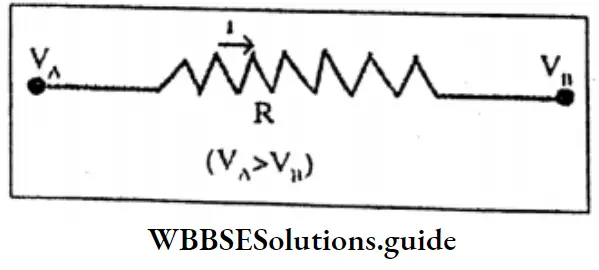
Let VA and VB be the potentials at the ends A and B of the conductor AB respectively.

So, the potential difference between the points is VA – VB = V (say) Now, if current I  flows through the conductor,

Then following Ohm’s law, να I or,

V = RI (R = constant, the resistance of conductor)

Or, \(\frac{\mathrm{V}}{\mathrm{I}}\) = R

WBBSESolutions For Class 10 Physical Science And Environment Chapter 6 Current Eletricity Ohms Law

Question 27. On what factors does the resistance of a conductor depend? Answer:

Factors upon which the resistance of a conductor depends:

1. Effect of length: Temperature, material, and area of cross-sector remaining constant, the resistance (R) of a conductor is proportional to its length

∴ Rα I (When temperature, material, and cross-section are constant)

2. Effect of cross-section: Temperature, material, and length are constant.)

Question 28. Define equivalent resistance.
Answer:

Equivalent resistance: The single resistance, instead of multiple resistance in a circuit, keeps the voltage and current unchanged, which is called the equivalent resistance of those resistances.

Question 29. What is specific resistance?
Answer:

Specific resistance: We know, R α I when A is constant

R α \(\frac{1}{\mathrm{~A}}\) when 1 am constant

When both the length and the area of the cross-section of a conductor very then from the law of joint variation, we can write,

R α \(\frac{1}{\mathrm{~A}}\)

R= ρ \(\frac{1}{\mathrm{~A}}\) (ρ)(rho) is the constant is proportionality and is known as the specific of resistivity]

Now, if 1 = 1 and A = 1, then R = ρ

Specific resistance Definition:

The specific resistance or resistivity of a material is numerically equal to the resistance of a conductor of the material of length 1 meter and area of cross- section 1 m2.

Question 30. Define 1 kilowatt-hour?
Answer:

1 kilowatt-hour

If a machine of 1 kilo-hour operates for one hour the amount of energy spent is known as kilo-watt hour. This amount of energy is also known as the Board of Trade unit (B.O.T. units).

1 K.W.H = \(\frac{1 \text { B.O.T (watt } \times \text { hour })}{1000}\)

= \(\frac{\text { volt } \times \text { ampere } \times \text { hour }}{1000}\)

Question 31. What is watt-hours? Whose unit is it?
Answer:

Watt-hour: If an electrical machine of power one watt operates for one hour then one watt-hour amount of energy is said to be spent.

1 watt-hour = 1 watt x 1 hour  = 1 watt x 3600 sec. = 3600 J

The unit of electrical energy is watt-hour.

Question 32. What do you mean by the statement? ‘Potential difference between two points in an electric field is 5 volts’?
Answer:

‘Potential difference between two points in an electric field is 5 volts’

Explanation: ‘Potential difference between two points in an electric field is 5 volts’-this statement means an external agent has to do 5 joules work to carry 1-coulomb positive charge from a point at the lower potential to a point at the higher potential in the electric field.

Question 33. How can the strength of the motor be increased?
Answer:

The strength of an electric motor can be increased by :

  1. Increasing the current in the armature.
  2. Increasing the strength of the magnetic field.
  3. Increasing the number of turns in the armature.

Question 35. What do you mean by series combination?
Answer:

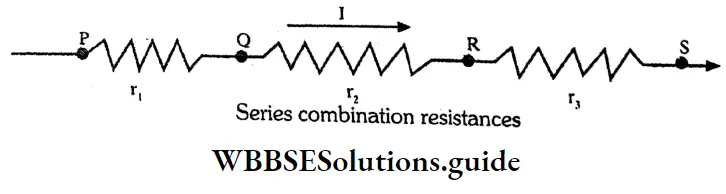
Series combination: In this combination, resistances are so connected that extreme end of one resistance is joined to the beginning end of the next resistance soon. In this connection same current. flows through all the resistances.

If three resistors r1, r2, and r3, are connected in series, the same current I passes through each then their equivalent resistance R will be.

R = r1+ r2+ r3

WBBSESolutions For Class 10 Physical Science And Environment Chapter 6 Current Eletricity Series Combination Resistance

Question 36. What do you mean by parallel combination?
Answer:

Parallel combination:

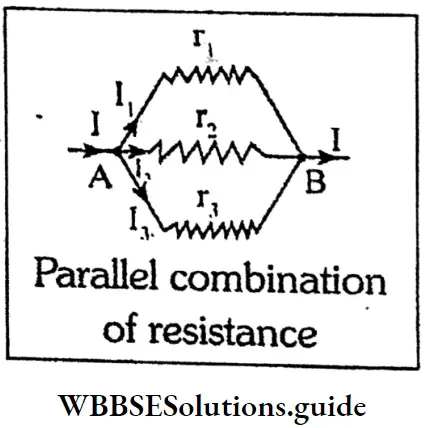
A number of resistors are said to be connected in parallel when they are placed side by side and their corresponding ends joined together so that the main current is distributed among them. If the individual resistances is parallel combination are r1+ r2+ r3 then their equivalent resistance R is given by

\(\frac{1}{R}=\frac{1}{r_1}+\frac{1}{r_2}+\frac{1}{r_3}\)

WBBSESolutions For Class 10 Physical Science And Environment Chapter 6 Current Eletricity Parallel Combination Of Resistance

So, to create a low resistance out of a few respectively high resistances, those needed to be connected to a parallel combination. Equiva- lent resistance in parallel combination is lesser than the lowest of the individual resistances.

Question 37. State Fleming’s left-hand rule.
Answer:

Fleming’s left-hand rule:

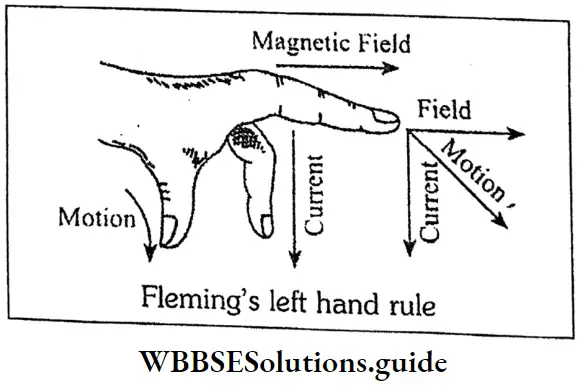
If the thumb, the first finger, and the middle finger of the left hand be held mutually perpendicular to each other in such a way that the first finger points in the direction of the magnetic field and the second finger to that of the current, then the thumb will indicate the direction at motion of the conductor.

WBBSESolutions For Class 10 Physical Science And Environment Chapter 6 Current Eletricity Flemings Left Hand Rule Of Magnetic Field

Question 38. State Ampere’s swimming rule.
Answer:

Ampere’s swimming rule: If a man is imagined to be swimming along a current carrying wire in the direction of the current (south or north) with his face turned towards a freely rotating magnetic needle, then the north pole of the needle will be deflected towards his left hand.

Question 39. Prove that, I =\(\frac{Q}{t}\)
Answer:

If Q amount of charge blows through a cross-section of a conductor in time t, then the current I is given by

I = \(\frac{Q}{t}\)

Question 40. Prove, VA– VB = \(\frac{W}{q}\)
Answer:

If W be the work done in moving a charge q from point B to point A then the potential difference (VA– VB) between the two points (VA– VB) = \(\frac{W}{q}\)
WBBSESolutions For Class 10 Physical Science And Environment Chapter 6 Current Eletricity Potential Differences

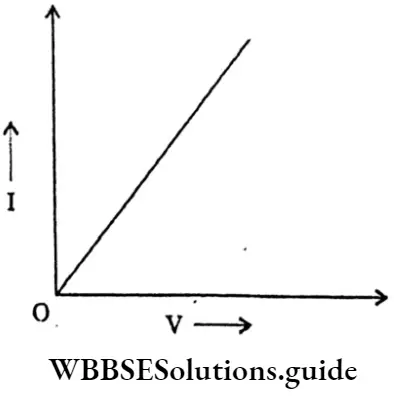
Question 41. Draw the graph between the current (I) VS potential difference.
Answer:

WBBSESolutions For Class 10 Physical Science And Environment Chapter 6 Current Eletricity Current And Potential Differences

Question 42. What do you mean by conductors?
Answer:

Conductors: The substances which allow an electric current to flow easily through them are called conductors.

  • The conductors have low resistance and resistivity. Resistances of conductors increase with the increase of temperature.
  • Metals are good conductors of electricity having low volume of resistivity.
  • Example: Silver, Copper

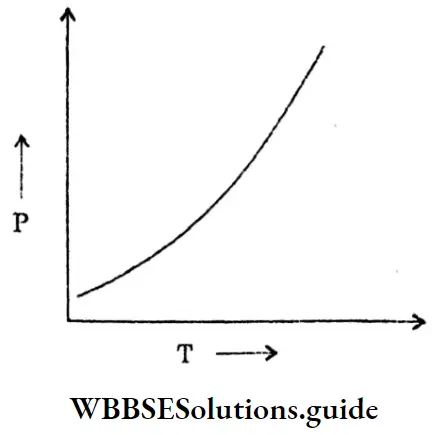
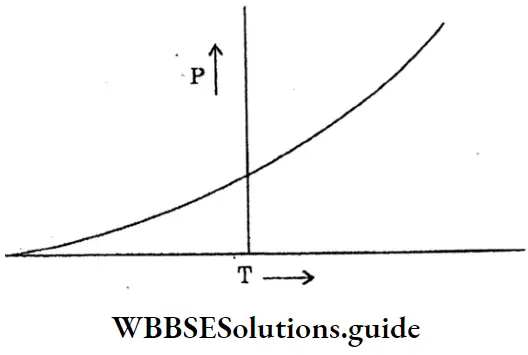
Question  43. Draw the graph of the resistivity of the conductor with an increase in temperature in the case of conductors.
Answer:

Graph of the resistivity of the conductor:

WBBSESolutions For Class 10 Physical Science And Environment Chapter 6 Current Eletricity Graph Of Conductor With Increase Of Temperature

P = Resistivity of the conductor.
T = Temperature.

Question 44.

  1. Define-electrical power.
  2. What do you mean by one kilowatt-hour of electrical energy?

Answer:

  1.  Electrical power: Electric power is the amount of electric energy consumed in a circuit per unit of time.
  2. One kilowatt: One-kilowatt hour is the amount of electric energy consumed by a 1000W electric device when it operates for one hour.

Question 45. What will the resistance of the bulb of 220V-100W?
Answer:

The power rating of (220V-100W) electric bulb means that the resistance of

Its filament while glowing is

R=  \(\frac{\mathrm{V}^2}{\mathrm{P}}\)

R= \(\frac{(220)^2}{100}\)

R= 484 Ω

“WBBSE Class 10 Physical Science Chapter 6 Current Electricity, definitions and examples”

Question 46. What is meant by earthing?
Answer:

Earthing

Earthing By earthing we mean that the metal body of the appliance is connected to a thick copper wire, which is buried deep in the earth, and its other end is connected to a copper plate surrounded by a mixture of charcoal and common salt.

Question 47. Electric cell as the source of EMF’-Explain.
Answer:

EMF:

  • A source of electricity without the presence of active machinery parts is called an electric cell.
  • By the transformation of chemical energy to electric energy, an electric cell generates a steady electric current in a current.

Question 48. 1 kilo watt hour = 3.6 x 10⁶ Joule; Prove it.
Answer:

1 kilowatt-hour 1000 watt-hour.

1 watt = 1 Js-1

1 hour (60 × 60) second = 3600 second.

1 kilo watt-hour = 1000 Js1× 3600 second = 3600000 J.

1 kilo watt-hour = 3.6 x 10⁶ .

Question 49.

  1. State Lenz’s law.
  2. Explain Lenz’s law as a consequence of the principle of conservation of energy.

Answer:

Lenz’s law:

  • The direction of induced emf in a circuit is such that it always arrases the very cause for which it is due.
  • Lenz’s law is a consequence of the principle of conversation of energy. Lenz’s law is a form of the how of conservation of energy i.e., Lenz’s law can be derived from the principle of conservation of energy.

“WBBSE Class 10 Physical Science Chapter 6, Current Electricity summary”

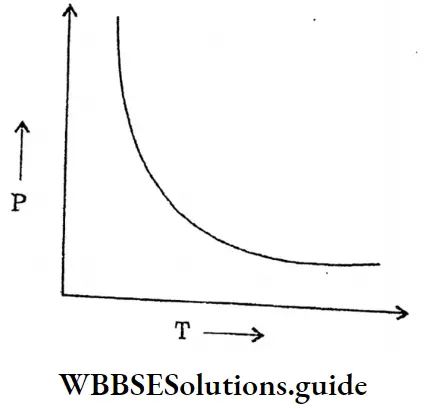
Question 50. Draw the graph between resistivity vs increase in temperature in case on semiconductor.
Answer:

The temperature in case of semiconductors:

WBBSESolutions For Class 10 Physical Science And Environment Chapter 6 Current Eletricity Resistivity Vs Increase In Temperature Semiconductor

  • Presistivity of the conductor
  • T= Temperature

Question 51. Draw the graph between the resistivity and temperature in the case of a superconductor.
Answer:

WBBSESolutions For Class 10 Physical Science And Environment Chapter 6 Current Eletricity Resistivity Vs Increase In Temperature Superconductor

P = Resistivity of the conductor

T = Temperature


WBBSE Solutions For Class 10 Physical Science And Environment Chapter 5 Light

WBBSE Class 10 Physical Science Question Answer In English

Chapter 5 Light MCQs

Question 1. The formation of the spectrum is due to:

  1. Reflection
  2. Refraction
  3. Dispersion of light

Answer: 3. Dispersion of light.

Question 2. A person uses the spectacle of power + 2D. He is suffering from:

  1. Presbyopia
  2. Astigmatism
  3. Long-sightedness of hypermetropia
  4. Short-sightedness of myopia

Answer: 3. Long-sightedness of hypermetropia.

Read And Learn More: WBBSE Solutions For Class 10 Physical Science And Environment

Question 3. A person cannot see objects clearly beyond 2m. The power of the lens required to correct his vision will be :

  1. + 2D
  2. -1D
  3. + ID
  4. 0.5D

Answer: 4. 0.5D.

Question 4. Myopia is due to:

  1. Older age
  2. Shorting of eyeball
  3. Irregular change in focal length
  4. Elongation of the eyeball.

Answer: 4. elongation of the eyeball.

WBBSE Solutions For Class 10 Physical Science And Environment Chapter 5 Light

Question 5. Rainbow is formed due to a combination of 

  1. Refraction and absorption
  2. Refraction and scattering
  3. Dispersion and total internal reflection
  4. Dispersion and focussing

Answer: 3. Dispersion and total internal reflection.

“WBBSE Class 10 Physical Science and Environment Chapter 5 solutions, Light”

Question 6. Which of the prism is used to see the infrared spectrum of light?

  1. Rock salt
  2. Flint
  3. Nicol
  4. Crown

Answer: 1. Rock salt.

Question 7. Which of the following colours suffers maximum deviation in a prism?

  1. Yellow
  2. Green
  3. Blue
  4. Orange

Answer: 2. Blue.

Question 8. The splitting of white light into several colours on passing through a glass prism is due to:

  1. Reflection
  2. Diffraction
  3. Interference
  4. Refraction

Answer: 4. Refraction.

“Class 10 WBBSE Physical Science Chapter 5 solutions, Light study material”

Question 9. A convex lens will become less convergent in

  1. Oil
  2. Water
  3. Both
  4. None

Answer: 2. water.

Question 10. The source of ultraviolet light is :

  1. Electric bulb
  2. Carbon arc lamp
  3. Red hot iron bulb
  4. Sodium vapour lamp

Answer: 2. carbon arc lamp.

Class 10 Maths Class 10 Social Science
Class 10 English Class 10 Maths
Class 10 Geography Class 10 Geography MCQs
Class 10 History Class 10 History MCQs
Class 10 Life Science Class 10 Science VSAQS
Class 10 Physical Science Class 10 Science SAQs

Question 11. Which of the following materials cannot be used to make a lens?

  1. Water
  2. Plastic
  3. Clay
  4. Glass

Answer: 2. Clay.

Question 12. No matter how far you stand from a mirror, your image appears erect. The mirror is likely to be :

  1. Plane only
  2. Concave only
  3. Convex only
  4. Either plane or convex

Answer: 4. Either plane or convex.

Question 13. A ray of light suffers refraction through an equilateral prism. The deviation produced by the prism does not depend on the:

  1. Angle of incidence
  2. Size of the prism
  3. colour of light
  4. material of the prism

Answer: 3. size of the prism.

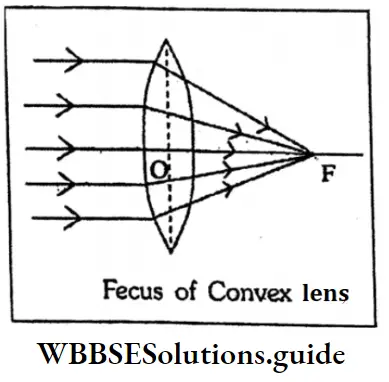
Question 14. A ray of light incident on a lens parallel to its principal axis, after refraction passes through or appears to come from:

  1. its second focus
  2. its optical centre
  3. its first focus
  4. the centre of curvature of its second surface

Answer: 1. its second focus

Question 15. What is the value of W1/f1+ W2/f2

  1. 2
  2. 3
  3. 5
  4. 0

Answer: 4. 0

Question 16. The terminal colours of the pure spectrum of white light are :

  1. Blue and violet
  2. Red and orange
  3. Red and violet

Answer: 3. Red and violet.

Question 17. Yellow colour is called :

  1. Primary
  2. Middle colour
  3. Secondary colour
  4. Top colour

Answer: 2. Secondary colour

“WBBSE Class 10 Physical Science Chapter 5, Light solved examples”

Question 18. The___________ colours can be seen distinctly in pure spectrum.

  1. Six
  2. Eight
  3. Seven
  4. Nine

Answer: 3. Seven.

Question 19. The dispersion of white light was first observed by:

  1. Sir Issac Newton
  2. Boyle
  3. Max Well

Answer: 1. Sir Issac Newton.

Question 20. The arrangement of the seven colours of spectrum is:

  1. VIBGYOR
  2. RAINBOW
  3. VBIGOYR

Answer: 1. VIBGYOR.

Question 21. The object is placed in between ‘f’ and ‘2f’ in convex lens, the size of image will be

  1. Greater in size the object
  2. Equal in size of the object
  3. Greater in size the object.
  4. Smaller in size than the object

Answer: 1. Greater in size the object

Question 22. To for m virtual image on the same side of the object in case of a convex lens, the object should be placed :

  1. In between the lens and the focus
  2. In between ‘f’ and ‘2f’
  3. At ‘2f’ from the lens
  4. At a distance greater than ‘2f’ from the lens

Answer: 1. In between the lens and the focus.

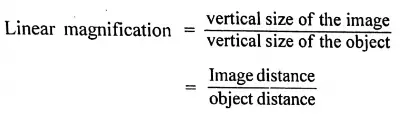
Question 23. Linear magnification is equal to :

  1. (Length of image)/(Length of the object).
  2. (Length of image) × (Length of the object).
  3. (Length of image) + (Length of the object).
  4. (Length of image) – (Length of the object).

Answer: 2. (Length of image)×(Length of the object)

Question 24. A mirror produces a magnified erect image of an object. The nature of the mirror is

  1. Convex
  2. Concave
  3. None of these
  4. Plane

Answer: 2. Concave.

Question 25. A plane mirror produces a magnification of:

  1. -1
  2. + 1
  3. Zero
  4. Between 0 and + a

Answer: 2. + 1.

“WBBSE Class 10 Light solutions, Physical Science and Environment Chapter 5”

Question 26. Focal length of a convex lens will be maximum for:

  1. Blue light
  2. Red light
  3. Greenlight
  4. Yellow light

Answer: 3. Red light.

Question 27. The number of images observable between two parallel plane mirror is:

  1. 2
  2. 4
  3. 11
  4. Infinite

Answer: 4. Infinite.

Question 28. When a mirror is rotated through an angle 0, the reflected ray from it turns through an angle of :

  1. θ
  2. θ/2
  3. 0

Answer: 4. 2θ

Question 29. A ray is incident at an angle 38° with a mirror. The angle between normal and deflected ray is :

  1. 90°
  2. 75
  3. 38°
  4. 52°

Answer: 4 52°

Question 30. The focal length f of a speherical mirror of radius of curvature R is :

  1. \(\frac{R}{2}\)
  2. R
  3. \(\frac{3}{2}\) R
  4. 2R

Answer: \(\frac{R}{2}\)

Question 31. A concave mirror of focal length f (in air) is immersed in water (μ = 3). The focal length of the mirror in water will be :

  1. \(\frac{4}{3}\) f
  2. \(\frac{9}{5}\) f
  3. \(\frac{3}{5}\) f
  4.  f

Answer: 4. f

Question 32. A plane mirror is approaching a person at a speed of 5 cm S-1. At what speed will his image approach him?

  1. 10 cms-1
  2. 20 cm S-1
  3. 5cms-1
  4. 15cm S-1

Answer: 1. 10 cm S-1

Question 33. If an object is 30 cm away from a concave mirror of focal length 15 cm, the image will be :

  1. Erect
  2. Reflection of light
  3. Diminished
  4. Of same size

Answer: 4. Of the same size

Question 34. Mirage is a phenomenon due to:

  1. Reflection of light
  2. Refraction of light
  3. Diffraction of light
  4. Total internal reflection of light

Answer: 4. Total internal reflection of light.

Question 35. The principle behind optical fibres 

  1. Total internal reflection
  2. Total external reflection
  3. Diffraction
  4. Both (1) and (2)

Answer: 1. Total internal deflection

Question 36. A convex lens is dipped in a liquid whose refractive index is euqal to the refractive index of the lens. Then its local length will:

  1. Become zero
  2. Become infinite
  3. Increase
  4. Reduce

Answer: 2. Become infinite.

Question 37. What is the value of the refractive index of a diamond?

  1. 2.47
  2. 3.47
  3. 1.47
  4. 0.47

Answer: 1/. 2.47.

Question 38. Write an example of an isotropic medium.

  1. Air
  2. Water
  3. Iron
  4. Fire

Answer: 1. Air.

Question 39. Write the value of speed of light.

  1. 3 x 10⁶ m/s
  2. 3 x 10⁸ m/s
  3. 3 x 10⁷ m/s
  4. 3 x 10⁹ m/s

Answer: 3. 3 x 10⁸ m/s.

Question 40. What is the value of refractive index of alcohol?

  1. 1.37
  2. 2.37
  3. 4.37
  4. 0.37

Answer: 1. 1.37.

WB Class 10 Physical Science Question Answer Chapter 5 Light Very Short Answer Type Questions

Question 1. What is the far point of a normal eye?
Answer: Infinity.

Question 2. Which colour of light travels faster in vacuum?
Answer: Light rays of all colour travel with same speed in vacuum.

Question 3. What is the least distance of distinct vision?
Answer: 25 cm.

Question 4. How is deviation produced in a prism related to the angle of the prism and angles of incident and emergency?
Answer: δ= i1+i2 – A

Question 5. Is dispersion of white light in a vacuum possible?
Answer: No.

Question 6. Define the power of a lens.
Answer: The reciprocal of the focal length of the lens is called its power.

Question 7. What will be the focal length and power of a plane glass plate?
Answer:  f = α; Power = 0

Question 8. Why is a night-angled prism a better reflector than a plane mirror?
Answer: As in the prism no part of the light refracted.

Question 9. Does a beam of light give a spectrum on passing through a hollow prism containing air, explain?
Answer: No, because all colours of light pass through vacuum or air same speed and there is no dispersion.

Question 10. What kind of lens one should use to correct myopic eye?
Answer: Concave lens.

Question 11. What kind of lens one should use to correct the astigmatic eye?
Answer: Cylindrical lens.

Question 12. What is monochromatic light?
Answer: The light which consists of only one colour is known as monochromatic light.

“Class 10 WBBSE Physical Science Chapter 5, Light easy explanation”

Question 13. What is a double convex lens?
Answer: If both the surfaces of a convex lens are convex then the lens is called a double convex lens. It is used in camera, telescopes etc.

Question 14. Will the focal length of a convex lens vary for refraction of light of different colours through it?
Answer: For different colours of light the convex lens will have different focal length.

Question 15. What is the edge of a prism?
Answer: The intersection of the refracting surfaces is called the edge of the prism.

Class 10 Physical Science Solution WBBSE

Question 16. An object is placed at the focus of a concave lens, where will be its image formed?
Answer:

u = f; f = –  ve

So, \(\frac{1}{v}\)– \(\frac{1}{u}\) = \(\frac{1}{f}\) Or,

\(\frac{1}{v}\)=  \(\frac{1}{f}\)+ \(\frac{1}{u}\) Or,

\(\frac{1}{v}\)=  \(\frac{1}{f}\)+ \(\frac{1}{f}\)

= 0

∴ v= α

Question 17. Name the type of mirror which has focal length equal to infinity.
Answer: A plane mirror.

Question 18. What are the types of reflection of light?
Answer:

The types of reflection of light are:

  1. Regular reflection
  2. Irregular reflection

Question 19. Write the expression of Newton’s Equation.
Answer: The expression of Newton’s Equation xy = f2.

Question 20. What is the mathematical expression of linear magnification?
Answer: The mathematical expression of linear magnification is m=\(\frac{v}{u}\)

Question 21. Write two classifications of image.
Answer: The two classifications of image are real and virtual.

Question 22. Write an example of opaque substance.
Answer: An example of opaque substance is iron.

Question 23. What will be the nature of the lens for u-v graph.
Answer: The nature of the graph is rectangular hyperbola.

Class 10 Physical Science Solution WBBSE

Question 24. Write the expression of dispersive power of lens materil.
Answer:

W = \(\frac{δμ}{μ- 1}\)

Question 25. Write the mathematical expression of generalised snell’s law.
Answer: The mathematical expression of generalised snell’s law :

⇒ μ2= sin i1

= μ sin i 2

Question 26. Write a characteristic of the image formed by a plane mirror.
Answer: The image is erect but laterally inverted.

Question 27. What is the value of refractive index of Benzene?
Answer: The value of refractive index of Benzene is 1.501.

Question 28. What are the two types of lens?
Answer: The two types of lens are convex and concave.

Question 29. Write the mathematical expression of lens maker’s formula.
Answer:

\(\frac{1}{f}\)= (μ – 1) = (1/r1 – 1/r2)

Question 30. Write the mathematical expression of the refraction index.
Answer:

⇒ \(\frac{sin r}{sin i}\) =  2μ1

WBBSE Solutions Guide Class 10 Chapter 5 Light Fill In The Blanks

Question 1. The light which consists of only one colour is called_____ light.
Answer: Monochromatic.

Question 2. Yellow colour is a _______colour.
Answer: Secondary.

Question 3. A transparent body absorbs all the colours of white light except the light of colour of its_________
Answer: Own.

Question 4. The elementary colours of white light are arranged in order of _______
Answer: Wavelength.

Question 5. _______First observed the dispersion of white light.
Answer: Sir Issac Newton.

Question 6. Lenses are generally of two types, concave and _______
Answer: Convex.

Question 7. The _________colours can be seen distinctly in pure spectrum.
Answer: Seven.

Question 8. A convex lens is called a _______lens.
Answer: Converging.

Question 9. The middle colour is _______
Answer: Yellow.

Question 10. Red flower appears _______green light.
Answer: Black.

Question 11. Yellow and blue colours are _________colours colours of each other. 
Answer: Complementary.

Question 12. A beam of rays of light parallel to the principal axis of a convex lens, will passe through the______focus after refraction.
Answer: Principal.

“WBBSE Class 10 Physical Science Chapter 5 solutions, Light PDF”

Question 13. Magenta colour is made by mixing red and ______colour.
Answer: Blue.

Question 14. During dispersion of light, light is splitting up into________ colours
Answer: Seven.

Question 15. A ________ lens is used as a magnifying glass.
Answer: Convex.

Question 16. The arrangement of seven colours of the spectrum is ________
Answer: VIBGYOR.

Question 17. A plane mirror produces a magnification of ________
Answer: +1.

Question 18. The focal length f of a spherical mirror of radius of curvature R is.
Answer:

⇒ \(\frac{R}{2}\)

Question 19. Mirage is a phenomenon due to ________.
Answer: Total internal reflection of light

Question 20. The band of different colours obtained due to dispersion of white light is called the________.
Answer: Spectrum

Question 21. The lens which is thinner at the centre and wider at the two edges is known as a ________ lens.
Answer: Convex

WB Class 10 Physical Science Question Answer

Question 22. If a ray be incident on a convex lens parallel to its principal axis, then the refracted ray through the lens passes through the ________  of the lens.
Answer: Focus

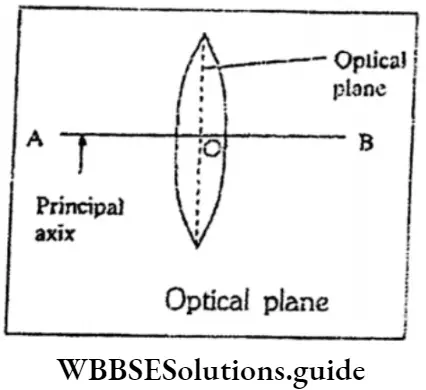
Question 23. The straight line that joins the centres of the spherical surfaces forming the lens is called the  _______ axis of the lens.
Answer: Principal

Question 24. The distance of the principal focus from the optical centre of a lens is called its principal _______ length.
Answer: Focal

Question 25. An object place perpendicular to the principal axis of a convex lens will have its image _______ to the principal axis.
Answer: Perpendicular

Question 26. The focal length of a convex lens will be maximum for _______
Answer: Red light

Question 27. The number of images observable between two parallel plane mirror is_______
Answer: Infinite

Question 28. The formation of the spectrum is due to _______
Answer: Dispersion

Question 29. The terminal colours of pure spectrum of white light are
Answer: Red and violet

Question 30. _________of the prism is used to see infrared spectrum of light.
Answer: Rocksalt.

WB Class 10 Physical Science Question Answer Chapter 5 Light Short Answer Type Questions

Question 1. What is a centre of curvature of a lens?
Answer:

Centre of curvature: The spherical surface of a lens is a part of sphere. The centre of this sphere is known as centre of curvature of the surface of lens.

Question 2. What is Focal plane?
Answer:

Focal plane:  The plane passing through the principal focus of a lens and perpendicular to the principal axis of the lens is known as the focal plane of the lens.

Question 3. What is Radius of curvature?
Answer:

The radius of curvature: The radius of curvature of a lens is the radius of the glass sphere from which the surfaces of the lens are cut.

Question 4. What is Focal length?
Answer:

Focal length: The distance between the optical centre and the focus is known as focal length.

Question 5. What do you mean by the principal axis of a convex lens? 
Answer:

Principal axis of a convex lens

Principal axis of a convex lens joining the centres of curvature of the two spherical surfaces of a convex lens is called its principal axis.

WBBSESolutions For Class 10 Physical Science And Environment Chapter 5 Light Principle Axis

Question 6. What is optical centre?
Answer:

Optical centre: If a ray of light strikes the surface of a lens in such a way that the emergent ray from the other surface is parallel to it then the corresponding refracted ray passes through a definite point on the principal axis. This point (A) is the optical centre of the lens.

WBBSESolutions For Class 10 Physical Science And Environment Chapter 5 Optical Centrs

Question 7. What does the term ‘thin’ signify when it is related to a convex lens? Do all rays of light suffer deviation while crossing through a thin convex lens?
Answer:

A thin convex lens is one, the thickness at the middle of which is extremely small compared to the radii of curvature of its surfaces. Rays directed towards the optical centre do not suffer deviation while crossing through a convex lens.

“WBBSE Class 10 Physical Science Chapter 5, Light important questions

Question 8. What is a spectrum?
Answer:

Spectrum: The band of different colours obtained due to dispersion of white light is known as a spectrum.

Question 9. A concave mirror of a small aperture forms a sharper image why?
Answer:

A concave mirror of a small aperture forms a sharper image

It is because such a mirror is free from the defect due to spherical aberration.

Question 10. What are luminous and non-luminous object?
Answer:

Luminous object

Bodies which emit light of themselves are luminous sources.

Non-luminous object

Bodies which cannot emit light of themselves are non-luminous sources.

Question 11. State the principle of reversibility of light path.
Answer:

Reversibility of light path

If a ray starting from a point reaches a second point after suffering any number of reflections and refractions and then be reversed in direction, it will retrace its path and reach the first point provided that all other conditions under which reflections and refractions took place remain unaltered.

Question 12. Define real image.
Answer:

Real image

If reflected or refracted rays actually converge to a point, the point is called a real image.

Question 13. Define virtual image.
Answer:

Virtual image

If the reflected or refracted rays only appear to diverge from a point, the point is called a virtual image.

Question 14. Write the differences between real and virtual image.
Answer:

Differences between real and virtual image

  • A real image is formed when a reflected or refracted ray actually converges to it, but in case of a virtual image, the reflected or refracted ray appear to diverge from it.
  • A real image can be seen directly with eye. It can also be cast on a screen. But a virtual image can only be seen with eye but it cannot be cast on a screen.

Question 15. Define image.
Answer:

Image

It the rays diverging from a paint undergo changes in direction by reflection, refraction of by both, ultimately they either converge to a point or appear to diverge from a point.

Question 16. What is incident ray and reflected ray?
Answer:

Incident ray and reflected ray

  • The light ray striking a reflecting surface is called the incident ray.
  • The light ray obtained after reflection from the surface, in the same medium in which the incident ray is travelling, is called the reflected ray.

Question 17. What is plane of incidence and reflection?
Answer:

The plane containing the reflected ray and normal, is called the plane of reflection. The plane containing the reflected ray and the normal, is called the plane of reflection.

“Class 10 Physical Science and Environment Light solutions, WBBSE syllabus”

Question 18. Difine Lateral inversion.
Answer:

Lateral inversion

The interchange of the left and right sides in the image of an object in a plane mirror is called the lateral inversion.

19. Write two uses of plane mirror.
Answer:

Uses of plane mirror

  • In a kaleidoscope, three plane mirrors inched with each other at 60° are used.
  • In the solar heating devices such as solar cooker, etc plane mirror is used to reflect the light rays incident from sun. The substance to be heated.

Question 20. What is the principle of simple periscope.
Answer:

The principle of simple periscope

This instrument is used for looking over an obstacle which blocks the path of light from an object to the eyes of an observer.

Question 21. Define

  1. Centre of curvature
  2. Redius of curvature
  3. Principle axis

Answer:

  • The centre of curvature of a mirror is the centre of the sphere of which the mirror is a apart.
  • The radius of the sphere of which the spherical mirror is a part, is called the radius of curvature of the mirror.
  • It is the straight line joining the pole of the mirror to its centre of curvature.

Question 22. Define

  1. Pole
  2. Aperture.

Answer:

  • The geometric centre of the spherical surface of the mirror is called the pole of the mirror.
  • The part of the mirror which is exposed to the incident light is called the aperture of the mirror. Thus it is the surface of the mirror from which reflection occurs.

Question 23. Define focus and focal length.
Answer:

Focus and focal length

  • Focus-The focus of a concave mirror is a point on the principle axis through which the light rays incident parallel to the principal axis pass after reflection from the mirror.
  • The focus of a convex mirror is a point on the principal axis at which the light rays incident parallel to the principal axis, appear to meet after reflection from the mirror.
  • Focal length-The distance of focus from the pole of the mirror is called the focal of the mirror.

Question 24. Write the differences between convex mirror and concave mirror.
Answer:

Concave mirror And Convex mirror:

WBBSESolutions For Class 10 Physical Science And Environment Chapter 5 Light Differences Of Convex And Concave

Question 25. Write two characteristics of the image formed by a plane mirror.
Answer:

Characteristics of the image formed by a plane mirror

  • The dista nces of the object and its image is measured from the mirror are equal.
  • The line joining the object and its image intersects the mirror perpendicularly.

Question 26. Define

  1. First principal focus.
  2. Second principal focus

Answer:

  • Rays either diverging from or directed through the first principal focus of a spherical surface, after refraction at the surface becoms parallel.
  • Rays moving parallel to the principal axis after refraction at a spherical surface either coverge to or appear to diverge from a point on the principal axis, known as second principal focus of the surface.

Question 27. What is Myopia?
Answer:

Myopia: The defect where for point is less than infinity is known as myopia. The defect is also called short Sightedness.

Question 28. How does the ray passes through the prism in the minimum deviation position?
Answer: In the minimum deviation position, the ray passes symmetrically through the prism i.e. the incident ray and emergent ray are equally inclined to the respective faces of prism.

 Question 29. On what factors does the angular dispersion depend?
Answer:

The angular dispersion depends on :

  1. Refraction angle of the prism
  2. Nature of the material of the prism
  3. Wavelength of the incident light

Question 30. Why does a convex lens of glass = 1.5 behave as a diverging lens when immersed in a liquid of “μ = 1.65?
Answer:

The refractive index of glass with respect to the liquid [/latex]\frac{1.5}{1.65}[/latex]) is less than 1.

Question 31. Why does a diamond sparkle with great brilliance?
Answer: Multiple total internal reflections of light occur within the diamond. Diamond cutter uses this fact.

Question 32. What type of mirror would you use as shaving mirror?
Answer: A concave mirror of larger focal length is used for shaving purpose. Because it produces a magnified erect image of the face when placed within the focus of the mirror.

Question 33. The refractive index of diamond is much greater than the ordinary glass. Is this fact of some use to a diamond-cutter?
Answer: A critical angle [sin-1(\(\frac{1}{μ}\))] reflection takes place easily. of a diamond is much smaller and total internal

Question 34. How would you determine whether a mirror is plane, concave or convex?
Answer:

A plane mirror produces an erect image of the same size as that of the object. A concave mirror produces an erect and magnified image of an object when placed within its focus. A convex mirror produces always an erect and diminished image of an object.

“WBBSE Class 10 Physical Science Chapter 5, Light summary”

Question 35. What is a Linear magnification of lens.
Answer: Linear magnification of lens: The ratio of the length of the image and that of the object is called the linear magnification.

WBBSESolutions For Class 10 Physical Science And Environment Chapter 5 Light Linear Magnification

Question 36. What is Focus of a convex lens?
Answer:

Focus of a convex lens: If a beam of parallel rays, travelling parallel to the principal axis of a convex lens are refracted by the lens, the rays become converg- ing and intersect each other at a particular point on the axis. The point is known as the focus of the convex lens.

WBBSESolutions For Class 10 Physical Science And Environment Chapter 5 Light Fecus Of Convex Lens

Question 37. Which rays should be considered n drawing ray diagrams for images formed by a convex lens?
Answer:

The following points should be considered :

  • A beam of rays parallel to the principal axis after refraction through the lens pass through the principal focus.
  • A beam of rays passing through principal focus emerge parallel to the principal axis, after refraction through the lens.
  • A beam of rays through the optical centre pass out undeviated.

Question 38. What is a pure spectrum?
Answer:

Pure spectrum: The spectrum in which the constituent colours do not overlap on each other and are seperated distinctly into elementary colours is known as a pure spectrum.

Question 39. What is an impure spectrum?
Answer:

Impure spectrum: The spectrum in which the constituent colours partially superpose on each other and are not seperated distinctly into elementary colours is known as an impure spectrum.

40. Is dispersion possible without refraction?
Answer:

Question Explanation: Dispersion without refraction is not possible. In an optical medium different colours travel with different speed and so deviate with different magnitudes. Thus, the constituent colours of a poly chromatic light deviate by different amounts i.e. they are dispersed after refraction.

“WBBSE Class 10 Chapter 5 Physical Science, Light step-by-step solutions”

Question 41. Why blue is used after washing white shirts?
Answer:

Explanation Blue: Whitens yellow or orange colour. So, white shirts after washing may have some yellow or orange stain. To convert such stains to white, blue is used.

Question 42. What is the optical plane?
Answer:

Optical plane: It is an imaginary vertical plane that cuts the principal axis perpendicularly and passes through the optical centre of a lens.

WBBSESolutions For Class 10 Physical Science And Environment Chapter 5 Light Optical Plane

Question 43. Draw a neat diagram of the formation of image of an object at infinity by a convex lens.
Answer:

Formation of the image of an object at infinity by a convex lens :

  • Distance of object: At infinity.
  • The image formed: On the focal plane.
  • Nature of image: Real and inverted.
  • Size of image: Very much smaller than the object.

WBBSESolutions For Class 10 Physical Science And Environment Chapter 5 Light Infinity By A Convex Lens

Question 44. The critical angle for a material c is 30°. Find its refractive index.
Answer:

The critical angle for a material c is 30°

⇒ μ=1/ sinc=1/sin 30% = 2.0

Refractive index = 2.0

“WBBSE Class 10 Light, Physical Science Chapter 5 key concepts”

Question 45. What is the focal length of a concave mirror of radius of curvature of 16.0 cm?
Answer:

The radius of curvature = 16cm. Focal length.

= ½ × Radius of curvature

= (\(\frac{1}{2}\) x 6) cm

= 8 cm.

Focal length of a concave mirror = 8 cm.

Question 46. A lens has a power of -2.5D. What is the focal length and the nature of the lens?
Answer:

P = – 2.5 D

Focal length =\(\frac{1}{P}\)

= \(\frac{1}{-2.5}\)

= -0.4m

= 40 sin.

Question 47. A lens has a focal length of -25cm. What is the power of the lens and what is the nature?
Answer:

Power = P = \(\frac{1}{f in m}\)

= \(\frac{1}{-0.25}\)

= – 4D.

Question 48. If the refractive index of glass in 1.5 and Zi=55, find the angle of refraction of glass.
Answer:

μ= \(\frac{sini}{sin r}\)

sin r = \(\frac{sin i}{μ}\)

=\(\frac{sin 55°}{1.5}\)

= 33.6°.