Photosynthesis In Higher Plants Notes

Photosynthesis In Higher Plants Introduction

All organisms on earth require the input of energy from their environment. We know that the sun is the source of all energy. Only green plants can harvest and transduce solar energy into chemical energy. That is why they are known as autotrophic (Greek word autos meaning ‘self’ and trophy meaning ‘nourishing’) organisms. Light from the sun is transformed into chemical energy contained in organic material by the process of photosynthesis.

C.R. Barnes (1893) coined the term ‘photosynthesis’. This term is derived from two Greek words—photos meaning ‘light’ and synthesis meaning ‘formation’. Therefore, photosynthesis is the formation of compounds using light energy.

Photosynthesis In Higher Plants  Definition: The physiological process, by which green plants synthesise carbohydrates, with the absorption of radiant energy of the sun and using CO2 and water as raw materials, is called photosynthesis.

“photosynthesis in higher plants notes for class 11”

Chemical reaction of photosynthesis: During photosynthesis, light energy splits water into oxygen and hydrogen, the latter is bound as NADPH (nicotinamide adenine dinucleotide phosphate, a coenzyme). This particular process termed the light reaction, takes place in the photosynthetic reaction centres embedded in thylakoid membranes of chloroplasts.

Class 11 Biology Class 11 Chemistry
Class 11 Chemistry Class 11 Physics
Class 11 Biology MCQs Class 11 Physics MCQs
Class 11 Biology Class 11 Physics Notes

It involves the transport of electrons, which is coupled with the synthesis of ATP. The compounds NADPH and ATP produced in the light reactions are called reducing power. These are consumed in the subsequent phase of photosynthesis, called the dark reaction (Calvin cycle). In this phase, carbohydrates are synthesised from CO2.

Photosynthesis is an anabolic process. In this process, carbon is assimilated by a redox reaction (simultaneous reduction and oxidation). This requires an- electron. carrier as well as energy. The electron carrier itself gets oxidised, reducing carbon dioxide to oxygen. Energy is obtained from sunlight. The overall chemical equation of photosynthesis (oxygenic) in green plants is

⇒ \(\mathrm{CO}_2+\mathrm{H}_2 \mathrm{O} \underset{\text { light }}{\stackrel{\text { Chlorophyll }}{\longrightarrow}}\left(\mathrm{CH}_2 \mathrm{O}\right)_n+\mathrm{O}_2\)

[(CH2O)n is a carbohydrate]

The general equation of photosynthesis is
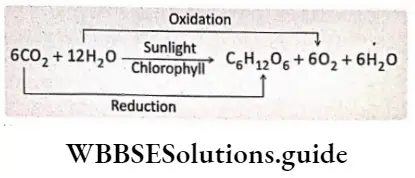
Photosynthesis in higher plants Oxidation

photosynthesis in plants class 11

Photosynthesis In Higher Plants  Explanation of the chemical reaction: During photosynthesis, 6 molecules of carbon dioxide and 12 molecules of water react to produce 1 molecule of carbohydrate (glucose), 6 molecules of oxygen and 6 molecules of water. Hence, it is an anabolic process. Number of molecules of carbon dioxide consumed and that of oxygen produced is the same.

It is called a photochemical reaction as it occurs in the presence of light (photo) and chlorophyll (chemical). Oxidation of water produces oxygen and reduction of carbon dioxide produces glucose. Hence, it is a redox reaction. The volume of water produced is half of that consumed during the process.

Oxygenic Photosynthesis

The type of photosynthesis in which solar energy is captured and converted to ATP with the production of oxygen is called oxygenic photosynthesis. Water is used as an electron donor in this process. Green algae, green plants, blue-green algae and Euglena and Chrysoamoeba are oxygenic photosynthetic organisms.

“detailed notes on photosynthesis in higher plants”

Anoxygenic Photosynthesis

The type of photosynthesis in which some bacteria trap the solar energy to synthesise glucose without the release of oxygen is known as anoxygenic photosynthesis. Reduced inorganic molecules such as H2S, are used as electron donors in this process.
Photosynthesis In Higher Plants Notes

Photosynthesis or carbon assimilation: Photosynthesis is also known as carbon assimilation because the carbon molecule of CO2 in the air is assimilated to form an organic component of the cell. Autotrophs i.e., organisms who make their own food, perform carbon assimilation either through photosynthesis or through chemosynthesis. Photosynthetic organisms are also known as photoautotrophs. Chemosynthesis is carried out by the chemoautotrophs such as purple sulfur bacteria, methane bacteria, etc.

Photosynthesis Importance: Photosynthesis is one of the most important physiological processes in the living world.

“photosynthesis in higher plants handwritten notes”

This is because of the following reasons—

  1. Photosynthesis is the only known mechanism for synthesising organic materials from inorganic raw materials found in the environment. Photosynthetic organisms or producers are able to synthesise organic materials or food on which all other organisms or consumers depend directly or indirectly.
  2. It changes solar energy into chemical energy. This energy gets stored in the organic food as bonds between atoms. This energy is liberated when the bonds are broken during respiration.
  3. Numerous products such as firewood, timber, oils, gums, resins, rubber, cork, tannins, alkaloids, drugs, fibres, etc., are produced by the process of photosynthesis.
  4. Organic matter formed by the process of photosynthesis is the source of coal, natural gas and petroleum.
  5. Photosynthesis keeps the amount of CO2 under control. Carbon dioxide is added to the environment due to combustion and respiration. Plants regularly absorb CO2 during photosynthesis. Therefore, planting more trees is one of the solutions to check the rising amount of atmospheric CO2.
  6. The maximum percentage of atmospheric O2 has originated through photosynthetic activity.

Early Experiments Regarding Photosynthesis

Photosynthesis has always been an important aspect of plant physiological research. Several discoveries have paved the way for new insights into the process of photosynthesis.
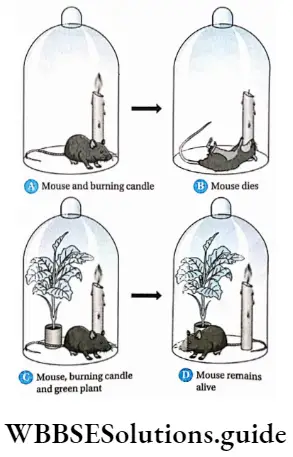
Photosynthesis in higher plants Priestley's experiment

  1. In 1772, Joseph Priestley, a British scientist, showed plant shoots could purify ‘foul air’ produced by the burning of a candle. He observed that a burning candle when placed in a sealed chamber, gets extinguished. If a mouse is placed in this sealed chamber, it dies. However, if a plant is placed within the sealed chamber, along with a mouse, then the remains alive. This proved that plants could produce something (oxygen) that purified the air.
  2. In 1779, Jan Ingenhousz demonstrated that light is required by plants to produce oxygen.
  3. In 1782, Jean Senebier showed that green plants need to absorb carbon dioxide before they release oxygen. In fact, the rate of oxygen evolution is dependent on the rate of carbon dioxide consumed.
  4. In 1783, Antoine-Laurent Lavoisier, identified the dephlogiston (pure air) and phlogiston (impure or foul air) in Priestley’s experiment as oxygen and carbon dioxide, respectively.
  5. In 1804, Nicolas-Theodore de Saussure, a Swiss chemist and plant physiologist, showed that water is required for photosynthesis.
  6. In 1818, Pierre-Joseph Pelletier and Joseph-Bienaime Caventou, both French chemists, isolated and named chlorophyll, the green pigment required during photosynthesis.
  7. In 1845, Julius Robert von Mayer, a German physician and physicist, proposed that photosynthetic organisms convert light energy into chemical energy.
  8. In 1862, Julius von Sachs discovered starch as the
    product of photosynthesis.
  9. In 1882, Engelmann discovered that chloroplast, containing chlorophyll, is involved in photosynthesis. He also discovered the role of different wavelengths of light in photosynthesis. Thereby, he plotted the action spectrum.
  10. In 1905, Blackman discovered light and dark reactions in photosynthesis. He further proposed the ‘law of limiting factors’.
  11. In 1931, Cornelius van Niel demonstrated that some bacteria use H2S instead of H2O in photosynthesis.
    ⇒ \(\mathrm{CO}_2+\mathrm{H}_2 \mathrm{~S} \stackrel{\text { Light }}{\longrightarrow}\left[\mathrm{CH}_2 \mathrm{O}\right]_n+\mathrm{O}_2+2 \mathrm{~S}\)
  12. In 1937, Robert Hill performed experiments and demonstrated that photooxidation of water is the main function of chloroplasts.
  13. In 1954, Melvin Calvin performed experiments on Chlorella and demonstrated the Calvin cycle.

Raw Materials Of Photosynthesis

The important components of photosynthesis are sunlight, chlorophyll, water and carbon dioxide. Among these, water and carbon dioxide are raw materials, while the presence of sunlight and chlorophyll is important for the process.

Experiments Proving Of Importance Of Essential Components Of Photosynthesis

Some simple experiments are described in this section which demonstrate the importance of the raw materials of photosynthesis in the process.

“photosynthesis in higher plants NEET notes”

Experiment to show the importance of chlorophyll in photosynthesis

  1. A variegated (with patches of green and non-green) leaf is plucked from the potted plant. The green patches contain chlorophyll, while the non-green patches do not contain chlorophyll.
  2. The leaf is boiled in a water bath for about 2-3 min and then placed in ethanol for 10 min. This destroys the chlorophyll present in the green parts of the leaf.
  3. The same leaf is now placed in boiling water for some time to remove the leftover chlorophyll.
  4. Now the leaf is placed in a petri dish and iodine solution is poured over it and observed.
  5. The parts of the leaf that were green initially, turned blue-black in colour. On the other hand, the non-green parts of the leaf remained brown.
  6. This happens because the green parts of the leaf contain chlorophyll. Starch is produced in those parts as a result of photosynthesis. This starch turned blue-black on reaction with iodine.
  7. The non-green parts of the leaf did not contain chlorophyll. Starch was not produced there. Due to the absence of starch, the iodine did not show any colour change. This experiment shows chlorophyll is essential for photosynthesis.
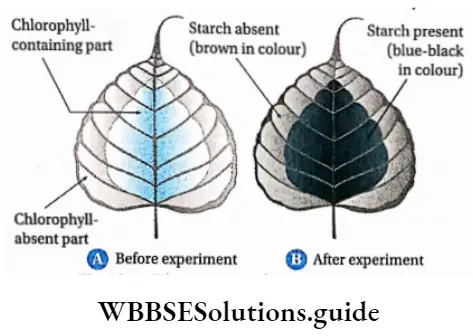
Photosynthesis in higher plants Experiment to show importance of chlorophyll in photosynthesis

Experiment to show the importance of light in photosynthesis

  1. The potted plant is detached by keeping the plant in darkness for 48 hours. An iodine test is performed to ensure the plant has been detached.
  2. A leaf, from the same plant, is covered with black paper or Ganong’s light screen. Vaseline is applied to the junction of the leaf and the covering. This makes the arrangement air-tight.
  3. This plant is now allowed to remain under sunlight for about 24 hours.
  4. After 24 hours, the leaf is plucked and boiled in alcohol for some time, so as to remove the chlorophyll. The whole leaf now becomes pale.
  5. Iodine solution is now added to the leaf and observed.
  6. The uncovered parts of the leaf turn blue-black while the parts of the leaf that were covered with the light screen, remain brown in colour.
  7. The uncovered parts of the leaf received sunlight and hence could carry out photosynthesis. Starch was produced and as a result, a blue-black colour change was observed.
  8. On the other hand, the parts of the leaf that are covered with the light screen did not receive any sunlight. Hence, photosynthesis did not occur and starch was not produced. Thus, these parts did not show any colour change. This experiment proves that sunlight is essential for photosynthesis.
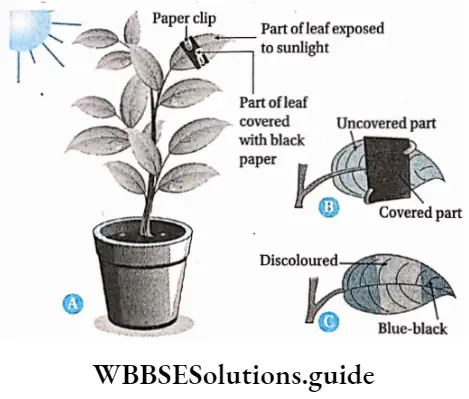
Photosynthesis in higher plants Experiment to show importance ofsunlight in photosynthesis

Ganong’s light screen

The broad, metallic plates used to cover the leaves of plants during experiments are known as Ganong’s light screen. It has a star-shaped pore at its centre. Light can enter only through this pore. When iodine solution is added over the leaf, only the star-shaped part and the uncovered parts of the leaf appear blue-black. The part of the leaf, that remains covered, appears pale.

Moll’s half-leaf experiment to show the importance of CO2 in photosynthesis

  1. The plant has been detached by keeping it in darkness for 48 hours.
  2. A 250 cc conical flask, containing 20% KOH solution, has been attached to the clamp. Its mouth has been covered with cotton soaked in lime water.
  3. A leaf of the detached plant is slid into this flask, through the lime water-soaked cotton. It must be ensured that the leaf remains freely suspended within the flask.
  4. 20% KOH solution absorbs the carbon dioxide within the flask. The mouth of the flask is plugged with a cotton plug soaked in lime. The mouth of the flask is made airtight with vaseline. This ensures a CO2-free environment for the leaf.
  5. This plant is kept in sunlight for about a day.
  6. After one day, this leaf is plucked from the plant and tested with iodine solution for the presence of starch.
  7. Another leaf of the plant is also plucked and tested for the presence of starch. This leaf acts as the control.
  8. The leaf that was placed in the conical flask, turned brown on adding iodine solution. On the other hand, the other leaf (control) showed a blue-black colour on adding iodine solution.
  9. The leaf that was placed in the flask, did not receive any carbon dioxide. Hence it was unable to photosynthesise and hence no starch was produced. Therefore no colour change was shown.
  10. On the other hand, the other leaf received CO2 from the environment. It was able to photosynthesise and produce starch. Hence, it showed the blue-black colour change.
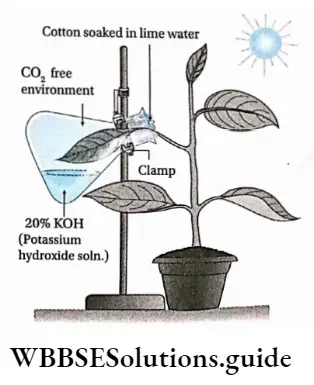
Photosynthesis in higher plants Moll's halfleafexperiment to show importance of carbon dioxide in photosynthesis

Site Of Photosynthesis

In higher plants, photosynthesis mainly takes place in leaves. However, other green parts of plants like young green stems, stalks and calyx of flowers also take part in photosynthesis.

Conditions That Make Leaf The Ideal Site For Photosynthesis

Leaves are ideal sites for photosynthesis because—

  1. The distended flat leaf blade is morphologically favourable for the absorption of sunlight and CO2.
  2. Phyllotaxy or the arrangement of leaves on the stem allows the leaves to receive the maximum amount of sunlight.
  3. Leaves bear stomata on the surface (either only on the lower surface or on both surfaces). It makes it easier to exchange gases with the atmosphere.
  4. Large intercellular spaces present between mesophyll cells help in efficient gaseous diffusion.
  5. An extensive network of veins and veinlets allows easy transport of water, nutrients and synthesized carbohydrates between leaves and other parts of the plant body.

Mesophyll Tissue

The tissue that is made up of chlorophyllous cells, present between the upper and lower epidermis, that helps in photosynthesis is called mesophyll tissue. In
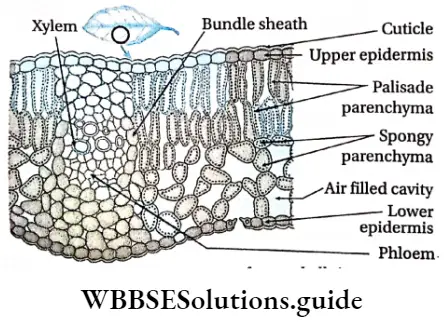
Photosynthesis in higher plants Structure ofmesophyll tissue

dorsiventral leaves, two types of cells—palisade parenchyma and spongy parenchyma, constitute this layer. Isobilateral leaves have only spongy parenchyma in this layer.

Chloroplast And Its Structure

Chloroplasts, found in mesophyll cells, are the main photosynthetic apparatus of plants. The chloroplast usually has a characteristic convex lens shape.

The major structural features of the chloroplast are described below—

  1. The chloroplast is surrounded by an envelope made up of two selectively permeable membranes. The membrane facing the cytoplasm is known as the outer membrane and the membrane present next to it is known as the inner membrane. The space enclosed within the double membrane is called the periplastidial site. These membranes help in the transport of metabolic substances between the chloroplast and cytoplasm.
  2. The proteinaceous matrix, enclosed by the inner membrane of the chloroplast is known as stroma. It contains the dissolved enzymes for CO2 fixation, protein synthesis, and storage of starch.
  3. The stacked structures present within the matrix, are called grana (singular: granum). A granum helps to trap the light energy. It is the part where the light reaction takes place. Each stack is composed of membrane-bound discs or sac-like structures called thylakoids. The space enclosed within the thylakoid membrane is called lumen.
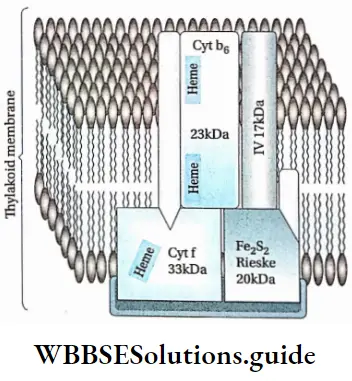
  4. Thylakoid membrane contains chlorophylls, carotenoids, cytochromes (b and f), ATP-synthase, etc. These components help in the light reaction of photosynthesis.
  5. The grana are interconnected by hollow tube-like channels stretching across the stroma. These channels are called stroma lamellae. Chlorophyll molecules and other important components required for photosynthesis are present in the walls of the thylakoid.
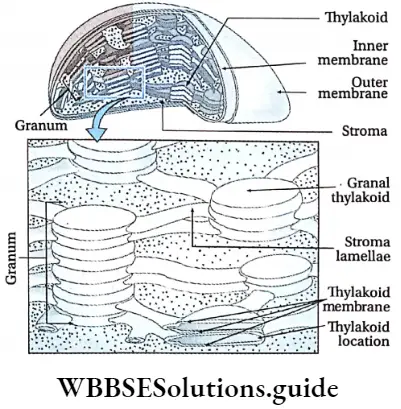
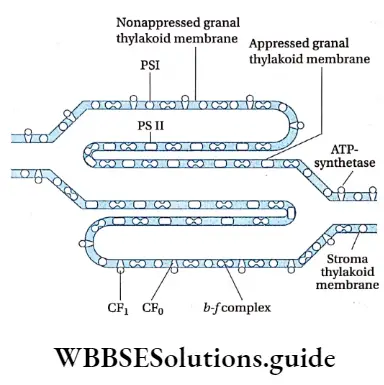
Photosynthesis in higher plants Structure ofchloroplast and arrangement ofthylalcoids

Photosynthesis in higher plants Supramolecular structure ofthylakoids showing PS I, PS II, b-fcomplex and ATP synthetase

The whole process of photosynthesis is divided into different compartments of chloroplast.

Division of labour in chloroplast

The membranous system present within the chloroplast consists of grana, stroma lamellae, and fluid stroma. The membrane system creates compartments within the chloroplast where different activities can take place at the same time. Division of labour in the chloroplast is simple.

Absorption of light and all of the light reactions occur within or on thylakoid membranes. The process requires chlorophyll, which is present in grana. Chlorophyll entraps the photon molecules of sunlight within leaves.

“chapter-wise notes on photosynthesis in higher plants”

Hence, photophosphorylation (formation of ATP using light) occurs. The ATP and NADPH produced by these reactions are released into the surrounding stroma. The main reactions of photosynthesis, i.e., carbon assimilation and Calvin cycle, through which glucose is synthesised, take place during the light-independent phase i.e., through dark reactions. The enzymes and coenzymes required for the above processes are present in the stroma.

Other Photosynthetic Organisms And Their Parts

Besides higher plants, photosynthesis is also exhibited by other organisms

Lower plants

Blue-green algae and all chlorophyll-containing organisms (algae, moss, fern, gymnosperms and angiosperms), show photosynthesis.

Apart from leaves, some other parts of these plants that show photosynthesis are as follows

  1. Aerobic roots in orchids, carbon assimilating roots in Tinospora cordifolia (Gulancha), etc.
  2. Stems of cacti, pumpkin, gourd, etc.

Endosymbiotic theory

This theory postulates that several important organelles of eukaryotes originated as independent organisms that lived symbiotically within other single-celled organisms. In the 1960s, it was discovered that mitochondria and chloroplasts contain DNA and ribosomes.

Hence they could synthesise their proteins. According to this theory, mitochondria and chloroplasts were considered free-living bacteria, that must have entered another cell somehow and started living as an endosymbiont. This theory is known as endosymbiotic theory.

Photosynthetic unicellular Protista

Unicellular organisms and bacteria such as Euglena sp., Chrysamoeba sp., Rhodopseudomonas sp., Rhodospirillum sp., etc., show photosynthesis.

Pigments Involved In Photosythsis

Light may be reflected, transmitted or absorbed by matter. Compounds that absorb light are called pigments. Pigments that take part in photosynthesis are called photosynthetic pigments.

Pigments Involved In Photosynthesis Definition: The pigments, present within the living cells, that help to carry out photosynthesis and also provide colour to the fruits are called photosynthetic pigments.

Pigments Involved In Photosynthesis Location: They are generally present in the thylakoid and stroma lamellae of chloroplast.

Observation of difference in the rate of photosynthesis

  1. Between a distended and a wrinkled leaf: If the leaf blade is distended, mesophyll tissues within the leaf blade get the proper amount of sunlight. This sunlight reaches chloroplasts within mesophyll cells. The chlorophyll molecules in the chloroplasts become activated by sunlight.
    On the other hand, the exposed surface area of a wrinkled leaf is much less. Hence the mesophyll tissues do not get sufficient sunlight and thereby, most of the chlorophyll molecules remain inactivate. Hence, the rate of photosynthesis is lesser in wrinkled leaves.
  2. Between a simple pinnate leaf and a pinnately compound leaf: Since simple pinnate leaves are undivided, they do not have any segmented region. So, chloroplasts present throughout the leaf blade take part in photosynthesis. Hence, the rate of photosynthesis is higher. Segmented compound leaves have fewer chloroplasts. Thus, the rate of photosynthesis is less in the case of compound leaves.

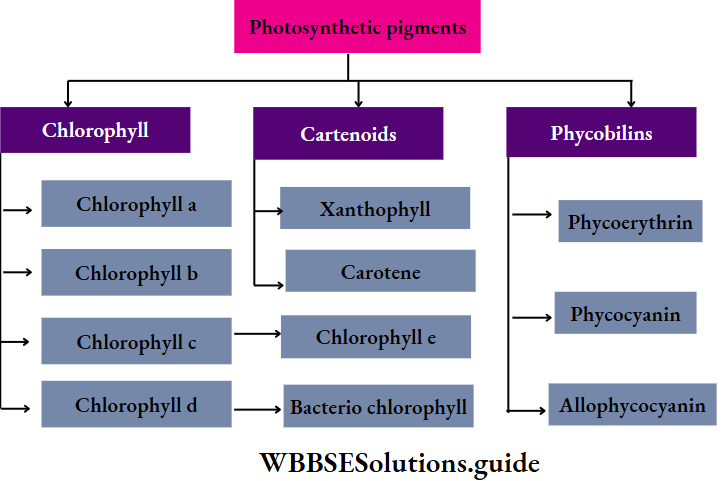
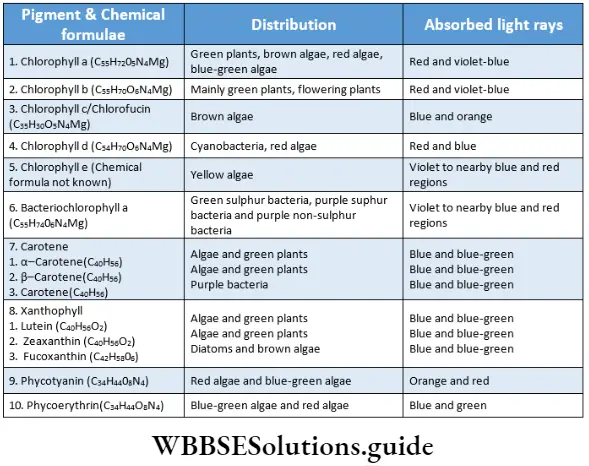
Pigments Involved In Photosynthesis Types: Photosynthetic pigments are mainly of three types

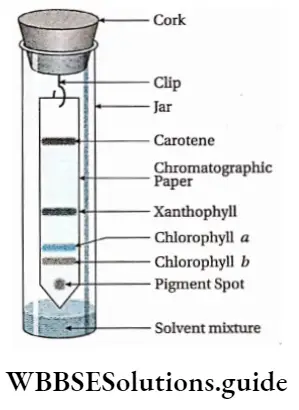
  1. Chlorophyll,
  2. Carotenoids,
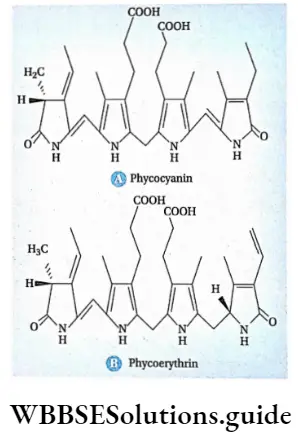
  3. Phycobilins.

Photosynthesis in higher plants Photosynthetic pigments

Chlorophyll is the primary photosynthetic pigment as it takes part in photosynthesis directly. Other photosynthetic pigments such as carotenoids and phycobilins do not directly take part in photosynthesis. Hence, they are called accessory photosynthetic pigments. Each type of pigment has been discussed under separate heads.

Relation Between Light Energy And Photosynthetic Pigments

The nature of light energy can be explained by certain theories.

Concept of light wave according to electromagnetic theory.

Most of the time light behaves like waves. Light waves are also known as electromagnetic waves, as they are made up of both electric and magnetic fields. Electromagnetic fields oscillate perpendicular to each other.

They also oscillate perpendicular to the direction of wave propagation, hence they are also known as transverse waves. The electromagnetic waves form a spectrum of different wavelengths ranging between 390-760 nm. This is visible to the human eye, hence, called the visible spectrum.
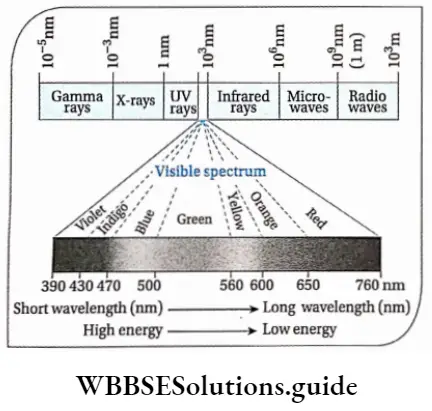
Photosynthesis in higher plants Electromagnetic and visible spectra

Photosynthetically Active Radiation (PAR):

Photosynthetically active radiation (PAR) is the visible spectrum ranging from 400 to 700 nm that photosynthetic organisms use for photosynthesis.

Photosynthetically Active Radiation Description: These are waves with shorter wavelengths and have a higher energy spectrum. Waves with longer wavelengths do not carry enough energy to allow photosynthesis. Hence, only waves of shorter wavelengths are used during photosynthesis.

Microorganisms, such as green bacteria, purple bacteria and Heliobacteria, use waves of relatively longer wavelength. These bacteria live at the bottom of stagnant ponds, sediment and ocean depths. Hence, they require such waves that can reach these regions.

Photosynthetically Active Radiation Absorption Spectrum: The part of the visible I spectrum, that is absorbed by specific pigments and used in photosynthesis is called absorption spectrum.

Photosynthetically Active Radiation Spectrum Formation: An absorption spectrum is obtained by allowing different wavelengths of visible light to pass through a solution of a pure compound. The amount of energy allowed to pass through the molecules of the solution for each wavelength is determined by a spectrophotometer.

The observations are plotted on a graph. The graphical representation of the absorption of light according to its wavelength, by the pigments, is called the absorption spectrum of that pigment. Absorption spectra are used by biologists to compare the wavelengths of light absorbed during photosynthesis by various plant pigments.
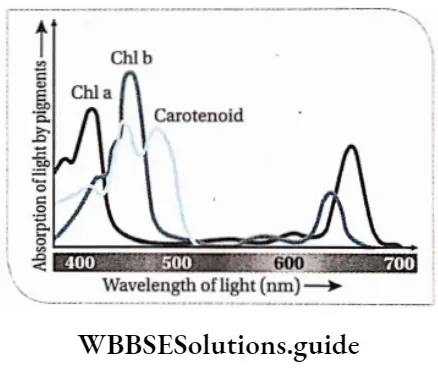
Photosynthesis in higher plants Absorption spectra of chlorophylla,chlorophyll and carotenoids

For example, Chlorophyll a has an absorption spectrum in the blue-violet region of the visible spectrum, while chlorophyll b has that in the red region of the visible spectrum.

Photosynthetically Active Radiation Action Spectrum: The part of the visible spectrum, comprising red (650-760nm) and blue-green (430-500nm) regions which is most effectively used during photosynthesis, is called the action spectrum.
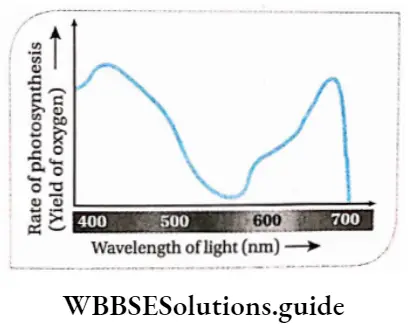
Photosynthesis in higher plants Action spectrum ofphotosynthesis

The comparative study of the rate of photosynthesis for different wavelengths of light gives us the action spectrum. It has been observed that the rate of photosynthesis is maximum for the blue-violet and red regions of the visible spectrum.

The action spectrum of light-dependent response resembles the absorption spectrum of a pigment complex that absorbs the effective light. A comparison of the action spectrum of photosynthesis with the absorption spectra of chlorophyll a indicates that the violet-blue and red region of the visible spectrum is most efficient for photosynthesis as well and chlorophyll a is the chief photosynthetic pigment.
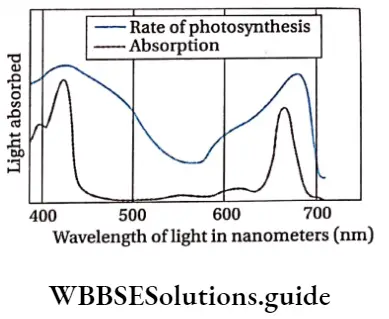
Photosynthesis in higher plants Action spectrum ofphotosynthesis superimposed on absorption spectrum ofchlorophyll a

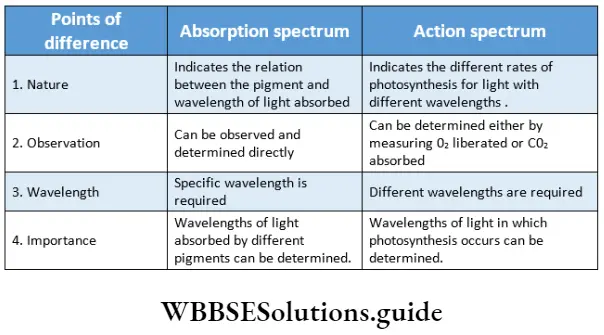
Photosynthesis in higher plants Differences between absorption and action spectra

The concept of photon according to the Particle theory of Einstein

In 1905, Albert Einstein suggested that apart from being a wave light is also particulate in nature. He termed these tiny particles of light as photons. Each photon carries some amount of energy, though they are not equal in each photon. This energy is known as quantum. The energy content of a photon is dependent on the wavelength of light.

Quantum requirement: The number of photons required to produce 1 molecule of oxygen is called quantum requirement. According to Emerson, 8 photons are required to produce 1 molecule of oxygen.

Quantum yield: The ratio of molecules of oxygen released to that of photons absorbed is called quantum yield. The quantum yield of photosynthesis (<f>) is a measure of photosynthetic efficiency expressed in moles of photons absorbed per mole of CO2 absorbed or O2 evolved. It can be represented as

⇒ \(\phi=\frac{\text { Number of } \mathrm{O}_2 \text { molecules evolved }}{\text { Number of photons absorbed }}\)

⇒ \(\phi=\frac{\begin{array}{c} \text { Amount (moles) of reactant consumed } \\ \text { or product formed } \end{array}}{\text { Amount (moles) of photons absorbed }}\)

In photosynthesis, (f> ranges between 0.1 to 0.125, theoretically. This means that 8 mole of photons are required to produce 1 mole of O2 in the absence of photorespiration.

Red Drop And Emerson Enhancement Effect

In 1943, Robert Emerson and Charlton M. Lewis, demonstrated the efficiency of photosynthesis, in Chlorella sp., under different wavelengths of visible light. They observed a sudden, sharp decline of photosynthetic efficiency in the far-red region of the visible spectrum, that is, from 685 nm towards the infra-red region.

This phenomenon was known as the ‘Red Drop’. The cause of the sudden drop in the photosynthetic efficiency was unknown. However, it was observed that even at wavelengths above 685 nm, absorption of light by chlorophyll was still high.
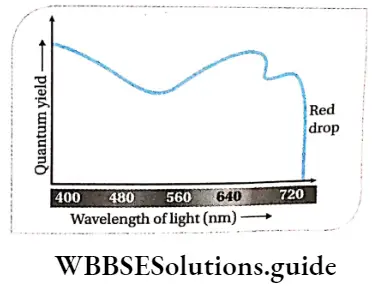
Photosynthesis in higher plants Red Drop

In 1955, Emerson and Ruth Chalmers came across an even stranger effect during another experiment. They observed that the ‘Red Drop’ disappeared if a supplementary light beam of a shorter wavelength was provided instead of infrared light.

They observed that the quantum yield obtained on passing infrared (700nm) and red-orange light (650nm) together, was more than that obtained on passing separately. This phenomenon is called the Emerson Enhancement Effect.

As a possible explanation, Emerson, Chalmers and Carl Cederstrand suggested that the supplementary light may have excited other pigments besides chlorophyll a. They proposed that this other pigment might be chlorophyll b, in Chlorella sp. This pigment may vary among different organisms.
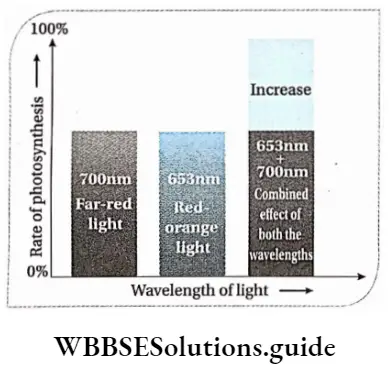
Photosynthesis in higher plants Emerson effect

Emerson enhancement effect, (E), is expressed by the equation
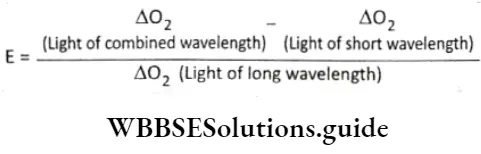
Photosynthesis in higher plants Light of combined wavelength

Where AO2 represents the rate atO2 evolved.

Effect of absorption on pigment molecules

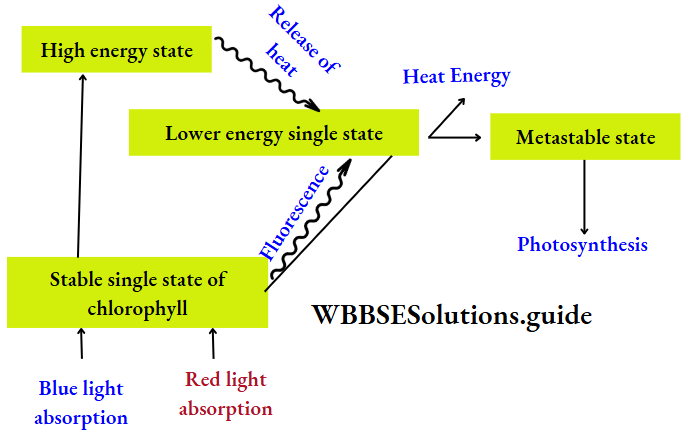
  1. When a chlorophyll molecule absorbs a photon, its electrons acquire energy. The electrons move from the ground (unexcited) state to the energised or singlet (excited) state. The energy difference between the ground state and the excited state determines the quanta of light absorbed.
  2. The excited state of an electron is unstable. In order to return to their ground state (attain stability), they release the energy in the form of heat or it is passed to the next electron.
  3. A part of the energy of the electron is released in such a way that the electrons come to an intermediate state between the ground and the excited state. This intermediate state is called the metastable triplet state.
  4. Electrons release energy by either fluorescence (electrons absorb light of a shorter wavelength but emit that of longer wavelength) or by phosphorescence (electrons absorb light of longer wavelength but emit that of shorter wavelength) to reach the ground state from this intermediate state.
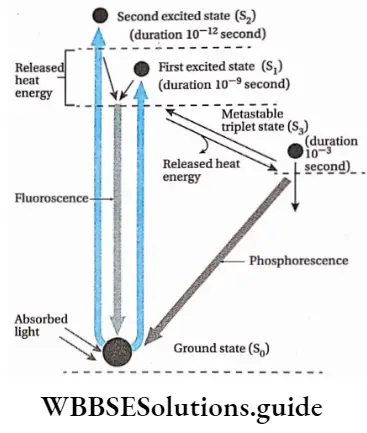
Photosynthesis in higher plants Excitation of an electron and its return to ground state

Light Harvesting Components Or Photosynthetic Units

the smallest group of pigment molecules working together in a photochemical process is called the photosynthetic unit. they take part in the absorption and transportation of a quantum of light to a reaction centre, thereby promoting the release of an electron.

They take part in the absorption and transportation of a quantum of light to a reaction centre, thereby promoting the release of an electron. each photosynthetic unit is made up of photosystem 1 (ps1), photosystem 2 (ps 2), cytochrome b6f complex and coupling factor or ATP synthase.

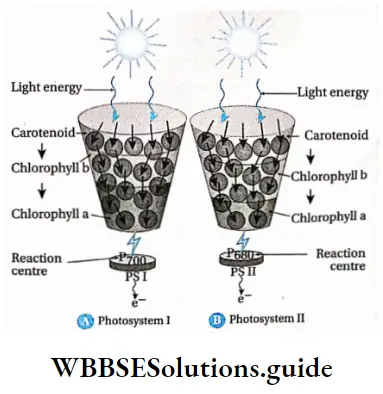
Each photosystem has a reaction centre or photo centre. a reaction centre consists of chlorophyll molecules. the reaction centre is run by two types of molecules—antenna molecules and electron molecules. chlorophyll a, chlorophyll b, carotenoids, phycobilins and protein molecules form an antenna complex.

“photosynthesis in higher plants notes with diagrams”

They absorb light energy get excited and push the electrons to their outer orbital. these antenna molecules pass over their energy to the electron carrier molecules. they again hand over the energy to the photo centre. generally, reaction centres in the photosystems have chlorophyll a dimer (P700 or P680).

Together with the antenna pigment molecules and electron carrier molecules, they form the light-harvesting centre (LHC). the different components of the antenna complex absorb different wavelengths of the spectrum. each pigment molecule transmits energy (photons) to the next pigment molecule. Finally, the energy reaches the chlorophyll a dimers and excites them.
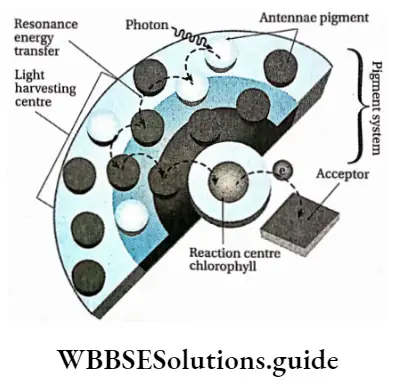
Photosynthesis in higher plants Antenna complex and reaction centre

Points To Remember

  • Photosynthesis is the process by which green plants synthesise food in the form of glucose, utilising CO2 and H2O from the atmosphere and releasing O2 as a byproduct.
  • Leaves are the site of photosynthesis and chloroplasts are the cell organelles where the process is carried out.
  • Photosynthetic pigments such as chlorophyll, carotenoids, xanthophylls, etc., are essential for trapping specific wavelengths of light.
  • Only one type of photosystem is present in bacteria, that is similar to PS 1 in green plants and their photosynthetic pigments include bacteriochlorophyll, bacterioviridin, etc.
  • When the thylakoids are arranged in stacks within the stroma or matrix of the chloroplast, they are called grana thylakoids.
  • When the thylakoids remain as single units within the stroma or matrix of the chloroplast, they are called stroma thylakoids.
  • The light rays are made up of particles called photons. Several photons form one quantum of energy.
  • Quantum requirement is the number of quanta of energy required to release 1 molecule of oxygen, while quantum yield is the amount of oxygen released on utilising a quantum of energy.

“photosynthesis in higher plants important points”

  • When the quantum yield decreases rapidly on being excited by light of monochromatic wavelength(above 680nm), the phenomenon is known as red drop. It was discovered by Emerson and Lewis.
  • During photosynthesis, the violet-blue and red-coloured wavelengths of light get absorbed by the chlorophyll. When violet to blue wavelength (390-500nm) of light gets absorbed by the chlorophyll, the spectrum is known as the Soret band.
  • Photosynthetically active radiation (PAR) implies light with a wavelength of 400-700nm.
  • The electron carriers present in the electron transport chain that carry the electrons released by PS 1 and PS 2, are arranged in a zig-zag fashion called Z-scheme. The primary electron carriers include cytochrome, plastoquinone and plastocyanine.
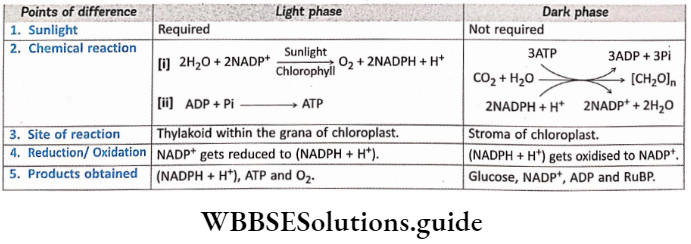
  • The process of photosynthesis includes two phases— the light phase and the dark or light-independent phase.
  • The plants in which the 4C compound, oxaloacetic acid, is the first stable compound formed during the dark phase of photosynthesis are called C4 plants.
  • These plants have a special arrangement of cells in their leaves, known as Kranz anatomy.
  • There are several factors, both external and internal, that affect the rate of photosynthesis. The external factors include CO2 concentration, O2 concentration, water, temperature, etc. The internal factors include chlorophyll content, the internal structure of a leaf, etc.

Crassulacean Acid Metabolism Notes

Crassulacean Acid Metabolism

Crassulacean Acid Metabolism

This metabolic pathway was first discovered in plants of the family Crassulaceae.

Crassulacean Acid Metabolism Definition: The metabolic pathway by which mainly the members of the family Crassulaceae assimilate carbon while preventing water loss by evaporation is called Crassulacean add metabolism (CAM)

The pathway is also common in Cactaceae, Euphorbiaceae, Rhizoaceae, Liliaceae, Bromeliaceae, Orchidaceae, etc., families. The plants which show CAM pathways are called CAM plants. E.g., A few economically important plants, including pineapple, Bryophyllum sp, Sedum sp., etc., are CAM plants.

Characteristics of CAM plants:

  1. These plants are generally found in dry and desert regions.
  2. In these plants, stomata remain open at night and closed during the day. These are called photoactive stomata.
  3. These plants have low compensation points.
  4. Decarboxylation of malate during the day yields CO2 inside the photosynthetic tissues. This CO2 is fixed normally by RuBisCO in C3 cycle. This permits CO2 assimilation without letting in CO2 inside the cell directly from the air.
  5. Transpiration and photorespiration are greatly reduced in CAM plants.

Pathway of CAM

Cam Plants Stomata

The CAM pathway, consisting of dark acidification and light deacidification reactions, is divided into the following phases

Phase-1 (Dark acidification): The main aim of this phase is to produce malic acid in the dark. As the stomata remain open at night, CO2 diffuses in. This CO2 requires temporary storage as an intermediate carbon compound. CAM pathway requires the breakdown of starch in the dark to produce phosphoenol pyruvate (PEP) through glycolysis. PEP is the substrate for carboxylation by PEP-carboxylase. The product generated is oxaloacetic acid (OAA).

Class 11 Biology Class 11 Chemistry
Class 11 Chemistry Class 11 Physics
Class 11 Biology MCQs Class 11 Physics MCQs
Class 11 Biology Class 11 Physics Notes

⇒ \(\text { PEP } \underset{\text { dehydrogenase }}{\stackrel{\text { Malate }}{\longrightarrow}} \mathrm{OAA}+\mathrm{Pi}\)

During this period, PEP-carboxylase is active and fixation of C02 takes place irrespective of the presence or absence of oxygen. OAA is then reduced to malate by NAD-dependent malate dehydrogenase.

Crassulacean Acid Metabolism Notes

⇒ \(\text { OAA } \underset{\text { dehydrogenase }}{\stackrel{\text { Malate }}{\longrightarrow}} \text { Malate + NADP }{ }^{+}\)

Malate accumulates as malic acid in the vacuole towards the end of the dark period, when the rate of CO2 fixation declines. This is due to the inhibition of PEP-case by accumulated malate and a decrease in the cytosolic pH.

Phase-2 (Light de-acidification): The intensity of light is high during the day. Malic acid gets released from the vacuoles as malate. Malate gets converted to pyruvate by malate decarboxylase. Decarboxylation of malate occurs with a low rate of CO2 fixation. CO2 enters C3 cycle during the synthesis of PGA.

Pyruvate resulting from malate decarboxylation is converted to PEP by pyruvate orthophosphate dikinase, present in the chloroplast.

Crassulacean acid metabolism (CAM) notes PDF

⇒ \(\text { Malate }+\mathrm{NADP}^{+} \stackrel{\text { Malic enzyme }}{\rightleftharpoons} \text { Pyruvate }+\mathrm{CO}_2+\mathrm{NADPH}+\mathrm{H}^{+}\)

CO2 produced by any of the decarboxylation reactions gets fixed by RuBisCO through C3 cycle. The pyruvate or PEP resulting from malate decarboxylation may be oxidised to C02 by the mitochondrial TCA cycle. This CO2 will get fixed by C3 cycle.

Photosynthesis in higher plants Carbon assimilation by CAM plants

Significance of CAM:

CAM is an adaptation to an extremely xerophytic environment. Even under conditions of severe water stress, carbon dioxide uptake continues in CAM plants.

CAM plants can eliminate the loss of CO2 as they can retain and fix the released CO2

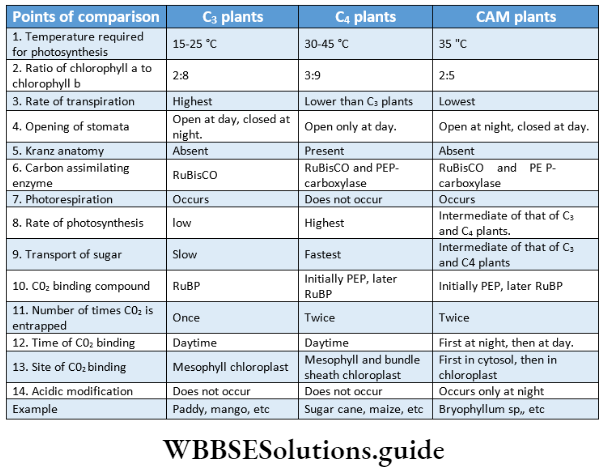
Photosynthesis in higher plants Comparison among C3, C4 and CAM plants

Chemosynthesis

  1. Some bacteria do not use light energy to carry out the synthesis of food.
  2. Instead, they oxidise biochemical compounds to release energy that is utilised during food synthesis. This energy, along with CO2, is used to produce food for the plants. This process by which food is synthesised, using the energy released by oxidation of chemical compounds is known as chemosynthesis. Different types of bacteria, that carry out chemosynthesis, are known as chemosynthetic bacteria.
  3. Iron bacteria like Leptothrix spv Ferrobacillus sp., etc., oxidise ferrous salts to ferric salts. The energy released in the process is used up for chemosynthesis.
  4. On the other hand, sulphur bacteria like Thiothrix sp., etc., oxidise HZS to S and the energy released is used for chemosynthesis.
  5. Similarly, nitrifying bacteria like Nitrosomonas sp. convert ammonia to nitrate, while Nitrobacter sp. converts nitrites to nitrates, to carry out chemosynthesis.

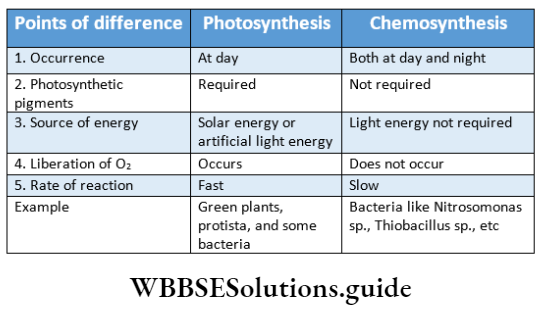
Photosynthesis in higher plants Difference between phtosynthesis and cheosynthesis

Factors Affecting Photosynthesis

The external and internal factors that affect photosynthesis are discussed under the following heads.

The external factors influencing photosynthesis are—

Light: Both quality and intensity of light influence the rate of photosynthesis.

intensity:

  1. The rate of photosynthesis is directly proportional to the rate of photosynthesis.
  2. However, very high intensity of light oxidises chlorophylls (photooxidation of chlorophyll) which photosynthesis. This phenomenon is called solarisation.
  3. The amount of light intensity at which the rate of respiration is equal to that of photosynthesis is called the light compensation point.

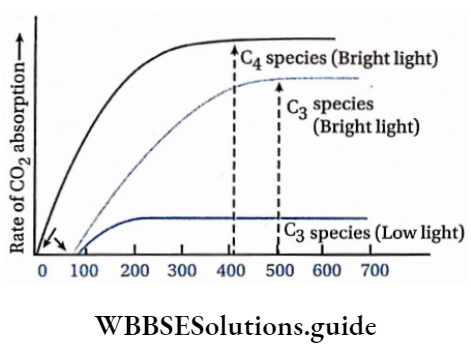
Photosynthesis in higher plants Effect oflight intensity on photosynthesis

Quality:

  1. A wavelength of light between 400 nm and 700 nm is most effective for photosynthesis. This light is called photosynthetically active radiation (PAR).
  2. Comparatively more photosynthesis occurs in red and blue regions of PAR though others show significant photosynthesis.

Co2 concentration:

  1. It is found that if the atmospheric CO2 concentration (0.03-0.04%) increases by 0.01%, the rate of photosynthesis increases significantly.
  2. This is achieved in the greenhouses under controlled conditions.
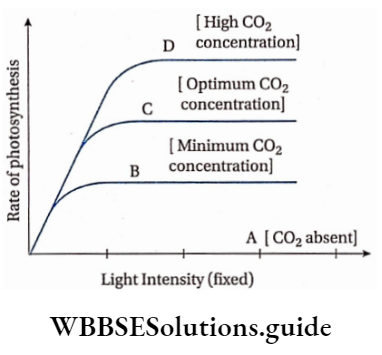
  3. If the CO2 concentration increases further, the rate of photosynthesis decreases. The following graph shows how different CO2 concentrations affect the rate of photosynthesis.

Photosynthesis in higher plants Effect ofC02 on photosynthesis

Water: A deficiency of water causes the stomata to close, thereby reducing the C02 availability. Besides, water deficit stress also causes wilting of leaves, thus reducing the surface area of the leaves and their metabolic activity as well.

CAM pathway in plants: steps and significance notes

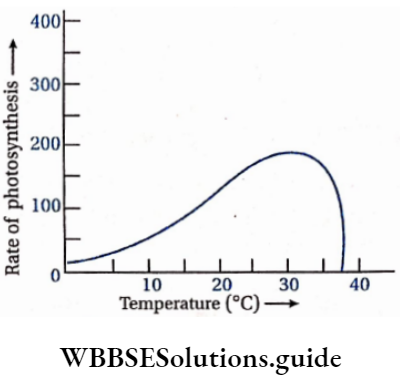
Temperature: The optimum temperature for photosynthesis is generally 20-30°C. Generally, the rate of photosynthesis increases with the rise in temperature. This effect is seen within the temperature range of 6 to 37 c by this, the rate of photosynthesis decreases and ceases at 43c photosynthesis of different plants also depends on their habitat. Some bacteria can carry out photosynthesis at 70°C while some at -35 °C.

The following graph shows changes in the rate of photosynthesis with temperature.

Photosynthesis in higher plants Effect oftemperature on photosynthesis

Temperature coefficient or Q10

Scientist Vant Hoff postulated this law. According to this law, the rate of a biochemical reaction doubles with every 10°C rise, within a specific temperature range (0-30°C). It is known as the temperature coefficient. This coefficient may be written in the following way, in the case of photosynthesis—

⇒ \(\mathrm{Q}_{10}=\frac{\text { Rate of photosynthesis at } \mathrm{T}^{\circ} \mathrm{C}+10^{\circ} \mathrm{C}}{\text { Rate of photosynthesis at } \mathrm{T}^{\circ} \mathrm{C}}\)

In this case, T°C is a specific temperature.

Oxygen concentration: Increased O2 concen¬ traction is known to inhibit the activity of the photosynthesis enzymes. The rate of photosynthesis declines when atmospheric oxygen concentration rises above its normal value i.e. 21%. This effect is known as the Warburg effect. However, some plants do not show this effect.

Presence of chemical substances: Chemical substances like gaseous and metallic pollutants decrease the rate of photosynthesis. For example, ozone, sulphur dioxide, fluorides, hydrogen sulphide, chloroform, etc., have an inhibitory effect on photosynthesis.

Low Limiting Factor

Blackman’s law of limiting factor is a modification of Leibig’s law of minimum. It states that if a biochemical process is affected by more than one factor, then its rate will be determined by the factor which is nearest to its minimal value. This factor is called the limiting factor. A limiting factor is a factor, whose change may directly affect the process.

Difference between C3, C4, and CAM pathways

For example, despite optimal light and CO2 conditions, a green leaf may not photosynthesise, if the temperature is very low. This leaf, if given the optimal temperature, will carry on the process of photosynthesis.

Cam Plant

The theory of three cardinal points, which is related to the law of limiting factors, was given by Sachs in 1860. According to this concept, there is minimum, optimum and maximum value for each factor.

For every factor, there is a minimum value when no photosynthesis occurs, an optimum value showing the highest rate of photosynthesis and a maximum value, above which photosynthesis fails to take place. The law can be explained best by an illustration.

  1. Light intensity provided to a leaf is sufficient to allow it to utilise a fixed concentration of CO2. Initially, at level A, no photosynthesis occurs due to non-availability of CO2.
  2. If the concentration of CO2 is increased further, the rate of photosynthesis will increase up to a maximum value (from level A to level D).
  3. If the CO2 concentration is further increased, the rate of photosynthesis will remain constant. Further increase in the rate of photosynthesis beyond level D is possible only when light intensity is increased, which at this point, is working as a limiting factor.

The factor which is quantitatively the least, may not be the limiting one. Instead, the factor which is relatively less than the amount actually required will act as the limiting factor. This law may also be named as ‘Law of relatively limiting factor’ or ‘Law of most significant factor’.

Photosynthesis in higher plants Blackman's law oflimitingfactor

Internal Factors

The internal factors regulating photosynthesis are as follows—

Chlorophyll concentration: The concentration of chlorophyll affects the rate of reaction as it is the pigment that absorbs the light energy. Chlorophyll deficiency results in chlorosis. It can occur due to disease, mineral deficiency or the natural process of ageing (senescence). Lack of iron, magnesium, nitrogen and light affects the formation of chlorophyll and thereby causes chlorosis.

Internal structure of the leaves: The efficiency of mesophyll tissues, stomata, guard cells, etc., determines the rate of photosynthesis. Any change in the diameter of the stomata influences the rate of photosynthesis.

Accumulation of photosynthetic products: Accumulation of photosynthetic products, such as starch, within the mesophyll tissues, decreases the rate of photosynthesis. Hence, the products of photosynthesis need to be removed from the leaves, regularly.

NEET biology CAM pathway notes with important points

Ageing of the leaves: As the leaves begin ageing, the number of chloroplasts within the mesophyll tissues also decreases. This, in turn, decreases the rate of photosynthesis.

Enzymes: Photosynthesis is an enzyme-catalysed process. Hence, the presence and activity of enzymes affect the rate of photosynthesis.

Hormones: Auxins, gibberelins, cytokinin, etc., increase the rate of photosynthesis. Abscisic acid, on the other hand, decreases the rate of photosynthesis.

Relation Between Photosynthesis And Respiration

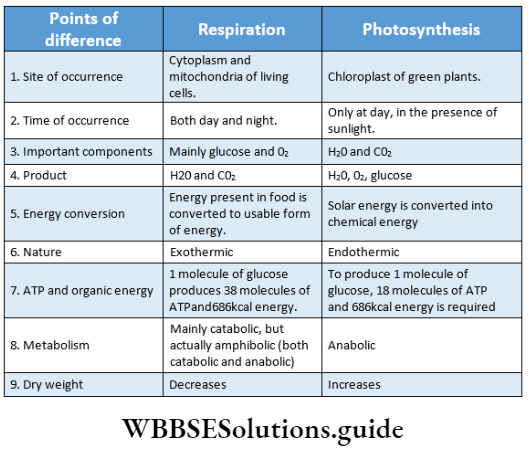
During the process of respiration, food is oxidised and energy is released in the utilisable form which remains stored as ATP. Using this ATP, all the cellular activities are performed. CO2 and water are also released during respiration. The overall equation is—

⇒ \(\mathrm{C}_6 \mathrm{H}_{12} \mathrm{O}_6+6 \mathrm{O}_2 \stackrel{\text { Aerobic cell }}{\longrightarrow} 6 \mathrm{CO}_2+6 \mathrm{H}_2 \mathrm{O}+673 \mathrm{kcal}\)

The equation for respiration is the reverse of that of photosynthesis. In photosynthesis, CO2 is consumed from the atmosphere, while in respiration CO2 is released.

Crassulacean Acid

These two processes exist in precise balance in nature. By these opposing processes, the concentration of carbon dioxide in the atmosphere is maintained at a nearly constant amount (0.03%). Approximately sixteen billion tonnes of carbon is processed in this way every year.

Photosynthesis in higher plants Differences between respiration and photosynthesis

Note:

Carbon scavenging: Process by which the element carbon (C) is used up or removed.

Chanosis: Loss of green colouration of leaves in a plant.

Chromatic adaptation: Modification of photosynthetic apparatus according to different wavelengths of incident light, resulting in absorption of energy.

Facultative: Capable of switching to any other pathway other than its usual if the need arises.

Feedback control: Process by which the concentration of the product generated during a reaction controls the above-mentioned reaction.

Mechanism of CAM photosynthesis with diagram

Free energy: Energy available in a system that can be converted to work.

Proton pump: An integral membrane protein that allows protons to pass across a cell membrane.

Spectrophotometer: An instrument used to measure the absorption spectrum of different pigments with respect to different wavelengths of light.

Stratosphere: The second layer of the atmosphere.

Process and Significance Of Photorespiration Notes

Photorespiration Or C2-Cycle

Photorespiration is the light-dependent oxidation of intermediates of carbon assimilation which is accompanied by absorption of O2 and release of CO2. It was discovered by Dicker and Tio (1959) in a tobacco plant. The. the term ‘photorespiration’ was coined by scientist Gleb Krotkov.

Definition: The oxidation process in plants, that takes place in bright light and high O2 concentration, producing 2C compound (phosphoglycolic acid) and CO2 is called photorespiration.

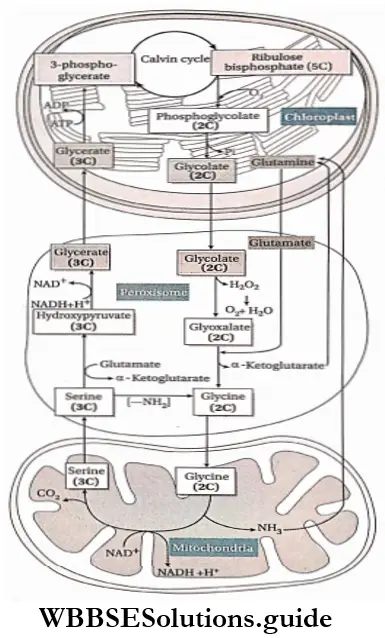
Site of occurrence: This cycle takes place in chloroplasts, peroxisomes and mitochondria.

It is also called the glycolate cycle or C2 because, the 2C compound, glycolate, is produced as the first intermediate product of this metabolic pathway.

“photorespiration process and significance notes for class 11”

Mechanism Of Photorespiration

Photorespiration involves the initial fixation of O2 followed by further O2 uptakes and CO2 evolution.

Reactions occurring in chloroplast (first step)

Reactions of photorespiration in chloroplast take place in two steps.

RuBP cleavage, synthesis of phosphoglycolate and its oxidation: The C2 cycle starts in chloroplasts with phosphoglycolate produced from RuBP due to the oxygenase action of RuBisCO. It converts RuBP to 3-phosphoglycerate and 2-phosphoglycolate.

⇒ \(\text { RuBP }+\mathrm{O}_2 \stackrel{\text { RuBisCO }}{\longrightarrow} \text { 3-PGA + 2-Phosphoglycolate }\)

Conversion of phosphoglycolate to glycolate: 3-phosphoglycerate enters the Calvin cycle. On the other hand, 2-phosphoglycolate undergoes dephosphorylation by phosphoglycolate phosphatase enzyme to form glycolate. This glycolate leaves the chloroplast and enters the peroxisome.

⇒ \(\text { 2-Phosphoglycolate }+\mathrm{H}_2 \mathrm{O} \stackrel{\begin{array}{c} \text { Phosphoglycolate } \\ \text { phosphatase } \end{array}}{\longrightarrow} \text { Glycolate }+\mathrm{Pi}\)

Class 11 Biology Class 11 Chemistry
Class 11 Chemistry Class 11 Physics
Class 11 Biology MCQs Class 11 Physics MCQs
Class 11 Biology Class 11 Physics Notes

Reactions occurring in peroxisome (second step)

Reactions of photorespiration in peroxisome takes place in three steps. Those steps are discussed below along with their chemical reactions.

Conversion of glycolate to glyoxylate: Glycolate enters peroxisome where it is oxidised to glyoxylate and H202 by enzyme glycolate oxidase and sunlight.

Hydrolysis of H2O2: The other product of glycolate oxidation is H2O2 which is decomposed to H2O and O2. This reaction is catalyzed by the enzyme catalase present in the peroxisome.

⇒ \(\begin{aligned} & \text { Glycolate }+\mathrm{O}_2 \underset{\substack{\text { Glycolate } \\ \text { reductase }}}{\stackrel{\text { Glycolate }}{\rightleftharpoons}} \text { Glyoxylate }+\mathrm{H}_2 \mathrm{O}_2 \\ & 2 \mathrm{H}_2 \mathrm{O}_2 \stackrel{\text { Catalase }}{\longrightarrow} \mathrm{O}_2+\mathrm{H}_2 \mathrm{O} \\ & \end{aligned}\)

It is possible that some of the glyoxylates may return to the chloroplast. There it may get reduced back to glycolate at the expense of photogenerated NADPH by glyoxylate reductase enzyme. Such shuttle reactions, involving glycolate-glyoxylate, are used to dissipate the light-generated reducing power. This is useful in protecting the photosystems when CO2 supply is limited. Photorespiration is observed in C3 plants which photosynthetically fix CO2 exclusively via the Calvin cycle in the mesophyll cells.

Process And Significance Of Photorespiration Notes

Synthesis of glycine: Glyoxylate reacts with glutamate in the presence of glutamate-glyoxylate aminotransferase enzyme to produce glycine (amino acid) and a-ketoglutarate.

⇒ \(\text { Glyoxylate + Glutamate } \stackrel{\begin{array}{c} \text { Glutamate } \\ \text { glyoxylate } \\ \text { aminotransferase } \end{array}}{\longrightarrow} \alpha \text {-Ketoglutarate }\)

Reactions occurring in mitochondria

Glycine enters the mitochondrion from the peroxisome and the cycle moves further.

Synthesis of serine, NH3 and CO2: The glycine then moves to mitochondrion. Two molecules of glycine are converted to one molecule each of serine, CO2 and NH3 in a two-step reaction. The reaction requires NAD+ as an oxidant and the resultant NADH is reoxidised by the mitochondrial electron transport chain with the generation of ATP. These reactions are catalysed by glycine decarboxylase and serine hydroxymethyl transferase respectively.

“detailed notes on photorespiration and its importance”

Reactions occurring in peroxisome (last step)

Serine moves back to peroxisome and gets converted to glycerate.

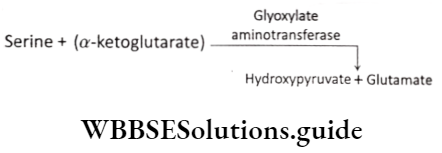
Conversion of serine to hydroxy pyruvate: After being synthesised in mitochondria, serine moves to peroxisome. Here it reacts with or-ketoglutarate to produce glutamate and hydroxypyruvate. This is catalysed by the enzyme glyoxylate aminotransferase.

Photosynthesis in higher plants glyoxylate aminotransferase

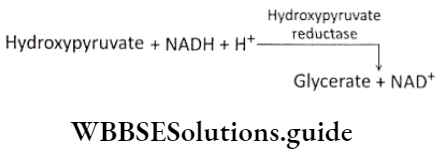
Reduction of hydroxypyruvate and synthesis of glycerate: Hydroxypyruvate then undergoes reduction to produce glycerate. This reaction is catalysed by the enzyme hydroxy pyruvate reductase.

Photosynthesis in higher plants Hydroxypyruvate

Reactions occurring in chloroplast

The last step involved moving glycerate into the chloroplast.

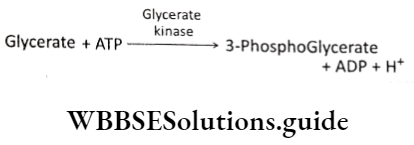
Phosphorylation of glycerate: The glycerate then moves into the chloroplast where it is phosphorylated to form 3-phosphoglycerate. This reaction is catalysed by the enzyme glycerate kinase.

Photosynthesis in higher plants Glycerate

“photorespiration pathway “

3-phosphoglycerate now enters the C3 cycle where it is used for RuBP synthesis. Thus, the photorespiration or C2 cycle is completed.

Photosynthesis in higher plants C2 cycle

Effect of O2 on photorespiration

When the concentration of O2 is higher, RuBP carboxylase causes RuBP to bind to O2 instead of CO2. This leads to the production of phosphoglycolate, which reduces the rate of carbon assimilation during photosynthesis. The concentration of O2 in the environment is about 21%, which is maintained by photosynthesis.

“step-by-step process of photorespiration in plants”

But this O2 content becomes harmful for the C3 plants, as more and more RuBP will bind O2, with no RuBP left for binding CO2. This reduces photosynthesis further. No such carboxylase has been discovered yet, that does not have any affinity to O2.

Significance Of Photorespiration

  1. Photorespiration regenerates CO2 and PGA which are ultimately used up in the Calvin cycle.
  2. It produces amino acids and carbohydrates and maintains CO2 balance in nature.
  3. Photorespiration serves to protect the photochemical apparatus from damage caused by light. This takes place through neutralisation of harmful effects of otherwise damaging products of light reaction. These products tend to accumulate when a low CO2 concentration limits the progress of the Calvin cycle.
  4. Since no ATP is produced in photorespiration, it is not considered true respiration. Instead, ATP is used up during this process along with NADH+H+.

“significance of photorespiration “

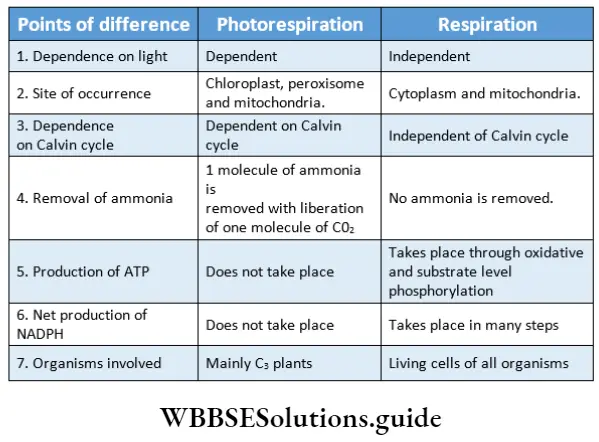
Photosynthesis in higher plants Differences between photorespiration and respiration

C3 And C4 Cycle And Pathway

According to the number of carbon atoms in the intermediate product, the pathway of the Calvin cycle may be of three types—C3, C4 and CAM.

C3 Cycle or Pathway

Definition: The biochemical pathway, within the dark phase, during which carbon is assimilated and phosphoglyceric acid (3C) is produced as the first stable product is called C3 pathway or Calvin cycle.

Site of occurrence: Stroma of the chloroplast.

Characteristics of C3 plants:

  1. The plants which show the C3 cycle are called C3 plants. In most of the plants, it takes place using the RuBisCO enzyme.
  2. The first stable compound obtained is the 3-carbon compound phosphoglyceric acid (PGA).
  3. RuBP binds CO2 in the atmosphere and thereby maintains the balance of O2-CO2 within the environment.
  4. All the compounds produced within the C3 cycle can be re-synthesised.
  5. During hot and dry summers, the stomata of C3 plants remain closed. Hence, CO2 cannot enter the plants. So, the C3 cycle slows down and glucose production is inhibited temporarily. example Paddy, wheat, soybean, etc.
C4 Cycle Or Pathway

Definition: The pathway of photosynthesis in which carbon assimilation takes place and oxaloacetic acid (4C) is produced as the first stable product is called the C4 pathway.

Site of occurrence: Cells (mainly chloroplasts) in mesophyll tissue and bundle sheath.

Types of chloroplast involved in the C4 cycle: Chloroplasts are of two types—

  • Mesophyll chloroplast (MC): Chloroplast present in the mesophyll cells.
  • Bundle sheath chloroplast (BSC): Chloroplast present in the bundle sheath cells.

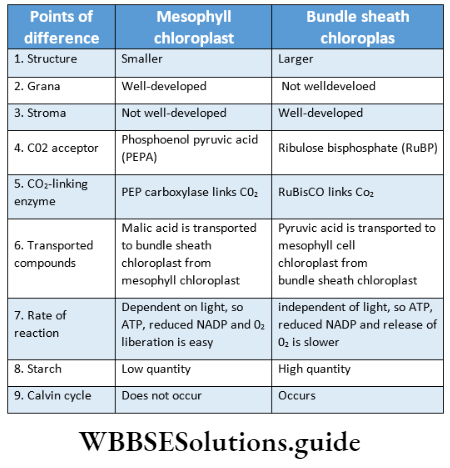
Photosynthesis in higher plants Differences between chloroplast of the mesophyll and bundle sheath

Characteristics of C4 plants:

  • The plants which show C4 cycle are called C4 plants. Most of the C4 species are monocots, especially grasses, although more than 300 are dicots.
  • They are generally found in tropical and subtropical regions.
  • They have more bundle sheath cells.

“difference between photosynthesis and photorespiration notes”

  • Only spongy parenchyma is present in mesophyll cells.
  • The initial products of C2 fixations are the 4-carbon dicarboxylic acids—oxalate, malate and aspartate. Hence the pathway is known as C4 pathway. The first stable compound formed in this pathway is a 4-carbon compound, oxaloacetic acid (OAA).
  • The rate of transpiration is more than C3 plants.

“photorespiration in C3 and C4 plants explained”

  • Their ability to photosynthesise is high, as compared to C3 plants.
  • Generally, photorespiration is absent in these plants.
  • Photosynthesis continues even in bright sunlight, water stress and high temperature.
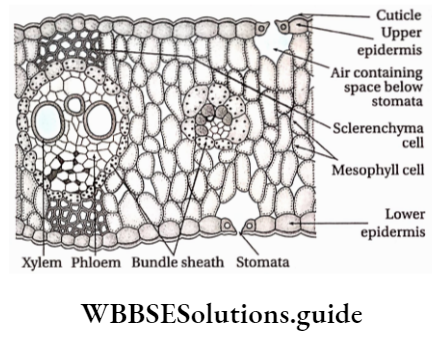
  • The presence of a prominent layer of bundle sheath cells containing chloroplasts, around the vascular tissue of the leaf, is the feature of C4 plants. This feature is called Kranz anatomy.
  • The stroma in the chloroplasts within bundle sheath cells is more organised than the grana.
  • The stroma of chloroplast in mesophyll cells is less organised than the grana. Moreover, there are differences in the ultrastructures of chloroplasts between mesophyll cells and bundle sheath cells. example Sugarcane, maize, jowar, bajra, etc.
Photosynthesis in higher plants Transverse section ofa leafshowing Kranz anatomy

“photorespiration diagram “

C4 plants and photorespiration

C4 cycle effectively pumps CO2 from the atmosphere into the bundle sheath cells. This transport process generates a much higher concentration of CO2 in the bundle sheath cells than would occur in equilibrium with the external atmosphere. This elevated concentration of CO2 at the site of carboxylation of RuBP, results in suppression of the oxygenation of RuBP. Hence, photorespiration is prevented.

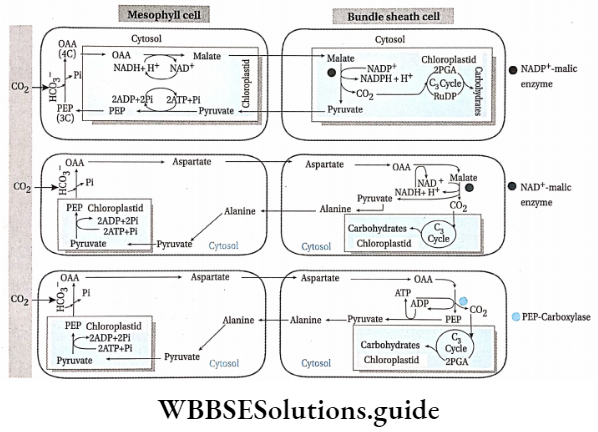
Description of C4 Cycle: C4 cycle consists of four stages—

  1. Fixation of CO2 by the carboxylation of phosphoenolpyruvate (PEP) in the mesophyll cells to form 4-carbon acid.
  2. Transport of the 4C acid to the bundle sheath cells.
  3. Decarboxylation of the 4C acid within the bundle sheath cells and generation of CO2, which is then reduced to carbohydrates via the Calvin cycle.
  4. Transport of the 3C acid (pyruvate or alanine). that is formed by the decarboxylation, back to the mesophyll cells for regeneration of CO2 acceptor, PEP.

Reactions in mesophyll cells

1. Carbon dioxide present in the air enters the mesophyll cells and reacts with water to form carbonic acid. This reaction is catalysed by the enzyme carbonic anhydrase.

⇒ \(\mathrm{CO}_2+\mathrm{H}_2 \mathrm{O} \stackrel{\text { Carbonic anhydrase }}{\longrightarrow} \mathrm{H}^{+}+\mathrm{HCO}_3^{-}\)

“biochemical pathway of photorespiration with diagram”

The primary carboxylation of the C4 cycle is done by phosphoenol pyruvate carboxylase (PEP carboxylase) using HCO3 as the substrate to yield oxaloacetate (OAA). PEP carboxylase is found in the cytosol of mesophyll cells. It is activated by Mg2+ and inhibited by malate and aspartate feedback control. OAA (4C) is the first stable compound formed in C4 cycle.

“photorespiration definition “

⇒ \(\text { PEP } \underset{\text { dehydrogenase }}{\stackrel{\text { Malate }}{\longrightarrow}} \mathrm{OAA}+\mathrm{Pi}\)

OAA formed now enters the mesophyll cells. It is reduced to malate in the chloroplast at the expense of NADPH by the enzyme malate dehydrogenase. In the case of some C4 plants, aspartate is generated from OAA.

⇒ \(\text { OAA } \underset{\text { dehydrogenase }}{\stackrel{\text { Malate }}{\longrightarrow} \text { Malate + NADP }}{ }^{+}\)

Malate so formed is then exported to the bundle sheath cell chloroplast.

Reactions in bundle sheath cells

1. CO2 removal and decarboxylation:

  1. Malate dehydrogenase present in bundle sheath cells, acts upon malate to produce pyruvate and release CO2.
  2. Pyruvate so formed is transported to mesophyll cells,
  3. The released CO2 reacts with RuBP to form PGA, which enters the C3 cycle. This is catalysed by the enzyme RuBP carboxylase. Instead of malate, if aspartate is generated, it is catalysed by PEP carboxykinase.

⇒ \(Malic acid +\mathrm{NADPH}+\mathrm{H}^{+} \underset{\text { dehydrogenase }}{\longrightarrow} Pyruvic acid + NADP\)

⇒ \(\begin{aligned} & \text { Aspartate }+\alpha \text {-ketoglutaric acid } \frac{\text { Iransaminase }}{\text { OAA }+ \text { Glutamic acid }} \\ & \mathrm{OAA}+\mathrm{ATP} \stackrel{\text { Carboxykinase }}{\longrightarrow} \mathrm{PEP}+\mathrm{CO}_2+\mathrm{ADP} \\ & \text { PEP } \stackrel{\begin{array}{c} \text { Pyruvate } \\ \text { kinase } \end{array}}{\longrightarrow} \text { Pyruvate } \stackrel{\begin{array}{c} \text { Alanine } \\ \text { transferase } \end{array}}{\longrightarrow} \text { Alanine } \\ & \end{aligned}\)

“photorespiration and its role in plant metabolism”

Types of C4 plants

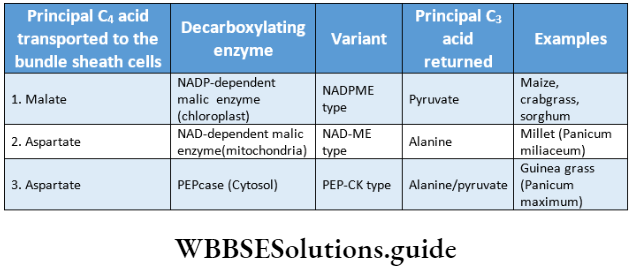
There are three subgroups according to the different mechanisms by which decarboxylation takes place in bundle sheath cells.

  1. NADP*-malic enzyme (NAD+-ME) type: In this type, malic acid is formed from oxaloacetic acid in the presence of NADPH+H+. This is catalysed by the enzyme malate dehydrogenase. Malate is then transported to bundle sheath cells from the mesophyll cell. Since NADP-dependent malate dehydrogenase is the main enzyme involved, hence the name NADP+-ME type.
  2. PEP-carboxykinase (PEP-CK or PCK) type: In this type, OAA is directly decarboxylated by the enzyme PEP-carboxykinase in bundle sheath cell chloroplast. This provides for assimilation through a cycle. The formed PEP is converted by pyruvate kinase to pyruvate, which is then converted to alanine by alanine aminotransferase. This alanine is returned to the mesophyll cell. Since PEP-carboxykinase is the main enzyme involved, hence the name PEP-carboxykinase type.
  3. NAD+-malic enzyme (NAD++-ME) type: In this type, transfer of aspartate and return of alanine takes place. In this case, malate is directly decarboxylated to form by NAD-dependent malic enzyme, hence the name NAD++-ME-type. Pyruvate moving from mitochondria is then converted to alanine in cytoplasm by alanine aminotransferase.

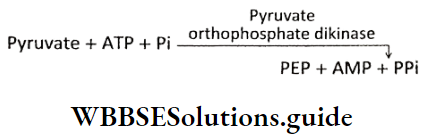
Re-formation of PEP: The pyruvate sent to the chloroplast of mesophyll cells, is converted to PEP at the expense of ATP by a unique enzyme named pyruvate orthophosphate dikinase. Alanine that enters the mesophyll cells also gets converted to PEP.

Photosynthesis in higher plants Pyruvate

This is the final step of the C4 cycle.

Photosynthesis in higher plants Comparison of the different subgroups of C4 cycle

Photosynthesis in higher plants C4 cycle.

Significance of C4 cycle:

  • The rate of photosynthesis is higher than C3 plants. Hence, they can produce more glucose than C3 plants.
  • C4 plants are partially adapted to drought conditions, where a high rate of CO2 fixation is maintained even with almost closed stomata. Hence, they can grow and produce more seeds than C3 plants.
  • The C4 photosynthesis is more efficient at high temperatures. Such high-temperature tolerance of C4 plants is due to the stability of some enzymes like PEP-carboxylase.
  • Oxygen has no inhibitory effect on C4 photosynthesis because PEPcase is insensitive to oxygen and photorespiration is absent.

“significance and disadvantages of photorespiration notes”

  • C4 plants have low CO2 compensation points. They can rapidly take up CO2 even at reduced C02 levels, with almost closed stomata and thus they can conserve water.
  • The C4 pathway is commonly found in tropical plants, which are normally exposed to abundant sunlight. This pathway supports a higher rate of photosynthesis and growth in these plants.
  • Photorespiration is not observed in C4 plants.
  • An adequate amount of nitrogen assimilation enzymes and an efficient capacity to use nitrogen for biomass production are additional features associated with C4 pathway.

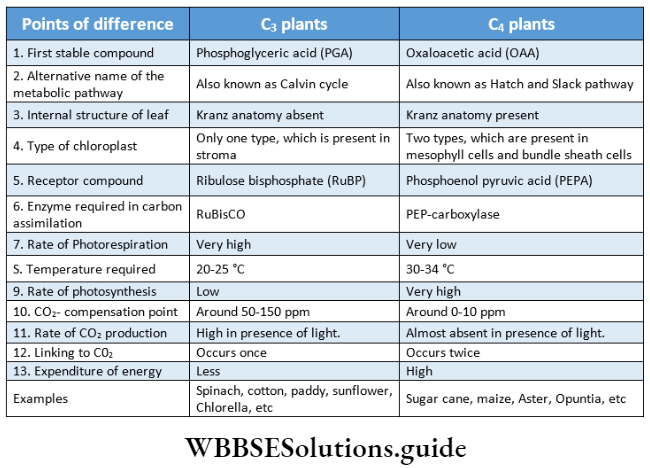
Photosynthesis in higher plants Differences between C3 and C4 plants

Cyclic And Non-Cyclic Photophosphorylation Notes

Photophosphorylation

Cyclic And Noncyclic Photophosphorylation

Photophosphorylation Definition: The synthesis of ATP from ADP and Pi using the energy of light is called photophosphorylation.

It can be of two types

  1. Cyclic and
  2. Non-cyclic photophosphorylation.

Cyclic Photophosphorylation:

The photophosphorylation process which occurs along with cyclic electron transport is known as cyclic photophosphorylation.

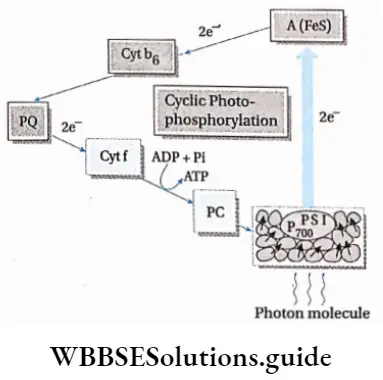
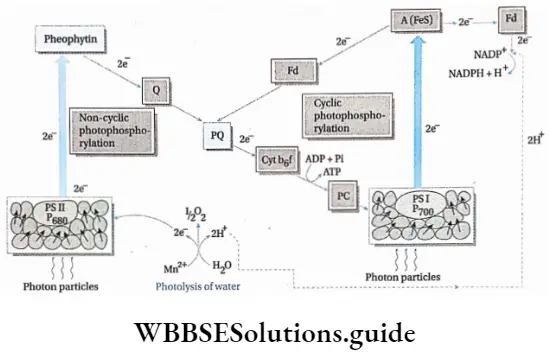
Photosynthesis in higher plants Cyclic photophosphorylation

Cyclic Photophosphorylation

Photophosphorylation Process:

  1. Only PS 1 or P is involved in the process.
  2. Chlorophyll dimers of the reaction centre absorb light rays of wavelength more than 680 nm.
  3. After absorbing light in the form of a photon, an electron is released, leading to the oxidation of the reaction centre.
  4. The reaction centre becomes positively charged and the electron released now forms ferredoxin reducing substance (FRS).
  5. The electron is carried by the electron carriers like quinone (Q), plastoquinone (PQ), FeS protein and finally ferredoxin (Fd). Now the electron, from Fd, returns to P700, via Cyt b6f and plastocyanin.
  6. The electron creates a proton gradient which leads to the formation of 2 ATP molecules from 2ADP and Pi.
  7. Due to the absence of photolysis of water, O2 and NADPH are not produced.

Cyclic and non-cyclic photophosphorylation notes PDF

Limitations of cyclic photophosphorylation

  1. It is an incomplete mechanism, that occurs only when non-cyclic photophosphorylation is prevented.
  2. It is active only within PS I.
  3. As the non-cyclic photophosphorylation stops, carbon assimilation no longer takes place. This reduces the rate of photosynthesis.
  4. O2 is not produced, hence NADPH is also not formed.
Class 11 Biology Class 11 Chemistry
Class 11 Chemistry Class 11 Physics
Class 11 Biology MCQs Class 11 Physics MCQs
Class 11 Biology Class 11 Physics Notes

Non-cyclic photophosphorylation: The photophosphorylation process which occurs along with non-cyclic electron transport is known as non-cyclic photophosphorylation.

Non-cyclic photophosphorylation Process:

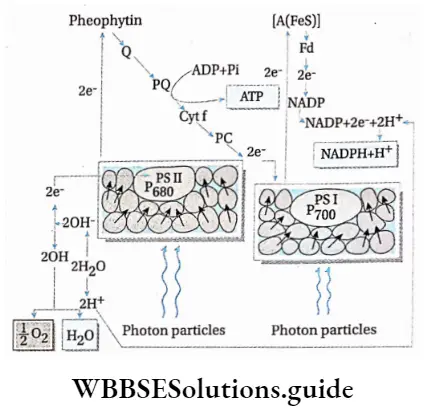
  1. Photosystem 1, photosystem 2 and cytochrome b6f complex are involved in the transport of protons and electrons.
  2. PS 2 absorbs light of 680 nm wavelength (in the red part of the spectrum) and its reaction centre, P680, gets excited. It releases a pair of electrons and becomes P680+. This reaction centre can, later on, absorb electrons released by the splitting of water.
  3. The electrons released by P680 are accepted by the primary electron acceptor Pheo,
  4. The electrons are transferred from Pheo to PCT. Simultaneously, PQ- also accepts 2H+ from stroma to form PQH2.
  5. PQH2 is oxidised and the two protons are released into the lumen and form semireduced plastosemiquinone (PQH). One electron is given to cytochrome f, in cyt b6f complex, via a Fe-S protein.
  6. PQH is now further oxidised to form PQ. This electron is now transferred to cytochrome b6, in cyt b6f complex.
  7. The electron of cytochrome f is transferred to a Cu-containing electron carrier, plastocyanin (PC).
  8. This electron is now transferred to PS 1.
  9. Simultaneously, PS 1 absorbs light having a wavelength of 700 nm (in the far-red part of the spectrum) and its reaction centre P700 gets excited. It expels the electrons, which are accepted by a Fe-S protein. P700 becomes P700+.
  10. These electrons are accepted by ferredoxin (Fd), which is also a Fe-S protein.
  11. P700+ pair in PS 1 accepts two electrons from reduced plastocyanin and becomes P700
  12. By the catalytic activity of Fd-NADP oxidoreductase, electrons are transferred to NADP+, forming NADPH+ H+, thereby completing non-cyclic electron transport.
  13. A continuous supply of water is essential for this process. O2 is released by this process.

Photosynthesis in higher plants Non-cyclic photophosphorylation

Experiments by different scientists to prove— ‘Water releases O2 during photosynthesis’

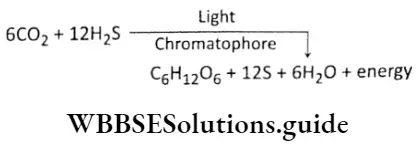
In 1931, Van Niel demonstrated that H2S is required for stabilising CO2 in photosynthetically active bacteria. In these bacteria, sulphur is formed instead of O2.

Cyclic And Non-Cyclic Photophosphorylation Notes

⇒ \(6 \mathrm{CO}_2+12 \mathrm{H}_2 \mathrm{~S} \longrightarrow \mathrm{C}_6 \mathrm{H}_{12} \mathrm{O}_6+12 \mathrm{~S}+6 \mathrm{H}_2 \mathrm{O}\)

In 1937, Robert Hill observed that isolated chloroplasts can evolve oxygen in the absence of CO2. His finding was one of the first indications that the source of the electrons in the light reactions was in fact water. In his experiment, he used an artificial electron acceptor.

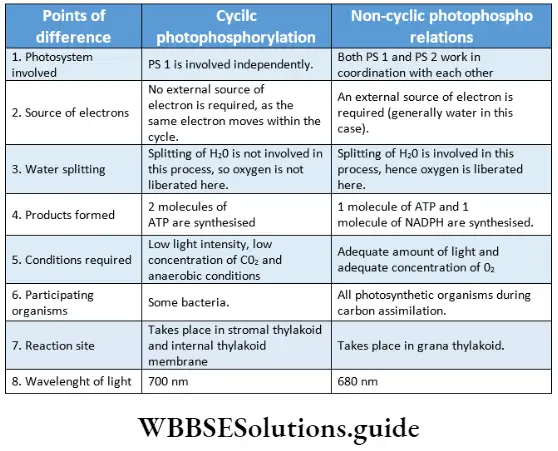
Difference between cyclic and non-cyclic photophosphorylation

The artificial electron acceptor intercepts the electrons before they cascade down to P700 (the reaction centre of PS 1), but after they have gone down the electron transport chain. Thus, the Hill reaction is formally defined as the photo-reduction of an electron acceptor by the electrons of water, with the evolution of oxygen. Various dyes can be used as artificial electron acceptors (A). The general equation, known as the Hill Reaction can be written as follows—

Non-Cyclic Photophosphorylation

⇒ \(2 \mathrm{~A}+2 \mathrm{H}_2 \mathrm{O} \underset{\text { chlorophyll }}{\stackrel{\text { sunlight }}{\longrightarrow}} 2 \mathrm{AH}_2+\mathrm{O}_2\)

In vivo, or in the organism, the final electron acceptor is NADP+. However, during the experiment, a dye is used as an artificial electron acceptor. It changes colour as it is reduced. DCIP (2,6-dichlorophenolindophenol) is a dye which is blue in its oxidized form and colourless in its reduced form. It is called the Hill Reagent.

In 1941, Samuel Ruben and Martin Kamen used radioactive oxygen (O18)-containing water, to prove that O2 is released from H20 (H2O18)

⇒ \(12 \mathrm{H}_2 \mathrm{O}^{18}+6 \mathrm{CO}_2 \underset{\text { chlorophyll }}{\stackrel{\text { sunlight }}{\longrightarrow}} \mathrm{C}_6 \mathrm{H}_{12} \mathrm{O}_6+6 \mathrm{O}_2^{18}+6 \mathrm{H}_2 \mathrm{O}\)

Later, in 1952, Arnon and Emerson proved that the hydrogen acceptor in photosynthesis is NADP+. So, NADP+ is the natural Hill reagent.

The growth of weeds can be reduced by blocking photophosphorylation

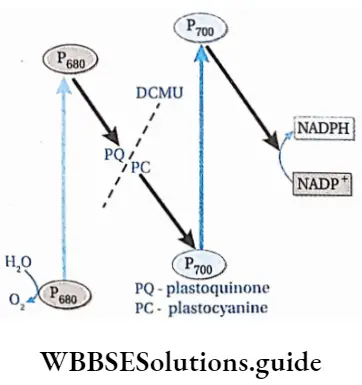
Herbicides such as chlorophenyl dimethyl urea (DCMU) and chlorophenyl dimethyl urea (CMU) can prevent electron transport during non-cyclic photophosphorylation. As a result, on the application of these chemicals, the light-independent phase is blocked, and no more glucose is synthesised by photosynthesis. This reduces the growth of the weeds.

Photosynthesis in higher plants DCMU prevent non-cyclic photophosphorylation

Photosynthesis in higher plants Differences between cyclic and non-cyclic photophosphorylation

Significance of photophosphorylation

Liberation of oxygen: Splitting of water releases oxygen, during photophosphorylation.

ATP production: Cyclic photophosphorylation produces 2 molecules of ATP, while non-cyclic photophosphorylation produces 1 molecule of ATP.

Reduction of NADP: Non-cyclic photophosphorylation reduces NADP+ to NADPH and H+.

Cyclic Electron Transport Chain


Photosynthesis in higher plants Relation between PS I and PS II, splitting ofwater andformation ofa reducing agent

The chemiosmotic hypothesis of synthesis of ATP

The chemiosmotic mechanism of ATP formation was first proposed by Peter Mitchell (1966). He received the Nobel Prize in 1978 for proposing the above hypothesis. According to this theory, a proton concentration gradient is established across the thylakoid membrane due to photosynthetic electron transport.

The chemiosmotic mechanism of ATP formation is as follows—

  • H+ ions, released through the splitting of water (photolysis), accumulate within the thylakoid lumen.
  • Primary electron acceptors or carriers are present outside the thylakoid membrane.
  • These primary electron carriers carry the electrons to the H-acceptor.
  • At the same time, these primary electron carriers also carry H+ ions from the stroma into the thylakoid lumen.
  • As the H+ ion from the carrier is released into the thylakoid lumen, the electron bound to the carrier is transferred to the next carrier.
  • NADP reductase is present outside the thylakoid membrane. It is the last of the series of electron carriers that carries electrons from PS 1 to NADPH. It accepts the electron from the previous carrier and a proton from the stroma to reduce NADP+ into NADPH+H+.
  • Due to this reaction, the concentration of H+ ions decreases in the stroma but increases in the thylakoid lumen. This causes the pH to decrease within the thylakoid lumen.
  • A proton gradient is created due to the difference in the concentration of protons across the thylakoid membrane.
  • The potential energy stored in the form of a proton gradient is electrical as well as chemical in nature.

Cyclic and non-cyclic photophosphorylation mechanism with diagram

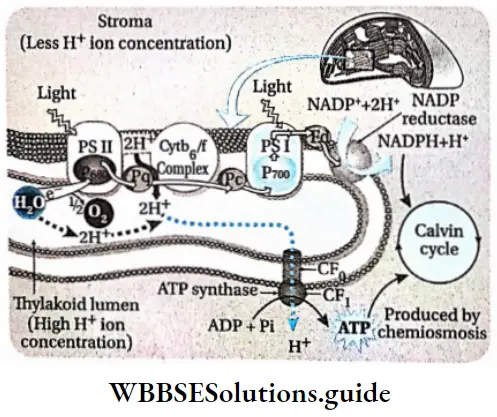
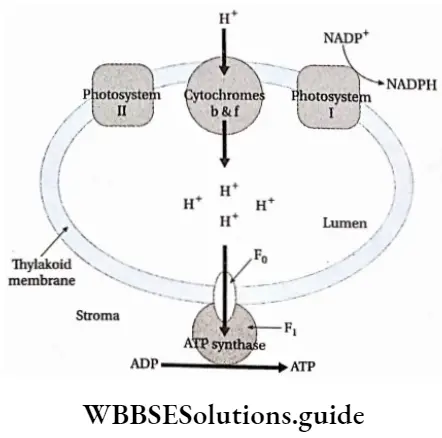
  • As the concentration of hydrogen ions in the lumen increases further, the ions move through the ATP synthase enzyme to the stroma. This movement of the proton generates a kind of energy called proton motive force, which is used to phosphorylate ADP to ATP.
  • Towards the end of the electron transport chain, specific enzyme molecules synthesise ATP by combining ADP and Pi, using this proton motive force. These are known as CF0-CF1 particles (ATP synthase or ATPase).
  • These CF0-CF-1 particles are structurally similar to the F0-F1 particles of mitochondria.
  • CF0 part is rod-like and is strongly attached to the thylakoid membrane. The CF-L part is a spherical structure placed above the CF0 part.
  • Since the H+ ions are transported through the CF0 part, it is known as the proton channel. The H+ ions are transported through this transmembrane channel by facilitated diffusion.
  • Energy is released for every 3H+ ions transported through the CF0 to the stroma. This energy is utilised to cause a conformational change in the CF0 particle. This enables it to catalyse the synthesis of 1 molecule of ATP from ADP and Pi.
  • Hence, it is observed that a membrane, proton pump, proton gradient and CF0-CF1 particles are required for the chemiosmotic mechanism.

Photosynthesis in higher plants Synthesis ofATP by chemiosmotic hypothesis

Photosynthesis in higher plants Synthesis ofATP by chemiosmotic hypothesis


Photosystem Notes

Photosystem1(PS 1)

  • The photocentre, LHC 1 and electron carriers are present within PS 1, over thylakoid membrane proteins.
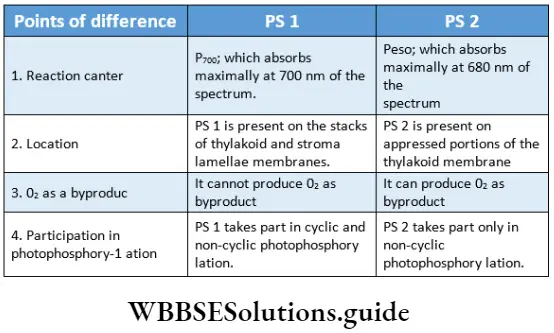
  • The light absorption centre present within PS 1 is a dimer of chlorophyll a. It absorbs a wavelength of 700 nm, hence called P700– Besides this dimer, there are other chlorophyll molecules within PS 1.
  • Chlorophyll a is more abundantly found than chlorophyll b in PS 1.
  • Both the dimers bind a 4Fe-4S iron-sulfur centre, called FeSx, at an interface region. Between P700 and FeSx, two additional chlorophyll molecules are present.
  • Reducing agents A0, A1 (belongs to a class of cyclic organic compounds called quinones), FeSx, FeSA, FeSB (iron-sulphur centres), Fd (Ferredoxin), cytochrome b6f complex and plastocyanine are present in PS 1.
  • Cyclic and non-cyclic photophosphorylation both take place in PS 1. Cyclic phosphorylation can take place in PS 1, independently.
  • PS 1 takes an electron from PS 1 and transfers it to NADP+. There are two molecules of phylloquinone (vitamin K1) present per heterodimer, with one molecule bound to each subunit.

Photosynthesis in higher plants Photosystems 1 and 2

“photosystem notes for class 11 biology”

Photosystem Notes

Photosystem 2(PS 2)

  1. P680 is the reaction centre in PS 2. Its reaction centre contains six molecules of chlorophyll a, two molecules of Pheophytin-a, two molecules of 8-carotene and one cytochrome b559 (a protein that is an important component of PS 2).
  2. It contains a complex in the central portion that produces oxygen. It also contains LHC 2 and some electron carriers.
  3. The reaction centre within PS 2 contains a dimer of two proteins, that absorbs light of wavelength 680nm. Hence, it is called P680
  4. Other important components within PS include pheophytin (a chemical compound similar to chlorophyll), plastoquinone (a type of quinone molecule), cytochrome b6f (an iron-containing protein), plastocyanin, etc.
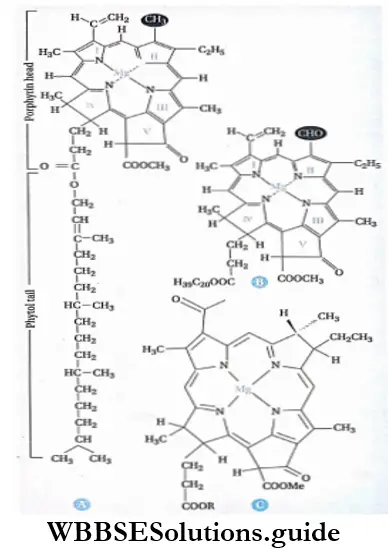
  5. It accepts electrons produced by the photolysis of water (splitting of water using light).
  6. PS 2 is associated with non-cyclic phosphorylation.
Class 11 Biology Class 11 Chemistry
Class 11 Chemistry Class 11 Physics
Class 11 Biology MCQs Class 11 Physics MCQs
Class 11 Biology Class 11 Physics Notes

“detailed notes on photosystem 1 and photosystem 2”

Similarities between PS 1 and PS 2

Both photosystems consist of a complex of pigment molecules, proteins and other prosthetic groups (inorganic or organic groups tightly bound to proteins) embedded in the thylakoid membranes of the chloroplast.

photosystem 1 and 2 diagram

Photosynthesis in higher plants Differences between PS I and PS II

Cytochrome B6f Complex

  1. The cytochrome b6f complex is an enzyme found in the thylakoid membrane of chloroplasts. It consists of four major polypeptides—cytochrome f (33 kDa), cytochrome b6 (heme-containing protein, 23 kDa), the ‘Rieske’ iron-sulfur protein (20 kDa) and subunit 4 (a 17 kDa protein made up of four small subunits).
  2. The complex catalyses the transfer of electrons between plastoquinol (in PS 2) and plastocyanin (in PS 1). This, in turn, reduces the plastocyanin in the thylakoid lumen.
  3. Two protons are transported into the thylakoid lumen for every electron transferred to plastocyanin. This facilitates the formation of a proton gradient that drives ATP synthesis.

“photosystems “

Photosynthesis in higher plants Cytochrome bgfcomplex

Mechanism Of Photosynthesis

Photosynthesis is divided into two phases

  1. Photochemical or light phase and
  2. Dark Or light-independent phase.

“difference between photosystem 1 and photosystem 2 notes”

Light Or Photochemical Phase

Definition: The part of photosynthesis that produces a reducing agent (NADPH and H+), along with ATP and O2, in the thylakoid of chloroplast, in the presence of light, is called the light phase.

Site of occurrence: It takes place in the grana of the chloroplast.

Components: The process requires sunlight and chlorophyll as the main components. It also requires ADP and NADP as accessory components.

Significance:

“what is a photosystem “

The significance of the light phase in plants is as follows—

Conversion of energy: The solar energy gets converted into chemical energy (ATP and NADPH) during this phase.

Liberation of oxygen: Due to the oxidation of water, O2 is released as a byproduct. Oxygen is further required for aerobic respiration.

Production of components required for the dark phase: NADPH and H+ ions produced during this phase are required during the dark phase.

Stages of photochemical phases: The photochemical part of photosynthesis begins with light absorption. When an atom or molecule absorbs light, it gains the whole energy of the photon (i.e., quantum), and becomes excited. The stages of the photochemical phase are discussed separately.

“photosystem structure and function notes”

Absorption of solar energy by chlorophyll molecules

  1. Absorption of energy in the form of photons causes the chlorophyll molecules to move to their energised state.
  2. The electrons remain in this state for a relatively short time, nearly 1 picosecond (= =1×10-12 second). These can return to the lower excited singlet state by releasing the absorbed energy either as heat or as light.
  3. The excited electron may also return to another excited state of lower potential energy but of greater stability, known as metastable triplet state (T).
  4. Using the energy of chlorophyll a 680 and chlorophyll a 700, present in a metastable triplet state, a photochemical reaction takes place.

Photosynthesis in higher plants Mechanism ofabsorption ofsolar energy by chlorophyll

Chemiluminescence

The phenomenon where energy is released by a chemical reaction, in the form of light is called chemiluminescence.

Electron transport chain

Robert Hill was the first to describe the electron in this phase. transport chain. The electron transport may be of two types—non-cydic and cyclic.

“photosystem one and two “

Non-cyclic electron transport: Non-cyclic electron transport involves the following steps

  1. Light energy reaches P680 through resonance (by vibrations) of accessory pigments. This leads to the excitation (activation) of P680 to a metastable triplet state.
  2. P680 now releases an e“ that is carried through the different electron carriers such as pheophytin (Pheo), quinone (Q), plastoquinone (PQ), cytochrome-f (Cyt f) plastocyanine (PC), etc.
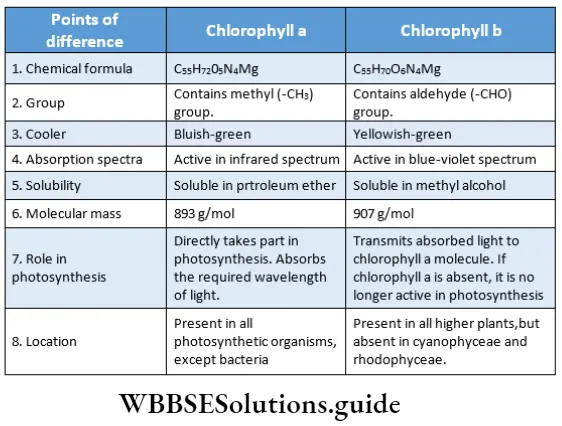
  3. Finally, the electron reaches the PS 1 reaction centre, while PS 2 remains positively charged due to the loss of electrons.
  4. P680+ (in positively charged PS 2) now oxidizes water to gain the lost electron. Thus water acts as an exogenous electron donor. This oxidation of water is catalyzed by the Mn-protein present in PS 2.
  5. on the other hand, the photochemical events that follow the excitation of PS 1 (P700) are similar to those of PS photosynthetic pigments in PS 1 absorb light of various wavelengths and transfer it to P700 chlorophyll a- p700 become excited (P700).
  6. The excited reaction centre P700 loses an electron to an electron carrier protein. Due to the loss of electrons, PS 1 becomes positively charged.
  7. This electron is transferred to Fd (ferredoxin, an iron-containing protein) and finally to NADP+. NADP collects protons from the medium and forms NADPH in the presence of an enzyme ferredoxin-NADP+ oxidoreductase.

⇒ \(2 \mathrm{H}_2 \mathrm{O} \underset{\mathrm{P}_{680}}{\stackrel{\text { chlorophyll a }}{\longrightarrow}} 2 \mathrm{H}^{+}+\mathrm{OH}^{-}\)

⇒ \(2 \mathrm{OH}^{-} \longrightarrow 2 \mathrm{OH}^{-}+2 \mathrm{e}^{-}\)

Cyclic electron transport: It occurs when there is a limited supply of CO2. Hence, the synthesis of carbohydrates is decreased. As a result, NADPH starts accumulating. So, electron transport must occur, without the formation of more NADPH. So, this transport takes place. It involves the following steps

  1. P700 absorbs light and releases an electron that is captured by the primary electron acceptor (A).
  2. This electron is then transported to Fd.
  3. The reduced Fd is unable to reduce NADP+. Therefore, it transfers electrons to cyt b6, PQ, cyt f and PC.
  4. Finally, the electron reaches back to P700 in PS 1, thereby completing cyclic electron transport.

Production of assimilatory power: Arnon (1956) used the term assimilatory power to refer to ATP and NADPH. The process of reduction of NADP+ to NADPH through the transfer of electrons is called photosynthetic electron transport. The process of formation of ATP from ADP and Pi, utilising light energy is called photophosphorylation.

“photosystem notes for NEET exam”

This also indicates that in photosynthesis a portion of light energy absorbed by the chlorophyll is captured as phosphate bond energy of ATP. The remaining is utilised for the reduction of NADP+.

Experiment to prove that oxygen is released during photosynthesis

A Hydrilla plant is placed in a beaker containing water. A small amount of NaHCO3 is added to water, so as to increase the CO2 available. Now, an inverted glass funnel is placed above the beaker, with a test tube placed at its open end. This whole set-up is left under sunlight.

When observed after several hours, bubbles are seen within the test tube and a gas is seen to have collected on top. On adding potassium pyrogallate solution to this water, it turns brown and the water level rises. As a result, the tube gets filled again.

“photosystem I and II mechanism explained”

This proves that the gas collected is oxygen, which has been released by Hydrilla during photosynthesis. formation of ATP from ADP and Pi, utilising light energy is called photophosphorylation. This also indicates that in photosynthesis a portion of light energy absorbed by the chlorophyll is captured as phosphate bond energy of ATP. The remaining is utilised for the reduction of NADP+

Photosynthesis in higher plants Liberation ofoxygen during photosynthesis

Chlorophyll – Structure and Function, Chloroplast Notes

Chlorophyll

Chlorophyll Definition: The green-coloured, primary photosynthetic pigment, present in the green leaves, that traps the sun’s rays during photosynthesis, is known as chlorophyll.

Chlorophyll Distribution: It is found in the thylakoid and stroma lamellae of chloroplast in green plants.

Chlorophyll Types: There are five types of chlorophyll present in green plants. These are—chlorophyll a, chlorophyll b, chlorophyll c, chlorophyll d and chlorophyll e. In higher plants, mainly chlorophyll a and chlorophyll b are present. Two types of chlorophyll are seen in the bacteria— bacteriochlorophyll and bacterioviridin (also known as chromium chlorophyll).

Chlorophyll Chemical Formulae

  1. Chlorophyll a—C55H72O5N4Mg
  2. Chlorophyll b-C55H70O6N4Mg
  3. Bacteriochlorophyll—C55H74O6N4Mg

Chlorophyll structure and function notes PDF 

Chlorophyll Characteristics:

  1. The chemical structure of chlorophyll a and b are well established. They are porphyrin compounds containing magnesium at the centre.
  2. The porphyrin consists of four pyrrole rings joined by -CH bridges. In addition to it, a fifth isocyclic ring is also present.
  3. Each pyrrole ring is made up of 4 carbon and 1 nitrogen atom.
  4. The carbon atoms present towards the periphery of the pyrrole ring are numbered C1-C8. The Cl, C3, C5 and C8 have methyl groups attached to them.
  5. A long chain of C and H atoms called the phytol chain or phytol tail is attached to the fourth pyrrole ring.
  6. Chlorophyll b has a slightly different structure. It has – CHO group attached to the third carbon of the pyrrole ring.

Role of chlorophyll in photosynthesis with mechanism

Class 11 Biology Class 11 Chemistry
Class 11 Chemistry Class 11 Physics
Class 11 Biology MCQs Class 11 Physics MCQs
Class 11 Biology Class 11 Physics Notes

Chlorophyll Functions:

  1. Chlorophyll is the main photosynthetic pigment to absorb light energy. Accessory photosynthetic pigments absorb the energy of a particular wavelength of light and transmit the energy to chlorophyll a molecule.
  2. P700> P680 function as reaction centres within chlorophyll a. These are regions containing pigments that absorb light of wavelength 700 nm and 680 nm, respectively. The solar energy is converted to electrical energy within these reaction centres, during photosynthesis.

Chlorophyll Structure

Photosynthesis in higher plants Molecular structure of

Photosynthesis in higher plants Differences between chlorophyll a and chlorophyll b

Albino Plant

Chlorophyll is synthesised in plants due to the presence of a specific gene within their chromosomes. In some plants, this gene may be absent and chlorophyll synthesis is prevented. Such plants are known as albino plants.

Chlorophyll - Structure And Function, Chloroplast Notes

Carotenoids

Carotenoids Definition: The red or yellow coloured pigments, that act as the accessory pigments are called carotenoids

Carotenoids Types: Carotenoids are of two types—

  1. Carotenes and
  2. Xanthophylls.

Carotenoids Distribution: They are present either conjugated with chlorophyll, in -the chloroplastid or present separately within the chromoplastid.

Chemical formula: Carotene (C4H56), Xanthophyll (C4H56O2).

Class 11 biology chloroplast and chlorophyll notes with diagrams

Carotenoids Characteristics:

  1. All the carotenoids are tetraterpenoids. Carotenes contain long hydrocarbon chains and their oxygen derivatives are called xanthophylls.
  2. Generally, carotenoids are yellow or orange in colour. They can absorb light of wavelength ranging from 400 to 500 nm.
  3. Carotenoids are insoluble in water but soluble in chloroform, ethyl ether and alcohol.
  4. The major carotene in higher plants is yS-carotene with a small amount of or-carotene. The special carotene, responsible for the red colour of tomatoes, watermelon, etc., is known as lycopene.
  5. The major xanthophylls found in higher plants are lutein, violaxanthin and neoxanthin.

Chlorophyll Diagram

Photosynthesis in higher plants Molecular structure of carotene and Lycopene

Carotenoids Functions:

  1. Carotenoids protect the chlorophyll against the photodynamic action of light andO2 (destruction due to light, in the presence of O2).
  2. Carotenoids act as accessory pigments in photosynthesis. They absorb and transfer radiant energy to chlorophyll during photosynthesis.
  3. They provide colour to flowers and fruits.
  4. β-carotene acts as the precursor of vitamin A.

Phycobilins

Phycobilins Definition: The proteinaceous pigments of blue-green algae and red algae that indirectly take part in photosynthesis are called phycobilins.

Phycobilins Types: Phycobilins are generally of three types— phycocyanin, phycoerythrin and allophycocyanin.

Phycobilins Location: These pigments are found attached to the chloroplast lamellae of algae, as small granules called phycobilisomes. Phycocyanin is found in blue-green algae while phycoerythrin is found in red algae.

Short notes on chlorophyll and chloroplast for quick revision

Phycobilins Chemical formulae: Phycocyanin (C34H4408N4), phycoerythrin (C34H4608N4).

Phycobilins Characteristics:

  1. These pigments are water-soluble open-chain tetrapyrroles without magnesium at the centre. They also do not possess any phytol tail
  2. They remain conjugated with a protein molecule, hence called phycobiliproteins.
  3. The pigment phytochrome of higher plants, which is involved in light absorption for flowering and seed germination, is chemically similar to phycobilins.

Photosynthesis in higher plants Molecular structure of Phycocyanin and Phycoerythrin

Chlorophyll Biology

Phycobilins Functions:

  1. Phycobilins absorb light during photosynthesis and may be regarded as accessory pigments. The light absorbed by the phycobiliproteins is transferred to chlorophyll during photosynthesis.
  2. These pigments help in chromatic adaptation in plants.
  3. They also function as antennae molecules

Separation Of Chloroplast Pigment By Paper Chromatography

  1. Some fresh green spinach leaves were ground in 15-20 ml of acetone with the help of a mortar and pestle. The green-coloured extract was filtered and concentrated by evaporation of acetone. It was used as a sample containing photosynthetic pigment.
  2. A narrow glass jar with a split cork was taken. A strip of chromatographic paper was cut (narrower and shorter than the glass jar). Two lateral notches were cut at one end of the paper (at a little distance from each other).
  3. The sample was poured drop by drop over the notched area. A mixture of 92% petroleum ether and 8% acetone was left at the bottom of the jar.
  4. The chromatographic paper was suspended in the jar by a hook in such a way, that the notched area remained well above the solvent mixture while the other end dipped in it. The set-up was allowed to stand for a few hours.
  5. After a few hours, the solvent moved up the chromatographic paper.
  6. The pigment got dissolved in the solvent and ascended to various heights on the paper.
  7. Four pigment bands are observed over the paper strip in the following order from top to base orange, yellow, blue-green and green.
  8. Leaves contain four types of photosynthetic pigments. They separate over the chromatographic paper on the basis of their solubility and rate of diffusion.
  9. The four pigments are carotene (orange), xanthophyll (yellow), chlorophyll a (blue-green) and chlorophyll b (green).

Photosynthesis in higher plants Paper chromatographic separation ofchloroplast pigments

Photosynthesis in higher plants Photosynthetic pigments—namc, chemical formulae, distribution and absorbed light rays

Photosynthesis In Higher Plants Multiple Choice Question and Answers

Photosynthesis In Higher Plants Multiple Choice Questions

Question 1. Phosphoenol pyruvate (PFP) is the primary CO2 acceptor in—

  1. C4 plants
  2. C2 plants
  3. C3 and C4 plants
  4. C3 plants

Answer: 1. C4 plants

Question 2. With reference to factors affecting the rate of photosynthesis, which of the following statements is not correct?

  1. Increasing atmospheric CO2 concentration up to 0.05% can enhance CO2 fixation rate
  2. C3 plants respond to higher temperatures with enhanced photosynthesis while C4 plants have much lower temperature optimum
  3. Tomato is a greenhouse crop which can be grown in CO2 enriched atmosphere for a higher yield
  4. Light saturation for CO2 fixation occurs at 10% of full sunlight

“photosynthesis in higher plants MCQ with answers”

Answer: 2. C3 plants respond to higher temperatures with enhanced photosynthesis while C4 plants have much lower temperature optimum’

Read and Learn More WBCHSE Multiple Choice Question and Answers for Class 11 Biology

Question 3. The process which makes a major difference between C3 and C4 plants—

  1. Photorespiration
  2. Respiration
  3. Glycolysis
  4. Calvin cycle

Answer: 3. Glycolysis

Question 4. Mitochondria and chloroplast are—

  1. Semi-autonomous organelles
  2. Formed by the division of pre-existing organelles they contain DNA but lack protein-synthesizing machinery

Choose the correct Answer

  1. Both [1] and [2] are correct
  2. [2] is true but [1] is false
  3. [1] is true but [2] is false
  4. Both [1] and [2] are false

Answer: 3. [1] is true but [2] is false

Photosynthesis In Higher Plants Multiple Choice Question and Answers

Question 5. Emerson’s enhancement effect and Red drop have been instrumental in the discovery of

  1. Two photosystems operating simultaneously
  2. Photophosphorylation and cyclic electron transport
  3. Oxidative phosphorylation
  4. Photophosphorylation and non-cyclic electron transport

Answer: 1. Two photosystems operating simultaneously

Class 11 Biology Class 11 Chemistry
Class 11 Chemistry Class 11 Physics
Class 11 Biology MCQs Class 11 Physics MCQs
Class 11 Biology Class 11 Physics Notes

Question 6. In a chloroplast, the highest number of protons are found in

  1. Stroma
  2. Lumen of thylakoids
  3. Intermembrane space
  4. Antennae complex

Answer: 2. Lumen of thylakoids

Question 7. The oxygen that evolved during photosynthesis comes from water molecules. Which one of the following pairs of elements is involved in this reaction?

  1. Magnesium and Chlorine
  2. Manganese and Chlorine
  3. Manganese and Potassium
  4. Magnesium and Molybdenum

Answer: 2. Manganese and Chlorine

“multiple choice questions on photosynthesis in higher plants”

Question 8. In photosynthesis, the light-independent reactions take place at—

  1. Stromal matrix
  2. Thylakoid lumen
  3. Photosystem-1
  4. Photosystem-2

Answer: 1. Stromal matrix

Question 9. Anoxygenic photosynthesis is characteristic of—

  1. Rhodospirillum
  2. Spirogyra
  3. Chlamydomonas
  4. Ulva

Answer: 1. Rhodospirillum

Question 10. Identify the incorrect statement(s) in relation to C4-photosynthesis

  1. Kranz Anatomy is an essential feature for C4 plants
  2. C4 plants have higher water use efficiency than C3 plants
  3. Photorespiration can be minimised when the C4 pathway is in operation
  4. Conversion of oxaloacetate to malate occurs in the bundle sheath cells

Answer: 4. Conversion of oxaloacetate to malate occurs in the bundle sheath cells

“photosynthesis in higher plants quiz with answers”

Question 11. Photosynthetic Active Radiation (PAR) has the following range of wavelengths

  1. 340-450 nm
  2. 400-700 nm
  3. 500-600 nm
  4. 450-950 nm

Answer: 2. 400-700 nm

Question 12. The products of the light reaction are

  1. Xanthophyll, NADPH and oxygen
  2. Chlorophyll, ATP and NADPH
  3. ATP, NADPH and oxygen
  4. None of the above

Answer: 3. ATP, NADPH and oxygen

Question 13. The C4-photosynthetic system is present in plants which are found in

  1. Cold region
  2. Hot region
  3. Both A and B
  4. Dry tropical region

Answer: 4. Dry tropical region

“MCQ on photosynthesis in higher plants for NEET”

Question 14. Which element plays a vital role in the splitting of water to liberate oxygen during photosynthesis?

  1. Copper
  2. Boron
  3. Chlorine
  4. Manganese

Answer: 4. Manganese

Question 15. Synthesis of one glucose molecule requires

  1. 6
  2. 12
  3. 18
  4. 24

Answer: 2. 12

Question 16. Gross primary productivity is the rate of production during photosynthesis

  1. Organic matter
  2. Oxygen
  3. Carbon dioxide
  4. Chlorophyll

Answer: 1. Organic matter

“important MCQs on photosynthesis in higher plants”

Question 17. Enzymes required for phosphorylation are located in of chloroplast.

  1. Peristomium
  2. Plastidome
  3. Stroma
  4. Quaantasome

Answer: 4. Quaantasome

Question 18. C4-plants have bundle sheath cells which possess—

  1. Few chloroplasts with thin walls so that gaseous exchange can take place
  2. Large number of chloroplasts with thick walls impervious to gaseous exchange
  3. A large number of chloroplasts with thick walls and no intercellular spaces
  4. None of the above

Answer: 5. None of the above

Question 19. Statement (A): Photorespiration decreases photosynthetic output.

Statement (B): In the photorespiratory pathway, neither ATP nor NADPH is produced.

  1. Both the statements A and B are correct
  2. Both the statements A and B are incorrect
  3. Statement A is correct and statement B is incorrect
  4. Statement B is correct and statement A is incorrect

Answer: 1. Both the statements A and B are correct

“photosynthesis in higher plants objective questions”

Question 20. Which of the following statements regarding the cycle flow of electrons during the light reaction is false?

  1. This process takes place in stromal lamellae
  2. ATP synthesis takes place
  3. NADPH+ H+ is synthesised
  4. Takes place when light of wavelength beyond 680 nm is available for excitation
  5. PS 2 is not involved in the process

Answer: 3. NADPH+ H+ is synthesised

Question 21. Find out the mismatched pair

  1. C4-plants— Kranz anatomy
  2. Primary CO2 fixation product of C4-plants—OAA
  3. Primary CO2 acceptor of C3-plants— RuBP
  4. Calvin pathway of C4-plants occurs in—Bundle sheath
  5. C3-plants—Maize

Answer: 5. C3-plants—Maize

Question 22. Cyclic photophosphorylation links to—

  1. PS 2
  2. PS 1
  3. dark reaction
  4. Both A and B

Answer: 2. PS 1

Question 23. Thylakoids occur inside—

  1. Mitochondria
  2. Chloroplast
  3. Golgi apparatus
  4. Endoplasmic reticulum

Answer: 2. Chloroplast

Question 24. In the C4 pathway, the CO2 fixation in mesophyll cells is carried out by the enzyme

  1. Pyruvate dehydrogenase
  2. Pyruvate decarboxylase
  3. PEP-carboxylase
  4. RuBisCO

Answer: 4. RuBisCO

Question 25. photosynthetic bacteria have—

  1. Pigment system-1
  2. Pigment system-2
  3. Both A and B
  4. Some other kinds of pigments (P890)

Answer: 4. Some other kinds of pigments (P890)

Question 26. In C3 plants, the first stable product of photosynthesis during the dark reaction is

  1. PAGAL
  2. RuB
  3. PGA
  4. OAK

Answer: 3. PGA

Question 27. In C4 plants, the carbon dioxide fixation occurs in—

  1. Guard cells
  2. Spongy cells
  3. Palisade
  4. Bundle sheath cells

Answer: 4. Bundle sheath cells

Question 28. Photolysis of water is caused by—

  1. PS 1
  2. PS 2
  3. PS 1 and PS 2
  4. None of these

Answer: 2. PS 2

Question 29. CAM pathway is observed in—

  1. Pineapple
  2. Maize
  3. Sunflower
  4. Sugarcane

Answer: 1. Pineapple

Question 30. Which one of the following statements about the events of non-cyclic photophosphorylation is not correct?

  1. Photolysis of water takes place
  2. Oxygen is released
  3. Only one photosystem participates
  4. ATP and NADPH are produced

Answer: 3. Only one photosystem participates

Photosynthesis In Higher Plants Question And Answers

Biology Class 11 WBCHSE Photosynthesis In Higher Plants Some Important Questions And Answers

Question 1. What are the reasons for photosynthesis being an anabolic process?
Answer:

  1. It involves the conversion of simple compounds (CO2, H2O) into complex compounds (C6H12O6).
  2. It results in an increase in dry weight.
  3. The solar energy trapped gets stored as chemical energy in glucose.

Photosynthesis Higher Plants

Question 2. Why is chloroplast referred to as a semi-autonomous organelle?
Answer: Although chloroplasts exist within cells, they (and mitochondria) are referred to as semi-autonomous organelles because they contain their own DNA and ribosomes of prokaryotic nature. They also contain other apparatus necessary for protein synthesis. They can reproduce and photosynthesise independently of the nucleus of the eukaryotic cell in which they are located.

Class 11 Biology Class 11 Chemistry
Class 11 Chemistry Class 11 Physics
Class 11 Biology MCQs Class 11 Physics MCQs
Class 11 Biology Class 11 Physics Notes

Question 3. What is solarisation?
Answer: The process by which photosynthesis gets inhibited by the high intensity of light is called solarisation. Due to the high temperature, chlorophyll turns red in the presence of oxygen and the leaves get discoloured.

Read and Learn More WBCHSE Solutions For Class 11 Biology

Question 4. What is a green window?
Answer: When white light falls on a chlorophyll molecule, the green light with a wavelength between 480 and 550 nm is not absorbed, but is reflected. This is why chlorophyll-containing leaves and stems appear green. This non-absorbing region of the visible spectrum is called the “green window”.

“photosynthesis in higher plants questions and answers pdf”

Question 5. What is the difference in the chemical structure of a molecule of chlorophyll a and that of chlorophyll b?
Answer: In chlorophyll a molecule, a methyl (-CH3) group is present on C3 of the 2nd pyrrole ring of the porphyrin portion. On the other hand, in the case of chlorophyll b molecule, the above-mentioned position is occupied by an aldehyde (-CHO) group instead of a methyl group (CH3).

Photosynthesis In Higher Plants Question And Answers

Question 6. How is photosynthesis a redox reaction?
Answer: In the case of photosynthesis, the electron donor (H2O) gets oxidised and a reducing agent (NADPH+ H+) is produced. Simultaneously, CO2 is reduced by the reducing agent, thereby producing glucose. Thus, both oxidation and reduction are taking place, hence it is a redox reaction.

“important questions on photosynthesis in higher plants”

Question 7. What does Emerson’s enhancement effect prove?
Answer: Emerson’s enhancement effect proves that more than one photosystem is involved in photosynthesis. As the chloroplasts are illuminated by different wavelengths of light, the rate of photosynthesis increases. Each photosystem within the chloroplast gets excited by different wavelengths of light. This may lead to a fall, followed by a subsequent rise in the rate of photosynthesis.

Question 8. How the rate of Calvin cycle can be enhanced?
Answer: The rate of the Calvin cycle can be enhanced by increasing the concentration of its intermediates. It means that the cycle is autocatalytic in nature. The Calvin cycle can produce more substrate than is consumed.

Question 9. In which plant was it proved that PGA is the first stable product?
Answer: Chlorella was the plant in which PGA, a 3-carbon compound, was proved to be the first stable product.

Question 10. Why should we not stand below trees at night?
Answer: At night, photosynthesis cannot take place due to the absence of sunlight. Hence the production of O2 is also prevented at this time. On the other hand,_ respiration continues to take place, thereby releasing CO2 As CO2 is heavier than the rest of the components of the atmosphere, it settles down below the trees. If we stand below the trees, then this CO2 may enter our body, combine with the blood and cause breathing trouble. Hence, we must avoid standing below trees at night.

Question 11. What do you understand by the Warburg effect?
Answer: Scientist Warburg was the first to prove that the rate of photosynthesis decreases when the concentration of O2 is very high. This happens because, in a high concentration of O2, RuBP carboxylase functions as RuBP oxygenase and binds to O2. It forms phosphoglycolic acid instead of PGA. This further reduces the rate of photosynthesis. Since this effect was observed first by Warburg, this effect is known as the Warburg effect.

“photosynthesis in higher plants short answer questions”

Question 12. How many molecules of ATP, C02 and NADPH are required to produce 1 molecule of glucose?
Answer: For producing every 1 molecule of CO2 in the Calvin cycle, 3 molecules of ATP and 2 molecules of NADPH are required. To produce 1 molecule of glucose, 6 Calvin cycles are required. Hence 6 molecules of CO2, 18 molecules of ATP and 12 molecules of NADPH are required to produce 1 molecule of glucose.

Question 13. Which plants show characteristic dimorphism of chloroplasts?
Answer: C4 plants show characteristic dimorphism of chloroplasts. This means that the chloroplasts are of two types. The chloroplasts of bundle sheath cells are large, centrally located, and contain starch granules. They do not contain grana. On the other hand, the chloroplasts of mesophyll cells are smaller and have a general structure of that of the chloroplasts.

“photosynthesis in higher plants MCQ with answers”

Question 14. What kind of photosynthesis is observed in each of the following organisms—Chromatium, Oscillatoria, Rhodospirillum and Chlorobium?
Answer:

Chromatium: It is a purple sulphur bacteria which shows non-oxygenic photosynthesis. Oscillatoria: It is a photosynthetic cyanobacterium which shows oxygenic photosynthesis.

Rhodospirillum and Chlorobium: They are purple sulphur bacteria and green sulphur bacteria respectively. Both these organisms show non-oxygenic photosynthesis.

Question 15. Which is the first stable compound in C3 photosynthesis?
Answer: The C3 cycle begins with RuBP (5C). 6 molecules of RuBP combine with CO2 to form 6 molecules of the 6C compound. This unstable compound reacts with water readily, to form 12 molecules of 3C compound, PGA. This is the first stable compound formed in the C3 cycle.

“previous year questions on photosynthesis in higher plants”

Question 16. What is meant by etiolation?
Answer: If plants are kept in the dark, all the chloroplasts as well as the chlorophyll molecules get destroyed. This phenomenon is known as etiolation.

Question 17. What is the significance of adding NaHC03 to the water in the experiment, where Chlorella is used to produce O2?
Answer: On adding NaHCO3 to the water, the availability of CO2 to the plant, Chlorella, increases. This increases the rate of photosynthesis and thereby the production of O2.

Question 18. Write the chemical equation for photosynthesis in green sulphur bacterium, Chlorobium sp.
Answer: The chemical equation for photosynthesis occurring in green sulphur bacterium is as follows—

Photosynthesis in higher plants Light

Question 19. What is the ‘sieve effect’ with respect to the arrangement of chlorophyll in leaves?
Answer: The chlorophyll molecules are stored only within chloroplasts instead of being uniformly arranged throughout the mesophyll tissues. So light gets absorbed only in the chloroplast. Within the rest of the mesophyll tissue, light gets either reflected or refracted. Thus the mesophyll tissue seems to be acting like a ‘sieve’ allowing light to be absorbed only through a certain part of it.

Hence, this effect has been named as ‘sieve effect’ by the scientists. Due to this effect, the absorption of light within the leaves is lesser than the absorption by the same number of chlorophyll molecules in solution.

“NEET questions on photosynthesis in higher plants with solutions”

Question 20. Is the ionisation of 1 molecule of water and dissociation of 1 molecule of water, the same?
Answer: Under normal conditions, some molecules of water remain hydrolysed into negatively charged OH and positively charged H+ ions. This is the dissociation of water molecules. It occurs as a reversible reaction.

⇒ \(\mathrm{H}_2 \mathrm{O} \rightleftharpoons \underset{\text { Hydroxylion }}{\mathrm{OH}^{-}}+\underset{\text { Hydrogen ion }}{\mathrm{H}^{+}}\)

During photosynthesis, the sun’s rays dissociate water molecules. This produces unstable OH radicals, hydrogen ions (protons) and excited electrons. This is the ionisation of water molecules. It does not occur under normal conditions and requires a large amount of energy. It is an irreversible reaction.

“photosynthesis in higher plants class 11 notes pdf download “

⇒ \(\mathrm{H}_2 \mathrm{O} \stackrel{\text { Energy }}{\longrightarrow} \mathrm{OH}+\underset{\begin{array}{l} \text { Unstable, } \\ \text { uncharged, } \\ \text { neutral radical } \end{array}}{\mathrm{H}^{+}}+\underset{\begin{array}{c} \text { Electron } \\ \text { (with free } \\ \text { energy) } \end{array}}{\mathrm{e}^{-}}\)

Question 21. What is the Z-scheme of photosynthesis?
Answer: In the light phase of photosynthesis, both PS 1 and PS 2 absorb light of different wavelengths and get excited. The electron transport pathway through PS 1 and PS 2, was discovered by Hill and Bendall, in 1960. They proved that on plotting the successive reactions of the electron transport chain, vertically, beginning with water and ending with NADP+, a Zshaped pattern is observed. This is known as the Z-scheme of photosynthesis.

Question 22. What is known as protochlorophyll?
Answer: During chlorophyll synthesis, a molecule called protochlorophyll is initially formed. In it, two H-atoms are absent in the 4th pyrrole ring due to the absence of light. In the presence of light, the two H-atoms bind with the 4th pyrrole ring to form chlorophyll.

Class 11 Biology WBCHSE Photosynthesis In Higher Plants Very Short Answer Type Questions

Question 1. Where are photosynthetic pigments located in chloroplast?
Answer: The photosynthetic pigments are located in the thylakoid membrane, attached to specific proteins.

Question 2. Where are the pigments found in photosynthetic bacteria?
Answer: In photosynthetic bacteria, the photosynthetic pigments remain associated with specific proteins in unorganized chromatophores.

Question 3. What is assimilatory power?
Answer: ATP and NADPH are collectively called Assimilatory power.

Question 4. What is phosphorylation?
Answer: Phosphorylation is the addition of a phosphoryl group (PO32-) to a protein or any other organic molecule. The formation of ATP from ADP and inorganic phosphate by ATP synthase enzyme is an example of phosphorylation.

Question 5. Give one point of difference between chlorophyll a and chlorophyll b.
Answer: The side group at the 3rd carbon is the methyl (- CH3) group in the case of chlorophyll a and the aldehyde (-CHO) group in the case of chlorophyll b.

Question 6. Name one accessory and one essential photosynthetic pigment of photosynthetic plants.
Answer: The accessory photosynthetic pigment is 3-carotene and the essential photosynthetic pigment is chlorophyll a.

Question 7. What would happen to the rate of photosynthesis in C3 plants if the CO2 concentration almost doubles from its present concentration in the atmosphere?
Answer: The photosynthetic rate will be increased

Question 8. Who proposed the Z-scheme and suggested that photosystems operate in series?
Answer: Hill and Bendall (1960) proposed the so-called “Z-scheme” Govindjee et al. (2010) published the current versions of the Z-scheme and suggested that photosystems operate in series.

Question 9. What are the actual sites of light reaction and dark reaction inside the chloroplasts?
Answer: The site of light reaction and dark reaction in photosynthesis are the thylakoid membrane (grana) and stroma within the chloroplast, respectively.

Question 10. What is the difference between a quantum and a photon?
Answer: A quantum of energy is just a small, indivisible, discrete piece of it. Light can be thought of as particles. These particles are known as photons. A photon is a quantum of light.

Question 11. What is the quantum requirement?
Answer: The quantum requirement of photosynthesis (<P) is the number of photons absorbed per mole of CO2 fixed or per mole of O2 evolved

“photosynthesis in higher plants long answer questions”

Question 12. Which one is the most important limiting factor in photosynthesis?
Answer: Carbon dioxide is the most important limiting factor in photosynthesis.

Question 13. What is the basis of naming of C3 and C4 pathways?
Answer: The first stable product obtained during CO2 fixation in C3 plants is 3-PGA, a 3C compound and in C4 plants is oxaloacetate, a 4C compound. This is the basis of naming of the pathways

Question 14. Which products formed during the light reaction of photosynthesis are used to drive the dark reaction?
Answer: ATP and NADPH are the products of light reaction, used to drive the dark reaction.

Question 15. How many types of photosynthetic pigments are available according to solubility?
Answer: On the basis of solubility, photosynthetic pigments are of two types

  1. Chlorophylls and carotenoids, which are fat-soluble and water-insoluble,
  2. Phycobillins (phycocyanin and phycoerythrin), which are water-soluble.

“class 11 photosynthesis in higher plants questions and answers”

Question 16. 2H2O → 2H++O2+ 4eBased on this equation, answer the following questions:

  1. Where does this reaction take place in plants?
  2. What is the significance of this reaction?

Answer:

  1. The reaction takes place in the thylakoid lumen.
  2. The energy-rich electrons extracted from water are used to generate the assimilatory power

Question 17. Which is the first product obtained during carbon assimilation in C4 photosynthesis?
Answer: The first product obtained during carbon assimilation is 3-phosphoglyceric acid (PGA) in C4 plants.

Question 18. Does moonlight support photosynthesis? Find out.
Answer: The intensity of moonlight is 1/50,000 times that of sunlight, so it is not strong enough to enable plants to photosynthesize. In a full moon, the light is normally too weak for photosynthesis to occur at a high rate but it may take place at a much reduced rate.

19. Which range of wavelength (in nm) is photosynthetically active radiation (PAR)?
Answer: Photosynthetically active radiation designates the solar radiation from 400 to 700 nm, approximately

Question 20. Name the enzyme which is not found in C3 plants.
Answer: Pyruvate orthophosphate dikinase and PEPcarboxylase are not found in C3 plants.

Biosynthetic Phases Of Photosynthesis

Dark Or Biosynthetic Phase

Biosynthetic Phase Definition: The part of photosynthesis that takes place, even in the absence of light, within the stroma of the chloroplast and during which glucose is synthesised, is called the dark phase.

Biosynthetic Phase Site of occurrence: It takes place in the stroma of the chloroplast.

Biosynthetic Phase Components: Atmospheric carbon dioxide, ATP and NADPH are produced during the light phase and RuBP is present in the cell.

Stages of dark phase: The path of carbon in the dark phase was traced by Melvin Calvin. He traced the path by using radioisotope C14, a technique called autoradiography. Hence, the dark phase is also known as the Calvin cycle.

Biosynthetic phase of photosynthesis notes PDF

The Calvin cycle is divided into three phases or stages. These are—

  1. Carboxylation,
  2. Reduction phase,
  3. Synthesis phase,
  4. Regeneration phase. These are discussed below in separate heads.

Carboxylation or carbon assimilation phase

In this pathway, CO2 is introduced into the cycle by the carboxylation of ribulose-l,5-bisphosphate (RuBP) to form 3-phosphoglyceric acid (3PGA). CO2 combines with the phosphorylated 5-carbon sugar ribulose bisphosphate (RuBP) in the presence of RuBisCO (ribulose-l,5-bisphosphate carboxylase/oxygenase) enzyme. The product generated is two molecules of 3-phosphoglyceric acid (PGA) in the presence of water.

Photosynthesis in higher plants Pathway ofCalvin cycle

This initial product, 3-phosphoglyceric acid (3PGA), is a 3C compound. Hence, this pathway is also known as the C3 pathway. Since CO2 attaches itself to RuBP present in the cell, this phase is also known as the carbon assimilation phase. Thus RuBP acts as the carbon acceptor compound.

Photosynthesis in higher plants 3-phosphoglyceric

6 cycles of the Calvin cycle involve 6 molecules of CO2 reacting with 6 molecules of RuBP, to produce 12 molecules of PGA

Biosynthetic Phases Of Photosynthesis

Biosynthetic Phase Reduction phase

The PGA molecules, produced by the carbon assimilation phase, are further phosphorylated and reduced (by NADPH and H+) to form 3-phosphoglyceraldehyde (PGAId) or glyceraldehyde-3-phosphate (GAP). NADPH and ATP produced during the light phase, provide protons and energy, respectively, for this process. Because of this cycle, the C3 cycle is also known as the photosynthetic carbon reduction cycle (PCR cycle).

Class 11 Biology Class 11 Chemistry
Class 11 Chemistry Class 11 Physics
Class 11 Biology MCQs Class 11 Physics MCQs
Class 11 Biology Class 11 Physics Notes

This phase consists of two reactions. The first reaction involves the phosphorylation of 3PGA by ATP to form 1, 3-bisphosphoglycerate. The reaction is catalysed by the enzyme 3-phosphoglycerate kinase.

Photosynthesis in higher plants GAP

The second reaction involves the reduction of 1, 3-BPGA by NADPH in the presence of glyceraldehyde-3-phosphate (GAP) dehydrogenase.

Photosynthesis in higher plants 1,3-phosphoglycerate

Synthesis phase

1. Out of 5 GAP molecules produced during the reduction phase, 2 are isomerised to dihydroxyacetone phosphate (DHAP) by the enzyme triose phosphate isomerase.

Photosynthesis in higher plants Triose phosphate

2. 1 molecule of GAP and 1 molecule of DHAP react to produce the 6-carbon compound fructose-1, 6-bisphosphate (FBP) by the enzyme fructose bisphosphate aldolase.

Photosynthesis in higher plants Fructose bisphosphate aldolase

3. Fructose bisphosphate (FBP) is then converted to fructose 6-phosphate by the enzyme fructose bisphosphatase (FBPase)

Photosynthesis in higher plants 1, 6-bisphosphate

4. Fructose-6-phosphate (F6P) is further converted to glucose-6-phosphate (G6P) by fructose-6-phosphate isomerase.

Photosynthesis in higher plants Isomerase

5. Finally, glucose-6-phosphate is converted to glucose, in the presence of enzyme phosphatase.

Photosynthesis in higher plants Glucose phosphatase

Regeneration phase

To keep the C3 cycle going, RuBP must be continuously replaced within the cell. During this phase, 10 molecules of GAP (produced during the synthesis phase) form 6 molecules of the 5-carbon compound, Ribulose monophosphate (RuMP) in the presence of different enzymes. RuMP then gets converted into RuBP by the enzyme phosphoribulose kinase.

Light-independent reactions (Calvin cycle) in photosynthesis 

The reactions for the above processes are as follows—

1. 2 molecules of fructose-6-phosphate and 2 molecules of GAP, in the presence of transketolase, produce erythrose 4-phosphate (E4P) and xylulose 5-phosphate (Xu5P).

Photosynthesis in higher plants Fructose 6-phosphate

2. The next step is the second aldolase reaction in which 2 molecules of sedoheptulose-l,7-bisphosphate is formed by 2 molecules of E4P and 2 molecules of DHAP. The enzyme used in this reaction is sedoheptulose bisphosphate aldolase or transaldolase.

Photosynthesis in higher plants Transaidoiase

3. Sedoheptulose bisphosphate is then hydrolysed to sedoheptulose-7-phosphate catalysed by sedoheptulose bisphosphatase.

Photosynthesis in higher plants Sedoheptulose 1,7-bisphosphate

4. This is followed by the second transketolase reaction in which xylulose-5-phosphate (Xu5P) and ribose-5-phosphate (R5P) are produced from sedoheptulose-7-phosphate and GAP.

Photosynthesis in higher plants Sedoheptulose 7-bisphosphate

5. 2 molecules of ribose-5-phosphate get converted into 2 molecules of ribulose-5-phosphate (Ru5P), by the enzyme ribulose phosphate isomerase. Xylulose 5-phosphate (Xu5P) is also converted to ribulose 5-phosphate by the enzyme ribulose phosphate epimerase. This produces 4 molecules of Ru5P. A total of 6 molecules of Ru5P are produced.

6. The regeneration phase is completed by the phosphorylation of ribulose 5-phosphate to ribulose-1, 5-bisphosphate. Thus the C02 acceptor RuBP is regenerated. This step is catalyzed by the enzyme phosphoribulokinase in which ATP acts as a phosphate donor and the enzyme is activated by light.

Photosynthesis in higher plants Xylulose 5-phosphate

Photosynthesis in higher plants Flow chart ofdifferent steps ofCalvin cycle

If the cycle occurs once, 3 molecules of CO2 are fixed and a triose sugar (GAP) is formed. For the formation of one molecule of glucose, the cycle occurs twice and 12 molecules of CO2 are fixed.

Significance Of Dark Phase (Calvin cycle)

  1. Carbohydrates are synthesised from PGAId or GAP in the Calvin cycle.
  2. RuBP is generated in the Calvin cycle. This is required for the continuation of the dark phase.
  3. Several intermediate compounds obtained within the cycle are used in other metabolic processes.
  4. Since CO2 gets absorbed during this phase, therefore it helps to maintain the CO2– O2
  5. balance in nature.

Steps of the biosynthetic phase of photosynthesis with diagram

Interdependence Of Light And Dark Phase

The products obtained during the light phase are ATP and NADPH2, which are required during the dark phase. They take part in the dark phase and get converted into products that are required during the light phase.

Dependence of dark phase on light phase

ATP, generated during photophosphorylation in the light phase, takes part in the dark phase, in the following manner—

⇒ \(\mathrm{PGA}+\mathrm{ATP} \longrightarrow \mathrm{BPGA}+\mathrm{ADP}\)

2. NADPH2, generated during photophosphorylation in the light phase, takes part in the dark phase, in the following manner—

⇒ \(\mathrm{BPGA}+\mathrm{NADPH} \mathrm{N}_2 \longrightarrow \text { PGAld + NADP }\)

Dependence of light phase on dark phase

1. ADP, obtained during the dark phase, takes part in the photophosphorylation stage of the light phase, in the following manner—

⇒ \(\mathrm{ADP}+\mathrm{Pi} \longrightarrow \mathrm{ATP}\)

2. NADP+ obtained during the dark phase gets reduced to NADPH2 in the light phase, in the following manner—

⇒ \(\mathrm{NADP}+2 \mathrm{H}^{+}+2 \mathrm{e} \longrightarrow \mathrm{NADPH}_2\)

NEET biology biosynthetic phase of photosynthesis notes

Without ADP and NADP+ formation again, the energy of the electron could not have been used. As a result, chlorophyll would not have released electrons, thereby getting destroyed. This, in turn, would have stopped photosynthesis.

Photosynthesis in higher plants Differences between light and dark phases

Photosynthetic quotient or PQ

During photosynthesis, solar energy is converted to chemical energy. Water is oxidised and CO2 is reduced to produce glucose and O2. The ratio of O2 released and CO2 absorbed is known as the photosynthetic quotient (PQ). It can be expressed as follows—

⇒ \(\begin{aligned} \mathrm{PQ} & =\frac{\text { Amount of } \mathrm{O}_2 \text { released during photosynthesis }}{\text { Amount of } \mathrm{CO}_2 \text { absorbed during photosynthesis }} \\ & =\frac{60_2}{6 \mathrm{CO}_2}=1 \end{aligned}\)

When PQ increases, the rate of photosynthesis is said to have increased.

Mineral Nutrition Types Functions and Its Importance

Introduction Mineral Nutrition In Plants

Our daily meals contain different kinds of essential substances like carbohydrates, proteins, and fats. All these substances are useful to us, as they contain several minerals required for our body. Do plants also need such minerals? Yes, they do. Let us study which minerals they need.

This chapter focuses on inorganic nutrition in plants. Here you will learn which elements are essential for the growth and development of plants and why. The criteria for establishing the essentiality of these elements will also be discussed here.

Inorganic (Mineral) Nutrition In Plants

Plant nutrition involves elements, that are necessary for plant growth. These chemical elements are called nutrients. According to their source, nutrients are mainly of two types—organic nutrients (various types of sugars as they are the main products of photosynthesis) and inorganic nutrients (absorbed from soil).

Most inorganic requirements of plants are obtained from soil through roots whether they are grown in the field naturally or in a container artificially. These inorganic minerals, also known as mineral nutrients, are used by plants for the synthesis of different structural and functional substances.

Types of mineral nutrition in plants

Complex interactions between biotic and abiotic factors of soil, weathering of rocks, and decaying of organic matter act together to form inorganic minerals in soil. Roots, specifically root hair cells, absorb mineral nutrients in ionic forms from the soil mainly by active absorption process.

Class 11 Biology Class 11 Chemistry
Class 11 Chemistry Class 11 Physics
Class 11 Biology MCQs Class 11 Physics MCQs
Class 11 Biology Class 11 Physics Notes

Mineral nutrition types functions and importance 

Absorbed nutrients are transported through specific transporters, present in the root hair cell membrane to the cells of inner tissue. There are many factors which influence nutrient uptake by plants.

Nutrition In Plants Definition: The process of absorbing all the essential nutrients by plants, for their proper growth, development, structure, and metabolic activity, is known as mineral nutrition.

Classification Of Mineral Nutrients Based On Their Essentiality In Plants

According to Epstein (1972), there are about 60 mineral nutrients or mineral elements present in the plant body. While studying the chemical nature of the body of a plant it is necessary to distinguish elements that are vital for the plant. Scientists have experimentally proved that among these 60 elements, only 17 elements are essential for the growth and development of plants. According to their essentiality, they are divided into two groups

Biology class 11 chapter 12 Mineral Nutrition Mineral elements

Criteria For Essentiality Of An Element As Nutrient

The term essential mineral element (or mineral nutrient) was proposed by Arnon and Stout (1939). They concluded that the following criteria must be met by an element for it to be considered essential. The criteria are

  1. In the absence of the mineral element, a plant must always be unable to grow, reproduce, or complete its life cycle.
  2. The function of the element must not be compensated by any other mineral element.
  3. The element must be directly involved in the metabolism of the plant.
  4. Deficiency of the element must cause abnormalities in the growth and development of the plant.

Epstein proposed two criteria for the essentiality of an element.

They are:

  1. Deficiency of the element, that makes it impossible for a plant to complete its life cycle;
  2. The element must be one of the main constituents of the chemical components and nutrients present in a plant.

Discoveries made by different scientists:

  1. In 1699, Woodward first theorized that plants absorb nutrients from soil.
  2. De Sansur (1804), specified the importance of some minerals in plant growth.
  3. Liebig (1840) proved that a plant’s development is limited by the one essential mineral that is relatively short in supply. This is known as the law of minimum. This principle is used to determine the quantity of fertilizer to be used in an agricultural field. He also discovered that plants absorb minerals from soil and C02 from air. He invented nitrogen-based fertilizer for agricultural use.
  4. Sir Francis Beacon (1627) proved that plants may be grown without soil. Julius Sachs (1860) formulated the first modem soilless nutrient solution for growing plants. In 1929, William Frederick Gericke coined the term ‘hydroponics’ for such a soilless technique of growing plants.

Mineral Nutrition Types Functions And Its Importance

Mineral Nutrition Essential Minerals-Macro And Micronutrients, Their Roles And Deficiency Symptoms

The different mineral nutrients can be classified according to their sources, concentrations in the plant body, and functions.

Mineral Nutrition Classification of essential minerals “1 based on their requirement

Depending on the average concentration in plants, Hoagland (1944) divided essential mineral elements or mineral nutrients into two categories

Importance of mineral nutrition in plants and humans 

“food minerals definition “

Biology class 11 chapter 12 Mineral Nutrition Essentialmineral nutrients

Features of macronutrients

The features of macronutrients are as follows—

  1. Among 17 essential elements, 9 are considered as macronutrients.
  2. These are—Carbon (C), Hydrogen (H), Oxygen (0), Nitrogen (N), Phosphorus (P), Potassium (K), Calcium (Ca), Magnesium (Mg), and Sulphur (S).
  3. These elements are found in high concentrations in the plant body (more than l-10mg per gram of dry weight).
  4. These elements are easily detectable due to their higher concentration. Carbon, hydrogen, and oxygen cover 96% of the total dry weight of the plant.
  5. These elements mainly take part in the synthesis of structural components of the plants and they play a vital role in the completion of their life cycle and reproduction.
  6. Some macronutrients play an active role in the regulation of osmotic potential.

Features of micronutrients

The features of micronutrients are as follows—

  1. These elements are found in small quantities in the plants (0.1 mg per gram of dry weight or less). Due to their low concentration in plants, they are termed trace elements.
  2. There are 8 micronutrients. These are— Iron (Fe), Chlorine (Cl), Boron (B), Manganese (Mn), Zinc (Zn), Copper (Cu), Nickel (Ni) and Molybdenum (Mo).
  3. Most of these elements act as co-factors (the non-protein part of enzymes) for different enzymes and also take part in the production of ATP in mitochondria through the electron transport chain.
  4. These elements become toxic when their concentrations in the plant body increase above normal. For example, boron is toxic for plants when its concentration increases above 200/jg- per gram of dry weight.

Biology class 11 chapter 12 Mineral Nutrition Some information regarding essential mineral nutrients

“where are the mineral nutrients mostly used in plants “

Biology class 11 chapter 12 Mineral Nutrition Differences between micronutrients and macronutrienfs

Mineral Nutrition Classification Of Essential Mineral Nutrients On The Basis Of Their Role In The Plant Body

On the basis of function, mineral nutrients or essential elements are divided into four categories

Biology class 11 chapter 12 Mineral Nutrition Essential mineral nutriments

Functions of mineral nutrients in the human bo

Mineral Nutrition Classification Of Essential Mineral Nutrients On The Basis Of Biochemical Functions

Biology class 11 chapter 12 Mineral Nutrition Essential mineral nutrients

Mineral Nutrition Functions Of Essential Mineral Nutrients

Essential mineral nutrients are used for the following functions in the plant life—

Structural components: The essential elements such as C, H, N, S, P, Mg, and 0 serve as the constituent elements or building materials for the protoplasm, cell wall, and other important cellular structures. For example, cytochrome, an important compound of the electron transport chain, contains iron (Fe).

Some special mineral nutrients

  1. Catalytic nutrients: These nutrients act as co-enzymes. For example, Mn and Fe are parts of the mangano-protein of PS II and cytochrome c oxidase enzymes respectively.
  2. Protoplasmic nutrients: These nutrients help in protoplasm formation. For example, N, C, P, H.
  3. Structural nutrients: These nutrients help in the formation of cell walls in plants. For example, C, H, 0

Buffer: Though inorganic constituents have little influence on pH, certain ions such as phosphate bicarbonate and carbonate may act as buffers and thus regulate the pH of the cytoplasm. Plant tissues usually control the degree of acidity and buffer action, primarily by organic acids.

Hydration: The desirable degree of hydration of cell colloids is maintained by the essential elements. In general, monovalent cations increase hydration whereas, it is decreased by bivalent, particularly by polyvalent cations.

Permeability: The cell membrane’s permeability is also regulated by these elements. Some ions, for example, Ca2+, decrease the membrane permeability while others such as K+, and Na+, increase the permeability of the membrane.

Toxic effect: Some essential nutrients such as Mn, Cu, Zn, etc., become toxic for plants if their concentrations get increased above the normal level.

Functions of mineral nutrients in plant growth 

Enzyme activity: Elements such as iron, copper, zinc, manganese, etc., are present in plants as co-factors or activators of various enzymes.

Energy production: Some elements such as Mg (in chlorophyll) and P (in ATP, GTP, CTP, etc.), play important roles in energy-producing reactions.

Regulation of osmotic potential: Different inorganic salts present in the cell sap, develop the osmotic potential and turgidity. The K+ ions in association with PO43 and Cl’ control the turgidity of guard cells. Thus, they are involved in the opening and closing of stomata.

Importance of mineral nutrition in agriculture 

Transportation: The translocation of organic substances in the phloem is regulated by the elements B and K.

Balancing antagonistic effect: Heavy metals often show toxic effects. K, Ca, and Mg play an important role in the inhibition of the poisonous effect of high concentrations of trace elements as well as heavy metals.

Storage elements: C, H, 0, N, and S help in the storage of carbohydrates, fats, starch, and proteins.

Oxidation-reduction reaction: Different elements, such as iron, copper, etc., take part in electron transportation. These ions are found in different components of the electron transport systems like cytochrome, ferredoxin, etc. Due to variable valencies, they help in different physical functions through oxidation-reduction.
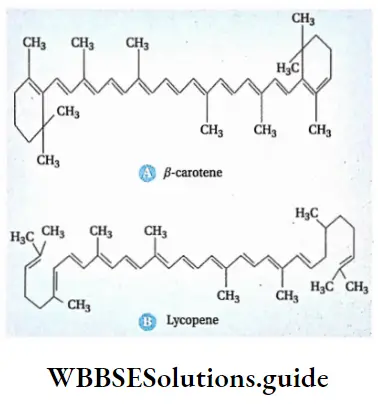
Role And Deficiency Symptoms Of Different Mineral Nutrients In The Plant Body

Different mineral nutrients play important roles in the plant body. Plants show certain morpho-physiological symptoms if these nutrients are not available in the required amount. Roles and deficiency symptoms of mineral nutrients in the plant body are discussed below.

Mineral Nutrition Macronutrients

Roles and deficiency symptoms of different macronutrients in the plant body are given below.

Mineral Nutrition Nitrogen (N)

Nitrogen Role:

  • Nitrogen is a major component of amino acids, nucleic acids, hormones, chlorophyll, vitamins, and enzymes which are essential for plant life.
  • Nitrogen plays a major role in vegetative growth.

Nitrogen Deficiency symptoms:

  1. Chlorosis and abscission occur in matured leaves.
  2. Deficiencies can reduce yields and cause retarded growth.
  3. Deficiency of nitrogen results in chlorosis. Sometimes, leaves and stems become purplish due to the accumulation of anthocyanin.
  4. Retarded growth of lateral bud.

Phosphorus (P)

Phosphorus Role:

  1. Phosphorus is necessary for seed germination, photosynthesis, protein synthesis, and almost all aspects of growth and metabolism in plants.
  2. It takes part in the formation of phospholipids, an important constituent of the cell membrane.
  3. It is also essential for flower and fruit production.
  4. Phosphorus is also involved in the synthesis of nucleic acid, nucleotides, RNA, DNA and ATP.
  5. Phosphorus plays an important role in energy metabolism when present in pyrophosphate, ATP, ADP, and AMP.
  6. It also takes part in the synthesis of other enzymes along with NAD+ and NADP+.
  7. Applications of large amounts of phosphorus without adequate levels of zinc may cause zinc deficiency.

Phosphorus Deficiency symptoms:

  1. Retarded overall growth and development in plants.
  2. Stem and leaves become purplish-green due to the accumulation of anthocyanin.
  3. Sickle-leaf disease and necrosis occur in leaves.
  4. Abscission occurs in immature leaves.
  5. Delay in flowering and seed germination.
  6. Yields of fruits and seeds become poor.
  7. Premature drops of fruits and flowers may often occur.

Biology class 11 chapter 12 Mineral Symptoms caused by deficiency of phosphorus and potassium

Mineral Nutrition Potassium (K)

Potassium Role:

  1. Potassium is necessary for the synthesis of sugar, starch, carbohydrates, and protein. It is also essential for cell division in different meristematic tissues of the plant.
  2. It plays an important role in respiration and photosynthesis.
  3. It also acts as an enzyme activator. This element seems to function mostly as a catalytic agent in several enzymatic reactions.
  4. It regulates the water potential and turgor pressure in plants. Hence, it improves stem rigidity.
  5. It also increases the ability to resist cold and enhances the flavor and color of fruit and vegetable crops. It also increases the oil content of fruits and seeds.
  6. Its probable role is to provide the necessary ionic environment for preserving the proper structure of proteins and enzymes for optimal activity.
  7. It plays an important role in the opening and closing of stomata.

Potassium Deficiency symptoms:

  1. Retarded normal growth.
  2. Curling, necrotic spots in old leaves, and chlorosis occur.
  3. Reduced apical dominance and cambium activity.
  4. Root disease occurs in cereal crops.
  5. The rate of respiration increases.
  6. Rosette is found in potatoes, beat roots, carrots, etc.
  7. Dieback disease occurs from shoot tip to base in case of severe deficiency.

Mineral Nutrition Sulphur (S)

Sulphur Role:

  1. Sulfur is a structural component of amino acids, proteins, vitamins, and enzymes.
  2. It plays an essential role in chlorophyll synthesis. It takes part.in the nodule formation of leguminous plants.
  3. It maintains the structure of a protein by synthesizing disulfide bonds.
  4. It imparts a pungent flavor to many vegetables like mustard, onion, and radish.
  5. It plays an important role in the synthesis of biotin, thiamin co-enzyme A, etc.
  6. It also helps in growth and metabolism.

Sulphur Deficiency symptoms:

  1. Chlorosis first occurs in young leaves.
  2. Decrease in the quantity of juice in citrus fruits.
  3. Nodule formation does not
  4. Stems become hard and woody.
  5. Yellow patches develop on tea leaves.

Mineral Nutrition Magnesium (Mg)

Magnesium Role:

  1. Magnesium is the critical component of the chlorophyll molecule.
  2. It is necessary for the activation of plant enzymes to produce carbohydrates, sugars, and fats.
  3. It is used for fruit nut production and is also essential for the germination of seeds.
  4. It regulates the nucleic acid synthesis and the metabolism of fats and carbohydrates.
  5. It occurs as magnesium pectate in the middle lamella.

Magnesium Deficiency symptoms:

  1. Magnesium-deficient plants appear chlorotic. Chlorosis occurs between veins of older leaves and is known as mottled chlorosis.
  2. Increase in the concentration of anthocyanin, followed by necrotic spot.
  3. Inhibits plant growth and development.
  4. Immature leaves fall off from the plant.

Mineral Nutrition Calcium (Ca)

Calcium Role:

  1. Calcium is necessary for the activation of enzymes. Sometimes it acts as a second messenger inaction of some hormones, and enzymes along with calmodulin (calcium-modulated protein).
  2. It is a structural component of the cell wall and also maintains the permeability of the cell membrane. It influences water movement in cells and is also necessary for cell growth and cell division.
  3. Some plants need calcium for the uptake of nitrogen and other minerals.
  4. Calcium also plays an important role in the formation of chromosomes and spindle fibers during cell division.
  5. Calcium forms crystals of calcium oxalate (raphide) and calcium carbonate (cystolith) in many plants.

Calcium Deficiency symptoms:

  1. Deficiency shows stunted growth in stems, flowers, and roots. It inhibits the growth of meristematic tissue.
  2. Black spots appear on leaves and fruits.
  3. Chlorosis and necrosis occur in young leaves.
  4. Apices of the leaves curl in certain plants, such as cauliflower, beetroot, and tobacco. It is known as leaf hooking disease.
  5. Blossom end rot disease occurs in the case of tomatoes.
  6. Root hairs may develop swellings. The root system becomes short and highly branched.

Macro and micro mineral nutrients and their functions 

Mineral Nutrition Micronutrients

Roles and deficiency symptoms of different micronutrients in the plant body are given below.

Mineral Nutrition Iron (Fe)

Iron Role:

  1. Iron is necessary for the functioning of many enzymes. It also acts as a catalyst for the synthesis of chlorophyll. It also plays an important role in photosynthesis and respiration as a part of the enzymes involved in these processes.
  2. Iron is the main constituent of electron carriers like ferredoxin and cytochrome.
  3. It is essential for the young growing parts of the plant. In chloroplast, iron mainly combines with proteins as phytoferritin.
  4. Under iron-deficient conditions, plant roots secrete ligands for iron uptake. The ligand binds to the iron and releases it at the root surface.

Iron Deficiency symptoms:

Chlorosis occurs in young leaves.

  1. Young leaves become pale in colour followed by whitening of leaves between veins. This is known as interveinal white chlorosis.
  2. Petioles become dwarf and weak.
  3. Respiration and photosynthesis are inhibited. Hence, normal growth is stunted.

Biology class 11 chapter 12 Mineral Nutrition Symptoms caused by deficiency ofiron and boron

Mineral Nutrition Boron (B)

Boron Role:

  1. Boron is necessary for cell wall formation, membrane integrity, and calcium uptake. It also aids in the translocation of sugars.
  2. Boron plays an important role in nucleic acid synthesis in meristematic tissues.
  3. It regulates water relations, active salt absorption, nodulation in legumes, fertilization of gametes, etc.
  4. Boron helps in pollen germination and elongation of pollen tubes.

Boron Deficiency symptoms:

  1. Inhibits root growth.
  2. Causes heart rot disease in beet, drought spot disease in apples, and water core disease in turnip.
  3. Degeneration of meristematic tissue.
  4. Boron deficiency kills terminal buds leaving a rosette effect on the plant.
  5. Leaves become thick, curled, and brittle.
  6. Fruits, tubers, and roots become discolored, cracked, and flecked with brown spots.

Mineral Nutrition Manganese (Mn)

Manganese Role:

  1. Manganese is involved in enzyme activity for photosynthesis, respiration, and nitrogen metabolism.
  2. It plays an important role in photooxidation and oxygen production photolysis of water during photosynthesis.lt helps in chloroplast formation.
  3. It acts as an activator of enzymes such as malate dehydrogenase, oxalosuccinic dehydrogenase, nitrate reductase, etc.

Manganese Deficiency symptoms:

  1. Interveinal chlorosis occurs in young leaves. This is followed by necrosis (death of tissue).
  2. The plant produces sterile flowers.
  3. Destruction of the thylakoid membrane.
  4. Greyspeck disease in barley, marsh spot disease in pea, and speckled yellow disease in sugar beet are seen when the plants are deficient in manganese.
  5. In neutral or alkaline soils, plants often show deficiency symptoms like stunted growth of both shoot and root with fewer, sterile flowers.

Mineral Nutrition Zinc (Zn)

Zinc Role:

  1. Zinc is a functional cofactor of several enzymes and growth regulatory hormones in plants.
  2. It is involved in the synthesis of auxin or its precursor amino acid, tryptophan.
  3. Zinc is essential for chlorophyll formation and it also prevents chlorophyll destruction.
  4. It is also essential for carbohydrate metabolism, protein synthesis and internodal elongation (stem growth).
  5. Zinc plays an important role in flower and fruit setting

Zinc Deficiency symptoms:

  1. Zinc deficit plants show a stunted internodal elongation.
  2. Zinc deficiency causes little leaf disorder in apples and leaf rosette in peaches.
  3. It also causes a reduction in flower and fruit production and delays seed growth.
  4. Interveinal chlorosis occurs in old leaves.
  5. Zinc deficit causes white bud disease in corn.

Biology class 11 chapter 12 Mineral Nutrition Symptoms caused by deficiency ofmanganese and zinc

Mineral Nutrition Copper (Cu)

Copper Role:

  1. Copper activates many enzymes and is a component of phenolases, ascorbic acid oxidase tyrosinase, etc.
  2. It is necessary for the electron transport chain.
  3. It is also a component of cytochrome oxidase and plastocyanin etc., which are important components of respiration and photosynthesis respectively. So, copper is essential for both photosynthesis and respiration.

Copper Deficiency symptoms:

  1. Copper deficiencies dieback disease of the shoot tips.
  2. Terminal leaves develop brown spots.
  3. Deficiency also causes cause exanthema in which tree bark may develop splits from which gum exudes. Fewer fruits develop with necrotic spots and skin splitting.
  4. Copper deficiency causes less nodule formation in the roots of leguminous plants.

Mineral Nutrition Molybdenum (Mo)

Molybdenum (Mo) Role:

  1. Molybdenum is a structural component of the enzyme nitrate reductase, that reduces nitrates to nitrites.
  2. It also functions as a part of xanthine dehydrogenase.
  3. Molybdenum acts as a co-factor of certain enzymes, such as aldehyde oxidase. This type of enzyme catalyzes reactions like the conversion of abscisic aldehyde to ABA and the synthesis of ascorbic acid.
  4. This element is important for nitrogen fixation by nitrogen-fixing bacteria.

Types of mineral nutrients and their role in the body 

Molybdenum (Mo) Deficiency symptoms:

  1. Deficiency may block protein synthesis and can cease plant growth.
  2. Seeds may not form completely, and nitrogen deficiency may occur due to a deficiency of molybdenum.
  3. Interveinal chlorosis occurs.
  4. Deficiency also causes leaf tip necrosis, whip tail disease in members of Brassicaceae, yellow spots in citrus fruits, and scaled disease of leguminous plants.
  5. Despite the presence of abundant nodules, legumes develop symptoms of nitrogen deficiency.

Mineral Nutrition Chlorine (Cl)

Chlorine Role:

  1. Chlorine plays an important role in the photolysis of water and the production of oxygen during photosynthesis.
  2. It helps in the cell division of leaves and the growth of roots.
  3. It maintains the density of the cell sap and ionic balance in the cell.
  4. Chloride ion is an important solute for developing osmotic potential.

Chlorine Deficiency symptoms:

  1. Deficiency symptoms include wilting, stubby roots, chlorosis (yellowing), necrosis, and bronzing.
  2. Distinctive smell in some plants like cabbage and radish may be decreased.
  3. The root becomes dwarfed and swollen. Root apex becomes round.
  4. Inhibits photosynthesis and thus flowering and fruiting are retarded.

Mineral Nutrition Nickel (Ni)

Nickel is recently considered an essential trace element for plants according to the Agricultural Research Service Plant, Soil and Nutrition Laboratory in Ithaca, NY.

Nickel Role:

  1. Nickel is an important component of different enzymes such as urease, hydrolase, superoxide dismutases, amylase, protease, ribonuclease, etc.
  2. It plays an important role in nitrogen metabolism in plants. It is required for the enzyme urease to break down urea to liberate nitrogen in a usable form for plants.
  3. Nickel is also required for iron absorption.
  4. Nickel helps in seed germination.
  5. During environmental stress conditions nickel-containing antioxidative enzymes play important roles in plant survival.

Nickel Deficiency symptoms:

  1. Small spots occur on the leaves.
  2. A deficiency of nickel inhibits the production of viable seeds.
  3. Several abnormalities of plants are also caused by nickel deficiency.
  4. The urease becomes inactive. Inactive urease is unable to hydrolyze urea into ammonia. As a result, accumulated urea causes toxicity in plant cells.

Role of minerals in plant growth and development 

Mineral Nutrition Diseases Due To Deficiency Of Essential Mineral Nutrients

Plants suffer from different diseases due to the absence of essential mineral nutrients. They are given in a tabular manner along with their visible symptoms.

Biology class 11 chapter 12 Mineral Nutrition Deficiency diseases and their symptoms due to absence of essential mineral nutrients

Biology class 11 chapter 12 Mineral Nutrition Different diseases caused by lack ofdifferent mineral nutrients

Points To Remember

  1. About 96% of the total dry weight of organisms is composed of carbon, hydrogen, and oxygen. Except for these components, the plant absorbs other inorganic components from the soil.
  2. The growth of any plant depends on the presence of minerals present in the soil. Most of the essential inorganic components of plants are minerals, so these nutrients are also known as mineral nutrients.
  3. A total of 60 nutrient components are found in different plants. The important components required by plants are known as essential elements which are of two types—micronutrients and macronutrients.
  4. 9 macronutrients are — C, H, O, N, P, K, S, Ca, and Mg.
  5. 8 micronutrients are — Fe, Mn, Mo, B, Zn, Cu, Cl, and Ni.
  6. Many species of plants are able to accumulate metals from soil and water in large quantities. Their ability is utilized to remove metallic pollutants of soil and water from the environment. This is known as phytoremediation.
  7. Agricultural lands are generally deficient in N, P, and K, hence, these minerals are known as critical elements. The fertilizer which contains these three components is known as a complete fertilizer.
  8. The physical or structural changes that occur due to deficiency of any mineral are known as deficiency symptoms or hunger signs.
  9. Hydroponics is the method, where plants are grown in nutrient solution without soil. This is also known as soil-less culture or solution culture.
  10. A balanced nutrient solution is produced by dissolving different minerals in distilled water.
  11. Common balanced nutrient solutions are—Knop’s solution, Hoagland solution, Arnon’s solution, and Sachs’ solution.
  12. Deficiency of any mineral can be determined by hydroponics or solution culture.