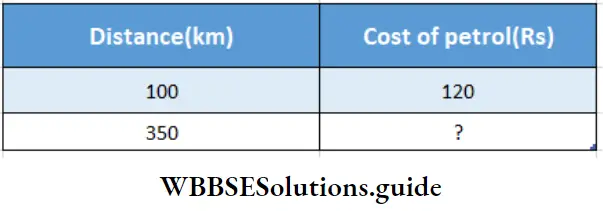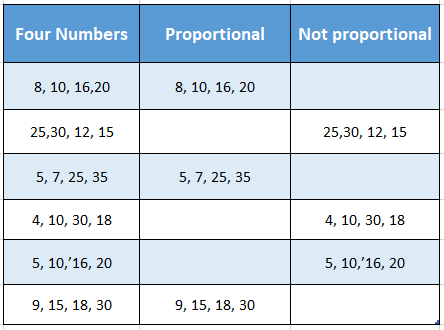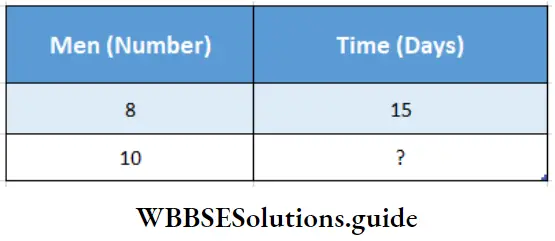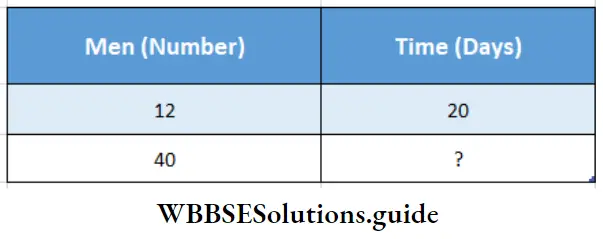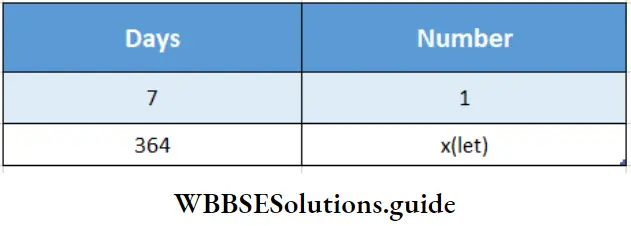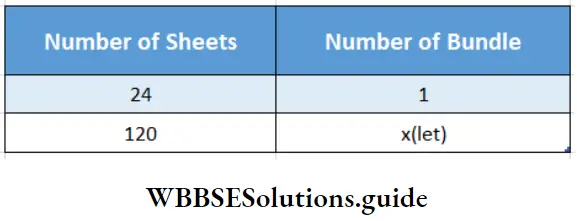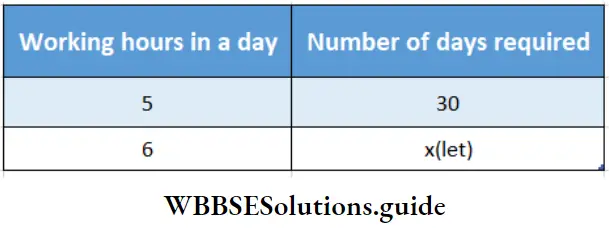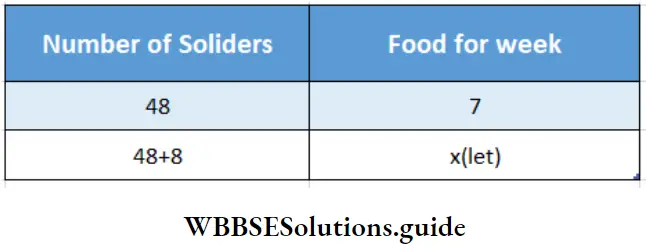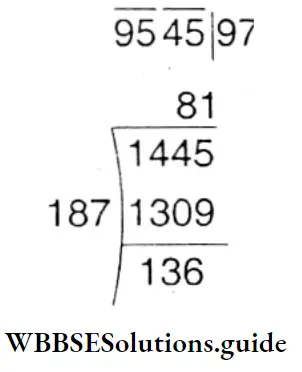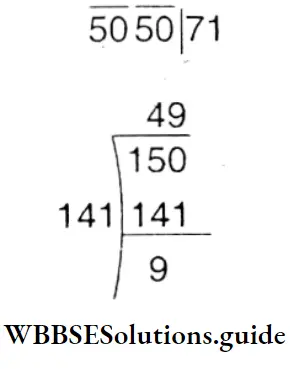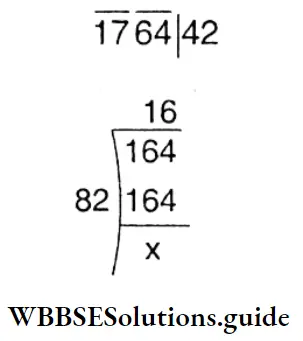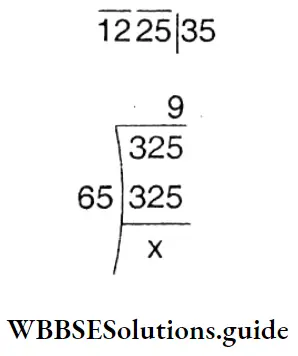
WBBSE Solutions For Class 7 Maths Arithmetic Chapter 6 Time And Distance Exercise 6 Solved Problems

WB Class 7 Math Solution Arithmetic Chapter 6 Time And Distance Exercise 6 Solved Problems

⇒ Speed: When a moving body changes its position, it covers a certain distance at a certain time. The rate of change of distance is known as speed.

⇒ In other words, the distance covered by a moving body in a unit of time is known as speed. The distance covered is directly proportional to the time taken by the body.

1. \(\text { Speed }=\frac{\text { Distance covered }}{\text { Time required to cover the distance }}\)

2. \(\text { Time required }=\frac{\text { Distance covered }}{\text { Speed }}\)

3. Distance covered x = Speed x Required time.

Relative speed: Relative speed is the speed of one object relative to another object.

1. If two objects move in the same direction, then relative speed = difference of their speeds.
2. If two objects move in the opposite direction, their relative speed = the sum of their speeds.

Read and Learn More WBBSE Solutions for Class 7 Maths

Question 1. Choose the correct answer 

1. Ramen covered a distance of 276 km in 6 hours in a bus. The speed of the bus in km/ hr is

1. 48 km/hr
2. 46 km/hr
3. 40 km/hr
4. 42 km/hr.

Solution:

Given

⇒ Ramen covered a distance of 276 km in 6 hours in a bus.

\(\text { Speed }=\frac{\text { Distance covered }}{\text { Time required }}\)

=\(\frac{276}{6}\) km/hr

= 46 km/hr

So the correct answer is 2. 46 km/hr

“WBBSE Class 7 Maths Arithmetic Chapter 6 solved problems step-by-step”

2. A train of length 100 m. moving with a speed of 60 km / m. passes a tree. How long will it take to do so?

1. 4 sec
2. 5 sec
3. 6 sec
4. 7 sec

Solution:

Given

⇒ A train of length 100 m. moving with a speed of 60 km / m. passes a tre

⇒ To cross a tree, the train will have to travel a distance equal to its own length. So here the train will have to travel 100 m.

The speed of the train is 60 km/h.
60 km = 60 × 1000 m = 60000 m
1 hour = (60 x 60) sec = 3600 sec.

i.e., 60000 m is covered by the train in 3600 sec.

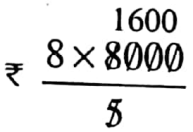
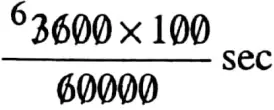
1 m is covered by the train in \(\frac{3600}{60000}\) sec

100 m is covered by the train in
WBBSE Solutions For Class 7 Maths Arithmetic Chapter 6 Time And Distance Q1-3

= 6 sec

∴ The required time is 6 sec.

So the correct answer is 3. 6 sec

“Time and Distance Exercise 6 Class 7 WBBSE Maths full solutions”

3. A train runs at the rate of 40 km an hour. How far will it run in 21 minutes?

1. 7 km
2. 14 km
3. 18 km
4. 20 km.

Solution:

Given

⇒ A train runs at the rate of 40 km an hour.

⇒ In the mathematical language

Time (mins)
60
21

Distance (km)
40
?

⇒ Speed being constant the time and distance are in direct proportion.

∴ 60: 21 : : 40 : ? (Required distance)

∴ Required distance(4th Proportion) =

WBBSE Solutions For Class 7 Maths Arithmetic Chapter 6 Time And Distance Q1-3

= 14 km

⇒ So the correct answer is 2. 14 km

“WBBSE Class 7 Maths Chapter 6 Exercise 6 important questions and answers”

WBBSE Class 7 Arithmetic Time Distance Solutions

Question 2. Write true or false 

1. A bus covers a distance of 110 km in 3 hrs 40 mins. The speed of the bus is 30 km. / h.

Solution:

Given

⇒ A bus covers a distance of 110 km in 3 hrs 40 mins.

⇒ 3 hrs 40 mins (3 x 60+40) mins. = 220 mins.

⇒ In mathematical language, the problem is

Required time (mins)
220
60

Distance covered (km)
110
?

⇒ The required time and distance covered are directly proportional.

So 220: 60 : :  110: ? (Required distance)

∴ Required distance (4th proportion) =

WBBSE Solutions For Class 7 Maths Arithmetic Chapter 6 Time And Distance Q2

Speed of bus is 30 km / h

So the statement is true.

“Class 7 Maths Time and Distance WBBSE solved examples”

2. A man takes 12 hours to travel 72 km. He takes 5 hours to travel 48 km. Let he takes x hours to travel 48 km.

Solution:

Given

A man takes 12 hours to travel 72 km. He takes 5 hours to travel 48 km.

In mathematical language the problem is

Distance covered (km)
72
48

Time taken (hr)
12
x

The time taken and the distance covered is directly proportional.

So, 72: 48 : : 12: x

⇒ \(\frac{72}{48}=\frac{12}{x}\)

⇒ 72x = 12 x 48

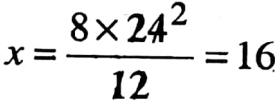
WBBSE Solutions For Class 7 Maths Arithmetic Chapter 6 Time And Distance Q2

⇒ x=8

He takes 8 hours to travel 48 km. So the statement is false.

Question 3. Fill in the blanks 

1. The distance covered in 3 hrs at 5.6 km/hr is _______ km

Solution: The distance covered in 1 hour is 5.6 km

The distance covered in 3.5 hours is (3 x 5.6) km = 16.8 km

2. The distance covered by a moving body is the product of its — and the time taken

Solution: Speed.

“WBBSE Class 7 Maths Arithmetic Chapter 6 Exercise 6 practice problems”

Question 4. To pass a bridge of length 230 m a train of length 170 m took 20 sec. Calculate to find how long will this train take to pass a 110 m long platform.

Solution:

Given

To pass a bridge of length 230 m a train of length 170 m took 20 sec.

When a train crosses a bridge, then the train has to cover a distance of its own length + the length of the bridge. That is (230+ 170) m or 400 m.

If a train crosses a platform of length 150 m, then the train has to cover a distance is (170+110) m or 280 m.

In mathematical language, the problem is

Distance (metre)
400
280

Time (sec)
20
? (x)[say]

Speed remains constant, and time and distance are in direct proportion.
∴ 400: 280 : :  20: x

⇒ \(\frac{400}{280}=\frac{20}{x}\)

⇒ 400x = 20× 280

WBBSE Solutions For Class 7 Maths Arithmetic Chapter 6 Time And Distance Q4

⇒ x = 14

∴ The train would take 14 secs to cross the platform.

Question 5. A train passes two brides of lengths 210 m and 122 m in 25 sec and 17 sec respectively. Calculate the length and speed of the train.

Solution:

Given

A train passes two brides of lengths 210 m and 122 m in 25 sec and 17 sec respectively.

Let the length of the train be x m. When the train crosses a bridge of length 210 m then the train has to cover a distance of length (210 + x) m.

Similarly to cross the second bridge of length 122 m; the train has to cover a distance of length (122 + x) m.

In the mathematical language, the problem is,

Time taken (sec)
25
17

Distance covered (m)
(x + 210)
(x + 122)

Speed remains constant, time and distance are in direct proportion.
∴ 25: 17 : : (x + 210): (x + 122)

⇒ \(\frac{25}{17}=\frac{x+210}{x+122}\)

⇒ 25 (x+122) = 17 (x + 210)
⇒ 25x + 3050 = 17x+ 3570
⇒ 25x – 17x = 3570 – 3050
⇒ 8x= 520

WBBSE Solutions For Class 7 Maths Arithmetic Chapter 6 Time And Distance Q5

⇒ x= 65

∴ The length of the train is 65 meter.

In 25 sec the train travels (65+ 210) m or 275 m

In 1 sec the train travels \(\frac{275}{25}\) m

In 1 hr or 3600 sec the train travels

WBBSE Solutions For Class 7 Maths Arithmetic Chapter 6 Time And Distance Q5

= 39600 mt = 39.6 km

∴ The length of the train is 65 mt. and speed is 39.6 km/hr.

“How to solve time and distance problems Class 7 WBBSE Maths Chapter 6”

Question 6. Two trains of lengths 170 m and 180 m are approaching each other with speeds of 45 km/hr and 30 km/hr along two tracks. Calculate how long will they take to pass each other after meeting.

Solution:

Given

Two trains of lengths 170 m and 180 m are approaching each other with speeds of 45 km/hr and 30 km/hr along two tracks.

After the two trains meet, they would pass each other i.e., the two trains would simultaneously pass a distance equal to sum of their own length.

∴ The distance two trains will cover (170 + 180) m or 350 m.

When the two trains travel in opposite directions, in 1 hour they would cover a distance of (45+30) km or 75 km or 75000 m.

1 hour = 3600 sec.

In the mathematical language the problem is,

Distance (metre)
75000
350

Time (sec)
3600
?

Time and distance are direct proportion.
∴ 75000: 350 : : 3600 ?

∴ Time taken

WBBSE Solutions For Class 7 Maths Arithmetic Chapter 6 Time And Distance Q6

= \(\frac{84}{5}\) sec. = 16.8 sec

∴ The train will pass each other in 16.8 sec.

Alternative Method:

75000 metres is covered in 3600 sec

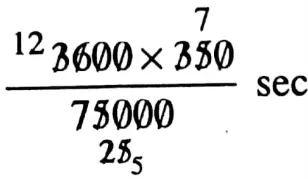
1 metre is covered in \(\frac{3600}{75000}\) sec

350 metre is covered in
WBBSE Solutions For Class 7 Maths Arithmetic Chapter 6 Time And Distance

= \(\frac{84}{5}\) sec = 16.8 sec


WB Class 7 Math Solution Time And Distance

Time And Distance Exercise 6

Question 1. On Saturday, I was cycling at a speed of 13 km/hr. I covered a certain distance in 2 hrs. On Sunday cycling at the same time at a speed of 11 km/hr.I covered a certain distance. Let us find out on which day. I could travel a distance more in 2 hours and how much? Hence, keeping time constant, try to find a relation between speed and distance (direct or inverse proportion)
Solution :

Given

On Saturday, I was cycling at a speed of 13 km/hr. I covered a certain distance in 2 hrs. On Sunday cycling at the same time at a speed of 11 km/hr.I covered a certain distance.

My speed of cycling is 13 km/hr.

∴ I will cover in 2 hrs. = 13 ×  2 = 26 km.

Next day Sunday my speed is 1 1 km/hr.

∴  I will cover in 2 hrs. on Sunday = 2 ×11 =22 km.

∴ On Saturday I cover 26 – 22 = 4 km more.

∴  Speed & distance are in direct proportion.

“WBBSE Class 7 Maths Chapter 6 Time and Distance textbook solutions”

Question 2. On Monday,l went to market cycling at a speed of1 2 km/hr. But on Tuesday) went to market cycling at a speed of 15 km/hr. If the distance between my house and market is 2km, then let’s us find, on which day. I took less time to reach the market. Hence, keeping distance same, let’s form a relation between speed and time required (direct or inverse proportion).
Solution :

For Monday:

Given

On Monday,l went to market cycling at a speed of1 2 km/hr. But on Tuesday) went to market cycling at a speed of 15 km/hr. If the distance between my house and market is 2km,

Speed = 12 km/hr.

Distance = 2 km.

Time required = \(\frac{\text { Distance Covered }}{\text { Speed }}\)

= \(\frac{2 \mathrm{~km}}{12 \mathrm{~km} / \mathrm{hr} .}=\frac{2}{12} \mathrm{hr}\)

= \(\frac{1}{6} \mathrm{hr}\) hr.

= \(\frac{1}{6} \times 60\) min.

= 10 min

For Tuesday:

Speed = 15 km/hr. Distance = 2 km

Time required = \(\frac{\text { Distance Covered }}{\text { Speed }}\)

= \(\frac{2 \mathrm{~km}}{15 \mathrm{~km} / \mathrm{hr} .}=\frac{2}{15} \mathrm{hr}\)

= \(\frac{2}{15} \times 60\) min.

= 8 min

∴ On Tuesday I took less time to reach the market (10m – 8m) = 2m

Here as the distance same, when speed in increasing time is decreasing i.e. speed & time are in inverse proportion.

Question 3. Keeping speed constant, let’s find the relation between time and distance [let’s prepare a story and find the relation]
Solution :

A passenger train of length 156 meters is traveling with a speed of 24 km/hr. Find the time taken by this train to cross a goods train of length 1 64 metres,’ which .is at rest by the side of the path of the passenger train.

Total length of the two trains = (156m + 164m) = 320 meters

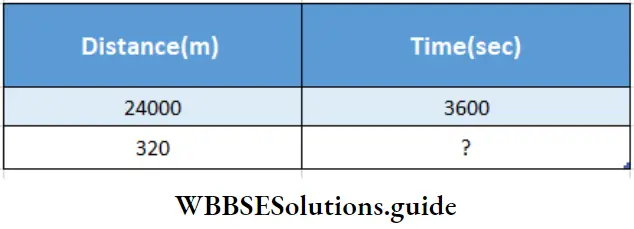
Speed the train = 24 km/hr. i.e. the train goes 24 km = 24000 m in 1 hr

= 60 × 60 = 3600 sec
WBBSE Solutions For Class 7 Maths Chapter 15 Time And Distance Relation Between Distance And Time

Here distance & time are in direct proportion.

∴ 24000 : 320: : 3600:?

Time = \(\frac{320 \times 3600}{24000}\)

= 48 sec

The relation between time and distance= 48 sec

Question 4. I covered a distance of 12 km in 40 min in a bus. Let’s find the speed of the bus in km/hr.
Solution :

WBBSE Solutions For Class 7 Maths Chapter 15 Time And Distance Relation Between Distance And Time Minutes

Given

I covered a distance of 12 km in 40 min in a bus.

Time and distance are in direct proportion

40 : 60: : 12 : ?

Distance = \(\frac{60 \times 12}{40}\)km

= 18 km

 Question 5. A train of length 100m, moving with a speed of 60 km/hr. passes a tree. How long will it take to do so, lets calculate.
Solution:
WBBSE Solutions For Class 7 Maths Chapter 15 Time And Distance Relation Between Distance And Time Are Direct Proportion

Given

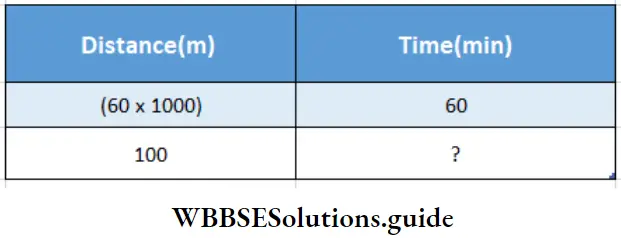
⇒ A train of length 100m, moving with a speed of 60 km/hr. passes a tree.

⇒ Distance and time are in direct proportion

⇒ (60 × 1000): 100:: 60:?

⇒ Time = \(\frac{100 \times 60}{60 \times 1000}\)

= \(\frac{1}{10}\) min

= \(\frac{1}{10} \times 60\)

= 6 sec

It will take 6 sec. to do so.

“West Bengal Board Class 7 Maths Chapter 6 solved numerical problems”

Question 6. Moving with a uniform speed a taxi takes 6km 12 min to cover a distance of 217 km. Let us calculate how much time it would take to cover a distance of 273 km. (Mention the relation to calculate).
Solution :

Given

⇒ Moving with a uniform speed a taxi takes 6km 12 min to cover a distance of 217 km.

⇒ 6 hr 12 min = (6 × 60 + 12) min = 372 min

WBBSE Solutions For Class 7 Maths Chapter 15 Time And Distance Relation Between Distance And Time Uniform Speed Of Taxi

Here, Distance and time are in direct proportion.

217: 273:: 372:?

Time = \(\frac{273 \times 372}{217}\)

It would take 7 hr. 48 m. to cover the distance.

Question 7. Today, Ayanda of our locality covered a distance of 100 km in 2 hrs 5 min. on his motorbike. But Shibuya covered the same distance on his cycle in 6 km 40 min. Let’s write the ratio of their speeds.
Solution:

Given

Today, Ayanda of our locality covered a distance of 100 km in 2 hrs 5 min. on his motorbike. But Shibuya covered the same distance on his cycle in 6 km 40 min.

2 hrs 5 min = (120 + 5) min

6 hrs 40 min = (360 + 40) min = 400 min

Ayanda covered in 125 min a distance of 1 00 km. = \(\frac{125}{100}\) min

∴ He covered in 1 min a distance of km.

∴  His speed is \(\frac{125}{100}\) km/min = \(\frac{4}{5}\) km/rnln.

Shibuda covered in 400 min a distance of 100 km.

∴  He covered in 1 min a distance of \(\frac{100}{400}\) km.

∴  His speed is \(\frac{100}{400}\) km/min. = \(\frac{100}{400}\) km/min.

∴  Ratio of their speed = \(\frac{100}{400}\) km/min : \(\frac{100}{400}\) km/min.

⇒ \(\frac{4}{5}\): \(\frac{1}{4}\) = 16:5

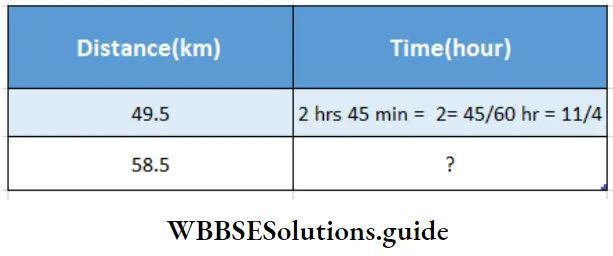
Question 8. Moving with a uniform speed a railway wagon covers a distance of 49.5 km. in 2hrs 45 min. How long it will take to reach a station situated at a distance of 58.5 km?
Solution :
WBBSE Solutions For Class 7 Maths Chapter 15 Time And Distance Relation Between Distance And Time Uiniform Speedd A Railway Wagon Covers

Given

Moving with a uniform speed a railway wagon covers a distance of 49.5 km. in 2hrs 45 min.

Distance & Time are in direct proportion

49.5 : 58.5 : : \(\frac{11}{4}\): ?

Time = \(\frac{58.5 \times \frac{11}{4}}{49.5}\)

= \(\frac{585}{495} \times \frac{11}{4}\)

= \(\frac{13}{4}\)

= 3 hr 15 min

∴ It will take 3 hr. 15 min. to reach the station

“WBBSE Class 7 Maths Exercise 6 Time and Distance short and long questions”

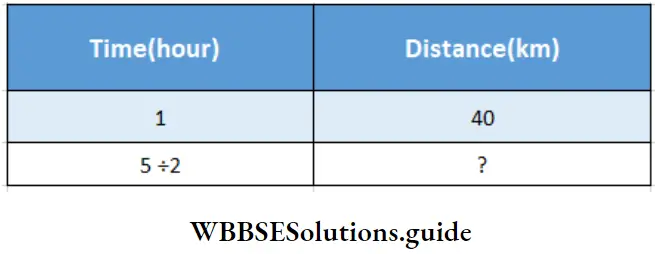
WB Class 7 Math Solution Question 9. My uncle went to Panchla on his motorbike, worked there for an hour, and returned home after 3hrs 30min. If he maintained a uniform speed of 40 km per hour, let us find the distance of Panchla from his home.
Solution :

Given

My uncle went to Panchla on his motorbike, worked there for an hour, and returned home after 3hrs 30min. If he maintained a uniform speed of 40 km per hour,

Total time taken 3 hrs 30 min but he worked there for 1 hr.

Total time for journey to go & return = 2 hr 30 min

= 2 \(\frac{1}{2}\) hr

= \(\frac{5}{2}\) hr
WBBSE Solutions For Class 7 Maths Chapter 15 Time And Distance Relation Between Time And Distance Of Panchala

Time and Distance are in direct proportion,

1: \(\frac{5}{2}\) :: 40 ?

Distance = \(\frac{\frac{5}{2} \times 40}{1}\)

= 100

∴  2 ×  distance to Panchla from his home = 100 km.

∴ Distance to Panchla from his home = \(\frac{100}{2}\)

= 50 km.

Distance to Panchla from his home = 50 km.

Question 10. A bus left Kolkata at 7:30 AM and without halting anywhere on its way reached Digha at 12 noon. If the uniform speed of the bus is 45 km/ hour, let us find the distance of Digha from Kolkata.
Solution :

Given

The bus left Kolkata at 7:30 AM & reached Digha at 1 2 noon.

Total time required to go Digha from Kolkata

= (12 Noon) -(7:30 AM) = 4 \(\frac{1}{2}\) hr

= \(\frac{9}{2}\) hr

WBBSE Solutions For Class 7 Maths Chapter 15 Time And Distance Relation Between Time And Distance Of Of Digha From Kolkata

1:\(\frac{9}{2}\):: 45?

∴  Distance = \(\frac{\frac{9}{2} \times 45}{1}\)

= \(\frac{405}{2}\) km

= 202. 5km

∴  Distance from Digha to Kokata = 202.5 km.

“WBBSE Maths Class 7 Time and Distance full chapter solutions”

Question 11. A 70 m long train runs at a speed of 75 km/hr. Let us calculate how long it would take to pass a platform of length 105 metre.
Solution :

Given

A 70 m long train runs at a speed of 75 km/hr.

To pass a platform a train has to cover the length of platform + length of the train = (105 + 70) m = 175 m

Speed of the train = 75 km/hr.

WBBSE Solutions For Class 7 Maths Chapter 15 Time And Distance Relation Between Distance And Time Train Runs At A Speed

∴  Distance & time are in direct proportion

75000: 175:: (60 × 60):?

Time = \(\frac{60 \times 60}{75000} \times 175\)

= \(\frac{42}{5}\) sec

= 8 \(\frac{2}{5}\)

∴  It would take 8 \(\frac{2}{5}\) sec. to pass the platform

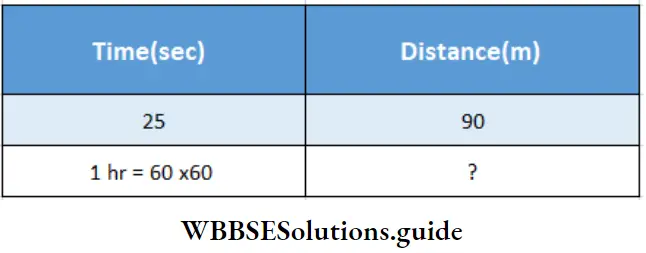
WB Class 7 Math Solution Question 12. A 90 m long train takes 25 sec to pass a pole. Let me calculate the speed of the train in km/hr.
Solution :

Given

A 90 m long train takes 25 sec to pass a pole.

To pass the pole, a train has to cover its own length.
WBBSE Solutions For Class 7 Maths Chapter 15 Time And Distance Relation Between Time And Distance Of Train Takes Pass Pole

Time & Distance are in direct proportion.

25 :60 × 60 : : 90 : ?

∴  Distance = \(\frac{60 \times 60 \times 90}{25}\)m

= 12.96 km

∴  Speed of the train = 12.96 km/hr.

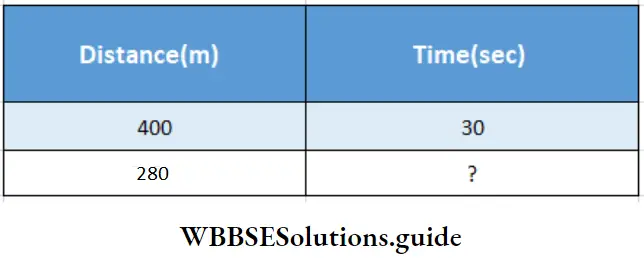
Question 13. To pass a bridge of length 250m a train of length 150m took 30 sec. Let’s calculate how long will this train take to pass a 130 m-long platform.
Solution:

Given

To pass a bridge of length 250m a train of length 150m took 30 sec.

Length of the train + length of the bridge

= (250 + 1 50) m = 400 m.

And length of platform + length of the train = (1 30 + 1 50) m = 280 m
WBBSE Solutions For Class 7 Maths Chapter 15 Time And Distance Relation Between Time And Distance Bridge Of Length

Time & distance are in direct proportion.

400 : 280: : 30:?

Time = \(\frac{280 \times 30}{400}\)

= 21 sec

∴  This train will take 21 sec. to pass the platform

Question 14. A passenger in a train found that the train took 15 sec to pass the platform. If the speed of the train is 60km per hour, let us find the length of the platform.
Solution :

Given

A passenger in a train found that the train took 15 sec to pass the platform. If the speed of the train is 60km per hour

Here the speed of the train = 60 km/hr. = 60000 m/hr. ,

The train took 15 sec to cross a platform

WBBSE Solutions For Class 7 Maths Chapter 15 Time And Distance Relation Between Time And Distance Of Passenger Length Of The Plat Form

Distance = \(\frac{15 \times 60000}{60 \times 60}\)

∴  Length of the platform = 250 m.

Question 15. A train takes 4 sec to pass a telegraph post and 20 sec to pass a 264 m-long bridge. Let us find the length of the train and also its speed.
Solution :

Given

A train takes 4 sec to pass a telegraph post and 20 sec to pass a 264 m-long bridge.

In 20 sec the train covered its own length + the length of the bridge (264 m) & in 4 sec the train covered its own length (Subtracting) In 16 sec the train goes 264 m

In 4 sec the train goes \(\frac{264}{16} \times 4\) = 66m

Length of the train = 66 m.

WBBSE Solutions For Class 7 Maths Chapter 15 Time And Distance Relation Between Time And Distance Of Speed

4 : 3600 : : 6 : ?

Distance = \(\frac{3600 \times 66}{4} \mathrm{~m}\)

= \(\frac{3600 \times 66}{4 \times 1000}\) km

= 59.4 km

∴  Speed of the train = 59.4 km/hr.

“WBBSE Class 7 Maths Chapter 6 speed, time, and distance problems”

WBBSE Class 7 Math Solution Question 16. A train passes two bridges of lengths 21 0m and 1 22m in 25 sec and 17 sec respectively. Let us calculate the length and speed of the train.
Solution :

Given

A train passes two bridges of lengths 21 0m and 1 22m in 25 sec and 17 sec respectively.

In 25 sec, the train covered its own length + a bridge of length 210m & in 17 sec, it covered its own. Length + a bridge of length 122m (Subtracting) we get in 8 sec, the train goes 88 m
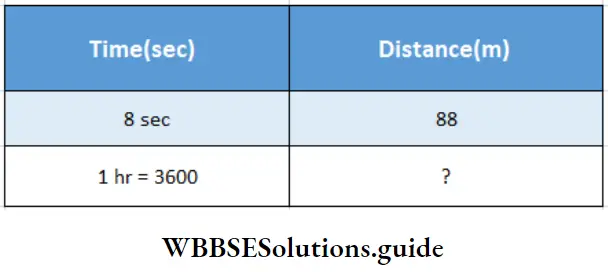
WBBSE Solutions For Class 7 Maths Chapter 15 Time And Distance Time And Distance Of Calculate The Length And Speed Of The Train

Time & distance are in direct proportion.

8 : 3600 : : 88 : ?

Distance = \(\frac{3600 \times 88}{8}\)

= 39600m

= 39.6 km

∴  Speed of the train = 39.6 km/hr.

Now again:

WBBSE Solutions For Class 7 Maths Chapter 15 Time And Distance Time And Distance Of Calculate The Length And Speed Of The Train.

Time & distance are in direct proportion.

8: 15:: 88:?

Distance = \(\frac{25 \times 88}{8}\)

∴  Length of the train = (275- 210) m = 65 m

Question 17. A 100 m long train, remaining at a speed of 48 km/hr passes a tunnel in 21 sec. Let’s calculate the length of the tunnel.
Solution :

Given

A 100 m long train, remaining at a speed of 48 km/hr passes a tunnel in 21 sec.

Speed of the train = 48 km/hr
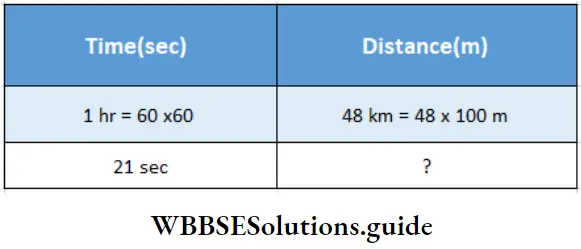
WBBSE Solutions For Class 7 Maths Chapter 15 Time And Distance Time And Distance Of Calculate The Length Of The Tunnel

60 × 60:21 :: 48 × 1000:?

∴ Distance = \(\frac{21 \times 48 \times 1000}{60 \times 60}\) = 280 m

∴ Length of the tunnel = Total distance – Length of train

= (280 – 100)m = 180 m

Length of the tunnel = 180 m

“West Bengal Board Class 7 Maths solved problems for speed, time, and distance”

Question 18. A train takes 1 0 sec to pass a man standing on the platform 1 50m long and passes the platform in 22 sec. Let us calculate the length and speed of the train.
Solution :

Given

A train takes 1 0 sec to pass a man standing on the platform 1 50m long and passes the platform in 22 sec.

In 22 sec. the train goes 150 m long platform + its own length

In 1 0 sec. the train goes its won length

(Subtracting) in 12 sec the train goes 150 m
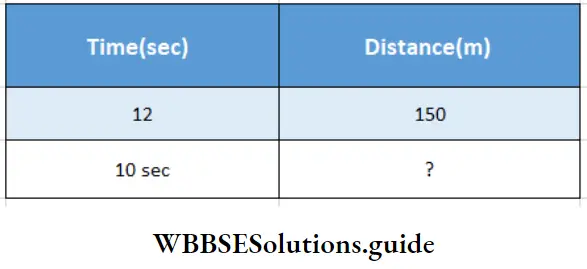
WBBSE Solutions For Class 7 Maths Chapter 15 Time And Distance Time And Distance Let The Calculate The Length And Speed Of The Train

12: 10:: 150:?

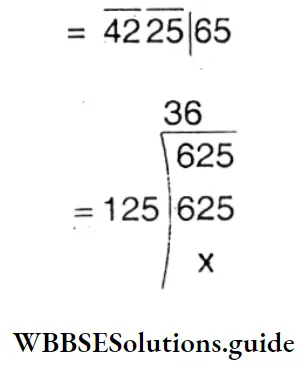
∴ Distance = \(\frac{10 \times 150}{12}\)= 125 m/hr

∴ Length of the train = 125 m

Again to find speed:
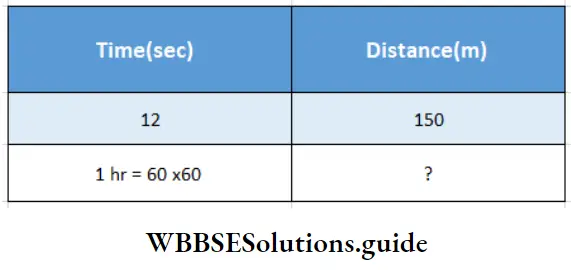
WBBSE Solutions For Class 7 Maths Chapter 15 Time And Distance Again Finding Speed

12 : (60×60) : : 150 : ?

∴ Distance = \(\frac{(60 \times 60) \times 150}{12}\) m/hr

= \(\frac{60 \times 5 \times 150}{1000}\) km

= 45 km

∴ Speed = 45 km/hr.

Question 19. Two trains of length 250 m and 200 m are approaching each other in two tracks side by side at speeds of 45 km/hr. and 36 km/hr. Let us find, after meeting each other, how long will they take to pass each other. [Let’s put numbers ourselves].
Solution :

Given

Two trains of length 250 m and 200 m are approaching each other in two tracks side by side at speeds of 45 km/hr. and 36 km/hr.

WBBSE Solutions For Class 7 Maths Chapter 15 Time And Distance Distance And Time How Long Will They Take To Pass Each Other

Total length of the two trains (250 + 200) m = 450 m.

Relative speed of the two train = (45 + 36) km/hr. = 81 km/hr

Time & distance are in direct proportion.

∴ (81 x 1000): 450:: 3600:?

∴ Required time = \(\frac{450 \times 3600}{81 \times 1000}\) = 20 sec

∴ They will take 20 sec to pass each other.

 Question 20. A goods train 250m long is running at a speed of 33 km/hr. Behind it another mail train 200m long and running at a speed of 60 km/hr. It is running in same direction on a different track & after meeting the goods train overpasses it. Let us find how long will the mail train take to overpass the goods train.
Solution :

Given

A goods train 250m long is running at a speed of 33 km/hr. Behind it another mail train 200m long and running at a speed of 60 km/hr. It is running in same direction on a different track & after meeting the goods train overpasses it.

Relative speed of the two train, when they are running in the same direction

= (60 – 33) = 27 km/hr.

Total distance covered by the mail train to over passes the other train

= (250 + 200) = 450 m.

WBBSE Solutions For Class 7 Maths Chapter 15 Time And Distance How Long Willl The Mail Train Take To Overpass The Goods Train

Time & distance are in direct proportion.

∴ (27x 1 000): 450:: (60 × 60):?

∴ Time = \(\frac{450 \times 60 \times 60}{27 \times 1000}\)

= 60 sec

= 1 min

∴ The mail train will take 1 min. to overpass the goods train.
WBBSE Solutions For Class 7 Maths Arithmetic Chapter 5 Square Root Of Fractions Exercise 5 Solved Problems

Class 7 Math Solution WBBSE Arithmetic Chapter 5 Square Root Of Fractions Exercise 5 Solved Problems

1. Square root of a fraction = \(\sqrt{\frac{\text { Numerator }}{\text { Denominator }}}\)

Example: \(\sqrt{1\frac{9}{16}}=\sqrt{\frac{25}{16}}=\frac{\sqrt{25}}{\sqrt{16}}=\frac{5}{4}=1 \frac{1}{4}\)

2. Perfect square decimal number: A decimal number whose square root is a finite decimal number is termed a perfect square decimal number.

Example: 0.8 x 0.8 (0.8)2 = 0.64

Hence 0.64 is a perfect square decimal number and 0-8 is a square root.

[The perfect square of any decimal number should contain an even number of digits offer the decimal point]

West Bengal Board Class 7 Math Book Solution English Medium

3. To find the square root of the perfect square decimal number by factorization. Method

Read and Learn More WBBSE Solutions for Class 7 Maths

Method 1

By converting decimal numbers to its fractions.

Example: \(\sqrt{1 \cdot 44}=\sqrt{\frac{144}{100}}=\frac{\sqrt{144}}{\sqrt{100}}\)

= \(\frac{\sqrt{2 \times 2 \times 2 \times 2 \times 3 \times 3}}{\sqrt{2 \times 2 \times 5 \times 5}}\)

= \(\frac{\sqrt{2^2 \times 2^2 \times 3^2}}{\sqrt{2^2 \times 5^2}}=\frac{2 \times 2 \times 3}{2 \times 5}\)

= \(12\) = 1.2

∴ The square root of 1-44 is 1.2

“WBBSE Class 7 Maths Arithmetic Chapter 5 solved problems step-by-step”

Method 2

We will consider the decimal number as a whole number (by removing the decimal sign)

Example: Find the square root of 1.96

The whole number without the decimal point in 1.96 is 196.

\(\sqrt{196}=\sqrt{2 \times 2 \times 7 \times 7}\)

= \(\sqrt{2^2 \times 7^2}\)

=2×7 14

Since in the square decimal number, there are 2 digits after the decimal point.

So, in the square root of 1.96, there will be 1 digit to the right after the decimal point.

∴ \(\) = 1.4

The rule for putting decimal points:

Number of digits after the decimal point in the square decimal Number of decimal digits in the square root
2 1
4 2
6 3
8 4


4. To find the square root of a perfect square decimal number by the method of division.

To find a square root there must be an even number of digits after the decimal point. Hence from the extreme right of the decimal point, pairs of digits are marked by an arrow sign as done on the right-hand side (if can not be paired ‘O’ is to be put to the extreme right of the decimal point)

Then we proceed by the same method as is done for finding the square root of a whole number by division.

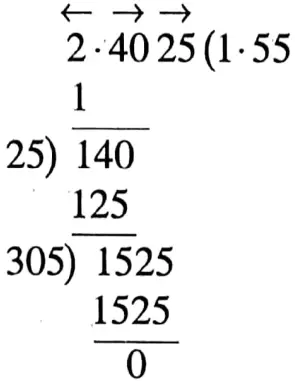
Example: Find the values of \(\sqrt{2 \cdot 4025}\)

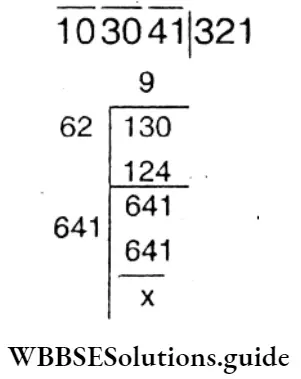
WBBSE Solutions For Class 7 Maths Arithmetic Chapter 5 Square Root Of Fractions


∴ The square root of 2.4025 is 1.55

“Square Root of Fractions Exercise 5 Class 7 WBBSE Maths full solutions”

 5. To find out the square root of numbers that are not perfect squares by the method of divisions and find their approximate values up to 3 decimal places.

[In case of division if a decimal comes we take down one ‘0’ every time after the decimal, but for finding square root by division, 2 zeros are taken down after the decimal]

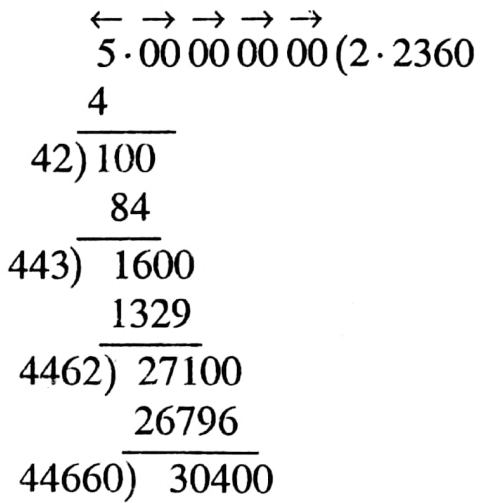
Example: Find the approximate value, of √5 up to 3 decimal places.

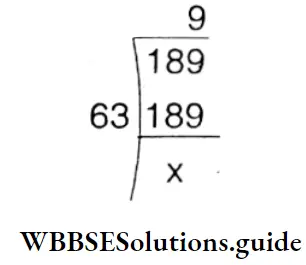
WBBSE Solutions For Class 7 Maths Arithmetic Chapter 5 Square Root Of Fractions


Question 1. Choose the correct answer 

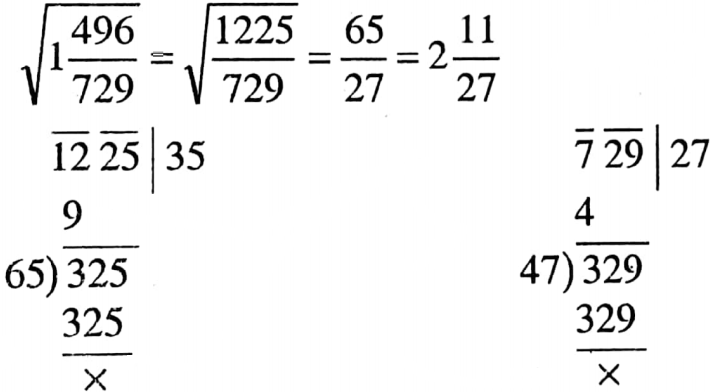
1. The area of a square root of \(1 \frac{496}{729}\) is

1. \(2 \frac{11}{27}\)

2. \(\frac{27}{65}\)

3. \(1 \frac{11}{27}\)

4. \(3 \frac{11}{27}\)

Solution:

WBBSE Solutions For Class 7 Maths Arithmetic Chapter 5 Square Root Of Fractions Q1-1

So the correct answer is 1. \(2 \frac{11}{27}\)

“WBBSE Class 7 Maths Chapter 5 Exercise 5 important questions and answers”

2. The least positive integer which will divide the fraction \(\frac{245}{64}\) to make a perfect fraction is

1. 2
2. 3
3. 7
4. 5

Solution:
\(\frac{245}{64}=\frac{5 \times 7 \times 7}{2 \times 2 \times 2 \times 2 \times 2 \times 2}=\frac{7^2 \times 5}{2^2 \times 2^2 \times 2^2}\)


So \(\frac{245}{64}\) is to be divided by the least positive integer 5 to make it a perfect square fraction.

So the correct answer is 4. 5

Question 2. True or false

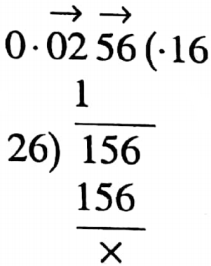
1. The square root of 0.0256 is 0.016

Solution: √0.0256=0.16

WBBSE Solutions For Class 7 Maths Arithmetic Chapter 5 Square Root Of Fractions Q2-1

The statement is false.

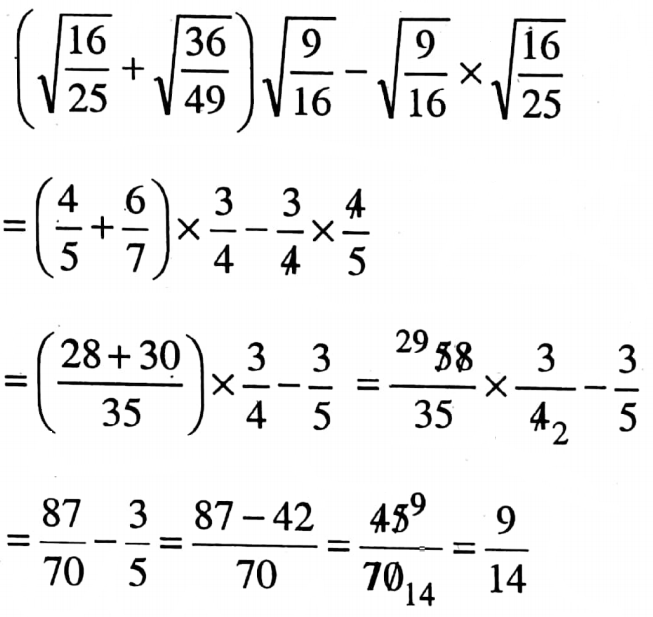
2. The value of

\(\left(\sqrt{\frac{16}{25}}+\sqrt{\frac{36}{49}}\right) \sqrt{\frac{9}{16}}-\sqrt{\frac{9}{16}} \times \sqrt{\frac{16}{25}} \text { is } \frac{9}{14}\)

Solution:

WBBSE Solutions For Class 7 Maths Arithmetic Chapter 5 Square Root Of Fractions Q2-2

The statement is true.

“Class 7 Maths Square Root of Fractions WBBSE solved examples”

Question 3. Fill up the blanks 

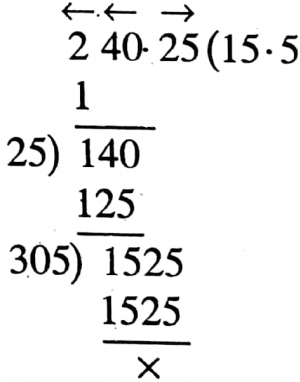
1. The value of \(\sqrt{240 \cdot 25}+\sqrt{2 \cdot 4025}+\sqrt{0 \cdot 024025}\) is_____

Solution: \(\sqrt{240 \cdot 25}+\sqrt{2 \cdot 4025}+\sqrt{0 \cdot 024025}\)

= 15.5+1.55+0.155 = 17.205

WBBSE Solutions For Class 7 Maths Arithmetic Chapter 5 Square Root Of Fractions Q3

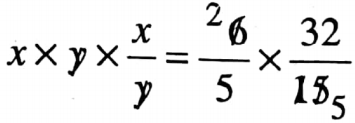
Question 4. The product of two positive numbers is \(\frac{6}{5}\) and their quotient is \(\frac{32}{15}\) Find the numbers.

Solution: Let the two positive numbers are x and y respectively.

According to the question, x x y= \(\frac{6}{5}\) and \(\frac{x}{y}=\frac{32}{15}\)

WBBSE Solutions For Class 7 Maths Arithmetic Chapter 5 Square Root Of Fractions Q4

⇒ \(x^2=\frac{64}{25}\)

= \(x=\sqrt{\frac{64}{25}}=\frac{8}{5}\)

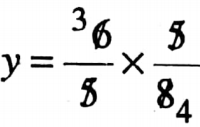
x x y = \(\frac{6}{5}\)

\(\frac{8}{5}\) x y = \(\frac{6}{5}\)


WBBSE Solutions For Class 7 Maths Arithmetic Chapter 5 Square Root Of Fractions Q4

= \(\frac{3}{4}\)

∴ The two number are \(\frac{8}{5}\) and \(\frac{3}{4}\)


Question 5. Arrange the following in the descending order of their magnitude.

\(\sqrt{\frac{4}{25}}, \sqrt{\frac{9}{16}}, \sqrt{\frac{16}{49}}, \sqrt{\frac{1}{36}}\)


Solution: \(\sqrt{\frac{4}{25}}=\frac{2}{5}=\frac{2 \times 84}{5 \times 84}=\frac{168}{420}\)


\(\sqrt{\frac{9}{16}}=\frac{3}{4}=\frac{3 \times 105}{4 \times 105}=\frac{315}{420}\)


\(\sqrt{\frac{16}{49}}=\frac{4}{7}=\frac{4 \times 60}{7 \times 60}=\frac{240}{420}\)


\(\sqrt{\frac{1}{36}}=\frac{1}{6}=\frac{1 \times 70}{6 \times 70}=\frac{70}{420}\)


∴ \(\frac{315}{420}>\frac{240}{420}>\frac{168}{420}>\frac{70}{420}\)

⇒ \(\sqrt{\frac{9}{16}}>\sqrt{\frac{16}{49}}>\sqrt{\frac{4}{25}}>\sqrt{\frac{1}{36}}\)

“WBBSE Class 7 Maths Arithmetic Chapter 5 Exercise 5 practice problems”

Question 6. Find which decimal number is to be added to 0.75; So that the square root of the sum will be 2.

Solution: The required number is 22 -0.75 = 4 – 0.75 = 3.25

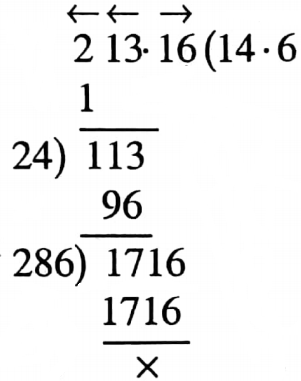
Question 7. The area of a square is 213-16 sq. cm. Find its perimeter.

Solution:

Given

The area of a square is 213-16 sq. cm

WBBSE Solutions For Class 7 Maths Arithmetic Chapter 5 Square Root Of Fractions Q6

∴ The length of each side = √213.16 cm = 14.6 cm

∴ The perimeter is (14.6 x 4) cm = 58.4 cm

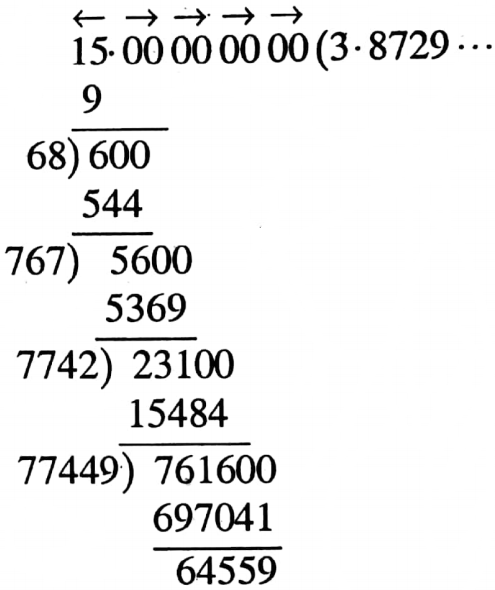
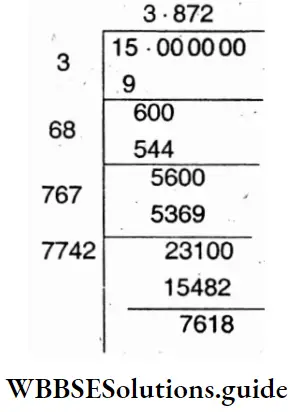
Question 8. Find the approximate value √15 up to 3 decimal places.

Solution:

Given √15

WBBSE Solutions For Class 7 Maths Arithmetic Chapter 5 Square Root Of Fractions Q8


∴ √15 = 3. 873

“How to find square root of fractions Class 7 WBBSE Maths Chapter 5”

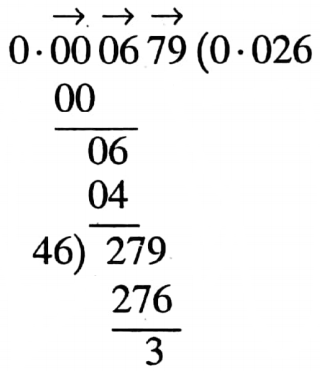
Question 9. Find the least decimal number that must be subtracted from 0.000679 to make it a square decimal number.

Solution:

Given 0.000679

WBBSE Solutions For Class 7 Maths Arithmetic Chapter 5 Square Root Of Fractions Q9

As (0·026)2 = 0.000676

∴ The last decimal number (0.0006790-0.00676) or 0.000003 be subtracted from 0-000679 to make it a square decimal number.

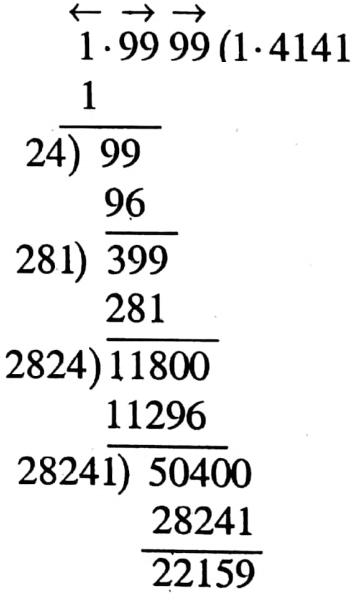
Question 10. Find the values of \(\sqrt{2-(0 \cdot 01)^2}\) upto 3 decimal places.

Solution:

Given \(\sqrt{2-(0 \cdot 01)^2}\)

\(\sqrt{2-(0 \cdot 01)^2}\)= \(\sqrt{2-(0 \cdot 0001)}\)

= \(\sqrt{1.9999}\)


WBBSE Solutions For Class 7 Maths Arithmetic Chapter 5 Square Root Of Fractions Q10


≈1.414

“WBBSE Class 7 Maths Chapter 5 Square Root of Fractions textbook solutions”

Question 11. A room is one and a half as long as its breadth and the area of its floor is \(98 \frac{37}{54}\) sq. m. Find its perimeter.

Solution:

Given

⇒ A room is one and a half as long as its breadth and the area of its floor is \(98 \frac{37}{54}\) sq. m.

⇒ Let the breadth of the room is x m.

⇒ Length is \(\left(1 \frac{1}{2} \times x\right)\) m or, \(\frac{3 x}{2}\) m

⇒ Area = \(\left(\frac{3 x}{2} \times x\right)\) sq.m.= \(\frac{3 x^2}{2}\) sq.m.

⇒ According to question \(\left(\frac{3 x}{2} \times x\right)\) = \(98 \frac{37}{54}\)

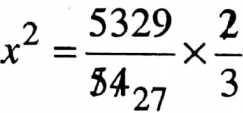
WBBSE Solutions For Class 7 Maths Arithmetic Chapter 5 Square Root Of Fractions Q11

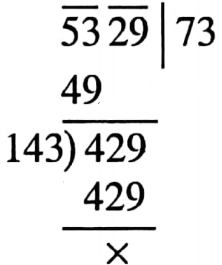
WBBSE Solutions For Class 7 Maths Arithmetic Chapter 5 Square Root Of Fractions Q11

⇒ \(x=\sqrt{\frac{5329}{81}}\)

⇒ \(x=\frac{73}{9}\)

Breadth of room is \(\frac{73}{9}\) m and length is

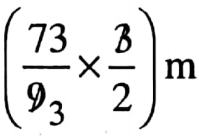
WBBSE Solutions For Class 7 Maths Arithmetic Chapter 5 Square Root Of Fractions Q11. png

= \(\frac{73}{6}\)

Perimeter = 2\(\left(\frac{73}{9}+\frac{73}{6}\right)\) m

=2 x \(\left(\frac{146+219}{18}\right)\) m

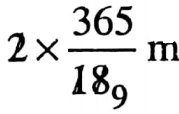
WBBSE Solutions For Class 7 Maths Arithmetic Chapter 5 Square Root Of Fractions Q11

= \(\frac{365}{9} \mathrm{~m}=40 \frac{5}{9} \mathrm{~m}\)


Class VII Math Solution WBBSE Square Root Of Fractions

Square Root Of Fractions Exercise 5.1

Question 1. Let’s find the square of the following fractions.

1. \(\frac{4}{5}\)
Solution:

Square of (\(\frac{4}{5}\))²

= \(\frac{4}{5}\)

= \(\frac{16}{25}\)

The square of \(\frac{4}{5}\) = \(\frac{16}{25}\)

2. \(\frac{6}{7}\)
Solution :

Square of \(\frac{6}{7}\)

= (\(\frac{6}{7}\))²

= \(\frac{36}{49}\)

The square of \(\frac{6}{7}\) = \(\frac{36}{49}\)

3. \(\frac{8}{10}\)
Solution:

Square of \(\frac{8}{10}\)

= (\(\frac{4}{5}\))²

= \(\frac{16}{25}\)

The square of \(\frac{8}{10}\) = \(\frac{16}{25}\)

4. \(\frac{11}{12}\)
Solution:

Square of \(\frac{11}{12}\)

= (\(\frac{11}{12}\))²

= \(\frac{11 \times 11}{12 \times 12}\)

= \(\frac{121}{144}\)

The square of  \(\frac{16}{25}\) = \(\frac{121}{144}\)

Question 2. Let’s find the square root of the following

1. \(\frac{16}{25}\)
Solution:

⇒ \(\sqrt{\frac{16}{25}}=\sqrt{\frac{4 \times 4}{5 \times 5}}\)

= \(\sqrt{\frac{4^2}{5^2}}\)

= \(\frac{4}{5}\)

The square root of \(\frac{16}{25}\) = \(\frac{4}{5}\)

2.\(\frac{9}{64}\)
Solution:

⇒ \(\sqrt{\frac{9}{64}}=\sqrt{\frac{3 \times 3}{8 \times 8}}\)

= \(\sqrt{\frac{3^2}{8^2}}\)

= \(\frac{3}{8}\)

The square root of \(\frac{9}{64}\) = \(\frac{3}{8}\)

3. \(\frac{36}{121}\)
Solution:

⇒ \(\sqrt{\frac{36}{121}}=\sqrt{\frac{6 \times 6}{11 \times 11}}\)

= \(\sqrt{\frac{6^2}{11^2}}\)

= \(\frac{6}{11}\)

The square root of \(\frac{36}{121}\) =  \(\frac{36}{121}\)

4. \(\frac{144}{169}\)
Solution:

⇒ \(\sqrt{\frac{144}{169}}=\sqrt{\frac{12 \times 12}{13 \times 13}}\)

= \(\sqrt{\frac{12^2}{13^2}}\)

= \(\frac{12}{13}\)

The square root of \(\frac{144}{169}\) = \(\frac{12}{13}\)

5. \(\frac{225}{289}\)
Solution:

⇒ \(\sqrt{\frac{225}{289}}=\sqrt{\frac{15 \times 15}{17 \times 17}}\)

= \(\sqrt{\frac{15^2}{17^2}}\)

= \(\frac{15}{17}\)

The square root of \(\frac{225}{289}\) = \(\frac{15}{17}\)

Class VII Math Solution WBBSE Square Root Of Fractions Exercise 5.2

Question 1. Let’s find the least positive integer which will multiply the given fractions to make them perfect square fractions.

1. \(\frac{64}{147}\)
Solution:

Given

\(\frac{64}{147}\)

⇒ \(\frac{64}{147}=\frac{8^2}{7^2 \times 3}\)

∴ \(\frac{64}{147}\) Is not perfect square fraction

To make if a perfect square, we have to multiply 3 with

∴  \(\frac{64}{147}\) × 3

=  \(\frac{64}{49}\)

= \(\frac{8^2}{7^2}\)

∴ \(\frac{64}{49}\) will be a perfect square fraction.

∴ The required number is 3

2. \(\frac{25}{162}\)
Solution:

Given

⇒ \(\frac{25}{162}\)

= \(\frac{5 \times 5}{9 \times 9 \times 2}\)

∴ \(\frac{5^2}{9^2 \times 2}\) is not perfect square fraction.

To make \(\frac{25}{162}\) a perfect square fraction we have to multiply by 2. i.e

= \(\frac{25}{162}\) × 2 = \(\frac{25}{81}\)

= \(\frac{5^2}{9^2}\),  It Will be a Perfect square fraction.

∴ The required number is 2

3. \(\frac{100}{128}\)
Solution:

Given

\(\frac{100}{128}\)

⇒ \(\frac{100}{128}\) = \(\frac{25}{32}\)

= \(\frac{5^2}{4^2 \times 2}\) which is not perfect square fraction

To make \(\frac{25}{32}\) a perfect square fraction we have to multiply it by 2

i.e \(\frac{25}{32}\) × 2

= \(\frac{25}{16}\)

= \(\frac{5^2}{4^2}\)

∴ The required number is 2

4. \(\frac{81}{288}\)
Solution:

Given

\(\frac{81}{288}\)

⇒ \(\frac{81}{288}\) = \(\frac{9}{32}\)

= \(\frac{3^2}{4^2 \times 2}\) which is not a perfect of square fraction

To make it a perfect square fraction, we have to multiply it by 2

i.e \(\frac{9}{32}\) × 2

⇒ \(\frac{9}{16}\)

= \(\frac{3^2}{4^2}\)

∴ The required number is 2

Question 2. Let’s find the least positive integer which will divide the given fraction to make the perfect square fraction.

1. \(\frac{450}{625}\)
Solution :

Given

\(\frac{450}{625}\)

⇒ \(\frac{450}{625}\)

= \(\frac{18}{5}\)

= \(\frac{3^2 \times 2}{5^2}\) Which is not a perfect square fraction.

To make it a perfect square fraction, we have to divide it by 2.

⇒ \(\frac{450}{625}\) × \(\frac{1}{2}\)

= \(\frac{225}{625}\)

= \(\frac{9}{25}\)

= \(\frac{3^2}{5^2}\), which is a perfect square fracation.

The required number is 2.

2. \(\frac{320}{121}\)
Solution:

Given

\(\frac{320}{121}\)

⇒ \(\frac{320}{121}\) x \(\frac{8^2 \times 5}{5^2}\)

To make it a perfect square fraction, we have to divide it by 5.

⇒ \(\frac{320}{625}\) × \(\frac{1}{5}\)

⇒ \(\frac{64}{121}\)

= \(\frac{8^2}{11^2}\), Which is perfect square fraction.

∴ The required number is 5.

3. \(\frac{245}{64}\)
Solution:

Given

\(\frac{245}{64}\)

⇒ \(\frac{245}{64}\) = \(\frac{49 \times 5}{64}\)

= \(\frac{7^2 \times 5}{8^2}\), Which is not a perfect square fraction

To make it a perfect square fraction we have to divide it with 5

⇒ \(\frac{245}{64} \times \frac{1}{5}\)

=  \(\frac{49}{64}\)

= \(\frac{7^2}{8^2}\) , which is the Perfect square fraction.

∴ The required number is 5.

4. \(\frac{243}{14}\)
Solution:

Given

\(\frac{243}{14}\)

⇒ \(\frac{243}{144}\)= \(\frac{27}{16}\)

=  \(\frac{3^2 \times 3}{4^2}\) , Which is not a Perfect square fraction.

⇒ To make it a perfect square fraction we have to divide it by 3

∴ \(\frac{3^2 \times 3}{4^2} \times \frac{1}{3}\)

= \(\frac{3^2}{4^2}\), Which is a perfect square fraction..

∴ The required number is 3.

Class VII Math Solution WBBSE Square Root Of Fractions Exercise 5.3

Question 1. The area of a square is \(\frac{1089}{625}\) sq.cm. Let’s find the length of its side.
Solution :

Given

⇒ The area of a square = \(\frac{1089}{625}\) sq.cm.

⇒ Length of its side = \(\sqrt{\frac{1089}{625}}\)

= \(\sqrt{\frac{3 \times 3 \times 11 \times 11}{25 \times 25}}\) cm

= \(\frac{3 \times 11}{25}\) cm.

= \(\frac{33}{25}\) cm.

Length of its side = \(\frac{33}{25}\) cm.

“West Bengal Board Class 7 Maths Chapter 5 solved numerical problems”

Question 2. Let us find the square root of the following fractions

1.  3\(\frac{22}{49}\)
Solution: 

Given

3\(\frac{22}{49}\)

⇒ 3 \(\frac{22}{49}\) = \(\frac{169}{49}\)

= \(\frac{13 \times 13}{7 \times 7}\)

= \(\frac{13^2}{7^2}\)

⇒ \(\sqrt{3 \frac{22}{49}}=\sqrt{\frac{13^2}{7^2}}\)

= \(\frac{13}{7}\)

= \(1 \frac{6}{7}\)

The square root of 3\(\frac{22}{49}\) = \(1 \frac{6}{7}\)

2. \(\frac{375}{1215}\)
Solution:

Given

⇒   \(\frac{375}{1215}\)

= \(\frac{25}{81}\)

= \(\frac{5^2}{9^2}\)

⇒ \(\sqrt{\frac{375}{1215}}=\sqrt{\frac{5^2}{9^2}}\)

= \(\frac{5}{9}\)

The square root of  \(\frac{375}{1215}\) = \(\frac{5}{9}\)

3. 6 \(\frac{433}{676}\)
Solution:

Given

6 \(\frac{433}{676}\)

⇒ \(\frac{433}{676}\)

=  \(\sqrt{\frac{4489}{676}}=\sqrt{\frac{67^2}{26^2}}\)

= \(\frac{67}{26}\)

= \(2 \frac{15}{26}\)

The square root of  6 \(\frac{433}{676}\) = \(2 \frac{15}{26}\)

4. 1\(\frac{496}{729}\)
Solution:

Given

1\(\frac{496}{729}\)

⇒ \(1 \frac{496}{729}=\frac{1225}{729}\)

= \(\frac{5 \times 5 \times 7 \times 7}{3 \times 3 \times 3 \times 3 \times 3 \times 3}\)

= \(\frac{5^2 \times 7^2}{3^2 \times 3^2 \times 3^2}\)

= \(\sqrt{1 \frac{496}{729}}=\sqrt{\frac{5^2 \times 7^2}{3^2 \times 3^2 \times 3^2}}\)

= \(\frac{5 \times 7}{3 \times 3 \times 3}\)

= \(\frac{35}{27}\)

The square root of  1\(\frac{496}{729}\) = \(\frac{35}{27}\)

5. \(\frac{324}{576}\)
Solution:

Given

⇒  \(\frac{324}{576}\)

= \(\frac{9}{16}\)

= \(\frac{3^2}{4^2}\)

The required square = \(\sqrt{\frac{3^2}{4^2}}\)= \(\frac{3}{4}\)

Question 3. With what should the square root of \(\frac{121}{169}\)be multiplied to give 1, let’s find.
Solution :

Given

\(\frac{121}{169}\)

⇒ \(\sqrt{\frac{121}{169}}=\sqrt{\frac{11^2}{13^2}}\)

= \(\frac{11}{13}\)

= \(\frac{11}{13}\) × 1

∴ The required number = 1 × \(\frac{13}{11}\)

= \(\frac{13}{11}\)

The square root of \(\frac{121}{169}\) = \(\frac{13}{11}\)

Question 4. Two positive numbers are such that one is twice the other. The product of these two numbers is 1 \(\frac{17}{32}\), let’s find the numbers

Given

Two positive numbers are such that one is twice the other. The product of these two numbers is 1 \(\frac{17}{32}\),

The product of two number = 1\(\frac{17}{32}\)

As one is twice the other

∴ Square of 1st number \(\frac{49}{32}\) × \(\frac{1}{2}\)

= \(\frac{49}{64}\)

= \(\frac{7^2}{8^2}\)

∴ 1st number = \(\sqrt{\frac{7^2}{8^2}}=\frac{7}{8}\)

∴  2nd number = 2 × \(\frac{7}{8}\) = \(\frac{7}{8}\)

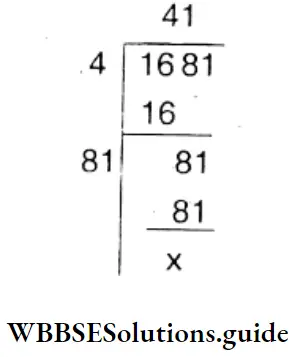
Question 5. Let’s find a fraction, which when multiplied by itself gives \(6 \frac{145}{256}=\frac{1681}{256}\)
Solution :

⇒ \(6 \frac{145}{256}=\frac{1681}{256}\)

= \(\frac{41^2}{16^2}\)

The required no. = \(\sqrt{\frac{1681}{256}}\)

= \(\sqrt{\frac{41^2}{16^2}}=\frac{41}{16}\)

WBBSE Solutions For Class 7 Maths Chapter 11 Square Root Of Fractions Square Root Of 1681

Question 6. By which fraction should \(\frac{49}{91}\) be multiplied, so that the square root of the product is 1 Let’s find.
Solution :

⇒ \(\frac{49}{91}\)×  _________ = 1²

∴ The required number = 1 × \(\frac{91}{49}\)

= 1\(\frac{42}{49}\)

= 1 \(\frac{6}{7}\)

Question 7. Let’s find, by which fraction should \(\frac{35}{42}\) be multiplied so that the square root of the product is 2.
Solution :

⇒ \(\frac{35}{42}\)×  _________ = 2²

∴ The required number = \(\frac{4 \times 42}{35}\)

= \(\frac{24}{5}\)

= 4 \(\frac{4}{5}\)

WBBSE Class 7 Math Solution Question 8. Let’s find the least positive integer which when multiplied — makes it a perfect square.
Solution :

⇒ \(\frac{9}{50}=\frac{3^2}{5^2 \times 2}\) is not a Perfect Square

If we multiply 2 with it, it will be \(\frac{3^2}{5^2 \times 2} \times 2=\frac{3^2}{5^2}\)= a perfect

∴ The required number = 2.

Question 9. The product of two positive numbers is \(\frac{14}{15}\) and their quotient is \(\frac{14}{15}\), let’s find the numbers.
Solution :

Given

The product of two positive numbers is \(\frac{14}{15}\) and their quotient is \(\frac{14}{15}\)

Let one number = x & the other number = y

∴ x × y = \(\frac{14}{15} \& \frac{x}{y}=\frac{35}{24}\)

∴  (x+y) × = \(\frac{x}{y}=\frac{14}{15} \times \frac{35}{24}\)

= \(\frac{49}{36}=\frac{7^2}{6^2}\)

x = \(\left(\frac{7}{6}\right)^2\)

And y = \(\frac{14}{15} \times \frac{6}{7}\)

= \(\frac{4}{5}\)

One number = \(\frac{7}{6}\) & the other number = \(\frac{4}{5}\)

Question 10. The product of two positive numbers is \(\frac{16}{50}\) and their quotient is \(\frac{1}{2}\) let’s find the numbers.
Solution :

Given

The product of two positive numbers is \(\frac{16}{50}\) and their quotient is \(\frac{1}{2}\)

Let one number be x & the other number is y.

∴ x ×  y = \(\frac{16}{50}\) × \(\frac{x}{y}\)

= \(\frac{1}{2}\)

∴ (x ×  y) ×  (\(\frac{x}{y}\)) = \(\frac{16}{50} \times \frac{1}{2}\)

= \(\frac{4}{25}\)

= \(\frac{2^2}{5^2}\)

(x)² = \(\left(\frac{2}{5}\right)^2\)

∴ x = \(\frac{2}{5}\)

∴ y = \(\frac{16}{50}\) × \(\frac{5}{2}\)

= \(\frac{4}{5}\)

= One number = \(\frac{2}{5}\) and other number \(\frac{4}{5}\)

Question 11. \(\sqrt{\sqrt{\frac{9}{64}}+\sqrt{\frac{25}{64}}}\) let’s find its value
Solution:

Given

\(\sqrt{\sqrt{\frac{9}{64}}+\sqrt{\frac{25}{64}}}\)

⇒ \(\sqrt{\sqrt{\frac{9}{64}}+\sqrt{\frac{25}{64}}}=\sqrt{\sqrt{\frac{3^2}{8^2}}+\sqrt{\frac{5^2}{8^2}}}\)

= \(\sqrt{\frac{3}{8}+\frac{5}{8}}\)

= \(\sqrt{\frac{3+5}{8}}\)

= \(\sqrt{\frac{8}{8}}\)

=\(\sqrt{1}\)

= 1

\(\sqrt{\sqrt{\frac{9}{64}}+\sqrt{\frac{25}{64}}}\) = 1

Question 12. \(\sqrt{\frac{1}{4}}+\sqrt{\frac{1}{9}}-\sqrt{\frac{1}{16}}-\sqrt{\frac{1}{25}}\) let s find the value
Solution:

⇒ \(\sqrt{\frac{1}{4}}+\sqrt{\frac{1}{9}}-\sqrt{\frac{1}{16}}-\sqrt{\frac{1}{25}}c\)

= \(\sqrt{\frac{1^2}{2^2}}+\sqrt{\frac{1^2}{3^2}}-\sqrt{\frac{1^2}{4^2}}-\sqrt{\frac{1^2}{5^2}}\)

= \(\frac{1}{2}+\frac{1}{3}-\frac{1}{4}-\frac{1}{5}\)

= \(\frac{30+20-15-12}{60}\)

= \(\frac{50-27}{60}\)

= \(\frac{23}{60}\)

\(\sqrt{\frac{1}{4}}+\sqrt{\frac{1}{9}}-\sqrt{\frac{1}{16}}-\sqrt{\frac{1}{25}}\) = \(\frac{23}{60}\)

WBBSE Class 7 Math Solution Question 13. Arrange the following in the descending order of their magnitude
\(\)
Solution:

⇒ \(\sqrt{\frac{1}{16}}, \sqrt{\frac{1}{25}}, \sqrt{\frac{1}{36}}, \sqrt{\frac{1}{49}}\)

⇒  \(\sqrt{\frac{1}{16}}=\sqrt{\frac{1^2}{4^2}}=\frac{1}{4}\)

⇒  \(\sqrt{\frac{1}{25}}=\sqrt{\frac{1^2}{5^2}} \quad=\frac{1}{5}\)

⇒  \(\sqrt{\frac{1}{36}}=\sqrt{\frac{1^2}{6^2}} \quad=\frac{1}{6}\)

⇒  \(\sqrt{\frac{1}{49}}=\sqrt{\frac{1^2}{7^2}}, \quad=\frac{1}{7}\)

⇒  \(\frac{1}{4}>\frac{1}{5}>\frac{1}{6}>\frac{1}{7}\)

∴   \(\frac{1}{16}>\frac{1}{25}>\frac{1}{36}>\frac{1}{49}\)

“WBBSE Class 7 Maths Exercise 5 Square Root of Fractions short and long questions”

Question 14. Let’s find, by what magnitude is \((\sqrt{25}+\sqrt{81})\) more than \((\sqrt{16}+\sqrt{36})\)
Solution:

⇒ \((\sqrt{25}+\sqrt{81})\) – \((\sqrt{16}+\sqrt{36})\)

= (5 + 9) -(4 + 6) = 14 -10

= 4

Question 15. Let’s find the square roots of the following fractions

1. \(3 \frac{22}{49}\)
Solution:

⇒ \(\sqrt{3 \frac{22}{49}}\)

=  \(\sqrt{\frac{169}{49}}=\sqrt{\frac{13^2}{7^2}}\)

=  \(\frac{13}{7}\)

= 1 \(\frac{6}{7}\)

The square root of \(3 \frac{22}{49}\) = 1 \(\frac{6}{7}\)

2. \(7 \frac{57}{256}\)
Solution:

⇒ \(\sqrt{7 \frac{57}{256}}\)

= \(\sqrt{\frac{1849}{256}}=\sqrt{\frac{43^2}{16^2}}\)

= \(\frac{43}{16}\)

= 2 \(\frac{11}{16}\)

The square root of  \(7 \frac{57}{256}\) = 2 \(\frac{11}{16}\)

3. \(\frac{1089}{2025}\)
Solution:

⇒ \(\sqrt{\frac{1089}{2025}}\)

=  \(\sqrt{\frac{33^2}{45^2}}\)

= \(\frac{33}{45}\)

= \(\frac{11}{15}\)

The square root of \(\frac{1089}{2025}\) = \(\frac{11}{15}\)

4. \(3 \frac{814}{1225}\)
Solution:

⇒ \(\sqrt{3 \frac{814}{1225}}\)

= \(\sqrt{\frac{4489}{1225}}=\sqrt{\frac{67^2}{35^2}}\)

= \(\frac{67}{35}\)

= 1 \(\frac{32}{35}\)

The square root of \(3 \frac{814}{1225}\) = 1 \(\frac{32}{35}\)

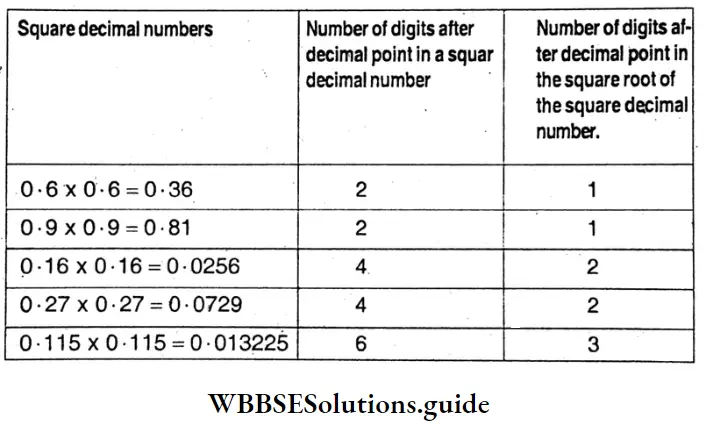
We found that in perfect square decimal numbers, there are even numbers of digits after the decimal point

WBBSE Solutions For Class 7 Maths Chapter 11 Square Root Of Fractions Square Decimal Numbers

WBBSE Class 7 Math Solution Square Root Of Fractions Exercise 5.4

Question 1. Let’s find the value of the square of the following decimal numbers 

1. 0.7
Solution :

0.7 × 0.7 = 0.49

(0.7)² = 0.49

2. 0 .16
Solution :

= 0.16 × 0.16 = 0.0256

(0.16)² = 0 . 0256

3. 0. 08
Solution :

= 0 . 08 × 0 . 08 = 0. 0064

(0. 08) = 0 .0064

4. 0.25
Solution :

0 . 25 × 0 . 25 = 0 . 0625

(0-25)² = 0. 0625

Question 2. By counting the number of digits after the decimal point, let’s identify the square decimal numbers from the following decimal numbers 

1. 22.5
Solution:

= 22.5 – Here one digit after the decimal point, so it is not a square decimal number.

2. 1.44
Solution :

1 .44 – Here after the decimal point there is two digits, so it is a square decimal number.

3. 62.5.
Solution:

62.5 – Here after the decimal point there i§ one digit, so it is not a square decimal number.

4. 12.1
Solution:

12.1 – Here after the decimal point there is one digit, so it is not a square decimal number.

Question 3. Let’s find the square root of the following decimal numbers.

1.  4. 41
Solution:

⇒ \(\sqrt{4 \cdot 41}=\sqrt{\frac{441}{100}}\)

= \(\sqrt{\frac{7 \times 7 \times 3 \times 3}{10 \times 10}}\)

= \(\sqrt{\frac{7^2 \times 3^2}{10^2}}\)

= \(\frac{7 \times 3}{10}\)

= \(\frac{21}{10}\)

= 2.1

4. 41 = 2.1

2. 4. 41
Solution:

⇒  \(\sqrt{2 \cdot 25}=\sqrt{\frac{225}{100}}\)

= \(\sqrt{\frac{5 \times 5 \times 3 \times 3}{10 \times 10}}\)

= \(\sqrt{\frac{5^2 \times 3^2}{10^2}}\)

= \(\frac{5 \times 3}{10}\)

= \(\frac{15}{10}\)

= 0.16

4. 41 = 0.16

3. 0.0484
Solution:

⇒  \(\sqrt{0 \cdot 0.0484}=\sqrt{\frac{484}{10000}}\)

= \(\sqrt{\frac{2 \times 2 \times 11 \times 11}{100 \times 100}}\)

= \(\sqrt{\frac{2^2 \times 11^2}{100^2}}\)

= \(\frac{2 \times 11}{100}\)

= \(\frac{22}{100}\)

= 0.22

0.0484 = 0.22

WBBSE Class 7 Math Solution Square Root Of Fractions Exercise 5.5

Question 1.  Let’s find the square roots of the following decimal numbers by the method of division.

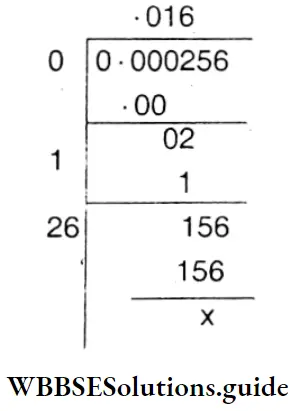
1. 0.000256
Solution :

⇒ \(\sqrt{0.000256}\)

WBBSE Solutions For Class 7 Maths Chapter 11 Square Root Of Fractions Square Root Of 0 . 000256

∴ \(\sqrt{0.000256}\) = 0.016

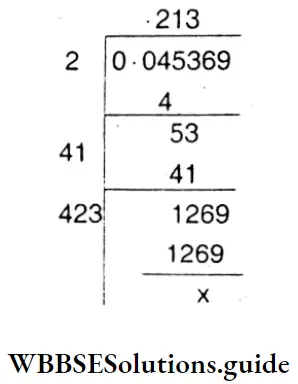
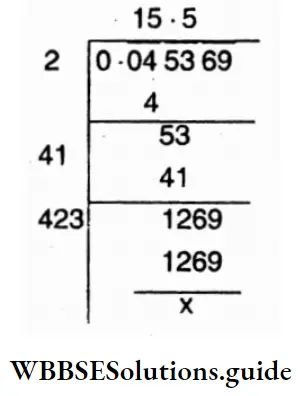
2. 0. 045369
Solution :

⇒  \(\sqrt{0. 045369}\)

WBBSE Solutions For Class 7 Maths Chapter 11 Square Root Of Fractions Square Root Of 0. 045369

∴ \(\sqrt{0. 045369}\)= 0.213

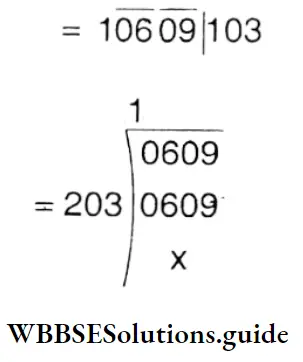
3.1.0609
Solution :

⇒  \(\sqrt{1.0609}\)

WBBSE Solutions For Class 7 Maths Chapter 11 Square Root Of Fractions Square Root Of 0.000169 Division Method

∴ \(\sqrt{1.0609}\) = 1.03

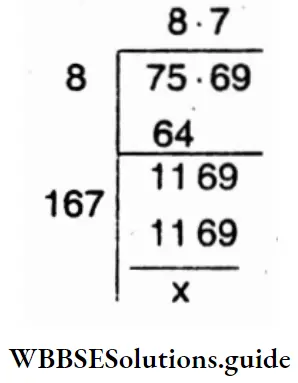
4. 75.609
Solution :

⇒  \(\sqrt{75.609}\)

WBBSE Solutions For Class 7 Maths Chapter 11 Square Root Of Fractions Square Root Of 75.69

∴ \(\sqrt{75.609}\)

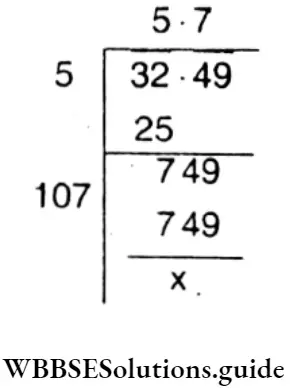
Question 2. The area of a square is 32.49 sq. cm. Let’s find the length of one side of the square.
Solution :

The area of a square = 32.49 sq. cm.

∴ The length of one side of the square = \(\sqrt{32.49}\) cm

WBBSE Solutions For Class 7 Maths Chapter 11 Square Root Of Fractions Square Root Of 32.49

= 5.7m

The length of one side of the square = 5.7m

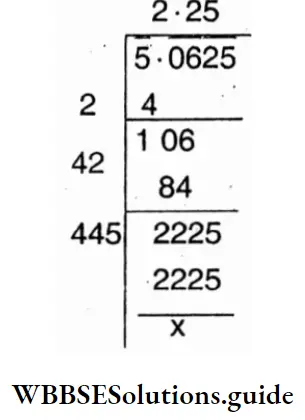
Question 3. Let’s find the length of one side of a square whose area is equal to the sum of the areas of rectangles of areas 2.1214 sq. cm, and 2.9411 sq. cm.
Solution :

The area of the square = (2.1214 + 2.9411) sq. cm.

= 5.0625 sq. cm.

∴ The length of one side of the square =

WBBSE Solutions For Class 7 Maths Chapter 11 Square Root Of Fractions Square Root Of 2.25

= 2.25

The length of one side of the square = 2.25

Question 4. Let’s calculate what must be added to 0.28 so that the square root of the sum is 1.
Solution :

Square of 1 = 1

∴ The required number = 1 – 0.28 = 0.72

Question 5. Let’s find the square root of the product of 0.162 and 0.2
Solution:

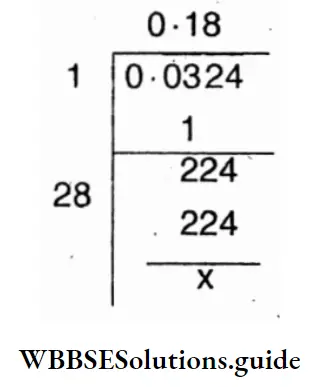
\(\sqrt{0.162 \times 0.2}=\sqrt{0.0324}\)

WBBSE Solutions For Class 7 Maths Chapter 11 Square Root Of Fractions Square Root Of 0.18

= 0.18

The square root of the product of 0.162 and 0.2 = 0.18

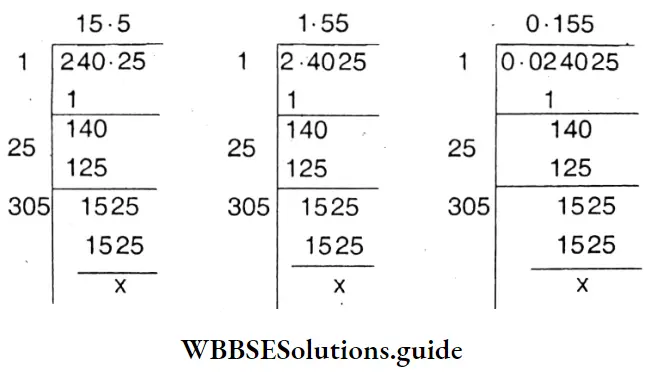
Question 6. Let’s calculate the value of \(\sqrt{240.25}+\sqrt{2.4025}+\sqrt{0.024025}\)
Solution:

⇒ \(\sqrt{240.25}+\sqrt{2.4025}+\sqrt{0.024025}\)

WBBSE Solutions For Class 7 Maths Chapter 11 Square Root Of Fractions Square Root Of 24.25 And 2.4025 And 0.024025

15.5 + 1. 55 + 0.155 =17.205

Question  7. Of the two squares of areas 1.4641 sq.m, and 1.0609 sq.m, Let’s Find which one has a bigger side and by how much it is big.
Solution:

Area of the 1st square = 1 .4641 sq.m.

Area of the 2nd square = 1 .0609 sq.m.

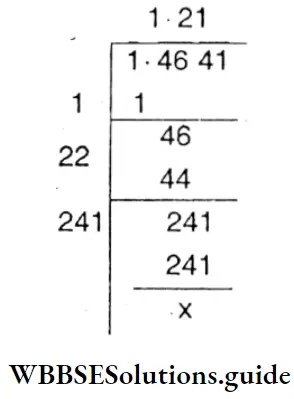
∴ Each, side of the 1st square = \(\sqrt{1.4641}\)

WBBSE Solutions For Class 7 Maths Chapter 11 Square Root Of Fractions Square Areas Of Square 1.4641

= 1.21

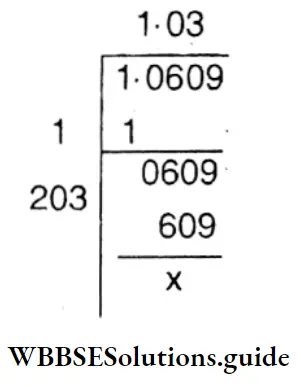
The each side of the 2nd square = \(\sqrt{1.0609}\)

WBBSE Solutions For Class 7 Maths Chapter 11 Square Root Of Fractions Square Areas Of Square 1.03

∴ Side of 1st square is bigger than the 2nd square by (1.21 – 1 . 03 ) m = 0 . 18 m

WB Class 7 Math Solution Question  8. The sum of the squares of 0.4 and 0.3 is the squares of which number, let’s find.
Solution :

(0.4)² + (0.3)² = 0.16 + 0.09 = 0.25

The required number = \(\sqrt{0.25}\)

= \(\sqrt{\frac{25}{100}}\)

= \(\frac{5}{10}\)

= 0.5

The sum of the squares of 0.4 and 0.3 is the squares of  0.5

Question  9. Let’s find the square root of the following by the method of division.

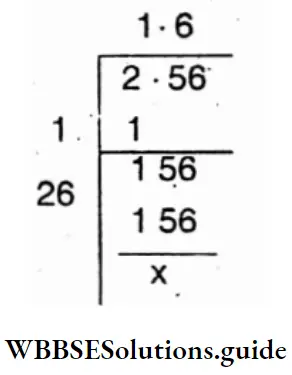
1. 2.56
Solution :

⇒ \(\sqrt{0.25}\)

WBBSE Solutions For Class 7 Maths Chapter 11 Square Root Of Fractions Square Root Of 75.69 Division Method

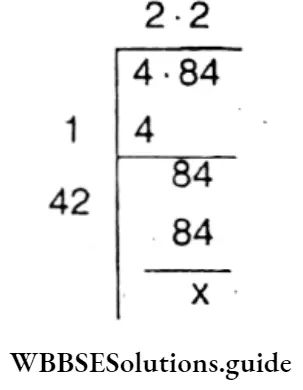
2. 4.84
Solution :

⇒ \(\sqrt{4.84}\)

WBBSE Solutions For Class 7 Maths Chapter 11 Square Root Of Fractions Square Root Of 4.84 Division Method

= 2.2

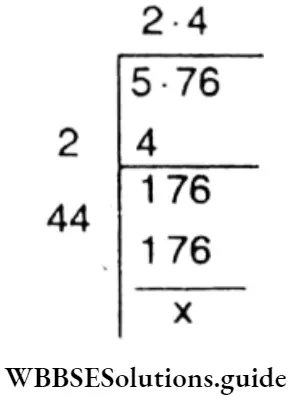
3. 5.76
Solution :

⇒ \(\sqrt{5.76}\)

WBBSE Solutions For Class 7 Maths Chapter 11 Square Root Of Fractions Square Root Of 5.76 Division Method

= 2.4

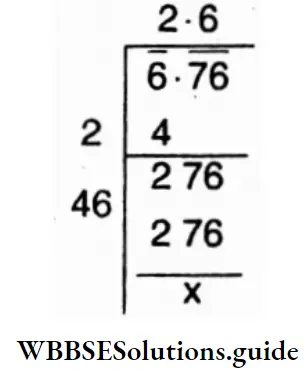
4. 6.76
Solution :

⇒ \(\sqrt{6.76}\)

WBBSE Solutions For Class 7 Maths Chapter 11 Square Root Of Fractions Square Root Of 6. 76 Division Method

= 2.6

5. 0.045369
Solution :

⇒ \(\sqrt{0.045369}\)

WBBSE Solutions For Class 7 Maths Chapter 11 Square Root Of Fractions Square Root Of 1.1025 Division Method

= 0.213

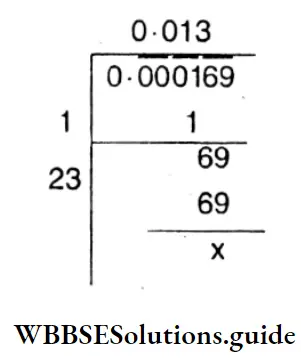
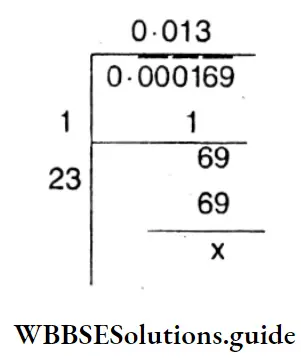
6. 0.000169
Solution :

⇒ \(\sqrt{0.000169}\)

WBBSE Solutions For Class 7 Maths Chapter 11 Square Root Of Fractions Square Root Of 0.000169 Division Method

= 0.013

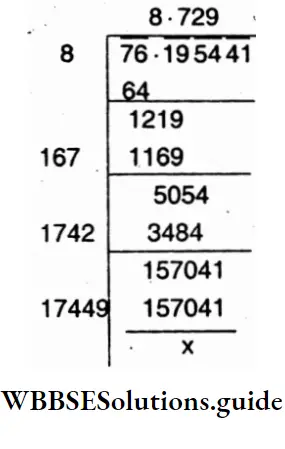
7. 76.195441
Solution :

⇒ \(\sqrt{76.195441}\)

WBBSE Solutions For Class 7 Maths Chapter 11 Square Root Of Fractions Square Root Of 76. 195441 Division Method

= 8.729

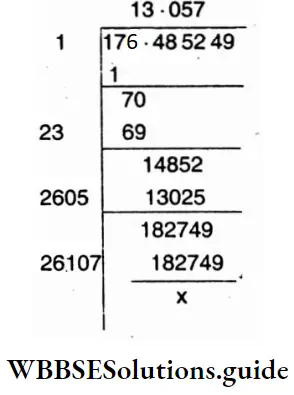
8. 170.485249
Solution :

⇒ \(\sqrt{76.195441}\)

WBBSE Solutions For Class 7 Maths Chapter 11 Square Root Of Fractions Square Root Of 170. 485249 Division Method

= 13.0.57

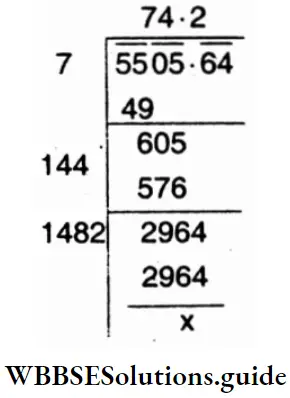
9. 5505.64
Solution :

⇒ \(\sqrt{5505.64}\)

WBBSE Solutions For Class 7 Maths Chapter 11 Square Root Of Fractions Square Root Of 5505. 64 Division Method

= 74.2

“WBBSE Maths Class 7 Square Root of Fractions full chapter solutions”

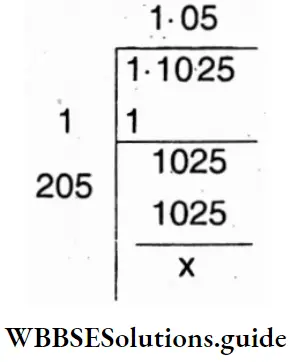
Question 10. Let’s find the decimal number which when multiplied by itself gives the product as 1.1025.
Solution :

The required number \(\sqrt{1.1025}\)

WBBSE Solutions For Class 7 Maths Chapter 11 Square Root Of Fractions Square Root Of 1.1025 Division Method

= 1.05

Question 11. Let’s find, which decimal number is to be added to 0.75 so that square root of the sum will be 2.
Solution :

Square of 2 = 2² = 4

∴ The required number = 4 – 0.75 = 3.25

11. Let’s find, which decimal number is to be subracted from 48.09 so that the square root of the result is 5.7.
Solution :

Square of 5.7 = (5.7)² = 32.49

The required number = 48.09 – 32.49

=15.6

15.6 is to be subracted from 48.09 so that the square root of the result is 5.7

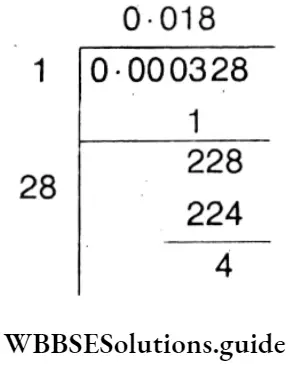
Question 12. Let’s find the least decimal number that must be subtracted from 0.000328 to make it a square decimal number (up to 6 decimal place
Solution :

⇒ \(\sqrt{0.000328}\)

WBBSE Solutions For Class 7 Maths Chapter 11 Square Root Of Fractions Square Root Of 0.000328 Decimal Number

If we subtract 0.000004 from 0.000328

It will be = 0.000324 = (0.01 8)²

The required number = 0.000004

Question 13. Let’s find the approximate value of the following 

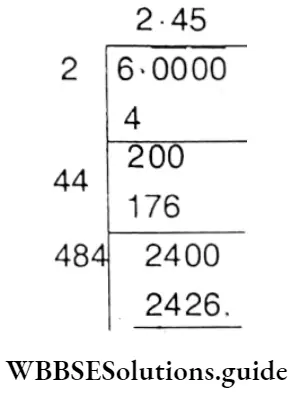
1. \(\sqrt{6}\) (upto 2 decimal places)
Solution:

⇒ \(\sqrt{6}\)

WBBSE Solutions For Class 7 Maths Chapter 11 Square Root Of Fractions Square Root Of 6 Up To 2 Decimal Place

= 2.45

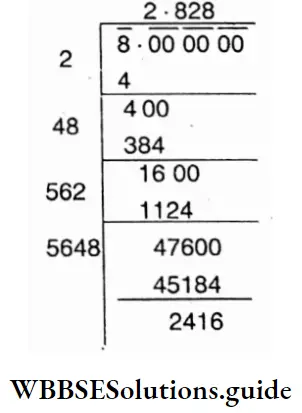
2. \(\sqrt{8}\) (upto 2 decimal places)
Solution:

⇒ \(\sqrt{8}\)

WBBSE Solutions For Class 7 Maths Chapter 11 Square Root Of Fractions Square Root Of 8 Up To 2 Decimal Place

= 2.828

= 2.83 (upto 2 decimal places)

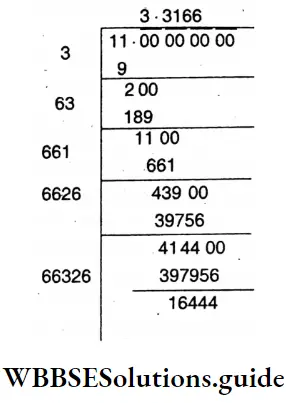
3. \(\sqrt{11}\) (upto 3 decimal places)
Solution:

⇒  \(\sqrt{11}\)

WBBSE Solutions For Class 7 Maths Chapter 11 Square Root Of Fractions Square Root Of 11 Up To 3 Decimal Place

= 3.3166

= 3.317 (up to 3 decimal places)

“WBBSE Class 7 Maths Chapter 5 square root of decimal fractions problems”

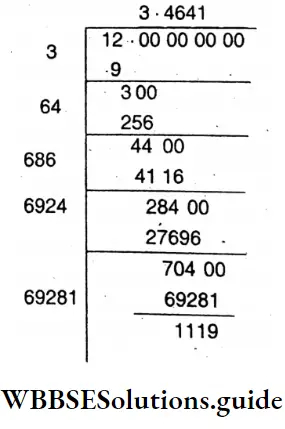
4. \(\sqrt{12}\) (upto 3 decimal places)
Solution:

⇒ \(\sqrt{11}\)

WBBSE Solutions For Class 7 Maths Chapter 11 Square Root Of Fractions Square Root Of 12 Up To 3 Decimal Place

= 3.4641

= 3.464 (up to 3 decimal places)

Question 14. Let’s find the approximate value of 7T5 upto 2 – places of decimal. Let’s then square this approximate value to find how big or less it is from 15.
Solution :

= 3.872

= 3.87 (up to 2 decimal places)

Now (3.87)² = 14.9761

Difference

= 15.9761

WBBSE Solutions For Class 7 Maths Chapter 11 Square Root Of Fractions Square Root Of 15 Up To 2 Decimal Place

= 0.0231

WBBSE Solutions For Class 7 Maths Arithmetic Chapter 4 Approximation Of Values Exercise 4 Solved Problems

WBBSE Class 7 Math Solution Arithmetic Chapter 4 Approximation Of Values Exercise 4 Solved Problems

Approximate value: In our daily transactions it is not always possible to find the exact value of a quantity or to ascertain accurate values, lengths, weights, etc. of a thing.

⇒ So in calculations involving values, length, weights, etc, we have to take the approximate values just a little above or a little below the accurate values. This is called the approximate value of a quantity or the nearest value or measurement of a thing.

⇒ To find the approximate value up to certain places of the digit, if that digit is any number between 5 to 9, then 1 is added to the digit at that certain place, or else the same digit is kept.

⇒ The sign for approximate value is “≈” (almost equal)

Read and Learn More WBBSE Solutions for Class 7 Maths

Question 1. Determine the approximate value of 3746 up to tens, hundreds, and thousands of places.
Solution:

Given

3746

Thousands Hundreds Tens Units
3 7 4 6


⇒ The number at the tens place is 4 and on its immediate right side is 6 which is between 5 to 9.

⇒ So up to tens place, the approximate value is (374 + 1) ten = 3750.

⇒ The digit on the hundreds place is 7 and on its immediate right side is 4. So the approximate value upto hundreds place is 3700.

⇒ The digit on the thousands place is 3 and on its right side we have 7, so the approximate value upto thousands place is 4000.

We can write:

3746 ≈ 3750 (up to tens place).
3746 ≈ 3700 (upto hundreds place)
3746 ≈ 4000 (upto thousands of places)

WBBSE Class 7 Arithmetic Approximation Solutions

Question 2. Find the approximate value of 3-853672 up to 1, 2, 3, 4, and 5 decimal places and whole numbers.

Solution:

Given 3-853672

⇒ 3.853672 ≈ 3.8537
[6th place after decimal is 2]

⇒ 3.853672 ≈ 3.853672
[5th place after decimal is 7 hence I is added to 4th decimal place value 6, 6 + 1 = 7]

⇒ 3.853672 ≈ 3.854
[4th place after decimal is 6 hence 1 is added to 3rd decimal place value 3, 3+1 = 4]

⇒ 3.853672 ≈ 3.85
[3rd place after decimal is 3]

⇒ 3.853672 ≈ 3.9
[2nd place after decimal is 5 hence 1 is added to 1 decimal place value 4, 8+ 1 = 9]

⇒ 3.853672 ≈ 4
[1 place after decimal is 8 hence 1 is added to the whole number 3, 3+1 = 4]

“WBBSE Class 7 Maths Arithmetic Chapter 4 solved problems step-by-step”

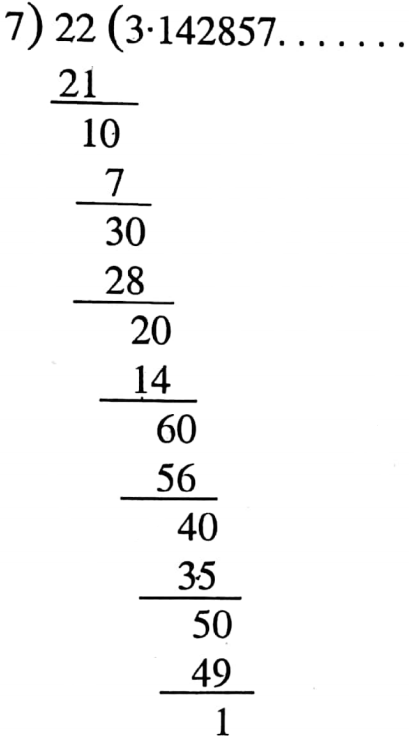
Question 3. Find the approximate value of \(\frac{22}{7}\) upto 2, 3, 4, and 5 decimal places.

Solution:

Given \(\frac{22}{7}\)

WBBSE Solutions For Class 7 Maths Arithmetic Chapter 4 Approximation Of Values Q3


\(\frac{22}{7}\) ≈ 3.142857……

\(\frac{22}{7}\) ≈ 3.14 [two decimal places]

\(\frac{22}{7}\) ≈ 3.143 [3 decimal places]

\(\frac{22}{7}\) ≈ 3.1429 [4 decimal places]

\(\frac{22}{7}\) ≈3-14286 [5 decimal places]

“Approximation of Values Exercise 4 Class 7 WBBSE Maths full solutions”

Question 4. Light travels 186000 miles in 1 second. Again 1 mile = 1.6093 km. Find one distance traveled by light in 1 second in kilometers approximately.

Solution:

Given

Light travels 186000 miles in 1 second. Again 1 mile = 1.6093 km.

1 mile = 1.6093 km

186000 miles = (186000 x 1.6093) km

= 299,329.8 km

≈ 299,330 km [1 place after the decimal is 8. Hence 1 is added to the whole number at the unit place i.e., 9 + 1 = 10]

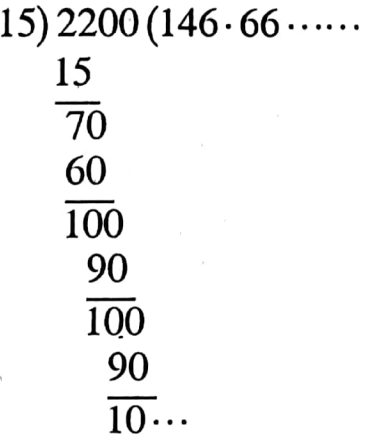
Question 5. Divide 22 among 8 boys and 7 girls equally. Find how much each would get (approximated up to 2 places of the decimal). Also, find the total money received by 8 boys and that received by 7 girls. Then find the total money received by 8 boys and 7 girls and how much this total amount is more or less than ₹ 22.

Solution:

⇒ Total number of boys and girls is (8 + 7) or 15.

⇒ ₹ 22 is divided among 15 boys and girls.

WBBSE Solutions For Class 7 Maths Arithmetic Chapter 4 Approximation Of Values Q5

⇒ Each gets = ₹ \(\frac{22}{15}\)

= \(\frac{2200}{15}\) paise

≈ 146.67 paise

⇒ The total money received by 8 boys is (146-67 x 8) paise
= 1173.36 paise
≈ ₹ 11.73.

⇒ The total money received by 7 girls is (146-67 x 7) paise
= 1026.69 paise
≈ ₹ 10.27

⇒ Total money received by 8 boys and 7 girls is (11.73 + 10.27) = ₹ 22.00 = ₹ 22

⇒ This amount is equal to 22.

“WBBSE Class 7 Maths Chapter 4 Exercise 4 important questions and answers”

Question 6. If \(\frac{2}{7}\) radian = 180°, find the value of 1 radian in degrees upto 2 places of decimals.

Solution:

Given

\(\frac{2}{7}\) radian = 180°

1 radian = \(\left(\frac{7}{22} \times 180\right)^{\circ}\)

= \(\left(\frac{1260}{22}\right)^{\circ}\)

= 57.27°

The value of 1 radian in degree upto 2 places of decimals = 57.27°

Question 7. Simplify the following up to 4 decimal places. \(0 \cdot 004872+13 \cdot \dot{725}+0 \cdot \dot{3} 6\)

Solution: \(0 \cdot 004872+13 \cdot \dot{725}+0 \cdot \dot{3} 6\)

=0.004872+13.725725………..+0.363636……

= 14.094233……

= 14.0942

WBBSE Class 7 Math Solution Approximation Of Values

Approximation Of Values Exercise 4.1

Question 1. Let’s write the approximate values of the following fractions correct up to two, three and four places of decimal.

1. \(\frac{13}{17}\)
Solution:

Given  \(\frac{13}{17}\)

⇒ \(\frac{13}{17}\) = 0.76470588.

≈ 0. 76 (Two decimal places)

≈  0.765 (Three decimal places)

≈  0.7647 (Four decimal places)

2. \(\frac{19}{29}\)
Solutions:

Given \(\frac{19}{29}\)

⇒  \(\frac{19}{29}\) = 0.6551724

≈  0.66 (Two decimal places)

≈  0.655 (Three decimal places)

≈  0. 6552 (Four decimal places)

Approximation Of Values Exercise 4.2

Question 1. Let’s write the approximate values of the following numbers up to 1 0’s, 1000s, and 1 0,000’s places.

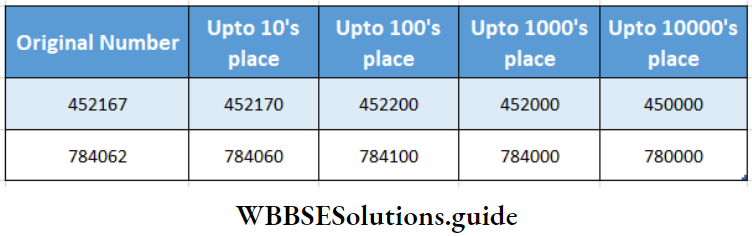
WBBSE Solutions For Class 7 Maths Chapter 10 Approximation Of Values Approximate Values Upto Tens To Ten Thousands Places

Question 2. Let us divide Rs. 3 among 7 children and calculate how much Paise each wou,d get (approximately upto 2 places of decimal). Let’s then find total money received by 7 children and then try to find how more or less it will be than Rs. 3.
Solution:

Total amount- Rs. 3 = 300p

Total children = 7

Each will receive = \(\frac{300}{7}\) p

= 42.857≈ 42.86 p

∴ Total money received by 7 children = 42.86 x 7 p = 300.02 p

∴ 300.02 p – 300p = 02p more.

Question 3. 1 divided Rs. 22 among 8 boys and 7 girls equally. Let’s find how much each would get. (approximated up to 2 places of decimal). Also let’s find the total money received by 8 boys and that received by 7 girls. Then let’s find total money received by 8 boys and 7 girls and how much this total amount is more or less than Rs. 22.
Solution :

Total amount = Rs. 22 = 2200p.

Total number of boys & girls = 8 + 7=15

Each will get = \(\frac{2200}{15}\)

p = 1 46.666p

= 146.67 p (approx)

∴ 8 boys will receive = 146.67 x 8 = 1 173.36 p = Rs. 11.73

7 girls will received = 146.67 x 7 = 1026.69 p = Rs. 10.27p

Total amount = Rs. (11.73 + 10.27) = Rs. 22.

It is equal.

Question 4. Light travels 186000 miles in 1 second. Again 1 mile = 1.6093 km, let’s find the distance travelled by light in 1 second in Kilometres approximately (up to 3 decimal places of approximation).
Solution :

Given

Light travels 186000 miles in 1 second. Again 1 mile = 1.6093 km,

Distance travelled by light in 1 second

= 1 86000 mile = 1 86000 x 1 .6093 km.

= 299329.8 km = 299330 km.

“Class 7 Maths Approximation of Values WBBSE solved examples”

Question 5. Let’s write the approximate value up to 2 decimal places of 0.997.
Solution :

0.997 = 1.(up to 2 decimal) (approx).

Question 6. Let us fill in the gaps
Solution :

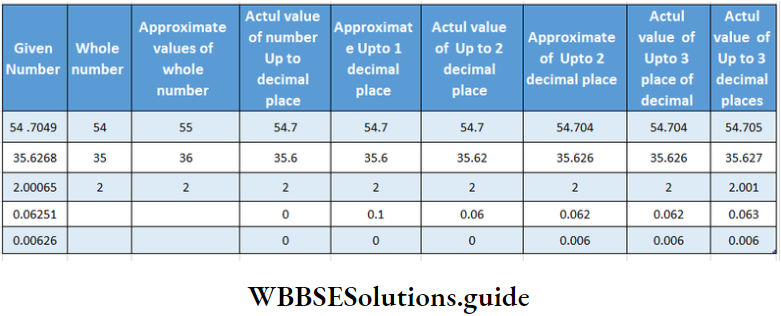
WBBSE Solutions For Class 7 Maths Chapter 10 Approximation Of Values Wholo Number

WBBSE Class 7 Math Solution Question 7. Let us write the approximate values of the following fractions, up to 2, 3 & 4 decimal places 

1. \(\frac{22}{7}\)
Solution :

Given \(\frac{22}{7}\)

⇒ \(\frac{22}{7}\) = 3.14 (upto 2 decimal places)

= 3.143 (up to 3 decimal places)

= 3.1429 (up to 4 decimal places)

\(\frac{22}{7}\) = 3.1429 (up to 4 decimal places)

2. \(\frac{3}{14}\)
Solution :

Given \(\frac{3}{14}\)

⇒ \(\frac{3}{14}\) = 0.21 (up to 2 decimal places)

= 0.214 (up to 3 decimal places)

= 0.2143 (4 decimal places)

\(\frac{3}{14}\) = 0.2143 (4 decimal places)

3. \(\frac{1}{5}\)
Solution :

Given \(\frac{1}{5}\)

⇒ \(\frac{1}{5}\) = 0.20 (upto 2 decimal places)

= 0.200 (up to 3 decimal places)

= 0.2000(upto 4 decimal places)

\(\frac{1}{5}\) = 0.2000(upto 4 decimal places)

 4. \(\frac{47}{57}\)
Solution :

Given

\(\frac{47}{57}\)

⇒  \(\frac{47}{57}\) = 0.82 (up to 2 decimal places)

= 0.825 (up to 3 decimal places)

= 0.8246 (up to 4 decimal places)

\(\frac{47}{57}\) = 0.8246 (up to 4 decimal places)

Question 8. Let’s write the approximate values of the following numbers up to lacs, thousands and hundreds place. 
Solution:

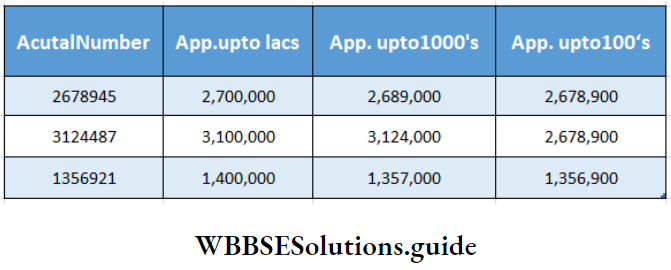
WBBSE Solutions For Class 7 Maths Chapter 10 Approximation Of Values Approximate Values Up To Lacs Thousands And Hundred Places

Question 9. Practical application of approximation.

1. 11 hours 9 min 40 sec – approximately the value up to min.
Solution: 11 hours 10 mins.

2. If the price of the shoe is written as Rs. 99.99, let us find what will be
its approximate value.
Solution: Rs. 100.

“WBBSE Class 7 Maths Arithmetic Chapter 4 Exercise 4 practice problems”

3. The length of a line segment is 1.59 cm, Let us find what is the
approximate value of the length.
Solution: 1. 6cm.

4. The weight Of poppy seed (post) is 102gm. Let’s find
approximately the weight for which money is charged.
Solution: 100

WBBSE Solutions For Class 7 Maths Arithmetic Chapter 3 Proportion Exercise 3 Solved Problems

Class 7 Math Solution WBBSE Arithmetic Chapter 3 Proportion Exercise 3 Solved Problems

1. When the values of two ratios are equal, they are said to be in proportion and one is called proportional to the other.

2. Four quantities a, b, c and d are said to be in proportion or proportional when a: b : : c : d or a:b = c d [The symbol ‘: :’ stand for ‘as’]
a is called the 1st term of the proportions.

Similarly, b, c, and d are called the 2nd term, 3rd term and 4th term respectively.

So, \(\frac{1 \text { st term }}{2 \text { nd term }}=\frac{3 \text { rd term }}{4 \text { th term }}\)

⇒ 1st term x 4th term = 2nd term x 3rd term

i.e., The product of the extreme terms = The product of the two mean terms.

Example: 6 18 15: 45 are in proportional.

Class 7 math chapter 3 WBBSE

Read and Learn More WBBSE Solutions for Class 7 Maths

Here 6 x 45 18 x 15 = 270

Continued Proportion: Three quantities of the same kind are said to be in continued proportion when the ratio of the first to the second is equal to the ratio of the second to the third.

The second quantity is called a mean proportional between the 1st and 3rd.
If three quantities a, b and c are in continued proportion then a b : : b: c

⇒ \(\frac{a}{b}=\frac{b}{c} \Rightarrow b^2=a c\)

where b is called the mean proportional of a and c.

“WBBSE Class 7 Maths Arithmetic Chapter 3 proportion solutions”

Example: 3:6 : : 6: 12

Here 3 x 12 = 6 x 6 = 36

Types of Proportions: There are two types of proportion

1.  Simple proportion or Direct proportion
2. Inverse proportion

1. Simple proportion or Direct proportion: Simple proportion constitutes two ratios formed with simultaneous increase or decrease of two correlated quantities.

If two ratios a:b and c:d indicate the simultaneous increase or decrease, then the simple or direct proportion will be a: b: : c:d

2. Inverse proportion: If two ratios are such that one is equal to the inverse ratio of the other, then the proportion thus formed is an Inverse proportion.
Example: If two ratios a: b and c d then they form an inverse proportion.
i.e. a:b: : d:c [inverse of c:d]

or c: d: : b: a [inverse of a:b]

WBBSE Class 7 Maths Study Material on Proportion

Question 1: Find if the pair of ratios given below are equal and also find if four members are in proportion

1. 6: 4 and 15: 10
2. 4-2: 1-4 and 21: 7
3. 5x: 6x and 3y: 4y [y ≠0, x ≠ 0]

Solution:

1.  6: 4 = 3: 2

15: 10  = 3: 2

∴ 64 and 15: 10 are equal.

Hence 6, 4, 15 and 10 are in proportion.
We can write 6: 4 : : 15: 10

2. 4.2: 1.4 = 3: 1
21: 7 = 3: 1

∴ 4.2: 14 and 21: 7 are equal.

Hence 4.2, 1.4, 21 and 7 are in proportion.
We can write 4.2: 1.4 : :  21: 7

3. 5x: 6x = 5: 6
3y: 4y = 3: 4

∴ 5x: 6x and 3y: 4y are not equal.

Hence 5x, 6x, 3y, 4y are not in proportion.

“WBBSE solutions for Class 7 Maths proportion exercise 3 solved problems”

Question 2. Verify whether the following numbers are in proportion

1. 3, 4, 6, 8
2. 12, 18, 10, 15
3. 18, 8, 15, 6

Solution:

1. 3, 4, 6, 8
Here, product of extreme = 3 x 8 24 and product of means = 4 x 6 = 24

∴ Product of extreme = product of means
Hence the four members are in proportion.

2. 12, 18, 10, 15
Here, product of extreme = 12 x 15 = 180 and product of means = 18 x 10 = 180

∴ Product of extreme = product of means
Hence the four members are in proportion.

3. 18, 8, 15, 6
Here, product of extreme = 18 x 6 = 108 and product of means = 8 × 15 = 120

∴ Product of extreme product of means
So, the four members are not in proportion.

Question 3. Form different proportionality with 6, 8, 12, 16:

Solution:

Given Numbers 6, 8, 12, 16

Numbers Extreme Means Product of extreme = Product of means Proportion Expressed as fraction
6, 8, 12, 16 6.16 8.12 6 x 16 = 8 x 12 6: 8 : : 12: 16 \(\frac{6}{8}=\frac{12}{16}\)
8, 6, 16, 12 8.12 6.16 8 x 12 = 6 x 16 8: 6 : : 16: 12 \(\frac{8}{6}=\frac{16}{12}\)
6, 12, 8, 16 6.16 12.8 6 x 16 = 12 x 8 6: 12 : : 8 : 16 \(\frac{6}{12}=\frac{8}{16}\)
12, 6, 16, 8 12.8  6, 16 12 x 8 = 6 x 16 12: 6 : : 16: 8 \(\frac{12}{6}=\frac{16}{8}\)


Question 4. Find the missing term from the given proportion 

1. *: 45 : 20
2. 6: * : : 10: 15
3. 8: 12 : : *: 24
4. 5: 10 : : 15: *

Solution:

1. *: 4 : : 5: 20

Let 1st term of the given proportion be x

So, x: 4 : : 5: 20

⇒ \(\frac{x}{4}=\frac{5}{20}\)

WBBSE Solutions For Class 7 Maths Arithmetic Chapter 3 Proportion Q4

∴ 1st term is 1.

2. 6: * : : 10: 15

Let 2nd term is x

∴ 6: x : : 10:

⇒ \(\frac{6}{x}=\frac{10}{15}\)

⇒ 10x = 6 x 15

WBBSE Solutions For Class 7 Maths Arithmetic Chapter 3 Proportion Q4

∴ 2nd term is 9.

3. 8: 12 : : *: 24

Let 3rd term is x
8: 12 : :  x: 24

⇒ \(\frac{8}{12}=\frac{x}{24}\)

⇒ 12x = 8 x 24

WBBSE Solutions For Class 7 Maths Arithmetic Chapter 3 Proportion Q4

∴ 3rd term is 16.

4. 5: 10 : : 15: *

Let 4th term is x

⇒ \(\frac{5}{10}=\frac{15}{x}\)

⇒ 5x = 15 x 10

⇒ \(x=\frac{15 \times 10^2}{8}\)

⇒ x = 30

∴ 4th term is 30.

Question 5. Find whether the following sets of numbers are in continued proportion and write the proportionality

1. 6, 8, 12
2. 5, 25, 125
3. 4, 10, 25

Solution:

1. 6, 8, 12

6 × 12 = 72 ≠(8)2

i.e., 1st term × 3rd term ≠ (mean term)2

So, 6, 8, 12 are not in continued proportion.

2. 5, 25, 125

5 × 125 = 625 = (25)2

i.e., 1st term x 3rd term = (mean)2

So, 5, 25 and 125 are in continued proportion.
The proportionality is 5 25 25: 125

3. 4, 10, 25

4 x 25 = 100 = 102

1st term x 3rd term = (2nd term)2

So, 4, 10 and 25 are in continued proportion.
The proportionality is 4: 10 : : 10 : 25

Question 6: Of the three numbers in continued proportion, 1st and 2nd numbers are 16 and 20 respectively. Find the third number of this proportion.

Solution: Let the 3rd term of the continued proportion be x.
So, 16, 20 and x. are in continued proportion.

∴ 16: 20 : : 20: x

⇒ \(\frac{16}{20}=\frac{20}{x}\)

⇒ 16x = 20 x 20 = 400

⇒ \(x=\frac{400}{16}=25\)

∴ 3rd term is 25.

“Class 7 WBBSE Maths Chapter 3 proportion exercise 3 step-by-step solutions”

Question 7. Find the mean proportion of

1. 9 and 16
2. a and b
3. 1.5 and 13.5

Solution:
1. Let the positive mean proportion of 9 and 16 is x

∴ 9: x : : x: 16

⇒ \(\frac{9}{x}=\frac{x}{16}\)

⇒ x2 =144
⇒x= √144 = 12

∴ Mean proportion 9 and 16 is 12

2. Mean proportion of a and b is ±√ab

3. Mean proportion of 1.5 and 13.5 is

\(\sqrt{1 \cdot 5 \times 13 \cdot 5}\)


= \(\sqrt{\frac{15}{10} \times \frac{135}{10}}\)

= \(\sqrt{\frac{15 \times 15 \times 3 \times 3}{10 \times 10}}\)

= \(\frac{15 \times 3}{10}=\frac{45}{10}\)

= 4.5

Question 8. If 6 men can do a piece of work in 20 days. Find in how many days will 12 men finish the same work.

Solution:

Given 6 men can do a piece of work in 20 days.

In the mathematical language, the problem is,

Men (number)
6
12

Time (days)
20
?

For a particular work, if the number of persons increases, less time is required to finish the work.

But if the number of people decreases, the time required will be increased.

∴ So the number of men and time are in inverse proportion.

In proportionality, we take the inverse of the relation.
∴ 12: 6 : : 20: ?

Product of extreme = product of means
∴ 12 x 4th term = 6 x 20

⇒ 4 th term = WBBSE Solutions For Class 7 Maths Arithmetic Chapter 3 Proportion Q8

Hence 12 men will take 10 days to finish the work.

Question 9: Ramesh babu used 24 ploughs to cultivate his whole land in 15 days. Find if he wanted to cultivate the same land in 10 days, how many ploughs he would have needed?

Solution:

Given

Ramesh babu used 24 ploughs to cultivate his whole land in 15 days.

In the mathematical language the problem is,

Time (days)
15
10

Number of ploughs
24
? (x) [say]

To cultivate the whole land, as time decreases, the required number of ploughs will be increased. So the time and number of ploughs are in inverse proportion.

So, 10: 15 : : 24: x

⇒ \(\frac{10}{15}=\frac{24}{x}\)

⇒ 10 x = 24 x 15

WBBSE Solutions For Class 7 Maths Arithmetic Chapter 3 Proportion Q9

∴ 36 ploughs would have been needed.

Wbbse Class 7 Maths Solutions

Question 10. In a flood relief camp, there is the provision of food for 4000 people for 190 days. After 30 days, 800 people went away elsewhere. Find for how many days the remaining food lasts for the remaining people in this camp.

Solution:

Given

In a flood relief camp, there is the provision of food for 4000 people for 190 days. After 30 days, 800 people went away elsewhere.

Let the required number of days be x.

In the mathematical language, the problem is,

No of people (by heads)
4000
4000 -800 = 3200

Time (days)
190 – 30 =160
x

As the number of people decreases therefore the certain quantity of food will cover more number of days for the same heads. So the number of people and the number of days are inversely proportional so,

3200: 4000 : : 160: x

⇒ \(\frac{3200}{4000}=\frac{160}{x}\)

∴ That food will go on for 200 days for 3200 people.

“Solved examples of proportion problems WBBSE Class 7 Maths”

Question11. When water freezes to ice, its volume increases by 10%. Find the ratio of a certain volume of water and its corresponding volume of ice.

Solution:

Given

When water freezes to ice, its volume increases by 10%

100 cubic units of water when freezes to ice, its volume becomes (100 + 10) cubic units or 110 units.

So the ratio of certain volume of water and its corresponding volume of ice is, 100: 110 or 10: 11

Question 12. The cost of 5 tables is 8000. Calculate the price of 8 tables.

Solution:

Given  The cost of 5 tables is 8000.

In the mathematical language the problem is,

No of Tables
5
8

Price of Tables (in rupees)
8000
?

If the number of tables increases the price will increases. If the number of tables decreases price will decrease.

So the number of tables and the price of the tables are directly proportional.

∴ 5: 8 : : 8000: ?

∴ Cost of tables (?) =

WBBSE Solutions For Class 7 Maths Arithmetic Chapter 3 Proportion Q12

= ₹12800

The price of 8 tables = ₹12800

Question 13. The ratio of the ages of father and son is 5: 2. After 10 years the ratio of their ages will be 2: 1. Find the present ages of father and son.
years.

Solution:

Given

The ratio of the ages of father and son is 5: 2.

Let the father’s age is 5x years and son’s age is 2x years.

[where x is the common multiple and x > 0]

After 10 years the father’s age will be (5x + 10) years and son’s age will (2x + 10)

According to the conditions,

\(\frac{5 x+10}{2 x+10}=\frac{2}{1}\)

⇒ 5x+10 = 2(2x+10)

⇒ 5x+10 = 4x = 20

⇒ 5x – 4x = 20 – 10

⇒ x = 10

∴ The present age of the father is (5 x 10) years or 50 years and the age of the son is (2 x 10) years or 20 years.


Class 7 Math Solution WBBSE Proportion

Proportion Exercise 3.1

Question 1. Let’s find if the pair of ratios given below are equal and also find if four members are in proportion.

1. 7: 2 and 28: 8

Solution:

Here 7: 2 = (7 × 4) : ( 2× 4) (Multiplying both by 4)

= 28: 8

∴ 7 : 2:: 28: 8

∴ They are proportional. ,

2. 9: 7 and 18: 14
Solution:

Here 9 : 7 = (9 × 2) : (7 × 2) (Multiplying both by 2)

= 18 : 14

∴  9 : 7: : 18: 14

∴  They are proportional.

“WBBSE Class 7 Maths Chapter 3 important questions and answers”

3. 1.5 : 3 and 4.5: 9.
Solution :

Here 1 .5 : 3 = (1 .5 x 3) : (3 x 3) (Multiplying both by 3)

= 4.5 : 9

∴  1 .5 : 3 : : 4.5 : 9

∴  They are proportional.

4. 7 : 3 and 5 : 2.
Solution:

Here 7:3≠ 5:2

∴  They are not in proportional.

5. 3ab : 4aq and 6b : 8q.
Solution :

Here \(\left(3 a b \times \frac{2}{a}\right)\) : \(\left(4 a b \times \frac{2}{b}\right)\) = 6b : 8q

∴ 3ab ; 4aq : : 6b :.8q

∴ They are in proportion

6. 5.2: 6.5 and 4: 5
Solution:

Here \(\frac{5.2}{1.3}: \frac{6.5}{1.3}\) = 4:5

∴ 5.2: 6.5 :: 4 : 5

∴ They are in proportion.

7. 3y : 7y and 12 p : 28p.
Solution :

Here \(\left(3 y \times \frac{4 p}{y}\right):\left(7 y \times \frac{4 p}{y}\right)\)

= 12p :28p

∴ 3y : 7y : : 12p : 28y

∴ They are in proportion.

8. 5pq : 7pr and 15s : 21 q [ here a, q, y, p, r are not zeros ]
Solution :

Here 5pq : 7pr ≠ 15s : 21 q

∴ They are not in proportion.

Question 2. The length and breadth of a rectangular figure are 10 cm and 6 cm respectively. The length and breadth of figure are increased by 2 cm. Let’s find if the ratios of length to breadth remain same.
Solution :

Given

The length and breadth of a rectangular figure are 10 cm and 6 cm respectively. The length and breadth of figure are increased by 2 cm.

Length : Breadth = 10 cm : 6 cm = 5 : 3

Now, New length =.(10 + 2) cm = 12 cm.

New breadth (6 + 2) cm = 8 cm.

∴ New length : New breadth = 12 cm : 8 cm = 3 : 2

Here the length: Breadth are not the same.

Question 3. Paranbabu bought 500 gm of sugar for Rs. 17.50 and Deepenbabu bought 2 kg of sugar for Rs. 70. Let’s find if the 12p ; 28py amounts of sugar and their prices are in proportion.
Solution :

Given

Paranbabu bought 500 gm of sugar for Rs. 17.50 and Deepenbabu bought 2 kg of sugar for Rs. 70.

Paranbabu bought 500 gm sugar for Rs. 17.50

∴ Here the cost price = Rs. 35 per kg.

Deepenbabu bought 2 kg sugar for Rs. 70.

∴ Here the cost price = Rs. 35 per kg.

∴ They bought equal quantity of sugar at same price

Question 4. Fill in the blank squares :

1. 5 : 7 : : 25 : 35
Solution:

⇒ 5 : 7 : : 25 : 35

As 5 × 5 = 25

7× 5 = 35

2. 6 : 7 : : 30 : 35
Solution:

⇒ 6 : 7 : : 30 : 35

As 6 × 5 = 30

7 × 5 = 35

3. 21 : 28 : : 3 : 4
Solution:

21 : 28 : : 3 : 4

⇒  As \(\frac{21}{7}\) = 3

= \(\frac{28}{7}\) = 4

4. 9 : 24 : : 3 : 8
Solution:

9 : 24 : : 3 : 8 A

As \(\frac{9}{3}\) = 3

⇒ \(\frac{24}{3}\) = 8

Class 7 Math Solution WBBSE Proportion Exercise 3.2

Question 1. Let’s verify whether 7, 5, 14 and 10 are in proportion.
Solution :

Given

7, 5, 14 and 10

Here product of extreems = 7 × 10 = 70

And product of means = 5 × 14 = 70

∴ Product of extremes = product of means

Hence, the four numbers are in proportion.

Question 2. Let’s verify whether 10, 5, 14 and 7 are in proportion.
Solution :

Given

10, 5, 14 and 7

Here the product of extreme = 10 × 7 = 70

And product of means = 5 × 14 = 70

∴  Product of extremes = Product of means

Hence, the four numbers are in proportion.

Question 3. Let’s verify whether 14, 5, 10 and 7 are in proportion.
Solution :

Given

14, 5, 10 and 7

Here product of extremes = 1 4 × 7 = 98

And product of means = 5 × 10 = 50

∴ Product of extremes

Hence, the four numbers are Product Not in proportion.means

Question 4. Let’s prepare table as above and form different proportion with 5, 15, 10 and 30.

WBBSE Solutions For Class 7 Maths Chapter 3 Proportion Different Proportion 5 And 15 And 10

Question 5. Let’s prepare table as above and form different proportions with 7, 8, 14, 16.
Solution:

WBBSE Solutions For Class 7 Maths Chapter 3 Proportion Different Proportion 7 And 8 And 14 And 16

Question 6. Let’s form different proportions with 9, 11, 27 and 33
Solution:

WBBSE Solutions For Class 7 Maths Chapter 3 Proportion Different Proportion 9 And 11 And 33

Class VII Math Solution WBBSE Proportion Exercise 3.3

Question 1. Let’s find whether the following sets of numbers are in continued proportion, and let’s write the proportionality :

1. 5, 10, 20
Solution:

⇒ 5, 10, 20

Here 5 ×  20 = 100= (10)2

Hence 1 st term x 3rd term = (2nd term)2 or (mean)2

∴ 5, 10 and 20 are in continued proportion.

∴ 5: 10: : 10: 20

2. 8, 4, 2
Solution: 

⇒ 8, 4, 2

Here 8 × 2 = 16= (4)2

i.e. 1st term x 3rd term = (2nd term)2 or (mean)2

∴ 8, 4, and 2 are in continued proportion.

∴ 8: 4 :: 4 : 2

“Step-by-step solutions for proportion problems Class 7 WBBSE”

3. 7, 14, 28
Solution:

⇒ 7, 14, 28

Here 7× 28 = 196= (14)2

Hence, 1st term x 3rd term = (2nd term)2 or (mean)2

∴ 7, 14, and 28 are in continued proportion.

∴  7: 14 : : 14: 28

4. 81, 9, 18
Solution :

⇒ 81, 9, 18

Here 81 x 18 = 1458

Henc# 1st term x 3rd term= (2nd term)2

∴ 81, 9 and 18 are not in continued proportion.

5. 4, 6, 12
Solution :

⇒ 4, 6, 12

Here 4 x 12 = 48 ≠ (6)2

Hence, 1st term x 3rd term ≠ (2nd term)2

∴ 4, 6 and 12 are not in continued proportion.

6. 4, 10, 25
Solution :

⇒ 4, 10, 25

Here 4 × 25 = 100 = (10)2

Hence, 1st term x 3rd term = (2nd term)2 or (mean)2

∴ 4, 10, and 25 are in continued proportion

∴ 4: 10 :: 10 : 25

Class VII Math Solution WBBSE Proportion Exercise 3.4

WBBSE Solutions For Class 7 Maths Chapter 3 Proportion Three Numbers Continuedproportion

Proportion Exercise 3.5

Question 1. Sumit bought 2 exercise books for Rs. 1 4. Let’s find how much he will pay for 7 such exercise books.
Solution :

WBBSE Solutions For Class 7 Maths Chapter 3 Proportion Number Of Exercise Books And Price

Given

Sumit bought 2 exercise books for Rs. 1 4.

Here no. of exercise books and cost price are in direct proportion

∴  2 : 7 : : 14: ?

Or, 2 × 4th term = 7 × 14

∴ 4th term = \(\frac{7 \times 14}{2}\) = 49

∴ Price of 7 exercise book = Rs. 49.

Question 2. A jeep covers a distance of 320 km in 8 hours, keeping the same speed, let’s find how long the jeep will take to cover a distance of 120 km.
Solution :

WBBSE Solutions For Class 7 Maths Chapter 3 Proportion Distance And Time

Given

A jeep covers a distance of 320 km in 8 hours,

Here distance and time are in direct proportion.

∴ 320 : 120: : 8 : ?

∴ 320 × 4th term = 120 × 8

∴ 4th term = \(\frac{120 \times 8}{320}\) = 3

∴ Time required to cover 120 km = 3 hour

Question 3. 720g of chromium is needed to make 6kg of stainless steel. Let’s find how much cromium will be needed to make 11 kg of stainless steel.
Solution :

Given

720g of chromium is needed to make 6kg of stainless steel.

Quantity of stainless steel (kg) Quantity of Cromium (gm) .

WBBSE Solutions For Class 7 Maths Chapter 3 Proportion Cromium

Here quantity of stainless steel & quantity of cromium are in direct proportion.

∴ 6:11 : : 720 : ?

∴  6 × 4th term = 11 x 720

∴  4th term = \(\frac{11 \times 720}{6}\)

= 1320 gm = 1.32 kg.

∴  1.32 kg of cromium will be needed.

Question 4. There are 3 litres of syrup in 10 litre of a soft drink (sherbat). Let’s find how much syrup will be required to make 5 litres of soft drink.
Solution :

Given

There are 3 litres of syrup in 10 litre of a soft drink (sherbat).

Volume of Soft drink (litre) Volume of syrup (litre)

WBBSE Solutions For Class 7 Maths Chapter 3 Proportion Soft Drink And Volume Of Syrup

Here volume of soft drink & volume of syrup are in direct proportion.

∴ 10 : 5 : : 3 : ?

∴  10 × 4th term = 5 × 3

∴  4th term = \(\frac{5 \times 3}{10}=\frac{3}{2}\)

= 1.5 litre of syrup is required.

 Question 5. Let me form a practical problem on direct proportion and try to solve it.

A car can travel 100 km on the cost of petrol of Rs. 120

  1. How much would the petrol cost for a journey of 350 km?
  2. How many would they travel for the cost of Rs. 300 petrol?

1. How much would the petrol cost for a journey of 350 km?
Solution:

WBBSE Solutions For Class 7 Maths Chapter 3 Proportion Distance And Cost Of Petrol

Here the distance travelled & the cost of petrol are in direct proportion.

100 : 350: : 120: ?

∴ 350 × 120

∴ 100 x 4th term = 350 x 1 00

∴ 4th term = \(\frac{350 \times 120}{100}\)  = 420

∴ To travel 350 km. cost of petrol will be Rs. 420.

Question 6. How many would the can travel for the cost of Rs. 300 petrol?
Solution:

WBBSE Solutions For Class 7 Maths Chapter 3 Proportion Distance And Cost Of Petrol

Here the cost of petrol & the distance travelled are in direct proportion.

∴ 120 : 300: :100: ?

∴ 120 ×  4th term = 300 × -1 00

∴ 4th term = \(\frac{300 \times 100}{120}\) = 250

With cost of Rs. 300, petrol, one can go = 250 km

WBBSE Class 7 Math Solution Proportion Exercise 3.6

Question 1. Let’s complete the table given below

WBBSE Solutions For Class 7 Maths Chapter 3 Proportion Different Proportion 7 And 8 And 14 And 16

Question 2. 8 men can do a piece of work in 15 days. Let’s find in how many days will 10 men finish the same work.
Solution :

Given

8 men can do a piece of work in 15 days.

For doing a work if the number of men were increased the time required would decrease.

∴ Number of men and time (no. of days) are in inverse proportion.

WBBSE Solutions For Class 7 Maths Chapter 3 Proportion Men And Time Days

In proportionality let’s take the inverse of relation.

∴ 10: 8 = 15: ?

∴ Product of extremes = Product of means

10 ×  4th term = 8 ×15

∴  4th term = \(\frac{8 \times 15}{10}\)

Hence, 10 men will take 12 days to finish the work.

“Best guide for Class 7 Maths WBBSE proportion exercise 3 problems”

Question 3. 1 2 men had provision of food for 20 days. Let’s find, if there are 40 men, how long will the provision last?
Solution:

WBBSE Solutions For Class 7 Maths Chapter 3 Proportion Men And Time

Given

12 men had provision of food for 20 days.

Here if the number of men increased, no. of days decreased.

A number of men and a number of days are in inverse proportion.

Let us take the inverse relation.

12 : 40 = 7 × 20

Product of extreems = Product of means

12 × 20 = 40  × ?

∴ 4th term = \(\frac{12 \times 20}{40}\) = 6

∴  For 40 men provision last for 6 days.

“WBBSE Class 7 Maths proportion exercise 3 problem-solving techniques”

Question 4. Arunbabu used 1 6 ploughs to cultivate his whole land in 1 0 days. Let’s find, if he wanted to cultivate the same land in 8 days, how many ploughs he would have needed.
Solution :

Given

Arunbabu used 16 ploughs to cultivate his whole land in 1 0 days.

No. of days No. of Ploughs

Here no. of days & no. of ploughs are in inverse proportion.

10 : 8 = ? : 16

∴ Product of extrems = Product of means

10 × 16 = 8 × ?

∴ 4th term = \(\frac{10 \times \cdot 16}{8}\) = 20

∴ 20 ploughs are required to cultivate the same land.

Question 5. In a flood relief camp, there is a provision of food for 4000 people for 1 90 days. After 30 days, 800 people went away elsewhere. Let’s find for how many days the remaining food lasts for the remaining people in this camp.
Solution:

WBBSE Solutions For Class 7 Maths Chapter 3 Proportion Number Of Men And Number Of Days

Given

In a flood relief camp, there is a provision of food for 4000 people for 1 90 days. After 30 days, 800 people went away elsewhere.

Here No. of men decreased, so no. of days will increase.

No. of men and no. of days are in inverse proportion.

3200 : 4000= 160 : ?

.;. Product of extremes- Product of mean

3200 x? = 4000 × 160

= \(\frac{4000 \times 160}{3200}\)

= 200

∴ Remaining food last for 200 days.

“Understanding proportion concepts with solved problems Class 7 WBBSE”

Question 6. The cost of 3 umbrellas or 1 chair is Rs. 600. Let’s calculate the price of 2 umbrellas and 2 chairs.
Solution :

Given

The cost of 3 umbrellas or 1 chair is Rs. 600.

Cost of 1 chair = Cost of 3 umbrellas

Cost of 2 chair = Cost of 3 × 2 = 6 umbrellas.

Cost of 2 umbrellas + 2 chairs =-2 + 6 = 8 umbrellas.

WBBSE Solutions For Class 7 Maths Chapter 3 Proportion Number Of Umbrella And Price

Here no. of umbrella & the price are in direct proportion.

∴ 3 : 8 = 600 : ?

∴  i.e Product of extremes = Product of means

3 × ? = 8 ×  600

∴ Price = \(\frac{8 \times 600}{3}\) = 1600

∴ Required price = Rs. 1600.

“WBBSE Class 7 Maths proportion exercise 3 worksheet with answers”

WBBSE Class 7 Math Solution Question 7. Let’s find the ratio of the number of students present and number of students absent today in our class. We also find the ratio of number of students present and the number of students absent today in class six. Let’s find in the ratios are equal and also find if the four numbers are in proportion.
Solution :

Let in class 7 no. of student present & absent are 42 & 8.

Ratio of number of students absent today in class 7

= 42 : 8 = 21 : 4

Again in class 6 no. of student present & absent are 40 & 1 0

Ratio of number of student present and number of student absent to day in Class 6 = 40: 1 0 = 4 : 1

These two ratios are not equal,

And the four numbers (42, 8, 40, 10) are not in proportional.

Question 8. Let us count the number of squares of different colours and answer the questions given below.

1. Ratio of red squares and blue squares.
Solution: 9:2.

2. What is the ratio of brown & violet squares?
Solution: 12:13.

What is the ratio of red & green squares?
Solution: 3 :2.

Ratio of brown and yellow squares?
Solution: 3 :2.

Which four of the coloured squares are in proportion?
Solution: Red, green, brown & yellow.

“Basic proportion formulas and examples Class 7 WBBSE solutions”

Question 9. In two types of ‘sherbet’ the ratios of syrup and water are 2: 5 and 6:10. Let’s find, which one is sweeter.
Solution :

Given

In two types of ‘sherbet’ the ratios of syrup and water are 2: 5 and 6:10.

In 1st type of Sherbat, Syrup : Water = 2:5= \(\frac{2}{5}\)

In 2nd type of Sherbat, Syrup : Water = 6:10 = 3:5= \(\frac{3}{5}\)

∴ 2nd one is more sweeter.

Question 10. When water freezes to ice, its volume inceases by 1 0%. Let’s find the ratio of a certain volume of water and its corresponding volume of ice.
Solution :

Given

When water freezes to ice, its volume inceases by 1 0%.

Set the volume of water = 100 cc.

∴ The volume of ice = \(\left(100+\frac{10}{100} \times 100\right) \mathrm{cc}\)

= (100 + 10) cc. = 110 cc.

∴ Ratio of volume of water and corresponding volume of ice

= 1 00 cc : 1 1 0 cc =10:11.

Ratio of volume of water and corresponding volume of ice =10:11.

WBBSE Class 7 Math Solution Question 11. My age is 12 years and my father’s age is 42 years. Let’s find the ratio of our ages.
Solution :

Given

My age 12 years

My father’s age = 42 years

∴The ratio of my age and my father’s age

= 12 year : 42 years = 2:7.

“Tips and tricks to solve proportion problems Class 7 WBBSE”

Question 12. The ratio of storybooks and textbooks of Preetam is 2: 5. If Preetam has 4 story books, then let’s find how many textbooks he has.
Solution :

Given

The ratio of story books and textbooks of Preetam = 2:5

⇒  \(\frac{\text { No. of story books }}{\text { No. of textbooks }}=\frac{2}{5}\)

⇒ \(\frac{4}{\text { No. of text books }}=\frac{2}{5}\)

Or, 2 x number of textbooks = 4 × 5

Number of text books\(\frac{4 \times 5}{2}\) = 10

Question 13. For making a flower garland of china roses (Jaba) and Indian marigold (gada), 105 of these flowers were collected. If the ratio of chinaroses and marigold is 3 : 4, let’s find how many china roses and marigolds are there. Let’s also find how many more chinaroses must be collected so that the ratio of these two types of flowers become equal.
Solution :

Given

For making a flower garland of china roses (Jaba) and Indian marigold (gada), 105 of these flowers were collected. If the ratio of chinaroses and marigold is 3 : 4,

Total No. of flowers = 105

The ratio of no. of Jaba flowers and no. of gada flowers = 3:4 =

∴ No. of Chinaroses (Jaba) flowers = \(\frac{3}{7}\) × 105 = 45

Number of Marigold (gada) flowers= \(\frac{4}{7}\) × = 60

To make the ratio of two types of flowers equal,

Number of  chinaroses (Jaba) flowers required = 60 – 45 = 1 5.

“WBBSE Class 7 Maths Chapter 3 complete guide with solved exercises”

Question 14. Let the small squares in the square given below, are coloured according to your own will with 5 different colours from those 5 types of coloured squares, let’s choose any pair of colours and find the ratio between their number of squares. Of these ratios, also identity the ratios of greater inequality, ratio of lesser inequality and ratio of equality. Out of these ratios, if the numbers of four different coloured squares are found in proportion, then note that proportionality too.
Solution :

Given

Let the small squares in the square given below, are coloured according to your own will with 5 different colours from those 5 types of coloured squares,

WBBSE Solutions For Class 7 Maths Chapter 3 Proportion Small Squares


WBBSE Solutions For Class 7 Maths Arithmetic Chapter 1 Revision Of Old Lesson Exercise 1 Solved Problems

Class 7 Math Solution WBBSE Arithmetic Chapter 1 Revision Of Old Lesson Exercise 1 Solved Problems

Question 1.  Simplify

1. \(3 \frac{1}{2}+2 \frac{3}{4}+3 \frac{4}{5} \text { of } 1 \frac{2}{3}\)

2. 0.125+0.2 of 0.5 x 2.5

Given \(3 \frac{1}{2}+2 \frac{3}{4}+3 \frac{4}{5} \text { of } 1 \frac{2}{3}\)

WBBSE Solutions For Class 7 Maths Arithmetic Chapter 1 Revision Of Old Lesson Q1

Question 2: The cost of \(\frac{5}{7}\) part of a property is 2825. Find the cost of \(\frac{2}{7}\) part of the property.

Solution:

Given

\(\frac{5}{7}\) part of the property costs ₹ 2825

1 part of the property costs ₹ \(\left(2825 \times \frac{7}{5}\right)\)

∴ \(\frac{2}{7}\) part of the property cost ₹ \(\left(2825 \times \frac{7}{8} \times \frac{2}{7}\right)\)

“WBBSE Class 7 Maths Arithmetic Chapter 1 revision of old lesson solutions”

Read and Learn More WBBSE Solutions for Class 7 Maths

Question 3. 20 men decided to complete the repairing work of a house in 30 days. But after 6 days 8 men fell sick. Find how many days they will take to complete the work.

Solution:

Given

⇒ 20 men decided to complete the repairing work of a house in 30 days. But after 6 days 8 men fell sick.

⇒ In Mathematical language, the problem is:

⇒ Men (by heads) 20
⇒ 20- 8 = 12

⇒ Time (in days)

⇒ 30-6=24

?

⇒ Number of days and the number of persons are in inverse proportion.

⇒ For a particular work, if the number of persons decreases, several days required increases.

⇒ 20 men can do the work in 24 days

⇒ 1 man can do the work in (24 x 20) days

⇒ 12 men can do the work in \(\frac{24 \times 20}{12}\) days = 40 days

⇒ Hence, to complete the work (40+ 6) days or 46 days are required.

WBBSE Class 7 Arithmetic Exercise 1 Solutions

Question 4. Find \(12 \frac{1}{2} \%\) of 4 is equal to how much paise.

Solution:

Given

\(12 \frac{1}{2} \%\) of ₹ 4

WBBSE Solutions For Class 7 Maths Arithmetic Chapter 1 Revision Of Old Lesson

= 50 paise.

\(12 \frac{1}{2} \%\) of 4 = 50 paise.

Question 5. Find the square root of the following:

1. 108241
2. 186624

Solution:

Given  108241

1.

WBBSE Solutions For Class 7 Maths Arithmetic Chapter 1 Revision Of Old Lesson Q5-1

2.

Given 186624

WBBSE Solutions For Class 7 Maths Arithmetic Chapter 1 Revision Of Old Lesson Q5-2

“WBBSE solutions for Class 7 Maths arithmetic chapter 1 exercise 1”

Question 6 Find the least positive whole number that must be subtracted from 9545 so that the resultant number is a perfect square.

Solution :

WBBSE Solutions For Class 7 Maths Arithmetic Chapter 1 Revision Of Old Lesson Q6

⇒ So the least number is 136, which must be subtracted from 9545 so that the resultant number is a perfect square.

Question 7. Simplify

1. \(\frac{2 \cdot 46-2 \cdot \dot{3} \dot{0}}{0 \cdot 3+0 \cdot 12 \dot{7}}+\frac{4 \frac{1}{3}}{19}\)

2. \(\frac{0 \cdot 007 \dot{4} \times 0 \cdot 135}{0 \cdot 00 \dot{8} \times 0 \cdot 09}+\frac{3 \frac{1}{2} \div 2 \frac{1}{2} \times 1 \frac{1}{2}}{3 \frac{1}{2} \div 2 \frac{1}{2} \text { of } 1 \frac{1}{2}} \times \frac{5}{18}\)

Solution:

Given  \(\frac{2 \cdot 46-2 \cdot \dot{3} \dot{0}}{0 \cdot 3+0 \cdot 12 \dot{7}}+\frac{4 \frac{1}{3}}{19}\)

WBBSE Solutions For Class 7 Maths Arithmetic Chapter 1 Revision Of Old Lesson Q7-1


WBBSE Solutions For Class 7 Maths Arithmetic Chapter 1 Revision Of Old Lesson Q7-2

“Class 7 Maths WBBSE Chapter 1 revision of old lesson solved problems”

Question 8: There are three positive whole numbers, the product of first and second number is 48, a product of second and third numbers is 40 and that of the first and third is 30. Find the three numbers.

Solution:

Given

⇒ There are three positive whole numbers, the product of first and second number is 48, a product of second and third numbers is 40 and that of the first and third is 30.

⇒ Let 1st number is x, 2nd number is y and the Third number is z.

⇒ According to question, x x y = 48
y x z = 40
⇒ and x x z = 30

WBBSE Solutions For Class 7 Maths Arithmetic Chapter 1 Revision Of Old Lesson Q8


⇒ y2 = 64

⇒ y = √64=8

⇒ x x y = 48

∴ \(x=\frac{48}{y}=\frac{48}{8}=6\)

y x z = 40
8 x z = 40

⇒ \(z=\frac{40}{8}=5\)

∴ 1st, 2nd, and third numbers are 6, 8, and 5 respectively.

Wbbse Class 7 Maths Solutions

Question 9 Calculate what is the biggest whole square number of 4 digits which will be divisible by 12, 18, and 30.

Solution: The least number which is divisible by 12, 18, and 30 is the L. C. M. of 12, 18, and 30.

WBBSE Solutions For Class 7 Maths Arithmetic Chapter 1 Revision Of Old Lesson Q9

L. C. M. of 12, 18, and 30 is 2 x 3 x 2 x 3 x 5

= 22 x 32 x 5 = 180

The number 180 is not a perfect square.

∴ Square number which is divided by 12, 18, and 30 is (180 x 5) or 900.

But 900 is not a 4 digit number.

∴ 900 is to be multiplied by the square numbers 4, 9, 16, 25… to get 4 digits square number which will be divisible by 12, 18, and 30.

⇒ 900 x 4 = 3600 → 4 digit square number
⇒ 900 × 9 = 8100 → 4 digit square number
⇒ 900 x 16 =14400 → 5 digit square number.

Hence the greatest square number of 4 digit which is divisible by 12, 18, 30 is 8100.

“Step-by-step solutions for arithmetic revision Class 7 WBBSE”

Question 10 Out of total monthly expenses of our family, 4750 is spent on food and 5900 for all other expenses. If expenses on food is increased by 10% and other expenses are decreased by 16%, then calculate whether the total monthly expenses will increase or decrease.

Solution:

Given

⇒ Out of total monthly expenses of our family, 4750 is spent on food and 5900 for all other expenses. If expenses on food is increased by 10% and other expenses are decreased by 16%,

⇒ Monthly expenses is ₹ 4750

⇒ Other expenses is ₹ 5900

⇒ Total expenses is ₹ (4750+ 5900) = ₹ 10,650

⇒ Monthly expenses is increased by 10%.

⇒ Now monthly expenses is ₹

WBBSE Solutions For Class 7 Maths Arithmetic Chapter 1 Revision Of Old Lesson Q10

= ₹ (4750+ 475)
= ₹  5225

⇒ Other expenses is decreased by 16%.

⇒ Now other expenses is ₹

WBBSE Solutions For Class 7 Maths Arithmetic Chapter 1 Revision Of Old Lesson Q10

= ₹ (5900 -944)
= ₹ 4956

⇒ Now total expenses is ₹(5225 + 4956)

= ₹ 10,181

⇒ Now total expenses will decreased by ₹ (10,650-10,181) or ₹469


Class 7 Math Solution WBBSE Simplifications Exercise 1

Question 1. \(\frac{1}{2}\) part of Re. 1
Solution:

⇒ \(\frac{1}{2}\)100 Paisa

= 50 Paisa

\(\frac{1}{2}\) part of Re. 1 = 50 Paisa

Question  2. \(\frac{1}{4}\) th part of 1 year
Solution:

⇒ \(\frac{1}{4}\) th × 12 months

=3 months

\(\frac{1}{4}\) th part of 1 year =3 months

“WBBSE Class 7 Maths Chapter 1 important questions and answers”

Question 3.\(\frac{5}{8}\) th part of Rs. 4
Solution:

⇒ 250 Paisa = Rs. 2.50 Paisa

\(\frac{5}{8}\) th part of Rs. 4 = Rs. 2.50 Paisa

Question 4. \(\frac{1}{5}\) th part of 2kg
Solution:

⇒ \(\frac{1}{5}\) th  × 2000g

= 400g

\(\frac{1}{5}\) th part of 2kg = 400g

Problem 5. \(\frac{1}{5}\) th part of 5 I 2d I
Solution:

5 I 2d I = 2 I 6d I

\(\frac{1}{5}\) th part of 5 I 2d I = 2 I 6d I

Question 6. Required number
Solution:

⇒ (35-20) × 3

= 45

Question 7. Required number
Solution:

⇒ 3-2 × \(\frac{5}{7}\)

= 3- × \(\frac{10}{7}\)

= \(\frac{21-10}{7}\)

= \(\frac{11}{7}\)

= 1\(\frac{4}{7}\)

Question  8. Required number \(\frac{4-7}{5}\)
Solution:

⇒ \(\frac{4-7}{5}\)

= \(\frac{28}{5}\)

= 5\(\frac{3}{5}\)

\(\frac{4-7}{5}\) = 5\(\frac{3}{5}\)

Question 9. Least Number
Solution:

1. \(\frac{2}{3}\)= \(\frac{2 \times 5}{15}\)= \(\frac{10}{15}\)

2. \(\frac{4}{5}\)= \(\frac{4 \times 3}{15}\)= \(\frac{12}{15}\)

3. \(\frac{2}{3}\) x \(\frac{4}{5}\) = \(\frac{8}{15}\)

∴ Least Value = \(\frac{2}{3}\) x \(\frac{4}{5}\)

Question 10. Greatest Number
Solution:

1. \(\frac{5}{2}\)= \(\frac{5 \times 3}{2 \times 3}\) = \(\frac{15}{6}\)

2. \(\frac{7}{3}\)= \(\frac{7 \times 2}{3 \times 2}\)= \(\frac{14}{6}\)

3. \(\frac{5}{2}\) x \(\frac{7}{3}\)  = \(\frac{35}{36}\)

∴ Greast number = \(\frac{5}{2}\) x \(\frac{7}{3}\)

Question 11. The sum of 4 times a number and half of its is 1 \(\frac{2}{3}\). Let us find the number.
Solution:

Given

⇒ The sum of 4 times a number and half of its is 1 \(\frac{2}{3}\).

⇒ According to the problem. 4x + \(\frac{x}{2}\) = 1 \(\frac{2}{3}\)

Or,\(\frac{8 x+x}{2}\) = \(\frac{5}{3}\)

x = \(\frac{5}{3}\)× \(\frac{2}{9}\) Or, \(\frac{9x}{2}\)× \(\frac{5}{3}\)

= \(\frac{10}{27}\)

⇒ The required number = \(\frac{10}{27}\)

Question 12. The fraction ( \(\frac{1}{2}\) – \(\frac{1}{3}\)) is……. times.
Solution:

Given

⇒ The fraction ( \(\frac{1}{2}\) – \(\frac{1}{3}\))

\(\frac{1}{2}\) – \(\frac{1}{3}\) = \(\frac{3-2}{6}\)

= \(\frac{1}{6}\)

And 

\(\frac{1}{2}\) + \(\frac{1}{3}\) = \(\frac{3+2}{6}\)

= \(\frac{5}{6}\)

⇒ Now we have to find how many times \(\frac{1}{6}\) contains in \(\frac{5}{6}\)

∴ The required number = \(\frac{5}{6}\) ÷\(\frac{1}{6}\)

= \(\frac{5}{6}\) ×\(\frac{1}{6}\)

= 5 times

 Exercise 1.1

Question 1. Sitara Begam had 60 guavas in her fruit shop. She sold part of the number of guavas she had, let’s calculate how many guavas are left with her.
Solution :

Given

⇒ Sitara Begum had 60 guavas.

⇒ She sold \(\frac{1}{4}\)th part of number of guavas

= \(\frac{1}{4}\)× 60 = 15 guavas.

∴ Now, Remaining guavas = 60 – 15 = 45

45 guavas are left with her.

Question 2. Mother gave me \(\frac{5}{6}\)th part of Rs. 60 and my elder brother \(\frac{7}{9}\)th part of Rs. 45. Letts find, to whom mother gave more money.
Solution:

Given

⇒ Mother gave me \(\frac{5}{6}\)th part of Rs. 60 and my elder brother \(\frac{7}{9}\)th part of Rs. 45.

⇒ I received \(\frac{5}{6}\)th part of Rs. 60

= Rs.\(\frac{5}{60}\) × 60 = Rs.50

⇒ My elder brother received \(\frac{7}{9}\) th part of Rs. 45

= Rs. \(\frac{7}{9}\)×45

= Rs.35

My mother gave me = Rs. (50 – 35) = Rs. 15 more money

Question 3. Ganeshbabu did \(\frac{3}{14}\),\(\frac{4}{7}\) ,\(\frac{1}{21}\) and — parts of a work in three days respectively, let’s find what part of the did in three days and what part of work is left to be completed.
Solution:

Given

⇒ Ganeshbabu did \(\frac{3}{14}\),\(\frac{4}{7}\) ,\(\frac{1}{21}\) and — parts of a work in three days respectively

⇒ Let the whole work = 1

⇒ Ganeshbabu did in 3 days (\(\frac{3}{14}\)+\(\frac{4}{7}\)+\(\frac{1}{21}\) )

= \(\left(\frac{9+24+2}{42}\right)=\frac{35}{42}\)

= \(\frac{5}{6}\)th part work

⇒ Remaining = \(\left(1-\frac{5}{6}\right)=\frac{6-5}{6}\)

= \(\frac{1}{6}\) part of work is left to be completed

Question 4. \(\frac{1}{3}\)rd part of the length of bamboo is colored red and — part of It is colored green and the remaining 14m length is colored yellow. Let’s find the length of the bamboo.
Solution:

Given

\(\frac{1}{3}\)rd part of the length of bamboo is colored red and — part of It is colored green and the remaining 14m length is colored yellow.

⇒ Let the length of a bamboo = 1

⇒ Red coloured part of a bamboo = \(\frac{1}{3}\)rd part

⇒ Green coloured part of the bamboo = \(\frac{1}{5}\)th

⇒ Total coloured part of the bamboo (\(\frac{1}{3}\)+\(\frac{1}{3}\)) = \(\frac{5+3}{15}\)

= \(\frac{8}{15}\) th part

⇒ Remaining part = (\(\left(1-\frac{8}{15}\right)=\frac{5-8}{15}\))

= \(\frac{7}{15}\)th part

⇒ According to the problem, \(\frac{7}{15}\)th part = 14m.

∴ Length of the bamboo = 14x— m = 30m.

“Solved examples of arithmetic revision WBBSE Class 7 Maths”

Question 5. If the price of one exercise book is Rs. 6.50, let’s find the price of 15 such exercise books.
Solution:

Given

⇒ Price of one exercise book = Rs. 6 -50

∴ Price of 15 exercise books =. Rs. 6 -50×15 = Rs. 97-50

Class Vii Math Solution WBBSE

Question 6. There are 12 packets of sugar in a box. The weight of each packet is 2.84 kg. If the total weight <3f box along with packets is 36 kg. Let’s calculate the weight of the box.
Solution:

Given

⇒ There are 12 packets of sugar in a box. The weight of each packet is 2.84 kg. If the total weight <3f box along with packets is 36 kg.

⇒ Weight of one packet of Sugar = 2 -84kg

∴  Weight of 12 packets of Sugar = 2 . 84 x 12kg = 34 .08 kg

⇒ Weight of the box and 12 packets of sugar = 36 kg & the weight of 12 packets of sugar = 34 .08 kg

⇒ Weight of the box = (36 -34 .08) kg = 1.92 kg.

WBBSE Class 7 Arithmetic Revision Solutions

Question 7. If the cost of 0.75 part of a bag of rice is Rs. 1800, let’s find the cost of 0.15 part of it.
Solution:

Given

⇒ Cost of 0.75 parts of a bag of rice = Rs. 1800

⇒ Cost of 0.15 part of a bag of rice = Rs. \(\frac{1800}{0.75}\) × 0.15

= Rs. \(\frac{1800}{0.75}\)

= Rs. 360.

⇒ The cost of 0.15 part of it. = Rs. 360.

Question 8. Anitadi gave \(\frac{7}{8}\) part of her land to her brother and the remaining part of the land she divided equally among her three sons. Let’s draw a picture to show the part of land each son has got.
Solution:

Given

⇒ Anitadi gave \(\frac{7}{8}\) part of her land to her brother and the remaining part of the land she divided equally among her three sons.

⇒ Let the total land of Anitadi = 1

⇒ She gave half of \(\frac{7}{8}\) th part of land to her brothers = \(\frac{1}{2}\) \(\frac{7}{8}\) \(\frac{7}{16}\)

⇒ Remaining part of land = 1- (1-\(\frac{7}{16}\)) th = \(\frac{16-7}{16}\)=

= \(\frac{9}{16}\)th

⇒ She divided \(\frac{9}{16}\) part of land to her 3 sons

⇒ Each son will get \(\frac{9}{16}\)×\(\frac{1}{3}\)

= \(\frac{3}{16}\) th

WBBSE Solutions For Class 7 Maths Chapter 1 Simplifications Part Of Land Each Son And Brother

Question 9. Let’s simplify :

1. \(\frac{13}{25}\) × 1\(\frac{7}{8}\)
Solution:

\(\frac{13}{25}\) × 1\(\frac{7}{8}\) = \(\frac{13}{25}\) × \(\frac{15}{8}\)

= \(\frac{39}{40}\)

\(\frac{13}{25}\) × 1\(\frac{7}{8}\) = \(\frac{39}{40}\)

2. 2\(\frac{5}{8}\) × 2\(\frac{2}{21}\)
Solution:

= \(\frac{21}{8}\) × \(\frac{44}{21}\)

= 5 \(\frac{1}{2}\)

2\(\frac{5}{8}\) × 2\(\frac{2}{21}\) = 5 \(\frac{1}{2}\)

3. 10\(\frac{3}{10}\)x 6\(\frac{4}{3}\)x\(\frac{4}{11}\)
Solution:

= \(\frac{103}{10}\) × \(\frac{22}{3}\) × \(\frac{4}{11}\)

= \(\frac{412}{15}\)

= 27\(\frac{7}{15}\)

10\(\frac{3}{10}\)x 6\(\frac{4}{3}\)x\(\frac{4}{11}\) = 27\(\frac{7}{15}\)

4. 0 . 025 x 0 . 02
Solution:

⇒ 0 . 025 x 0 . 02 = 0 . 00050 = 0 . 0005

⇒ 0 . 025 x 0 . 02 = 0 . 0005

5. 0 07 x 0.2 x 0-5
Solution:

⇒ 0 07×0-2 x 0-5 =0 014 x 0.5

= 0.0070

= 0.007

0 07 x 0.2 x 0-5 = 0.007

6. 0.029 x 2.5 x 0.002
Solution:

⇒ 6. 0.029 x 2.5 x 0.002 =0.0725 x 0 .002

= 0.000145

0.029 x 2.5 x 0.002 = 0.000145

Class VII Math Solution WBBSE Question 10. Let’s simplify :

1. 3\(\frac{3}{4}\) ÷ 2\(\frac{1}{2}\)
Solution:

3\(\frac{3}{4}\) ÷ 2\(\frac{1}{2}\)= \(\frac{15}{4}\)÷ \(\frac{5}{2}\)

=\(\frac{5}{2}\) x \(\frac{5}{2}\)

= \(\frac{3}{2}\)

= 1 \(\frac{1}{2}\)

3\(\frac{3}{4}\) ÷ 2\(\frac{1}{2}\) = 1 \(\frac{1}{2}\)

2. \(\frac{50}{51}\)÷ 15
Solution:

\(\frac{50}{51}\)÷ 15= \(\frac{50}{51}\) x \(\frac{1}{15}\)

= \(\frac{10}{153}\)

\(\frac{50}{51}\)÷ 15 = \(\frac{10}{153}\)

3.  1÷ \(\frac{5}{6}\)
Solution:

1÷ \(\frac{5}{6}\)=  1 × \(\frac{6}{5}\)

=  \(\frac{6}{5}\)

= 1 \(\frac{1}{5}\)

1÷ \(\frac{5}{6}\) = 1 \(\frac{1}{5}\)

4. \(\frac{156}{121}\)÷\(\frac{13}{22}\)
Solution:

\(\frac{156}{121}\)÷\(\frac{13}{22}\)= \(\frac{156}{121}\) × \(\frac{22}{13}\)

= \(\frac{24}{11}\) =

= 2\(\frac{2}{11}\)

\(\frac{156}{121}\)÷\(\frac{13}{22}\) = 2\(\frac{2}{11}\)

5. 1 \(\frac{1}{2}\)÷ \(\frac{4}{9}\) ÷13 \(\frac{1}{2}\)
Solution:

1 \(\frac{1}{2}\)÷ \(\frac{4}{9}\) ÷13 \(\frac{1}{2}\)= \(\frac{3}{2}\)÷\(\frac{4}{9}\)÷\(\frac{27}{2}\)

= \(\frac{3}{2}\) x \(\frac{9}{4}\) x \(\frac{2}{27}\)

= \(\frac{1}{4}\)

1 \(\frac{1}{2}\)÷ \(\frac{4}{9}\) ÷13 \(\frac{1}{2}\) = \(\frac{1}{4}\)

6. \(\frac{9}{10}\)÷\(\frac{3}{8}\)×\(\frac{2}{5}\)
Solution:

\(\frac{9}{10}\)÷\(\frac{3}{8}\)×\(\frac{2}{5}\)= \(\frac{9}{10}\)×\(\frac{8}{3}\)×\(\frac{2}{5}\)

= \(\frac{24}{25}\)

\(\frac{9}{10}\)÷\(\frac{3}{8}\)×\(\frac{2}{5}\) = \(\frac{24}{25}\)

7. 2 \(\frac{1}{3}\)÷ 1 \(\frac{1}{6}\)÷2\(\frac{1}{4}\)
Solution:

2 \(\frac{1}{3}\)÷ 1 \(\frac{1}{6}\)÷2\(\frac{1}{4}\) = \(\frac{7}{3}\) ÷\(\frac{7}{6}\)÷ \(\frac{9}{4}\)

= \(\frac{7}{3}\) x \(\frac{6}{7}\) x \(\frac{4}{9}\)

=\(\frac{8}{9}\)

2 \(\frac{1}{3}\)÷ 1 \(\frac{1}{6}\)÷2\(\frac{1}{4}\) =\(\frac{8}{9}\)

8. 20 ÷7\(\frac{1}{4}\) × \(\frac{3}{5}\)
Solution:

20 ÷7\(\frac{1}{4}\) × \(\frac{3}{5}\) = 20 \(\frac{4}{29}\) x \(\frac{3}{5}\)

= 1\(\frac{19}{29}\)

20 ÷7\(\frac{1}{4}\) × \(\frac{3}{5}\) = 1\(\frac{19}{29}\)

9. 3. 15 ÷ 2.5
Solution:

3. 15 ÷ 2.5= \(\frac{3.15}{2.5}\)

= 1.26

15 ÷ 2.5= 20\(\frac{3.15}{2.5}\)

3. 15 ÷ 2.5 = 20\(\frac{3.15}{2.5}\)

10. 35.4 ÷0-03 x 0.06
Solution:

35.4 ÷0-03 x 0.06 =1180 x 0 06 = 70.8

35.4 ÷0-03 x 0.06 = 70.8

11. 2.5 x 6 ÷0.5
Solution:

2.5 x 6 ÷0.5 =15 ÷0.5

= 30

2.5 x 6 ÷0.5 = 30

Question 11. Let’s see the picture and multiply and color
Solution:

1. \(\frac{1}{6}\) × 3 = \(\frac{1}{2}\)

2. \(\frac{2}{12}\) × 3 = \(\frac{6}{12}\)

= \(\frac{1}{2}\)

3.  \(\frac{2}{7}\) × 3 = \(\frac{6}{7}\)

WB Class 7 Math Solution Simplifications Exercise 1.2

Question 1. A wheel turns 55 times to cover a distance of 77m. Let’s calculate, how many revolutions the wheel will take to cover a distance of 98m.
Solution :

WBBSE Solutions For Class 7 Maths Chapter 1 Simplifications Wheel To Cover A Distance

Given

⇒ A wheel turns 55 times to cover a distance of 77m.

⇒ Here distance covered & No. of turns are in direct proportion

∴ \(\frac{77}{98}\) = \(\frac{55}{x}\)

⇒ 77 x = 98 × 55

⇒ 77x = \(\frac{98 \times 55}{77}\)

= 70

∴ No of turns 70 times revolution the wheel will take to cover the distance.

Question 2. Diptarka learns swimming once a week. Let’s calculate how many days he goes for swimming in 364 days.
Solution :

WBBSE Solutions For Class 7 Maths Chapter 1 Simplifications Swimming In Days

Given

Diptarka learns swimming once a week.

∴ \(\frac{7}{364}=\frac{1}{x}\)

⇒ 7x= 364

x = \(\frac{364}{7}\)

∴ x = 52 days

∴  Number odf days = 52 , he goes for swimming

Question 3. Kavita needs 120 sheets of paper. There are 24 sheets in each bundle. Let’s find out how many bundles of paper Kavita would buy. 

Solution:

Given

Kavita needs 120 sheets of paper. There are 24 sheets in each bundle.

WBBSE Solutions For Class 7 Maths Chapter 1 Simplifications Number Of Sheets And Bundles

Here number of sheets & no. of bundles are in direct proportion

∴ \(\frac{24}{120}=\frac{1}{x}\)

⇒ 24x = 120

∴ x = \(\frac{120}{24}\)

x = 5

∴ No. of bundles = 5

∴ Kavita would buy 5 bundles of paper

Question 4. If. the cost of a dozen eggs is Rs. 48. Let’s find the cost of 32 eggs.
Solution :

Given

⇒ The Cost price of 12 eggs (1 dozen) = Rs. 48

⇒ The  Cost price of 1 egg = Rs. \(\frac{48}{12}\)

⇒ The cost price of 32 eggs = Rs.\(\frac{48}{12}\) x 32= Rs. 128.

⇒ the Cost price of 32 eggs = Rs. 128.

Question 5. Working 5 hours a day, work can be completed in 30 days. Let’s find, out how long it would take to complete the work, working 6 hours a day.
Solutions :

WBBSE Solutions For Class 7 Maths Chapter 1 Simplifications Working Hours In A Day Required

Given

⇒ Working 5 hours a day, work can be completed in 30 days.

⇒ Here working hours & no. of days required are in inverse proportion

∴ \(\frac{5}{6}=\frac{x}{30}\)

⇒ 6x = 5 x 30

x = \(\frac{5 \times 30}{6}\)

∴ x= 25 days

Or by the unitary method:

⇒ Working 5 hours a day, time required 30 days

⇒ Working 1 hour a day, time required 30 × 5 days

⇒ Working 6 hours a day, the time required \(\frac{30 \times 5}{6}\) = 25 days.

Question 6. The cost of \(\frac{5}{7}\) part of a property is Rs. 2825. Let’s find the cost of \(\frac{5}{7}\) part of the property.
Solutions :

Given

⇒ Cost of \(\frac{5}{7}\) the part of a property = Rs. 2825

⇒ Cost of whole (1) property = Rs. 2825 × \(\frac{7}{5}\)

∴ Cost of \(\frac{2}{7}\)th part of property = Rs. 2825 x \(\frac{7}{5}\) × \(\frac{2}{7}\)

= Rs . 565 × 2

= Rs. 1130

WB Class 7 Math Solution Question 7. There were stored food of 48 soldiers for 7 weeks in a camp. If 8 more soldiers join the camp, let’s find for how many weeks it will be sufficient With the same food.

Solution :

WBBSE Solutions For Class 7 Maths Chapter 1 Simplifications Number Of Soldiers And Food For Week

Given

⇒ There were stored food of 48 soldiers for 7 weeks in a camp. If 8 more soldiers join the camp

⇒ Here No. of soldiers & no. of week for food are in inverse proportion.

∴ \(\frac{48}{56}=\frac{x}{7}\)

∴ 56 x = 48 x 7

⇒ x= \(\frac{48 \times 7}{56}\)

= 6 weeks.

It will be sufficient with the same food for 6 weeks.

Question 8. In a ship, there was stored food for 50 sailors for 16 days. After 10 days 10 more sailors joined them. Let’s find, out how many days the remaining food would last.

Solution :

WBBSE Solutions For Class 7 Maths Chapter 1 Simplifications Stored Food For Number Of Sailors

Given

⇒ In a ship, there was stored food for 50 sailors for 16 days. After 10 days 10 more sailors joined them.

⇒ Here ho. of Sailors & no. of days for food are in inverse ratio.

∴ \(\frac{50}{60}=\frac{x}{6}\)

∴x × 60 =  50 × 6

⇒ x = \(\frac{50 \times 6}{60}\)

⇒ x = 5 days.

The remaining food would last for 5 days

Question 9. 20 men decided to complete the repairing work, of a house in 30 days. But after 6 days 8 men fell sick. Let’s find, how long they will take to complete the work.
Solution :

WBBSE Solutions For Class 7 Maths Chapter 1 Simplifications Repairing Work Of Decide The Number Of Men

Given

⇒ 20 men decided to complete the repairing work, of a house in 30 days. But after 6 days 8 men fell sick.

⇒ Here no. of men & no. of days required are in inverse proportion.

⇒ \(\frac{20}{12}=\frac{x}{24}\)

⇒ 12x = 20 × 24

⇒ x = \(\frac{20 \times 24}{12}\)

⇒ x = 40 days

∴ They will take to complete the work = 40 + 6 = 46 days.

“Best guide for Class 7 Maths WBBSE arithmetic revision problems”

Question 10. 25 farmers take 12 days to plough 15 bighas of land. Then, let’s find, out how many bighas of land can be plowed by 30 farmers in 16 days.
Solution :

Given

⇒ 25 farmers take 12 days to plow 15 bighas of land.

⇒ 1 farmer takes 12 days to plough \(\frac{15}{25}\)bighas of land.

⇒ 1 farmer takes 1 day to plough \(\frac{15}{25 \times 12}\) bighas

⇒ 30 farmers takes 16 days to plough \(\frac{15 \times 30 \times 16}{25 \times 12}\) bighas

= 24 bighas of land (Ans.)

WB Class 7 Math Solution Simplifications Exercise 1.3

Question 1. Let’s find \(12 \frac{1}{2} \%\)of Rs. 2 is equal to how much paise.
Solution:

⇒ \(12 \frac{1}{2} \%\) of rs. 2 = \(\frac{25}{2} \%\) of 200P

= \(\frac{25}{2}\)× \(\frac{1}{100}\) × 200P

= 25 P

\(12 \frac{1}{2} \%\)of Rs. 2 = 25 P

1. Let’s find out how much grams is 30% of 840 grams.
Solution:

⇒ 30% of 840 gm

= \(\frac{30}{100}\) x  840 = 252 gm.

⇒ 30% of 840 gm = 252 gm.

2. Let’s find how much 8% of Rs. 25.
Solution:

8% of Rs. 25 = \(\frac{8}{100}\) × Rs. 25

= Rs. 2.

8% of Rs. 25 = Rs. 2.

3. Lets find what percent is 55 grms of 5 kg.
Solution:

⇒ 5 kg = 500 gm

⇒ Let x% of 5000 gm = 55 gm

∴ \(\frac{x}{100} \times 5000\) = 55

∴  x= \(\frac{55}{50}\)

⇒ x = 1 \(\frac{1}{10}\)

55 grms of 5 kg. = 1 \(\frac{1}{10}\)

4. Let’s find out what percent is Rs. 1.25 of Rs. 5.
Solution :

Let x% of Rs. 5 = Rs. 1-25

⇒ \(\frac{x}{100}\) = 1\(\frac{1}{10}\)

= \(\frac{1 \cdot 25 \times 100}{5}\)

= \(\frac{125}{5}\)

= 25%

1.25 of Rs. 5 = 25%

5. Let’s find what percent is 16 L. of 1000 L.
Solution:

⇒ Required percentage = \(\frac{16 \times 100}{1000}\)

= 1.6%

⇒ 16 L. of 1000 L = 1.6%

Question 2. \(\frac{1}{5}\)th part of house has been painted. What percent of the house is still to be painted, let’s find out.
Solution:

⇒ \(\frac{1}{5}\) The part of the house has been painted.

⇒ Remaining part = 1- \(\frac{1}{5}\) th part

= \(\frac{4}{5}\) th × part

= \(\frac{4}{5}\)100%

= 80%

⇒ 80% of the house is still to be painted.

Question 3. In Noorjahan’s class 30% of the students are girls. There are 60 students in the class. Let’s calculate to find number of boys in Noorjahan’s class.
Solution :

Given

⇒ In Noorjahan’s class 30% of the students are girls. There are 60 students in the class.

⇒ Total no. of student = 60

∴ No. of girls = 30% of 60

= \(\frac{30}{60}\) x 60

∴ No. of boys = 60 – 1 8 = 42

∴ There are 42 boys in Noorjahan’s class.

Question 4. In 120 kg of mixed fertilizer, the amount of urea and potash are 60% and 40% respectively. Let’s find and write, how many kgs of fertilizers of each type are present in the mixed fertilizer.
Solution:

Given

⇒ In 120 kg of mixed fertilizer, the amount of urea and potash are 60% and 40% respectively.

⇒ Total weight of mixed fertilizer = 120 kg.

= 18

⇒ Weight of urea = 60% = \(\frac{60}{100} \) x 120 = 72 kg

⇒ Weight of Potash = 40% = \(\frac{60}{100} \) x 120 = 48 kg

Question 5. The cost of my school exercise book was Rs. 10. Now l buy the same exercise book for Rs. 12. Let’s calculate the percentage increase in the price of the exercise book.
Solution:

Given

⇒ The cost of my school exercise book was Rs. 10. Now l buy the same exercise book for Rs. 12.

⇒ The present price of an exercise book – Rs. 12

⇒ The previous price of an exercise book – Rs. 10

⇒ Price increased = Rs. (12 – 10) = Rs. 2

⇒ Increased percentage =  \(\frac{2}{10}\) × 100

= 20

∴ 20% increase in the price of the exercise book.

Question 6. The bus fare from Sumitra’s house to school was Rs. 4. Now to travel the same distance she has to pay Rs. 6. Let’s find the percentage rise in bus fare.
Solution :

Given

⇒ The bus fare from Sumitra’s house to school was Rs. 4. Now to travel the same distance she has to pay Rs. 6.

⇒ Present bus fare = Rs. 6

⇒ Previous bus fare = Rs. 4

⇒ Bus fare increased = Rs. (6 – 4) = Rs. 2

⇒ Percentage of increased fare = \(\frac{2}{4}\) × 100 = 50

∴ 50% rise in bust fare.

Question 7. Due to the increase in the price of sugar, the amount of sugar bought for Rs. 125 is now bought for Rs. 150. Let us calculate the percentage rise in the price of sugar at present.
Solution:

Given

⇒ Due to the increase in the price of sugar, the amount of sugar bought for Rs. 125 is now bought for Rs. 150.

⇒ The present price of the same quantity of sugar= Rs. 150

⇒ The previous price of the same quantity of sugar= Rs. 125

Rise of sugar price = Rs. (150 – 125)

= Rs. 25

∴ Percentage rise in the price of sugar \(\frac{25}{125}\) x100 = 20

 Question 8. Rojina worked out 90 sums in 1 day. Shefali did 65 sums at the same time. Let’s find what percentage of sums Rojina did more than Shefali. Let’s find the percentage of sums Shefali did less than Rojina during that period of time.
Solution:

Given

⇒ Rojina worked out 90 sums in 1 day. Shefali did 65 sums at the same time. Let’s find what percentage of sums Rojina did more than Shefali.

⇒ Rojina work (90 – 65) = 25 more sums

⇒ Then Shefali during that period of time.

∴ Percentage of Sums Rojina did more than Shefali = \(\frac{25}{65}\) x100%

= \(\frac{500}{13}\)%

= 38\(\frac{6}{13}\)100%

∴  Percentage of sum Shefali did less than Rojina = \(\frac{25}{90}\) x100%

\(\frac{250}{9}\) 100%

= 27 \(\frac{7}{9}\) x100%

Question 9. Suhasbabu spends 66\(\frac{2}{3}\)% of his monthly income. If he spends Rs. 3250 per month, then what is his monthly income? Let’s calculate.

Solution:

Given

⇒ Suhasbabu spends 66\(\frac{2}{3}\)% of his monthly income. If he spends Rs. 3250 per month,

⇒ Let monthly income of suhashbabu = Rs. 100

His monthly expenditure = 66\(\frac{2}{3}\)%

= \(\frac{200}{3}\)%

= Rs.\(\frac{200}{3}\)x\(\frac{1}{100}\) x 100

= Rs \(\frac{200}{3}\)

⇒ When expenditure Rs. \(\frac{200}{3}\) Total income = \(\frac{100}{200 / 3}\)

= \(\frac{3 \times 100}{200}\)

= \(\frac{3}{2}\)

⇒ When expenditure = Re.1, Total Income = 3250 × \(\frac{3}{2}\)

= Rs. 4875

Question 10. Let’s color 10% of the squares red and 40% of the squares yellow in the squared figure given below.
Solution:

1. In New edition:

WBBSE Solutions For Class 7 Maths Chapter 1 Simplifications Squares Red Colour And Yellow Colour In New Edition

⇒ Total number of square 5 x 4 = 20

⇒ Red portion = 10%. = \(\frac{10}{100}\) x 20 = 2

⇒ Yellow portion = 40 % = \(\frac{40}{100}\)x 20 = 8

2. In old edition:

WBBSE Solutions For Class 7 Maths Chapter 1 Simplifications Squares Red Colour And Yellow Colour In Old Edition

⇒ Total number of square = 5 x 5 = 25

⇒ Red portion 1 0% = \(\frac{10}{100}\) x 25 = 2.5

⇒ Yellow portion = 40% = \(\frac{40}{100}\) x 25 = 10

WBBSE Solutions For Class 7 Maths Chapter 1 Simplifications Squares Red Colour And Yellow Colour Portion

WBBSE Class 7 Math Solution Simplifications Exercise 1.4

Question 1.

1. (+ 6) + (+ 3)
Solution:

(+ 6) + (+ 3)= 9

2. (+ 3) + (+ 6)
Solution:

(+ 3) + (+ 6) = 9

3. (+ 2) + (- 2)
Solution:

(+ 2) + (- 2) = 0

4. (- 4) + (+4)
Solution:

(- 4) + (+4)= 0

5. (+ 3) + (- 6)
Solution:

(+ 3) + (- 6) = -3

6. (+ 6) – (- 9)
Solution:

(+ 6) – (- 9) = 15

7. (- 6) + (- 3)
Solution:

(- 6) + (- 3) = – 9

8. (- 6) + (- 5)
Solution:

(- 6) + (- 5) = -11

Question 2.  Let’s verify the following using a number line.

1. (+ 2) + {(+ 3) + (+ 5)) = {(+ 2) + (+ 3)} + (+ 5)
Solution:

⇒ (+ 2) + {(+ 3) + (+ 5)) = {(+ 2) + (+ 3)} + (+ 5)

⇒ L.H.S. = {(+ 2) + (+) 3 + (+5)} = + 2 + 3 + 5 = 10

⇒ R.H.S. = {(+ 2) + (+ 3)) + (+ 5) = 2 + 3 + 5 = 10

⇒ L.H.S. = R.H.S.

“Understanding arithmetic concepts from previous lessons Class 7 WBBSE”

2. (- 8) + {(- 2) + (+ 6)} = {(- 8) + (- 2)} + (+ 6)
Solution:

⇒ (- 8) + {(- 2) + (+ 6)} = {(- 8) + (- 2)} + (+ 6)

⇒ L.H.S = (- 8) + {(- 2) + (+ 6)} = (- 8) + (+ 4) = – 8 + 4 = – 4

⇒ R.H.S ={(- 8) + (- 2)} + (+ 6) = (-10) + (+ 6) = – 10 + 6 = – 4

⇒ L.H.S = R.H.S

3. (+ 2) – {(+ 3) – (- 5)} ≠ {(+ 2) – (+ 3)) -(- 5)
Solution:

⇒ (+ 2) – {(+ 3) – (- 5)} * {(+ 2) – (+ 3)) -(- 5)

⇒ L.H.S = (+ 2) – {(+ 3) – (- 5)} = + 2 – {3 + 5}= 2 – 8 + 5 = – 6

⇒ R.H.S = {(+ 2) – (+ 3)} – (- 5)}= {+ 2 – 3} – (- 5) = -1+5 = 4

⇒ L.H.S ≠ R.H.S .

4. (-8) – {(-2) – (+6)} ≠{(-8) – (-2)) – (+6)
Solution:

⇒ (-8) – {(-2) – (+6)} ≠{(-8) – (-2)) – (+6)

⇒ L.H.S = (-8) – {(-2) – (+6)} = – 8 – (-2 -6} = -8 – (-8)= -8+8 = 0

⇒ R.H.S = {(-8) – (-2)} – (+6) = {-8+2} – (+6) = -6-6 = -12

⇒ LHS ≠ R.H.S.

Class 7 Math Solution WBBSE Simplifications Exercise 1.5

Question 1. Let’s measure the perimeters of the following figures

WBBSE Solutions For Class 7 Maths Chapter 1 Simplifications Measures Of Perimeters

To find perimeters :

Perimeter = Sum of the length of the boundary.

  1. Perimeter = (8+8+5) cm = 21 cm
  2. Perimeter = (12+10+5) cm = 27 cm
  3. Perimeter = Sum of 4 sides = (8+8+8+8) cm = 32 cm
  4. Perimeter = Sum of 6 sides = (10+4+4+10+4+4) cm = 36 cm
  5. Perimeter = Sum of 4 sides = (10+20+10+20) cm = 60 cm
  6. Perimeter =. Sum of 5 sides = (6+8+3+3+8) cm = 28 cm

Question 2. Let’s find, how much areas the figures given below have occupied (1 small square = 1 square cm) m:

WBBSE Solutions For Class 7 Maths Chapter 1 Simplifications Areas Occupied In Square

1. No. of small squares = 50

∴ Area of the figure = 50 x 1 sq.cm = 50 sq.cm.

2. No. of small square = 48

∴ Area of the figure = 48 x 1 sq.cm = 48 sq.cm.

3. No. of small square = 48

∴ Area of the figure = 48 x 1 sq.cm = 48 sq.cm

4. No. of small squares = 42

∴ Area of the figure = 42 x 1 sq.cm = 42 sq.cm

5.  No. of small square = 51

∴ Area of the figure = 51 x 1 sq.cm = 51 sq.cm

6. No. of small square = 30 (appx.)

∴ Area of the figure = 30 x 1 sq.cm = 30 sq.cm (appx.)

Class 7 Math Solution WBBSE

Question 3. Prepare a graph paper and draw such figures on it so that they occupy 25 square units, 40 square units, 36 square units, and 62 square units respectively.

WBBSE Solutions For Class 7 Maths Chapter 1 Simplifications Preparing Graph Paper Of Square Units

Question 4. Let us measure the length of the sides of the squares drawn on the graph paper and find their areas. [ taking 1 small square = 1 sq.cm]

WBBSE Solutions For Class 7 Maths Chapter 1 Simplifications Preparing Graph Paper Find Their Areas

1. Length of the square = 5cm

∴ Area of the square = 5cm x 5cm = 25 sq.cm.

2. Length of the square = 8cm

∴ Area of the square = 8cm x 8cm = 64 sq.cm.

3. Length of the square = 1 1 cm

∴ Area of the square = 1 1cm x 1 1cm = 121 sq.cm.

4. Length of the square = 9cm

∴ Area of the square = 9cm x 9cm = 81 sq.cm.

Question 5. Let’s find the square root ‘of the following :

1. 5 2 x 82
Solution :

=\(\sqrt{5^2 \times 8^2}\)

= 5 × 8 = 40

The square root of 5 2 x 8= 40

2. 4225
Solution :

WBBSE Solutions For Class 7 Maths Chapter 1 Simplifications Square Root Of 4225

The square root of 4225 = 65

3. 10609
Solution:

WBBSE Solutions For Class 7 Maths Chapter 1 Simplifications Square Root Of 10609

The square root of 10609 = 103

4. 108241
Solution :

WBBSE Solutions For Class 7 Maths Chapter 1 Simplifications Square Root Of 108241

The square root of 108241 is 329

5. 186624
Solution:

WBBSE Solutions For Class 7 Maths Chapter 1 Simplifications Square Root Of 186624

The square root of 186624 = 432 (Ans.)

6.  \(\sqrt{(24)^2+(10)^2}\)

⇒ \(\sqrt{576+100}\)

⇒  \(\sqrt{676}\)

⇒  \(\sqrt{26 \times 26}\)

= 26

\(\sqrt{(24)^2+(10)^2}\) = 26

Question 6. Let us find square numbers nearest to 3000 so that it is (a) greater than 3000 and (b) less than 3000.
Solution:

Set us to find the square root of 3000

WBBSE Solutions For Class 7 Maths Chapter 1 Simplifications Square Root Of 3000

Next number of 54 = 55

(55)2 = 3025

1. The required square number nearest to 3000 but greater than 3000 is- 3025.

2. The required square number nearest to 3000 but less than 3000 is 3000 – 84 = 2916.

⇒ 3000 – 84 = 2916.

“How to solve arithmetic problems Class 7 WBBSE Maths Exercise 1”

Question 7. Let us find the least positive whole number that must be subtracted from 9545 so that the resultant number is a perfect square.
Solution:

First, find the square root of 9545.

WBBSE Solutions For Class 7 Maths Chapter 1 Simplifications Square Root Of 9545

∴ Required number = 136

Question 8. Let us find the least positive whole number that must be added to 5050 to make it a perfect square.

Solution: First find the square root of 5050

WBBSE Solutions For Class 7 Maths Chapter 1 Simplifications Square Root Of 5050

Now the next number of 71 is 72 . . (72)2 = 5184

Required number = 5184 – 5050 = 134 (Ans.)

Question 9. In a guava ochard at Baruipur, there are 1764 guava trees. The number of guava trees is equal to number of guava trees in each row. Let us find the number of guava trees in each row.
Solution:

Given

In a guava ochard at Baruipur, there are 1764 guava trees. The number of guava trees is equal to number of guava trees in each row.

The number of guavas in each row is = \(\sqrt{1764}\) = 42

WBBSE Solutions For Class 7 Maths Chapter 1 Simplifications Square Root Of 1764

Question 10. A box in which homeopathy medicines are kept has compartments for 1225 bottles. These compartments are arranged in such a way that each row has as many compartments as there are a number of rows. Let’s find, how many rows are there in the box.
Solution :

Given

A box in which homeopathy medicines are kept has compartments for 1225 bottles. These compartments are arranged in such a way that each row has as many compartments as there are a number of rows.

No. of bottles = 1225

∴ No. of rows = \(\sqrt{1225}\)

= 35

WBBSE Solutions For Class 7 Maths Chapter 1 Simplifications Square Root Of 1225

Question 11. There are 3 positive whole numbers, the product of the first and second numbers is 24, a product of the second and third numbers is 48 and that of first and third is 32; let’s calculate to find the three numbers.
Solution:

Given

There are 3 positive whole numbers, the product of the first and second numbers is 24, a product of the second and third numbers is 48 and that of first and third is 32;

1st No. x 2nd No. = 24

2nd No. x 3rd No. = 48

1st NO. x 3rd No. = 32

∴ \(\frac{(1 \mathrm{stNo} \times 2 \text { ndNo. }) \times(1 \mathrm{stNo} \times 3 \mathrm{rdNo})}{2 \mathrm{ndNo} \times 3 \mathrm{rdNo}}=\frac{24 \times 32}{48}\)

∴  (1stNo.)2 = \(\sqrt{16}\)

= 4

⇒ Again, 1st No. x 2nd No. = 24 & the 1st No. = 4

∴   2nd No. = \(\frac{24}{4}\)= 6

⇒  Again, 2nd No. x 3rd No. = 48

& the 2nd No.

= 6 (Ans.)

∴   3rd No. = \(\frac{48}{6}\) = 8

“WBBSE Class 7 Maths revision of old lesson step-by-step solutions”

Class Vii Math Solution WBBSE Question 12. In Shivaji club, each member subscribed an amount five times the number of members of the club. The total subscription is RS. 515205. Let’s find the number of members of the club.

Solution:

Given

In Shivaji club, each member subscribed an amount five times the number of members of the club. The total subscription is RS. 515205.

Set the number of members = x

∴  Each member subscribe = Rs. 5x

According to the problem

5x . x = 515205

Or 5x = 515205

x2 = \(\frac{515205}{5}\)

= 103041

x= \(\sqrt{103041}\) = 321

WBBSE Solutions For Class 7 Maths Chapter 1 Simplifications Square Root Of 103041

∴ Number of member = 321.

Question 13. The owner of an orange orchard in Darjeeling plucked 1080 oranges. He got some baskets ad tried to put as many number of oranges in each basket as there were baskets but fell short of 9 oranges. Let’s calculate the number of baskets he had got.
Solution:

Given

⇒ The owner of an orange orchard in Darjeeling plucked 1080 oranges. He got some baskets ad tried to put as many number of oranges in each basket as there were baskets but fell short of 9 oranges.

⇒ No. of oranges = 1080

⇒ Set No. of baskets = x

According to the problem

WBBSE Solutions For Class 7 Maths Chapter 1 Simplifications Square Root Of 1089

He had got 33 numbers of baskets.

Question 14. For cleaning and purification of a pond in Bakultala, local panchayat appointed few men. The men worked as many days as there were number of men appointed and got a total amount of Rs. 12375. If each one got Rs. 55/day, then let’s find how many men worked.
Solution:

Given

For cleaning and purification of a pond in Bakultala, local panchayat appointed few men. The men worked as many days as there were number of men appointed and got a total amount of Rs. 12375. If each one got Rs. 55/day,

⇒ Total amount = Rs. 12375

⇒ Each man receives = Rs. 55 / day

⇒ Let the number of men = x

⇒ According to the problem x x x Rs.55 = Rs. 12375

⇒ x = \(\frac{\text { Rs. } 12375}{\text { Rs.55 }}\)

= 225

∴ No. of men = \(\sqrt{225}\) = 15 worked.

“WBBSE Class 7 Maths Chapter 1 worksheet with solved problems”

Question 15. Let’s calculate what is the biggest whole number of 4 digits which will be divisible by 12, 18, and 30.

⇒ L.C.M of 12, 18, 30 = 180

⇒ Biggest whole number of 4 digits = 9999

⇒ Now 180 = 2 x 2 x 3 x 3 x 5

∴180 is not a perfect of square number.

⇒ If we multiply 5, with it will be a perfect square.

∴ 180 x 5 = 900, but it is of 3 digits

∴ 900 x 4 = 3600 it is 4 digits but not biggest

⇒ 900 x 9 = 8100 it is the biggest 4 digits number

⇒ 900 x 16 = 14400 it is 5 digits number

∴ Required the biggest whole number = 8100 of 4 digits.

Question 16. Let’s find the least whole number of five digits which is divisible by 8, 15, 20, and 25.
Solution :

Least whole number of digits = 1000

To find L.C.M of 8, 15, 20, 25

WBBSE Solutions For Class 7 Maths Chapter 1 Simplifications LCM

∴ L.C.M = 2 x 2 x 2 x 5 x 5 x 2 x 3 = 600

But 600 is not a perfect square number, if we multiply 2 & 3 = 6 by 600 it will be a perfect square number = 600 x 2 x 3 = 3600, but it is not 5 digit number.

∴ 3600 x 1 = 3600 → It is a 4-digit number

3600 x 4 = 14400 → It is a 5 -digits number

3600 x 9 = 32400 → It is also 5 – digits number but not the least

∴  Required least whole number of five digits = 14400.

Class 7 Math Solution WBBSE Simplifications Exercise – 1.6

Question 1. Let us draw a line segment \(\overline{P Q}\) of length 9 cm. Let us bisect the line segment \(\overline{P Q}\) with the help of a compass and measure each part.
Solution:

To bisect a line segment \(\overline{P Q}\) of length 9 cm

WBBSE Solutions For Class 7 Maths Chapter 1 Simplifications Line Segments Of Length Equal Parts

1. Let us draw a line segment of length 9 cm ( \(\overline{P Q}\) ) with the help of a scale.

2. Let us put the pin of the compass at P and with a radius more than half of the length of \(\overline{P Q}\) two arcs are drawn on either side of the line segment \(\overline{P Q}\).

3. Again putting the pin of the compass at Q and with same radius two arcs are drawn on either side of the line segment \(\overline{P Q}\) .

“Basic arithmetic operations and formulas Class 7 WBBSE solutions”

4. The two arcs interest at C & D respectively C D joined with a scale to get the midpoint O of the line segment \(\overline{P Q}\).

5. PO = OQ = 4. 5 cm.

Question 2. Let us draw a line segment of length 12cm with a scale and let’s measure its parts and verify, that they are equal.

WBBSE Solutions For Class 7 Maths Chapter 1 Simplifications Line Segments Of Length

Solution: AB is a line segment of 12cm. It is bisected at o into two
equal parts (as before)

∴ AO = OB = 6cm

Question 3. Let us draw an angle of 720 with a protractor. Let us bisect the angle with a compass. Let’s measure its each part with a protractor to verify if the angle has been bisected.
Solution: To bisect an angle of 72°

WBBSE Solutions For Class 7 Maths Chapter 1 Simplifications Bisect An Angle With Using Of Compass

∠AOB is an angle of 72°. We have to bisect it with center O, draw
an arcs PQ, which cut AO at P & OB at Q.

Now, with center P & Q draw two arcs of same radius which cut each other D. Join DO. DO is the bisect of AOB

∴ ∠AOD = ∠BOD = 36°

Question 4. On the line segment AB, let us draw a perpendicular BC at the point B with a compass. Let’s then bisect the ∴ ABC with a compass.
Solution :

WBBSE Solutions For Class 7 Maths Chapter 1 Simplifications Line Segments Of Length Of Perpendicular

AB is a line segment. At B, we have to draw a. perpendicular on AB
Now, with centre B draw an arc that cuts AB & BC at P & Q respectively. Now with centre P, draw two more areas that cuts the previous arc at M & N.

Then with centre M & N and with the same radius draw two arcs, which cut each other at C. BC is perpendicular on AB. ∠ABC = 90°

Now, bisect ∠ABC with a compass as a previous way. BD is the bisector of ∠ABC

∴ ∠ABD = ∠CBD = 45°

Question 5. Let us draw a perpendicular from an external point P on the line segment latex]\overline{M N}[/latex] or \(\overline{M N}\) produced. 

Solution:

To draw a perpendicular from an external point P on the line segment \(\overline{M N}\).

WBBSE Solutions For Class 7 Maths Chapter 1 Simplifications Perpendicular External Point Of Line Sigment

With the center at P, draw an arc that cuts \(\overline{M N}\)at A & B respectively.

Now, with center A & B draw two arcs of equal radius, which cut each
other at Q. Join PQ, which cuts M N at D.

∴ PD is the perpendicular from P (External point) on

Question 6. Let us draw a triangle ABC with a scale and pencil. Now, with the help of a compass, let us bisect each of the three angles of the triangle and find if the angle bisectors are concurrent.
Solution:

To draw the angle bisectors of a (triangle).

WBBSE Solutions For Class 7 Maths Chapter 1 Simplifications Bisectors Of Triangle

ABC is a triangle. We have drawn three angle bisectors AP, BQ & CR of the three angles ∠A, ∠B & ∠C of the triangle. These three bisectors meet at a point O, which is called the ‘in-center’ of the triangle.

Question 7. With the help of a protractor let us draw two angles 80° and 100° respectively. Now, with the help of a compass let us construct. two more angles equal to 80° and 100° Let’s write the types of angles so drawn.
Solution:

To draw an angle with a protractor & then draw an angle equal to that angle with a compass.

WBBSE Solutions For Class 7 Maths Chapter 1 Simplifications Two Angles With Using Protractor Of Angles 80 To 100

First, we draw two angles ∠PQR = 80° & ∠AOB = 100c with the help of a protractor.

Now we have to draw two angles equal to those angles with the help of a compass.

Take a line Q¹R¹. NOW with centre Q¹, draw an area with radium QM, which cuts Q¹R¹ at M¹. Now with center draw an area with a radius equal to MN, which cuts the previous are at. Join Q¹N¹ & produce to π

P¹ Q¹ R¹ = ∠PQR = 80° (Acoute angle)

Similarly we can draw ∠A¹O¹B¹ = ∠AOB = 100c (obtuse angle)

“Tips and tricks to solve arithmetic problems Class 7 WBBSE”

Question 8. Let us draw a triangle ABC with a scale and pencil. Let’s bisect the three sides with a compass. Let’s find if the side bisectors are concurrent.

Solution:

To draw a triangle ABC. Next, we have to bisect the three sides of the triangle with a compass.

WBBSE Solutions For Class 7 Maths Chapter 1 Simplifications Bisect The Three Sides Of The Triangle With Compass

First, we bisect the three sides of AB, BC, & CA of the A ABC . DE, PQ & MN are the three bisectors of the sides AB, BC & CA respectively.

These three bisectors meet at O. Three bisectors are concurrent (i.e. meet at a point). The point (O) is called circum centre. i.e if we draw a circle with center O and radius OA, the circle will pass through the vertexes of the triangle.

Simplifications Exercise 1.6

Question 1. The figure that will be formed if two 450 -450 -900 set squares are put together is.
Solution: Square.

Question 2. The figure that will be formed when two 30°-60°-90° -nurses are placed in a way is shown in the figure.
Solution:Parallelogram

Question 3. Let’s- find if the following statements are true or false.

1. All the angles of a square are right angles.
Solution:True.

2. The sides of any rectangular figures are equal.
Solution:False.

3. Four sides of a rhombus are equal.
Solution:True.

4. Opposite sides of any parallelogram are equal.
Answer: True

5. The sides of any trapezium are equal.
Answer: False.

6. The diagonals of any rectangular figure are equal.
Solution:True.

Question 5. Let’s give reasons for the following statements :

1. A square, a rectangular and a parallelogram are all quadrilaterals.
Solution:All are rectilinear figures with four sides.

“WBBSE Class 7 Maths Chapter 1 complete guide with solved exercises”

2. All rectangles are parallelograms.
Solution:As opposite sides are equal and parallel. ,

3. All squares are rectangles.
Solution: Opposite sides are equal & each angle is 90°.

4. All parallelograms are trapeziums.
Solution: Opposite sides are parallel.

5. AIl rhombuses are parallelograms.
Solution:Opposite sides are equal and parallel.

6. Let’s fill up the table given below :
Solution:

WBBSE Solutions For Class 7 Maths Chapter 1 Simplifications Quadrilateral And Opposite Sides