
Biology MCQs with answers for NEET Patterns of Biodiversity and Their Importance
Question 1. Species diversity increases as one proceeds from
- High Altitude To Low Altitude And High Latitude To Low Latitude
- Low Altitude To High Altitude And High Latitude To Low Latitude
- Low Altitude To High Altitude And Low Latitude To High Latitude
- High altitude to low altitude and low latitude to high latitude
Answer: 1. High Altitude To Low Altitude And High Latitude To Low Latitude
Biodiversity or species diversity increases from poles to equator, i.e. from high to low altitude and high to low latitude. Arctic and temperate regions show severe climatic conditions, i.e. low temperature and little availability of water. This is one of the reasons of less biodiversity in poles. However, tropical regions have good warmth, light, temperture and water availability throughout the year resulting in extension of growing period.
Question 2. Assertion Decrease in species diversity occurs as we ascend a high mountain. Reason (R) Decrease in species diversity occurs with increase in altitude due to rise in temperature.
- Both A and R are true and R is the correct explanation of A
- Both A and R are true, but R is not the correct explanation of A
- A is true, but R is false
- Both A and R are false
Answer: 3. A is true, but R is false
“viable material of endangered species can be preserved by “
A is true, but R is false because Barring arid/semiarid and aquatic habitats, biodiversity shows latitudinal and altitudinal gradients. A decrease in species is observed as we ascend a high mountain due to drop (decrease) in temperature (lapse temperature, being 6ºC for 1 km or 1000 m) and greater seasonal variability.
Read And Learn More: NEET Biology Multiple Choice Question And Answers
Question 3. Which of the following statements is incorrect?
- Biodiversity changes with change in latitude
- Biodiversity changes with change in altitude
- Biodiversity is uniform throughout the world
- Climatic conditions in tropical rainforest favour growth of new species
Answer: 3. Biodiversity is uniform throughout the world
The statement in option is incorrect and can be corrected as Biodiversity is not uniform throughout the world. As ecological factors like temperature, rainfall, etc., varies, so diversity or number of organisms or different types of organisms residing in different geographical areas throughout the world varies. Rest all statements are correct
NEET Biology Patterns of Biodiversity MCQs with answers
Question 4. The distribution of species diversity on earth may be best described as
- It Is Uniformly Distributed
- It Is Highest In the Tropics
- It Is Highest In Polar Regions
- It is highest in Southern Hemisphere and lowest in the Northern Hemisphere
Answer: 2. It Is Highest In Tropics
The diversity of plants and animals is not uniform throughout the world, but shows rather an uneven distribution. With very few exceptions, tropics harbour more species than temperate or polar areas. It means biodiversity is more at the equator than at poles. So, the distribution of species diversity on earth may be best described as, it is highest in tropics.
Question 5. Select the incorrect statement.
- Species diversity increases as we move away from the equator towards the poles
- Stellar’s sea cow and Passenger pigeon got extinct due to over-exploitation by man
- Lantana and Eichhornia are invasive weed species in India
- The historic convention on biological diversity was held in 1992
- Among animals, insects are the most species-rich taxonomic group
Answer: 1. Species diversity increases as we move away from the equator towards the poles
The statement in option 1 is incorrect. Rest all statements are correct.
Biodiversity or species diversity increases from the poles to the equator, i.e. from high to low altitude and high to low latitude. Arctic and temperate regions show severe climatic conditions, i.e. low temperatures and little availability of water. This is one of the reasons of less biodiversity in poles. However, tropical regions have good warmth, light, temperture and water availability throughout the year resulting in an extension of the growing period.
Biology MCQs with answers for NEET

Important MCQs on Patterns of Biodiversity for NEET
Question 6. Identify the correct explanations for higher diversity in tropical areas in comparison to temperate areas.
- There are no favourable seasons in the tropics.
- Less solar energy is available in the tropics.
- The rate of extinction is low in the tropics.
- Resource availability is higher in the tropics.
Choose the correct option.
- 1, 3 and 4
- 1, 2, 3 and 4
- 1, 2 and 3
- 3 and 4
Answer: 4. 3 and 4
- Statements 3 and IV are correct explanations, but statements I and 2 are incorrect explanations about higher diversity in tropical areas in comparison to the temperate areas. Incorrect explanations can be corrected as
- There are no unfavourable seasons in the tropics.
- A continued favourable environment has helped tropical organisms to gain more niche specialisation and increased diversity.
- More solar energy is available in the tropics.
- This promotes higher productivity and increased biodiversity.
Question 7. Maximum species diversity is seen in a latitudinal range of
- 23.5° N to 66.5° N
- 23.5° N to 23.5° S
- 23.5° S to 66.5° N
- 66.5° N to 90° N
Answer: 2. 23.5° N to 23.5° S
Biodiversity increases in temperate areas but reaches the maximum in the tropics (23.5° N to 23.5° S). It is because tropical rainforests have favourable environmental conditions not only for speciation, but also for supporting both variety and a number of organisms.
Question 8. Columbia located near the equator, is home to …………….. species of bird.
- 2,400
- 1,400
- 2,000
- 2,500
Answer: 2. 1,400
The number of species of birds in Columbia, located near the equator is 1,400.
“biodiversity questions “
Question 9. The position of New York is 41°N with ……………… species, while Greenland located at 71°N has only ……………… species.
- 56,105
- 150, 65
- 105, 56
- 65,150
Answer: 3. 105, 56
New York has 105 species and Greenland has only 56 species because Greenland is near to pole.
NEET quiz on Biodiversity Patterns and Their Importance with solutions
Question 10. A biome characterised by hot summer, warm winter and treeless vegetation is
- Tropical deserts
- Steppe grasslands
- Savannah grassland
- Temperate desert
Answer: 4. Temperate desert
Daytime temperatures are high in summer and low in winter in temperate desert biomes. Vegetation also here is very scarce due to unfavourable conditions.
Biology MCQs with answers for NEET
Question 11. A treeless biome is
- Tundra
- Grassland
- Arctic desert
- All of these
Answer: 4. All of these
The treeless biome is found in places with high altitudes and latitudes with little precipitation. Examples of treeless biomes include Tundra, grassland, desert, and Arctic desert. Tundra is also called the Arctic desert, it is known for its cold and desert-like conditions.
Thus, option 4 is correct.
Question 12. The bulk fixation of carbon through photosynthesis takes place in
- Tropical Rainforests Cbse Aipmt
- Tropical Rainforest And Crop Plants
- Crop Plants
- Oceans
Answer: 4. Oceans
Bulk fixation of carbon through photosynthesis takes place in oceans due to the presence of majority of phytoplanktons.
Question 13. Which one of the following rainforests is home to more than 40,000 species of plants, 3,000 of fishes, 1,300 of birds, 427 of mammals, 427 of amphibians, 378 of reptiles and more than 1,25,000 invertebrates?
- Amazonian
- Tropical
- Arctic tundra
- Temperate
Answer: 1. Amazonian
The largely tropical Amazonian rainforest in South America has the greatest biodiversity on earth. It is home to more than 40,000 species of plants, 3,000 of fishes, 1,300 of birds, 427 of mammals, 427 of amphibians, 378 reptiles and of more than 1,25,000 invertebrates. Scientists estimate that in these rainforests, there might be at least two million insect species waiting to be discovered and named.
Biology MCQs with answers for NEET
Question 14. Ecologists and evolutionary biologists have proposed various hypotheses. Which of the following hypothesis are correct about tropical area?
- Speciation is generally a function of time. These regions have witnessed frequent glaciations in the past.
- Areas have remained relatively undisturbed for millions of years and thus had a long evolutionary time for species diversification.
- These are less seasonal, relatively more constant and
predictable. Such constant environments promote niche specialisation and lead to greater species diversity. - There is more solar energy available. It contributes to higher productivity which in turn might contribute indirectly to greater diversity.
Choose the correct option.
- 1 and 2
- 4, 2 and 3
- 2 and 3
- 2, 3 and 4
Answer: 4. 2, 3 and 4
Hypothesis 2, 3 and IV are correct about tropical region. Hypothesis I is not correct about tropical area and can be corrected as Temperate regions have witnessed frequent glaciation in the past
“which one is an endangered species in the following “
Question 15. Most of the tree dwellers are found in which of the forests?
- Northern conifer forest
- Deciduous forest
- Mediterranean scrub forest
- Tropical rainforest
Answer: 4. Tropical rainforest
NEET expected MCQs on Patterns of Biodiversity 2025
Question 15. Most of the tree dwellers are found in which of the forests?
- Northern conifer forest
- Deciduous forest
- Mediterranean scrub forest
- Tropical rainforest
Answer: 4. Tropical rainforest
Most of the tree dwellers and insect species are found in tropical rainforest. The warm humid climate of tropical rainforests supports the broad leaves, evergreen plants and trees. Animals life is also highly diverse, some of the animals of tropical rainforests are monkeys, snakes, tropical birds, bats, carnivorous animals, variety of fishes, etc.
Question 16. At which height in the Himalayan region of our country are Taiga forests located?
- At the height of 1000-1500 m
- At the height of 2000-3000 m
- At the height of 500-1000 m
- At the height of 1000-1200 m
Answer: 1. At the height of 1000-1500 m
Taiga (North coniferous forests) are found above 5300 ft (1000- 1500 m) altitude chiefly on the mountains of the Himalayas and Nilgiri. There are not a lot of species diversity of plants and animals because of the harsh conditions (–54 to –1°C in winters and –7°C in summers).
Biology MCQ For NEET With Answers
Question 17. One of the following biomes has the richest flora and fauna because of sufficient rainfall throughout the year
- Pampas
- Desert
- Savannah
- Tropical rainforest
Answer: 4. Tropical rainforest
More than half of the world’s species of plant and animals are found in the rainforest as they have favourable conditions. There is sufficient rainfall which leads to richest flora and fauna in tropical rainforests. Whereas pampas, desert, and savannahs have scarce vegetation due to unfavourable conditions.
Question 18. Alpine tundra found in
- Himalayas
- Siberia
- Andaman islands
- Tropics
Answer: 1. Himalayas
Alpine tundra is a type of natural region or biome that does not contain trees because it is at high elevation like Himalayas. It occurs in mountains worldwide. The flora of the Alpine tundra is characterised by dwarf shrubs close to the ground.
Question 19. Alpine forests occur at altitude
- 3000-6000 m
- 1900-3000 m
- 1000-1500 m
- 500-1000 m
Answer: 2. 1900-3000 m
Alpine biomes are found in mountain regions worldwide, including the Andes, Alps and Rocky mountains. The Alpine biome usually lies between an altitude of about 10,000 ft (3000 m) and the place where the snow line of a mountain begins.
Question 20. Alpine forests of Himalayas have
- Tall Evergreen Coniferous Trees
- Tall Broad-Leaved Evergreen Trees
- Tall Broad-Leaved Deciduous Trees
- Dwarf shrubby plants
Answer: 4. Dwarf shrubby plants
Alpine tundra is a type of biome that is found at high elevation like Himalayas. It does not contain trees. Instead, it has dwarf shrubby plants. As the latitude approaches the poles the threshold elevation for alpine tundra gets lower til sea level.
Biology MCQ For NEET With Answers
Question 21. Maximum species diversity is found in
- Arctic Region
- Temperate Region
- Grasslands
- Tundra Region
- Tropical rainforest
Answer: 5. Tropical rainforest
Maximum species diversity is found in tropical rainforest as these are less seasonal, they are neither too hot nor too cold and are more predictable.
Question 22. Deciduous forests are mainly found in region, where annual precipitation ranges between
- 50 to75 cm
- 75 to150 cm
- 150 to 200 cm
- Above 200 cm
Answer: 2. 75 to150 cm
“biodiversity quiz “
Temperate deciduous forests receive more rain annually than any other environment except rainforests. In winter, precipitation may fall as snow. Annual precipitation ranges from 75-150 cm (30-60 inches) a year.
Question 23. Sal forest is a
- Tropical Rainforest
- Tropical Evergreen Forest
- Temperate Deciduous Forest
- Grassland
Answer: 3. Temperate Deciduous Forest
Sal forest is found in Central India (MP and Gujarat). It is a temperate deciduous forest. The trees are evergreen, where leaves fall off early.
Biology MCQ For NEET With Answers
Question 24. Deserts, grasslands, forests and tundra are the examples of
- Biomes
- Biospheres
- Ecosystems
- Biogeographical realms
Answer: 1. Biomes
A biome is a large regional unit delimited by a specific climatic zone, having a particular major vegetation zone and its associated fauna, e.g. Tundra desert, grasslands, temperate deciduous forest, tropical rainforest and ocean, etc.
Question 25. Which one of the following pairs is mismatched?
- Savannah–Acacia trees
- Prairie–Epiphyte
- Tundra–Permafrost
- Coniferous forest–Evergreen trees
Answer: 2. Prairie–Epiphyte
Option 2 is mismatched pair and can be corrected as A Prairie is a type of habitat with mostly grasses, but also flowering plants and occasional shrubs orisolated trees. Rest options are correctly matched pairs.
NEET Biology Biodiversity Patterns MCQs with explanations
Question 26. The most striking difference between tropical rainforest and temperate forest is that
- Tropical Rainforests Have a Preponderance Of Angiosperms, While Temperate Have Preponderance Of Gymnosperms
- The Trees Of Temperate Forests Are Taller Than Those Of Tropical Rainforests
- Plants of temperate forests are comparatively more mesophytic
- All of the above
Answer: 1. Tropical Rainforests Have a Preponderance Of Angiosperms, While Temperate Have a Preponderance Of Gymnosperms
In tropical rainforests, the most plants found are angiosperms, i.e. they are home to 2/3rd of flowering plants on this planet. Temperate forest is dominated by gymnosperm.
Biology MCQ For NEET With Answers
Question 27. Amazon rainforest is considered as lungs of the planet. Identify the reason for this.
- They contribute 15% of the world’s total oxygen
- They contribute 10% of the world’s total oxygen
- They contribute 30% of the world’s total oxygen
- They contribute 20% of the world’s total oxygen
Answer: 4. They contribute 20% of the world’s total oxygen
Amazon rainforests are considered as lungs of the planet as they contribute 20% of the total oxygen in earth’s atmosphere. The Amazon rainforest, is the largest of the rainforests, supporting a huge number of plants and animals and hugely important to our own survival.
Question 28. Match Column I in types of organisms with Column 2 in its numbers found in the Amazon rainforest.
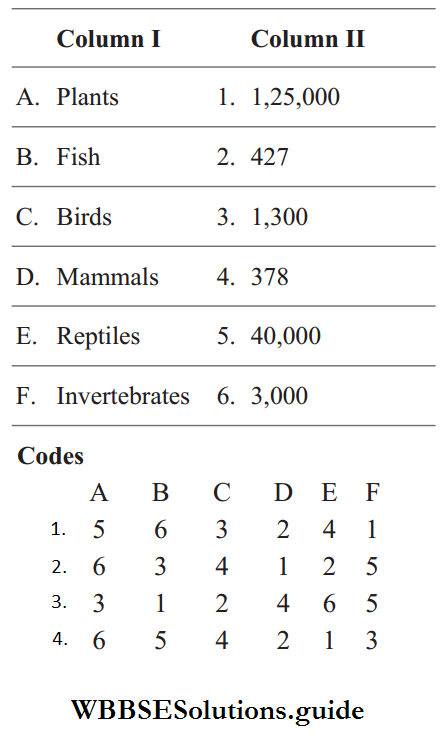
Answer: 1. A–5, B–6, C–3, D–2, E–4, F–1
Question 29. Quercus species are the dominant component in
- Temperate Deciduous Forests
- Alpine Forests
- Scrub Forests
- Tropical rainforests
Answer: 1. Temperate Deciduous Forests
Quercus species is a dominant component in temperate deciduous forests. The common name of Quercus is cork oak belongs to family–Fabaceae. Cork used as bottle stoppers, soles for shoes, insulating material and for the manufacture of linoleum.
NEET Biology Mcq
Question 30. Water saturation capacity is maximum in
- Tropical Forests
- Deciduous Forests
- Scrub Forests
- Temperate forest
Answer: 1. Tropical Forests
Water saturation capacity is the maximum water-holding capacity of soil. Tropical rainforests possess the maximum water saturation capacity. It receives from 60-160 inches of precipitation that is evenly distributed throughout the year.
Question 31. Which of the following communities is more vulnerable to invasion by outside animals and plants?
- Temperate forests
- Tropical evergreen forests
- Oceanic island communities
- Mangroves
Answer: 2. Tropical evergreen forests
“biodiversity questions and answers pdf “
Tropical evergreen forests represent a biome which is at the culmination of floristic development showing best kind of multistoried forests that harbour marvellous fauna. In this biome, no species dominates, but almost all ecological niches are well-occupied.
Question 32. The percentage of land covered by forest in India is
- 9-18%
- 18-27%
- 27-36%
- More than 50%
Answer: 2. 18-27%
The total forest cover in India is 708,273 sq. km, which is 21.54% of the total area of the country. Forest and tree cover when combined, it is 8,02,088 sq. km or 24.39% of the total geographical area. Thus, the percentage of land covered by forest in India is 18-27%.
Question 33. Which one of the following pairs of geographical areas shows the maximum biodiversity in our country?
- Sundarbans and Rann of Kutch
- Eastern ghats and West Bengal
- Eastern Himalayas and Western ghats
- Kerala and Punjab
Answer: 3. Eastern Himalayas and Western ghats
Eastern Himalayas and Western ghats are the geographical areas in India which show the maximum diversity in plants and animals. Eastern Himalayas and Western ghats are also known as ‘hotspot’ of biodiversity.
NEET Biology Mcq
Question 34. The type of forest mainly found in India is
- Sub-Tropical Deciduous
- Tropical Moist Deciduous
- Tropical Deciduous
- Temperate Deciduous
Answer: 3. Tropical Deciduous
Tropical deciduous forests can be classified into two broad categories, i.e. dry deciduous forests (covers 38.2% of total forest area in India) and moist deciduous forests (covers 30.3% of total forest area in India). So, we can see majority of India is covered by tropical deciduous forest.
Question 35. Assertion Most common forest type in India is tropical dry deciduous forests. Reason (R) They are common in West Bengal.
- Both A and R are true and R is the correct explanation of A
- Both A and R are true, but R is not the correct explanation of A
- A is true, but R is false
- Both A and R are false
Answer: 3. A is true, but R is false
A is true, but R is false because In India, tropical dry deciduous forests are common. They grow in the States of Madhya Pradesh, Uttar Pradesh, Bihar, Chhattisgarh, Odisha and parts of Maharashtra.
Mock test on Biodiversity Patterns for NEET preparation
Question 36. Coniferous forests in India are found in
- MP
- Himalayan regions
- Satpura Hills
- Rajasthan
Answer: 2. Himalayan regions
Coniferous forests grow in the Himalayan mountain region, where the temperature is low. In coniferous forests, vegetation is composed primarily of cone-bearing needle-leaved or scale-leaved evergreen trees, found in areas with long winters.
Question 37. Temperate deciduous forest is found in
- Assom
- Himalayas
- Aravalli
- Western ghats
Answer: 4. Western ghats
Temperate deciduous or temperate broad leaf forests are a variety of temperate forest dominated by trees that lose their leaves each year. They are found in areas with warm moist summers and cool winters. They mostly occur along the Eastern slopes of the Western ghats, North-Eastern part of the Peninsula.
NEET Biology Mcq
Question 38. Assertion Tropical rainforests are disappearing fast from developing countries such as India. Reason (R) No value is attached to these forests because they are poor in biodiversity.
- Both A and R are true and R is the correct explanation of A
- Both A and R are true, but R is not the correct explanation of A
- A is true, but R is false
- Both A and R are false
Answer: 3. A is true, but R is false
A is true, but R is false because Tropical rainforests are disappearing fast from developing countries such as India. The reason is due to increasing deforestation, poaching, construction mining, etc. Tropical rainforests have high levels of biodiversity (species richness). These have high degree of endemism as well. Thus, they are of great value.
Question 39. In India, tropical rainforests occur in
- Jammu and Kashmir
- Andaman and Nicobar
- Uttar Pradesh
- Himachal Pradesh
Answer: 2. Andaman and Nicobar
Tropical rainforests of India are found in the Andaman and Nicobar Islands, the Western ghats, which fringe the Arabian Sea, the coastline of peninsular India and the greater Assom region in the North-East. Small remnants of rainforest are found in Odisha state.
Question 40. Which pair of geographical area shows maximum diversity in our country?
- Sunderbans and Rann of Kutch
- Eastern Ghats and Western Ghats
- Eastern Himalayas and Western Ghats
- Kerala and Punjab
Answer: 3. Eastern Himalayas and Western Ghats
A mountain range that runs parallel to the Western coast of the Indian peninsula is known the Western ghats. The area has over 7402 species of flowering plants, 1814 species of non-flowering plants, 139 mammal species, 508 bird species, 179 amphibian species, 6000 insects species and 290 freshwater fish species. Around 325 globally threatened species also occur here. And this makes clear that the Western ghats are the most biodiversity rich zone in India. Joining the Western ghat in this category are the Eastern Himalayas.
So, the correct answer is option 3.
NEET Biology Mcq
Question 41. In India, temperate evergreen vegetation occurs mostly in
- Rajasthan and South Punjab
- Eastern and Western Himalayas less than 3500 m
- Western Himalayas above 3500 m
- Western ghats and Assom
Answer: 2. Eastern and Western Himalayas less than 3500 m
Temperate evergreen forests are altitudinal forests which occur in the Himalayas (i.e. Eastern and Western) at the altitude of 1700-3000 m (i.e. less than 3500 m). They are evergreen because the needle-shaped leaves of the coniferous plants persist for 2-7 years.
Question 42. When a graph is plotted to describe the relationship between species richness and its area for a variety of taxa the relationship appears as
- A Rectangular Hyperbola
- A Sigmoid Curve
- A Straight Line
- None of the above
Answer: 1. A Rectangular Hyperbola
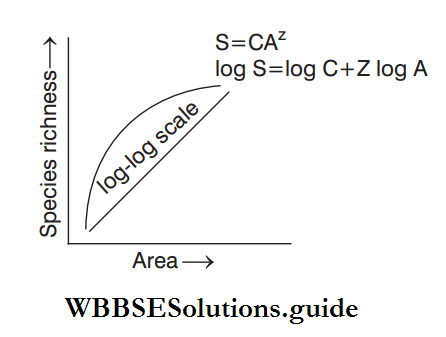
The relationship between the species richness and the area for a wide variety of taxa (angiosperm, plants, birds, bats, freshwater fishes), appears as a rectangular hyperbola.
Question 43. The species-area relationship is a straight line described by the equation
- log S = \(\frac{log C}{log A}\)
- Z log = \(\frac{log C}{log S}\)
- log S = log C + Z log A
- log S = log C – Z log A
Answer: 3. log S = log C + Z log A
On a logarithmic scale, the species area relationship is a straight line described by the equation, log S = log C + Z log A where, S = Species richness
A = Area
Z = Slope of the line
C = Y-intercept
Question 44. If log A= 4, Z = 0.3 and log C= 0.8, find the value of log ‘S’?
- 3.76
- 100
- 4.24
- 2
Answer: 4. 2
Given, log A = 4, Z = 0.3 and log C = 0.8 Putting these values in the equation, i.e. species-area relationship equation, we will get the value of log S. log S = log C + Z log A = 0.8 + 0.3 × 4 = 0.8 + 1.2 = 2.0
Question 45. According to Alexander von Humbolt NEET
- Species Richness Decreases With Increasing Area Of Exploration
- Species Richness Increases With Increasing Area, But Only Up To Limit
- There Is No Relationship Between Species Richness And Area Explored
- Species richness goes on increasing with increasing areas of exploration
Answer: 2. Species Richness Increases With Increasing Area, But Only Up To Limit
Alexander von Humboldt observed that within a region, species richness increases with increasing explored area, but up to a limit. That is represented by the rectangular hyperbola which represents the equation S CA Z= 2 where S is species richness, A is the area, C is a constant and Z is he regression constant.
NEET Biology Mcq
Question 46. Alexander von Humbolt described for the first time
- Ecological Biodiversity
- Laws Of Limiting Factor
- Species-Area Relationships
- Population growth equation
Answer: 3. Laws Of Limiting Factor
Alexander von Humboldt described for the first time a species-area relationship.
Question 47. The slope for frugivorous birds and mammals in tropical forests of different continents is found to be
- 1.15
- 1.5
- 1.05
- 1.005
Answer: 1. 1.15
For frugivorous birds and mammals in the tropical forests of different continents, the slope is found to have a value of 1.15, which means that the slope is steeper, which indicates that number of species found increases faster than the area explored in very large areas line the entire continents.
Question 48. Which of the following affects the biodiversity of an area?
- Latitudinal gradients and species-area relationship
- Species-area relationship and longitudinal gradients
- Both 1 and 2
- Latitudinal and longitudinal gradients
Answer: 1. Latitudinal gradients and species-area relationship
Throughout the world, biodiversity is not uniform because it is affected by two factors, latitudinal gradients and species-area relationships.
Question 49. The percentage of forest cover in India, for plains and hills as decided by the Forest Policy Act (1988) is Plains Hills
- 60% 40%
- 33% 67%
- 20% 33%
- 70% 30%
Answer: 1. 60% 40%
The percentage of forest cover in India for plains and hills is 60% and 40%, respectively as decided by Forest Policy Act in 1988.
NEET practice test on Patterns of Biodiversity and Their Importance
Question 50. Communities with more species tend to be more stable than those with less species. This was confirmed by
- Alexander von Humboldt
- David Tilman
- Odum
- None of the above
Answer: 2. David Tilman
Ecologists believe that the communities with more species tend to be more stable than those with less species. This was confirmed by David Tilman.
Question 51. Read the statements regarding a stable community and choose the correct option.
- Must be resistant to occasional disturbances.
- Should show much variation in productivity from year to year.
- Must be resistant to invasions by alien species.
Choose the correct option:
- 1 and 2 are correct
- 1, 2 and 3 are correct
- Only 1 is correct
- 2 and 3 are correct
- 1 and 3 are correct
Answer: 5. I and 3 are correct
Statements I and 3 are correct whereas statement 2 is incorrect. The incorrect statement can be corrected as the Stable community has maximum diversity and niche specialisation. It should not show too much variation in productivity from year to year.
Question 52. The environment as a self-sustaining system is mainly preserved by
- Man
- Animals
- Trees
- Wildlife
Answer: 4. Wildlife
The environment is preserved as a self-sustaining system by wildlife. It includes various living organisms which are interdependent on each other and able to meet the basic requirement for survival.
Question 53. Assertion Community with more species tends to be more stable than those with less species. Reason (R) More will be the species less will be year to year variation in total biomass.
- Both A and R are true and R is the correct explanation of A
- Both A and R are true, but R is not the correct explanation of A
- A is true, but R is false
- Both A and R are false
Answer: 1. Both A and R are true and R is the correct explanation of A
Both A and R are true and R is the correct explanation of A. Communities with more species tend to be more stable than those with less species. It is able to resist occasional disturbances. A stable community should not show too much variation in productivity from year to year, it must be resistant to invasions by alien species. David Tilman’s long-term experiments showed the plots with more species, had less will be year-to-year variation in total biomass.
Question 54. Consider the following statements.
- Diversity in species provides stability to the ecosystem.
- An ecosystem with higher biodiversity is more productive than an ecosystem with lower biodiversity.
- Biodiversity does not play any role in the maintenance and health of ecosystems.
Choose the option containing the correct statements.
- 1 and 2
- 1, 2 and 3
- 2 and 3
- Only 1
Answer: 1. I and 2
All given statements are correct except 3 because It is species diversity, which is important for maintaining higher levels of productivity and ecosystem health. All the aspects of nature falls under biodiversity, hence biodiversity plays an important role in the maintenance and health of the ecosystem.
Question 55. The reason of diversity in living beings is due to
- Mutation
- Long-Term Evolutionary Change
- Gradual Change
- Short-term evolutionary change
Answer: 2. Long-Term Evolutionary Change
Diversity in living beings is due to long-term evolutionary changes. Adaptability to continuous changes in environmental conditions is important for natural selection of variants and variations generation after generation leading to the emergence of diverse descendants.
Thus, option 1 is correct.
Question 56. Rivet Popper hypothesis explains the importance of
- Species In An Ecosystem
- Birds In An Ecosystem
- Fishes In A Pond Ecosystem
- None of the above
Answer: 1. Species In An Ecosystem
Rivet Popper hypothesis explains the importance of biodiversity for the survival of species. It was proposed by Paul Ehrlich. This hypothesis assumes the ecosystem to be an aeroplane and the species to be the rivets joining all parts together.
Question 57. Rivet popper hypothesis assumes the …A… to be an aeroplane and the …B… to be the rivets joining all parts together. Here, A and B refer to
- A–species, B–ecosystem
- A–ecosystem, B–species
- A–species, B–community
- A–community, B–species
Answer: 2. A–ecosystem, B–species
Rivet Popper hypothesis explains the importance of biodiversity for the survival of species. It was proposed by Paul Ehrlich. This hypothesis assumes the ecosystem to be an aeroplane and the species to be the rivets joining all parts together.