
Waves
Wave Definition:
The disturbance that is traveling through a medium or vacuum from one place to another by transferring the energy is called a wave.
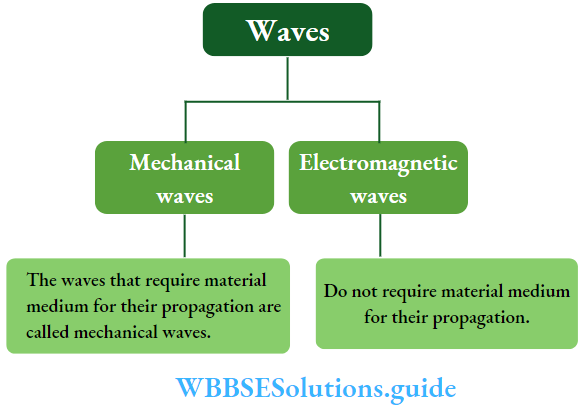
Classification of waves based on the need for a material medium.
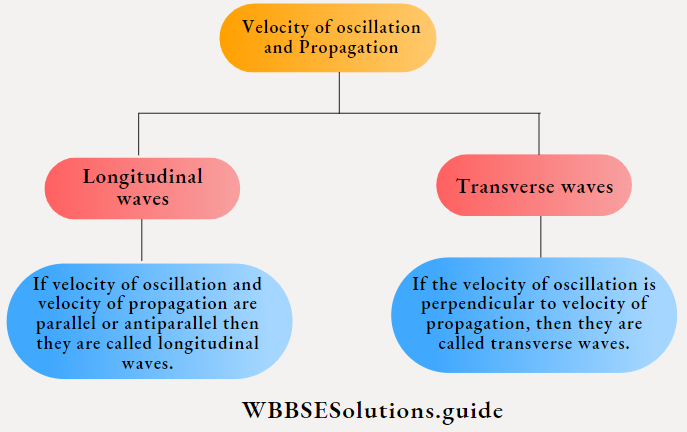
Classification based on the velocity of oscillation and the velocity of propagation:
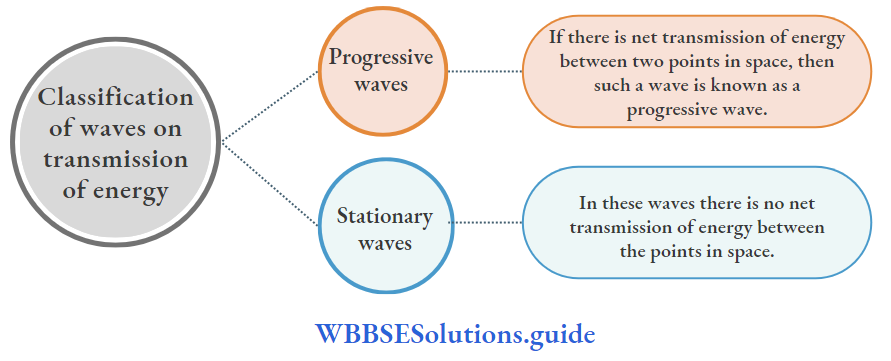
Classification of waves based on transmission of energy:
NEET Physics Waves notes
The wave velocity is given by, c = f λ.
Read And Learn More: NEET Physics Notes
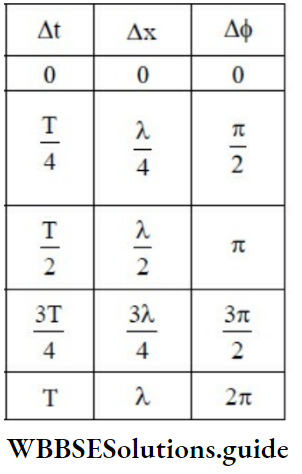
Relation between path difference and phase difference
⇒ \(\frac{\Delta \mathrm{x}}{\Delta \phi}=\frac{\lambda}{2 \pi}\)
⇒ \(\Delta \mathrm{x}=\frac{\lambda}{2 \pi} \Delta \phi\)
where Δx is the path difference and Δ∅ is the phase difference
Standing waves and harmonics NEET notes
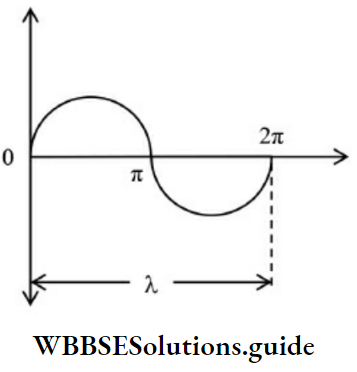
Equation of one-dimensional progressive wave,
y = \(A \sin (\omega t \pm k x)\)
Or \(y=A \cos (\omega t \pm k x)\)
Important formulas of Waves for NEET
A → amplitudes
⇒ \(\omega=2 \pi \mathrm{f}=\frac{2 \pi}{\mathrm{T}}\)= angular frequency
⇒ \(\mathrm{k}=\frac{2 \pi}{\lambda}\)= propagation constant
⇒ \(\frac{\omega}{\mathrm{k}}=\frac{2 \pi}{\mathrm{T}} \times \frac{\lambda}{2 \pi}=\lambda \mathrm{f}=\mathrm{c}\), wave velocity.
⇒ \(\frac{\mathrm{dy}}{\mathrm{dt}}=\mathrm{v}\), particle velocity.
“Wave velocity is a constant but particle velocity is variable”
⇒ \(\frac{1}{\lambda}=\bar{v}\), is called wave number.

Types of waves in Physics for NEET
Reflection Of Waves
The return of a wave from the surface of the separation of two media is called reflection. The reflection of the wave occurs according to the following laws.
- The angle of incidence = angle of reflection.
- On reflection, there is no change in the velocity, frequency, or wavelength of the wave.
- A phase difference of 1800 is introduced when the transverse wave is reflected from a denser medium and the longitudinal wave is reflected from a rarer medium.
Note:
- A medium is said to be denser if the velocity of the ave in it is lower.
- Vacuum is the rarer medium for electromagnetic waves, but it is the densest medium for sound waves.
Sound waves of frequency less than 20 Hz are called infrasonics.
Sound waves of frequency greater than 20000 Hz are called ultrasonics.
“It is found that the sensation of sound received by our ear persists for about 1/10 th of a second. This is called persistence of hearing
Echo: It is a sound that reaches the observer after reflection from some surface or object.
Beats
The number of beats produced per second is found to be equal to the difference in the frequencies of the superposing sound waves.
⇒ \(v_{\text {beat }}=\left|v_1-v_2\right|\)
Condition for hearing beats
- The frequency difference of the two waves should not be more than 10.
- The amplitudes of the two waves must be nearly equal.
- The direction of propagation of waves should be the same
Velocity of sound:
In liquids, C = \(\sqrt{\frac{B}{\rho}}\)
Where B is the bulk modulus.
In air, C = \(\sqrt{\frac{\gamma \mathrm{P}}{\rho}}=\sqrt{\frac{\gamma \mathrm{RT}}{\mathrm{M}}}\) (PV=RT)
In a long rod, C = \(\sqrt{\frac{Y}{\rho}}\)
Wave motion and its characteristics NEET notes
Y → Young’s Modulus.
In general, C = \(\sqrt{\frac{P}{\rho}}\)
Where E is the modulus of elasticity.
Note:
- \(C \propto \frac{1}{\sqrt{\rho}}\)
- \(C \propto \sqrt{\mathrm{T}}\)
- The speed of sound in air is independent of pressure.
- \(\mathrm{C}_{\text {solid}}>\mathrm{C}_{\text {liqquids }}>\mathrm{C}_{\text {gases }}\)
- The sound is reflected or refracted according to the same laws as the light does. Among the gases, the velocity of sound is the largest in hydrogen.
- Sound travels faster in solids because of its larger value of elasticity.
- For every one-degree rise in temperature the speed of sound increases by 0.61m/s.
Tuning Fork
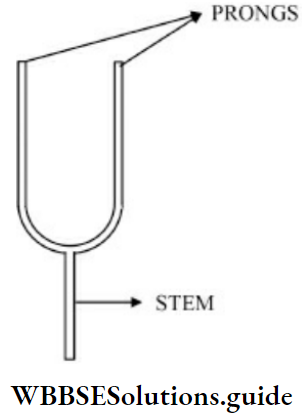
The prongs execute transverse vibrations and the stem executes the longitudinal vibrations. Both vibrate with the same frequency.
Sound waves and their properties NEET
- If we add a little wax to one of the prongs of the tuning fork, it is said to have been loaded. Loading decreases the frequency of the tuning fork.
- If we file the prong of the tuning fork to make it thinner, the frequency of the tuning fork increases.
- If the stem of a tuning fork is loaded, then the frequency of the tuning fork will increase.
Determination of frequency of the tuning fork using the phenomenon of beats:
Step 1: Suppose, we have a standard tuning fork of frequency v3 = 580 Hz.
The standard tuning fork and the experimental tuning fork of unknown frequency are sounded together. Let the number of beats produced per second be 6.
Then the frequency of the experimental tuning fork is either 580 + 6 = 586 Hz or 580 – 6 = 574 Hz.
Step 2: Let the experimental tuning fork be loaded and it is sounded together with the standard tuning fork.
Suppose the beat frequency in this case is 4.
Then it is evident that the frequency of the loaded experiment tuning fork has decreased by 6 – 4 = 2.
Therefore, the frequency of the experimental tuning fork has become either 584 Hz or 572 Hz.
But 4 beats are possible only with 584 Hz.
Hence the original frequency of the experimental tuning fork is 586 Hz.
Doppler Effect
The apparent change in the frequency heard by the listener, due to the relative motion between the source and observer is called the Doppler effect.
In the Doppler effect, the apparent frequency of sound as heard by the listener will be,
⇒ \(v^1=\frac{C-C_L}{C-C_S} v\)
v → original frequency
v1 → app. frequency.
C → speed of sound.
CL → speed of listener.
CS → speed of the source.
CL and CS are taken positively when they are in the direction of ‘C’ and vice versa.
Superposition principle and interference NEET
Doppler effect in light: \(v^1=\frac{C-C_L}{C-C_S} v\)
If λ’ is the apparent wavelength, then
⇒ \(\frac{\mathrm{C}}{\lambda^{\prime}}=\frac{\mathrm{C}-\mathrm{C}_{\mathrm{L}}}{\mathrm{C}-\mathrm{C}_5} \frac{\mathrm{C}}{\lambda}\)
⇒ \(\lambda^{\prime}=\frac{\mathrm{C}-\mathrm{C}_{\mathrm{S}}}{\mathrm{C}-\mathrm{C}_{\mathrm{L}}} \lambda\)
1. CL = 0, CS = u (source comes towards)
⇒ \(\lambda^{\prime}=\left(\frac{\mathrm{C}-\mathrm{u}}{\mathrm{C}}\right) \lambda=\left(1-\frac{\mathrm{u}}{\mathrm{C}}\right) \lambda\)
⇒ \(\Delta \lambda=\lambda^{\prime}-\lambda=-\frac{\mathrm{u}}{\mathrm{C}} \lambda \quad \text { (blue shift) }\)
Beats and Doppler effect NEET questions
2. Source goes away: \(\Delta \lambda=\frac{\mathrm{u}}{\mathrm{C}} \lambda\) (red shift)
3. Observer approaches source: \(\Delta \lambda=-\frac{\mathrm{u}}{\mathrm{c}} \lambda\)
4. Observer recedes from source: \(\Delta \lambda=\frac{\mathrm{u}}{\mathrm{C}} \lambda\)
Doppler effect is not observed when,
- There is no relative velocity between the source and the listener.
- When source and listener move in mutually perpendicular directions.
- When only the medium moves.