WBBSE Solutions For Class 10 Geography And Environment India – Agriculture Of India

Geography Class 10 West Bengal Board India – Agriculture Of India True Or False Type:

Question 1. Most of the rice in India is cultivated in winter as a Rabi crop.
Answer: False

Question 2. Tank irrigation is practised in the Deccan.
Answer: True

Question 3. Well, irrigation is practised in the North-Western part of India.
Answer: True

Read and learn all WBBSE Solutions For Class 10 Geography And Environment

Question 4. Taichung is an HYV seed of Rice.
Answer: True

“WBBSE Solutions for Class 10 Geography Agriculture of India”

Question 5. Moti is an HYV seed of Wheat.
Answer: True

Question 6. Sujata is an HYV seed of Cotton.
Answer: True

Question 7. Basudev is a HYV seed of Jute.
Answer: True

Question 8. Uttar Pradesh is the largest producer of Sugarcane.
Answer: True

Question 9. The agriculture done to meet the ‘requirements of the people is called subsistence agriculture.
Answer: True

Question 10, The Kharif crop is sown in winter and harvested in spring.
Answer: False

Question 11. A crop produced in the Zaid season is coffee.
Answer: False

Question 12. The raw materials that do not lose weight even after manufacturing are called impure raw materials.
Answer: False

Question 13. Coffee is the crop of a cold country.
Answer: False

Question 14. Punjab holds the leading position in Jute.
Answer: False

Question 15. Palai’s hilly region has tea estates.
Answer: True

Question 16. Tea is a plantation crop in India.
Answer: True
WBBSE Solutions For Class 10 Geography And Environment India - Agriculture Of India

Geography Class 10 West Bengal Board

Question 17. Uttar Pradesh holds the leading position in rice production.
Answer: False

Question 18. In Gujarat, cotton is the most important cash crop.
Answer: True

Question 19. Bihar also produces some jute fibre.
Answer: True

“Class 10 Geography and Environment Agriculture of India solutions WBBSE”

Question 20. India is famous for the production of tea in the world.
Answer: True

Question 21. Assam is the largest producer of tea.
Answer: True

Question 22. Punjab is the largest producer of wheat.
Answer: False

Question 23. Irrigation is needed in Indian agriculture.
Answer: True

Question 24. West Bengal ranks first in the production of rice and jute.
Answer: True

Question 25. Cotton is a fibre crop.
Answer: True

Question 26. Wheat production requires high temperatures and rainfall.
Answer: False

Question 27. Tea production requires high temperatures and low rainfall.
Answer: False

Question 28. Rice production requires low temperatures and high rainfall.
Answer: False

Class 10 Maths Class 10 Social Science
Class 10 English Class 10 Maths
Class 10 Geography Class 10 Geography MCQs
Class 10 History Class 10 History MCQs
Class 10 Life Science Class 10 Science VSAQS
Class 10 Physical Science Class 10 Science SAQs

Question 29. Regur is favourable for the production of cotton.
Answer: True

Question 30. The most important plantation crop of India is coffee.
Answer: False

Question 31. Jute is mostly grown on alluvial plains.
Answer: True

Question 32. Rajasthan is the largest producer of Maize.
Answer: True

Geography Class 10 Solutions WBBSE India – Agriculture Of India Fill In The Blanks Type:

Question 1. ______ occupies the second position in the production of rice.
Answer: Andhra.

Question 2. ______ holds the leading position in the production of wheat.
Answer: Uttar Pradesh.

Question 3. Assam is noted for ____ production.
Answer: Tea.

Question 4. ______ tea is famous in the world.
Answer: Darjeeling.

Geography Class 10 West Bengal Board

Question 5. Aman is a ______ crop in India.
Answer: Winter.

“WBBSE Class 10 Geography Agriculture of India solved questions”

Question 6. Tea is produced in ______ in south India.
Answer: Tamil Nadu.

Question 7. India holds the ______ position in tea production in the world.
Answer: Leading.

Question 8. ______ is the largest exporter of tea in the world.
Answer: India.

Question 9. Fertilizer Corporation of India (H.Q.) is situated at ______.
Answer: Sindhri.

Question 10. Black soil region is noted for _______.
Answer: Cotton production.

Question 11. Darjeeling is noted for ______ production.
Answer: Tea.

Question 12. For sugarcane cultivation ______ is suitable.
Answer: Mixed soil mixed with lime and salt.

Question 13. For coffee, forest-cleared ______ soils are ideal.
Answer: Brown.

Question 14. For tea, cultivation is required.
Answer: Fertile soil with iron, and phosphorus.

Question 15. ______ is the staple food of Indian people.
Answer: Rice.

Question 16. Tea is a ______ crop.
Answer: Beverage.

Question 17. Revolution in the field of Milk is called _____ Revolution.
Answer: White.

Question 18. Winter crops are called ______ crops.
Answer: Rabi.

Question 19. Summer crops are called _____ crops.
Answer: Kharif.

Question 20. ___ is the largest producer of tea in India.
Answer: Assam.

Question 21. ______ is the largest producer of coffee in India.
Answer: Karnataka.

Question 22. ______ is the largest producer of groundnut in India.
Answer: Gujarat.

WBBSE Class 10 Geography Chapter 5 India – Agriculture Of IndiaVery Short Answer Type:

Question 1. Which State of India ranks first in sugarcane production?
Answer: Uttar Pradesh.

Question 2. Name one Zaid crop of India.
Answer: Watermelon.

Question 3. What do you understand by ‘Rabi’ crops?
Answer: The crops which grow in the ‘Rabi’ season are known as ‘Rabi’ crops, e.g. wheat grain.

“Agriculture of India Class 10 WBBSE solutions and answers”

Question 4. What do you mean by ‘Kharif crop’?
Answer: The crop which is grown in the Kharif season (i.e., the onset of the monsoon) is known as the Kharif crop, e.g. Rice. ;

Question 5. Through which port of India, the largest amount of tea is exported?
Answer: Kolkata port.

Question 6. Which is the leading state in the production of wheat in India.
Answer: Uttar Pradesh.

Question 7. Which state gives the highest yield of rice per bigha?
Answer: Punjab.

Question 8. Which is the leading state in the production of cotton in India?
Answer: Gujarat.

Question 9. What is agriculture?
Answer: Agriculture is the cultivation of land for the production of crops.

Question 10. Name the main food crops of India.
Answer: Rice, wheat, jowar, ragi, bajra, pulses, etc.

Question 11. Name the fibre crops produced in India.
Answer: Jute, cotton, mesta, etc.

Question 12. Name the beverage crops produced in India.
Answer: Tea, coffee, cocoa.

Question 13. Name the HYV seeds of rice.
Answer: Ir-8, |r-16, Ratna, Jaya, Padma, Taichung, Tainan, Vijaya, IIT— 1991, Indica, Mahsuri, Sona, TN-I, Kavery, Pusa-33, Sabarmati, ADT-27. i

Question 14. Name the HYV seeds of wheat.
Answer: Larma Rajo, Sonera-63, Sonera-64, Sona-227, Kalyan Sona, Sonalika-308, RR-8, Culture-16, Culture-64, Sonalika, Safed Larma, HD-2329, HD-1982, NP-52.

Question 15. Name the HYV seeds of maize.
Answer: CSH-5, CSH-6.

Question 16. Name the HYV seeds of bajra.
Answer: Bj-109, BK-560.

“WBBSE Class 10 Geography Agriculture of India chapter answers”

Question 17. Name the HYV seeds of cotton.
Answer: Sujata, Varalaxmi, MCU-5, MCU-4, Hybrid-4, Bharati.

Class 10 Geography West Bengal Board

Question 18. Name the types of sugarcane mainly produced in India.
Answer: Saccharum Barberi, Saccharum Sinesis, Saccharum officinarum.

Question 19. Name the types of coffee mainly produced in India.
Answer: Roberta, Arabica.

Question 20. Which state is the largest producer of wheat and in which state per hectare production is maximum?
Answer: Uttar Pradesh is the largest producer of wheat and per hectare, production is maximum in Punjab.

Question 21. Which states are the largest producers of maize and jowar?
Answer: Uttar Pradesh is the largest producer of maize and Maharashtra is the largest producer of Jowar.

Question 22. Which states are the largest producers of bajra and ragi?
Answer: Rajasthan is the largest producer of bajra and Karnataka is the largest producer of ragi.

Question 23. Which state is the largest producer of tea?
Answer: Assam is the largest producer of tea.

Question 24. Which state is the largest producer of quality tea?
Answer: West Bengal.

Question 25. Which state is the largest producer of coffee?
Answer: Karnataka.

Question 26. Where is the headquarters of ICAR situated?
Answer: New Delhi.

Question 27. Where is Wheat Research Institute in India located?
Answer: Pusha (Near New Delhi).

Question 28. Where is Rice Research Institute in India located?
Answer: Cuttack.

Question 29. Where is Sugarcane Research Institute in India located?
Answer: Lucknow.

Question 30. Where is Cotton Research Institute in India located?
Answer: Coimbatore.

Question 31. What’s the position of India in sugarcane production in the world?
Answer: Second.

Question 32. What is the position of India among the major sugarcane-exporting countries in the world?
Answer: Fourth.

“Class 10 Geography Agriculture of India WBBSE notes

Question 33. What was the quantum of production of sugarcane in India in the year 2013-14?
Answer: 349.38 million tonnes.

Question 34. What’s the position of India in tea production in the world?
Answer: First.

Question 35. Where is Coffee Research Institute in India located?
Answer: Chikmagalure at Karnataka.

Question 36. Who is known as the ‘India Father of Green Revolution’?
Answer: M.S. Swaminathan.

Question 37. Who is known as the ‘Father of Green Revolution’?
Answer: Norman Borlaug.

Question 38. What is meant by cash crop?
Answer: Cash crops are those which earn money, particularly foreign exchange, e.g. tea, and jute.

WBBSE Class 10 Geography Chapter 5 India – Agriculture Of India 2 Marks Questions And Answers:

Question 1. Define “Terrace Cultivation”.
Answer:

“Terrace Cultivation”

Terrace cultivation is a method of growing crops on the sides of hills or mountains by planting on graduated terraces built into the slope.

Question 2. What are Commercial crops?
Answer:

Commercial crops:

In Commercial agriculture, crops that are in high demand, i.e. crops that need to be exported to other countries or are used as raw materials in industries are produced mainly.

Question 3. What do you mean by millet crops?
Answer:

Millet Crops: The term ‘millets’ refers to a number of inferior gains which serve as foodgrains for the poorer sections of society and whose straw makes valuable cattle fodder. The most important millets cultivated in India include jowar (or kolam), bajra (or cumbu) and ragi.

Question 4. What do you mean by subsistence agriculture?
Answer:

Subsistence Agriculture: The practice of agriculture in which small landholdings are cultivated with primitive methods and tools, and the product is almost entirely consumed by the family members of the farmers, with a little surplus for sale, is called subsistence farming. This type of agriculture is mainly practised for survival.

Question 5. What are the two types of wheat cultivated in India?
Answer:

The two types of wheat cultivation are

1. Spring wheat and 2. Winter wheat.

Question 6. Mention the names of two leading wheat-producing states of India.
Answer: U.P. and Punjab.

Class 10 Geography West Bengal Board

Question 7. Which state is the leading producer of cotton?
Answer: Maharashtra.

Question 8. Name any two high-yielding seeds of rice.
Answer: IR—20 and Taichung IR—8.

Question 9. Name the two major coffee-producing states of India.
Answer: Karnataka and Kerala are the major coffee-producing states of India.

Question 10. Name two fibre crops.
Answer: Jute and Cotton.

Question 11. What is the Kharif crop?
Answer:

Kharif crops: The crops which grow during the rainy season are known as Kharif crops.

Question 12. What is the difference between Rabi and Kharif crops?
Answer:

The difference between Rabi and Kharif crops

Kharif Crops Rabi Crops
(1)  Kharif season begins with the onset of monsoon. (1) Rabi season begins in autumn.
(2) The crops are harvested in October and November (2) The crops are harvested in spring (April, May)


Question 13. What is meant by cash crop?

Answer:

Cash crop:

Cash or commercial crops are grown for cash and mainly to serve industrial uses. They are bought and sold as raw materials, e.g. jute, tea, cotton, coffee, etc.

Question 14. What are plantation crops?
Answer:

Plantation crops

Plantation crops are commercial, perennial crops grown on large farms which are modern, scientific and self-contained units. Only one crop is grown on a large scale, e.g. tea, coffee, rubber, cocoa, sugarcane, banana, spices, coconut, etc.

Question 15. Name the major cash crops of India.
Answer:

Tea, coffee, jute, cotton, oilseeds, etc.

Question 16. What do you understand by ‘Rabi crops’?
Answer:

Understand by ‘Rabi crops’

Rabi crops are sown at the beginning of the cool season (October – November) and harvested between February and May, e.g. wheat, barley, jowar, gram, mustard seed, linseed, etc.

Question 17. Name two major food crops of India.
Answer:

Wheat and Rice are the two major food crops of India.

Question 18. Name two popular hot drinks of India.
Answer:

Tea and Coffee.

Class 10 Geography West Bengal Board

Question 19. Name two major food crops of the Deccan Plateau.
Answer: Jowar and Ragi.

Question 20. Name two major fruits of the N.E. region.
Answer:

Orange and Pineapple.

Question 21. Which two institutions has been established to solve the problem of marketing cotton?
Answer:

The Cotton Corporation of India (CCI) and Maharashtra State Co-operative Cotton Growers Marketing Federation have been formed to solve the problems of marketing cotton by cotton growers.

Question 22. Name two plantation crops.
Answer:

Coffee & Tea.

Question 23. Name the two tea research centres present in India
Answer:

Two organisations engaged in tea research in India are the Tocklai Experimental Station of the TRA [Tea Research Association, Jorhat (Assam)] and Tea Research Station of the UPASI (United Planters’ Association of Southern India, Cinchona, Coimbatore, Tamil Nadu).

Question 24. What are the different uses of wheat?
Answer:

The different uses of wheat

Wheat produces many types of flour, ata, and semolina. From these, varieties of cakes and biscuits are baked. The straw and husk of wheat are used as raw materials in making paper, board, etc.

Question 25. Explain the production pattern of cotton in India.
Answer:

The production pattern of cotton in Indi

In the year 2001 India produces about 27 lacks 10 thousand metric tonnes of cotton. The following table shows cotton production in India:

Year: 2006-07 2007-08 2008-09 2009-10 2010-11 2011-12
Production (million tonne) 22.63 25.88 25.88 24.02 33.43 36.1


Question 26. Comment on the import and export of cotton in/from India.

Answer:
Import: India imports long-staple cotton from the U.S.A, Kenya, Egypt and Sudan.
Export: Short staple cotton is exported to Britain, Japan, Malaysia and other countries.

“WBBSE Solutions for Geography Class 10 Agriculture of India MCQs and answers”

Question 27. Explain the production pattern of rice in India.
Answer:
Production: In rice production in the world, India occupies the second position after China. In 2013-14 India’s total rice production was about 106.29 million tonnes.

Year 2008-09 2009-10 2010-11 2011-12 2012-13 2013-14
Production (million tonne) 99.18 89.09 95.98 105.31 105.31 106.29


Question 28. To which countries rice is exported by India?

Answer:

At present India is self-sufficient in rice production. Every year she has to import some rice from Myanmar, Nepal and Thailand. India also exports some rice to Bahrain, Kuwait, Oman, Saudi Arabia, UAE, the UK, and the USA.

Question 29. What do you mean by agriculture?
Answer:

Agriculture

The word ‘agriculture’ has been derived from two Latin words, ‘ager’ meaning ‘land’ and ‘culture’ meaning ‘cultivation’. Agriculture is thus, defined as the cultivation of soil in order to grow crops and rear livestock. The essential purpose of agriculture is the production of food from the land for human or animal consumption.

Question 30. Give an account of the production quantum of wheat of the last six years in India.
Answer:

The production of wheat in India in 2013-14 was about 95 million tonnes.

Year 2008-09 2009-10 2010-11 2011-12 2012-13 2013-14
Production (million tonnes) 80.68 80.8 86.87 94.88 93.51 95.85


Question 31. From which countries wheat is imported in case of need?

Answer: India is almost self-sufficient in wheat production. However, when she needs, she imports wheat from Australia, Canada and the U.S.A.

Question 32. What do you mean by millets?
Answer:

Millets:

The term ‘millets’ refers to a number of inferior gains which serve as foodgrains for the poorer sections of society and whose straw makes valuable cattle fodder. The most important millets cultivated in India include jowar (or kolam), bajra (or cumbu) and ragi.

Question 33. What do you mean by bagasse? What is its use?
Answer:

Bagasse:

The fibrous part of sugarcane called bagasse is used for making paper and sound-insulating boards.

Question 34. What are the uses of sugarcane?
Answer:

Uses of sugarcane

Sugarcane juice is used to make sugar, alcohol, molasses, etc.

Question 35. What was the production quantum of jowar & bajra in 2013-14 in India?
Answer:

The production of jawar and bajra in 2013-14 was 5.25 million tonnes and 9.19 million tonnes respectively.

Question 36. Why are millets known as ‘dry crops’?
Answer:

Millets are called ‘dry crops’ as they are hardy, drought and heat-resistant and, therefore, cultivated in the drier parts of the monsoon lands, particularly the Deccan Plateau, mainly for local consumption.

Question 37. What are Catch crops?
Answer:

Catch crops: Crops are grown in between rubber trees such as pineapples, bananas, sweet potatoes, and manioc, to supplement the farmer’s income during the ‘waiting period’.

Question 38. What are food crops?
Answer:

Food crops: Crops grown to supply the staple diet of the population, e.g. wheat, rice, maize, millet.

Class 10 Geography West Bengal Board

Question 39. What are non-food crops?
Answer:

Non-food crops: Crops grown with a view to earning revenue or income, either by exporting or sale within the country itself, e.g. sugarcane, cotton, oilseeds, tea, course) spices. Food crops such as rice and wheat are also sold for cash and are part of commercial agriculture.

Question 40. What are fibre crops?
Answer:

Fibre crops: Any crop yielding a fibre which is used for textiles, e.g. jute, cotton, sisal.

Question 41. Name the countries to which tea is exported.
Answer:

India is the leading tea exporter in the world. India’s tea is exported to many countries, such as U.K., Russia, USA, European countries, Arabian countries and others. Maximum tea is exported through the port of Kolkata.

Question 42. State some problems of coffee cultivation.
Answer:

Problems of Coffee Cultivation:
1. Low production,
2. Production fluctuates according to climatic conditions,
3. Problem of competition from Kenya, Columbia and Brazil,
4. Shortage of quality coffee.

Question 43. Explain the export of coffee in India.
Answer:

Export of coffee in India

In the year 2001 India produced about 27 lacks 10 thousand metric tonnes of cotton. The following table shows cotton production in India:

Year 2006-07 2007-08 2008-09 2009-10 2010-11 2011-12
Production (Million tons) 22.63 25.88 22.28 24.02 33.43 36.1


Question 44. What are the two methods of rice cultivation?

Answer:

The two methods of rice cultivation are:

1. Plantation and
2. Broadcast method.

Question 45. What are the three main types of rice cultivated in India?
Answer:

Aman, Aush and Boro.

WBBSE Class 10 Geography Chapter 5 India – Agriculture Of India Short Notes:

Question 1. Green Revolution.
Answer:

Green Revolution:

Since 1967-68, through Government economic plans and programmes general modernisation and revolutionary change were introduced in India. Agriculture as revealed by a steady, continuous and regular quantitative and qualitative increase and improvement in the production of agricultural crops in India year after year is termed as Green Revolution. In order to modernise agriculture in India, measures like a supply of irrigation water, use of high-yielding varieties of seeds, chemical fertilisers, pesticides, employment of modern scientific agricultural implements, consolidation of holdings, the spread of agricultural education and training under the auspices of the ICAR have been introduced.

Question 2. Why is wheat cultivated during winter in India?
Answer: Wheat is a crop in the temperate zone. Wheat requires a moderately cool climate with moderate rain. The optimum temperature of 15°C is suitable for wheat cultivation. Hence, it is produced in the winter season in India.

WBBSE Class 10 Geography Chapter 5 India – Agriculture Of India 3 Marks Questions And Answers:

Question 1. What are Rabi and Kharif crops?
Answer:

Rabi and Kharif crops

There are two distinct crop seasons namely Kharif (July to October) and Rabi (October to March). Crops grown between March and June are known as Zaid crops. Kharif Crops are rice, jawar, bajra, maize, cotton, sugarcane, sesamum, soybean and groundnut. Abundant rain and moderate temperatures are needed. Rabi Crops are wheat, jowar, barley, gram, linseed, rapeseed and mustard. Midday time temperature, night dews and irrigation help in the production of these crops during the winter season.

Question 2. What difference will you find in the cultivation of wheat and rice?
Answer:

Wheat Rice
1. It is produced by Extensive Farming. 1. It is produced by Intensive farming.
2. 10°C to 21CC temperature is necessary for wheat cultivation. 2.  21°C to 27°C temperature is necessary for rice cultivation.
3. It needs less rainfall. 3. It needs more rainfall.
4. Land must be plain but have a slope. 4. Land must be levelled or plain.
5. Agriculture of wheat includes machines. 5. Agriculture of rice is mainly done by hand.


Question 3. What are the problems of the tea industry?

Answer:

Problems of the Tea Industry:

At present, the tea industry of India is facing the following problems:

1. There is an enormous increase in the cost of production because of high wages and expenditure on other items of processing.
2. Several countries like Kenya, Sri Lanka, Japan, etc. have emerged as our great competitors in tea exports. The production and export of Sri Lanka have been rising day by day.
3. Often drought conditions occur, which cause a great setback in tea production. In this connection, it has been proposed to install deep tube wells to supply water to tea plantations during the dry periods.

Question 4. Production of coffee is highest in South India. Why?
Answer:

In South India, the hilly areas of Karnataka, Kerela and Tamil Nadu produce huge amounts of coffee. The causes for this are as follows:

(1) High temperature: This region is near the equator. Hence, it has a temperature annually.
(2) High rainfall: The monsoon winds coming through the Arabian sea pick up lots of moisture. They strike Nilgiri hills and are given high rainfall which is suitable for coffee cultivation.
(3) Sloping land: Hilly regions have gentle slopes. Hence, there is no water-logging.
(4) Shade: Here coffee plants are planted under the shade of Banana and Orange trees to protect them from sunlight.

Question 5. Assam and Darjeeling are famous for tea industry – Why? Or, Darjeeling produces quality tea – Why?
Answer:

Assam and Darjeeling are famous for the tea industry because:

(1) High Rainfall: Tea is a water-loving plant. The wind coming from the Bay of Bengal strikes the Himalayas and gives abundant rainfall in Darjeeling and Assam areas.
(2) Slope: The land is sloping at Darjeeling. So, there is no water logging. Hence it favours tea cultivation.
(3) Appropriate Soil: The soil is rich in humus, potash and phosphorus which is best for tea plantations.
(4) Cheap labour: The people from West Bengal, Bihar and Uttar Pradesh are easily available for picking tea leaves at cheap costs.

Question 6. What are the problems of cotton cultivation?
Answer:

The major problems of cotton cultivation are:

1. The yield per hectare is low compared to other countries.
2. Only medium staple and short staple varieties of cotton are produced in India. So long-staple cotton has to be imported.
3. Insécts, pests are very common which hamper the production.

Question 7. What is meant by monoculture? Give a common example and account for it.
Answer:

Monoculture

Under monoculture, the same crop is cultivated on the same land year after year. Paddy is widely cultivated under a monoculture system. It is common throughout India primarily because of the small size of farms. The farm is so small that the farmer has no choice to cultivate any crop other than his main food crop. Most of the area under rice is low-lying with some amount of water logging, which makes the land unfit for other crops.

Question 8. U.P. is the largest producer of sugarcane — Why?
Answer:

U.P. is the largest producer of sugarcane

For the production of sugarcane, favourable climatic conditions, soil, land, etc. are needed. U.P. meets all these requirements.
Temperature: 26°-30°C, rainfall is 70 cm, irrigation facilities, fertile alluvial soil, plain land, cheap labour rapid transport so Sugarcane is produced here in large quantity. :

Question 9. What are the principal agricultural commodities exported and imported by India?
Answer:

The principal agricultural commodities exported are: tea, jute goods, coffee, tobacco, sugar, spices, oil cakes, cashew kernels, and lac. The principal agricultural commodities imported by India are cereals and cereal preparation, raw wool, raw jute, raw cotton, animal and vegetable oil & fats.

Question 10. What are the cropping seasons of rice in India?
Answer:

In Kerela rice can be grown throughout the year, elsewhere the cropping seasons are as follows:

Crop Sowing Harvesting
1. Early locally called aus, belly or kar or Vaisakha. May-June Sept. – Oct.
2. Rainy season, called aman, hain or Karthika. June – July Nov. – Dec.
3. Spring or summer is called daluaorboro. Nov. – Dec. March-April


Question 11. What is the impact of the Green Revolution on Indian agriculture?
Answer:

The Green Revolution had the following impact on Indian agriculture:

1. It enabled Indian agriculture to change from subsistent to commercial and market-oriented.
2. It led to the development of an intensive agricultural production system that increased production and paved the way for self-sufficiency in respect of food grains.
3. The adoption of new technology under the Green Revolution created more employment opportunities in agriculture.
4. It enabled the farmers to obtain increasing returns from agriculture by greater utilisation of agricultural inputs.
5. It increased rural prosperity.

Question 12. State the importance of agriculture in India.
Answer:

Agriculture plays a significant role in the Indian economy in the following ways:

1. It provides food for our expanding population and fodder for our livestock.
2. It generates working capital for non-agricultural development, and supplies raw materials for agro-based industries like textile, sugar, food processing, vanaspati, etc.
3. It provides a large part of the market for industrial goods, especially the farm inputs like fertilisers, pesticides, implements, machinery, inputs, etc.
4. It accounts for a substantial portion of India’s exports.

Question 13. Explain the distribution of millet production in India.
Answer:

Distribution of Millet Production on India: Jowar is produced in the Deccan plateau in the states of Maharashtra, Madhya Pradesh, Chhattisgarh, Andhra Pradesh, Jharkhand, Gujarat and Rajasthan. Bajra or pearl millet is the staple food grain in Gujarat and Rajasthan. Bajra grows well in Rajasthan, Maharashtra, Uttar Pradesh, Uttarakhand, Punjab, Haryana, Andhra Pradesh and Tamil Nadu. Ragi also called finger millet, is produced in Karnataka (plateau region), Tamil Nadu, Uttar Pradesh and Uttarakhand in large amounts. Some ragi is also produced in Andhra Pradesh, Maharashtra, Orissa and Jharkhand.

Question 14. Describe the types of cotton found in India.
Answer:

Varieties of Cotton: In India, five main varieties of cotton are grown

1. Superior long staple: Its staple is longer than 27 mm. 33% of the total production in India comes from this variety.
2. Long staple: The length of the staple is between 24.5 and 26 mm. It contributes 16% of the country’s cotton output.
3. Superior medium staple: The cotton staple in this variety is about 24 mm. It contributes 37% of India’s output.
4. Medium staple: Its staple is 22 to 21.5 mm long. About 9 per cent of the total production comes from this group.
5. Short’staple: Its staple is smaller than 19 mm. This variety constitutes 6 per cent of the total production.

Question 15. Give an account of the distribution pattern of sugarcane in India.
Answer:

The chief sugarcane-producing states are :

1. Uttar Pradesh: It is the leading state. It produces sugarcane in Saharanpur, Muzaffarnagar, Bulandshahar, Bijnor, Moradabad, Rampur, Pillibhit, Kheri, etc.
2. Maharashtra: This state holds the second position. Sugarcane is mainly produced in the black soil region of Khandesh; Kolhapur, Nasik, Pune, Ahmednagar, and Sholapur are also important producing regions.
3. Karnataka: Shimoga and Belgaum districts are important producers.
4. Tamil Nadu: Kaveri, Vaigai river valleys, North and South Arcot districts, Ramanathapuram, Madurai, Coimbatore and Tiruchirapalli are important producers of sugarcane.
5. Andhra Pradesh: deltas of Krishna and Godavari.
6. Bihar: Champaran, Saran, Darbhanga, Muzaffarpur.
7. Gujarat,
8. Haryana,
9. Uttarakhand and
10. Punjab also produce sugarcane.

Question 16. State the major types of tea.
Answer:

Major types of tea

1. Black Tea: It is processed by drying the leaves, crushing them in a machine and fermenting them. This tea is taken with milk. and sugar in India.
2. Green Tea: Green tea is not dried in the sun but in ovens after the leaves are steamed in large vats and crushed in machines. It is not fermented. This variety of tea is consumed in China and the Far East.
3. Oolong Tea: This variety of tea is greenish-brown and is prepared by partially drying and fermenting the leaves. From the tea gardens, a high-grade semi-fermented Oolong Tea is produced. Much of it is shipped to the United States.
4. Brick Tea: In this variety, the inferior and coarser leaves, stems and tea dust are compressed into rectangular blocks of brick tea. Such tea is normally consumed in Russia and Tibet.

Question 17. State the merits of the agricultural revolution as experienced in the States of Punjab and Haryana.
Answer:

Causes of agricultural development in the states of Punjab and Haryana:

1. Miraculous effects of the Green Revolution due to the introduction of chemical fertilisers, high-yielding varieties of seeds, improvement in irrigation, agricultural extension programmes, etc.
2. Establishment of the Punjab Agricultural University (PAU) in Ludhiana as a centre of excellence in agricultural research and application.
3. Introduction of mechanization, government initiatives, etc.

Question 18. State the varieties of coffee grown in India.
Answer:

The varieties of coffee grown in India are the following:

1. Coffee Robusta: It is grown in the lower elevation (between 300 to 610 metres) districts of South India where Coffee Arabica does not thrive well. It is also hardier but yields poorer quality coffee. It can survive even in arid conditions and is disease-resistant.

2. Coffee Liberica: This is a hardy and disease-resistant species, suited to lowland rather than upland conditions. It gives heavy yields of moderate-quality coffee. Both robusta and liberica are particularly suitable for making ‘instant’ coffee and are thus gaining greater importance.

3. Coffee Arabica: It is the finest coffee but is very delicate and susceptible of several diseases. It is grown in over 60 per cent of the area under coffee on slopes ranging from 750 to 1,500 metres high. Its main varieties are Chicks, Coorgs, Kents, Margogipe, Bourbon Amarillo, Blue Mountain, etc. It produces superior quality beans, the hectare yield ranging from 500 to 600 kg.

Question 19. Mention the areas of coffee production in India.
Answer:

Areas of coffee production in India

The production of coffee in India is shared among only three states namely, Karnataka, Kerala and Tamil Nadu.

1. Karnataka: Karnataka alone accounts for about half of the area and over three-fourths of the production. Coorg and Chikmagalur account for over 86 per cent of the total output in Karnataka. Other producers are Hassan, Mysore and Shimoga.
2. Kerala: It is the second largest producer of coffee. Most of the production comes from Kozhikode, Palakkad, Waynad, Idukki, etc.

3. Tamil Nadu: Tamil Nadu provides 6 per cent of the total production of coffee in the country. Nilgiri district alone accounts for half of the production of the state. Other producers include Madurai, Coimbatore, Tirunelveli, and Salem districts.
4. Others: Some coffee is also grown in Maharashtra, Andhra Pradesh, West Bengal, Orissa, Assam, Mizoram, Nagaland and Meghalaya.

Question 20. Why is Indian Agriculture used to be called the gamble of the S.W. Monsoon?
Answer:

Indian agriculture used to be called the gamble of the South-West Monsoon because of the following reasons:

1. Indian agriculture depends on the mercy of the South-West Monsoon.
2. Sometimes it comes early, sometimes it comes late.
3. Sometimes it brings heavy rainfall, and sometimes it brings less rainfall.
4. Heavy rainfall causes floods and less rainfall causes drought, bringing calamities and suffering to the farmers.
5. Some areas receive more rainfall and some areas receive less rainfall.
6. Each and every part of India does not receive the same amount of rainfall. So because of its irregular and erratic nature, Indian agriculture used to be called the gamble of the South-West Monsoon.

WBBSE Class 10 Geography Solutions India – Agriculture Of India 5 Marks Questions Ans Answers:

Question 1. State the favourable physical conditions required for the cultivation of wheat.
Answer:

Favourable Physical Conditions:

1. Climate: Wheat is a crop in a temperate zone. Wheat requires a moderately cool climate with moderate rain. It is a Rabi crop and can be successfully cultivated in temperate climatic conditions of India.
Temperature: The optimum temperature for wheat during its growing period is around 15.5°C. The weather should be warm and moist during the early stages of growth and sunny and dry in the later stages and during the harvest.
Frost-free period: A frost-free period of 100 days is usually required.
Foggy weather: Long gloomy or foggy weather is harmful to plant growth.

2. Soils: The best soil for wheat is either light clayey or heavy loam. Actually, the world’s best wheat comes from the Chernozem soils in the ‘Black Earth’ region of Ukraine.
3. Land: Slightly rolling plains are suitable for wheat cultivation. Plains should be well-drained so that water cannot stand there.

Question 2. Describe the favourable physical conditions required for the cultivation of cotton in India.
Answer:

The favourable conditions for growing cotton are:

Geographical:
1. Temperature: 23° – 32°C with an average around 27°C.
2. Sunshine: Plenty of sunshine during the growing period and cooler conditions during harvest.
3. Rainfall: 50-80 cm of rainfall well-distributed during the growing period. But rainfall is injurious after the budding period.
4. Frost: At least 200 frost-free days are required.
5. Soil: Black cotton soil or regular soil is the best for cotton.
6. Land: Flat or undulating land with good drainage and no water logging is good for cotton.

Economic:
1. Labour: Much labour is required for planting, thinning of seedlings, hoeing, inspection of pests, picking of balls, etc.
2. Transport: Good transport system helps in carrying raw cotton to factories and finished products to markets.
3. Fertilisers and pesticides: Cotton is highly soil-exhaustive. Hence fertilisers are necessary to maintain soil fertility. Pesticides are used to control pest attacks.
4. HYV: High yielding variety of seeds like MCU-4, MCU-5, Hybrid-4, Sujata, Varalaxmi, etc. help to raise the yield of cotton per hectare.

Question 3. Describe the favourable physical conditions required for the cultivation of sugarcane.
Answer:

Favourable physical conditions required for the cultivation of sugarcane are as follows:

1. Temperature: Average annual temperature of 21°-27°C is favourable for the growth of sugarcane.
2. Rainfall: Average annual rainfall of 75-100 cm is necessary. If rainfall is lesser, irrigation is required.
3. Soil: Sugarcane grows best in loamy soil, black soil, alluvial soil, etc. It does not grow in alkaline salts.
4. Relief: Flat or gently rolling plains are suitable for the cultivation of sugarcane.

“Agriculture of India WBBSE Class 10 question answers PDF”

Question 4. What are the problems of Indian agriculture?
Answer:

Problems of Indian Agriculture: India is primarily an agricultural country. But the processes applied in agriculture are even today of the very old type. As a result, India cannot be self-sufficient in the food front. India has a number of problems in agriculture.

1. Low oFER per hectare: Per hectare production is low because of lack of water, paucity of fertilizer and low fertility of soils and use of old machinery and methods of ploughing.
2. Per capita holding of land: In India per capita holding of land is very low, only 3 hectares. But in other countries, this quantity is much higher.
3. Soil erosion: Soil erosion is one of the main reasons for low production in Indian agriculture. Rainfall, wind, and currents remove the top layer of soil, and thereby, the land becomes infertile.

4. Natural factors: Floods, heavy rainfall or sometimes drought often cause serious damage to Indian agriculture.
5. Lack of proper agricultural knowledge: Most of the cultivators in India are illiterate. They are not well aware of the agricultural development of other countries. They do not have any clear idea of the scientific way of cultivation.

6. Lack of proper irrigation: The Indian farmers are dependent on the mercy of the South-West Monsoon. If Monsoon smiles, agriculture flourishes. If not, agriculture suffers. Irrigation is not well-developed here.
7. Low use of fertilizer: Use of fertilizer in India is very low than that in other countries. In European countries, the use of fertilizer is maximum, of 63 kg per hectare. But in India, it is only 3 kg per hectare.

8. Low use of HYV seeds: Indian farmers are not well aware of the fact of superior seeds like
Rice: IR-8, IR-16, Ratna, Jaya, Padma, Taichung, Tainan, etc.
Wheat: Kalyan, Kalyan Sona, Culture-16, Culture-64, Heera, Moti, etc.
Jute : Basudeva, Baishaki, Toshi, Sobuj Sona, Shyamoli.
Cotton: Sujata, Bharati, MCV-5, MCU-4, etc.

9. Small size of the farm is another drawback. Because of its small size, mechanized farming is not possible.
10. Old type implementation: Indian farmers are using old ploughs in cultivating their land. The use of tractors, harvesters, etc. is absent.
11. Defective system of land tenure is another problem of Indian agriculture.

12. Lack of Co-operative farming: Co-operative farming is more or less absent in Indian agriculture.
13. Others: Lack of insecticides, lack of crop rotation, lack of proper education of Indian farmers, etc. are the other problems.

Question 5. What are the favourable conditions necessary for coffee cultivation?
Answer:

Fvourable conditions necessary for coffee cultivation

Coffee, like tea, is also a favourite drink all over the world. Necessary conditions that favour coffee cultivation is as follows:

Geographical Factors:
1. Temperature:
15°C to 30°C is good for coffee cultivation. Growth is most rapid in the hot rain season and during the cool, dry season the berries ripen and are ready for picking.
2. Rainfall: Moderate supply of rainfall between 150 cm to 250 cm is necessary for a coffee plantation.
3. Shade: Coffee is a shade-loving plant so it is mainly grown under the shade of big trees like Oranges and Bananas.
4. Land: Well-drained water-discharging land is ideal for coffee cultivation. So it is mainly cultivated in hilly areas.
5. Soil: Coffee needs red or laterite soil free from water-logging and it is to be very fertile.

Economic Factors:
1. Labour:
The coffee cultivation needs plenty of labour for planting, seeding, transplanting, looking after the growth, plucking the coffee cherries, loading and unloading, and processing of coffee in the factory.
2. Fertilizers: Coffee is a perennial crop and exhausts the fertility of the soil too much. So it is necessary to replace the lost nutrients by applying chemical fertilizers.
3. Transport: The plantation areas are connected by roads and railways so as to offer quick and smooth transport facilities.
4. Capital: Plantation of coffee requires.a lot of funds.

Question 6. What are the favourable conditions for cotton cultivation?
Answer:

Cotton is an important fibre crop and is the most important commercial crop of India. Necessary conditions that favour cotton cultivation are as follows:

Geographical Factors:

1. Temperature: Cotton grows at a place where there is no frost. The crop thrives best in areas where the temperature ranges between 20°C to 35°C.
2. Rainfall: Moderate rainfall ranging between 50 cm to 85 cm is ideal for it. But at the time of cotton picking, there must be no rain. Rainfall must be well-distributed throughout the year for its better growth. ;
3. Sunshine: During the period of growth it needs abundant sunshine but a cool temperature is favoured at the time of harvest.
4. Land: Cotton is best grown on plain or levelled land free from water-logging.
5. Soil: Cotton thrives in light, well-drained alluvial soil, rich in lime or black lava soil. The sticky alluvial soil of Peninsular India is ideal for its cultivation.

Economic Factors:
1. Labour:
Cotton growing is an activity which requires large supplies of labour. Planting, thinning of seedlings, hoeing, inspection for pests, and more than all these pickings, require large reserves of manpower.
2. Transport: Cotton is essentially a commercial crop. So its cultivation needs good transportation facilities for carrying the cotton to the factory.

3. Fertilizers and pesticides: Cotton plants are soil’s robbers. So repeated application of chemical fertilizer to maintain nutrients is essential. Cotton balls, if often attacked by various pests, can suffer from diseases such as boll-weevil, boll-worms and will. So in order to control their insecticides and fungicides are to be used.
4. HYV: Among the high-yielding varieties Hybrid-4, MCU-4, MCU-S, Sujata, and Varalaxmi are of great use for raising the yield per hectare.

Question 7. What are the areas of production of tea in India?
Answer:

Areas of production of tea in India

India has the world’s largest area under tea cultivation and it produces 28.3 per cent of the total world production. At present, India ranks third among tea-exporting countries in the world after Sri Lanka and China.

1. Assam: Assam is the largest producer of tea contributing 53.2 per cent of the total area. In Assam, there are two main areas of tea production:
(1)The Brahmaputra valley and
(2)The Surna valley.

WBBSE Class 10 Geography Solutions

2. West Bengal: West Bengal is the second largest producer of tea in the country. Here tea is grown in
(1)The Duars, and
(2)The Darjeeling Hills.

3. Tamil Nadu: Tamil Nadu accounts for 19.90 per cent of the total production of tea in the country. Nilgiris district is the foremost producer. Other producers include Coimbatore, Kanyakumari, Madurai, etc.

4. Kerala: Kerala is the fourth largest producer of tea in India. The important producers include Kottayam, Kollam, Thiruvanthapuram, Trissur, Palakkad, Kozhikode and Kannur districts.

5. Others: Other minor producers of tea include Ratnagiri, Satara (Maharashtra); Purnea (Bihar); Hazaribagh and Ranchi Jharkhand); Almora and Garhwal districts (Uttarakhand); Kangra Valley (Himachal Pradesh); Mysore, Coorg, Shimoga (Karnataka); Tripura and Arunachal Pradesh.
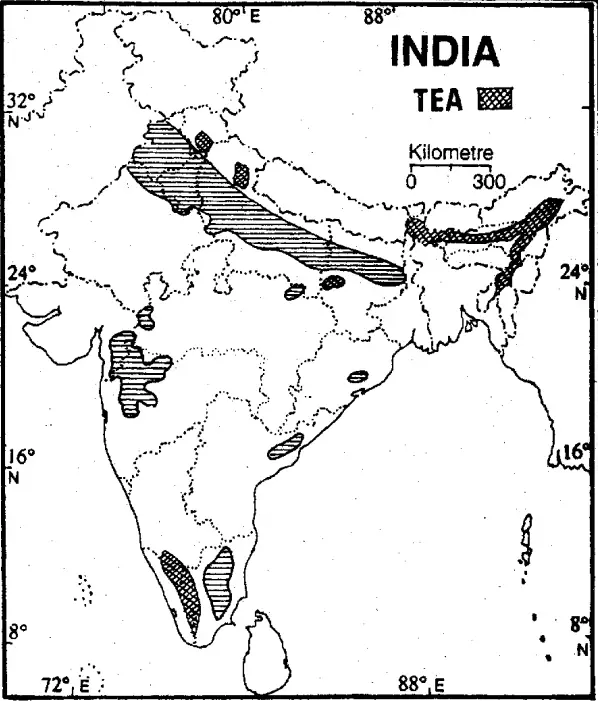
WBBSE Solutions For Class 10 Geography And Environment India - Agriculture Of India Area of production of tea in india

Question 8. What are the areas of production of rice in India?
Answer:

Areas of production:
India is the second largest producer of rice in the world (after China) and its annual production amounted to over 13 crore tons. The country occupies about 28% of the world’s cultivation area under rice. Rice is cultivated in India where facilities of water are available. Rainfall of over 100 cm marks the boundary of rice-producing areas. The most important rice-producing areas of India are the Eastern Ganga Plains, the Brahmaputra valley and the narrow coastal strips forming major parts of Mahanadi, Godavari, Krishna and Kaveri deltas.

The main rice-producing states are
1. West Bengal,
2. Andhra Pradesh,
3. Uttar Pradesh including Uttaranchal,
4. Orissa,
5. Tamil Nadu and
6. Punjab.

1. West Bengal: West Bengal ranks leading position accounting for about 15% of the country’s total production. The major rice-producing districts are Vardhman, Medinipur, N & S 24-Parganas.
2. Andhra Pradesh: It ranks second in the production of rice in India. The Guntur, Kurnool and Nellore districts are leading producers.
3. Uttar Pradesh: It occupies the third position in rice production. The important rice-producing districts of the U.P. are Bahraich, Pilibhit and Kheri. Rice is also grown well in the Doon Valley of U.P.
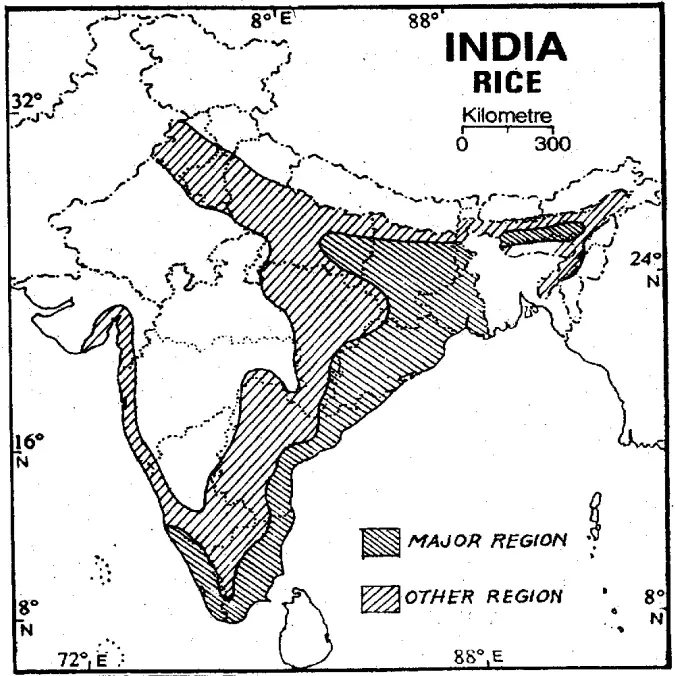
WBBSE Solutions For Class 10 Geography And Environment India - Agriculture Of India Area of production of Rice in india
4. Tamil Nadu: It ranks fourth position in rice production in India. The Kaveri delta produces plenty of rice. The important rice-producing districts are Chennai, Madurai, Coimbatore and Thiruchirapalli.
5. Bihar: It occupies the fifth position in rice production. Darbhanga and Purnea are the important rice-producing districts of Bihar.
6. Others: Other rice-producing states are — Orissa, Punjab, Haryana, Assam, M.P., Kerala and Gujarat.

Question 9. Describe the wheat-producing regions of India.
Answer:

The main areas of wheat production in India are

(1)Uttar Pradesh,
(2)Punjab,
(3)Haryana and
(4)Madhya Pradesh.

(1)Uttar Pradesh: It is the largest producer of wheat, accounting for over 34 per cent of the country’s production. It has the largest area under wheat cultivation. It is grown in almost every part of the state, but the greatest concentration is in the western part. The important districts are Meerut, Saharanpur, Bulandshahar, Aligarh, Agra, Muzzaffarnagar, Kanpur and Mathura.

(2)Punjab ranks second (accounting for about 20 per cent of the total) in wheat production in India. The important wheat-producing districts are Ferozpur, Ludhiana, Patiala and Amritsar.
(3)Haryana occupies third place in wheat production among the states of India. The important districts of this state are Hissar, Ambala, Jind, Rohtak and Faridabad.
(4)Madhya Pradesh ranks fourth position in wheat production. The main wheat-producing districts of M.P. are Sagar, Jabalpur, Share, Gwalior, Indore and Ujjain.
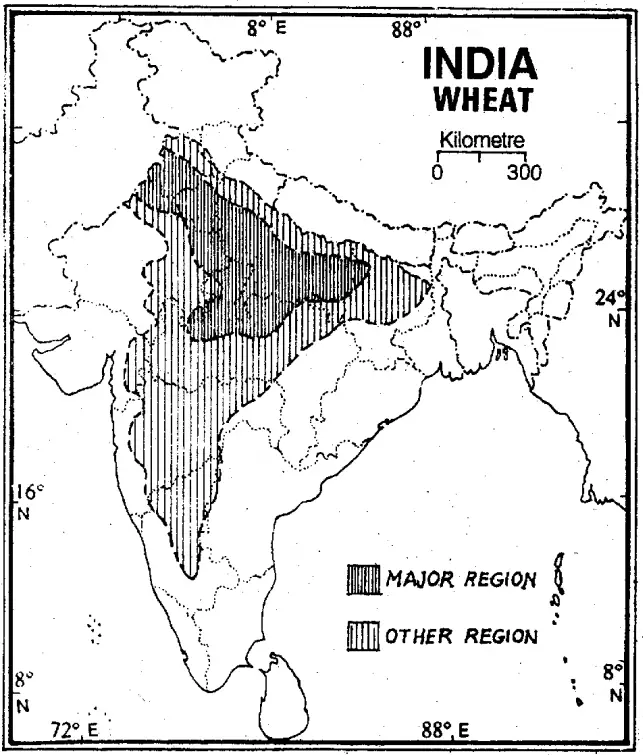
WBBSE Solutions For Class 10 Geography And Environment India - Agriculture Of India Wheat producing regions of india
The other wheat-producing states of India are
(5)Rajasthan (Ganganagar, Kota, etc.),
(6)Bihar (Saran, Champaran, Gaya, Patna),
(7)Maharashtra,
(8)Gujarat,
(9)West Bengal,
(10)Karnataka,
(11)Jammu and Kashmir,
(12)Himachal Pradesh and
(13)Jharkhand.

Question 10. Discuss the major coffee-producing regions of India.
Answer:

Areas of Production: Coffee is produced entirely in South India. Karnataka, Kerala and Tamil Nadu are the chief coffee-producing states. Nilgiri area is the most popular coffee-producing region.

1. Karnataka: About 60% of the total area under coffee crops in India is in Karnataka state. It produces about 65% of the total coffee output in India. Most of the coffee produced here is of Robusta variety. Here the plantations are mostly confined to the South and West, particularly in the districts of Kadur, Shimoga, Hasan and Mysore. Chikmagalur district has the largest concentration of coffee area, about 35% of the country’s total coffee land. It produces about 34% of the total production.
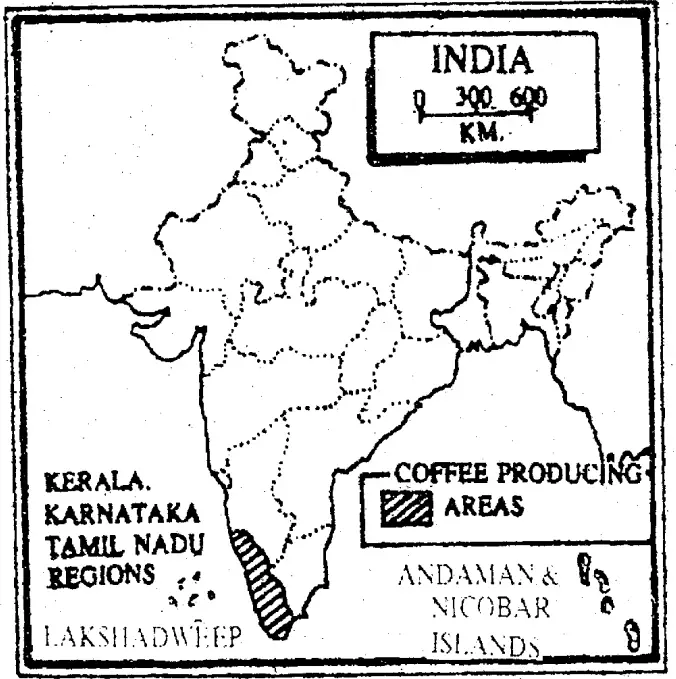
WBBSE Solutions For Class 10 Geography And Environment India - Agriculture Of India Area of production of Coffee Producing areas in india

2. Kerala: Kerala is the second coffee-producing state of India. It produces about 22% of the total coffee output. In Kerala coffee is grown at an altitude of 1200 ft. It is mostly produced in the north Coorg district. Travancore, Cochin and Malabar districts are other producers.

3. Tamil Nadu: Tamil Nadu is the third largest coffee-producing state of India. It produces about 16% of the total output. In Tamil Nadu plantations are found mostly in the southwest from North Arcot to Tirunelvelli including the western areas. The Nilgiri is the most productive area, followed by the Madurai and Salem districts of Tamil Nadu.

4. Others: Some coffee is also. grown in Belgaum, Satara and Ratnagiri districts of Maharashtra. Attempts are also being made to grow coffee in areas like Araku valley of Andhra pradesh, in some parts of W.B. and Andaman Islands.

Question 11. Name the major cotton-producing areas of India.
Answer:

Areas of production: India stands in second position in the world in cotton production and ranks first in the world under cotton cultivation. About 70% of the total cotton-producing area comprises the black cotton soil area of Gujarat, Maharashtra, Madhya Pradesh, Karnataka, Andhra Pradesh and Tamil Nadu.

(1)Gujarat: It produces about 28% of the total with 25% of the total area under cotton. Ahmedabad, Mahesana, Bharuch, Kaira, Vadodra, Sabarkanta, Surat, Panchmahals, Gohilwad, and Amreli are the main producing regions.
(2)Maharashtra: It raises 18% of the crop with 30% of the total area. Important cotton-producing districts are West Khandesh, Buldhana, Akola, Yeotmal, Amravati, Wardha, Aurangabad, Adilabad, Dhulia, Jalgaon, Nagpur, Prahatni and Bhir.
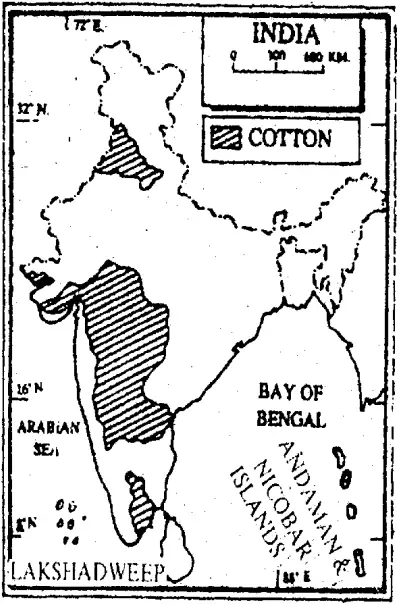
WBBSE Solutions For Class 10 Geography And Environment India - Agriculture Of India cotton producing areas of india

(3)Madhya Pradesh: It contains 9% of the area and provides about 3% of the production. The principal cotton-producing districts are Indore, Ujjain, Ratlam, Bhopal, Raipur, etc.
(4)Tamil Nadu: It raises 7% of the crop with 4% of the total area. Principal cotton-producing districts are Tiruchirapalli, Tirunelvelli, etc.

(5)Karnataka: It has 13% of the area and provides about 11% of the production. Bellary, Hasan, Bijapur, Mysore, Raichur, etc. are the main cotton-producing districts.
(6)Andhra Pradesh: It produces about 6% of the total with about 5% of the area.
(7)Punjab: It contributes about 16% of the total, with about 6% of the total area. Patiala, Ludhiana, Gurdaspur, Sangrur, Ferozpur, Ambala, Hoshiarpur and Bhatinda are the principal cotton-producing districts.

Question 12. Suggest how agriculture can be improved in India.
Answer:

Agriculture can be improved in the following ways :

(1)Scientific soil improvement: Scientific soil Management can increase agricultural production.
(2)Use of machines, especially tractor, etc. wherever necessary: Use of machinery, “especially tractors,” harvest threshers, etc. can increase the amount of production.

(3)Supply of good seeds: Ordinary seeds can not yield huge production. But HYV seeds like Hira, Moti, Culture-16, Culture-64, Jaya, Padma, IR-8, IR-16, MCU-5, MCH-6,etc. can produce more crops per hectares.
(4)Scientific water management: Irrigation and drainage system should be managed scientifically where rainfall is not sufficient or is in excess.

(5)Supply of fertilizer and pesticides: These can increase the production per hectare. The use of chemical fertilizers and pesticides can increase agricultural production.
(6)Agricultural knowledge: Cultivators should be given proper training in this connection. Arrangements should be made for the supply of educated labour, means of transport, marketing and selling of the crops at good rates.

Question 13. What are the physical conditions required for the production of rice?
Answer:

Rice is primarily a crop in the Tropics and Subtropics. It requires the following physical conditions for its growth:

1. Climatic conditions: Rice is a crop of the Tropical Monsoon land. It requires a hot and humid climate.

(1)Temperature: It needs a temperature of over 16°C to 20°C for its cultivation. The temperature must be higher during the growing season. It thrives well in plenty of bright sunshine with an average temperature of 27°C and water.
(2)Rainfall: Rice requires abundant rainfall, ranging from 150 cm to 200. cm. Plant of water is necessary at the time of early growth and transplantation. Water should remain standing on the ground up to 5 cm to 10 cm in the rice field in the earlier part of its growing season.

2. Land: Rice requires flooded fields. Extensive plains and lowlands provide excellent conditions for paddy cultivation. On hills and mountains, rice is grown on terraces.
3. Soil: Rice grows on a wide variety of soils, but alluvial loam with subsoils of clay is ideal. Level lands with alluvial soils of the river valleys and deltas are ideal for rice cultivation.
4. Agricultural labour: Rice cultivation requires cheap and abundant labour, as most of the work in rice fields, such as sowing, transplanting and harvesting are done by hand.

5. Other requirements: The other requirements of rice cultivation include
(1)Chemical fertilizer,
(2)Irrigation,
(3)Seeds,
(4)H.Y.V. seeds and
(5)capital.

Question 14. What are the favourable factors for the cultivation of Wheat in India?
Answer:

Wheat requires the following geographical and economic conditions for its growth:

Favourable Geographical Conditions:
1. Climate: Wheat is a crop in a temperate zone. Wheat requires a moderately cool climate with moderate rain. It is a Rabi crop and can be successfully cultivated in temperate climatic conditions of India.

(1)Temperature: The optimum temperature for wheat during its growing period is around 15.5°C. The weather should be warm and moist during the early stages of growth and sunny and dry in the later stages and during the harvest.
(2)Frost-free period: A frost-free period of 100 days is usually required.
(3)Foggy weather: Long gloomy or foggy weather is harmful to plant growth.

2. Soils: The best soil for wheat is either light clayey or heavy loam. Actually, the world’s best wheat comes from the Chernozem soils in the ‘Black Earth’ region of Ukraine.
3. Land: Slightly rolling plains are suitable for wheat cultivation. Plains should be well-drained so that water cannot stand there.

Favourable Economic Conditions:
1. Irrigation: Wheat can also be cultivated in areas of less than 50 cm of rainfall by practising irrigation or dry farming methods.
2. High Yielding Variety: The uses of HYV of seeds like Larma-Rajo, Sonera-63, Sonera-64, Sona-227, and Sonalika-308 have promoted the average yield per hectare.
3. Labour: Labour factor is not as important in wheat cultivation as in the case of rice.

4. Other requirements:
(1)Adaptation of scientific methods,
(2)Introduction of farm machinery like tractors, harvesters, winnowers, threshers, elevators, etc.
(3)Improvement in transport,
(4)Financial capital, etc. are the other requirements of wheat cultivation.

Question 15. Explain the major characteristics of Indian agriculture.
Answer:

The major characteristics of Indian agriculture

1. Subsistence agriculture: Most parts of India have subsistence agriculture. The farmer owns a small piece of land, grows crops with the help of his family members and consumes almost the entire production with little surplus to sell in the market.
2. Pressure on population: The population in India is increasing at a rapid pace and exerts heavy pressure on agriculture. Agriculture has to provide employment to a large workforce and also feed the teeming millions.

3. Pre-dominance of animal force: Animal force plays an important role in ploughing irrigation, threshing and transporting agricultural products. Complete mechanisation of Indian agriculture is still a distant goal.
4. Uses of irrigation: Indian agriculture is mainly dependent upon monsoon, which is uncertain, unreliable and irregular. In spite of the large-scale expansion of irrigation facilities since independence, only 1/3 of the cropped area is provided by perennial irrigation.

5. Small size of land holdings: Laws of inheritance of property have caused fragmentation of large land holdings. This causes a loss of cultivable land and reduces production significantly.
6. Uncontrolled use of pesticides and chemical fertilisers: The use of chemical fertilisers initially boosts agricultural produce, but damages the soil in the long run. Uncontrolled use of pesticides also affects fertility and reduces production.

7. Predominance of food crops: Since Indian agriculture has to feed a large population, the production of food crops is the first priority. More than 2/3 of the total cropped area is devoted to the cultivation of food crops.
8. Insignificant place given to fodder crops: Although India has the largest population of livestock in the world, fodder crops are given a very insignificant place in the crop calendar. Only 4% of the land is under permanent pastures. This is due to the tremendous need for food grains. The result is that domestic animals are not properly fed and their productivity is low.

9. Variety of food crops: India is a vast country with a variety of relief, climate and soil conditions. Therefore, a large variety of crops are grown all over the country depending upon suitable conditions.
10. Dependence on monsoon: Indian agriculture is highly dependent on monsoon rains. The choice of crops in areas is directed by the availability of rainfall in those regions, e.g. water-loving crops like rice, jute, etc. are cultivated in eastern India, while millets are cultivated in the dry western regions. But irregular and uncertain nature of the monsoon rains often results in crop failure.

Question 16. Divide and explain crops on the basis of season.
Answer: In India, different crops are sown in different seasons. There are two major crop seasons in India:

1. Kharif: The Kharif crops are associated with the South-west Monsoon. They are sown in the months of June and July and harvested in the autumn months, ie., in September and October. Important Kharif crops are rice, jawar, bajra, ragi, maize, sugarcane, cotton and jute.

2. Rabi: The rabi season begins with the onset of winter in October-November and ends in March-April. The low temperature conditions during this season help the cultivation of temperate and subtropical crops like wheat, barley, peas, linseed, rapeseed, gram and mustard. Besides the Kharif and Rabi crops, there are certain crops which are raised throughout the year. They are known as ‘Zaid’.

They include:
1. Zaid Kharif Crops: These are sown in August and September and harvested in December and January. Most oilseeds like mustard are grown in this season.
2. Zaid Rabi Crops: These crops are sown at the beginning of the hot season in February and March and are harvested in the month of April and Mey. Summer vegetables, jowar, maize, watermelons, cucumbers, etc. are important among these crops.

Question 17. Classify and explain crops on the basis of nature.
Answer:

Crops can be classified on the basis of their nature as:

1. Food crops: The plants that are grown with the primary purpose of being consumed or éaten by humans and animals, e.g. rice, wheat, millets, pulses, oilseeds, etc.
2. Fibre crops: These crops are grown for their fibres which are used to make paper, cloth or rope, e.g. cotton, jute, mesta, etc.

3. Plantation crops: A plantation crop is one crop which is specifically planted in a large piece of land (a plantation) in tropical or semi-tropical areas and grown on a commercial basis. E.g. tea, coffee, rubber etc.
4. Cash crops: A crop produced for its commercial value rather than for use by the grower, E.g tea, coffee, etc.

5. Others: Among other crops, there are forage crops (food for animals) like sorghum, elephant grass, etc.; root crops like sweet potato, sugarcane, sugarbeet, turnip, etc.; tuber crops like potato, yam, etc.; sugar crops like sugarcane, sugarbeet; drug crops like tobacco, mint, etc.; spices like ginger, garlic, chili, cumin, onion, coriander, turmeric, etc.; vegetable crops like brinjal, tomato, etc.; aromatic crops like lemongrass, palmarosa, rose, jasmine, henna, etc.

“Class 10 WBBSE Geography Agriculture of India important questions”

Question 18. What are the problems of wheat production in India?
Answer:

Problems of wheat production in India

It is practically true that the hectarage of wheat production in India has much improved today but in the world, there are countries enjoying much greater hectarage. Besides, in India rice is more popular than wheat firstly as a food crop and secondly as a commercial crop.

The constant problems are as follows:
1. Comparatively Low YPH: Wheat production in India per hectare is 2510 kg, whereas, in Germany, it is 7,283 kg, in France, 6,632 kg, in China, 4,087 kg, and in Ukraine the hectarage is 3,137 kg.

2. Lack of Desired Popularity: Wheat production in India suffers from limitations because as a foodgrain it is less popular than Rice (a staple food in India). India is self-sufficient in wheat production today, nevertheless, statistically rice occupies the crown, forin 1996-97 India produced 813.14 lakh tonnes of rice (from 432.83 lakh hectares of and-area) whereas (from 259.34 lakh hectares of land-area) the result of wheat-culture was 692.75 lakh tonnes.

3. Limited Area of Production: As a whole, most of the fertile agricultural land in India is climatologically ready for the culture of Kharif crops, so rice enjoys a comparatively larger area. But, wheat is a Rabi crop and holds much less portion of cultivated area in the country. In 1996-97 total land area devoted to wheat cultivation was 259.34 lakh hectares, whereas rice cultivation it was 432.83 lakh hectares.

4. Concentration of Culture in North-West India: The largest wheat area is found in and around the Ganga-Sutlej Plains in India. The key states are U.P., Punjab, Rajasthan, Haryana and the north-western parts of M.P. This is because of the favourable geographical conditions of the growth of wheat prevailing in the above area. On the contrary, peninsular India does not offer all such favours for wheat cultivation. Barring Andhra Pradesh, south India is not important for wheat culture. The production over here is meagre.

5. Decreasing Productivity of Soil: Wheat is predominantly a crop grown over the arid or semi-arid zones in India. Though it is a Rabi crop, irrigation is a must for its cultivation especially when there are
1. Use of HYV seed,
2. Double cropping,
3. Useof chemical fertilizers. Much use of irrigation results in an increase in the amount of salt in the soil and a decrease in productivity. Wheat fields of Punjab, Haryana and Rajasthan are thoroughly irrigated and so excess salt is retained in the soils.

6. Increase in the Price of Fertilizers and Insecticides: At the present time, the price of chemical fertilizers and insecticides has risen too high to remain within the purchasing capacity of the farmers. This leads to the farmers’ discouragement that is hampering wheat production to a large extent. Agricultural loans through the Credit Cell of the Government are assisting the farmers remarkably but this does not reach the satisfactory goal.

7. Backwardness of the Farmers in India: In spite of the implementation of modernity and various facilities towards wheat cultivation and cultivators, the improvement of the hectarage and the impetus behind it proved fruitless. Otherwise, Indian hectarage of wheat could compete with that of China or France.

The main reason behind this is the backwardness of the farmers in India, which can be parted out into two socio-economic menaces eroding rural India:
1. Poverty and
2. ignorance HYV seeds of wheat have been introduced. The success of HYV depends upon the input of recommended dosages. But due to poverty and ignorance, cultivators became unable to use the dosage properly.

Question 19. Suggest some measures to fight the problems of wheat cultivation in India.
Answer:

Measures to Fight the problems of Wheat Cultivation: In order to fight the problems of wheat cultivation in India, some steps have already been taken and some have been recommended. They are pointed out as follows :

1. The Indian Council of Agricultural Research is working in full cry to work out the correct measures for solving the problems of wheat cultivation in India.
2. HYV seeds of wheat have been introduced.
3. Lands utilized for inferior-quality food crops are being used as wheat-producing areas. Thus wheat is gradually becoming as popular as rice.
4. Irrigation network is becoming more extensive and for this new canals are built and new dams and barrages are constructed under new river-based projects.
5. More land area is being utilized for double cropping of wheat.
6. Special importance is being given to more utilization of chemical fertilizers.
7. Wheatlands of eastern India and the Indian Peninsular region are now under special consideration. Besides, in North-West India, the Government is now serious to enhance the hectarage of wheat as also in other once neglected wheatlands of India.
8. Frequent light irrigations, correctly timed irrigations, and the use of gypsum on sodic soils for conversion are some of the methods being applied in order to eradicate the salinity of wheat soil.

Question 20. Mention the favourable factors for the cultivation of millets.
Answer:

Favourable factors for the cultivation of millets:

Areas not suitable for the cultivation of rice or wheat are devoted to millet.

1. Climatic conditions: |t is widely grown in tropical countries like India.

Temperature:It needs a temperature between 25°-32°C for its growth.

Rainfall: It is a hardy crop. So, rainfall between 40 cm—75 cm is good for its growth.

2. Land: Flat or undulating land is suitable for its cultivation.
3. Soil: It can grow on less fertile. soil ranging from-dry alluvium to infertile red soil.
4. Agricultural labour: Cheap labour is required during sowing and harvesting periods.

5. Other requirements:
1. Irrigation: It grows in large amounts in well-irrigated lands.
2. High yielding variety of seeds like CSH 5 and 6 for jowar and BJ104, and BK560 are required for growing them well.
3. Fertiliser,
4. Capital,
5. Port and
6. Market are also another requirement of the crop.

Question 21. What are the favourable factors for sugarcane cultivation?
Answer:

The favourable factors for the cultivation of sugarcane are:

1. Physical conditions:
Temperature:
Sugarcane matures in 10 to 18 months depending on the climate. Sugarcane grows best in areas with 20°C to 26°C temperatures. Its growth starts at a mean temperature of about 20°C and the growth accelerates with an increase in temperature up to 24°C and finally stops at 26°C. Frost is fatal for sugarcane crops. A short cool dry winter season during ripening and harvesting is ideal.

Rainfall: Sugarcane grows well in tropical regions with 100-150 cm of rainfall well-distributed throughout the year. However, irrigation is necessary in areas of lower rainfall or even in areas of higher rainfall during long dry spells. The sucrose content decreases if heavy rains continue for a long and a rainfall deficiency produces a fibrous crop. A slightly dry sunny weather is necessary during the ripening stage of the cane.

Soil: Sugarcane and clayey loams of the Great Plains and on black soils, brown or reddish loams and laterites in Peninsular India. Sugarcane exhausts the fertility of the soil. Hence, the soil is supplemented with manures and nitrogenous fertilizers.

Favourable economic conditions:
Labour:
It is a labour-intensive method of cultivation. Weeding, manuring, field preparation, planting and harvesting have to be done by hand.

Capital: A large capital is needed invariably to grow this plantation crop.
Fertilisers: It is a soil-exhausting crop. Hence good fertilisers are required.

Other requirements:
1. Well developed transport network is necessary for its quick transport from fields to the factory (refinery). The juice extracted from the plant dries up easily and its sugar content decreases if it is not extracted within a day (24 hours).
2. Fertiliser,
3. Port and
4. Market are another important factor.

Question 22. State the favourable factors for the growth of tea in India.
Answer:

Tea requires the following favourable geographical and economic conditions for growth:

Favourable Geographical Conditions:
1. Climate:
Tea is a sub-tropical plant and needs a hot and wet climate.
Temperature: Tea requires temperatures between 10°C and 35°C. The growth is retarded if it falls below 18°C. The most suitable temperature for tea growth 25°C.
Rainfall: The tea plant needs rainfall varying between 150 cm and 200 cm. The rainfall should be well-distributed throughout the year. It cannot withstand long spells .of dry weather at any season of the year.
Humidity: High humidity, heavy dews and morning fog favour the rapid development of young leaves.
Winter frost: Widespread winter frost is harmful to the crop.
Shade: Tea is a shade-loving plant and develops more vigorously under light shade. Shade plants are generally grown in tea gardens to avoid direct sunshine on tea.

2. Relief: Almost all the commercially-managed tea plantations are located in highlands and on hill slopes where the natural. drainage is good. Tea cannot tolerate stagnant water and thus waterlogged lowland areas are least suited to tea cultivation.

3. Soils: Tea requires well-drained sandy loam with porous subsoil. The sandy loam is considered the best soil for tea cultivation. The soil must be deep and have a moderately open texture. Virgin forest soils, containing a good deal of iron and humus, are ideal for tea cultivation.

Favourable Economic Conditions:
1. Labour:
Tea cultivation and processing are labour-intensive. The work of field preparation, weeding, manuring, pruning and picking goes on all year round on the tea estates. Tea plucking requires an abundant supply of cheap labour. Female labour is preferred for tea picking because it is a tedious job, requiring both skill and patience. Plucking demands a skilled manipulation of fingers, as with care, two leaves and bud are to be plucked out at a time.

2. Capital: Tea is very capital-intensive cultivation. Tea estate requires a heavy amount of capital.
3. Fertilizer: Tea is an exhausting crop, and as such, requires manuring of the soil.

Question 23. Account for the agricultural prosperity of Punjab & Haryana.
Answer:

Punjab and Haryana are two of the 29 states of India located in the North-Western part of India, roughly between 27°N-32°N and 73°E-77°E. The states are situated on the fertile alluvial plain which is arable and is irrigated by submersible pumps and an extensive canal system. Punjab and Haryana contributed heavily to the green revolution that made India self-sufficient in food production in the 1960s. In 1961 India was on the verge of mass famine.

Norman Borlaug, the father of the Green Revolution in the world, was invited to India to tackle the situation and take initiative to increase agricultural crop production. Punjab and later Haryana were selected as the sites to try new crops because of their reliable water supply. India thus began the Green Revolution which led to the agricultural prosperity of Punjab and Haryana.

The measures adopted in Green Revolution were:
1. Use of High Yielding Variety (HYV) seeds,
2. Irrigation,
3. Use of insecticides and pesticides,
4. Consolidation of holdings,
5. Land reforms,
6. Transforming single cropping land to multiple cropping land,
7. Introduction of modern agricultural implements and machinery,
8. Use of sprinklers or drop irrigation technique,
9. Use of quality manure and chemical fertilisers,
10. Supply of agricultural credit, and
11. Educational programmes for agriculture under ICAR (Indian Council of Agricultural Research), etc. The spectacular rise in the production of cereals, particularly wheat, ushered in a new era of agricultural prosperity in these states. Due to this our country also became self-sufficient in foodgrain production.

Import of food grains. has been reduced and through the export of grains India is earning foreign production. With the development of agriculture, many agro-based industries have been set up in these states which provide employment to a large number of people, leading to the prosperity of the farmers.

Question 24. State the problems of rice cultivation with their solutions.
Answer:

Rice production in India has many problems:

1. Rice yield per hectare is low. So high-yielding varieties of seed, fertilizers, insecticides, etc. should be introduced to increase rice yields per hectare.
2. Farmers do not get a suitable price for their rice production as middlemen buy it cheaply from them at harvest time and sell it at a higher price making profits themselves. Thus, cooperatives should be set up, procurement prices should be prefixed by the Govt.’s Food Corporation. They should come forward to sell the rice in the market so that the profits are enjoyed by the farmers.
3. Proper storage facility of rice is not available. Unless more storage facilities are created, high production would be pointless as they would be damaged while being improperly stored.
4. Proper distribution of land needs to be undertaken as rice cultivation is mainly done by landless labourers and not by the land owners. So proper attention to cultivation is not given.

Question 25. State some problems of the Green Revolution.
Answer:

Problems of Green Revolution: The Green Revolution has been a unique event in the agricultural history of independent India, as it has saved the country from the disasters of hunger, and starvation and also made Indian peasants more confident than ever before. But it has its own inherent deficiency segments.

Ever since its inception, the income gap between large, marginal and small farmers has increased; the gap between irrigated and rain-fed areas has widened and some crops have benefited more than others, even at the cost of other crops. This has also given birth to a plethora of socioeconomic problems.

The spiralling prices of fertilizers, the tendency to use them frequently and the stagnant wheat and rice yields in Punjab and Haryana have combined to confirm that Green Revolution has reached an old age. The fatigue of the Green Revolution is also.

visible: Some of the problems of the Green Revolution are:
1. Inter-Crop Imbalances: The effect of the Green Revolution primarily has been felt on foodgrains including wheat, rice, jawar, bajra, and maize and the production of these crops has gone high. But it has wrested areas from coarse cereals, pulses and oilseeds.

2. Regional Disparities: The Green Revolution technology has given birth to growing disparities in economic development at inter-regional and intra-regional levels. It has so far affected only 40% of the total cropped area and 60% is still untouched by it. The most affected areas are Punjab, Haryana, Western Uttar Pradesh, A.P., and Tamil Nadu in the south but it has hardly touched the eastern region including Assam, Bihar, West Bengal, Orissa and arid and semi-arid regions. The green revolution also affected to only areas which were already better from an agricultural point of view.

3. Unemployment: Except in Punjab and Haryana farm mechanization under Green Revolution has created widespread unemployment among agricultural labourers in the rural areas and the worst hit are the poor and landless people.

4. Other Related Problems: Agriculture under Green Revolution has not grown at the rate which was expected in the beginning. The high-yielding variety seeds are also responsive to certain key inputs such as fertilizers, and irrigation; as a result, there is also an increase in the cost of production. Some experts have also commented that the indigenous varieties could also be high yielding under required doses of inputs.

Some experts have also blamed the green revolution for destroying natural mechanisms for controlling pests though due to the loss of diversity the miracle seeds of the green revolution have become a mechanism for breeding new pests and creating new diseases.

The excessive use of groundwater for proceeding irrigation to high-yielding variety seeds has also led to large-scale depletion of groundwater and the use of chemical fertilizers and pesticides has severely affected the health of the soil.

Though the green revolution did increase food grain production in the country it has been achieved at the cost of intensive use of irrigation water, fertilizers and other inputs. This has resulted in problems of soil salinization, groundwater pollution, nutrient imbalances, the emergence of new pests, diseases and environmental degradation.

This has also given the problem of regional inequality to the matter of income and production and only the western and some southern part of the country have got the maximum benefit of the green revolution. The green revolution has only benefited some big enterprising farmers whereas the majority of the marginal and small farmers are deprived of benefits. Thus, the overall. impacts of green revolution have failed to influence the agricultural sector.

“WBBSE Geography and Environment Agriculture of India solutions PDF”

Considering all these facts the pioneer of the Indian Green Revolution, Mr M. S. Swaminathan, presently chairman of the National Commission on Farmers, also gave a new call for another green revolution for doubling the present production level of food grains. For making it a success, he stressed on adopting the best scientific techniques and promoting organic farming.

The government has also given urgent attention to initiating another green revolution. The approach paper to Eleventh Plan has aptly highlighted such a holistic framework and suggested the following strategy to raise agricultural output. Such as-

1. Doubling the rate of growth of irrigated areas.
2. Improving water management, rainwater harvesting, and watershed development.
3. Reclaiming degraded land and focusing on soil quality.
4. Diversifying agricultural productivity into high-value outputs such as fruits, vegetables, flowers, herbs, spices, medicinal plants, and biodiesel but with adequate measures of food security.
5. Promoting animal husbandry and fishery.
6. Providing easy access to credit at affordable rates.
7. Improving the incentive structure and functioning of markets and refocusing on land reform issues.

Thus, the approach to the second green revolution seems to aim at the efficient use of resources and conservation of soil, water and ecology on a sustainable basis and in a holistic framework.

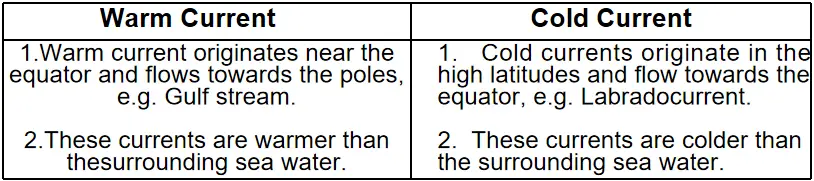
WBBSE Solutions For Class 10 Geography And Environment Chapter 3 Hydrosphere

Class 10 Geography West Bengal Board Chapter 3 Hydrosphere True Or False Type:

Question 1. Floods occur in India during the years of El Nino.
Answer: False

Question 2. The position of the sun, moon and earth along a straight line is known as syzygy.
Answer: True

Question 3. The salinity of seawater is maximum in the Equatorial region.
Answer: False

Read and learn all WBBSE Solutions For Class 10 Geography And Environment

Question 4. Change of seasons is observed in the Equatorial region.
Answer: False

Question 5. The drought conditions develop in the western coast of South America due to the influence of El Nino in the Pacific Ocean.
Answer: False

“WBBSE Solutions for Class 10 Geography Chapter 3 Hydrosphere”

Question 6. ‘Chinook is an example of seasonal wind.
Answer: False

Question 7. Kuro Shio current flows near the coast of China & Japan.
Answer: True

Geography Class 10 West Bengal Board

Question 8. Flumbolt current flows along the West Coast of South America.
Answer: True

Question 9. Gulf Stream flows towards the North through the Gulf of Mexico.
Answer: True

Question 10. Guinea current flows towards the West Africa Coast.
Answer: True

Question 11. The Sargasso Sea is situated at the middle of the North Atlantic Ocean.
Answer: True

Question 12. Labrador is a cold current from the Arctic Ocean.
Answer: True

Question 13. Venezuela currently flows near the coast of South-West Africa.
Answer: True

Question 14. Peru is a cold current of the Pacific Ocean.
Answer: True

Question 15. Madagascar current flows along the East coast of Madagascar Island.
Answer: True

Question 16. Mozambique current is a warm current.
Answer: True

Question 17. Madagascar and Mozambique currents unite together to form Agulhas current.
Answer: True

Question 18. The wind is responsible for the origin of ocean current
Answer: True

Question 19. Brazilian Current occurs in the Atlantic Ocean.
Answer: True

Question 20. The shape of the coastline exerts some influence in the direction of the currents.
Answer: True

Question 21. Benguela current is found on the South Eastern coast of Africa.
Answer: False

Question 22. The planetary winds play a major role in the formation of ocean currents.
Answer: True

Question 23. Monsoon wind is an example of local wind.
Answer: False

Question 24. The polar region has a low-pressure belt.
Answer: False

Geography Class 10 West Bengal Board

Question 25. Tropical cyclone causes disasters.
Answer: True

Question 26. The stratosphere is the lowest layer of the atmosphere above the earth’s crust.
Answer: False

Question 27. In the confluence of warm and cold currents fishes are abundant.
Answer: True

Question 28. A Humboldt current is a warm current.
Answer: False

Chapter 3 Hydrosphere Fill in The Blanks Type:

Question 1. With the increase of air pressure gradient, wind velocity ______.
Answer: Increase.

Question 2. The cold ocean water from the polar region flows as ______ current towards equator.
Answer: Under Current.

Question 3. ______current causes snowfall in New Foundland.
Answer: Labrador.

Question 4. During high tide huge tidal waves entering through the mouth of a river from the sea are called ______
Answer: Tidal bore.

Question 5. ______ force of the earth causes secondary high tide.
Answer: Centrifugal.

Question 6. Air conditioners emit ______ gas into the atmosphere.
Answer: CFC.

Question 7. Pull of the ______ is responsible for tides.
Answer: Moon.

Question 8. The Sargasso Sea is found in the ______ ocean.
Answer: Atlantic.

Question 9. Tidal bores are common in the ______ river of China & Hooghly in India.
Answer: Yangtze Kiang.

Question 10. The interval between two high tides is ______.
Answer: 12 hrs 26 m.

Question 11. ______ tides are caused by the gravitational pull of the sun &the moon.
Answer: Spring/High.

Question 12. Tides occurring at the opposite side of the spring tide are called ______ tides.
Answer: Secondary.

Question 13. Alternate rise and fall of sea water are called _______.
Answer: Tides.

Question 14. Primary tides are also known as ______ tides.
Answer: Direct.

Question 15. Tides make rivers ______.
Answer: Navigable.

Question 16. The interval between high trades and low tides is ______.
Answer: 5 hrs 13 ms.

Question 17. Warm currents keep the coastal areas ______.
Answer: Warm.

Question 18. Cool currents keep the coastal areas ______.
Answer: Cool.

Question 19. Labrador is a cold current of the ______.
Answer: Atlantic ocean.

Question 20. ______ flows along the southwest coast of South America.
Answer: Humboldt current.

“Class 10 Geography and Environment Hydrosphere solutions WBBSE”

Question 21. Grand Bank is famous for ______.
Answer: Commercial fishing.

Question 22. North Indian ocean currents are dominated by ______.
Answer: Monsoon wind.

Question 23. ______ is responsible for the origin of ocean currents.
Answer: Prevailing winds.

Question 24. Ocean currents deflect due to the movement of the earth’s gravitational.
Answer: Rotational.

WBBSE Solutions For Class 10 Geography And Environment Chapter 3 Hydrosphere

Geography Class 10 West Bengal Board Chapter 3 Hydrosphere Very Short Answer Type:

Question 1. Name the southernmost mountain pass of the Western Ghats.
Answer: Palghatgap

Question 2. What is the local name of the lagoons in the Kerala coast?
Answer: Koyal

Question 3. On which quarters of the moon, does Neap tide occur?
Answer: Dark and White Half of a lunar month.

Question 4. What is the main food of marine fish?
Answer: Planktons.

Question 5. What type of current originates in the tropical oceans?
Answer: Warm Current

Question 6. What is the time interval between two primary high tides and two secondary high tides?
Answer: 24 hrs 52 mins.

“WBBSE Class 10 Geography Chapter 3 solved questions”

Question 7. What is the time interval between two low tides?
Answer: 12 hrs 26 mins.

Geography Class 10 West Bengal Board

Question 8. What is drift?
Answer: If the mass of water moving on the surface of an ocean is broad, slow and shallow, it is termed as drift.

Question 9. What is Tide?
Answer: The alternative rise and fall of seawater is called Tide.

Question 10. Name three forms of movement of oceanic water.
Answer: Waves, currents, and tides.

Class 10 Maths Class 10 Social Science
Class 10 English Class 10 Maths
Class 10 Geography Class 10 Geography MCQs
Class 10 History Class 10 History MCQs
Class 10 Life Science Class 10 Science VSAQS
Class 10 Physical Science Class 10 Science SAQs

Question 11. Give one term for each of the following statements:
1. The time taken by two consecutive crests to pass any fixed point.
2. Vertical distance between a trough and a crest of a wave.
3. An oscillatory movement in a body of water manifested by an alternate rise and fall of the surface.
4. The breaking waves in a coastal region.
5. Currents flow from low latitudes to higher ones.
6. A vertical wall of tidal waters moving upstream in the river channel.

Answer:
1. Wave period.
2. Wave height.
3. Ocean wave.
4. Surf.
5. Warm currents.
6. Tidal bore.

Question 12. Name three types of waves generated by wind.
Answer: Sea, Swell and Surf.

Question 13. What are the different types of currents?
Answer: Warm currents and cold currents.

Class 10 Geography West Bengal Board

Question 14. What are warm currents?
Answer: Warm Currents: Currents flowing from equatorial regions to polar regions on the surface of the oceans due to their lightness.

Question 15. What are cold currents?
Answer: Cold Currents: Currents flow from polar regions to equatorial regions under the surface of the oceans due to the cold water being heavy.

Question 16. Why are oceans and seas often called inner space?
Answer: Oceans and seas are sometimes called ‘inner space’ because the space occupied by them is covered with water.

Question 17. What do you mean by ‘Sargasso Sea’?
Answer: Sargasso Sea is stagnant water where seaweeds grow and accumulate and it is found in the North Atlantic and North Pacific Oceans.

Question 18. In which ocean ‘the Cold Wall’ is found?
Answer: ‘The Cold Wallis is found in the Atlantic Ocean.

Question 19. Name the deepest lake in the world.
Answer: Lake Baikal is the deepest lake (1620 m) in the world.

Geography Class 10 West Bengal Board

Question 20. How much is the gap of time between the two primary tides?
Answer: The gap of time between the two primary tides is 24 hours and 52 minutes.

Question 21. What is an iceberg?
Answer: An iceberg is a broken mass of ice from a coastal glacier floating in the ocean.

Question 22. Which ocean current keeps the coastline of Japan warm?
Answer: The warm Kuroshio Current keeps the Japanese coast warm.

Question 23. Which one is the largest lake in the world?
Answer: The Caspian Sea (4,38,700 sq. km) is the largest lake in the world.

Question 24. Name the saltiest lake in the world.
Answer: Dead sea is the saltiest lake in the world; even fish cannot live in it.

Question 25. What do you know about evaporation regarding ocean currents?
Answer: Evaporation: More evaporation reduces the amount of water and lowers its level. In order to maintain the balance, water from other areas starts flowing in the form of a current.

Question 26. What is ocean current and how does it differ from the wave?
Answer: The regular movements of water from one part of the ocean to another are called ocean currents. They differ from waves. The waves are the movements of surface water of the ocean and sea with only rise and fall of the water surface and there is no onward motion as in ocean current.

Question 27. Mention one cause of ocean currents.
Answer: Planetary wind.

Question 28. Where do you find the Sargasso Sea?
Answer: In the North Atlantic Ocean.

Question 29. In which sea the salinity is maximum-Baltic Sea/Mediterranean Sea?
Answer: Mediterranean Sea.

Question 30. Name the longest lake in the world.
Answer: Lake Tanganayika.

Question 31. What is Grand Bank?
Answer: A fishing centre near Newfoundland.

Question 32. Mention the factors affecting ocean currents.
Answer: Temperature, wind velocity, salinity and rotation of the earth.

Question 33. Name one man-made lake in India.
Answer: Govind Sagar (Himachal Pradesh).

Question 34. Name one tidal river.
Answer: The Hugli (Hooghly) river is a tidal river.

Question 35. How many times a place on the globe experiences high or low tides in a day?
Answer: A place on the earth experiences one high tide and one low tide in a day.

Question 36. How much percentage of the earth is covered with water?
Answer: 71 per cent.

Question 37. Name the deepest place in the ocean.
Answer: Mariana Trench of the Guam Islands (11,033 metres).

Question 38. How much part of the earth’s surface is covered by the Pacific ocean?
Answer: 1/3rd part.

Question 39. What percentage of the ocean floor is covered by the continental shelf?
Answer: 7.5%.

Question 40. What is the length of the Mid-Atlantic Ridge?
Answer: 14,000 km.

Question 41. Name the most common features found on the ocean floors.
Answer: Continental shelf, Continental slope, Continental rise and Abyssal Plain.

Question 42. Why is the earth known as ‘Watery Planet’?
Answer: Because 71% of its surface area is covered by water.

Question 43. Give one term for each of the following statements:
1. A gently seaward sloping surface extending between the shoreline and the continental slope.
2. A flat, nearly level area in the ocean, lying beyond the continental slope.
3. A submarine mountain or peak rising more than 1,000 metres above the ocean floor.

Answer:
1. Continental shelf.
2. Abyssal plain.
3. Seamount.

Question 44. What are the processes heating ocean water?
Answer:
1. Absorption of heat radiation from the sun.
2. Convection of heat through the ocean bottom from the interior of the earth.

Question 45. Name the processes of cooling ocean water.
Answer: Back radiation of heat, convection and evaporation.

Question 46. Name the factors affecting the temperature of ocean water.
Answer: Latitude, prevailing winds, ocean currents, adjacent land waters, salinity and icebergs.

Question 47. At what temperature the density of pure water is maximum?
Answer: At 4°C

Question 48. Name the two most important factors which affect the density of ocean water.
Answer: Temperature and salinity.

Question 49. Give one term each for the following:
1. Floating or stranded masses of ice at least five metres above the level of the sea.
2. Index of the amount of total dissolved solids in seawater.
3. Mass per unit volume of a substance.

Answer:
1. Iceberg.
2. Salinity.
3. Density.

Question 50. Name three forms of movement of oceanic water.
Answer: Waves, currents and tides.

Question 51. Give the formula for finding the velocity of a wave.
Answer:  Velocity of wave (C) = Wavelength(L)/Period(T)

Question 52. Name three types of waves generated by wind.
Answer: Sea, Swell and Surf.

Question 53. What are the different types of currents?
Answer: Warm currents and cold currents.

Question 54. When does spring tide occur?
Answer: On a full and new moon when the earth, moon and the sun are in line with the earth.

“Hydrosphere Class 10 WBBSE solutions and answers”

Question 55. When does neap tide occur?
Answer: In the first and the last quarter of the moon when the sun and the moon make a right angle at the earth’s centre. ”

Question 56. What is the time interval between two successive tides?
Answer: 12 hours and 25 minutes.

Question 57. What is a Bay?
Answer: It is a wide indentation into the land produced by the sea. E.g. Bay of Bengal.

Question 58. What are waves?
Answer: Waves are the oscillatory movements in water, manifested by an alternate rise and fall of the sea surface.

Chapter 3 Hydrosphere 2 Marks Questions And Answers:

Question 1. What do you mean by Perigean Spring tide?
Answer:

Perigean Spring tide:

A Perigean spring tide occurs when the moon is either new or full and closest to Earth. Often between 6-8 times a year, the new or full moon coincides closely in time with the perigee of the moon — the point when the moon is closest to the Earth. These occurrences are often called Perigean Spring tides.

Question 2. What is an Inter-tropical convergence zone?
Answer:

Inter-tropical convergence zone:

Inter-Tropical Convergence Zone: In the winter the Indian climate is influenced by the western disturbances originating from the Mediterranean sea and is characterised by snowfall or rainfall (its influence is seen sometimes up to the plains of West Bengal also). Kashmir, Punjab, and Western U.P. receive snowfall or rain during this time.

Question 3. State the definition of ocean current.
Answer:

ocean current:

The stream of water that flows from one place to another, regularly within the ocean itself, is called an ocean current. Ocean currents are of two types – warm currents and cold currents.

Class 10 Geography WBBSE

Question 4. What is the apogean tide?
Answer:

Apogean tide: When the moon is farthest from the earth (4,03,320 km), this position is known as Apogee. Due to the reduced attraction of the moon, the tide is also 20% less high. This is known as Apogean tide.

Question 5. What is a tidal bore?
Answer:

Tidal Bore: When a tide enters the narrow and shallow estuary of a river, the front of the tidal wave appears to be vertical, owing to the piling of water of the river against the tidal wave and friction against the river bed. The steep-nosed tide crest looks like a vertical water of water rushing upstream. This is called a Tidal Bore.

Question 6. Explain the types of ocean currents.
Answer:

Types of Currents:

Ocean currents are, in broad terms, of two types:

1. Warm currents and
2. Cold currents.

Warm Currents: Movement of ocean water from low latitudes to higher latitudes on the ocean surface.

Cold Currents: Movement of ocean water from high latitudes to low latitudes under the ocean surface.

Question 7. What is Neap tide?
Answer:

Neap tide:

When the sun, the moon and the earth are in the position of right angle, the attractions of the sun and the moon oppose each other which makes the tide weaker and this type of tide is called neap tide, This situation occurs at the first and the third quarters of the moon.

Question 8. What is SYZYGY?
Answer:

SYZYGY:

SYZYGY is a position in which the sun, the moon and the earth lie in the same straight line.

Question 9. what is the Great Barrier Reef?
Answer:

Great Barrier Reef:

Great Barrier Reef, situated in the Pacific Ocean, is the world’s largest coral reef.

Question 10. Differentiate between warm currents and cold currents.
Answer:

Difference between warm currents and cold currents

WBBSE Solutions For Class 10 Geography And Environment Chapter 3 Hydrosphere warm and cold current

Question 11. Ships prefer to sail along ocean currents. Why?
Answer:

Ships prefer to sail along ocean currents

Ships prefer to sail along the ocean currents because ships sailing down the currents surely go faster, which saves time and fuel.

Question 12. What is a tidal bore?
Answer:

Tidal bore:

When a high tidal wave in shallow water reaches the mouth of a river, it causes the water to pile up across the river and water moves along like a broken wave and advances upstream like a wall of water. This is known as a tidal bore. It occurs in the Hooghly, the Amazon, the Yang-tse-kiang, etc,

Question 13. What is the Sargasso Sea?
Answer:

Sargasso Sea:

In the Atlantic Ocean the North equatorial current, the Gulf current and the Canary current move in a circular way. In between these currents water is stagnant. Seaweeds and other elements gather here. And in these elements weeds known as ‘Sargasso’ are found. That is why the region is known as the Sargasso sea.

Question 14. What is Spring tide?
Answer:

Spring tide:

At full moon and new moon the sun and the moon are more or less in a straight line with the earth. Due to this combined pull of the sun and the moon the highest high tides are produced on the earth. These highest tides are known as ’Spring Tide1.

“WBBSE Class 10 Geography Hydrosphere chapter answers”

Question 15. Why does tidal bore occur in the Ganga?
Answer: Tidal bores occur in those rivers which have certain conditions. In the case of the Ganga (Hooghly) river, the river mouth is funnel-shaped and especially in monsoon season the river is already filled with water and so tidal bores are common, especially in the Ganga river.

Question 16. What is a ‘Cold wall’?
Answer:

‘Cold wall’:

A cold wall is a discontinuity layer between any cold and warm current, e.g. between the Labrador current and the Gulf stream.

Question 17. Name the types of movements in ocean water.
Answer:

Three types of movements in ocean waters are:

1. Waves.
2. Tides and
3. Ocean currents.

Question 18. What do you mean by ocean currents?
Answer:

Ocean currents

Regular movement of a mass of water in a fairly defined direction over great distances is known as current.’Water in the current moves forward while water on its sides and below it remains more or less stationary. Thus, an ocean current can be compared with rivers on the land.

Question 19. What is Gulf?
Answer:

Gulf:

A deep inlet of the sea almost surrounded by land, with a narrow mouth is called Gulf, e.g. Gulf of Mannar, Gulf of Kutchchh.

Class 10 Geography WBBSE Chapter 3 Hydrosphere 3 Marks Questions And Answers:

Question 1. Mention the relationship between the Jet stream and the Indian Monsoon system.
Answer:

Influence of jet stream on monsoon winds: The westerly jet stream causes high pressure on the Indian sub-continent in winter. Hence the monsoon winds start retreating. During the summer, the Tibetan plateau gets excessively heated and drives the subtropical westerly jet stream north of the Himalayas. The tropical easterly jet stream blows through the centre of the Indian sub-continent, causing low-pressure conditions. This gradually attracts the monsoon wind. The onset of the monsoon depends on the shifting of the sub-tropical westerly.jet stream northwards, which allows the easterly jet to set in. A sudden shift of the westerly jet stream may cause a huge monsoon Burst’.

Question 2. Why does the interval between two primary tides exceed 24 hours?
Answer:

Interval Between Primary Tides Exceeds 24 Hours: High tides (Primary and Secondary) do not occur regularly every twelve hours. They occur at an interval of 12 hours and 26 minutes. This is because the moon is revolving around the earth in the same direction as the earth’s rotation, i.e., from west to east, and completes one revolution in 28 days (approximately). If the moon had been stationary, each place on the earth’s surface would have come exactly under it after 24 hours and the next primary high tide would have occurred just after 24 hours. But the moon revolves around the earth for almost 28 days. So in a day, the moon moves farther 13° [360 28 = 12.8 or 13° (approx.)] on its way. Therefore, it takes an extra time of about 52 minutes [13°x 4 = 52] to reach that place. For this, the time of high tides changes every day and the interval between the corresponding high tides (primary) at a particular place of two following days is about 24 hours and 52 minutes. Thus, an interval between two high tides (primary & secondary) is about 12 hours and 26 minutes.

“Class 10 Geography Chapter 3 Hydrosphere WBBSE notes”

Question 3. Why is Grand Bank famous for fishing?
Answer:

The shallow sea of the eastern coast of New Foundland is called the Grand Bank region. It is famous for fishing due to the following reasons:

(1)The sea near New Foundland is shallow because pebbles, sand clay, stones, etc. are collected over a long period. Such a shallow sea is ideal for fishing.
(2)Being located in a temperate region, the fish are very tasty.
(3)The meeting of warm and cold currents in the region gives birth to microscopic organisms called Plankton. Phytoplankton and zooplankton form the main food for fish.
(4)There is a huge demand of fish in nearly located U.S.A Canada and many countries.
(5)Fishing facilities: The fishermen of this region have been provided with modern boats, fish-catching nets and other modern equipment for better fishing.
(6)Others: There are also other causes like port facility, freezing facility, broken coastline, etc. which made this region suitable for fishing.

Question 4. What are primary tides and secondary tides?
Answer:

Primary Tide and Secondary Tide: Due to the rotation of the earth tides occur twice a day at a place. One tide occurs in the water of the earth facing the Moon; the other tide occurs at the diametrically opposite sides of the earth.
Primary Tide or Direct Tide: Ocean water of the earth nearest to the moon swells up by the gravitational of the moon. It happens when the moon is directly overhead and its attraction forces the water to pile up on that place to form high tide. The tide is known as Primary Tide or Direct Tide.
Secondary Tide or Indirect Tide: At the same time, there is a piling up of ocean water on the other side of the earth. The solid earth on the opposite side is near the moon and is pulled by the moon which causes the water to pile up again on the opposite side. Thus another high tide occurs on the opposite side. This is known as Secondary Tide or Indirect Tide.

Question 5. Why does the tide not occur at the same time in any place every day?
Answer:

Tide does not occur at the same time in any place every day because with the movement of the earth moon also revolves in the same direction as the earth. So a place comes in front of the moon every day after 52 minutes. Hence tide occurs every 24 hrs 52 minutes at a place.

Question 6. What are Perigean and Apogean Tides?
Answer:

Perigean and Apogean Tides:

Perigean and Apogean tides When the moon comes to its nearest point (Perigee) its tide-producing effect is more pronounced. The tides so developed are called Perigean tides which are about 20% higher than high tides. When the moon is at its farthest distance from the earth, its tide-producing effect is less. At this stage tides produced are lower than usual high tides. If they coincide with neap tides, small tidal ranges occur. They are known as Apogean tide.

Question 7.” Dense fog occurs at the Newfoundland coast very often”. Why? Or, Why does the Newfoundland coast remain foggy around the year?
Answer:

Dense fog occurs at the New Foundland coast very often

The cold Labrador Current and the Warm Gulf Current (stream) meet near the coast of Newfoundland. The wind which that blows over the cold current is cold and dry; but the wind that blows over the warm current is hot and moist. As a result of the mixing of these two different types of winds, fog is formed along the coast of Newfoundland throughout the year. Because of this, the coast of Newfoundland remains foggy around the year.

Question 8. What do you know about the Gulf Stream?
Answer:

Gulf Stream: Gulf Stream has the following characteristics-
1. It is a warm current and originates in the Gulf of Mexico.
2. It flows northward along the east coast of North America.
3. It comes under the influence of the westerly winds and flows north-eastwards as North Atlantic Drift. Near New Foundland its water mixes with the cold water current of Labrador which results in the formation of dense fog.

Question 9. What are the effects of tide?
Answer:

Effects of Tide: The effects of the tide are as follows-
1. Large ships can enter into rivers during high tide and leave the river harbour during low tide.
2. At ebb tide loads deposited by the river on its bed (sand, silt, etc.) are carried away to the sea by the dragging power of the ebb tide. So the depth of the river increases.
3. High tide brings salty sea water into the river which makes the river water change from sweet to salty. Such water can be used for farming & industrial purposes.
4. High tide often causes siltation on the river beds decreasing the depth of the rivers. E.g. – Hooghly.
5. At many places tidal energy is produced by the power of high and low tides.
6. During high tide many fishes enter in the rivers.
7. The saltwater entering ports and rivers during high tide in high latitudes keeps them ice-free often as salt water does not get frozen easily.
8. Very high tides often damage the land on either side of a river; huts and houses become submerged as the water rises several metres.

“WBBSE Solutions for Geography Class 10 Chapter 3 MCQs and answers”

Question 10. How was the Sargasso Sea formed?
Answer:

Sargasso Sea: The centre of the North Atlantic Ocean lying between 20°N and 45°N latitudes is encircled by clockwise gyral ocean currents namely, the North Equatorial Current and Cayenne Current on the South, the Caribbean and Gulf Stream on the West, the North Atlantic Drift on the North and the Canary Current on the East, forming a region of stagnant water. This region also coincides with the location of the subtropical High-Pressure Belt or Horse latitude, where there is little wind movement. Thus, the region forms a calm sea with no surface currents. Tropical brown seaweeds grow and accumulate and navigation is difficult due to the lack of surface current. The growth of sea weed of sargassum (from the Portuguese language) has probably given the name Sargasso Sea to this part of the North Atlantic Ocean.

Question 11. Distinguish between Spring tide and Neap tide.
Answer:

Difference between Spring tide and Neap tide

WBBSE Solutions For Class 10 Geography And Environment Chapter 3 Hydrosphere
Question 12. Point out some of the influences of the Gulf Stream on climate.
Answer:

Influence of Gulf Stream: It exerts great influence on the climate of the Southeastern U.S.A. and Western Europe. Norway and Sweden are the most northern countries lying beyond 74° North, but still, they enjoy mild winters when compared to eastern Canada and Siberia. London is on 51° north latitude as against New York’s 40° North latitude, yet New York has freezing temperatures in winter while London is comparatively warmer. Due to the influence of warm currents, the ports of Western Europe remain open for trade all year round. The westerlies blowing over these warm currents bring plenty of rainfall to Western Europe.

Question 13. Distinguish between warm and cold currents.
Answer:

Difference between warm and cold currents:

WBBSE Solutions For Class 10 Geography And Environment Chapter 3 Hydrosphere warm and cold currents

Question 14. Explain the characteristics of ocean currents.
Answer:

Characteristics of Ocean Currents:

1. Ocean currents move to their right in the Northern hemisphere and to their left in the Southern hemisphere due to the effect of Coriolis effect and Ferrel’s law. This general law does not have any effect on currents prevailing in the Indian Ocean. They follow the reversal of monsoon winds.
2. Warm or hot currents move towards cold oceans and seas and cool or cold currents towards warm oceans and seas.
3. Coldwater with high density occur near the surface in middle latitudes on the western coasts of continents.
4. Coldwater with less density in higher latitudes moves towards warm oceans along eastern coasts.
5. Warm currents move along the western coasts and cold currents along eastern roasts in higher latitudes.

Question 15. What are the effects of tides?
Answer:

The effects of tides:

Tide exerts influence over the coastal areas and the lower courses of the river, it also influences the economic activities of man. The effects are the following :
1. Tides clear out the refuse materials and wastes from the river mouth.
2. Tides make some of the rivers navigable. They help many big ships to reach the ports located in shallow water in the interior. At high tides, ships can enter the harbour, such as at Kolkata on the river Hugli, at London on the river Thames and others.
3. Due to natural flushing action, the mouths of the rivers and estuaries deepen.
4. The waters of the river remain clear due to tidal action.
5. Silts and mud cannot accumulate on the river mouth; they are washed away by the tides.
6. Tides make river water salty; they keep the water in motion and so water does not freeze easily.

Question 16. State three factors affecting the salinity of the water.
Answer:

The salinity of the seawater changes from place to place and is affected by the following factors :

1. Fresh Water: Fresh water in the sea comes from rivers and melted ice and reduces salinity. This is the reason that river mouths and polar areas have less salinity.
2. Evaporation: Fresh water is evaporated by the process of evaporation and salt is left behind. So the areas of high evaporation will have a high proportion of salinity.
3. Ocean Currents: Warm currents from the equator carry more saline water to polar areas and cold currents carry less saline water to equatorial areas. Thus, ocean currents also influence the distribution of salinity.

Question 17. Distinguish between waves and currents.
Answer:

Difference between Waves and Currents: The only similarity between waves and oceans is that they have their origin in the ocean. Otherwise, they are quite different from each other as is clear from the following description:

WBBSE Solutions For Class 10 Geography And Environment Chapter 3 Hydrosphere waves and current
Question 18. What do you understand by ‘Syzygy’?
Answer:

‘Syzygy’:

Syzygy, is a straight-line configuration of three celestial bodies in a gravitational system. The word is often used in reference to the sun, earth, and either the moon or a planet, where the latter is in conjunction or opposition. Solar and lunar eclipses occur at times of syzygy, as do transits and occultations. The term is often applied when the sun and the moon are in conjunction (new moon) or opposition (full moon).

Effects: There is no controversy about the effect of a syzygy on ocean tides. The syzygy produces the more powerful spring tide due to the combined gravitational effect of the sun with that of the moon. The spring tides (highest tides) occur at the full moon and new moon times while the neap tides (lowest tides) occur when the sun and the moon are at right angles in the first and third quarters of the moon’s cycle. Spring and neap tides are about 20% higher and lower, respectively than the average tide. Syzygy also produces stronger earth tides, although there is controversy about the tidal triggering of earthquakes.

WBBSE Class 10 Geography Solutions Chapter 3 Hydrosphere 5 Marks Questions And Answers:

Question 1. Mention the location of the Mediterranean climatic region and discuss its major climatic characteristics.
Answer:

Location: The Mediterranean climate is the climate typical of the lands in the Mediterranean basin. The lands around the Mediterranean Sea form the largest area where this climate type is found, but it also is found in most of California, in parts of Western and South Australia, in southwestern South Africa, and in central Chile.

Characteristics:
1. The Mediterranean climate is characterised by dry summers and wet winters.
2. Due to the shifting of pressure belts, dry trade winds blow over the region during summer.
3. The westerlies bring rainfall in the region during winter.
4. During summer the climate is pleasant with an average temperature of 54°C.
5. Bright sunshine throughout the year is another feature of the climate.

Question 2. Discuss the influences of ocean currents on global climate.
Answer:

Influence of Ocean Currents: The various influences of ocean currents are as follows:
1. temperature difference: The regions where warm ocean currents pass, become comparatively warmer, while the regions where cold ocean currents pass become comparatively cooler.
2. Rainfall: Winds crossing warm ocean currents gather enough moisture and cause much rainfall. But winds causing cold currents do not gather much moisture, hence do not cause much rainfall.
3. Fog and Storms: Regions where warm and cold currents meet remain foggy almost throughout the year and often face storms.
4. Frost-free harbours: Warm currents help to keep the mouths of the harbours of higher latitudes frost-free even in winter.
5. Navigation: Ships can move faster and easily along ocean currents. The movement against the direction of currents is difficult, time-consuming and fuel-consuming.
6. Sandbars: When warm and cold currents meet, the icebergs carried by cold currents melt. The sand, pebbles, etc. being carried by the icebergs get deposited at the base, creating sandbars. These are economically useful as the low depth of the sea in this region attracts many fish which can be easily acquired.
7. Business and commerce: Sandbars are good for the growth of plankton, which is a favourite fish food. A huge number of fish are attracted to these regions. This leads to a huge catch of fish, naturally leading to good business and commerce.

Question 3. Explain the causes responsible for the development of high tides and ebb.
Answer:

Tides are the periodic rise and fall of the ocean twice in about 24 hrs. Tides are formed because of the following factors

1. Rotation of the earth: The earth is continuously spinning on its axis. This movement causes the development of centrifugal force. Due to the effect of centrifugal force, the water on the earth’s surface tends to move away. This causes high tides to be formed in the seas.
2. Attraction of the Earth by the Sun & the Moon: According to Newton’s law of gravity, all objects in the universe attract another object. The attraction of the moon is much more effective because the sun is 380 times further than the moon. Therefore, high and low tides are influenced by lunar attraction.

wbbse solutions for class 10 Geography and environment chapter 3 hydrosphere development of high tides and ebb

3. When the moon is directly over the sea, water piles up and causes high tide there. The tides move in a great wave around the earth following the movement, of the moon except where the presence of land stops them. Places on the rotating earth facing the moon experience maximum pull by the moon and enjoy high tide. This is known as Primary tide. Places of the earth opposite to places experiencing primary tides enjoy secondary tides due to the centrifugal force of the earth.

Question 4. Explain the factors responsible for the origin of ocean currents.
Answer:

Causes of Origin of Ocean Currents: The main causes of the origin of ocean currents are:

1. Prevailing winds: The planetary winds or prevailing winds push the surface layers of the ocean water in front of them in a constant flow. If due to seasonal changes, the direction of the wind is changed, the currents also have a similar change in their direction. In Tropical areas, the equatorial currents moving along with trade winds move from east to west. In Temperate regions, westerlies drive the seawater from west to east.
2. Difference in temperature: Temperature is low at the poles and high at the equator. The polar water is cool and becomes heavy and sinks. The equatorial water is warm, light and floats. This creates a convectional current and the polar water moves towards the equator and vice versa.
3. Difference in salinity: The salinity of ocean water varies from place to place. Water of high salinity is denser than water of low salinity. Hence, water of high salinity flows on the surface while the water of high salinity flows at the bottom of the oceans.
4. Rotation of the earth: The rotation of the earth generates a centrifugal force, which causes the generation of currents in the ocean water.
5. Shape of coasts: The shape and direction of the coasts of the landmasses also change the direction of the currents.
6. Centrifugal force: The centrifugal force of the earth is greater at the equator than at the poles. Hence, water currents move from the equatorial region to the poles.
7. Evaporation and rainfall: Evaporation decreases the water level and increases salinity while rainfall increases the water level and decreases salinity. This influences the flow of ocean currents.
8. Melting of ice: Melting of ice raises the sea level and reduces salinity, influencing the ocean currents.

Question 5. Give a brief account of the influences of global warming.
Answer:

The influences of global warming are discussed below:

1. Melting of glaciers: Global warming increases the average temperature of the earth’s atmosphere, which results in the melting of ice caps and glaciers. This will submerge coastal areas due to an increase in the level of seawater. The fluvial cycles will be disturbed and landforms will change. Many flora and fauna may be destroyed.
2. Climatic change: The northern hemisphere will become hotter than the southern hemisphere due to the presence of more landmasses here. The amount of rainfall in Tropical, regions will increase by 10-15%. The northern countries may experience flood and the southern countries will experience drought in the northern hemisphere. Summers will be longer. Chances of thunder storms and cyclones will increase.
3. Ecosystem: Change in climate due to global warming may result in the extinction of many species of birds, animals and plants.
4. Spread of diseases: The germs and bacteria will become highly active and spread diseases like Dengue, Malaria, Yellow Fever, Encephalitis, etc. Some tropical diseases may spread to higher latitudes also.
5. Spread of deserts: High temperatures and high rates of evaporation will turn many places arid and hence boost the spread of deserts.
6. Effect on vegetation and agriculture: Excessive heat may hamper the growth of coniferous trees in hilly areas. Mangroves may be drowned due to the rise in sea water level. Some crops like rice, wheat, barley, soybean, tobacco, jute, etc. will reduce their growth.

Question 6. What are the effects of ocean currents?
Answer:

The ocean currents have much importance for humans as they influence climate, navigation, marine life and trade. Ocean currents have the following effects:

1. Climate:
(1) The warm current makes the climate of its surroundings warmer, e.g. the Kuroshio current in the Pacific ocean modifies the climate of southern japan.
(2)The ocean currents have an influence on the amount of rainfall received by a country; e.g. Eastern USA, Ireland and Britain receive more rainfall because winds passing over them absorb a lot of moisture.

2. Marine life: The area of mixing of warm and cold currents provides plankton which are food for fish.
3. Navigation: The ocean currents influence navigation as a ship sailing down the current goes faster which saves time and fuel both.
4. Fishing: The area of mixing of warm and cold ocean currents is a golden place for fishing. The Grand Bank of New Foundland is a great example.
5. Power: The currents are a huge source of hydroelectric power.
6. Storms: Violent storms follow the line of the meeting of cold and warm currents, e.g. Hurricanes which occur off the coast of the United States follow the line where the Gulf stream mingles with the cold current.
7. Port Facility: The warm currents keep the ports of the polar region free from ice during winter.

Question 7. Give an account of the major currents of the Atlantic ocean.
Answer:

Currents of the Atlantic Ocean

1. North Equatorial Current It is a warm current that flows from east to west under the influence of trade winds. It flows parallel to the equator.
2. South Equatorial current is a warm ocean current flowing south of the equator parallel to it. It flows under the influence of trade winds and the earth’s rotation.
3. Counter Equatorial current is a warm ocean current. It flows between north and south equatorial currents towards the east.
4. Brazilian Current is a warm current. South equatorial current flows towards South America and at Cape, de Sao Roque divides into two parts. The part that flows along the east coast of Brazil is known as the Brazil Current.

WBBSE Solutions For Class 10 Geography And Environment Chapter 3 Hydrosphere Current Of Atlantic Ocean
5. Guinea current is a warm current. A part of the Atlantic Equatorial Counter Current that flows towards the coast of Africa is called Guinea Current.
6. Gulf StreamThis is a famous warm current. Actually, it takes its origin from the Gulf of Mexico, hence it is known as Gulf Stream. The North Equatorial current and rivers like Mississippi, etc. as well as the waters of the Gulf of Mexico together accumulate and the outlet of water gets its way through the Florida Strait. From here it is known as Gulf Stream. Due to enormous quantities of water, it flows at about 8 km per hour and the width of the current is about 60 km and its depth is about 600 metres. The current has a temperature of 27°C and at a given point it carries about 7 crore tons of water per second. Its colour is brilliant deep blue. After coming out from the strait of Florida, the Gulf Stream flows along the eastern coast of the U.S.A. north up to Newfoundland.
7. North Atlantic Drift Under the influence of the Westerlies and rotation of the earth at 40° North latitude the Gulf Stream deflects towards the east, crosses the North Atlantic diagonally and is known as North Atlantic Drift.
8. Norwegian Current After reaching the eastern part of North-West Europe the North Atlantic Drift is divided into three parts.
The part that flows towards the Arctic ocean along the coast of Britain it is known as the Norwegian Current. The second part that flows southward is known as Canary Current and the third one flows northward between Iceland and Greenland and mixes with the Labrador current.
9. Falkland CurrentIt is a cold current. This current flows from Cape Horn towards the north along the South-East coast of South America. Dense fog is produced when this cold current meets the warm Brazilian current.
10. Labrador current is a cold current flowing from the Arctic Ocean. It flows along the eastern coast of Labrador and meets with the warm Gulf Stream current near the coast of Newfoundland. As a result of the meeting of warm and cold currents, dense fog is produced which causes navigation difficulties.
9. Venezuela CurrentAfter reaching the coast of South-West Africa, the Antarctic ocean current turns North and is known as Venezuela current.
10. Antarctic CurrentNear Antarctica this cold ocean current flows from west to east under the influence of the Westerlies.

Question 8. Give a brief description of the currents of the South Atlantic Ocean.
Answer:

The major currents of the South Atlantic Ocean are:

1. The South Equatorial current lies in the South of the Equator and flows almost parallel to it from East to West.
2. Brazil CurrentThe South Atlantic Current splits into two branches near Cape-de- Sao Roque (Brazil). The northern branch joins the North Equatorial Current, whereas the southern branch turns southward and flows along the Brazilian coast as the Brazil Current.
3. South Atlantic CurrentThe Brazil current swings eastward at about latitude 35° S to join the West-wind Drift flowing from West to East.
4. Venezuela CurrentNear the Cape of Good Hope, a branch of the South Atlantic current flows northward along the west coast of South Africa. It is a cold current and is known as the Venezuela Current. It finally joins the South Equatorial Current, thus completing the circuit.
5. Falkland CurrentAnother cold current, known as the Falkland Current, flows along the south-eastern coast of South America from South to North. This brings huge icebergs from the Antarctic region and creates thick fog when it joins the warm water.

Question 9. Describe the circulation of water in the North Atlantic Ocean.
Answer:

Circulation of water in the North Atlantic Ocean may be described as under

1. North Equatorial current flows from the coast of Africa in the East to the West Indies in the West parallel to the equator under the influence of the trade winds.
2. Antilles Current: The South Equatorial current bifurcates into two branches near Cape-de-Sao Roque (Brazil). Its Northern branch reinforces the North Equatorial Current. Part of the combined current enters the Caribbean Sea and the Gulf of Mexico, while the remainder passes along the Eastern side of the West Indies as the Antilles Current.
3. Florida CurrentThe branch entering the Gulf of Mexico is reinforced by a great bulk of warm ocean water driven by the trade winds and by the water brought by the Mississippi River. As a result, the water level in the Gulf rises as compared to that of the Atlantic Ocean. This difference in water level is compensated by the current flowing through the Strait of Florida and this branch is joined by the Antilles current. From the Cape of Florida, the combined current moves along the south-eastern coast of the United States and is known as the Florida Current up to the Cape Hatteras.
4. Gulf StreamBeyond the Cape Hatteras up to the Grand Banks of Newfoundland, it is known as the Gulf Stream. The Gulf Stream receives plenty of warm water from the Gulf of Mexico and carries it to cold areas. In the beginning, it flows along the East Coast of America from southwest to northeast direction. Near Halifax, it comes under the influence of the Westerlies and reaches the Gulf of St. Lawrence. The Gulf Stream is well-defined in deep waters.
5. North Atlantic DriftFrom the Grand Banks, the Gulf Stream flows eastward across the Atlantic under the influence of the prevailing Westerly winds. Here it is known as North Atlantic Drift. Its speed is quite large in the open ocean.
6. Norwegian Current: The North Atlantic Drift is divided into two branches when it reaches the European Coast. The Northern branch reaches the British Isles from where it flows along the coast of Norway as the Norwegian current and enters the Arctic Ocean.
7. Canaries Current: The second branch of the North Atlantic Drift takes a southerly turn and flows between Spain and Azores as the cold Canary current. This current finally joins the North Equatorial current completing the circuit in the North Atlantic. A part of this current enters the Guinea current from the African coast. Some of the above-mentioned currents carry large quantities of water to the Arctic Ocean. In order to maintain the balance, two currents flow from the Arctic Ocean towards the South. They are cold currents because they originate in polar areas.
8. East Greenland CurrentThis current flows from North to South along the eastern coast of Greenland.
9. Labrador CurrentThis current starts from the Baffin Bay and Davis Strait and flows along the coast of Labrador. It brings a large number of icebergs from Baffin Bay. The East Greenland current joins it at the southern tip of Greenland. The joint current moves. further southwards and joins with the Gulf Stream. The confluence of the warm Gulf Stream and cold Labrador Current produces thick fog near Newfoundland which causes great hindrances in navigation.

Question 10. Describe the currents of the Indian Ocean.
Answer:

The currents of the Indian Ocean

In the Indian Ocean the South Equatorial current, the South-West Monsoon drift, the North-East Monsoon drift, and the Somali current are the noteworthy warm currents. The West Australian Current and Antarctic Drift are cold ones. There are regional currents such as Agulhas, Mozambique and Madagascar. The monsoon winds influence the currents of the Indian Ocean to a large extent.

WBBSE Solutions For Class 10 Geography And Environment Chapter 3 Hydrosphere Currents Of Indian Ocean
1. Somali Current: It is a warm current. In the northern part of the Indian Ocean, the current moves toward the southwest influenced by the southwest monsoon from June to September every year, the branch of the South Equatorial current flows towards the Eastern coast of Africa as Somali Current.
2. South-West Monsoon Drift: It is a warm current. After crossing the Arabian Sea and the Indian Ocean, the Somali current flows with the influence of the southwest monsoon.

3. North-Eastern Monsoon Drift: During the winters, the prevailing monsoons blow in the north-east direction and there is a clear. reversal in the direction of ocean currents. The warm northeast monsoon drift flows from the Bay of Bengal to the Arabian Sea and the east coast of Africa.
4. South Equatorial Current: This warm current flows in the south of the Equator from Indonesia in the East to the east coast of Africa in the west.
5. Mozambique Current, Madagascar Current, Agulhas Current:- It is a warm current. After receiving the West Australian drift, the south equatorial current is divided into two branches by Madagascar Island namely the Mozambique current and Madagascar current. These two currents meet near Agulhas strait in the Southern tip of Africa and here the current is known as Agulhas Current. After flowing towards the East it ultimately merges with Antarctic Drift.
6. West Australian current is a cold current. A branch of cold Antarctic Drift enters into the Indian Ocean and flows along the west coast of Australia and merges with the South Indian Equatorial Current.
7. Antarctic Drift: This drift flows across the Indian Ocean, Pacific Ocean and Atlantic Ocean without any interference from the West to East direction. Due to the vast snow and ice around the Antarctic, it becomes a cold current.

“Hydrosphere WBBSE Class 10 question answers PDF”

Question 11. How are ocean currents caused?
Answer:

The causes of the formation of ocean currents are given below:

1. Prevailing Winds: Prevailing winds influence ocean currents more than any other single factor. These winds blow consistently in a particular direction and drag the surface water due to the force of friction. This leads to the formation of ocean currents. Within the tropics, there are trade winds blowing from the East. They are responsible for North Equatorial and South Equatorial currents flowing from East to West. The temperate lands are under the influence of westerlies and the ocean currents flow from West to East. The best example of the influence of winds on the currents is found in the North Indian Ocean where the ocean currents change their direction with seasonal changes in the direction of monsoon winds.

2. Temperature Differences: Temperature is high at the equator and low at the poles. The equatorial water becomes lighter on heating while water in polar areas becomes heavy due to cooling. The warm light water floats and the cool heavy water sinks. This makes a difference in the level of the sea. To maintain the balance, water from equatorial areas moves towards the polar areas in the form of currents. To counter this, polar currents flow towards the equator under the surface.

3. Salinity Differences: Water having high salinity is heavier and it subsides. As a result, light water with less salinity rushes towards the area of high salinity and the current is formed. To maintain the balance, an undercurrent of high saline water moves towards the area of lower salinity. For example, the water of the Mediterranean Sea has more salinity than that of the Atlantic Ocean. This results in the flow of a surface current from the Atlantic towards the Mediterranean and an undercurrent from the Mediterranean to the Atlantic.

4. Evaporation: More evaporation reduces the amount of water and lowers its level. In order to maintain the balance, water from other areas starts flowing in the form of a current. For example, evaporation is more in the Mediterranean Sea than in the Atlantic Ocean. This lowers the water level in the Mediterranean sea and a current flows from the Atlantic Ocean.

5. Rotation of the Earth: The earth rotates around its axis due to which Coriolis force becomes effective. Thus, according to Ferrel’s law, currents move to their right in the Northern Flemisphere and to their left in the Southern Hemisphere. This results in the formation of new currents. For example, a part of the North Atlantic is turned towards the South and Canary current is formed.

6. Shape of the Coasts: The shape of coasts also influences ocean currents. The currents of the North Indian Ocean follow the coastline of the Indian subcontinent. The South equatorial current of the Atlantic Ocean is divided into two parts on reaching the Brazilian coast. One branch turns northwards and reaches the Caribbean Sea. The other branch turns southwards and flows along the coast of Brazil in the form of Brazil current.

7. Change of Season: Change of season changes the direction of the flow of the currents. The best example is offered by the currents of the North Indian Ocean. In winter, the monsoon drift flows from East to West and in summer it flows from West to East. The counter equatorial current is found in winter only and the equatorial current in summer only.

Question 12. Explain the influence of salinity & prevailing winds regarding ocean currents.
Answer:

Prevailing Winds: Prevailing winds influence ocean currents more than any other single factor. These winds blow consistently in a particular direction and drag the surface water due to the force of friction. This leads to the formation of ocean currents. Within the tropics, there are trade winds blowing from the east. They are responsible for North Equatorial and South Equatorial currents flowing from East to West. The temperate lands are under the influence of westerlies and the ocean currents flow from West to East.

WBBSE Solutions For Class 10 Geography And Environment Chapter 3 Hydrosphere Salinity And Prevailing Winds
Temperature Differences: Temperature is high at the equator and low at the poles. The equatorial water becomes lighter on heating while water in polar areas becomes heavy due to cooling. The warm light water floats and the cool heavy water sinks. This makes a difference in the level of the sea. To maintain the balance, water from equatorial areas moves towards the polar areas in the form of currents. To counter this, polar currents flow towards the equator under the surface.
Salinity Differences: Water having high salinity is heavier and it subsides. As a result, light water with less salinity rushes towards the area of high salinity and a current is formed. To maintain the balance, an undercurrent of high saline water moves towards the area of lower salinity.

Question 13. Explain the effect of ocean currents on man.
Answer:

Effect of Ocean currents on man:

1. Currents influence climate, trade and the presence of organisms in oceans.
2. Oceans supply food to a man in large quantities.
3. Currents affect precipitation, temperature and humidity of coastal areas.
4. Cold currents decrease the temperature of these areas and decrease the water-bearing capacity of the winds blowing over them. So, these winds give almost no rain on the windward side.
5. Peruvian cold current decreases the temperature of the western coast of Chile.
6. On the other hand, waters of the warm North Atlantic Drift raise the temperature of coastal areas of North Western Europe up to the Lofoten Isles (Norway). The North West coast of Western Europe upto Lofoten Isles does not freeze even in winter and trade and shipping activities remain in full swing throughout the year.
7. In the same latitudes the eastern coasts of Labrador and Greenland are frozen in winter due to the effect of the cold Labrador current.
8. North Atlantic Drift also increases the rate of evaporation and the water-bearing capacity of the westerlies blowing over the East North Atlantic. These westerlies cause rain throughout the year on the West European Coasts.
9. Warm Gulf Stream and Cold Laborador currently meet each other near the New Foundland Island on the east coast of North America. They create dense fog, sometimes resulting in ship collisions and their sinking. These regions are also prone to storms and high-velocity winds. Continental shelves and banks adjoining New Foundland and Japan Coasts abound in fish.
10. Warm and Cold currents also carry various types of fish with them and their confluence is the storehouse offish. Currents from warmer regions bring Sargassum, which serves as food for fish.
11. Currents carry various types of organisms from one place to another. Equatorial currents and warm currents are a very good sources of these organisms which thrive in warm water Tropical areas obtain fish in abundance as the cold currents carry fish from high-latitude regions.
12. Warm and cool currents provide oxygen to ocean organisms. Organisms also develop on them.

Question 14. (1)What is a hydrosphere? What are the divisions of the Hydrosphere?
(2)Mention the importance of the hydrosphere.
(3)What are the causes of temperature variations of seawater?
Answer:

(1) Hydrosphere includes all the waterbodies of the earth as distinct from the atmosphere and lithosphere. It includes both the comparatively shallow layer of water, which covers nearly three-quarters of the earth’s surface, forming the oceans, seas, lakes, ice sheets, etc., and also the water that is present in the atmosphere. The largest divisions of water are called Oceans which are five in number; these are the Pacific, Atlantic, Indian, Arctic and Southern Ocean or Antarctic Ocean. The Pacific is the largest ocean. It is ringed by mountains, 10 km deep trenches, and volcanoes. The Atlantic is a great highway linking the people and resources of Europe, America, and Africa. The Indian Ocean is the only ocean to be named after a country. The largest sea.is the China Sea and the Bay of Bengal is the largest Bay. But they are only extensions of the ocean.
(2)The importance of the hydrosphere as a highway, as a moderator of climate, as a reservoir of water, as a source of food and raw materials for a number of industries, is certainly great.
(3)The temperature of the seawater on earth’s surface depends mainly on two factors-latitudes and seasons. Within the tropics, the temperature of the seawater is always high. But it decreases towards the poles. In the polar regions, the temperature of the seawater may reach a freezing point. The sea gets warm during the day, but it loses its heat slowly at night. So, the daily range of temperature is very small. In winter, the temperature of the seawater is higher than that on land. The temperature of the seawater decreases towards the bottom except in the polar seas. The temperature of the bottom of all seas is almost the same everywhere.

“Class 10 WBBSE Geography Chapter 3 Hydrosphere important questions”

Question 15. Give a concise description of the Pacific Ocean currents.
Answer:

From the point of view of the study of ocean currents, the Pacific Ocean is divided into North Pacific and South Pacific.

Currents of the North Pacific Ocean:

1. North Equatorial Current: It flows across the ocean from East to West, increasing in volume as it flows West. Starting from the West coast of Central America, it reaches the Philippine Islands in the Western Pacific Ocean.
2. Kuro Shio Current: On reaching the Philippine Islands, the north equatorial current turns towards the North along the coasts of Taiwan and Japan and is known as Kuro Shio current.
3. North Pacific Current: After reaching the South-East coast of Japan the Kuro Shio current comes under the influence of the prevailing westerlies and flows from East to West. Here it is known as North Pacific Current.
4. Californian Current: The North Pacific Current is bifurcated into two currents on reaching the west coast of North America. It’s one branch goes towards the North and the other is turned towards the South. The southward current flows along the coast of California as a cool current. It is known as California Current.
5. British Columbia or Alaska Current: The northern branch of the North Pacific Current flows anti-clockwise along the coast of British Columbia and Alaska, and is known as the British Columbia current or Alaska Current. The water of this current is relatively warm as compared to that of the sea in this zone.
6. Oya Shio Cold Current: It starts from Bering Strait and flows southwards as a cold current along the East coast of the Kamchatka Peninsula.
7. Okhotsk Current: Another cold current in the North Pacific is the Okhotsk Current which flows past Sakhalin to merge with the Oya Shio Current of Hokkaido. The Oya Shio finally merges with and sinks beneath the warmer water of the Kuro Shio.

WBBSE Solutions For Class 10 Geography And Environment Chapter 3 Hydrosphere Pacific Ocean Current

Currents of the South Pacific Ocean:
(1)South Equatorial Current: It is a warm current that flows almost parallel to the equator from the coast of Central America in the East towards the East coast of Australia.
(2)East Australian Current: The south equatorial current turns towards the South on reaching the coast of New Guinea under the influence of Coriolis force. It is a warm current which flows along the East coast of Australia. Hence, it is known as East Australian Warm Current.
(3)South Pacific Current: The East Australian current turns towards the east under the influence of the westerlies and is known as South Pacific Current.
(4)Peru Current: On reaching the south-western coast of South America the South Pacific current turns northward and flows along the Peru Coast as the Peru Current. It is also known as the Humboldt current because it was discovered by Alexander Von Humboldt of Germany. It is a cold current which finally meets the South Equatorial Current, completing the great circuit.
(5)Counter Equatorial Current: Between the North and the South Equatorial Currents, a current flows from West to East which is known as the Counter Equatorial Current. The North and the South Equatorial Currents cause an accumulation of water in the western parts which disturbs the surface level. This difference in level makes the Counter Equatorial current flow eastward.

Question 16. (1) What do you know about the importance of ocean currents?
(2)Why is there always dense fog along the coasts of New found land?
(3)What is Cold Wall?

Answer:
(1) Importance of Ocean Currents: Ocean currents are important to mankind as they influence the weather, climate, navigation, and the character and quality of marine life. Warm currents tend to have to modify and warming effects on the coasts of countries along which they flow. Cold currents tend to produce a drying and cooling effect on coastal countries along which they flow. Ocean currents have been helping trade and commerce for thousands of years as boats and ships sail with the ocean currents. The density of ocean water is associated with down-swelling and up-swelling.

Up- swelling brings water rich in nutrients and dissolved gases to the surface. The food pyramid of marine life grows here. Plankton germinates here. Most of the fishing grounds of the ocean are situated at the converging points of cold and warm ocean currents. Phytoplankton and Zooplankton constitute the essential food of fish. Warm currents help many ports in the Arctic region to function even in winter. Hydroelectricity is generated. from the ocean currents.

(2)Dense fog along the costs of the new Foundland: The cold Labrador Current and the Warm Gulf Current (stream) meet near the coast of Newfoundland. The wind that blows over the cold current is cold and dry, but the wind that blows over the warm current is hot and moist. As a result of the mixing of these two different types of winds, fog is formed along the coast of Newfoundland throughout the year. Because of this, the coast of Newfoundland remains foggy all year round.

(3)Cold wall: The cold wall is a discontinuity layer between Cold Labrador Current and the Warm Gulf Stream. The Labrador current carries meltwater of Greenland’s icebergs southward. The Gulf stream transports high temperatures northward. The water of the Labrador Current is nearly 80 to 110 degrees Celsius cooler. Individual water masses of Gulf-Stream, Labrador Current are of different temperatures and salinity and of the opposite direction of movement from the Cold wall.

Question 17. Give an account of the different oceans of the world.
Answer:

Different oceans of the world

All the oceans of the world are connected. They cover 361,000,000 sq. km out of the earth’s total surface of 501,000,000 sq. km. The important oceans are described below.
1. The Pacific Ocean: The Pacific Ocean is oval in shape with the greatest length from east to west. It has North America and South America on its east. and Asia and Australia on its west. It is the biggest ocean in the world and is double the size of the Atlantic Ocean. It is believed that all the land of the world could be placed in it and still a portion of the Ocean as big as Africa will be left over. It has a much shorter and regular coastline and fewer harbours than the Atlantic Ocean. Its shores are bordered by less fertile and less commercial lands. It has consequently less commerce than the Atlantic Ocean. It has, however, great resources of fish. It is the deepest ocean, with an average depth of 4,200 m. There are greater deeps in this ocean than in the Atlantic. The greatest known depth of the sea in the world is at the Mariana Trench, 320 km southwest of Guam.

Class 10 Geography Book West Bengal Board

2. The Atlantic Ocean: The Atlantic Ocean is “S” shaped with the greatest length from north to south. It is the second-largest ocean in the world. There is a ridge of the same shape running almost in the middle, called the Central Ridge. Most of the islands of the Atlantic lie on this ridge. The Atlantic coastline is greatly broken and is bordered by the most fertile lands of Europe. The Atlantic Ocean is the biggest highway of commerce. It covers an area of about 82,160,000 sq. km. The average depth of the ocean is between 3 and 5 km or 2,200 fathoms (4092 metres). The greatest depth lies off the Dominican Republic and is 9,400 metres.

3. The Indian Ocean: It is the third largest ocean in the world, covering approximately 20 per cent of the water on the earth’s surface. It is bounded on the north by the Indian subcontinent, on the west by East Africa, on the east by Indochina, the Sunda islands and Australia. It is the only ocean to be named after a country, India. The greatest known depth of 7,067 metres lies in the Sunda Trench, south of Java.
The Suez Canal connects the Indian Ocean with the Mediterranean Sea, therefore, its trade has greatly increased during the last century.

4. The Arctic Ocean: It is situated around the North Pole and remains perpetually frozen. It is connected to the Atlantic Ocean by the Eastern and Western Greenland Channels and to the Pacific Ocean by the Bering Strait.
There are some geographers who regard the area around the continent of Antarctica as the Antarctic ocean. But most experts think that this part of the globe has no natural boundaries on the north, and consists largely of the southern extremities of the three major oceans—Pacific, Atlantic and Indian. The Arctic is strictly not an ocean as it is not navigable. It winds around the North Pole and is completely frozen in winter and covered with drifting ice for the rest of the year. Its separate existence and its area of over 13 million sq km entitle it to be called an ocean.

“WBBSE Geography and Environment Class 10 Chapter 3 solutions PDF”

The marginal seas like the Caribbean, the Mediterranean and the Bering seas are not included in the above water surface. Sea is described as a saltwater body usually on the margins of the continents. Besides the above three seas, other important seas are the Arctic Sea, Sea of Japan, Barents Sea, Kara Sea, East China Sea, Andaman Sea, Arabian Sea and Red Sea. The average depth of oceans is 3800 m against the average height of 840 m of the lithosphere. The highest summit on land surface is Mount Everest – 8848 metres above sea level. The deepest bottom of the ocean is Mariana Trench -11,033 metres below sea level. The difference in height between the greatest depth and the highest summit on the surface of the earth is thus only 19.9 km. This is very small in relation to the earth’s diameter.

WBBSE Solutions For Class 10 Geography And Environment Chapter 4 Waste Management

Geography Class 10 West Bengal Board Chapter 4 Waste Management True Or False Type:

Question 1. Papers may be manufactured by recycling newspapers as raw material.
Answer: True

Question 2. Accumulation of wastes due to improper disposal is a major problem that affects our environment.
Answer: True

Question 3. Reduction of waste means stopping waste before it starts.
Answer: True

Read and learn all WBBSE Solutions For Class 10 Geography And Environment

Question 4. Segregation of waste is a common process of recycling waste.
Answer: True

“WBBSE Solutions for Class 10 Geography Chapter 4 Waste Management”

Question 5. Dumping or burying of waste is called composting.
Answer: False

Question 6. The scrubber is used to remove solid and liquid wastes.
Answer: True

Class 10 Geography West Bengal Board Chapter 4 Waste Management Fill In The Blanks Type:

Question 1. In short, electronic waste is known as _____ waste.
Answer: E.

Question 2. Waste paper is a _____ type of waste.
Answer: Recyclable

Question 3. The wastes which after decomposition mix with air, water and soil are called as ______
Answer: Biodegradable.

Question 4. ______ treatment is the process of removing contaminants from wastewater.
Answer: Sewage.

Question 5. Students can generate awareness among people through ______, banners etc.
Answer: Posters.

Question 6. STP is the abbreviated form of ______,_______,______.
Answer: Sewage, Treatment and Plants.

“Class 10 Geography and Environment Waste Management solutions WBBSE”

Question 7. Depending on the physical state wastes are divided into ______,______and ________wastes.
Answer: Solid, Liquid and Gaseous

Question 8. Smoke, vapour, fumes, etc. are examples of ______ waste.
Answer: Gaseous.

Question 9. Plastic bags take ______years to degenerate.
Answer: One million.

WBBSE Solutions For Class 10 Geography And Environment Chapter 4 Waste Management

School Geography Class 10 WBBSE Chapter 4 Waste Management Very Short Answer Type:

Question 1. In which part of the course, is the river Ganga most polluted?
Answer: Delta or in the old age portion.

Question 2. Name one radioactive waste.
Answer: Uranium, Plutonium, Thorium.

Question 3. What type of waste material is plastic?
Answer: Solid waste.

Question 4. What do we call any substance which is discarded after primary use?
Answer: Waste.

Question 5. Name any one toxic waste.
Answer: Mercury.

Question 6. What are the wastes called that decompose readily?
Answer: Bio-degradable wastes.

“WBBSE Class 10 Geography Chapter 4 solved questions”

Question 7. Name one source of industrial waste.
Answer: Thermal power plants.

Question 8. Name the disease caused by mercury contamination in Japan.
Answer: Minamata.

Class 10 Maths Class 10 Social Science
Class 10 English Class 10 Maths
Class 10 Geography Class 10 Geography MCQs
Class 10 History Class 10 History MCQs
Class 10 Life Science Class 10 Science VSAQS
Class 10 Physical Science Class 10 Science SAQs

Question 9. Name the element which causes berylliosis.
Answer: Beryllium.

Question 10. Name one element which is a source of radioactive waste.
Answer: Uranium.

Question 11. Kitchen waste, newspapers, etc. are classified into which type of waste according to their source?
Answer: Domestic waste.

Question 12. Give one example of liquid waste.
Answer: Oil or grease.

Question 13. Give an example of organic waste.
Answer: Paper towels.

Geography Class 10 Solutions WBBSE Chapter 4 Waste Management 2 Marks Questions And Answers:

Question 1. What is a landfill in waste management?
Answer:

Landfill: Landfilling is the most common method of waste disposal, where the wastes are buried underground. But this method is not of much use in modern days, as this requires a huge amount of vacant land for this purpose.

Question 2. Define Municipal wastes.
Answer:

Municipal wastes: Wastes produced in cities and areas are called municipal wastes. E.g., Plastic, Paper, Metal items, Glass, Vegetable peelings, Electrical products, Food waste, etc.

Question 3. Define waste management.
Answer:

Waste management:

Some of the easiest ways of management of waste is the ‘3-R1 system, i.e., Reduction, Reuse and Recovery. We can reduce our use of resources. We can reuse them. the packaging materials, ‘that is, use the same product several times, e.g. bottles, containers, etc. We can recover materials such as glass, paper and metals (like aluminium, cans and steel) from old articles. We can recycle the used items to make new material, e.g. cardboard from used paper.

Question 4. What do you mean by radioactive waste?
Answer:

Radioactive waste:

Wastes which contain radioactive hazards are called radioactive wastes. These wastes are a product of radioactive reactions. E.g. Uranium dioxide (UQ,), Titanium 99m, Krypton 85, Uranium Hexafluoride (UF6), etc.

Question 5. How is the segregation of waste materials done?
Answer:

The separation of wastes at the source of the collection is known as the segregation of wastes. This reduces the cost of transportation, and energy and helps in acquiring organic stock for energy generation. Wastes may be categorised as:
1. Bio-degradable: Kitchen wastes, garden trimmings, paper, etc.
2. Non-biodegradable: Plastics, glass, old medicines, containers, etc.

Question 6. What do you mean by ‘Recycling the waste’?
Answer:

Waste Recycling: The method by which old items are used once again to produce the same item is called recycling. Ex-paper, glass, plastic, metals, etc. However, the materials produced after recycling are lesser in amount than the initial waste material used.

Question 7. Define Waste.
Answer:

Waste:

Waste is a general term used to describe any material that is discarded because it has served its purpose and is no longer useful. Waste can also be any material that remains at the end of a process and has no further use so it is thrown away.

Question 8. Define waste as defined in the Environment Protection Act, of 1990.
Answer:

According to the Environment Protection Act, of 1990, waste is defined as:

1. Any substance which constitutes a scrap material, an effluent, or other unwanted surplus substance arising from the application of any process; and
2. Any substance or article which requires to be disposed of as being broken, worn out, contaminated or otherwise spoiled.

Question 9. Name two medical wastes.
Answer:

Syringe needle, cloth.

Question 10. Name two agricultural wastes.
Answer:

Excreta of farm animals, and plant remains.

Question 11. What is leachate?
Answer:

Leachat

The liquid that forms as water trickles through contaminated areas is called leachate. It forms a very harmful mixture of chemicals that may result in hazardous substances entering the soil and groundwater.

Question 12. Give two examples of toxic wastes.
Answer:

Arsenic, Lead.

“Waste Management Class 10 WBBSE solutions and answers”

Question 13. What are the sources of biomedical waste?
Answer:

Sources of biomedical waste

Biomedical wastes are commonly generated from hospitals, nursing homes, pathological laboratories, morgues, etc.

Question 14. What do you mean by recycling waste?
Answer:

Recycling waste:

Recycling is the processing of used materials (waste) into new, useful products. This is done to reduce the use of raw materials that would have been used. Recycling also uses less energy and is a great way of controlling air, water and land pollution.

Question 15. Name the methods of disposing of waste.
Answer:

The methods of disposing of waste include:

1. Sanitary landfill.
2. Composting.
3. Drainage.
4. Scrubber.

Question 16. What are organic and inorganic wastes?
Answer:

Organic wastes: Wastes generated from food, garden, vegetation or other organic materials are known as organic wastes.
Inorganic wastes: Wastes generated from chemical substances of mineral origin are called inorganic wastes.

Question 17. Give two advantages of sanitary landfills of dumping waste.
Answer:

Advantages of sanitary landfills of dumping waste

1. It is free from air pollution from burning.
2. The health problems are minimised since flies, rats and other pests cannot breed in the landfill because of the covered wastes.

Question 18. What do you mean by biogeochemical cycle?
Answer:

Biogeochemical cycle:

In earth science, a biogeochemical cycle or substance turnover or cycling of substance is a pathway by which a chemical substance moves through both biotic and abiotic compartments of the earth.

Question 19. What are the common sources of industrial waste?
Answer:

Common sources of industrial waste

Thermal power plants, petrochemical and oil refineries, iron & steel plants, cement-producing plants, etc. are the common sources of industrial waste.

Class 10 Geography WBBSE Chapter 4 Waste Management Short Notes:

Question 1. Waste Management.
Answer:

Waste Management: Some of the easiest ways of management of waste is the ‘3-R’ system i.e., Reduction, Reuse and Recovery. We can reduce our use of resources. We can reuse the materials for packaging ‘that is, use the same product several times, e.g. bottles, containers, etc. We can recover materials such as glass, paper and metals (like aluminium, cans and steel) from old articles.

We can recycle the used items to make new material, e.g. cardboard from used paper. Public awareness of the health hazards of waste is increasing. There is a need to manage the waste properly. No doubt, waste disposal has become a big industry employing thousands of workers but the options for its disposal are limited, the main disposal sites are land, water or air.

“WBBSE Class 10 Geography Waste Management chapter answers”

Question 2. Biomagnification.
Answer:

Biomagnification: The term biomagnification means increasing the concern* traction of various toxic substances along the food chain. Toxic substances at the level of primary producers get concentrated at each trophic level as they move up the food chain. The phenomenon of concentrated toxic deposition at the higher trophic level is known as bioaccumulation.

Question 3. Sanitary Landfill.
Answer:

Sanitary Landfill: In this method, the waste is packed and dumped at the site and is covered with the earth daily to prevent insects or rodents from entering the landfill. The waste then is subjected to bacterial decomposition. Physical, chemical and biological reactions take place generating different gases like carbon dioxide, methane, ammonia and hydrogen sulphide. A Sanitary landfill is a way of disposing of refuse on land without creating nuisances or hazards to public health or safety. The waste disposal is carried, out with minimal environmental damage and in areas already spoiled or in need of restoration.

Question 4. Composting.
Answer:

Composting: Composting of waste is an aerobic (in the presence of air) method of decomposing solid waste. The process involves the decomposition of organic waste into humus, known as compost which is a good fertiliser for plants. The composting process produces carbon dioxide and heat which can be used for various purposes like cooking.

Question 5. Scrubber.
Answer:

Scrubber: It is a device that employs a spray of water to catch pollutants during emissions. In this process, water is introduced into a spray tower by means of a spray nozzle which allows the downward flow of water. As the polluted gas flows upwards, the particulates present in the gas collide with the water droplets sprayed from the spray nozzles. Under the influence of gravitational force, the liquid droplets containing the particulates settle at the bottom.

Question 6. Ganga Action Plan.
Answer:

Ganga Action Plan: The Ganga Action Plan was started in 1986 for control of water pollution of the Ganga throughout its course. The main function of this plan is .to make the river free from the disposal of waste of the cities along the banks of the river. The main objectives of the Ganga Action plan are :
1. Treatment of filthy and sewage water before reaching the sea, and reusing the treated water for fish farms, irrigation, power generation, etc.
2. Construction of community toilets and electric cremation grounds to control wastes at the source.
3. Creation of awareness in people regarding pollution, its agents, effects and finally its purification.

Question 7. Eutrophication.
Answer:

Eutrophication: It is the process of depletion of oxygen from water bodies occurring either naturally or due to human activities. The process of eutrophication takes place due to the introduction of nutrients and chemicals through the discharge of domestic sewage, industrial effluents and fertilizers from agricultural fields. Algae and phytoplankton use carbon dioxide, inorganic nitrogen and phosphate from the water as food. They serve as food for microscopic animals (zooplankton). Small fishes feed on these zooplanktons and large fishes, in turn, consume these small fishes. When nutrients become abundant due to waste accumulation, the growth of phytoplankton and algae increases. Consequently, the penetration of oxygen, light and heat into the water body is reduced. This causes the death of most of the aquatic organisms, draining the water of all its oxygen.

WBBSE Class 10 Geography Solutions Chapter 4 Waste Management 3 Marks Questions And Answers:

Question 1. State three Necessities of Waste Management.
Answer:

The necessity of Waste Management: Waste creates environmental degradation that mankind. The necessity of waste management are as follows:
1. Pollution Control: Waste pollutes both air, water and soil. This brings an ill impact on the entire biosphere. It even causes a decline of physical resources. Waste management can eradicate the such menace.
2. Eradication of diseases: Waste, if managed judiciously and resourcefully, can prevent the cause of many fatal diseases and epidemics.
3. Overall development: Through waste management earth’s resources can be conserved for future generations.

Question 2. Briefly discuss any three effects of waste on the environment.
Answer:

Environmental impact of wastes: The various effects of wastes on the environment:

1. Dumping of garbage and waste here and there pollutes the place and looks displeasing. This causes light pollution.
2. Poisonous wastes coming from factories pollute the water, soil as well as air. They damage the ecosystem and cause various diseases in plants and animals.
3. The wastes coming from households, agriculture, hospitals and industries disposed of in the soil cause pollution and reduce the fertility of the soil.
4. Poisonous and harmful wastes cause the destruction of the biodiversity of wetlands, forests and water bodies.

Question 3. Briefly discuss the role of students in waste management from any three perspectives.
Answer:

Role of students in waste management: Efficient and effective waste management is best achieved at household levels. Researchers established that by educating students on recycling health implications and the importance of a clean environment, students show a positive attitude towards waste management. Our education system should include training programmes for the students at the school level so that they develop knowledge about waste, its management and proper disposal.

Students should be entitled to services like:
1. Generate awareness among the people about the need of a clean environment through posters, placards, road shows; etc.;
2. Encourage the public to segregate of waste at the source.
3. They should regularly monitor waste management systems in their locality and prepare reports on them.
4. On special days like Earth Day on the 22nd of April or World Environment Day on the 5th of June every year, students can take an active part in collecting, transporting and disposal of waste, as a part of their awareness programme.

Question 4. Describe a method of controlling gaseous waste material.
Answer:

Method to control gaseous waste: Wet scrubbing is a method of using a liquid to remove solid, liquid or gaseous wastes and pollutants. The scrubbing liquid is sprayed into the disposed of gas in a spray chamber. Contact with the spray liquid removes the particulate pollutants of the gas. Dry scrubbing is also a popular method.

Question 5. How are the reduction of waste made?
Answer:

Methods of waste management:

1. Reduction: This is a process of waste minimisation at the source itself, and elimination of harmful and persistent wastes. This involves re-designing of products in order to reduce the production of waste at home, work or other places.
2. Reuse: To reuse is to use an item again after it has been used before. Reuse helps to save time, money, energy and resources. E.g. Packing boxes, gift wrappers, toys, etc.
3. Recycling: Recycling is processing used materials into new, useful products. It helps to save raw materials, energy and money and controls pollution and environmental degradation. E.g. Newspapers, iron items, etc.

Question 6. State the differences between bio-degradable and non-biodegradable wastes.
Answer:

Differences between bio-degradable and Non-bio degradable wastes:

Bio-degradable wastes:
1. Complex biotic materials are converted to simple biotic materials.
2. Generated from plant and animal wastes.
3. Eg: wood, paper, kitchen wastes, food remains, etc.

Non-biodegradable wastes:
1. Wastes cannot be converted to simple substances.
2. Generated from sources other than plants and animals.
3. Eg: polythene, PVC, plastic, DDT, etc.

Question 7. What are the advantages of the waste composting process?
Answer:

Advantages of the waste composting process:
1. It helps to increase the biotic or organic components of the soil.
2. The compost formed is highly useful in agriculture.
3. Composting helps to largely reduce the number of solid biodegradables.

“Class 10 Geography Chapter 4 Waste Management WBBSE notes”

Question 8. What are the benefits of recycling waste?
Answer:

Recycling helps to protect the environment: This is because the recyclable waste materials would have been burned or ended up in landfill. Pollution of air, land, water and soil is reduced.
Recycling conserves natural resources: Recycling more waste means that we do not depend too much on raw (natural) resources.
Recycling saves energy: It takes more energy to produce items with raw materials than from recycling used materials.
Recycling creates jobs: People are employed to collect, sort and work in recycling companies.

Question 9. Classify and explain the types of wastes as bio-degradable and non-biodegradable.
Answer:

Degradable and Non-degradable Wastes: Municipal wastes generated in various offices include used paper cuttings, xerox paper bits, carbon papers, typewriter ribbons, broken pens, pencil shavings, groundnut husks, paper packets, tissue papers, wrappers, glass pieces, rubber, cotton pads, bottles, vegetable matter, cooked items, etc.
Municipal domestic and agricultural solid wastes that can be degraded by microorganisms are called degradable or biodegradable wastes, e.g. stale food, tea leaves, egg shells, dry leaves, etc.

Question 10. State the diseases caused due to accumulation of waste on land.
Answer:

Diseases caused due to accumulation of waste on land

Various diseases spread on an epidemic scale due to waste accumulation on land and water bodies. Vectors like flies, mosquitoes, rodents and pet animals transmit these diseases. The waste is a breeding ground for such vectors. Hence, there is an urgent need to manage waste disposal in an effective manner. Here is a list of common diseases spread by mosquitoes, flies, rodents and pet animals.

1. Housefly: Typhoid, diarrhoea, dysentery, cholera, gastroenteritis, etc.
2. Sandfly: Kaia-Azar, sandfly fever, etc.
3. Tsetse fly: Sleeping sickness.
4. Mosquitoes: Malaria, filaria, yellow fever, dengue, chikungunya, encephalitis, etc..
5. Rodents: Plague, salmonellosis, etc.
6. Pet animals:
(1) Dog:  Rabies, hydrated diseases, etc.
(2) Cat:  Dermatophytosis, anthrax, etc.

Question 11. Name some toxic particulate materials and their effects on humans.
Answer:
Effects of Toxic Particulate Materials:
1. Lead: Affects the blood system, and behavioural disorders and can also cause death.
2. Cadmium: Cardiovascular diseases and hypertension, kidney damage.
3. Nickel: Respiratory symptoms, lung cancer.
4. Mercury: Nerve and brain damage, kidney damage.
5. Beryllium: Causes berylliosis. Affects the mucus membrane of the eyes and lungs. Causes shortness of breath, weight loss, lung cancer and affects the heart.
6. Asbestos: Causes asbestosis, shortness of breath and lung cancer.

Question 12. State the effects of waste accumulation on plants.
Answer:

Effects of Waste Accumulation on Plants: Waste accumulation has a dangerous effect on plant life. Plant life is affected either by the direct deposition of harmful toxins from waste or indirectly through the soil. The toxins cause :
1. Different types of leaf injuries.
2. Premature leaf fall.
3. Decrease in transpiration.
4. Reduction in the rate of photosynthesis.
5 . Reduction in biological nitrogen fixation.
6. Dust and root deposited on leaves block the stomata of plants. This decreases the rate of transpiration and inhibits the absorption of nutrients from the soil; and,
7. Smoke emitted by burning of waste causes a reduction in root and shoot lengths, number of leaves and number of grains per spike in the case of crops like wheat.

Question 13. State the effects of waste accumulation on animals and birds.
Answer:

Effects of Waste Accumulation on Animals & Birds: Scavengers and stray animals like dogs, rats, pigs and cows are directly affected by waste when they feed on the waste for food. Sometimes these animals consume toxins or non-degradable substances like plastic carry bags present in the waste and die. The wastes consumed by animals also lead to many diseases and other problems. For example, according to a study, mice that were fed high levels of toxins had difficulty in reproducing and so did their offspring. These offspring also had higher rates of birth defects and lower body weights. Similarly, birds also get the adverse impact of feeding on waste. Some of the toxins have been shown to have made birds ill after consuming such toxins from the wastes. Birds feeding on agricultural waste suffer from defective egg shells and increased mortality.

Question 14. Name some of the toxic wastes with their sources.
Answer:

Sources of Toxic Wastes:

WBBSE Solutions For Class 10 Geography And Environment Chapter 4 Waste Management Sources Of Toxic Wastes

Question 15. Explain the process involved in a sanitary landfill for waste disposal and management.
Answer:

The sanitary landfill system of disposing of the waste is essentially a biological method. The waste undergoes the following five phases:

1. During the first phase of operation, aerobic bacteria deplete the available oxygen and as a result the temperature increases.
2. In the second phase, anaerobic conditions become established and hydrogen and carbon dioxide are evolved.
3. Phase three establishes the population of bacteria and the beginning of the methanogenic activity, i.e., the production of methane from the decomposition of organic matter.
4. In the fourth phase the methanogenic activity becomes stabilised.
5. The fifth phase depletes the organic matter and the system returns to an aerobic state.

Question 16. State some advantages of composting.
Answer:

Advantages of Composting:

The major benefits of composting are:

1. It enhances soil nutrients and the water retention capacity of soils.
2. It suppresses plant diseases.
3. It rejuvenates poor soils by adding humus.
4. It absorbs odours and degrades volatile organic compounds.
5. it prevents pollution by preventing pollutants in stormwater run-off from draining into water resources.
6. It checks soil erosion and silting on embankments.
7. It reduces cost by reducing the need for excess water, fertilisers and pesticides.

Question 17. Write what you know about composting. Discuss the different types which are prevalent in India.
Answer:
Composting: In this system organic waste, the stool of man or dung of cattle are decomposed by bacteria arid converted into humus. It is called compost or organic manure. Carbon dioxide, water and heat are generated as by-products. 60° Celcius or more temperature can be generated. Consequently, the eggs of flies or larvae are killed. Weeds and other harmful microbes are destroyed. This manure contains nutrients for plants like nitrogen, phosphate, etc.

In our country composting is done mainly in two ways:
1. Bangalore method: A trench is dug 15′-30′ in length, 5′ – 8′ wide and 2′- 3′ deep. Waste is dumped in the pit at first and spread over. Over it stool and cattle dung and spread in different layers. Anaerobic bacteria carry on fermentation on the waste and compost is made.
2. Mechanical composting: At first glass, metal, etc. are separated from the waste heap. Next, the lot is crushed in a machine. Then bacteria is mixed with the lot and kept in a whirling machine. Fermentation takes place there and compost is made.

Chapter 4 Waste Management 5 Marks Questions And Answers:

Question 1. Classify waste. Give an account of each type of waste in brief. Or, Classify wastes according to nature along with examples.
Answer:
Waste: Waste is a general term used to describe any material that is discarded because it has served its purpose and is no longer useful. Waste can also be any material that remains at the end of a process and has no further use and so it is thrown away.

According to the Environment Protection Act, of 1990, waste is defined as:
1. Any substance which constitutes a scrap material, an effluent, or other unwanted surplus substance arising from the application of any process; and
2. Any substance or article which requires to be disposed of as being broken, worn out, contaminated or otherwise spoiled. ‘Waste’ is a matter, that
(1) Occupies some space
(2) Produces smell
(3) As weight.
Today, human beings produce most of the world’s waste. As our knowledge of science and technology increases, we continue to develop processes that exploit natural resources. In this process, the amount of waste we produce also increases.

As matter exists in three states, viz. solid, liquid and gas, we have three types of wastes:
1. Solid Wastes: It includes garbage, i.e., food left-overs, decaying fruits and vegetables, crop residues, etc. and rubbish, including cans, bottles, corroded metal pieces, plastics, wrappers, ashes, body parts of dead animals, septic tanks sludges, etc.
2. Liquid Wastes: It includes sewage from toilets of houses, hospitals, restaurants, offices and factories, etc., and oil spills.
3. Gaseous Wastes: It includes fuel exhausts containing carbon dioxide, nitrogen oxides, carbon monoxide, sulphur dioxide, etc., and smog which is formed as a hazy mixture of gases when fuel exhausts react with sunlight.

Waste can also be classified into the following categories:

Toxic and Non-Toxic Waste: Toxic wastes are the wastes which pose a serious threat to human health and the environment. These wastes result from industrial processes, from the use of chemical fertilizers in agriculture, biomedical waste generated in hospitals, radioactive wastes and electronic waste or e-waste generated by broken or unwanted electrical appliances such as computers, mobile phones and electronics.

Some of the toxic wastes are arsenic, cyanide, lead, cadmium, nickel, beryllium, uranium and mercury and their compounds, chlorinated solvents, asbestos, organo- chlorine pesticides, photographic wastes, plating sludges, pesticide residues, waste paints and lubricants. Burning produces oxides of sulphur and nitrogen which become toxic at high concentrations. .
Some of the s, solid wastes are generated due to domestic activities such as food leftovers, and fruit and vegetable peelings, often stored in dustbins. The wastes produced by shops, offices, restaurants and schools that do not pose a serious problem to animals, plants or to the environment are called Non-toxic Wastes.

Question 2. Discuss the various sources of different wastes and their effects on the environment.
Answer:

Depending on their source of origin, wastes are classified into the following broad categories:

1. Domestic Waste: Wastes generated due to domestic activities are called domestic wastes. Food leftovers, fruits and vegetable peels, bits of paper, packets, polythene bags, bottles, empty metal and aluminium cans, scrap metals, glass pieces, cotton, rags, discarded clothes, ashes from burning coal, sewage from toilets, batteries, expired medicines, chemicals, etc. are some of the examples of domestic wastes.
2. Industrial Waste: Wastes from various types of small and large-scale industries are called industrial wastes. Industrial wastes include any material that is rendered useless during a manufacturing process. For example, in the textile industry, wastes may be in the form of fibres used to wipe off the oil. Industrial wastes include chemicals (lead, mercury, arsenic, etc.), paints, sand, paper, paper products, industrial by-products, metals, etc.
3. Agricultural waste: These are typically produced due to agricultural activities like horticulture, fruit growing, seed growing, livestock breeding, market gardening, etc. Apart from biotic wastes, they also include pesticide containers, outdated medicines, cocoa pods, etc.

4. Municipal Wastes: Municipal waste is the waste generated in a municipality or a local government area. Such waste is produced by shops, offices, restaurants, schools, courts, libraries, banks, hospitals, parks, etc. and is collected from public waste bins. It also includes household or domestic rubbish, often dumped in dustbins for collection.
(1) Sewage: Municipal sewage is liquid waste which is extremely foul in nature. Domestic sewage is the wastewater from kitchens, bathrooms, lavatories and laboratories.
(2) Degradable and Non-degradable Wastes: Municipal domestic and agricultural solid wastes that can be degraded by micro-organisms are called degradable or biodegradable wastes. Examples of this type of waste are vegetable waste, stale food, tea leaves, egg shells, dry leaves, etc.

5. Organic Wastes: A big part of what we throw away every day is actually made up of organic waste. Organic waste is anything that comes from plants or animals and is biodegradable. Content: Fruits and vegetables, meat, poultry and seafood, egg shells, rice, beans, cheese bones, frozen pizza, paper towels, paper plates, plants and flowers, etc.
6. Biomedical Waste: Biomedical wastes are wastes that are generated during the diagnosis, treatment and immunisation of human beings or animals. It also includes the waste generated during research and experimentation on animals as well as microbiological waste such as laboratory cultures, micro-organisms, human and animal cell cultures and toxins. These wastes include:
1. Needles, syringes, and soiled dressings.
2. Pathological wastes such as blood, tissues, body parts, body fluids, human foetuses, and chemicals used for pathological tests;
3. Infectious wastes like cultures and stock of infectious agents
4. Wastes from surgery and autopsy.

7. Radioactive Waste: Nuclear waste is the radioactive waste generated from the nuclear energy industry which includes substances used in cooling and storing nuclear fuel, nuclear fuel from reactors in power stations and submarines and X-ray machines in hospitals and airports. Radioactive wastes are the most hazardous of all. They need to be handled carefully as they can remain dangerous for thousands of years.

“Class 10 WBBSE Geography Chapter 4 Waste Management important questions”
“WBBSE Geography and Environment Class 10 Chapter 4 solutions PDF”

Question 3. Explain the process of waste management by reducing, Reuse & Recycle.
Answer:

In the modern industrial world, waste has become an environmental and public health hazard. Waste can be effectively managed by using the following three strategies:

1. Reducing the Waste.
2. Reusing the Waste and
3. Recycling the Waste.

1. Reducing the waste: The waste can be reduced by making use of the following methods:
(1)Change of Process: By changing a modern method to make the best use of raw materials, it reduces waste generation in industries. In zinc, electroplating chlorides are used in the process instead of using sulphate salt in order to eliminate the production of cyanides.
(2)Waste Concentration: By using scientific techniques such as precipitation and evaporation the amount of liquid waste can be reduced. Incineration can.be used to get rid of inflammable wastes.
(3)Segregation of Waste: First of all, non-hazardous wastes are separated from hazardous waste rather than dumping them together. Then a small amount of hazardous waste can be treated. We can dispose of a large amount of non-hazardous waste in the traditional ways.

2. Reusing the waste: In our houses and in industries many materials are discarded as waste. These materials have some value; for instance, glass, metal pieces, rubber, wood fibre and paper products. In developing countries like India, some of the. waste materials like old glass bottles, steel tyres, and tin cans are reused. For example, shoes or chappals are made from old tyres, water bags are made from leather, lamps are made from tin cans, etc. Many waste collectors roam about in residential areas and industrial units to collect solid waste.

They segregate them and supply them to specialised artisans who make utility articles from such materials and make a living from their skill. For example, a very beautiful garden has been created by Nek Chand in Chandigarh using waste products like tin cans, bottles, broken pieces of crockery, etc. Waste collectors, thus, help in making new production processes. Thus, they reduce the burden of waste disposal. Some solid wastes from the industry can be utilised directly. Fly ash from power plants is used as a cement substitute. Bricks are made from fly ash. Fly ash is also used in making of roads and filling up low-lying areas.

“WBBSE Solutions for Geography Class 10 Chapter 4 MCQs and answers”

3. Recycling of waste: Besides reusing the materials by using physical processes, we also use the recycling process by treating the waste before it is used in a manufacturing process. In India, we have tonnes of bagasse from sugarcane during a particular season. Bagasse can be used in the manufacture of paper pulp. This would save trees which are normally used for making paper pulp. Bagasse is also used for making packaging material of dairy products. The paper industry recycles wood, cloth and used paper.
Plastics are recycled by plastic manufacturers. About 80 per cent of the plastic waste is recycled in India, which is about 0.75 million tonnes a year. Plastic is non-biode- gradable. The bonds of carbon in plastic are impossible to break down through a physical or chemical process. They have to be incinerated, recycled or buried in landfills. The plastic bags which are extensively used in India are made from -recycled plastic. Recycled plastic bags are harmful because the melting of plastic and plastic products breaks some polymer chains into smaller units which is harmful.

Question 4. Discuss the effects of waste on the environment.
Answer:

Effects of waste on the environment: Accumulation of waste due to its improper disposal is a major problem that affects our environment. Consumption of resources and production of a variety of goods have generated a substantial quantity of waste, causing a chronic problem for mankind and animals. Every person on average generates about 400-500 grams of waste daily, if this waste is not cleaned regularly, they invite an increasing number of insects like, flies, mosquitoes, etc. scavengers such as stray dogs, pigs and rats which spread dangerous diseases, generate bad odour and causes pollution. All of the developed countries in the world produce some kind of toxic waste(s). They are potentially dangerous to us and/or our natural environment unless properly disposed of. Terrestrial organisms like plants and animals are always exposed to risks to health and life due to pollution caused because of waste accumulation. Solid and liquid wastes that accumulate in water bodies affect the physical, chemical and biological characteristics of the aquatic ecosystem. The impact can range from less reproduction and also from a reduction in the total population of various plants and animals to the extinction of a few species.

Accumulation of waste in the environmental media affects the environment by the following ways:
1. By causing pollution of air, water and soil.
2. By degrading the landscape,
3. By affecting terrestrial and aquatic life.
4. By causing health problems.

Question 5. Explain the processes of waste disposal in brief.
Answer:

Processes of waste disposal: Common processes which are done in waste disposal are listed below:

1. Solid Waste: (1)Segregation of waste, (2) landfills, (3) Composting.
(1)Segregation of waste: In the case of solid waste the segregation or separation of waste according to the method of treatment is a must. The biodegradable and non-biodegrad- able types of waste are also segregated for different processes of waste management.
(2)Landfills: Disposing or dumping or burying of waste in an organized way is known as landfills. This process of waste disposal focuses attention on dumping the waste in a land far away from the residential locality.
(3)Composting: Composting is a natural bio-degradation process which takes organic wastes (i.e., remains of garden and kitchen waste) to turn into nutrient-rich food for plants. It is, however, a slow process and takes up a lot of space.

2. Liquid Waste: Liquid wastes are normally disposed of by a proper drainage system (waste removal by cutting drains or sewage channels in the land). Sewage treatment is the process of removing contaminants from wastewater, primarily from household sewage. A by-product of sewage treatment is usually a semi-solid waste or slurry called sewage sludge that undergoes further treatment before it is suitable for disposal.

3. Gaseous Waste: The disposal of gaseous wastes is generally done through wet scrubbers. The scrubber is an air-stream pollution control device which uses liquid spray to remove solid and liquid particulate matter (which washes out) and gaseous pollutants (which are either absorbed or chemically neutralized).

Question 6. Discuss the role of students in waste management.
Answer:

Role of students in waste management: Efficient and effective waste management is best achieved at household levels. Researchers established that by educating Students on recycling, health implications and the importance of a clean environment, students show a positive attitude towards waste management. Our education system should include training programmes for the students at the school level so that they develop knowledge about waste, its management and proper disposal. Students should be entitled to services like:

1. Generate awareness among the people about the need for a clean environment through posters placards, road shows, etc.
2. Encourage the public to segregate of waste at the source.
3. They should regularly monitor waste management systems in their locality and prepare reports on them.
4. On special days like Earth day on the 22nd of April or world environment day on the 5th of June every year, students can take an active part in collecting, transporting and disposal of waste, as a part of their awareness programme.

Question 7. Discuss the effects of waste disposal on the Bhagirathi-Hoogly river.
Answer:

Effects of Waste Disposal on Bhagirathi Hoogly River: Kolkata is a vibrant city located on the banks of the Hooghly River, the third most populous metropolitan area in India and the thirteenth most populous urban area in the world. The fact that it is situated on the left bank of Bhagirathi-Hooghly, is an indicator of the fact that the river receives a huge amounts of effluents and pollutants. The water of the Hooghly River has been severely polluted by waste from industries. Approximately 150 large industrial plants exist on the banks of the Hooghly and these plants contribute 30% of the effluents that reach the mouth of the Ganga. 50% of this effluent is from the pulp and paper industries, which discharge a mixture of bark and wood fibre full of mercury and other heavy metals, bleach, dyes and dioxin, rendering the water completely undrinkable.

The Hooghly has also been drastically polluted by domestic sources. Approximately 860 million litres of untreated sewage are dumped through sewer outlets into the river each day. This is because of unplanned sewage and solid waste disposal system.
The different phases of the Government’s Ganga Action Plan attempted to arrest this free flow of raw sewage into the waterbodies and to have water treated in Sewage Treatment Plants (STPs) before release. According to the Calcutta Pollution Control Board, the quality of water from the Hooghly is far below acceptable standards at the main point where water is drawn for the city’s filtered water.

Idol manufacturers frequently use paints made of toxic chemicals and heavy metals such as mercury, chromium, cadmium, copper, zinc, lead and petroleum. One study found that almost four kilograms of this chemical paint is applied to each statue, resulting in nearly fifteen tons of toxins being submerged and washed into the Hooghly each year during Durga Puja. Another issue facing the Hooghly is low flow due to the bulk of Ganga’s waters entering other distributaries. The river is not able to properly flush out the toxins causing the pollution to adversely affect aquatic life. Lately, there has been a push from the people of Kolkata and some survey states that 77% of the people of Kolkata voted, the cleaning of rivers by the government to be the top priority. Different committees have been set up by the West Bengal Government to remove waste from banks, ban plastic bags within fifty metres of the river, keep ghats clean by installing garbage facilities and demolish encroachments on the river.

Question 8. Classify industrial waste and discuss it in brief.
Answer:

The industrial waste can be categorised into the following groups on the basis of different industries and their products:

1. Mining Waste: Wastes generated during mining operations or excavations are called mining wastes. They include tailings, slag heaps and debris. Some mining processes use large volumes of chemicals or liquids, which add to the waste generated. These can be toxic or hazardous. Mining operations also cause the leaching of metals into acidic effluents, thus adding to the metal content in rivers, lakes and groundwater.
2. Cement Industry: Cement manufacturing industries produce various coarse and fine particles. The dust emitted by the cement industry is a potential health hazard.
3. Oil Refineries: Petroleum industry can cause environmental problems. These industries include petrochemical plants and refineries. Their wastes include inorganic sulphur compounds, hydrocarbons and organic acids.
4. Construction Units: Wastes generated at construction sites, mainly due to demolition and construction rubble, are called construction wastes. It includes bricks, pipes, plastic, roofing, insulating materials, asbestos pieces, etc.
5. Food Processing Units: Remnants, waste products of dairies, breweries and meat processing units produce organic wastes. Some pathogenic organisms are flushed out through the effluents of slaughterhouses and packaging units.
6. Paper Industry: Some of the wood chips, cellulose fibres and chemicals are rejected as waste material in the paper industry. The effluents contain chlorine, sulphur dioxide, etc. which are considered highly poisonous to fish.
7. Textile Industry: Textile industry has effluents which emanate from the boiling and processing of fibres.
8. Chemical Industries: These include manufacturing industries, alkali manufacturing, fertilizer, pesticides and several other industries. The effluents from these industries contain acids which have corrosive effects. The effluents from fertilizer industries contain phosphorus, fluorine, silica and large amounts of suspended solids.
9. Metal Industries: These industries discharge effluents containing copper, lead, chromium, cadmium, zinc, etc. which are toxic to man as well as to aquatic life. These wastes also contain acids, oils, greases and cleansing agents.

“Waste Management WBBSE Class 10 question answers PDF”

Question 9. Discuss the legal measures taken in India for waste management.
Answer:

Legal measures for Waste Management: In India, mainly towns, agriculture and industry are the breeding grounds in respect of waste. A survey proves that 80% of the waste in our country comes from municipalities or corporations. Indian industries are responsible for making one million tonnes of waste. Govt, of India, has taken some steps for the management of that waste. In this respect, ASSOCHAM (The Associated Chambers of Commerce and Industry of India) has welcomed this venture of the Govt, of India and suggested the need for taking some measures.

1. The principal aim of this policy should be reducing waste. For this, the importance is to be attached to the reuse of the waste. Vigil is needed so that environment is not affected while destroying the waste.
2. An independent waste management agency is to be set up which is to help units reuse the waste in various ways.
3. Continuous campaign is to be made with a view to increasing awareness because some are indifferent to using recycled goods.
4. Liasion to be increased between Pollution Control Board (PCB) and the industrial units and the relation between them to be closer.
5. If a number of units of similar category lie concentrated, they may arrange for waste management unitedly which will be advantageous for all.
6. United Nations Environment Programme (UNEP) can tag itself with the industrial units and can help them and may act as an important adviser.
7. Index for the level of pollution should not change frequently.
8. There must be a central information centre which will supply all information in respect of pollution and suggest appropriate measures for control.
9. In each industrial unit there is to be a department that will look after the total affair of management.
10. The Govt, department which will see to it is to come forward with a friendly attitude in respect of supplying data, educating and guiding properly in matters of pollution control. ‘

WBBSE Class 10 History And Environment Chapter 1 Ideas Of History SAQs

Chapter 1 Ideas Of History Short Questions And Answers

Question 1. Write a note on the History of the Environment.
Answer:

History of Environment: The influence of the environment molds the thoughts and dealings in the lives of people

1. Influence on Poetry: The influence of the Lake District of England on the poetry of Wordsworth is widely acknowledged. In a similar vein, the studies in the poetry of Rabindranath Tagore reveal the influence of the landscape of the Gangetic Bengal (Silaidaha in present Bangladesh)

2. Degradation of Environment: However, because of global warming people all over the world are facing environmental hazards. There is no shred of doubt that India’s mountains, rivers, forests, and seas have gone a long way in shaping the lives, thinking, and mode of living of the people of India. Thus, inquiry into the history of the environment has become imperative

“WBBSE Class 10 History Chapter 1 SAQs, important questions, and answers”

3. Silent Spring: Silent Spring written by Rachel Carson (1962) is a well-documented book emphasizing the detrimental effects on the environment as a result of the indiscriminate use of pesticides. Carson, the author, accused the chemical industry of spreading disinformation and public officials of accepting industry claim

4. Work of Indian Environmentalists: Scholars such as Mahesh Rangarajan and Ramchandra Guha made environmental studies of considerable importance. Rangarajan’s books like ‘Hunting and Shooting’, ‘Facing the Forest’ and others have received the notice of the environmentalists. Ramchandra Guha, besides authoring his work on the history of sports, has his environment study, The Unique Wood. His other works in this line are This Fissured Land, Ecology and Equality, and others.

Read and learn all WBBSE Solutions For Class 10 History And Environment

Question 2. Describe Military History.
Answer:

Military History:

1. Subject Matter: The study of military equipment, military methods, military organization, development of weapons, change in military strategy, etc. is called Military history.

2. Now it has become a branch of history. The study of military history increased after the 1st World War and the importance of military history significantly increased after World War I.

In Defence of History:

  1. Richard J. Evans of Cambridge University mentioned in his book, “In Defense of History” that military history was indeed a part of traditional history.
  2. Through light on the history of defense, these writers dealt mainly with military history which includes the study of military methods. Various wars fought earlier and also novel history as a branch of history.
  3. Military history tells us how the people of a country defend their nation from enemies and how a nation is affected by war.

New Military History: The study of New Military history started in the 1970s and since then greater stress has been laid on

  1. Soldiers and generals
  2. The effect of war on society & culture.

Indian Military History:

  1. The Indian Military is the 3rd largest army in the world. We find the root of military history in India in the Vedic age where chariots, spears, swords, etc. were used in the battles.
  2. In modern times the East India Company started recruiting Indians in British Indian army men. The Indian army was known as the “Sepoy”.
  3. The British set up sepoys based on fulfilling their motive after the revolt of 1857. The British changed their policy.
  4. Thus, the study of military history as a branch of history is very important because even now wars are being fought in various parts of the world which affect the economy, society, and political conditions of a nation.

WBBSE Solutions For Class 10 History And Environment Chapter 1 Ideas Of History S A Qs

Question 3. State the use and abuse of the internet while collecting historical information.
Answer:

1. Use and Abuse of the Internet for Collection of History: In 1989 Tim Berners-Lee invented the Internet or World Wide Web (www.). Man has greatly benefited from the use of the Internet in every field from the study of science to trade and commerce all over the world.

In the present age of electronic media, we get much information about history from the internet. Without the help of any book, library, teacher, or researcher we can access all the information that we want from the internet.

There are various merits of using the internet. These are:

  1. No books are needed
  2. Information can be collected as and when required and
  3. The Internet helps us by providing the correct information about many complex problems.

The demerits of using the Internet are:

  1. The information collected may not always be correct
  2. Even today, everybody does not have access to the internet
  3. At times the required information may not be available and
  4. Nothing can be done if there is a link failure or if the server becomes inactive. Hence, it may be concluded that the internet, though a very useful tool, can never be a substitute for books.

Question 4. Discuss the importance of the thirty letters written by Jawaharlal Nehru to his daughter Indira.
Answer:

Letters from a Father to His Daughter:

WBBSE Solutions For Class 10 History And Environment Chapter 1 Ideas Of History Short Answer Questions Letter From A Father To His Daughter Original

1. Introduction: Correspondences are an important source of information for the reconstruction of contemporary history. In this respect, reference may be made to the book entitled Letters from a Father to His Daughter.

This is a collection of 30 letters written by Jawaharlal Nehru, the first Prime Minister of India, to his daughter Priyadarshini, later Indira Gandhi. At that time Priyadarshini was only a 10-year-old girl,

2. Subject Matter: The letters communicated to Nehru’s daughter about things that a father should tell his daughter. The letters developed a standing bond between a father and his daughter.

The letters described how human beings slowly adjusted themselves to their surroundings. Nehru as a father also explained beautifully to his daughter, Priyadarshini, the major difference between man and other animals

3. Importance of the letters: The letters are, in fact, a storehouse of knowledge. Starting from the evolution of mankind Nehru communicated to his daughter about the essence behind the great Indian epics, the Ramayana and Mahabharata

“West Bengal Board Class 10 History Ideas of History short answer questions”

In very simple language, he explained to Indira complex things like race and religion that developed in India. Egyptian mummies, the beginning of communication, and various other topics have been discussed in the letters. The letters do not simply explain various facts but leave room for further studies to the readers.

Question 5. Describe the tenets of local history.
Answer:

Local History :

1. Chief Feature: The main objective of Local History is to ‘start history at your door’. To know more about local history and to collect information, schools can organize tours and a ‘History Society’. The specialty of this branch of history is to study and construct local history from practical materials. As a result, the students can associate freely with the subject

2. Importance of Space in Local History: Social scientists have adopted space or territory as the basis for constructing history. Modern researcher Dr. David Luden wrote the book ‘Early Capitalism and Local History in South India as an important step in the study of local history. In recent times, space has been given greater importance while writing history. Space is closely linked to local history, microhistory, and the history of different families

3. Relation with other Fields: Local history is also associated with traditions, economics, and sociology. Local history is also linked with globalization, though it is to a very small degree.

4. Locality and Region: It should be noted that there is a difference between locality and region. A region includes a locality, but a locality does not include a region.
The relationship between the two can be shown like this (from bottom to top): local → sub-regional → national → international. This history is constructed based on local matters

5. Evolution of Local History: In ‘St. Paul’s Western Side’ a conference called ‘A Flood of History’ was organized for the first time. The local people, teachers, students, and historians collected a good deal of information for the study of History.

1. In the West Side Conference of America, local history has been called Community Empowerment through Neighbourhood History. Local Development and awareness are the key issues of this History.

2. The lifestyle of people, culture, psychology, the past and present of urban life all while constructing the local History. In the 1960’s decade, local history was defined like this: it is the history of a new village, the history of a new city, the history of a new locality, and also the story of the locality’s families, men, women, and children.

3. History should be re-written for every generation and the source material should be none other than the local history. The specialty of this branch of History is to collect information by traveling in a region and analyzing various events and incidents that had taken place in that area

6. Indian Examples: ‘Nadiya Kahini’ of Kumud Nath Mallick, ‘Murshidabad Kahini’ of Nikhilnath Ray, ‘History of Jessore and Khulna’ of Satishchandra Mitra, ‘History of Coochbehar’ of Amanatullah Ahmed, ‘A History of Jaipur’ of Dr. Jadunath Sarkar, etc. are some of the directions of the study of local History.

Class 10 Maths Class 10 Social Science
Class 10 English Class 10 Maths
Class 10 Geography Class 10 Geography MCQs
Class 10 History Class 10 History MCQs
Class 10 Life Science Class 10 Science VSAQS
Class 10 Physical Science Class 10 Science SAQs

Question 6. Discuss the urban history.
Answer:

Urban History :

1. Factors in Urbanisation: If we analyze the history of cities, we come to know that the cities started developing and extending after the Industrial Revolution.

The three main factors in the growth of cities are the emergence of economies, the colonization of vast areas, and the growth of democratic ideas. In the process of urbanization, this method is equally applicable to all the countries of the world

2. Urbanisation in the Nineteenth Century: While discussing urbanization in the nineteenth century, the names of two cities are worth mentioning. The first one is London in England, which, in the nineteenth century, was the largest city in the world. The second one is Bombay in India

3. Industrial Revolution and Urbanisation: Before the Industrial Revolution in the 1850’s decade, most of the western countries had rural-based economies.

During the initial period of the Industrial Revolution, there were only two industrial towns in England, viz. Leeds and Manchester. In 1851, of the total population of Manchester, three fourth consisted of people who had migrated from rural areas

4. Growth of Urbanisation in India: In colonized India, cities in the three Presidencies of Bombay, Madras, and Calcutta developed to a great height. Historian Stephen Tharnstorm of Havard University made a special effort the study Urban History in 1970.

It encouraged Radharaman Mitra, Radha Prasad Gupta, Purnendu Patri, Nikhil Sarkar, etc. to study the history of Kolkata.

Bombay was declared the capital city of the Presidency of Bombay in 1819. It was called a ‘city of dreams’. In the nineteenth century, the main cities of the Indian sub-continent were ‘Business City’; Jaipur is called the ‘Pink City’, and Calcutta is called ‘the City of Culture’

5. Conclusion: Hence, the subject matter of Urban History is to study the origin and evolution of cities. The new branch of urban history has been expressed by Dr. S.N. Mukherjee, Rina Oldenberg, Pradip Singh, Dr. Narayani Gupta, and Dr. Aniruddha Ray.

They thought that the study of urban history was neglected. Therefore, Dr. Ashis Bose said ‘In India, urban history is non-existent!

Question 7. What did people wear in ancient India?
Answer:

WBBSE Solutions For Class 10 History And Environment Chapter 1 Ideas Of History History of Clothing

Ancient Indian Clothing:

1. Cotton Clothing: People in India wore mostly cotton clothing. India was the first place where people grew cotton, even as early as 2500 BC in the Harappan period.

2. Women’s Clothing: By the Vedic period, women wore one very long piece of cloth called a sari that they wrapped around themselves in different ways.

The word “sari” comes from a Sanskrit word that just means cloth. Saris are first mentioned in the Vedas, about 600 BC. Rich women wore saris made of silk from China, but most women wore cotton saris.

3. Ways of Wearing Garments by Women: There were many different ways of wrapping saris to dress up women wore them like skirts with atop parts thrown over their shoulders or worn over their heads as a veil.

Working women often pulled their sari up between their legs to make a sort of pants. Women who were fighting with the army tucked in the top part of the sari in the back, to free up their arms for fighting.

“Class 10 WBBSE History Chapter 1 SAQs, exam preparation guide”

Most saris were five or six yards long, although some saris were nine yards long too. Younger women generally wore brightly colored saris, but widows and other women in mourning for someone who had died wore only white saris.

4. Men’s Clothing: Men also wore one long piece of cloth called the dhoti, which was generally white. They wrapped the dhoti (DOE-tee) around their legs to make sort of pants like the working women. Dhotis though were shorter so they didn’t have the part that covered the chest and shoulders. Men also often wore long cotton cloths wrapped around their heads as turbans.

5. Clothing after Muslim invasions: With the Islamic invasions around 1000 AD, Persian fashions in clothing entered India and became popular, especially in the north, though they never replaced the sari or the dhoti.

Both women and men began to sometimes wear trousers with long tunics over them down to their knees. The trousers are called churidar or salwar kameez. Women generally wore churidar with a long veil or scarf over it.

Question 8. Describe the Golden Age of Indian cinema.
Answer:

Golden Age of Indian Cinema :

1. Introduction: Following India’s independence,- the period from the late 1944s to the 1960s is regarded by film historians as the ‘Golden Age’ of Indian cinema. Some of the most critically acclaimed Indian films of all time were produced during this period.

2. Parallel Cinema Movement: This period saw the emergence of a new parallel cinema movement, mainly led by Bengali cinema. Early examples of films in this movement include Chetan Anand’s Neecha Nagar (1946), RitwikGhatak’s Nagarik (1952), and Bimal Roy’s Do Bigha Zameen (1953), laying the foundations for Indian neo-realism and the “Indian New Wave”.

Pather Panchali (1955), the first part of The Apu Trilogy (1955-1959) by Satyajit Ray, marked his entry into Indian cinema. The Apu Trilogy won major prizes at all the major international film festivals and led to the ‘Parallel Cinema’ movement being firmly established in Indian cinema.

Its influence on world cinema can also be felt in the “youthful coming-of-age dramas that have flooded art houses since the mid-fifties” which “owe a tremendous debt to the Apu trilogy”.

3. Contribution of Bengali Directors: The cinematographer Subrata Mitra, who made his debut with Satyajit Ray’s The Apu Trilogy, also had an important influence on cinematography across the world.

Satyajit Ray and Ritwik Ghatak went on to direct many more critically acclaimed ‘art films’, and they were followed by other acclaimed Indian independent filmmakers such as Mrinal Sen, Mani Kaul, Adoor Gopalakrishnan, G. Aravindan, Girish Kasaravalli, and Buddhadeb Dasgupta.

4. Commercial Hindi Cinema: Commercial Hindi cinema also began thriving; examples of acclaimed films at the time include the Guru Dutt films Pyaasa (1957) and Kaagaz Ke Phool (1959) and the Raj Kapoor films Awaara (1951) and Shree 420 (1955).

These films expressed social themes mainly dealing with working-class urban life in India.

5. International Awards: Sivaji Ganesan became India’s first ever actor to receive an international award when he won the “Best Actor” award at the Afro-Asian film festival in I960 and was awarded the title of Chevalier in the Legion of Honour by the French Government in 1995.

Tamil cinema is also influenced by Dravidian politics, with prominent film personalities like C N Annadurai, M G Ramachandran, M Karunanidhi, and Jayalalithaa becoming Chief Ministers of Tamil Nadu.

Several Indian films from this era are often included among the greatest films of all time in various critics’ and directors’ polls.

Question 9. Discuss the history of paintings in Bengal.
Answer:

History of Bengali Art :

1. Introduction: The Bengal School of Art, commonly referred to as Bengal School, was an influential art movement and a style of Indian painting that originated in Bengal, primarily Kolkata and Shantiniketan, and flourished throughout India during the British Raj in the early 20th century

2. Element of Nationalism: Also known as the ‘Indian style of painting’ in its early days, it was associated with Indian nationalism (swadeshi) and led by Abanindranath Tagore (1871-1951) but was also promoted and supported by British arts administrators like E. B. Havell,.

The principal of the Government College of Art, Kolkata from 1896; eventually it led to the development of modern Indian painting.

3. Revolutionist Movement: The Bengal school arose as an avant-garde and nationalist movement reacting against the academic art styles previously promoted in India, both by Indian artists such as Raja Ravi Varma and in British art schools

4. Contribution of Havell: Following the influence of Indian spiritual ideas in the West, the British art teacher Ernest Binfield Havell attempted to reform the teaching methods at the Calcutta School of Art by encouraging students to imitate Mughal miniatures. Havell was supported by the artist Abanindranath Tagore, a nephew of the poet Rabindranath Tagore

5. Contribution of Abanindranath Tagore: Tagore painted several works influenced by Mughal art, a style that he and Havell believed to be expressive of India’s distinct spiritual qualities, as opposed to the “materialism” of the West.

Tagore’s best-known painting, Bharat Mata (Mother India), depicted a young woman, portrayed with four arms in the manner of Hindu deities, holding objects symbolic of India’s national aspirations. Tagore later attempted to develop links with Japanese artists as part of an aspiration to construct a pan-Asianist model of art.

6. Conclusion: The Bengal school’s influence in India declined with the spread of modernist ideas in the 1920s. As of 2012, there has been a surge in interest in the Bengal School of Art among scholars and connoisseurs.

Question 10. Discuss the history of sports in India before and after independence.
Answer:

Before independence :

1. Sports During the Vedic Period: The history of sports in India dates back to the Vedic era. Physical culture in ancient India was fuelled by religious rights. The mantra in the Atharvaveda, says, “Duty is in my right hand and the fruits of victory in my left.” In terms of an ideal, these words hold the same sentiments as the traditional Olympic Oath: “For the Honour of my Country and the Glory of Sport.”

2. Badminton: Badminton probably originated in India as a grown up’s version of a very old children’s game known in England as Battledore and Shuttlecock, the battledore being a paddle and the shuttlecock a small feathered cork, now usually called a “bird.”

3. Indoor Games: Games like chess (chaturanga), snakes and ladders, and playing cards, originated in India, and it was from here that these games were transmitted to foreign countries, where they were further modernized.

WBBSE Solutions For Class 10 History And Environment Chapter 1 Ideas Of History 1936 Olympics

After independence:

1. Asian Games: India hosted the Asian Games in New Delhi in 1951 and 1982. The Ministry of Youth Affairs and Sports was initially set up as the Department of Sports in 1982 at the time of the organization of the IX Asian Games in New Delhi. Its name was changed to the Department of Youth Affairs & Sports during the celebration of the International Youth Year in 1985.
2. Other Sports Events Hosted by India: India has also hosted or co-hosted several international sporting events, including the 1951 and the 1982 Asian Games, the 1987 and 1996 Cricket World Cups, the 2003 Afro- Asian Games, the 2010 Hockey World Cup, and the 2010 Commonwealth Games. Major international sporting events annually held in India include the Chennai Open, Mumbai Marathon, Delhi Half Marathon, and the Indian Masters. The country co-hosted the 1987,1996, and 2011 Cricket World Cups and the first Indian Grand Prix in 2011.
3. Conclusion: The history of sports in India is very ancient and dates back to the Vedic era. It is more likely that many of today’s Olympic disciplines are advanced versions of games of strength and speed that flourished in ancient India. Chess, wrestling, polo, archery, and hockey (possibly a fallout from polo) are some of the games believed to have originated in India.

Question 11. Give an account of the history of different modes of transportation in India.
Answer:
Walking: In ancient times, even with a decent road system, there was no means of transportation, and people covered (PNG distances on foot or bullock carts. For instance, Adi Sankaracharya traveled all over India from Kalady near Kochi. Walking still constitutes an important mode of transport in urban areas. In the city of Mumbai, to further improve the transit conditions for pedestrians, the Mumbai Metropolitan Region Development Authority has commenced the construction of more than 50 skywalks as part of the Mumbai Skywalk project.

Palanquin: Palanquins, also known as palkis, were one of the luxurious methods used by the rich and noblemen for traveling. This was primarily used in the past to carry a deity or idol of a God, and many temples have sculptures of God being carried in a palki. Later on, it was primarily used by European noblemen and ladies from the upper classes of society before the advent of the railways in India. Modern use of the palanquin is limited to Indian weddings and pilgrimages.

Bullock cart and horse carriage: Bullock carts have been traditionally used for transport, especially in rural India. The arrival of the British saw improvements in the horse carriages which had been used for transport since the early days. Today they are used in smaller towns and are referred to as Tonga or buggies. Victorias of Mumbai are still used for tourist purposes, but horse carriages are now rarely found in the metro cities of India. In recent years large cities have banned the movement of bullock cans and other slow-moving vehicles on the main roads.

Bicycles: Bicycles or cycles have ownership rates ranging from around 30% to 70% at the state level. Along with walking, cycling accounts for 50% to 75% of the commuter trips for those in the informal sector in urban areas. However, recent developments suggest that bicycle riding is fast becoming popular in the metro cities of India. Today, government development authorities all over India encourage the setup and use of separate bicycle lanes alongside the roads to combat pollution and ease traffic congestion.

Hand-pulled rickshaw: Hand-pulled rickshaw is still available in the city of Kolkata wherein a person pulls the rickshaw by hand. The Government of West Bengal proposed a ban on these rickshaws in 2005 describing them as “inhuman”. Though a bill aiming to address this issue, termed as ‘Calcutta Hackney Carriage Bill’, was passed by the West Bengal Assembly in 2006, it has not been implemented yet. The Government of West Bengal is working on an amendment to this bill to avoid the loopholes that were exposed when the Hand-pulled Rickshaw Owner’s Association filed a petition against the bill.

Question 12. Write the importance of photographs in modern Indian history.
Answer:

Importance of Photographs in Modern Indian History :

1. During the Reign of the East India Company: In the early years of the English East India Company photographers came to India from Britain. They were mostly employees of the company. Some were amateur photographers and others were employed to take photographs
2. Use of Photography in Archaeology: The East India Company’s officials deliberately encouraged photography, particularly to record the archeological sites. Photography became indispensable in identifying important archeological evidence
3. Messers Bourne and Shepherd: In India, the earliest photographic institution was Messers Bourne and Shepherd of Calcutta. It opened its studio in 1864.
4. Importance of Photography: Photography helped the process of acculturation (adopting customs from another civilization) in Bengali society. This is illustrated in the two novels of Rabindranath Tagore, namely Chokher Bali and Yogayog. In the former, the hero Mahendra indulged in taking photographs of the inmates of the house as a matter of hobby.
5. Role of the Revolt of 1857: The Great Indian Mutiny of 1857 attracted photographers like Dr. John Murray, Felix Beato, and the husband-wife team of the Tytlers. Their photo collection was a photographic record of history which up to then had consisted of only text and sketches/paintings of war scenes. This was followed by the European photographers exploring the bewildering variety of peoples, cultures, and monuments of the Indian subcontinent in albums for commercial sale and presentation back home.
6. Conclusion: This is what helps in distinguishing a photograph from just being a method of capturing a moment to being a piece of artwork, a reflection of the subject’s mood, clothing, character, and image. The presence of subjectivity and viewer interest helps in making a photograph more meaningful than just a record as it takes the viewer beyond just what is seen and gives it a deeper meaning. The historical 19th-century pictures by European photographers presented a vision of India that matched the perception of the British as an exotic pageant of the East’s ancient monuments, tribal natives, rich princely rulers, and strange traditions.

Question 13. What kind of historical information do we get from Somprakash?
Answer:

Somprakash :

1. Contribution of Dwarakanath: Somprakash, a weekly newspaper, was started on 15 November 1858, (1 Agrahayan 1265 BS) by Dwarakanath Vidyabhusan. Dwarakanath (1819-1886) was a professor at Sanskrit College in Calcutta. The original plan was mooted by Iswar Chandra Vidyasagar (1820-1891), who continued to advise Dwarakanath in editorial matters. From April 1862, Somprakash was published from Dwarakanath’s house at Changripota village, near Sonarpur, south-east of Calcutta. Due to other preoccupations, Dwarakanath relieved himself of editorial duties on 2 January 1865. Mohanlal Vidyavagish took over and even Shibnath Shastri took charge for a few months. Dwarakanath resumed as an editor on 27 July 1874. After the Vernacular Press Act (March 1878), Somprakash roused resistance against the Government, and publication was suspended for a year. After providing written assurance of allegiance to the Government, it reappeared on 19 April 1880. After Dwarakanath’s death, the publication was handed over to a trust, which continued it for a few more years.
2. Role in Political Awakening: Somprakash was the first Bangla newspaper to indulge in political discussions. Social and political issues are regularly featured in it. Dwarakanath shunned ‘groupism’ and never threw invectives at anybody as was done by the other newspapers of the day. Omprakash did not support all policies of the Government; it raised its voice against the Vernacular Press Act and in support of the Ilbert Bill. It opposed child marriage and kulinism. Though not clearly in favor of women’s freedom, it supported women’s education and widow remarriage. Omprakash looked down upon Keshab Chandra Sen and the Brahma Samaj. It protested against indigo and tea planters. Its attitude to the landholders was somewhat moderate. Vidyabhusana Library at Changripota has some volumes of Omprakash.

Question 14. Discuss the importance of the study of the history of music and dance.
Answer:

The importance of the study of the history of music and dance

Discussion on the historiography of performing arts like music, dance, drama, and cinema relates to the culture or cultures performing these and the thought process they express.

Music :
1. Introduction: Rob Wegman in his article, On Historical Musicology, argued that historical inquiry is fundamentally creative and expressive of ‘who we are’. Thus writing of history creates community identity and makes it vitally important to adopt an appropriate method for writing history including music history
2. Ancient History: Music has been an integral part of India’s culture. Natyasastram of Bharata Muni, a sage of Tamil Nadu (400 BC), written in Sanskrit has classified musical instruments into five systems. However, the oldest preserved example of Indian music is to be found in the Samaveda of the Vedic corpus. The melodies of the Samaveda, commonly known as Sama-gan (Sama-songs), are still sung in certain Vedic sacrifices. They are the earliest accounts of Indian musical hymns. The Samaveda and other Hindu texts influenced Indian classical musical tradition
3. Recent History: Presently there are two distinct styles, Carnatic and Hindusthani. Traditional Bengali music, it may be said that the earliest music in Bengal was influenced by the Vaishnava poetry, Gitagovinda by Jayadeva during the thirteenth century. During the nineteenth century, Bengali ballad songs, collectively known as Panchali gan, created history.
Dance:

WBBSE Solutions For Class 10 History And Environment Chapter 1 Ideas Of History Chhau Dance

1. The Historiography of Dance: The historiography of dance exposes the important connections between identity politics and the creation of classical dance. This may be illustrated by the example of the Kuchipudi dance of the Andhra region. Through an in-depth study, it has been found that classicism (adherence to classical principles) in Kuchipudi dance creates and supports the hegemonic version of the Telegu history

“Ideas of History WBBSE Class 10, solved short answer questions”

2. Ancient Texts on Dance: Natyasashtra and Abhinaya Darpana are the two most important ancient Sanskrit works on Indian classical dance. The modern interpretation of classical Ind in dance, Bharatnatyam, is based on the treatise Natyasastra. The monumental treatise on music, Sangitaratnakara includes a chapter on the traditions of dance. The practice also deals with the topic of how dance developed in different parts of the country. The author of the treatise, Sharangadeva, pointed out that the Natyasastra tradition was usually followed in different regions, but some deviations and changes were well accepted. The author also introduced some new concepts like style and movements in dance. Sharangadeva, while recognizing the classical form of dance, also at the same time spoke of a regional variant under the name desipaddatis.
3. Bengali Dance: Coming to Bengal, it may be said that the Bengali dance forms have drawn heavily from folk traditions. Particularly the tribal folk dances as also the broader Indian dance traditions have influenced the Bengali dance. Chhau Nritya, Gaudiya Nritya, etc. are special dance forms of Bengal. Besides, the dances set on the songs of Tagore and Nazrul Islam are also very popular.

Question 15. Explain the factors that determine the food habits of people.
Answer:

The factors that determine the food habits of people are

The most important feature related to human life is the food habits of people. So attention is now paid to people’s food habits in the study of new social history.
1. Climatic factors: The food habits of the people of different regions vary according to the difference in climate. For example, the Food habits of warm climates are different from the food habits of cool climates.
2. Geographical factors: Geographical factors of an area are also responsible for determining the food habits of the people.
3. Availability of food: The easy availability of food items in different regions is also responsible for determining food habits. For example, in Bengal, owing to the presence of rivers, fish is one of the important items of food.
4. Inventions: Different types of inventions like the invention of fire have also changed the food habits of the people of ancient times.
5. Religious Beliefs: Food patterns are influenced by religious beliefs. The food people eat is also dictated by their religious beliefs at times.

Question 16. What do you understand by the term ‘history’? What were the topics of historical discussion in the previous century?
Answer:

History

The term ‘history’ refers to the ‘tales of the past’. So history includes the study of the society, politics, economics, and religion of the prehistoric as well as the historic ages. Earlier the study of history was confined to the elite classes of society and the most significant social, political, and religious events. These included
1. Stories of royalty: In earlier times one of the most important topics of discussion was the rise and fall of various dynasties, wars, conquests, successes and failures of brave generals and heroes, and so on.
2. Story of the aristocracy: In the last century matters concerning the lifestyle of the nobles, aristocrats, local lords, landlords, and ruling classes constituted the main subject of discussion.
3. Religion: In the earlier century one of the main topics of discussion was the different religious activities of the people.
4. Political events: The various significant political events of the past found a place in the historiography of earlier times. Imperialism, colonialism, and the spread of Western ideas easily became the topics of discussion.
5. Disasters: The various disasters of the past including floods, droughts, earthquakes, epidemics, and massive loss of lives also came up for historical discussions.

Question 17. Which aspects of the common people have found an important place in contemporary historical discussion?
Answer:

In the previous century, the chief topics of historical discussion included various events concerning the royal family, the elite, feudal lords, and landlords. However, in recent times, the various aspects concerning the common people have found a place in the discussions of history. Such as:
1. Man’s urge to live: The struggle of the common people to live in the background of wars and political events is now an important subject of discussion.
2. Life of the common folk: Along with the various events concerning the upper classes, the events concerning the lower classes are also being discussed. The role of the common people in the state, society, religion, politics, economy, etc. has become increasingly important.
3. Art and culture: Nowadays, the cultivation of art and culture by the common people is also being simultaneously discussed with the tales of wars fought by kings and princes. An increasing interest in society, sports, dress, food habits, visual arts, painting, etc. of the common classes is being noticed.
4. Struggle of common people: History also deals with the transformation of the state and society which is the result of the struggle of the common people.
5. Evolution: The various developments in science, technology, religion, etc., have been possible due to the efforts of the common people for ages. These topics have also found a significant place in history.

Question 18. Discuss the ramifications of historical discussions in recent times. Or, Mention the diverse aspects of historical discussions in modern times.
Answer:

The ramifications of historical discussions in recent times

Earlier the discussion of history included only the tales of royal families, the rise and fall of dynasties, the exploits of heroes and generals, the lifestyle of the upper classes, and so on. However, recently the study of history has become more interesting and diversified due to the inclusion of several new topics. These are as follows:
1. Activities of the monarchy: History continues to discuss wars, conquests, the establishment of peace, treaties, the rise and fall of dynasties, etc.
2. Discussion about the elite class: The discussion about the aristocrats, landlords, feudal lords, etc. still constitutes an important part of historical discussion.
3. Discussion about the common people: Though the lifestyle, food habits, dress, art and culture, sports, environment, etc. of the common people were neglected in earlier times, nowadays, these aspects of common life have found much importance.
4. Local and regional history: Nowadays much importance is being given to the study of local and regional history. So the people of all continents, countries, cities, and villages have now been included in the purview of history.
5. History of science: The study of history also includes the continuous development of science, technology, and medical science since ancient times.

Question 19. What do you mean by ‘new social history’? From which point of view is this subject discussed?
Answer:

New social history

Social history forms a significant part of historical discussion. Previously, social history was confined to the discussion about the royal families, the aristocrats, and the upper classes but now the scope of the discussion has expanded, and discussions about the people belonging to the middle, lower, and marginal classes have assumed much importance. Therefore, social history is now termed as ‘new social history’. New social history had its beginning in 1960-70. At this time, history began to be discussed from the point of view of the lower classes.
1. View from bottom to top: In new social history, an attempt is being made to view things from bottom to top instead of the other way around. This means that society is now viewed more widely based on the role of the lower classes rather than from the viewpoint of the upper classes.
2. Predominance of the larger community: New social history assigns more importance to the wider, common, or lower and marginal classes rather than to the handful of aristocrats. The contribution of the larger community to society and culture is more emphasized.

Question 20. Whose discussion finds a place of eminence in new social history? Who has popularised the new social history in modern times?
Answer:

The discussion of the larger community consisting of the lower, poor, marginal, and ordinary people has found a place of eminence in the discussion of new social history in the 20th century. New social history originated in 1960-1970. Since then, different historians have made their contributions to popularise this subject. They are as follows:
1. Importance of annual group: Marc Bloch and Lucien Febvre published a journal named ‘Annals of Economic and Social History’ in 1921. This French Annal group played an important role in popularising the study of new social history. Fernand Braudel and Laduree have illuminated on statistics, family, psychology, society, culture, and economy of the common people.
2. Role of American historians: Eugene Genovese and Herbert Gutman discussed the lifestyle of the laborers, the system of slavery, and slave society. There is also proof of such discussion in the journal ‘Past and Present’.
3. Subaltern studies: This involves the study of lower classes. It has become popular in India and other South Asian countries since the 1980s. Historians like Ranajit Guha, Partha Chattopadhyay, Gyanendra Pandey, Shahid Amin, Sumit Sarkar, Dipesh Chakrabarty, Gautam Bhadra, and others have elaborately discussed the lower class society irrespective of caste and religion.

Question 21. Which topics have become significant in the recent study of the cultivation of art? What is the significance of music in the study of the cultivation of art?
Answer:

We can form an idea about the cultural progress of a community from the study of its cultivation of art. The different branches of art include music, dance, drama, and cinema. Man has been cultivating different types of art since time immemorial. Music forms an important branch of art and the study of the history of music is gradually being popularised.
1. Cultivation of music by aristocrats: In ancient times the cultivation of music in the royal courts was chiefly associated with the upper classes and the common people were almost detached from it. So, a clear idea can be formed about the caste distinction in a society from the study of the cultivation of music.
2. Influence of Outsiders: The history of music helps us to understand whether the music of a particular community was influenced by that of some other society or community, and if so, then what was the extent of such influence. The influence of music also indicates the cultural prosperity of a society or community.
3. Evolution of Indian music: In the earlier ages Indian society was dominated by devotional music but later on due to continuous evolution, massive changes came about in Indian music in the 20th century. In this course of evolution, Rabindrasangeet, Nazrulgeet, etc. became popular in Bengal.

“WBBSE Class 10 History Chapter 1 notes, SAQs, and explanations”

4. Diversity: Different types of music filled the treasure house of music of the different communities as a result of continuous evolution and transformation. Nowadays, along with devotional music, folk songs, Rabindrasangeet, Nazrulgeet as well as film songs, band music, etc. have harmoniously lent diversity to the storehouse of Bengali music.
5. Study of the history of music: Recently, researchers and experts have engaged in a detailed study of the history of the music of different countries. Umesh Joshi, Raj Jumar, KarunamoyGoswami, Sudhir Chakrabarty, Mridulkanti Chakrabarty, and others have greatly contributed to the field of the history of Indian music.

Question 22. How has the historical study of drama become important in the modern age as a part of visual arts?
Answer:

The cultivation of drama has its origin in the civilizations of ancient times. The ancient Greek dramas still impress the audience in different countries.
1. Expansion of drama in Europe: Though dramatic performances were prevalent in ancient Europe, cultivation of dramatic art in the modern sense began in the 16th-17th centuries and became popular in the 18th~19th centuries. The plays written by Shakespeare, Christopher Marlow, Ben Jonson, John Galsworthy, Bernard Shaw, etc. attained immense popularity.
2. Expansion of drama in Bengal: Modern dramatic art developed in Bengal in the 18th-19th century. This art which began in the 18th century developed profusely in the 19th century and is continuing. Names of some significant contributors are Michael Madhusudan Dutta, Dinabandhu Mitra, Girish Chandra Ghosh, Rabindranath Tagore, Dwijendralal Roy, Sisir Bhaduri, Sambhu Mitra, Utpal Dutta, and others.
3. Reflection of society: The plays belonging to different countries and societies reflect contemporary events, oppression, tyranny, social discrimination, imperialism, nationalism, etc. This drama can become a mirror to society and also act as a social media.
4. History of drama: In recent times, researchers have seriously engaged in the study of the history of drama. Some important works are ‘Bangiya Natyashalar Itihas’ by Brajendranath Bandhopadhyay, ‘Drishya Kavya Parichay’ by Satyajiban Mukhopadhyay, ‘Bangle Natya Sahityer Itihas’ by Asutosh Bhattacharya, ‘Madhyajuger Bangla Natya’ by Selim Al Deen, ‘Bangladesher Lok Natak: Bishoy 0 Angik Boichitro’ by Simon Zakaria, ‘National Theatre for India’ by Baldoon Dhingra, etc.

Question 23. Discuss the study of the history of architecture in the modern age.
Answer:

History of architecture in the modern age:

The art of architecture originated at the time when ancient cavemen learned to build houses. The art of architecture forms a significant component in the study of history.
1. Architectural construction: In the past, it was the kings and wealthy people who showed interest in building structures. In the modern age, apart from the ruling class, common people are also associated with various architectural constructions.
2. Studying the history of architecture: The backdrop, style, and patronage of various forms of architecture have become important subjects for historical discussions. Recently, the architecture of Europe, India, and Bengal has found a prominent place in the study of history.
3. Origin of the historical study of architecture: The study of the history of architecture began in India in the 19th and 20th centuries. Some of the pioneers in this field were Alexander Cunningham, Percy Brown, J. Fergusson, Catherine Asher, etc.
4. Studying the history of architecture in Bengal: Different researchers have studied the development of the art of architecture in Bengal at different ages. Notable ones among them are George Michell, Amiya Kumar Bandhopadhyay, Shamsunnahar Lovely, Dr. Nazimuddin Ahmed, etc.

WBBSE Chapter 1 Ideas Of History Fill In The Blanks

Question 1. The autobiography of Sarala Debi Chaudhurani is called ______
Answer: Jibaner Jharapata.

Question 2. The first women’s cricket club was established in England in _____
Answer: 1887.

Question 3. After Michael Faraday discovered____________ controlled flow of electricity with the help of signals became very convenient.
Answer: Electro Magnetic Induction.

Question 4. The term eco-feminism was first used by the French feminist____ in 1970.
Answer: Francois Doban.

Question 5. Rabindranath in his book_____has told many stories from his childhood.
Answer: Jiban Smriti.

Question 6. The word Historia is a ____ word.
Answer: Greek.

Question 7. Kumud Nath Mallik is a _____
Answer: Local Historian.

Question 8. Tuzuk-I-Babari is the autobiography of ______
Answer: Babur.

“WBBSE Class 10 History Chapter 1 important SAQs, for board exams”

Question 9. The leader of the Nazi regiment was _____
Answer: Adolf Hitler.

Question 10. Rabindranath Tagore published his popular novel ____ in Banga Darshan.
Answer: Chokher Bali.

Question 11. Radha Rani’s novel was published in Banga Darshan in ______
Answer: 1875 A.D.

Question 12. The editing office of Banga Darshan was ________
Answer: Majumdar Agency.

Question 13. Sannyasi Revolt is discussed in _____ novel.
Answer: Anandamath.

Question 14. The National Song Vande Mataram is mentioned in the _______novel.
Answer: Anandamath.

Question 15.’Letters from a Father to his Daughter’ was written in ___ A.D.
Answer: 1928.

Question 16. The writer of the book Jiban Smriti is ______
Answer: Rabindranath Tagore.

WBBSE Chapter 1 Ideas Of History True Or False

Question 1. New Social History is a study of kings and their empires.
Answer: False

Question 2. The song ‘Vande Mataram’ was composed by Rabindranath Tagore.
Answer: False

Question 3. The first Bengali periodical to be published was ‘Digdarshan’.
Answer: True

Question 4.’Bangadarshan’ was a journal edited by Bankim Chandra Chattopadhyay.
Answer: True

Question 5. From the decade of 1970, the history of sports gained popularity at the endeavor of the British.
Answer: True

Question 6. The meaning of the term ‘history/ is to search.
Answer: True

“Best SAQs for WBBSE Class 10 History Chapter 1 Ideas of History”

Question 7. The time limitation of Old Social History seems to be 1960 A.D.
Answer: True

Question 8. There was development in the art of history writing by the effect of the Renaissance.
Answer: True

Question 9. The history of sports is as old on this earth as the existence of men on this earth.
Answer: True

Question 10. New Social History discusses only the nation and the social structure and development of individuals.
Answer: True

Question 11. The Olympic Games were first organized in Egypt.
Answer: False

Question 12. Agriculture was discovered in the Mesolithic age.
Answer: False

Question 13. Colonialism affected the food habits of people in India.
Answer: True

Question 14. Vidya Bhushan was the founder of Bangadarshan.
Answer: False

WBBSE Class 10 History And Environment Chapter 2 Culture: Characteristics And Discussions SAQs

WBBSE Chapter 2 Culture: Characteristics And Discussion Short Answer Questions

Question 1. Why is David Hare renowned in history?
Answer:

David Hare came to Calcutta in 1800 as a watch merchant. Soon he became a great patron of spreading western education in Bengal and one of the personalities of the Bengal renaissance.

As a patron of education: David Hare was one of the founders of the Hindu College. He established ‘Pataldanga Academy’. Now it is known as Hare School. When in 1823 the Hindu College faced a financial crisis, H. H. Wilson saved the college at the request of David Hare.

In 1818, when the School Book Society was established, David Hare became the secretary of this institution. His enthusiastic role helped in the establishment of some institutions.

WBBSE Solutions For Class 10 History And Environment Chapter 2 Culture Characteristics And Discussions Short Answer Questions

Question 2. Write a note on the Hindu College.
Answer:

Hindu College

Establishment: The year 1817 is notable for the spread of Western education. In that year an important institution was founded in Calcutta by some leaders of the Hindu society. However, the initiation for the establishment of this college was taken by Sir Hyde East of the Supreme Court, Baidyanath Mukherjee, and David Hare. The role played by Raja Rammohan Roy is controversial.

“WBBSE Class 10 History Chapter 2 SAQs, Culture Characteristics and Discussions”

Role of the Hindu College: The Hindu College came into prominence in 1826 when Derozio was appointed as a teacher of this college. His high standard of morality, mild and liberal personality, and purity of character greatly influenced his young pupils. The Hindu society received a terrible shock due to the Young Bengal movement. The Hindu College played an important role in the emergence of a 19th-century renaissance in Bengal.

Question 3. Write a note on Debendranath Tagore.
Answer:

Debendranath Tagore

After Rammohan Roy’s death, the Brahmo movement lost its momentum to a great extent. Debendranath Tagore was the son of Dwarkanath Tagore, one of the greatest personalities of the 18th century.

WBBSE Solutions For Class 10 History And Environment Chapter 2 Culture Characteristics And Discussions Short Answer Questions Debandranath Tagore

Debendranath’s contribution: After 1833, the leadership of the Brahmo movement was taken by Debendranath. He provided the movement with a better organizational structure. He was deeply influenced by Atmiya Sabha and Brahmo Sabha founded by Rammohan Roy.

He laid stress on the observance of the rules of Brahmo Samaj. Debendranath transformed the Brahmo Samaj and published Tattwabodhini Patrika to establish the views of Brahmo Samaj. He protested against social evils like polygamy, child marriage, and the caste system that prevailed in Hindu Society.

Read and learn all WBBSE Solutions For Class 10 History And Environment

Question 4. Write about the Young Bengal movement. Or, Assess the contribution of the Derozians to modernizing the society of Bengal. Or, Why is Derozio called “the pioneer of Modern Bengal”?
Answer:

Young Bengal movement

Introduction: Henry Lours Vivian Derozio was the founder of the Young Bengal movement. He spread his ideas and teaching and many people inspired by him became his pupils.
Academic Association: Derozio formed the Academic Association in 1827. It was the 1st debating society of Hindu College. His pupils took part in debates and expressed their opinions against the racial system, untouchability, image worship, and sati system.

“West Bengal Board Class 10 History Culture chapter, short answer questions”

Derozions: The followers of Derozio were called Derozians or Young Bengal. Among the followers of Derozio, Ramtanu Lahiri, Krishna Mohan Banerjee, Radhanath Sikdar, etc. were famous and contributed much to the Indian social system.

The Derozians were staunch advocates of and female education female rights. In a sonnet, Derozio writes about his pupils “Of new perceptions shed their influence and how you worship truth’s omnipotence”.

WBBSE Solutions For Class 10 History And Environment Chapter 2 Culture Characteristics And Discussions Short Answer Questions Louis Henry Derozia

Journals: To express their opinions on social, economic, and political questions, Derozio and his pupils brought out several Journals which included ‘Athenaeum’ ‘Parthenon’, ‘Hindu Pioneer’, Kaleidoscope’, Enquirer’, etc.

Post Derozio period: Derozio died in 1831 but his pupils carried on the movement started by him. The pupils strongly demanded the introduction of a jury system, free trade, and freedom of the press. But they couldn’t achieve success and were criticized.

Criticism: The followers of Derozio openly ate beef, drank alcohol, and converted to Christianity as a protest against the Hindu Brahmins. So, there was moral degradation and criticism in the movement which didn’t last for a long time.

Evolution: After Derozio the movement was guided in the wrong path and the people were against it. Derozians failed to leave a lasting impression on the people. Their influence was limited to the educated people of Calcutta. The general opinion about the Young Bengal in the decade of 1830 was that a generation without fathers and children.

Question 5. State the role of Sri Ramakrishna Paramhansa in arousing religious consciousness.
Answer:

Introduction: Ramakrishna Paramhansa, the saint of Dakhineshwar, had a great role to play in the broad humanitarian propagation and reform movement. Historian Toynbee said, “In this case, Ramakrishna has raised his uniqueness”.

Contributions His contributions to the socio-religious reform movement were as follows:

  1. He criticized casteism, untouchability, narrowness, and blind and thoughtless attachment to rites without understanding their reliance. He gave the message of ‘Jata Math, Tata Path’.
  2. He urged everybody to offer his devotion to rise above ‘Maya’ and attachments to worldly lives and property and relatives.
  3. He preached the message of synthesis between different religious beliefs by suggesting that there are different roads to reach the same place. This theory showed the way of unity and tolerance.
  4. He inspired the Muslims to be true Muslims and Christians to be faithful to Christ.
  5. He firmly believed that by obtaining self-knowledge or proper devotion to God men would no longer go by the levels of cast and creed.
  6. Hence, Shri Ramakrishna lighted the way as Avtar. Keshab Chandra, Grish Ghosh, and Vivekananda were very much influenced by Ramakrishna.
  7. Mahatma Gandhi aptly described him, “Ramakrishna presents an example of a bright and living faith which gives solace to thousands of men and women who would otherwise have remained without spiritual light”.
Class 10 Maths Class 10 Social Science
Class 10 English Class 10 Maths
Class 10 Geography Class 10 Geography MCQs
Class 10 History Class 10 History MCQs
Class 10 Life Science Class 10 Science VSAQS
Class 10 Physical Science Class 10 Science SAQs

Question 6. Write a short note on Wood’s Despatch.
Answer:

WBBSE Solutions For Class 10 History And Environment Chapter 2 Culture Characteristics And Discussions Short Answer Questions Charles Wood

Wood’s Despatch: Sir Charles Wood, the president of the Board of Control, recommended combining the stream of both the lowest and highest forms of education in 1854. This is known as Wood’s De or Education despatch.

Recommendations:

  1. To separate the Department for Education
  2. To establish 3 in each at Calcutta, Bombay, and Madras
  3. To take ad measures for teachers and teaching by opening teachers to college,
  4. To establish new schools
  5. To improve the primary schools
  6. To improve the govt, schools, and cc
  7. To expand female education, etc.

Thus, Wood’s Despatch is regarded as the ‘Magna Carta’ history of English education in India. Wood rejected the filt< policy, 3 universities were founded, and the private school: provided grants in aid. Gradually the number of universities increased. Dr. R. C. Majumdar said on this despatch, “The educational system in British India has since developed”.

“Class 10 WBBSE History Chapter 2 SAQs, exam preparation materials”

Question 7. Write about the reformation movement of Keshab Chandra Sen.

WBBSE Solutions For Class 10 History And Environment Chapter 2 Culture Characteristics And Discussions Short Answer Questions Keshab Chandra Sen

Answer:

1. Introduction: The second half of the 19th century was an important phase in the history of the reform movement of Bengal. In 1857 AD. Keshab Chandra Sen became the leader of Brahmo Samaj at the age of 19.

2. Contribution: Keshab Chandra Sen made a great contribution to society, religion, and education. Max Muller rightly coined the term ‘Great Son of India’ for Keshab Chandra Sen. He made the Brahno movement popular at the international level. R. C. Majumdar said that “Keshab Chandra was the father of all India Brahmo movement”. Debendranath gave him the title ‘Brahmanada’.

3. Editorial Work: Keshab Chandra edited the papers like ‘Indian Mirror’, ‘Bengalee’, ‘Hindu’, etc. In the August 1861 edition of Tatwabodhini Patrika, he wrote an article about the development of women in India. In 1864 Keshab Chandra travelled throughout India to spread the Brahmo religion.

4. Religious and Social Reforms: In 1869 A.D. Keshab Chandra created a ‘Bharat Barshiya Brahmo Mandir’ assembling the religious ideas of Hinduism and Christianity. He made many attempts to spread the ideas of establishing night schools, ‘widow marriage’, etc. He opposed child marriage. In 1880 he established ‘Nababidhan Samaj’. He died in 1884 and his death was a major loss for Brahmo Samaj.

5. Conclusion: We can conclude in the words of Dr. R.C. Majumdar, “Kesab brought to the Brahmo Samaj a dynamic force which it never processed before”.

Question 8. Write a short note on Hunter Commission.
Answer:

Introduction: The Hunter Commission was formed in 1882 under the leadership of Sir William Hunter during the period of Lord Rippon. The Commission reported that Wood’s Despatch was not fully implemented.

Recommendations:

  1. Schools and colleges would be subsidized by the government
  2. All government restrictions would be lifted from schools and colleges
  3. District boards and municipalities would be entrusted with the foundation and maintenance of primary schools
  4. Emphasis would be given to the spread of primary education
    Special attention would be given to the spread of higher education. Hence, the role of the
  5. Hunter Commission in the field of expansion of education was vital. The government rejected the recommendations in the sphere of primary education but accepted other recommendations. As a result, secondary and higher secondary education had some advancement.

Question 9. What was the system of education as practiced in India during the pre-British days?
Answer:

Education in the Pre-British Period :

Chief Feature: The system of education prevalent in the pre-British days, however defective, served the needs of the time.

Centres of Lower and Higher Learning: Tools and Madrassas were higher centers of learning and Pathsalas and Maktabs were primary schools to impart elementary education.

Pathsalas: Pathsalas were held in temple premises or religious institutions. The pupils here received some knowledge of elementary arithmetic

“Culture: Characteristics and Discussions WBBSE Class 10 SAQs with answers”

Maktabs: In the Maktabs, attached to masjids, learning was confined to the Muslim scriptures

Tools: Tools were essentially centers of higher education for the Hindu scholars. Sanskrit was the medium of instruction in the tools. The subjects, other than the Hindu religious scriptures taught in the tools included philosophy, grammar, etc.

Higher Education: Nabadwip, Benaras, Mithila, Bikampur, etc. were important centers of higher education. The Madrassas of Patna, Murshidabad, Delhi, Lahore, etc. emerged as important centers of higher learning in Arabic and Persian. Persian being the state language under the Mughals, a large number of pupils attended the Madarssas spread over different parts of the country.

Question 10. What were the merits and demerits of the system of education prevalent in the pre-British days?
Answer:

Merits and Demerits of Pre-British Education :

  1. Failed to Widen the Mental Horizon: The traditional system of education available in India during the pre-British days, indeed, failed to widen the mental horizon of the learners
  2. Lack of Rational Outlook: The education imparted in the tools-pathsalas and mastabas-madrassas could neither inculcate individuality nor a rational outlook among the young learners
  3. Religious Orthodoxy: In fact, education in the pre-British days made the Hindu and the Muslim pupils, uncritical subscribers to their respective religion
  4. Mass Literacy: Despite these limitations, it has been admitted on all hands that there had been a general inclination for education in those days. Besides, a very large section of the population used to receive vernacular education in a good number of elementary schools spread all over the country. J Under the Company’s rule this indigenous elementary education suffered a decline.

Question 11. What were the limitations of English education as introduced by the British in India?
Answer:

Limitations of English Education: The new education policy introduced by the British, however, had limited success

  1. Limited Mass Appeal: In the first place, a handful of persons living in towns could take advantage of the schools that were established in cities or sub-divisional towns. The bulk of the population that lived in villages had been deprived of the benefit of English education
  2. Confined to the Middle Class: Secondly, English education was by and large confined to the middle class. The idea prevalent in the official circle that the new education would percolate downward to the masses through the upper classes was never realized
  3. Neglecting Primary Education: Thirdly, the greatest defect of the new education policy was that it neglected the education of the people at the elementary stage
  4. Setback of Vernacular Education: Fourthly, another important cause of decline of the vernacular education at the elementary level was that the elementary schools spread all over the country suffered ruination due to a lack of financial support from the government.
  5. However, the Company’s government could not neglect the vernacular education for long. It was in 1854 that a new education policy recommended by Charles Wood emphasized the need for introducing vernacular education at the elementary level.

Question 12. Discuss the influence of the spread of Western education in the nineteenth century.
Answer:

Impact of Western Education: The Spread of Western education in the 19th century roused the Indians from medieval slumber and gave birth to a new awakening in India

Spread of Western Philosophy: Western education proved a great blessing in disguise as the Indians began to come under the influence of Western philosophies and Western political concepts like nationalism, democracy, freedom, equality, secularism, etc.

It set up a high standard of rational thinking; reason and judgment took the place of faith and belief; superstition yielded to science

Reform Movement: As a result, many reform movements like the Brahmo Samaj, the Arya Samaj, the Prarthana Samaj, etc. started in the 19th century
3. Thirst for Knowledge of Culture: A great urge to know the history of India and its heritage developed among the Indians and research on India’s past and heritage received a great impetus
4. Political Consciousness: The spread of Western education gave rise to the middle class and it was the awakening of political consciousness of this class that fostered national unity
5. Favouring Western Culture and Language: The unfortunate consequence of the spread of Western education was that the Western-educated youths began to look down upon their own culture and a big gap now separated educated Indians and the illiterate masses. Indian languages were neglected and as the vernacular education was of little help in securing jobs, many Pathasalas and Maktabs had to be closed down.

Question 13. Analyze the contribution of Ishwar Chandra Vidyasagar in the field of social reform and education in Bengal.
Answer:

WBBSE Solutions For Class 10 History And Environment Chapter 2 Culture Characteristics And Discussions Short Answer Questions Ishwar Chandra Vidyasagar

Social reforms :
1. Solving Social Problems: Iswar Chandra Vidyasagar was a great social reformer. He gave a new dimension to the social progress of Bengal. He fought for great social issues such as widow remarriage, prohibition of polygamy, etc.

He was a crusader against superstitions and bigotry. He opened the gates of Sanskrit College to non-Brahmin students as he was opposed to the monopoly enjoyed by the priestly classes in the study of Sanskrit.

2. Emancipation of Women: He is remembered for his contribution to the upliftment of women. He waged a long struggle for widow remarriage and tried to improve the condition of the suffering Hindu widows.

On December 7, 1856, under the supervision of Vidyasagar, the first lawful Hindu remarriage was held. In the years between 1855 and 1860, twenty-five widow remarriages were performed by his inspiration.

Educational reforms :

Establishment of Schools: Vidyasagar is best remembered for his role as an educationist. He, with the support of Lord Hardinge, established schools in the rural localities of Bengal. He established 20 model schools in different districts of Bengal.

“Best SAQs for WBBSE Class 10 History Chapter 2, Culture Characteristics”

He was one of the founders of the Metropolitan Institution. He also realized the need to establish schools for the education of women. He established 35 girls’ schools in the rural localities of Bengal.

Writing of Textbooks: He wrote Varnaparichay, Kathamala, and Bodhodaya to train children in Bengali language and grammar. He supported the study of Sanskrit grammar through the medium of Bengali for which he composed Sanskrit Byakarner Upakramanika and Byakaran Kaumudi.

Question 14. Why was the Vernacular Press Act introduced?
Answer:

Vernacular Press Act:

1. Lack of Government Support for the Famine-Stricken People: Lord Lytton’s administration began under the shadow of a severe famine. In this crisis, the Government’s apathy towards the sufferings of the people drove discontent among the masses

2. Criticism of Govt, by the Press: Quite naturally the simmering discontent came to the surface and the Government policy began to be openly criticized. Vernacular press not only criticized the Policy but also suggested alternative policies and molded public opinion against the Government

3. Restraints on Vernacular Press: Therefore, to suppress adverse criticisms of governmental measures by the Indians in their press, Lytton took a retrograde measure. On March 1878 the Vernacular Press Act was put on the statute book. The Act empowered a magistrate to enter into a bond,

4. Counter Measures: Somprakash, a Bengalee weekly, ceased publication refusing to accept the humiliating conditions under the said Act. To save Amrit Bazar Patrika from the oppression of the Act, Sisir Kumar and Motilal transformed their bilingual paper into a full-fledged English paper overnight

5. Agitation Against the Act: A powerful agitation developed in Bengal. Surendranath Banerjee described the Act as a bolt from the blue. The agitation grew in strength and the Government was forced to repeal the Vernacular Press Act in 1881.

Question 15. What was the role of Raja Ram Mohan Roy in the welfare of women?
Answer:

WBBSE Solutions For Class 10 History And Environment Chapter 2 Culture Characteristics And Discussions Short Answer Questions Raja Ram Mohan Roy

Raja Ram Mohan Roy: Raja Ram Mohan Roy, regarded as the ‘1st modern man of India’, was the champion of women’s rights. He condemned all the evil practices that degraded the position of women in society. He upheld the cause of the women and denounced the prevailing idea that women were inferior to men.

  1. Raja Ram Mohan built up a strong movement against the inhuman practice of Sati. He wrote his arguments against it in journals like Samachar Darpan, Calcutta Journal, Friend of India, and Indian Gazettee, etc. against the sati system. Ultimately Lord Bentinck abolished the sati system by enacting Regulation XVII in 1829 A.D.
  2. He protested against the Hindu law for women’s rights on the property of the dead husband. Rammohan called it, a “Modern encroachment on the ancient rights of Hindu females according to the Hindu law of inheritance”.
  3. Rammohan also raised his voice against social and religious evils like child marriage, polygamy, intercaste marriage, the dowry system, etc.
  4. Rammohan also built up a strong movement in favor of the remarriage of Hindu widows.
  5. Ram Mohan Roy contributed to the field of female education
    Hence, all these give proof of how Ram Mohan acted for the upliftment of women.

Question 16. What was the role of Ishwarchandra Vidyasagar in the welfare of women?
Answer:

Ishwarchandra Vidyasagar: The message that Ishwar Chandra brought for the welfare of the women was the greatest event after Ram Mohan. He completed the unfinished effort of reform by Ram Mohan Roy
.
Spread of women’s education:

  1. He formed the ‘Female Juvenile Society’ with the help of Drinkwater Bethune. Bethune School and College were established with their help.
  2. He founded ‘Stri Sikhsa Sammiiani’ in Midnapore, Hoogly, Burdwan, etc. for the expansion of female education.
  3. The most important event was that he founded 35 girls’ schools without any government grant. The number of girls students in these schools was 1300.
  4. He founded ‘Metropolitan
  5. Institution’ in 1870 A.D. by challenging George Campbell.

Protest against the social abuses:

  1. He said the strong emphasis on widow re-marriage. He also found proof of widow re-marriage in Boudhayan and Narad Samiti, Agnipurana, etc. Due to Vidyasagar’s untiring effort the Widow Marriage Act of 1856 A.D. was passed.
  2. Vidyasagar also protested against child marriage, polygamy, the killing of lepers, the dowry system, etc. He thought that these social abuses were the greatest enemy of the people.
  3. Vidyasagar also emphasized the freedom of women in every field and her rights in her ancestor’s property.
  4. Thus, Amlesh Tripathi aptly called him a ‘Traditional Modernizer’. Madhusudan Dutta rightly said, “Vidyasagar had the genius and wisdom of an ancient sage, the energy of an Englishman, and the heart of a Bengali mother”.

Question 17. Describe the disabilities from which women suffered in Indian society. Discuss the steps taken by the social and religious reform movements for the emancipation of women.
Answer:

1. Widow Remarriage: The Hindu Widow Remarriage Act was formulated in 1866 A.D. as a consequence of the movement run by Ishwarchandra Vidyasagar about the fight of widow remarriage

2. Stress on Female Education: To remove the cause behind the backwardness of women folk, he stressed the need for female education. Hence, many girls’ schools were opened consequent upon the same, which was a fruitful result of their endeavors. The people otherwise understood that female education was futile.

3. Ban on Child Marriage: As a result of child marriage, the girls often became widows in childhood and ever through life lived under the heavy load of widowhood. Hence Ishwar Chandra Vidyasagar gave a staunch opposition to this evil custom.

4. Obstruction of Polygamy: Generally any man could marry any number of girls. This promoted domestic disharmony and exploited the women folk. Hence, Ishwar Chandra Vidyasagar gave a staunch opposition to this evil custom.

Question 18. What is the University Act?
Answer:

University Act:

University Act: In 1902 AD Lord Curzon formed the Raleigh Commission under the leadership of Sir Thomas Raleigh. This was also known as the ‘Indian University Act Commission’. Sir Gurudas Banerjee and Syed Hussain Bilgrami, the two Indians, were the members of this Commission. The University Act was passed in 1904 A.D. with the recommendations of the Raleigh Commission.

According to this Act, strict Government restrictions were imposed on educational institutions to upgrade the ‘Educational Standard’.

Primary education was ignored in this Act. So this policy of Curzon was said to be a top-heavy policy. Sir Asutosh Mukherjee, Vice Chancellor of Calcutta University, opposed this Act. At the same time, he developed the infrastructure of the post-graduate education system and made the Bengali language honorable.

Question 19. Why was the Brahma Samaj formed?
Answer: Brahma Samaj :

WBBSE Solutions For Class 10 History And Environment Chapter 2 Culture Characteristics And Discussions Short Answer Questions Dwarakanath tagore

1. Protest Against Traditional Orthodoxy: Rammohan Roy established the Brahma Samaj in 1828 AD. This society was formed in protest of traditional Hindu superstition and complex religious rituals.

2. Rejection of Idolatry: Evening prayer was the main ritualistic form of Brahma Samaj. They did not believe in ideology.

3. Contribution of Rammohan: Rammohan established the ‘British Indian Unitarian Association’. In the next year, he established Brahma Samaj. Many scholars believed that Rammohan was influenced by Adam, Tarachand Chakraborty, and Chandrasekhar Deb. Later Ramchandra Vidyavagis, Prasanna Kumar Thakur, and Dwarakanath Thakur became supporters of this society

4. Activities of the Samaj: The meetings of the Samaj were held on Wednesdays. Here Bramhasangit was played and also readings from the Vedas were held. Ramananda Chattopadhyay said “Rammohan wanted to assemble all the people from different communities in a single belief”

5. After Rammohan’s Death: Rammohan went to England in 1830 A.D. and died there in 1833 A.D. After his death the importance of this Samaj decreased. In the later period, it gained its importance in the days of Keshab Chandra Sen, Debendranath Thakur, etc.

Question 20. Write a short note on the Charter Act of 1813 AD.
Answer:

Charter Act:

1. Objective: The Charter Act was passed to understand the exact position of the Company in India in 1813.

2. Ending of Monopoly: This Act ended the monopoly of the East India Company in India. As a result, the Indian markets were opened to all other merchants in Europe
3. Features of the Act: It is also said that the Company should separate its income from trade and that from land revenue.

The income would be spent on military and non-military purposes, it was said that the Government would give an amount of 1 lakh rupees annually for the development of literature and science in India. The Christian missionaries were allowed to preach their religion in India

4. Supremacy of the British Govt.: This Act also stated that the approval of the British Government was compulsory regarding the appointment of Governor-General, Governor, and Commander-in-Chief.

5. Revision of the Act: This Act was to be renewed after every 20 years. Accordingly, the Charter Acts of 1833 AD and 1853 AD changed, improved, and developed the earlier ones. Of all these Acts, the Charter Act of 1833 AD was known as the ‘Charter of Laisser Faire’ due to its constitutional and economic significance.

Question 21. Describe the role and activities of Brahmo Samaj after Raja Ram Mohan Roy.
Answer:

Brahmo Samaj after Ram Mohan Roy: Raja Ram Mohan Roy founded the Brahmo Samaj in 1828 which played a significant role in meeting the requirements of the time.

The principles of Brahmo Samaj were as follows:

  1. There is only one omnipotent God.
  2. People of all religions and sects have an equal right to worship God.
  3. If we remain away from both virtuous and vicious actions, we shall automatically attain salvation.
  4. The soul is immortal.
  5. Worship God with a true heart. Raja Ram Mohan Roy made a strenuous endeavor for the removal of widespread evil customs of contemporary society. He got the sati custom legally banned.

He supported the cause of widow remarriage. He stressed the need for female education so that they may come out of their concealment (veil) and become a useful organ of society. The Brahmo Samaj raised their voice against polygamy and child marriage.

Debendra Nath Tagore and Keshav Chandra Sen came forward to stretch ahead the programs of reform run by Raja Ram Mohan Roy after his death. They too strove their utmost to bring about a social awakening.

Question 22. Write the contributions of Bamabodhini Patrika. 
Answer:

Bamabodhini Patrika :

Establishment: Bamabodhini Patrika was a monthly journal edited by Umesh Chandra Dutta (1840-1907) from 1863. He, together with some other young Brahmo leaders, established Bamabodhini Sabha in 1863, aiming to educate Bengali housewives and to publish books and journals for their mental upliftment.

Establishment of Schools: Bethune School was founded in 1849 and the total number of Girls’ Schools in Bengal in 1863 was 35 with students numbering only 1183.

Objective: Umesh Chandra and others tried to penetrate Bengali families through the medium of a journal to spread women’s education. Bamabodhini Patrika was the result of this pioneering effort.

Activities: Bamabodhini Sabha started this journal in August 1863 (Bhadra 1270 BS). Bamabodhini Patrika was a success from the beginning and continued for a long sixty years up to 1922 encountering many vicissitudes. Umesh Chandra edited the monthly journal for forty-four years, helped by Kshetramohan and Basantakumar Dutta in the beginning. After him, Sukumar Dutta, Tarakumar Kab; Ratna, and others continued to edit the journal.

Subject Matter of Publication: Bamabodhini brought both conservative and liberal writers into its fold. Religion, ethics, science, history, household medicine, child care, women’s education many such topics were deliberated on in the journal. All articles centered on women and were aimed at their development.

It asserted from the very beginning that everything considered necessary for women would be discussed in its pages, with special emphasis on delivering proper and essential knowledge by removing all doubts and superstitions from their minds. Bamabodhini witnessed a turning point in our history and recorded in its pages the women’s role in a changing society and family. It protested against all forces bent on oppressing women.

Question 23. Write a note on Bijoy Krishna Goswami. 4
Answer:

Bijoy Krishna Goswami:

WBBSE Solutions For Class 10 History And Environment Chapter 2 Culture Characteristics And Discussions Short Answer Questions Bijoy Krishna Goswam

Introduction: Bijoy Krishna Goswami was a prominent social reformer and religious figure and the incarnation of Mahaprabhu Chaitanya in India during the British period. He was a spokesman for the new Vaisnavite doctrine.

Early Life: Bijay Krishna was born on 2 August 1841 in Santipur, Nadia. His father, Ananda Kishore Goswami, was a great devotee. While in college, he read about Vedanta and developed an interest in it. He met Debendranath Tagore in Kolkata and being influenced by him he joined Brahma Samaj.

Religious Activities: Bijoy Krishna visited different parts of India to preach Brahmanism. He came to East Bengal in 1863 and worked for some time in Dhaka with Keshab Chandra Sen. He established Brahma temples in Shantipur, Mymensingh. He was especially interested in the development and education of women and taught for some time at the school established by Keshab Chandra. He wrote a book named Prashnottar to teach yoga. He was always in search of absolute truth. He later left Brahmo Samaj and followed many different religious paths to attain absolute truth

And even after doing so when he was unable to find the absolute truth he understood the importance of a Guru. While residing in Gaya once he was beset with severe longing for the divine when “Brahmananda Paramhansa” who lived near Mansarovar Lake appeared before him in his yogic body and initiated him in the path.

This event took place at Akash Ganga Pahar in Gaya. He remained in samadhi for 11 days after getting the initiation, during which his body was taken care of by a sage living nearby

His Teaching: He attained God’s realization and he started initiating other people on this path after getting orders from his Guru. The rules of conduct regarding food and cleanliness laid down in the path preached by him are very strict. His teaching can be read in the book named “Sri Sadgurusanga” which is a diary written by his disciple Sri Kuldanand Brahmachari.

Death: He left his mortal body in Jagannath Puri Dham, after being poisoned. His samadhi is still famous as “Jatiya Baba Ashram”. Bijay Krishna Goswami was also popularly known as “Gosaiji”,

Question 24. State the importance of Grambarta Patrika. 4
Answer:

Grambarta Patrika :
1. Introduction: Grambarta Prakashika was an influential nineteenth-century journal, first published in April 1863 under the editorship of Kangal Harinath Majumdar. In June-July, 1864 it became a fortnightly and weekly in April-May, 1871. Initially, it was printed at Girish Vidyaratna Press, Kolkata. In 1864 Grambarta was shifted to Mathuranath Press at Kumarkhali. In 1873 the Kumarkhali Press was donated to Harinath by its owner, Mathuranath Maitreya.
2. Rural Inclination: Only 19 episodes of his periodical, the ‘Grambarta7 were published. As this periodical highlighted the life and condition of the villagers and villages of Santipur, Meherpurere Chakdaha, etc., its name had been “Grambarta Prakashika77. It was aimed at informing the whereabouts of the villagers to the British Government for immediate action. So the name ‘Grambarta7, was meaningful. In 1864 (June-July months) this became a fortnightly magazine and in 1871 (April-May months) it was converted to a weekly magazine.
3. Publication: Grambarta Prakashika published articles on literature, philosophy, science, etc. Reputed Bengali scholars used to write in the journal. Rabindranath Tagore’s essays on literature, philosophy, and science as well as poems were also published in it. The well-known Muslim writer Mir Mosharraf Hossain began his literary activities through this paper for which he first worked as a mofussil correspondent. Jalandhar Sen, well-known as a writer of Himalayan travels and journalist, also began his literary career through this journal.
4. Editorial Work: Harinath edited Grambarta Prakasika for a period of full 18 years. During this period he led a relentless struggle to promote education in Bengal and create public opinion against exploitation. He published articles exposing social and political wrongs, and he wrote harshly against the oppression of British indigo farmers and moneylenders.
5. Conclusion: Harinath’s ‘Grambarta Prakashika7 highlighted the sorrows and sufferings of the village people. He strictly criticized the oppressive Zamindars, moneylenders, indigo-planters, and Zamindars of the Tagore family of Jorasanko. ‘Grambarta7 was the only literary magazine that supported the rebel peasants in the Pabna Revolt (1870).

Question 25. Write a note on Hindoo Patriot.
Answer:

Hindoo Patriot

Introduction: The Hindoo Patriot was an English weekly published from Kolkata in the latter half of the nineteenth century. The Hindoo Patriot was a nationalist publication known for its active role in exposing the oppression of indigo planters in Bengal.

Objective: Although the principal objective of the Hindoo Patriot was to focus on anomalies in the British Government in India, it pinned very high Jiopes on the liberalism of the British public and parliament. Thus, it always advised Indians to look for the amelioration of their grievances to the British public and Parliament whenever the British Indian administration failed to redress their complaints. Again, the focus on multiple anomalies relative to British rule was never intended to tarnish the image of the British Indian government. Rather, criticism of anomalies was intended to make the administration aware of public grievances and their causes to enable the government to effect their speedy rectification. To the Hindoo Patriot, British rule in India was not blind imperialism but something highly noble to be supported for public welfare. Indians had still much to learn from the English and English rule was accordingly to be endured. This feature comes out vividly in a lengthy editorial of the 11 October 1855 issue of the newspaper.

1857 revolt: During the revolt of 1857, the Hindoo Patriot used to publish stories of the revolt as the lead articles. He believed that the rebels had harmed their cause by placing their trust in the leadership of the Mughals, whom he described as the rotten house of Tamerlane, in 1859 when Tatia Tope was hanged, the Hindoo Patriot saluted his martyrdom and recognized the efforts of Lakshmi Bai and Kunwar Singh.

Indigo revolt: The Hindoo Patriot, under the able editorship of Harish Chandra Mukherjee, became the mouthpiece of protest against imperial injustices.
1. In the late fifties, the Hindoo Patriot began to expose the oppression and atrocities on Indian peasants by the indigo planters. The latter used to force the peasants into cultivating indigo.
2. In late 1875, when one Jagadananda Mukherjee invited the Prince of Wales to his residence and zenana, The Hindoo Patriot commented that the national feeling had been outraged.
3. After the initial editorship of Girish Chandra Ghosh and Harish Chandra Mukherjee, Krishnadas Pal was the editor of the paper for 23 years. During this period he opposed imperial laws like the Immigration Bill, the Vernacular Press Act, and the Albert Bill through the columns of the Hindoo Patriot. He protested against the oppression of tea workers and termed the Immigration Bill as ‘The Slave Law of India’,

Conclusion: The Hindoo Patriot under Harish Chandra played a vital role against the tyranny of the indigo planters, particularly during the post-Serboy revolt period. Regular editorials against such tyranny on the poor helpless indigo farmers attracted public attention and evoked universal condemnation from a large cross-section of educated Indians.

Question 26. Write a note on Hutom Pyanchar Naksha.
Answer:

Hutom Pyanchar Naksha :

WBBSE Solutions For Class 10 History And Environment Chapter 2 Culture Characteristics And Discussions Short Answer Questions Hutom Pyanchar Nasksha

1. Introduction: Custom Pyanchar Naksha or ‘Naksha of the OwT is a compilation of satirical prose by Kaliprasanna Sinha. It is a truly remarkable collection of around 140 pages in length, consisting of descriptions of religious festivals, false saints, Babus, Sahibs, etc. Chalit Bhasha, or colloquial language, is employed throughout Hutom Pyanchar Naksha.
2. Pioneering of Satire: Hutom Pyanchar Naksha, as one of the outstanding literary works of nineteenth-century Bengal, found numerous imitators and established Naksha once and for all as a genre. The term Naksha, too, appears here to denote a satirical sketch written in prose and becomes customary from then on. In this sense, it marks the end of prose experiments and the beginning of a rather tightly-knit tradition, that is, in one phrase, the end of the beginnings.
3. Subject Matter: Kaliprasanna has firmly molded the anarchy and variety of life that is synonymous with the rise, from the early 19th century, of Calcutta as a colonial and global metropolis, a city as yet without a notion of a great modern author (although two great moderns, Kaliprasanna himself and Michael Madhusudan Dutt, and their principal literary offerings, have, by now, in 1861, just come into existence); without a fixed and recognizable notion of Bengali literature (Bankim Chandra Chatterjee, who was quick to notice Kaliprasanna’s idiosyncratic genius, would write “A Popular Literature for Bengal” nine years later, lamenting its absence); or even a safe, working idea of Bengali culture, such as we take for granted today. Tagore, at this moment, is a newborn. Everything is transient, confusing, uncertain, and alive. It is not a culture comprising canons, or great authors and maneuvers, but pictures, posters, bulletins, scandals, and fads.

Importance: The book is historically important as it depicts the contemporary life of Kolkata in the middle of the nineteenth century in a realistic manner. It is also significant for its use of the spoken language of Kolkata and its surrounding areas. The writer’s use of the pseudonym ‘HutonV led to the language of the book being known as ‘Hutomi Bangla’. This language is more refined than the Alali language of Peary Chand Mitra (1814-1883) and there is no confusion of spoken and written forms.

Question 27. What do you know about Lalon Fakir?
Answer:

Lalon Fakir :

1. Introduction: Lalon, also known as Lalon Saint, Lalon Shah, Lalon Fakir, or Mahatma Lalon was a Bengali Baul saint, mystic, songwriter, social reformer, and thinker.
2. Contribution: In Bengali culture, he is considered as an icon of religious tolerance. His songs influenced considerably many poets, and social and religious thinkers including Rabindranath Tagore, Kazi Nazrul Islam, and Allen Ginsberg, though he “rejected all distinctions of caste and creed”. He was both praised and criticized in his lifetime and after his death. Throughout life, Lalon sang of a society where all religions and beliefs are in harmony. His disciples mostly come from Bangladesh and West Bengal. He founded the institute known as Lalon Akhrah in Cheuriya, about 2 kilometers from Kushtia railway station. He is also regarded as the founder of the Baul music and known as the Baul Samrat (The king of Bauls).
3. Writing of Songs: Lalon composed numerous songs and poems that describe his philosophy. It is estimated that Lalon composed about 2,000 -10,000 songs, of which only about 800 songs are generally considered authentic. Lalon left no written copies of his songs, which were transmitted orally and only later put to writing by his followers. Also, most of his followers could not read or write either, so few of his songs are found in written form. Rabindranath Tagore published some of Lalon’s songs in the monthly Prabasi magazine of Kolkata.
4. Hits Philosophy: The songs of Lalon aim at an indescribable reality beyond realism. He was observant of social conditions and his songs spoke of day-to-day problems in simple yet moving language. His philosophy was expressed orally, as well as through songs and musical compositions using folk instruments that could be made from materials available at home, for example, the ektara (one-string musical instrument) and the doggie (drum).
5. Conclusion: Some of the famous singers who have used his compositions are Farida Parveen and Anusay Andil. Zamindar Jatirindranath Tagore of Shilaidaha sketched the image of Lalan Fakir. His life and thoughts were made into a movie ‘Moner Manush’ in 2010.

Question 28. What do you know about Madhusudan Gupta?
Answer:

Madhusudan Gupta

Pandit Madhusudan Gupta (1800 – 15 November 1856) was an Indian doctor and the first Indian trained in Western medicine to dissect a human corpse. When the Medical College was set up in Kolkata, Gupta broke prevalent social taboos and came forward to dissect a human corpse.

Foundation of the Medical College: In 1835, the Medical College was set up. The Baidyak discipline was discontinued at the Sanskrit College and Gupta joined Medical College as an assistant teacher. He studied Western medicine along with the students and passed in 1840. In 1845, he became the Superintendent of the Hindusthani medium. In 1848, he was promoted to a first-class sub-assistant surgeon. In 1852, the Bengali medium was opened at the Medical College for the first time. Gupta took charge as the Superintendent of the Bengali medium. ,

“WBBSE Class 10 History Culture chapter, solved short answer questions”

Contributions: Gupta made a significant contribution to the history of Calcutta Medical College (CMC) and the hospital. During the prime stage of the medical college, Indian students were not coming to join the course partly because they were from aristocratic Indian families who had disdain for surgery (reluctant to touch the dead body) and partly because the Ayurvedic and Unani systems of medicine were popular at that time.

He was a Sanskrit scholar and Ayurvedic doctor and he proclaimed that he would dissect the dead body and that created waves among the people after that many students came to join the medical education at CMC. He was one of the first batch of students that passed from the CMC. He did not pass the first batch of CMC graduates. He was assisted by Raj Krishna Dey, Umacharan Sett, Dwarkanath Gooptu, and Nabin Chandra Mitra, students of the Medical College.

In 1830, he was appointed a professor at the Sanskrit College, replacing Khudiram Visharad, which created a ripple among the student community. Madhusudan’s role may be viewed as one of the first internalizes of modern anatomical education who acted as the agent for the Company’s education.

Books: He wrote Anatomy Arthat Sharir Vidya in Bengali, translated London Pharmacopoeia in Bengali, and translated Anatomist Vade Mecum in Sanskrit.
Conclusion: The British East India Company administration honored him by firing guns from Fort William. It should be noted that ancient Indian sages such as the legendary surgeon Sushruta had almost certainly performed human autopsies to gain knowledge of the human body. However, Dr. Madhusudan Gupta was the first Indian to do it as a practitioner of modern Western medicine.

Question 29. Write a note on the Brahmo Movement.
Answer:

Brahmo Movement:

1. Introduction: The mantle of leading the Brahmo Samaj fell on the shoulders of Debendranath Tagore (1877-1905) who led Tattwabodhini Sabha (founded in 1839), which was engaged in search of spiritual truth. The informal association of two sabhas gave new strength to the membership and purpose of the Brahmo Samaj.

WBBSE Solutions For Class 10 History And Environment Chapter 2 Culture Characteristics And Discussions Short Answer Questions Ishwar Chandra Vidyasagar

2. Contribution of Tagore: Tagore worked on two fronts. Within Hinduism, the Brahmo Samaj was a reformist movement, and outside he resolutely opposed the Christian missionaries for their criticism of Hinduism and their attempts at conversion. Tagore also condemned idol worship and discouraged pilgrimages, ceremonials, and penance among the Brahmos. Under his leadership, it established its branches in different parts of the country
3. Contribution of Sen: Keshab Chandra Sen joined the Brahmo Samaj in 1858 and became Acharya. With his dynamic leadership, the branches were opened outside Bengal, in the U.P., Punjab, Bombay, Madras, and other towns. But Keshab’s liberal and cosmopolitan outlook brought about a split in the Samaj. It began to cut itself from Hindu moorings; henceforth religious scriptures of every sect including the Christians, Muslims, and Parsis began to be read in the Brahmo Samaj meetings
4. Difference between Tagore and Sen: On the social front, Keshab spoke against the caste system and even advocated intercaste marriages. On this premise, there arose differences between Tagore and Keshab, leading to the split of the organization. Keshab and his followers left the Samaj in 1866 and formed the Brahmo Samaj of India. Debendranath’s Samaj henceforth came to be known as the Adi Brahmo Samaj. But over time, Keshab’s actions became controversial, and again his followers got separated in the name of Sadharan Brahmo Samaj.

Question 30. State the contributions of the Brahmo movement.
Answer:

Contributions of Brahmo Movement: Despite the schisms and ideological disputes, over a period of time, its contribution towards the Indian Renaissance was manifold. In the field of social reform, it discarded many of the established principles and practices:
1. It discarded faith in divine Avatars.
2. It denied that any scripture could enjoy the status of ultimate authority transcending human reason and conscience.
3. It denounced polytheism and idol worship.
4. It also criticized the caste system.
5. It took no definite stand on the doctrine of karma and transmigration of the soul and left it to individual Brahmos to believe either way.
6. It condemned the prevailing Hindu prejudice against going abroad.
7. It worked for a respectable status for women in society by condemning sati, and the purdah system, discouraging child marriages, and polygamy, and crusading for widow remarriage, women’s education, etc.
8. It also attacked untouchability and casteism but with limited success.

Question 31. State the characteristics of socio-religious reform movements of the 19th century.
Answer:

Characteristics of Socio-Religious Reform Movements in the 19th Century :
1. Introduction of Western Philosophy: The impact of the West began to operate through perceptible and imperceptible ways. It had its positive and negative aspects. Through actions and reactions, antagonism, and assimilation, western ideas began to penetrate thoughts and habits. The orthodox revolted outwardly but searched inwardly for a change. For the intellectuals, there was the need to rationalize the traditional society. To the learned, Hinduism, Islam, and Christianity had common grounds on which to meet; the essence of all religions being the same
2. Awakening of Reform Movements: A wave of unrest swept during the early years of the 19th century. Of that unrest, the Indian Renaissance began to take shape. In the wake of that awakening, there also emerged the socio-religious reform movements
3. Clasification: These reform movements fall into two broad categories: reformist movements like the Arya Samaj, the Ramakrishna Mission, the Deoband movement, and Theosophical society. Both the reformist and the revivalist movements depended on a varying degree of an appeal to the lost purity of the religion
4. Difference Between Reform Movements: The only difference between one reform movement and the other was in the degree to which it relied on tradition or reason and conscience
5. Emphasis on Both Social and Religious Reforms: Another significant aspect of these reform movements was their emphasis on both religious and social reforms. This link was primarily due to two main reasons. Almost every social custom and institution in India derived sustenance from religious injunctions and sanctions. This means that no social reform could be undertaken unless the existing religious notions, which sustained the social customs, were also reformed. Secondly, the Indian reformers understood the close interrelation between the different aspects of human activities. Rammohan Roy believes that religious reform must precede demand for social reform or political rights.

Question 32. Write an essay on Ramakrishna Paramhansadeva.
Answer:

Ramakrishna Paramhansa :
1. Introduction: Sri Thakur Ramakrishna Paramhansadeva (1836-1886 A.D.) had a great role to play in the broad humanitarian religious propagation and reform movement. His impact on social conservatism and religious rigidity was a great gain for the nation. The simple, easy, broad view of life was a new light towards the darkened society. Sri Ramakrishna lighted the way as Avatar. Historian Toynbee said, ‘In this case, Ramakrishna has raised his uniqueness7
2. Early Life: Ramakrishna was born in a poor Brahmin family of Kamarpukur in Hooghly. Later he was appointed as a priest in the Bhabatarini temple of Dakshineswar under the instructions of Rani Rashmoni. From this time, his depth ness towards religion started increasing and he became famous. Despite being a real Hindu, Ramakrishna said that God is one and only one and the goal is the same even if some call him Christ, Krishna, or Allah. So Mahatma Gandhi wrote about him “The story of Ramakrishna Paramhansa’s life is a story of religion in practice. His life enables us to see God face-to-face—in this age of skepticism. Ramakrishna presents an example of a bright and living faith that gives solace to thousands of men and women who would otherwise have remained without spiritual light.”
3. Disciples: Swami Vivekananda was the main disciple of Ramakrishna but people like Keshab Sen, Girish Ghosh, Vidyasagar, Nati Binodini, etc. came in close contact with him. Max Muller praised them very highly about him. This great man had a tremendous hypnotizing power. Bal Gangadhar Tilak said at one time, “If Sri Ramakrishna is a living Vedanta, then the commentator of that Vedanta will be Swami Vivekananda.”
4. Teaching: His main motto was an unprejudiced mind. So he emphasized spiritual thoughts, devotion, and self-realization. In his opinion, one can reach God through any of the methods like Bhaktiyoga, Gyanyoga, Rajyoga, and Karmayoga. In his opinion, it is not necessary to detach yourself from your house to realize God. He became a prodigy of humanity and mankind to all castes, races, and creeds. So, the famous French scholar Sylvian Levi remarked, “As Ramakrishna’s heart and mind were for all countries, his name too is a common property of mankind.”
5. Impact on People: Keshab Sen’s mind was changed when he came to see Ramakrishna in 1875 A.D. He became a non-believer in idolatry. Besides this, Keshab Sen was absorbed in realizing God for some time by forming Sadhanashram. People like Vijay Krishna Goswami, Balaram Basu, Girish Ghosh, Mahendranath Gupta, etc. were very much influenced by Ramakrishna. The highly confused and afraid public in the nineteenth century found within Ramakrishna the right path of truth and justice, the hope and inspiration of Hinduism, and the real picture and existence of religion. According to Amiya Kumar Majumdar, “He (Ramakrishna) stripped religion of its theological and sacerdotal garments and made it coeval with life.”
6. Conclusion: The contribution of Ramakrishna is well accepted by everybody in the upsurge of the cultural movement of Bengal in the 19th century. The philosophy of Ramakrishna was combined with Brahmo philosophy and the cultural movement got a definite shape. A spiritual personality like his is seldom found and has very rarely appeared in this world.

Question 33. What social legislations were passed by the British Government regarding Sati and widow remarriage?
Answer:
Sati:

1. Early Measures: The East India Company proceeded very cautiously against the abolition of Sati til! Raja Rammohan Roy represented the view of the rational Indian against evil. After hectic parleys at various levels, some attempts were made to ban evil. Lord Minto’s Government declared in 1812 that the practice of sati must be allowed in those states where it has religious approval. Certain circular orders were introduced in 1812, 1815, and 1817 which aimed at stopping the use of force in making a woman commit sati, preventing pregnant women or girls under puberty or mothers with infants, etc. But these circulars had no legal sanctity
2. Contribution of Bentincr: With the entry of Lord William Bentinck, there began a true era of reforms. By consulting many army officers, judges, and the executive, he felt satisfied that the abolition of sati could be possible. With the consent of the Council on 4th December 1829 by Regulation XVII of government, the custom of Sati was declared illegal and punishable by the criminal courts. He had successfully faced opposition from orthodox sections with the support of band reformers.

WBBSE Solutions For Class 10 History And Environment Chapter 2 Culture Characteristics And Discussions Short Answer Questions Sati Movement

Widow Remarriage:
Contribution Of Vidya Sagar:
The Abolition of Ati indirectly brought into prominence the face and future of the 19th century, Iswar Chandra Vidyasagar began a campaign for widow remarriage. The Hindu shastras in his opinion did not prohibit widow marriage, rather they permitted it. His ideas were also brought out in the form of an English book entitled ‘Marriage of Hindu Widows’,

Act XV: Notable landlords like Maharaja Mahatab Chand of Burdwan and Maharaja Shrishchandra of Nadia also supported his efforts to bring legislation for it. Accordingly, on 26 July 1856, Act XV was passed legalizing widow marriage and giving the status of legitimacy to the children of the married widows. The act provoked the orthodox Hindus to submit a petition against it, but of no use.

Question 34. Write a note on Orientalist Anglicist controversy.
Answer:

Orientalist: Anglicist Controversy :
1. Division Among Committee Members: The General Committee of Public Instruction consisted of 10 members, divided into two groups over the issue of the medium of instruction. H. T. Princep led the Orientalists who advocated the policy of encouraging oriental literature and imparting education in vernaculars. On the other hand, the Anglicists favored the adoption of English as the medium of instruction giving importance to Western literature. The division among the members of the committee made it extremely difficult for it to function effectively
2. Macaulay’s Minute: Ultimately, both the parties in the committee submitted their dispute to the Governor-General-in-Council for orders. As a member of the Executive Council, Macaulay wrote his famous Minute on Education Policy dated 2 February 1835 and placed it before the council
3. Favouring the Anglicist Group: Macaulay supported the viewpoint of the Anglicist group. He showed great contempt for the Indian literature when he said, a single shelf of a good European library was worth the whole native literature of India and Arabia/ Regarding the utility, importance, and claims of the English language, he wrote: ‘Whoever knows that language has ready access to all the vast intellectual wealth which all the wisest nations of the earth have created and handed in the course of generations. In India, English is the language spoken by the ruling class. It is spoken by the higher class of natives at the seats of the East’
4. Real Motive: Possibly, Macaulay aimed to create a class of persons who should be Indian in blood and color, but English in tastes, opinions, morals, and intellect/ In other words, he sought the production of ‘brown Englishmen’ to fit! the lower cadres in the company’s administration
5. Government Decision: The government of Lord William Bentinck in the resolution of 7 March 1835, accepted the viewpoint of Macaulay that, in the future, the object of the Company’s government should be the promotion of European literature and sciences, through the medium of English language and in future all funds were to be spent for that purpose.

Question 35. State the contributions of Raja Rammohan Roy in the field of spreading education.
Answer:

Ram Mohan Roy in the Field of Education :
1. Economic Reason for Supporting Education: The main factor that tipped the scale in favor of the English language and Western literature was the economic factor Indians wanted a system of education that could help them to earn their livelihood. Progressive Indian elements also favored the spread of English education and Western learning,
2. Futility of Oriental Education: Raja Ram Mohan Roy protested against the Government’s proposal to strengthen the Benaras Sanskrit College and establishment of more oriental colleges in Bengal. He wrote to Lord Amherst in 1823 that Sanskrit education could “only be expected to load the minds of youth with grammatical niceties which are of little or no practical use to their possessors or society. The pupils will there acquire what was known two thousand years ago, with the addition of vain and empty subtleties since then produced by speculative men.” He added. “Youths will not befit to be better members of society by the Vedantic doctrines which teach them to believe that all visible things have no real existence, that as a father, brother, etc… have no real entity, they consequently deserve no real affection and therefore the sooner they escape from them and leave the world, the better.”
3. Importance of Scientific Learning: Advocating the importance of modern scientific learning, he wrote, “The Sanskrit system of education would be the best calculated to keep the country in darkness if such had been the policy of the British Government. But as the improvement of the native population is the object of the Government, it will consequently promote a more liberal and enlightened system of instruction, embracing Mathematics, Natural Philosophy, Chemistry, Anatomy with other useful sciences.”
4. Measures Advancement of Education: The protests of Raja Ram Mohan Roy did not go unheeded. The Government agreed to encourage the study of English as well as Oriental languages. A grant was sanctioned for the Calcutta Hindu College to be set up in 1817 by enlightened Bengalis, which imparted instruction mainly in the English language and emphasized the study of Western humanities and sciences. The Government also set up three Sanskrit Colleges, each at Calcutta, Delhi, and Agra. In addition, funds were set apart for the translation of European scientific works into Oriental languages.

Question 36. Describe the contribution of Brahmo Samaj in socio-religious reforms.
Answer:

Brahmo Samaj: The Brahmo Samaj played a notable role in the Indian Renaissance. H.C.E. Zacharias writes: “Rammohan Roy and his Brahmo Samaj form the starting point for all the various Reform Movements whether in Hindu religion, society or politics: which have agitated modern India”. The intellectual mind which had been cut off its moorings by the Christian propaganda found a way out in the Brahmo Samaj. In the field of religious reform, the main significance of Brahmo Samaj lay not in what it retained of traditional Hinduism but in what it discarded of the old beliefs of Hinduism.
Its overall contribution may be summed up thus :
1. It discarded faith in divine Avatars
2. It denied that any scripture could enjoy the status of ultimate authority transcending human reason and conscience
3. It denounced polytheism and idol-worship
4. It criticized the caste system
5. It took no definite stand on the doctrine of Karma and transmigration of the soul and left it to individual Brahmos to believe either way. In matters of social reform, Brahmo Samaj has influenced Hindu society. It attacked many dogmas and superstitions. It condemned the prevailing Hindu prejudice against going abroad. It worked for a respectable status for women in society—condemned sati, worked for the abolition of the purdah system, discouraged child marriage, and polygamy, crusaded for widow remarriage, provision of educational facilities, etc. It also attacked casteism and untouchability though in these matters it attained limited success.

Question 37. State the contributions of Raja Radhakanta Deb in the field of spreading Western education in India.
Answer:

Raja Radhakanta Dev :

WBBSE Solutions For Class 10 History And Environment Chapter 2 Culture Characteristics And Discussions Short Answer Questions Radha Kanta Dev

1. Early Life: Radhakanta belonged to the aristocratic family of Shobhabazar. The aristocracy was established by his grandfather Munshi Nabakrishna. Radhakanta had his primary education at Calcutta Academy. He had learned both Sanskrit and French languages
2. Involvement with Hindu Collage: After his father Gour Mohan’s demise he was associated with the managing council of the Hindu College in 1818. He continued his involvement in this for the next 32 years of his life and in this period he contributed extensively towards the shaping of the college’s rules and regulations. He would help college students to pursue higher University education and also, if necessary, provide financial help for this purpose.
3. Contribution Towards Education: Radhakanta was the first person to emphasize the need for an engineering and agricultural college with the medium of instruction being Bengali. He was very zealous for the spread of women’s education. Through his magazine Tatwabodhini, and his Hindu Charitable Institution he tried to break the influence of Christian missionary activities. When he was at loggerheads with the government regarding the running of the Hindu College, he resigned from its management council in 1850. But Radhakanta’s interest in the spread of Western education was not a little bit diminished due to this incident.
4. Establishment of Metropolitan College: In 1853 along with help from Debendranath Tagore, Motilal Shil, and Rajendra Lai Dutta, he established the Metropolitan College. This was the first national college fully owned by an Indian. However, due to a paucity of funds, this college was later converted into a school.
5. Achievement: His work Shabdakalpadrum which ran into 8 volumes is highly appreciable. The British government awarded him the title of Raj Bahadur for this monumental piece of work. He was a member of the Zamindar Sabha and the Bengal British Society. The general idea prevalent in Britain is that Radhakanta was the first Hindu who had changed with time and was a great supporter of women’s education.
Question 38. Describe the history of Calcutta Medical College and also its medical education.
Answer:

Calcutta Medical College :
1. Establishment: With the initiative of Lord William Bentinck, on 28th January 1835 the Calcutta Medical College came into being in Calcutta. In Asia this is supposed to be the second medical college established by the EuropeAnswer: The first one was Ecole De Medicine at Pondicherry. On 2nd February 1835, the Madras Medical College was established on the same lines as Calcutta Medical College
2. Academics: After studying for nearly five and half years the students were awarded the degree of Bachelor of Medicine and the Bachelor of Surgery (MBBS). The first principal of the college was M. J. Ramley (1835-1837). He was followed by David Hare (1837-1841), F. J. Mouat (1841-1851), and H. Goodway (1851-1856).
3. Admission: The first batch of 100 students was drawn from young boys in the age group of 14 to 20 years of age after a preliminary test. The first batch started its classes on 20th February 1835 in different venues like Hindu College, Hare School, or the Scottish Church College. Every student was given a stipend of one rupee
4. Graduation: After completion of studies in four to six years they were called Native Doctors. These doctors were then sent for general public service at a pay of Rs. 30 per month. Later on, this salary was increased to Rs. 40 after seven years and to Rs. 50 after 14 years
5. Notable Students: The first batch of students included Umacharan Seth, Rajkrishna Dey, Dwarkanath Gupta, and Nabin Chandra Mitra. On 29th June 1883, the first woman Kadambini Ganguly was admitted to the college. Next year Bidhumukhi Bose was admitted to the college. They were given a stipend of Rs. 20 every month. After the foundation of the Medical College, its two famous Indian physicians were Madhusudan Gupta (1800-1856) and Dr. Surya Kumar Chakraborty (1824-1874). In his later life, Surya Kumar got an MD degree from a foreign country and also passed the I.M.F. in the first position. Then he joins the Medical College as a professor.

Question 39. Write a note on the Indian Universities Act, of 1904.
Answer:

The Indian Universities Act, 1904: In September 1901, Curzon summoned the highest educational officers of the government throughout India and the representatives of various universities at a round table conference at Simla. The conference adopted 150 resolutions, which touched almost every conceivable branch of education. This was followed by the appointment of a commission under the presidency of Sir Thomas Raleigh on 27 January 1902, to enquire into the conditions and prospects of universities in India and to recommend proposals for improving their constitution and working. The commission was precluded from reporting on primary or secondary education. Based on the recommendations of the commission, the Indian Universities Act was passed in 1904.

“Class 10 WBBSE History Chapter 2 SAQs, important notes and answers”

The main changes proposed were as follows :

1. The universities desired to make provision for the promotion of study and research by appointing professors and developing laboratories and libraries.
2. The Act laid down that the number of fellows of a university should neither be less than 50 nor greater than 100, and a fellow should normally hold office for 6 years instead of life.
3. The fellows of the university were to be nominated by the government. The elective members at the Universities of Calcutta, Madras, and Bombay were to be 20 each and in the case of other universities, 15 only.
4. The government control over the universities was further increased by vesting the government powers to veto the regulations passed by the Senate of a university. The government could also make additions or alterations in the regulations framed by the Senate and even frame regulations itself over and above the head of the Senate.
5. The act increased university control over private colleges by laying down stricter conditions of affiliation and periodical inspection.
6. The Governor-General-in-Council was empowered to define the territorial limits of a university or decide the affiliation of colleges to universities.

Chapter 2 Culture: Characteristics And Discussion Very Short Answer Questions

Question 1. Name two important works of Kaliprasanna Singha.
Answer: Hutum Pyanchar Naksha and the translation of Mahabharata.

Question 2. What was Hindu Patriot?
Answer: Hindu Patriot was a weekly newspaper.

Question 3. When did the Sanskrit College start functioning?
Answer: 1st January 1884.

Question 4. Name the school established by Iswar Chandra Vidyasagar.
Answer: Anglo Sanskrit Free School in Virsingha Village.

Question 5. Name the first national college fully owned by Indians.
Answer: The Metropolitan College.

Question 6. Which Medical College came into being at the initiative of Lord Bentinck?
Answer: The Calcutta Medical College.

Question 7. Who were the first two women graduates from Calcutta University?
Answer: Kaumudini Ganguli and Chandramukhi Basu.

Question 8. Who was primarily responsible for the abolition of the Sati system?
Answer: Raja Rammohan Roy.

Question 9. Name one organization which was set up as a part of religious reform in the 19th-century Bengal.
Answer: Brahmo Samaj.

Question 10. Who was the first Bengalee to dissect a dead body?
Answer: Madhusudan Gupta.

Question 11. What was the original name of Swami Vivekananda?
Answer: Narendra Nath Dutta.

Question 12. Name the first Indian student of anatomy at Calcutta Medical College.
Answer: Madhusudan Gupta.

Question 14. Who gave the concept of Navavedanta? 
Answer: Swami Vivekananda.

Question 15. Who founded Gendaria Ashrama in Dhaka?
Answer: Bijoy Krishna Goswami.

Question 16. Where is Ramakrishna Math located?
Answer: In Belur.

Question 17. Name the Governor General who abolished the Sati system.
Answer: William Bentinck.

Question 18. Who was the author of the book ‘Poverty and Un-British Rule in India’?
Answer: Dadabhai Naoroji.

“Culture Characteristics and Discussions WBBSE Class 10, SAQs guide”

Question 19. Write the name of the founder of the Asiatic Society.
Answer: Sir William Jones.

Question 20. Name a European philosopher who influenced Rammohan Roy.
Answer: Rousseau.

Question 21. Name a European philosopher who helped in the growth of Indian nationalism.
Answer: Montesquieu.

Question 22. Name the first English newspaper published in Bengal.
Answer: Bengal Gazette.

Question 23. Name the first newspaper published in Bengal.
Answer: Bengal Gazette.

Question 24. When was the ‘Bengal Gazette’ published?
Answer: In 1780.

Question 25. Name the first newspaper published in Madras.
Answer: Madras Courier (1780).

Question 26. When was the ‘Hindu Patriot’ published?
Answer: 1853.

Question 27. Who founded the Benaras Sanskrit College?
Answer: Jonathan Duncan.

Question 28. Name one of the founders of Hindu College.
Answer: Radhakanta Deb.

Question 29. Who directed the Company to spend yearly Rs. 1 lakh towards education?
Answer: British Parliament through Charter Act, 1813.

Question 30. When was the Company directed by the British Parliament to spend Rs. 1 lakh towards education in India?
Answer: In 1813.

Question 31. When was the Baptist Mission founded?
Answer: In 1818.

Question 32. Name an Orientalist supporter.
Answer: Sutherland.

Question 33. Name an Anglicist supporter.
Answer: Saunders.

Question 34. Who was the first Chancellor of Calcutta University?
Answer: Lord Canning.

Question 35. When was the Hindu College founded?
Answer: In 1817.

Question 36. When was the Committee of Public Instruction first appointed in Bengal?
Answer: In 1823.

Question 37. Who was appointed as the President of the Committee of Public Instruction in 1834?
Answer: Macaulay.

Question 38. When was English education officially introduced in India?
Answer: In 1835.

Question 39. When was the University of Calcutta established?
Answer: 24 January 1857.

Question 40. When did Lord Curzon pass the Indian Universities Act?
Answer: In 1904.

Question 41. When was the Atmiya Sabha founded by Rammohan Roy?
Answer: In 1815.

Question 42. When did the Atmiya Sabha come to be known as the Brahmo Samaj or Brahmo Sabha?
Answer: In 1828.

Question 43. When was the practice of Sati declared illegal?
Answer: In 1829.

Question 44. When was the Tatwabodhini Patrika published?
Answer: ln 1843.

Question 45. By what name were the followers of Derozio known?
Answer: Young Bengal.

Question 46. When was Ramakrishnadeva born?
Answer: In 1836.

Question 47. When was the first girls’ school established at Poona?
Answer: In 1851.

Question 48. When was the Widow Remarriage Association founded in Maharashtra?
Answer: In 1850.

Question 49. Who founded the Muhammadan Anglo-Oriental College?
Answer: Sir Syed Ahmed Khan.

Question 50. When was the Muhammadan Anglo-Oriental College founded at Aligarh?
Answer: In 1875.

Question 51. Who addressed an open letter to the graduates of Calcutta University in 1883?
Answer: A. O. Hume.

Question 52. Name the social reformer whose movement resulted in the abolition of ‘Sati’.
Answer: Raja Rammohan Roy.

Question 53. Who founded the Nababidhan Brahmo Samaj?
Answer: Keshab Chandra Sen.

Question 54. Who was the founder of Adi Brahma Samaj?
Answer: Maharshi Debendra Nath Thakur.

Question 55. Who was called the ‘first modern man of India’?
Answer: Raja Rammohan Roy.

Question 56. In which year was the Sanskrit College of Calcutta founded?
Answer: In 1824 AD.

Question 57. Who abolished the Vernacular Press Act?
Answer: Lord Ripon.

Question 58. Who were the founders of the Baptist Mission at Serampore?
Answer: William Carey, Marshman, and Ward.

Question 59. In which year was the School Book Society founded?
Answer: In 1817.

Question 60. Who founded the School Book Society?
Answer: David Hare.

Question 61. Which were the two parties involved in the controversy regarding the introduction of Western education in India?
Answer: Anglicist and Orientalist.

Question 62. During whose, Governor Generalship was the Calcutta Medical College established?
Answer: Lord William Bentinck.

Question 63. Who is called ‘Bharat Pathik’?
Answer: Rammohan Roy.

Question 64. Name a journal published by the Brahmo Samaj.
Answer: Sulabh Samachar.

Question 65. Name two newspapers published by Rammohan Roy.
Answer: Sambad Kaumudi, Mirat-ul-Akbar.

Question 66. Who started the anti-Sati movement?
Answer: Rammohan Roy.

Question 67. Who started the movement in favor of widow remarriage?
Answer: Iswarchandra Vidyasagar.

Question 68. Who was the editor of Tattwabodhini Patrika?
Answer: Debendranath Tagore.

Question 69. Name two textbooks written by Iswar Chandra Vidyasagar.
Answer: Varnaparichay and Kathamala.

Question 70. Name the college established by Iswar Chandra Vidyasagar.
Answer: Metropolitan College.

Question 71. Who founded the Hindu Female School (Bethune Girls’ School)?
Answer: John Drinkwater Bethune.

Question 72. ‘Go back to the Vedas’ Who said this?
Answer: Swami Dayananda Saraswati.

Question 73. Who wrote the book ‘Satyaratha Prakash’?
Answer: Swami Dayananda Saraswati.

Question 74. When was the Vernacular Press Act passed?
Answer: In 1878.

Question 75. Who founded a girls’ school at Poona in 1851?
Answer: Jyotiba Phule.

Question 76. Name two social reformers who worked for the welfare of women.
Answer: Rammohan Roy and Ishwar Chandra Vidyasagar.

Question 77. Where was the Mohammedan Anglo-Oriental College established?
Answer: Aligarh.

Question 78. Who founded the Ramakrishna Mission?
Answer: Swami Vivekananda.

Question 79. Who was the editor of Bengal Gazette?
Answer: Augustus Hickey.

Question 80. Who was the editor of Hindu Patriot?
Answer: Harish Chandra Mukherjee.

Question 81. Who was the editor of Amrita Bazar Patrika?
Answer: Sisir Kumar Ghosh.

Question 82. Name two newspapers edited by Bal Gangadhar Tilak.
Answer: Kesari and Maratha.

Question 83. Who composed Anandamath?
Answer: Bankim Chandra Chattopadhyay.

Question 84. Who introduced Western education in India?
Answer: Lord William Bentinck.

Question 85. When did Lord Bentinck establish Medical College in Calcutta?
Answer: In 1835.

Question 86. Mention the year of Wood’s Despatch.
Answer: 1854.

Question 87. Who was the first Vice-Chancellor of the University of Calcutta?
Answer: William Coleville.

Question 88. Who was the first graduate of Calcutta University?
Answer: Bankim Chandra Chattopadhyay.

Question 89. When was the Indian Education Commission (Hunter Commission) appointed?
Answer: In 1882.

Question 90. When was the Hindu Widow Remarriage Act passed?
Answer: In 1856.

Question 91. Who wrote ‘Bartaman Bharat’?
Answer: Swami Vivekananda.

Question 92. In which year was the Hunter Commission appointed?
Answer: In 1882 A.D.

Question 93. Who built Gurukul Ashram Vidyalaya in Haridwar ?
Answer: Swami Sradhananda.

Question 94. Who was the founder of Sadharan Brahma Samaj?
Answer: Shivnath Shastri (1878).

Question 95. Who was the leading personality of Adi Brahma Samaj?
Answer: Debendranath Tagore.

Question 96. Who was the founder of Indian Brahma Samaj?
Answer: Keshab Chandra Sen.

Question 97. Who was the founder of Nababidhan Samaj?
Answer: Keshab Chandra Sen.

Question 98. What was the main advice of Sri Ramakrishna?
Answer: The main advice of Sri Ramakrishna was “Jato mat, tato path”.

Question 99. Which was the first Bengali daily?
Answer: Sambad Prabhakar of Iswar Chandra Gupta (1830 AD) was the first Bengali daily.

Question 100. Who gave the title ‘Raja’ to Ram Mohan Roy?
Answer: Akbar Shah II.

Question 101. What was the role of Raja Rammohan Roy in the emancipation of women?
Answer: He tried to remove the primitive dogmas prevalent in society and spread education among women. He was also instrumental in stopping the practice of Sati or the burning of widows on the funeral pyre of the dead husband. He worked for the improvement of women’s class.

Question 102. What was ‘Young Bengal Association’?
Answer: The Young Bengal Association was started by Henry Louis Vivian Derozio as a movement against social evils existing in India. His followers were mostly students of Hindu College.

Question 103. What was Swami Vivekananda’s idea of religious reformation?
Answer: Swami Vivekananda, one of the most popular sages of modern India, used scientific analysis of Hinduism to oppose orthodox values of the religion. He changed the entire religious discourse to the ideals of Naba Vedanta.

Question 104. What was the outlook of the newspaper Hindoo Patriot?
Answer: The Hindoo Patriot addressed contemporary social problems. For example, in the opinion of the Hindoo Patriot, the Hindu marriage law imposed disability on the part of the girls in exercising their right to marry on their initiative. It remarked that the abolition of early marriage would destroy the system, it was also a newspaper with a national outlook.

Question 105. How did Lord Hardinge boost English education?
Answer: In 1844 Lord Hardinge gave further stimulus to English education by linking up knowledge of English with government employment. He declared that English-knowing Indians would be given preference in government employment. This made English education more popular.

Question 106. What important provision was made by the Charter Act of 1813 for the promotion of education in India?
Answer: The Charter Act of 1813 directed the Company to take the initiative to promote ‘knowledge of the sciences among the inhabitants of the British territories in India’. According to the Act, the government-sanctioned one lakh rupees for the promotion of education.

Question 107. What was the importance of Lord Macaulay’s minute regarding the Company’s education policy?
Answer: The Charter Act of 1813 directed the Company to set apart every year one lakh rupees for the promotion of knowledge among the IndiAnswer: But a debate among the members of the General Committee of Public Instruction prevented the money from being spent. Lord Macaulay, the President of GCPI, submitted his famous Minute to the Governor General supporting the cause of Western education in India. His Minute helped the government to adopt a definite education policy.

Question 108. What led to the social-religious reform movement in India in the 19th century?
Answer: The introduction of England education made a section of the Indians well acquainted
with liberal and progressive thoughts and ideas of the West. Their faith and beliefs were replaced by reason and judgment. This change in thoughts led to the socio-religious reform movement.

Question 109. Why did the British Government cut off the expense of higher education?
Answer: Anglo-Indian journals and papers had always expressed the view that English education among the middle class led to the growth of disloyalty towards the British Government. Being influenced by this view the government cut off the expense of higher education.

Question 110. What was the contribution of Keshab Chandra Sen to the movement of Brahmo Samaj?
Answer: Keshab Chandra brought to the Brahmo Samaj a dynamic force that it had never possessed before. His magnetic personality and his powerful oratory skills drew hundreds of young men. The Brahmo movement acquired wide popularity under the leadership of Keshab Chandra Sen.

Question 111. Why was the original Brahmo Samaj split up?
Answer: Keshab Chandra Sen was supposed to be more progressive in his religious outlook than Debendranath Tagore. So, there arose a difference between Debendranath and Keshab Chandra on the question of using sacred thread and performing rituals. Keshab Chandra came out of the old Brahmo Samaj and set up a new organization called the Bharatvarshiya Brahmo Samaj.

Question 112. Who introduced widow marriage by passing the Act?
Answer: Lord Dalhousie passed the Act of Widow Marriage at the request of Vidyasagar but Lord Canning gave it official recognition on 26th July 1856 A.D.

Question 113. What are the names of the first Bengali weekly and monthly magazines and newspapers?
Answer: The first Bengali weekly was Samachar Darpan and the monthly was Digdarshan. Marshman was the editor of both of them.

Question 114. Why is Derozio remembered?
Answer: Henry Louis Vivian Derozio (1809-31), a young Eurasian teacher at the Hindu College, left a remarkable impression on his pupils as a thinker and a lover of truth. His students came to be known as the ”Young Bengal” or “Derozians”. He was the man who wrote the poem “To India my native land”. Derozio challenged the various evil activities of society.

Question 115. Name two Indian personalities who were influenced by the Western ideas of democracy and nationalism. How were the Young Bengal influenced by such ideas?
Answer: Raja Rammohan Roy and Professor Derozio were much influenced by the Western ideas of democracy and nationalism. The Young Bengal people were influenced by the Western ideas of democracy and nationalism. It is borne out by the fact that they translated into Bengali and circulated the Age of Reason of Thomas Paine.

Question 116. What was the role of the press in the growth of nationalist sentiments among the people of India? 
Answer: Vernacular and other Indian newspapers like Amrit Bazar Patrika, Somprakash, Sanjivani, etc. not only criticized the Government policy but also suggested alternative policies suitable to Indian interest and molded the public opinion against the Government.

Question 117. Who were the Evangelists? Who was the chief exponent of Evangelists?
Answer: Evangelists were a group of people in England who put pressure upon the British government for the spread of education in India. The chief exponent of Evangelism was Charles Grant.

Question 118. Who was Macaulay? When did he present his Minute?
Answer: Macaulay was the Law Member of the Governor-General’s Council. As the President of the Committee of Public Instruction, Macaulay presented his famous Minute in 1835.

Question 119. When was Calcutta University established? Who was its first Vice-Chancellor?
Answer: Calcutta University was founded on 24 January 1857. The first Vice-Chancellor of Calcutta University was Sir James William Colvile.

Question 120. Who founded Atmiya Sabha and when? When did it become Brahmo Samaj?
Answer: Atmiya Sabha was founded by Rammohan Roy in 1815. Atmiya Sabha was transformed into Brahmo Samaj in 1828.

Question 121. Who founded Brahmo Samaj? What was the objective of its social reforms?
Answer: Rammohan Roy founded Brahmo Samaj in 1828. In social reform, the agenda of Brahmo Samaj was: the welfare of the womenfolk and abolition of the system of caste distinction. Besides, the Samaj also launched a movement against the practice of Sati.

Question 122. Why was the joining of Keshab Chandra Sen in Brahmo Samaj important?
Answer: The joining of Keshab Chandra in Brahmo Samaj was important on many grounds. By his oratory, the Brahmo movement earned popularity in various parts of the country. Further, Keshab Chandra added social service and reform alongside popularizing the Brahmo religion. According to Dr. R. C. Majumdar, Keshab Chandra Sen turned the Brahmo movement into an all-India movement.

Question 123. Who was Derozio? By what name were his followers known?
Answer: Derozio, a Portuguese-Indian by birth, was a teacher at the Hindu College. He looked upon India as his motherland and inculcated a deep love for the motherland among his students through his teachings. The students of Derozio were collectively known as the ‘Young Bengal’ or ‘Derozians’.

Question 124. What was the main point of Vivekananda’s speech at the Parliament of Religions?
Answer: Swami Vivekananda participated in a world religious conference held in Chicago in 1893. There he expounded the spirit of synthesis and universal JSM and humanism of Vedanta and created a deep and lasting impact on his western audience.

Question 125. What did Ramakrishnadeva have to say on social reform?
Answer: Ramakrishnadeva, a spiritual wonder, had no formal education. But he realized that the disparities of caste and creed were an ill in the Indian society. He believed that by obtaining self-knowledge and proper devotion to God men would no longer go by the levels of caste and creed.

Question 126. Name a book written by Vivekananda. What did Vivekananda aim at?
Answer: One of the many books written by Vivekananda is ‘Bartaman Bharat’. Vivekananda’s program of reform aimed at establishing a new social order based on freedom and equality. His ideal of a classless society helped the process of unity among the Indian people.

Question 127. Why was the Vernacular Press Act introduced by the British?
Answer: Viceroy Lord Lytton introduced the Vernacular Press Act in 1876. The sole purpose of the Act was to restrict the publication of newspapers in Indian languages. The printer or publisher of any paper was to execute a bond with the government.

Question 128. What was Wood’s Despatch?
Answer: Sir Charles Wood, President of the Board of Control, announced the famous Education Despatch (Wood’s Despatch) in 1854. The Despatch among other things asked the British Government of India to assume responsibility for the education of the masses. According to the direction of the Despatch, universities were set up in Calcutta, Bombay, and Madras in 1857.

Question 129. Mention two recommendations of Charles Wood for the expansion of the modern educational system in India.
Answer: The famous educational despatch of Sir Charles Wood (1854) recommended certain measures to be taken for the expansion of the modern educational system in India and two of its recommendations were:
(1)Three Universities were to be opened in the three presidency towns of Calcutta, Bombay, and Madras.
(2)A Director of Public Instruction was to be appointed in each of the five provinces – Bengal, Bombay, Madras, the North West Frontier province, and the Punjab for systematic supervision of the education system. The Directors were to be assisted by several inspectors.

Question 130. Who was known as Young Bengal? What were the objectives of Young Bengal?
Answer: The students of Hindu college started a strong nationalist reform movement under the inspiration of their teacher, Derozio. This movement is known as Young Bengal. Thus, the followers of Derozio were known as Young Bengal.
Objectives of Young Bengal :
1. To judge everything by reason and not by tradition alone.
2. To oppose social evils and meaningless customs.

Question 131. Who introduced the Vernacular Press Act? Which right of the Indian people was infringed by this Act?
Answer: Lord Lytton passed the Vernacular Press Act. The rights of the Indians to freedom of speech and expression and the right to honest criticism of the British Government were infringed by this Act.

Question 132. Who was Macaulay? What was his suggestion for English Education in India?
Answer: Macaulay was the president of the Education Council. He said that by giving English education the British had to prepare a group in India who have their Indian blood and color but whose interests, conduct, intelligence, and thoughts were of English type.

Question 133. Name the prominent social reformers of the 19th century in India.
Answer: Raja Rammohan Roy, Ishwar Chandra Vidyasagar, Swami Vivekananda, and Swami Ananda were the prominent social reformers of 19th-century India.

Question 134. Name two offshoots of Brahma Samaj in Bengal. Who were the founders of them?
Answer: Adi Brahma Samaj whose founder was Maharshi Devendranath Thakur and Indian Brahma Samaj whose founder was Keshav Chandra Sen.

Question 135. Who founded Nav Bengal? What was the importance of Nav Bengal?
Answer: The founder of Nav Bengal was Derozio. Nav Bengal encouraged the propaganda of English education and protested against child marriage, untouchability, and parda pratha.

Question 136. State the two most important social contributions of Iswarchandra Vidyasagar.
Answer:
1. Provided the right of education to women by opening many schools for women’s education.
2. Firmly supported widow remarriage.

Question 137. Name one social reform of the 19th century and its founder.
Answer: One main social reform of the 19th century was restriction over the Sati system and its founder was Raja Rammohan Roy.

Question 138. What was the real name of Vivekananda? Who was his spiritual Guru?
Answer: The real name of Vivekananda was Narendranath Dutta. His spiritual Guru was Ramakrishna Paramhansa.

“WBBSE Class 10 History Chapter 2 important SAQs, for board exam preparation”

Question 139. Under whose initiative was the Hindu College established?
Answer: Hindu College was established under the initiative of David Hare, Radhakant Dev, and other people in 1817. Later on, it was transformed to a Presidency College.

Question 140. What was declared by Bentinck in the matter of education in the 19th century?
Answer: In 1835, Lord William Bentick declared that the Government would devote the stipulated amount to promote European literature and science among the natives of India through the English medium alone.

Question 141. What were the two objectives behind the introduction of Western education by Macaulay?
Answer:

  1. The main objective of Western education was to produce clerks for the British administration.
  2. The stress on English also tended to create a gulf between the English-speaking educated Indians and the rest of the Indian population.

Question 142. State any two basic principles of Brahmo Samaj.
Answer: The basic principles of Brahmo Samaj were

  1. Brahmo Samaj preached monotheism and universal brotherhood.
  2. Worship should be acceptable for all faiths. It stood against casteism, Polygamy, and Sati and supported the cause of widow remarriage.

Question 143. Give in brief any two social reforms advocated by Raja Ram Mohan Roy.
Answer: He prepared the general public mentally to ban the social evil of the Sati system and inspired Governor-General Lord Bentinck to formulate a law. He stressed the need for female education. He stressed the need for widow re-marriage.

Question 144. In which two significant ways did the Young Bengal Movement help in modernizing the youth of Bengal?
Answer:
(1) National educational institutions where literary, technical, or physical education was imparted were opened by nationalists.
(2) The students of Bengal practiced and propagated Swadeshi and took the lead in the picketing of shops selling foreign goods.

Question 145. When and under whose editorship was the publication of Bamabodhini Patrika started?
Answer: Bamabodhini Patrika was published by Umesh Chandra Dutta in the year 1863.

Question 146. What were the chief aims of Bamabodhini Sabha?
Answer: The chief aims of Bamabodhini Sabha were to educate Bengali women, particularly housewives, and to publish books for their moral development.

Question 147. When and under whose editorship was the publication of Masik Patrika started?
Answer: Masik Patrika was first published by Pyaricbandra Mitra and Radhanath Sikdar in the year 1854.

Question 148. When and under whose leadership was Hindu Patriot published?
Answer: Hindu Patriot was first published by Madhusudan Roy under the editorship of Girish Chandra Ghosh in 1853.

Question 149. Who was Harishchandra Mukherjee?
Answer: Harish Chandra Mukherjee was the publisher of Bengal Recorder & Hindu Patriot magazines.

Question 150. Name two main editors of Bengal Recorder.
Answer: Shreenath Ghosh & Harish Chandra Mukherjee were the two main editors of Bengal Recorder.

Question 151. Who and when founded the magazine Indian Field?
Answer: Indian Field magazine was published by Kishori Chandra Mitra in 1859.

Question 152. Which bills were debated in Hindu Patriot under the editorship of Krishna Das Pal?
Answer: Under the editorship of Krishna Das Pal, the Immigration Bill, Vernacular Press Act, Albert Bill, etc. were debated in Hindu Patriot.

Question 153. What is Hutum Pyanchar Naksha?
Answer: Hutum Pyanchar Naksha (Naksha of the Owl) is an ironic prose literature written by Kaliprasanna Singha.

Question 154. Who and when wrote the drama Nil Darpan?
Answer: Dinbandhu Mitra wrote Nil Darpan in 1858-1859.

Question 155. Who and when founded the National Theatre?
Answer: The National Theatre was founded by Girish Chandra Ghosh in the year 1872.

Question 156. Where and when was Nil Darpan performed first?
Answer: Nil Darpan was first performed in the National Theatre of Calcutta in 1872.

Question 157. Who and by whose efforts translated Nil Darpan into English?
Answer: Michael Madhusudan Dutta with the support of Kali Prasanna Singha, Girish Chandra Ghosh, and James Long translated Nil Darpan into English.

Question 158. What is called the Magna Carta of Indian education?
Answer: The Magna Carta of Indian education is the Wood’s Despatch because of its impressive change in the education system.

Question 159. Which educational institutions were set up by David Hare in India?
Answer: Hindu School, Hare School, School Book Society, and Calcutta School Society were set up by David Hare.

Question 160. When was Medical College established in Calcutta and Bombay?
Answer: Medical College was established in Calcutta in 1835 and in Bombay, it was established in 1861.

Question 161. When and by whose efforts was Bethune School founded?
Answer: Bethune School was established by John Elliot Drinkwater Bethune in 1862.

Question 162. Who and when founded the School Book Society?
Answer: The School Book Society was founded by David Hare on 6th May 1817.

Question 163. Who and when founded Secular Native Female School?
Answer: Secular Native Female School was established by Bethune with the efforts of Ram Gopal Ghosh and Ishwar Chandra Vidyasagar in 1849.

Question 164. When and by whom was Science College established in Calcutta?
Answer: Ashutosh Mukherjee established Science College in Calcutta in 1904.

Question 165. When and by whose effort was Calcutta University was set up?
Answer: Calcutta University was established in 1857 by Charles Wood.’

Question 166. When were Mysore University and Benaras Hindu University established?
Answer: Mysore University and Benaras Hindu University were established in 1916.

Question 167. State the objectives of social reform movements of the nineteenth century.
Answer: The objectives of the social reform movements of the nineteenth century were :
1. Emancipation of women
2. To allow womenfolk equal rights with men
3. Abolition of casteism
4. Abolition of untouchability.

Question 168. Who wrote Hutum Pyachar Naksha and when was it published?
Answer: Kaliprasanna Singha wrote Hutum Pyachar Naksha which was published in 1862.

Question 169. What was the purpose of Gram Barta?
Answer: Kangal Harinath Mazumdar was the editor of Gram Barta Prakshika. Its objective was to inform the whereabouts of the villagers and villages of Santipur, Meherpur, Chakdaha, etc. to the British Government for immediate action.

Question 170. Why is Madhusudhan Gupta remembered?
Answer: Madhusudan dissected the dead body of a man and brought a revolution in orthodox Hindu society.

Question 171. Name the movie that was based on the life & thoughts of Lalan Fakir and state its year of release.
Answer: The life & thoughts of Lalan Fakir were made into a movie named ‘Moner Manush’ in the year 2010.

Question 172. Name two followers of Bijoy Krishna Goswami.
Answer: The two followers of Bijoy Krishna Goswami were Bipin Chandra Pal and Ashwini Kumar Datta.

Question 173. What were the impacts of missionaries in India?
Answer: The most important fields where remarkable developments were seen as a result of the missionary impact on India were education, vernacular literature, printing, and publication. These became very convenient evangelistic agencies in the hands of the missionaries. It is true that the educational endeavors of the missionaries, even though religiously motivated, did spread enlightenment among certain sections of society by dispelling their superstitions and making them feel equal and self-respectful in society.

Question 174. What was the role of the Charter Act of 1813 in spreading education?
Answer: The Court of Directors made a humble beginning towards the development of education in India in 1813 when the Charter Act (1813) provided for an annual expenditure of one lakh rupees ‘for the revival and promotion of literature and the encouragement of the learned natives of India and for the introduction and promotion of knowledge of sciences among the inhabitants of the British territories’.

The administrative needs of the company required Indians well-versed in the classical and vernacular languages.

WBBSE Chapter 2 Culture: Characteristics And Discussion Fill In The Blanks

Question 1. ______ Was the most popular Bengali magazine of the 19th century which focussed on women’s issues.
Answer: Bamabodhini.

Question 2. _______ belonged to the aristocratic family of Sobhabazar.
Answer: Radhakanta Deb.

Question 3. The original name of the Bethune School was ______
Answer: The Native Female School.

Question 4. ______ was the first multi-discipline, western-style university in Asia.
Answer: Calcutta.

Question 5. The Young Bengal Association was formed by ________
Answer: Henry Louis Vivian Derozio.

Question 6. Widow Remarriage Act was passed in ______
Answer: 1856.

Question 7. Radhanath Shikdar was a member of _______
Answer: Landholders’ Society.

Question 8. Imambada was built by _______
Answer: Nazi Mohammad.

Question 9. Hazi Mohammed constituted a Trustee in _____ to spend his wealth for the benefit of the general public.
Answer: 1806.

Question 10. Three Acts were passed in ______ AD.
Answer: 1872.

Question 11. ________  was seemed to be the father of modern education in India.
Answer: Charles Grant.

Question 12. Bamabodhini was a ________ magazine.
Answer: Monthly.

Question 13. Kishori Chandra Mitra established _________
Answer: Indian Field.

Question 14. National Theatre was founded by ________
Answer: Girish Chandra Ghosh

Question 15. In _________ A.D. Indigo Commission was established.
Answer: 1860 A.D.

Question 16. Harinath Majumdar was the founder of __________
Answer: Gramvarta Prakashika.

Question 17. Macaulay Minute was introduced in ______
Answer: 1835 A.D.

Question 18. Wood’s Despatch was passed in ___________
Answer: 1854 A.D.

Question 19. Calcutta Medical College was founded by _________
Answer: Lord William Bentinck.

Question 20. Asiatic Society was founded by _________
Answer: Sir William Bentinck.

Question 21. Calcutta School Society was founded in ________
Answer: 1818 A.D.

Question 22. Hindu College was later changed into ________
Answer: Presidency College.

Question 23. Sati Prohibition Act is also known as _________
Answer: Regulation XVII.

Question 24. Young Bengal was founded by _________
Answer: Derozio.

Question 25. Brahma Marriage Act was passed in _______
Answer: 1875 A.D.

Question 26. Anglo-Indian Hindu Association was established by _______
Answer: Derozio.

Question 27. Widow Remarriage Association was established by _________
Answer: Vishnu Shastri Pandit.

Question 28. The ideal of religious harmony was of _______
Answer: Ramakrishna Paramhansa.

Question 29. The propagator of New Vedanta was ________
Answer: Swami Vivekananda.

Chapter 2 Culture: Characteristics And Discussion True Or False

Question 1. The Asiatic Society was set up by Radhakanta Deb.
Answer: False

Question 2. After the passing of the Charter Act (1813), the Company agreed to spend one lakh rupees yearly on Indian education.
Answer: True

Question 3. Ecole de Medicine, Pondicherry was the first medical college of India.
Answer: True

Question 4. Swamiji said every religion has its path to reach God.
Answer: False

Question 5. Sri Ramakrishna said, ‘Let the New India awake through the plow’.
Answer: False

Question 6. Lalan Fakir is called the Baul Samrat.
Answer: True

Question 7. Bijoy Krishna Goswami was both a sage and a doctor.
Answer: True

Question 8.’Gram Barta’ is a Sanskrit magazine.
Answer: False

Question 9. It was not before 1813 that English education was introduced in India under the government initiative.
Answer: True

Question 10. The Evangelists were those who did not favor the introduction of English education in India.
Answer: False

Question 11. Bethune College emerged as an important institution for the higher education of women in Bengal.
Answer: False

WBBSE Class 10 History And Environment Chapter 8 SAQs

WBBSE Chapter 8 2nd Part Of 20th Century: Post-Colonial India (1947-64) Very Short Answer Questions

Question 1. Which Department was formed to regroup the Native States?
Answer: The State Department.

Question 2. Who was called ‘The Iron Man of India’?
Answer: Sardar Vallabh Bhai Patel.

Read and learn all WBBSE Solutions For Class 10 History And Environment

Question 3. Who was the Viceroy of India when India gained independence?
Answer: Lord Mountbatten.

Question 4. Name a few books which tell us about the plight of refugees who came to India after partition.
Answer: ‘Gandhiji in Noakhali’ by Manoranjan Chowdhury, ‘Jukto Bonger Smriti’ by Annadashankar Roy, ‘Deshbhag Deshtyag’ by Sandip Bandyopadhyay, etc.

“WBBSE Class 10 History Chapter 8 SAQs, important questions and answers”

Question 5. Who were the members of the J.V.P. Committee?
Answer: Jawaharlal Nehru, Vallabh Bhai Patel and Pattabhi Sitaramaiah.

WBBSE Solutions For Class 10 History And Environment Chapter 8 2nd Part Of 20th Century Post-Colonial India (1947-64)

Question 6. Why was the State Reorganisation Commission formed?
Answer: It was formed to identify the state boundaries in the post-independence period.

Question 7. Which areas were joined together to form the state of Kerala?
Answer: Malabar, Travancore and Cochin.

Question 8. Which states formed the PEPSU?
Answer: Patiala and East Punjab States.

Question 9. How many recognised languages were there in the constitution till 1964?
Answer: 14 recognised languages.

Question 11. Which article of the Indian Constitution gives special status to Kashmir?
Answer: Article 370.

Question 12. Which date is known as International Mother Tongue Day?
Answer: 21st February.

Question 13. Name the Operation taken up by the Government to free Goa.
Answer: Operation Vijay.

Question 14. Who was the Commander of ‘Operation Vijay’?
Answer: Major J.N. Choudhury.

Question 15. When was the Indian Independence Act passed?
Answer: 14th July 1947.

Question 16. When was Junagadh included in India?
Answer: February 1948.

“West Bengal Board Class 10 History Chapter 8, short answer questions, exam guide”

Question 17. When was Hyderabad included in India?
Answer: 26th January 1950.

Question 18. When was the State Department formed under Patel?
Answer: 1947.

Question 19. When did India become independent?
Answer: 15th August, 1947.

Question 20. When did Pakistan become independent?
Answer: 14th August, 1947.

Question 21. When did Andra Pradesh emerge as a State of India?
Answer: 1953.

Question 22. When was the State Reorganisation Commission formed?
Answer: 1954.

Question 23. When was Andaman and Nicobar Islands declared as a Union Territory?
Answer: 1955.

Question 24. When was Goa included in India?
Answer: 1961.

Question 25. When was All Bengal League Council formed?
Answer: In 1948.

Question 26. Name the first state to be established as a linguistic state.
Answer: Andhra Pradesh.

Question 27. On what basis the states were proposed to be recognised?
Answer: Language basis.

Question 28. What were the observations of the States Reorganisation Commission?
Answer: The SRC had made four observations. The three-tier system of states (parts A, B and C) would be removed, the institution of ‘Rajpramukh’ and special agreement with the former princely states should be abolished; the general control vested in the Government of India by Article 371 will have to be removed and only Andaman and Nicobar Islands, Delhi and Manipur will remain Union Territories and other parts C and D territories will have to be merged with the adjoining states.

Question 29. What were the immediate problems of the influx of refugees from East Pakistan?
Answer: There was a huge pressure on the population of West Bengal, it was difficult to open so many relief camps and rehabilitate so many people, it was a daunting task to find proper livelihood and provide safety for so many refugees; there was massive food shortage which resulted in ‘Food Movement’ and there was also the problem of squatting and illegal occupation of land.

Question 30. Why did Shyamaprasad Mukhopadhyay form the party called ‘Janasangha’?
Answer: Shyamaprasad, who was a central minister, wanted to implement the policy of ‘exchange of people and property’ to solve the refugee problem, while Nehru vehemently opposed him. There was a great debate in the Lok Sabha. Shyamaprasad resigned from the post of minister after seeing Nehru’s attitude and formed a new party named ‘Janasangha’.

Class 10 Maths Class 10 Social Science
Class 10 English Class 10 Maths
Class 10 Geography Class 10 Geography MCQs
Class 10 History Class 10 History MCQs
Class 10 Life Science Class 10 Science VSAQS
Class 10 Physical Science Class 10 Science SAQs

Question 31. What do you understand by the ‘Nehru era’ and ‘Postcolonial Era’?
Answer: The post-colonial era, or the Nehru Era, began on 15th August 1947, the day India became independent. Jawaharlal Nehru was the first Prime Minister of India from 1947 to 1964. independence came through riots, the partition of the country and the formation of Pakistan. Many a fault and defect of colonial days kept haunting the country even after independence. Pandit Nehru was at the centre of Indian politics and its Constitution till he died on 27th May 1964.

Question 32. How many Native States were there? What percentage of the total area of the country was it?
Answer: Before independence, there were 562 Native States in India. They constituted 48% of the total territory of the country.

Question 33. What announcement did Attlee make regarding the Native States?
Answer: British Prime Minister Clement Attlee announced on 20th February 1947 that the Native States could maintain their sovereign status if they so wanted.

“Class 10 WBBSE History Chapter 8 SAQs, solved answers, for board exam preparation”

Question 34. Who is called the Iron Man of India and why?
Answer: Historians felt that Vallabh Bhai Patel was a successful statesman of the highest degree, even greater than Otto Von Bismark of Germany, and named him ‘The Iron Man of India’.

Question 35. What is Azad Kashmir?
Answer: Before independence, Kashmir was in India but the Pakistani raiders occupied l/3rd of the portion of Kashmir and called it ‘Azad Kashmir’.

Question 36. Who are refugees?
Answer: After the independence and partition of India in 1947, a huge humanity of homeless and destitute people had to leave East and West Pakistan in search of livelihood, food clothing-shelter and safety. Those people, who were compelled to leave their homeland and came to India like an avalanche, were called ‘Refugees’.

Question 37. What statement of Muhammad Ali Jinnah encouraged some of the rulers of the princely states to remain independent?
Answer: The princes of the native states also got encouragement from the open statement made by Muhammad Ali Jinnah. On 18 June 1947 he declared that ‘the States would be independent sovereign States on the termination of paramountcy’. The sly hint was that should they so desire, the princely states could retain their independence.

Question 38. Why did the ruler of Kashmir appeal to India for military assistance?
Answer: Sometime in October 1947, Pathan tribesmen led unofficially by the Pakistan army invaded Kashmir and proceeded towards Srinagar, the capital of Kashmir. The Maharaja forthwith appealed to India for military assistance.

Question 39. What was the attitude of the Government of India regarding the rehabilitation of the refugees in West Bengal?
Answer: In the case of rehabilitating the refugees in West Bengal, a step-motherly attitude of the Government of India was noticeable. The refugees were shifted from the platforms of Sealdah station to hastily improvised government camps.

Question 40. When did the British Parliament give assent to the Indian Independence Act?
Answer: The British Parliament gave assent to the Indian Independence Act on 18th July 1947.

Question 41. When and under whose leadership was the State Ministry formed?
Answer: On 5th July 1947, under the leadership of Sardar Vallabh Bhai Patel, the State Ministry was formed.

Question 42. Name the Princely States assembled in Pakistan.
Answer: Khairpur and Bahawalpur were assembled in Pakistan.

Question 43. Which treaties were concluded for assembling princely states into India?
Answer: The treaties concluded for assembling princely states into India were

  1. Instrument of accession,
  2. Stand still agreement.

Question 44. How many princely States were there in India before independence?
Answer: Before independence, there were 562 princely states in India.

Question 45. Who was the first Indian Governor-General of Independent India?
Answer: Chakravarti Rajagopalchari.

Question 46. Who helped Sardar Patel in assembling the Princely States into India?
Answer: Sardar Patel was helped by Lord Mountbatten, Secretary of State Ministry V.P. Menon and Maharaja Patiyala in assembling the Princely States into India.

Question 47. Which Princely States denied assembling into India?
Answer: Janugadh, Hyderabad and Jammu & Kashmir were the States which denied assembly into India.

Question 48. When did Pakistan attack Kashmir?
Answer: Pakistan attacked Kashmir on 22nd October 1947.

Question 49. When did Maharaja Hari Singh ask for military help from India?
Answer: On 24th October 1947.

Question 50. When did the Nawab of Hyderabad sign the Standstill Agreement?
Answer: November 1947.

Question 51. When did Hyderabad accede to the Indian Union?
Answer: Indian military forces under the command of General J.N. Chaudhuri entered Hyderabad on 13 September (1949) and by the 16th the Nizam surrendered. In November, the Nizam formally joined the Indian Union. This was how Hyderabad was annexed to India.

Question 52. Who resigned against the Nehru-Liyaqat Treaty?
Answer: Bengali Cabinet Minister Shyama Prasad Mukherjee and K.C. Niyogi resigned from their posts against the Nehru-Liyaqat Treaty.

Question 53. Name two books written by the Bengali writer Taslima Nasrin.
Answer: Two books written by the Bengali writer Taslima Nasrin are
1. Lajja
2. Dwikhandita.

Question 54. When was the State Reorganisation Commission appointed?
Answer: The State Reorganisation Committee was appointed in December 1953.

Question 55. When was the State Reorganisation Bill passed?
Answer: The State Reorganisation Bill was passed in November 1956.

Question 56. How many States and Territories emerged after the proposal of the State Reorganisation Commission?
Answer: 16 States & 3 Union Territories emerged after the proposal of the State Reorganisation Commission.

Question 57. How many States and Union Territories emerged by the proposal of the State Reorganisation Bill?
Answer: 14 States & 6 Union Territories emerged after the proposal of the State Reorganisation Commission.

Question 58. Why was the State Reorganisation Commission formed?
Answer: The States Reorganisation Commission (1953) was formed to identify the state boundaries in the post-independence (1947) period. All the Indian states were divided into four categories. There were 9 States in part A, 9 in part B, and 10 in part C and Andaman and Nicobar Islands were kept in part D. States Reorganisation Commission was needed to determine the boundaries of these states.

Question 59. How was Goa included in the territory of India?
Answer: The government of India started ‘Operation Vijay’ on 17-18 December 1961 to free Goa, under the command of Major J. N. Chowdhury, which ended on 19th December. The Indian Army freed Goa, Daman and Diu. In 1961 Goa was included within the territory of India and on 12th August 1987, it became the 25th state of India.

Question 60. Name some books in which the partition of India has been depicted.
Answer: The vivid picture of the partition of India has been described in the books like ‘Tamas’ of Bhishma Sahni, ‘Train to Pakistan of Khshwant Singh, ‘Godan’ by Munshi Premchand, ‘Midnight Children’ by Salman Rushdie, ‘Andhra Manik’ of Mahasweta Devi, etc.

Question 61. What was the ‘Dhar Committee’?
Answer: The Constituent Assembly formed ‘The Linguistic Provincial Committee’ in 1948 under the leadership of Justice S. K. Dhar. It was known as the ‘Dhar Committee’.

Question 62. What was mentioned in the ‘Nehru-Liakat Agreement’?
Answer: As per this agreement, the Muslims who had left West Bengal and Assam came back in droves. Along with them, Muslims from East Bengal also came to India.

Question 63. What was Sardar Patel’s dual policy of carrot & stick?
Answer: Sardar Patel followed the dual policy of carrot and stick,
1. First, he tried to convince the princes about the advantages they would derive from being acceded to India.
2. In the cases where the appeal was not responded to, he did not hesitate to get those acceded through the application of force.

Question 64. State two proposals of the State Reorganisation Commission.
Answer: Of the proposals, two were found to be important. The first was to reorganize the states based on the languages of India. Thus, it was hoped, would make administration easier, and would replace the caste and religion-based identities. Second, it was also realized that states formed solely based on linguistic considerations were not to the larger interests of the Indian nation.

Question 65. What is the present figure of States and Union Territories in India?
Answer: Presently the Indian Union consists of 29 States and 7 Union Territories.

Question 66. Name the languages presently mentioned in the eighth Schedule of the Indian Constitution.
Answer: Presently, there are twenty-two languages referred to in the Eighth Schedule. The languages are:

  1. Assamese,
  2. Bengali,
  3. Gujarati,
  4. Hindi,
  5. Kannad,
  6. Kashmiri,
  7. Malayalam,
  8. Marathi,
  9. Odia,
  10. Punjabi,
  11. Sanskrit,
  12. Tamil,
  13. Telegu,
  14. Urdu,
  15. Sindhi,
  16. Konkani,
  17. Manipuri,
  18. Nepali,
  19. Bodo,
  20. Dogri,
  21. Maithili and
  22. Santhali.

WBBSE Chapter 8 2nd Part Of 20th Century: Post-Colonial India (1947-64) Short Answer Questions

Question 1. How did Andhra become the first linguistically reorganized state?
Answer:

Organisation of Andhra State: After the accession of the Princely States to India there was the question of their integration which proved to be a difficult task. The integration of the States, however, was effected swiftly by Sardar Vallabhbhai Patel. After the integration of the States, it was now imperative that the States be reorganized.

After the integration, there was no uniformity among the States territory-wise, population-wise or based on economic viability. On top of these, every unit became multi-lingual.

  1. A proposal for the reorganization of States based on uniformity was generally accepted. Yet the opinion is in favour of the linguistic state.
  2. A strong movement was launched in Andhra in favour of the separation of Andhra from the Madras Presidency. The movement was led by Patti Sriramalu, who was a great freedom fighter. He undertook fast into death over the demand for a separate Andhra State (province).
  3. After he expired while on fast for fifty-eight days the movement took a serious turn. Under the situation, the Telegu linguist area was separated from the Tamil-speaking area. Thus was born Andhra Pradesh (1957). At the same time, there emerged Tamil Nadu is a state of Tamil-speaking people.

Question 2. What were the languages in the Constitution until 1964?
Answer:

Languages in the Constitution until 1964: Until 1964 there were 14 recognised languages in the Constitution mentioned in Articles 344 (1) and 351 of the 8th Scheduled of the Indian Constitution. The Home Minister Lai Bahadur Shastri planned to do it. Those are:

Class 10 History And Environment Chapter 8 2nd Part Of 20th Century Post-Colonial India (1947-64) India Administration Map 1960

Assamese (Assam),

Bengali (West Bengal, Tripura, Andaman and Nicobar),

Gujarati (Gujarat, Dadra and Nagar Haveli, Daman and Diu),

Hindi (Bihar, Chandigarh, Chhattisgarh, Delhi, Haryana, Himachal Pradesh, Jharkhand, Madhya Pradesh, Rajasthan, Uttar Pradesh and Uttarakhand),

Kannada (Karnataka),

Kashmiri, (Jammu and Kashmir),

Malayalam (Kerala, Lakshadweep and Pondicherry),Marathi (Maharashtra, Goa, Dadra and Nagar Haveli, Daman and Diu),

Oriya (Orissa),

Punjabi (Chandigarh, Haryana, Delhi and Punjab),

Sanskrit (Uttarakhand),

Tamil (Tamil Nadu, Andaman and Nicobar, Pondicherry),

Telegu (Andhra Pradesh, Telengana, Pondicherry),

Urdu (Jammu and Kashmir, Telangana, Uttar Pradesh, Bihar). At present, in the Constitution of Independent India, there are 22 recognised languages.

These languages have been recognised in the eighth schedule of the Constitution of India. In 1950, while adopting the Constitution of India, these 14 languages were officially recognised.

Hindi and English are recognised as official languages, but nowhere in the Constitution, the term ‘National Language7 has been used. In 1964 there was a demand to have only Hindi as the official language instead of English, but it was not accepted.

Question 3. Explain the Kashmir problem.
Answer:

Kashmir Issue:

1. Introduction: Kashmir, a state with an overwhelming majority of the Muslim population under the rule of a Hindu prince, was geographically beneficial to both India and Pakistan.

The ruler of Kashmir, Hari Singh did not accede either to India or Pakistan. He was apprehensive of both democracy in India and communalism in Pakistan. He hoped to remain aloof from both and continue to exist as an independent ruler.

The popular political forces led by the National Conference and its leader Sheikh Abdullah, however, wanted to join India. The Indian political leaders took no steps to obtain Kashmir’s accession.

In line with their general approach, they wanted the people of Kashmir to decide, whether to link their fate with India or Pakistan. In this, they were supported by Gandhi, who declared in August 1947 that Kashmir was free to join either India or Pakistan by the will of the people.

2. Attack by Kashmir: But Pakistan not only refused to accept the principle of a plebiscite for deciding the issue of accession in the case of Junagadh or Hyderabad, in the case of Kashmir it tried to short-circuit the popular decision through a short-sighted action, forcing India to partially change its attitude with Kashmir.

On 22 October 1947, with the onset of winter, several Pathan tribesmen, led unofficially by Pakistani army officers, invaded Kashmir. They rapidly pushed towards Srinagar, the capital of Kashmir.

The ill-trained army of the Maharaja failed miserably to counter the invading forces who overran Uri and Baramula and reached the vicinity of the capital.

Class 10 History And Environment Chapter 8 2nd Part Of 20th Century Post-Colonial India (1947-64) India Sheik Abdullah

3. Appeal to India for Help: In a panic, on 24 October 1947, Maharaja Hari Singh appealed to India for military assistance. Nehru, even at this stage did not favour accession without ascertaining the will of the people. But Mountbatten, the Governor General opined that under international law India could send its armed forces to Kashmir only after the State’s formal accession to India. Sheikh Abdullah and Sardar Patel too insisted on accession.

4. Accession to India: On 26th October 1947, Maharaja acceded to India and also agreed to instal Abdullah as the head of the state’s administration. Even though both the National Conference and the Maharaja wanted firm and permanent accession, India, in conformity with its democratic commitment and Mountbatten’s advice, announced that it would hold a referendum on the accession decision once peace and law and order had been restored in the valley.

Question 4. Give an account of the inclusion of Hyderabad and Junagadh within India.
Answer:

Inclusion of Hyderabad and Junagarh:

1. Junagadh: Junagadh was an important State in the group of the Kathiawar States. It was bounded by other Indian States except for the South and South-West where the Arabian Sea lies. The State had no geographical continuity with Pakistan.

The Muslim Nawab of Junagadh wanted to accede to Pakistan, but his Hindu subjects compelled him to hand over the State to the Government of India. Its merger with the Indian Union was ratified by a plebiscite. In 1948, the Nawab of Junagadh fled to Pakistan and thus Junagadh was incorporated into India.

2. Hyderabad: Geographically, Hyderabad occupied a pivotal position in the heart of India. The State was surrounded by the Central Provinces in the North, Bombay in the West and Madras in the East and the South. Its population was nearly 60 million and the annual revenue was Rs. 26 crores.

Its area was more than 82000 square miles. It had its coinage, paper currency and stamps. Although the Hindus formed more than 85 per cent of the total population of Hyderabad, their representation in the Civil Services and the army was practically nil and the Government machinery was a monopoly of the Muslims.

“WBBSE Class 10 History Chapter 8 short answer questions, with detailed solutions”

In the State of Hyderabad, the ruler Nizam wanted to maintain his independent identity. The Hindus of Hyderabad revolted against the Nizam. Internal anarchy in the State of Hyderabad made it necessary for the Government of India to take military occupation of it in September 1948.

The Nizam formally acceded to India in November 1949. The State was formally incorporated into the Indian Union on 25 January 1950. The administrative re-organisation of 1956 saw the trifurcation of the State and incorporation into the three neighbouring states of Andhra, Mysore and Bombay.

Question 5. What controversies arose regarding the solution to the refugee problem?
Answer:

Refugee Problem: Nehru had told Dr Bidhan Chandra Roy that it was wrong on the part of the Hindus to leave East Bengal. According to him, rehabilitation would not solve the problem. Many people, for the sake of argument, said that Nehru did not have the guts to solve the refugee problem properly. He could have said that unless the minority community was allowed to live in East Bengal, there would be war.

Moreover, he did not address the problem of East Pakistan in the same way as he did for West Pakistan. Dr. Roy, in a letter to Nehru, expressed his resentment at Nehru’s indifference to the refugee problem of East Bengal and the meagre help that was meted out. The reply which came from Nehru clearly showed his apathy towards the refugees in West Bengal.

Before partition, Congress leaders like Nehru and Gandhi had promised asylum to the refugees if they could not be ensured safety in their own country. However, later on, they completely denied having promised that. Nehru himself said, “Do not come to this country.

There will be a disaster if you come and I will not be able to do anything”. If people imposed themselves, they would be identified as ‘foreign guests’ or ‘illegal infiltrators’. So, it would be better to stay back in East Bengal with other Hindu people living there.

Sir Jadunath Sarkar, President of a conference of East Bengal refugees at University Institute Hall, said in his speech — “Add this new and dynamic branch to the old and dying tree of the refugees.

You will be able to stand up with renewed vigour and prosperity….this will be good for you….merge the populace. Otherwise, you will be doomed and the future of your children will also be bleak.” Sir Jadunath had foreseen something which Nehru did not see or perhaps did not want to see.

Question 6. How was partition depicted in autobiographies and memories?
Answer:

Partition Depicted in Autobiographies and Memoirs: We know the pathetic story of the partition of India from several autobiographical books like ‘Swaralipi’ of Sabitri Roy, ‘Epar Ganga Opar Ganga’ of Jyotirmoyi Devi, ‘Marginal Man’ of Prafulla Chakraborty, ‘Pitamahi’ of Santa Sen, ‘Chere Asha Gram’ of Dakshina Ranjan Basu, etc.

Ritu Menon’s ‘Borders and Boundaries: How Women Experienced the Partition of India’, Choudhury Khalikuzzaman’s ‘Pathway to Pakistan, Manik Bandyopadhyay’s ‘SwadhinatarSwad’, Selina Hossam’s ‘Japita Jiban’, Abu Issac’s ‘Suryadighal Ban’, Kaliprasad Mukherjee’s ‘Sikander Sandhane’, and the novels ‘Nilkantha Pakhir Khonje’ of Atin Bandyopadhyay, ‘Bipasha’ of Tarasankar Bandyopadhyay, ‘Ardhek Jiban’ of Sunil Gangopadhyay,

‘Agun Pakhi’ by Azizul Haque and ‘Forgotten Atrocities’ by B. K. Gupta. From some autobiographical books and memoirs like ‘Supunboner Sari’ by Sankha Ghosh, ‘Keyapatar Nouka’ by Prafulla Roy, and essays by Santa Sen, we know the picture of the post-partition of India.

Annadashankar Roy, in his book ‘Jukto Banger Smriti’ or Memories of Undivided Bengal, said, ‘Provincial Government was like the beginning of another Muslim rule’.

Sandip Bandyopadhyay wrote in his book ‘Deshbhag Deshtyag’ or Partition and Leaving the Country that after partition 90 Sikh women, led by a single Sikh lady, committed suicide by jumping into a well, to save themselves from being murdered or raped.

Raja Singh killed 25 young girls, along with his daughter, to save their honour. Punjab and Rawalpindi resembled living hell after partition. We come to know about post-partition riots, murders, torture of women and sorry tales of the refugees from the memories of Kalidas Nag.

Books such as ‘Dhakar Chithi’ or Letters from Dhaka by Saralananda Sen, ‘Udbastu’ or Refugees by Hiranmoy Bandyopadhyay, ‘And the Uprooted’ the book written by Kanti Pakrashi, etc.

Bring out the emotional history of that time in front of the present generation. The vivid picture of the partition of India has been described in books like ‘Tamas’ by Bhishma Sahni, ‘Train to Pakistan by Khushwant Singh, ‘Godan’ by Munshi Premchand, ‘Midnight Children’ by Salman Rushdie, ‘Andhra Mani’ by Mahasweta Devi, etc.

Question 7. Write a note on the accession of Junagadh into India.
Answer:

Junagadh:

Introduction: Junagadh, a state on the southwestern end of Gujarat, consisted of the principalities of Manavadar, Mangrol and Babriawad. The Arabian Sea stood between it and Pakistan, and over 80% of its population professed Hinduism.

Possibly on the advice of his Dewan, Sir Shah Nawaz Bhutto, prominent in the Muslim League, the Nawab of Junagadh Mahabhat Khan acceded to Pakistan.

Announcement of Accession: They announced the accession on August 15, 1947, when Pakistan had come into being. When Pakistan confirmed the acceptance of the accession in September the Government of India expressed outrage that Muhammad Ali Jinnah would accept the accession of Junagadh despite his argument that Hindus and Muslims could not live as one nation. Patel believed that if Junagadh joined Pakistan, the communal tension already simmering in Gujarat would exacerbate.

Plebiscite: Patel gave Pakistan time to void the accession and hold a plebiscite in Junagadh. Samaldas Gandhi formed a democratic government in exile, the Aarzi Hukumat (in Urdu : Aarzi: Temporary, Hukumat: Government) of the people of Junagadh.

Eventually, Patel ordered the forcible annexation of Junagadh’s three principalities. Junagadh’s court, facing financial collapse and no possibility of resisting Indian forces, first invited the Aarzi Hukumat, and later the Government of India to accept the reins. A plebiscite was convened in December, with approximately 99 of the people choosing India over Pakistan.

Chapter 8 2nd Part Of 20th Century: Post-Colonial India (1947-64) Long Answer Questions

Question 1. What was the response of the princely states to the call of Sardar Patel to accede to the Indian Union? How did Junagadh accede to the Indian Union?
Answer: Introduction: It was Sardar Vallabh Bhai Patel who, with great skill and diplomacy, completed the accession of the princely states with the Indian Union.

Sardar Patel followed the dual policy of carrot and stick.

  1. First, he tried to convince the princes about the advantages they would derive from being acceded to India.
  2. In the cases where the appeal was not responded to, he did not hesitate to get those acceded through the application of force.

Response of the Princely States: Of the princely States that made an active response to the call of Sardar Patel, mention may be made of Bhopal, Coochbehar, Tripura, Manipur, etc.

Also, some states merged with the neighbouring provinces. These were: the princely state of Myurbhanj merged with Orissa (present Odisa), Kolhapur joined with Bombay, and Benaras with Uttar Pradesh. Similarly, many other small states acceded to India. By 15 August 1947 excepting the states of Junagadh, Jammu-Kashmir princely states joined India.

Class 10 History And Environment Chapter 8 2nd Part Of 20th Century Post-Colonial India (1947-64) India Sardar Balabh Bhai Patel

Accession of Junagadh: Junagadh was an important State in the group of the Kathiawar- States. It was bounded by other Indian States except the South and South-West where the Arabian Sea lies. The State had no geographical continuity with Pakistan.

The Muslim Nawab of Junagadh wanted to accede to Pakistan, but his Hindu subjects compelled him to hand over the State to the Government of India. Through a plebiscite, it decided to merge with the Indian Union. In 1948, the Nawab of Junagadh fled to Pakistan and thus Junagadh was incorporated into India.

Accession of Hyderabad: Geographically, Hyderabad occupied a pivotal position in the heart of India. The State was surrounded by the Central Provinces in the North, Bombay in the West and Madras in the East and South. Its population was nearly 60 million and the annual revenue was Rs. 26 crores.

Its area was more than 82000 square miles. It had its coinage, paper currency and stamps. Although the Hindus formed more than 85 per cent of the total population of Hyderabad, their representation in the Civil Services and the army was practically nil and the Government machinery was a monopoly of the Muslims. In the State of Hyderabad, the ruler Nizam wanted to maintain his independent identity.

The Hindus of Hyderabad revolted against the Nizam. Internal anarchy in the State of Hyderabad made it necessary for the Government of India to take military occupation of it in September 1948.

The Nizam formally acceded to India in November 1949. The State was formally incorporated into the Indian Union on 25 January 1950. The administrative reorganisation of 1956 saw the division into three parts of the State and incorporation into the three neighbouring states of Andhra, Mysore and Bombay.

Question 2. Write in short about the initiative undertaken for the rehabilitation of the refugees.
Answer: The initiative was undertaken for the rehabilitation of the refugees

1. Introduction: The partition of the country brought about many problems for India in its wake. One such tough problem was the rehabilitation of refugees who had come both from Eastern and Western Pakistan. India had hardly won her freedom when she was partitioned. One of her parts was cut off and a new country, known as Pakistan, was created out of it.

“Best SAQs for WBBSE Class 10 History Chapter 8, important notes and answers”

2. Chaos and Anarchy: Soon there a reign of fear, fire, slaughter and murder in both parts. There was utter chaos and anarchy. Communal frenzy was at its highest pitch. There was unprecedented violence and bloodshed and massacre on a large scale. Within a short period about 5,00,000 people, both Hindus and Muslims were killed and millions were reduced homeless. Decency was thrown to the winds and most inhuman acts were committed.

3. Migration of Refugees: As a result of these riots, an unending flow of refugees began to pour into India from Pakistan. Soon this refugee problem became one of the major immediate problems facing free India. As many as 8.5 million people migrated to India.

4. Help to Refugees: Migration on such a vast scale was unprecedented in world history. Even the Second World War had not created a problem of such magnitude. But our national leaders did not lose heart and proved equal to the task.

Both the Government and the people rendered all possible help to these refugees. India’s problems were not only to give immediate relief to the displaced persons but also to resettle them in gainful occupations

5. Rehabilitation Programme: The Rehabilitation Ministry, which was specially created for this purpose, did great work in this respect. The economy of the task meant a great strain on the country’s economy which was already crippled by war and partition. But India tackled this problem quite successfully.

Relief camps were opened to give food and shelter to displaced persons. It was followed by a planned programme of rehabilitation. These refugees were accommodated in evacuee houses and newly constructed huts in urban areas. New townships and colonies were started for displaced persons.

6. Economic Assistance: Loans were given by the State Governments for starting businesses and industries. Vocational training centres were established to give vocational and technical training to the refugees. Lacs of displaced persons were provided with gainful employment in services and trades. Scholarships, fee concessions, etc.

Were given to the refugee students. Financial help was given to educational institutions imparting education to refugee students. The government also started industries in the new townships.

Agriculturists were given loans to help them resume their vocation. Those who had left the urban immovable property in Pakistan were given compensation. Various schemes were sanctioned for the selling up or expansion of medium and small-scale industries.

7. Conclusion: By these vigorous measures, the problem of rehabilitation which had threatened to ruin the economy of the country, was brought under control in about three years’ time.

Question 3. Give an account of the initiative and controversies regarding the inclusion of the native States within India.
Answer: Integration and reorganisation of States:

Introduction: The Cabinet Mission Plan recognised the right of the Princely States, on the lapse of the British Paramountcy, to “enter into a federal relationship with the succession of Government or Governments, or failing this, enter into particular political arrangements with it or them”.

The Mountbatten Plan and the Indian Independence Act did not change this arrangement. The Act declared that “the suzerainty of His Majesty over the Indian States lapses, and with it all treaties and agreements in force on that date .” On 15th August 1947 the States were, therefore, theoretically free either to join India or Pakistan or to “enter into particular political arrangements with either of them”.

Class 10 History And Environment Chapter 8 2nd Part Of 20th Century Post-Colonial India (1947-64) India Train Carrying Refugee 1947

Views of Congress and Mountbatten: This was the legal position. But the Congress did not recognise ‘the right of any State in India to declare its independence and to live in isolation from the rest of India’. The Congress invited the Princes to make their States ‘democratic units in the Indian Union, thereby serving the cause of their people as well as of India as a whole. In the National Provisional Government, Sardar Vallabhbhai Patel headed the States Department. Patel and his chief aid V. P.

Menon appealed to the sense of patriotism of Indian Princes and urged them (i.e., used the tactics of Persuasion-cum-Pressure) to join the Indian Union based on the surrender of three subjects Defence, Foreign Affairs and Communication.

On his part, Lord Mountbatten played a very positive role when he threw the weight of his personality of an office behind the policy of Patel. An ‘Instrument of Accession’ was drawn up which was acceptable to the Princes. To the appeal of the Congress leaders Vallabh Bhai Patel and Menon, the Princes responded promptly and by 15 August 1947 all States (136) within the geographical limits of India—except Kashmir, Junagadh and Hyderabad—acceded to the Indian Union.

Accession of Junagadh: Hyderabad and Kashmir did not agree to sign an ‘Instrument of Accession Act’ with India. Junagadh was an important State in the group of Kathiawar States. It was bounded by other Indian States except the South and South-West where the Arabian Sea lies.

The State had no geographical continuity with Pakistan. The Muslim Nawab of Junagadh wanted to accede to Pakistan, but his Hindu subjects compelled him to hand over the State to the Government of India. Its merger with the Indian Union was ratified by a plebiscite. In 1948, the Nawab of Junagadh fled to Pakistan and thus Junagadh was incorporated into India.

Accession of Hyderabad: Geographically, Hyderabad occupied a pivotal position in the heart of India. The State was surrounded by the Central Provinces in the North, Bombay in the West and Madras in the East and South. In the State of Hyderabad, the ruler Nizam wanted to maintain his independent identity.

The Hindus of Hyderabad revolted against the Nizam. Internal anarchy in the State of Hyderabad made it necessary for the Government of India to take military occupation of it in September 1948. Tlie Nizam formally acceded to India in November 1949. The State was formally incorporated into the Indian Union on 25 January 1950.

Accession of Kashmir: The most important trouble spot was Kashmir. Kashmir, a state with an overwhelming majority of the Muslim population under the rule of a Hindu prince was geographically contiguous to both India and Pakistan.

But Pakistan not only refused to accept the principle of a plebiscite for deciding the issue of accession in the case of Junagadh or Hyderabad, but in the case of Kashmir, it tried to short-circuit the popular decision through a short-sighted action, forcing India to partially change its attitude regarding Kashmir.

Attacks by Pakistan: On 22 October 1947, with the onset of winter, several Pathan tribesmen, led unofficially by Pakistani army officers, invaded Kashmir. They rapidly pushed towards Srinagar, the capital of Kashmir.

“WBBSE Class 10 History Chapter 8 SAQs, exam-focused, short answer questions”

The ill-trained army of the Maharaja failed miserably to counter the invading forces who overran Uri and Baramula and reached the vicinity of the capital. In a panic, on 24 October 1947, Maharaja Hari Singh appealed to India for military assistance. Nehru, even at this stage, did not favour accession without ascertaining the will of the people.

India’s Military Interference: But Mountbatten, the Governor General opined that under international law India could send her armed forces to Kashmir only after the State’s formal accession to India. Sheik Abdullah and Sardar Patel too insisted on accession. On 26th October 1947, Maharaja acceded to India and also agreed to instal Abdullah as head of the state’s administration.

Even though both the National Conference and the Maharaja wanted firm and permanent accession, India, in conformity with its democratic commitment and Mountbatten’s advice, announced that it would hold a referendum on the accession decision once peace and law and order had been restored in the valley.

The intervention of the U.N.O: Fearful of the dangers of a full-scale war between India and Pakistan, the Government of India agreed, on 30 December 1947, on Mountbatten’s suggestion, to refer the Kashmir problem to the Security Council of the U.N.O., asking for the vacation of aggression by Pakistan.

The Security Council declared a ‘Cease Fire’ and appointed observers along the ‘Cease Fire Line’ which was later transformed into the ‘P.L.C.’, i.e., the Permanent Line of Control (31 December 1948). Kashmir remains a state within the Indian Union, although Pakistan retains her de facto control over the area which Pakistani troops occupied in 1947.

The problem of Integration of States: The integration of the States into new India’s political and administrative structure was one of the most complex problems facing independent India. Many small States which were too small for a modem system of administration were merged with adjoining provinces, i.e., 39 States of Orissa and Chattisgarh became part of either Orissa or Central provinces.

For geographical and administrative reasons Baroda and Kolapur were made parts of Bombay province; Gujrat State was also merged with Bombay province. The second form of integration of 61 states was the formation of seven central administrative areas.

In this category came the states of Himachal Pradesh, Vindhya Pradesh, Tripura, Manipur, Bhopal, Billaspurand Kutch. The third form of integration of States was the Kathiawar, United States of Matsya, Union of Vindhya Pradesh and Madhya Bharat, Patiala and East Punjab States Union (PEPSU), Rajasthan and United States of Cochin- Travancore.

French and Portuguese Territories: The Unification of India was still incomplete without * the French and Portuguese enclaves. The French authorities were more realistic when they ceded Pondichery and Chandennagore to India on 1 November 1945.

However, the Portuguese Government maintained its hold on the enclaves of Goa, Daman and Diu. Indian authorities, however, maintained that Goa was one of the remaining outposts of colonialism. When negotiations and persuasions did not move the Portuguese Government, units of the Indian Army had to be mobilized and Goa, Daman and Diu were liberated on 19 December 1961.

Question 4. Give an account of the initiative and controversies about the reorganisation of states on a linguistic basis.
Answer:

The Organisation of States on a Linguistic Basis:

Introduction: The linguistic policies of the Nehru Government (1947-64) raised a lot of controversies. After the transfer of power, there was a demand for demarcating the state boundaries based on the language spoken by the people of that area. Nehru was not agreeable to this demand.

Selection of Hindi as National Language: The Constituent Assembly decided to declare Hindi as the National language, winning the voting by one vote only. Nehru implemented the decision, but controversy kept haunting him. Big industrialists belonging to Hindu, Parsi and Jain communities felt that by declaring Hindi as the National language, the Government was aiming at developing a centralised power structure in India.

The Constituent Assembly formed ‘Linguistic Provincial Committee’ in 1948 under Justice
S. K. Dhar. It was known as the ‘Dhar Committee’. In 1948, the J. V. P Committee, comprising Jawaharlal Nehru, Vallabh Bhai Patel and Pattabhi Sitaramaiah was set up. It was the duty of the committee to re-organise the Indian states on a linguistic basis and without any controversy.

On 1st April 1949, the committee submitted its report saying that ‘No state will be formed right now based on language’. In the report of the Linguistic Provinces Commission, it was informed that ‘The narrow demand for linguistic provinces should be subdued till India becomes a Nation’.

Agitation of South Indians: The speaking Gandhian leader Patti Sriramalu, without paying any heed to these recommendations, started fasting with a demand to form a separate state of Andhra Pradesh with the 11 Telugu-speaking districts of Madras. Nehru was not much perturbed, instead, he was quite displeased.

When Sriramalu died while fasting, on 15th December 1952, his followers started rioting in the Telugu-speaking districts. So, the Centre was compelled to form a separate state of Andhra Pradesh on 18th December 1952.

Formation of Gujrat and Maharashtra: The States Reorganisation Commission was formed to reorganise the states. The important members of this Commission were Justice Faza! Ali, Hridaynath Kunjur and K. M. Panikkar. In 1956 Indian Parliament ended all controversies and passed the States Reorganisation Act. As per this Act, 14 states and 6 centrally administered areas were formed on a linguistic basis.

Telangana area from Hyderabad was joined with Andhra Pradesh in 1956. Andhra Pradesh emerged as Independent India’s first state formed on a linguistic basis. Similarly, Gujarat was separated from Maharashtra in 1956 for the same reasons. Malabar, Travancore and Cochin were joined together to form the state of Kerala.

States Reorganisation Commission rejected the demand to separate the Gujarati and Marathi-speaking areas of the state of Bombay. This again resulted in great turmoil. Finally, Bombay was joined with the state of Maharashtra Maharastra was recognized for the Marathi-speaking people and Gujarat was formed for the Gujarati-speaking people.

Union of Smaller States: During the linguistic reorganisation of states, Sardar Vallabh Bhai Patel joined the smaller native states with their neighbouring states. PEPSU was formed with Patiala and East Punjab States. In the same way, the union of Saurashtra, Rajasthan and Central Province was done.

However, since Manipur, Tripura and Nepal were not joined with any state, they continued to be the responsibility of the Central Government. Though some problems were solved through the reorganisation of states, but all the issues with the multilingual character of the country could not be solved.

Operation Vijay: The government of India started ‘Operation Vijay’ on 17-18 December 1961, to free Goa, under the command of Major J. N. Chowdhury, which ended on 19th December. The Indian army freed Goa, Daman and Diu. In 1961 Goa was included within the territory of India and on 12th August 1987 it became the 25th State of India.

Question 5. How did the Government of India try to solve the language problem after independence?
Answer:

The language problem: The language problem was the most divisive issue in the first twenty years of independent India, and it created the apprehension among many that the political and cultural unity of the country was in danger. The Indian constitution recognizes twenty-two major languages, including English and Sanskrit.

In addition, there is a myriad of languages spoken by the tribals and others, with or without their scripts. The model that independent India has adopted is not that of assimilation into or suppression of the many languages by any one of them.

The problem posed to national consolidation by linguistic diversity has taken two major forms.

These are discussed here in two separate sections:

  1. The dispute over the official language of the union and
  2. The linguistic reorganization of the states.

The Official Language: The controversy on the language issue became most virulent when it took the form of opposition to Hindi and tended to create conflict between Hindi-speaking and non-Hindi-speaking regions of the country.

The dispute was not over the question of a national language, that is one language which all Indians would adopt after some time, since the whim that one national language was essential to an Indian national identity had already been rejected overwhelmingly by the secular majority 6f the national leadership.

Recognition by the Constitution: According to the constitution, Hindi in Devanagari script is the official language of the Union and the international form of Indian numerals is to be used for the official purposes of the union. The constitution also authorised the continued use of the English language up to 25 January 1965, after which parliament could further consider the issue.

Official Language Act: Drawing authority from the constitution, the Official Language Act, of 1963 further provided for the continued use of English, in addition to Hindi for the official purposes of the union and also for the transaction of business in parliament. It also provides that English shall be used for purposes of communication between the union and a state which has not adopted Hindi as its official language.

“Class 10 WBBSE History Chapter 8 SAQs, solved questions, and study materials”

Hindi Became an Alternative Medium: Lai Bahadur Shastri, Nehru’s successor as Prime Minister, was unfortunately not sensitive enough to the opinion of non-Hindi groups. Instead of taking effective steps to counter their fears of Hindi becoming the sole official language, he declared that he was considering making Hindi an alternative medium in public service examinations. This meant that while non-Hindi speakers could still compete in the all-India services in English, Hindi speakers would have the advantage of being able to use their mother tongue.

Agitation of South Indians: Many non-Hindi leaders in protest changed their line of approach to the problem of the official language. While previously they had wanted a slowing down of the replacement of English, now they started demanding that there should be no deadline fixed for the changeover.

Some of the leaders went much further. The Dravida Munnetra Kazhagam (DMK) and C. Rajagopalachari, for example, demanded that the constitution should be amended and English should be made the official language of India. As 26 January 1965 approached, a fear psychosis gripped the non-Hindi areas, especially Tamil Nadu, creating a strong Hindi movement. On 17 January, the DMK organized the Madras State Anti-Hindi Conference which gave a call for observing 26 January as a day of mourning.

Coming of Indira Gandhi in the Debate: With the death of Lai Bahadur Shastri on January 1^66, Indira Gandhi became the Prime Minister. As she had already won the trust of the people of the South, they were convinced that a genuine effort would be made to resolve the long-festering dispute. Other favourable factors were Jan Sangh’s mutiny Post of their anti-English fervour and the SSP’s acceptance of the basic features of the agreement worked out in 1965.

Amendment of Act: Despite facing economic problems and the weakening of the Congress’s position in Parliament in the 1967 elections, Indira Gandhi moved the bill to amend the 1963 Official Language Act on 27 November. The Lok Sabha adopted the bill on 16 December 1967 by 205 to 41 votes.

The Act provided that the use of English as an associate language in addition to Hindi for official work at the Centre and communication between the Centre and non-Hindi states would continue as long as the non-Hindi states wanted it, giving them full veto powers on the question.

A virtually indefinite policy of bilingualism was adopted. The parliament also adopted a policy resolution laying down that the public service examinations were to be conducted in Hindi and English and in all the regional languages with the provision that the candidates should have additional knowledge of Hindi or English.

Educational Aspect: The Government of India took another important step in 1967. Based on the report of the Education Commission in 1966, it was declared that Indian languages would ultimately become the medium of education in all subjects at the university level, though the time frame for the changeover would be decided by each university to suit its convenience.

Conclusion: After many twists and turns, a great deal of debate and several agitations, small and big, and many compromises, India had arrived at a widely accepted solution to the very difficult problem of the official and link language for the country. Since 1967, this problem has gradually disappeared from the political scene, demonstrating the capacity of the Indian political system to deal with a contentious problem on a democratic basis, said in a manner that promoted national consolidation.

Question 6. How did the idea of the linguistic reorganization of States become popular? When was the state of Andhra created?
Answer:

Introduction: The reorganization of the States based on language, a major aspect of national consolidation and integration, came to the forefront almost immediately after independence and partition in 1947. The boundaries of provinces in pre-1947 India had been drawn haphazardly as the British conquest of India had proceeded for nearly a hundred years.

With the involvement of the masses in the national movement after 1919, the Indian National Congress undertook political mobilization in the mother tongue and 1921 amended its constitution and reorganized its regional branches on a linguistic basis.

Since then, the Indian National Congress repeatedly committed itself to the redrawing of the provincial boundaries on linguistic lines. It was, therefore, more or less universally assumed that free India would base her administrative boundaries on the linguistic principle.

New Policy: The national leadership had second thoughts on the subject immediately after independence.

The national leadership felt that the most important task for the present was to consolidate national unity; and any effort undertaken immediately to redraw the internal boundaries might dislocate administration and economic development, intensify regional and linguistic rivalries, unleash destructive forces, and damage the unity of the country.

Hence, while still committed to linguistic states, Nehru and other leaders accorded the task of redrawing India’s administrative map a low priority. The task, they felt, could wait for some years.

The decision of the Constituent Assembly: The question of the linguistic reorganization of India was, however, raised quite early in the Constituent Assembly. Consequently, the Constituent Assembly decided not to include the linguistic principle in the constitution.

However public opinion was not satisfied, especially in the South, and the problem remained politically alive. To appease the vocal votaries of the linguistic states, the Congress appointed a committee (JVP) in December 1948 consisting of Jawaharlal Nehru, Sardar Patel and Pattabhi Sitaramayya, President of the Congress, to examine the question afresh.

This committee advised against the creation of linguistic states for the time being, emphasizing unity, national security and economic development as the needs of the hour.

The decision of the Congress: Yet, the Congress leadership refused to oppose any popular demand. In the JVP report, as well as afterwards, the Congress leadership laid down that where the demand for a linguistic state was insistent and overwhelming and where other language groups involved were agreeable to it, a new state could be created if possible.

The JVP report was followed immediately by popular movements for the reorganization of states all over the country, which persisted with varying degrees of intensity till 1960.

Case of Andhra and Tamil Nadu: During British rule, the Andhra territory was merged with the Tamil-speaking Madras Presidency. They accept that a strong case for the formation of Andhra out of the Madras Presidency existed, particularly as the leadership of Tamil Nadu was agreeable to it.

But it did not concede the demand immediately, because the two sides could not agree on which State should take Madras (Chennai) city. The Andhra leaders were unwilling to concede Madras even though on linguistic as well as geographic grounds it belonged to Tamil Nadu.

Patti Sriramalu: On 19 October 1952, a popular freedom fighter, Patti Sriramalu, undertook a fast unto death over the demand for a separate Andhra which expired after fifty- eight days.

His death was followed by three days of rioting, demonstrations, hartals and violence all over the Andhra region. The Government immediately gave in and conceded the demand for a separate state of Andhra, which finally came into existence in October 1953. Simultaneously, Tamil Nadu was created as a Tamil-speaking state.

Conclusion: The success of the Andhra struggle encouraged other linguistic groups to agitate for their state or the rectification of their boundaries on a linguistic basis. Nehru was not in favour at that time of continuing with the redrawing of India’s internal administrative boundaries, but he was too much of a Democrat to sternly and consistently oppose the demands.

What concerned him were the timing, the agitation and violence with which linguistic provinces were being demanded and the harsh antagonism between various sections of the Indian people which underlay these demands. The creation of the state of Andhra is the first example of the division of India on a linguistic basis, and it has undoubtedly promoted the movement for such a division of India.

Question 7. What do you know of the States Reorganization Commission?
Answer:

The States Reorganization Commission:

Introduction: The reorganisation of the states based on language, a major aspect of national consolidation and integration, came to the forefront almost immediately after independence. The boundaries of the provinces in pre-1947 had been drawn haphazardly during British rule.

No heed was paid to linguistic or cultural cohesion so most of the provinces were multilingual and multicultural. The dispersed princely states had added a further element of heterogeneity.

However the leaders of the Indian National Congress felt the importance of the linguistic states as administrative units and since 1919, the Congress repeatedly committed itself to the redrawing of the provincial boundaries on linguistic lines.

J.V.P. Committee: The question of the linguistic reorganization of India was, however, raised quite early in the Constituent Assembly. However, the Constituent Assembly decided consequently not to incorporate the linguistic principle in the constitution. However public opinion was not satisfied, and the problem remained politically alive.

To appease the public, the Congress appointed a committee (JVP) in December 1948 consisting of Jawaharlal Nehru, Sardar Vallabh Bhai Patel and PattabhaiSitaramayya, President of the Congress to examine the question afresh.

The committee advised against the creation of linguistic states, for the time being, emphasizing unity, national security and economic development as the needs of the hour.

Yet, the Congress leadership would not oppose any popular demand and they tacitly supported the demand for a separate state for the Telegu people. The demand had been popular for nearly half a century and had the support of all political parties. Andhra as a separate state finally came into existence in October 1953. Simultaneously, Tamil Nadu was created as a Tamil-speaking state.

States Reorganization Committee formed: The success of Andhra’s struggle encouraged other linguistic groups to agitate for their state or rectification of their boundaries on a linguistic basis. To meet the demand halfway and to delay matters, Nehru appointed in August 1953 the States Reorganisation Commission (SRC), with Justice Fazi Ali, K.M.

Panikkar and Hridaynath Kunzru as members, to examine ‘objectively and dispassionately’ the entire question of the reorganization of the states of the Union. Throughout the two years of intensive work, the Commission was faced with meetings, demonstrations, agitations and hunger strikes.

Report of the Committee: The SRC submitted its report in October 1955. While laying down that due consideration should be given to administrative and economic factors, it was recognized for the linguistic principle and recommended redrawing of state boundaries on that basis. Despite the strong reactions to the report in many parts of the country, the SRC’s recommendations were accepted, though with certain modifications, and were quickly implemented.

Chapter 8 2nd Part Of 20th Century Post-Colonial India (1947-64) India Nehru Addressing The Nation From The Red Fort

States Reorganisation Act: The States Reorganisation Act was passed by parliament in November 1956. It provided for fourteen states and six centrally administered territories.

The Telangana districts of Hyderabad state were transferred to Andhra. Kerala was created by merging the Malabar district of the old Madras Presidency with Travancore-Cochin.

Certain Kannada-speaking areas of the states of Bombay, Madras, Hyderabad and Coorg were added to the Mysore state. Bombay state was enlarged by merging the states of Kutch and Saurashtra and the Marathi-speaking areas of Hyderabad with it.

The reaction of the Opposition: The strongest reaction against the SRC’s report and the States Reorganisation Act came from Maharashtra. The Opposition parties, supported by a wide spectrum of public opinion—students, farmers workers, artists, and businessmen—organized a powerful protest movement.

Under pressure, the government decided in June 1956 to divide the Bombay state into two linguistic states Maharashtra and Gujarat with Bombay City forming a separate, centrally administered state. Nehru now reverted in July to the formation of a bilingual, Greater Bombay. This move was, however, opposed by the people of both Maharashtra and Gujarat.

Bombay Issue: Given the disagreement over Bombay City, the government took the decision and passed the States Reorganisation Act in November 1956. But the matter could not rest there. In the 1957 elections, the Bombay Congress scraped through with a slender majority.

As Congress president, Indira Gandhi reopened the question and was supported by the Presidents. Radhakrishnan. The Government finally agreed in May 1960 to bifurcate the state of Bombay into Maharashtra and Gujarat, with Bombay City being included in Maharashtra, and Ahmedabad being made the capital of Gujarat.

Punjab Issue: The other state where an exception was made to the linguistic principle was Punjab. In 1956 the states of PEPSU had been merged with Punjab which, however, remained a trilingual state having three language speakers—Punjabi, Hindi and Pahari— within its borders.

In the Punjabi-speaking part of the state, there was a strong demand for carving out a separate Punjabi Suba (Punjabi-speaking state). While the Hindu communalists opposed the demand for a Punjabi Suba by denying that Punjabi was their mother tongue, the Sikh communalists put forward the demand as a Sikh demand for a Sikh state, claiming Punjabi written in Gurmukhi as a Sikh language.

Even though the demand was supported by the Communist Party and a section of Congress, it had got mixed up with religion. But Nehru as also the majority of the Punjab Congressmen felt that the demand for Punjab state was a communal demand for a Sikh majority state ‘dressed up as a language plea’.

Nehru and the Congress leadership were clear that they would not accept any demand for the creation of a state on religious or communal grounds.

Conclusion: Thus, after many years of continuous strife and popular struggles the linguistic reorganization of India was largely completed, making room for greater political participation by the people.

Question 8. What were the problems that cropped up due to the exodus of refugees? What measures were taken by the government to solve those problems?
Answer:

Refugee Problem: At the time of partition, because of the exodus of refugees, some immediate problems cropped up. For example

  1. There was huge pressure on the population of Bengal in particular and India in general.
  2. It was difficult to open so many relief camps.
  3. There were problems in rehabilitating the refugees
  4. It was a daunting task to find a proper livelihood and provide safety to so many refugees.
  5. Massive food shortage took place, which culminated in the ‘Food Movement’ (1959).

The Government addressed the refugee problem on a war footing. For example, houses were constructed, shops were set up, and employment arrangements were made for them. The initiative was taken by the Government to get back any property which they had to leave behind in East Bengal.

It should be mentioned that even after ‘The Nehru-Liakat Agreement’ (Delhi Agreement) of 1950, the influx of refugees to India continued. After this agreement, the Hindu refugees came in smaller numbers, but it did not stop altogether.

As per this agreement the Muslims, who had left West Bengal and Assam, came back in droves. Along with them, Muslims from East Bengal decided to return to India. Nehru himself took the initiative to return their movable and immovable properties in East Bengal. Nehru did not have much confidence in Dr Bidhan Chandra Roy, the then Chief Minister of West Bengal.

The controversy started when Nehru did not take much interest in returning the properties of the Hindu refugees that they had abandoned in East Bengal.

Perhaps, Nehru was interested in keeping the Muslims in good humour because of the ongoing Kashmir issue. The government had established a huge refugee colony in Dandakaranya, Madhya Pradesh, just like the refugee colonies of Jadavpur, Baghajatin, Ganguly Bagan and Bijoygarh in Calcutta.

There used to be long queues for everything in the refugee colonies, starting from getting an eligibility certificate, to the distribution of aid and getting vaccinated against cholera and other diseases. The 946 colonies which were set up couldn’t at all accommodate all the refugees.

Some of the people were sent to Government camps, but those camps also suffered from a scarcity of space. When Dr Bidhan Chandra Roy became the Minister in Charge of Relief and Refugee Rehabilitation, he solicited the help of Hironmoy Banerjee to address the problem immediately. These were, in short, the measures taken by the Government to solve the refugee problem.

Question 9. State the partition plan stated by Lord Mountbatten.
Answer: The partition plan stated by Lord Mountbatten

Mountbatten’s Plan: The indirect inclination to grant Pakistan was witnessed in the Cabinet Mission Plan, which motivated the Muslim League.

The Congress, on the other hand, was apprehended as a kind of Civil War between Hindus and Muslims in the event of failure to accept the demand of a separate Pakistan. There was hectic lobbying from both sides to influence the British minds about their respective demands.

When the country was in the grip of communal flux, the British government decided to quit India on a fixed date. The British Prime Minister Atlee declared, “His Majesty’s Government wishes to make it dear that it is their definite intention to take necessary steps to effect the transference of power to responsible Indian hands by a date not later than June 1948”.

This statement of Atlee posed a challenge to Indian statesmanship to prepare to receive the power, which the British were anxious to hand over and quit.

Class 10 History And Environment Chapter 8 2nd Part Of 20th Century Post-Colonial India (1947-64) India Mountbatten

Lord Wavell was recalled and Lord Mountbatten was appointed the new Viceroy whose main task was to restore peace among the two warring sections, namely the Congress and the League. Descended from the royal family of England, and endowed with a genial personality, Mountbatten had an abundance of tact and goodwill.

By the end of March 1947, Lord Mountbatten arrived in India as the Viceroy who started consultations with all important political leaders including Gandhi and found that a compromise between the Congress and Muslim League was impossible based on United India, which led him to the alternative of achieving based on a partition of the country.

After a rapid series of 133 interviews with political leaders, he concluded that the Cabinet Mission framework could not be implemented.

Mountbatten realized that the partition of India was inevitable. V. K. Menon, Sardar Vallabh Bhai Patel suggested that the power be transferred to two Central governments of India and Pakistan based on the grant of Dominion Status. Gandhi urged Nehru not to accept partition. Finally, Mountbatten put his plan for the partition of India on 2 June. Congress accepted it.

The following are the features of the Plan:

The Country would be divided into two dominions namely, India and Pakistan.

The Constitution passed by the Constituent Assembly will not be applied to the regions which were not prepared to accept it.

The Plan envisaged the principle of self-determination for those parts of India which did not desire to remain within the Indian Union, provided that right was also granted to those parts of the provinces which desired to remain in the Indian Union.

According to this principle, the Punjab, Bengal, Sindh, Baluchistan, NWFP and the Muslim-majority district of Sylhet in Assam were given the right to decide whether or not to remain in the Indian Union.

In Sindh, the Assembly was to vote as a whole for the decision. In Baluchistan, a joint meeting of the representative institutions was to be held for the purpose.

There would be a referendum in the Frontier Provinces and in the district of Sylhet.

The Hindu majority districts of Bengal and Punjab were also given rights. In Punjab and Bengal, the representatives of the Muslim and Non-Muslim majority districts of their respective Legislative Assembly were given the right to decide separately whether they wanted to join India or Pakistan.

In the event of a decision for the partition of the provinces of the Punjab, Bengal and Assam, Independent Boundary commissions were to be appointed to fix the dividing lines between two dominions, namely the Indian Union and Pakistan.

Both the States were to be accorded the Status of a Dominion at the beginning with full right to leave the British Commonwealth at a later date if they chose.

The princely states would have the option to join either of the two dominions or to remain independent.

The British Parliament would pass an Act for the transfer of power before 15 August 1947. As the Plan was accepted by Congress and the Muslim League, Lord Mountbatten proceeded to implement the same.

The Hindu majority districts of the Punjab and Bengal decided to remain with the Indian Union. The N. W. F. P., Sindh, Baluchistan and the Muslim majority districts of the Punjab, Bengal and Sylhet decided to join Pakistan.

WBBSE Chapter 8 2nd Part Of 20th Century: Post-Colonial India (1947-64) Fill In The Blanks

Question 1. The army of the Nizam was called ______.
Answer: Rajakar.

Question 2. King _______ of Kashmir wanted to join the Union of India.
Answer: Hari Singh.

Question 3. After the partition of India, the huge number of people who had to leave East and West Pakistan were called ______.
Answer: Refugees.

Question 4. ______ was the Chief Minister of Bengal after Independence.
Answer: Bidhan Chandra Roy.

Question 5.’Dhakar Chithi’ was written by ______.
Answer: Saralananda Sen.

Question 6. India became independent in ______.
Answer: 1847.

Question 7. ______ is called the iron man of India.
Answer: Sardar Patel.

“WBBSE History and Environment Class 10 Chapter 8 SAQs, for exam preparation”

Question 8. Maharaja ______ formally acceded Kashmir to India on 20 October 1947.
Answer: Hari Singh.

Question 9. The ______ carried on depredations on the borders of Indian provinces bordering Hyderabad.
Answer: Razakars.

Question 10. Akali leader Master ______ demanded a separate homeland for the Sikhs.
Answer: Tara Singh.

Question 11. In ______ A.D. the Government decided to appoint State Reorganization Commission.
Answer: 1958 A.D.

Question 12. In _____ A.D. by separating some Telegu dialectical territory Andhra Pradesh state was formed.
Answer: 1953 A.D.

Question 13.______died on the 58th day of his fast into death.
Answer: Potti Sri Ramlu.

Question 14. _______ book was written by Taslima Nasrin.
Answer: Lajja.

Question 15. ______ assembled to Pakistan.
Answer: Kherpur.

Question 16. Sardar Vallabh Bhai Patel was the first ______ of India.
Answer: Home Minister.

Question 17. Maharaja Patiala was the ______ of the Chamber of Princes.
Answer: Chancellor.

Question 18. The number of Union territorial states in independent India was _____.
Answer: Three.

Question 19. Ajmer became a part of the state.
Answer: Rajasthan.

Question 20. The capital of India is ______.
Answer: New Delhi.

WBBSE Chapter 8 2nd Part Of 20th Century: Post-Colonial India (1947-64) True Or False

Question 1. UNO has declared 21st February as International Mother Tongue Day.
Answer: True

Question 2. The States Reorganisation Commission was formed with Faizal Ali, K.M.Panikkar and Vallabh Bhai Patel.
Answer: False

Question 3. Travancore was the largest of the Native States.
Answer: False

Question 4. Dr Bidhan Chandra Roy was a Central Minister.
Answer: False

Question 5. Hindi is not the national language of India.
Answer: False

Question 6. West Bengal was the first state formed on a linguistic basis.
Answer: False

Question 7. K. M. Panikkar was a member of State Reorganisation Commission.
Answer: True

Question 8. PEPSU was formed with Punjab and Patiala.
Answer: True

Question 9. It was clearly stated by the national leaders that with the end of British rule, the only option left with the princely states was to accede to India or Pakistan.
Answer: True

Question 10. The Nawab of Hyderabad voluntarily acceded to the Indian Union.
Answer: False

Question 11. The renowned journalist, Kuldip Nayar, in an article, narrated the plight of the refugees from West Pakistan to Punjab.
Answer: True

Question 12. India became independent on 15th August 1947 A.D.
Answer: False

Question 13. The Unfinished Memoirs book was written by Sheikh Mujibur Rahman.
Answer: True

Question 14. The first President of India was Jawahar Lai Nehru.
Answer: False

Question 15. The first state formed based on language was Hyderabad.
Answer: False

Question 16. The first Home Minister of India was Sardar Vallabhbhai Patel.
Answer: True

Question 17. India’s first Vice-President was Dr Sarwapalli Radha Krishnan.
Answer: True

Question 18. The king of Kashmir was Maharaja Patiala.
Answer: False

Question 19. Hyderabad is an independent country.
Answer: False

“WBBSE Class 10 History Chapter 8 important SAQs, solved Q&A, and notes”

Question 20. The first state formed based on language was Andhra Pradesh.
Answer: True

Question 21. Junagarh assembled in Pakistan after independence.
Answer: False

Question 22. King Hari Singh was the Nawab of Hyderabad.
Answer: False

Question 23. Sheikh Abdulla was the leader of the National Conference.
Answer: True

Question 24. India complained to the United Nations Organisation about Pakistan.
Answer: True

Question 25. Major General Choudhuri became the President of Hyderabad.
Answer: False

Question 26. The writer of the book Witness To Partition – A Memoir was Balram Nanda.
Answer: True

WBBSE Solutions for Class 10 History and Environment

WBBSE Class 10 History And Environment Chapter 4 Early Stages Of Collective Action SAQs

WBBSE Chapter 4 Early Stages Of Collective Action Short Answer Questions

Question 1. What were the results of the Great Revolt of 1857?
Answer:

Results of the Great Revolt of 1857

Though the Revolt of 1857 proved unsuccessful, it produced many far-reaching consequences. Some of the important results are mentioned as follows:

1. End of the Company’s rule: The British parliament in 1858 passed ‘An Act for Better Government’ by which the responsibility of the administration of India passed into the hands of the British parliament and the rule of the Company came to an end. The Board of Council was abolished. A secretary of state for India was appointed. The designation (post) of Governor General was changed to Viceroy.

“WBBSE Class 10 History Chapter 4 SAQs, Early Stages of Collective Action, important questions”
“West Bengal Board Class 10 History Early Stages of Collective Action, short answer questions”
“Class 10 WBBSE History Chapter 4 SAQs, exam preparation, solved answers”
“Early Stages of Collective Action WBBSE Class 10 SAQs, with detailed solutions”
“WBBSE Class 10 History Chapter 4 SAQs, for board exam, important notes”
“Best SAQs for WBBSE Class 10 History Chapter 4, Early Stages of Collective Action”
“WBBSE Class 10 History Early Stages of Collective Action, short answer questions”
“Class 10 WBBSE History Chapter 4 SAQs, important questions, and answers”
“Early Stages of Collective Action WBBSE Class 10, SAQs guide, exam-focused”

2. End of Peshwaship and Mughal rule: As Nana Saheb could not be traced after he escaped to Nepal, the office of Peshwa was abolished. The title of the Mughal emperor was also abolished after the death of Bahadur Shah II.

3. Change In British policy towards Indian states: To appease the native princes, the English declared that they would honor all the treaties and agreements signed between the Company and native rulers. The doctrine of lapse was canceled. The Indian princes were assured that their territories would never be annexed.

4. Reorganisation of the Army: The percentage of English soldiers was increased to create a favorable ratio against Indian soldiers. Indians were removed from important posts like artillery and other higher posts.

5. Queen’s Proclamation: The transfer of power from the Company to the crown was declared by Queen’s proclamation which was read by Viceroy Canning on 1st Nov. 1858 at Allahabad. The Indians were assured of religious toleration. The government promised not to make discrimination based on caste, creed, and religion. The government also promised to work for the material and moral progress of India.

Thus, the sacrifices of great Indian leaders like Lakshmi Bai, Kunwar Singh, Tatia Tope, Naha Saheb, etc. developed feelings of nationalism among IndiAnswer: According to Tara Chand, “The memory of 1857 substantiated the later movement, infused courage into the hearts of the fighters”.

Read and learn all WBBSE Solutions For Class 10 History And Environment

Question 2. Mention the causes of the failure of the Great Revolt of 1857.
Answer:

Causes of the failure of this revolt

(1)Local limitations: Though the sepoys revolted over a large area from Eastern Punjab to Western Bihar, it did not affect the entire sub-continent. It was not felt elsewhere except in some portions of Uttar Pradesh, Delhi, Bundelkhand, Oudh, Bengal, and Bihar. There was no revolt in Sind, Rajasthan, Nepal, or South India. So this localized nature of the revolt made it less powerful.

(2)Lack of public support: Though there was public support for the revolt in many places like Jhansi, Oudh, and Delhi, people of the other areas were reluctant to sympathize with the sepoys. The king of Gwalior, Scindhia, and his minister Dinkar Rao, Jang Bahadur of Nepal, the Nawab of Hyderabad, the Begum of Bhopal, the king of Jodhpur had helped the British to subdue the rebels. Besides, the kings and the common people of Patiyala and Sind supported the British.

(3)Lack of definite aim: The leaders could not place a definite aim before the sepoys. As there was no national interest or proper planning, the revolt could not start together at all places. It occurred at different times in different places. So though the revolt was strong enough, it ultimately broke down.

(4)Aloofness of Martial Races: The martial races of India like Sikhs, Gurkhas, Rajputs, etc. either supported the English or kept themselves aloof which led to the failure of the revolt.

Question 3. Analyze the political causes of the Great Revolt of 1857.
Answer:

Political causes of the Great Revolt :

1. Colonial Domination: The company had spread its domination over the whole of India over 100 years step by step.

2. Lord Wellesley: Lord Wellesley followed the policy of the subsidiary alliance to bring the native powers under the Company’s grip. Tipu Sultan preferred to resist the English than to sign a subsidiary alliance and he was defeated and killed. Sindhia, Ghosle, etc. were forced to sign the subsidiary treaty.

3. Lord Dalhousie: Dalhousie annexed the kingdoms of Satara, Jhansi, Nagpur, Jaipur, etc. by doctrine ine of lapse.

4. Conspiracy of Indian Muslims: According to Rav Duff, the revolt of 1857 was a result of the conspiracy of Indian Muslims. The Indian Muslims were full of discontent because Compathe  replaced Bahadur Shah II by itself besides the Company snatched the titles of Mirza and Mir and also deprived them of their jobs and pensipensions

Corrupt Police: The police officers were involved in deep corruption. According to William Edward, “People hated the police as leopards”.

6. Annexation of Oudh: Dalhousie committed plunder by annexing Oudh on the pretext of bad government. Thousands of officials, soldiers, etc. who served under the Nawab became citizens. Such jobless people and their family members joined the revolt to bring down the company’s rule.

Question 4. Discuss the military causes of the Great Revolt of 1857.
Answer:

The military causes of the Great Revolt of 1857 were:

(1) Low Salary: The Indian sepoys were not appointed to high posts in the army and were not given handsome salaries.

(2) Discrimination: Indian soldiers were considered inferior to the English soldiers and their salaries were less than that of an average English soldier. Their food was bad and they were treated with contempt by the British officers.

(3)Travel across the sea: The General Service Enlistment Act, 1856 of Lord Canning decreed that the members of the Bengal Army should give an undertaking to the effect that they would serve anywhere in the world. This hurt the sentiments of the Hindu sepoys because according to the religious beliefs of the Hindus, travel across the sea was forbidden.

(4) Annexation of Oudh: The Bengal Army consisted mostly of soldiers from Oudh. The annexation of Oudh sent a wave of resentment among them and inflamed their feelings.

(5) Greater Number: The number of Indian soldiers was five times that of the British troops. It encouraged Indian soldiers to take arms against the English.

(6) Enfield Rifle: The introduction of a new type of rifle, called Enfield Rifle, among the sepoys, drove them to the path of rebellion

(7) Failure of the British: The failure of the British army in the First Afghan War (1839) and the Crimean War (1854-56) emboldened the Indian sepoys and the desire to defeat them rose in their minds.

“WBBSE Class 10 History Chapter 4 SAQs, Early Stages of Collective Action, important questions”

Question 5. Why were the Indian sepoys aggrieved at the introduction of the Enfield Rifle?
Answer:

Enfield Rifle: The Indian sepoys in the army of the East India Company had some specific grievances against the British Government. The most important factor that intensified the hatred of the Indian sepoys against the British was the introduction of the Enfield Rifle.

The Enfield Rifle needed a paper cartridge smeared with grease to keep the bullets effective. Before the cartridge could be loaded in the rifle, its outer cover had to be bitten off. This the sepoys were reluctant to do as they had reason to believe that the grease was made from the fat of pigs and cows.

The cow was held sacred by the Hindus and the pig was considered unclean by the Muslims. There developed a firm conviction among the sepoys that it was a trick to convert them to Christianity. Thus the Indian sepoys were aggrieved at the introduction of the Enfield Rifle.

WBBSE Solutions For Class 10 History And Environment Chapter 4 Early Stages Of Collective Action Short Answer Questions

Question 6. Analyze the economic causes of the Sepoy Mutiny.
Answer:

Economic Causes: One of the important causes responsible for the Sepoy Mutiny was the long hundred years of economic exploitation by the English East India Company. After the victory of Plassey, the English began to plunder the wealth of India and started to send it to their homeland.

The Grant of Dewani to the Company in 1765 and in the later years the new land revenue policies such as the Permanent Settlement, Ryotwari Settlement, and Mahalwari Settlement introduced by the Company brought permanent ruin to agriculture and peasants of the country.

Question 7. Write a short note on Queen’s Proclamation, 1858 A.D.
Answer:

Queen’s Proclamation, 1858 A.D

Introduction: Queen Victoria was reigning in England when the sepoy revolt took place in India in 1857. The mismanagement of East India Company and the constant news of suffering with pain at the hands of the Company made the Queen think and then make a complete decision to bring an end to the Company’s rule and also to transfer the power of administration in India into the hands of the Government of England.

Class 10 Maths Class 10 Social Science
Class 10 English Class 10 Maths
Class 10 Geography Class 10 Geography MCQs
Class 10 History Class 10 History MCQs
Class 10 Life Science Class 10 Science VSAQS
Class 10 Physical Science Class 10 Science SAQs

This was made public in India by Queen Victoria’s Proclamation. This proclamation was read by Lord Canning in a Grand Durbar at Allahabad on November 1, 1858. It declared the principles on which the Government of India was to be conducted in the future. It showed the feelings of generosity, benevolence, and religious tolerance to India.

The Indian princes were assured that their rights and honor would be respected. They were also told that the treaties that they had entered into with the Company would be honored and their right of adoption would be recognized. The government assured that it would not interfere in the social and religious matters of Indians.

WBBSE Solutions For Class 10 History And Environment Chapter 4 Early Stages Of Collective Action Short Answer Questions Queen Victoria

Promises to the people of India: The proclamation also laid down that the people of India would be considered eligible for all public offices provided they were fit for them. The Government would make no distinction of caste, color, or creed in this matter. The people would be given the freedom to follow their social customs and the freedom to practice their religion. It is easy easier to implement. “The period of administration by the crown was thus a period of broken pledges”.

“West Bengal Board Class 10 History Early Stages of Collective Action, short answer questions”

Question 8. Discuss the Hindu-Musiim unity during the Great Rebellion of 1857.
Answer:

Hindu-Musiim Unity During the Revolt of 1857: The Great Rebellion of 1857 showed unprecedented unity and coordination of the Indian people. The Hindus and the Muslims fought shoulder-to-shoulder against the British. In Delhi, a proclamation was issued that expressed the urgent need for Hindu-Musiim unity.

The sepoys proclaimed Bahadur Shah 2 as the Emperor of Hindustan and he appealed to all Hindus and Muslims to join hands in driving out the British from India. Karl Marx remarked, “Mussalmans and Hindus, renouncing mutual antipathies, have combined against the common masters that disturbances beginning with the Hindus have acted in placing on the throne of Delhi a Muhammedan Emperor”.

The British tried their best to create communal tension among the two communities. Aitchison, a senior British official commented: “In this instance, we could not play off the Muhammedans against the Hindus.” Thus, it may be said that the Hindus and Muslims displayed unity and amity between them, and herein lies the strength of the Great Rebellion of 1857.

The Hindu and Muslim sepoys unitedly stood against the introduction of greased catricartridgeadur Shah Jafar prohibited ‘Kurbani’ to maintain Hindu- Muslim unity in the year of sepoy mutiny. The Hindu leaders were Lakshmi Bai, Tantia Pope, Nana Saba, etc. The Muslim leaders were Bahadur Shah 2, Barakat Khan, etc.

Question 9. Discuss the religious and social causes of the Revolt of 1857.
Answer:

Religious causes:

1. Indians had a lurking suspicion that they would be converted to Christianity

2. The English had begun to interfere in religious affairs by abolishing both the sati system and child marriage and encouraging widow remarriage.

3. The religious sentiments of the people were further hurt when a tax was levied on property held by temples and mosques.

Social causes: It is known from the text ‘Siyar-ul-Mutakherin’ that social discrimination took a bad shape on the eve of the revolt.

1. The British people used to hate the Indians as Black Skinned

2. The British looked down upon Indian customs and rituals and considered Indians no better than barbarians

3. The introduction of Railways, Telegram, and Western education created suspicions in the minds of the Indians

4. Lord Cornwallis once said, “Each person in Hindustan is a downtrodden and heathen one”

5. Entry of Indian people was prohibited in restaurants, and clubs specially reserved for Britishers. It was written at the entrance of many European nightclubs- “No entry for dogs and Indians”

Question 10. What was the immediate cause of the Great Revolt of 1857? Write the causes of the failure of the Revolt. Or, What was the immediate cause of the Great Revolt of 1857? State three reasons for the failure of this revolt.
Answer:

Immediate Cause: The episode of the greased cartridges constituted the immediate cause of the revolt of 1857. The new Enfield Rifle introduced by the British had a greased paper cover in its cartridge that had to be bitten off before it was loaded. The rumor that the paper was made of beef and pig fat enraged both the Hindu and Muslim sepoys who burst out in rebellion.

Causes of failure of this revolt:

(1)Local limitations: Though the sepoys revolted over a large area from Eastern Punjab to Western Bihar, it did not affect the entire sub-continent. It was not felt elsewhere except in some portions of Uttar Pradesh, Delhi, Bundelkhand, Oudh, Bengal, and Bihar. There was no revolt in Sind, Rajasthan, Nepal, or South India. So this localized nature of the revolt made it less powerful.

(2)Lack of public support: Though there was public support for the revolt in many places like Jhansi, Oudh, and Delhi, people of other areas were reluctant to sympathize with the sepoys. The king of Gwalior, Scindhia, and his minister Dinkar Rao, Jang Bahadur of Nepal, the Nawab of Hyderabad, the Begum of Bhopal, the king of Jodhpur had helped the British to subdue the rebels. Besides, the kings and the common people of Patiala and Sind were supporting the British.

(3)Lack of definite aim: The leaders could not place a definite aim before the sepoys. As there was no national interest or proper planning, the revolt could not start together at all places. It occurred at different times in different places. So though the revolt was strong enough, it ultimately broke down.

Question 11. State the limitations of early political associations.
Answer:

Limitations of Early Political Associations: The early political associations did not raise any demand more than mild administrative reforms. Secondly, these early associations were mostly dominated by zamindars or upper-class men who had no wide social base. Hence they lacked mass character and were mostly local.

Thirdly, the landlord and the aristocratic class who controlled these associations had no intention of transforming them by opening the doors of these organizations to the middle class and others and giving them a democratic character. The limitations of these early associations were patent. The British- Indian Association of Bengal had 68% zamindar members and altogether 85% rich, aristocratic members.

The membership fee was Rs. 50.00 which was too high for the middle-class Bengalees. The Bombay Association and Madras Native Association had no deep patriotic character and lost their appeal. Hence, the middle-class Indians felt the need for a political association that would be truly representative, democratic, and nationalist in outlook. Out of the sentiment, three important presidential associations were formed by English-educated, middle-class IndiAnswer: These associations spread political consciousness among the people and gave a new tone to political demands.

Question 12. Give an account of the attitude of educated Bengali society towards the Sepoy Mutiny.
Answer:

Attitude of the Educated Bengali Society Towards the Revolt of 1857 :
The Bengali intelligentsia was apathetic to the Revolt of 1857. This is such a ticklish problem that no one has been able to offer any satisfactory explanation.

Promotion of Self-Interest: One thing that may be relevant to note is that the Bengali intellectuals, in the mid-eighteenth century, were very much conscious of their interest. As such it will not be fair to say that they merely echoed the sentiments of the British rulers in taking a negative attitude towards the rebels of 1857. in any case, their hostile attitude towards the Revolt of 1857 cannot be overlooked.

Issue of Enfield Rifle: In Bengal, Barrackpore, near Calcutta was the center of the initial spark of the Revolt of 1857. The revolt broke out over the religious question that there was a conspiracy to destroy the religions of the sepoys (over the Enfield Rifle issue). This was in tune with the cry of the orthodox Hindus of the city of Calcutta who had long suspected that the British wanted to destroy their religion and caste and convert them to Christianity. The intellectuals of Bengal, who were against orthodoxy and fanaticism, considered the rebel sepoys as the allies of social reaction. Under the circumstances, the Bengali intelligentsia had no option but to oppose the rebellion.

Socio-Economic Reasons: There were also socio-economic reasons for which the Bengali intelligentsia opposed the Revolt of 1857. The intellectuals belonged to middle-class well-to-do families that had been the product of the colonial structure. Their economic status was raised because of trade and commerce, and their intellectual status was due to their English education. In the success of the Revolt of 1857, the return of the old social order with all the reactionary principles and ideals was recognized by the Bengali intelligentsia. Hence, the Bengali intelligentsia did not sympathize with the rebels of 1857.

Conclusion: It has been pointed out by Sri Benoy Ghose that the growing political consciousness of the English-educated Bengali middle class also shaped their hostility towards the Revolt of 1857. The educated Bengali middle class saw no hope in the Revolt of 1857. Thus they condemned the rebels of 1857.

Question 13. Why was the 19th century called the Age of Associations?
Answer:

Age of Associations:

1. Introduction: Political consciousness was a direct outcome of nationalism that developed in the nineteenth century. The main purpose of organizing meetings was to develop political consciousness as it spread its activities and also to discuss various socio-political issues

“Class 10 WBBSE History Chapter 4 SAQs, exam preparation, solved answers”

2. Organisation During the Early Decades: Several organizations were formed during the period from 1828 to 1830. The Academic Association formed by Derozio was open to all independent discussions. In Calcutta, the Society for the Acquisition of General Knowledge was formed by Pyarichand Mitra, Debendranath Tagore, and their two hundred associates. The whole of the nineteenth century has seen the formation and development of many such associations. So, Cambridge historian Dr Anil Sil, in his book ‘The Emergence of Indian Nationalism; Competition and Collaboration in the Late Nineteenth Century, has called this period “an age of associations”

3. Organisation During the Second Half: In the second half of the nineteenth century several political organizations emerged. They were instrumental in the development of political consciousness. Some of the well-known political organizations were: ‘Puna SarbojonikSabha’ of Gopal Hari Deshmukh (1867), ‘Madras Mahajan Sabha’ (1884), ‘Madras Native Association (1852) and ‘East India Association, London’ of Dadabhai Naoroji and K. R. Kama (1866).

In 1871 a branch of the East India Association was formed in Bombay. Rangaiyya Naidu, the President of Mahajana Sabha (1884), spread the popularity of his association among small towns and villages. In 1885, Firoz Shah Mehta, Badruddin Tayebji, and KashinathTrimbak Telang formed ‘The Bombay Presidency Association’. In 1886 Rajnarayan Basu formed a ‘Secret Samity’ in Midnapore and Jyotirindra Nath Tagore established ‘Sanjeebani Sabha’. ‘India Reform Society’ and ‘London Indian Society’ (1865) were formed through foreign initiative.

Question 14. Write about Swamiji’s ‘Bartaman Bharat’.
Answer: Bartaman Bharat (of Swami Vivekananda):

WBBSE Solutions For Class 10 History And Environment Chapter 4 Early Stages Of Collective Action Short Answer Questions Bartaman Bharat

1. Harmony Among All Classes: The Bartaman Bharat amplifies and elaborates our ideas on society. It is stated that human society is governed by the four castes — the priests, soldiers, traders, and laborers. The priestly rule is exclusive on hereditary grounds; the military rule is tyrannical and cruel.

The commercial rule is crushing and blood-sucking. But the traders go everywhere and they are good disseminators of ideas. The rule of the laborers has the advantage of distributing physical comforts.

But it has the disadvantage of lowering culture. In the Bartaman Bharat, Vivekananda predicts forming a state (Title page, 1905 edition) in which the knowledge of the priest period, the culture of the military, the distributive spirit of the commercial, and the ideal of equality of the last (laborers) are brought into harmony.

2. Establishment of an Ideal State: Vivekananda considered it an ideal state. Bartaman Bharat ends with a calling to give up imitating the Western lifestyle in dress and manners. People should cherish the feeling of self-respect and a sense of pride in being Indian. The closing paragraph of the Bartaman Bharat is titled by Vivekananda as Swadesh Mantra, an incantation (magical chant) for the homeland. It is addressed to every Indian.

It is a call to arise and awake to the national ideal of identity with the Indian heritage. The Indian people, even if they are the poorest and the lowest, should take pride in having been born Indian. Patriotism and nationalism for Vivekananda was never a matter of political strategy, rather it had to do with spiritual belonging to one’s culture and history. Religion and nationalism became interchangeable for Vivekananda.

Question 15. What was the importance of the novel ‘Anandamath’ from the Nationalist perspective?
Answer:

Anandamath (of Bankim Chandra Chatterjee): Anandamath of Bankim Chandra bears historic worth in the narrative of nationalism in modern India

WBBSE Solutions For Class 10 History And Environment Chapter 4 Early Stages Of Collective Action Short Answer Questions Ananda Math

1. Subject Matter: Written in the shadow of the memory of the Sannyasi Rebellion, the novel centers around the organization of the satans (or children of Mother India). Now that the Mother is in the chains of foreigners, her children vow to tear asunder the bondage. The novel narrates how the children of the Mother take up arms against the rule and domination of the aliens

2. Bande Mataram: It is in Anandamath that the Indian people get the famous song Bande Mataram. The opening stanza of the song is full of appreciation for the Mother’s natural endowments. In the song, the sacredness of the land has been raised to a religious level. The song combines patriotism with religious fervor

3. Inspiring the Revolutionaries: Anandamath was a Bible for secret revolutionaries. They modeled their societies on the organization founded by Satyananda, the hero of the novel. Some people accused Bankim Chandra as the propounder of the principle of aggressive Hinduism. But the fact remains that he was the seer of modern Indian nationalism and even politics. The mantra was Bande Mataram and politics was a commitment to leading a life of religion,

4.  Conclusion: The concept of Bharatmata emerges from Anandamath. As for women’s participation in the national struggle, one finds a young lady, Shanti, who could jump and ride on a horse as any horseman. Thus, in many ways, Anandamath played a crucial role in developing national awareness.

Question 16. What was the role of Rabindranath’s ‘Gora’ in awakening nationalist feeling?
Answer:

WBBSE Solutions For Class 10 History And Environment Chapter 4 Early Stages Of Collective Action Short Answer Questions Gora


Influence of Gora: The novel ‘Gora’ by Rabindranath Tagore is more than a hundred years old. ‘Gora’ was written before ‘Gitanjali’. ‘Gora’ is the only novel by Rabindranath Tagore where the character Gora is the main protagonist. This feature is absent in any of his other novels.

Through the character of Gora, the writer has expressed his opinion that rebellion does not exist in the outside world, but lies within one’s self. However, the novel is not about a fine analysis of the Bengali language and Bengali people, but there is more to it. India is a diverse land that abounds in multiple races, languages, and ideals, and iora, we find a unification of all these diverse forces.

Gora was written when the writer’s age was 47 to 49 years. The wonderful reminiscences of Jibansmriti have not been written then. The easygoing style of writing brought out the spirit of Gora in a wonderful way. In the novel ‘Gora’, the helplessness and traditional beliefs of the Hindu religion have come to the forefront time and again. At a later stage, it was revealed that Gora was born a westerner. His father had to give up ritualistic practices because of Gora’s staunch beliefs.

Again, we find, that the same Gora preferred to take a holy dip at the confluence of the three rivers instead of the holy Ganges. It is written in the novel, “I am yours and you are mine”.

Gora thinks, ‘Undifferentiated Brahman can also be found in particular. He is infinite, at the same time undifferentiated; he who is infinite is also formless. No faithful Indian will ever deny that God has surpassed even the Infinite.’

Gora, being a traveler, is bound to move forward toward the future having expressed himself in this way. Many thinkers feel that Gora is none other than Rabindranath himself.

“Early Stages of Collective Action WBBSE Class 10 SAQs, with detailed solutions”

Question 17. State the importance of the cartoons of Gaganendranath Tagore.
Answer: Gaganendranath Tagore:

WBBSE Solutions For Class 10 History And Environment Chapter 4 Early Stages Of Collective Action Short Answer Questions Gaganendranth Tagore
1. Introduction: Gaganendranath Tagore (1867-1938) was the elder brother of Abanindranath Tagore (1871-1951). He learned painting from a Japanese artist and a Bengali artist. However, unlike Abanindranath, he did not follow Indigenous tradition; instead, we find the influence of French Cubism in his drawings

2. Criticism of Colonialism: Through his cartoons, he criticized colonialism in contemporary society. He criticized certain sections of the British Indian colonialist society and the ‘babu culture’ of Western-educated people through his cartoons and he inspired affection for traditional Indian culture among the Bengali gentry

3. Inspiring Nationalism: His cartoons should not be taken at face value, because they inspired nationalism among all sections of society. Gaganendranath emerged as a cartoonist in the second half of the nineteenth century. His cartoons mocked, satirized, and caricatured the then-British rule and helped to inspire nationalism: Montague-Chemsford reforms were criticized by a cartoon as a weak rule.

This is why Lord Chelmsford became angry to see the Cartoon of Gaganendranath Tagore. He compared the Western education system in India with the factory. His book ‘Reform Screams’ was published in 1922. His cartoons were published in ‘Prabasi’ and ‘Modern Review’. The single-coloured or bi-coloured cartoons mirrored the Bengali society of that time.

4. Conclusion: It was not just in Bengal, but also in the whole country that the importance of cartoons increased manifold under Gaganendranath. Hence, he is often called the father of modern nationalist Bengali cartoons. Bengali cartoons became very popular in illustrated magazines like ‘Panchananda’, ‘Bibhor’, ‘Bangabashi’, ‘Sachitra Bharat’, etc. Rabindranath Tagore was the inspiration for Bengali cartoonists like Jatindranath Sen, Rebati Bhushan, Chandi Lahiri, Debashish Deb and Amal Chakraborty.

Question 18. Describe the characteristics of Anandamath.
Answer:

Characteristics of Anandamath: The great writer Bankim Chandra Chattopadhyay (1838-1898) helped in the development of militant nationalism in India through his essays and novels. His essay ‘Krishnacharitra’ stressed the need to establish the kingdom of Krishna in India. This emotion was refined and exquisitely expressed in his novel ‘Anandamath’. Written in 1882, this was the first historical novel by Bankim Chandra. ‘Debi Chowdhurani’ written in 1884 was second in the line of such novels.

Militant Nationalism: In ‘Anandamath’ he promoted militant nationalism. In ‘Anandamath’ he has portrayed the self-sacrifice of a group of patriots. This book influenced the youth to develop patriotism and groomed them into militant nationalism. Barrister Promothonath Mitra used the term ‘Anushilan Samiti’ (1902) in this book. For the revolutionaries of the ‘Anushilan Samiti’, ‘Anandamath’ was like a nationalist Bible.

In this novel, the two characters of ‘Shanti’ and ‘Bhabananda’ are extremely strong of mind. At the request of Surendranath Banerjee, Bankim Chandra composed the song ‘Bande Mataram’ in 1875, which was later included in ‘Anandamath’ as a guiding force. Through the song ‘Bande Mataram’ in this novel, Bankim Chandra portrays a real-life picture of India, our motherland. So, ‘Anandamath’ is considered to be an immortal creation of Bankim Chandra.

Question 19. Write a note ort Bangabhasa Prakashika Sabha.
Answer:

Bangabhasa Prakashika Sabha :
1. Introduction: As English education was more widely diffused in Calcutta, it is not surprising that the first political association sprang up here. Gradually the politically conscious people of Bengal felt that for political movement it was necessary to set up a permanent association. In 1836 a humble attempt was made in Bengal to organize political deliberations by the foundations of the Bangabhasa Prakashika Sabha. The Sabha of Bengal is regarded as the first political association in India

2. Activities: Details about the activities of the association are not available. But whatever little is known from its reference in different contemporary newspapers is very interesting. Its meeting used to be held every Thursday. In the beginning, discussions were held on various subjects like religion, philosophy, etc. In a letter published in the 17th December edition of the Jnananneshan, a newspaper published in Calcutta and edited by Dakshina Ranjan Mukherjee, it was said that the members agreed to deliberate over matters that would hamper the country’s welfare

3. Discussion on British Administrative Policies: The members of the Sabha also discussed the imposition of tax on rent-free lands by the British administrators in India. Reporting the discussion held in a meeting of the weekly paper Sambad Prabhakar (editor: Iswar Chandra Gupta) wrote that Ramlochan Ghosh, a government employee, had sent a letter to the Secretary of the Bangabhasa Prakashika Sabha in which he supported the government’s decision tax.

“WBBSE Class 10 History Chapter 4 SAQs, Early Stages of Collective Action, important questions”

The letter was placed in the meeting for discussion. The members agreed that as a government employee, Ramlochan was quite justified in supporting the government’s action in the matter. But a different resolution was adopted. It was resolved that a meeting should be convened to decide the propriety of sending a memorandum signed by four to five thousand people irrespective of religious faith as a protest against the governmental measure.

It is not known if any such meeting was held at all. Dr. R. C. Majumdar expressed the opinion that nothing followed the resolution adopted in the meeting. Despite the failure of the Bangabhasa Prakashika Sabha, it must be admitted that the Sabha helped in organizing later on the formation of political associations.

Inspired by the example of the Bangabhasa Prakashika Sabha, many such associations came to be established. Sambad Prabhakar in its 2 March 1852 edition, reported about the failure of all the associations that followed the Bangabhasa Prakashika Sabha. The associations could not survive because of the ‘lack of unity’ (Bangla Desher Itihas Vol. IV : p 508: Ramesh Chandra Majumdar).

Question 20. Explain the inner meaning of the cartoon under the title University Machine.
Answer:

University Machine: The outlook of the cartoon is that of liberalism of the last decade of the nineteenth century and the first twenty years of the twentieth century. In the above context, a better-known cartoon of Gaganendranath may be taken up for discussion. One of the famous cartoons was the ‘University Machine’.

The cartoon University Machine shows a clock striking at 10.30 am. The smoke comes out of the chimney, while the students strike at the gate. The university building is in the shape of a very large heavy book. Pressed between them, after the courses are done, the students come out flattened and crippled.

One would also notice the two figures in silhouette standing on two pillars. One of them appears to be in European costume, while the other is in an Indian turban. They have probably helped in founding the university. They are no longer moving forces but are now shadowed out. The crowd at the gate is in Bengali dress. The cartoon has an undercutting of sadness despite the satire.

WBBSE Solutions For Class 10 History And Environment Chapter 4 Early Stages Of Collective Action Short Answer Questions Gananendranath Tagores Caricature

“WBBSE Class 10 History Chapter 4 SAQs, for board exam, important notes”

Question 21. Discuss the role of peasants in the Great Revolt of 1857.
Answer:

Peasant Participation in the Revolt of 1857: No uniform pattern of peasant participation in the disturbed areas can be discerned. However, in most of Oudh and Western U.P., the peasants forgot the oppressive hands of the local zamindars and joined the local feudal leadership in a bid to uproot foreign imperialism.

Canning’s announcement of confiscation of proprietary rights in the soil was meant to punish those who had taken an active part against the Government. The post-1857 settlement was made with the taluqdars of Oudh, restoring most of the land to them; rather the position of the taluqdars was strengthened by conferring on them some magisterial and revenue powers.

The interests of the occupancy peasants were ignored and the Chief Commissioner even refused to extend the provisions of the Bengal Rent Act of 1859 to Oudh. Rather, the peasants of some areas like the Meerut division were made to pay some additional taxes as a punitive impost for participation in the revolt.

Question 22. Write short notes on 1. Bahadur Shah, 2. Nana Sahib, 3. Tantia Tope, 4. Rani of Jhansi and 5. Kunwar Singh.
Answer:

1. Bahadur Shah: Bahadur Shah Jafar was the last emperor of the Mughal Empire. After the death of his father, Akbar II came to the throne. He too had taken part in the revolt of 1857 AD. But he was defeated, had been imprisoned, and sent to Rangoon. Two of his sons were butchered. He expressed his heartfelt feelings which escaped his lips on his death through an Urdu couplet. “So unfortunate did Jafar throve at his burials and Got deprived of two yards of land in native land”.

Exiled to Rangoon: The last days of his life were spent at Rangoon and he was sorry since he had no claim even on his right for burial in his native land. These lines reflect his patriotism. The rebellious people of the revolt of 1857 had acknowledged him as their emperor. However, due to his weak personality and senility right from the very inception, he began slipping down the ladder of success.

2. Nana Sahib: Nana Sahib was the foster son of Peshwa Baji Rao II. When the Peshwa died in 1851, the English stopped Nana Sahib’s pension. Hence Nana Sahib got furious over the Britons and he imprisoned the British soldiers at Kanpur. The British commander Wheeler staying for three weeks in the prison supplicated Nana Sahib not to put him to death. Wheeler along with the other soldiers was released.

“West Bengal Board Class 10 History Early Stages of Collective Action, short answer questions”

But as soon as they were about to cross the Ganges by boat, a volley of bullets fell upon them which calmed down the anger of the Indian soldiers, and caused the death of 400 British soldiers. The commanders Neel and Havelock invaded Kanpur and captured it.

But soon after as a result of the endeavours on the part of Nana Sabib and Tantiya Tope, Kanpur was recaptured. But once again in December 1857, the British army under the leadership of Sir Collin Campbell captured Kanpur. At last, being disappointed Nana Sahib marched towards Nepal. There he met his death.

WBBSE Solutions For Class 10 History And Environment Chapter 4 Early Stages Of Collective Action Short Answer Questions Nana Saheb

3. Tantiya Tope: Tantiya Tope was the commander of Nana Sahib who was famous for his discretion, variance, and qualities like courage, etc. He put his heart and soul into Nana Sahib to defend Kanpur. Guerilla warfare was his device of fighting with which the British soldiers were unfamiliar. Hence, he was peerless in his fighting skills.

Many notorious British commanders shuddered at his sight. Support to the Rani of Jhansi: He lent whole-hearted support to the Rani of Jhansi. The army fighting under the leadership of Sir Collin Campbell defeated and captured him. The brave commander was hanged to death in 1858.

WBBSE Solutions For Class 10 History And Environment Chapter 4 Early Stages Of Collective Action Short Answer Questions Tantiya Tope

4. Rani of Jhansi: The Rani of Jhansi too was the victim of the crooked policy of the British Government. The Britons had challenged her right to adoption and merged her territories with the British empire. Hence, Laxmi Bai played an active role in the revolt of 1857 AD. On seeking help from Tantiya Tope, the commander of Nana Sahib, and from other Afghan chiefs, the Rani took possession of Gwalior. She fought hard with the Britons in the dreadful fight of Kalpi.

She kept butchering the enemy till her last breath. In her praise, even the British commanders spoke lavishly that the Rani of Jhansi was the bravest opponent fighter. There is no denying the fact that though she was a woman she fought as men in bravery. Therefore, some poets expressed her feelings, “The manly queen who fought so valiantly was the queen of Jhansi.”

WBBSE Solutions For Class 10 History And Environment Chapter 4 Early Stages Of Collective Action Short Answer Questions Rani Of Jansi
5. Kunwar Singh: Kunwar Singh, a ruined and discontented zamindar of Jagdishpur near Arrah was the chief organizer of the Revolt in Bihar. This young man of years unnerved the Britons. Kunwar Singh not only harassed the Britons in Bihar but also joined Nana Sahib and kept in constant conflict with the Britons in Central India while they were returning, the Britons besieged them near Arrah.

They defeated the Britons but received many deep wounds during the battle, consequent upon which he died later on 27th April 1858. His brother rushed forward to enflame the fire ignited by him. But he also could not face the Britons for a long time.

Question 23. Given an account of the growth of political associations in Bengal.
Answer:

Growth of Political Associations in Bengal:

Introduction: Raja Rammohan Roy was the pioneer of political movements in India. He was greatly influenced by Western ideas. He was a widely read man. His extensive studies had freed his mind from the bigotry that characterized an average Bengali. His sympathies in the domain of politics were cosmopolitan and his heart went in sympathy for popular movements all over the world. In 1821 the Raja celebrated in Calcutta the establishment of a constitutional government in Spain.

Raja Rammohan Roy’s contribution: Rammohan Roy was the first Indian to persuade the English to focus their attention on the grievances of India and to ask for remedial measures. He demanded liberty of the press, the appointment of Indians in civil courts and other higher posts, the codification of law, etc. It was generally believed that some of the beneficent provisions in the Charter Act of 1833 were due to his lobbying in England.

Bangabhasa PrakasikaSabha: The task of organizing political associations was, however, done by the associates of Rammohan Roy. The first such association called “Bangabhasha Prakasika Sabha” was formed in 1836. This Sabha deliberated on topics connected with the policy and administration of the Government and sought redress by sending petitions and memorials to the Government.

Zamindary Association: In July 1838 the “Zamindary Association”, more popularly known as the “Landholders’ Society” was founded to safeguard the interests of the landlords. Although limited in its objectives, the Landholders’ Society pioneered the start of organized political activity and the use of methods of constitutional agitation for the redressal of grievances. The Landholders’ Society of Calcutta cooperated with the British India Society founded by Mr Adams in London in July 1839.

Bengal British India Society: In April 1843 another political association under the name of the Bengal British India Society was founded with the object of “the collection and dissemination of information relating to the actual condition of the people of British India…and to employ such other means of peaceful and lawful character as may appear calculated to secure the welfare, extend the just right, and advance the interests of all classes of our fellow subjects”

However, the Landholders’ Society and the Bengal British India Society did not flourish well and on 29 October 1851 the two associations were merged into a new one named the British Indian Association. This Association was dominated by members of the landed aristocracy and its chief aim was safeguarding their class interests.

However, the Association became a hub of liberalists and when the time came for the renewal of the Charter of the East India Company, it sent a petition to the Parliament praying for the establishment of a separate legislature of a popular character, separation of judicial from executive functions, reduction in the salaries of higher officers, abolition of the salt duty, abkari and stamp duties, etc.

“Class 10 WBBSE History Chapter 4 SAQs, exam preparation, solved answers”

The prayers of the Association were partially met and the Charter Act of 1853 provided for the addition of six members to the Governor-General’s Council for legislative purposes. The British Indian Association continued its existence as a political body down to the 20th century, even though it was subservient to the more popular Indian National Congress.

Indian League and Indian Association: By the 1870s there were signs of change inside Indian society. In the Presidency towns, higher education was well established and the members of the new professions were acquiring a status and developing new ambitions. A new elite had grown in all the Presidencies whose aspirations and status were incomparable. These were good developments for the formation of more popular and broad-based associations.

In September 1875 Babu Sisir Kumar Ghose founded the Indian League with the object of “stimulating the sense of nationalism amongst the people” and encouraging political education. Within a year of its foundation, the Indian League was superseded by the Indian Association founded on 26 July 1876 by Ananda Mohan Bose and Surendranath Banerjee.

The Indian Association hoped to attract not only “the middle classes” but also the masses and therefore kept its annual subscription at Rs. 5 as opposed to the subscription of Rs. 50 p.a. fixed by the British Indian Association. Soon the Indian Association became ‘the center of the leading representatives of the educated community of Bengal’.

“Best SAQs for WBBSE Class 10 History Chapter 4, Early Stages of Collective Action”

Chapter 4 Early Stages Of Collective Action Very Short Answer

Question 1. Name a few English people who called the Sepoy Mutiny a National Revolt.
Answer: Tory leader Disreily and English thinkers like J.B. Norton, Alexander Duff, Maleson, Bol, James, Outram, and Holmes.

Question 2. Who formed the Society for the Acquisition of General Knowledge?
Answer: Pyarichand Mitra, Debendranath Tagore, and two hundred other like-minded people.

Question 3. What was the name of the society formed by Kalinath Chowdhury, Prasanna Kumar Tagore, and Dwarkananth Tagore?
Answer: Bangabhasha Prakashika Sabha.

Question 4. Which was the largest political institution in the pre-Congress era?
Answer: Bharat Sabha or Indian Association.

Question 5. Name a few old kinds of literature that helped in the growth of nationalist feelings by influencing Indian Literature.
Answer: ‘Pamela’ by Samuel Richardson, ‘Hard Times’ and ‘Oliver Twist’ by Charles Dickens, ‘Germinal’ by Emil Zola, ‘Mayor of Casterbridge’ by Thomas Hardy, and ‘Robinson Crusoe’ by Daniel Defoe.

Question 6. Name the famous painting by Abanindranath Tagore which greatly inspired nationalist feelings among Indian people.
Answer: Bharat Mata.

Question 7. Who wrote ‘Anandamath’?
Answer: Bankim Chandra Chattopadhyay.

Question 8. Who said these words: ‘The soil of India is my heaven, India’s well-being is my well-being’?
Answer: Swami Vivekananda.

Question 9. Who is called the father of modern nationalist Bengali cartoons?
Answer: Gaganendranath Tagore.

Question 10. Who was given the title of the ‘Empress of India’ in 1877?
Answer: Queen Victoria.

Question 11. Who organized a special court in Allahabad as a representative of Queen Victoria?
Answer: Lord Canning.

“Early Stages of Collective Action WBBSE Class 10 SAQs, with detailed solutions”

Question 12. Who was the editor of the journal ‘Sangbad Prabhakar’?
Answer: Ishwar Chandra Gupta.

Question 13. Who established ‘Bharat Sabha’?
Answer: Surendranath Banerjee.

Question 14. Which was the first historical novel of Bankim Chandra?
Answer: Anandamath.

Question 15. Who was the editor of the journal ‘The Bengalee’?
Answer: Surendranath Banerjee.

Question 16. Who said these words ‘The soil of India is Heaven to me’?
Answer: Swami Vivekananda.

Question 17. Who introduced the Enfield Rifle?
Answer: The British.

Question 18. Name a Rani who valiantly fought against the British.
Answer: Lakshmi Bai.

Question 19. When was the Azamgarh Proclamation issued?
Answer: 1857.

Question 20. The Queen’s Proclamation was issued in the name of which Queen of England?
Answer: Victoria.

Question 21. Who was the Mughal Emperor at the time of the Great Mutiny (1857)?
Answer: Mughal Emperor Bahadur Shah.

Question 22. Who was the Governor-General of India at the time of the Great Revolt of 1857?
Answer: Lord Canning.

Question 23. Write the name of a leader of the Great Revolt of 1857.
Answer: Nana Saheb.

Question 24. In which year did the Sepoy Mutiny break out?
Answer: In 1857 AD.

Question 25. What was the immediate cause of the Revolt of 1857?
Answer: Introduction of Enfield Rifle.

Question 26. What was the new type of rifle introduced by the British for the use of the Indian sepoys?
Answer: Enfield Rifle.

“WBBSE Class 10 History Chapter 4 SAQs, for board exam, important notes”

Question 27. Who was the first martyr of the Revolt of 1857?
Answer: Mangal Pandey.

Question 28. Name two women leaders of the Sepoy Mutiny.
Answer: Rani Laxmi Bai and Begum Hazrat Mahal.

Question 29. Who led the Revolt of 1857 in Lucknow?
Answer: Begum Hazrat Mahal.

Question 30. Who was the leader of the Revolt of 1857 at Jhansi?
Answer: Rani Laxmi Bai.

Question 31. Who was the leader of the Revolt of 1857 at Kanpur?
Answer: Nana Saheb.

Question 32. Name two centers of the Sepoy Mutiny.
Answer: Meerut and Barrackpur.

Question 33. Who was the adopted son of Peshwa Baji Rao 2?
Answer: Nana Saheb.

Question 34. Whom did the mutineers proclaim the emperor of Hindustan?
Answer: Bahadur Shah 2

“Early Stages of Collective Action WBBSE Class 10, SAQs guide, exam-focused”

Question 35. In which year was the Queen’s Proclamation issued?
Answer: In 1858.

Question 36. Who was the Queen of England at the time of the transfer of power?
Answer: Victoria.

Question 37. Where did the revolt of 1857 break out?
Answer: At Meerut in UP.

Question 38. When was the Act for Better Government of India passed?
Answer: In 1858 AD.

Question 39. Who was the first Viceroy of India?
Answer: Lord Canning.

Question 40. Name a leader of Bihar in the Revolt of 1857.
Answer: Kunwar Singh.

Question 41. What was the nature of the Revolt of 1857?
Answer: Popular revolt.

Question 42. Who passed the Act for the Better Government of India?
Answer: British Parliament.

Question 43. By what name is the Act of 1858 known?
Answer: Queen’s Proclamation of India Act or Better Government of India.

Question 44. When did the East India Company’s rule in India come to an end?
Answer: In 1858 AD.

Question 45. In which year did Queen Victoria get the title ‘Empress of India’?
Answer: Queen Victoria got the title ‘Empress of India’ on 1st January 1877 AD.

Question 46. Under which Act, did the Company’s rule end?
Answer: The rule of the company was ended by an Act for the Better Government of India, which was passed on 2nd August 1858 AD.

Question 47. In which year the Board of Control and Court of Directors were abolished?
Answer: These were abolished in 1858 AD.

Question 48. Who started the Sepoy Mutiny and when and where?
Answer: The Sepoy Mutiny was started by Mangal Pandey on 29th March 1857 AD in the military base at Barrackpore.

Question 49. Which revolt was initiated at Bhagmidi field?
Answer: Santhal revolt.

Question 50. Name the last Governor General of East India Company.
Answer: Lord Dalhousie.

Question 51. When was the proclamation of Queen Victoria published?
Answer: The proclamation of Queen Victoria was published on 1st November 1858 A.D.

Question 52. What is the meaning of the word Viceroy?
Answer: The meaning of the word Viceroy is Royal representative.

Question 53. In which year did the ruling of the Viceroy start in India?
Answer: The Ruling of Viceroy started in India in 1858 A.D

Question 54. Name the Patrika in which the first modern Indian cartoon was published.
Answer: Amrit Bazar Patrika.

Question 55. Name the first Indian Cartoon Magazine.
Answer: Dechi Sketch Book.

Question 56. In which year was Dechi Sketch Book published?
Answer: 1850.

Question 57. What kind of magazine was Dechi Sketch Book?
Answer: Monthly Magazine.

Question 58. In which year was Zamindar Sabha formed?
Answer: In 1837.

“Best SAQs for WBBSE Class 10 History Chapter 4, Early Stages of Collective Action”

Question 59. Which organization is regarded as the first political association of Bengal?
Answer: Bangabhasa Prakashika Sabha.

Question 60. Who was the first chairman of Bangabhasha Prakashika Sabha?
Answer: Gaurishankar Tarkabagish.

Question 61. Who called the Queen’s proclamation a political bluff?
Answer: Bipin Chandra.

Question 62. Who called the period of Queen Victoria the ‘era of broken pledges’?
Answer: R.C. Majumdar.

Question 63. Who formed Puna Sarbojonik Sabha?
Answer: Gopal Hari Deshmukh.

Question 64. Who formed ‘The East India Association, London’?
Answer: Dadabhai Naoroji and K. R. Kama.

Question 65. Who formed ‘The Bombay Presidency Association’?
Answer: Firoz Shah Mehta, Badruddin Tayebji, and Kashinath Trimbak Telang.

Question 66. Who formed ‘Sanjeebani Sabha’?
Answer: Jyotirindra Nath Tagore.

Question 67. Who declared the revolt of 1857 as ‘The National Revolt’?
Answer: Disraeli, the leader of the Tory party.

Question 68. Which historian thinks that the revolt of 1857 was feudal?
Answer: R. C. Majumdar.

Question 69. Name the largest political institution in the pre-congress era.
Answer: Indian Association or Bharat Sabha.

Question 70. Who wrote the book Eighteen Fifty-Seven (1857)?
Answer: Surendra Nath Sen wrote the book ‘Eighteen Fifty-Seven’, (1857).

Question 71. What do you understand by collective action?
Answer: “United we stand”: Thus goes the proverbial saying. This power develops through collective action. Numerous institutions and organizations have been formed for the development of united and collective power. Initially, it was the rich and socially higher classes of people, influenced by Western education, who took the initiative for some united movement. Later on, the movement became universal among people irrespective of their race, caste, or creed.

“Class 10 WBBSE History Chapter 4 SAQs, important questions, and answers”

Question 72. Who announced the Queen’s Proclamation and when?
Answer: Lord Canning after being appointed as the first Viceroy of India, representing Victoria, the Queen of England (1837-1901), organized a formal court in Allahabad. In this court, on 1st November 1858, he read out a proclamation on behalf of the Queen. This came to be known as “The Proclamation of the Queen”

Question 73. What was the ‘Queen’s Proclamation’?
Answer: Queen Victoria of England announced a proclamation after the Sepoy mutiny promising to provide some facilities and benefits to India This was made just to pacify them. Her representative Lord Canning announced this as the Queen’s proclamation in the Allahabad Conference.

Question 74. What was the purpose of the Hindu Mela?
Answer: The main purpose of the Hindu Mela was to re-establish the dignity of the ancient Hindu religion and inspire people in the ideal of patriotism and freedom movement.

Question 75. Name the authors of the two novels ‘Gora’ and ‘Anandamath’.
Answer: Gora was written by Rabindranath Tagore and Anandamath was written by Bankim Chandra Chatterjee.

Question 76. Describe the painting ‘Bharat Mata’ by Abanindra Nath Tagore.
Answer: Abanindranath’s Bharatmata has four hands. A special characteristic of this painting is that the nationalist spirit flows through it. She wears saffron clothes and appears as a woman saint. On her two left hands, she holds a book and a bunch of paddies. On the two right hands, we find a pair of white clothing and a sting of Rudraksha (sacred beads).

Question 77. Why is the 19th century called the Age of Associations?
Answer: The whole of the nineteenth century has seen the formation and development of many associations. So, Cambridge historian Dr. Anil Sil, in his book ‘The Emergence of Indian Nationalism: Competition and Collaboration in the Late Nineteenth Century’, has called this period “an age of associations”.

Question 78. Who was the main founder of Bharat Sabha and what was the name of its main journal?
Answer: Surendranath Banerjee was the main founder of Bharat Sabha. Its main journal was ‘The Bengalee’.

Question 79. Why was Gaganendra Nath called the father of Bengali cartoon pictures?
Answer: The single-coloured or bi-coloured cartoons mirrored the Bengali society of that time. It was not just in Bengal, but the importance of Indian cartoons increased manifold under Gaganendranath. Hence, he is often called the father of modern nationalist Bengali cartoons.

Question 80. Mention two causes of failure of the Great Revolt of 1857.
Answer: The causes of the failure of the revolt of 1857 are as follows:

(1)Local limitations: Though the sepoys revolted over a large area from Eastern Punjab to Western Bihar, it did not affect the entire sub-continent. It was not felt elsewhere except in some portions of Uttar Pradesh, Delhi, Bundelkhand, Oudh, Bengal, and Bihar.

(2)Lack of public support: Though there was public support for the revolt in many places like Jhansi, Oudh, and Delhi, people of other areas were reluctant to sympathize with the sepoys. The king of Gwalior, Sindhia, and his minister Dinkar Rao, Jang Bahadur of Nepal, the Nawab of Hyderabad, the Begum of Bhopal, and the king of Jodhpur had helped the British to subdue the rebels.

Question 81. In 1857 who was declared to be the ‘Emperor of Hindustan’ by the rebel sepoys? Where was he banished later on?
Answer: Bahadur Shah 2, the then Mughal Emperor, was declared the ‘Emperor of Hindustan’ by the rebels of 1857. The British suppressed the Revolt of 1857 within a very short time. Immediately after that, the British had done away with the very existence of the Mughal emperor in India. Bahadur Shah 2 was banished from India to Rangoon, present Yangon.

Question 82. What international events encouraged the Revolt of 1857?
Answer: When the resentment against the British was growing among the Indian sepoys, news of some international events helped to generate a sense of self-confidence in them. The setback of the British soldiers in the first Afghan War (1839) and the Crimean War (1854) indirectly helped the sepoys to be so determined as to rise in revolt against the British.

Question 83. Name two centres other than Meerut which became important for rebel activities. How did the Rani of Jhansi fight the British?
Answer: Lucknow and Kanpur were the two important centers of the Revolt of 1857. Rani of Jhansi, to recover her kingdom Jhansi from the British herself, took command of her army. She wrested Gwalior from the British with the help of Tanya Tope.

Question 84. Who was known as the ‘Tiger of the Revolt of 1857’? Where did he hoist his flag?
Answer: Kunwar Singh was known as the ‘Tiger of the Revolt of 1857’. He was a big zamindar of Jagadishpur in Bihar. He hoisted his flag at the top of his royal palace at Jagadishpur.

Question 85. What was the immediate cause of the Revolt of 1857?
Answer: The episode of the greased cartridges constituted the immediate cause of the revolt of 1857. The new Enfield Rifle introduced by the British had a greased paper cover in its cartridge that had to be bitten off before it was loaded. There was a rumor that the paper was made of beef and pig fat. This enraged both the Hindu and Muslim sepoys who burst out in rebellion.

Question 86. Name two historians who called the revolt of 1857 A.D. a Sepoy Revolt.
Answer: Sir John Silly & Charles Robert said that the revolt of 1857 was just a sepoy mutiny.

Question 87. Who said the revolt of 1857 A.D. was the First War of Indian Independence?
Answer: S.C.Bose & V.D. Savarkar said that the revolt of 1857 was the first war of Independence.

Question 88. What information do we get from the caricature of Gaganedra Nath Tagore?
Answer: Through his cartoons, he criticized colonialism in contemporary society. He criticized certain sections of the British Indian colonialist society and the ‘babu culture’ of Western-educated people through his cartoons and was able to enhance the fondness for traditional Indian culture among the Bengali gentry.

“WBBSE Class 10 History Early Stages of Collective Action, short answer questions”

Question 89. When was Nana Sahab declared the Peshwa of Kanpur?
Answer: Nana Saheb was declared Peshwa of Kanpur on 6th June 1857.

Question 90. When and who founded the Landholders’ Society?
Answer: The Landholder’s Society was founded in 1838 by Dwarkanath Tagore.

Question 91. Who were the members of the Landholders” Association?
Answer: Radhakanta Dev, Rammohan Roy, Prasanna Kumar Tagore, and Dwarkanath Tagore were the members of the Landholders” Association.

Question 92. Where were the branches of the Indian Association?
Answer: The Indian Association had branches in Agra, Kanpur, Lucknow, and Meerut.

Question 93. Who and when founded the Hindu Mela?
Answer: Hindu Mela was founded by Navgopala Mitra in 1867.

Question 94. Who and when founded the National Gymnasium?
Answer: The National Gymnasium was founded by Nabagopala Mitra in the year 1868.

Question 95. Who were the main students of the National Gymnasium?
Answer: The main students of the National Gymnasium were Bipin Chanda Pal, Sundari Mohan Das, Rajchandra Chaudhury, and Swami Vivekananda.

Question 96. Who and when founded the Bengal British Association?
Answer: George Thomson founded the Bengal British India Society in 1843.

Question 97. Who and when founded the British Indian Association?
Answer: Raja Radhakanta Deb founded the British Indian Association on 2nd October 1851.

Question 98. Which journal reported the failure of Bangabhasa Prakashika Sabha? Why did it fail?
Answer: Sambad Prabhakarin its 2 March 1852 edition reported about the failure of all the associations that followed the Bangabhasa Prakashika Sabha. The associations could not survive because of their ‘lack of unity”.

Question 99. Who and where founded the East India Association?
Answer: Dadabhai Naoroji founded the East Indian Association in London.

Question 100. Who and when founded Poona Sarvajanik Sabha?
Answer: Poona Sarvajanik Sabha was founded in 1867 by Gopal Hari Deshmukh.

Question 111. Who and where founded the Indian League?
Answer: The Indian League was founded by Sisir Kumar Ghosh in 1875.

Question 112. Who and when founded the Bombay Association?
Answer: Jagannath Shankar in 1852 founded Bombay Association.

Question 113. Who and when founded the Calcutta Students” Association?
Answer: The Calcutta Students” Association was founded by Anand Mohan Bose in 1875.

“WBBSE Class 10 History Early Stages of Collective Action, short answer questions”

Question 114. Who and when founded the National India Association?
Answer: The National India Association was founded by Mary Carpenter in 1857.

Question 115. Who and where founded the Indian Society?
Answer: Ananda Mohan Bose founded the Indian Society in London.

Question 116. Who and when founded Madras Mahajan Sabha?
Answer: Madras Mahajan Sabha was founded by Raghavachari and S. Ayyer in 1884.

Question 117. Who and when founded the Bombay Presidency Association?
Answer: The Bombay Presidency Association was founded by Firozshah Tayabbji in 1885.

Question 118. Who and when wrote the novel Anandamath?
Answer: Bankim Chandra Chatterjee wrote the novel Anandamath in 1882.

Question 119. Who and when wrote Bartaman Bharat?
Answer: Swami Vivekananda wrote Bartaman Bharat in 1905.

Question 120. What is the subject matter of Bartaman Bharat?
Answer: In “Bartaman Bharat”, not only did Swami Vivekananda talk about the awakening of lower caste people, he thought deeply about the awakening of lower caste people, the poor, and the downtrodden people. He implored people to remove the caste barrier and consider every Indian as a brother.

Question 121. What is ‘Gora’?
Answer: Gora was a novel written by Rabindranath Tagore in the year 1910.

Question 122. When and in which magazine Gora was published serially?
Answer: From 1907 to 1909 Gora was published serially in the magazine named ‘Pravasi’.

Question 123. What is the subject matter of the novel Gora?
Answer: Gora, written at the beginning of the twentieth century, dealt with doubts and conflicts in the minds of the Bengalees about social, moral, and national issues.

Question 124. Who and when painted the picture of Bharat Mata?
Answer: Abanindranath Tagore in 1905 painted the picture of Bharat Mata.

Question 125. In which magazines were the cartoons of Ganendranath Tagore published?
Answer: Rabindranath Tagore’s cartoons were published in ‘Prabasi’ and ‘Modern Review magazines.

Chapter 4 Early Stages Of Collective Action Fill In The Blanks 

Question 1. In Bengal _______, near Calcutta, was the center of the initial spark of the Revolt of 1857.
Answer: Barrackpore.

Question 2. One of the aims of the Indian Association was to rally the masses in the great ________ movements of the day.
Answer: Political.

Question 3. The Indian League of ______ was merged with Bharat Sabha.
Answer: Sisir Kumar Ghosh.

Question 4. Jatiyo Mela set up by Rajnarayan Basu and Nabagopal Mitra was later renamed as _________.
Answer: Hindu Mela.

Question 5. The song Vande Mataram was composed by ________.
Answer: Bankim Chandra Chattopadhyay.

Question 6.’Gora’ was written by ________.
Answer: Rabindranath Tagore.

Question 7. The first modern cartoon was published in _______.
Answer: Amrita Bazar Patrika.

Question 8. Sepoy Mutiny took place in ______.
Answer: 1857.

“Class 10 WBBSE History Chapter 4 SAQs, important questions, and answers”

Question 9. Zamindar Sabha was established in _______.
Answer: 1837.

Question 10. ________ organized Hindu Mela.
Answer: Naba Gopal Mitra.

Question 11. ________ wrote Bartaman Bharat.
Answer: Swami Vivekananda.

Question 12. Anandmath’s novel was written by ______.
Answer: Bankim Chandra Chatterjee.

Question 13. _________ painted the figure of Bharat Mata.
Answer: Abanindra Nath Tagore.

Question 14. S. N. Sen wrote the book ________.
Answer: 1857 (Eighteen Fifty-Seven).

Question 15. The book “The Great Revolt’ was written by ________.
Answer: Ashok Mehta.

Question 16. Victoria’s Proclamation was read out on ________.
Answer: 1 November 1858 A.D.

Question 17. The doctrine of Lapse was introduced by _______.
Answer: Lord Dalhousie.

Question 18. The Sepoy Mutiny in Meerut was started on _________.
Answer: 10 May 1857 A.D.

Question 19. Queen of Jhansi fought with _________.
Answer: Sir Hirose.

Question 20. National Gymnasium was established in ________.
Answer: 1868 A.D.

Question 21. Poona Sarvajanik Sabha was founded by ________.
Answer: Justice Ranade.

Question 22. National India Association was founded at ________.
Answer: London.

Question 23. Bombay Association was formed by __________.
Answer: Jagannath Shankar.

Question 24. The book Naba Hullode was written by _______.
Answer: Gaganendra Nath Tagore.

Question 25. Emon Korbo Ar Korbo Na was written by ______ .
Answer: Jyotindra Nath Tagore.

Chapter 4 Early Stages Of Collective Action True Or False

Question 1. Considering the nature of the rising the old school of historians found it difficult to call the Revolt of 1857 the ‘War of Independence’.
Answer: True

Question 2. Despite failure, the Bangabhasa Prakashika Sabha paved the way for the foundation of the Indian National Congress.
Answer: True

Question 3. Abanindranath’s paintings were designed as an organized protest against foreign influences.
Answer: True

Question 4. The Sepoy Mutiny was an uprising of the soldiers.
Answer: True

Question 5. On 1st December 1877, Queen Victoria was proclaimed the Empress of India.
Answer: False

Question 6. The British rulers and Indian Zamindars could come together under the banner of Bharat Sabha.
Answer: False

Question 7. Bharat Sabha was established in 1836.
Answer: False

Question 8. Bharat Mata’ was a famous painting drawn in the backdrop of the Sepoy Mutiny.
Answer: False

Question 9. The 18th century is called the Age of Associations.
Answer: False

Question 10. Bangabhasha Prakashika Sabha was a religious institution.
Answer: False

Question 11. The other name of the Landholders’ Society was Zamindar Sabha.
Answer: Ture

“Early Stages of Collective Action WBBSE Class 10, SAQs guide, exam-focused”

Question 12. Hindu Mela was organized in 1876 A.D.
Answer: True

Question 13. Hindu Mela was a national fair.
Answer: True

Question 14. According to V.A. Smith, the revolt of 1857 was a Sepoy Mutiny.
Answer: True

Question 15. Dr. R. C. Majumdar called the revolt of 1857 a National Revolt.
Answer: False

Question 16. Ashok Mehta wrote the book ‘The Great Revolt’.
Answer: True

Question 17. Queen Victoria’s Proclamation was announced in 1857 A.D.
Answer: False

Question 18. The first Viceroy of India was Lord Canning.
Answer: True

Question 19. Bangabhasha Prakashika Sabha was founded in 1834 A.D.
Answer: False

Question 20. Zamindar Sabha was founded by Dwarkanath Tagore.
Answer: True

Question 21. Indian Association was founded on 26 July 1876 A.D.
Answer: True

Question 22. The founder of the Indian Association was Surendranath Banerjee.
Answer: True

Question 23. All India National Conference was called forth in 1885 A.D.
Answer: False

Question 24. Indian National Congress was founded in 1855 A.D.
Answer: True

Question 25. The last Mughal emperor was Bahadur Shah 2.
Answer: True

Question 25. The founder of the Indian League was Firoj Shah Mehta.
Answer: False

Question 26. The founder of the Indian National Congress was A. O. Hume.
Answer: True

Question 27. National Gymnasium was founded by Naba Gopal Mitra.
Answer: False

Chapter 5 Alternative Ideas And Initiatives Fill In The Blanks

Question 1. ________ declared freedom of the press in the year 1835.
Answer: Charles Metcalfe.

Question 2. __________ was the first English newspaper in Bengal.
Answer: Bengal Gazette.

Question 3. The readers could have easy access to knowledge because of _______.
Answer: The printing press.

Question 4. The university set up by Rabindranath Tagore was called _______.
Answer: Visva Bharati.

Question 5. ________ established the Indian Statistical Institute at Baranagar.
Answer: Prashanta Kumar Mahalanobis.

Question 6. ________ was the founder of IACS.
Answer: Mahendra Lai Sarkar.

Question 7. The National Council of Education was set up in ______.
Answer: 1906.

Question 8. Against the publication of ______ Lord Lytton passed the Vernacular Press Act.
Answer: Somprakash.

Question 9. _______ published the Bengal Gazette.
Answer: James Augustus Hickki.

10. ______ bought the Hindu Patriot.
Answer: British Indian Association.

Question 11. Digdarshan was published under the leadership of ______.
Answer: Marshman.

Question 12. Bangadutta newspaper was published in ______.
Answer: 1830 A.D.

Question 13. The editor of Indian Mirror was _______.
Answer: Keshab Chandra Sen.

Question 14. Amrit Bazar Patrika turned into a daily newspaper in ______.
Answer: 1851 A.D.

Question 15. Bangabasi magazine was published by _______.
Answer: Jogendranath Bose.

Question 16. _______ published the English magazine named Bengalee.
Answer: Surendra Nath Banerjee.

Question 17. Al Hilal magazine was published under the leadership of ______.
Answer: Abul Kalam Azad.

Question 18. Bombay Gazette was published in _______.
Answer: 1816 A.D.

Question 19. The founder of ‘U.N. Roy and Sons was ______.
Answer: Upendra Kishor Roy Choudhury.

Question 20. South Asia’s first printing press was established in ______.
Answer: 1913 A.D.

Question 21. Calcutta Medical College was founded in ______.
Answer: 1835 A.D.

Question 22. The founder of Bose Institute was ______.
Answer: Jagdish Chandra Bose.

Chapter 5 Alternative Ideas And Initiatives True Or False

Question 1. ‘Bengal Chemicals’ was set up by Jagdish Chandra Bose.
Answer: False

Question 2. Prof. C. V. Raman was associated with Calcutta Science College.
Answer: False

Question 3. Rabindranath Tagore was opposed to the colonial system of education.
Answer: True

Question 4. Shantiniketan Ashram was set up by Rabindranath Tagore.
Answer: True

Question 5. Sambad Kaumudi was published in the Bengali language.
Answer: True

Question 6. Raja Rammohan Roy edited the magazine, Chandrika.
Answer: False

Question 7. Somprakash was a daily newspaper.
Answer: False

Question 8. Bengal Gazette was published in 1816 A.D.
Answer: True

Question 9. The publication of Bangadutta was started in 1857 A.D.
Answer: False

Question 10. Somprakash was banned by the Vernacular Press Act.
Answer: True

Question 11. The publication of Indian Mirror was started in 1861 A.D.
Answer: True

Question 12. The language of the magazine Amrit Bazar Patrika was Bengali.
Answer: True

Question 13. The founder of ‘The Bengal Gazette’ was William Bolts.
Answer: False

Question 14. The editor of Calcutta General was James Augustus Hikki.
Answer: False

Question 15. The book Chheleder Ramayan was printed in Wood Block printing.
Answer: True

Question 16. The first printing press in South Asia was U.N. Roy and Sons.
Answer: True

Question 17. Upendra Kishor Roy Choudhury was the father of the printing press in India.
Answer: True

Question 18. Calcutta Medical College was founded in 1847 A.D.
Answer: False

Question 19. Indian Association for the Cultivation of Science was established in 1876 A.D.
Answer: True

Question 20. C.S.I.R. was established in 1947 A.D.
Answer: False

Question 21. Shantiniketan Ashram was founded by Debendra Nath Tagore.
Answer: True

WBBSE Solutions For Class 9 Life Science Chapter 1 Life And Its Diversity

Chapter 1 Life And Its Diversity Very Short Type Questions And Answers


WBBSE Solutions For Class 9 Life Science Chapter 1 Life And Its Diversity

Wbbse Solutions For Class 9 Life Science Chapter 1 Life And Its Diversity

Question 1. What is the life span of tortoise?
Answer: About 200 years.

Question 2. What is the function of pneumatic bones in birds?
Answer: To reduce the body weight for flying.

Question 3. Define genetic drift.
Answer: The random changes in the allele frequency which is caused by chnce above.

Question 4. How many types of biodiversity are there?
Answer:
(1) Geneticdiversity
(2) species diversity
(3) Community and Ecosystem diversity.

West Bengal Board Class 9 Life Science

Question 5. Who first proposed the term biology?
Answer: Lamarek and Treviranus in 1801

Question 6. Who is the “Father of Biology”?
Answer: Aristotle

Question 7. Who is the “Father of Botany”?
Answer: Theophrastus

Class 9 English Bliss Class 9 Life Science
Class 3 English Class 9 Geography 
Class 10 Life Science  Class 9 History 
Class 9 History Class 9 Maths

Question 8. Who is the “Father of Medicine”?
Answer: Hippocrates

Question 9. What is the basic material of life?
Answer: Protoplasm.

Wbbse Solutions For Class 9 Life Science Chapter 1 Life And Its Diversity

Question 10. What is cybernetics?
Answer: The branch of science has been formed in Collaboration of biology with technology.

Question 11. What is palaentology?
Answer: Study of fossils.

Question 12. What is biogeography?
Answer: Branch of science that deals with the global distribution of plants and animals.

Question 13. What is space biology?
Answer: The study of survival problems of living things in outer space.

Question 14. Bacteria beiongs to which kingdom ?
Answer: Bacteria belongs to kingdom prokaryotae.

Question 15. Who proposed five kingdom classification of plants ?
Answer: R. Whittaker in 1969 proposed the five kingdom classification.

Question 16. Name one protista.
Answer: One Protista is Paramaecium.

Question 17. Who proposed binomial nomenclature ?
Answer: In the year 1753, the Swedish biologist Carolus Linnaeus formulated the method of Binomial (bi, two; nomen, name) nomenclature.

Question 18. Which type of leaf venations is noted in monocotyledonous plants ?
Answer: Leaves are provided with parallel venation.
Exception-Arum.

Question 19. Unicellular, eukaryotic and autotrophic plants are included in which kingdom ?
Answer: They are included in Protista.

Question 20. Name the lowest unit of taxonomy.
Answer: The lowest unit of taxonomy is species.

Question 21. Mention two groups under Thallophyta.
Answer: Plants under Thallophyta are again divided into two groups, e.g. — Algae and Fungi.

West Bengal Board Class 9 Life Science

Question 22. What is the name of body cavity in sponges ?
Answer: The body cavity in sponges is called spongocoel.

Question 23. Which cell helps in canal system of sponges ?
Answer: The canal system is helped by Choanocytes / Collar cell / flagellate cell.

Question 24. In which group of animals gastrovascular cavity is found ?
Answer: It is found in group Cnidaria.

Question 25. Which group of animals are commonly called ‘sea walnut’ ?
Answer: Ctenophores are commonly known as ‘sea walnut’.

Read and Learn more about WBBSE Solutions for Class 10 Life Science And Environment

Question 26. What is the function of nephridia in earthworm ?
Answer: Nephridia is the excretory organ of earthworm.

Question 27. Name a bird that can not fly.
Answer: Penguin is a bird of Antarctica, which can not fly.

Question 28. Name the mammal that lays eggs.
Answer: Platypus is a mammal that lays eggs.

Chapter 1 Life And Its Diversity Short Type Questions And Answers

Question 1. What is life?
Answer:

Life

Life is defined as the external manifestation of the action and interaction between the living organism and its environment. :

Question 2. What are five basic mechanism which causes Variation?
Answer: Mutation, Recombination, Gene migration, genetic drift and natural selection.

Question 3. What is divergent evolution?
Answer:

Divergent evolution

Formation of different strueture from a common ancestral form is called divergent evolution.

Class 9 Life Science Chapter 1 Life And Its Diversity Solutions Wbbse

Question 4. What is convergent evolution ?
Answer:

Convergent evolution

Formation of similar characters among the unrelated group of organism is regarded as convergent evolution.

Question 5. What is the role of gene flow or gene migration in evolution?
Answer: Genetic variation like gene flow is the pre-requisite of evolution. Then the naturalSelection act on this genetic variation.

West Bengal Board Class 9 Life Science

Question 6. What is speciation?
Answer:

Speciation

The process by which one or more species are formed from an existing specis is called speciation.

Class 9 Life Science Chapter 1 Life And Its Diversity Solutions Wbbse

Question 7. What is organic evolution?
Answer:

OOrganic evolution

The gradual process of change of one form of life into another and development of new type of living organism from pre-existing type over a long period of time.

Question 8. What is Eugenics? 
Answer:

Eugenics

Branch of science which deals with the improvement of human race genetically by Selective control of reproduction.

Question 9. What is chemical evolution?
Answer:

Chemical evolution

The process of development of complex organic molecule such as protein, Nueleic acid from simple inorganic molecule like methane, ammonia, hydrogen etc is called chemical evolution.

Question 10. Name the following branches of biology :
(a) Application of biological processes in technology
(b) Seience of growing fruits and vegetables
(c) Study of pre-historic form of life
(d) Study of causes of immunity
(e) Study of fishes.

Answer: (a) Biotechnology
(b) Horticulture
(c) Palaentology
(d) Immunology
(e) Pisciculture

Question 11. Define taxonomy.
Answer:

Taxonomy

Taxonomy is defined as the science dealing with identification, nomenclature and classification of organism. The term taxonomy was coined by De Condolle in 1813. Carolus Linnaeus is considered as the father of taxonomy.

Question 12. What are coacervates ?
Answer:

Coacervates

According to scientists, the first sign of life was noticed in some larger organic molecules. Oparin (1924) first suggested such a structure and named it coacervate. It is a minute (1 — 100 in diameter), spherical, bubble-like structure composed of a thin layer of organic molecules rich in lipids.

Question 13. What is Immunology ?
Answer:

Immunology :

It involves the study of the defense system in animals and the mechanism by which it is achieved.

West Bengal Board Class 9 Life Science

Question 14. What is biostatistics ?
Answer:

Biostatistics :

The application of statistics in solving biological problems is called Biostatistics. :

Question 15. What are Hemichordates ?
Answer:

Hemichordates

Hemichordates are a small group of marine animals having gill slits, a structure sometimes regarded as notochord in the anterior region only and mostly solid nerve cord. Examples of hemichordates are—Balanoglossus sp. Saccoglossus sp. etc.

Wbbse Class 9 Life Science Chapter 1 Questions And Answers

Question 16. Write two characteristic feature of amphibia.
Answer:
Class—Amphibia :

Characters: 1. Adults are terrestrial and lung—breathing, while larvae are aquatic and gill-breathing.

2. Skin is moist, glandular and naked (i.e., not provided with any exoskeleton).

Question 17. Write any two examples, each of phylum Mollusca and Phylum Echinodermata.
Answer:

Phylum — Mollusca :

Example: Garden snail, Octopus (Octopus vulgaris)

Phylum — Echinodermata :

Example: Sea cucumber, Starfish (Asterias rubens)

Wbbse Class 9 Life Science Chapter 1 Life And Its Diversity Questions Answers

Question 18. Which group of animals are diploblastic and why ?
Answer:

Diploblastic :

When the cells are arranged in two embryonic layers, the animal is called a diploblastic animal. The two layers are ectoderm and endoderm.

Example : CnidariAnswer:

Question 19. Write two distinctive features of phylum Porifera.

Answer:

Phylum—Porifera :

(1) Body is multicellular, without well developed tissue system. Exoskeleton is hard and rigid, made up of calcium or silicon-rich cells, called spongin fibres or spicules.

(2) One large aperture, called osculum is present at the upper end of the body. There are numerous tiny pores, called ostia, spread all over their body.

West Bengal Board Class 9 Life Science

Question 20. Mention two characters of phylum Anthropoda.
Answer:

Characters :

(1) Presence of externally jointed appendages is the reason for name arthropoda.

(2) Arthropoda is the largest phylum of kingdom Animalia and over two thirds of all known species on the earth are arthropods.

Question 21. How is porifera different to other animals ?
Answer: Prorifera is multicellular like other animals but porifera does not form any tissue hence all the cells are almost independent and living together like a colony of cells. In other multicellular animals, number of cells together form a tissue having specific structure and function.

Question 22. “All vertebrates are chordates but all chordates are not vertebrates” —justifies the statement.
Answer:

“All vertebrates are chordates but all chordates are not vertebrates”

In all vertebrates, chordate features are present in early embryonic life. Thus, there is notochord which is gradually replaced by vertebral column in course of development. They have pharyngeal gill slits which may be persistent or replaced by lungs— so all vertebrates are basically chordates.

But all chordates are not vertebrates — for example, in Urochordata and Cephalochordata, notochord is persistent throughout life and is never replaced by vertebrate column. Hence urochordates and cephalochordates are chordates but not vertebrates.

Chapter 1 Life And Its Diversity Life And Its Diversity Descriptive Type Questions And Answers :

Class 9 Life Science Chapter 1 Question Answer WBBSE

Question 1. Define life. Write some characteristics of living beings.
Answer:

Life :

Life is unique, complex cellular organisation of molecules and the cells themselves that shows various types of chemical reactions which lead to availability of energy, growth development, responsiveness, adaptation and reproduction.

Characteristics of Living Beings :

(1) Protoplasm :
All living organisms contain a special type of viscous fluid called protoplasm. Huxley called it the “physical basis of life” because it has capability of performing vital functions. This is composed of carbon, hydrogen, oxygen and nitrogen.

(2) Cellular Organisation :
All living beings are composed of cell. Some are unicellular but some are multicellular. Cell is the structural and functional unit of life.

(3) Nutrition :
All organisms obtain food from environment material required for the metabolism and energy. Some are autotrophs but some are heterotrophs.

(4) Respiration :
Life is an energy-consuming process. This energy is obtained by breaking down energy-rich food substances through oxidation and it is called respiration.

(5) Metabolism :
The chemical changes through which living organisms acquire and utilize energy constitute metabolism. The process envolves anabolism and catabolism.

(6) Growth :
Young individuals grow in size. The growth is due to internal addition of protoplasmic materials by which cell enlarge and devide. Growth occures when anabolism exceeds catabolism.

(7) Definite shape and size :
Every living being has definite shape and size by which we can recognise it. A dog never looks like a monkey. A peepal tree differs from a mango tree.

(8) Execretion :
Metabolism produces a number of by-products which are useless to the body. The same are either expelled out of the body (in animals) or are stored inside ageing tissue (in plants)

(9) Movement and locomotion :
All living beings can shift either the whole of their body or a part of it from one place to another. It is called movement. When the whole of the body is displaced, it is called locomotion. Some movement occures due to purely internal forces and called autonomic movement. Others occur in response to external stimuli called paratonic movement.

(10) Irritability :
All the living beings respond to external stimuli such as cold, heat, wind, light, pinprick, etc. This is called irritability. Example – if a pin is pricked in a part ofour body, the part is immediately withdrawn. The plant bend in the direction of the light.

(11) Adaptability :
They are variations which help organisms to modify themselves according to changes in environment and specific requirements of their surroundings. Eg. birds have pneumatic bones and wings for flight and fishes have streamlined body to reduce water friction.

(12) Reproduction :
For the continued existence of the species, all living beings try to produce their own kind. The higher animal may produce young ones or may lay eggs from which hatch the young ones. :

(13) Ageing and death :
Every living being survives for a limited time and ultimately it dies. It has a definite lifespan.

(14) Life cycle :
Each individual passes through a definite life cycle of birth, growth, maturation, reproduction, ageing and death (80-100 years in humans, 200 years in Tortoise, more than 200 years in peepal trees).

Class 9 Life Science Chapter 1 Question Answer WBBSE

Question 2. How does the origin of life take place through non living objects?
Answer:

Chemical Origin of Life from non-living objects :

The formation of complex organic molecules from simpler inorganic molecules through chemical reactions in the ocean during the early history of the earth is known as chemical evolution.

The first theory of chemical evolution is given by Oparin and Haldane. According to them, the first formed molecules were small carbon-containing compounds like formal- dehyde and hydrogen cyanide. The small molecules reacted to form sugar, amino acid and nitrogen bases. Small molecules linked together to form nucleic acid and protein. They had ability of self-replication to form first living entity. Oparin suggested that organic compounds could have undergone a series of reactions leading to more complex molecules and forming ‘Coacervates’. It absorb and assimilate organic compounds from environment and became the first life form. The theory of abiogenesis has been proved experimentally by Stanley Miller. He created electric discharge in a closed flask containing CH,, H,, NH, and water vapour at 800°C. He observed formation of Amino Acid. In similar experiments, others observed formation of sugar, nitrogen bases, pigment and fats. For the emergence of life the presence of small organic molecules is not sufficient. There must be assortment of macro molecules including enzymes, proteins and nucleic acid having the self-replicating property. Synthesis of RNA monomers that can be formed from simpler precursor molecules.

Reproduction and energy processing are the two important properties of life forms. Protocells are vesicles fluid-filled compartments can be produced spontaneously when lipid and other organic molecules are added to water. It may be said that the protein coacervates are believed to have given rise to the first living organism.

Photosynthetic organisms are believed to have evolved near about 3500 million years ago. These primitive organisms released oxygen to the atmosphere as a byproduct of photosynthesis. The free oxygen in the atmosphere prevented the abiotic origin of life. So, it can be concluded that life did not evolve from the inorganic substances rather it arose from the pre-existing living organisms.

Life And Its Diversity Class 9 Wbbse Solutions In Bengali

Question 3. What are the sources of variation of life? Explain.
Answer:

Sources of Variation in life :

Generally, no.two members of a population are exactly alike. The differences of characteristics between members of the same species are called variation. It is the raw material for evolution. Variation is observed both at the phenotypic level and at the genotypic level.

There are five basic mechanisms which cause variation at the genetic level. These are mutation, recombination, gene migration, genetic drift and natural selection.

Mutation :
A sudden heritable change in the characteristics of the organism. Mutation not only creates variation but also helps in maintaining variations within population. It also introduces new genes and alleles into the gene pool. The variability of genes in a gene pool becomes the raw material for evolutionary change.

Recombination :
Combining of two different genes which in future provide new genes. It takes place due to independent assortment of chromosomes during meiosis, crossing over and fertilization. Recombination acts as an agent of evolution.

Genetic drift :
The random changes in the allele frequency which is caused by chance alone are called genetic drift.

Natural Selection :
Selection is the consistent differences in the contribution of various genotypes to the next generation. It favours adaptation as a product of evolution.

Gene migration :
Sometimes few populations are completely isolated from the other population of the same species. If the migrating organisms breed within the new population, then the immigrants will transfer new alleles to the local gene pool of the host population. This is called gene migration.

Life And Its Diversity Class 9 Wbbse Solutions In Bengali

Question 4. What are the different branches of Biology ? Define them.
Answer:

Biology :

Biology is mainly divided into two major branches, Botany and Zoology. In addition to these two broad categories, biology is divided into many other branches of study.

WBBSE Solutions For Class 9 Life Science Chapter 1 Life And Its Diversity BiologyBiochemistry :

It is a complementary branch of biology. Chemical combination and their reaction in the protoplasm are guided by the principles of chemistry. Synthesis and functions of enzymes, hormones, etc. can be explained from the knowledge of chemistry.

Histology :
Deals with the structure and composition of tissue.

Genetics :
Branch of biology deals with the heredity and variation of living organisms.

Anatomy :
Deals with the gross structure of internal organs which can be seen with the naked eye.

Physiology :
Study of various life procecses in the living organism.

Ecology :
Study of reciprocal relationship between the organism and their environment.

Evolution :
The study of the descent of recent, more complex, advanced type of organism from simpler, earlier and primitive type, over a period of time.

Immunology :
The science that deals with the phenomena and causes of immunity(defence against diseases)

Molecular Biology :
Study of shape, organization.and orientation of molecules that make the cellular system as a unit.

Question 5. Write the application of physics, chemistry, mathematics, computer in biology.
Answer:

Biophysics :

A new branch of science developed with the-collaboration of physics with biology. Physiological proceses like osmosis, diffusion occuring in the living body can be explained with the help of physical science. Microscope is a very important instrument for the biologist in the contribution of physicist.

Biometrics :
This new branch has been developed from the knowledge of mathematics. Problems of growth, size of population and other various concepts of biology can be explained with the principles of mathematics.

Class 9 Life Science Chapter 1 Question Answer WBBSE

Cybernetics :
This branch has been formed in collaboration of biology with that of technology. The cyber-world provides the information regarding the gene and protein sequence that can be utilised by genetic engineers in developing transgenic organisms.

Question 6. Write the application of Biology in Agriculture, Medicine, Space Science and in other fields.
Answer:

The application of Biology in Agriculture, Medicine, Space science and in other fields: In agriculture :

Agricultural production gradually increased by the application of modern tools and techniques. The expansion of land for cultivation, increase of irrigation facilities, improved varieties of seed, crop rotation, using fertilizers, the productivity of crop increased. Improvement of crops in quality and quantity has been done by hybridization technique. It caused green revolution in India. New breeds are also developed by mutation method. Micropropagation method is also applied for the improvement of crops. Production of seedless fruits is the gift of biology.

In medicine :
Experimentation and research in biological field help us to know about different types of diseases, their pathogen, symptoms, mode of transmission and control methods. Serums, vaccines, hormones which are used in many of the diseases of man, are produced from animal body. Discovery of antibiotics and vaccines are not possible without the knowledge. Primary knowledge and the progress of the surgery largely depend on the animals. Cloning of organs, organ transplantation, Bypass surgery are possible only with the help of biology.

In Space Science :
During exploration of the planet, Cosmonauts keep the green alga chlorella in the space craft for oxygen and food. Space biology is very useful in the field of space research. It deals with the behaviour of living organism in outer space.

Forensic Science :
Scientific knowledge about DNA finger prints, blood typing are applied to deal with criminal activities, civil and criminal laws, solving the issue of paternity problem, can be used to detect a person killed in plane crash by analyzing DNA recovered from the ash.

Biotechnology :
Biotechnology is an integrated application of knowledge and technique of biochemistry, microbiology and genetics to derive benefit in the technological level involving microorganism.

It has area of recombinant DNA technology in gene cloning , producing vaccine, enzyme, interferon waste treatment, producing fuels, producing vitamins antibiotics, producing transgenic plants and animals.

Question 6. Write very brief history regarding the birth of modern taxonomy.
Answer:

History regarding the birth of modern taxonomy

Vedic literature mentions 740 plants and 250 animals. Susruta Samhita has classified animals into oviparous, viviparous, herbivores, carnivores, while plants have been divided into herbs, shrubs, trees, creepers. Hippocrates divided animals into groups like insect, bird, fishes and whales. Aristotle (384-322 BC) divided living being into animals, plants and human being. He is the father of “zoology”. Theophrastus (370-285 BC) is considered as the “Father of Botany”. He classified 480 plants is Historia plantarum, in herb, undershrub, shrub and trees. John Ray (1627-1705) proposed the concept of species as basic unit. Carolus Linnoaeus (1707-1778) is known as the “Father of taxonomy” and “Father of Nomenclature”. He introduced the system of binomial nomenclature.

Modern taxonomy considers a species to be product of evolution. It takes into consideration traits and evidences from all types of studies like morphology, anatomy, cytology, physiology, genetics, biochemistry, etc. The concept was developed by Julian Huxley (1940)

Question 7. Explain the 7 steps of taxonomic hierarchy.
Answer:

7 steps of taxonomic hierarchy

Arranging various taxonomic units in their proper descending order on the basis of their taxonomic ranks, is called taxonomic hierarchy.

In this hierarchy, the kingdom represent the category of the highest rank, while the species represent the category of basic rank. It consists of
(1) species — basic unit of classification
(2) genus — a group of closely related species
(3) family — it is an assemblage of closely related genera
(4) order — itis a taxonomic unit formed by grouping together the closely related families.
(5) class — the order of plants and animals constitute class.
(6) divison — the class together constitute Division in plants and Phylum in animals.

Class 9 Life Science Chapter 1 Important Questions With Answers Wbbse

Question 8. Write the systemic position of Human and Mango.
Answer:

systemic position of Human:
Kingdom — Animalia
Phylum — Chordata
Class — Mammalia
Order — Primate
Family — Hominidae
Genus — Homo
Species — Sapiens

Systemic position of Mango:
Kingdom — Plantae
Division — Spermatophyta
Subdivision — Angiospermae
Class — Dicotyledonae
Ordar — Sapindales
Family — Anacardiaceae
Genus — Mangifera
Species — indica

Question 9. Explain briefly binomial nomenclature with an example.
Answer:

B inomial nomenclature with an example

A system of nomenclature in which the scientific name of an organism consists of two parts, first part is the generic name and the second part is the specific name.
Eg : Gossypium herbaceum (cotton). Here Gossypium is the generic name and herbaceum is the specific name.

This system of nomenclature was introduced by Carolus Linnaeus in 1753 in his book “Species Plantarum”.

Generic name should come first and must begin with capital alphabet. Specific name should begin with small alphabet. The scientific name must be either underlined or written in italics. The name of the author who first decribed the species should be written in specific name.
eg. Homo – spiens linnaeus

Class 9 Life Science Chapter 1 Question Answer WBBSE

Question 10. Write the significance of Binomial Nomenclature.
Answer:

Significance of Binomial Nomenclature :

(1) The system proved to be so convenient that it was universally accepted by the Biologist and approved by the International Code of Botanical Nomenclature (ICBN).

(2) It has avoided the confusion usually created by the usage of local name.

Question 11. Name five kingdoms of life.
Answer:

Five kingdoms of classification were proposed by R.H. Whittakar (1969).

There are three main criteria for this classification :

(1) Complexity of cell structure
(2) Complexity oforganism
(3) Mode of nutrition DNA strand Plasmid

The five kingdom of life are :-
(1) Monera
(2) Protista
(3) Plantae
(4) Fungi
(5) Animalia

WBBSE Solutions For Class 9 Life Science Chapter 1 Life And Its Diversity Bacteria (1)

Class 9 Life Science Chapter 1 Important Questions With Answers Wbbse

Question 12. Write three salient features of Monera.
Answer:

Three salient features of Monera

(1) Prokaryotes with incipient unorganised Nucleus
(2) Absence of membrane-bound cell organelles
(3) Rigid cell wall composed of polysaccharide units eae eal
(4) They are useful as well as harmful.

Example — Bacteria and Cyanobacteria. Baden

Question 13. Write three salient features of Protista.
Answer:

Three salient features of Protista

(1) Unicellular organism.
(2) Cell organization — Eukaryotic
(3) Presence of membrane-bound cell organelles
(4) Presence of Mitosis, Meiosis and Sexual reproduction in life cycle.

Example — Amoeba, Paramoceium, Diatoms.

Wbbse Class 9 Life Science Chapter 1 Life And Its Diversity Mcq With Answers

Question 14. Write three salient features of Fungi.
Answer:

Three salient features of Fungi

(1) Multicellular organism (yeast is unicellular)
(2) Eukaryotic heterotrophs
(3) Cell wall of fungal cellulose (Chitin)
(4) Reserve food is glycogen
(5) Nutrition by absorption
(6) They are useful as well as harmful and Cause diseases in plants, animals and humans.

Example — Yeast, Mushrooms, Puccinia.


WBBSE Solutions For Class 9 Life Science Chapter 1 Life And Its Diversity Mushrooms Question 15. Write the features of kingdom – Plantae and Animalia

Answer:

(1) Multicellular
(2) Eukaryotes with Cellulose walls
(3) Photosynthetic organism. (Producers)
(4) Main source of oxygen, organic food and food energy for all organisms.

Example :- Algae, Bryophyta, Angiosperms

Features of kingdom-Animalia
(1) Multicellular, Eukaryotic organism.
(2) Consumers with heterotrophic, holozoic nutrition
(3) Presence of locomotory organs
(4) Tissue system – such as muscular, nervous, etc.

Example — worms, insects, birds, mammals.

Class 9 Life Science Chapter 1 Question Answer WBBSE

Question 16. What are the characteristics of Algae ?
Answer:

Characteristics of Algae

(1) Simplest multicellular green plants
(2) Mostly aquatic-fresh as well as marine water
(3) Having chlorophyll, so main aquatic producer
(4) Mostly filamentous, branched or unbranched
(5) Thallus like body, not differentiated into root, stem and leaf.
(6) Based on photosynthetic pigment, classified as-
Chlorophyceae           (green alge)
Phaeophyceae            (Brown alge)
Rhodophyceae           (Red alge)

Question 17. Write the main features of Bryophyta.
Answer:

Characteristics of Bryophyta :

(1) First group of land plants
(2) Non-vascular and non-flowering plants
(3) known as amphibians of plant kingdom.
(4) Plant body small, green, delicate.
(5) Plant body differentiated into leaf and stem
(6) Rhizoides on lower surface for fixation and absorption. True roots are absent.
(7) Reproductive organs are Antheridium (male) and Archegonium (female organ)
(8) Alternation of generation takes place.

Example — Riccia, Marchantia, Mosses, etc.

Wbbse Class 9 Life Science Chapter 1 Mcq With Answers

Question 18. Write the characteristics of Pteriolophyta.
Answer:

Characteristics of Pteriolophyta

(1) First group of vascular land plants
(2) Non-flowering vascular embryophytes
(3) Presence of True roots, stem and leaves.
(4) Small, herbaceous or shrub like independent plant body.
(5) Xylem without vessels and phloem without sieve tube.
(6) Reproduction by vegetative, asexual and sexual method.
(7) Presnce of alternation of generation.

Example — Lycopodium, Selaginella

Question 19. What are the characteristics of Gymnosperm ?
Answer:

Characteristics of Gymnosperm

(1) Flowering plants (Phanerogams)
(2) Plants with naked seed.
(3) Plant body is adult sporophyte, mostly trees.
(4) Well-developed vascular tissue, xylem without vessel and phloem without Sieve tube and companion cell.
(5) Leaves mostly dimorphic —green photosynthetic foliage and non-green small scaly leaves.
(6) Stem woody and branched (except cycas).
(7) Presence of Cones, male and female separate.
(8) Alternation of generations present.

Example — Cycas, Pinus, Ephedra.

Question 20. What are the characteristics of angiosperm ?
Answer:

Characteristics of Angiosperm—

(1) Most evolved and specialized group of plant kingdom.
(2) Flowering plants, bears fruits.
(3) Flower as reproductive organs with closed carpel.
(4) Double fertilization and triple fusion.
(5) Well-developed conducting tissue-xylem & phloem.
(6) More complex and better adapted for terrestrial condition.
(7) Distinct alternation of generations.
(8) Classified into Dicotyledones and Monocotyledons.

Question 21. Write the differences in Monocot and Dicot plants.
Answer:

Differences in Monocot and Dicot plants

Monocots Dicots
1.    Adventitious root system. 1.    Tap root system.
2.    Parallel venation in leaf. 2.    Reticulate venation.
3.    Always alternate Phyllotaxi. 3.    Alternate , opposite or whorled.
4.    One cotyledon. 4.    Two cotyledones.
5.    Trimerous flower. 5.    Tetra or pentamerous flower.
Eg : maize, wheat, rice, coconut. Eg : chinarose, mango, neem.


Class 9 Life Science Chapter 1 Question Answer WBBSE

Q.22. Write down the characteristics of Phylum Protozoa.

Answer:

Phylum — Protozoa:

Characteristics —
(1) There are minute, mieroscopic in size and can not be seen with the naked eyes.
(2) These are unicellular or acellular or non – cellular,
(3) They may be free-living or parasite.
(4) Protoplasm is distinguished into outer ectoplasm and inner endoplasm.
(5) Nucleus may be one, two-or many in different protozoans.

WBBSE Solutions For Class 9 Life Science Chapter 1 Life And Its Diversity Contractile vacuole in Amoeba(6) Locomotory organs are pseudopodia, flagella and cilia.
(7) Nutrition may be holozoic.
(8) Respiration takes place through the general surface of the body.
(9) Excretion takes place either through general surface of the body or through contractile vacuole.
(10). Respiration may be asexual or sexual or both.

Example — Amoeba, Paramecium, Euglena, Plasmodium.

Life And Its Diversity Class 9 Wbbse Notes

Question 23. Classify animal kingdom.
Answer:

Classification of Kingdom Animalia :

The animal kingdom is divided into two subkingdoms : Non-chordata and Chordata

Nonchordata Chordata
1.    Notochord is absent. 1.    Notochord is present.
2.    Visceral cleft is absent. 2.    Visceral cleft present in pharynx.
3.    Central nervous system ventral solid,double. 3.    Central nervous system dorsal, hollow, tubular.
4.    Heart is dorsal. 4.    Heart is ventral.
5.    Tail is unsegmented. 5.    Post anal, metamerically segmented tail.


Question 24. Write down the characteristics of Porifera.
Answer:

Phylum — Porifera :

1. These are sedentary. found in water. f Outgoin
2. These are multicellular animals but cellular level of organisation.
3. Body bears numerous minute pores, the ostia.
4. Skeleton is made up of calcareous spicules and of sponge in fibres.
5. Respiration, excretion, nutrition takes place with the help of water current.
6. sexual reproduction takes place by budding or gemmules.
7. Sexual reproduction by gamets, i.e., sperm and ova.
8. They have the power of regeneration.

Example — Spongilla, Scypha, Euplictella.

Question 25. Write down the characteristics of Cnidaria.
Answer:

Phylum—Coelenterata (Cnidaria)

1. Multicellular animals with tissue grade of organisation.
2. They are radially symenetrical and diploblastic.
3. Organs are entirely absent.
4. Digestion is partly intracellular, partly extracellular.

WBBSE Solutions For Class 9 Life Science Chapter 1 Life And Its Diversity Spongilla5. Coclenteron represents the digestive tube.
6. Nervous system is primitive.
7. Their skeleton forms corals and coral reefs. :
8. Special stinging cells called Nematoblasts or Cnedoblist are present in groups in tentacles. These are used for food capture and defence.
9. Reproduction takes place by budding and games.

Example — Hydra, Sea anemone, Physalia, Aurelia,

Life And Its Diversity Class 9 Wbbse Notes

Question 26. Write down the characteristics of Platyhelminthes.
Answer:

Phylum — Platyhelminthes :

1. Acoelomate (true body cavity absent).
2. Organ level of organisation.
3. Bilateral symmetry, dorsoventrally flattened.
4. Excretory organs are flame cells.
5. Skeletal, criculatory or respiratory organs are absent.

WBBSE Solutions For Class 9 Life Science Chapter 1 Life And Its Diversity Tapeworm6. Hermaphrodite animals.
7. Nervous system is represented by a pair of anterior ganglia and 1-3 pairs of longitudinal nerve cords.

Example — Liver fluke, Tapeworm.

West Bengal Board Class 9 Life Science Question and Answers

Question 27. Write down the characteristics of Aschelminthes.
Answer:

Phylum — Aschelminthes:

1. Multicellular, long, cylindrical, unsegmented worms.
2. Bilateral symmetry and Triploblastic.
3. They are Pseudocoelomate i.e. a coelom without lining of mesoderm.
4. Circulatory and respiratory organs are absent.

WBBSE Solutions For Class 9 Life Science Chapter 1 Life And Its Diversity Ascaris5. Excretory organs are protonephridia.
6. Sexes are separate, i.e., dioecious.
7. Digestive system are mouth, pharynx and intestine.
8. Most of them are parasites. “Ascaris

Example — Ascaris, Filaria worm.

Wbbse Life Science Class 9 Chapter 1 Long Questions With Answers

Question 28. Write down the characteristics of Annelida.
Answer:

Phylum — Annelida:

1. These are elongated, cylindrical, triploblastic and metamerically segmented worms.
2. Organ system level of organization.
3. Locomotory organs are Setae.
4. True coelom present (coelomate).

West Bengal Board Class 9 Life Science Question and Answers

WBBSE Solutions For Class 9 Life Science Chapter 1 Life And Its Diversity Earthworm

5. Circulatory and nervous system are present.
6. Excretory organs are Nephridia.
7. May be unisexual or bisexual. Earthworm

Example — Earthworm, Neries, Leech.

Question 29. Write down the characteristics of Arthropoda.
Answer:

Phylum — Arthropoda-

1. It is the largest and comprises of about 80% of the total species of the animals.
2. These are multicellular, triploblastic, bilateral symmetry.
3. Coelom is filled with blood (haemocoel).
4. Jointed legs.
5. Exoskeleton is in the form of chitin.

WBBSE Solutions For Class 9 Life Science Chapter 1 Life And Its Diversity Prawn,Cockroach

6. Body vascular system is open type.
7. Excretion takes place through green gland and malpighian tubules.
8. Well developed nervous system.
9. Usually dioecious.
10. Body is divided into head, thorax and abdomen.

Example — Cockroach, Grasshopper, Dragonfly.

West Bengal Board Class 9 Life Science Question and Answers

Question 30. Write down the characteristics of Mollusca.
Answer:

Phylum — Mollusca

1. Body is soft with variable shapes.
2. Triploblastic, bilateral symmetry and Coelomate.
3. Mantle, a thin fold of integument, serves respiration and protection.
4. Alimentary canal is complete.

WBBSE Solutions For Class 9 Life Science Chapter 1 Life And Its Diversity Snail,Octopus

5. Open type of circulatory system
6. Respiratory organs are ctenidia, gills, mantle and air sacs.
7. Excretion takes place by kidneys.
8. Well-developed Nervous system with a pair of ganglia and nerves.

Exampie — Octopus, Snail, Oysters, Cuttlefish.

Wbbse Class 9 Life Science Chapter 1 Solutions

Question 31. Write down the characteristics of Echinodermata.
Answer:

Phylum — Echinodermata

1. It includes the animals which bear spine-like structures on their integuments.
2. Triploblastic and coelomate.
3. Organ system level of organisation.
4. Integument with calcareous spines.

WBBSE Solutions For Class 9 Life Science Chapter 1 Life And Its Diversity Starfish5. Simple nervous system.
6. Respiration through tube feet, respiratory tree and brutal.
7. Sexes separate and possess power of regeneration.

Example — Starfish, Sea cucumber, Sea urchin

Class 9 Life Science Life And Its Diversity Short Questions And Answers Wbbse

Question 32. Write down the characteristics of Phylum Chordata and their classes with example.
Answer:

Phylum — Chordata :

1. Presence of notochord.
2. Paired gill slits are present at any stage of life.
3. Dorsal tubular nerve cord is always present.,

Phylum chordata has been divided into five classes :

West Bengal Board Class 9 Life Science Question and Answers

WBBSE Solutions For Class 9 Life Science Chapter 1 Life And Its Diversity Chordata1. Class — Pisces
(1) Aquatic animals, fresh water as well as marine
(2) Cold blooded or Poikilo thermic
(3) Gills for respiration
(4) Exoskeleton in the form of scales or bony plates
(5) Paired and unpaired fins for locomotion
(6) Two chambered heart, oviparous

WBBSE Solutions For Class 9 Life Science Chapter 1 Life And Its Diversity Class-Pisces(7) lateral line sence organ present.

Example — Scoliodon, Shark, Labeo, etc.

2. Class — Amphibia
(1) Cold blooded animals, skin is soft, moist and glandular
(2) Eyelids are movable and nictitating membrane is present
(3) RBC are nucleated
(4) Respiration takes place through skin, buccal cavity and lungs
(5) External ear is absent. Oviparous animals.

Example — Frog, Toad, Salamander.WBBSE Solutions For Class 9 Life Science Chapter 1 Life And Its Diversity Snake,Frog3. Class — Reptilia
1. Cold blooded animals, body is covered with Cornified skin.
2. These are tetrapods (having four legs) and Pentadactyle (having five fingers).
3. Lungs for respiration but in certain turtles cloacal respiration.
4, Internal fertilisation, mostly oviparous.

Example — Lizard, Snake, Turtle, Tortoise.

4. Class — Aves.
1. Warm blooded vertebrates
2. Arboreal habitat
3. Fore limbs modified for flying and hind limbs for walking.
4. Four chambered heart
5. Hollow bones, one ovary absent.

WBBSE Solutions For Class 9 Life Science Chapter 1 Life And Its Diversity PigeonExample — Duck, Pigeon.

Class 9th Life Science WBBSE

5. Class — Mammalia
1. Constant body temperature
2. Hair, ear pinna, mammary glands are present
3. RBC non-nucleated except camel
4. Four-chambered, well-developed heart
5. Viviparous — give birth to young ones
6. Internal fertilization.
7. The mother suckles her young ones on milk secreted by special glands called mammary glands.

WBBSE Solutions For Class 9 Life Science Chapter 1 Life And Its Diversity Tiger

Example — Cat, Dog, Monkey, Man, Tiger.

Wbbse Life Science Class 9 Chapter 1 Long Questions With Answers

Question 33. Discuss about the metabolism property of living organisms. What is irritability ?
Answer:

Metabolism :

The sum total of the biochemical changes involved in a two-fold process of waste and repair of the protoplasm is known as metabolism. The constructive anabolic phase is the one in which complex substances are formed and the destructive, catabolic phase is the one where substances are broken down and discharged. These processes occur constantly within the protoplasm of living organisms, where uptake and use of energy occurred.

The constructive (repair) phase is one in which food materials are built up into more complex substances and the process is known as anabolism, (GK, Ana = upper, balls = throw), while the other phase (waste) is destructive and is known as catabolism (cata =below, balls = throw). For instance, photosynthesis is an anabolic process in which sugar is formed in the cell and potential energy is captivated within the sugar molecule. Respiration is a catabolic process in which the captivated potential energy is released from the sugar molecule as kinetic energy with the oxidation of the sugar molecule.

Irritabillity :
The capacity to respond through internal changes to various exciting agents is commonly known as irritability. The changed environmental condition which excites responds to the living organism is known as stimulus, during which a living body reacts called as response. Thus the ability of living body in responding is known as irritability.

Question 34. What are the applied branches of biology ?
Answer:

Emergence of new branches of Biology :

Biology has enormous applications in other branches of science. It forms an important part of —

(1) Veterinary science — It deals with treatment and surgery of animals.
(2) Marine biology — It deals with the study of life in the sea.
(3) Horticulture — It deals with science of growing flowers, fruits, vegetables, ornamental plants.
(4) Sericulture — It is the technique of producing silk by rearing silkworms.
(5) Pisciculture — It deals with technique of growing fish.
(6) Cloning — It is the rapidly advancing branch of biotechnology introducing a body cell for producing an individual.
(7) Molecular biology — It is the science which deals with interpreting biological events in terms of the molecules in the cell.
(8) Biotechnology — It deals with the application of biological processes in technology such as biogas production from organic wastes; production of insulin through bacteria.
(9) Space biology — It the study of problems of living things in outer space.
(10) Nuclear biology — It is the study of effects of radioactivity on living things.
(11) Bioengineering — It include techniques like making of artificial limb, joints and other parts of from metals or plastic.

Question 35. Discuss the application of biology in genetics.
Answer:

In genetic engineering programmes, mapping of the whole genome of an organism has been possible. Synthesis of many products was possible through genetically engineered cells. Recombinant DNA technology aided in detecting genetic diseases and its cure. Production of vaccines of malarial and viral diseases; production of hybrid plants using protoplast fusion techniques through intergeneric crosses, production of encapsulated seeds, disease-resistant plants, herbicides, stress-resistant plants, essential oils, alkaloids, pigments are possible now. Use of biofertilizers resulted in greater yield of agricultural crops. Bacterial plasmids are being used to abate pollution, treat sewage and domestic wastes.

These plasmids are capable of degrading complex polymers into non-toxic forms. Technologies have been developed to seek an alternative source of energy from biomaterials generated from agricultural, industrial, forestry and municipal sources. Plant weeds are being used for production of biogas used for cooking and lighting purposes.

Tissue culture techniques help in culture of micro-organisms or plant or animal cells or tissues and organs in artificial media. Gene technology is used in the production of recombinant DNA and gene cloning. The use of insulin for diabetes and interferon for treatment against some tumour viruses has been possible. Monoclonal antibodies are used for diagnosis of various diseases. DNA fingerprinting and auto-antibody finger printing are used in the identification of criminals in murder and rape cases. Biotechnologists are producing organic compounds the ethanol, acetone, butanol, gluconic acid, enzymes, antibiotics like penicillin, streptomucin. Microbes are developed to be used as biopesticides and biofertilisers.

Application of gene therapy, anmniocentesis, genetic counselling cloning have gained importance in the present millennium. Using transgenic technique a genetic disease may be cured. Amniocentesis technique may be applied to understand the chromosomal abnormality of the foetus.

Class 9th Life Science WBBSE

Question 36. Mention the rules of writing scientific name of an organism.
Answer:

Rules of Nomenclature :

The following conventions of nomenclature may be noteworthy :

(1) Names given to plants or animals prior to publication of ‘systema nature! (10th edition) are not acceptable.
(2) Names should be written in Latin or its derivative.
(3) Both the genetic and specific names must be written in Italics, the genus starts with a capital letter and the species begins with a small letter, e.g., Solanum tuberosum (Potato).
(4) The specific name is usually a descriptive one, e.g., Hygrophilia spinosa (a plant with spines).
(5) Only a single valid name for each kind of organism is permitted. When two or more names are given correctly to a plant or animal, then the name used by the first author (the author who described the plant or animal first) is approved and the others would be treated as synonyms. This is known as the Law of Priority.
(6) The species must be mentioned for a newly established genus.
(7) The name of the author who first described a species is also added to an abbreviated from after the name of the species, e.g. Mangifera indica Linn. Here Linn. refers to the author Linnaeus who first described the species.
(8) In case of animals the suffix-idea must be added to the family name and suffix-inae to the sub-family name.

Question 37. Discuss the salient features and examples of the subphylums cephalochor data (Acraniata) and Vertebrata (Craniata).
Answer:

Subphylum Cephalochordata (Acranita) :

Salient features :
1. Notochord extends from head to tail.region and is persistent throughout life.
2. Fish like marine animals.
3. ‘V’ shaped myotome muscles are present.

Example : Amphioxus sp, Asymmetron sp.

Subphylum Vertebrata (Craniata) :
Salient features :
1. Presence of endoskeleton made of bones and cartilages.
2. Presence of cranium or brain box that accommodates brain.
3. Presence of dorsal vertebral column formed of vertebrae.

Example : Shark, Rohu, Frog, Lizard, Birds, Guineapig, etc.

Wbbse Class 9 Life Science Chapter 1 Solutions

Question 38. Compare any three features of all the five kingdoms of life.
Answer:

Comparing features of all the five kingdoms of life

Monera Protista Fungi Plantae Animalia
1. Nature of Prokaryotic Eukaryotic, Plant body Multicelluar, Multicellular.
of Cell and unicellular, unicellular of fungi called most of them heterotrophic,
cellular orga- may be may be mycelium made are chlorophyll eukaryotes.
nization filamentous colonial up of fine thre- containing   cell wall
Membrane cell wall ads called hyp- autotrophic absent.
bound cell present, hae, cell wall eukaryotic
organelles some made up of fu- cell wall
absent,e.g. protists, ngal cellulose composed of
Mitochondria or chitin cellulose,
Golgi bodies, Multicellular single central
etc. achlorophyllous vacuole
In case of present,
 Mycoplasma cell organelles
Cell well absent present, are
Instead of cell- all double
 ulose cell wall membraned.
is made up of
Peptidoglycan
or murein
2. Metabolic process Both In unicellular Heterotrophic, may be Autotrophic Heterotrophic
autotrophic algae photosynthetic may be organisms, Mode of
and hetero- nutrition occurs, decomposers can able to nutritiond
 trophic mode e.g. Dinoflagell or saprophytes photosynth- generally
of nutrition ate. In Amoeba a few may be esize holozoic.
noted. holozoic and in parasite.
Entamoeba
absorptive
nutrition are noted
3. Ecological role Some of Dual nutrition Live their lives Lot of diveris- Include large
them are noted called as saprophytes  ity noted grows variety of
nitrogen mixotrophic or parasites, on different animals, living in
fixing; some nutrition, saprophytic habitats act different
Monerians they are fungi derive as producers environments act
perform the called as   their food as consumers.
functions of plant animal. matter from
ammonifica- dead, decaying
tions, organic matters
nitrification
and denitrifi-
cation.
Two common Bacterium Paramaecium Penicillium Pinus, Hibiscus Earthworm Human
 examples Anabaena Euglena Aspergillus (China rose) (Homo sapiens)


Question 39. Discuss the salient features and examples of divisions Agnatha and Gnathos tomala.
Answer:

Division Agnatha :

(A = without; ganathos = Jaw)
(Jawless animal)

Salient features :
1. Mouth is circular (Cyclostomata : Cyclos = circular; stoma = mouth).
2. Absence of jaws surrounding mouth.
3. No paired fins and fins are without fin rays.

Example : Lamprey (Petromyzon marinus )
Hag fish (Myxine glutinosa)

Division Gnathostomata :
(Gnathos = Jaw; stoma = mouth)
(Animals with jaw)

Class 9th Life Science WBBSE

Salient features :
1. Mouth is guarded by upper and lower jaw.
2. Skeleton is mostly made of bones.
3. Respiration occurs by gills or lungs.

Example: Fish, Amphibia, Reptilia, Aves, Mammalia.

Class 1. Chondrichthyes (Gr. chondros = Cartilage; icthyes = Fish)
(Fishes having cartilaginous skeleton)

Salient features :
1. Endoskeleton completely cartilaginous; bone absent.
2. Gill slits are without aperculum; mouth ventrally placed.
3. Marine animals where body is covered with placoid scales; no air bladder.

Example : Dogfish/shark (Scoliodon sp.)
Sting ray (Trygon sp.)
Electric ray fish can cause electric shock for defence.

Class 9 Life Science Life And Its Diversity Short Questions And Answers Wbbse

Question 40. Explain the basis of classification of animals.
Answer:

Basis of Classification of Animals : A few fundamental bases of classifying animals are given below.

I. Levels of Organization :
(1) Cellular level :
In case of cellular-level organization, a single cell is responsible for all the metabolic activities. Cellular level organization is present in some of the animals like sponges.

(2) Tissue level :
In case of tissue-level organization, a group of cells is responsible
for all the metabolic activities, e.g. cnidarians.

(3) Organ level :
In case of organ-level organization, some specialized organs are
present for some specific functions, e.g. platyhelminthes.

(4) Organ System level :
In organ system level organization, complex organ systems are present for various functions, e.g. mollusca, chordate.

II. Symmetry :
(1) Asymmetrical :
Some of the animals are almost asymmetrical. Their body cannot
be divided into two equal halves from any plane, e.g. sponges.

(2) Radial Symmetry :
In case of radial symmetry, any plane passing through the
central axis divides the body into two identical halves, e.g. cnidarians, oo sae echinoderms, etc.

(3) Bilateral Symmetry :
In case of bilateral symmetry, the body can be divided into two identical halves only through a single plane, e.g. annelida, arthropoda, etc.

III. Body Organization :
1. Diploblastic :
When the cells are arranged in two embryonic layers, the animal is called a diploblastic animal. The two layers are——ectoderm and endoderm.
Example : cnidarians :

Class 9th Life Science WBBSE

2. Triploblastic :
When the cells are arranged in three embryonic layers, the animal is called triploblastic animal. The three layers are——ectoderm, mesoderm and endoderm.
Examples : platyhelminthes to chordates.

IV. Coelom :
The body cavity which is lined by mesoderm is called coelom. Animals may be-

(1) Coelomates :
If coelom is present, the animal is called coelomate, e.g. annelids, molluscs, arthropods, echinoderms, hemichordates and chordates.

(2) Pseudocoelomates :
If the body cavity is not lined by mesoderm but the mesoderm is present as scattered pouches in between the ect oderm and endoderm, the animal is called pseudocoelomate, e.g. aschelminthes.

(3) Acoelomates :
When the body cavity i is absent, the animal is called acoelomate, e.g. platyheminthes.

V. Notochord :
Notochord is a mesodermally derived rod-like structure. It is formed on the dorsal side during embryonic development in some animals.

(1) Chordates :
If notochord is present then the animal comes under chordates.

(2) Non-Chordates :
An animal without notochord is called non-chordate, e.g. porifera to echinoderms.

Question 41. Distinguish between Algae and Fungi.
Answer:

Difference between Algae and Fungi

Alagae Fungi
1.    Mostly aquatic, some are terrestrial. 1.    Mostly terrestrial, some are aquatic.
2.    Light is necessary for their growth. 2.    They can grow either in presence
or absence of light.
3.    Algae possess chlorophyll in addition 3.    Fungi do not possess chlorophyll
to other pigments. and other pigments.
4.    Algae are autophytes. 4.    Fungi are heterophytes. They may
be either parasite or saprophyte.
5.    Body is composed of parenchymatous 5.    Body composed of pseudoparenc-
tissue. hymatous tissue, made up of fine tub-
ular hyphal cells.
6.    The principal cell wall material is cellul-ose. 6.    The principal cel wall material is ctutin.
7.    Algal body may be unicellular or mul- 7.    Fungal body may be unicellular or
ticellular. In case of multicellular algae, the multicellular. In case of miriticellular
filamentous body may be unbranched fungi, the body is composed of myceli-
or branched. um. Hyphae collectively forms mycel-
ium.
8.    Starch is the main storage food. 8.    Glycogen is the main storage food.


Question 42. Distinguish between Bryophta and Pteridophyta.
Answer:

Difference between Bryophta and Pteridophyta

Bryophyta Pteridophyta
1.    Non- vascular cryptogamic plants. 1.    Vascular cryptogamic plants.
2.    Plant body is the ha plod (n) garn- 2.    Plant body is the diploid (2n) sporo-
et ophyte. phyte.
3.    Gametophytic plants possess rhizoids. 3.  Gametophtic plant does not possess
rhizokJs, except certain Ptendophytes
(eg- Dryoptens).
4.    Sporophytic plants are not differen- 4.    Sporophytic plants differentiated into
tiated into root, stem and leaves. root, stem and leaves.
5.    Sporophytcs are always dependent 5.    Sporophytcs are always independent.
upon the gametophyte.


Question 43. Distinguish between Angiosperms and Gymnosperms.
Answer:

Difference between Angiosperms and Gymnosperms

Angiosperm Gymnosperm
1.The reproductive organ of angiosperm 1.    The reproductive organ of gymnosperm is cone
is flower; it is composed of calyx, corolla, or stroWus. Flowers are unisexual and naked,
ardroeoum and gynoedum. Rowers are calyx and corolla absent. Perianth generally
unisexual or bisexual. Perianth may be present. absent, exception – Gnetum.
2.    In case of unisexual flower, calyx, co- 2.    The male flower (mate cone) of gymnosperm
rolla and androedum or gynoedum and is composed of only microsporophyll equivalent
in case of txsexual flower calyx, coroia, to stamen and the female flower 6 composed of
andrcedum and gyncecium are present. only megasporophyll equivalent to carpel.
The microsporophyils are compactly arranged
spra&y over a central axis formrg a cone like
structure- the male cone and the megaspocoph-
ylls in most cases are compactly arranged to
form the female cone (exception-Cycas).
3.    In case of angiosperms, except wind, 3. In case of gymnosperms, poinabon occurs
pohnabon also occurs by means of other only by means of wind.
agents.
4.    The carpel s composed of ovary, style 4.    The structure of the carpel is very simple.
and sigma. Ovules lies within the ovary. The carpel is not composed of ovary, style and
Herce seeds remain covered by fruit stgmsa (a so called style present in Gnetum).
(closed seeded). One or many carpels take The megasporangium or ovule rot formed within
part m the formation of fruit. the ovary, reman exposed. Hence seeds remain
exposed (naked seeded). The naked seeds lies
over the megasporophylls.
5.    The pollen grains are transferred to the bp 5.    Due to poltnaton the mcrospores (polien grai-
of the stigma by help of different agents but ns) are directly transferred into the ovule.
never falls over the ovules directly. The pollen
tube formed from the pollen grans gradually
penetrates the style and ovary and ultimately
reaches the ovule.
6.    The endosperm tissue formed during double 6. Ther endosperm is haptetd (n) in gymnosperms
fertilization is tnploid (3n), because a hapDid because endosperm s a part of the female
male gamete (n) unties with a dpkod defintve gametophyte formed before fertilization. But
nucleus (2n) to form finally the endosperm. endosperm s partly formed after fertilization m
case of Gnetum.


Class 9th Life Science WBBSE Question 44.

Compare between Cnidaria and Ctenophora.

Answer:

Comparison between Cnidaria and Ctenophora :

Similarities:

1. Both of them are diploblasitc
2. Almost all of them are marine animals.

Dissimilarities:

Cnidaria Ctenophora
1.    Presence of Cnidobtast cell 1.    Presence of colloblastcetl.
2.    Presence of namatocyst. 2.    Presence of comb plates.


Question 45. Compare between Platyhelminthes and Aschelminthes.
Answer:

Comparison between Platyhelminthes and Aschelminthes

Similarities:

1. Almost all of them are parasitic.

Differences :

Platyhelminthes Aschelminthes
1.    Bodytape like, Flat, 1.    Body cylindrical,elongated.
2.    Alimentary canal is eittar absent 2.    Alimentary canal is complete.
Or incomplete.
3. Mostly hermapbrotfits (bisexu&l). 3. AH a re unisexual (sexes are separate).


Question 46. Compare between Annelida and Arthropoda.

Answer:

Comparing between Annelida and Arthropod

Platyhelminthes Aschelminthes
1. Body segments ring like and separated 1. Body segments are not separated by
by septum. septum.
2. Body is not covered by hard exoskel- 2. Body is covered by hard chitinous
eton. exoskeleton.
3. No jointed appendages. 3. Appendages are joined with the body by arthrodial membrane.
Haemocoel absent, 4. Haemocoel is present,
g. Earthworm, Leech. e.g. Prawn, Cockroach.


Question 47 Distinguish between — (a) Chondrichthyes and Osteichthyes, (b) Amphibia and Reptilia.
Answer:

Difference between Chondrichthyes and Osteichthyes :

Angiosperm Gymn-osperm
1.    Endoskeleton cartilaginous. 1.    Endoskeleton mostly bony,
2.    Mouth ventrally placed in the head. 2.    Mouth at the bp of the head.
3.    Air hladded abseht. 3.    Air bladder present.
4. Gills not cohered by operculum. 4.    Gills covered by operculum.


Difference between Amphibia and Reptilia :

Amphibia Reptilia
1    Fore limb with four digits and hind limbwith
five digits—digits are without claws.
1.    Both fore limbs and hind limbs are provided with five clawed digits.
2    Skin glandular, naked and moist. 2.    Skin dry, with homy epidermal scales.
3    Heart three chambered. 3.    Heart three and half chambered(ventricle incompletely divided);
only incrocodile heart is four chambered (ventricle completely divided).


Question 48. Distinguish between Cryptogamae and Phanerogamae.

Answer:

Difference between Cryptogamae and Phanerogamae

Features Cryptogamae Phanerogamae
1. Seeds Do not produce seeds. Produce seeds.
2. Vascular system May or nwy not be present. Always present,
. 3. Fertilization Externa: water serve as metfum. Do not wed external water.
4. Evolutionary status Primitive. Advanced
S Example Algae, muss, fern. Fine, mango.


Also Read:

WBBSE Solutions For Class 10 History And Environment Chapter 7 Movements Organized By Women, Students, And Marginal People In 20th Century India: Characteristics And Analyses Question And Answers

WBBSE Chapter 7 Movements Organized By Women, Students, And Marginal People In 20th Century India: Characteristics And Analyses Very Short Answer Questions

Question 1. Which day was declared as International Women’s Day?
Answer: 4th March 1975.

Question 2. Which class of women were more active during the Anti-partition of Bengal Movement?
Answer: The women of higher caste and educated or western-educated women.

Read and learn all WBBSE Solutions For Class 10 History And Environment

Question 3. Who formed the ‘Bhagini Sena’ or army of sisters?
Answer: Matangini Hazra.

Question 4. Which institutions were opened at the initiative of Deepali Sangha?
Answer: A girls’ High School, an Adult Education Centre, and 15 primary schools.

Question 5. What was the women’s brigade in ‘Azad Hind Fauj’ known as?
Answer: Jhansi Brigade.

WBBSE Solutions For Class 10 History And Environment Chapter 7 Movements Organized By Women, Students, And Marginal People In 20th Century India Characteristics And Analyses Question And Answers

Question 6. When did the students’ movement begin in India?
Answer: In the second half of the nineteenth century.

Question 7. What was the reason for the students’ strike all over the country on 6th April 1919?
Answer: Protest against the Rowlatt Act.

“WBBSE Class 10 History Chapter 7 solutions, Movements by Women, Students, and Marginal People”

Question 8. What was the character of the student movement in the post-World War II period?
Answer: The anti-Fascism nature of the students’ movement became popular.

Question 9. What was the main achievement of Surya Sen?
Answer: The Chittagong Armoury Raid was the main achievement of Surya Sen.

Question 10. Who is called the Margaret Thatcher of India?
Answer: Mrs. Indira Gandhi.

Question 11. When was International Women’s Day observed for the first time?
Answer: 8th March 1975.

Question 12. Which period is called the ‘Women’s Decade’?
Answer: 1975-854.

Question 13. Who Founded the “Sebasadan”?
Answer: Ramabai Ranade.

Question 14. Name one woman who participated in the Non-Cooperation Movement.
Answer: Renuka Roy.

Question 15. Who started the ‘Beerashtami Brata’?
Answer: Sarala Devi.

Question 16. Who is known as the ‘Cuckoo of India’?
Answer: Sarojini Naidu.

Question 17. Who is also known as the ‘Nightingale of India’?
Answer: Sarojini Naidu.

Question 18. Who formed Sakhi Samity?
Answer: Swarma Debi.

Question 19. Who formed ‘Lakhmir Bhandar’?
Answer: Sarala Devi Chowdhurani.

Question 20. Name the publisher of the magazine ‘Suprabhat.’
Answer: Kumudini Mitra.

Question 21. Name a book written by Sarojini Naidu.
Answer: The Golden Threshold (1905).

Question 22. Name the first woman President of the Indian National Congress.
Answer: Sarojini Naidu.

Question 23. Who formed Mahila Parishad (1905)?
Answer: Ramabai Ranade.

Question 24. Who founded Nari Karma Mandir?
Answer: Urmila Devi.

Question 25. Who formed Bhagini Sena?
Answer: Matangini Hazra.

Question 26. Name the 73-year-old woman who participated in the Quit India Movement.
Answer: Matangini Hazra.

Question 27. Name a revolutionary woman of Anushilan Samity.
Answer: Nivedita.

Question 28. Who is known as the mother of Indian revolutionary ideas?
Answer: Mrs. Vikaji Rustamji Kama.

Question 29. Who formed Azad Hind Fauj?
Answer: Subhash Chandra Bose.

Question 30. Who was named as ‘Captain Lakshmi’?
Answer: Lakshmi Sehgal.

Question 31. Which lady was convicted in the ‘Titagarh Conspiracy Case’?
Answer: Parul Mukherjee.

Question 32. Who established Deepali Sangha?
Answer: Leeia Nag (Roy).

Question 33. When was Deepali Chhatri Sangha founded?
Answer: 1926.

Question 34. Name the first female students’ organization in India.
Answer: Deepali Chhatri Sangha.

Question 35. Name a magazine edited by Leela Roy.
Answer: Jayashri (1931).

Question 36. Name the first revolutionary woman of India to become a martyr.
Answer: Pritilata Waddedar.

Question 37. Who was called by Tagore as ‘Agnikanya’?
Answer: Kalpana Dutta.

Question 38. Name the woman involved in the Dynamite Conspiracy Case.
Answer: Kalpana Dutta.

Question 39. Which woman committed suicide by eating potassium cyanide?
Answer: Pritilata Waddedar.

Class 10 Maths Class 10 Social Science
Class 10 English Class 10 Maths
Class 10 Geography Class 10 Geography MCQs
Class 10 History Class 10 History MCQs
Class 10 Life Science Class 10 Science VSAQS
Class 10 Physical Science Class 10 Science SAQs

Question 40. Who was hanged after the end of the trial of the Lahore Conspiracy Case?
Answer: Bhagat Singh.

Question 41. Who was the first student martyr from Punjab?
Answer: Khusiram.

Question 42. Under whose leadership was the All Bengal Students’ Association (ABSA) formed?
Answer: Jyotindra Mohan Sengupta.

Question 43. Under whose leadership was the Bengal Presidency Students’ Association formed?
Answer: Subhash Chandra Bose.

Question 44. Name the students’ organization formed by Biswanath Mukhopadhyay.
Answer: Bengal Students’ League.

Question 45. Who called the students in a Rakshabandhan Ceremony to join the boycott movement?
Answer: Rabindranath Tagore.

Question 46. Who was known as Deshapran?
Answer: Birendranath Sashmal.

Question 47. Who formed the Anti-Circular Society?
Answer: Sachindra Prasad Basu.

Question 48. When was the Anti-Circular Society formed?
Answer: On 4th November 1905.

Question 49. Which circular forbade the slogan of Vande Mataram?
Answer: Carlyle Circular.

Question 50. Who formed ‘Bengal Volunteers’?
Answer: Hemchandra Ghosh.

Question 51. Name the autobiography of Bina Das.
Answer: Srinkhal Jhankar.

Question 52. Name a member of Chhatri Sangha.
Answer: Bina Das.

Question 53. Who formed ‘Satya Shodhak Samaj’ (1873)?
Answer: Mahatma Jyotiba Phule.

Question 54. Who founded the Dalit Mission Society?
Answer: V.R. Shilde.

Question 55. Who announced the Communal Award?
Answer: Sir Ramsay Mcdonald.

Question 56. Name the publisher of Harijan Patrika.
Answer: Mahatma Gandhi

Question 57. Who started Harijan Movement?
Answer: Mahatma Gandhi.

Question 58. Name the editor of ‘The Pataka’.
Answer: Raicharan Biswas.

Question 59. Who founded Matka Maha Sangha.
Answer: Promoth Ranjan Thakur.

Question 60. When was the Women’s Federation of India formed?
Answer: 1954.

Question 61. Who initiated the Quit India Movement?
Answer: Mahatma Gandhi started the Quit India Movement.

Question 62. Quit India Movement started in which year?
Answer: Quit India Movement started on 9th August 1942 A.D.

Question 63. Who appealed “Do or Die”?
Answer: Gandhiji appealed “Do or Die.”

Question 64. The report of Quit India was first published in which paper?
Answer: The report of Quit India was first published in Harijan Patrika.

Question 65. Who was called Gandhiburi during the time of the Quit India Movement?
Answer: Matangini Hazra of Midnapore was called Gandhiburi.

Question 66. Who gave leadership to the Quit India Movement after Gandhiji was arrested?
Answer: Abbas Tayebhji gave leadership to the Quit India Movement first and then Sarojini Naidu after the arrest of Gandhiji.

Question 67. Who gave leadership to the Jhansi Brigade?
Answer: C.nt. Laxmi Swaminathan gave leadership to the Jhansi Brigade.

Question 68. Write the name of one woman leader who participated in the Chittagong Armoury Raid.
Answer: Kalpana Dutta.

Question 69. Which day was observed as “Rashid Ali Day”?
Answer: 13th June.

Question 70. Name a woman leader of the Civil Disobedience Movement.
Answer: Sarojini Naidu.

Question 71. In which year was Chittagong Armoury raided by Surya Sen?
Answer: In 1930.

Question 72. Name the woman revolutionary who attempted the life of the Bengal Governor Stanley Jackson.
Answer: Bina Das.

Question 73. What was the full name of ‘B.V’.?
Answer: Bengal Volunteers.

Question 74. Name one revolutionary of the ‘corridor warfare.’
Answer: Binoy Bose.

Question 75. What was the real name of Masterda?
Answer: Surya Sen.

Question 76. When did the student community of Calcutta start a movement for the release of Captain Rashid Ali?
Answer: In 1946.

Question 77. What were the features of the students’ movement before 1919?
Answer: Students’ movement during this period were marked by two important features, viz. their extreme enthusiasm about boycotting British goods, enhanced anti-British feeling all around, and the young student community was greatly influenced by revolutionary movements, the Russian Revolution and equality and socialist ideals.

Question 78. What was ‘Bengal Volunteers’?
Answer: Bengal Volunteers or B.V. was a social welfare organization, with its head office in Dhaka, set up by Hemchandra Ghosh. He was inspired by Swami Vivekananda, Aurobindo Ghosh, and Brahmabandhab Upadhyay. The B.V. party also participated in many covert revolutionary activities. Later, all the members joined the Forward Bloc party of Subhas Chandra Bose.

Question 79. How did the students participate in the Quit India Movement?
Answer: The students joined the movement without caring about the government’s threat of arrests or paying any heed to any restrictions. Students’ movement took a violent form throughout India. Since the Students Federation run by Congress was banned, it was led by the Communist Party, Forward Bloc, and RSP. They actively participated in various social service and relief activities. Student movement spread like a huge wave from Kashmir to Kanyakumari during this time.

Question 80. Name two military women of the Tebhaga Movement.
Answer: Ila Mitra, Rina Guha, and others were fire-brand leaders of the Tebhaga Movement (1948-49).

Question 81. Name two student leaders of the Non-Cooperation Movement.
Answer: Two student leaders of the on-Cooperation Movement were Birendranath Sashmal and Biren Dasgupta.

Question 82. Name two revolutionaries of Bengal Volunteers.
Answer: Two revolutionaries of Bengal Volunteers were Hemchandra Ghosh and Leela Nag (Roy).

Question 83. How did the womenfolk of Bengal observe the day of the Partition of Bengal on 16 October 1905?
Answer: The day of partition (16 October 1905) was observed by the women throughout Bengal as the day of protest. About five hundred women gathered on the day of partition in North Calcutta to watch the foundation of the Federation Hall, which was a symbol of unity of the Bengali people.

Question 84. Narrate the incident that immortalized Midnapur of West Bengal during the Quit India Movement.
Answer: The incident that immortalized Midnapur in the history of the freedom movement was the lead given by Srimati Matangini Hazra, a 73-year-old widow, in capturing the court and the police station of Tamluk.

Question 85. Mention the daring feat of revolutionary Pritilata Waddedar of Chittagong.
Answer: On 24 September, Pritilata led seven young boy-revolutionaries to make a daring attack upon the Europeans at the Assam-Bengal Railway European Club in Chittagong hills.

Question 86. Mention two of the causes of the failure of the Quit India movement.
Answer:
1. unarmed people without leaders and proper organization fought against the British police and military firings.
2. The movement was not supported by all political parties.

Question 87. Who was Rashid Ali? Why was there mass agitation for him?
Answer: Rashid Ali had been a Captain of INA. He was given a life term by the court martial. So, there was mass agitation in Calcutta against the verdict.

“West Bengal Board Class 10 History Chapter 7, solved questions and answers”

Question 88. What is known as “Corridor War”?
Answer: There were three revolutionaries of Bengal volunteers. The trio made a daring attempt to raid the heart of the British rule, the Writers Building, and thus involved themselves in what is known as corridor warfare. In this venture,e they had to clash with the police, and at last, to evade arrest, Badal killed himself, Benoy die,d and Dinesh was hanged to death.

Question 89. Mention any two ways in which the Quit India Movement was different from earlier mass movements.
Answer: On August 8, 1942 the Congress adopted the historic “Quit India Resolution’ which declar,,ed among other the,ings that the immediate ending of the British rule in India was an urgent necessity. It was further resolved that the Congress was to launch a movement on the lines suggested by Gandhiji. It may be noted here that Gandhiji was now in a militant mood and was in favor of a mass struggle on the widest possible scale. In a historic speech, Gandhiji raised the slogan ‘Do or die.’

Question 90. What was the reaction in the country centering on the trial of Captain Rashid Ali?
Answer: Captain Rashid Ali of Azad Hind Fauj was imprisoned for 7 years. Students of Calcutta strongly protested for the release of Rashid Ali. Political leaders also joined in this movement. Rashid Ali Day was observed on 12 February 1946. Police resorted to firing. Armed forces were also asked to control the movement, which resulted in the death of 86 people, and 300 were injured.

Question 91. With which movement is the name of Matangini Hazra associated? Where did she give proof of her bravery?
Answer: The name of Matangini Hazra is associated with the Quit India Movement of 1942. A rare instance of bravery was shown by Matangini Hazra, a peasant widow of 72 years. She led a massive crowd marching towards the Tamluk thana (in Purba Medinipore) to hoist a flag.

Question 92. Who and when killed Governor Jackson?
Answer: Governor Jackson was killed by Bina Das in February 1932.

Question 93. Who and where founded Swadesh Bandhav Samiti?
Answer: Swadesh Bandhav Samiti was formed by Ashwini Kumar Dutta in Barisal.

Question 94. By which Act women got the right to vote in politics?
Answer: Due to the Montague-Chemsford Reforms Act of 1919,, women got the right to vote in politics.

Question 95. When and why was the All India Women Conference established?
Answer: All Indian Women Conference was established in 1927 to provide freedom to women in social & political spheres.

Question 96. Mention the name of the foreign women who participated in the Swadeshi and Boycott movement.
Answer: Mrs. Annie Besant participated in the Boycott and Swadeshi movement.

Question 97. When and why did women celebrate Rakhi Diwas?
Answer: Influenced by Rabindranath Tagore and as a protest against the partition of Bengal, women folk started celebrating Rakhi Diwas in 1905.

Question 98. In which states there was a protest against the partition of Bengal?
Answer: Delhi, Mumbai, Uttar Pradesh, and Bihar were the places where there was protest against the partition of Bengal.

Question 99. Name the women who participated ithe n the Non-Cooperation Movement.
Answer: Vijay Lakshmi Pandit, Basanti Devi, Suniti Devi, and Kasturba Gandhi were the main leaders who participated in the Non-Cooperation Movement.

Question 100. Who and why formed Nari Karma Mandir?
Answer: Nari Karma Mandir was formed by Urmila Devi to promote the use of ‘Charkha.’

Question 101. Name two female members of the Satyagraha Committee.
Answer: The Satyagraha Committee consisted of two female members, namely :
1. Urmila Devi
2. Hemprabha Das.

Question 102. What was the role of Sarojini Naidu inthe  the Civil Disobedience Movement?
Answer: The women who participated in the Civil Disobedience Movement were Kurshid Behen, Mridula Saralabhai, Sarojini Naidu, and Aruna Asaf Ali.

Question 103. When did the Quit India Movement start?
Answer: Quit India movement was started on 9th August 1942.

Question 104. Who is known as Old Gandhi?
Answer: Matangini Hazra.

Question 105. Name the women who participated in the Quit India Movement.
Answer: The women who participated in the Quit India Movement are Matangini Hazra, Veena Das, Shashibala, Pratima Devi, and Ujjwala Mazumdar.

Question 106. Who and when edited the magazine Bande Mataram?
Answer: Bande Mataram magazine was edited by Madam Cama in 1909.

Question 107. Who and when founded Dipali Sangha?
Answer: Depali Sangha was formed by Leela Roy in 1924.

Question 108. What was the publication of Dipali Sangha?
Answer: Jaishree Patrika was published by Leela Roy in 1930.

Question 109. Mention the names of some leading female revolutionaries of Bengal.
Answer: The leading female revolutionaries of Bengal were Pritilata Waddedar, Veena Pani Roy, Kalpana Dutta, etc.

Question 110. When and under whose leadership was the Jhansi Brigade formed?
Answer:Thef Jhansi Brigade was formed under the leadership of Lakshmi Swaminathan in 1943.

Question 111. When and where wathe s the Swadeshi Movement declared?
Answer: Swadeshi movement was declared on 7th August 1905 in Town Hall, Kolkata.

Question 112. Who and when killed the Commissioner Rand of Poona?
Answer: Commissioner Rand of Poona was killed on 22nd June 1897 by Damodar Hari Chapekar and Balkrishna Hari Chapekar.

Question 113. Who and when formed Mitra Mela?
Answer: Nav Gopal Mitra formed Mitra Mela in 1899.

Question 114. Name two revolutionary families of Bengal.
Answer: Anushilan Samiti and Yugantar Dal were two revolutionary families of Bengal.

Question 115. Mention the namess of the organizations who voiced against casteism.
Answer: Brahma Samaj, Arya Samaj, Prarthana Samaj, Ramakrishna Mission, etc,. raised voices against casteism.

Question 116. Name two institutions set up by Ambedkar against casteism.
Answer: All India Depressed Class Association and The Depressed Class League were two associations formed by Ambedkar against casteism.

Question 117. When and by whose efforts Untouchabilityiity Act passed?
Answer: The Untouchability Act was passed in 1955 with the efforts of Bhim Rao Ambedkar.

Question 118. Who and when founded Bahiskrit Hitakarni Sabha?
Answer: Bhim Rao Ambedkar founded Bahiskrit Hitakarni Sabha in 1924.

Question 119. Who and when formed Anusuchit iati Parasangha?
Answer: B. R. Ambedkar formed Anusuchit Jati Parasangha in 1924.

Question 120. Who and when formed the Independent Labour Party?
Answer: Independence Labour Party was formed by B. R. Ambedkar in 1936.

Question 121. Who and when established Janjati Sangha?
Answer: B. R. Ambedkar established Janjati Sangha in 1942.

Question 122. Who was the President of the Drafting Committee of the Constituent Assembly?
Answer: B. R. Ambedkar was the President of the Drafting Committee of the Constituent Assembly.

Question 123. Who announced the Communal Award, and when?
Answer: Ramsay MacDonald announcedthe  the Communal Award in 1932.

Question 124. Who and when published the magazine Harijan?
Answer: Harijan magazine was published by M.K. Gandhi in 1939.

Question 125. When and where did the Namashudra Movement start?
Answer: The Namashudra Movement was initially started in 1870 in the Ba’khergunj and Faridpur districts of West Bengal.

Question 126. Who formed Namassej Samaj?
Answer: Namassej Samaj was formed by the people of the Namasudra caste.

Question 127. What was the Carlyle Circular?
Answer: In 1905,, a circular, known as the Carlyle Circular, was issued that threatened to penalize those schools and colleges whose students would take part in the Swadeshi agitation.

Question 128. What was the reason behind the formation of the Anti-Circular Society (1905)?
AnswerToto encourage the students to participate in the Swadeshi movement, Sachindra Prasad Basu organized the Anti-Circular Society (1905). Besides encouraging the students, the Society made necessary arrangements for imparting education to those students who had been expelled by the government authorities under the Carlyle Circular.

Question 129. What were the contributions of Bina Das to the national freedom movement?
Answer: In her early days, Bina Das was one of the organizers of a student body at the political level. This was the Chhatri Sangha that started in Calcutta in 1928. Bina Das was instrumental in organizing the women students of different colleges of Calcutta for participation in the Satyagraha during the Civil Disobedience Movement. In 1932, Bina Das attempted the life of Stanley Jackson, the then Governor of Bengal. The attempt, however, misfired.

Question 130. State the principal characteristic of the women’s participation in the Anti-Partition of Bengal Movement.
Answer: The principal characteristic feature of the women’s movement during the Anti-Partition of Bengal Movement was that urban women of higher castes, the wealthy, and the bourgeois class were the main leaders of the movement. But they all aimed at promoting national interest.

Question 131. What was the Age of Freedom of Captive Women?
Answer: It is noted in history that men and women had fought together in armed revolutionary movements in India. If we analyze the characteristic features of the movement, it will be observed that women started showing interest in the armed revolution towards the last part of the nineteenth century. This era was called the ‘Age of Freedom of Captive Wome.’.

Chapter 7 Movements Organized By Women, Students, And Marginal People In 20th Century India: Characteristics And Analyses Short Answer Questions

Question 1. Why is Matangini Hazra so memorable?
Answer:
Matangini Hazra:

Chapter 7 Movements Organized By Women, Students, And Marginal People In 20th Century India Characteristics And Analyses Matangini Hazra

1. Introduction: The Quit India Movement took the shape of an intensified mass movement in Midnapore. On 29th September 1942 A.D, nearly 20,000 people made a procession to besiege the Government court and police station in Tamluk under the leadership of Matangini Hazra, a 73-year-old lady. She was holding the national flag in her hand and was singing the song ‘Vande Mataram.’

2. Police Action: Under her leadership, the movement in Tamluk took a sharp shape. Ultimately, police had to open fire to resist this procession. Matangini succumbed to a bullet injury in one hand, but she carried on the movement bravely to capture the Red House. At last, she fell to the ground, with a bullet shot in her chest.

But still, she was singing ‘Bandamatara..’ Her follower Ramchandra Bera was also self-sacrificed. Matangini’s death could not stop the movement and inspired thousands of Matanginis to carry on the movement. Many women of Mahishadal joined this Quit India Movement.

3. Formation of National Government: At this time, Shyamaprasad Mukherjee of Hindu Mahasabha resigned from the post of minister in protest of the torture made on the women. Being inspired by the sacrifice of Matangini Hazra, Ajay Mukherjee, Sushil Dhara, and Satish Samanta formed the Tamralipta National Government on 17th December 1942 A.D. The Army of this Government was known as Lightning Squad.

4. Gandhibur: The bravery and gallantry of Matangini Hazra are still very much fresh in the minds of the people of Tamluk, Patashpur Bhagabanpur, Mahishadal, Sutahata, Nandigram, etc. She became a prophet to the people of Midnapore and Bengal. So many people called her ‘Gandhiburi’ by comparing her achievements with Gandhi

“Class 10 WBBSE History Chapter 7 Q&A, Women, Students, and Marginal People Movements”

5. Conclusion: According to Nehru, nearly 10,000 people died in Midnapore during the Quit India Movement, as per official record, and nearly 60,000 people were arrested. Dr. Shyamaprasad Mukherjee wrote — “There was a deliberate challenge thrown out to the Governmen.”. Basically, due to Matangini Hazra, the Quit India Movement was so important.

Question 2. Why is Khudiram Bose so memorable in the freedom movement of India? Or, Why is Khudiram Bose so memorable?
Answer: Khudiram Bose (1889-1908 A.D.):


Chapter 7 Movements Organized By Women, Students, And Marginal People In 20th Century India Characteristics And Analyses Khudiram Bose

1. Introduction: Khudhiram Bose and Prafulla Chaki of the Yugantar group were appointed to assassinate Mr. Kingsford, the naughtorious Majistrate of Muzzafarpur,, but they wrongly killed Mrs. Kennedy and her daughter by a bomb in 1908. Khudiram was hanged to death in 19,08 and Prafulla Chaki committed suicide.

2. Yugantar Dal:
During the days of the Bengal Partition movement, Khudiram distributed anti-British leaflets openly while it was strictly banned. After that, he joined Yugantar Dal. At this time, he was given the responsibility to murder the notorious District Magistrate Kingsford. This magistrate accused Aurobindo on the charge of sedition.

Under the instruction of Barindra Kumar Ghosh, Khudiram Bose and Prafulla Chaki took responsibility for murdering Kingsford. On 30th April 1908 A.D., Khudiram charged a powerful bomb to a horse cart ,,which they mistook as Kingsford’s. But unfortunately, that cart was carrying the innocent wife and daughter of Mr. Kenned,y and they died in the bomb explosion.

After this Muzaffarpur murder, Prafulla Chaki committed suicide out of fear of being arrested. Khudiram was arrested, tried, and hanged on 11th August 1908 A.D., at 6 a.m.

Question 3. Why is Surya Sen memorable?
Answer: Surya Sen (1893-1934 A.D.):

Chapter 7 Movements Organized By Women, Students, And Marginal People In 20th Century India Characteristics And Analyses Surya Sen

1. Introduction: Surya Kumar Sen (1893-1934 A.D.) was more known as ‘Master’ to the revolutionists. He was born in the Gairala Village of Chittagong in 1893 A.D. He passed B.A. from Baharampur College and was appointed as a teacher of Mathematics at Umatara High School. After that, he married Pushpalcuntala, a village woman.

But he could not lead a peaceful and happy domestic life because this 41-year-old teacher was all along engaged in revolutionary activities.

2. Indian Republican Army: The greatest event in the life of Surya Sen was the formation of the Indian Republican Army with 64 revolutionists on 1st April 1930 A.D. On 18th April 1930 A.D., they were divided into four teams and raided the Government Armoury in Chittagong, the Police Armoury, Telephone, and Telegraph Offices, and destroyed the rail lines.

They burnt the armory after looting. He procured one ‘Swiss gun’ from this armory. However, it could not be used due to the non-availability of ammunition. The main members of his team were Loknath Bal, Ambilka Chakravorty, Ganesh Ghosh, Ananta Singh, etc.

3. Chittagong Armoury Raid: After the raid of Chittagong Armoury, Surya Sen, along with his followers, took shelter in Jalalabad hills. After four days of being besieged, a violent battle took place between government soldiers and the soldiers of the Indian Republican Army. Many revolutionists died in this battle.

After that, they scattered around in different directions and started guerilla warfare. This is known as the ‘Jalalabad war of Independence Freedom Fight’

4. Result: 11 members of his team died in this battle. Harigopal Bal (Tegra), the youngest member of the team, died in this battle. He was only 13 years old. On the other side, 57 government soldiers died in that battle. The British soldiers had to retreat. In the meantime, they formed the ‘Provisional Independent Government of India’.

Kalpana Dutta and Pritilata Waddedar, the teammates of Surya Sen, murdered a high-ranking British officer while attacking one European club in Jalalabad. Pritilata was seriously wounded but committed suicide by taking potassium cyanide just to avoid arrest. After that, many members of the team died in the battle of Karnafuli.

While hiding in Gairala village, he was arrested by the police on 2nd February 1933 A.D. He was hanged on 12th January 1934 A.D. in Chittagong jail. This news was published in Panchajannya Patrika the next day. It is said that his dead body was not handed over to his relatives but was thrown away in the deep sea by carrying it in a ship.

After 10 years after the death of Surya Sen, Subhas Chandra Bose, as a descendent of Surya Sen, organized the last revolutionary insurgence in Bengal. Sir Samuel Hore said that the Chittagong Armoury raid wass a unique event in the history of revolution. Surya Sen, popularly known as ‘Master Da,’ made a plan of armed rebellion by looting the armory and sacrificing his life for the cause of the nation.

Question 4. Why is Bhagat Singh so memorable?
Answer:

Bhagat Singh (1907-1931):

Introduction: Shaheed-I-Azam Bhagat Singh is a glaring personality in the armed revolution of India. He was inspired by revolutionary ideology while studying at Lahore National College. His uncle, Ajit Singh, was a famous revolutionary.

Revolutionary Activities: Bhagat Singh came in contact with Chandra Sekhar Azad and took the membership of the Hindustan Republican Party in 1923. Later on, he and his fellow revolutionaries formed “Nawjawan Bharat Sabh,a” which was later renamed as “Hindustan Socialist Republican Association” with the socialistic ideology of the Russian Revolution.

  1. Bhagat Singh, Ashfaqullah, Dinanath, et,,c. were involved in the Kakori Conspiracy case.
  2. Bhagat Singh assassinated Mr. Sunders, the superintendent of police who was responsible for the death of Lala Lajpat Rai.
  3. Bhagat Singh and Batukeshwar Dutta threw bombs on the floor of the central legislative Assembly in 1929 while the discussion on the ‘Trade Dispute Bill’ and ‘Public Safety Bill’ was going on. These bills were against public interest.

Lahore Conspiracy Case: Thus he was arrested and hanged to death along with Sukhdev and Rajguru in 1931. Before stepping onto the hanging platform, Bhagat Singh shouted, “Inqulab Jindabad”. Bhagat Singh dreamt of a socialisd republic of India. According to Sita Ramayiyya, “Bhagat Singh’s name was widely known all over India and was as popular as Gandhiji.”

Question 5. Write a note on the Chittagong Armoury Raid.
Answer:

Chittagong Armoury Raid

Introduction: There was a revival of terrorism during the 30’s of the 20th century. The Chittagong group of revolutionaries, headed by Surya Sen, popularly known as Master Da, brought about a new birth of terrorism. Surya Sen formed the Indian Republican Army with his followers.

Followers: Among his followers, the names of Lokenath Bal, Ganesh Ghosh, Ananta Singh, and the two women Pritilata Waddedarand Kalpana Dutta must be mentioned.

Action plan:

Occupation of 2 main armories in Chittagong,

Destruction of the telephones and telegraph system in the city,

Armoury Raid: The revolutionaries raided the Chittagong Armoury on 18th April 1930 and looted the arms and ammunition stored there,e but they forgot to take the bullets. Hence,, their guns were of no use.

After the loot, they set it on fire and took shelter in the jungle of Jalalabad Hills. There was a severe battle between the revolutionaries and the British army. Surya Sen escaped,, but later on, he was arrested and sentenced to death.

Importance: Though the attempt didn’t succeed, the heroic fight of Surya Sen and his associates kindled the spirit of sacrifice among the young revolutionaries of India. The Chittagong incident enthused the entire nation and was a major boost for revolutionary activities.

Question 6. Why is Binoy-Badal-Dinesh remembered?
Answer:

Terrorist activities took up by Benoy, Badal, and Dinesh: Benoy Krishna Bose, Badal (alias Sudhir) Gupta, and Dinesh Gupta were the three distinguished members of the Bengal Volunteers and are more well known by the term “Benoy-Badal-Dine.”.” After committing a series of terrorist murders and bombings, these famous B.B.D were again engaged in killing Colonel Simpson, the inspector-general of the prison.

The famous Benoy- Badal-Dinesh, after taking responsibility for killing Colonel Simpson, entered the Writers’ Building on December 8, 1930, and finally shot Simpson. In history, this is known as the “Corridor warfare,” in which all three were cornered. Badal Gupta died immediately,y and Benoy Bose died a few days later.

Dinesh Gupta was brought to trial and was hanged to death by the order of the Court. Benoy, Badal, and Dinesh will remain immortal in the hearts and souls of all Indians for their heroic activities, unselfish deeds, and even more for their unparalleled love for their motherland. Binay Krishna Basu, Badal Gupta, and Dinesh Gupta, popularly known as B.B.D., gave a new impetus to the revolutionary movement in Bengal.

Corridor Warfare: Binay came to Calcutta and joined Bengal volunteers, a revolutionary group of Bengal. He me Badal Gupta and Dinesh Gupta. Binay, Badal, and Dinesh planned to attack the Writers’ Building in disguise dress on 8th December 1930 and shot dead Mr. Simpson, the inspector general of police.

The British police under Charles Tagert surrounded Writer’s Building, where a historic battle took place between the revolutionaries and British Police. This battle is known as Corridor warfare. Binay committed suicide, Badal swallowed poiso,,n and Dinesh was arrested and hanged to death. Thus, Binay, Badal, and Dinesh gave a new impetus to the revolutionary activities in Bengal.

Chapter 7 Movements Organized By Women, Students, And Marginal People In 20th Century India Characteristics And Analyses Benoy Basu shot himself

Chapter 7 Movements Organized By Women, Students, And Marginal People In 20th Century India Characteristics And Analyses Badal Gupta Swallowed cyanide
Chapter 7 Movements Organized By Women, Students, And Marginal People In 20th Century India Characteristics And Analyses Dinesh Gupta shot himself

Question 7. What was the contribution of the student community to the Quit India Movement?
Answer:

Students Movement During Quit India Movement:

  1. Introduction: Quit India Movement started on 9th August 1942 and ended in 1944. During this time, Gandhiji gave his call, ‘If you want to remain unwavering in your struggle till independence is achieved, then shun schools and colleges and forget about studies for the time being and get ready for the ultimate fight.’
  2. Strikes and Processions: Students were very much at the forefront of the Quit India Movement. In the movement, the students of all schools and colleges of Bengal observed general strikes despite police atrocities on them. The Amrita Bazar Patrika reported that many students laid down their lives in the ’42 Movement.
  3. Militant Activities: However, despite Gandhiji’s non-violence, the Quit India Movement did not proceed along non-violent lines everywhere in the country. In Bengal, militancy had been growing among the common people, and the tendency was heightened under the influence of students’ activities.
  4. Students of Midnapur: In the city of Calcutta, the schools and colleges remained closed after 9 August 1942, the day the Quit India (or ’42) Movement began. However, the narrative of the student’s participation would never be complete without mentioning the militant action of the youths of Midnapur.
  5. The students of Tamluk, Contai (Kanthi), and Midnapur became restive. Young students like Pulin Sen, Birendranath Mai, Srimati Abha Maiti, and many others found Gandhiji’s call an opportunity for open rebellion. They began to spread the message of militant action and emerged as a leading political force.

Question 8. Write what you know about Kalpana Dutta.
Answer:

Kalpana Dutta:

Kalpana Datta (later Kalpana Joshi) was an Indian independence movement activist and a member of the armed independence movement led by Surya Sen, which carried out the Chittagong Armoury Raid in 1930. Late,r she joined the Communist Party of India and married Puran Chand Joshi, then General Secretary of the Communist Party of Ind,ia in 1943.

Chapter 7 Movements Organized By Women, Students, And Marginal People In 20th Century India Characteristics And Analyses Kalpana Dutta

Armed Independence Movement: The Chittagong Armoury Raid was carried out on 18 April 1930. Kalpana joined the “Indian Republican Army, Chattagram bra,”h,” the armed resistance group led by Surya Sen in May 1931. In September 1931, Surya Sen entrusted he,r along with Pritilata Wadded,ar to attack the European Club in Chittagong.

But a week before the attack, she was arrested while carrying out a reconnaissance of the area. She went underground after her release on bail.

On 17 February 1933, the police encircled their hiding place, and Surya Sen was arrested, but Kalpana was able to escape. She was finally arrested on 19 May 1933. In the second supplementary trial of the Chittagong armory raid case, Kalpana was sentenced to imprisonment for life. She was released in 1939.


Question 9. Write what you know about Lakshmi Sehgal.

Answer:

Lakshmi Sehgal:

Chapter 7 Movements Organized By Women, Students, And Marginal People In 20th Century India Characteristics And Analyses Lakshmi Sehgal

Introduction: Lakshmi Sehgal, also known as Captain Lakshmi (born October 24, 1914, in Madras, Madras Presidency, British India), was an activist of the Indian independence movement, an ex-officer of the Indian National Army, and the Minister of Women’s associations in the Azad Hind Government.

Political Activities: Lakshmi Sehgal later became involved in politics in independent India, was allocated as a member of parliament in the Upper House, and later ran for President as a left-wing candidate. Lt. Col. Swaminathan is commonly referred to as Captain Lakshmi in India, referring to her rank at the time of individual taken prisoner in Burma, as widely reported in Indian newspapers at the end of the war and which captured the public thoughts, as opposed to her not widely known support in the last days of the Azad Hind.

Service of POWs: In 1942, during the historic surrender of Singapore by the British to the Japanese, she worked hard to serve the prisoners of war who were hurt during the skirmishes. In the process, she came in contact with many Indian Prisoners of War (POWs) who were thinking of forming an Indian liberation army.

INA and Lakshmi Sehgal: Subhas Chandra Bose arrived in Singapore on July 2, 1943. In the next few days, at all his public meetings, Netaji spoke of his determination to raise a women’s regiment, the Rani of Jhansi Regiment, which would also “fight for Indian Independence and make it complete”.

Lakshmi wasted no time in joining the new regiment, called the Rani of Jhansi Regiment. She was given the rank of a Colonel. The unit had the strength of a Brigade. In a regular army, this women’s army unit was the first of its kind in Asia. Lakshmi was active both militarily and on the medical front.

She played a heroic role not only in the fighting. Later, she became the Minister-in-Charge of the Women’s Organization in Arzi Hukumate Azad Hind (Provisional Government of Free India), led by Subhas Chandra Bose.

Arrest: Lakshmi Sahgal held this portfolio over and above her command of the Rani of the Jhansi Regiment. Lakshmi was captured and brought to British India on March 4, 1946, where she received a heroine’s welcome. The British realised that keeping her a prisoner would prove counter-productive, and she was later released.

Question 10. Write a note on Leela Roy.
Answer:

Leela Roy

Leela Roy (maiden name Leela Nag) was a radical leftist Indian politician and reforme, and a close associate of Netaji Subhash Chandra Bose.

Early Life: She was born in Panchgaon of Sylhet, Bangladesh. Her father was Girish Chandra Nag. She passed the B.A. degree in English from Bethune College with ‘A Padmavati gold medal’ and passed the M.A. from Dhaka University with first class in English literature. She got married to Anil Roy (13.5.1939), and they joined the ‘Forward Bloc’ of Netaji.

Chapter 7 Movements Organized By Women, Students, And Marginal People In 20th Century India Characteristics And Analyses Leela Nag

Activities: Leela Nag formed a rebellion organization called Deepali Sangha,, where combat training was given. Pritilata Waddedar took courses from there. She took part in the Civil Disobedience Movement and was imprisoned for six years.

In 1938, she was nominated by Congress Presidet, Subhas Chandra Bose to the National Planning Committee of the Congress. In 193,9 she married Anil Chandra Roy. On Bose’s resignation from Congress, the couple joined him in the Forward Bloc.

In 1941, when there was a serious outburst of communal rioting in Dhaka, she,, along with Sarat Chandra Bose, formed the Unity Board and National Service Brigade.

In 1942, during the Quit India Movement, both she and her husband were arrested,, and her magazine was forced to cease. On her release in 1946, she was elected to the Constituent Assembly of India.

“Movements Organized by Women, Students, and Marginal People WBBSE Class 10 solutions”

During the partition violence, she met Gandhi in Noakhali. Even before Gandhiji reached there, she opened a relief center and rescued 400 women after touring on foot 90 miles in just six days. After the Partition of India, she ran homes in Calcutta for destitute and abandoned women and tried to help refugees from East Bengal.

Question 11. What were the contributions of Pritilata Waddedar in the Indian freedom struggle?
Answer:

Early Life: Pritilata Waddedar (5 May 1911 – 23 September 1932) was a Bengali revolutionary nationalist. After completing her education in Chittagong, she attended Bethune College in Kolkata. Pritilata graduated in Philosophy with distinction. After a brief stint as a school teacher, Pritilata joined a revolutionary group headed by Surya Sen.

Chapter 7 Movements Organized By Women, Students, And Marginal People In 20th Century India Characteristics And Analyses Pritilata Waddedar

Revolutionary activities: Pritilata decided to join the Indian independence movement. Surya Sen had heard about her and wanted her to join their revolutionary group. On 13 June 1932, Pritilata met Surya Sen and Nirmal Sen in their Dhalghat camp.

A contemporary revolutionary, Binod Bihari Chowdhury, objected that they did not allow women to join their group. However, Pritilata was allowed to join the group because the revolutionaries reasoned that women transporting weapons would not attract as much suspicion as men.

Inspiration from Ramkrishna Biswas: Surya Sen and his revolutionary group decided to kill Mr. Craig, Inspector General of Chittagong. Ramakrishna Biswas and Kalipada Chakravarty were assigned to this task.

But they mistakenly killed the SP of Chandpur and Traini Mukherjee instead of Craig. Ramakrishna Biswas and Kalipada Chakravarty were arrested on 2 December 1931. After the trial, Biswas was ordered to be hanged till death and Chakravarty to be exiled to Cellular Jail.

Their family and friends lacked the amount of money required to travel from Chittagong to Alipore Jail of Calcutta. Since, at that time, Pritilata was staying in Kolkata, she was asked to go to Alipore Jail and meet Ramkrishna Biswas.

Activities in Surya Sen’s group: Along with the revolutionary group of Surya Sen, Pritilata took part in many raids like attacks on the Telephone and Telegraph offices and the capture of the reserve police line.

In the Jalalabad battle, she took the responsibility of supplying explosives to the revolutionaries. She led a 15-man team of revolutionaries in a 1932 attack on the Pahartali European Club, which had a sign board that read “Dogs and Indians not allowed.” The revolutionaries torched the club and were later caught by the British police. To avoid getting arrested, Pritilata consumed cyanide and died.

Question 12. Write a brief note on students’ participation during the struggle for freedom in India.
Answer:

Students’ Participation in India’s Freedom Struggle: India, like all other developed nation,s has a long history of student movement. The youth participation during the struggle for Indian independence surely deserves a mention in any article on students’ contribution to social causes. During the time of independence, Mahatma Gandhi called up the students of the country to participate actively in the struggle for freedom.

Young students from all over the nation sacrificed their careers and plunged into the street,ts protesting against the wrongs of the British government. Young leaders like Nehru led the movement, and we know how students left the British schools and colleges and did away with foreign products.

During the partition of Bengal in 1905 by Lord Curzon, it was the students who took the lead. Popularly known as the Swadeshi Movement, it was majorly led by the students who went for a total boycott of British goods and sought to revive the traditional and domestic products of the country.

It was the students who stopped using British papers and picketed the shops selling British goods. Even during the Non-Cooperation Movement, the Civil Disobedience Movement, and the Quit India Movement, which finally forced the British to leave this country, we see massive student participation. Patriots like Bhagat Singh, Khudiram Bose, and many others who gave up their lives for independence also came from student backgrounds.

Question 13. What were the aims of the formation of the Anti-Circular Society?
Answer:

Formation: Sachindra Prasad Basu formed the Anti-Circular Society on 4th November 1905. Sachindra Prasad, a follower of Rashtraguru Surendranath Banerjee, formed this society when he was a 4th-year student of Ripon College. So, Sachindra Prasad Basu was arrested by the police and sent to Rawalpindi prison.

Purpose: The main purposes of forming the Anti-Circular Society were:

  1. To formulate a national education policy based on the new feeling of nationalism,
  2. To boycott foreign education and make people interested in Indigenous education,
  3. To inculcate interest in Swadeshi education,

To enthuse national leaders to formulate national education policy as a protest against the partition of Bengal, (v) to help the rusticated students to continue their education. The Carlyle Circular forbade the slogan of ‘Vande Mataram’ of Salutations to the Mother.

People joined the Anti-Circular Society as a protest against this also. An important branch of this society was the Defence Association, its president and secretary were Aurobindo Ghosh and Sukumar Ghosh, respectively. Its only mouthpiece was ‘Sanjibani’ edited by Krishna Kumar Mitra.

Question 14. State the character of students’ participation in the armed revolutionary movement.
Answer:

Students’ Participation in Armed Revolutionary Movement: Some special characteristic features of students’ participation in the armed movement of the twentieth century can be noted,

Remained in the Forefront: Since the leadership of the Students’ Movement was in the hands of national leaders, the students remained at the forefront of national and armed revolutionary movements. They used their gut feelings and initiative to make instant decisions and run the movement whenever necessary.

During the National Freedom Movement, when there were differences of opinion between the leftists and the rightists, the students remained united in their progressive and leftist ideals and sacrificed a lot for the cause. In the changed circumstances, it was the students from Bengal who participated in the armed movement with secular and non-communal attitudes.

Students’ Terrorism: The young revolutionaries did not try to plan a violent revolution in the country involving the masses. The idea of the young revolutionaries was to strike terror in the hearts of the alien rulers.

Though the immediate goal was to put an end to the British rule, the revolutionaries could not set forth any alternative plan of government that would take over immediately after the British withdrawal. The student revolutionaries mostly belonged to middle-class families, and the,s a vast majority of common people remained outside its purview.

Swadeshi and Boycott Movements: During the Swadeshi Movement, a boycott of foreign goods and the awakening of extreme nationalism inspired the students to participate in the armed movement. The students were also influenced by Socialism, Russian Revolution, Democracy, and Revolutionist ideas and started participating in the armed movements.

Nature: The nature of the armed students’ movement was based on revolutionary ideals. So they were in contact with secret organizations of the revolutionaries. That way,, neither Congress nor Communists nor any other political party could influence them. Whenever there was a change in the political scenario, the character of the armed revolutionary students’ movement also changed.

Question 15. Write a note on Bengal Volunteers.
Answer: Bengal Volunteers:

Introduction: Hemchandra Ghosh, a young man from Barishal, formed ‘Bengal Volunteers’ (B. V.) in 192, with a handful of local youth. The head office of this organization was in Dhaka. He was inspired by Swami Vivekananda, Aurobindo Ghosh, and Brahmabandhab Upadhyay in forming this group. He got help from revolutionaries like Khagen Das, Suren Barman, and Krishna Adhikari.

Three Organisations: While maintaining the secrecy of their revolutionary activities, the B.V. party formed three social welfare organizations during 1921-22, namely, ‘Social Welfare League’ ‘Sri Sangha’ and ‘Dhruba Sangha,’ to undertake various public welfare activities. Many young men from Dhaka and a lady worker named Leela Nag (Roy) became members of the B. V. party. The monthly journal of this party was called ‘Benu.’

Other Members: Hemchandra Ghosh was the chief whip of the party. However, no one person was responsible for anything in the party. The members worked together as a group.

Apart from Hemchandra, the other important organizers were Haridas Dutta, Satya Gupta, Supati Roy, Satyaranjan Bakshi, Meera Dasgupta, and Jyotish Joardar. B.V. Party had some branches all over Bengal.
The members of the B. V. Party started ‘Operation Freedom’ in 1930 to protect against the oppression of police on prisoners.

Corridor Warfare: Binoy, Badal, and Dinesh started their Writers’ Building campaign on 8th December 1930 and killed the Inspector General of prison, Mr. Simpson. It was reported by The Statesman as ‘Corridor Warfare’. Between 1930 and 1935, there were some revolutionaries in the party.

They were Dinesh Gupta (founder of B. V. in Midnapur), Binoy Basu (killer of Simpson), Produoy Bhattacharya and Nripen Dutta (killers of Douglas), Anath Bandhu Panja (killer of Barge), Moti Maliick (killer of the village guard) and Bhabani Bhattacharya (killer of the Governor of Lebong). Many members of B.V.

Were jailed in the Andamans and Bangladesh. In 1937, all the members of B.V., under the leadership of Hemchandra himself, joined the Forward Bloc party of Subhas Chandra Bose.

Question 16. Write the contributions of students in the Non-Cooperation Movement.
Answer:

Contribution of Students in Non-Cooperation Movement:

1. Introduction: At the Annual Conference of Congress at Nagpur in December 1920, it was decided to start the Non-Cooperation Khilafat Movement to achieve independence. Hindu-Muslim unity and awakening were a direct outcome of this decision.

2. Students’ Activities: During the movement, this student mostly engaged in boycotting schools and colleges, strikes, street corner meetings, non-cooperation, and non-violence.

The non-communal character of students’ movement was intact till then. Many students who joined the Non-Cooperation Movement promised themselves that they would not return to their classes till independence was achieved.

3. Leadership: In Bengal, during the Non-Cooperation Movement, it was decided to launch strikes and boycotts under the leadership of Subhas Chandra Bose (1921).

‘Deshapran’ Birendranath Sashmal led the school and college students of Midnapur in the Non-Cooperation Movement. The main characteristic feature of the students’ movement in Bengal during the Non-Cooperation Movement was that the national students’ organization was yet to be formed.

4. Calcutta Students Association: Two years after the Non-Cooperation Movement, ‘The Calcutta Students Association’ (1924) was formed under the leadership of Biren Dasgupta. Non-Cooperation Movement was a success,s although there were no student organizations present at that time.

The students followed Gandhiji in his path of non-violent satyagraha and introduced mass following in anti-British protests. This was possible because of the non-communal character of the movement.

Question 17. Write the role of women in the Quit India Movement.
Answer: Role of Women in the Quit India Movement: Women’s participation in the Quit India Movement took various forms in rural and urban areas of the country. While in the rural areas, the peasant women protested against the prevalent land system in city areas, the message of the fight for freedom was propagated through radio transmitters,

Chapter 7 Movements Organized By Women, Students, And Marginal People In 20th Century India Characteristics And Analyses Sarojini Naidu

Rural Areas: In the rural areas, the peasant women joined the men in lodging protests against the hike in land revenue and other taxes imposed illegally. Also, the women protested against the landholders’ rights.

Midnapur: In the Midnapur district of West Bengal, during the Quit India Movement, the peasants attacked the police stations, and even the communication network was disrupted by destroying telegraph lines

Matangini Hazra: The incident that immortalized Midnapur in the history of the freedom movement was the lead given by Srimati Matangini Hazra, a 73-year-old widow, in capturing the court and the police station of Tamluk.

Usha Mehta: Usha Mehta, a patriot to the very core of her heart, set up a radio transmitter known as the Voice of Freedom. She intended to circulate information about the war of freedom amongst the people of the country. Usha persisted with her task of broadcasting until she was arrested by the British police (12 November 1942) on the charge of sedition.

Contribution of Devadasis: Apart from these, Devdasis from West Godavari and Maharashtra and women from red-light areas in Bengal, in the interests of the movement, gave up their jewelry and personal belongings in response to a call from Gandhiji. This was another aspect of the movement.

Sarojini Naidu: Sarojini Naidu, also known as the ‘Nightingale of India,” while leading the campaign to capture Dharsana salt godown in May 1930, told her women force, “The honor of India is now in your hands, so do not resort to violence under any circumstances.” The role of the ‘Mahila Atmarakhsha Samity’ or Women’s Self-Defence Society deserves credit. In the history of the women’s movement, the role of women’s organizations in preventing famine and directing the freedom movement will be remembered at all times.

Question 18. Discuss the women’s participation in the Civil Disobedience Movement.
Answer: Women’s Participation in the Civil Disobedience Movement: The Non-Co-operation Movement was suspended by Gandhiji in 1922. However, its suspension found its stronger follow-up in the Civil Disobedience Movement (1930). Participation of women in the Civil Disobedience constituted an important chapter in the history of women’s struggle in the freedom movement.

Role in Picketing: Between 1930 and 1932, women in many places played an important role as they conducted picketing in front of the shops selling foreign goods

Various Forms of Agitation: Women’s participation in the Movement, however, took various forms. While Parsee and Christian women residing in Bombay advocated female education, the Gujarati women, under the influence of Gandhiji, aimed at the attainment of Swaraj and women’s freedom.

In Bengal: In Bengal, women leaders like Kumudini Bose, Latika Ghosh, and Hemalata Tagore made sincere efforts to promote women’s welfare and training of women in some useful crafts.

In U.P.: Swarup Rani Nehru, Jawaharlal Nehru’s mother, burdened with age, did not hesitate to vote for Khadi in the streets. Thus, Gandhiji’s Civil Disobedience found wonderful response from the Indian womenfol.k

Contribution of Devadasis: Apart from these, Devdasis from West Godavari and Maharashtra and women fromred-lightt areas in Bengal, in the interests of the movement, gave up their jewelry and personal belongings in response to the call from Gandhiji. This was another aspect of the movement.

Sarojini Naidu: Sarojini Naidu, also known as the ‘Nightingale of Indi,,’ while leading the campaign to capture Dharsana salt godown in May 1930, told her women-force, “the honor of India is now in your hands, so do not resort to violence under any circumstances.”

Equality of Women: Certain events like the International Conference on Equality of Women in Geneva (1931), the proposal of women’s equality adopted by the Communist Party of China, and ‘The Asian Women Equality Congress’ in Lahore helped to spread women’s rights issues in Civil Disobedience Movement.

WBBSE Chapter 7 Movements Organized By Women, Students, And Marginal People In 20th Century India: Characteristics And Analyses Long Answer Questions

Question 1. Write about the role of women in the armed revolutionary movement in India. What was the role of Deepali Sangha in this connection?
Answer:

Role of Women in the Armed Revolutionary Movement:

Introduction: It is noted in history that men and women had fought together in the armed revolutionary movement in India. If we analyze the characteristic features of the movement, it will be observed that women started showing interest in armed revolution towards the last part of the nineteenth century.

This era was called the ‘Age of Freedom of Captive Women.’ Women had actively taken part in armed movements during the period from the first decade of the twentieth century to the third decade.

Reason For Women’s Participation: The women were self-confident and were ready to sacrifice themselves. That was the reason for their participation in the movement. The spread of education helped to arouse such a revolutionary spirit among women.

Women’s movement, as a protest against the wrongful oppression of women, had two main branches: one was a nonviolent protest, and the other was an armed revolutionary movement.

Chapter 7 Movements Organized By Women, Students, And Marginal People In 20th Century India Characteristics And Analyses Madam Bhikaji Cama

Various Activities: The women were inspired by the regeneration, the spread of education among women, nationalist feelings, and patriotism in general, and joined the armed movement to free the Motherland from captivity. Gandhiji iterated in the journal ‘Young India’ that it was essential for women to join the movement to free their Motherland.

The direct role of women in this movement was to boycott all foreign goods, picketing, and fasting. While indirectly, it was their duty to secretly supply arms to the revolutionaries, pass information from one source to another, safeguard houses, and protect the revolutionaries from police in different ways.

Mrs. Vikaji Rustamji Kama, who is known as the mother of Indian revolutionary ideals, told a gathering outside India in 1910, “Remember, the hand that rocks the cradle rules the world. These soft hands build the national character. So, please do not ignore these strong hands”.

Women’s Brigade in Azad Hind Fauj: The women’s brigade of Azad Hind Fauj was called the ‘Jhansi Brigade.’ Netaji Subhas Chandra Bose vested the leadership of this women’s brigade in Smt. Lakshmi Swaminathan (24.10.1914-23.07.2012). Later, she became Lakshmi Sehgal.

She was a true revolutionary in the Indian Freedom Movemen, who was the Minister of Women’s Affairs in the Azad Hind Government. Towards the end of World War II, she was imprisoned in a jail in Burma under the name of ‘Captain Lakshmi’.

Lakshmi, who hailed from the Malabar region, had passed the MBBS Examination at ‘Madras Medical College’ before she took charge of the women’s brigade of Azad Hind Fauj at Netaji’s call.

“WBBSE Class 10 History Chapter 7 question and answers, Characteristics and Analyses”

Dr. Lakshmi Swaminathan took charge of the ‘Jhansi Brigade,’ comprising 856 women, on 16th July 1943. Her crusade against the British started on 23rd October. Lakshmi Swaminathan made the ‘Jhansi Brigade’ ever stronger by recruiting voluntary women from Burma and Malay. In March 1946, Lakshmi Swaminathan was arrested and kept in the Red Fort, Delhi.

Armed Movement During Anti-Partition of Bengal Movement: Women started leaning towards armed movement during the Anti-Partition of Bengal Movement in 1905. From 1910, upper-class, educated women started forming various social organizations.

Bina Das got her inspiration for the armed movement from the students’ organization of which she was a member. In Komilla, school students Suniti Chowdhury and Shanti Das assassinated District Magistrate Stevens on 14th December 1931 and were sentenced to life imprisonment.

Parul Mukherjee was convicted in the ‘Titagarh Conspiracy Case’ and sentenced to three years in jail. But from the time of World War II, many peasant women became involved in the movement. FromTebhaga Movemen,t the nature of women’s participation had undergone a sea change.

Adivasi, Tribal, Namashudra, Scheduled Caste, and Muslim women followed the path of armed resistance, ignoring the police and administration’s brutalities. Ila Mitra, Rina Guha, and others were fire-brand leaders of the Tebhaga Movement (1948-49).

Deepali Sangha (1923): In December 1923, Leela Nag (Roy) {2.10.1903.-11.06.1970} established ‘Deepali Sangha’ in Dhaka consisting of 12 members. She passed the B. A. degree in English from Bethune College with a ‘Padmavati gold medal’ and passed the M. A. from Dhaka University with first clast in English literature. She got married to Anil Roy (13.5.1939), and they joined the ‘Forward Bloc’ of Netaji. The organization had played a vital role in the emancipation of women of Bengal. With the initiative of Deepali Sangha.

  1. A Girls’ High School.
  2. An Adult Education Centre and
  3. 15 Primary Schools were opened.

These educational institutions were run by the ladies of Deepali Sangha. Apart from this, Deepali Sangha also organized exercise and physical education for women.

One of the main aims of Deepali Sangha was to inculcate the spirit of patriotism among women. Leela Roy founded ‘Deepali Chhatri Sangha’ in 1926, the first female students’ organization in India, and introduced the practice of politics among women.

She founded ‘Chhatri Bhavan’ in 1930 and edited a monthly magazine ‘Javashri’ in 1931. She was arrested in 1931 and was imprisoned up till 1938.

Question 2. Write about the characteristic features of the student’s movement in the twentieth century.
Answer:

Introduction: The student movement began in India in the second half of the nineteenth century. The editor of Hindu Patriot, Harish Chandra Mukherjee, and eminent writers like Girish Chandra Ghosh, Bankim Chandra Chattopadhyay, and Rangalal Banerjee wielded the pen to instill patriotism among the students.

Characteristics and Features:

1. Anti-British Political Movement: If we analyze the growth of the students’ movement during the twentieth century, one of the most notable features that will be observed is that, from the Partition of Bengal to World War I (1905-1918), the main basis of students’ movement was an anti-British political movement.

Spontaneous protests of individuals culminated in a united and well-organized student movement. The students of Brajamohan College, founded by Aswini Kumar Dutt,a took part in the freedom movement in 1905. Khudiram Bose and Prafulla Chaki were accused of their attempt at the murder of Kingsford.

2. Leadership and Secular Character: They also conducted the movements by themselves whenever it was needed. During the freedom movement, when there were idealistic differences of opinions between the left and the right-winged politics, the students got involved whole-heartedly.

The students’ movement of this time was also noted for its secular and non-communal character. It was free from all kinds of conservative ideas and the influence of national leaders. The students primarily protested against unfair dealings, injustice, discrimination, and deprivation in society.

3. Boycott and Revolutionary Activities: Their self-sacrifice, service, fearlessness, and truthful, progressive nature gave a unique character to the students’ movement.

Students’ Movement before 1919 had two main features, namely, during the Swadeshi period, their extreme enthusiasm about boycotting British goods helped to enhance anti-British feelings all around; and secondly, the young student community was greatly influenced by revolutionary movements, Russian Revolution (1917) and equality and socialist ideals.

4. Agitation of College Students: The students’ movement during 1918 and 1939 was marked by different features. According to a Government Report, 190 national schools and colleges and their 15,000 students joined the anti-partition movement.

Jatin Das, the President of the Students’ Union of Bangabasi College, died in Lahore Jail after 64 days of fasting. At that ti,me the founder of ‘Nao Jawan Bharat Sabha’, a college student Bhagat Singh was hanged on 23rd March 1931 at the end of the trial “Lahore Conspiracy Case” (1929-31).

From the movement protesting against the Rowlatt Act of 1919 to the Civil Disobedience Movement of 1933, the students started a larger movement through their organization and independent demands.

5. Movement of, by, and for the Students: We can say that it was a movement of the students, for the students, and by the students, directed towards the well-being of the people in general. On 6th April 1919, a students’ strike took place across the country from Lahore to Kanyakumari and from Bombay to Calcuta, against the Rowlatt Act.

Gandhiji was arrested during the strike. Students from all communities, Hindu, Muslim, and Sikh, brought out processions and organized meetings.

6. Students’ Organisations: Khusiram was the first student martyr from Punjab who died from police bullets. Over time, the need for their political agenda and organization was felt among the students, so student organizations like Lahore Students’ Union (1927), Ali India Students’ Federation (1936), Delhi Students’ Union (1931) and Indus Students’ Union were formed.

Students’ Movement of Bengal was a part of the National Movement, yet it lacked proper direction because the student leaders became divided into two groups in 1929.

All Bengal Students’ Association (ABSA) was formed under the leadership of Jyotindra Mohan Sengupta,, and the Bengal Presidency Students Association was formed under the leadership of Subhas Chandra Bose.

7. Difference of Opinion: Differences of opinion and clashes between the leftists and the rightists marked the students’ movement in the post-World War II period. The character of the movement itself changed because of the political scenario in this period. AntiFascist students’ movement became the order of the day.

This continued from 1935 to 1946. However, this movement did not take place in all the provinces of India. On 27th November 1933, Romain Rolland warned the students of India about the dangers of Fascism. This supplied oxygen to the anti-Fascist students’ movement in India.

Question 3. Write about the role of students in the Anti-Partition of Bengal Movement. Assess the students’ movement of the twentieth century.
Answer:

Students Movement during the Anti-Partition Movement of Bengal:

1. Introduction: When Lord Curzon planned to partition Bengal (16th October 1905), the students’ movement went into turmoil, not only in Bengal but also in other places. The most important aspect of the movement was that the Hindu and Muslim students fought together.

2. Procession and Boycott: At the initiative of Ripon College (present Surendranath College) of Calcutta, 5,000 students took out a procession and had a meeting in College Square as a protest against the partition of Bengal.

Barristers Abdul Rasul and Liaquat Hossain addressed the meeting. During the Anti-Partition of Bengal Movement (1905-11), students, teachers and intellectuals assimilated. Another important aspect of the students’ movement during this period was a boycott of all foreign goods and picketing.

Chapter 7 Movements Organized By Women, Students, And Marginal People In 20th Century India Characteristics And Analyses Subash Chandra Bose

3. Revolutionary Activities: A significant characteristic of the students’ movement at that time was revolutionary activities and secret organizations like Anushilan Samity and Jugantar Dal. Khudiram Basu, a student of Hamilton School of Midnapur, in an attempt to assassinate Magistrate ‘Butcher’ Kingsford, inadvertently killed Miss and Mrs. Kennedy (1908).

Students’ Movement in Bengal at that time was led by people like Surendranath Banerjee, Ananda Chandra Roy, Aswini Kumar Dutta, Ambika Charan Majumdar, Umesh Chandra Gupta, Kishorimohan Chowdhury and Anathbandhu Bipin Chandra Pal.

So, while analyzing the students’ movement, it can be said that the Government was under great pressure and had to remove their capital from Calcutta to Delhi in 191,2 and the decision for partition of Bengal was annulled on 12th December 1911.

Significance: The students’ movement in the twentieth century had a tremendous significant,ce which can be noted from the following points

Empowerment to Freedom Movement: The students’ movement empowered the Freedom Movement of India.

  1. Anti-British Movement: Although it was primarily directed by the students, the movement always manifested itself as an anti-British movement
  2. Growth of Students’ Politics: While the students’ movement was,, on one hand, helpful in the growth of students’ politics, on the other hand, it helped to consummate India’s Freedom Movement
  3. Inspiration: The progressive, spirited, fearless, self-sacrificing,  and revolutionary nature of the movement had kept many national leaders in a spirited form.
  4. Students Organisation: Inspired by the movement, many student organizations were established,d, and they kept their mark in the country through their service and social work.
  5. All India Students Federation: Dr. Bidhan Chandra Roy, while addressing a meeting of the Students’ Federation in December 1944 at Mohmmad Ali Park, told the gathering, “All India Students’ Federation deserves to be commended for their services during famine and epidemic.”
  6. Evolution of Future Political Personnel: Many eminent politicians, leaders, ministers, and administrators have evolved out of students’ movements and students’ politics. Whatever way the students’ movement of the twentieth century is presented in the pages of history, barring a few exceptions, it was a good thing that happened in our country.

Chapter 7 Movements Organized By Women, Students, And Marginal People In 20th Century India Characteristics And Analyses Ashwini Kumar Dutta

Question 4. Write about the development of Dalit politics in twentieth-century India.
Answer:

Dalit Politics in Twentieth-Century India:

Introduction: ‘Dalit’ is a Hindi word. It has been used in India for a very long time. The extremely poor people, who are deprived of human rights because of forceful oppression, are called ‘Dalits’. In a journal edited by Dr. B. R. Ambedkar, the Depressed Classes of British rule have been called ‘Dalit’.

Initial Activities: The Dalit people of India have been prey to economic, social, political, and cultural deprivation as a result of century-old apartheid issues. The first person to start a movement in Maharashtra was Mahatma Jyotiba Phule (1872), who formed ‘Satya Shodhak Samaj’ in 1873. Dalit politics and movement started taking shape and extended with the initiative of his follower, Dr. Bhimrao Ramji Ambedkar.

From 1924 to 1930, he transformed the Dalit Movement into a radical movement’ The main purpose of his movement was to end the social problems and deprivation faced by the Dalit people. Ambedkar led and organized movements like the Choudar Lake Movement and Kalaran Satyagraha.

Chapter 7 Movements Organized By Women, Students, And Marginal People In 20th Century India Characteristics And Analyses Dr. Ambedkar

Demand for Separate Electorate: V. R. Shield founded ‘The Dalit Mission Society’ in 1906. Its president, N. G. Chandravarkar, demanded from the British a separate electorate for the backward Dalits. In 1918, the India Dalit conference was held. But Dr. Ambedkar officially convened the first ‘All India Dalit Conference’ on 30th May 1920.

Religious Discrimination: The untouchable Dalits were not allowed inside Kalaram Temple in Nasik. As a result, the Dalit Movement was given a religious character. A memorandum was signed in the presence of Sankaracharya of Kanch,i and it was decided that the Dalits would be allowed to enter the temple and also hold the holy ropes during Rath Yatra Festival. But, finally, the upper caste Fiindus did not allow that to happen. Ambedkar, along with lakhs of followers, embraced Buddhism on 14th August 1956. He felt that Buddhism was the true alternative to Brahmanical practices.

Inspiration From Black Panther Rebellion: During the 1960s, the movement to safeguard the rights of the Dalits had started. It was mainly to safeguard social and economic rights. This movement was influenced by the ‘Black Panther Rebellion’ of America. In India, the Dalit ‘Panther’ had a militant political agenda.

Demand of Protesters: The protesters demanded equal distribution of land, an increase in the rates of daily wages, a chance for free schooling of children, and stopping economic oppression. Later on, the ‘Bahujan Samaj Party’ (BSP) adopted the programs like ‘Dalit- Culture Preservation Bill’ and ‘Ambedkar Village Programme’

Growth of Dalit Movement: On 9th July 1972, Namdeb Dhamal, Daya Pawar, Ramdas Sorte, J. V. Pawar, and Arjan Dangle started a movement called ‘Dalit Panther’. Dalit literature movement spread across India through ‘The D.S-4 Movement’ and through ‘The Republican Party of India’ (RPI) formed by Ambedkar.

D.S-4 stands for’Dalit-Shoshit-Samaj-Sangharsh-Samity’. This movement had been very popular in Maharashtra, Karnataka, Andhra Pradesh, and Madhya Pradesh. Dalit thoughts received national stature through the fortnightly journal ‘Dalit Voice’,’edited by the national journalist V.T. Rajshekhar and published from Bangalore.

Gayle Omvet, in his book ‘Dalit Vision,’ has vividly analyzed the social and political reality faced by the Dalit community. The Dalit Movement of Prof. Yashwant Manohar and its effect on Dalit literature had spread across the country, including Bengal.

Question 5. Write about the controversy between Gandhi and Ambedkar about the rights of the Dalit people. Discuss the origin of the Namasudra movement regarding this.
Answer:

Debate Between Gandhi and Ambedkar Regarding Dalit Rights: There is little doubt that both Gandhi and Ambedkar were very much aware of the problem of the untouchability of the Dalits. Yet there was a sharp difference between the two regarding the Dalit issue.

1. Little in Common: There was little in common in the perception between the two that came to the forefront in the early 30s of the nineteenth century
2. Difference because of Minority: Gandhiji refused to view the Dalits as a minority who should be given political safeguards. Rather, he considered it essentially a social problem, and that was to be tackled by the Hindu community itself.

Contrarily, Ambedka,r describing the dalits as ‘slav,”, advocated for communal representation of the dalits on the ground that ‘untouchability constitutes a definite set of interests which the untouchables alone can speak for.’

3. Split of Opinion: Throughout the 1920s, Ambedkar had a soft spot for Gandhi as he took him as one different from the elitist Brahmanic leaders he (Ambedkar) hated. The real break between the two surfaced during the events of the Round Table Conference of 1932.
4. Separate Electorate: In the two Round Table Conferences, Ambedkar ended up supporting a separate electorate for the untouchables (dalits).

Communal Award and Poona Pact: But this proved to be too much for Gandhiji. For him, the untouchables were a part of Hinduism, and a separate electorate for them would create a division in Hinduism. Subsequent Communal Award and Gandhi’s fast unto death led to the Poona Pact of 1932. It must, however, be remembered that Ambedkar’s agreement in signing the Poona Pact was by no means due to his ‘change of heart’.

It was Gandhi’s ‘pressure tactics’ that compelled Ambedkar to soften his stand and accept the compromise formula of the Poona Pact. Later on, Ambedkar expressed his unhappiness over the issue,e and this, in the long run, increased his bitterness towards Gandhiji.

Namasudra Movement: The poor and uprooted oppressed, untouchable peasants of East Bengal were called ‘Namasudra.’ To protest against the oppression of the upper class was the main cause of the Namasudra Movement. Harichand Thakur (1812-1878) was the founder and leader of this movement in Faridpur. His disciples are called ‘Matua,’ whose aim is to create self-respect and self-consciousness among the ‘Namasudras.’

Harichand told the Matias to observe ‘Twelve Orders’ or conducts during the movement against exploitation by the Brahmins, Zamindars, Priests, etc. He advised the Namasudras to take education and said, “No loss for lack of food, but education is a must for the children”.

Harichand’s son Guruchand (1846-1937) demanded to change the name of the Chandalas to ‘Namasudra’ in 1881. His demand was recognized in the census report of 1911. Therefore, he is called the father of the Namasudra reform movement.

Question 6. What was the role of womenfolk in the Anti-Partition Movement of 1905?
Answer:

Role of Women in the Anti-Partition Movement: One of the remarkable features of the Swadeshi movement, an integral part of the anti-partition movement, was the participation of women. Yet it was limited in extent, as pointed out by Professor Sumit Sarkar; except Saraladebi Choudhurani, no one dreamt of including women in the movement.

1. Role of Sarala Debi: Sarala Debi spread the gospel of nationalism in Punjab and maintained close links with the Suhrid Samiti of Mymensingh (in present Bangladesh), a secret revolutionary society.

Chapter 7 Movements Organized By Women, Students, And Marginal People In 20th Century India Characteristics And Analyses Sarala Devi Chaudhurani

2. Other Women: Recent research, however, revealed that apart from Sarala Deb,i many other women were drawn into the political struggle during the anti-partition agitation. Srimati Hemantakumari Choudhury was the one who edited the journal Antahpur between 1901 and 1904.

3. Protest: The womenfo,lk in gene,ral also did not turn a deaf ear to the anti-partition movement. The day of Partition (16 October 1905) was observed by women throughout Bengal as the day of protest. About five hundred women gathered on the day of Partition in North Calcutta to watch the foundation of the Federation Hall, which was a symbol of unity of the Bengali people.

4. Ashalata Sen: In Dacca, an eleven-year-old little girl, Ashalata Sen, under the inspiration of her grandmother, Nabashashi Sen, went visiting house after h,ouse encouraging women to join the Swadeshi cause

5. Role of Common Women: There are several other instances where even the housewives came out into the open and led processions on the streets. In a similar vein, a good number of women of Khulna attended a meeting addressed by Kaliprasanna Kavya- shared, where the assembled women broke their glass bangles, symbolizing the boycott of foreign goods. Women also played an important role in the revolutionary phase of the anti-partition movement.

Role of Women In the Armed Revolutionary Movement: In the revolutionary struggle, the participation of women presented a different picture than that of the non-violent struggle.

  1. No Encouragement: Women’s involvement in the non-violent struggle had the support and encouragement of Gandhiji. However, the women who participated in the armed struggle joined it on their own. That is to say, there had been no encouragement from any quarter to enthuse the women to join the revolutionary struggle.
  2. Secret Societies: In fact, the revolutionary secret societies made no concerted efforts to encourage the participation of women as Mahatma Gandhi had done with non-violent activities.
  3. Constraints: Another important point to be noted is that direct participation of women in the revolutionary movement was not feasible also due to certain constraints. First, women were not allowed by their male relatives to join the revolutionary secret societies. Second, the risk was too high to allow women to participate in revolutionary feats on an equal basis with men.
  4. Silent Help: However, in general, the indirect participation of women helped the revolutionaries silently from the background.

7. Write about the participation of women in the Non-Cooperation Movement. What was the importance of Sarojini Naidu’s appointment as the Congress President?
Answer:

Participation of Women in the Non-Cooperation Movement: During 1920-22, many women throughout the country joined the Non-Cooperation Movement.

Gandhiji laid stress on women’s participation through the Khadi movement. He felt that it was important for poor rural women to participate in the khadi and cottage industry because that would make them economically independent.

So, during the Non-Cooperation Movement, the restrictions and parochial ideals of the women’s movement had dispersed to a great extent. Gandhiji said that unless the women worked side by side with men, Mother India would never be freed from her chains.

This time,e Annie Besant, Heerabai Tata, Sithibai Tata, Begum Hamid Ali, Rajkumari Amrita Kaur, and Dr. Muthulaxmi Reddy, a popular physician of Madras, moved demanding voting rights for women. Dr. Reddy put forward a bill to abolish the devadasi system first. She was the first woman member of the Legislative Assembly of India.

“Best solutions for WBBSE Class 10 History Chapter 7, Women and Students Movements”

At this time, the leaders of ‘The Young Women’s Christian Association’ and ‘The Women Indian Association’, like Annie Besant, Margaret Cousins, Kamaldevi Chattopadhyay (1903-1988), and Renuka Roy, became icons of the Non-Cooperation Movement. Kamaladevi was the first secretary and later president of the All India Women Conference’ (ASWC). Renuka Roy, a follower of Gandhiji, became a member of parliament and was the first woman minister of West Bengal.

Gandhiji wrote in an article that it was essential for women to participate in the Non-Cooperation Movement because of the following reasons:

  1. Impact of Colonialism: Colonial economics has affected the self-dependence and social stand of women.
  2. Importance of outside connection: It was essential for the women to leave the confinement of their households and connect with the outside world
  3. Non-Cooperation Movement: Participation of women in the Khadi movement would pave the way for their participation in the nationalist movement, the spinning wheel being the symbol of the Non-Cooperation Movement.
  4. Encouragement by men: The women were encouraged by men folk to join the movement.

It was not restricted to women of higher class and middle class, but even women from poor backgrounds became interested in spinning and weaving.

6. Boycott and Swadeshi: The negative and positive agenda — boycott of foreign goods and promotion of indigenous industry — greatly inspired women.

Kamala Nehru, the wife of Jawaharlal Nehru, joined the movement. During the movement, 80,000 people were arrested, of which 17,000 were women. Urmila Devi, daughter of Basanti Devi, founded Nan Karma Mandir (1921) in Calcutt,a and Neli Sengupta took the leadership of the Steamer strike.

Similarly, Prabhabati Bose, mother of Subhas Chandra Bose, presided over the women’s State Union to propagate the ideals of the movement in remote villages.

Sarojini Naidu: Sarojini Naidu became the Congress President in 1926. She was the first Indian woman to become the Congress President. The entry of Sarojini Naidu to the high post served as an inspiration to the womanhood of India. The Non-Cooperation Movement was abruptly called off by Gandhiji because of the Chauri Chaura incident. Yet Indian women’s interest in politics did not subside.

Question 8. Write in short about the role of students in the Civil Disobedience Movement. Write in short about the women’s wing of the Indian National Army.
Answer:

Role of Students in the Civil Disobedience Movement:

Introduction: Towards the end of the Civil Disobedience Movement, 1930, students’ unions started developing in places like Kanpur, Lucknow, Aligarh, Allahabad, Bareilly, Barabbabi, Khurja, Meerut and Dehradun after the formation of the Students’ Federation in Uttar Pradesh. These students were revolting off and on, which cannot be called a students’ movement in the strict sense of the term. Gandhiji had said, “In recent years, students were seen at the forefront of any revolution that had taken pla.””.

Chapter 7 Movements Organized By Women, Students, And Marginal People In 20th Century India Characteristics And Analyses Beena Das

Nationalist Activities of Students: Indications of the beginning of the Civil Disobedience Movement were clear from the demand for Complete Independence raised in the Lahore Congress (1929). In the wake of the demonstration against the coming of the Simon Commission in 1927, the students of most of the colleges of Calcutta and the suburbs went on strike. It is mention-worthy that the girls of Bethune College, for the first time, joined the strike.

With the outbreak of the Civil Disobedience movement, the student community of Bengal became a formidable force. Between 1930 and 1933,, as many as fifteen thousand students were imprisoned by the British on the charge of violating section 144 or for picketing in front of business establishments.

A remarkable role was played by the students of Midnapur during this phase of the freedom movement. In Taml,uk thousands of students went on strike for long 6 months. During her prosecution, Bina Das said, ‘At all places and all times, students’ community will inspire people to protest against unfairness and injustice/ She wanted the students’ movement to have a revolutionary character.

Women’s Wing of INA: Lakshmi Swaminathan made the ‘Jhansi Brigade’ ever stronger by recruiting voluntary women from Burma and Malay. A woman soldier of the Jhansi Brigade once commented, “We are all ready to die. There is no woman in this brigade who is scared of death”. In March 1946, Lakshmi Swaminathan was arrested and kept in the Red Fort, Delhi.

Question 9. Discuss the role of foreign women in the freedom movement of India.
Answer:

Introduction: Besides the hundreds and thousands of Indian women who dedicated their lives to the cause of their motherland, several noble and courageous foreign women saw in India – its religion, its philosophy, and its culture, hope for the redemption of the world. They thought that in India’s spiritual de,theshall world would find its grave.

Sister Nivedita: Sister Nivedita was one among the hosts of foreign women who were attracted to Swami Vivekananda and Hindu philosophy. Born in Ireland on 28 October 1867, she arrived in India in January 1898 in search of truth. She was impressed by the ideals of womanhood in India.

Activities: On the death of her spiritual Master, Swami Vivekananda, she freed herself from the obligations of the Monastic Order, spoke, and wrote against the British policy in India. She attacked Lord Curzon for the Universities Act of 1904 and the partition of Bengal in 1905.

She held the British responsible for the disastrous state of the Indian economy; she attended the Benares Congress in 1905 and supported the Swadeshi Movement. She helped Nationalist groups like the Dawn Society and the Anushilan Samiti.

She was a member of the Central Council of Action formed by Aurobindo Ghosh and took up the editorship of the Karma yogin when he left for Pondicherry. She propagated the cause of India throughout America and Europe. Swami Vivekananda described her as a real lioness. Rabindranath Tagore regarded her as Lok-Mata and Aurobindo Ghosh as Agni-Shikha.

The Mother: Mira Alphonse, the Mother, was born in Paris in 1978. She had shown the depth of vision and fragrance of expression even in her early childhood. She came to India in 1914 and met Sri Aurobindo. She was associated with the work of Sri Aurobindo when he started a philosophical monthly named Arya on August 15, 1914, to express his vision of man and his divine destiny.

Activities: She took charge of the Ashram in Pondicherry in 1926. She was the inspirer of Auroville, the international town near Pondicherry. It was to serve as a meeting place for the followers of Sri Aurobindo.

“WBBSE Class 10 History Movements by Marginal People, Women, and Students, solved answers”

Mira Behn: Mira Behn, or Mira as she was most often called, was the Western world’s acknowledgment of guilt and the will to atone for it. Gandhi did not evoke her. The most he did was to tell her she could come if she wished.

This is how Madeleine Slade, brought up in an affluent environment of a proud aristocracy, came to serve the cause of India’s freedom by identifying herself completely with the life and work of Gandhi, who promised to Romain Rolland that he would leave no stone unturned, to assist her to become a bridge between the East and the West.

Daughter of a British Admiral, Madeleine Slade renounced the life of luxury and worked in the service of India. She accompanied Gandhi to England in 1931 and undertook a tour of America and Britain in 1934 to enlist sympathy for the Indian cause. She suffered imprisonment in 1932-33 and 1942-44 for the cause of India’s Independence.

Dr. Annie Besant: Dr. Annie Besant, along with Charles Bradlaugh, it is said, did more than anyone had done in a hundred years to break down the barriers of bigotry and prejudic, and won the greatest victories of their times for the freedom of speech and liberty of the press which Britain enjoys today.

Question 10. Discuss the role of some prominent women in India’s struggle for freedom.
Answer:

The role of some prominent women in India’s struggle for freedom

Introduction: The entire history of the freedom movement is replete with the saga of bravery, sacrifice, and political sagacity of the great men and women of the country. This struggle, which gained momentum in the early 20th century,y threw up stalwarts like Mahatma Gandhi, Lala Lajpat Rai, Motilal Nehru, Abul Kalam Azad, C.

Rajagopalachari, Bal Gangadhar Tilak, Gopal Krishna Gokhale, Jawaharlal Nehru, and Subash Chander Bose. Their number and stature often give us an erroneous impression that it was only a men’s movement. But it is not so. Many prominent women played a leading role in the freedom movement.

Chapter 7 Movements Organized By Women, Students, And Marginal People In 20th Century India Characteristics And Analyses Sarojini Naidu

Sarojini Naidu: Sarojini Naidu was known as the “Cuckoo of India.” She was a distinguished poet and a renowned freedom fighter. Her father was the Principal of Nizam College. At that time, Nizam was not in favor of Women’s education, hence Sarojini was sent to Madras for schooling.

She topped the matriculation examination at the age of twelve. Sarojini Naidu was elected as the President of the Indian National Congress. A dramatic meeting with another respected leader of the time, Gokhle, in 1906 was to change her life forever. His response to her fiery speech brought into her life the impact of a visionary who saw in her oratory the brilliance of a leader of the future. The period from 1917 to 1919 was the most dynamic phase of Sarojini’s career.

During this time, she campaigned for the Montague Chelmsford Reforms, the Khilafat issue, the draconian Rowlatt Act, and the Satyagraha. When Gandhi launched the Civil Disobedience Movement, she proved a faithful lieutenant. In 193,0 when Mahatma Gandhi chose her to lead the salt Satyagraha, stories of her courage became legend.

Google advised her to spare all her energy and talents for the nation’s cause. She gave up writing poetry and fully devoted herself to the emancipation of women, education, Hindu-Muslim unity, etc. She became a follower of Gandhi and accompanied him to England. Whenever she was in England, she openly criticized British rule in Ind,ia which caught the attention of scholars and intellectuals.

Aruna Asaf AM: Aruna Asaf Ali, a radical nationalist, played an outstanding role in the historic Quit India Movement launched by Mahatma Gandhi on August 9, 1942, and was a prominent leader of the underground movement. She published bulletins, went from place to place, and even met Mahatma Gan,dhi avoiding arrest. She edited Inqilab, a monthly journal of the India National Congress.

Kasturba Gandhi: The Life Companion of the Father of the Nation contributed her mite to the freedom movement in a subtle manner. As the closest associate of Gandhiji during his epic struggle in South Africa and India, she suffered in no small measure.

Vijay Lakshmi Pundit: Vijay Lakshmi Pundit was the daughter of Motilal Nehru, who was the president of Congress and brother of Jawaharlal Nehru, India’s first Prime Minister.

She was inspired by Rani Lakshmi Bai of Jhansi and impressed by Sarojini Naidu. She entered the Non-Cooperation Movement to fight against the British rule. Vijay Lakshmi represented India in many conferences abroad. She attended numerous public lectures and challenged the British-dominated delegates’ rights to represent India therein.

She was a great fighter and took part in many of the freedom movements. She was arrested in 1932 and sentenced to one year’s rigorous imprisonment. She was arrested in 1940 and yet again during the Quit India Movement in 1942.

Madam Cama: Madam Cama fought for the freedom of India till her last breath in her wayand helped many revolutionaries with money and materials. She unfurled the first National Flag at the International Socialist Conference in Stuttgart (Germany) in 1907. She traveled to a lot of places, including Americ,a and propagated among Americans about Indians struggling for Independence.

Swarup Rani and Kamala: The mother of Jawaharlal Nehru, Swarup Rani Nehru,, cheerfully gave her husband and children to the country’s cause, and herself, old and trail, entered the prayer at its thickest. Jawaharlal’s brave wife, Kamal,a kept smiling all through the long years of her brief life.

Kamala Nehru was a flame that flickered briefly in the raging storm of the freedom movement in India. Not everybody knows that she braved lathi charges, picketed liquor shops, and languished in jail for the cause of Indian independence.

She influenced her husband Jawaharlal and stood by him in his determination to plunge into the movement started by Mahatma Gandhi to free the motherland from the clutches of the British rulers.

Kamala Nehru was the first among the group of volunteers to sell contraband salt during the Salt Satyagraha. All through the long months of 1930, the Desh Sevika Sangh, which she led along with Kasturba Gandhi and Sarojini Naidu, did hard jobs like policing the disturbed areas in Bombay. While the men were in jail, they took over.

Padmaja Naidu: Sarojini’s daughter,r Miss Padmaja Naidu,, devoted herself to the cause of the nation like her mother. At the age of 21, she entered the national scene and became the joint founder of the Indian National Congress of Hyderabad. She spread the message of Khadi and inspired people to boycott foreign goods.

She was jailed for taking part in the Quit India movement in 1942. After Independence, she became the Governor of West Bengal. During her public life spanning over half a century, she was associated with the Red Cross. Her services to India and especially her humanitarian approach to solving problems will always be remembered.

Indira Gandhi: The most remarkable woman in modern India was Indira Gand, who, from her early years,s was active in the national liberation struggle. During the 1930 movement, she formed the ‘Vanar Sena,’ a children’s brigade to help freedom fighters.
She became a member of the Indian National Congress in 1938.

Soon after her return to India in March 1941, she plunged into political activity. In the eventful years of her leadership as Prime Minister, Indian society underwent profound changes. She was unremitting in her endeavor for the unity and solidarity of the nation.

A staunch defender of the secular ideals of the Constitution, she worked tirelessly for the social and economic advancement of minorities. She had a vision of a modern, sself-reliantnot, and dynamic economy. She fought boldly and vigorously against communalism, obscurantism, revivalism, and religious fundamentalism of all types.

She laid down her life in defense of the ideals on which the unity and integrity of the Republic are founded. The martyrdom of Mahatma Gandhi and Indira Gandhi for upholding the unity of India will reverberate across the centuries.

Chapter 7 Movements Organized By Women, Students, And Marginal People In 20th Century India: Characteristics And Analyses Fill In The Blanks

Question 1. Gandhiji laid stress on women’s participation in the non-violent Non-Cooperation Movement through _______movement.
Answer: Khadi.

Question 2. Sarojini Naidu was also known as the _______.
Answer: Bulbul of India.

Question 3. The first woman martyr of the Quit India Movement was _______.
Answer: Pritilata Waddedar.

Question 4. _______ was the first student martyr from Punjab.
Answer: Khusiram.

Question 5. Students’ Association was formed at Calcutta at the behest of _______.
Answer: Surendranath Banerjee.

Question 6. ‘Lakshmi Bhandar’ was formed by ______.
Answer: Sarala Devi.

Question 7. ______ was called the ‘Nightingale of In.’a’.
Answer: Sarojini Naidu.

Question 8. ______ Barua led the Quit India Movement in the Brahmaputra Valley.
Answer: Kanaklata.

Question 9. Leela Nag founded the _______ Sangha.
Answer: Deepali.

“Class 10 WBBSE History Chapter 7 solutions, important questions and answers”

Question 10. Smt. Lakshmi Swaminathan led the _______ Brigade.
Answer: Jhansi.

Question 11. A good number of women of Khulna who attended a meeting addressed by ______ Kavyavisharad broke their glass bangles, symbolizing the boycott of foreign goods.
Answer: Kaliprasanna.

Question 12. The year 1932 was marked by the heroic activities of the young revolutionaries of ______.
Answer: Chittagong.

Question 13. ______ organized the Anti-Circular Society.
Answer: Sachindra Prasad Basu.

Question 14. In ______ A.D,,. Matangini Hazra revolted.
Answer: 1942.

Question 15. On 20th September 1942, ______ was shot dead in taneffort to host Tiranga.
Answer: Kanaklata Barua.

Question 16. The female students of ______ in Kanpur showed valor in the revolt of 1942 A.D.
Answer: Kanya Kubj School.

Question 17. Namashudra Movement started in ______ and of Bengal.
Answer: Bakraganj, Faridpur.

Question 18. ______ edited the magazine, Bahiskrit Bharat’.
Answer: Ambedkar.

Question 19. Communal Award was declared by ______.
Answer: Ramsay Macdonald.

Question 20. Harijan Magazine was edited by ______.
Answer: Mahatma Gandhi.

Question 21. The British started the policy of ______ in India.
Answer: Divide and Rule.

Question 22. The All India Depressed Class Federation was founded in _______.
Answer: 1920 A.D.

Question 23. In ______ A.D., Vi that Bhai Patel efforted to eradicate casteism.
Answer: 1917.

Question 24. Surya Sen was hanged on _______.
Answer: 12th January 1934 A.D.

Question 25. On ______, Rashid Ali day was observed.
Answer: 12th February 1946 A.D.

Question 26. National Education Council was established by ______.
Answer: Sadguru Das Banerjee.

Question 27. Mitra Mela was founded in ______ A.D.
Answer: 1899 A.D.

Question 28. The Prince of Wales came to India in ______ A.D.
Answer: 1921 A.D.

Question 29. Non-Cooperation Movement was started in _______ A.D.
Answer: 1920 A.D.

Chapter 7 Movements Organized By Women, Students, And Marginal People In 20th Century India: Characteristics And Analyses True Or False

Question 1. Leela Nag was associated with Deepali Sangha.
Answer: True

Question 2. The students’ movement before World War I was secular and non-communal in character.
Answer: True

Question 3. Women did not participate in armed revolutionary activities.
Answer: False

Question 4. Deepali Sangha was the first Girl Students’ Organisation.
Answer: True

Question 5. Surendra Nath Banerjee was against ‘Chhatra Samity’.
Answer: False

Question 6. Kingsford was called ‘The Butcher’.
Answer: True

Question 7. The ‘Vande Matram’ slogan was encouraged at the Carlyle Circular.
Answer: False

Question 8. The head office of the B.V. Party was in Dhaka.
Answer: False

Question 9. The womenfolk did not participate in the anti-partition agitation.
Answer: False

Question 10. Many students in Calcutta demonstrated before the Prince oWales s who came on a visit.
Answer: True

Question 11. Captain Rashid was an officer in the Indian National Army.
Answer: True

Question 12. Guruchand Thakur introduced the Mathura religion among the Namasudras of Bengal.
Answer: False

Question 13. Nari Karma Mandir was founded by Urmila Devi.
Answer: True

Question 14. Khurshid Bahan was the granddaughter of Mahatma Gandhi.
Answer: False

Question 15. Matangini Hazra was the chief revolutionary of Bengal.
Answer: True

Question 16. The Namashudra Movement was started in the Bakrganj district of Bengal.
Answer: True

Question 17. Ambedkar was related to the Mahar caste.
Answer: True

Question 19. The Namashudra Movement was started by higher class society.
Answer: False

Question 20. Bahishkrit Magazine was published in Gujarat Magazine.
Answer: False

Question 21. Sri Gangaram initiated the widow remarriage in Lahore.
Answer: True

Question 22. Ambedkar founded the Hindu Widow Home in South India.
Answer: False

Question 23. Annie Besant started the Home Rule Movement.
Answer: True

Question 24. Sarojini Naidu participated in the Civil Disobedience Movement.
Answer: False

“Movements by Women, Students, and Marginal People WBBSE Class 10, exam-focused solutions”

Question 25. Kanaklata Barua did not participate in the Quit India Movement.
Answer: False

Question 26. The mother of Indian revolutionary activities was Madam Bhikaji Kama.
Answer: True

Question 27. Abhinav Bharat was founded by Ram Prasad Bismil.
Answer: False

Question 28. Bina Das killed Jackson.
Answer: True

Question 29. Dipali Sangha was founded in Dhaka.
Answer: True

Question 30. Kalpana Dutta was married to Puran Chand Joshi.
Answer: True

Question 31. The Headquarters of Azad Hind Fauj was in Kohima.
Answer: False

WBBSE Solutions for Class 10 History and Environment

WBBSE Class 10 History And Environment Chapter 6 Peasant, Working Class And Left Movements In 20th-Century India SAQs

WBBSE Chapter 6 Peasant, Working Class And Left Movements In 20th-Century India Very Short Answer

Question 1. What was the Moplah Revolt?
Answer: The Moplah Revolt of Malabar was a militant farmers’ rebellion in which thousands of Muslim farmers died.

Question 2. What was the name of the party established by the leftist leader Singaravellu?
Answer: Hindustan Workers’ and Farmers’ Party.

Question 3. Which organisation was formed by Aswini Kumar Dutta to solve problems in the villages and to safeguard the interests of the peasants?
Answer: Swadesh Bandhab Samity.

“WBBSE Class 10 History Chapter 6 SAQs, Peasant, Working Class, and Left Movements”

Question 4. What was the most important aspect of the farmers’ rebellion during the non-cooperation movement?
Answer: The fight against feudalism was the most important aspect of the farmers’ rebellion during the non-cooperation movement.

Question 5. Who was the founder of ‘Ayodhya Kisan Sabha’?
Answer: Jawaharlal Nehru.

WBBSE Solutions For Class 10 History And Environment Chapter 6 Peasant, Working Class And Left Movements In 20th-Century India Question And Answers

Question 6. What was the outcome of the Bardauli Movement?
Answer: The government was forced to reduce the taxes of the farmers by 6.03%.

Question 7. Who was the leader of the farmers’ movement in Bengal?
Answer: Deshapran Birendranath Sasmal.

Question 8. Where did the worker’s strike work for the first time as a part of the labour movement?
Answer: The workers of Calcutta Tram Company stopped work and called a strike as a part of the labour movement in Bengal.

Question 9. Name the two bills that were passed by the Government to oust foreign Communists and ban workers’ strikes respectively.
Answer: Public Safety Bill and Trade Disputes Bill.

Read and learn all WBBSE Solutions For Class 10 History And Environment

Question 10. Who was the Viceroy of India when the Civil Disobedience Movement began?
Answer: Lord Irwin.

Question 11. Who and when founded the Home Rule League?
Answer: Bal Gangadhar Tilak and Annie Besant in 1916.

Question 12. Who started the Civil Disobedience Movement?
Answer: Mahatma Gandhi.

Question 13. What was the date of Dandi March?
Answer: 12th March 1930.

Question 14. Where is Dandi?
Answer: In Gujarat.

Question 15. In which year did the Civil Disobedience Movement start?
Answer: In 1930.

Question 16. In which year was the Civil Disobedience Movement withdrawn?
Answer: In 1934.

Question 17. In India where was the first triumph of the technique of Satyagraha achieved?
Answer: Champaran.

Question 18. When did Gandhiji start the Champaran Satyagraha?
Answer: In 1917.

Question 19. When did Gandhiji organise a workers’ strike at Ahmedabad?
Answer: In 1918.

Question 20. Who founded the All India Home Rule League (1916)?
Answer: Annie Besant.

Question 21. When was the Non-Co-operation Movement started?
Answer: In 1920.

Question 22. Who was the first Vice President of AITUC?
Answer: Joseph Baptista.

Question 23. What was the main aim of the Bakasto movement?
Answer: The main aim of the Bakasto movement was to get back the lands from the landlords which were taken away due to non-payment of taxes during the Great Depression.

Question 24. What are Bakasto lands?
Answer: The lands which were taken away from the farmers by the landlords due to nonpayment of taxes during the Great Depression, are called ‘Bakasto Land’.

Question 25. When was the Workers’ and Peasants’ Party formed?
Answer: In 1925.

Question 26. Who founded the Indian Federation of Labour?
Answer: Manabendranath Roy.

Question 27. Who was the leader of the Workers’ and Peasants’ Party in Bengal?
Answer: Naresh Sen Gupta.

Question 28. Who formed the Indian Trade Union Federation?
Answer: Dewan Chamanlal under the leadership of V.V. Giri.

“West Bengal Board Class 10 History Peasant and Working Class Movements, short answer questions

Question 29. Who called World War II an imperialist war?
Answer: Leftists.

Question 30. The hen was Rashid Ali Day observed?
Answer: 1st February 1946.

Question 31. What was the real name of M.N. Roy?
Answer: Narendra Nath Bhattacharya.

Question 32. Who was the leader of the Riang Rebellion?
Answer: Ratan Mani.

Question 33. Who formed Tamralipta Jatiya Sarkar in Medinipur?
Answer: Ajoy Mukherjee.

Question 34. Who formed the Bengal Relief Committee?
Answer: Shyama Prasad Mukhopadhyay.

Question 35. Who was given the title of ‘Deshapran’?
Answer: Birendranath Sashmal.

Question 36. Who was the leader of the peasant movement in Faizabad?
Answer: Baba Ramachandra.

Question 37. Who formed Swadesh Bandhab Samity (1906)?
Answer: Ashwini Kumar Dutta.

Question 38. Who formed the ‘Young Comrades League’?
Answer: Oharani Goswami.

Question 39. When was All India Kisan Sabha formed?
Answer: April 1936.

Question 40. In which year was the Communist Party of India formed?
Answer: 1925.

Question 41. Who formed the Hindustan Labourer Peasant Party (1923)?
Answer: Singaravellu.

Question 42. Name one journal published by Birendranath Chattopadhyay.
Answer: Atmoshakti.

Question 43. Name one journal of Abani Mukherjee.
Answer: Dhumketu.

Question 44. Who started Champaran and Kheda Satyagrahas?
Answer: Mahatma Gandhi.

Question 45. Who organised the Bihar Provincial Kisan Sabha (BPKS)?
Answer: Sahajanand Saraswati.

Question 46. When was the Bihar Provincial Kisan Sabha (BPKS) organised?
Answer: In 1929.

Question 47. Who started the ‘no-revenue and no rent campaign?
Answer: The peasants of U.P.

Question 48. Name the first peasant organisation on an all-India basis.
Answer: All India Kisan Sabha.

Class 10 Maths Class 10 Social Science
Class 10 English Class 10 Maths
Class 10 Geography Class 10 Geography MCQs
Class 10 History Class 10 History MCQs
Class 10 Life Science Class 10 Science VSAQS
Class 10 Physical Science Class 10 Science SAQs

Question 49. Name the first proper trade union set up in India.
Answer: Madras Labour Union.

Question 50. Who formed the Madras Labour Union?
Answer: B.P. Wadia.

Question 51. When was AITUC formed?
Answer: 1920.

Question 52. Who wrote Indian Struggle?
Answer: Subash Chandra Bose.

Question 53. Who was the chairman of the All India Congress Socialist Party?
Answer: Sampurnanand.

Question 54. Where was the Communist Party of India formed?
Answer: Tashkent (in the erstwhile Soviet Union).

Question 55. Who was the leader of the communist groups in Bombay?
Answer: S. A. Dange.

Question 56. Who was the leader of the communist groups in Bengal?
Answer: Muzaffar Ahmed.

Question 57. Who was the founder of the Madras Labour Union?
Answer: B.P. Wadia founded the Madras Labour Union in 1919 A.D.

Question 58. Who first observed “May Day” in India?
Answer: The union leader Singaravellu Chettiar first observed May Day in India in 1923 A.D.

Question 59. What are the names of the two foreigners accused of the Meerut Conspiracy Case?
Answer: The names of the two foreigners are Benjamin Bradley and Phillip Spratt.

Question 60. Who first formed the communist party in a foreign country?
Answer: Manabendra Nath Roy first formed the communist party in Tashkent in 1920 A.D.

Question 61. Who was the founder of the Communist Party of India?
Answer: The communist leader Muzaffar Ahmed of Kanpur founded the Communist Party of India in 1925 A.D.

Question 62. Who was the editor of ‘Langal’ Patrika?
Answer: Poet Nazrul Islam was the editor of Langal Patrika.

Question 63. Who formed the Congress Socialist Party and when?
Answer: Jayprakash Narayan formed the Congress Socialist Party in 1934 A.D.

Question 64. Who was the founder of the Unionist Party of Punjab?
Answer: Fazli Hossein is the founder of the Unionist Party of Punjab.

Question 65. In which year was the ‘All India Kisan Sabha’ founded?
Answer: All India Kishan Sabha was founded in 1936 A.D.

Question 66. Who is the founder of ‘Ayodhya Kisan Sabha’?
Answer: Pandit Jawaharlal Nehru was the founder of Ayodhya Kishan Sabha’.

Question 67. Who was the leader of the Bardouli Kishan movement?
Answer: Vallabh Bhai Patel was the leader of the Bardouli Kisan movement.

Question 68. Name two famous peasant leaders of Andhra.
Answer: Prof. N. G. Ranga and T. Prakasham were the leaders of Andhra.

Question 69. Who organized the Moplah revolt and where?
Answer: The Moplah revolt was organized by the poor Muslim peasants of Malabar, Kerala.

Question 70. Where and under whose presidentship was the Ail India Kishan Sabha’s first session held?
Answer: Under the presidency of Sahajananda Saraswati, the first session of All India Kisan Sabha was held in Lucknow.

Question 71. Who is the founder of ‘The Kisan Praja Party’?
Answer: Fazlul Haque and Akram Khan were the founders of the Kisan Praja Party.

Question 72. What is the full name of E.M.S. Namboodripad?
Answer: Full name of E.M.S. Namboodripad is Ellikulla Manakkel Sankaran Namboodripad.

Question 73. Why did the farmers’ rebellion during the Anti-Partition Movement take a communal character?
Answer: Whenever farmers demanded justice and protested against the landlords, the Government labelled it as communal unrest. It was easy for the Government to instigate the poor farmers, who were mostly Muslims, against the landlords and money-lenders, who were mostly Hindus.

Question 74. How was the Communist Party of India formed?
Answer: Leftist politics were greatly influenced by the Russian Revolution and the Communist Party of India was formed by Manabendranath Roy, Abani Mukherjee and others in Tashkent in 1920. The Communist Party was set up in India in the year 1925.

Question 75. What was the ‘Meerut Conspiracy Case’?
Answer: Around the third decade of the twentieth century, to weaken the communist movement, 33 leftist trade union leaders were convicted under a false lawsuit in the ‘Meerut Conspiracy Case’ (1929-33) and jailed. Because of this verdict, the Communist Party of India, the Young Workers’ League and 12 other trade unions were banned in India in 1934.

Question 76. When was the partition of Bengal announced and given effect to?
Answer: The movement started in the wake of the decision to partition of Bengal announced on 20 July 1905. The partition was to be effective on and from 16 October 1905.

Question 77. What do you know about the Eka movement?
Answer: The Eka Movement or Unity Movement is a peasant movement which surfaced in Hardoi, Bahraich and Sitapur during the 1920s by the leaders of Congress and Khilafat leaders. The main reason for this movement was higher rent, which was generally higher than 50% in some areas. Soon leadership of the movement changed from Congress to Madari Pasi, a low-caste leader who was not inclined to accept non-violence.

Question 78. State the objectives of AITUC.
Answer: The objectives of the AITUC were: To coordinate the activities of all the labour organizations in all trades and all provinces of India, and generally to further the interest of Indian labour in economic, social and political matters.

Question 79. State the objectives of the Workers’ and Peasants’ Party.
Answer: The objectives of the WPP were to strive for a broad anti-imperialist front for the achievement of complete independence with the ultimate aim of establishing socialism in the independent country.

Question 80. Where and by whom was the Communist Party of India formed?
Answer: The Communist Party of India was formed by Manbendranath Roy, Abani Mukherjee and others in Tashkent in 1920.

Question 81. Name the people convicted in the Meerut Conspiracy Case.
Answer: The people who were convicted in the Meerut Conspiracy Case were M. A. Dange, M. S. Mirajkar, Nimbakar, Ghate, Gangadhar Adhikari, Dharani Goswami, Gopen Chakraborty, Shibnath Banerjee, Muzaffar Ahmed, Kazi Nazrul Islam, P. C. Joshi, Maqbul Fida among others and British communist leaders like Benjamin Bradley and Phillip Sprat.

Question 82. Name some of the disguised names of M. N. Roy.
Answer: Some of his disguise names were ‘M. N. Roy’, ‘Hari Singh’, ‘Dr. Mahmud’, ‘D. Garsia’, ‘Mr. Banerjee, etc.

Question 83. Where were the labour movements observed during the Quit India movement?
Answer: The vibes of that labour movement could be felt at Delhi, Kanpur, Lucknow, Bombay, Nagpur, Jamshedpur, Madras, Bangalore and Ahmedabad.

Question 84. Who formed Red Trade Union Congress and when?
Answer: Somnath Lahiri and Ranadive left the association with Congress and formed the ‘Red Trade Union Congress’ (RTUC) in 1931.

Question 85. Who formed AITUF?
Answer: V. V. Giri and N. M. Joshi left AITUC and formed ‘All India Trade Union Federation'(AITUF).

Question 86. Who and where formed Indian Mill Workers’ Union?
Answer: On August 1906, Aswini Kumar Bandopadhyay formed the Indian Mill Workers’ Union in Budge Budge.

“Class 10 WBBSE History Chapter 6 SAQs, Left Movements in 20th-Century India, solved answers

Question 87. Name four prominent people who started organising labour movements.
Answer: Four important people who came forward to organise the labour movements were Prabhat Kumar Roychowdhury, Premtosh Basu, Aswini Kumar Bandopadhyay and Apurbo Kumar Ghosh.

Question 88. What were the main reasons for the labour movement during the anti-partition movement?
Answer: The main reasons were:

  1. Escalation of price
  2. National deprivation and insult
  3. Active support of the nationalist leaders and
  4. The campaign and development of public opinion by the nationalist journals in the interests of the labourers.

Question 89. Who and when founded Mazdoor Mahajan Sabha?
Answer: Gandhiji started the first labour movement by forming ‘Mazdoor Mahajan Sabha’ in 1917.

Question 90. Who was known as Ujaliparaj?
Answer: The higher caste people of Bardauli were known as ‘Ujaliparaj’ or ‘the fair-skinned folks’.

Question 91. What was the main characteristic feature of the peasant movement during the Quit India Movement?
Answer: During the Quit India Movement the main characteristic feature of the peasant movement was to mobilise mass movement against the repressive policies of the Government.

Question 92. Discuss the objectives of the All India Kisan Sabha.
Answer: The objectives of the All India Kisan Sabha were :
1. The protection of peasants from economic exploitation.
2. The abolition of landlordism, such as the zamindari and the taluqdari systems.
3. Reduction of revenue and rent.
4. Moratorium on debts.
5. Licensing of money lenders.
6. Minimum wages for agricultural labourers.
7. Fair price for commercial crops.

Question 93. What was the Hat Tola Movement?
Answer: In north Bengal districts the Hat Tola Movement was launched. The landlords collected a levy from the peasants who sold rice, paddy, vegetables, cattle in fairs, and hats (weekly markets). The peasants refused to pay this levy. Sometimes the landlords came to a compromise with the peasants and exempted poor peasants from paying the levy.

Question 94. Name some prominent leaders of All India Kisan Sabha.
Answer: N.G. Ranga, Swami Sahajanand, Narendra Dev, Indulal Yagnik and Bankim Mukherjee were some of the prominent leaders of the All India Kisan Sabha.

Question 95. Discuss the drawbacks of the communist movement of India.
Answer: The Communist Movement of India had some drawbacks:
1. It suffered from a paucity of funds.
2. The British Government was very hostile towards the Communist Party of India because of its revolutionary character and affiliation with the Communist International.
3. There was a paucity of cadres.
4. The privileged upper strata of Indian society opposed Communism.

Question 96. What were the issues involved in the Eka movement?
Answer: The issues involved were:
1. High rents—50 per cent higher than the recorded rates;
2. Oppression by thikadars (in—charge of revenue collection);
3. Practice of share-rents.

Question 97. What were the measures adopted by the government to suppress the labour movements?
Answer: The Government resorted to two kinds of approaches to control the labourers’ movement destroy the movement through oppression on one hand, and sympathise with the workers by forming various enquiry commissions on the other.

Question 98. When was AITUC formed? Who was the first President of AITUC?
Answer: The All India Trade Union Congress (AITUC) was formed in 1920, in which Bal Gangadhar Tilak had an important role to play. The first President of AITUC was Lala Lajpat Raj.

Question 99. Name some important contributaries of AITUC.
Answer: Lajpat Rai, Bal Gangadhar Tilak, Motilal Nehru, and Mohammad Ali Jinnah were the major contributors to AITUC.

Question 100. Name the leaders of the Eka Movement.
Answer: The two most famous leaders of the Ekta movement were Passi Madari and Saheb.

Question 101. Why was Bardoli Satyagraha important?
Answer: The satyagraha constituted an important chapter in the history of the freedom movement of India. Bardoli Satyagraha became the symbol of peasants’ protests in the country. The movement united a variety of Indian people irrespective of their class, creed, caste and religion. As pointed out by Prof. Mridula Mukherjee, “Bardoli confirmed the Indian people were indeed on the way to becoming a nation.”

Question 102. What was the purpose of the leftists to form a political party other than Congress?
Answer: The purpose was:

  1. To keep Congress on its toes and
  2. To keep the reactionary forces in Congress at bay so that in future the Communist Party can assume leadership at the national level.

Question 103. Who formed the Congress Socialist Party?
Answer: In 1934Jayprakash Narayan and Acharya Narendra Deb formed the Congress Socialist Party with leaders of both the Congress and the Left parties.

Question 104. What was the reason behind the formation of Ayodhya Kisan Sabha?
Answer: Jawaharlal Nehru formed the ‘Ayodhya Kisan Sabha’ in 1920 to control the militant behaviour of the farmers.

Question 105. When and by whom was the Labour Swaraj Party founded?
Answer: In 1925 ‘The Labour Swaraj Party was formed under the leadership of Muzaffar Ahmed and Hemanta Kumar Sarkar in Kanpur.

Question 106. When and where did the Tebhaga Movement start?
Answer: The Tebhaga Movement was started in different parts of Bengal like Dinajpur, Rangpur, Jalpaiguri, Mymensingh, Medinipur, Khulna and 24 Paraganas in 1924.

Question 107. Name two leaders of Congress who joined the peasant movement in Punjab.
Answer: Lala Lajpat Rai and Ajit Singh were the two Congress leaders who joined the peasant movement in Punjab.

Question 108. When and where was the Telangana movement started?
Answer: Telangana movement was started in Travancore in 1946.

Question 109. When and under whose leadership was the peasant movement in Darbhanga started?
Answer: In 1919-20 under the leadership of Swami Vidyananda the peasant movement in Darbhanga was started.

Question 110. Who and when founded the Bombay Mill Owners’ Association?
Answer: N. M. Lokhande in 1830 founded the Bombay Mill Owners’ Association.

Question 111. Who and when founded the Indian National Congress?
Answer: A. O. Hume in 1885 founded Indian National Congress.

Question 112. When and under whose presidency was the first session of Congress held?
Answer: In 1885 under the presidentship of Umesh Chandra Banerjee the first session of Congress was held.

Question 113. Who was the main leader of the Tebhaga movement?
Answer: Kamparam Singh and Bavan Singh.

Question 114. When and under whose leadership was the peasant movement in Mewar started?
Answer: In 1920 under the leadership of Vijay Singh Pathik, Maniklal Verma, Ramanarayan and Baba Sitaram Das the peasant revolt in Mewar was started.

Question 115. When and by whose initiative was Uttar Pradesh Kisan Sabha was organised?
Answer: Uttar Pradesh Kisan Sabha was organised in 1918 by Gauri Shankar Mishra, Indra Narayan Dwivedi and Madan Mohan Maulvi.

Question 116. When and where was Awadh Kisan Sabha organised?
Answer: Awadh Kisan Sabha was organised in October 1920 in Pratapgarh.

Question 117. When and under whose leadership was peasant movement started in United Province?
Answer: Peasant movement in the United Province was started in 1919 byJhinguri Singh, Durgapal Singh and Baba Ramchandra.

Question 118. When and under whose leadership was the Bardoli Peasant Satyagraha started?
Answer: Bardoli Satyagraha was started in 1928 under the leadership of Sardar Vallabh Bhai Patel.

Question 119. Name the women who participated in the Bardoli Peasant Satyagraha.
Answer: Kasturba Gandhi, Mani Ben Patel, Sharda Ben Shah, Sharda Mehta, etc. were the women participants of the Bardoli Satyagraha.

Question 120. When and under whose leadership was the Civil Disobedience movement started?
Answer: Civil Disobedience movement was started in 1930 by Mahatma Gandhi.

Question 121. Where were the main centres of the peasants’ movement in Punjab?
Answer: Amritsar, Hoshiyaarpur, Jalandhar, Layalpur and Sekhpura were the main centres of peasants’ movements’ in Punjab.

Question 122. When and under whose leadership peasants’ movement started in Orissa?
Answer: Peasant movement was started in Orissa in 1935 under the leadership of Malti Chaudhury.

Question 123. Who and when started Quit India Movement?
Answer: Quit India Movement was started by Mahatma Gandhi on 9th August 1942.

Question 124. Who and when founded Indian National Trade Union Congress?
Answer: Sardar Vallabh Bhai Patel in 1947 founded Indian National Trade Union Congress.

Question 125. Who were the main leaders of the Indian Independence Committee?
Answer: B. Chattopadhyay and Dr Bhupendranath Dutta were the main leaders of Indian Independence Committee.

Question 126. What was the early name of Indian Independence Committee? When was it founded?
Answer: The former name of the Indian Independence Committee was Berlin Committee. It was founded in 1914.

Question 127. Who and when founded Forward Bloc?
Answer: Subhash Chandra Bose in 1939 founded the Forward Bloc.

Question 128. What was the ‘no-revenue & no rent campaign?
Answer: According to Bipan Chandra, the no-revenue was a call to the zamindars not to pay revenue to the British Government, and the no-rent was a call to the tenants not to pay rent to the zamindars.

Question 129. Name some of the labourer leaders of the Swadeshi Movement.
Answer: Aswini Kumar Banerjee, Premtosh Bose, Apurba Kumar Ghosh, etc. were some of the labourer leaders of the Swadeshi movement who were active in a large number of strikes.

Question 130. What were the main features of the working class movement during the Noncooperation Movement?
Answer: The significant features in this phase of the working class movement were:
1. The working class set up its own organization on an all-India basis to defend its class rights, and
2. The working class in this period got involved in the mainstream of national politics in a significant way.

Question 131. Who were the leaders of the peasant movement at the time of the Non-cooperation movement?
Answer: Under the guidance of Congress leaders like Madan Mohan Malviya, Jawaharlal Nehru, Vallabh Bhai Patel and others, the movement of the peasantry became a part of the national struggle for independence.

Question 132. What was the main aim of the labour movement?
Answer: The main purpose of the labour movement was to protest against the oppression and deprivation of the workers in the hands of the factory owners.

Question 133. Compare labour movements and peasant movements.
Answer: While the target of the farmers was the landlords, money-lenders and government, the target of the workers was the entrepreneurs.

Question 134. When and by whom was Raiyat Sabha formed?
Answer: In 1933-34, N. G. Ranga, B. M. Naidu and T. Prakasham formed the ‘Raiyat Sabha’ for the protection of the farmers.

Question 135. Name some centres of the Quit India Movement.
Answer: Delhi, Lucknow, Jamshedpur, Madras, Bangalore, etc. were some of the main centres of the strikes.

Question 136. Cite two examples of the workers’ movement during the Quit India movement.
Answer: In some places, the strikes continued for longer periods. The Tata Steel Plant was shut down for thirteen days. In Ahmedabad, the textile workers continued the strike for three and a half months.

Question 137. What were the contributions of Indian Independence League?
Answer: In 1928 the Indian Independence League was formed jointly by Nehru and Subhas Chandra Bose. The organization pressured Congress and Gandhiji to start a movement for the attainment of Poorna Swaraj (Complete Independence). It is worthy of mention here that the League contributed an iot to the launching of the Civil Disobedience Movement.

Question 138. What were the objectives of All India Congress Socialist Party?
Answer:

The objectives as adopted in the meeting were:

1. All powers to the people who are associated with the production
2. Socialization of industries and all other productive organizations
3. State control over foreign trade
4. Abrogation of the zamindary and the raja-maharaja system
5. Distribution of land to the peasants
6. State to recognize the right to work
7. Wages to be paid according to one’s needs.

Question 139. What were the works of Communist Party of India?
Answer: From the very beginning the Communist Party’s main was to organize peasants and workers and to work through them.

Question 140. What were the problems of the Indian working class?
Answer: The Indian working class suffered from all forms of exploitation- low wages, long working hours, unhygienic conditions in factories, employment of child labour and absence of all amenities- from which the British labour force suffered in the early stages of industrialisation and capitalism in England and the West plus the evils of a rapacious colonial rule.

Question 141. What measures were taken by the Government to curb the activities of the Trade Unions?
Answer: Alarmed at the increasing strength of the Trade Union movement and its control under extremist hands, the Government of India sought to contain its activities by legislative restrictions. A Public Safety Bill was introduced in the Legislative Assembly in 1928 but could not get majority support and had to be issued in the form of an ordinance in 1929. The Trade Disputes Act (1929) provided, among other provisions, for compulsory appointment of Courts of Enquiry and Conciliation Boards for settling industrial disputes, made strikes illegal in public utility services (like Postal Service, Railways, Water and Electricity Departments) unless each individual worker planning to go on strike gave advance notice of one month to the Administration and, above all, forbade trade union activities of coercive or purely political nature and even sympathetic strikes.

Question 142. Discuss the role of the working class in the non-cooperation movement.
Answer: The working class population spontaneously participated in the movement. In 1921, the workers organised about 321 strikes in which 6 lakh workers participated. As the jute mill owners of Bengal due to the slump in demand of jute in the international market after the war retrenched workers and gave 4 days of work per week to existing workers at a low rate, workers’ strikes in Bengal jute mills were widespread. Swami Vishya Nanda and Swami Darshana Nanda organised strikes among coal mine workers of Raniganj and Jharia.

Question 143. Who was adversely affected as a result of the creation of private property on land?
Answer: As a result of their land becoming private property, the peasants were the worst sufferers. The peasants could be evicted from land at any time by the zamindars who were the owners of the land. Fragmentation of land as a result of the creation of private property in the land also led to the misery of the peasants.

Question 144. What are the two causes of the ruination of the peasantry?
Answer: Under the new land settlements introduced by the British, it was the peasants who were the worst sufferers. One important cause of the peasants’ suffering was that they came under the grip of the Mahajan, money-lenders, etc. who were oppressors. The second important cause of the peasants’ suffering was due to the fact that under the new land settlement their rights on land were not recognized.

Question 145. What was the Partition of Bengal?
Answer: Partition of Bengal was the division of the Presidency of Bengal by Viceroy Lord Curzon into two divisions—Bengal and Eastern Bengal and Assam.

Question 146. In which year was the Partition of Bengal revoked?
Answer: The Partition of Bengal was revoked in 1911.

Question 147. Which areas did the East Bengal province comprise?
Answer: Eastern Bengal and Assam are comprised of the eastern districts of Bengal proper. Assam with a population of 31 million. Dacca was the capital of the new province.

Question 148. Which areas did the Western Bengal province comprise?
Answer: Bengal comprised of the western districts of Bengal proper, Bihar and Orissa with a population of 54 million. Calcutta was made its capital.

Question 149. How did the idea of the Swadeshi Movement help Indians to be united against the British?
Answer: The Swadeshi Movement drew a large section of society into active participation in the freedom movement. The zamindars who had previously remained loyal to the British took part in the movement. Women and students actively participated and Muslims joined in despite British measures to prevent them from participating.

Question 150. Name some of the leaders of the Anti-Partition agitation.
Answer: Moderates-Surendranath Banerjee, B.C. Pal, Ananda Mohan Bose; Assertives-Bal Gangadhar Tilak, Lala Lajpat Rai, Ajit Singh, Syed Hyder Raza, Chidambaram Pillai.

WBBSE Chapter 6 Peasant, Working Class And Left Movements In 20th-Century India Short Answer Questions

Question 1. What were the main objectives of the formation of Kisan Sabha? Or, Write an essay on Kisan Sabha.
Answer:

Establishment and Founding Members:

For the sake of rising peasant movements an all-India organisation, namely the ‘All India Kisan Sabha’ was founded on 15th January 1936 A.D at Meerut. Under the leadership of (Ulladulla Monakkel Sankaran) E. M. S Namboodripad, the cause was felt.

Accordingly, ‘All India Kisan Congress’ was founded on 16th April 1936 A.D. Jawaharlal Nehru of Congress, Jayprakash Narayan and Acharya Narendradeb from the Socialist Congress, Namboodripad from the Communist Party and many notable figures joined the Kisan Sabha.

Swami Sahajananda Saraswati and N. G. Ranga were its first General Secretary and President respectively. The notable figures present in its first session at Lucknow were K. M. Asharaf, Indulal Yagnik, Sohan Singh Yash, Mohanlal Goutam, Ram Manohar Lohia, Sudhin Sarkar, Kamal Pramanik and others.

WBBSE Solutions For Class 10 History And Environment Chapter 6 Peasant, Working Class, And Left Movements In 20th-Century India Swami Shajanand Saraswathi

Demands of Kisan Sabha: In a manifesto, the demands of the Kisan Sabha in August, 1936A.D. were:

  1. Freeing the Indian peasants from all sorts of exploitations and establishing their economic and political rights.
  2. Abolition of the zamindari system.
  3. Fifty per cent decrease in land rent and revenue.
  4. Right to collect timber and cattle fodder from the woods.
  5. Distribution of land among the landless peasants.

Nationalistic Activities: In the Faizapur session of the Congress the manifesto was accepted. On 14th July 1937 A.D. in Niyamatpur, Gaya Kishan Congress founded ‘All India Kisan Sabha’. In 1939 A.D. its number of members increased to 8,00,000. On 27-28th March, 1937A.D. at Patrasayer, Bankura, the provincial session of the Kisan Sabha was organized. After this the ‘Bengal Provincial Kisan Sabha’ was founded, and it started a movement against the abolition of the peasants. Another similar movement in Bihar was known as the ‘Bakashat Movement’. According to Russian Historian Gregori Katovosky, the All India Kisan Sabha strengthened the National Movement.

Question 2. Write a short note on AITUC
Answer:

AITUC:

All India Trade Union Congress: AITUC is the first largest labour organisation in India. It was formed in 1920 A.D. The full form of AITUC is “All India Trade Union Congress”. The main role was played by persons like B. P. Wadia of Madras, N. M. Joshi of Maharastra, Bal Gangadhar Tilak, Joseph Baptista, Lala Lajpat Rai of Punjab, etc. for the formation of this organisation. Lala Lajpat Rai, in his presidential speech at the first AITUC conference, invited everybody to come forward and become politically conscious and powerful against the British. In the second conference of AITUC, President Dewan Chamanlal demanded ‘Swaraj’. AITUC played a great role in strengthening the labour movement in India.

WBBSE Solutions For Class 10 History And Environment Chapter 6 Peasant, Working Class, And Left Movements In 20th-Century India Bal Gangadhar Tilak


WBBSE Solutions For Class 10 History And Environment Chapter 6 Peasant, Working Class, And Left Movements In 20th-Century India Lala Lajpat Rai

Question 3. Write a short note on Meerut Conspiracy Case.
Answer:

Meerut Conspiracy Case:

1. Spread of Working Class Movements: The working class movement was widely spread by the formation of the Communist Party of India (1925 A.D). The communist leaders formed the workers’ party at this time to encourage the movement of the workers. This movement became much more militant during the anti- Simon Commission movement in 1928-29 A.D. The workers of the cotton mills of Calcutta, Bombay, Madras and particularly of Bombay organised a long-term movement. Among the striking workers of the ‘Girni Kamgarh Union’ of Bombay, 25,000 workers tolerated the torture of the police and continued their movement

2. Militant Activities: Many communist and working-class leaders helped this militant movement of the working class when anti-labour acts like ‘Trade Dispute Bill’ and ‘Public Safety Act’ (1929 A.D) were passed. At this time, the Government brought a false complaint against the working class leaders and the Communist Party of India

3. Starting of the Case: On 20th March 1929 A.D, the Government started the Meerut Conspiracy Case against 33 working-class leaders. The leaders who had accepted long imprisonment by this trial were Muzaffar Ahmed, Sripad Amrit Dange, Gangadhar Adhikari, Sivnath Shastri, Dharani Goswami, P. C. Joshi, Mirajkar, Makbul Huda and two foreign leaders like Benjamin Bradley and Philip Spratt, etc.

4. Reaction and Results: Pandit Jawaharial Nehru called the Meerut Case as “offensive and attacking the policy of the Government towards the labour movement.” The British labourers also called it as ‘Judicial Scandal’. Meerut Conspiracy Case was one of the most long-lasting cases in Indian history. Persons like Prof. Harold John Laski, Scientist Sir Einstein, H. G. Wales, Remain Rolland, etc. protested against the Conspiracy Case. Due to Meerut Conspiracy Case, the political scenario in India was changed so also the labour movement in India became slow to some extent.

Question 4. Give an account of the Kisan Movement with special reference to the Tebhaga Movement.
Answer:

Kisan Movement with special reference to Tebhaga Movement:

1. Militant Activities of Kisan Sabha: The new development in 1946-1947 was an upsurge in the countryside in several regions, most notably Bengal, parts of Kerala, and Telangana in Hyderabad state. Everywhere the Communist-led Kisan Sabha was moving towards more militant forms of action, and reaching out below the level of the revenue or rent repaying, land holding peasantry towards share-croppers, landless labourers and tribals.
2. Demand for Tebhaga: In September 1946, the Bengal Provincial Kisan Sabha gave a call to implement through mass struggle the Floud Commission recommendation of Tebhaga – two-thirds of the crop, instead of half or even less, for the sha-ecopper (Baradar, bhagchashi or Madhya) working on land rented from tears. Communist cadres, including many urban student militants, went out into the countryside to organise the bargadars, who had become a major and growing section of the rural population as poor peasants lost land through depression and famine and were pushed down to the level of sharecroppers—they numbered 60 of villagers in some pockets which became tebhaga strongholds
3. Spread of Tebhaga Movement: The movement caught on suddenly from harvest time in November, with the central slogan of ‘nij khamare Dhan talo’—sharecroppers taking paddy to their own threshing floor and not to the Jotedar’s house as before, so as to enforce tebhaga. North Bengal became the storm centre, particularly the Thakurgaon sub-division of Dinajpur and adjoining areas of Jalpaiguri, Rangpur and Malda. Tebhaga pockets also developed in Mymensingh (Kishorganj), Midnapur (Mahishadal, Sutahata and Nandigram and 24 Parganas, (Kakdwip), while the Hajongs in north Mymensingh who had won a reduction in their tanka (produce rent) in 1937-1938 now demanded its conversion into cash so as to gain from higher prices.
4. Limitations of the Movement: The North Bengal base was principally among Rajbansis, mostly Madhya and poor peasants, but also included some big tears. Muslims did not participate in considerable numbers in the tebhaga bases, despite Kolkata and Noakhali producing leaders like Muhammad Dasesh, Niamat Ali, and even some maulvis who quoted the Koran to condemn jotedar oppression. But the whole of South-East Bengal remained untouched, including the old Kisan Sabha stronghold of Tipperary. Jordans and police violence were sought to be countered by volunteers with lathis. But lathis are not and when the League Ministry balanced its sop of a bargadar bill with intensified repression from February 1947, the movement faced a crisis which proved fatal.

Twenty Santals were killed near Balurghat (Dinajpur) in a clash with the police and Sunil Sen lists 49 peasant martyrs in all. Some peasant militants wanted arms, but the Communists did not have them and in any case, had not really envisaged an all-out armed struggle. Socially, too, limitations were emerging; tribal elements pressed for greater militancy but middle and poor peasant support declined, while in the North Bengal towns the professional groups which were the mainstay of the National Movement were extremely hostile. The Communists planned a general strike on 28 March 1937, but meanwhile, the Hindu Mahasabha campaign for Bengal Partition was gaining strength, and renewed riots in Kolkata from 27 March ended all prospects of sympathetic actions in urban areas.

Question 5. What do you know of the peasant movement in Telangana?
Answer:

The peasant movement in Telangana: Where Tebhaga and Punnapra-Vayalar had gone to the brink of armed struggle but failed to cross it, Telengana between July 1946 and October 1951 saw the biggest peasant guerrilla war so far of modern Indian history, affecting at its height about 3000 villages spread over 16,000 square miles and with a population of three million.

Hyderabad under the Asafjahi Nizams was marked by a combination of religious-linguistic domination by a small Urdu-speaking Muslim elite over a predominantly Hindu Telegu, Marathi and Kannada language group, the total absence of political and civil liberties, and the grossest forms of feudal exploitation, particularly in the Telengana region where Muslims and high-caste Hindu desks and Jagirdars extorted Vetti jail or forced labour and payments in kind from lower caste and tribal peasants and debt-slaves.

Land grabbing by the doras (landlords) had worsened peasant conditions from the Depression days. Unlike tebhaga, and to a much greater extent than in Travancore, the Communist-led agrarian revolt thus retained, till the entry of the Indian army in September 1948, the broader dimensions of a national-liberation struggle against the Nizam and his Razakar hands, though a limiting factor was the aloofness or hostility of the urban Muslim population, including even a substantial section of the working class.

Another decisive advantage was the slack manner in which the Arms Act had been enforced in the state, in every contrast to British India. Till September 1948, funds for buying arms could be collected more or less openly in the neighbouring Andhra districts of Madras, since everyone — including the Congress—wanted to resist the Razakars and block the Nizam’s bid to set up an independent Muslim-dominated state.

Police Repression: The situation changed quickly after September 1948, and indeed the police action was probably undertaken in large part as a move to halt the Communist advance. The rout of the Razakars gave a lot of arms to the guerrillas, but now they have to face the much better equipped and disciplined regular Indian army, while the slogan of overthrowing the Government of newly-independent India naturally had very much less appeal than the earlier anti-Nizam struggle.

The Communists now quickly lost the active support of better-off peasants, and energetic and often very ruthless military action drove them out of the settled plains of Nalgonda, Warrangal and Khammam into the deep forests of the Nallamallai hills across the Krishna to the south and to the Godavari region to the north-east.

Here they established some new bases among Chenchu and Koya tribals, whom they rescued from the oppression of forest officials and trader money-lenders.

Achievements: The positive achievements, direct or indirect, of the Telangana struggle, were not inconsiderable. Peasant guerrillas, more than any other factor, brought down the autocratic feudal regime of India’s biggest princely state, frustrating the compromise bid of the November 1947 stand-still agreement made by Patel and V. P. Menon. The destruction of Hyderabad state also cleared the way for the formation of Andhra Pradesh on linguistic lines a few years later, thus realising another old aim of the national movement in this region. The peasants also did win some enduring gains, Vetti could not be restored, not all the redistributed land was lost, the Congress regime had to abolish jagirdari system in 1949 and impose at least a theoretical ceiling, and it is significant that Vinoba Bhave’s Bhoodan movement began precisely in Nalgonda.

Question 6. Write what you know about Manabendranath Roy and the leftist movement of India.
Answer:

Manabendranath Roy and the leftist movement of India

M. N. Roy and the Leftist Movement in India: Manabendranath Roy (1887-1958), a Bengali by birth, delivered a speech at the May Day celebrations at Moscow in 1920. His real name was Narendranath Bhattacharya. The Communist Party of India (1920) was established by him in Tashkent. He was a pioneer of the communist or leftist movement in India. He returned to India in 1930 and got directly involved with the leftist movement in India.

Radical Democratic Party and Indian Federation of Labour: The famous Indian communist leader Manabendranath Roy (M.N.Roy), after coming back from the ‘Third International’ organised in Russia, was bent on starting a new party in India, in order to bring together all the leftist powers, he even invited Congressmen, who believed in leftist ideals, to various conferences. Then, in 1939, he set up ‘The League of Radical Congressmen’ by joining both the left-wing and right winged people. However, it did not last long because of the hostility of Gandhian leaders in Congress. Finally, he resigned his membership from Congress and with like-minded people, he formed the ‘Radical Democratic Party’ in 1940. This party supported the British in World War II and tried to win the confidence of the working class in India. His labour organisation ‘The Indian federation of Labour’ tried to mobilise public opinion in favour of the World War. But this party did not have an important role to play in the National Movement or national politics of India. He went to Bavaria of Germany with the disguise name “C. Martin”. Some of his other disguise names were ‘M. N. Roy’, ‘Hari Singh’, Dr. Mahmud’, ‘Dr. Mahmud’, ‘D. Garsia’, ‘Mr. X’, ‘Mr. Banerjee, etc.

WBBSE Solutions For Class 10 History And Environment Chapter 6 Peasant, Working Class, And Left Movements In 20th-Century India Manabendranath Roy

Question 7. How was the Communist Party of India formed?
Answer:

Communist Party of India:

1. Establishment: It may certainly be taken for granted that the Communist Party of India (CPI) was first set up at Tashkent (in the erstwhile Soviet Union) in October (or November), 1920 [The Communist Party of India and Its Formation Abroad: p65: Muzaffar Ahmed). From there M.N. Roy (Manabendranath Roy), one of those who founded the Party, used to send various literature, pamphlets and books to India, to inspire and develop Marxian ideology amongst the Indians.
2. Emergency of Communist Groups: Meanwhile various communist groups emerged in different parts of the country such as in Bengal under the leadership of Muzaffar Ahmed; in Bombay under S.A. Dange and others. Similar groups also came into existence in Lahore (Punjab), Madras and many other places. Attempts to coordinate the activities of the different groups under a central organization, however, were not very successful before 1925.

3. Kanpur Conspiracy Case: In 1924 efforts to organize a Communist Party received a setback when all the leading communist leaders were apprehended by the British police and brought to trial under the ‘Kanpur Conspiracy Case’. Those who were charged by the British police included M.N. Roy, Nalini Gupta, Muzaffar Ahmed, Dange, Shaukat Usmani and many others.

“Peasant, Working Class, and Left Movements WBBSE Class 10 SAQs, with solutions”

4. Formation of the Party: However, the very next year (1925) a conference was held at Kanpur in which different communist groups participated. The consequence of this conference was the birth of the Communist Party of India (CPI). M.G. Ghate was later appointed its General Secretary.

Question 8. Discuss the outcome of the Bardoli agitation.
Answer:

The outcome of the Bardoli Agitation:

1. Terms of Settlement: On 18 July 1928 Wilson offered terms to Patel whereby the peasants of Bardoli paid the full assessment of the differences between the old and new revenue demands and abandoned the satyagraha first so that a special inquiry into only the disputed facts regarding revenue settlement in Bardoli taluka could be conducted.
2. Demands of Patel: Patel once again rejected them and insisted on the release of all prisoner satyagrahis, restoration of forfeited lands (whether sold or not) to original landowners and appointment of an impartial committee as his pre-conditions for withdrawing the agitation.
3. Withdrawal of the Movement: The withdrawal of the movement was not a happy affair. Verbally the government agreed that its pre-conditions of Patel would be fulfilled but informally it was decided that the full enhancement of rent would not be paid. Nobody took the Governor’s declaration seriously when he declared that he had secured an unconditional surrender. In fact, it was the peasants who laughed at the last.
4. Importance: The Bardoli satyagraha influenced not only other peasant movements in the country, but it also provided a new strength to the national freedom movement.
Gandhiji very rightly observed on the success of the Bardoli agitation: “Whatever the Bardoli struggle may be, it clearly is not a struggle for the direct attainment of swaraj. That every such awakening, every such effort, as that of Bardoli will bring swaraj nearer and may bring it nearer even then any direct effort is undoubtedly true”.
5. Criticisms: The Bardoli movement has been criticised from varying perspectives. D.N. Dhanagare has raised the issue as to what extent the satyagraha was a reality or a myth created by the GandhiAnswer: On a broader plane, it could be safely said that the Bardoli agitation was more a national issue for experimenting with satyagraha as a method for freedom struggle. Definitely, not much attention was paid to the basic problems of the peasants.

Question 9. Write a note on Eka movement.
Answer:

Eka Movement: Towards the end of 1921, peasant discontent surfaced again in the districts of Hardoi, Bahraich and Sitapur, with grievances relating to the extraction of a rent that was generally 50 per cent higher than the recorded rent. Congress and Khilafat leaders provided the initial thrust to the peasant grievances and the movement grew under the name Eka or unity movement.

With grass-root leadership not in favour of non-violence taking over the movement, the authorities succeeded in bringing it to an end. The Kisan movements were also overshadowed by the Non-Cooperation Movement in UP. In 1918, the UP Kisan Sabha was set up by Gouri Shankar Misra and Indra Narain Dwivedi whose effort was blessed by Madan Mohan Malaviya.

The Kisan Sabha played very active role in championing the cause of nationalism in 1919, 1920 and 1921 and we notice a change like a peasant activity towards violence and looting.

In the region of Avadh, peasant discontentment surfaced again under the leadership of the Eka or unity movement but the relation between the Eka movement and the nationalist movement minimized due to the refusal of Eka leaders to follow the discipline of the nationalist movement.

Question 10. Write a note on Bardauli Satyagraha.
Answer:

Bardauli Satyagratha:

1. Introduction: The movement by the Gandhian protesters, which was started in Bardauli Taluk of Surat District in Gujarat, is known as the ‘Bardauli Movement7

2. Higher Caste People of Bardauli: The wealthy Patidars of Bardauli came from the Sunabi-Patidar community of farmers. They got their land cultivated by the Ramdas who came from ‘durable clan7 or weaker clan. They were also known by the name ‘Kaliparaj7 or the dark-skinned folks and made up only 50% of the total population. The higher caste people of Bardauli were known as ‘Ujaliparaj7 or ‘the fair-skinned folks7

3. Oppression: The people of higher castes indulged in oppression, exploitation, forced labour and raping the women of the dark skinned people. Oppression by the money-lenders was a matter of regular occurrence. Moreover, the rate of taxes was increased to 22 %(1927) although the price of cotton had gone down considerably

4. Movement: Under these circumstances, the Gandhian idealists Mehta Brothers (Kunwarji Mehta and Kayanji Mehta) requested Vallav Bhai Patel to organise a tax boycott movement. Slowly Bardauli came to the forefront of national politics. Gandhiji called the lower caste people of this area as ‘Raniparaj7 or ‘forest dewellers7. These people participated in this movement

5. Support of the Movement: The workers of the cotton mills of Ahmedabad handed over a subscription of Rs. 1300/- to the participants of the movement. The leaders of the Girni Kamgar Union of Bombay also extended their help. Even the communists gave mental support to the movement

6. Result: The consequence was that instead of adopting a policy of suppression, the Government set up an enquiry committee to investigate the matter and subsequently reduced the rate of taxes from 22% to 6.25%.

Conclusion: In spite of the success of the non-violent Satyagraha Movement of Bardauli, R. S. Nimbakar, leader of the ‘Worker and Peasant Party7 of Bombay, felt that the Congress had led the movement with narrow and limited views. Historian D. N. Dhanagare said that this movement was directed in the interests of the higher caste Patidars instead of being a fight against the oppression by the landlords.

Question 11. Give an account of the labour movements during the anti-partition movement.
Answer:

Labour Movement During the Anti-Partition Movement:

Introduction: Swadeshi and Boycott, the two weapons of the anti-partition movement, were together a landmark in the history of the labour movement. Contemporary official survey has addressed the ‘industrial unrest7 during the period as a remarkable characteristic. A number of strikes broke out sharply. Many of the leaders of the Swadeshi inspired the labourers to unite and organize themselves into unions. With the growth of the labour force, a section of the nationalist leaders felt the need to talk with the British authorities and urge upon them to take measures to protect the labourers7 interest against the exploitation by the capitalists. Support of the Congress: The Benaras Congress made an emphatic protest against the partition of Bengal as also the repressive measures adopted by the British government. Though Congress as an organization did not openly assist the workers’ movement, many of the Congress leaders enthusiastically supported labour strikes and the formation of trade unions.

Leaders of the Movement: Aswini Kumar Banerjee, Premtosh Bose, Apurba Kumar Ghosh, etc. were some of the labour leaders of the Swadeshi movement who actively participated in a large number of strikes.
Strikes: A wave of strikes broke out in engulfing East Indian Railway, the Clive Jute Mills and other establishments. Tilak made Bombay workers to go for a strike and Chidambaram Pillai organized a strike of the Tuticorin Coral Mill.
Workers’ Union: Immediately after the formation of the Printers’ Union the first real Labour Union came into being. In July 1906, a strike of clerks of the East Indian Railway was followed by the formation of the Railwaymen’s Union.

WBBSE Solutions For Class 10 History And Environment Chapter 6 Peasant, Working Class, And Left Movements In 20th-Century India Partition Of Bengal 1905

Socialistic Tendency: The anti-partition movement also witnessed the faint beginnings of a socialist leaning among some of the nationalist leaders. In fact, they were imbued with the Marxist ideas that had been developing in Europe. Some extremist leaders openly urged for following the ‘Russian method’ of political general strike in India.

Question 12. Give an account of the Civil Disobedience Movement and the role of working class in that movement.
Answer:

Role of Working Class in Civil Disobedience Movement:

Introduction: During the Civil Disobedience Movement the labour movement gained a foothold in the political thinking of the country. This is shown by the fact that workers all over the country participated in the Civil Disobedience Movement.

Contribution of the Congress: During the Civil Disobedience under the leadership of Gandhiji a Communist Party document (1930) openly stated that virtually Congress was the only organization which was carrying on the fight against British imperialism and, therefore, the workers began to follow the lead of the Congress. Indeed, during the Civil Disobedience, the Congress (in Bombay) raised the slogan that “workers and peasants are the hands and feet of the Congress” The GIP Railwaymen’s Union undertook satyagraha in support of Gandhiji’s breach of the salt law.

Communist Influence: Communist influence in the trade union movement became strong in 1928 after a period of a slump. In Bombay, the communist-led Girni Kamgar Union (GKU) organized a massive six-month-long strike of the textile workers. The Communist influence spread rapidly in Bombay and Bengal to the workers in the railways, paper mills, jute mills, etc. In Madras, the workers of the Burma Oil Company were strongly influenced by communism.

Govt. Repression: The British Government in India became alarmed at the growing unrest among the workers. It also became thoroughly convinced that the intensive labour movement was a result of the socialist and communist ideas propagated to the workers by the Communist Party of India (CPI). In their efforts to hold back the growth of communist influence, the British Government put under arrest all the leading communist and trade union leaders. The leaders imprisoned included Mirajkar, Joshi, Muzaffar Ahmed, S.A. Dange, etc. They were brought to trial under the ill-famed Meerut Conspiracy Case (1929).

“WBBSE Class 10 History Chapter 6 SAQs, for board exam preparation, important questions”

Consequence: Subsequently, the labour movement in India lost its strength considerably due to the split in the AITUC as also due to other factors. Nevertheless, workers participated in the Civil Disobedience Movement all over the country. The textile workers in Sholapur in Maharashtra went on rampage after the British police resorted to firing in order to stop an anti-British procession. During the movement, the mill workers of Calcutta, the dock workers of Karachi and the mill workers of Madras heroically clashed with the police. The British Government ruthlessly suppressed the insurgents. Many of the workers were sentenced to long-term imprisonment and several others were sentenced to death.

Question 13. Describe labour movements during Quit India movement.
Answer:

Labour Movements During Quit India Movement:

Introduction: In 1942, during Quit India Movement, a pan India mass movement started against nationwide British imperialism. The Communist Party of India stood aloof from it. The communist leaders instructed the working class not to participate in Quit India Movement. But, they neglected that instruction and joined the movement.

At the Onset: On 9th August 1942, at the onset of Quit India Movement, when Gandhiji and other prominent leaders were arrested, the workers observed general shutdown and strikes for one whole week without being instructed by anybody. The vibes of that labour movement could be felt at Delhi, Kanpur, Lucknow, Bombay, Nagpur, Jamshedpur, Madras, Bangalore and Ahmedabad. In Jamshedpur, the labourers of Tata Iron and Steel Company kept the factory closed for 13 consecutive days.

During the Movement: During Quit India Movement, the workers iterated that until and unless a national government was formed, they would not rejoin their duties. Just like the workers of TISCO, thousands of workers in the garment factories of Ahmedabad continued their strike for 90 days in support of the Quit India Movement.

Less Communist Influence: It is noted that, during Quit India Movement, the labourers invariably avoided the communists or were scared of them. Consequently, lesser number of labourers were found joining the movement where there was greater communist influence. However, in some places, ordinary communist leaders moved out of their party lines and joined with the labourers in Quit India Movement. From May to July of 1942, the leaders of Tram Workers’ Union in communist-dominated Calcutta, ignored party dictates and many times joined the strikes.

Question 14. Discuss the anti-partition movement and the peasantry.
Answer:

Anti-partition movement and the peasantry: A novel genre of farmers’ rebellion developed during the Anti-Partition Movement. Rabindranath Tagore, in his lecture named ‘Swadeshi Samaj’, said, people would become more powerful and independent if ‘cooperative farming and jointly owned farms develop in all the villages’.

Swadesh Bandhab Samity: Aswini Kumar Dutta formed the ‘Swadesh Bandhab Samity’ (1906) to solve problems in the villages and to safeguard the interests of the peasants, which solved 523 local issues. Till 1907, this organisation had established at least a thousand branches.

Farmers’ Rebellion: During the AntiPartition Movement, the farmers’ rebellion was communal, because whenever the farmers demanded justice and protested against the landlords, the Government labelled the farmers’ rebellion as communal unrest. It was easy for the Government to instigate the rebelling farmers, who were mostly Muslims, against the landlords and moneylenders who were mostly Hindus. During 1906-07, farmers’ unrest took the form of communal riots in Komilla and Mymensingh.

WBBSE Solutions For Class 10 History And Environment Chapter 6 Peasant, Working Class, And Left Movements In 20th-Century India Anti Patition

Muslim Agitation: The Muslim farmers tore off the loan agreement papers of the Hindu moneylenders. At that time the Muslims published and distributed a booklet called ‘Nabab Saheber Subichar’ and wanted help from Nawab Salimullah. Rabindranath Tagore, in his novel ‘Ghare Baire’, described how the British took advantage of the helplessness of the poor Muslim peasants.

Inter-Caste Struggle: During the Anti-partition Movement, the scheduled caste Hindus, like the Namashudra, had not given much importance to the Nationalist Movement like the poor Muslim farmers. The Hindu farmers were oppressed by the higher caste people to such an extent that the Nationalist Movement led by people of higher caste did not have much appeal to them. Dr Sumit Sarkar in his book ‘The Swadeshi Movement in Bengal’ opines that since there was no agriculture-based program during the Anti-partition Movement, the peasants did not participate in a movement led by the middle class.

Question 15. Write a note on the Workers’ and Peasants’ Party.
Answer:

Workers’ and Peasants’ Party: In 1925, ‘The Labour Swaraj Party’ was formed under the leadership of Muzaffar Ahmed and Hemanta Kumar Sarkar in Kanpur. It was later renamed as ‘Peasants and Workers Party’. In 1928, a group of politicians with communist leanings formed the Workers’ and Peasants’ Party.

The party was active in Bengal, Bombay, Punjab and Uttar Pradesh. Naresh Sen Gupta was the leader of this party in Bengal. He demanded the abolition of the zamindari system.

The Workers’ and Peasants’ Party (1928) was constituted by unifying local organisations like Singaravellu Chettiyar’s ‘Labour Swaraj Party’ (1925) formed by Muzaffar Ahmed and Hemanta Kumar Sarkar in Bengal and ‘Congress Labour Party’ (1926) of Bombay.

Two British communists, Philip Sprat and Benjamin Bradley took a lot of initiative in the formation of the Workers’ and Peasants’ Party. This party led to a huge increase in the influence of communism within the Indian National Congress. However, the members did not associate themselves with the ‘Communist League’.

However, they were extremely successful in mobilising the trade union movement. Two famous mouthpieces were the ‘Langal’ edited by Kazi Nazura! Islam and ‘Ganabani’ of Muzaffar Ahmed.

Question 16. Discuss the role of peasants in the Non-Cooperation Movement.
Answer:

Role of Peasants in the Non-Cooperation Movement: Peasants were drawn to the Non-Cooperation Movement in vast numbers. The Congress volunteers organised the peasants from their village bases
1. Organisation of Courts: They organised about 866 private mediation courts in rural Bengal as an alternative to British courts of law. In these courts, suits were quickly disposed of.

WBBSE Solutions For Class 10 History And Environment Chapter 6 Peasant, Working Class, And Left Movements In 20th-Century India Quit India Campaign

2. Contribution of Gandhiji: Gandhiji made a deep appeal in the hearts of the peasants due to his saintly life and his sincere concern for the KisAnswer: They responded to his call and joined the movement shouting ‘Gandhiji Ki Jai’. There is a view advocated by Mazid Siddiqi that the peasant movement had already started in U. P. Jhimguri Singh had already started the Kisan movement in U. P. which the Congress leaders utilised for the NonCooperation Movement. Baba Ramchandra had already started the Kurmi Kisan Sabha which was merged with the U.P. Kisan Sabha, the latter was dominated by Congressmen. The no-rent movement of the U.P. Kisans was disliked by Gandhiji and middle-class Congressmen.
3. Marxist View: According to Gyanendra Pande, when Gandhiji recalled the satyagraha movement, it acted as a stabbing at the back of the U.P. peasants, whose interest was sacrificed for the sake of political advantage of the Congressmen who received patronage from landlords. Opinions vary on this Marxist interpretation. However, Pratapgarh, Faizabad and Raibarelli districts of U.P. were hot-beds of the Kisan movement
4. Movement in Bengal and Other Places: In Bengal Biren Sasmal of Midnapore organised the middle-class and lower-middle-class peasants to boycott the union board and Chowkidari tax. In Pabna land settlement work of the Government was boycotted. In Andhra, Gujrat, and Bardouli the peasants joined the satyagraha and boycott in a big way. Except for the Chauri Chaura incident, the peasants who formed the core of the NonCooperation Movement remained non-violent and wonderfully disciplined.

WBBSE Solutions For Class 10 History And Environment Chapter 6 Peasant, Working Class, And Left Movements In 20th-Century India Partition Of Bengal 1905

Question 17. What were the circumstances favouring the growth of Left ideologies in India?
Answer:

Circumstances favouring the growth of Left ideologies in India: Leftism in India grew out of the special politico-economic circumstances prevailing in India towards the end of the First World War and was inextricably intertwined with the mainstream of the nationalist movement.

These circumstances were :

  1. The First World War brought in crippling financial burdens, rising prices of necessities of life, famine conditions and manipulative profiteering—all exposing the evils of imperialist-capitalist domination.
  2. The romantic appeal of the revolutionary ideas of Marx coupled with the reflected glory of the new regime in the U.S.S.R. fired the imagination of the Indian intellectuals, political leaders, terrorists and even workers and made them conscious of a new ideology loaded with socio-economic content.
  3. Gandhiji’s slogans of Swaraj and Swadeshi and his attempt to carry the message to every nook and corner of India gave a new orientation to the political movement. Even the workers and peasants were drawn into the mainstream of national life. The new development provided a fertile ground for the inauguration of an organised and ideologically inspired socialist movement.
  4. A volatile section of the new generation of the educated middle class with the spectre of unemployment staring them in the face had lost faith in 19th-century liberalism and all that it stood for and was attracted towards was individualistic terrorism or the new revolutionary socialist ideology.

Question 18. Write a note on the formation and growth of Kisan Sabha.
Answer:

Formation of Kisan Sabha:

Background: A section of the farmer leadership saw the inner contradictions in Congress’s agrarian policy. The peasant movements launched by Congress were primarily aimed at seeking relief against excessive government land revenue demand and were thus solicitous for the interests of the zamindars and landed magnates.

The Congress was virtually indifferent to inter-agrarian relations, i.e., relations between landlords on the one hand and tenants, cultivators and agricultural labourers on the other hand, under Permanent Settlement and in ryotwari areas the relations between the rich farmer and sharecroppers or landless labour.

The propaganda of the Communists and other left parties created class consciousness among the peasants and provided the nucleus for the formation of Kisan Sabhas.

Organisation: In the 1920s Kisan Sabhas were organised in Bengal, Punjab and U.P. In 1928 the Andhra Provincial Ryots Association was formed. However, the first All India Kisan Sabha was formed at Lucknow on 11 April 1936.

Objectives and Demands: The Kisan Sabha explained its objective of “securing complete freedom from economic exploitation and achievement of full economic and political power for peasants and workers and all other exploited classes.” It also demanded a moratorium on debts, abolition of land revenue and rent from uneconomic holdings, reduction of land revenue and rent, licensing of money-lenders, minimum wages for agricultural workers, fair prices for sugarcane and commercial crops and irrigation facilities. It also envisaged the abolition of zamindari and vesting of the ownership land in the tiller of the soil. All these objectives were to be achieved by proper organisation and active participation in the national struggle for independence.

Kisan Sabha Agitation: The Kisan Sabha launched anti-settlement agitation against zamindari ‘zulunV in Andhra Pradesh. In U.P. and Bihar heroic struggles were launched against zamindars’ exploitation. In 1936 agitation started against Bakasht (self-cultivated land) movement in Bihar. Bakasht was zamindar’s special land which was cultivated by tenants on condition that they would pay a certain portion of the produce as rent to the land owner. The zamindars sought to bring more and more land under this category in a bid to prevent tenants from claiming occupancy rights. There was large-scale eviction of tenants on one or the other plea in 1937. The Kisan Sabha organised the evicted tenants and they offered satyagraha, thereby preventing others from cultivating land. Violent clashes occurred resulting in many casualties. The All India Kisan Sabha organised a Bihar Kisan Day on 18 October 1937 against police repression on satyagrahis.

Growth of Kisan Sabha: The growth of Kisan Sabhas also worked as pressure on the Indian National Congress. The Congress struck a radical posture in the agrarian programme at its Karachi and Faizpur sessions. The Faizpur Congress adopted resolutions on the need for reduction of rent and revenue abolition of feudal dues and levies, fixity of tenure, moratorium on debts and need for statutory provisions for ensuring living wage and suitable working conditions for the agricultural labourers.

Chapter 6 Peasant, Working Class And Left Movements In 20th-Century India 8 Marks Questions And Answers:

Question 1. Write an essay on the Labour Movement in India from 1918 to 1934 A.D. Or, Describe the Labour Movement in India between the two World Wars. Or, Give a brief account of the Labour Movement in India from 1918 to 1934 A.D.
Answer:

Introduction: The Industrial revolution occurred in England in the eighteenth century. With its impact of it, industrial development in India started in the nineteenth century. During this time, various industries started coming up and side by side the labour and the owner class also came up.

As a result of two “Factory Acts” passed in 1881 A.D. and 1891 A.D., the exploitation of the labourers by the owners started increasing day by day. As a consequence, the disturbed labour class called the first strike in a tea garden in Assam under the inspiration of Dwarakanath Ganguly in 1860 A.D.

A vivid description of the exploitation by the owners is mentioned in the book ‘Slave Trade in Assam’ written by Dwarakanath. In 1903 A.D. the press labourers in Madras went on strike for six months. With the demands for extra wages for extra jobs in 1908 A.D.

As a protest against Tilak’s arrest, thousands and thousands of labourers went on strike. But, no all-India labour organisation was formed till then. Industrialisation and civilisation started growing in Bombay, Madras and Calcutta due to huge foreign investments made in India.

Traditional Leaders of Labour Strikes: In the majority of the cases, the exploitation done by the owner class was boundless due to Government support. During the days of the partition movement in 1905 A.D., some labour strikes were organised with the support of Chittaranjan Das, Bipin Chandra Pal, Prabhat Kusim Raychowdhury Apurba Kumar Ghosh, Liyakat Hossain, Aswini Kumar Banerjee etc.

Gandhiji probably understood the situation and hence formed ‘Mazdoor Mahajan’ (1917 A.D.) with 18,000 labourers. Gandhiji fought against the mill owners of Ahmedabad and solved the problem to a great extent with respect of the fixation of duty hours to eight, reasonable wages, health problems of the labourers, etc.

Like the mill labourers of Ahmedabad, nearly 5,000 labourers of the ‘Great Indian Peninsular Railway’ workshop and ‘Parole’ workshop went on to strike. Before coming to Indian politics, Gandhiji’s influence as a union leader was undoubtedly a significant event.

“Best SAQs for WBBSE Class 10 History Chapter 6, Peasant and Left Movements”

During the War Period: Due to the First World War (1914-18 A.D.), the situation of the labourers became intolerable and worse due to extensive lay-off, unemployment, price hikes and industrial depression during the post-war period. The most dangerous phenomenon was that the Government imposed a 50 per cent tax on the workers to meet the war expenditure. As a result, the overall situation of the workers became unbearable.

So famous labour leader B. P. Wadia formed the ‘Madras Labour Union’ in 1909 A.D. to make the labour movement on an all-India basis.

The labourers of Madras, Bombay, Bengal, Bihar, Assam, etc. started more intensified strikes. So, historian Rajni Palme Dutt thinks that “Due to the influences of the Russian revolution, the First World War, and other international revolutions, the Labour Movement in India was sufficiently matured and efficient also.

The economic condition and the international events played equally”. The labour movement reached its peak during the non-cooperation movement of Gandhiji in 1920 A.D.-1922 A.D. Initially with the endeavour of AITUC nearly 200 labour strikes occurred in 1920 A.D.

Western Influence: The influence of the Western socialist ideology was there behind the democratic concentration of this labour movement, over and above many important leaders also helped to make this movement a success. Many of these leaders were members of AITUC. Joseph Baptista, N. M. Joshi, B. P. Wadia, Nariman, Dmabandhu Andrews, Motilal Nehru, Syed Abdullah Brelvi, Ballavbhai Patel, Bomkesh Chakravarty, J. N. Baneqee, Hemanta Sarkar, etc. were of those eminent leaders. Singaravellu Chettiar, the famous labour leader first observed ‘May Day’ in India on 1st May 1923 A.D.

Before that, May Day was observed in Chicago of America for fix the working time of the workers to eight hours. But in India, it was found that torture by the police increased and laying off of the striking workers even after the observation of May Day. It may be assumed easily that the practical and real picture was always absolutely different. After a long time, in 1956 A.D. the “Trade Union Act” was passed and the various activities of the AITUC were recognised and the common interest of the labour class was preserved.

Communism in Labour Movement: In December 1925 A.D. the “Communist Party of India” was formed by Muzaffar Ahmed and a new dimension was noticed in the history of the labour movement. On the basis of the socialist ideologies of Karl Marx, the communist leaders provocative the helpless workers to go for a strike against the exploiting owner class. There were some publicity media organised by C.P.I. for the welfare of the workers. Besides this, there were also other communist leaders like Hemanta Sarkar, P C. Joshi, Mirajkar, etc. whose contributions made the labour movement successful.

During the Civil Disobedience Movement: In 1930-31 A.D., during the time of civil disobedience, the workers of the cotton mills of Sholapur, being very much tortured by the owners and the Government, started militant movements. Some labour leaders like Srikrishna Sarada, Qurban Hossain, Malappa Dhane Shesthy and Jagannath Sindhre were sentenced to death because some people were killed by the agitating workers. On the other hand, Fazlut Haque of Bengal formed ‘Bengal Praja Party’ in 1926-28 A.D. and communist organisations like ‘The workers and Peasants Party’ started travelling in Bengal, Bombay, Punjab, Central provinces, Madras, etc. against the extreme exploitation of the zamindar class. The Government brought false charges against many communist leaders as the labour movement turned into an armed and militant movement.

Congress Socialist Party: In the context of the Meerut Conspiracy Case, when the trend of the labour movement was decaying, Jayprakash Narayan and Acharya Narendra Dev united the ideas of communist and Congress parties and formed the ‘Congress Socialist Party’. Jayprakash Narayan played a unique role in uniting the labour movement with the movement for independence. A new phase was initiated when Jawaharlal Nehru and Subhas Chandra Bose of Congress joined the leftist labour movement. ‘The National Trade Union federation’ set up by Jamunadas Mehta and V. V. Giri had jointly started the labour movement with the Congress Socialist Party.

Conclusion: Historian Sumit Sarkar says that the movement which was started by Congress, received its militancy by the working class struggle. In that way, the working class movement was a progressive trend in the history of the freedom movement. Subhas Chandra Bose was eager to fulfil the economic freedom and other demands of the working class and to form a Government with the workers, as parallel to the British Government. The working class movement was non-violent, as it was guided by the ideal of communism. Sumit Sarkar had acknowledged, “As for labour, its concrete achievements in the building up of a fairly strong, countrywide trade union movement should not be underestimated’- -Modern India.

Question 2. Write a note on the Trade Union Movement.
Answer:

Trade Union Movement: Many workers were employed in the industries and the tea gardens which were established under native and foreign entrepreneurs in India. According to the statistics given by R. P. Dutt, there were 3,49,810 industrial workers in India in 1894. The workers in every sector were mercilessly exploited. The workers started to agitate against this exploitation. We can divide the workers’ movement into three phases.
(1) The First Phase: The years 1850-1900 were the early phase of the working-class movement. During these years a number of humanitarian and socially minded persons tried to organise the workers.
(2)The Second Phase: The second phase of the working class movement may be traced between 1901-1914. The workers showed their political consciousness as well as awareness of their wretched condition in the Swadeshi movement of 1905. They organised strikes in different factories owned by English mill owners. Strikes were held at Asansol and Jamalpore railway workshops. The workers of the Indian Government Press at Calcutta held strikes in 1905. The workers of East India Railway struck work in 1906 for higher wages and better housing. In 1907 began the all-India railway strike which paralysed most railway workshops. The Government used the army to break the strike by creating terror. Bal Gangadhar Tilak created a deep impression on the Bombay labour movement. The workers held strikes in 1908 as a protest against his arrest and common people organised hartals. Tilak was imprisoned for 6 years. The Second Factory Act was passed in 1911 by which working hours for 12 hours were fixed. But the mill owners tried to defy the Act.
(3)The Third Phase: The third phase spread over the year 1915-1917. It was a period of full-fledged trade union movement and awakening of class consciousness among the workers. The Bolshevik Revolution of 1917 created a deep impression on the Indian working class. The workers realised that there was no hope of liberation of the workers till India became free of colonial rule. The workers became vocal against the Rowlatt Act. During the Non-Cooperation Movement, the workers responded in different parts of the country by organising strikes.

Madras Labour Union: B. P. Wadia founded the Madras Labour Union in 1918 which, according to many, was the first real trade union of India. In that sense, B. P. Wadia may be truly called the founder of trade unions in India. Calcutta Tram Workers Union was founded in 1919. Gradually a good number of trade unions were founded in different industries. The foundation of All India Trade Union Congress in 1920 was a landmark. Lala Lajpat Rai presided over the A.I.T.U.C. at Bombay in 1920
Influence of Communism: During these years the trade union movement was generally conducted by national bourgeois leaders. They failed to work as a whole-time worker for the trade union movement and to devote themselves constantly to labour welfare and raising the wage of the labourers. The Indian Communists belonging to the C.P.I. were influenced by the philosophy of Marxism and the Russian Revolution. They devoted themselves to guiding the trade union movement in a militant fashion and as a weapon of class struggle. The working class movement largely passed under the control of the Communists. Gopen Chakravarty, Dharani Goswami, and Bankim Mookherjee were famous Communist labour leaders.

They formed 1918 the All India Workers and Peasants Party. Amrita Sri Pada Dange made a name by labour organisations and trade union activities among Bombay workers. Muzaffar Ahmed too made a name in the Bengal trade union movement. Dance and other Communist leaders pointed out that unless the workers could get political rights, they cannot win real economic rights. They, therefore, preached the doctrine of a Government to be formed by peasants and workers. Rightist labour leaders viewed the workers’ movement as a purely economic movement. Dance and other Communist leaders formed the G.K.U. or Girni Kamgarh Union at Bombay, which was the largest among the textile workers.

Question 3. Trace the growth of socialist ideas in Indian national politics in the 1920s and 1930s.
Answer:

Left-wing and Socialist Trends in Indian Politics: There were many circumstances which formed the growth of the left and socialist movements in India.
(1) The First World War brought in crippling financial burdens, rising prices of necessities of life, famine conditions and manipulative profiteering—all exposing the evils of imperialist-capitalist domination.
(2) The success of the Russian Revolution in 1917 fired the imagination of Indian intellectuals, political leaders, terrorists and even workers and made men aware of a new ideology.
(3) Gandhiji’s slogans of Swaraj and Swadeshi and his efforts to carry the message to the people gave a new orientation to the nationalist movement in the country. Even the workers and peasants were drawn into the mainstream of national life. Those developments helped the growth of the socialist movement.

Divisions of the Left Movements: Left movements in India developed into two main streams
1. Communism which functioned as a branch of the International Communist Movement and was by and large controlled by the Comintern.
2. The Congress Socialist Party functioned as the left wing of the Indian National Congress and drew inspiration from the philosophy of Democratic Socialism. Both these movements drew support from the anti-imperialist sentiments prevalent in India.

The Communist Party of India: The revolutionaries played a glorious role in the struggle for India’s freedom. Later on many of the revolutionaries embraced Marxism. Mr Manabendra Nath Roy or Narendra Nath Bhattacharyya went to Mexico in 1919 where he came in contact with a Bolshevik revolutionary Michael Borodin and embraced Marxism. He participated in the Second International in Russia in 1920 as an Indian delegate.

Role of M.N.Roy: A few former revolutionaries from India like Abani Mookherjee, Muhammad Ali, etc. led by M. N. Roy founded the C.P.I. at Tashkent in 1920. This party got recognition from the Comintern in 1921. Mr M. N. Roy sent a long memorandum from Tashkent to the Ahmedabad Congress session proposing the conversion of the Congress to an organ of class struggle for the liberation of the workers and the peasants. M.N. Roy found that organising a proletarian movement in India from Tashkent was difficult. He transferred the headquarters of his party to Berlin and started to publish two journals “The Vanguard” and “India in Transition”. Other revolutionaries abroad who went to Berlin from India, men like Birendra Nath Chatterjee, Bhupendra Nath Datta and Barkatullah were drawn to Marxism in Berlin. Some of the leaders of the Gadar Party, men like Ratan Singh were also indoctrinated to Marxism.

WBBSE Solutions For Class 10 History And Environment Chapter 6 Peasant, Working Class, And Left Movements In 20th-Century India Manabendranath Roy

Urge for Communist Revolution: Mr M. N. Roy commissioned Nalini Gupta to inspire Dange and other Marxists in India to form an open organisation with peasants and workers and under its cover to start a secret communist organisation in order to bring a need of forming a socialist organisation of workers and peasants. Even though most of the Marxists and Communists had no faith in the compromise policy of the old guards of the Congress, still they were one with the main current of national movement till 1928.

Kanpur Conspiracy Case: However, the British Government turned hostile to the Indian Communists for their contact with the Soviet Union and for preaching communism in India. Leading communist leaders like Muzaffar Ahmed, S. A. Dange, Shaukat Osmani and Nalini Gupta were imprisoned under the Kanpur Conspiracy Case, of 1924. In 1925 an open conference at Kanpurthe ruly Indian Communist Party was formed under the leadership of Satya Bhakta. Sringara Vellu was the chairman of the conference and Hazrat Mohani was the chairman of the reception committee. The Kanpur conference led to the birth of a communist organisation under dedicated leaders who made the life-long struggle for preaching communist ideas in this country.

Peasants’ and Workers’ Party: From 1925-27 the Indian Communists functioned under the banner of an organisation named the ‘Peasants’ and Workers’ Party’. From that time the Indian communist workers identified themselves with the labour movement. When Shapurji Shaokatwalah returned to India from England in 1927, the communist movement in India became stronger than before. In 1937 the Bengalee students became involved in the communist movement and they launched violent demonstrations for the release of political prisoners. The Students Federation of India (S.F.I.) was founded at this time. The communist ideas were strong among the urban workers and students.

WBBSE Solutions For Class 10 History And Environment Chapter 6 Peasant, Working Class, And Left Movements In 20th-Century India SA Dange

Left-wing in Congress: From the third decade of the 20th century there was clearly a left-wing swing in Congress politics. Jawaharlal Nehru and Subhas Chandra Bose, two young Congress leaders were deeply influenced by socialist ideas. These two leaders forced Congress to adopt the demand of complete independence and they linked the peasants’ and workers’ movement with the Congress-led nationalist movement. The election of Jawaharlal Nehru as the President of the Congress in 1929,1936 and 1937 and of Subhas Chandra Bose in 1938 and 1939 clearly showed the left-wing tendency within the Congress fold. Subhas Chandra Bose’s attempt to seek re-election for the Congress Presidentship in 1939, sharply divided the Congress into the ‘leftist’ and ‘rightist’ camps. He also laid emphasis on the industrialisation of India and planned economic growth on the Soviet pattern.

The Congress Socialist Forum formed by the youth wing of the Congress was a faction of the Congress. The members of this Forum did not believe in Gandhiji’s principle of peaceful compromise between the employer and the workers and between the landlord and the peasant. The leaders of the Socialist Forum formed their organisation when they were imprisoned in the Nasik prison in 1933. The Congress Socialists took a middle course between Congress conservatives or Rightists and the extreme Leftists or Marxists. They gave freedom struggle a priority as their goal. But while carrying the struggle they advocated socialist reforms as another goal. Pandit J. Nehra supported this group without identifying himself with it. In U.P. the Congress Socialist Forum made a great impact in the election of the Provincial Congress Committee.

The local Congress was burdened with the programmes of land reform, and industrial dispute problems of the subjects of native states. The Congress Socialist Party condemned the Government of India Act, of 1935. It was because of the Socialist pressure that the Congress Election Manifesto of 1936 contained a programme for the removal of socioeconomic grievances of the people. The CSP supported the Quit India Movement and took a leading part in organising the Revolt of 1942. Apart from the Socialists, the left-wing followers of Subhas Chandra Bose founded the ‘Forward Block’ in 1939. When Subhas had to resign from the Presidentship of the Congress in 1939, M. N. Ray, the pioneer of the Communist movement in India, organised the Radical Democratic Party in 1940 after his complete disillusionment with Marxism.

Question 4. Write a note on ‘Gandhiji and the peasant movements’.
Answer:

Gandhiji and Peasant Movements: Gandhiji’s entry into Indian politics marked a change in the politico-economic life of India. In his anxiety to broaden the social base of the Congress, he carried his message to the villages and sought to involve the peasants in the nationalist struggle.

Champaran and Kheda Satyagrahas: The European indigo planters of Champaran, a district in the north-western part of Bihar, practised all types of oppression on the local Bihari peasants not very dissimilar from the earlier malpractices of planters in Bengal. Gandhiji assisted by Rajendra Prasad and others started an open enquiry into the real condition of the peasants. He taught the peasants of Champaran the virtues of Satyagraha which consisted of open, disciplined, nonviolent non-cooperation with injustice against the indigo planters. The British Government of Bihar took offence at Gandhian moves and prohibited them from pursuing their enquiry and arrested Gandhiji. Later on, the Government developed cold feet and appointed an Enquiry Committee (June 1917) with Gandhi as one of its members. The ameliorative enactment, the Champaran Agrarian Act freed the tenants from the special imposts levied by the indigo planters. Unfortunately, however, the Congress leaders did not follow up the matter to its logical conclusion by freeing the Champaran peasants from the excessive rents charged by the zamindars and exorbitant interest rates charged by the money-lenders.

The Kheda campaign was chiefly directed against the Government. In the spring of 1918 crop failures and drought brought misery to the peasants of Kheda in Gujarat. The Bombay Government, however, insisted on its pound of flesh in the form of land revenue. The land revenue rules provided for the remission of land revenue if the crop yield was less than 25 per cent of the normal, the cultivators claimed that to be the case which the Government officials denied. Gandhiji organised the peasants and enlisted the support of all classes. Peasants in large numbers offered Satyagraha and suffered imprisonment for defying unjust laws. The Satyagraha lasted till June 1918. The government had to concede to the just demands of the peasants. Judith Brown has estimated that the government did collect nearly 93 per cent of the assessment.

WBBSE Solutions For Class 10 History And Environment Chapter 6 Peasant, Working Class, And Left Movements In 20th-Century India Kheda Satyagraha

Impact: The Champaran and Kheda struggle established Gandhiji as the leader of the masses and opened the eyes of the educated kisans to the political possibilities of peasants’ mass action.

The Mappila (Moplah) Uprising, 1921: The Muslim leaseholders (kanamdars) and cultivators (verumpattamdars) of South Malabar (Kerala state) were popularly known as Moplahs. They were mainly converted t< from lower caste Hindus like Tia. S< they were descendants of the Arabian IV who had settled during the 8th and 9th CE on the Malabar Coast. The Moplahs most to agriculture and worked as tenants or r (bonded labour) of Hindu landlords. In the century the Moplah agrarian grievances centred around excessive land re-demand, insecurity of land tenure, renewal and extra landlord exactions) resulted in 22 outbreaks between 1836 and II talukas or south Malabar) in which the rebels killed numerous police and government officials and some Hindu landlords. In the 19th century, the British rulers always branded Moplah peasants’ strikes as communal outbursts and suppressed the rebels. The Moplah rebellion of 1921 stemmed from twin grievances of the Moplah Muslim peasantry (continued landlord oppression) and the British government’s anti-khilafat policies. In April 1920 Malabar District Congress held at Manjeri struck a pro-peasant stance and passed resolutions demanding tenancy reforms.

WBBSE Solutions For Class 10 History And Environment Chapter 6 Peasant, Working Class, And Left Movements In 20th-Century India Champaran Satyagraha

Merged with Khilafat Movement: In 1921 the Moplah peasants’ movement and the Khilafat movement got inextricably merged into one. The Khilafat movement became a worldwide protest movement of the Muslims against the harsh treatment meted out by the victorious Allied Powers to the Sultan of Turkey (the Khalifa of the Muslim community) and the dismemberment of the Turkish empire. The Indian Muslims under the leadership of the Ali Brothers whipped up anti-British hysteria and created a rebellious mood against the Government. The volatile Moplahs declared Ali Musaliar, a highly respected priest and a local Khilafat leader, as the Raja and Khilafat flags were unfurled over government buildings in the Ernad taluka of south Malahar.

In October 1921 the Government authorities sent a strong contingent to deal with the rebellion. Surrounded, the desperate Moplahs misled by rumours and suspecting Hindu complicity with the government, resorted to the inhuman killing of innocent Hindu men, women and children. By the end of the year 1921, the government crushed the rebellion resulting in the killing of 2,337 Moplahs and the wounding of another 1652, though the unofficial figure put the number of casualties at 10,000. In addition, about 3000 Moplahs were sentenced to transportation for life to the Andaman jails. The Moplah rebellion was ruthlessly crushed, which so greatly demoralised the community that thereafter they dared not take part in any peasant revolt or national political activity till the British rule lasted in India.

Question 5. Discuss the relationship between leftists and Congress in 20th-century India.
Answer:

Relationship between Leftists and Congress During the 2.0th Century:

Introduction: In the history of the farmers’ rebellion, Champaran in Bihar and Kheda in Gujarat are of great importance. During this time, because of the Congress’ connection with the farmers, many Gandhian leaders like Rajkumar Shukla, Rajendra Prasad and Jamunalal Bajaj joined the farmers’ movement. As a result, the Government was forced to withdraw the Teen Kathiya system and promulgated the Champaran Cultivation Law in 1918. The 1920s decade was of great historical importance as far as the farmers’ movement is concerned because it was known as the golden era of leftist organisation. A greater connection of Congress and Leftist politics with the farmers can be noted during this time. Gandhiji considered it to be a reasonable idea to connect with the farmers’ movement in the larger interests of a national movement. During the non-cooperation movement, a certain spice trader from Udaipur called himself a representative of Mahatma Gandhi and joined the farmers’ movement. The Moplah Revolt (1873-1921) of Malabar was a militant farmers’ rebellion. Gandhiji was shell-shocked at the death of 10,000 Muslim farmers in this rebellion in 1921.

The disagreement of Views: In the 1920s the leftist powers played an important role in strengthening the organisation of the farmers’ movement. In 1922, the leftist leader Manabendranath Roy, in his books India in Transition and What Do We Want, called the Gandhian Philosophy as ‘a pathetic and frustrating expression of reactionary forces.

Leftist Support to Farmers’ Movement: The leftist parties covertly supported the farmers’ movement while maintaining contact with the Indian National Congress, thereby strengthening the left organisations in the country. Dance had mentioned it in his journal Socialist.

Difference between the Leftists and the Congress: The leftist leader Singaravellu strongly criticised the Gaya Congress Session (December 1927) and the decision to withdraw from the Non-Cooperation Movement. Under these circumstances, the leftists took up a new political strategy and initiated the formation of a political party with people from both inside and outside the Congress. The purpose was:
1. To keep Congress on its toes and
2. To keep the reactionary forces in Congress at bay so that in future the Communist Party can assume leadership at the national level.

Relation with the Peasants’ Movement: Hence, the leftists tried to strengthen the peasant movement while maintaining a cordial relationship with Congress. In 1923, Singaravellu formed the ‘Hindustan Labourer—Peasant Party’ and having accepted the leadership of the Congress, expressed his willingness to work as a workers’-farmers’ wing of the National Congress. Muzaffar Ahmed established the Labour Swaraj Party in 1925 and the Congress Labour Party was established in 1926 for the same purpose. Later these local organisations were united together and the Workers and Peasants Party was formed in the interests of the farmers’ movement at the national level.

Question 6. Give an account of the correlation between Congress and Leftists during Labour Movement in India.
Answer:

Congress and Leftists During Labour Movement:

Introduction: If we analyse the development of the farmers’ movement in twentieth-century India, it can be observed that it had a close link with the National Congress and leftist politics. Since the NonCooperation Movement, the leftists worked with Congress through legal methods on one hand, while silently giving strength to their organisation with support from the labourers. But it was Gandhiji who started the first labour movement by forming ‘Mazdoor Mahajan Sabha’ in 1917.

Connection Through Labour Movement: The Congress had a strong organisational base for quite some time, but the leftist political organisation started after World War I, with the influence of the Russian Revolution (1917). During 1928-29 the labourers’ organisations, at the initiative of the leftists, called several strikes of immense political significance. Gandhiji, in the interest of mass movement, had extended his support to these strikes. In this way, a connection developed between Congress and the leftists through the labour movement. Communistic ideals developed among the workers because of their connection with the leftists.

Influence of Leftists on Congress: The ‘Workers and Peasants Party7 had an important role to play in bringing together Congress and the leftists during the labour movement. Because of the establishment of this party, leftist influence on Congress increased by a great amount. So, ‘Barn Sanghati’ or solidarity with the left was declared within the Congress. ‘Girni Kamgarh Union’ of Bombay led a successful labour movement with the influence of this party. In December 1929, a contingent of thousands of workers, led by leftists, went to the Calcutta conference of Congress with a demand for ‘Puma Swaraj’ or complete independence. Jawaharlal Nehru and Motilal Nehru formed the ‘Meerut Defence Committee to support the leftists in the Meerut Conspiracy Case. But during the Non-Cooperation Movement, the leftists kept aloof from Congress despite workers’ strikes. The leftists formed the ‘Anti-Gandhi League’ in 1934 and strengthened the labour movement. But, in the 1937 elections as per the law for the governance of India, 1935, the leftists supported the Congress. As a result, Congress formed a council of ministers in some provinces and thwarted the rights of the workers. However, later, Congress and the leftists were found jointly supporting the labour movement. Yet, on 22nd February 1946, when there was a mutiny on the ship called ‘Talwar’ in Bombay, Congress took action against the striking workers.

Question 7. Discuss the character and characteristics of the participation of leftist politics during the Anti-Colonial Movement in 20th century India.
Answer:

Introduction: People from all sections of society developed apathy against the oppression and deprivation policies of the British. Subsequently, leftist politics grew in power using this favourable condition in their favour.

Character: Leftist politics got a well-defined character with the influence of the Russian Revolution (1917) and with the formation of the Communist Party of India by Manbendranath Roy, Abani Mukherjee and others in Tashkent in 1920. However, after the Communist Party was set up in India in 1925, the character of anti-colonial leftist politics changed.
Connection with Movements: Whenever anti-colonial national freedom movements led by the bourgeois class assumed revolutionary character, it received the full support of leftist politics. Hence, we can say that leftist politics had a direct connection with the NonCooperation movement, Anti-Simon Commission Movement (1928) or Civil Disobedience Movement. But the leftists could never accept the reformatory bourgeois in the Congress party.

“WBBSE Class 10 History Peasant, Working Class, and Left Movements, short answer questions”

Militant Tendency: Many politicians joined the left politics having lost their faith in Gandhian principles. It was not just independence, but economic and social equality that gained importance in leftist politics. The leftists wanted to reform and control the Congress and make it a member of’Anti-Colonial League’, thereby strengthening the anti-British movement even further. Hence, during the Anti-Simon Commission Movement, the left and the Congress, along with other political parties, fought together. This made the movement more militant and progressive at the same time.

Government Suppression: It must be noted that, in the beginning, the communist organisation was not very strong in the rural areas. So, the rural farmers often became prey to the State’s terrorism. The British colonists were somewhat weary of the leftist politics and its organisation, despite the shortcomings of communism. For that reason, the Government introduced two suppressive bills, namely the Public Safety Bill and the Trade Disputes Bill, to oust foreign communists from India and ban workers’ strikes respectively.

Vacuum in Leadership: During the Civil Disobedience Movement, there was a vacuum in the leadership of leftist politics. J. P. Hythcox and J. S. Mathur said that between 1930 and 1931, 70 strikes had failed. The reasons for this failure were
1. Extreme leftist ideals
2. All strikes were not conducted by the left
3. Many trade union leaders were behind bars and
4. Presence of reformatory leaders.

Anti-imperialist Front: In March 1925, the Communist Party of India prepared to adopt a united front to start an anti-imperialist movement. Leftist politics aimed to form a united front from top to bottom and to strengthen the united nationalist revolutionary movement. The leftists felt that an anti-imperialist front could make the anti-colonial movement a success. When World War II started in 1939, the leftists called it an Imperialist War. So, taking advantage of the war, the leftists intensified their anti-colonial movement. The leftists initiated mass movements in Kanpur, Patna, the Punjab, Andhra and Malabar regions in 1940.

Characteristics:
1. During the first decade of the twentieth century leftist politics had hardly any organised existence. There was some organised form after World War I.
2. The birth of leftist politics was from the Russian Revolution. So, an armed revolutionary movement started against the British imperialist power which speeded up the nationalist movements of the Congress.,
3. The leftists converted the anti-colonial movement into a mass movement. The main feature of their movement was to raise an uncompromising war against the British
4. Mass awakening started through participation in the anti-colonial movement of leftist politics. They had helped in bringing success to India’s freedom struggle, sometimes by giving a lot of importance to Congress and sometimes by joining it.
5. The leftists supported various labour organisations and used the strikes as tools of the anti-imperialist movement
6. The leftists kept their protests alive sometimes by supporting Congress and sometimes criticizing it.

Question 8. Give an account of the role of the working class in the Non-Cooperation Movement.
Answer:

Role of the Working Class in the Non-Cooperation Movement:

Introduction: The nationalist interest in organizing the labourers slumped towards the end of 1908 and remained so till the inauguration of the Non-Co-operation Movement, 1919-1920. However, there was a resurgence of working-class activities between 1919 and 1922.

Features: The significant features in this phase of the working class movement were:
1. The working class set up its organization on an email-India basis to defend its class rights, and
2. The working class in this period got involved in the mainstream of national politics in a significant way.

During the War Period: The working class movement in India entered into a new phase at the close of the First World War (1919).
The industrial labourers by that time had become conscious about the effective weapon of the strike in fulfilling their various demands. The working class could not stay away from the mass awakening created by Gandhiji’s participation in the national freedom struggle. The price hike following the World War worsened the living conditions of the working class. All this brought the working class into full activity and opened a new era of the labour movement.

Formation of AITUC: The most important development of the period was the formation of the All India Trade Union Congress (AITUC) in 1920. Lala Lajpat Rai was the first elected President and Diwan Chaman Lai, its General Secretary. The objectives of the AITUC were: to coordinate the activities of all the labour organizations in all trades and all provinces of India, and generally to further the interest of Indian labour in economic, social and political matters.

Relation with Congress: The formation of the All India Trade Union Congress (AITUC) was welcomed by Congress. Not only that but to assist the AITUC the Congress formed a committee consisting of some prominent Congress leaders at the Gaya session of the Indian National Congress held in 1922. C.R. Das was the President of the Gaya Congress. Towards the closing days of Non-Cooperation, the two Congress leaders led a powerful strike on the East Indian Railway. The strike lasted for a few months (February to April). After 1922 there was again a slump in the working class movement under the leadership of the nationalist leaders and the Congress.

The next wave of the working-class movement was spurred by the Leftists. Socialist influences in Indian politics between 1921 and 1924 gave an impetus to the working class movement. Various socialist and communist groups that had emerged in different places were also engaged in organizing labour movements. Despite the British Government’s action restraining the activities of the communists, the Workers’ and Peasants’ Party (WPP) was formed in 1927. The WPP devoted itself, among other things, to the growth of class consciousness amongst the working class. The objective of the WPP was to strive for a broad anti-imperialist form for the achievement of complete independence with the ultimate aim of establishing socialism in the independent country. Though the WPP was short-lived, its units in some of the provinces emerged as the political party of the working class.

Question 9. Write about the attitude of the Congress towards the peasantry during the Civil Disobedience Movement.
Answer:

The attitude of the Congress towards the Peasantry During the Civil Disobedience Movement:

Introduction: Indication for a new mass movement was clear from the demand for ‘Complete Independence’ raised in the Lahore Session of Congress. The revival was inevitable as the governmental repression of the freedom fighters had mounted contrary to the assurance given to Gandhiji by Lord Irwin, the then Viceroy of India. With the violation of the Salt Law on 6 April 1930 at Dandi (in Gujarat) began the Civil Disobedience Movement under the leadership of Gandhiji. People irrespective of their class, creed, sex and religion joined the movement. Peasants were also not lagging.

Economic Ruination of Peasants: The Great Depression of 1929 adversely affected the Indian peasantry. An increase in the revenue demand also pressed them very hard. Bardoli Satyagraha created a new enthusiasm amongst the peasantry. All this gave a new impetus to the Indian peasants.

Kisan Sabha: Economically ruined peasants of Bihar were organized into Bihar Provincial Kisan Sabha (BPKS) under the initiative of Sahajanand Saraswati in 1919. In the course of time, Kisan Sabhas were established in other parts of the country as well.
Encouragement to Peasants’ Movement: The Civil Disobedience Movement by Congress, under the leadership of Gandhiji, served as an encouragement to the peasants’ movement. During the Civil Disobedience years, the peasants of U.P. (United Province at that time, later on Uttar Pradesh) began a new type of movement. It was a ‘no-revenue and no rent campaign. It was a double-edged weapon against the British.

No Revenue and No-ent Campaign: According to Bipan Chandra, the no-revenue was a call to the zamindars not to pay revenue to the British Government, and the no-rent was a call to the tenants not to pay rent to the zamindars. Under the initiative of Jawaharlal Nehru, the U.P. Congress Committee lent its full support to the no-rent campaign of the peasants.

Demand for Reduction of Land Tax: The U.P. Congress also passed a resolution to the effect that the national programme should include a reduction of land tax. In such a situation the All India Congress Working Committee accepted most of the resolutions passed by the U.P. Congress Committee, which satisfied both the peasants and the zamindars.

Workers’ and Peasants’ Party: The first Left-wing peasant organization in India was not conceived as an exclusive peasant body, it was bracketed with ‘workers’. Thus the Workers’ and Peasants’ Party (WPP) came into existence in early 1927, under the leadership of people like S.A. Dange, Muzaffar Ahmed, P.C. Joshi and others. Initially, it functioned as a left-wing within Congress. It rapidly gained strength within Congress at the provincial and national levels. It was, however, not before 1929 that the WPP emerged as a genuine peasant organization.

Congress Socialist Party: In 1934 the Congress left-wingers established the Congress Socialist Party. The Congress Socialists had considerable influence amongst the peasants of north India, especially in Bihar and the United Province, UP (present-day Uttar Pradesh).

Conclusion: In short, it may be said that the agrarian policy adopted by the Congress Socialists was more radical than that of the Congress. This will be evident from the resolutions they adopted in the meetings and the demands made by them. The demands included the abolition of the zamindari system, recognition of occupancy rights of the tenants, to freeze of the debts of the peasants and to formulation of ‘agrarian wages’.

Question 10. Describe the peasant movement during the Quit India Movement.
Answer:

Peasants Movement During Quit India Movement:

Introduction: During the Quit India Movement, the main characteristic feature of the peasant movement was to mobilise mass movement against the repressive policies of the Government. When the Quit India Movement spread throughout the length and breadth of the country, the peasant class could come in contact with this movement. The Quit India Movement turned into a people’s war because of the participation of the peasant class.

Matangini Hazra: The farmers set fires to many police stations while laying siege on others. On 29th September, a group of 20,000 people tried to occupy the police station and court in the town of Tamluk. The people of Medinipur would never forget the bravery of Matangini Hazra, the 73-year-old woman from a peasant family in the village of Alina. In six police station areas, in the Tamluk sub-division of Medinipur District, Peasant Movement turned into a mass movement because of the participation of the peasant class. Bidyut Bahini: A large number of armed farmers of ‘Bidyut Bahini’ founded by Ajoy Mukherjee, Satish Samanta and Sushil Dhara, ignored police firing and occupied Sutahata and Nandigram police stations. Other Leaders: Birendranath Sashmal gave his leadership to the farmers and also their saviour. So he was named ‘Deshapran’ (patriot). On 20th November 1942, Shyama Prasad Mukhopadhyay, the then Finance Minister of Bengal, resigned from the council of ministers protesting against Government oppression and police atrocities in Contai and Tamluk sub-divisions, demanding an independent enquiry. He formed ‘The Bengal Relief Committee and saved people during the famine of 1943.

Spread of Movement: The Peasant Movement of Tamluk and Contai urged the farmers and lower-class people of Birbhum, Bardhamaan, Howrah, Hooghly, and Dinajpurto to take action. Dhaka, Faridpur and Barishal gave a mass appeal to the Quit India Movement, in the revolts of Dhaka, students, youth, the middle class and the working class joined the farmers.

Economic Aspect: In states such as the Punjab, Bengal, Uttar Pradesh and Tamil Nadu, where the progress of agriculture was comparatively higher, the rich and influential farmers, in the interests of their own class, remained aloof from the Quit India Movement. The excitement at the national level and the deplorable financial crisis were the primary features of this time. Small farmers and agricultural workers were badly affected by the famine of 1943, post-war inflation, price escalation of basic goods, etc. For these reasons, it was quite justified tor the farmers of this class to join the movement. The quit India Movement was withdrawn after Gandhiji was released from prison on 8th August 1944. But the farmers’ movement had not lost its steam.

Analyses: Active participation of the farmers at various places transformed Quit India Movement into a mass uprising. The heat of the movement could be felt in every state, district, sub-division and village. In Orissa, a new independent government called ‘Chashi- Muliya Raj’ was formed under the leadership of Pabitra Mohan. In Medinipur ‘Tamraiipti Jatiya Sarkar’ was formed by Ajoy Mukherjee and in Madhya Pradesh ‘Swadhin Jatiya Sarkar’ (independent national government) was formed. The ‘Patri Sarkar’ formed in Maharashtra also looked after the interests of the farmers.

“Class 10 WBBSE History Chapter 6 SAQs, important notes, and solved answers”

Question 11. Discuss the formens’ rebellion during the Non-Cooperation Movement.
Answer:

Farmers” Rebellion During Non-cooperation Movement:

Introduction: During the Non-Cooperation Movement of Gandhiji, farmers’ movements from different corners of India added a new force to the Nationalist Movement. Fight against feudalism was an important aspect of farmers’ rebellion at that time. This particular movement by the farmers was stronger and more organised. The farmers of Bijolia managed to wrestle out some benefits even from big landlords. When the Bhil Tribes joined forces with the farmers and started a joint movement, the Maha Rana repressed them in a violent way.

Influence of Congress: During Non-Cooperation Movement, the farmers’ rebellion was indeed a mass movement. Jawahar Lai Nehru’s autobiography, The Discovery of India, tells us that the political ideals of Congress had influenced the farmers’ movement in India. So, the Congress endeavoured to establish a cordial relationship between the landlords and the farmers, request the Government to formulate laws in the interests of the farmers, to form village Panchayats (local self-government) and to promote cooperation between the rulers and the ruled. In Sultanpur, Faizabad, Pratapgarh and Raiberailley of Uttar Pradesh, the peasants burned down the houses of the landlords and courted arrests in the hands of the police. Jawaharlal Nehru formed the ‘Ayodhya Kisan Sabha’ in 1920 in order to control the militant behaviour of the farmers.

Farmers’ Movement in Bardauli: The farmers’ movement of Bardauli in Gujarat was known for other characteristic features. There, at the request of the head- men of 60 villages, Vallav Bhai Patel started the ‘Boycott paying taxes’ movement as a protest against the atrocities of the landlords. Both common and higher classes of farmers as well as many women like Patel’s daughter Maniben Patel Bhaktiba, Mithuben Petit, Sardaben Shah and Sarda Mehta joined in a united movement against the oppression of the landlords. As a result, the Government reduced the rate of taxes there to 6.03%. The Bardauli Farmers’ Movement was comparatively stronger and better organised.

Farmers’ Movement in Bengal: The Farmers’ Movement in Bengal was in the hands of the worthy leader ‘Deshapran’ Birendranath Sashmal. In 1920 he started revolts in Medinipur to stop ‘Chowkidar Taxes and to boycott ‘Union Board’. In 1921, the leaders of the Non-Cooperation Movement gave a call to the jute farmers to stop the cultivation of jute in the bordering areas of Rajshahi, Nadia and Pabna-Rashidabad in Bengal. Some swear Prasad Chowdhury, a devoted follower of Deshbandhu, led this militant farmers’ movement. Flere it may be mentioned that sharecroppers and sub-lease holders of Dhaka, Pabna, Khulna, and Nadia fought in order to gain rights over the land they tilled.

Analyses: The leftists strengthened the peasant movement during Non-Cooperation Movement. The Peasant Movement had its own agenda and characteristics, but it added a new perspective to the anti-British national movement. The most important was the role of the farmers in the mass movement in India. During this time of the twentieth century, some peasants’ associations and local organisations inspired the peasant movement. Peasant Movement was a grand success against feudal oppression at the time of the NonCooperation Movement. However, the farmers could not adhere to the non-violent policy of Gandhiji at all times. So, he never supported the farmers who adopted the method of violent protests. He just recognised the participation of the farmers in the interests of the mass movement.

Question 12. Discuss the Kisan Sabha agitations of the twentieth century.
Answer:

Kisan Sabha Agitations: In different regions, provincial Kisan Sabhas were already formed by the 1920s. But the need for a central organization of the peasants was felt by the socialists and the communists. Their efforts led to the formation of the All India Kisan Sabha (AIKS) in 1936. By 1937 branches of the All India Kisan Sabha were formed in different provinces. N.G. Ranga, Swami Sahajanad, Narendra Dev, Indulal Yagnik and Bankim Mukherjee were some of the prominent leaders of the All India Kisan Sabha.

Objectives: The objectives of the Kisan Sabha were:
1. The protection of the peasants from economic exploitation.
2. The abolition of landlordism, such as the zamindari and the taluqdari systems.
3. Reduction of revenue and rent.
4. Moratorium on debts.
5. Licensing of money lenders.
6. Minimum wages for agricultural labourers.
7. Fair price for commercial crops.
8. Irrigation facilities, etc.

Protests and Demands: In their meetings and demonstrations the Kisan Sabha popularised these demands and put pressure on the government to concede to these demands. In its second annual meeting at Faizpur, the AIKS urged all anti-imperialist forces in the country and especially the kisans and workers to develop their day-to-day struggle against the exploiters, as represented by the British Government in India, the zamindars and landlords and industrialists and money-lenders.

Bakasht Movement: The Kisan Sabha launched a new type of movement which was directed mainly against the landlords. In Bihar, there was a popular movement in 1937-38, which was known as the Bakasht Movement. Bakasht means self-cultivated. The landlords often evicted the tenants from Bakasht land. With the formation of the Congress ministry in 1937, the Kisan Sabha thought that the time had come to force the issue of Bakash; it launched the Bakasht Movement during which the peasants fought against eviction. There were clashes between the landlords and the peasants.

Agitation in Bengal: In Bengal also the Kisan Sabha was active. In the Burdwan district the Canal Tax was imposed on the peasants after the construction of the Damodar Canal. The Kisan Sabha organized a satyagraha movement for the reduction of Canal Tax. The government partly accepted the demand of the Kisan Sabha and the movement was withdrawn. In north Bengal districts, the Hat Tola Movement was launched. The landlords collected a levy from the peasants who sold rice, paddy, vegetables, cattle in fairs and hats (weekly markets). The peasants refused to pay this levy. Sometimes the landlords came to a compromise with the peasants and exempted poor peasants from paying the levy.

WBBSE Solutions For Class 10 History And Environment Chapter 6 Peasant, Working Class, And Left Movements In 20th-Century India Quit India

Share Croppers’ Movement: In 1939, there was a movement of the sharecroppers. They were poor peasants who tilled the land of the landlord and gave a portion of the produce to the landlord. But they had no security of tenure and could be evicted by the landlord. In 1939, the tenants took the crop from the field to their threshing floor. Previously, they had to carry the crop to the landlord’s granary, where the crop was threshed and then divided between the sharecropper and the landlords. The movement became strong in the Dinajpur district in north Bengal. The government came to a compromise with the peasants. It was decided that in the future paddy would be stored in a place to be decided by the landlord and the sharecropper. Thus, the movement was successful and the peasants learnt the power of organization. Similarly, there were peasant struggles in Odisha and Andhra Pradesh during this period. N. G. Ranga played a vital role in organizing the peasants in Andhra Pradesh.

Chapter 6 Peasant, Working Class And Left Movements In 20th-Century India Fill In The Blanks

Question 1. The All India Trade Union Congress was formed in _______.
Answer: 1920.

Question 2. Mahatma Gandhi withdrew from the Non-Cooperation Movement after the ______.
Answer: Chouri Choura massacre.

Question 3. The ‘Labour Swaraj Party’ was formed under the leadership of ______.
Answer: Muzaffar Ahmed and Hemanta Kumar Sarkar.

Question 4. Manabendranath Roy was a _______ leader.
Answer: Leftist.

Question 5. The principal demand of the _______ Movement was that the farmers would pay taxes with money and not with their cultivated crops.
Answer: Eka.

Question 6. There was a peasant revolt in Bastar against the cultivation of _______.
Answer: Jhum.

Question 7. Surendranath called for a peasant movement in the journal _______.
Answer: Bengali.

Question 8. Rahul Sanskrityayan supported the peasants during the ______ Movement.
Answer: Civil Disobedience.

Question 9. Royal Commission of Labour was formed in ______.
Answer: 1931.

Question 10. During the anti-partition agitation, the Muslim peasants of Barisal (now in Bangladesh) were led by ______.
Answer: Aswini Kumar Datta.

Question 11. The Home Rule League members were the supporters of ______.
Answer: Congress.

Question 12. By early ______ the Workers’ and Peasants’ Party came into existence.
Answer: 1927.

Question 13. The ______ Congress made an emphatic protest against the partition of Bengal as well as the repressive measures adopted by the alien government.
Answer: Benaras.

Question 14. The Tebhaga movement was started in ______.
Answer: 1946 A.D.

Question 15. Punappra Vayalar movement was started in _______ A.D.
Answer: 1946 A.D.

Question 16. Bombay Mill Hands Association was founded by ______.
Answer: N. M. Lokhande.

Question 17. There was a strike in the Great Indian Peninsula Railway in _______ A.D.
Answer: 1899 A.D.

Question 18. Warli movement was started in ______ A.D.
Answer: 1945 A.D.

Question 19. Kamparam Singh was the leader of the _______ movement.
Answer: Tebhaga.

Question 20. ______ founded the Muslim League.
Answer: Aga Khan.

Question 21. Eka movement was started in _____ region.
Answer: Awadh.

Question 22. Awadh Sabha was formed in ______ A.D.
Answer: 1920 A.D.

Question 23. All India Kisan Congress was formed in _______.
Answer: Lucknow.

Question 24. Malabar Peasant Movement was started in ______ A.D.
Answer: 1937 A.D.

Question 25. Darbhanga Peasants Movement was started in _______ A.D.
Answer: 1919 A.D.

Question 26. Workers’ and Peasants’ Party was formed in _______.
Answer: Calcutta.

Question 27. The first President of the All India Workers’ and Peasants’ Party was _______.
Answer: Sohan Lai Joshi.

Question 28. All India Trade Union Congress was established in ________ A.D.
Answer: 1920 A.D.

Question 29. Partition of all Bengal was annulled in _______.
Answer: 1911.

Question 30. The capital of India was shifted from Kolkata to Delhi in ______.
Answer: 1912.

Chapter 6 Peasant, Working Class And Left Movements In 20th-Century India True Or False

Question 1. During the farmers’ movement, Congress and the leftists worked together.
Answer: True

Question 2. Gandhiji started the first labour movement by forming ‘Mazdoor Mahajan Sabha’.
Answer: True

Question 3. Strikes and trade unions were important features of the labour movement during the Quit India Movement.
Answer: False

Question 4. No agricultural policy was adopted during the Anti-Partition of Bengal Movement.
Answer: True

Question 5. Manabendra Nath Roy was a leftist leader.
Answer: True

Question 6. V.V. Giri founded the Indian Trade Union Federation.
Answer: True

Question 7. The growing discontent against British rule led to the launching of Non- the Non-Cooperation Movement.
Answer: True

Question 8. In the Eka (or Ekta) Movement the peasants took vows before a symbolic representation of the river Ganges.
Answer: True

Question 9. The Madras Labour Union set up by B.P. Wadia in 1918 was the first trade union to prosper in India.
Answer: True

Question 10. The Meerut Conspiracy Case (1929) encouraged the activities of the communists.
Answer: False

Question 11. The peasants did not participate in the Non-cooperation Movement.
Answer: False

Question 12. The peasants did not participate in the Civil Disobedience Movement.
Answer: False

Question 13. The leftists supported the workers’ movement.
Answer: True

Question 14. The movement of Mahatma Gandhi was based on the ideals of Truth and Nonviolence.
Answer: True

Question 15. The Tebhaga movement was started in Bengal.
Answer: True

Question 16. Congress was formed by Lord Cornwallis.
Answer: False

Question 17. The immediate cause of the Telengana movement was the murder of Communist leader Kamaraiya.
Answer: True

Question 18. The partition of Bengal was done by Lord Curzon.
Answer: True

“Peasant and Working Class Movements WBBSE Class 10, SAQs guide, exam-focused”

Question 19. The Non-Co-operation Movement was started in 1930 A.D.
Answer: False

Question 20. The women of Bardoli had given the title Sardar to Patel.
Answer: True

Question 21. The civil Disobedience movement was started in 1930 A.D.
Answer: True

Question 22. Champaran Satyagraha was started in 1919.
Answer: False

Question 23. The Quit India movement was started in 1942 A.D.
Answer: True

Question 24. All India Peasant Organisation was founded in 1936 A.D.
Answer: True

Question 25. Trade Union Dispute Act was formed in 1929 A.D.
Answer: True

Question 26. Railway Men’s Union was founded in 1935 A.D.
Answer: False

Question 27. Philip Spratt was a leading Communist leader.
Answer: True

Question 28. Manabendra Nath Roy was a leading congress leader.
Answer: False

WBBSE Solutions For Class 10 History And Environment