NEET Physics Oscillation Notes

Oscillation Displacement

Displacement in SHM can be represented by,

y = a sin cot → (1)

Where ‘y’ is instantaneous displacement, ‘a’ is amplitude, and ‘Q’ is angular frequency.

Simple Harmonic Motion (SHM) NEET Notes

Oscillation Velocity

Velocity of a particle in SHM

v = \(\frac{d y}{d t}=\frac{d}{d t}(a \sin \omega t) \Rightarrow v=a \omega \cos \omega t\) → (2)

v = \(a \omega\left[1-\sin ^2 \omega t\right]^{\frac{1}{2}}\)

v = \(\omega \sqrt{a^2-a^2 \sin ^2 \omega t}\)

v = \(\omega \sqrt{a^2-y^2}\)

⇒ \(v^2=\omega^2\left(a^2-y^2\right)\)

⇒ \(\frac{v^2}{\omega^2}=a^2-y^2 \Rightarrow \frac{v^2}{a^2 \omega^2}=1-\frac{y^2}{a^2}\)

⇒ \(\frac{v^2}{a^2 \omega^2}+\frac{y^2}{a^2}=1\)

Which is an equation of ellipse. This means, the graph of v versus y in SHM is an ellipse.

Read And Learn More: NEET Physics Notes

Oscillation Acceleration

Acceleration of SHM is given by,

NEET Study Material for Oscillations Chapter

A = \(\frac{d v}{d t}=\frac{d}{d t} a \omega \cos \omega t\)

A = \(-a \omega^2 \sin \omega t\) → (3)

A = \(-\omega^2 \mathrm{y}\)→(4)

Note: \(v_{\max }=a \omega ; A_{\max }=-\omega^2 a\)

NEET Physics Oscillation Notes

NEET Physics Oscillations Notes

Oscillation Potential Energy

The potential energy of a particle in SHM is,

U = \(\frac{1}{2} \mathrm{ky}^2\)

Where, k = \(m \omega^2\)

Oscillation Kinetic Energy

The kinetic energy of a particle in SHM is,

K = \(\frac{1}{2} m v^2=\frac{1}{2} m \omega^2\left(a^2-y^2\right)\)

∴ Total energy is, E = U + K

= \(\frac{1}{2}\)ky2 + \(\frac{1}{2}\)k(a2-y2)

= \(\frac{1}{2}\)ky2 + \(\frac{1}{2}\)ka2 – \(\frac{1}{2}\)ky2

E = \(\frac{1}{2}\)ka2

NEET Physics Oscillations Important Formulas

Note:

  • From the above equation, we see that energy is directly proportional to the square of the amplitude
  • Also, intensity (I) is directly proportional to the square of the amplitude

I = \(\frac{E}{A t} \ E \propto a^2\)

∴ I \(\propto a^2\)

Time of oscillation of a simple pendulum (for small oscillations) is given by

T = \(2 \pi \sqrt{\frac{\ell}{g}}\)

Period of oscillation of a spring mass system is given by,

⇒ \(2 \pi \sqrt{\frac{\mathrm{m}}{\mathrm{k}}}\)

Where k is the spring constant.

If a spring of spring constant k is cut into two halves, each part will have a spring constant equal to 2k.

Oscillation

NEET Physics Oscillation Spring Constant

Best Short Notes for Oscillations NEET

The above point can be understood easily by using,

F = kx and Y = \(\frac{F}{A \Delta}\) equation

If a spring of spring constant k is cut into n equal halves, the each part will have a spring constant equal to nk.

NEET Physics Oscillations MCQs with Solutions

The series combination of springs

⇒ \(\frac{1}{\mathrm{~K}_{\mathrm{eff}}}=\frac{1}{\mathrm{k}_1}+\frac{1}{\mathrm{k}_2}+\frac{1}{\mathrm{k}_3}+\ldots .+\frac{1}{\mathrm{k}_{\mathrm{a}}}\)

If there are two springs, then

⇒ \(\frac{1}{\mathrm{~K}_{\text {efe }}}=\frac{1}{\mathrm{k}_1}+\frac{1}{\mathrm{k}_2} \)

⇒ \(\frac{1}{\mathrm{~K}_{\text {eff }}}=\frac{\mathrm{k}_1+\mathrm{k}_2}{\mathrm{k}_1 \mathrm{k}_2}\)

⇒ \(\mathrm{~K}_{\text {eff }}=\frac{\mathrm{k}_1 \mathrm{k}_2}{\mathrm{k}_1+\mathrm{k}_2}\)

When ‘n’ springs of equal spring constants k are connected in series, then Keff = nk

Oscillations NEET Important Questions and Answers

Parallel combination of springs: When ‘n’ springs of spring constants kWhen ‘n’ springs of spring constants k1, k2, and so on are connected in series, then, k2, ….kn are connected in parallel, then,

Keff = k2 + k2 + ….. + kn

When ‘n’ springs of equal spring constants k are connected in parallel, then Keff = nk

NEET General Organic Chemistry Classification Question And Answers

Introduction And Classification

Question 1. What information is provided by the reaction mechanism?

  1. The bonds broken and formed
  2. The reaction intermediates
  3. The relative rates of discrete steps, especially the slowest one
  4. All of the above

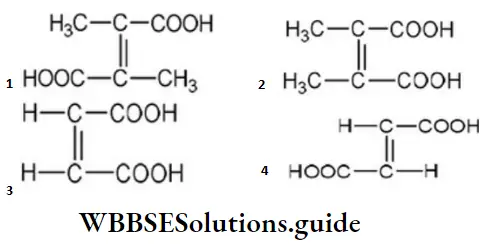
Answer: 4. All of the above

Solution: These are characteristics known from the mechanism of a reaction.

Read And Learn More: NEET General Organic Chemistry Notes, Question And Answers

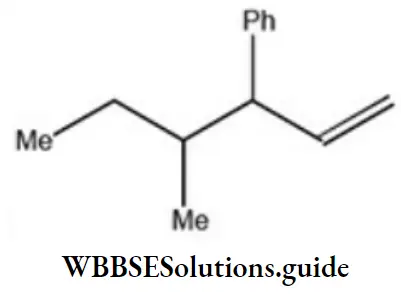
Question 2. Which one of the following is s-butyl phenylvinyl methane?
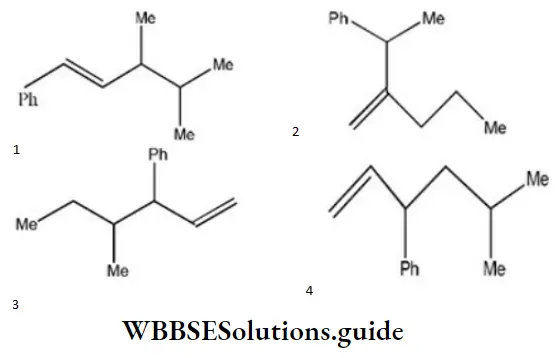
NEET General Organic Chemistry Introduction And Classification s-butyl Phenylvinyl Methane

Answer: 3

NEET General Organic Chemistry Introduction And Classification s-Butyl Phenylvinyl Methane

Solution: Follow the nomenclature rule

NEET General Organic Chemistry Classification Questions and Answers

Question 3. Which of the following species is paramagnetic in nature?

  1. Carbonium ion
  2. Free radical
  3. Carbene
  4. Nitrene

Answer: 2. Free radical

Solution:
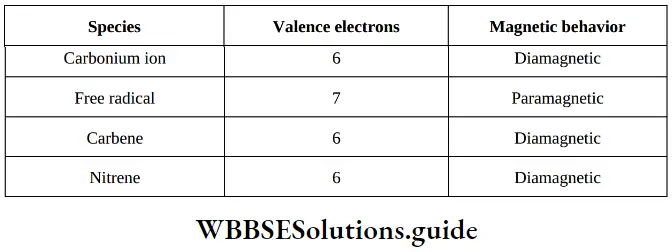
NEET General Organic Chemistry Introduction And Classification Species Is Paramagnetic In Nature

Question 4. The property by virtue of which a compound can turn the plane of polarization of light is known as?

  1. Photolysis
  2. Phosphorescence
  3. Optical activity
  4. Polarization

Answer: 3. Optical activity

Solution: It is the definition of optical activity.
NEET General Organic Chemistry Classification Question And Answers

Question 5. The ratio of c-to n-bonds in benzene is:

  1. 2
  2. 4
  3. 6
  4. 8

Answer: 2. 4

Solution: C6H6 has 12σ and 3π-bonds.

Question 6. The most stable carbocation is:

  1. CH3+
  2. CH3 C+ H2
  3. (CH3)2 C+ H
  4. (CH3)3 C+

Answer: 4. (CH3)3 C+

Solution: 3° Carbonium ions are more stable as the positive inductive effect disperses the positive charge on the carbon atom.

Question 7. Select the most reactive cycloalkane:

  1. Cyclopropane
  2. Cyclobutane
  3. Cyclopentane
  4. Cyclohexane

Answer: 1. Cyclopropane

Solution: Follow Baeyer’s strain theory for stability of cycloalkanes.

Question 8. In the compound, the Configuration at C2 and C3 atoms are
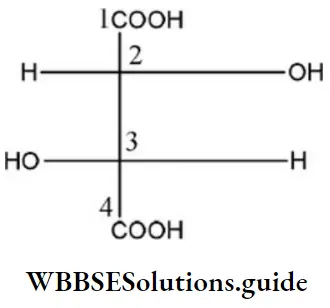
NEET General Organic Chemistry Introduction And Classification In This Copound Configuration At C2 And C3 Atoms

  1. S, S
  2. R, S
  3. S, R
  4. R, R

Answer: 4. R, R

Question 9. Resonance arises due to the:

  1. Migration of atoms
  2. Migration of proton
  3. Delocalization of c-electron
  4. Delocalization of n-electron

Answer: 4. Delocalization of n-electron

Solution: Resonance in a molecule arises due to the delocalization of n-electrons.

Question 10. Sometimes the behavior of a compound is explained by assuming that it exists in nature between two or more different possible structures. This phenomenon is called

  1. Isomerism
  2. Resonance
  3. Mutarotation
  4. Allotropism

Solution: The various structures derived for a molecule but none of them truly represents all the properties of that molecule are said to be canonical forms and the molecule is said to exhibit resonance.

Question 11. Which one of the following is a secondary alcohol?

  1. 2-methyl-1-propanol
  2. 2-methyl-2-propanol
  3. 2-butanol
  4. l-butanol

Answer: 3. 2-butanol

Solution: 2-butanol has following structure
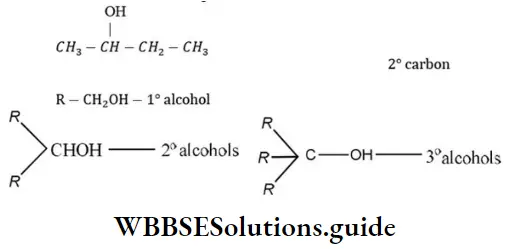
NEET General Organic Chemistry Introduction And Classification 2 Butanol Has Following Structure

Question 12. The angle of rotation of plane of polarized light depends upon:

  1. The nature of the light beam
  2. The number of the molecules
  3. The number of asymmetric carbon atoms in the molecule of the substance
  4. All of the above

Answer: 4. All of the above

Solution: Follow optical activity.

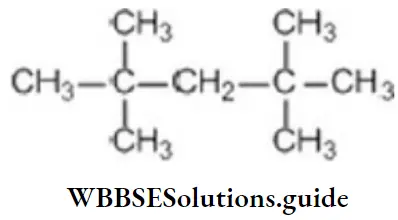
Question 13. The number of 4° carbon atoms in 2,2,4,4-tetramethyl pentane:

  1. 1
  2. 2
  3. 3
  4. 4

Answer: 2. 2

Solution:

NEET General Organic Chemistry Introduction And Classification 4 Carbon Atoms In 2,2,2,4 Tetramethyylpenane

only two are quaternary carbons.

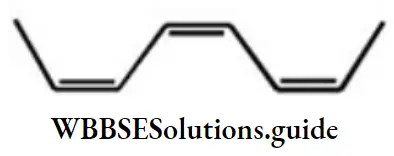
Question 14. Delocalized electrons are present in

  1. 1, 3- butadiene
  2. C6H6
  3. 1,3,5-hexatriene
  4. All of these

Answer: 4. All of these

Solution: Delocalized electrons are present in benzene, 1, 3-butadiene and 1,3,5-hexatriene
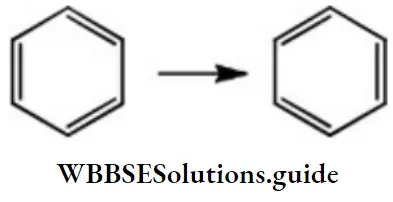
NEET General Organic Chemistry Introduction And Classification Declocalized Electrons Are Present In Benzene

Question 15. Which of the following contain only three pairs of electrons?

  1. Carbocation
  2. Carbanion
  3. Free radical
  4. None of these

Answer: 1. Carbocation

Solution: A carbocation contains three pairs of electrons in the valence shell.

Question 16. Fischer projection indicates:

  1. Horizontal substituents above the plane
  2. Vertical substituents above the plane
  3. Both horizontal and vertical substituents below the plane
  4. Both horizontal and vertical substituents above the plane

Answer: 1. Horizontal substituents above the plane

Solution: Fisher projections are for illustration of optical isomers.

Question 17. When the hybridization state of a carbon atom changes from sp3 to sp2 and finally to sp, the angle between the hybridized orbitals:

  1. Is not affected
  2. Increases progressively
  3. Decreases considerably
  4. Decreases gradually

Answer: 2. Increases progressively

Solution: sp3 ,sp2 and sp-orbitals are at 109°28′,120° and 180°.

Question 18. How many delocalized π-electrons are there in the below compound?
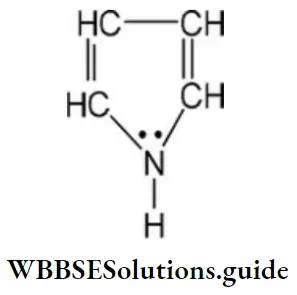
NEET General Organic Chemistry Introduction And Classification Decloalised Pi Electrons Are There In Compound

  1. 8
  2. 2
  3. 4
  4. 6

Answer: 4. 6

Solution: In the given compound four n- electrons of double bond and 1 lone pair on the nitrogen atom leads to the delocalization of six electrons.

Classification of Organic Compounds NEET MCQs with Answers

Question 19. In the following the most stable conformation of n-butane is:
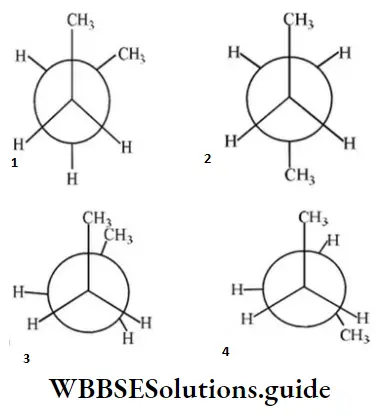
NEET General Organic Chemistry Introduction And Classification Anti Conformation Is The Most Stable Form Of n Butane

Answer: 2

NEET General Organic Chemistry Introduction And Classification n-butane

Solution: Anti-conformation is the most stable form of n-butane (Bulky groups far apart).

Question 20. Ease of abstraction of hydrogen is greater when attached to:

  1. 1° carbon
  2. 2° carbon
  3. 3° carbon
  4. neo-carbon

Answer: 3. 3° carbon

Solution: The reactivity order for the H atom is 3°>2°>1°; Neocarbon do not possess H atoms.

Question 21. Number of tertiary carbon atoms in tertiary butyl alcohol is:

  1. 1
  2. 2
  3. Zero
  4. 4

Answer: 1. 1

Solution: In tertiary alcohol, the carbon atom is joined with an alcohol group and three other carbon atoms.

Question 22. Which of the following compounds can exist in an optically active form?

  1. 1-butanol
  2. 2-butanol
  3. 3-pentanol
  4. 4-heptanol

Answer: 2. 2-butanol

Solution: Due to the presence of asymmetric carbon atoms, for example,

∴ \(\mathrm{CH}_3 \mathrm{CH}_2 \cdot \stackrel{\bullet}{\mathrm{C}} \mathrm{HOHCH}_3 \)

Question 23. The resonating structures

  1. Differ only in the arrangement of electrons
  2. Differ in number of paired and unpaired electrons
  3. Differ largely in their energy contents
  4. Do not lie in the same plane

Answer: 1. Differ only in the arrangement of electrons

Solution: Follow resonance characteristics.

Question 24. The number of 1° and 2° carbon atoms in n-pentane are respectively:

  1. 2, 3
  2. 3, 2
  3. 2, 4
  4. 1, 3

Answer: 1. 2, 3

Solution: CH3CH2CH2CH2CH3 is n-pentane.

Question 25. A secondary (2°) carbon is one that is joined to:

  1. 1-alkyl group
  2. 2-alkyl groups
  3. 3-alkyl groups
  4. None of these

Answer: 2. 2-alkyl groups

Solution: A 2° Carbon is one of which two valencies are attached to the carbon atom.

Question 26. The maximum number of alkyl groups in C8 H18 is:

  1. 6
  2. 5
  3. 4
  4. 2

Answer: 1. 6

Solution: (CH3)3C-C(CH3)3 has a maximum number of alkyl groups in it.

Question 27. Who is called the ‘Father of Chemistry’?

  1. Faraday
  2. Priestley
  3. Rutherford
  4. Lavoisier

Answer: 4. Lavoisier

Solution: It is an honor to Lavoisier.

Question 28. An organic compound X having molecular formula C6H7O2N has 6 carbons in a ring system, two double bonds, and also a nitro group as substituent. X is?

  1. Homocyclic but not aromatic
  2. Aromatic but not homocyclic
  3. Homocyclic and aromatic
  4. Heterocyclic

Answer: 1. Homocyclic but not aromatic

Solution: For a compound to be aromatic, it must have (4n+2) n electrons. Here two double bonds are present, 4n electrons are present in the compound. Therefore, it is anti-aromatic.

Homocyclic compounds are ring structures that consist only of carbon atoms within the ring. A nitro group is attached to the ring system as a substituent, so, C6H7O2N is homocyclic but not aromatic.

An organic compound X having molecular formula C6H7O2N has 6 carbons in a ring system, two double bonds, and also a nitro group as substituent. X is Homocyclic but not aromatic

Question 29. A straight-chain hydrocarbon has the molecular formula C8 H10. The hybridization for the carbon atoms from one end of the chain to the other are respectively sp3,sp2,sp2,sp3,sp2,sp2, sp, and sp. The structural formula of the hydrocarbon would be:

  1. CH3-C=C-CH2-CH=CH-CH=CH2
  2. CH3-CH2-CH= CH-CH=CH-CH=CH
  3. CH3-CH=CH-CH2-C=C-CH=CH2
  4. CH3-CH=CH-CH2-CH=CH-C =CH

Answer: 4. CH3-CH=CH-CH2-CH=CH-C =CH

Solution: Count σ-and π-bonds on each carbon and report hybridization.

Question 30. Correct order of stability is
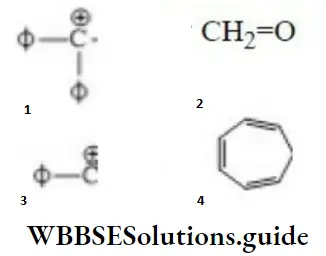
NEET General Organic Chemistry Introduction And Classification Phenyl Group Can Be Solved On The Basis Of The Number Of Conjugative

  1. 1>4>2>3
  2. 1>2>3>4
  3. 1>2>4>3
  4. 1>3>4>2

Answer: 1. 1>4>2>3

Solution: ø is phenyl group, the question can be solved on the basis of the number of conjugative
structures.

Question 31. The order of stability of the alkenes

  1. R2C=CR2,
  2. R2C=CHR,
  3. R2C=CH2,
  4. RCH=CHR,
  5. RCH=CH2


  1. 1>2>4>3>5
  2. 1>2>3>4>5
  3. 2>1>4>3>
  4. 5>4>3>1>2

Answer: 1. 1>2>4>3>5

Solution: Greater the substituents across the double bond of alkenes, greater is the stability.

Question 32. Which type of strain is present in fully eclipsed conformation of butane?

  1. Angle strain
  2. Steric strain
  3. Both (1) and (2)
  4. Neither (1) nor (2)

Answer: 3. Both (1) and (2)

Solution: Eclipsed conformation of butane contains both angle and steric strain. Follow conformation.

Question 33. The stability of the free radical’s allyl, benzyl, 3°,2°,1° and CH3 is in the order

  1. Benzyl > allyl >3°>2°>1°>CH3
  2. Allyl >3°>benzyl>2°>1°>CH3
  3. 3°>2°>1°>CH3>allyl > benzyl
  4. 3°>2°>1°>CH3>allyl=benzyl

Answer: 1. Benzyl > allyl >3°>2°>1°>CH3

Solution: Benzyl, allyl both are stabilized by resonance and 3°, 2°, and 1° are stabilized by hyperconjugation and +I effect. The combined effect of three methyl groups of 3° carbocation marginally exceeds the resonance effect of benzene in benzyl carbocation.

Question 34. Considering the state of hybridization of carbon atoms, find out the molecule among the following which is linear?

  1. CH3—CH2—CH2—CH3
  2. CH3—CH=CH—CH3
  3. CH3—C≡C —CH3
  4. CH2=CH—CH2 —C≡CH

Answer: 3. CH3—C≡C —CH3

Solution: Alkynes are linear due to sp-sp hybridized carbon.

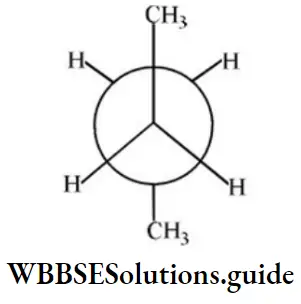
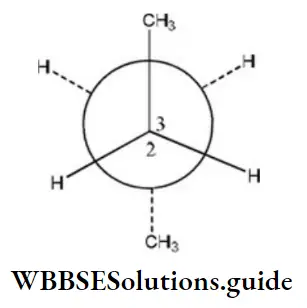
Question 35. C2 is rotated anticlockwise 102°C about C2-C3 bond. The resulting conformer is
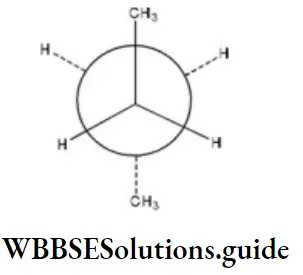
NEET General Organic Chemistry Introduction And Classification C2 Is Rotated Anticlockwise

  1. Partially eclipsed
  2. Eclipse
  3. gauche
  4. Staggered

Answer: 3. gauche

Solution:

NEET General Organic Chemistry Introduction And Classification C2 Is Rotated Anticlockwise 120 About C2-C3 Bond The Resulting Conformer Is Gauche Conformer

Here, when C2 is rotated anticlockwise 120° about C2-C3 bond the resulting conformer is Gauche conformer. Hence,
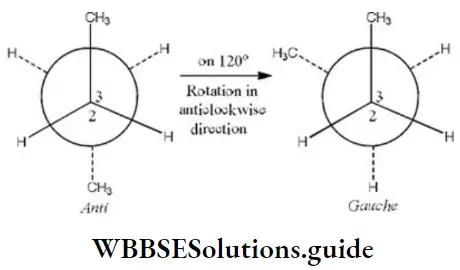
NEET General Organic Chemistry Introduction And Classification Rotation In ANti Clockwise Direction

NEET Chemistry Classification of Organic Compounds Important Questions

Question 36. With a change in hybridization of the carbon bearing the charge, the stability of a carbanion increases in the order of

  1. sp<sp2<sp3
  2. sp<sp <sp2
  3. sp3<sp2<sp
  4. sp2<sp<sp3

Answer: 3. sp3<sp2<sp

Solution: Carbanion is an electron-rich species. Stability of carbanion increases with increase in s-character of hybrid orbitals of carbon-bearing the charge.

∴ sp3<sp2<sp

(25%s-character) (33%s-character) (50%s-character)

Question 37. The number of carbon atoms present in neopentane are?

  1. Four 1° carbon, one 4° carbon
  2. two 1° carbon, two 2° carbon
  3. one 1° carbon, three 4° carbon
  4. None of the above is correct

Answer: 1. Four 1° carbon, one 4° carbon

Solution: Neopentane has 4 primary carbons and 1 quaternary carbon.
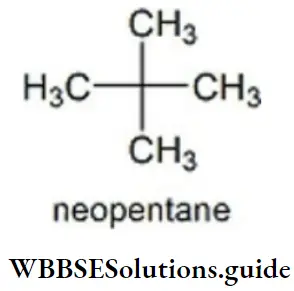
NEET General Organic Chemistry Introduction And Classification Neopentane Has 4 Primary Carbons ANd 1 Quaternary Carbon

Question 38. The empirical formula of an acid is CH2 O2, the probable molecular formula of the acid may be

  1. C2H4O2
  2. C3H6O4
  3. C2H2O4
  4. CH2O2

Answer: 4. CH2O2

Solution: Empirical formula of acid = CH2O2

We know that molecular formula =n (empirical formula)

  1. If n=1 molecular formula =(CH2O2) 1=CH2O2
  2. If n=2 molecular formula =(CH2O2) 2=C2H4O4
  3. If n=3 molecular formula =(CH2O2) 3=C3H6O6
  4. Thus, the probable molecular formula =CH2O2

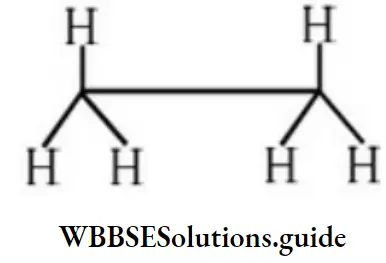
Question 39. Find the non-staggered form(s) of ethane:
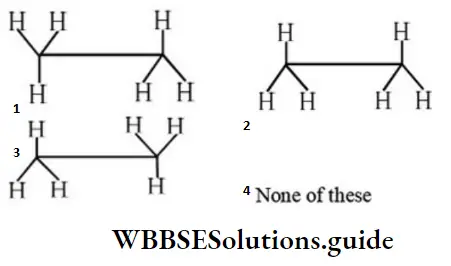
NEET General Organic Chemistry Introduction And Classification Non Staggered Forms Of Ethane

Answer: 2

NEET General Organic Chemistry Introduction And Classification Non-staggered

Solution: Non-staggered means eclipsed form.

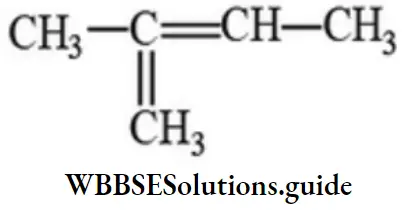
Question 40. 2-methyl pent-3-ene is achiral because it has:

  1. A Centre of symmetry
  2. A plane of symmetry
  3. Symmetry at C2 carbon
  4. Both Centre and a plane of symmetry

Answer: 4. Both Centre and a plane of symmetry

Solution: If the structure of the compound is drawn then we find that a plane of symmetry is present in this compound, the two halves are equal hence the compound does not have a chiral point. In addition to this it has a Centre. The two sides of the compound on the different sides of the centre atom are similar. Both reasons are present which signifies that the molecule is achiral.

Question 41. To which ring size cycloalkanes, Baeyer’s strain theory is not valid?

  1. 3 carbon
  2. 4 carbon
  3. 5 carbon
  4. ≥ 6 carbons

Answer: 4. ≥6 carbons

Solution: The closed ring cycloalkanes beyond five carbon atoms has puckered ring structure maintaining tetrahedral nature or stainless rings, example, cyclohexane has chair and boat form.

Question 42. Different structures generated due to the rotation about, C – C axis, of an organic molecule, are examples of

  1. Geometrical isomerism
  2. Conformational isomerism
  3. Optical isomerism
  4. Structural isomerism

Answer: 2. Conformational isomerism

Solution: The different arrangement of atoms in space that results from the carbon-carbon single bond free rotation by 360° are called conformations or conformational isomers and this phenomenon is called conformational isomerism.

Question 43. Carbon tetrachloride has no net dipole moment because of

  1. Its planar structure
  2. Its regular tetrahedral nature
  3. Similar sizes of carbon and chlorine atoms
  4. Similar electron affinities of carbon and chlorine

Answer: 2. Its regular tetrahedral nature

Solution: This gives rise to net resultant of four C-Cl vectors equal to zero.

Question 44. The number of π-electrons present in cyclobutadiene ion, (C4H3) is:

  1. 8
  2. 6
  3. 4
  4. 2

Answer: 3. 4

Solution: Count π-bonds. Delocalization is not possible.
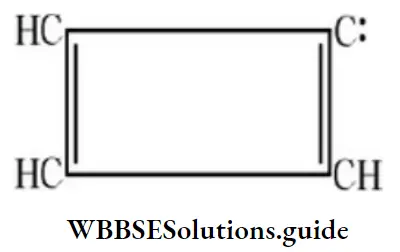
NEET General Organic Chemistry Introduction And Classification Non Staggered Forms Of Ethane Count Pi Bounds Delocalised Is Not Possible

Question 45. Which of the following compounds is optically active?

  1. 1 – butanol
  2. Isopropyl alcohol
  3. Acetaldehyde
  4. 2-butanol

Answer: 4. 2-butanol

Solution: 2-butanol is optically active as it contains a chiral carbon atom.
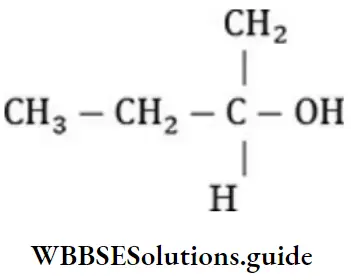
NEET General Organic Chemistry Introduction And Classification Non Staggered Forms Of Ethane 2 Butanol Isd Optically Active As It Contains A Chiral Atom

Question 46. Which of the following is the correct order of stability of different conformations of butane?

  1. Staggered > Gauche > Partially eclipsed > Fully eclipsed
  2. Gauche > Staggered > Partially eclipsed > Fully eclipsed
  3. Staggered > Fully eclipsed > Partially eclipsed > Gauche
  4. None of the above

Answer: 1. Staggered > Gauche > Partially eclipsed > Fully eclipsed

Solution: It is the stability order for various conformers.

Question 47. Which of the following does not contain chiral carbon atoms?

  1. Lactic acid
  2. 2-chlorobutanoic acid
  3. Tartaric acid
  4. Succinic acid

Answer: 4. Succinic acid

Solution: The carbon, four valencies of which are satisfied by four different groups, is termed as chiral carbon atom. The structures of the given compounds are as
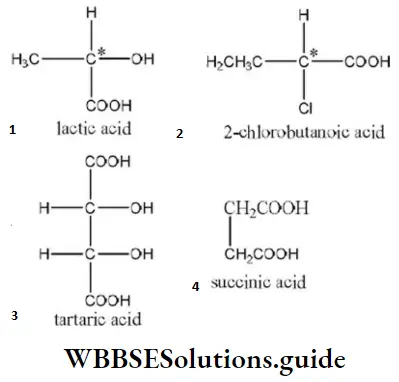
NEET General Organic Chemistry Introduction And Classification Non Staggered Forms Of Ethane Non Contain Chiral Carbon Atom

(Where C*= chiral carbon atom)

Hence, succinic acid does not contain any chiral carbon atom.

Best Practice Questions for NEET General Organic Chemistry Classification

Question 48. The yield in organic reactions is generally poor because the reactions are

  1. Very fast
  2. Non-ionic
  3. Between covalent compounds
  4. Accompanied by side reactions

Answer: 4. Accompanied by side reactions

Solution: It is a reason for the given fact.

Question 49. The number of secondary hydrogens in 2, 2-dimethyl butane is

  1. 8
  2. 6
  3. 4
  4. 2

Answer: 4. 2

Solution:

  • 1° Carbon is attached to one carbon atom.
  • 2° Carbon is attached to two carbon atoms.
  • 3° Carbon is attached to three carbon atoms.
  • The hydrogen attached to 2° carbon atom is 2°.
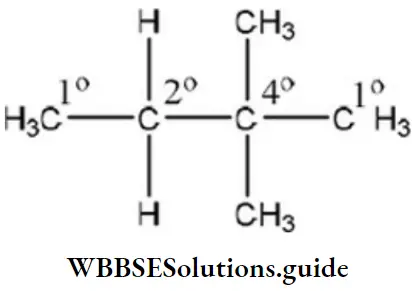
NEET General Organic Chemistry Introduction And Classification Non Staggered Forms Of Ethane Number Of Secondary Hydrogens In 2-2 Dimethyl Butane

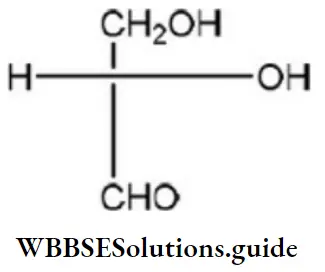
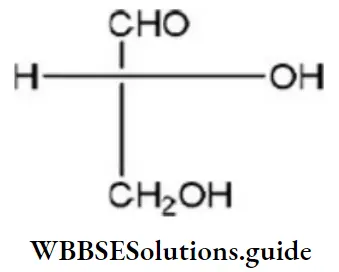
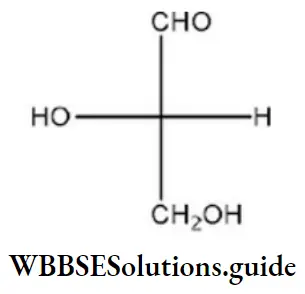
Question 50. Which of the following Fischer’s projection formula is identical to D-glyceraldehyde?
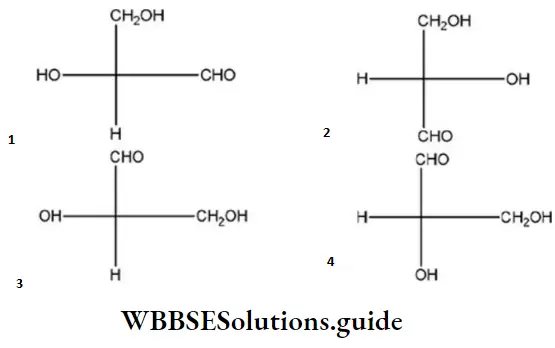
NEET General Organic Chemistry Introduction And Classification Non Staggered Forms Of Ethane Following The Fischer's Projection Formula Is Identical To D-Glyceraldehyde

Answer: 2

NEET General Organic Chemistry Introduction And Classification Non Staggered Forms Of Ethane Fischer's Projection Formula Which It Is Identical

Solution:

NEET General Organic Chemistry Introduction And Classification D- glyceraldehyde

D-glyceraldehyde has the above formula. So, Fischer’s projection formula which is identical to.

Question 51. The C-H bond distance is longest in

  1. C2H2
  2. C2H4
  3. C2H6
  4. C2H2Br2

Answer: 3. C2H6

Solution: Order of bond length

σ bond (sp3) > σ  bond (sp2) > σ bond (sp)

Question 52. The compound having highest dipole moment is:
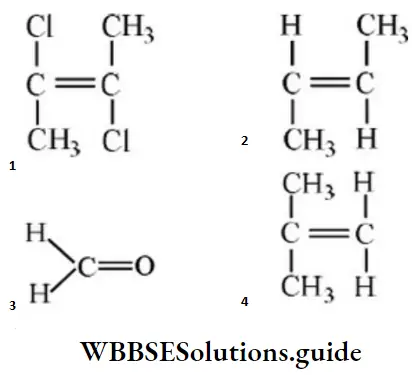
NEET General Organic Chemistry Introduction And Classification Non Staggered Forms Of Ethane Comnpound Having Highest Dipole Moment

Answer: 3

NEET General Organic Chemistry Introduction And Classification Highest Dipole Moment

Solution: μ is more for 3 then 4.

Question 53. Orbital interaction between the o-bonds of a substituent group and a neighboring π- orbital is known as

  1. Hyperconjugation
  2. Inductive effect
  3. Steric effect
  4. Electric quadrupole interactions

Answer: 1. Hyperconjugation

Solution: Orbital interaction between σ- bonds of a substituent group and a neighboring π-orbital is known as hyperconjugation.
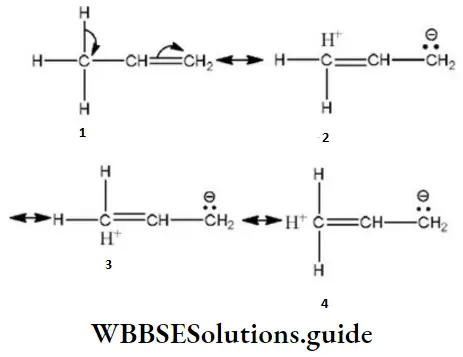
NEET General Organic Chemistry Introduction And Classification Hyperconjugation

Question 54. The number of different amines corresponding to the formula C3H9 N is:

  1. 2
  2. 3
  3. 4
  4. 5

Answer: 3. 4

Solution: Draw all structures.

Question 55. t-butyl alcohol is

  1. 2-methyldopa-2-ol
  2. 2-methyldopa-1-ol
  3. 3-methyl butane-1-ol
  4. 3-methyl butane-2-ol

Answer: 1. 2-methyldopa-2-ol

Solution: 2-methylpropan-2-ol is for-butyl alcohol.
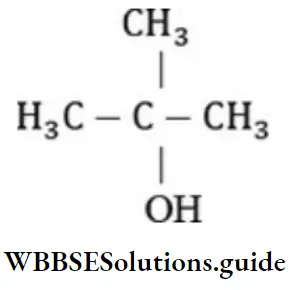
NEET General Organic Chemistry Introduction And Classification 2 Methylpropan 2-ol Is Tert Butyl Alochol

Question 56. The compound is an example of:
NEET General Organic Chemistry Introduction And Classification Non Staggered Forms Of Ethane Annulene

  1. Aromatic compound
  2. Heterocyclic compound
  3. Annulene
  4. Xanthates

Answer: 3. Annulene

Solution: This is annulene.

NEET Chemistry Functional Groups and Homologous Series MCQs with Solutions

Question 57. The structure representing a heterocyclic compound is:
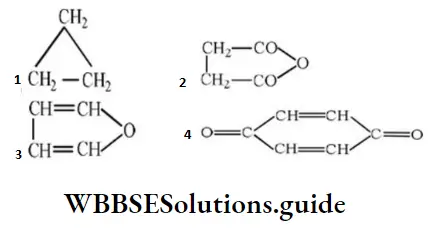
NEET General Organic Chemistry Introduction And Classification Is Is The Structure Of Furan A Heterocyclic Compound

Answer: 3

NEET General Organic Chemistry Introduction And Classification Heterocyclic Compound

Solution: It is the structure of furan, a heterocyclic compound.

Question 58. Species containing carbon with three bonds and an electron is called as?

  1. Carbenes
  2. Carbanions
  3. Carbocation
  4. Free radicals

Answer: 4.  Free radicals

Solution: It’s a fact.

Question 59. The general formula CnH2nO2 for open chain could be

  1. Diketones
  2. Carboxylic acids
  3. Diols
  4. Dialdehydes

Answer: 2. Carboxylic acids

Solution:  CnH2nO2 is a general formula for an open-chain acid and ester.

n = 3 C3H6O2
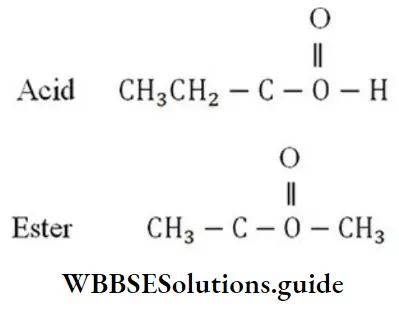
NEET General Organic Chemistry Introduction And Classification The General Formula For Openb Chain

Question 60. The correct structure of dimethyl butane is:

  1. CH3CH2—C≡C —CH2CH3
  2. (CH3) 3C — C≡CH
  3. CH3—C=CCH(CH3) 2d)
  4. NEET General Organic Chemistry Introduction And Classification Dimethylbutyne

Answer: 2. (CH3) 3C — C≡CH

Solution: Follow the rules.

Question 61. Glyoxal is

  1. CH2OH-CH2OH
  2. CHO-CH2OH
  3. COOH-CO-COOH
  4. CHO-CHO

Answer: 4. CHO-CHO

Solution: CHO-CHO is called glyoxal

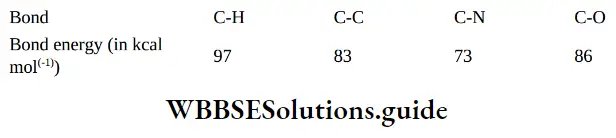
Question 62. The maximum bond energy is present

  1. C-H
  2. C-C
  3. C-N
  4. C-O

Answer: 1. C-H

Solution:

NEET General Organic Chemistry Introduction And Classification Maximum Bond Energy IS Present

Question 63. Geometry of methyl free radical is

  1. Pyramidal
  2. Planar
  3. Tetrahedral
  4. Linear

Answer: 2. Planar

Solution: Number of hybrid orbitals =number of σ-bonds+number of Ips
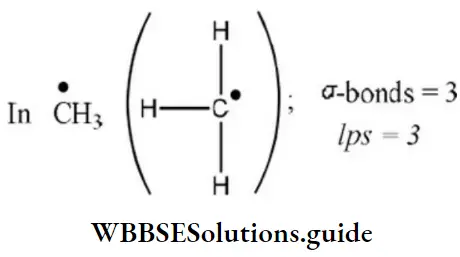
NEET General Organic Chemistry Introduction And Classification Hybridization Is sp2 And Geometry Is Planar

∴ Number of hybrid orbitals =3+0=3

Hence, hybridization is sp2 and geometry is planar.

Question 64. The formula of 3-chloro-2,2-dimethylbutane is

  1. CH(CH3)C(CH3)2 Cl
  2. CH3 (CH3)2 CH2Cl
  3. CH3C(CH3)2CH2Cl
  4. CH3CHClC(CH3)3

Answer: 4. CH3CHClC(CH3)3

Solution: The formula of 3-chloro-2,2-dimethyl butane is CH3CHClC(CH3)3

Question 65. Which of the following compounds has the maximum number of n-bonds?

  1. HC=C-CH=CH2
  2. CH2=CH-CH=CH2
  3. CH3CH2COCH3
  4. C6H5-COOH

Answer: 4. C6H5-COOH

Solution: In C6H5 ring there are three n-bonds and one n-bond is present in COOH group. Therefore, in all there are four π- bonds in C6H5-COOH. In C6H5COOH there is only one π- bond in C=O group, in CH2=CH-CH=CH2 there are two n-bonds while in HC≡C-CH=CH2 there are three π- bonds.

Question 66. Removal of hydrogen atom is easier when it is attached to:

  1. 1° carbon
  2. 2° carbon
  3. 3° carbon
  4. Same in all

Answer: 3. 3° carbon

Solution: The reactivity order is 3°H>2°H>1°H.

Question 67. The structure of cis-bis (propenyl) ethane is:
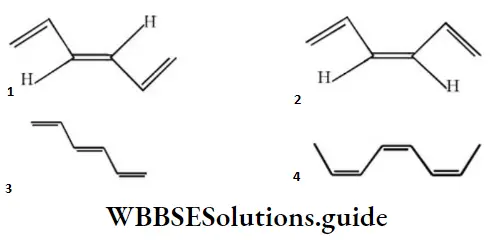
NEET General Organic Chemistry Introduction And Classification The Structure Of cis-nis Ethane Is

Answer: 4

NEET General Organic Chemistry Introduction And Classification cis-bis Ethane

Solution: The two propenyl group attached to 1,2-position of carbon in cis-form.
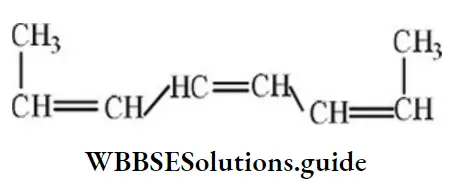
NEET General Organic Chemistry Introduction And Classification The Two Propenyl Group Attached To 1,2 Position Of Carbon In cis form

Question 68. The percentage of ‘s’ character of the hybrid orbital of carbon in ethane, ethane, and ethyne respectively are:

  1. 25, 33, 50
  2. 20, 50, 33
  3. 25, 50, 75
  4. 33, 66, 99

Answer: 1. 25, 33, 50

Solution: Ethane, ethene, and ethyne have sp3,sp2, and sp-hybridization respectively.

General Organic Chemistry NEET Notes on Classification with Solved Questions

Question 69. The reason for the loss of optical activity of lactic acid when -OH group is changed by H is that

  1. Chiral center of the molecule is destroyed
  2. Molecules acquires asymmetry
  3. Due to change in configuration
  4. Structural changes occurs

Answer: 1. Chiral center of the molecule is destroyed

Solution: When -OH group of lactic acid is replaced by H, then chiral carbon is lost.
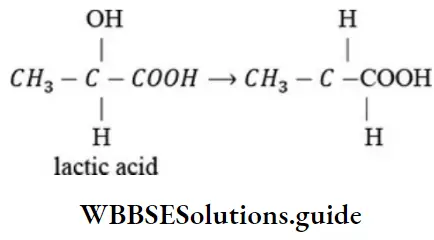
NEET General Organic Chemistry Introduction And Classification When – OH group of lactic acid is replaced by H, then chiral carbon is lost.

∴ Its optical activity is lost.

Question 70. In case of a homologous series each member differs from the preceding or the succeeding member by:

  1. a CH2 group
  2. a CH3 group
  3. Two hydrogen atoms
  4. Four hydrogen atoms

Answer: 1. a CH2 group

Solution: Two successive homologous differ in their formula by CH2 or have a difference of 14 units in their molecular weight.

Question 71. The number of asymmetric carbon atoms and the number of optical isomers in CH3(CHOH)2 COOH are respectively:

  1. 3 and 4
  2. 1 and 3
  3. 2 and 4
  4. 2 and 3

Answer: 3. 2 and 4

Solution: n = 2 and a = 2n = 22 = 4.

Question 72. Which of the following is a primary halide?

  1. Isopropyl iodide
  2. Secondary butyl iodide
  3. Tertiary butyl bromide
  4. Neo hexyl chloride

Answer: 4. Neo hexyl chloride

Solution: Neohexyl chloride is a primary halide as in it, Cl-atom is attached to a primary carbon.
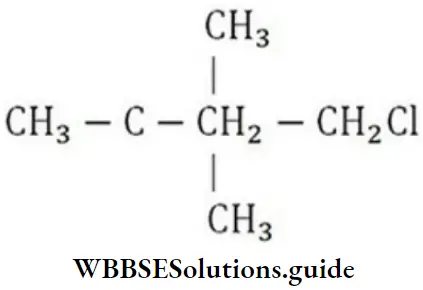
NEET General Organic Chemistry Introduction And Classification Neohexyl Chloride

Question 73. In which of the following structures the number of sigma bonds are equal to the number of π-bonds?

  1. 1,2-propadiene
  2. 2,3-dicyanobut-2-ene
  3. Tetracyanoethylene
  4. None of these

Answer: 3. Tetracyanoethylene

Solution:
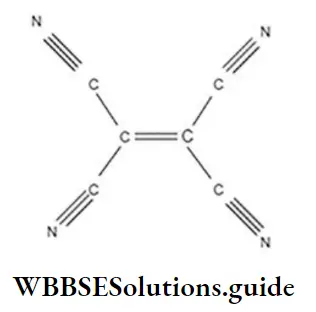
NEET General Organic Chemistry Introduction And Classification Tetracyanoethylene

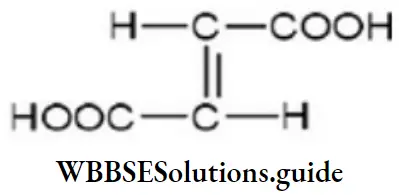
Question 74. What is the structural formula of fumaric acid?
NEET General Organic Chemistry Introduction And Classification Whic On Structural Formula Of vFumaric Acid

Answer: 4

NEET General Organic Chemistry Introduction And Classification Fumaric Acid

Solution: The structural formula of fumaric acid
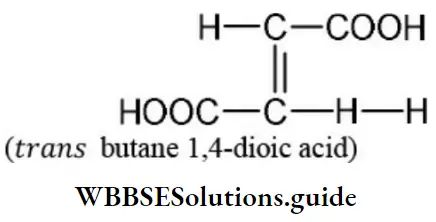
NEET General Organic Chemistry Introduction And Classification Structural Formula Of Fumaric Acid

Question 75. The correct acidity order of the following is
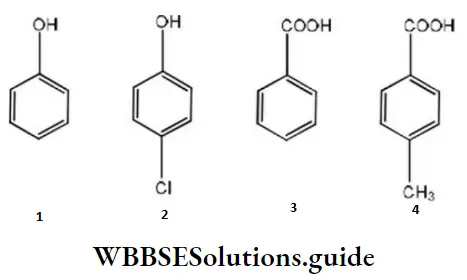
NEET General Organic Chemistry Introduction And Classification Acidity Order

  1. 3>4>2>1
  2. 4>3>1>2
  3. 3>2>1>4
  4. 2>3>4>1

Answer: 1. 3>4>2>1

Solution: A carboxylic acid is a stronger acid than phenol, hence both 3 and 4 are stronger acids than both 1 and 2. Also, 4 has a methyl group that gives electrons donating inductive effects and decreases the acid strength.

Therefore, 3 is a stronger acid than 4. Between 1 and 2, the dominant electron-withdrawing inductive effect of chlorine increases the acid strength of phenol slightly, hence 2 is stronger of phenol slightly, hence, 2 is a stronger acid than 1.

Thus, the overall order is: 1. 3>4>2>1

NEET Study Material for Classification of Organic Compounds

Question 75. How many π-electrons are there in the following structure?
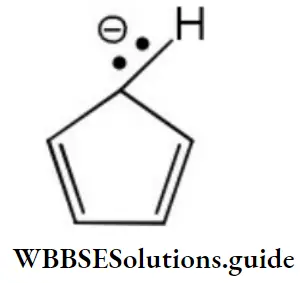
NEET General Organic Chemistry Introduction And Classification Pi electrons Are There In Following Structure

  1. 2
  2. 4
  3. 6
  4. 8

Answer: 3. 6

Solution: Each π-bond contributes two π electrons and the two electrons of the lone pair are present in a p-orbital. Therefore, total number of π electrons are six.

Question 76. The number of π-electrons in benzene molecule are?

  1. 3 x 2
  2. 23
  3. 3 x 3
  4. 32

Answer: 1. 3 x 2

Solution:  C6H6 has six delocalized n-electrons.

Question 77. The hybridization of carbon atoms in C-C single bond of HC=C-CH=CH2 is

  1. sp3-sp
  2. sp3-sp3
  3. sp2-sp3
  4. sp-sp2

Answer: 4. sp-sp2

Solution: The hybridization of carbon atoms in C-C single bond of HC=C-CH=CH2 is sp-sp2.

One C atom is bonded to another C atom by a triple bond and is sp hybridised. The other C atom is attached to another C by a double bond and is sp2 hybridised.

Question 78. In which of the compounds given below there is more than one kind of hybridization (sp,sp2,sp3) for carbon?

  1. CH3CH2CH2CH3
  2. CH3CH=CH-CH3
  3. CH2=CH-CH=CH2
  4. H-C≡C-H


  1. 2 and 4
  2. 1 and 4
  3. 2 and 3
  4. 2

Answer: 4. 2

Solution:

  1. CH3-CH2-CH2-CH3 (Only sp3 hybridized carbons)
  2. CH3-CH=CH-CH3 (Both sp2 and sp3 hybridized carbons)
  3. CH2=CH-CH=CH2 (Only sp2 hybridized carbons)
  4. H-C ≡ C-H (Only sp hybridized carbons)

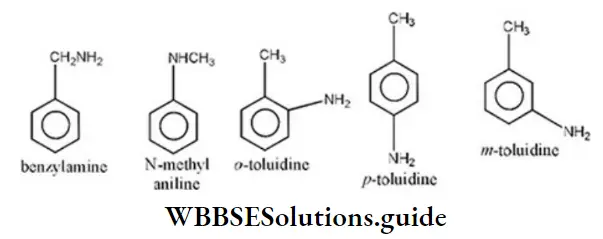
Question 79. How many structures can a compound with molecular formula C7H9N have?

  1. 5
  2. 4
  3. 3
  4. 2

Answer: 1. 5

Solution:

NEET General Organic Chemistry Introduction And Classification 5 Isomers Are Possible By Formula C7H9N

∴ Total of five isomers are possible by formula C7H9N.

Question 80. Angle strain in cyclopropane is

  1. 24°44’
  2. 9°44’
  3. 44’
  4. -5°16’

Answer: 1. 24°44’

Solution: Angle strain, α = 1/2 [109°28′ — θ]

In case of cyclopropane, θ = 60°

∴ α = 1/2 [109°28′ — 60°] = 24°44’

Angle strain in cyclopropane is 24°44’

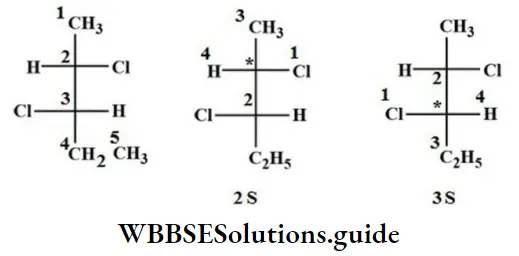
Question 81. The absolute configuration of the following
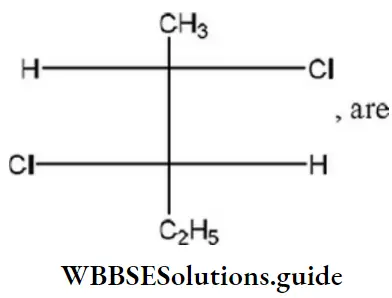
NEET General Organic Chemistry Introduction And Classification Absolute Configuration

  1. 2S, 3R
  2. 2S, 3S
  3. 2R, 3S
  4. 2R, 3R

Answer: 2. 2S, 3S

Solution:

NEET General Organic Chemistry Introduction And Classification 2S, 3S Absolute Configuration

Question 82. In 2-methyl-l-propanol, the hybrid carbons of sp3,sp2 and sp are respectively:

  1. 3, 2, 1
  2. 4, 3, 0
  3. 4, 0, 0
  4. 1, 2, 3

Answer: 3. 4, 0, 0

Solution: Alkanes have all C in sp3 hybridized state irrespective of their degree (primary, secondary, tertiary, quaternary)

Question 83. Which of the following compounds is not chiral?

  1. 1-chloro-2-methyl pentane
  2. 2-chloroethane
  3. 1-chloroethane
  4. 3-chloro-2-methyl pentane

Answer: 3. 1-chloroethane

Solution: To be optically active, compound or structure should possess a chiral or asymmetric carbon atom. 1-chloromethane is not chiral.

Question 84. Among the following orbital bonds, the angle is minimum between:

  1. sp3 – sp3 bonds
  2. px and py -orbitals
  3. H—O—H in water
  4. sp-sp bonds

Answer: 2. px and py-orbitals

Solution: p-orbitals are at 90° to each other.

Question 85. The correct structure of 4-bromo-3-methyl-but-1-ene.

  1. Br-CH=C(CH3)2
  2. CH2=CH-CH(CH3)-CH2 Br
  3. CH2=C(CH3)CH2 CH2 Br
  4. CH3-C(CH3)=CHCH2 -Br

Answer: 2. CH2=CH-CH(CH3)-CH2 Br

Solution: Follow the rules.

Question 86 Which of the following represents Neo-pentyl alcohol?

  1. CH3CH(CH3)CH2CH2OH
  2. (CH3)3C-CH2OH
  3. CH3(CH2)3OH
  4. CH3CH2CH(OH) C2H5

Answer: 2. (CH3)3C-CH2OH

Solution: (CH3)3C-CH2OH n is neo -pentyl alcohol

Question 87. The large number of organic compounds are due to:

  1. Catenation property of carbon
  2. Covalent bond formation
  3. Isomerism
  4. polymerization

Answer: 1. Catenation property of carbon

Solution: Catenation is the tendency to unite atoms of an element to form a long carbon chain or ring.

Question 88. The (R) and (S) enantiomers of an optically active compound differ in

  1. Their reactivity
  2. Their optical rotation of plane-polarized light
  3. Their melting point
  4. Their solubility in achiral reagents

Answer: 2. Their optical rotation of plane-polarized light

Solution: The R and S enantiomers of an optically active compound differ in their optical rotation of plane polarized light.

Question 89. Which of the following is singlet carbine?

  1. \(\mathrm{CH}_3 \ddot{\mathrm{C}} \mathrm{HCH}_3\)
  2. \(\mathrm{C}_2 \mathrm{H}_5 \ddot{\mathrm{C}}-\mathrm{H}\)
  3. \(\mathrm{CH}_2=\mathrm{CH}-\stackrel{\oplus}{\mathrm{C}} \mathrm{H}_2\)
  4. \(\left(\mathrm{CH}_3\right)_3 \mathrm{C}^{+}\)

Answer: 2. \(\mathrm{C}_2 \mathrm{H}_5 \ddot{\mathrm{C}}-\mathrm{H}\)

Solution: An organic reaction intermediate, neutral species having a divalent carbon atom with six valence electrons out of which two are present in the same orbital with opposite spin is called singlet carbene.

Question 90. In cyclopropane, Cyclobutane, and cyclohexane, the common group is

  1. -C
  2. -CH2
  3. -CH3
  4. -CH

Answer: 2. -CH2

Solution: The structure of cyclopropane, Cyclobutane, and cyclohexane are as
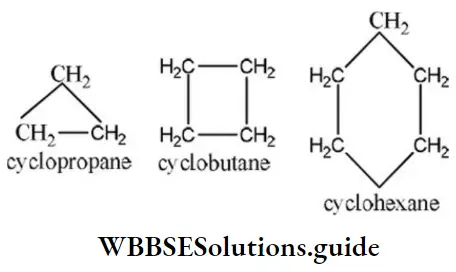
NEET General Organic Chemistry Introduction And Classification Common Group Vycloprpone, Cyclobutane And Cyclohexane Is Ch2 Group

Hence, the common group in cyclopropane, Cyclobutane, and cyclohexane is -CH2 group.

Question 91. The first organic compound, urea was synthesized in the laboratory by:

  1. Kekule
  2. Liebig
  3. Lavoisier
  4. Wohler

Answer: 4. Wohler

Solution: Wohler prepared urea from KCNO and (NH4)2SO4

Question 92. In the dehydration reaction \(\mathrm{CH}_3 \mathrm{CONH}_2 \stackrel{\mathrm{P}_2 \mathrm{O}_5}{\rightarrow} \mathrm{CH}_3 \mathrm{C}=\mathrm{N} \text {, },\) the hybridization state of carbon change from

  1. lsp3 to sp2
  2. lsp to sp
  3. lsp2 to sp
  4. lsp to sp3

Answer: 3. lsp2 to sp

Solution: Acetamide (CH3CONH2) contains an amide group (-CONH2) in which a carbon atom is attached to an oxygen atom by a double bond. Hence, this carbon atom is sp2 hybridized.

Acetonitrile (CH3CN) contains a nitrile group (-CN) in which the carbon atom is attached to a nitrogen atom by a triple bond. Hence, this carbon atom is sp2 hybridized.

Thus, during conversion of acetamide to acetonitrile, the hybridization of the carbon atom changes from sp2 to sp.

Question 93. Which statement is correct about the hybridization of carbon atoms in,

⇒ \(\mathrm{H} \stackrel{1}{\mathrm{C}} \equiv \stackrel{2}{=}-\stackrel{3}{\mathrm{C}} \equiv \stackrel{4}{=} \mathrm{C} \mathrm{H} \text { ? }\)

  1. C1 and C4 are sp2 – hybridized
  2. C2 and C3 are sp2 – hybridized
  3. All are sp – hybridized
  4. All are sp2 – hybridized

Answer: 3. All are sp – hybridized

Solution: Each carbon has two σ and two π-bonds.

Question 94. Hydride shift from C-2 will give the most stable resonance stabilized carbocation as

  1. CH3 at C-4
  2. “H” at C-4
  3. CH3 at C-2
  4. “H” at C-2

Answer: 4. “H” at C-2

Solution: In the following carbocation; H/CH3 that is most likely to migrate to the positively charged carbon is
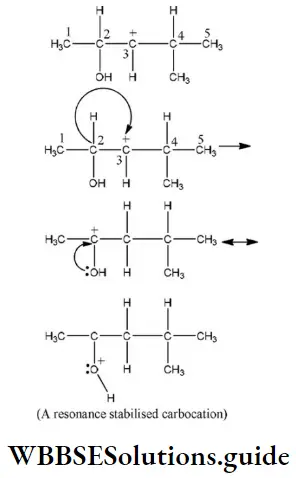
NEET General Organic Chemistry Introduction And Classification Resonance Stabilised Carbocation

Question 95. The shape of the π electron cloud in acetylene is

  1. Linear
  2. Planar
  3. Cylinder
  4. Doughnut

Answer: 3. Cylinder

Solution: The shape of n electron cloud in acetylene in cylindrical.

Question 96. Which of the following molecules is expected to rotate the plane of plane-polarized light?
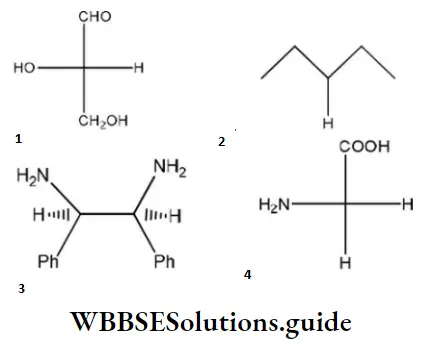
NEET General Organic Chemistry Introduction And Classification Molecules Is Expected To Rotated The Plane Of Plane Polarised Light

Answer: 1

NEET General Organic Chemistry Introduction And Classification Rotate The Plane Of Light

Solution: The molecule, which is optically active, has a chiral center and is expected to rotate the plane of polarized light.
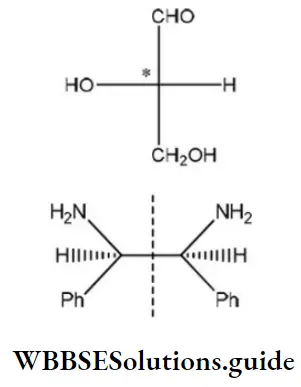
NEET General Organic Chemistry Introduction And Classification The Molecule One Chiral Center Proportional To Optically Active

One chiral center ⇒ optically active

Two chiral centers, but plane of symmetry within molecule ⇒ optically inactive.

Classification of Organic Compounds Class 11 NCERT Questions and Answers for NEET

Question 97. Which of the following hydrocarbons is most unsaturated?

  1. C2H4
  2. C2H2
  3. C2H6
  4. CH3CH=CH2

Answer: 2. C2H2

Solution: C2H2 has two π-bonds.

Question 98. Maximum enol content is in
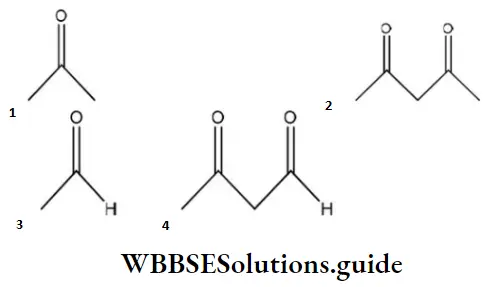
NEET General Organic Chemistry Introduction And Classification Maximum Enol Content

Answer: 2

NEET General Organic Chemistry Introduction And Classification Maximum Enol Content

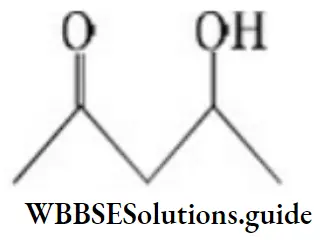
Solution: Keto and enol forms are interconvertible. The enol content will be maximum when the enol form is stabilized by hydrogen bonding.
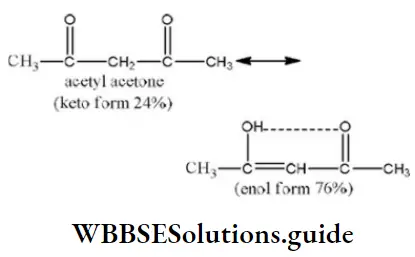
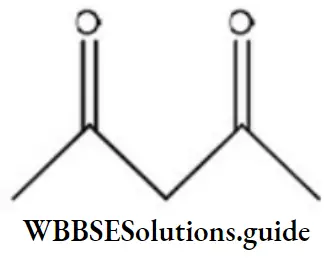
NEET General Organic Chemistry Introduction And Classification Acetyl Acctone And Enol Form

In acetylacetone, the enol form is stabilized by H-bonding, hence it has more enol content than the other.

Question 99. The compound Abd C—C Abd will exist in?

  1. 3 forms
  2. 4 forms
  3. 5 forms
  4. 2 forms

Answer: 1. 3 forms

Solution: Two similar asymmetric carbon atoms;

∴ a = 2n+1 . Also meso form = 2n/2-1

Total = a + m.

Question 100. The general formula for cycloalkanes is:

  1. CnH2n+2
  2. CnH2n
  3. CnH2n-2
  4. CnHn

Answer: 2. CnH2n

Solution: Both alkene and cycloalkane have general formulaCnH2n

Question 101. How many sigma and pi bonds are there in the molecule of dicyanoethane (CN- CH=CH-CN)?

  1. 3 sigma and 3 pi
  2. 5 sigma and 2 pi
  3. 7 sigma and 5 pi
  4. 2 sigma and 3 pi

Answer: 3. 7 sigma and 5 pi

Solution:
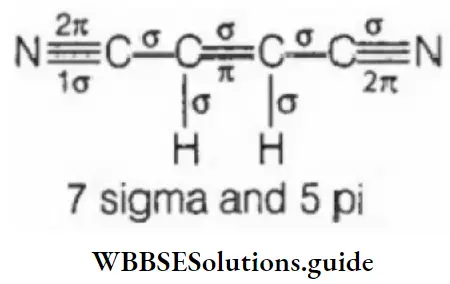
NEET General Organic Chemistry Introduction And Classification 7 Sigmas And 5 Pi Are There in The Molecule Of Dicyanoethane

Question 102. The Cl—C—Cl bond angle in dichloromethane will be:

  1. >109°28′
  2. <109°28′
  3. 109°28′
  4. 120°

Answer: 3. 109°28′

Solution: CH2Cl2 has sp3 -hybridization and tetrahedral nature.

Question 103. Overlap of which of the following atomic orbitals would be maximum to form the strongest covalent bond?

  1. 1s-2s(σ)
  2. 1s-2p(σ)
  3. 2P-2P(π)
  4. 2P-2-P(σ)

Answer: 2. 1s-2p(σ)

Solution: More directionally concentrated orbitals show more overlapping. Also closer are shells to the nucleus, more is the overlapping.

Question 104. Which of the following conformations of cyclohexane is chiral?

  1. Twist boat
  2. Rigid
  3. Chair
  4. Boat

Answer: 3. Chair

Solution:

NEET General Organic Chemistry Introduction And Classification Chair Form Is Unsymmetrical Due To Abswence Of Any Element

Chair form is unsymmetrical due to absence of any element of symmetry.

Question 105. Which is not deflected by a non-uniform electrostatic field?

  1. Water
  2. Chloroform
  3. Nitrobenzene
  4. Hexane

Answer: 4. Hexane

Solution: Hexane is a nonpolar molecule.

Question 106. The number of meso forms in the following compound is HOOC.CH(CH3).CH(OH).CH(Cl).CH(OH)CH(CH3).COOH

  1. 3
  2. 4
  3. 8
  4. 16

Answer: 2. 4

Solution: Number of mesostructures in compound having odd number of chiral carbon atoms and symmetrical molecule = \(2^{\left(\frac{n}{2}-\frac{1}{2}\right)}\)

Given, n=5

∴ Number of meso forms = \(2^{\left(\frac{5}{2}-\frac{1}{2}\right)}\) = 4

Question 107. Base strength of,

  1. \(\mathrm{H}_3 \stackrel{\ominus}{\mathrm{C}} \mathrm{CH}_2\)
  2. \(\mathrm{H}_2 \mathrm{C}=\stackrel{\ominus}{\mathrm{C}} \mathrm{H}_{\mathrm{H}}\)
  3. \(\mathrm{H}-\mathrm{C}=\stackrel{\ominus}{\mathrm{C}}\) is in the order of


  1. 3 > 2 > 1
  2. 1 > 3 > 2
  3. 1 > 2 > 3
  4. 2 > 1 > 2

Answer: 3. 1 > 2 > 3

Solution: Stronger the acid, weaker is its conjugate base.

Acidic nature: CH = CH > CH2 = CH2 > CH3 — CH3

Conjugate basic: CH = C- < CH2 = CH- < CH3 — CH2– nature.

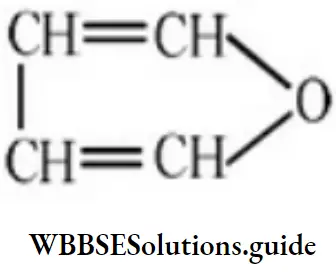
Question 108. The epoxide ring consists of which of the following?

  1. Three membered rings with two carbon and one oxygen
  2. Four membered rings with three carbon and one oxygen
  3. Five membered rings with four carbon and one oxygen.
  4. Six membered rings with five carbon and one oxygen.

Answer: 1. Three membered rings with two carbon and one oxygen
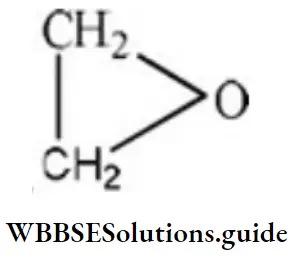
NEET General Organic Chemistry Introduction And Classification Structureal Formula Of Epoxide

Solution: The structural formula of epoxide is It consists of three-membered rings with two carbon and one oxygen.

Question 109. The hybridization of carbon in diamond, graphite and acetylene is in the order:

  1. sp3,sp2,sp
  2. sp2,sp3,sp
  3. sp,sp2,sp3
  4. sp2,sp,sp3

Answer: 1. sp3,sp2,sp

Solution: Diamond (sp3), Graphite (sp2), Acetylene (sp).

Question 110. Which one of the following will most readily be dehydrated in acidic conditions?
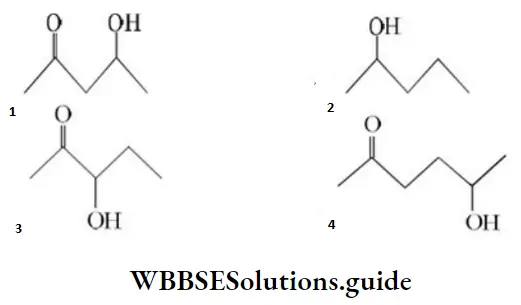
NEET General Organic Chemistry Introduction And Classification It Undergoes Dehydration Easily As The Product Obtained Is Conjugated And More Stable

Answer: 1

NEET General Organic Chemistry Introduction And Classification Dehydrated In Acidic Condition

Solution: It undergoes dehydration easily as the product obtained is conjugated and more stable.

Question 111. A free radical is

  1. Non-existing
  2. Short-lived
  3. Diamagnetic
  4. Fairly stable

Answer: 2. Short-lived

Solution: Free radical state is a transient state and thus, has a short life.

Question 112. The strain in bonds of cyclopropane is:

  1. 0°44′
  2. 24°44′
  3. 9°44′
  4. 5°16′

Answer: 2. 24°44′

Strain = 1/2[Normal valence angel-valence angel] = 1/2[109°28′ – 60°] = 24°44′.

Question 113. Arrange p-toluidine (1) N, N-dimethyl-p- toluidine (2) p- nitroaniline (3), and aniline (4) in order of decreasing basicity

  1. 1>4>3>2
  2. 1>2>3>4
  3. 2>1>4>2
  4. 3>1>2>4

Answer: 3. 2>1>4>2

Question 114. Which among the following statements is wrong?

  1. In general, organic compounds have low melting and boiling points.
  2. Isomerism is common in organic compounds
  3. Organic compounds cannot be synthesized in the laboratory
  4. The number of organic compounds is fairly large

Answer: 3. Organic compounds cannot be synthesized in the laboratory

Solution: This statement is not true now.

Question 115. Which has the maximum percentage of chlorine?

  1. Pyrene
  2. PVC
  3. Chloral
  4. Ethylidene chloride

Answer: 1. Pyrene

Solution: Pyrene is CCl4.

Question 116. Naphthalene molecule contains:

  1. 10π-electrons
  2. 8π-electrons
  3. 12π-electrons
  4. 14π-electrons

Answer: 1. 10π-electrons

Solution: Total n bonds = 5; Total number of electrons = 10

Question 117. Select the correct order of basic nature:

  1. CH3 CH2 > CH2 = CH- > CH=C→ OH
  2. CH3 CH2 > CH = C- > CH2 =CH > OH
  3. CH3 CH2 > OH > CH = C > CH2 = CH
  4. OH > CH = C > CH2 = CH- > CH3—CH2

Answer: 1. CH3 CH2 > CH2 = CH- > CH=C→ OH

Solution: The acidic nature is H2O>C2 H2>C2 H4>C2 H6.

Question 118. A student named the compound as 1,4-butadiene:

  1. The name is correct
  2. He committed an error in the selection of carbon chain
  3. He committed an error in position of double bond
  4. Unpredictable

Answer: 3. He committed an error in position of double bond

Solution: Double bond should be at the 3rd position.

Question 119. The tautomeric form which is least stable is called?

  1. Anion form
  2. Cation form
  3. Labile form
  4. All of these

Answer: 3. Labile form

Solution: It is a fact.

Question 120. Stability order of… is in order

  1. \(\mathrm{C}_6 \mathrm{H}_5-\stackrel{+}{\mathrm{C}} \mathrm{H}_2\)
  2. \(\mathrm{CH}_2=\mathrm{CH}-\stackrel{+}{\mathrm{C}} \mathrm{H}_2\)
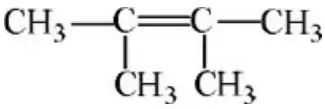
  3. \(\left(\mathrm{CH}_3\right)_3 \mathrm{C}^{+}\)
  4. \(\mathrm{CH}_2=\stackrel{+}{\mathrm{C}} \mathrm{H}\)


  1. 4<3<2<1
  2. 4<2<1<3
  3. 1<2<3<4
  4. 4<1<3<2

Answer: 1. 4<3<2<1

Solution: Benzylic and allylic carbocations (where the positively charged carbon is conjugated to one or more non-aromatic double bonds) are significantly more stable than even tertiary alkyl carbocations. Vinylic carbocations, in which the positive charge resides on a double-bonded carbon, are very unstable and thus unlikely to be formed as intermediates in any reactions.

Question 121. Acetonitrile is

  1. CH3CN
  2. CH3COCN
  3. C2H5CN
  4. C6H5CN

Answer: 1. CH3CN

Solution: CH3 C=N is known as acetonitrile or methyl cyanide.

Question 122. Isobutyl chloride is:

  1. CH3CH2CH2CH2Cl
  2. (CH3)2CHCH2Cl
  3. CH3CH2CHClCH3
  4. (CH3)3C-Cl

Answer: 2. (CH3)2CHCH2Cl

Solution: It should contain (CH3)2CH- group to be named as iso.

Question 123. The minimum number of carbon atoms which a ketone may contain is:

  1. 1
  2. 2
  3. 3
  4. 4

Answer: 3. 3

Solution: CH3COCH3 is the simplest ketone.

Question 124. The structure of tertiary butyl carbonium ion is:

  1. Pyramidal
  2. Trigonal planar
  3. Tetrahedral
  4. Square planar

Answer: 2. Trigonal planar

Solution: A carbonium ion is sp2-hybridized.

Question 125. Percentage of hydrogen is maximum in

  1. C2H4
  2. CH4
  3. C2H2
  4. C6H6

Answer: 2. CH4

Solution: CH4 has highest ratio of H to C

Question 126. The compound, whose stereo-chemical formula is written below, exhibits x geometrical isomers and y optical isomers The values of x and y are
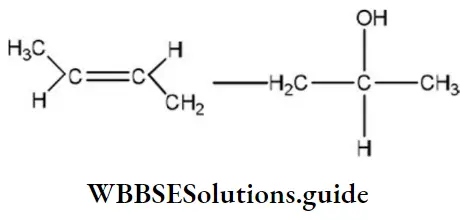
NEET General Organic Chemistry Introduction And Classification Compounds Forms Two Geometerical Isomers And Two Optical Isomers

  1. 4 and 4
  2. 2 and 2
  3. 2 and 4
  4. 4 and 2

Answer: 2. 2 and 2

Solution: The given compound forms two geometrical isomers and two optical isomers.

Question 127. Which of the following is heterocyclic aromatic species?
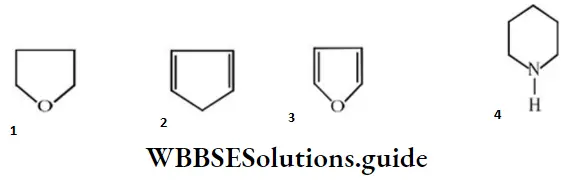
NEET General Organic Chemistry Introduction And Classification Furam Is Heterocyclic and Aromatic Due To Huckel's Rule Of Aromaticity

Answer: 3

NEET General Organic Chemistry Introduction And Classification Furan Is Hetercyclic

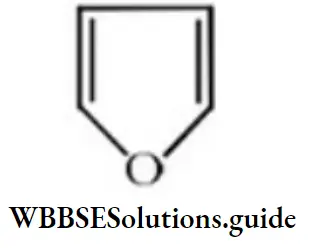
Solution: Furan is heterocyclic and aromatic due to the Huckel’s rule of aromaticity, i.e., 6π- electrons.

Types of Organic Compounds: Alkanes, Alkenes, Alkynes NEET Questions

Question 128. Cyclohexane is:

  1. Aliphatic compound
  2. Alicyclic compound
  3. Aromatic compound
  4. Heterocyclic compound

Answer: 2. Alicyclic compound

Solution: Benzene and all its derivatives along with heteroaromatics possess aromatic nature. Rest all possess aliphatic nature.

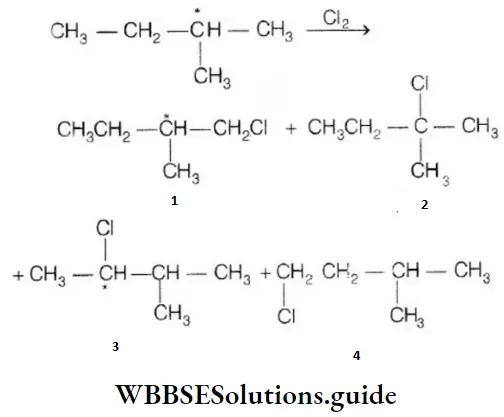
Question 129. On monochlorination of 2-methyl butane, the number of chiral compounds formed are:

  1. 2
  2. 4
  3. 6
  4. 8

Answer: 2. 4

Solution:

NEET General Organic Chemistry Introduction And Classification Monochlorination Of 2 Methtyl Butane

Question 130. The absolute configuration of
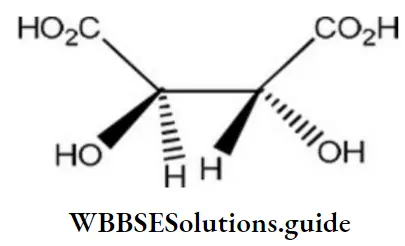
NEET General Organic Chemistry Introduction And Classification Absolue Configuration R, R

  1. S, S
  2. R, R
  3. R, S
  4. S, R

Answer: 2. R, R

Solution: If you rotate the curve in a clockwise manner, the absolute configuration is termed as R (rectus) configuration. On the other hand, the absolute configuration is termed as S (sinister) configuration if the curve is rotated in a counter-clockwise direction.

The lowest priority functional group should be located on the vertical line. Otherwise, the absolute configuration is reversed. The order of priority for functional group in decreasing order is given as follows:

carboxylic acid > sulphonic acid > esters > amide > nitrile > aldehydes > ketones > alcohol > amines > hydrocarbons > ethers > alkyl halides

Question 131. How many chiral compounds are possible on mono chlorination of 2-methyl butane?

  1. 2
  2. 4
  3. 6
  4. 8

Answer: 1. 2

Solution: On chlorination of 2-methyl butane 2-chiral compounds are formed.
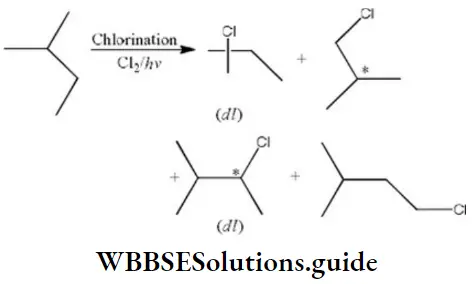
NEET General Organic Chemistry Introduction And Classification Chlorination Of 2 Methyl Butane

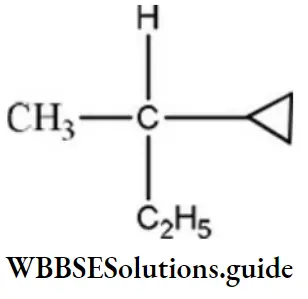
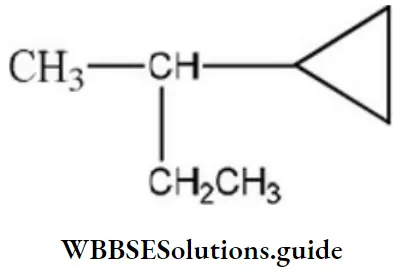
Question 132. Amongst the following compounds, the optically active alkane having lowest molecular mass is
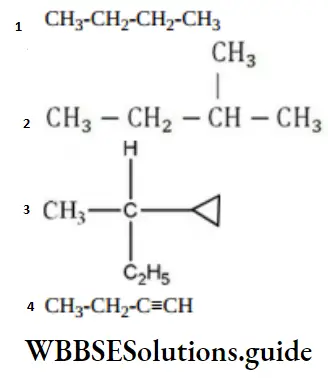
NEET General Organic Chemistry Introduction And Classification Optically Active Alkane Having Lowest Molecular mass

Answer: 3

NEET General Organic Chemistry Introduction And Classification Optically Active Alkane Having Lowest Molecular mass

Solution:

NEET General Organic Chemistry Introduction And Classification Asymmetric Carbon, Thus Oprically Active

contains asymmetric carbon, thus optically active.

Question 133. An organic compound X(mol. formula C6H5O2N) has six carbons in a ring system, three double bonds, and also a nitro group as substituent. X is:

  1. Homocyclic but not aromatic
  2. Aromatic but not homocyclic
  3. Homocyclic and aromatic
  4. Heterocyclic

Answer: 3. Homocyclic and aromatic

Solution: The given compound is nitrobenzene.

Question 134. The hybrid orbitals at carbon 2 and 3 in the compound CH3 CH=CHCH3 are:

  1. sp3, sp
  2. sp2, sp2
  3. sp, sp
  4. sp2, sp

Answer: 2. sp2,sp2

Solution: Both these carbon atoms have 3σ-and 1π-bond. Recall hybridized orbitals never form π-bonds.

Question 135. The bond energy for catenation next to carbon is:

  1. N
  2. S
  3. Si
  4. P

Answer: 3. Si

Solution: The bond energy of catenation order is C > Si > S > P.

Question 136. Least stable conformer of cyclohexane is

  1. Chair
  2. Boat
  3. Twist boat
  4. Planar hexagon

Answer: 4. Planar hexagon

Solution: Planar hexagon conformer has considerable angle strain due to the fact that its bonds are not 109.5°. It also has torsional strain. Due to the presence of these strains, the planar hexagon conformer of cyclohexane is least stable.

Question 137. Which one of the following compounds is the most polar?

  1. CH2I2
  2. CH2F2
  3. CH2Cl2
  4. CH2Br2

Answer: 2. CH2F2

Solution: The electronegativity of F is maximum and thus, the C—F bond is more polar.

Question 138. Ammonia molecule is:

  1. A nucleophile
  2. An electrophile
  3. A homolytic
  4. An acid

Answer: 4. An acid

Solution: It contains lone pair electrons on the “N” atom.

Question 139. The formula of ethanenitrile is:

  1. C2H5NC
  2. C2H5CN
  3. CH3CN
  4. None of these

Answer: 3. CH3CN

Solution: Follow nomenclature rules

Question 140. The most abundant organic compound in the world is:

  1. CH4
  2. Chlorophyll
  3. Alkaloids
  4. Cellulose

Answer: 4. Cellulose

Solution: A lot of plant kingdom is made up of cellulose.

Question 141. State of hybridization of carbon atom of carbene in the singlet state is

  1. sp2
  2. sP
  3. sp3
  4. None of these

Answer: 1. sp2

Solution: Carbon atom in singlet carbene is sp2-hybridized.

Question 142. Total number of rotational conformers of n-butane are:

  1. 2
  2. 6
  3. 5
  4. 3

Answer: 3. 5

Solution: Follow conformation; The conformers for n-butane are two gauche, two eclipsed and one anti.

Question 143. The arrangement of atoms that characterizes a particular stereoisomer is called?

  1. Geometry of isomer
  2. Configuration
  3. Conformers
  4. None of these

Answer: 2. Configuration

Solution: Different spatial arrangement of atoms leads to its configuration.

Question 144. The restricted rotation about the carbon-carbon double bond in 2-butene is due to:

  1. Overlap of two p-orbitals
  2. Overlap of one p and one sp2-hybridized orbitals
  3. Overlap of two sp2-hybridized orbitals
  4. Overlap of one s and one sp2-hybridized orbitals

Answer: 1. Overlap of two p-orbitals

Solution: Presence of the n-bond in the molecule gives rise to hindered rotation.

Question 145. Glycerol is an alcohol which can be classified as

  1. Trihydric
  2. Monohydric
  3. Dihydric
  4. Hexahydric

Answer: 1. Trihydric

Solution: Glycerol is a trihydric alcohol. It is CH2 OH-CHOH-CH2 OH. It contains three hydroxyl groups. It is present in nature in the form of oils and fats as its carboxylic esters.

Question 146. The organic liquid that mixes freely with water is:

  1. CHCl3
  2. CCl4
  3. CS2
  4. C2 H5 OH

Answer: 4. C2 H5 OH

Solution: Due to H-bonding.

Question 147. With a change in hybridization of the carbon bearing the charge, the stability of a carbanion increases in the order

  1. sp < sp3 < sp2
  2. sp < sp2 < sp3
  3. sp2 < sp < sp3
  4. sp3 < sp2 < sp

Answer: 4. sp3 < sp2 < sp

Solution: Stability of carbanions increase with increasing in s-character of hybrid orbitals of carbon-bearing charge therefore, the order is sp3 < sp2 < sp

Question 148. Which one of the following is the stable structure of cyclohexatriene?

  1. Chair form
  2. Boat form
  3. Half chair form
  4. Planar form

Answer: 4. Planar form

Solution: Benzene has a planar structure.

Question 149. Which of the following compounds is expected to be optically active?

  1. (CH3)2 CHCHO
  2. CH3CH2CH2CHO
  3. CH3CH2CHBrCHO
  4. CH3CH2CBr2CHO

Answer: 3. CH3CH2CHBrCHO

Solution: Compounds having asymmetric C-atom are optically active, for example,
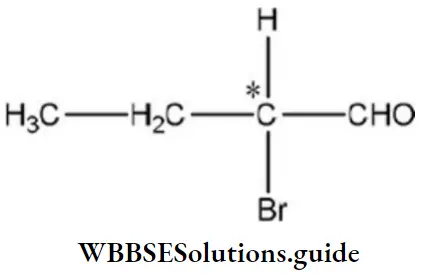
NEET General Organic Chemistry Introduction And Classification Compounds Having Asymmetric C Atom Are Optically Active

The C-atom whose four valencies are satisfied by four different groups is an asymmetric C-atom.

Question 150. How many n-electrons are there in the following?
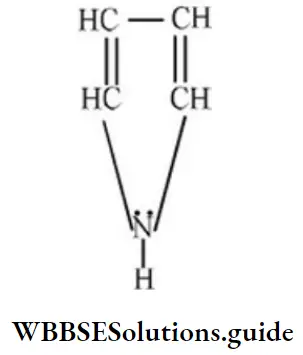
NEET General Organic Chemistry Introduction And Classification Four Pi Electrons Of Double Bond And 1 Lone Pair On N Antom

  1. 2
  2. 4
  3. 6
  4. 8

Answer: 3. 6

Solution: Four n-electrons of double bond and 1 lone pair on “N” atom leads to delocalization of six electrons.

Question 151. The number of possible alkynes with molecular formula C5H8 is

  1. 3
  2. 4
  3. 5
  4. 6

Answer: 1. 3

Solution:  C5H8 has three possible alkynes. These are
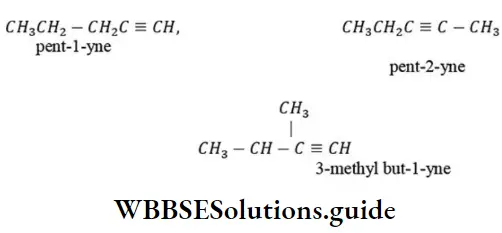
NEET General Organic Chemistry Introduction And Classification Three Possible Alkynes

Question 152. Formulae of phenyl carbinol and chloral are respectively:

  1. C6H5.CH2CH2OH and CHCl2CHO
  2. C6H5CH2OH and CCl3CHO
  3. C6H5OH and CH2Cl.CHO
  4. C6H5CHO and CHCl2CHO

Answer: 2. C6H5CH2OH and CCl3CHO

Solution: Carbinol is trivial name for HCH2OH. Thus, C6H5 CH2 OH is phenyl carbinol and chloral is CCl3 CHO.

Question 153. The correct name for the following hydrocarbon is
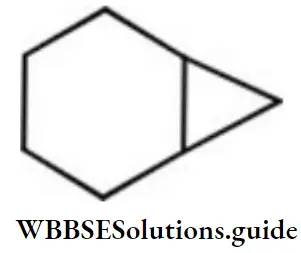
NEET General Organic Chemistry Introduction And Classification This Compound Contains 7 Carbons Atoms

  1. Tricycle [4.1.0] heptane
  2. Bicyclo [5.2.1] heptane
  3. Bicyclo [4.1.0] heptane
  4. Bicyclo [4.1.0] hexane

Answer: 3. Bicyclo [4.1.0] heptane

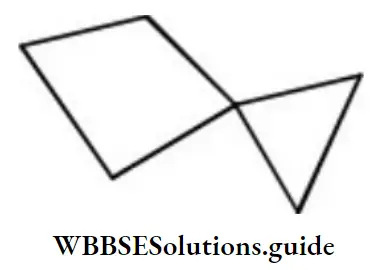
Solution: This compound contains 7 carbon atoms, so the corresponding alkane is heptane. Two bridges contain 4 and 1 carbon atom respectively and one bridge does not contain any carbon atom. So, the name of the compound is bicyclo (4,1,0) heptane.
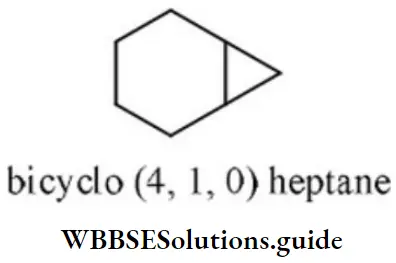
NEET General Organic Chemistry Introduction And Classification Bicyclo Hepthane

Question 154. In the following compounds which will have a zero-dipole moment?

  1. 1,1-dichloroethylene
  2. trans-1,2-dichloroethylene
  3. cis-1,2-dichloroethylene
  4. None of the above

Answer: 2. trans-1,2-dichloroethylene

Solution: Symmetrical trans-form has a non-polar nature.

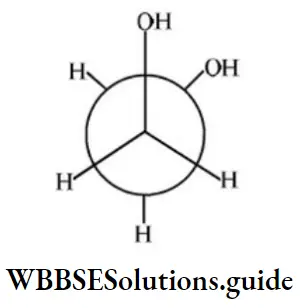
Question 155. Which of the following conformers for ethylene glycol is most stable?
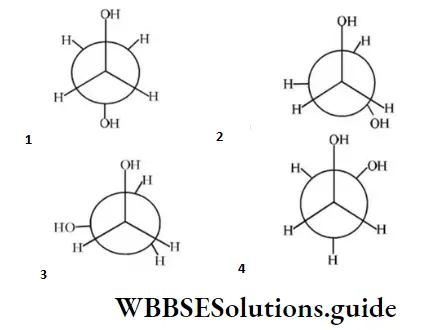
NEET General Organic Chemistry Introduction And Classification Showing Intramolecular H Bonding

Answer: 4

NEET General Organic Chemistry Introduction And Classification Intramolecular H Bonding

Solution: It shows intramolecular H-bonding.

Question 156. Unpaired electron in C° H3 occupies

  1. sp-hybrid orbital
  2. sp3-hybrid orbital
  3. p-orbital
  4. sp2-hybrid orbital

Answer: 3. p-orbital

Solution: Alkyl free radicals are either planar or pyramidal in structure. Spectroscopic evidence shows that methyl free radical (CH3) is planar, thus it is conveniently sp2 hybridization with unpaired electrons located primarily in p-orbital.

Question 157. Out of the following, the alkene that exhibits optical isomerism is

  1. 3-methyl-2-pentene
  2. 4-methyl-l-pentene
  3. 3-methyl-l-pentene
  4. 2-methyl-2-pentene

Answer: 3. 3-methyl-l-pentene

Solution: It has one chiral centre.

Question 158. Rotation of plane polarized light can be measured by:

  1. Manometer
  2. Calorimeter
  3. Polarimeter
  4. Viscometer

Answer: 3. Polarimeter

Solution: It is a fact.

Question 159. In the hydrocarbon,  \(\underset{6}{\mathrm{CH}_3}-\underset{5}{\mathrm{CH}}=\underset{4}{\mathrm{C}} \mathrm{H}-\mathrm{CH}_2-\underset{2}{\mathrm{C}} \equiv \underset{1}{\mathrm{C}} \mathrm{H}\). The state of hybridization of carbons 1, 3, and 5 are in the following sequence:

  1. sp,sp3,sp2
  2. sp,sp2,sp3
  3. sp3,sp2,sp
  4. sp2,sp,sp3

Answer: 1. sp,sp3,sp2

Solution:
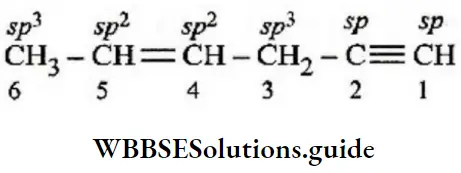
NEET General Organic Chemistry Introduction And Classification State Of Hybridsation Of Carbons 1, 3 And 5

Question 160. 2, 3-dimethyl hexane contains ______ tertiary ____ secondary and _______ primary carbon atoms, respectively

  1. 2,2,1
  2. 2,4,3
  3. 4,3,2
  4. 3,2,4

Answer: 1. 2,2,1

Solution: The structure of 2, 3-dimethyl hexane is
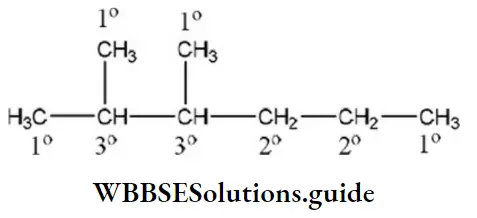
NEET General Organic Chemistry Introduction And Classification The Structure Of 2, 3 Dimethyl Hexane

So, the number of tertiary carbon atoms=2

The number of secondary carbon atoms=2

The number of primary carbon atoms=4

Question 161. The enolic form of acetone contains

  1. 8σ bonds, 2π-bonds, and 1 lone pair
  2. 9σ bonds, 1π-bonds, and 2 lone pairs
  3. 9σ bonds, 2π-bonds, and 1 lone pair
  4. 10σ bonds, 1πr-bonds, and 1 lone pair

Answer: 2. 9π bonds, 1π-bonds, and 2 lone pairs

Solution:
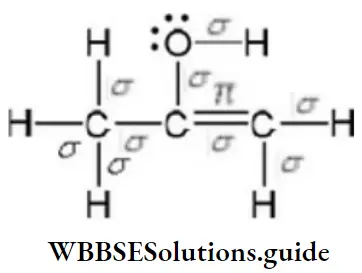
NEET General Organic Chemistry Introduction And Classification Enolic Form Of Acetone

9σ bonds, 1π-bonds, and 2 lone pairs

Question 162. Which of the following molecules contain asymmetric carbon atoms?

  1. CH3CHClCOOH
  2. CH3CH2COOH
  3. ClCH3.CH2COOH
  4. Cl2CHCOOH

Answer: 1. CH3CHClCOOH

Solution: The second carbon is asymmetric.

Question 163. 2-methyl-2-butene will be represented as:
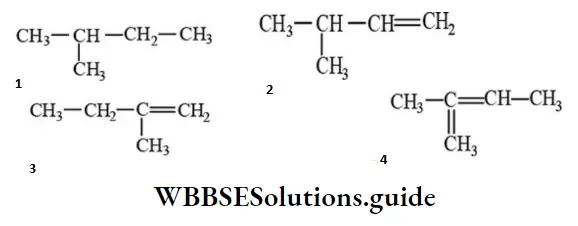
NEET General Organic Chemistry Introduction And Classification 2 Methyl 2 Butene WEill Be Present

Answer: 4

NEET General Organic Chemistry Introduction And Classification 2-methyl-2-butene

Solution: -do-

Question 164. The energy of C—C triple bond in acetylene in kcal is:

  1. 140
  2. 192
  3. 60
  4. 100

Answer: 2. 192

Solution: It is a fact.

Question 165. The chirality of the compound is
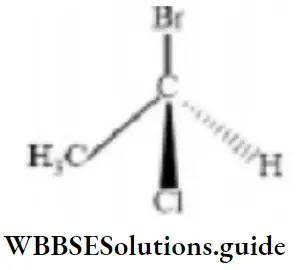
NEET General Organic Chemistry Introduction And Classification The Chirality Of The Compound

  1. R
  2. S
  3. Z
  4. I

Answer: 1. R

Solution: Highest to lowest priority (Br > Cl >CH3) is clockwise than R.

Question 166. Bond energy with the increase in number of lone pairs on the bonded atoms.

  1. Decreases
  2. Increases
  3. Does not change
  4. None of these

Answer: 3. Does not change

Solution: It is a fact.

Question 167. The family to which methoxy ethene belongs, is?

  1. Hydrocarbon
  2. Ketone
  3. Unsaturated ether
  4. Ester

Answer: 3. Unsaturated ether

Solution: Methoxy ethene is CH3O—CH = CH2 an unsaturated ether.

Question 168. Crown ethers are named as X-crown-7. In the following crown ether, X and Y are respectively
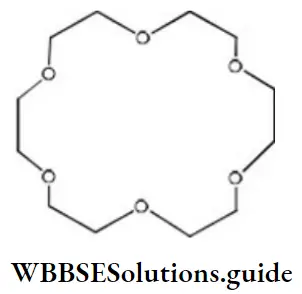
NEET General Organic Chemistry Introduction And Classification Crown Ethewrs Are Named X Crown Y

  1. 6 and 12
  2. 18 and 6
  3. 24 and 6
  4. 6 and 24

Answer: 2. 18 and 6

Solution: X-crown-Y, 18-crown-6

The first number X is the total number of ‘C’ and ‘O atoms in the ring and the second number Y is the number of oxygen atoms in the ring.

Question 169. In the following compounds, the order of basicity is:
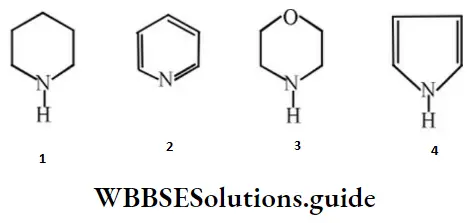
NEET General Organic Chemistry Introduction And Classification 2 And 4 Lone Pairs Are Involved In Resonance

  1. 4 > 1 > 3 > 2
  2. 3 > 1 > 4 > 2
  3. 2 > 1 > 3 > 4
  4. 1 > 3 > 2 > 4

Answer: 4. 1 > 3 > 2 > 4

Solution: In 2 and 4 lone pairs are involved in resonance.

Question 170. The hybridization of central carbon atom in 1,2- propadiene (allene) is

  1. sp3
  2. sp2
  3. sp
  4. None of these

Answer: 3. sp

Solution: The simplest cumulated diene is 1,2-propadiene, CH2=C=CH2, also known as allene. Indeed, cumulated dienes are often called allenes. The central carbon in such compounds is sp- hybridized (it has only two bonding partners), and the double-bond array is linear as a result.

Question 171. Which structure can be explained by taking ground state configuration of atoms?

  1. BeH2
  2. BF3
  3. CH4
  4. H2O

Answer: 4. H2O

Solution: “O” has two unpaired electrons in the ground state.

Question 172. Among the following, which one has more than one kind of hybridization?

  1. CH3CH2CH2CH3
  2. CH3CH=CHCH3
  3. CH2=CH-CH=CH
  4. CH = CH


  1. 2 and 3
  2. 2 and 1
  3. 3 and 4
  4. 4

Answer: 1. 2 and 3

Solution:

  1. has sp3;
  2. has sp2, sp3;
  3. has sp2, sp;
  4. has sp.

Question 173. C – H bond energy is about 101 kcal/mol for methane, ethane and other alkanes but is only 77kcal/mol for C – H bond of CH3 in toluene. This is because

  1. Of inductive effect due to -CH3 in toluene
  2. Of the presence of benzene ring in toluene
  3. Of resonance among the structures of benzyl radical in toluene
  4. Aromaticity of toluene

Answer: 3. Of resonance among the structures of benzyl radical in toluene

Solution: Y C – H bond in toluene has partial double bond character due to resonance. C – H bond in toluene has less energy as compared to others.

Question 174. The energy difference between the chair and boat form of cyclohexane is:

  1. 44 kJ mol-1
  2. 24 kJ mol-1
  3. 34 kJ mol-1
  4. 68 kJ mol-1

Answer: 1. 44 kJ mol-1

Solution: It is a fact.

Question 175. Allyl isocyanide has:

  1. 9σ and 4π-bonds
  2. 8σ and 5π-bonds
  3. 9σ, 3π, and 2 non-bonded electrons
  4. 8σ, 3π, and 4 non-bonded electrons

Answer: 3. 9σ, 3TT and 2 non-bonded electrons

Solution: Single bond has 1 sigma bond double bond has a sigma and a pi bond and triple bond has 2 pi and 1 sigma bond.

Question 176. Which of the following represents the given mode of hybridization sp2-sp2-sp-sp from left to right?

  1. CH2=CH-OCH
  2. HOC-ON
  3. CH2=C-C=CH2
  4. NEET General Organic Chemistry Introduction And Classification Hybridization Left To Right

Answer: 1. CH2=CH-OCH

Solution: CH2=CH-OCH (sp2-sp2-sp-sp)

Question 177. In which case the carbon-carbon bond length is the same?

  1. 2-butene
  2. Benzene
  3. 1-butene
  4. 1-propyne

Answer: 2. Benzene

Solution: Due to resonance in benzene.

Question 178. The compounds CH3 NH2 and CH3 CH2.NH2 are:

  1. Isomers
  2. Isobars
  3. Homologous
  4. Allotropes

Answer: 3. Homologous

Solution: Both differ by a -CH2 group.

Question 179. The C—C bond length of the following molecules is in the order of.

  1. C2H6 > C2H4 > C6H6 > C2H2
  2. C2H2 < C2H4 < C6H6 < C2H6
  3. C6H6 > C2H2 > C2H6 > C2H4
  4. C2H4 > C2H6 > C2H2 > C6H6

Answer: 2. C2H2 < C2H4 < C6H6 < C2H6

Solution: C-C, C = C, and C = C bond length are 1.54 A, 1.34A, and 1.20A respectively.

In benzene C = C is 1.40A.

Question 180. Vital force theory of the origin of organic compounds was discarded by:

  1. Kolbe’s synthesis
  2. Haber’s synthesis
  3. Wohler’s synthesis
  4. Berthel it’s a synthesis

Answer: 3. Wohler’s synthesis

Solution: Wohler prepared urea from inorganic compounds and rejected the vital force theory that organic compounds can only be synthesized from living organisms.

Question 181. Which of the following orders is true regarding the acidic nature of COOH?

  1. Formic acid > acetic acid > propanoic acid
  2. Formic acid > acetic acid < propanoic acid
  3. Formic acid < acetic acid > propanoic macid
  4. Formic acid > acetic acid < propanoic acid

Answer: 1. Formic acid > acetic acid > propanoic acid

Solution: This can be judged by comparing the stabilities of carboxylate ions formed. The most stable carboxylate ion is formed by the strongest acid

Question 182. A compound containing 80% C and 20% H is likely to be

  1. C6H6
  2. C2H6
  3. C2H6
  4. C2H2

Answer: 2. C2H6

Solution:

\(\begin{aligned}
& \mathrm{C} \frac{80}{12}=6.6, H \frac{20}{1}=20 ; \text { ratio }=1: 3 \\
& \mathrm{EF}=\mathrm{CH}_3 \\
& \mathrm{MF}=\mathrm{C}_2 \mathrm{H}_6
\end{aligned}\)


Question 183. With a change in hybridization of the carbon bearing the charge, the stability of a carbanion increases in the order

  1. sp<sp2<sp3
  2. sp<sp3<sp2
  3. sp3<sp2<sp
  4. sp2<sp<sp3

Answer: 3. sp3<sp2<sp

Solution: Carbanion is an electron-rich species. Stability of carbanion increases with increase in the s-character of hybrid orbitals of carbon-bearing the charge.

∴ sp3 < sp2 < sp

(25%s-character) (33%s-character) (50%s-character)

Question 184. The basic strength of

  1. \(\mathrm{CH} \equiv \overline{\mathrm{C}}\)
  2. \(\mathrm{CH}_2=\overline{\mathrm{C}} \mathrm{H},\)
  3. \(\mathrm{CH}_3 \overline{\mathrm{C}} \mathrm{H}_2\) will be in order


  1. 1<2<3
  2. 2<3<1
  3. 3<2<1
  4. 3<1<2

Answer: 1. 1<2<3

Solution: Weak base —> strong conjugate acid \(\mathrm{CH} \equiv \mathrm{C}^{-} \rightarrow \mathrm{CH} \equiv \mathrm{CH}\) weakest base (strongest acid among the given) CH3-CH2– CH3 CH3

Question 185. In the following groups,

  1. OAC1
  2. OMe2
  3. OSO2Me
  4. OSO2CF3 the order of leaving group ability is:
  1. 1 > 2 > 3 > 4
  2. 4 > 3 > 1 > 2
  3. 3 > 2 > 1 > 4
  4. 2 > 3 > 4 > 1

Answer: 2. 4 > 3 > 1 > 2

Solution: Leaving group ability depends upon the basicity of the group.

Question 186. The compound in which carbon uses only its sp3 hybrid orbitals for bond formation is

  1. (CH3)3COH
  2. HCOOH
  3. CH3CHO
  4. (H2N)2CO

Answer: 1. (CH3)3COH

Solution:
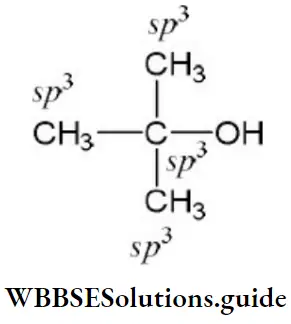
NEET General Organic Chemistry Introduction And Classification Compound In Which Carbon Uses Only On sp2 Hybrid Orbitals

All bonds are σ- bonds hence C uses only its sp3-hybrid orbitals. In all other compounds there is one C=O double bond, therefore, this carbon is sp2– hybridized

Question 187. The structural formula of methyl aminomethane is:

  1. (CH3)2CHNH2
  2. (CH3)3N
  3. (CH3)2NH
  4. CH3NH2

Answer: 3. (CH3)2NH

Solution: IUPAC name is N-methyl methanamine.

Question 188. Which of the following is not chiral?

  1. 3-bromopentane
  2. 2-hydroxy propanoic acid
  3. 2-butanol
  4. 2,3-dibromo pentane

Answer: 1. 3-bromopentane

Solution: 3-bromopentane is not a chiral molecule due to the absence of chiral C-atom.

Question 189. The C—C bond angle in cyclopropane is:

  1. 60°
  2. 120°
  3. 109°28′
  4. 180°

Answer: 1. 60°

Solution: The arrangement of the three carbon atoms of the cyclopropane ring is of the form of an equilateral triangle thus bonds angles are 60 degrees each.

Question 190. How many σ and π bonds are there in the molecule of tetracyanoethylene?
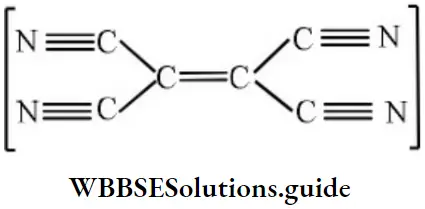
NEET General Organic Chemistry Introduction And Classification Molecule Of Tetracyanboethylene

  1. 9σ and 9π
  2. 5σ and 9π
  3. 9σ and 7π
  4. 5σ and 8π

Answer: 1. 9σ and 9π

Solution: Count σ and n-bonds.

Question 191. The correct name for CH3 COCH2 OH is:

  1. 2-keto propanol
  2. 1-hydroxy propan-2-one
  3. Propan-2-one-l-ol
  4. 3-hydroxy propane-2-one

Answer: 2. 1-hydroxy propan-2-one

Solution: Follow IUPAC rules.

Question 192. The group named as benzal possesses nature.

  1. Monovalent
  2. Bivalent
  3. Trivalent
  4. Tetravalent

Answer: 2. Bivalent

Solution: Benzal is C6 H5 CH group.

Question 193. The study of the three-dimensional structure of molecule is called

  1. Stereochemistry
  2. Solid state chemistry
  3. Chirality
  4. None of these

Answer: 2. Solid state chemistry

Solution: It is a fact.

Question 194. Who proposed the tetrahedral mirror image structures to a pair of enantiomers

  1. Kekule
  2. Wohler
  3. Van’tHoff
  4. None of these

Answer: 3. Van’tHoff

Solution: It is a fact

Question 195. Which of the following statements is not correct?

  1. Primary carbocation is more stable than secondary ones
  2. Secondary free radicals are more stable than primary free radicals
  3. Tertiary free radicals are more stable than secondary ones
  4. Tertiary carbonium ions are more stable than primary ones

Answer: 1. Primary carbocation is more stable than secondary ones

Solution: In the tertiary carbocation the three alkyl groups help to stabilize the positive charge. In a secondary carbocation, only two alkyl groups would be available for this purpose, while a primary carbocation has only one alkyl group available. Thus, the observed order of stability for carbocations is as follows: tertiary > secondary > primary > methyl.

Question 196. Which one of the following is the most energetic conformation of cyclohexane?

  1. Boat
  2. Twisted boat
  3. Chair
  4. Half chair

Answer: 4. Half chair

Solution: The stability order of conformation of cyclohexane is chair>twist boat>boat>half chair. Hence, the half chair is less stable due to torsional and angle strain.

Question 197. Cyclic hydrocarbon molecule (A) has all the C and H atoms in a single plane. All the C-C bonds have same length, less than 1.54 A but more than 1.34A. The∠ (angle) CCC is:

  1. 190°28′
  2. 100°
  3. 180°
  4. 120°

Solution: The conditions given are for C6 H6.

Question 198. A molecule of benzene contains:

  1. Twelve sigma-bonds and three pi-bonds
  2. Eighteen sigma-bonds and three pi-bonds
  3. Twelve pi-bonds and three sigma-bonds
  4. Six hydrogen-bonds, six sigma-bonds and three pi-bonds

Answer: 1. Twelve sigma-bonds and three pi-bonds

Solution: Benzene has 6 C—C and 6 C—H σ-bonds and 3 C = C π-bonds.

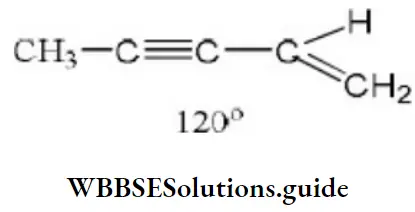
Question 199. The maximum number of carbon atoms arranged linearly in the molecule, CH3– OC-CH=CH2 is

  1. 5
  2. 4
  3. 2
  4. 3

Answer: 3. 2

NEET General Organic Chemistry Introduction And Classification maximum Number Of Carbon Atoms Arranged Linearly

Solution: The C-atoms attached to the triple bond lie in a straight line while the carbon of the CH2 group is inclined at an angle of 120°. Therefore, only 2 carbon atoms are linearly arranged.

Question 200. Homologous compounds have:

  1. Same chemical properties
  2. Same molecular weight
  3. Same physical properties
  4. Same melting point and boiling point.

Answer: 1. Same chemical properties

Solution: Due to the same functional group.

Question 201. The species which use sp2-hybrid orbitals in its bonding:

  1. PH3
  2. NH3
  3. CH3+
  4. CH4

Answer: 3. CH3+

Solution: CH3+ has planar structure.

Question 202. Reactivity of hydrogen atoms attached to different atoms in alkanes has the order:

  1. 3°>1°>2°
  2. 1°>2°>3°
  3. 3°>2°>1°
  4. None of these

Answer: 3. 3°>2°>1°

Solution: The reactivity order for H atom is 3°H > 2°H > 1°H.

Question 203. Eclipsed and staggered forms of n-butane are called a pair of:

  1. Diastereomers
  2. Conformers
  3. Isomers
  4. Enantiomers

Answer: 2. Conformers

Solution: Follow conformation.

Question 204. In the case of homologous series of alkanes, which one of the following statements is incorrect?

  1. The members of the series have the general formula CnH2n+2, where n is an integer
  2. The difference between any two successive members of the series corresponds to 14 unit of relative atomic mass
  3. The members of the series are isomers of each other
  4. The members of the series have similar chemical properties

Answer: 3. The members of the series are isomers of each other

Solution: Homologous differ by a group —CH2 and cannot be isomer.

Question 205. During pyrolysis of an alkane, the C—C bond breaks faster than the C—H bond because:

  1. C—C bond is stronger
  2. C—H bond is weaker
  3. C—C bond involves π-bond in alkane
  4. The bond energy of C—C bond is less than that of C—H bond

Answer: 4. The bond energy of C—C bond is less than that of C—H bond

Solution: Lesser is bond energy of 2p-2p overlapping in C—C, more is its reactivity than C—H bond showing 2p-ls overlapping.

Question 206. Which one of the following compounds is most acidic?
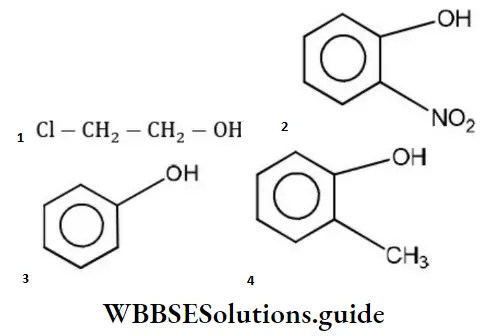
NEET General Organic Chemistry Introduction And Classification Following Compounds Is Most Acidic

Answer: 2

NEET General Organic Chemistry Introduction And Classification Phenols Are Much More Acoidic Than Molecule

Solution: Phenols are much more acidic than alcohol due to the stabilization of phenoxide ion resonance.
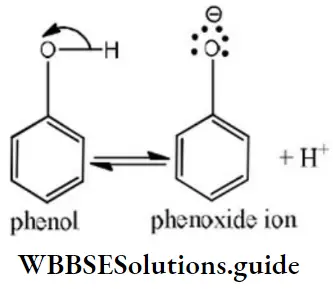
NEET General Organic Chemistry Introduction And Classification Phenols Are Much More Acidic Than Alochol

Phenoxide ions are stabilized due to the following resonating structures.
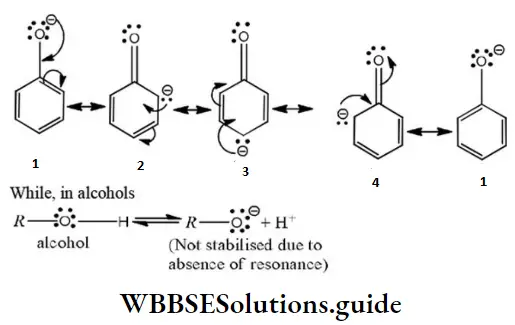
NEET General Organic Chemistry Introduction And Classification Phenoxide Ions Are Stabilized Due To Resonmating Structure

ortho nitrophenol is most acidic because in -NO2 electron attracting group is attached to ortho position which helps in stabilizing the negative charge on the oxygen of phenoxide ion. Hence, due to this reason acidic character of phenol is increased, while on attachment of -CH3 group (electron donating group) acidic strength of phenol is decreased in cresol due to the  destabilization of phenoxide ion.

Question 207. The correct definition for organic chemistry is:

  1. Chemistry of carbon compounds
  2. Chemistry of compounds derived from living organisms
  3. Chemistry of hydrocarbons and their derivatives
  4. None of the above

Answer: 3. Chemistry of hydrocarbons and their derivatives

Solution: It is the latest modified definition of organic chemistry.

Question 208. The nodal plane in the π-bond of ethene is located in

  1. The molecular plane
  2. A plane parallel to the molecular plane
  3. A plane perpendicular to the molecular plane which bisects the carbon-carbon sigma bond at right angle
  4. A plane perpendicular to the molecular plane which contains the carbon-carbon sigma bond

Answer: 1. The molecular plane

Solution: A π-bond has a nodal plane passing through the two bonded nuclei, i.e., molecular plane.

Question 209. Given that the decreasing order of the acidic character is
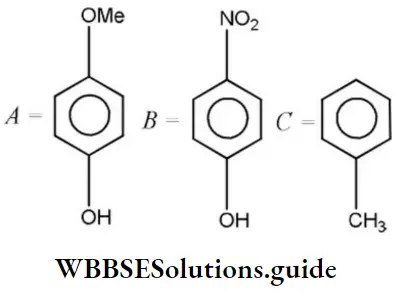
NEET General Organic Chemistry Introduction And Classification Decreasing Order Of The Acidic Character

  1. A>B<C
  2. B>A>C
  3. B>C>A
  4. C>B>A

Answer: 3. B>C>A

Solution: According to Lewis, electron-acceptor compounds are called acids. Therefore, compounds having a tendency to accept electrons will be more acidic. The correct order of acidic character is as follows:
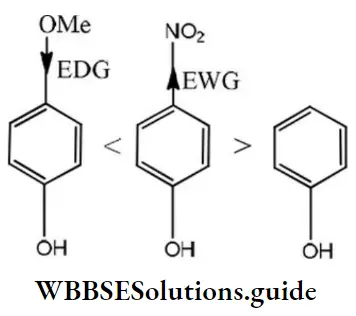
NEET General Organic Chemistry Introduction And Classification According To Lewis Electron Acceptor Compouns Are Called Acidic

Question 210. Select the molecule having only one n-bond

  1. CH≡CH
  2. CH2 = CH—CHO
  3. CH3-CH=CH2
  4. CH3-CH=CHCOOH

Answer: 3. CH3-CH=CH2

Solution: CH3-CH=CH2 (Propene) has only one Pi-bond.

Question 211. The Cl—C—Cl angle in 1,1,2,2-tetrachloroethene and tetrachloromethane respectively will be about:

  1. 120° and 109.5°
  2. 90° and 109.5°
  3. 109.5° and 90°
  4. 109.5° and 120°

Answer: 1. 120° and 109.5°

Solution: CCl2=CCl2 has ethene like structure (z.e.,sp2-hybridization); CCl4 has CH4 like structure,i.e.,sp3-hybridization.

Question 212. The name of the compound is
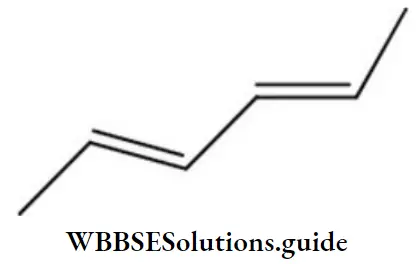
NEET General Organic Chemistry Introduction And Classification The Compound Is 2Z, 4Z-2, 4 Hexadience

  1. (2Z,4Z)-2, 4-hexadiene
  2. (2Z-, 4E)-2, 4-hexadiene
  3. (2E, 4Z)-2, 4-hexadiene
  4. (4E, 4Z)-2, 4-hexadiene

Answer: 1. (2Z,4Z)-2, 4-hexadiene

Solution: The name of the compound is (2Z,4Z)-2, 4-hexadiene.

Question 213. The change in optical rotation with time of freshly prepared solution of sugar is known as:

  1. Specific rotation
  2. Inversion
  3. Rotatory motion
  4. Mutarotation

Answer: 2. Inversion

Solution: The hydrolysis of sugar solution (dextrorotatory) leads to formation of laevorotatory mixture due to formation of glucose (dextrorotatory) and fructose (laevorotatory).

Question 214. A strong base can abstract an a-hydrogen from:

  1. Amine
  2. Ketone
  3. Alkane
  4. Alkene

Answer: 2. Ketone

Solution: Removal of H from ketone gives resonance stabilized carbanion.

Question 215. What is the formula of tertiary butyl alcohol?

  1. CH-CH(CH3)-CH2-OH
  2. CH3-(CH2)2OH
  3. CH3-CH(OH)-CH2-CH3
  4. (CH3)3.C-OH

Answer: 4. (CH3)3.C-OH

Solution:
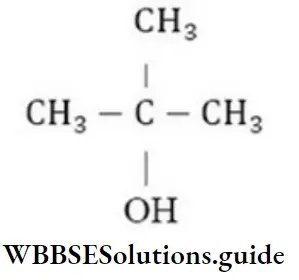
NEET General Organic Chemistry Introduction And Classification Formula Of Tertiary Butyl Alochol

is the formula of tertiary butyl alcohol as in it – OH group is attached to tertiary carbon.

Question 216. Which of the following compounds (s) has ‘Z’ configuration?
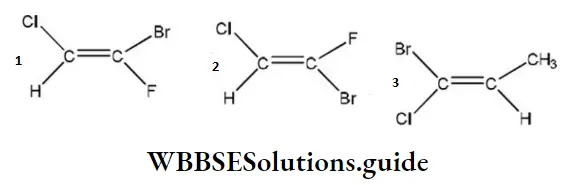
NEET General Organic Chemistry Introduction And Classification 1 And Are Compounds Has Z Configuration

  1. 1 only
  2. 2 only
  3. 3 only
  4. 1 and 3

Answer: 4. 1 and 3

Solution: When the groups with higher priority (i.e., with high atomic number) are present on the same side of the double bond, then the configuration is Z but when present on the opposite side of the double bond, the configuration is E.

Question 217 The number of sp3– hybrid carbons in 2-butyne is:

  1. 4
  2. 3
  3. 2
  4. 1

Answer: 3. 2

Solution: Butyne-2 is CH3-C=C-CH3; Two carbon of corner are sp3-hybridized.

Question 218. Which of the following possesses a sp-hybridized carbon in its structure?

  1. CCl2=CCl2
  2. CH2=C=CH2
  3. CH2=CH—CH=CH2
  4. CH2=CCl—CH=CH2

Answer: 2. CH2=C=CH2

Solution: The middle carbon has 2σ-and 2π-bonds.

Question 219. The shape of CH3° is?

  1. Linear
  2. Planar
  3. Pyramidal
  4. None of these

Answer: 3. Pyramidal

Solution: sp’-hybridization with one position occupied by lone pair like NH3.

Question 220. Which one is the senior most functional group in the nomenclature of an organic compound if it possesses more than one functional group?

  1. —CHO
  2. —COOH
  3. —OH
  4. NEET General Organic Chemistry Introduction And Classification

Answer: 2. —COOH

Solution: -COOH is on top in the preference table.

Question 221. The number of valence electrons in the excited carbon atom is:

  1. Two in s and two in p-orbitals
  2. 4 singles p-orbitals
  3. One in s and three in p-orbitals
  4. None of the above

Answer: 3. One in s and three in p-orbitals

Solution: Excited state of carbon is 2s1 2p3.

Question 222. In benzene, all the C-C bonds are of equal length because of:

  1. Isomerism
  2. Resonance
  3. Tautomerism
  4. Inductive effect

Answer: 2. Resonance

Solution: Resonance in benzene gives rise to identical C—C bond lengths.

Question 223. Correct structural formula of the compound-5-nitro-3-methoxy-3-methylhexanoyl chloride is
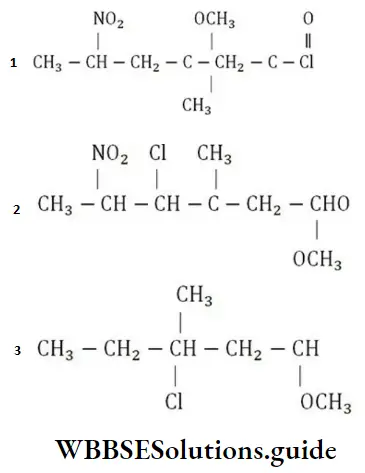
NEET General Organic Chemistry Introduction And Classification The Structural Formula Of The Compound 5 Nitro 3 Methoxy 3 Methyl Hexanoyl Chloride

Solution: The structural formula of the compound 5-nitro-3-methoxy-3-methyl hexanoyl chloride is
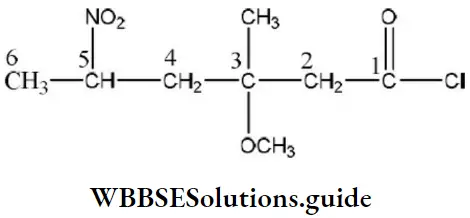
NEET General Organic Chemistry Introduction And Classification Structural Formula Of Niro Methoxy methyl Hexanoyl Chloride

Question 224. Enol content is highest in

  1. Acetone
  2. Acetophenone
  3. Acetic acid
  4. Acetyl acetone

Answer: 4. Acetyl acetone

Solution: The amount of enolic form is highest in acetyl due to the stabilization of enolic form by hydrogen bonding
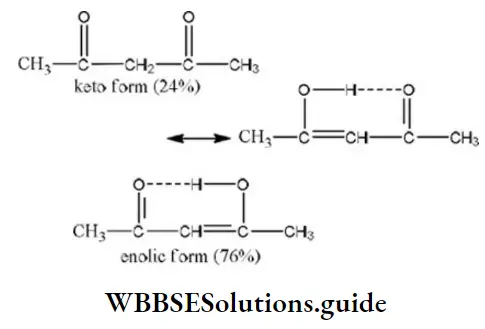
NEET General Organic Chemistry Introduction And Classification Enol Content Is Highest

Question 225. Pyridine is:

  1. An aromatic compound and a primary base
  2. A heterocyclic amino compound and a tertiary base
  3. An aromatic amino compound and forms salts
  4. A cyano derivative of benzene and secondary base

Answer: 2. A heterocyclic amino compound and a tertiary base

Question 226. The sigma bond energy of C—H bond in C2 H6 is:

  1. 99 kcal
  2. 140 kcal
  3. 200 kcal
  4. 60 kcal

Answer: 1. 99 kcal

Solution: It is a fact.

Question 227. The name of the compound, is: 
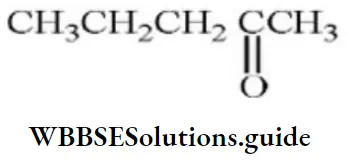
NEET General Organic Chemistry Introduction And Classification Pentan 2 One

  1. 2-pentanone
  2. Pentanone-2
  3. Pentan-2-one
  4. All are correct

Answer: 3. Pentan-2-one

Solution: -do-

Question 228. Which of the following does not have a resonance structure?

  1. Benzene
  2. Benzaldehyde
  3. Acetaldehyde
  4. Benzylamine

Answer: 3. Acetaldehyde

Solution: All aromatic compounds are resonance hybrids.

Question 229. Which reaction sequence would be best to prepare 3-chloro-aniline from benzene?

  1. Chlorination, nitration, reduction
  2. Nitration, chlorination, reduction
  3. Nitration, reduction, chlorination
  4. Nitration, reduction, acylation, chlorination, hydrolysis

Answer: 2. Nitration, chlorination, reduction

Solution: This synthesis involves adding two substituents to the benzene ring. In this case, we need to consider the order of substitution. Cl is an ortho-para director. That means, if Cl is first added to the benzene, the next substituent will be placed in the ortho/para position and that will not work since, in the desired product, NH2NH2 is meta to Cl. That means we need to add Cl in the last. NH2NH2 is also an ortho-para director, so that means we can’t add Cl after forming aniline.

Assertion Reasoning Type

Each question contains Statement l(Assertion) and Statement 2(Reason).

Each question has the 4 choices (1), (2), (3), and (4) out of which only one is correct.

  1. Statement 1 is True; Statement 2 is True;
    Statement 2 is the correct explanation for Statement 1
  2. Statement 1 is True; Statement 2 is True;  Statement 2 is not correct explanation for Statement 1
  3. Statement 1 is True, Statement 2 is False
  4. Statement 1 is False, Statement 2 is True

Question 230.

  1. Statement 1: Carbanion-like ammonia has pyramidal shape
  2. Statement 2: The carbon atom carrying negative charge has an octet of electrons

Answer: 2. Statement 1 is True; Statement 2 is True;  Statement 2 is not correct explanation for Statement 1

Solution: Carbon in carbanion is sp3-hybridized with one orbital occupied by a lone pair

Question 231.

  1. Statement 1: The empirical formula of glucose is CH2O which represents the relative number of atoms of each atom present in this molecule
  2. Statement 2: In glucose, the elements C, H, and O have combined in the ratio 1:2:1

Answer: 1. Statement 1 is True; Statement 2 is True;
Statement 2 is correct explanation for Statement 1

Solution: The empirical formula of compound in the simplest formula deduced from its percentage composition showing its composition by



NEET Biology Class 12 Evolution Notes

Evolution Notes

Evolution is an orderly change from one form to another. Evolutionary Biology is the study of the evolutionary history of life forms.

Origin Of Life

Big Bang Theory states that universe originated about 20 billion years ago by a singular huge explosion.

  • The earth was formed about 4.5 billion years ago. There was no atmosphere on early earth. Water vapour, CH4, CO2, and NH3 released from molten mass covered the surface.
  • The UV rays from the sun broke up water into H2 and O2. Oxygen combined with NH3 and CH4 to form water, CO2 etc. The ozone layer was formed. As it cooled, the water vapour fell as rain to form oceans. Life appeared almost four billion years ago.

Read And Learn More: NEET Biology Class 12 Notes

Theories Of Origin Of Life

  1. Theory of spontaneous generation (Abiogenesis): It
    states that, life came out of decaying and rotting matter like straw, mud etc.

    • Louis Pasteur disproved this theory. He demonstrated that life comes only from pre-existing life. He showed that life did not come from killed yeast in a closed pre-sterilized flask. But in an opened flask, life (microbes) appeared.
  2. Biogenesis: Proposed by Francisco Redi, Spallanzani and Louis Pasteur. It states that, life originates from pre¬existing life. But it does not explain origin of first life.
  3. Cosmic theory (Theory of Panspermia): It states that the units of life (spores) were transferred to different planets including Earth.
  4. Theory of special creation: It states that living and nonliving was created by some supernatural power (God).
  5. Theory of chemical evolution: Proposed by Oparin and Haldane. It states that, the first form of life was originated from non-living inorganic and organic molecules such as CH4, NH3, H2O, sugars, proteins, nucleic acids etc. i.e. “Abiogenesis first, but biogenesis ever since”.

“neet ug biology class 12 genetics and evolution “

Urey-Miller experiment: Harold Urey and Stanley Miller experimentally proved theory of chemical evolution. They created a condition like that of primitive earth (i.e. high temperature, volcanic storms, reducing atmosphere with CH4, NH3, H2O, H1 etc.).

  • They made electric discharge in a closed flask containing CH4, NH3, H2 and water vapour at 800o As a result, some amino acids are formed. In similar experiments, others observed the formation of sugars, nitrogen bases, pigment and fats.
  • The first non-cellular forms of life originated 3 billion years ago. They were self-replicating metabolic capsule containing RNA, proteins, Polysaccharides etc.

NEET Biology Class 12 Evolution Notes Urey Miller Experiment

NEET Biology Class 12 Evolution Notes

Evidence For Evolution

1. Paleontological evidences

  • Paleontology: It is the study of fossils.
  • Fossils are remnants of life forms found in rocks (earth’s crust). Fossils are written documents of evolution.

Significance of fossils:

  1. To study phytogeny (evolutionary history or race history). For example, Horse evolution.
  2. To study the connecting link between two groups of organisms. Example, Archaeopteryx.
  3. To study extinct animals. Example, Dinosaurs.
  4. To study about the geological period by analysing fossils in different sedimentary rock layers. The study showed that life forms varied over time and certain life forms are restricted to certain geological time spans.

“neet ug biology-class 12 genetics and evolution “

2. Morphological and Anatomical evidence: Comparative anatomy and morphology shows that different forms of animals have some common structural features. This can be explained as follows

  1. Homologous organs: Homologous organs are organs that have fundamental similarities in structure and origin but different functions. This phenomenon is called Homology.
    • Homologous organs Example, the Human hand, Whale’s flippers, Bat’s wing and Cheetah’s foot. These forelimbs have different functions but similar anatomical structures such as bones (for example, humerus, radius, ulna, carpals, metacarpals and phalanges).
    • Homology is also seen in the heart, brain etc.
    • Homology in plants: For example, Thorns of Bougainvillea and tendrils of Cucurbita.
    • The origin of homologous organs is due to Divergent evolution. It is the evolution by which related species become less similar to survive and adapt in different environmental condition.
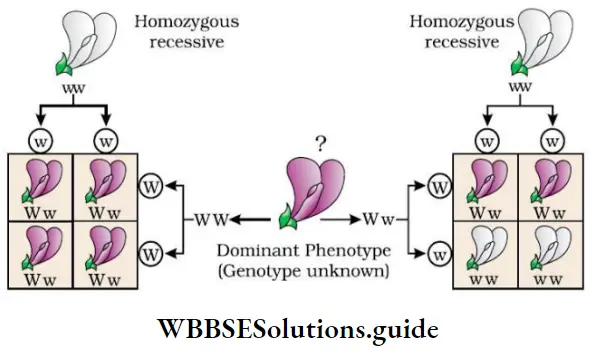
    • Homology indicates common ancestry.
  2. Analogous organs: These are the organs having similar functions but different structures and origins. This phenomenon is called Analogy. Example,
    • Wings of insects (formed of a thin flap of chitin) and wings of birds (modified forelimbs).
    • Eyes of Octopus (retina from skin) and mammals (retina from embryonic brain).
    • Flipper of Penguins and Dolphins.
    • Sweet potato (modified root) and Potato (modified stem).
    • Trachea of insects (from ectoderm) and lungs of vertebrates (from endoderm).

Origin of analogous organs is due to Convergent evolution. It is the evolution by which unrelated species become more similar to survive and adapt in similar environmental conditions.
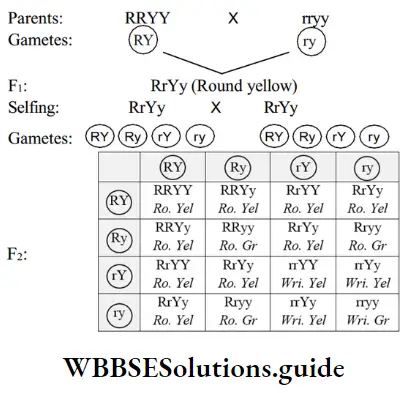
3. Adaptive radiation (Biogeographical evidence)
Adaptive radiation (evolution by adaptation) is the evolution of different species in a geographical area starting from a point.
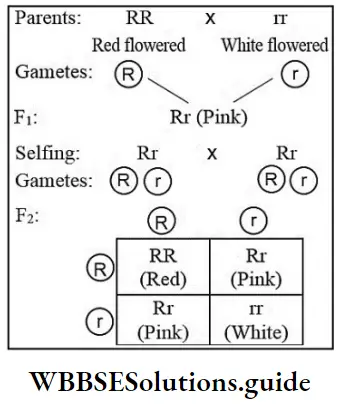
NEET Biology Class 12 Evolution Notes Adaptive radiation

Evolution NEET Notes

Adaptive radiation Example:

  • Darwin’s finches in Galapagos Islands.
  • Australian marsupials (Marsupial radiation).
  • Placental mammals in Australia.

NEET Biology Class 12 Evolution Notes

“evolution chapter class 12 notes self study “

When more than one adaptive radiation appears in an isolated geographical area, it results in convergent evolution. For example, Australian Marsupials and Placental mammals.

NEET Biology Class 12 Evolution Notes Placental And Australian Marsupials

NEET Biology Evolution Important Notes

4. Biochemical evidence: Organisms show similarities in proteins, genes, other biomolecules and metabolism. It indicates common ancestry.

5. Embryological evidence

  • Proposed by Ernst Haeckel.
  • He observed that all vertebrate embryos have some common features that are absent in adult.
  • Embryological evidence For Example, all vertebrate embryos (including humans) develop vestigial gill slits just behind the head. However, it is functional only in fish and not found in other adult vertebrates.
  • However, Karl Ernst von Baer rejected this proposal. He noted that embryos never pass through the adult stages of other animals.

6. Evidence for evolution by natural selection: Natural selection is the process by which the organisms that are best suited for their environment survive and reproduce. Some evidence are given below.
Industrial melanism: In England, before industrialization (1850s), there were more white-winged moths (Biston betularia) on trees than dark-winged or melanised moths (Biston carbonaria). After industrialization (1920), more dark-winged moths and less white-winged moths were developed.

Embryological evidences Reason:

  • Before industrialization: There was white lichens covered the trees. In that background, white-winged moths survived but dark-winged moths were picked out by predators.
  • After industrialization: The tree trunks became dark due to industrial smoke and soot. No growth of lichens. Under this condition, the white-winged moth did not survive because the predators identified them easily. Dark-winged moth survived because of suitable dark background.

Natural selection by anthropogenic action: It is the development of resistant varieties in organisms due to human action. Example, Excessive use of herbicides, pesticides, antibiotics or drugs etc.
Theories Of Biological Evolution

Lamarckism (Theory of Inheritance of Acquired characters): It is proposed by Lamarck. It states that evolution of life forms occurred by the inheritance of acquired characters. Acquired characters develop by the use and disuse of organs.

  • Evolution by use of organs: Long neck of giraffe is due to continuous elongation to forage leaves on trees. This acquired character was inherited to succeeding generations.
  • Evolution by disuse: Disappearance of limbs in snakes.

This theory was eliminated out because it is proved that the characters are inherited only through genes.

Darwinism (Theory of Natural selection)

  • Proposed by Charles Darwin.
  • It was based on observations during a sea voyage in a sail ship called H.M.S. Beagle.
  • Alfred Wallace (a naturalist worked in Malay Archepelago) had also come to similar conclusions.
  • Work of Thomas Malthus on populations influenced Darwin.

Darwinism is based on 2 key concepts:

  • Branching descent: It explains that all organisms are modified descendants of previous life forms.
  • Natural selection: Consider a bacterial colony A growing on a given medium. If the medium composition is changed, only a part of the population can survive under new condition. This variant population (B) outgrows the others and appears as a new species, i.e. B is better than A under new conditions. Thus, nature selects for fitness.

Natural selection is based on the following facts:

  • Heritable minor variations: It is either beneficial or harmful to the organisms.
  • Overproduction: Population size grows exponentially due to maximum reproduction (For example, bacterial population).
  • Limited natural resources: Resources are not increased in accordance with the population size.
  • Struggle for existence: It is the competition among organisms for resources so that population size is limited.
  • Survival of the fittest: In struggle for existence, organisms with beneficial variations can utilize resources better. Hence, they survive and reproduce. This is called
  • Survival of the fittest. It leads to a change in population characteristics and new forms appear.
  • Darwin ignored about origin of variation and mechanism of evolution or speciation.

Mechanism Of Evolution

  • Hugo de Vries proposed the Mutation Theory of evolution.
  • He conducted experiments on Oenothera lamarckiana (evening primrose) and believed that evolution takes place through mutation and not by minor variation.
  • Darwinian variation is minor, slow and directional. Due to this, gradual evolution occurs.
  • Mutation is sudden, random and directionless variation. Here, speciation is by saltation (single step, large mutation).
  • Mutation is the origin of variation for evolution.

“evolution chapter class 12 notes self study “

Hardy Weinberg Principle

It states that allele frequencies in a population are stable and constant from generation to generation in the absence of other evolutionary influences.

The gene pool (total genes and their alleles in a population) remains constant. This is called genetic equilibrium (Hardy-Weinberg equilibrium).

Sum total of all the allelic frequencies = 1

In a diploid, p and q are the frequencies of alleles A and a respectively.

The frequency of AA = p2

The frequency of aa = q2

The frequency of Aa = 2pq

Hence p2 + 2pq + q2 = 1 [binomial expansion of (p+q)2]

Change of frequency of alleles in a population causes disturbance in genetic equilibrium. This is due to evolution.

Best Short Notes for Class 12 Biology Evolution

Factors affecting Hardy-Weinberg equilibrium

  1. Gene migration: Gene flow from one population to another. Here gene frequencies change in both populations. Gene flow occurs if migration happens multiple times.
  2. Genetic drift: The accidental gene flow causing change in frequency. Sometimes, the change in frequency is so different in the new sample of population that they become a different species. The original drifted population becomes founders and the effect is called the founder effect.
  3. Mutation: Mutations result in formation of new phenotypes. Over few generations, this leads to speciation.
  4. Genetic recombination: Reshuffling of gene combinations during crossing over resulting in genetic variation.
  5. Natural selection: It is 3 types.

1. Stabilizing selection: Here, more individuals acquire mean character value and variation is reduced. For example, consider the body size of organisms.

NEET Biology Class 12 Evolution Notes Stabilizing Selection

Evolution Class 12 NCERT Notes for NEET

2. Directional selection: Here, individuals of one extreme are more favoured.

NEET Biology Class 12 Evolution Notes Directional Selection

3. Directional selection: Here, individuals of both extreme are more favoured.

NEET Biology Class 12 Evolution Notes Disruptive Selection

Evolution Class 12 NEET Key Concepts and Summary

A Brief Account Of Evolution

The geological time scale includes 4 eras: Proterozoic, Palaeozoic, Mesozoic and Cenozoic.

1. Proterozoic era: 2500 – 541 million years ago (mya)

  • The first cellular forms of life appeared (2000 mya).
  • Some of the cells had the ability to release O2 as the light reaction in photosynthesis.
  • Single-celled organisms became multicellular organisms.

2. Palaeozoic era (540 – 252 mya)

  • It has 6 periods: Cambrian (540 – 490 mya), Ordovician (490 – 443 mya), Silurian (425 mya), Devonian (405 mya), Carboniferous (360 mya) and Permian (285 mya).
  • 500 mya: Invertebrates were formed.
  • 450 mya: First land organisms (plants) appeared.
  • 400 mya: Arthropods invaded the land.
  • 350 mya: Jawless fishes were evolved. Fishes with stout and strong fins could move on land and go back to water.
  • In 1938, a Coelacanth fish (lobefins) was caught in South
  • Africa which was thought to be extinct. This fish was evolved into the first amphibians (ancestors of modern-day frogs and salamanders).
  • 320 mya: Seaweeds and few plants were existed.
  • Amphibians evolved to reptiles. They lay thick-shelled eggs (do not dry up in sun).
  • Giant ferns (Pteridophytes) were present but they all fell to form coal deposits slowly.

“evolution chapter class 12 notes self study “

3. Mesozoic era (252 – 66 mya) – Age of reptiles

  • It has 3 periods: Triassic (230 mya), Jurassic (208 mya) and Cretaceous (144 mya).
  • 200 mya: Some of the land reptiles went back into water to evolve into fish-like reptiles (E.g. Ichthyosaurs).
  • The land reptiles were dinosaurs (Tyrannosaurus rex, Triceratops, Pteranodon, Stegosaurus, Brachiosaurus etc.) T. rex was the largest dinosaur (20 feet in height, huge fearsome dagger-like teeth).
  • First toothed birds were emerged.

NEET Biology Class 12 Chapter Evolution Detailed Notes

4. Cenozoic era (66 – 0 mya)

  • Age of Mammals and Angiosperms.
  • It has 2 periods: Tertiary (66 mya) and Quaternary (2 mya – Age of man).
  • 65 mya: Dinosaurs suddenly disappeared. Some say climatic changes killed them. Some say most of them evolved into birds.
  • First mammals were shrew-like. Their fossils are small-sized.
  • In South America, there were mammals resembling horses, hippopotamuses, bears, rabbits etc. Due to continental drift, when South America joined North America, these animals were overridden by North American fauna.
  • Due to continental drift, Australian marsupials survived because of a lack of competition from any other mammals.

Theories of Evolution and Natural Selection NEET Notes

Origin And Evolution Of Man

  • 15 mya: Dryopithecus and Ramapithecus. Hairy. Walked like gorillas and chimpanzee.
  • Dryopithecus: ape-like.
  • Ramapithecus: man-like.
  • 3-4 mya: Man-like primates. Height up to 4 feet. Fossils of man-like bones found in Ethiopia and Tanzania.
  • 2 mya: Australopithecus. Lived in East African grasslands. Hunted with stone weapons. Ate fruits.
    Homo habilis: First human-like being (hominid).
    Brain capacity: 650-800 cc. Did not eat meat.
  • 1.5 mya: Homo erectus (Java man). Large brain (900 cc). Ate meat.
  • 1 lakh – 40,000 yrs ago: Homo neanderthalensis (Neanderthal man).
  • Brain capacity: 1400 cc. Lived in East and Central Asia. Used hides to protect their body. Buried their dead.
  • 75,000 – 10,000 yrs ago (ice age): Homo sapiens (Modern man). Prehistoric cave art developed about 18,000 years ago. Agriculture and settlements: 10,000 years ago.


NEET Biology Class 12 Molecular Basis of Inheritance Notes

Molecular Basis Of Inheritance Class 12 Notes For Neet

Nucleic acids (DNA and RNA) are the building blocks of genetic material. DNA is the genetic material in most of the organisms. RNA is the genetic material in some viruses. RNA mostly functions as a messenger.

DNA

Structure Of Polynucleotide Chain: Polynucleotides are the polymer of nucleotides. DNA and RNA are polynucleotides. A nucleotide has 3 components:

  1. A nitrogenous base.
  2. A pentose sugar (ribose in RNA and deoxyribose in DNA).
  3. A phosphate group.

Nitrogen bases are 2 types:

Read And Learn More: NEET Biology Class 12 Notes

  1. Purines: These include Adenine (A) and Guanine (G).
  2. Pyrimidines: It include Cytosine (C), Thymine (T), and Uracil (U). Thymine (5-methyl Uracil) is present only in DNA and Uracil only in RNA.
  • A nitrogenous base is linked to the pentose sugar through an N-glycosidic linkage to form nucleoside.
  • Nitrogen base + sugar + phosphate group = Nucleotide (deoxyribonucleotide).
  • In RNA, every nucleotide residue has an additional -OH group present at the 2′-position in the ribose (2’- OH). 2 nucleotides are linked through 3’-5’ phosphodiester bond to form a dinucleotide. When more nucleotides are linked, it forms polynucleotides.

“molecular basis of inheritance “

NEET Biology Class 12 Molecular Basis of Inheritance Strcuture Of Polynucleotide Chain

Molecular Basis Of Inheritance Class 12 Notes For Neet

Structure Of Thedna

  • Friedrich Meischer (1869): Identified DNA and named it as ‘Nuclein’.
  • James Watson and Francis Crick (1953) proposed a double helix model of DNA. It was based on X-ray diffraction data produced by Maurice Wilkins and Rosalind Franklin.
  • DNA is made of 2 polynucleotide chains coiled in a right-handed fashion. Its backbone is formed of sugar and phosphates. The bases project inside.
  • The 2 chains have anti-parallel polarity, i.e. one chain has the polarity 5’→3’ and the other has 3’→5’.
  • The bases in 2 strands are paired through H-bonds forming base pairs (bp).
  • A = T (2 hydrogen bonds) C≡G (3 hydrogen bonds)
  • Purine comes opposite to a pyrimidine. This generates uniform distance between the 2 strands.
  • Erwin Chargaff’s rule: In DNA, the proportion of A is equal to T and the proportion of G is equal to C.

NEET Biology Class 12 Molecular Basis of Inheritance Structure Of Thendna

“molecular basis of inheritance notes pdf download “

∴ A [A] + [G] = [T] + [C] or [A] + [G] / [T] + [C] =1

  • ∅ 174 (a bacteriophage) has 5386 nucleotides.
  • Bacteriophage lambda has 48502 base pairs (bp).
  • E. coli has 4.6×10⁶ bp.
  • Haploid content of human DNA is 3.3×10⁶ bp.

Length of DNA = number of base pairs X distance between two adjacent base pairs.

The number of base pairs in human = 6.6 x 10⁹

NEET Biology Class 12 Molecular Basis of Inheritance Notes

Molecular Basis Of Inheritance Class 12 Notes For Neet

Hence, the length of DNA = 6.6 x 109 x 0.34 x 10-9 = 2.2 m

NEET Biology Class 12 Molecular Basis of Inheritance Length Of DNA

Packaging Of DNA Helix: In prokaryotes (For example, E. coli), the DNA is not scattered throughout the cell. DNA, being negatively charged, is held with some positively charged proteins and forms a ‘nucleoid’. In eukaryotes, there is a set of positively charged, basic proteins called histones. DNA m home

  • Histones are rich in positively charged basic amino acid residues lysines and arginines. 8 histones form histone octamer.
  • Negatively charged DNA is a Nucleosome wrapped around histone octamer to give nucleosome.
  • A typical nucleosome contains 200 bp. Therefore, the total number of nucleosomes in human = \(\frac{6.6 \times 10^9 \mathrm{bp}}{200}=3.3 \times 10^7\)
  • Nucleosomes constitute the repeating unit to form chromatin. Chromatin is a thread-like stained body.
  • Nucleosomes in chromatin = ‘beads-on-string’.
  • Chromatin is packaged → chromatin fibers → coiled and condensed at the metaphase stage → chromosomes.
  • Higher level packaging of chromatin requires non-histone chromosomal (NHC) proteins.

NEET Biology Class 12 Molecular Basis of Inheritance Notes

Molecular Basis Of Inheritance Class 12 Notes Neet

NEET Biology Class 12 Molecular Basis of Inheritance Pachaging Of DNA Helix

“molecular basis of inheritance class 12 pdf notes “

Chromatins include

  • Euchromatin: Loosely packed and transcriptionally active chromatin and stains light.
  • Heterochromatin: Densely packed and inactive region of chromatin and stains dark.

Search For Genetic Material

1. Griffith’s Transforming Principle experiment Griffith used mice and Streptococcus pneumoniae.

Streptococcus pneumoniae has 2 strains

  1. Smooth (S) strain (Virulent): Has polysaccharide mucus coat. Cause pneumonia.
  2. Rough (R) strain (Non-virulent): No mucus coat. Do not cause Pneumonia.

Molecular Basis Of Inheritance Class 12 Notes Neet

Experiment:

  • S-strain → Inject into mice → Mice die
  • R-strain → Inject into mice → Mice live
  • S-strain (Heat killed) → Inject into mice → Mice live
  • S-strain (Hk) + R-strain (live) → Inject into mice → Mice die

He concluded that some ‘transforming principle’, transferred the heat-killed S-strain to the R-strain. It enabled the R-strain to smooth the polysaccharide coat and become virulent. due to the transfer of genetic material.

Molecular Basis of Inheritance NEET Notes

2. Biochemical characterization of the transforming principle: Oswald Avery, Colin MacLeod, and Maclyn McCarty worked to determine the biochemical nature of the ‘transforming principle’ in Griffith’s experiment.

  • They purified biochemicals (proteins, DNA, RNA, etc.) from heat-killed S cells using suitable enzymes.
  • They discovered that
    • Digestion of protein and RNA (using Proteases and RNases) did not affect transformation. So, the transforming substance was not a protein or RNA.
    • Digestion of DNA with DNase inhibited transformation. It means that DNA caused the transformation of R cells to S cells, i.e. DNA was the transforming principle.

Molecular Basis Of Inheritance Class 12 Notes Neet

3. Hershey-Chase Experiment (Blender Experiment)

  • Hershey and Chase grew some bacteriophage viruses on a medium containing radioactive phosphorus (P32) and some others on medium containing radioactive sulphur (S35).
  • Viruses grown in P32 got radioactive DNA because only DNA contains phosphorus. Viruses grown in S35 got radioactive protein because protein contains sulfur.
  • These preparations were used separately to infect E. coli.
  • After infection, the E. coli cells were gently agitated in a blender to remove the virus particles from the bacteria.
  • Then the culture was centrifuged to separate lighter virus particles from heavier bacterial cells.

“chapter 6 class 12 biology notes “

NEET Biology Class 12 Molecular Basis of Inheritance The Search For Genetic Material

Bacteria infected with viruses have radioactive DNA from radioactive. i.e., DNA had passed from the virus to synthesize Bacteria infected with viruses having radioactive. These must-be proteins were not radioactive. i.e., proteins did not enter the bacteria from the viruses. This proves that DNA is the genetic material.

Dna And Rna Difference Class 12

Properties Of Genetic Material DNA Versus RNA

A genetic material may have the following properties:

  • Ability to generate its replica (Replication).
  • Chemical and structural stability.
  • Provide the mutations that are required for evolution.
  • Ability to express as ‘Mendelian Characters’.
  • RNA is unstable. So, RNA viruses (For example, Q.B bacteriophage, Tobacco Mosaic Virus, etc.) mutate and evolve faster.
  • DNA strands are complementary. On heating, they separate. etc) evolved around RNA. In appropriate conditions, they come together. In Griffith’s experiment, some properties of the DNA of the heat-killed bacteria did not destroyed. It indicates the stability of DNA. For the storage of genetic information, DNA is better due to its stability. But for the transmission of genetic information, RNA is better.
  • RNA can directly code for protein synthesis, and hence can easily express the characters. DNA is dependent on RNA for protein synthesis.

NEET Biology Class 12 Molecular Basis of Inheritance Properties Of Genetic Material

RNA World

  • RNA was the first genetic material.
  • It acts as genetic material and catalyst.
  • Essential life processes (metabolism, translation, splicing evolved from RNA for stability.

Central Dogma Of Molecular Biology

It is proposed by Francis Crick. It states that the genetic information flows from DNA → RNA → Protein. In some viruses, the flow of information is in the reverse direction (from RNA to DNA). It is called reverse transcription.

NEET Biology Class 12 Molecular Basis of Inheritance Central Dogma Of Molecular Biology

Dna And Rna Difference Class 12

DNA Replication

  • Replication is the copying of DNA from parental DNA.
  • Watson and Crick proposed a Semi-conservative model of replication. It suggests that the parental DNA strands act as templates for the synthesis of new complementary strands. After replication, each DNA molecule would have one parental and one new strand.
  • Matthew Messelson and Franklin Stahl (1958) experimentally proved the Semi-conservative model.

NEET Biology Molecular Basis of Inheritance Important Notes

Messelson and Stahl’s Experiment: They cultured E. coli in a medium containing 15NH4Cl (15N: heavy isotope of N). 15N was incorporated into both strands of bacterial DNA and the DNA became heavier.

  • Another preparation containing N salts labeled with 14N is also made. 14N was incorporated in both strands of DNA and became lighter. These 2 types of DNA can be separated by centrifugation in a CsCl density gradient.
  • They took E. coli cells from 15N medium and transferred to 14N medium. After one generation (i.e. after 20 minutes), they isolated and centrifuged the DNA. Its density was intermediate (hybrid) between 15N DNA and 14N DNA. This shows that the newly formed DNA one strand is old (15N type) and one strand is new (14N type). This confirms semi-conservative replication.
  • After 2 generations (i.e. after 40 minutes), there was equal amounts of hybrid DNA and light DNA.
  • Taylor and colleagues (1958) performed similar experiments on Vicia faba (faba beans) using radioactive thymidine to detect distribution of newly synthesized DNA in the chromosomes. It proved that the DNA in chromosomes also replicate semi-conservatively.

“molecular basis of inheritance pyq neet “

NEET Biology Class 12 Molecular Basis of Inheritance DNA Replication


Dna And Rna Difference Class 12

The Machinery and Enzymes for Replication

  • DNA replication starts at a point called origin (ori). A unit of replication with one origin is called a replicon.
  • During replication, the 2 strands unwind and separate by breaking H-bonds in presence of an enzyme, Helicase. Unwinding of the DNA molecule at a point forms a ‘Y’-shaped
  • The separated strands act as templates for the synthesis of new strands. DNA replies in the 5’→3’ direction.
  • Deoxyribonucleoside triphosphates (dATP, dGTP, dCTP, and dTTP) act as substrate and provide energy for polymerization.
  • Firstly, a small RNA primer is synthesized in presence of an enzyme, primase.
  • In the presence of an enzyme, DNA-dependent DNA polymerase, many nucleotides join with one another to primer strand and form a polynucleotide chain (new strand).
  • The DNA polymerase forms one new strand (leading strand) in a continuous stretch in the 5’^3’ direction (Continuous synthesis).
  • The other new strand is formed in small stretches (Okazaki fragments) in 5’→3’ direction (Discontinuous synthesis).
  • The Okazaki fragments are then joined together to form a new strand by an enzyme, DNA ligase. This new strand is called lagging strand.
  • If a wrong base is introduced in the new strand, DNA polymerase can do proof reading. E. coli completes replication within 18 minutes. i.e. 2000 bp per second.
  • In eukaryotes, the replication of DNA takes place at the S- phase of the cell cycle. Failure in cell division after DNA replication results in polyploidy.

NEET Biology Class 12 Molecular Basis of Inheritance The Machinery And Enzymes For Replication

Molecular Basis of Inheritance Class 12 NEET Key Concepts and Summary

Transcription

It is the process of copying genetic information from one strand of the DNA into RNA. Here, adenine pairs with uracil instead of thymine. During transcription, both strands are not copied because The code for proteins is different in both strands. This complicates the translation.

If 2 RNA molecules are produced simultaneously, this would be complimentary to each other. It forms a double-stranded RNA and prevents translation.

Class 12 Biology Molecular Basis Of Inheritance Notes

Transcription Unit

  • It is the segment of DNA between the sites of initiation and termination of transcription. It consists of 3 regions:
    • A promoter (Transcription start site): Binding site for RNA polymerase.
    • Structural gene: The region between promoter and terminator where transcription takes place.
    • A terminator: The site where transcription stops.
  • The DNA-dependent RNA polymerase catalyzes the polymerization only in 5’ → 3’direction.
  • 3’→5’ acts as template strand. 5’→3’ acts as a coding strand. ATGCATGCATGCATGCATGCATGC-5’te mplate strand. TACGTACGTACGTACGTA CGTACG-3’ coding strand.

“bank of biology class 12 molecular basis of inheritance “

Transcription unit and gene: A gene is a functional unit of inheritance. It is the DNA sequence coding for an RNA (mRNA, rRNA, or tRNA). Cistron is a segment of DNA coding for a polypeptide during protein synthesis. It is the largest element of a gene. Structural gene in a transcription unit is 2 types:

  1. Monocistronic structural genes (split genes): It is seen in eukaryotes. Here, coding sequences (exons or expressed sequences) are interrupted by introns (intervening sequences). Exon sequences appear in processed mRNA. Intron sequences do not appear in processed mRNA.
  2. Polycistronic structural genes: It is seen in prokaryotes. Here, there are no split genes.

Steps of transcription in prokaryotes: In bacteria (Prokaryotes), synthesis of all types of RNA are catalysed by a single RNA polymerase. It has 3 steps:

  1. Prokaryotes Initiation: Here, the enzyme RNA polymerase binds at the promoter site of DNA. This causes the local unwinding of the DNA double helix. An initiation factor(factor) present in RNA polymerase initiates RNA synthesis.
  2. Prokaryotes Elongation: RNA chain is synthesized in 5’ → 3’ direction. In this process, activated ribonucleoside triphosphates (ATP, GTP, UTP, and CTP) are added. This is complementary to the base sequence in the DNA template.
  3. Prokaryotes Termination: A termination factor (p factor) binds to the RNA polymerase and terminates the transcription.
  • mRNA requires no processing to become active.
  • Transcription and translation take place in the same compartment (no separation of cytosol and nucleus).

Class 12 Biology Molecular Basis Of Inheritance Notes

NEET Biology Class 12 Molecular Basis of Inheritance Steps Of Transcription In Prakaryates

In eukaryotes, there are 2 additional complexities:

1. There are 3 RNA polymerases:

  1. RNA polymerase 1: Transcribes rRNAs (28S, 18S and 5.8S).
  2. RNA polymerase 2: Transcribes the heterogeneous nuclear RNA (hnRNA). It is the precursor of mRNA.
  3. RNA polymerase 3: ‘Transcribes tRNA, 5S rRNA, and snRNAs (small nuclear RNAs).

2. The primary transcripts (hnRNA) contain exons and introns and are non-functional. Hence introns must be removed. For this, it undergoes the following processes:

Class 12 Biology Molecular Basis Of Inheritance Notes

  • Splicing: From hnRNA introns are removed (by the spliceosome) and exons are spliced (joined) together.
  • Capping: Here, a nucleotide methyl guanosine triphosphate (cap) is added to the 5’ end of hnRNA.
  • Tailing (Polyadenylation): Here, adenylate residues (200-300) are added at 3’-end. It is the fully processed hnRNA, now called mRNA.

Genetic Code

It is the sequence of nucleotides (nitrogen bases) in mRNA that contains information for protein synthesis (translation). The sequence of 3 bases determining a single amino acid is called codon.

George Gamow suggested that for coding 20 amino acids, the code should be made up of 3 nucleotides. Thus, there are 64 codons (43= 4 x 4 x 4).

  • Har Gobind Khorana developed the chemical method in synthesizing RNA molecules with defined combinations of bases (homopolymers and copolymers).
  • Marshall Nirenberg developed a cell-free system for protein synthesis.
  • Severo Ochoa (polynucleotide phosphorylase) enzyme is used to polymerize RNA with defined sequences in a template-independent manner.

NEET Biology Class 12 Chapter Molecular Basis of Inheritance Detailed Notes

20 types of amino acids involved in translation

  1. Alanine (Ala)
  2. Arginine (Arg)
  3. Asparagine (Asn)
  4. Aspartic acid (Asp)
  5. Cystein (Cys)
  6. Glutamine (Gln)
  7. Glutamic acid (Glu)
  8. Glycine (Gly)
  9. Histidine (His)
  10. Isoleucine (Ile)
  11. Leucine(Leu)
  12. Lysine (Lys)
  13. Methionine(Met)
  14. Phenylalanine(Phe)
  15. Proline (Pro)
  16. Serine (Ser)
  17. Threonine (Thr)
  18. Tryptophan (Trp)
  19. Tyrosine (Tyr)
  20. Valine (Val)

The codons for the various amino acids

NEET Biology Class 12 Molecular Basis of Inheritance The Codons for the Various Amino Acids

Salient features of genetic code

Class 12 Biology Molecular Basis Of Inheritance Notes

  • Triplet code (three-letter code).
  • 61 codons code for amino acids. 3 codons (UAA, UAG, and UGA) do not code for any amino acids. They act as stop codons (Termination codons or non-sense codons). Genetic code is universal. Example, From bacteria to human UUU codes for Phenylalanine. Some exceptions are found in mitochondrial codons, and in some protozoans.
  • No punctuations b/w adjacent codons (comma less code). The codon is read in mRNA in a contiguous fashion.
  • Genetic code is non-overlapping.
  • A single amino acid is represented by many codons (except AUG for methionine and UGG for tryptophan). Such codons are called degenerate codons.
  • Genetic code is unambiguous and specific. i.e. one codon specifies only one amino acid.
  • AUG has dual functions. It codes for Methionine and acts as an initiator codon. In eukaryotes, methionine is the first amino acid, and formyl methionine in prokaryotes.

Biology Class 12 Notes For Neet

Mutations and Genetic Code: The relationship between genes and DNA are best understood by mutation studies. Deletions and rearrangements in DNA may cause the loss or gain of a gene and so a function.

  • Insertion or deletion of one or two bases changes the reading frame from the point of insertion or deletion. Insertion/ deletion of three or its multiple bases insert or delete one or multiple codons.
  • Hence one or multiple amino acids are inserted /deleted. The reading frame remains unaltered from that point onwards. Such mutations are known as frame-shift insertion or deletion mutations. It proves that codon is a triplet and is read contiguously.

Types Of RNA

  • mRNA (messenger RNA): Provide template for translation (protein synthesis).
  • rRNA (ribosomal RNA): Structural and catalytic role during translation. For example, 23S rRNA in bacteria acts as ribozyme.
  • tRNA (transfer RNA or sRNA or soluble RNA): Brings amino acids for protein synthesis and reads the genetic code.

NEET Biology Class 12 Molecular Basis of Inheritance Types Of RNA

NEET Study Material for Molecular Basis of Inheritance Chapter

Francis Crick postulated presence of an adapter molecule that can read the code and to link with amino acids. tRNA is called adaptor molecule because it has

Biology Class 12 Notes For Neet

  • An Anticodon (NODOC) loop that has bases complementary to the codon.
  • An amino acid acceptor end to which amino acid binds.
  • Ribosome binding loop.
  • Enzyme binding loop.
  • For initiation, there is another tRNA called initiator tRNA. There are no tRNAs for stop codons.
  • The secondary (2-D) structure of tRNA looks like a cloverleaf. The 3-D structure looks like an inverted ‘L’.

Translation (Protein Synthesis)

It is the process of polymerization of amino acids to form a polypeptide based on the sequence of codons in mRNA.

“molecular basis of inheritance class 12 notes bank of biology “

It takes place in ribosomes. It includes 4 steps:

  1. Charging of tRNA
  2. Initiation
  3. Elongation
  4. Termination

1. Charging (aminoacylation) of tRNA: Formation of peptide bond needs energy obtained from ATP. For this, amino acids are activated (amino acid + ATP) and linked to their cognate tRNA in the presence of aminoacyl tRNA synthetase. Thus, the tRNAbecomes charged.

Biology Class 12 Notes For Neet

2. Initiation

  • It begins at the 5 ’-end of mRNA in the presence of an initiation factor. The mRNA binds to the small subunit of ribosome. Now the large subunit binds to the small subunit to complete the initiation complex.
  • Large subunit has 2 binding sites for tRNA- aminoacyl tRNA binding site (A site) and peptidyl site (P site). The initiation codon for methionine is AUG. So methionyl tRNA complex would have UAC at the Anticodon site.

NEET Biology Class 12 Molecular Basis of Inheritance Translation Initiation

Molecular Basis of Inheritance Class 12 NCERT Notes for NEET

3. Elongation

  • At the P site, the first codon of mRNA binds with anticodon of methionyl tRNA complex.
  • Another aminoacyl tRNA complex with an appropriate amino acid enters the ribosome and attaches to A site. Its anticodon binds to the second codon on the mRNA and a peptide bond is formed between the first and second amino acids in the presence of an enzyme, peptidyltransferase.
  • First amino acid and its tRNA are broken. This tRNA is removed from P site and the second tRNA at the A site is pulled to P site along with mRNA. This is called translocation.
  • Then 3rd codon comes into A site and a suitable tRNA with 3rd amino acid binds at the A site. This process is repeated. During translation, ribosome moves from codon to codon.

Biology Class 12 Notes For Neet

4. Termination

  • When a release factor binds to the stop codon, the translation terminates. The polypeptide and tRNA are released from the ribosomes.
  • The ribosome dissociates into large and small suClass 12 Biology Notes For Neetbunits at the end of protein synthesis. A group of ribosomes associated with a single mRNA for translation is called a polyribosome (polysomes).
  • An mRNA has additional sequences that are not translated (untranslated regions or UTR). UTRs are present at both 5’-end (before the start codon) and 3’-end (after the stop codon). They are required for efficient translation process.

Regulation Of Gene Expression

In eukaryotes gene expression occurs by following levels.

  1. Transcriptional level (formation of primary transcript).
  2. Processing level (splicing etc.).
  3. Transport of mRNA from nucleus to the cytoplasm.
  4. Translational level (formation of apolypeptide).

Class 12 Biology Notes For Neet

The metabolic, physiological, and environmental conditions regulate the expression of genes. Example,

  • In E. coli, the beta-galactosidase enzyme hydrolyses lactose into galactose and glucose. In the absence of lactose, the synthesis of beta-galactosidase stops.
  • The development and differentiation of embryos into adult are a result of the expression of several set of genes. a substrate is added to the growth medium of bacteria, a set of switched off on metabolize it is called induction.
  • When a metabolite (product) is added, the genes to produce it are turned off. This is called repression.

Operon Concept

  • “Each metabolic reaction is controlled by a set of genes”
  • All the genes regulating a metabolic reaction constitute an protein. For example, lac operon, trp operon, ara operon, his becomes free operon, etc.

Class 12 Biology Notes For Neet

Lac Operon in E. coli

  • The operon controlling lactose metabolism
  • It is proposed by Francois Jacob and Jacque Monod. It consists of
  1. A regulatory or inhibitor
    1. gene: Codes for the repressor.
  2. 3 structural genes:
    1. z gene: Codes for β galactosidase (hydrolyze lactose to galactose and glusoce.
    2. y gene: Codes for permease (increase the permeability of the cell to lactose).
    3. a gene: Codes for a transacetylase.

The genes present in the operon function together in the same or related metabolic pathway. There is an operator region for each operon. If there is no lactose (inducer), lac operon remains If it is switched off. The regulator gene synthesizes mRNA to news is produce the repressor protein. This protein binds to the operator genes and blocks RNA polymerase movement. So the structural genes are not expressed.

NEET Biology Class 12 Molecular Basis of Inheritance Regulation Of Gene Expression

DNA Replication, Transcription, and Translation NEET Notes

If lactose is provided in the growth medium, the lactose is transported into the E. coli cells by the action of permease Lactose (inducer) binds with repressor protein. So repressor protein cannot bind to the operator gene. The operator gene is free and induces the RNA polymerase to bind with the operon, val promoter gene. Then transcription starts. Regulation of lac operon by repressor is called negative regulation.

Human Genome Project

The entire DNA in the haploid set of chromosomes of an organism is called a Genome. In Human genome, DNA is packed in 23chromosomes

  • Human genome contains about 3x10⁹bp.
  • Human Genome Project (1990-2003) was the first mega project in identifying the sequence of nucleotides and mapping of all the genes in human genome.
  • HGP was coordinated by U.S. Department of Energy and the National Institute of Health.

Class 12 Biology Notes For Neet

Goals of HGP

  • Identify all the estimated genes in human DNA.
  • Determine the sequences of the 3 billion chemical base pairs that make up humanDNA.
  • Store this information in databases.
  • Improve tools for data analysis.
  • Transfer related technologies to other sectors. Address the ethical, legal, and social issues (ELSI) that may arise from the project.

Methodologies of HGP: 2 major approaches.

  1. Expressed Sequence Tags (ESTs): Focused on identifying all the genes that are expressed as RNA.
  2. Sequence annotation: Sequencing whole set of genome containing all the coding and non-coding sequence and later assigning different regions in the sequence with functions.

HGP Procedure of sequencing: Isolate total DNA from a cell → Convert into random fragments → Clone in suitable host (bacteria and yeast) using vectors (for example, BAC and YAC) for amplification → Fragments are sequenced using Automated DNA sequencers (using Frederick Sanger method) → Sequences are arranged based on overlapping regions → Alignment of sequences using computer programs.

  • BAC= Bacterial Artificial Chromosomes
  • YAC= Yeast Artificial Chromosomes

“molecular basis of inheritance class 12 notes bank of biology “

DNA is converted to random fragments as there are technical limitations in sequencing very long pieces of DNA. HGP was closely associated with Bioinformatics. Bioinformatics: Application of computer science and information technology to the field of biology and medicine.

DNA sequencing also have been done in bacteria, yeast, Caenorhabditis elegans (a free living non-pathogenic nematode), Drosophila, plants (rice and Arabidopsis), etc.

Class 12 Biology Notes For Neet

Salient Features of the Human Genome

  1. The human genome contains 3164.7 million nucleotide bases.
  2. Total number of genes= about 30,000.
  3. Average gene consists of 3000 bases, but sizes vary. Largest known human gene (dystrophin on X- X-chromosome) contains 2.4 million bases.
  4. 99.9% nucleotide bases are same in all people. Only a 0.1% (3×10⁶ bp) difference makes every individual unique.
  5. Functions of over 50% of discovered genes are unknown.
  6. Chromosome I has most genes (2968) and Y has the fewest (231).
  7. Less than 2% of the genome codes for proteins.
  8. A very large portion of the human genome is made of Repeated (repetitive) sequences. These are stretches of DNA sequences that are repeated many times. They have no direct coding functions. They shed light on chromosome structure, dynamics and evolution.
  9. About 1.4 million locations have single-base DNA differences. They are called SNPs (Single nucleotide polymorphism or ‘snips’). This helps to find chromosomal locations for disease-associated sequences and tracing human history.

DNA Fingerprinting (DNA Profiling)

It is the technique to identify the similarities and differences of the DNA fragements of 2 individulas. Developed by Alec Jeffreys (1985).

Basis of DNA fingerprinting

Class 12 Biology Notes For Neet

  • DNA carries some non-coding repetitive sequences called variable number tandem repeats (VNTR).
  • Number of repeats is specific from person to person.
  • The size of VNTR varies from 0.1 to 20 kb.
  • Repetitive DNA are separated from bulk genomic DNA as different peaks during density gradient centrifugation.
  • The bulk DNA forms a major peak and the small peaks
    called satellite DNA.
  • Satellite DNA is classified as micro-satellites, mini¬satellites, etc. based on base composition (A: T rich or G: C rich), length of the segment, and number of repetitive units.
  • VNTR belongs to mini-satellite DNA.
  • Any difference in the nucleotide sequence (inheritable mutation) observed in a population is called DNA polymorphism (variation at genetic level).
  • Polymorphism is higher in non-coding DNA sequence because mutations in these sequences may not have any immediate effect in an individual’s reproductive ability. These mutations accumulate generation after generation and cause polymorphism.
  • Polymorphisms have great role in evolution and speciation differences of the

Steps of DNA fingerprinting (Southern Blotting Technique)

  1. Isolation of DNA.
  2. Digestion of DNA by restriction endonucleases.
  3. Separation of DNA fragments by gel electrophoresis.
  4. Transferring (blotting) DNA fragments to synthetic membranes such as nitrocellulose or nylon.
  5. Hybridization using radioactively labeled VNTR probe.
  6. Detection of hybridized DNA by autoradiography.

“molecular basis of inheritance class 12 notes bank of biology “

The image (in the form of dark and light bands) obtained is are called DNA fingerprint. It differs in everyone except in monozygotic (identical) twins.

The sensitivity of the technique can be increased by use of polymerase chain reaction (PCR). Therefore, DNA from a single cell is enough for DNA fingerprinting.

Application of DNA fingerprinting

  • Forensic tool to solve paternity, rape, murder etc.
  • For the diagnosis of genetic diseases.
  • To determine phylogenetic status of animals.
  • To determine population and genetic diversities.


NEET Biology Class 12 Reproductive Health Notes

Reproductive Health

According to World Health Organisation (WHO), Reproductive health is total well-being in all aspects of reproduction i.e., physical, emotional, behavioural and social.

Reproductive Health Problems And Strategies: India initiated reproductive health programmes (family planning) in 1951. Wider reproduction-related areas are in operation under the Reproductive and Child Health Care (RCH) programmes. Such programmes deal the following:

Read And Learn More: NEET Biology Class 12 Notes

Class 12 Reproductive Health Notes

  • Give awareness about reproduction-related aspects for creating a reproductively healthy society.
  • Educate people about birth control, care of pregnant mothers, post-natal care of mother and child, the importance of breastfeeding, equal opportunities for male and female children etc.
  • Awareness of problems due to population explosion, social evils like sex abuse and sex-related crimes, etc.

Reproductive Health Class 12 Notes For Neet

Aims and needs of sex education in schools

  • To provide right information about sex-related aspects. It helps to avoid sex-related myths and misconceptions.
  • To give proper information about reproductive organs, adolescence and related changes, safe and hygienic sexual practices, sexually transmitted diseases (STD), AIDS etc.

“what is reproductive health class 12 “

Population Explosion And Birth Control

In 1900, the world population was around 2 billion (2000 million). By 2000, it rocketed to about 6 billion. In India, population was nearly 350 million at the time of independence. It crossed 1 billion in May 2000. It means every sixth person in the world is an Indian. According to the 2001 census report, our population growth rate was still around 1.7% (i.e. 17/1000/year), a rate at which our population could double in 33 years.

Class 12 Biology Notes For Neet

  • Reasons for population explosion
    • Increased health facilities and better living conditions.
    • Rapid decline in death rate, maternal mortality rate (MMR) and infant mortality rate (IMR).
    • Increase in number of people in reproducible age.
  • Impacts of population explosion Scarcity of basic requirements (for example, food, shelter and clothing).
  • Population explosion Control measures
    • Motivate smaller families by using contraceptive methods.
    • Aware peoples of the slogan Hum Do HamareDo (we two, our two). Many couples have adopted a ‘one child norm’.
    • Statutory rising of marriageable age of females (18 years) and males (21 years).
  • Properties of an ideal contraceptive
    • User-friendly, easily available, effective and reversible.
    • No or least side-effects.
    • It should not interfere with sexual drive, desire and sexual act.

NEET Biology Class 12 Reproductive Health Notes

Reproductive Health Class 12 Notes For Neet

1. Natural/Traditional methods: Avoid chances of ovum and sperms meeting. It includes

    • Periodic abstinence: Avoid coitus from days 10 to 17 of the menstrual cycle (fertile period) to prevent conception.
    • Coitus interruptus (withdrawal): Withdraw penis from the vagina just before ejaculation to avoid insemination.
    • Lactational amenorrhea: It is the prevention of conception by breastfeeding the child because ovulation and the cycle do not occur during the period of lactation. This is effective up to 6 months following parturition. It has no side effects. But chances of failure are high.

NEET Biology Reproductive Health Important Notes

2. Barriers: They prevent physical meeting of sperm and ovum. Example,

    • Condoms (Example, Nirodh): Made of rubber/latex sheath.
    • Condoms for male: Cover the penis.
    • Condoms for female: Cover the vagina and cervix. Condoms are used just before coitus. They prevent the entry of semen into female reproductive tract.

Class 12 Biology Notes For Neet

Condoms are very popular because: It protects the user from STDs and AIDS.

  • Easily available.
  • It is disposable.
  • It can be self-inserted and thereby give privacy to user.

Diaphragms, cervical caps and vaults:

  • Made of rubber and are inserted into the female reproductive tract to cover the cervix during coitus.
  • They block the entry of sperm through the cervix.
  • They are reusable.
  • Spermicidal creams, jellies and foams are used along with these barriers to increase contraceptive efficiency.

Reproductive Health Class 12 NEET Key Concepts and Summary

3. Intra Uterine Devices (IUDs): These are inserted by doctors or nurses in the uterus through vagina. They increase the phagocytosis of sperms.

Reproductive Health Class 12 Notes For Neet

Types of IUDs:

  1. Non-medicated IUDs: They retard sperm motility. Also, it has a spermicidal effect. Example, Lippes loop.
  2. Copper-releasing IUDs: Cu ions suppress the motility and fertilising capacity of sperms. Example, CuT, Cu7, Multiload375.
  3. Hormone-releasing IUDs: They make the uterus unsuitable for implantation and the cervix hostile to the sperm. Example, Progestasert, LNG-20. IUDs are ideal contraceptives for females who want to delay pregnancy or space children.

Class 12 Biology Notes For Neet

4. Oral contraceptives: Oral administration of progestogens or progestogen-estrogen combinations in the form of tablets (pills).

  • Pills are taken daily for 21 days starting within the first five days of menstrual cycle. After a gap of 7 days (menstruation period), it should be repeated in the same pattern till the female desires to prevent conception.
  • They inhibit ovulation and implantation and thicken cervical mucus to prevent entry of sperm. Pills are very effective with lesser side effects.
  • Saheli: New oral contraceptive for females. It is developed by the Central Drug Research Institute (CDRI) in Lucknow. It contains a non-steroidal preparation. It is a ‘once a week’ pill with very few side effects and high contraceptive value.

NEET Biology Class 12 Chapter Reproductive Health Detailed Notes

5. Injectables Progestogens or Progestogens-oestrogen combination are used by females as injections or implants under the skin.

Their mode of action is like that of pills and their effective periods are much longer. Progestogens or progestogen-oestrogen combinations and IUDs are used as emergency contraceptives within 72 hours of coitus. It avoids pregnancy due to rapeor casual intercourse.

Reproductive Health Class 12 Notes For Neet

6. Surgical methods (sterilization) It helps to block gamete transport and thereby prevents conception. It is very effective but reversibility is poor.

  • Vasectomy: Sterilization procedure in males. In this, a small part of the vas deferens is removed or tied up through a small incision on the scrotum.
  • Tubectomy: Sterilization procedure in females. In this, a small part of the fallopian tube is removed or tied up through a small incision in the abdomen or through vagina.

Side effects of anti-natural contraceptives: Nausea, abdominal pain, breakthrough bleeding, irregula menstrual bleeding, breast cancer etc.

Medical Termination Of Pregnancy

Intentional or voluntary termination of pregnancy before full term is called MTP or induced abortion. 45 to 50 million MTPs are performed in a year all over the world (i.e. 175th of total number of conceived pregnancies).

MTP helps to decrease the population. Many countries have not legalised MTP due to emotional, ethical, religious and social issues. Government of India legalised MTP in 1971 with some strict conditions to check illegal female foeticides.

“reproductive health pdf “

Importance of MTP: To avoid unwanted pregnancies due to casual intercourse or failure of the contraceptive used during coitus or rapes.

It is essential in cases where the continuation of pregnancy could be harmful to the mother to the foetus or both. MTPs are safe during the first trimester, (up to 12 weeks of pregnancy). 2nd-trimester abortions are very risky.

Problems related with MTPs: Majority of the MTPs are performed illegally. Misuse of amniocentesis (a foetal sex determination test based on the chromosomal pattern of foetal cells in the amniotic fluid). If the foetus is female, it is followed by MTP. Such practices are dangerous for the young mother and foetus.

Class 12 Biology Notes For Neet

Sexually Transmitted Diseases

Diseases transmitted through sexual intercourse are called Sexually transmitted diseases (STDs)/Venereal diseases (VD) or Reproductive tract infections (RTI). Example,  Gonorrhoea, syphilis, genital herpes, chlamydiasis, genital warts, trichomoniasis, hepatitis-B and HIV leading to AIDS.

  • Hepatitis B and HIV are also transmitted
  • By sharing of injection needles, surgical instruments etc.
  • By transfusion ofblood.
  • From infected mother to foetus.
  • Except hepatitis-B, genital herpes & HIV, other diseases are completely curable ifdetected early and treated properly.
  • Early symptoms: Itching, fluid discharge, slight pain, swellings, etc. in the genital region.
  • Absence or less significant early symptoms and the social stigma deter the infected persons from consulting a doctor. This leads to pelvic inflammatory diseases (PID), infertility, ectopic pregnancies, abortions, stillbirths, cancer of the reproductive tract etc.
  • All persons are vulnerable to STDs. These are very high among persons in the age group of 15-24 years.
  • Prevention: Avoid sex with unknown partners/multiple partners.

Always use condoms during coitus. In case of doubt, go to a qualified doctor for early detection and get complete treatment.

Biology Reproduction In Organisms Class 12

Infertility

It is the inability to conceive or produce children even after 2 years of unprotected sexual cohabitation. The reasons for this may be physical, congenital, diseases, drugs, immunological or even psychological.

Assisted Reproductive Technologies (Art): These are the technologies used to correct infertility problems. Some of them are given below:

1. In vitro fertilisation (IVF) or Test tube baby programme: In this method, ova from the wife/donor and sperms from the husband/donor are collected and are induced to form zygote under simulated conditions in the laboratory. This is followed by Embryo transfer (ET). ET is 2 types:

  1. Zygote Intra Fallopian Transfer (ZIFT): Transfer of zygote or early embryo (with up to 8 blastomeres) into fallopian tube.
  2. Intra Uterine Transfer (IUT): Transfer of embryo with more than 8 blastomeres into the uterus. The embryo formed by in vivo fertilisation (fertilisation within the female) is also used for such transfer to assist those females who cannot conceive.

“reproductive health pdf “

2. Gamete Intra Fallopian Transfer (GIFT): Transfer of an ovum from a donor into the fallopian tube of another female who cannot produce an ovum, but can provide suitable environment for fertilization and development.

Biology Reproduction In Organisms Class 12

3. Intra cytoplasmic sperm injection (ICSI): It is a laboratory procedure in which a single sperm (from male partner) is injected directly into an egg (from a female partner). After fertilization, the embryo is implanted into the woman’s uterus.

4. Artificial insemination (AI) technique: The semen collected from husband or a donor is artificially introduced into the vagina or the uterus of the female. Artificial insemination into the uterus is known as intra¬uterine insemination (IUI). This technique is useful for the male partner having an inability to inseminate female or low sperm counts etc.

NEET Biology Class 12 Reproductive Health Notes

5. Surrogacy: Here, a woman (surrogate mother) bears a child for a couple unable to produce children, because the wife is infertile or unable to carry. The surrogate is impregnated through artificial insemination or implantation of an embryo produced by IVF.

Problems of ART It requires specialized professionals and expensive instrumentation. Therefore, these facilities are available only in very few centres. o Emotional, religious and social problems. legal adoption is a good method for couples looking for parenthood.


NEET Biology Class 12 Principles Of Inheritance And Variation Notes

Principles Of Inheritance And Variation

Principles Of Inheritance And Variation Important Terms

Genetics: Study of inheritance, heredity and variation of characters or Study of genes and chromosomes.

Inheritance/ Heredity: Transmission of characters from parents to offspring. It results in a resemblance between offspring and their parents.

Variation: Difference between parents and offspring.

Character: A heritable feature among the parents and offspring. For example, Eye colour.

Biology Class 12 Notes For Neet

Trait: Variants of a character. Examples are brown eyes and blue eyes.

Allele: Alternative forms of a gene. For example, T (tall) and t (dwarf) are two alleles of a gene for the character height.

Class 12 Biology Notes For Neet

Read And Learn More: NEET Biology Class 12 Notes

Homozygous: The condition in which a chromosome pair carries similar alleles of a gene. Also known as pure line  (True breeding). Example, TT, tt, YY, yy etc.

Heterozygous: The condition in which a chromosome pair carries dissimilar alleles of a gene. Example, Tt, Yy etc.

Dominant character: The character which is expressed in heterozygous condition. It indicates with capital letters.

Recessive character: The character which is suppressed in heterozygous condition. It indicates with a small letter.

“principles of inheritance and variation “

Phenotype: Physical expression of a character.

Genotype: Genetic constitution of a character.

Biology Class 12 Notes For Neet

Hybrid: An individual produced by the mating of genetically unlike parents.

Punnett square: A graphical representation to calculate the probability of all genotypes of offspring in a genetic cross.

NEET Biology Class 12 Principles Of Inheritance And Variation Notes

Class 12 Biology Notes For Neet

Mendel’s Laws Of Inheritance

Gregor Mendel is the Father of genetics. He conducted some hybridization experiments on garden peas (Pisum sativum) for 7 years (1856-1863).

Steps in making a cross (Deliberate mating) in pea:

  • Selection of 2 pea plants with contrasting characters.
  • Emasculation: Removal of anthers of one plant to avoid self-pollination. This is female parent.
  • Pollination: Collection of pollen grains from the male parent and transferring to female parent.
  • Collection and germination of seeds to produce offspring.

“principles of inheritance and variation class 12 “

Mendel selected 7 pairs of true breeding pea varieties.

NEET Biology Class 12 Principles Of Inheritance And Variation Mendel's Laws Of Inheritance

Inheritance Of One Gene

Class 12 Biology Notes For Neet

Inheritance Of One Gene Monohybrid cross: A cross involving 2 plants differing in one character pair. For example, Mendel crossed tall and dwarf pea plants to study the inheritance of one gene.

Inheritance Of One Gene Monohybrid phenotypic ratio: 3 Tall: 1 Dwarf = 3:1

Inheritance Of One Gene Monohybrid genotypic ratio: 1 Homozygous tall (TT): 2 Heterozygous tall (Tt): 1 Homozygous dwarf (tt): = 1:2:1. Mendel made similar observations for other pairs of traits. He proposed that some factors were inherited from parent to offspring. Now it is called as genes.

NEET Biology Class 12 Principles Of Inheritance And Variation Otjher Pattern Of Inheritance

“class 12 biology chapter principles of inheritance and variation notes “

  • The F1(Tt) when self-pollinated, produces gametes T and t in equal proportion. During fertilization, pollen grains of T have 50% chance to pollinate eggs of T and t. Also, pollen grains of t have 50% chance to pollinate eggs of T and t.
  • 1/4th of the random fertilization leads to TT (1/4 TT).
  • 1/2 (2/4) of the random fertilization leads to Tt (1/2 Tt).
  • 1/4th of the random fertilization leads to tt (1/2 tt).

Biology Class 12 Notes For Neet

NEET Biology Class 12 Principles Of Inheritance And Variation Inheritance Of One Gene Bionomial expression

Mendel self-pollinated the F2 plants. He found that dwarf F2 plants continued to generate dwarf plants in F3 and F4. He concluded that genotype of the dwarfs was homozygous- tt.

Class 12 Biology Notes For Neet

Inheritance Of One Gene Backcross And Testcross

  • Inheritance Of One Gene Backcross: Crossing of hybrid with its any parent.
  • Inheritance Of One Gene Testcross: Crossing of hybrid with recessive parent. For example, monohybrid test cross ratio 1:1. Test cross is used to find out the unknown genotype of a character. For example,

“principles of inheritance and variation notes class 12 “

NEET Biology Class 12 Principles Of Inheritance And Variation Inheritance Of One Gene Vackcross And Testcross

NEET Biology Class 12 Principles of Inheritance and Variation Notes

Mendel conducted test cross to determine the F2 genotype.

NEET Biology Class 12 Principles Of Inheritance And Variation Genotype

Mendel’s Principles or Laws of Inheritance

Biology Class 12 Notes For Neet

  1. Mendel’s Principles First Law (Law of Dominance)
    • Characters are controlled by discrete units called factors.
    • Factors occur in pairs.
    • In a dissimilar pair of factors one member of the pair dominates (dominant) the other (recessive).
  2. Mendel’s Principles Second Law (Law of Segregation): “During gamete formation, the factors (alleles) of a character pair present in parents segregate from each other such that a gamete receives only one of the 2 factors ”. The homozygous parent produces similar gametes. The heterozygous parent produces two kinds of gametes.

principle inheritance and variation notes

Inheritance Of Two Genes

Inheritance Of Two Genes Dihybrid cross: It is a cross between two parents differing in 2 pairs of contrasting characters. For example, Cross b/w pea plant with round shaped and yellow coloured seeds (RRYY) and wrinkled shaped and green coloured seeds (rryy).

NEET Biology Class 12 Principles Of Inheritance And Variation Inheritance Ofc Two Genes

Principles of Inheritance and Variation NEET Notes

On observing the F2, Mendel found that yellow and green colour segregated in a 3:1 ratio. Round and wrinkled seed shape are also segregated in a 3:1 ratio. Round And Wrinkled Seed Shape also segregated in a 3: 1 ratio.

“heredity notes “

Inheritance Of Two Genes Dihybrid Phenotypic ratio= 9 Round yellow: 3 Round green: 3 Wrinkled yellow: 1 Wrinkled green = 9:3:3:1

The ratio of 9:3:3:1 can be derived as a combination series of 3 yellow: 1 green, with 3 round: 1 wrinkled. i. e. (3: 1) (3: 1) = 9: 3: 3: 1

Biology Class 12 Notes For Neet

Inheritance Of Two Genes Dihybrid genotypic ratio: 1:2:1:2:4:2:1:2:1

RRYY = 1

RrYy = 4

rrYY = 1

RRYy = 2

RRyy = 1

rrYy = 2

RrYY = 2

Rryy = 2

rryy = 1

Mendel’s 3rd Law: Law of Independent Assortment

  • It is based on the results of dihybrid crosses.
  • It states that ‘when more than one pair of characters are involved in a cross, factor pairs independently segregate from the other pair of characters ’.

The concept of dominance: Every gene contains information to express a particular trait. In heterozygotes, there are 2 types of alleles:

  1. Unmodified (normal or functioning) allele: It is generally dominant and represents original phenotype.
  2. Modified allele: It is generally recessive.

For example, Consider a gene that contains information for producing an enzyme. A normal allele of that gene produces a normal enzyme. Modified allele is responsible for the production of

“genetics handwritten notes “

  1. Normal/less efficient enzyme or
  2. A non-functional enzyme or
  3. No enzyme at all

The concept of dominance In the first case: The modified allele will produce the same phenotype like the unmodified allele. Thus, the modified allele is equivalent to an unmodified allele.

The concept of dominance In the 2nd and 3rd cases: The phenotype will be dependent only on the functioning of the unmodified allele. Here, the modified allele becomes recessive.

Other Patterns Of Inheritance (Non-Mendelian Inheritance)

1. Incomplete Dominance: It is an inheritance in which heterozygous offspring shows intermediate character b/w two parental characteristics.

Incomplete Dominance Example: Flower colour in snapdragon (dog flower or Antirrhinum sp.) and Mirabilis jalapa (4’O clock plant).

Here, phenotypic and genotypic ratios are same.

  • Phenotypic ratio = 1 Red: 2 Pink: 1 White
  • Genotypic ratio = 1(RR): 2(Rr): 1(rr)

This means that R was not completely dominant over r. Pea plants also show incomplete dominance in other traits.

“which branch of biology deals with blood and urine test “

NEET Biology Class 12 Principles Of Inheritance And Variation Incomplete Dominance

NEET Biology Principles of Inheritance and Variation Important Notes

2. Co-dominance: It is the inheritance in which both alleles of a gene are expressed in a hybrid. Example: ABO blood grouping in humans. ABO blood groups are controlled by the gene I.

  • This gene controls the production of sugar polymers (antigens) that protrude from the plasma membrane of RBC.
  • Gene I has three alleles IA, IB and i.
  • IA and IB produce a slightly different form of the sugar while allele I don’t produce any sugar.
  • When IA and IB are present together they both express their own types of sugars. This is due to co-dominance.

NEET Biology Class 12 Principles Of Inheritance And Variation Other Pattern Of Inheritance Codominance

Principles of Inheritance and Variation Class 12 NEET Key Concepts and Summary

3. Multiple allelism: Here, more than two alleles govern the same character.

  • Multiple allelism Example, ABO blood grouping (3 alleles: IA, IA and i).
  • In an individual, only two alleles are present. Multiple alleles can be found only in a population.

4. Polygenic inheritance

  • It is the inheritance in which some traits are controlled by several genes (multiple genes).
  • Example, human skin colour, human height etc.
  • It considers the influence of the environment.
  • In a polygenic trait, the phenotype reflects the contribution of each allele, i.e., the effect of each allele is additive.

Polygenic Inheritance Human Skin Colour:

  • Assume that 3 genes A, B, and C control human skin colour. The dominant forms A, B and C are responsible for dark skin colour and recessive forms A, B and C are for light skin colour.
  • Genotype with all the dominant alleles (AABBCC) gives the darkest skin colour.
  • Genotype with all the recessive alleles (aabbcc) gives the lightest skin colour.
  • Therefore, a genotype with 3 dominant alleles and 3 recessive alleles gives an intermediate skin colour.
  • Thus, number of each type of allele determines the darkness or lightness of the skin in an individual.

5. Pleiotropy

  • Here, a single gene exhibits multiple phenotypic expressions. Such a gene is called pleiotropic gene.
  • In most cases, the mechanism of pleiotropy is the effect of a gene on metabolic pathways which contributes towards different phenotypes. Example: Starch synthesis in pea, sickle cell anaemia, phenylketonuria etc.
  • In Phenylketonuria and sickle cell anaemia, the mutant gene has many phenotypic effects. Example, Phenylketonuria causes mental retardation, reduction in hair and skin pigmentation.

Pleiotropy Starch synthesis in pea plant: Starch is synthesized effectively by BB gene. Therefore, large starch grains are produced. bb have lesser efficiency in starch synthesis and produce smaller starch grains. Starch gram size also shows incomplete dominance.

NEET Biology Class 12 Principles Of Inheritance And Variation Oleiotropy Strach Synthesis In pea Plant

NEET Biology Class 12 Chapter Principles of Inheritance and Variation Detailed Notes

Chromosomal Theory Of Inheritance

Mendel’s work remained unrecognized till 1900 because,

  • Communication was not easy.
  • His mathematical approach was new and unacceptable.
  • The concept of genes (factors) as stable and discrete units could not explain the continuous variation seen innature.
  • Mendel could not provide physical proof for the existence of factors.

“which branch of biology deals with blood and urine test “

In 1900, de Vries, Correns and von Tschermak independently rediscovered Mendel’s results.

Chromosomal Theory of Inheritance (1902): Walter Sutton and Theodore Boveri said that the pairing and separation of a pair of chromosomes lead to segregation of a pair of factors they carried. Sutton united chromosomal segregation with Mendelian principles and called it the chromosomal theory of inheritance . It states that,

  • Chromosomes are vehicles ofheredity.
  • Two identical chromosomes form a homologous pair.
  • Homologous pair segregates during gamete formation.
  • Independent pairs segregate independently of each other.

Genes (factors) are present on chromosomes. Hence genes and chromosomes show similar behaviours.

NEET Biology Class 12 Principles Of Inheritance And Variation Segregation Of Chromosomes

NEET Biology Class 12 Principles Of Inheritance And Variation Independent Assortment Of Chromosomes

NEET Study Material for Principles of Inheritance and Variation Chapter

Thomas Hunt Morgan proved chromosomal theory of inheritance using fruit flies (Drosophila melanogaster). It is the suitable material for genetic study because,

  • They can grow on simple syntheticmedium.
  • Short generation time (life cycle: 12-14 days).
  • Breeding can be done throughout the year.
  • Hundreds of progenies per mating.
  • Male and female flies are easily distinguishable. Example, Male is smaller than female.
  • It has many types of hereditary variations that can be seen with low power microscopes.

Linkage And Recombination Of Inheritance

Linkage of Inheritance is the physical association of two or more genes on a chromosome. They do not show independent assortment.

Recombination of Inheritance is the generation of non-parental gene combinations. It occurs due to independent assortment or crossing over.

Morgan carried out several dihybrid crosses in Drosophila to study sex-linked genes. Example,

  • Cross 1: Yellow-bodied, white-eyed females X Brown-bodied, red-eyed males (wild type)
  • Cross 2: White-eyed, miniature-winged X Red-eyed, large-winged (wild type)

“which branch of biology deals with blood and urine test “

Morgan intercrossed their F1 progeny. He found that

  • The two genes did not segregate independently of each other and the F2 ratio deviated from the 9:3:3:1 ratio.
  • Genes were located on the X chromosome.
  • When two genes were situated on the same chromosome, the proportion of parental gene combinations was much higher than the non-parental type. This is due to linkage.
  • Genes of white eye and yellow body were very tightly linked and showed only 1.3% recombination.
  • Genes of white eye and miniature wing were loosely linked and showed 37.2% recombination.
  • Tightly linked genes show low recombination. Loosely linked genes show high recombination.
  • Alfred Sturtevant used the recombination frequency between gene pairs for measuring the distance between genes and ‘mapped’ their position on the chromosome.
  • Genetic maps are used as a starting point in the sequencing of genomes. Example, Human Genome Project.

NEET Biology Class 12 Principles Of Inheritance And Variation Linkage And Combination

Principles of Inheritance and Variation Class 12 NCERT Notes for NEET

Sex Determination

The chromosomes that are involved in sex determination are called sex chromosomes (allosomes). They include X and Y chromosomes. Autosomes are chromosomes other than sex chromosomes. The number of autosomes is same in males and females.

Henking (1891) studied spermatogenesis in some insects and observed that 50 % of sperm received a nuclear structure after spermatogenesis, and the other 50 % sperm did not receive it. Henking called this structure as the X body (now it is called as X-chromosome).

Mechanism of sex determination

  1. XX-XO mechanism: Here, male is heterogametic, i.e. XO (Gametes with X and gametes without X) and female is homogametic, i.e. XX (all gametes are with X- chromosomes). Example, Many insects such as grasshoppers.
  2. XX-XY mechanism: Male is heterogametic (X and Y) and female is homogametic (X only). Example, Human and Drosophila.
  3. ZZ-ZW mechanism: Male is homogametic (ZZ) and the female is heterogametic (Z and W). For example, Birds. XX-XO and XX-XY mechanisms show male heterogamety. ZZ-ZW mechanism shows female heterogamety.

Sex Determination in Humans (XX-XY type)

  • Human has 23 pairs of chromosomes (22 pairs of autosomes and i pair of sex chromosomes).
  • A pair of X-chromosomes (XX) is present in the female, whereas X and Y chromosomes are present in male.
  • During spermatogenesis, males produce 2 types of gametes: 50 % with X-chromosome and 50 % with Y-chromosome.
  • Females produce only ovum with an X-chromosome.
  • There is an equal probability of fertilization of the ovum with the sperm carrying either X or Y chromosome.

“which branch of biology deals with blood and urine test “

NEET Biology Class 12 Principles Of Inheritance And Variation Sex Determination

Mendelian Genetics, Chromosomal Theory, and Variations NEET Notes

The sperm determines whether the offspring male or female.

Sex determination in honeybee

  • It is based on the number of sets of chromosomes an individual receives.
  • Fertilised egg develops as a female (queen or worker).
  • An unfertilised egg develops as a male (drone). It is called parthenogenesis.
  • Therefore, the females are diploid (32 chromosomes) and males are haploid (16 chromosomes). This is called as haplodiploid sex determination system.
  • In this system, the males produce sperms by mitosis. They do not have father and thus cannot have sons, but have a grandfather and can have grandsons.

NEET Biology Class 12 Principles Of Inheritance And Variation Sex Determination In Honeybee

Mutation And Genetic Disorders

Mutation: It is a sudden heritable change in DNA sequences resulting in changes in the genotype and the phenotype of an organism. Mutation is 2 types:

  • Point mutation: It is the mutation due to change in a single base pair of DNA. Example, sickle cell anaemia.
  • Frame-shift mutation: It is the deletion or insertion of base pairs resulting in the shifting of DNA sequences.
  • Loss (deletion) or gain (insertion/ duplication) of DNA segment cause Chromosomal abnormalities (aberrations).
  • Chromosomal aberrations are seen in cancer cells.
  • The agents which induce mutation are called mutagens. They include
    • Physical mutagens: UV radiation, a, P, y rays, X-ray etc.
    • Chemical mutagens: Mustard gas, phenol, formalin etc.

Pedigree Analysis: In human, control crosses are not possible. So the study of family history about inheritance is used. Such an analysis of genetic traits in several generations of a family is called pedigree analysis.

NEET Biology Class 12 Principles Of Inheritance And Variation Symbols Used In Pedigree Analysis

The representation or chart showing family history is called family tree (pedigree). In human genetics, pedigree study is utilized to trace the inheritance of a specific trait, abnormality or disease.

Genetic Disorders: The disorders due to change in genes or chromosomes. 2 types: Mendelian disorders and Chromosomal disorders.

1. Mendelian Disorders: It is caused by alteration or mutation in a single gene. The pattern of inheritance of Mendelian disorders can be traced in a family by the pedigree analysis.

  • Mendelian Disorders Example, Haemophilia, Colour blindness, Sickle-cell anaemia, Phenylketonuria, Thalassemia, Cystic fibrosis etc.
  • Mendelian disorders may be dominant or recessive.
  • Pedigree analysis helps to understand whether the trait is dominant or recessive.
  • Pedigree analysis of
    • Autosomal dominant trait (For example, Myotonic dystrophy)
    • Autosomal recessive trait (For example, Sickle-cell anaemia)

NEET Biology Class 12 Principles Of Inheritance And Variation Genetic Diorders Mendelian Disorders

Haemophilia (Royal disease): It is a sex-linked (X-linked) recessive disease.

  • In this, a protein involved in the blood clotting is affected. A simple cut results in non-stop bleeding.
  • The disease is controlled by 2 alleles, H and h. H is a normal allele and h is responsible for haemophilia.
  • In females, haemophilia is very rare because it happens only when mother is at least carrier and father is haemophilic (unviable in the later stage of life).

NEET Biology Class 12 Principles Of Inheritance And Variation Haemophilia Royal Diseases

Colour blindness: It is a sex-linked (X-linked) recessive disorder due to defect in either red or green cone of eye. It results in failure to discriminate between red and green colour.

  • It is due to mutation in some genes in the X chromosome. It occurs in 8% of males and only about 0.4% of females. This is because the genes are X-linked.
  • Normal allele is dominant (C). Recessive allele (c) causes colour blindness. The son of a heterozygous woman (carrier, XCXc) has a 50% chance of being colour-blind.
  • A daughter will be colour-blind only when her mother is at least a carrier and her father is colour-blind (XcY).

Sickle-cell anaemia:: This is an autosome-linked recessive disease. It can be transmitted from parents to the offspring when both partners are carriers for the gene (or heterozygous). The disease is controlled by a pair of allele, HbA and HbS.

  • Homozygous dominant (HbAHbs): normal
  • Heterozygous (HbAHbS): carrier sickle cell trait
  • Homozygous recessive (HbSHbS): affected

The defect is caused by the substitution of Glutamic acid (Glu) by Valine (Val) at the sixth position of the β-globin chain of the haemoglobin (Hb). This is due to the single base substitution at the sixth codon of the P-globin gene from GAG to GUG.

NEET Biology Class 12 Principles Of Inheritance And Variation Sickle Cell Anaemia

The mutant Hb molecule undergoes polymerization under low oxygen tension causing the change in shape of the RBC from biconcave disc to elongated sickle like structure.

Phenylketonuria: An inborn error ofmetabolism. Autosomal recessive disease.

  • It is due to mutation of a gene that codes for the enzyme phenyl alanine hydroxylase. This enzyme converts an amino acid phenylalanine into tyrosine.
  • The affected individual lacks this enzyme. As a result, phenylalanine accumulates and converts into phenyl pyruvic acid and other derivatives.
  • They accumulate in brain resulting in mental retardation. These are also excreted through urine because of poor absorption by kidney.

Thalassemia:

  • An autosome-linked recessive blood disease.
  • It is transmitted from unaffected carrier (heterozygous) parents to offspring.
  • It is due to mutation ordeletion.
  • It results in reduced synthesis of a or p globin chains of haemoglobin. It forms abnormal haemoglobin and causes anaemia.
  • Based on the chain affected, thalassemia is 2 types:
    • α Thalassemia: Here, production of a globin chain is affected. It is controlled by two closely linked genes HBA1 and HBA2 on chromosome 16 of each parent. Mutation or deletion of one or more of the four genes causes the disease. The more genes affected, the less a globin molecules produced.
    • β Thalassemia: Here, production of p globin chain is affected. It is controlled by a single gene HBB on chromosome 11 of each parent. Mutation of one or both the genes causes the disease.

Thalassemia is a quantitative problem (synthesise very less globin molecules). Sickle-cell anaemia is a qualitative problem (synthesise incorrectly functioning globin).

2. Chromosomal disorders: They are caused due to absence or excess or abnormal arrangement of one or more chromosomes. 2 types

  1. Aneuploidy: The gain or loss of chromosomes due to failure of segregation of chromatids during celldivision.
  2. Polyploidy (Euploidy): It is an increase in a whole set of chromosomes due to failure of cytokinesis after telophase stage of cell division. This is very rare in human but often seen in plants.

Examples for chromosomal disorders

Down’s syndrome: It is the presence of an additional copy of chromosome number 21 (trisomy of 21).

Down’s syndrome Genetic constitution: 45 A + XX or 45 A + XY (i.e. 47 chromosomes).

Chromosomal Disorders Features:

  • They are short statured with small roundhead.  Broad flat face.
  • Furrowed big tongue and partially open mouth.
  • Many “loops” on finger tips.
  • Palm is broad with characteristic palm crease.
  • Retarded physical, psychomotor and mental development.
  • Congenital heartdisease.

Klinefelter’s Syndrome: It is the presence of an additional copy of X-chromosome in male (trisomy).

Klinefelter’s Syndrome Genetic constitution: 44 A + XXY (i.e. 47 chromosomes).

Klinefelter’s Syndrome Features:

  • Overall masculine development. However, the feminine development is also expressed. Example, Development of breast (Gynaecomastia).
  • Sterile.
  • Mentally retarded.

Turner’s syndrome: This is the absence of one X chromosome in female (monosomy).

Turner’s syndrome Genetic constitution: 44 A + XXY (i.e. 45 chromosomes).

Turner’s syndrome Features:

  • Sterile, Ovaries are rudimentary.
  • Lack of other secondary sexual characters.
  • Dwarf.
  • Mentally retarded.

NEET Biology Class 12 Human Reproduction Notes

Human Reproduction Notes

Reproduction is the production of young ones by an organism. Humans are sexually reproducing and viviparous.

1. Male Reproductive System: It consists of paired testes, Accessory ducts, Accessory glands, and external genitalia (penis).

NEET Biology Class 12 Human Reproduction Notes Male Reproductive System

Male Reproductive System Paired Testes::Primary sex organs that produce sperm and testosterone.

“human reproduction class 12 “

Read And Learn More: NEET Biology Class 12 Notes

  • Testes are formed within the abdomen. Soon after the birth or at the 8th month of pregnancy they descend into the scrotal sac (scrotum) through the inguinal canal.
  • The low temperature (2-2.50 C less than the body temperature) of the scrotum helps for proper functioning of the testes and for spermatogenesis.
  • Each testis is oval-shaped. Length 4-5 cm, width: 2-3 cm.
  • Each testis has about 250 testicular lobules.
  • Each lobule contains 1-3 coiled seminiferous tubules.
  • The seminiferous tubule is lined internally with spermatogonia (male germ cells) and Sertoli cells (supporting cells). Sertoli cells give shape and nourishment to developing spermatogonia.
  • The regions outside the seminiferous tubules (interstitial spaces) contain small blood vessels, interstitial cells (Leydig cells), and immunologically competent cells.
  • Leydig cells secrete testicular hormones (androgens).

Class 12 Biology Notes For Neet

NEET Biology Class 12 Human Reproduction Notes Paired Tests

NEET Biology Class 12 Human Reproduction Notes

Male Reproductive System Accessory ducts (Duct system): Include rete testis, vasa efferentia, epididymis, and vas deferens. They conduct sperms from testis as follows:

  • Seminiferous tubules → rete testis (irregular cavities) → vasa efferentia (series of fine tubules) → epididymis (stores sperms temporarily) → vas deferens → join with duct of seminal vesicle to form common ejaculatory duct → urethra → urethral meatus.
  • Urethra receives ducts of prostate and Cowper’s glands.

“human reproductive system notes pdf “

Male Reproductive System Accessory glands: Include a prostate gland, a pair of seminal vesicles, and a pair of Cowper’s glands (bulbourethral glands).

  • Their collective secretion (seminal plasma) is rich in fructose, Ca, and enzymes.
  • Seminal plasma + sperms → semen.

Class 12 Biology Notes For Neet

Functions of seminal plasma:

  • Helps transport sperms.
  • Supplies nutrients to sperms.
  • Provides alkalinity to counteract the acidity of uterus.
  • Secretions of Cowper’s glands lubricate the penis.
  • Secretions of the epididymis, vas deferens, seminal vesicle, and prostate help for maturation and motility of sperms.

Male Reproductive System Penis (external genitalia): It is a copulatory organ made of erectile spongy tissue.

When spongy tissue is filled with blood, the penis erects. It facilitates insemination. The cone-shaped tip of the penis is called a glans penis. It is covered by prepuce (foreskin).

NEET Biology Class 12 Human Reproduction Notes

“human reproduction project pdf class 12 “

2. Female Reproductive System: It includes Ovaries, Accessory ducts, and External genitalia.

Female Reproductive System Paired ovaries: Primary sex organs that produce ova (female gamete) and steroid ovarian hormones (estrogen and progesterone).

NEET Biology Class 12 Human Reproduction Notes Female Reproductive System

Human Reproduction NEET Notes

  • Each ovary is 2-4 cm in length. They are located on both side of the lower abdomen and connected to the pelvic wall and uterus by ligaments.
  • Each ovary is covered by a thin epithelium which encloses the ovarian stroma. The stroma has outer cortex and inner medulla.
  • Ovary contains groups of cells (Ovarian follicles). Each follicle carries a centrally placed ovum.

Reproductive Health Class 12 Notes For Neet

Female Reproductive System Accessory ducts (Duct system): Include 2 oviducts (Fallopian tubes), a uterus, and vagina.

  • Oviducts: Each oviduct (10-12 cm long) has 3 parts:
    1. Infundibulum: Funnel-shaped opening provided with many finger-like fimbriae. It helps to collect the ovum.
    2. Ampulla: Wider part.
    3. Isthmus: Narrow part. It joins the uterus. The ciliated epithelium lines the lumen of the oviduct drives the ovum toward the uterus.
  • Uterus (womb): It is inverted pear-shaped. It is supported by ligaments attached to the pelvic wall. The uterus has 3 parts- The upper fundus, the middle body, and the terminal cervix. Cervix opens to the vagina.
    • The uterine wall has 3 layers:
    • Perimetrium: External thin membrane.
    • Myometrium: Middle thick layer of smooth muscle.
    • Endometrium: Inner glandular and vascular layer.
  • Vagina: It opens to the exterior between urethra and anus. The lumen of vagina is lined by a glycogen-rich mucous membrane consisting of sensitive papillae and Bartholin’s glands. Bartholin’s glands secrete mucus that lubricates the penis during sexual act.

Class 12 Biology Notes For Neet

Female Reproductive System External genitalia (vulva or pudendum): Consist of Mons pubis, vestibule, hymen and clitoris.

  • Mons pubis: A cushion of fatty tissue covered by pubic hair.
  • Vestibule: A median channel. It includes
    • Labia majora: Large, fleshy, fatty, and hairy outer folds. Surrounds vaginal opening.
    • Labia minora: Small, thin, and hairless inner folds.
  • Hymen (Maidenhead): A membrane that partially cover the vaginal opening. It is often torn during the first coitus. It may also be broken by a sudden fall or jolt, insertion of a vaginal tampon; active participation in some sports items, etc. In some women, the hymen persists after coitus. So the hymen is not a reliable indicator of virginity.
  • Clitoris: A highly sensitive organ lying just in front of the urethral opening.

Mammary glands (breasts): A pair of mammary glands contains glandular tissue and fat.

  • Glandular tissue of each breast has 15-20 mammary lobes containing clusters of cells (mammary alveoli). Cells of alveoli secrete milk. It is stored in lumen of alveoli.
  • The alveoli open into mammary tubules. The tubules of each lobe join to form a mammary duct. Several mammary ducts join to form a wider mammary ampulla which is connected to lactiferous duct through which milk is sucked out.

“what is human reproduction class 12 “

Reproductive Health Class 12 Notes For Neet

NEET Biology Class 12 Human Reproduction Notes Mammary Glands

NEET Biology Human Reproduction Important Notes

Gametogenesis

It is the formation of gametes in the gonads. It is 2 types: Spermatogenesis and Oogenesis.

Class 12 Biology Notes For Neet

1. Spermatogenesis: It is the process of formation of sperms (spermatozoa) in seminiferous tubules of testis. It has 2 stages:

  1. Formation of spermatids: In this, spermatonia (Sperm mother cells or immature male germ cells) produce spermatids.
  2. Spermiogenesis: Spermatids transform into sperm.

Schematic representation of spermatogenesis

NEET Biology Class 12 Human Reproduction Notes Schematic Representation Of Spermatogenesis

“reproduction in humans “

4 spermatids are formed from each primary spermatocyte. After spermiogenesis, sperm heads are embedded in Sertoli cells to get nourishment. Then they are released to the lumen of seminiferous tubules. It is called spermiation.

Reproductive Health Class 12 Notes For Neet

Role of Hormones in Spermatogenesis: The hypothalamus releases Gonadotropin-releasing hormone (GnRH).

  • GnRH stimulates the anterior pituitary gland to secrete 2 gonadotropins such as Luteinizing hormone (LH) and follicle-stimulating hormone (FSH).
  • LH acts on the Leydig cells and stimulates the secretion of androgens. Androgens stimulate the spermatogenesis. FSH acts on the Sertoli cells and stimulates secretion of some factors for spermiogenesis.

NEET Biology Class 12 Human Reproduction Notes Diagramic Sectional View Of A Seminiferous Tubule

Best Short Notes for Class 12 Biology Human Reproduction

Structure of spermatozoa (Sperm): A mature sperm is about 60 μ (0.06 mm) long. A plasma membrane envelops the whole body of sperm. A sperm has 3 regions:

  • Structure of spermatozoa Head: Oval-shaped. Formed of nucleus and acrosome. Acrosome is formed from Golgi complex. It contains lytic enzymes. Behind the head is a neck.
  • Structure of spermatozoa Middle piece: Composed of axial filament surrounded by mitochondria and cytoplasm. Mitochondria produce energy for the sperm motility.
  • Structure of spermatozoa Tail: Consists of a central axial filament. The sperm moves in fluid medium and female genital tract by the undulating movement of the tail.

NEET Biology Class 12 Human Reproduction Notes Structure Of Spermatozoa

Human Reproduction Class 12 NEET Key Concepts and Summary

Man ejaculates 200-300 million sperms during a coitus. For normal fertility, at least 60% sperms must have normal shape and size. 40% of them must show vigorous motility.

Reproductive Health Class 12 Notes For Neet

2. Oogenesis: It is the process of formation and maturation of ovum. It takes place in Graafian follicles.  Oogenesis is initiated in embryonic stage when millions of egg mother cells (oogonia) are formed within each ovary.

NEET Biology Class 12 Human Reproduction Notes Oogenesis

NEET Biology Class 12 Chapter Human Reproduction Detailed Notes

No more oogonia are formed and added after birth. Oogonia multiply to form primary oocytes. They enter prophase-I of the meiosis and get temporarily arrested at that stage.

  • Each primary oocyte gets surrounded by a layer of granulosa cells to form primary follicle. Many primary follicles degenerate during the phase from birth to puberty. Therefore, at puberty, only 60,000-80,000 primary follicles are left in each ovary.
  • Primary follicles get surrounded by more layers of granulosa cells and a new theca to form secondary follicles. The secondary follicles transform into a tertiary follicle. It has a fluid-filled cavity (antrum). The theca layer forms an inner theca interna and an outer theca externa.
  • The primary oocyte in tertiary follicle grows and undergoes the first unequal meiotic division to form a large secondary oocyte (n) and a tiny first polar body (n). So, the secondary oocyte retains nutrient-rich cytoplasm of the primary oocyte.
  • It is unknown that whether the first polar body divides further or degenerates. The tertiary follicle further changes into the mature follicle (Graafian follicle).
  • Secondary oocyte forms a new membrane (zona pellucida). Graafian follicle now ruptures to release the secondary oocyte (ovum) from the ovary. This is called ovulation.

“reproduction in humans “

Schematic representation of oogenesis:

NEET Biology Class 12 Human Reproduction Notes Schematic Representation Of OOgenesis

NEET Study Material for Human Reproduction Chapter

Spherical and non-motile. About 0.2 mm in diameter. Ovum has 3 membranes:

NEET Biology Class 12 Human Reproduction Notes Structure Of Ovum

  1. Plasma membrane: Innermost layer.
  2. Zona pellucida: Outer to the plasma membrane.
  3. Corona radiata: Outer layer formed of follicle cells.

Spermatogenesis And Oogenesis A Comparison

Reproductive Health Class 12 Notes For Neet

NEET Biology Class 12 Human Reproduction Notes Spermatogenis And Oogenesis A Comparison

Human Reproduction Class 12 NCERT Notes for NEET

Menstrual Cycle – Reproductive Cycle

It is the cyclic events starting from one menstruation till the next during the reproductive period (from puberty to menopause) of a woman’s life. Its duration is 28 or 29 days. Menstrual cycle is also seen in other primates. Menstrual cycle includes the Ovarian cycle (changes in the ovary) and Uterine cycle (changes in the uterus, oviduct, and vagina).

Menstrual cycle has the following phases:

1. Menstrual phase: 1-5th day: The cycle starts with menstrual flow (bleeding). It lasts for 3-5 days.

  • Menstruation occurs if the released ovum is not fertilized. It results in the breakdown of the endometrial lining and uterine blood vessels that come out through the vagina.
  • Lack of menstruation indicates pregnancy. It may also be caused due to stress, poor health, etc.
  • Menarche: The first menstruation during puberty.

2. Follicular (Proliferative) phase: 5-13th day

  • It starts from 5th day after menstruation and is completed within 8-12 days.
  • In this phase, the action of gonadotropins (FSH and LH) from the pituitary occurs. FSH stimulates
    • Development of primary follicles into Graafian follicles.
    • Secretion of estrogens by Graafian follicles.

“reproduction in humans “

  • Oestrogens stimulate
    • The proliferation of ruptures uterine endometrium and mucus lining of oviduct and vagina.
    • Development of secondary sexual characters.
    • Suppression of FSH secretion.
    • Secretion of LH (Luteinizing hormone).

3. Ovulatory phase: 14th day

  • LH and FSH attain a peak level in the middle of cycle.
  • Rapid secretion of LH (LH surge) induces rupture of the Graafian follicle and thereby ovulation (on 14th day).

Class 12 Biology Notes For Neet

4. Secretory (Luteal) phase: 15-28th day

  • After ovulation, the Graafian follicle is transformed into a yellow endocrine mass called Corpus luteum. It secretes progesterone.
  • Functions of progesterone:
    • Makes the endometrium maximum vascular, thick and soft. Thus, the uterus gets ready for implantation.
    • Inhibits the FSH secretion to prevent the development of a second ovarian follicle.

If fertilization does not occur, the corpus luteum degenerates. It causes disintegration of the endometrium. It leads to next menstruation and new cycle. If a woman becomes pregnant, all events of the menstrual cycle stop and there is no menstruation.

Reproductive Health Class 12 Notes For Neet

NEET Biology Class 12 Human Reproduction Notes Menstrual Cycle

Gametogenesis, Fertilization, and Embryonic Development NEET Notes

Menstrual hygiene:

  • Take bath and clean yourself regularly.
  • Use sanitary napkins or clean homemade pads.
  • Change sanitary napkins or homemade pads after every 4¬5 hrs as per the requirement.
  • Dispose the used sanitary napkins properly.
  • Do not throw the used napkins in the drainpipe of toilets or in the open area.
  • After handling the napkin, wash hands with soap.

Fertilization And Implantation

During copulation, semen is released by the penis into the vagina. It is called insemination. Fusion of a sperm with an ovum is called fertilization. It occurs in Ampullary region of fallopian tube.

Sperms → vagina → cervical canal → uterus → isthmus → Ampullary region → Fertilization → Ovum (from ovary) → fimbriae → infundibulum

  • Fertilization happens only if ovum and sperm are transported simultaneously. So all copulations do not lead to fertilization and pregnancy. A sperm contacts with zona pellucida. It induces changes in the membrane that block entry of additional sperms.
  • The secretions of the acrosome help sperm to enter the egg cytoplasm via zona pellucida and plasma membrane. This causes a second meiotic division of secondary oocyte to form an ovum (ootid) and a second polar body.
  • The haploid nuclei of the sperm and ovum fuse together to form a diploid zygote. Zygote undergoes mitotic division (cleavage) as it moves through the isthmus towards the uterus and forms 2, 4, 8, and 16 daughter cells called blastomeres.
  • The embryo with 8-16 blastomeres is called a morula. Morula continues to divide and transforms into a blastocyst.
  • In blastocyst, blastomeres are arranged into trophoblast (outer layer) and an inner cell mass attached to trophoblast. The trophoblast layer gives nourishment to the inner cell mass. Also, it gets attached to endometrium.
  • After attachment, uterine cells divide rapidly and cover the blastocyst. Thus, the blastocyst becomes embedded in the endometrium. This is called implantation.
  • The inner cell mass gets differentiated to 3 germ layers (outer ectoderm, middle mesoderm, and inner endoderm). This 3-layered structure (gastrula) forms the embryo.

Reproductive Health Class 12 Notes For Neet

NEET Biology Class 12 Human Reproduction Notes Fertilization And Implantation

Pregnancy And Embryonic Development

After implantation, finger-like projections (chorionic villi) appear on the trophoblast. They are surrounded by uterine tissue and maternal blood. The chorionic villi and uterine tissue are interdigitated to form the placenta. It is a structural and functional unit b/w embryo (fetus) and maternal body. Placenta is connected to the embryo by an umbilical cord. It transports substances to and from the embryo.

NEET Biology Class 12 Human Reproduction Notes Pregnancy And Embryonic Development

Functions of placenta

  • Acts as a barrier between the fetus and the mother.
  • Supply O2, nutrients, etc. from mother to fetus.
  • Remove CO2 and excretory wastes from fetus.
  • Acts as an endocrine gland. It secretes Human chorionic gonadotropin (hCG), human placental lactogen (hPL), estrogens, progesterone, and relaxin. Relaxin is also secreted by the ovary.
  • During pregnancy, levels of estrogens, progestogens, cortisol, prolactin, thyroxin, etc. are also increased in maternal blood. They support fetal growth, and metabolic changes in the mother and maintain pregnancy.
  • The germ layers give rise to all tissues (organs). The stem cells in inner cell mass have the potency to give rise to all the tissues and organs.
  • Human pregnancy (gestation period) lasts 9 months (for cats: 2 months, dogs: 2 months, elephants: 21 months).

Reproductive Health Class 12 Notes For Neet

Changes in embryo during pregnancy

  • After one month: Heart is formed.
  • End of second month: Limbs and digits are developed.
  • End of 12 weeks (first trimester): Major organs (limbs, external genital organs, etc.) are well developed.
  • During the 5th month: First movement of fetus and appearance of hair on the head.
  • End of 24 weeks (end of 2nd trimester): Body is covered with fine hair, eyelids separate and eye lashes are formed.
  • End of 9 months: Ready for delivery.

Parturition And Lactation

  • Parturition (labour): Process of giving birth to young ones. Parturition is induced by neuroendocrine mechanisms.
  • The signals originating from the foetus and placenta induce mild uterine contractions (fetal ejection reflex). This causes the release of oxytocin from maternal pituitary.
  • Oxytocin causes stronger uterine muscle contractions which in turn stimulate further secretion of oxytocin. This process is continued leading to expulsion of the baby out of the uterus through the birth canal.
  • After parturition, the umbilical cord is cut off. The placenta and remnants of umbilical cord are expelled from the maternal body after parturition. It is called “after birth”.
  • The mammary glands produce milk towards the end of pregnancy. It is called lactation. The yellowish milk produced during the initial few days of lactation is called colostrum. It contains several antibodies essential to develop resistance for newborn babies.

NEET Biology Class 12 Reproduction In Organisms Notes

Reproduction In Organisms Notes

Reproduction is a process in which an organism produces young ones (offspring) similar to itself. The period from birth to the natural death of an organism is known as its lifespan. No individual is immortal, except unicellular organisms. There is no natural death in unicellular organisms.

Class 12 Biology Notes For Neet

NEET Biology Class 12 Reproduction In Organisms Notes Life Spans Of Some Organisms

Based on the number of participants, reproduction is 2 types: Asexual reproduction and Sexual reproduction.

Read And Learn More: NEET Biology Class 12 Notes

Asexual Reproduction In Organisms

It is the production of offspring by a single parent. It is seen in unicellular organisms, simple plants and animals. The offspring are identical to one another and their parent. Such morphologically and genetically similar individuals are known as clones.

“reproduction in organisms class 12 pdf download “

Types of asexual reproduction

  1. Asexual Reproduction Fission: In this, the parent cell divides (cell division) into two or more individuals. Examples are Protists and Monerans. Fission is 2 types:
    • Binary fission: It is the division of a parent cell into two individuals. Examples are amoeba and paramecium.
    • Multiple fission: It is the division of a parent cell into many individuals. Examples, are Plasmodium and amoeba.
  2. Asexual Reproduction Budding: In this, a bud appears and grows in the parent body. After maturation, it is detached from the parent body to form a new individual. Example, Hydra, Sponge, Yeast etc.
  3. Asexual Reproduction Vegetative propagation: It is the production of offspring from vegetative propagules in plants. Vegetative propagules are units of vegetative propagation.
    • Examples of vegetative propagules:
      • Buds (‘eyes’) of the potato tuber.
      • Rhizomes of banana and ginger. Buds and Rhizomes arise from the nodes of modified stems. The nodes come in contact with damp soil or water and produce roots and new plants.
      • Adventitious buds of Bryophyllum. They arise from the notches at the margins of leaves.
      • Bulbil of Agave.
      • Offset of water hyacinth.
      • Runner, sucker, tuber, bulb etc.

Class 12 Biology Notes For Neet

Other asexual reproductive structures Examples: are zoospores (microscopic motile structures in some algae and protists), conidia (Penicillium) and gemmules (sponge).

Asexual reproduction is the common method in simple organisms like algae and fungi. During adverse conditions, they can shift to sexual methods. Higher plants reproduce asexually (vegetatively) and sexually. But most of the animals show only sexual reproduction.

NEET Biology Class 12 Reproduction In Organisms Notes

NEET Biology Class 12 Reproduction in Organisms Notes

Sexual Reproduction In Organisms

It is the reproduction that involves the formation of male and female gametes, either by the same individual or by different individuals of the opposite sex. It results in offspring that are not identical to the parents or amongst themselves. It is an elaborate, complex and slow process as compared to asexual reproduction.

Reproduction in Organisms NEET Notes

  • The period of growth to reach maturity for sexual reproduction is called the juvenile phase. In plants, it is known as the vegetative phase.
  • In higher plants, the flowering indicates the end of the vegetative phase (beginning of the reproductive phase).
  • Annual and biennial plants show clear-cut vegetative, reproductive and senescent phases. In perennial plants, these phases are very difficult to identify.

Reproduction In Organisms Class 12 Notes

Some plants exhibit unusual flowering. Example,

  • Bamboo species flower only once in their lifetime (after 50-100 years), produce a large number of fruits and die.
  • Strobilanthus kunthiana flowers once in 12 years.
  • In animals, the juvenile phase is followed by morphological and physiological changes before active reproductive behaviour.
  • Birds living in nature lay eggs only seasonally. However, birds in captivity (for example, poultry) can be made to lay eggs throughout the year.
  • The females of placental mammals exhibit cyclical changes in the ovaries, accessory ducts and hormones during the reproductive phase. It is called the oestrus cycle in non-primates (cows, sheep, rats, deer, dogs, tigers etc.) and the menstrual cycle in primates (monkeys, apes and humans).

Based on breeding season, mammals are of 2 types:

  1. Seasonal breeders: The mammals (living in natural conditions) exhibit reproductive cycles only during favourable seasons.
  2. Continuous breeders: They are reproductively active throughout their reproductive phase.

Reproduction In Organisms Class 12 Notes

Senescence (old age):

  • It is the last phase of the lifespan and the end of the reproductive phase.
  • During this, concomitant changes occur in the body. For example, slowing of metabolism etc. It ultimately leads to death.
  • In plants and animals, hormones cause a transition between juvenile, reproductive and senescence phases. Interaction between hormones and environmental factors regulates the reproductive processes and the associated behavioural expressions of organisms.

Events In Sexual Reproduction: Pre-fertilisation-Fertilisation-Post-fertilisation

Class 12 Biology Notes For Neet

Pre-fertilisation Events In Sexual Reproduction: These are the events before the fusion of gametes. They include gametogenesis and gamete transfer.

1. Gametogenesis: It is the formation of male and female gametes. Gametes (haploid cells) are 2 types:

  1. Homogametes (isogametes): Similar gametes. They cannot be categorised into male and female gametes. E.g. Some algae like Cladophora.
  2. Heterogametes: The male and female gametes are distinct types. The male gamete is called an antherozoid (sperm) and the female gamete is called an egg (ovum). Example, Fucus (an alga), Human beings etc.

“class 12th biology reproduction in organisms “

Sexuality (bisexual or unisexual) in organisms:

  • Bisexual In Organisms: Male and female reproductive structures present in the same individual.
    • Bisexual plants: For example, Hibiscus, and Pisum. In flowering plants, the male flower is staminate (bears stamens) and the female flower is pistillate (bears pistils). If male and female flowers are present on the same plant, it is called monoecious. Examples are cucurbits and coconuts.
    • Bisexual animals (hermaphrodites): For example, Earthworms, leeches, sponges, tapeworms, etc.
  • Unisexual In Organisms: Male and female reproductive structures are present on different individuals. If male and female flowers are present on different plants, it is called dioecious. For example, papaya and date palm.
    • Unisexual animals: For example, cockroaches, higher animals etc. Fungi may be homothallic (bisexual) or heterothallic (unisexual).

Reproduction In Organisms Class 12 Notes

Cell division during gamete formation:

  • Many monerans, fungi, algae and bryophytes have haploid parental bodies. They produce haploid gametes by mitosis.
  • Pteridophytes, gymnosperms, angiosperms and animals have diploid parental bodies. They produce haploid gametes by meiosis of meiocytes (gamete mother cell).

NEET-Biology-Class-12-Reproduction-In-Organisms-Notes-Cell-Divisions-During-Gamete-Formation


Biology Reproduction In Organisms Class 12

2. Gamete Transfer: Male gametes need a medium to move towards female gametes for fertilisation. In most organisms, the male gamete is motile and the female gamete is stationary. In some fungi and algae, both types of gametes are motile.

NEET Biology Reproduction in Organisms Important Notes

  • In simple plants (algae, bryophytes and pteridophytes), gamete transfer takes place through water medium. To compensate for the loss of male gametes during transport, a large number of male gametes is produced.
  • In seed plants, pollen grains (in anthers) carry male gametes and the ovule carries the egg. Pollen grains are transferred to the stigma.
  • In bisexual self-fertilizing plants (for example, peas), anthers and stigma are closely located. So transfer of pollen grains is easy.
  • In cross-pollinating plants (including dioecious plants), pollination helps in the transfer of pollen grains. Pollen grains germinate on the stigma and the pollen tubes carrying the male gametes reach the ovule and discharge male gametes near the egg.
  • In dioecious animals, fertilisation helps for the successful transfer and coming together of gametes.

Fertilisation (syngamy) In Sexual Reproduction: It is the fusion of gametes to form a diploid zygote. In rotifers, honeybees, some lizards, birds (turkey) etc., female gamete develops to new organisms without fertilisation. This is called parthenogenesis.

Class 12 Biology Notes For Neet

Types of fertilization:

  1. External fertilisation: Syngamy occurs in the external medium (water), i.e. zygote is formed outside the body. For example, most aquatic organisms (many algae, bony fishes etc.) and amphibians. Such organisms show synchrony between the sexes and release a large number of gametes into the surrounding medium to ensure syngamy.
    • External fertilisation Disadvantage: The offspring are extremely vulnerable to predators threatening their survival up to adulthood.
  2. Internal fertilisation: Syngamy occurs inside the body of the organism. Examples are terrestrial organisms, belonging to fungi, animals (reptiles, birds, mammals) and plants (bryophytes, pteridophytes, gymnosperms and angiosperms).
    • In this, the non-motile egg is formed inside the female body to where the motile male gamete reaches and fuses.
    • In seed plants, the non-motile male gametes are carried to the female gamete by pollen tubes.
    • There is a large number of sperm produced but the number of eggs is very low.

Biology Reproduction In Organisms Class 12

Post-fertilisation Events In Sexual Reproduction: These are the events after the formation of the zygote.

  • Zygote
    • Development of the zygote depends on the type of life cycle of the organism and the nature of the environment.
    • In fungi and algae, the zygote develops a thick wall that is resistant to desiccation and damage. It undergoes a period of rest before germination.
    • In organisms with a haplontic life cycle, zygote divides by meiosis into haploid spores that grow into haploid individuals.
    • Sexually reproducing organisms begin life as a zygote.
    • The zygote is the vital link between organisms of one generation and the next.

“how do organisms reproduce notes pdf “

  • Embryogenesis
    • It is the development of an embryo from the zygote.
    • During embryogenesis, the zygote undergoes cell division (mitosis) and cell differentiation.
    • Cell divisions increase the number of cells in the embryo. Cell differentiation causes the modifications of groups of cells into various tissues and organs to form an organism.

Biology Reproduction In Organisms Class 12

Based on the place of zygote development, animals are of 2 types:

  1. Oviparous: Here, animals lay fertilized/unfertilized eggs. For example, In reptiles and birds, the fertilized eggs covered by hard calcareous shells are laid in a safe place. After incubation, young ones hatch out.
  2. Viviparous: Here, the zygote develops into a young one inside the female body. Later, the young ones are delivered out of the body. For example, most of the mammals. Because of proper care and protection, the chances of survival of young ones are greater in viviparous animals.

NEET Biology Class 12 Sexual Reproduction in Flowering Plants Notes

Sexual Reproduction in Flowering Plants Notes

All flowering plants (angiosperms) show sexual reproduction. Flowers are the sites of sexual reproduction.

Prefertilisation Structures And Events

Several hormonal and structural changes result in the differentiation and development of the floral primordium. Inflorescences bear the floral buds and then the flowers.

NEET-Biology-Class-12-Sexual-Reproduction-in-Flowering-Plants-Notes-Structure-Of-A-Flower


A typical flower has 2 parts: Stamen and Pistil.

Androecium (Stamens): It is the male reproductive part of the flower. It consists of a whorl of stamens. Their number and length are variable in different species. A stamen has 2 parts:

Read And Learn More: NEET Biology Class 12 Notes

  • Filament: Long and slender stalk. Its proximal end is attached to the thalamus or the petal of the flower.
  • Anther: Terminal and typically bilobed. Each lobe has 2 thecae (dithecous). Often a longitudinal groove runs lengthwise separating the theca.

Transverse section of anther: The anther is a tetragonal structure consisting of four microsporangia located at the corners. Each lobe consists of two microsporangia. The microsporangia develop to pollen sacs. They extend longitudinally all through the length of an anther and are packed with pollen grains.

NEET Biology Class 12 Sexual Reproduction in Flowering Plants Notes Transverse Section Of Anther

NEET Biology Class 12 Sexual Reproduction in Flowering Plants Notes

Structure of a microsporangium:

  • A typical microsporangium is near circular in outline. It is surrounded by four wall layers- the epidermis, endothecium, middle layers and tapetum.
  • The outer 3 layers give protection and help in the dehiscence of the anther to release the pollen.
  • The tapetum (innermost layer) nourishes the developing pollen grains. Cells of the tapetum contain dense cytoplasm and generally have more than one nucleus.
  • When the anther is young, a group of compactly arranged homogenous cells (sporogenous tissue) occupies the centre of each microsporangium.

“reproduction in flowering plant “

Microsporogenesis:

  • As the anther develops, each cell of sporogenous tissue undergoes meiotic divisions to form microspore tetrads (microspores are arranged in a cluster of four cells). Each one is a potential pollen (microspore mother cell).
  • The formation of microspores from a pollen mother cell (PMC) through meiosis is called microsporogenesis. As the anthers mature and dehydrate, the microspores dissociate from each other and develop into pollen grains.
  • Each microsporangium contains thousands of pollen grains. They are released with the dehiscence of anther.

NEET Biology Class 12 Sexual Reproduction in Flowering Plants Notes Microsporogenesis A mature dehisced anther

Sexual Reproduction in Flowering Plants NEET Notes

Pollen grain (male gametophyte): Generally spherical. 25-50 pm in diameter. Cytoplasm is surrounded by a plasma membrane. A pollen grain has a two-layered wall: exine and intine.

  • Exine: The hard outer layer. Made up of sporopollenin (highly resistant organic material). It can withstand high temperatures and strong acids and alkalis. Enzymes cannot degrade sporopollenin. Exine has apertures called germ pores where sporopollenin is absent. Pollen grains are preserved as fossils due to the presence of sporopollenin. Exine exhibits patterns and designs.
  • Intine: The inner wall. It is a thin and continuous layer made up of cellulose and pectin.

A matured pollen grain contains 2 cells:

  1. Vegetative cell: It is bigger, has abundant food reserve and a large irregularly shaped nucleus.
  2. Generative cell: It is small and floats in the cytoplasm of the vegetative cell. It is spindle-shaped with dense cytoplasm and a nucleus.

NEET Biology Class 12 Sexual Reproduction in Flowering Plants Notes Pollen Grain Vegetative Cell And Generative Cell

NEET Biology Sexual Reproduction in Flowering Plants Important Notes

In over 60% of angiosperms, pollen grains are shed at the 2-celled stage. In others, the generative cell divides mitotically to give rise to the two male gametes before pollen grains are shed (3-celled stage).

The shed pollen grains have to land on the stigma before they lose viability. The viability period of pollen grains is variable. It depends on temperature and humidity. Viability of pollen grains of some cereals (rice, wheat etc.) is 30 minutes. Some members of Leguminoseae, Rosaceae and Solanaceae have viability for months.

Economic importance of pollen grains:

  • These are rich in nutrients. Pollen tablets are used as food supplements. Pollen tablets and syrups increase the performance of athletes and racehorses.
  • Pollen grains can be stored for years in liquid nitrogen (- 1960C). They are used as pollen banks, similar to seed banks, in crop breeding programmes.
  • Pollen grains of some plants (for example, Parthenium or carrot grass) are allergic for some people. It leads to chronic respiratory disorders – asthma, bronchitis, etc.

NEET Biology Class 12 Sexual Reproduction in Flowering Plants Notes

“reproduction of angiosperms “

Gynoecium (Pistil): It represents the female reproductive part of the flower. It may consist of a single pistil (monocarpellary) or more than one pistil (multicarpellary). In multi-carpellary, the pistils may be fused together (syncarpous) or free (apocarpous)

NEET Biology Class 12 Sexual Reproduction in Flowering Plants Notes Gynoeclum

Sexual Reproduction in Flowering Plants Class 12 NEET Key Concepts and Summary

Each pistil has three parts:

  1. Stigma: It is a landing platform for pollen grains.
  2. Style: It is an elongated slender part beneath the stigma.
  3. Ovary: It is the basal bulged part of the pistil. Inside the ovary is the ovarian cavity (locule) in which the placenta is located. Arising from the placenta are the ovules (megasporangia). The number of ovules in an ovary may be one (wheat, paddy, mango etc.) to many (papaya, watermelon, orchids etc.).

Megasporangium (Ovule): It is a small structure attached to the placenta by means of a stalk (funicle). The junction where the body of ovule and funicle fuse is called hilum.

  • Each ovule has one or two protective envelopes called integuments. Integuments encircle the ovule except at the tip where a small opening (micropyle) is present.
  • Opposite the micropylar end is the chalaza (basal part). Enclosed within the integuments, there is a mass of cells called nucellus. Its cells contain food materials.
  • Located in the nucellus is the embryo sac (female gametophyte). An ovule generally has a single embryo sac formed from a megaspore.

NEET Biology Class 12 Sexual Reproduction in Flowering Plants Notes Megasporanguim Ovule

NEET Biology Class 12 Chapter Sexual Reproduction in Flowering Plants Detailed Notes

Megasporogenesis: It is the formation of megaspores from the megaspore mother cell (MMC). Ovules generally differentiate a single megaspore mother cell in the micropylar region of the nucellus. It is a large cell containing dense cytoplasm and a prominent nucleus. The MMC undergoes meiotic division. It results in the production of 4 megaspores.

NEET Biology Class 12 Sexual Reproduction in Flowering Plants Notes Megasporogenesis

Female gametophyte (embryo sac): In a majority of flowering plants, one of the megaspores is functional while the other three degenerate.

The functional megaspore develops into the female gametophyte. This method of embryo sac formation from a single megaspore is termed monosporic development.

“reproduction in angiosperms “

Formation of the embryo sac: The nucleus of the functional megaspore divides mitotically to form two nuclei. They move to the opposite poles, forming a 2-nucleate embryo sac.

  • The nuclei again divide two times forming 4-nucleate and 8-nucleate stages of the embryo sac. These divisions are strictly free nuclear, i.e. nuclear divisions are not followed immediately by cell wall formation.
  • After the 8-nucleate stage, cell walls are laid down leading to the organization of the typical female gametophyte or embryo sac. 6 of the 8 nuclei are surrounded by cell walls and organized into cells. Remaining 2 nuclei (polar nuclei) are situated below the egg apparatus in the large central cell.

NEET Biology Class 12 Sexual Reproduction in Flowering Plants Notes Female gametophyte Embryo Sac

NEET Study Material for Sexual Reproduction in Flowering Plants Chapter

Distribution of cells within the embryo sac: A typical mature embryo sac is 8-nucleate and 7-celled.

  • 3 cells are grouped at the micropylar end and form egg apparatus. It consists of 2 synergids and one egg cell.
  • Synergids have special cellular thickenings at the micropylar tip called filiform apparatus. It helps to guide the pollen tubes into the synergid.
  • 3 cells at the chalazal end are called the antipodals.
  • The large central cell has two polar nuclei.

Pollination: It is the transfer of pollen grains from the anther to the stigma of a pistil. Some external agents help the plants for pollination.

NEET Biology Class 12 Sexual Reproduction in Flowering Plants Notes Autogamy Self Pollution

Based on the source of pollen, pollination is 3 types:

1. Autogamy (self-pollination): In this, pollen grains transfer from the anther to stigma of the same flower. In flowers with exposed anthers and stigma, complete autogamy is rare. Autogamy in such flowers requires synchrony in pollen release and stigma receptivity. Also, anthers and stigma should lie close to each other. Plants like Viola (common pansy), Oxalis and Commelina produce 2 types of flowers:

  1. Chasmogamous flowers: They are similar to flowers of other species with exposed anthers and stigma.
  2. Cleistogamous flowers: They do not open at all. Anthers and stigma lie close to each other.

They are autogamous. When anthers die in the flower buds, pollen grains come in contact with stigma for pollination. Cleistogamous flowers produce assured seed set even in the absence of pollinators.

2. Geitonogamy: In this, pollen grains transfer from the anther to the stigma of another flower of the same plant. It is functionally cross-pollination involving a pollinating agent. But it is genetically similar to autogamy since the pollen grains come from the same plant.

3. Xenogamy: In this, pollen grains transfer from anther to the stigma of a different plant. It brings genetically different pollen grains to the stigma.

Agents of Pollination

1. Abiotic agents (wind and water)

  • Pollination by wind (anemophily):
    • More common abiotic agent. Wind-pollinated flowers often have a single ovule in each ovary and numerous flowers packed into an inflorescence.
    • For example, Corncobs – the tassels are the stigma and style that wave in the wind to trap pollen grains. Wind pollination is quite common in grasses.
  • Ways for effective pollination: The flowers produce enormous amount of pollen. The pollen grains are light and non-sticky so that they can be transported in wind currents.
    • They often possess well-exposed stamens (for easy dispersion of pollens into wind currents). Large, feathery stigma to trap air-borne pollen grains.
  • Pollination by water (hydrophily): It is quite rare. It is limited to about 30 genera, mostly monocotyledons. Examples are Vallisneria and Hydrilla (freshwater), Zostera (marine sea-grasses) etc.
    • As against this, water is a regular mode of transport for the male gametes among the lower plants. It is believed, particularly for some bryophytes and pteridophytes, that their distribution is limited because of the need for water for the transport of male gametes and fertilisation.
    • In Vallisneria, the female flower reaches the surface of water by the long stalk and the male flowers or pollen grains are released onto the surface of water. They are carried by water currents and reach the female flowers.
    • In seagrasses, female flowers remain submerged in water. Pollen grains are long and ribbon-like. They are carried inside the water and reach the stigma. The pollen grains of most of the water-pollinated species have a mucilaginous covering to protect from wetting.
    • Not all aquatic plants use hydrophily. In most of aquatic plants (water hyacinth, water lily etc.), the flowers emerge above the level of water for entomophily or anemophily.
    • Wind and water-pollinated flowers are not very colourful and do not produce nectar.

“reproduction in angiosperms “

2. Biotic agents (animals) Majority of flowering plants use animals as pollinating agents. Example, Bees, butterflies, flies, beetles, wasps, ants, moths, birds (sunbirds and hummingbirds) bats, primates (lemurs), arboreal (tree-dwelling) rodents, reptiles (gecko lizards and garden lizards) etc.

Pollination by insects (Entomophily), particularly bees is more common. Often flowers of animal pollinated plants are specifically adapted for a particular species of animal.

Features of insect-pollinated flowers:

  • Large, colourful, fragrant and rich in nectar. Nectar and pollen grains are the floral rewards for pollination. When the flowers are small, they form inflorescence to make them visible.
  • The flowers pollinated by flies and beetles secrete foul odours to attract these animals. The pollen grains are generally sticky.
  • When the animal comes in contact with the anthers and the stigma, its body gets pollen grains. When it comes in contact with the stigma, it results in pollination. Some plants provide safe places as floral rewards to lay eggs.
  • For example, Amorphophallus (It has the tallest flower of 6 feet). A moth species and the plant Yucca cannot complete their life cycles without each other. The moth deposits its eggs in the locule of the ovary. The flower gets pollinated by moth. The larvae come out of the eggs as seeds start developing.
  • Many insects consume pollen or nectar without bringing about pollination. They are called pollen/nectar robbers.

Outbreeding Devices: Hermaphrodite flowers can undergo self-pollination. Continued self-pollination results in inbreeding depression. To avoid self-pollination and encourage cross-pollination, there are some devices in plants:

  1. Avoiding synchronization: Here, the pollen is released before the stigma becomes receptive or stigma becomes receptive before the release of pollen. It prevents autogamy.
  2. Arrangement of anther and stigma at different positions: This also prevents autogamy.
  3. Self-incompatibility: It is a genetic mechanism to prevent self-pollen (from the same flower or other flowers of the same plant) from fertilization by inhibiting pollen germination or pollen tube growth in the pistil.
  4. Production of unisexual flowers: If male and female flowers are present on the same plant (i.e., monoecious, castor and maize), it prevents autogamy but not geitonogamy. In dioecious plants (for example, papaya), male and female flowers are present on different plants (dioecy). This prevents both autogamy and geitonogamy.

Pollen-pistil Interaction: It is a process in which pistil recognizes compatible or incompatible pollen through the chemical components produced by them.

  • If the pollen is compatible (the right type), the pistil accepts it and promotes post-pollination events. Pollen grain germinates on the stigma to produce a pollen tube through one of the genn pores. The contents of the pollen grain move into the pollen tube. Pollen tube grows through the tissues of stigma and style and reaches the ovary.
  • If the pollen is incompatible (wrong type), the pistil rejects pollen by preventing pollen germination on the stigma or the pollen tube growth in the style.
  • In some plants, pollen grains are shed at 2-celled conditions (a vegetative cell and a generative cell). In such plants, the generative cell divides and forms the two male gametes during the growth of the pollen tube in the stigma.
  • In plants that shed pollen in the 3-celled condition, pollen tubes carry 2 male gametes from the beginning. Pollen tube reaches the ovary, then enters the ovule through micropyle and then enters one of the synergids through the filiform apparatus. The filiform apparatus present at the micropylar part of the synergids guides the entry of the pollen tube.
  • A plant breeder can manipulate pollen-pistil interaction, even in incompatible pollinations, to get desired hybrids.

NEET Biology Class 12 Sexual Reproduction in Flowering Plants Notes Longitudinal Section Of A Flower Showing Growth Of Pollen Tube

Artificial hybridisation: It is a crop improvement programme in which desired pollen grains are used for pollination.

NEET Biology Class 12 Sexual Reproduction in Flowering Plants Notes Pollen Pistill Interaction

This is achieved by following techniques:

  • Emasculation: Removal of anthers from the bisexual flower bud of female parent before the anther dehisces.
  • Bagging: Here, emasculated flowers are covered with a suitable bag (made up of butter paper) to prevent contamination of its stigma with unwanted pollen. When the stigma attains receptivity, mature pollen grains collected from anthers of the male parent are dusted on the stigma. Then the flowers are rebagged and allowed to develop the fruits.
    • For unisexual flowers, there is no need for emasculation. Female flower buds are bagged before the flowers open. When the stigma becomes receptive, pollination is carried out using the desired pollen and the flower rebagged.

Doble fertilisation

After entering one of the synergids, the pollen tube releases the 2 male gametes into the cytoplasm of the synergid. One male gamete moves towards the egg cell and fuses with its nucleus (syngamy). This forms the zygote (a diploid cell).

  • The other male gamete moves towards the two polar nuclei located in the central cell and fuses with them to produce a triploid primary endosperm nucleus(PEN). As it involves fusion of 3 haploid nuclei, it is called triple fusion.
  • Since 2 types of fusions (syngamy and triple fusion) take place in an embryo sac, it is called double fertilisation.
  • It is an event unique to flowering plants. The central cell after triple fusion becomes the primary endosperm cell (PEC) and develops into the endosperm while the zygote develops into an embryo.

NEET Biology Class 12 Sexual Reproduction in Flowering Plants Notes Fertilized Embryo Sac

Sexual Reproduction in Flowering Plants Class 12 NCERT Notes for NEET

Post-Fertilisation Structures And Events

Post-fertilisation events: Endosperm and embryo development, maturation of ovule(s) into seed(s) and ovary into fruit.

Endosperm development: The primary endosperm cell divides repeatedly and forms a triploid endosperm tissue.

“reproduction in angiosperms “

  • Endosperm cells are filled with reserve food materials. They are used for the nutrition of the developing embryo.
  • In common endosperm development, the PEN undergoes successive nuclear divisions to give rise to free nuclei. This stage is called free-nuclear endosperm. The number of free nuclei varies greatly.
  • The endosperm becomes cellular due to the cell wall formation. The tender coconut water is a free-nuclear endosperm (made up of thousands of nuclei) and the surrounding white kernel is the cellular endosperm.

Embryo development: Embryo develops at the micropylar end of the embryo sac where the zygote is situated.

  • Most zygotes divide only after the formation of certain amount of endosperm. This is an adaptation to provide nutrition to the developing embryo. Though the seeds differ greatly, the embryogeny (early embryonic developments) is similar in monocots and dicots.
  • The zygote gives rise to the proembryo and subsequently to the globular, heart-shaped and mature embryo.

NEET Biology Class 12 Sexual Reproduction in Flowering Plants Notes Stages Of Embrya Development In A Dicot

Dicotyledonous embryo: It has an embryonal axis and 2 cotyledons.

  • The portion of embryonal axis above the level of cotyledons is the epicotyl, which terminates with the plumule (stem tip).
  • The cylindrical portion below the level of cotyledons is hypocotyl that terminates with the radicle (root tip). The root tip is covered with a root cap.

Monocotyledonous embryos: They possess only one cotyledon. In the grass family, the cotyledon is called scutellum.

  • It is situated lateral to the embryonal axis. At its lower end, the embryonal axis has the radicle and root cap enclosed in coleorrhiza (an undifferentiated sheath).
  • A portion of the embryonal axis above the level of attachment of the scutellum is the epicotyl. It has a shoot apex and a few leaf primordia enclosed in a coleoptile (a hollow foliar structure).

NEET Biology Class 12 Sexual Reproduction in Flowering Plants Notes A Typical Dicot Embryo

Seed from Ovule: A seed is the fertilized ovule formed inside fruits. It is the final product of sexual reproduction.

  • It consists of seed coat(s), cotyledon(s) and an embryo axis. The cotyledons are simple, generally thick and swollen due to the storage food (as in legumes).
  • Mature seeds are 2 types:
    • Non-albuminous (Ex-albuminous) seeds: Have no residual endosperm as it is completely consumed during embryo development. Examples are peas, groundnuts, and beans.
    • Albuminous seeds: Retain a part of the endosperm as it is not completely used up during embryo development. Examples, are wheat, maize, barley, castor, and coconut.
  • Occasionally, in some seeds (black pepper, beet etc.) remnants of nucellus are also persistent. It is called perisperm.
  • Integuments of ovules harden as tough protective seed coats. It has a small pore (micropyle) through which O2 and water enter into the seed during germination.
  • As the seed matures, its water content is reduced and seeds become dry (10-15 % moisture by mass). The general metabolic activity of the embryo slows down. The embryo may enter a state of inactivity (dormancy). If favourable conditions are available (adequate moisture, oxygen and suitable temperature), they germinate.

Advantages of seeds:: Since pollination and fertilisation are independent of water, seed formation is more dependable.

  • Seeds have better adaptive strategies for dispersal to new habitats and help the species to colonize in other areas. They have food reserves. So young seedlings are nourished until they are capable ofphotosynthesis.
  • The hard seed coat protects the young embryo. Being products of sexual reproduction, they generate new genetic combinations leading to variations.
  • Dehydration and dormancy of mature seeds are crucial for storage of seeds. It can be used as food throughout the year and also to raise crop in the next season.

Viability of seeds after dispersal: In a few species, the seeds lose viability within a few months. Seeds of many species live for several years.

  • Some seeds can remain alive for hundreds of years. The oldest is that of a lupine (Lupinus arcticus) excavated from Arctic Tundra. The seed germinated and flowered after an estimated record of 10,000 years of dormancy.
  • 2000 years old viable seed is of the date palm (Phoenix dactylifera) discovered during the archeological excavation at King Herod’s palace near the Dead Sea.

Fruit from Ovary: The ovary develops into a fruit. Transformation of ovules into seeds and ovary into fruit proceeds simultaneously.

“reproduction in angiosperms “

The wall of ovary develops into pericarp (wall of fruit). nThe fruits may be fleshy (example, guava, orange, mango, etc.) or dry (example groundnut, mustard etc.).

NEET Biology Class 12 Sexual Reproduction in Flowering Plants Notes Structure Of Some Needs

Pollination, Fertilization, and Seed Formation NEET Notes

Fruits are 2 types:

  1. True fruits: In most plants, the fruit develops only from the ovary and other floral parts degenerate and fall off. They called true fruits.
  2. False fruits: In this, the thalamus also contributes to fruit formation. example, apple, strawberry, cashew etc.
    • In some species, fruits develop without fertilisation. Such fruits are called parthenocarpic fruits. example, Banana.
    • Parthenocarpy can be induced through the application of growth hormones. Such fruits are seedless.

NEET Biology Class 12 Sexual Reproduction in Flowering Plants Notes False Fruit Of Apple And Strawberry

Apomixis And Polyembryony

Apomixis is the production of seeds without fertilisation. example, Some species of Asteraceae and grasses. It is a form of asexual reproduction that mimics sexual reproduction.

Development of apomictic seeds: In some species, the diploid egg cell is formed without reduction division and develops into the embryo without fertilisation.

In many species (example, many Citrus and Mango varieties) some of the nucellar cells surrounding the embryo sac divide, protrude into the embryo sac and develop into the embryos. In such species each ovule contains many embryos. Occurrence of more than one embryo in a seed is called polyembryony.

Importance of apomixis in hybrid seed industry

  • If the seeds collected from hybrids are sown, the plants in the progeny will segregate and lose hybrid characters.
  • Production of hybrid seeds is costly. Hence the cost of hybrid seeds is also expensive for the farmers.
  • If the hybrids are made into apomicts, there is no segregation of characters in the hybrid progeny. Then the farmers can keep on using the hybrid seeds to raise new crop year after year.


NEET Biology Common Diseases In Human Multiple Choice Question And Answers

Biology MCQ For NEET With Answers Common Diseases in Human

Question 1. Koch’s postulates include which of the following?

  1. The organism must be regularly found in the body of the potential
  2. Must be isolated and grown in an artificial medium
  3. Inoculated culture in a healthy person must cause disease and should be recorded again
  4. All of the above

Answer: 4. All of the above

Read And Learn More: NEET Biology Multiple Choice Question And Answers

  • Koch’s postulates are as follows
  • The microorganism must be found in abundance in all organisms suffering from the disease, but should not be found in healthy organisms.
  • The microorganism must be isolated from diseased organisms and grown in pure culture artificial medium.
  • The cultured microorganism should cause disease when introduced into a healthy organism.
  • The microorganism must be reisolated from the inoculated, diseased experimental host and identified as being identical to the original specific causative agent.

Common Diseases In Humans NEET

Question 2. It is not possible to apply Koch’s postulates to

  1. Diphtheria
  2. Cholera
  3. Leprosy
  4. Tuberculosis

Answer: 3. Leprosy

  1. Koch’s postulates are not applicable for leprosy and syphilis.
  2. Mycobacterium leprae causing leprosy produces endospores on which
  3. Koch’s postulates are not applicable, because Mycobacterium leprae cannot be cultured in vitro.
  4. Koch’s postulates are applicable for diphtheria, cholera and tuberculosis.

“mcq on malaria “

Question 3. Koch’s postules are not applicable to

  1. Smallpox
  2. Diphtheria
  3. Tuberculosis
  4. Typhoid

Answer: 1. Smallpox

Koch’s postulates are applicable for diphtheria, tuberculosis and typhoid, but not for smallpox.

Common Diseases In Humans NEET

Biology MCQ For NEET With Answers

NEET Biology Common Diseases In Human Multiple Choice Question And Answers

NEET Biology Common Diseases in Humans MCQs with Answers

Question 4. Consider the following statements.

  • A pathogen or an infectious agent is a microorganism, such as a virus, bacterium, fungus that causes disease in its host.
  • The pathogens multiply in the host body and interfere with normal vital activities, resulting in morphological and functional damage.

Choose the correct option.

  1. Statement 1 is correct, but 2 is incorrect
  2. Statement 1 is incorrect, but 2 is correct
  3. Both statements 1 and 2 are correct
  4. Both statements 1 and 2 are incorrect

Answer: 3. Both statements 1 and 2 are correct

Common Diseases In Humans NEET

Question 5. A reservoir of infection is the one in which

  1. Large-scale infection occurs
  2. The pathogen resides without producing disease
  3. The pathogen passes its sexual phase
  4. The pathogen passes its asexual phase

Answer: 2. The pathogen resides without producing disease

A reservoir is usually a living host of a certain species, such as an animal or a plant, inside which a pathogen survives, often (though not always) without causing disease in the reservoir itself.

Question 6. The period from the entrance of pathogens into the body and their multiplication to show initial symptoms of disease is known as

  1. Incubation period
  2. First period
  3. Climax period
  4. Infection period

Answer: 1. Incubation period

The period between infection due to the entrance of the pathogen and the appearance of first (initial) symptoms due to the multiplication of pathogens is the incubation period.

Biology MCQ For NEET With Answers

Question 7. The biological agents of the disease include

  1. Minerals, vitamins, proteins and carbohydrates
  2. Viruses, bacteria, fungi, helminths and other organisms
  3. Heat, cold, humidity pressure, radiations
  4. All of the above

Answer: 2. Viruses, bacteria, fungi, helminths and other organisms

  • The biological agents that cause disease fall into five groups, i.e. viruses, bacteria, fungi, protozoans and helminths (worms).
  • Protozoa and worms are usually grouped together as parasites, and are the subject of the discipline of parasitology, whereas viruses, bacteria, and fungi are the subject of microbiology.

“human health and disease “

Common Diseases In Humans NEET

Question 8. The study of the causative agent of disease is called

  1. Aetiology
  2. Immunology
  3. Epidemiology
  4. Pharmacology

Answer: 1. Etiology

Aetiology is the study of the causative agent of a disease or the science that deals with such causes.

  1. Elephantiasis and dengue
  2. Malaria and yellow fever
  3. Ringworm and dengue
  4. Yellow fever and dengue

Question 9. Typhoid fever is caused by

  1. Salmonella
  2. Shigella
  3. Escherichia
  4. Giardia

Answer: 1. Salmonella

  • Typhoid fever is caused by the bacteria, Salmonella typhi (S. typhosa). Other options are explained as
  • Bacterial genus- Shigella causes shigellosis or bacillary dysentery.
  • Escherichia coli is a facultative anaerobe found in the intestine of human beings.
  • Giardia is a flagellate protozoan, which causes giardiasis prolonged diarrhoeal disease.

Question 10. The name of Mary Mallon is related with the disease

  1. Typhoid
  2. Cholera
  3. Malaria
  4. AIDS

Answer: 1. Typhoid

Mary Mallon (nicked name typhoid Mary born on September 23rd, 1869, in Cookstown, Country Tyrone, Ireland) was a famous typhoid carrier who allegedly gave rise to multiple outbreaks of typhoid fever. So, the name of Mary Mallon is related with the disease typhoid.

Common Diseases In Humans NEET

Question 11. Identify the common symptoms of typhoid.

  1. High fever and weakness
  2. Headache and loss of appetite
  3. Stomach pain and constipation
  4. All of the above

Answer: 4. All of the above

Sustained high fever, weakness, stomach pain, constipation, headache and loss of appetite are some of the common symptoms of typhoid.

“common cold differs from pneumonia in that “

Biology MCQ For NEET With Answers

Question 12. The typhoid pathogen is directly transmitted

  1. Through urine
  2. Through water
  3. Through blood
  4. Through hormone

Answer: 2. Through water

The pathogen of typhoid is directly transmitted through contaminated water and food, etc.

Question 13. Identify the correct pair representing the causative agent of typhoid fever and the confirmatory test for typhoid.

  1. Plasmodium vivax/UTI test
  2. Streptococcus pneumoniae/Widal test
  3. Salmonella typhi/Anthrone test
  4. Salmonella typhi/Widal test

Answer: 4. Salmonella typhi/Widal test

Show correct pair as Salmonella typhi is the causative agent of typhoid and its confirmatory test is the Widal test. It is based on antigen-antibody reaction.

Common Diseases In Humans NEET

Question 14. Salmonella typhosa causes

  1. An acute infection of the intestine that causes high fever and weakness
  2. Enlargement of the spleen and pain in the stomach
  3. Rose-coloured rashes on the body
  4. All of the above

Answer: 4. All of the above

Typhoid fever is caused by Salmonella typhi (S. typhosa). Salmonella typhosa causes an acute infection of the intestine that causes high fever and weakness, enlargement of spleen and pain in the stomach and rose-coloured rashes on the body

Question 15. Complications of typhoid fever include

  1. Ulceration And Bleeding
  2. Haemorrhage
  3. Relapse
  4. All of the above

Answer: 4. All of the above

Symptoms (complications) of typhoid are weakness, high fever, a rash of red spots on the chest and abdomen, chills, sweating and in serious cases, inflammation of the spleen and bones, ulceration or bleeding, delirium, relapse and erosion of the intestinal wall leading to haemorrhage.

Question 16. The widal test may come positive during _________ week of disease.

  1. First
  2. Second
  3. Third
  4. Fourth

Answer: 2. Second

The widal test is a diagnostic test for typhoid fever that measures agglutinating antibodies to O and H antigens of Salmonella typhi. However, it can show a false negative reading (high O-agglutination titers) in patients. But, the widal test mostly comes positive during the second week of the disease.


Biology MCQ For NEET With Answers

Question 17. Which cellular component of Salmonella typhi is responsible for its pathogenicity?

  1. Phosphorylated glucosamines
  2. Lipopolysaccharides
  3. Lipid A
  4. H-antigen

Answer: 2. Lipopolysaccharides

Lipopolysaccharide (LPS) protects the typhoid bacteria from the environment. It is the cellular component of Salmonella typhi which is responsible for its pathogenicity.

Question 18. The natural host of S. typhi is

  1. Housefly
  2. Mosquito
  3. Cockroaches
  4. Man

Answer: 4. Man

S. Typhi is a highly host-adapted pathogen, humans comprise the only natural host and reservoir of this infection.

Common Diseases In Humans NEET

Question 19. The organism which causes pneumonia in human beings is

  1. Atrichous
  2. Monotrichous
  3. Amphitrichous
  4. Peritrichous

Answer: 1. Atrichous

Coccus forms are always atrichous. Pneumonia is caused by the Pneumococcus bacteria.

Important MCQs on Common Human Diseases for NEET

Question 20. Select the incorrect statement.

  1. Pneumonia is caused by
  2. Streptococcus and Haemophilus bacteria
  3. Pneumonia causes shirtlessness of breath
  4. Pneumonia mainly affects the liver
  5. All of the above

Answer: 3. Pneumonia mainly affect the liver

Streptococcus pneumoniae and Haemophilus influenzae are responsible for the disease pneumonia in humans, which infects the alveoli of the lungs. As a result of the infection, the alveoli get filled with fluid leading to severe problems in respiration.

NEET Biology Mcq Chapter Wise

Question 21. How does pneumonia spread?

  1. Due to droplets released from an infected person
  2. Infected released droplets inhaled by healthy person
  3. Sharing contaminated objects of an infected person
  4. All of the above

Answer: 4. All of the above

A healthy person acquires the pneumonia infection by inhaling the droplets/aerosols released by an infected person or even by sharing glasses and utensils with an infected person.

Question 22. Grey to bluish-coloured lips and nails are observed in a person suffering from

  1. Pneumonia
  2. Malaria
  3. Amoebiasis
  4. Typhoid

Answer: 1. Pneumonia

  • Shortness of breath in bacterial pneumonia may cause a deprivation of oxygen in cells of the body. This can be seen evidently through a change in colour of the nails and lips.
  • The nail bed turns white in colour resulting in white nail syndrome (leukonychia) and the lips may turn pale or bluish in colour.
  • It can also cause blue colouration of the nails, lips and toes, known as cyanosis in severe pneumonia.

Question 23. The pathogen Haemophilus influenzae is responsible for the disease

  1. Influenza
  2. Pneumonia
  3. Plague
  4. Diphtheria

Answer: 2. Pneumonia

Pneumonia is a serious disease of the lungs caused by pathogens Streptococcus and Haemophilus influenzae (bacteria).

Common Diseases In Humans Class 12

Question 24. Diphtheria is characterised by

  1. Suffocation
  2. Hydrophobia
  3. Dehydration
  4. Gum bleeding

Answer: 1. Suffocation

Diphtheria is a serious, infectious disease caused by the bacterium Corynebacterium diphtheriae that produces a toxin and an inflammation in the membrane lining of the throat, nose, trachea and other tissues. The diphtheria toxin can damage the heart muscles and cause heart failure or paralyse the breathing muscles thus, causing suffocation.

NEET Biology Mcq Chapter Wise

Question 25. Diphtheria is caused by

  1. Poisons released from dead bacterial cells into the host tissue
  2. Poisons released by living bacterial cells into the host tissue
  3. Excessive immune response by the host’s body
  4. Poisons released by virus into the host tissues

Answer: 2. Poisons released by living bacterial cells into the host tissue

Diphtheria is a highly infectious disease caused by Corynebacterium diphtheriae which liberates soluble toxin, i.e. poisons released by living bacterial cells into the host tissue. The toxin affects nerves and cause double vision, difficulty in swallowing and paralysis of breathing muscles and limbs.

Question 26. The disease whose vector is flea and pathogen is bacteria is

  1. Cholera
  2. Typhoid
  3. Plague
  4. Leprosy

Answer: 3. Plague

Plague is caused by Yersinia pestis (pathogen), a Gram-negative bacterium and transmitted by rat flea (vector). It is primarily a disease of rodents like rats, squirrels and carnivores like dogs, cats, etc. Man is incidentally attacked by rat fleas when the rat population decreases.

“virus infected cells secrete proteins called “

Question 27. Yersinia pestis is responsible for

  1. Syphilis
  2. Whooping cough
  3. Plague
  4. Leprosy

Answer: 3. Plague

  • Plague is caused by Yersinia pestis, a Gram-negative bacterium.
  • Other options are explained as Whooping cough or pertussis is caused by Bordetella pertussis, syphilis is caused by Treponema pallidum and leprosy (Hansen’s disease) is caused by Mycobacterium leprae.

Common Diseases In Humans Class 12

Question 28. Which is an endoparasite of skin?

  1. Xenopsylla
  2. Yersinia
  3. Ancylostoma
  4. Mycobacterium leprae

Answer: 4. Mycobacterium leprae

Mycobacterium leprae is the aetiologic agent of leprosy affecting the skin and peripheral nerves, So, it is an endoparasite of skin.

NEET Biology Mcq Chapter Wise

Question 29. Anti-Leprosy Day is observed on

  1. 24th March
  2. 30th January
  3. 1st December
  4. 5th November

Answer: 2. 30th January

Anti-Leprosy Day (Martyrdom Day of Mahatma Gandhi) is celebrated all over India on the 30th of January. World Leprosy Day, observed on the last Sunday of January, focuses on the target of zero cases of leprosy-related disabilities in children.

Question 30. When children play barefooted in pools of dirty water and flood water, they may suffer from diseases like

  1. Leptospirosis and bilharzia
  2. Malaria, amoebic dysentery and leptospirosis
  3. Bilharzia, infective hepatitis and diarrhoea
  4. Guinea worm infection, elephantiasis and amoebic dysentery

Answer: 1. Leptospirosis and bilharzia

  • Leptospirosis is a bacterial zoonotic disease caused by spirochaetes of the genus- Leptospira that affects humans and a wide range of animals. Humans become infected through contact with water, food or soil containing urine from these infected animals.
  • This may happen by swallowing contaminated food or water or through skin contact. Schistosomiasis or bilharzia is a life-threatening parasitic disease caused by a worm that lives in snail. Humans can be infected when they come in contact with water bodies where the snail lives.
  • Thus, when children play barefooted in pools of dirty water and flood water, they may suffer from diseases like leptospirosis and bilharzia.

Question 31. Leprosy is diagnosed by which of the following set of symptoms?

  1. Fever, loss of pigmentation
  2. Deformity of fingers, scales, ulcers, loss of pigmentation, numbness of body parts
  3. Frequent watery stools and deformities in fingers or toes
  4. White spots on the skin without any scares or ulcers

Answer: 2. Deformity of fingers, scales, ulcers, loss of pigmentation, numbness of body parts

Early symptoms begin in cooler areas of the body and include loss of sensation. Signs of leprosy are painless ulcers, skin lesions, loss of pigmentation, deformity of fingers, eye dryness, reduced blinking and numbness of body parts.

Common Diseases In Humans Class 12

Question 32. Leprosy is also famous as

  1. Koch’s disease
  2. Hansen’s disease
  3. Pertussis
  4. Cholera

Answer: 2. Hansen’s disease

Hansen’s disease (also known as leprosy) is an infection caused by slow-growing bacteria called Mycobacterium leprae.

Question 33. The causative agent of Hansen’s disease is

  1. Mycobacterium tuberculosis
  2. Mycobacterium leprae
  3. Corynebacterium diphtheriae
  4. Clostridium tetani

Answer: 2. Mycobacterium leprae

Hansen’s disease (also known as leprosy) is an infection caused by slow-growing bacteria called Mycobacterium leprae.

Question 34. Tetanus disease is caused by

  1. Virus
  2. Bacteria
  3. Fungi
  4. Mycoplasma

Answer: 2. Bacteria

Tetanus is an acute and serious infection of the central nervous system caused by bacterial infection of open wounds.

Question 35. ‘Lockjaw’ occurs in case of

  1. Tetanus
  2. Rigor mortis
  3. Tuberculosis
  4. Leprosy

Answer: 1. Tetanus

Tetanus is an acute, often fatal disease marked by tonic muscular spasm and hyperreflexia, resulting in lockjaw, generalised muscle spasm, opisthotonos and seizures.

Question 36. A person likely to develop tetanus is immunised by administering

  1. Preformed antibodies
  2. Wide spectrum antibiotics
  3. Weakened germs
  4. Dead germs

Answer: 3. Weakened germs

Tetanus toxoid is a vaccine consisting of growth products of Clostridium tetani treated with formaldehyde serving as an active immunising agent. Hence, a person likely to develop tetanus is immunised by administering weakened germs.

Question 37. Which of the following is a waterborne disease?

  1. TB
  2. Hepatitis
  3. Smallpox
  4. Cancer

Answer: 2. Hepatitis

Among given options, hepatitis is water-borne disease, whereas TB and smallpox are contagious diseases. Cancer is a non-infectious disease.

Common Diseases In Humans Class 12

Question 38. Doctors and nurses are more prone to get the infection of which of the following?

  1. Hepatitis-A
  2. Hepatitis-B
  3. Hepatitis-C
  4. Chronic hepatitis

Answer: 2. Hepatitis-B

Hepatitis B spreads through contaminated needles, sexual contact, mother-to-infant, close personal contact, blood transfusion and organ transplantation. In the hospital, doctors and nurses are more prone to hepatitis B if accidentally, they mishandle contaminated blood or needles.

Question 39. Which of the following is sexually transmitted disease?

  1. Hepatitis-A
  2. Hepatitis-B
  3. Hepatitis-C
  4. Hepatitis-D

Answer: 2. Hepatitis-B

Hepatitis B is a serious infection of the liver caused by a virus. The virus is found in blood, semen, vaginal fluids and saliva. It is the only sexually transmitted disease that has a safe and effective vaccine to protect against infection.

Question 40. Hepatitis virus serum is

  1. HIV
  2. HAV
  3. HAHBV
  4. HBV

Answer: 4. HBV

HBV is Hepatitis-B Virus. It was earlier known as serum hepatitis. Hepatitis B is caused by a highly contagious virus that infects the liver.

Question 41. Epidemic jaundice can occur in following conditions

  1. Hepatitis-a
  2. Hepatitis-b
  3. Hepatitis-c
  4. Hepatitis-d

Answer: 1. Hepatitis-a

  • Hepatitis-A is a liver disease caused by the Hepatitis-A Virus (HAV).
  • The virus is primarily spread when an uninfected and unvaccinated person ingests food or water that is contaminated with the faeces of an infected person.
  • Today hepatitis-A has transformed from epidemic jaundice to a vaccine-preventable disease.

Common Diseases In Humans Class 12

Question 42. Hepatitis-B virus is a

  1. Hepadna Virus
  2. Variola Virus
  3. Retrovirus
  4. Picorna Virus

Answer: 1. Hepadna Virus

Hepadnaviridae is a family of viruses. Its best-known member is hepatitis-B virus. Diseases associated with this family include liver infections, such as hepatitis, hepatocellular carcinomas (chronic infections) and cirrhosis.

Question 43. Rhinovirus causes

  1. Common cold
  2. Malaria
  3. Aids
  4. Pneumonia

Answer: 1. Common cold

Rhinoviruses represent one such group of viruses, which causes one of the most infectious human ailments, the common cold.

Question 44. Which of the following viruses causes common cold-like symptoms?

  1. Adenovirus
  2. Simian virus-40
  3. T4 virus
  4. MSZ virus

Answer: 1. Adenovirus

Adenovirus is one or a group of DNA-containing viruses causing infection of the upper respiratory tract that produce symptoms resembling those of the common cold.

Bacterial Diseases In Humans NEET

Question 45. Symptoms of common cold are

  1. Cough and sore throat
  2. Nasal congestion
  3. Headache
  4. All of the above

Answer: 4. All of the above

Symptoms of common cold are nasal congestion and discharge, sore throat, hoarseness, cough, headache, tiredness, etc.

Bacterial, Viral, and Fungal Diseases MCQs for NEET

Question 46. Common cold is not cured as it is

  1. Caused by a virus
  2. Caused by a gram-positive bacterium
  3. Caused by a gram-negative bacterium
  4. Not an infectious disease

Answer: 1. Caused by a virus

  • The common cold is caused by some 100 types of rhinoviruses. It is one of the most common infectious disease in human.
  • Antibiotics are substances that destroy or inhibit the growth of microorganisms, particularly disease-producing bacteria and fungi.
  • Since the viruses do not possess cell wall and their own protein-synthesising apparatus, they are not attacked by antibiotics. Thus, the common cold is not cured as it is caused by virus.

Question 47. Common cold differs from pneumonia in that

  1. Pneumonia is a communicable disease, whereas common cold is a nutritional deficiency disease
  2. Pneumonia can be prevented by a live attenuated bacterial vaccine, whereas common cold has no effective vaccine
  3. Pneumonia is caused by a virus, while common cold by a bacteria
  4. Pneumonia pathogen infects alveoli, whereas common cold affects nose and respiratory passage, but not lungs.

Answer: 4. Pneumonia pathogen infects alveoli, whereas common cold affects nose and respiratory passage, but not lungs

Bacterial Diseases In Humans NEET

Question 48. Severe Acute Respiratory Syndrome (SARS)

  1. Is caused by a variant of pneumococcus pneumoniae
  2. Is caused by variant of the common cold virus (coronavirus)
  3. Is an acute form of asthma
  4. Affects non-vegetarians much faster than the vegetarian

Answer: 2. Is caused by variant of the common cold virus (coronavirus)

SARS is caused by a member of the coronavirus family of viruses (the same family that can cause the common cold). When someone with SARS coughs or sneezes, infected droplets spread in the air.

Question 49. Arbovirus causes

  1. Malaria
  2. Dengue
  3. Filariasis
  4. None of these

Answer: 2. Dengue

  • Dengue fever is caused by an RNA-containing arbovirus (arthropod-born virus) of the Flavivirus group.
  • Malaria is caused by Plasmodium vivax and filariasis is caused by any one of several thread-like parasite roundworms.
  • The two species of worms most often associated with this disease are Wuchereria bancrofti and Brugia malayi.

Question 50. Aedes aegypti is a vector of disease

  1. Plague
  2. Malaria
  3. Dengue
  4. Kala-azar

Answer: 3. Dengue

The virus of dengue fever is transmitted by the bite of vector, Aedes aegypti (mosquito).

Question 51. Consider the following statements.

  1. A disease that has mosquito as a vector.
  2. The disease is also called as ‘breakbone fever’.
  3. Symptoms of this disease include high fever accompanied by severe headache, vomiting, etc.
  4. There are four different types of a virus that can cause this disease.

Identify the disease.

  1. Malaria
  2. Dengue
  3. Chikungunya
  4. Filariasis

Answer: 2. Dengue

  • All given statements belong to dengue disease.
  • Dengue is a disease in which the mosquito is a vector viz Aedes aegypti. There are four serotypes of a virus that can cause dengue.
  • This disease is also known as breakbone fever as it involves severe pains of the joints and muscles along with high fever, severe headache, vomiting, bleeding gums, etc.

Bacterial Diseases In Humans NEET

Question 52. Smallpox is caused by a kind of

  1. Bacteria
  2. Virus
  3. Protozoans
  4. Helminths

Answer: 2. Virus

Smallpox is an acute highly communicable disease. It is caused by virus named Variola virus.

Question 53. How is smallpox transmitted?

  1. Droplets released through cough or sneeze from a patient
  2. Touching objects contaminated by bodily fluids of a patient
  3. The bite of a Musca domestica carrying the virus
  4. Both (1) and (2)

Answer: 4. Both (1) and (2)

  • Smallpox is a disease caused by Variola virus causing high fever, rash in limbs or face and fatigue.
  • This disease is transmitted only through person to person and does not involve any sort of vector.
  • When a person comes in contact with the saliva or bodily fluids of an infected person then there can be a chance of small pox occurrence.
  • The contact can occur through droplets released in cough or sneeze by the patient, touching or sharing objects contaminated by patient body fluids, etc.

Question 54. James Phipps and Ali Marvow are related to a viral disease that is no more now. The disease is

  1. TB
  2. Smallpox
  3. Cowpox
  4. Chickenpox

Answer: 2. Smallpox

  • James Phipps and Ali Marvow are related to a viral disease that is no more now. The disease is smallpox.
  • Smallpox can produce antibodies or antitoxins in human blood and it has no specific treatment, thus only prevention is vaccination.
  • Smallpox outbreaks occurred long times ago, but the disease was totally eradicated after a successful worldwide vaccination programme.

Bacterial Diseases In Humans NEET

Question 55. Eradication of smallpox has been ossible due to the following except

  1. Use of highly effective vaccine
  2. Immunisation programmes
  3. Elimination of animal reservoir
  4. International cooperation

Answer: 3. Elimination of animal reservoir

Animal reservoir of smallpox does not exist, so its elimination has nothing to do with smallpox. Use of highly effective vaccines, immunisation programmes and international cooperation, are all related to the elimination of smallpox.

Question 56. Smallest animal virus is

  1. Poxvirus
  2. Coliphage
  3. Rhinovirus
  4. Poliovirus

Answer: 4. Poliovirus

Poliovirus is the smallest animal virus which is small RNA viruses. It is non-enveloped and about 20-30 amps in size.

Question 57. Polio is caused by a

  1. Bacteriophage
  2. Virus with a single-strand RNA
  3. Virus with a single-strand DNA
  4. Virus with double-strand DNA

Answer: 2. Virus with a single-strand RNA

Polio is caused by poliovirus which has single-strand RNA as genetic material.

Viral Diseases In Humans NEET

Question 58. The region in the body where the poliovirus multiplies is

  1. Nerve cells
  2. Muscle cells
  3. Intestinal cells
  4. None of these

Answer: 3. Intestinal cells

The virus multiplies in the lymphatic tissues of the alimentary canal, within the tonsils, Peyer’s patches of intestinal region, etc. It enters the regional lymphatics, then the bloodstream and finally to the spinal cord and brain.

Question 59. Antivenom injection contains preformed antibodies while polio drops that are administered into the body contain

  1. Activated pathogens
  2. Harvested antibodies
  3. Gamma globulin
  4. Attenuated pathogens

Answer: 4. Attenuated pathogens

Antivenom injection contains preformed antibodies while polio drops that are administered into the body contain attenuated pathogens. Oral Polio Vaccine (OPV) are of two types

  1. OPV sabin – Live attenuated vaccine
  2. OPV salk – Killed vaccine

Question 60. If a certain person shows production of interferons in his body, the chances are that he has got an infection of

  1. Typhoid
  2. Measles
  3. Malaria
  4. Tetanus

Answer: 2. Measles

Interferons are produced in response to viral infections,  for example, measles. Whereas typhoid and tetanus are bacterial diseases. Malaria is caused by a protozoan.

Question 61. Common symptoms of measles are

  1. Dew drop-like rashes on skin and high fever
  2. Eruption of small red spots and inflammation of mucous membrane of nose
  3. Lacerating ulcers
  4. None of the above

Answer: 2. Eruption of small red spots and inflammation of mucous membrane of nose

  • Clinical features of measles include fever and upper respiratory infection.
  • Koplik’s spots can be seen on the buccal mucosa during this stage.
  • The common symptoms of measles are eruption of small red spots and inflammation of mucous membrane of nose.

Viral Diseases In Humans NEET

Question 62. Mumps is an infection of

  1. Submandibular gland
  2. Submaxillary gland
  3. Parotid gland
  4. Sublingual gland

Answer: 3. Parotid gland

  • Mumps is a very contagious infection of one or more of the salivary glands (parotid gland). These glands are located on either side of the face, below the ears.
  • Mumps is spread from person to person through direct contact with saliva and discharges from the nose and throat of infected persons.
  • Mumps can be spread by coughing, sneezing or even talking. The main symptoms are severe swelling and soreness of the cheeks and jaw.
  • They usually start with neck or ear pain, loss of appetite, tiredness, headache and low fever. About a third of persons infected with the mumps virus have no symptoms.

Question 63. Which one of the following is an example of zoonosis disease?

  1. Measles
  2. Diphtheria
  3. Leprosy
  4. Rabies

Answer: 4. Rabies

  • Infectious diseases transmitted from animal to man are called zoonosis.
  • Zoonotic diseases are caused by harmful germs like viruses, bacteria, parasites and fungi coming into contact with the saliva, blood, urine, mucus faeces or other body fluids of an infected animal.
  • Among given options rabies is an example of zoonosis disease.
  • Other options are explained as Leprosy is a chronic granulomatous diseases of man involving primarily the skin.

Topic-wise Common Human Diseases MCQs for NEET with Explanation

Question 64. Hydrophobia is a feature of which disease?

  1. Poliomyelitis
  2. Measles
  3. Rabies
  4. Hepatitis

Answer: 3. Rabies

Hydrophobia is caused by a virus named rabies virus. It is introduced into the body by the bite of rabid dog or mad dog. Fear of water is the most important characteristic symptom of rabies.

Fungal Diseases In Humans NEET

Question 65. Chickenpox is caused by

  1. Adenovirus
  2. Varicella virus
  3. SV-40 virus
  4. Bacteriophage T2

Answer: 2. Varicella virus

Varicella zoster virus causes chickenpox as a primary infection in a non-immune individual.

Question 66. The painful skin condition, known as shingles, is associated with

  1. Chickenpox
  2. Rabies
  3. Influenza
  4. Polio

Answer: 1. Chickenpox

Chickenpox is viral disease. After the usual childhood case of chicken pox, the virus remains inactive in a person’s nerve cells. If reactivated later in life, it causes painful skin condition called shingles.

Question 67. The most common and most infectious childhood exanthemata is

  1. Rubella
  2. Variola
  3. Chickenpox
  4. Leprosy

Answer: 3. Chickenpox

Chickenpox (Varicella) is a highly contagious acute exanthematous disease that is most common in childhood. It is characterised by successive crops of lesions that progress rapidly.

Question 68. When is ‘Malaria Day’ celebrated?

  1. 5th June
  2. 25th April
  3. 15th August
  4. 20th September

Answer: 2. 25th April

World Malaria Day (WMD) is an international observance commemorated every year on the 25th April and recognises global efforts to control malaria.

Question 69. The primary host of Plasmodium is

  1. Man odisha
  2. Male culex
  3. Sheep
  4. Female anopheles

Answer: 4. Female anopheles

Plasmodium is a protozoan parasite, which causes malaria in human beings. The primary host of Plasmodium is female Anopheles mosquito.

Fungal Diseases In Humans NEET

Question 70. Motile zygote of Plasmodium occurs in

  1. The gut of female anopheles
  2. Salivary glands of anopheles
  3. Human RBCs
  4. Human liver

Answer: 1. Gut of female anopheles

Motile zygote of Plasmodium occurs in gut of female Anopheles. Zygote is formed in stomach of mosquito about 9-10 days after sucking the blood containing gametocytes, of an infected human.

Question 71. Plasmodium completes its life cycle in

  1. Multiple host
  2. Two hosts
  3. One host
  4. It does not involve a host

Answer: 2. Two hosts

Plasmodium completes its life cycle in two hosts (digenetic), i.e. man and female Anopheles mosquitoes.

Question 72. The infectious stage of plasmodium that enters the human body is

  1. Sporozoites
  2. Female gametocytes
  3. Male gametocytes
  4. Trophozoites

Answer: 1. Sporozoites

  • The infective stage of Plasmodium that is inoculated into human blood by female Anopheles is a minute form called sporozoite.
  • These are present in the saliva of female Anopheles mosquitoes. So, the malarial parasite is introduced into the blood of man as a sporozoite.

Question 73. Where will you look for the sporozoites of the malarial parasite?

  1. RBCs of humans suffering from malaria
  2. Spleen of infected person
  3. Salivary glands of freshly moultedn female Anopheles mosquito
  4. Saliva of infected female Anopheles mosquito

Answer: 4. Saliva of infected female Anopheles mosquito

When an infected female Anopheles bites a healthy person, Plasmodium in the form of ‘sporozoites’ are transmitted from saliva of mosquito into the human body.

Question 74. Infective stage ofPlasmodium in man is

  1. Merozoites
  2. Ookinetes
  3. Sporozoites
  4. None of these

Answer: 3. Sporozoites

Infective stage of malaria is sporozoite. Plasmodium enters the human body as sporozoites (infectious form) through the bite of an infected female Anopheles mosquito.

Question 75. The infectious form of malarial parasite inside a human migrates to the

  1. Erythrocytes of human
  2. Liver cells of human
  3. Stomach of mosquito
  4. Salivary gland of a mosquito

Answer: 2. Liver cells of human

  • A mosquito causes malarial infection by taking a blood meal.
  • First, sporozoites enter the bloodstream and then migrate to the liver of man.

Question 76. The poisonous substance released as a result of rupturing of schizont in the RBC of malaria patient is

  1. Haematin
  2. Haemoglobin
  3. Haemozoin
  4. Haem

Answer: 3. Haemozoin

In malaria the infected RBCs gets ruptured and result in the release of haemozoin into the blood. It causes chills, shivers and followed by fever.

Question 77. Haemozoin is released into the blood during the infection of plasmodium vivax at every

  1. 24 h
  2. 48 h
  3. 72 h
  4. 12 h

Answer: 2. 48 h

Haemozoin is released into blood during the infection of Plasmodium vivax at every 48 h.

Question 78. The relationship between malaria and female Anopheles mosquito was discovered by

  1. Grassi, Bignami, Batenetelli
  2. Charles Laveran
  3. Ronald Ross
  4. E Short

Answer: 3. Ronald Ross

The relationship between malaria and female Anopheles mosquito was discovered by Ronald Ross. Ross found malaria parasites growing as cysts (oocysts) on the stomach wall of an Anopheles mosquito (in 1897), which was previously fed on malarial patients.

Question 79. Sporogony of malarial parasite occurs in

  1. Stomach wall of mosquito
  2. Salivary glands of mosquito
  3. RBCs of man
  4. Liver of man

Answer: 1. Stomach wall of mosquito

Sporogony of malarial parasites occurs in stomach wall of mosquito (Anopheles). It is an asexual multiplication phase. The nucleus of the oocyst divides and followed by cytoplasmic division. Thus, several sporozoites are formed.

Fungal Diseases In Humans NEET

Question 80. Haemozoin is a toxic substance formed in case of malaria. It is produced by

  1. Globin protein of RBC
  2. Colour pigment of RBC
  3. Dead WBC
  4. Cryptozoic

Answer: 1. Globin protein of RBC

During erythrocytic schizogony, the haem of haemoglobin or globin protein RBCs changes to toxic substance, haemozoin which is responsible for malarial attack.

Question 81. During the erythrocytic schizogony of Plasmodium vivax, fine granules appear in the cytoplasm of infected RBC. They are known as

  1. Maurer’s dots
  2. Haemozoin granules
  3. Ferritin
  4. None of the above

Answer: 2. Haemozoin granules

Sporogony of malarial parasites occurs in stomach wall of mosquito (Anopheles). It is an asexual multiplication phase. The nucleus of the oocyst divides and followed by cytoplasmic division. Thus, several sporozoites are formed.

NEET Biology Immunity and Human Diseases MCQs

Question 82. Fertilisation of two gametes of Plasmodium and formation of zygote occurs in _______ of mosquito.

  1. Lungs
  2. Salivary Glands
  3. Liver
  4. Stomach

Answer: 4. Stomach

The Zygote of Plasmodium is formed in stomach of mosquito about 9-10 days after sucking the blood of an infected human.

Question 83. Maurer’s dots are observed in the erythrocytes of men if they are infected with 

  1. Plasmodium malariae
  2. Plasmodium vivax
  3. Plasmodium falciparum
  4. Plasmodium ovale

Answer: 3. Plasmodium falciparum

Plasmodium falciparum causes malignant tertian malaria. It invades host RBC which does not get enlarged but greenish Maurer’s dots or clefts are seen.

Question 84. All stages of plasmodium get digested in stomach of female Anopheles except Rajasthan

  1. Sporozoite
  2. Gametocyte
  3. Erythrocyte
  4. None of these

Answer: 2. Gametocyte

The gametocytes of Plasmodium are not affected by the digestive enzymes of host mosquito.

Question 85. Which of the following malarial parasites has the longest incubation period?

  1. Plasmodium vivax
  2. Plasmodium falciparum
  3. Plasmodium ovale
  4. Plasmodium malariae

Answer: 4. Plasmodium malariae

  • Plasmodium malaria is the causative organism of quartan malaria, which is characterised by the recurrence of fever every fourth day.
  • Its incubation period is about 18-24 days which is greater among all the species of malarial parasites.

Question 86. Which species found in South America and West Africa is least harmful?

  1. P. ovale
  2. P. vivax
  3. P. falciparum
  4. P. malariae

Answer: 1. P. ovale

P. ovale is found is tropical Africa, causes mild tertian malaria. It is least harmful among four species of Plasmodium ovale.

Fungal Diseases In Humans NEET

Question 87. Cerebral malaria is caused by

  1. Plasmodium vivax
  2. Plasmodium ovale
  3. Plasmodium malariae
  4. Plasmodium falciparum

Answer: 4. Plasmodium falciparum

Plasmodium falciparum causes cerebral malaria which is life-threatening.

Question 88. Black water fever is caused due to

  1. P. vivax
  2. P. ovale
  3. P. falciparum
  4. P. malariae

Answer: 3. P. falciparum

Black water fever is caused by Plasmodium falciparum. It is called black water fever because patient produces dark coloured urine due to the destruction of erythrocytes.

Question 89. Malignant malaria is caused by

  1. Plasmodium falciparum
  2. Plasmodium ovale and malariae
  3. Plasmodium vivax
  4. Plasmodium malariae

Answer: 1. Plasmodium falciparum

Malignant tertian cerebral malaria is caused by Plasmodium falciparum, which is tropical in distribution.

Question 90. Benign tertian malaria is caused by

  1. Plasmodium vivax
  2. Plasmodium ovale
  3. Plasmodium malaria
  4. Plasmodium falciparum

Answer: 1. Plasmodium vivax

P. vivax causes benign tertian fever.

Question 91. Malarial infection can be prevented by

  1. Wire causing of doors and windows
  2. A sprinkling of kerosene on water bodies
  3. Introducing larvicidal fishes in ponds
  4. All of the above

Answer: 4. All of the above

  • Malarial infection can be prevented by the use of antimalarial drugs and use of protection measures against mosquito bites.
  • These include wire gausing of doors and windows, sprinkling of kerosene on water bodies, introducing larvicidal fishes in ponds, etc.

Question 92. Schuffner’s dots are seen in Red Blood Corpuscles (RBCs) of man due to which of the following diseases?

  1. Malaria
  2. Kala-azar
  3. Diabetes
  4. Filaria

Answer: 1. Malaria

  • During malaria, the RBCs of man gets somewhat enlarged and irregular in shape.
  • A number of orange or yellow eosinophilic granules of unknown nature, called Schuffner’s dots appear in its cytoplasm.

Fungal Diseases In Humans NEET

Question 93. Which one of the following conditions though harmful in itself, is also a potential saviour from a mosquito-borne infectious disease?

  1. Leukaemia
  2. Thalassaemia
  3. Sickle-cell anaemia
  4. Pernicious anaemia

Answer: 3. Sickle-cell anaemia

A sickle-cell anaemia-affected person is more resistant to mosquito-borne infectious disease because the sickle-cell-shaped RBCs are hostile to the protozoan, Plasmodium.

Question 94. The carnivorous fish used for the eradication of mosquito larva in stagnated water is

  1. Gambusia
  2. Anabas
  3. Rohu
  4. Catla catla

Answer: 1. Gambusia

The carnivorous fish used for eradication of mosquito larva in stagnated water is Gambusia. It is a large genus of fish in family Poeciliidae (order- Cyprinodontiformes).

Question 95. A malarial drug is obtained from

  1. Stem of mango
  2. Bark of cinnamon
  3. Bark of cinchona
  4. Leaves of Ocimum

Answer: 3. Bark of cinchona

Bark of Cinchona officinalis yields a drug called quinine which is used for the treatment of malaria.

Question 96. Which of the following diagnostic test is performed for the analysis of malaria?

  1. Widal test
  2. QBC test
  3. ELISA test
  4. Western blot test

Answer: 2. QBC test

  • The QBC malaria test is a fluorescence microscopy-based malaria diagnostic test that speeds and simplifies malaria detection, with a combination of features and benefits unmatched by competing products.
  • Increased sensitivity is compared to thick film analysis, with proven advantages in cases of low parasitemia.

Question 97. Chloroquine is used for treatment of

  1. Malaria
  2. Tetanus
  3. Cancer
  4. AIDS

Answer: 1. Malaria

Chloroquine phosphate is in a class of drugs called Antimalarials and amebicides. It is used to prevent and treatment of malaria. It is also used to the treatment of amoebiasis.

Fungal Diseases In Humans NEET

Question 98. Entamoeba histolytica is a human parasite usually found in

  1. Intestine
  2. Liver
  3. Blood
  4. Mouth

Answer: 1. Intestine

  • Amoebiasis is an infection of intestine caused by the parasite, Entamoeba histolytica.
  • So, Entamoeba histolytica is a human parasite usually found in the intestine.

Question 99. The causative agent of amoebiasis is

  1. Plasmodium
  2. Entamoeba histolytica
  3. Houseflies
  4. Contaminated food and water

Answer: 2. Entamoeba histolytica

Amoebiasis is caused by Entamoeba histolytica. It is commonly found in the upper part of the large intestine and is very often lodged in the liver, lungs, brain and testes.

Question 100. Entamoeba histolytica is

  1. A viral parasite
  2. A bacterial parasite
  3. A protozoan parasite
  4. A fungal parasite

Answer: 3. A protozoan parasite

Entamoeba histolytica is a gastrointestinal protozoan parasite that possesses a serious health problem with 50 million annual infections throughout the world.

Question 101. The infective stage ofEntamoeba histolytica is

  1. Spore
  2. Egg
  3. Trophozoite
  4. Cyst

Answer: 4. Cyst

  • Entamoeba histolytica is a microscopic, monogenetic endoparasite of man.
  • Infection to man depends upon intake of food or water contaminated with faecal matter containing tetranuclear or quadrinucleate cysts of E. histolytica.
  • So, the infective stage of Entamoeba histolytica is cyst

Question 102. The infection ofEntamoeba takes place by

  1. Trophozoites
  2. Binucleate cyst
  3. Precystic stage
  4. Quadrinucleate cyst

Answer: 4. Quadrinucleate cyst

  • Entamoeba histolytica is a microscopic, monogenetic endoparasite of man.
  • Infection to man depends upon intake of food or water contaminated with faecal matter containing tetranucleate or quadrinucleate cysts of E. histolytica.
  • So, the infective stage of Entamoeba histolytica is a cyst

Question 103. The encysted, non-motile and non-feeding infectious stage of Entamoeba histolytica is called Punjab

  1. Schizont
  2. Zygote
  3. Minute form
  4. Abiotic form

Answer: 3. Minute form

The precystic or minute form of E. histolytica is small, spherical, non-motile and non-feeding form. It measures 12-15 in diameter, vacuoles are absent. It lives in the lumen of large intestine and is non-pathogenic to man. But when the resistance of host’s body is low, it changes into magna form and invades the tissues of intestine.

Question 104. Carriers of entamoeba histolytica are

  1. Mosquito of the genus, anopheles
  2. Cattle
  3. Musca domestica (housefly)
  4. Healthy human host

Answer: 3. Musca domestica (housefly)

  • Entamoeba histolytica is a monogenetic endoparasite of human causing amoebic dysentery.
  • Musca domestica (houseflies) and cockroaches, carry viable cysts on their legs or in their intestine and transfer them to unprotected food stuffs.

Cancer, AIDS, and Malaria MCQs for NEET

Question 105. Which of the following can be considered to be the main source of amoebic dysentery?

  1. Contaminated food and water
  2. Water and food contaminated by the faecal matter
  3. Water and food contaminated by urine
  4. Water and food contaminated by polluted air

Answer: 1. Contaminated food and water

Amoebic dysentery is caused by an intestinal endoparasite, Entamoeba histolytica, found in large intestine of humans. Infection takes place through contaminated food and water.

Fungal Diseases In Humans NEET

Question 106. In Entamoeba histolytica, the presence of chromatid bodies is characteristic of 

  1. Precystic stage
  2. Mature quadrinucleate stage
  3. Trophozoite stages
  4. Mature binucleate stage

Answer: 4. Mature binucleate stage

  • The presence of chromatid bodies during life cycle of Entamoeba histolytica is characteristic of cystic stage (mature binucleate stage).
  • During cystic stage, cytoplasm of E. histolytica contains one or two glycogen masses (reserve food) and one or more characteristic refractile bar-like chromatid bodies or chromidial bars with rounded ends.

Question 107. The pathogen of amoebiasis secretes ___________ enzyme which causes ulceration and acute diarrhoea.

  1. Haemolysin
  2. Proteolysis
  3. Cytolysin
  4. Hydrolysin

Answer: 3. Cytolysin

The pathogen of amoebiasis secretes cytolysin enzyme which causes ulceration and acute diarrhoea due to the destruction of intestinal mucosa.

Question 108. Common symptoms of amoebiasis include

  1. Constipation, stool with blood clots
  2. Abdominal pain and cramps
  3. Weakness
  4. All of the above

Answer: 4. All of the above

Symptoms of amoebiasis disease include constipation, abdominal pain and cramps, weakness, stools with excess mucus and blood clots

Question 109. Amoebiasis can be prevented by

  1. Boiling untreated water
  2. Consuming cooked food
  3. Proper washing of fruits and vegetables before their consumption
  4. All of the above

Answer: 4. All of the above

  • Entamoeba histolytica parasite can infect food and water so safety is of paramount importance. There are a few measures you can put in place to reduce the risk of amoebiasis, which include
  • Boiling untreated water especially when travelling or camping.
  • Washing fruit and vegetables before eating them.
  • Washing your hands, utensils and kitchen worktops before and after food preparation.
  • Ensuring that all food is cooked at the correct temperature.
  • Washing your hands every time you visit the toilet or after you have been in contact with an infected animal.
  • Ensuring that any cooked food is covered when left out to cool down.

Question 110. Identify the option that is not a symptom of disease caused by E. histolytica.

  1. Stools with excess mucus
  2. Constipation
  3. Abdominal pain
  4. Nasal discharge

Answer: 4. Nasal discharge

Nasal discharge is not a symptom of the disease (amoebiasis) caused by E. histolytica. Symptoms of amoebiasis disease include constipation, abdominal pain and cramps, stools with excess mucus and blood clots.

Question 111. The metazoan parasite transmitted through the contamination of food is

  1. Entamoeba
  2. Guinea worm
  3. Ascaris
  4. Filarial worm

Answer: 1. Entamoeba

  • Entamoeba histolytica is a microscopic, monogenetic endoparasite (metazoan parasite) of man.
  • Infection to man depends upon the intake of food or water contaminated with faecal matter containing tetranucleate or quadrinucleate cysts of E. histolytica.

Question 112. Kala-azar is caused by

  1. Trypanosoma cruzi
  2. Leishmania donovani
  3. Trypanosoma brucei
  4. Trypanosoma gambiense

Answer: 2. Leishmania donovani

Kala-azar is an infectious disease caused by an intracellular flagellate protozoan, Leishmania donovani.

Question 113. Phlebotomus argentipes is a vector for

  1. Leishmania donovani
  2. Trypanosoma cruzi
  3. Trypanosoma gambiense
  4. Trypanosoma evansi

Answer: 1. Leishmania donovani

Leishmania donovani is transmitted by a vector, Phlebotomus argentipes, which is also known as sandfly.

Question 114. Which of the following transmits visceral leishmaniasis?

  1. Phlebotomus
  2. Culex
  3. Both (1) and (2)
  4. None of the above

Answer: 1. Phlebotomus

Visceral leishmaniasis is transmitted by the bite of infected female Phlebotomus sandflies. The sandflies inject the infective stage from their proboscis during blood meals.

Question 115. Just as Xenopsylla is to Yersinia pestis, so is

  1. Glossina palpalis to Wuchereria bancrofti
  2. Culex to Plasmodium falciparum
  3. Homo sapiens to Taenia solium
  4. Phlebotomus to Leishmania donovani

Answer: 4. Phlebotomus to Leishmania donovani

  • Xenopsylla or rat flea transmits the pathogen Yersinia pestis, responsible for plague.
  • Like this, the sandfly Phlebotomus transmits the protozoan Leishmania donovani which is the causative agent of kala-azar, oriental sore, etc.

Question 116. The test for kala-azar which has high percentage of positive findings is

  1. Stool test
  2. Blood culture
  3. Liver biopsy
  4. Rapid blood test

Answer: 4. Rapid blood test

  • Serological testing is much more frequently used in areas, where leishmaniasis is endemic.
  • A 2014 Cochrane review (which is a database of systematic review in health care) evaluated different rapid diagnostic tests.
  • One of them, the rk39 immunochromatographic test gave correct, positive results in 92 people with visceral leishmaniasis.
  • So, the test for kala-azar which has high percentage of positive findings is rapid blood test.

Question 117. Sleeping sickness is caused by

  1. Wuchereria bancrofti
  2. Trypanosoma gambiense
  3. Plasmodium
  4. Varicella zoster

Answer: 2. Trypanosoma gambiense

  • Sleeping sickness is a dangerous disease of man in tropical Africa. Its causative agent is T. gambiense which is transmitted by a tse-tse fly, Glossina palpalis.
  • Infestation of the lymph system leads to glandular swelling which is symptomatic for sleeping sickness.

Question 118. Trypanosoma, the causative agent of African sleeping sickness belongs to which class of Protozoa?

  1. Rhizopoda
  2. Mastigophora
  3. Sporozoa
  4. Ciliata

Answer: 2. Mastigophora

  • Some Mastigophora are parasites , which depend on the infection of a host for the completion of their life cycle.
  • These parasites cause disease in humans and other animals. One example is the trypanosomes, which cause African sleeping sickness and Chaga’s disease.

Question 119. Which of the following is the infective stage of Trypanosoma gambiense?

  1. Crithidial form
  2. Leishmanial form
  3. Metacyclic form
  4. Leptomonad form

Answer: 3. Metacyclic form

The infection to man by T. gambiense is always initiated by the bite of the tse-tse fly, Glossina palpalis, which harbours the infective metacyclic forms in the lumen of its salivary glands.

Question 120. ‘Trypanosomiasis’ is transmitted by or carrier of Trypanosoma in man is

  1. Housefly
  2. May fly
  3. Tse-tse fly
  4. Fruitfly

Answer: 3. Tse

Sleeping sickness or African trypanosomiasis is a parasitic disease transmitted by the tse-tse fly.

Question 121. Chaga’s disease is caused by

  1. Trypanosoma gambiense
  2. Trypanosoma cruzi
  3. Leishmania donovani
  4. Trypanosoma rhodisiensi

Answer: 2. Trypanosoma cruzi

  • Chaga’s disease is an insect-transmitted parasitic disease common in South and Central America.
  • It is caused by Trypanosoma cruzi, causes sleeping sickness. It is spread by triatomine or kissing bugs and is one of the major health problems in South America.

Question 122. Select the incorrect statement.

  • African trypanosomiasis is caused by Trypanosoma brucei parasites
  • Chagas disease is known as American trypanosomiasis
  • Nagana disease is a form of trypanosomiasis that affects vertebrate animals such as cattle
  • None of the above

Answer: 4. None of the above

All the given statements are correct.

Question 123. Assertion (A) Stool test is done to detect giardiasis. Reason (R) Giardia is enteric flagellate protozoan.

  1. Both A and R are true and R is the correct explanation of A
  2. Both A and R are true, but R is not the correct explanation of A
  3. A is true, but R is false
  4. Both A and R are false

Answer: 1. Both A and R are true and R is the correct explanation of A

  • Stool test is done to detect giardiasis because Giardia is enteric flagellate protozoan.
  • Giardiasis spreads through contaminated food or water. The parasite, Giardia lives in the intestine and is passed in stool

Question 124. Ascariasis is caused by

  1. Wuchereria bancrofti
  2. Brugia malayi
  3. Ascaris lumbricoides
  4. Both (1) and (2)

Answer: 3. Ascaris lumbricoides

Ascariasis is caused by the common roundworm Ascaris lumbricoides.

Question 125. Infection ofAscaris usually occurs by

  1. Eating imperfectly cooked pork
  2. Tse-tse fly
  3. Mosquito bite
  4. Drinking water containing eggs of ascaris

Answer: 4. Drinking water containing eggs of ascaris

  • Ascaris, an intestinal parasite causes ascariasis. The eggs of the parasite are excreted along with the faeces of infected persons which contaminate soil, water, plants, etc.
  • A healthy person acquires this infection through contaminated water vegetables, fruits, etc.

Question 126. The symptoms of ascariasis include

  1. Gastrointestinal discomfort, vomiting
  2. Nervousness, convulsions
  3. Diarrhoea, colic pain
  4. All of the above

Answer: 4. All of the above

Symptoms of ascariasis disease include internal bleeding, muscular pain, fever, anaemia, blockage of the intestinal passage, impaired digestion, diarrhoea, nervousness, convulsions, colic pain, gastrointestinal discomfort and vomiting.

Question 127. Life cycle ofAscaris involves host

  1. One
  2. Two
  3. Three
  4. Five

Answer: 1. One

Man is the definitive host for Ascaris, so the life cycle of Ascaris involves one host.

Question 128. Ascaris larva reaches the host person’s heart through

  1. Subclavian vein
  2. Hepatic portal artery
  3. Pulmonary artery
  4. Post-caval vein

Answer: 4. Post-caval vein

  • Ascaris lumbricoides is an endoparasite in the small intestine of man lying freely in its lumen. Ascaris larva reaches the host person’s heart through post-caval vein.
  • A female worm lays enormous eggs which come out of the host body with faeces.
  • Under favourable conditions, juveniles are formed in the egg. Such eggs, when reach in the stomach of man with contaminated food and drink hatch out juveniles.
  • The juveniles undergo a journey within the body of man in following pathway bore through intestine → mesentric vein → hepatic portal vein → liver → hepatic vein → post-caval vein → right side of heart → pulmonary artery → lungs → bronchioles → bronchus ^ trachea → glottis → oesophagus → intestine.
  • It takes nearly 10 days and during this period, juvenile moult four times to become an adult.

Lifestyle Diseases and Their Prevention MCQs for NEET

Question 129. Hexylresorcinol crystals in gelatin capsules are recommended in the treatment of

  1. Ascariasis
  2. Malaria
  3. Filariasis
  4. Ringworm

Answer: 1. Ascariasis

  • Infection of ascariasis can be treated with a dose of antihelmintic hexylresorcinol crystals in gelatin capsule after about 12 hours fasting.
  • The dose, followed by a fast of another 4 hours, kills the worms, which can be finally expelled by a purgative like sodium sulphate.

Question 130. Adult worms ofAscaris live in the

  1. Lumen of lungs
  2. Lumen of intestine
  3. Lumen of stomach
  4. Lumen of liver

Answer: 2. Lumen of intestine

  • The development of Ascaris larva takes place outside the body of host in soil and their cleavage starts in shelled eggs.
  • First moulting takes place in soil in shelled egg whereas second moulting takes place in alveoli of lung, respectively. The final moulting takes place in intestine. Thus, adult worms of Ascaris live in the lumen of intestine.

Question 131. Ascaris is most commonly found in

  1. Men
  2. Women
  3. Children
  4. Both (1) and (2)

Answer: 3. Children

  • Ascaris is a genus of parasitic nematode worms known as the ‘small intestinal roundworms’.
  • It is most commonly found in children as they become infected with this disease more often than adults. The illness often develops after a child puts his hands in his mouth after playing in soil contaminated by faeces containing the roundworm eggs.

Question 132. Which diagnostic test is/are used in diagnosis of ascariasis?

  1. Stool test
  2. Blood test
  3. Widal test
  4. All of these

Answer: 1. Stool test

Stool test is the diagnostic test used in diagnosis ofascariasis. Stool examination is done to find for ova and parasites. But eggs do not appear in stool until at least 40 days after the person is infected.

Question 133. Chenopodium oil is used in

  1. Tuberculosis
  2. Typhoid
  3. Ascariasis
  4. Smallpox

Answer: 3. Ascariasis

Chenopodium is an herb. Oil made from this herb is used as medicine in ascariasis. Despite serious safety concerns, people take Chenopodium oil to kill roundworms and hookworms in the intestine.

Question 134. Consider the following statements about ascariasis.

  • The first larval stage is called rhabditi form larva.
  • Infection takes place through consumption of contaminated vegetables, fruits and water

Choose the correct option.

  1. Statement 1 is correct, but 2 is incorrect
  2. Statement 1 is incorrect, but 2 is correct
  3. Both statements 1 and 2 are correct
  4. Both statements 1 and 2 are incorrect

Answer: 3. Both statements 1 and 2 are correct

Question 135. The sites of the first, second and third moulting of the Ascaris larva are

  1. Soil, Lung And Intestine
  2. Liver, Stomach And Intestine
  3. Soil, Alveoli And Lung
  4. Soil, Intestine And Lungs

Answer: 1. Soil, Lung And Intestine

Question 136. The disease elephantiasis is caused by

  1. Protozoan
  2. Bacteria
  3. Elephant tick
  4. Filarial worm

Answer: 4. Filarial worm

Elephantiasis or filaria is caused by filarial worm, Wuchereria bancrofti and W. malayi. In elephantiasis, the legs become very heavy stout and elephant like. It spreads by the bite of female Culex mosquitoes.

Question 137. The causative agent of filaria is

  1. Wuchereria bancrofti
  2. Leishmania donovani
  3. Plasmodium vivax
  4. Trypanosoma gambiense

Answer: 1. Wuchereria bancrofti

Question 138. The disease filaria is transmitted by

  1. Housefly
  2. Sandfly
  3. Tse-tse fly
  4. Culex

Answer: 4. Culex

  • Filariasis is transmitted by wide range of mosquitoes, depending upon the geographic area.
  • In America, it is usually transmitted by Culex quinquefasciatus, whereas in Africa, common vector is Anopheles.
  • In Pacific and Asia, filaria is transmitted by Aedes and Mansonia.

NEET Biology Mcq

Question 139. The filariasis pathogens are transmitted to a healthy person through the bite of

  1. Female mosquito
  2. Housefly
  3. Cockroach
  4. None of these

Answer: 1. Female mosquito

The filarial pathogens are transmitted to a healthy person through the bite of female mosquito. Male mosquito do not act as vectors.

Question 140. Wuchereria is found in

  1. Lymph nodes
  2. Lungs
  3. Eye
  4. Gonads

Answer: 1. Lymph nodes

Wuchereria, the causative agent of filariasis is found in lymph nodes.

Question 141. In which disease does mosquito-transmitted pathogen cause chronic inflammation of lymphatic vessels?

  1. Elephantiasis
  2. Amoebiasis
  3. Ringworm disease
  4. Ascariasis

Answer: 1. Elephantiasis

Wuchereria, the causative agent of filariasis is found in lymph nodes.

Question 142. Filariasis is also called elephantiasis because

  1. Body part swell
  2. It is caused by elephant
  3. It is caused by ascaris
  4. It is caused by entamoeba

Answer: 1. Body part swell

  • Filariasis is characterised by the swelling of the legs, scrotum and some other parts of the body.
  • The disease is, therefore, commonly known as elephantiasis due to its resemblance to a leg of an elephant.

Question 143. Elephantiasis causing organism belongs to

  • Aschelminthes
  • Platyhelminthes
  • Cnidaria
  • Porifera

Answer: 1. Aschelminthes

The disease elephantiasis is caused by Wuchereria bancrofti, a member of phylum-Aschelminthes. It is an endoparasite of humans that lives in the lymphatic system.

Question 144. Which one of the following life cycle stages ofWuchereria bancrofti is infective to man?

  1. Microfilaria
  2. 1st stage larva
  3. 2nd stage larva
  4. 3rd stage larva

Answer: 4. 3rd stage larva

  • There microfilariae develop into first-stage larvae and subsequently into third-stage infective larvae.
  • The third stage infective larvae migrate through the hmocoel to the mosquito’s proboscis and can infect another human when the mosquito takes a blood meal.
  • So, 3rd stage larva of Wuchereria bancrofti is infective to man.

Question 145. Third stage larva ofWuchereria bancrofti carried by Culex mosquito is called

  1. Cysticercus
  2. Merozoite
  3. Microfilariae
  4. Trophozoite

Answer: 3. Microfilariae

  • The third infective stage of W. bancrofti carried by mosquito is called microfilariae.
  • The slender microfilariae, 150-300 in length, are commonly found in the circulating blood or lymph of patients suffering from an infection of the filarial worms.

Question 146. Identify the site where Wuchereria bancrofti is normally found in human body.

  1. Muscles of the legs
  2. Blood vessels of the thigh region
  3. Skin between the fingers
  4. Lymphatic vessels of the lower limbs

Answer: 4. Lymphatic vessels of the lower limbs

  • The site of Wuchereria bancrofti is lymphatic vessels of the lowerlimbs. Wuchereria bancrofti is a digenetic parasite which complete life cycle in two hosts. The final host is man harbouring the adult worm.
  • The disease passes through four stages in human beings.

Question 147. In filariasis, the vector insect injects infectious larvae into

  1. Dermis of skin
  2. Blood stream
  3. Liver
  4. Tongue

Answer: 1. Dermis of skin

  • The pathogen W. bancrofti spreads from one human being to another through mosquitoes like Culex and to a less extent by Anopheles and Aedes.
  • Upon taking the blood meal, the vector insect injects infectious larvae into dermis of skin.
  • The larvae then molt through two-three stages in about one year and gets matured to adult worms.

Question 148. Lymphatic filariasis affect

  1. Arms
  2. Vulva and breast
  3. Scrotum
  4. All of these

Answer: 4. All of these

Filariasis affects the lymphatic system of body and hence all the parts like the arms, scrotum, vulva and breast, etc., get affected.

Question 149. Diethylcarbamazine is used in treatment of which disease?

  1. Malaria
  2. Ascariasis
  3. Filariasis
  4. Typhoid

Answer: 3. Filariasis

In the treatment of filariasis, 100 mg of diethyl carbamazine is used twice a day for 3 weeks and for 5 days every six month.

Question 150. The organism that causes elephantiasis belongs to

  1. Insecta
  2. Protozoa
  3. Nematoda
  4. Coelenterata

Answer: 3. Nematoda

Wuchereria bancrofti is a parasitic filarial worm which is a nematode.

NEET Biology Mcq

Question 151. Assertion (A) Filarial worm is transmitted to humans by Culex mosquito. Reason (R) Culex prefers to breed in freshwater.

  1. Both A and R are true and R is the correct explanation of A
  2. Both A and R are true, but R is not the correct explanation of A
  3. A is true, but R is false
  4. Both A and R are false

Answer: 3. A is true, but R is false

Female Culex carries filarial worm from one person to another. It prefers to breed in dirty water near human habitation.

Question 152. The secondary host ofTaenia is

  1. Snail
  2. Pig
  3. Man
  4. Dog

Answer: 2. Pig

Taenia solium is called pork tapeworm characterised by the absence of an alimentary canal. The intermediate (secondary) host is pig and primary host is man.

Question 153. The larval stage of Taenia solium is known as

  1. Hydatid cyst
  2. Cysticercus cellulose
  3. Cysticercus bovis
  4. Procercoid

Answer: 2. Cysticercus cellulosae

  • At one time, the larvae and adult tapeworms were thought to be different species. For this reason, the larval stages are sometimes called by a different name.
  • The larval stage of T. solium is sometimes called Cysticercus cellulosae. The larval stage of T. saginata is sometimes called Cysticercus bovis.

Question 154. _________ causes ringworm.

  1. Bacteria
  2. Virus
  3. Protozoans
  4. Fungi

Answer: 4. Fungi

Ringworm is a skin infection caused by a fungus species of Microsporum, Epidermophyton or Trichophyton.

Question 155. The athlete’s foot disease in humans is caused due to

  1. Bacteria
  2. Fungi
  3. Virus
  4. None of these

Answer: 2. Fungi

An athlete’s foot is caused by a fungi and is typically acquired by coming into contact with infected skin or fungus in the environment.

Question 156. ‘Athlete’s foot’ is caused by

  1. Tinea pedis
  2. Tinea capitis
  3. Candida albican
  4. Rickettsia

Answer: 1. Tinea pedis

Athletes’ food is a fungus infection of the skin between the toes by a type of ringworm Tinea pedis. The infection results in itching, dryness, skin abrasions, etc.

Question 157. Ringworm causes

  1. Athlete’s foot
  2. Groin jock itch
  3. Thickening, discolouring of nail
  4. All of the above

Answer: 4. All of the above

Ringworm causes athlete’s foot, groin jock itch, and thickening and discolouring of nail.

Question 158. Ringworms are caused by

  1. Wuchereria
  2. Microsporum
  3. Haemophilus
  4. Epidermophyton

Choose the correct option

  1. 1 and 2
  2. 2 and 3
  3. 2 and 4
  4. 1 and 4
  5. 3 and 4

Answer: 3. 2 and 4

Ringworms are caused by Microsporum and Epidermophyton. Others are explained as Wuchereria causes elephantiasis and Haemophilus causes influenza.

Question 159. The pathogen Microsporum responsible for ringworm disease in humans belongs to the same kingdom of organisms as that of

  1. Taenia, a tapeworm
  2. Wuchereria,a filarial worm
  3. Rhizopus, a mould
  4. Ascaris, a roundworm

Answer: 3. Rhizopus, a mould

Microsporum is a member of Deuteromycetes of fungi and Rhizopus is also a fungi and member of Zygomycetes. So, Micosporum and Rhizopus belong to same kingdom.

Question 160. Dry, scaly lesions on the skin, nails and scalp are the symptoms of which of the following?

  1. Ringworm
  2. Skin allergy
  3. Botulism
  4. None of these

Answer: 1. Ringworm

  • Symptoms of ringworm disease are
  • Dry, scaly lesions on skin, nails and scalp.
  • Lesions are accompanied by intense itching.

Question 161. Fungi belonging to genera Microsporum, Trichophyton and Epidermophyton causes

  1. Ringworm
  2. Skin allergy
  3. Amoebiasis
  4. Measles

Answer: 1. Ringworm

  • A fungus parasitic upon the skin, usually a species of Microsporum, Epidermophyton or Trichophyton is responsible for ringworm.
  • They are also called cutaneous fungus.

Question 162. Ringworm infection can be prevented by

  1. Avoiding sharing of clothes, sports equipment and towels
  2. Washing clothes in hot water with fungicidal soap after suspected exposure to ringworm
  3. Avoiding barefooted walking
  4. All of the above

Answer: 4. All of the above

Ringworm infection can be prevented by avoiding sharing of clothes and all personal things, by washing clothes in hot waer with fungicidal soap after suspected exposure to ringworm avoiding barefooted walking.

Question 163. Plasmodium completes its life cycle in two hosts, asexual phase in __________ host and the sexual phase of life cycle in ______ host.

  1. Human, culex mosquito
  2. Human, female anopheles mosquito
  3. Human, aedes mosquito
  4. Human, male anopheles mosquito

Answer: 2. Human, female anopheles mosquito

Plasmodium completes its life cycle in two hosts, the asexual phase in human host and sexual phase of life cycle in female Anopheles mosquito.

Question 164. Which one of the following is not correctly matched?

  1. Glossina palpalis –Sleeping sickness
  2. Culex pipiens – Filariasis
  3. Aedes aegypti –Yellow fever
  4. Anopheles culicifacies–Leishmaniasis

Answer: 4. Anopheles culicifacies–Leishmaniasis

Glossina palpalis –Sleeping sickness is not correctly matched and can be corrected as Leishmaniasis is transmitted by sandfly Phlebotomus argentipes. Anopheles transmits malaria.

Rest options are correctly matched pairs.

Question 165. In present days, which of the following is most infective and found around us?

  1. Anopheles
  2. Aedes
  3. Culex
  4. All of the above

Answer: 4. All of the above

  • Anopheles stephensi is most common Indian species. Other are Culex fatigans and Aedes albopictus.
  • All given species are the most infective and found around us in present days.

Question 166. Which of the following sets of diseases is caused by bacteria?

  1. Cholera and tetanus
  2. Typhoid and smallpox
  3. Tetanus and mumps
  4. Herpes and influenza

Answer: 1. Cholera and tetanus

Cholera is caused by a bacterium, Vibrio cholerae and tetanus is caused by a bacterium, Clostridium tetani.

Question 167. Give the correct matching of causative agent/germ and disease.

  1. Anopheles – Malaria
  2. Leishmania – Sleeping sickness
  3. Glossina – Kala-azar
  4. Wuchereria – Filariasis

Answer: 4. Wuchereria – Filariasis

Question 168. Identify the group of diseases carried (transmitted) by insects.

  1. Typhoid, jaundice, tuberculosis
  2. Mumps, measles, smallpox
  3. Scabies, ringworm, swine flu
  4. Malaria, filaria, yellow fever

Answer: 4. Malaria, filaria, yellow fever

Mosquitoes are carriers of Malaria – Anopheles mosquito (female) Filariasis – Culex (female) Yellow fever – Aedes (female).

Question 169. Match Column 1 in causative organisms with Column 2 in their diseases.

NEET Biology Common Diseases in Human MCQs Question 169 Match The Column
Answer: A-3, B-5, C-1, D-2, E-4

Question 170. Which one of the following options gives the correct matching of a disease with its causative organism and mode of infection.

  1. Disease → Causative organisms → Mode of infection
  2. Typhoid → Salmonella typhi → With inspired air
  3. Pneumonia → Streptococcus pneumoniae → Droplet infection
  4. Elephantiasis → Wuchereria bancrofti → Infected water and food
  5. Malaria → Plasmodium vivax → Bite of male Anopheles mosquito

Answer: 2. Disease → Causative organisms → Mode of infection

  • Pneumonia disease is spreaded by the organism, Streptococcus pneumoniae and the mode of infection is by droplet infection.
  • Other options are incorrectly matched pairs and can be corrected as Typhoid spreads through contaminated food and water.
  • Elephantiasis is transmitted by mosquitoes. Malaria is transmitted by female Anopheles mosquito.

Question 171. The following table shows certain diseases, their causative organisms and symptoms.

  1. Diseases > Causative Organisms > Symptoms
  2. Filariasis > A > Inflammation
  3. Typhoid > B > High fever stomach pain
  4. C > Rhinoviruses > Nasal congestion and discharge
  5. Ascariasis > Ascaris > D

The correct option regarding A, B, C and D is

  1. A-Wuchereria, B-Salmonella typhi, C-Common cold, D-Internal bleeding, fever, anaemia
  2. A-Salmonella typhi, B-Ascaris, C-Typhoid, D-Stomach pain, headache
  3. A-Ascaris, B-Entamoeba histolytic, C-Pneumonia, D-Constipation, fever
  4. A-Entamoeba histolytic, B-Salmonella typhi, C-Common cold, D-Nasal discharge, high fever
  5. Answer: 4. A-Entamoeba histolytic, B-Salmonella typhi, C-Common cold, D-Nasal discharge, high fever
  6. A -Wuchereria, B-Salmonella typhi, C-common cold, D-Internal bleeding fever, anaemia.

Answer: 1. A-Wuchereria, B-Salmonella typhi, C-Common cold, D-Internal bleeding, fever, anaemia

Question 172. Heating food to 100°C will prevent all diseases except

  1. Salmonella infection
  2. Cholera
  3. Botulism
  4. Hepatitis-B

Answer: 4. Hepatitis-B

Hepatitis B is a viral disease and rest options are bacterial diseases. Hepatitis B is not transmitted through food but through sexual contact, contaminated syringes, etc. Thus, its transmission cannot be prevented by heating food at 100°C.

Question 173. 1. Wuchereria _______ and W _________ cause chronic inflammation of the organ.

2. ______ is an intestinal parasite that causes _________

3. ___________and _______ are responsible for ringworm.

4. Pneumonia and common cold are ________ diseases.

Most suitable combination to fill the blanks is

(1) 1. Bancrofti and malay

2. Ascaris, ascariasis

3. Microsporum, Trichophyton

4. Airborne

(2) 1. Microsporum, Trichophyton

2. Flatworm, ascariasis

3. Bancrofti and malayi

4. Waterborne

(3) 1. Entamoeba, Bancroft

2. Liverfluke, ascariasis

3. Trichophyton, malayi

4. Soilborne

(4) 1. Typhi, malayi

2. Wuchereria, ascariasis

3. Trichophyton, Bancroft

4. Airborne

Answer:

(1) 1. Bancrofti and malay

2. Ascaris, ascariasis

3. Microsporum, Trichophyton

4. Airborne

Question 174. In which one of the following pairs of diseases both are caused by viruses?

  1. Tetanus and typhoid
  2. Whooping cough and sleeping sickness
  3. Syphilis and AIDS
  4. Measles and rabies

Answer: 4. Measles and rabies

  • Measles and rabies are caused by virus. Tetanus and typhoid are caused by bacteria.
  • Whooping cough is caused by bacteria. Sleeping sickness is caused by parasitic flees.
  • Syphilis is caused by bacteria, while AIDS is final stage of HIV viral disease.

Question 175. Match the following columns and select the correct option from the codes given below.

NEET Biology Common Diseases in Human MCQs Common Diseases in Human Question 175 Match The Column

Answer: 1. A-4, B-3, C-1, D-2

Question 176. Match the following columns.

NEET Biology Common Diseases in Human MCQs Question 176 Match The Column

Answer: A-1, B-3, C-4, D-2

Question 177. Which of the following pair of diseases is caused by virus?

  1. Rabies, mumps
  2. Cholera, tuberculosis
  3. Typhoid, tetanus
  4. AIDS, syphilis

Answer: 1. Rabies, mumps

Rabies (hydrophobia) is caused by a virus named as rabies virus.

Mumps is an infectious disease causing fever, difficulty in opening the mouth and painful swelling of the parotid glands which lie just below the lobe of the ears. It is caused by a paramyxovirus.

Question 178. Which one of the following pairs of diseases are viral as well as transmitted by mosquitoes?

  1. Elephantiasis and dengue
  2. Malaria and yellow fever
  3. Ringworm and dengue
  4. Yellow fever and dengue

Answer: 4. Yellow fever and dengue

Yellow fever and dengue both are viral diseases as well as transmitted by mosquitoes

Question 179. Match the diseases in Column 1 with the appropriate items (pathogen/ prevention/ treatment) in Column 2.

NEET Biology Common Diseases in Human MCQs Question 179 Match The Column Using

Answer: 4. A-2, B-3, C-4, D-1