Body Fluids And Circulation Multiple Choice Question and Answers

Body Fluids And Circulation Multiple Choice Question

Question 1. Adult human RBCs are enucleated. Which of the following statement(s) is/are the most appropriate explanation for this feature?

  1. They do not need to reproduce
  2. They are somatic cells
  3. They do not metabolize
  4. All their internal space is available for oxygen transport

Choose the correct answer

  1. Only 1
  2. 1, 3 and 4
  3. 2 and 3
  4. Only 4

Answer: 4. only 4

Read and Learn More WBCHSE Multiple Choice Question and Answers for Class 11 Biology

Question 2. The hepatic portal vein drains blood to the liver from—

  1. Stomach
  2. Kidneys
  3. Intestine
  4. Heart

Answer: 3. Intestine

Body fluids and circulation multiple choice questions with answers PDF

Question 3. MALT constitutes about per cent of the lymphoid tissue in the human body.

  1. 20%
  2. 70%
  3. 10%
  4. 50%

Answer: 4. 50%

Class 11 Biology Class 11 Chemistry
Class 11 Chemistry Class 11 Physics
Class 11 Biology MCQs Class 11 Physics MCQs
Class 11 Biology Class 11 Physics Notes

Question 4. Frog’s heart when taken out of the body continues to beat for some time Select the best option from the following statements.

  1. Frog is a poikilotherm
  2. The frog does not have any coronary circulation
  3. The heart is ‘myogenic’ in nature
  4. Heart is autoexcitable

Choose the correct answer

  1. Only 4
  2. 1 and 2
  3. 3 and 4
  4. Only 3

Answer: 3. 3 and 4

Body Fluids And Circulation Multiple Choice Question and Answers

Question 5. Reduction in pH of blood will—

  1. Reduce the blood supply to the brain
  2. Decrease the affinity of haemoglobin with oxygen
  3. Release of bicarbonate ions by the liver
  4. Reduce the rate of heartbeat

Answer: 2. Decrease the affinity of haemoglobin with oxygen

Question 6. In mammals, which blood vessel would normally carry the largest amount of urea?

  1. Dorsal Aorta
  2. Hepatic Vein
  3. Hepatic portal vein
  4. QRS complex

Answer: 2. Hepatic Vein

Question 7. Name the blood cells, whose reduction in number can cause clotting disorder, leading to excessive loss of blood from the body.

  1. Erythrocytes
  2. Leucocytes
  3. Neutrophils
  4. Thrombocytes

Answer: 4. Thrombocytes

MCQ on body fluids and circulation for NEET with answers

Question 8. Serum differs from blood in—

  1. Lacking globulins
  2. Lacking albumins
  3. Lacking clotting factors
  4. Lacking antibodies

Answer: 3. Lacking clotting factors

Question 9. Which one of the following animals has two separate circulatory pathways?

  1. Shark
  2. Frog
  3. Lizard
  4. Whale

Answer: 4. Whale

Question 10. Doctors use stethoscopes to hear the sound; produced during each cardiac cycle. The second sound is heard when—

  1. The AV node receives a signal from SA node
  2. AV valves open up
  3. Ventricular walls vibrate due to the gushing of blood from the atria
  4. Semilunar valves close down after the blood flows into vessels from the ventricles

Answer: 4. Semilunar valves close down after the blood flows into vessels from the ventricles

Question 11. The person with blood group AB is considered a universal recipient because he has—

  1. Both A and B antigens on RBC, but no antibodies
  2. Both A and B antibodies in the plasma
  3. No antigen on RBC and no antibodies in the plasma
  4. Both A and B antigens in the plasma, but no antibodies

Answer: 1. Both A and B antigens on RBC, but no antibodies

Question 12. Thrombokinase is associated with—

  1. Elimination of urea and other excretory products from the body
  2. Production of erythrocytes from the bone marrow
  3. Pulmonary and systemic circulation
  4. Cardiac cycle and its regulation
  5. Enzymatic reactions in coagulations of blood

Answer: 5. Enzymatic reactions in coagulations of blood

Question 13. Identify the correct statement regarding cardiac activity—

  1. Normal activities of the human heart are regulated intrinsically, hence it is neurogenic
  2. A special neural centre in the medulla oblongata can moderate cardiac function through the CNS
  3. Parasympathetic neural signals increase the rate of heartbeat
  4. Adrenal medullary hormones can increase cardiac output
  5. The end of a T-wave marks the end of diastole

Answer: 4. The end of a T-wave marks the end of diastole

Class 11 biology body fluids and circulation MCQ with solutions

Question 14. Choose the wrong statement regarding the circulatory system of frogs—

  1. Sinus venosus receives blood through major veins called vena cava
  2. The ventricle opens into a sac-like conus arteriosus
  3. The erythrocytes are nucleated
  4. A special venous connection between the liver and intestine called the renal portal system is present
  5. The lymphatic system consists of lymph, lymph channels and lymph nodes

Answer: 4. Lymphatic system consists of lymph, lymph channels and lymph nodes

Question 15. The depolarization of the atria is represented by—

  1. P wave
  2. Q. wave
  3. T wave
  4. QRS complex

Answer: 1. P wave

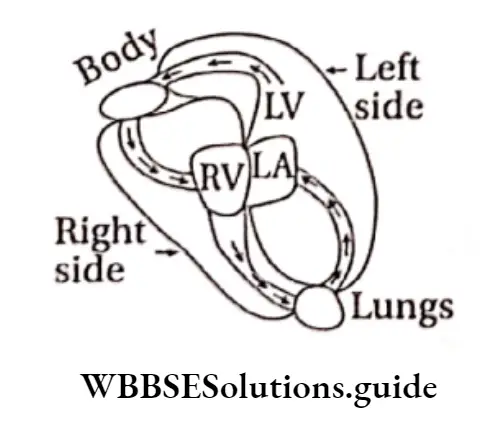
Question 16. Which diagram is correct for the circulation of blood through the human heart?
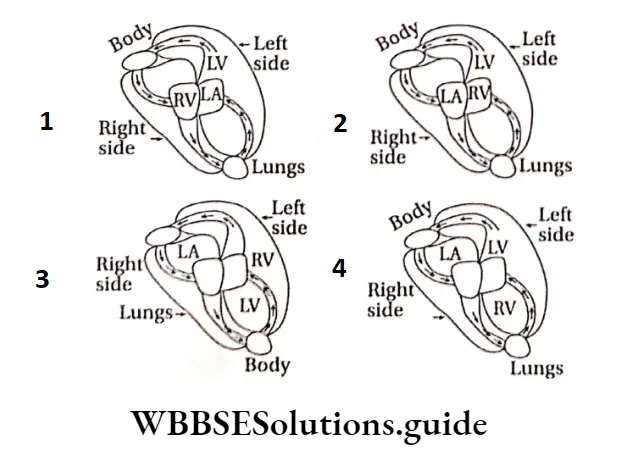
Biology Class 11 Chapter 18 Body Fluids And Circulation Multiple Choice Question 16

Answer: 1.  Biology Class 11 Chapter 18 Body Fluids And Circulation Multiple Choice Question 16.2

Question 17. Which option is correct for the formation of intrinsic factor-X activator complex for blood coagulation?

  1. Activated Christmas factor + AHG + Phospholipid + ca2+
  2. Inactivated Christmas factor + AHG + phospholipid + Ca2+
  3. Converting + AHG + ca2+ FSF
  4. Phospholipid- protein complex + Proconvertin

Answer: 1. Activated Christmas factor + AHG + Phospholipid + ca2+

Question 18. An increase in blood pressure leads to

  1. Hypotension
  2. Bradycardia
  3. Both 1 and 2
  4. Hypertension

Answer: 4. Hypertension

Question 19. Red cell count is carried out by—

  1. Haemocytometer
  2. Haemoglobinometer
  3. Sphygmomanometer
  4. Electrocardiogram

Answer: 1. Haemocytometer

Question 20. Which of the following matches correctly?

  1. Inferior vena cava—Receives deoxygenated blood from the head and body
  2. Superior vena cava—Receives deoxygenated blood from the lower body and organs
  3. Pulmonary artery—Carries deoxygenated blood to the lungs
  4. Hepatic artery—Carries deoxygenated blood to the gut

Answer: 3. Pulmonary artery—Carries deoxygenated blood to the lungs

Question 21. The main function of the white blood cell in the human immunological system is to—

  1. Combat and destroy antigenic particles
  2. Produce antigens to combat antibodies
  3. Carry oxygen around the body
  4. Transport antigens to B memory cells in the lymph nodes

Answer: 1. Combat and destroy antigenic particles

Question 22. In which, blood circulation starts and ends in capillaries?

  1. Portal system
  2. Arterial system
  3. Capillary system
  4. Lymphatic system

Answer: 1. Portal system

Important MCQs on body fluids and circulation for competitive exams

Question 23. The diagram given here is the standard ECG of a person. The P-wave represents the—
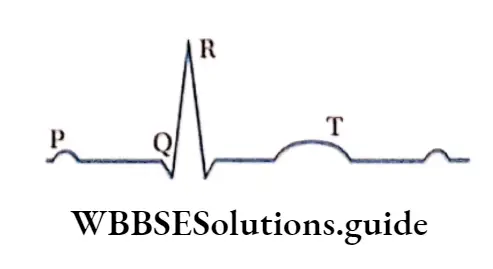
Biology Class 11 Chapter 18 Body Fluids And Circulation Multiple Choice Question 23

  1. Contraction of both the atria
  2. Initiation of the ventricular contraction
  3. Beginning of the system
  4. End of systole

Answer: 1. Contraction of both the atria

Question 24. Arteries that carry deoxygenated blood are—

  1. Pulmonary arteries
  2. Carotid Arties
  3. Coronary Arteries
  4. Phrenic Arteries

Answer: 1. Pulmonary arteries

Question 25. Blood leaving the liver and going towards the heart is rich in—

  1. Pulmonary Arteries
  2. Urea
  3. Ammonia
  4. Oxygen

Answer: 2. Urea

Question 26. The following Are The Branches Of Dorsal Aorta

  1. Intercostal
  2. Phrenic
  3. Colieac
  4. Anterior Mesenteric

Choose the correct Answers

  1. 1 and 2
  2. 2 and 4
  3. 4 and 5
  4. 2 and 3

Answer: 2. Phrenic

Question 27. The Leucocytes Contain Which Of The Following Large Quantity?

  1. Basophils
  2. Neutrophils
  3. Eosinophils
  4. Monocytes

Answer: 2. Neutrophils

Question 28. Match The Column

  1. 1-3,2-1,3-2,4-4
  2. 1-2,2-3,3-1,4-4
  3. 1-1,2-2,3-3,4-4
  4. 1-4,2-3,3-2,4-1

Answer: 1. 1-3,2-1,3-2,4-4

Body fluids and circulation chapter MCQ with explanation

Question 29. WBC is true Cell Due To

  1. Absence of nucleus
  2. Devoid Of Haemoglobin
  3. Absence Of Cell Wall
  4. Presence Of Nucleus

Answer: 4. Presence Of Nucleus

Question 30. If The Systolic Pressure is 120mm Hg Diastolic Pressure Is 80mm hf The Pulse pressure is-

  1. 120-80=40 mm Hg
  2. 120/80=1.5 mm Hg
  3. 120×80 =9600 mm Hg
  4. 120+80 = 200 mm Hg

Answer: 1. 120-80=40 mm Hg
Breathing And Exchange Of Gases Multiple Choice Question and Answers

Breathing And Exchange Of Gases Multiple Choice Questions

Question 1. Lungs are made up of air-filled sacs, the alveoli. They do not collapse even after forceful expiration, because of-

  1. Inspiratory Reserve Volume
  2. Tidal Volume
  3. Expiratory Reserve Volume
  4. Residual Volume

Answer: 4. Residual Volume

Read and Learn More WBCHSE Multiple Choice Question and Answers for Class 11 Biology

Question 2. Asthma may be attributed to—

  1. Allergic reaction of the mast cells in the lungs
  2. Inflammation of the trachea
  3. Accumulation of fluid in the lungs
  4. Bacterial infection of the lungs

Answer: 1. Allergic reaction of the mast cells in the lungs

Breathing and exchange of gases multiple choice questions with answers PDF

Question 3. Name the chronic respiratory disorder caused mainly by cigarette smoking.

  1. Asthma
  2. Respiratory acidosis
  3. Respiratory alkalosis
  4. Emphysema

Answer: 4. Respiratory alkalosis

Breathing And Exchange Of Gases Multiple Choice Question and Answers

Question 4. The partial pressure of oxygen in the alveoli of the lungs is—

  1. Equal to that in the blood
  2. More than that in the blood
  3. Less than that in the blood
  4. Less than that of carbon dioxide

Answer: 2. More than that in the blood

Class 11 Biology Class 11 Chemistry
Class 11 Chemistry Class 11 Physics
Class 11 Biology MCQs Class 11 Physics MCQs
Class 11 Biology Class 11 Physics Notes

Question 5. Lungs do not collapse between breaths and some air always remains in the lungs which can never be expelled because—

  1. There is a negative pressure in the lungs
  2. There is a negative intrapleural pressure pulling at the lung walls
  3. There is a positive intrapleural pressure
  4. Pressure in the lungs is higher than the atmospheric pressure

Answer: 2. There is a positive intrapleural pressure

MCQ on breathing and exchange of gases for NEET with answers

Question 6. Name the pulmonary disease in which the alveolar surface area in gas exchange is drastically reduced due to damage in the alveolar walls—

  1. Asthma
  2. Pleurisy
  3. Emphysema
  4. Pneumonia

Answer: 3. Emphysema

Question 7. The serous membrane which covers the lungs is called—

  1. Pericardium
  2. Peritoneum
  3. Perichondrium
  4. Pleura

Answer: 4. Pleura

Question 8. Approximately 70% of carbon dioxide absorbed by the blood will be transported to the lungs—

  1. As bicarbonate ions
  2. In the form of dissolved gas molecules
  3. By binding to RBC
  4. As carbaminohaemoglobin

Answer: 1. As bicarbonate ions

Question 9. The volume of air that can be breathed in by maximum forced inspiration over and above the normal inspiration is called—

  1. Expiratory reserve volume
  2. Inspiratory reserve volume
  3. Vital capacity
  4. Inspiratory capacity

Answer: 2. Inspiratory reserve volume

Question 10. To generate pressure gradients to facilitate expiration and inspiration the human body uses the intercostal muscles and—

  1. Alveolar sac
  2. Bronchi
  3. Primary, secondary and tertiary bronchioles
  4. Diaphragm
  5. Windpipe

Answer: 4. Diaphragm

Quiz on breathing and exchange of gases with correct answers

Question 11. Choose the wrong statement—

  1. The solubility of CO2 in blood is 20-25 times higher than that of O2
  2. The total volume of air accommodated in the lungs at the end of a forced inspiration is called the ‘vital capacity’
  3. O2 can bind with haemoglobin in a reversible manner to form oxyhaemoglobin
  4. Every 100 ml of deoxygenated blood delivers approximately 4 ml of CO2 to the alveoli
  5. The diffusion membrane is made of three major layers namely the thin squamous epithelium of alveoli, the endothelium of alveolar capillaries and the basement substance in between them.

Answer: 2. Every 100 ml of deoxygenated blood delivers approximately 4 ml of CO2 to the alveoli

Question 12. What are the PO2 and PcO2 in the systemic arteries?

  1. PO2 40 mm Hg; PcO2 45 mm Hg
  2. PO2 95 mm Hg; PcO2 40 mm Hg
  3. PO2 40 mm Hg; PcO2 40 mm Hg
  4. PO2 45 mm Hg; PcO2 40 mm Hg
  5. PO2 104 mm Hg; PcO2 159 mm Hg
Answer: 2. PO2 95 mm Hg; PcO2 40 mm Hg
Question 13. When the percentage saturation of haemoglobin with O2 is plotted against pO2, the curve obtained is—

  1. J-shaped
  2. Hyperbola
  3. Sigmoid
  4. U-shaped
  5. Urn-shaped

Answer: 3. Sigmoid

Question 14. The process of exchange of O2 from the atmosphere with CO2 produced by the cells is called—

  1. Biological respiration
  2. Photosynthesis
  3. Biological assimilation
  4. Gaseous exchange

Answer: 4. Gaseous exchange

Question 15. The inspiratory capacity of humans is equal to—

  1. TV + ERV
  2. TV + ERV + 1RV
  3. TV + IRV
  4. ERV + IRV

Answer: 3. TV + IRV

Question 16. The large volume of air a person can expire after a forceful inspiration is called—

  1. Tidal volume
  2. Vital capacity
  3. IRV
  4. ERV

Answer: 2. Vital capacity

Class 11 biology breathing and exchange of gases MCQ with solutions

Question 17. Skin is an accessory organ of respiration in—

  1. Human
  2. Frog
  3. Rabbit
  4. Lizard

Answer: 2. Frog

Question 18. When the oxygen supply to the tissue is inadequate, the condition is—

  1. Dyspnea
  2. Hypoxia
  3. Asphyxia
  4. Apnea

Answer: 2. Hypoxia

Question 19. During inspiration, the diaphragm—

  1. Expands
  2. Shows no change
  3. Contracts and flattens
  4. Relaxes to become dome-shaped

Answer: 3. Contracts and flattens

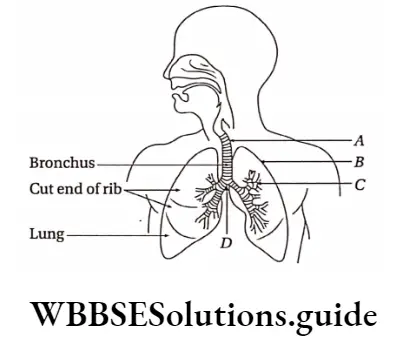
Question 20. The figure shows a diagrammatic view of the human respiratory system with labels A, B, C and D. Select the option which gives correct identification and main function and/or characteristic.

  1. A—Trachea—Lung tube supported by complete cartilaginous rings for conducting inspired air
  2. B—Pleural membrane—Surround ribs on both sides to provide cushion against rubbing
  3. C—Alveoli—Thin-walled vascular bag-like structures for the exchange of gases
  4. D—The lower end of lungs—Diaphragm pulls it down during inspiration

Biology Class 11 Chapter 17 Breathing And Exchange Of Gases MCQs Question 20

Answer: 3. C—Alveoli—Thin-walled vascular bag-like structures for the exchange of gases

Question 21. The oxygen dissociation curve is—

  1. Sigmoid
  2. Parabolic
  3. Hyperbolic
  4. Straight line

Answer: 1. Sigmoid

Question 22. Haemoglobin has a maximum affinity with—

  1. CO2
  2. CO
  3. O2
  4. NH3

Answer: 2. CO

Question 23. The oxygen toxicity is related to —

  1. Blood poisoning
  2. Collapse of alveolar walls
  3. Failure of ventilation of lungs
  4. Both and

Answer: 3. Failure of ventilation of lungs

Breathing and exchange of gases chapter MCQ with explanation

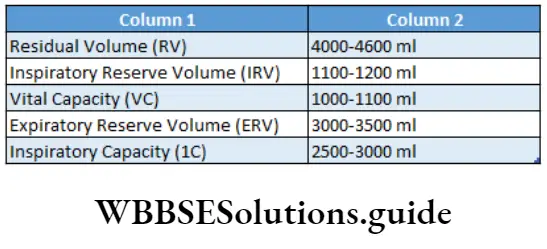
Question 24. In the following functional human lung studies, identify the total lung capacity.

  1. Inspiratory Capacity (1C)
  2. Functional Residual Capacity (FRC)
  3. Vital Capacity (VC)
  4. Inspiratory Reserve Volume (IRV)
  5. Residual Volume (RV)
  6. Expiratory Reserve Volume (ERV).
  7. Tidal Volume (TV)

The correct answer is—

  1. 4 and 6
  2. 1 and 4
  3. 2 and 3
  4. 3 and 5

Answer: 4. 3 and 5

Question 15. People who have migrated from the planes to an I area adjoining Rohtang pass about six months back—

  1. Have more RBCs and their haemoglobin has a lower binding affinity to O2
  2. Are not physically fit to play games like football
  3. Suffer from altitude sickness with symptoms like nausea, fatigue, etc.
  4. Have the usual RBC count, but their haemoglobin has a very high binding affinity to O2

Answer: 1. Have more RBCs and their haemoglobin has a lower binding affinity to O2

Match the following columns:

Biology Class 11 Chapter 17 Breathing And Exchange Of Gases Match The Following 26

  1. 1-2,2-3,3-4,4-5,4-1
  2. 1-3,2-5,3-1,4-2,5-4
  3. 1-5,2-2,3-4,4-3,4-1
  4. 1-2,2-5,3-1,4-3,5-4

Answer: 4. 1-2,2-3,3-4,4-5,4-1

Breathing And Exchange Of Gases Question And Answers

Biology Class 11 WBCHSE Breathing And Exchange Of Gases Questions And Answers

Question 1. What is the significance of gaseous exchange in the human body?
Answer:

The significance of gaseous exchange in the human body

The body needs energy to perform all important physiological functions. In living cells, glucose and other calorific foods are oxidised to release that energy. For this oxidation, oxygen is required by higher animals.

During the oxidation of glucose and other calorific foods, energy is released and ATP is synthesised.

At the same time, harmful carbon dioxide is generated. This gas may accumulate in the tissues causing cell damage. Thus, for sustaining life, gaseous exchange between oxygen and carbon dioxide is necessary.

Breathing And Exchange Of Gases

Question 2. Respiration is a metabolic reaction but breathing is not.—Explain.
Answer:

Respiration is a metabolic reaction but breathing is not

Respiration is a catabolic reaction. It is because in this case glucose and other calorific foods undergo partial or complete oxidation in the living cells in the presence or absence of oxygen.

ATP synthesis also takes place. But breathing involves the exchange of gases with atmosphere O2 and CO2. No energy is produced in humans due to breathing, rather energy is utilised.

Read and Learn More WBCHSE Solutions For Class 11 Biology

Question 3. Why does the trachea not collapse even in the absence of air?
Answer:

The length of the human trachea is about 10-11 cm. Its wall is surrounded by an 11-20 C-shaped cartilage ring. These are actually formed by hyaline cartilages.

The terminal end of each cartilage is connected by elastic fibres and smooth muscle fibres. Due to cartilage rings, the wall of the trachea is elastic and if in the absence of air trachea collapses, then also it regains its shape.

Breathing And Exchange Of Gases Question And Answers

Question 4. State the position and role of the diaphragm in the human respiratory system. Answer:

Position: The Diaphragm is located horizontally, between the thoracic cavity and abdominal cavity, below the two lungs and heart.

Role in respiration:

When the diaphragm contracts, it moves downward, so the volume of the thoracic cavity increases. Intrapulmonary pressure reduces. Then atmospheric O2 enters the lungs,

When the diaphragm expands, it moves upward and comes back to its normal position, so the volume of the thoracic cavity reduces. Intra-pulmonary pressure increases. As a result, the lungs expire CO2 from the body.

Class 11 Biology Class 11 Chemistry
Class 11 Chemistry Class 11 Physics
Class 11 Biology MCQs Class 11 Physics MCQs
Class 11 Biology Class 11 Physics Notes

Breathing and exchange of gases questions and answers PDF

Question 5. How many intercostal muscles are present in the human rib cage? Mention their role in respiration.
Answer:

Number of intercostal muscles: The human rib cage contains 12 pairs of ribs. In between these ribs, 11 external and 11 internal intercostal muscles are present.

Role in respiration:

[When external intercostal muscles contract, ribs move upward and outward. As a result, the thoracic cavity increases and inspiration takes place,

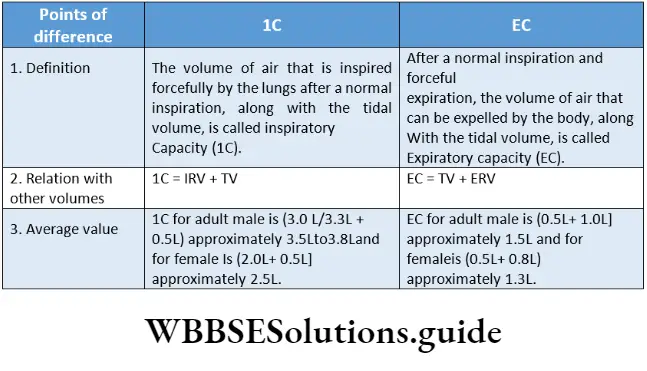
When internal intercostal muscles expand, ribs move downward and inward. As a result, the volume of the thoracic cavity decreases and expiration takes place. State the differences between inspiration capacity (1C) and expiration capacity (EC)

Question 6. How much volume of air is inspired or expired per minute by the lungs of an adult, at rest? What is this volume of air known as?
Answer:

At rest, an adult can inspire or expel approximately 500 ml or 0.5L of air per minute, by the two lungs. This volume of air is known as tidal volume (TV).

Biology Class 11 Chapter 17 Breathing And Exchange Of Gases Between Inspiration Capacity

Question 7. What is the reason behind the diffusion of oxygen from alveolar air to blood in pulmonary capillaries?
Answer:

The partial pressure of oxygen (PO2) in alveolar air is approximately 104 mm Hg and PO2 in pulmonary capillaries is 40 mm Hg.

Due to this pressure gradient, oxygen diffuses from the alveolar air to the blood in capillaries, by crossing the squamous epithelium layer of alveoli and endothelium of capillaries.

NEET breathing and exchange of gases important questions with answers

Question 8. Although the PO2 in human alveoli is 100-104 mm Hg, yet when oxygen enters the blood by diffusion, its PO2 never becomes 100-104 mm Hg. Why?
Answer:

Although the PO2 in human alveoli is 100-104 mm Hg, yet when oxygen enters the blood by diffusion, its PO2 never becomes 100-104 mm Hg.

The reason behind dissimilar PO2 is that some amount of oxygen is absorbed by the tissues, present in the walls of the alveoli. It is required for cellular oxidation and energy release. So, the PO2 in oxygenated blood is 90-95 mm Hg.

Question 9. On which factors does the binding of oxygen by haemoglobin in the pulmonary capillaries depend?
Answer:

The formation of oxyhaemoglobin depends on the following factors—

  1. High PO2 in alveolus
  2. Low PCQ2 in alveolus, 0 high pH of blood,
  3. Low temperature of lungs.

Question 10. Under what conditions, does dissociation of oxyhaemoglobin in the capillaries of various organs occur fast?
Answer:

In the human body, oxyhaemoglobin dissociates to produce oxygen in the capillaries of various organs other than the lungs.

This oxygen diffuses to associated tissues and is used in cellular respiration. The conditions required for oxyhaemoglobin are—

  • Low pO2 in tissues,
  • High pcO2 ‘n tissues,
  • Low pH in the blood,

Increase in temperature in tissues.

Question 11. Oxygen transport capacity in healthy individuals is 20 volume per cent- what does this mean?
Answer:

Oxygen transport capacity in healthy individuals is 20 volume per cent

In a healthy individual, lg haemoglobin transports 1.34 ml O2. 100 ml blood of a healthy individual contains 15 g of haemoglobin.

That means, in 100 ml blood, approximately 1.34 X 15 = 20.1 = 20 ml O2 is transported, when it is 100% saturated. So, the oxygen transport capacity in a healthy individual is called ’20 volume per cent’.

Class 11 biology breathing and exchange of gases Q&A

Question 12. What is carboxyhaemoglobin? On what condition does the compound formation take place?
Answer:

Carboxyhaemoglobin

Carbon dioxide present in the blood capillaries in different organs of the human body reacts with the haemoglobin of RBCs, to form an unstable compound which is called carboxyhaemoglobin.

The conditions necessary for the formation of this compound are—

  1. high P
  2. low PO2 in tissues.

Question 13. Where is carbonic anhydrase (CA) found? Write its functions.
Answer:

Carbonic anhydrase (CA) is a fast-acting enzyme. It is present in huge quantities in RBCs but less in blood plasma.

Due to the activity of CA, carbonic acid (H2C03) forms in RBCs by the reaction of carbon dioxide and water. Next, it dissociates H2C03 in HC03- and H+ and carries out the reverse reaction. CO2 + H20 H2C03 HCO- + H+

Question 14. Write the names of the region in the brain that regulates respiration. Write the respiratory centres located in that region.
Answer:

The region of the brain that regulates respiration is—

  1. Medulla oblongata,
  2. Pons varolii.

The centres located in the medulla oblongata are the dorsal regulatory group and the ventral regulatory group.

The centres located in Pons Varolii are-

  1. Pneumotaxic centre and
  2. Apneustic centre.

Question 15. Name two chemical stimuli that regulate breathing, Name two chemical receptors that regulate breathing.
Answer:

Two chemical stimuli controlling breathing are—

More carbon dioxide concentration in blood and H+ ion concentration in blood.

Two chemical receptors that regulate breathing are—

The region near the medulla oblongata in the brain and wall of the aortic arch and carotid artery.

Question 16. What is the reason behind respiratory trouble in premature babies? Answer: Generally, after the formation of the human embryo, surfactant formation in the alveoli occurs in the 35th week.

So premature children, born before the 35th week, lack surfactant. In the absence of surfactant, alveoli shrink and gaseous exchange is hampered. As a result, children suffer from breathing trouble.

This type of disease in newborn babies is known as respiratory disease syndrome or RDS.

Class 11 Biology WBCHSE Breathing And Exchange Of Gases Very Short Answer Type Questions

Question 1. State the chemical reaction for bicarbonate ion and hydrogen ion becoming carbon dioxide in the lungs.
Answer:

\(\mathrm{HCO}_3^{-}+\mathrm{H}^{+} \rightarrow \mathrm{H}_2 \mathrm{CO}_3 \stackrel{\begin{array}{c}
\text { Carbonic } \\
\text { Anhydrase }
\end{array}}{\longrightarrow} \mathrm{H}_2 \mathrm{O}+\mathrm{CO}_2\)

Question 2. A fluid-filled double membranous layer surrounds
Answer: Pleura

Question 3. What is the site of gaseous exchange in insects?
Answer: The site of gaseous exchange in insects is the trachea.

Question 4. Cigarette smoking causes emphysema. Give reason.
Answer: Cigarette smoking releases proteolytic enzymes in the lungs that damage the wall of the lungs and ultimately collapse of alveoli.

Breathing and exchange of gases chapter-wise questions with solutions

Question 5. What is the amount of O2 supplied to tissues through every 100 ml of oxygenated blood under normal physiological conditions?
Answer: 5. 4.5 ml

Question 6. What is the condition called when the pleura of a lung is punctured?
Answer: Pneumothorax.

Question 7. A major percentage (97%) of O2 is transported by RBCs in the blood. How does the remaining percentage (3%) of O2 transport?
Answer: The remaining percentage of O2 is transported as a physical solution i.e. dissolved in the plasma of blood.

Question 8. What is vital capacity?
Answer:

Vital capacity:

The maximum volume of air that can be exhaled after a maximal inspiration is called vital capacity.

Question 9. What is the conducting zone?
Answer:

Conducting zone

The conducting zone extends from the top of the trachea to the beginning of the respiratory bronchioles and no gas exchange occurs due to the absence of alveoli.

Short answer questions on breathing and exchange of gases

Question 10. Define residual volume. Or, State the volume of air remaining in the lungs after normal breathing.
Answer:

Residual volume

Residual volume is the amount of air remaining in the lungs after a maximal exhalation.

Question 11. Name the smallest airways in the conducting zone.
Answer: Terminal bronchioles.

Question 12. Why is it more difficult to breathe in when the stomach is full?
Answer: A full stomach impedes the downward motion of the contracting diaphragm. As a result, breathing becomes difficult

Question 13. Which component of the respiratory system helps in the generation of pressure gradient for breathing?
Answer: Diaphragm and intercostal muscles in ribs.

Question 14. How is the bulk of carbon dioxide carried in blood?
Answer: The bulk of carbon dioxide in blood is carried as bicarbonate compounds.

Locomotion And Movement Question And Answers

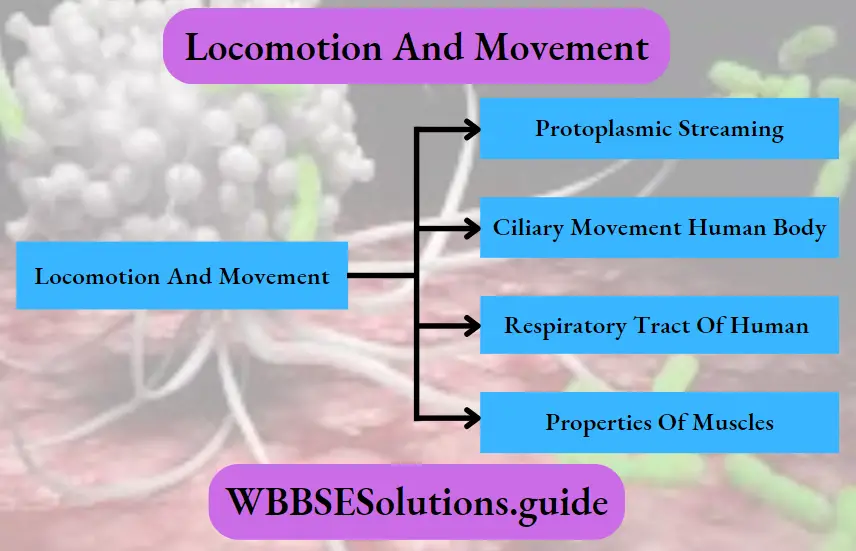
Class 11 Biology WBCHSE Locomotion And Movement Questions And Answers

Question 1. Name one unicellular organism in which locomotion occurs by protoplasmic streaming. Also, mention the type and organ of locomotion.
Answer:

The unicellular organism is Amoeba sp.

  1. Type of locomotion—Amoeboid.
  2. Organ of locomotion—pseudopodia.

Locomotion And Movement

Question 2. Which types of cells show amoeboid movement in the human body? Describe with reason.
Answer:

In humans, amoeboid movement is found in macrophages and white blood cells. These cells show amoeboid movement to engulf antigens or microbes and short-distance immigration in circulatory fluid.

Class 11 Biology Class 11 Chemistry
Class 11 Chemistry Class 11 Physics
Class 11 Biology MCQs Class 11 Physics MCQs
Class 11 Biology Class 11 Physics Notes

Question 3. Give two examples of ciliary movement in the human body.
Answer:

Different tubular organs in the human body consist of ciliated epithelial lining. They show ciliary movement.

Read and Learn More WBCHSE Solutions For Class 11 Biology

Question 4. Ciliated epithelial cells are present in the respiratory tract of human beings.
Answer:

These cilia prevent the entry of pathogens and dust particles inhaled with air, within the body.

Cilia are also found in the fallopian tubes of females. These cilia help in the transportation of ova into the uterus through the fallopian tube.

Locomotion and movement questions and answers PDF

Question 5. What are the special properties of muscles? On the basis of location, how many types of muscles are there in the human body? What are they?
Answer:

Special properties of muscles are—

  • Excitability,
  • Contractility,
  • Reliability,
  • Elasticity.

There are three types of muscles, on the basis of location. They are—

  1. Skeletal muscles,
  2. Visceral muscles and
  3. Cardiac muscles.

Locomotion And Movement Question And Answers

Question 6. On the basis of origin, what kind of muscle is human muscle? What is the percentage of muscle with respect to total body weight in an adult human being?
Answer:

Muscles in human beings are a special type of animal tissue, originating from the embryonic mesoderm.

In an adult, 40-50% of total body weight is muscles.

NEET locomotion and movement important questions with answers

Question 7. What is the sarcoplasmic reticulum? Mention one of its functions.
Answer:

Sarcoplasmic reticulum: The endoplasmic reticulum, present in the sarcoplasm, is known as the sarcoplasmic reticulum (SR).

Function: The sarcoplasmic reticulum stores calcium ions. It acts as the storehouse of calcium. During muscle contraction, SR releases calcium ion which helps in the process

Question 8. Mention the names of two proteins present in myofibrils, which help in muscle contraction and two proteins which prevent muscle contraction.
Answer:

Two proteins which help in muscle contraction are—

  1. Actin and
  2. Myosin.

Two proteins which prevent muscle contraction are—

  1. Troponin and
  2. Tropomyosin.

Question 9. What are the light and dark bands of muscle fibres called?
Answer:

Light and dark bands of muscle fibres

The light band of muscle fibre is known as the isotropic band or l-band. This band is formed of longitudinal and parallel actin proteins. The dark band is known as the anisotropic band or A-band.

Class 11 biology locomotion and movement Q&A

Question 10. Which is the actin and ATP binding site in myosin? Mention the role of ATPase.
Answer:

  • The globular head of myosin is the actin and ATP binding site.
  • ATPase dissociates ATP into ADP and inorganic phosphate, to release energy. This energy is required for muscle contraction.

Question 11. What is a motor endplate? Mention the name and function of the neurotransmitter secreted from this region.
Answer:

Motor endplate

  • Red muscles contain a large amount of myoglobin and also a large number of mitochondria.
  • As a result, a huge amount of oxygen is required for the oxidation of glycogen and the synthesis of ATP. This helps in muscle contraction. So, red muscles are known as aerobic muscles.

Question 12. How many pairs of ribs are present in the skeletal system of human beings? Why are ribs called bicephalic?
Answer:

  • Twelve pairs of ribs are present in the skeletal system of human beings.
  • Each rib has two articulating surfaces or heads. They join with either the sternum or another rib or remain unattached at one end. On their distal ends, they remain attached to the vertebra, so ribs are known as bicephalic.

Question 13. How do the ribs remain attached at the ventral surface of the thoracic region?
Answer:

The ventral ends of the ribs are joined to the sternum through costal cartilages at the ventral surface of the thoracic region.

Short answer questions on locomotion and movement

Biology Class 11 WBCHSE Locomotion And Movement Multiple-Choice Questions

Question 1. Out of ‘X’ pairs of ribs in humans only V pairs are true ribs. Select the option that correctly represents values of X and Y and provides their explanation—

  1. X=12, Y=5 True ribs are attached dorsally to the vertebral column and sternum on the two ends
  2. X=24, Y=7 True ribs are dorsally attached to the vertebral column but are free on the ventral side
  3. X=24, Y=12 True ribs are dorsally attached to the vertebral column but are free on the ventral side
  4. X=12, Y=7 True ribs are attached dorsally to the vertebral column and ventrally to the sternum

Answer: 4. X=12, Y=7 True ribs are attached dorsally to the vertebral column and ventrally to the sternum

Question 2. The pivot joint between the atlas and axis is a type of—

  1. Cartilaginous joint
  2. Synovial joint
  3. Saddle joint
  4. Fibrous joint

Answer: 2. Synovial joint

Question 3. Smooth muscles are—

  1. Involuntary, fusiform, non-striated
  2. Voluntary, multinucleate, cylindrical
  3. Involuntary, cylindrical, striated
  4. Voluntary, spindle-shaped, uninucleate

Answer: 1. Involuntary, fusiform, non-striated

Question 4. Osteoporosis, an age-related disease of the skeletal system, may occur due to—

  1. Immune disorder affecting neuromuscular junction leading to fatigue
  2. High concentrations of Ca2+ and Na+
  3. Decreased level of oestrogen
  4. Accumulation of uric acid leads to inflammation of joints

Answer: 3. Decreased level of oestrogen

Question 5. Name the ion responsible for unmasking active sites for myosin for cross-bridge activity during muscle contraction:

  1. Calcium
  2. Magnesium
  3. Sodium
  4. Potassium

Answer: 1. Calcium

MCQs on locomotion and movement with answers for NEET

Question 6. Which of the following is not a function of the skeletal system?

  1. Locomotion
  2. Production of erythrocytes
  3. Storage of minerals
  4. Production of body heat

Answer: 4. Production of body heat

Question 7. Which of the following joints would allow no movement?

  1. Ball and socket joint
  2. Fibrous joint
  3. Cartilaginous joint
  4. Synovial joint

Answer: 2. Fibrous joint

Question 8. Choose the wrongly matched pair:

  1. A portion of myofibril—sarcomere between two Z-lines
  2. Isotropic band— Actin
  3. Anisotropic band— Myosin
  4. The central part of the l-band — M-line

Answer: 4. The central part of l-band — M-line

Question 9. Which of the following is not involved in muscular contraction?

  1. Calcium ion
  2. Troponin
  3. Actin
  4. Magnesium ion

Answer: 4. Magnesium ion

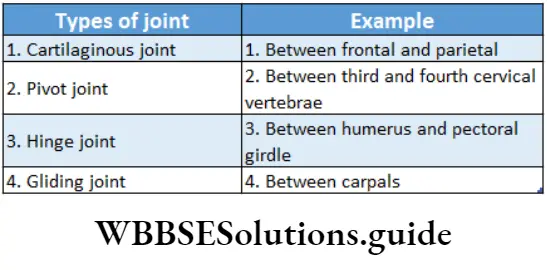
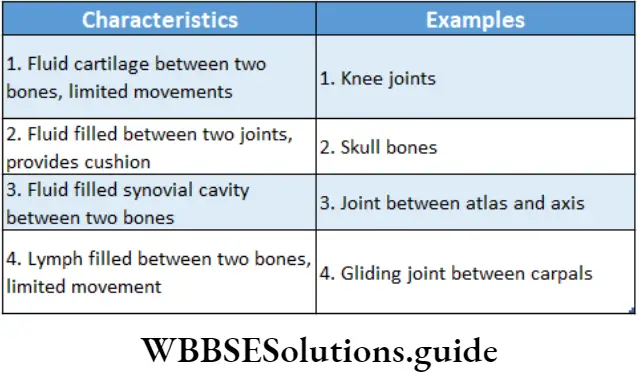
Question 10. Select the correct matching of the type of the joint with the example in the human skeletal system—

Biology Class 11 Chapter 20 Locomotion And Movement Multiple Choice Question 10

Answer: 4

Question 11. The U-shaped bone present at the base of the buccal cavity is—

  1. Maleus
  2. Ethmoid
  3. Zygomatic
  4. Hyoid
  5. Sphenoid

Answer: 

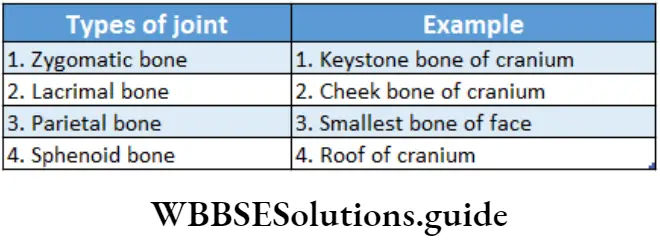
Question 12. Match the following columns:

Biology Class 11 Chapter 20 Locomotion And Movement Multiple Choice Question 12

  1. 1-1,2-3,3-5,4-2
  2. 1-2,2-4,3-5,4-1
  3. 1-2,2-4,3-1,4-3
  4. 1-2,2-3,3-4,4-5

Answer: 4. 1-2,2-3,3-4,4-5

Question 13. Knee Joints is an example of-

  1. Ball And Socket joint
  2. Jinge Joint
  3. Pivot Joint
  4. Gliding Joint

Answer: 2. Jinge Joint

Difference between locomotion and movement with examples Q&A

Question 14. Which option is correct for the region labelled as A, B, C and D in the given diagram?

  1. 1-scapula, 2-Clavicle, 3-Humerus, 4-Ulna
  2. 1-Clavicle, 2-Scapula,C-Humerus,4-Radius
  3. 1-Clavicle,2-Ulna,3-radius, 4-Humereus
  4. 1-Clavicle,2-Glenoid Cavity,3-Raidus, 4-Ulna

Answer: 2. 1-Clavicle, 2-Scapula,C-Humerus,4-Radius

Question 15. The pituitary gland is located in A, which is a B of C bone.

  1. 1-Rathke’s pouch, 2—Depression, 3—Nasal
  2. 1—Sella turcica, 2—Raised surface, 3— Ethmoid
  3. 1—Sella turcica,2—Depression, 3—Sphenoid
  4. 1—Rathke’s pouch, 2—Depression, 3—Sphenoid

Answer: 3. 1—Sella turcica,2—Depression, 3—Sphenoid

Question 16. Select the correct statement regarding the specific  disorder of the muscular or skeletal system:

  1. Muscular dystrophy—age-related shortening of muscles.
  2. Osteoporosis—decrease in bone mass and higher chances of fractures with advancing age.
  3. Myasthenia gravis—an autoimmune disorder which inhibits the sliding of myosin filaments.
  4. Gout—inflammation of joints due to extra deposition of calcium.

Answer: 2. Osteoporosis—decrease in bone mass and higher chances of fractures with advancing age.

Question 17. Pick out the correct match:

  1. Sternum-14
  2. Pelvis-3
  3. Ribs-20
  4. Face-5

Answer: 2. Pelvis-3

Question 18. Which of the following is not a sesamoid bone?

  1. Radius
  2. Patella
  3. Fibula
  4. Pisciform

Answer: 2. Patella

Question 19. The main difference between bone and cartilage is Of—

  1. Mineral salts
  2. Harversian canals
  3. Lymph vessels
  4. Blood vessels

Answer: 2. Harversian canals

Question 20. Chemical ions responsible for muscle contraction are—

  1. Ca2+ and K+
  2. Na+ and K+
  3. Na+ and Ca2+
  4. Ca2+ and Mg2+

Answer: 4. Ca2+ and Mg2+

Question 21. Acetabulum is a concave surface of—

  1. Pelvis
  2. Pectoral
  3. Foramen magnum
  4. Foramen manor

Answer:

Question 22. The elbow joint is an example of a—

  1. Pivot joint
  2. Hinge joint
  3. Gliding joint
  4. Ball and socket joint

Answer: 2. Hinge joint

Question 23. The characteristics and an example of a synovial joint in humans are—

Biology Class 11 Chapter 20 Locomotion And Movement Multiple Choice Question 23

Answer: 3

Biology Class 11 WBCHSE Locomotion And Movement Short Answer Type Questions

Question 1. What is locomotion?
Answer:

Locomotion

Locomotion is the process by which an organism can move from one place to another in response to stimuli.

Question 2. Give two examples of locomotion.
Answer:

Two examples of locomotion

Flying and running are two examples of locomotion.

Question 3. What is movement?
Answer:

Movement

Movement is the process by which an organism is able to move its organs or parts of the body in response to stimuli by remaining in a fixed position.

Question 4. Name the primary germ layer from which muscle tissue arises.
Answer:

Mesoderm is the primary germ layer from which muscle tissue arises.

Question 5. How many bones are present in the human skull?
Answer:

29 bones.

Question 6. Name the proteins present in muscle fibres.
Answer:

Actin, myosin, tropomyosin, troponin, titin.

Question 7. Name the stored food material in muscle cells.
Answer:

Glycogen is the stored food material in muscle.

Question 8. Some of the muscle fibres are red in colour. Explain.
Answer:

A high concentration of myoglobin makes some muscle fibre red in colour.

Question 9. What is the sternum?
Answer:

Sternum

The sternum (breastbone) is a thin, knife-shaped bone located at the anterior side of the thoracic region of the skeleton along the midline of the body.

Muscle contraction and skeletal system-related questions

Question 10. The three tiny bones, present in the middle ear, are called ear ossicles. Write them in the correct sequence beginning from the ear drum.
Answer:

Malleus, incus, stapes.

Question 11. Give the location of the ball and socket joint in a human
Answer:

Hip joint (between pelvic girdle and head of femur) and shoulder joint (between pectoral girdle and head of humerus

Question 12. Give the name of the cells/tissues in the human body
which—

  1. Exhibit amoeboid movement
  2. Exhibit ciliary movement.

Chemical Coordination Question And Answers

Class 11 Biology WBCHSE Chemical Coordination Questions And Answers

Question 1. Why are the hormones considered as chemical messengers?

Answer:

Hormones are considered as chemical messengers because—

  • Hormones are peptides or steroidal substances, secreted in very small quantities, from the endocrine glands.
  • They are carried by blood to more than one target cell.
  • They act as messengers i.e., transmit information and affect different physiological and metabolic processes of the target cells.

Chemical Coordination

Question 2. Justify the same hormone being named vasopressin as well as ADH.

Answer: The ADH hormone has two names due to its different physiological functions.

They are as follows—

It helps to constrict the muscles of the blood vessels, mainly that of blood capillaries and arteries.

So, it increases the blood pressure. Hence, it has been rightly named vasopressin (vaso: blood vessel; pressin: pressure).

It increases water reabsorption in the DCT as well as the collecting duct, thereby releasing less amount of concentrated urine. This phenomenon is known as antidiuresis. Thus, it has been rightly named an Antidiuretic hormone (ADH).

Chemical coordination and integration questions and answers PDF

Question 3. Write down the characteristics of the neurohypophysis. or Name the hormone secreted by this region.

Answer:

The characteristics of the neurohypophysis

There are no endocrine cells present in the pars nervosa region of the neurohypophysis. The axons of the neurosecretory cells present in the adenohypophysis remain scattered over the neurohypophysis region.

Two neurohormones are secreted by the neurohypophysis region—ADH or antidiuretic hormone and oxytocin.

Read and Learn More WBCHSE Solutions For Class 11 Biology

Question 4. What is the full form of HIOMT? or Which gland shows the presence of HIOMT?or Name one hormone secreted by this gland.

Answer:

HIOMT:

The full form of HIOMT is hydoxy-indolO-methyl transferase. It is a type of enzyme.

The pineal gland shows the presence of HIOMT.

Melatonin is secreted by the pineal gland.

Class 11 Biology Class 11 Chemistry
Class 11 Chemistry Class 11 Physics
Class 11 Biology MCQs Class 11 Physics MCQs
Class 11 Biology Class 11 Physics Notes

Question 5. Mention the roles of the emergency hormone.
Answer:

The roles of the emergency hormone (adrenaline) are as follows—

  • Pupillary dilation (varies the size of the pupil), piloerection, sweating, etc.
  • Increase in rate of heartbeat, strength of heart contraction, rate of breathing, etc.
  • Stimulates glycogenolysis and breaks down glycogen into glucose, thereby increasing its level in the blood.

Question 6. Which part of the body secretes aldosterone? Or why is it considered a mineralocorticoid? Mention the functions of aldosterone.
Answer:

Aldosterone is synthesized and secreted by the adrenal cortex.

It is considered a mineralocorticoid because it helps in the metabolism of the mineral salts within the body.

The functions of aldosterone are—

It regulates Na+ and water reabsorption in – the renal tubule.

It stimulates the removal of K+ and phosphate ions. Through this mechanism, it maintains electrolyte balance, volume of body fluids, osmotic pressure, and blood pressure.

Chemical Coordination Question And Answers

Question 7. Name the endocrine regions of the pancreas. What percentage of the pancreas of a healthy human being, comprises the endocrine region?

Answer: Islets of Langerhans constitute the endocrine region of the pancreas.

About 1-2% of the pancreas of a healthy human being, comprises the endocrine region.

Question 8. Which hormone is known as the ‘hyperglycemia hormone’? Why?  Mention its source.

Answer: Glucagon hormone is known as the ’hyperglycemia hormone’, because it stimulates the process of glycogenolysis within the hepatocytes. It helps to break down glycogen into glucose, thereby increasing its concentration in the blood.

Glucagon is synthesized and secreted by a-cells of the islets of Langerhans of the pancreas.

Question 9. What are the primary symptoms of the disease, diabetes mellitus?

Answer: The primary symptoms of diabetes mellitus are—

  • Increase in the concentration of glucose in the blood of the patient, i.e, hyperglycemia.
  • Glucosuria, i.e., release of glucose through urine.
  • Release of excess ketone bodies through the urine, i.e., ketonuria, in case of hyperglycemia, that extends for a long period.

Question 10. Which cells secrete testosterone? Why is it known as ‘androgen’?

Answer:

  • Interstitial cells or Leydig cells secrete testosterone.
  • Testosterone is a sex steroid hormone, that carries out the following functions—
  • It regulates the appearance of secondary sexual characteristics.
  • It stimulates the production of sperm (spermatogenesis).
  • It controls the male libido (desire for sexual activity). For carrying out these functions, it is known as an ‘androgen’ (Greek word ‘andro’, meaning masculine). Androgens are the male sex hormones.

NEET chemical coordination and integration important questions with answers

Question 11. Which hormone synthesises the placenta, in pregnant women? From where is it synthesized and secreted?

Answer: Progesterone is the hormone responsible for the synthesis of the placenta, in pregnant women. It is synthesized and secreted by the corpus luteum present in the ovaries of women. Some amount of progesterone is also secreted by the adrenal cortex (zona reticularis).

Question 12. Which hormone is known as ‘calorigenic hormone’? Why?
Answer: Triiodothyronine (T3) and tetraiodothyronine (T4), secreted by thyroid follicles of the thyroid gland, are known as calorigenic hormones. They stimulate the oxidation of carbohydrates thereby releasing large amounts of energy. They increase BMR. Hence, they are known as ‘calorigenic hormones’.

Class 11 Biology WBCHSE Chemical Coordination Very Short Answer Type Questions

Question 1. Name the gland that requires iodine to produce most of its hormones.

Answer: Thyroid gland.

Question 2. Define hormone.

Answer:

Hormones

Hormones are biochemical substances synthesised and secreted by endocrine glands, which are transported by circulator)7 system to their target organs where they regulate various physiological processes.

Question 3. Name the two hormones secreted by the posterior pituitary.

Answer: ADH and oxytocin.

Question 4. What stimulates the release of epinephrine?

Answer: Stress, intense emotions like anger, fear, etc., stimulate the release of epinephrine.

Question 5. What is a mixed gland?

Answer:

Mixed gland

A mixed gland is a gland which has both endocrine and exocrine functions.

Question 6. Where are the adrenal glands located?

Answer: The adrenal glands are located at tire apex of the kidneys.

Class 11 biology chemical coordination and integration Q&A

Question 7. What are the hormones secreted by the adrenal medulla?

Answer: Epinephrine and norepinephrine.

Question 8. What are tropic hormones?

Answer:

Tropic hormones

Hormones that control the secretion of hormones from other glands are called tropic hormones.

Question 9. Mention one important function of the pineal gland.

Answer: An important function of pineal gland is to secrete melatonin. Melanin regulates body’s circadian rhythm.

Question 10. What is neurohypophysis?

Answer:

Neurohypophysis

Neurohypophysis is the posterior pituitary gland. It principally consists of the pars nervosa (neural lobe of hypophysis) and the infundibulum (stalk-like structure that connects the pituitary gland to the hypothalamus).

Question 11. Name one steroid hormone in human and mention its source.

Answer: Aldosterone is a steroid hormone. Its source is the adrenal cortex.

Question 12. Which hormone is called stress hormone?

Answer: Cortisol.

Question 13. Write the full names of TSH and ADH.

Answer: TSH—Thyroid stimulating hormone, ADHAntidiuretic hormone.

Question 14. Which type of cell is stimulated by calcitonin?

Answer: Osteoblast cells

Question 15. Where are chromaffin cells located?

Answer:

Location of chromaffin cells

Adrenal medulla. terms italicised.

Question 16. Name that hormone that aids in sodium conservation and potassium excretion.

Answer: Aldosterone.

Question 17. Define the term erythropoiesis. Also name the hormone that stimulates it.

Answer: Erythropoiesis is the process of formation of RBC. The hormone erythropoietin, secreted by juxtaglomerular cells of the kidney, stimulate the process.

Question 18. Name the cells that produce testosterone.

Answer: Leydigcell.

Question 19. What is second messenger?
Answer:

Second messenger

Diffusible small signalling molecules, synthesisedin the target cells by those hormones or enzymes which are unable to enter the cells to bring about the biochemical changes, are known as second messengers.

Question 20. There are many endocrine glands in human body. Name the gland, which is absent in male and the one absent in female.
Answer: The two endocrine glands, ovary and testis are absent in male and female respectively.

Short answer questions on chemical coordination and integration

Question 21. Which of the two adrenocortical layers, zona glomerulosa and zona reticularis, lies outside enveloping the other?
Answer: Zona glomerulosa lies outer to zona reticularis.

Question 22. Name the only hormone secreted by pars intermedia of pituitary gland.
Answer: Melanocyte stimulating hormone (MSH).

Question 23. A patient was complaining of constant thirst, excessive passing of urine and low blood pressure. When the doctor checked the patient’s blood glucose and blood insulin level, the levels were normal or slightly low. The doctor diagnosed the condition as diabetes insipidus. To confirm his diagnosis, he decides to measure the concentration of a specific hormone in the patient’s blood. Which hormone does the doctor intend to measure?
Answer: ADH.

Chemical Coordination Multiple Choice Question And Answers

Chemical Coordination Multiple-Choice Questions

Question 1. A decrease in blood pressure/volume will not cause the release of—

  1. Atrial Natriuretic Factor
  2. Aldosterone
  3. ADH
  4. Renin

Answer: 1. Atrial Natriuretic Factor

Question 2. A hypothalamic hormone, needed in

  1. The anterior pituitary gland stimulates the secretion of LH and FSH
  2. The posterior pituitary gland stimulates the secretion of oxytocin and FSH
  3. The posterior pituitary gland stimulates the secretion of LH and relaxin
  4. The anterior pituitary gland stimulates the secretion of LH and oxytocin

Answer: 1. Anterior pituitary gland stimulates the secretion of LH and FSH

Read and Learn More WBCHSE Multiple Choice Question and Answers for Class 11 Biology

Question 3. Hypersecretion of Growth Hormone in adults does not cause further increase in height because—

  1. Epiphyseal plates close after adolescence
  2. Bones lose their sensitivity to Growth Hormone in adults
  3. Muscle fibers do not grow in size after birth
  4. Growth Hormone becomes inactive in adults

Answer: 1. Epiphyseal plates close after adolescence

Question 4. Changes in GnRH pulse frequency in females are controlled by circulating levels of—

  1. Oestrogen and inhibin
  2. Progesterone only
  3. Progesterone and inhibin
  4. Oestrogen and progesterone

Answer: 4. Oestrogen and progesterone

Class 11 Biology Class 11 Chemistry
Class 11 Chemistry Class 11 Physics
Class 11 Biology MCQs Class 11 Physics MCQs
Class 11 Biology Class 11 Physics Notes

Chemical coordination and integration multiple choice questions with answers PDF

Question 5. Identify the correct statement on ‘inhibin’—

  1. Is produced by granulosa cells in the ovary and inhibits the secretion of FSH
  2. Is produced by granulosa cells in
  3. Is produced by nurse cells in the testes and inhibits the secretion of LH
  4. Inhibits the secretion of LH, FSH, and prolactin

Answer: 1. Is produced by granulosa cells in the ovary and inhibits the secretion of FSH

Chemical Coordination Multiple Choice Question And Answers

Question 6. Select the incorrect statement—

  1. LH and FSH trigger ovulation in the ovary
  2. LH and FSH decrease gradually during the follicular phase
  3. LH triggers the secretion of androgens from the Leydig cells
  4. FSH stimulates the Sertoli cells which help in spermiogenesis.

Answer: 2. LH and FSH decrease gradually during the follicular phase

Question 7. The amino acid, tryptophan is the precursor for the synthesis of—

  1. Thyroxine and triiodothyronine
  2. Oestrogen and progesterone
  3. Cortisol and cortisone
  4. Melatonin and serotonin

Answer: 4. Melatonin and serotonin

Question 8. Which of the following pairs of hormones are not antagonistic (having opposite effects) to each other?

  1. Insulin—Glucagon
  2. Aldosterone—Atrial natriuretic factor
  3. Relaxin—Inhibin
  4. Parathormone—Calcitonin

Answer: 3. Relaxin—Inhibin

MCQ on chemical coordination and integration for NEET with answers

Question 9. Which hormones stimulate the production of pancreatic juice and bicarbonate?

  1. Angiotensin and epinephrine
  2. Gastrin and insulin
  3. Cholecystokinin and secretin
  4. Insulin and glucagon

Answer: 3. Cholecystokinin and secretin

Question 10. Name a peptide hormone that acts mainly on hepatocytes, and adipocytes and enhances cellular glucose uptake and utilisation.

  1. Insulin
  2. Glucagon
  3. Secretin
  4. Gastrin

Answer: 1. Insulin

Question 11. The posterior pituitary gland is not a ‘true’ endocrine gland because—

  1. It is provided with a duct
  2. It only stores and releases hormones
  3. It is under the regulation of the hypothalamus
  4. It secretes enzymes

Answer: 2. It only stores and releases hormones

Question 12. several hormones like hCG, hPL, estrogen and progesterone are produced by—

  1. Ovary
  2. Placenta
  3. Fallopian tube
  4. Pituitary

Answer: 2. Placenta

Class 11 biology chemical coordination and integration MCQ with solutions

Question 13. Graves’ disease is caused due to—

  1. Hyposecretion of the thyroid gland
  2. Hypersecretion of the thyroid gland
  3. Hyposecretion of the adrenal gland
  4. Hypersecretion of the adrenal gland

Answer: 2. Hypersecretion of thyroid gland

Question 14. Which of the following events is not associated with ovulation in human females?

  1. LH surge
  2. Decrease in estradiol
  3. Full development of Graafian follicle
  4. Release of secondary oocyte

Answer: 2. Decrease in estradiol

Question 15. Which one of the following hormones is not involved in sugar metabolism?

  1. Glucagon
  2. Cortisone
  3. Aldosterone
  4. Insulin

Answer: 3. Aldosterone

Question 16. Which one of the following hormones though synthesised elsewhere, is stored and released by the master gland?

  1. Melanocyte stimulating hormone
  2. Antidiuretic hormone
  3. Luteinizing hormone
  4. Prolactin

Answer: 4. Prolactin

Question 17. Injury localized to the hypothalamus would most likely disrupt—

  1. Short term ’Memory’
  2. Coordination during locomotion
  3. Executive function, such as decision-making
  4. Regulation of body temperature

Answer: 2. Coordination during locomotion

Question 18. Identify the hormone with its correct matching of source and function—

  1. Oxytocin—Posterior pituitary, growth and maintenance of mammary glands
  2. Melatonin—The pineal gland, regulates the normal rhythm of the sleep-wake cycle
  3. Progesterone—Corpus luteum, stimulation of growth and activities of female secondary sex organs
  4. Atrial natriuretic factor—Ventricular wall, increases the blood pressure

Answer: 2. Melatonin—The pineal gland, regulates the normal rhythm of the sleep-wake cycle

Question 19. Fight or flight reactions cause activation of—

  1. The parathyroid glands, leading to an increased metabolic rate
  2. The kidney, leading to suppression of the renin-angiotensin-aldosterone pathway
  3. The adrenal medulla, leading to increased secretion of epinephrine and norepinephrine
  4. The pancreas, leading to a reduction in the blood sugar levels

Answer: 3. The adrenal medulla, leading to increased secretion of epinephrine and norepinephrine

Important MCQs on chemical coordination and integration for competitive exams

Question 20. Which of the following hormones is a derivative of fatty acid?

  1. Gastrin
  2. Thyroxine
  3. Oestrogen
  4. Prostaglandins

Answer: 4. Prostaglandins

Question 21. Which of the following pituitary hormones is secreted without the involvement of a Releasing Hormone (RH)?

  1. Thyroid Stimulating Hormone (TSH)
  2. Follicle Stimulating Hormone (FSH)
  3. Oxytocin
  4. Prolactin

Answer: 3. Oxytocin

Question 22. The diurnal rhythms are regulated by—

  1. Adrenaline
  2. Melatonin
  3. Serotonin
  4. Vasopressin

Answer: 2. Melatonin

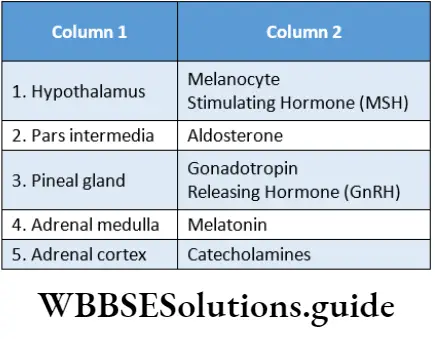
Question 23. Match the hormones secreted by various endocrine structures and choose the correct option:

Biology Class 11 Chapter 22 Chemical Coordination Match The Coloumns

  1. 1-5,2-1,3-4,4-2,5-3
  2. 1-5,2-4,3-1,4-2,5-3
  3. 1-3,2-1,3-4,4-2,5-5
  4. 1-3,2-1,3-4,4-5,5-2

Answer: 4. 1-3,2-1,3-4,4-5,5-2

Question 24. Which of the following statements is wrong?

  1. Sella turcica is a bony cavity where the pituitary gland is located
  2. The parathyroid hormone decreases the Ca2+ levels in the blood
  3. Thymosins play a major role in T-cell differentiation
  4. The middle layer of the adrenal cortex is the zona fasciculata
  5. Insulin stimulates Glycogenesis

Answer: 2. Parathyroid hormone decreases the Ca2+ levels in blood

Question 25. An endocrine gland in humans, which plays an important role in the regulation of the rhythm of the body is-

  1. Adrenal gland
  2. Pineal gland
  3. Thymus
  4. Thyroid gland

Answer: 2. Pineal gland

Question 26. Insulin causes rapid movement of glucose from the blood to hepatocytes and adipocytes resulting in—

  1. Hyperglycemia
  2. Hypoglycemia
  3. Diabetes
  4. None of these

Answer: 2. Hypoglycemia

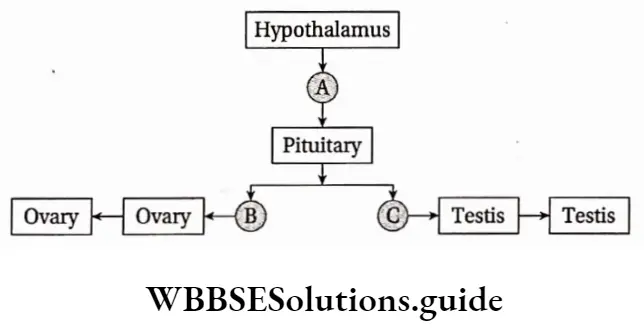
Question 27. Identify the hormones, A, B, and C that are labeled in the given flowchart—

Biology Class 11 Chapter 22 Chemical Coordination Multiple Choice Question 27

  1. 1-GnRH 2-ICSH 3-FSH
  2. 1-GH 2-FSH 3-LH
  3. 1-GnRH 2-PRL 3-ICSH
  4. 1-GnRH 2-FSH 3-LH

Answer: 4. 1-GnRH 2-FSH 3-LH

Question 28. Which one of the following hormones also produces anti-inflammatory reactions in man and suppresses the immune response in addition to its primary functions?

  1. Cortisol
  2. Thymosin
  3. Thyrocalcitonin
  4. Erythropoietin

Answer: 1. Cortisol

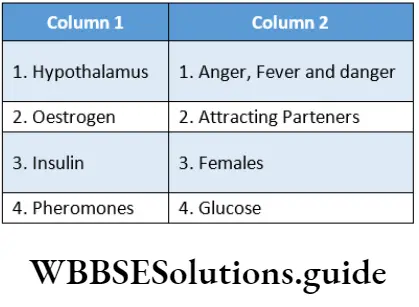
Question 29. Match the following columns:

Biology Class 11 Chapter 22 Chemical Coordination Match The Coloumns 29

  1. 1-3,2-1,3-4,4-2
  2. 1-1,2-3,3-2,4-4
  3. 1-1,2-3,3-4,4-2
  4. 1-3,2-1,3-2,4-4

Answer: 3. 1-1,2-3,3-4,4-2

Question 30. The Hormone Responsible For Fight And fight-and-fight response is

  1. Adtenaline
  2. Thyrocine
  3. ADH
  4. Oxytocin

Answer: 1. Adtenaline

Question 31. Name The Hormome that has no role in menstruation

  1. LH
  2. FSH
  3. GH
  4. TSH

Answer: 3. GH

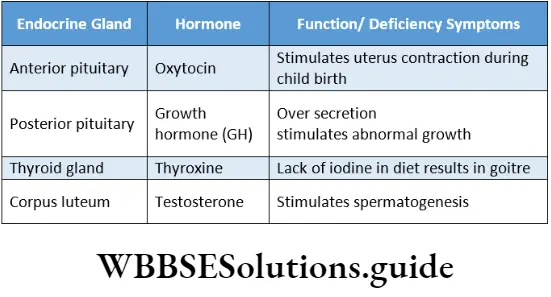
Question 32. Select the answer which correctly matches the endocrine gland with the hormone it secretes and its function/deficiency symptom.

Biology Class 11 Chapter 22 Chemical Coordination Match The Coloumns 32

Answer: 3.

Question 33. Which of the following statements is correct in relation to the endocrine system?

  1. The adenohypophysis is under direct neural regulation of the hypothalamus.
  2. Organs in the body gastrointestinal tract, heart, kidney, and liver do not produce any hormones.
  3. Non-nutrient chemicals produced by the body in trace amounts that act as intercellular messenger are known as hormones.
  4. Releasing and inhibitory hormones are produced by the pituitary gland.

Answer: 3. Non-nutrient chemicals produced by the body in trace amount that act as intercellular messenger are known as hormones.

Quiz on chemical coordination and integration with correct answers

Question 34. Removal or absence of thymus in early life shall bring about—

  1. Lack of lymphocytes
  2. Lack of antibodies
  3. Lack of lymph nodes
  4. Both 1 and 2

Answer: 4. Both 1 and 2

Question 35. Gland responsible for calcium metabolism is—

  1. Thymus
  2. Thyroid
  3. Parathyroid
  4. Adrenal

Answer: 3. Parathyroid

Question 36. The Leydig cells secrete—

  1. Oestrogen
  2. Testosterone
  3. Progesterone
  4. Corticosterone

Answer: 2. Testosterone

Redox Reactions Multiple Choice Questions

Redox Reactions Multiple Choice Questions

Question 1. A compound contains elements X, Y, and Z with oxidation numbers +3, +5, and -2 respectively. The possible formula of a compound containing these elements is

  1. XYZ2
  2. Y2(XZ3)2
  3. X3(YZ4)3
  4. X3(Y4Z)2

Answer: 3. X3(YZ4)3

Question 2. In which of these compounds does chlorine display a positive oxidation number?

  1. HC1
  2. HOC1
  3. BrCl3
  4. NaC1

Answer: 2. HOC1

“Redox reactions, multiple choice questions, and answers for exams”

Question 3. If a metal cation M3+ gains three electrons its oxidation number will become

  1. +6
  2. -3
  3. 0
  4. +3

Answer: 3. 0

Class 11 Biology Class 11 Chemistry
Class 11 Chemistry Class 11 Physics
Class 11 Biology MCQs Class 11 Physics MCQs
Class 11 Biology Class 11 Physics Notes

Question 4. In which of the following compounds does Cr display the highest oxidation state?

  1. Cr203
  2. CrCl3
  3. Cr(OH)2
  4. K2Cr04

Answer: 4. K2Cr04

Redox Reactions Multiple Choice Questions

Question 5. Which of the following will reduce Ag+ to Ag but not Niz+ to Ni?

  1. Fe
  2. Fb
  3. Be
  4. Zn

Answer: 2. Fb

“MCQs on redox reactions, oxidation, reduction, and electrochemistry”

Question 6. The oxidized form of MnOz is

  1. Mn2+
  2. MnO-4
  3. MnO-4
  4. Mn(OH)4

Answer: 2. MnO-4

Question 7. Which of these is a redox reaction?

\(\mathrm{NaOH}+\mathrm{HCl} \longrightarrow \mathrm{NaCl}+\mathrm{H}_2 \mathrm{O}\) \(\mathrm{AgNO}_3+\mathrm{NaCl} \longrightarrow \mathrm{AgCl}+\mathrm{NaNO}_3\) \(\mathrm{Zn}+\mathrm{H}_2 \mathrm{SO}_4 \longrightarrow \mathrm{ZnSO}_4+\mathrm{H}_2\) \(\mathrm{FeSO}_4+2 \mathrm{H}_2 \mathrm{O} \longrightarrow \mathrm{Fe}(\mathrm{OH})_2+\mathrm{H}_2 \mathrm{SO}_4\)

Answer: 3. \(\mathrm{Zn}+\mathrm{H}_2 \mathrm{SO}_4 \longrightarrow \mathrm{ZnSO}_4+\mathrm{H}_2\)

Question 8. In which of these compounds does carbon have a negative oxidation number?

  1. CH4
  2. CH2Cl2
  3. CCl4
  4. HCHO

Answer: 1. CH4

“Redox reactions, important multiple choice questions, and solutions”

Question 9. Consider the reaction

\(\mathrm{Zn}+\mathrm{Cu}^{2+} \longrightarrow \mathrm{Zn}^{2+}+\mathrm{Cu}\)

Which of the following is the correct statement?

  1. Zn is reduced to Zn2+
  2. Cu2+ is oxidized to Cu.
  3. Zn is oxidized to Zn2+
  4. Zn is the oxidizing agent

Answer: 3. Zn is oxidized to Zn2+

Question 10. What is the oxidation state of N in Mg3N2?

⇒ \(\mathrm{NaClO}_3 \longrightarrow \mathrm{NaClO}+2 \mathrm{NaCl}\)

  1. -3
  2. -2
  3. +3
  4. -1

Answer: 1. -3

“Redox reactions, practice MCQs, with answers for competitive exams”

Question 11. In the following reaction which element loses as well as gains electrons?

⇒ \(\mathrm{NaClO}_3 \longrightarrow \mathrm{NaClO}+2 \mathrm{NaCl}\)

  1. Na
  2. Cl
  3. O
  4. The reaction is Not Feasible.

Answer:

Question 12. In the redox reaction shown here, what are the coefficients x and y?

⇒ \(y \mathrm{SnCl}_2+x \mathrm{FeCl}_3 \longrightarrow y \mathrm{SnCl}_4+x \mathrm{FeCl}_2\)

  1. 2,1
  2. 1,1
  3. 1,3
  4. 1,2

Answer: 1. 2,1

Question 13. What is the value of x in the following half-reaction?

⇒ \(\mathrm{C}_2 \mathrm{O}_7^{2-}+4 \mathrm{H}^{+}+x \mathrm{e}^{-} \longrightarrow 2 \mathrm{Cr}^{3+}+7 \mathrm{H}_2 \mathrm{O}\)

  1. 6
  2. 5
  3. 2
  4. 4

Answer: 1. 6

Question 14. The oxidation number of Os in 0s04 is

  1. +4
  2. +6
  3. +2
  4. +8

Answer: 4. +8

“Oxidation-reduction reactions, MCQs, quiz, and answer key”

Question 15. Which of these is a disproportionation reaction?

  1. \(2 \mathrm{CuCl} \longrightarrow \mathrm{CuCl}_2+\mathrm{Cu}\)
  2. \(\mathrm{CaCO}_3 \longrightarrow \mathrm{CaO}+\mathrm{CO}_2\)
  3. \(2 \mathrm{~Pb}\left(\mathrm{NO}_3\right)_2 \rightarrow \mathrm{PbO}+4 \mathrm{NO}_2+\mathrm{O}_2\)
  4. \(\mathrm{PCl}_5 \rightarrow \mathrm{PCl}_3+\mathrm{Cl}_2\)

Answer: 1. \(2 \mathrm{CuCl} \longrightarrow \mathrm{CuCl}_2+\mathrm{Cu}\)

Question 16. The oxidation number of Fe in Fe304 is

  1. \(-\frac{8}{3}\)
  2. \(+\frac{8}{3}\)
  3. \(-\frac{2}{3}\)
  4. \(+\frac{2}{3}\)

Answer: 2. \(+\frac{8}{3}\)

Question 17. Which of the following gases is not a reducing agent?

  1. SO2
  2. NO2
  3. CO2
  4. CO

Answer: 3. CO2

Question 18. Which of these would be an alternative for A in the given reaction?

⇒ \(2 \mathrm{H}_2 \mathrm{~S}+\mathrm{SO}_2 \longrightarrow 2 \mathrm{H}_2 \mathrm{O}+\mathrm{A}\)

  1. S
  2. SO3
  3. H2SO3
  4. H2SO4

Answer: 1. S

“Redox reactions, solved MCQs, and previous year exam questions”

Question 19. Which is the oxidizing agent in the given reaction?

⇒ \(\mathrm{Cl}_2+2 \mathrm{Br}^{-} \longrightarrow \mathrm{Br}_2+2 \mathrm{Cl}^{-}\)

  1. Br-
  2. Cl2
  3. Br2
  4. Cl-

Answer: 2. Cl2

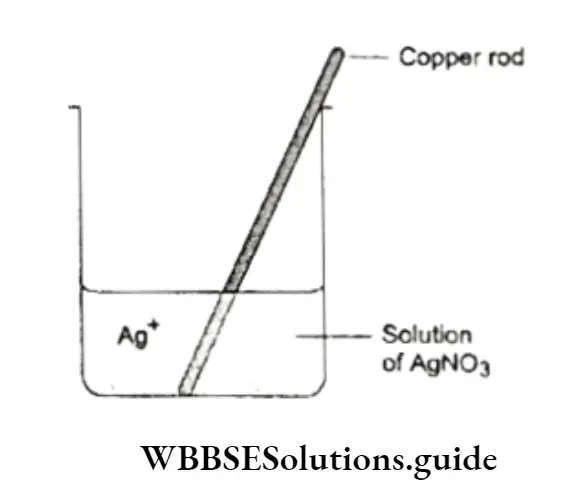
Question 20. When a Cu rod is dipped in a beaker containing an AgNO solution, what change occurs in the tire color of the solution?

  1. Terms
  2. Turns blue
  3. No change
  4. Turns black

Answer: 1. Turms

Question 21. The reaction \(3 \mathrm{ClO}^{-} \longrightarrow \mathrm{ClO}_3^{-}+2 \mathrm{Cl}^{-}\) is an example of

  1. Oxidation
  2. Reduction
  3. Displacement
  4. Disproportionation

Answer: 4. Disproportionation

Question 22. The oxidation number of N in NH is

  1. 0
  2. -3
  3. +1
  4. +3

Answer: 4. +3

“Basic and advanced redox reactions, multiple choice questions, with explanations”

Question 23. Which of the following is not possible?

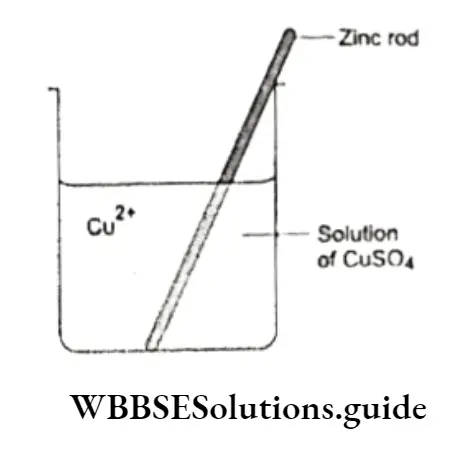
  1. Keeping a zinc sulfate solution in a copper vessel
  2. Keeping a zinc sulfate solution in a silver vessel
  3. Keeping a copper sulfate solution in a zinc vessel
  4. Keeping a copper sulfate solution in a silver vessel

Answer: 3. Keeping a copper sulfate solution in a zinc vessel

Question 24. In which of these compounds does S show the highest oxidation state?

  1. H2SO3
  2. H2SO4
  3. H2S
  4. SO2

Answer: 2. H2SO4

Oxidation Number Definition, Calculation And Examples

Fractional Oxidation Number

So far we have discussed whole-number oxidation states of elements. You may wonder how oxidation numbers can be fractional since electrons are never shared or transferred in fractions.

But sometimes we come across fractional oxidation states of elements in certain compounds. For example, the oxidation numbers of both Pb in Fb04 and Fe in Fe304 are + 8.

In these cases the oxidation number calculated is the average oxidation number of all the like atoms in the molecule, e.g., in Fe304 two Fe atoms have the oxidation number +3 and one has the oxidation number +2, so the average oxidation number for each Fe atom is +%, which is also the case for Pb304.

Fe304 and Pb304 are stoichiometric compounds and are referred to as ‘mixed oxides’.

They are better formulated ns FeO -Fe203 and 2PbO -PbOj respectively and the oxidation numbers of Fe arc +2 and +3 while those of Pb are +2 and +4 respectively.

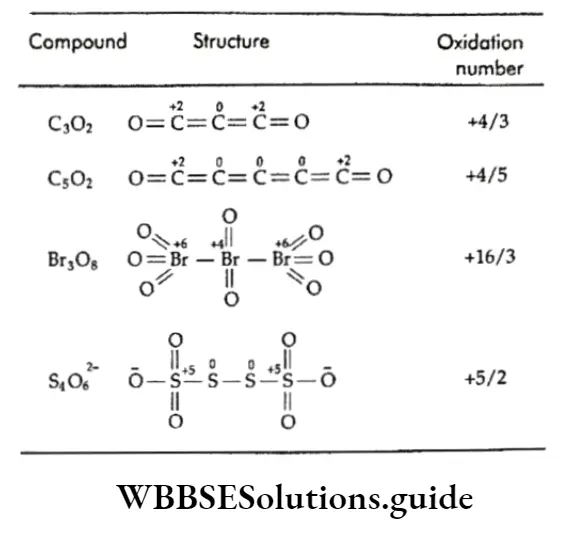
Other such cases of fractional oxidation numbers are observed in C302, C502, Br30g, and S4O2-6.

“Oxidation number, definition, calculation and examples, explained”

The structures of such compounds show the different oxidation states of atoms, which depend on the bonding of the atoms.

The structures of the compounds in which the oxidation number of an element is fractional.

Thus, the fractional oxidation numbers displayed by elements in certain compounds are merely the respective average oxidation numbers of all the atoms with different oxidation states in those compounds.

Fractional oxidation numbers are not a reality.

Class 11 Biology Class 11 Chemistry
Class 11 Chemistry Class 11 Physics
Class 11 Biology MCQs Class 11 Physics MCQs
Class 11 Biology Class 11 Physics Notes

They signify the fact that in certain compounds the atoms of the same element can be bonded to the other elements in more than one way (so that the same element exhibits more than one oxidation state) to achieve stability.

Class 11 Basic Chemistry Chapter 8 Redox Reactions Notes Some compounds Containg Elements With Fractional Oxidation Numbers

Redox Reactions In Terms Of Oxidation Number

The transfer of electrons from one species to the other in a redox reaction leads to a change in their oxidation numbers.

Therefore, a redox reaction can also be defined in terms of oxidation number.

A redox reaction is a reaction that involves a change in the oxidation number of the interacting species.

Similarly, the idea of oxidation number change can also be applied to define oxidation, reduction, oxidant (oxidizing agent), and reductant (reducing agent).

Thus, when the oxidation number of an atom or a group of atoms increases, it undergoes oxidation. Contrary to this, when the oxidation number decreases, reduction takes place.

A substance acts as an oxidizing agent if the oxidation number of one (or more) of its atoms decreases and as a reducing agent if the oxidation number of one (or more) of its atoms increases.

In other words, a species itself undergoing oxidation is a reducing agent and vice versa.

Oxidation Number Definition, Calculation And Examples

Consider the following redox reactions.

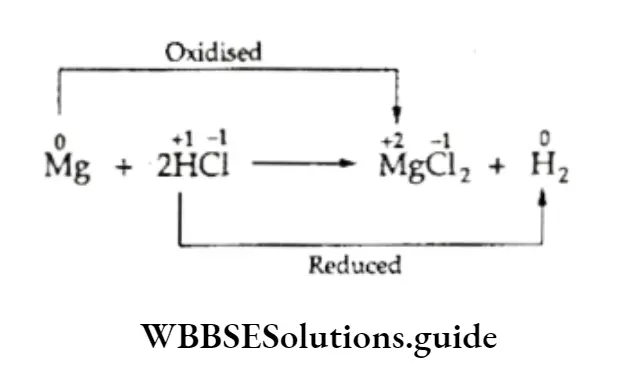
Class 11 Basic Chemistry Chapter 8 Redox Reactions Notes redox reactions

In this reaction the oxidation number of magnesium changes from 0 to +2 and that of hydrogen from +1 to 0.

The oxidation number of chlorine remains unchanged. Thus, magnesium is oxidized and hydrogen is reduced.

“Oxidation number, definition, calculation and examples, step by step”

In the reaction, magnesium acts as a reductant and reduces hydrogen. Hydrogen, on the other hand, acts as an oxidant and oxidizes magnesium.

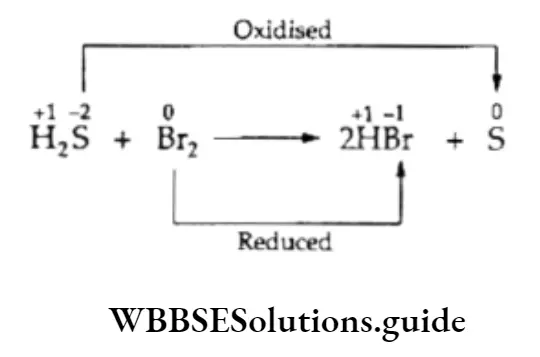
Class 11 Basic Chemistry Chapter 8 Redox Reactions Notes Redox reactions 2

Here the oxidation number of sulfur increases from -2 to 0, while that of bromine decreases from 0 to -1.

This indicates that sulfur (the reductant) is oxidized and bromine (the oxidant) is reduced. The oxidation number of hydrogen remains unchanged.

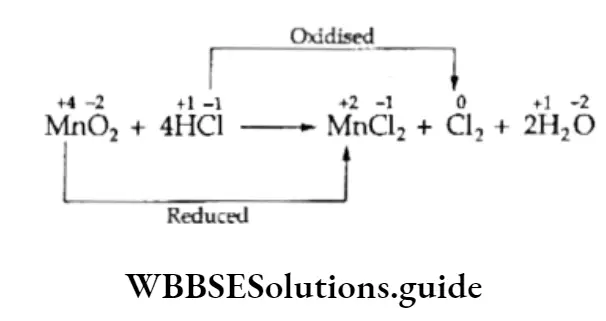
Class 11 Basic Chemistry Chapter 8 Redox Reactions Notes Redox reactions 3

In this reaction, as you can see, manganese is reduced and chloride is oxidized. Here manganese, being the oxidant, oxidizes chlorine, which is the reductant.

Example 1.

Identify the oxidant and reductant in the following reactions:

⇒ \(2 \mathrm{NaBr}+\mathrm{Cl}_2 \longrightarrow 2 \mathrm{NaCl}+\mathrm{Br}_2\)

⇒ \(\mathrm{MnO}_4^{-}+8 \mathrm{H}^{+}+5 \mathrm{Fe}^{2+} \longrightarrow \mathrm{Mn}^{2+}+5 \mathrm{Fe}^{3+}+4 \mathrm{H}_2 \mathrm{O}\)

⇒ \(\mathrm{CH}_4+\mathrm{Cl}_2 \longrightarrow \mathrm{CCl}_4+4 \mathrm{HCl}\)

Solution:

To identify the oxidant and reductant in each of the reactions, we should indicate the oxidation number of each atom in order to identify the atoms whose oxidation numbers change.

⇒ \(2 \stackrel{1}{\mathrm{~N} a} \stackrel{-1}{\mathrm{Br}}^{-1} \stackrel{0}{\mathrm{C}} \mathrm{l}_2 \longrightarrow 2 \stackrel{+1}{\mathrm{Na}} \stackrel{-1}{\mathrm{Cl}}+\stackrel{0}{\mathrm{Br}_2}\)

The oxidation number of Na does not change. The oxidation number of Br changes from -1 to 0, therefore it is oxidized and is the reductant. The oxidation number of Cl changes from 0 to -1. So it is reduced and is the oxidant.

⇒ \(\mathrm{MnO}_4^{-2}+8 \stackrel{+}{+}+5 \mathrm{~F}^{2+} \longrightarrow \mathrm{Mn}^{2+}+5 \mathrm{Fe}^{3+}+4 \mathrm{H}_2 \mathrm{O}^{-2}\)

The oxidation numbers of H and O remain unchanged. The oxidation number of Mn changes from +7 to +2. Thus, it is reduced and is the oxidant. The oxidation number of Fe increases from +2 to +3. It is oxidized and is thus the reductant.

⇒ \(\stackrel{-4}{\mathrm{C}} \stackrel{+1}{\mathrm{H}}_4+4 \stackrel{0}{\mathrm{C}} \mathrm{Cl}_2 \longrightarrow \stackrel{+4}{\mathrm{C}} \stackrel{-1}{\mathrm{C}} \mathrm{l}_4+\stackrel{+1}{4} \stackrel{-1}{\mathrm{Cl}}^{-1}\)

The oxidation number of H does not change. The oxidation number of C changes from -4 to +4. Thus, it is oxidized and is the reductant. Cl is the oxidant as it is reduced, as is revealed by the decrease in its oxidation number from 0 to -1.

Redox Reactions Oxidation Number

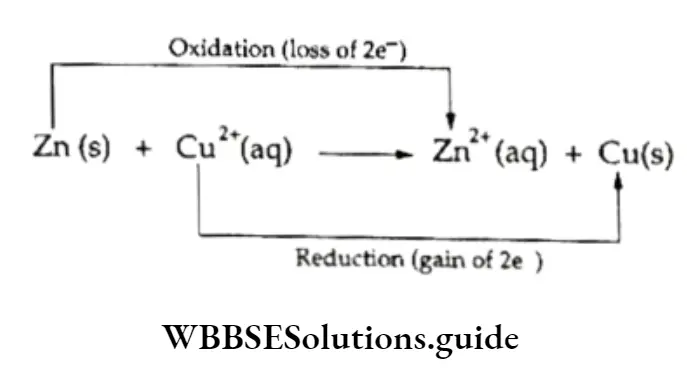
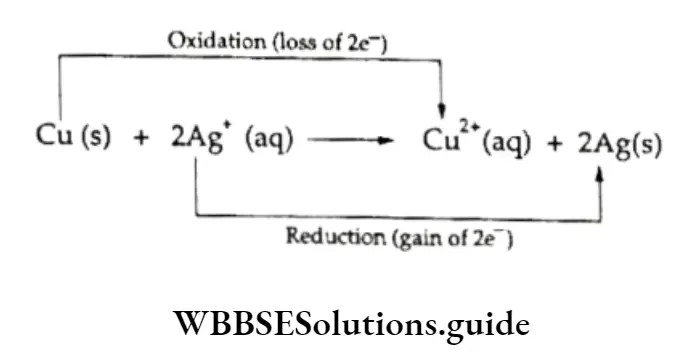
Redox reactions basically involve the transfer of electrons from one reactant to another. When such a reaction involves ionic species, the transfer of electrons is obvious, as it is in the following case.

⇒ \(\mathrm{Zn}(\mathrm{s})+\mathrm{Cu}^{2+}(\mathrm{aq}) \longrightarrow \mathrm{Zn}^{2+}(\mathrm{aq})+\mathrm{Cu}(\mathrm{s})\)

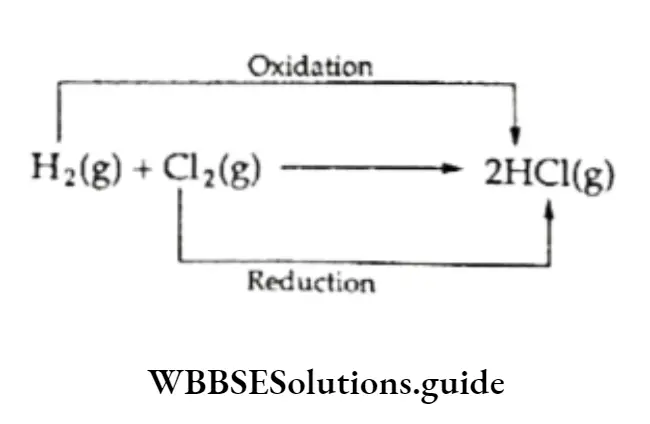
However, the exchange of electrons is not very obvious when redox reactions occur between covalent molecules, as in the following reaction.

⇒ \(\mathrm{H}_2(\mathrm{~g})+\mathrm{Cl}_2(\mathrm{~g}) \longrightarrow 2 \mathrm{HCl}(\mathrm{g})\)

In this reaction the reactants and products are all covalent, i.e., the bond formed between the atoms involves the sharing of electrons.

However, chlorine has a higher electronegativity than hydrogen.

“Oxidation number, definition, calculation and examples, for beginners”

Therefore, in hydrogen chloride the bond pair is closer to chlorine, resulting in the partial transfer of electronic charge from hydrogen to chlorine as shown below.

⇒ \(\stackrel{8+}{\mathrm{H}}-\stackrel{8}{\mathrm{Cl}}^{-}\)

Due to this charge separation, we may say that chlorine acts as an oxidant while hydrogen acts as a reductant. It may be pointed out that the traditional definition of redox reactions very easily explains this reaction.

Chlorine is reduced to hydrogen chloride by gaining hydrogen. Hydrogen, thus, is a reductant.

In order to identify the oxidant and reductant readily and overcome the problem of determining the number of electrons transferred during any redox reaction, the concept of oxidation number or oxidation state was introduced.

The oxidation number of an element may be defined as the charge that its atom has in a compound.

In covalent compounds, the effective charge on the atoms is not very apparent.

Therefore, it is useful to assign a charge to each element by a set of rules agreed upon by scientists.

This assigned charge is called the oxidation number or oxidation state, and may or may not represent the actual charge.

Rules For Assigning Oxidation Number

There are certain universally accepted rules for determining the oxidation number of an element in the combined state.

These are listed as follows.

  • The oxidation number of an element in the uncombined or free state is zero. Thus, the oxidation numbers of the respective elements in H2, He, Cl 2, S 8, C, and P4 are zero.
  • As the atoms do not differ in electronegativity, in such cases, the bond pair is equally shared and no atom has residual charge.
  • The oxidation number of an element in a monoatomic ion is the same as the charge on it. For example, the oxidation numbers of Na++, Ca2+, Al3+, I+, S2- and N3- ions are +1, +2, +3, -1, -2,-3 respectively.
  • The algebraic sum of oxidation numbers of all the atoms in a neutral molecule is zero. In the case of an ionic species, the algebraic sum of the oxidation numbers of the atoms in the ion must be equal to the net charge on the ion.
  • For instance, the algebraic sum of the oxidation numbers of carbon and oxygen inCO3- must be 2.
  • Hydrogen is assigned the oxidation number of +1 in most of its compounds. However, when it combines with active metals to form hydrides like LiH, NaH, and MgHj, it has an oxidation number of 1.
  • The oxidation number of oxygen in most of its compounds is -2. However, in peroxides like H2O2, Na2O2, and BaO2 it is -1. In oxygen difluoride (OF2) and dioxygen difluoride (02F2) the oxidation number of oxygen is +2 and +1 respectively because fluorine, being the most electronegative element in the periodic table, is always assigned the oxidation number of 1.
  • The halogens other than fluorine have an oxidation number of -1 except when they combine with a more electronegative halogen or oxygen, e.g., in C120 and C1F3, chlorine has an oxidation number of +1 and +3 respectively. In IF7 the oxidation number of iodine is +7.
  • The oxidation number of alkali metals (Li, Na, K, Rb, Cs) is always +1 and that of alkaline earth metals (Be, Mg, Ca, Sr, Ba) is +2.
  • When two different elements combine to form a compound, the more electronegative element has a negative oxidation number, while the less electronegative element has a positive oxidation number. For instance, the oxidation numbers of nitrogen in NH3 and NC13 are 3 and +3 respectively.

Example. Calculate the oxidation numbers of the following:

1. C in CO2

  • Let the oxidation number of C in CO2 be x.
  • The oxidation number of each O atom is -2.
  • The sum of the oxidation numbers of all the atoms in CO2 is zero.
  • ∴x-4 = 0orx =4
  • Thus, the oxidation number of C in CO2 is +4.

2. Mn in KMnO4

  • Let the oxidation number of Mn in KMnO4 be x.
  • The oxidation number of each O atom is -2 and that of K is +1.
  • The sum of the oxidation numbers of all the atoms in KMnO4 is zero.
  • ∴l+x-(2×4) = 0 or x = 7
  • Thus, the oxidation number of Mn in KMnO4 is +7.

3. Pb in Pb02

  • Let the oxidation number of Pb in PbO2 be x.
  • The oxidation number of each O atom is -2.
  • The sum of the oxidation numbers of all the atoms in Pb02 is zero.
  • ∴x-(2×2) = 0 or x = 4.
  • Thus, the oxidation number of Pb in Pb02 is +4.

4. CI1KCIO4

  • Let the oxidation number of Cl in CIO4– be x.
  • The oxidation number of each O atom is -2.
  • The sum of the oxidation numbers of all the atoms in CIO-4 is -1.
  • ∴x-(2×4)=-l or x =7.
  • Thus, the oxidation number of Cl in CIO-4 is +7

5. NinNH4+

  • Let the oxidation number of N in NH4 be x.
  • The oxidation number of each H atom is +1 and the sum of the oxidation numbers of all the atoms in
  • NH+4 is also+1.
  • ∴ x + (lx4) =l or X =-3.
  • Thus, the oxidation number of N in NH4 is -3.

6. Cr in Cr2Oj

  • Let the oxidation number of each Cr atom in Cr2OV be x.
  • The oxidation number of each O atom is -2.
  • The sum of the oxidation numbers of all the atoms in Cr2Of~ is -2.
  • ∴xx2 -1-(-2×7) = -2
  • or 2x-14 = -2; 2x =12 or x = 6.
  • Thus, the oxidation number of Cr in Cr2O2-7 is +6.

“Oxidation number, definition, calculation and examples, PDF notes”

Variable Oxidation Number

Variable Oxidation Number:

By now it should be clear to you that the oxidation number of an element is not necessarily the same in all compounds, it varies.

For instance, the oxidation numbers of C in CCI4/ CH4 and CH2C12 are +4, -4, and 0 respectively. The oxidation numbers of O in OF2 and C120 are +2 and -2 respectively.

This is because apart from the highly electropositive metals of groups and 2 which have oxidation numbers +1 and +2 respectively and the most electronegative element—fluorine which has the oxidation number of, the oxidation numbers of most of the remaining elements vary as they depend on the other combining elements.

Transition metals exhibit a maximum variation in the oxidation state as compared to the other groups of the periodic table.

The oxidation numbers of Fe in FeSO4 and FeCl3 are +2 and +3 respectively. Manganese shows a number of different oxidation states— +2 in MnClÿ +3 in Mn(OH)3, +4 in MnOÿ +6 in KMnO4 and +7 in KMnO4. The oxidation states of the elements in the 3d series of transition elements.

Class 11 Basic Chemistry Chapter 8 Redox Reactions Notes The Common Oxidation States Of 3 rd Series Transiition Elements

The compounds of the same element in different oxidation states often differ in color. The highest oxidation state is generally in the form of oxonian, MnO4, CrO4, etc.

These are excellent oxidizing agents. Many elements of the p block also display variable oxidation states. For example, it shows an oxidation number of +2 in SnCl2 and one of +4 in
SnCl4

Oxidation Number And Nomenclature

The names of compounds initially did not have much to do with their compositions.

Compounds were named on the basis of some characteristic property like color or the source from which they were derived. Thus CuSO4 -5H2O and FeSO4 >7H2O were called blue vitriol and green vitriol on the basis of their color.

They were both derived from vitriolic acid or oil of vitriol, the trivial name for sulphuric acid.

As science progressed and more and more compounds were identified, it was necessary to follow a systematic nomenclature based on the chemical composition of compounds. Thus, FeSO4 was named ferrous sulfate.

According to this system, binary compounds are named by writing the electropositive element followed by the electronegative element and adding the suffix ide to the latter, e.g., sodium chloride (NaCl).

In the case of metals exhibiting variable oxidation states, the lower oxidation state has the suffix ous and the higher oxidation state has the suffix is, e.g., Cu20 is a cuprous oxide (copper has an oxidation state of 1) and CuO is a cupric oxide (the oxidation state of Cu is 2).

You are familiar with this system of nomenclature so we will not go into further details of it.

“Oxidation number, definition, calculation and examples, chemistry guide”

Stock Notation

The modem system of naming compounds of metals exhibiting variable oxidation states is called Stock notation after the scientist, Albert Stock, who devised it.

The tire oxidation state of the metal is indicated in Roman numerals, enclosed in brackets, and is written after the name or symbol of the metal.

Class 11 Basic Chemistry Chapter 8 Redox Reactions Notes Formulae And Stock Notation Of Some Compounds Of Metals With Variable OXidation States

Redox Reactions – Examples, Types and Applications

Redox Reactions Half-Reactions

If a zinc rod is dipped into a beaker containing a solution of copper sulfate, after some time the blue color (due to copper ions) of the solution starts fading. The zinc rod starts dissolving partially and its surface gets coated with metallic copper. This happens because the following redox reaction takes place.

⇒ \(\mathrm{Zn}(\mathrm{s})+\mathrm{CuSO}_4(\mathrm{aq}) \longrightarrow \mathrm{ZnSO}_4(\mathrm{aq})+\mathrm{Cu}(\mathrm{s})\)

In an aqueous solution, copper sulfate dissociates to form Cu2+ (aq) and SO4+(aq).

So we can write the reaction as:

⇒ \(\mathrm{Zn}(\mathrm{s})+\mathrm{Cu}^{2+}(\mathrm{aq})+\mathrm{SO}_4^{2-}(\mathrm{aq}) \longrightarrow \mathrm{Cu}(\mathrm{s})^{+} \mathrm{Zn}^2+(\mathrm{aq})+\mathrm{SO}_4^{2-}(\mathrm{aq})\)

Class 11 Basic Chemistry Chapter 8 Redox Reactions Notes Zinc Dissolves In A Solutions Of CuSO4

The sulfate ions do not participate in the reaction. Zinc loses electrons and gets oxidized to Zn2+ while Cu2+ gains electrons and gets reduced to metallic copper.

The overall reaction consists of two parts—oxidation and reduction, which can be represented separately as:

⇒ \(\mathrm{Zn}-2 \mathrm{e}^{-} \longrightarrow \mathrm{Zn}^{2+}\)

⇒ \(\mathrm{Cu}^{2+}+2 \mathrm{e}^{-} \longrightarrow \mathrm{Cu}\)

Both (a) and (b) represent half-reactions*—(a) represents an oxidation half-reaction and (b) a reduction half- reaction

Class 11 Biology Class 11 Chemistry
Class 11 Chemistry Class 11 Physics
Class 11 Biology MCQs Class 11 Physics MCQs
Class 11 Biology Class 11 Physics Notes

“Redox reactions, definition, types, examples, and applications”

It is interesting to note that if we dip a copper rod in a zinc sulfate solution, no reaction occurs.

The solution does not turn blue as it would have if copper had dissolved giving Cu2+(aq).

The attempt to detect Cu2+ in the solution by adding H2S also fails as no black color of cupric sulfide (CuS) is observed.

In the redox reaction discussed above zinc acts as a reducing agent, reducing Cu2+ to copper while copper ion (Cu2+) acts as an oxidizing agent, oxidizing Zn to Zn2+.

Whether a substance acts as an oxidant or a reductant depends upon its ability to accept or donate electrons.

This will be dear to you by studying another reaction occurring within the same experimental set-up as shown here.

As you, a copper rod is dipped in a solution of silver nitrate. After some time the copper rod dissolves partially, being oxidized to Cu2+.

The initially colorless solution turns blue. Metallic silver gets deposited on the copper rod from the silver nitrate solution.

⇒ \(\mathrm{Cu}(\mathrm{s})+2 \mathrm{Ag}^{+}(\mathrm{aq})+2 \mathrm{NO}_3^{-}(\mathrm{aq}) \longrightarrow \mathrm{Cu}^{2+}(\mathrm{aq})+2 \mathrm{Ag}(\mathrm{s})+2 \mathrm{NO}_3^{-}(\mathrm{aq})\)

or

⇒ \(\mathrm{Cu}(\mathrm{s})+2 \mathrm{Ag}^{+}(\mathrm{aq}) \longrightarrow \mathrm{Cu}^{2+}(\mathrm{aq})+2 \mathrm{Ag}(\mathrm{s})\)

Class 11 Basic Chemistry Chapter 8 Redox Reactions Notes Copper Dissolves In a Solutions Of AgNO3

The nitrate ion is passive in the above reaction. The silver ion accepts electrons and gets reduced while copper metal loses electrons and gets oxidized.

Thus, the silver ion is the oxidant and copper metal is the reductant. However, the reverse reaction does not take place, that is, silver does not dissolve in copper nitrate.

“Oxidation-reduction reactions, types, examples, and real-world applications”

Now consider the two reactions observed in the above two experiments.

As you can see from the above representations, the role of copper is reversed in the two reactions.

In the reaction with zinc, Cu2+ is reduced to Cu while in the reaction with Ag+, Cu is oxidized to Cu2+.

These reactions proceed in this manner as in the state of equilibrium, the formation of products is greatly favored over that of the reactants.

Class 11 Basic Chemistry Chapter 8 Redox Reactions Notes Oxidation Loss Of 2e-

Class 11 Basic Chemistry Chapter 8 Redox Reactions Notes Oxidation Loss of 2e- 2

Now let us consider the reaction occurring between metallic iron and a cobalt sulfate solution. The expected reaction will be

Class 11 Basic Chemistry Chapter 8 Redox Reactions Notes Oxidation Loss of 2e- 3

At equilibrium, it is found that the solution contains both Fe2+ and Co2+, i.e., the reaction does not proceed to completion as neither the formation of the reactants nor that of the products is greatly favored.

Thus, we find that some metals readily donate electrons whilst some do not. Thus, the metals may be arranged in order of ease of donation of electrons.

“Redox reactions, chemical process, examples, and industrial applications”

If we consider the three metals Zn, Cu, and Ag, the electron-releasing tendency would be Zn > Cu > Ag.

This kind of series in which metals are arranged in their decreasing order of reactivity (i.e., electron-releasing tendency) is called the electrochemical series.

Redox reactions are of great significance not only because they account for many biochemical and industrial processes but they are also used to generate electricity, for instance, in electrochemical cells such as galvanic cells.

The chemical reactions taking place in such cells are the sources of electricity.

Redox Reactions – Examples, Types and Applications

Types Of Redox Reactions

We have just seen that any reaction accompanied by a change in the oxidation number of any species is considered to be a redox reaction.

Most chemical changes can be classified as a combination, decomposition, and replacement or substitution reactions, and many such reactions are also redox reactions as shown by the examples cited here.

1. Combination reactions

A combination reaction may be denoted as

X + Y→ Z

In this case, if any one of the reactants or both are in elemental form then the reaction is a redox reaction. When an element forms a compound, its oxidation number changes.

⇒ \(\stackrel{0}{\mathrm{C}}+\stackrel{0}{\mathrm{O}}_2 \longrightarrow \stackrel{+4}{\mathrm{C}} \stackrel{-2}{\mathrm{O}}_2\)

⇒ \(2 \stackrel{0}{\mathrm{~A}}+\stackrel{0}{\mathrm{~N}}_2 \longrightarrow 2 \stackrel{+3}{2} \stackrel{-3}{\mathrm{~N}}\)

⇒ \(2 \stackrel{\mathrm{Al}}{+}+\stackrel{0}{\mathrm{~N}}_2 \longrightarrow 2 \mathrm{Al}^{+3} \stackrel{-3}{\mathrm{~N}}\)

⇒ \(2 \stackrel{0}{\mathrm{Mg}}+\stackrel{0}{\mathrm{O}_2} \longrightarrow 2 \stackrel{+2}{\mathrm{Mg} \mathrm{O}}^{-2}\)

“Types of redox reactions, oxidation, reduction, and their significance”

⇒ \(\stackrel{0}{\mathrm{~N}}_2+3 \stackrel{0}{\mathrm{H}}{ }_2 \longrightarrow 2 \stackrel{+3}{\mathrm{~N}} \stackrel{-1}{\mathrm{H}}_3\)

⇒ \(\stackrel{0}{\mathrm{Fe}}+\stackrel{0}{\mathrm{~S}} \longrightarrow \stackrel{+2}{\mathrm{Fe}}-\stackrel{-}{\mathrm{S}}^2\)

⇒ \(2 \stackrel{-}{\mathrm{C}}_4 \stackrel{+1}{\mathrm{H}}_{10}+13 \stackrel{0}{\mathrm{O}}_2 \longrightarrow 8 \stackrel{4}{\mathrm{C}}^{-2} \mathrm{O}_2+10 \mathrm{H}_2 \mathrm{O}^{-2}\)

When elements combine to form compounds the oxidation number of the more electronegative element decreases while that of the other increases.

2. Decomposition reactions

Decomposition reactions are the opposite of combination reactions. In such a reaction, the reactant (a compound) decomposes to give two or more products, which may be either elements or compounds. Such reactions may also be redox reactions. A few examples are shown as follows.

⇒ \(2 \stackrel{+2}{\mathrm{H}} \stackrel{-2}{\mathrm{O}} \longrightarrow 2 \stackrel{0}{\mathrm{H}} \longrightarrow \stackrel{0}{\mathrm{O}}\)

⇒ \(2 \stackrel{+1}{2} \stackrel{-}{O}_2 \longrightarrow 2 \stackrel{0}{\mathrm{H}}_2+\stackrel{0}{\mathrm{O}_2}\)

⇒ \(2 \mathrm{~K}^{+1} \stackrel{+5}{\mathrm{C}}-20, \longrightarrow 2 \mathrm{O}^{+1} \mathrm{~K}^{-1} \mathrm{Cl}+3 \mathrm{O}_2\)

It may be noted that the oxidation number of K in potassium chlorate remains unchanged but that of Cl decreases while that of oxygen increases.

3. Displacement reactions

A displacement or substitution reaction is one in which an atom or a molecule is replaced by another atom or a molecule.

A+BC→AC+B

The above equation shows that A replaces B. We may come across reactions where a metal displaces another metal or reactions where a nonmetal displaces another nonmetal. Let us discuss both types in brief.

Metal displacement In such reactions a metal in a compound is displaced by another metal in the uncombined state. We have already seen the case of Zn replacing Cu in CuS04,

⇒ \(\stackrel{0}{\mathrm{Zn}}+\stackrel{+2}{\mathrm{CuSO}_4} \longrightarrow \stackrel{+2}{\mathrm{ZnSO}_4}+\stackrel{0}{\mathrm{Cu}}\)

There are many other examples

⇒ \(\stackrel{+4}{\mathrm{TiCl}}{ }_4+2 \stackrel{0}{\mathrm{Mg}} \longrightarrow 2 \stackrel{+2}{\mathrm{MgCl}_2}+\stackrel{0}{\mathrm{~T} i}\)

⇒ \(\stackrel{+3}{\mathrm{Fe}} \mathrm{O}_3+2 \stackrel{0}{\mathrm{Al}} \longrightarrow \stackrel{+3}{\mathrm{Al}_2} \mathrm{O}_3+2 \stackrel{0}{\mathrm{Fe}}\)

⇒ \(\stackrel{+3}{\mathrm{Cr}_2} \mathrm{O}_3+2 \stackrel{0}{\mathrm{Al}} \longrightarrow \stackrel{+3}{\mathrm{Al}_2 \mathrm{O}_3}+\stackrel{0}{2 \mathrm{Cr}}\)

Many such reactions are used in metallurgical operations to obtain a metal from its oxide. Reduction with aluminum is called a thermite reaction.

“Redox reactions, everyday examples, industrial uses, and biological importance”

Nonmetal displacement A nonmetal may be displaced by a metal or another nonmetal. A metal may displace hydrogen from water or acids.

⇒ \(2 \stackrel{0}{\mathrm{Na}}+2 \stackrel{+1}{2} \mathrm{H}_2 \mathrm{O} \longrightarrow 2 \stackrel{+1}{\mathrm{NaOH}}+\stackrel{0}{\mathrm{H}_2}\)

⇒ \(\stackrel{0}{\mathrm{Mg}}+\stackrel{+1}{2} \mathrm{H}_2 \mathrm{O} \longrightarrow \stackrel{+2}{\mathrm{M}}(\mathrm{OH})_2+\stackrel{0}{\mathrm{H}_2}\)

⇒ \(\stackrel{0}{\mathrm{Zn}}+\stackrel{+1}{2} \mathrm{HCl} \longrightarrow \stackrel{+2}{\mathrm{Z}} \mathrm{nCl}_2+\stackrel{0}{\mathrm{H}}_2\)

⇒ \(\stackrel{0}{\mathrm{Fe}}+\stackrel{+1}{\mathrm{H}_2} \mathrm{SO}_4 \longrightarrow \stackrel{+2}{\mathrm{FeSO}} \mathrm{SO}_4+\stackrel{0}{\mathrm{H}_2}\)

The reactivity of a metal may be adjudged by these reactions. Highly reactive metals like sodium and potassium react violently with cold water.

Magnesium reacts with warm water while iron reacts with steam. Also, metals like iron and zinc liberate hydrogen readily from ads whereas less reactive metals like copper, silver, and gold do not.

A classical example of one nonmetal displacing another is the case of a more reactive halogen displacing a less reactive halogen from halides. The reactivity of halogens follows the order:

F>Cl>Br>I

⇒ \(\stackrel{0}{\mathrm{C}} \mathrm{l}_2+2 \stackrel{+1}{\mathrm{Na}} \mathrm{-}^{-1} \longrightarrow 2 \mathrm{Na} \stackrel{-1}{\mathrm{Cl}}^{-1} \stackrel{0}{\mathrm{X}}_2(\mathrm{X}=\mathrm{Br}, \mathrm{I})\)

⇒ \(\stackrel{0}{\mathrm{Br}_2}+2 \mathrm{NaI} \longrightarrow 2 \mathrm{Na} \stackrel{-1}{\mathrm{~N}} \longrightarrow \mathrm{I}_2\)

In all the cases shown above the higher halogen is reduced while the lower one is oxidised.

Halogens are obtained by the oxidation of halides. Huorine is the most reactive halogen and the strongest oxidizing agent.

Thus F- cannot be chemically oxidized to F-, this is achieved by electrolysis. In fact, fluorine is so reactive that when it comes in contact with water it displaces the oxygen of the water vigorously

⇒ \(2 \stackrel{0}{\mathrm{~F}}_2+2 \stackrel{+1}{\mathrm{H}}_2-\stackrel{2}{\mathrm{O}} \longrightarrow 4 \stackrel{+1}{\mathrm{H}} \stackrel{-1}{\mathrm{~F}}+\stackrel{0}{\mathrm{O}}{ }_2\)

“Redox reactions, electrochemical cells, examples, and practical applications”

Thus, fluorine cannot be used to displace chlorine, bromine, and iodine in their aqueous solutions.

4. Disproportionation reactions

In these reactions, a substance is both oxidized and reduced. For example, when a metal superoxide.

⇒ \(\begin{aligned}
& 2 \mathrm{KO}_2^{-1 / 2}(\mathrm{~s})+\mathrm{H}_2 \mathrm{O}(\mathrm{l}) \longrightarrow 0^0(\mathrm{~g})+2 \mathrm{~K}^{+}(\mathrm{aq})+\mathrm{HO}_2^{-1}(\mathrm{aq})+\mathrm{OH}^{-}(\mathrm{aq}) \\
& \text { Potassium } \\
& \text { superoxid } \\
&
\end{aligned}\)

dissolves in water it decomposes with the evolution of oxygen. In the given reaction, the oxygen in K02 is simultaneously oxidized from the)/1 oxidation state into the 0 oxidation state in 02 and reduced from the}2 oxidation state in 02 to the -1 oxidation state in HO-

2. Some other disproportionation reactions are as follows.

⇒ \(2 \stackrel{+1}{\mathrm{H}}_2 \stackrel{-1}{\mathrm{O}}_2 \longrightarrow 2 \stackrel{+1}{\mathrm{H}}_2 \stackrel{-2}{\mathrm{O}}+\stackrel{0}{\mathrm{O}_2}\)

⇒ \(2 \mathrm{Cu}^{+1} \mathrm{Cl}^{-1} \longrightarrow \stackrel{+2}{\mathrm{C} u} \mathrm{Cl}_2+\stackrel{0}{\mathrm{C} u}\)

⇒ \(3 \stackrel{+1}{\mathrm{Na}} \stackrel{+1}{\mathrm{C}}-2 \mathrm{O}^{-} \longrightarrow \stackrel{+1}{\mathrm{Na}} \stackrel{+5}{\mathrm{C}}-2 \mathrm{O}_3+2 \stackrel{+1}{\mathrm{Na}} \mathrm{Cl}^{-1}\)

Phosphorus, sulfur, and halogens also undergo disproportionation reactions in alkaline media.

⇒ \(\stackrel{0}{\mathrm{P}}_4(\mathrm{~s})+3 \mathrm{NaOH}(\mathrm{aq})+3 \mathrm{H}_2 \mathrm{O}(\mathrm{l}) \longrightarrow \stackrel{-3}{\mathrm{P}}_3(\mathrm{~g})+3 \mathrm{NaH}_2 \stackrel{+1}{\mathrm{P}}_2(\mathrm{aq})\)

⇒ \(\stackrel{0}{\mathrm{X}_2}(\mathrm{~g})+2 \mathrm{NaOH}(\mathrm{aq}) \longrightarrow \underset{(\mathrm{X}=\mathrm{Cl}, \mathrm{Br}, \mathrm{l})}{\mathrm{NaX}} \stackrel{+1}{(\mathrm{aq})}+\mathrm{NaX}^{-1}(\mathrm{aq})+\mathrm{H}_2 \mathrm{O}(\mathrm{l})\)

⇒ \(\stackrel{0}{\mathrm{~S}}_8(\mathrm{~s})+12 \mathrm{NaOH}(\mathrm{aq}) \longrightarrow 4 \mathrm{Na}_2 \stackrel{-2}{\mathrm{~S}}(\mathrm{aq})+2 \mathrm{Na}_2 \stackrel{+2}{\mathrm{~S}}_2{ }_2^{-2} \mathrm{O}_3(\mathrm{aq})+6 \mathrm{H}_2 \mathrm{O}(\mathrm{I})\)

“Oxidation and reduction reactions, examples, and their role in chemistry”

  • Fluorine does not undergo such a disproportionation reaction as it does not display a positive oxidation state.
  • Thus, it is obvious that in a disproportionation reaction, the reactant is present in an intermediate oxidation state and decomposes to give one product showing a higher oxidation state and another showing a lower oxidation state.
  • A compound containing an element in the highest oxidation state will not be disproportionate as a higher oxidation state is not attainable.

Balancing Redox Reactions

For any chemical reaction to be balanced, the number of atoms of each element on both sides of the chemical equation representing it should be the same (law’ of conservation of mass).

Simple reactions can be balanced by the hit-and-trial method but for complex ones, a systematic approach has to be followed.

“Redox reactions, balancing methods, examples, and their importance”

Redox reactions can be balanced in two systematic ways. The first method is based on the change in the oxidation number of reductant and oxidant and is called the oxidation-number method.

In the second method, the reaction is split into two parts—one denoting reduction and the other oxidation. This is known as the half-reaction method.

WBCHSE Class 11 Chemistry Notes For Hydrogen Peroxide – Structure, Formula and Properties

Hydrogen Peroxide Preparation

In the laboratory, hydrogen peroxide is prepared by the following methods.

1. From sodium peroxide Calculated quantities of sodium peroxide are added in small portions to ice-cold dilute sulphuric acid (20%)

⇒ \(\mathrm{Na}_2 \mathrm{O}_2+\mathrm{H}_2 \mathrm{SO}_4 \longrightarrow \mathrm{Na}_2 \mathrm{SO}_4+\mathrm{H}_2 \mathrm{O}_2\)

On cooling, most of the sodium sulphate separates out as Na2SO4- 10H2O and is filtered. By this process, a 30 per cent solution of hydrogen peroxide containing a bit of sodium sulphate is obtained.

“WBCHSE Class 11 Chemistry, hydrogen peroxide, structure, formula, and properties”

2. From barium peroxide The reaction of hydrated barium peroxide with dilute sulphuric add gives hydrogen peroxide and barium sulphate, which is insoluble is filtered off. The method was first used to prepare hydrogen peroxide in 1818 by Thenard.

⇒ \(3 \mathrm{BaO}_2+2 \mathrm{H}_3 \mathrm{PO}_4 \longrightarrow \mathrm{Ba}_3\left(\mathrm{PO}_4\right)_2+3 \mathrm{H}_2 \mathrm{O}_2\)
Barium peroxide Phosphoric Acid Barium Phosphate

By electrolysis, This method used earlier involves the electrolysis of an equimolar mixture of sulphuric acid and r ammonium sulphate using a platinum anode and a graphite cathode.

⇒ \(\mathrm{H}_2 \mathrm{SO}_4 \rightleftharpoons \mathrm{H}^{+}+\mathrm{HSO}_4^{-}\)

WBCHSE Class 11 Chemistry Notes For Hydrogen Peroxide – Structure, Formula and Properties

Read and Learn More WBCHSE For Class11 Basic Chemistry Notes

⇒ \(\underset{{\text { anmonium } \\ \text { sulphiate }}}{\left(\mathrm{NH}_4\right)_2 \mathrm{SO}_4}+\mathrm{H}_2 \mathrm{SO}_4 \longrightarrow \underset{{\text { amrmonium hydrogen } \\ \text { sulphate }}}{2 \mathrm{NH}_4 \mathrm{HSO}_4}\)

⇒ \(\mathrm{NH}_4 \mathrm{HSO}_4 \longrightarrow \mathrm{NH}_4^{+}+\mathrm{HSO}_4^{-}\)

⇒ \(2 \mathrm{HSO}_4^{-} \longrightarrow \mathrm{H}_2 \mathrm{~S}_2 \mathrm{O}_8+2 \mathrm{e}^{-} \text {(at anode) }\)

“Hydrogen peroxide, WBCHSE Class 11, chemistry notes, and key characteristics”

⇒ \(\mathrm{NH}_4 \mathrm{HSO}_4 \longrightarrow \mathrm{NH}_4^{+}+\mathrm{HSO}_4^{-}\)

The solution, on hydrolysis, produces hydrogen peroxide.

⇒ \(\mathrm{H}_2 \mathrm{~S}_2 \mathrm{O}_8+\mathrm{H}_2 \mathrm{O} \longrightarrow \underset{{\text { perowomono- } \\ \text { sulphuric acid }}}{\mathrm{H}_2 \mathrm{SO}_5}+\mathrm{H}_2 \mathrm{SO}_4\)

“WBCHSE Class 11 Chemistry, hydrogen peroxide, acidic and basic nature, and reactions”

⇒ \(\mathrm{H}_2 \mathrm{SO}_5+\mathrm{H}_2 \mathrm{O} \longrightarrow \mathrm{H}_2 \mathrm{SO}_4+\mathrm{H}_2 \mathrm{O}_2\)

By the oxidation of 2-ethyl anthraquinol Hydrogen peroxide is nowadays produced on a commercial scale by a cyclic process.

In this method, 2-ethyl anthraquinol is oxidised by air to the corresponding quinone and hydrogen peroxide at a moderate temperature.

The anthraquinone is reduced back to anthraquinone with hydrogen using platinum, palladium or Raney nickel as a catalyst. The cycle is repeated.

Basic Chemistry Class 11 Chapter 9 Hydrogen By The Oxidation Of 2-ethyl Antharaquional

The hydrogen peroxide formed is extracted with water and the aqueous solution (containing 1-2% H2O2) is concentrated under reduced pressure. It is sold as a 30 per cent (by weight) solution which has a pH of about 4.0. It is stored in plastic or wax-coated glass vessels.

The coating is done to prevent the decomposition of hydrogen peroxide on account of the traces of alkali present in glass, which catalyse the decomposition. Small amounts of urea or sodium stannate are added as stabilisers, to prevent the breakdown of H2O2 into water and oxygen.

“WBCHSE Class 11, chemistry notes, on hydrogen peroxide, molecular structure, and bonding”

For further concentration, the solution is cooled to about 263 K when crystals enriched in H2O2 separate out. The process of fractional crystallisation is repeated to obtain 100 per cent H2O2.

Hydrogen Peroxide Physical properties

Hydrogen peroxide is a colourless, odourless, syrupy liquid. It has a bluish tinge and is soluble in water, ether and alcohol in all proportions.

It is a liquid in which molecules are highly associated with each other due to the presence of intramolecular hydrogen bonds.

In fact, it is more hydrogen-bonded than water and has a boiling point of 423.2 K and a melting point of 273.6 K. Also, it has a dipole moment of 2.1 D, a little more than that of water (1.84 D).

Basic Chemistry Class 11 Chapter 9 Hydrogen Physical Properties Of Hydrogen Peroxide

Hydrogen Peroxide Chemical properties

Hydrogen peroxide is unstable and its rate of decomposition depends on temperature and concentration.

It V behaves as an oxidising as well as a reducing agent in both acidic and alkaline media. The oxidation state of oxygen in hydrogen peroxide is -1, compared to zero in O2 and -2 in H2O.

Class 11 Biology Class 11 Chemistry
Class 11 Chemistry Class 11 Physics
Class 11 Biology MCQs Class 11 Physics MCQs
Class 11 Biology Class 11 Physics Notes

Therefore, hydrogen peroxide can be oxidised to or reduced to H2O. H2O2 is a powerful oxidising agent.

1. Oxidation in an acidic medium: It oxidises acidified solutions of ferrous salts, iodides, sulphides and ferrocyanides to ferric salts, iodine, sulphates and ferricyanides respectively.

⇒ \(2 \mathrm{FeSO}_4+\mathrm{H}_2 \mathrm{SO}_4+\mathrm{H}_2 \mathrm{O}_2 \longrightarrow \mathrm{Fe}_2\left(\mathrm{SO}_4\right)_3+2 \mathrm{H}_2 \mathrm{O}\)

“Hydrogen peroxide, chemical formula, molecular structure, and physical properties, WBCHSE”

⇒ \(2 \mathrm{KI}+\mathrm{H}_2 \mathrm{SO}_4+\mathrm{H}_2 \mathrm{O}_2 \longrightarrow \mathrm{K}_2 \mathrm{SO}_4+\mathrm{I}_2+2 \mathrm{H}_2 \mathrm{O}\)

⇒ \(\mathrm{PbS}+4 \mathrm{H}_2 \mathrm{O}_2 \longrightarrow \mathrm{PbSO}_4+4 \mathrm{H}_2 \mathrm{O}\)

⇒ \(\underset{{\text { potassium } \\ \text { ferrocyanide }}}{2 \mathrm{~K}_4\left[\mathrm{Fe}(\mathrm{CN})_6\right]+\mathrm{H}_2 \mathrm{SO}_4}+\mathrm{H}_2 \mathrm{O}_2 \longrightarrow \underset{{\text { potassium } \\ \text { ferricyanide }}}{2 \mathrm{~K}_3\left[\mathrm{Fe}(\mathrm{CN})_6\right]+\mathrm{K}_2 \mathrm{SO}_4}+2 \mathrm{H}_2 \mathrm{O}\)

Hydrogen peroxide oxidises sulphites, nitrites and arsenites to sulphates, nitrates and arsenates respectively.

⇒ \(\underset{\text { sodium sulphite }}{\mathrm{Na}_2 \mathrm{SO}_3}+\mathrm{H}_2 \mathrm{O}_2 \longrightarrow \underset{\text { sodium sulphate }}{\mathrm{Na}_2 \mathrm{SO}_4}+\mathrm{H}_2 \mathrm{O}\)

⇒ \(\mathrm{KNO}_2+\mathrm{H}_2 \mathrm{O}_2 \longrightarrow \mathrm{KNO}_3+\mathrm{H}_2 \mathrm{O}\)

⇒ \(\mathrm{Na}_3 \mathrm{AsO}_3+\mathrm{H}_2 \mathrm{O}_2 \longrightarrow \mathrm{Na}_3 \mathrm{AsO}_4+\mathrm{H}_2 \mathrm{O}\)

2. Oxidation in an alkaline medium: Hydrogen peroxide oxidises chromium salts to chromates and manganese salts to manganese dioxide.

“WBCHSE Class 11 Chemistry, hydrogen peroxide, oxidation states, and decomposition”

⇒ \(\mathrm{Cr}_2\left(\mathrm{SO}_4\right)_3+3 \mathrm{H}_2 \mathrm{O}_2+10 \mathrm{NaOH} \longrightarrow 2 \mathrm{Na}_2 \mathrm{CrO}_4+3 \mathrm{Na}_2 \mathrm{SO}_4+8 \mathrm{H}_2 \mathrm{O}\)

⇒ \(\underset{{\text { manganese } \\ \text { sulphate }}}{\mathrm{MnSO}_4}+\mathrm{H}_2 \mathrm{O}_2+2 \mathrm{NaOH} \longrightarrow \mathrm{Na}_2 \mathrm{SO}_4+\underset{{\text { manganese } \\ \text { dioxide }}}{\mathrm{MnO}_2}+2 \mathrm{H}_2 \mathrm{O}\)

3. Reducing action in an acidic medium: The following reactions depict the reducing action of H2O2 in an acidic medium.

⇒ \(\mathrm{H}_2 \mathrm{O}_2+\mathrm{Cl}_2 \longrightarrow 2 \mathrm{HCl}+\mathrm{O}_2\)

4. It reduces acidified potassium permanganate (pink) to manganese sulphate (colourless)

⇒ \(2 \mathrm{KMnO}_4+3 \mathrm{H}_2 \mathrm{SO}_4+5 \mathrm{H}_2 \mathrm{O}_2 \longrightarrow \mathrm{K}_2 \mathrm{SO}_4+2 \mathrm{MnSO}_4+8 \mathrm{H}_2 \mathrm{O}+5 \mathrm{O}_2\)

It reduces the acidified potassium dichromate solution (yellow) to chromic sulphate (green).

⇒ \(\mathrm{K}_2 \mathrm{Cr}_2 \mathrm{O}_7+4 \mathrm{H}_2 \mathrm{SO}_4+3 \mathrm{H}_2 \mathrm{O}_2 \longrightarrow \mathrm{K}_2 \mathrm{SO}_4+\mathrm{Cr}_2\left(\mathrm{SO}_4\right)_3+7 \mathrm{H}_2 \mathrm{O}+3 \mathrm{O}_2\)

“Hydrogen peroxide, structure, formula, and industrial applications, WBCHSE syllabus”

It reduces silver oxide to silver with the liberation of oxygen gas, and lead dioxide to lead monoxide.

⇒ \(\mathrm{Ag}_2 \mathrm{O}+\mathrm{H}_2 \mathrm{O}_2 \longrightarrow 2 \mathrm{Ag}+\mathrm{H}_2 \mathrm{O}+\mathrm{O}_2\)

⇒ \(\mathrm{PbO}_2+\mathrm{H}_2 \mathrm{O}_2 \longrightarrow \mathrm{PbO}+\mathrm{H}_2 \mathrm{O}+\mathrm{O}_2\)

5. Manganese dioxide is reduced to manganous sulphate.

⇒ \(\underset{{\text { Manganese } \\ \text { dioxide }}}{\mathrm{MnO}_2}+\mathrm{H}_2 \mathrm{O}_2+\mathrm{H}_2 \mathrm{SO}_4 \longrightarrow \underset{{\text { Manganous } \\ \text { sulphite (pink) }}}{\mathrm{MnSO}_4}+2 \mathrm{H}_2 \mathrm{O}+\mathrm{O}_2\)

4. Reducing action in an alkaline medium reduces an alkaline solution of potassium ferrocyanide to potassium ferrocyanide.

“Hydrogen peroxide, properties, stability, and uses, WBCHSE Class 11 notes”

⇒ \(\underset{\text { ferricyanide }}{2 \mathrm{Fe}(\mathrm{CN})_6{ }^{3-}}+\mathrm{H}_2 \mathrm{O}_2+2 \mathrm{OH}^{-} \longrightarrow \underset{\text { ferrocyanide }}{2 \mathrm{Fe}(\mathrm{CN})_6{ }^{4-}}+2 \mathrm{H}_2 \mathrm{O}+\mathrm{O}_2\)

It reduces ferric salts to ferrous salts.

⇒ \(\underset{\text { ferric ion }}{2 \mathrm{Fe}^{3+}}+\mathrm{H}_2 \mathrm{O}_2+2 \mathrm{OH}^{-} \longrightarrow \underset{\text { ferrous ion }}{2 \mathrm{Fe}^{2+}}+2 \mathrm{H}_2 \mathrm{O}+\underset{\text { dioxygen }}{\mathrm{O}_2}\)

Reaction with ozone Hydrogen peroxide reduces ozone to oxygen.

⇒ \(\mathrm{H}_2 \mathrm{O}_2+\mathrm{O}_3 \longrightarrow 2 \mathrm{O}_2+\mathrm{H}_2 \mathrm{O}\)

Bleaching action Hydrogen peroxide is used to bleach delicate articles like ivory, feathers, silk, etc. The bleaching action is due to the following reaction.

⇒ \(\mathrm{H}_2 \mathrm{O}_2 \longrightarrow \mathrm{H}_2 \mathrm{O}+\mathrm{O}\)

The nascent oxygen obtained on the decomposition of hydrogen peroxide oxidises the colouring matter of the article to be bleached. When this happens the article loses colour, i.e., it gets bleached.

Hydrogen Peroxide Uses

  1. Hydrogen peroxide is used as an antiseptic and germicide for washing wounds. It is also employed in mouthwashes.
  2.  H2O2 is used as an oxidant for rocket fuel and as a propellant for submarines and torpedoes.
  3. It is employed in the manufacture of many inorganic and organic compounds like sodium peroxoborate [Na2B2(02)2(0H)4 -6 H2O2 and epoxides. Sodium peroxoborate is used in washing powder. Organic peroxides are used to initiate addition polymerisation reactions (FVC, polyurethane and epoxy resins).
  4. It is used in organic synthesis for the conversion of an aldehydic group (—CHO) into a hydroxyl group (—OH). The oxidation is carried out in an alkaline medium.
  5. It is employed as an oxidising agent in the laboratory.
  6. In the textile industry, it is used as what is known as an antichlor. This means that it helps remove excess chlorine after bleaching.

“WBCHSE Class 11, chemistry notes, on hydrogen peroxide, preparation, and reactivity”

Structure Of Hydrogen Peroxide

The hydrogen peroxide molecule is nonplanar. The two oxygen atoms are linked to each other by a covalent bond, known as a peroxide bond in this case.

Also, each oxygen atom is linked to a hydrogen atom by covalent bonds. The two O—H bonds are in different planes.

The angle between the two planes is 111.5° in the gaseous phase. Because of hydrogen bonding in the crystalline state, however, this angle becomes 90.2° in the crystalline state.

The Structure Diagram Of Hydrogen Peroxide:

Basic Chemistry Class 11 Chapter 9 Hydrogen The Structure Of H2O2 In The Gaseous Phase