WBBSE Notes For Class 6 History Chapter 5 Indian Sub Continent In The 6th Century BC

Chapter 5 Indian Sub Continent In The 6th Century Bc First Few Words

Janapadas

For many years in a far place. They were nomads. But when they invented agriculture and cultivation and when they started animal husbandry, men settled down in territories that suited them.

Meanwhile, great changes took place in north India around the sixth century B.C. Janapadas grew up. Janapadas were small towns. Most of them were ruled by chieftains. These chieftains were leaders of a clan.

“WBBSE class 6 history chapter 5 notes”

We Know about these janapadas from Buddhist and Jaina literature as also from Sanskrit Sources. The Janapadas did not always live in peace. At times they were in conflicts and bathes.

Read and Learn More WBBSE Notes For Class 6 History

Thus after some years some of them became more powerful and more influential than others. Some even added territories to their homeland by Conquering neighboring janapads. Thus after some time, there arose much bigger janapads.

These werw called Mahajanapadas. The Buddhist scriptures give us a lot of information about these Mahajanapadas which were sixteen in number They were called the Shodasha-mahajanapadas.

These great janapadas or cities occupied the territories from in the northwest to the fringe of the river Godavari in southcentral India.

WBBSE Notes For Class 6 History Chapter 5 Indian Sub Continent In The 6th Century BC

Chapter 5 Indian Sub Continent In The 6th Century Bc The Sixteen Mahajanapadas

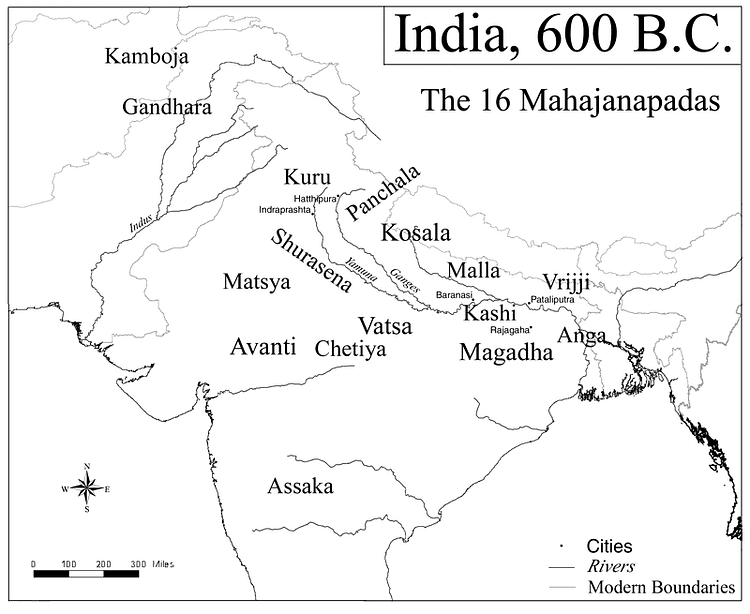
The ‘sixteen mahajanapadas were Anga, Magadha, Kashi, Gandhara, Kamboja, Matsya, Surasena, Kuru, Pane Maila, Vajji, Chedi, Vasta, Avanti, and Asmaka From the map provided for you, the geographical location of these sixteen mahajanapadas will be clear to you.

WBBSE Notes For Class 6 Chapter 5 Indian Sub Continent In The 6th Century Bc India 600 Bc

Each of these city-states had its capital. The chart below will give you a clear picture of the respective capitals and locations of the mahajanapadas.

Mahajanapada Location Capital
Anga Parts of Bihar Champa
Magadha Parts of Bihar Rajagriha (later Pataliputra)
Kashi East Uttar Pradesh Kashi (Varanashi)
Koshala East Uttar Pradesh Shravasti
Gandhara Kashmir & Pakistan Takshashila
Kamboja Western border of Pakistan Rajpura
Matsya Rajasthan Vairata
Surasena West Uttar Pradesh Mathura
Kuru West Uttar Pradesh Hastinapura
Panchala Central Uttar Pradesh Ahichhatra
Malla NE Uttar Pradesh Kushinara
Vajji Parts of Bihar Vaishali
Chedi Bundelkhand (UP) Suktimati
Vatsa Allahabad (Prayag) Kaushambi
Avanti Madhya Pradesh Ujjain and Mahishmati
Asmaka Maharashtra Potali on the river Godavari


All these mahajanapadas except one were located in north India.  Only Asmaka was located in south-central India. Most city-states were ruled by kings and had a monarchical form of government. Kingship in these states was Hereditary.

The king ruled with the aid of an assembly or council. The subjects paid revenue or taxes. This was the mam source of income of the government. Magadha, Koshala, and some other states were monarchical while Vajjt Malta, etc.

“Indian subcontinent in the 6th century BC WBBSE notes”

were republican states. The mahajanapadas were often engaged in conflict. The bigger and more powerful states always tried to conquer and subjugate the smaller and weaker ones.

In the conflicts that went on, our states grew stronger and they annexed territories of the neighboring states. These four states were Magadha, Koshaia, Avanti and Vatsa.

Chapter 5 Indian Sub Continent In The 6th Century Bc The Republic The Vajjils

Monarchical states like Magadha, Avanti, Kosala, and Vatsa always tried to aggrandize and the republics had to face the ambitious designs of the monarchies. The most important republic was Vajji or Vriji.

Its capital was at Vaisali. The Vrijis had no king and were ruled by an assembly, The Mallas. had a similar type of rule. There were other smaller republics, the Sakyas of Kapilavastu, the Bhargas, and the Mauryas 0f Pippalivana.

In the Vajji state the elderly people were held in great respect and in their assembly, the elders were the majority. The women were held in respect too.

Class 6 History Class 6 Social Science
Class 6 Geography Class 6 Science
Class 6 Maths Class 6 Science MCQs
Class 6 General Science Class 6 Maths Solutions
Class 6 Geography Class 6 Hindi

The Religious Revival

In the sixth century B.C. the soda! and the economic condition of north India changed considerably, people by and large were against the social inequality and the excessive ritualistic systems of the Brahmanas.

There was widespread discontent among the Kshatriyas, the Vaishyas, and the Shudras. Caste and rituals came to be hated by the people at large.

Soon there arose new religious movements that expressed a strong voice against the excesses of the caste system and also against rituals. Moreover, the development of the new system of cultivation required The Widespread use of cattle.

But the animal sacrifice of the Brahmanical religion stood in its way. There soon arose new religious movements like Jainism and Buddhism.

These two religious movements brought about a huge change in the social and religious scene of north India. The beginning of the use of weapons and implements increased the power and influence of the Kshatriyas.

Iron implements opened up new horizons in cultivation. All the sections of the people, except the Brahmanas, were discontented with the Brahmanical system. Simpler religion and a more developed economy called for a great change, This paved the way for. the two great new religions. ‘

Chapter 5 Indian Sub Continent In The 6th Century Bc Jainism And Mahavira

The first two new religious upheavals were Jainism and Buddhism. At and in point of time Jainism arose first. These two new faiths attracted the common people. Most ordinary people of those days were opposed to the excesses of caste and ritualism.

So when the new preachers criticized caste and ritual, they eagerly listened to them. This was the reason for the popularity of the new faiths. About 540 B.C. (some say, it was 599 B.C.) a prince was born at Kundagrama (or Kundahara) near Vaishali in Bihar.

The name of the prince was Vardhamana. His father, Siddhartha, was a Kshatriya chief of a tribe of Vaishali. His mother, Trishala, was a Lichchhabi princess and was related the Magsdhan royal family from her mother’s side.

WBBSE Notes For Class 6 Chapter 5 Indian Sub Continent In The 6th Century Bc Mahavira

Not much is known about the private life of Vardhamana. This much we know for certain that he was married to princess Yashoda and had a daughter.

But he was becoming highly disgusted with the earthly life and when he was thirty, he left home and began his search for truth. He thus became an ascetic wearing a single garment.

He discarded a!) world enjoyments’ Vardhamana wandered about for twelve years until he met Goshala whom he regarded as his guru. When Vardhamana was 42 years old, he attained Kaibalya, or enlightenment.

“summary of class 6 history chapter 5 WBBSE”

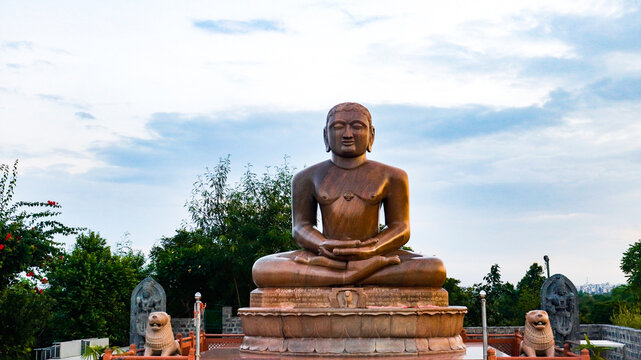
He attained this enlightenment on the bank of the river Rijupalika. Now he was called Mahavira. The Jainas call him Tirthankara. There were twenty- four Tirthankaras and Mahavira was the last of them.

The twenty-third Tirthankara, Parshwanatha was a prince of Kashi. He was born over two centuries before Mahavira.

Chapter 5 Indian Sub Continent In The 6th Century Bc The Teaching Of Jainism

From now on, Vardhamana was called Vardhamana Mahavira. You are surely eager to know what he preached and what the main principles of Jainism were.

Jainism taught five main doctrines. These were:

  1.  Do not commit violence. Mahavira was always in favor of non-violence and kindness. He said that one should not kill or injure even an animal or insect or plant;
  2. Do not utter a lie. He was in favor of truth at any cost.
  3. Do not steal. Mahavira considered stealing a great vice. So people must shun it;
  4. Do not acquire or crave for the property. The property was regarded as a source of evil;
  5. Observe Brahmacharya or continence. It is said that the first four doctrines were preached by the previous Tirthankaras and the fifth doctrine was added by Mahavira.

Parshwanatha, the previous Tirthankara, that is, the twenty-third preacher had asked his followers to cover only the upper and lower portions of one’s body. But Mahavira asked all followers to discard clothes altogether.

So his followers went about without any clothes on. Mahavira was in favour of observing severe austerity. The existence of God was not denied by the Jains. But Jina (the Supreme Conqueror) was given a higher place than God.

They acknowledged the results of the actions of a previous birth. Jainism also acknowledged rebirth.

Later life of Mahavira

After attaining enlightenment Mahavira began to wander again preaching his religion. He went to Champa, Mithila, Magadha, and Koshala. In 468 B.C. Mahavira died at the age of 72 at Pawapuri near modern Rajgir.

Spread of Jainism

In the lifetime of Mahavira, his followers counted about 14,000. Jainism by and by spread to the south and west of India.

It is said that Chandragupta Maurya, the Maurya King of Magadha, embraced Jainism and did much for its spread in the east and south of the country, in the third century B.C., the Jaina preacher Bhadrabahu did much for the spread of Jainism’ to the south.

“important questions from Indian subcontinent in 6th century BC”

But as it often happens, the Jainas also were divided into two groups after Mahavira’s death. One group was called the Digamvaras who wore no clothes at all. They were influential mainly in the South.

The other group was called the Swetambaras who wore white garments. They were influential in the north.

Chapter 5 Indian Sub Continent In The 6th Century Bc Gautama Buddha And Buddhism

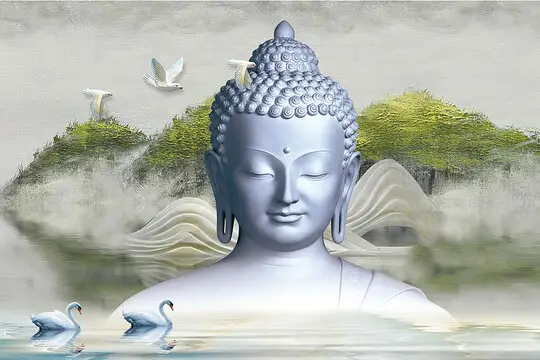
About two thousand and five hundred years ago, in 566 B.C. (or, maybe in 567 B.C.) Gautama Buddha, the founder of Buddhism was born in Kapiiavastu in the Tarai region of Nepal. His name then was Siddhartha.

Siddhartha’s father, Shuddhodana was the ruler of the Shakyas. His wife was Mahamaya or Mayadevi. Mayadevi died soon after she had given birth to her son, Siddhartha. The infant then was taken care of by its aunt, Gautami or Gotami.

For this reason, Siddhartha was also called Gautama. Even when Siddhartha was a mere boy, he was afflicted by men s sorrows and sufferings. His father reared him in the best of riches.

WBBSE Notes For Class 6 Chapter 5 Indian Sub Continent In The 6th Century Bc Gautama Buddha

But Siddhartha did not like the life of ease and enjoyment. He often went out of the royal palace and drove in his chariot accompanied by his very favorite charioteer called Channa.

On the way, he saw suffering people, beggars, and ailing people. This made him all the more unhappy. He grew apathetic towards worldly attractions. His father wanted to effect a change in his son’s attitude.

So Siddhartha was married to a princess named Yashcdhara. A son was born to them and was named Rahul. But Siddhartha’s discontent and mental unrest were still there.

He left home at the age of 29. He wanted to know what causes human misery and what the remedy was.

Chapter 5 Indian Sub Continent In The 6th Century Bc The Quest For Happiness And Siddhartha’s Buddhahood

Siddhartha left home to know the secret of happiness. Not his own happiness, but that of the entire mankind. He wandered about for seven years. In the course of his wanderings, he met many people.

He met wise men and even became the disciple of a sadhu. But none could provide what he wanted. His questions were still unanswered. His attire became worn out and ragged. He often went without food.

So his body became lean and emaciated. One day he came to Urubilwa near Gaya and sat under a pipul tree, thoroughly exhausted and weak. But without caring for his bodily welfare, he went on meditating.

“WBBSE class 6 history chapter 5 key points”

At that time a village girl named Sujata came with a potful of porridge-like food. Siddhartha ate it and gained some strength. Soon after, a light dawned on him and he attained Bodhi or enlightenment.

He now Knew the secret of happiness. From that day he came to be known as the Buddha, that is, the Enlightened one. He was 35 Years of age then.

Chapter 5 Indian Sub Continent In The 6th Century Bc Buddhas Preachings

As he attained Bodhi, Gautama was now called Buddha. When he attained Buddhahood, he went to Samath near Varanasi. And there in a deer park called Mrigadava, he preached his religion for the first time.

And it is here that his five companions became his first five disciples. These disciples were Kaundinya, Bhadrika, Aswajeet, Vaspa, and Mahanama. Buddha’s first preaching has since been made memorable by naming it Dharmachakra Prabartana.

In his first preaching, Buddha explained to his disciples the causes of human suffering. In Buddha’s view, the world is full of miseries. Man is ever craving for worldly joy. This greed lay at the root of all miseries, if a man could subdue his greed or craving he might escape miseries.

“political condition of India in 6th century BC class 6”

Buddha said that three great sins made men unhappy. These were selfishness, ‘ignorance, and lack of goodwill to others. If all these could be conquered and the mind given over to meditation or contemplation, the problem could be resolved.

He laid down eight paths to achieve contemplation. These were known as the Ashtanga Marga or the eight-fold paths. They were samyak drishti (right views), sat vakya (right speech), sat samkalpa (right resolution), etc. Buddha preached at many places.

During his preachings, people of all classes and castes gathered around him and became his followers. He died at Kushinagara near Gorakhpur at the age of 80.

Chapter 5 Indian Sub Continent In The 6th Century Bc The Tripitaka

After Buddha’s death, his disciples compiled his teachings in a book named Tripitaka. Pitaka means a basket. Literally, Tripitaka means three baskets. So Buddha’s teachings were stored in three holy baskets.

These three pikas were the Sutta Pitaka which contained Buddha’s and his principal disciples’ teachings; the Vinaya Pitaka contained the rules and principles of the Buddhist Sangha or Council.

“rise of Mahajanapadas in 6th century BC WBBSE”

It also contained the manners and ways in which Buddhists should live. And the Abhidhamma Tmke contained some general advice. The Pitakas were written In Pali.

Some great disciples of Buddha-like Mhakashyapa and Vasumitra realized that the advice of Buddha should be compiled; otherwise, everybody would take his own way and so would depart from the real path.

Chapter 5 Indian Sub Continent In The 6th Century Bc The Sangha or the Buddhist Council

As days went on, opinions began to differ. The disciples now thought of bringing all followers together in order to bring unity. They convened a conference of Buddhists in Rajagriha under the chairmanship of Mahakashyapa.

This was known as the First Buddhist Council or Samgeeti. There were four such Counts or Samgeetis. The fourth was held at the time of Kanishka, the Kushan King.

The Buddhist Councils

Council Place Period Chairman   The main event
1st Council Rajagriha Ajatashatru Mahakasyapa Sutta Pitaka and
Vinaya Pitaka  were Compiled
2nd Council  Vaishali Kalashoka Yasha    A split took place among the Buddhists. Theravada raised its head.
3rd Council  Pataliputra Ashoka Moggaliputta Rules were framed for the guidance of Councils.
4th Council Kashmir  Kanishka Vasumitra Buddhists were now divided into Mahayana and Hinayana


Chapter 5 Indian Sub Continent In The 6th Century Bc Spread Of Buddhism

By and by Buddhism spread far and wide, it spread not only over various regions in India but also outside India. It spread to Ceylon (now called SriLanka), Burma (now called Myanmar) and far-off China and japan as well.

In Mongolia and Tibet, Buddhism took another form, it was called Lamaism. For many years Buddhism was a very popular faith and drew the patronage of kings. The rulers of Magadha, Kosala, and Kousambi adopted Buddhism.

In spite of this early popularity, Buddhism began to weaken from the fifth century AD. And by the seventh century, Buddhism was almost extinct in India, although it was still popular outside India, especially in south-east Asia.

The Sangha

During Buddha’s lifetime, people enthusiastically embraced his religion. Anybody could become a Buddhist. Buddha welcomed all, making no difference between high and low, rich and poor.

Now it was felt that an order should be founded in order that there was discipline among the followers. Buddha himself organized this religious order known as the Sangha. The followers were asked to strictly follow the rules and principles of the Sangha.

Hinayana and Mahayana

Sometime after Buddha’s death, there was great disagreement among his followers. Some of them lived a life of austerity, while some others lived in luxury. Some ascetics even lived like ordinary family men enjoying all worldly pleasures.

“economic activities in ancient India 6th century BC”

The rules of the Ssngha loosened. As a result, two sects arose. One was called the Mahayana (the Great Vehicle), and the other was Hinayana (the little Vehicle). The Mahayanists were In favor of worshipping the image of Buddha.

This form of Buddhism was practiced in China, Japan, Tibet, and Korea. The Hinayana was the older form of Buddhism. The Hinayanists were in favour of strictly adhering to the principles laid down by Buddha himself.

Among the monarchs, Kanishka, in whose time the fourth Council was held, was a supporter the Mahayana form.

The Jatakas

You must have heard about the Jatakas. Many Jataka stories are very popular all over our country. The Buddhists believe that previously Buddha took many births before attaining Buddhahood.

The name of Buddha in his previous births was Bodhisattva. Stories of Bodhisattva’s life are described in the Suttapitaka. These stories, known as the jataka stories, are related in pali.

It is said that there were over five hundred Jataka stories. Each story had a name—niisha jataka, Kusha Jataka, etc. Each Jataka story had a moral lesson.

One very well-known story was that of Seriba and Seriban, the two merchants. Serbia was wicked and dishonest, while Seriban was honest and well-meaning.

Chapter 5 Indian Sub Continent In The 6th Century Bc The Story Serbia and Serbian

Once upon a time, there lived two merchants, Seriba and Seriban, in the ancient kingdom of Serib. Both Seriba and Seriban were hucksters selling their wares from door to door. Serbia was wicked and dishonest.

And Seriban was too well-meaning and thoroughly honest. One day Serbia was on his way hawking about. There was a little girl who lived with her grandma in a hut. They were very poor. The little girl begged of her grandma for a toy.

The old woman had nothing but a worn-out metal plate. She requested Seriba to give a toy in exchange for the plate. Serbia immediately realized that the plate was pure gold. He did not disclose the truth and said, ‘It’s worthless.

WBBSE Notes For Class 6 Chapter 5 Indian Sub Continent In The 6th Century Bc seriba and seriban

It’s not even worth a paisa/ So saying he went away planning to come back later. After some time, Serbian too came there hawking his wares. The old woman called him and wanted to buy a toy in exchange for the plate.

“social structure of Indian subcontinent in 6th century BC”

Seriban was surprised to realize that. it was a gold plate. He said, ‘Madam, I don’t have so much money to give you in exchange for it. It is pure gold. At the woman’s insistence.

Serbian gave a toy and took the plate giving her whatever money he had with him. When Seriban had gone off, Seriba came back with the wicked intent of taking the plate.

When he heard that Seriban had taken it, he in utter disappointment ran for Seriban. But Seriban had meanwhile crossed a river and was seen no more.

WBBSE Notes For Class 6 History

WBBSE Notes For Class 6 History Chapter 6 Expansion Of Empire

Chapter 6 Expansion Of Empire Introduction

In this chapter, we will tell you about the expansion of the early empires of ancient India. But first of all, can you guess the meaning of an empire? An empire is a large area of a state or kingdom ruled by a single monarch who is often called an emperor.

Most often a ruler of a kingdom brings neighboring states or kingdoms under his control by force. Thus what was once a small kingdom becomes a vast region called an empire. This is how Magadha, one of the Mahajanapadas, became an empire by subduing or conquering other states.

The other fifteen Mahajanapadas lost their identity and were absorbed by Magadha. So the first empire in India was the Magadhan empire under the rule of the Maurya king Chandragupta.

Read and Learn More WBBSE Notes For Class 6 History

Chapter 6 Expansion Of Empire Between the 6th Century B.C. And 4th Century B.C.

The sixteen Mahajanapadas flourished in the 6th century B.C. and the Magadhan empire flourished in the 4th century B.C. Then, what happened in the intervening two centuries? We will tell you briefly.

You already know that of the sixteen Mahajanapadas four became very powerful. These were Koshala, Avanti, Vatsa, and Magadha. These four took possession of the neighboring mahajanapadas and became much bigger in size.

After that, the struggle for power was among these four. In this struggle, Magadha came out victorious. During all those years Magadha was ruled by three dynasties. Do you know what a dynasty is? A dynasty is a royal family.

“WBBSE class 6 history chapter 6 notes”

Anyway, these three dynasties were the Haryankas, the Shaishunagas, and the Nandas. Magadha’s expansion actually began under the Haryanka king Bimbisara. This was continued by his son Ajatashatru.

The other kings of Haryanka were weak and worthless. The next dynasty which ruled Magadha was Shaishunaga and the last one was the Nanda dynasty. The last Nanda king, Dhanananda, was cruel, inefficient, and oppressive.

A prince of the Maurya dynasty, Chandragupta, removed Dhanananda from power with the help of the Brahmin Chanakya and sat on the throne of Magadha. Meanwhile, all the other three kingdoms, Koshala, Avanti, and Vatsa were engulfed by Magadha.

This is the story of Magadha’s transformation from a small kingdom to an empire.

WBBSE Notes For Class 6 History Chapter 6 Expansion Of Empire

Chapter 6 Expansion Of Empire Alexanders Invasion Of India

Alexander was a Greek hero. After the death of his father Philip, the king of Macedonia in Greece, Alexander became king of Macedonia in 336 B.C. at the age of nineteen. Alexander was intent on becoming a world conqueror.

In 331 B.C. he embarked on a course of conquest. First of all he conquered Persia and then moved toward India.In 327 B.C. Alexander arrived at Kabul. On his way to India, he conquered a few small states.

At that time northwest India was divided into several small states. There was no unity among them. Small states like Shibi, Kshudraka, Malwa, Asmaka, Taxila, and Paurava were mostly engaged in mutual enmity.

“expansion of empire WBBSE class 6 history notes”

And this made Alexander’s task easy. King Ambhi of Taxila welcomed Alexander and helped him by giving him money and animals.


WBBSE Notes For Class 6 History Chapter 6 Expansion Of Empire Alexander


But Porus the king of Paurava offered a fight. Parus fought bravely but was defeated. Porus was brought before Alexander. He was a brave man, not willing to lower his head to a foreigner.

It is said that Alexander was so pleased with him that he not only set him free but also gave his kingdom back. Alexander stayed in India for about nineteen months. He wanted to go further. But his soldiers were tired and wished to return home.

Class 6 History Class 6 Social Science
Class 6 Geography Class 6 Science
Class 6 Maths Class 6 Science MCQs
Class 6 General Science Class 6 Maths Solutions
Class 6 Geography Class 6 Hindi

So Alexander was on his way back home. On his way back he stayed for a while in Babylon. And there he died in 323 B.C. when he was only thirty- two years of age.

Chapter 6 Expansion Of Empire Chandragupta Maurya

You already know that the first empire in ancient India was the Magadhan empire built by the Maurya king Chandragupta. But how did it come about?

During Alexander’s invasion, the Nanda dynasty was the ruling power in Magadha. The Nanda kings were not liked by the people. The last of the Nandas, Dhanananda was cruel, unscrupulous and so was extremely unpopular.

“summary of class 6 history chapter 6 WBBSE”

Chanakya, a Brahmin scholar, allied with Chandragupta who was eager to capture Magadha. Chanakya was once treated harshly by Dhanananda and so was intent on taking revenge.

There was then a battle in which Chandragupta defeated and killed Dhanananda and ascended the throne of Magadha in 324 B.C. This was only the beginning. Chandragupta conquered Avanti and extended his power up to Narmada.

Chandragupta then drove away the Greeks from northwest India and established his sway over Punjab and Sind. There was enmity between Chandragupta and Seleukos Nikator, Alexander’s general. Chandragupta fought against Seleukos and won.

A treaty was signed between the two. Seleukos gave Chandragupta Kabul, Kandahar, Herat and Baluchistan. Chandragupta gave Seleukos 500 elephants. Chandragupta probably also married Seleukos’ daughter.

So by uprooting the Nanda rule, by driving away the Greeks, and by establishing his sway in north and north-west India, Chandragupta Maurya laid the foundation of India’s first empire. His capital was Pataliputra.

Chapter 6 Expansion Of Empire Megasthenes And Kautilya

Once Seleukos sent an ambassador, Megathenes by name, from Kandahar to Pataliputra. Megasthenes, however, stayed in Pataliputra and later wrote an account of his experience in the Maurya kingdom. But his writings in original have not been found.

Other Greek writers like Strabo and Arrian collected his writings. These were later published in book form and called ‘Indika’. Megasthenes’ Indika is an important source of knowledge about the Mauryas in Chandragupta’s reign.

Much is known about the town administration, the economic and Social condition of Mauryan India, and also about the military power of Chandragupta. Another important sourcebook about the Mauryas is the Arthashastra of Kautilya.

But it was not merely a book on the economic condition of the Mauryas. It was a general account of the administration. But who was this Kautilya? Some Say, Kautilya was the minister and adviser of Chandragupta Maurya.

And it is also said that Kautilya is none other than Chanakya. But other historians do not agree. One thing more. The Arthashastra is believed by many as a work by Kautilya.

But many others say that it was not written by Kautilys alone. There is, however, no doubt that the Arthashastra is an important sourcebook about the Mauryas.

It not only gives us much information about the administration, and social and economic condition of the Mauryan kingdom, it also lays down the ideals of kingship and the duties of the ruler.

Chapter 6 Expansion Of Empire Ashoka

After Chandragupta’s death, his son, Bindusara ascended the throne in 297 B.C. and ruled for about twenty-seven years. His rule was not at all memorable. He assumed the title Amitraghata or slayer of one’s enemies.

He did not expand the empire but kept it intact. He died o or 272 B.C. After Bindusara’s death, there was a struggle among his sons. Finally, Ashoka defeated his brothers and came to the throne in 269 or 268 B.C.

“important questions from expansion of empire class 6”

Ashoka was like his grandfather, eager to conquer lands beyond Magadha. Kalinga, in modern Coastal Orissa, was growing to be a challenge to Magadha. Kalinga’s navy was a rival of Magadhan’s navy. So Ashoka wanted to conquer Kalinga.

When he had ruled for about seven or eight years, Ashoka attacked Kalinga. Kalinga was easily defeated. Nearly a hundred thousand people were killed. Many more were imprisoned.


WBBSE Notes For Class 6 History Chapter 6 Expansion Of Empire King Ashoka


Ashoka’s thirteenth rock edict tells us that the huge bloodshed and suffering cries upset him. He promised never to engage in fighting again. He was initiated by a Buddhist monk, Upagupta.

Since then Ashoka became a votary of non-violence and peace. One thing must be remembered. Ashoka did not give up his empire. He did not become an ascetic. His empire was there, although it was no longer based on warfare.

He preached the principle of ‘ahimsa’, throughout his life. He had his teachings inscribed on rocks and pillars. These inscriptions are often called Ashokan edicts. These edicts were written in Pali.

Chapter 6 Expansion Of Empire Ashokas Dhamma

Ashoka preached his Dhamma to all his subjects. This Dhamma had a good similarity with Buddhism. But Ashoka’s Dhamma was not the same as Buddhism. What Ashoka preached was the religion of man. He preached the principle of ‘ahimsa’ towards all.

Ashoka was a Buddhist, but he did not want his rule to be influenced by Buddhism. As a king, Ashoka did not favor any religion, not even Buddhism. Ashoka inscribed his teachings on pillars and rocks.

“WBBSE class 6 history chapter 6 key points”

These have been discovered at different places of the kingdom. Ashoka declared that the killing of animals either for food or for pleasure must stop. His Dhamma wanted to remove sorrow and violence from his kingdom.

The essence of his Dhamma was peace, ahimsa, and love. He called himself Devanamapiya (beloved of the gods), and Piyadasi or Priyadarshi.

Chapter 6 Expansion Of Empire Ashokas Dhammavijaya

Ashoka never again fought any battle after Kalinga. Since then he wanted to win over people’s love and admiration. So he began a policy of Dhammavijaya. He wanted to conquer people’s minds with the help of a religious mission.

He preached peace and ahimsa not only throughout his empire but also outside his domain. He sent peace missions from Kashmir to Mysore, and from Burma to Surat. Even missions were sent to countries like Simhala (now Sri Lanka), Greece, Egypt, and Sumatra.

He stopped cruelty to animals. He loved his subjects as his own children. For these reasons, he has been regarded as the greatest king of India.

How was the kingdom administered?

Ashoka inherited the Mauryan Kingdom ruled first by Chandragupta and then by Bindusara. Ashoka fought one battle only, that of Kalinga and so added it to the kingdom of the Mauryans.

Administering the kingdom is a very important task for the rulers. The Mauryas, and especially Ashoka paid serious attention to the administration of the empire. The king or emperor was at the top of the administration. He was the source of all power.

But Ashoka never exercised force or coercion. He introduced officials like Dharmamahamatras whose main task was to spread his Dhamma. The Dharmamahamatras were told to take good care of the older people.

“how ancient Indian empires expanded class 6”

There were other officials like Adhyakshas, Rajukas, and Amatyas. There were amateurs or maintains who were in charge of revenue collection, civic administration, etc. The king was at the top of the judicial system also.

During Ashoka’s reign, there were 5 provinces, Uttarapatha, Avanti, Dakshinapatha, Kalinga, and Prachya. Each province was ruled by an official named Kumara. The Kumara was like today’şovernor.

Chapter 6 Expansion Of Empire The Fall of The Maurya Empire

So long as Ashoka lived, the Mauryan Empire went strong. But after about 50 years of his death, the empire broke down. The last Mauryan king was Brihadratha who was killed by his own commander, Pushyamitra Sunga in 187 B.C. M

Agatha was ruled by the Sungas first and then by the Kanvas. But why did the Maurya Empire break down? Some historians say that Ashoka’s policy of peace and ahimsa weakened the military base of the empire.

For many years the army had nothing to do really. Others say that the successors of Ashoka were weak and worthless rulers. The killing of the last king by his commander is proof. Moreover, the economy was also dwindling.

Chapter 6 Expansion Of Empire The North West After The Fall Of The Mauryas

After the fall of the Maurya Empire, the northwest of India had no rest from foreign invasion and inroads. In Bactria (modern Afghanistan) a branch of the Greeks established their rule. They are known as Indo- Greeks. They moved towards India.

One of them, Demetrios, conquered a part of northwest India. The most famous of the Indo-Greeks was Menander. He conquered lands up to Uttar Pradesh. After the Indo-Greeks, the Sakas held sway in northwest India.

“role of kings and dynasties in empire expansion”

Some of the Saka rulers were Vanones, Maues, Azes I, and Azes II. The Sakas called themselves Kshatrapas. The most famous of them was Rudradaman. After the Sakas, the Pahlavas, also called the Parthians made inroads into India.

The most famous of these Parthians was king Gandophernes. After the death of Gandophernes, the Parthians became weak and soon after, the Kushans took over.

Chapter 6 Expansion Of Empire Gangaridai

Ancient Greeks who were in India wrote of a country east of Magadha. They called it Gangaridai or Gangaridae. Around 300 B.C. it was an independent country based on the Ganges delta. This country is identified with modern Bangladesh.

Megasthenes referred to it in his Indika. Ptolemy also spoke of it. In the 4th-3rd centuries B.C. Gangaridai and Magadha had regular contacts.

Chapter 6 Expansion Of Empir The Kushans

The Kushans were the foreigners who came to rule northwest India after the Parthians. In Central Asia, there were several hordes of nomadic people in the 2nd-3rd century of the Christian era. Some of them moved westward and then southward.

One of them, the Yueh-Chih, came to Bactria and displaced the Shakas. The Yueh-Chih had several branches. One of them later came to be known as the Kushans.

The first Kushan king was Kujula Kadphises or Kadphises I who defeated the Pahlavas or Parthians and occupied Kabul in AD.50. The second of them was Vima Kadphises or Kadphises II who conquered parts of north and north-west India.

Chapter 6 Expansion Of Empire Kanishka

The most important Kushan ruler in India was Kanishka. The year of Kanishka’s ascension to the throne is uncertain. Some say it was 58 B.C. But most historians have canceled it as improbable. It is highly probable that Kanishka sat on the throne in AD.78.

Kanishka’s kingdom extended from the Indus valley in the west to Bihar in the east and from Kashmir in the north to the Vindhyas in the south. Purushpur (modern Peshawar) was his capital. Kanishka was not only a conqueror. He was an able ruler also.

He was a patron of Buddhism and had Chaityas and Buddhist Viharas built in many places of his kingdom. The supporters of Hinayana and Mahayana Buddhism were in conflict in Kanishka’s reign.

To solve the problem Kanishka convened of the conference of Buddhists in Kashmir which is known as the Fourth Buddhist Council. Kanishka was a patron of art and literature.

WBBSE Notes For Class 6 History Chapter 6 Expansion Of Empire Kanishka

Famous author Aswaghosha, the philosopher Vasumitra and the Ayurveda expert Charaka all flourished in Kanishka’s reign. The Gandhara Art too flourished in his reign.

Kanishka’s successors were not as capable as he was. The two immediate successors were Vasishka and Huvishka. Gradually the Kushan kingdom became weak and ultimately it dwindled.

Chapter 6 Expansion Of Empire Kharavela Of Kalinga

After the fall of the Mauryan Empire Kalinga became independent again under a powerful king named Kharavela. He was a member of the Chedi dynasty. All we know about him is from the Hathigumpha inscription written in Prakrit.

Kharavela probably ruled in the 1st century B.C. Kharavela was either a Jaina himself or a Jaina devotee. His most important achievement was his victory over the Satavahanas. Kharavela was an able administrator too.

He improved the transport of his kingdom and reformed the irrigation system. Hathigumpha inscription was a stone edict engraved under the command of Kharavela toward the end of his reign.

This inscription gives us a good picture of Kalinga of that time. There were, of course, exaggerations of Kharavela’s achievements.

Chapter 6 Expansion Of Empire The Satavahanas Of South India

The Satavahanas were a South Indian dynasty. They flourished in the Vindhyan region in the second half of the 1st century B.C. after the fall of the Mauryas. Their rule ended around AD 225. Their original authority was around the river Godavari in the Deccan.

Simuka was the founder of the Satavahana dynasty. He uprooted the rule of the Sungas and the Kanvas. After Simuka’s death, his brother Krishna became king and ruled for about 18 years.

The next king was Satakarni I. He was the first really important ruler of the dynasty. He conquered Malwa and the Narmada Valley. Under Satakarni I a large portion of south India came under the sway of the Satavahanas.

The Sakas were a powerful enemy of the Satavahanas. The Sakas under king Nahapana troubled the Satavahanas for some time. But the Satavahanas under their best ruler, Gautamiputra Satakarni, defeated and enfeebled Nahapana and conquered large portions of his territory.

Under Gautamiputra the Satavahanas ruled over almost the entire Deccan from the western coast to the eastern coast of mid-India. Large areas of Maharashtra, Konkan, Saurashtra, Malwa, West Rajasthan, and Vidarbha came under the rule of the Satavahanas.

We know much about the Satavahanas from two inscriptions-the Nasik inscription and the Karle inscription. The Sakas under Rudradaman became very powerful in western India. Rudradaman assumed the title of Mahakshatrapa.

His sway extended from Ujjain to Gujarat. Rudradaman meant enough trouble for the Satavahanas. The Junagarh inscription gives the details. After Gautamiputra’s death, his son Vashishthiputra Pulumayi became king.

But after Pulumayi no capable ruler came to the throne. The dynasty weakened steadily and ultimately the end came in the third century A.D.

Chapter 6 Expansion Of Empire Administration Under The Kushans And The Satavahanas

Big kingdoms or empires are usually divided into provinces. This was done for better governance or administration. The Kushanempire too was divided into several provinces.

The provinces were called Kshatrapas. The Kushan kings called themselves Devaputras or sons of the gods. The king was all-powerful. The Kushans established religious unity and social stability.

The Kushans favored Mahayana Buddhism. Generally, there was peace in the society. As a result trade and commerce even with foreign lands flourished. Two new forms of art developed in the Kushan period.

One flourished around Gandhara and was called Gandhara art. And the other which flourished around Mathura was called the Mathura art. Numerous stone images of Buddha were created. These art forms were influenced by the Greek-Roman style.

About the administration and social condition under the Satavahanas much is known from the Nasik inscription. The king was the head of the kingdom. He even was the commander of the army.

Like the Kushan Empire, the Satavahana Empire too was divided into several provinces. Each province was under an amateur. Gautamiputra the best Satavahana ruler curbed the power of the Kshatriyas and increased that of the Brahmanas.

But he showed tolerance towards the Buddhists. Gautamiputra and other rulers were patrons of culture. They built many temples. They gave away land to Brahmanas as well as to Buddhist monks.

A number of Buddhist Chaityas and monasteries were built. The Chaitya at Karle in Maharashtra is very famous. The Satavahanas used Prakrit in their inscriptions. Prakrit literature flourished in the Satavahana rule.

As in the Kushan period, trade and commerce flourished in the Satavahana rule. The people paid tax in both cash and kind. Normally 1/6th part of the produce was demanded by the state as tax. In those days salt was produced from seawater. Salt was subject to tax.

Chapter 6 Expansion Of Empire The Headless Figure Of Kanishka

To students of history, Kanishka’s headless stone figure is a very interesting thing. In 1911 this figure was discovered in a field in Mathura. It was broken. The head was missing. One hand held a sword, the other a scepter.

A long robe reached down the knee. The two feet are shown sideways. But how could one say that it was Kanishka? The script in Brahmi at the base of the figure tells us that it was Kanishka.

Chapter 6 Expansion Of Empire The Guptas

The Kushan rule ended about the second half of the 3rd century A.D. The Guptas were to rule a vast area of north India after the fall of the Kushans. Historians tell us that the first Gupta kings were minor rulers. The earliest of them was Sri Gupta.

After his death Ghatotkacha became king. But the first important king was Chandragupta I who ruled from A.D 320 to A.D 335. His rule extended over Magadha, Prayag, and Saketa which means modern Bihar and parts of Uttar Pradesh.

Chandragupta, I married a Lichchhavi princess, Kumaradevi, and assumed the title of Maharajadhiraja. The next ruler, Samudragupta, Chandragupta’s son sat on the throne in 335. He ruled from A.D 335 (or 340) to A.D 380.

We know much about the Guptas and especially about Samudragupta from the Allahabad inscription of Harisena and the account left by Fa-hien (now called Fa-Xian). Samudragupta was a great conqueror.

WBBSE Notes For Class 6 History Chapter 6 Expansion Of Empire Coins of Samudragupta

He defeated nine kings of Aryavarta or northern India and annexed their kingdoms. Samudragupta fought against twelve southern kings but did not annex their territories. He restored their territories and in return got their allegiance.

He had friendly relations with the rulers of Java, Ceylon (Sri Lanka), and Sumatra. He performed the ‘Aswamedha’ or horse sacrifice. After Samudragupta’s death, his son Chandragupta II became king in about AD. 376.

One of his remarkable achievements was the uprooting of Saka rule from Gujarat. For this, he was called ‘Sakari’ (enemy of the Sakas). He effaced the last traces of Saka rule in western India. Chandragupta II assumed the title of ‘Vikramaditya.’

“major conquests in Indian history class 6 WBBSE”

Fa Xian, the Chinese pilgrim visited India during Chandragupta !!’s reign. He has left an account of the Gupta reign as he saw it. Kumaragupta and Skandagupta were the last important rulers of the Gupta dynasty.

Kumaragupta (AD 414-454) kept the empire intact. He introduced many silver coins. After Kumaragupta came his son Skandagupta who fought against the Pushyamitras and the Huns. Skandagupta defeated both.

But the Gupta empire began to weaken after Skandagupta’s death in 467. None of his successors could put up a good show and could not arrest the process of decline.

Chapter 6 Expansion Of Empire The Vakatakas Of The South

The decline of the Satavahanas towards the end of the third century AD made way for the Vakatakas. The Vakataka dynasty came to power in Maharashtra and Madhya Pradesh.

The Vakatakas held power mainly in the Deccan. Their territory extended from the Vindhyan region to the Narmada-Godavari areas. Vindhyashakti was the founder of the Vakataka rule.

His son Prabarasena conquered territories on all sides and even snatched away Gujarat from the Sakas. The other important kings of the dynasty were Rudradamana and Prithvisena.

How were the Gupta and Vakataka Kingdoms ruled?

Ruling Of Gupta and Vakataka Kingdoms:

While the Guptas were the main ruling power in north India, there were several small kingdoms in the Deccan and in south India. The most important southern kingdom was obviously the Vakataka kingdom. The Gupta rule was monarchical.

The king was at the helm of power. He was not only the administrative head. He wielded the highest military and judicial power. Kingship was hereditary. This means that power is passed on to a son after a king’s death.

To make a show of enormous power the Gupta kings assumed titles like Maharajadhiraja etc. The kingdom. was divided into two parts, central and provincial. There were ministers to help the king.

Among them, the amateurs were the most important. Mahadandanayaka was the chief justice. One-fourth to one-sixth of the produce was claimed by the government as revenue. There was a tax on mines and trade.

A good amount of money was thus poured into the royal treasury. The Vakataka rule too was hereditary. The kings often assumed the title of Maharaja. The kingdom was divided into provinces and centers.

The provinces were called rajyas. The governors of the provinces were called Senapati. The districts in the provinces were called pattas.

Chapter 6 Expansion Of Empire The Allahabad Pillar Inscription

The eulogist Harishena wrote an elaborate eulogy of king Samudragupta. The eulogy was inscribed on a pillar. Much later this pillar inscription was discovered in the village of Koshambi near Allahabad.

Harishena, the court poet of Samudragupta wrote it. It was composed in Sanskrit and inscribed in Brahmi script. Harishena was all praise for his patron, Samudragupta.

Samudragupta’s military conquests, his love for music, his religious tolerance, and all other achievements were described elaborately.

Although the inscription was an uncritical eulogy, still it gives us much information about the Gupta rule in Samudragupta’s time.

Chapter 6 Expansion Of Empire North India After the Fall Of The Guptas

The Gupta Empire was becoming weak and dwindled in the second half of the fifth century AD. After the fall of the Guptas, there was no big power in north India for some time.

The Huns held sway in the northwest and made repeated forays further east into the heart of India. But they faced stiff opposition and resistance from Indian kings. Yashadharman of Mandasor defeated the Huns more than once.

After the fall of the Guptas, several smaller powers raised their heads in north India. These were Malwa under Yashodharman, Balabhi under the Maitrakas, and Kanauj under the Maukharis.

Chapter 6 Expansion Of Empire The Pushyabhutis And Harshavardhana

The Pushyabhutis was a north Indian dynasty of Thaneswar. Thaneswar then was ruled by the Pushyabhuti king, Prabhakaravardhana. He was an able ruler and an eager conqueror. Under him, the power of the Pushyabhuti kingdom extended beyond Thaneswar.

He died in 605. After his death, his elder son Rajyavardhana sat on the throne of Thaneswar. Meanwhile, events took a serious turn. Rajyavardhana did not live long. After his death, his younger brother Harshavardhana sat on the throne of Thaneswar.

Prabhakaravardhana had given his daughter Rajyashri in marriage to Grahavarma, the king of Kanauj. But sometime after his death, Rajyashri’s husband Grahavarma was killed by Sasanka, the king of Gaur.

On the request of the ministers of Kanauj, Harshavardhana took charge of Kanauj. Harsha sat on the throne of Thaneswar in AD 606. Harsha’s first task was to rescue his sister Rajyashri who had fled after her husband’s death.

“impact of empire expansion on society and economy”

Sasanka the king of Gaur had allied with Devagupta the king of Malwa and captured Kanauj. Harsha, on the other hand, allied with Bhaskaravarman of Kamrup and compelled Sasanka to keep off Kanauj.

Harsha had to fight a number of kings. He had long enmity with Sasanka. But possibly he could not defeat Sasanka. Harsha however conquered Magadha. His battle with Pulakesin II, the Chalukya King ended in a defeat for Harsha.

Harsha is sometimes called Sakala-Uttarapatha-Natha (Lord of North India). But Harsha. was not really an unquestioned leader of north India.

Harsha however, introduced an era in AD 606, the year of his accession to the throne. This era is known as Harshabda.

How was Harsha’s Kingdom ruled?

Harshavardhana was not really the Lord of the whole of north India. But he was surely one of the ablest and most eminent kings of his time. Under him, the political center shifted from Magadha to Kanauj.

Harsha divided his empire into several provinces. Officials were employed to administer these provinces. But Harsha often himself looked after the affairs of the provinces.

Harsha was a benevolent ruler. He often gave away money and land to needy people. Under Harsha royal officials were given land in lieu of money as salary. Harsha had a huge army.

Harsha had a strict administration. Thieves and criminals were punished harshly. A tax collected from the people was the main source of wealth. About 1/6th of the produce was charged as revenue. The religious foundations often got tax-free gifts of land.

Chapter 6 Expansion Of Empire Harshacharita Of Banabhatta

Banabhatta was a court poet in Harsha’s kingdom. He wrote a poetic composition named ‘Harshacharita’. In reality, it was Harsha’s biography in poetry. Banabhatta was all praise about Harsha.

He praised whatever Harsha did and found nothing in Harsha’s life and character that could be criticized. Banabhatta highly eulogized Harsha and belittled his opponents. For example, Banabhatta unduly criticized Sasanka, the king of Gaur.

The travel account of Hsuan Zang or Xuan Zang

The Chinese pilgrim Hsuan Zang (who was formerly known as Hieun Tsang) visited India during Harshavardhana’s reign. He has left an account of his travels. Hsuan Zang arrived in India in AD 630 and left in AD 644.

The account he left is known as Si-Yu-Ki. Hsuan Zang’s intention was to collect information about Buddhism. When he returned to China he took with him several manuscripts about Buddhism.

WBBSE Notes For Class 6 History Chapter 6 Expansion Of Empire Hsuan Zang

Hsuan Zang’s account offers much information about India in Harsha’s time and reign. Of course, his account was biased in favour of Harsha. Hsuan Zang noticed several Buddhist monasteries in Kanauj.

He said that Harsha was an ardent Buddhist. This is perhaps not true. He referred to a 5-yearly festival at Prayag near the confluence of the Ganges and Yamuna.In this festival, Harsha is said to have given away all his belongings.

Hsuan Zang also said that Nalanda University was a great education center where students came from other countries too. In his time Shilabhadra was its principal.


WBBSE Notes For Class 6 History

WBBSE Notes For Class 6 History Chapter 8 Culture In Ancient India

Chapter 8 Culture In Ancient India First Few Words

Indian civilization was one of the earliest in history. Moreover, there was no break in our cultural history from the Harappan days. Our culture had many sides.

So when we describe the cultural history of ancient India we have to attach special importance to education, literature, art and architecture, science and technology. All these make up our culture.

A very important point to remember is that our ancient culture has an unbroken history. This does not mean that all dynasties had the same culture.

Read and Learn More WBBSE Notes For Class 6 History

There is no denying that the Gupta culture was somewhat different from the Mauryan culture. But the fact is that people of all ages bore and retained the legacy of the culture of former ages. We must remember this.

Chapter 8 Culture In Ancient India Education In Ancient India

There was an advanced culture in ancient India. Even the Harappan people were culturally too advanced. There must have been some kind of an education system in the Harappan cities.

But we have not yet been able to decipher or read the Harappan script. So we cannot say anything about the education system or literature of the people of those days.

“WBBSE class 6 history chapter 8 notes”

But there is no uncertainty about the education system of the Vedic Aryans. In the Vedic period, education was personal, the state or government did not create any social system.

Pupils went to the house of their gurus or preceptors. This system was known as the Gurukul system. And learning was oral for many days until scripts were evolved.

But there was till then no elaborate system of education. This system of personal education continued in the 6th century B.C. Of course, a different system grew up in the Buddhist Viharas.

WBBSE Notes For Class 6 History Chapter 8 Culture In Ancient India

A Buddhist child got an education in Buddhist Vihara or Sangha. A pupil stayed in the Vihara. There were rooms for the pupils. So these Viharas served as schools.

Pupils were given lessons in religion, agriculture, administration, and music. In some Viharas, students were given health education and lessons in social service. Poor students often enjoyed scholarships.

Later on, in the 4th century B.C., subjects of learning included the Vedas, astrology and astronomy, mathematics, and chemistry. The Kshatriyas learned the art of warfare.

“culture in ancient India WBBSE class 6 history”

The Vaishyas and Shudras were given lessons in agriculture, trade, and animal husbandry. Thus education often was linked with livelihood. In all kinds of workmanship and artistic work, one had to learn from an expert.

In this age also, the pupil stayed with the expert in the latter’s house. In the Gupta period, the picture changed a little. Schools and institutions grew up. The kings.

Often spent money to set up schools and institutions. Among the subjects taught were Vedic literature, poetics, grammar, astronomy, drama, law, politics, and the art of warfare.

In this age, as in the previous age, education was sometimes linked with the profession. Vocational training was begun in earnest.

Chapter 8 Culture In Ancient India About Nalanda

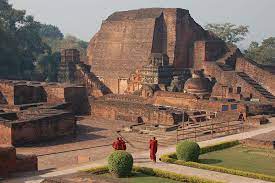
Nalanda was an ancient Buddhist educational institution situated in Bihar near Rajgir. We do not know who was its founder. Buddhist scriptures, grammar, and medicine were some of the subjects taught here.

There were more than a hundred rooms where teachers taught students who came from different places. Shilabhadra the great scholar was the Principal of Nalanda for some years.


WBBSE Notes For Class 6 History Chapter 8 Culture In ancient India Nalanda


The library housed a huge number of books. There were rooms for students. Learning was free for the students. All expenses were borne by the rulers.

Chapter 8 Culture In Ancient India The Great Vihara Of Taxila Or Takshashila

There were quite a number of Buddhist educational centers. Nalanda was one. Taxila or Takshashila was another. There was a Vihara or Buddhist monastery at Takshashila.

It was the capital of Gandhara mahajanapada, now in Pakistan. Under the Buddhists, the Takshashila monastery became an important center of education. Medical science was the most important subject taught here.

“summary of class 6 history chapter 8 WBBSE”

Students of the age group of 15-20 were admitted. They had their education here for seven or eight years. Education was free. Some of the students who later became famous were Jivaka, Panini, and Chanakya.

Chapter 8 Culture In Ancient India Pursuit Of Literature In Ancient India

No literature is possible without language. For, it is through language that we express what is going on in our minds. We express our feelings in language. The same is true about literature.

Language is the vehicle of literature. There was a time in man’s history when there was no language. Hominids, the pre-modern men, expressed their minds through gestures.

Then with the passage of time, the sounds uttered became organized, and thus language evolved. In our country, the earliest literature was the Rig Veda. It was composed in the early form of Vedic language.

“important questions from culture in ancient India class 6”

The Vedic language changed over time and after a few hundred years it changed its form. This new language had several local variations. People used this both in writing and in speaking.

There was no uniformity anywhere. Then in about the 5th century B.C. Panini a great grammarian wrote a wonderful grammar known as the Ashtadhyayi. It had eight chapters.

Panini tried to effect a reform in the language by removing all local variations and by correcting the flaws. His reforms laid the foundation of great language and literature.

Since then the language which he reformed became known as Sanskrit, or as Sanskrit.

Chapter 8 Culture In Ancient India Language Of Ancient India

Sanskrit had a huge volume of literature and for over a thousand years was the principal language of ancient India. But over the ages Sanskrit too underwent changes. Easier forms came into existence.

Two forms used widely in India were Pali and Prakrit. Pali was used by the Buddhists in their literature. Ashoka’s edicts were in Pali. There were several regional variations of Prakrit.

Class 6 History Class 6 Social Science
Class 6 Geography Class 6 Science
Class 6 Maths Class 6 Science MCQs
Class 6 General Science Class 6 Maths Solutions
Class 6 Geography Class 6 Hindi

Both Pali and Prakrit were spoken languages. But they were also used as mediums of literature. The Jains used Pali in their religious texts.

For many years Sanskrit, Pali, and Prakrit were used side by side in literature. The Dharmashastras, the Puranas, Nyayas, etc. were written in Sanskrit.

Kautilya’s Arthashastra too was written in Sanskrit. The two epics, the Ramayana and the Mahabharata were composed in Sanskrit. The Gupta period was famous for Sanskrit literature.

Kalidas was a great poet and dramatist. His Meghaduta, Raghuvamsha and Abhijnana Shakuntab are among his best-known works. Among other famous Sanskrit works are the Buddhacharita by Ashwaghosha, the Puranas, and Smriti Shastras by Vyasa, and Katyayana.

Shudraka and Vishakhadatta were also famous dramatists. King Harshavaradhana was himself a good writer. He wrote three plays in Sanskrit. These were Nagananda, Ratnavali, and Priyadarshika.

Chapter 8 Culture In Ancient India Other Literary Works Of Ancient India

Apart from pure literature, books on grammar, dictionaries, medicine, law, etc. were composed in ancient India. Some examples are Amarakosha by Amarasingha, Mahabhashya by Patanjali, Charaka Samhita, and Sushruta Samhita.

“WBBSE class 6 history chapter 8 key points”

Amarakosha is a dictionary of Sanskrit words. It was written not alphabetically as done in modern dictionaries. It was arranged according to subjects. Charaka and Sushruta wrote about diseases and medicines.

Chapter 8 Culture In Ancient India Ancient Language Of South India

A few words must be said about the most ancient language of South India. It is Tamil. Historians have discovered Tamil literature of two thousand years ago. There were held three literary meetings in Madurai.

These were called sangomas. Poets and literary persons came from different places and took part in the sangomas. Thus a kind of literature grew up in the south. It was known as Sangam Literature.

Most of them are lost. But among the collections that still exist are eight collections of poems called Ettutagoi, two long poems called Pattupattu, and a book of grammar called Tolkappiyam.

The Ramayana

We can boast of two great epics. These two are famous worldwide. One is the Ramayana, generally believed to have been composed by Valmiki. It has seven kandas or chapters or cantos.

It is now certain that the first and the seventh Kandas were added later. The Ramayana is the story of Rama, the prince of Ayodhya and son of king Dasaratha.

WBBSE Notes For Class 6 History Chapter 8 Culture In ancient India Ramayana

Rama’s exile, his wife Sita’s abduction by Ravana the king of the Rakshasas of Lanka, Rama’s friendship with Sugriva the monkey-king of Kishkindha, and finally the war with the Rakhshasas are the main themes of Ramayana.

This epic (an epic is a long story in poetry) has 24000 slokas. We do not know for certain when really Ramayana was composed.

The main epic, with the five original Kandas, was probably composed sometime between the 4th century B.C. and the third Christian era.

“art and architecture in ancient India class 6 notes”

The story of the Ramayana is so popular that it has been adapted by many poets in and outside India. There are Ramayanas in Tamil, Telugu, and Hindi. The story was adapted by poets of Malaysia, Thailand, and Indonesia.

The Mahabharata

The Mahabharata is the longest epic ever composed in the world. It is believed to have been composed by Vyasa, also known as Vedavyasa.

It is the story of a great war between Kurus and Pandavas. It contains 18 parvis or cantos. It was probably composed between 400 B.C. and AD 300.


WBBSE Notes For Class 6 History Chapter 8 Culture In ancient India Bhahabharata


The Mahabharata had originally little over 8000 slokas. Later authors like Vaisampayana added some more. It is certain that this epic was not the handiwork of a single poet.

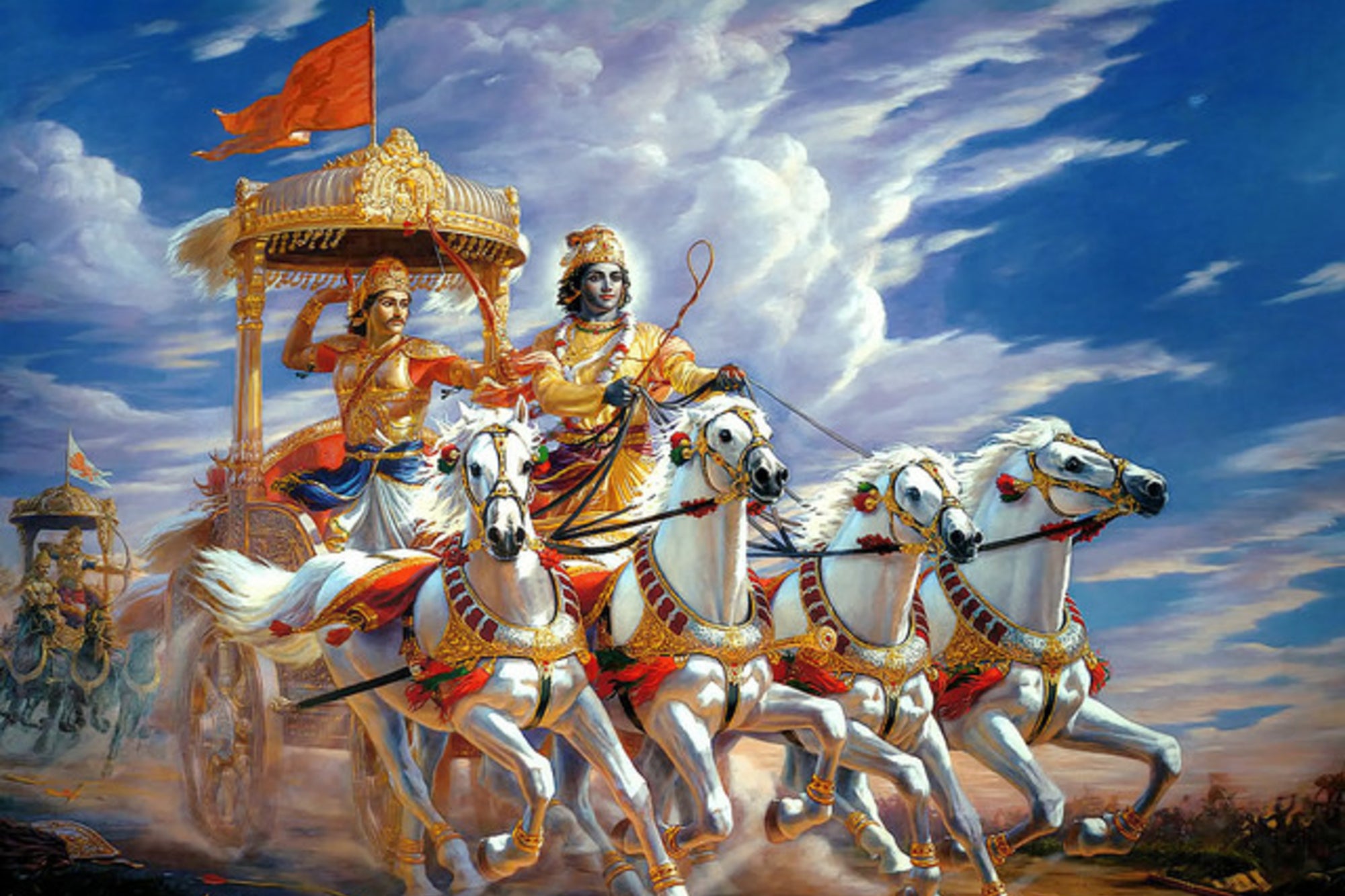
The great religious text Gita or Srimadbhagabadgita is a part of the Mahabharata. These two epics are not merely poems. They depict the social, economic, political, and military conditions of ancient India.

Chapter 8 Culture In Ancient India Science And Technology In Ancient India

In order to progress, every society needs the application of science and technology. When we study the sky and observe the stars and planets we cultivate science.

When we study the nature or property of mercury in the laboratory we carry out scientific research. The results of scientific investigation are applied in technology.

When we build a bridge or a multi-storied house, we apply our scientific knowledge. Thus both science and technology are important in our life.

“development of literature in ancient India WBBSE”

Primitive men had a sense of science. Otherwise, they could not have been able to make metal utensils or weapons. As time went on, men used their knowledge of science to prepare medicines.

Without knowledge of science, how could Charaka or Sushruta make medicines to cure diseases? The scientific pursuit in ancient India had several aspects.

Medical science, ayurveda, biology, metallurgy (is the science of metals), chemistry, mathematics, astronomy and astrology, agronomy (that agricultural science), architecture, and sculpture are some of the subjects that were cultivated and practiced in different periods of ancient Indian history.

Medical Science

Even as early as in the Vedic age, we hear of medicines and surgery. Buddhist literature to tells us about medicinal herbs and the cure of diseases. Jeevaka was a famous physician of Buddha’s time.

He was born in Rajagriha, modern Rajgir, and went over to Takshashila to study medical science under Atreya. He was the pioneer of Indian Ayurveda, the science of healing and curing diseases with the help of medicinal herbs.

It is said that he cured the diseases of king Bimbisara and Gautama Buddha a number of times. Charaka was a physician in the Kushana period.

“religious beliefs and practices in ancient Indian culture”

His Charaka Samhita is one of the earliest books on medical science. It refers to over seven hundred medicinal herbs. This book also contains methods of treatment of diseases.

Sushruta was a contemporary of Charaka. He also wrote a book known as Sushruta Samhita. Sushruta was an expert in surgery. Religious scriptures often dislike the ways of these physicians.

For the physicians dissected dead bodies as a part of treatment. Preachers of religion sometimes forbade certain food items which the physicians said were highly healthy. Thus there was sometimes hostility between them.

Astronomy and mathematics

The study of astronomy, astrology, and mathematics has a very.. ancient history. These sciences made good progress in the Vedic age. The Vedic people had an interest in the planets and stars.

They invented a very elaborate system of reckoning or counting time. They even made predictions on the basis of the motion or movement of planets.

The division of a year into twelve months and thirty lunar days called tithes was first done in the Vedic age. Both the Jains and the Buddhists were interested in astronomy and mathematics including geometry.

There was good progress of these sciences in the Gupta period. Of course, no difference was made then between astronomy and astrology. Astronomy is the study of planets and stars.

Astrology is mainly interested in foretelling and prediction according to the movement of stars and planets. Aryabhatta was a mathematician and astronomer of the Gupta period. He wrote a book known as Aryabhatiya.

The most important man of science after Aryabhatta was Varahamihira. His books Surya Siddhanta and Pancha Siddhantika describe many important facts of meteorology.

His studies regarding rainfall and earthquakes are very important and epoch-making.

Metallurgy and mineralogy

Metalwork made good progress in ancient India. Weapons made of metals were used abundantly. This was possible because ancient people knew about melting and molding metal.

Gold, silver, bronze, and copper were used in making coins. The art of minting and stamping metal in making coins improved as time went on. Making metal figures was very common too.


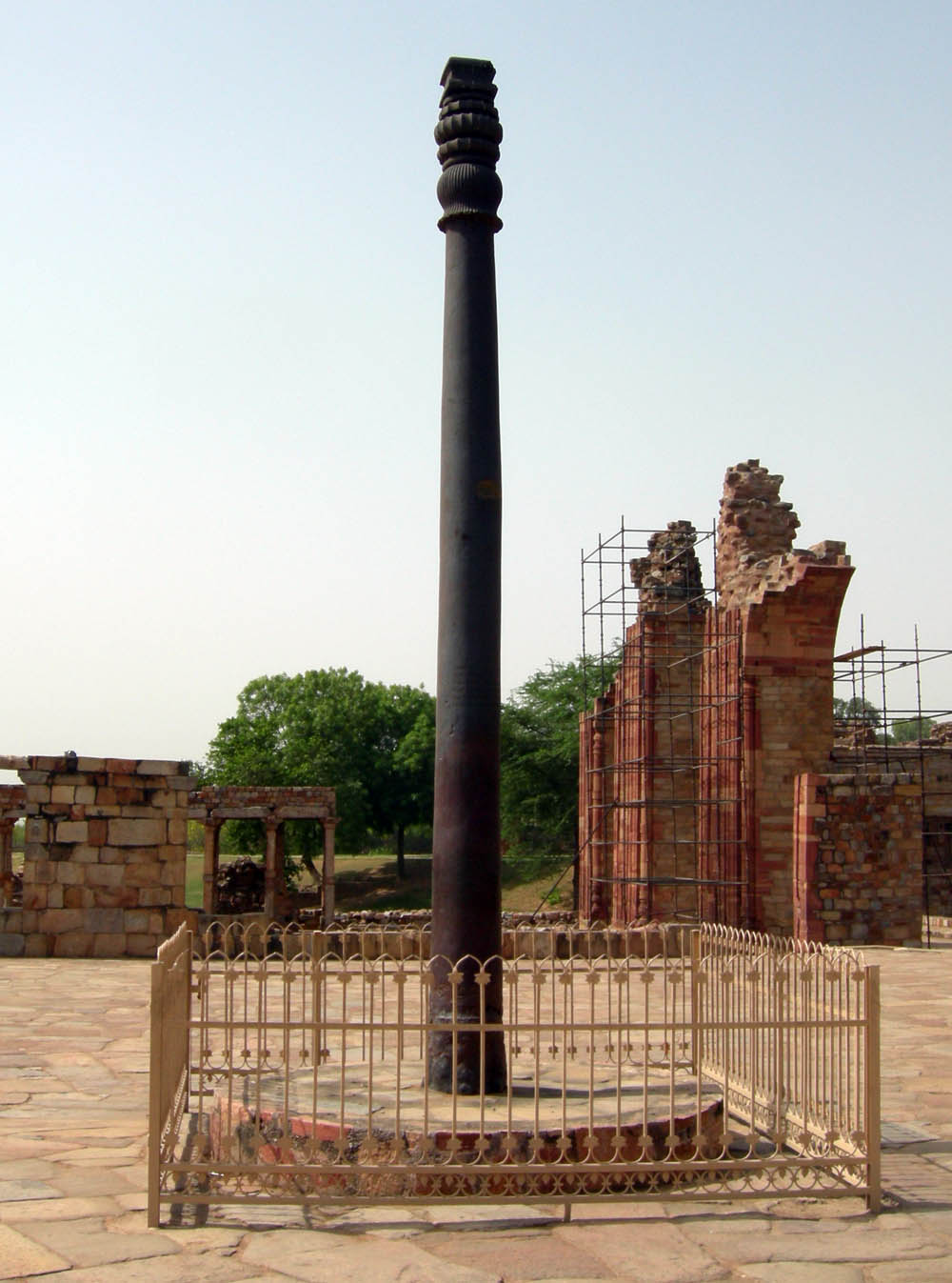
WBBSE Notes For Class 6 History Chapter 8 Culture In ancient India The iron pillar Of Mehrauli


The iron pillar of Mehrauli is an example of excellence in metalwork. Even after more than two thousand years, the Mehrauli iron pillar bears no rust.

This is wonderful. It is certain that ancient people had a good knowledge of chemistry. For, without a knowledge of chemistry melting of metal and stamping coins could not have been possible.

That ancient Indians used gold, copper, and silver ornaments proves that mineralogy too made good progress.

Chapter 8 Culture In Ancient India Art And Artistry In Ancient India

Even primitive men had a sense of beauty. They drew pictures on the cave walls and often painted the walls colorfully. Religion was a motive force behind ancient Indian architecture and sculpture.

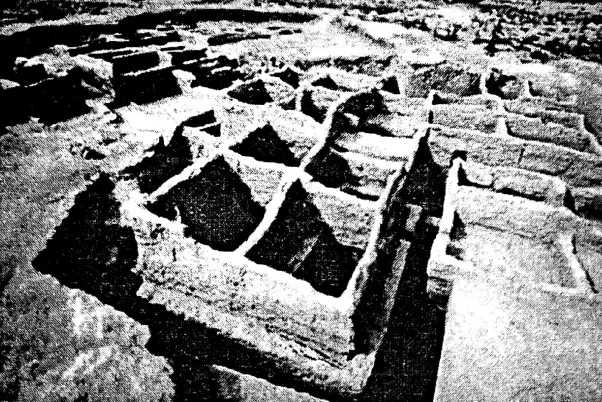
Of course, non-religious art was not rare. In fact one of the first architectural works was non-religious. The brick buildings of Harappa give us an idea of the earliest architecture.

Architecture and sculpture often went together or side by side. (Architecture is the art and practice of making buildings and sculpture means the art of making figures of stone and metal etc.)

In the beautiful buildings and palaces stone and metal figures of men and gods are often carved delicately.

Mauryan art

In the Maurya age brilliant pillars and columns show how expert the artisans and craftsmen were. The sculptural works of the Maurya period show the influence of Persian and Greek art.

The Maurya kings were kind enough to build cave dwellings for the Ajivikas. These are examples of the Mauryan art of building-making. The stupas of the Maurya period were begun as burial mounds.


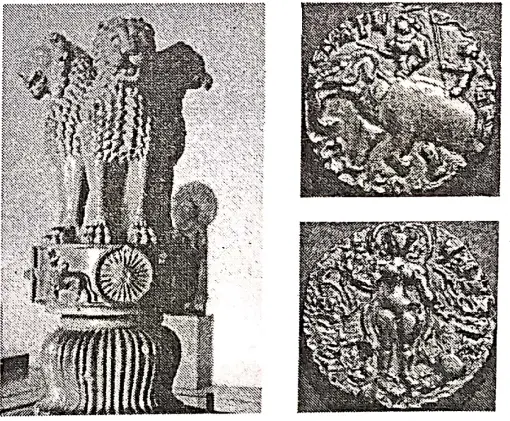
WBBSE Notes For Class 6 History Chapter 8 Culture In ancient India Lion capital Of Saranath and Gupta Coins


The earlier stupas were mud-built. Later came brick-built stupas. The stupas of Sarnath and Sanchi are very famous and are intact even today.

The pillars of Asoka are another example of Mauryan art. Most of these pillars bore his advice and instructions. The pillars were carved out from a single block of stone.

Most of these pillars had figures of animals like lions, elephants or bulls at the top. The Ashoka pillar of Sarnath is an example.

Art in the Sunga-Kushana-Satavahana ages

The age of the Sungas and Kanvas was a glorious chapter in the history of art and architecture. Art and culture in the Mauryan period depended mainly on the help and patronage of kings.

But in the Sunga-Kanva period, the artists were free to pursue their art. All art bears the life and condition of the common people. Of course, art in this period had a close relationship with religion.


WBBSE Notes For Class 6 History Chapter 8 Culture In ancient India The Sanchi Stupa

Of the architecture of this period, the most important are the stupas, chaityas, and viharas. Most of them were built by Buddhists and some too by Jainas.

The Bharhut stupa, although almost destroyed, was the most important piece of architecture of this period. The Sanchi stupa of Ashoka was reformed and stone-built in the Sunga period.

The sites of architecture were adorned with stone figures of yakshas, Bodhisatva, kings, animals, flowers, etc. In the Kushana period too architecture and sculpture made great progress.

“growth of education and learning centers in ancient India”

Kanishka was a patron of art. And under his rule, many chaityas, stupas, and viharas were constructed by Buddhists. Kanishka’s eagerness was behind the building of the chaitya at Purushpur.

This chaitya was an excellent example of architectural beauty. A new style of sculpture grew up under Kanishka at Gandhara. Numerous stone images of Buddha were carved here.

It is said that the subject of Gandhara sculpture was Indian but the style was partly Greek and partly Roman. The Mathura style of sculpture also grew up in the Kushana age.

It was fully Indian in style. Red limestone was used at Mathura. An important piece of architecture of the Satavahana period was the stupa at Amaravati.

This stupa contains several figures of green limestone. Stupas, chaityas, and viharas were built also at Karle, Nasik, and Nagarjunakonda.

Gupta art

Art, architecture, and sculpture made great progress in the Gupta period. Of course, art was closely linked with religion, as in the earlier periods. Brick, stone, etc.

Were used in Gupta architecture. The most important temples of this period were the Ekalinga temple of Satna and the Dashavatara temple of Deoghar.

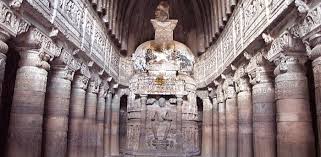
The caves of Ajanta are an example of Gupta architecture, Gupta painting, and sculpture all together. These caves were originally used as Buddhist monasteries. Life of people, animals, plants, etc.

were the subject of the Ajanta paintings. The paintings of Ellora and Bagh are also examples of the excellence of Gupta art. The color used in Ajanta and Ellora’s paintings was prepared from the juices of plants, earth, and stone.

The color thus prepared was highly durable and has withstood the press and stress of time.

Ajanta and Ellora

The rock-cut caves of Ajanta in present-day Maharashtra are famous for very colorful mural paintings. Mural painting means wall painting. Ajanta paintings are the best surviving ancient Indian painting.

“impact of culture on daily life in ancient India class 6”

All caves at Ajanta depict Buddhist subjects, mostly the life of Buddha and the Jataka stories. These paintings also depict the life of common people. Plants and animals also are painted wonderfully.


WBBSE Notes For Class 6 History Chapter 8 Culture In ancient India Ajanta And Ellora

Ellora, also in Maharashtra, is about a hundred kilometers west of Ajanta. There were over thirty caves at Ellora, some Buddhist, some Brahmanical, and a few Jain.

Shudraka

Shudraka is said to have been a king who ruled in the 3rd century A.D. He wrote a drama called Mricchakatika in Sanskrit. Mricchakatika means a toy cart.

WBBSE Notes For Class 6 History Chapter 8 Culture In ancient India Shudraka

This is a drama about a little boy’s demand for a toy very much like the one he saw in the hands of the son of a rich merchant. In the end a kindly person, Basantasena gave away his gold ornaments to make a gold toy cart.

Chandrakelugarh

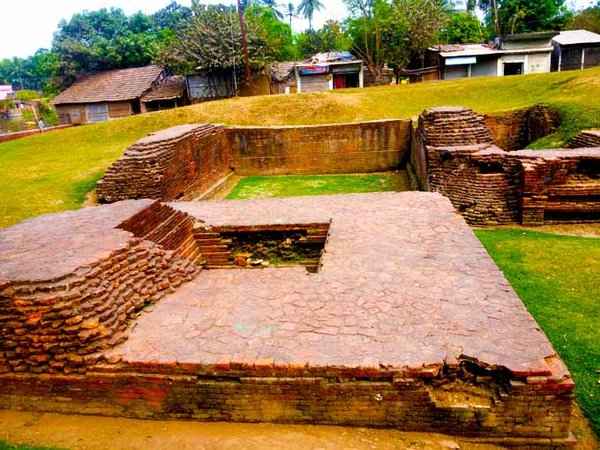
Recently, relics of an ancient trade center have been discovered at Chandraketugarh in the district of North 24 Parganas. The relics unearthed have been dated between the 6th century B.C. to A.D. 1250.


WBBSE Notes For Class 6 History Chapter 8 Culture In ancient India Chandraketugarh

So there is no doubt that Chandraketugarh thrived as a commercial town in the lifetime of Buddha and had a long history of nearly 1500 years.

The relies on found are earthen pots, seals, and figurines, mostly of terracotta and a few metal specimens also.


WBBSE Notes For Class 6 History

WBBSE Notes For Class 6 History Chapter 7 Economic Condition And Livelihood

Chapter 7 Economic Condition And Livelihood First Few Words

So far we have had an idea of the ancient history of India from prehistoric times to the rule of Harshavardhana. We have now an idea of what the Harappan civilization was like. We also now know about the coming of the Aryans, about their literature and religion.

We saw how in the 6th century B.C., sixteen mahajanapadas grew up in northwest India and how four of them became predominant and also saw how one of these four, Magadha became all-powerful and grew up as the first empire of ancient India.

Alexander the Great invaded India in the 4th century B.C. but could not make much headway into the interior of our country.

Read and Learn More WBBSE Notes For Class 6 History

Then one by one the Mauryas, the Kushanas, the Satavahanas, the Guptas and the Pushyabhutis built strong kingdoms mainly in the north, north-western and central India.

Now in this chapter, we will give you a picture of the economic condition and economic life of the people during all these years.

WBBSE Notes For Class 6 History Chapter 7 Economic Condition And Livelihood

Chapter 7 Economic Condition And Livelihood Economic Condition In The Age Of The Mahajanapadas

In the sixth century B.C., i.e. in the age of the mahajanapadas, the mainstay of the people was agriculture. Most of the mahajanapadas flourished in the Gangetic basin.

There was sufficient rainfall in this region. The land, because of the nearness of the Ganges, was fertile. Over and above that, the rivers remained full almost throughout the year.

All this made the land suitable for agriculture. Agriculture was the main vocation of the people. Pali’s texts give us a good and somewhat clear picture of the economic system and economic life of the people.

“WBBSE class 6 history chapter 7 notes”

The land was divided into several parts according to fertility. Different crops e produced in different seasons Paddy was the principal crop. There were others like sugarcane, wheat, and barley. Land was owned by the richer people.

It was cultivated mostly by landless peasants. Side by side with agriculture, livestock too was an important vocation. There was a time when the animal sacrifice was too common. But cattle were greatly needed for agriculture.

Buddhists and Jains also were very much against animal sacrifice. So gradually there was a steady decline of animal sacrifice.

Other Vocations

Among other vocations were those of artisans and merchants. Towns that grew up were inhabited by many artisans and merchants. We know of several crafts. Ironworks, mainly war weapons and tools like axe, choppers, plowshare, etc.

have been discovered? Iron axes made the clearing of jungles easy and this enabled the expansion of cultivable land. Crafts generally were a hereditary calling. The son learned the art from his father.

In those days several towns flourished as trade centers. Sravasti had links with Varanasi and Kausambi. Ivory goods, pots, textiles, etc. were carried to and from these towns. Other trade centers were Kapilavastu, Kusinara, and Vaishali.

Class 6 History Class 6 Social Science
Class 6 Geography Class 6 Science
Class 6 Maths Class 6 Science MCQs
Class 6 General Science Class 6 Maths Solutions
Class 6 Geography Class 6 Hindi

Trade and commerce had already become important means of livelihood. Trade about this time could flourish because of the use of money. Coins were used in profusion.

Nishka and Karshapana were types of coins Trade was carried both on land and by sea. Metal coins were probably first used in the time of Gautama Buddha. Most coins were silver ones. Some copper coins were found too.

“economic condition and livelihood WBBSE class 6 history”

As trade and crafts developed, there was a steady tendency towards urbanization. Many villages were transformed into towns. Gradually, rich men, princes, traders, administrators, and army men began to live in towns.

People who lived in towns enjoyed more facilities than those who lived in rural areas. The peasants paid a tax of one-sixth of their produce. Royal agents collected tax from peasants. There were both landed peasants and landless ones.

Chapter 7 Economic Condition And Livelihood Economic Condition In The Mauryan Age

It may occur to you what enables us to have an idea of the economic and social condition of ancient India in the Mauryan age. To satisfy your curiosity, we must tell you that there are three main sources for our knowledge of the Mauryan period.

These are the accounts of Megasthenes and other Greek writers, Kautilya’s Arthasastra, and the edicts of Ashoka. Of course, coins are another source.

Economy

As in the previous age, the basis of the economy in the Mauryan age was agriculture. Agriculture was the principal vocation of the people by and large.

The rulers, i.e. the kings kept their eye on irrigation because without sufficient water supply agriculture would not yield sufficient products. A number of rivers flowed in different regions of the empire.

So water could be carried to fields from them. Moreover, sufficient rainfall helped agriculture. We know of different crafts. Artisans were engaged in different crafts and trades.

Textiles, metal works, pottery, leather works, ivory, etc. were the main crafts. Kautilya’s Arthasastra tells us that the rulers were too interested in the economic uplift of the empire.

We are told that about 27 adhyakshas were employed to look after agriculture, crafts, trade, and commerce. Communication on land and sea had improved by that time. This facilitated brisk trade.

A long road was built from Pataliputra to Peshawar. The system of taxation too improved in the Maurya period. Kautilya names a number of taxes that were collected from peasants, artisans, craftsmen, and traders.

The officer called samaharta was in charge of the assessment of tax. Sannidhata was in charge of the state treasury. A number of ports and towns grew up in this period. There was a tendency towards urbanization.

“summary of class 6 history chapter 7 WBBSE”

This in turn went a long way in developing crafts and industries. It is said that punch-marked silver coins were issued by the state as the imperial currency.

These coins bore symbols of the peacock, the hill, and the crescent. It is clear that the main source of income of the state was land revenue. The other source was a tax levied on artisans and traders.

Taxes were collected in both cash and kind. There were granaries that stored crops for helping the people in times of distress.

Chapter 7 Economic Condition And Livelihood Social Condition

Historians tell us that caste stringency eased a little in the Maurya Period. We do not find any reference to the caste differences in the account of Megasthenes.

The Indian society, then, according to Megasthenes, was divided into 7 classes according to vocation or profession. These were-

  1. The Brahmins (or philosophers),
  2. The peasants,
  3. Hunters,
  4. Shepherds and herdsmen,
  5. Craftsmen,
  6. Soldiers,
  7. Supervisors and amateurs or ministers.

There were also washermen, barbers, and physicians. The liberty of women was limited. The woman’s place was in the inner apartment of the house. The immolation of the widow was not unknown.

Polygamy was common for men and not for women. Of course, the Buddhists were more liberal in their attitude towards womenfolk. Men in those days wore long pieces of cloth similar to today’s dhoti.

Women covered the upper part of their bodies with scarves. Both woolens and silk cloths were in use. Men sometimes wore turbans. Rich people wore ornaments of gold and precious metals.

Chapter 7 Economic Condition And Livelihood Social And Economic Condition In The Kushana Age

The Society

We notice quite some changes in the Kushana age. About five hundred years have passed since the days of the Mauryas. So such changes are only natural.

Society in the Kushan age was more or less affluent and prosperous. Religious disunity was somewhat less disturbing than in the previous ages.

Caste and social order rules (called Varnashrama) were considerably rigorous. The Vedic Chaturashrama or the four stages of life of a Hindu was rigorously followed too.

“important questions from economic condition and livelihood class 6”

Foreigners who came to India at about this time often lived here permanently and were merged into Indian society. The family was the basis of social life.

The father was the head of the family. So society was patriarchal. Kanishka convened a Buddhist Council in order to remove disunities among Hinayana and Mahayana Buddhists.

The Mahayana sect received royal patronage and so its influence in the society increased.

Economic Condition

Political and social stability led to a better economy. The situation. helped economic activities. Agriculture was, as in the previous ages, the main profession of the people.

But there were more varied agricultural products now. Apart from paddy, wheat, and barley, there were cotton plants and silk also. The cultivation of silkworms is known to have flourished then.

Crafts were associated with the making of gold, silver, lead, copper, brass, and iron. Precious stones or jewels were quite a in vogue. In the Telangana region of Andhra, iron manufacturing made great progress.

Because Kadaphises I and II came from central Asia, they kept up trade relations with China. Trade with China and other central Asian countries increased in the reign of Kanishka.

In his reign, there were trade relations with Rome and some south-east Asian countries too. Economic affluence in this period is proved by the fact that gold coins were then struck and issued for the first time in India.

Indian society in the eye of Megasthenes

Megasthenes was a Greek ambassador who came to India with Seleukos. Megasthenes wrote that there were seven classes of people in India then.

They were the pundit or Brahmin, the peasant, the livestock farmer, huntsmen, artisans, soldiers, and spies. The kings ruled with help of amateurs or ministers.

Megasthenes remarked that India never experienced famines. Both his contemporaries and later writers have said that much of what Megasthenes wrote was incorrect.

Irrigation system in ancient India

Good harvest depended on a good supply of water. In ancient India, the rulers made sure that the agricultural fields had a sufficient water supply. That was necessary for a good crop.

So only rainfall was not enough in dry seasons, water was carried from rivers to the fields. This system was known as the ‘setu.’ The Kushans did much to improve irrigation.

The Guptas often dug ponds. Both the rulers and the people dug ponds for the good of cultivation. We can mention the name of Lake Sudarshan.

This lake was probably dug in Kathiawar in the reign of Chandragupta Maurya. This lake was of great use till the Gupta period. This shows the awareness of rulers about irrigation.


Chapter 7 Economic Condition And Livelihood Social And Religious Condition In The Satavahana Age


The four Varna system of the Hindus, namely, Brahmin, Kshatriya, Vaisya, and Sudra, was continued in the Satavahana rule. Gautamiputra Satakarni claimed that he re-established the system which had fallen into disorder.

The Brahmins received royal favour. The rulers made land grants to them. This does not mean that the Buddhists were deprived. They too received land grants.

The Satavahana period saw the development of crafts and trade. Among the artisans, the most prominent were Gandhi as v.ho dealt in perfumes.

“WBBSE class 6 history chapter 7 key points”

The Satavahana society was matriarchal. Most men bore the name of their mothers. Even the king was named after his mother. Two examples are Gautamiputra and Vasishthiputra.

The Satavahana rule was a period of social peace and security and economic prosperity. The kings were patrons of art and culture. Stupas and chaityas were built in different places.

Such monuments were built in Nagarjunakonda, Karle, and Amaravati.

Advent of Cities

The first cities in ancient India grew up in the northwest. The Harappan civilization saw the advent of several cities. Mohenjodaro, Harappa, Lothal, and Kalibangan were some of the important cities.

The extensive town planning of Mohenjodaro shows advanced thinking. That is why it is said that the Harappan civilization was an urban civilization.

Later, towns grew up in north India in the sixth century B.C. Champa, Rajagriha, Shravanti, Varanasi, Kaushambi, and Kushinagar were the most important among them.

Sometime later Mathura, Mahasthangarh, and Taxila in the northwest and, Kaveripattam in the south were important towns. Most of these towns and cities were centers of trade and commerce. Art and culture too developed in the cities.

Chapter 7 Economic Condition And Livelihood Social And Economic Condition In The Gupta Age Economic Condition

We get an idea of the economic and social condition of the Gupta period from the account of Fa-Hsien, the Chinese traveler. As in the previous age, in the Gupta period too, agriculture was the main livelihood of the people.

Paddy was the principal crop. Others were cotton, mustard seed, indigo, and sugarcane. In south India, coconut and various spices were produced in huge proportions.

Fa-hsien tells us that there was a decline in foreign trade in the Gupta period. Till AD 550 India exported silk to Rome. But after that our trade with Rome declined because Rome then began to import silk from China.

“economic activities in ancient India class 6 notes”

The rise of priestly landlords was an important feature of this period. The rulers gave away lands to Brahmins and Buddhists. These lands were tax-free. Agricultural laborers were employed to till these lands.

This system was called ‘agrahara’. Gold and silver coins were struck in the Gupta period. This points to the economic prosperity of the kingdom.

The guild system was very much in use then. Artisans and craftsmen of the same trade were organized into a guild. Thus there were blacksmiths’ guilds, goldsmiths’ guilds, etc.

The people who produced anything paid tax or revenue to the ruler. Land revenue amounted from one-sixth to one-fourth of the produce. The tax was also realized from miners and traders.

Villagers were sometimes compelled to work in lieu of tax. This was some kind of tax in kind.

Social Condition

The caste system was in vogue but it was not too strictly observed. Brahmins and Kshatriyas were treated more leniently than Vaishyas and Shudras. Most Shudras were engaged in agriculture, livestock farming, and crafts.

The condition of the Chandals was very abject. They had to live away from the village or town. They were treated as untouchables. As in the previous ages, in this period too, the father was the head of the family.

Thus the family was patriarchal. Women’s position was. secondary.

Religion and Culture

The Guptas ruled for nearly two hundred years. This period is a glorious time in the history of ancient India. Some historians call it a ‘golden age’.

Others say that although the Gupta age was a period of social and cultural prosperity, it is too much to call it a ‘golden age’.

The Gupta rulers were patrons of the Sanskrit language. This resulted in the development of Sanskrit literature. Kalidasa, a great Sanskrit poet, and dramatist flourished in this period.

Another illustrious man of literature of this period was Sudraka. Sculpture, painting, and architecture developed greatly. The sculpture was based mostly on religious themes.

Buddhist subjects and Puranic subjects found a place in Gupta sculpture. Architecture too made remarkable progress. The Ekalinga temple of Satana is an example.

Cave architecture and cave painting were important features of the Gupta age. The most illustrious examples are the Ajanta, Ellora, and Udayagiri cave architecture and cave painting.

The Guptas were patrons of Hinduism. Under the Gupta rulers, Hindus were favored while the other religions suffered.

Fa-hsian’s account

The Chinese pilgrim Fa-hsian, who was formerly known as Fa-hien, came to India in the reign of Chandragupta II. He has left an account of India as he saw it. He wrote that India then was a prosperous country.

People generally lived in peace. The Chandals, of course, were a neglected class. They were untouchable and lived outside the towns or cities. Pataliputra was the most important city.

There were also other cities in Magadha. Although the rulers were patrons of Hinduism, Fa-hsian noticed a number of Buddhist monasteries also.

Account of Xuan Zhang

Xuan Zhang was a Chinese pilgrim. He was formerly known as Hiuen Tsang. He came to India in Harshavardhana’s reign. He left an account known as Si-yu-ki.

Xuan Zhang stayed in India in Harsha’s kingdom for about 8 years. He has said that generally there was peace and security in the country, although he suffered at the hands of dacoits more than once.

“sources of livelihood in ancient Indian society WBBSE”

India was a warm country and there were eighty kingdoms. The land in the north and east was fertile. Rainfall was sufficient for a good crop.

Paddy and wheat were the chief agricultural crops. There were caste systems and caste differences. Kanauj was the most important city.

The people in general were interested in art and culture. Harshavardhana, he says, was a benevolent ruler and often made gifts to poor people.


WBBSE Notes For Class 6 History

WBBSE Notes For Class 6 History Chapter 9 India And The Contemporary World

Chapter 9 India And The Contemporary World First Few Words

Our country had a close and intimate relationship with the outside world. It is not that we had intercourse only with southeast Asia, as some may think.

Read and Learn More WBBSE Notes For Class 6 History

We had intercourse with Greece, China, Tibet, Persia, Indo-China, the Malay Peninsula, and even Rome. But before we start reading about such intercourse, we would ask you to have an idea of the centers of ancient civilization outside India.

WBBSE Notes For Class 6 History Chapter 9 India And The Contemporary World great Chinese wall

  1.  Mesopotamia was one of them. It was a land between the rivers, Tigris and Euphrates. Mesopotamia was the center of the Sumerian civilization. The script known as cuneiform was evolved there. The Babylonian civilization also flourished in Mesopotamia. The famous king Hammurabi ruled in Babylon.
  2. A very distinguished civilization grew up in Egypt in northeast Africa. The Pharaos were ancient rulers of Egypt where the script called hieroglyphics came into being.
  3. Ancient Chinese civilization flourished along two rivers, Hwang-ho and Yangsi-Kiang. A great feature of ancient China was the Great Chinese wall which was built in order to ward off foreign invasion.
  4. Ancient Greece was another center of civilization. Greece in those days was divided into city-states. Some of them, particularly Athens and Sparta became most prominent. The Greeks had to fight with Persia. The account of this war was written by the great historian Thucydides. History, art, and philosophy were cultivated in ancient Greece. Socrates Plato and Aristotle were some of the great philosophers of ancient Greece.
  5. Ancient Persia too was the home of civilization. A strong empire grew up there. Darius, Cyrus, and Xerxes were some very famous rulers. Zarathustra, the famous preacher worshipped Ahura Mazda. He was the founder of the Zoroastrian faith.
  6.  In Italy, a vast and glorious civilization grew up. It was called the Roman civilization. The Roman empire rose under Julius Caesar. Rome expanded under Augustus. Claudius was another great ruler. New towns and forums were built. Another feature of Roman life was the bathhouses.

Chapter 9 India And The Contemporary World Indias Contact With The Outside World

In the northwest of India, there are a number of mountain passes. These passes allowed tourists and tradesmen from the west and central Asia to come into our country.

Through the Himalayan passes travelers and tradesmen came to India. Travelers also came by sea route, mostly in western India. But it is not that only foreigners came to India through these routes.

“WBBSE class 6 history chapter 9 notes”

Indians too used these passes to go to central and western Asia, to Tibet and China. The purposes of these visits were trade and religious and cultural exchanges. There was sometimes political motive also.

WBBSE Notes For Class 6 History Chapter 9 India And The Contemporary World

Chapter 9 India And The Contemporary World Contact With Persia And Greece

Gandhar near modern Kabul was a prominent cultural center in ancient India. Moreover, it was through Gandhar that the Persians established their contact with our country.

In the second half of the 6th century B.C., the Persians under Achaemenid rulers invaded Gandhar. Their most famous king was Darius. Under him, the Persians established their dominion beyond Gandhar.

Probably they conquered the regions up to the Indus river. The Greek historian Herodotus tells us that India, or Indus as he called it, was a satrapi (a province) of the Persian Empire.

“India and the contemporary world WBBSE class 6 history”

Emperor Darius, I conquered the lower Sind region. He kept it under his control for both political and economic motives. Thus northwest India was in close contact with the Persian empire for quite a long time.

In the 4th century B.C. Emperor Darius III who ruled for just six or seven years (336-330 B.C.) was not as strong a ruler as Darius I.

During this period the Greeks under Alexander the Great invaded Persia and defeated the Achaemenid rulers. As a result, Persian rule in northwest India came to an end.

Class 6 History Class 6 Social Science
Class 6 Geography Class 6 Science
Class 6 Maths Class 6 Science MCQs
Class 6 General Science Class 6 Maths Solutions
Class 6 Geography Class 6 Hindi

Persian rule was no more there. But the effects of Persian rule were felt even long after. First, India’s contact with western Asia was surely the result of Persian rule.

Trade relations were continued even after the end of Persian rule. Secondly, the Kharoshthi Script of ancient India probably had its origin in Persia. This means that Kharoshthi came from Persia to India.

Thirdly, there was a clear mark of Persian style on Maurya sculpture and architecture. The palace of Pataliputra, the Sarnath monument, etc. bear Persian influence.

Fourthly, we must not forget that Greek contact with India was established through the Persian Empire. Later, India had a close and deep-seated relationship with Greece.

Fifthly, some later dynasties continued the Persian satrapi system. The Sakas and Kushans had satraps in the outlying regions.

Contact With Greece

King Alexander of Macedon in Greece invaded India in 327 B.C. He first uprooted the Persian rule from northwest India and then entered our country through the Hindukush mountain.

It is well known that Alexander’s task was made easy by the mutual enmity of the Indian rulers of the northwest. Only Poros fought bravely. Alexander did not have to fight against any big and formidable power.

“summary of class 6 history chapter 9 WBBSE”

That is why our Indian historians do not regard Alexander’s invasion as a great success. However, Alexander stayed in India for about 19 months. On his return, he died in Babylon.

Was Alexander’s invasion fruitless? Did it have no effect on us? Alexander’s invasion had too few direct results. It had very little effect on India’s life and literature.

A few Greek colonies were set up in the northwest. And through them, contact between India and Europe was established. India learned the technique of stamping coins, and astronomy from the Greeks.

The indirect results of Alexander’s invasion were really far-reaching. A close commercial contact was established between India and the West.

The Bactrian Greeks brought idolatry in Buddhism. The Gandhara sculpture was very much influenced by the Greek style.

Central Asia And India

Long after the departure of Alexander, Greeks from Bactria established control over many parts of northwest India. They were called Bactrian Greeks or Indo-Greeks.

Bactria is an old country now identified with the north-east of Afghanistan. At the end of the 4th century B.C. Bactria was ruled by the Greek ruler Seleucus.

“important questions from India and the contemporary world class 6”

Taxila or Takshashila, Gandhar, etc. were all ruled by him. After Seleucus, who was once a commander under Alexander, the Greek control over Bactria loosened.

And the entire region came under the Indo-Greeks. Demetrius was a very capable Indo-Greek ruler. But the most important of them all was Menander.

Menander

Menander was the most powerful and most important Indo-Greek ruler. His rule extended over Gandhar, Kandahar. Even a part of Bactria was controlled by him.

He had a long life and lived from 265 B.C. to 145 B.C. In the Pali literature of the Buddhists, Menander was called Milinda. Menander became a Buddhist at the insistence of Nagasen.

Nagasen had once a long conversation with Menander. This is recorded as Milindapanho, that is Milinda Prasna. Mathura, Bundelkhand, and Kathiawad were under Menander’s rule. Menander had a deep respect for Indian religion and culture.


WBBSE Notes For Class 6 History Chapter 9 India And The Contemporary World Menander

About 130 B.C. a nomadic tribe called the Scythians put an end to the Indo-Greek rule. The Scythians are better known as the Sakas. Maues and Azes were two of the Saka rulers.

A branch of the Sakas came to rule Ujjaini and became known as Kshatrapas. The most famous of them was Rudradaman. The Parthians or Pahlavas ruled in the northwest side by side with the Sakas.

“WBBSE class 6 history chapter 9 key points”

But it was the Pahlavas who put an end to Saka rule. The most famous Pahlavi ruler was Gondophernes who probably started to rule in about AD 20.

Gondophernes began his career as a provincial ruler under the Sakas and later became independent. He conquered Seistan and the Kabul Valley. Later he conquered Sind, Punjab, and a good part of Afghanistan.

He called himself a Rajadhiraj. The Pahlava rule in the northwest came to an end with the rise of the Kushans. A nomadic tribe from central Asia called the Yueh-chi captured Bactria and ruled over the Kashmir Valley.

They were later known as the Kushans whose best-known ruler was Kanishka. Thus there is a long history of foreign rule and foreign contact.

Political domination brought cultural and commercial exchanges. We know of Megasthenes who came to India with Seleucus. His Indika tells us so many things about the Mauryas.

Another envoy who came to the Maurya court was Diamachus. Damascus came to India as an envoy of the Egyptian ruler Ptolemy. There were cultural exchanges between the Mauryas and the rulers of Egypt and Syria.

“India’s position in the modern world class 6 notes”

King Ashoka sent peace missions to Syria, Egypt, Macedon, and Ceylon. An inscription found at Rajagriha tells us that Harshavardhana had exchanged envoys with China.

Through the Chinese travelers Fa-Hsian (or Fa-hein), Yi-Jing (or I-tsing), and Xuan Zhang (or Hiuen Tsang) a cultural link was established between China and India.

The Huns

The Huns were a central Asian nomadic tribe, very energetic and highly militant. In about AD 458, they entered in to India from the north-west. They invaded the Gupta kingdom again and again.

Skandagupta was able to withstand their raids. The Huns raised their head again in the 5th and 6th centuries. Their leader then was Mihiragula, a son of Taormina.

After Mihiragula’s death in 542, the Huns became weak gradually. Huns later became mixed up with Indian communities. It is said that the Rajputs had Hun blood in their vein.

Chapter 9 India And The Contemporary World Economic Ties

Foreign invasion opened contact and communication. Very important was India’s economic contact with the outside world. Both land and sea were used as trade routes in ancient times.

The sea ports on the west coast of India were important trade centers. The West Indian ports like Bhrigukachcha at the mouth of Narmada also known as Broach, Kalyan on the Konkan coast, and Cape Comorin (modern Kanya Kumari) were centers of trade with Rome.

Spices, gold, etc. were the main items of trade. Kaveripattinam on the Kaveri delta was another western port. The ports on the eastern coast were centers of trade with southeast Asia. Tamralipta was the most important eastern port.

“economic and social changes in India and the world”

In ancient times a network of inter-connected trade routes called the silk route, played a very important part in India’s trade with central and western Asia and Europe.

Although called the silk route, trade items also included gold, wool, silver, and spices. The silk route connected India with Asia Minor, Mesopotamia, Egypt, Persia, and China.

The Mediterranean Sea was an important center in international trade along the silk routes.

Chapter 9 India And The Contemporary World Cultural Contacts

We were as much influenced by foreign culture as the foreigners were influenced by our culture. It was like a two-way game. The Aramaic language and script were used widely in the Persian Empire.

It is guessed by historians that the Kharoshthi script used in ancient India had its origin in the Aramaic script. When Alexander the Great destroyed the Persian city of Persepolis, many Persian artists, artisans, and craftsmen came over to India.

They began the Indo-Persian style of architecture. The IndoGreeks of Bactria infiltrated in to India. Over the years they got mixed up with the Indians. They taught Indians the art of stamping coins.

The Greeks brought to India the science of astronomy. Their style of sculpture greatly influenced India. The result was the Gandhara art form.

The Gandhara Art

We saw in Chapter 8 that a new style of art grew up in Gandhara. It particularly expressed itself in the stone images of Buddha. This was famous as Gandhara art.

Buddha’s images bore the Greek and also the Roman styles of sculpture. In most cases, the Gandhara Buddha looked like the Greek God Apollo.

WBBSE Notes For Class 6 History Chapter 9 India And The Contemporary World The Gandhara Art

The Saka rulers stamped silver coins. On some of them, scripts in both Greek and Prakrit were inscribed. The Junagarh inscription of Rudradaman, the Sakà Satrap was written in Sanskrit.

The Sakas and Kushans adopted Indian garments, the Indian style of house-building. They even adopted the Indian art of warfare. The Sakas and Pahlavas introduced different kinds of clothing.

Most of them were used by Indians also. The long robe-like garment, pajamas, belts, and long and heavy shoes were loved by Indians. It is surmised that the art of making earthen pots came to India from central Asia.

“impact of globalization on India WBBSE class 6”

Many of the central Asian tribes adopted Buddhism and some adopted Brahmanism. The Kushans worshipped Vishnu, Shiva, and Buddha. The Kushan coins bear the images of Hindu gods and goddesses apart from Greek and Roman ones.

The drop scene used in the stage performances of Indian drama is called the Yavanika in Sanskrit. This word comes from Yavana which meant Greek.

Buddhism was an important medium of contact between India and the world. Many Chinese pilgrims came to India to learn and practice Buddhism. We know of Fa-hsien and Xuan Zhang.

But there were many others. The pilgrims went back to China and preached Buddhistic ideas. There were Indians who spread Buddhist ideals in Tibet and China.

It was mainly through Atisha Dipankara that Buddhism spread to Tibet. The Tibetan King Strong-Tsan Gampo introduced Buddhism in Tibet.

Kumarajiva was a Buddhist scholar who lived in Kashmir and later went over to China. He lived the latter part of his life in the Chinese capital. He contributed much in the spread of Sanskrit scholarship and Buddhist philosophy in China.

Periplus of the Erythraean Sea

A very important source of information for ancient India was a book written by an unknown author. The name of the book is Periplus of the Erythraean Sea.

In those days the Indian Ocean, the Arabian Sea, and the Persian Gulf had a combined name-the Erythraean Sea. This book was about trade and commerce that were carried out in these seas.

“role of India in world history and culture”

The author’s name is not known. The author was a Greek who lived in Egypt. The book vividly describes ports and the trade that was carried out then. It was probably written sometime in the 1st century A.D.

It is a very important source of ancient Indian history. It gives picturesque descriptions of men, ships, birds, animals, and plants that the author came across during his travels.


WBBSE Notes For Class 6 History

WBBSE Notes For Class 6 History Chapter 4 Ancient History Of The Indian Sub Continent

Chapter 4 Ancient History Of The Indian Sub Continent First Few Words

We told you at the end of the previous chapter that one of the causes of the decline of the Indus valley civilization might have been the Aryan Inroads into India.

It is assumed that from about 2000 B.C. to 1600 B.C. There were a series of Aryan inroads into India. They came from central and western Asia.

It is said that the advent of these Aryans probably led to conflicts with the people who had already been living in India. In all probability, the pre-Aryans in most areas were defeated and the Aryans spread far and wide in the country.

But who were these Aryans? The Aryans were a nomadic race that spoke a language called the Aryan language. And that is why they are called Aryans.

Read and Learn More WBBSE Notes For Class 6 History

Chapter 4 Ancient History Of The Indian Sub Continent The Aryan Language


Every language is a member of a language family, just as every individual is a member of a family. Actually, the Aryan language is not just a language. It is a language group.

And the language family from which the Aryan language evolved is called the Sndo-European language family. There are other language families and this Indo-European is the largest.

Most of the languages of Europe and Asia are members of this family. Every individual of a family has some physical or other affinities with other members. Similarly, every language of a language family has some similarities with other languages of the same language family.

How can we be so sure about it? How do we know that English and German, Latin and Sanskrit have similarities? In 1786, Sir William Jones, an Indologist who was then a judge in Calcutta (now Kolkata) said in a lecture that there was a striking familiarity in Greek, Latin, and Sanskrit.

WBBSE Notes For Class 6 History Chapter 4 Ancient History Of The Indian Sub Continent

He assumed that these three languages evolved from the same original language. Most scholars accepted his opinion. And the idea of language family came into being. The languages of the world were grouped into nine or ten language- families.

Sanskrit, Latin, Greek, English, German, French, Italian, and the endian languages like Bengali, Hindi, and Marathi are all said to belong to the same Indo-European language family.

The Indo-European originated from Proto-Indo-European which does not exist today. But what about the Aryan language? What is its relation with the Indo-European? People who spoke Indo-European were a nomadic race.

In course of their journey from Central Asia, they spread to other regions. One group moved westward to Europe, another went to Iran. These groups made these countries their home and lived there for hundreds and hundreds of years.

“WBBSE class 6 history chapter 4 notes”

Their language began to change. Those who made Iran their home spoke a language called Indo-Iranian. Alternatively, this Indo-Iranian is called the Aryan language or the Indo-Aryan language.

About 2000 B.C. people who spoke Indo-Iranian or Indo-Aryan language began to migrate eastward. A few hundred years later they came to India. This is how the Aryans came to India. They were not simply invaders.

As we know, they settled in India and created a very great civilization, known as the Aryan or Vedic civilization.


Chapter 4 Ancient History Of The Indian Sub Continent The Early Life Of The Aryans In India


The settlement of the Aryans in India was not an easy matter. At first, they lived in the region which they called Sapta Sindhu or severs rivers. These were Indus with its tributaries, the Saraswati and Orishadvati.

They then came up to the Yamuna in the east. As they tried to settle, they had to fight their way. It is possible that they fought against the Harappans and subjugated them.

In the Rig Veda, the earliest literature of the Aryans, we have the description of a battle of ten kings. It was a tribal conflict.

Class 6 History Class 6 Social Science
Class 6 Geography Class 6 Science
Class 6 Maths Class 6 Science MCQs
Class 6 General Science Class 6 Maths Solutions
Class 6 Geography Class 6 Hindi

The Battle of Ten Kings

A king of the Bharata tribe called Sudas was ruling in the region which is identified with modern West Punjab. Some Aryan tribes wanted to challenge the authority of Sudas. They were ten kings, five Aryans, and five non-Aryan, A battle ensued.

It was fought along the river Parushns, identified with modern Ravi. Sudas won the battle. This battle established the supremacy of the Bharata tribe.

The other tribes at this time were the Purus, the Kurus, the Fanchalas, and the Yadus. Some non-Aryan tribes of the time were the Ajas, the Bhedas, and the Yakshus. Most of these tribes receded to the upper Gangtic basin and had their sway there.


Chapter 4 Ancient History Of The Indian Sub Continent The Literature Of The Aryans


Whatever we know about the Aryans in India is from the Vedas, the early literature of the Aryans. The word ‘Veda’ means knowledge. The Vedas did not at first exist in written form. The Vedic hymns were recited by sages to their disciples. The hymns were preserved orally from one generation to another.

For this reason, the Veda is also called ‘Shruti’ which means hymns that is heard. Later on, the hymns were compiled in four parts known respectively as Rig Veda, Same Veda, Yajur Veda, and Arthava Veda.

The Rig Veda is the oldest among the four, Each Veda was divided into four parts—Brahmana, Aranyaka, Samhita, and Upanishad. Till now about ISO Upanishads have been found.

“ancient history of the Indian subcontinent WBBSE chapter 4”

The ‘Upanishad’ is called Vedanta/ The Vedas laid down the guidelines for worship, sacrifice, and rituals. They also depicted the ways of conducting disciplined lives. They also laid down philosophical principles.

The Vedas were not the only literature of the Aryans. There were six ‘Vedangas\ namely, Siksha, Kalpa, Chhanda, Yctish, Vyakarana, and Mirukta. There were six ‘darshanas’ too, namely, Sankhya, Yoga, Nyaya, Vaishesik, Purba Mimangsa, and Uttara Mimangsa.


Chapter 4 Ancient History Of The Indian Sub Continent The Geographical Setting


The Vedas give us a lot of information about the geography of the places where the Aryans first settled in India as also about the places where they moved to later. We are now almost sure that the Aryans entered Into India through Afghanistan.

In the Rig Veda, there is a reference to seven rivers or Sapta Sindhu. These, we told you a little while ago, are the five Indus rivers the Saraswati and the Drishadvati. Saraswati is now a lost river.

The Aryans settled as far east as the Yamuna. The Rig Veda refers to the Himavat mountain which is none other than the Himalayas. The other three Vedas were composed much later.

“summary of class 6 history chapter 4 WBBSE”

And the geographical setting changed quite a lot in the later Vedic period. As time went on, the Aryans moved towards the east and they settled along the Ganges. They made parts of Bihar their home.

That hordes of Aryans settled in Mithila is very much certain. So we can say without any doubt that the Aryans in the later Vedic period settled between the Indus and the Ganges. Gradually the upper half of the Indian sub-continent came under the sway of the Aryans.

Use Of Metals In Ancient Days

The use of copper and bronze was widespread in the Vedic period. Some historians, therefore, call it a copper-bronze or thaieoiithlc civilization. But in the later Vedic period we come across the use of iron.

Iron was first profusely used in Egypt and Babylonia. But soon iron came to be used in other places also. About 1200-1000 B.C. iron was vary well known in India.

Iron now was used in making arrowheads, spearheads, rings, nails, fishhooks, daggers, etc. On the other hand, copper and bronze were used in making ornaments, human figurines, etc.


Chapter 4 Ancient History Of The Indian Sub Continent The Vedic Civilization


When we study the Vedic Civilization, we must remember that this civilization had two clear-cut divisions—early Vedic and later Vedic. The Rig Veda, the first of the four Vedas was composed much earlier than the other three.

There was a gap of a few hundred years. Society, politics, religion, and economy changed considerably in the later Vedic periods.

The Vedic Society

The Aryans lived in an orderly society where the head of the family or the Grihapati who was the highest authority in each family. The father was the head of the family. So the Vedic family was patriarchal.

But still, women were held in respect and enjoyed the right of education. They could take part in discussions of the ‘shastras’ and religious affairs apart from performing household duties. Widows were allowed to remarry.

Some of the highly educated women of the period were Apaia, Ghosha, Lopamudra, Maitreyee and Gargi. There was no class difference in Vedic society for many years.

But the defeated non-Aryans were thrown into a lower and degraded position. Gradually, the society was divided into two classes, Aryans and the degraded non-Aryans, The black-skinned non-Aryans too were regarded as a degraded class.

There were, of course, differences of castes. At first, there were three castes, Brahmanas, Kshatriyas, and Vaishyas, These were not based on birth. These were rather functional or occupational castes.

“important questions from ancient history of India class 6”

Later, another caste came into existence, the Shudras. The Brahmanas performed religious practices and were the most powerful caste, and the Kshatriyas were the warrior caste.

Kings normally were chosen from among the Kshatriyas. The Vaishyas were the merchant caste. The Shudras were a degraded caste. The early Vedic age was a rural civilization.

The village was the basis of economic life. People were mainly engaged in cultivation and livestock farming. We find references to the small or cottage industry, to various artisans, like carpenters and potters. Trade was in its infancy.


The Aryan Language Use Of Metals The Vedic Civilization Education In The Vedic The political Life Of The Vedic People

The Vedas are chiefly religious literature, But we are able to glean facts about the politics of those days. The family was the basis of the Vedic state. Several families grouped together to form a village.

Just as the Grihapati was the head of a family, so the head of a village was a Gramani. Several villages grouped together to form a Vish or Jana. The ruler of the Vish was called Vishpati or Rajan.

The Vish or Jana was like a state and was ruled by the Vishpati or Rajan. At first, the Vedic Aryans had no king. The Vishpatis ruled with the assistance of the Sabha and Samiti.

These were composed of learned and worthy persons. As time rolled on, the power of the Vishpati or Rajan increased and at one-time kingship came into existence. Kingship was hereditary.

The kings enjoyed special status and power. There were spies to inform the kings on important matters. In order to expand their kingdom the kings often set out to conquer neighboring countries.

“WBBSE class 6 history chapter 4 key points”

There were kings who performed ‘Ashwamedha7 or the horse sacrifice in order to display their might. The subjects had to pay three kinds of taxes known as ‘bail’ ‘bhaga7 and ‘shuka’. It was the duty of the king to protect the subjects.

In the later Vedic age, the king was called ‘Bhupati’. It was now his duty to protect the life and land of the people. On the other hand, the king was the protector of the earth.

In the later Vedic age, the power of kings increased. Powerful kings often conquered the kingdom of the weaker kings and expanded their kingdoms. Extensive kingdoms rose.

Powerful kings assumed titles like ‘Samrat7, 7Ekarat7, etc. These meant emperor. The idea that kings enjoyed the divine right to rule gradually arose. Three kinds of sacrifices were performed in the later Vedic Period.

These were the Ashwamedha or horse sacrifice, the Vajapeya, and the Rajasuya sacrifices. In Ashwamedha, a horse was set free. It roamed and roamed. All territories covered by the horse would be acquired by the king who owned the horse.

Whoever would restrain the horse would have to go to war. When after about a year, the horse returned a sacrifice would be performed in which the horse would be sacrificed.

In the Vajapeya sacrifices a chariot race was held. After that, a throne was offered to the king. The priest chanted a song in praise of the king. The Rajasuya sacrifice took place continuously for two years.

Holy water was sprinkled on the king’s head. The king offered presents to the dignitaries. This sacrifice confirmed the sovereign rule of the king.

The Religious life of the Vedic Aryans

The religious life in the Rig Vedic Period was simple and unceremonious. Image worship was unknown. Natural elements were worshipped as gods and goddesses. The Vedic Aryans looked upon natural calamities with awe and wonder.

So they worshipped rain and wind as deities. Gradually gods and goddesses were named. Indra the god of rain and thunder was the principal god. Indra was called Purandara. Baruna was the god of the sea.

“rise of early civilizations in ancient India class 6”

There were other gods like Agns and Vayu. In the later Vedic Period, religious cults became complex. Sacrifices and rites appeared. The Brahmins became highly influential. New gods came into existence. They were Vishnu, Shiva, and Prajapati the creator.


The Aryan Language Use Of Metals The Vedic Civilization Education In The Vedic

All learning was oral in the Vedic period. The teacher taught orally and the disciples were used to oral learning. Before a student is accepted as a disciple he or she had to undergo a ceremony. This was called the Upanayana.

Generally, the disciples lived in the teacher’s house. Reciting the Vedas was the first step in learning. Other subjects like grammar, and mathematics too were taught. The disciples offered fees mostly in kind to the gurus.

Rituals were held at the successful end of a disciple’s education. The disciple took a bath, called snana in Sanskrit. After this ritual bath, he was called a snataka.

Chaturashrama

In the later Vedic Period, the life of an Aryan was divided into four stages Brahmacharya, Garhasthya, Banaprastha, and Sannyasa. In the first stage, one lived in the guru’s home and learned the shastras.

In the second stage, one married and lived in the family. In the third, one went to the forest and spent days in meditation. In the fourth stage, one left the worldly life and becomes an ascetic. This is called the Chaturashrama.


Chapter 4 Ancient History Of The Indian Sub Continent About Nachiketa And Uddalaka


The story of Nachiketa

The Upanishads and the Puranas are full of educative stories. The stories of Nachiketa, Uddaiaka, and Ekalavya are as interesting as they are educative, The Katha-lJpanishad relates Nachiketa’s story, Nachiketa was the son of Vajashraba.

One day, Vajashraba, desiring to attain heaven, gave away all his belongings. At that time his son Nachiketa told his father that he had not given away his all. For, he had not given away his son.

“Indus Valley Civilization facts and features class 6”

His father, very angry at this, said, I will give you to Death. So Nachiketa went to Yama but the god of Death was away. Nachiketa sat in meditation and when Yama came he offered him boons.

But Nachiketa said he only wanted to know the truth and nothing else. Yama then told him about the soul or atman. Atman or soul cannot be seen but it is there in every human being and it directs his activity.

The story of Uddalaka

Ayodadhaumya was a great guru. He had three sincere pupils. Veda, Upamanyu and Aruni. One day the guru asked his disciples to build a dam to check the water of his agricultural field going out.

Aruni started work but was not able to restrain the flow of water. He then lay on the ridge. Ayodadhaumya was too pleased to see Aruni going all out to obey his guru. He gave Aruni a new name Uddalaka.

This story teaches us how great was a pupil’s respect for his guru in those days.

A note on Inamgaon

Inamgaon is in Maharashtra. Here a few years ago a post-Harappan agrarian village was discovered on the bank of the Ghod river in the Bhima valley. The discovery is regarded as a landmark in the history of ancient India.

The village is as old as about 1400 B.C. So historians believe that it flourished at about the time when the Aryans were already in India. The villagers were engaged in cultivation, livestock farming, and fishing.

About 135 rectangular mud houses have been discovered. The main crops were rice, wheat, barley, and pulse. Large barrels and fire pits suggest that food grains were stored regularly.

“Vedic Age and its impact on Indian history WBBSE”

Among the domesticated animals were cattle, dogs, horses, and goats. For cultivation people did not depend on rain. They stored flood water and used it by flowing it down the channels to the fields.

Quite a number of female figurines of burnt earth have been found. Some of them might have been the figures of the Mother Goddess. A very important fact about Inamgaon is that megaliths or huge upright stone blocks have been unearthed here.

From the graves skeletons of little boys and girls have been unearthed. The girls had stone ornaments on.

WBBSE Notes For Class 6 History

WBBSE Notes For Class 6 History Chapter 3 Ancient History Of The Indian Sub Continent

Chapter 3 Ancient History Of The Indian Sub Continent First Few Words

Gradually men began to use metals. This does not mean that stone implements and tools were no more used. Very interesting and important changes began to take place in man’s life. And such changes began to occur during the late Neolithic period.

What were these changes? The first change is that men gave up their nomadic habits. They now settled in places where sufficient water and food were available. Men learnt to domesticate certain animals. They learnt to cultivate crops. The potter’s wheel began to be used.

This was the beginning of pottery. Men painted the vessels and stored grain in them. Some beautiful earthen pots with artistic engraving or painting have been discovered in Egypt and Asia Minor.

Read and Learn More WBBSE Notes For Class 6 History

On some of them, figures of men, boats, birds and scenes of fighting were engraved. Because in the hilly areas, there was not enough water, men now chose river valleys. Such places were good for agriculture.

Another very important change that occurred in man’s life was the use or cotton fabric as dress material. Thus men no longer wore animal skin. Men now learnt weaving.

For cultivation men had to lead a settled life. They made wooden houses and surrounded them with stone walls, or fencing in order to ward off wild animals. Gradually, village life and society grew up. Social based on family relations came into being.

“WBBSE class 6 history chapter 3 notes”

Transport became a part of early society. People dwelling on lakes used boats to carry articles from one place to another. Perhaps trade started in this way.

Wheels brought an era of speed. Big animals like cows, horses, and camels were used as beasts of burden. Finally, we must say a word about the first metals. Historians tell us that copper was perhaps the first metal used by man.

This does not mean that with the use of metal, stones were out of use altogether. No, that is not the case. Copper and stone were used side by side for a long time. That period is called the Chalcolithic period.

The word Chaleo comes from the Greek word khakis, which means copper. And lithos, you already know, means stone—Copper Stone Age.

WBBSE Notes For Class 6 History Chapter 3 Ancient History Of The Indian Sub Continent

Chalcolithic Age in India

The use of metal began towards the close of the Neolithic age. And for several hundred years stone and copper implements were used side by side.

In India, the earliest Chalcolithic settlements were found in Rajasthan, Madhya Pradesh, Bihar, Bengal and Maharashtra. Gradually ‘i they spread to other places.

Class 6 History Class 6 Social Science
Class 6 Geography Class 6 Science
Class 6 Maths Class 6 Science MCQs
Class 6 General Science Class 6 Maths Solutions
Class 6 Geography Class 6 Hindi

Chalcolithic settlements have been found in Roper, Betwa, Lothal, Maski and Mehrgarh in Pakistan. Chalcolithic culture developed from about 3000 to 1000 B.C. The Chalcolithic settlements were small or medium-sized villages.

The only large earliest Chalcolithic settlements were found in Maharashtra where about four thousand people are believed to have lived.

“ancient history of the Indian subcontinent WBBSE notes”

The Harappan civilization of western India and Pakistan had quite some affinity with this Chalcolithic culture. These two cultures were collateral in so far as time is concerned.

The Chalcolithic culture was rural in nature. From the burial grounds at different settlements, a good number of skeletons of children have been unearthed. This has led historians to guess that the rate of infant mortality was too high in the Chalcolithic period.


Chapter 3 Ancient History Of The Indian Sub Continent Mehrgarh

A very old site of copper-stone culture has recently been discovered at Mehrgarh in Baluchistan. Mehrgarh is near the Bolan Pass in Baluchistan on the west of the Indus basin. A chalcolithic civilization is as old as 7000 B.C. has been unearthed here.

Archaeologists say that the Mehrgarh settlement had a stretch of about 3000 years from 7000 to 3800 B.C. A team of excavators led by the French archaeologist Jean-Francois Jarrige discovered Mehrgarh during 1974-86.


WBBSE Notes For Class 6 History Chapter 3 Ancient History Of The Indian Sub Continent Relics of Mehrgarh


The discovery of Mehrgarh is of great historical importance, for, it has changed some of the old notions and shows a clear picture of what an old copper-stone culture was like. On the whole was a rural culture.

Because the Mehrgarh culture developed for about 3000 years, archaeologists have divided this culture into three phases. The first phase ran from about 7000 to 5000 B.C. and the second from about 5000 to 4000 B.C.

And the third from 4000 to 3800 B.C. To be precise, Mehrgarh is situated on the bank of the river Bolan. Many remains have been found on the river bank. It is thought that many more might have been lost in the riverbed.

Proofs of the settlement have been found not only near or along the river. They have also been found away from the river. In the first phase, the people of Mehrgarh built one-room houses of dried mud and sun-burnt brick.

Animals like cows, goats and sheep were domesticated. There are proofs of cultivation. Wheat and barley were produced. In this phase, pottery was in its early and crude form.

“summary of class 6 history chapter 3 WBBSE”

Towards the end of the first phase, people built multi-room houses. They kept one room apart for warming the house by lighting a fire. Pestle-like stones and tools made of ‘microliths’ were discovered.

‘Microlith/ by the way is a small piece of stone that sometimes forms part of a big or composite tool. There were rooms where grains were stored. This was the oldest granary of the Indian subcontinent.

Before the discovery of Mehrgarh, historians believed that the cultivation of wheat and barley came to India from west Asia. But now after this discovery, it has become clear that those crops were first produced in our sub-continent.

In the second phase which lasted from about 5000 to 4000 B.C., cotton was produced over and above wheat and barley. Date and plum too were eaten by the Mehrgarh people. Among the tools and implements of this phase were sickles.

In the late second phase pottery made on the potter’s wheel was used. Painted vessels have been unearthed. Interestingly, two human figures of dried earth have been discovered.

In the final phase which lasted from about 4000 to 3800 B.C., big houses were built; grains were stored in the courtyard. There was widespread use of earthen pottery. There were bicolour and multicolour vessels.

Female figures of burnt earth (terracotta) have been unearthed. A few copper tools were unearthed too. Stone implements were used side by side. Thus we obtain a good picture of primitive chalcolithic culture in Mehrgarh. Mehrgarh remains an important milestone in the history of civilization.


Chapter 3 Ancient History Of The Indian Sub Continent Copper Bronze Culture

Primitive men came out of their cave dwellings to settle down to a somewhat orderly life in villages. The discovery of fire, wheel and cultivation and the use of improved tools and weapons in the stone Age gave men a distinct advantage over other animals.

Then came further changes in human life with the discovery of copper. Copper was followed by bronze, an alloy of copper and tin. The first bronze was probably the result of an accident.

Probably copper and tin caught fire together and the result was bronze. This opened man’s eyes and from then on men began to produce bronze in the same way. This newly invented alloy, bronze, replaced old tools and weapons to turn them more lethal.

This age is called Copper-Bronze Age. This was a very important landmark in the history of civilization. Bronze was used abundantly because it was found that it was harder than copper and easier to make into a sharp blade.

“important questions from ancient history of the Indian subcontinent”

But why the name Copper-Bronze Age, and not simply Bronze Age? This age was called Copper-Bronze Age because copper was not discarded altogether and was used side by side with bronze for many many years.

Much evidence of Copper-Bronze culture were unearthed in Mesopotamia, Egypt, India and China. Gradually, of course, greater dependence was on bronze, although copper did not go into disuse altogether.

In India, the Harappan civilization is regarded as a Bronze Age civilization.

The emergence of towns and the spread of industry

During the Copper Bronze Age groups of men started community living. For the sake of cultivation and good harvest, they settled near a river or a sea. For, they needed an abundant supply of water.

Cities and towns thus came into being in river valleys and seasides. Many towns and cities flourished on the banks of the Nile, the Tigris, the Euphrates and the Indus rivers. Traders carried their merchandise by boat to other countries.

Various articles of use were produced to meet man’s varied needs. There were now artisans like jewellers, carpenters, sculptors and masons. Gradually internal and external trade flourished.

“WBBSE class 6 history chapter 3 key points”

Goods were carried on land by horses, asses and camels and along waterways by large boats. The Copper Bronze Age marked the beginning of changes in society. The most important change was the emergence of classes.

There existed different layers between the rich and the poor. Classes based on profession emerged. There were farmers, artists, traders, soldiers and priests. Men began to own personal property.

For the change of social order, different sections of people tried to increase their power and dominate over others. In Egypt, priests were at the top in the society in wealth and power.


Chapter 3 Ancient History Of The Indian Sub Continent The Harappan Civilization

For about twenty-five years from 1922 to 1947 archaeologists carried on excavations in the Sindh (Sindhu or Indus) area and in the end, a very ancient civilization came to light.

The name of two Indians has special importance in the discovery of the Harappan civilization. They are Rakhaldas Bandyopadhyay and Dayaram Sahni. Although the civilization was discovered in the mid-20th century, the history of its discovery goes back to about the middle of the nineteenth century.

In 1826 Charles Masson, a soldier of the East India Company came to Punjab and saw a mound in Harappa. He considered it highly important historically. In about 1853, archaeologist Sir Alexander Cunningham visited the place and found a few seals.


WBBSE Notes For Class 6 History Chapter 3 Ancient History Of The Indian Sub Continent Indus Valley civilization area map


But this did not cause any flutter among historians or archaeologists. In 1927, Rakhaldas Bandyopadhyay too saw a mound in Mahenjodaro. Another archaeologist, Dayaram Sahni also visited the place in 1921.

They thought there could have been buildings or structures underneath. Without delay, widespread excavations started. Within weeks, evidence of an ancient civilization came to light in Harappa and Mohenjodaro.

Harappa was in the Montgomery district of Punjab and Mohenjodaro was in the Larkana district of Sind. Both are now in Pakistan. As more excavations took place over the years in Lothal, Chanhudaro, Bhawalpur, Rupar, Shortughai, and Kaiibangan a great ancient civilization was discovered.

At first, it was named the Indus Valley Civilization. But now it has got the name Harappan Civilization.

The extent of this civilization

At first, the civilization was considered to be limited to two or three places. But as widespread excavations proved, the Harappan civilization extended over about 13 lakh square kilometres.

It extended over Punjab, Sind, Haryana, Rajasthan and Gujarat. A large part of it is now in Pakistan. Even Afghanistan was touched by it. Till now more than a thousand sites have been unearthed.

The most important sites of this civilization are in Mohenjodaro and Chanhudaro of Sind, Harappa in Punjab, Lothal in Gujarat, Kaiibangan in Rajasthan, Banawali in Haryana and Shortughai in Afghanistan.

How old is this civilization?

The Harrapan or Indus valley civilization is quite old. But how old is it? Since historians have not yet been able to decipher the scripts, they have had to depend on the relics in order to ascertain the age of this civilization.

“economic activities in ancient India class 6 history”

It is commonly believed that this was an example of Copper- Bronze civilization. But historians are not of one opinion as regards its age. Now most historians believe that its span was between 3000 and 1500 B.C. And the period 2500 to 1800 B.C. was its high time.


Chapter 3 Ancient History Of The Indian Sub Continent Town Planning


The Indus valley or Harappan civilization was an urban civilization. It centred on town culture. At Mohenjodaro the ruins of an ancient city has been found. There is no evidence of the existence of any village close to the ruins.

Mohenjodaro was a planned dtv. The roads were broad and fit for conveyance. There were narrow alleys too. There was an arrangement for street lighting on both sides of the streets. Bricks were either sun-dried or burnt in the fire.

Every home had its own courtyard, bathroom and drains. The walls of the houses were sturdily built. The doors and windows were rather small in size but set on the roadside.


WBBSE Notes For Class 6 History Chapter 3 Ancient History Of The Indian Sub Continent The great Bath, Mohenjodaro


The smallness of the size of the doors and windows perhaps indicates that there was fear of theft or robbery. There were two-storeyed or three-storeyed houses also. These belonged to the affluent people.

The water of the town flowed through underground sewers. The dirty water of the houses flowed out through underground sewers. There were openings of sewers at places which extricated filth and silt. They looked like modern manholes.

The Great Bath

At the centre of the town, there was a public bath 180 feet long and 108 feet wide. There also was a bathing pool 39 feet in length, 23 feet in width and 8 feet in depth. Flights of stairs leading to the pool.

There were rows of seats all around the bathing pool. There was an arrangement to let out filthy water. There was provision for a hot bath too. The town discovered at Harappa was walled all around.

“early civilizations in the Indian subcontinent class 6”

A big granary was found in this town. It measured 169 feet in length and 135 feet in breadth. The peasants perhaps deposited their rent in kind. They probably gave corn as rent.

At Lothal in Gujarat, a brick-built basin was discovered. It measured about 650 feet long and about 120 feet wide. Archaeologists guess that it was perhaps a dockyard for ships.

The reason for such a guess is that it was very near an estuary and so could easily have water.

The Citadel

The citadel is a very interesting feature of Harappa-Mohenjodaro town planning. The citadel was a kind of fortress built on a raised mound and was protected by a brick wall on all sides.

At Mohenjodaro the citadel included the Great Bath and the granary about which we told you earlier. The citadel of Mohenjodaro was 1200 feet long and 600 feet wide. The surrounding wall was 40 feet high.

Food and Dress

The food of the Indus people consisted mainly of rice, wheat, and barley. They ate fish, meat, egg, milk, date and various vegetables. They wore clothes made of cotton and wool.

Their dress was often decorative and divided into upper and lower parts as has been found from stone statues and picture engravings.

Cultivation

The Indus region was made highly fertile by sufficient rainfall and silt. This made the cultivation of wheat, barley, cotton, mustard sesame and pea easy.

Our historians say that the Indus people were the first in the world to produce cotton. Probably wooden ploughs were used to plough the fields.

Taming of animals

The bones found as a result of excavation give us an idea of the animals the Indus or Harappa people tamed. Carvings on seals and terracotta figures also give us an idea.

They domesticated cows, buffaloes, goats, sheep, pigs, dogs, asses and camels. It is supposed that they were familiar with wild animals like the tiger, the bison, the rhinoceros.

Ornaments In Ancients:

Ornaments were worn by both men and women. These were made of gold, silver, ivory and precious stones. Necklaces and amulets were made from these metals. Turquoise and lapis lazuli were often used.


WBBSE Notes For Class 6 History Chapter 3 Ancient History Of The Indian Sub Continent Ancient ornaments.


Religion

It is difficult to say anything about the religion of the Indus people since no temple of any sort has been discovered among the ruins. Articles made from burnt clay and seals bear some evidence of worshipping in those days.

A seal has been found in which a saintly person is seen seated in the midst of animals. The image bears a similarity with Lord Shiva or Pashupatinath. This shows the possibility of the Indus people being worshippers of Shiva.

“major kingdoms of ancient India class 6 WBBSE”

A number of terracotta female figures have been found. They are believed to be the images of the Mother Goddess. The Indus people worshipped fire. A good number of fire-altars have been found at Kalibangan.

It is possible that some animals were also worshipped. Some say that the Indus people were worshippers of the Tree also.


Chapter 3 Ancient History Of The Indian Sub Continent Society


The findings of Mohenjodaro and Harrapa bear ample proof of a highly developed social life. Generally, four or five classes of people were there in the society, the elites, the fighting class, craftsmen, traders and labourers.


WBBSE Notes For Class 6 History Chapter 3 Ancient History Of The Indian Sub Continent An ox-drawn cart


People belonging to the elite class generally performed the task of educating or teaching and treating diseases. The fighters were engaged in defending the country from foreign invasion or from any attacks.


WBBSE Notes For Class 6 History Chapter 3 Ancient History Of The Indian Sub Continent An earthen pot


Craftsmen were artisans who produced pottery, metalwork, ornaments etc. Blacksmiths, potters, weavers, jewellers and masons belonged to this class. Traders were engaged in buying and selling of goods and commerce as a whole.


WBBSE Notes For Class 6 History Chapter 3 Ancient History Of The Indian Sub Continent stone bust of bearded man


Finally, the labourers were a poor class and worked as domestic servants and porters. Although no proper temple was found, the presence of priests cannot be denied.


WBBSE Notes For Class 6 History Chapter 3 Ancient History Of The Indian Sub Continent Broze dancing girl


WBBSE Notes For Class 6 History Chapter 3 Ancient History Of The Indian Sub Continent A stone weight used in weighing


Ancient History Of The Indian Sub Continent Seals And Writing


Seals are a very important find in the Indus Valley civilization. About 2000 seals have so for been found at Mohenjodaro and Harappa sites. These seals bear figures of animals and inscriptions.

The seals with animal figures inscribed or engraved on them prove that cows, sheep, buffalo, ox, elephants, camels, goats and fowl were domesticated. Other animals like bison, tiger, monkey, bear and hare were surely known to them.

“political and social life in ancient Indian subcontinent”

Many seals have writing or inscription on them. Scholars have been trying hard over the years to read them. But till now the Indus seals have defied all attempts at decipherment.

The writing on the seals tells us that about 400 symbols were used. The script was written from right to left. Scholars only suppose that the writing had some similarity with the Dravidian writing system.

Much light will surely be thrown on this civilization when one day scholars will be able to read the Indus script.

Articles of daily use

The people of the Indus Valley used earthen pots. Many polished earthen pots of different shapes and sizes have been unearthed. The earthen pots had designs on them. Statues, figurines and toys were made from copper, gold, silver and china day.

Utensils too were made of these metals and china clay. Combs were made of ivory. Polished bronze served the purpose of a mirror. People used cots, stools, and chairs as furniture. Seals were used to weigh articles.

Weapons were made from copper, lead, and bronze. Bronze tools found at Harrapa contain a small percentage of tin also. Bow, arrow, spear, knife, and razor were the main weapons used.

No article made of iron has been found. Iron was probably unknown to the Indus people.

Trade and Commerce

We have proof of both inland trade and external trade. Trade was carried on both on land and by sea. Beasts of burden and carts were used to carry load and transport goods locally.

Scholars say that Mehrgarh near the Bolan Pass and Shortughai in Afghanistan were two Important trade centres. Boats were used to ferry goods by rivers or sea. That sailed boats were used is known from pictures engraved on seals.

“Indus Valley Civilization and its significance WBBSE”

Boats filled with copper, timber and gold articles plied between India and Mesopotamia. Lapis lazuli and turquoise were imported from other countries. Camels, Oxen, and Asses were used to pull wheeled vehicles.

The vehicles were both small and big, light and heavy. Barley, wheat, woollen goods, copper, silver, gold, toys, ivory etc. were the chief articles of trade.

Decay of this civilization

It is a matter of surprise that this highly developed and complex urban civilization went into decay at one time. Its decay probably started from about 2000 B.C.

And the decay was perhaps complete about 1700 B.C. Historians are divided in their opinion about the causes of this downfall. There might have been a number of reasons. Firstly, repeated floods or earthquakes might have played havoc.

Several layers in the Harappan towns indicate that the towns had to be built several times. This was perhaps because of floods or earthquakes. Secondly, there might have occurred epidemics.

“Vedic period in ancient India class 6 notes”

Thirdly, the climatic change could have had its effect. The absence or insufficiency of rainfall might have led to the drying up of rivers making cultivation difficult or impossible.

Fourthly, cutting down trees might have led to an ecological imbalance. Lastly, the Aryan invasion too might have been a cause of the decline of the Indus civilization.

WBBSE Notes For Class 6 History

WBBSE Notes For Class 6 History Chapter 2 Primitive Man In The Indian Sub Continent

Chapter 2 Primitive Man In The Indian Sub Continent Evolution Of Man

Thousands and thousands of years ago, the earth abounded in huge animals and flying birds. Under the sky, the earth was covered with jungles. Tall trees and tall grass covered the face of the earth.

Among the animals, there were the apes which were tailless primates. It is from these apes that, through thousands of years of evolution, modern humans (called Homo sapiens) came into existence.

The first near-humans that evolved from the ape were called hominids. The fossilized remains of the first hominids were discovered in Ethiopia.

Read and Learn More WBBSE Notes For Class 6 History

They lived about 5 million years ago. This species was named Ardipithecus ramidus. The next in the stage of evolution was the Australopithecus. They were called the hominids of the south. This was about 4 million years ago.

In 1974 two archaeologists, Don Johnson, and Maurice Tieb discovered the fossil skeleton of this hominid. They named it ‘Lucy’. Lucy is at least as old as 3 million years.

“WBBSE class 6 history chapter 2 notes”

Next in the stage of evolution came a hominid named_Homo hails. This hominid evolved about 2.5 million years ago. Their fossils were first discovered in Tanzania in 1961.

They used their hands in many ways. Probably they were the first to use stones as weapons. Next comes Homo erectus (the Upright Man) of 2 million years ago. The Homo erectus stood erect.

The fossils of Homo erectus were found in many places in Africa and Southeast Asia. But the earliest remains were found in Peking (now Beijing). That is why the Homo erectus is called Peking Man.

WBBSE Notes For Class 6 History Chapter 2 Primitive Man In The Indian Sub Continent

They learned to light a fire. Probably they struck flint stones. And this resulted in a fire. This was how the fire was first lit. They learned to make the hand axe. Because they used fire, they could live in colder places.

In the Hunsgi valley in Karnataka, hand axes and similar other weapons have been found. These were used by the Homo erectus. Next in the stage of evolution was the Neanderthal Man.

“primitive man in the Indian subcontinent WBBSE notes”

He is so called because his remains were first discovered in Germany’s Neander valley. The Neanderthal man is very much near the modern man in physical features, though a little shorter. They came about 500,000 years ago.

Historians say that the Neanderthal men lived in Africa as late as about 250,000 years ago. The Neanderthal men are also known as Homo sapiens. The real modern men appeared on earth about 100,000 years ago.

Their first traces were found in Africa. They are called Homo sapiens sapiens. They were hunters. They hunted in groups. They wore animal hide to protect themselves from the cold.

Gradually they learned to sharpen stones also. They warmed themselves up with fire and used fire to ward off wild animals.


WBBSE Notes For Class 6 History Chapter 2 Primitive Man In The Indian Sub Continent Mans evolution


Chapter 2 Primitive Man In The Indian Sub Continent A Table Of Man’s Evolution


Ardipithecus ramidus

  1. Evolved about 5 million years ago.
  2. Fossils found in Ethiopia.
  3. Used stones to drive away wild beasts.
  4. Lived in caves.

Australopithecus

  1.  Evolved about 4 million years ago.
  2. Stout-bodied hominids walked with a stoop.
  3. Used stones to drive away wild beasts.

Homo habilis

  1. Evolved about 2.5 million years ago.
  2. Fossils were first found in Tanzania in Africa.
  3. Used their hands in many ways.
  4. Used stones as weapons.
  5. Ate raw meat.
Class 6 History Class 6 Social Science
Class 6 Geography Class 6 Science
Class 6 Maths Class 6 Science MCQs
Class 6 General Science Class 6 Maths Solutions
Class 6 Geography Class 6 Hindi

Homo erectus

  1. Evolved about 2 million years ago.
  2. Stood erect. Called Upright Men.
  3. Learned to light a fire and use it. ’
  4. Were hunters.

“summary of class 6 history chapter 2 WBBSE”

Neanderthal man

  1. Evolved about 500,000 years ago.
  2. Fossils were first found in the Neander valley in Germany.
  3. Were slightly shorter than today’s humans. But were much stronger.
  4. Were formidable hunters.
  5. Were called Homo Sapiens neanderthalis.


Modem Humans (Homo Sapiens Sapiens)

  1.  Evolved about 200,000 years ago.
  2. Oldest fossils found in Ethiopia in Africa.
  3. Hunted in groups.
  4. Ate burnt meat.
  5. Wore animal skin to protect themselves from the cold. I learned to make spears.
  6. About 30,000 years ago they began to spread out into Europe and Asia.


Chapter 2 Primitive Man In The Indian Sub Continent Two Great Changes


Two things brought a great change in the life and habits of primitive men. One was the use of fire. The lighting of the fire was perhaps an accident. Before men learned to light a fire, they had the experience of fire already.

They must have seen a forest fire. Maybe they brought burning wood into their caves to light it or to warm themselves up. But one day while striking two flint stones, they unknowingly lit the fire.

From then on lighting of fire was easy. Now they roasted or singed meat and ate it. Gradually men gave up eating raw meat. Singed or burnt meat and bone were softer than raw meat and bone.

“important questions from primitive man in the Indian subcontinent”

Gradually the canine teeth became smaller. Eating singed meat and fruits did not demand big or sharp teeth. The jaws, as a result, became small.

The second great change was man’s standing erect and walking straight. The legs were used for walking only, men could now use their hands in a variety of ways and for various purposes.

The two hands were now able to hold, to grip, to wield the hands to make things.


Chapter 2 Primitive Man In The Indian Sub Continent The Three Stone Ages


You now know that according to the use of stones, three stone ages have been named by historians. These are the Palaeolithic Age or the Old Stone Age, the Mesolithic Age or the Middle Stone Age, and the Neolithic Age or the New Stone Age.

To have a clear idea of the three stone ages, you will do well to look at the following table.


Old Stone Age

Roughly began about 2 million years ago. Men hunted animals and ate raw meat. Men ate fruits too. Men used big and crude stones to hunt. Old Stone Age lasted till about 10,000 B.C. Men lived in open spaces or sometimes in caves.


WBBSE Notes For Class 6 History Chapter 2 Primitive Man In The Indian Sub Continent Old Stone age


Middle Stone Age

The Mesolithic Age was the transition from the Palaeolithic to the Neolithic Age. Began about 12,000 B.C or 10,000 B.C and lasted till about 8000 B.C. Men learned to use sharper and less heavy stones as weapons. Men lived mainly in caves. Learned to build houses.


WBBSE Notes For Class 6 History Chapter 2 Primitive Man In The Indian Sub Continent Middle stone age


New Stone Age

Began about 8000 B.C. and lasted till about 4000 B.C. Men learned to sharpen stone; Learned to make weapons, implements, and pottery; Gave up nomadic habits, and built houses. Agriculture started.


WBBSE Notes For Class 6 History Chapter 2 Primitive Man In The Indian Sub Continent New stone age


Chapter 2 Primitive Man In The Indian Sub Continent The Palaeolithic Age In The Indian Sub Continent


It is said that the Old Stone Age in the Indian Sub-continent began roughly in about 250,000 B.C. of 200,000 B.C The earliest traces of this age were found in the Kashmir valley and in the Soan basin in Pakistan.

Very old stone tools and implements have been found in the Swat valley of Kashmir, in Hathnora in Madhya Pradesh, in the Potwar plateau in Pakistan, in the Sivalik mountain in Himachal Pradesh, in Maharashtra’s Bori.

“WBBSE class 6 history chapter 2 key points”

The skull of a woman of Homo erectus was found in Hathnora. And tools were found in other places. Most of the tools discovered were of the hand-axe type. Some too were chopper-like tools.

The hominid species that lived in India about 2 million years ago was the Homo erectus. Stone tools of about 2 million years ago were found in Madhya Pradesh, Karnataka, and Rajasthan.

Life of the paleolithic men

How was the life of the Palaeolithic man? It is not difficult to understand that their life was not at all easy. The climate was too cold. The Ice Age was running then.

Ice sheets covered the mountains. In other places of the sub-continent, there was heavy rainfall. Old Stone Age people mostly lived in hilly areas near rivers or water sources so that they could live in caves and get enough water.

They could not prepare their food and depended on hunting. That they hunted in groups is clear from cave paintings. They also gathered fruits. That is why they are called hunters and gatherers.

They were nomads and moved from place to place for food and shelter. They drew or painted pictures in the caves where they lived. In the cave of Bhimbetka in Madhya Pradesh, archaeologists have discovered paintings of the Old Stone Age.

These paintings give us an idea of the animals they hunted and also their way of life. The use of fire enabled them to give up eating raw meat. They roasted or singed meat and ate it.

The tools used

The Old Stone Age men used stone tools of various kinds. The tools excavated were crude. They used hand axes and choppers, both being rather heavy. Stone blocks were used to hurl at wild beasts.

Deer, boars, and similar other animals could be killed with big stone blocks. But horses, bison, and mammoths could not be killed thus. So for this hand axes and spears were used.

Did they make clothes?

Old Stone Age men gradually learned to wear clothes made of animal skin and fur, as also tree leaves and bark. This we know from cave paintings.

The idea of covering their body first came when they saw that it gave them warmth. So clothes were protection against the cold.


Chapter 2 Primitive Man In The Indian Sub Continent The Middle Stone Age


The Mesolithic Age or the Middle Stone Age was a period between the Old Stone Age and the New Stone Age. This period was shorter than the Old Stone Age.

The Middle Stone Age, as you noticed in the table shown previously, started roughly in 12000 B.C. and lasted till about 8000 B.C.

Archaeologists and historians tell us that already in the Middle Stone Age men in India and elsewhere learned to speak meaningfully. This made group hunting easier.

It has also been known that men of that period made use not only of stone but also animal bone and animal horn and wood. Weapons and implements made of bone and wood have been found in the Fa Hien cave of Sri Lanka, at Patne in Maharashtra, Sarai Nahar Rai, and Mahadaha in Uttar Pradesh.

Bone ornaments have been found at Mahadaha. It is guessed that such ornaments were worn by men, not by women. In many places, evidence of the use of fire to roast meat have been found.


WBBSE Notes For Class 6 History Chapter 2 Primitive Man In The Indian Sub Continent Stone Age Implements


Arrow-heads and spear¬like weapons made of bone have been found at Mahadaha and have been found at Sarai Nahar Rai. crushed or ground corn seeds. But they could not produce them.

Men were generally short-lived. From examining the skulls found at Mahadaha, archaeologists have come to the conclusion that most of those buried were under 28 years.

A good number of burials have been discovered at different places. Bone ornaments and bones of hunted animals were buried along with the dead. This shows that men had some kind of primitive religious belief. Probably they believed in an afterlife.

“how early humans lived in the Indian subcontinent”

Mesolithic men learned livestock farming. As a result, there was then plenty of supply of food, milk, and meat. In Bangor or Baghor in Rajasthan, many relics or remains of the Mesolithic Age have been found.

Stone and bone implements have been found in great numbers. Microliths or very small stone tools were a feature of the Mesolithic Age. Such microliths have been found in Bangor, Mahadaha, and Sarai Nahar Rai.


Chapter 2 Primitive Man In The Indian Sub Continent The Neolithic Age


We told you that the Neolithic Age or the New Stone Age came in about 8000 B.C. But you must remember that it did not come at the same time in all regions.

The earliest Neolithic culture was discovered in Iran and Iraq. In other regions of Asia, Neolithic culture developed later.


WBBSE Notes For Class 6 History Chapter 2 Primitive Man In The Indian Sub Continent Neolitic Implements


Now you may ask:

what were the features of this New Stone Age? In other words, what was new in this age? The features were as follows:

  1. The stones used in making tools, implements and weapons were sharper and more polished than in the previous ages. But less polished stones were not discarded altogether.
  2. This age marks the beginning of a sort of agriculture. They learned how to plant a crop. They watched it grow and then harvested it in due time.
  3. Men learned to make potteries in the Neolithic Age.
  4. Men now domesticated animals. Cattle, dogs, sheep, goats, and pigs were domesticated. Gradually men depended more on agriculture and animal farming than on hunting. The period of hunting and gathering was now over. The dog was used in guarding and in keeping watch. The cow and the goat gave milk. Other animals gave meat.


Chapter 2 Primitive Man In The Indian Sub Continent The Neolithic Age In The Indian Sub Continent


Traces of the New Stone Age culture have been found about 8000 B.C. in the Indian sub-continent. Polished and sharp tools brought important changes in man’s life. Implements were now used to grind, pound, and rub stones.

So far more sophisticated tools and implements could now be made. Small grinding stones have been found in Sarai Nahar Rai and Mahadaha in Uttar Pradesh. Their date has been fixed between 8000 B.C. and 6000 B.C.

We told you that agriculture first came in the Neolithic Age. But how? Archaeologists believe that men for a long time gathered fruit and in the process, they noticed that the seeds they threw down brought forth small shoots after a few days.

They now knew the mystery of growing plants. This was how men had the first lessons in agriculture. They first planted a crop, watched how it grew, and then harvested it when the time came.

Agriculture now compelled men to give up their nomadic habits. They had now settled in one place for the sake of agriculture. Uncertainties of hunting life could now be eliminated largely.

As agriculture became widespread, domestication of cattle was much easier. For enough food for the domesticated animals was now available. The stubble, that is, the small stalk left after harvesting could now be used as fodder for the cattle.

“tools and weapons used by primitive man class 6”

Archaeologists and historians tell us that men in the previous ages grew the habit of sharing what was obtained by hunting and gathering. But an important change took place in the Neolithic Age.

Men now gave up the ‘habit of sharing. A family or group which produced crops owned it. In this way, society became a little complex. Gradually class system and the private property appeared.

A famous British archaeologist described the Neolithic Age as the Neolithic Revolution. The reason is that in the Neolithic period, great changes came in man’s life.

Traces of such advance were found in our sub-continent too. On the west of the Indus basin, traces of Neolithic changes have been found in Mehrgarh in Baluchistan (now in Pakistan).

They are dated roughly between 7000 B.C. and 4000 B.C. Historians, now do not use the word, ‘revolution’ but the fact is that great changes occurred over thousands of years.


Chapter 2 Primitive Man In The Indian Sub Continent Sites Of Neolithic Culture In The Sub Continent


The most important sites where Neolithic culture have been discovered in our sub-continent are Mehrgarh, Kili-Gul-Mahamad, and Mundigak. Mehrgarh is near the Bolan pass. Kili-Gul-Mahamad and Mundigak are situated in the south of Afghanistan.

In the Kashmir valley to there were sites of Neolithic culture. Burzahom, near modern Srinagar, was an important site. Sites were discovered in Rajasthan also. There were sites in the Swat valley in the Himalayas.

Crops like wheat and barley have been found in most of these sites. Fossilized remains of dogs and cattle have been discovered in the burials.

Life of the people

In the Indian sub-continent, the Neolithic men mostly lived in houses of mud, brick, and stone. They learned to use the potter’s wheel and made pots and vessels and painted them.

Painted pottery has been discovered at Mehrgarh, east Rajasthan, the Swat valley, Kalibangan, and Banawali. The people are known to mostly settle near rivers. Some still lived upland and some cleared forests to live in.

“stone age and early human life WBBSE class 6”

You already know that the people had learned to produce crops. Making pots and vessels helped them to store grain. As the Neolithic Age advanced, people learned to make cloth and used it in place of animal skin.

The burials tell us a number of things about the Neolithic people. They buried not only the dead but put tools, dead animals, and ornaments. This shows the use of a kind of ritual.

WBBSE Notes For Class 6 History

WBBSE Notes For Class 6 History Chapter 1 The Idea Of History

Chapter 1 The Idea Of History What is History?

You read history. Everyone else reads history. But the question may be asked – What is history? Why should we read history? And what is it here in history?

Let us first try to understand what history really is. History is an account of man’s past. It is an account of man’s social, economic, political, and cultural life.

In history, we have a chronological tale of social and political changes that took place in man’s life in the past.

At this point, you may ask

what does chronological mean? Chronology means a record of events or dates in the order of their occurrence. In very simple terms, the earliest event is described first. The next ones come next.

Read and Learn More WBBSE Notes For Class 6 History

Why should we read History?

You may now ask

why should we read history at all? Henry Ford the famous American motorcar manufacturer once said-History Is ‘bunk; By ‘bunk’ he meant ‘nonsense’. It is not difficult to understand that Ford was for some reason or other disappointed with history.

“WBBSE class 6 history chapter 1 notes”

But we should not take his statement seriously. History is very far from being bunk. We, all of us, are eager to know what happened in olden times. We all want to know how our country grew and prospered.

It is only by reading history that we can learn how different countries progressed or changed through the ages. In fact, social order, religion, culture, administration, and everything that helps a country to prosper came through slow and gradual change.

WBBSE Notes For Class 6 History Chapter 1 The Idea Of History

This gradual change is called evolution. We need to study history in order to know our past. The present is the result of the past. History tells us how the present has come to be.

So the content of history is nothing but the records and accounts of the past. Human civilization is, therefore, reflected in history.

So when we read history we can learn about human civilization and its gradual progress in different countries and different parts of the world. Human civilization got the start in very old times and developed through the ages.


Chapter 1 The Idea Of History: History Is The Story Of Man.

History:

You must remember that history is the story of man. The modern man appeared on earth thousands and thousands of years ago. Men were a new species of animals who could stand erect and walk straight.

For thousands of years, early modern men fought hard to earn their living. They first ate raw meat and fruits. Then they learned to use fire to burn the meat. Gradually over thousands of years, a vast change came in man’s life.

“the idea of history class 6 WBBSE notes”

Men no longer ate raw meat. The fire was used to burn meat, to burn brick, and make pottery. Men learned to dress themselves up. They no longer lived in caves but built houses for themselves. Society emerged.

The evolution or gradual change in man’s life is a very interesting story. History tells us this story. So history Is mainly concerned with the history of man.

Class 6 History Class 6 Social Science
Class 6 Geography Class 6 Science
Class 6 Maths Class 6 Science MCQs
Class 6 General Science Class 6 Maths Solutions
Class 6 Geography Class 6 Hindi

How do we come to know the past? Sources of history?

What is our source of knowledge of the past? How really do we come to know the past story of man? Here we must tell you a few words about that.

The means of our knowledge of the past are called the sources of history. And these sources are broad of two kinds ancient relics and ancient literature.


Chapter 1 The Idea Of History Ancient Relics

Ancient relics are the material remains that have been found on the ground or found by digging the ground. These are called archaeological remains.

They give us a fairly good account of the far past. Such remains or relics have been discovered as a result of excavation or digging-up conducted by archaeologists.

From different parts of the world, many articles daily used by pre-historic men have been unearthed. These articles include inscriptions on stone slabs, drawings, and paintings, figures, weapons made of metal and stone, utensils, ornaments, coins, ruins of buildings, etc.

Ancient cave paintings bear evidence of the social and cultural life of pre-historic men. All these have helped us a lot to know the history of ancient ages. Scholars have determined the ages of such relics after examining and analyzing the different layers of the earth.

Inscriptions

It is said that ancient inscriptions are the most important source of our knowledge of the ancient world. But first of all, we must tell you what inscriptions are. Engraved writings on stone or metal are called inscriptions.

Archaeologists have found many such inscriptions in caves and temples. Ancient people engraved writings on stone walls, pillars, on dried earth, and on metal. Many such inscriptions have been discovered from inside the pyramids in Egypt.

These inscriptions have been successfully deciphered and as a result, much of the ancient history of Egypt has come to light. Some inscriptions, of course, have baffled scholars.

For they have not been able to decipher them. Do you know what decipherment v means? To decipher is to be able to read and make out the meaning of a writing. Most of the writings by ancient Sumerians have been deciphered.

But the engravings by the ancient Flarappans have not been deciphered yet. Still then, inscriptions or engravings on stone and metal are the most important source for the study of ancient history.

King Ashoka’s inscriptions were engraved on rocks and pillars. They tell us about the condition of the people in his kingdom. The inscriptions of the Gupta period are also a very important source of ancient Indian history.

“summary of class 6 history chapter 1 WBBSE”

Apart from stone inscriptions, there were others also. Historians have discovered many writings or engravings on copper plaques and earthen plaques.

The legal code of the Babylonian king Hammurabi was inscribed on burnt clay plaques. These plaques give us a faithful and dependable account of the kings who issued them. Sometimes court poets wrote the life history of kings.

Most accounts were overstated because they were written in praise of the kings. Such accounts are called ‘prashastis’ or panegyrics. A panegyric is a written account in praise of someone.

Harisen the court poet of king Samudragupta wrote one such prashasti. Although overstated, it is nonetheless an important source of our knowledge about Samudragupta.


Chapter 1 The Idea Of History Coins And Seals

Though not as important as the inscriptions as a source of ancient history, coins to help us a lot in knowing the past. One thing must be borne in mind.

Many old coins have been found on the surface, and many others have been found by digging up the ground. Ancient coins were made of metal. The metals used in making coins were copper, bronze, gold, and silver.

At various places of the world, many coins and seals have been found from underneath the soil. A coin usually bears the name of the ruler who made and circulated it.

His or her image or some other picture was engraved on it. In most cases, the year in which the coin was first issued was engraved too. A coin of Samudragupta the great Gupta king bears the figure of a horse.

This indicates that Samudragupta performed the horse sacrifice. Another coin of Samudragupta shows the King playing on a vena. This indicates the king’s interest in music.

Figures of gods and goddesses were also engraved on coins which historians to find out the age of the ruler and the religion which he followed.

The metal content of the coins gives us an idea of the economic condition of the state or kingdom at the time of issuing the coin. Gold coins.

“important questions from the idea of history class 6”

point towards the economic prosperity of a kingdom. The distribution of coins is very important. The places where coins were found throw some light on the extent of the kingdom of a ruler.

If a number of coins are found in Punjab, it is naturally thought that the ruler who issued those coins had control over Punjab. Coins often tell us which ruler ruled earlier and which ruler ruled later.

Thus it cannot be denied that coins are a very important source for the study of ancient history.


Chapter 1 The Idea Of History Monuments

Among the relics of the past are ancient monuments. Monuments are buildings and memorial structures like pillars, tombs, etc. Historians have discovered remains of ancient cities like Harappa and Mohenjodaro.

These have been found as a result of digging the ground. In Greece ancient tombs, theatre halls, temples, etc. have been found in almost broken condition.

In our country, too many remains of ancient civilization have been found in many parts, of the country. The Ashoka pillar, the pillar of Sarnath, the ancient site of the Nalanda university, and the Kailashnath temple of Ellora are all examples of such relics and monuments.

Some have been found almost intact, while others have been found in broken and nearly ruined condition. Among relics are also potteries, weapons, and tools which the ancient people used.

Remains of food grains have also been unearthed. These give us an idea of the type of tools they used, the dress they wore, and the food they consumed. Sometimes human skeletons and animal skeletons were unearthed at different places.

These give us a good amount of information about these men and animals. There is a scientific method of determining the age of such relics. This method is called ‘carbon dating” or ‘radio-carbon dating”.

By using this scientific method the approximate age of a stone or statue etc. is known.


Chapter 1 The Idea Of History Ancient Literature

So far we have described the archaeological sources of history. Now what remains to be told is ancient literature. It is also called the literary source.

You surely know that the printing of books is a relatively modern event. Before printing was invented all books were handwritten. They were written either by the authors themselves or by scribes employed by them.

Such handwritten books are called manuscripts. When we speak about the literary sources of ancient Indian history, we should divide them into two divisions-indigenous or Indian literature and literature left behind by foreigners.

Literary sources— Indian

Our country has a rich treasure of ancient literature. Such literature is of two kinds-religious and non-religious. Among the earliest literary sources are the Vedas, Smritis, and Puranas.

These give us an idea of the social, political, religious, and economic life of the Vedic Aryans. The two epics, the Howayana and the Mahabharata are two important sources of knowledge about ancient India.

The epics are not historical in nature. But we get quite a good amount of historical information from them. The Jatakas, the Buddhist scriptures named the Tripitaka, Dipavamsa, and Mphoivamso give us information about the growth of Buddhism.

Arthashastra is a very important source. It was probably written by Kautilya, the minister of Chandragupta Maurya. During the rule of the Guptas and after the Gupta period many plays and biographies were composed.

“key points of WBBSE history chapter 1 class 6”

Some important works are those of Kalidasa, Shudraka, and Bishakhadatta. The Harshadharita by Banabhatta and Ramacharita by Sandhyakara Nandi are some such works. They are important as sources.

Another very important work is Kalhana’s Rajatarangini which gives us a good account of Kashmir till the 12th century. Among ancient literature, there are dictionaries such as the Amarakosha by Amarasingha, and treatises on health, and medicine such as Char aka by Shushruta.

Ancient Indian literature was not always historical in nature. But historical elements are easily gleaned from them.


Chapter 1 The Idea Of History Foreign Accounts

Accounts written by foreign travelers help us a lot to know ancient India. Alexander, the king of Macedonia invaded India in 331 BC. Some Greeks like Curtius and Niarchus accompanied Alexander.

They afterward wrote about India. But the most important account was left by Megasthenes who came to India as a messenger of Seleucus, a Greek ruler who ruled parts of Syria and Bactria.

Megasthenes’ account named WPika” is a very important source of information about the Mauryas in Chandragupta’s period. About trade in the Indian Ocean in those days, we have to depend on the account named Periplus of the Erythraean Thrt written by an unknown traveler.

We are indebted to the Chinese and Tibetan travelers also. Ta-Hien (now called Fa-hsian), (now called Xuang Zang), and l-tsing (now called Yi jing) left important accounts about the Gupta period and Harshavardhana’s reign respectively.

Taranatha the Tibetan historian has left much information about Buddha and Buddhism.


Chapter 1 The Idea Of History: History And Geography

To understand a country’s history, we must understand its geography. This may cause you a little surprise. History and geography are two different subjects. Why then should history depend upon geography? The answer is simple enough.

The physical features and climate of a country influence the character and habits of its people. In other words, the character and occupation of the people are very much influenced by the position of the country and its climate.

Our country has three broad geographical divisions— the mountains of the north, the plateau of the south, and the Gangetic plain, Besides, there is the Thar desert in Rajasthan.

The three rivers of the southern peninsula, Godavari, Krishna, and Kaveri flow from west to east and fall into the Bay of Bengal. There is one major river that flows from east to west. That is the Narmada.

“how to study the idea of history class 6 WBBSE”

These geographical features have reared the character of Indians over hundreds of years. The geographical features also influence the profession or calling of the people.

The people of the Himalayan regions are different in habit from those who live in the plains. People living in the desert area do not depend upon river water.

Camels, which are abundant in Rajasthan, are not found elsewhere in the country. The mediums of transport and agricultural crops are different in different regions.

India’s crops and vegetation depend largely on the monsoon. The monsoon brings showers that moisten the soil and fill the rivers. This makes the country rich in agricultural products.

The Himalayas have protected the country from foreign attacks from the north. Most of the rivers of north India have their source in the Himalayas. The Himalayas have a good contribution in causing rainfall by obstructing the monsoon wind.

“importance of history in class 6 WBBSE curriculum”

The three great rivers of the north, the Indus, the Ganges, and the Brahmaputra have a great influence on the profession and character of the people who live alongside these rivers.

Moreover, like the mountains of the north and northwest, the rivers provided political and cultural boundaries. Thus geographical features are so important in a country’s history. What we are and what we do are in many ways determined by the geography of our country.


Chapter 1 The Idea Of History Stone And Metal Ages


Primitive men used stone first to drive away wild beasts as also to kill them. As days went by, men used stone in many ways and for many purposes. But at first, the stone weapons were crude. Men had not learned to polish or sharpen them.

This went on for thousands of years. This age is known as the ‘Old Stone Age or the r’Paiaeoilthic Age7. ‘Palaeo’means old, and ‘litho’ means stone. Many thousand years later men learned to make stone implements and weapons.

The first such weapon was perhaps the stone axe. This, again, went on for thousands of years. This age is known as the New Stone Age or the Neolithic Age. Neo, you can easily guess, means ‘new7.

The intermediate period, that is the period between the Palaeolithic and Neolithic Ages is known as Mesolithic Age. Men gradually discovered metals too. Not just discovering, they learned to use metal in various ways.

The first metal discovered and used was copper. Copper was used to make utensils. But it was found that copper was rather a soft metal. Soon after, men were able to make an alloy of copper and tin.

A new metal was made. It was bronze. Bronze was much harder than copper. For many years only copper was used. This period is called the Copper Age, The next one was called the Copper-Bronze Age.

“concept of history in WBBSE class 6 syllabus”

Other metals also followed, but over a long period of time. However, the most important metal in man’s life was iron. No other metal was used in such varied ways as iron.

In fact, iron brought as great a change in men’s life as no other metal did. One more thing to remember. You must not think that only bronze was used in the bronze age, or that only iron was used in the iron age.

In the copper age, copper was the most-used metal; in the bronze age, bronze was the most-used metal. Other metals too were used at the same time but secondarily.

WBBSE Notes For Class 6 History

WBBSE Notes For Class 8 General Science And Environment Chapter 10 Biodiversity Environmental Crisis And Conservation Of Endangered Animals

Chapter 10 Biodiversity Environmental Crisis And Conservation Of Endangered Animals Forest

Conservation Of Plants And Animals

Forests are vital to the survival and well-being of people everywhere all 7 billion of us. Forest is the wide range of land area occupied by plants. Forests are the dominant terrestrial ecosystem of Earth and are distributed across the globe. Nearly one-third of the earth’s land (33%) area is covered by forest. Forest is the home of 80% of our terrestrial biodiversity.

According to World Bank estimation, more than 1-6 billion people depend on forests for their livelihood and some 300 million live in them. The forest product ‘ industry is a source of economic growth and employment. Forest cover 21% of the total land area of India.

Read and Learn more WBBSE Notes For Class 8 General Science And Environment
WBBSE Notes For Class 8 General Science And Environment Chapter 10 Biodiversity Environmental Crisis And Conservation Of Endangered Animals Forest

  1. Forestry: A branch of science which deals with different aspects of the forest.
  2. Silviculture – Branch of forestry dealing with cultivation and raising of forest plants.
  3. World forest day-March 21st

However, the total global forest area has started to shrink at an alarming rate.

  1. Global forest area-33%
  2. Indian forest area-21%
  3. West Bengal forest area-13-38% Forest area decreased worldwide – 0-22% per year. (1990-2000) and 0-18% per year between 2000 – 2005

WBBSE Notes For Class 8 General Science And Environment Chapter 10 Biodiversity Environmental Crisis And Conservation Of Endangered Animals

Chapter 10 Biodiversity Environmental Crisis And Conservation Of Endangered Animals Benefit Of Forest

  1. Control weather
  2. Reducing air temperature. Maintain hydrological cycle. The water cycle, rainfall and wind flow.
  3. Prevent soil erosion.
  4. Plants and their root system serve as living filters and reduce the contamination of groundwater.
  5. Protecting from dust pollution, evergreen trees have higher efficiency of removing air pollutants.
  6. Control underground water level.
  7. Source of wood
  8. Source of fuel.
  9. Source of different drugs.
  10. Maintenance of Eco-system.
  11. Maximum Biodiversity occurs in the Amazon rainforest (52% of world Biodiversity).
  12. The Amazon rainforest has been described as the lung of our planet as Sundarban of Kolkata.
Class 8 General Science Class 8 Maths
Class 8 History Class 8 Science LAQs
Class 8 Geography Class 8 Science SAQs
Class 8 Maths Class 8 Geography
Class 8 History MCQs Class 8 History

“WBBSE Class 8 General Science Chapter 10 notes, Biodiversity Environmental Crisis and Conservation of Endangered Animals”

More over we use more than 5000 forest products in daily life directly or indirectly. It has been estimated that a tree lives for about 50 years it emits 2700 kg of oxygen in its 50 years lifetime. ‘ If you observe two localities near the forest and far from the forest you will get a clear idea about the benefits of the forest. Makg a table of these benefits.

Make a list of your daily use articles and find out its plant source :

Articles Plant products Sources
1. Pencil
2. Scale (wooden)
3. Eraser
4. Dress/clothes
5. Medicine
6. Food products
7. Mat
8. Hand fan
9. Threads
10. Fuel
11. Sitting arrangements


Chapter 10 Biodiversity Environmental Crisis And Conservation Of Endangered Animals Types Of Forest

Types Of Forest:

Broadly there are three major forest zones. They are separated to their distance from the equator.

1. Tropical forest:

Near the equator having the greatest diversity of species. It has two distinct seasons rainy and dry no winter. Soil is nutrient poor and acidic. Rainfall 200 cm or more, temperature 20-25°C. Canopy in tropical forests is multilayered and continuous, allowing little light penetration.

Trees are mostly evergreen with large dark green leaves. Different types of birds, bats, small mammals and insects are the main animals.

2. Temperate forest:

Forest in between pole and equator. Temperate forests have well-defined seasons with distinct winters. Temperature -30°Cto 30°C, rainfall 75-150 cm. Soil fertile enriched with decay litter. The canopy is moderately dense and allows light to penetrate. Flora-oak, hickory, beech, maple etc. Fauna – squirrels, tigers, lion, deer, birds, etc.
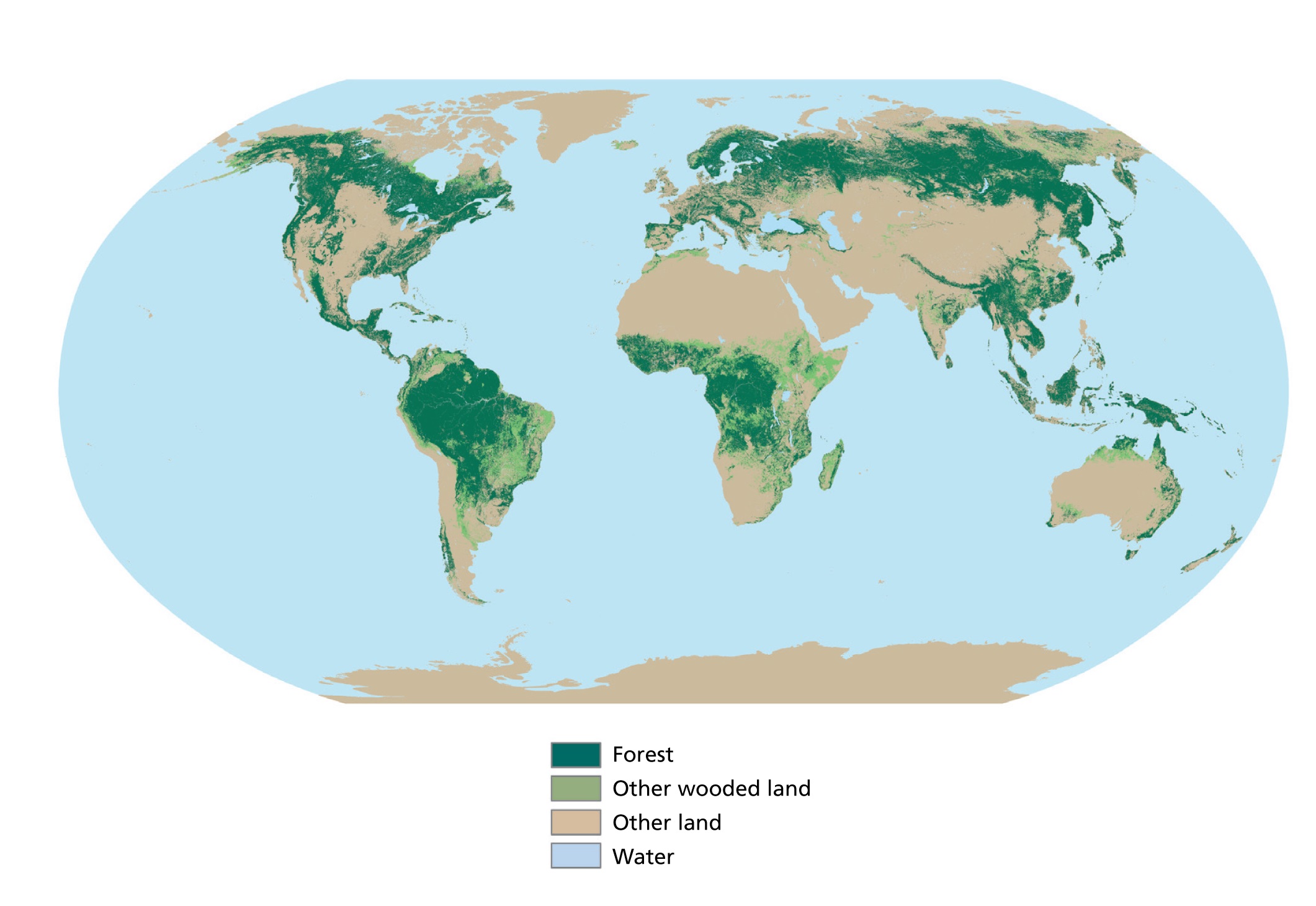
WBBSE Notes For Class 8 General Science And Environment Chapter 10 Biodiversity Environmental Crisis And Conservation Of EndangereWorld forest area map

3. Taiga or boreal forest:

Present near the pole. Seasons are too short, and moderately warm summer and long cold and dry winter. Temperature are very low, rainfall 40-100 cm, and soil nutrient-poor and acidic. Canopy permits low light penetration, so the understory is limited.

“Class 8 WBBSE General Science Chapter 10 notes, Biodiversity and Environmental Crisis study material

Flora-cold tolerant evergreen conifers with needle-like leaves-pine, fir. Fauna – wood packers, hawks, moose, bear, fox, wolf, deer, hares, shreaws, bats etc. very few reptiles. There are also some more specific types of forests within these larger regions.
WBBSE Notes For Class 8 General Science And Environment Chapter 10 Biodiversity Environmental Crisis And Conservation Of Endangered Anitypes of forests


  1. Evergreen: Rain throughout the year no dry, season. Maximum bio-diversity is found here and its productivities are maximum.
  2. Seasonal: Vegetation evergreen, having a short day season.
  3. Semi-evergreen forest or Dry forest: Having a long dry season in which trees lose leave
  4. Mentone (cloud forest): Mostly conifers.


Chapter 10 Biodiversity Environmental Crisis And Conservation Of Endangered Animals Types Of Forest And Their Role


Several types of forests are found in different geographical areas and this is due to changes of climate. Among the total forest area, 95% is natural forest and 5% is cultivated forest. South America covers 23% forest area while Oceania have 5%. Forest plants with needle-shaped leaves are—Pine and oak.

The tropical rainforest has more kinds of trees than any other area, distributed near the equator. 10 countries of the world have no forest area and another 64 countries have less than 10% forest area.

Amazon rainforest –

The Amazon river basin rainforest contains a wider variety of plant and animal life than any other biome in the world.

Forest type Forest-plant leaf Plant Animals
Conifer/Taiga needle-shaped leaves Pine, oak Black bear, Leopard, owl
Deciduous forest normal leaves shaded periodically Teak, Shal, Arjun, Amloki Tiger, Bison, Elephant
Evergreen forest Normal green leaves, plants having leaves throughout the years Mango, Banyan, Rose, Apple Tiger, Deer, Peacock Monkeys.
Bushy Desert / Dry area forest Thorny bushy plant Babul, Cactus Blackbuck, Jackal, reptiles
Savana—grassland Grass with long leaves Different types Purundi Rhinoceros, Deer, Zebra of grass, Hogla,
Mangrove forest breathing roots and glossy green leaves Goran, Gewa ‘ Tiger, Deer, Pig, Crocodile


Below there are some plants and animals choosing from list of 3/4 food chain, mentioning producers, consumers – (herbivores and carnivores)

Grasshopper Grass Tiger Banyan
Grass Eagle Leopard Bear
Toad Hare Fish Oak
Snake Jackal Otter Pine
Peacock Rhinoceros Mongoose Bat
Earthworm Termites Crab Squirrel
Bamboo Owl


WBBSE Notes For Class 8 General Science And Environment Chapter 10 Biodiversity Great horned owl, Snow leopard, Siberian Tiger


Chapter 10 Biodiversity Environmental Crisis And Conservation Of Endangered Animals Structure Of An Ideal Forest


Components of the forest :

Evergreen forests such as the Amazon rainforest and the tropical rainforest consist of many components divided into two categories that are living or biotic and non-living or abiotic factors.

“WBBSE Class 8 Science Chapter 10, Conservation of Endangered Animals study guide

Biotic components include trees, shrubs, vines, grass and other herbaceous (non-woody) plants-mosses, algae, fungi, microorganisms, and different types of animals. Abiotic factors are humidity, sunlight, wind, rainfall, soil, etc.

Chapter 10 Biodiversity Environmental Crisis And Conservation Of Endangered Animals Layers Of Forest


If you notice the plants in the forest you will find plants are of different lengths. Therefore, different layers are formed. In a typical forest, there are four layers such as- tropical forest flora and fauna are highly diverse. One square kilometre may contain 100 different tree species.

1. Emergent layer:

The uppermost layer of tropical rainforest. Tall trees reach the level and spread out usually with the straight branch, and free trunks with crowns on the tops. They are about 100 ft. to 200 ft tall with supporting buttress roots spread up to 20 – 30 ft.
Trees have small pointed leaves this type of adaptation for speedy wind. Animals found in this layer—are bats and birds.

2. Canopy:

The second upper layer below the emergent layer is 100 ft and below that. It is the thickest layer of forest usually form the roof of the forest. The Canopy is the layer that stops sunlight and rainwater from getting to the layer below it.
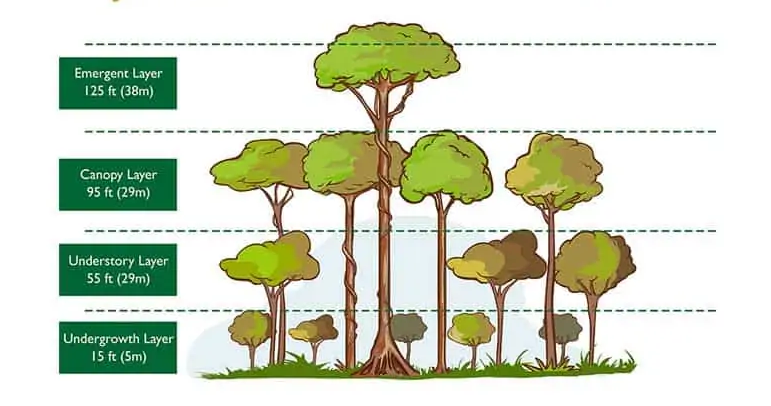
WBBSE Notes For Class 8 General Science And Environment Chapter 10 Biodiversity Layers of forest

Canopy is formed by the mass of intertwined branches twigs and leaves of the mature trees forming the crown of the forest getting most of the sunlight. It is the most productive part. Some rootless plants grow in this layer also.

Canopy is the cover formed by the leafy top branches (roof) of the tallest trees in the forest. Millions of insects and other animals are present in this layer as they have enough food to keep them there. Common animals include squirrels, monkeys, reptiles, bats and a variety of birds and tree dwellers many mammals also present there.

3. Understory:

Below the canopy is made up of bushes, shrubs, and young trees. (12 ft. upto) they are adapted to live in the shades. This layer has many vines, dense vegetation but not much sunlight reaches here, it is blocked by the canopy layer. Animals like small birds, frogs, beetles, termites, snakes, butterfly etc. This part is wet and humid dark in nature.

WBBSE Notes For Class 8 General Science And Environment Chapter 10 Biodiversity Parrot, Tree frog, Bettle, snake, butterfly

4. Forest floor:

The ground layer is dark, and damp and contains decomposing leaves, animal droppings and dead trees. Different types of ferns, moss, mushrooms and other fungi and tree seedlings grow here. Large mammals like tigers, elephants etc. frogs, toads, lizards, and insects, are the common animals. Animals that are found here both herbivores and carnivores.

Conservation Animals
WBBSE Notes For Class 8 General Science And Environment Chapter 10 Biodiversity Red Panda


They include scorpions, armadillos, wild cats, mongooses, lizards and a variety of insects. The tropical rainforest has more kinds of trees than any other area in the world. 70% of the plants in rainforests are trees. Thundershowers on an average occur 200 days out of 365 days in a year, in the tropical rainforest creating a very humid atmosphere.

“WBBSE Class 8 Biodiversity and Conservation notes, General Science Chapter 10”

The trees of tropical rainforests are so densely packed that rain falling on the canopy can take as long as 10 minutes to reach the ground. The first forests were dominated by giant horsetails, club mosses, and ferns that stood up to 40 feet tall nearly 38 million years ago.
 

WBBSE Notes For Class 8 General Science And Environment Chapter 10 Biodiversity Snow cat


Boreal forests (= Taiga) can be found in the broad belt of Eurasia and North America. Two-thirds in Siberia with the rest in Scandinavia, Alaska and Canada. Taiga covers 11% of the earth’s land area.

Loss of forest :

We destroy 130000 sq. km of forests every year. Rainforests once covered 14% of the earth’s land surface now they cover a mere 6%. More than half of tropical rainforests have already been destroyed.

Deforestation :

It is the removal or decrease of deterioration of forest cover of an area. Indian forests comprise nearly 1% (one) of the world’s forest area, India is losing about 1.5 million hectares of forest cover each year.


Chapter 10 Biodiversity Environmental Crisis And Conservation Of Endangered Animals Forest Facts


  1. About one-third of the world’s land area Is covered by forest;
  2.  Forests have to 80% of the world’s terrestrial biodiversity.
  3.  Rainforests are responsible for the production of over 40% of the world’s oxygen.
  4.  Around 1-6 billion people around the globe depend on forests for their livelihood.
  5. The giant sequoia tree of North America is considered to be the tallest living tree on the planet growing incredible heights of 95 metres.
WBBSE Notes For Class 8 General Science And Environment Chapter 10 Biodiversity Jhum cultivation, Deforestration,soil errossion

Causes of deforestation :

Deforestation is mainly due to the following reasons-

  1.  Fire, mining, urbanization
  2. Road and dams construction
  3. Agriculture
  4.  Cattle ranches
  5. Certain changes of climate
  6. Illegal cutting of trees
  7. For Human establishments of different things like factories, new farms etc.

A forest fire and its damage :

A forest fire is an uncontrolled fire that occurs in a forest area. Forest fire is one of the causes of loss of the natural habitat of plants and animals. About 1% (one) of forests roughly the size of New Zealand are consumed by fire each year. Nowadays most forest fire are caused by humans.

Factors responsible for forest fires are —

  1. Volcanic eruption when come in contact with dry twigs or branches of the tree.
  2. Volcanic lava.
  3. Lightning strikes.
  4.  Frictions between twigs or trunks of different trees.
  5. Human activities

Damage caused due to forest fire :

  1. Loss of plants decreases 02 concentration in this area and increases the concentration of C02 leds to an increase of the temperature of the environment (global warming)
  2. The soil of the forest retains rainwater.
  3. Due to loss of trees water cannot be retained anymore by the soil.
  4. Soil erosion causes due to lack of grifting of roots.
  5.  Loss of a large number of valuable plants and animals.
  6.  The balance of the ecosystem of forests is seriously hampered.
  7. The water cycle (water-cloud-rain —> ice) gets disrupted.
  8.  Extinction of rare or endangered species loss of biodiversity.

Forest conservation :

Forest conservation is the protection, restoration and preservation of forests.

  1. The trees cut down for timber or other uses, should be balanced by planting of more trees so that there is no scarcity.
  2. The use of wood as fuel and wood charcoal should be discouraged. The use of alternative fuel should be encouraged.
  3. The adequate measure should be taken to check the spread of disease of any tree in the forest and forest fire should be controlled.
  4. Modern forest management programmes should be adopted.
  5. Afforestation and reforestation should be taken.

The development of forests in the denuded region is called reforestation and the creation of forest over the base area is called afforestation. Forestation is must for slopes and hills. In West Bengal forest arear nearly 13-38%. Among them, two main forest areas are the Forests of North Bengal and the Mangrove forests of Sundarban


Chapter 10 Biodiversity Environmental Crisis And Conservation Of Endangered Animals Crisis Of Forests Of North Bengal


West Bengal has a forest cover of 1-19 million hectares much of which is in the Darjeeling and Dooars region.in North Bengal. There is a tiger reserve in the region known as Buxa Tiger Reserve (BTR) wildlife sanctuaries at Jaldapara and Mahananda National Park, Gorumara, Neora Valley and Sangalila.

The forests of North Bengal have rich diversity of flora and fauna. Sal occupies nearly 80% of all vegetation in the tropical forest other plants are Gamhar, Odal, Khair, Sishu etc. and different types of orchids are found here. A variety of mammals, reptiles, and rare species of trees are found.

Besides the one-horned Rhinoceros, The fauna of the area includes the Asian elephant, Gour, Leopard, and Deer. The vegetation changes with altitude in North Bengal. The plains of the foothills are covered by sal, as soon as the altitude increases vegetation changes in the higher altitude region. Rhododendron, Magnolia, Oak, Hemlock, Silver Fir, different types of bamboo, etc.

“Class 8 WBBSE General Science Chapter 10, Environmental Crisis and Conservation easy explanation”

Ferm’s wild grasses are common. Several tea gardens have been set in this area. In the cool climate rare species of mammals like red panda, Snow leopard, Gour, Elephant, Himalayan Black Bear and different types of birds are found here. In Jaldapara endemic species of Rhinoceros (R unicorns) is found. Now the forest and adjacent area faces different types of problems.

The forests of North Bengal is an extremely rich biodiversity zone but today face a declining Rhino-population and much vegetation. There have been repeated incidents of elephant and Bison death on railway tracks running through the forest of North Bengal.

Most of the cases has been reported from a 100 km stretch of railway track between Alipurduar to Siliguri. The track was converted to. broad gauge line in 2004, allowing an increase in train number and speed, illegal cutting of trees also decreasing the forest area.


Chapter 10 Biodiversity Environmental Crisis And Conservation Of Endangered Animals Man And Elephant Conflicts


Last 50 years population of this area has been increased rapidly. So more and more human villages or habitations have been established and some new Tea garden has also been established or old one extended their area. All these decrease the forest area. Thus the Natural ecosystem is hampered.

In some cases, corridors of elephant passing have been obstructed by developmental work. For this reason, the man and elephant conflict has been started. Death of many elephants have occurred in railway tracks. Elephants sometimes attack human villages and crop fields due to scarcity of food.

Paragraph On Conservation Of Plants And Animals
WBBSE Notes For Class 8 General Science And Environment Chapter 10 Biodiversity Man And Elephant conflicts

Not only elephants, leopards, tigers, rhinos, Gour, and Bison are also killed in the conflict. To solve the problem forest department has increased the core and buffer area of the forest. Some elephant corridors has been set up to control the elephant attack. , Incidence of infestation of other wild animals such as Leopard, Bison, also a problem. The scarcity of food is the main reason.

The scarcity of wild natural prey of leopards, change their food habits they are now more and more dependent on capturing goats, cattle, ducks, hens, poultry birds etc. This creates another conflict. Tea Garden labour is sometimes attacked by leopards. In fear, people attack them and killed them.

“WBBSE Class 8 Science Chapter 10 notes, Biodiversity and Conservation PDF”

General awareness to be raised against these killings. Sometimes elephants migrate from other places’ neighbourhoods (Dalma Hills) and refuse to return their native place. These create also problems.

Mangrove forest and their present Crisis :

A mangrove is a shrub or small tree that grows in coastal saline and brackish water. Mangroves occur worldwide in the tropics and subtropics. Mangroves are salt-tolerant trees also called holophytes and are adapted to life in harsh coastal conditions. Mangrove forests are found in the southern tidal areas of West Bengal.

Sundarban forest is mainly a mangrove forest. They contain a complex salt filtration system and a complex root system to cope with saltwater immersion and wave action. They are adapted to the low oxygen conditions and water-logged mud. Mangrove plants have respiratory roots and many of these plants have stilt roots.
 

WBBSE Notes For Class 8 General Science And Environment Chapter 10 Biodiversity Sundari plant


Respiratory roots, the upward-directed root branches with pores (pneumatophore) helps them to continue their breathing of roots in muddy or water-covered condition. Stilt roots help them to attach with the soil that not extirpated the plant during high tide.

The lower part of plants like the base of mangrove plants like Byne, Keora, Pasur, and Garan became submerged twice under water during high tide. Some mangrove plants (Rhizophora species) Garjan, Garan, Kanura and same other seeds germinated inside the fruit before falling to the soil.
 

WBBSE Notes For Class 8 General Science And Environment Chapter 10 Biodiversity Sundari plant with root


This is due to avoid germination in saline water where they may wash out by tidal water. This type of germination is known as viviparous germination.


Chapter 10 Biodiversity Environmental Crisis And Conservation Of Endangered Animals Problems Of Mangrove Plants Of Sundarban


1. Nowadays due to the deposition of silt in the river basin of different rivers going through this mangrove forest and due to the raise of the sea-water level the water level raise and more marine water flow inside rivers therefore, the salinity of water of this area raise.

This comparatively high saline water (33 – 38 gm / 1000 gm marine water) enters inside the creeks directly. Plants of terrestrial lands are unable to tolerate more salty water. Excess salt cause toxicity in the tissues of plants.

“WBBSE Class 8 General Science Chapter 10, Biodiversity Environmental Crisis important questions”

Plants try to eliminate excess salt through leaves and roots but still they face problems and rise of water levels in creeks (Khauri) causing soil erosion. Roots unable to hold the plants. Some plants loss in this process.

Water and soil pollution, increase water temperature and some unwanting substances from manure and pesticides cause serious damage to the flora and fauna living in this water.
 

WBBSE Notes For Class 8 General Science And Environment Chapter 10 Biodiversity Crocodile and Royl Bengal Tiger

“Class 8 General Science Conservation of Endangered Animals notes, WBBSE syllabus”

Crocodiles, Turtle and tortoises, crabs, and fishes are under severe threat of extinction. Excessive tourism in this area also causes pollution and damages the ecosystem of this area.

Observation-

Visit this place as much as you can. Identify the plants their and animals as much as you can. The people around this area their activities. Note down the problems.


Chapter 10 Biodiversity Environmental Crisis And Conservation Of Endangered Animals Life Under The Sea


Many of you have seen and may have collected different types of molluscan (snail) shells, starfish, Jellyfish, octopus, and some hard whitish sleeper-like internal skeletons of Sepia during the walk along sea-shore. Let’s see what is the sea and its environment and biodiversity ar.

The Ocean (sea) is a continuous water mass covering about three-fourths (75/£) of the earth s surface. Most oceans are deeper than two kilometres and are home to some of the most diverse life on the earth.

We are familiar with animals that live on the surface of the ocean where sufficient light penetrators and photosynthesis take place in plants. Where large quantities of diatoms and other phytoplankton are present and they give colour to the sea.

Phytoplankton-

They are small and mainly microscopic. They can produce their food by photosynthesis with the help of sunlight, for example. diatoms, dinoflagellates, blue-green algae etc.

Zooplankton-

They are unable to produce food and feed on other plankton, for example, larval forms of different arthropods, shrimp, krill, etc.

The photosynthetic micro-floating organism is called phytoplankton. These are mainly algae. These are the main sources of food of zooplanktons and many others sea dwellers. Phytoplanktons and some algae-like plants mainly occupy the lighted water column of the sea.

If we go deep down the sea, we will notice the sunlight is gradually dimming (waning) and if we go further down it is pitch dark. The majority of sea dwellers (animals) live in the upper part (surface zone) and gradually their number decreases as the increase of depth and their structural and behavioural patterns also change.

The deep sea zone where living conditions not at all favourable very few types of animals are found there. The pressure there is so immense that we would be crushed if we go down there. The temperature is nearly freezing, food is very scarce and there is no light at all.


Chapter 10 Biodiversity Environmental Crisis And Conservation Of Endangered Animals Plankton


A small mainly microscopic diverse collection of aquatic organisms which are unable to swim against the water current drifting or floating in the sea or fresh water. Planktons are mainly diatoms, protozoans, small crustaceans (arthropods) and the eggs and larval stages of larger animals. ‘These are the food sources of many aquatic animals including fish and whales.
WBBSE Notes For Class 8 General Science And Environment Chapter 10 Biodiversity Environmental Crisis And Conservation Of Endangered Animals plankton


Planktons are of two types

  1. Phytoplankton and
  2. Zooplankton.


Chapter 10 Biodiversity Environmental Crisis And Conservation Of Endangered Animals Oceanic Depths And The Conditions There


Ocenographers divide the open ocean (pelagic /one) into five layers.

1. Sunlight zone

The first layer (epipelagic /one) Oceanography extends up to 200 metres (600 ft) It is the photic j It is the study of different aspects zone or sunlight zone that receive sunlight.

Phyto planktons, zooplanktons and some other animals like Jellyfish, many sharks, dolphins many fishes, (clown fish) f Blue whale feed on plankton, are formed in this zone.

Oceanography

It is the study of different aspects (biology, physics, chemistry, geography, engineering and metrology) of the ocean.

2. Twilight or Dimlight zone (mesopelagic zone)—

The second layer extends from 200 metres to 1000 metres. The intensity of light is low so this layer is known as dim light or twilight zone. Submarines usually use this layer Animals that live here are swordfish, squid, wolffish, and some cuttlefish, whales.

Many organisms that live in this zone are bioluminescent. Some creatures of this zone move to the upper zone at night to feed. The eyes of fish are larger and usually directed upwards, probably to see other animals and for food against the pale light.

3. Midnight zone (bathypelagic zone)—

This is the third layer extending from 1000 metres to 4000 metres. The sunlight doesn’t penetrate deep into this layer. The ocean is pitch black. So this zone is known as the midnight zone. No living plant exists here.

Most animals living here survive by consuming the detritus failling from the zone above. Animals living here are Angler¬fish, Squids, giant squids, octopus, sperm whales, etc.

4. Lower midnight zone or Abyssal zone (abyssopelagic zone)—

This is the fourth layer extending from 4000 metres to the sea floor. No light, immense dark the pitch-black bottom layer. The water here is almost freezing and its pressure is immense. Very few creatures live in this zone.
 

WBBSE Notes For Class 8 General Science And Environment Chapter 10 Biodiversity Environmental Crisis And Conservation Of Endangered Animals ocean layer


Animals found in this zone are squid, many echinoderms, marine arthropods, and sea spiders. Many of the species living at these depths are transparent (no pigment) and eyeless because total lack of light in this zone.

5. Hadalpelagic zone-

The zone includes water found in the ocean’s deepest trenches. This zone is mostly unknown. However, some organisms live in hydrothermal vents.


Chapter 10 Biodiversity Environmental Crisis And Conservation Of Endangered Animals Diversity Of Life In Different Regions Of Sea


Many living sea organisms are found in the space created in the water level during low tide. The organisms are usually found in algae, snails, mussels, starfishes, sea anemones, crabs etc. Sponge and some other animals fixed themselves with sea bottom and rocky substances. ‘

Phytoplanktons and zooplanktons are usually found near surface common fishes, the octopus whales, eels and squid are found in middle areas, starfish various worms, snails, and oysters are usually bottom dwellers. The intertidal area (= littoral zone) is where the land and sea meet; between the high and low tide zones.

This area is rich in nutrients and oxygen and is home to a variety of organisms. In this area (high, middle and low tide area) sea anemones, chitons, crabs, green algae, mussels, snails, sea cucumbers, sea stars, sea urchins, sponges, and tube worms are found. The intertidal zone is also a good place to find plants in the sea.

Marine habitats can be divided into coastal and open ocean habitats. Coastal habitats are found in the area that extends from the shoreline to the edge of the continental self. Most marine Ijfe is found in coastal habitats.

Here sponges and other marine invertebrates, small fishes, marine turtles, sea cows, sea horses and small marine shrimps, and Kelp, a kind of marine algae also found here. Plant growth is completely absent at the sea bottom. So the deep sea animals have to prey upon one another.

“WBBSE Class 8 Chapter 10 General Science, Biodiversity and Conservation solutions”

Some deep-sea fishes regularly migrate to feed near the surface, particularly at night. When there are fewer predators around. Mostly the deep-sea animals depend on surface plants and animals that sink to the bottom. Occasionally when a large animal such as a whale, or large fish die on the surface it sinks to the bottom offering a rare feast to deep-sea dwellers.
WBBSE Notes For Class 8 General Science And Environment Chapter 10 Biodiversity sea


Coral reefs :

Coral reefs form complex marine ecosystems with tremendous biodiversity. Coral reefs exist in most tropical waters. Reefs are built up by corals and other calcium-depositing animals.

Bioluminescence (cool light) —

This is an extraordinary feature exhibited by the animals living in deep seas (also found in some terrestrial insects such as fireflies). It is a chemical process that results in the release of light through specialized organs called, light organs. Light is produced either through symbiotic bacteria living on the fish or through specialized self-luminous cells called photophores.

Bioluminescence occurs when certain chemicals are mixed together. Chemical reactions occur between luciferin (protein-bound pigment) and oxygen in presence of the enzyme luciferase (catalyzes the chemical reaction). Here chemical energy is converted into light energy.

Most of the light created by marine organisms is blue-green in colour (which not only travels best in water but also many marine organisms are sensitive to this light.) Exceptionally some fishes can also produce red light. (This gives them an advantage by allowing them to see their prey without making their presence Known)
 

WBBSE Notes For Class 8 General Science And Environment Chapter 10 Biodiversity some deep sea fish


Bioluminescence is very common among fishes, crustaceans, cephalopods (Arthopodes) Cnidarians (Coelenterates), some starfishes and a few animals. Some animals establish a symbiotic relationship with light-producing bacteria.

Importance :

Bioluminescence helps animals in various ways find mates, attract prey, self-defence, search for food etc.

Colouration :

The majority of marine fishes display a wide variety of colours and colour patterns. However, many deep-sea fishes (e.g. viperfish) don’t have any pigment to colour their body, and appears transparent.


Chapter 10 Biodiversity Environmental Crisis And Conservation Of Endangered Animals Food And Feeding


The autotrophic (self-feeding) organisms of the sea / or plants of the sea

Phytoplankton-

chlorophyll-containing microscopic organisms live in the euphotic zone (where sunlight reached). They can produce food with the help of sunlight. Phytoplanktons are the main producer of aquatic ecosystems planktons have a role to maintain carbon balance in the environment.
WBBSE Notes For Class 8 General Science And Environment Chapter 10 Biodiversity Sea Weed .

Diatoms—

Diatoms are unicellular algae (phytoplankton) although can form colonies with distinctive transparent cell walls made of silica. They are found in almost all aquatic environments.

Dinoflagellates—

Dinoflagellates are unicellular phytoplankton mostly marine but also found in fresh water. They move with the help of flagella. Some dinoflagellates also exhibit bioluminescence.

Kelp—

Kelp are large brown marine algae seaweeds. Kelp grows in shallow oceans are grows in such a way that they create a forest under the ocean. The body (thallus) consists of flat or leaf-like structure and remains attached with something underwater with the help of a root-like structure (hold fast). They grow very fast.


Chapter 10 Biodiversity Environmental Crisis And Conservation Of Endangered Animals Animals


1. Zooplankton-

Zooplanktons are very small some are microscopic flea-swimming organisms that drift with water currents. The zooplankton community is an important element of the aquatic food chai the most abundant group of animals in the world’s ocean.

The Baleen hales r zooplankton, especially one species in particular called Krill, for example, larval forms of different arthropods, shrimp, kri etc.

2. Sea anemone-

You may notice while visiting the sea-shore (lower intertidal zone) some flower-like animals. If you touch them they will sink deep into the sand. Sea anemones are tube-like invertebrate sea animals with extended flower-like tentacles spread from the upper side (around the mouth) of the body.
 

WBBSE Notes For Class 8 General Science And Environment Chapter 10 Biodiversity Sea anemone


Tentacles are like petals of flower arranged around the mouth opening by one or more whorls. They are sessile attached at the base to the surface beneath it by an adhesive foot (pedal disc). Tentacles of sea anemones contain numerous stringing cells (cnidocytes). They help in self-defence as well as used to capture prey.

3. Sea pen—(Pennatula) –

The sea pen is a colonial invertebrate marine animal of the phylum Cnidaria. They occur in shallow and deep waters from polar seas to the tropics. This graceful creature of the seafloor resembles a pulp, old-fashioned quill pen in colour range from dark orange to yellow to white.
 

WBBSE Notes For Class 8 General Science And Environment Chapter 10 Biodiversity Environmental Crisis And Conservation Of Endangered Animals Sea weed.


The lower part of the central stalk of the animal (peduncle) anchors the colony in mud or sand and the upper part the rachis bears polyps or branches bearing several polyps (hollow stalks with Sea pen a mouth and tentacles at the free end) Most of the sea pens luminescent or glow when they are touched or otherwise stimulated.

4. Octopus—

Octopus is a rounded soft-bodied marine animal with eight long arms. The soft body can rapidly alter its shape, enabling the octopus to squeeze through small gaps.
 

WBBSE Notes For Class 8 General Science And Environment Chapter 10 Biodiversity Environmental Crisis And Conservation Of Endangered Animals octopus


Each arm contains many suckers, a mouth at the centre of the arms. Octopus has two big (bulging) eyes. The eyes and brain of octopus are the most developed organ among invertebrates.

Jet Propulsion –

Octopus expelling a jet of water rapidly through siphon into the sea helps them to rapid locomotion. All Octopuses are venomous (poisonous) but only the blue-ringed Octopus are known to be deadly to humans. Octopuses expel a special ink from ink-sac to protect them from predators.

“WBBSE General Science Class 8 Biodiversity, Environmental Crisis Chapter 10 key concepts”

The giant pacific octopus is the largest known octopus species. Octopuses have a relatively short life span some species live for as little as six months. The. giant specific octopus may live as many as five years. Octopus life span is limited by reproduction: males can live only a few months after mating and female die shortly after their egg hatch.

Female octopus guards its fertilized egg in such a way that they do not take any food and die from starvation after the eggs hatch, (due to the inactivation of digestive glands.)

5. Squid and cuttlefish (example Loligo)—

Squids are marine molluscs closely related to octopus and cuttlefish. The body is elongated (torpedo-shaped) there is a fin near the end of its body. Squids are probably the Squid is a good swimmer and the fastest marine invertebrate. Squids is a good swimmers and certain species can fly for short distances out of the water.

The skin contains a pigment (chromatophore) which enables the squid to change- colour to suit its surroundings. The Head-end bears eight short arms and two long arms called tentacles each arm has many suckers along the edge.
 

WBBSE Notes For Class 8 General Science And Environment Chapter 10 Biodiversity Environmental Crisis And Conservation Of Endangered Animals Squid


When attacked to escape from predators spraying brownish or blackish fluid makes the water turbid to make fool its enemies. The Giant squid lives in the deeper parts of the Atlantic ocean. (50 – 60 feet long).

Cuttlefish (example Sepia)—

Cuttlefish is a close relative of the squids. These marine molluscans have broad bodies with long undulating fin on each side. This animal lives in shallow water on a sandy bottom. They have a sleeper-like calcium-containing internal shell (cuttlebone). You may seen these plenties in the seashore. (This article is sold as sea foam)
 

WBBSE Notes For Class 8 General Science And Environment Chapter 10 Biodiversity Environmental Crisis And Conservation Of Endangered Animals Exoceetus, Sepia


6. Shark—

Sharks are marine fish but they have soft more elastic cartilaginous skeletons not hard skeletons like bony fishes. They have usually five-gill slits on either side of head (sometimes seven).

If you put your hands over shakes body you will feel roughness. This is because the skin of a shark is entirely covered by hard microscopic placoid scales (dermal denticles)

  1. Dwarf Lanternshark a deep sea species about 17 centimetres (6-7 inches)
  2. The whale shark (Rhinocodon type) is the largest shark (it is the largest fish in the world)
  3. Whale sharks, megamouth sharks and Basking sharks are (filter feeding) plankton feeders
  4.  Whale sharks and lunar-headed sharks are known as man-eaters.

 

WBBSE Notes For Class 8 General Science And Environment Chapter 10 Biodiversity Environmental Crisis And Conservation Of Endangered Animals Heterocircle tail


The scales are supported by the spine which feel rough when stroked in a backward direction. Sharks have numerous sets of replaceable teeth. If loss one set then replaces by another. ‘Well-known same species are – great white shark, blue shark, hammer-headed shark are predators.

Sharks possess heterocercal caudal fin in which the dorsal portion is usually noticeably larger than the ventral portion. Sharks have keen olfactory senses. Some species are able to detect as little as one part per million of blood in seawater. Sharks have a special sensory organ known as the ampulla of Lorenzini which help them to sense electrical fields in the water.

Some sharks lay their eggs in the water, and most of them are kept in egg case which protects the developing embryo (s). Some sharks (Hammer-heads) give birth to fully functional young like mammals. Sharks are found in all seas. They are usually common down to the depth of 2000 metres (7000 ft) and same live even deeper.

Among 470 species only four have been reported attacks humans these are the great white shark, oceanic white lip shark, tiger and blue shark.

  1. The largest fish is the whole shark which grows to more than 15 metres (15 -18 m)
  2. The biggest marine animal is the blue whale with a recorded length of 31 metres.
  3. Giant kelps grow 60 metres tall, one of the tallest seaweeds.-
  4. Starfish and may other echinoderms are radial symmetry which means their body parts are arranged around a central axis.
  5. Starfish are not true fish. They do not have gills, scales or fins and no vertebral calcium like fish.


Chapter 10 Biodiversity Environmental Crisis And Conservation Of Endangered Animals StarFish


Starfish is a five-armed star-shaped marine echinoderm. Starfishes are not fish they are invertebrates. They are flattened have a central disc from where five arms radiate. The upper surface (aboral side) is granular or spiny. Mouth present in the ventral surface (oral side).

Starfish have tube feet which help In locomotion (moving) and feeding. Tube feet are hollow with sucker work like a vacuum cleaner. Many species are brightly coloured in various shades of red or orange, while others are blue, grey or brown.
WBBSE Notes For Class 8 General Science And Environment Chapter 10 Biodiversity Environmental Crisis And Conservation Of Endangered Animals Star fish

Starfish have a specialised water vascular system made up of a network of fluid-filled canals. This system helps in locomotion, adhesion, food manipulation and gas exchange. Starfish are found in the intertidal zone as well as in the deep sea.


Chapter 10 Biodiversity Environmental Crisis And Conservation Of Endangered Animals Sea Animals


Pollution in the ocean and problem of Marine life :

Oceans are the largest water bodies on the planet. It is the home of a wide variety of marine animals and plants. Over the last few decades, human activities have severely affected the marine life on the earth oceans.

Ocean pollution or marine pollution is the spreading of harmful substances such as oil, plastic industrial and agricultural waste, pesticides, and chemical industrial particles into the ocean.

Any type of ocean water (sea water) contamination which affects living organisms is called marine or ocean pollution. Mining for materials such as copper and gold is a major source of contamination in the ocean.


Chapter 10 Biodiversity Environmental Crisis And Conservation Of Endangered Animals Ocean Pollution


1. Pollution by sewage, chemical sewage or polluting substances flow through sewage, rivers or drainages directly into the ocean. Chemical fertilizers and pesticides use near by fields are also washed out and mixed with seawater. Excessive nutrients such as nitrates, and phosphates, commonly originate in domestic sewage, runoff from agricultural fertilizers, waste material from animal feedlots, packing plants etc.

They stimulate the growth of microorganisms. The number of phytoplanktons increases enormously consequently they cover the ocean surface. This is called an algal bloom. An increase of dinoflagellates also causes algal bloom.

It turns the seawater red. Toxins secreted from these algal booms also cause the death of many marine animals. Besides this decrease in the transparency of water hampered the penetration of sunlight into the seawater. It also hampered the photosynthesis of sea plants.

 

WBBSE Notes For Class 8 General Science And Environment Chapter 10 Biodiversity Effects of ocen pollution in marine animals


The presence of too many planktons and other microorganisms reduces dissolve oxygen (increases biological oxygen demand = BOD ) respiratory activities of marine animals and plants and lead to the death of marine animals.

Oil spills—

An oil spill is an accidental and incidental discharge of petroleum in the ocean. The main source are offshore exploration wells, extraction wells, oil refineries, and the loading and unloading of tankers.

2. Oil spills—

During oil extraction from sea and oil transportation, linkage of tanker ships and during the war, crude oil mix with sea water which causes ocean pollution. Oil form a layer in the upper surface of sea water which prevents oxygen to get dissolved in water. As a result, marine life forms can die due to oxygen deficiency.

Besides this oil form a layer over the body of large sea animals especially birds and mammals. This severely damages the thermostatic balance (body temperature balance) eyes and noses smearing (coating of greasy substances) of sea birds which because incapable of flying and feeding resulting in their death.

Oil when entering inside the body it also damages internal organs. During the Iraq war a large number of sea animals (especially birds and mammals) died due to ocean pollution.

3. Plastics—

Plastic objects float on the sea coming from rivers, canals or from the sea shores or sometimes in harbours and ships. When this object is consumed by sea animals in confusion this large object creates an obstruction which hampers the normal functioning of the alimentary system. The animal can die due to starvation or infection.

4. Increase in acidity of ocean water—

C02 emission in the atmosphere increases due to various human activities. The sea absorbs a large part of this carbon dioxide (C02). This dissolved C02 and increase the acidity of seawater. This affects sea life. Gill-breathe animals face difficulties to absorb oxygen from acidic seawater for their respiration.

Besides this, the animals which have chitinous or calcareous covering shells such as crabs, lobsters, snails, and corals face difficulties in forming their shells and acidic water can destroy the calcareous shell.

5. Thermal pollution—

Various industrial processes may utilize water for cooling and the resultant warmed water has often been discharged into sea in some coastal areas. Coal or oil-fired generators and atomic energy plants generate a large amount of waste heat which is carried away as hot water and caused thermal pollution. Thermal pollution can exert a disruptive effect on coastal marine ecosystems.

Chapter 10 Biodiversity Environmental Crisis And Conservation Of Endangered Animals Life In Desert


A Desert is a very dry area of land often covered with sand or rocks. Where there is very little rainfall (20 cm – 25 cm) and few plants and animals can live. Desert covers approximately one-third of the earth’s surface. The two largest deserts on Earth are in the polar areas Antarctica (5-5 million sq. miles).
 

WBBSE Notes For Class 8 General Science And Environment Chapter 10 Biodiversity Sandy desert

The second largest desert is the Arctic polar desert. (5-4 million Sandy desert sq. miles). It extends over parts of Alaska, Canada, Greenland, Iceland, Norway, Sweeden, Finland and Russia.
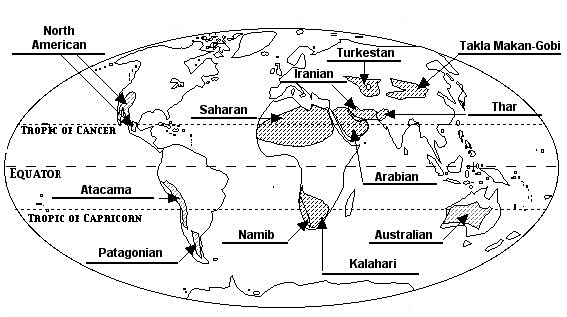
WBBSE Notes For Class 8 General Science And Environment Chapter 10 Biodiversity Major deserts on earth

Non-Polar desert-

The rest Of Earth’s deserts are outside of the polar areas. The largest is the Sahara Desert a subtropical desert in northern Africa (which covers 3-5 million sq. miles) Across the world around 20% of the desert is sandy.

Antarctic deserts and Arctic deserts are cold deserts where these are land covered by ice and another sand cold desert is the Gobi Desert of Asia. Other important deserts are Sahara (Africa) Arabian desert (Middle east), and Kalahari (Africa). In India, the Thar desert covers a major part of Rajasthan.

The days in the desert are extremely hot and the nights are cold. Deserts are characterised by scanty flora and fauna. Only the organisms having specialised structural, physiological and behavioural adaptations to withstand the extremes of temperature and aridity can survive there.
WBBSE Notes For Class 8 General Science And Environment Chapter 10 Biodiversity Environmental Crisis And Conservation Of Endangered Animals Oasis

The Equator passes through the middle of the earth. Deserts do not occur near the equator. Higher in the atmosphere the new cold, dry air rises and moves away from the equator.

  1. Cold deserts are found in the Antarctic, Greenland, Northern and Western China, Turestan, and Iran. The Gobi desert is a cold desert.
  2. Hot deserts of the world are located between 15° – 30° north or south of the equator.

Nearly one-third of (1/3) earth’s land surface is desert.

There are four different types of deserts based on their geographic situation.

  1. Polar desert
  2. Subtropical desert
  3. Cold winter desert
  4. Cool coastal desert

Oasis :

Oasis is an isolated area in the desert with some vegetation, animals and small water sources like a pond or lake. A little bit of rainfall in the desert accumulates in the layer of the rocks found deep. From the deep water comes out when the layers of rock break form’a a pool or small lake.
WBBSE Notes For Class 8 General Science And Environment Chapter 10 Biodiversity Environmental Crisis And Conservation Of Endangered Animals Oasis water source

This is mainly due to the artesian aquifer, water can reach the surface naturally by pressure or by man¬made wells. Surrounding this pond or small lake trees grow. As the trees and a few other plants grow different animals also appear. The number of oases is very limited.

Chapter 10 Biodiversity Environmental Crisis And Conservation Of Endangered Animals Plants In Desert


A Desert is an endless stretch of sand with high temperatures and high concentrations of C02. Soil is absent. There is a profound scarcity of water. Yet plants grow in such advanced conditions. Desert succulents such as cacti or rock plants survive dry spells by accumulating moisture in their fleshy tissues.

They have an extensive system of shallow roots to capture soil water rapidly (within a few hours) after it has rained. Roots of many plants grow deep into the soil to collect water, to avoid friction with sand root caps become strong.

In addition to these many cacti and other stem-succulent plants of hot deserts grow vertically and usually leafless green trunks (stem) that use sunlight of the early and late hours of the day. Many plants have no leaves and leaves turn into thorns to check evaporation.

The number of stomata in leaves are less. Plant body covered by cuticle to prevent evaporation. Some plants come out after little rain and survive very few days but within this short life span, they produce flowers and seeds. In some cases, seeds lie dormant stage and wait for a favourable environment or conditions.

There are other long plants that can survive for long period without water.

Cactus-

Ordinary cactus or prickly pear is found in most of the deserts of the world. No animal or bird can .eat them as they are covered by thorns. Thorns are their protective organ as well as prevent evaporation of water. Their stems are green and able to make their own food by the process of photosynthesis.

Saguaro Cactus-

A type of tall tree like giant cactus having branches can grow up to 50 feet (12.2 metres). Its life span is about 150 to 200 years (usually found in the Arizona desert, Mexico) A saguaro cactus is able to absorb and store a considerable amount of rainwater (six to eight tons of) water is their body.

They use this stored water as needed. So they are able to survive during periods of drought. The body of this cactus is covered by long thorns. Flowers are whitish to yellow in colour and open well after sunset. Fruits are edible ruby red and contain many seeds (about 2000).

“WBBSE Class 8 General Science Chapter 10, Biodiversity Environmental Crisis summary”

The desert travellers quench their thirst with this plant. They collect water by cutting their expanded trunk. The fruit are used to make Jam. Woods are used to making strong ropes and building houses.
 

WBBSE Notes For Class 8 General Science And Environment Chapter 10 Biodiversity Environmental Crisis And Conservation Of Endangered Animals Desert plants


Joshua Plant –

A type of succulent plant that they store water. They grow about fifteen to forty feet long. They are considered trees of the desert. Their life span is about 200 years. This plant usually have a single trunk and grows three to nine feet tall before branching.

Joshua trees are fast growers of the desert. Branches end with dusters of spiky leaves and white rounded flowers. A number of mammals rely on Joshua trees for food. Jashua plants have very thin leaves therefore less water is evaporated.

They have a special and extensive root system. They have special root systems so they can soak up a lot of water. Man use the leave of these trees as plates and bowls.

Mesquite plant-

These are leguminous desert plants with long roots. They grow up to 8 metres. They have one or multiple trunks with bipinnate leaflets. They can store water but they have long tap root which can reach below upto the rock layer. They collect water from that rock layer. They protect the sand dunes of the desert.
WBBSE Notes For Class 8 General Science And Environment Chapter 10 Biodiversity Desert plant Mesquite

Cactus as food-

Cactus is a very important as well as useful plant for the desert people. Food is stored in the roots of the cactus. For this roots become very large and thick. Desert people are able to recognise this root part. The fruits of the saguaro cactus look like a watermelon.
 

WBBSE Notes For Class 8 General Science And Environment Chapter 10 Biodiversity Environmental Crisis And Conservation Of Endangered Animals Saguoro cactus

Write down the adaptations of desert plants in tabular form and the purpose of that change :

Desert plants Adaptation Purpose
1
2
3


Chapter 10 Biodiversity Environmental Crisis And Conservation Of Endangered Animals Wild Life Of Desert


The environmental conditions of the desert are not so favourable like other environments. Desert animals get radiated heat of the sun. The heat also enters their body from the soil and rock through the conduction process and from air through the convection process. In addition to high temperatures, they face scarcity of water.

But the desert animals adopted themselves with the condition. Some animals like camel have suited them well with the surrounding condition. In the sandy desert, there is terrible heat during the daytime and there is cold in night two extreme conditions. Usually, desert animals remain to stay in their den (dig burrows in the sand) and come out in the evening.

They are nocturnal in habit. Some animals are active for a few hours only during the early morning. Most of desert animals are small in size. A desert, lizard (Moloch) can absorb water through its moisture-absorbing (hygroscopic) skin.

  1. Many desert animals develop a protective covering on their body to prevent water loss by evaporation. Skin of some desert
  2. Animals become thick to prevent loss of water.
  3. Some desert animals produce water by their own metabolism (respiration).
  4. Some desert animals during summer migrate to high and cold places and return during the winter season.
  5. Some desert animals when the temperature increase go to deep sleep, this is called aestivation. During this time their respiration rate and heartbeat decrease.

Camel-

The camel is an excellent example of adaptation to desert life. Camel is known as the ship of the desert. Two types of a camel on the basis of the hump. One-humped (Arabian camel) and two-humped (Bactrian camel).
 

WBBSE Notes For Class 8 General Science And Environment Chapter 10 Biodiversity Environmental Crisis And Conservation Of Endangered Animals Camels

Important Adaptation of camel :

  1. The hump on the back of the camel is not a water-containing bag. It is actually a reservoir of fat. This fat (reserve food) is utilized when it does not get anything to eat. They collect their energy from this fat. For that the hump gets reduced when the camel does not have anything to eat.
  2. Camel can live without food and water for seven days or more (may up to 10 – 12 days). When water is available it can drink as much as 50 litres (25 gallons) at a time. This water gets evenly distributed in all the tissue of the body.
  3.  Legs are long and wide enough to cope with the sandy desert condition.
  4.  A pad of thick tissue is present near the knees and below the sternum that helps the camel to sit on the sand. Its hooves are covered by a large sole which helps it to move on hot slippery sand.
  5. Very little water is excreted from its body and urine is highly concentrated.
  6. Sometimes sand-storm occurs in the sandy desert. Camel can close and open which is covered by muscle. They have transparent eyelids and they have a short, thick brush-like
  7. eyelashes. Snout is slender which leaves a cleft in the upper lip and the tongue of the camel is made up of strong muscles which help them to collect food from thorny bushes.
  8. Legs long and wide enough.
  9. Its breathing rate is very slow to prevent water loss during breathing.
  10.  It can adjust its internal temperature and keep it higher than that of its surroundings this mechanism helps the camel to prevent water loss.

Observation :

Different body parts of camel and their structural peculiarities :


Body parts Structural peculiarities   
1. Legs
2. Snout
3. Eyes
4. Lips
5. hump


Chapter 10 Biodiversity Environmental Crisis And Conservation Of Endangered Animals Lizards Of Desert


There are different types of lizards in desert. Most of them come out during the evening or night in search of their food. They store fat in the tissues of their wide tail. Many desert lizards have the ability to adjust colour- due to temperature (this is known as metachromatism)

They cannot regulate their temperature internally so they rely on their environment to keep the temperature in the correct range. When the temperature cools, lizards turn darker. Dark colours increase heat absorption when desert temperatures rise their colour became lighter, which reflects the heat and keeps the lizards cooler.
 

WBBSE Notes For Class 8 General Science And Environment Chapter 10 Biodiversity Lizards of desert


Their eyelids are covered with transparent membranes. They are usually insect feeders.

Rattlesnake-

Rattlesnake is one of the most poisonous snakes of the desert. They have a hollow rattle at the end of the tails. This rattle makes a loud rattling noise when vibrating. Their body colours very much similar that of their surrounding’s sand colour. They have two hollow fangs, Rattle snakes consume mice, rats, small birds and other small animals.
 

WBBSE Notes For Class 8 General Science And Environment Chapter 10 Biodiversity Environmental Crisis And Conservation Of Endangered Animals Rattle snake


The prey is killed quickly with venomous bits. Eyes and a set of heat-sensing pits on their face enable rattlesnakes to locate prey and move towards. Rattlesnakes are cold-blooded animals and can swim well over sandy surfaces. Rattle shakes have an exceptionally keen sense of smell.

They can sense olfactory stimuli both through their nostrils and by flicking their tongue. Rattle snake’s skin has a set of overlapping scales which cover the entire body providing protection. They are nocturnal. Their main predators are eagles, hawks, owls, king snakes etc.

Gerbil or sand rat—

Gerbil is a small mouse-like rodent specially adapted to living in dry desert conditions. This nocturnal animal lives inside the burrow by digging in the sand. They can jump like kangaroos therefore Gerbil is known as a kangaroo rat. They have a long tails.
 

WBBSE Notes For Class 8 General Science And Environment Chapter 10 Biodiversity Environmental Crisis And Conservation Of Endangered Animals Gerbil

Their body colour is white to brown they can change their body colour with the sand. This device is for protecting themselves from enemies. They are nocturnal and eat seeds and small grass, small crops, fruits, and small insects and can live with their whole life without taking water. Their ears are very active.

Animals of Thor—

The Thor, the great Indian desert has an unmatched variety of fauna. Indian wild Ass is one the endangered species of Rann of Kutch. Some other native species of the Thar desert include the desert scorpion, the red fox, the blackbuck, the Indian Bustard, the wild cat etc.

The Indian spotted eagle is one of the biggest flying predators and threatened species found in Thar. The Great Indian Bustard is among the heaviest flying birds in India found in the Thar desert. The Indian national bird peacock is also found here.
WBBSE Notes For Class 8 General Science And Environment Chapter 10 Biodiversity Environmental Crisis And Conservation Of Endangered Animals Scorpion

The Blackbuck (Antilope cericapra) is one of the most famous antelope natives to this desert. They are dark brown in colour and have a white circle around the eyes. blackbuck male antipode has beautiful twisted-ringed horns. Kites, doves, sand hens and some other birds are also found there.

Make list of desert animals and their characteristics and adaptations.

Name of the Desert animals Specialization for Desert condition
1.
2.
3.


Chapter 10 Biodiversity Environmental Crisis And Conservation Of Endangered Animals People Of Desert


Though more or less extreme climatic conditions prevail in deserts. Vet people live in different deserts since prehistoric times. Every group of people has some speciality. The Thar desert is the most densely populated desert in the world. The notable desert dweller groups are Wardha, Bhil, Gadi-Lohar etc.

The main occupation of the people of their desert is animal husbandry. A colourful culture rich in tradition prevails in these desert dwellers. The Bedouins a historically popular group of people inhabited the Sahara and Arabian desert. They wear a long loose dress which covers their whole body that protects them from sun and heat.
WBBSE Notes For Class 8 General Science And Environment Chapter 10 Biodiversity Environmental Crisis And Conservation Of Endangered Animals People in desert 1

They are traditionally divided into tribes and share a common culture of herding camels and goats. Bedouins are nomads (have no fixed location) who move from one place to another. They travel mile after mile on a camel at stretch for several days, take a rest in tent for a few days and start again travelling.

The Himba people live primarily in the northwest region of Namibia. The Himba people cover their bodies with red ochre and animal fat to protect their skin from the powerful sun. The Himba men and women are recognised around the world for their colourful ornate jewellery and dress.

In the desert of Namib (present in Namibia) live a special ancient group of people is Cushman. They dig holes in the sand and live there. They are a good hunter group. They use bow and arrow. After hunting they eat that animal by roasting it. The people live in the Kalahari desert is known as San Bushman.
WBBSE Notes For Class 8 General Science And Environment Chapter 10 Biodiversity Environmental Crisis And Conservation Of Endangered Animals People in desert 2

They dig and make a hole in wet sand and suck water from land by a long strong hollow grass stem. These people use empty Ostrich egg shells as waterpots. They have a special ability. They can easily understand whether water is present in that sand or not by seeing the design of the sand.

“WBBSE Class 8 Science Chapter 10 Biodiversity and Conservation, definitions and examples”

Tuareg, the large tribal people live in the Sahara desert (from Libya to Southern Algeria). They make hut with a special type of grass found in the desert. The Red Indians of American deserts live together. They build their house together. Every house as a good number of rooms. These stone-made houses are called Pueblo.

Animal world in the Polar region:

Polar regions are the geographical areas place surrounding the north and south poles of the earth. The Polar regions are the coldest place on the earth, hardly seeing the sun during the winter and having 24 hours a day in the summer.

Two polar region-Arctic is the area surrounding the North pole and Antarctica is encircling the south pole. The arctic region includes almost the entire Arctic Ocean and the northern parts of America (Alaska) Canada and Europe (Denmark, Norway, Finland, Sweden, Iceland, Russia) and parts of Asia.
WBBSE Notes For Class 8 General Science And Environment Chapter 10 Biodiversity Arctic animals

Antarctica includes the continent of Antarctica and the parts of the surrounding Southern Ocean.
WBBSE Notes For Class 8 General Science And Environment Chapter 10 Biodiversity Antercti animal

The temperature in the polar region varies for- 88°C to 15°C. Living in polar regions are very difficult. Though a rich diversity of wildlife— both on land and under the sea surface. Millions of people also live in the Arctic but Antarctica has no permanent inhabitants.

In the Arctic region, a good number of mammals are found. They are mainly Seal, Sea lions, Whole, Caribou, dogs, dolphins, etc. Wolves are the top predators of the Arctic tundra and polar bears dominate the frozen waters, deeper in the sea Seals, Sea lions, walruses, and killer whales are common in this region and usually feed on the fish.

The animals are usually found are the Arctic fox, Walrus, Seal, snow owl, and white hair. Penguins are the most abundant and best-known animal of Antarctica. Besides this whales, seals, and sea birds (Albatron). Antarctic krill (small crustaceous) are important animals in Antarctic food chains.

How the animals able to adjust themselves within the polar condition?


Chapter 10 Biodiversity Environmental Crisis And Conservation Of Endangered Animals Migration


Migration is the mass movement of animals from one geographical region to another. Many animals of the Arctic region like birds, fish, Reindeer etc. migrate from colder regions to warmer places to find food, to lay eggs or give birth to their young ones.

For example-

The Arctic Tern (Sterna paradisiacal) a small seabird that cover a distance of around 40,000 to 90,000 km in each year. The Arctic Term breeds in the Arctic before making its way to the Antarctic (winter is spent here). It is probably the longest migration undertaken by any bird.

How the Animals (mammals) of polar regions stay warm?

The Arctic is very cold. Warm-blooded animals are usually found there. Now the question how do the Arctic animals stay warm in ice water and cold land area? Due to global warming ice packs of poles melt rapidly and if the condition prevails. The polar bear will not survive.

Animals like Walruses, Seals and Polar bears all have a thick layer of fat (in the case of a Polar bear 4 inches wide) called blubber that keeps them warm in the ice-cold water of the Arctic and Antarctic. Polar bears have black skin underneath two layers of fur that help trap the heat when they are on land.

They have small ears and large paws. The fore paws of the polar bear are partially webbed which assists them in swimming. Their eyes are well adapted to see things underwater. Their sense of smell is highly sensitive and helps them to detect food sources (32 km away). This helps them to predate upon their prey.

Penguins are distinctive flightless birds of Antarctica. Their wings have evolved into flippers which they use to swim through the thick water in pursuit of krill fish and others.
WBBSE Notes For Class 8 General Science And Environment Chapter 10 Biodiversity Environmental Crisis And Conservation Of Endangered Animals Pengiun

Inhabiting the ice and sea of the Arctic Polar Dears arc well equipped for survival in harsh environments, TVvo coats of fur and a thick layer of blubber help them to insulate their body from the cold. Polar bears’ skin is black which helps them to hold the maximum possible heat and the fur (hair) is not actually white it is actually transparent mostly hollow air-filled and holds no colour.

If only appear white because it reflects visible light. The white fur helps polar bears to camouflage in the ice and snow. This helps them to predate upon their prey. Polar bears have a layer of fat under skin that can be 10 cm (4 inches) thick.

Although their fur is the prim a 17 source of insulation, the fat helps keep heat in as well. The fats of polar bears also help to stay in the water. Polar bears are our planet’s largest land predators and are highly dependent on older stable pack ice in the Arctic region.

The habitat of the polar bear are shrinking day by day due to global warming. Global warming is the main cause of ice melting. People are the primary enemy of polar bears they have been hunted over time for fur, skin and nails.

Hibernation :

Hibernation is a behavioural adaptation that allows animals to survive during the winter months. Many terrestrial animals of the Arctic region go through hibernation at the beginning of winter. Small ears and short tails offer less open (furless) surfaces helping the polar bear to maintain body warmth.

How do arctic animals lay eggs or give birth to their young ones?

Most of the Arctic animals abstain from giving birth to young during the intense cold. Usually, they lay eggs or give birth to young during the short summer when vegetations also grow for short period. A female polar bear normally gives birth to 2 cubs, (it may one to four) during January in the den she built to keep them safe.

Where they can grow big and strong until spring. The cubs feed on their mother’s milk during this time. Dens are normally dug by the mother’s front and hind paws in snow drifts.

After about 3 or 4 months polar bear cubs venture outside the den with their mother. There are more than 250 types of fishes are found in the arctic ocean common of them are—Salmon, codfish, Halibut, etc. To survive in the cold, polar fishes have evolved suitable physiological and biochemical mechanisms.

Freshwater habitats exist in the Arctic but are more limited in Antarctica. During winter months the atmospheric temperature is very low it drops below freezing and the upper layers of water in the lakes and ponds freeze in 0°C while the lower part still remains at 4°C (water is heavier at 4°C, density) of water is high of this temperature so the lower water remains liquid and ice floats on top fishes and some other aquatic animals remain in this liquid layer.

There are other dangers that fish face in freezing waters like death. The body fluid of an ordinary fish can solidify if the temperature of the surrounding water drops below – 5°C. So Arctic and Antarctic fish have adjusted to their surroundings in an interesting manner.

Certain species of cod, flatfish and polar fish have reduced metabolic rates and’ produce antifreeze molecules (glycoprotein) to reduce the freezing point of their body fluid. The enzymes of arctic fishes are able to carry out chemical reactions at low temperatures.

Polar fishes have a much slower metabolism. Thus they utilize less food for energy production so they do not need much food to survive.

Animat variety is more in the Arctic region—Why?

The Arctic has a wider variety of animal life than Antarctica. The North pole is in the middle of the Arctic Ocean which is surrounded by the land masses of North America Europe and Asia. So there is a land connection. Therefore, Land animals can more easily reach the Arctic whereas in Antarctica animals have to cross hundreds of miles of frigid and storm-prone ocean, more than ever.

Animals must be able to swim or fly. The animals of the north polar region can be seasonal visitors. For this reason, animal variety is more in the Arctic than in Antarctica.

People of the Arctic region— The people who settle permanently in the Arctic Polar region are popularly known as ‘Eskimo’.
 

WBBSE Notes For Class 8 General Science And Environment Chapter 10 Biodiversity Environmental Crisis And Conservation Of Endangered Animals Eskimo


The Eskimo are the indigenous peoples who have traditionally inhabited the northern circumpolar region from eastern Siberia (Russia) across Alaska (USA), Canada and Greenland. Their ancestors crossed a land bridge and reached this land from Asia which no longer exists today.

They traditionally lived by hunting (specially seal) and by fishing. The term ‘Eskimo’ means the people who eat raw meat. Linguists now believe that ‘Eskimo’ is derived from an Ojibura word meaning ‘to net snowshoes’. However, the people of Canada and Greenland prefer another name ‘Inuit’ meaning ‘indigenous people’.

“WBBSE Class 8 General Science Conservation of Endangered Animals, revision notes”

The Eskimo (= Inuit) make their clothes of animal skin. They wear two layers of clothes of Caribou skin. The inner Eskimo layer of fur is against the skin and the outer layer of fur faces out. They also made clothing from other animal skins including dog, squirrel, marmot, fox, wolf, polar bear, bird skin, feathers and seal skin.

Eskimos (Inuits) during summer (when the snow melts) prepare their home made out of Cartoon or Seal skin hung off a frame made of driftwood or whale rib bones. They lived in Igldos the snow house (= snow hut) in the winter. The Igloo was made from hard-packed snow.

They used knives made of bone (now they also use steel) to cut snow blocks (Nowadays Inuit culture has been changed a lot most Inuit people today live in the same community year-round, and live in homes built of other construction materials, that have to be imported).

There are three traditional types of Igloos all of different sizes and used for different purposes.
 

WBBSE Notes For Class 8 General Science And Environment Chapter 10 Biodiversity Environmental Crisis And Conservation Of Endangered Animals Sledge car

Chapter 10 Biodiversity Environmental Crisis And Conservation Of Endangered Animals Types Of Igloos


  1.  Smallest Igloo – temporary shelter for one or two nights usually these are built during hunting trips.
  2. Intermediate-sized igloos –Are semi-permanent family dwellings (single-room).
  3. The largest igloos Are normally built in groups of two to five rooms. Here several small igloos are attached by tunnels.

Why structure of igloos or tents not made up of wood?

Because there is no trees in the arctic tundra area.

Food :

Eskimos live in such places where hardly few plants can grow. The traditional diet consists of almost entirely meat and fish. They get their food by fishing and hunting. Whales, Walruses, Seals, and fish like Salmons and Cod are the main food.

They also hunt and eat the flesh of ducks, Hares, Polar foxes, and Polar bear. Dogs are indispensable in the life of Eskimos. They use dogs during hunting, pulling Sledge Cars, and also use the smelling power of dogs to identify the hunting animals.

The earth’s north and south poles are known as the end poles lying to the extreme points of the earth. The north pole is the Arctic region which is located in the middle of the Arctic Ocean surrounded by continents on the other hand, South pole comprises of the huge Antarctic continent (ice-covered land) surrounded by oceans.


Chapter 10 Biodiversity Environmental Crisis And Conservation Of Endangered Animals Animal World Of Antarctic Polar Region


In the South pole (Antarctica) Seals, Whales and Dolphins are around with Penguins but Polar bears are absent here. Penguin is not found in the north pole but polar Bear is found there.

  1. Animals of the North pole (Arctic): Polar bear, Arctic fox, Walrus, Seal, Snow- Owl, White hare, Musk Ox, Reindeer, etc.
  2. Animals of the South pole (Antarctica): Penguins, Whales, Seals, different sea birds and Krill (small Arthopodes)
  3. No Penguin in the North pole
  4. No Polar bear in the South pole

Different types of Penguins are found in Antarctica but among them, the Emperor Penguin is the most remarkable. The Emperor Penguin is the tallest and heaviest of all living Penguins species and is endemic (only found in that place) to Antarctica.

They can live both in ice and water. Its diet consists of fish, krill (small crustaceans) squid. In hunting, they can remain submerged up to 18 minutes and drive to a depth of 535 m (1,755 ft).

Penguins have some special adaptations such as unusually structured haemoglobin allows them to function at low oxygen levels, solid bones to reduce barotrauma (tissue damage due to pressure) ability to reduce metabolism and able to shut down non-essential organ functions.

The female penguin lays one egg (460 – 470 gm) during May and early June during peak winter when darkness and chilling cold descend on Antarctica (Breeding season April to December), After laying the egg the mother’s nutritional reserves are exhausted and she very carefully transfers the egg to the male and returns to the sea for two months to feed.

“Class 8 WBBSE Science Chapter 10 Biodiversity Environmental Crisis, multiple-choice questions”

The male incubates the egg in his brood pouch, balancing it on the tops of his feet. The incubation period last for two months (64 days), [The emperor penguin is the only species where this behavioural peculiarity is observed in all other penguin species both parents take shifts incubating,]

By the time the egg hatches the male will have fasted for a long time (usually not taking any food) (around 115 days). To survive the cold and winds the males huddle together, After hatching (it takes 2-3 days as the egg cells arc very hard) if not the mother rot urn the father penguin feed- the chick a curd-like substance (composed of protein and fat, produce in the oesophagus).

[This ability to produce milk in birds is only found in regions, flamingoes and male Emperor Penguin.] The female Penguin returns of any time after hatching and take care of the chick. The male then go to sea. Both parents take care of the chick. Alternately they doing this unless and until the chick is independently able to hunt (during summer).

The Crisis of Penguin-This unique creature of Antarctica faces serious throats mainly from human activities like overfishing creating their food crisis,use of plastics by explores cause serious damage (sometimes they eat it as food), They are killed for their fat. oil for manufacturing soaps, and fuels.

Penguin feathers for making dresses, shoes, bags etc. To protect these creature International Ornithological Congress urged different nations to protect penguins. In 1959, 12 nations agreed to sign the Antarctica Treaty, This treaty ensured the protection of the Penguin in Antarctica.


Chapter 10 Biodiversity Environmental Crisis And Conservation Of Endangered Animals Environmental Pollution Of Antarctica


Antarctica is one of the cleanest and least polluted places in the earth, It is the ideal location for measuring the spread of global pollutants. Minute traces of man-made chemicals used in other parts of the world can be detected in the snow that falls over the region.

Some facts of Antarctica :

  1. Earth’s southernmost continent,
  2.  Antarctica is surrounded by the southern ocean.
  3. 5th largest continent,
  4. About 98% of Antarctica is covered by ice.
  5. The average thickness of Ice is 1.9 km (G2QQ ft).

Chlorofluorocarbons (CFCs) and halons are used indiscriminately by human beings for different purposes have reduced the thickness of the ozone layer present over the Antarctica region. For this reason, an ozone hole has been created. Harmful UV (Ultraviolet rays) penetrate the atmosphere of the earth through these holes.

UV radiation can harm humans as well as other organisms by causing skin cancer (man), and cataracts and decreasing the number of different micro organisms living in water that affect the water ecosystem. Increased shipping activities in Antarctica oil-spill, building materials rubbish, metal items, oil and other fuels and plastics in a variety of places in Antarctica also cause hazards.

Birds and seals often engulf some pollutants (plastic, metal, rubbish etc.) leading them to death.

Identify the causes of pollution and how they can be controlled.


Chapter 10 Biodiversity Environmental Crisis And Conservation Of Endangered Animals Conservation Of Wild Life


Pollution type Cause of pollution Effect of these – pollution Controlling    measure
1.
2.
3.


Conservation Of Wild Life 

We have already seen that human life and its growth depends on different plants and animals in various ways such as food, shelter, fuel, clothes medicine, commercial goods etc. But increasing human population damage biodiversity in many ways- wildlife is being affected seriously.

Environment

The environment is the surroundings in which animals and plants live. Environment influences the life of organisms in many ways.

Habitat

Habitat is the special environment of an organism in which it lives and grows.

This is necessary for the conservation of the habitat of human resources for the existence of human beings as well as its surroundings. Wildlife is important as because it balances the population, maintains the food chain, and natural cycles, and biodiversity controls pollution and prevents soil erosion.

“WBBSE Class 8 Biodiversity and Conservation notes, Chapter 10 worksheet”

Chapter 10 Biodiversity Environmental Crisis And Conservation Of Endangered Animals Causes Of Biodiversity Degeneration


  1. Habitat destruction
  2. Deforestation.
  3. Polluting environment
  4. Indiscriminate use of natural resources.
  5. Introduction of exotic species
  6. Overhunting
  7. Climate change
  8. Unnecessary use of different parts of an animal body.

Biodiversity degeneration is a serious threat to human existence. Due to human activity and natural calamities, many animals and plants already extinct some are in the verge of extinction.

The international agency IUCN (International Union for Conservation of Nature and Natural Resources) has published the list of names of endangered animals. The name of this list is called Red Data Book.

In this list different animals have been placed (categorised) at different called levels.

  1.  Extinct—The animals not in earth, the last individual of that species has died, such as Dodo, the Passenger pigeon.
  2. Extinct in the wild—These animals are not in its natural habitat (wild) and are kept in (a zoo or garden) artificial environment by captive breeding.
  3. Critically endangered—The animals are in the verge of extinction.
  4. Endangered—The species are in danger of extinction if the adverse condition remains it will extinct, e.g. Lion tail Macaque, Musk deer, Blue whale.
  5. Vulnerable—These species are sufficient in nature but their existence is under threat but not extinct soon.
  6. The lower risk or Rare species—These are the species not facing immediate danger.
  7. Data Deficient —Data of such species are not clear.
  8. Not Evaluated —The animal species does not belong to 1 – 6.

Some endangered animals of India are :
 

WBBSE Notes For Class 8 General Science And Environment Chapter 10 Biodiversity Endangered animals of india .

  1. One-horned Rhinoceros
  2. Royal Bengal Tiger
  3. Asiatic Lion
  4. Wild Ass
  5. Vulture
  6. Red Panda
  7. Snow Leopard
  8. Gangetic dolphin
  9. Estuarine crocodile
  10. Lion-tailed macaque
  11. Sloth bear

How can Endangered Animals be saved?

Various methods have been taken to save endangered animals in different places of the world. All these methods of saving endangered species are now altogether referred to as a “Gene Bank”.


Chapter 10 Biodiversity Environmental Crisis And Conservation Of Endangered Animals Two Types Of Conservation Are


  1. In-situ and
  2. Ex-situ conservation.

In-situ conscrvation-

When endangered animals and plants are conserved in their natural habitats such as natural ecosystems or man-made ecosystems. This involves the protection of natural habitats and maintenance of endangered and other important species by certain protected areas such as national parks, wildlife (natural habitat) or bird sanctuaries and biosphere reserve.

Ex-situ cohservation-

When some animals cannot be conserved in their natural habitat then attempts have been taken to conserve these animals in some distant places like Zoological and Botanical gardens away from their natural habitat by creating favourable conditions.

Besides this microbes, seeds, tissue, cells and genes of plants are also conserved in laboratories (cryo-conservation) from their natural habitat by creating the favourable conditions.
 

WBBSE Notes For Class 8 General Science And Environment Chapter 10 Biodiversity eConservation of biodiversity


Chapter 10 Biodiversity Environmental Crisis And Conservation Of Endangered Animals Some Endangered Animals And Their Conservation


Vulture :

Vultures are large-sized birds. They feed on dead and decaying animals. They are also known as birds of prey. They have a good sense of smell and sight. Vultures have very strong. bills and claws. The colour of their body is dark brown and they have a slender curved throats without feathers.

They push their elongated throat into the carcasses of dead animals and collect food. Feeding on the carcasses they help to keep our villages and cities clean and hygienic. Shelter—Vulture builds their nests high on the branches of Banyan (Bath), Peepal, Rain- tree, Palmyra, Tamarind, Silk cotton and some species of Fig trees.
WBBSE Notes For Class 8 General Science And Environment Chapter 10 Biodiversity Environmental Crisis And Conservation Of Endangered Animals Vulture


The nest made up of dry twigs and branches are strongly built. Their breeding period is in between September to March. Vulture lays a single egg.

Vanishing Vultures (Vulture crisis) :

India has lost more than 97% of its vulture population in the last about 12 years. Due to this decline, vulture species were listed by IUCN as critically endangered. In 2002 it was also placed in schedule I of the Wild Life Act. According to some experts, the lethal level of the drug Diclofenac is the main cause.

Diclofenac is used as a painkiller for treating animals. It enters the bodies of vultures when they feed upon it. diclofenac—Contaminated carcasses. Vultures are highly susceptible to it. These in their bodies cause gout dehydration and kidney failure and eventually death.

Death may be due to infection of the virus (new strain). Vultures are one of the main causes of aircraft accidents. The increase in air traffic may be one of the reasons for the decline of vultures near aerodromes. Vultures are dying at an alarming rate.

Being keystone species, the decline or extinction of vultures will adversely affect other wildlife, domestic animals and humans too. It can also increase the risk of (epidermic) diseases due to the non-disposal of carcasses etc. Bold and intelligent steps are required to be taken to conserve these wonder fliers and scavengers.

Conservation of Vultures—

The attempt to conserve Vulture has been initiated. India’s Government has banned the use of Diclofenac since March 2006. Several vulture rehabilitation centres were set up in different parts of India. The two most significant such centres are Pinjar of Haryana and Rajabhatakhawa of North Bengal.
WBBSE Notes For Class 8 General Science And Environment Chapter 10 Biodiversity Conservation of vultures

The life span of a vulture is long and the rate of growth is very slow. Therefore, the recovery process needs much time. Now all species of vulture are being conserved under the strict vigilance of the Wild Life Conservation Act.

Chapter 10 Biodiversity Environmental Crisis And Conservation Of Endangered Animals Fishing Cat


The fishing cat Is a medium-sized wild cat of 5outh and South East Asia. Through the distribution of these animals world-wide and have great adaptive abilities. Since 2016 it is listed as vulnerable on the IUCN Red list. Fishing cats are popularly known in Bengal is ‘Baghrole’.

Fishing cat populations are threatened by the destruction of wetlands and declined severely over the last decade.

Fishing cat —Behaviour, habitat and structure :

Fishing cats are usually nocturnal. They are very much at home in the water and can swim long distances even underwater. Birds, insects, small rodents, molluscs, reptiles, and snakes are their main diet. Fishing cats is larger than a domestic cat.
 

WBBSE Notes For Class 8 General Science And Environment Chapter 10 Biodiversity Environmental Crisis And Conservation Of Endangered Animals Fishing cat


They have a deep-chested body with short legs and big broad heads and short tails. Fishing cat (Baghroie) There are elongated dark brown spots arranged in longitudinal rows extending over the entire body. There are six to eight dark lines running from the forehead to the neck and the underparts are whitish and spotted.

The fishing cat is well adapted to catching fish, their front feet are partially webbed and their claws are incompletely sheathed so that they protrude slightly when reacted.

Crisis and conservation of Fishing cats:

Fishing cats are widely distributed but concentrated primarily in wetland habitats, which are increasingly being settled degraded and converted. They are typically found in a number of water habitats, mangrove swamps and densely vegetated areas along rivers and streams.

The habitat and source of natural food of fishing cats are decreasing day by day. So nowadays they are being compelled to intrude into human habitat in search of ducks and hens.

They are also being killed by humans. If we fail to keep their natural habitat and food products these animals will extinct in near future.

Chapter 10 Biodiversity Environmental Crisis And Conservation Of Endangered Animals Gangetic Dolphin


Habits, Habitat and structure o? Gangetic Dolphin. The Gangetic Dolphin is a freshwater aquatic mammal that lives in the river Ganges Ganga and Brahmaputra river and their tributaries. The Ganga river Dolphin or Susu lives in one of the most densely populated regions on the world.

One of the main threats to the species is loss of habitat due to a large part to the river loss by the creation of dams and irrigation projects. The Ganges river Dolphin has been recognised by the Government of India as Its Nationa Aquatic Animal.
 

WBBSE Notes For Class 8 General Science And Environment Chapter 10 Biodiversity Gangetic Dolphine


Gangetic Dolphin can be easily identified by their long thin snout (rostrum) (long pointed nose) with visible teeth in both the upper and lower jaws even when the mouth is closed, rounded belly, steam line body and two front legs are modified into large flippers, the tail is flattened dorso-vcntrally (top and bottom).

The colour of the Dolphin is greyish-brown or deep black in colour. The middle parts of the body is thick and two ends are pointed. Their skin is hairless. A layer of fat (blubber) under their skin, keeps their body warm even under water.

The two lips in front of the mouth are protruded like a beak. In each jaw there are 27 — 32 small similar teeth, (There is no varieties of teeth) Nasal orifice is elongated and situated at the tip of the beak. They can open or close this orifice as their will. Although they are aquatic they inhale aerial oxygen by coming to the surface of the water.

 

WBBSE Notes For Class 8 General Science And Environment Chapter 10 Biodiversity Environmental Crisis And Conservation Of Endangered Animals Dolphins


The head and the body cannot be separately distinguished due to the absence of a neck. They do not have an eye lens (crystalline lens) that blinds the dolphin yet they are able to detect the intensity and direction of light.

Dolphin has a strong sense of smell.

The dolphin has the peculiarity of swimming on one side so that its flipper trails the muddy bottom this behaviour is understood to help it to the food.

Navigation

Navigation(feeling the direction) and hunting are carried out using echolocation. The animal emits some sounds with the help of organs namely the dorsal bursa present in the nasal cavity. That travel and return after getting obstructed by any object.

Dolphins understand what lies ahead from far it is by hearing the echo. The Gangetic Dolphins are carnivorous. They hunt the animal that hides in the muddy bottom of the river by echolocation.

Fish and different aquatic invertebrates like prawns are their food. After detecting their prey they use the long snout (rostrum) to get hold of the prey.

The crisis and conservation of Gangetic Dolphins:

Excessive contamination in Ganga is a serious threat to the survival of aquatic life there. The increasing level of industrial effluents sewage and pesticides are causing harm to the critically endangered, Gangetic dolphin.

Shortage of small aquatic animals like fish and other invertebrates causes a food crisis of dolphins. The depth of water in the river is decreasing due to the construction of dams and other reasons. Communication between different groups of dolphins are lost.

Small and segregated dolphin groups face breeding problems. Sometimes they die being entrapped in fishing nets. Vikramshila Gangetic Dolphin Sanctuary has been set in 1991 in Bhagalpur, Bihar. It is a protected area for the endangered Gangatic Dolphins in Asia. ‘

An awareness campaign for Dolphin conservation has been started among the fishermen. WWF-India also had started the Dolphin conservation programme to conserve the habitat of the Ganges River Dolphin and secure a future for this endangered species.

Chapter 10 Biodiversity Environmental Crisis And Conservation Of Endangered Animals One Horned Rhinoceros


Habit, Habitata ahd Structure

The Indian Rhinoceros (Rhinoceros unicorns) is also called the greater one-horned Rhinoceros or Great Indian Rhinoceros. This species of Rhinoceros is native to the Indian subcontinent. Now it is found only in the forests of Assam and North Bengal. This is one of the critically endangered animals of the world.

The Indian Rhinoceros once ranged through out the entire stretch of the Indo-Gangetic plain but excessive hunting and agricultural development and new human habitation reduce their range drastically.

Structure :

The Indian Rhinoceros has thick (same places 4 cm thick) grey-brown hard skin with pinkish skin folds and a black horn. The body is hairless except on the tip of nails, horn around the ears and on eyelids. Its upper legs and shoulders and in front of the thigh have hard covering like armours.

There is a thick layer of fat (2 – 3 cm) below the skin. The external ears of the Rhinoceros is roundish and spread. At the side of their body above skin, they have big tubercles.
 

WBBSE Notes For Class 8 General Science And Environment Chapter 10 Biodiversity Environmental Crisis And Conservation Of Endangered Animals harbit, harbitata


The Rhino’s single horn is present in both males and females (about 60 cm long) but not in newborn young. The horn is made up of pure keratin, Its a protein, and nail and hairs are also made up of this protein. Horn appears to show after about six years. If the horn breaks for any reason, it regenerates.

The Rhinoceros uses its horn to search for food like digging the soil or finding out the roots of trees. Apart from this they use the horn to fight other male rhinos during the breeding season. They live mainly in the Jungle of tall grasses near flooded plains or wetlands. Rhinoceros usually lives alone with the exception of breeding pair.

They usually move around mostly during early morning, dusk or at night. They take rest in the shade of trees when sun is in high. Rhino is second in size among terrestrial land mammals after elephants. They usually covered their bodies with mud which helps to make the body cool.

This mud coating also protects the body from different insects and parasites. Anthrax is a bacterial disease which usually affected Rhino. Rhinoceros are basically herbivorous. They feed on tall grass or aquatic plants and even fruits.

The adult rhino urinates up to 3-4 metres backwards when irritated. The incisor in the lower jaw is very long. The Indian Rhinoceros has the curious habit of defecating at the same place. Since the defecate at the same place, the dunghill grows in height.

After reaching a height they create a new dunghill. The hunter or preacher of Rhinoceros waits near dunghill because of the habit of Rhino.

Chapter 10 Biodiversity Environmental Crisis And Conservation Of Endangered Animals Role Of Rhinoceros In Grass Land Echo System


  1.  The Indian Rhine digs up the soil with their horn. These open up the possibility of germination of a new type of seeds. Enrich the forest density as well as helps to grow more herbivores.
  2.  Indian one-horned rhinoceros feed on different types of food. They defecate in the same place and when it is raised a certain height the rhino level it with their horn. The excrete contain nutrients seeds of rhino-dung germinate a few days after an#birds take away some of these seeds to other places dispersal of seeds occurs.

 Crises and Conservation of Rhino :

Rhinos are facing a severe crisis and unless something dramatic is done to protect them they will go extinct in the wild. In June 2014 the first successful live birth from an artificially inseminated rhino took place.

Once the Rhinoceros spread over the entire Eastern region of the Indian sub-continent now restricted to one or two pockets. The life span of a Rhinoceros is 35-45 years.
WBBSE Notes For Class 8 General Science And Environment Chapter 10 Biodiversity Rhinocers with youne one

This is due to the loss of their habitat and they fall prey to the greed of poachers due to a wrong belief that the horn of rhinoceros has medicinal or stimulating properties. These beliefs do have not any scientific proof.

Presently single horn rhinos can only be seen in the Indian subcontinent in the Brahmaputra basin in Assam (Kaziranga, Manas etc.) two national parks of West Bengal (Jaldapara and Gorumara) Dudhwa reserve forest (Up)(Rhinoceros reintroduce in 1984) and also in Chitwan National Park of Nepal.