NEET Biology Infertility Multiple Choice Question And Answers

Biology MCQs with answers for NEET Infertility

Question 1. Inability to conceive or produce children even after many years of unprotected sexual cohabitation is called

  1. Infertility
  2. Erectile dysfunction
  3. Amniocentesis
  4. None of the above

Answer: 1. Infertility

Infertility is often defined as the condition of not conceiving even after 12 months of regular sexual intercourse without the use of birth control methods.

Question 2. Primary infertile patient is the person who

  1. Have never conceived in the past
  2. Had conceived earlier, but unable to conceive again
  3. Cannot produce ova
  4. None of the above

Answer: 1. Have never conceived in the past

“mcq reproductive health “

Primary infertility denotes those patients who have never conceived in lifetime even after one year of active sexual activity without using birth control methods.

Read And Learn More: NEET Biology Multiple Choice Question And Answers

Question 3. Secondary infertility refers to

  1. Patients who choose not to conceive
  2. Sterility
  3. Impotency
  4. Previous pregnancy, but failure to conceive subsequently

Answer:  4. Previous pregnancy, but failure to conceive subsequently

Secondary infertility indicates the previous pregnancy, but failure to conceive subsequently, i.e. earlier the couple have conceived but now unable to do so.

Question 4. Consider the following statements

  1. Infertility is the inability to produce viable offspring due to the defects in the female partner.
  2. Complete lactation helps in contraception.
  3. Spreading awareness can help create a reproductively healthy society.

Choose the option containing correct statements.

  1. Only 2
  2. 1, 2 and 3
  3. 2 and 3
  4. 1 and 3

Answer:  3. 2 and 3

“questions about reproductive health “

Statements 2 and 3 are correct. Statement I is incorrect and can be corrected as Infertility is the inability to produce viable offspring due to defects in female or male partner.

Biology MCQs with answers for NEET

NEET Biology Infertility Multiple Choice Question And Answers

NEET Biology Infertility MCQs with answers

Question 5. ………… is the type of infertility when exact reason is not known.

  1. Tubal infertility
  2. Idiopathic infertility
  3. Impotency
  4. Cryptorchidism

Answer:  2. Idiopathic infertility

Unexplained infertility is infertility that is idiopathic in the sense that its causes remain unknown even after infertility check up like semen analysis in man, assessment of ovulation and Fallopian tubes in woman, etc.

Question 6. Which of the following diseases causes male infertility?

  1. Scrotal hernia
  2. Phimosis
  3. Orchitis
  4. All of the above

Answer:  4. All of the above

  • All the listed factors cause male infertility. Scrotal hernia is the abnormal protrusion of part of an organ or tissue through the structures normally containing it.
  • Phimosis is a condition in which tight foreskin cannot be pulled back over the head of the penis. Orchitis is an inflammation of one or both testicles.

Thus, option (4) is correct.

Question 7. Orchitis is caused in males due to

  1. Elongated prepuce
  2. Inflammation of testicles
  3. Swelling of spermatid cord
  4. Inflammation of vas deferens

Answer:  2.  Inflammation of testicles

“reproductive health bank of biology “

Orchitis is an inflammatory condition of one or both testicles in males. It is generally caused by a viral or bacterial infection. Most cases of orchitis in children are caused by infection with the mumps virus

Question 8. Tubal infertility in females is caused due to

  1. Absence of ovaries
  2. Absence of Fallopian tube
  3. Ligated Fallopian tubes
  4. Infections in reproductive tract

Answer:  3. Ligated Fallopian tubes

Tubal infertility occurs when the Fallopian tube(s) prevent sperm from reaching the fertilisation site to fertilise an egg or prevents a fertilised embryo from reaching the uterus for pregnancy. So, tubal infertility in females is caused due to ligated Fallopian tube.

Biology MCQs with answers for NEET

Question 9. In the production of test tube babies,

  1. Fertilisation and foetus formation is external
  2. Fertilisation and foetus formation is internal
  3. Fertilisation is internal and foetus formation is external
  4. Fertilisation is external and foetus formation is internal

Answer:  4 . Fertilisation is external and foetus formation is internal

  • In the production of test tube babies, an ovum is taken out from a woman’s Fallopian tube and fertilised with preserved sperm in a test tube.
  • After that zygote is formed that is implanted in the woman’s uterus for further embryonic development. Thus, fertilisation is external and foetus formation is internal in test tube babies.

Infertility MCQs for NEET with solutions

Question 10. In vitro fertilisation is a technique that involves transfer of which one of the following into the Fallopian tube?

  1. Embryo only up to 8 cell stage
  2. Either zygote or early embryo up to 8 cell stage
  3. Embryo of 32 cell stage
  4. A foetus of eight weeks

Answer:  2. Either zygote or early embryo up to 8 cell stage

Zygote Intra Fallopian Transfer (ZIFT) is an example of In Vitro Fertilisation (IVF). In this, the zygote or early embryos up to 8 blastomeres are transferred into the Fallopian tube. If the embryo has more than 8 blastomeres then, it is transferred into uterus. This process is called as IUT.

Question 11. Which of the following is the correct sequence of events in development of test tube baby?

  1. Removal of unfertilised ovum → In vitro fusion of sperm and ovum → Development of zygote up to 32 cell stage → Embryo transfer into the uterus of mother
  2. Fusion of sperm and ovum in vitro → Removal of unfertilised ovum and transfer in to the uterus of mother → Formation and development of zygote up to 32 cell stage
  3. Embryo transfer into the uterus of mother → Formation and development of zygote up to 32 cell stage → Fusion of sperm and ovum in vitro → Removal of unfertilised ovum
  4. Formation and development of zygote up to 32 cell stage → Fusion of sperm and ovum in vitro → Removal of unfertilised ovum → Embryo transfer into the uterus

Answer:  1. Removal of unfertilised ovum → In vitro fusion of sperm and ovum → Development of zygote up to 32 cell stage → Embryo transfer into the uterus of mother.

Question 12. The first test tube baby was born in

  1. USA
  2. France
  3. England
  4. India

Answer:  3. England

In, 1978, Louise Joy Brown was the world’s first baby conceived, via. In Vitro fertilisation (IVF). He was born in Manchester, England.

Biology MCQs with answers for NEET

Question 13. A woman whose womb is used as a substitute for the biological mother to nurse the embryo is called

  1. Interrogate mother
  2. Surrogate mother
  3. Both 1 and 2
  4. None of the above

Answer:  2. Surrogate mother

During IVF, developing embryo is transplanted in the uterus of another female. A woman who nurse the embryo is called surrogate mother.

“class 12 reproductive health “

Question 14. Reduced sperm count in males is referred to as

  1. Oligospermia
  2. Azoospermia
  3. Absolute impotency
  4. Cryptorchidism

Answer:  1. Oligospermia

Oligospermia is the technical term for reduced sperm count in males.

Infertility important questions for NEET

Question 15. Condition in which motility remains very less is

  1. Azoospermia
  2. Polyspermia
  3. Oligospermia
  4. Asthenospermia

Answer:  4. Asthenospermia

Asthenospermia refers to the less motility of sperms.

Biology MCQs with answers for NEET

Question 16. When very less or nil sperms are present in semen, such a condition is referred to as

  1. Oligospermia
  2. Polyspermia
  3. Azoospermia
  4. None Of These

Answer:  3. Azoospermia

  • Azoospermia is the medical condition in which semen contains very little or no sperm. It is associated with infertility, but many forms are amenable to medical treatment.
  • In humans, azoospermia affects about 1% of the male population and may be seen in up to 20% of male infertility situations.

Question 17. Infertile couples can now have children with the help of

  1. Art
  2. Family planning
  3. Rch programme
  4. All of the above

Answer:  1.  Art

Infertile couples can now have children with the help of ART, which is Assisted Reproductive Technology. It include in vitro fertilisation, ZIFT, IUT, GIFT, etc.

NEET Biology Infertility previous year questions

Question 18. Which of the following is a technique of direct introduction of gametes into the oviduct?

  1. GIFT
  2. ET
  3. IVF
  4. POST

Answer:  1. GIFT

The technique of direct introduction of gametes into oviduct is called Gamete Intra Fallopian Transfer (GIFT).

Biology MCQ For NEET With Answers

Question 19. Assisted reproductive technology does not include

  1. Zygote extra Fallopian transfer
  2. In vitro fertilisation and embryo transfer
  3. Artificial insemination
  4. Gamete intra Fallopian transfer

Answer:  1. Zygote extra Fallopian transfer

  • Assisted Reproductive Technology (ART) includes Zygote Intra Fallopian Transfer (ZIFT)
  • In vitro Fertilisation (IVF) and Embryo Transfer (ET) Artificial insemination (AI) Gamete Intra Fallopian Transfer (GIFT), ART does not include zygote extra Fallopian transfer.

Question 20. Which of the following techniques are used in IVF?

  1. ZIFT
  2. IUT
  3. ICSI
  4. AI

Choose the correct option.

  1. 1 and 3
  2. 3 and 4
  3. 2 and 3
  4. 1, 2, 3 and 4

Answer:  4.  1, 2, 3 and 4

All the listed techniques are used in 4 F. Thus, option (4) is correct.

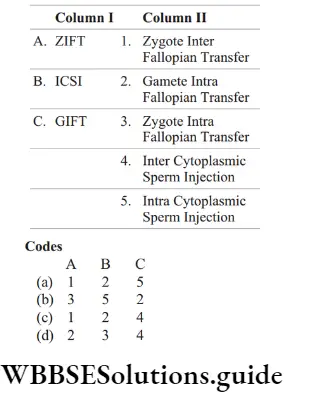
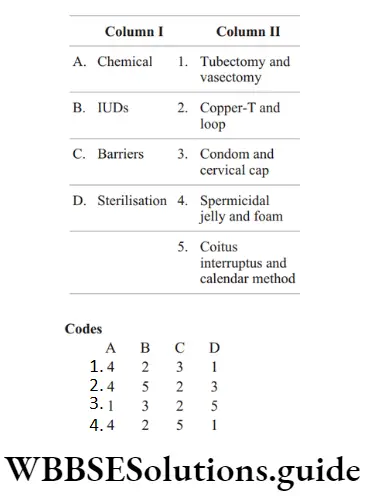
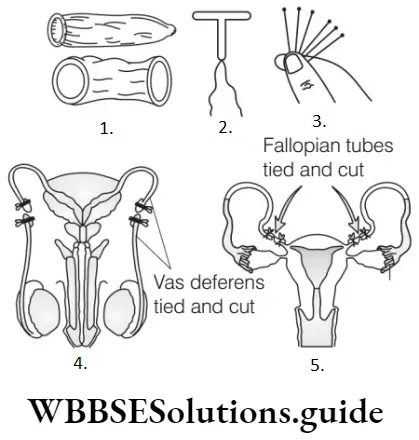
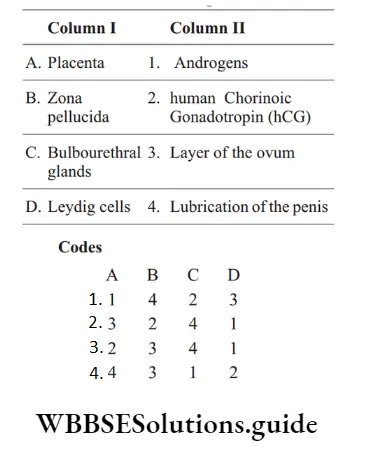
Question 21. Match the following columns.

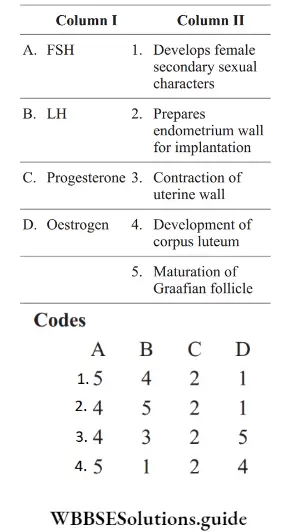
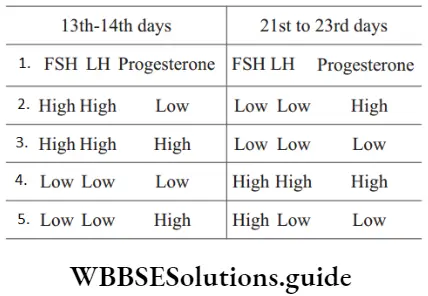
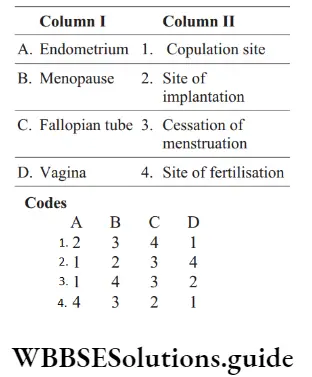
NEET Biology Infertility Question 21 Match The Following Column

Answer:  2. A–3, B–5, C–2

Infertility quiz for NEET preparation

Question 22. Consider the following statements.

  1. Both ZIFT and IUT are embryo transfer techniques.
  2. In both ZIFT and IUT, the number of cells in zygote is same.

Choose the correct option.

  1. Statement 1 is correct, but 2 is incorrect
  2. Statement 1 is incorrect, but 2 is correct
  3. Both statements 1 and 2 are correct
  4. Both statements 1 and 2 are incorrect

Answer:  1. Statement 1 is correct, but 2 is incorrect

  • Statement 1 is correct, but 2 is incorrect because ZIFT (Zygote Intra Fallopian Transfer) is the technique in which zygote or early embryo with up to 8 blastomeres is transferred into the Fallopian tube of female.
  • Whereas in IUT, embryo with more than 8 blastomeres is transferred into the uterus. Thus, difference between ZIFT and IUT lies in number of the cells of the zygote.

Biology MCQ For NEET With Answers

Question 23. Artificial insemination means

  1. Artificial introduction of sperms of a healthy donor into the vagina
  2. Introduction of sperms of a healthy donor directly into the ovary
  3. Transfer of sperms of a healthy donor to a test tube containing ova
  4. Transfer of sperms of husband to a test tube containing ova

Answer:  1. Artificial introduction of sperms of a healthy donor into the vagina

  • In artificial insemination technique, the semen of a healthy donor male is collected and is introduced artificially through a flexible polyethylene catheter into the vagina or uterus.
  • Best results are obtained when the motile sperm count is more than 10 million. The fertilising capacity of spermatozoa (sperms) is for 24- 48 hours. The procedure may be repeated 2-3 times over a period of 2-3 days.

Question 24. Read the statements below and match them to their respective technologies that are given.

  1. Collected gametes are made to form the zygote in the laboratory.
  2. Zygote or early embryo with up to 8 blastomeres is transferred into the oviduct.
  3. Zygote with more than 8 blastomeres, is transferred into the uterus.
  4. Fusion of the gametes in the female reproductive tract.
  5. Transfer of the ovum from a donor to the oviduct of the recipient.
  6. Sperm is injected into the ovum, in vitro.

Choose the correct answer

  1.  GIFT
  2. ZIFT
  3. AI
  4. ICSI
  5.  IUT
  6. IVF
  7. IVI
  8. In vivo fertilisation

Codes

  1. 1-F, 2-B, 3-E, 4-H, 5-A, 6-D
  2. 1-G, 2-B, 3-F, 4-H, 5-A,6-D
  3. 1-G, 2-B, 3-F, 4-H, 5-C, 6-F
  4. 1-F, 2-B, 3-A, 4-H, 5-A, 6-G

Answer: 1. 1-F, 2-B, 3-E, 4-H, 5-A, 6-D

Question 25. In case of a couple, where the male is having a very low sperm count, which technique will be suitable for fertilisation?

  1. Intrauterine transfer
  2. Gamete intracytoplasmic Fallopian transfer
  3. Artificial insemination
  4. Intracytoplasmic sperm injection

Answer:  4.  Intracytoplasmic sperm injection

Infertility due to low sperm count in male partner is overcome by using artificial insemintaion method. In case, the sperm count is very low, a single healthy sperm is injected into an ovum. It is called intra cytoplasmic sperm injection.

NEET Biology Infertility MCQs with explanations

Question 26. Embryo with more than 16 blastomeres formed due to in vitro fertilisation is transferred into

  1. Uterus
  2. Fallopian tube
  3. Fimbriae
  4. Cervix

Answer:  1. Uterus

Embryo with more than 16 blastomeres, formed due to in vitro fertilisation is transferred into uterus for implantation.

Biology MCQ For NEET With Answers

Question 27. First case of IVF-ET technique success was reported by

  1. Bayliss and Starling Taylor
  2. Robert Steptoe and Gilbert Brown
  3. Louis Joy Brown and Benting Best
  4. Patrick Steptoe and Robert Edwar

Answer:  4. Patrick Steptoe and Robert Edwar

  • First test tube baby (IVF-ET technique) was Louis Joy Brown. He was born to Lesley and Gilbert Brown on July 1978 in England under the assistance of Dr. Patrick Steptoe and Dr. Robert Edward.
  • Dr. Robert Edward got Nobel Prize in 2010 for developing a technique for the production of test tube baby.

Question 28. The technique called Gamete Intra Fallopian Transfer (GIFT) is recommended for those females

  1. Who cannot produce an ovum
  2. Who cannot retain the foetus inside uterus
  3. Whose cervical canal is too narrow to allow passage for the sperms
  4. Who cannot provide suitable environment for fertilisation

Answer:  1. Who cannot produce an ovum

  • Gamete Intra Fallopian Transfer (GIFT) is recommended for those females who cannot produce an ovum.
  • In this process, the eggs of the donor woman are removed and in a form of mixture with sperm transferred into Fallopian tube of another woman who cannot produce ovum, but can provide suitable environment for fertilisation. Thus in GIFT, site of fertilisation is Fallopian tube, not laboratory.

Question 29. GIFT technique is useful for women,

  1. Whose fimbriae fail to capture ovum
  2. Who have sperm antibodies in their cervical secretion
  3. Who have at least one potent Fallopian tube
  4. All of the above

Answer:  4. All of the above

GIFT is useful for women with atleast one potent Fallopian tube. It can help those where fimbriae does not function efficiently or presence of spermicidal antibodies in cervical secretions.

Thus, option (4) is correct.

Infertility mock test for NEET aspirants

Question 30. Which of the following is wrongly matched?

  1. IUT – Semen collected from husband or donor is artificially introduced either into the vagina or into the uterus
  2. GIFT – Transfer of embryos with more than 8 blastomeres into the Fallopian tube
  3. ICSI – Sperm directly injected into the ovum
  4. ZIFT – Transfer of embryos with up to 8 blastomeres into the Fallopian tube
  5. IVF – Fertilisation outside the body in almost similar conditions as that in the body

Answer:  2. GIFT – Transfer of embryos with more than 8 blastomeres into the Fallopian tube

Option (2) is wrongly matched pair and can be corrected as GIFT or Gamete Intra Fallopian Transfer is a method of transfer of an ovum collected from a donor female into the Fallopian tube. Rest options are correctly matched pairs.

Biology MCQ For NEET With Answers

Question 31. The stage of cells at which it is transferred into the uterus after induced fertilisation of ova in the laboratory is

  1. Embryo at 4 blastomeres stage
  2. Embryo at 2 blastomeres stage
  3. Morula
  4. Zygote

Answer:  3. Morula

After induced fertilisation, embryo at morula stage is transferred into the uterus.

Question 32. The technique that involves transfer of embryo into oviduct is called

  1. ZIFT
  2. IUT
  3. GIFT
  4. AI

Answer: 1. ZIFT

Question 33. In which of the following techniques, the embryos are transferred to assist those females who cannot conceive?

  1. GIFT and ZIFT
  2. ICSI and ZIFT
  3. GIFT and ICSI
  4. ZIFT and IUT

Answer:  4. ZIFT and IUT

  • Option (4) is the correct answer because the techniques by which the embryos are transterred to assist those females who cannot conceive are ZIFT and IUT. Both are Embryo Transfer (ET) methods.
  • Options (1), (2) and (3) are incorrect. In GIFT, gamete is transferred into the Fallopian tube of female who cannot produce ova. In ICSI, sperm is directly injected into the ovum.

Question 34. The test tube baby programme employs which one of the following techniques?

  1. Intra Cytoplasmic Sperm Injection (ICSI)
  2. Intra Uterine Insemination (IUI)
  3. Gamete Intra Fallopian Transfer (GIFT)
  4. Zygote Intra Fallopian Transfer (ZIFT)

Answer:  4. Zygote Intra Fallopian Transfer (ZIFT)

  • In test tube baby programme, ova from the female and sperms from the male are collected and are induced to form zygote under simulated conditions in the laboratory.
  • The zygote with up to 8 blastomeres could then be transferred into the Fallopian tube (ZIFT or Zygote Intra Fallopian Transfer) and embryos with more than 8 blastomers, into the uterus (IUT or Intra Uterine Insemination) to complete its further development. Thus, the test tube baby programme employs ZIFT technique.

NEET practice test on Infertility chapter

Question 35. In which technique, the donor semen is artificially introduced to the uterus?

  1. Intravaginal insemination
  2. Intrauterine insemination
  3. Intracytoplasmic sperm injection
  4. Gamete intra-Fallopian transfer

Answer:  2. Intrauterine insemination

  • Intra Uterine Insemination (IUI) is a method of Artificial Insemination (AI) in which sperms collected either from the husband or a healthy donor are artificially introduced into the uterus of female.
  • In this technique, about 0.3 mL of washed and concentrated semen (placing unwashed semen directly into uterus can cause severe cramps) having at least 1 million sperms are artificially introduced through a polyethylene catheter into the uterus of the female.

Question 36. Artificial reproductive techniques are not always applicable because

  1. It is an expensive technique, hence only few people can afford it
  2. It is not possible in women with damaged uterine wall
  3. It has raised ethical, legal, and moral concerns
  4. All of the above

Answer:  4. All of the above

ART is expensive and raise ethical moral and legal issues. Although it help to overcome most infertilities, in case of damaged uterine tissue, it cannot be employed. Thus, option (4) is correct.


NEET Biology Medical Termination Of Pregnancy Multiple Choice Question And Answers

Biology MCQs with answers for NEET Medical Termination of Pregnancy (MTP)

Question 1. One of the legal methods of birth control is

  1. By having coitus at the time of day break
  2. By aborting female foetus to decrease female population
  3. Abortion by taking an appropriate medicine
  4. By abstaining from coitus from day 10 to 17 of the menstrual cycle

Answer: 3.  Abortion by taking an appropriate medicine

  • Intentional or voluntary termination of pregnancy by taking an appropriate medicine before full term is called Medical Termination of Pregnancy (MTP) or induced abortion.
  • Nearly 45 to 50 million, MTPs are performed in a year, all over the world which account to 1/5th of the total number of conceived pregnancies in a year.

Read And Learn More: NEET Biology Multiple Choice Question And Answers

Question 2. Legally accepted term of ‘abortion’ is

  1. MTP
  2. MMTP
  3. MTTP
  4. None of these

Answer: 1.  MTP

Legally acceptable term of abortion is MTP (Medical Termination of Pregnancy).

Important MCQs on Medical Termination of Pregnancy for NEET

  1. Medical Termination of Pregnancy
  2. Mental Trauma Phase
  3. Treatment of Menstrual Pain
  4. Both 1  and 3

Answer: 1. Medical Termination of Pregnancy

MTP stands for Medical Termination of Pregnancy.

NEET Biology Medical Termination of Pregnancy MCQs with answers

Question 4. MTP is used to

  1. Discontinue the pregnancy if dangerous for the mother
  2. Get rid of unwanted pregnancy
  3. Discontinue the pregnancy if dangerous for foetus
  4. All of the above

Answer: 4.  All of the above

MTP is used to discontinue the pregnancy if it is dangerous for the mother or foetus and to get rid of unwanted pregnancy. Thus, option (d) is correct.

Question 5. Ethical principles in support of abortion do not include

  1. A woman’s right to autonomous choice
  2. A woman has no moral obligation or duty to carry a foetus
  3. Fertilisation does not automatically bestow moral status on a foetus
  4. Abortion is of utilitarian value to a woman

Answer:  4. Abortion is of utilitarian value to a woman

  • Option 4 does not support the ethical principles of abortion because a sharp distinction exists between those who support a woman’s right to choose abortion and those who oppose abortion on the grounds of foetal rights to life.
  • Abortion does not impart any utilitarian value to a woman. Rest options include in support of ethical principles

Biology MCQs with answers for NEET

NEET Biology Medical Termination Of Pregnancy Multiple Choice Question And Answers

NEET previous year questions on Medical Termination of Pregnancy

Question 6. In India, medical termination of pregnancy (i.e. abortion) was legalised in

  1. 1951
  2. 1961
  3. 1971
  4. 1981

Answer: 3. 1971

In India, the Medical Termination of Pregnancy Act was legalised in 1971.

“mcq reproductive health “

Question 7. Medical Termination of Pregnancy (MTP) is considered safe till how many weeks of pregnancy?

  1. Eight weeks
  2. Twelve weeks
  3. Eighteen weeks
  4. Six weeks

Answer:  2. Twelve weeks

  • Medical Termination of Pregnancy (MTP) or abortion is the termination of pregnancy before the foetus becomes viable.
  • MTP is comparatively safe up to 12 weeks (the first trimester) of pregnancy.
  • It becomes more risky after the first trimester period of pregnancy as the foetus becomes intimately associated with the maternal tissues.

“class 12 reproductive health “

Question 8. MTP can be carried out by

  1. Dilation and curettage
  2. Vacuum aspiration
  3. Administration of prostaglandins
  4. All of the above

Answer: 4. All of the above

  • All given various methods are available to carry out MTP. These include vacuum aspiration, prostaglandin administration, dilation and curettage.
  • Thus, option 4 is correct.

Biology MCQs with answers for NEET

Question 9. What is the latest stage of pregnancy when an abortion can be under taken pursuant to the Medical Termination of Pregnancy Act, 1971?

  1. 26 weeks
  2. 24 weeks
  3. 28 weeks
  4. 20 weeks

Answer: 4. 20 weeks

The Medical Termination Pregnancy Act, 1971 is responsible for the legalisation of abortion. However legally, it can only be performed up to 20 weeks of conception.

NEET quiz on Medical Termination of Pregnancy with solutions

Question 10. MTP along with amniocentesis is being ..A… to abort even normal healthy …B… foetuses.

  1. A-used, B-male
  2. A-misused, B-female
  3. A-helpful, B-female
  4. A-helpful, B-unwanted

Answer: 2.  A–misused, B–female

“questions about reproductive health “

Question 11. Consider the following statements.

  • The MTP (Amedment) Act, 2017 was enacted by government of India to reduce illegal abortions and consequent maternal mortality.
  • The opinion of two registered medical practitioners is required to carryout MTP if pregnancy has lasted more than 12 weeks

Choose the correct option.

  1. Statement 1 is correct, but 2 is incorrect
  2. Statement 1 is incorrect, but 2 is correct
  3. Both statements 1 and 2 are correct
  4. Both statements 1 and 2 are incorrect

Answer: 3. Both statements 1 and 2 are correct

NEET Biology Population Stabilisation And Birth Control Multiple Choice Question And Answers

Biology MCQ For NEET With Answers Population Stabilisation And Birth Control

Question 1. Study of the human population is known as ………… .

  1. Anthropology
  2. Demography
  3. Geography
  4. Ethnology

Answer: 2. Demography

  • Demography is the study of statistics such as births, deaths, income or the incidence of diseases, which illustrate changing structure of the human population.
  • Other options are explained as Anthropology is the study of human behaviour, biology and societies.
  • Geography is the study of places and relationships between people and their environment.
  • Ethnology is the study of the characteristics of different people, differences and relationships between them.

Read And Learn More: NEET Biology Multiple Choice Question And Answers

Question 2. 11th July is observed as

  1. World Population Day
  2. No Tobacco Day
  3. World Environment Day
  4. World Health Day

Answer: 1. World Population Day

  • World Population Day is an annual event that is observed on 11th July every year. It seeks to raise awareness of global population issues.
  • The event was established by the Governing Council of the United Nations Development Programme in 1989.

“neetprep reproductive health “

Question 3. Consider the following statements.

  1. India is the second largest populated country in world.
  2. China’s population is largest among all countries.

Choose the correct option.

  1. Statement 1 is correct, but 2 is incorrect
  2. Statement 1 is incorrect, but 2 is correct
  3. Both statements 1 and 2 are correct
  4. Both statements 1 and 2 are incorrect

Answer:  3. Both statements 1 and 2 are correct

Both statements 1 and 2 are correct as The countries with largest population are as follows

Country    –    Human population

China          –    1341000000
India           –     1210000000
USA             –     311075000
Indonasia     –   237556363
Brazi            –  190732694

Thus, China is most populated country in world and India is the second largest country in terms of population count.

NEET Biology Population Stabilization MCQs with answers

Question 4. Given below is the count of world population in different years.

  1. 1900 – ~ 2 billion
  2. 2000 – ~ 6 billion
  3. 2011 – ~ 7.2 billion

Choose the option containing correctly matched pairs.

  1. 1 only
  2. 1 and 2 only
  3. 1, 2 and 3
  4. 2 and 3only

Answer: 3.  1, 2 and 3

All the given options represent correctly matched pairs. Thus, option (c) is correct.

Biology MCQ For NEET With Answers

NEET Biology Population Stabilisation And Birth Control Multiple Choice Question And Answers

Question 5. Assertion (A) Human population has doubled every 35 years in contrary to 200 years since 1600-1800. Reason (R) Rapid increase is due to the availability of better health facilities.

  1. Both A and R are true and R is the correct explanation of A
  2. Both A and R are true, but R is not the correct explanation of A
  3. A is true, but R is false
  4. Both A and R are false

Answer:  1. Both A and R are true and R is the correct explanation of A.

“mcq reproductive health “

  • Better medical or health facilities play a major role in increasing the population.
  • Invention of vaccines for almost all dreadful diseases for infants and adults has led to the reduction in death rate.

So, the population has doubled every 35 years in contrary to 200 years since 1600-1800.

Question 6. What is meant by population explosion?

  1. Increased frequency of diseases in population
  2. Rapid increase in population number
  3. Rapid decrease in population number
  4. None of the above

Answer:  2. Rapid increase in population number

Rapid increase in population over a relatively short period is called population explosion. In 150 years, from 1700 AD human population has doubled from 0.6 billion to 1.2 billion. In contrast, it increased five times during the next 150 years. In 2011, it was 7 billion.

Important MCQs on Birth Control for NEET

Question 7. A reason for the occurrence of population explosion is

  1. Decline maternal mortality rate
  2. Decline rate of infant mortality
  3. Better medical services
  4. All of the above

Answer:  4. All of the above

Few reasons for population explosion are as follows

  • Decline death rate
  • Decline Maternal Mortality Rate (MMR)
  • Decline rate of infant mortality.
  • Better medical services

Thus, option 4 is correct.

Biology MCQ For NEET With Answers

Question 8. Assertion (A) Overpopulation has become a serious problem in developing countries. Reason (R) It leads to exhaustion of natural resources, causes unemployment and increases pollution.

  1. Both A and R are true and R is the correct explanation of A
  2. Both A and R are true, but R is not the correct explanation of A
  3. A is true, but R is false
  4. Both A and R are false

Answer:  1. Both A and R are true and R is the correct explanation of A.

Overpopulation may exhaust natural resources, causes unemployment and increases pollution, especially in developing countries.

Question 9. Certain demographic features of developing countries are

  1. High fertility, low or rapidly falling mortality rate, rapid population growth and a very young age distribution
  2. High fertility, high density, rapidly rising mortality rate and a very young age distribution
  3. High infant mortality, low fertility, uneven population growth and a very young age distribution
  4. High mortality, high density, uneven population growth and a very old age distribution

Answer:  1. High fertility, low or rapidly falling mortality rate, rapid population growth and a very young age distribution

Some characteristic demographic features of developing countries are high fertility, low or rapidly falling mortality rate rapid population growth and a very young age distribution.

Question 10. The year 1927 saw a decline in population. The reason for this is

  1. First World War
  2. Flood
  3. Food scarcity
  4. Second World War

Answer: 3. Food scarcity

  • The decline in population in 1927 occurred due to food scarcity.
  • First World War took place within year 1916 to 1918 and second World War took place between 1940 to 1942.

Question 11. In India, human population is heavily weighted towards younger age groups as a result of

  1. Short lifespan of many individuals and low birth rate
  2. Long lifespan of many individuals and low birth rate
  3. Short lifespan of many individuals and high birth rate
  4. Long lifespan of many individuals and high birth rate

Answer:  3. Short lifespan of many individuals and high birth rate

In India, human population is heavily weighted towards the younger age group as a result of high birth rate and short lifespan of many individuals.

Biology MCQ For NEET With Answers

Question 12. Where we can find overstrained infrastructure due to population growth?

  1. In rural areas
  2. In forest areas
  3. In desert areas
  4. In urban areas

Answer:  4. In urban areas

  • Due to overpopulation, growth facilities such as housing, transportation, healthcare and education become inadequate.
  • The worst symptoms of congestion in every aspect of living conditions are manifested in the urban areas.

Question 13. In India, the Population Policy was announced in the year

  1. 1971
  2. 1976
  3. 1978
  4. 1981

Answer: 2. 1976

“questions about reproductive health “

In April 1976, India framed its first ‘National Population Policy’.

It was called for an increase in the legal minimum age of marriage from 15 to 18 for females and from 18 to 21 for males.

Question 14. Practice which does not help greatly in arresting population explosion is

  1. Use of contraceptives by the married couple
  2. Educating the masses about the benefits of planned family
  3. Vasectomy and tubectomy
  4. Early child marriage

Answer: 4. Early child marriage

  • Early child marriage does not help in arresting population explosion.
  • It contributes to higher total fertility as women marrying earlier tend to both have children earlier and bear more children over their lifetime than if, they had married later.
  • Whereas use of contraceptives by married couples, vasectomy and tubectomy, educating the masses about the benefits of planned family helps in arresting population explosion.

NEET quiz on Population Stabilization and Birth Control with solutions

Question 15. What is the need to control the population growth in India?

  1. To improve the standard of living among existing people
  2. To utilise all the natural resources among the existing people
  3. To participate in war among neighbouring nations
  4. To increase the mortality rate in India

Answer:  1. To improve the standard of living among existing people

  • The need for controlling population growth is urgent and pressing, so that the existing people may have an improved standard of living.
  • Overpopulation causes various ill effects on both humans and as well as on the environment.

Biology MCQ For NEET With Answers

Question 16. Which of the following parameter of the population can be negative?

  1. Birth rate
  2. Replacement level
  3. Growth rate
  4. All of the above

Answer:  3. Growth rate

Population growth rate is the annual average growth rate. It can be a negative parameter. Birth rate and replacement level can never be negative.

Question 17. The best way to control population is

  1. Educating people on the importance of small families
  2. Family planning
  3. Better living conditions
  4. Better healthcare

Answer:  2. Family planning

  • Family planning is the best way to control population.
  • It allows people to attain their desired number of children and determines the spacing of pregnancies.

Question 18. ‘Hum Do Hamare Do’ slogan encourages

  1. Family planning
  2. Immunisation
  3. Electronic growth
  4. Patriotism

Answer: 1. Family planning

“class 12 reproductive health “

‘Hum do Humare Do’ slogan encourages family planning.

Question 19. Assertion (A) Zero population growth should be achieved as early as possible to control human population. Reason (R) This demands a couple to have more than two children.

  1. Both A and R are true and R is the correct explanation of A
  2. Both A and R are true, but R is not the correct explanation of A
  3. A is true, but R is false
  4. Both A and R are false

Answer: 3. A is true, but R is false

  • A is true, but R is false because two children per couple holds good for zero population growth.
  • But in large democratic countries like India, it will take many years for population growth to attain the zero level because couple need to have less than two children to obtain zero growth.

Biology MCQs with answers for NEET

Question 20. The …………… forbids the practice of child marriages in India.

  1. The Children Act, 1960
  2. Dowry Prohibition Act, 1961
  3. Prohibition of Child Marriage Act, 2006
  4. Commissions for the Protection of Child Rights

Answer:  3. Prohibition of Child Marriage Act, 2006

  • According to the Prohibition of Child Marriage Act (PCMA), 2006, child marriage is a marriage in which the boy is under the age of 21 years and the girl is lesser than 18 years of age.
  • It came into effect from 1st November 2007, replacing the Child Marriage Restraint Act (CMRA) of 1929 or Sharda Act.
  • This law was amended in 1978, wherein the legal age of marriage of girls was raised from 15 to 18 years and of boys from 18 to 21 years. The amended law was known as the Child Marriage Restraint Act, 1929.

Question 21. Age group in a population is classified on the basis of

  1. Reproduction rate
  2. Death rate
  3. Age of marriage
  4. Sex ratio

Answer:  1. Reproduction rate

Age groups in a population are classified on the basis of reproductive age. Three major age groups are as follows

  • People aged 30-44-Post reproductive years
  • People aged 15-29-Reproductive years
  • People aged 0-14-Pre-reproductive years

Question 22. Increasing the minimum marriageable age of girls and boys

  1. Reduces the child bearing period of a married couple
  2. Increases the child bearing period
  3. First increases and then decreases the child bearing period
  4. No effect

Answer:  1. Reduces the child bearing period of a married couple

Raising the minimum age of marriage reduces the fertility (child bearing) period, thereby the chances of birth become less

Biology MCQs with answers for NEET

Question 23. Consider the following statements.

  1. Reproductive potential is maximum reproductive capacity of a population under optimal conditions.
  2. Pouplation shows highest fertility in botic potential.

Choose the correct option.

  1. Statement 1 is correct, but 2 is incorrect
  2. Statement 1 is incorrect, but 2 is correct
  3. Both statements 1 and 2 are correct
  4. Both statements 1 and 2 are incorrect

Answer:  2. Statement 1 is incorrect, but 2 is correct

  • Statement I is incorrect, but II is correct because, Biotic potential I is the maximum reproductive capacity of a population under optimum environmental conditions.
  • Whereas, reproductive potential is the relative capacity of a species to reproduce itself under optimum conditions.

Question 24. ‘Sex ratio’ simply refers to

  1. Number of males/1000 females
  2. Number of females/1000 males
  3. Both 1 and 2
  4. None of the above

Answer: 2. Number of females/1000 males

Sex ratio refers to the number of females /1000 males in the population. It is an important social indicator to measure the extent of prevailing equity between males and females in a society at a given point of time.

“reproductive health bank of biology “

Question 25. According to the census of 2011, the state to show poorest sex ratio is

  1. Kerala
  2. Gujarat
  3. West Bengal
  4. Haryana

Answer: 4. Haryana

According to the census, 2011, Haryana has the lowest sex ratio (877) in Indian states, while the union territory, Daman Diu has lowest sex ratio of 618.

Question 26. ………… is responsible for declining female:male ratio.

  1. Marriage
  2. Female foeticide
  3. Contraceptives
  4. Coitus interruptus

Answer: 2. Female foeticide

Female foeticide involves the process of finding out the sex of the foetus and then aborting it, if it is a girl. It is the major factor for declining female to male ratio.

Biology MCQs with answers for NEET

Question 27. The vital index means

  1. Natality – Mortality
  2. Natality – Mortality/100
  3. Mortality – Natality
  4. Natality- Mortality × 100

Answer: 4. Natality- Mortality × 100

  • Vital index is defined as the ratio of births to deaths within a population during a given time.
  • Birth rate or natality rate is defined as number of births per 1000 individuals of a population per year.
  • Death rate or mortality rate is generally expressed as number of deaths per 1000 individuals of a population per year. Therefore, the formula of vital index is Natality x 100 Mortality

Question 28. The best permanent measure to arrest overpopulation is

  1. Employing vasectomy and tubectomy on the deserving partners of the couple
  2. Use of condoms by the partners of the couple
  3. Coitus interruptus
  4. Safe period method

Answer: 1. Employing vasectomy and tubectomy on the deserving partners of the couple

The best (more or less) permanent measure to arrest overpopulation and birth control is option 1, while options 2, 3 and 4 have a limited advantage.

Question 29. The success of birth control programmes in controlling population growth is dependent on

  1. Use of contraceptives
  2. Tubectomy
  3. Vasectomy
  4. Acceptability of the above procedures by people

Answer: 4. Acceptability of the above procedures by people

The success of birth control programmes in controlling population growth is dependent on acceptability of the use of contraceptives, tubectomy and vasectomy by all people of society.

Question 30. Natural methods of contraception involve

  1. Increased spermicidal activity
  2. Preventing fertilisation
  3. Decreasing mortality
  4. Increasing mortality

Answer: 2. Preventing fertilisation

Natural methods of contraception are natural ways to prevent fertilisation. These methods do not employ the use of any device or medicine.

Biology MCQs with answers for NEET

Question 31. Which of the following is abstinence method for birth control?

  1. Use of condom
  2. Use of diaphragm
  3. Tubectomy
  4. Avoiding intercourse

Answer:  4. Avoiding intercourse

Abstinence means avoiding intercourse when the chances of conception are the highest.

Whereas use of condom, diaphragm and tubectomy are measures for birth control.

Question 32. Periodic abstinence is avoiding intercourse during the …………… of menstrual cycle.

  1. Luteal phase
  2. Ovulatory phase
  3. Menstrual phase
  4. None of these

Answer:  2. Ovulatory phase

In periodic abstinence, intercourse is avoided by couple during the ovulatory phase of menstrual cycle.

Question 33. Risky period of conception’, here refers to ‘period’

  1. 3rd to7th day
  2. 7th to13th day
  3. 12th to14th day
  4. 17th to25th day

Answer: 3. 12th to14th day

  • A female is most fertile at the time of ovulation, which usually occurs 12th to14th days before the next period starts.
  • This is the time of the month when the female is most likely to get pregnant, i.e. it is the risky period of conception.

Question 34. ‘Safe period’ a means of birth control is based on

  1. Ovulation occurs on the 14th day of menstrual cycle
  2. Ovum survives for about 2 days
  3. Sperms remain alive for about 3 days
  4. All of the above

Answer:  4. All of the above

“reproductive health bank of biology “

  • ‘Safe period’ refers to the days when a woman has minimal chances of getting pregnant.
  • Ovulation occurs on the 14th day of menstrual cycle, ovum survives for about two days and if insemination takes place then sperms remains active for three days in female reproductive tract.
  • During this period, chances of fertilisation are very high thus, one should abstain from coitus from day 10th to17th of menstrual cycle when ovulation could be expected.
  • If one consider these parameters, they can calculate their safe period according to their menstrual cycle. Thus, option 4 is correct.

Biology MCQs with answers for NEET

Question 35. The temporary method of birth control which involves withdrawal of the penis by male before ejaculation is

  1. Vasectomy
  2. Coitus interruptus
  3. Spermicides
  4. IUCD

Answer:  2. Coitus interruptus

Coitus interruptus, also known as withdrawal or the pull-out method, is a method of birth control in which the male partner, during sexual intercourse, withdraws his penis from a woman’s vagina prior to ejaculation.

Question 36. Identify the natural contraception methods.

  1. Implantation
  2. Lactational amenorrhea
  3. Condoms
  4. Vasectomy
  5. Tubectomy
  6. Sterilisation

Choose the correct option.

  1. 1 and 2
  2. 3 and 4
  3. 5 and 4
  4. Only 2

Answer:  4. Only 2

Among the listed methods, lactational amenorrhea is the natural contraception method to prevent unwanted pregnancies.

Question 37. Lactational amenorrhea is

  1. Absence of menses in adult age
  2. Late onset of menses
  3. Absence of menses during lactation
  4. No menses during pregnancy

Answer: 3. Absence of menses during lactation

Lactational amenorrhea refers to the absence of menstruation during intense lactation period. This method is effective only up to maximum period of six months after childbirth.

Question 38. Assertion (A) A woman rarely, conceives during lactation period. Reason (R) Ovulation does not occur during lactation in a postpartum woman.

  1. Both the A and R are true and R is the correct explanation of A
  2. Both A and R are true, but R is not the correct explanation of A
  3. A is true, but R is false
  4. Both A and R are false

Answer: 1. Both A and R are true and R is the correct explanation of A.

  • Lactational amenorrhea method is based on the fact that ovulation do not occur during the period of intense lactation following parturition.
  • Therefore, as long as the mother breast feeds the child, chances of conception are almost nil.

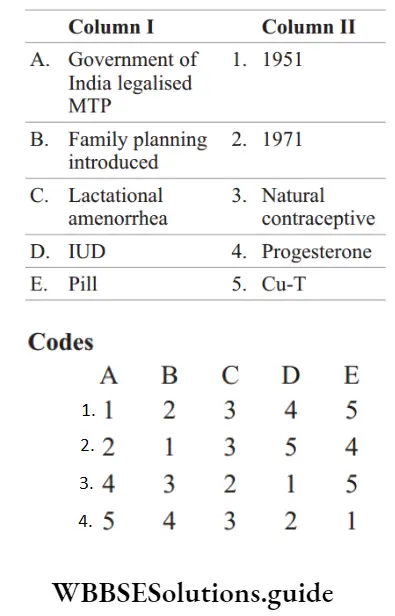
Question 39. Match the following columns.

NEET Biology Population Stabilisation and Birth Control Question 39 Match The Following Columns

Answer: 2. A-2, B-1, C-3, D-5, E-4

Question 40. Ovulation does not occur in lactating mothers because of the release of

  1. Inhibin
  2. Prolactin
  3. Prostaglandin
  4. Oxytocin

Answer:  2. Prolactin

  • In lactating mother, the release of prolactin helps in the production of milk.
  • This hormone suppresses the release of Follicle Stimulating Hormone (FSH), so during intense lactation, ovulation does not occur.

Question 41. The use of contraceptive during lactation

  1. Decreases milk secretion
  2. Increases milk production
  3. Enhances the antibody production
  4. Both 2 and 3

Answer: 1. Decreases milk secretion

“reproductive health bank of biology “

According to WHO study, users of the combined and contraceptive pills experienced a 42% decline in milk volume after 18 weeks and they excrete small quantities of antibodies in their breast milk, which can have adverse effects on child.

Biology MCQs with answers for NEET

Question 42. Birth control devices are mass produced and sold at nominal prices by government to

  1. Control price rise of articles
  2. Gain entry in the field of competition
  3. Control population explosion
  4. Compete with foreign countries

Answer:  3. Control population explosion

Birth control devices are mass produced and sold at nominal prices by government to control population explosion.

Question 43. A contraceptive is

  1. Condom, cervical cap or diaphragm
  2. Intrauterine device
  3. Pill
  4. All of the above

Answer:  4. All of the above

Condom, cervical cap, IUD and pills (combined pills and minipills) are the contraceptives that are used as birth control measures. Thus, option 4 is correct.

Question 44. An ideal contraceptive should have which of the following characteristics?

  1. User friendly
  2. Easily available
  3. Cheap and effective
  4. Interrupt coitus
  5. Expensive and effective

Choose the correct answer

  1. 1, 3 and 4
  2. 1, 4 and 5
  3. 1, 2 and 3
  4. 2, 4 and 5

Answer: 3. 1, 2 and 3

An ideal contraceptive should be user friendly, easily available, cheap, effective and reversible with least side effects.

It should not interfere with the sexual drive, desire and sexual act or coitus of the user.

Question 45. An example of mechanical barrier in men that help in family planning is

  1. Condom
  2. Mala-D
  3. IUD
  4. Copper-T

Answer: 1. Condom

  • Mechanical barriers are devices that provide a physical barrier between the sperm and the egg. Examples of mechanical barriers include the male condom, female condom, diaphragm, cervical cap and sponge.
  • The condom is the only contraceptive method that helps to prevent Sexually Transmitted Infections (STIs).

Question 46. How are condoms helpful?

  1. They decrease sperm motility
  2. They increase sperm motility
  3. They act as a barrier to prevent fusion of sperm and ova
  4. They increase phagocytosis

Answer:  3. They act as a barrier to prevent fusion of sperm and ova

  • Condoms are the barriers madeup of thin rubber/latex sheath used to cover the penis in the male and vagina or cervix in female.
  • They prevent the deposition of the ejaculated semen into the vagina of the female. Thus, they prevent the fusion of sperm and ova.

NEET expected MCQs on Birth Control 2025

Question 47. Assertion (A) Use of condoms safeguards a person against sexual diseases such as AIDS and also keep a check on unwanted pregnancy. Reason (R) Certain contraceptives are planted under the skin of the upper arm to prevent pregnancy.

  1. Both A and R are true and R is the correct explanation of A
  2. Both A and R are true, but R is not the correct explanation of A
  3. A is true, but R is false
  4. Both A and R are false

Answer: 2. Both A and R are true, but R is not the correct explanation of A.

  • AIDS can be prevented by using condoms that are a kind of barrier contraceptives.
  • Contraceptive planted under the skin are called implant and these have synthetic steroid preparation. It works similar to the contraceptive pills.

Question 48. Female condoms are also known as

  1. Femidom
  2. Ring condom
  3. Caps
  4. All of the above

Answer:  1. Femidom

Femidom term is used for female condoms.

Question 49. …………. are counterparts of condom for females.

  1. IUCD
  2. Condom
  3. Diaphragm and cervical cap
  4. Copper-T

Answer: 3. Diaphragm and cervical cap

Diaphragm and cervical cap are counterparts of condom for females. Other options are explained as IUCD, is an Intrauterine Contraceptive Device, which is a small device made from plastic and copper. These are planted inside the uterus. It is also known as coil and copper-T is one of its example.

“reproductive health bank of biology “

Question 50. Which of the following is a mechanical barrier used in birth control?

  1. Loop
  2. Dalcon shield
  3. Copper-T
  4. Diaphragm

Answer:  4. Diaphragm

  • The diaphragm is a shallow, dome-shaped cup with a flexible rim that fits securely in the vagina to cover the cervix.
  • It blocks the semen from entering the cervix and thus, it is a mechanical barrier used in birth control. Loop, Dalcon shield and copper-T are intrauterine devices.

Question 51. The action of vaginal diaphragm is to

  1. Prevent the ova to come in the uterus
  2. Prevent the sperm to come in contact with ova
  3. Act as a spermicidal agent
  4. Prevent the implantation of a zygote

Answer: 2. Prevent the sperm to come in contact with ova

The diaphragm covers the cervix and physically prevents sperm from entering the uterus. The spring in the rim of the diaphragm forms a seal against the vaginal walls. These are inserted deep into the vagina and prevent the sperm to come in contact with ova.

Question 52. Diaphragms are contraceptive devices, used by females.

  1. They are introduced into the uterus.
  2. They are placed to cover the cervical region.
  3. They act as physical barriers for sperm entry.
  4. They act as spermicidal agents.

Choose the option containing correct statements for diaphragm.

  1. 1 and 2
  2. 1 and 3
  3. 2 and 3
  4. 3 and 4

Answer: 3. 2 and 3

  • Statements 2 and 3 are correct for diaphragm whereas 1 and 4 are incorrect.
  • These can be corrected as Diaphragm is placed in vagina and it acts as a mechanical barrier for contraception.

Question 53. Spermicidal cream used as the coating of condoms, diaphragms, cervical cap and vaults are meant

  1. For lubrication
  2. To prevent infection
  3. For increasing effectiveness
  4. To provide medication

Answer: 3. For increasing effectiveness

Spermicidal creams contain chemicals, which kill the sperms. If they are used along with the barrier contraceptives, the effectiveness of contraception increases.

Question 54. Jellies and cream

  1. Are spermicidal in nature
  2. Entangle the sperms
  3. Prevent the release of ova
  4. Enable the sperms to reach towards ovum rapidly

Answer: 1. Are spermicidal in nature

When spermicidal tablets, foam, jellies and cream are introduced into the vagina before sexual intercourse, it adheres to the mucous membrane and kills the sperm. Thus, these are spermicidal in nature.

Question 55. Which of the following is a method of birth control?

  1. IUDs
  2. ZIFT
  3. GIFT
  4. 4F-ET

Answer:  1. IUDs

Among the listed options, IUDs help in birth control. Other options represent assisted reproductive techniques which are explained as

  • ZIFT is Zygote Intra Fallopian Transfer
  • GIFT is Gamete Intra Fallopian Transfer
  • IVF-ET is In Vitro Fertilisation and Embryo Transfer

Question 56. IUD refers to

  1. Intra Uterus Device
  2. Intra Uterine Device
  3. Inter Uterine Device
  4. Inter Ureter Device

Answer: 2.  Intra Uterine Device

The full form of IUD is Intra Uterine Device.

“reproductive health bank of biology “

Question 57. Which one of the following is the most widely accepted method of contraception in India at present?

  1. Cervical caps
  2. Tubectomy
  3. Diaphragms
  4. IUDs

Answer:  4. IUDs

IUDs are ideal contraceptives for females who want to delay pregnancy. They are one of the widely accepted methods of contraception in India. On the other hand, cervical caps, tubectomy and diaphragms also act as contraceptives

Question 58. Intrauterine devices are used to prevent

  1. The sperm from reaching the egg
  2. The sperm from leaving the male reproductive system
  3. The sperm from surviving for many days in the female reproductive system
  4. All of the above

Answer:  1. All of the above

The Intra Uterine Device (IUD) causes a foreign body reaction in the uterus, thus leading to cellular and biochemical changes in the endometrium and uterine fluids. These changes impair the viability of the gamete and thus, prevent sperms from reaching the egg.

NEET Biology Birth Control MCQs with explanations

Question 59. Which of the following is a correct statement ?

  1. IUDs once inserted need not be replaced
  2. IUDs are generally inserted by the user herself
  3. IUDs increase phagocytosis of sperms in the uterus
  4. IUDs suppress gametogenesis

Answer: 3. IUDs increase phagocytosis of sperms in the uterus

Statement in option 3 is correct. Rest of the statements are incorrect and can be corrected as

  • IUDs can be replaced as this is a reversible contraception method.
  • IUDs are inserted by doctors or expert nurses in the uterus through vagina.
  • IUDs do not affect gametogenesis.

Question 60. The material used in manufacturing IUDs is

  1. Plastic only
  2. Metal only
  3. Plastic or metal
  4. Latex sheaths

Answer: 3. Plastic or metal

IUDs are manufactured using plastics or metal objects

Question 61. Disadvantages of IUD include

  1. Haemorrhage
  2. Chances of infection
  3. Spontaneous expulsion of IUD
  4. All of the above

Answer:  4. All of the above

  • Disadvantages of IUD includes haemorrhage, chances of infection and spontaneous expulsion of IUD. Menstruation flow may become heavier, longer or more painful, though this may improve after a few months.
  • It does not protect against STD, so the user may need to use condoms as well. If the user get an infection through fitted IUD, it could lead to a pelvic infection, if not treated. Most women stop using an IUD because of vaginal bleeding and pain, although these side effects are uncommon. Thus, option 4 is correct.

Question 62. An example of non-medicated IUD is

  1. Cu-T
  2. Cu-7
  3. Multiload-375
  4. Lippes loop

Answer:  4. Lippes loop

Lippes loop is a non-medicated IUD. It is a flexible polyethylene plastic loop of appropriate size for the uterine cavity. On the other hand, Cu-T, Cu-7, Multiload 375 are medicated intrauterine devices.

Question 63. Who discovered Lippes loop?

  1. Jack Lippes
  2. Daniel Lippes
  3. R L Lippes
  4. None of these

Answer:  1. Jack Lippes

In 1960, Jack Lippes made the first model of his ‘Double-S’ intrauterine contraceptive device, Lippes loop.

Question 64. Which IUD increases the phagocytosis of the sperms within the uterus?

  1. Non-medicated IUD
  2. Copper releasing IUD
  3. Both 1 and 2
  4. Hormone releasing IUD

Answer:  3. Both 1 and 2

  • Both IUDs in option 1 and 2, increase phagocytosis of sperms within the uterus.
  • They are available in the form of non-medicated IUDs, copper releasing IUDs and the hormone-releasing IUDs. Thus, option 3 is correct.

Question 65. Among the following methods of contraception, which can be regarded as the most cost effective reversible contraceptive?

  1. Copper-T
  2. Oral pills
  3. Tubectomy
  4. Vasectomy

Answer: 1. Copper-T

Among the given options, copper-‘T’ is the most effective method of reversible contraception.

Question 66. An example of copper releasing IUD is

  1. Cu-T
  2. Cu-7
  3. Multiload-375
  4. All of these

Answer:  4. All of these

Copper releasing IUDs that are frequently used include Cu-T, Cu-7 and Multiload-375. Thus, option (d) is correct.

“reproductive health bank of biology “

Question 67. Cu-T prevents pregnancy by preventing

  1. Fertilisation
  2. Ovulation
  3. Implantation of fertilised egg
  4. None of the above

Answer: 1. Fertilisation

  • Cu- T is an intrauterine copper releasing IUD. This device is inserted by doctors in the uterus through vagina.
  • Cu ions that are released in the uterus suppress sperm motility and the fertilising capacity of the sperms. Thus, it prevents pregnancy by preventing fertilisation.

Question 68. The function of copper ions in copper releasing IUDs is

  1. They suppress sperm motility and fertilising capacity of sperms
  2. They inhibit gametogenesis
  3. They make uterus unsuitable for implantation
  4. They inhibit ovulation

Answer: 1. They suppress sperm motility and fertilising capacity of sperms

Cu2+obstructs sperm motility in the female genital tract and thus, supresses fertilising capacity of sperms.

Question 69. Select the hormone releasing intrauterine devices.

  1. Vaults, LNG-20
  2. Multiload-375, Progestasert
  3. Progestasert, LNG-20
  4. Lippes loop, Multiload-375

Answer:  3. Progestasert, LNG-20

  • Progestasert and LNG-20 are hormone releasing IUDs, which make the uterus unsuitable for implantation and the cervix hostile to sperms.
  • In contrast, vaults are mechanical contraceptives, Multiload-375 and Lippes loop are non-hormonal IUDs for preventing pregnancy.

Question 70. Progestogens alone or in combination with oestrogens can be used as a contraceptive in the form of Reason (R) These hormones inhibit ovulation.

  1. Only implants
  2. Only injections
  3. pills, injections and implants
  4. Only pills

Answer: 3.  pills, injections and implants

  • Progestogens alone or in combination with oestrogens can be used as a contraceptive in the form of pills, injections and implants under the skin.
  • They inhibit ovulation and implantation of the zygote as well as alter the quality of cervical mucus to prevent/retard entry of sperm.

Question 71. Which is the hormonal method of birth control?

  1. Pill
  2. IUD
  3. Vasectomy
  4. Femidom

Answer: 1. Pill

  • Use of oral contraceptive pills is the hormonal method of birth control. Pills have to be taken daily for the period of 21 days starting preferably within the first five days of menstrual cycle.
  • After a gap of 7 days (during which menstruation occurs), it has to be repeated in the same pattern till female desires to prevent conception.

Question 72. Which of the following contraceptive methods do involve a role of hormone?

  1. Lactational amenorrhea, pills, emergency contraceptives
  2. Barrier method, lactational amenorrhea, pills
  3. Cu-T, pills, emergency contraceptives
  4. Pills, emergency contraceptives, barrier methods

Answer: 1.  Lactational amenorrhea, pills, emergency contraceptives

  • In lactational amenorrhea, due to high prolactin level, gonadotropin level decreases. Oral pills are either progestogens or progestogen-oestrogen combinations used by the females.
  • Emergency contraceptives include the administration of progestogens or progestogen-oestrogen combination or IUDs within 72 hours of coitus. So, lactational amenorrhea, oral pills and emergency contraceptives involve a role of hormone.

Question 73. Assertion (A) There is no male contraceptive oral pill available as yet. Reason (R) Male spermatogenic cycles are erratic.

  1. Both A and R are true and R is the correct explanation of A
  2. Both A and R are true, but R is not the correct explanation of A
  3. A is true, but R is false
  4. Both A and R are false

Answer: 3.  A is true, but R is false.

Although, there is ongoing research into a male contraceptive pill, but these are not available yet. To develop one such pill, male spermatogenic cycle is required to be studied in details. Like mentioned, it is not erratic, but occur in a sequential manner.

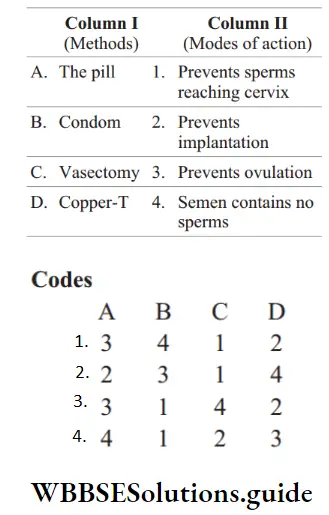
Question 74. Given below are the four methods and their modes of action in achieving contraception. Choose the correct mode of action in Column I for the methods in Column 2.

NEET Biology Population Stabilisation and Birth Control Question 74 Match The Following Columns

Answer:  3. A-3, B-1, C-4, D-2

Mock test on Birth Control for NEET preparation

Question 75. Administration of progesterone, progestogen-oestrogen combination and IUDs are effective in

  1. 72 hrs
  2. 48 hrs
  3. 24 hrs
  4. 96 hrs
  5. Answer: 1. 72 hrs

Administration of oral contraceptives is effective in 72 hours. Oral contraceptive pills increase the risk ofintravascular clotting. Therefore, they are not recommended for women with a history of disorders of blood clotting.

Question 77. One of the following is not a method of contraception. Which one?

  1. Condoms
  2. Pills of a combination of oxytocin and vasopressin
  3. Lippes loop
  4. Tubectomy

Answer: 2. Pills of a combination of oxytocin and vasopressin

  • Oxytocin is a birth hormone that induces foetal ejection reflex and milk ejection following parturition.
  • Vasopressin (antidiuretic hormone) reabsorbs water from the renal tubules to conserve water in the body. They have no role in contraception.

Question 78. Consider the following statements and choose the right ones.

  1. MTP is safe in 2nd trimester.
  2. Generally, chances of conception are nil until mother breast feed the child for two years.
  3. Intrauterine devices like copper-T are effective contraceptive.
  4. Contraceptive pills may be taken up to one week after coitus to prevent conception.

Choose the correct answer

  1. 3 and 4
  2. 1 and 3
  3. 1 and 2
  4. 2 and 3

Answer:  1. 3 and 4

  • Statements 3 and 4 are correct whereas I and II are incorrect. These can be corrected as
  • MTP (Medical Termination of Pregnancy) is safe until the first trimester (12 weeks) and chances of conception are nil until the mother breast feed child, up to six months only.

“reproductive health bank of biology “

Question 79. Pills have to be taken daily for period of … A… day preferably, starting within first five days of menstrual cycle.

It has to be restarted in the same pattern after a gap of …B… days.

  1. A–27, B–1
  2. A–21, B–7
  3. A–22, B–5
  4. A–24, B–4

Answer: 2. A–21, B–7

  • Oral contraceptive pills (oral pills) are used in the form of tablets therefore, they are called ‘pills’.
  • Pills have to be taken daily for the period of 21 (A) days, starting within the first five days of menstrual cycle.  After a gap of 7 (B) days, it has to be repeated.

Question 80. What role do contraceptive pills carry out?

  1. They inhibit ovulation and implantation.
  2. They alter the quality of cervical mucus to prevent or retard the entry of sperms.
  3. They prevent the ejaculated semen from entering the female vagina.
  4. They inhibit spermatogenesis.

Choose the correct option.

  1. 1, 2 and 4
  2. 1, 2 and 3
  3. 1 and 2
  4. 1, 2, 3 and 4

Answer:  3. 1 and 2

Oral pills inhibit ovulation and implantation. They alter the quality of cervical mucus to prevent or retard the entry of sperm. But they have no role in preventing spermatogenesis and insemination. Thus, option 3 is correct.

Question 81. Assertion (A) Ovulation is controlled by the hormone oestrogen. Reason (R) Contraceptives are therefore, made up of both oestrogen and progesterone.

  1. Both A and R are true and R is the correct explanation of A
  2. Both A and R are true, but R is not the correct explanation of A
  3. A is true, but R is false
  4. A is false, but R is true

Answer:  4. A is false, but R is true.

Assertion can be corrected as The process of ovulation is controlled by the hypothalamus of the brain and through the release of hormones, Luteinizing Hormone (LH) and Follicle-Stimulating Hormone (FSH).

secreted by the anterior lobe of the pituitary gland.

Question 82. Which of the following contraceptive devices makes uterus unsuitable for implantation?

  1. Progestasert
  2. Cu-T
  3. Lippes loop
  4. Multiload

Answer: 1. Progestasert

Progestasert is a hormone releasing IUD, which makes the uterus unsuitable for implantation and cervix hostile to the sperms.

Question 83. Which hormone of the female body is suppressed by the oral contraceptive pills?

  1. FSH
  2. Oestrogen
  3. Progesterone
  4. Testosterone

Answer:  1. FSH

  • Contraceptive pills contain progestogens and oestrogen hormones.
  • These hormones suppresses the FSH (Follicle Stimulating Hormone) which stimulates follicle growth and ovulation.

Question 84. An example of daily oral contraceptive pill is

  1. Saheli
  2. Mala-D
  3. I-pill
  4. All of these

Answer:  2. Mala-D

  • Regular dose oral contraceptive pill can be used as post-coital pill in prescribed dose. Currently available daily oral pills are Mala-D and Mala-N. Mala-N or combined oral contraceptives use two hormones (oestrogen and progestin) to prevent pregnancy.
  • Other options are explained as Saheli, the new oral contraceptive for the females contains a non-steroidal preparation.
  • It is a once a week pill with very few side effects and high contraceptive value.
  • I-pill is used as an emergency contraceptive tablet to prevent unwanted pregnancy in case of unprotected sex or contraception faliure.

Question 85. Use of the pill is associated with an increased risk of

  1. Stroke
  2. Endometrial cancer
  3. Ovarian cancer
  4. All of the above

Answer: 1. Stroke

  • Oral contraceptive pills have been associated with increased risk for myocardial infarction, stroke and venous thromboembolism.
  • Studies have been published recently that suggest that these risks are minimal in appropriately chosen low risk women.

NEET practice test on Population Stabilization

Question 86. Which among the following is regarded as an absolute contraindication of oral contraceptive pill ?

  1. Eczema/Dermatitis
  2. Lactating mother
  3. Carcinoma breast
  4. Epilepsy

Answer: 3. Carcinoma breast

Absolute contraindications of oral contraceptive pills include thrombophlebitis or thromboembolic disorders, cerebrovascular or coronary artery disease, carcinoma of the breast or other oestrogen- dependent neoplasia, undiagnosed abnormal genital bleeding, known or suspected pregnancy, benign or malignant liver tumour.

Question 87. The difference of oral contraceptives and hormonal implants.

  1. Differ in sites of implantation
  2. Differ in duration of action
  3. Both 1 and 2
  4. Differ in constituents

Answer:  3. Both 1 and 2

Hormonal implants and oral contraceptives have the combination of oestrogen and progestogen hormones.

Their mode of working is same but the site of implantation and the duration of action is different. Thus, option 3 is correct.

“reproductive health bank of biology “

Question 88. The oral contraceptive developed at CDRI was

  1. Saheli
  2. Mala-D
  3. Both 1 and 2
  4. None of these

Answer: 3. Both 1 and 2

The contraceptive pill called Saheli was developed by CDRI, Lucknow whereas Mala-D was developed by CDRI, Dehradun. Thus, option 3 is correct.

Question 89. Facts about ‘Saheli’ are

  1. Developed at CDRI, Lucknow.
  2. Contains a steroidal preparation.
  3. ‘Once-a-week’ pill.
  4. Many side effects.
  5. High contraceptive value.
  6. Very few side effects.

Choose the correct answer

  1. 1, 2, 3, 6 and 5
  2. 1, 3, 5 and 6
  3. 1, 2, 3, 4 and 5
  4. 1, 3, 4 and 5

Answer: 2. 1, 3, 5 and 6

Facts listed in 1, 3, 5 and 6 are correct. Facts 2 and 4 are incorrect and can be corrected as Saheli is non-steroidal pill and it has least side effects.

Question 90. Assertion (A) Saheli is most desirable female oral contraceptive. Reason (R) It is the only non-steroidal contraceptive without any side effects.

  1. Both A and R are true and R is the correct explanation of A
  2. Both A and R are true, but R is not the correct explanation of A
  3. A is true, but R is false
  4. Both A and R are false

Answer:  1. Both A and R are true and R is the correct explanation of A.

Being non-steroidal, Saheli has least side effects. Therefore, it is highly desirable female oral contraceptive.

Question 91. The contraceptive ‘Saheli’

  • Blocks oestrogen receptors in the uterus, preventing eggs from getting implanted
  • Is a post-coital contraceptive
  • Is an IUD
  • Increases the concentration of oestrogen and prevents ovulation in females.

Answer:  1. Blocks oestrogen receptors in the uterus, preventing eggs from getting implanted

  • The contraceptive ‘Saheli’ blocks oestrogen receptors in the uterus, thus prevent eggs from getting implanted.
  • It contains the molecule centchroman which instead of using oestrogen to prevent pregnancy, blocks the oestrogen to do the same.

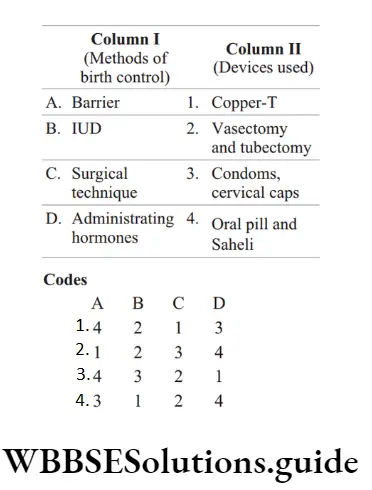
Question 92. Match the following columns.

NEET Biology Population Stabilisation and Birth Control Question 92 Match The Following Columns

Answer:  4. A-3, B-1, C-2, D-4

Question 93. Which of the following methods is not available for males?

  1. Surgical
  2. Hormonal
  3. Contraceptive
  4. Abstinence

Answer:  2. Hormonal

Hormonal pills for females are available to prevent unwanted pregnancies, e.g. Mala-D, Saheli, etc. Such hormonal pills are not available for males.

Question 94. Progesterone or progestogen-oestrogen combination injections and implants are used by the females under the

  1. Skin of the inner arm above elbow
  2. Vagina
  3. Stomach’s upper skin
  4. Cervix

Answer:  1. Skin of the inner arm above elbow

To achieve contraception, six matchstick-sized capsules containing steroids are inserted under the skin of female’s inner arm above the elbow. These steroid capsules slowly release the synthetic progesterone for about five years.

Question 95. Consider the following statements.

  1. Birth control pills do not cause cardiovascular problem.
  2. A woman who substitutes the biological mother to nurse the embryo is called surrogate mother.

Choose the correct option.

  1. Statement 1 is correct, but 2 is incorrect
  2. Statement 1 is incorrect, but 2 is correct
  3. Both statements 1 and 2 are correct
  4. Both statements 1 and 2 are incorrect

Answer:  2. Statement I is incorrect, but II is correct.

  • Incorrect statement can be corrected as Oral contraceptive pills increase the risk of intra vascular clotting.
  • Therefore, they are not recommended for women with a history of disorders of blood clotting, blood vessel damage, hypertension, liver malfunction, heart disease or cancer of the breast or reproductive system.

Question 96. Which of the following technique is safest?

  1. Rhythm method
  2. Use of physical barriers
  3. Termination of unwanted pregnancy
  4. Sterilisation techniques

Answer:  4. Sterilisation techniques

The success rate of the sterilisation method is very high as compared to the other techniques and the number of complications are also very less. So, sterilisation technique is the safest and best

Question 97. The term ‘sterilisation’ refers to

  1. Tubectomy
  2. Vasectomy
  3. Hysterectomy
  4. All of these

Answer:  4. All of these

Sterilisation refers to any process that eliminates, removes or kills all forms of life. In humans, it is achieved by tubectomy, vasectomy, hysterectomy, etc. Thus, option 4 is correct.

“reproductive health bank of biology “

Question 98. What does surgical method of contraception result in?

  1. Preventing gamete motility
  2. Preventing gamete formation
  3. Gametogenesis promotion
  4. Facilitates implantation

Answer:  1. Preventing gamete motility

In surgical method of contraception, vas deferens in males and Fallopian tubes in female are cut due to which the motility of gametes is inhibited.

Question 99. Surgical removal of a segment of vas deferens and ligation cut ends is known as

  1. Tubectomy
  2. Vasectomy
  3. Gonadectomy
  4. Castration

Answer:  2. Vasectomy

Surgical removal and then ligation of vas deferens or sperm duct in males is called vasectomy.

Question 100. Surgical removal of testes is known as

  1. Testectomy
  2. Gonadectomy
  3. Castration
  4. None of these

Answer: 3. Castration

  • Castration is any surgical, chemical or otherwise action, by which an testicles loses its function.
  • Surgical castration is bilateral orchidectomy and chemical castration uses pharmaceutical drugs to impair the testes. Thus, surgical removal of testes is known as castration

Question 101. Which of the following is incorrect regarding vasectomy?

  1. No sperm occurs in seminal fluid
  2. No sperm occurs in epididymis
  3. Vasa deferentia is cut and tied
  4. Irreversible sterility

Answer:  2.  No sperm occurs in epididymis

Option 2  is incorrect and can be corrected as Following vasectomy, sperms are formed in testis but they cannot move out of reproductive tract. The option (b), stating that no sperm occurs in epididymis is wrong because, it is a part of testis only. Thus, sperms are found in epididymis even after vasectomy. Rest options are correct regarding vasectomy.

Question 102. Vasectomy

  1. Prevents the production of sperm in the testes
  2. Prevents the production of semen
  3. Prevents the movement of sperm into the urethra
  4. Prevents a man from having an erection

Answer:  3. Prevents the movement of sperm into the urethra

Following vasectomy, sperm would not be found in female genital tract, e.g. urethra.

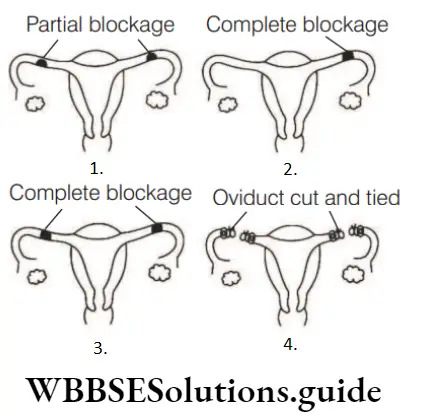
Question 103. From the images given below identify, in which condition of the uterus is fertilisation impossible?

NEET Biology Population Stabilisation and Birth Control Uterus Is Fertilisation

  1. 1 and 2
  2. 2 and 3
  3. 3 and 4
  4. 1and 4

Answer:  3. 3 and 4

Fertilisation is not possible in situations C and D because ova would not be able to reach fertilisation site due to blocked or cutted Fallopian tubes.

Question 104. Which of the following approaches does not give the defined action of contraceptive?

  1. Barrier methods – Prevent fertilisation
  2. Intrauterine devices – Increase phagocytosis of sperms, suppress sperm motility and fertilising capacity of sperms
  3. Hormonal contraceptives – Prevent retarded entry of sperms, prevent ovulation and fertilisation
  4. Vasectomy – Prevents spermato genesis

Answer:  4. Vasectomy – Prevents spermato genesis

Option 4 does not give the defined action of contraceptive and can be corrected as Vasectomy causes sterilisation by preventing transfer of sperms.

It does not prevent spermatogenesis. Rest options give the defined action of contraceptive.

Question 105. If the vasa deferentia of man is surgically removed then

  1. Semen will be without sperms
  2. Spermatogenesis will not take place
  3. Sperms in semen will be non-motile
  4. Sperms will be enucleated

Answer: 1. Semen will be without sperms

Function of vasa deferentia is the conduction of sperms from testes to external genitilia. If it is disconnected, semen will be without sperms.

Question 106. Match the contraceptive methods given under Column 1 with their examples given under Column 2. Select the correct option from those given below.

NEET Biology Population Stabilisation and Birth Control Question 106 Match The Following Columns

Answer: 1. A-4, B-2, C-3, D-1

107. Surgical removal of uterus is called

  1. Vasectomy
  2. Tubectomy
  3. Hysterectomy
  4. Anatomy

Answer:  3. Hysterectomy

A hysterectomy is an operation to remove a woman’s uterus. A woman may have a hysterectomy for different reasons, including uterine fibroids that cause pain, bleeding or other problems.

Question 108. The instrument used in tubal ligation

  1. Laryngoscope
  2. Proctoscope
  3. Laparoscope
  4. None of these

Answer:  3. Laparoscope

Tubal ligation is blocking of Fallopian tube. This procedure is performed using an instrument called laparoscope.

Question 109. Tubectomy, a method of sterilisation involves

  1. Small part of the Fallopian tube is removed or tied up
  2. Ovaries are removed surgically
  3. Small part of vas deferens is removed or tied up
  4. Uterus is removed surgically

Answer: 1. Small part of the Fallopian tube is removed or tied up

Tubectomy is a method of female sterilisation. A small part of the Fallopian tube is removed or tied up through a small incision in the abdomen or through vagina.

Question 110. Match the following figures with their respective identity.

  1. Tubectomy
  2. Vasectomy
  3. Implants
  4. Condoms
  5. Copper-T

NEET Biology Population Stabilisation and Birth Question 110

  1. A-4, B-5, C-3, D-2, E-1
  2. A-4, B-5, C-2, D-1, E-3
  3. A-1, B-2, C-3, D-4, E-V
  4. A-3, B-4, C-V, D-1, E-2

Answer:  1. A-IV, B-V, C-III, D-II, E-I

  1. Question 111. Identify the incorrect statement regarding the techniques of contraception.
  2. Tubectomy prevents oogenesis in females.
  3. Purpose of tubectomy is to prevent formation of ova.
  4. The most important component of the oral contraceptive pills is progestogens.
  5. Contraceptive oral pills help in birth control by preventing ovulation.

Choose the correct answer

  1. 1, 2 and 3
  2. 1 and 2
  3. 3, 4 and 2
  4. 2 and 1

Answer:  2.  1 and 2

  • Statements 1 and 2 are incorrect.
  • These can be corrected as The purpose of tubectomy is to block the passage of ova and it does not interfere with oogenesis. Rest statements are true regarding the techniques of contraception.


NEET Biology Reproductive Health Problems And Strategies Multiple Choice Question And Answers

Biology MCQ For NEET With Answers Reproductive Health Problems And Strategies

Question 1. Reproductive health is the wellbeing of

  1. Physical aspects
  2. Emotional and behavioural aspects
  3. Social aspects
  4. All of the above

Answer:  4. All of the above

The term ‘reproductive health’ simply refers to healthy reproductive organs with normal functions. However, it has broader perspectives and includes emotional, physical, behavioural and social aspects of reproduction also. Thus, option 4 is correct.

Read And Learn More: NEET Biology Multiple Choice Question And Answers

Question 2. Which of the following is the correct defination given about reproductive health by WHO?

  1. Healthy reproductive organs with normal functions
  2. Total well-being of physical, emotional, behavioural and social aspects
  3. Free of all STDs (Sexually Transmitted Diseases)
  4. To have healthy diet for reproductive health

Answer:  2. Total well-being of physical, emotional, behavioural and social aspects

  • According to the World Health Organisation (WHO), reproductive health refers to ‘a total well-being in all aspects of reproduction, i.e. physical, emotional, behavioural and social’.
  • Therefore, a society with people having physically and functionally normal reproductive organs, normal emotional and behavioural interactions among them in all sex-related aspects might be called reproductively healthy.

Reproductive health problems and solutions NEET MCQs

Question 3. Consider the following statements.

  1. WHO stands for World Health Organisation.
  2. World Health Day is celebrated on 6th July every year.

Choose the correct option.

  1. Statement 1 is correct, but 2 is incorrect
  2. Statement 1 is incorrect, but 2 is correct
  3. Both statements 1 and 2 are correct
  4. Both statements 1 and 2 are incorrect

Answer:  1. Statement 1 is correct, but 2 is incorrect.

Incorrect statement can be corrected as World Health Day is celebrated on 7th April to mark the anniversary of the founding of WHO in 1948.

Biology MCQ For NEET With Answers

NEET Biology Reproductive Health Problems And Strategies Multiple Choice Question And Answers

NEET Biology reproductive health MCQs with answers

Question 4. Expand CDRI.

  1. Centralised Drug Development and Research Institution
  2. Child Development Research Institute
  3. Central Drug Research Institute
  4. Common Development Research Institute

Answer:  3. Central Drug Research Institute

CDRI stands for Central Drug Research Institute.

Question 5. CDRI is located in

  1. Delhi
  2. Kanpur
  3. Lucknow
  4. Chennai

Answer:  3. Lucknow

The Central Drug Research Institute is a multidisciplinary research laboratory in Lucknow, employing scientific personnel from various areas of biomedical sciences.

Question 6. Family planning programme was initiated in the year

  1. 1941
  2. 1951
  3. 1961
  4. 1981

Answer:  2. 1951

India is amongst the first countries in the world to initiate action plans and programmes at a national level to attain total reproductive health as a social goal. These programmes are called ‘family planning programmes’ and were initiated in 1951.

“questions about reproductive health “

Question 7. What does RCH stands for in RCH programmes?

  1. Reproductive and Child Healthcare
  2. Reproductive Care and Hygiene
  3. Routine Checkup of Health
  4. Reproduction of Child Health and Care

Answer:  1. Reproductive and Child Healthcare

RCH stands for Reproductive and Child Healthcare. It includes improved programmes covering wider reproduction related areas are currently in operation under this programme.

Biology MCQ For NEET With Answers

Question 8. What are the various means of improving reproductive health?

  1. Education
  2. Awareness
  3. Encouraging myths
  4. Ban on amniocentesis

Choose the correct option.

  1. 1 and 2
  2. 2 and 3
  3. 3 and 4
  4. 1, 2 and 4

Answer:  4. 1, 2 and 4

1, 2 and 4 represent the various means of improving reproductive health. 3 does not represents the mean of improving reproductive health because myths are the false beliefs. They do not provide any help or information for the upkeep of one’s reproductive health.

Reproductive health problems and strategies NEET MCQs

Question 9. To maintain reproductive health of the society, it is essential to

  1. Provide sex education in schools
  2. Prevent and control sexually transmitted diseases by providing proper information about reproductive organs, safe and hygienic practices
  3. Develop various programmes such as family planning programmes and RCH
  4. All of the above

Answer:  4. All of the above

  • All given options are very important to maintain a good reproductive health for a healthy society and population.
  • It is achevied by providing sex education in schools to prevent and control sexually transmitted diseases, by providing proper information about reproductive organs, safe and hygienic practices, develops various programmes such as family planning programmes and RCH.

Thus, option 4 is correct.

Question 10. Which of the following factors can cause problems related to reproductive health?

  1. Misuse of amniocentesis
  2. Myths and misconceptions regarding sex-related aspects
  3. Congenital or acquired infertility
  4. All of the above

Answer:  4. All of the above

All the listed factors can cause problems related to reproductive health. Thus, option 4 is correct.

Biology MCQ For NEET With Answers

Question 11. Amniocentesis is the procedure to detect

  1. Chromosomal pattern of the foetus by obtaining amniotic fluid
  2. Amount of chorionic fluid from developing embryo
  3. Chromosomal pattern of child after childbirth
  4. Chromosomal pattern before fertilisation

Answer:  1. Chromosomal pattern of the foetus by obtaining amniotic fluid

Amniocentesis is a medical procedure in which a small amount of amniotic fluid, which contains foetal cells is sampled to detect chromosomal pattern of the foetus.

Important reproductive health questions for NEET exam

Question 12. Through amniocentesis, foetal cells can be cultured and tested for detecting various diseases of foetus by

  1. Karyotype
  2. Enzyme production
  3. DNA analysis
  4. All of the above

Answer:  1. Karyotype

Through aminocentesis, karyotypic study of somatic cells is done to determine abnormalities in the foetus due to change in chromosome number, e.g. Down’s syndrome.

Question 13. Which of the following cannot be detected in a developing foetus by amniocentesis?

  1. Klinefelter syndrome
  2. Sex of the foetus
  3. Down’s syndrome
  4. Jaundice

Answer:  4. Jaundice

Amniocentesis is used to determine the chromosomal disorders. Jaundice is a metabolic disorder and thus, cannot be determined by using this technique.

Biology MCQs with answers for NEET

Question 14. In context of amniocentesis, which of the following statements is incorrect?

  1. It is usually done when a woman is between 14-16 weeks pregnant
  2. It is used for prenatal sexdetermination
  3. It can be used for detection of Down’s syndrome
  4. It can be used for detection of cleft palate

Answer:  4.  It can be used for detection of cleft palate

“class 12 reproductive health “

Statement in option 4 is incorrect and can be corrected as Amniocentesis does not help in the detection of cleft palate. Cleft palate are birth defects that occur when a baby’s lip or mouth do not form properly during pregnancy. Rest statements are correct in context of amniocentesis.

Solved MCQs on reproductive health for NEET Biology

Question 15. Foetal sex can be determined by examining cells from the amniotic fluid by looking for

  1. Barr bodies
  2. Autosomes
  3. Chiasmata
  4. Kinetochore

Answer:  1. Barr bodies

  • Presence of Barr bodies in amniotic fluid indicate that foetus is female as these are absent in male. Other options are explained as Autosomes are not sex chromosomes.
  • Chiasmata is a point at which paired chromosomes remain in contact during the first metaphase of meiosis, at which crossing over and exchange of genetic material occur. Kinetochore is a disc-shaped protein structure associated with duplicated chromatid in eukaryotic cells.

Question 16. Amniocentesis is most commonly misused for

  1. Male foeticide
  2. Female foeticide
  3. Detecting prenatal diseases
  4. All of the above

Answer:  2. Female foeticide

Biology MCQs with answers for NEET

Amniocentesis is being misused to kill a normal female foetus. This procedure has been legally banned for use in determination of sex to avoid female foeticide in India.

Question 17. Assertion (A) The technique shown in the given figure is frequently used in prenatal disease treatment. Reason (R) This technique cannot be used for sex-determination of child.

NEET Biology Reproductive Health Assertion

  1. Both A and R are true and R is the correct explanation of A
  2. Both A and R are true, but R is not the correct explanation of A
  3. A is true, but R is false
  4. Both A and R are false

“reproductive health bank of biology “

Answer:  4. Both A and R are false

Both A and R are false and can be corrected as The technique shown in figure is anmiocentesis. which is used for foetal sex-determination and diagnosis of prenatal disease based on chromosomal pattern in the amniotic fluid surrounding the developing foetus. This technique is banned in India at present due to its role in increased female foeticides.

NEET Biology Human Reproduction Miscellaneous Multiple Choice Question And Answers

Biology MCQs with answers for NEET – Human Reproduction Miscellaneous

Question 1. The duration of the survival of the sperms in the female genital tract is the longest of 4 years in

  1. Guppy fish (Lebistes)
  2. Bats
  3. Turtle (Malaclemsys)
  4. All of the above

Answer:  2. Bats

In bats, the survival period of the sperms in the female genital tract is the longest, i.e. of about 4 years.

Question 2. The testes are present in abdominal cavity throughout the life and never come down in which of the following?

  1. Elephant
  2. Camel
  3. Whale
  4. All of these

Answer:  4. All of these

“human reproduction mcq class 12 “

The testes of elephant, whale and camel are intra abdominal, i.e. they lie inside the abdominal cavity. Thus, option is correct.

Read And Learn More: NEET Biology Multiple Choice Question And Answers

Question 3. FSH is injected to a rat which does not have the anterior lobe of pituitary. What does not occur in the rat?

  1. Proliferation of endometrium
  2. Development of corpus luteum
  3. Maturation of Graafian follicle
  4. Accumulation of oestrogen in the blood

Answer:  2. Development of corpus luteum

Development of corpus luteum is brought about by progesterone and LH not by FSH. Progesterone and LH are secreted by the anterior lobe of pituitary. Thus, in the absence of anterior pituitary lobe, corpus luteum would not be formed.

NEET Biology Human Reproduction MCQs with answers

Question 4. Amnion is absent in

  1. Birds
  2. Mammals
  3. Reptiles
  4. Fishes

Answer:  4. Fishes

The foetal membrane, amnion is absent in fishes because fishes are not amniotes. It is present in clade amniota, which includes reptiles, birds, and mammals.

Biology MCQs with answers for NEET

NEET Biology Human Reproduction Miscellaneous Multiple Choice Question And Answers

Human Reproduction NEET important MCQs

Question 5. Which animal has the longest gestation period?

  1. Shark
  2. Walrus
  3. Elephant
  4. Dog

Answer:  3. Elephant

“reproduction mcqs “

Elephant has the longest gestation period among the given animals. The gestation period of an elephant is about 624- 641 days.

Question 6. Sperm of animal species A cannot fertilise ovum of species B because

  1. Fertilizin of A and antifertilizin of B are not compatible
  2. Antifertilizin of A and fertilizin of B are not compatible
  3. Fertilizin of A and B are not compatible
  4. Antifertilizin of A and B are not compatible

Answer:  2. Antifertilizin of A and fertilizin of B are not compatible

  • During fertilisation, the approximation of sperm and ovum is carried out by fertilizin-antifertilizin compatibility reaction.
  • Fertilizin of egg interacts with antifertilizin of the sperm of same species. This interaction makes the sperm to stick to the egg surface. The given situation indicates the antifertilizin of species A is not compatible with fertilizin of species B.

Question 7. Identify the hormones A, B and C that are labelled in the given flowchart.

NEET Biology Miscellaneous Question 7

  1. A–GnRH, B–PRL, C–ICSH
  2. A–GnRH, B–ICSH, C–ISH
  3. A–GnRH, B–FSH, C–LH
  4. A–GH, B–FSH, C–LH

Answer:  3. A–GnRH, B–FSH, C–LH

Hypothalamus secretes GnRH (Gonadotropin Releasing Hormone), which stimulates pituitary to release FSH and LH (3). FSH stimulates ovarian follicles to grow while LH stimulates Leydig’s cells to secrete testosterone.

Question 8. The gestation period of cow is

  1. 30 days
  2. 270 days
  3. 280 days
  4. 300 days

Answer:  3. 280 days

The gestation period of cow is about 280 days.

NEET Human Reproduction MCQs with explanations

Question 9. If both ovaries are removed from a rat, then which hormone is decreased in blood?

  1. Oxytocin
  2. Oestrogen
  3. Prolactin
  4. Gonadotropic

Answer:  2. Oestrogen

When both ovaries are removed from a rat, then oestrogen is decreased in blood. The ovary produces ova and secretes female sex hormones, viz., oestrogen and progesterone.

Biology MCQs with answers for NEET

Question 10. In rabbit, head of the epididymis present at the head of the testis, is called

  1. Vas deferens
  2. Gubernaculum
  3. Cauda epididymis
  4. Caput epididymis

Answer:  4. Caput epididymis

Epididymis is that part of testis in which sperms develop. Its anterior part (head) is known as caput epididymis or globus major.

Question 11. Zonary placenta is found in

  1. Carnivores
  2. Herbivores
  3. Both 1 and 2
  4. None of these

Answer:  1. Carnivores

Zonary placenta is found in carnivores. In this type, the placenta takes the form of complete or incomplete band surrounding the foetus.

Question 12. The characteristic feature of the female reproductive system of …………… is the presence of only ovary.

  1. Fish
  2. Birds
  3. Reptiles
  4. Bat

Answer:  2. Birds

In birds, only one ovary is present, at the left side of the body.

NEET Biology Mcq Question 13. The estrous cycle is a characteristic of

  1. Human males only
  2. Human females only
  3. Mammalian males other than primates
  4. Mammalian females other than primates

Answer:  4. Mammalian females other than primates

Estrous cycle is the characteristic of mammalian females other than primates. It is affected by oestrogen hormone. Estrous is the period during which ovulation occurs and the females mate with male.

NEET Biology Human Reproduction practice test

Question 14. The yolk plug is formed by the protrusion of

  1. Blastomeres
  2. Ectodermal cells
  3. Mesodermal cells
  4. Endodermal cells

Answer:  4. Endodermal cells

“mcq on human reproduction class 12 pdf download “

The yolk plug is formed by the protrusion of endodermal cells. It is formed during the formation of dorsal lip of blastopore in amphibians.

Question 15. The most primitive type or mammalian placenta is

  1. Epitheliochorial
  2. Syndesmochorial
  3. Endotheliochorial
  4. Haemochorial

Answer:  1. Epitheliochorial

Epitheliochorial is the most primitive type of mammalian placenta. It has all the six barriers, between fetal and maternal blood, e.g. horse, ass and pig.

NEET Biology Parturition And Lactation Multiple Choice Question And Answers

Biology MCQs with answers for NEET Parturition And Lactation

Question 1. The process of delivery of foetus is called

  1. Parturition
  2. Implantation
  3. Fertilisation
  4. Lactation

Answer:  1. Parturition

Parturition is the process of giving birth to young one or the delivery of foetus.

Question 2. The baby ready for birth weighs about

  1. 2.7 to 4.5 kg
  2. 1.2 to 2.5 kg
  3. 4 to 6 kg
  4. 3.5 to 5 kg

Answer:  1. 2.7 to 4.5 kg

The average birth weight of a human baby is about 2.7 to 4.5 kg.

Read And Learn More: NEET Biology Multiple Choice Question And Answers

Question 3. Assertion Parturition is induced by neural signal in maternal pituitary. Reason (R) At the end of gestation period, the maternal pituitary releases prolactin which causes uterine contractions.

  1. Both A and R are true and R is the correct explanation of A
  2. Both A and R are true, but R is not the correct explanation of A
  3. A is true, but R is false
  4. Both A and R are false

Answer:  4. Both A and R are false

  • Both A and R are false and can be corrected as Parturition is induced by a complex neuroendocrine mechanism. The signals for parturition originate from the fully developed foetus and the placenta. These induces mild uterine contractions called foetal ejection reflex.
  • This triggers the release of oxytocin from the maternal pituitary. Oxytocin acts on the uterine muscles and causes stronger uterine contractions.

“human reproduction mcqs class 12 “

Question 4. Parturition may be divided into …………… stages.

  1. 2
  2. 3
  3.  4
  4.  5

Answer:  2. 3

Parturition is divided into three stages namely, dilation, expulsion and placental.

Biology MCQs with answers for NEET

NEET Biology Parturition And Lactation Multiple Choice Question And Answers

NEET Biology Parturition and Lactation MCQs with answers

Question 5. The first stage of parturition lasts for about

  1. 12 hours
  2. 20 min
  3. 45 min
  4. 60 min

Answer:  1. 12 hours

The first stage of parturition, i.e. dilation lasts for about 12 hours.

Question 6. During the second stage of parturition,

  1. Amnion and chorion rupture
  2. Placenta, umbilical cord and foetal membrane are expelled
  3. The umbilical cord is ligatured at two places close to the baby
  4. The foetal placenta is pulled out from the uterine wall

Answer:  3. The umbilical cord is ligatured at two places close to the baby

The umbilical cord is ligatured at two places close to the baby during the second stage of parturition, i.e. expulsion.

Question 7. In which stage of parturition, the contraction of the uterus close the cervix and prevents excess bleeding?

  1. 1st stage–dilation
  2. Expulsion
  3. Placental stage
  4. All of these

Answer: 3. Placental stage

In the placental stage of the parturition, the contraction of the uterus close the cervix and prevents excess bleeding.

Question 8. During dilation stage of parturition,

  1. Amnion and chorion rupture
  2. Amniotic fluid passes out
  3. The foetal placenta is pulled out from the uterine wall
  4. All of the above

“what is true for cleavage “

Answer:  4. All of the above

  • During the dilation stage of parturition, the cervix widens and opens to about ten centimeters, so as to allow the passage of the baby.
  • The amnion and chorion ruptures, amniotic fluid passes out and the foetal placenta is pulled out from the uterine wall.

Thus, option 4 is correct.

Biology MCQs with answers for NEET

Question 9. What changes take place in the foetus before parturition?

  1. The foetus grows up to 70 cm
  2. The foetus settles in head downward position in the pelvic cavity
  3. The foetus develops bluish-pink pigmentation
  4. The nervous system of foetus develop fully

Answer:  2. The foetus settles in head downward position in the pelvic cavity before parturition.

Important MCQs on Parturition and Lactation for NEET

Question 10. Which hormone is responsible for relaxing the ligaments of pelvic girdle?

  1. Relaxin
  2. Oxytocin
  3. Progesterone
  4. Prostaglandin

Answer:  1. Relaxin

The hormone relaxin relaxes the ligament of the pelvic girdle for the easy birth of the baby.

Question 11. Consider the following statements.

  1. Relaxin is secreted in the early stages of pregnancy.
  2. Relaxin prevents the dilation of uterus.

Choose the correct option.

  1. Statement 1 is correct, but 2 is incorrect
  2. Statement 1 is incorrect, but 2 is correct
  3.  Both statements 1 and 2 are correct
  4. Both statements 1 and 2 are incorrect

Answer:  4. Both statements 1 and 2 are incorrect

  • Both statements 1 and 2 are incorrect and can be corrected as Relaxin is a hormone secreted by the corpus luteum and the placenta in the terminal stage of pregnancy.
  • It causes the cervix (neck) of the uterus to dilate and prepares the uterus for the action of oxytocin during labour (parturition).

Question 12. The foetal hormones accumulate in the mother’s blood till they cause

  1. An increase in progesterone and prostaglandins
  2. A decrease in progesterone and increase in prostaglandins
  3. An increase in progesterone and decrease in prostaglandins
  4. Decrease in progesterone and prostaglandins

Answer:  2. A decrease in progesterone and increase in prostaglandins

There is a decrease in progesterone and increase in prostaglandins when foetal hormones accumulate in the mother’s blood. It helps to promote uterine contractions and progress to labour.

“diagrammatic sectional view of male pelvis showing reproductive system “

Question 13. Name A, B and C hormones in the given figure.

NEET Biology Parturition and Lactation Question 13

  1. A–Prostaglandin, B–Oxytocin, C–Oestrogen
  2. A–Oestrogen, B–Oxytocin, C–Prostaglandin
  3. A–Oestrogen, B–Prostaglandin, C–Oxytocin
  4.  A–Prostaglandin, B–Oestrogen, C–Oxytocin

Answer:  2. A–Oestrogen, B–Oxytocin, C–Prostaglandin

NEET quiz on Parturition and Lactation with solutions

Question 14. …………… is injected by doctors to induce delivery.

  1. Inhibin
  2. Oxytocin
  3. Oestrogen
  4. Prolactin

Answer:  2. Oxytocin

Doctors inject oxytocin hormone for the strong contraction of uterine wall, so as to induce labour pains.

Biology MCQs with answers for NEET

Question 15. In human adult females, oxytocin

  1. Stimulates pituitary to secrete vasopressin
  2. Causes strong uterine contractions during parturition
  3. Is secreted by anterior pituitary
  4. Stimulates growth of mammary glands

Answer:  2. Causes strong uterine contractions during parturition

In human adult female, oxytocin released by the pituitary gland (neurohypophysis) causes contraction of the uterus during labour and stimulates milk ejection from the breasts by causing the contraction of muscle fibres in the milk ducts.

Question 16. Which of the following hormones initiate parturition?

  1. ACTH, hCG, oxytocin
  2. ACTH, corticosteroid, oxytocin
  3. Corticosteroid, ACTH, prostaglandin
  4. ACTH, progesterone, hCG

Answer:  2. ACTH, corticosteroid, oxytocin

ACTH, corticosteroid and oxytocin initiate the parturition process in humans.

NEET expected MCQs on Parturition and Lactation 2025

Question 17. Reduced progesterone allows the secretion of ……………… hormone.

  1. ACTH
  2. FSH
  3. STH
  4. oxytocin

Answer:  4. oxytocin

At the end of gestation period, oxytocin hormone is released from hypothalamus and stored in posterior part of pituitary. It is then released in the blood stream when the level of progesterone decreases.

Question 18. ACTH causes the release of corticosteroid hormone from ………… of foetus.

  1. Adrenal glands
  2. Ovary
  3. Kidney
  4. Thyroid

Answer:  1. Adrenal glands

ACTH stimulates the adrenal glands to release the corticosteroid hormone in foetus during parturition. It helps in the lung maturation of foetus.

Question 19. The foetal-ejection reflex in humans triggers release of

  1. Oxytocin from maternal pituitary
  2. Oxytocin from foetal pituitary
  3. Human Chorionic Gonadotropin (hCG) from placenta
  4. Human Placental Lactogen (hPL) from placenta

Answer:  1. Oxytocin from maternal pituitary

Foetal-ejection reflex triggers the release of oxytocin from the maternal pituitary. Oxytocin acts on uterine muscles and causes strong contractions.

“hormones secreted by placenta “

Question 20. Match the following columns.

NEET Biology Parturition and Lactation Question 20 Match The Following Column

Answer:  4. A-4, B-1, C-2, D-5, E-3

NEET Biology Parturition and Lactation MCQs with explanations

Question 21. Secretion of milk by mammary glands is known as

  1. Lactogenesis
  2. Galactopoesis
  3. Galactogenesis
  4. Glucogenesis

Answer:  1. Lactogenesis

Lactogenesis is the process of secretion of milk from the mammary glands.

Question 22. Lactation begins

  1. Towards the end of pregnancy
  2. Towards the beginning pregnancy
  3.  Towards the beginning of puberty
  4. Throughout the life cycle

Answer:  1. Towards the end of pregnancy

Lactation in human female begins towards the end of pregnancy.

Biology MCQs with answers for NEET

Question 23. Galactopoiesis means

  1. Secretion of milk
  2. M of milk secretion
  3. Discharge of milk from mammary glands
  4. Both 1 and 2

Answer:  2. M of milk secretion

Galactopoiesis refers to the maintenance of milk secretion. It is regulated by thyroxine and cortisol.

Question 24. Milk secretion is regulated by

  1. Increased secretion of progesterone
  2. Increased secretion of oestrogen
  3. Increased secretion of prolactin
  4. Increased secretion of relaxin

Answer:  3. Increased secretion of prolactin

Milk secretion is regulated by increased secretion of prolactin hormone which is released from the anterior pituitary.

Mock test on Parturition and Lactation for NEET preparation

Question 25. Milk secreted from the cells of alveoli of mammary lobes reaches to the nipple. Identify the order that it follows by passing through Lactiferous Duct (L), Mammary duct (M), Mammary Tubule (T) and Mammary Ampulla (A).

  1. TAML
  2. TMAL
  3. MTAL
  4. ATML

Answer:  2. TMAL

Route of milk secretion is Mammary Tubule (T), Mammary Duct (M), Mammary Ampulla (1), Lactiferous Duct (L), i.e. TMAL.

Question 26. First milk produced after childbirth is called

  1. Sebum
  2. Cercumen
  3. T milk
  4. Colostrum

Answer:  4. Colostrum

  • The milk that comes out of the mammary glands during the initial days of lactation is called colostrum.
  • It contains antibodies and nutrients for the baby. Thus, breast feeding is recommended by doctros for bringing up a healthy baby.

Question 27. Colostrum plays an important role for newborn babies as

  1. Colostrum have antigen
  2. Colostrum have antibody
  3.  Both 1 and 2
  4.  Colostrum have more nutrients than ordinary milk

Answer:  2. C have antibody

Colostrum contains antibody-A (IgA), which protects against the pathogenicity in newborn.

Biology MCQs with answers for NEET

Question 28. The type of sugar found in breast milk is

  1. Glucose
  2. Sucrose
  3. Lactose
  4. Galactose

Answer:  3. Lactose

Milk produced in human females contains proteins like casein, lactalbumin, etc., fat, lactose sugar, vitamins, mineral salts and water. It is poor in iron and has a very small quantity of vitamin-C.

Question 29. Milk of lactating mother is composed of

  1. Na+ and   Ca2+
  2. Water and fats
  3. Sugars and proteins
  4. All of the above

Answer:  4. All of the above

Human breast milk is composed of carbohydrates, fats, proteins, vitamin water, sugar and minerals along with sodium, calcium, antibodies, enzymes.

Thus, option 4 is correct.

NEET practice test on Parturition and Lactation

Question 30. Identify the correct statements.

  1. Increased secretion of prolactin initiates milk formation
  2. Prolactin inhibits release of LH
  3. Suppression of menstrual cycle at the time of lactation
  4. All of the above

Answer:  4. All of the above

“human reproduction class 12 important questions pdf “

All given statements are correct. Increased secretion of prolactin initiates milk formation. Prolactin inhibits the release of LH and suppression of menstrual cycle at the time of lactation. Thus, option 4 is correct.

Biology MCQ For NEET With Answers

Question 31. Match the following columns with correct combination.

NEET Biology Parturition and Lactation Question 31 Match The Following Column

Answer:  2. A–1, B–3, C–2, D–5, E–4

Question 32. The time period of development of embryo in uterus

  1. Gestation
  2. Incubation
  3. Implantation
  4. None of the above

Answer:  1. Gestation

The time period from the start of pregnancy till parturition is called gestation.

Question 33. Human pregnancy lasts for ………… days from the start of the last menstrual cycle.

  1. 266
  2. 300
  3. 280
  4. 225

Answer:  3. 280

The average length of human gestation is 280 days or 40 weeks, from the first day of the woman’s last menstrual period.

“neetprep reproduction in organisms “

Question 34. Exact time of human gestation period is

  1. 9 month ± 15 days
  2. 9 month ± 20 days
  3.  9 month ± 7 days
  4. 9 months ± 1 days

Answer:  3.  9 month ± 7 days

The duration of pregnancy in human being is about 9 months ± 7 days, which is called gestation period.

NEET Biology Pregnancy And Embryonic Development Multiple Choice Question And Answers

Biology MCQ For NEET With Answers Pregnancy and Embryonic Development

Question 1. After implantation, finger-like projections on the trophoblast are called …A… which are surrounded by …B… and maternal blood. Here, A and B refer to

  1. A–chorion, B–foetal cell
  2. A–chorionic villi, B–uterine tissue
  3. A–uterine tissue, B–chorionic villi
  4. A–foetal cell, B–chorion

Answer:  2.  A–chorionic villi, B–uterine tissue

Question 2. The layer of uterus which becomes much eroded due to placental villi is known as

  1. Endothelium
  2. Endometrium
  3. Endoderm
  4. Trophoblast

Answer:  2.  Endometrium

During the development of foetus, endometrium gets eroded due to placental villi.

Read And Learn More: NEET Biology Multiple Choice Question And Answers

Question 3. Chorionic villi are formed by the modification of

  1. Outer layer of trophoblast
  2. Inner layer of trophoblast
  3. Inner cell mass
  4. Blastocyst

Answer:  1. Outer layer of trophoblast

Chorionic villi are the modification of outer trophoblast layer of blastocyst, which get attached to the endometrium of uterus.

pregnancy and embryonic development class 12

Question 4. The number of foetal membranes in humans is

  1. 2
  2. 3
  3. 4
  4. 0

Answer:  3. 4

Humans possess four foetal membranes, viz. amnion, chorion, allantois and yolk sac.

Biology MCQ For NEET With Answers

NEET Biology Pregnancy And Embryonic Development Multiple Choice Question And Answers

NEET Biology Pregnancy and Embryonic Development MCQs with answers

Question 5. Extraembryonic membranes are also called

  1. Foetal membranes
  2. Embryonic membranes
  3. Accessory membranes
  4. Placental membranes

Answer:  1. Foetal membranes

Extraembryonic membranes are also called foetal membranes.

Question 6. Foetal membranes provide

  1. Protection to embryo
  2. Nutrition to embryo
  3. Protection and nutrition to embryo
  4. None of the above

Answer:  3. Protection and nutrition to embryo

Extraembryonic membranes or foetal membranes are concerned with protection, respiration, excretion and nutrition of developing embryo.

Question 7. The first extraembryonic membrane to make its appearance in the mammals is

  1. Allantois
  2. Amnion
  3. Yolk sac
  4. Serosa

Answer:  3. Yolk sac

The yolk sac is first membranous sac attached to an embryo. It is formed by the cells of hypoblast adjacent to the embryonic disc. This is alternatively called the umbilical vesicle.

Question 8. Identify A, B, C and D in the figure given below.

NEET Biology Pregnancy and Embryonic Development Question 8

  1. A–Yolk sac, B–Amnion, C–Allantois, D–Chorion
  2. A–Chorion, B–Amnion, C–Yolk sac, D–Allantois
  3. A–Chorion, B–Amnion, C–Allantois, D–Yolk sac
  4. A–Chorion, B–Allantois, C–Amnion, D–Yolk sac

Answer:  2. A–Chorion, B–Amnion B–Yolk sac, D–Allantois

pregnancy and embryonic development class 12

Question 9. The yolk sac in mammals is

  1. Absent
  2. Secretory
  3. Active
  4. Present right after fertilisation then disappears

Answer:  3. Active

An active yolk sac is found in mammals. It serves as the first site of blood cell production in human ontogeny until about the 6th week, when the liver takes over this role.

Biology MCQ For NEET With Answers

Question 10. In an organism having amnion, the foetal membranes are

  1. Zona pellucida, vitelline membrane
  2. Allantois, chorion
  3. Choroid, vitelline membrane
  4. None of the above

Answer:  2. Allantois, chorion

Amnion, chorion, allantois and yolk sac are the foetal membranes or extraembryonic membranes of reptiles, birds and mammals.

Question 11. Which extraembryonic membrane in humans prevents desiccation of the embryo inside the uterus?

  1. Yolk sac
  2. Amnion
  3. Chorion
  4. Allantosis

Answer:  2. Amnion

Amnion surrounds the embryo and forms amniotic cavity that is filled with amniotic fluid. The amniotic fluid serves as a shock absorber for the foetus (protects the embryo from external injury), regulates foetal body temperature and prevents its desiccation.

Question 12. The amnion of mammalian embryo is derived from

  1. Ectoderm and mesoderm
  2. Ectoderm and endoderm
  3. Mesoderm and trophoblast
  4. Endoderm and mesoderm

Answer:  1. Ectoderm and mesoderm

Amnion in mammals is formed from mesoderm on outer side and ectoderm on inner side.

Important MCQs on Pregnancy and Embryonic Development for NEET

Question 14. Consider the following statements.

  1. Chorion is derived from trophoblast on outer side.
  2. The inner side of chorion is derived from endoderm.

Choose the correct option

  1. Statement 1 is correct, but 2 is incorrect
  2. Statement 1 is incorrect, but 2 is correct
  3. Both statements 1 and 2 are correct
  4. Both statements 1 and 2 are incorrect

Answer:  1. Statement 1 is correct, but 1 is incorrect.

Chorion is formed from outer trophoblast and somatopleuronic mesoderm inside.

Biology MCQ For NEET With Answers

Question 15. Urinary bladder of the embryo is

  1. Yolk sac
  2. Allantois
  3. Amnion
  4. Both chorion and allantois

Answer:  2. Allantois

Allantois stores the metabolic waste of embryo and thus, acts as urinary bladder of the embryo

pregnancy and embryonic development class 12

Question 16. …A… is composed of endoderm inside and somatopleuric extraembryonic mesoderm outside. In humans, it is small and help in gaseous exchange.

  1. Allantois
  2. Chorion
  3. Amnion
  4. Placenta

Answer:  1. A–allantois

Question 17. …A… completely surrounds the embryo and protects it. It also takes part in the formation of …B…. . Here, A and B refer to

  1. A–Chorion, B–placenta
  2. A–Amnion, B–amniotic cavity
  3. A–Allantois, B–endoderm
  4. A–Yolk sac, B–endoderm

Answer:  1. A–Chorion, B–placenta

Question 18. Which of the foetal membrane is directly connected with blood?

  1. Allantois
  2. Amnion
  3. Chorion
  4. Yolk sac

Answer:  3. Chorion

The chorion membrane is a fibrous tissue layer containing the foetal blood vessels. Villi formed on the outer surface of the chorion, maximise the surface area for contact with maternal blood.

Question 19. Consider the following statements.

  1. The space between embryo and the amnion is called amniotic cavity which is filled with clear watery fluid secreted by both embryo and membrane.
  2. It protects the embryo from shock and desiccation.

Choose the correct option.

  1. Statement 1 is correct, but 2 is incorrect
  2. Statement 1 is incorrect, but 2 is correct
  3. Both statements 1 and 2 are correct
  4. Both statements 1 and 2 are incorrect

Answer:  3. Both statements, 1 and 2 are correct.

Question 20. The placenta is fully developed

  1. In first week of pregnancy
  2. By the end of third month
  3. Immediately after implantation
  4. By the end of second week of pregnancy

Answer:  2. By the end of third month

In humans, placenta is fully developed by the end of third month of pregnancy and it lasts throughout the pregnancy.

Biology MCQ For NEET With Answers

Question 21. The placenta of human beings belongs to the category of

  1. Haemo-chorialis
  2. Syndesmo-chorialis
  3. Endothelio-chorialis
  4. Epithelio-chorialis

Answer:  1. Haemo-chorialis

The placenta of human beings belongs to the category of haemo-chorialis. In this, maternal blood baths foetal chorionic villi directly.

NEET quiz on Pregnancy and Embryonic Development with solutions

Question 22. The type of placenta found in human beings is

  1. Diffused
  2. Zonary
  3. Cotyledonary
  4. Metadiscoidal

Answer:  4. Metadiscoidal

Metadiscoidal type of placenta is present in human being. In it, the villi are restricted to one disc only. It is also called monodiscoidal condition.

Question 23. Placenta acts as an

  1. Endocrine gland
  2. Exocrine gland
  3. Apocrine gland
  4. Merocrine gland

Answer:  1. Endocrine gland

Placenta releases oestrogens, progesterone, HCG and relaxin. That is why, it is considered as an endocrine gland.

Question 24. Human placenta develops from

  1. Ectoderm
  2. Trophoblast
  3. Endoderm
  4. Mesoderm

Answer:  2. Trophoblast

Tropho-ectoderm (trophoblast) is the outermost layer of the cells of a blastocyst. It forms the foetal part of placenta and do not form any part of the embryo properly.

Question 25. The placenta lacks ……………

  1. Arteries
  2. Veins
  3. Smooth muscles
  4. Nerves

Answer:  4. Nerves

Nerves are not found in placenta. The placenta may be the only human organ that is uninnervated. Only the segment of umbilical cord, closest to the foetus contain nerve fibres.

Biology MCQs with answers for NEET

Question 26. In humans, the placenta is

  1. Allanto-chorial
  2. Pseudo-cotyledon
  3. Haemochorial
  4. All of the above

Answer:  4. All of the above

The human placenta is allanto-chorial, i.e. the chorial placental circulation is connected with the foetal allantois. It is also haemochorial, metadiscoidal, pseudocotyledon (the villi are grouped and incompletely separated by walls that are between them). Thus, option 4 is correct.

Question 27. As compared to the simplest type of placenta, how many barriers are lost in human placenta?

  1. One
  2. Two
  3. Three
  4. Four

Answer:  3. Three

The simplest type of placenta possesses six barriers. In humans, three barriers are lost. These include uterine epithelium, uterine connective tissue and endothelium of maternal blood vessel.

Question 28. The role of placenta is to

  1. Convey nerve impulses
  2. Act as storage organ
  3. Protect embryo from shocks
  4. Provide nutrition for developing embryo

Answer:  4. Provide nutrition for developing embryo

The placenta helps to provide oxygen and nutrients to the foetus, whilst removing carbon dioxide and other waste product. It metabolises a numbers of substances and can release metabolic products into maternal and foetal circulations.

pregnancy and embryonic development class 12

Question 29. Which of the following hormones is not secreted by placenta?

  1. Oestrogen
  2. Progesterone
  3. Prolactin
  4. HCG

Answer:  3. Prolactin

Prolactin is a hormone produced by the anterior pituitary gland and not by placenta.

Question 30. Which of the following substances move from foetal blood to maternal blood?

  1. Glucose
  2. Antibodies
  3. CO2 and urea
  4. Vitamins

Answer:  3. CO2 and urea

Foetal waste, such as CO2 and urea move from foetal to maternal blood. Glucose, antibodies and vitamins move from maternal blood to foetal blood.

Biology MCQs with answers for NEET

Question 31. Which one of the following is not the function of placenta?

  1. Facilitates supply of oxygen and nutrients to embryo
  2. Secretes oestrogen
  3. Facilitates removal of carbon dioxide and waste material from embryo
  4. Secretes oxytocin during parturition

Answer:  4. Secretes oxytocin during parturition

Option 4 is not the function of placenta. Oxytocin is secreted by posterior pituitary gland and not by the placenta. Rest options represent the functions of placenta.

Question 32. Assertion (A) Placenta is connected to the foetus by an umbilical cord. Reason (R) Foetal components of the placenta are derived from the chondroblast.

  1. Both A and R are true and R is the correct explanation of A
  2. Both A and R are true, but R is not the correct explanation of A
  3. A is true, but R is false
  4. Both A and R are false

Answer:  3. A is true, but R is false

A is true, but R is false. Reason can be corrected as The foetal component is composed of all placental portions which originate from the blastocyst, including the placental disc, the amniotic and chorionic membranes (often referred to as the foetal membranes) and the umbilical cord. The maternal component is termed decidua and is derived from the maternal endometrium.

NEET expected MCQs on Pregnancy and Embryonic Development 2025

Question 33. A deciduate placenta is one in which union of chorionic villi and uterine mucosa is extensive and complete. Identify which of the following is not a deciduate placenta.

  1. Zonary deciduate
  2. Discoidal deciduate
  3. Contra-deciduate
  4. Metadiscoidal deciduate

Answer:  3. Contra-deciduate

Contra-deciduate is not a deciduate placenta. In this type, foetal villi and uterine crypts are so intimately connected that most of foetal placenta is left behind at birth to be broken and absorbed by maternal leucocytes, e.g. mole.

Question 34. A placenta that takes part of uterine mucosa with it when it is expulsed is

  1. Decidua
  2. True placenta
  3. Omphaloidean placenta
  4. None of the above

Answer:  1. Decidua

Human placenta is deciduous type, i.e. at birth, variable amount of maternal uterine mucosa is pulled out with blood.

Question 35. Oxygenated blood flowing in umbilical cord of mammalian embryo is

  1. 50% maternal and 50% foetal
  2. 100% maternal
  3. 100% foetal
  4. 75% maternal and 25% foetal

Answer:  2. 100% maternal

Oxygenated blood flowing in umbilical cord of mammalian embryo is 100% maternal.

Biology MCQs with answers for NEET

Question 36. In the given diagram, find out A, B and C.

NEET Biology Pregnancy And Embryonic Development Question 36

  1. A–Plug of mucous in cervix, B–Placental villi, C–Umbilical cord
  2. A–Umbilical cord, B–Placental villi, C–Plug of mucus in cervix
  3. A–Umbilical cord, B–Plug of mucus in cervix, C–Placental villi
  4. A–Placental villi, B–Plug of mucus in cervix, C–Umbilical cord

Answer:  2. A–Umbilical cord B–Placental villi C–Plug of mucus in cervix

pregnancy and embryonic development class 12

Question 37. Umbilical cord is formed from

  1. Yolk sac-amnion
  2. Yolk sac-allantois
  3. Yolk sac-chorion
  4. Chorion-allantois

Answer:  4. Chorion-allantois

Umbilical cord is formed from chorion-allantois. It begins to form by the end of third week of development and by the fifth week of development, its formation is completed.

Question 38. In the foetus, the blood vessel connecting the pulmonary artery to the aorta is the ductus

  1. Caroticus
  2. Thoracicus
  3. Venosus
  4. Botalli

Answer:  3. Venosus

In foetus, ductus venosus connects the pulmonary artery to the aorta.

Question 39. Consider the following statements.

  1. The outer surface of chorion develops chorionic villi.
  2. Human placenta is also called chorionic placenta.

Choose the correct option.

  1. Statement 1 is correct, but 2 is incorrect
  2. Statement 1 is incorrect, but 2 is correct
  3. Both statements 1 and 2 are correct
  4. Both statements 1 and 2 are incorrect

Answer:  3. Both statements 1 and 2 are correct.

The outer surface of the chorion in humans develops a number of finger-like projection called chorionic villi. Because the chorion takes part in the formation of placenta, the human placenta is chorionic placenta.

Question 40. Which of the following statements about maternal and foetal blood in placenta is incorrect?

  1. The maternal and foetal blood is not in direct contact
  2. There is always compatibility between maternal and foetal blood
  3. The pressure of the maternal blood is far too high for the foetal blood vessels
  4. Oxygen from the maternal blood passes into the foetal blood

Answer:  2. There is always compatibility between maternal and foetal blood

tatement in option is incorrect and can be corrected as Maternal and foetal blood are not always compatible, e.g. Rh incompatibility. Rest options are correct about maternal and foetal blood in placenta.

Question 41. Which hormone plays an important role during pregnancy?

  1. HCG
  2. FSH
  3. LH
  4. Progesterone

Answer: 1. HCG

Human Chorionic Gonadotropin (hCG) is secreted by trophoblastic cells whose properties are similar to that of Luteinizing Hormone (LH). If pregnancy is confirmed, hCG maintains the corpus luteum and stimulates progesterone secretion. So, hCG hormone plays an important role during pregnancy.

Biology MCQs with answers for NEET

Question 42. Assertion In a woman, hCG is excreted with urine during pregnancy. Reason (R) Presence of hCG in urine is the basis for pregnancy test.

  1. Both A and R are true and R is the correct explanation of A
  2. Both A and R are true, but R is not the correct explanation of A
  3. A is true, but R is false
  4. Both A and R are false

Answer: 1. Both A and R are true and R is the correct explanation of A.

During pregnancy, hCG is secreted in greater amount by placenta and thus, it is excreted in urine. It forms the basis of pregnancy test.

Question 43. In the event of pregnancy, the corpus luteum persists under the influence of

  1. LH
  2. FSH
  3. Chorionic gonadotropin
  4. Progesterone

Answer:  3. Chorionic gonadotropin

Human Chorionic Gonadotropin (hCG) is a peptide hormone produced during pregnancy. Its role is to prevent the disintegration of the corpus luteum of the ovary and thereby, maintain progesterone production that is critical for pregnancy in humans.

NEET Biology Pregnancy and Embryonic Development MCQs with explanations

Question 44. Hormones secreted by the placenta to maintain pregnancy are

  1. HCG, hPL, progestogens, prolactin
  2. HCG, progestogens, oestrogens, glucocorticoids
  3. HCG, hPL, progestogens, oestrogens
  4. HCG, hPL, oestrogens, relaxin, oxytocin

Answer:  3. HCG, hPL, progestogens, oestrogens

  • Placenta releases human Chorionic Gonadotropin (hCG) hormone which stimulates the corpus luteum during pregnancy to release oestrogen and progesterone and also rescues corpus luteum from regression.
  • Human Placental Lactogen (hPL) is involved in growth of body of mother and breast. Progesterone maintains pregnancy and prevent uterine contractions by increasing uterine threshold to contractile stimuli.

pregnancy and embryonic development class 12

Question 45. The function of hPL is/are

  1. Stimulate breast growth and development
  2. Increase resistance of mother’s tissue to insulin
  3. Promote breakdown of maternal fats
  4. All of the above

Answer:  4. All of the above

All the listed functions are attributed to hPL. Thus, option is correct.

Biology MCQs with answers for NEET

Question 46. Select the correct option describing gonadotropin activity in a normal pregnant female.

  1. High level of FSH and LH stimulates the thickening of endometrium
  2. High level of FSH and LH facilitates implantation of the embryo
  3. High level of hCG stimulates the synthesis of oestrogen and progesterone
  4. High level of hCG stimulates the thickening of endometrium

Answer:  3. High level of hCG stimulates the synthesis of oestrogen and progesterone

Option is correctly describing the gonadotropin activity in a normal pregnant female. hCG is released by placenta which helps in sustaining the level of sex hormones like oestrogen and progesterone to support pregnancy.

Rest options are not correct and can be corrected as High level of progesterone stimulates thickening of endometrium and facilitates implantation of embryo.

Question 47. Identify the correct statement.

  1. HCG, hPL and relaxin are produced in women only during pregnancy
  2. During pregnancy, the level of hormones like oestrogens, progestogens, cortisol, prolactin, thyroxine, etc., are increased several folds in the maternal blood
  3. Increased production of hCG, hPL, progesterone, etc., is essential for supporting the foetal growth, metabolic changes in the mother and maintenance of pregnancy
  4. All of the above

Answer:  4. All of the above

All given statements are correct. hCG, hPG and relaxin are produced during pregnancy. Also, the levels of other hormones like oestrogen, progesterone, cortisol, prolactin, thyroxine, etc., increased several folds in maternal blood.

Increased production of these hormones is essential for supporting the foetal growth, metabolic changes in the mother and maintenance of pregnancy. Thus, option 4 is correct.

Question 48. hCS (human Chorionic Somatomammotropin) was previously called

  1. Human Placental Lactogen (hPL)
  2. Chorionic thyrotropin
  3. Chorionic corticotropin
  4. Relaxin

Answer:  1. Human Placental Lactogen (hPL)

Human Placental Lactogen (hPL) was previously called human Chorionic Somatomammotropin (hCS).

Question 49. ……….. secretes the hormone relaxin.

  1. Placenta
  2. Ovary
  3. Anterior lobe of pituitary
  4. Posterior lobe of pituitary

Answer:  2. Ovary

Relaxin is secreted by ovary. It increases the flexibility of the pubic symphysis and ligaments of the sarcoiliac and sacrococcygeal joints that help to dilate the uterine cervix during labour pain.

Question 50. Match Column I with Column II and select the correct option using the codes given below

NEET Biology Pregnancy and Embryonic Development Question 50 Match The Column

Answer:  2. A-3, B-4, C-1, D-2

Question 51. The main function of trophoectoderm in mammalian embryo is

  1. Protection of the developing cells
  2. Drawing food for the developing cells
  3. Formation of yolk sac
  4. Formation of body of developing embryo

Answer:  2. Drawing food for the developing cells

rophoectoderm forms placenta which helps to draw food or nutrition for the developing cells.

NEET Biology Mcq

Question 52. Which of the following is not derived from ectoderm?

  1. Inner ear
  2. Middle ear
  3. Optic nerve
  4. Skin

Answer:  2. Middle ear

  • External ear, outer layer of tympanic membrane, membranous labyrinth (internal ear) are the derivative of ectoderm.
  • Epithelium of Eustachain tube, middle ear, inner layer of tympanic membrane are derived from endoderm. So, middle ear is not derived from ectoderm.

pregnancy and embryonic development class 12

Question 53. Bones of our body are derived from the mesoderm except

  1. Facial
  2. Femur
  3. Radula
  4. Occipital

Answer: 1. Facial

All bones are derived from the mesoderm, but only facial bones are derived from the ectoderm.

Question 54. In human body, ectoderm produces

  1. Nervous system
  2. Sweat gland
  3. lens of eye
  4. All of these

Answer:  4. All of these

All given options derived from ectoderm in human body. In human body, ectoderm produces nervous system, sweat gland, eye lens, etc.Thus, option is correct.

Question 55. Eye develops from

  1. Ectoderm
  2. Mesoderm
  3. Endoderm
  4. Ecto-endoderm

Answer:  1. Ectoderm

Eye (retina, lens and cornea) develops from embryonic ectoderm.

Question 56. Salivary glands are derived from

  1. Ectoderm
  2. Mesoderm
  3. Endoderm
  4. All of these

Answer:  1. Ectoderm

Salivary glands are ectodermal in origin.

NEET Biology Mcq

Question 57. Ectodermal origin is seen in

  1. Spleen
  2. Hypothalamus
  3. Pituitary gland
  4. Both 2 and 3

Answer:  4. Both 2 and 3

Hypothalamus and pituitary gland are derived from embryonic ectoderm. Thus, option is correct.

Mock test on Pregnancy and Embryonic Development for NEET preparation

Question 58. Which option contain mesodermal structures only?

  1. Kidney, urinary and genital ducts
  2. Nasal epithelium, coelomic epithelium
  3. Urinary bladder, pancreas
  4. All of the above

Answer:  1. Kidney, urinary and genital ducts

Kidney, urinary and genital ducts are mesodermal in origin.

Question 59. Notochord, skeletal system and dermis of the skin are the derivatives of

  1. Mesoderm
  2. All the three layers
  3. Ectoderm
  4. Endoderm

Answer: 1. Mesoderm

Notochord, skeletal system and dermis of the skin are mesodermal in origin.

pregnancy and embryonic development class 12

Question 60. In humans, visceral peritoneum, circulatory system and muscles are derived from

  1. Mesoderm
  2. Ectoderm
  3. Endoderm
  4. Both 1 and 2

Answer:  1. Mesoderm

Visceral peritoneum, circulatory system and muscles are derived from mesoderm in humans.

NEET Biology Mcq

Question 61. The lateral mesoderm splits to form visceral and parietal layer which encloses the

  1. Proctodaeum
  2. Stomodaeum
  3. Splanchnocoel
  4. None of these

Answer:  3. Splanchnocoel

Splanchnocoel in vertebrates embryo is a pair of temporary coelomic cavities located on either side of the body below the gut. Lateral mesoderm splits to form visceral and parietal layer which encloses the splanchnocoel.

Question 62. After gastrulation, the roof of archenteron is formed by

  1. Neural plate
  2. Mesoderm
  3. Ectoderm
  4. Chordamesoderm

Answer:  4. Chordamesoderm

Chordamesoderm is a type of mesoderm that lies along the central axis under the neural tube. It gives rise to notochord. It forms the roof of archenteron after gastrulation process.

Question 63. Which of the following system is not mesodermal in origin?

  1. Circulatory system
  2. Muscular system
  3. Nervous system
  4. None of the above

Answer:  3. Nervous system

Nervous system is derived from the ectoderm (not mesoderm) layers. The other three structures are mesodermal in origin.

Question 64. All the following structures are ectodermal except one which is mesodermal in origin.

  1. Epithelium of retina
  2. Optic nerve
  3. Eye lens
  4. Outer eye layers

Answer:  4. Outer eye layers

Outer eye layers are mesodermal (not ectodermal) in origin.

NEET Biology Mcq Chapter Wise

Question 65. Which of the following is correct?

  1. Mesoderm produces brain
  2. Ectoderm produces liver
  3. Mesoderm produces skeleton
  4. Endoderm produces heart

Answer:  3. Mesoderm produces skeleton

Option is correct.Connective tissue, bone (skeleton) and cartilage, heart, blood, muscles and gonads are formed from mesoderm. Rest options are incorrect.

Question 66. Spleen develops from

  1. Ectoderm
  2. Mesoderm
  3. Endoderm
  4. None of these

Answer:  2. Ectoderm

Spleen is mesodermal in origin.

Question 67. Gonads are derived from embryonic

  1. Mesoderm
  2. Endoderm
  3. Ectoderm
  4. Mesoderm and endoderm

Answer: 1. Mesoderm

Gonads are derived from embryonic mesoderm.

NEET practice test on Pregnancy and Embryonic Development

Question 68. The only human system that is derived from all the three germ layers is

  1. Digestive system
  2. Excretory system
  3. Respiratory system
  4. Nervous system

Answer: 1. Digestive system

The human digestive system is derived from all the three germ layers, e.g. mouth is ectodermal, mesentron or midgut is endodermal and walls of gut are mesodermal in origin.

Question 69. Which layer develops first during embryonic development?

  1. Ectoderm
  2. Mesoderm
  3. Endoderm
  4. Both 2 and 3

Answer:  3. Endoderm

Endodermal cells are formed first during gastrulation (embryonic development). They first cover the free surface of the embryonal knob. Then, they rapidly multiply, spread out in all directions.

pregnancy and embryonic development class 12

Question 70. Ontogenetically the liver is …………… in origin.

  1. Ectodermal
  2. Endodermal
  3. Epidermal
  4. Mesodermal

Answer:  2. Endodermal

Ontogenetically, the liver is derived from endoderm.

Question 71. After the formation of endoderm, the embryonic knob becomes columnar to form

  1. Amniotic cavity
  2. Embryonic disc
  3. Embryonic coelom
  4. Chorion

Answer:  2. Embryonic disc

The floor of the amniotic cavity is formed by the embryonic disc. It is composed of a layer of prismatic cells called the embryonic ectoderm. These are derived from the inner cell mass and lie in apposition with the endoderm.

NEET Biology Mcq Chapter Wise

Question 72. Human tongue is derived from

  1. Ectoderm
  2. Mesoderm
  3. Endoderm
  4. Both 1 and 2

Answer:  3. Endoderm

Human tongue is derived from endoderm.

Question 73. An endodermal structure is

  1. Intestinal glands
  2. Salivary glands
  3. Ciliary muscles
  4. Both 1 and 3

Answer: 1. Intestinal glands

Intestinal glands are endodermal in origin.

Question 74. Archenteron is lined with

  1. Ectoderm
  2. Mesoderm
  3. Endoderm
  4. Mesoderm and endoderm

Answer:  3. Endoderm

Archenteron is lined with the endoderm.

Question 75. From one egg in gastrula if all endodermal cells are removed the organism will lack

  1. Eyes
  2. Heart
  3. Brain
  4. Visceral organs

Answer:  4. Visceral organs

If the endodermal cells are removed at gastrula stage of the development, the organisms will lack the visceral organs.

NEET Biology Mcq Chapter Wise

Question 76. The endodermal derivatives include

  1. Thyroid
  2. Pineal gland
  3. Spleen
  4. Pituitary

Answer:  1. Thyroid

Thyroid gland is endodermal derivatives.

Question 77. Choose the odd one out.

  1. Prostate gland
  2. Vaginal lining
  3. Sclerotic coat of eye
  4. Thymus

Answer:  3. Sclerotic coat of eye

Option is odd one out because Sclerotic coat of eye is mesodermal in origin, whereas the other three structures are endodermal in origin.

pregnancy and embryonic development class 12

Question 78. Identify the correctly matched pair/pairs of the germ layers and their derivatives.

  1. Ectoderm – Epidermis
  2. Endoderm – Dermis
  3. Mesoderm – Muscles
  4. Mesoderm – Notochord
  5. Endoderm – Enamel of teeth

Choose the correct answer

  1. 1 and 4 only
  2. 1 and 2 only
  3. 1, 3 and 4 only
  4. 1, 2, 3 and 5 only

Answer:  3. 1, 3 and 4 only

  • 1, 3 and 4 are correctly matched pairs of the germ layers and their der4at4es. Ectoderm – Epidermis, Mesoderm – Muscles Mesoderm – Notochord.
  • Rest options (2 and 5) are not correctly matched pairs of the germ layers and their der4at4es. These can be corrected as Mesoderm-Dermis Ectoderm-Enamel of teeth.

Question 79. Stem cell can give rise to/the

  1. Any types of cells
  2. Heart cells
  3. Special tissue
  4. Special organs only

Answer: 1. Any types of cells

Stem cells are cells that can differentiate into any types of cell. They are also called totipotent cells. Stem cells are found abundantly in plants and animals.

Question 80. Inner cell mass contains certain cells known as ………….., which have the potency to g4e rise to all types tissues and organs.

  1. Stem cell
  2. Germ cell
  3. Mesodermal cell
  4. Special cell

Answer: 1. Stem cells are the specialised cell found in inner cell mass. They can transform or differentiated into any kind of cells.

Question 81. The term, ‘metaplasia’ refers to the process by which

  1. Differentiated cell is able to become transformed into a differentiated cell of another type
  2. Cell becomes differentiated
  3. Cell grows abnormally fast
  4. None of the above

Answer: 1. Differentiated cell is able to become transformed into a differentiated cell of another type

Metaplasia is the transformation of one differentiated cell type to another differentiated cell type. The change from one type of cell to another may be part of a normal maturation process or
caused by some sort of abnormal stimulus.

Question 82. The life history of an organism completed in the egg or in womb of the mother is called

  1. Post-natal development
  2. Pre-natal development
  3. Antogenetic development
  4. All of the above

Answer:  2. Pre-natal development

Pre-natal development refers to the process in which baby develops from a single cell called zygote into an embryo and later into a foetus inside the mother’s body.

Question 83. In human beings, at the end of 12 weeks during first trimester of pregnancy the following is observed

  1. Eyelids and eyelashes are formed
  2. Most of the major organ systems are formed
  3. The head is covered with fine hair
  4. Movement of the foetus

Answer:  2. Most of the major organ systems are formed

In human beings at the end of 12 weeks or first trimesters, most of the major organ systems are formed, e.g. the limbs and external genital organs are well-developed.

Question 84. Consider the following statements.

  1. During second trimester, hCG level increases.
  2. Placenta produces progesterone during second trimester.

Choose the correct option.

  1. Statement 1 is correct, but 2 is incorrect
  2. Statement 1 is incorrect, but 2 is correct
  3. Both statements 1 and 2 are correct
  4. Both statements 1 and 2 are incorrect

Answer:  2. Statement 1 is incorrect, but 2 is correct

pregnancy and embryonic development class 12

Statement I is incorrect, but 2 is correct. Incorrect statement can be corrected as In 2nd trimester of pregnancy, hCG level declines and corpus luteum deteriorates and the placenta completely takes over the production of progesterone which maintains the pregnancy.

Question 85. Embryologist can draw the fate maps of future organ of embryo in ………… stage.

  1. Blastula
  2. Morula
  3. Early gastrula
  4. late gastrula

Answer:  1. Blastula

Fate map is the map of future organs of the embryo and it is decided in blastula stage of embryo. Hence, fate map is drawn in blastula stage.

Question 86. During embryonic development, the establishment of polarity along anterior/posterior, dorsal/ventral or medial/lateral axis is called

  1. Organiser phenomenon
  2. Axis formation
  3. Anamorphosis
  4. Pattern formation

Answer:  2. Axis formation

  • All vertebrate eggs are strongly polar structures. The two opposite poles are differentiated as animal pole and vegetal pole. The imaginary axis passing through these two poles is called polar axis or animal-vegetal axis. It is the main axis of egg.
  • Thus, during embryonic development, the establishment of polarity along anterior/posterior, dorsal/ventral or media/lateral axis is called axis formation.

Question 87. The embryo is designated as foetus

  1. When heart starts beating
  2. After the second month
  3. After the completion of seventh month
  4. Both 1 and 2

Answer: 2. After the second month

After the completion of second month, the embryo is called foetus.

Question 88. The early stage human embryo distinctly possesses

  1. Gills
  2. Gill slits
  3. External ear (pinna)
  4. Eyebrows

Answer:  2. Gill slits

Early human embryo possesses a dorsal hollow nerve cord, a well developed notochord and a series of gill slits, which represent the fundamental chordate characters.

Question 89. The branch of embryology which concerns with the study of abnormal embryonic development is termed as

  1. Gerantology
  2. Teratology
  3. Embryology
  4. None of the above

Answer:  2. Teratology

Teratology is the study of foetal malformations (i.e. abnormal embryonic development).

Question 90. Women who consume the drug thalidomide for relief from vomiting during early months of pregnancy gave birth to children with

  1. No spleen
  2. Harelip
  3. Extra fingers and toes
  4. Underdeveloped limbs

Answer:  4. Underdeveloped limbs

Thalidomide is a well-known synthetic teratogen drug which is often consumed by pregnant lady during early months of pregnancy to gain relief from vomiting. Use of this drug causes multiple defects in the growing embryo, out of which underdeveloped limbs in foetus is very common.

Question 91. From which embryonic structure does vertebral column develop?

  1. Notochord
  2. Nerve cord
  3. Coelom
  4. Atrium

Answer: 1. Notochord

  • Notochord is a flexible rod-like structure of mesodermal cells that is the principal longitudinal structural element of chordates and of the early embryo of vertebrates.
  • It plays an organisational role in nervous system development. In later vertebrate development, it becomes a part of the vertebral column.

Question 92. The process by which one part of a developing embryo influences the differentiation of other parts is known as

  1. Transduction
  2. Induction
  3. Metamorphosis
  4. None of these

Answer:  2. Induction

Induction is the process by which one part of a developing embryo influences the differentiation of other parts. It directs the development of various tissues and organs in most animal embryos.

Question 93. Heart is formed in embryo during …………… month of development.

  1. Fourth
  2. First
  3. Fifth
  4. Second

Answer:  2. First

In human embryo, the heart is formed during the first month of development.

Question 94. Interauricular septum in the embryonic stages has

  1. Fenestra ovalis
  2. Fossa ovalis
  3. Fenestra rotunda
  4. Foramen ovalis

Answer:  4. Foramen ovalis

The fossa ovalis is an oval depression in the interior part of the interauricular septum. It represents the foramen ovale of the foetus. The floor of the foramen ovale represents the fused wall of the septum primum of the foetus.

pregnancy and embryonic development class 12

Question 95. Limbs and digits of the foetus develop in ………… of development.

  1. 2nd month
  2. 3rd month
  3. 4th month
  4. 5th month

Answer:  1. 2nd month

The limbs and digits of the foetus develop by the 2nd month of pregnancy.

Question 96. Most of the organs of foetus are formed during ………… of development.

  1. 1st month
  2. 2nd month
  3. 3rd month
  4. 4th month

Answer:  3. 3rd month

Most of the organs of foetus are formed during the 3rd months of development.

Question 97. External genitalia develop in the ……………… of development.

  1. 2nd month
  2. 5th month
  3. 3rd month
  4. 1st month

Answer:  3. 3rd month

External genitalia develop in the the third month of development of the embryo.

Question 98. Appearance of hair on head is observed during ……………… of development.

  1. 2nd month
  2. 3rd month
  3. 4th month
  4. 5th month

Answer:  4. 5th month

The first movements of the foetus and appearance of hair on its head are usually observed during the 5th month of pregnancy.

Question 99. Baby moves vigorously, responds to the touch and loud noises, swallows amniotic fluid and urinates during ………. of development.

  1. 20 weeks
  2. 24 weeks
  3. 26 weeks
  4. 28 weeks

Answer:  4. 28 weeks

After 28 weeks of development, foetus move vigorously, responds to the touch and loud noises, swallows amniotic fluid and urinates.

Question 100. Body covered with fine hair, eyelid separates and eyelashes are formed during of development.

  1. 3rd month
  2. 4th month
  3. 5th month
  4. 6th month

Answer:  4. 6th month

In human embryo, during 6th month of development, the body is covered with fine hair, eyelid separates and eyelashes are formed.

Question 101. Match the following columns

NEET Biology Pregnancy and Embryonic Development Question 101 Match The Column

Answer:  3. A–2, B–3, C–4, D–1

NEET Biology Fertilisation And Implantation Multiple Choice Question And Answers

Biology MCQ For NEET With Answers Fertilisation and Implantation

Question 1. The phenomenon of fertilisation was first perceived by

  1. Hertwig
  2. Leeuwenhoek
  3. Wiseman
  4. Karl Ernst von Baer

Answer:  1. Hertwig

Oscar Hertwig (1875) first described the fusion of sperm and nuclei, i.e. fertilisation in sea urchin.

Question 2. Fertilisation was discovered by

  1. Strasburger
  2. Robert Brown
  3. Darwin
  4. Lamarck

Answer:  1. Strasburger

Fertilisation was discovered by Edward Strasburger in angiosperms.

Read And Learn More: NEET Biology Multiple Choice Question And Answers

Question 3. The release of semen by penis into vagina during copulation (coitus) is known as

  1. Insemination
  2. Fertilisation
  3. Zygote
  4. Gametogenesis

Answer:  1. Insemination

Insemination is another word for sexual intercourse or coitus in which the semen is released through penis into the vagina.

“human reproduction mcqs class 12 “

Question 4. Sperm enters from which part of egg?

  1. From animal pole in unfertilised egg
  2. From vegetal pole in unfertilised egg
  3. Anywhere in unfertilised egg except animal pole
  4. All of the above

Answer:  1. From animal pole in unfertilised egg

Sperm enters the egg from animal pole in unfertilised egg by dissolving plasma membrane of ovum.

Question 5. In man, coagulated semen liquefies in vagina of female due to the presence of an enzyme. Identify the enzyme.

  1. Fibrinogenase
  2. Fibrinolyase
  3. Fibrinolysin
  4.  Fibrinolysinase

Which is the correct answer?

  1. 1 and 2
  2. 1 and 3
  3. Only 1
  4. Only 2

Answer:  1. 1 and 2

Fibrinogenase and fibrinolyase enzymes help in the liquefication of coagulated semen in the vagina. Thus, option is correct.

NEET Biology Fertilisation And Implantation Multiple Choice Question And Answers

“human reproduction mcq class 12 “

Question 6. During the passage of sperms in vaginal tract, many sperms are engulfed by

  1. Phagocytes
  2. Macrophages
  3. Cuboidal epithelium
  4. Fertilizin

Answer:  1. Phagocytes

Many sperms are engulfed by phagocytes released by female’s immune system during the passage of sperm in vaginal tract of female reproductive system.

Biology MCQ For NEET With Answers

Question 7. Identify the correct match.

NEET Biology Fertilisation And Implantation Question 7 Identify The Correct Match.

Answer:  1. A–2, B–3, C–1

NEET Biology Fertilization and Implantation MCQs with Answers

Question 8. Which one of the following statements is false in respect of viability of mammalian sperm?

  1. Sperm is viable for only upto 24 hours
  2. Survival of sperm depends on the pH of the medium and is more active in alkaline medium
  3. Viability of sperm is determined by its motility
  4. Sperms must be concentrated in a thick suspension

Answer:  1. Sperm is viable for only upto 24 hours

Statement in option is false. It can be corrected as Sperms remain viable for 48-72 hours after being ejaculated into the female’s reproductive tract. Rest statements are true in respect of viability of mammalian sperm.

Question 9. Consider the following statements.

  1. Sperm cells die immediately when placed in a petridish right after they are released from the body.
  2. Semen contains prostaglandins that bring about contraction of uterine smooth muscles in females.

Choose the corect option.

  1. Statement 1 is correct, but 2 is incorrect
  2. Statement 1 is incorrect, but 2 is correct
  3. Both statements 1 and 2 are correct
  4. Both statements 1 and 2 are incorrect

Answer:  2. Statement 1 is incorrect, but 2 is correct.

Incorrect statement can be corrected as Sperm can survive for some time in petridish, but when they do not get appropriate environment, they will die. At – 196°C, they can be stored for years. This is the temperature which is maintained at sperm bank.

Question 10. Fertilisation in humans is practically feasible only if NEET 2016

  1. The ovum and sperms are transported simultaneously to ampullary-isthmic junction of the cervix
  2. The sperms are transported into cervix within 48 hrs of release of ovum in uterus
  3. The sperms are transported into vagina just after the release of ovum in Fallopian tube
  4. The ovum and sperms are transported simultaneously to ampullary-isthmic junction of the Fallopian tube

Answer:  4. The ovum and sperms are transported simultaneously to ampullary-isthmic junction of the Fallopian tube

The fusion of a haploid male gamete (sperm) and a haploid female gamete (ovum) to form a diploid zygote is called fertilisation. In human beings, it takes place in the ampullary-isthmic junction of the oviduct (Fallopian tube), when ovum and sperms are transported simultaneously at this site.

Biology MCQ For NEET With Answers

Question 11. Every copulation does not result in fertilisation and pregnancy due to failure of sperm to reach the

  1. Ampulla
  2. Cervix
  3. Endometrium
  4. Myometrium

Answer:  1. Ampulla

It is necessary for a sperm to reach the ampullary region because, it is the site where ova stay for two days after ovulation. That is why, every intercourse does not result in fertilisation.

Question 12. Grey crescent is the area

  1. At the point of entry of sperm into ovum
  2. Just opposite to the site of entry of sperm into ovum
  3. At the animal pole
  4. At the vegetal pole

Answer:  2. Just opposite to the site of entry of sperm into ovum

Grey cresent is lightly pigmented crescent-shaped area of marginal cytoplasm on the dorsal side, exactly opposite to the site of entry of sperm into ovum.

“diagrammatic sectional view of male pelvis showing reproductive system “

Question 13. The side opposite to the polar body and nucleus in the ovum is called

  1. North pole
  2. Vegetal pole
  3. South pole
  4. Animal pole

Answer:  2. Vegetal pole

The side opposite to the polar body and nucleus in the ovum is known as vegetal pole.

Question 14. The point of sperm entry in the secondary oocyte is made possible by the

  1. Cone of rejection
  2. Cone of reception
  3. Fertilisation cone
  4. Both 2 and 3

Answer:  4. Both 2 and 3

The secondary oocyte forms a projection termed as the cone of reception or fertilisation cone from where the sperm enters into it. Thus, option is correct.

Important MCQs on Fertilization and Implantation for NEET

Question 15. Which enzyme is involved in penetration of sperm into ovum?

  1. Hyaluronidase
  2. Zona lysine/Acrosin
  3. Fertilizin
  4. Both 1 and 2

Answer:  4. Both 1 and 2

The hyaluronidase enzyme of acrosome hydrolyses the hyaluronic acid of follicular cells. Zona lysine or acrosin digest zona pellucida, so, that the sperm can penetrate the ovum. Thus, option is correct.

Biology MCQ For NEET With Answers

Question 16. Exflagellation of the sperm during fertilisation of egg occurs due to

  1. Sodium
  2. Polar body
  3. Capsule
  4. Lysosome

Answer:  4. Lysosome

The sperm during fertilisation, loses its flagella (exflagellation) as only the nucleus of the sperm can fuse with the egg nucleus. This process of exflagellation is brought about by lysosome.

Question 17. The sperm obtains energy for movement in female genital tract from

  1. Hyaluronidase enzyme produced by acrosome
  2. Proximal centriole in the neck
  3. Mitochondria in the middle piece
  4. Axial filament

Answer:  3. Mitochondria in the middle piece

The sperm gets energy for the movement in the female genital tract by ATP produced by the mitochondria found in the middle piece of sperm.

Question 18. Consider the following statements.

  1. Hyaluronidase is a type of sperm lysin.
  2. Hyaluronidase distrupts the follicular cells of ovum during penetration into it.

Choose the correct option.

  1. Statement 1 is correct, but 2 is incorrect
  2. Statement 1 is incorrect, but 2 is correct
  3. Both statements 1 and 2 are correct
  4. Both statements 1 and 2 are incorrect

Answer:  2. Both statements 1 and 2 are correct.

Hyaluronidase is the sperm lysin that acts on ground substances of follicle cells and help the sperm to penetrate the ovum.

Question 19. The chemicals released by gametes which aid in their union in human are

  1. Pheromones
  2. Termones
  3. Gamones
  4. Desmosomes

Answer:  3. Gamones

Gamones are the chemicals released by human gametes. These chemicals aid in species specific union of gametes.

Biology MCQs with answers for NEET

Question 20. Match Column I with Column II and choose the correct option from the codes given below

NEET Biology Fertilisation And Implantation Question 20 Match Column 1 with Column 2.

Answer:  4. A–4, B–1, C–3, D–2

Process of Fertilization and Zygote Formation MCQs for NEET

Question 21. The initial step in the activation of ovum during the process of fertilisation is

  1. Formation of the fertilisation cone
  2. Fertilizin-antifertilizin reaction
  3. Penetration of sperm in the egg
  4. Formation of the fertilisation membrane

Answer:  2. Fertilizin-antifertilizin reaction

“hormones secreted by placenta “

During fertilisation, the initial step of ovum activation is fertilizin-antifertilizin compatibility reaction. Fertilizin of egg interacts with antifertilizin of the sperm of same species. This interaction makes the sperm stick to the egg surface. This event is then followed by penetration of sperm into the egg.

Question 22. ‘Fertilizin’ is a

  1. Carbohydrate
  2. Glycoprotein
  3. Phospholipid
  4. None of the above

Answer:  2. Glycoprotein

Fertilizin is a glycoprotein that is composed of monosaccharides and amino acids.

Question 23. Fertilizins are the substances released from

  1. Mature egg
  2. Sperms
  3. Immature egg
  4. Polar body

Answer:  1. Mature egg

Fertilizin is found on the membrane of mature egg. It is present as a chemical sheet on the egg and it can only be recognised by antifertilizin.

Question 24. Antifertilizin is present Manipal 2004

  1. On the tip of sperm
  2. On the layer of ova
  3. Both on the tip of sperm and on layer of ova
  4. All over the sperm

Answer: 1. On the tip of sperm

The tip of sperm contains a proteinaceous substance known as antifertilizin. It is a protein which is composed of acidic amino acids

Biology MCQs with answers for NEET

Question 25. Which of the following are secretions produced by the spermatozoa at the time of fertilisation?

  1. Fertilizin and antifertilizin
  2. Antifertilizin and sperm lysin
  3. Fertilizin and sperm lysin
  4. Only sperm lysin

Answer:  2. Antifertilizin and sperm

Antifertilizin and sperm lysin are the secretions produced by the spermatozoa at the time of fertilisation. Antifertilizins are acid protein to which fertilizin of egg attach at the site of zona pellucida. Sperm lysins such as hyaluronidase, zona lysin or acrosin by acrosome which prepares the sperm to fertilise the ovum.

Question 26. Assertion A sperm sticks to an egg for fertilisation. Reasons (R) Interaction of surface receptors, fertilizin on the egg and antifertilizin on the sperm head makes them adhere together.

  1. Both A and R are true and R is the correct explanation of A
  2. Both A and R are true, but R is not the correct explanation of A
  3. A is true, but R is false
  4. Both A and R are false

Answer:  1. Both A and R are true and R is the correct explanation of A.

Sperm enters into an egg for fertilisation. The attachment of sperm to the egg takes place due to the interaction of surface receptors, fertilizin on the egg and antifertilizin on the sperm head.

Topic-wise Fertilization and Implantation MCQs for NEET with Explanation

Question 27. The sperm penetrates the ovum

  1. Mechanically
  2. Chemically
  3. Electrostatically
  4. Thermally

Answer:  2. Chemically

The penetration of the sperm through the corona radiata of ovum is aided by enzymatic substance called hyaluronidase (mucopolysaccharide hyaluronic acid). Thus, it is a chemical reaction.

Question 28. Sperm lysins contain

  1. Hyaluronidase
  2. Corona penetrating enzyme
  3. Acrosin
  4. All of the above

Answer:  4. All of the above

There are many enzymes in the acrosome like hyaluronidase, pectin, corona penetrating enzyme, acrosin, etc. These are collectively called
sperm lysins. Thus, option is correct.

Question 29. Which chemical event of fertilisation involves the presence of hyaluronidase enzyme?

  1. Acrosomal reaction
  2. Cortical reaction
  3. Amphimixis
  4. Activation of egg

Answer: 1. Acrosomal reaction

Hyaluronidase enzyme assists in acrosomal reaction. This enzyme acts on the ground substances of follicle cells and allow the sperm to penetrate zona pellucida.

Biology MCQs with answers for NEET

Question 30. When the acrosome membrane of the sperm breaks, it is called

  1. Activation
  2. Agglutination
  3. Capacitation
  4. Cavitation

Answer:  3. Capacitation

Capacitation is the process in which the acrosome membrane of the sperm breaks and release its enzymes to dissolve the egg membrane.

Question 31. The preparation of sperm before the penetration of ovum is called

  1. Insemination
  2. Coition
  3. Spermiation
  4. Capacitation

Answer:  4. Capacitation

  • After insemination, sperms undergo capacitation that provides them the ability to fertilise an ovum. It consists of three processes
    neutralisation of inhibitory factors present in semen
  • weakening of covering membrane of acrosome head by dissolution of cholesterol entry of Ca 2+ into sperms which changes sperm movement from undulations to whiplash motion.

NEET Biology Role of Hormones in Fertilization and Implantation MCQs

Question 32. Consider the following statements.

  1. Secretions of female genital tract inhibit sperm’s fertilising capability.
  2. Before penetration, receptor site of acrosomes are exposed.

Choose the corect option.

  1. Statement 1 is correct, but 2 is incorrect
  2. Statement 1 is incorrect, but 2 is correct
  3. Both statements 1 and 2 are correct
  4. Both statements 1 and 2 are incorrect

Answer:  Statement 1 is incorrect, but 2 is correct.

  • Incorrect statement can be corrected as The sperms in the female genital tract attain the capability of fertilising the egg by the secretions of female genital tract.
  • These secretions of the female genital tract remove the coating on the surface of the sperms, particularly those on acrosome.
  • Thus, the receptor sites on the acrosome are exposed and sperm become active to penetrate the egg. This phenomenon of sper activation in mammals is called capacitation.

“testicular lobules “

Question 33. Capacitation takes place in

  1. 12 hrs
  2. 10 hrs
  3. 8 hrs
  4. 6 hrs

Answer:  4. 6 hrs

Capacitation takes about 5-6 hours. This process enables the sperms to fertilise the egg.

Question 34. Capacitation occurs in

  1. Rete testis
  2. Epididymis
  3. Vas deferens
  4. Female reproductive tract

Answer:  4. Female reproductive tract

Capacitation involves the series of changes that occur in the sperm, while inside the female reproductive tract.

Biology MCQs with answers for NEET

Question 35. Consider the following statements.

  1. Oocyte gets depolarised after the binding of sperm to it.
  2. Depolarisation prevents monospermy.

Choose the correct option.

  1. Statement 1 is correct, but 2 is incorrect
  2. Statement 1 is incorrect, but 2 is correct
  3. Both statements 1 and 2 are correct
  4. Both statements 1 and 2 are incorrect

Answer: 1. Statement 1 is correct, but 2 is incorrect.

Binding of the sperm to the secondary oocyte induces depolarisation of the oocyte plasma membrane. Depolarisation prevents polyspermy, i.e. the entry of more than one sperm into the oocyte. It ensures monospermy.

Question 36. Polyspermy is prevented by

  1. Formation of fertilisation membrane
  2. Formation of vitelline membrane
  3. Agglutination reaction
  4. Zona pellucide

Answer: 1. Formation of fertilisation membrane

Polyspermy is prevented by the formation of fertilisation membrane. Soon after the entry of sperm into egg, cortical granules present beneath the egg’s plasma membrane release chemical substances to form vitelline membrane which later get converted into fertilisation membrane. It acts as the slow block to polyspermy.

Assisted Reproductive Technologies (IVF, ICSI) MCQs for NEET

Question 37. Besides activating the egg another role of a sperm is to carry ……… to egg.

  1. RNA
  2. Mitochondria
  3. DNA
  4. Ribosomes

Answer:  3. DNA

The head of the sperm cell contains the male’s genetic information in DNA, that is to be
passed on to the next generation. Normally , the head of a sperm cell contains one copy of each chromosome.

Question 38. When more than one sperm establish contact and penetrate into the egg, then it is called

  1. Monospermy
  2. Polyspermy
  3. Both 1 and 2
  4. None of these

Answer:  3. Both 1 and 2

The head of the sperm cell contains the male’s genetic information in DNA, that is to be passed on to the next generation. Normally , the head of a sperm cell contains one copy of each chromosome.

Question 39. What happens during fertilisation in humans after many sperms reach close to the ovum?

  1. Secretions of acrosome helps only one sperm to enter cytoplasm of ovum through zona pellucida
  2. All sperms except those nearest to the ovum lose their tails
  3. Cells of corona radiata trap all the sperms except one
  4. Only two sperms nearest to the ovum penetrate zona pellucida

Answer:  1. Secretions of acrosome helps only one sperm to enter cytoplasm of ovum through zona pellucida

During fertilisation in humans, many sperms reach close to the ovum. As sperm comes in contact with the zona pellucida layer of the ovum, it induces changes in the membrane that blocks the entry of additional sperm. The secretions of acrosome helps one sperm to enter the cytoplasm of ovum through zona pellucida.

NEET Biology Mcq

Question 40. Acrosome reaction in sperm is triggered by

  1. Capacitation
  2. Release of lysin
  3. Influx of Ca2+
  4. Release of fertilizin

Answer:  3. Influx of

Acrosome reaction is triggered by Ca2+ ions. It involves the uptake of Ca 2+ ions and efflux of H+ ions to generate high pH and negative surface charge. It thus, help in the release of acrosomal enzyme from acrosome.

Question 41. Binding of sperm to secondary oocyte results in …A… that ensures …B… .The words suitable to fill the blanks are

  1. A–polyspermy, B–polarisation
  2. A–polarisation, B–polyspermy
  3. A–depolarisation, B–monospermy
  4. A–monospermy, B–depolarisation

Answer:  3. A–depolarisation, B–monospermy.

Question 42. The final event in the process of fertilisation is

  1. Formation of gametes
  2. Egg activation
  3. Amphimixis
  4. Organisational change in egg cytoplasm

Answer:  3. Amphimixis

Entry of sperm stimulates the secondary oocyte to start the suspended meiosis-II, thus resulting in the formation of one ootid and 2-3 polar body. Ootid changes to ovum whose nuclei fuses with the male pronuclei. This process is called amphimixis (final event of fertilisation).

Question 43. The phenomenon of nuclear fusion of sperm and egg is known as

  1. Karyogamy
  2. Parthenogenesis
  3. Vitellogenesis
  4. Oogenesis

Answer:  1. Karyogamy

Karyogamy is the process of nuclear fusion of sperm cell and ovum.

Question 44. The resultant product of amphimixis is

  1. Haploid ovum
  2. Diploid egg
  3. Diploid ovum
  4. Haploid egg

Answer:  2. Diploid egg

Amphimixis involves the fusion of male and female pronuclei that produce a diploid egg called zygote.

Question 45. When the site of fertilisation is the ovary, it is called

  1. Tubal pregnancy
  2. Ectopic pregnancy
  3. Abdominal pregnancy
  4. Ovarian pregnancy

Answer:  2. Ectopic pregnancy

Ectopic pregnancy refers to the condition in which the implantation occurs outside the uterus, typically in a Fallopian tube or ovary.

Question 46. Consider the following statements.

  1. Most ecotopic pregnancies occur in Fallopian tube.
  2. Ecotopic pregnancy causes abdominal pain and vaginal bleeding.

Choose the correct option.

  1. Statement 1 is correct, but 2 is incorrect
  2. Statement 1 is incorrect, but 2 is correct
  3. Both statements 1 and 2 are correct
  4. Both statements 1 and 2 are incorrect

Answer:  3. Both statements 1 and 2 are correct.

Ectopic pregnancy is a complication of pregnancy in which implantation of embryo takes place at site other than uterus. Most ectopic pregnancies (90%) occur in the Fallopian tube, which are known as tubal pregnancies and few occur in ovaries. Signs and symptoms include abdominal pain and vaginal bleeding.

NEET Biology Mcq

Question 47. Which of the following shows the process of fertilisation?

  1. 2n → n
  2. n → n
  3. n + n → 2n
  4. 2n → 2n

Answer:  3. n + n → 2n

During fertilisation, haploid spermatozoan (n) unites with haploid ovum (n) to form a diploid zygote (2n). Thus, n+n = 2n shows the process of fertilisation.

Question 48. Fertilisation is defined as the process by which Karnataka CET 1994

  1. A diploid spermatozoan unites with a haploid ovum to form a triploid zygote
  2. A haploid spermatozoan unites with a haploid ovum to form a diploid zygote
  3. A diploid spermatozoan unites with a diploid ovum to form a diploid zygote
  4. A diploid spermatozoan unites with a haploid ovum to form a diploid zygote

Answer:  2. A haploid spermatozoan unites with a haploid ovum to form a diploid zygote

Fertilisation is the fusion of a haploid spermatozoan (male gamete) with human ovum (female gamete), to form a diploid zygote.

Question 49. The given diagram refers to ovum surrounded by few sperms. Identify A, B and C in the diagram.

NEET Biology Fertilisation And Implantation Question 49 Few Sperms

  1. A–Zona pellucida, B–Perivitelline space, C–Corona reticulata
  2. A–Zona pellucida, B–Vitelline membrane, C–Theca internal
  3. A–Zone pellucida, B–Perivitelline space, C–Corona radiata
  4. A–Oolemma, B–Perivitelline space, C–Corona radiata

Answer:  3. A–Zone pellucida, B–Perivitelline space, C–Corona radiata

Question 50. A layer of cortical granules is found beneath the

  1. Zona pellucida
  2. Fertilisation core
  3. Plasma membrane
  4. Hyaline layer

Answer: 3. Plasma membrane

The cortical granules are present beneath the egg’s plasma membrane. They release chemical substance between the ooplasm and plasma membrane.

Question 51. For entering the ovum, the sperm penetrates the corona radiata and zona pellucida with the help of

  1. Mucopolysaccharide in these layers
  2. Hyaluronic acid
  3. Enzymes released by ovum
  4. Zona lysin

Answer:  4. Zona lysin

Zona lysins are proteolytic enzymes that are capable of degenerating the zona pellucida. It enables the passage for sperm cells through the ovum.

Question 52. The granules present beneath the plasma membrane of oocyte cells are called …A… .These granules fuse with the plasma membrane of oocyte and release their content including … B … between the …C… and zona pellucida. This ensures the …D… . Here A, B, C and D refer to

  1. A–monospermy, B–plasma membrane, C–cortical enzyme, D–cortical granules
  2. A–cortical granule, B–cortical enzyme, C–plasma membrane, D–monospermy
  3. A–cortical enzyme, B–cortical granules, C–plasma membrane, D–monospermy
  4. A–cortical enzyme, B–cortical granules, C–monospermy, D–plasma membrane

Answer:  2.  A–cortical granule, B–cortical enzyme, C–plasma membrane, D–monospermy.

Question 53. The fertilisation membrane during fertilisation is synthesised by

  1. Mitochondria Rajasthan
  2. Golgi bodies
  3. Acid mucopolysaccharides of cortical granules
  4. All of the above

Answer:  3.  Acid mucopolysaccharides of cortical granules

During fertilisation process, the fertilisation membrane is synthesised by acid mucopolysaccharides of cortical granules.

Question 54. Why does fertilisation not occur during pregnancy?

  1. Secretion of high levels of oestrogen and progesterone
  2. Woman cannot have intercourse during pregnancy
  3. High level of HCl kills the ovum
  4. An abnormal ovum is released during pregnancy

Answer:  1. Secretion of high levels of oestrogen and progesterone

During pregnancy, high levels of progesterone and oestrogen are secreted that inhibit the release of follicular stimulating hormones. Therefore, ovulation does not occur and thereby, pregnancy is prevented.

Question 55. Just after fertilisation, the first change is

  1. Formation of grey crescent
  2. Activation of egg
  3. Formation of receptacle cone
  4. Cortical reaction

Answer:  2. Activation of egg

The entry of sperm stimulates the secondary oocyte to complete meiosis-II. It is called egg activation. Thus, just after fertilisation, the first change is activation of egg.

Question 56. Formation of activation calyx in the egg takes place

  1. Before fertilisation
  2. After fertilisation
  3. At the time of cleavage
  4. At the time of amphimixis

Answer:  2. After fertilisation

After fertilisation, structural proteins derived from the contents of the cortical granules of egg harden the vitelline membrane and transform it into the fertilisation membrane (envelope) or activation calyx and prevent the entry of other sperms. It is a slow method to prevent polyspermy.

Question 57. Meiotic division of the secondary oocyte is completed

  1. Time of copulation
  2. After zygote formation
  3. At the time of fusion of a sperm with an ovum
  4. Prior to ovulation

Answer:  3. At the time of fusion of a sperm with an ovum

Meiotic division of secondary oocyte is completed after the entry of sperm in secondary oocyte, which lead to the formation of a large ovum and a tiny 2nd polar body.

Question 58. Extrusion of second polar body from egg nucleus occurs

  1. After entry of sperm, but before fertilisation
  2. After fertilisation
  3. Before entry of sperm into ovum
  4. Simultaneously with first cleavage

Answer:  1. After entry of sperm, but before fertilisation

Extrusion of second polar body from egg nucleus occurs after the entry of sperm, but before fertilisation. The entry of sperm into the ovum induces completion of the meiotic division of the secondary oocyte. Entry of sperm causes breakdown of Metaphase Promoting Factor (MPF) and turns on the Anaphase Promoting Complex (APC).

Question 59. In human zygote, the male sex is determined by which of the following criteria?

  1. Mother gets good nutrition
  2. Father is stronger than mother
  3. Strength of male chromosome
  4. Required composition of chromosomes

Answer:  4.  Required composition of chromosomes

In a human zygote, male sex is determined by the required composition of chromosomes, i.e. ‘X’ and ‘Y’. Male sex is denoted by XY and female sex is denoted by XX chromosomes.

NEET Biology Mcq

Question 60. The number of autosomes in human female ovum is

  1. 11 pairs
  2. 12 pairs
  3. 22
  4. 23

Answer:  3. 22

A normal human female ovum has 22 autosomes and one sex chromosome. Thus, it contains haploid set or 23 chromosomes.

Question 61. In man, sperms contain autosomes and

  1. Only Y-chromosome
  2. Only X-chromosome
  3. Either X or Y-chromosomes
  4. Both X and Y-chromosomes

Answer:  3. Either X or Y-chromosomes

The sperms contain haploid set of chromosomes, i.e. 22 autosomes and either X or Y chromosomes, so that the total number of chromosomes is 23.

Question 62. Freshly released human egg has

  1. One Y-chromosome
  2. One X-chromosome
  3. Two X-chromosomes
  4. One X-chromosome and one Y-chromosome

Answer:  2. One X-chromosome

Human female has two X chromosomes. When eggs are formed through meiosis, each egg carries 22 autosomes and one X chromosome, i.e. the haploid set of chromosomes, 23.

Question 63. Identify the sex of baby A, B, C and D.

NEET Biology Fertilisation And Implantation Question 63 Sex Of Baby

  1. A–Girl, B–Boy, C–Girl, D–Boy
  2. A–Boy, B–Girl, C–Boy, D–Girl
  3. A–Boy, B–Boy, C–Girl, D–Girl
  4. A–Girl, B–Girl, C–Boy, D–Boy

Answer: 1. A–Girl, B–Boy, C–Girl, D–Boy

Number of autosomes in both male and female is same, i.e. 44 or 22 pairs. Sex chromosomes in female is XX and in male is XY. Thus, in the given diagram, 44 + XX–Girl (A and C), 44 + XY–Boy (B and D)

Question 64. Assertion In humans, the gamete contributed by the male determines whether the child produced will be male or female. Reason (R) Sex in humans is a polygenic trait, depending upon a cumulative effect of some genes on X-chromosome.

  1. Both A and R are true and R is the correct explanation of A
  2. Both A and R are true, but R is not the correct explanation of A
  3. A is true, but R is false
  4. Both A and R are false

Answer:  3. A is true, but R is false

A is true, but R is false. In humans, the gametes contributed by male determines the sex of a child. Reason can be corrected as Sex in humans is a polygenic trait, depending upon a cumulative effect of some genes present on Y-chromosome and not on X-chromosome.

Question 65. The cell division that takes place in a zygote is known as

  1. Meiosis
  2. Mitosis
  3. Cleavage
  4. Differentiation

Answer:  3. Cleavage

Cleavage is the division that takes place in a zygote.

Question 66. Type of cleavage in fertilised egg depends on

  1. Amount of yolk
  2. Number of cells
  3. Number of mitochondria in the sperm
  4. Number of testes

Answer:  1. Amount of yolk

The rate and nature of cleavage is much affected by the factors like light, temperature, medium, amount of yolk, cytoplasmic organisation, mitosis, etc.

Question 67. Consider the following statements.

  1. During cleavage, all divisions are meiotic.
  2. Cleavage occurs two hours after fertilisation.

Choose the correct option.

  1. Statement 1 is correct, but 2 is incorrect
  2. Statement 1 is incorrect, but 2 is correct
  3. Both statements 1 and 2 are correct
  4. Both statements 1 and 2 are incorrect

Answer:  4. Both statements 1 and 2 are incorrect

Both statements 1 and 2 are incorrect and can be corrected as Mitotic division takes place at the time of cleavage. It produces unequal cells. It occurs about 30 hours after fertilisation.

NEET Biology Mcq

Question 68. In human, cleavage is

  1. Slow and synchronous
  2. Fast and synchronous
  3. Slow and asynchronous
  4. Fast and asynchronous

Answer:  1. Slow and asynchronous

Cleavage in human is slow and synchronous. Cleavage in mammalian ovum takes place during its passage through the Fallopian tube to the uterus.

Question 69. Cleavage is a unique form of mitotic cell division in which

  1. There is no growth of cells
  2. No spindle develops to guide the cells
  3. The nucleus does not participate
  4. The plasma membranes of daughter cells do not separate

Answer: 1. There is no growth of cells

Cleavage division does not bring any appreciable increase in the mass of protoplasm in the developing embryo. Cells do not grow in size during cleavage.

Question 70. Meroblastic cleavage refers to which type of division of eggs?

  1. Incomplete
  2. Total
  3. Horizontal
  4. Spiral

Answer:  1. Incomplete

In meroblastic cleavage, segmentation line does not pass through the egg and remain confined to a part of the egg. Thus, it is an incomplete cleavage.

Question 71. What is true for cleavage?

  1. Size of embryo increases
  2. Size of cells decreases
  3. Size of cells increases
  4. Size of embryo decreases

Answer:  2. Size of cells decreases

Option is true. Immediately after fertilisation, the fertilised ovum undergoes a series of cell division in close succession. These divisions are cleavage divisions. The cell size decreases during cleavage. Rest options are not true for cleavage.

Question 72. If the first cleavage furrow divides the zygote completely into, the cleavage type is

  1. Radial
  2. Equatorial
  3. Meroblastic
  4. Holoblastic

Answer:  4. Holoblastic

The complete division of an isolecithal or microlecithal egg into blastomeres is called holoblastic cleavage. In such cleavage, furrow divides the cell completely in two halves.

Blastocyst Formation and Implantation Process MCQs for NEET

Question 73. Holoblastic cleavage may occur in eggs which are

  1. Oligolecithal only
  2. Mesolecithal only
  3. Microlecithal only
  4. Both oligolecithal and mesolecithal

Answer:  3. Microlecithal only

Holoblastic cleavage occurs in microlecithal eggs. The blastomeres formed by holoblastic cleavage may be equal or unequal in size.

Question 74. Assertion Holoblastic cleavage with almost equal-sized blastomeres is a characteristic of placental animals. Reason (R) Eggs of most mammals, including human are of centrolecithal type.

  1. Both A and R are true and R is the correct explanation of A
  2. Both A and R are true, but R is not the correct explanation of A
  3. A is true, but R is false
  4. Both A and R are false

Answer:  3. A is true, but R is false.

Holoblastic cleavage is found in the eggs, which are microlecithal (little yolk). In such eggs, the cleavage is complete and thus, it is called holoblastic cleavage. Reason can be corrected as Human eggs are microlecithal not centrolecithal.

Question 75. What is true about cleavage in the fertilised egg in humans?

  1. It starts while the egg is in Fallopian tube
  2. It starts when the egg reaches uterus
  3. It is meroblastic
  4. It is identical to the normal mitosis

Answer:  1. It starts while the egg is in Fallopian tube

  • Option is true about cleavage in the fertilised egg in human. Cleavage in the mammalian zygote occurs during its passage through the Fallopian tube to the uterus. Rest options are not true and can be corrected as Cleavage in humans is holoblastic.
  • Cleavage is not identical to mitosis because in former, size of daughter cells decreases but in latter daughter cells are identical to parent cells.

Question 76. The organelles of the sperms that play an important role in the first cleavage of the zygote after syngamy is

  1. Mitochondria
  2. Golgi bodies
  3. Centriole
  4. Head

Answer:  3. Centriole

In the neck of human sperm, one pair of centriole is present. They also enter with nucleus in the ovum. Rest of sperm is left behind. The first division in zygote takes place due to centrioles. They form spindle fibre for first cell division.

NEET Biology Mcq Chapter Wise

Question 77. Which organelle of the sperm plays an important role in first cleavage of zygote?

  1. Distal centriole
  2. Proximal centriole
  3. Axial filament
  4. Mitochondria

Answer:  2.  Proximal centriole

Proximal centriole plays an important role in first cleavage of the zygote. The distal centriole degenerates whereas mitochondria and axial filament do not enter the ovum.

Question 78. Select the correct statement?

  1. Cleavage follows gastrulation
  2. Yolk content of egg has no role in cleavage
  3. Cleavage is repeated mitotic division of zygote
  4. Gastrulation and blastulation are followed by each other

Answer:  3. Cleavage is repeated mitotic division of zygote

  • Statement in option is correct. Cleavage is repeated mitotic cell divisions that increase the number of cells, but does not change the size of the original mass of zygote.
  • Other statements are incorrect and can be corrected as Cleavage follows fertilisation and the type of cleavage depends upon the amount of yolk present in cell. In the events of fertilisation, blastulation is followed by gastrulation.

Question 79. During second cleavage,

  1. Division is vertical at right angles to the first division
  2. Division is horizontal at right angles to the first division
  3. Two blastomeres divide resulting into four-celled stage
  4. Both 1 and 2

Answer:  4. Both 1 and 2

The second cleavage occurs within forty hours after fertilisation .It occurs vertically at right angles to the plane of the first, resulting in four blastomeres. Thus, option is correct.

Question 80. The cells formed by cleavage are called

  1. Blastocysts
  2. Blastomeres
  3. Morula
  4. Trophoblast

Answer:  2. Blastomeres

The cells formed by cleavage are called blastomeres.

Question 81. Cleavage converts zygote into a mass of cells called

  1. Blastomere
  2. Blastula
  3. Gastrula
  4. Morula

Answer:  4. Morula

Cleavage converts zygote into a mass of cells called morula. Morula is a solid ball of cells resulting from the division of zygote.

Question 82. Cleavage continues up to

  1. Blastula
  2. Morula
  3. Gastrula
  4. Implantation

Answer:  2. Morula

Cleavage continues up to morula stage in humans. After this, other events of embryonic development begin to occur, e.g. blastulation, formation of germ layer, organogenesis, etc.

Question 83. Embryo at 8-16 cell stage is called

  1. Blastula
  2. Morula
  3. Trophoblast
  4. All of these

Answer:  2. Morula

Embryo at 8 to 16 stages is called morula stage of embryo.

Question 84. Which one of the following statements about morula in humans is correct?

  1. It has almost equal quantity of cytoplasm as an uncleaved zygote, but with much more DNA
  2. It has far less cytoplasm as well as less DNA than in an uncleaved zygote
  3. It has more or less equal quantity of cytoplasm and DNA as in uncleaved zygote.
  4. It has more cytoplasm and more DNA than an uncleaved zygote

Answer:  1. It has almost equal quantity of cytoplasm as an uncleaved zygote, but with much more DNA

Statement in option is correct. During cleavage, growth of blastomeres does not occur. Repeated divisions increase the DNA content but increase in the amount of cytoplasm does not occur. Thus, morula has almost equalquantity of cytoplasm as an uncleaved zygote, but with much more DNA. Rest statements are not correct about morula in humans.

Question 85. Consider the  following statements.

  1. In morula stage, the cell divides without increase in size.
  2. Zona pellucida disappears before the cleavage starts.

Choose the correct option.

  1. Statement 1 is correct, but 2 is incorrect
  2. Statemen t 1 is incorrect, but 2 is correct
  3. Both statements 1 and 2 are correct
  4. Both statements 1 and 2 are incorrect

Answer:  1. Statement 1 is correct, but 2 is incorrect.

Incorrect statement can be corrected as The zygote is covered by zona pellucida, which remains intact till the end of the cleavage.

NEET Biology Mcq Chapter Wise

Question 86. The mulberry-shaped stage of embryo is called

  1. Morula
  2. Gastrula
  3. Blastula
  4. Blastomere

Answer:  1. Morula

The fourth cleavage division in embryo results in the formation of 16 celled mulberry-shaped solid mass of cells termed morula

Question 87. Rearrangement of blastomere and formation of central fluid-filled cavity in the morula is called

  1. Blastulation
  2. Morulation
  3. Gastrulation
  4. None of these

Answer:  1. Blastulation

Blastulation is the formation of a blastula from a morula. The morula is an embryo filled evenly with cells (blastomeres), but the blastula contains a fluid-filled cavity called blastocoels.

Question 88. Blastulation starts in the

  1. Ovaries
  2. Fallopian tubes
  3. Uterus
  4. Vagina

Answer:  3. Uterus

Blastulation starts inside the uterus after the completion of cleavage.

Question 89. Select human developmental stages and its place of occurrence in normal pregnant woman.

  1. Late morula –Middle part of Fallopian tube
  2. Blastula–End part of Fallopian tube
  3. Blastocyst–Uterine wall
  4. 8-celled morula–Starting point of Fallopian tube

Answer:  3.  Blastocyst–Uterine wall

In a pregnant woman, blastocyst attaches to the uterine wall. Other options represent incorrect place of occurrence of given stages. These can be corrected as Late morula – End part of Fallopian tube Blastula – Uterus 8-celled morula – Middle-end point of Fallopian tube

Question 90. Identify A and B in the figure.

NEET Biology Fertilisation And Implantation Question 90

  1. A–Blastocyst, B–Blastomere
  2. A–Blastula, B–Plasma membrane
  3. A–Blastomere, B–Zona pellucida
  4. A–Zona pellucida, B–Blastomere

Answer:  3. A–Blastomere, B–Zona pellucida

Question 91. Zona pellucida disintegrates at

  1. Morula stage
  2. Blastula stage
  3. After fertilisation
  4. Gastrula stage

Answer:  2. Blastula stage

Zona pellucida is glycoprotein layer surrounding the plasma membrane of the ovum. It disintegrates at the blastula stage.

Question 92. Assertion Zona pellucida does not disappear when blastocyst reaches the uterus. Reason (R) Role of zona pellucida is to check the implantation of the blastocyst at the vaginal site.

  1. Both A and R are true and R is the correct explanation of A
  2. Both A and R are true, but R is not the correct explanation of A
  3. A is true, but R is false
  4. Both A and R are false

Answer:  4. Both A and R are false

Both A and R are false and can be corrected as Zona pellucida disappears when blastocyst reaches to the uterus and check the implantation of blastocyst at the uterine wall.

Question 93. Assertion Twins may arise from a single egg or from two eggs. Reason (R) One egg gives rise to identical twins by the separation of blastomeres and two eggs produces non-identical twins.

  1. Both A and R are true and R is the correct explanation of A
  2. Both A and R are true, but R is not the correct explanation of A
  3. A is true, but R is false
  4. Both A and R are false

Answer:  1. Both A and R are true and R is the correct explanation of A.

Twins are of two types Identical twins (maternal twins) One egg gives rise to identical twins by complete separation of blastomere. Non-identical twins (paternal twins) Two eggs fertilised by two sperms form non-identical twins

Question 94. Identical twins are also known as

  1. Monozygotic twins
  2. Dizygotic twins
  3. Fraternal twins
  4. Both 1 and 2

Answer:  1. Monozygotic twins

Identical twins or monozygotic twins are two individuals that develop from a single fertilised egg cell (zygote) by its division into two genetically identical parts. Each part eventually gives rise to a separate individual and these twins are therefore, identical in every respect.

Question 95. The structure which differentiate gastrula from blastula

  1. 3 germ layers
  2. Micromeres
  3. Blastocoel
  4. None of the above

Answer:  1. 3 germ layers

In triploblastic organisms, the gastrula is trilaminar (three – layered) structure. Thus, the structure of three germ layers differentiates the gastrula from blastula.

Question 96. The process of gastrulation begins soon after blastulation and ends with the

  1. Formation of three germinal layers
  2. Formation of organs
  3. Formation of gut
  4. Development of heart

Answer:  1. Formation of three germinal layers

During gastrulation, the blastula transforms and the cells begin to manifest their different fates. By the end of gastrulation, three different germ layers are formed namely, ectoderm, mesoderm and endoderm.

Question 97. During gastrulation, the blastocoel is replaced

  1. Archenterone
  2. Pseudocoelom
  3. Coelom
  4. None of these

Answer:  1. Archenterone

  • Gastrulation is the rearrangement of cells that are already present in blastula. On the dorsal side of the blastula, some blastomeres invaginate on the grey crescent and form a slit or groove. This groove forms an archenterone cavity.
  • The outer of archenterone is the blastopore and its upper margin is the dorsal lip of blastopore. So, the blastocoel is replaced by archenterone during gastrulation.

NEET Biology Mcq Chapter Wise

Question 98. The 32 cell stage of the human embryo is

  • Smaller than the fertilised egg
  • Same size as the fertilised egg
  • Two times the size of the fertilised egg
  • Four times the size of the fertilised egg

Answer:  2. Same size as the fertilised egg

In human embryo , the 32-celled stage is of same size as the fertilised egg.

Question 99. Which is the correct sequence in the development of man?

  1. Fertilisation → Zygote → Cleavage → Morula → Blastula → Gastrula
  2. Zygote → Morula → Blastula → Differentiation
  3. Fertilisation → Cleavage → Gastrula → Morula → Blastula
  4. Cleavage → Zygote → Blastula → Morula → Gastrula

Answer:  1. Fertilisation → Zygote → Cleavage → Morula → Blastula → Gastrula

The correct sequence in the development of man is Fertilisation → Zygote → Cleavage → Morula → Blastula → Gastrula Thus, option is correct.

Question 100. Which is a nutritive membrane?

  1. Trophoblast
  2. Embryonal knob
  3. Mesoderm
  4. Ectoderm

Answer:  1. Trophoblast

Trophoblasts cells form the outer layer of a blastocyst. They provide nutrients to the embryo. Thus, trophoblast is known as nutritive membrane.

Question 101. The cells of the trophoblast in contact with inner mass of cells are called

  1. Cells of embryo
  2. Cells of Rauber
  3. Cells of organogenesis
  4. Cells of blastula

Answer:  2. Cells of Rauber

Cells of Rauber are the cells of trophoblast in contact with inner mass of cells over the embryonic disc.

Question 102. The formative movements that take place during gastrulation are

  1. Invagination and involution
  2. Epiboly and emboly
  3. Invagination and ingression
  4. Ingression and delamination
  5. Only involution

Answer:  2. Epiboly and emboly

Epiboly is a cell movement that occurs in the early embryo at the same time as gastrulation. It is one of many movements in the early embryo. Emboly means the insertion of cells. It is a type of morphogenetic movement that occurs during gastrulation.

Question 103. Ingression is defined as

  1. The rolling movement of meso and endodermal cells
  2. Overgrowth of meso on the endodermal
  3. Detachment of meso and endodermal cells in groups
  4. None of the above

Answer:  4. None of the above

Ingression involves the separation of mesoderm from ectoderm and segregation of these two primary germ layers.

Question 104. Study the figure given below. Identify the option that correctly describes the A, B and the function ofA and B, repectively.

NEET Biology Fertilisation And Implantation Question 104

  1. A–Trophoblast gets attach to the endometrium, B–Inner cell mass differentiated as embryo
  2. A–Inner cell mass gets attach to the endometrium, B–Trophoblast differentiated as embryo
  3. A–Trophoblast mass differentiated as embryo, B–Inner cell gets attach to the endometrium
  4. A–Ectoderm differentiated as embryo, B–Endoderm gets attach to the endometrium

Answer:  1. A–Trophoblast gets attach to the endometrium, B–Inner cell mass differentiated as embryo

Option correctly describe A and B and their respective functions. In the given diagram, A is trophoblast which attaches to endometrium and B is inner cell mass which differentiates as embryo. Rest options are incorrect.

Question 105. Inner mass of cell gives rise to

  1. Foetal part
  2. Embryo
  3. Notochord
  4. All of the above

Answer:  2. Embryo

The trophoblast encircles the blastocoel and inner mass cell. The inner mass cell is the precursor of the embryo. It means that inner mass gives rise to embryo.

Question 106. In the process of implantation, the blastocyst begins to attach to

  1. Inner walls of the mesosalpinx
  2. Endometrium of ovary
  3. Endometrium of the uterus
  4. Myometrium of the uterus

Answer:  3.  Endometrium of the uterus

Implantation is a process in which a developing embryo, moving as a blastocyst through a uterus, makes contact with the endometrium of the uterus and remains attached to it until birth.

Question 107. After what time duration does the fertilised ovum transplant in the uterus?

  1. 6 days
  2. 9 days
  3. 14 days
  4. 7 days

Answer:  4. 7 days

Fertilised ovum is transplanted in the uterus 7 days after the fertilisation.

Question 108. During implantation, level of which hormone is highest?

  1. Oestrogen
  2. Progesterone
  3. LH
  4. FSH

Answer:  2. Progesterone

Progesterone stimulates the proliferation of endometrium of uterus and prepares it for implantation. Thus, its level is the highest during implantation.

Question 109. Which of the following is a correct sequence in human embryodevelopment?

  1. Cleavage → Gastrulation →Blastulation
  2. Blastulation → Cleavage → Gastrulation
  3. Cleavage → Blastulation → Gastrulation
  4. Gastrulation → Blastulation → Cleavage

Answer:  3. Cleavage → Blastulation → Gastrulation

The correct sequence in human embryo development is Cleavage → Blastulation → Gastrulation. Thus, option is correct.

Question 110. Termination of gastrulation is marked by

  1. Obliteration of archenteron
  2. Closure of neural tube
  3. Obliteration of blastocoel
  4. Closure of blastocoel

Answer:  3. Obliteration of blastocoel

Gastrulation starts with the morphogenetic movements of cells of gastrula and terminates with the complete obliteration of cavity of blastula, i.e. blastocoel.


NEET Biology  Gametogenesis Multiple Choice Question And Answers

Gametogenesis or Gametogenesis MCQs

Question 1. The first phase in the sexual reproduction of organism is

  1. Spermatogenesis
  2. Ovulation
  3. Oogenesis
  4. Gametogenesis

Answer:  4. Gametogenesis

Gametogenesis is the first phase in sexual reproduction of organisms.

Question 2. The process of formation of gametes from primordial germ cells of gonad is called

  1. Gametogenesis
  2. Spermatogenesis
  3. Spermatocytogenesis
  4. Oogenesis

Answer:  1. Gametogenesis

Read And Learn More: NEET Biology Multiple Choice Question And Answers

Gametogenesis is the process of formation of male and female sex cells from primordial germ cells of gonad. It occurs by the division of diploid gametocytes into various gametes.

Question 3. Germ cells in mammalian gonads are produced by

  1. Only mitosis
  2. Only meiosis
  3. Both mitosis and meiosis
  4. Without cell division

Answer:  3. Both mitosis and meiosis

Gametogenesis involves both mitosis and meiosis, so as to produce the germ cells in mammalian gonads.

spermatogenesis takes place in

Question 4. Which is not associated with gametogenesis?

  1. Formation of ova
  2. Formation of spermatid
  3. Release of ova
  4. Change of spermatids to spermatozoa

Answer:  3. Release of ova

Gametogenesis is the process of formation of gametes in sexually reproducing organisms. Release of ova is not associated with it.

NEET Biology Gametogenesis MCQs with Answers

Question 5. In spermatogenesis, a primary spermatocyte produces four similar sperms while in oogenesis, a primary oocyte forms

  1. Four similar ova
  2. Three large ova and one polar body
  3. Two large ova and two polar bodles
  4. One large ovum and two polar bodies

Answer:  4. One large ovum and two polar bodies

Four haploid sperms are produced in the process of spermatogenesis whereas in oogenesis, primary oocyte forms one large ovum and two polar bodies.

Gametogenesis Class 12

NEET Biology Gametogenesis Multiple Choice Question And Answers

Gametogenesis NEET Biology Important Question

Question 6. How many ova and sperms would be produced from 100 secondary oocytes and 100 secondary spermatocytes during gametogenesis in humans?

  1. 100 ova, 100 sperms
  2. 100 ova, 200 sperms
  3. 50 ova, 100 sperms
  4. 200 ova, 200 sperms

Answer:  2. 100 ova, 200 sperms

One secondary oocyte produce one ovum and one secondary spermatocyte produces 2 sperms. Thus, 100 secondary oocytes would produce 100 ova and 100 secondary spermatocytes would produce 200 sperms.

Question 7. How many sperms and ova will be produced from 20 primary spermatocytes and 20 primary oocytes?

  1. 80 sperms and 80 ova
  2. 80 sperms and 40 ova
  3. 80 sperms and 20 ova
  4. 20 sperms and 20 ova

Answer:  3. 80 sperms and 20 ova

One primary spermatocyte gives rise to four sperms and one primary oocyte give rise to one ovum. Thus, 80 sperms would be produced from 20 primary spermatocytes and 20 ova would be formed from 20 primary oocytes.

Question 8. The process of maturation of reproductive cells of testes in male so as to form the male gamete or sperm is known as

  1. Spermatogenesis
  2. Gametogenesis
  3. Ogenesis
  4. None of the above

Answer:  1. Spermatogenesis

Spermatogenesis is the process of formation of haploid spermatozoa from diploid germinal cells in seminiferous tubules.

Question 9. Spermatogenesis takes place in

  1. Epididymis
  2. Seminiferous tubules
  3. Vasa deferentia
  4. Penis

Answer:  2. Seminiferous tubules

Spermatogenesis takes place inside the seminiferous tubules that are present within the testes.

Question 10. Find the odd one out.

  1. Spermatocyte
  2. Polar body
  3. Spermatid
  4. Spermatogonium

Answer:  2. Polar body

Polar body is formed during oogenesis whereas other three structures are formed during spermatogenesis.

spermatogenesis takes place in

Question 11. How many days do it take for spermatogenesis to take place?

  1. 40 to 65 days
  2. 60 to 75 days
  3. 70 to 95 days
  4. 50 to 65 days

Answer:  2. 60 to 75 days

The whole process of spermatogenesis takes about 60- 75 days. In humans, spermatocyte maturation takes 23.5 days, spermiogenesis takes 21.6 days and the total estimated time for spermatogenesis is approximately 74 days

Gametogenesis Class 12

Question 12. Consider the following statements.

  1. Primary and secondary spermatocytes contain diploid number of chromosomes.
  2. Spermatids contain haploid set of chromosomes.

Choose the corect option.

  1. Statement 1 is correct, but 2 is incorrect
  2. Statement 1 is incorrect, but 2 is correct
  3. Both statements 1 and 2 are correct
  4. Both statements 1 and 2 are incorrect

Answer:  2. Statement 1 is incorrect, but 2 is correct

Statement 1 is incorrect, but 2 is correct. Incorrect statement can be corrected as Primary spermatocytes have diploid set of chromosomes. Secondary spermatocytes and spermatids have haploid set of chromosomes.

Question 13. Spermatogenesis is promoted by

  1. Oestrogen
  2. Progesterone
  3. Testosterone
  4. Oxytocin

Answer:  3. Testosterone

The process of formation of spermatozoa from spermatogenic cells is called spermatogenesis. Testosterone promotes the process of spermatogenesis.

NEET Biology Gametogenesis Practice Questions

Question 14. From the labels given in the diagram below, identify ‘Spermatid and Sertoli cell, Spermatogonium and Spermatozoa’, respectively.

NEET Biology Gametogenesis Question 14 Spermatogonium And Spermatozoa

  1. D and E, A and C
  2. E and F, A and B
  3. A and C, B and E
  4. B and E, F and A

Answer:  4. B and E, F and A

Spermatid –B Sertoli cell–E Spermatogonium–F Spermatozoa–A

Gametogenesis Class 12

Question 15. Given below diagram refers to the TS of testis showing few seminiferous tubules.

NEET Biology Gametogenesis Question 15 Seminiferous Tubules

A, B, C, and D in the above figure represent.

  1. A–Sertoli cells, B–Secondary spermatocyte, C–Interstitial cells, D–Sperms
  2. A–Interstitial cells, B–Spermatogonia, C–Sertoli cells, D–Sperms
  3. A–Sertoli cells, B–Spermatozoa, C–Interstitial cells, D–Sperms
  4. A–Sertoli cells, B–Spermatogonia, C–Interstitial cells, D–Sperms

Answer:  4. A–Sertoli cells, B–Spermatogonia, C–Interstitial cells, D–Sperms

A–Sertoli cells, B–Spermatogonia, C–Interstitial cells, D–Sperms

Question 16. Germinal cell in the testes is known as

  1. Primordial cells
  2. Primary spermatocytes
  3. Spermatogonium
  4. Spermatozoan

Answer:  1. Primordial cells

The primordial cell is called as germinal cells in the testis. These are cuboidal cells that give rise to sperms.

spermatogenesis takes place in

Question 17. Which cells are formed earliest in the sequence of sperm production?

  1. Spermatozoa
  2. Spermatocyte
  3. Spermatid
  4. Spermatogonia

Answer:  4. Spermatogonia

In the sequence of spermatogenesis, spermatogonia is formed earliest. Spermatogonia → Primary spermatocytes → Secondary spermatocytes → Spermatocytes → Spermatozoa.

Question 18. In spermatogenesis, the phase of maturation involves

  1. The growth of spermatogonia into primary spermatocyte
  2. The formation of spermatogonia from gonocytes through mitosis
  3. The formation of spermatids from primary spermatocytes through meiosis
  4. The formation of oogonia from the spermatocytes through meiosis

Answer:  3. The formation of oogonia from the spermatocytes through meiosis

In the maturation phase of spermatogenesis, spermatids are formed from primary spermatocytes through meiosis.

Question 19. Spermatogonia are formed after which cell division?

  1. Meiosis-I
  2. Meiosis-2
  3. Mitosis
  4. Amitosis

Answer:  3. Amitosis

Spermatogonia are formed after mitotic (or mitosis) cell division of undifferentiated primordial germ cell.

Mcqs On Gametogenesis

Question 20. Spermatogonia undergo a growth phase to become

  1. Primary spermatocyte
  2. Secondary spermatocyte
  3. Spermatid
  4. Spermatozoa

Answer: 1. Primary spermatocyte

Formation of primary spermatocyte is called spermatocytogenesis. It occurs during growth phase, involving the growth of spermatogonia.

Question 21. Primary spermatocytes differ from spermatogonium in

  1. Number of chromosomes
  2. Size and volume
  3. DNA content
  4. Size of chromosome

Answer:  2. Size and volume

During spermatogenesis, one of the spermatogonium enlarges in size and volume and is called primary spermatocytes. Both spermatogonium and primary spermatocyte are diploid (2n). Thus, primary spermatocytes possess more volume and size as compared to spermatogonium.

Question 22. During spermatogenesis, the first meiotic division is observed in

  1. Sertoli cells
  2. Spermatids
  3. Spermatozoans
  4. Primary spermatocytes
  5. Secondary spermatocytes

Answer:  4. Primary spermatocytes

The first maturation division during spermatogenesis occur in primary spermatocytes. It is reductional or meiotic division. Hence, the primary spermatocyte divides into two haploid daughter cells called secondary spermatocytes.

Question 23. Sperms formed from 4 primary spermatocytes are

  1. 4
  2. 1
  3. 16
  4. 32

Answer:  3. 16

Spermatogenesis is the formation of sperms or spermatozoa from a germ cell. Four spermatozoa are produced from a primary spermatocyte, therefore, 16 spermatozoa will be formed from four primary spermatocytes.

Question 24. In spermatogenesis, reduction division of chromosome occurs during the conversion of

  1. Spermatogonia to primary spermatocytes
  2. Primary spermatocytes to secondary spermatocytes
  3. Secondary spermatocytes to spermatids
  4. Spermatids to sperms

Answer:  2. Primary spermatocytes to secondary spermatocytes

In spermatogenesis, reduction division or meiosis I occurs during the conversion of primary spermatocytes to secondary spermatocytes.

Mcqs On Gametogenesis

Question 25. 2 16n = in a primary spermatocyte, which is in metaphase of first meiotic division. What shall be the total number of chromatids in each of the secondary spermatocyte?

  1. 16
  2. 24
  3. 32
  4. 8

Answer:  1. 16

The total number of chromatids in each of the secondary spermatocytes is 16 because it contains 8 chromosomes, having two chromatids each.

Question 26. Which of the following statements is wrong?

  1. Sertoli cells provide nutrition to the developing male germ cells
  2. Leydig cells synthesise and secrete androgens
  3. Secretions of the acrosome helps the sperm to enter into the cytoplasm of the ovum
  4. Secondary spermatocytes are diploid
  5. The fluid filled cavity in the tertiary follicle is called antrum

Answer:  4. Secondary spermatocytes are diploid

Statement in option is wrong because secondary spermatocytes are haploid (n). Rest all statements are correct.

Question 27. In humans, at the end of the first meiotic division, the male germ cells differentiate into the

  1. Spermatids
  2. Spermatogonia
  3. Primary spermatocytes
  4. Secondary spermatocytes

Answer:  4. Secondary spermatocytes

  • During embryonic development, the primordial germ cells migrate to the testes, where they become spermatogonia.
  • At puberty, the spermatogonia proliferate rapidly by mitosis. Some undergo growth phase to become primary spermatocytes that further undergo meiotic division-I to become secondary spermatocytes.

Question 28. How many sperms are formed from a secondary spermatocyte?

  1. 4
  2. 8
  3. 2
  4. 1

Answer:  3. 2

Each secondary spermatocyte gives rise to two spermatids that undergo transformation to form two sperms. Overall, both secondary spermatocytes give rise to four sperms.

spermatogenesis takes place in

Question 29. Each secondary spermatocyte after second meiotic division produces

  1. Four haploid spermatids
  2. Only one haploid spermatid
  3. Two haploid spermatids
  4. Two diploid spermatids
  5. Four diploid spermatids

Answer:  3. Two haploid spermatids

After second meiotic division, each secondary spermatocyte produces two haploid spermatids.

Mcqs On Gametogenesis

Question 30. Consider the following statement

  1.  The immediate predecessors of spermatids are secondary spermatocytes.
  2.  Spermatids are formed after the meiotic division.

Choose the correct option.

  1. Statement I is correct, but 2 is incorrect
  2. Statement I is incorrect, but 2 is correct
  3. Both statements I and 2 are correct
  4. Both statements I and 2 are incorrect

Answer:  3. Both statements I and 2 are correct.

The spermatid is the haploid male gamete that is formed by the division of secondary spermatocyte. As a result of meiosis, each spermatid contains only half of the genetic material present in the original primary spermatocytes.

Question 31. Spermatids are transformed into spermatozoa by

  1. Spermiation
  2. Spermatogenesis
  3. Meiosis
  4. Spermatosis
  5. Spermiogenesis

Answer:  5. Spermiogenesis

Spermiogenesis is the final stage of spermatogenesis, which results in the maturation of spermatids into mature, motile spermatozoa.

Question 32. At which stage of spermatogenesis, sperms acquire their structural maturity and contain a haploid nucleus and other organelles?

  1. Spermiogenesis
  2. Maturation phase
  3. Multiplication phase
  4. Growth phase

Answer:  1. Spermiogenesis

Spermiogenesis is the process of transforming spermatids into mature sperm having haploid nucleus and other organelles.

Mcqs On Gametogenesis

Question 33. Spermioteleosis is another name of

  1. Maturation of ovum
  2. Spermiogenesis
  3. Spermatogenesis
  4. Degeneration of sperms

Answer:  2. Spermiogenesis

Spermioteleosis is also known as spermiogenesis.

Question 34. What do you mean by the term spermioteleosis ?

  1. Conversion of spermatids to sperm
  2. Conversion of spermatogonium to spermatid
  3. Conversion of spermatid to spermatogonium
  4. Conversion of primary spermatocyte to secondary spermatocyte

Answer:  1. Conversion of spermatids to sperm

Question 35. The term, ‘spermatozoan’ was coined by

  1. Von Baer
  2. Leeuwenhoek
  3. Spemann
  4. Swammerdam

Answer:  1. Von Baer

The term spermatozoan was coined by von Baer.

Question 36. In the formation of spermatozoa, the spermatids attach to

  1. Leydig cells
  2. corona radiata cells
  3. Sertoli cells
  4. First polar body

Answer:  3. Sertoli cells

The spermatids attach to the Sertoli cell during spermatogenesis because Sertoli cell produce testicular fluid, including a protein that binds to and concentrates testosterone. It is essential for the development of the spermatozoa.

Question 37. Androgen Binding Protein (ABP) is secreted by

  1. Interstitial cells
  2. Leydig cells
  3. Sertoli cell
  4. None of these

Answer:  2. Leydig cells

FSH stimulates the Sertoli cells to secrete androgen-binding protein into the lumen of seminiferous tubules.

Gametogenesis NEET Previous Year Questions with Solutions

Question 38. The difference between spermiogenesis and spermiation is

  1. In spermiogenesis, spermatids are formed, while in spermiation, spermatozoa are formed
  2. In spermiogenesis, spermatozoa are formed, while in spermiation, spermatozoa are released from Sertoli cells into the cavity of seminiferous tubules
  3. In spermiogenesis, spermatozoa from Sertoli cells are released into the Cavity of seminiferous tubules, while in spermiation spermatozoa are formed
  4. In spermiogenesis spermatozoa are formed, while in spermiation, spermatids are formed

Answer:  3. In spermiogenesis, spermatozoa from Sertoli cells are released into the Cavity of seminiferous tubules, while in spermiation spermatozoa are formed

Spermiogenesis involves transformation of spermatids so as to form spermatozoa whereas spermiation is the release of the spermotozoa from Sertoli cells into the lumen of seminiferous tubule.

Question 39. What is the correct sequence of sperm formation?

  1. Spermatogonia, spermatocyte, spermatozoa, spermatid
  2. Spermatogonia, spermatozoa, spermatocyte, spermatid
  3. Spermatogonia, spermatocyte, spermatid, spermatozoa
  4. Spermatid, spermatocyte, spermatogonia, spermatozoa

Answer: 3. Spermatogonia, spermatocyte, spermatid, spermatozoa

  • In testis, the immature male germ cells or spermatogonia (2n) multiply by mitotic division and increase in number to form primary spermatocytes (2n).
  • The latter divide meiotically to form secondary spermatocytes (n). The secondary spermatocytes undergo second meiotic division to produce spermatids (n) which gets transformed into spermatozoa (sperms) by the process called spermiogenesis.

Thus, option 3  represents correct sequence of sperm formation.

Gametogenesis Mcq With Answers

Question 40. The release of ………………… leads to initiation of spermatogenesis.

  1. GnRH
  2. lactin
  3. Testosterone
  4. oestrogen

Answer:  1. GnRH

The release of Gonadotropin Releasing Hormone (GnRH) from hypothalamus at puberty initiate spermatogenesis.

spermatogenesis takes place in

Question 41. GnRH stimulates two hormones ……… and ……… from anterior lobe of pituitary.

  1. FSH and GH
  2. FSH and LH
  3. LH and testosterone
  4. Testosterone and LH

Answer:  2. FSH and LH

GnRH stimulates the synthesis and secretion of the gonadotropins, Follicle Stimulating Hormone (FSH), and Luteinizing Hormone (LH) from the anterior lobe of pituitary gland in males to commence gametogenesis.

Question 42. Synthesis of testosterone by Leydig cells is stimulated by

  1. LTH
  2. TSH
  3. FSH
  4. ICSH

Answer:  4. ICSH

ICSH is the Luteinizing hormone. In male, it stimulates the synthesis of testosterone by Leydig cell.

Question 43. Spermatogenesis is induced by

  1. FSH
  2. ICSH
  3. STH
  4. ATH

Answer:  1. FSH

FSH (Follicle Stimulating Hormone) is secreted by anterior pituitary and it stimulates spermatogenesis in males. It stimulates Sertoli cells for the conversion of spermatids to sperms (spermiogenesis).

Question 44. The hormone which acts on Sertoli cells and stimulates the process of spermiogenesis is

  1. GnRH
  2. Androgen
  3. FSH
  4. LH

Answer:  3. FSH

FSH stimulates Sertoli cells of the testes to secrete an Androgen-Binding Protein (ABP) that concentrates testosterone in the seminiferous tubules. It helps to stimulate the process of spermiogenesis.

Gametogenesis Mcq With Answers

Question 45. Consider the following statements.

  1. The receptors for FSH and testosterone are not found on germ cells, but on Sertoli cells.
  2. In males, LH is known as ICSH.

Choose the correct option.

  1. Statement I is correct, but 2 is incorrect
  2. Statement I is incorrect, but 2 is correct
  3. Both statements I and 2 are correct
  4. Both statements I and 2 are incorrect

Answer:  3. Both statements 1 and 2 are correct.

Question 46. A boy sustains injury to his anterior pituitary even before attaining puberty. FSH is no longer released, but LH secretion is normal. What changes will be observed once he grows into an adult?

  1. He will develop secondary sex characters
  2. He will be sterile
  3. He will have improper functioning of testicular interstitial cells
  4. Both 1 and 2

Answer:  2. He will be sterile

Secondary sexual characters and functioning of testicular interstitial cells depends upon the LH and spermatogenesis depends upon FSH. Thus, after the injury to anterior pituitary the boy will be sterile due to complete absence of spermatogenesis.

Question 47. If spermatogenesis proceeds too rapidly, inhibin is released and reduces the secretion of

  1. Luteinizing Hormone (LH)
  2. Follicle Stimulating Hormone (FSH)
  3. Testosterone
  4. Interstitial Cell Stimulating Hormone (ICSH)

Answer:  2. Follicle Stimulating Hormone (FSH)

  • FSH stimulates Sertoli cells of testes to secrete an Androgen Binding Protein (ABP) that concentrates testosterone in the seminiferous tubules.
  • It also secretes a peptide hormone, inhibin which suppresses FSH synthesis and release by negative feedback effect.

Question 48.

NEET Biology Gametogenesis Question 48

Identify A and B in the above figure.

  1. FSH and GH
  2. LH and androgen
  3. GH and LH
  4. GH and lactin

Answer:  2. LH and androgen

A–LH, B–androgens

Question 49. Identify A, B, C and D hormones in the diagram below.

Gametogenesis Mcq With Answers
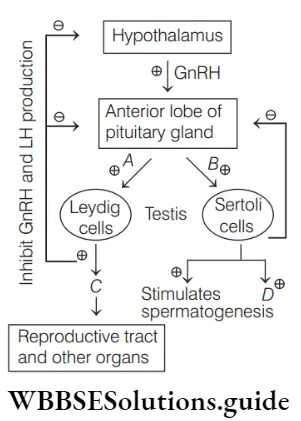
NEET Biology Gametogenesis Question 49

  1. A–Inhibin, B–FSH, C–Testosterone, D–LH
  2. A–Testosterone, B–Inhibin, C–LH, D–FSH
  3. A–FSH, B–LH, C–Inhibin,D–Testosterone
  4. A–LH, B–FSH, C–Testosterone, D–Inhibin

Answer:  4.  A–LH, B–FSH, C–Testosterone D–Inhibin

Question 50. Assertion In testis, spermatogenesis occurs in the seminiferous tubules and testosterone is secreted by Sertoli cells. Reason (R) Testosterone promotes growth and maturation of primary sex organs but has no role in accessory sex characters.

  1. Both A and R are true and R is the correct explanation of A
  2. Both A and R are true, but R is not the correct explanation A
  3. A is true, but R is false
  4. Both A and R are false

Answer:  4. Both A and R are false

Both A and R are false and can be corrected as

In testis, spermatogenesis occurs in the seminiferous tubules and testosterone is secreted by interstitial cells. Testosterone promotes growth and maturation of secondary sex organs. It also promotes the development of secondary sex characters.

Question 51. Identify A, B and C in the diagram below.

NEET Biology Gametogenesis Question 51

  1. A–Acrosome, B–Tail, C–Mitochondria
  2. A–Plasma membrane, B–Acrosome, C–Mitochondria
  3. A–Mitochondria, B–Acrosome, C–Plasma membrane
  4. A–Mitochondria, B–Plasma membrane, C–Tail

Answer:  2. A–Plasma membrane, B–Acrosome, C–Mitochondria

Gametogenesis Mcq With Answers

Question 52. Sperm is also called

  1. Male gamete
  2. Paternal gamete
  3. Male gamete sex cells
  4. All of these

Answer:  4. All of these

Sperms are also referred as male spermatozoa, or paternal gamete or simply male gamete.

Question 53. The cell organelle that is absent in human sperm is

  1. ER
  2. Mitochondria
  3. Nucleus
  4. Centriole

Answer:  1. ER

In human sperms, Endoplasmic Reticulum (ER) is absent.

Question 54. Which of the following contains the actual genetic part of a sperm ?

  1. Whole of it
  2. Tail
  3. Middle piece
  4. Head

Answer:  4. Head

Head is the main part of the sperm containing nucleus, DNA, etc. The head containing the haploid nuclei possess the genetic material.

Question 55. Sperm lysins are found in

  1. Neck region of sperm
  2. Tail region of sperm
  3. Head region of sperm
  4. Middle and tail regions of sperm

Answer:  3. Head region of sperm

Sperm lysins are found in the head region of sperm within the acrosome.

spermatogenesis takes place in

Question 56. Head of a mature sperm comprises of

  1. Elongated haploid nucleus covered by acrosomal material/cap
  2. Two centrioles and axial filament
  3. Acrosome without nucleus
  4. Mitochondrial sheath and cytoplasm

Answer:  1. Elongated haploid nucleus covered by acrosomal material/cap

The mature sperm consists of a head, middle piece and tail. The head is covered by the acrosome cap and contains a nucleus of dense genetic material comprising 23 chromosomes.

Mcq On Gametogenesis

Question 57. Acrosome of human sperm is rich in

  1. Hyaluronidase and acrosin
  2. Hyaluronic acid and acrosin
  3. Hippuric acid and uric acid
  4. Creatinine

Answer:  1. Hyaluronidase and acrosin

The acrosome of human sperm is rich in sperm lysins called hyaluronidase and acrosin.

Question 58. Acrosome of sperm is formed from

  1. Nucleus of spermatid
  2. Mitochondria of spermatid
  3. Golgi complex of spermatid
  4. Centrosome of spermatid

Answer:  3. Golgi complex of spermatid

The acrosome is a cap-like specialised structure that is derived from the Golgi complex during the maturation of the sperm.

Objective Questions on Gametogenesis for NEET

Question 59. Which one of the following statements about human sperm is correct?

  1. Acrosome has a conical pointed structure used for piercing and penetrating the egg, resulting in fertilisation
  2. The sperm lysins in the acrosome dissolve the egg envelope facilitating fertilisation
  3. Acrosome serves as a sensory structure leading the sperm towards the ovum
  4. Acrosome serves no particular function

Answer:  2. The sperm lysins in the acrosome dissolve the egg envelope facilitating fertilisation

Option is correct. Acrosome a small pointed structure at the tip of nucleus. It breaks down just Option is correct. Acrosome a small pointed structure at the tip of nucleus. It breaks down just

Question 60. Which of the following is true regarding sperm?

  1. Fertilizin–for penetrating egg membrane
  2. Hyalurodinase–for penetrating egg membrane
  3. Acrosin–dissolves corona radiata
  4. Capacitation–takes place in penis

Answer:  2. Hyalurodinase–for penetrating egg membrane

  • Option is true regarding sperm as Hyaluronidase is a hydrolytic enzyme present in the acrosome of sperm. It lyses the glycosaminoglycans in the extracellular matrix, holding the cell of the corona radiata together.
  • Thus, it helps the sperm to penetrate the egg membrane. Other options represent incorrectly matched pairs and can be corrected as Fertilizin is the receptor on ovum that is involved in species-specific fertilisation. Acrosin helps in penetrating zona pellucida and capacitation occurs in female reproductive tract.

Mcq On Gametogenesis

Question 61. Acrosome is a type of 

  1. Lysosome
  2. Flagellum
  3. Ribosome
  4. Basal body

Answer:  1. Lysosome

Acrosome is a lysosome-like organelle that is derived from the Golgi apparatus. The acrosome contains digestive enzymes (including hyaluronidase and acrosin) needed to penetrate the ovum.

Question 62. Select the incorrect statement.

  1. Nucleus of sperm contain nucleolus and chromatin
  2. Perforatorium is the narrow space between nucleus and acrosome within sperm’s head
  3. The centrioles of sperm are present at right angles to each other
  4. None of the above

Answer:  1. Nucleus of sperm contain nucleolus and chromatin

Statement in option is incorrect because the nucleus of sperm do not contain nucleoplasm and nucleolus. It is very small and contains only chromatin. Rest all statements are correct.

Question 63. Sperm releases lysozyme as it

  1. Aids in fertilisation
  2. Dissolves oocyte membrane
  3. Increases sperms motility
  4. Delays fertilisation

Answer:  1. Aids in fertilisation

The sperm releases lysozyme, which helps to dissolved egg membrane and thus, aids in fertilisation.

Question 64. A cross section at the midpoint of the middle piece of a human sperm will show

  1. Centriole, mitochondria and 9 + 2 arrangement of microtubules
  2. Centriole and mitochondria
  3. Mitochondria and 9 + 2 arrangement of microtubules
  4. 9 2+ arrangement of microtubules only

Answer:  3. Mitochondria and 9 + 2 arrangement of microtubules

  • The cross section of the sperm middle piece shows the axial bundle of microtubules or axoneme surrounded by a microtubular sheath in which the mitochondria of the spermatid have been arranged in a helical manner.
  • The microtubular structure enables the sperm to swim through the reproductive tract of the female. The microtubules are present in 9 + 2 arrangement.

Question 65. Neck of sperm contains

  1. Mitochondria
  2. Centriole
  3. lysosomes
  4. Nucleus

Answer:  2. Centriole

Neck of sperm contains two centrioles namely, proximal centriole and distal centriole.

Mcq On Gametogenesis

Question 66. Nebenkern represents

  1. Mitochondrial spiral of sperm
  2. Acrosome of sperm
  3. Centriole of sperm
  4. Tail of sperm

Answer:  1. Mitochondrial spiral of sperm

Neberkern represents the mitochondrial spiral in the middle piece of sperm.

Question 67. The ……………… gives rise to the axial filament of the sperm.

  1. Distal centriole
  2. Acrosome
  3. Proximal centriole
  4. Fibrillar sheath

Answer:  1. Distal centriole

The distal centriole gives rise to the axial filaments of the sperm. It is located away from the head of sperm, attached to the base of axoneme.

Question 68. The 9 + 2 arrangement of microtubules is found in ………….. of sperm.

  1. Head only
  2. Head and neck
  3. Tail
  4. Middle piece

Answer:  3. Tail

Among given options, the tail part of the sperm possesses 9+2 arrangement of microtubules as it is a flagellar structure.

Question 69. Except the end piece, the entire sperm is covered by

  1. Cytoplasmic membrane
  2. Tunica vaginalis
  3. Peritoneum
  4. Tunica albuginea

Answer:  1. Cytoplasmic membrane

Almost all parts of the sperm is covered by cytoplasmic membrane except the end piece.

Question 70. Which is the longest part of sperm?

  1. Head
  2. Neck
  3. Middle part
  4. Tail

Answer:  4. Tail

The tail portion is the longest part of sperm. It is a slender, hair-like bundle of filaments that connects to the head and middle piece.

Question 71. The tail of sperm consists of …………regions.

  1. Two
  2. Three
  3. Four
  4. Single

Answer:  1. Two

The tail of sperm consists of two parts Main part – cytoplasm surrounded by two fibres. End piece – axonema is present.

Question 72. Optimum temperature for sperm production is

  1. 25-30°C
  2. 40-50°C
  3. 35 -40°C
  4. 30-35°C

Answer:  4. 30-35°C

Optimum temperature for sperm production in humans is 30-35°C. It is about 2°C lower than the normal body temperature.

Question 73. Consider the following statements.

  1. Clupein protein is not found in human sperm.
  2. Clupein protein is highly basic arginine rich protein.

Choose the correct option.

  1. Statement I is correct, but 2 is incorrect
  2. Statement I is incorrect, but 2 is correct
  3. Both statements I and 2 are correct
  4. Both statements I and 2 are incorrect

Answer:  2. Statement I is incorrect, but 2 is correct.

Incorrect statement can be corrected as Clupein is a type of protein found in the human sperm.

Question 74. The fluid containing secretion of seminal vesicles, prostate gland and sperms from the testis is known as

  1. Serum
  2. Semen
  3. lymph
  4. Coelomic fluid

Answer:  2. Semen

Seminal plasma is the combined secretion of three glands named, seminal vesicles, prostate gland,  Cowper’s gland. Together with sperm, they collectively form semen.

Question 75. Human male ejaculates …A… to …B…million sperm. At least …C… should have normal shape and size and …D… should show vigorous motility.

Here A, B, C, and D refer to

  1. A–100, B–200, C–30%, D–40%
  2. A–200, B–300, C–60%, D–40%
  3. A–300, B–400, C–60%, D–40%
  4. A–400, B–500, C–60%, D–40%

Answer:  2.  A–200, B–300, C–60%, D–40%

Mcq On Gametogenesis

Question 76. Seminal plasma in humans is rich in

  1. Fructose and calcium, but has no enzymes
  2. Glucose and certain enzymes, but has no calcium
  3. Fructose and certain enzymes, but poor in calcium
  4. Fructose, calcium and certain enzymes

Answer:  4.  Fructose, calcium and certain enzymes

  • Seminal plasma in humans is rich in fructose, calcium and certain enzymes. Fructose is the source of energy for the sperm.
  • Enzymes nourish and activate the spermatozoa to swim. Calcium apparently have role in sperm motility.

spermatogenesis takes place in

Question 77. The volume of the semen released per ejaculation is ………… in man.

  1. 2-5 mL
  2. 5-8 mL
  3. 1-2 mL
  4. 6-10 mL

Answer:  1. 2-5 mL

The average volume of semen released during ejaculation is 2 to 5 mL. Volumes consistently less than 1.5 mL (hypospermia) or more than 5.5 mL (hyperspermia) are probably abnormal. Lower volumes may occur after very frequent ejaculation and higher volumes might be ejaculated after prolonged abstinence.

Question 78. Ejaculation is a …A…response. Erection is a …B…response. Identify, A and B refer to

  1. A–parasympathetic, B–sympathetic
  2. A–parasympathetic, B–parasympathetic
  3. A–sympathetic, B–parasympathetic
  4. A–sympathetic, B–sympathetic

Answer:  3.  A–Sympathetic, B–Parasympathetic.

Question 79. ……% of sperms is present in the semen.

  1. 30
  2. 50
  3. 60
  4. 10

Answer:  4. 10

The semen contains 10% of sperms of its total volume.

Question 80. Azoospermia means

  1. More than one ovum produced
  2. Unable to bear an offspring
  3. Cessation of menstruation
  4. Absence of sperm in semen

Answer:  4.  Absence of sperm in semen

Azoospermia is the medical condition in which semen does not contain sperm.

Question 81. A person is said to be suffering from infertility when the sperm cells display

  1. A count more than 120 million/mL semen
  2. Increased acrosomal activity
  3. Normal morphology
  4. Count of less than 200 million/mL semen

Answer:  4.  Count of less than 200 million/mL semen

The count of less than 200 million /mL semen signifies infertility.

Question 82. Manchette is

  1. Condensed nucleus in male cell
  2. Condensed nucleolus in male cell
  3. Condensed nucleoplasm in sperm
  4. Condensed centromere in sperm

Answer:  3.  Condensed nucleoplasm in sperm

The manchette is a transient skirt-like structure surrounding the elongating spermatid head and is only present during spermatid elongation. Manchette is condensed nucleoplasm in sperm.

Question 83. Consider the following statements.

  1. The process of ova formation is called oogenesis.
  2.  Oogenesis begins at the onset of puberty in ovaries.

Choose the correct option.

  1. Statement 1 is correct, but 2 is incorrect
  2. Statement 1 is incorrect, but 2 is correct
  3. Both statements 1 and 2 are correct
  4. Both statements 1 and 2 are incorrect

Answer:  1.  Statement 1 is correct, but 2 is incorrect

Statement 1 is correct, but 2 is incorrect and can be corrected as Oogenesis is the process by which ova is formed inside the mammalian ovary. It is initiated in the embryonic stage.

Question 84. Oogenesis comprises

  1. Multiplication phase
  2. Growth phase
  3. Maturation phase
  4. All of the above

Answer:  4. All of the above

Mcq On Gametogenesis

Oogenesis is the process of formation, development and maturation of haploid ova from diploid germinal cells of ovary. Oogenesis comprises of three phases

  • Multiplication phase
  • Growth phase
  •  Maturation phase

Question 85. During oogenesis, how many ova are formed at the end of two maturation divisions from a single primary oocyte?

  1. One
  2. Two
  3. Three
  4. Four

Answer:  1. One

During oogenesis, only one ovum is formed from a single primary oocyte and rest polar bodies are formed.

Spermatogenesis and Oogenesis MCQs for NEET

Question 86. In humans, what is the ratio of number of gametes produced from one male primary sex cell to the number of gametes produced from one female primary sex cell?

  1. 1: 4
  2. 1: 1
  3. 4: 1
  4. 1: 3

Answer:  3. 4: 1

  • From a diploid primary spermatocyte, four haploid spermatozoa are produced through meiosis.
  • While, from a diploid primary oocyte, only one haploid ovum is formed, rest are polar bodies. Hence, the ratio between male gametes and female gametes produced from respective primary sex cells is 4: 1.

Question 87. One oogonium forms

  1. 1 ovum + 3 polar bodies
  2. 1 ovum + 1 polar body
  3. 1 ovum without centrioles + 3 polar bodies
  4. single ovum and no polar body

Answer:  3. 1 ovum without centrioles + 3 polar bodies

One oogonium forms one ovum without centriole and three polar bodies.

Question 88. In human females, at the time of birth, there are two million ova. How many of them normally reach maturity in the course of normal reproductive life?

  1. 500
  2. 1,000
  3. 2,000
  4. 5,000

Answer:  1. 500

At birth, there are approximately 2 million eggs and by the time of puberty, only about 300,000 remain in ovary. Of these, only 400 to 500 reach maturity and ovulate during a women’s reproductive life time.

Question 89. Female gamete mother cells are also known as

  1. Oogonia
  2. Ovum
  3. Ootid
  4. Oocyte

Answer: 1. Oogonia

Female gamete mother cells are called oogonia.

Question 90. A human female has the maximum number of primary oocytes in her ovaries

  1. At birth
  2. Just prior to puberty
  3. Early in her fertile years
  4. Midway through her fertile years

Answer:  1. At birth

No more oogonia are formed and added in ovary after birth. A larger number of these follicles degenerate during the phase from birth to puberty. Therefore, maximum number of primary oocytes are found at the time of birth.

Question 91. Primordial follicles within the female ovary start to develop

  1. At puberty
  2. Around age 5
  3. At birth
  4. During prenatal development

Answer:  4. During prenatal development

Primordial follicles start developing at the foetal or prenatal stage and after birth, this development stops.

Question 92. In which phase of oogenesis, the oogonium develops into primary oocyte under the influence of FSH?

  1. Multiplication phase
  2. Growth phase
  3. Maturation phase
  4. Cleavage

Answer:  2. Growth phase

In growth phase of oogenesis, the oogonia develop into primary oocyte under the influence of follicle– stimulating hormone.

Question 93. Tremendous increase in volume of cytoplasm and organelles in primary oocyte takes place during

  1. Previtellogenesis
  2. Vitellogenesis
  3. Ovulation
  4. Cleavage

Answer: 1. Previtellogenesis

Previtallogenesis is characterised by an intensive synthesis of rRNA and by change in the cytoplasm morphology. There is an increase in the quantity of endoplasmic reticulum, mitochondria and Golgi complex.

Question 94. At the time of birth, the oocyte is present in …… stage of cell cycle.

  1. Prophase- 1
  2. Prophase-2
  3. Meiosis-2
  4. Mitosis

Answer: 1. Prophase- 1

Oogenesis starts in the foetal stage. Till the time of birth, they remain in prophase-I stage. Oogenesis resumes at the time of puberty when GnRH is produced by hypothalamus.

spermatogenesis takes place in

Question 95. The cortex of human ovary contains thousands of immature ova within small spheres that are composed of a single layer of cells. These are

  1. Mature follicles
  2. Primary follicles
  3. Secondary follicles
  4. Corpus luteum

Answer:  2. Primary follicles

A primary follicle is an immature ovarian follicle. It is surrounded by single layer of cuboidal granulosa cells.

Question 96. Meiosis during ovum formation occurs in

  1. Primordial germ cell
  2. Primary oocyte
  3. Oogonium
  4. Secondary oocyte

Answer:  2. Primary oocyte

Meiosis during ovum formation occurs in primary oocyte. It result in the formation of secondary oocyte and first polar body.

Mcq On Gametogenesis

Question 97. In humans, the oocyte is maintained in a state of meiotic arrest by the secretions of

  1. Granulosa cells
  2. Zona pellucida
  3. Cumulus oophorus
  4. Theca

Answer:  1. Granulosa cells

The follicular cells are surrounded by granulosa cells, which secrete oestrogens and Meiosis Inhibiting Factor (MIF) that leads to meiotic arrest.

Question 98. At which stage of the cell cycle does the development of secondary oocyte get arrested before pregnancy?

  1. Anaphase-1
  2. Prophase-2
  3. Metaphase-2
  4. Telophase-1

Answer:  3. Metaphase-2

Before pregnancy, the secondary ooctye gets arrested at the metaphase-2 stage of cell cycle.

Question 99. Primary oocyte surrounded by a layer of granulosa cells is called

  1. Secondary follicle
  2. Ootid
  3. Primary follicle
  4. Tertiary follicle

Answer:  3. Primary follicle

Primary oocyte surrounded by a layer of granulosa cell is called primary follicle, which are 2n in number.

Question 100. Vitellogenesis occurs during the formation of

  1. Ootid in the Fallopian tube
  2. Secondary oocyte in the Fallopian tube
  3. Primary oocyte in the Graafian follicle
  4. Oogonial cell in the Graafian follicle

Answer:  3. Primary oocyte in the Graafian follicle

In ovary, vitellogenesis occurs during the formation of primary oocyte in the Graafian follicle.

Question 101. Oocyte is liberated from ovary under the influence of LH after completing

  1. Mitosis and before liberating polar bodies
  2. Meiosis-1 and before liberating polar bodies
  3. Both mitosis and meiosis
  4. Meiosis-1 and after releasing polar body

Answer:  4. Meiosis-1 and after releasing polar body

Oocyte is released from the ovary in the secondary oocyte stage under the influence of LH, during ovulation. This stage is the result of
first meiotic division of primary oocyte into a large secondary oocyte and a small first polar body.

spermatogenesis takes place in

The secondary oocyte starts undergoing the second meiotic division which does not proceed beyond metaphase until a sperm enters it.

Question 102. Select the incorrect statement.

  1. Oogenesis is started inside ovary and is completed in oviduct
  2. Ovum is much larger than oogonium
  3. Oogonia form egg nest at the tips of egg tubes of pfluger during maturation phase
  4. Oogenesis is a discontinuous process

Answer:  3. Oogonia form egg nest at the tips of egg tubes of pfluger during maturation phase

Statement in option is incorrect and can be corrected as Oogonia form rounded masses or egg nest at the tip of egg tubes of pfluger during the growth phase of oogenesis. Rest all options are correct.

Question 103. Stroma is a term applied to

  1. Gall stone
  2. Ovarian follicles
  3. Connective tissue in which Graafian follicles are embedded
  4. Connective tissue surrounding the seminiferous tubules

Answer:  3. Connective tissue in which Graafian follicles are embedded

  • The stroma of the ovary is a type of connective tissue, abundantly supplied with blood vessels in which Graafian follicular cells are embedded.
  • The stroma also contains ordinary connective tissue such as reticular fibers and collagen.

Question 104. The tertiary follicle changes into

  1. Graafian follicle
  2. Oocyte
  3. Megaspore mother cell
  4. Ovum

Answer:  1. Graafian follicle

A tertiary follicle changes into the mature Graafian follicle. The secondary oocyte forms a new membrane called zona pellucida surrounding it.

Question 105. Transformation of a young follicle into Graafian follicle is controlled by

  1. Progesterone
  2. lactogenic hormone
  3. Follicular stimulating hormone
  4. Luteinizing hormone

Answer:  3. Follicular stimulating hormone

spermatogenesis takes place in

Follicle stimulating hormone stimulates the development of young follicle into the mature Graafian follicle.

Question 106. Cumulus oophorus is

  1. Mass of sperm embedded in Sertoli cells
  2. Heap of eggs
  3. Mass of epithelial cells in Graafian follicles
  4. Heap of maturing follicles

Answer:  3. Mass of epithelial cells in Graafian follicles

The cumulus oophorus or discus proligerus is a cluster of epithelial cells that surround the oocyte in the Graafian follicle.

Question 107. Assertion In Graafian follicles, the primary oocyte and the follicle cells may be regarded as sibling cells. Reason (R) Both arise from the same parent cell, the oogonium, by mitotic divisions.

  1. Both A and R are true and R is the correct explanation of A
  2. Both A and R are true, but R is not the correct explanation of A
  3. A is true, but R is false
  4. Both A and R are false

Answer:  1.  Both A and R are true and R is the correct explanation of A.

Primary oocyte and follicle cells both arises from the oogonium by the mitosis cell division. Hence, they (Graafian follicle and primary oocytes) are regarded as the sibling cells.

Question 108. During multiplication phase of oogenesis,

  1. Oogonium grows and form primary oocyte
  2. Germinal cells undergo mitosis to form oogonia
  3. Primary oocyte undergoes maturation
  4. Secondary oocyte undergoes maturation

Answer:  2. Germinal cells undergo mitosis to form oogonia

During multiplication phase of oogenesis, germinal cells undergo mitosis to produce oogonia or egg mother cells. No more oogonia are formed after birth.

Question 109. During maturation phase of oogenesis,

  1. Primary oocyte undergoes meiotic division-I and shows equal nuclear division and unequal cytoplasmic division
  2. Haploid secondary oocyte undergo meiotic division-2 to form ovum
  3. Both 1 and 2
  4. Primary oocyte undergoes meiotic division-I which shows equal nuclear and cytoplasmic division

Answer:  3. Both 1 and 2

In maturation phase, the primary oocyte undergoes meiotic division-I and shows equal nuclear division and unequal cytoplasmic division. It results in the formation of haploid secondary oocyte and first polar body. The former further undergo meiotic division-2 to form ovum.

Question 110. Egg is liberated from ovary at the

  1. Secondary oocyte stage
  2. Primary oocyte stage
  3. Oogonial stage
  4. Mature ovum stage

Answer:  1. Secondary oocyte stage

Egg is liberated from the ovary (ovulation) at secondary oocyte stage when meiosis-2 is arrested in secondary oocyte.

spermatogenesis takes place in

Question 111. Which of the following has haploid chromosomes?

  1. Oogonia
  2. Primary oocyte
  3. Secondary oocyte
  4. Primary spermatocyte

Answer:  3. Secondary oocyte

Secondary oocyte has haploid set of chromosomes. Oogonia is a diploid mother cell. Primary oocyte is a diploid cell formed from oogonia Primary spermatocyte is formed from diploid spermatogonium.

Question 112. Select the correct option of haploid cells from the following groups.

  1. Primary oocyte, secondary oocyte, spermatid
  2. Secondary spermatocyte, first polar body, ovum
  3. Spermatogonia, primary spermatocyte, spermatid
  4. Primay spermatocyte, secondary spermatocyte, second polar body

Answer:  2. Secondary spermatocyte, first polar body, ovum

  • Out of the given options, the haploid cells are secondary spermatocyte, first polar body, ovum secondary oocyte, spermatid and second polar body.
  • The diploid cells are primary oocyte and primary spermatocyte. Thus, option is correct.

Question 113. Mature human ovum is

  1. Haploid
  2. Non-motile
  3. Spherical in shape
  4. All of the above

Answer:  4. All of the above

Mature human ovum is generally haploid spherical, non-motile gamete with yolky cytoplasm and enclosed by one or more egg envelopes.

Question 114. Human egg is

  1. Alecithal
  2. Mesolecithal
  3. Telolecithal
  4. Centrolecithal

Answer:  1. Alecithal

Human egg is alecithal. In it, the amount of yolk is almost nill than the amount of cytoplasm.

Question 115. Select the correct statement.

  1. The nucleus of human ovum contains a prominent nucleolus
  2. The large nucleus of ovum is called germinal vesicle
  3. Primary egg membranes are secreted by ovum itself
  4. All of the above

Answer:  4. All of the above

All the given statements are correct.

Question 116. As compared to the sperm, the egg contains more

  1. Chromosomes
  2. Centrioles
  3. Cytoplasm
  4. Mitochondria

Answer:  3. Cytoplasm

An egg is larger than the sperm cell. Unlike a sperm cell, the egg contains a lot of cytoplasm however, the number of chromosomes is same.
Egg do not contain centriole and mitochondria.

Question 117. The size of the egg chiefly depends upon the

  1. Size of the animal
  2. Amount of yolk reserved in it
  3. Amount of food taken by the mother
  4. All of the above

Answer:  2. Amount of yolk reserved in it

The size of the egg chiefly depends upon the amount of yolk reserved in it.

Question 118. The side of ovum with nucleus and polar body is called

  1. Animal pole
  2. Vegetal pole
  3. Cumulus oophorus
  4. Ootid

Answer:  1. Animal pole

The animal pole is the point on the surface of an egg that is diametrically opposite to the vegetal pole and usually marks the most active part of the protoplasm or the part containing least yolk. This side contains nucleus and the polar body.

spermatogenesis takes place in

Question 119. The plasma membrane of human ovum is covered with

  1. Theca externa
  2. Corona radiata
  3. Zona pellucida
  4. Theca interna

Answer:  3. Zona pellucida

The zona pellucida is a glycoprotein layer surrounding the plasma membrane of mammalian ovum.

Question 120. The membrane that appear in mammalian egg immediately after ovulation is

  1. Chorion
  2. Zona pellucida
  3. Corona radiata
  4. Vitelline membrane

Answer:  3. Corona radiata

Just after ovulation, the layer formed around the ovum is called corona radiata. It is formed by the granulosa cells of cumulus oophorus. It probably increases the likelihood that the ovum will be picked up in the uterine tube.

Question 121. The layer of cells immediately surrounding the ovum, but outside the zona pellucida is called

  1. Corona radiata
  2. Membrana granulosa
  3. Theca interna
  4. Germinal epithelium

Answer: 1. Corona radiata

The ovum possesses three coverings, inner plasma membrane, middle glycoprotein zona pellucida and outer cellular corona radiata with
radially elongated scattered cells held in mucopolysaccharide.

Question 122. Corona radiata is made up of

  1. Vitelline membrane
  2. Zona pellucida around the oocyte
  3. Follicular cells around the oocyte
  4. Membrana granulosa

Answer:  3. Follicular cells around the oocyte

spermatogenesis takes place in

The corona radiata is the innermost layer of the cells of the cumulus oophorus. It is made up of follicular cells around the oocyte.

Question 123. Select the incorrect statement.

  1. Zona pellucida is secreted by the ovum itself
  2. Corona radiata is a primary egg membrane
  3. Hyaluronic acid which binds corona radiata cells is a mucopolysaccharide
  4. Zona pellucida is extracellular material that is composed of various glycoproteins

Answer:  2. Corona radiata is a primary egg membrane

Statement in option is incorrect and can be corrected as Corona radiata is a secondary egg membrane because it is not secreted by ovum itself. Zona pellucida is the primary egg membrane. Rest all options are correct.

Question 124. Consider the following statements.

  1. Corona radiata is non-cellular layer.
  2. Zona pellucida is a cellular layer.

Choose the correct option.

  1. Statement 1 is correct, but 2 is incorrect
  2. Statement 1 is incorrect, but 2 is correct
  3. Both statements 1 and 2 are correct
  4. Both statements 1 and 2 are incorrect

Answer:  4. Both statements 1 and 2 are incorrect

Both statements 1 and 2 are incorrect and can be corrected as The corona radiata is cellular layer that forms around a developing oocyte
in the ovary and remain with it upon ovulation, whereas the zona pellucida is a non-cellular layer.

Question 125. There is no ………… in ovum.

  1. Nucleus
  2. Germinal vesicle
  3. Centriole
  4. Corona radiata

Answer:  3. Centriole

  • There is no centriole in ovum or secondary oocyte because during fertilisation, sperm’s centrioles are recurited in zygote.
  • Since, only one pair is needed in one cell, ovum looses its centriole along with second polar body during second maturation division.

Question 126. Layers of an ovum from outside to inside is

  1. Corona radiata, zona pellucida and vitelline membrane
  2. Zona pellucida, corona radiata and vitelline membrane
  3. Vitelline membrane, zona pellucida and corona radiata
  4. Zona pellucida, vitelline membrane and corona radiata

Answer:  1. Corona radiata, zona pellucida and vitelline membrane

Layers of an ovum from outside to inside are as follows Corona radiata → Zona pellucida → Vitelline membrane

NEET Gametogenesis Topic-wise Questions with Explanations

Question 127. Which activity occurs first during the development of an egg?

  1. Induction
  2. Differential growth
  3. Polarity
  4. Gastrulation

Answer:  3. Polarity

Polarity occurs during the first stage of egg development. The side of ovum which forms the extrudes polar bodies is called animal pole and the opposite side is called vegetal pole.

Question 128. A small space between ooplasm and vitelline membrane is called

  1. Lacunae
  2. Perivitelline space
  3. Intercellular space
  4. Stroma

Answer:  2. Perivitelline space

The perivitelline space is the space between the ooplasm and the vitelline membrane of an oocyte or fertilised ovum.

Question 129. Assertion Ovum retains most of the contents of the primary oocyte and is much larger than a spermatozoan. Reason (R) Ovum needs energy to go about in search of a spermatozoan for fertilisation.

  1. Both A and R are true and R is the correct explanation of A
  2. Both A and R are true, but R is not the correct explanation of A
  3. A is true, but R is false
  4. Both A and R are false

Answer:  3. A is true, but R is false.

Reason can be corrected as 3. A is true, but R is false. Reason can be corrected as

Question 130. Cumulus proligerus cells are found around

  1. Oviducal funnel
  2. Corpus albicans
  3. Ovum
  4. Ovary

Answer:  3. Ovum

Cumulus oophorus (discus proligerus) is a solid mass of follicular cells that surround the developing ovum. It projects into the antrum of the Graafian follicle.

Question 131. In human ovum, nucleus is eccentric called

  1. Ooplasm
  2. Germinal vesicle
  3. Oocyte
  4. Germinal layer

Answer: 2. Germinal vesicle.

In human ovum, the eccentric nucleus is known as germinal vesicle.

Question 132. An atretic follicle is

  1. Also known as corpus albicans
  2. Fails to mature and degenerates
  3. Released from the ovum
  4. None of the above

Answer:  2. Fails to mature and degenerates

An atretic follicle fails to mature and thus degenerates. It occurs continually throughout a women’s life as she is born with millions of follicles, but ovulate only around 400 times in her lifetime.

spermatogenesis takes place in

Question 133. One of the minute cell which separates from the animal egg during maturation is known as

  1. Primary spermatogonia
  2. Secondary oogonia
  3. Primary oogonia
  4. Polar body

Answer:  4. Polar body

  • During maturation phase, polar bodies are extruded. The primary oocyte undergoes meiosis-I producing two haploid cells (n), the larger one is secondary oocyte and the smaller one is a first polar body.
  • Meiosis-2 of secondary oocyte further results in the formation of functional egg or ovum and a second polar body.

Question 134. Polar bodies formed during the formation of oocytes are

  1. Smaller cells formed due to unequal meiosis
  2. Structures which break off as bud during oogenesis
  3. Structures formed during spermatogenesis
  4. Daughter cells formed after mitosis

Answer:  1. Smaller cells formed due to unequal meiosis

  • A polar body is a small haploid cell that is formed concomitantly as an egg cell during oogenesis. It generally does not have the ability to be fertilised.
  • When certain diploid cells in animals undergo cytokinesis after meiosis to produce egg cells, they divide unevenly.

Question 135. Assertion One polar body is released by the oocyte during ovulation. Reason (R) When the oocyte is in Fallopian tube, it is in second metaphase state.

  1. Both A and R are true and R is the correct explanation A
  2. Both A and R are correct, but R is not the correct explanation of A
  3. A is true, but R is false
  4. Both A and R are false

Answer:  1. Both A and R are true and R is the correct explanation of A.

  • The secondary oocyte that is released during ovulation has completed first meiotic division and released one polar body.
  • The secondary oocyte get arrested at second metaphase stage of meiosis-2. This division resumes when the sperm penetrate it.

Question 136. Match the following columns.

NEET Biology Gametogenesis Match The Column Question 136

Answer:  2. A–4, B–2, C–3, D–1

Question 137. What is the role of polar bodies during oogenesis?

  1. Polar bodies ensure that the ovum contain the most cytoplasm
  2. They rid the body of defective sets of chromosomes, leaving the ‘good’ set within the ovum
  3. They are merely the byproduct of meiosis and serve no function
  4. They prevent the development of most sets of multiple births

Answer:  1. Polar bodies ensure that the ovum contain the most cytoplasm

Polar bodies ensure that the ovum contains most of the cytoplasm during oogenesis due to the unequal division.

Question 138. Given below is a flowchart showing influence of hormones on gametogenesis in human females. Identify A, B, C and D form the options given below.

NEET Biology Gametogenesis Question 138 Hormones on Gametogenesis

  1. A–GnRH, B–Oestrogen and progesterone, C–Ovary, D–FSH and LH
  2. A–GnRH, B–Progesterone and LH, C–Ovary, D–Oestrogen and FSH
  3. A–GnRH, B–FSH and estrogen, C–Ovary, D–LH and progesterone
  4. A–GnRH, B–FSH and LH, C–Ovary, D–Oestrogen and progesterone

Answer:  4.  A–GnRH, B–FSH and LH, C–Ovary, D–Oestrogen and progesterone.

Question 139. 1st polar body is formed at which stage of oogenesis?

  1. 1st meiosis
  2. 2nd mitosis
  3. 1st mitosis
  4. Differentiation

Answer:  1. 1st meiosis

spermatogenesis takes place in

Question 140. The seminal plasma along with the sperm is called

  1. Spermatid
  2. Spermatozoa
  3. Semen
  4. All of these

Answer: 3.  Semen

Question 141. The number of sperms produced from 24 secondary spermatocytes will be

  1. 24
  2. 48
  3. 12
  4.  96

Answer: 2.  48 sperms will be produced from 24 secondary spermatocytes.

Question 142. What do you mean by the term spermioteleosis ?

  1. Conversion of spermatids to sperm
  2. Conversion of spermatogonium to spermatid
  3. Conversion of spermatid to spermatogonium
  4. Conversion of primary spermatocyte to secondary spermatocyte

Answer:  1. Conversion of spermatids to sperm

Question 143. One million oocytes and one million secondary spermatocytes will form

  1. 2 million ova and 2 million sperms
  2. 1 million ova and 1 million sperms
  3. 2 million ova and I million sperms
  4. 1 million ova and 2 million sperms

Answer: 4.  1 million ova and 2 million sperm

NEET Biology Menstrual Cycle Multiple Choice Question And Answers

Biology MCQs with answers for NEET Menstrual Cycle

Question 1. The cyclic discharge of blood and cellular debris from the uterus through vagina is called

  1. Estrous cycle
  2. Reproductive cycle
  3. Menstrual cycle
  4. Life cycle

Answer:  3. Menstrual cycle

The menstrual cycle is the regular natural change that occurs in the female reproductive system. It involves the cyclic discharge of blood and cellular debris from uterus, via vagina.

Question 2. The reproductive cycle in the female primate monkeys, apes and human beings is called

  1. Menstrual cycle
  2. Menarche
  3. Menopause
  4. Ovulation

Answer:  1. Menstrual cycle

“human reproduction mcqs class 12 “

The rhythmic series of changes that occurs in the reproductive organs of female primates (monkeys, apes and human beings) is called menstrual cycle.

Read And Learn More: NEET Biology Multiple Choice Question And Answers

Question 3. Given below are various terms and their related informations.

  1. Precocious puberty – Puberty attained before normal age.
  2. Testes – Also called spermaries.
  3. Luteal phase – Occurs immediate after menstrual phase.
  4. Anestrus phase – Female mate with male

Choose the option containing incorrectly matched pairs.

  1. 1 and 2
  2. 3 and 4
  3. 2 and 4
  4. 2, 3 and 4

Answer:  2. 3 and 4

Pairs 3 and 4 are incorrectly matched and can be corrected as Luteal phase occurs immediately after ovulatory phase. During anestrus phase of estrous cycle, female does not mate with male. Rest pairs are correct.

NEET Biology Menstrual Cycle Multiple Choice Question And Answers

“which hormone control menstrual cycle “

Question 4. Match the items given in Column I with those in Column 2 and select the correct option given below.

NEET Biology Menstrual Cycle Match The Column Question 4

Answer:  3. A-2, B-3, C-1

Question 5. Hormones for the menstrual cycle are produced by

  1. Ovaries only
  2. Uterus only
  3. Ovaries and uterus
  4. Ovaries and anterior pituitary

Answer:  4. Ovaries and anterior pituitary

Menstrual cycle is regulated by certain hormones, some of which are secreted by the pituitary gland. The hormones produced by the pituitary gland influence the ovaries. The hormones secreted by the ovaries affect the walls of the uterus.

Biology MCQs with answers for NEET

Question 6. The human female shows menstruation at regular intervals right from

  1. Infancy to puberty
  2. Puberty to pregnancy
  3. Menopause to puberty
  4. Puberty to menopause

Answer:  4. Puberty to menopause

Menstruation usually starts during puberty, between the age of 10 and 16 years and it continue until menopause.

“which hormone controls menstrual cycle “

Question 7. The first menstrual cycle in female is known as

  1. Menopause
  2. Menarch
  3. Reproductive cycle
  4. Menstruation

Answer:  2. Menarch

Menarch is the technical term for the first menstrual cycle in female.
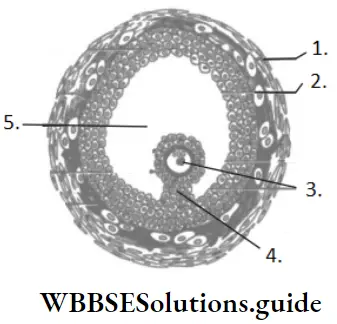
NEET Biology Menstrual Cycle MCQs with answers

Question 8. Human female is

  1. Seasonal ovulator
  2. Occasional ovulator
  3. Periodical ovulator
  4. Spontaneous ovulator

Answer:  3. Periodical ovulator

Human female is periodical ovulator, i.e. they ovulates regularly after a certain fixed period.

Question 9. Sequence of hormones during menstrual cycle is Odisha

  1. Oestrogen, progesterone and FSH
  2. Progesterone, oestrogen and FSH
  3. FSH, oestrogen and progesterone
  4. FSH, progesterone and oestrogen

Answer:  3. FSH, oestrogen and progesterone

The correct sequence of hormonal regulation during menstrual cycle is FSH (stimulation of Graafian follicles), oestrogen (endometrium thickening), LH (ovulation), progesterone (maintenance of pregnancy).

Question 10. Menstrual cycle starts when there is

  1. Decrease in progesterone level
  2. Increase in oestrogen level
  3. FSH release
  4. Release of oxytocin

Answer:  1. Decrease in progesterone level

Menstrual cycle starts with bleeding phase or menstruation. Decrease in progesterone level leads to shedding of uterus lining during this phase.

Biology MCQs with answers for NEET

Question 11. Changes in GnRH pulse frequency in females is controlled by circulating levels of

  1. Progesterone only
  2. Progesterone and inhibin
  3. Oestrogen and progesterone
  4. Oestrogen and inhibin

Answer:  3. Oestrogen and progesterone

  • GnRH is secreted by the hypothalamus which stimulates the anterior lobe of pituitary gland to secrete Luteinizing Hormone (LH) and FSH. FSH stimulates the growth of the ovarian follicles and stimulates the formation of oestrogens.
  • LH stimulates the corpus luteum to secrete progesterone. Rising levels of progesterone and oestrogen inhibits the release of GnRH, which in turn, inhibits the secretion of FSH and LH.

Question 12. The area that experiences the greatest change during menstrual cycle is

  1. Vagina
  2. Perimetrium
  3. Cervix
  4. Endometrium

Answer:  4. Endometrium

Endometrium wall of uterus periodically changes in different stages of menstrual cycle.

Important MCQs on Menstrual Cycle for NEET

Question 13. Some important events in the human female reproductive cycle are given below. Arrange the events in a proper sequence.

  1. Secretion of FSH
  2. Growth of corpus luteum
  3. Growth of the follicle and oogenesis
  4. Ovulation
  5. Sudden increase in the levels of LH

Choose the correct answer

  1. I → 4 → 3 → V → 2
  2. 2 → I → 3 → 4 → V
  3. 3 → I → 4 → 2 → V
  4. I → 3 → V → 4 → 2

Answer:  4. I→3→V→4→2

Question 14. Which one of the following statements is/are correct?

  1. FSH and LH occur in both males and females
  2. FSH and LH stimulate the follicle to secrete oestrogen
  3. The ovarian cycle depends on the blood levels of FSH and LH
  4. All of the above

Answer:  4. All of the above

All the given statements are correct.

Question 15. Which one of the following is the most likely the root cause for menstruation is not occurring in human female regularly?

  1. Maintenance of the hypertrophical endometrial lining
  2. Maintenance of high concentration of sex hormones in the blood stream
  3. Retention of well-developed corpus luteum
  4. Fertilisation of the ovum

Answer:  2.  Maintenance of high concentration of sex hormones in the blood stream

  • High concentration of sex steroids (oestrogen) exerts negat4e feedback on anterior pituitary, thus decreasing the LH and FSH secretion and their release.
  • It lowers the level of LH and FSH in blood. Due to insufficient LH level, ovulation does not occurs which causes irregular menstruation.

Question 16. Assertion Level of gonadotropins in blood increases during puberty. Reason (R) Increased level of LH and FSH are responsible for initiating menstrual cycle.

  1. Both A and R are true and R is the correct explanation of A
  2. Both A and R are true, but R is not the correct explanation of A
  3. A is true, but R is false
  4. Both A and R are false

Answer:  1. Both A and R are true and R is the correct explanation of A.

Increased level of gonadotropins, LH and FSH is observed during puberty due to the secretion of GnRH from hypothalamus. These hormonal changes induce the onset of menstrual cycle.

Question 17. Which one of the following statements is incorrect about menstruation ?

  1. At menopause, there is abrupt increase in gonadotropic hormones
  2. The beginning of menstruation cycle is called menarche
  3. During normal menstruation, about 40 mL blood is lost
  4. The menstrual blood can clot easily

Answer:  4. The menstrual blood can clot easily

Statement in option 4 is incorrect and can be corrected as Menstrual blood do not clot due to the presence of fibrinolysin in it. Other statements are correct.

Biology MCQs with answers for NEET

Question 18. Assertion After ovarieotomy, menstrual cycle in woman may be stopped. Reason (R) Ovarian hormones induce menstrual cycle.

  1. Both A and R are true and R is the correct explanation of A
  2. Both A and R are true, but R is not the correct explanation of A
  3. A is true, but R false
  4. Both A and R are false

Answer:  1. Both A and R are true and R is the correct explanation of A.

Ovaries secrete steroid sex hormones like progesterone and oestrogen which are responsible for controlling menstrual cycle. Ovarieotomy or removal of ovary would stop menstrual cycle permanently.

Question 19. Menstrual phase is known as

  1. luteal phase
  2. Destructive phase
  3. Follicular phase
  4. Ovulatory phase

Answer:  2. Destructive phase

Menstrual phase is known as destructive phase because it involves the destruction of uterine walls.

“biology human reproduction “

Question 20. The number of days for which the menstrual phase of menstrual cycle lasts is about

  1. 28
  2. 14
  3. 10
  4. 4

Answer:  4. 4

Menstruation is the stage of the menstrual cycle during which the endometrium is shed because fertilisation has not occurred. It occurs for about 4 days.

Question 21. Assertion During menstrual phase about 50-100 mL of blood is lost. Reason (R) In the menstrual phase, shedding of endometrial lining along with ovum takes place due to reduced titre of oestrogen and progesterone.

  1. Both A and R are true and R is the correct explanation of A
  2. Both A and R are true, but R is not correct explanation of A
  3. A is true, but R is false
  4. Both A and R are false

Answer:  2.  Both A and R are true, but R is not the correct explanation of A.

Menstrual phase continues for 3- 5 days and involves the discharge of blood (a total of 50-100 mL) along with casting off endometrial lining. It occurs due to reduced concentration of oestrogen and progesterone

Menstrual Cycle chapter-wise MCQs for NEET

Question 22. Menstruation is caused due to

  1. Breakdown of the endometrium
  2. Rupture of the Graafian follicle
  3. Releasing of progesterone
  4. None of the above

Answer:  1. Breakdown of the endometrium

Breakdown of uterine endometrium in the absence of fertilisation and decreased level of progesterone causes menstruation.

Question 23. Menstrual flow occurs due to the lack of

  1. Progesterone
  2. FSH
  3. Oxytocin
  4. Vasopressin

Answer:  1. Progesterone

Menstruation occurs when the progesterone secreting structure, i.e. corpus luteum disintegrate in the absence of fertilisation. Thus, the level of progesterone decreases in blood during menstruation.

Biology MCQ For NEET With Answers

Question 24. Levels of oestrogen and progesterone are minimum at the time of

  1. Onset of menstrual phase
  2. Secretory phase
  3. Ovulation
  4. Follicular phase

Answer:  1. Onset of menstrual phase

Menstruation occurs when the progesterone secreting structure, i.e. corpus luteum disintegrate in the absence of fertilisation. Thus, the level of progesterone decreases in blood during menstruation.

Question 25. Dysmenorrhoea means

  1. Absence of menstruation
  2. Painful menstruation
  3. Heavy bleeding
  4. Irregular menstruation

Answer:  2. Painful menstruation

Dysmenorrhoea means painful menstruation or menstrual cramps. The pain usually occur in the pelvis or lower abdomen.

Question 26. Menstruation indicates the

  1. Confirmation of pregnancy
  2. Absence of pregnancy
  3. Suppression of pregnancy
  4. Maturity

Answer:  2. Absence of pregnancy

Menstruation indicates the absence of pregnancy as it occurs when secondary oocyte is not fertilised.

Question 27. Identify the event that occurs at the beginning of menstruation.

  1. Ovulation takes place
  2. Corpus luteum degenerates
  3. Progesterone and oestrogen level increases
  4. Levels of LH and FSH increases

Answer:  2. Corpus luteum degenerates

In beginning of menstrual phase, the corpus luteum degenerates because of decreasing progesterone level in the absence of fertilisation. This leads to the degradation of endometrium wall.

Biology MCQ For NEET With Answers

Question 28. Low levels of LH during the secretory phase of the menstrual cycle are primarily due to

  1. Low oestrogen level
  2. Inhibin
  3. Low progesterone level
  4. High oestrogen and progesterone level

Answer:  4. High oestrogen and progesterone level

At the onset of secretory or luteal phase, level of gonadotropin like LH decreases due to increased secretion of progesterone. A secondary rise in oestrogens causes further gonadotropin suppression.

Question 29. The phase of menstrual cycle in humans in which repair of endometrium takes place is called

  1. Menstrual phase
  2. Proliferative phase
  3. Secretory phase
  4. Ovulatory phase

Answer:  2. Proliferative phase

  • During the proliferative phase of the menstrual cycle, follicles inside the ovaries develop and mature for the preparation of ovulation.
  • The levels of FSH increase in the blood stream. The endometrium ( the lining of the uterus) becomes thicker or repaired after menstruation.

NEET quiz on Menstrual Cycle with solutions

Question 30. What happens during the follicular phase of menstrual cycle?

  1. Proliferation of endometrium wall
  2. Reduction of endometrium wall
  3. Shedding of endometrium wall
  4. No effect on endometrium wall

Answer:  1. Proliferation of endometrium wall

During the follicular phase, follicles in the ovary mature and proliferation of endometrium wall takes place.

Question 31. Consider the following statements.

  1. Follicular phase is also known as proliferat4e phase.
  2. Follicular phase lasts for about 16-18 days.

Choose the correct option.

  1. Statement 1 is correct, but 2 is incorrect
  2. Statement 1 is incorrect, but 2 is correct
  3. Both statements 1 and 2 are correct
  4. Both statements 1 and 2 are incorrect

Answer:  1. Statement 1 is correct, but 2 is incorrect

Statement 1 is correct, but 2 is incorrect and can be corrected as The follicular phase lasts for about 7-8 days, i.e. from the day 6-13 of menstrual cycle.

Biology MCQ For NEET With Answers

Question 32. Which hormone is not likely to be found in higher levels during follicular phase?

  1. LH
  2. FSH
  3. Prolactin
  4. Oestrogen

Answer:  3. Prolactin

During follicular phase, prolactin is not found in blood in higher level as it is secreted during lactation.

Question 33. Select the incorrect statement.

  1. LH and FSH decrease gradually during the follicular phase
  2. LH triggers secretion of androgens from the Leydig cells
  3. FSH stimulates the sertoli cells which help in spermiogenesis
  4. LH triggers ovulation in ovary

Answer:  1. LH and FSH decrease gradually during the follicular phase

Statement in option is incorrect and can be corrected as During follicular phase, FSH secretion increases by the anterior lobe of the pituitary gland to stimulate the growth of ovarian follicles. LH secretion also increases gradually as it reaches the peak level at the end of follicular phase.

“neetprep reproduction in organisms “

Question 34. …A…secreted by the anterior lobe of pituitary stimulates the ovarian follicle to secrete …B…Here A and B refers to

  1. A–FSH, B–progesterone
  2. A–FSH, B–inhibin
  3. A–Inhibin, B–FSH
  4. A–FSH, B–oestrogen

Answer:  4. A–FSH, B–oestrogen

A–FSH (Follicle Stimulating Hormone), B–oestrogen.

Question 35. Which one of the following events is correctly matched with time period in normal menstrual cycle?

  1. Release of egg – 5th day (approximately)
  2. Endometrium regenerates – 5-14 days (approximately)
  3. Endometrium secrete nutrients for implantation – 11-18 days (approximately)
  4. Rise in progesterone level – 1-15 days (approximately)

Answer:  2. Endometrium regenerates – 5-14 days (approximately)

  • Option 2 is correctly matched. Endometrium regenerates during follicular phase, occurring at around 5-14 days.
  • Other options are incorrectly matched and can be corrected as Egg is released at around day 14, endometrium prepare for implantation at around 15-25 days during which progesterone level also increases.

Question 36. Oestrogen and progesterone causes the endometrium to

  1. Increases in thickness
  2. Decrease in thickness
  3. Degenerate
  4. Phagocytise myometrium

Answer:  1. Increases in thickness

The thickness of endometrium is maintained (increase) by two hormones, namely progesterone and oestrogen.

Biology MCQ For NEET With Answers

Question 37. On an average, proliferative phase of menstrual cycle starts from ……. day of the cycle.

  1. 2nd
  2. 3rd
  3. 5th
  4. 4th

Answer:  3. 5th

In normal human female, proliferat4e phase starts from the 5th day of menstrual cycle.

Question 38. A human female is born with a million of primary oocyte at the time of birth, but only around 500 eggs get a chance of maturity. What is the destiny of rest of eggs?

  1. Rest of eggs differentiate back to thecal and granulosa cells
  2. Rest of eggs nurture the dominant follicular cells
  3. Rest of eggs move out of the ovary and are destroyed by leucocytes
  4. Rest of eggs breakdown and are absorbed, i.e. degenerat4e follicular atresia

Answer:  4. Rest of eggs breakdown and are absorbed, i.e. degenerat4e follicular atresia

At birth, a baby girl has approximately 7 to 2 million eggs (oocytes). Every single month of her life until she reaches puberty, she loses about 11,000 eggs. By the time she is in her teens, she has around 3 to 4 million of eggs and fewer than 500 are ovulated. Rest of eggs breakdown and are absorbed, i.e. they undergo degenerat4e follicular atresia.

Question 39. Structure of Graafian follicle was described by

  1. De Graaf
  2. Mayer
  3. Leeuwenhoek
  4. All of these

Answer:  1. De Graaf

Reinier de Graaf described the structure of Graafian follicle.

NEET expected MCQs on Menstrual Cycle 2025

Question 40. The term antrum is applied to
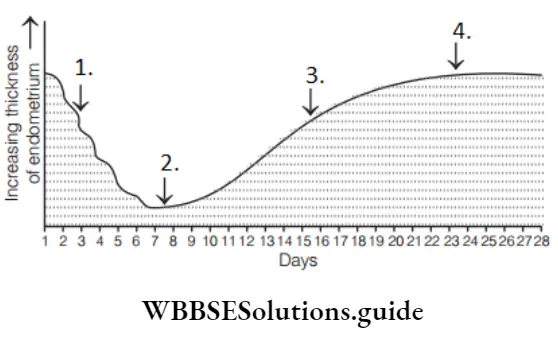
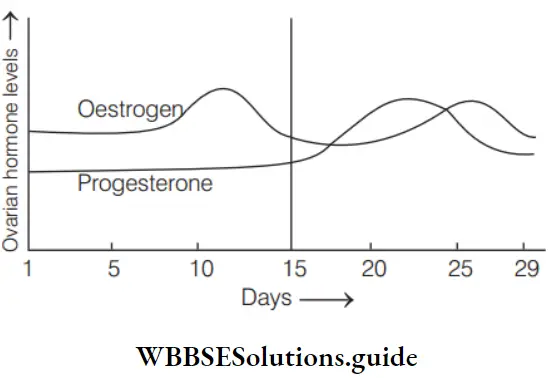
  1. Cavity of Graafian follicle
  2. Blastocoel
  3. Archenteron
  4. None of the above

Answer:  1. Cavity of Graafian follicle

The term antrum is applied to the cavity of Graafian follicle that is represented as the fluid-filled space.

Question 41. Identify the wrongly labelled part.

NEET Biology Menstrual Cycle Question 41

  1. Primary follicle
  2. Ovum
  3. Graafian follicle
  4. Corpus luteum

Answer: 3. Graafian follicle

Graafian follicle in wrongly labelled as it is a fluid-filled structure formed from tertiary follicle in the mammalian ovary within which secondary oocyte develops prior to ovulation.

Question 42. Identify the labels C and D in the diagram.

NEET Biology Menstrual Cycle Question 42

  1. Secondary spermatocyte and primary spermatocytes
  2. Tertiary follicles showing antrum and Graafian follicle
  3. Primary spermatocyte showing antrum and secondary spermatocytes
  4. Graafian follicle and ovum

Answer:  2. Tertiary follicles showing antrum and Graafian follicle

In the given diagram, C–Tertiary folicle showing antrum, D–Graafian follicle

NEET Biology Mcq

Question 43. Which part of ovary in mammals acts as an endocrine gland after ovulation?

  1. Graafian follicle
  2. Stroma
  3. Germinal epithelium
  4. Vitelline membrane

Answer:  1. Graafian follicle

After ovulation, the Graafian follicle changes into corpus luteum and secretes progesterone. Hence, Graafian follicle acts as an endocrine gland after ovulation.

Question 44. Graafian follicle contains

  1. Oogonial cells
  2. Corpus luteum
  3. Theca externa and theca interna
  4. Corpus albicans

Answer:  3. Theca externa and theca interna

Graafian follicle is the mature follicle present in the ovary. It consists of an outermost layer called theca externa and inner to it, theca interna is present.

Question 45. In mammals, oestrogens is secreted by the Graafian follicle from its

  1. External theca
  2. Internal theca
  3. Zona pellucida
  4. Corona radiate

Answer:  2. Internal theca

In mammals, FSH stimulates the growth and maturation of immature oocytes into mature Graafian follicles before ovulation. Oestrogen is produced by theca interna of the developing follicular cells.

Question 46. Graafian follicles are formed from

  1. Stroma of ovaries
  2. Germinal epithelium of ovaries
  3. Columnar epithelium of testes
  4. Assembly of ribosomes in blastula

Answer:  2. Germinal epithelium of ovaries

Number of small ovarian follicles are found embedded in the cortical stroma of an ovary. These follicles are initially formed during embryonic development by the proliferation of primordial germ cells of germinal epithelium. Later, they mature into Graafian follicle.

Question 47. Innermost layer of Graafian follicle is

  1. Membrane granulosa
  2. Corona radiata
  3. Theca externa
  4. Discus proligerus

Answer:  2. Corona radiata

Among given options, corona radiata is the innermost layer of Graafian follicle. It is present directly adjacent to the zona pellucida.

Question 48. In the diagram of section of Graafian follicle, different parts are indicated by alphabets. Choose the answer in which these alphabets have been correctly matched with the parts they indicate.

NEET Biology Menstrual Cycle Question 48

  1. A–Theca externa, B–Theca interna, C–Ovum, D–Cumulus oophorus, E–Antrum
  2. A–Membrana granulosa, B–Theca externa, C–Ovum, D–Cumulus oophorus, E–Antrum
  3. A–Membrana granulosa, B–Theca interna, C–Ovum, D–Cumulus oophorus, E–Anturm
  4. A–Theca externa, B–Theca interna, C–Ovum, D–Membrana granulosa, E–Antrum

Answer:  1. A–Theca externa, B–Theca interna, C–Ovum, D–Cumulus oophorus, E–Antrum.

Question 49. Consider the following statements.

  1. Ovulation is the process of follicle rupture and release of ova.
  2. Ovulatory phase is also known as pre-luteal or post-follicular phase.

Choose the correct option.

  1. Statement 1 is correct, but 2 is incorrect
  2. Statement 1 is incorrect, but 2 is correct
  3. Both statements 1 and 2 are correct
  4. Both statements 1 and 2 are incorrect

Answer:  3. Both statements 1 and 2 are correct.

Ovulation occur during ovulatory phase due to LH surge. The mature Graafian follicle rupture to release secondary oocyte or ova during this phase. This phase occur before the luteal phase (pre-luteal) and after the completion of follicular phase (postfollicular).

NEET Biology Mcq

Question 50. The shortest phase in menstrual cycle is

  1. Menstrual phase
  2. Ovulatory phase
  3. Secretory phase
  4. Proliferative phase

Answer:  2. Ovulatory phase

Ovulatory phase occurs on the 14th day of the menstrual cycle and lasts for only one day. Thus, it is the shortest phase of menstrual cycle.

Question 51. Stigma is a spot on the surface of human ovary where

  1. Oviduct is attached
  2. Ovulation takes place
  3. Ovary is attached
  4. Uterus is attached

Answer:  2. Ovulation takes place

A stigma (also called macula pellucida) in mammalian reproduct4e anatomy refers to the area of the ovarian surface, where the Graafian follicle burst open during ovulation and release the ovum.The stigma later heal and the residual follicle transformes into the corpus luteum.

Question 52. The ovulation occurs

  1. Alternately from the two ovaries
  2. Simultaneously from both the ovaries
  3. From the one ovary alone throughout the life
  4. From the birth

Answer:  1. Alternately from the two ovaries

Usually, only a single oocyte from one ovary is released during each menstrual cycle, with each ovary taking an alternate turn every month.

Question 53. Ovulation in the human female normally takes place during the menstrual cycle

  1. At the mid secretory phase
  2. Just before the end of the secretory phase
  3. At the beginning of the proliferative phase
  4. At the end of the proliferative phase

Answer:  4. At the end of the proliferative phase

Ovulation, i.e. the release of secondary oocyte from the Graafian follicle, normally takes place at the end of the proliferative phase.

Question 54. The below diagram describes the changes that occur in the endometrium during a normal menstruation. Choose the option with correct description for points A, B, C and D.

NEET Biology Menstrual Cycle Question 54

  1. A–Ovulation, B–Menstruation
  2. A–Ovulation, C–Menstruation
  3. A–Menstruation, C–Ovulation
  4. B–Ovulation, D–Menstruation

Answer:  3. A–Menstruation, C–Ovulation

Ovulation occurs on the 14-16th day of menstrual cycle. This is indicated as C. During menstruation the endometrium wall of the uterus is shed. It takes place at day 1-5 of the menstrual cycle, which is indicated as A.

Question 55. At which phase, LH attain peak level?

  1. Menstrual phase
  2. Follicular phase
  3. Ovulatory phase
  4. Luteal phase

Answer:  1. Menstrual phase

The peak level of LH is attained during ovulatory phase, when the Graafian follicle is fully matured and burst to release the ovum.

Question 56. Which set is similar?

  1. Corpus luteum – Graafian follicles
  2. Sebum – Sweat
  3. Bundle of His – Pacemaker
  4. Vitamin-B7 – Niacin

Answer:  1. Corpus luteum – Graafian follicles

The zona granulosa and theca cells of Graafian follicle remain in the ovary after ovulation. They get surrounded by capillaries and the connective tissue evolve in it to form the corpus luteum (a temporary endocrine gland). Thus, Graafian follicle and corpus luteum are similar

Question 57. Probable fertility period of menstrual cycle is from ……… to ………… .

  1. 5-8 days
  2. 9-12 days
  3. 13-16 days
  4. 17-20 days

Answer: 3. 13-16 days

Ovulation occurs about 14 days before the menstruation starts. If average menstrual cycle is of 28 days, the probable fertility period is from 13 to16 days.

Question 58. If a woman consumes some drug which is rich in LH, then which of the phenomenon occurs ?

  1. Menstruation stops
  2. Ovulation will occur
  3. Activation of oestrogen occurs
  4. Activation of FSH occurs

Answer:  2. Ovulation will occur

If a women consumes a drug, which is rich in Luteinizing hormone, ovulation will occurs because this hormone causes the rupture of mature Graafian follicle.

Question 59. Which of the following hormone levels will cause release of ovum (ovulation) from the Graafian follicle?

  1. High concentration of progesterone
  2. Low concentration of LH
  3. Low concentration of FSH
  4. High concentration of oestrogen

Answer:  4. High concentration of oestrogen

Oestrogen level is the highest on 14th day of menstrual cycle. It causes LH rise rapidly during this period and causes release of ovum from Graafian follicle.

NEET Biology Mcq

Question 60. During the ovulatory phase, the structure called corpus luteum is formed from

  1. Ruptured Graafian follicle
  2. Epididymis
  3. Isogametes
  4. Endometrium

Answer:  1. Ruptured Graafian follicle

Corpus luteum develops from a ruptured Graafian follicle after the release of secondary oocyte from it.

Question 61. Which of the following events is not associated with ovulation in human female?

  1. Release of secondary oocyte
  2. LH surge
  3. Decrease in estradiol
  4. Full development of Graafian follicle

Answer:  3. Decrease in estradiol

During ovulation, i.e. on day 14th the level of oestrogen or estradiol is the highest in blood. Thus, decrease in estradiol is not associated with ovulation in human female.

Question 62. At the time of ovulation in human female, all are true except that

  1. First podocyte is expelled
  2. Zona pellucida is broken down
  3. Meiosis-I has just occurred
  4. Meiosis-2 is arrested at metaphase

Answer:  2. Zona pellucida is broken down

All options are correct except the statement in option because the zona pellucida remain intact during ovulation.

Question 63. Identify the incorrect match.

  1. Ovulation–LH and FSH attain peak and sharp fall in secretion of progesterone
  2. Secretory phase–Development of corpus luteum and increased secretion of progesterone
  3. Menstruation–Breakdown of endometrium and ovum is not fertilised
  4. Proliferative phase–Rapid regeneration of myometrium and maturation of Graafian follicle

Answer:  4. Proliferative phase–Rapid regeneration of myometrium and maturation of Graafian follicle

Option 4 is incorrectly matched and can be corrected as During proliferat4e phase, rapid regeneration of endometrium occurs and Graafian follicle attain maturity at the end of this phase.

Question 64. Assertion Production of FSH increases, while that of LH decreases in the ovulation phase. Reason (R) Due to decrease in the level of LH, ovulation (releasing of ova) takes place.

  1. Both A and R are true and R is the correct explanation of A
  2. Both A and R are true, but R is not the correct explanation of A
  3. A is true, but the R is false
  4. Both A and R are false

Answer:  4. Both A and R are false

Both A and R are false and can be corrected as During ovulation, production of FSH decreases, while that of LH increases. Increase in the level of LH results in ovulation.

NEET Biology Menstrual Cycle MCQs with explanations

Question 65. Consider the following statements.

  1. LH surge refers to rapid secretion of LH.
  2. LH surge occurs during the middle of menstrual cycle.

Choose the correct option.

  1. Statement 1 is correct, but 2 is incorrect
  2. Statement 1 is incorrect, but 2 is correct
  3. Both statements 1 and 2 are correct
  4. Both statements 1 and 2 are incorrect

Answer:  3. Both statements 1 and 2 are correct.

LH surge is rapid secretion of LH leading to its maximum level, during the middle of menstrual cycle. It results in ovulation.

Question 66. An oocyte is released from the ovary under the influence of LH

  1. After completing meiosis and before polar bodies are released
  2. After completing meiosis-1 and before the release of polar bodies
  3. After completing meiosis
  4. After completing meiosis-1 and after the release of polar bodies

Answer:  4. After completing meiosis-1 and after the release of polar bodies

In human females, ova are released from the ovary in the secondary oocyte stage. It has completed first meiotic d4ision and released the first polar body.

Question 67. Longest period of menstrual cycle is

  1. Secretory phase
  2. Ovulatory phase
  3. Menstrual phase
  4. Pre-ovulatory phase

Answer:  1. Secretory phase

Longest period of menstrual cycle is secretory or luteal phase which extends from 15th to 28th day of the menstrual cycle. It occur after ovulation.

Question 68. Secretory phase is also known as

  1. Luteal phase
  2. Destructive phase
  3. Follicular phase
  4. Ovulatory phase

Answer:  1. Luteal phase

The secretory phase is also known as the luteal phase due to the occurrence of corpus luteum during this phase.

Question 69. The secretory phase of the menstrual cycle lasts for about

  1. 14 days
  2. 8 days
  3. 6 days
  4. 3 days

Answer:  1. 14 days

Secretory phase of the menstrual cycle extends from 15th to 28th day of the menstrual cycle. Thus, it lasts for about 14 days.

Question 70. The phase of menstrual cycle where fertilisation may occur is

  1. Follicular
  2. Luteal
  3. Bleeding phase
  4. None of these

Answer:  2. Luteal

The chances of fertilisation or conception are higher after the release of ova, that is during the luteal phase.

NEET Biology Mcq

Question 71. After ovulation, the collapsed ovarian follicle shrinks and becomes filled with cells to form

  1. Corpus atresia
  2. Corpus adiposum
  3. Corpus luteum
  4. Corpus albicans

Answer:  3. Corpus luteum

After the release of secondary oocyte during ovulation, remaining components of Graafian follicle transform into corpus luteum.

Question 72. Which of the following is correct about secretory phase of human menstrual cycle?

  1. It is also called follicular phase and includes cycle days 6-13
  2. It is also called proliferat4e phase and includes cycle days 13-26
  3. It is also called luteal phase and includes cycle days 15-28
  4. It is also called menstrual phase and includes cycle days 3-5

Answer:  3. It is also called luteal phase and includes cycle days 15-28

Option 3 is correct as Secretory phase is also called as luteal phase. It includes days 15-28 in a 28 days cycle.

Question 73. Which is not true about the luteal phase of the menstrual cycle?

  1. Progesterone level is high
  2. Fertilisation may occur
  3. Ovulation occurs
  4. The endometrial glands enlarge

Answer:  3. Ovulation occurs

In luteal phase of menstrual cycle, ovulation does not occur. Infact this phase occur immediate after ovulation.

Question 74. Study the graph and correlate the uterine events to the hormonal levels on

  1. 6-15 days
  2. 16-25 days
  3. 26-28 days (if the ovum is not fertilised)

NEET Biology Menstrual Cycle Question 74

Choose the correct option that describes the events and the hormonal levels.

  1. A–Regeneration of corpus luteum, B–Myometrium thickens, becomes vascularised ready for implantation of embryo, C–Degeneration of endometrium
  2. A–Degeneration of endometrium, B–Graafian follicle thickens, becomes vascularised, ready to receive and implant ovum, C–Regeneration of endometrium
  3. A–Degeneration of endometrium, B–Endometrium thickens, becomes vascularised, ready for implantation of embryo, C–Regeneration of endometrium
  4. A–Regeneration of endometrium, B–Endometrium thickens, becomes vascularised ready to receive and implant embryo, C–Degeneration of endometrium.

Answer:  4. A–Regeneration of endometrium, B–Endometrium thickens, becomes vascularised ready to receive and implant embryo, C–Degeneration of endometrium.

NEET Biology Mcq Chapter Wise

Question 75. The substance secreted by the corpus luteum is

  1. Hormone
  2. Enzyme
  3. Pheromone
  4. Bile

Answer:  1. Hormone

Hormone is secreted by corpus luteum.

Question 76. Main function of corpus luteum is

  1. Facilitate fertilisation
  2. Facilitate ovulation
  3. Secrete progesterone
  4. Facilitate passage of ova in oviduct

Answer:  3. Secrete progesterone

Progesterone is secreted by the corpus luteum which help to sustain endometrium for implantation of zygote, if fertilisation occurs.

Question 77. Which hormone level reaches peak during luteal phase of menstrual cycle ?

  1. Luteinizing hormone
  2. Progesterone
  3. Follicle stimulating hormone
  4. Oestrogen

Answer:  2. Progesterone

During the luteal phase, the corpus luteum secretes increasing quantities of progesterone due to which it attains the peak during this phase.

Question 78. Secretion from which of the following structures prepares the inner wall of the uterus for implantation?

  1. Ovary
  2. Pituitary gland
  3. Corpus luteum
  4. Ovarian follicle

Answer:  3. Corpus luteum

Secretion from corpus luteum prepares the inner wall (endometrium) of the uterus for implantation.

Question 79. The corpus luteum secretes progesterone that conveys negat4e feedback and inhibits the release of

  1. ABP and ICSH
  2. LH and ICSH
  3. LH and FSH
  4. FSH and TSH

Answer:  3. LH and FSH

The corpus luteum secretes progesterone, which exerts negat4e feedback and inhibits the release of gonadotropins, LH and FSH during luteal phase.

Question 80. Assertion Luteal phase of menstrual cycle is also called as secretory phase. Reason (R) Corpus luteum is formed in this phase which secretes progesterone.

  1. Both A and the R are true and R is the correct explanation of A
  2. Both A and R are true, but R is not the correct explanation of A
  3. A is true, but R is false
  4. Both A and R are false

Answer:  1. Both A and R are true and R is correct explanation of A.

During the luteal phase, corpus luteum is formed in the ovary. It secretes progesterone due to which this phase is also called secretory phase.

Menstrual Cycle mock test for NEET preparation

Question 81. Which one of the following is the correctly matched event occurring during the menstrual cycle?

  1. Ovulation–LH and FSH attains the peak level and a sharp fall in the secretion of progesterone
  2. Proliferat4e phase–Rapid regeneration of myometrium and maturation of Graafian follicle
  3. Development of corpus luteum– Secretory phase and increased secretion of progesterone
  4. Menstruation–Breakdown of myometrium and ovum do not fertilised

Answer:  3. Development of corpus luteum– Secretory phase and increased secretion of progesterone

  • Option is correctly matched. In secretory phase, a yellowish structure called corpus luteum is formed. The corpus luteum plays an important role in the preparation of endometrium for the implantation of the fertilised egg by secreting oestrogen and progesterone.
  • Other options are incorrectly matched and can be corrected as During ovulation, LH attains peak level and not FSH. During proliferative phase, endometrium proliferates and during mensuration, breakdown of endometrium occurs.

Question 82. Match the hormones in Column I with their functions in Column 2.

NEET Biology Menstrual Cycle Question 82

Answer:  1. A–5, B–4, C–2, D–1

Question 83. Before the formation of corpus luteum, the body formed is

  1. Corpous albicans
  2. Corpous media
  3. Corpous haemorrhagicum
  4. None of the above

Answer: 3. Corpous haemorrhagicum

The corpus hemorrhagicum (bleeding corpus luteum ) is a temporary structure formed immediately after ovulation before the formation of corpus luteum. It is formed from the ovarian follicle as it collapses and is filled with blood that quickly clots.

Question 84. Consider the following statements.

  1. Oestrogen level rise during mid-follicular and mid-luteal phase.
  2. Oestrogen level fall immediate after ovulation.

Choose the correct option.

  1. Statement 1 is correct, but 2 is incorrect
  2. Statement 1 is incorrect, but 2 is correct
  3. Both statements 1 and 2 are correct
  4. Both statements 1 and 2 are incorrect

Answer:  3. Both statements 1 and 2 are correct.

NEET Biology Mcq Chapter Wise

Question 85. The following graph of relat4e concentrations of the four hormones present in the blood plasma of a woman during her menstrual cycle. Identify the hormones A, B, C and D.

NEET Biology Menstrual Cycle Question 85

  1. A–FSH, B–Progesterone, C–LH, D–Oestrogen
  2. A–LH, B–Progesterone, C–FSH, D–Oestrogen
  3. A–FSH, B–Oestrogen, C–LH, D–Progesterone
  4. A–LH, B–Oestrogen, C–FSH, D–Progesterone

Answer:  3. A–FSH, B–Oestrogen, C–LH, D–Progesterone.

Question 86. No new follicles develop in the luteal phase of the menstrual cycle because

  1. Follicles do not remain in the ovary after ovulation
  2. FSH levels are high in the luteal phase
  3. LH levels are high in the luteal phase
  4. Both FSH and LH levels are low in the luteal phase

Answer:  4. Both FSH and LH levels are low in the luteal phase

Due to the low level of LH and FSH, no new follicle develops or grow during the luteal phase of menstrual.

Question 87. The figure shows a section of human ovary. Select the option which g4es the correct identification ofA and B with function/characteristic

NEET Biology Menstrual Cycle Question 87

  1. A–Primary oocyte–It is the prophase-I of the meiotic d4ision
  2. B–Corpus luteum–Secretes progesterone
  3. A–Tertiary follicle–Forms Graafian follicle
  4. B–Corpus luteum–Secretes oestrogen

Answer:  2. B–Corpus luteum–Secretes progesterone

In the g4en diagram, B is corpus luteum which secrete progesterone during luteal phase of menstrual cycle.

Question 88. The events of the menstrual cycle are represented below. In which of the following option, the level of FSH, LH and progesterone is mentioned correctly.

NEET Biology Menstrual Cycle Question 88
NEET Biology Menstrual Cycle Question 88.

Answer:  1.  Option 1 correctly mention the level of different hormones at g4en periods. During the 13th-14th days, Graafian follicle reaches the vertex of maturity and ovulation occurs.

Thus, FSH and LH are at high level, whereas progesterone level is low. During 21st-23rd days, i.e. the middle of luteal phase, progesterone level is high, whereas the level of gonadotropins, LH and FSH is low so as to suppress the growth of new follicles.

NEET Biology Mcq Chapter Wise

Question 89. When pregnancy does not occur, the life of corpus luteum is about

  1. 10 days
  2. 14 days
  3. 28 days
  4. Corpus luteum is not found

Answer:  2. 14 days

The lifespan of corpus luteum is about 14 days in the absence of fertlisation. It is similar to that of luteal phase.

Question 90. If after ovulation no pregnancy results, the corpus luteum

  1. Is maintained by the presence of progesterone
  2. Degenerates in a short time
  3. Becomes act4e and secretes lot of FSH and LH
  4. Produces lot of oxytocin and relaxin

Answer:  2. Degenerates in a short time

In the absence of pregnancy, the egg is not fertilised. The corpus luteum stops secreting progesterone and degenerates in short time.

Question 91. If fertilisation of egg does not occur the corpus luteum

  1. Reduces secretion of progesterone
  2. Changes to corpus albicans
  3. Enhances secretion of progesterone
  4. level of progesterone and oestrogen increases

Answer:  2. Changes to corpus albicans

If the ovum is not fertilised, the corpus luteum changes to white or colourless structure called corpus albicans.

Question 92. Corpus luteum is maintained in a woman under the effect of

  1. Prolactin
  2. Oestrogen
  3. Human chorionic gonadotropin
  4. Somatomammotropin

Answer:  3. Human chorionic gonadotropin

Corpus luteum secretes significant amounts of progesterone hormone and moderate amounts of hormones like estradiol and relaxin. human Chorionic Gonadotropin (hCG) hormone maintains corpus luteum to secrete progesterone during pregnancy.

Question 93. Both corpus luteum and macula lutea are

  1. Found in human ovaries
  2. A source of hormones
  3. Characterised by a yellow colour
  4. Contributory in maintaining pregnancy

Answer:  3. Characterised by a yellow colour

Both corpus luteum and macula lutea are characterised by yellow colour. After an egg is released from the ovary, the cells that line the ovarian follicle change shape and colour to become a corpus luteum (yellow body). Macula lutea is the yellowish spot present at the posterior pole of eye.

94. In females, the hormone inhibin is secreted by

  1. Granulosa and theca cells
  2. Granulosa cells and corpus luteum
  3. Granulosa and cumulus oophorus cells
  4. Granulosa cells and zona pellucida

Answer:  2. Granulosa cells and corpus luteum

Inhibin is produced in females by granulosa cell and corpus luteum under the control of FSH and Luteinizing Hormone (LH).

NEET practice test on Menstrual Cycle

Question 95. If mammalian ovum fails to get fertilised, which one of the following is unlikely?

  1. Corpus luteum will disintegrate
  2. Progesterone secretion rapidly declines
  3. Oestrogen secretion further decreases
  4. Primary follicle starts developing

Answer:  3. Oestrogen secretion further decreases

If the mammalian ovum fails to get fertilised, corpus luteum degenerates, so progesterone also decreases rapidly. Primary follicle start developing and estrogen secretion does not decrease further.

Thus, option 3 is incorrect.

Question 96. When uterine bleeding stops in females at age of 50 years the stage is called

  1. Menopause
  2. Menstrual
  3. Monarche
  4. Mesovarium

Answer:  1. Menopause

Menopause is defined as the phase when menstrual cycle permanently cease due to the natural depletion of ovarian oocytes from ageing. It marks the permanent end of fertility.

NEET Biology Mcq Chapter Wise

Question 97. In woman, cessation of menstruation occurs at the age of

  1. 12-14 years
  2. 45-58 years
  3. 60 years
  4. Does not occur at all

Answer:  2. 12-14 years

Cessation of menstrual cycle is called menopause. It occurs in females at the age of 45-58 years.

Question 98. Match the following columns.

NEET Biology Menstrual Cycle Question 98

Answer: 1. A-2, B-3, C-4, D-1

Question 99. At menopause, there is rise in urinary excretion of

  1. FSH
  2. STH
  3. Progesterone
  4. MSH

Answer:  1. FSH

  • During menopause, when oestrogen production falls below a critical value, it can no longer inhibit the production of the gonadotropins FSH and LH.
  • Instead, the gonadotropins FSH and LH (mainly FSH) are produced after menopause in large and continuous quantities. Thus, these (mainly FSH) are excreted out in the urine.