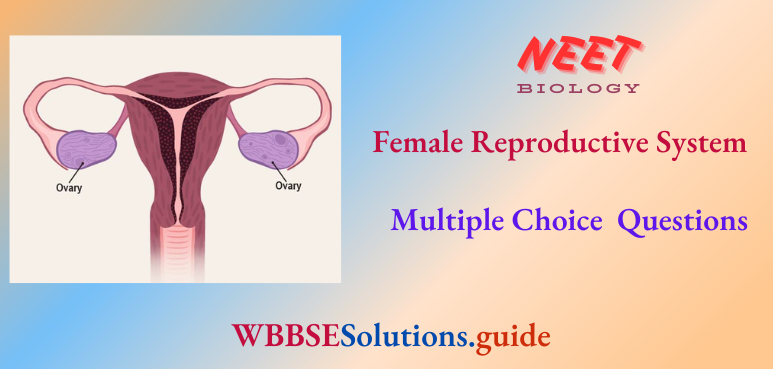
NEET Biology Female Reproductive System Multiple Choice Question And Answers

Biology MCQ For NEET With Answers Female Reproductive System

Question 1. Which of the following is not a part of female reproductive organ?

  1. Uterus
  2. Ovary
  3. Seminal vesicle
  4. Clitoris

Answer:  3. Seminal vesicle

Seminal vesicle is an accessory gland in male reproductive system. Rest are the structures of female reproductive system.

Question 2. Ovaries are the …A… sex organs which produce ovum and several steroid hormone called … B … hormones. Here A and B refer to

  1. A–secondary, B–accessory
  2. A–accessory, B–endocrine
  3. A–primary, B–ovarian
  4. A–primary, B–exocrine

Answer:  3. A–primary, B–ovarian

Read And Learn More: NEET Biology Multiple Choice Question And Answers

Question 3. Ovaries are situated on either side of

  1. Urinary bladder
  2. Rectum
  3. Fallopian tube
  4. Uterus

Answer: 4. Uterus

oviduct in vertebrates is modified

The ovaries are paired organs located on either side of the uterus, within the broad ligament, below the uterine (Fallopian tube) tubes.

Question 4. Ovary is held to coelom by

  1. Mesovarium
  2. Ovarian ligaments
  3. Mesorchium
  4. Ovarian membrane

Answer: 1. Mesovarium

Mesovarium projects from the posterior surface of the broad ligament and attaches to the hilum of the ovary. It helps to keep ovaries within coelom at definite place.

Question 5. Each ovary is suspended from the dorsal body wall by

  1. Mesorchium
  2. Mesosalpinx
  3. Mesovarium
  4. Mesometrium

Answer: 3. Mesovarium

The ovaries are suspended from dorsal abdominal wall by mesovarium. The ovary is not covered by the mesovarium rather, it is covered by germinal epithelium.

Female Reproductive System MCQ For NEET
NEET Biology Female Reproductive System Multiple Choice Question And Answers

NEET Biology Female Reproductive System MCQs with Answers

Question 6. The ovary of a newborn female baby may contain

  1. One to a few ova
  2. One thousand to a few thousands
  3. About 10 thousand
  4. 2.5-5 million ova

Answer: 4. 2.5-5 million ova

When girls are born, they have about 2.5 to 5 million ova in their ovaries, nestled in fluid-filled cavities called follicles.

Question 7. Each ovary is attached to the uterus by a fold of

  1. Peritoneum
  2. Mesovarium
  3. Vaginalis
  4. Spermatic cord

Answer: 1. Peritoneum

The ovary is anchored to the posterior wall of the broad ligament of uterus by a double fold of peritoneum.

Question 8. In mammals, the ovary is primarily related to

  1. Production of ovum
  2. Production of hormones
  3. Development of secondary sexual characters
  4. All of the above

Answer:  4.  All of the above

  • In mammals, ovary is a ductless reproductive gland in which the female reproductive cells (ovum) are produced.
  • They secrete hormones and also help in maintaining secondary sexual characteristics.

Thus, option 4. is correct

Important MCQs on Female Reproductive System for NEET

Question 9. The interstitium surrounding the mammalian ovary is/are

  1. Smooth muscles
  2. Membranes
  3. Connective tissue
  4. None of the above

Answer:  3. Connective tissue

The ovary interstitial tissue is found between follicles, corpora lutea and the vascular systems. Interstitium that surrounds the mammalian ovary is a type of connective tissue.

Question 10. Consider the following statements.

  1. The stroma of ovary is a type of epithelial tissue.
  2. The stroma contains blood vessels, stroma cells, etc.

Choose the correct option.

  1. Statement 1 is correct, but 2 is incorrect
  2. Statement 1 is incorrect, but 2 is correct
  3. Both statements 1 and 2 are correct
  4. Both statements 1 and 2 are incorrect

Answer:  2. Statement 1 is incorrect, but 2 is correct.

  • Incorrect statement can be corrected as The stroma of ovary is a type of connective tissue. It is supplied with blood vessels consisting for the most part of spindle-shaped stroma cells.
  • The stroma also contains ordinary connective tissue such as reticular fibres and collagen.

Question 11. Which region of the ovary shows different developmental stages of ovarian follicles?

  1. Medulla
  2. Cortical
  3. Stroma
  4. Corpus luteum

Answer:  2. Cortical

The developing stage of ovarian follicles are found in the cortical region of the ovary.

Female Reproductive System MCQ For NEET

Question 12. Oviducts were named Fallopian tubes due to its

  1. Structural features
  2. Functional aspects
  3. Discover
  4. Origin and evolution

Answer: 3. Discover

Oviducts are called Fallopian tubes after the name of Gabriele Falloppio, who described them for the first time

oviduct in vertebrates is modified

Question 13. ……………… extends from ovary to uterus.

  1. Fallopian tube
  2. Vagina
  3. Ureter
  4. Spermatic cord

Answer: 1. Fallopian tube

At the upper corners of the uterus, the Fallopian tubes extend from ovaries to the uterus.

Structure and Function of Female Reproductive Organs MCQs for NEET

Question 14. Ostium is an aperture present in

  1. Oviduct
  2. Uterus
  3. Ovisac
  4. Cloaca

Answer: 1. Oviduct

Ostium is the aperture present in the infundibulum part of the oviduct which helps in the collection of ovum for fertilisation.

Question 15. The tube which carries eggs from the ovary is

  1. Oviduct
  2. Ureter
  3. Sperm duct
  4. Uterus

Answer: 1. Oviduct

Oviduct connects the ovaries and uterus. It carries the eggs to the uterus.

Question 16. Mullerian duct is

  1. Oviduct
  2. Sperm duct
  3. Ureter of man
  4. Urethra

Answer: 1. Oviduct

Oviducts are independently developed Mullerian ducts which develop alongside the kidney ducts.

Question 17. The length of human Fallopian tube is about

  1. 8-9 cm long
  2. 9-10 cm long
  3. 10-12 cm long
  4. 12-17 cm long

Answer:  3. 10-12 cm long

Each Fallopian tube is about 10-12 cm long and extends from periphery of each ovary to the uterus.

Question 18. Oviduct is supported by a double fold of peritoneum called

  1. Mesorchium
  2. Mesosalpinx
  3. Mesovarium
  4. Mesometrium

Answer: 2. Mesosalpinx

The Fallopian tube opens into the peritoneal cavity. It is attached to the broad ligament by double fold of peritoneum, the mesosalpinx.

Female Reproductive System MCQ For NEET

Question 19. Fallopian tube is internally lined by

  1. Cuboidal epithelium
  2. Squamous epithelium
  3. Ciliated epithelium
  4. Germinal epithelium

Answer: 3. Ciliated epithelium

Fallopian tube is internally lined by ciliated epithelium. The ciliated cells serve to move the ovum away from the ovary and towards the uterus.

Topic-wise Female Reproductive System MCQs for NEET with Explanation

Question 20. The part of Fallopian tube closest to the ovary is

  1. Isthmus
  2. Infundibulum
  3. Cervix
  4. Ampulla

Answer:  2. Infundibulum

The part of Fallopian tube closer to the ovary is funnel-shaped infundibulum.

Question 21. The infundibulum has finger-like projections called

  1. Cilia
  2. Fimbriae
  3. Flagella
  4. Tentacles

Answer:  2. Fimbriae

Fimbriae are the finger-like projections located at the ends of the Fallopian tubes, closest to the ovaries.

Question 22. Fimbriated funnel is

  1. Proximal part of oviduct
  2. Uterus part
  3. Urinary bladder part
  4. Ureter part

Answer: 1. Proximal part of oviduct

The proximal part of the oviduct is called the infundibulum, which is flared and fimbriated.

Question 23. The main function of fimbriae of Fallopian tube is

  1. Development of ovary
  2. Collection of the ovum after ovulation
  3. Development of ova
  4. Collection of sperm for fertilisation

Answer:  2. Collection of the ovum after ovulation

The edges of the infundibulum possess finger-like projections called fimbriae, which help in the collection of ovum after ovulation.

Female Reproductive System MCQ For NEET

Question 24. The middle dilated part of oviduct is called

  1. Isthmus
  2. Fallopian tube
  3. Ampulla
  4. Infundibulum

Answer:  3. Ampulla

The ampulla is the portion of the Fallopian tube. It is an intermediate or middle dilated portion, which curves over the ovary

NEET Biology Menstrual Cycle and Hormonal Regulation MCQs

Question 25. ……….. is short, slender, narrow structure which opens into the uterus.

  1. Isthmus
  2. Uterine segment
  3. Ampulla
  4. Infundibulum

Answer:  1. Isthmus

The isthmus is a short, slender and narrow structure that opens into the uterus.

oviduct in vertebrates is modified

Question 26. The structure which is capable of stretching many times of its size is

  1. lungs
  2. Stomach
  3. Uterus
  4. Pupil of the eye

Answer:  3. Uterus

Uterus is a thick-walled muscular structure between the bladder and rectum in female mammals. The uterus expands and becomes increasingly muscular to accommodate the growing foetus during pregnancy.

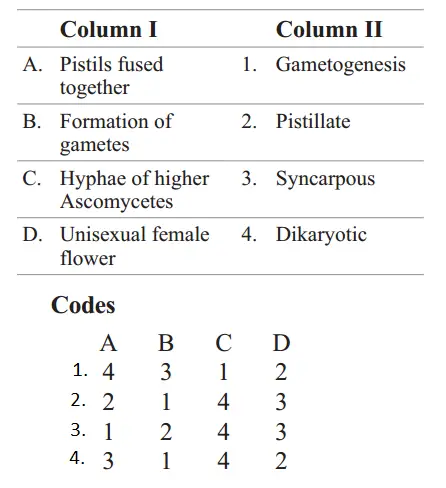
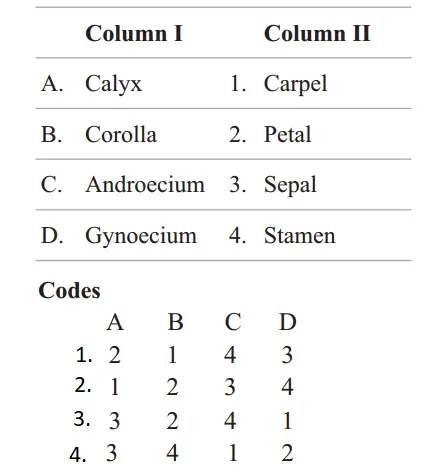
Question 27. Match the following columns.

table

Answer:  A-2, B-1, C-3, D-4

Question 28. Uterus is also known as

  1. Cervical canal
  2. Womb
  3. Brood pouch
  4. Ampulla

Answer:  2. Womb

Uterus is also known as womb.

Question 29. The heaviest component of the uterus is

  1. Broad ligament
  2. Myometrium
  3. Graafian follicle
  4. Endometrium

Answer:  2. Myometrium

Myometrium is the middle thick layer of the uterus. By weight, myometrium is the heaviest component of uterus wall.

Question 30. In normal conditions, human uterus is about

  1. 5 cm long × 5 cm wide × 5 cm thick
  2. 8 cm long × 5 cm wide × 2 cm thick
  3. 5 cm long × 5 cm wide × 3 cm thick
  4. 8 cm long × 20 cm wide × 0.5 cm thick

Answer:  2. 8 cm long × 5 cm wide × 2 cm thick

The uterus is shaped like an inverted pear. In normal condition, the uterus is 8 cm long, its wall thickness is approximately 2 cm and its width is 5 cm.

Question 31. Uterus is lined by

  1. Squamous epithelium
  2. Cuboidal epithelium
  3. Simple columnar epithelium
  4. Urothelium

Answer:  4. Urothelium

The internal surface of the uterus is lined by uterine epithelial cells (urothelium) which undergoes dramatic changes during pregnancy.

Biology MCQ For NEET With Answers

Question 32. Consider the following statements.

  1.  The mesentry of uterus is mesometrium.
  2. Mesometrium constitutes majority of broad ligament of uterus.

Choose the correct option

  1. State ment 1 is correct, but 2 is incorrect
  2. Statement 1 is incorrect, but 2 is correct
  3. Both statements 1 and 2 are correct
  4. Both statements 1 and 2 are incorrect

Answer:  3. Both statements 1 and 2 are correct.

oviduct in vertebrates is modified

The mesometrium is the mesentry of the uterus. It constitutes the majority of the broad ligament of the uterus, excluding the portions adjacent to the uterine tube (the mesosalpinx) and ovary (the mesovarium). The ureter is among the structures found in the mesometrium.

Question 33. Complete the analogy.

Mesovarium: Ovary: : Mesometrium: ……………..

  1. Clitoris
  2. Uterus
  3. Testis
  4. Penis

Answer:  2. Uterus

The ovary remains attached to the abdominal wall by a ligament called mesovarium. The uterus lies in the fold of peritoneum called mesometrium. Thus, the correct answer is mesometrium : Uterus

Question 34. In women, uterus includes

  1. Fundus
  2. Body
  3. Cervix
  4. All of these

Answer:  4. All of these

In human female , the uterus is divided anatomically into three regions, i.e. fundus, body and cervix.

Thus, option is 4. correct.

Biology MCQ For NEET With Answers

Question 35. The superior portion of the uterus is

  1. Body
  2. Cervix
  3. Fundus
  4. Infundibulum

Answer:  3. Fundus

Superior region of uterus is called fundus. It is somewhat rounded in shape.

Question 36. Which of the following does not line the uterus?

  1. Tunica albuginea
  2. Perimetrium
  3. Endometrium
  4. Myometrium

Answer:  1. Tunica albuginea

Tunica albuginea is the connective tissue covering of the testis and not of uterus.

Question 37. Outermost covering of uterus is called as

  1. Mesometrium
  2. Myometrium
  3. Endometrium
  4. Perimetrium

Answer:  4. Perimetrium

The perimetrium is the outer serosa layer of the uterus, equivalent to peritoneum. It is embryonically derived from visceral peritoneum.

Question 38. Middle lining of uterus is called as

  1. Mesometrium
  2. Myometrium
  3. Endometrium
  4. Perimetrium

Answer:  2. Myometrium

The myometrium is the middle layer of the uterine wall, consisting mainly of uterine smooth muscle cells, supporting stromal and vascular tissue.

Biology MCQ For NEET With Answers

Question 39. The inner glandular layer of the uterus is

  1. Endometrium
  2. Myometrium
  3. Fallopian tubes
  4. Perimetrium
  5.  Infundibulum

Answer: 1. Endometrium

Endometrium is inner glandular layer that lines the uterine cavity and undergoes cyclic changes during menstrual cycle.

Disorders of Female Reproductive System MCQs for NEET

Question 40. The uterus opens into the vagina by a canal called

  1. Cervical canal
  2. Fundus
  3. Ampulla
  4. Oviducts

Answer: 1. Cervical canal

  • The cervix is the part of uterus which joins the anterior wall of the vagina and opens into it through cervical canal.
  • The cervix communicates with the body of the uterus on top by an aperture called internal os and with the vagina below by an opening the external os.

Question 41. Lower narrow end of uterus is called

  1. Urethra
  2. Cervix
  3. Clitoris
  4. Vulva

Answer:  2. Cervix

Lower narrow end of uterus is called cervix which joins the anterior wall of the vagina and opens into it. During labour, the cervix enlarges greatly to allow the passage of the foetus.

Question 42. Identify A, B, C and D.

NEET Biology Female Reproductive System Question 42

  1. A–Oviduct, B–Uterus, C–Cervix, D–Ovary
  2. A–Cervix, B–Uterus, C–Ovary, D–Tumour
  3. A–Uterus, B–Uterine cavity, C–Oviductal funnel, D–Ovary
  4. A–Cervix, B–Uterine cavity, C–Fallopian tube, D–Ovary

Answer:  4.  A–Cervix, B–Uterine cavity, C–Fallopian tube, D–Ovary.

Question 43. Given below is the female reproductive system of humans. Identify A to F.
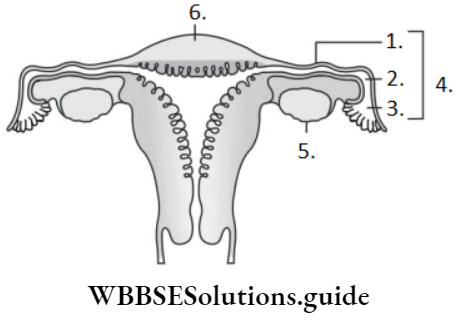
NEET Biology Female Reproductive System Question 43 Reproductive System Of Humans

  1. A–Ampulla, B–Isthmus, C–Infundibulum, D–Fallopian tube, E–Ovary, F–Uterine fundus
  2. A–Isthmus, B–Infundibulum, C–Uterine fundus, D–Fallopian tube, E–Ovary, F–Ampulla
  3. A–Isthmus, B–Ampulla, C–Infundibulum, D–Fallopian tube, E–Ovary, F–Uterine fundus
  4. A–Ampulla, B–Infundibulum, C–Isthmus, D–Fallopian tube,E–Ovary, F–Uterine fundus

Answer:  3.  A–Isthmus, B–Ampulla, C–Infundibulum, D–Fallopian tube E–Ovary, F–Uterine fundus.

oviduct in vertebrates is modified

Question 44. In adult human females, vagina is about

7.5 cm long

20.5 cm long

15.5 cm long

2.5 cm long

Answer:  1.  7.5 cm long

  • Because of the presence of the cervix in the front wall of the vagina, there is a difference in length between the front and back wall.
  • The former is approximately 7.5 cm (2.5 to 3 inch) long and the latter is approximately 9 cm (3.5 inch) long. During sexual arousal, the vagina expands both in length and width.

Biology MCQs with answers for NEET

Question 45. Which bacteria is present in vagina?

  1. Lactobacillus
  2. E. coli
  3. Cornea bacterium
  4. Vibrio cholerae

Answer:  1. Lactobacillus

Lactobacillus is found in vagina. It converts glycogen present in the vagina into an acidic substance, which prevents fungal infection in the vagina.

Question 46. Bartholin’s glands are also called(or)Vestibular glands secrete

  1. Vestibular glands
  2. lenticular glands
  3. Rudimentary glands
  4. Sexual glands

Answer: 1. Vestibular glands

The Bartholin’s glands are also called vestibular glands. These are two pea-sized compound alveolar glands located slightly posterior, to the left and right of the opening of the vagina.

Question 47. Bartholin’s glands are situated on

  1. The sides of head of some amphibians
  2. Each side of vagina in human female
  3. Either side of urethra in human male
  4. Either side of vasa deferens in human male

Answer:  2.  Each side of vagina in human female

The Bartholin’s glands are located on each side of the vaginal opening in human female.

Question 48. Bartholin’s gland of female corresponds to ………… gland of male.

  1. Inguinal
  2. Prostate
  3. Cowper’s
  4. Rectal

Answer:  3. Cowper’s

Bartholin’s glands of the female reproductive system are homologous to the Cowper’s glands of the male reproductive system.

Question 49. Bulbovestibular glands found in the female are also known as

  1. Cowper’s gland
  2. perineal gland
  3. Bartholin’s gland
  4. prepuce

Answer:  3. Bartholin’s gland

Bulbovestibular glands present in human female are also called as Bartholin’s glands.

Question 50. In female mammals, Bartholin’s glands open into the

  1. Vestibule and release a lubricating fluid in the vagina
  2. Uterus and release a lubricating fluid during the birth of young ones
  3. Urinary bladder and assist in release of urine
  4. Fallopian tubes and release a secretion which makes sperms motile

Answer:  1. Vestibule and release a lubricating fluid in the vagina

The greater vestibular glands or Bartholin’s glands are paired glands situated one on each side of the vaginal opening. They open into the vestibule and release lubricating fluid in vagina.

Biology MCQs with answers for NEET

Question 51. In the following diagram of female reproductive system of human, identify A to E.
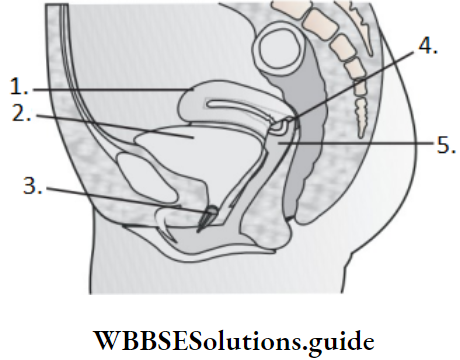
NEET Biology Female Reproductive System Question 51 Female Reproductive System

  1. A–Urethra, B–Urinary bladder, C–Uterus, D–Cervix, E–Vagina
  2. A–Urethra, B–Urinary bladder, C–Uterus, D–Vagina, E–Cervix
  3. A–Urethra, B–Urinary bladder, C–Uterus, D–Cervix, E–Vagina
  4. A–Uterus, B–Urinary bladder, C–Urethra, D–Cervix, E–Vagina

Answer:  4. A–Uterus, B–Urinary bladder, C–Urethra, D–Cervix, E–Vagina

Question 52. Cushion of fatty tissue covered by skin and pubic hair is called

  1. Mons pubis
  2. labia majora
  3. Clitoris
  4. vagina

Answer:  1. Mons pubis

Mons pubis is anterior most portion of the external genitalia. It is covered by skin and pubic hair. It acts as a cushion during intercourse.

Question 53. …………… is a fleshy fold of tissue that extends below the mons pubis and surrounds the vaginal opening.

  1. Labia minora
  2. Labia majora
  3. Hymen
  4. Clitoris

Answer:  2. Labia majora

Labia majora are two large fleshy folds of skin which form the boundary of vulva. They extend below the mons pubis and surround the vaginal opening. They are partly covered by pubic hair and contain large number of sebaceous (oil) glands.

Fertilization, Pregnancy, and Parturition MCQs for NEET

Question 54. The female structure that is homologous to the scrotum of the male are

  1. Labia minora
  2. Labia majora
  3. Clitoris
  4. Urethral folds

Answer:  2. Labia majora

oviduct in vertebrates is modified

Labia majora is a part of female external genitalia and is homologous to the scrotum of male.

Question 55. Identify the odd one.

  1. Labia majora
  2. Fimbriae
  3. Infundibulum
  4. Isthmus

Answer: 1. Labia majora

In the given options, option is odd one because labia majora belong to the external genitalia of females. Rest three represent the parts of Fallopian tubes.

Biology MCQs with answers for NEET

Question 56. Smaller and thinner lip-like folds located medially to the labia majora is called

  1. labia minora
  2. Mons pubis
  3. Clitoris
  4. Hymen

Answer:  1. labia minora

The labia minora are two small, thin folds of skin, lacking fatty tissue. They are found medially to labia majora.

Question 57. Posteriorly, the labia minora are fused together to form

  1. Mons pubis
  2. Fourchette
  3. Clitoris
  4. Hymen

Answer:  2. Fourchette

Posteriorly, the labia minora are joined or fused behind the vaginal opening by a fold of skin, the fourchette.

Question 58. In virginal state, a thin fold of mucous membrane is present at the vaginal opening is present, it is called

  1. Rugae
  2. Myometrium
  3. Hymen
  4. Hilum

Answer:  3. Hymen

The hymen is a thin piece of mucosal tissue that surrounds or partially covers the external vaginal opening.

Question 59. ………… is a small erectile organ lying at the anterior side of the labia minora.

  1. Labia majora
  2. Clitoris
  3. Vestibule
  4. Vulva

Answer:  2. Clitoris

The clitoris is small erectile organ, found right under the point where the inner labia meet and form a little hood. The head of the clitoris may vary in size, but only the tip of the clitoris can be seen at the top of the vulva, under the clitoral hood.

Question 60. The female’s organ equivalent to glans penis of male is

  1. Vestibule
  2. Hymen
  3. Baculum
  4. Clitoris

Answer:  4. Clitoris

The clitoris is an erectile structure, homologous to the male penis. Like penis, clitoris is formed by two corpora cavernosa and the glans, covered by the prepuce. Thus, they both have same origin and are richly supplied with blood and nerve endings.

Question 61. Vaginal orifice, urethral orifice and clitoris are protected by

  1. labia majora
  2. Anus
  3. labia minora
  4. Vulva

Answer:  4. Vulva

The vulva is the part of external genital structure. It protects vaginal opening, clitoris and the opening to the urethra.

Question 62. Vestibule is

  1. Right and left longitudinal folds of labia minora
  2. Fleshy elevation above the labia majora
  3. Median vertical depression of vulva enclosing vagina and urethral opening
  4. A thin layer of mucous membrane

Answer: 3. Median vertical depression of vulva enclosing vagina and urethral opening

The vaginal opening is called the vestibule of vagina. A vestibule is a median vertical space of vulva that encloses vagina and urethral openings.

Question 63. The external genitalia of female reproductive system are collectively called

  1. Vagina
  2. Vulva
  3. Cervix
  4. Clitoris

Answer:  2. Vulva

The female external genitalia include the mons pubis, labia majora, labia minora, vaginal introitus, hymen and clitoris. These organs are collectively called the vulva.

Biology MCQs with answers for NEET

Question 64. Assertion (A) Females are prone to infection of urethra than males. Reason (R) Urethra is shorter in female than male.

  1. Both A and R are true and R is the correct explanation of A
  2. Both A and R are true, but R is not the correct explanation of A
  3. A is true, but R is false
  4. Both A and R are false

Answer:  1. Both A and R are true and R is the correct explanation of A

Both A and R are true and R is the correct explanation of A. Urethra of females are shorter than male. Therefore, infection of urethra is more common in females than in males.

Question 65. Urethera in female differs from male is being

  1. Only excretory
  2. Birth and excretory
  3. Highly muscular
  4. long erectile tube

Answer: 1. Only excretory

In females, urethra serves the purpose of urination only, but in males, urethra is common passage for both urination and semen ejaculation. So, urethra in female differs from male in being only excretory.

Question 66. Consider the following statements.

  1. Breast consist of adipose tissue only.
  2. Areola contain montgomery’s gland which moisturise nipple during breastfeeding.

Choose the corect option.

  1. Statement 1 is correct, but 2 is incorrect
  2. Statement 1 is incorrect, but 2 is correct
  3. Both statements 1 and 2 are correct
  4. Both statements 1 and 2 are incorrect

Answer:  2. Statement 1 is incorrect, but 2 is correct

Statement 1 is incorrect, but 2 is correct. Incorrect statement can be corrected as Internally, the breast consists of the glandular tissue forming mammary glands, the fibrous tissue (connective tissue) and the fatty or adipose tissue. Mammary glands are modified sweat glands.

oviduct in vertebrates is modified

Question 67. Mammary glands are ………. glands.

  1. Endocrine
  2. Merocrine
  3. Apocrine
  4. Holocrine

Answer: 3. Apocrine

  • Apocrine glands are found primarily in the breast of lactating mammals and these are apocrine glands.
  • The apical portion of the secretory cell of the gland pinches off and enters the lumen. It loses part of its cytoplasm in their secretions.

Question 68. The base of the nipple shows dark brown rounded area called

  1. Clitoris
  2. Areola
  3. Hymen
  4. Vestibule

Answer:  2.  Areola

The areola is the dark pigmented area around the nipple. Areola and nipple can range in colour from light pink to purplish to light grey depending on skin colour.

Question 69. Breast tissue is mainly composed of

  1. Glandular tissue
  2. Squamous tissue
  3. Ciliated tissue
  4. Epithelium tissue

Answer: 1. Glandular tissue

The glandular tissue comprises about 15-20 lobes in each breast. Each lobe is made up of number of lobules. Each lobule is composed of grape-like cluster of milk secreting glands termed as alveoli.

Question 70. In females, the growth of breasts after puberty is called

  1. Amenorrhoea
  2. Menarche
  3. Menorrhoea
  4. Thelarche

Answer:  4. Thelarche

Thelarche is the onset of secondary breast development, which often represent the beginning of pubertal development.

Question 71. The ducts which carry milk from mammary glands to nipple are called

  1. lactiferous sinuses
  2. lactiferous ducts
  3. Areola
  4. Ejaculatory duct

Answer:  2.  lactiferous ducts

Lactiferous duct carries milk from mammary glands to nipple in human females.

Question 72. Mammary lobules contain cluster of cells called … A …, which secretes …B… . Alveoli open into mammary tubules, which join to form …C… . Identify A, B and C.

  1. A–milk, B–mammary duct, C–alveoli
  2. A–mammary duct, B–sweat, C–alveoli
  3. A–mammary duct, B–milk, C–alveoli
  4. A–alveoli, B–milk, C–mammary duct

Answer:  4. A–alveoli, B–milk, C–mammary duct.

Question 73. Identify the correct statements pertaining to breasts.

  1. A pair of rounded structures present in pectoral region on ventral thoracic wall
  2. Each breast contains fatty connective tissue and numerous lactiferous ducts
  3. Lactiferous ducts dilate and form lactiferous sinuses just beneath the nipple to store milk
  4. All of the above

Answer:  4. All of the above

  • All given statements are correct pertaining to breasts. The breast is the tissue overlying the chest muscles. Women’s breasts are made up of specialised tissue that produces milk (glandular tissue) as well as fatty tissue.
  • The milk producing part of the breast is organised into 15 to 20 sections, called lobes.

Question 74. Mark the correct statement regarding mammary glands are considered to be the part of reproductive system in the female because

  1. Mammary glands are the secondary sexual characters
  2. They are well-developed in female and vestigial in male
  3. After puberty, breast size increases due to the secretion of oestrogen
  4. All of the above

Answer:  4.  All of the above

  • All statements are correct. The mammary glands are not the part of the female reproductive tract, but are important in secondary sexual characteristics. The mammary glands develop in the tissue underneath the skin.
  • Both male and females start with the same tissues, but normally only females generate the correct hormonal signals to promote development of this glands at puberty. Thus, these are vestigial in males. Its size increases due to secretion of oestrogen.

Thus, option 4. is correct.

Question 75. Given below is the sectional view of mammary gland. Identify A, B, C and D.
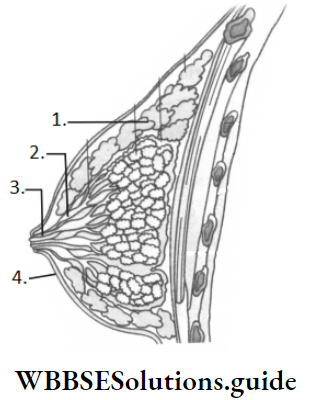
NEET Biology Female Reproductive System Question 75 mammary gland

  1. A–Alveolus, B–Subcutaneous fat, C–Areola, D–Alveoli
  2. A–Alveolus, B–Lactiferous duct, C–Mammary duct, D–Areola
  3. A–Alveolus, B–Mammary duct, C–Lactiferous duct, D–Lactogenic spot
  4. A–Subcutaneous fat, B–Mammary duct, C–Lactiferous duct, D–Areola

Answer:  4. A–Subcutaneous fat, B–Mammary duct, C–Lactiferous duct, D–Areola

Question 76. Vestibular glands secrete

  1. Hormones
  2. Enzymes
  3. Lubricating fluid
  4.  Sweat

Answer: 3. Lubricating fluid

Question 77. The female’s organ equivalent to glans penis of male is

  1. Vestibule
  2. Hymen
  3. Baculum
  4. Clitoris

Answer:  1. Vestibule
NEET Biology Male Reproductive System Multiple Choice Question And Answers

Biology MCQs with answers for NEET Male Reproductive System

Question 1. Human beings are

  1. Homosexual
  2. Monoecious
  3. Dioecious
  4. Hermaphrodite

Answer: 3. Dioecious

Dioecious is a characteristic of a species, which mean presence of male and female reproductive. Organs in two individual. So, human beings are dioecious.

Read And Learn More: NEET Biology Multiple Choice Question And Answers

Question 2. In humans, the primary sexual organs are called

  1. Gametes
  2. Gonads
  3. Mammary glands
  4. Gemmules

Answer:  2. Gonads

The reproductive system of sexually reproducing animal consists of primary sexual organs called gonads, which produce gametes and hormones.

” human reproduction mcqs class 12″

Question 3. The pouch in which the testes are suspended outside the abdominal cavity is

  1. Tunica albuginea
  2. Inguinal canal
  3. Epididymis
  4. Scrotum

Answer:  4. Scrotum

Scrotum is a pouch of deeply pigmented skin, divided into two separate sacs. Each sac contains one testis.

Question 4. Scrotum remains connected with abdomen or pelvic cavity by

  1. Spermatic cord
  2. Inguinal canals
  3. Foreskin
  4. Iobules

Answer:  2. Inguinal canals

The scrotum remains connected with the abdomen or pelvic cavity by inguinal canals.

NEET Biology Male Reproductive System MCQs with answers

Question 5. The passage through which the testes descend from the abdominal cavity in the scrotum is called

  1. Alimentary canal
  2. Inguinal canal
  3. Vertebral canal
  4. Spinal canal

Answer:  2. Inguinal canal

“what is true for cleavage “

The inguinal canals are two passages in the anterior abdominal wall through which the testis descends from the abdominal cavity into the scrotum.

NEET Biology Male Reproductive System Multiple Choice Question And Answers

Important MCQs on Male Reproductive System for NEET

Question 6. If inguinal canals fail to close or reopen, it results in

  1. Impotency
  2. Cryptorchidism
  3. Testes swelling
  4. Inguinal hernia

Answer:  4. Inguinal hernia

An inguinal hernia is a protrusion of abdominal cavity contents through the inguinal canal in which inguinal canal unable to close or reopen. This may cause pain or discomfort especially during coughing, exercise or bowel movements.

Biology MCQs with answers for NEET

Question 7. Gubernaculum connects

  1. Testes with scrotum
  2. Testes with ovaries
  3. Ovaries with scrotum
  4. Testes with epididymis

Answer: 1. Testes with scrotum

“class 12th biology chapter 3 mcq “

  • In males, the upper part of the gubernaculum degenerates. The lower part persists as the gubernaculum testis.
  • This ligaments connect the testis to the most inferior portion of the scrotum, tether it in place and limit the degree to which the testis can move within the scrotum. So, gubernaculum connects testes with scrotum.

Question 8. Internally scrotum is divided into two compartments by

  1. Septum scroti
  2. Trabeculum
  3. Spermatic cord
  4. Septum

Answer: 1. Septum scroti

Internally scrotum is divided into two compartments by a muscle septum called septum scroti.

Question 9. Testes are protected in scrotum because they 

  1. Produce heat
  2. Produce sperm
  3. Help in micturition
  4. Control the ambient temperature lower than general body

Answer:  4. Control the ambient temperature lower than general body

In mammals, scrotal sac or scrotum acts as a thermoregulator and maintain the ambient temperature of testes which is 2°C lower than the normal temperature of the body. It protects the sperms against relatively high temperature.

NEET previous year questions on Male Reproductive System

Question 10. In most mammals, the testes are located in scrotal sac for

  1. More space to visceral organs
  2. Sex differentiation
  3. Independent functioning of kidney
  4. Spermatogenesis

Answer:  4. Spermatogenesis

In mammals, testes are located in scrotal sac to carryout the process of spermatogenesis.

Question 11. What will happen, if the temperature of scrotal sac temporarily goes to about 4°C or more than the body temperature?

  1. Testes will be pushed into abdomen
  2. Increased sperm formation
  3. Scrotal sacs contract and come close to body
  4. Spermatogenic tissue will be destroyed

Answer:  4. Spermatogenic tissue will be destroyed

Higher temperature (4°C) would damage the sperm inside the testicles due to the damage of spermatogenic tissue.

Biology MCQs with answers for NEET

Question 12. Consider the following statements.

  1. During cold, scrotum becomes wrinkled.
  2.  Scrotum prevents heat loss during in low temperature conditions.

Choose the correct option.

  1. Statement 1 is correct, but 2 is incorrect
  2. Statement 1 is incorrect, but 2 is correct
  3. Both statements 1 and 2 are correct
  4. Both statements 1 and 2 are incorrect

Answer:  3. Both statements 1 and 2 are correct.

When the temperature is too low, the tunica dartos muscle contracts, thus cause the scrotal skin to wrinkle. Due to this, the scrotum has a smaller surface area and thus, heat loss is prevented.

“hormones secreted by placenta “

Question 13. Which muscle pulls the scrotum towards the body during low temperature?

  1. Dartos muscles
  2. Cremaster muscles
  3. Alary muscle
  4. Corpora cavernosa

Answer:  2. Cremaster muscles

Cremaster muscles contract and pull the scrotum towards the body during low temperature.

Question 14. The muscles that keep the testes warm are

  1. Cremaster
  2. Dartos
  3. Both 1 and 2
  4. Mesorchium

Answer:  3. Both 1 and 2

In cold weather, by contracting simultaneously, cremaster muscles pull the testes toward body and dartos muscle shrink the scrotal sac. Thus, the surface area of scrotum is decreased to retain heat and keep testes warm.

Question 15. Each compartment of scrotum encloses

  1. Testis and epididymis
  2. Testis, epididymis, a spermatic cord
  3. Testis, spermatic cord and a part of vas deferens
  4. Testis, epididymis, a spermatic cord and part of vas deferens

Answer:  4. Testis, epididymis, a spermatic cord and part of vas deferens

  • Scrotum in male reproductive system is a thin external sac of skin that is divided into two compartments.
  • Each compartment contains one of the two testes, the glands that produce sperm and one of the epididymis, where the sperm is stored. It also contains a spermatic cord and part of vas deferens.

Biology MCQs with answers for NEET

Question 16. The testis during early and middle foetal life is located in the

  1. Inguinal canal
  2. Abdominal cavity
  3. Pelvic cavity
  4. Scrotal sacs

Answer:  2. Abdominal cavity

During early and middle foetal life, the testes are located in the abdominal cavity. They descend to the scrotal sac during the late foetal development.

Question 17. Testes begin to descend from abdomen during 3rd week of gestation and descend is completed by …… week of gestation.

  1. 10th
  2. 15th
  3. 28th
  4. 18th

Answer:  3. 28th

  • During seventh month or 28th week of development, testes descend permanently into the respective scrotal sacs.
  • Thus, testes begin to descend from abdomen during 3rd week of gestation and descend is completed by 28th week of gestation.

“testicular lobules “

Question 18. Failure of descend of testis in scrotal sacs is called

  1. Vasectomy
  2. Tubectomy
  3. Cryptorchidism
  4. Impotency

Answer:  3. Cryptorchidism

The failure of descend of testes into scrotum is called cryptorchidism. It is caused by deficient secretion of testosterone by foetal testes. It leads to sterility.

Question 19. Testis is ………… in origin.

  1. Ectodermal
  2. Mesodermal
  3. Endodermal
  4. Both 1 and 3

Answer:  2. Mesodermal

Mesoderm is a primary germ layer of the embryo lying between the other two germ layers, namely ectoderm and endoderm. The testis is mesodermal in origin.

Question 20. Assertion Testes are located in the scrotum, outside the coelom. Reason (R) A vaginal coelom partly surrounds the testis in the scrotum.

  1. Both A and R are true and R is the correct explanation of A
  2. Both A and R are true, but R is not the correct explanation of A
  3. A is true, but R is false
  4. Both A and R are false

Answer:  3. A is true, but R is false

A is true, but R is false. Reason can be corrected as Vaginal coelom partly surrounds the testis in scrotum is a wrong statement because vagina is the part of external genitalia (vulva) in the female reproductive system and scrotum is a sac-like structure in which testes are suspended in males.

NEET quiz on Male Reproductive System with solutions

Question 21. Gubernaculum cord is a contractile structure that

  1. Pulls down the testis during breeding season into the scrotal sac
  2. Allows daily migration of the testis from the abdominal cavity into the scrotum
  3. Helps ejaculation of spermatozoa from testis
  4. Keeps the testis in proper position

Answer:  4. Keeps the testis in proper position

Gubernaculum cord is a structure which keeps the testis in its actual position. It is also called the caudal genital ligament.

Biology MCQ For NEET With Answers

Question 22. A connective tissue cord extending between the testis and abdominal wall is called

  1. Testis cord
  2. Gubernaculum
  3. Mesentric cord
  4. Spermatic cord

Answer:  4. Spermatic cord

The spermatic cord extends between testes and abdominal wall. This passes through the inguinal canal.

Question 23. Human possess pair of testes

  1. Two
  2. One
  3. Three
  4. Four

Answer:  2. One

In man, one pair of testis is present.

Question 24. Length and width of testis is

  1. 4-5 cm and 2-3 cm
  2. 5-6 cm and 3-4 cm
  3. 4-5 cm and 4-5 cm
  4. 7-8 cm and 8-9 cm

Answer:  1. 4-5 cm and 2-3 cm

Each human testis is oval in shape with a length of about 4 to 5 cm and a width of about 2 to 3 cm.

Question 25. An incomplete peritoneal covering of testes is called

  1. Tunica vaginalis
  2. Tunica albuginea
  3. Tunica vascularis
  4. Tunica reticulosa

Answer:  1. Tunica vaginalis

The tunica vaginalis is the pouch of serous membrane that covers the testes. It is derived from the abdominal peritoneum.

Question 26. Innermost covering of testes is

  1. Tunica reticulosa
  2. Tunica vaginalis
  3. Tunica albuginea
  4. Tunica vasculosa

Answer:  4. Tunica vasculosa

The tunica vasculosa is the innermost vascular layer of the testis. It consists of a plexus of blood vessels held together by delicate areolar tissue.

Biology MCQ For NEET With Answers

Question 27. The capsule enclosing testis of mammal is called as

  1. Tunica albuginea
  2. Tunica membrana
  3. Tunica vaginalis
  4. Tunica vasculosa

Answer:  1. Tunica albuginea

Each testis is externally covered by a white fibrous capsule called tunica albuginea, which is produced inside the testis as fibrous septa.

Question 28. The compartments in mammalian testes are known as

  1. Testicular lobules
  2. Seminiferous tubules
  3. Sertoli cells
  4. Interstitial cells

Answer:  1. Testicular lobules

There are about 250 compartments in each human testis called testicular lobules.

Question 29. How many compartments (approximately) are there in each human testis?

  1. 250
  2. 300
  3. 350
  4. 400

Answer:  1. 250

There are about 250 compartments in each human testis called testicular lobules.

“human reproduction class 12 important questions pdf “

Question 30. Testicular lobules contain

  1. 3-5 seminiferous lobules
  2. 5-7 seminiferous lobules
  3. 2-6 seminiferous tubules
  4. 1-3 seminiferous tubules

Answer:  4. 1-3 seminiferous tubules

Each testicular lobule contains 1-3 seminiferous tubules. These are coiled tubules that constitute most of the testis and enclose spermatogenic tissue.
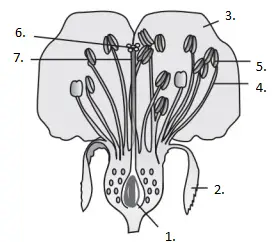
Question 31. Which of the following is correct about mammalian testes?

  1. Graafian follicles, Sertoli cells, Leydig’s cells
  2. Graafian follicles, Sertoli cells, Seminiferous tubules
  3. Sertoli cells, Seminiferous tubules, Leydig’s cells
  4. Graafian follicle, Leydig’s cells, Seminiferous tubule
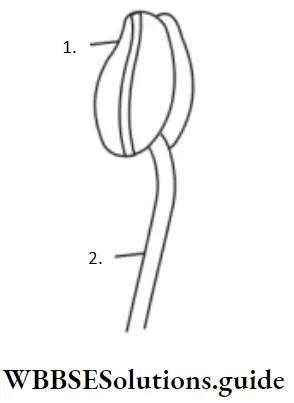
Answer:  3.  Sertoli cells, Seminiferous tubules, Leydig’s cells

Option 3. is correct. Other options are incorrect about mammalian testes because Graafian follicles are present in human ovaries.

Biology MCQ For NEET With Answers

Question 32. Consider the following statements.

  1. The length of single seminiferous tubule is about 50-60 cm.
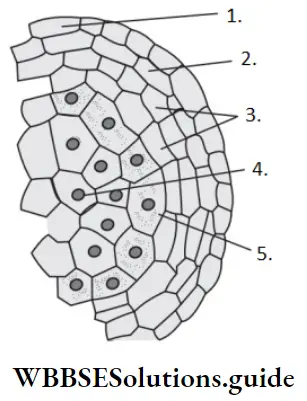
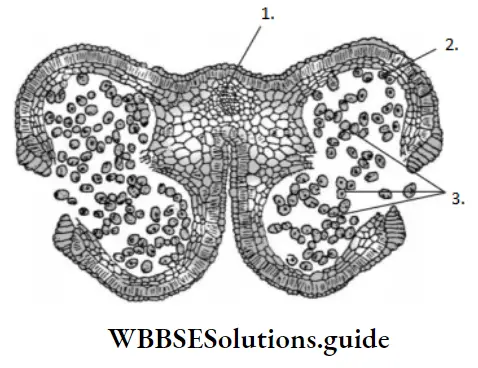
  2. Seminiferous tubule constitutes about 90% of testis.

Choose the correct option.

  1. Statement 1 is correct, but 2 is incorrect
  2. Statement 1 is incorrect, but 2 is correct
  3. Both statements 1 and 2 are correct
  4. Both statements 1 and 2 are incorrect

Answer:  3. Both statements 1 and 2 are correct

Question 33. Seminiferous tubules are lined by

  1. Squamous germinal epithelial cells
  2. Cuboidal germinal epithelial cells
  3. Ciliated germinal epithelial cells
  4. Non-ciliated germinal epithelial cells

Answer:  2. Cuboidal germinal epithelial cells

Seminiferous tubules consist of a multilayered cuboidal germinal epithelium that helps in spermatogenesis.

NEET expected MCQs on Male Reproductive System 2025

Question 34. Inflammation of the seminiferous tubules could interfere with the ability to

  1. Make semen alkaline
  2. Secrete testosterone
  3. Produce spermatozoa
  4. Eliminate urine from the bladder

Answer:  3. Produce spermatozoa

The main function of seminiferous tubules is to produce spermatozoa. Inflammation of seminiferous tubules could interfere with its function.

Question 35. Inner portion of the seminiferous tubules contains

  1. Sertoli cells
  2. Male germ cell
  3. Both 1 and 2
  4. Interstitial or Leydig cell

Answer:  3. Both 1 and 2

Inner portion of seminiferous tubules is lined by male germ cells and Sertoli cells. Thus, option is correct.

Question 36. From the germinal epithelium arises

  1. Sertoli cells
  2. Interstitial cells
  3. Spermatogonium
  4. Sustentacular cells

Answer:  3. Spermatogonium

The cuboidal cells in germinal epithelium of seminiferous tubules undergo mitosis to produce spermatogonium.

Question 37. Sertoli’s cells are found

  1. Between the seminiferous tubules
  2. In the germinal epithelium of ovary
  3. In the upper part of the Fallopian tube
  4. In the germinal epithelium of the seminiferous tubules

Answer:  4. In the germinal epithelium of the seminiferous tubules

Sertoli cells or nurse cells are found in the germinal epithelium of seminiferous tubules, which nourish the developing sperms.

NEET Biology Mcq Chapter Wise

Question 38. Sertoli cells are also called

  1. Sustentacular cells
  2. Sperm cells
  3. Interstitial cells
  4. Leydig cells

Answer:  1. Sustentacular cells

Sertoli cells are also called sustentacular cells because they provide supporting framework in which germ cells are embedded. They are irregular columnar in shape and its basal aspect is attached to basement membrane by hemidesmosomes.

Question 39. Sertoli cells are involved in

  1. Excretion
  2. Respiration
  3. Nutrition of sperms
  4. All of the above

Answer: 3. Nutrition of sperms

Sertoli cells function as nurse cells as they provide nutrition to sperms. They also help in phagocytising defective sperms and secrete inhibin hormone.

Question 40. The part of blood-testis barrier in males is formed by

  1. Scrotum
  2. Epididymis
  3. Sertoli cells
  4. Leydig cells

Answer:  3. Sertoli cells

The Blood-Testis barrier (BTB) is an inter-Sertoli functional complex that is found around the basal aspect of seminiferous epithelium. The BTB formed by Sertoli cells isolates developing spermatogonia from blood.

Question 41. All of the following are found in seminiferous tubules except

  1. Sertoli cells
  2. Leydig’s cells
  3. Spermatids
  4. Spermatogonia

Answer:  2. Leydig’s cells

Leydig’s cells or interstitial cells are present in interstitial space in the outer region of seminiferous tubules.

Question 42. Leydig’s cells are present in

  1. Kidneys and seminiferous tubules
  2. Seminiferous tubules of testes
  3. Connective tissue surrounding the seminiferous tubules of testes
  4. Cells lining the epidermis of the testes

Answer:  3. Connective tissue surrounding the seminiferous tubules of testes

In between the seminiferous tubules, connective tissue contains the groups of polygonal cells called interstitial or Leydig’s cells.

Question 43. Which of the following is the endocrine tissue of testes?

  1. Epidermis
  2. Inguinal canal
  3. Leydig cells
  4. Spermatic cord

Answer:  3.  Leydig cells

Leydig’s cells are endocrine in function as they secrete male sex hormone, androgens.

NEET Biology Mcq Chapter Wise

Question 44. Interstitial cells secrete

  1. Androgens
  2. Oestrogen
  3. FSH
  4. Inhibin

Answer:  1. Androgens

Interstitial cells secrete androgen (testosterone), i.e. male sex hormones.

NEET Biology Male Reproductive System MCQs with explanations

Question 45. Select the incorrect statement about Leydig cells.

  1. They are found in groups up to ten cells around seminiferous tubules
  2. These are known as polygonal cells
  3. These cells have eosinophilic cytoplasm and large round nucleus
  4. Lipid content is almost negligible in Leydig cells

Answer:  4. Lipid content is almost negligible in Leydig cells

Statement in option is incorrect and can be corrected as Lipid content is abundant in Leydig cells because they are responsible for testosterone production which is a steroid hormone.

Question 46. Select the option which correctly matches the endocrine gland with its hormone and its function. Endocrine gland > Hormone > Function.

  1. Ovary > FSH > Stimulates follicular development and the secretion of oestrogens
  2. Placenta > Oestrogen > Initiates secretion of the milk
  3. Corpus luteum > Oestrogen > Essential for maintenance of endometrium
  4. Leydig cells > Androgen > Initiates the production of sperms

Answer:  4.  Leydig cells > Androgen > Initiates the production of sperms

Option 4. is correctly matched as Leydig cells > Androgens > Initiates the production of sperms. Other options are incorrectly matched. These can be corrected as

  • FSH is secreted by anterior pituitary gland and not by ovary.
  • Corpus luteum secretes progesterone to maintain endometrium.
  • Placenta secretes oxytocin to initiate milk secretion

Question 47. Assertion (A)Each testis is attached to the abdominal wall by a ligament. Reason (R) Leydig or interstitial cells secrete androgens of which testosterone is the most potent.

  1. Both A and R are true and R is the correct explanation of A
  2. Both A and R are true, but R is not the correct explanation of A
  3. A is true, but R is false
  4. Both A and R are false

Answer:  2.  Both A and R are true, but R is not the correct explanation of A

  • Both A and R are true, but R is not the correct explanation of A. Each testis is attached to abdominal wall by a testicular ligament.
  • Testes develop retroperitoneally on posterior abdominal wall and descend to scrotum before birth, under the influence of testosterone. This is the most potent androgen and is being secreted by Leydig or interstitial cells of testis.

Question 48. The seminiferous tubules of the testis opens into the vasa efferentia through

  1. Vasa deferentia
  2. Rete testis
  3. Epididymis
  4. Seminiferous tubules

Answer:  2.  Rete testis

The seminiferous tubules are closed at one end, but on the other side they join to a network called rete testis from where fine ciliated ductules called vasa efferentia arises.

Question 49. Numerous fine ducts arising from rete testis are called

  1. Vas deferens
  2. Vasa efferentia
  3. Tubuli recti
  4. Epididymis

Answer:  2.  Vasa efferentia

12-20 Numerous fine ducts called vasa efferentia arise from rete testis to the vas deferens.

Question 50. Vasa efferentia are muscular tubes, each of which connects

  1. An epididymis to vas deferens
  2. Vas deferens to seminal vesicle
  3. Rete testis to vas deferens
  4. Rete testis to epididymis

Answer:  4.  Rete testis to epididymis

Vasa efferentia arise from the rete testis and open into epididymis located along the posterior surface of rete testis. The epididymis leads to vas deferens.

Question 51. If for some reason, the vasa efferentia in the human reproductive system get blocked, the gametes will not be transported from

  1. Testes to epididymis
  2. Epididymis to vas deferens
  3. Ovary to uterus
  4. Vagina to uterus

Answer:  1. Testes to epididymis

If the vasa efferentia in the human reproductive system gets blocked, the gametes will not be transported from testes to epididymis because vasa efferentia connects the testis to epididymis.

Question 52. The vasa efferentia exit the testis and open into the …A… located along the …B… surface. Here, A and B refer to

  1. A–rete testis, B–epididymis
  2. A–epididymis, B–rete testis
  3. A–epididymis, B–posterior
  4. A–epididymis, B–anterior

Answer:  3.  A–epididymis, B–posterior

  • As the vasa efferentia leave the testis, they enter the larger, upper portion of the epididymis (A), located along the posterior surface.
  • The vasa efferentia then join to form a single, coiled ductus epididymis, in the middle region of the epididymis.

Question 53. Consider the following statements.

  1. Epididymis is small, curved, elongated structure in males.
  2.  Epididymis is found along the anterior side of each testis.

Choose the correct options.

  1. Statement 1 is correct, but 2 is incorrect
  2. Statement 1 is incorrect, but 2 is correct
  3. Both statements 1 and 2 are correct
  4. Both statements 1 and 2 are incorrect

Answer:  1.  Statement 1 is correct, but 2 is incorrect

Statement I is correct, but II is incorrect. The epididymis is a small, curvedshaped elongated structure which is found along the posterior side of each testis.

Question 54. Wolffian duct forms

  1. Epididymis
  2. Oviduct
  3. Ejaculatory duct
  4. Urethra

Answer:  1.  Epididymis

  • The Wolffian duct (also known as archinephric duct, Leydig’s duct and mesonephric duct) is a paired organ found in mammals including humans during embryogenesis.
  • It connects the primitive kidney, Wolffian body (mesonephros) to the cloaca and serves as the progenitor for certain male reproductive organs.
  • In an ale, it develops into a system of connected organs between the testis and the prostate, namely rete testis, efferent ducts, epididymis, vas deferens, seminal vesicle and prostate.

Question 55. In man, the epididymis from anterior to posterior is divided into

  1. Caput, corpus and cauda
  2. Corpus, vas deferens and caput vas deferens
  3. Corpus, cauda and caudal region
  4. Caput, cauda and vas deferens

Answer: 1. Caput, corpus and cauda

The epididymis consists of three parts, i.e. caput, corpus and cauda

Question 56. The head of the epididymis at the head of the testis is called

  1. Cauda epididymis
  2. Vas deferens
  3. Caput epididymis
  4. Gubernaculum

Answer: 3. Caput epididymis

The caput epididymis is the head region of epididymis and is located on superior side of the testis.

Question 57. The narrow middle part of epididymis is called

  1. Caput epididymis
  2. Cauda epididymis
  3. Corpus epididymis
  4. All of the above

Answer: 3.Corpus epididymis

The corpus epididymis is narrow middle and highly convoluted part which connects the caput epididymis to cauda epididymis.

Male Reproductive System mock test for NEET preparation

Question 58. Sperms are stored temporarily in

  1. Vasa deferentia
  2. Vasa efferentia
  3. Epididymis
  4. Rete testis

Answer:  3. Epididymis

In epididymis, the sperms are stored for few hours to a few days until it comes out along with ejaculations.

NEET Biology Mcq Chapter Wise

Question 59. In the male reproductive system, sperm are concentrated in the

  1. Rete testis
  2. Epididymis
  3. Vas deferens
  4. Seminal vesicle

Answer: 2. Epididymis

In males, sperms are concentrated in the epididymis. Sperm concentration refers to the number of sperm per unit volume of semen.

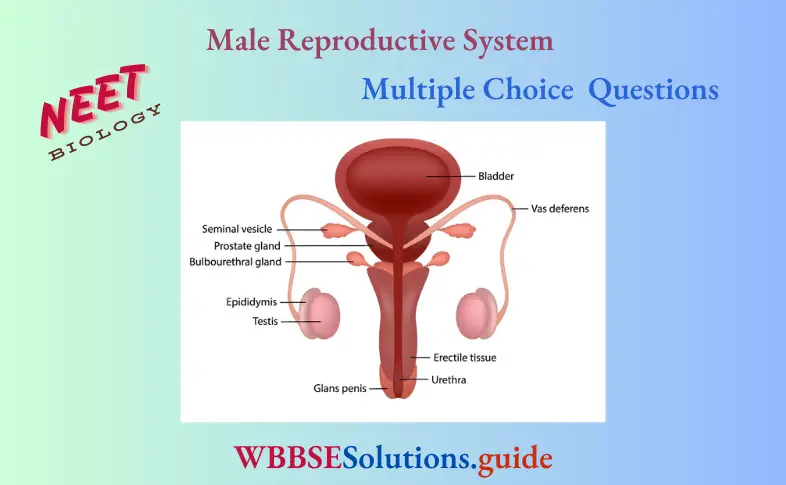
Question 60. The sperm becomes mature and completely motile while in the

  1. Rete testis
  2. Cauda epididymis
  3. Vasa deferentia
  4. Seminal vesicle

Answer: 2. Cauda epididymis

Spermatozoa formed in the testis enter the caput epididymis, progress to the corpus and finally reach the cauda region, where they are stored, become matured and gain motility.

Question 61. The movement of spermatozoa from the epididymal duct and seminal fluid into the ejaculatory duct to urethra is under the control of

  1. Parasympathetic and sympathetic nerve
  2. Parasympathetic nerve only
  3. Sometimes sympathetic and sometimes parasympathetic nerves
  4. Sympathetic nerve only

Answer:  4. Sympathetic nerve only

The movement of spermatozoa, from the epididymal duct and seminal fluid into the ejaculatory duct to the urethra is under the control of sympathetic nervous system.

Question 62. Cauda epididymis leads to

  1. Vas efferent
  2. Vas deferens
  3. Ejaculatory duct
  4. Urethra

Answer:  2. Vas deferens

Vas deferens is large duct that arises from cauda epididymis and reaches up to seminal vesicles.

Question 63. ‘XX’ is a thick structure of male reproductive system which arises from cauda epididymis. ‘XX’ are 2 in number and its lining has many stereocilia. Identify ‘XX’.

  1. Vasa efferentia
  2. Vasa deferentia
  3. Penis
  4. Scrotum

Answer:  2. Vasa deferentia

Vasa deferentia emerge from the cauda epididymis on each side leave the scrotal sac and enter the abdominal cavity through inguinal canal. They are lined by many stereocilia to transport the sperms.

Question 64. Vas deferens is also known as

  1. Spermatic ducts
  2. Seminiferous tubule
  3. Seminal ducts
  4. Both 1 and 3

Answer:  3. Seminal ducts

The vas deferens is also called seminal duct. It is a part of the male reproductive system of many vertebrates

Question 65. Vas deferens passes through

  1. Haversian canal
  2. Inguinal canal
  3. Neural canal
  4. Central canal

Answer:  2. Inguinal canal

The vas deferens pass through the inguinal canal into pelvis where it is joined by the seminal vesicles to form the ejaculatory duct. The latter passes through the prostate into the urethra.

Question 66. Pseudostratified columnar epithelium lines one of the following.

  1. Vas deferens
  2. Buccal cavity
  3. Bowman’s capsule
  4. All of the above

Answer:  1. Vas deferens

The mucosa of the vas deferens forms low longitudinal folds which are lined by a pseudostratified columnar epithelium.

NEET Male Reproductive System practice test online

Question 67. If the vas deferens of a man is surgically disconnected

  1. Sperms in the semen will be without nuclei
  2. Semen will be without sperms
  3. Spermatogenesis will not occur
  4. Sperms in the semen will be non-motile

Answer:  2. Semen will be without sperms

Function of vasa deferentia is the conduction of sperms from epididymis to penis. If it is surgically disconnected, the semen would not contain sperms.

Question 68. Vasa deferentia and seminal vesicle together form the

  1. Caput epididymis
  2. Corpus epididymis
  3. Ejaculatory duct
  4. Rete testis

Answer: 3. Ejaculatory duct

The vas deferens loops over urinary bladder, where it joins a duct from seminal vesicle to form the ejaculatory duct.

NEET Biology Mcq Chapter Wise

Question 69. Ejaculatory duct contains

  1. Sperms
  2. Secretion of seminal vesicles
  3. Both 1 and 2
  4. Testosterone

Answer:  3. Both 1 and 2

Ejaculatory ducts carry sperms and secretion of seminal vesicles because it is formed by the union of vas deferens and the duct of seminal vesicle. Thus, option is correct.

Question 70. Both ejaculatory ducts open into

  1. Urinary bladder
  2. Prostate gland
  3. Seminal vesicle
  4. Urethra

Answer:  4. Urethra

Both ejaculatory ducts pass through prostate gland and open into urethra at the seminal colliculus.

Question 71. The shared terminal duct of the reproductive and urinary system in the human male is

  1. Urethra
  2. Ureter
  3. Vas deferens
  4. Vasa efferentia

Answer: 1. Urethra

Urethra is the urinary duct which originates from the neck of urinary bladder and opens to the exterior at the tip of penis in males. It is a common pathway for passage of urine and semen.

Question 72. Select the correct sequence for transport of sperm cells in male reproductive system.

  1. Testis → Epididymis → Vasa efferentia → Rete testis → Inguinal canal → Urethra
  2. Seminiferous tubules → Rete testis → Vasa efferentia → Epididymis → Vas deferens → Ejaculatory duct → Urethra → Urethral meatus
  3. Seminiferous tubules → Vasa efferentia → Epididymis → Inguinal canal → Urethra
  4. Testis → Epididymis → Vasa efferentia → Vas deferens → Ejaculatory duct → Inguinal canal → Urethra → Urethral meatus

Answer:  2.  Seminiferous tubules → Rete testis → Vasa efferentia → Epididymis → Vas deferens → Ejaculatory duct → Urethra → Urethral meatus

The correct sequence for transport of sperm cells in male reproductive system is Seminiferous tubules → Rete testis → Vasa efferentia → Epididymis → Vas deferens → Ejaculatory duct → Urethra → Urethral meatus.

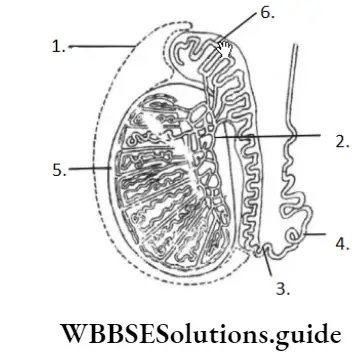
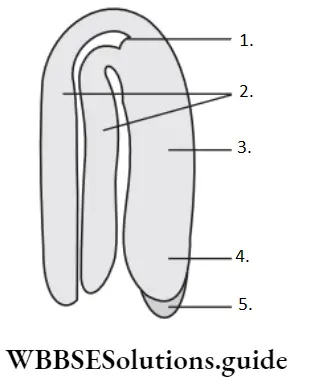
Question 73. Identify A to F in the diagram given below.

NEET Biology Male Reproductive System Question 73

  1. A–Tunica vaginalis, B–Rete testis, C–Caput epididymis, D–Vas deferens, E–Septa of testis, F–Cauda epididymis
  2. A–Tunica vaginalis, B–Rete testis, C–Cauda epididymis, D–Mediastinum testis, E–Vas deferens, F–Caput epididymis
  3. A–Tunica vaginalis, B–Rete testis, C–Cauda epididymis, D–Vas deferens, E–Tunica albuginea, F–Caput epididymis
  4. A–Tunica vaginalis, B–Rete testis, C–Caput epididymis, D–Mediastinum testis, E–Vas deferens, F–Cauda epididymis

Answer:  3.  A–Tunica vaginalis, B–Rete testis, C–Cauda epididymis, D–Vas deferens, E–Tunica albuginea, F–Caput epididymis

In given diagram, A–Tunica vaginalis, B–Rete testis, C–Cauda epididymis, D–Vas deferens, E–Tunica albuginea, F–Caput epididymis.

Question 74. External genitalia of male is called

  1. Testis
  2. Penis
  3. Scrotum
  4. Hemipenis

Answer:  2. Penis

External genitalia of male is called penis. It serves as the passage for both urine and sperm.

Question 75. Penis is located

  1. In front of scrotum
  2. Inside the abdomen
  3. Both 1 and 2
  4. Behind the scrotum

Answer:  1. In front of scrotum

The penis is located above or in front of the scrotum. It is made up of spongy tissue and blood vessels. The shaft of the penis surrounds the urethra and is connected to the pubic bone.

Question 76. ……………… is the external opening of penis.

  1. Ureter
  2. Urinary bladder
  3. Urethral meatus
  4. Prepuce

Answer:  3. Urethral meatus

The urethra originates from the urinary bladder and extends through the penis to its external opening called urethral meatus.

Question 77. Prepuce is

  1. Covering of glans penis
  2. Copulatory organs of birds
  3. Female organ equal to penis
  4. None of the above

Answer: 1. Covering of glans penis

The prepuce is the primary covering for the glans and inner mucosal lining of the penis. These internal organs are shielded by the foreskin to prevent abrasion, drying and contamination by dirt.

Question 78. Select the correct statement with respect to prepuce.

  1. It is a junctional mucocutaneous tissue
  2. It is composed of squamous pentalaminar epithelium
  3. It is also called as frenulum or foreskin
  4. All of the above

Answer:  4.  All of the above

All the given statements are correct regarding prepuce.

Question 79. The anterior tissue of penis is called

  1. Corpora cavernosa
  2. Corpus spongiosum
  3. Dartos muscle
  4. Cremaster muscle

Answer:  2. Corpus spongiosum

Corpus spongiosum is a column of spongy tissue that runs through the shaft and glans of the penis and thus, it forms the anterior tissue of penis.

It surrounds the urethra. It contains blood vessels that fill with blood aid in penis erection.

Question 80. The glans penis is enlarged due to

  1. Corpus cavernosum
  2. Corpus spongiosum
  3. Corpus callosum
  4. Corpus albicans

Answer:  2. Corpus spongiosum

The penis becomes enlarged, hardened and erect as a result of increased blood pressure in corpus spongiosum that is also considered erectile tissue.

Question 81. The glans surface of penis which has sebaceous glands produces a waxy secretion called

  1. Smegma
  2. Sebum
  3. Wax oil
  4. Both 1 and 2

Answer: 1. Smegma

Smegma is a waxy secretion of the oil (sebaceous) glands around the genitals. In men, smegma often found under the foreskin of the penis.

Question 82. Consider the following statements.

  1. The human penis consists of four erectile tissues.
  2. Corpus spongiosum forms the dorsal column in penis.

Choose the correct option.

  1. Statement 1 is correct, but 2 is incorrect
  2. Statement 1 is incorrect, but 2 is correct
  3. Both statements 1 and 2 are correct
  4. Both statements 1 and 2 are incorrect

Answer:  4. Both statements 1 and 2 are incorrect

  • Both statements 1 and 2 are incorrect and can be corrected as The penis consists of three columns of erectile tissue that are wrapped in connective tissue and covered with skin.
  • The two dorsal columns are the corpora cavernosa. The single, midline ventral column surrounds the urethra and is called as corpus spongiosum.

Question 83. In the body of penis, postero-lateral tissues are called

  1. Corpus spongiosum
  2. Dartos muscles
  3. Cremaster muscles
  4. Corpora cavernosa

Answer:  4. Corpora cavernosa

Corpora cavernosa is the postero-lateral tissue of penis. It is the sponge-like tissue which contains most of the blood in penis during erection.

Question 84. Given below are various structures of male reproductive system and their characteristics.

  1. Vasa efferentia – Arise from rete testis
  2. Epididymis – Leads to vas deferens
  3. Suspensory ligament – Found at the tip of penis
  4. Number of suspensory – Four ligaments

Choose the option containing incorrectly matched pairs.

  1. 1 and 2
  2. 3 and 4
  3. 2 and 4
  4. 1 and 3

Answer:  2. 3 and 4

Pairs 3 and 4 are incorrectly matched pairs and can be corrected as Two suspensory ligaments that are composed of primarily elastic fibres, support the penis at its base. Other options are correctly matched pairs.

Question 85. Which of the following is/are the accessory gland/s of the male reproductive system?

  1. Seminal vesicles
  2. Prostate gland
  3. Cowper’s gland
  4. All of these

Answer:  4. All of these

The accessory genital glands in male, along with their duct systems are collectively called secondary sex organs. These are seminal vesicles, prostate and Cowper’s glands. Thus, option 4. is correct.

Question 86. Seminal vesicles are present at the base of

  1. Penis
  2. Bladder
  3. Testis
  4. Prostate gland

Answer:  2. Bladder

Seminal vesicles are present at the base of urinary bladder and join the ejaculatory duct.

Question 87. Seminal vesicle is present between

  1. Prostate gland and urethra
  2. Urinary bladder and rectum
  3. Above the testis
  4. Near epididymis

Answer:  2. Urinary bladder and rectum

The seminal vesicles are located between the urinary bladder and the rectum as it is present below the seminal vesicle and above the rectum.

Question 88. Select the incorrect statement.

  1. Seminal gland is derived from the mesonephric duct
  2. Prostaglandins in seminal gland secretions suppress female immune response to foreign semen
  3. Secretion of seminal gland is acidic in nature
  4. Inner layer of seminal gland is comprised of pseudostratified columnar epithelium

Answer:  3. Secretion of the seminal gland is acidic in nature

Statement in option is incorrect. Secretions of seminal gland are alkaline in nature. It neutralises acidity of male urethra and vagina to facilitate the survival of spermatozoa.

Question 89. 60% of semen is produced by the

  1. Prostate gland
  2. Seminal vesicle
  3. Cowper’s gland
  4. Testes

Answer:  2. Seminal vesicle

Seminal vesicle produces 60% of the semen and provides alkaline medium in the sperm for the neutralisation of vaginal acidic medium.

Question 90. The nutritive medium in the ejaculated sperm is obtained from

Seminal fluid

Vaginal fluid

Uterine fluid

Prostatic fluid

Answer:  1. Seminal fluid

Seminal fluid contains sugar, citric acid, proteins, inorganic phosphorus, prostaglandins and various enzymes. The sugar is a source of energy (nutritive medium) for the sperms.

Question 91. Which male accessory reproductive structure secretes fluid containing ascorbic acid, flavins and prostaglandins?

  1. Epididymis
  2. Seminal vesicles
  3. Vas deferens
  4. Prostate gland

Answer:  2. Seminal vesicles

Seminal vesicle secretes seminal fluid containing ascorbic acid, flavins and prostaglandins. It form a 1.5 to 2.5 mL volume of ejaculate.

Question 92. Seminal plasma in human males is rich in

  1. Fructose and calcium
  2. Glucose and calcium
  3. DNA and testosterone
  4. Ribose and potassium

Answer:  1. Fructose and calcium

Seminal plasma in human males is rich in fructose, calcium and certain enzymes. It provides a medium for transport of sperms, nourishes and activates sperms.

Question 93. Select the correct statement regarding the function of seminal fluid is

  1. Maintain motility of sperms
  2. Maintain the viability of Sperms
  3. Provide energy and nourishment
  4. All of the above

Answer:  4. All of the above

The seminal fluid helps to maintain motility, viability and provides energy for the nourishment of sperm.

Thus, option is 4. correct.

Question 94. Prostate gland is a 

  1. Digestive gland
  2. Sperm producing gland
  3. Semen secreting accessory gland of male
  4. Hormone producing gland of the ovary

Answer:  3. Semen secreting accessory gland of male

  • The prostate gland is a single large accessory gland that surrounds the urethra. It produces a milky, slightly acidic secretion (about 6.5pH) which forms 25% of the volume of semen.
  • This secretion contains citric acid, enzymes and prostaglandins. Secretion of the prostate gland nourishes and activates the spermatozoa to swim.

Question 95. Prostate gland is present

  1. Below the kidney
  2. Below the ureter
  3. Between the urinary bladder and penis
  4. Between the penis and scrotum

Answer:  3. Between the urinary bladder and penis

The prostate is a walnut-sized gland located between the bladder and the penis, just in front of the rectum. The urethra runs through the centre of the prostate, from the bladder to the penis, letting urine flow out of the body.

Question 96. Select the incorrect statement regarding prostate gland.

  1. It secrete proteolytic enzymes
  2. It comprises 90% of semen volume
  3. The secretions of prostate gland are slightly acidic in nature
  4. None of the above

Answer:  2. It comprises 90% of semen volume

Statement in option is incorrect and can be corrected as The prostate gland secretes prostate fluid, one of the components of semen and constitutes 30% of it.

Question 97. The function of prostate gland is

  1. Storage of semen
  2. Provide motility to sperms
  3. Formation of semen
  4. Release of hormones

Answer:  2. Provide motility to sperms

Prostatic secretion contains substances important for sperm motility. These are notably albumin and proteolytic enzymes, fibrinolysin and fibrinogenase.

Question 98. A constituent of the fluid of prostate gland

  1. Citrate
  2. lactic acid
  3. Fructose
  4. Mitochondria

Answer: 1. Citrate

The fluid secreted by the prostate gland makes up about one-third of the total volume of semen and contains various enzymes, zinc and citrate.

Question 99. The fluid rich in calcium citrate, fibrinolysin and acid phosphatase is secreted by

  1. Cowper’s glands
  2. Prostate gland
  3. Seminal vesicles
  4. Epididymis

Answer:  2. Prostate gland

The fluid secreted by the prostate gland contains various enzymes such as fibrinolysin, acid phosphatase and inorganic compounds like zinc and calcium citrate.

Question 100. Seminal fluid coagulates on ejaculation due to

  1. Acid phosphate
  2. Sugar fructose
  3. Calcium and fibrinogen content from prostatic secretion
  4. Secretion of epididymis

Answer:  3. Calcium and fibrinogen content from prostatic secretion

The secretion of prostate gland contains calcium and fibrinogen which combine with the secretion of seminal vesicles and thus, the semen gets coagulated after ejaculation.

Question 101. Human semen is liquid at ejaculation but soon coagulates and again undergoes secondary liquefaction by ……… enzyme released by the prostate.

  1. Erepsin
  2. Cathepsin
  3. lysin
  4. Plasmin

Answer:  4. Plasmin

Human semen contains plasmin which aids in liquefaction of coagulated semen in female genital tract.

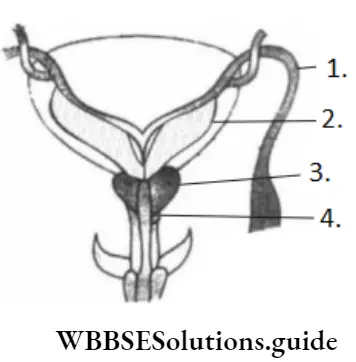
Question 102. Label A, B, C and D in the following diagram.

NEET Biology Male Reproductive System Question 102

  1. A–Ureter, B–Seminal vesicle, C–Prostate, D–Bulbourethral gland
  2. A–Ureter, B–Prostate, C–Seminal vesicle, D–Bulbourethral gland
  3. A–Vas deferens, B–Seminal vesicle, C–Prostate, D–Bulbourethral gland
  4. A–Vas deferens, B–Vesicle, C–Bulbourethral gland, D–Prostate

Answer:  3. A–Vas deferens, B–Seminal vesicle, C–Prostate, D–Bulbourethral gland

Question 103. Bulbourethral gland is also known as

  1. Prostate gland
  2. Cowper’s gland
  3. Perineal gland
  4. Salivary gland

Answer:  2. Cowper’s gland

Bulbourethral gland is also called as Cowper’s gland. It is pea-shaped gland and is located beneath the prostate gland.

Question 104. Function of bulbourethral gland is

  1. lubrication of penis
  2. To increase motility of sperm
  3. To enhance the sperm count
  4. All of the above

Answer:  1. lubrication of penis

Bulbourethral gland secretes mucus, which lubricate penis during intercourse. This reduces the friction during the copulation.

Question 105. Consider the following statements.

  1. Bulbourethral glands are present on either side of urethra in males.
  2.  Bulbourethral glands secrete alkaline fluid.

Choose the correct option.

  1. Statement 1 is correct, but 2 is incorrect
  2. Statement 1 is incorrect, but 2 is correct
  3. Both statements 1 and 2 are correct
  4. Both statements 1 and 2 are incorrect

Answer:  3.  Both statements 1 and 2 are correct.

Question 106. Starting from the maximum, arrange the following male reproductive accessory organs in the correct order, based on the amount of secretion.

  1.  Prostate gland
  2.  Seminal vesicle
  3.  Bulbourethral gland

Choose the correct answer

  1. 1 > 2 >3
  2. 3 > 2 > 1
  3. 2 > 3 > 1
  4. 2 > 1 > 3

Answer:  4.  2 > 1 > 3

Composition of seminal plasma is Seminal gland-60%, prostate gland-30% and bulbourethral gland-1%. Thus, the correct order is 2 > 1 > 3.

Question 107. Which of the following is not seen in male reproductive system?

  1. Mesosalpinx
  2. Bulbourethral glands
  3. Epididymis
  4. Seminal vesicles

Answer:  1.  Mesosalpinx

Mesosalpinx is a double fold of peritoneum which supports the Fallopian tube in females. Thus, it is not seen in male reproductive system. Rest three structures are found in male reproductive system.

Question 108. Temperature of the scrotum which is necessary for the functioning of testis is always below body temperature. This difference is 

  1. 2 ºC
  2. 3 ºC
  3. 4 ºC
  4.  6 ºC

Answer: 1. 2 ºC

Question 109. ‘Testes are extraabdominal in position’. Which of the following is the most appropriate reason?

  1. Narrow pelvis in male
  2. Special protection for testis
  3. Prostate gland and seminal vesicles occupy maximum space
  4. Requires lower temperature than normal body temperature

Answer:  2. Special protection for testis

Question 110. Wrinkling of scrotum is brought about by

  1.  Dartos muscles
  2.  Cremaster muscles
  3. Alary muscles
  4. Cardiac muscles

Answer:  1. Dartos musules

Wrinkling of scrotum is brought about by involuntary dartos muscle.

Question 111. In humans, the unpaired male reproductive structure is

  1. Seminal vesicle
  2. Prostate
  3. Bulbourethral gland
  4. Testes
  5.  Vas deferens

Answer: 2. Prostate gland is an unpaired male accessory sex gland.

NEET Biology Sexual Reproduction In Flowering Plants Miscellaneous Multiple Choice Question And Answers

Biology MCQs with answers for NEET Sexual Reproduction In Flowering Plants  Miscellaneous

Question 1. The book ‘An Introduction to Embryology of Angiosperms’ was written by

  1. Maheshwari
  2. Yuho
  3. Stanley
  4. Nageli

Answer: 1. Maheshwari

“reproduction in flowering plants neet questions “

The publication of the late Professor P. Maheshwari’s text, An Introduction to the Embryology of Angiosperms, serves as valuable guide for students and a rich source for research workers.

Read And Learn More: NEET Biology Multiple Choice Question And Answers

Question 2. Which of the following is false in angiosperms?

  1. Egg cell – Haploid
  2. Megaspore – Diploid
  3. Pollen grain – Haploid
  4. Synergid – Haploid
  5.  Endosperm – Triploid

Answer: 2. Megaspore – Diploid

Option is false and can be corrected as Megaspore mother cell (2n) undergoes reduction division to form 4 haploid (n) megaspores by the process called megasporogenesis.  Thus, megaspore is haploid (n).

Rest options are true in angiosperms.

Important sexual reproduction in plants questions for NEET exam

Question 3. If the haploid number in a flowering plant is 14. What shall be the number of chromosomes in integuments, antipodal cells, embryo, endosperm, and nucellus, respectively?

  1. 14, 28, 7, 42, 21
  2. 7, 14, 42, 28, 14
  3. 28, 14, 28, 42, 28
  4. 42, 28, 14, 28, 14

Answer: 3. 28, 14, 28, 42, 28

Integument is a diploid cell 2n = 2 ×14 = 28 Antipodal cells are haploid (n) = 14 Embryo is diploid (2n) = 2 × 14 = 28 Endosperm is triploid (3n) = 3 × 14 = 42 Nucellus is diploid (2n) = 2 × 14 = 28

Biology MCQs with answers for NEET

NEET Biology Sexual Reproduction In Flowering Plants Miscellaneous Multiple Choice Question And Answers

NEET Biology sexual reproduction in flowering plants MCQs with answers

Question 4. Match Column 1 with Column 2 and choose the correct option from the codes given below

NEET Biology Miscellaneous.

“reproduction in lower and higher plants mcq “

Answer: 5. A–4, B–5, C–1, D–2, E–3

Question 5. Which of the following statement(s) is/are true?

  1. Endothecium lies behind epidermis.
  2. Fusion of egg with male gamete is called apogamy.
  3. Synergids are haploid.
  4. The point at which funicle touches the ovule is raphe.

Choose the correct answer

  1. 2 and 4 only
  2. 1 and 4 only
  3. 1 and 2 only
  4. 1 and 3 only
  5. None of these

Answer:  4. 1 and 3 only

  • Statements 1 and 3 are true whereas 2 and 4 are false. Incorrect statements can be corrected as Apogamy is the development of a plant without the union of gametes, development of a sporophyte from a gametophyte without fertilisation.
  • Fusion of egg with male gamete is called syngamy. The point at which funicle touches the ovule is hilum.

Biology MCQs with answers for NEET

Question 6. Study the following statements and select the correct option.

  1. Tapetum nourishes the developing pollen grains.
  2. Hilum represents the junction between ovule and funicle.
  3. In aquatic plants, such as water hyacinth and water lily, pollination is by water.
  4. The primary endosperm nucleus is triploid.

“reproduction in flowering plants class 12 questions and answers “

Choose the correct answer 

  1. 1 and 2 are correct, but 3 and 4 are incorrect
  2. 1, 2, and 4 are correct, but 3 is incorrect
  3. 2, 3, and 4 are correct, but 1 is incorrect
  4. 1 and 4 are correct, but 2 and 3 are incorrect
  5.  2 and 4 are correct, but 1 and 3 are incorrect

Answer: 2. 1, 2, and 4 are correct, but 3 is incorrect

“reproduction in flowering plants questions and answers pdf class 12 “

All given statements are correct except 3. Incorrect statement can be corrected as In water hyacinth and lily, the pollination agency is not water but insects. Although they are aquatic plants, it is not necessary that all aquatic plants are pollinated by water.

Miscellaneous MCQs on sexual reproduction in flowering plants for NEET

Question 7. Consider the following statements with respect to flowering plants.

  1. Pollen grains represent the male gametes.
  2. The functional megaspore develops into the embryo sac represents the female gamete.
  3. Transfer of pollen grains from anther to the stigma of different plants is known as xenogamy.
  4. Transfer of pollen grains from anther to the stigma of another flower of the same plant is known as geitonogamy.

Of the above statements

  1. 1 and 2 alone are correct
  2. 1 and 3 alone are correct
  3. 2 and 4 alone are correct
  4. 3 and 4 alone are correct

Answer: 4. 3 and 4 alone are correct

  • Statements 3 and 4 are correct whereas 1 and 2 are incorrect with respect to flowering plants. Incorrect statements can be corrected as
  • Pollen grains represents male gametophyte that carry male gametes. The functional megaspore develops into embryo sac that represents female gametophyte.

Biology MCQs with answers for NEET

Question 8. A botanist collected some fruits with hook-like spines and when the seeds of the same have been germinated, they turned out to be asteraceous taxa, bearing sepalous and wind-pollinated flowers. The fruit he collected was of

  1. Xanthium strumarium
  2. Lactuca sat4a
  3. Carthamus tinctorius
  4. Sphaeranthus indica

“reproduction in plants question and answers “

Answer: 1. Xanthium strumarium

  • The fruits collected by botanist belongs to Xanthium strumarium, which are known as rough cocklebur and are a species of annual plants of family–Asteraceae.
  • During flowering, they give rise to an asepalous flower which later turns into fruits with hook-like spines.

NEET Biology Apomixis And Polyembryony Multiple Choice Question And Answers

NEET Biology Mcqs Apomixis and Polyembryony

Question 1. ‘Apomixis’ term was given by

  1. Focke
  2. Swingle
  3. Winkler
  4. Nawaschin

Answer: 3. Winkler

In botany, apomixis was defined by Hans Winkler as replacement of normal sexual reproduction by asexual reproduction without fertilisation.

Read And Learn More: NEET Biology Multiple Choice Question And Answers

Question 2. Seed formation without fertilisation in flowering plants involves the process of

  1. Sporulation
  2. Budding
  3. Somatic hybridisation
  4. Apomixis

Answer: 4. Apomixis

Apomixis is a special process found to generate seeds without fertilisation in flowering plants. It is a form of asexual reproduction that mimics sexual reproduction.

NEET Biology Apomixis and Polyembryony MCQs with Answers

Question 3. What is common between vegetative reproduction and apomixis?

  1. Both are applicable to only dicot plants
  2. Both bypass the flowering phase
  3. Both occur round the year
  4. Both produce progeny identical to the parent

Answer: 4. Both produce progeny identical to the parent

  • Apomixis is a reproductive process in plants that superficially resembles normal sexual reproduction but in which there is no fusion of gametes.
  • The embryos develop simply by division of a diploid cell of the ovule. So, both vegetative reproduction and apomixis produce progeny identical to the parent.

NEET Biology Mcqs Chapter Wise

NEET Biology Apomixis And Polyembryony Multiple Choice Question And Answers

Important MCQs on Apomixis and Polyembryony for NEET

Question 4. In a type of apomixis known as adventive embryony, embryos develop directly from the

  1. Nucellus or integuments
  2. Synergids or antipodals in an embryo sac
  3. Accessory embryo sacs in the ovule
  4. Zygote

Answer: 1. Nucellus or integuments

Adventive embryo formation is a type of apomixis in which embryos are formed from diploid integumental or nucellar cells.

Question 5. Apomictic embryos in citrus arise from

  1. Synergids
  2. Maternal sporophytic tissue in ovule
  3. Antipodal cells
  4. Diploid egg

Answer:  2.  Maternal sporophytic tissue in ovule

In Citrus, apomictic embryos arise from maternal sporophytic tissue like nucellus and integuments in ovule. This type of embryo is called adventive embryo.

Question 6. Assertion (A) In apomixis, plants of new genetic variations are not produced. Reason (R) In apomixis, reductional division takes place.

  1. Both A and R are true and R is the correct explanation of A
  2. Both A and R are true, but R is not the correct explanation of A
  3. A is true, but R is false
  4. Both A and R are false

Answer: 4. Both A and R are false

  • Both A and R are false and can be corrected as Apomixis is a kind of asexual reproduction in which viable embryo is formed within the confines of the seed coat, without meiosis and syngamy.
  • Since, it is an asexual reproduction, the offspring produced are identical to the parent plants. In apomixis, embryos are formed from gametophytic or sporophytic cells which undergo stages of embryogeny and eventually develop into mature embryos

Difference Between Apomixis and Polyembryony MCQs for NEET

Question 7. Seedless watermelons are produced by crossing between

  1. Triploid female plant with diploid male plant
  2. Tetraploid female plant with tetraploid male plant
  3. Diploid female plant with tetraploid male plant
  4. Tetraploid female plant with diploid male plant

Answer: 4. Tetraploid female plant with diploid male plant

Seedless watermelons are triploid. They have three sets of chromosomes. This odd number results in them being sterile and not producing seeds. The way they become triploid is by mating a diploid male with a tetraploid female.

Question 8. Occurrence of more than one embryo is called

  1. Polyembryony
  2. Embryony
  3. Parthenogenesis
  4. Fertilisation

Answer: 1. Polyembryony

Occurrence of more than one embryo is called polyembryony. It is generally found in family–Citraceae. Orange and lemon are common examples of polyembryony.

NEET Biology Mcqs Chapter Wise

Question 9. Adventive polyembryony in Citrus is due to

  1. Nucellus
  2. Integuments
  3. zygotic embryo
  4. Fertilised egg

Answer: 1. Nucellus

  • In Citrus, many embryos are formed from the structures outside the embryo, i.e. nucellus.
  • This is commonly called adventive polyembryony. In Citrus, up to 10 nucellar embryos are formed.

“endosperm is present in mature seeds of “

Question 10. In which of the following cleavage, polyembryony is observed?

  1. Lobelia
  2. Argemone mexicana
  3. Phaseolus vulgaris
  4. Mangifera

Answer: 1. Lobelia

NEET Biology Asexual Reproduction and Polyembryony MCQs

In cleavage polyembryony, zygote gets cleaved into two or more units, e.g. Nicotiana rustica, Lobelia, etc. It is common in gymnosperms, but it is of rare occurrence in angiosperms.

Question 11. The phenomenon of polyembryony was first observed in

  1. Citrus
  2. Mangifera
  3. Cucurbita
  4. Euphorbia

Answer: 1. Citrus

Strasburger in 1878 first observed the regular occurrence of polyembryony in certain species of Citrus in nature.

“gynoecium of michelia “

Question 12. In Argemone mexicana and Phaseolus vulgaris, embryos develop

  1. By cleavage of zygote
  2. From synergids and antipodal
  3. From nucellus and integuments
  4. From endosperm

Answer: 2. From synergids and antipodal

The embryo may develop from synergids and antipodal cells in the embryo sac in Argemone mexicana and Phaseolus vulgaris. These embryos are haploid in nature.

NEET Exam Apomixis and Polyembryony Most Repeated MCQs

Question 13. The ‘necrohormone theory’ for the induction of polyembryony was proposed by

  1. Leroy
  2. Haberlandt
  3. Maheshwari
  4. Winkler

Answer: 2. Haberlandt

Haberlandt proposed the ‘necrohormone theory’ for the induction of polyembryony in the year 1991-1992

NEET Biology Post Fertilisation Structures Endosperm Embryo And Seed Multiple Choice Question And Answers

Biology MCQs with answers for NEET Post Fertilisation Structures Endosperm Embryo and Seed

Question 1. Which one of the following events takes place after double fertilisation?

  1. The pollen grain germinates on the stigma
  2. The pollen tubes enter the embryo sac
  3. Two male gametes are discharged into the embryo sac
  4. The PEN (Primary Endosperm Nucleus) develops into endosperm
  5. The male gamete fuses with egg to form a zygote

Answer: 4. The PEN (Primary Endosperm Nucleus) develops into endosperm

After double fertilisation, endosperm development precedes embryo development. The primary
endosperm cell divides repeatedly and forms a triploid endosperm tissue.

Read And Learn More: NEET Biology Multiple Choice Question And Answers

Question2. The real function of the ‘endosperm’ is to

  1. Supply nutrition to the growing embryo
  2. Form integuments of ovule
  3. Form funicle of ovule
  4. None of the above

Answer: 1. Supply nutrition to the growing embryo

“endosperm development “

Endosperm is a part of a seed that acts as a food store for the developing embryo of plants. It is formed by the triple fusion of the primary endosperm nucleus during double fertilisation.

Question 3. If the number of chromosomes in egg cell is 8, then what is the number of chromosomes in endosperm?

  1. 24
  2. 8
  3. 16
  4. 12

Answer: 1. 24

Egg cell is haploid, whereas endosperm is triploid as it is formed by the fusion of one male gamete with two polar nuclei. Therefore, the number of chromosomes in endosperm will be 8×3=24.

NEET Biology Post Fertilization MCQs with answers

Question 4. How many chromosomes are there in endosperm cell of Zea mays?

  1. Fourty
  2. Twenty
  3. Thirty
  4. Ten

Answer: 3. Thirty

Endosperm is triploid in maize. In maize, 2n = 20. So, number of chromosomes in endosperm of maize (Zea mays) will be = 3n = 3 × 10 = 30.

NEET Biology Post Fertilisation Structures Endosperm Embryo And Seed Multiple Choice Question And Answers

Question 5. Which of the following has haploid endosperm?

  1. Wheat
  2. Maize
  3. Gymnosperms
  4. Castor

Answer: 3. Gymnosperms

Endosperm of gymnosperm is haploid (ploidy n). It develops from megaspore (n) before fertilisation and forms a continuation of the female
gametophyte.

Question 6. A diploid female plant and a tetraploid male plant are crossed. The ploidy of endosperm shall be

  1. Tetraploid
  2. Triploid
  3. Diploid
  4. Pentaploid

Answer: 1. Tetraploid

  • When the male plant is tetraploid, the gamete formed after meiotic division will be diploid. The female plant is diploid as a result, the gamete formed after the meiotic division will be haploid.
  • The endosperm cell is formed by the fusion of two polar nuclei and one male gamete. The two polar nuclei mean 2n and one male gamete will be 2n which fuses to form tetraploid endosperm.

Question 7. The diploid endosperm is found in

  1. Pepromia
  2. Solanum
  3. Triticum
  4. Oenothera

Answer: 4. Oenothera

  • Oenothera contains monosporic type of embryo sac. It possesses an egg apparatus with a uninucleate central cell.
  • The uninucleate central cell fuses with male gamete to form diploid endosperm. This endosperm is genetically identical to the embryo.

Biology MCQs with answers for NEET

Question 8. In gymnosperms, the endosperm is formed by

  1. Fertilised egg
  2. Germination of one megaspore
  3. Fusion of two polar nuclei
  4. Fusion of one polar nucleus

Answer: 2. Germination of one megaspore

In gymnosperms, the endosperm is formed in the ovule during germination of the one megaspore. It consequently becomes the female prothallus (gametophyte), with a haploid set of chromosomes.

“function of endosperm “

Question 9. Conifers differ from grasses in the

  1. Formation of endosperm before fertilisation
  2. Production of seeds from ovules
  3. lack of xylem tracheids
  4. Absence of pollen tubes

Answer: 1. Formation of endosperm before fertilisation

  • Conifers differ from grasses in the formation of endosperm before fertilisation. Conifers are the most primitive of the seed plants.
  • A seed comprises two parts, i.e. an endosperm, which nourishes the embryo and the embryo itself, which
    is fed by the endosperm. In gymnosperms, the endosperm grows from a spore.
  • Pollination may occur when the cone is small, but the endosperm continues to grow to completion before fertilisation occurs. When fully grown, the endosperm develops archegonia in which single large nuclei act as egg cells.

Question 10. Free nuclear divisions in the life cycle of angiosperms can be traced in

  1. Cellular endosperm
  2. Nuclear endosperm
  3. Helobial endosperm
  4. Both 2 and 3

Answer: 4. Both 2 and 3

  • In nuclear endosperm formation, repeated free nuclear divisions take place. If a cell wall is formed, it will form after free nuclear divisions, e.g. coconut water.
  • In helobial endosperm formation, a cell wall is laid down between the first two nuclei after which one half develops endosperm along the cellular pattern and the other half along nuclear pattern.

Important MCQs on Endosperm, Embryo, and Seed for NEET

Question 11. Which of the following statements is incorrect about nuclear endosperm?

  1. Common type of endosperm
  2. Cytokinesis takes place
  3. Freely suspended triploid nuclei are formed in cytoplasm
  4. It is observed in maize, rice, and wheat

Answer: 2. Cytokinesis takes place

Statement in option is incorrect and can be corrected as In nuclear endosperm, nucleus divides to form many nuclei, but cytokinesis does not take place. Rest statements are correct about nuclear endosperm.

Helobial Endosperm

Question 12. The endosperm nucleus gives rise to a number of free nuclei which remain in the peripheral layer of embryo sac cytoplasm surrounding a large central vacuole in case of

  1. Cocos
  2. Capsella bursa-pastoris
  3. Date palm
  4. All of the above

Answer: 4. All of the above

All given options possess nuclear endosperm. The endosperm nucleus gives rise to a number of free nuclei which remain in the peripheral layer of embryo sac cytoplasm surrounding a large central vacuole. The cytoplasm thickens so that the vacuole decreases in size.

Question 13. In cellular type of endosperm,

  1. Every division of primary endosperm is followed by cytokinesis
  2. Endosperm development occurs in cellular form
  3. Balsam and Petunia show cellular type of endosperm
  4. All of the above

Answer: 4. All of the above

  • In cellular type of endosperm development, cytokinesis occurs after each nuclear division of endosperm nucleus.
  • The endosperm, thus has a cellular form from the very beginning because subsequent divisions are all accompanied by wall formation, e.g. Petunia, Datura, Adoxa, balsam, etc.

Thus, option is 4. correct.

“endosperm is present in mature seeds of “

Question 14. Formation of liquid endosperm in coconut takes place because

  1. Karyokinesis is not followed by cytokinesis
  2. Karyoki nesis is followed by cytokinesis
  3. Formation of liquid endosperm is not dependent upon karyokinesis and cytokinesis
  4. None of the above

Answer: 1. Karyokinesis is not followed by cytokinesis

During the early development of liquid endosperm in coconut fruits, nuclei divide repeatedly before cytokinesis sets in. In this, karyokinesis is not followed by cytokinesis.

Biology MCQs with answers for NEET

Question 15. Select the correct order of endosperm types.

NEET Biology Post Fertilisation Structures Question 15 Endosperm Types

  1. A–Cellular, B–Helobial, C–Free nuclear
  2. A–Cellular, B–Free nuclear, C–Helobial
  3. A–Helobial, B–Free nuclear, C–Cellular
  4. A–Free nuclear, B–Cellular, C–Helobial
  5. A–Free nuclear, B–Helobial, C–Cellular

Answer: 3. A–Helobial, B–Free nuclear, C–Cellular

Question 16. In ………….. families, the product of double fertilisation soon disintegrates and endosperm development is completely absent.

  1. Orchidaceae and Podostemaceae
  2. Asteraceae and Fabaceae
  3. Poaceae and Brassicaceae
  4. All of the above

Answer: 1. Orchidaceae and Podostemaceae

There are at least two families– Orchidaceae and Podostemaceae, where the product of double fertilisation soon disintegrates and endosperm development is completely absent.

Biology MCQs with answers for NEET

Question 17. ‘Ruminate endosperm’ is found in UP

  1. Cruciferae
  2. Asteraceae
  3. Euphorbiaceae
  4. Annonaceae

Answer: 4. Annonaceae

  • Ruminate endosperm is a special type of endosperm where the surface of the endosperm is uneven, i.e. having ridges and furrows.
  • It is formed due to hard, uneven seed coat. These types of endosperms are found in families like Annonaceae, Myristicaeae, Palmaceae, Aristolochiaceae.

NEET quiz on Endosperm, Embryo, and Seed with solutions

Question 18. Consider the following statements.

  1. Most common endosperm is of nuclear type.
  2.  Coconut water is male gametophyte.
  3. Coconut has both nucellar and cellular type of endosperm.

Choose the option containing correct statements.

  1. 1, 2 and 3
  2. 1 and 3
  3. 2 and 3
  4. 1 and 2

Answer: 2. 1 and 3

Statements 1 and 3 are correct whereas 2 is incorrect. Nuclear endosperm is the most common type of endosperm in most of the plants. In coconut, the tender water is nuclear endosperm and the surrounding white kernel is the cellular endosperm.

“endosperm is present in mature seed of “

Question 19. Perisperm differs from endosperm

  1. Having no reserve food
  2. Being a diploid tissue
  3. Its formation by fusion of secondary nucleus with several sperms
  4. Being a haploid tissue

Answer: 2. Being a diploid tissue

Perisperm is remnant of nucellus which is diploid (2n), but endosperm is triploid (3n).
Perisperm occurs in the seeds of black pepper, coffee, castor, cardamom, Nymphaea. Endosperm is food laden tissue which is meant for nourishing the embryo in seed plants.

Question 20. The study of formation, growth and development of new individuals from an egg is

  1. Apomixis
  2. Embryology
  3. Embryogeny
  4. Cytology

Answer: 2. Embryology

Embryology is the study of an individual’s life cycle after fertilisation, till it develops into a new organism.

Biology MCQs with answers for NEET

Question 21. Which of the following statements is not true about somatic embryogenesis?

  1. A somatic, embryo develops from a somatic cell
  2. The pattern of development of a somatic embryo is comparable to that of a zygotic embryo
  3. Somatic embryos can develop from microspores
  4. Somatic embryo is induced usually by an auxin such as 2, 4-D

Answer: 3. Somatic embryos can develop from microspores

  • Statement in option is not true. Somatic embryogenesis is a process where a plant or embryo is derived from a single somatic cell or group of somatic cells.
  • They are just like a normal embryo except that their development is induced from a diploid somatic cell. No endosperm or seed coat is formed around a somatic embryo. Rest statements are true about somatic embryogenesis.

Question 22. In angiosperms on development, the oospore produces

  1. Seed
  2. Embryo
  3. Protonema
  4. Endosperm

Answer: 2. Embryo

In angiosperms, oospore develops into an embryo, which is diploid in nature. Embryo develops at the micropylar end of the embryo sac where the zygote is situated.

Question 23. The first division of zygote is oblique in

  1. Solanum
  2. Aster
  3. Triticum
  4. Najas

Answer: Triticum

The first division of the zygote is usually transverse in most of the angiosperms. However, in some cases, first division may be longitudinal or oblique, e.g. Triticum. From this two celled stage till the differentiation of organs, embryo is called proembryo.

Biology MCQs with answers for NEET

Question 24. The first division of the zygote is usually

  1. Transverse
  2. Horizontal
  3. Diagonal
  4. Basal

Answer: 1. Transverse

After fertilisation, when the zygote divides, the first division is always transverse. It forms larger hypobasal (basal) cell towards the micropylar end and a smaller epibasal cell (terminal cell) towards the chalazal end of the embryo sac.

Question 25. In monocots, middle cell divides vertically and transversely to form

  1. Radicle
  2. Plumule
  3. Hypocotyl
  4. Transverse

Answer: 4. Transverse

  • The middle cell divides repeatedly by a series of transverse and vertical divisions to produce several superposed tiers of cells.
  • These produce a few suspensor cells, radicle (root tip), hypocotyl, and plumule (stem tip) in succession, next to the basal cell. Thus, option is correct.

Question 26. A mature embryo is merely a spherical structure without the rudiments of plumule, radicle or cotyledons as seen in

  1. Orobanche
  2. Riccinus
  3. Pisum
  4. Zea

Answer: 1. Orobanche

  • Orobanche is a root parasite. Embryo of these plants is tiny globular, non-differentiated body that is composed of 50 cells only.
  • Thus, a mature embryo which is merely a spherical structure, without the rudiments of plumule, radicle or Cotyledons is seen in Orobanche.

Question 27. In most plants during the division of zygote, the first wall between the two cells is transverse while only in a few cases, the first wall is more or less vertical. It is called as

  1. Cruciferous type
  2. Maize type
  3. Piperad type
  4. None of these

Answer: 3. Piperad type

  • In most cases, the first division of the zygote is followed by the laying down of a transverse wall, but in a few cases, e.g. in Piperad type, such division of the zygote takes place by the formation of a more or less vertical wall.
  • Of the two cells thus formed, the one which lies towards the centre of the embryo sac is called the terminal cell.

“in angiosperms endosperm is formed by “

Biology MCQs with answers for NEET

Question 28. The cell ca of 2-celled proembryo divides transversely, whereas the cell cb does not divide at all. Even if the suspensor is formed that too develops from the cell ca. The embryo develops from the cell ca or its derivatives. The embryo development conforms to

  1. Onagrad type
  2. Asterad type
  3. Caryophyllad type
  4. Chenopodiad type

Answer: 3. Caryophyllad type

In Caryophyllad type, the apical cell (ca) of the 2-celled proembryo divides transversely, but the basal cell (cb) undergoes no further division. The embryo develops from the apical cell and the suspensor, if present, is always derived from the apical cell, e.g. Caryophyllaceae.

Question 29. Identify the different stages of embryogenesis A, B, C and D in the diagram below.

NEET Biology Post Fertilisation Structures Question 29 Stages Of Embryogenesis

  1. A–Two-celled stage, B–Heartshaped, C–Globular, D–Mature embryo
  2. A–Two-celled stage, B–Mature embryo, C–Heart-shaped, D–Globular type
  3. A–Two-celled stage, B–Globular type, C–Heart-shaped, D–Mature embryo
  4. A–Mature embryo, B–Heart-haped, C–Globular type, D–Two-celled stage

Answer: 3. A–Two-celled stage, B–Globular type, C–Heart-shaped, D–Mature embryo

A – Two-celled stage B – Globular type embryo C – Heart-shaped embryo D – Mature embryo

NEET expected MCQs on Post Fertilization 2025

Question 30. The embryo in sunflower has

  1. No cotyledon
  2. Two cotyledons
  3. One cotyledon
  4. Many cotyledons

Answer: 2. Two cotyledons

Sunflower is a dicotyledonous plant. Therefore, the number of cotyledons in the embryo of Sunflower is two.

Biology MCQ For NEET With Answers

Question 31. In a cereal grain, the single cotyledon of embryo is represented by

  1. Coleoptile
  2. Coleorhiza
  3. Scutellum
  4. Prophyll

Answer: 3. Scutellum

Embryos of monocotyledons possess only one cotyledon. In the context of the grass family (family Gramineae), this is referred to as the scutellum. It is situated towards one side of the embryonal axis.

Question 32. The ephemeral structure which anchors the embryo and pushes it into the nutritional zone of the embryo sac is called

  1. Haustorium
  2. Suspensor
  3. Coleorhiza
  4. Radicle

Answer: 2. Suspensor

“what is the function of the endosperm “

Suspensors or ephemeral structure are anatomical structures found in certain fungi and plants. In higher plants, they are a mass of cells that push the developing embryo down into the nutritive tissues, so that they can obtain the maximum nutrition for further development.

Question 33. Aleurone layer is part of

  1. Endosperm
  2. Embryo
  3. Tegmen
  4. Testa

Answer: 1. Endosperm

Aleurone layer is proteinaceous endosperm layer found in seeds of families–Graminae and Polygonaceae. The cells of this layer contain aleurone grains which store protein for developing embryo.

Question 34. What is the number of chromosomes in aleurone layer, if number of chromosomes is 10 found in megaspore mother cell?

  1. 10
  2. 20
  3. 15
  4. None of these

Answer: 3. 15

The number of chromosomes in megaspore mother cell is 10, i.e. 2n = 10. So, n = 5. Haploid number of chromosomes is 5. Aleurone layer is triploid in nature, formed from endosperm nuclei. So, aleurone layer will have 3n = 3 x 5 = 15 number of chromosomes.

Biology MCQ For NEET With Answers

Question 35. Coleorhiza is

  1. Lower end of embryonal axis in monocot
  2. Lower end of embryonal axis in dicots
  3. Lower end of embryonal axis in potato family
  4. Upper end of embryonal axis in monocot

Answer: 1. Lower end of embryonal axis in monocot

At the lower end of monocotyledonous embryo, the embryonal axis has the radicle and root cap enclosed in an undifferentiated sheath called coleorhiza.

Question 36. Epiblast present in certain monocot embryos represents

  1. Rudimentary leaves
  2. Mesocotyl
  3. Scutellum
  4. Second cotyledon

Answer: 4. Second cotyledon

  • Embryo of certain monocotyledonous seeds contains additional cotyledon besides one present in all monocots. This cotyledon represents the evolutionary stage of cotyledon formation from one to two.
  • This second rudimentary cotyledon is not fully developed and it is present as an outgrowth of epiblast.

Question 37. In an embryo, the radicle is near the

  1. Micropyle
  2. Chalaza
  3. Hilum
  4. Funicle

Answer: 1. Micropyle

  • Embryo consists of cotyledon and embryonic axis, the end of the embryonic axis towards micropyle forms radicle. The micropyle is a tiny pore in the testa.
  • It admits water to the embryo before active germination. The radicle is the embryonic root which grows and develops into the root system of the plant.

Question 38. Dicot embryo consists of

  1. Radicle and plumule
  2. Radicle, plumule, cotyledons and sometimes endosperm
  3. Radicle, plumule, cotyledons and tegmen
  4. Radicle, plumule, cotyledons, tegmen and testa

Answer: 2. Radicle, plumule, cotyledons and sometimes endosperm

  • A typical dicotyledonous embryo consists of an embryonal axis and two cotyledons. The portion of embryonal axis above the level of cotyledons is the epicotyl which terminates with the plumule.
  • The cylindrical portion below the level of cotyledons is hypocotyl that terminates at its lower end in the radicle. Reserved food material is stored in the form of endosperms sometimes.
  • Thus, dicot embryo consists of radicle, plumule, cotyledons and sometimes endosperm.

“what is the function of the endosperm “

Question 39. Identify the A to E in following

NEET Biology Post Fertilisation Structures Question 39

  1. A–Radicle, B–Root cap, C–Plumule, D–Hypocotyl, E–Cotyledons
  2. A–Cotyledons, B–Hypocotyl, C–Plumule, D–Root cap, E–Radicle
  3. A–Hypocotyl, B–Radicle, C–Root cap, D–Cotyledons, E–Plumule
  4. A–Plumule, B–Cotyledons, C–Hypocotyl, D–Radicle, E–Root cap

Answer:  4. A–Plumule, B–Cotyledons, C–Hypocotyl, D–Radicle, E–Root cap

Biology MCQ For NEET With Answers

Question 40. In this diagram showing the LS of an embryo of grass, identify the answer having the correct combination of alphabets with the right part.

NEET Biology Post Fertilisation Structures Question 40 LS of An Embryo of Grass

  1. A–Epiblast, B–Scutellum, C–Coleoptile, D–Radicle, E–Coleorhiza, F–Shoot apex
  2. A–Root cap, B–Coleoptile, C–Scutellum, D–Coleorhiza, E–Epiblast, F–Shoot apex
  3. A–Epiblast, B–Radicle, C–Coleoptile, D–Scutellum, E–Coleorhiza, F–Shoot apex
  4. A–Shoot apex, B–Epiblast, C–Coleorhiza, D–Scutellum, E–Coleoptile, F–Radicle

Answer: 3. A–Epiblast, B–Radicle, C–Coleoptile, D–Scutellum, E–Coleorhiza, F–Shoot apex

Question 41. In which of the following does the germination of the embryo occur when fruit is still attached to the plant?

  1. Rhizobium
  2. Rhizoclonium
  3. Pineapple
  4. Mangrove plants

Answer: 4. Mangrove plants

Mangrove plants are found in marshy areas and on the sea coast. In viviparous germination, the seeds germinate while still attached to the parent plant. The embryo grows out of the seed and then out of the fruit and projects from it in the form of a green seedling.

“what is the function of the endosperm “

Question 42. Dicotyledonous seeds usually store reserve food materials in

  1. Cotyledons
  2. Perisperm
  3. Coleoptile
  4. Coleorhiza

Answer: 1. Cotyledons

In dicotyledons, the embryo consists of an embryo axis and two cotyledons. Cotyledons are usually fleshy and contain reserve food materials.

Question 43. After fertilisation, the outer integument forms

  1. Testa
  2. Tegmen
  3. Perisperm
  4. Pericarp

Answer: 1. Testa

After fertilisation, the outer integument forms testa, inner integument forms tegmen and ovary wall forms pericarp.

“what is the function of the endosperm “

Question 44. Caruncle is derived from

  1. Cotyledons
  2. Integument
  3. Peduncle
  4. None of these

Answer: 2. Integument

  • Caruncle is a white, collar-like structure borne on the micropylar end of the seed in many members of the family–Euphorbiaceae such as castor.
  • The soft outgrowth capping the hard seed is formed by proliferation of the cells at the tip of the outer integument.

Biology MCQ For NEET With Answers

Question 45. Coleorhiza is a cap-like covering over

  1. Plumule in a dicot
  2. Radicle in dicot
  3. Plumule in a monocot
  4. Radicle in a monocot

Answer: 4. Radicle in a monocot

Coleorhiza is the conical protective sheath which encloses the radicle in a monocot seed. It is the undifferentiated sheath which produces seminal roots to aid in absorption of water.

NEET Biology Seed Formation and Development MCQs with explanations

Question 46. Aleurone layer in maize grain is especially rich in

  1. lipids
  2. Auxins
  3. Proteins
  4. Starch

Answer: 3. Proteins

Aleurone (from Greek aleuron– flour) is a protein found in protein granules of seeds and tubers
undergoing maturation. The aleurone layer is the outermost layer of the endosperm.

Question 47. Seed coat is not thin and membranous in

  1. Coconut
  2. Groundnut
  3. Gram
  4. Maize

Answer: 1. Coconut

The seed coat develops from integuments originally surrounding the ovule. It is thick (not thin) and hard in coconut which protect the embryo from mechanical injury and from drying out.

Question 48. The part that separates the embryo region from the endosperm region in the seed of maize is

  1. Scutellum
  2. Husk
  3. Testa
  4. Hilum

Answer: 1. Scutellum

In the seed of maize, scutellum separates the embryo region from the endosperm region.

Question 49. In hypogeal germination due to elongation of ……………, plumule comes out of the ground.

  1. Hypocotyl
  2. Epicotyl
  3. Cotyledons
  4. Both 1 and 2

Answer: 2. Epicotyl

  • In hypogeal germination due to first epicotyl elongation, plumule comes out of the ground and cotyledons remain underground.
  • Hypocotyl does not elongate. This type of germination occurs in most of the monocotyledons and few dicotyledons, e.g. maize, rice, wheat, coconut, gram, pea, peanut, and mango.

“what is the function of the endosperm “

Question 50. The seed coat in both gymnosperms and angiosperms is derived from the

  1. Megaspore
  2. Microspore
  3. Megasporangium
  4. Microsporangium

Answer: 3. Megasporangium

  • In angiosperms and gymnosperms, the seed coat is derived from megasporangium or ovule. Seed coat develops from the integuments of the ovule.
  • The outer coat is called testa and the inner layer is called tegmen. Two outer layers of integument, i.e. outer fleshy layer and middle stony layer form the seed coat.

Question 51. Which one of the following statements regarding post-fertilisation development in flowering plants is incorrect?

  1. Ovary develops into fruit
  2. Zygote develops into embryo
  3. Central cell develops into endosperm
  4. Ovules develop into embryo sac

Answer: 4. Ovules develop into embryo sac

Statement in option is incorrect and can be corrected as Embryo sac is not the post-fertilisation product.

Following are the post-fertilisation changes.

  • Ovule converted into seed.
  • Ovary converted into fruit.
  • zygote converted into embryo.
  • Central cell converted into endosperm.

Rest other statements are correct.

NEET Biology Mcq Chapter Wise

Question 52. In a seed of maize, scutellum is considered as cotyledon because it

  1. Protects the embryo
  2. Contains food for the embryo
  3. Absorbs food materials and supplies them to the embryo
  4. Converts itself into a monocot leaf

Answer: 3. Absorbs food materials and supplies them to the embryo

  • In the grain of maize, the cotyledon is modified into an organ called scutellum (term came from the Latin word meaning ‘Shield’).
  • The food stored in scutellum is used first during germination of seed. Later on, scutellum absorbs the food of endosperm and supplies it to the developing embryo.

Question 53. False fruit is a fruit in which

  1. Only chalazal cells take part in fruit development
  2. Only embryo takes part in fruit development
  3. Only ovary takes part in fruit development
  4. Other floral parts participate in fruit development

Answer: 4. Other floral parts participate in fruit development

A false fruit is derived from the floral parts other than ovary. It is also called pseudocarp or accessory fruit, e.g. apple and strawberry.

Biology MCQ For NEET With Answers

Question 54. In some plants, thalamus contributes to fruit formation. Such fruits are termed as

  1. False fruits
  2. Aggregate fruits
  3. True fruits
  4. Parthenocarpic fruits

Answer: 1. False fruits

The fruit that develops from thalamus but not ovary is called false fruit, e.g. cashew nut.

“what is the function of the endosperm “

Question 55. Non-albuminous seed is produced in

  1. Maize
  2. Castor
  3. Wheat
  4. Pea

Answer: 4. Pea

In majority of dicot seeds, including pea, the endosperm is consumed during seed development
and the food is stored in cotyledons and other regions. They are called non-endospermic or exalbuminous seeds.

NEET Biology Mcq Chapter Wise

Question 56. Persistent nucellus in the seed is known as

  1. Chalaza
  2. Perisperm
  3. Hilum
  4. Tegmen

Answer: 2. Perisperm

Persistent nucellus is called perisperm. It is a layer of nutritive tissue in the seed of certain flowering plants, e.g. black pepper, beet.

“what is the function of the endosperm “

Question 57. An example of a seed with endosperm, perisperm and caruncle is

  1. Coffee
  2. lily
  3. Castor
  4. Cotton

Answer: 3. Castor

An example of a seed with endosperm, perisperm and caruncle is castor. Castor seed is the source of castor oil, which has a wide variety of uses.

Mock test on Endosperm, Embryo, and Seed for NEET preparation

Question58. Albuminous seeds store their reserve food mainly in

  1. Perisperm
  2. Endosperm
  3. Cotyledons
  4. Hypocotyl

Answer: 3. Cotyledons

An example of a seed with endosperm, perisperm and caruncle is castor. Castor seed is the source of castor oil, which has a wide variety of
uses.

Question 59. The given figure shows LS of the seed of maize. What do A, B, C and D represent?

NEET Biology Post Fertilisation Structures Question 59 LS of the seed of maize

  1. A–Endosperm, B–Scutellum, C–Plumule, D–Coleoptile
  2. A–Scutellum, B–Pericarp C–Radicle D–Coleoptile
  3. A–Endosperm, B–Scutellum C–Radicle, D–Coleorhiza
  4. A–Scutellum, B–Pericarp, C–Plumule, D–Coleorhiza

Answer: 3. A–Endosperm, B–Scutellum C–Radicle, D–Coleorhiza

NEET Biology Mcq

Question 60. Match the columns representing ovular structure with postfertilisation structure and select the correct option from the codes given below.

NEET Biology Post Fertilisation Structures Match The Column Question 60

Answer: A–3, B–2, C–4, D–1

Question 61. Assertion Maize is one-seeded fruit with pericarp firmly fused with testa. Reason (R) Hilum and micropyle are not visible in maize seed.

  1. Both A and R are true and R is the correct explanation of A
  2. Both A and R are true, but R is not the correct explanation of A
  3. A is true, but R is false
  4. Both A and R are false

Answer: 1. Both A and R are true and R is the correct explanation of A

“what is the function of the endosperm “

  • Maize or corn seed is actually a one-seeded fruit called caryopsis or grain. It is a monocot endospermic seed.
  • The seed coat (testa) is fused with the fruit wall (pericarp). Maize seeds consist of seed coat, endosperm and embryo. Thus hilum and micropyle are not visible in maize seeds.

Question 62. Why does seed dormancy occur?

  1. Due to favourable conditions
  2. Due to unfavourable conditions
  3. Due to embryonic conditions
  4. Due to specific endosperm conditions

Answer: 2. Due to unfavourable conditions

  • As seed matures, its water content is reduced and seed becomes relatively dry (10-15% moisture by mass).
  • The general metabolic activity of the embryo slows down. The embryo may enter a state of inactivity called dormancy.
  • When favourable conditions are available (i.e. adequate moisture, oxygen, suitable temperature) seeds germinate.

NEET Biology Mcq

Question 63. Assertion Scarification is followed for the seeds with thick impermeable seed coats. Reason (R) It is treatment of seeds with strong mineral acids.

  1. Both A and R are true and R is the correct explanation of A
  2. Both A and R are true, but R is not the correct explanation of A
  3. A is true, but R is false
  4. Both A and R are false

Answer: 1. Both A and R are true and R is the correct explanation of A.

If the seed coat is very hard, seeds will require scarification in order to germinate. Chemical scarification is carried out by keeping the seeds in strong mineral acids like KCl, nitric
acid, sulphuric acid or organic solvents.

Question 64. Match the following columns.

NEET Biology Post Fertilisation Structures Match The Column Question 64

Answer: 2. A–1, B–3, C–2, D–4

NEET practice test on Post Fertilization Structures

Question 65. Essential requirements for seed germination are

  1. light and CO2
  2. Water and oxygen
  3. Water and soil
  4. Microbes, cold or hot treatment

Answer: 2. Water and oxygen

Conditions necessary for seed germination are water, oxygen, temperature, light or darkness, etc.

NEET Biology Mcq

Question 66. The 2000 year old seed excavated from King Herod’s palace at dead sea belongs to

  1. Dendrocalamus strictus
  2. Lupine articuls
  3. Phoenix dactylifera
  4. Strobilanthes kunthiana

Answer: 3. Phoenix dactylifera

The 2000 year old viable seed is of the date palm, Phoenix dactylifera discovered during the archeological excavation at King Herod’s place near the dead sea.

“what is the function of the endosperm “

Question 67. The viability of seeds is tested by

  1. 2, 6-dichlorophenol indophenols
  2. 2, 3, 5 -triphenyl tetrazolium chloride
  3. DMSO
  4. safranine

Answer: 2, 3, 5 -triphenyl tetrazolium chloride

The viability of seed is tested by 2, 3, 5 triphenyl tetrazolium chloride. It is often called the quick germination test. The seed is examined for colour change and the result is predicted.

Question 68. Why is vivipary an undesirable character for annual crop plants?

  1. It reduces the vigour of the plant
  2. It adversely affects the fertility of the plant
  3. The seeds exhibit long dormancy
  4. The seeds cannot be stored under normal conditions for the next season.

Answer: 4. The seeds cannot be stored under normal conditions for the next season.

Vivipary is the condition when seeds are germinated on the plant. It is an undesirable character for annual crop plants because germinated seeds cannot be stored under the normal conditions for the next season.

NEET Biology Double Fertilisation Multiple Choice Question And Answers

Biology MCQs with answers for NEET Double Fertilisation

Question 1. Double fertilisation in angiosperms was discovered by

  1. JC Bose
  2. Strasburger
  3. Maheshwari
  4. Nawaschin

Answer: 4. Nawaschin

Double fertilisation was discovered by Sergei Nawaschin and Grignard in 1898 in France.

Read And Learn More: NEET Biology Multiple Choice Question And Answers

Question 2. Double fertilisation is

  1. Fusion of two male gametes of a pollen tube with two different eggs
  2. Syngamy and triple fusion
  3. Fusion of two male gametes with one egg
  4. Fusion of one male gamete with two polar nuclei

Answer: 2. Syngamy and triple fusion

Double fertilisation is a unique phenomenon that occurs in angiosperms only. It involves two types of fusion, i.e. syngamy and triple fusion.

“reproduction mcq “

Question 3. Double fertilisation is exhibited by

  1. Gymnosperms
  2. Algae
  3. Fungi
  4. Angiosperms

Answer: 4. A distinguishing feature of angiosperms is the occurrence of double fertilisation.

Question 4. Number of nuclei taking part in double fertilisation is

  1. 2
  2. 3
  3. 4
  4. 5

Answer: 4. 5

Nuclei taking part in double fertilisation, i.e. 2 sperm nuclei, 2 polar nuclei, and 1 egg nucleus.


NEET Biology Double Fertilisation MCQs

NEET Biology Double Fertilization MCQs with Answers

Question 5. Syngamy is the process by which

  1. Pollen tube enters the ovule through chalaza
  2. Fusion of male gamete with female gamete
  3. Pollen tube enters the ovule through micropyle
  4. None of the above

Answer: 2. Fusion of male gamete with female gamete

Syngamy is union or fusion of male and female gametes during the process of sexual reproduction to form a diploid cell, the zygote (also called fertilisation)

NEET Biology Role of Male and Female Gametes in Double Fertilization MCQs

Question 6. Sperm and egg nuclei fuse due to

  1. Base pairing of their DNA and RNA
  2. Formation of hydrogen bonds
  3. Mutual attraction
  4. Attraction of their protoplasts

Answer: 4. Attraction of their protoplasts

Sperm or male gamete fuses with egg or female gamete because of the attraction of their protoplasts. Some chemicals are secreted by ovule or egg wall to attract the male gamete or sperm.

Biology MCQ For NEET With Answers

NEET Biology Double Fertilisation Multiple Choice Question And Answers

Endosperm and Embryo Formation in Double Fertilization MCQs for NEET

Question 7. What is the fate of the male gametes discharged in the synergid?

  1. One fuse with egg other(s) degenerate (s) in the synergid
  2. All fuse with the egg
  3. One fuses with the egg, other(s) fuse(s) with synergid nucleus
  4. One fuses with the egg and other fuses with central cell nuclei

Answer: 4. One fuses with the egg and other fuses with central cell nuclei

In flowering plants, out of the two male gametes discharged in synergids, one fuses with the egg to form zygote, and other fuses with the secondary or definitive nucleus present in central cell to form primary endosperm nucleus.

Significance of Double Fertilization in Plants MCQs for NEET

Question 8. Triple fusion means fusion of

  1. Two polar bodies with male gametes
  2. Two eggs with male gametes
  3. Two male gametes and one egg
  4. Two male gametes, one egg, and secondary nucleus

Answer: 1. Two polar bodies with male gametes

  • Triple fusion means fusion involving two polar nuclei with male gametes in the embryo sac that results in the formation of the endosperm.
  • It is a peculiar characteristic in double fertilisation where diploid zygote and a triploid endosperm are formed. So, the correct option is 1.

“endosperm is present in mature seeds of “

Question 9. After double fertilisation, a mature ovule has

  1. 1 diploid and 1 haploid cell
  2. 1 diploid and 1 triploid cell
  3. 2 haploid and 1 triploid cell
  4. 1 haploid and 1 triploid cell

Answer: 2.1 diploid and 1 triploid cell

  • After double fertilisation, a mature angiospermous ovule contains one diploid cell (zygote) and one triploid cell (endosperm).
  • The haploid cells of the ovule such as antipodals and synergids degenerate after fertilisation.

Steps and Mechanism of Double Fertilization MCQs for NEET

Question 10. Secondary nucleus of angiosperm is

  1. n
  2. 2n
  3. Both (1)and (2)
  4. 3n

Answer: 2. 2n

The ploidy of the central cell of embryo sac is diploid (2n) because, during the formation of female gametophyte in angiosperms, one nucleus from each pole (polar nuclei) migrates to the center and fuses with each other thus, forming a secondary nucleus

Important MCQs on Double Fertilization for NEET

Question 11. What is the product of double fertilisation and triple fusion in Capsella?

  1. 3X Oospore and 2X endosperm
  2. 2X Oospore and 2X endosperm
  3. 2X Oospore and 3X endosperm
  4. 3X Oospore and 3X endosperm

Answer: 3. 2X Oospore and 3X endosperm

  • In Capsella as a result of double fertilisation, 2X oospore is formed. Along with that triple fusion takes place and results in the formation of triploid 3X endosperm.
  • It performs the function of providing nourishment. So, the correct answer is 2X oospore and 3X endosperm.

NEET Biology Pollination Multiple Choice Question And Answers

Biology MCQ For NEET With Answers Pollination

Question 1. Pollination occurs when a pollen grain

  1. Matures and has three nuclei
  2. lands on a stigma
  3. Releases its sperm nuclei
  4. Releases its pollen tube nucleus

Answer: 2. lands on a stigma

Pollination is the process by which pollen is transferred from the anther to the stigma of the plant. in angiosperms, after the pollen grain has landed on the stigma, it develops a pollen tube which grows down the style until it reaches an ovary.

Read And Learn More: NEET Biology Multiple Choice Question And Answers

Question 2. For self-pollination, flower must be

  1. Unisexual
  2. Bisexual
  3. Monosexual
  4. Asexual

Answer: 2. Bisexual

For self-pollination, a flower must be bisexual. These flowers have the potential to self-pollinate, e.g. wheat, peach, etc.

” reproduction in flowering plants neet questions”

Question 3. Autogamy stands for

  1. Self-pollination in same flower
  2. Pollination in two flowers
  3. Self-pollination in different flower
  4. Pollination by only one type of organism

Answer: 1. Self-pollination in same flower

In autogamy, self-pollination takes place in the same flower of a plant. Here, no pollinating agent is required.

Biology MCQ For NEET With Answers

NEET Biology Pollination Multiple Choice Question And Answers

NEET Biology Pollination MCQs with answers

Question 4. Pollination which occurs in closed flowers is known as

  1. Allogamy
  2. Cleistogamy
  3. Dicliny
  4. Protogyny

Answer: 2. Cleistogamy

Pollination occurring in closed flowers is cleistogamy. it is a condition in which flower does not open. it is an adaptation in plants to ensure self-pollination.

Question 5. Which one of the following pollinations is autogamous?

  1. Geitonogamy
  2. Xenogamy
  3. Chasmogamy
  4. Cleistogamy

Answer: 4.  Cleistogamy

“egg apparatus of angiosperms consists of “

  • Autogamy is a kind of pollination in which the pollen from the anthers of a flower is transferred to the stigma of the same flower. Cleistogamy, homogamy, bud pollination are three methods of autogamy.
  • Cleistogamy occurs in those plants, which never open and ensure complete self-pollination, e.g. Commelina benghalensis, Oxalis, viola, etc. So, cleistogamy pollination is autogamous.

Question 6. Even in the absence of pollinating agents, seed-setting is assured in (or)The main advantage of cleistogamy is that it ensures UP

  1. Commelina
  2. Zostera
  3. Salvia
  4. Fig

Answer: 1. Commelina

  • Some plants such as viola (common pansy), Oxalis and Commelina produce two types of flowers, i.e. chasmogamous flowers and cleistogamous flowers.
  • Cleistogamous flowers are invariably autogamous as there is no chance of cross pollen landing on the stigma. Thus, cleistogamous flowers produce assured seed set even in the absence of pollinators.

Biology MCQ For NEET With Answers

Question 7. Cleistogamous flowers are

  1. Bisexual flowers which remain opened
  2. Bisexual flowers which remain closed
  3. Open female flower
  4. Open male flower

Answer: 2. Commelina

Cleistogamous flowers are bisexual flowers which remain closed. in such flowers, anthers and stigma lie close to each other.

Question 8. Assertion (A) Self-pollination helps to purify races, wastage of pollen is avoided and pollination is sure. Reason (R) Cleistogamy favours self-pollination.

  1. Both A and R are true and R is the correct explanation of A
  2. Both A and R are true, but R is not the correct explanation of A
  3. A is true, but R is false
  4. Both A and R are false

Answer: 2. Both A and R are true and R is not the correct explanation of A.

“reproduction mcq “

  • In cleistogamy, the flowers are intersexual. They remain closed to ensure self-pollination. In self-pollination, there is no diversity in the genes and therefore, the purity of the race is maintained.
  • The plants do not depend on external factors for pollination and even smaller quantities of pollen grain produce have a good success rate of getting pollinated.

Question 9. Which of the following statements are true about self-pollination?

  1. Self-pollination is most economic method as wastage of pollen grain is minimal.
  2. Genetic stability can be maintained in the progeny through self-pollination.
  3. Undesirable characters can be eliminated through selfpollination.
  4. Continued self-pollination may result in weaker progeny.
  5. Self-pollination favours evolution.

Choose the correct option.

  1. Statements 1, 2, 4 are correct and 4, 5 are incorrect
  2. Statements 4, 5 are correct and i, 2, 4 are incorrect
  3. Statements 1, 4, 5 are correct and 2, 4 are incorrect
  4. All statements are correct

Answer: 1. Statements 1, 2, 4 are correct and 4, 5 are incorrect

  • Statements 1, 2 and 4 are true, whereas 4 and 5 are not true about self-pollination. incorrect statements can be corrected as
  • Self-pollination reduces the vigour and vitality of the plant and undesirable characters cannot be eliminated by it. Cross-pollination favours evolution

Biology MCQ For NEET With Answers

Question 10. Cross-pollination in crops is known as

  1. Chasmogamy
  2. Autogamy
  3. Cleistogamy
  4. Allogamy

Answer: 4. Allogamy

Allogamy is a type of crosspollination in flowering plants. in this type of pollination, pollen is transferred from the anther to the stigma of another plant of the same or different species.

Question 11. Cross-pollination is preferred over self-pollination because

  1. It is easy
  2. It results in better offspring
  3. The new varieties are formed
  4. Parthenogenesis can be induced

Answer: 3. The new varieties are formed

  • Cross-pollination is preferred over self-pollination for the following reasons. Cross-pollination produces variety in species by recombination of genes, whereas self-pollination maintains the purity of plants and does not contribute to variety.
  • Genetic recombination in cross-pollination produces healthier progenies generation to generation whereas, in self-pollination, progenies become weaker and more prone to diseases.

Important MCQs on Pollination for NEET

Question 12. Allogamy is best favoured by

  1. Cleistogamy
  2. Dicliny
  3. Homogamy
  4. None of the above

Answer: 2. Dicliny

reproduction in flowering plants questions and answers pdf class 12

  1. Allogamy is best favoured by dicliny. it is the separation of male and female reproductive parts into different flowers.
  2. Diclinous plants may either have female and male unisexual flowers on the same individual (monoecy) or on different individuals (dioecy).

Biology MCQs with answers for NEET

Question 13. Allogamy is very useful because it results in

  1. Formation of male offspring
  2. Weaker progeny
  3. Superior progeny
  4. Formation of seeds

Answer: 3. Superior progeny

Allogamy is also called cross pollination. it causes genetic recombinations and thus, it produces superior progeny.

Question 14. Cross-pollination does not occur in

  1. Allogamous flowers
  2. Geitonogamous flowers
  3. Cleistogamous flowers
  4. Chasmogamous flowers

Answer: 3. Cleistogamous flowers

Cleistogamous flowers are closed flowers in which only self-pollination (not cross-pollination) is possible whereas allogamous, geitonogamous and chasmogamous flowers favour cross-pollination

Question 15. In which one of the following both autogamy and geitonogamy are prevented?

  1. Wheat
  2. Papaya
  3. Castor
  4. Maize

Answer: 2. Papaya

Papaya is dioecious, i.e. male and female flowers occur in separate plants so that it prevents both autogamy and geitonogamy (method of self-pollination).

Question 16. A dioecious flowering plant prevents both

  1. Autogamy and xenogamy
  2. Autogamy and geitonogamy
  3. Geitonogamy and xenogamy
  4. Cleistogamy and xenogamy

Answer: 2. Autogamy and geitonogamy

Dioecious plants are plants whose male and female reproductive organs are borne on different individuals in order to prevent autogamy and geitonogamy

Biology MCQs with answers for NEET

Question 17. Chasmogamous flowers

  1. Never open
  2. Have pseudo reproductive organs
  3. Always open
  4. Are brightly coloured

Answer: 4. Are brightly coloured

“what is monosporic development “

  • Flowers that open at maturity to facilitate exposure of pollen and stigma for cross-pollination are referred to as chasmogamous flowers.
  • They are large, brightly coloured flowers with nectar/scent to attract pollinators.

Question 18. Xenogamy or cross-pollination is performed by

  1. Abiotic agencies
  2. Biotic agencies
  3. Insects only

Select the correct agents for the given question.

  1. 1 and 4
  2. 2 and 4
  3. Only 4
  4. 1 and 2

Answer: 4. 1 and 2

  • Cross-pollination involves external agents for the transfer of pollen grains from one flower to the stigma of another flower.
  • it involves two main groups of agents, i.e. biotic agents which include animals of different types such as insects, birds, bats, snails, etc. The second one is abiotic agents like wind and water. Thus, option 4. is correct.

Question 19. When the pollen grains of a flower fall on the stigma of another flower of same plant, the phenomenon is

  1. Genetically autogamy and ecologically allogamy
  2. Genetically autogamy
  3. Ecologically allogamy
  4. Genetically allogamy and ecologically autogamy

Answer: 1. Genetically autogamy and ecologically allogamy

  • The transfer of pollen grain from the anther of one flower to the stigma of another flower of the same plant is called geitonogamy.
  • This transfer involves agent of pollination. Genetically, it is similar to autogamy since the pollen grains come from the same plant and ecologically its allogamy

Biology MCQs with answers for NEET

Question 20. Geitonogamy involves

  1. Fertilisation of a flower by the pollen from another flower of the same plant
  2. Fertilisation of a flower by the pollen from the same flower
  3. Fertilisation of a flower by the pollen from a flower of another plant in the same species
  4. Fertilisation of a flower by the pollen from a flower of another plant belonging to a distant species

Answer: 1. Fertilisation of a flower by the pollen from another flower of the same plant

Geitonogamy is a fertilisation of a flower by the pollen from another flower of the same plant. It is seen in plants like maize. It is a crosspollination within the same plant. In this, pollens are transferred by insects or winds.

Question 21. Which one of the following is suitable reference to xenogamy?

  1. Ripening of androecium earlier to gynoecium
  2. Pollen grains of one flower reaching the stigma of another flower present on the same plant
  3. Pollen grains of one flower reaching the stigma of another flower present on a different plant of the same species
  4. The inability of pollen to germinate on the stigma of the same flower

Answer: 3. Pollen grains of one flower reaching the stigma of another flower present on a different plant of the same species

  • Xenogamy is the transfer of pollen grains from the anther to the stigma of a different plant of the same species.
  • This is the only type of pollination that brings genetically different types of pollen grains to the stigma.

Question 22. Match the entries in Column 1 with those of Column 2 and choose the correct option from the codes given below.

NEET Biology Polution Match The Following Column Question 22

Answer: A–2, B–3, C–1, D–5

Question 23. Pollination by wind is called

  1. Geitnogamy
  2. Anemophily
  3. Autogamy
  4. None of these

Answer: 2. Anemophily

Pollination by wind is called anemophily. it is the process of the transfer of pollen from one individual plant to another by air currents.

“which of the following is a parthenocarpic fruit “

Question 24. Flowers which have single ovule in the ovary and are packed into inflorescence are usually pollinated by

  1. Water
  2. Bee
  3. Wind
  4. Bat

Answer: 3. Wind

Pollination by wind or anemophily is observed in plants whose flowers have a single ovule in each ovary, with numerous flowers packed into an inflorescence.

Biology MCQs with answers for NEET

Question 25. Wind-pollinated flowers are

  1. Small, brightly coloured, producing large number of pollen grains
  2. Small, producing large number of dry pollen grains
  3. large producing abundant nectar and pollen
  4. Small, producing nectar and dry pollen

Answer: 2. Small, producing large number of dry pollen grains

  • Anemophilous plants or wind-pollinated flowers are characterised by small flowers. Pollens are produced in large numbers which are small, dry and light in weight (carried up to i300 km by wind.
  • Number of ovules generally reduced in ovary (biological significance), stigma is feathery or brushy to receive the pollen. Grasses and palms are generally anemophilous.

Question 26. Wind-pollinated plants differ from insect-pollinated plants in having

  1. Small petals and sticky pollen
  2. Small coloured petals and heavy pollen
  3. Coloured petals and large pollen
  4. No petals and light pollen

Answer: 4. No petals and light pollen

  • Wind-pollinated flowers are small and non-essential parts like petals are either absent or reduced. Pollen grains are light, small and dusty and are thus easy to be carried by the wind.
  • Whereas in the insect-pollinating flowers, the petals are bright and scented, so that the insects get attracted to them.
  • Thus, wind-pollinated plants differ from insect-pollinated plants in having no petals and light pollen.

NEET quiz on Pollination with solutions

Question 27. Anemophilous pollens are generally

  1. Sticky
  2. Colourful
  3. Associated with large feathery stigma
  4. With prominent nectaries

Answer: 3. Associated with large feathery stigma

Plants that are pollinated by the wind (anemophily) have small, inconspicuous flowers and large feathery stigmas to make sure the pollen is lifted along with the wind to another flower for reproduction.

Question 28. Which of the following involves comparatively greater wastage of pollen?

  1. Ornithophily
  2. Anemophily
  3. Entomophily
  4. Chiropterophily

Answer: 2. Anemophily

  • Anemophily is an abiotic means of pollination by wind and being non-directional it is a wasteful process.
  • During the transfer of pollens through wind, a considerable amount of pollens are lost because they never reach a proper stigma. So anemophily involves comparatively greater wastage of pollen.

“what is microspore tetrad “

Question 29. Which of the following is incorrect for wind-pollinated plants?

  1. Well-exposed stamens and stigma
  2. Many ovules in each ovary
  3. Flowers are small and not brightly coloured
  4. Pollen grains are light and non-sticky

Answer: 2. Many ovules in each ovary

Option 2. Is incorrect and can be corrected as Wind-pollinated (anemophily) plants are associated with reduction in the number of ovules per ovary. it increases the probability of successful pollination of each ovule. Rest options are correct for wind-pollinated plants.

Question 30. Wind pollination is common in

  1. legumes
  2. Lillies
  3. Grasses
  4. Orchids

Answer: 3. Grasses

Wind pollination is common in the order Poales, which includes grasses, sedges, etc.

Question 31. Winged pollen grains are present in

  1. Mustard
  2. Pinus
  3. Mango
  4. Cycas

Answer: 2. Pinus

In Pinus, winged pollen grains are present. it is extended outer exine on two lateral sides to form the wings of pollen. This is the characteristic feature of Pinus. Pollen grains of mustard, Cycas and mango are not winged-shaped.

Question 32. Cannabis shows which type of pollination?

  1. Anemophilous
  2. Entomophilous
  3. Hydrophilous
  4. Ophiophilous

Answer: 1. Anemophilous

Cannabis is a cross-pollinated plant, which shows wind pollination and hence, it is anemophilous.

Question 33. The gunpowder mechanism is observed in

  1. Utrica diotica
  2. Zostera
  3. Ceratophyllum
  4. Vallisneria

Answer: 1. Utrica diotica

Utrica diotica is an anemophilous flower in which anthers burst suddenly to throw the pollen grains into the air. This mechanism of pollen dispersal is known as gunpowder mechanism.

Question 34. Given below are the plants and type of pollination observed in them.

  1. Bignonia – Ornithophily
  2. Chrysanthemum – Cheiropteriphily
  3. Zea Mays – Anemophily
  4. Cestrum – Entomophily

Choose the correctly matched pairs.

  1. 1 and 2
  2. 2,3 and 4
  3. 1, 2 and 3
  4. 1, 2, 3 and 4

Answer: 4. 1, 2, 3 and 4

All the given options represent correctly matched pairs.

Question 35. Which of the following feature(s) is/are common to both wind and water-pollinated flowers?

  1. Pollen grains are long and ribbon-like.
  2. Stigma is large and feathery.
  3. The flowers are not colourful.
  4. The flowers do not produce nectar.

Choose the options

  1. Only 4 and 4
  2. Only 2 and 4
  3. Only 1 and 2
  4. Only 2
  5. Only 1

Answer: 3. Only 1 and 2

  • In given features, only 1 and 2 features are common to both wind and water-pollinated flowers. Stigma is large and feathery in wind-pollinated flowers.
  • Pollen grains are long and ribbon-like so that, they can float below the surface of the water in water-pollinated flowers.

Thus, option (3) is correct.

Question 36. The process of transfer of pollen grains from anther to stigmatic surface of the flower with the help of water is called

  1. Anemophily
  2. Zoophily
  3. Hydrophily
  4. Ornithophily

Answer: 3. Hydrophily

Hydrophily is a fairly uncommon form of pollination whereby pollen grains from anther to stigmatic surface of the flower are distributed by the flow of water, particularly in rivers and streams.

Question 37. Pollination in water hyacinth and water lily is brought about by the agency of

  1. Water
  2. Insects or wind
  3. Birds
  4. Bats

Answer: 2. Insects or wind

  • Water hyacinth has single spike of 8-15 conspicuous attractive flowers, which attract bees and other insects. These flowers are pollinated by insects.
  • Water lily is also an aquatic plant with large conspicuous coloured flowers. Most of the species are bee-pollinated except few species where
    wind pollination occurs.
  • So, pollination in water hyacinths and water lilies is brought about by the agency of insects or wind.

Question 38. The hydrophilous flowers, pollinated completely under water are known as

  1. Epihydrogamous
  2. Hypohydrogamous
  3. Both 1. and 2.
  4. Polyhydrogamous

Answer: 2. Hypohydrogamous

When the cross-pollination in a flower takes place with the help of water, it is called hydrophilous and the phenomenon is termed as hydrophily. The pollination taking place in completely submerged conditions under water is called hypohydrogamous, e.g. Ceratophyllum.

Question 39. Select the plants pollinated by water.

  1. Water hyacinth
  2. Zostera
  3. Amorphophallus
  4. Vallisneria
  5. Yucca Kerala

Choose the correct answer

  1. 1, 4and 5 only
  2. 2 and 5 only
  3. 2 and 4only
  4. 2, 4 and 4 only
  5. 1, 2 and 4 only

Answer: 3. 2 and 4 only

  • 2 and 4 plants are pollinated by water. Pollination under water is considered to be the obvious way of pollination for Zostera marina as most of the plants are growing below the water surface and even plants in the intertidal zone are immersed for a more or less extended period.
  • In Vallisneria, the female flower appears on the surface of the water as it has a long stalk. The pollen grains released by the male flower reach to female flower for fertilisation through water currents. Other plants are not pollinated by water.

Question 40. What type of pollination takes place in Vallisneria?

  1. Pollination occurs in submerged conditions by water
  2. Flowers emerge above  surface of water and pollination occurs by insects
  3. Flowers emerge above water’s surface and pollen is carried by wind
  4. Male flowers are carried by water currents to female flowers at surface of water

Answer: Male flowers are carried by water currents to female flowers at surface of water

  • In Vallisneria. the female flower reaches the surface of water by the long stalk and the male flowers or pollen grains are released onto the surface of water.
  • They are carried out passively by water currents, some of them eventually reach the female flowers and the stigma.

Question 41. Entomophilous flowers are

  1. Brightly coloured and produce nectar
  2. Colourless
  3. Inconspicuous
  4. Odourless

Answer: 1. Brightly coloured and produce nectar

  • The flowers which are pollinated by insects are called entomophilous flowers. These flowers are generally brightly coloured to attract insects for pollination.
  • Nectar is secreted by these plants for feeding the visiting insects. Entomophilous flowers are showy, conspicuous and produce an odour that may be pleasant or foul.

NEET expected MCQs on Pollination 2025

Question 42. Attractants and rewards are required for

  1. Anemophily
  2. Entomophily
  3. Hydrophily
  4. Cleistogamy

Answer: 2. Entomophily

Attractants and rewards are required for entomophily. Nectar and pollen grains are the usual floral rewards. Animals/insects are attracted to flowers by colour or fragrance.

  1. Question 43. Insect-pollinated flowers have pollen grainsLight and sticky
  2. Hygroscopic
  3. Light and rough
  4. Heavy and coloured

Answer: 1. Light and sticky

The insect-pollinated flower has pollen grains that are sticky and light so that they can cling on to the insect’s body more easily.

Question 44. The plants dependent on insects for pollination attract insects by releasing

  1. Sucrose
  2. Fructose
  3. Glucose
  4. Galactose

Answer: 1. Sucrose

  • Insect-pollinated plants evolved special organs called nectaries to attract and reward the animals. These nectaries are secretory organs that produce perfumes and sugar-rich fluid (major part is composed of sucrose) rewards.
  • Thus, the plants dependent on insects for pollination attract insects by releasing sucrose.

Question 45. In sausage tree (Kigelia pinata), the pollination takes place by

  1. Birds
  2. Bats
  3. Wind
  4. Insects

Answer: 2. Bats

  • Chiropterophily is pollination by bats, e.g. Kigelia pinnata, Adansonia, etc. Sausage trees are native to Africa.
  • The flowers are visited at night by nectar-feeding bats. The fragrant nectar-rich blossoms are pollinated by bats.

Question 46. Animal vectors are required for pollination in

  1. Vallisneria
  2. Mulberry
  3. Cucumber
  4. Maize

Answer: 3. Cucumber

In cucumber, animal vectors are required for pollination whereas in vallisneria, water pollination occurs while mulberry and maize undergo wind pollination.

Question 47. Which of the following flowers possess pollen kitt? (or)The role of pollen kitt is to help in

  1. Anemophilous flowers
  2. Entomophilous flowers
  3. Zoophilous flowers
  4. Malacophilous flowers

Answer: 2. Entomophilous flowers

Entomophilous flowers possess pollenkitt. It is an oily and sticky layer found on the surface of the mature pollen grains in insect-pollinated (entomophilous) plants. it is protective envelope or adhering agent and helps in pollination.

Question 48. Dipteran or true flies are trapped for pollination by the flowers of

  1. Rafflesia
  2. Alocasia
  3. Colocasia
  4. Aristolochia

Answer: 4. Aristolochia

  • Flytrap mechanism is a method of pollination in insect-pollinated species, e.g. Aristolochia.
  • Aristolochia developed a mechanism to get pollinated by the dipteran or true flies. At the time of another dehiscence, these plants secrete chemicals to attract the dipteran or true flies.

Question 49. The largest inflorescence in the world is pollinated by

  1. Insects
  2. Snails and slugs
  3. Water
  4. Air

Answer: 1. Insects

Amorphophallus titanum or Titan arum is the largest inflorescence in the world which is pollinated by insects. Glands of this inflorescence emit a repulsive, rotting flesh scent that attracts carrion beetles. These beetles carry out the pollination.

Question 50. In Ficus (peepal), pollination takes place by

  1. Water
  2. Bird
  3. Insects
  4. Snails

Answer: 3. Insects

Ficus are pollinated by wasps. Pollination is unique because the wasp (insects) has to enter into the fig through the ostiole to access the flowers and often dies inside the fig after carrying out pollination.

Question 51. Pollen basket is

  1. A basket made of pollen
  2. A simple basket
  3. Sac in flowers where pollens are carried
  4. Cavity in hindleg of a worker bee

Answer: 4. Cavity in hindleg of a worker bee

Pollen baskets are pit-like cavities on dorsal surface of the wide tibia of hindlegs of worker bees in which pollens are collected.

Question 52. In Amorphophallus and Yucca, the moth lays egg into the

  1. locule of ovary
  2. On stigma
  3. Into the fruit wall
  4. On style

Answer: 1. locule of ovary

  • In some species, floral rewards are seen in providing safe places to lay eggs. An example is that of the tallest flower Amorphophallus. A similar relationship exists between a species of moth and the plant Yucca.
  • The moth deposits its eggs in the locule of the ovary and flower, in turn, gets pollinated by moth. The larvae of moth come out of the eggs as the seed starts developing.
  • So, the moth lays egg into the locule of ovary in Amorphophallus and Yucca.

Question 53. In which of the following flowers, pollination takes place by lever mechanism?

  1. Salvia
  2. Ficus
  3. Antirrhinum
  4. Ocimum

Answer: 1. Salvia

  • In Salvia, pollination takes place by the insects through lever mechanism. The flowers of Salvia have two stamens with two lobes. The upper lobe is fertile and the lower one sterile.
  • When the insect lands on the lower lip, the fertile lobe automatically brings down to touch the back of insect and thus, deposits the pollen grains on the back of insect.
  • When insect lands on another flower, the style brings the stigma in such a position that it brushes the back of insect and collects the pollen grains.

Question 54. The pollination mechanism of Calotropis is referred as

  1. Jaculator mechanism
  2. lever mechanism
  3. Translator mechanism
  4. Siphon mechanism

Answer: 3. Translator mechanism

  • In Calotropis, the pollination mechanism is translator mechanism. The entire pollen of the anther lobe is packed into a pollinium.
  • During pollination, the pollinia get entangled in the legs of the insect due to their sticky nature and are transferred from one plant to another. This mechanism is known as translator mechanism.

Question 55. Malacophily is pollination by

  1. Insects
  2. Snails and slugs
  3. Wind
  4. Birds

Answer: 2. Snails and slugs

Pollination by snails and slugs is known as malacophilous. Land plants like Chrysanthemum, Arisaema (snake plant) and water plants like Lemna show malacophily.

NEET Biology Pollination MCQs with explanations

Question 56. Myrmecophily is a beneficial association between some flowering plants and

  1. Bacteria
  2. Ants
  3. Virus
  4. Mycoplasma

Answer: 2. Ants

Myrmecophily is the term used for beneficial association between ants and flowers, in which flowers get pollinated in return for giving juicy secretions to the ants.

Question 57. Pollination by birds is called

  1. Ornithophily
  2. Chiropterophily
  3. Entomophily
  4. Malacophily

Answer: 1. Ornithophily

The pollination of the flowering shrubs by the birds is known as ornithophily, e.g. silk cotton tree.

Question 58. Flowers showing ornithophily displays few characteristics like

  1. Colourless flower with nectaries at base of corolla
  2. Red sweet-scented flower with nectaries
  3. Bright red flower into thick inflorescence
  4. White flowers with fragrance

Answer: 2. Red sweet-scented flower with nectaries

Transfer of pollen grains by birds is known as ornithophily. They usually have bright-coloured red, orange or yellow flowers that produce large quantity of nectar and store it in nectaries.

Question 59. Choose the mismatched option.

  1. Wind – Cannabis – Anemophily
  2. Water – Zostera – Hydrophily
  3. insects – Salvia – Entomophily
  4. Birds -Adansonia – Ornithophily
  5. Bats – Kigelia – Chiropterophily

Answer: 4. Birds -Adansonia – Ornithophily

Option 4. is mismatched and can be corrected as Adansonia has chiropterophilous
flowers that are pollinated by fruit bats. Rest options are correctly matched pairs.

Question 60. Plants of which one of the following groups of genera are pollinated by the same agency?

  1. Triticum, Cocos, Mangifera
  2. Ficus, Kigelia, Casuarina
  3. Salvia, Morus, Euphorbia
  4. Bombax, Butea, Bauhinia

Answer: 4. Bombax, Butea, Bauhinia

  • Pollination by birds is called ornithophily. Birds like hummingbirds, honey eaters, sunbirds, etc., are sensitive to colours and have powerful vision.
  • Plants like Bombax, Butea, etc., are ornithophilous plants. These flowers are characterised by tubular, cup-shaped corollas, bright colours to attract insects, excess of nectar and pollens.
  • They are generally odourless. Bauhinia is mostly visited by hummingbirds.

Question 61. Assertion 1. Calotropis and orchids are entomophilous. Reason (R) They have pollen organised in form of pollinia.

  1. Both A and R are true and R is the correct explanation of A
  2. Both A and R are true, but R is not the correct explanation of A
  3. A is true, but R is false
  4. Both A and R are false

Answer: 1.  Both A and R are true and R is the correct explanation of A.

Orchids and Calotropis are entomophilous. A pollinium is a coherent mass of pollen grains in a plant that are the product of only one anther but are transferred, during pollination as a single unit.

Question 62. Match the following columns.

NEET Biology Polution Match The Following Column Question 62

Answer: A–1, B–2, C–3, D–4

Question 63. Consider the following statements.

  1. Thermogenecity in certain plants such as Asclepiadaceae plays important role.
  2. Heat released during this phenomenon favours entomophily.

Choose the correct option.

  1. Statement 1 is correct, but 2 is incorrect
  2. Statement 1 is incorrect, but 2 is correct
  3. Both statements 1 and 2 are correct
  4. Both statements 1 and 2 are incorrect

Answer: 4. Both statements i and 2 are incorrect

Both statements are correct. Thermogenesis is the process of heat production in organisms. it occurs in all warm-blooded animals and also in a few species of thermogenic plants, such as the Eastern skunk cabbage, the voodoo lily and the giant water lilies of the genus–Victoria. it favours pollination by insects or entomophily.

Question 64. Assertion (A) Insects visit flowers to gather nectar. Reason (R) Attraction to flowers prevents the insects from damaging other parts of the plant.

  1. Both A and R are true and R is the correct explanation of A
  2. Both A and R are true, but R is not the correct explanation of A
  3. A is true, but R is false
  4. Both A and R are false

Answer: 3. A is true, but R is false

  • A is true, but R is false. Reason can be corrected as Many flowers depend on certain insects to pollinate them. The flowers provide the insects with food in the form of nectar, pollen or other substances.
  • The attraction of flowers in plants is not to diverge the insect from damaging other parts but to bring pollination.

Question 65. All the events from deposition of pollen grain on the stigma to the entry of pollen tube in the ovule are referred to as

  1. Fertilisation
  2. Conjugation
  3. Pollen-pistil interaction
  4. Syngamy

Answer: 3. Pollen-pistil interaction

  • All the events from pollen deposition on the stigma until pollen tubes enter the ovule are referred to as pollen-pistil interaction.
  • It is a dynamic process involving pollen recognition followed by promotion or inhibition of the pollen.

Question 66. The inability of functional male and female gametes to effect fertilisation is called

  1. Compatibility
  2. Incompatibility
  3. Self-sterility
  4. Prepotency

Answer: 2. Incompatibility

  • Self-incompatibility is the inability of functional male and female gametes to effect fertilisation in particular combinations.
  • It is the integral part of pollen-pistil interaction. incompatibility operates between species (interspecific) as well as within species (intraspecific).

Question 67. Self-incompatibility is a process to

  1. Ensure cross-pollination
  2. Prevent self-fertilisation
  3. Ensure self-fertilisation
  4. Genetic control for self-fertilisation

Choose the correct process for given statements.

  1. 1, 2 and 4
  2. 1, 2, 4 and 5
  3. 1, 4 and 4
  4. 1, 2 and 5

Answer: 4. 1, 2 and 5

1, 2 and 4 processes are correct for given statement. Self-incompatibility is a genetic mechanism, i.e. genetic control for self-fertilisation by preventing self-pollination, i.e. from the same flower or other flower of the same plant from fertilising the ovules by inhibiting pollen germination or pollen tube growth in the pistil. it ensures cross-pollination.

Thus, option 4. is correct.

Mock test on Pollination for NEET preparation

Question 68. Main requirement of a plant in order to perform cross-pollination is

  1. Herkogamy
  2. Dichogamy
  3. Self-sterility
  4. All of these

Answer: 4. All of these

  • All given options are main requirements of a plant in order to perform cross-pollination. Herkogamy Common strategy employed by hermaphroditic angiosperms to reduce sexual interference between male and female functions.
  • It differs from other such strategies by supplying a spatial separation of the anthers and stigma. Dichogamy Having pistils and stamens that mature at different times, thus, promoting cross-pollination rather than self-pollination. Self-sterility Sterile to its own pollen or sperm.

Thus, option 4. is correct

Question 69. In bisexual flowers, when the gynoecium matures earlier than the androecium, it is called

  1. Protandry
  2. Protogyny
  3. Heterogamy
  4. Autogamy

Answer: 2. Protogyny

In bisexual flowers, when the gynoecium matures earlier than the androecium, it is called protogyny and thereby it ensures that self-fertilisation does not occur. Examples of protogynous flowers are Plantain and Figwort.

Question 70. Protandry is a condition in which

  1. Anthers mature after stigma
  2. Anthers and stigma mature at the same time
  3. Anthers mature earlier than the stigma
  4. Pollens of the same flower pollinate stigma

Answer: 3. Anthers mature earlier than the stigma

In hermaphroditic plants, a condition in which the development and maturation of the male reproductive part (androecium) occur before the maturation of female reproductive part (gynoecium) to promote cross-pollination and inhibits the process of self-pollination is called protandry. So, the correct answer is another mature earlier than stigma.

Question 71. When pollination takes place between two or more types of flowers having different lengths styles and stamens, it is called

  1. Heterogamy
  2. Heterostyly
  3. Heterotandry
  4. Heterophily

Answer: 2. Heterostyly

Heterostyly is the condition in which two or more types of flowers are produced having different lengths of styles and stamens. When style is longer, flower is called pin-eyed and when stamens are longer, flower is called thrum-eyed. Thus, cross-pollination is promoted.

Question 72. Heterostyly is shown by which of the following plants?

  1. Gloriosa
  2. Primrose
  3. Michelia
  4. Salvia

Answer: 2. Primrose

  • Primroses are one of many species displaying heterostyly, developing two distinct floral forms known as ‘pin’ and ‘thrum’.
  • The stigma of pin plants is positioned at the entrance of the flower at the end of a long style, while the anthers are positioned midway down the floral tube.

Question 73. When pollen grains are not transferred from anthers to stigma in a flower, due to a barrier, it is called

  1. Cleistogamy
  2. Herkogamy
  3. Dichogamy
  4. Heterogamy

Answer: 2. Herkogamy

  • When some physical barrier is present between male and female reproductive parts of a flower which prevents self-pollination, it is called herkogamy.
  • It is a common strategy employed by hermaphroditic plants to reduce sexual interference between male and female functions.

Question 74. The phenomenon of male and female structures maturing at two different times is

  1. Dichogamy
  2. Heterostyly
  3. Hekrogamy
  4. Dioecious

Answer: 1. Dichogamy

Dichogamy is the production of male and female reproductive parts at different times in a hermaphroditic organism, in order to ensure cross-fertilisation.

Question 75. Heterozygosity is most favoured in plants following

  1. Cleistogamy
  2. Autogamy
  3. Xenogamy
  4. Geitonogamy

Answer: 3. Xenogamy

  • Xenogamy is the cross-pollination between the flowers of different plants and it produces heterozygosity.
  • Geitonogamy is a type of self-pollination in which pollens are transferred from the anther of one flower to the stigma of another flower of the same plant.
  • Autogamy is a type of self-pollination in which pollens are transferred from the anther to the stigma of the same flower.
  • Cleistogamy is the condition in which the flowers do not open at all. Thus, self-pollination can occur in cleistogamous flowers.

Question 76. In castor and maize plant,

  1. Male and female flowers are borne by different plants
  2. Autogamy is prevented, but not geitonogamy
  3. The anthers and stigma are placed at different positions to encourage cross-pollination
  4. Both autogamy and geitonogamy are prevented

Answer: 2. Autogamy is prevented, but not geitonogamy

In maize and castor plant, unisexual flowers are present, though both male and female flowers can be present on same plant. They prevent autogamy, but not geitonogamy.

Question 77. A method to discourage self-pollination or encourage cross-pollination is

  1. Pollen release and stigma receptivity are not synchronised
  2. anther and stigma placed at different position
  3. same height of stamen and stigma
  4. Both 1. and 2.

Answer: 4. Both 1. and 2.

  • Flowering plants have developed many devices to discourage self-pollination. In some species, pollen release and stigma receptivity are non-synchronised.
  • In some other species, the anther and stigma are placed at different positions, so that the pollen cannot come in contact with the stigma of same flower. Both these methods prevent autogamy.

Thus, option 4. is correct.

Question 78. Find out the correct sequence of events taking place in pollen-pistil interaction.

  1. Pollen tube enters one of the synergids and bursts to release male gametes.
  2. Pollen tube enters ovule through micropyle of ovary.
  3. Pollen tube grows through the stigmatic tissue and then style.
  4. Pistil recognises the compatible pollen and accepts it.

Choose the correct option.

  1. 4→ 4 → 2 → 1
  2. 4→ 2 → 4 → 1
  3. 1 → 4→ 4 → 2
  4. 4 → 4→ 2 → 1

Answer: 1. 4→ 4 → 2 → 1

  • Pollen-pistil interaction includes. Recognition of compatible pollen– The pistil has the ability to recognise the right compatible pollen of the same species and to reject the pollen grains that are incompatible either of same species or of other species.
  • Growth of a pollen tube–The contents of the pollen then move into this tube. Entry of pollen tube into the ovule– After reaching the ovary, the pollen tube enters the ovule through one of synergies at micropylar end and releases male gametes.

Thus, the correct sequence of events taking place in pollen-pistil interaction is 4→ 4 → 2 → 1.

NEET Biology Mcq

Question 79. Pollen tube exhibits

  1. Basal growth
  2. Apical growth
  3. Both 1. and 2.
  4. Intercalary growth

Answer: 2. Apical growth

Pollen tubes exhibit a sharp, tip-focused intracellular calcium gradient that drives and orients their apical growth.

Question 80: Which of the following promotes pollen germination and tube growth?

  1. Iron
  2. Boron
  3. Calcium
  4. Both 1 and 3

Answer: 4. Both 1 and 3

Factors which influence pollen germination and tube growth in plants are carbohydrates, boron calcium enzymes, plant hormones, magnesium, agar, pH and certain physical factors such as temperature and light.

Question 81. In angiosperm, pollen tube liberates their gametes into the

  1. Central cell
  2. Antipodal cell
  3. Egg cell
  4. Synergids

Answer: 4. Synergids

Pollen tube liberates both nuclei in synergids, out of which one nucleus fuses with egg cell and other one to polar nuclei

NEET practice test on Pollination

Question 82. Growth of pollen tube towards embryo sac is

  1. Geotropism
  2. Thigmotaxis
  3. Chemotaxis
  4. Phototaxis

Answer: 3. Chemotaxis

Growth of pollen tube towards the embryo sac is chemotaxis because this movement is induced by chemicals like auxin hormone and carbohydrates.

Question 83. The germination of pollen on stigma is ……………. type.

  1. In vitro
  2. In vivo
  3. In situ
  4. Ex situ

Answer: 2. In vivo

The germination of pollen grain in stigma occurs in vivo conditions because it is performed in living conditions.

NEET Biology Mcq

Question 84. Pollen tube laden with starch is characteristic of

  1. Monocots
  2. Dicots
  3. Advanced families of dicots
  4. Gymnosperms

Answer: 4. Gymnosperms

Pollen tube of gymnosperms is commonly branched and rich in starch. in some members of gymnosperms, pollen tube is involved only in nutrient uptake from ovule tissue and does not convey sperm cells to the egg. In such pollen, tube is filled with starch.

Question 85. Pollen tube at the time of entering embryo sac has

  1. Four gametes
  2. Three male gametes
  3. Two male gametes
  4. One gametic nucleus

Answer: 3. Two male gametes

  • During pollen germination, the tube cell forms a pollen tube through the style to the bottom of the ovary, the generative cell migrates through it, to enter the ovary for fertilisation.
  • During its transit inside the pollen tube, the generative cell divides to form two male gametes (sperm cells).
  • Both sperm cells are required for successful fertilisation in angiosperms. So, pollen tube at the time of entering embryo sac has two male gametes.

Question 86. What happens to pollen tube after fertilisation?

  1. It becomes haustorial
  2. It becomes nutritive
  3. It collapses
  4. It becomes branched

Answer: 3. It collapses

  • After the pollen tube reaches the female gametophyte, the pollen tube nucleus disintegrates to let the two sperm cells pass through.
  • Since its function of controlling the growth of pollen tube has finished, it collapses after fertilisation.

Question 87. The pollen tube septates due to the appearance of plugs which are made up of

  1. Pectose
  2. Callose
  3. Cellulose
  4. Polysaccharides

Answer: 2. Cellulose

The callose plugs are formed as a ring on the inner side of the tube wall and gradually grow toward the centre which finally seals off the growing tip from rest of the pollen tube.

Question 88. After penetrating stigmatic and stylar tissue, the pollen tube usually grows down toward the egg cell because

  1. The egg cell attracts pollen tube
  2. It grows under the influence of ovum
  3. It has no other passage to follow
  4. The filiform apparatus of synergids attracts the pollen tubes

Answer: 4. The filiform apparatus of synergids attract the pollen tubes

  • In flowering plants, guidance of the pollen tube to the embryo sac (the haploid female gametophyte) is critical for successful fertilisation. The target embryo sac may attract the pollen tube as the final step of guidance in the pistil.
  • So, after penetrating stigmatic and stylar tissue, the pollen tube usually grows down towards the egg cell because the filiform apparatus of synergids adjacent to the egg cell attracts the pollen tube.

Question 89. Which of the following statements is not correct?

  1. Pollen grains of many species can germinate on the stigma of a flower, but only one pollen tube of the same species grows into the style
  2. Insects that consume pollen or nectar without bringing about pollination are called pollen nectar D robbers
  3. Pollen germination and pollen tube growth are regulated by chemical components of pollen interacting with those of the pistil.
  4. Some reptiles have also been reported as pollinators in some plant species

Answer: 1. Pollen grains of many species can germinate on the stigma of a flower, but only one pollen tube of the same species grows into the style

All given statements are correct except statement in option (1). Incorrect statement can be corrected as More than one pollen tube of same species can grow into the style. it is frequently found in nature.

NEET Biology Mcq

Question 90. Entry of pollen tube through micropyle is termed as

  1. Mesogamy
  2. Porogamy
  3. Syngamy
  4. Chalazogamy
  5. Herkogamy

Answer: 2. Porogamy

  • In flowering plants, pollen tube penetrates tissues of style and stigma, entering the ovary and growing towards ovule.
  • When the pollen tube passes through the micropyle, penetrating the nucellus and entering the embryo sac to set free two nuclei, this is termed porogamy, e.g. lily

Question 91. The fertilisation in which male gametes are carried through pollen tube is known as

  1. Syngamy
  2. Porogamy
  3. Siphonogamy
  4. Chalazogamy

Answer: 3. Siphonogamy

Siphonogamy occurs in seed plants where male gametes are carried to the egg-containing female gametophyte by means of a pollen tube.

Question 92. When pollen tube enters through the base of a funiculus or the integument the phenomenon is known as

  1. Porogamy
  2. Chalazogamy
  3. Mesogamy
  4. Isogamy

Answer: 3. Mesogamy

Mesogamy is the condition in which the pollen tube enters, via. the integuments of the ovule. it is observed in all cucurbit plants.

Question 93. Chalazogamy is shown by

  1. Petunia
  2. Cucurbita
  3. Pistacia
  4. Casuarina

Answer: 4. Casuarina

Chalazogamy is the entry of pollen tube into the ovule through chalaza, e.g. Casuarina

Question 94. Identify the correct modes of entry of the pollen tube represented in the three diagrams given below.

NEET Biology Polution Question 94 Pollen Tube Represented

  1. A–Mesogamy, B–Chalazogamy, C–Porogamy
  2. A–Chalazogamy, B–Porogamy, C–Mesogamy
  3. A–Porogamy, B–Chalazogamy, C–Monogamy
  4. A–Porogamy, B–Chalazogamy, C–Mesogamy

Answer: 4. A–Porogamy, B–Chalazogamy, C–Mesogamy

The correct modes of entry of pollen tube represented in the three diagrams are as follows A–Porogamy B–Chalazogamy C–Mesogamy

NEET Biology Mcq

Question 95. Which one of the following has been observed for the first time by Treub?

  1. Entry of the pollen tube into the ovule through micropyle in Casuarina
  2. Entry of the pollen tube into the ovule through chalaza in Casuarina
  3. Entry of the pollen tube into the ovule through the integuments
  4. Formation of many pollen tubes from a single pollen grain in Hibiscus

Answer: 2. Entry of the pollen tube into the ovule through chalaza in Casuarina

Treub was the first person to see chalazogamy or entry of the pollen tube into the ovule through chalaza in Casuarina and Butea.

Question 96. In artificial hybridisation, the steps involved are

  1. Bagging
  2. Emasculation
  3. Rebagging

Their right arrangement is

  1. 1 → 2 → 4
  2. 2 → 1 → 4
  3. 4 → 2 → 1
  4. 2 → 4 → 1

Answer: 2. 2 → 1 → 4

Steps in artificial hybridisation are as follows Emasculation → Bagging → Artificial pollination → Rebagging

Question 97. Emasculation ensures cross-pollination in

  1. Staminate flower
  2. Bisexual flower
  3. Neuter flower
  4. Pistillate flower

Answer: 2. Bisexual flower

Emasculation is removal of stamens from the floral bud before the anther dehisces using a pair of forceps so that chances of self-pollination are eliminated. it is practised in bisexual flowers.

Question 98. The main advantage of cleistogamy is that it ensures 

  1. Cross-pollination
  2. Seed setting even in the absence of pollinators
  3. Protandry in flowers
  4. Geitonogamy instead of autogamy

Answer: 2. Seed setting even in the absence of pollinators

Question 99. The role of pollen kitt is to help in

  1. Formation of pollen
  2. Thickening of exine
  3. Sticking pollen to the body of insects
  4. Asexual reproduction

Answer: 3. Sticking pollen to the body of insects

NEET Biology Structure And Events Of Pre Fertilisation Multiple Choice Question And Answers

Biology MCQs with answers for NEET Structure and Events of Pre-Fertilisation-2

Question 1. Identify the labels A to E in the below diagram of carpel.

NEET Biology Structure and Events of Pre-Fertilisation 2 Question 1 Carpel.

  1. A–Style, B–Ovary, C–Thalamus, D–Ovules, E–Stigma
  2. A–Ovary, B–Filament, C–Ovules, D–Style, E–Stigma
  3. A–Thalamus, B–Cycle, C–Stigma, D–Ovary, E–Ovules
  4. A–Stigma, B–Style, C–Ovules, D–Ovary, E–Thalamus

Answer: 4. A–Stigma – Landing ground for pollen grains

B–Style – Passage for pollen tube C–Ovule – Formation of seed D–Ovary – Embryo sac/fruit E–Thalamus – Receptacle for ovary

Read And Learn More: NEET Biology Multiple Choice Question And Answers

Question 2. Megasporangium is equivalent to

  1. Fruit
  2. Nucellus
  3. Ovule
  4. Embryo sac

Answer: 3. Ovule

  • Ovule is also called integumented megasporangium. it develops into seed after fertilisation in spermatophytes.
  • These occur singly or in a cluster inside ovary with parenchymatous cushions called placenta.

Question 3. The ovule of angiosperms might evolve from

  1. Megagametangium
  2. Integumented megasporangium
  3. Megasporangium
  4. Microgametangium

Answer: 2. Integumented megasporangium

  • Ovule of angiosperms evolved from integumented megasporangium containing a mature megagametophyte.
  • Integuments are specialised protective coverings around megasporangium which vary in number.

“gamete transfer “

Question 4.  Point out the odd one?

  1. Nucellus
  2. Embryo sac
  3. Micropyle
  4. Pollen grain

Answer: 4. Pollen grain

All of given structures are found in ovule, i.e. nucellus, embryo sac and micropyle, while pollen grain is male gametophyte

Question 5. The body of the ovule is fused within the funicle at

  1. Micropyle
  2. Nucellus
  3. Chalaza
  4. Hilum

Answer: 4. Hilum

  • The attachment point of funicle and body of ovule is known as hilum. it is the point where ovule attaches to the base.
  • it is generally present as an eye of the seed as it is present as a scar.

Biology MCQs with answers for NEET

NEET Biology Structure And Events Of Pre Fertilisation Multiple Choice Question And Answers

NEET Biology pre-fertilisation structure and events MCQs with answers

Question 6. Chalazal pole is present

  1. Opposite to micropyle
  2. At the origin of integuments
  3. Opposite to nucellus
  4. Near the embryo sac

Answer: 1. Opposite to micropyle

Chalazal pole is present just opposite to the micropylar end and chalaza represents the basal part of the ovule.

Question 7. The stalk of ovule is called

  1. Pedicel
  2. Petiole
  3. Funicle
  4. Hilum

Answer: 3. Funicle

A fully mature ovule consists of the stalk or funicle and the body. One end of the funicle is attached to the placenta and the other end to the body of the ovule.

Question 8. Nucellus is

  1. Basic tissue of ovary
  2. Basic tissue of ovule
  3. Basic tissue of embryo
  4. Basic tissue of seed

Answer: 2. Basic tissue of ovule

  • Nucellus is the basic tissue of ovule. it contains the embryo sac and have abundant reserve food materials.
  • It is enclosed by the integuments. in certain flowering plants, it may persist after fertilisation and provide nutrients for the embryo.

Question 9. Integument

  1. Provides protection to nucellus and embryo sac
  2. After fertilisation becomes the seed coat
  3. Provides nutrition to the embryo sac
  4. Both 1 and 2

Answer: 4. Both 1 and 2

  • Integument is the part of the ovule in seed plants that encloses the nucellus. The ovules of a number of plants have one integument, while others, particularly in the monocotyledonous plants, have two.
  • After fertilisation, the integument turns into a seed coat. integument provides protection to the nucellus and to the developing embryo sac.

Biology MCQs with answers for NEET

Question 10.  Ovule without integuments is called

  1. Unitegmic
  2. Bitegmic
  3. Ategmic
  4. Tritegmic

Answer: 3. Ategmic

Ovules that lack integuments are known as ategmic ovules. These occur in Santalum, Loranthus and Olax. Ovule with one integument is called unitegmic and ovule with two integuments is called bitegmic.

“events of fertilization “

Question 11. Crassinucellate means

  1. Thin nucellus
  2. Elongated nucellus
  3. Massive nucellus
  4. Rough nucellus

Answer: 3. Massive nucellus

Crassinucellate ovule consists of a massive nucellus. In crassinucellate ovules, there is a well-developed parietal tissue and the megaspore mother cell is separated from the nucellar epidermis by one or several layers of cells.

Question 12.  Identify the various parts A to E in the given diagram of an ovule.

NEET Biology Structure and Events of Pre-Fertilisation 2 Question 12 Ovule.

  1. A–Chalazal end, B–Embryo sac, C–Nucellus, D–inner integuments, E–Outer integuments
  2. A–inner integuments, B–Nucellus, C–Embryo sac, D–Chalazal end, E–Hilum
  3. A–Hilum, B–Funicle, C–Micropyle, D–Nucellus, E–Embryo sac
  4. A–Micropylar end, B–Embryo sac, C–Funicle, D–Hilum, E–Outer integuments

Answer: 3. A– Hilum, B–Funicle, C–Micropyle, D–Nucellus, E–Embryo sac

Structure and events of pre-fertilisation multiple choice questions for NEET

Question 13. A micropyle is a

  1. Small pore through which water enters
  2. Small aperture where no integuments are present
  3. Small pores needed for seed existence
  4. All of the above

Answer: 4. All of the above

A micropyle is a small aperture where no integuments are present. it is essential for seed existence because through this pore, the water enters inside to facilitate germination and gaseous exchange takes place through this pores only.

Biology MCQ For NEET With Answers

Question 14. Which of these cells is the largest cell of the ovule?

  1. Antipodal cell
  2. Central cell
  3. Megaspore mother cell
  4. The size of the cells varies from species to species and none of the given above can be treated as largest

Answer: 3. Megaspore mother cell

Ovules generally differentiate a single Megaspore Mother Cell (MMC) in the micropylar region of the nucellus.

it is a largest cell containing dense cytoplasm and
a prominent nucleus.

Question 15. Match the items in Column 1 with those in Column 2 and choose the correct answer.

NEET Biology Structure and Events of Pre-Fertilisation 2 Match Following Column Question 15

Answer:  A–2, B–3, C–v, D–4, E–i

Important pre-fertilisation events questions for NEET Biology

Question 16. Consider the following statements.

  1. The ovule is attached to the placenta by means of a stalk called filament.
  2. The ovule fuses with the stalk in the region called hilum.
  3. The two protective envelopes of ovule are called integuments.
  4. The small opening in the tip of ovule is called germ pore.

Choose the correct option.

  1. 1 and 4
  2. 1 and 3
  3. 2 and 4
  4. 2 and 3
  5. 3 and 4

Answer: 4. 2 and 3

  • Statements(2) and (3) are correct. Other statements are incorrect, which can be corrected as Ovule is attached to the placenta by a small stalk called funicles.
  • A small opening at the apex of the ovule is called the micropyle. The germ pore is the prominent aperture on pollen grain where sporopollenin is absent.

“events of fertilization “

Question 17. What is the correct sequence of the formation of female gametophytes in angiosperms?

  1. Nucellus, megaspore tetrad, megaspore mother cell, megaspore, female gametophyte
  2. Megaspore tetrad, nucellus, megaspore mother cell, megaspore, female gametophyte
  3. Nucellus, megaspore mother cell, megaspore tetrad, megaspore, female gametophyte
  4. Megaspore mother cell, megaspore tetrad, megaspore, nucellus, female gametophyte

Answer: 3. Nucellus, megaspore mother cell, megaspore tetrad, megaspore, female gametophyte

  • In angiosperms, the body of the ovule consists of a mass of parenchymatous cells called nucellus. In the hypodermal region of nucellus towards the micropylar end, a primary archesporial cell develops, which by further division forms a diploid megaspore mother cell.
  • The latter undergoes meiosis to form a megaspore tetrad. Usually, the chalazal megaspore remains functional while the other three degenerate. The functional megaspore is the first cell of female gametophyte (embryo sac).

Thus, option (3) is correct.

Biology MCQ For NEET With Answers

Question 18. What is the direction of micropyle in anatropous ovule?

  1. Upward
  2. Downward
  3. Right
  4. Left

Answer: 2. Downward

  • In anatropous ovule (completely inverted), the micropyle comes very close to hilum and becomes downward and the chalaza is upwardly directed.
  • This type is very common in dicotyledonous and monocotyledonous families.

Question 19. An ovule, where chalaza, micropyle and embryo sac lie along vertical line is called

  1. Campylotropous ovule
  2. Hemianatropous ovule
  3. Orthotropous ovule
  4. Circinotropous ovule

Answer: 3. Orthotropous ovule

  • Depending upon the shape and orientation, the ovules of angiosperms are classified into the following types Orthotropous–the micropyle, chalaza and funicle lie in a straight or vertical line.
  • This is the most primitive type of ovule found in the betel, piper, polygonum. Hemianatropous ovule-turn at a 90º angle upon the funicle, the body of ovule is at right angle to the funicle.
  • Campylotropous ovule-circle more or less at a right angle to the funicle. The micropyle end is bent down slightly. Circinotropous ovule-the funicle is long creating nearly a full circle around the ovule with micropyle pointing in an upward direction.

Question 20. The wall curvature is more pronounced and embryo sac becomes horse-shoe shaped the ovule is

  1. Anatropous
  2. Amphitropous
  3. Campylotropous
  4. Orthotropous

Answer: 2. Amphitropous

In amphitropous ovule, curvature is more pronounced or effective in the nucellus and due to this effect of the nucellus, embryo sac becomes horseshoe-shaped. Micropyle comes close to the hilum.

Question 21. Given below are the different types of ovules. identify A to F.

NEET Biology Structure and Events of Pre-Fertilisation 2 Question 21 Different Types Of Ovules

  1. A–Circinotropous, B–Amphitropous, C–Campylotropous, D–Hemianatropous, E–Anatropous, F–Orthotropous
  2. A–Campylotropous, B–Anatropous, C–Hemianatropous, D–Amphitropous, E–Circinotropous, F–Orthotropous
  3. A–Orthotropous, B–Anatropous, C–Hemianatropous, D–Campylotropous, E–Amphitropous, F–Circinotropous
  4. A–Anatropous, B–Campylotropous, C–Hemianatropous, D–Amphitropous, E–Circinotropous, F–Orthotropous

Answer: 3. A–Orthotropous, B–Anatropous, C–Hemianatropous, D–Campylotropous, E–Amphitropous, F–Circinotropous

Solved MCQs on pre-fertilisation phase for NEET Biology

Question 22. In angiosperms, microsporogenesis and megasporogenesis

  1. Involve meiosis
  2. Occur in ovule
  3. Occur in anther
  4. Form gametes without further divisions

Answer: 1. Involve meiosis

  • In angiosperms, microsporogenesis, i.e. formation of microspores (or pollen grains) occurs by the meiotic divisions of the diploid microspore mother cell (or pollen mother cells).
  • Microsporogenesis takes place in the anther. Megasporogenesis, i.e. formation of megaspores occurs by the meiotic divisions of diploid megaspore mother cells. Megasporogenesis takes place in the ovule.

Question 23. In a flowering plant, the archegonium

  1. Encloses the sperm
  2. Gives rise to only the wall of the sporangium
  3. Encloses the ovum
  4. Gives rise to seed wall

Answer: 3. Encloses the ovum

The archegonium encloses the ovum. The male gamete enters the archegonium through the tubular end containing the neck cells.

Biology MCQ For NEET With Answers

Question 24. The haploid cell which divides by mitosis to form embryo sac is

  1. Megaspore mother cell
  2. Microspore mother cell
  3. Functional megaspore
  4. Non-functional megaspore

Answer: 3. Functional megaspore

In megasporangium, diploid megasporocyte divides by meiosis to produce 4 haploid megaspores, one becomes functional and other three degenerate. The functional megaspore divides by mitosis to form a multicellular embryo sac.

“events of fertilization “

Question 25. Generally, archesporium of an ovule is

  1. Single-celled and hypodermal in origin
  2. Single-celled and lies in the centre of the ovule
  3. Single-celled and terminal in origin
  4. Many called and lie in the centre

Answer: 1. Single-celled and hypodermal in origin

  • In the ovule or megasporangium, during the process of megasporogenesis, hypodermal cell functions as a archesporium cell and becomes more prominent because of large size, denser cytoplasm and large nucleus.
  • In tenuinucellate ovules, archesporial cell directly functions as MMC while in crassinucellate ovules, archesporial cell divides periclinal to form an outer parietal cell and inner primary sporogenous cell that functions as MMC. Hence, a single hypodermal cell in the nucellus functions as the archesporium.

Question 26. In majority of angiosperms

  1. Egg has a filiform apparatus
  2. There are numerous antipodal cells
  3. Reduction division occurs in the megaspore mother cell
  4. A small central cell is present in the embryo sac

Answer: 3. Reduction division occurs in the megaspore mother cell

Megaspore mother cell of megasporangium undergoes meiosis (reductional division) and forms megaspore tetrad, out of which one megaspore is functional. Central cell of embryo sac is the large cell consisting of two polar nuclei.

Synergids, the flanking cells of the egg cell, have finger-like projections of the wall in their cytoplasm, the filiform apparatus. An embryo sac has three antipodal cells which provide nutrition to developing embryo.

Question 27. Functional megaspore in an angiosperm develops into

  1. Ovule
  2. Endosperm
  3. Embryo sac
  4. Embryo

Answer: 3. Embryo sac

Functional megaspore in an angiosperm develops into the embryo sac. it undergoes free nuclear mitosis to form 8-nucleated and 7-celled
embryo sac.

NEET Biology Mcq

Question 28. Embryo sac is also known as

  1. Microgametophyte
  2. Microsporangium
  3. Megagametophyte
  4. Megasporangium

Answer: 3. Megagametophyte

The female gametophyte specifically termed a megagametophyte. it is also called embryo sac. The megagametophyte produces an egg cell for the purpose of fertilisation.

Question 29. identify the type of cell division A to D in the following flowchart.

NEET Biology Structure And Events Of Pre-Fertilisation 2 Question 29 Flow Chart

  1. A–Meiosis-i, B–Mitosis, C–Mitosis, D–Meiosis
  2. A–Meiosis-i, B–Meiosis-2, C–No division, D–Mitosis
  3. A–Mitosis, B–No division, C–Meiosis-2, D–Meiosis-i
  4. A–Mitosis, B–Mitosis, C–Meiosis-i, D–Meiosis-i

Answer: 3. A– Meiosis-i, B– Meiosis-2, C–No division, D–Mitosis

Role of gametogenesis in pre-fertilisation events NEET MCQs with answers

Question 30. Select the correct statement.

  1. Integuments begin to form below the nucellus and grow upwards.
  2. The central part of oVule is parenchymatous mass of cells.
  3. Majority of angiosperms have bitegmic ovules.
  4. All of the above

Answer: 4. All the given statements are correct.

Question 31. How many meiotic divisions would be required to produce i0i female gametophytes in an angiosperm?

  1. 26
  2. 101
  3. 127
  4. None of these

Answer: 1. 26

  • In angiosperms, the female gametophyte is produced inside megasporangium after meiotic cell division in megaspore mother cell.
  • When meiosis occurs in megaspore mother cell, three of the four megaspores degenerate and only one, called functional megaspore, develops further.
  • The functional megaspore forms ovule inside which develops female gametophyte or the embryo sac. Because three megaspore produced after reduction division degenerate, the number of meiotic cell divisions required to produce i0i female gametophytes will be 101.

NEET Biology Mcq

Question 32. The arrangement of megaspores in a tetrad in an angiosperm is

  1. Decussate
  2. Tetrahedral
  3. linear
  4. Isobilateral

Answer: 3. A linear tetrad of 4 cells lying in an axial row is formed during the development of angiosperms.

Question 33. In angiosperms, the functional megaspore of a linear tetrad is the

  1. First nearest to the micropyle
  2. Second from micropyle
  3. Third from micropyle
  4. Fourth from micropyle

Answer: 4. Fourth from micropyle

The sporogenous cell acts as megaspore mother cell. it undergoes meiosis and forms four haploid megaspores. The megaspore which is present farthest from the micropylar end or the one which is fourth from the micropylar end becomes the functional megaspore while the three on top disintegrate.

Question 34. Primary archaesporial cell develops from the cells of

  1. Nucellus towards micropylar end
  2. Inner integument towards micropylar end
  3. Nucellus towards chalazal end
  4. Outer integument towards chalazal end

Answer: 1. Nucellus towards micropylar end

In angiosperms, during megasporogenesis, the primary archaesporial cell develops in the hypodermal region of nucellus towards the micropylar end of the ovule. it grows in size, develops a prominent nucleus and undergoes further divisions.

Question 35. Assertion (A) Megaspore mother cell undergoes meiosis to produce four haploid gametes. Reason (R) Megaspore mother cell is 2n, meiosis gives haploid structure.

  1. Both A and R are true and R is the correct explanation of A
  2. Both A and R are true, but R is not the correct explanation of A
  3. A is true, but R is false
  4. Both A and R are false

Answer: 1. Both A and R are true and R is the correct explanation of A.

Diploid megaspore mother cell (MMC) is developed inside the nucellus. it then undergoes meiotic division to form four haploid megaspore. MMC is diploid and megaspores are haploid.

NEET Biology Mcq

Question 36.  The embryo sac of an angiosperm is made up of

  1. 8 cells
  2. 7 cells and 8 nuclei
  3. 8 nuclei
  4. 8 cells and 7 nuclei

Answer: 2. 7 cells and 8 nuclei

Embryo sac of an angiosperm contains 8 nuclei and 7 cells. it contains 2 synergids, 3 antipodals, one egg cell and central cell. The central cell is the largest cell and contains two polar nuclei.

Question 37. The arrangement of the nuclei in a normal embryo sac in the dicot plants is

  1. 3+2+3
  2. 2+3+3
  3. 3+3+2
  4. 2+4+2

Answer: 1. 3+2+3

The arrangement of nuclei in normal embryo sac in a dicot plant is 3 +2 +3. Three at micropylar end [2 synergids, one egg cell], two in central region [2 polar nuclei] and three at chalazal end [3 antipodals].

Question 38. 8-nucleated embryo sac are

  1. Monosporic
  2. Bisporic
  3. Tetrasporic
  4. Any of the above

Answer: 4. Any of the above

The 8-nucleate embryo sac can be monosporic, bisporic or tetrasporic. The final organization of embryo sacs in all these types is 8-nucleate only.

Question 39. The number of nuclei migrating from each of the micropylar quartet and chalazal quartet to the centre of the normal embryo sac is

  1. One
  2. Two
  3. Four
  4. Number not fixed

Answer: 1. One

One nucleus from each quartet proceeds towards the centre of the embryo sac and then these two nuclei fuse to form secondary nucleus. The three nuclei remained at the micropylar region form the egg apparatus.

Question 40.

NEET Biology Structure and Events of Pre-Fertilisation 2 Question 40

In the diagram given above, parts labelled A, B, C, D, E and F are respectively identified as

  1. Synergids, polar nuclei, central cell, antipodals, filiform apparatus and egg
  2. Polar nuclei, egg, antipodals, central cell, filiform apparatus and synergies
  3. Egg, synergids, central cell, filiform apparatus, antipodals and polar nuclei
  4. Central cell, polar nuclei, filiform apparatus, antipodals, synergids and egg
  5. Filiform apparatus, polar nuclei, egg, antipodals, synergids and central cell

Answer: 1. A – Synergids, B – Polar nuclei, C – Central cell, D – Antipodals, E – Filiform apparatus, F – Egg.

“events of fertilization “

Question 41. Which of the following has only four nuclei in its embryo sac?

  1. Peperomia
  2. Carica
  3. Oenothera
  4. Pogostemon

Answer: 3. Oenothera

  • In Oenothera type embryo sac, the megaspore nucleus divides twice and produces four nuclei at the micropylar end.
  • Three of them act as egg apparatus while the fourth one is the polar nucleus. The second polar nucleus and the antipodal nuclei are absent.

NEET Biology Mcq

Question 42.  A pseudo embryo sac is seen in the members of the family

  1. Poaceae
  2. Podostemaceae
  3. Both 1 and 2
  4. Santalaceae

Answer: 2. Podostemaceae

Pseudoembryo sac contains several free nuclei and dense cytoplasm which are generally consumed by the developing embryo, e.g. Podostemaceae.

Question 43. Which one of the following pairs of plant structures has haploid number of chromosomes?

  1. Nucellus and antipodal cells
  2. Egg nucleus and secondary nucleus
  3. Megaspore mother cell and antipodal cells
  4. Egg cell and antipodal cells

Answer: 4. Egg cell and antipodal cells

Egg cells and antipodal cells have haploid number of chromosomes. in angiosperms, a single diploid megaspore mother cell matures. Through meiosis, it gives rise to four haploid megaspores

Best multiple choice questions on structure and events of pre-fertilisation for NEET preparation

Question 44. Consider the following statements

  1. Megaspore mother cell is the last cell of female sporophytic (2n) generation.
  2. Haploid functional megaspore represents the first cell of female gametophytic generation.

Choose the correct option.

  1. Statement 1 is correct, but 2 is incorrect
  2. Statement 1 is incorrect, but 2 is correct
  3. Both statements 1 and 2 are correct
  4. Both statements 1 and 2 are incorrect

Answer: 3. Both statements 1 and 2 are correct.

Question 45. Consider the following statements

  1. Fritillaria type of tetrasporic embryo sac is 8-nucleated.
  2. Allium type of diasporic embryo sac is 8 nucleated.

Choose the correct option.

  1. Statement 1 is correct, but 2 is incorrect
  2. Statement 1 is incorrect, but 2 is correct
  3. Both statements 1 and 2 are correct
  4. Both statements 1 and 2 are incorrect

Answer: 3. Both statements 1 and 2 are correct

Question 46. in the angiospermic ovule, the synergids are

  1. Haploid
  2. Diploid
  3. Haploid before fertilisation and diploid after fertilisation
  4. Both (1) and (3)

Answer: 1. Haploid

Synergid cells are two specialised cells that lie adjacent to the egg cell in the female gametophyte. Synergids are haploid in nature as these are formed from the MMC by meiosis.

Question 47. Through which cell of the embryo sac, does the pollen tube enter the embryo sac?

  1. Egg cell
  2. Central cell
  3. Persistent synergid
  4. Degenerated synergid

Answer: 4. The pollen tube enters the embryo sac through the micropylar end. it can enter directly through the synergid or can enter from the space between the egg cell and synergid. So, the answer is 4 degenerated synergid.

NEET Biology Mcq

Question 48. Filiform apparatus is characteristic

  1. Cellular thickening at antipodal cell
  2. Cellular thickening at micropylar end
  3. Cellular thickening at synergid cells
  4. Cellular thickening at nuclear end

Answer: 3. Cellular thickening at synergid cells

Filiform apparatus are the special finger like cellular thickening of synergid cells. It guards the pollen tube inside the ovule towards the embryo sac.

Question 49. What does the filiform apparatus do at the entrance into ovule?

  1. It brings about opening of the pollen tube
  2. It guides pollen tube from a synergid to egg
  3. It helps in the entry of pollen tube into a synergid
  4. It prevents entry of more than one pollen tube into the embryo sac

Answer: 3. It helps in the entry of pollen tube into a synergid

  • Filiform apparatus is defined as the prolongation of the synergids by and the summit of the embryo sac. The function of the filiform apparatus is that it helps the pollen tubes to enter the ovule through synergids.
  • This is an important process during fertilisation in the angiosperms.

Thus, correct answer is option (3).

Question 50. Assertion (A) Synergids play an important role in directing the pollen tube growth. Reason (R) Because synergids secrete some chemotropically active substance.

  1. Both A and R are true and R is the correct explanation of the A
  2. Both A and R are true, but R is not the correct explanation of A
  3. A is true, but R is false
  4. Both A and R are false

Answer: 1. Both A and R are true and R is the correct explanation of A.

  • Synergids are part of the egg apparatus along with the egg cell.
  • The pollen germinates on the stigma to form the pollen tube. The pollen tube reaches the egg cell by chemotropism. A chemical stimulus is produced by synergids.
  • This stimulus allows the movement of the pollen tube towards the micropylar end of the ovule through which the pollen tube enters the ovule.

Question 51. In a mature embryo sac, the central cell is

  1. Single nucleate
  2. Binucleate
  3. Four nucleate
  4. Eight nucleate

Answer: 2. Binucleate

Embryo sac is present at the centre of the nucellus of the ovule. It is 7 celled and 8-nucleated structure which is composed of three celled egg apparatus, three antipodals and a binucleated central cell or secondary nucleus.

NEET Biology pollen-pistil interaction and pre-fertilisation MCQs

Question 52. Antipodal nuclei in a typical angiospermic embryo sac are found towards

  1. Micropylar end
  2. In the middle (polar) region
  3. Chalazal end
  4. On the lateral sides

Answer: 3. Chalazal end

Antipodal cells are haploid in nature. These three haploid cells in the embryo sac of flowering plants are situated at the chalazal region (end).

Question 53. Egg apparatus is present at

  1. Micropylar end
  2. Chalazal end
  3. Hilum
  4. Funicle

Answer: 1. Micropylar end

The egg apparatus is located at the end of the embryo sac closer to the micropylar end.

Question 54. Secondary nucleus is formed by the fusion of

  1. Egg apparatus
  2. Two polar nuclei
  3. Degeneration synergides
  4. Antipodal cells

Answer: 2. Two polar nuclei

  • The secondary nucleus is formed by the fusion of two polar nuclei Vegetative nucleus and generative nucleus are present in the young pollen grain when the microspore divides mitotically to form a large vegetative cell and a small generative cell.
  • Primary endosperm nucleus is formed by the fusion of male gamete with a diploid secondary nucleus.

Question 55. The egg apparatus of angiosperm comprises

  1. An egg cell and two antipodals
  2. An egg cell and two synergids
  3. An egg cell and two polar nuclei
  4. An egg cell and the central cell

Answer: 2. An egg cell and two synergids

  • The three micropylar cells in the embryo sac are collectively known as egg apparatus. One middle cell is larger and is called egg or oosphere.
  • It has a central or micropylar Vacuole and a nucleus towards the chalazal end. The remaining two cells are called synergids help cells.

Question 56. Assertion (A) The three cells of the egg apparatus are arranged in a triangular fashion. Reason (R) The degenerating synergid forms the seat for pollen tube discharge in the embryo sac.

  1. Both A and R are true and R is the correct explanation of the A
  2. Both A and R are true, but R is not the correct explanation of A
  3. A is true, but R is false
  4. Both A and R are false

Answer: 2. Both A and R are true, but R is not the correct explanation of A.

  • The three cells in the egg apparatus are arranged in a triangular fashion as it enables the easy entry of male gametes.
  • These enter the embryo sac within pollen tube through synergids. The synergids degenerate after the male gametes are discharged in the embryo sac

Question 57. Most common type of embryo sac reported in angiosperm is of

  1. Polygonum
  2. Oenotherna
  3. Adoxa
  4. Plumbago

Answer: 1. Polygonum

The most common type of embryo sac found in angiosperms are monosporic, i.e. 8-nucleated and 7-celled or Polygonum type. The embryo sac is formed from the chalazal megaspore in the tetrad and is eight-nucleate.

Question 58.  Which is the most common type of embryo sac in angiosperms?

  1. Tetrasporic with one mitotic stage of divisions
  2. Monosporic with three sequential mitotic divisions
  3. Monosporic with two sequential mitotic divisions
  4. Bisporic with two sequential mitotic divisions

Answer: 2. Monosporic with three sequential mitotic divisions

The embryo sacs may present a diversity of developmental pathways, however the most common is the monosporic Polygonum type, in which the functional megaspore passes through three mitotic divisions to produce a seven-celled and 8-nucleated embryo sac.

Question 59. Oenothera type of female gametophyte is always

  1. 8 nucleate and 7 celled
  2. 16 nucleate and i3 celled
  3. 8 nucleate and 8 celled
  4. 4 nucleate and 4 celled

Answer:  4. 4 nucleate and 4 celled

  • Oenothera type of embryo sac (monosporic 4-nucleate) develops from the micropylar megaspore. The megaspore nucleus divides twice and forms only four nuclei
  • Of these three organise into 3- celled egg apparatus and the fourth functions as uninucleate polar cell. Thus, Oenothera type of embryo sac does not have any antipodals.

Question 60. What would be the chromosome number of endosperm if it developed from Oenothera type of embryo sac possessing chromosome number equal to 16 (haploid)?

  1. 32 (diploid)
  2. 48 (triploid)
  3. 16 (haploid)
  4. None of these

Answer: In Oenothera, the endosperm is diploid. Hence, the number of chromosomes in endosperm will be 2n = 2 ×i6 = 32 (diploid).

“events of fertilization “

Question 61.  Match the following columns.

NEET Biology Structure and Events of Pre-Fertilisation 2 Match Following Column Question 62

Answer: A–1, B–2, C–3, D–4

Question 62. The plant part consists of two generations, one within the other

  1. Pollen grains inside the anther.
  2. Germinated pollen grain with two male gametes.
  3. Seed inside the fruit.
  4. Embryo sac inside the ovule.

Choose The Correct Answer

  1. 1, 2 and 3
  2. 3 and 4
  3. 1 and 4
  4. Only 1

Answer: 3. 1 and 4

  • The plant part which consists of two generations one within the other are pollen grains inside the anther and embryo sac inside the ovule.
  • This can be explained as: In an ovule of megasporangia (2n ) there occurs an embryo sac or female gametophyte which consists of an egg cell (n). This egg cell or female gamete is part of the next generation which forms the zygote after syngamy.
  • Likewise, an anther (2n ) is a male reproductive structure of a plant. As the anther matures and dehydrates, it forms pollen grains via microsporogenesis.
  • These pollen grains represent the male gametophyte comprising male gametes (n). So in this way, there are two generations one with the other.

Question 63. An ovule which becomes curved, so that the nucellus and embryo sac lie at right angles to the funicle is

  1. Hemianatropous
  2. Campylotropous
  3. Anatropous
  4. Orthotropous

Answer: 1. Hemianatropous

NEET Biology Sexual Reproduction Polyspermy Multiple Choice Question And Answers

Biology MCQ For NEET With Answers Sexual Reproduction

Question 1.  Clear-cut vegetative, reproductive, and senescent phases cannot be observed in

  1. Annual plants
  2. Perennial plants
  3. Biennial plants
  4. Ephemeral plants

Answer: 2. Perennial plants

  • Perennial plants live for many years, unlike annuals and biennials, which complete their life cycle in one and two years, respectively.
  • Therefore, perennials have different flowering periods. So, we cannot distinguish between the juvenile, reproductive and senescent phases in these plants.

“class 12th biology chapter 3 mcq “

Question 2. Which of the following statements is correct about Neelakurinji?

  1. It blooms once in 12 years
  2. The flowers are bluish in colour
  3. It is found in Kerala, Tamil Nadu and Maharashtra
  4. All of the above

Read And Learn More: NEET Biology Multiple Choice Question And Answers

Answer: 4. All of the above

  • All given statements are correct about Neelakurinji as Strobilanthes kunthiana also called Neelakurinji in local language.
  • It is found in the Shola forests on the Western Ghats ranging over Kerala, Maharashtra and Tamil Nadu. It blooms once in 12 years.
  • It attracts tourists in large numbers as it makes the surrounding area appear blue in colour.

Question 3.  Which of the following flowers only once in its lifetime?

  1. Bamboo sp.
  2. Papaya
  3. Mango
  4. Jackfruit

Answer: 1. Bamboo sp.

  • Bamboo species are monocarpic, i.e. produces flower only once in its lifetime after 50-100 years.
  • Other options are explained as Jackfruit, papaya, and mango are polycarpic, i.e. produce flowers and fruits many times in their lifetime.

“human reproduction mcqs class 12 “

Question 4. Cyclic changes in the activities of ovaries and accessory ducts during .………… is known as oestrus cycle.

  1. Reproductive (seasonal) period
  2. Maturation period
  3. Ageing period
  4. Juvenile period

Answer: 1. Reproductive (seasonal) period

The oestrus cycle occurs in seasonal breeders. It is the cyclic change in the activity of ovaries and accessory duct during reproductive (seasonal) period.

Biology MCQ For NEET With Answers

NEET Biology Sexual Reproduction Polyspermy Multiple Choice Question And Answers

NEET Biology polyspermy MCQs with answers

Question 5. The gestation period of elephant is about

  1. 11 months
  2. 15 months
  3. 22 months
  4. 32 months

Answer: 3. 22 months

Gestation is the duration between fertilisation and parturition. The gestation period of elephant is about 22 months (607-641 days).

Question 6.  Which of the following animals show menstrual cycle?

  1. Gorillas and chimpanzees
  2. Monkeys and humans
  3. Orangutans and monkeys
  4. All of the above

Answer: 4. All of the above

“mcq on human reproduction class 12 pdf download “

All given animals show menstrual cycle. Apart from humans, most of the other menstruating animals are primates, the group that includes monkeys and apes as well as humans. Menstrual bleeding is observed in chimpanzees and gibbons.

Thus, option (4) is correct.

Sexual reproduction and polyspermy multiple choice questions for NEET

Question 7.  Identify from the following groups of animals, which exhibit oestrus cycle.

  1. Monkey, ape, man and elephant
  2. Lion, deer, dog and cow
  3. Lion, dog, monkey and ape
  4. Cow, monkey, elephant and ape

Answer: 2. Lion, deer, dog and cow

The oestrus cycle is the set of recurring physiological changes that are induced by reproductive changes in most mammalian therian females, e.g. lion, deer, dog and cow, etc.

Biology MCQ For NEET With Answers

Question 8.  Which one of the following generates new genetic combinations leading to variation?

  1. Vegetative reproduction
  2. Parthenogenesis
  3. Sexual reproduction
  4. Nucellar polyembryony

Answer: 3. Sexual reproduction

  • Sexual reproduction generates new genetic recombination leading to variations. In this process, the male and female gametes fuse to form the zygote.
  • Due to the fusion of gametes, the product of sexual reproduction generally generates new genetic
    combinations.

Question 9.  The events involved in sexual reproduction are given below.

  1. Pre-fertilisation
  2. Post-fertilisation
  3. Fertilisation
  4. The sequential order of their occurrence is

Choose the correct answer

  1. 1 → 3 → 2
  2. 2 → 1 → 3
  3. 3 → 2 → 1
  4. 1 → 2 → 3

Answer: 1. 1 → 3 → 2

“human reproduction mcq class 12 “

The sequential events in the sexual reproduction are as follows Pre-fertilisation → Fertilisation → Post-fertilisation.

Thus, option (1) is correct.

Biology MCQs with answers for NEET

Question 10.  The example of sexual reproduction is

  1. Fragmentation
  2. Production of androgenic haploid
  3. Heterospory
  4. None of the above

Answer: 2. Production of androgenic haploid

Androgenic haploids are generated by culture of haploid microspores without syngamy. Since haploid gametes are involved, it can be assumed to be a type of sexual reproduction.

So, the example of sexual reproduction is production of androgenic haploid

Question 11.  In papaya plant, flowers are

  1. Hermaphrodite
  2. Unisexual
  3. Monoecious
  4. Neuter

Answer: 2. Unisexual

Papaya is dioecious or unisexual, i.e. male and female flowers are borne on separate plants. The flowers are yellow and sweet-smelling and open at night to attract moths, the pollinators of the papaya.

Important polyspermy questions for NEET Biology exam

Question 12.  Which of the following is a hermaphrodite? 

  1. Ant
  2. Aphids
  3. Earthworm
  4. Cockroach

Answer:  3. Earthworm

Ant, aphids, cockroaches are unisexual, only earthworms have both the sexes in same body, i.e. it is hermaphrodites (bisexual).

Question 13. The condition in which male and female reproductive parts are present on different plant is

  1. Heterothallic
  2. Dioecious
  3. Unisexual
  4. All of these

Answer: 4. All of these

The terms heterothallic, dioecious, or unisexual are used when the sexes, i.e. male and female are present in different organisms.

Thus, option (4) is correct.

Biology MCQs with answers for NEET

Question 14.  In a monoecious plant,

  1. Male and female sex organs are on different individuals
  2. Male and female gametes are of two morphologically distinct types
  3. Male and female sex organs are on the same individual
  4. All the stamens are fused to form one unit

Answer: 3. Male and female sex organs are on the same individual

In some plants, both male and female sexes are present in same individual. Such plants are called bisexual or monoecious.

“reproduction mcq “

Question 15.  Monoecious plant of Chara shows the occurrence of

  1. Stamen and carpel of the same plant
  2. Upper antheridium and lower oogonium on the same plant
  3. Upper oogonium and lower antheridium on the same plant
  4. Antheridiophore and archegoniophore on the same plant

Answer: 3. Upper oogonium and lower antheridium on the same plant

  • Chara reproduces by both sexual and vegetative modes. The male sex organs called globules are macroscopic and large.
  • The female sex organ is green in and called oogonium. It is always situated singly above the globule or antheridium.
  • Thus, monoecious plant of Chara shows the occurrence of upper oogonium and lower antheridium on the same plant.

Question 16. Consider the following statements.

The process of formation of female gamete is called gametogenesis.

Gemetes are haploid cells.

Choose the correct option.

  1. Statement 1 is correct, but 2 is incorrect
  2. Statement 1 is incorrect, but2 is correct
  3. Both statements 1 and 2 are correct
  4. Both statements 1 and 2 are incorrect

Answer: 2. Statement 1 is incorrect, but2 is correct

Statement I is incorrect, but II is correct. Incorrect statement can be corrected as The process of formation of male and female gametes is called gametogenesis. Formation of female gamete is called oogenesis. Gametes are haploid in nature.

Biology MCQs with answers for NEET

Question 17.  In lower organisms, male gametes are also known as

  1. Antherozoids
  2. Sperm
  3. Both (1) and (2)
  4. Condiophores

Answer: 1. Antherozoids

Male gametes are called antherozoids in case of lower organisms, e.g. fungi and algae and in higher organisms, it is called sperm, e.g. mammals, reptiles, etc.

“reproduction mcq “

Question 18.  In a diploid organism, the gamete-producing cells are

  1. Gamete mother cell
  2. Meiocytes
  3. Both (1) and (2)
  4. None of these

Answer: 3. Both (1) and (2)

Gamete mother cells are gamete-producing cells. In these, the meiotic cell division takes place hence, they are also called meiocytes.

Thus, option (3) is correct.

Solved MCQs on polyspermy and fertilization for NEET

Question 19.  Identify the option which correctly indicates the type of gametes.

NEET Biology Sexual Reproduction Question 19 Gametes.

  1. A–Heterogametes, B–Isogametes
  2. A–Homogametes, B–Isogametes
  3. A–Isogametes, B–Heterogametes
  4. A–Heterogametes, B–Heterogametes

Answer:  3. A–Isogametes, B–Heterogametes

A–indicates homogametes or isogametes because both gametes are identical in shape and size. B–indicates heterogametes because both gametes are different in shape and size.

NEET Biology Mcq Chapter Wise

Question 20.  Pollination refers to

  1. Interaction between pollinators and flowers
  2. Transfer of male gametes onto stigma
  3. Transfer of female gametes onto stigma
  4. Fusion of male and female gametes

Answer:  2. Transfer of male gametes onto stigma

Transfer of male gametes (pollen) on to the receptacle (stigma) of the female plant is called pollination.

It takes place by various agents, e.g. air, water, animals, insects, etc.

Question 21. Meiosis takes place in

  1. Meiocyte
  2. Conidia
  3. Gemmule
  4. Megaspore

Answer: 1. Meiocyte

A meiocyte is a type of cell that differentiates into a gamete through the process of meiosis.

Thus, the diploid meiocyte divides into genetically different haploid gametes.

Question 22.  Which of the following organisms has the highest number of chromosomes?

  1. Housefly
  2. Butterfly
  3. Ophioglossum
  4. Onion

Answer:  3. Ophioglossum

Ophioglossum is a species of fern also known as adder’s tongue. It has the largest number of chromosomes, i.e. 1260.

Question 23.  The male gametes of rice plant have 12 chromosomes in their nucleus. The chromosome number in the female gamete and zygote will, respectively be.

  1. 12, 12
  2. 24, 24
  3. 24, 12
  4. 12, 24

Answer:  4. 12, 24

Chromosome number in male gamete of rice plant is n = 12, therefore, chromosome number is female gamete would also be 12. Zygote is diploid hence, the chromosome number is 2n = 24.

Question 24.  The chromosome number in meiocyte is 34. The organism could be

  1. Ophioglossum
  2. Dog
  3. Onion
  4. Apple

Answer:  4. Apple

  • The gametes produced by the meiocytes through meiosis are haploid. The apple meiocyte has 34 chromosomes and after meiosis, the gamete would has 17 chromosomes.
  • Ophioglossum has 1260 chromosomes, dog has 78 and onion has 32 chromosomes

NEET Biology Mcq Chapter Wise

Question 25.  The essential and most critical event in sexual reproduction is

  1. Fertilisation
  2. Embryogenesis
  3. Division in male and female gametes
  4. Pollination

Answer:  1. Fertilisation

The most vital event in sexual reproduction is fertilisation which refers to the fusion of male and female gametes. The terms syngamy and fertilisation are frequently used, interchangeably.

Question 26.  The pollen tube usually enters the embryo sac

  1. Through one of the synergids
  2. By directly penetrating the egg
  3. Between one synergid and central cell
  4. By knocking off the antipodal cells

Answer: 1. Through one of the synergids

The tube cell of pollen grows to penetrate the pollen wall and then, the stigma and style. The pollen tube arrives in the micropyle of the integument of the ovule and enters the embryo sac. The one of the synergids provide path for the pollen tube entry into the embryo sac.

Preventing polyspermy NEET MCQs with answers

Question 27.  External fertilisation occurs exclusively in habitats that are

  1. Warm
  2. Tropical
  3. Aquatic
  4. Crowded

Answer: 3. Aquatic

In most aquatic organisms, such as a majority of algae and fishes as well as amphibians, syngamy occurs in the external medium (water), i.e. outside the body of the organisms. This type of gamete fusion is called external fertilisation.

Question 28.  Self-fertilisation occurs in

  1. Bisexual flower
  2. Unisexual flower
  3. Both (1) and (2)
  4. Monoecious flower

Answer: 1. Bisexual flower

Self-fertilisation is very common phenomenon in plants. It takes place in bisexual flower.

NEET Biology Mcq Chapter Wise

Question 29.  A large number of offspring are produced when

  1. Fertilisation occurs externally
  2. Fertilisation occurs internally
  3. Pollination takes place, via. moth
  4. Both (1) and (2)

Answer: 1. Fertilisation occurs externally

Large number of offsprings are produced in case of external fertilisation because there is no direct protection of offspring from the environment and thus, their survival rate is very low.

Question 30.  Fertilisation in mammals takes place in

  1. Ovary
  2. Uterus
  3. Cervix
  4. Fallopian tube

Answer: 4. Fallopian tube

In mammals like humans, sperm passes through the cervix and reaches. Fallopian tube, where it fuses with ovum to form zygote. So, fertilisation takes place in Fallopian tube.

Question 31.  Consider the following statements.

Fishes frequently exhibit selffertilisation.

Earthworms and leeches can

undergo both self-fertilisation and cross-fertilisation.

Choose the correct option

  1. Statement 1 is correct, but 2 is incorrect
  2. Statement 1 is incorrect, but 2 is correct
  3. Both statements 1 and 2 are correct
  4. Both statements 1 and 2 are incorrect

Answer: 2. Statement 1 is incorrect, but 2 is correct

  •  Incorrect statements can be corrected as Fishes are dioecious, therefore, do not undergo self-fertilisation.
  • Earthworms, liver fluke, and leeches are hermaphrodites, i.e. capable of both cross-fertilisation and self-fertilisation.

Question 32.  Sexually reproducing larva shows

  1. Isogamy
  2. Anisogamy
  3. Paedogamy
  4. Autogamy

Answer: 3. Paedogamy

Paedogamy simply refers to the reproduction by juveniles. The larvae which can reproduce sexually show this phenomenon, e.g. some flukes and gall midge flies.

Question 33.  In the prothallus of a vascular cryptogam, the antherozoids and eggs mature at different times. As a result,

  1. There is high degree of sterility
  2. One can conclude that the plant is apomictic
  3. Self-fertilisation is prevented
  4. There is no change in success rate of fertilisation

Answer: 3. Self-fertilisation is prevented

In the prothallus of a vascular cryptogam, the antherozoids and eggs mature at different times. As a result, self-fertilization is prevented and cross-fertilisation occurs.

NEET Biology Mcq Chapter Wise

Question 34.  Syngamy can occur outside the body in

  1. Fungi
  2. Mosses
  3. Algae
  4. Ferns

Answer: 3. Algae

Syngamy occurs outside the body in algae. This type of gametic fusion is called external fertilisation. Fungi, mosses, and ferns show internal fertilisation.

Best multiple choice questions on polyspermy and fertilization for NEET preparation

Question 35.  Eggs of which one of these can develop parthenogenetically by chemicals?

  1. Man
  2. Frog
  3. Sea urchin
  4. All of these

Answer: 3. Sea urchin

Artificial parthenogenesis can be induced in eggs of both frogs and sea urchins but chemical induction occurs in sea urchins.

Question 36. Natural parthenogenesis occurs in

  1. Frog to form female
  2. Honeybee to produce drones
  3. Cockroach
  4. Vegetarian eggs

Answer: 2. Honeybee to produce drones

Natural parthenogenesis occurs in honeybees to produce drones. In honey bees, only females are developed from fertilised eggs, while males or drones develop from unfertilised egg.

Question 37. Drones in a colony of honeybees originate by

  1. Thelytoky
  2. Arrhenotoky
  3. Cyclic parthenogenesis
  4. Diploid parthenogenesis

Answer: 2. Arrhenotoky

Based on the sex of offspring, there are four types of parthenogenesis, e.g. arrhenotoky, thelytoky, amphitoky, and deuterotoky. In arrhenotoky parthenogenesis, only males or drones are produced. It occurs in honeybees, wasps, ticks, mites, etc

Question 38.  Parthenogenetic eggs develop into any sex by

  1. Arrhenotoky parthenogenesis
  2. Thelytoky parthenogenesis
  3. Amphitoky parthenogenesis
  4. Artificial parthenogenesis

Answer: 3. Amphitoky parthenogenesis

In amphiboly parthenogenesis, parthenogenetic eggs may develop into individual of any sex (i.e. male or female). It occurs in Aphis (aphid).

NEET Biology Mcq Chapter Wise

Question 39.  In thelytoky type of parthenogenesis,

  1. Only males are produced parthenogenetically
  2. Only females are produced parthenogenetically
  3. Both males and females are produced parthenogenetically
  4. Parthenogenetic eggs may develop into any sex

Answer: 2. Only females are produced parthenogenetically

The production of female offspring by parthenogenesis is referred to as thelytoky, e.g. aphids.

Question 40.  An aphid has two modes of reproduction, sexual when food is sufficient and ……………. when there is scarcity of food.

  1. Budding
  2. Fragmentation
  3. Parthenogenesis
  4. Gemmules

Answer: 3. Parthenogenesis

  • Aphids can reproduce sexually or asexually. They reproduce by sexual methods when the food is available.
  • The asexual method involves parthenogenesis, which occurs when there is a scarcity of food. With a few exceptions, all aphids are females in spring and summer, that expand exponentially.

Question 41.  In some plants, the female gamete develops into embryo without fertilisation. This phenomenon is known as

  1. Autogamy
  2. Parthenocarpy
  3. Syngamy
  4. Parthenogenesis

Answer: 4. Parthenogenesis

The phenomenon in which female gamete develops into embryo without getting fused with male gamete (fertilisation) is called parthenogenesis.

NEET Biology mechanisms of polyspermy prevention MCQs

Question 42. Consider the following statements.

In all sexually reproducing organisms, life begins from zygote.

Zygote is considered a single cell with two nuclei.

Choose the correct option.

  1. Statement 1 is correct, but 2 is incorrect
  2. Statement 1 is incorrect, but 2 is correct
  3. Both statements 1 and 2 are correct
  4. Both statements 1 and 2 are incorrect

Answer: 3. Both statements 1 and 2 are correct

Both statements 1 and 2 are correct. Zygote is considered as a single cell with two nuclei.

It is formed after the union of male and female gametes, which are haploid. Two haploid cells fuse to form diploid cell that contain two pronuclei.

Question 43.  In frog, the zygote is formed in

  1. Ovary
  2. Oviducts
  3. Water
  4. Coelom

Answer: 3. Water

  • A female frog lays eggs in the water, which are fertilised by sperm derived from a male frog.
  • The resulting zygote is then formed in water. It goes through embryonic development to become a free-living tadpole.

Question 44.  Embryogenesis is the process of development of

  1. Embryo
  2. Endosperm
  3. Internal organs
  4. Sperm

Answer: 1. Embryo

Embryogenesis refers to the development of embryo from the zygote. During embryogenesis, zygote undergoes cell division (mitosis) and cell differentiation.

NEET Biology MCQ Chapter Wise

Question 45. Assertion (1) Zygote is the link between two generations. Reason (R) Zygote is the product of two gametes and producer of next generation.

  1. Both A and R are true and R is the correct explanation of A
  2. Both A and R are true, but R is not the correct explanation of A
  3. A is true, but R is false
  4. Both A and R are false

Answer: 1. Both A and R are true and R is the correct explanation of A.

Zygote is the product of two gametes. It is the vital link that ensures continuity of species between organisms of one generation and the next. Every sexually reproducing begin life as a single cell, zygote.

Question 46.  Identify the sequence of events in the diagram.

NEET Biology Sexual Reproduction Question 46 Sequence Of Events

  1. Fission of gametes → New individual → Zygote
  2. Fusion of gametes → Zygote → New individual (cell 2n)
  3. Fission of gametes → Zygote → New individual (cell 2n)
  4. Stages in the gametogenesis

Answer: 2. Fusion of gametes → Zygote → New individual (cell 2n)

  • The first figure indicates the fusion of male and female gametes. Second figure indicates the zygote because there are two nuclei visible in a completely fused condition.
  • Third figure indicates a complete cell after completion of fusion.

Thus, option (2) is correct

Question 47.  Which among the following is not a post-fertilisation event?

  1. Fruit formation
  2. Gametogenesis
  3. Seed formation
  4. Embryogenesis

Answer: 2. Gametogenesis

  • Post-fertilisation events occur after the process of fertilisation such as embryogenesis, seed formation, and fruit formation.
  • Gametogenesis is the process of formation of gametes which later undergo fertilisation. It is a pre-fertilisation (not post-fertilisation) event.

Question 48.  Select the correct sequence of events.

  1. Gametogenesis → Gamete transfer → Syngamy → Zygote → Cell division → Cell differentiation →
    Organogenesis
  2. Gametogenesis → Gamete transfer → Syngamy → Zygote → Cell division → Organogenesis → Cell differentiation
  3. Gametogenesis → Syngamy → Gamete transfer → Zygote → Cell division → Cell differentiation →
    Organogenesis
  4. Gametogenesis → Gamete transfer → Syngamy → Zygote → Cell differentiation → Cell division →
    Organogenesis

Answer: 1. Gametogenesis → Gamete transfer → Syngamy → Zygote → Cell division → Cell differentiation → Organogenesis

The correct sequence of events in sexual reproduction is Gametogenesis → Gamete transfer → Syngamy → Zygote → Cell division → Cell differentiation → Organogenesis.

Question 49.  Identify the incorrect statements regarding post-fertilization development.

  1. The ovary wall develops into a pericarp.
  2. The outer integument of ovule develops into tegmen.
  3. The fusion nucleus (triple nucleus) develops into endosperm.
  4. The ovule develops into fruits.
  5. The ovary develops into seed.

Choose the correct option.

  1. 2, 4 and 5
  2. 1, 3 and 4
  3. 1, 2 and 5
  4. 1, 2 and 3

Answer: 1. 2, 4 and 5

  • Statements 2, 4, and 5 are incorrect regarding post-fertilization development and can be corrected as
  • The outer integument of ovule develops into a seed coat. The ovule develops into a seed. The ovary develops into fruit. Rest statements are correct regarding post-fertilization development.

Question 50.  Birds are

  1. Oviparous with internal fertilisation
  2. Oviparous with external fertilisation
  3. Ovoviviparous
  4. Viviparous

Answer: 1. Oviparous with internal fertilisation

  • Oviparous animals lay eggs with little or no other embryonic development within the mother. This is the reproductive method in most fishes, amphibians, reptiles, all birds, etc.
  • In some oviparous animals, fertilisation is external, e.g. arthropods and fishes and while in some oviparous animals, fertilisation is internal, e.g. birds.

NEET Biology MCQ Chapter Wise

Question 51.  In oviparous individuals, partial development of zygote takes place

  1. Outside the body
  2. Inside the body
  3. In a freshwater medium
  4. In a marine water medium

Answer: 1. Outside the body

Oviparous individuals lay eggs outside the body hence, further partial development of zygote takes place outside the body. But, the process of fertilisation takes place inside their body.

Question 52.  In oviparous individuals, the fertilised egg is covered by

  1. Calcareous shell
  2. Hardshell
  3. Both (1) and (2)
  4. Phosphorus shell

Answer: 3. Both (1) and (2)

Oviparous individuals lay eggs that are white in color with a hard shell around them and this white hard shell is made up of calcium (i.e. calcareous shell).

Thus, option (3) is correct.

Question 53.  Viviparity is found in

  1. Frog
  2. House lizard
  3. Scoliodon
  4. Pigeon

Answer: 3. Scoliodon

  • Some animals give birth to young ones. This characteristic is called viviparity. Some animals lay eggs and this habit is called oviparity.
  • In viviparous animals, the fertilisation is internal and the zygote develops inside the body of female animals, e.g. Scoliodon.

Question 54.  The chances of survival of young ones are more in the case of ………………… individuals.

  1. Oviparous
  2. Viviparous
  3. Ovoviviparous
  4. None of these

Answer: 2. Viviparous

  • In viviparous animals, the zygote develops into a young one inside the body of the female organism. After attaining a certain stage of growth, the young ones are delivered out of the
    body.
  • Because of proper embryonic care and protection, the chances of survival of young ones is greater in viviparous organisms

Question 55. Animals who give birth to young ones are

  1. Oviparous
  2. Viviparous
  3. Ovoviviparous
  4. None of these

Answer: 2. Viviparous

Animals that give birth to offspring (young ones) are called viviparous. In viviparous animals, both fertilisation, as well as the development of the embryo takes place inside the female parent.

NEET Biology MCQ Chapter Wise

Question 56.  Physiological polyspermy is a characteristic of

  1. Birds
  2. Insects
  3. Reptiles
  4. All of these

Answer: 4. All of these

  • Physiological polyspermy or penetration of the oocyte by more than a single sperm occurs in numerous species including insects, reptiles, and birds.
  • Mammalian polyspermic fertilisation is considered abnormal, which leads to developmental failure of the zygote and spontaneous abortion in humans. Thus, option (4) is correct.

Question 57.  Match Column 1 with Column 2 and select the correct option using the codes given below.

NEET Biology Sexual Reproduction Match The Column 1 And 2
Answer: A–3, B–1, C–4, D–2


Reproduction In Organisms Miscellaneous MCQs

Question 1. Match the terms in Column 1 with suitable terms in Column 2 and select the correct option from the codes given below.

NEET Biology Miscellaneous Match The Terms Column 1 And 2

Answer:  A–3, B–2, C–1, D–4

Question 2. Which of the following statements supports the view that ‘elaborate sexual reproductive processes appeared much later in organic evolution’?

  1. Lower groups of organisms have complex body design.
  2. Asexual reproduction is common in lower groups.
  3. Asexual reproduction is common in higher groups of organisms.
  4. High incidences of sexual reproduction are visible in angiosperms and vertebrates.

Choose the correct option.

  1. 1 and 2
  2. 1 and 4
  3. 2 and 4
  4. 2 and 3

Answer: 3. 2 and 4

  • Statements 2 and 4 support the view that elaborate sexual reproductive processes appeared much later in organic evolution.
  • Whereas statements 1 and 3 do not support this view. Incorrect statements can be corrected as
  • The organisms which evolve earlier reproduced by asexual mode o reproduction because of their simpler body plans.
  • In complex organism, which evolve later have complex body plan and they reproduce by means
    of sexual reproduction which is complex than the asexual method.So, sexual reproduction is common in higher groups of organisms.

Question 3.  Which one of the following statement is not correct?

  1. Genetic traits are maintain through vegetative multiplication
  2. The zygote develops into the embryo
  3. Sponges and coelenterates are unisexual animals
  4. A middle piece of sugarcane serves as vegetative propagule

Answer: 4. A middle piece of sugarcane serves as vegetative propagule

Statement in option (4) is not correct and can be corrected as New buds arise from node, not from internode, hence a middle piece of sugarcane cannot serve as a vegetative propagule.
Rest statements are correct.

NEET Biology Reproduction Flower Pre – Fertilisation Multiple Choice Question And Answers

Biology MCQs with answers for NEET Reproduction Flower Pre – Fertilisation

Question. 1 Which of the following is the reproductive organ of plants?

  1. Flower
  2. Pistil
  3. Carpel
  4. Stamen

Answer: 1. Flower

  • The flower is the angiospermic reproductive organ of some plants. its main function is to reproduce.
  • A flower usually reproduces by creating seeds which are then dispersed and eventually become new plants.

Read And Learn More: NEET Biology Multiple Choice Question And Answers

Question 2. Which of the following is the part of female reproductive system?

  1. Anther
  2. Embryo sac
  3. Stamen
  4. All of these

Answer: 2. Embryo sac

Embryo sac is a sac-like structure, mostly se5en-celled and eight nucleated structure, present inside the ovule of the female reproductive system in angiosperm plants.

“reproduction in flowering plants neet questions “

Question 3: The non-accessory whorls in a flower are

  1. Calyx and androecium
  2. Corolla and gynoecium
  3. Calyx and corolla
  4. Gynoecium and calyx

Answer: 3. Calyx and Corolla

  • Calyx and corolla are the non-essential (non-accessory) whorls of a flower as they are not directly involved in sexual reproduction.
  • Calyx is the outermost whorl of the flower consisting of sepals. Corolla consists of petals.

Biology MCQs with answers for NEET

NEET Biology Reproduction Flower Pre – Fertilisation Multiple Choice Question And Answers

NEET Biology reproduction in flowering plants MCQs with answers

Question 4.  Sexual reproduction in plants was discovered by

  1. Camerarius
  2. Strasburger
  3. Nawaschin
  4. Hofmeister

Answer: 1. Camerarius

  • Camerarius first discovered sexual reproduction in plants in 1694. Other options are explained as follows Nawaschin first disco5ered triple fusion and double fertilisation in angiosperms.
  • Strasburger first discovered syngamy and monosporic embryo sac in angiosperms Hofmeister discovered alteration of generation in plants.

Question 5.  Anthesis is a phenomenon which refers to

  1. Development of anthers
  2. Opening of flower bud
  3. Stigma receptors
  4. All of the above

Answer: 2. Opening of flower bud

Anthesis is a period at which the flower is fully open and functional. it includes an extension of style maturation of stamen and color change.

“reproduction in flowering plants questions and answers pdf class 12 “

Question 6.  Match the following columns.

NEET Biology Flower Match The Folowing Column

Answer: A–3, B–2, C–4, D–i

Pre-fertilisation events in plants NEET multiple choice questions

Question 7. Identify A to G respectively in the figure given below.

  1. A–Sepal, B–O5ary, C–Petal, D–Filament, E–Anther, F–Stigma, G–Style
  2. A–O5ary, B–Filament, C–Sepal, D–Petal, E–Style, F–Stigma, G–Anther
  3. A–O5ary, B–Sepal, C–Filament, D–Petal, E–Anther, F–Stigma, G–Style
  4. A–Petal, B–Sepal, C–Stigma, D–Style, E–Anther, F–O5ary, G–Filament

Answer: A–O5ary, B–Sepal, C–Filament, D–Petal, E–Anther, F–Stigma, G–Style

NEET Biology Flower Question 7

Question 8.  Assertion (A) In flowering plants, the structure related to sexual reproduction is flowers. Reason (R) 5arious embryological processes of plants occur in a flower.

  1. Both A and R are true and R is the correct explanation of A
  2. Both A and R are true, but R is not the correct explanation of A
  3. A is true, but R is false
  4. Both A and R are false

Answer: 1. Both A and R are true and R is the correct explanation of A

  • Both A and R are true and R is the correct explanation of A. The structures related to sexual reproduction in flowering plants are flowers.
  • This is because embryological processes during sexual reproduction occur in the ovary, which is part of a flower.

Biology MCQs with answers for NEET

Structure and Events of Pre-Fertilisation-1


Question 1.  Proximal end of the filament of stamen is attached to the

  1. Anther
  2. Connective
  3. Placenta
  4. Thalamus or petal

Answer: 4. Thalamus or petal

Proximal end of the filament of stamen is attached to the thalamus or petal and distal end is attached to another

Question 2.  Monothecous anthers are

  1. Bisporangiate
  2. Monosporangiate
  3. Trisporangiate
  4. Tetrasporangiate

Answer: 1. Bisporangiate

The anther which contains only one lobe is called a monothecous anther. Monothecous anthers are
bisporangiate, i.e. contain two pollen sacs.

Question 3. During the development of anther wall layers, if inner secondary parietal layer differentiates into tapetum and the outer secondary parietal layer divides producing endothecium and middle layer, the development of anther wall layers would confirm to

  1. Basic type
  2. Monocot and gymnosperm type
  3. Dicot type
  4. None of the above

Answer: 1. Basic type

  • In the basic type of wall formation, all the cells in the secondary parietal layers divide once preclinically, forming four new layers.
  • These layers differentiate from outside to inside, into the endothecium, the two middle layers, and the tapetum.
  • The dicotyledonous type differs from the basic type in that only the outer secondary parietal cell layer divides preclinically.
  • As a consequence, only three layers are formed, the endothecium, one middle layer, and the tapetum. The endothecium and the middle layer are formed from the outer secondary parietal layer and the tapetum is formed from the inner secondary parietal layer.
  • The mature anther wall comprises an epidermis, a layer of endothecium, 2 or 3 middle layers, and a single-layered tapetum.
  • In monocot, the outer secondary parietal cells give rise to endothecium and the inner secondary parietal cells (layer) give rise to the middle layer during another wall de5elopment.

“reproduction in flowering plants class 12 questions and answers “

Question 4. Identify A and B in the diagram given below.

NEET Biology Structure And Events Of Pre-Fertilisation-1 Question 4

  1. A–Pistil, B–Stamen
  2. A–Stamen, B–Stigma
  3. A–Anther, B–Filament
  4. A–Stamen, B–Pistil

Answer: 3. A–Anther, B–Filament

Important reproduction in flowering plants MCQs for NEET

Question 5.  identify A to E in the following diagram.

NEET Biology Structure And Events Of Pre-Fertilisation-1 Question 5

  1. A–Tapetum, B–Microspore mother cell, C–Middle layer, D–Endothecium, E–Epidermis
  2. A–Microspore mother cell, B–Middle layer, C–Epidermis, D–Tapetum, E–Endothecium
  3. A–Middle layer, B–Tapetum, C–Epidermis, D–Endothecium, E–Microspore mother cell
  4. A–Epidermis, B–Endothecium C–Middle layer, D–Microspore mother cell, E–Tapetum

Answer: 4. A–Epidermis, B–Endothecium, C–Middle layer, D–Microspore mother cell, E–Tapetum

Biology MCQs with answers for NEET

Question 6.  The following is the diagram of TS of another. identify the parts labeled A, B, and C. 

NEET Biology Structure And Events Of Pre-Fertilisation-1 Question 6 Parts Labelled

  1. A–Connective tissue, B–Endothecium, C–Pollen grain
  2. A–Endothecium, B–Connective tissue, C– Pollen grain
  3. A–Pollen grain, B–Connective tissue, C–Endothecium
  4. A–Endothecium, B–Pollen grain, C–Connective tissue

Answer: 1. A–Connective tissue, B–Endothecium, C–Pollen grains

Question 7.  Generally in the wall of the anther lobes, how many middle layers are present?

  1. Seven
  2. Three
  3. Six
  4. Nine

Answer: 2. Three

One to three layers of parenchyma cells are present surrounding each pollen sac or microsporangium. They are called middle layers.

Question 8.  The position of the middle layer in the transverse section of a young anther is between

  1. Epidermis and endothecium
  2. Endothecium and tapetum
  3. Tapetum and sporogenous tissue
  4. Cells of sporogenous tissue

Answer: 2. Endothecium and tapetum

  • A very young anther in transverse section shows epidermis and archesporium. The archesporial cells divide and give rise to primary parietal cells on the outer side and sporogenous cells towards inner side.
  • The cells of the parietal layer divide to form endothecium, middle layers, and tapetum. Thus, in T.S. the middle layer is present between endothecium and tapetum.

Biology MCQ For NEET With Answers

Question 10. The function of endothecium in anther is

  1. Nutritional support
  2. Mechanical support
  3. Dehiscence of anther
  4. Protection

Answer: 3. Dehiscence of anther

The fibrous thickenings and hygroscopic nature of endothecium cells help in the dehiscence of anther at maturity.

Solved MCQs on pre-fertilisation stages in flowering plants for NEET

Question 11. The fibrous bands develop from cells of the anther wall layer known

  1. Epidermis
  2. Endothecium
  3. Middle layers
  4. Tapetum

Answer: 2. Endothecium

  • Microsporangial wall consists of four layers–epidermis, endothecium, middle layers, and tapetum.
  • In a typical anther, the endothelial cells develop fibrous thickenings of cellulose on, the inner and radial walls and become dead Because of the presence of fibrous thickenings, the endothecium is also called fibrous layer.

Question 12.  Which part of the plant contains sporogenous tissue?

  1. Pollen
  2. Microspores
  3. Young anther
  4. Stamen

Answer: 3. Young anther

  1. The anthers are the pollen-producing structures of flowering plants that are found in the male reproductive organ known as stamen.
  2. Often referred to as pollen sacs, anthers are bilobed structures that typically rest at the top of long slender stalks called filaments.
  3. The young anthers are comprised of tissues that contain spore-producing cells called microsporocytes or sporogenous tissue.
  4. These pollen mother cells undergo meiosis to de5elop into pollen grains. So, the correct answer is young another.

Question 13.  Center of each microsporangium is occupied by

  1. Sporogenous tissue
  2. Central tissue
  3. Microspore mother cell
  4. Spongious tissue

Answer: 1. Sporogenous tissue

In the center of each microsporangium, there is sporogenous tissue in the cells in which meiosis takes place. It leads to the formation of microspore tetrad.

Biology MCQ For NEET With Answers

Question 14. Tapetum is a part of

  1. Male gametophyte
  2. Female gametophyte
  3. Ovary wall
  4. Anther wall

Answer: 4. Ovary wall

The cells between the middle layer and microsporogenous cells develop into tapetum. Tapetum plays an important role in pollen development by providing nutrition. It is part of another wall.

Question 15.  The tapetal nuclei in anthers of many angiosperm flowers are

  1. Mostly aneuploid
  2. Mostly polyploid
  3. Mostly haploid
  4. Not having complete haploid genome

Answer: 2. Mostly polyploid

Tapetal nuclei in anthers are mostly polyploid in nature. It is because they are multicellular in nature and the ploidy level is also manifold. This results in the tapetal layer providing nutrients and regulatory molecules adequately to the developing pollen grain.

Question 16.  Tapetal cells are characterised by the presence of

  1. Dense cytoplasm and one nucleus
  2. Thin cytoplasm and many nuclei
  3. Dense cytoplasm and prominent nuclei
  4. None of the above

Answer: 3. Dense cytoplasm and prominent nuclei

The tapetal layer is the innermost layer of another wall. It is composed of a single layer of cells characterised by the presence of dense cytoplasm and prominent nuclei.

Question 17.  Which one of the following statements is correct?

  1. Sporogenous tissue is haploid
  2. Endothecium produces the microspores
  3. Tapetum nourishes the developing pollen
  4. Hard outer layer of pollen is called intine

Answer: 3. Tapetum nourishes the developing pollen

  • Statement in option (3) is correct, but other statements are incorrect, which can be corrected as Sporogenous tissue is always diploid.
  • Endothecium is second layer of another wall and performs the function of protection and helps in dehiscence of another to release the pollen. The hard outer layer of pollen is called exine.

Biology MCQ For NEET With Answers

Question 18.  Tapetum provides nourishment to young microspore mother cells by forming a plasmodium, it is

  1. Amoeboid type
  2. Parietal type
  3. Visceral type
  4. Secretory type

Answer: 1. Amoeboid type

In amoeboid type of tapetum, the radial wall of tapetum cell breaks up and releases the protoplast into the pollen chamber. All such protoplasts fuse to form the peri plasmodium.

Question 19. What happens to tapetum at maturity?

  1. It persists
  2. It becomes sticky
  3. It is eaten up or degenerates
  4. It becomes fibrous

Answer: 3. It is eaten up or degenerates

Tapetum is important for the development of pollen grains. it helps to transport the nutrients to the inner side of the anther. It is eaten up or degenerates at maturity.

“reproduction in plants questions and answers “

Question 20. Pollen kitt substance is supplied by

  1. Tapetum
  2. Endothecium
  3. Microspore mother cell
  4. Middle layer

Answer: 1. Tapetum

Pollen kitt is an oily and sticky layer found on the surface of matured pollen grains in insect-pollinated (entomophilous) plants. it consists of lipids and carotenoids and is formed by tapetum.

Biology MCQ For NEET With Answers

Question 21.  Assertion (A) The pollen sterility has been attributed to the malfunctioning of tapetum. Reason (R) Premature degeneration of the tapetum deprives the developing spores of its nutrition.

  1. Both A and R are true and R is the correct explanation of A
  2. Both A and R are true, but R is not the correct explanation of A
  3. A is true, but R is false
  4. Both A and R are false

Answer: 1. Both A and R are true and R is the correct explanation of A

  • Both A and R are true and R is the correct explanation of A. Premature tapetum degeneration is a major cause of pollen sterility.
  • Tapetum surrounds and nurses the developing microspores by supplying nutrition and enzymes required for microsporogenesis and pollen development.

Question 22.  Microsporangia develops into

  1. Megagametes
  2. Pollens
  3. Microgametes
  4. Pollen sacs

Answer: 4. Pollen sacs

Microsporangia are bilobed structures that develop into pollen sacs. Within it, microspores are produced that give rise to male gametophytes when they germinate.

Question 23.  The number of microsporangia present in the anther is

  1. One
  2. Three
  3. Two
  4. Four

Answer: 4. Four

The anther is a bilobed and each lobe has two microsporangia, i.e., each anther contains 4 microsporangia.

Question 24.  Microsporogenesis is the

  1. Development of megaspore
  2. Development of pollen grain
  3. Development of male gametophyte
  4. Development of female gametophyte

Answer: 2. Development of pollen grain

  • The formation of microspores inside the microsporangia of seed plants is called as microsporogenesis.
  • A diploid microsporangium called a microsporocyte or a pollen mother cell, undergoes meiosis and gives rise to four haploid microspores. Each microspore then develops into a pollen grain.

Thus, correct answer is option (2).

NEET Biology Mcq

Question 25. In a flowering plant, archesporium gives rise to only the wall of the sporangium

  1. Both wall and the sporogenous cells
  2. Wall and the Tapetum
  3. Only tapetum and sporogenous cells

Answer: 2. Both wall and the sporogenous cells

The archesporium cell divides into primary parietal cell which forms another wall and the primary sporogenous cells which form microspore mother cells (Mmc)

Question 26. In a flowering plant, the largest number of haploid cells occurs in

  1. Ovule
  2. Microsporangia
  3. Root tip
  4. Cambium

Answer: 2. Microsporangia

  • In the flowering plant, the largest number of haploid cells occurs in microsporangia. it undergoes meiosis to produce microspores.
  • Each microsporangium has i00 MMC, which forms 400 microspores by meiosis.

“microgametogenesis diagram “

Question 27.  Pollen grains in angiosperms de5elops from MHT

  1. Endothecium
  2. Sporogenous tissue
  3. Tapetum
  4. Middle layer

Answer: 2. Sporogenous tissue

  • With the development of the anther, the sporogenous cells undergo meiotic division to form microspore tetrads (pollen grains).
  • Each sporogenous cell is known as pollen mother cell or microspore mother cell.

Question 28.  The pollen grain is

  1. An immature male gametophyte
  2. A mature male gametophyte
  3. Partially developed male gametophyte
  4. last stage of male gametophyte

Answer: 3. Partially developed male gametophyte

Pollen grain is partially developed male gametophyte because the rest of its development is completed on stigma when pollen grains start to germinate and produce a pollen tube having two male nuclei.

NEET Biology Mcq

Question 29.  The approximate diameter of a pollen grain is

  1. 25-50 micrometer
  2. 50-75 nanometer
  3. 25-35 micrometer
  4. 75-i00 nanometer

Answer: 1. 25-50 micrometer

Pollen grains are generally 25-50 mm in diameter. They have two main layers, i.e. exine, and intine.

Reproductive structures in flowers NEET MCQs with answers

Question 30.  Palynology deals with the study of

  1. Pollen grains
  2. Chromosomes
  3. DNA
  4. Genes

Answer: 1. Pollen grains

Study of pollen grains or microspores is called palynology. The term was given by Hyde and Williams.

Question 31: How many meiotic divisions are necessary to produce i00 pollen grains?

  1. 100
  2. 25
  3. 50
  4. 20

Answer: 2. 25

Four pollen grains are formed from one pollen mother cell by meiosis. Hence, to produce 100 pollen grains 25 meiotic divisions are required.

NEET Biology Mcq

Question 32.  Corn (Zea mays) has diploid number of 20 chromosomes, the number of chromosomes of microspore mother cell is

  1. 10
  2. 20
  3. 30
  4. 40

Answer: 2. 20

Diploid cells have the same number of chromosomes as the parent cell. Microspore mother cells are also diploid cells and are genetically identical to the parent cell. So, the number of chromosomes in microspore mother cell is 20

Question 33.  How many pollen grains are formed from i0 microspore mother cells by meiosis?

  1. 80
  2. 40
  3. 20
  4. 10

Answer: 2. 40

One microspore mother cell produce four pollen grains by undergoing single meiotic division. Thus, 10 MMC produce (i0 4× ) 40 pollen grains.

Question 34.  The number of pollen grains produced by each head inflorescence of family–Asteraceae which has 10 actinomorphic flowers and if each anther produces 20 pollen grain, are

  1. 300
  2. 800
  3. 500
  4. 1000

Answer: 4. 1000

Each flower has 5 stamens. The number of stamens in an inflorescence will be 10×5 = 50. Each anther has 20 pollen grains, the total number of pollen grains will be 50×20 =1000

NEET Biology Mcq

Question 35.  If 400 pollen grains are produced from a single monoecious anther from its components equally, what is the number of pollen grain mother cells in each of the sporangia?

  1. 200
  2. 100
  3. 50
  4. 25

Answer: 2. 100

Monothecous anther means anther having only one theca or lobe. I pollen mother cell undergoes meiosis to form four haploid microspores each of which develops into pollen grain.

Hence, for 4 pollen grains, i pollen mother cell is required. So, for 400 pollen grains, pollen mother cells required = =400 4 100. So, the correct answer is 100.

Question 36. In angiosperm, all four microspores of tetrad are co5ered by a layer that is formed by

  1. Pectocellulose
  2. Callose
  3. Cellulose
  4. Sporopollenin

Answer: 2. Callose

  • Callose wall surrounds the sporocytes during the meiotic stage. it provides an isolation barrier, sealing off one meiotic cell from another.
  • Hence, it acts as a molecular filter, isolating the developing microspores from the influence of the surrounding diploid tissue.

Question 37.  The ‘isobilateral type’ of microspores arrangement in tetrad is present in

  1. Solanum nigrum
  2. Zea mays
  3. Cassia fistula
  4. Signa radiata

Answer: 2. Zea mays

All four spores are formed in one plane because the spindles of first and second meiotic division remain at right angle to one another, it forms isobilateral tetrad, e.g. Zea mays.

“pollen tetrad “

Question 38. In dicots, the most common type of pollen tetrad is

  1. Isobilateral
  2. linear
  3. Tetrahedral
  4. Decussate

Answer: 3. Tetrahedral

Tetrad is a group of four haploid and immature pollen grains in tetrahedral fashion produced by meiotic division. in dicots, the most common type of pollen tetrad is tetrahedral.

Question 39.  The intine of a pollen grain is made up of

  1. Cellulose and pectin
  2. lipid and protein
  3. Pectin and lignin
  4. lignin and cutin

Answer: 1. Cellulose and pectin

The intine is the inner wall of pollen grain. it is made of cellulose and pectins. intine surrounds the pollen grain protoplasm.

Question 40.  Exine of pollen grains is composed of

  1. Pectocellulose
  2. lignocellulose
  3. Sporopollenin
  4. Pollen kitt

Answer: 3. Sporopollenin

The outer layer of pollen is exine. It is cuticularised and the cutin is of special type called sporopollenin.

Question 41.  Which one of the following is resistant to enzyme action?

  1. Pollen exine
  2. Leaf cuticle
  3. Cork
  4. Wood fibre

Answer: 1. Pollen exine

Pollen exine is made up of sporopollenin which is resistant to enzyme actions leading to chemical and biological decomposition. It preser5es pollen grains during fossilisation.

Question 42.  Sporopollenin is a constituent of pollen exine. it can be degraded by the action of

  1. Enzymes
  2. High temperature
  3. Trong acids
  4. Cannot be degraded

Answer: 4. Cannot be degraded

The outer layer of pollen grain is called exine. it is thick, smooth, and cuticularised. The cutin is called sporopollenin. It is not affected by high temperatures, strong acids, or strong alkalis.

Thus, it is resistant to chemical and biological decomposition can not be degraded.

Question 43.  Which of the following has proved helpful in preserving pollen as fossils?

  1. Pollen kitt
  2. Sporopollenin
  3. Oil content
  4. Cellulosic intine

Answer: 2. Sporopollenin

Sporopollenin cannot be degraded by enzymes, strong acids, and alkalis, therefore it is helpful in preserving pollen as a fossil. Pollen kitt help in insect pollination.

Cellulosic intine is inner sporoderm layer of pollen grain that is made up of cellulose and pectin.

Best multiple choice questions on pre-fertilisation for NEET preparation

Question 44. Sporopollenin is formed by polymerisation of

  1. Fat and phenols
  2. Carotenoids and fat
  3. Fat and esters
  4. Carotenoids and esters

Answer: 1. Fat and phenols

  • Sporopollenin is composed of carbon, hydrogen, and oxygen though the exact chemical composition is not known.
  • Due to its unusual chemical stability, it is resistant to degradation. Analysis has revealed
    that it is composed of a mixture of biopolymers, containing mainly long-chain fatty acids, phenyl propanoids, phenolics, and traces of carotenoids.

Question 45.  Which of the following statements is/are wrong?

  1.  Pollen grains remain viable for several months because their outer co5ering is made of sporopollenin
  2.  No enzyme can degrade sporopollenin
  3.  Pollen grains are well represented in fossil strata due to sporopollenin
  4. Pollen wall has cavities containing proteins

Answer: 4. Pollen wall has cavities containing proteins

  • Statement given in option (4) is wrong, which can be corrected as Pollen wall comprises two principal layers, the inner intine and outer exine.
  • The intine is pectocellulosic in nature. A special feature of intine is the presence of beads, ribbons, or plates of enzymatic proteins particularly in the vicinity of germ pores.
  • The exine is composed of sporopollenin, which is derived from carotenoids by oxidative polymerization. Thus, pollen walls have no cavities containing proteins. Rest all options are correct.

Question 46. ‘Which one of the following statements is not true?

  1. Tapetum helps in the dehiscence of anther
  2. Exine of pollen grains is made up of sporopollenin
  3. Pollen grains of many species cause severe allergies
  4. Stored pollen in liquid nitrogen can be used in the crop breeding programs

Answer: 1. Tapetum helps in the dehiscence of anther

Statement in option (1) is not true because Dehiscence of anther occurs due to stomium cells of endothecium. Tapetum nourishes the developing pollen grains. Rest all options are correct.

Question 47.  Which of the following statements about sporopollenin is false?

  1. Exine is made up of sporopollenin
  2. Sporopollenin is one of the most resistant organic materials
  3. Exine has apertures called germ pores where sporopollenin is present
  4. Sporopollenin can withstand high temperatures and strong acids
  5. So far no enzyme is known to degrade sporopollenin

Answer: 3. Exine has apertures called germ pores where sporopollenin is present

  • Statement in option (3) is false. The covering of pollen grain is called sporoderm. it has two layers, outer exine, and inner intine. Exine is made of a highly resistant fatty substance called sporopollenin.
  • At certain places, sporopollenin is absent. They are called germ pores (if rounded) or germinal furrows (if elongated). This is the region through which the pollen tube emerges during pollination. Rest all statements are correct.

Question 48.  Ubisch bodies are present in

  1. Pollen tube
  2. Pollen grain
  3. Microspore
  4. Tapetum

Answer: 4. Tapetum

  • Ubisch bodies are small, granular structures that are found in the extracellular matrix of cells of the secretory tapetal layer that surrounds developing pollen grains.
  • Ubisch bodies have a sporopollenin coat, these are attached to the peritapetal wall and may play a role in pollen development.

Question 49.  The ubisch bodies found in tapetal cells help in the formation of

  1. Pollen kitt and pollinia
  2. Exine
  3. Sporopollenin
  4. Intine and pollen kitt

Answer: 2. Exine

Ubisch bodies secreted by tapetum help in forming the external thickening of exine as these bodies get coated with sporopollenin.

Question 50.  Gametogenesis refers to the process

  1. Fusion of two gametes
  2. Fusion of two gametangia
  3. Formation of two types of gametes
  4. Formation of male gamete only

Answer: 3. Formation of two types of gametes

Gametogenesis refers to the process of formation of two types of gametes, i.e. male and female. Gametes are haploid in nature.

Question 51.  Male gametes in angiosperms are formed by the division of

  1. Generative cell
  2. Vegetative cell
  3. Microspore mother cell
  4. Microspore

Answer: 1. Generative cell

Each pollen grain contains vegetative cells and a generative cell. in flowering plants, the vegetative tube cell produces the pollen tube and the generative cell divides to form two sperm cells or male gametes.

Question 52.  Generative cell of a microspore undergoes which type of division?

  1. Mitosis
  2. Meiosis
  3. Endomitosis
  4. Either (1) or (3)

Answer: 1. Mitosis

The haploid generative cell of a microspore or pollen grain undergoes mitosis division to form two haploid male gametes

Question 53. The larger nucleus in a pollen grain is

  1. Tube nucleus
  2. Sperm nucleus
  3. Generative nucleus
  4. None of the above

Answer: 1. Tube nucleus

Pollen grain is the mother cell of male gametophyte. Development of male gametophyte begins inside the microsporangium. The microspore nucleus divides mitotically to form smaller generative cells and much larger vegetative cells called tube cells or nuclei.

Question 54.  At the time of shedding, the number of nuclei present in an angiosperm pollen grain is

  1. One
  2. One or two
  3. Two or three
  4. Only two

Answer: 3. Two or three

  • In majority of angiosperms, the pollen grains are shed from the anther at the bicelles (2-celled) stage.
  • But in some genera (both the monocots and dicots), the generative cell divides prior to the dehiscence of the anther, and pollen grain is shed at 3-celled stage.
  • Approximately 70% of species shed their pollen at the 2-celled stage and 30% at 3-celled stage.

NEET Biology pre-fertilisation phase of reproduction MCQs

Question 55.  Male gametophyte in angiosperms produces

  1. Single sperm and two vegetative cells
  2. Three sperms
  3. Two sperms and a vegetative cell
  4. Single sperm and a vegetative cell

Answer: 3. Two sperms and a vegetative cell

The protoplast of the male gametophyte divides mitotically to produce two unequal cells; a small generative cell and a large vegetative cell.

The generative cell divides into two non-motile male gametes (or sperms). Thus, the male gametophyte in angiosperms produces two sperms and a vegetative cell. The vegetative cell, later on, grows to produce pollen tube.

Question 56.  Pollen grains ofCycas are liberated at ……………….. stage.

Three celled

Two celled

Single-celled

None of these

Answer: 1. Three celled

Pollination in Cycas is anemophilous and takes place at 3-celled stage, i.e. prothalial cell, generative cell, and tube cell.

Question 57. In angiosperms, the formation of two male gametes from a pollen grain involves ………….. divisions.

  1. One meiotic and one mitotic
  2. Two meiotic and two mitotic
  3. Only two mitotic
  4. Only two meiotic

Answer: 3. Two meiotic and two mitotic

  • In angiosperms, the diploid pollen mother cell undergoes meiosis-i followed by meiosis-2 to form a tetrad having 4 haploid microspores.
  • This tetrad separates to form 4 haploid pollen grains. Each pollen grain undergoes two mitotic divisions to give rise to 2 male gametes.

Thus, the correct answer is option (3).

Question 58.  An immature male gametophyte differs from a mature male gametophyte in that it

  1. Has not yet left the pollen sac
  2. Has not yet germinated and its generative cell has not divided into two male gametes
  3. Is a microspore that has not yet divided by mitosis
  4. Still consists of microsporocyte

Answer: 2. Has not yet germinated and its generative cell has not divided into two male gametes

  • An immature male gametophyte differs from a mature male gametophyte as immature male gametophyte has not yet germinated and its generative cell has not divided into two male gametes.
  • When the pollen grain is mature generative cell divide mitotically to form two sperm cells.

Question 59.  Which one of the following statements is wrong?

  1. When pollen is shed at two-celled stage, double fertilisation does not take place
  2. Vegetative cell is larger than generative cell
  3. Pollen grains in some plants remain 5iable for months
  4. Intine is made up of cellulose and pectin

Answer: 1. When pollen is shed at two-celled stage, double fertilisation does not take place

  • Statement in option (1) is wrong. In 60% of flowering plants, the pollen grains are shed at two-celled stages, i.e. tube cell and generative cell. Further, de5elopment of male gametophyte (pollen grain) occurs on stigma.
  • Pollen grain gives rise to pollen tube which absorbs nourishment from the cells of style for its growth. Generative cell divides to give rise to two male gametes. Rest all options are correct.

Question 60.  Even after killing the generative cell with a laser beam, the pollen grain of a flowering plant germinates and produces normal pollen tube because

  1. laser beam stimulates pollen germination and pollen tube growth
  2. The laser beam does not damage the region from which pollen tube emerges
  3. The contents of killed generative cell permit germination and pollen tube growth
  4. The vegetative cell has not been damaged

Answer: 4. The vegetative cell has not been damaged

  • During microspore formation cellular differentiation occurs and generative and vegetative cells are formed.
  • The generative cell produces two sperm cells whereas the vegetative cell produces the pollen tube which
    helps to deliver the male gametes to the embryo sac. Therefore, if the laser beam kills the generative cell, it will not affect the normal pollen tube formation. Thus, the correct answer is option (4).

Question 61.  Pollinia are found in which plant family?

  1. Asteraceae
  2. Malvaceae
  3. Myrtaceae
  4. Asclepiadaceae

Answer: 4. Asclepiadaceae

The presence of pollinium is a characteristic feature of family– Asclepiadaceae.

Question 62. In orchids and milkweeds, all pollen grains of an anther lobe remain united in a sac called

  1. Compound pollen grain
  2. Pollinia
  3. Caudicles
  4. Translator

Answer: 2. Pollinia

  • Pollinia is a mass of pollen grains typically transferred as a unit during pollination. it is found in the flowers of certain plants such as orchids and milkweeds.
  • These are connected to one or two elongated stripes, which in turn are attached to a sticky viscidium, a disc-shaped structure that sticks to a 5isiting insect.

Question 63. The pollen grains of rice and wheat lose their 5iability in …….. minutes of their release.

  1. 30
  2. 10
  3. 60
  4. 90

Answer: 1. 30

  • Pollen Viability is the period for which pollen grains retain the ability to germinate. it is little in flowers which are pollinated in bud condition.
  • it is 30 minutes in rice and wheat. it depends upon environmental conditions like temperature and humidity.

Question 64.  Pollen grains can cause

Bronchial afflictions

Asthma

Bronchitis

All of the above

Answer: 1. Bronchial afflictions

  • Pollen grains of many species cause severe allergies and bronchial afflictions. in some people, it often leads to chronic respiratory disorders, i.e. asthma, bronchitis, etc.
  • Parthenium or carrot grass gained entry into India along with imported wheat and has now become ubiquitous in the occurrence and causes of pollen allergy.

Question 65. Which part of the pollen causes pollen allergy?

  1. Exine
  2. Intine
  3. Pollen cytoplasm
  4. Both (1) and (2)

Answer: 3. Pollen cytoplasm

  1. Pollen allergy is an allergy caused when contact with specific pollens. Allergens in the pollen are concentrated in the cytoplasm.
  2. When allergens from an inhaled pollen grain are released and bind with antibodies, they produce a
    number of symptoms like runny or stuffy nose, sneezing, red, itchy, and watery eyes, and swelling around the eyes.

Question 66.  Pollen tablets are available in the market for in vitro fertilisation

  1. For breeding programs
  2. As food supplements
  3. For ex-situ conservation

Answer: 3. As food supplements

  • Pollen grains are believed to be rich in nutrients (protein 7-26 %, carbohydrates 24-48%, fats 0.9- i4.5%).
  • They are taken as tablets or syrups to improve health. They also enhance the performance of athletes and racehorses.

Thus, option (3) is correct.

Question 67. Endothecium and tapetum in anther are derived from

  1. Primary sporogenous layer
  2. Primary parietal layer
  3. Both (a) and (b)
  4. None of the above

Answer:  2. Primary parietal layer