NEET Biology Class 7 Chapter 7 Respiration and Excretion Notes

Respiration And Excretion Introduction

  • Energy is needed by living as well as non-living things to do work. Without energy, they stop doing work. Our body needs energy to carry on its activities.
  • Where do we get this energy? We have earlier studied that we all eat food. The food we eat is broken down into simpler forms during digestion. The digested food is then absorbed by the walls of the intestine and carried by blood to different parts of the body.

Read And Learn More: NEET Class7 Biology Notes

  • How is the energy stored in the food (as chemical energy) used? This can be done by oxidation of the food materials.
  • During oxidation, oxygen combines with the food we eat, liberating energy and carbon dioxide (a waste product).

This process of energy production takes place all through the day. Respiration can, thus, be represented as follows:

  • Digested Food +Oxygen→Energy→Waste Products
  • The released energy is stored in some special molecules.

“respiration in organisms class 7 pdf notes “

Characteristics Of Respiration

Respiration is characterized by the following acts:

  1. Food is used up.
  2. Energy is produced.
  3. Exchange of gases occurs. Oxygen is used up and carbon dioxide is given out.

All the three acts take place in living cells.

  • Respiration is a process common to all plants and animals. It is a process whereby living organisms produce energy from the food they eat. This energy is necessary for various life activities.
  • Oxygen is required for this process and carbon dioxide is formed as a waste. How do we know that an organism respires? In respiration, oxygen is consumed and energy, carbon dioxide, and water are liberated.
  • Therefore, if we can show that an organism consumes oxygen and gives off carbon dioxide and heat (any one parameter), we can say that it respires.

NEET Biology Class 7 Respiration and Excretion Notes

2. Types Of Respiration

Respiration is of two types based on whether oxygen is used up in this process or not.

NEET Biology Class 7 Chapter 7 Respiration and Excretion Notes

Aerobic Respiration

  • Most organisms require oxygen for respiration; such respiration is known as aerobic respiration.
  • Food+Oxygen→Carbondioxide+Water+More energy

“respiration in organisms “

Anaerobic Respiration

  • There are, however, some organisms like yeast and some bacteria which do not require oxygen. They can live without oxygen.
  • The respiratory process in the absence of oxygen is called anaerobic respiration.
  • Food→Ethyl Alcohol+Carbon dioxide+Less Energy

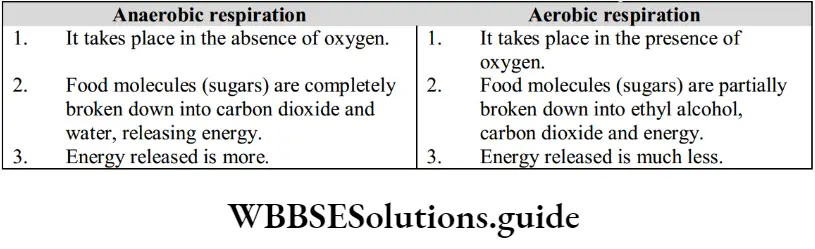
NEET Biology Class 7 Chapter 7 Respiration And Excretion Differences between Aerobic and Anaerobic respiration

3. Process Of Respiration

The process of respiration consists of two main stages:

Breathing or external respiration: A physical process in which an organism takes in (inhales) oxygen and gives out (exhales) carbon dioxide.

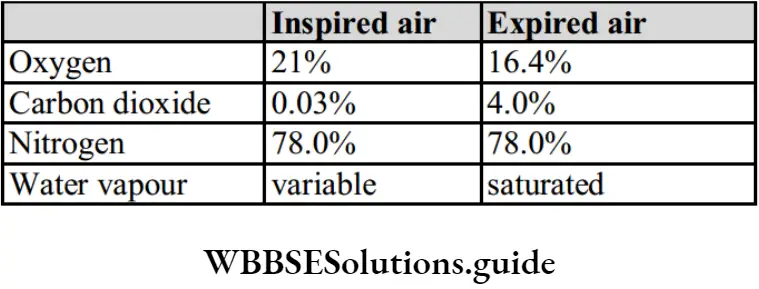
This process involves the exchange of gases only. The exhaled air has more carbon dioxide than the inhaled air.

Cellular respiration or internal respiration: A chemical process in which food molecules are broken down into simpler molecules within cells and energy is produced. A number of chemical reactions catalyzed by enzymes occur during this process.

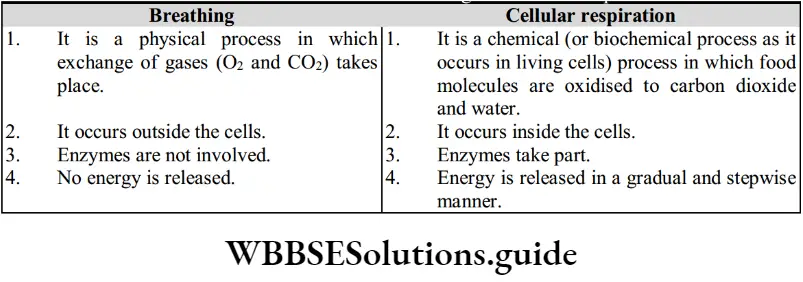
NEET Biology Class 7 Chapter 7 Respiration And Excretion Differences between Breathing and Cellular respiration

Respiration and Excretion NEET Notes

4. Combustion And Respiration

  • Is the process of respiration similar to burning or combustion (of petrol or diesel in vehicle)? When we burn petrol or wood, oxygen is used up and carbon dioxide is given off.
  • The energy is produced in the form of heat and light (flame). Something similar happens in our body. Yes, the two processes differ in many respects. The table given below lists the differences.

“class 7 science chapter 10 short answer “

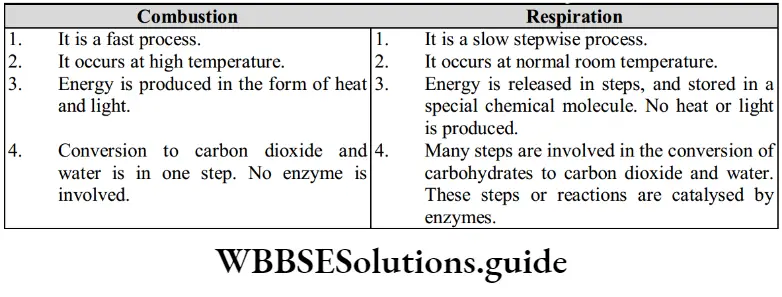
NEET Biology Class 7 Chapter 7 Respiration And Excretion Differences between Combustion And Reapiration

5. Respiration In Plants

The process of respiration is similar in all organisms, whether plants or animals – carbon dioxide is given out oxygen is used up, and a lot of energy is produced.

In plants, specific organs for breathing are absent. The exchange of gases, however, occurs by the process of diffusion. Diffusion of gases (oxygen and carbon dioxide) occurs through three sources.

  1. Through stomata (singular stoma), the minute openings on the surface of leaves.
  2. Through lenticels, openings present in old stems, and
  3. Through the general surface of the roots.
  4. In aquatic plants, gases diffuse through the body surface.

Stomata

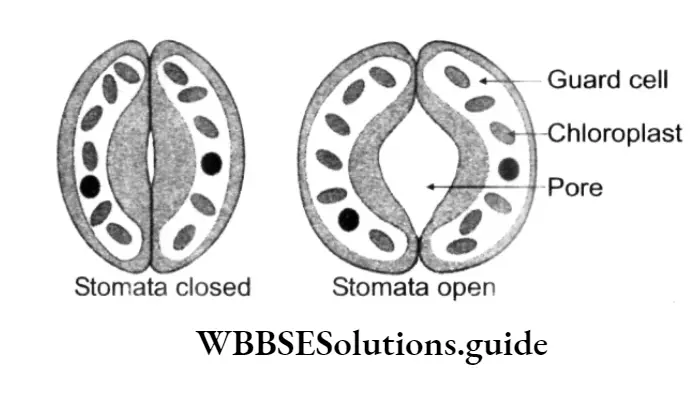
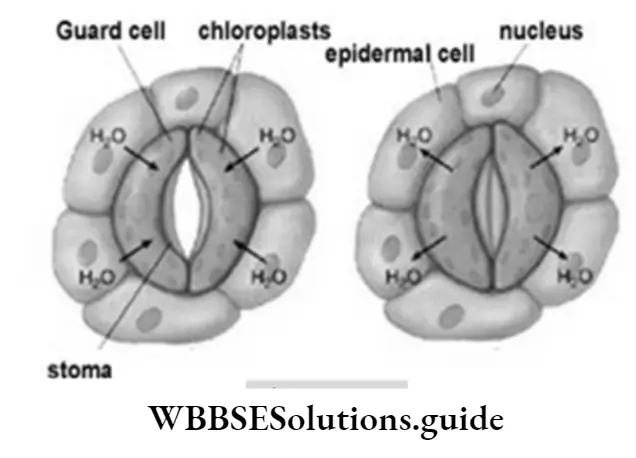
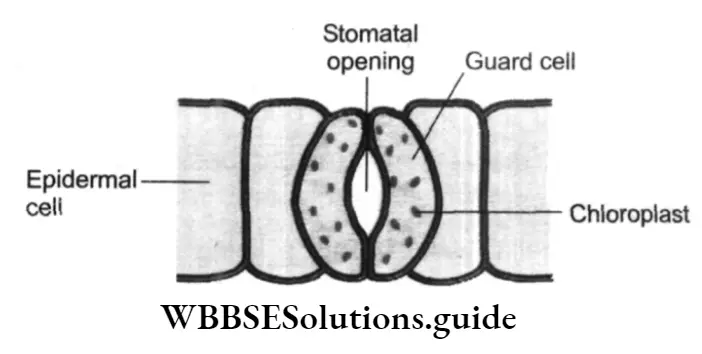
  • The opening is surrounded by two kidney-shaped cells called guard cells. The guard cells contain chloroplasts and carry out photosynthesis. Guard cells are surrounded by subsidiary cells.
  • The whole structure consisting of the opening, guard cells, and subsidiary cells is called the stomatal apparatus. Cellular respiration in plants is similar to that found in animals. It occurs inside mitochondria.

NEET Biology Class 7 Chapter 7 Respiration And Excretion Structure Of Stomata

NEET Biology Respiration and Excretion Important Notes

Anaerobic Respiration In Plants

  • Respiration also takes place in the absence of oxygen. This type of respiration is called anaerobic respiration. This happens in the case of certain organisms like yeast and some bacteria.
  • Even germinating seeds can respire in the absence of oxygen for some time. In this respiration, the food molecules (sugars) are incompletely broken into ethyl alcohol and carbon dioxide.
  • The energy released is much less in comparison to that produced in the case of aerobic respiration.

6. Respiration In Animals

Exchange Of Gases – Breathing

  • Different organisms have different methods of breathing:
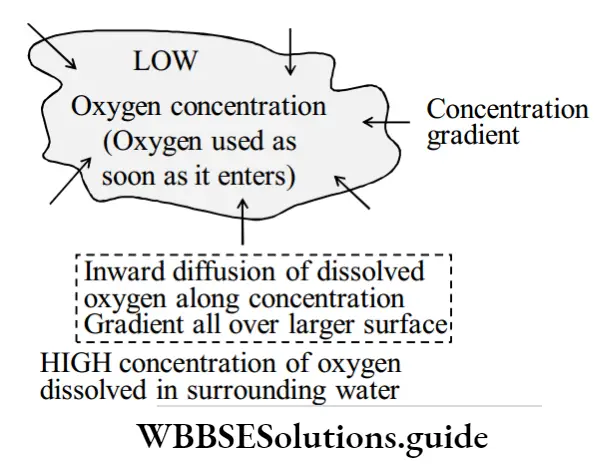
  • In Amoeba, for example, breathing occurs by simple diffusion. Hydra also breathes through the body’s surface.
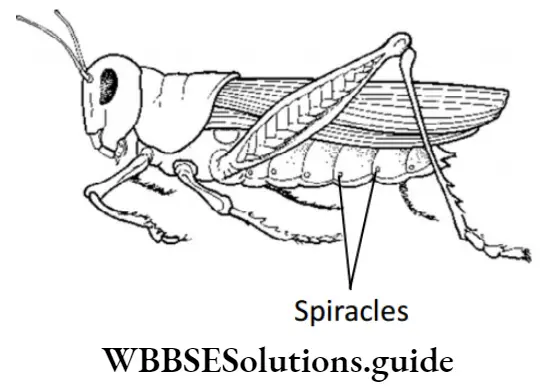
  • In insects, the movement of the skeleton draws air in and out of the openings called spiracles. These openings are present on the body surface.

NEET Biology Class 7 Chapter 7 Respiration And Excretion Diffusion in Amoeba

NEET Biology Class 7 Chapter 7 Respiration And Excretion Spiracles In An Insect

Best Short Notes for Class 7 Biology Respiration and Excretion

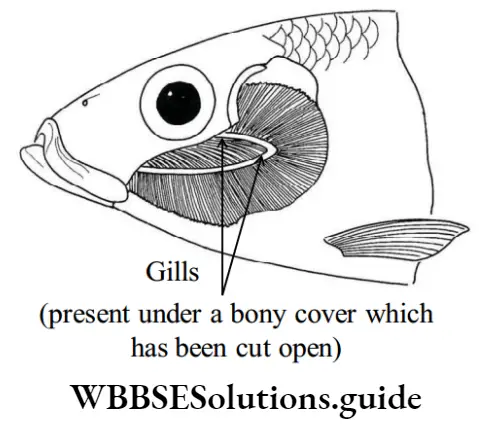
  • Fishes and many other aquatic animals have special structures called gills. Through these gills, dissolved oxygen is used from the water entering these organs.
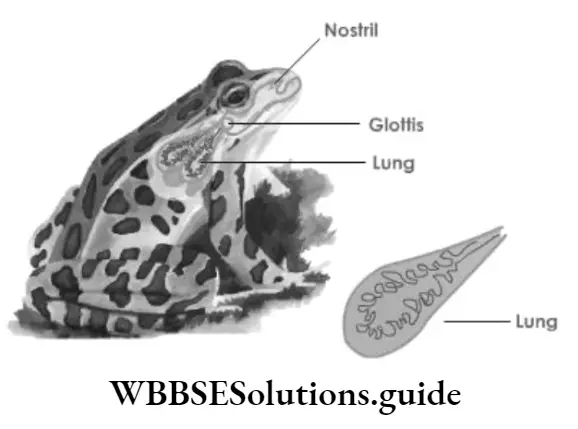
  • Frogs when in water also breathe through their moist skin. Frogs, on land, breathe through their lungs.

NEET Biology Class 7 Chapter 7 Respiration And Excretion Respiratory Organs In Fish

NEET Biology Class 7 Chapter 7 Respiration And Excretion Lungs of A Frog

Respiration and Excretion Class 7 NEET Key Concepts and Summary

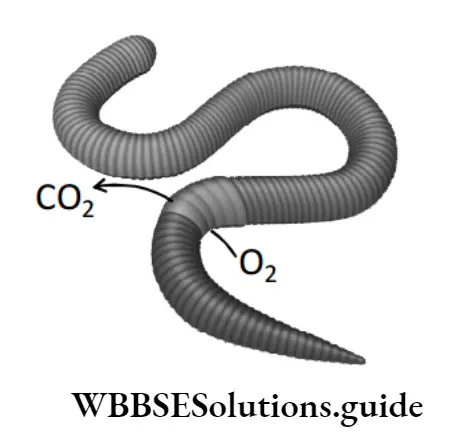
Earthworms absorb atmospheric oxygen through their moist skin.

NEET Biology Class 7 Chapter 7 Respiration And Excretion Exchange of gases in earthworm

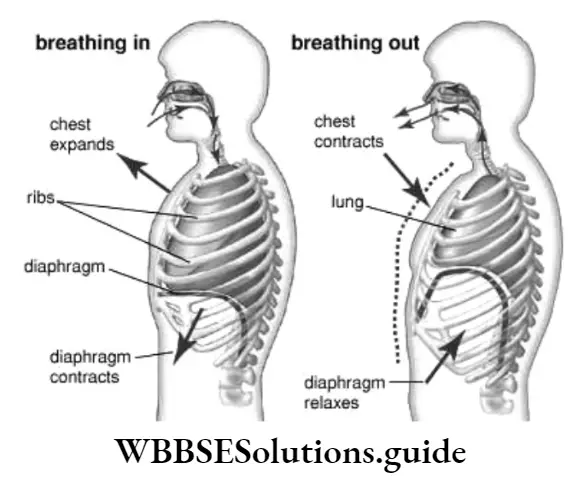
We breathe through our lungs. Movements of the ribs and diaphragm help to draw air in and out of our lungs through the nose.

7. Respiratory System In Humans

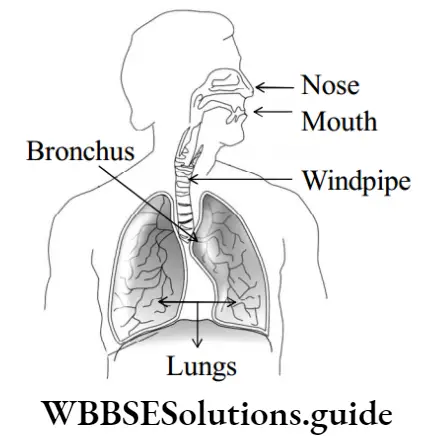
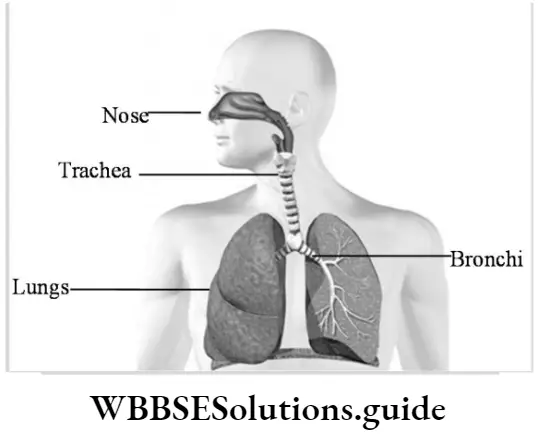
Respiratory System In Humans Consists Of Following Organs Meant For Breathing:

  1. Nose
  2. Trachea or windpipe
  3. Bronchi
  4. Lungs

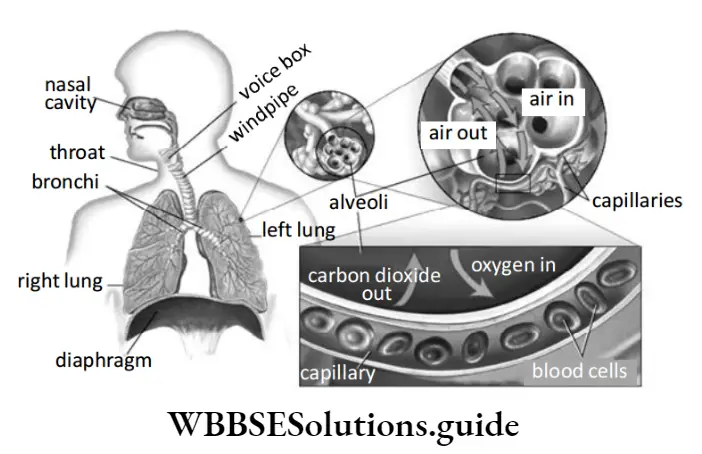
NEET Biology Class 7 Chapter 7 Respiration And Excretion Respiratory system

NEET Biology Class 7 Chapter 7 Detailed Notes with Explanation

  • When a person breathes in, air passes into the body through the respiratory tract starting with the nose.
  • The hair inside the nose traps and stops the harmful particles from entering inside. The nose also warms the air.
  • From the nose, the air goes down the windpipe or trachea. From here, the air goes through two smaller tubes called bronchi (singular bronchus), one of which enters each lung. The lungs are large, soft organs.

NEET Biology Class 7 Chapter 7 Respiration And Excretion Inhalation and Exhalation

  • In the lungs, each bronchus divides and redivides into finer tubes called the bronchioles. Windpipe each bronchiole ends in a number of air sacs, called alveoli (singular alveolus).
  • Alveoli have very thin walls and are supplied with blood capillaries.
  • It is here that air is received from the bronchi, the proper gases are used, and unwanted gases are forced out. Thus, the exchange of gases takes place in the alveoli.
  • How the Diaphragm Helps In the Breathing Process Has Been Demonstrated In Activity Number 7.6.
  • How does air move in and out of the lungs?
  • Take in a deep breath. Now breathe out. Lungs are present in the chest cavity. The ribs surround this cavity on the sides. A large flat muscle called the diaphragm forms the floor of the chest cavity.

During inhalation (breathing in), two things happen –

  1. The ribs move out
  2. The diaphragm moves down.

This makes the chest cavity larger. The air then rushes into the lungs. The lungs inflate.

  1. During exhalation (breathing out)
  2. The ribs move downwards and inwards,
  3. The diaphragm moves up.

Thus, the chest cavity is reduced. Air rushes out of the lungs. The lungs become smaller.

Tidal volume is the volume of air that moves in or goes out in a single stroke and is about 500 ml.

NEET Biology Class 7 Chapter 7 Respiration And Excretion Composition of Inspired and Expired Air

NEET Study Material for Respiration and Excretion Chapter

Role Of Blood In Respiration

  • Blood is red because of the presence of a certain type of cells in it. These are the red blood cells.
  • The red blood cells contain a pigment called hemoglobin. This pigment gives its red color to blood.
  • Haemoglobin carries oxygen molecules as oxyhemoglobin. This substance acts as a respiratory carrier in the body. Oxygen diffuses to the cells as blood passes through tissues.
  • At the same time, the blood collects carbon dioxide from the tissues and carries it to the lungs for breathing.

NEET Biology Class 7 Chapter 7 Respiration And Excretion Gaseous exchange in the alveoli

8. Transpiration

Transpiration is the process of loss of water in vapor form from the leaves in plants.

  • It occurs through stomata present in the leaves by the process of diffusion. Water absorbed through the roots is moved upwards within the plant body.
  • A part of it is used in the process of photosynthesis, and to stop the plant from wilting (drooping). The rest is lost as water vapor into the atmosphere from the leaves.

Factors Affecting Transpiration

  1. Day/Night: More transpiration takes place during the day than at night. This is because the stomata are open during the day and close at night.
  2. Wind: Wind increases the rate of transpiration.
  3. Humidity: The rate of transpiration is decreased if the air is humid. The air already contains a lot of water.
  4. Temperature: The rate of transpiration is higher on a hot day than on a cold day.
  5. Light: Light causes the stomata to open. This increases the rate of transpiration.

Importance Of Transpiration

  1. It results in the transport of water and minerals from the soil to the leaves. In the leaves, water forms the raw material for photosynthesis.
  2. It produces a cooling effect which helps in preventing hot sunlight from damaging delicate cells.

9. Excretion

  • Living Organisms Perform A Number Of Activities. During These Activities, A Variety Of Waste Products Are Produced. For example, some of the food we eat is not used by our bodies.
  • The undigested food is a waste product. During respiration, water, carbon dioxide, and heat are produced as wastes.
  • Urea is another waste. It comes from used-up protein.
  • Some of the waste products like urea are very harmful and toxic. These must not be accumulated within the body. Otherwise, the accumulation of waste produces health problems.
  • Fortunately, each organism has a mechanism of its own to remove the waste products. The process of removal of the waste products is called excretion

Respiration and Excretion Class 7 NCERT Notes for NEET

Excretion In Lower Plants And Animals

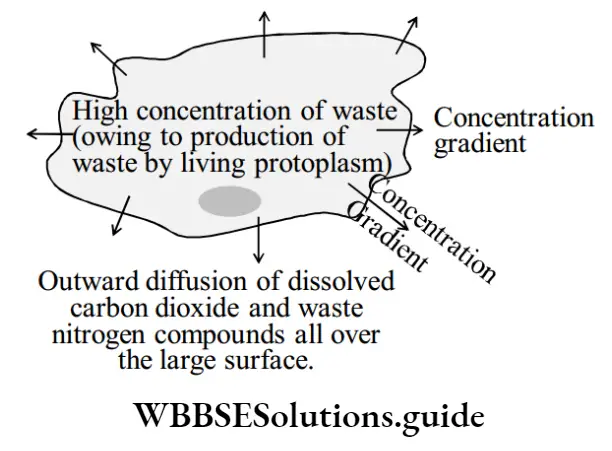
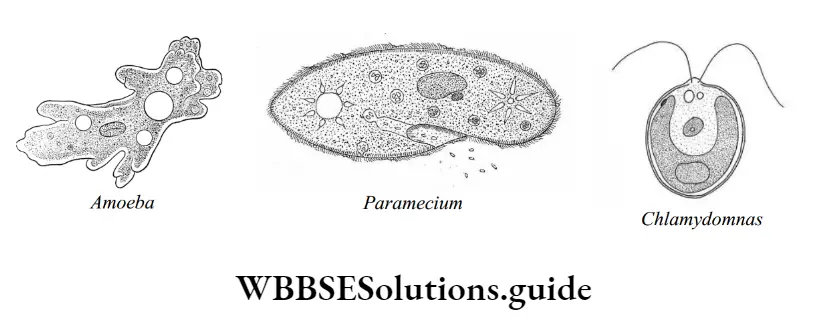
In organisms like Amoeba, Paramecium. Hydra, most of the metabolic wastes are removed through the general surface of the body by the simple process of diffusion. Specialized organs of excretion are lacking.

NEET Biology Class 7 Chapter 7 Respiration And Excretion Excreation In Amoeba

Excretion In Flowering Plants

Excretion of waste products is very simple and much less in plants as compared to animals. The waste products of one process are often used as raw materials in another process. This is very clear if you study photosynthesis and respiration.

Excess food material in many cases is stored in roots, stems, leaves, and seeds. These plant organs are often eaten by man. The various methods of excretion are given below:

  1. Waste products of photosynthesis and respiration – – oxygen, carbon dioxide, water, and heat – – are released into the atmosphere through stomata in the leaves and lenticels in stems. The waste products of one process are, however, usable as raw products in another process.
  2. Ammonia is formed as a breakdown product of proteins. Plants use this ammonia to synthesize useful compounds.
  3. Some of the waste products of photosynthesis are collected in the leaves and bark of trees. Plants shed their leaves and bark to get rid of these wastes.
  4. Some waste materials keep accumulating within cells. Calcium oxalate crystals, called raphides, are such wastes. Yam (zimikand) is rich in raphides.
    • Several of the plant wastes are useful to us. Latex, gums, resins, tannins, sandalwood oil, and eucalyptus oil are such substances.
    • Latex, a white milky fluid, oozes out from any cut on the stem is the case of some plants. Latex from rubber plants is used for making rubber. Resins are used for preparing varnish.

Excretion In Humans

The human body has various organs to get rid of waste.

  1. Lungs — for excretion of carbon dioxide and water vapor produced during respiration.
  2. Skin — For Excretion Of Urea, Salt, And Excess Water By Means Of Sweat Glands Present In The Skin.
  3. Large Intestine — for excretion of some wastes along with feces through the anus.
  4. Kidneys — for excretion of products like urea and nitrogen in urine.
  5. Liver — for removal of wastes from the blood.

10. Excretory System In Humans

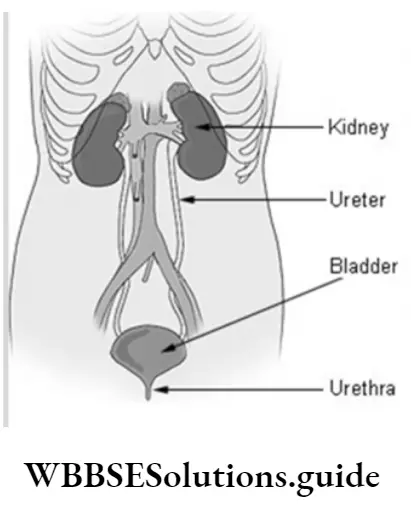
The excretory system consists of the following organs:

  1. A pair of kidneys
  2. Ureters
  3. Urinary bladder
  4. Urethra.

Human Respiratory and Excretory System NEET Notes for Class 7

Kidneys are bean-shaped structures, about 10 centimeters long.

  1. They are located just above the waist on either side of the backbone.
  2. Each kidney consists of a large number of coiled tubes called nephrons.
  3. Nephrons act as filters. They filter waste products from the blood.
  4. The waste materials collected in the kidney form the liquid urine. Urine contains 95 percent water, 2.5 percent urea, and 2.5% waste products.
  5. A narrow tube called the ureter runs from the inner side of each kidney.
  6. The ureters, in turn, are connected to a large sac called the urinary bladder.
  7. Urine passes from the kidney through two ureters into the urinary Nephrons bladder.
  8. Urine is collected and stored here. Nephrons, the coiled
  9. Leading from the bladder is another tube called the urethra. The urethra works as the outlet passage for urine.

NEET Biology Class 7 Chapter 6 Digestion Notes

Digestion

1. Steps In Digestion

  • In the last chapter, you have learnt that the food consumed by us consists of a number of nutrients.
  • What happens to the food as well as the nutrients that we eat?
  • Whatever may be the food and the nutrients present in the food, it undergoes

Read And Learn More: NEET Class7 Biology Notes

The following five steps:

These five steps are the steps in the process of digestion.

  1. Ingestion: The process by which food is taken in by the organisms is called ingestion.
  2. Digestion: It is the process of breaking down complex food into simpler absorbable molecules. This is brought about with the help of special molecules called digestive juices or enzymes.
  3. Absorption: It is the process by which digested food is taken up (or absorbed) by the body.
  4. Assimilation: The absorbed food is incorporated into living cells and is used by the body for its growth and other purposes.
  5. Egestion: This is the process by which undigested food is removed from the body.
  6. Nutrition: The process by which organisms obtain and use food is known as nutrition.
  7. Enzymes: Enzymes are proteins in nature. These act as catalysts.

“digestion and absorption neet notes “

2. Digestive System In Humans

  • The body cells cannot use the food in the form it is eaten by us. It is converted into a simpler form by the process of digestion.
  • The process of digestion starts in the mouth. From the mouth, the food passes through a food canal (called the alimentary canal).
  • The alimentary canal is a long, muscular and coiled tube. It starts from the mouth and ends at the anus.

Why do we need a Digestive System?

  • All animals need food to survive, grow and function properly. Often the food eaten is solid. Solid food cannot be absorbed by the body cells as it is. Our digestive system has two basic jobs to do with the food we take in.
  • The first job is to break down large food particles so that they can be carried through the body. The second job of the digestive system is to transform the molecules of food into simple molecules.
  • We take in foods of all kinds—milk, meat, tea, potato, fish, and so on. These molecules must be broken down into simpler molecules so that they can finally be built into human protoplasm.
  • The digestive system ensures that the digested material is absorbed into the blood vessels. In this way, nourishment reaches all the body cells.

NEET Study Material for Digestion Chapter

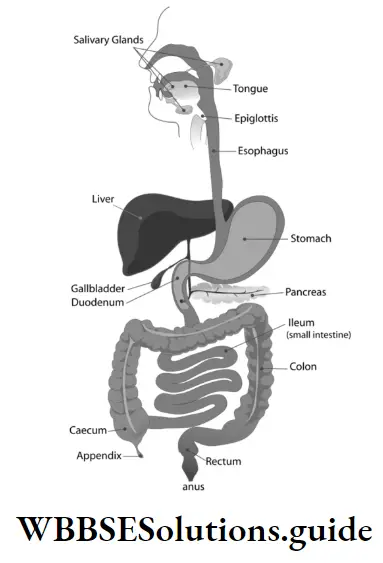
The different organs of the alimentary canal are as follows:

  1. Mouth and mouth cavity
  2. Oesophagus (gullet)
  3. Stomach
  4. Small Intestine
  5. Large Intestine
  6. Anus

NEET Biology Class 7 Chapter 6 Digestion Notes

Associated with the alimentary canal are some glands. These are:

  1. Salivary glands
  2. Liver
  3. Pancreas.

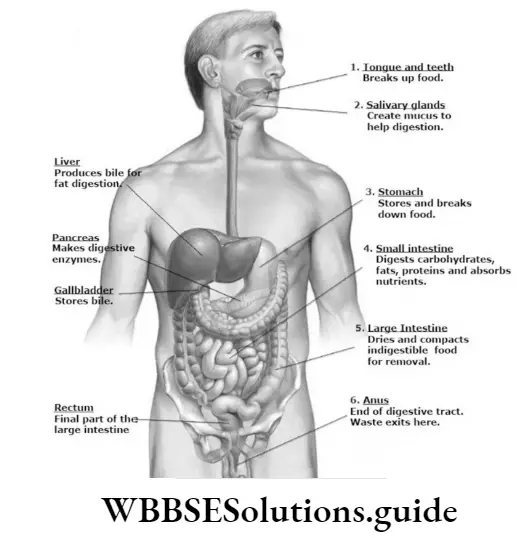
The alimentary canal along with the associated glands is called the digestive system

NEET Biology Class 7 Chapter 6 Digestion Digestive System

“digestion and absorption neetprep “

Mouth

The Mouth Contains The Tongue, Teeth And Salivary Glands. The process Of Digestion Starts In The Mouth Itself. Food Is Bitten Off And Chewed (Masticated) By The Teeth.

The Chewed Food Gets Mixed With The Saliva Secreted By The Salivary Glands. The Tongue Helps In Mixing The Food With Saliva And Its Swallowing Down The Digestive System.

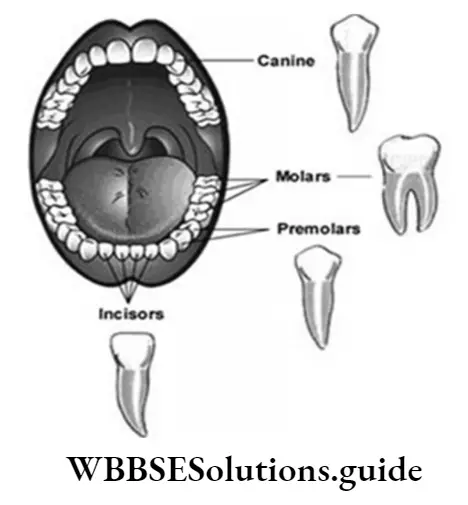
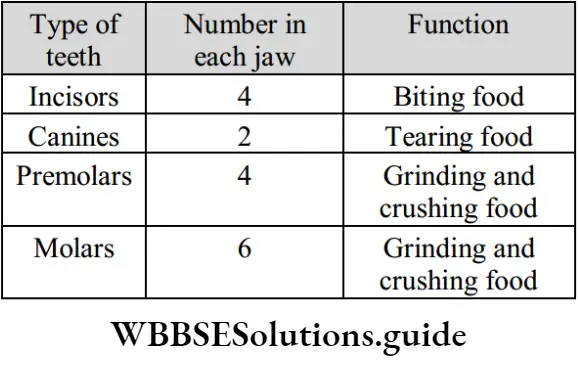
Teeth: There are four main kinds of teeth in man – incisors, canines, premolars and molars

NEET Biology Class 7 Chapter 6 Digestion Different Types of Teeth

NEET Biology Class 7 Digestion Notes

The front four teeth in each jaw are the incisors. They are flat and help in biting the food. On either side of the incisors are the canines. These are sharp and two in number in each jaw. They are meant for tearing the food.

NEET Biology Class 7 Chapter 6 Digestion Types of teeth in humans

“neetprep digestion and absorption “

The premolars and molars are meant for grinding and crushing the food. Premolars are behind the canines, two in number on either side of each jaw. Molars are behind the premolars.

In an adult, there are six in number in each jaw, three each on either side of the premolars. In young people, there are 8 molars in all. The second set of 4 molars appears at the age of eighteen or even later. These are called wisdom teeth.

Each jaw in an adult has 16 teeth, or 32 teeth in all. Man has two sets of teeth milk teeth and permanent teeth. The first set of teeth in a baby are called milk teeth.

Human Digestive System NEET Notes for Class 7

These are replaced by permanent teeth when one is a child.

  • At birth, a human infant has no teeth. After six months or so, the first teeth appear in the centre of the lower jaw.
  • Milk teeth are twenty in number.

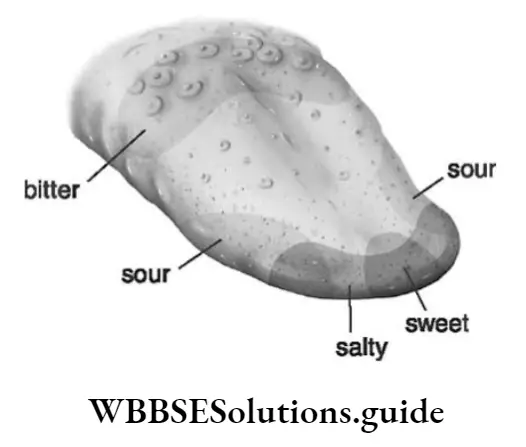
Tongue: Tongue is also important for eating. It helps in Bitter mixing the chewed food with saliva and swallowing the food.

Further, the tongue tastes, as it has sense organs called the taste buds. These buds distinguish four basic tastes – salty, sour, sweet and bitter. In addition, the tongue helps us to speak.

Salivary glands: There are three pairs of salivary glands in our mouth. A watery material called saliva is secreted by these glands.

  • Saliva helps in the digestion of food. Saliva contains an enzyme called amylase (also called ptyalin).
  • Amylase acts on starch and changes it into a sugar (called maltose). This sugar is sweet and soluble in water.

Note: The liver is the largest gland in the body.

NEET Biology Class 7 Chapter 6 Digestion Location Of Taste buds on the toungue

Digestion NEET Notes

Oesophagus (Gullet)

The oesophagus connects the mouth cavity with the stomach and is also called the food pipe. No digestion takes place here. It only helps in pushing the food into the stomach.

Stomach

  • The stomach is a muscular bag lying in the upper abdomen. Here the food is churned and converted into a semi-solid paste.
  • The stomach secretes a juice called gastric juice and an acid. Proteins present in the food are digested by the gastric juice partly. The partly digested food from here goes to the small intestine.

Digestion Class 7 NCERT Notes for NEET

Small Intestine

  • The small intestine is a long coiled tube. It also secretes a juice and digestion of all types of food is carried out here.
  • As a result of indigestion, food is converted into a simple form, and glucose, amino acids fatty acids, etc., are formed. These end products are ready for absorption.
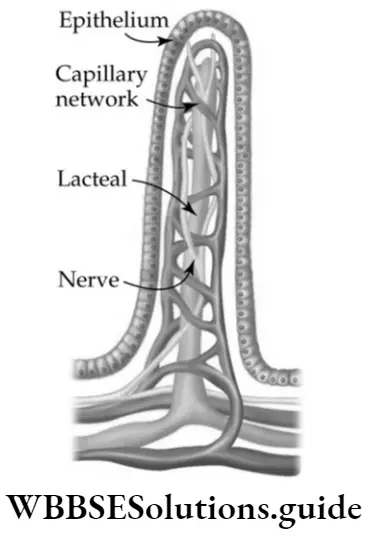
  • The inner surface of the small intestine has a number of finger-like projections called villi. These villi increase the area for absorption of digested food.
  • Saliva contains an enzyme called amylase {also called ptyalin). Amylase acts on starch and changes it into a sugar (called maltose).
  • This sugar is sweet and soluble in water. The small intestine also absorbs the digested food and passes it on to the blood system. Thus, the nutrients are carried to all parts of the body.

“physiology of digestion and absorption “

Note: The small intestine is larger in length (about 6 metres) than the large intestine (about 1.5 metres). It is the main organ for the absorption of digested food

NEET Biology Class 7 Chapter 6 Digestion Villi in the small intestine

NEET Biology Digestion Important Notes

Large Intestine

The large intestine has no digestive function to carry out. It helps in absorbing water and in removing the undigested solid wastes through the anus.

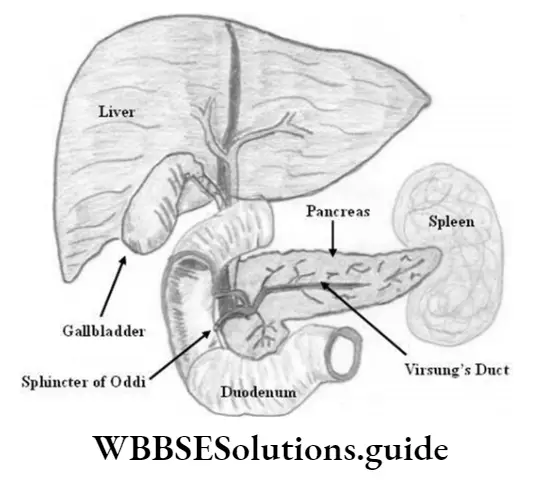
Liver and Pancreas: These are special organs connected with the digestive system.

  • The liver secretes juices which help in digestion and are stored in a small bag called the gall bladder.
  • The pancreas secretes a substance called insulin and also a juice. Insulin is important for regulating sugar levels in the body.

NEET Biology Class 7 Chapter 6 Digestion Associated Glands

3. Digestion In Humans

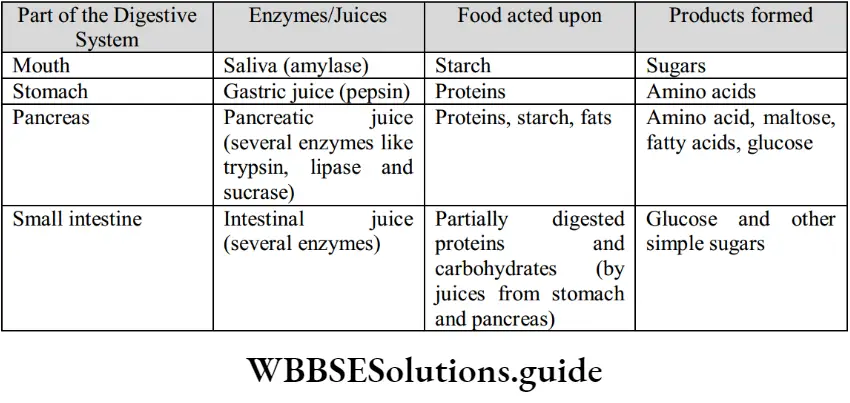
We have already studied the digestive system of humans. The process of digestion is brought about with the help of digestive juices called enzymes.

An outline of the different enzymes produced in humans along with the food acted upon and the products.

NEET Biology Class 7 Chapter 6 Digestion Summary Of digestion

Best Short Notes for Class 7 Biology Digestion

4. Teeth In Herbivores, Carnivores And Omnivores

Dentition: The arrangement of teeth in the jaws is called dentition. Teeth in herbivores (like rabbits), carnivores (like dogs) and omnivores (like human beings) are related to the diet the animals take.

As mentioned earlier, there are four different kinds of teeth

  1. Incisors (for cutting)
  2. Canines (for tearing)
  3. Premolars,
  4. Molars (for grinding)

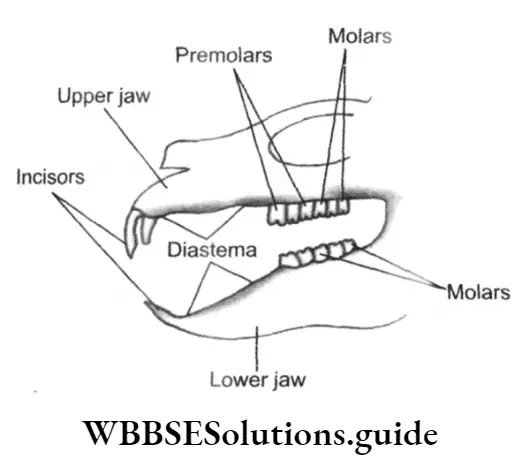
Dentition In Herbivores (Example Rabbit)

  • They have incisors which are sharp and used for cutting. Canines are absent and a gap occurs between the incisors and premolars. This gap is called diastema. The premolars and molars are used for chewing.
  • The premolars and molars are almost similar in shape and size, as they have the same function. The gap between the incisors and the premolars (diastema) allows the tongue to manipulate the food.

NEET Biology Class 7 Chapter 6 Digestion Dentition In a rabbit

Digestion Class 7 NEET Key Concepts and Summary

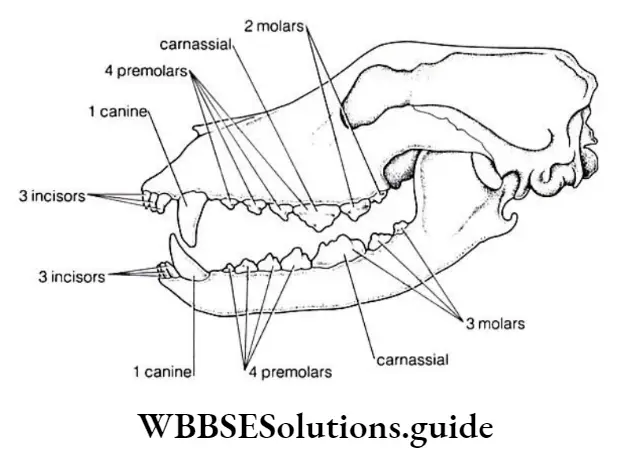
Dentition In Carnivores(Example Dog)

  • In carnivores, the teeth in different regions of the mouth are specialised to perform a particular function.
  • They have all four kinds of teeth. The incisors in the front of the mouth grip the food and strip off small pieces of flesh.
  • The canines are long, sharp and pointed and adapted for flesh-eating. The molars have a somewhat flat surface for grinding and crushing the bones.

NEET Biology Class 7 Chapter 6 Digestion Denitition In A Dog

Dentition in omnivores (for example human beings)

  • In omnivores, all four kinds of teeth are well-adapted to cope with a wide range of foods vegetables and a variety of meat.
  • The teeth are not as specialised as in carnivores and herbivores. The four kinds of teeth in human beings have been already described.

5. Structure Of A Tooth

  • You have learnt that teeth, present in the mouth cavity, play an important role in biting and chewing food.
  • In an adult human being, there are four types of teeth incisors, canines, premolars and molars.

“difference between digestion and absorption “

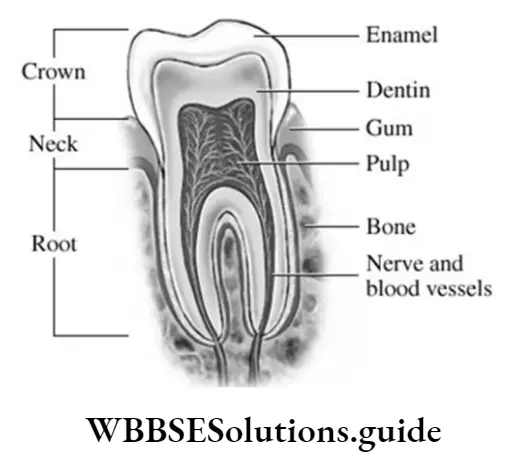
Fixed to the gums, each tooth has the following three parts:

  1. Root, the part embedded in the jaw,
  2. The crown, the top part projecting above the gums, and
  3. The neck is the part between the root and the crown.

NEET Biology Class 7 Chapter 6 Digestion A Tooth in Section

NEET Biology Class 7 Chapter 6 Detailed Notes with Explanation

Internally, there are three parts of a tooth – enamel, dentine and the pulp cavity. Enamel is the white part of the tooth and is the hardest substance in our body. Below the enamel, dentine is present.

Inner to dentine is the soft pulp cavity which contains blood vessels and nerves.

6. Care Of The Teeth

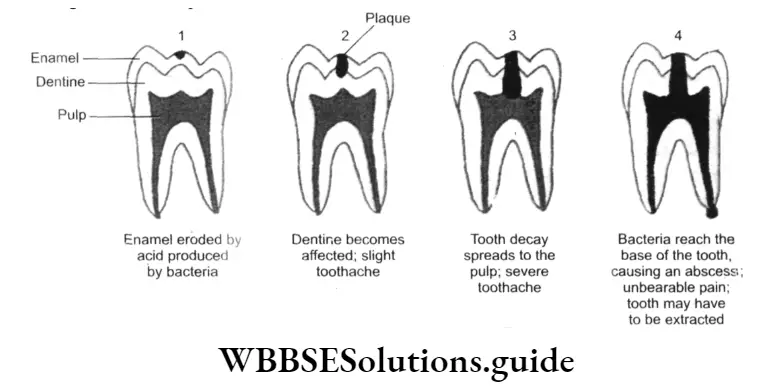
  • Teeth are commonly seen to become yellow and suffer from cavity formation. When food is eaten, small amounts are left in between the teeth.
  • Saliva and bacteria (present in the mouth) stick to the teeth and form a sticky film. This sticky film is called dental plaque.
  • The enzymes produced by the bacteria act on the food particles, particularly sugars and acids.
  • The acids dissolve away the tooth enamel causing tooth decay. Ultimately a hole or cavity is formed in the tooth.
  • Plaque affects the gums too, causing gum disease. The gums swell and may bleed on brushing.
  • The plaque builds up in the region where the teeth meet the gums and forms a space. Bacteria growing in this space cause the teeth to fall.

“difference between digestion and absorption “

Plaque formation and other diseases can be avoided by

  1. not eating foods like sweets, chocolates and ice-creams,
  2. and consuming foods that contain sufficient calcium, phosphorous and vitamin D such as milk,
  3. fish, raw vegetables, carrots, spinach (palak), radish, cabbage and fresh fruits (the teeth and gums get good exercise when fibrous foods are eaten), cleaning teeth after eating sweet, sticky food,
  4. brushing teeth thoroughly and regularly every day in the morning and again before going to bed, and
  5. using fluoride toothpaste.

“difference between digestion and absorption “

NEET Biology Class 7 Chapter 6 Digestion Tooth Decay- stages

NEET Biology Class 7 Chapter 5 Nutrition in Plants and Animals Notes

Nutrition In Plants And Animals Introduction

  • In our previous classes, we have learned about living and non-living things.
  • Though there are many differences, a living organism shows seven basic characteristics that differentiate it from a non-living one.
  • These characteristics are called life characteristics because together they ensure that an organism continues to live.

Read And Learn More: NEET Class7 Biology Notes

NEET Biology Class 7 Chapter 5 Nutrition In Plants And Animals Heterotrophic plants

In this chapter, we will learn about nutrition, more specifically nutrition in plants. But, what does the term nutrition mean? Before, knowing about it, let’s know what food is.

Any substance that can be broken down through chemical processes in the body of an organism to give energy is called food Food gives energy to perform many activities like studying, playing, talking, drawing, etc

2. Nutrition

The entire process of taking in food and drink by living organisms and using it for the purpose of growth and daily activities is called Nutrition.

“class 7 nutrition in animals notes “

There are two major modes of nutrition:

  1. Autotrophic nutrition
  2. Heterotrophic nutrition

Autotrophic Nutrition

  • We have seen animals and humans eating food. We get energy from the food we eat. How about plants?
  • Neither they can cook food nor they can to different places like animals in search of food.
  • How then are they preparing food?

Photosynthesis

  • Green plants actually make their own food through a process called photosynthesis (photo, light; synthesis, to put together).
  • The mode of nutrition whereby a living organism makes its own food is called autotrophic nutrition.
  • Organisms that are able to synthesize their own food are termed autotrophs (auto, self; trophy, nutrition).

The term photosynthesis was coined by Charles Reid Barnes in 1883.

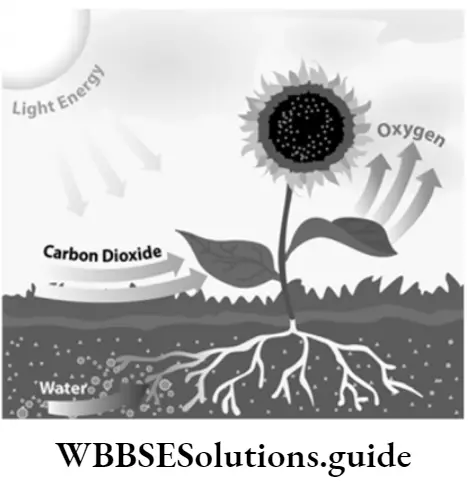
  • It is a process in which carbon dioxide from the atmosphere is taken in by the leaves.
  • Water absorbed by the roots reacts with carbon dioxide in the presence of sunlight to produce starch and oxygen.
  • The starch is stored in various parts of the plant and oxygen is released into the atmosphere.
  • The reaction that takes place can be written as:
  • Carbon dioxide + Water sunlight Starch + Oxygen and chlorophyll

“class 7th chapter 2 science notes “

NEET Biology Class 7 Chapter 5 Nutrition In Plants And Animals Photosynthesis

Thus, photosynthesis can be defined as:

The process of using the energy in sunlight to convert water and carbon dioxide into carbohydrates (starch) and oxygen is called Photosynthesis.

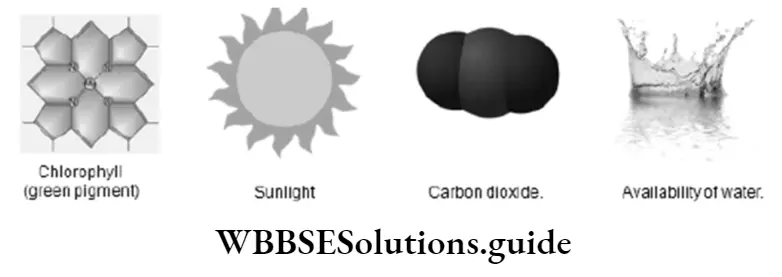
Photosynthesis – Necessary Conditions

NEET Biology Class 7 Chapter 5 Nutrition In Plants And Animals Photosynthesis Necessary Conditions

NEET Biology Class 7 Nutrition in Plants and Animals Notes

Chlorophyll

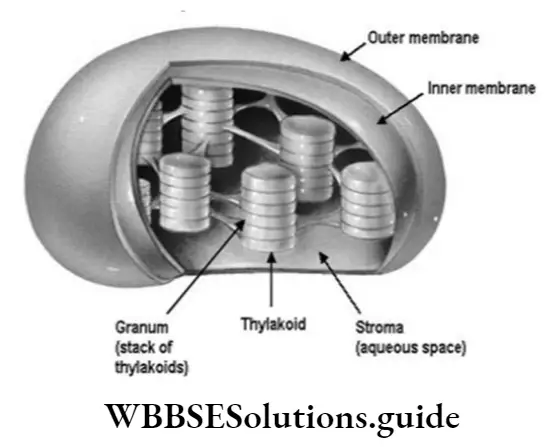
It is a green pigment present in the structures called chloroplasts of leaves in a plant.

Note:

A naturally occurring substance that gives a particular color to a plant or an animal part is called a pigment. On average, there are about 500,000 chloroplasts per square millimeter of a leaf.

Sunlight

It is the source of light energy required for photosynthesis. Chlorophyll traps the light energy to make energy-carrying particles.

“nutrition in animals diagram “

NEET Biology Class 7 Chapter 5 Nutrition In Plants And Animals Chlorophyll

Carbon dioxide

It is obtained from the atmosphere through small openings called stomata (singular: stoma) in the underside of the leaves.

NEET Biology Class 7 Chapter 5 Nutrition in Plants and Animals Notes

Water

This is another important requirement for photosynthesis. The root system of plants enables them to obtain water from the soil.

NEET Biology Class 7 Chapter 5 Nutrition In Plants And Animals Epidermal cells

Nutrition in Plants and Animals NEET Notes

Factors Affecting Photosynthesis

The following factors affect the rate of photosynthesis:

  1. Light intensity: Photosynthesis increases with an increase in light intensity, up to a certain point.
  2. Availability of carbon dioxide: Photosynthesis increases with an increase in carbon dioxide concentration.
  3. Temperature: Upto a certain temperature value, the rate increases with an increase in temperature. This value ranges generally between 20° to 35°C.
  4. Availability of water: Less availability of water reduces photosynthesis through the closure of stomata.
  5. Inorganic mineral ions: A dehydrated green plant (a plant from which all water has been removed) consists of four elements – carbon, hydrogen, oxygen, and nitrogen.

“class 7 science chapter 2 notes pdf “

These elements consist of about 96% of the total plant’s dry weight combined together in the form of organic compounds (proteins, carbohydrates, fats, etc.).

The remaining 4% of the green plant dry weight consists of the following chemical elements in the form of inorganic compounds – sulfur, phosphorus, calcium, iron, magnesium, potassium, chlorine, aluminum, boron, manganese, copper, zinc, and chlorine.

These elements are obtained from soil water, and taken up through the root system as ions. Each of the inorganic ions has different functions in the process of photosynthesis.

Some of the elements are required in higher quantities (called macronutrients) while others are required in lower quantities (called micronutrients or trace nutrients).

Macronutrients: Carbon, hydrogen, oxygen, nitrogen, phosphorus, sulfur, potassium, calcium, iron and magnesium.

Micronutrients: Copper, zinc, boron, manganese, and molybdenum.

NEET Biology Class 7 Chapter 5 Nutrition In Plants And Animals Deficiency Diseases Of Some Nutrients

NEET Biology Nutrition in Plants and Animals Important Notes

3. Transport Of Materials

There are two aspects of transport in plants:

  1. Movement of water and minerals from the roots upwards to other plant parts, and
  2. Movement of food material synthesized in the leaves to other plant parts. Upward movement of water and minerals occurs through channels, called xylem elements, present in the roots, stems, and leaves of plants.

The prepared food material in a soluble form is carried through another channel, called phloem, from the leaves to all other parts of the body.

Demonstration Of Upward Movement Of Water

  • Take a cut shoot of the balsam plant and dip it in a dilute red-colored dye, eosin, or safranin. Leave it for some time.
  • Then, take sections from different parts of the stem starting from the tip region. You will observe red color dye in the region of the xylem


NEET Biology Class 7 Chapter 5 Nutrition In Plants And Animals Demonstration Of Upward Movement Of Water

Demonstration Of The Transport Of Food Material

  • This is easily demonstrated by an experiment commonly known as the ‘girdling experiment’. Girdling of the stem removes phloem tissue.
  • If a stem is girdled, the downward and upward movement of food material gets blocked. So, the trunk portion shows swelling in the area due to the accumulation of food material.

NEET Biology Class 7 Chapter 5 Nutrition In Plants And Animals Girdling Experiment

Heterotrophic Nutrition

  • Most of the plants on the Earth are green. But there are certain plants that do not contain chlorophyll, neither in their leaves nor in any other part.
  • Such plants, called non-green plants, are unable to prepare their own food. Such plants depend on green plants or on other living bodies for their nutrition.
  • The mode of nutrition in which organisms cannot manufacture food and have to depend upon other plants and animals to obtain energy is called heterotrophic nutrition.
  • Organisms that have a heterotrophic mode of nutrition are called heterotrophs [heteron, (an)other; trophe, nutrition].

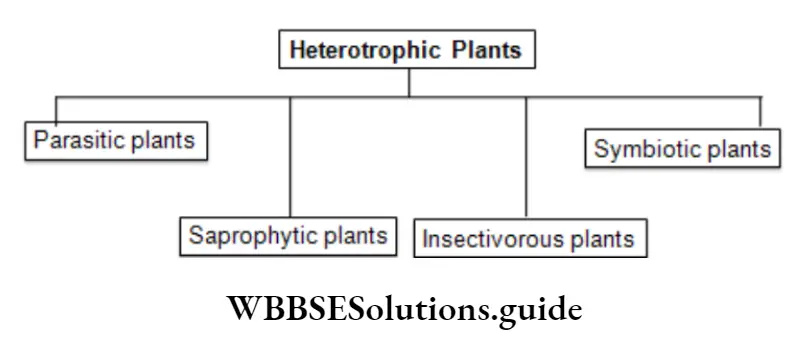
According to the mode of nutrition, heterotrophic plants are of the following types:

NEET Biology Class 7 Chapter 5 Nutrition In Plants And Animals Heterotrophic plants

Best Short Notes for Class 7 Biology Nutrition in Plants and Animals

Parasitic Plants

  • Parasitic plants are those which absorb food from another growing green plant, called the host.
  • Usually, parasitic plants develop special roots which penetrate into the tissues of the host plant. The prepared food is generally absorbed from the root or the stem of the host plant.
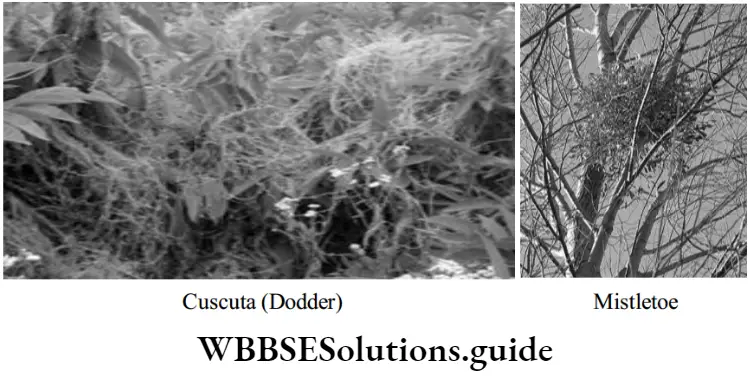
  • Mistletoe has leathery, green leaves, so they can make their own food but they depend on the host for minerals and water.

NEET Biology Class 7 Chapter 5 Nutrition In Plants And Animals Cascuta ,Mistletoe

Cuscuta (Dodder) has a short root and a long, thread-like stem. It twines around the host stem and sends branches around neighbouring stems giving the appearance of a mass of noodles or spaghetti.

An Interesting Fact

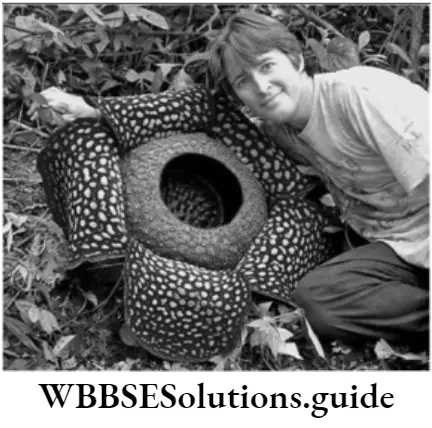
NEET Biology Class 7 Chapter 5 Nutrition In Plants And Animals Parasitic Plants

A parasitic plant, Rafflesia, bears the world’s largest flower.

The flowers have five petals may have a diameter of up to 106 cm, and weigh up to 10 kg. In a parasitic relationship, only the parasitic plant benefits.

Does a parasitic do any harm to the host plant?

  • Parasitic plants harm the host plant. Dodder and mistletoe are serious problems for plants. Dodder can cover woody plants and cause heavy damage to certain economically important crops.
  • Mistletoe can become so abundant on a tree that most of the foliage is of the parasite and not of the host.

Does this mean that the host plant is slowly killed off by the parasite?

Scientists believe that parasitic plants rarely, perhaps never, kill the host plant, so that the parasite can continue to live off the host.

Saprophytic Plants

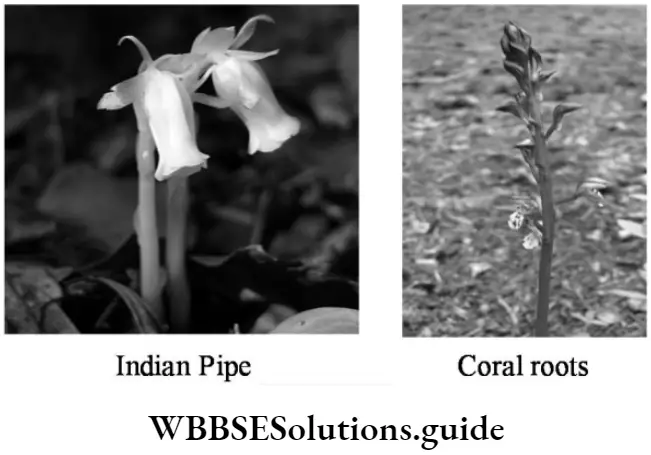
Saprophytic plants are usually whitish but can have brightly colored flowers. These plants have no green leaves; often they even have no leaves at all. So, how do saprophytic plants manage their nutrition?

Saprophytic plants are plants that live off rotting material (sapros, rotting; phyton, plant). They grow in places with lots of rotting dead leaves, often in deep shade in tropical forests. Some examples are

  1. Indian Pipe and coral root.
  2. Indian Pipe is found commonly in Asia and throughout North America.
  3. Coral roots are found in forest environments around the world.

NEET Biology Class 7 Chapter 5 Nutrition In Plants And Animals Indian Pipe And Coral Roots

Nutrition in Plants and Animals Class 7 NEET Key Concepts and Summary

The roots of saprophytes contain living organisms called fungi.

Fungi are capable of digesting dead and decaying matter. The fungi produce digestive juices which convert the dead and decaying matter into sugar which can be then used as food by these plants. Fungi are also called saprotrophs.

Interesting Point

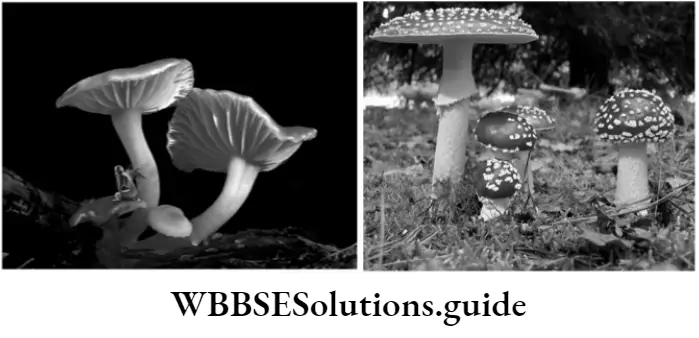
According to the latest system of classification of organisms, fungi are no longer considered in the plant kingdom. It is placed in a separate kingdom — Kingdom Fungi.

NEET Biology Class 7 Chapter 5 Nutrition In Plants And Animals Fungi

Mushrooms and toadstools are the most common examples of fungi

Insectivorous Plants

  • These plants are usually green so they can make their own food.
  • However, the soil in which they grow is sometimes deficient in certain nutrients, especially nitrogen.
  • Hence, these plants need to obtain these nutrients from outside sources.
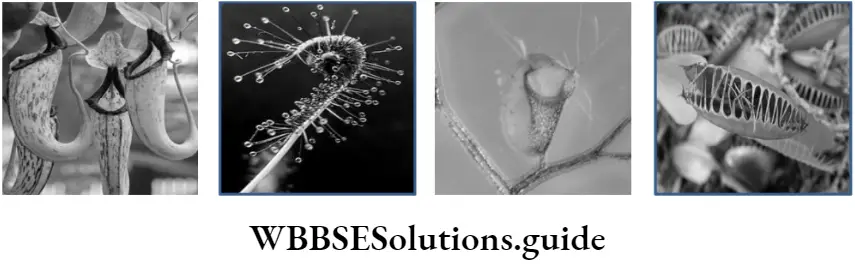
  • Insectivorous plants are plants that derive some or most of their nutrients by trapping and consuming animals, mainly insects.

NEET Biology Class 7 Chapter 5 Nutrition In Plants And Animals Insectivorous Plants

Examples:

  1. In the pitcher plant, the leaf is modified to form a tubular pitcher-like structure.
  2. The inside of the pitcher is lined with downward-pointing hairs. These hairs do not allow any insect to climb back up and escape.
  3. The fluid at the bottom of the pitcher contains digestive juices that digest the insect.
  4. The slender leaves of bladderworts bear a large number of very small, pear-shaped bladders.
  5. This opens a trapdoor and the prey is sucked in within one-thousandth of a second
  6. The leaves of sundew (Drosera) have tentacles with drops of a sticky substance called mucilage at the ends; insects get stuck in this substance and become entangled.
  7. The helpless insect then gets digested.
  8. The trap of Venus flytrap is a highly modified leaf. On the inner surface (reddish here to attract insects) there are short, stiff hairs. When anything touches these hairs, the two lobes of the leaves snap shut in less than a second,

Symbiotic Plants

There are certain plants that live in association with other species and share their food resources.

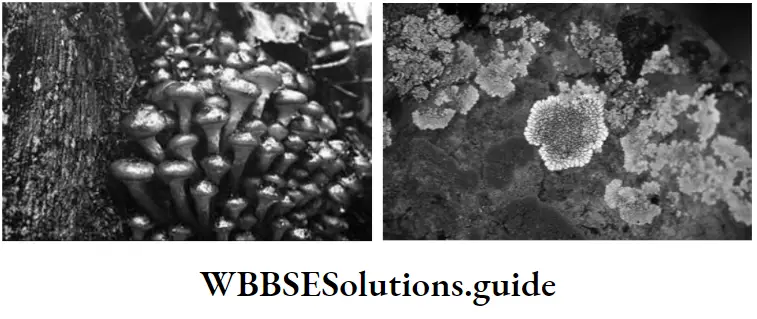
Both types mutually gain from each other. Such plants are called symbiotic plants and the relationship is called symbiosis. A good example is lichens.

  • Lichens are an association between a fungus and a microscopic plant — green algae. The fungus obtains nutrients from the algae, and the fungus in turn provides shelter to the algae so that it can grow in harsh conditions like rock surfaces where it would otherwise not survive.

NEET Biology Class 7 Chapter 5 Nutrition In Plants And Animals Symbiotic Plants

NEET Biology Class 7 Chapter 5 Detailed Notes with Explanation

  • Roots of certain plants such as peas contain bacteria called Rhizobium. It converts atmospheric nitrogen into plant-usable forms, e.g., ammonia. The plant in turn provides nutrients for the bacteria’s growth.

Replenishment of Nutrients in the Soil

Plants utilize the mineral nutrients, especially nitrogen present in the soil, for their growth. As a result, there is a depletion of nitrogen in the soil over a period of time. Manure contains a lot of nitrogen apart from potassium and phosphorus. This is needed by the plant for healthy growth.

5 Components Of Food — Nutrients In Food

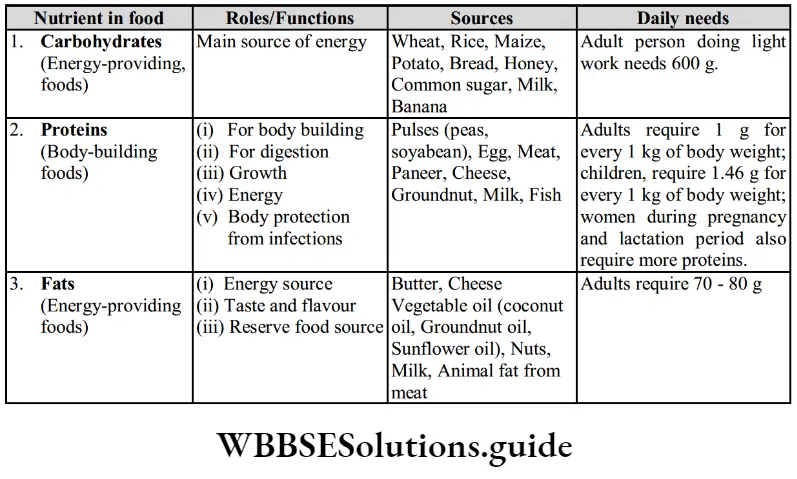
There are seven essential components or substances called nutrients in our food. These are:

  1. Carbohydrates
  2. Fats
  3. Proteins
  4. Mineral salts
  5. Vitamins
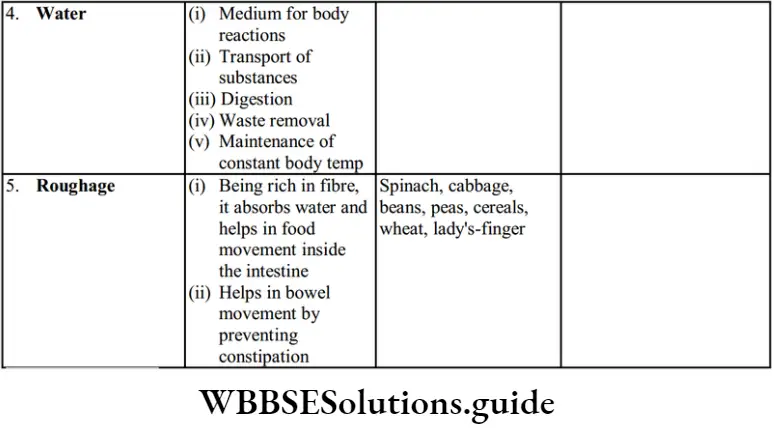
  6. Water
  7. Roughage (Fibre)

Of these carbohydrates, proteins, and fats are the three main components.

Carbohydrates

These are the common energy-giving compounds. Foods rich in carbohydrates are potato, sweet potato, bread, rice, wheat, honey, common sugar, jaggery (gur), and milk.

Most processed foods like pizza, burgers, jams, jellies, and noodles are rich in carbohydrates.

Macronutrients

Nutrients that are required by our body in large amounts and form the bulk of our diet are called macronutrients. Carbohydrates, fats, and proteins are macronutrients

Fats

These are also energy-giving foods, producing more energy than carbohydrates. Fat-rich foods are

  1. Milk Products Such As Butter And Cheese,
  2. Vegetable Oils Such As Coconut Oil, Groundnut Oil,
  3. Nuts,
  4. Milk And
  5. Animal fat from meat.

Fats provide more than double the energy provided by carbohydrates or proteins.

Proteins

These are body-building foods. Proteins help the body in its growth and repair of body cells and tissues, protect and help the body fight against infections, and regulate body functions.

Protein sources of plant origin include pulses (soybean, peas) and to a lesser extent cereals. Meat, eggs, cheese, milk, and fish provide proteins of animal origin.

NEET Biology Class 7 Chapter 5 Nutrition In Plants And Animals Food nutrients — functions, sources and daily needs

NEET Biology Class 7 Chapter 5 Nutrition In Plants And Animals Food nutrients — functions, sources and daily needs 2

NEET Study Material for Nutrition in Plants and Animals Chapter

Mineral Salts

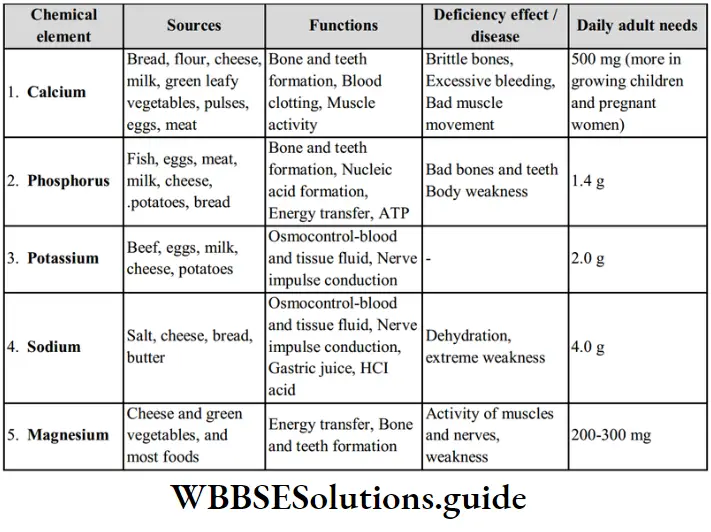
  • Mineral salts are important for various body functions. They are required in small quantities and are obtained from the food we take in.
  • Minerals have no energy value. Rich sources are milk, cheese, green leafy vegetables (like spinach), pulses, meat, and eggs.
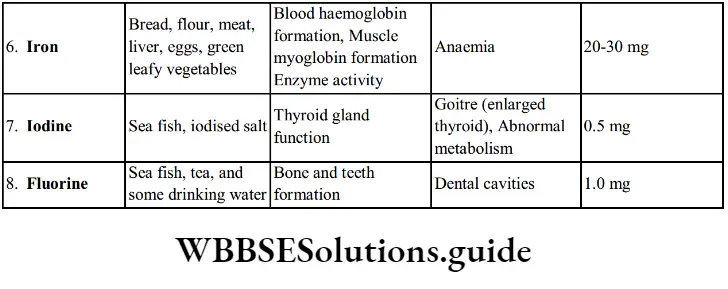
  • Salts of calcium and phosphorus are required for making bones and teeth hard and for promoting blood clotting. Iron is essential for forming hemoglobin, a component of our blood, the deficiency of which causes anemia.
  • Green leafy vegetables, eggs, groundnuts, and liver are good sources of iron. Iodine, another mineral, controls the functioning of an important gland, the thyroid.
  • Deficiency of iodine leads to goiter. Iodized salt, fish, and seafood are the sources of this mineral.

NEET Biology Class 7 Chapter 5 Nutrition In Plants And Animals Minerals sources funcions defiency effects and daily needs

NEET Biology Class 7 Chapter 5 Nutrition In Plants And Animals Minerals sources funcions defiency effects and daily needs 2

Vitamins

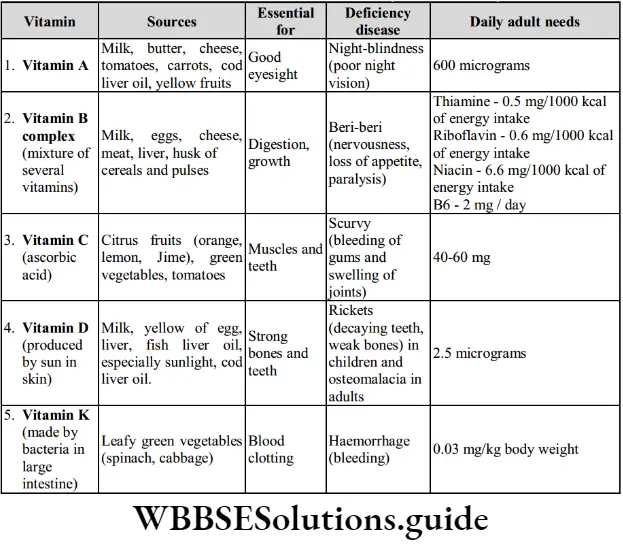
Vitamins are neither body-building nor energy-giving foods but are very important for the proper functioning of our bodies. They are required by the body in very small quantities. Green leafy vegetables, fruits, milk, eggs, and cheese are rich in vitamins.

Micronutrients

Nutrients that are required by our body in small quantities are called micronutrients. Vitamins and minerals are the micronutrients in our food.

NEET Biology Class 7 Chapter 5 Nutrition In Plants And Animals Vitamins sources functions Deficiency Diseases and daily needs

Nutrition in Plants and Animals Class 7 NCERT Notes for NEET

Water

  • Water is indispensable. About 70 percent of our body weight is that of water. It helps the body in various functions. It is a means of transporting substances in the organism. It helps to maintain a constant body temperature.
  • Water helps in the absorption of food and excretion of waste products from the body. Our body needs 2-3 liters of water every day.
  • Many invertebrates, some birds, and desert animals do not need to drink water as they produce enough ‘metabolic’ water for their use from the breakdown of the food they consume.

Roughage (Fibre)

Fibre is found in vegetables, fruits, beans, and cereals. It has no nutritive value, but prevents constipation and is necessary for proper functioning of the digestive system.

6. Types Of Food Based On Their Role

Foods, on the basis of their role in the body, are classified into three major food groups:

  1. Energy-Giving Foods (Like Carbohydrates And Fats)
  2. Body-Building Or Growth-Promoting Foods (Like Proteins), And
  3. Protective foods (vitamins and minerals).

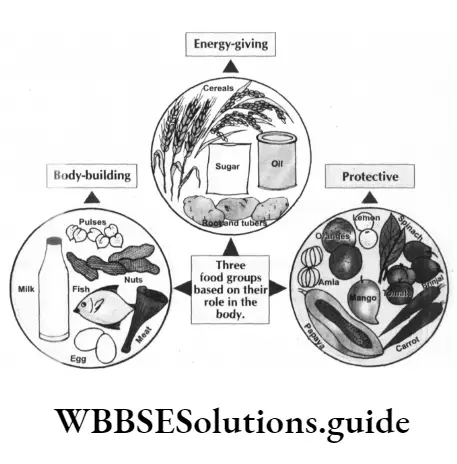
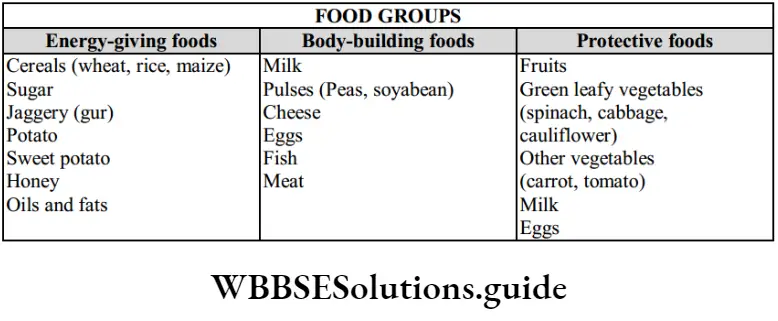
No single food can supply all the components required for proper nutrition. Food items included under these three food groups are given in Table 5.4 and shown in

NEET Biology Class 7 Chapter 5 Nutrition In Plants And Animals Types of foods

NEET Biology Class 7 Chapter 5 Nutrition In Plants And Animals Food items included in three major food groups

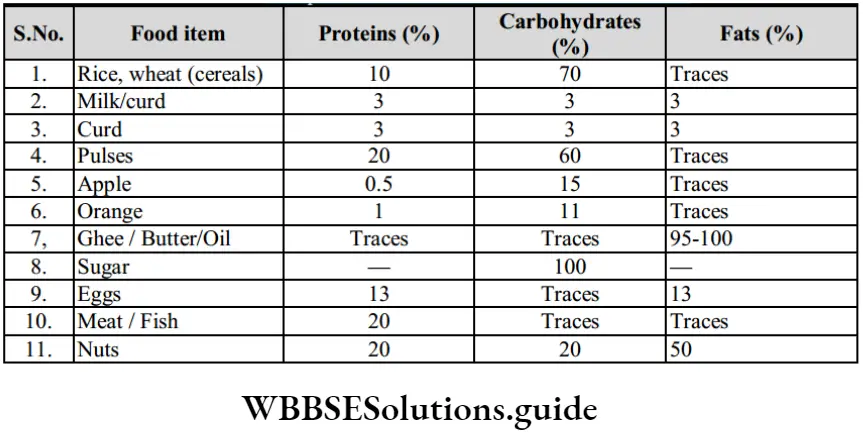
7. Composition Of Some Food Items

NEET Biology Class 7 Chapter 5 Nutrition In Plants And Animals Composition of nutrients in different food items

Modes of Nutrition in Plants and Animals NEET Notes

8. Foods And Their Energy Values

When food is eaten, it is broken down into simpler compounds, and in this process, energy is produced. The energy-producing life function in living organisms is known as respiration.

For instance, when sugar, a simple form of carbohydrate, is burned in the air, it produces heat and light as energy. Carbon dioxide and water are also produced as by-products.

Sugar + Oxygen → Carbon dioxide + Water + Energy

C12H22O11 + 12O2 → 12CO2 + 11H2O + Energy

A similar reaction takes place if glucose is burnt in place of sugar.

C6H12O6 + 6O2 →6CO2 + 6H2O + Energy Glucose

This process occurs inside our body too, during the process of respiration, but with the following modifications:

  1. Inside the body, the breakdown of glucose or sugar does not take place in one step as in burning. Instead, it occurs in several steps.
  2. Secondly, the energy is also released in small packets, without raising body temperature.
  3. Thirdly, inside the body, certain protein molecules, called enzymes, take part in the process of breaking down food molecules. This does not happen in burning.

Thus, one of the major functions of food is to produce energy.

Different foods produce different quantities of energy. The energy in foods is measured by a unit called calories.

Note:

  • 1 kilocalorie (kcal) = 1000 calories
  • 1 calorie =4.18 joule 1000 joules = 1 kilojoule (kJ)

The energy value of foods

  1. Fats: 9 kcal/gram or 37 kilojoules
  2. Carbohydrates: 4 kcal/gram or 17 kilojoules
  3. Proteins: 4 kcal/gram or 17 kilojoules

Water is the only nutrient that supplies no energy.

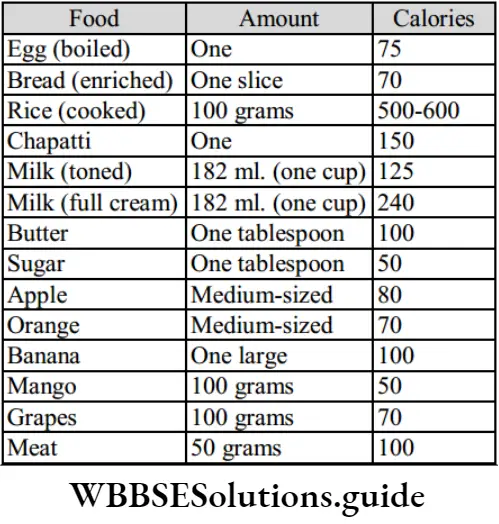
Calorific values of some individual food items are given in Table.

NEET Biology Class 7 Chapter 5 Nutrition In Plants And Animals Calorific value of some foods

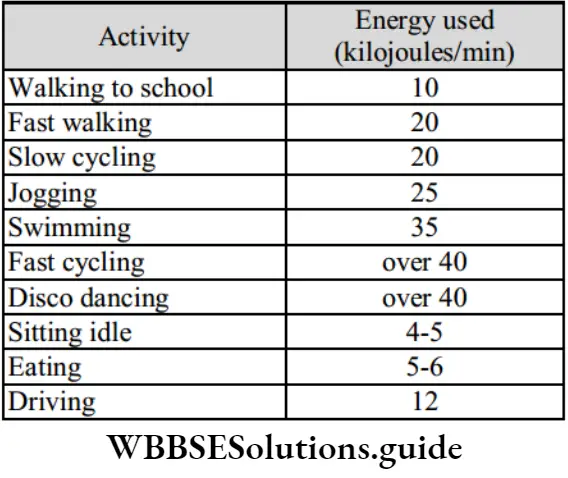
NEET Biology Class 7 Chapter 5 Nutrition In Plants And Animals Energy consumption in different

Who Needs More Food?

  • A person doing hard physical work requires more energy. So, a greater carbohydrate content is required.
  • Pregnant women need more nutrients. The child growing inside, needs
    1. Proteins For Growth,
    2. Calcium For The Bones,
    3. Iron for the blood.
  • For breastfeeding the baby, the nursing mothers need more of
    1. Calcium
    2. Protein-Rich Milk
    3. Vitamins.

Growing children need more food in proportion to their body weight to know how much energy is spent on different activities that children generally perform.

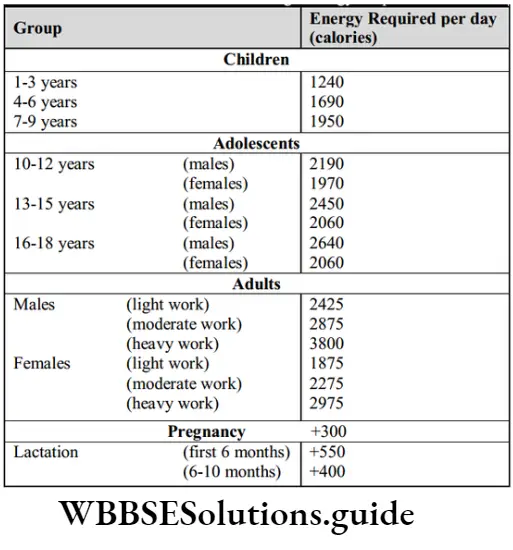
NEET Biology Class 7 Chapter 5 Nutrition In Plants And Animals Recommend Average energy Requirements

Different people need different amounts of food energy. Their calorie needs are different. Some people need more calories than others.

The number of calories a person needs depends on many things. Here are a few:

Age: Young people need extra energy because they are very active. Extra calories are also needed for their growth.

Weight and Size: Tall people need more calories than small ones.

Activity: An active adult needs more calories than an inactive adult. For example, a laborer needs more calories than a clerk. Adults who play sports need extra calories.

Temperature: The body uses energy to maintain a normal temperature. In cold climates, extra calories are required to maintain this temperature.

9. Balanced Diet

  • Our body requires balanced quantities of proteins, carbohydrates, fats, vitamins, and minerals for its proper growth and maintenance.
  • Deficiency of one or the other nutrient in the food leads to poor health and makes it prone to disease.
  • Deficiency of food in terms of quantity, or undernutrition as it is called, may lead to starvation.
  • An inadequate diet results in the loss of weight, and the person’s digestive system is affected. Often a person suffers from diseases due to improper intake of food.
  • The food taken in may be deficient in essential nutrients due to wrong food habits. This is known as malnutrition.

“class 7th science chapter 2 diagram “

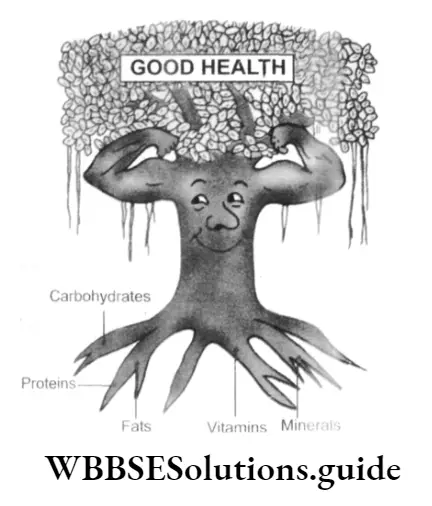
NEET Biology Class 7 Chapter 5 Nutrition In Plants And Animals Balanced Diet Ensures health

Some eat only rice while others prefer chapatis or bread. Illiteracy adds to the problem.

A mixed diet containing all the essential nutrients in the right proportion is necessary for the body’s proper growth.

Such a diet is known as a balanced diet. A balanced diet, thus, provides the body with

  1. All The Essential Nutrients,
  2. All The Materials Necessary For Proper Growth And Repair Of Body,
  3. Energy Required By The Body To Carry Out Its Life Activities, And
  4. Extra nutrients to withstand short periods of fasting.

Over-eating may also lead to diseases. Obesity is one such disease.

This often leads to other problems like heart disease and high blood pressure.

Also, a balanced diet is related to one’s age, health, and occupation. For example, a labourer needs more carbohydrates and fats in his diet which would provide him more energy. A young child should take more proteins, as they help in bodybuilding.

10. Food Additives

When some foods are manufactured, chemicals are put in them. These chemicals are called food additives.

Food additives have no nutritional value. They are added for a number of reasons.

  1. Colorings: These make the food look more attractive. Tinned peas and arid strawberries, for example, owe their color to these chemicals.
  2. As preservatives: These slow down the rate at which foods go bad and keep the food fresh. Thus, the foods can be carried over long distances.
  3. As flavorings: These restore the flavor of the food that is often lost when it is processed. Most additives are harmless. Some additives may cause headaches, asthma, damage to organs such as the liver and kidneys, and even cancer.

11 . Food Fads

  • Food forms an essential part of our daily life. A considerable part of our time and money is spent on selecting and purchasing foods.
  • We are exposed to a variety of information and views about foods and their nutritional value through newspapers, magazines, books, advertisements, and conversation.
  • Our views are influenced by what we hear and see. Very often, expensive foods are considered more nutritious and good for health than less expensive foods.
  • Similarly, foods that are difficult to obtain are considered better than easily available ones. Such wrong notions prevail in our society.
  • Misinformation or wrong and unscientific information about food is termed food fads.
  • Some of the food fads have arisen due to certain customs, traditions, and wrong beliefs.

Expensive vs. inexpensive food – grapes vs. spinach

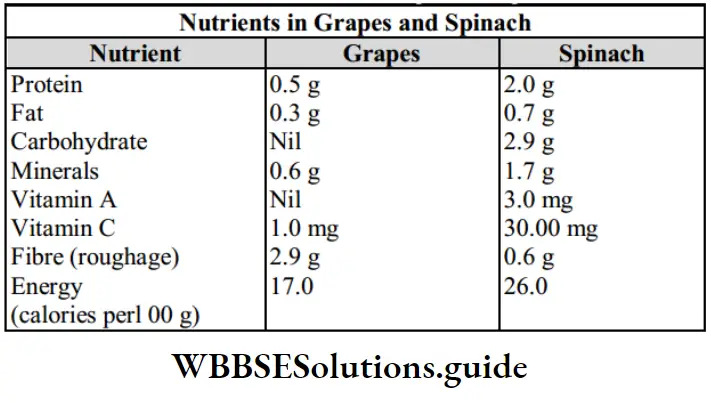
  • Let us take the example of two food items — the expensive grapes and the inexpensive leafy green vegetable spinach (palak).
  • The nutrients present in 100 grams of grapes and spinach are listed in the given table.
  • Spinach contains much more proteins, fats, minerals, and vitamins than grapes. It clearly proves that spinach is more nutritious than the costlier grapes.
  • Similarly, cheaper fruits like bananas and guavas have a greater nutritive value than more expensive fruits like grapes and pomegranates.

NEET Biology Class 7 Chapter 5 Nutrition In Plants And Animals Nutrients in Grapes And Spinach

Food Fads About Cereals And Cereal Products

1. There is a wrong notion that starchy foods, such as rice and bread, are rich in calories.

  • In an attempt to reduce weight, many persons reduce or cut down their intake of cereals from their diet.
  • What is to be remembered is that cereal foods such as chapatti or bread are not a very high source of energy.
  • The calories come from the foods added to them such as ghee, butter, cheese, jam, sugar and chutney etc. It is these high-calorie foods that need to be avoided.

2. Another wrong notion is that weight reduction is possible by eating bread or chapatti instead of rice.

  • It is well known that both rice and wheat contain about the same number of calories, so eating one and leaving the other one will not make any difference. It is the total calorie intake that needs to be reduced for effective weight reduction.

Food Fads About Oils And Fats

  • Some manufacturers claim and suggest that people should use a particular brand of vegetable oil, as it has a high content of polyunsaturated fatty acids (PUFA) contains no cholesterol, and is thus beneficial for heart patients.
  • The fact is that all vegetable oils (except olive and coconut oils) contain a high amount of PUFA and also do not contain any cholesterol.
  • Stating that a particular brand of vegetable oil contains no cholesterol is intended to misguide the layman to think that other brands of vegetable oils contain cholesterol.
  • These claims make a person feel that he can safely consume as much oil as he wants without any problem.

Food Fads About White Eggs And Bhlndl

  1. White eggs are better than brown ones. There is no truth in it. Both types of eggs have the same amount of nutrients.
  2. Eating bhindi (lady’s-finger) makes a student good at mathematics. There is no truth in this belief.

12. Good Food Habits

To maintain good health, we need to develop and maintain good food habits. These include:

  1. Eat a balanced diet, keeping in mind your age, health, and occupation.
  2. Eat clean food, and keep protected from dust, house flies, and mosquitoes.
  3. Eat properly cooked fresh food.
  4. Avoid fried foods as far as possible.
  5. Use clean utensils.
  6. Take adequate amounts of green salad, green vegetables, and fruits in your diet.
  7. Consume simple digestible food.
  8. Drink large quantities of clean filtered water.
  9. Chew food well.

NEET Biology Class 7 Chapter 4 Life Under a Microscope Notes

Life Under A Microscope (Microorganisms) Introduction

  • You have studied about the flowering plants in earlier classes. These plants have root, stem, leaves, flowers, fruits, and seeds.
  • They are green in color and make food for all animals. You might have seen mushrooms during the rainy season in the gardens. These are also plants, although they are not green in color.
  • These are examples in which plants are quite big and can be seen with the naked eye. Is it true for all living things? Are there any other types of living things? Let us find answers to the above questions in this chapter.

Read And Learn More: NEET Class7 Biology Notes

Micro-Organisms

  • The water, air, and soil around us are all full of living organisms. These organisms are very small and are not visible to the naked eye.
  • Some cause diseases and are sometimes called germs. However, most are harmless. Today scientists call these small living things microbes or microorganisms.
  • Most micro-organisms are too small to be seen without the aid of a magnifying glass or a microscope.
  • Microorganisms are minute living organisms that cannot be seen with the naked eye. A magnifying glass or a microscope is needed to see them.
  • The scientists who study micro-organisms are called microbiologists. The field of study is called microbiology (“micro” means small).
  • A feature shared by all these microorganisms is that they are very hardy. Under unfavorable environmental conditions, they form a hard outer covering called the cyst. Consequently, they can survive under extreme temperature conditions and dryness..

“parts or microscope “

2. Kinds Of Micro-Organisms

Major kinds of micro-organisms include:

  1. Bacteria,
  2. Fungi,
  3. Algae,
  4. Protozoans, And
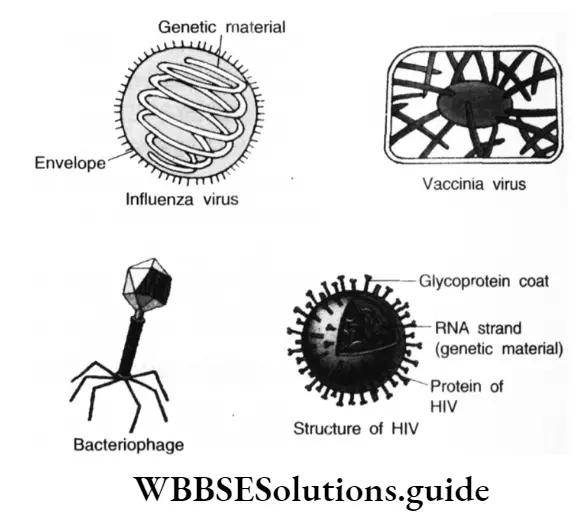
  5. Viruses.

Viruses are the smallest of all micro-organisms. They, strictly speaking, cannot be grouped along with living things.

  • They lie on the borderline separating the living things from the non-living things. Viruses lack a cellular structure (a non-living feature) but can grow only on other living cells (a living feature).
  • Microbiology is subdivided into a number of diverse fields, based on the kind of organisms under study.
  • Bacteriology is the study of bacteria, Virology is the study of viruses, Protozoology is the study of protozoans, Phycology is the study of algae, and Mycology is the study of fungi.
  • These micro-organisms, in structure, may be unicellular (consisting of only one cell) or multicellular (many-celled).

“types of microscopes “

Unicellular Micro-Organisms

1. Plant

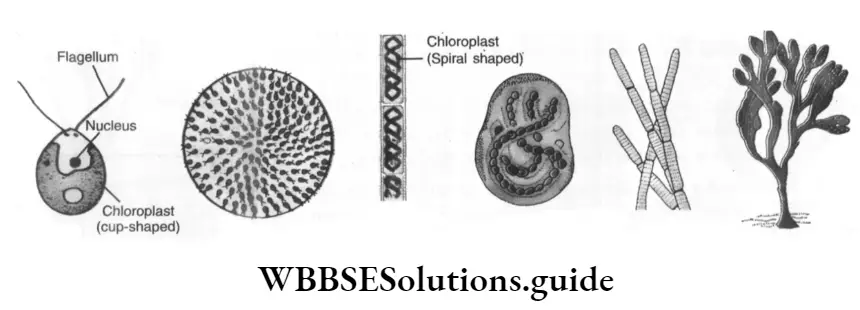
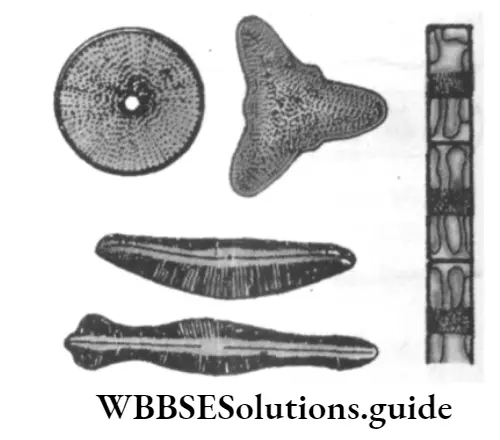
  1. Algae: Chlamydomonas, Chlorella, desmids, and diatoms,
  2. Fungi: Yeast
  3. Bacteria

2. Animals

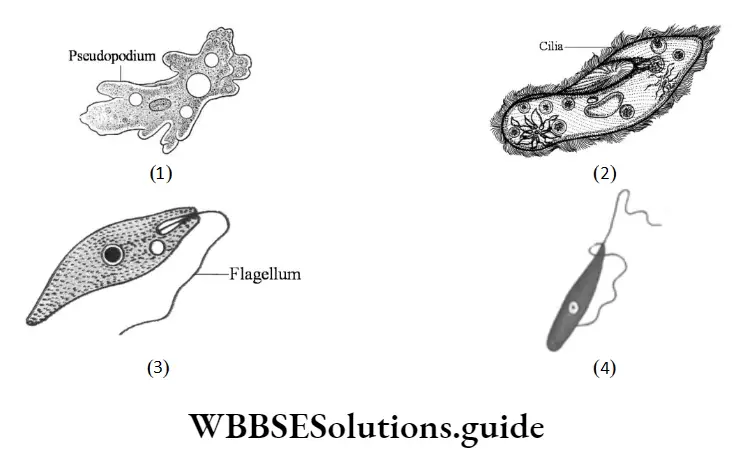
  1. Protozoa — Amoeba, Euglena, Paramecium (also written as Paramoecium)

Multicellular Micro-Organisms

  1. Algae – Volvox, Spirogyra, Nostoc
  2. Fungi – Bread mold, Aspergillus, Penicillium

3. Habitat Of Micro-Organisms

  1. Microorganisms are found all around us in all types of places – in the air, in water, in soil, on plants, inside our bodies, and in the bodies of all other animals.
  2. They can survive in extremely harsh environmental conditions like hot springs, desert soil, saline water, ice-cold water, and marshlands. They are also found at the bottom of the sea.
  3. Microorganisms are also present in dead and decaying organic matter. These organisms help in the release of minerals into the soil after the death of living organisms by decomposing them.
  4. Some microorganisms live as parasites either outside or inside the body of other organisms. The nose, throat, mouth, and intestine of many animals, and even human beings are inhabited by a number of micro-organisms.
  5. Some microorganisms, however, cause diseases. For example, malaria is caused by a protozoan, Plasmodium, which lives as a parasite in the blood of human beings.

4. Bacteria

  • Man’s relationship with bacteria is a very interesting one. We all know that many bacteria are harmful.
  • Diseases such as typhoid, cholera, diphtheria, pneumonia and all infections that occur in open wounds are each caused by a particular kind of bacteria.
  • Yet, without the action of other types of bacteria, life would be impossible on Earth. In fact, man actually cultivates certain bacteria because he needs and uses them.
  • Bacteria are probably the most common forms of life on earth. They are also among the simplest and smallest living things.

NEET Biology Class 7 Life Under a Microscope Notes

Size

A bacterium generally consists of only one cell. Sometimes, they may exist as a chain or a group of cells. They vary in size from 0.2 to 100 microns.

A single drop of sour milk may contain 100,000,000 bacteria. Bacteria are much smaller than protozoa, algae, or fungi.

1 micron = 1/1000 of a millimeter (mm)

NEET Biology Class 7 Chapter 4 Life Under a Microscope Notes

Shape

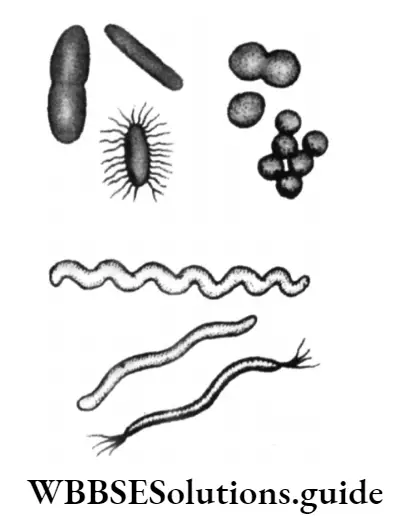
Bacteria have three basic shapes, which take their names from Latin words. These are:

  1. Rod-shaped called bacilli (singular bacillus) meaning “little rod”; examples – are Bacillus, Lactobacillus, and Pseudomonas.
  2. Ball-shaped called cocci (singular coccus) meaning “berry”; examples – are Micrococcus, Streptococcus, and Sarcina.
  3. Spiral or corkscrew-shaped called spirilla (singular spirillum) meaning “spiral”; examples – are Vibrio, Treponema, and Camphilovector. Some of these bacteria show movement by means of filaments called flagella which protrude from them.

“microscope parts and functions “

NEET Biology Life Under A Microscope Microorganisms Shapes of bacteria

Habitat

Bacteria are found everywhere. Some live in the mouths, noses, and intestines of animals and people. Some live on fallen leaves or animal waste. Still others live in water, milk, dust, and soil.

Structure

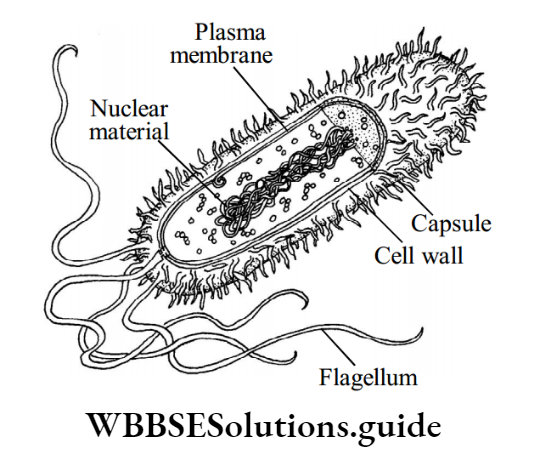
  1. Bacteria are unicellular micro-organisms,
  2. They have a primitive cell structure,
  3. They lack a well-organized nucleus. The nuclear material is present in the cytoplasm without a nuclear membrane.
  4. Membrane-bound cell organelles are lacking. Plasma
  5. The cell wall is present. membrane
  6. Cytoplasm is granular, viscous, and colloidal in nature containing 70% – 85% water.
  7. In some bacteria, a slime layer or capsule is present on their cell surface. These are secreted by the bacterial cells.
  8. When the secreted material is diffused (not compact), it is called a slime layer.
  9. But when the material is compact, it is called a capsule. Disease-producing bacteria are often capsulated.

NEET Biology Life Under A Microscope Microorganisms Structure Of A Bacterial Cell

Life Under a Microscope NEET Notes

Nutrition

On the basis of nutrition, bacteria are of two types –

  1. Autotrophs can synthesize their own food, and
  2. Heterotrophs which depend on food synthesized by other organisms.

Autotroph bacteria may be phototrophs which utilize energy from sunlight, and chemotrophs which utilize energy of inorganic compounds of hydrogen, ammonia, and iron. Heterotroph bacteria may be saprophytic or parasitic.

Are bacteria plants or animals?

  • Bacteria have features of both plants and animals. Scientists have never entirely agreed on how to classify bacteria.
  • Bacteria lack chlorophyll, the green coloring matter that most plants need to make their own food.
  • In their use of outside sources of food, bacteria seem like animals. But in their sizes, shapes, and general living habits most bacteria resemble lower plants such as fungi and algae.
  • Many scientists classify bacteria and other micro-organisms that have characteristics of both plants and animals as protists meaning first things.

Oxygen Use

  1. Like all living things bacteria need oxygen to burn up food materials for energy. Bacteria requiring oxygen for their growth are called aerobes.
  2. Most bacteria take oxygen from the air, but some get oxygen by breaking down chemical compounds in their food.
  3. For example, bacteria that Parent cells ferment milk (causing it to turn sour) get oxygen from milk sugar.
  4. Some kinds actually cannot live in the presence of oxygen. These bacteria are called anaerobes, meaning “without air”.

Reproduction

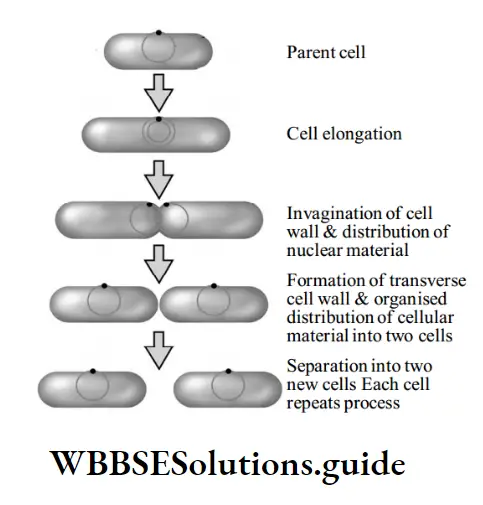
  1. Bacteria generally reproduce by binary fission, that is, a bacterium divides into two, and so on
  2. The rate of reproduction is very high under favorable conditions of nutrition, temperature, and moisture; division may take place every 10 to 40 minutes. This means that within a few hours, there could be millions and millions of bacteria.
  3. But, there is not enough food or moisture in any one place to support such numbers. Competition for food and exposure to harmful conditions keeps the bacteria in check.

NEET Biology Life Under A Microscope Microorganisms Bacterial Binary fission

“diaphragm microscope “

Harmful Bacteria

  • Certain bacteria cause diseases in people and animals. Some of the common human diseases caused by bacteria are cholera, diphtheria, pneumonia, tetanus, and tuberculosis.
  • Other bacteria produce diseases in plants. Black rot in cabbage and fire blight in pears are caused by bacteria.
  • Food is spoiled by other bacteria, such as those that cause meat to rot. Some bacteria damage food in unseen ways.
  • For example, botulism, a dangerous disease, is caused by a poison-producing anaerobe in improperly canned foods.
  • Another bacterium, Salmonella, found in contaminated meat and eggs, causes a severe digestive disease.
  • Bacteria also spoil milk if it is not boiled. During summer, it becomes necessary to warm the milk several times or store it at a low temperature.

Useful Bacteria

Most bacteria are useful. Some are even necessary to life. Others have been put to work for a specific purpose.

1. Bacteria in the Cycle of Life: Bacteria cause the decay of dead plants and animals, both on land and in water. Without such bacteria, the earth would soon be covered with material from dead organisms.

  • There would have been a shortage of carbon and nitrogen compounds which are so essential for living organisms.
  • As they take in food, bacteria break down plant and animal tissues into simple chemical substances.
  • These substances are then restored to the soil, water, and air in forms that can be used for nourishment and growth by living plants and animals.
  • Bacteria also play an important part in the digestive processes of animals. There are many bacteria in the human intestine. As the bacteria eat, they break down foods. At the same time, they make certain vitamins, which the body then uses.
  • The bacteria inside the stomach of grass-eating animals can break down cellulose, the stiff wall of green plant cells. By enabling cows to digest grasses, bacteria play a part in the production of milk.

2. Bacteria in Agriculture:

  • All living tissues of plants as well as animals need nitrogen, the gas that makes up almost 80 percent of the air.
  • Some bacteria, called nitrogen-fixing bacteria, are the only organisms that can take nitrogen from the air.
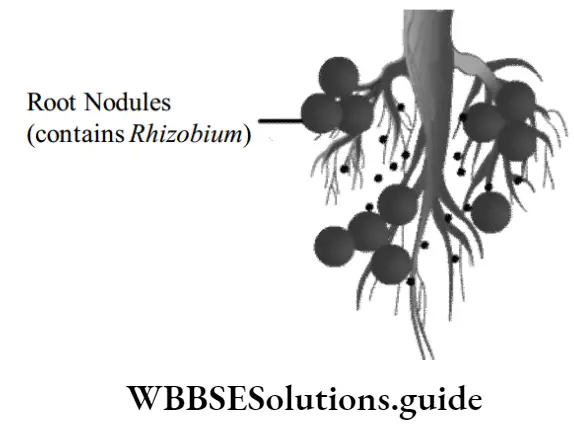
  • These bacteria live in the soil. They change nitrogen into substances that plants can use. They live in symbiotic partnership with roots of plants such as peas and beans and form root nodules.

Note: The bacterium Rhizobium is found in the root nodules of plants belonging to the pea family.


NEET Biology Life Under A Microscope Microorganisms Root Of A Leguminous Plant with root nodules

NEET Biology Life Under a Microscope Important Notes

Bacteria in Industry: The ability of bacteria to break down organic compounds into simpler products has several commercial applications.

Retting of Fibres: Fibres from certain plants are obtained by submerging the stems in water for variable periods. The fibers are acted upon by the bacteria growing in water, and the fibers are set free from the stem.

Curing of Cheese, Tobacco, and Tea: The flavor of cheese, tea, and tobacco depends upon the type and degree of fermentation and putrefaction that it has undergone. The process is known as curing and is brought about by different species of bacteria.

Production of Vinegar: Ethyl alcohol is converted into acetic acid (vinegar) by the action of aerobic bacteria, like Acetobacter.

Formation of Curd (dahi): Making of curd is a process in which the lactose (milk sugar) of the milk is converted into lactic acid by the action of certain bacteria (mainly Lactobacillus)

Production of Fuel: We can produce methane from the manure (solid wastes) of cattle with the help of anaerobic bacteria. Methane is an inflammable gas and a valuable fuel.

It is used for heating homes and factories and for other energy needs. When methane gas is produced, protein and minerals in the manure are removed and can be used as fertilizers in fields.

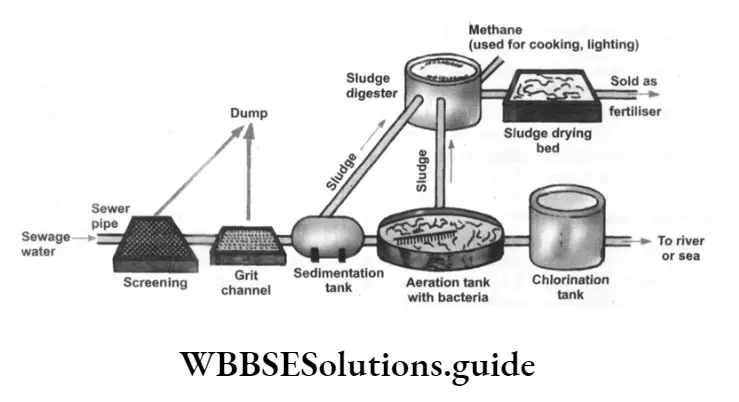
Treatment of Sewage: Sewage is the wastewater from kitchens, toilets, and industries.

“stage microscope function “

Treatment of sewage consists of three steps:

  1. Primary treatment
  2. Secondary treatment
  3. Tertiary treatment

Primary treatment is a mechanical process by which large suspended and floating materials are removed.

Secondary treatment is a biological process and involves the use of bacteria and other microbes.

NEET Biology Life Under A Microscope Microorganisms Set up of a Swwage Plant - Basic plan

Tertiary treatment consists of advanced biological, chemical, and physical processes. It aims at further purifying wastewater and its recycling.

  1. Chlorination, to kill germs, is done during tertiary treatment. Let us discuss the secondary treatment of sewage in more detail.
  2. As mentioned above, secondary treatment involves microbial activity. Aerobic bacteria are used for this activity.
  3. The bacteria are put in large sewer tanks through which oxygen (air) is also pumped. The bacteria, in the presence of oxygen, bring about rapid decomposition.
  4. Undigested sewer is then transferred to another anaerobic digestion tank.
  5. Aerobic bacteria are left behind. In the second tank, anaerobic bacteria cause digestion and produce a mixture of gases. The main gas produced is methane.
  6. The mixture of gases produced is called biogas which is used as a fuel.
  7. The sludge left after digestion of sewer by aerobic and anaerobic bacteria is rich in nitrogen. After drying, it is used as manure.

Other Uses of Bacteria: Valuable medical, agricultural, and industrial products can be prepared from bacteria. This involves changing certain characteristics, or traits, that are inherited.

Units of heredity, called genes, pass on traits from generation to generation. Genes are made up of long, twisted chains of a chemical called deoxyribonucleic acid (DNA).

To change particular traits of an organism, scientists make changes in its genes, using genetic engineering. This method is also called recombinant DNA and gene splicing.

For example, gene splicing is used to change bacteria so that they produce human insulin. This substance is extremely important in regulating the body’s use of sugar and other nutrients.

The insulin made by bacteria is used to help diabetics – people whose bodies produce little or no insulin. To change the genes of bacteria, scientists remove a small section of DNA.

They replace it with a section of DNA taken from human cells. This human DNA controls the making of insulin.

The bacteria follow the “instructions” of the transferred human DNA and produce human insulin. When a changed bacterium divides, each of the newly formed bacteria is able to make human insulin.

“microscopy notes “

Fungi

All of you would have seen a mushroom. A mushroom is a familiar kind of fungus. It belongs to a kingdom of non-green living things called fungi.

Observations:

  • Blue-green patches on the surface of a rotting orange.
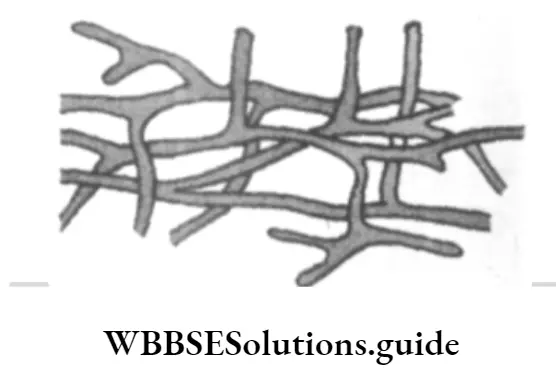
  • Greyish-white patches on stale bread, old pickles, and jams. Hyphae of a fungus
  • Greenish patches during the rainy season on old shoes and damp shoes. These patches are all made of different types of fungi

NEET Biology Life Under A Microscope Microorganisms Hyphae Of A Fungus

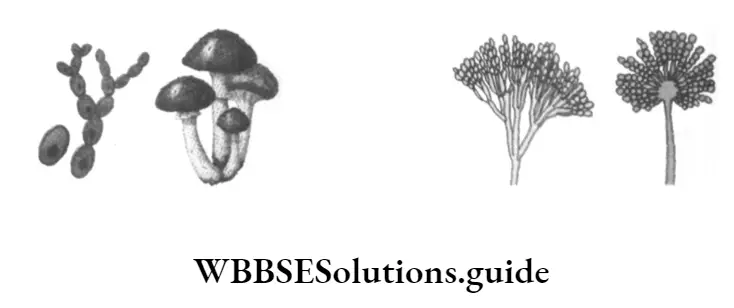
NEET Biology Life Under A Microscope Microorganisms Different types of Fungi

Best Short Notes for Class 7 Biology Life Under a Microscope

Structure

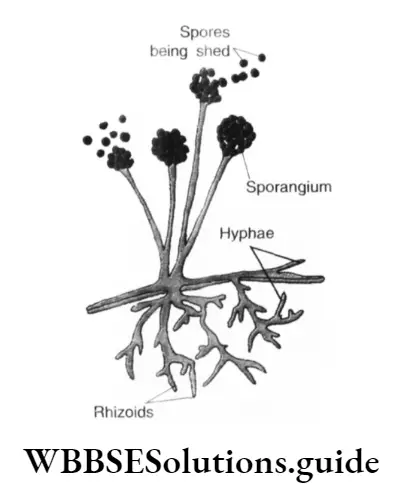
Fungi are both unicellular and multicellular. Multicellular forms consist of long threads called hyphae’, that grow close together. Hyphae collectively form a highly interwoven compact mass called mycelium.

The three common types of fungi are –

  • Yeasts, which are unicellular,
  • Molds, which are multicellular, for example, common bread mold, and
  • Mushrooms are also multicellular. Yeasts and molds are microscopic organisms, while mushrooms are quite big and macroscopic.

Fungi — Plants or Animals

Fungi are often classified as plants. But fungi differ from plants in many ways. One difference is that fungi are non-green (lack chloroplasts and chlorophyll) and so cannot make their own food. Like the plants, however, they possess cell walls.

Feeding

The absence of chlorophyll means that fungi cannot synthesize food. Fungi are either saprophytic or parasitic.

The parasitic ones live on or in the tissues of another living organism, the host, absorbing nourishment from its body.

Some of the most devastating diseases of crops are due to parasitic fungi, e.g., potato blight and wheat rust.

The saprophytes derive their food from dead and decaying materials. Examples are the molds that develop on stale, damp food and the many fungi that live in the soil and feed on the humus there.

“microscopy notes “

Reproduction

Reproduction takes place both by sexual and asexual means. Asexual reproduction may be through binary fission, budding, regeneration of fragments, or through spore formation. Spore formation is a very common method.

Fungi produce a great number of tiny dust-like cells called spores. These spores are released into the air.

If they land in a suitable place, they grow into new hyphae. Yeast commonly reproduces by budding, whereas common bread molds, by spore formation

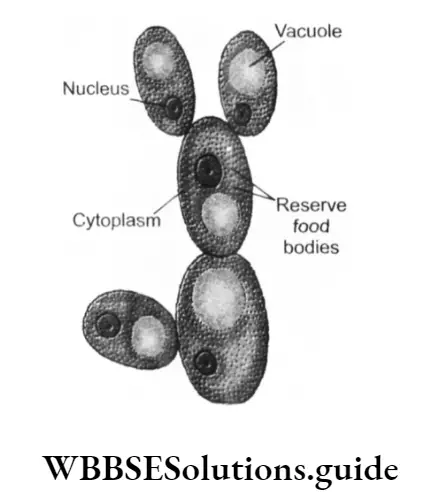
NEET Biology Life Under A Microscope Microorganisms Budding In Yeast
NEET Biology Life Under A Microscope Microorganisms Spore Formation In Common Bread Mould

Life Under a Microscope Class 7 NEET Key Concepts and Summary

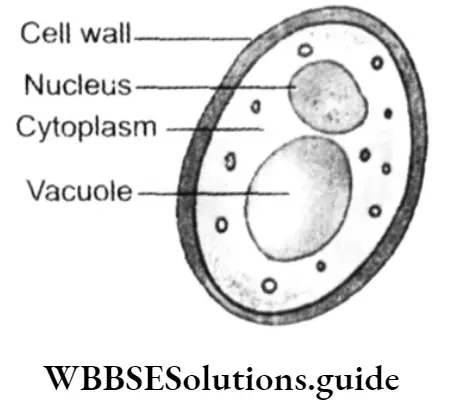
Yeast belongs to the genus Saccharomyces. It is a unicellular, saprophytic fungus. It may be spherical, elliptical, or cylindrical in shape. It has a cell wall, cell membrane, a distinct nucleus, a large vacuole, and numerous granules, and fat globules.

Yeast cells can be stored in dry form for up to 4 years. It, however, gets destroyed at a temperature of 60°C.

The common mode of reproduction is asexual — budding. Sexual reproduction is also reported. Common species of yeast – Saccharomyces cerevisiae.

Saccharomyces grow rapidly in sugary media, like sugarcane juice, grapes, and nectar of flowers.

Due to fermentation, ethyl alcohol and CO2 are produced. Fermentation of fruits and fruit juices by yeasts makes their taste unpleasant and thus spoils the foods and food products.

“microscopy notes “

NEET Biology Life Under A Microscope Microorganisms Structure Of Yeast

Harmful Fungi

Some fungi damage food products, paper, leather, paint, and textiles. Some fungi cause diseases in crops (for example Puccinia and Ustilago), in human beings (fungi like Microsporium, and Arthroderma), and in animals (Dactylella and Arthrobotrys). One beautiful mushroom, Amanita, contains a poison deadly to humans.

Useful Fungi

  1. Some fungi, such as mushrooms are eaten raw or cooked.
  2. Yeasts being rich in amino acids and proteins are an important source of food for humans and farm animals.
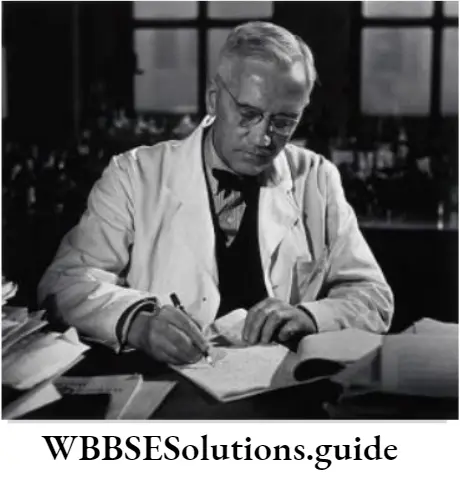
  3. Some fungi produce antibiotics that are used to treat infections and diseases. For example, the antibiotic penicillin is obtained from a fungus, Penicillium.
  4. Another fungus Aspergillus is used for producing large quantities of citric acid, used in the soft drink industry.

In bread-making, yeast is added to the uncooked dough to make the dough “rise”. The dough rises due to the production of carbon dioxide (because of the respiration of yeast) in the dough.

The bread can now be baked. The heat of baking drives off the carbon dioxide, making the bread porous and light.

  1. Yeast is also used in the preparation of products like wines and beers from fruit juices or barley. Yeast brings about the fermentation of sugars into alcohol and carbon dioxide.
  2. In day-to-day household food items like idli and dosa too, yeast finds its use. For making idli and dosa, the mixture of ground rice and dal is first allowed to stand for a few hours.
  3. This mixture rises and becomes sour, due to the growth of yeast cells.
  4. Saphrophytic fungi break down dead material for their own food and return to the soil chemicals or nutrients for plant growth. Fungi, thus, help in the recycling of nutrients.
  5. Some fungi (Aspergillus and Penicillium) are added to cheese to give it a special flavor.

Antibiotics

NEET Biology Life Under A Microscope Microorganisms Alexander Fleming The discoverer Of Pencillin

NEET Biology Class 7 Chapter 4 Detailed Notes with Explanation

  • Antibiotics are chemicals that kill or stop the growth of certain kinds of microbes. They help our body to fight disease.
  • The name antibiotics comes from two Greek words meaning against life. Antibiotics work only against certain forms of life.
  • The development of antibiotics began with the discovery of penicillin by Sir Alexander Fleming in 1928.
  • Fleming noticed that an agar plate inoculated with the bacterium Staphylococcus aureus had become contaminated with a mold. He further noticed the presence of a clear zone in the agar plate in which the breakdown of the bacterial cells had occurred.
  • Detailed studies led to the isolation of an inhibitory substance from the mold. As the mold was identified as Penicillium, Fleming called the antibiotic penicillin.
  • Soon other antibiotics were isolated. Some well-known antibiotics are streptomycin, gramicidin, and tetracycline. The antibiotics have been obtained from either bacteria or fungi.

“microscopy notes “

Algae

  • The commonly used terms like pond scum or seaweeds in fact refer to organisms, collectively termed as algae.
  • It is found floating on the surface of a pond or a lake. It also tends to develop on the sides of tanks which have not been cleaned for some time.
  • These are all algae. The term algae refers to many types of aquatic, photosynthetic organisms.
  • Often scientists classify these organisms along with plants, as they possess chlorophyll and distinct cell walls.

NEET Biology Life Under A Microscope Microorganisms Types Of ALgae

Occurrence

  • Algae are aquatic organisms, found in ponds, lakes, ditches, sea shores, moist soil, and bark of trees. Some are even found in snow and hot water springs.
  • They also occur symbiotically within the bodies of other living organisms, such as lichens. In structure, algae exhibit a wide variety.
  • They may range from tiny unicellular microscopic forms like Chlamydomonas, and Chlorella, barely 1.0 microns in size, to multicellular giant seaweeds or kelps, several metres in length.
  • Unicellular algae may be of various shapes – spherical, oval, rod-shaped, or spindle-shaped.
  • Diversity in structure is much more in multicellular forms. These forms may exist in colonies (for example, Volvox) form filaments (Spirogyra), or even plant-like bodies (Fucus).
  • Algae are often named after their color as green algae, blue-green algae, red algae, brown algae, yellow-green algae, and so on. The difference in their color is due to the presence of certain other pigments in addition to chlorophyll.

“microscopy notes “

Examples:

  • Green algae – Chlamydomonas, Spirogyra, Chlorella, Volvox.
  • Blue-green algae – Nostoc, Osdllatoria, Anabaena.
  • Brown algae – Fucus, Laminaria
  • Red algae – Polysiphonia
  • Golden-brown algae – Diatoms

Blue-Green Algae

These are single-celled or multicellular algae (like Nostoc, and Osdllatoria), blue-green in colour.

Some cells in multicellular forms are modified to perform a special function of nitrogen fixation.

The modified cell is called the heterocyst. Blue-green algae resemble bacteria in many respects.

For this reason, these algae are also called cyanobacteria. Both have a primitive cell structure, lacking membrane-bound cell organelles and a well-defined nucleus. Reproduction in blue-green algae is commonly by binary fission or by fragmentation (asexual reproduction)

Diatoms

Diatoms are golden-brown microscopic algae, rich in marine places. These algae have variously designed bodies impregnated with glass-like silica.

They may be unicellular, colonial, or filamentous. The cell wall consists of two overlapping halves, hence named a diatom.

Diatoms after their death leave large amounts of silica deposits called diatomaceous earth. This being rough, it is used for polishing and in making filters. Examples — Navicula, Pinnularia, Cyclotella.

Note: Diatoms are known as the jewels of the plant world.

NEET Biology Life Under A Microscope Microorganisms Some Forms Of Diatoms

Harmful Aspects Of Algae

  • Algae are generally considered to be a great nuisance by many people. They cause problems by fouling beaches and drinking water.
  • Excess growth of algae also blocks the movement of water in channels.
  • Some algae also produce poisons which prove deadly to fish, many smaller organisms, and even man.

“microscopy notes “

Useful Algae

  1. Cell walls of diatoms are a rich source of silica. Large deposits of diatom shells (diatomaceous earth) are mined and used in industry for making glass, toothpaste, filters, and polishing.
  2. The blue-green algae can fix atmospheric nitrogen. These algae are used to increase the soil fertility and thus function as biofertilizers.
  3. Being producers, algae form the first link in the food chain in all water bodies.
  4. Certain algae like Chlorella and Porphyra are used as food. Seaweeds are used as food in China and Japan.
  5. Kelp, a brown alga, is a rich source of iodine.
  6. An important product of agar is obtained from a red alga. This product is used in laboratory experiments for growing organisms. It is also used in the preparation of medicines, food, and cosmetics.
  7. Seaweeds are even used as fertilizers.

NEET Study Material for Life Under a Microscope Chapter

It is estimated that in paddy fields about 625 kg of nitrogen can be fixed in a year by these algae in one kilometer square area.

The addition of blue-green algae to barren fields increases the nitrogen and humus content of the soil. Because of the increase in humus content, the water-holding capacity of the soil is improved. The net result is that there is better growth of crops.

Protozoa

The name ‘protozoan’ is derived from the Greek words meaning “first animal.” Protozoa are one-celled living things. They live nearly everywhere on earth, in water and moist soil. In size, they range from 2 to 200 microns.

Examples: Amoeba, Paramecium, Euglena, Plasmodium, Trypanosoma.

NEET Biology Life Under A Microscope Microorganisms Protozoa

Amoeba

  1. Amoeba is the simplest and most common of all protozoa.
  2. Protozoa are often included in the animal kingdom as they do not possess a cell wall, and lack chlorophyll. They obtain their food from other living things. The parasitic forms absorb digested food from the host.
  3. Some forms are oval, spherical, or elongated, while others, like the Amoeba, lack any definite shape.
  4. A typical protozoan cell contains a definite nucleus and membrane-bound cell organelles.
  5. All the functions of life like nutrition, respiration, excretion, locomotion, and reproduction are carried out by the single-celled body.
  6. Locomotion takes place by pseudopodia, cilia, or flagella.
  7. Sexual and asexual reproduction in this group of organisms is complex and varied. In Amoeba, asexual reproduction is quite common. A parent amoeba cell divides into two.
  8. Paramecium, however, reproduces sexually as well as asexually. Two paramecia produce offspring together.

Harmful Protozoa

  1. Several protozoa cause diseases in man and other animals. One such kind is Entamoeba histolytica which causes amoebic dysentery in man.
  2. Another dangerous protozoan is Plasmodium which causes malaria in man. Plasmodium is a parasite and is transmitted by the bite of the female anopheles mosquito. The mosquito merely acts as the carrier of the parasite.
  3. Trypanosoma causes an infectious disease called sleeping sickness in men, cattle, pigs, and horses.
  4. This disease is common in some African countries. Active and encysted forms of the agent of amoebic dysentery.

Useful Protozoa

  1. Protozoa form an important link in aquatic food chains. They feed on algae and are food for other protists and small animals, which in turn become food for others.
  2. Protozoa decompose organic matter and thereby help in converting organic wastes into simpler useful soil nutrients.
  3. Protozoa also exist in symbiotic association with other organisms. This association is mutually beneficial to both organisms.

“microscopy notes “

Viruses — Non-Cellular Microbes

When we suffer from the common cold, the physician tells us that this is due to virus infection. What are these viruses? Viruses are peculiar – their structure is unlike all the other microbes mentioned so far.

These are not considered to be organisms at all since they do not possess a cellular organization.

They have no life until they enter another living cell. They are unable to carry out any of the typical life functions until they are inside a host cell.

Outside a host cell, viruses are like any non-living substance. They can be crystallized and stored. Viruses are, thus, obligate parasites.

The relationship between the host and the virus is known as parasitism as the virus (parasite) benefits and the host is harmed

NEET Biology Life Under A Microscope Microorganisms Different Types Of Viruses

Life Under a Microscope Class 7 NCERT Notes for NEET

In size, viruses are smaller than bacteria, and cannot be seen with simple microscopes. They vary from 15μm to 275μm and can be viewed only under an electron microscope. They exhibit a wide variety of shapes.

In a virus, a small amount of genetic material (in the form of DNA or RNA) is enclosed inside a protein coat.

Viruses are generally named on the basis of (i) the host, or the disease that they produce. For example, the tobacco mosaic virus (TMV) is so named as its host is a tobacco plant, and the virus produces a mosaic pattern on the leaves.

NEET Biology Life Under A Microscope Microorganisms Internal Structure In Different Viruses

Similarly, the measles virus causes measles in humans. The virus which attacks bacteria is called bacteriophage (meaning bacterium-eater).

In humans, viruses cause measles, mumps, flu, smallpox, and the common cold. As viruses lack their own metabolism, antibiotics have no effect on them.

Conditions For Growth Of Micro-Organisms

Of all the micro-organisms, bacteria are the most abundant. They grow and multiply very fast.

The most common bacteria used in biological research are E. coli. This bacterium is found in the human intestine.

It takes about 20 minutes to double itself. Some bacteria, like Pseudomonas, reproduce about every 10 minutes.


“microscopy notes “

Some of the important factors affecting their growth are

  1. Temperature,
  2. Moisture, and
  3. Availability of food.

A moist and warm environment is good for bacterial growth. Growth is less when the environment is dry or the temperature is too high or too low.

Also, some bacteria require oxygen for their growth and others grow without oxygen. Oxygen-requiring bacteria are called aerobic bacteria, whereas those that grow without oxygen are called anaerobic bacteria.

Micro-Organisms And Diseases

  • For thousands of years, man lived in ignorance of what caused disease.
  • People had explanations and beliefs about what caused disease, the most common of which was that sickness was caused by evil spirits inside the body of the victim. Malaria was thought to be due to inhalation of “bad air”.
  • Chickenpox, smallpox, and cholera were thought to be inflicted as a curse of some angry goddess.
  • It was not until 1865 that science was able to prove that microbes (or germs) were the cause of diseases.
  • It was Louis Pasteur who first stated the “germ theory of disease”. Through a series of elegant experiments, Pasteur proved that the microbes were present in the air.

NEET Biology Life Under A Microscope Microorganisms Some Common Diseases Caused By Mirco-Organisms In Humans

NEET Biology Life Under A Microscope Microorganisms Some Common Diseases Caused by Micro-organisms in Plants

NEET Biology Life Under A Microscope Microorganisms Some Common Diseases Caused by Micro-organisms in Animals

Importance of Microscopes in Biology NEET Notes

Preventive Measures To Avoid Infection

Certain measures need to be taken to promote good health and prevent the body from catching infection and falling sick.

Such measures include:

  1. Eating a properly balanced diet so that the body remains healthy to fight infections.
  2. Drinking clean and safe water.
  3. Eating freshly prepared food, stored properly and kept away from flies and mosquitoes,
  4. Keeping the food in clean utensils and properly covered to avoid contact with flies and insects.
  5. Storing unused cooked food at a low temperature in a refrigerator to avoid spoilage.
  6. Use a handkerchief while sneezing or coughing, so that others do not get an infection.
  7. Putting garbage in properly covered bins. It should not be thrown in the open.
  8. Regular physical exercise helps in resisting infections and building up health.
  9. Maintaining personal cleanliness by taking the following precautions.
    1. Take a bath regularly with clean water.
    2. Keeping nails short and clean.
    3. Cleaning teeth after each meal and before going to bed. Otherwise, tooth decay may take place.
    4. Washing hands with soap before taking meals.
    5. Walking barefoot must be avoided. Injuries due to bacteria like tetanus, insects, and hookworms may be caused if a barefoot walk is undertaken.
    6. The comb and towel of other persons should not be used.

Maintaining cleanliness of the surroundings by following measures-

  1. Open drains, if any, should be covered.
  2. Drinking water should not be contaminated by bathing or washing clothes.
  3. Water should not be allowed to stagnate, as mosquito breeding takes place in stagnant water. Kerosene oil can be sprayed on the surface of stagnant water.
  4. Pollution-free environment should be maintained.
  5. Timely vaccination and health education are necessary to keep the body away from infections.

“microscopy notes “

Prevention Of Spoilage Of Food

  • What do you use a refrigerator at home? Not only for cooling water but also for storing food items.
  • These food items, if kept at room temperature, start producing a foul smell. In other words, the foods get spoilt and become unfit for consumption. This is true for both cooked and raw foods.
  • Spoilage of cooked food takes place because of the action of microorganisms like bacteria and fungi.
  • Uncooked or raw food is contaminated or spoilt by insects, rats, fungi, and bacteria.
  • Enormous quantities of potentially useful food are thus wasted. In addition to spoilage of food, the quality of food and its nutritive value are affected.

Food Preservation

Food preservation is the answer to this problem.

There are many advantages of preserving food. Some of these are:

  1. Reduces food wastage by avoiding spoilage.
  2. Increases the storage period of foodstuff.
  3. Nutritive value is retained for a longer period.
  4. Ensures food availability in distant places and during the off-season.

Methods Of Food Preservation

1. By Sun drying: Drying in the sun reduces the moisture content of food materials. Removal of water from food materials like vegetables (spinach, cauliflower, and methi) and fruits is called dehydration.

Microorganisms cannot grow in dry conditions. Sun drying is generally used in the case of vegetables like spinach, cauliflowers, and methi leaves.

2. By Heating: Heating kills germs. Milk, at home, is prevented from spoilage by boiling.

3. By Smoking: Smoking is used for dehydrating food items like meat, fish, and their products. In this method, small pieces of fish or meat are dried with heat and smoke from the fire lit below.

4. By Salting and Sugar: Fruits and vegetables are commonly preserved by using salt or sugar.

The food items are made into jams, jellies, and pickles. In jams, sugar is used. In pickles, salt is used. Sugar and salt remove water from the cells, thereby preventing the growth of microorganisms.

Besides salt and sugar, oil and spices are also used as preservatives. These preservatives do not allow the growth of micro-organisms and thus help in preserving the food items.

5. By Refrigeration and Freezing: Cooling by refrigeration and freezing stops micro-organisms from growing and multiplying but it does not kill them. A refrigerator keeps food at about 5°C.

This keeps the food fresh for a few days. A freezer preserves food at below -18°C. This stops all microbial activity and food can be preserved for many months.

Frozen foods should be thoroughly cooked and should not be left in the open for too long, otherwise the microbes become active again.

6. By Pasteurization: Milk is preserved by this method. First, the milk is heated to kill bacteria. Next, it is cooled very fast to prevent bacteria from growing.

It is finally stored at a low temperature. This method of preservation is called pasteurization. Pasteurization kills the bacteria in milk and does not affect its flavor.

Food Poisoning

  1. If food is not preserved properly, it can lead to poisoning. Microorganisms like bacteria and fungi are responsible for food poisoning.
  2. Bacteria causing food poisoning: Salmonella and Clostridium.
  3. Fungi causing food poisoning: Moulds like Aspergillus and Penicillium. Food hygiene is essential for preventing food poisoning.

Note: The French scientist, Louis Pasteur, named the method of preservation, named after his pasteurization.

NEET Biology Class 7 Chapter 3 Tissues Notes

Tissues Introduction

Having learned about the cells and their organization into higher levels, namely, the tissues, organs, organ systems, and the organism, let us now study in greater detail the tissues, that are found in animals and plants.

2. Tissues In Animals

In higher animals including man, cells are organized into four basic types of issues. These are:

  1. Epithelial tissue
  2. Muscular tissue
  3. Nervous tissue
  4. Connective tissue.

Read And Learn More: NEET Class7 Biology Notes

Epithelial Tiss

  1. We are familiar with the cheek cells. These cells are nothing but the cells of the epithelial tissue lining the mouth cavity.
  2. Epithelial tissue is a protective tissue. It forms a continuous outer layer all over the body as a part of the skin.
  3. It also forms a lining of all organs such as the stomach, esophagus (food pipe), mouth, intestine, and trachea (windpipe).
  4. Cells of the epithelial tissue called epithelial cells lie close to each other. They possess different shapes depending on their location and function.
  5. The cells may be flattened (squamous epithelium), cubical (cuboidal epithelium), or columnar (tall forming a column; columnar epithelium).

NEET Biology Class 7 Tissues Different types of epithelial tissues

“types of tissue “

1. Squamous and stratified squamous epithelium

  1. Present as thin, delicate, flat-lining.
  2. Present in the lining of the mouth, esophagus, and skin.
  3. Skin forms a protective covering on the body surface, it often gets damaged.
  4. Therefore, It is present in multiple layers. This is called stratified squamous epithelium.

2. Columnar and ciliated columnar epithelium

  1. When you think of the word column, what structure comes to your mind? Is it a pillar?
  2. Columnar epithelial cells are pillar-like cells.
  3. They are present in the inner lining of the intestine and respiratory tract.
  4. Their functions include the secretion of mucus and absorption of digested food.
  5. Columnar epithelial cells are often marked by the presence of cilia. Cilia are hair-like projections coming out of cells. Cilia can move freely.
  6. This helps the mucus to move forward. These cells are called ciliated columnar epithelium.

NEET Biology Class 7 Tissues Notes

3. Cuboidal epithelium

Cuboidal epithelium is composed of cube-shaped epithelial cells.

  • They are present in the lining of kidney tubules and ducts of salivary glands.
  • Some special cells form the surface of secretory glands and gland cells
  • The glandular epithelium is often formed by the inward folding of epithelial tissues.

“tissues and functions “

Functions of Epithelial tissue

  1. It is a protective tissue. It protects the underlying parts of the body from injury, entry of germs, and desiccation.
  2. Epithelial cells lining the stomach wall secrete juices. These juices help in digestion.
  3. Epithelial cells of the skin help in the removal of waste such as sweat.
  4. Epithelial cells also help in the absorption of digested food as in the case of epithelial cells of the small intestine.

NEET Biology Class 7 Chapter 3 Tissues Notes

Muscular Tissue

  • The human body performs different types of functions. Since different cells perform different functions, the body must have many cells to perform one or more specific functions.
  • Tissues are broadly classified into four different groups, namely epithelial, connective, muscular, and nervous tissues.
  • Let us explore muscular tissues in detail.
  • Movement is an important function in animals. The system called muscular system performs this function. The muscular system is composed of muscular tissues.
  • Close your fingers to form a fist and then open the same. Repeat the process and observe the movements of your skin.
  • What do you observe? You will observe contractions and relaxations of
    muscles.
  • Muscle cells are elongated cells that contain special contractile proteins to aid this function.
  • Some movements are controlled, while some other movements cannot be controlled.
  • Therefore, these muscles are categorized into voluntary muscles and involuntary muscles.

Types of muscular tissues: Based on structure and function, there are three types of muscle tissues

Tissues NEET Notes 

Voluntary muscles

  • Their movements can be controlled.
  • Cells of muscular tissues are elongated with many nuclei; they can be branched or unbranched.
  • When observed under the microscope, they appear as alternating dark and light bands.
  • Therefore, they are called striated muscles.

Involuntary muscles

  • Their movements cannot be controlled.
  • Cells are long and pointed. It has a single nucleus.
  • They can be found in the alimentary canal, uterus, iris, bronchi of the lungs, etc.
  • They are non-striated muscles

Cardiac muscles 

NEET Biology Class 7 Tissues Differences between three muscular tissues

NEET Biology Tissues Important Notes

  • The tissues present in the heart contract and relax in a rhythmic mode, which forms the heartbeat. These tissues are called cardiac tissues.
  • Voluntary muscles, as the name suggests, work at our will. These muscles help in working, writing, running, or doing other jobs.
  • Involuntary muscles are not under our control; these work on their own. These muscles take part in breathing movements, digestion, and other activities.
  • Cardiac muscles, found only in the heart, expand and contract. These muscles help in pumping the blood to different parts of the body.

Function

Movement of various body parts.

  • There are about 639 muscles in our body.
  • About two-thirds of the body weight is due to muscular tissues, which we commonly call flesh.
  • When you eat meat, you are in fact eating muscles.

“tissue structure “

Nervous Tissue

Nervous tissue consists of a group of specialized cells called nerve cells or neurons.

Each nerve cell consists of three parts –

  1. The cell body or cyton,
  2. The dendrites which are short branching structures arising from the cell body, and
  3. The tailor axon is a long tube-like part with fine terminal nerve
    endings.

Nerve cells are found in the brain and the spinal cord.

Functions

  • Nerve cells are joined end to end forming long nerve fibres.
  • The nerve fibers conduct messages from one part of the body to the other.

NEET Biology Class 7 Tissues Nerve Cells

Best Short Notes for Class 7 Biology Tissues

Connective Tissue

  • Connective tissue is composed of cells that are embedded in a non-living medium or fluid.
  • Unlike the epithelial, muscular, and nervous tissues where cells are closely packed together, the cells in the connective tissues are separated from one another.
  • The space between the cells is filled with solid or liquid materials forming a matrix.

Connective tissues are of three kinds depending upon their structure and function:

NEET Biology Class 7 Tissues Connective Tissues

“different types of tissues in human body “

  1. Connective tissue proper: consisting of tendons and ligaments that connect parts of the body, muscles to bones, and bones to other bones.
  2. Skeletal tissue: consisting of cartilage and bones, provides support to the body.
  3. Fluid connective tissue: consists of blood and lymph.
  4. Connective tissue is present throughout the body and may be solid or fluid. Blood and lymph are fluid connective tissues. Cartilage, bone tendons, and ligaments are all examples of solid connective tissues.

Cartilage, though a solid connective tissue, is less hard than the bone. It helps in making the organs or tissues flexible and is present in the nose and in the external ear.

NEET Biology Class 7 Tissues Connective Tissues

Tissues Class 7 NEET Key Concepts and Summary

Bone is a hard connective tissue (harder than cartilage) due to the presence of calcium phosphate in the matrix. The bones perform two functions – support the body and help in the movement of muscles.

Blood is a fluid connective tissue, the matrix consists of a fluid or liquid called plasma. The plasma contains three types of blood cells (called blood corpuscles) red blood cells (RBC), white blood cells (WBC), and platelets.

Lymph

  • Lymph is blood lacking the red blood cells.
  • While blood flows in blood channels, lymph surrounds the body cells.

Functions

  1. Connective tissues connect different tissues of the body and provide support to the body.
  2. Blood, being a liquid connective tissue, connects every part of the body and
    transports substances to all body parts.

3. Tissues In Plants

Broadly, there are two types of tissues in plants:

  1. Meristematic tissues
  2. Permanent tissues

“classification of tissue chart “

Meristematic Tissues

Meristematic tissues are formative tissues that add new cells to the plant body. They, thus, contribute towards growth in the length and width of the plant.

NEET Biology Class 7 Chapter 3 Detailed Notes with Explanation

These tissues are found in the growing regions – the tip of the root and the tip of the stem. The growth in thickness is also due to a meristematic tissue that is present laterally in the plant body.

Meristematic cells, composing the meristematic tissue, show the following characteristic features.

  1. The cells are small.
  2. The cells are thin-walled.
  3. The cells are rich in cytoplasm with large prominent nuclei,
  4. The cells lack spaces between them.
  5. They divide actively, adding to the growth. Meristematic tissues give rise to permanent tissues.

NEET Biology Class 7 Tissues Meristematic Cells
Types of meristematic tissues

Meristem can be further classified based on the position or locations of meristematic tissues.

They are of three types:

Apical meristem: They are present at the tips of stems, roots, and branches. They are responsible for the axial growth in a plant.

Intercalary meristem: They are present at the base of internodes, and are responsible for the growth of internodal region.

Lateral meristem: They are present on the lateral side of stems and roots. Lateral meristem is responsible for the radial growth of plants. The vascular cambium and cork cambium are examples of the lateral meristem.

“tissues of the human body “

NEET Biology Class 7 Tissues MCQs Question 24

NEET Study Material for Tissues Chapter

Permanent Tissues

Permanent tissues are derived from meristematic tissues. These tissues form the bulk of the plant body.

The cells comprising permanent tissue show the following features:

  1. Cells may no longer be small and thin-walled.
  2. Cytoplasm is much less. The nucleus is small.
  3. Cells do not divide.

Permanent tissues can be classified in two ways:

1. Based on their place or origin, permanent tissues are of three types:

  1. Dermal tissue
  2. Vascular tissue
  3. Ground or fundamental tissue

2. Based on the kinds of cells constituting a permanent tissue, the permanent tissues are of two types :

  1. Simple tissues
  2. Complex tissues

Simple tissues consist of only one type of cells while more than one type of cells is present in a complex tissue.

Examples of simple tissue — are parenchyma, collenchyma, and sclerenchyma. Examples of complex tissue xylem and phloem.

Simple Permanent Tissues

Simple permanent tissues are of three types:

NEET Biology Class 7 Tissues Parenchyma

NEET Biology Class 7 Tissues Collenchyma

NEET Biology Class 7 Tissues Sclerenchyma

Tissues Class 7 NCERT Notes for NEET

  1. Parenchyma: Parenchyma is composed of thin-walled cells. It is present in the softer parts of the plant and performs various functions. It stores food, as in potatoes. In leaves, these cells contain chloroplasts and thus help in photosynthesis (manufacture of food).
  2. Collenchyma: Collenchyma has cells that possess thickenings at the corners. It is present in growing stems and leaves, providing mechanical support.
  3. Sclerenchyma: Sclerenchyma is composed of thick-walled dead cells and is found in hard parts of the plant body. This tissue also provides strength to the plant parts.

“explain the structure function and location of tissues “

Complex Permanent Tissues

Simple permanent tissues are of two types:

  1. Xylem
  2. Phloem

Xylem: Xylem is made of several kinds of cells. The important ones are the thick-walled, tubular cells, often dead at maturity. These are called vessels.

Phloem: Phloem is also made up of several kinds of cells, the most important of which are called the sieve tubes. These are also tubular cells having perforated walls joined end to end.

In addition to sieve tubes, certain specialized thin-walled cells closely: Xylem vessels associated with sieve tubes are present. These cells are called companion cells.

The phloem, unlike the xylem, is a living tissue. Phloem also contains phloem parenchyma and phloem fibers.

NEET Biology Class 7 Tissues Phloem

Dermal Tissues

Dermal tissue is usually present in the outermost layers of the plant body. Thus, the surface of roots, stems, leaves, flowers, and fruits is made up of dermal tissue, commonly referred to as the epidermis.

NEET Biology Class 7 Tissues Dermal tissue

Dermal tissue performs various functions:

NEET Biology Class 7 Tissues Stomata

Plant and Animal Tissues NEET Notes for Class 7

  1. It protects the plant body and is, therefore, also known as a protective tissue.
  2. Cells are often thick-walled and develop a waterproof coating on their surface. This helps to reduce the evaporation of water from the leaf surface.
  3. In the roots, this tissue helps in the absorption of water and minerals from the soil.
  4. In the leaves, the dermal tissue helps in the exchange of gases like oxygen and carbon dioxide between the atmosphere and the plant. This exchange takes place through small pores, called stomata.

Vascular Tissue

  1. This tissue is also known as the conducting tissue, as it transports or conducts water, minerals, and food to different parts of the plant body.
  2. Vascular tissue consists of two types of tissues – – xylem and phloem.
  3. Vascular tissue may be compared to the blood vessels of man as a tissue meant for transporting materials through the plant body.
  4. Movement of water and minerals occurs through the xylem, whereas the food manufactured by the leaves is transported to other parts through the phloem.

Vascular tissues perform two major functions:

  1. These act as conducting tissues. The xylem transports water and minerals from the roots to various body parts; the phloem transports food from the leaves to all other body parts.
  2. They also provide mechanical support to the stems and leaves.

Ground Tissue

  • Also known as fundamental tissue, is basically a supporting tissue.
  • The tissue is present in the root, stem, and leaf, as well as in flowers and fruits.

NEET Biology Class 7 Chapter 2 Organisation in Living Things Notes

Organization In The Living Things Introduction

  • There are millions of different things in this world around us. Some of them are living and some are not.
  • People, cats, mice, insects, and trees, are living things, while rocks, water, chairs, and tables are not living and are called nonliving. Living things exist along with non-living objects on this earth.
  • However, living things show certain characteristics that distinguish them from non-living things.

Read And Learn More: NEET Class7 Biology Notes

  • These characteristics include cellular organization, nutrition, respiration, growth, excretion, reproduction, movement, and response to stimuli.
  • In addition to cellular organization, living things exhibit a unique organization that allows them to coordinate the different functions of life.

Organization

  • The term organization denotes the manner in which smaller units or components of any structure are aggregated into higher or bigger units.
  • Each unit of aggregation represents the level. There can be different levels of organization.
  • At each level, there are interactions between the units.
  • The main functions of the organization are to help the living thing to perform different functions, and thus sustain life.

” living world neet notes”

2. Levels Of Organisation In The Living World

  • There are two broad levels of organization – one below the level of the organism (the individual plant or animal) and the other above the level of the organism.
  • These two levels constitute the lower levels and higher levels of organization respectively

NEET Biology Class 7 Organisation In The Living Things

NEET Biology Class 7 Organisation in Living Things Notes

3. Lower Levels Of Organisation

Lower levels of the organization are of two types:

  1. Molecular level, and
  2. Cellular level.

Molecular Level

  1. All organisms are made up of cells.
  2. The cells are made up of smaller parts called organelles.
  3. The organelles in turn are made up of various molecules. The molecules are made up of atoms of various elements.
  4. Six of these elements (carbon, hydrogen, nitrogen, oxygen, sulfur, and phosphorus) make up 95% of living matter.
  5. Atoms of these elements are organized to form important molecules like those of water, carbon dioxide, methane, and so on.
  6. These molecules have further given rise to large molecules and compounds like carbohydrates, proteins, fats, and nucleic acids (DNA – deoxyribonucleic acid, RNA -ribonucleic acid).
  7. The living substance called protoplasm, which makes up cells, is made up of all these compounds.
  8. DNA is an important compound, responsible for the transfer of characters from parents to children. It is known as the molecule of life.

Thus, at the molecular level, the following organization occurs:NEET Biology Class 7 Organisation In The Living Things Molecules

Cellular Level

1. Cells

  • A cell is the lowest level of cellular organization.
  • It is the smallest living unit and is capable of performing all the functions of life.
  • In unicellular organisms like Amoeba, Paramecium, and bacteria, all the functions are carried out by a single cell.
  • But it is not so in a multicellular organism. In a multicellular organism, although each cell can carry out the important functions of life, it is not capable of existence on its own.
  • A muscle cell cannot obtain its own food or oxygen. Other specialized cells in the body collect food or carry oxygen.
  • All the cells do not perform all the jobs. Different tasks or functions like ingestion of food, digestion, respiration, excretion, and reproduction are divided among groups of cells.
  • For example, nerve cells are very long and this helps them to conduct messages from one part of the body to another.
  • Similarly, in plants, xylem elements are long and tubular and are specialized for the movement of water from the roots to the stem and leaves.
  • It would be clear from the above account that the body of a multicellular organism is highly organised.
  • It shows various levels of organization, starting from the cells.
  • Cells that are alike in size and shape team up. They work together to do special jobs. These cell “teams” are called tissues. Thus, cells combine to form tissues.

NEET Biology Class 7 Chapter 2 Organisation in Living Things Notes

“neet the living world class 11 notes “

2. Tissues

  • A group of similar cells that work together to do the same job is called a tissue.
  • In other words, a tissue is a group of cells similar in structure and function.
  • Tissues in plants – Epidermal tissue, vascular tissue, and ground tissue.
  • Each of these tissues is meant for a different function. For example, the epidermis (epidermal tissue) which is the outermost layer of tissue provides protection to the plant body.
  • The ground tissue represented by the cortex lies inner to the epidermis. It performs the function of storage. The vascular bundles (vascular tissue) help in the conduction of water and food materials.

NEET Biology Class 7 Organisation In The Living Things Cross Section Of Stem

Organisation in Living Things NEET Notes

  • All these tissues can be observed by taking a section of the root or stem.
  • Tissues in animals — Epithelial tissue, connective tissue, nervous tissue, and muscular tissue.
  • As in plants, different tissues in animals also perform different functions.
  • For example, nervous tissue helps in the conduction of messages from one part of the body to another.
  • Epithelial tissue is a protective tissue. Skin is an epithelial tissue.
  • Connective tissue consisting of cartilage and bones provides support to the body.

3. Organs

An organ is a structure made up of different tissues working together to perform a specific function.

  • Tissues combine to form organs.
  • An organ is made of different kinds of tissues.
  • Our stomach is an organ. It is made up of different tissues like nerve tissue, blood tissue, fat tissue, and muscle tissue.
  • Similarly, the mouth, food pipe, and small intestine are all organs. These are organs of digestion.
  • An organ performs a specific function.

Stomach as an organ

  • The Stomach is an organ of digestion. It is made up of different tissues like epithelial tissue, nervous tissue, blood tissue, and muscular tissue.
  • Different parts of the stomach help in the job of digestion of food. One part causes contractions and expansions so that the food is thoroughly mixed.
  • Digestive juices are secreted by another part of the stomach. Different tissues take part in each of these activities.

“what is living class 11 biology notes “

NEET Biology Class 7 Organisation In The Living Things Organisation of cells into organs

NEET Biology Organisation in Living Things Important Notes

Similarly, your heart is an organ. The heart pumps blood. It is made mostly of muscle tissue, with some blood tissue and fat tissue.

These tissues work together to allow the heart to pump blood. “Your lungs and windpipe are organs used for breathing.

  • Our kidneys are the organs of excretion.
  • We also possess organs for sensing what is happening around us. The ear is a sense organ. The eyes, tongue, skin, and nose are sense organs too.
  • The largest organ in the body is your skin. It covers and protects your body. It helps you to get rid of three waste materials — salts, water, and heat.
  • Organs may be external or internal. The organs described above like the stomach, heart, kidneys, and intestine are internal organs. External organs, for example, include ears, eyes, arms, legs, hands and feet.
  • In plants, roots, stems, leaves and flowers are organs. These organs perform different jobs and are composed of different tissues like the epidermal tissue, vascular tissue (xylem and phloem), and ground tissue.

4. Organ system

A group of organs working together is called an organ system.

  • Our digestive system is an organ system. The organs of this system include the mouth, the food pipe, the stomach, and the intestines. Each organ has a special job to do.
  • Together, they digest your food. Likewise, there are many systems in our human body.
  • There are some organs that are parts of more than one system. For example: The liver is a part of the digestive system. The liver is also a part of the excretory system, which gets rid of wastes.
  • The large intestine is a part of the digestive system. But it is also a part of the excretory system.
  • In plants, there are two organ systems –– the root system and the shoot system. Each of these systems has several organs. For example, the shoot system has stems, branches, leaves, flowers, and fruits. The root system has roots and root branches.

“biology chapter 1 notes “

5. Organism

  • The organ systems collectively form an organism.
  • The whole organism is a product of all the systems working together in unison with each other.
  • Each organism, thus, possesses a well-organised structure consisting of smaller parts.
  • The cell is the smallest unit or level of cellular organization.

Molecular and cellular levels of organization are, thus, represented as follows

NEET Biology Class 7 Organisation In The Living Things Organisation of the living body

Best Short Notes for Class 7 Biology Organisation in Living Things

NEET Biology Class 7 Organisation In The Living Things Organism

Higher Levels Of Organisation

Higher levels of organization beginning from the organism, in the order of increasing complexity, are the following:

  1. Population,
  2. Biotic community,
  3. Ecosystem, and
  4. Biosphere.

1. Population

  • An organism or an individual does not exist in isolation. Rather, it lives in association with other individuals of its own kind, i.e., species.
  • All the individuals of a single species existing in a given locality or area constitute a population.
  • A population is, thus, the next higher level of organization above the individual level.
  • For example, we belong to a human species called Homo sapiens. The different individuals occurring in a particular area represent a population of Homo sapiens.
  • Likewise, there exist populations of different species of plants and animals.
  • Individuals of populations of one species can breed among themselves only. They do not breed with individuals of other species.
  • Thus, a frog breeds with a frog only and a cat with another cat. This is true
    in the case of plants also.
  • The members of a population compete with each other for the same resources food, space, light, and water.

“the living world notes pdf “

2. Biotic Community

The populations of different species occurring in a locality constitute the next higher level of organization called the community or biotic community.

For example, in a wheat field, you find, along with wheat plants, other plants called weeds which grow in the wheat field. In addition, different kinds of insects, worms, birds, and mammals (like rats) are found in the field.

NEET Biology Class 7 Organisation In The Living Things Biotic community

Organisation in Living Things Class 7 NEET Key Concepts and Summary

  • The populations of all these different species found in the wheat field or any crop field constitute a biotic community.
  • Members of different populations do not have similar requirements for food and shelter, though they live in the same area.
  • Community, thus, is a higher level of organization above the population

3. Ecosystem

  • The biotic community in an area interacts with the non-living physical environment, and the two (i.e., the biotic community and the abiotic environment) together constitute the next higher level of organization, termed the ecosystem.
  • Forests, crop fields, deserts, ponds, and rivers are -all examples of ecosystems.
  • There are two main components of an ecosystem — non-living (abiotic) and living (biotic) components.
  • Abiotic components, or non-living components, include
  • the physical environment (like soil, water, air, and minerals), and 2 climatic factors (light, temperature, wind, and rain).

NEET Biology Class 7 Organisation In The Living Things All Ecosystem

NEET Biology Class 7 Chapter 2 Detailed Notes with Explanation

Biotic components, or living components, consist of

  1. Autotrophs or producers (green plants)
  2. Heterotrophs or consumers.

Different types of heterotrophs are herbivores and carnivores.

Decomposers (saprophytes) like bacteria and fungi play an important role in the recycling of minerals.

The different living organisms in an ecosystem are interconnected through the food chains starting from the producers to the consumers.

4. Biosphere

  • The various ecosystems found in all the geographical regions of the world form the next level of organisation is called the biosphere.
  • Biosphere is the highest level of organisation in the living world.
  • The biosphere is that part of the universe that supports life in air, soil and water.
  • Thus, all living organisms inhabiting soil, air and water constitute the biosphere.

The biosphere consists of four components, of which three are non-living. These are:

  1. Hydrosphere (water bodies)
  2. Lithosphere (land or soil)
  3. Atmosphere (air)
  4. Living organisms (plants and animals).

NEET Biology Class 7 Organisation In The Living Things Components of Biosphere

NEET Study Material for Organisation in Living Things Chapter

5. General Characteristics Shared By Levels Of Organisation

  1. All the levels in the living world, beginning from cells, consume energy to maintain themselves.
  2. Each level of organisation is more complex and has fewer units than the previous level.
    • For example, there are lesser number of tissues than cells. Thus, the number goes on decreasing with increasing complexity, as one moves from a lower level to the next higher level.
    • In other words, the number increases as we move down from the biosphere. The biosphere is only one, but there are many ecosystems functioning in the biosphere.
    • Further, in each ecosystem, there are a number of communities, each of which consists of a large number of populations of different
      species.
    • Each population, in turn, has a large number of individuals. This process of increase in number goes on, as we keep moving down from one level to another level of organisation.
  3. All constituent units of a particular level interact, cooperate and compete with each other, and ensure the success of that level.

Organ Systems In the Human Body

There are ten different organ systems present in our body. The different organ systems are as follows:

  1. Digestive system
  2. Respiratory system
  3. Circulatory system
  4. Nervous system
  5. Excretory system
  6. Reproductive system
  7. Skeletal system
  8. Muscular system
  9. Integumentary system
  10. Endocrine system

1. Digestive System

Parts of the Digestive System

  1. Mouth: Tongue, teeth, salivary glands
  2. Oesophagus (food pipe)
  3. Stomach
  4. Liver and gallbladder
  5. Small intestine
  6. Pancreas
  7. Large intestine
  8. Anus

“the living world notes pdf “

NEET Biology Class 7 Organisation In The Living Things Digestive System in humans

Organisation in Living Things Class 7 NCERT Notes for NEET

2. Respiratory System

Parts of the Respiratory System

  1. Nose
  2. Trachea (windpipe)
  3. Bronchi (singular bronchus)
  4. Lungs

Function: To exchange oxygen and carbon dioxide and produce energy.

Function: To convert complex food into a simple, soluble form so that it can be easily absorbed by the blood.

NEET Biology Class 7 Organisation In The Living Things Respiratory System in humans

3. Circulatory System

Parts of the Circulatory System

  1. Heart
  2. Blood vessels (arteries, capillaries, veins)
  3. Blood (plasma, red and white blood cells, platelets)

Function: To transport gases and materials throughout the body.

NEET Biology Class 7 Organisation In The Living Things Circulatory System in humans

4. Nervous System

Parts of the Nervous System

  1. Brain
  2. Spinal cord
  3. Nerves (cranial nerves, spinal nerves)
  4. Sense organs (eye, ear, nose, tongue, skin)

Function: Controls the working of the body and coordinates body parts

NEET Biology Class 7 Organisation In The Living Things Nervous System in human

Levels of Organisation in Living Organisms NEET Notes

5. Excretory System

Organs of Excretion:

Lungs, kidneys and skin Organs of the Urinary system

  1. Kidneys
  2. Ureters
  3. Urinary bladder
  4. Urethra

Function: To remove waste products from the body.

NEET Biology Class 7 Organisation In The Living Things Excretory System in humans

6. Reproductive System

  • All living beings produce young ones of their own kind. This process of producing young ones of its own kind is called reproduction.
  • It is an important characteristic of all living organisms and it is essential to ensure the continuity of life.
  • “You may have seen birds laying eggs. How many animals can you think of that lay eggs? Birds, frogs, fish, turtles and insects all lay eggs.
  • It takes two birds, a male and a female, to make the eggs. The female makes tiny eggs.
  • The male makes special reproductive cells called sperms. The sperm fuses with the egg.
  • The fused egg then gets bigger. Then, the female lays them and sits on them to keep the eggs warm. In two or three weeks, the young birds hatch.
  • Mammals like cats, dogs, horses and humans also make eggs and sperm that fuse.
  • In human beings, the male reproductive organs are called testes (singular testis) and the female reproductive organs are called ovaries (singular ovary).
  • The males produce special tiny sex cells or reproductive cells called sperms. The females produce sex cells called eggs or ova (singular ovum). One sperm fuses with an egg and this process of fusion is called fertilisation.
  • Reproductive System in Humans The fused eggs or zygotes stay inside the female’s body (in the uterus) until they have grown into baby animals (like pups in the case of dogs, kittens in the case of cats, and human babies in the case of human beings).
  • When the babies are born, the mothers make milk specially to feed them. They look after them for quite a long time.

“the living world notes pdf “

NEET Biology Class 7 Organisation In The Living Things Reproductive System in humans

7. Skeletal System

  • In our body, the different organ systems that you have studied so far consist of delicate organs like the stomach and heart.
  • To support and protect these organs in their places and to keep the body upright, a rigid supporting system is required.
  • Such a system is called a skeletal system. A skeletal system consists of bones and cartilage present in the body from head to toe. Bones are hard and are present in the skull, backbone or spine (as vertebral column consisting of vertebrae), chest (as ribs) and limbs.
  • In all, there are about 208 bones in the human body. The cartilage is comparatively soft and elastic. The points or places where two bones are joined are a joint.
  • There are 22 joints in our body. The joints help us to bend our body. Skeleton is the term used to describe the framework of the body formed by the bones and cartilage.
  • Have you ever seen an X-ray unit in a hospital? Doctors use X-rays to examine the bones in our body, particularly when you suffer from a fracture.

NEET Biology Class 7 Organisation In The Living Things Skeleton System in humans

Parts of Skeletal System

Bones of the skull, ribs (chest), vertebral column (backbone or spine), and the limbs (hands and legs).

Functions of Skeletal System

  1. Protection: It protects delicate internal organs from injury.
  2. Provides form and shape to the body.
  3. Movement: Bones provide a surface to which muscles are attached. Contraction and relaxation of muscles produce movement.
  • When we are born we have more than 300 bones in our bodies. By the time we have grown up, there are about 208. Many of the infant’s bones get joined together or fused.
  • Giraffe has seven bones on its neck, just like us.

8. Muscular System

A muscular system consisting of muscles helps in locomotion and movement. Locomotion is the result of the coordinated action of muscles of the limb bones. The contraction and relaxation of muscles move the bones. Many bones of the skeleton act as levers.

When muscles pull on these levers, they produce movements, such as the breathing movements of the ribs, the chewing action of the jaws and the flexing of the arms.

NEET Biology Class 7 Organisation In The Living Things Muscular System in humans

NEET Biology Class 7 Chapter 1 Basic Biology Notes

Basic Biology Introduction

  • You know that in order to build a house, bricks are arranged in a certain pattern.
  • Similarly, our body is made up of similar structures called cells, which assemble to form our body.
  • Hence, cells are the structural units of our body. Living things are made up of tiny living parts or compartments called cells.
  • Some living things, like bacteria and Amoeba, have only one cell (unicellular organisms).

Read And Learn More: NEET Class7 Biology Notes

  • Large plants and animals contain billions of cells (multicellular organisms). Cells in multicellular organisms are of many different types, each type specially adapted for performing a particular job.
  • Groups of cells of the same type make up the different tissues of the organism, e.g., muscle tissue.
  • Several different types of tissues together form an organ, e.g., the stomach. A number of organs together form a system, e.g., the digestive system. A cell is the basic unit of living things or life.

Unicellular Organisms

  • Living organisms made up of only a single cell are called unicellular organisms.
  • Unicellular organisms can often be observed only with a microscope.
  • Such living organisms are called microscopic, indicating that the organisms are too small to be seen with the naked eye.

Examples:

  • Unicellular animals – Amoeba, Paramecium;
  • Unicellular plants – Chlamydomonas, bacteria.

“class 7 science chapter 1 diagram “

NEET Biology Class 7 Basic Biology Unicellular organisms

NEET Biology Class 7 Basic Biology Notes

2. Discovery Of Cell

  • The discovery of cells was first made by Robert Hooke. While examining a section of a cork tree under the microscope, he observed small compartment-like structures and named them cells.
  • But, Hooke observed dead cells under the microscope as cork is made up of dead cells.
  • After the discovery made by Hooke, very little came to be known about cells for a long time.
  • This is because better microscopes were needed to study cells of living organisms.
  • With the discovery of advanced microscopes (like electron microscopes), a study of the structure of cells and various cell organelles was made possible.

3. Cell Theory And Its Properties

Cell Theory

  • The cell theory that all plants and animals are composed of cells and that the cell is the basic unit of life was presented by two biologists, Schleiden (1838) and Schwann (1839).
  • The cell theory was further expanded by Rudolf Virchow in 1855. He suggested that all cells arise from pre-existing cells.

Principles Of Cell Theory

  1. All living organisms are composed of one or more cells.
  2. Cells are the basic unit of structure and function in an organism.
  3. All cells come only from the reproduction of pre-existing cells.

Properties Of Cell

  1. The cell is the smallest living unit of life.
  2. It is so small that it is not visible to the naked eye.
  3. The shape of the cell varies in different organisms and within an organism.
  4. The size of cells also differs.
  5. All living cells exhibit certain basic properties like respiration, growth, metabolism etc.
  6. Cells originate from a pre-existing cell. A mother cell divides to produce daughter cells. Hence, cells exhibit cell division.

“class 7th science chapter 1 nutrition in plants notes “

4. Cell Organalle And Their Function

  • All the life functions take place in every cell. A cell itself is made of certain parts.
  • Also, plant and animal cells are not exactly alike. All plant and animal cells have three cell parts – the cell membrane, the cytoplasm and the nucleus.
  • Each cell consists of a mass of living matter called protoplasm. The cytoplasm surrounded by the cell membrane and enclosing the nucleus together constitute the protoplasm (proto = first; plasm = form).
  • Protoplasm, in other words, includes the cell membrane, the cytoplasm and the nucleus.

NEET Biology Class 7 Basic Biology Plant Cell

Basic Biology NEET Notes

NEET Biology Class 7 Basic Biology Animal Cell

Cell Membrane

Also called the plasma membrane, it is a very thin skin covering the cell. There are very tiny holes in the cell membrane.

The plasma membrane performs the following functions:

  1. It protects the cell,
  2. It provides shape to the cell,
  3. It allows materials to enter and leave the cell through the tiny openings.

NEET Biology Class 7 Chapter 1 Basic Biology Notes

Cytoplasm

  • The cytoplasm is a jelly-like substance occupying most of the inside of the cell.
  • It occupies the space between the cell membrane and the nucleus. All the life functions take place in the cytoplasm.
  • The cytoplasm contains many important tiny structures called organelles which perform various life functions.

Nucleus

  • The nucleus is present inside the cell, surrounded by the cytoplasm. The nucleus is the boss of the cell, just like your school principal.
  • Just as the principal controls everything taking place in the school, the nucleus also controls everything that happens in the cells.
  • Most cells have only one nucleus. Cells like the muscle cells have more than one nucleus.

NEET Biology Basic Biology Important Notes

The nucleus is a spherical body consisting of four parts:

  1. Nuclear membrane
  2. Nuclear sap or nucleoplasm
  3. Nucleolus (plural nucleoli)
  4. Chromosomes.

The outermost covering layer of the nucleus is called the nuclear membrane. It separates the nucleus from the cytoplasm.

The nuclear membrane, like the cell membrane, has tiny holes in it which allow the exchange of substances between the nucleus and the cytoplasm.

The jelly-like fluid inside the nucleus is called the nucleoplasm. Chromosomes and nucleoli are present in the nucleoplasm.

Chromosomes are thread-like structures that play an important role in the inheritance of characters from one generation to another, that is, from the parents to the children.

Functions of the Nucleus

  1. Transmission of characters from one generation to another,
  2. Controls all the life functions taking place inside the cell.

Cell Organelles And Their Functions

A number of organelles occur in the cytoplasm. These include:

Mitochondria

  • The mitochondrion is a membrane-enclosed organelle found in eukaryotic cells. Mitochondria are responsible for the production of most of the energy (or ATP) in cells.
  • Therefore, mitochondria are also known as the powerhouse of cells. A mitochondrion is composed of two lipid membranes, enclosing the matrix.
  • The inner membrane gets folded to form numerous cristae. Cristae are the main
    site for ATP production. The mitochondrial matrix contains mitochondrial DNA and ribosomes.

“class 7 science chapter 1 nutrition in plants notes “

Functions of mitochondria

  1. They produce energy required for cells in the form of ATP.
  2. They also regulate the free calcium ion concentration in the cytosol.
  3. They participate in apoptosis or programmed cell death.

Endoplasmic Reticulum

  • The endoplasmic reticulum, or ER, is an interconnected network of membranous structures like tubules, vesicles, and cisternae. Cisternae are the flattened disk-like membranous structures.
  • Tubules are tubular in shape, while vesicles are sac-like structures.
  • There are two types of endoplasmic reticulum, namely smooth endoplasmic reticulum (SER) and rough endoplasmic reticulum (RER).
  • When ribosomes get attached to the surface of the smooth endoplasmic reticulum, it becomes a rough endoplasmic reticulum.

Best Short Notes for Class 7 Biology Basic Biology

The basic functions of the endoplasmic reticulum are

  1. To provide internal support to the cells
  2. To provide transportation pathways within the cells

Plastids

  • Take a peel of the Tradescantia leaf and observe it under the microscope. You will find coloured bodies in the cytoplasm of the leaf cells. Do you know what these are? These are called plastids.
  • The green-coloured plastids in the cell are known as chloroplasts. They are responsible for the green colour of the leaves.
  • They carry out the process of photosynthesis and help plants prepare their own
    food.
  • Plastids are major organelles found in plant cells and algae. There are two major types of plastids, namely Chromoplasts and leucoplasts.
  • Chromoplasts are coloured plastids, while leucoplasts are white or colourless plastids.
  • Chromoplasts contain coloured pigments like carotene (orange), xanthophylls (yellow) etc.
  • These pigments are responsible for the colour of plants. Unlike chromoplasts, leucoplasts lack pigments.

Basic Biology Class 7 NEET Key Concepts and Summary

Chloroplasts are plastids containing the pigment called chlorophyll. A chloroplast is enclosed by two lipid membranes.

They are called the kitchen of the cell.

The inner matrix is called the stroma. Thylakoids are the sub-organelles arranged in stacks within the stroma to form grana. The thylakoids are believed to be the main site for photosynthesis.

Plastids also contain their own DNA and ribosomes.

“class 7 science chapter 1 nutrition in plants notes “

Functions of plastids

  1. They carry out the process of photosynthesis.
  2. They contribute to the colour of leaves, flowers etc.

NEET Biology Class 7 Basic Biology Mitochondria

NEET Biology Class 7 Chapter 1 Detailed Notes with Explanation

NEET Biology Class 7 Basic Biology Endoplasmic reticulum

NEET Biology Class 7 Basic Biology Chloroplast

NEET Study Material for Basic Biology Chapter

Golgi Complex

Golgi apparatus are the membrane-bound, sac-like structures called cisternae and some small vesicles.

  • They are arranged parallel to each other in stacks.
  • They were discovered by Camillo Golgi in 1898.
  • The Golgi body is usually composed of five to eight cisternae in stacks.
  • Some functions of the Golgi apparatus are enlisted below.

Functions of Golgi apparatus

  1. It involves the transport of lipids in cells.
  2. It involves the formation of lysosomes.
  3. It is involved in the synthesis of cell walls in the plant cell.

NEET Biology Class 7 Basic Biology Golgi Apparatus

The Golgi apparatus present in the plant cell is called dictyosomes. They are small, unconnected and more in number as compared to the animal cell.

Lysosomes

Lysosomes are membrane-bound vesicles, which contain digestive (hydrolytic) enzymes. They digest a variety of substances including worn-out organelles, food particles, viruses, and bacteria.

They are also known as ‘suicide-bags’ of cells as they burst out and release hydrolytic enzymes in the cytosol, where cells are heavily injured.

“class 7 science chapter 1 nutrition in plants notes “

Functions of lysosomes

They digest macromolecules by phagocytosis. So, they provide protection to the cell against foreign substances.

They also take part in auto-cell lysis.

Centrioles And Centrosomes (Present Only In Animals)

  • Centrosome is found exclusively in animal cells. It lies very close to the nucleus.
  • It contains two cylindrical structures called centrioles. Both centrioles in a centrosome lie perpendicular to each other.
  • Centrioles have a cartwheel-like organisation. The centriole has a role in cell division.

Vacuole

  • When you observe an onion peel under the microscope, you will observe large empty spaces in the cells.
  • Do you know what these spaces are? These empty spaces are called vacuoles. These vacuoles are larger in plant cells than in animal cells.
  • Vacuoles are membrane-bound structures, which are believed to store substances of cells.
  • In plant cells, vacuoles are large in size, while in animal cells vacuoles are small. The table given below lists some functions of vacuoles. The membrane of vacuoles is called tonoplast.

Functions of vacuoles:

  1. They help in the removal of unwanted structural debris.
  2. They store all the waste products of cells.
  3. In Amoeba, food vacuoles store food.

Cell Inclusions

  • Cell inclusions are the result of various chemical reactions that take place inside the cell, either in the cytoplasm or in the vacuole.
  • Cell inclusions may be food products like starch or oil globules or waste materials like gums, resins, tannins, and latex.

Cell Wall

The cell wall is an extra covering that surrounds the cell membrane of a plant cell. It is made of a stiff, non-living material called cellulose. The cell wall is lacking in animal cells.

Functions:

  1. It provides rigidity to the cell.
  2. It provides protection to the cell.

NEET Biology Class 7 Basic Biology Functions of Organelles

Features shared between Plant and Animal Cells

  1. The plasma membrane is present in both.
  2. Nucleus present in both.
  3. Mitochondria are present in both.
  4. The endoplasmic reticulum, Golgi complex, lysosomes and ribosomes are present in both.

NEET Biology Class 7 Basic Biology Differences between animal and plant cells

3. Diversity In Cells

  • So far we have considered the basic features of cells in general. However, this does not mean that all cells are identical.
  • Structures like the nucleus, mitochondria, and cytoplasm are common to virtually all cells, but the shape, size and contents of individual cells show a lot of variation.
  • These features are closely linked to the functions which the cells perform. In a unicellular organism, all the functions of the body, like nutrition, respiration, excretion, growth and reproduction are carried by a single cell.
  • In a multicellular organism, however, these tasks or functions are divided among groups of cells.
  • All the cells do not do all the jobs. This feature of multicellular organisms is known as division of labour.
  • The group of cells show variability in their shape, size and other features depending upon the function being performed by them.

Cell Number

  • Unicellular organisms are formed of single cells. Multicellular organisms are formed of many cells, which in turn may be of many types.
  • Even in multicellular organisms, the number of cells may vary a lot. It may be just a few (as in some algae), to a few hundred (as in some algae) to several million (as in most plants and animals).

“class 7 science chapter 1 nutrition in plants notes “

Cell Size

  • Some plant and animal cells are visible to the naked eye. Most cells, however, are visible only with a microscope.
  • For example, an ostrich egg is the largest animal cell. It is as big as 170 × 135 mm.
  • The smallest known cell is that of a bacterium, PPLO. This bacterium measures about 0.1 to 0.5 microns (micrometres) in size.
  • In plants, some algae have very big cells. For example, an alga, Acetabularia (a unicellular organism), consists of a single cell that is about ten centimetres in length.
  • In our body, nerve cells are the largest, measuring about 90 micrometres in length. Some nerve cells are longer than a metre.
  • Some blood cells are the smallest. Most other cells (such as that of the kidney, liver, intestine, etc.) are between 20 to 30 microns (micrometres) in length.

Cell Shape

  • Cells are of diverse shapes. Some cells like those of Amoeba and white blood cells of our blood continuously change their shapes. Most cells, however, maintain a constant shape all through their existence.
  • The shape of a cell is related to its function. A nerve cell clearly exhibits this relationship. It is long and has thread-like projections, as it has to convey messages to different parts of the body.

NEET Biology Class 7 Basic Biology Different cell shapes

Basic Biology Class 7 NCERT Notes for NEET

4. Cell Division

  • An important characteristic of living beings is the capacity to reproduce. Cells do so. Cells arise only from other cells by a process called cell division.
  • Most cells are capable of growing and splitting into two similar cells. The cells produced are called the daughter cells. These are identical to the mother cell.
  • During the formation of daughter cells, the nucleus of the mother cell divides into two, so that each daughter cell gets one nucleus each. This is followed by the division of the cytoplasm.
  • Finally, two daughter cells are formed. This mode of division is well exhibited by Amoeba, a unicellular organism.

NEET Biology Class 7 Basic Biology Amoeba stops moving and rounds off

Introduction to Biology and Life Processes NEET Notes

  • In a multicellular organism, however, besides the cell dividing for reproduction, the body cells have to multiply for the growth of the organism itself.
  • How does a small seedling grow into a big tree or does a young infant grow into an adult?
  • This growth is brought about by an increase in the number of cells by cell division. The cells produced in due course of time undergo a change in size and shape.
  • The whole organism, thus, shows overall growth. While plants grow throughout their life, animals grow up to a certain age and then stop growing.

Cell division in most organisms is of two types:

  • Mitosis and
  • Meiosis

Mitosis takes place in normal cells (vegetative or non-reproductive cells) of the body. It is responsible for the growth of organisms. Meiosis is the type of cell division which occurs only in the reproductive parts of the body.

It is a common observation that a child has some features of the mother and other ones of the father.

It is the meiotic division that is responsible for the passing on of characters from the two parents to the child.

Living things are made up of one or more cells. In unicellular organisms, like bacteria and amoeba, all life functions are performed by a single cell. In multicellular organisms, the cells are specialized to perform certain functions (division of labour).

Cells have three parts. The outer covering (cell membrane) encloses a jelly-like cytoplasm. Within the cytoplasm is the controlling centre of the cell,

In addition to the nucleus, cell organelles such as the chloroplast, mitochondria, endoplasmic reticulum, Golgi complex, centrosome and vacuoles are present in the cytoplasm.

Plant cells differ from animal cells in some respects. Cell walls and chloroplasts are present in plant cells and absent from animal cells. On the other hand, centrosome is present in animal cells and absent from plant cells.

  • Cells show great variation in their sizes and shapes.
  • New cells for growth and reproduction are formed by cell division.

NEET Biology Biological Evolution And Mechanism Of Evolution MCQs

NEET Biology Mcqs Biological Evolution And Mechanism Of Evolution

Question 1. The theory of ‘inheritance of acquired characters was given by

  1. Wallace
  2. Lamarck
  3. Darwin
  4. De Vries

Answer: 2. Lamarck

  • One of the first attempts to explain the mechanism of evolution was made by jean baptiste de Lamarck.
  • His theory was the ‘inheritance of acquired characters’. The theory states that the characteristics acquired during a lifetime are passed on to the progeny and then to subsequent generations and new species are produced.

Read And Learn More: NEET Biology Multiple Choice Question And Answers

Question 2. ‘Philosophie zoologique’ book was written by

  1. Wallace
  2. Charles darwin
  3. Lamarck
  4. Hugo de vries

Answer: 3. Lamarck

Lamarck proposed his theory of inheritance in his book, ‘philosophie zoologique

Question 3. Which of the following theories disagreed with Lamarck’s concept of inheritance of acquired characters?

  1. Mendel’s laws of inheritance
  2. Theory of natural selection
  3. Mutational theory
  4. Theory of continuity of germplasm

“evolution neet mcqs “

Choose the correct combination of the given options to complete the given statement.

  1. 1 and 2
  2. 2 and 3
  3. 1 and 4
  4. 3 and 4

Answer: 3. 1 and 4

Mendel’s laws of inheritance and Weismann’s theory of continuity of germplasm (1892) discarded Lamarck’s concept of inheritance of acquired characters.


Question 4. Weismann cut off tails of mice generation after generation but tails neither disappeared nor shortened showing that

  1. Darwin was correct
  2. The tail is an essential organ
  3. Mutation theory is wrong
  4. Lamarckism was wrong in the inheritance of acquired characters

Answer: 4. Lamarckism was wrong in the inheritance of acquired characters

August Weismann tested Lamarck’s theory in 1904 by cutting off the tails of mice for 22 generations yet he failed to observe a tailless mouse.

On the basis of this test, he put forward the theory of ‘continuity of germplasm’. According to him, the characteristics influencing the germ cells (reproductive) are inherited.

Change in somatic cells is not transmitted to the next generations. Thus, the option is correct.

NEET Biology Mcqs
NEET Biology Biological Evolution And Mechanism Of Evolution MCQs

Question 5. The key point to Lamarck’s view about organic evolution is that every offspring

  1. Is similar to its parents
  2. Inherits characters acquired by the parental generation
  3. Shows struggle for existence
  4. Repeats phylogeny in its ontogeny

Answer: 2. Inherits characters acquired by the parental generation

According to Lamarck’s theory of inheritance of acquired characteristics, the skills or morphological changes acquired by parental generation during their lifetime are inherited or passed on to the next generation of offspring.

Question 6. Germplasm theory against Lamarck’s principle, was given by

  1. Weismann
  2. Darwin
  3. Lamarck
  4. Hugo de Vries

Answer: 1. Weismann

Mendel’s laws of inheritance and Weismann’s theory of continuity of germplasm (1892) discarded Lamarck’s concept of inheritance of acquired characters.

Question 7. Lamarck’s theory was not accepted because of his statement that

  1. An organ develops because of consistent use by an organism in its lifetime
  2. Organs of the body undergo change and thus show variations because of use or disuse
  3. The influence between the organism and its environment is mutual and
    bilateral
  4. Variations acquired in one’s lifetime pass on to and inherited by the next
    generation

Answer: 4. Variations acquired in one’s lifetime pass on to and inherited by the next generation

NEET Biology Biological Evolution and Mechanism of Evolution MCQs with Answers

Lamarck’s theory was not accepted because of his statement that variations acquired in one’s lifetime pass on to and are inherited by the next generation. But this is not true as only genetic changes are inheritable, not somatic changes.

Question 8. Evidence which does not favour this theory of Lamarck is

  1. Presence of webbed toes in aquatic bird
  2. Absence of limbs in snake
  3. Melanisation in the peppered moth
  4. Lack of pigment in cave-dwelling animals

Answer: 3. Melanisation in the peppered moth

Melanisation in peppered moths favoured the theory of natural selection (not the theory of Lamarck) given by Charles Darwin

NEET Biology Mcqs

Question 9. ………………… Gave the first theory of evolution.

  1. Charles Darwin
  2. Hugo de Vries
  3. Lamarck
  4. Wallace

Answer: 3. Lamarck

Lamarckism is the first theory of evolution, which was proposed by jean baptiste de Lamarck (1744- 1829), a French biologist. Although the outline of the theory was brought to notice in 1801, his famous book philosophie zoologique was published in 1809, in which he discussed his theory in detail

Question 10. Lamarck in his theory of evolution, explained about

  1. Internal vital force
  2. Effect of environment on an organism
  3. Inheritance of acquired characters
  4. Use and disuse of organs

Choose the option containing the correct factors.

  1. 1 and 2
  2. 2 and 3
  3. 1, 2 and 4
  4. 1, 2, 3 and 4

Answer: 4. 1, 2, 3 and 4

All given factors in question are correct. Thus, the option is correct.

Question 11. Lamarck’s explanation for long-necked giraffes was

  1. Stretching of necks over many generations
  2. Short neck suddenly changed into a long one
  3. Natural selection
  4. Mutation

Answer: 1. Stretching of necks over many generations

Lamarck’s explanation for long-necked giraffes was that they stretched their necks over many generations. This can be explained as the ancestors of giraffes with short necks were incapable of reaching the leaves of trees.

The neck of the giraffe lengthens a little by making efforts to reach the leaves. Offspring with longer necks were produced.

Further, the neck of offspring length increased when the lower branches were consumed. Thus, they had to stretch their neck to reach higher branches of trees.
The very long neck of a giraffe was developed after a number of generations

“who proposed the embryological support for evolution “

Question 12. Lamarck noted that the leaves of beech trees present on the sunny side had two layers of palisade cells, whereas leaves that were present in the shade had only one layer. He attributed this to

  1. Environmental reactions
  2. Change of habits
  3. Use and disuse
  4. Inheritance of acquired character

Answer: 1. Environmental reactions

Lamarck believed that environmental reactions play an important role in influencing the form of living organisms.

The influence leads to a change in the activity of an organ or structure. For example, the leaves of the beech tree present on the sunny side had two layers of palisade cells, whereas leaves that were present in the shade had only one layer.

Lamarck from such observations assumed that living organisms react to external conditions and become modified.

NEET Biology Mcqs

Question 13. Lamarckism fails to explain which of the following phenomenon?

  1. Absence of all four limbs among amphibians
  2. Exceptionally, the long neck of a giraffe
  3. An intellectual having a dull son
  4. Loss of vision in cave-dwelling mammals

Answer: 3. An intellectual having a dull son

Lamarckism failed to explain why an intellectual can have a dull son. Lamarck’s theory was incorrect because he did not know how traits were inherited and that the organism’s behaviour has no effect on inherited characteristics

Question 14. Lamarck’s theory is an evergreen, superstition reported by

  1. C darwin
  2. Cd Darlington
  3. Hugo de Vries
  4. Carson

Answer: 2. Cd Darlington

Lamarckism seems to be able to last indefinitely on the folklore level, but as a serious scientific hypothesis, it has been abandoned. Indeed, as late as 1955 British biologist Cyril Dean Darlington called it an ’evergreen superstition

Important MCQs on Evolution and Its Mechanism for NEET

Question 15. Lamarck’s theory of evolution is also called

  1. Survival of the fittest
  2. Inheritance of acquired characters
  3. Theory of special creation
  4. All of the above

Answer: 2. Inheritance of acquired characters

Lamarck’s theory is the theory of acquired characters. Lamarckism includes the four main factors, i.e. Internal vital force, use and disuse of organs, the effect of environment and new needs and inheritance of acquired characters.

“questions about evolution “

Question 16. Which one of the following scientist’s names are correctly matched with the theory put forth by him?

  1. Weismann – theory of continuity of germplasm
  2. Pasteur– the inheritance of acquired characters
  3. De vries – natural selection
  4. Mendel–theory of pangenesis

Answer: 1. Weismann – theory of continuity of germplasm

Option 1 is a correctly matching pair of scientists and the theory put forth by him.

Rest options are incorrectly matched and can be corrected as Lamarck – Inheritance of acquired characters Darwin – Natural selection Mendel – Laws of inheritance

Question 17. ‘Fitness’ in terms of Darwin’s explanation referred to

  1. Reproductive fitness
  2. Physiological fitness
  3. Spiritual Fitness
  4. Both 1 and 2

Answer: 1. Reproductive fitness

The option is a correctly matched pair of scientists and the theory put forth by him. Rest options are incorrectly matched and can be corrected as Lamarck – inheritance of acquired characters Darwin – natural selection Mendel – laws of inheritance

Question 18. On the voyage of the beagle, Darwin (1809-1882) found that the flora and fauna of temperate south america are most similar to that of

  1. Tropical south america
  2. Australia
  3. Asia
  4. Europe

Answer: 1. Tropical south america

Darwin observed unique species of plants and animals in south america like finches and iguanas.

He noticed that the temperate south american animals closely resembled the tropical south american animals as compared to temperate European animals.

NEET Biology Mcqs

Question 19. A co-worker of Darwin was

  1. Wallace
  2. Mendel
  3. Bateson
  4. Lamarck

Answer: 1. Wallace

Alfred russel wallace was the co-discoverer with Darwin in the theory of evolution through natural selection

Question 20. Name of the ship in which charles darwin went for his expedition.

  1. Siboga
  2. Beagle
  3. Seagull
  4. Atlantic

Answer: 2. Beagle

In 1831, Darwin got an opportunity to travel by his beagle for a voyage of world exploration, planned by the British Admiralty. The voyage lasted for five years.

Question 21. Which of the following pieces of evidence is in favour of Darwin

  1. Struggle for existence
  2. Entomophily
  3. Artificial selection
  4. All of the above

Answer: 4. All of the above

All given evidence is in favour of Darwinism. Thus, the option is correct.

Question 22. According to Darwin, evolution is

  1. A sudden but discontinuous process
  2. A slow, gradual and continuous process
  3. A slow, sudden and discontinuous process
  4. A slow and discontinuous process

Answer: 2. A slow, gradual and continuous process

Darwin believed that evolution is a slow, gradual and continuous process which occurs due to the variations of the answers that get accumulated and are heritable.

Question 23. Malay archipelago stands for

  1. A group of islands visited by Wallace
  2. A research paper on evolution written by Wallace
  3. A research paper on ecology written by Wallace
  4. A group of organisms studied by Wallace

Answer: 1. A group of islands visited by Wallace

Malay archipelago is an island group in south-east Asia between Australia and the Asian mainland and it separates the Indian and Pacific oceans.

It includes Indonesia, the Philippines and Malaysia. This island was visited by British naturalist Alfred Russel Wallace for his scientific exploration, during the eight years period from 1854 to 1862.

Question 24. Darwinian fitness can be estimated by

  1. The length of survival of different individuals in a population
  2. Number of offspring produced by different individuals in the population
  3. An individual having a large population size
  4. Recovery of species after the mass extinction

Answer: 2. Number of offspring produced by different individuals in a population

Darwinian fitness can be estimated by the number of offspring produced by different individuals in a population.

The organisms which have favourable variations in accordance with the environment have more offspring than the others which do not have variations in accordance with the environment

Darwin’s Theory of Evolution and Natural Selection MCQs for NEET

Question 25. Consider the following statements.

  1. Darwin could not explain genetic variations.
  2. Genetic variations occur due to sexual selection.

Choose the correct option.

  1. Statement 1 is correct, but 2 is incorrect
  2. Statement 1 is incorrect, but 2 is correct
  3. Both statements 1 and 2 are correct
  4. Both statements 1 and 2 are incorrect

Answer: 3. Both statements 1 and 2 are correct.

Darwin could not explain genetic variations which occur as a result of sexual selection. So, sexual selection in Darwin’s theory was the weakest part

Question 26. ‘Origin’ of Species was written by

  1. Oparin
  2. Weismann
  3. Lamarck
  4. Darwin

Answer: 4. Darwin

The book ‘Origin of Species was written by Darwin

Question 27. Darwin’s theory of pangenesis shows similarity with the theory of inheritance of acquired characters then what shall be correct according to it?

  1. Useful organs become strong and developed, while useless organs become extinct. These organs help in the struggle for survival
  2. The size of organs increases with ageing
  3. The development of organs is due to willpower
  4. There should be some physical basis for inheritance

Answer: 4. There should be some physical basis for inheritance

According to both the theories of Darwin, i.e. the theory of pangenesis and the theory of inheritance, ‘something’ is passed from parent to offspring which causes the development of specific characters, i.e. there should be some physical basis of inheritance.

Question 28. Which one of the following sequences was proposed by Darwin and Wallace for organic evolution?

  1. Variations, natural selection, overproduction, constancy of population size
  2. Overproduction, variations, constancy of population size, natural selection
  3. Variations, constancy of population size, overproduction, natural selection
  4. Overproduction, constancy of population size, variations, natural selection

Answer: 2. Overproduction, variations, constancy of population size, natural selection

The sequences proposed by Darwin and Wallace for organic evolution are overproduction, variations, constancy of population size, natural selection

Question 29. The concept that was not included in Charles Darwin’s theory of natural selection was

  1. Survival of the fittest
  2. Punctuated equilibrium
  3. Overproduction of offspring
  4. None of the above

Answer: 2. Punctuated equilibrium

Punctuated equilibrium is a theory that was formulated after Darwin’s theory and it states that the species remains relatively stable for a long period of time and then, due to some natural catastrophe, changes rapidly in a short period of time. So, it was not included in Charles Darwin’s theory of natural selection

Question 30. What has been added by the study of genetics to Darwin’s theory of
organic evolution?

  1. How variations come about
  2. The role of genes and chromosomes in giving rise to variations
  3. How favourable variations improve in quality and quantity through time
  4. All of the above

Answer: 4. All of the above

The study of genetics helped in modifying the Darwin theory of organic evolution.

Genetics helped to identify how variations come about the role of genes and chromosomes in variations and how variations improve the quality and quantity of a species or a population through time.

Question 31. De Vries discarded the principle of

  1. Darwin
  2. Lamarck
  3. Haeckel
  4. Mendel

Answer: 1. Darwin

Hugo de Vries discarded the principle of Darwin. He said that mutations result in speciation.

He also mentioned that mutations are directionless, while Darwin stated that mutations leading to variations are directional

Question 32. Which one of the following was not explained by Darwinism?

  1. Natural selection
  2. Struggle for existence
  3. The arrival of the fittest
  4. Origin of species

Answer: 3. Arrival of the fittest

Darwinism theory explains the survival of the fittest but is unable to explain the arrival of the fittest.

Question 33. Darwinism explains all the following except

  1. Within each species, there are variations
  2. Organisms tend to produce more offspring than can survive
  3. Offspring with better traits that overcome competition are best suited for the environment
  4. Variations are inherited from parents to offspring through genes

Answer: 4. Variations are inherited from parents to offspring through genes

All given options were explained by Darwin except the concept of variation.

In his book, Darwin had not explained how the environment caused different organisms in the same population to vary in their traits or how offspring inherited those variations from their parents.

Topic-wise Evolution and Its Mechanisms MCQs with Explanation

Question 34. Darwin proposed that new species evolve from ancestral forms by

  1. The gradual accumulation of adaptations to changing environment
  2. The inheritance of acquired adaptation to the environment
  3. The struggle for limited resources
  4. The accumulation of mutations

Answer: 1. The gradual accumulation of adaptations to changing environment

Darwin said that all living beings on earth today are descendants of modifications of earlier species and that natural selection causes evolution to take place.

Thus, natural selection is a creative process which uses variations and mutations as the raw materials from which better-adapted individuals with more chances of survival are obtained, i.e. The gradual accumulation of adaptations occurs due to changing environment.

Question 35. Lederberg replica experiment explains

  1. Lamarck’s theory
  2. Darwin’s theory
  3. Mutation theory
  4. None of the above

Answer: 2. Darwin’s theory

Joshua Lederberg and Esther Lederberg provided experimental evidence of selection (natural selection as used by Darwin) in bacterium, e. Coli.

They demonstrated it by the replica plating technique.

Question 36. According to Darwin, continuous variations are produced by

  1. Genetic recombinations
  2. Mutations
  3. Changes in the gene pool
  4. Adaptations

Answer: 4. Adaptations

According to Darwin, continuous variations are produced by adaptations.

Question 37. By the statement ‘survival of the fittest, Darwin meant that

  1. The strongest of all species survives
  2. The most intelligent of the species survive
  3. The cleverest of the species survives
  4. The most adaptable of the species to changes survives

Answer: 4. The most adaptable of the species to changes survives

By the statement ‘survival of fittest’, Darwin meant that the most adaptable of the species to changes survive.

The organisms which are provided with favourable variations would survive, because they are fittest to face their surroundings, while the unfitted are eliminated.

Question 38. Darwinism does not explain

  1. Progression
  2. The usefulness of all organs
  3. Retrogression
  4. Presence of vestigial organs

Answer: 4. Presence of vestigial organs

Darwinism does not always explain the presence of vestigial organs found in organisms.

Question 39. Variations caused by mutation, as proposed by Hugo de Vries are

  1. Random and directional
  2. Random and directionless
  3. Small and directional
  4. Small and directionless

Answer: 2. Random and directionless

According to Hugo de Vries, mutations are random and directionless. De Vries believed mutation caused speciation and hence, called saltation (single-step large mutation).

Question 40. According to Hugo de Vries, the mechanism of evolution is

  1. Multiple-step mutations
  2. Minor mutations
  3. Phenotypic variations
  4. Saltation

Answer: 4. Saltation

As permutation theory given by Hugo de Vries, evolution is a discontinuous phenomenon or saltatory phenomenon/ saltation

NEET Biology Mechanism of Evolution: Mutation, Genetic Drift MCQs

Question 41. Mutation theory explaining organic evolution was proposed by Hugo de
varies. He worked on

  1. Pisum sativum
  2. Drosophila melanogaster
  3. Oenothera lamarckiana
  4. Althea rosea

Answer: 3. Oenothera lamarckiana

Hugo de Vries (1848-1935) worked on evening primrose (Oenothera lamarckiana) and proposed the ‘mutation theory of evolution in 1901

Question 42. Select the examples which favour the mutational theory of evolution.

  1. Ancon sheep
  2. Hornless cattle
  3. Cicer gigas
  4. Navel oranges
  5. Hairless cat
  6. Double toed cat

Choose the option containing the correct examples.

  1. 1, 2 And 3
  2. 3, 4 And 5
  3. 4, 5 And 6
  4. 1, 2, 3, 4, 5 And 6

Answer: 4. 1, 2, 3, 4, 5 And 6

All given examples favour the mutational theory of evolution. Examples of the mutational theory are as follows

Ancon sheep- it is a short-legged variety that appeared suddenly in Massachusetts in 1791. Hornless cattle -they developed from the horned cattle in 1889.

Single mutation- it can give rise to many varieties even in the species of plants, e.g. Apple, cicer gigas, navel orange.

Hairless cats and double-toed cats–are also the examples of mutational theory of evolution because they originated in a single step and not continuously like natural selection.

NEET Biology Mcqs Chapter Wise

Question 43. Assertion mutations are important for the survival of a species. Reason (r) A living species that would suppress the mutation process might gain a temporary advantage in an unchanged environment.

  1. Both a and r are true and r is the correct explanation of a
  2. Both a and r are true, but r is not the correct explanation of a
  3. A is true, but r is false
  4. Both a and r are false

Answer: 2. Both a and r are true, but r is not the correct explanation of a

Both a and r are true but r is not the correct explanation of a. Mutations are important for the survival of a species as they might help to incorporate beneficial changes and eliminate harmful genes from the gene pool.

By suppressing the event of mutation, an existing species might gain a temporary advantage in an unchanged environment.

Question 44. Evolution is not continuous. It is jerky and a discontinuous process. This is a characteristic of

  1. Natural selection theory of evolution
  2. Theory of acquired character
  3. Mutational theory of evolution
  4. Synthetic theory of evolution

Answer: 3. Mutational theory of evolution

Hugo de Vries (1901) put forward the theory of evolution, called mutation theory.

According to this theory, evolution is a jerky process, where new varieties and species are formed by mutations (discontinuous variations) that functions as the raw materials of evolution.

Question 45. ‘The genetic variations appearing among the members of a population
bring about evolution. This statement defines

  1. Mutation theory
  2. Lamarckism
  3. Darwinism
  4. Neo-Darwinism

Answer: 1. Mutation theory

Accumulation of the variations produces new species. Sometimes a new species is produced from a single mutation. (ie. The genetic variations appearing among the members of a population bring about evolution). This statement is a part of the mutation theory.

Question 46. Neo-Darwinism is

  1. Lamarckism and Darwinism
  2. Lamarckism and mutations
  3. Natural selection and mutations only
  4. Darwinism, natural selection and mutations

Answer: 4. Darwinism, natural selection and mutations

Neo-Darwinism theory of evolution represents a synthesis of Charles Darwin’s theory in terms of Darwinism, natural selection and modern population genetics (mutations).

Question 47. According to neo-Darwinism, evolution is due to

  1. Change in gene frequency
  2. Gene flow
  3. Change in the structure of the gene
  4. Change in size of the gene pool

Answer: 2. Gene flow

According to neo-Darwinism theory, the processes that bring about the changes at the genetic level and are responsible for the origin of new species are mutations, recombinations, gene flow, gene exchange, genetic drift and natural selection

NEET Biology Mcqs Chapter Wise

Question 48. Neo-Darwinians were

  1. Hugo de Vries
  2. Weismann
  3. Aristotle
  4. H. Spencer

Choose the correct option.

  1. 1 And 3
  2. 2 And 3
  3. 3 And 4
  4. 1, 2 And 4

Answer: 4. 1, 2 And 4

A few supporters of neo-Darwinism are romanes, Wallace, fisher, Huxley, ford, haldane, sewall wright, ernst haeckel, august weismann, herbert spencer and hugo de vries, etc. Thus, option 4 is correct.

Question 49. The main basis of neo-Darwinism is

  1. Struggle for existence
  2. Variations
  3. Survival of the fittest
  4. Gene theory

Answer: 2. Variations

Darwinism could not explain the origin of adaptive characters. Neo-Darwinism could explain the sources of variability. So, the main basis of neo-Darwinism is variations.

Question 50. Assertion of the establishment of reproductive isolation is an event of biological significance. Reason (r) In the absence of reproductive isolation, species can merge back into a single population.

  1. Both a and r are true and r is the correct explanation of a
  2. Both a and r are true, but r is not the correct explanation of a
  3. A is true, but r is false
  4. Both a and r are false

Answer: 1. Both a and r are true and r is the correct explanation of a.

Reproductive isolation is the absence of interbreeding between members of different species.

This results in the isolation of the gene pool of a section of the population from the rest
and inhibits gene flow (a spread of genes between populations) and thereby, leading to the formation of new species.

Irrespective of rare frequency, all species exhibit a particular range of genetic recombination among the individual which can lead to the merging of individuals of different species.

Thus, reproductive isolation is mandatory to maintain distinct species and its absence can lead to the merging of different species into one.

Question 51. Why is the advent of reproductive isolation important from an evolutionary standpoint?

  1. Organisms comprising two populations of a species can no longer interbreed
  2. It is not important from an evolutionary standpoint
  3. Reproductive isolation increases the mutational rate
  4. Reproductive isolation may slow down the reproduction

Answer: 1. Organisms comprising two populations of a species can no longer interbreed

Reproductive isolation states the condition when two populations of a species can no longer interbreed. As a result, the flow of genetic material stops between them. This leads to the origin of new species or speciation.

Question 52. The phenomenon in which the members of a species do not interbreed with the members of other species or the same species is

  1. Geographical isolation
  2. Habitat Species
  3. Temporal isolation
  4. Reproductive isolation

Answer: 4. Reproductive isolation

Reproductive isolation states the condition when two populations of a species can no longer interbreed. As a result, the flow of genetic material stops between them. This leads to the origin of new species or speciation.

NEET Biology Mcqs Chapter Wise

Question 53. Which of the following is related to reproductive isolation?

  1. Genetic isolation
  2. Temporal isolation
  3. Behavioural isolation
  4. All of the above

Answer: 4. All of the above

There are many different types of biological incompatibilities that can cause a population to be reproductively isolated from another population, thus dividing these populations into two separate species.

These biological properties of organisms that prevent interbreeding are called reproductive isolating mechanisms.

The pre-zygotic reproductive isolating mechanism includes ecological, temporal, behavioural, mechanical, morphological and genetic isolation.

Question 54. Which is the most important in ‘speciation’?

  1. Geographical isolation
  2. Reproductive isolation
  3. Ecological isolation
  4. Ethological isolation

Answer: 2. Reproductive isolation

Reproductive isolation states the condition when two populations of a species can no longer interbreed. As a result, the flow of genetic material stops between them. This leads to the origin of new species or speciation.

Question 55. Assertion hybrid breakdown is an example of reproductive isolation. Reason (r) it increases the biotic potential of a species.

  1. Both a and r are true and r is the correct explanation of a
  2. Both a and r are true, but r is not the correct explanation of a
  3. A is true, but r is false
  4. Both a and r are false

Answer: 3. A is true, but r is false.

The hybrid breakdown is an example of a post-mating isolation mechanism, which is the subtype of reproductive isolation.

It is first generation (1) hybrids, which are viable and fertile, but further hybrid generations may be inviable or sterile. Thus, hybrid breakdown does not increase the biotic potential of a species.

Question 56. An example of reproductive isolation

  1. Archaeopteryx
  2. Dinosaurs
  3. Mule
  4. Bonellia

Answer: 3. Mule

Reproductive isolation can occur either by preventing fertilisation or by the creation of a degenerate or sterile hybrid, such as the case with the mule. A mule is an offspring (hybrid) of a male donkey and a female horse

Question 57. Reproductive isolation between segments of a single population is termed as

  1. Sympatry
  2. Allopatry
  3. Population divergence
  4. Disruptive divergence

Answer: 1. Sympatry

Sympatric species are the related species which are not geographically isolated and which could interbreed, but in practice do not, because of differences in behaviour, breeding season, etc.

NEET Biology Mcqs Chapter Wise

Thus, reproductive isolation between segments of a single population is termed sympatry.

Question 58. Darwin in the ‘theory of natural selection states that

  1. Natural selection acts on favourable variations, which appear among individuals of a species
  2. The environment does not play any role in the evolution
  3. Characters acquired during the life of an individual are inherited by its offspring
  4. Heritable variations arise through changes in the gene complex of a species

Answer: 1. Natural selection acts on favourable variations, which appear among individuals of a species

Darwin in the ‘theory of natural selection’ states that natural selection acts on favourable variations, which appear among individuals of a species.

Question 59. Darwin in his ‘natural selection theory’ did not believe in any role of which one of the following in organic evolution?

  1. Discontinuous variations
  2. Parasites and predators as natural enemies
  3. Survival of the fittest
  4. Struggle for existence

Answer: 1. Discontinuous variations

Darwin in his ‘natural selection theory’ did not believe in the role of discontinuous variations in organic evolution. According to this theory, organic evolution is a continuous process.

Question 60. Arrange the following events of Darwin’s concept of evolution sequentially.

  1. Variations and their inheritance
  2. Natural selection
  3. Survival of fittest
  4. Struggle for existence

Choose the correct option.

  1. 1, 2, 3, 4,
  2. 3, 4, 2, 1,
  3. 1, 4, 3, 2,
  4. 4, 1, 2, 3

Answer: 4. 4, 1, 2, 3

The correct sequence of events in Darwin’s concept of evolution is 4, 1, 2, 3

Question 61. Identify the type of natural selection depicted in the given diagram below.
NEET Biology Biological Evolution And Mechanism Of Evolution MCQs Tabilising Directional Disruptive

Type 1 > type 2 > type 3

Choose the correct option.

  1. Disruptive > directional > stabilising
  2. Directional > disruptive > stabilising
  3. Stabilising > directional > disruptive
  4. Stabilising > disruptive > directional

Answer: 3. Stabilising > directional > disruptive

Option 3 is the correct type of natural selection depicted in the given diagram. Stabilising > directional > disruptive

Biology MCQ For NEET With Answers

Question 62. A feature that is true for the stabilising type of natural selection is

  1. Selection of averaged individual
  2. It is bell-shaped
  3. It reduces variation
  4. All of the above

Answer: 4. All of the above

All given features are true for stabilising the type of natural selection. Thus, option 4 is correct

NEET Exam Evolution and Speciation Most Repeated MCQs

Question 63. The concept of natural selection was introduced in …………. By ………………

  1. 1859, Charles Darwin
  2. 1839, Jb Lamarck
  3. 1864, Herbert Spencer
  4. 1815, T. Malthus

Answer: 1. 1859, Charles Darwin

‘Theory of natural selection was given by Charles Darwin in 1859

Question 64. Which one of the following phenomena supports Darwin’s concept of natural selection in organic evolution?

  1. Development of transgenic animals
  2. Production of ‘dolly’, the sheep by cloning
  3. Prevalence of pesticide-resistant insects
  4. Development of organs from stem cells for organ transplantation

Answer: 3. Prevalence of pesticide-resistant insects

According to Darwinism, some insects in the original population bear resistance genes. In the presence of pesticides, these individuals are selected by nature and thus, these pesticide-resistant insects prevail in nature.

Question 65. ‘Xx’ is a type of selection process in evolution. It promotes population changes in one particular direction, favours small or large-sized individuals and changes the mean size of the population. Identify ‘xx’.

  1. Stabilising selection
  2. Directional selection
  3. Disruptive selection
  4. None of the above

Answer: 2. Directional selection

In directional selection (progressive selection), the population moves towards one particular direction. It means this type of selection favours small or large-sized individuals and more individuals of that type will be present in the new generation.

The mean size of the population changes accordingly.

Question 66. Assertion natural selection is an outcome of the differences in survival and reproduction among individuals that shows variations in one or more traits. Reason (r) adaptive forms of a given trait tend to become more common. Less adaptive ones become less common or disappear.

  1. Both a and r are true and r is the correct explanation of a
  2. Both a and r are true, but r is not the correct explanation of a
  3. A is true, but r is false
  4. Both a and r are false

Answer: 1. Both a and r are true and r is the correct explanation of a

Both a and r are true and r is the correct explanation of a. Darwin believed that the small and useful variations make some species more adapted to the changing environment than others.

Out of a heterogeneous population, nature selects the best adaptative individuals, while less fit or unfit individuals are rejected because the unfit ones fail to survive and reproduce.

Question 67. Which of the following statements are the objections to Darwin’s theory or natural selection?

  1. The type of variations that provide the raw material for natural selection are generally non-inheritable
  2. It fails to explain the role of discontinuous variation
  3. It fails to explain the possible reasons behind over speciation
  4. All of the above

Answer: 4. All of the above

All given statements are objections to Darwin’s theory of natural selection. Thus, option 4 is correct.

Biology MCQ For NEET With Answers

Question 68. Consider the following statements.

  1. Natural selection is essential for evolution.
  2. Natural selection does not include variations.
  3. The concept of natural selection was given by Hugo de Vries.
  4. The mutation is the sudden inheritable change.
  5. Synthetic theory is also called
  6. Neo- Darwinism theory of evolution.

Choose the option containing incorrect statements.

  1. 1, 2 And 3
  2. 1, 3 And 4
  3. 3, 4 And 5
  4. 2 And 3

Answer: 4. 2 And 3

Statements 2 and 3 are incorrect and can be corrected as the theory of natural selection was given by Charles Darwin. This theory states that the variations which are favourable to the environment and inheritable are the major cause of evolution. Rest statements are correct

Question 69. Birds with average-sized wings survived in severe storms but short-winged birds did not. This is an example of

  1. Stabilising selection
  2. Gene flow
  3. Diversifying selection
  4. Founder effect

Answer: 1. Stabilising selection

Stabilising selection (balancing selection) favours average-sized individuals while eliminating small-sized individuals.

It reduces variation and hence, does not promote evolutionary changes. It maintains the mean value from generation to generation. If we draw a graphical curve of the population, it is bell-shaped

Question 70. Resistance to pesticides, antibiotic resistance in bacteria and sickle cell anaemia are examples of

  1. Inverse mutations
  2. Natural selection
  3. Lethal genes
  4. All of the above

Answer: 2. Natural selection

Antibiotic resistance is a consequence of evolution, Natural selection.

The antibiotic action is an environmental pressure and those bacteria which have a mutation allow them to survive, and reproduce further.

They then pass this trait to their offspring, which will be a fully resistant generation. Similarly, resistance to pesticides and sickle-cell anaemia are examples of natural selection.

Question 71. In formulating the theory of evolution by natural selection, Darwin was greatly influenced by the thought offspring

  1. Hugo de vries
  2. Tr malthus
  3. Lamarck
  4. Ai oparin

Answer: 2. Tr malthus

The theory of natural selection was given by Charles robert darwin. He was influenced by reading the work of British geologist sir charles lyell (1797-1875) and the English political economist Thomas R. Malthus (1766-834).

Malthus recognised that competition between species leads to a struggle for existence. This provided the necessary information to formulate the theory of evolution

Question 72. In a species, the weight of newborns ranges from 2-5 kg. 97% Of the newborn with an average weight between 3-3.3 kg survive whereas 99% of the infants born with a weight from 2-2.5 kg or 4.5-5 kg die. Which type of selection process is taking place?

  1. Directional selection
  2. Stabilising selection
  3. Disruptive selection
  4. Cyclical selection

Answer: 2. Stabilising selection

The given data represent stabilising selection. It eliminates individuals from both ends of a phenotypic distribution hence, maintains the same distribution as an average.

In the given situation, most of the newborns with an average weight of 3-3.3 kg survive. Babies having more or less weight had a low survival rate.

Question 73. The natural selection that preserves existing allelic frequencies is called

  1. Unidirectional
  2. Stabilising
  3. Preserving
  4. Bidirectional

Answer: 2. Stabilising

When more individuals in a population acquire mean character value, the type of natural selection is called stabilising selection.

It preserves existing allelic frequencies and favours the average or normal phenotypes and eliminates the extreme variants’ allelic frequency

Biology MCQ For NEET With Answers

Question 74. Consider the following statements.

  1. Genetic isolation is the key to speciation
  2. In temporal isolation, species breed during different seasons.

Choose the correct option.

  1. Statement 1 is correct, but 2 is incorrect
  2. Statement 1 is incorrect, but 2 is correct
  3. Both statements 1 and 2 are correct
  4. Both statements 1 and 1 are incorrect

Answer: 3. Both statements 1 and 2 are correct

Question 75. The biological concept of species was given by

  1. E Mayer
  2. Darwin
  3. De Vries
  4. Mendel

Answer: 1. E Mayer

The biological concept of species was given by Ernst Mayer

Question 76. One of the important consequences of geographical isolation is cbse

  1. Preventing speciation
  2. Speciation through reproductive isolation
  3. Random creation of new species
  4. No change in the isolated fauna

Answer: 2.  Speciation through reproductive isolation

Speciation takes place, via. reproductive isolation which is the most important consequence of geographical isolation.

The first process in speciation is the formation of geographic barriers between individuals of a population (such as rivers, mountains, etc.)

Due to different adaptability in different environment, the genetic makeup of one individual gets changed

Question 77. The diagram below represents a section of undisturbed layers of sedimentary rock and the location of fossils of closely related species. According to evolutionary theory, which is the most probable assumption about species a, b, c and d?
NEET Biology Biological Evolution And Mechanism Of Evolution MCQs Surface of ground

  1. Species c is more abundant than species a
  2. Species d existed before species b
  3. Species A and b are genetically identical
  4. Species c descended from species a

Answer: 2. Species d existed before species b

Question 78. The role of isolation in evolution is

  1. Differentiation of species
  2. Maintenance of species
  3. Evolutionary divergence
  4. Extermination of species

Answer: 2. Maintenance of species

Isolating mechanisms are intrinsic characteristics of species that reduce or prevent successful reproduction with members of other species viewed genetically, they are characters that act as barriers to the exchange of genes between populations.

Thus, the role of isolation in evolution is the maintenance of species

Biology MCQ For NEET With Answers

Question 79. Assertion the process of speciation occurs in allopatric populations. Reason (r) The sympatric species can arise either due to changes in the chromosome number or due to introgressive hybridisation and polyploidy.

  1. Both a and r are true and r is the correct explanation of a
  2. Both a and r are true, but r is not the correct explanation of a
  3. A is true, but r is false
  4. Both a and r are false

Answer: 2. Both a and r are true, but r is not the correct explanation of a

Both a and r are true, but r is not the correct explanation of a. Reproductive isolation due to geographical isolation from allopatric species.

Genetic drift and natural selection in these two isolated population leads to speciation through allopatry. In contrast, sympatric species are formed due to the instantaneous appearance of mutation, changes in chromosome number, polyploidy, etc.

Due to this, individuals of a population present in the same geographical area are reproductively isolated.

Question 80. Which of the following refers to correct examples (s) of organisms which have evolved due to changes in the environment brought about by anthropogenic action?

  1. Darwin’s finches of Galapagos islands.
  2. Herbicide-resistant weeds.
  3. Drug-resistant eukaryotes.
  4. Man-created breeds of domesticated animals like dogs.

Choose the correct option.

  1. 1 And 2
  2. 2, 3 And 4
  3. Only 4
  4. Only 1

Answer: 2. 2, 3 And 4

Herbicide-resistant weeds, drug-resistant eukaryotes and man-made breeds of domesticated animals are examples of evolution by anthropogenic action. Darwin’s finches are examples of natural selection, adaptive radiation and the founder’s effect.

Question 81. Choose the factors affecting the process of speciation.

  1. Mutation
  2. Recombination
  3. Natural selection
  4. Hybridisation
  5. Genetic drift
  6. Polyploid
  7. Isolation

Choose the option containing the correct factors.

  1. 1, 2, 5, 4 And 6
  2. 2, 3, 4, 5, 6
  3. 2, 3, 4, 5 And 7
  4. 1, 2, 3, 4, 5, 6 And 7

Answer: 4. 1, 2, 3, 4, 5, 6 And 7

All the listed factors affect the process of speciation. Thus, the option is correct. All new species develop from pre-existing species.

The phenomenon of the development of a new species from the pre-existing ones is called speciation

Question 82. When two related populations occupy geographically or spatially separate areas, they are called

  1. Allopatric population
  2. Quantum population
  3. Saltational population
  4. Parapatric population
  5. (E) sympatric population

Answer: 1. Allopatric population

In allopatric speciation, a species separates into two separate groups which are isolated from one another by physical barriers, such as a mountain range or a waterway and makes them impossible to breed with one another.

Each species develops differently, based on the demands of its unique habitat.

Question 83. In the same geographical region, if new species evolve from a single ancestral species then the pattern of speciation is known as

  1. Sympatric speciation
  2. Allopatric speciation
  3. Parapatric speciation
  4. Speciation

Answer: 1. Sympatric speciation

Sympatric speciation is the evolution of a new species from a surviving ancestral species, while both continue to inhabit the same geographic region.

Question 84. Which of the following is the cause of speciation?

  1. Point mutation
  2. Gross mutation
  3. Both 1 and 2
  4. None of the above

Answer: 3. Both 1 and 2

Speciation is the formation of new and distinct species in the course of evolution. It occurs due to both point and gross mutation.

Question 85. A species with several subspecies is called a

  1. Polytypic species
  2. Polytopic species
  3. Super species
  4. Monotypic species

Answer: 1. Polytypic species

A species containing two or more subspecies in the immediately subordinate category is called polytypic species.

Polytopic species are the species occurring in different places as for instance, a subspecies composed of widely separated populations.

Question 86. Overspeciation resulted in the evolution of

  1. Human beings
  2. Birds
  3. Dinosaurs
  4. Amphibians

Answer: 3. Dinosaurs

Dinosaurs evolved into new species with remarkable speed. They evolved rapidly, driven by shifts in the planet’s seas, climates and continents and also the evolution of other dinosaurs and if they did not, they went extinct.

At the end of the Mesozoic era, 66 million years ago, the standing diversity of all the alive dinosaurs, was between 600 and 1,000 species. Thus, over-speciation resulted in the evolution of dinosaurs.

Question 87. The reason for fast speciation in present-day crop plants is due to

  1. Mutation
  2. Isolation
  3. Polyploidy
  4. Sexual reproduction

Answer: 3. Polyploidy

Polyploidy leads to instant speciation by hybridisation and doubling of chromosomes (allopolyploidy).

It has played a very important role in plant evolution. The best example of polyploidy in speciation is the formation of different species of wheat from wild-type diploid (2n = 14) Triticum aegilopoides (wild einkorn)

Evidence of Evolution and Theories of Evolution MCQs for NEET

Question 88. Match the following columns.
NEET Biology Biological Evolution And Mechanism Of Evolution MCQs Question 88 Match the following coloumns

Answer: 2. 1–2, 2–1, 3–4, 4–3

Question 89. Assertion allopatric speciation according to many results due to different variations because of mutations, genetic drift and post-mating and pre-mating reproductive isolation.

  1. Reason (r) these species are never geographically isolated.
  2. Both a and r are true and r is the correct explanation of a
  3. Both a and r are true, but r is not the correct explanation of a
  4. A is true, but r is false
  5. Both a and r are false

Answer: 3. A is true, but r is false

A is true, but r is false. Reason can be corrected as allopatric speciation involves the geographical isolation of a population

Question 90. Assertion sympatric speciation always occurs due to geographical isolations.

  1. Reason (r) is a single population splitting into two due to reproductive isolation.
  2. Both a and r are true and r is the correct explanation of a
  3. Both a and r are true, but r is not the correct explanation of a
  4. A is true, but r is false
  5. A is false, but r is true

Answer: 4. A is false, but r is true

A is false, but r is true. Assertion can be corrected as in sympatric speciation, reproductive isolation and divergence occur without geographical barriers, e.g. By polyploidy.

Question 91. Which of the following is not true for a species?

  1. Members of a species can interbreed
  2. Variations occur among members of a species
  3. Each species is reproductively isolated from every other species
  4. Gene flow does not occur between the populations of a species

Answer: 4. Gene flow does not occur between the populations of a species

Option 2 is not true and can be corrected as gene flow occurs between populations of a species by gene migration, i.e. Migration and immigration. Rest options are true for a species.

Question 92. Which of the following statements is correct for species?

  1. The members of a species occupy the same habitat
  2. They are morphologically similar
  3. They can interbreed among themselves
  4. They cannot interbreed with members of other species

Answer: 4. They cannot interbreed with members of other species

The statement in option 4 is correct for species. New species arise through a process called speciation.

In speciation, an ancestral species splits into two or more descendant species that are genetically different from one another and can no longer interbreed

Question 93. Sympatric speciation arises due to

  1. The non-overlapping population of the same area
  2. Geographical isolation
  3. Overlapping population of the same area
  4. The non-reproductive population of the same area

Answer: 3. Overlapping population of the same area

Sympatric speciation is the evolution of a new species from a surviving ancestral species, while both continue to inhabit the same geographic region.

Question 94. Which is the most important factor for the continuity of a species from an evolutionary point of view?

  1. Replication of genetic material
  2. Formation of gametes
  3. Synthesis of proteins
  4. None of the above

Answer: 1. Replication of genetic material

Replication of genetic material is the most important factor for the continuity of a species from an evolutionary point of view.

When genetic material replicates, only then it could be transferred from one generation to the next, resulting in the continuity of a species. Other options are explained as asexual animals do not produce gametes, while sexual animals do.

So, the formation of gametes is not an important factor in asexual animals through replication of genetic material takes place in both asexual as well as sexual animals.

The synthesis of proteins does not play any role in the continuity of species.

Question 95. The biologist who has been called the ‘Darwin of the 20th century’, was

  1. Linnaeus
  2. Ernst mayr
  3. Diener
  4. Whittaker

Answer: 2. Ernst mayr

Ernst Walter Mayr was an evolutionary biologist of the 20th century. He made major contributions to ornithology, evolutionary theory and the history and philosophy of biology.

He is best known for his work on speciation. He named 26 new species of birds and 38 orchids.

He wrote many books on the history of evolutionary theory such as ‘the growth of biological thought’, (1982), etc. Therefore, he is renowned as the ‘Darwin of the 20th century’

Question 96. In which type of isolation, two species living in different habitats are prevented from interbreeding?

  1. Temporal
  2. Ecological
  3. Behavioural
  4. All of these

Answer: 4. All of these

The field of biology describes ‘isolation’ as a process by which two species that could otherwise produce hybrid offspring are prevented from doing so.

There are five isolation processes that prevent two species from interbreeding, i.e. Ecological, temporal, behavioural, mechanical/ chemical and geographical

Question 97. Speciation cannot occur unless there is ……… Isolation.

  1. Prezygotic
  2. Genetic
  3. Divergent
  4. Convergent

Answer: 2. Genetic

The process of splitting a genetically homogeneous population into two or more populations that undergo differentiation and eventual reproductive isolation is called speciation. So, speciation cannot occur unless there is genetic isolation.

Question 98. Hardy-Weinberg principle is the

  1. Genetic structure of a non-evolving population
  2. Genetic structure of an evolving population
  3. Phenotypic structure of an evolving population
  4. Phenotypic structure of a non-evolving population

Answer: 1. Genetic structure of a non-evolving population

Hardy-Weinberg principle is the genetic structure or allelic frequency of a non-evolving population under stable conditions

Question 99. The spread of genes from one breeding population to another by migration which may result in a change in gene frequency is

  1. Genetic drift
  2. Gene frequency
  3. Gene flow
  4. None of the above

Answer: 3. Gene flow

In population genetics, gene flow (also known as gene migration or allele flow) is the transfer of genetic variation from one population to another by migration.

If the rate of gene flow is high enough, then two populations are considered to have equivalent allele frequencies and therefore, effectively be a single population.

Question 100. The hardy-weinberg principle cannot operate if

  1. The population is very large
  2. Frequent mutations occur in the population
  3. The population has no chance of interacting with other populations
  4. Free interbreeding, occurs among all members of the population

Answer: 2. Frequent mutations occur in the population

The Hardy-Weinberg principle does not operate in a population if frequent mutation occurs in that population.

Question 101. In the hardy-weinberg principle, the expression of allele frequency is represented by

  1. (Q + p) (q –p)
  2. P2 + 2pq + q 2 =1
  3. (P + q) 2 = 1
  4. Both 2 and 3

Answer: 4. Both 2 and 3

  • In hardy-weinberg law,
  • Homozygous dominant alleles = p2
  • Homozygous recessive alleles = q2
  • Heterozygous alleles = 2pq

[Latex]\text { so, }(p+q)^2=p^2+q^2+2 p q=1[/latex]

Question 102. The gene pool of a population tends to remain stable if certain conditions are met. These conditions include large populations, no mutation, no migration and

  1. Random mating
  2. Natural selection
  3. Reduction of predators
  4. Moderate environmental changes

Answer: 1. Random meeting

A gene pool is the sum total of genes in the reproductive gametes of a population. Gene frequencies are conserved from one generation to the other under certain conditions.

Under these conditions, frequencies of genotypes reach an equilibrium after a single generation of random mating. The conditions include the absence of mutations, selection and migration.

Question 103. A population is in hardy-weinberg equilibrium for a gene with only
two alleles. If the gene frequency of an allele ‘a’ is 0.7 then the genotype frequency of aa is

  1. 0.21
  2. 0.42
  3. 0.360
  4. 0.7

Answer: 2.

According to the HardyWeinberg principle,
p + q = 1
Here, p = A
q = a
Allelic frequency of a = 1–0.7 = 0.3
According to the Hardy-Weinberg equation,
p²+2pq+q²=1
Here, the frequency of heterozygous Aais represented as 2 pq.
Thus, Aa = =2 pq 2 × 0.7 × 0.3 = 0.42

Question 104. In the hardy-weinberg equation, the frequency of heterozygous individual is represented by

  1. P2
  2. 2Pq
  3. Pq
  4. Q2

Answer: 2. 2Pq

In the hardy-weinberg equation, the frequency of heterozygous individual is represented by 2 pq

Question 105. Hardy-weinberg law can be used to predict the inheritance of which of the following types?

  1. Autosomal dominant
  2. Autosomal recessive
  3. X-linked dominant
  4. X-linked recessive

Answer: 2. Autosomal recessive

The hardy-weinberg law makes it possible to determine the frequency of different genotypes in a diploid chromosomal complement (i.e. Where two separate copies of a certain gene exist).

In clinical genetics, it is mainly used for determining the frequency of heterozygosity in autosomal recessive heritable disorders when only the disease frequency is known

Question 106. In a population at hardy-weinberg equilibrium, the allele frequency of ‘a’ is 0.3, and the expected frequency of ‘aa’ individuals is

  1. 0.21
  2. 0.42
  3. 0.63
  4. 0.18

Answer: 2. 0.42

According to hardy-weinberg law,

P q+ = 1
A+ a = 1
We have a = 0.3
0.3 + a=1
A = −1 0.3 = 0.7
2Pq=aa=2×0.3×0.7 =0.42

Question 107. Find out the frequency of the ‘b’ allele and heterozygous genotype in a random mating population at equilibrium given that the frequency of the ‘a’ allele is 0.4.

  1. 0.6 and 0.24
  2. 0.6 and 0.96
  3. 0.6 and 0.48
  4. 0.6 and 0.50

Answer: 3. 0.6 and 0.48

In the hardy-weinberg principle,

P + q =1
P²+ 2pq + q² =1

Here, p = a and q = b
allele frequency of b = 1– 0.4 = 0.6
allele frequency of heterozygous is
= 2 × 0.6 × 0.4 = 0.48

Question 108. Hardy-Weinberg law is applicable to

  1. Genetic equilibrium
  2. Small population
  3. Non-random mating
  4. None of the above

Answer: 1. Genetic equilibrium

The hardy-weinberg equilibrium is a principle stating that the genetic variation in a population remains constant from one generation to the next in the absence of disturbing factors. Thus, it is applicable to genetic equilibrium.

Question 109. Which of the following basic processes affect the hardy-weinberg equilibrium?

  1. Mutation and recombination
  2. Gene migration and genetic drift
  3. Natural selection
  4. All of the above

Answer: 4. All of the above

All given basic processes affect the hardy-weinberg equilibrium. These include mutations, natural selection, non-random mating, genetic drift and gene flow.

For instance, recombination mutations disrupt the equilibrium of allele frequencies by introducing new alleles into a population

Hardy-Weinberg Principle and Evolution MCQs for NEET

Question 110. A population containing a gene ‘x’ with two alleles ‘aa’. In Hardy -Weinberg equilibrium for gene ‘x’, if the gene frequency of allele ‘a’ is 0.2 allele frequency of ‘a’ is

  1. 0.2
  2. 0.42
  3. 0.8
  4. 1

Answer: 3. 0.8

Allelic /gene frequency of ‘a’ = 0.2 For, allelic frequency a + a=1 so, allelic frequency of ‘a’ =1 – 0.2 = 0.8

Question 111. Assertion According to hardy-weinberg equilibrium, the frequency of an allele remains the same generation after generation. Reason (r) the only way to bring about a change is by natural selection.

  1. Both a and r are true and r is the correct explanation of a
  2. Both a and r are true, but r is not the correct explanation of a
  3. A is true, but r is false
  4. Both a and r are false

Answer: 3. A is true, but r is false

A is true, but r is false. Reason can be corrected as besides natural selection, many other factors can bring changes in allele frequencies, e.g. Mutations, genetic drift, etc.

Question 112. At a particular locus, the frequency of an allele is 0.6 and that of a is 0.4. What would be the frequency of heterozygotes in a random mating population at equilibrium?

  1. 0.36
  2. 0.16
  3. 0.24
  4. 0.48

Answer: 4. 0.48

In a stable population, for a gene with two alleles, a (dominant) and a (recessive), if the frequency of a is p and the frequency of a is q, then the frequencies of the three possible genotypes (aa, aa and aa) can be expressed by the hardy-weinberg equation as p2+ 2pq + q 2 =1 where, p = frequency of aa (homozygous dominant) individuals, 2pq = frequency of aa (heterozygous) individuals and q2 = frequency of aa(homozygous recessive) individuals.

So, p = 0.6 and q = 0.4(given) 2pq (frequency of heterozygote) = 2 × 0.6 × 0.4 = 0.48

Question 113. A population exhibiting Hardy-Weinberg equilibrium possesses 25% recessive traits. Then, the frequency of recessive alleles in the gene pool of the same population will be

  1. 0.5
  2. 0.42
  3. 0.3
  4. None of these

Answer: 1. 0.5

Presence of recessive traits,

[Latex]\begin{aligned}
q^2 & =25 \% \\
q & =\sqrt{0.25} \\
q & =0.5
\end{aligned}[/latex]

Question 114. A gene locus has two alleles, i.e. A, a. If the frequency of dominant allele a is 0.4, then what will be the frequency of homozygous dominant, heterozygous and homozygous recessive individuals in the population?

  1. 0.36(aa), 0.48(aa), 0.16(aa)
  2. 0.16(aa), 0.24(aa), 0.36(aa)
  3. 0.16(aa), 0.48(aa), 0.36(aa)
  4. 0.16(aa), 0.36(aa), 0.48(aa)

Answer: 3. 0.16(aa), 0.48(aa), 0.36(aa)

  • Frequency of dominant allele (say) = 0.4
  • Frequency of recessive allele (say q) = 1 – 0.4 = 0.6
  • Frequency of homozygous dominant individuals (aa)= p2= (0.4) 2 = 0.16
  • Frequency of heterozygous individuals (aa) = 2pq = 2(0.4)(0.6) = 0.48
  • Frequency of homozygous recessive individuals (aa)= q2= (0.6) 2 = 0.36

Question 115. Most recent knowledge of Darwinism says that

  1. Mutations add new genes with their alleles in the population
  2. Evolution disturbs the Hardy-Weinberg equilibrium
  3. Relative frequencies of genes do not change in different species
  4. The individual is only the unit of evolution

Answer: 2. Evolution disturbs the Hardy-Weinberg equilibrium

Darwin’s theory of natural selection says that those individuals with heritable traits better suited to the environment will survive.

Hardy-weinberg law predicts how gene frequencies are transmitted from one generation to another under a specific set of assumptions.

These include infinitely large, random mating populations, free from outside evolutionary forces, mutation, migration and natural selection.

Under the listed conditions, the gene frequencies do not change over time. However, evolution disturbs hardy-weinberg law as this law has been stated by considering the genotypic and allelic frequencies as constant from generation to generation.

Question 116. Genetic drift is a change of

  1. Gene frequency in the same generation
  2. Appearance of recessive genes
  3. Gene frequency from one generation to next
  4. None of the above

Answer: 3. Gene frequency from one generation to next

Genetic drift is also known as the Sewall-Wright effect. It refers to the random changes in gene frequencies in a population by chance, either due to intensive inbreeding or the death of a small section of the population by natural calamity. Its effect is more marked in a small isolated population

Question 117. The theory of random genetic drift was proposed by

  1. Sewall wright
  2. Hardy-Weinberg
  3. Mayer
  4. Ra fisher

Answer: 1. Sewall Wright

The theory of random genetic drift was proposed by sewall wright. The term genetic drift (sewall wright effect) refers to the elimination of certain traits when a section of the population migrates or dies of natural calamity.

Question 118. The genetic diversity in a population is most likely to decrease by which factor?

  1. Genetic recombination
  2. Stabilising natural selection
  3. Genetic drift
  4. Both 1 and 2

Answer: 2. Stabilising natural selection

Stabilising natural selection is a condition in which the conditions of natural selection become static.

Due to static conditions, there is no origin of variation. That is why, genetic diversity decreases in the stabilising natural selection.

Question 119. Genetic drift operates in

  1. Small isolated population
  2. Large isolated population
  3. Non-reproductive population
  4. Slow reproductive population

Answer: 1. Small isolated population

Genetic drifts occur only in small isolated populations. Random genetic drift in a population probably results from a small interbreeding population size. Random fluctuation in allele frequencies occurs in interbreeding populations.

The changes in the gene frequencies can be brought about without the existence of any directional force, i.e. Mutation, selection or migration and this change in gene frequency has been called random genetic drift.

Question 120. The phenomenon in which genetic drift gives rise to a new sample of the population is known as

  1. Founder’s effect
  2. Divergent evolution
  3. Both 1 and 2
  4. Stabilising selection

Answer: 1. Founder’s effect

The founder effect is the process by which genetic drift leads to the establishment of a new population that contains a very small number of individuals called founders. Sometimes, they form a new species.

The population in a new settlement may have different genotype frequencies from that of the parent population.

Question 121. Assertion genetic drift refers to a change in allelic frequencies of a gene pool due to chance and occurs both in large and small populations. Reason (r) Small populations suffer more than larger ones due to genetic drift.

  1. Both a and r are true and r is the correct explanation of a
  2. Both a and r are true, but r is not the correct explanation of a
  3. A is true, but r is false
  4. Both a and r are false

Answer: 2. Both a and r are true, but r is not the correct explanation of a

Both a and r are true, but r is not the correct explanation of a Genetic drift that occurs in populations of all sizes but its effects tend to be stronger in small populations.

Low probability random events have much less impact on genetic diversity when the population size is large. However, this impact can be profound in small populations.

Question 122. Consider the following statements.

  1. Cheetah is an example of the bottleneck effect.
  2. The bottleneck effect is when the population is subjected to near extinction by a natural disaster or slaughter by humans.

Choose the correct option.

  1. Statement 1 is correct, but 2 is incorrect
  2. Statement 1 is incorrect, but 2 is correct
  3. Both statements 1 and 2 are correct
  4. Both statements 1 and 2 are incorrect

Answer: 3. Both statements 1 and 2 are correct

Both statements 1 and 2 are correct. A population bottleneck is a sharp reduction in the population size which leads to reduced variations in the gene pool of that population.

Thus, a small population with less genetic diversity may continue to breed but get subjected to near extinction. One such situation is observed in the case of the cheetah population.

Question 123. What is the exact process of organic evolution?

  1. Over reproduction
  2. Discontinuous genetic variations
  3. Inheritance of acquired characters
  4. Continuous genetic variations

Answer: 4. Continuous genetic variations

Organic evolution provided paleontological evidence which was the result of continuous genetic variations.

Question 124. Chromosomal incompatibility leads to

  1. Genetic isolation
  2. Ethological isolation
  3. Mechanical isolation
  4. Temporal isolation

Answer: 1. Genetic isolation

Without genetic isolation in evolution, mating will bring about the exchange of genes between the populations and minimise the differences between them so, they do not diverge.

So, chromosomal incompatibility leads to genetic isolation

Question 125. A mutation is most likely to have a selective advantage in evolution if

  1. It affects dominant genes
  2. It affects recessive genes
  3. It affects whole chromosomes
  4. The environment remains stable

Answer: 2. It affects recessive genes

The mutation is more common when it is present in the dominant condition because the dominant mutant gene can express in both homozygous and heterozygous conditions, while the recessive gene can express only in homozygous conditions.

Thus, recessive genes are often masked due to which mutation in these genes have a selective advantage

Question 126. Mutation can be considered essential for evolution because it

  1. Stops struggle for existence
  2. Produces new variations
  3. Brings balance to an environment
  4. Causes recombination

Answer: 2. Produces new variations

A mutation is a change in dna, the hereditary material of life. So, a change in an organism’s dna can cause changes in all aspects of its life.

Mutations are essential to evolution and they are the raw material of genetic variation.

Without mutation, evolution could not occur. So, mutation can be considered essential for evolution because it produces new variations.

Question 127. Mutations

  1. Take place gradually and in small steps
  2. Are all heritable and give rise to new species
  3. Are subject to natural selection
  4. Are random changes in the base sequence of RNA

Answer: 3. Are subject to natural selection

Mutations are subject to natural selection, as it is expressed in the phenotypes of individuals. Even mutations that have a neutral effect can become advantageous or harmful if the environment changes to select or eliminate them

Question 128. Which are the necessary conditions for modern population genetics or evolution called Hardy-Weinberg law?

  1. Selective mating and a small population
  2. A high mutation rate and random mating
  3. A low mutation rate and a small population
  4. Random mating and a large population

Answer: 4. Random mating and large population

The conditions to maintain the hardy-weinberg equilibrium includes no mutation, no gene flow, infinite population size, random mating and no natural selection.

The hardy- weinberg equilibrium can be disrupted by deviations from any of its five main underlying conditions. So, random mating and a large population are the necessary conditions for modern population genetics or evolution

Question 129. Certain mutations are not eliminated from the gene pool because they are carried by

  1. Homozygous individuals
  2. Recessive homozygous individuals
  3. Heterozygous individuals
  4. Dominant heterozygous individuals

Answer: 3. Heterozygous individuals

Harmful mutation does not get eliminated from the gene pool because most of the harmful mutations are recessive and they are carried in heterozygous conditions in the individual.

If they (mutation) are dominant then they easily get eliminated by the death of an organism.

Question 130. In a gene pool, mutations that are beneficial as well as detrimental to an individual occur. They are irreversible since

  1. Once a mutation occurs no chance of survival of the individual.
  2. They are acquired traits.
  3. They are recessive and carried by heterozygous individuals only.
  4. They show genetic drift.

Choose the option containing incorrect statements.

  1. 1 And 3
  2. 1 And 2
  3. 2 And 4
  4. Only 3

Answer: 4. Only 3

Harmful mutation does not get eliminated from the gene pool because mostly harmful mutations are recessive and carried by heterozygous individuals. Rest all statements are correct.

Question 131. Which of the following statements about mutation are true?

  1. Mutations are the source of new alleles for genes.
  2. Organisms are able to create mutations to meet their specific needs.
  3. Mutations are random events and can happen in any cell at any time.
  4. Most mutations tend to be harmful or have no effect on an organism.

Choose the correct option.

  1. 1, 2 And 3
  2. 1, 4, 3 And 4
  3. 1, 3 And 4
  4. 1 And 3

Answer: 3. 1, 3 And 4

All given statements are true about mutation except statement 2. The incorrect statement can be corrected as mutation occurs by itself. It is a spontaneous phenomenon.

Question 132. Identify the incorrect statement about mutation.

  1. Mutation is predestined
  2. A major source of evaluation
  3. Usually deleterious and recessive
  4. None of the above

Answer: 1. Mutation is predestined

The statement in option 1 is not incorrect and can be corrected mutations are the ultimate source of all genetic variations and without which all the genes could exist in only one form. These are not predestined but spontaneous in nature. Rest statements are true about mutations.

Question 133. Gene flow occurs by

  1. Interbreeding between one population and another
  2. Interbreeding between one population only
  3. Interbreeding between one population to another
  4. Interbreeding between one population only

Answer: 3. Interbreeding between one population to another

Gene flow takes place when one population interbreed with another population and gives rise to new individuals. It also refers to the changes in the alleles of a population’s gene pool. It upsets the hardy-weinberg principle.

Question 134. Hawaiian honeycreepers (birds) are an example of

  1. Genetic drift
  2. Founder effect
  3. Both 1 and 2
  4. Phyletic speciation

Answer: 3. Both 1 and 2

Many ornithologists tout the Hawaiian honeycreepers as the most spectacular avian example of adaptive radiation.

From a single ancestor, this group evolved into more than 50 honeycreeper species, spanning an incredible variety of bill shapes and feeding behaviours. Thus, these are examples of genetic drift and founder effect. Thus, option 3 is correct.

Question 135. Genetic variation arises by

  1. Recombination
  2. Nucleolus
  3. Mutation
  4. Both 1 and 3

Answer: 4. Both 1 and 3

Genetic variation occurs by recombination and mutation. These are heritable variations and these arise due to changes in genetic material.

Only these variations have evolutionary significance. The new combination of alleles produced by crossing over and recombination may prove beneficial and may be proved by natural selection.

Question 136. The process of genetic mutation is

  1. Reversible
  2. Irreversible
  3. Partially reversible
  4. Continuous

Answer: 2. Irreversible

Mutations alter the configuration and position of nucleotides which is an irreversible process except in the case of reverse or back mutation.

Question 137. Which mechanism of evolution affects the genetic makeup of a population?

  1. Natural selection
  2. Adaptation
  3. Genetic drift
  4. Gene mutation

Answer: 4. Gene mutation

Gene mutations refer to changes in gene structure and expression due to addition, deletion, substitution or inversion of nucleotides. The frequency of gene mutations varies from gene to gene.

Mutated genes add new alleles to the gene pool and hence, alter the genetic makeup of a population. The accumulation of many mutations may add up to large-scale changes, which finally lead to the formation of new species.

Question 138. What is not true about mutations?

  1. They spring up suddenly and spontaneously
  2. They are sporadic and random
  3. They are chiefly recessive in nature
  4. They do not breed true

Answer: 4. They do not breed true

Mutations exhibit the characters listed in options 1, and but not 2. Mutations, once occurred, pass on to the next generations without undergoing, immediate changes, i.e. Mutations breed true.

Question 139. In order to determine whether variations of a character in a population were genetically controlled, the most appropriate procedure will be to

  1. Count chromosomes and find out the variations in number in the population
  2. Examine dna and see if the population shows any variation
  3. Measure the variations and see if they are continuous or discontinuous
  4. Cross individuals of both extremes and see if the offspring and parents show a range of variations

Answer: 4. Cross individuals of both extremes and see if the offspring and parents show a range of variations

If the variations are genetic, they are expected to appear in a cross involving different genes, i.e. Cross individuals of both extremes and see if the offspring and parents show the range of variations.

NEET Biology DNA Fingerprinting Multiple Choice Question And Answers

 DNA Fingerprinting

Question 1. The technique of dna fingerprinting was initially developed by

  1. Lalji Singh
  2. Alec Jeffreys
  3. Frederick sanger
  4. Jacob and Monod

Answer: 2. Alec Jeffreys

Dr. Alec Jeffrey developed the techniques of DNA fingerprinting and he is the father of DNA fingerprinting. Dr. Lalji Singh is the father of Indian DNA fingerprinting.

Read And Learn More: NEET Biology Multiple Choice Question And Answers

Question 2. The percentage of similarity between the nucleotides of two individuals is

  1. 98%
  2. 99%
  3. 99.9%
  4. 99.8%

Answer: 3. 99.9%

99.9% of nucleotide bases are exactly the same in all people.

“molecular basis of inheritance “

Question 3. For dna fingerprinting, dna is obtained from

  1. White blood corpuscles
  2. Hair root cells
  3. Body secretion
  4. All of the above

Answer: 4. All of the above

The first step in the procedure for creating a DNA fingerprint involves obtaining a sample of cells, such as blood, semen, saliva, skin, urine, or hair, which contain DNA. The DNA is extracted from the cells and purified.

Dna Fingerprinting Mcq

NEET Biology DNA Fingerprinting Multiple Choice Question And Answers

NEET Biology DNA Fingerprinting MCQs with Answers

Question 4. During dna fingerprinting, dna fragments are separated by

  1. Electrophoresis
  2. Peg
  3. Liposome
  4. Polymerases

Answer: 1. Electrophoresis

Gel electrophoresis is a technique used to separate dna fragments according to their size. Dna samples are loaded into wells (indentations) at one end of a gel and an electric current is applied to pull them through the gel.

Dna fragments are negatively charged, so they move toward the positive electrode.

Question 5. Dna fingerprinting involves identifying the differences in some specific regions in dna sequence called

  1. Non-repetitive dna
  2. Coding dna
  3. Non-coding dna
  4. Repetitive dna

Answer: 4. Repetitive dna

Dna fingerprinting involves identifying differences in repetitive dna because, in these sequences, a small stretch of dna is repeated
many times. These sequences do not code for any proteins but form a large portion of the human genome..

“molecular biology mcq “

Question 6. The bulk of dna (other than repetitive) forms major peaks during density gradient centrifugation. The other small peaks are referred to as

  1. Satellite dna
  2. Non-satellite dna
  3. Exonic dna
  4. Intronic dna

Answer: 1. Satellite dna

The basis of dna fingerprinting involves identifying the differences in some specific regions in dna called repetitive dna.

These repetitive dna are separated from the bulk genomic dna as different peaks during density gradient centrifugation. The bulk dna forms the major peak and other small peaks are referred to as satellite dna

Question 7. Satellite dna or repetitive dna

  1. Do not code for any protein
  2. Form a large portion of the human genome
  3. Shows a high degree of polymorphism
  4. All of the above

Answer: 4. All of the above

Satellite dna or repetitive dna does not code for any protein. They form the major part of dna or the human genome.

These sequences show a high degree of polymorphism (variation at the genetic level due to mutation) and thus, form the basis of dna fingerprinting.

Dna Fingerprinting Mcq

Question 8. The short repeating sequences of dna useful in dna fingerprinting are

  1. Vntrs
  2. Codons
  3. Introns
  4. Exons

Answer: 1. Vntrs are short, repeated sequences of nucleotides ranging between 20-100 base pairs.

They provide the scientific marker of identity known as dna fingerprint.

Question 9. Vntr belongs to the class of satellite dna referred to a

  1. Microsatellite dna
  2. Minisatellite dna
  3. Megasatellite dna
  4. Repetitive dna

Answer: 2. Minisatellite dna

Vntr is referred to as minisatellite dna (15-400 bp average about 20). It repeats generally 20-50 times.

Important MCQs on DNA Fingerprinting for NEET

Question 10. Vntrs are the key factor in dna profiling because

  1. The length of the regions having voters is different for each individual
  2. The length of the regions having voters is the same in each individual
  3. They have nucleotide
  4. Short pieces of nucleotides are the same in all persons

Answer: 1. The length of the regions having voters is different in each individual

Vntrs are key factors in dna profiling because their length differs in each individual. These include satellite dna, minisatellites, or microsatellites.

Dna Fingerprinting Mcq

Question 11. Tandem repeat dna

  1. Is classified as microsatellites and minisatellites.
  2. Normally does not code for any protein.
  3. Shows polymorphism.
  4. Is used in fingerprinting.

Choose the correct option.

  1. 1 And 3
  2. 1, 2 And 3
  3. 1, 3 And 4
  4. 1, 2, 3 And 4

Answer: 4. 1, 2, 3 And 4

Tandem repeats dna is the repetitive dna used for dna fingerprinting. These do not code for any protein.

It is highly repetitive and shows polymorphism. It is further classified into multiple copy genes, minisatellites, and microsatellites dna.

“rna polymerase diagram “

Question 12. RFLP analysis is a technique that

  1. Uses hybridization to detect specific dna restriction fragments in the genomic dna
  2. Is used to determine whether a gene is transcribed in specific cells or not
  3. Measures the transfer frequency of the genes during conjugation
  4. Is used to detect genetic variations at the protein level

Answer: 1. Uses hybridization to detect specific dna restriction fragments in the genomic dna

RFLPs (restricted fragment length polymorphisms) are used to detect the specific dna fragments in the genomic dna through hybridization techniques.

They are frequently used in dna fingerprinting

Biology MCQs with answers for NEET

Question 13. When the number of genes increases in response to some signal, the effect is called

  1. Gene dosage
  2. Gene pool
  3. Gene amplification
  4. Gene frequency

Answer: 3. Gene amplification

Gene amplification is an increase in the number of copies of a gene without a proportional increase in other genes.

This can result from duplication of a region of dna that contains a gene through errors in dna replication and repair machinery.

Role of VNTRs in DNA Fingerprinting MCQs for NEET

Question 14. The process used for the amplification or multiplication of dna during fingerprinting is

  1. Polymerase chain reaction (PCR)
  2. Nesslerisation
  3. Southern blotting
  4. Northern blotting

Answer: 1. Polymerase chain reaction (PCR)

Pcr is the technique in which several copies of dna are made synthetically (in vitro). It is used in fingerprinting and extensively in genetic engineering.

Biology MCQ For NEET With Answers

Question 15. Southern blotting technique .involves the transfer of dna from

  1. Gel to membrane
  2. Membrane to gel
  3. Solution to gel
  4. Gel to gel

Answer: 1. Gel to membrane

During dna extraction, the dna is transferred from the electrophoresis plate to the nitrocellulose or nylon membrane sheet. This is called Southern blotting.

“questions about dna “

Question 16. Which of the following statement is incorrect?

  1. Southern blotting is useful in determining certain genetic defects
  2. Southern blotting is used to generate dna fingerprints
  3. Dna fingerprints of any two individuals may be similar
  4. Dna fingerprint is a person-specific southern blot

Answer: 3. Dna fingerprints of any two individuals may be similar

The statement in option 3 is incorrect and can be corrected as dna fingerprinting is a highly specific process with very little
chances of error.

The chances of two people having the same identical fingerprint are about one in one billion. This chance of having the same genetic fingerprint can be decreased by using a larger number of probes in the test.

Question 17. During dna fingerprinting, the radioactive probes

  1. Hybridize with dna sample and form a double-stranded structure
  2. Degrade the dna
  3. Create a positive charge on dna
  4. Produce cut-in dna samples at various site

Answer: 1. Hybridize with dna sample and form a double-stranded structure

In dna fingerprinting, dna probes are hybridized with dna samples and form a double-stranded structure.

Thus, these single-stranded dna fragments are used to detect the presence of complementary nucleic acid sequences by hybridization.

Principle and Steps of DNA Fingerprinting MCQs for NEET

Question 18. Dna probes used in fingerprinting are

  1. Highly sensitive electron microscope
  2. Uv beams
  3. Dna segments having radioactive isotopes
  4. X-ray scanners

Answer: 3. Highly sensitive electron microscope

Dna probes are fragments of dna that are radioactively or fluorescently labeled.

These are used in dna samples to detect the presence of nucleotide substances that are complementary to the sequence in the probe.

NEET Biology Mcq

Question 19. Dna sample hybridized with dna probe when kept in contact with x-ray film results into

  1. Photographic image of radioactive probe
  2. Photographic image of dna bands due to radioactive probe
  3. Photographic image of nylon membrane
  4. Both 1 and 2

Answer: 2. Photographic image of dna bands due to radioactive probe

The dna bands due to the radioactive probes give a photographic image on x-ray film for documentation.

Question 20. The basis for dna fingerprinting is

  1. Occurrence of restriction fragment length polymorphism (RFLP)
  2. Phenotypic differences between individuals
  3. Availability of cloned dna
  4. Knowledge of human karyotype

Answer: 1. Occurrence of restriction fragment length polymorphism (RFLP)

Dna fingerprinting is a technique to identify a person on the basis of his
dna which is specific for every individual.

“which one of the following is not applicable to rna “

The dna of an individual carries specific sequences of nucleotides which are repeated many times throughout the length of dna. This reveals polymorphism in dna.

These are inherited. Each individual inherits these repeats from his/her parents which are used as genetic markers in dna fingerprinting. So, the basis for dna fingerprinting is RFLP.

Question 21. Assertion dna fingerprinting is applied in paternity testing in case of disputes.

  1. Reason (r) employs the principle of polymorphism in dna sequences as the polymorphisms are inheritable from parent to child.
  2. Both a and r are true and r is the correct explanation of a
  3. Both a and r are true, but r is not the correct explanation of a
  4. A is true, but r is false
  5. Both a and r are false

Answer: 1. Both a and r are true and r is the correct explanation of a

Dna fingerprinting is a technique to identify a person on the basis of his dna which is specific to every individual.

The dna of an individual carries specific sequences of nucleotides which are repeated many times throughout the length of dna.

This reveals polymorphism in dna. These are inherited. Each individual inherits these repeats from his/her parents which are used as genetic markers in dna fingerprinting. So, the basis for dna fingerprinting is RFLP.

DNA Fingerprinting and Its Uses in Forensic Science MCQs for NEET

Question 22. Applications of dna fingerprinting involve

  1. Phylogenetic studies
  2. Determination of population and genetic diversities
  3. Forensic analysis
  4. All of the above

Answer: 4. All of the above

Applications of dna fingerprinting include The most common uses for dna fingerprinting include forensics.

Dna fingerprinting can be accomplished with a very small quantity of dna and is a surefire way to ‘detect’ a culprit in a crime. Dna fingerprinting can be used to identify genetically modified plants or plants that are likely to have therapeutic value.

It also can be used for phylogenetic studies and to prove pedigree in valuable animals such as racehorses.

NEET Biology Transcription Multiple Choice Question And Answers

Biology MCQs with answers for NEET Transcription

Question 1. The process of copying genetic information from one strand of the DNA into RNA is termed as

  1. Transamination
  2. Replication
  3. Transcription
  4. Deamination

Answer: 4. Transcription

  • The process in living cells in which the genetic information of DNA is transferred to a molecule of messenger RNA (mRNA) is the first step in protein synthesis.
  • This is known as transcription. It takes place in the cell nucleus or nuclear region and is regulated by transcription factors.

Read And Learn More: NEET Biology Multiple Choice Question And Answers

Question 2. Transcription unit

  1. Starts with the Tata box
  2. Starts with palindrome regions and ends with the rho factor
  3. Starts with the promoter region and ends in the terminator region
  4. Starts with the chat region

Answer: 3. Starts with the promoter region and ends in the terminator region

molecular basis of inheritance

The transcription unit comprises sites of initiation and termination by RNA polymerase, i.e. It extends from the promoter to the terminator sequences

Question 3. During transcription, holoenzyme RNA polymerase binds to a DNA sequence and the DNA assumes a saddle-like structure at that point. What is that sequence called?

  1. Aaat box
  2. Tata box
  3. Ggtt box
  4. Chat box

Answer: 2. Tata box

Tata box is present in the promoter region of the eukaryotic transcription unit. It is located 20 bp upstream of the start point.

During transcription, RNA polymerase holoenzyme binds to the tata box due to which DNA assumes a saddle-like structure at that point.

Biology MCQs with answers for NEET

NEET Biology Transcription Multiple Choice Question And Answers

NEET Biology transcription MCQs with answers

Question 4. RNA polymerases are also called

  1. DNA-independent DNA polymerase
  2. DNA-dependent RNA polymerase
  3. RNA-dependent RNA polymerase
  4. RNA-dependent DNA polymerase

Answer: 2. DNA-dependent RNA polymerase

RNA polymerase form RNA by working on the DNAtemplate strand which is why, it is called DNA- dependent RNA polymerase

Question 5. RNA polymerase contains multiple polypeptide units. For initiating RNA synthesis, it requires j&k cet 2007,

  1. Σ -subunit
  2. Α -subunit
  3. Ρ-factor
  4. Spliceosome

Answer: 1. Σ -subunit

In bacterial systems like e. Coli, a single RNA polymerase (map) is responsible for the synthesis of all kinds of RNAs (mRNA, tRNAs, and rrna).

The sigma ( σ ) factor helps in the recognition of start signals on DNA molecules and directs RNA polymerase in selecting the initiation sites

Question 6. Given below are various components of the transcription unit and their characteristics.

  1. Pribnow box – atata sequence
  2. Hogness box – found in eukaryotes
  3. Chat box – located 75-80 bases upstream of the transcription initiation site.

“molecular biology mcq “

Choose the option containing incorrectly matched pairs.

  1. 1 Only
  2. 2 And 3 only
  3. 1, 2 And 3
  4. 1 And 2 only

Answer: 1. 1 Only

I am an incorrectly matched pair and can be corrected as The Pribnow box is a sequence of six nucleotides data at the promoter site in the prokaryotic transcription unit.

The rest others are correctly matched pairs.

Biology MCQs with answers for NEET

Question 7. RNA polymerase catalyzes only ………… Process of transcription.

  1. Initiation
  2. Elongation
  3. Termination
  4. Amino acylation

Answer: 2. Elongation

RNA polymerase only catalyzes the elongation process of transcription. The initiation of transcription is done by the sigma ( σ) unit. Termination of the transcription is achieved by the rho (ρ) protein.

These two structures are not the part of RNA polymerase.

Transcription multiple choice questions for NEET

Question 8. During transcription, the DNA site at which RNA polymerase binds is called

  1. Enhancer
  2. Promoter
  3. Regulator
  4. Receptor

Answer: 2. Promoter

The promoter is the sequence that provides the point of attachment to RNA polymerase required for the transcription of structural genes.

It is a Pribnow box in prokaryotes and a hotness box in eukaryotes.

Question 9. In bacteria, which enzyme catalyzes the transcription of mRNA, tRNA, and rRNA?

  1. DNA-dependent RNA polymerase
  2. DNA-dependent DNA polymerase
  3. RNA-dependent RNA polymerase
  4. RNA-dependent DNA polymerase

Answer: 1. DNA-dependent RNA polymerase

In bacteria, there is no specific RNA polymerase or dependent RNA polymerase to catalyze the different types of RNAs (rRNA, tRNA, mRNA).

“rna polymerase diagram “

Only one DNA-dependent RNA polymerase catalyzes the formation of all types of RNAs (rRNA, tRNA, mRNA). In eukaryotes, there are three types of RNA polymerase for catalyzing different types of RNAs

Biology MCQs with answers for NEET

Question 10. Regions of transcriptional units are

  1. Exon
  2. Intron
  3. Promoter
  4. Structural gene
  5. Terminator
  6. Cistron

Choose the correct option

  1. 1, 2 And 3
  2. 2, 3 And 4
  3. 3, 4 And 5
  4. 4, 5 And 6

Answer: 3. 3, 4 And 5

Molecular Basis Of Inheritance Topic 5 Transcription Schematic structure of a Transcription unit

The transcriptional unit contains three main regions The promoter is the binding site for RNA polymerase for initiation.

It is located toward the 5′ end (upstream). The reference is made with respect to the polarity of the coding strand. Structural genes code for enzymes or proteins.

The terminator is the region of DNA where transcription stops. It is located at 3 ′-end (downstream)

Biology MCQ For NEET With Answers

Question 11. The structural genes which are transcribed in prokaryotes are called

  1. Monocistronic
  2. Polycistronic
  3. Bicistronic
  4. Tricistronic

Answer: 2. Polycistronic

The structural gene is called polycistronic when the transcriptional unit codes for many polypeptides. It is mostly found in prokaryotes

Question 12. Monocistronic transcriptional unit codes for

  1. Single polypeptide
  2. Double polypeptides
  3. No polypeptide
  4. Triple polypeptides

Answer: 1. Single polypeptide

When the transcription unit codes for a single polypeptide, it is called monocistronic. It is mostly found in eukaryotes

“which one of the following is not applicable to rna “

Question 13. Consider the following statements.

  1. A monocistronic mRNA can produce several types of polypeptide chains.
  2. The terminator codon is present on the mRNA.

Choose the correct option.

  1. Statement 1 is correct, but 2 is incorrect
  2. Statement 1 is incorrect, but 2 is correct
  3. Both statements 1 and 2 are correct
  4. Both statements 1 and 2 are incorrect

Answer: 2. Statement 1 is incorrect, but 2 is correct

The incorrect statement can be corrected as monocistronic mRNA produces only one type of polypeptide. They are found only in eukaryotes. Terminator codons (uaa, uag, uga) are found on the mRNA.

Important transcription questions for NEET Biology

Question 14. Consider the following statements.

  1. In prokaryotes, different RNA polymerase transcribes mRNA,
    tRNA and rRNA.
  2. RNA polymerase-i transcribes 28s, 18s, 5.8s rRNA.
  3. RNA polymerase-iii transcribes 5s rRNA and tRNA.
  4. RNA polymerase-ii transcribes hnRNA.

Choose the option containing the correct statements.

  1. 2, 3 And 4
  2. 1, 2 And 3
  3. 3 And 4
  4. 1, 4 And 3

Answer: 1. 2, 3 And 4

All given statements are correct except The incorrect statement can be corrected as a single RNA polymerase is responsible for transcribing all types of RNA in the prokaryotic system

Biology MCQ For NEET With Answers

Question 15. Match the following columns.

Molecular Basis Of Inheritance Topic 5 Transcription Match The following
Codes

  1. 2 3 4 1
  2. 3 4 1 2
  3. 1 2 3 4
  4. 4 1 2 3

Answer: 2. 3 4 1 2

Question 16. Formation of polysome does not require 

  1. RRNA
  2. MRNA
  3. TRNA
  4. SnRNA

Answer: 4. SnRNA

Small nuclear RNA (snRNA) is a number of small RNA molecules found in the nucleus. These RNA molecules are important in RNA splicing, maintenance of the telomeres, etc.

Polysomes are aggregates of ribosomes bound together on a mRNA, molecule. They are formed during active protein synthesis and consist of ribosomes (containing rRNA), mRNA, and tRNA but not snRNA.

“class 12th biology molecular basis of inheritance “

Thus, the formation of polysome does not require snRNA

Biology MCQ For NEET With Answers

Question 17. In the transcription unit, the promoter is located towards ….a… End.

This end is also called ….b….. Choose the correct option for a and b.

  1. A–5′, b–upstream
  2. A–5′, b–downstream
  3. A–3′, b–upstream
  4. A–3′, b–downstream

Answer: 1. A–5′, b–upstream

Usually, the promoter is present at the beginning of the RNA strand, this beginning point is called 5′ end or upstream with respect to the coding strand.

Question 18. Holoenzyme consists of a core enzyme that is composed of

  1. Α 2-subunit
  2. Β1-subunit
  3. Β2-subunit
  4. All of the above

Answer: 4. All of the above

The core enzyme consists of α β β2 1 2, subunits. When the core enzyme gets associated with (σ) factor, a holoenzyme is formed. Thus, option (4) is correct.

Solved MCQs on transcription for NEET exam

Question 19. The strand of DNA which synthesize mRNA is

  1. Sense strand
  2. Antisense strand
  3. Non-sense strand
  4. Half sense strand and half non-sense strand

Answer: 2. Antisense strand

Both the strands of DNA do not take part in transcription. The DNA strand which functions as a template for RNA synthesis is known as the template strand, minus (−) strand, or antisense strand.

Question 20. In the given diagram, find out a-e.

  1. Promoter site
  2. Structural gene
  3. Terminator site
  4. Template strand
  5. Coding strand

Codes

  1. 5 1 4 2 3
  2. 5 1 4 3 2
  3. 5 4 1 2 3
  4. 1 4 5 2 3

Answer: 3. 5 4 1 2 3

Molecular Basis Of Inheritance Topic 5 Transcription find the A and E

Promoter site-5 (binding of RNA polymerase), structural gene – 4(formation of functional protein), terminator site-1 (stopping of transcription), template strand-2 (part of DNAthrough which RNA is transcribed), coding strand-3 (a complementary strand of DNA to RNA).

NEET Biology Mcq

Question 21. Feminism is also called as

  1. Reverse transcription
  2. Transcription
  3. Translation
  4. Replication

Answer: 1. Reverse transcription

According to Crick (1958), information flows from DNA to mRNA and then to protein, which is called central dogma.

But later two american workers, h Temin and D Baltimore reported the formation of DNA on the RNA template, or DNA is also formed from RNA by using reverse transcriptase.

“which of the following is an initiation codon “

This process is called reverse transcription or feminism after the name of the scientist. This process is found in the transcription start site promoter structural gene template strand terminator schematic structure of a transcription rous sarcoma virus or RNA tumor virus.

For this work, Temin and Baltimore were awarded nobel prize in 1975

Question 22. The process of reverse transcription was discovered by

  1. Temin and Baltimore
  2. Watson and crick
  3. Alfred Hershey
  4. None of the above

Answer: 1. Temin and Baltimore

According to Crick (1958), information flows from DNA to mRNA and then to protein, which is called central dogma. But later two american workers, h Temin and D Baltimore reported the formation of DNA on the RNA template or DNA is also formed from RNA by using reverse transcriptase.

This process is called reverse transcription or feminism after the name of the scientist.

This process is found in the transcription start site promoter structural gene template strand terminator schematic structure of a transcription rous sarcoma virus or RNA tumor virus.

For this work, Temin and Baltimore were awarded nobel prize in 1975

Question 23. Reverse transcriptase is odisha

  1. DNA-dependent DNA polymerase
  2. RNA-dependent DNA polymerase
  3. DNA-dependent RNA polymerase
  4. RNA-dependent RNA polymerase

Answer: 2. RNA-dependent DNA polymerase

The formation of DNA from RNA is called reverse transcription. The genetic material of HIV is ssRNA. HIV has to synthesize DNA from ssRNA by using reverse transcriptase or RNA-dependent DNA polymerases.

NEET Biology Mcq

Question 24. In eukaryotes, RNA polymerase-ii transcribes kerala

  1. HnRNA
  2. 18S rRNA
  3. 28S rRNA
  4. TRNA
  5. SnRNAs

Answer: 1. HnRNA

RNA polymerase-ii transcribes hnRNA which after undergoing processing, form mRNA.

Question 25. Transcription in the case of eukaryotes takes place in

  1. Nucleus
  2. Nucleolus
  3. Cytoplasm
  4. Ribosome

Answer: 1. Nucleus

Transcription in prokaryotes occurs in the cytoplasm. In eukaryotes, transcription takes place in the nucleus and the RNA is transferred out to the cytoplasm for translation.

Question 26. The template strand is also known as

  1. Non-coding strand
  2. Antisense strand
  3. Master strand
  4. All of the above

Answer: 4. All of the above

The template strand is also called the master/non-coding/antisense strand. It has sequences complementary to that of mRNA. Coding strand is the strand of DNA, which does not get transcribed and has the polarity 5′-3′. Its sequences are the same as that of RNA.

Role of RNA polymerase in transcription NEET MCQs

Question 27. Consider the following statements.

  1. The primary transcript contains only coding sequences.
  2. Introns are non-coding sequences in eukaryotes.

Choose the correct option.

  1. Statement 1 is correct, but 2 is incorrect
  2. Statement 1 is incorrect, but 2 is correct
  3. Both statements 1 and 2 are correct
  4. Both statements 1 and 2 are incorrect

Answer: 2. Statement 1 is incorrect, but 2 is correct

The incorrect statements can be corrected as the primary transcript contains both coding and non-coding sequences. It is therefore, processed after the completion of transcription.

NEET Biology Mcq

Question 28. In eukaryotic genes, coding sequences are called kerala

  1. Introns
  2. Exons
  3. Regulatory sequence
  4. Repetitive DNA
  5. Histones

Answer: 2. Exons

In eukaryotes, genes are split genes that contain both exons (expressing or coding sequence) and introns (intervening/non-coding sequences).

Introns do not code for any protein and are removed during RNA processing (splicing).

Question 29. Removal of introns and joining the exons in a defined order in a transcription unit is called

  1. Tailing
  2. Transformation
  3. Capping
  4. Splicing

Answer: 4. Splicing

Splicing is the removal of introns and joining the exons in a defined order in a transcription unit. MRNA is not made directly in a eukaryotic cell.

It is transcribed as heterogeneous nuclear RNA (hnRNA) in the nucleus. HnRNA contains introns and exons. The introns are removed by RNA splicing, leaving behind the exons
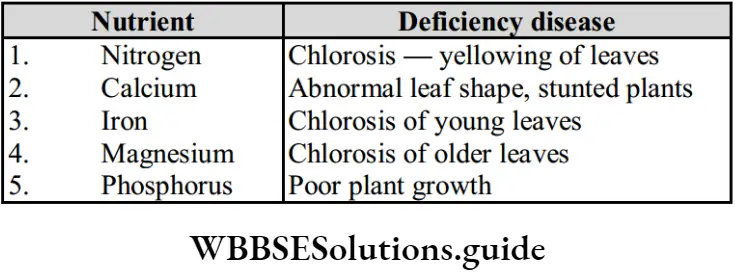
Question 30. Heterogeneous nuclear RNA (hnRNA) is converted to mRNA by

  1. Splicing
  2. Capping
  3. Tailing
  4. All of these

Answer: 4. All of these

The primary transcript obtained after transcription is called heterogeneous nuclear RNA or hnRNA. Post-transcriptional processing is required to convert primary transcript into functional RNA.

Following the removal of introns or splicing, additional nucleotides are added to the ends of RNA for specific functions, e.g. Cca segment in tRNA cap nucleotides at 5′ end of mRNA (capping) or poly-a segments (200-300 residues) at 3′ end of mRNA (tailing).

Cap is formed by the modification of gtp into 7-methyl guanosine. Thus, option (2) is correct.

NEET Biology Mcq

Question 31. Self-splicing introns are called

  1. Coenzyme
  2. Apoenzymes
  3. Ribozyme
  4. Holoenzyme

Answer: 3. Ribozyme

Ribozyme is the enzyme used for removing introns. It is an RNA molecule that can act as an enzyme, catalyzing changes in its own molecular structure. So, self-splicing introns are called a ribozyme
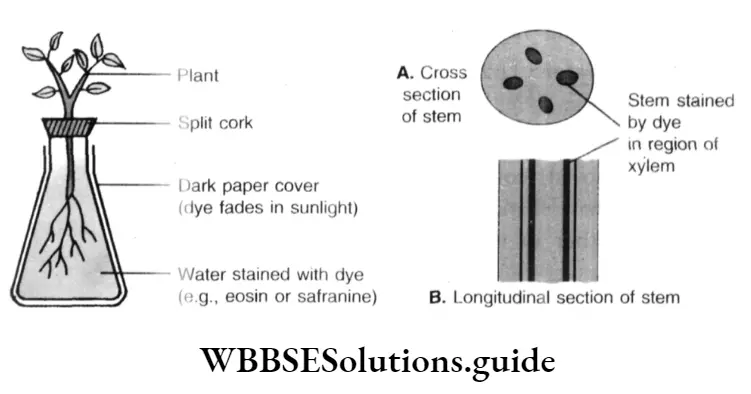
Question 32. Spliceosomes are not found in cells of

  1. Plants
  2. Fungi
  3. Animals
  4. Bacteria

Answer: 4. Bacteria

Spliceosomes are used in the removal of introns during post-transcriptional processing of hnRNA in eukaryotes. Split genes are absent in prokaryotes like bacteria therefore, they lack spliceosomes.
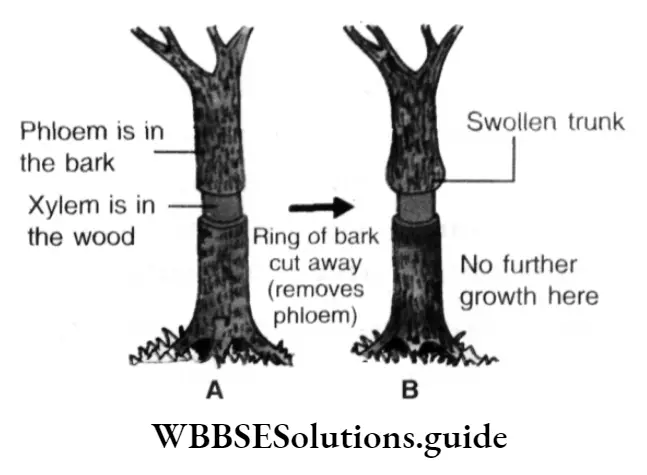
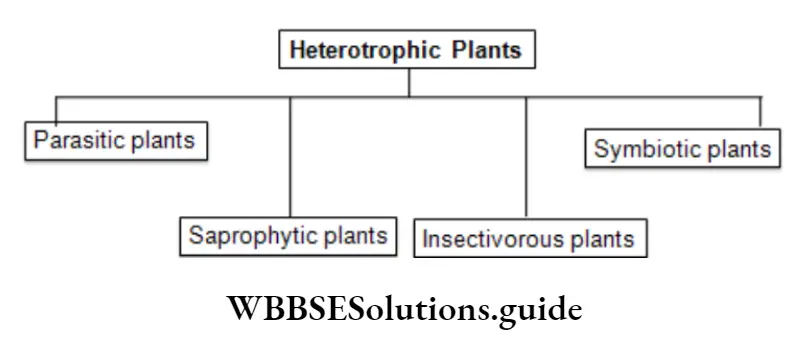
They are found in the nucleus of eukaryotic organisms.

Best multiple choice questions on transcription for NEET preparation

Question 33. 5 ′-3 ′ End of DNA strand is called

  1. Non-template strand
  2. Sense strand
  3. Coding strand
  4. All of the above

Answer: 4. All of the above

5′-3′ Strand of DNA is called a non-template strand or sense strand or coding strand. The non-template strand does not take part in transcription or code for anything.

The genetic code present in this strand is similar to the genetic code on mRNA except that uracil is replaced by thymine. Thus, the option is correct.

Question 34. The addition of methyl guanosine triphosphate at 5 ′ ends of hnRNA in a transcription unit is called

  1. Splicing
  2. Capping
  3. Tailing
  4. Transcribing
  5. Tautomerism

Answer: 2. Capping

The primary transcript obtained after transcription is called heterogeneous nuclear RNA or hnRNA. Post-transcriptional processing is required to convert primary transcript into functional RNA.

Following the removal of introns or splicing, additional nucleotides are added to the ends of RNA for specific functions, e.g. Cca segment in tRNA cap nucleotides at 5′ end of mRNA (capping) or poly-a segments (200-300 residues) at 3′ end of mRNA (tailing).

Cap is formed by the modification of gtp into 7-methyl guanosine.

Question 35. The addition of adenylate residues at 3 ′ ends in a transcription unit is called

  1. Tailing
  2. Splicing
  3. Capping
  4. Coding

Answer: 1. Tailing

In tailing, adenylate residues are added at 3′ end in a template-independent manner

Question 36. About ……….. Adenylate residues are added at the 3 ′ end of mRNA.

  1. 300-400
  2. 200-300
  3. 400-500
  4. 100-200

Answer: 2. 200-300

In tailing, about 200-300 adenylate residues are added at 3′ end of hnRNA

Question 37. The terminator in a transcriptional unit is present in the ….a… End.

It is also called ….b…… It defines the ….c… Of the process of transcription.

Choose the correct option for a, b and c.

  1. A–3′, b–downstream, c–end
  2. A–3′, b–upstream, c–end
  3. A–3′, b–upstream, c–beginning
  4. A–5′, b–upstream, c–beginning

Answer: 1. A–3′, b–downstream, c–end

NEET Biology Mcq Chapter Wise

Question 38. Which of the following sequences will be produced as a result of transcription of the DNA sequence cgattacag?

  1. Gcuaauguc
  2. Cguaaucug
  3. Gctaatgtc
  4. Gcuaatctg

Answer: 1. Gcuaauguc

(C g a t t a c a g)
↓ transcription
(g c u u g u c) thus, option (1) is correct.

Question 39. MRNA is synthesised on DNAtemplate in which direction.

  1. 5′ → 3′
  2. 3′ → 5′
  3. Both (1) and 2)
  4. All of the above

Answer: 1. 5′ → 3′

The RNA polymerase read the template DNA strand in 3′ → direction and the mRNA is formed in 5′→ 3′ direction.

Question 40. If double-stranded RNA is produced during transcription, it

  1. Would prevent RNA from being translated into protein
  2. Would not prevent RNA from being translated into protein
  3. This will lead to the continuous synthesis of RNA
  4. Will give rise to double-stranded RNA with lower stability

Answer: 1. Would prevent RNA from being translated into protein

Double-stranded RNA has more stability than single-stranded DNA.

If double-stranded RNA is formed during transcription, then it would be difficult to separate the strands of RNA, due to which the translation will be halted.

NEET Biology differences between transcription in prokaryotes and eukaryotes MCQs

Question 41. What can be observed if both strands are copied simultaneously during transcription?

  1. The segment of DNA would be coding for two different proteins
  2. Two RNA will be produced simultaneously, complementary to
    each other
  3. Formation of double-helical RNA
  4. All of the above

Answer: 4. All of the above

If both strands are copied during transcription, then two complementary helical RNAs are produced simultaneously that might code for different proteins.

They would have the tendency to form double-stranded helical RNA resulting in non-translation of coded information into proteins.

The whole exercise of transcription would then appear futile. Thus, option 4 is correct.

NEET Biology Mcq Chapter Wise

Question 42. Consider the following statements.

  1. RRNA provides the template for the synthesis of proteins.
  2. TRNA brings amino acids and reads the genetic code.
  3. RNA polymerase binds to the promoter and initiates transcription.
  4. A segment of DNAcoding for polypeptide is called intron.

Which of the statements given above is correct?

  1. 1 And 3
  2. 1 And 2
  3. 1, 2 And 3
  4. 2 And 3
  5. 1, 2 And 4

Answer: 4. 2 And 3

Statements 2 and 3 are correct as tRNA brings amino acids and reads the genetic code. RNA polymerase binds to the promoter and initiates transcription.

Statements 1 and 4 are incorrect and can be corrected as mRNA provides a template for protein synthesis and a DNA segment that codes for proteins is called cistron or exon.

Question 43. Identify the correct statement.

  1. Transcription can only occur after
  2. Transcription and translation occur simultaneously in some organisms
  3. Translation occurs before transcription
  4. Transcription and translation are alternative terms for the same process

Answer: 2. Transcription and translation occur simultaneously in some organisms

The statement in the option is correct as transcription and translation occur simultaneously in some bacteria and eukaryotes.

Rest statements are incorrect. Transcription occurs before translation in most eukaryotes.

Transcription involves mRNA formation whereas translation involves protein synthesis.

Question 44. Consider the following statements.

  1. The primary transcript produced in eukaryotes is translated without undergoing any modification or processing.
  2. The hnRNA in humans has exons and introns.

Choose the correct option.
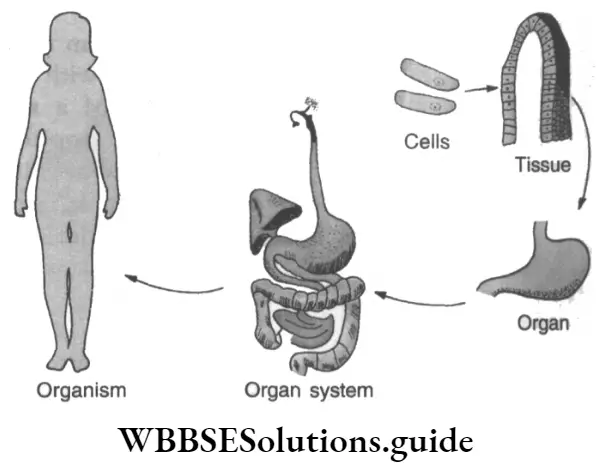
  1. Statement 1 is correct, but 2 is incorrect
  2. Statement 1 is incorrect, but 2 is correct
  3. Both statements 1 and 2 are correct
  4. Both statements 1 and 2 are incorrect

Answer: 2. Statement 1 is incorrect, but 2 is correct.

Incorrect statements can be corrected as the primary transcript in eukaryotes undergoes post-transcriptional processing to form functional mRNA.

This includes capping at 5′ end, tailing at 3′ end, and splicing.

The primary mRNA transcript is longer and localized into the nucleus, where it is also called heterogeneous nuclear RNA (hnRNA) or pre-mRNA. It has both exons and introns.