WBBSE Solutions For Class 10 Maths Chapter 7 Theorems Related To Angles In A Circle Exercise 7.4

WBBSE Solutions For Class 10 Maths Chapter 7 Theorems Related To Angles In A Circle Exercise 7.4

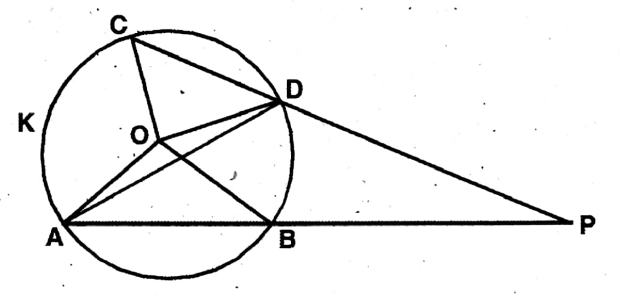
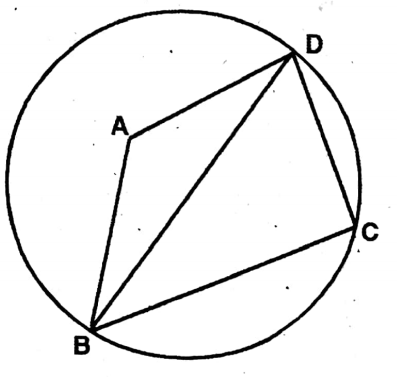
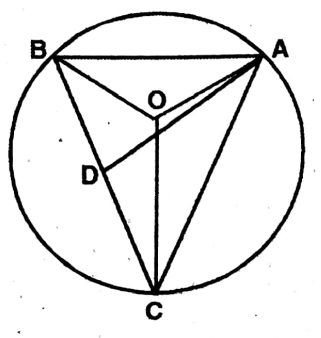
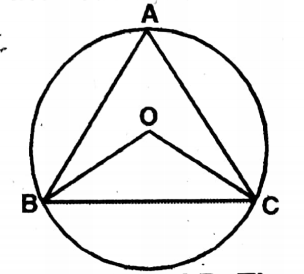
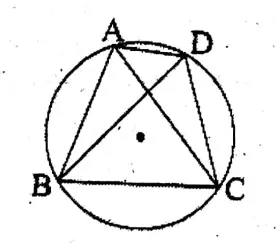
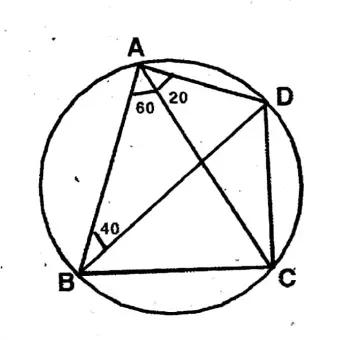
Question 1. In the adjoining figure, DBA = 40°, <BAC = 60°, and CAD = 20°; let us find the values of ZDCA and BCA. Also, let us see by calculating what the sum of BAD and ZDCB will be.
WBBSE Solutions For Class 10 Maths Chapter 7 Theorems Related To Angles In A Circle 1

“WBBSE Class 10 Maths Theorems Related to Angles in a Circle Exercise 7.4 solutions”

Read and Learn More WBBSE Solutions For Class 10 Maths

Solution:

Given

In the figure, DBA = 40°; <BAC = 60° & CAD = 20°.

<DCA & ∠DBA are the angles on the circumference on the same arc CD.

∴ ∠DCA =∠DBA = 40°

Now, BAD = <BAC + ∠CAD = 60° + 20° = 80°

The sum of the three angles of a triangle = 180°

∴ In ΔABD, <BAD + 2BDA +

∴ ∠BDA =180° – (BAD + ABD)

= 180 (80° + 40°)

= 180° -120° = 60°

ABD = 180°

∴ On the arc AB, the angle on the circumference ZBCA

∠BDA = 60°

Class 10 Maths Class 10 Social Science
Class 10 English Class 10 Maths
Class 10 Geography Class 10 Geography MCQs
Class 10 History Class 10 History MCQs
Class 10 Life Science Class 10 Science VSAQS
Class 10 Physical Science Class 10 Science SAQs

∴ <BCD = ∠BCA + ∠ACD = 60° + 40° = 100°

∴ ∠BCD + ∠BAD

100° +80° = 180°

.. ∠DCA = 40°, ∠BCA = 60° & Sum of the ∠BAD + ∠BCD = 180°
WBBSE Solutions For Class 10 Maths Chapter 7 Theorems Related To Angles In A Circle 2

WBBSE Solutions For Class 10 Maths Chapter 7 Theorems Related To Angles In A Circle Exercise 7.4

“West Bengal Board Class 10 Maths Chapter 7 Theorems Related to Angles in a Circle Exercise 7.4 solutions”

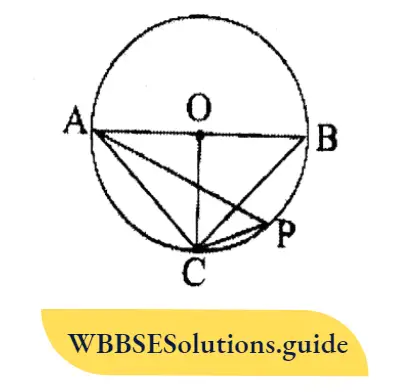
Question 2. In the adjoining figure, AOB is the diameter of the circle and O is the center of the circle. The radius OC is perpendicular on AB. If P is any point on minor arc CB, let us write by calculating the values of <BAC and APC.

Solution:

Given

In the adjoining figure, AOB is the diameter of the circle and O is the center of the circle. The radius OC is perpendicular on AB. If P is any point on minor arc CB

As, AB LOC .. ∠AOC = ∠BOC = 90°

ΔAOC is an isosceles triangle.

.: AO = OC

∠OAC = ∠OCA

∠OAC+∠OCA = 90° [∠AOC = 90°] 

or, ∠OAC+∠OAC = 90°

or, 2 ∠OAC = 90°
WBBSE Solutions For Class 10 Maths Chapter 7 Theorems Related To Angles In A Circle 3

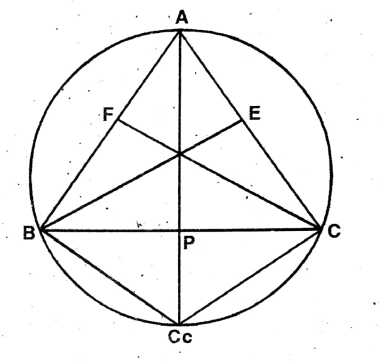
Question 3. O is the orthocentre of the triangle ABC and the perpendicular AD drew on BC when extended, Intersects the circumcircle of △ABC at point G; let us prove that OD = DG.

Solution:

Given

O is the orthocentre of the triangle ABC and the perpendicular AD drew on BC when extended, Intersects the circumcircle of AABC at point G

To prove, OD = DG.

Join B, G & C, G.

Proof: In the circumcircle of the ABC,

∠ACB is the angle on the circumference on arc AB.

∴ ∠ACB = ∠AGB

or, ∠ACB = ∠OGB

∠ECD = ∠OGB = ∠BGO———-(1)

Again, BEL AC & AD 1 BC.

∠OEC = ∠ODC = 90°

∠OEC+∠ODC= 90° + 90° = 180°

In the quadrilateral ODCE,

∠OEC+∠ECD +∠ODC +∠DOE = 4 right angles ∠ECD + ∠DOE

 = 4 right angles (∠OEC + ∠ODC) 4 right angles – 2 right angles

= 2 right angles ∠ECD + ∠EOD =∠EOD + ∠BOD

∴∠ECD = <BOD = ∠BOG——-(2)

From (1) & (2), BGO = BOG

BG = BO

Now in two right-angled triangles,

Hypotenuse BG = Hypotenuse BO, BD is common.

∴ ABDG ≅ ABDO. 

∴ OD = DG Proved.
WBBSE Solutions For Class 10 Maths Chapter 7 Theorems Related To Angles In A Circle 4

“WBBSE Class 10 Theorems Related to Angles in a Circle Exercise 7.4 solutions explained”

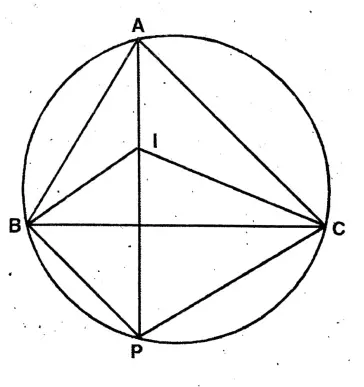
Question 4. I is the center of the incircle of AABC; Al produced intersects the circumcircle of that triangle at the point P, let us prove that PB = PC = PI

Solution:

I is the center of the incircle of △ABC; Al produced intersects the circumcircle of that triangle at the point P,

To prove PB = PC = PI

Join B, I; C, I; & P, B; P, C.

∴ The bisectors of the angles of a triangle meet at a point called In-centre.

∴ ∠BAI = ∠CAI = A/2, 

∠ABI = ∠CBI = B / 2

∠ACI = ∠BCI = C/2

∠PBC & PAC arc the angles of the circumcircle of

ΔABC, on the arc PC.

∴∠PBC=∠PAC

Now, ∠IBP = ∠PBC + ∠CBI = ∠PAC + ∠CBI = ∠CAI + ∠CBI

A/ 2 + B/2 ———-(1)

The external angle of the ΔABI, ∠BIP = ∠BAI + ∠ABI =

A/2 + B/2

From (i) & (ii), ∠IBP = ∠BIP. In ΔPBI, ∠IBP = ∠BIP 

∴ BP = PI——-(3)

Similarly, in∠PCI, ∠ICP = CIP 

i.e. PC = PI———-(4)

∴ From (3) & (4), PB

PC = PI Proved.
WBBSE Solutions For Class 10 Maths Chapter 7 Theorems Related To Angles In A Circle 5

“WBBSE Class 10 Maths Exercise 7.4 Theorems Related to Angles in a Circle problem solutions”

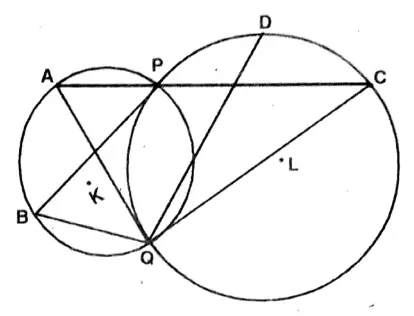
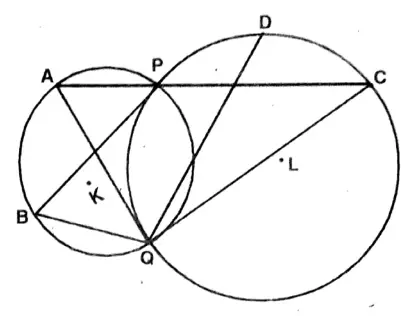
Question 5. Timir drew two circles that intersect each other at points P and Q. Through the point P two straight lines are drawn so that they intersect one of the circles at points A and B, and the other circle at points C and D respectively; let us prove that ∠AQC = ∠BQD.

Solution:

Given

Timir drew two circles that intersect each other at points P and Q. Through the point P two straight lines are drawn so that they intersect one of the circles at points A and B, and the other circle at points C and D respectively

To prove, ∠AQC = ∠BQD.

Join A, Q, B, Q, C, Q & D, Q

Proof: In the circle with center L, ∠PCQ &∠PDQ are the angles on the same circumference.

∠PCQ =∠PDC——-(1)

Again, in the circle with center K, ∠PAQ = ∠PBQ———(2)

As these are angles on the same arc.

Adding (1) & (2),

∠PAQ + ∠PCQ = ∠PBQ+ ∠PDC———(3)

In AACQ sum of the three angles = 180°

∠CAQ + ∠ACQ + ∠AQC = 180°

or, ∠PAQ +∠PCQ + ∠AQC = 180°——–(4)

Similarly in ABDC, the sum of three angles = 180°

∴ ∠DBQ+∠BDQ+∠BQD = 180°

or, ∠PBQ + ∠PDQ+ ∠BQD = 180°——-(5)

From (4) & (5),

∠PAQ + ∠PCQ + ∠AQC = ∠PBQ + ∠PDQ + ∠BQD——–(6)

Subtracting (3) from (4),

∠AQC = ∠BQD Proved.
WBBSE Solutions For Class 10 Maths Chapter 7 Theorems Related To Angles In A Circle 6

Question 6. Two chords AB and CD of a circle are perpendicular to each other. If a perpendicular drawn to AD from the point of intersection of those two chords AB and CD are produced to meet BC at point E, let us prove that point E is the midpoint of BC.

Solution:

Given

Two chords AB and CD of a circle are perpendicular to each other. If a perpendicular drawn to AD from the point of intersection of those two chords AB and CD are produced to meet BC at point E

In the circle, AB & CD are perpendicular to each other & intersect at O. The perpendicular from O on chord AD cuts the chord BC at E.

To prove, E is the midpoint of BC.

Proof: In ΔAFD, ∠AFO = 90° as OF AD

In ΔAFO, ∠FAO+∠AOF = 90°

i.e., ∠DAQ + ∠ADO = 90°—-(1)

Again, in ΔAOD, ∠AOD = 90° as AO ⊥ DO

∴∠DAQ +∠ADO = 90°——(2)

From (1) & (2),∠AOF = ∠ADO

or, ∠ADO = ∠EOB as ∠AOF ∠EOB (vertically oppo-site)

∴ ∠EOB = ∠ADO

Or, ∠EOB = ∠ADC

∴ ∠EOB = ∠ABC (Angles on the same circumference)

∴ ∠EOB = ∠OBC =∠OBE

In ΔOEB, ∠EOB =∠OBE. 

∴ BE = OE—–(3)

∠AOF+∠DOF = 90° (as AOD = 90°)

and ∠AOF+∠DAF 90° 

∴∠DOF = <DAO 

or,∠COE = ∠DÁB [∠COE = vertically ∠DOF]

∴<COE = <DCB [COE & DCB are angled on the same circumference]

i.e., ∠COE = ∠OCE

InΔOCE, ∠COE = ∠OCE

∴CE = OF ——– (4) 

From (3) & (4), BE = CE

∴ E is the midpoint of BC.
WBBSE Solutions For Class 10 Maths Chapter 7 Theorems Related To Angles In A Circle 6

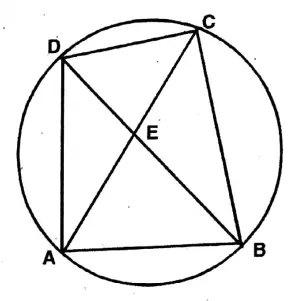
Question 7. If in a cyclic quadrilateral ABCD, AB = DC, let us prove that AC = BD. 

Solution: ABCD is a cyclic quadrilateral, AB = DC. To prove AC = BD. Proof: Join A, C & B, D.

Let AC & BD intersect at E.

∠CAB & ∠DAB are the angles on the same circumference.

∴∠CAB = ∠CBD

i.e.,∠EAB = ∠CDE

In ∠AEB & ∠DEC,

∠EAB = <CDE

∠AEB = ∠DEC (vertically opposite)

& AB = DC (given)

∴ΔAEB ≅ ADCB. (AAS)

∴AE = DE & BE = CE

∴ AC = AE + CE = DE+ BE = BD

∴ AC = BD.
WBBSE Solutions For Class 10 Maths Chapter 7 Theorems Related To Angles In A Circle 7

Question 8. OA is the radius of a circle with the center at O; AQ is its chord and C is any point on the circle. A circle passes through the points O, A; C intersects the chord AQ at the point P; let us prove that CP = PQ.

Solution:

OA is the radius of a circle with the center at O; AQ is its chord and C is any point on the circle. A circle passes through the points O, A; C intersects the chord AQ at the point P

Join O, A & O, Q.

Proof OQ & OA are two radii of the circle with center O.

In the isosceles ΔOQA,

∠OQA = ∠OAQ

Again, AO=CA is an isosceles triangle as OQ = OC (Radii of the same circle)

∴∠OQC = ∠OCQ

or, ∠OQA+∠AQC = ∠PCQ + ∠PCO

or, ∠OQA + ∠PQC = ∠PCQ + ∠PCO

∴ ∠PCO &∠PAO are the angles on the same circumference OP.

<PCO = <PAO = ∠OAQ (as ∠OQA = ∠OAQ)

∴ ∠PCO =  ∠OQA

∴ ∠OAQ + ∠PQC = ∠PCQ + ∠OQA or, <PQC = ∠PCQ

∴ CP = PQ (As APCQ is an isosceles triangle).

“Class 10 WBBSE Maths Exercise 7.4 Theorems Related to Angles in a Circle step-by-step solutions”

Question 9. The triangle ABC is inscribed in a circle, and the bisectors AX, BY, and CZ of the angles <BAC, ZABC, and ZACB intersect at the points X, Y, and Z on the circle respectively, let us prove that AX is perpendicular to YZ.

Solution:

The triangle ABC is inscribed in a circle, and the bisectors AX, BY, and CZ of the angles <BAC, ZABC, and ZACB intersect at the points X, Y, and Z on the circle respectively

Join X, Y; Y, Z; Z, X.

Let AX cuts YZ at P.

∴∠AXY + Y = ∠AXY + ∠BYX + ∠BYZ

= ∠ABY+∠BAX + ∠BCZ

=∠A/2 +  ∠B/2 +  ∠C/2

=∠A+∠B+∠C/2

= 1 rt. angle

∴ In PYX, ∠YXP + ∠PYX = 1 rt. angle

∴ ZP = 1 rt. angle

∴ AX ⊥ YZ.

Question 10. The triangle ABC is inscribed in a circle. The bisectors of the angles <BAC, ABC, and ACB intersect at the points X, Y, and Z on the circle respectively, let us  prove that in ΔXYZ, ∠YXZ = 90° – <BAC / 2

Solution: ΔABC is in a circle. Bisectors of <BAC, ∠ABC, & ∠ACB meet the circle at X, Y, and Z respectively.

To prove in ΔXYZ, ∠YXZ = 90° – 1/2 <BAC.

Proof: On the arc AY, ∠AXY = ZABY = 1/2 ZB

Similarly, on the arc AZ, ∠AXZ = ∠ACZ =1/2 ZC.

∴ Total ∠X = 1/2 ∠B + 1/2 ∠C

In ΔABC, 1/2 ∠A + 1/2 ∠B + 1/2 ∠C = 90°

1/2 ∠B + 1/2 ∠C = 90° – 1/2 ∠

Or, ∠X  = 90° – 1/2∠

∴ ∠YXZ 90° – 1/2 <BAC.

Question 11. A perpendicular drawn on BC from point A of AABC intersects the side BC at point D and a perpendicular drawn on side CA intersects the side CA at the point E; let us prove that four points A, B, D, and E are concyclic.

Solution:

A perpendicular drawn on BC from point A of AABC intersects the side BC at point D and a perpendicular drawn on side CA intersects the side CA at the point E

Join D, E.

Proof: AD T BC & AE T CA

∴∠ADB = ∠ADC = 90°.

∠AEB = ∠BEC = 90°

∴ External EDC = internal opposite <BAE

∴<BDE + ∠EDC = 2 rt. angles

i.e., ∠BDE+∠BAE= 2 rt. angles

∴ Opposite angles of the quadrilateral are supplementary.

∴ Opposite angles or the cyclic quadrilateral are supplementary. 

∴ A, B, D, E arc concyclic.

Chapter 7 Theorems Related To Angles In A Circle Exercise 7.4 Multiple Choice Question

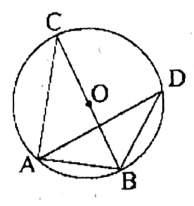
Question 1. In the adjoining figure, O is the center of the circle, if ZACB = 30°, ZABC = 60°, ZDAB = 35° and ZDBC = x°, the value of x is

1. 35
2. 70
3. 65
4. 55

Solution. BAC = 90°

∴ ∠BDC 90° – 35°= 55°

Answer: 4. 55°
WBBSE Solutions For Class 10 Maths Chapter 7 Theorems Related To Angles In A Circle 8.png

“WBBSE Class 10 Chapter 7 Theorems Related to Angles in a Circle Exercise 7.4 solution guide”

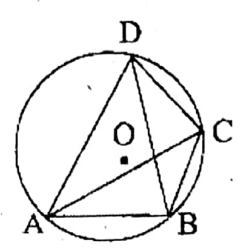
Question 2. In the adjoining figure, O is the center of the circle, if BAD = 65°, BDC = 45°, then the value of CBD is

1. 65°
2. 45°
3. 40°
4. 20°


Solution: ∠CAD = ∠BAD – <BAC = 65° – 45° = 20°

∴ ∠CAD = CBD = 20°

Answer: 4. 20°
WBBSE Solutions For Class 10 Maths Chapter 7 Theorems Related To Angles In A Circle 9

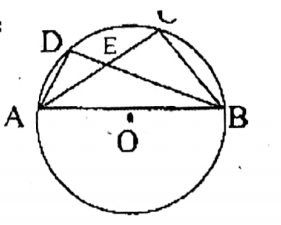
Question 3. In the adjoining figure, the O is the center of the circle, if ZAEB = 110° and CBE = 30°, the value of ADB is

1. 70°
2. 60°
3. 80°
4. 90°

Solution: ∠ACB = ∠ADB = 180° – (70° + 30°) = 80°

Answer: 3. 80°
WBBSE Solutions For Class 10 Maths Chapter 7 Theorems Related To Angles In A Circle 10

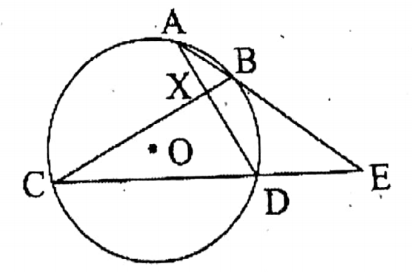
Question 4. In the adjoining figure, O is the center of the circle, if∠BCD = 28°, ∠AEC = 38° then the value of ∠AXB is.

1. 56°
2. 86°
3. 38°
4. 28°

Solution:

In the adjoining figure, O is the center of the circle, if∠BCD = 28°, ∠AEC = 38°

BCD = BAD = 28°

= ∠CBE 180° – (38° +  28°) 114°

∠ABX = 180° – 114° = 66°

∠AXB = 180° – (66° + 28°)= 86°

Answer: 2.  86°
WBBSE Solutions For Class 10 Maths Chapter 7 Theorems Related To Angles In A Circle 11

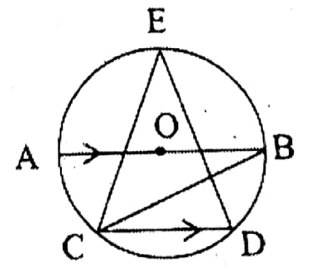
Question 5. In the adjoining figure, O is the center of the circle and AB is the diameter. If AB || CD, ZABC= 25°, the value of <CED is

1. 80°
2. 50°
3. 25°
4. 40°

Solution; ∠ABC= ∠BCD = 25° (alternate angle)

∴∠CED = 90° – 2 x 25° = 40°

Answer: 4. 40°
WBBSE Solutions For Class 10 Maths Chapter 7 Theorems Related To Angles In A Circle 12

“West Bengal Board Class 10 Maths Exercise 7.4 Theorems Related to Angles in a Circle solutions”

Chapter 7 Theorems Related To Angles In A Circle Exercise 7.4  True Or False

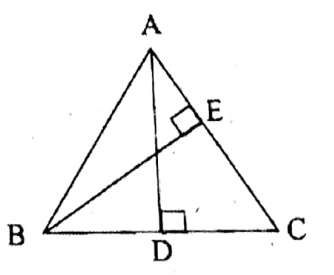
Question 1. In the adjoining figure AD and BE are the perpendiculars on sides BC and CA of the triangle ABC. A, B, D, and E are concyclic.

Solution: In AABC, AD & BE are the perpendiculars on BC and AC, respectively points A, B, C, D, and E are concyclic.

True.

Question 2. In ABC, AB = AC, BE, and CF are the bisectors of the angles B ABC and ACB and they intersect AC and AB at points E and F respectively. Four points B, C, E, and F, are not concyclic.

Solution: In ΔABC, AB = AC; BE & CF are the bisectors of ZABC & ZACB, respectively which cut at E & F.

Points B, C, E, and F are not concyclic.

True
WBBSE Solutions For Class 10 Maths Chapter 7 Theorems Related To Angles In A Circle 13

Chapter 7 Theorems Related To Angles In A Circle Exercise 7.4 Fill In The Blanks

1. All angles in the same segment are Equal.

2. If the line segment joining two points subtends equal angles at two other points on the same side, then the four points are Concyclic.

3. If two angles on the circle formed by two arcs are equal then the lengths of the arcs Are equal.

Chapter 7 Theorems Related To Angles In A Circle Exercise 7.4 Short Answer

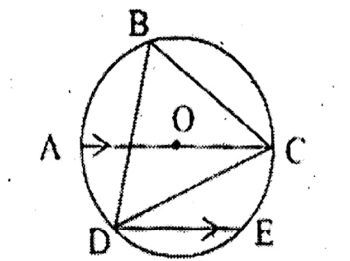
Question 1. In the adjoining figure, O is the center of the circle, AC is the diameter, and chord DE is parallel to the diameter AC. If CBD = 60°; let us find the value of ZCDE.

Solution:

In the adjoining figure, O is the center of the circle, AC is the diameter, and chord DE is parallel to the diameter AC. If CBD = 60°

∠CDE = 90°- ∠CBD 90° – 60°= 30°
WBBSE Solutions For Class 10 Maths Chapter 7 Theorems Related To Angles In A Circle 14


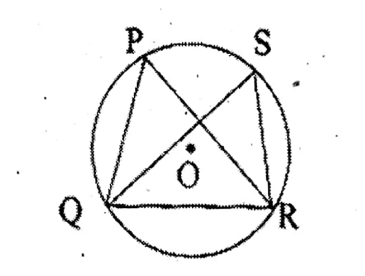
Question 2. In the adjoining figure, QS is the bisector of an angle /PQR, if SQR = 35° and ZPRQ 32°, let us find the value of ∠
QSR.

Solution.

In the adjoining figure, QS is the bisector of an angle /PQR, if SQR = 35° and PRQ 32°

∠SRP = SQR = ∠PSQ = 35°

∴∠QSR =∠QPR = 180° – (35° +35° + 32°) = 78°.
WBBSE Solutions For Class 10 Maths Chapter 7 Theorems Related To Angles In A Circle 15

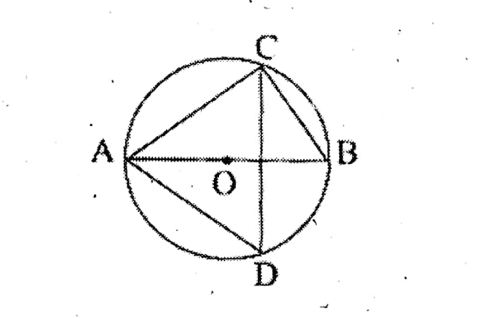
Question 3. In the adjoining figure, O is the center of the circle and AB is the diameter. If AB and CD are mutually perpendicular to each other and ZADC= 50°; let us find the value of CAD.

Solution:

In the adjoining figure, O is the center of the circle and AB is the diameter. If AB and CD are mutually perpendicular to each other and ZADC= 50°

BAD 90° = 50° = 40°

∴∠CAD = 2 x 40° = 80°.
WBBSE Solutions For Class 10 Maths Chapter 7 Theorems Related To Angles In A Circle 16


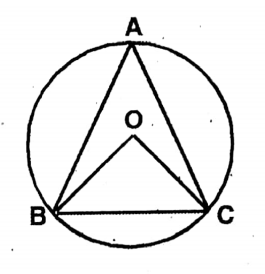
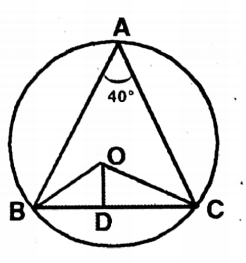
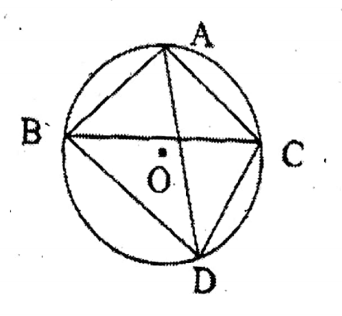
Question 4. In the adjoining figure, O is the center of the circle and AB = AC; if ZABC = 32°, let us find the value of BDC.

Solution:

In the adjoining figure, O is the center of the circle and AB = AC; if ZABC = 32°

∠ABC = ∠ACB = 32°

∴ BAC = 180° (32° 32°) = 116°

∠BDC = 180° – 116° = 64°
WBBSE Solutions For Class 10 Maths Chapter 7 Theorems Related To Angles In A Circle 17

“Class 10 WBBSE Maths Exercise 7.4 solutions for Theorems Related to Angles in a Circle”

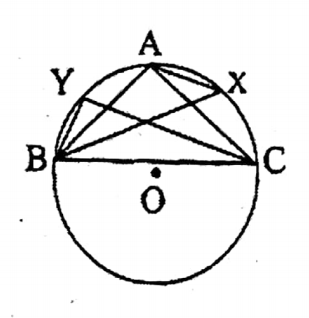
Question 5. In the adjoining figure, BX and CY are the bisectors of the angles ABC and ZACB respectively. If AB = AC and BY = 4 cm, let us find the length of AX.

Solution.

In the adjoining figure, BX and CY are the bisectors of the angles ABC and ZACB respectively. If AB = AC and BY = 4 cm

AX BY = 4 cm.
WBBSE Solutions For Class 10 Maths Chapter 7 Theorems Related To Angles In A Circle 18

“WBBSE Class 10 Maths Theorems Related to Angles in a Circle Exercise 7.4 answers”

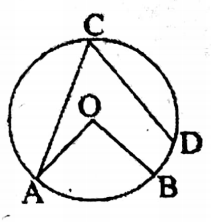
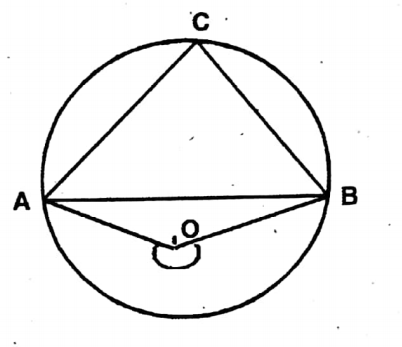
Question 6. Let us prove that the angle in the segment of a circle that is less than a semicircle is an obtuse angle. 

Solution: In the figure, O is the center of the circle.

∴ The segment ACB is less than a semicircle.

To prove ∠ACB is an obtuse angle.

∴ ADB is a major arc.

In the reflex ∠AOB, the angle at the center standing on that arc is greater than 2 right angles.

∴ ∠ACB is an angle at the circle also standing on the same arc.

∠ACB is greater than 1 right angle.

∴ ∠ACB is an obtuse angle. Proved.
WBBSE Solutions For Class 10 Maths Chapter 7 Theorems Related To Angles In A Circle 19

“WBBSE Class 10 Chapter 7 Theorems Related to Angles in a Circle Exercise 7.4 problem-solving steps”

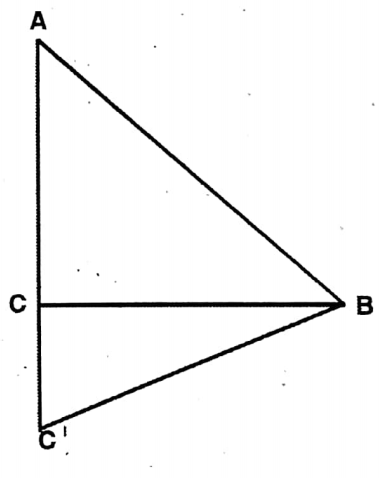
Question 7. Let us prove with the reason that the circle drawn with a hypotenuse of a right-angled triangle as diameter passes through the right angular vertex.

Solution: To prove that the circle drawn with BC as diameter passes through point A.

Proof: Let us suppose the circle does not pass through A. Then, let the circle intersects BA at point D.

∴∠BDC is 1 right angle ( angle in a semicircle is a right angle)

∴ BAC = 1 right angle (by hypothesis)

∴ <BAC = BDC.

This is impossible, if points D & A do not coincide, 

since the exterior angle ∠BDC of Δ ADC > the interior 

opposite angle ∠BAC.

∴ The circle passes through point A.
WBBSE Solutions For Class 10 Maths Chapter 7 Theorems Related To Angles In A Circle 20

WBBSE Solutions For Class 10 Maths Chapter 7 Theorems Related To Angles In A Circle Exercise 7.3

WBBSE Solutions For Class 10 Maths Chapter 7 Theorems Related To Angles In A Circle Exercise 7.3

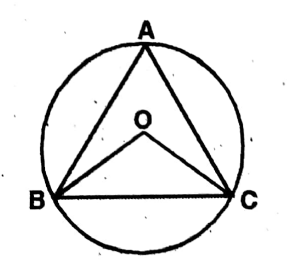
Question 1. O is the circumcentre of the isosceles triangle ABC, whose AB = AC, the points A and B, and C are on opposite sides of the center O. If ZBOC is 100°, let us write by calculating the values of ∠ABC and ∠ABO.

Solution: ‘O’ is the circumcenter of the isosceles triangle ABC, where AB = AC.

Join OB & OC.

Proof:

∴ ∠BOC is the angle at the centre & ∠BAC is the angle at the circumference on the same arcBC.

∴ \(\angle \mathrm{BAC}=\frac{1}{2} \angle \mathrm{BOC}=\frac{1}{2} \times 100^{\circ}=50^{\circ}\)

Again, as AB = AC,

∴ ∠ABC = ∠ACB

In ΔABC,

\(\angle \mathrm{BAC}+\angle \mathrm{ABC}+\angle \mathrm{ACB}=180^{\circ} \text { or, } 50^{\circ}+\angle \mathrm{ABC}+\angle \mathrm{ABC}=180^{\circ}\)

∴ \(50^{\circ}+2 \angle \mathrm{ABC}=180^{\circ}\)

∴ \(2 \angle \mathrm{ABC}=180^{\circ}-50^{\circ}=130^{\circ}\)

∴ \(\angle \mathrm{ABC}=\frac{130^{\circ}}{2}=65^{\circ}\)

Again, in ΔOBC, OB = OC (Radii of same circle).

∴ ∠OBC = ∠OCB

In ΔBOC, ∠BOC + ∠OBC + ∠OCB = 180°

or, 100° + 2∠OBC = 180°

∴ 2∠OBC = 180° – 100° = 80°

Class 10 Maths Class 10 Social Science
Class 10 English Class 10 Maths
Class 10 Geography Class 10 Geography MCQs
Class 10 History Class 10 History MCQs
Class 10 Life Science Class 10 Science VSAQS
Class 10 Physical Science Class 10 Science SAQs

∴ \(\angle \mathrm{OBC}=\frac{1}{2} \times 80^{\circ}=40^{\circ}\)

Now, ∠ABO = ∠ABC – ∠OBC = 65° – 40° = 25°

∴ ∠ABC = 65° & ∠ABO =  25°

“WBBSE Class 10 Maths Theorems Related to Angles in a Circle Exercise 7.3 solutions”

Read and Learn More WBBSE Solutions For Class 10 Maths

WBBSE Solutions For Class 10 Maths Chapter 7 Theorems Related To Angles In A Circle 2

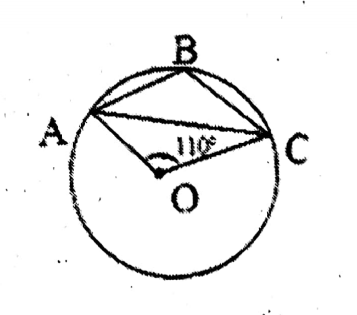
Question 2. In the adjoining, if O is the center of the circumcircle of ΔABC and ∠AOC = 110°; let us write by calculating the value of ∠ABC.

Solution:

Given

In the adjoining, if O is the center of the circumcircle of AABC and ZAOC = 110°

In the ∠AOC = 110°

∴ ∠ ABC = 1/2 of the angle at the center

= 1/2 x reflex AOC

= 1/2 x 250°

=125°

∠ ABC =125°

WBBSE Solutions For Class 10 Maths Chapter 7 Theorems Related To Angles In A Circle 3

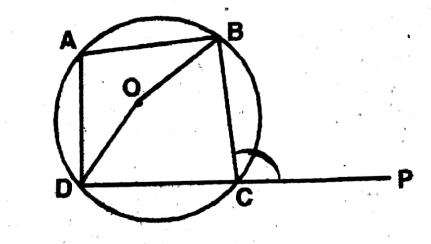
Question 3. ABCD is a cyclic quadrilateral of a circle with center O; DC is extended to point P. If ∠BCP = 108°, let us write by calculating the value of ∠BOD.

Solution:

Given

ABCD is a cyclic quadrilateral with the center of the circle O.

Side DC is produced to P such that BCP = 108°

Find ∠BOD.

∠BCD + BCP = 180°

∠BCD 180°- ∠BCP 180° – 108° = 72°

∠BOD = 2 x <BCD

= 2 x 72° = 144°

& Reflex ∠BOD = 360° – 144°

∠BOD = 216°.

WBBSE Solutions For Class 10 Maths Chapter 7 Theorems Related To Angles In A Circle 4

“West Bengal Board Class 10 Maths Chapter 7 Theorems Related to Angles in a Circle Exercise 7.3 solutions”

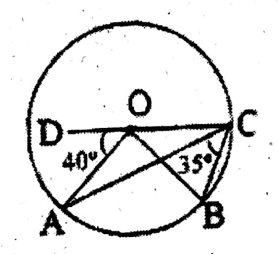
Question 4. O is the center of the circle; ∠AOD = 40° and ∠ACB = 35°; let us write by calculating the value of ∠BCO and ∠BOD, and answer with reason.

Solution:

Given

O is the center of the circle AOD = 40° & ACB = 35°.

Find ∠BCO & BOD.

Produce CD, which cuts the circle at E.

∠AOE is the angle at the center and ∠ACE is the angle at the circumference on the same arc AE.

WBBSE Solutions For Class 10 Maths Chapter 7 Theorems Related To Angles In A Circle 5

∴ ∠ACE = 1/2 

AOE = 1/2 x 40° = 20°

Now, ∠BCO = ∠BCA + ∠ACO

= ∠ACB + ∠ACE

= 35° + 20°

= 55°.

Again, ∠AOB is the angle at the center & ∠ACB is the angle at the circumference.

∴ ∠AOB = 2 x ∠ACB = 2 x 35° = 70°

∠BOD = ∠AOB+∠AOD

= 70° + 40°

= 110°

∴ ∠BCO = 55°

& BOD = 110°

WBBSE Solutions For Class 10 Maths Chapter 7 Theorems Related To Angles In A Circle Exercise 7.3

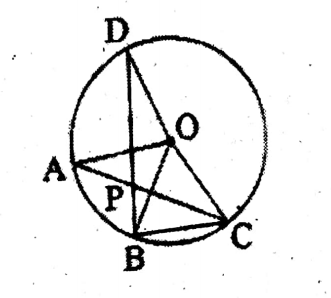
Question 5. O is the center of the circle in the picture beside, if ∠APB = 80°, let us find the sum of the measures of ∠AOB and COD and answer with reason.

Solution:

Given

‘O’ is the center of the circle & ADB = 80°.

To find the sum of ∠AOB + ∠COD.

Join B, C.

As ∠AOB is the angle at the center and DBC is the angle at the circumference on the same arc AB.

∴ ∠AOB = 2 x ∠ACB

Again, COD is the angle at the center and DBC is the angle at the circumference on the same arc CD.

WBBSE Solutions For Class 10 Maths Chapter 7 Theorems Related To Angles In A Circle 6

∠COD=2x ∠CBD

∠AOB+∠COD = 2x (∠ACB + ∠CBD)———(1)

Now, in ABCP, the side CP is produced to A.
∴ External BPA = <PCB + <PBC

∠APB = ∠ACB + <DBC

= ∠ACB+∠DBC= ∠APB = 80°————-(2)

Now, from (1) & (2), ∠AOB + ∠COB = 2 x (∠ACB + ∠DBC)= 2 x 80° = 160°.

“WBBSE Class 10 Theorems Related to Angles in a Circle Exercise 7.3 solutions explained”

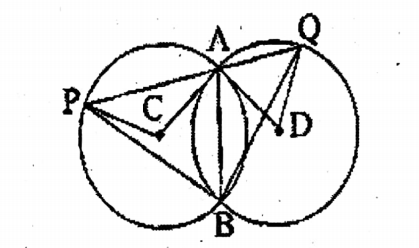
Question 6. Like the adjoining figure, we draw two circles with centers C and D which inter- sect each other at points A and B. We draw a straight line through point A which intersects the circle with center C at point P and the circle with center D at point Q.

1. PBQ = <CAD;

2. BPC = <BQD.

Solution: Two circles with centers C & D intersect each other at A & B.

A straight line passing through A cuts the circles at P & Q respectively.

To prove : 

∴ 1. ∠PBQ = ∠CAD

& 2. <BPC = <BQD.

Join A, B; A, C; P, C; A, D; D, Q; B, P; B, Q; B, C; B, D.

In the circle with center C,

∠ACP is the angle at the center &

∠ABP is the angle at the circumference on the same arc AP.

∴∠ABP =1/2 ∠ACP and CAP CPA [as, CA = CP (same radius)]

WBBSE Solutions For Class 10 Maths Chapter 7 Theorems Related To Angles In A Circle 7

Now, in ∠CAP, ∠CAP + ∠CPA + ∠ACP = 180°

or, ∠CAP + ∠ACP = 180°

or, ∠CAP 180° – ∠ACP

∴∠CAP 90° – 1/2 

∠ACP 90°= ∠ABP

∴ ∠CAP 90°-∠ABP——(1)

Again, in the circle with center D,

∠ADQ is the angle at the center and ∠ABQ is the angle at the circumference on the same arc AQ.

∴∠ABQ= 1/2  ∠ADQ

In ∠ADQ, DA = DQ (radii of the same circle)

∴ ∠DAQ = ∠DQA

∴ ∠DAQ + ∠DQA = 2 ∠DAQ

In∠ADQ, ∠ADQ+ ∠DAQ + ∠DQA = 180°

or, ∠ADQ+2∠DAQ = 180°

or, 2 ∠DAQ 180° – ∠ADQ

∴∠DAQ = 90° – 1/2 

∠ADQ 90° – ABQ————-(2)

∴∠DAQ = 90° – ∠ABQ

Adding (1) & (2),

∠CAP +∠DAQ = 90° – ∠ABP + 90° – ∠ABQ

=180° (∠ABP + ∠ABQ) = 180° – ∠PBQ.

or, ∠PBQ = 180° – (∠CAP + ∠DAQ)

∴∠PBQ = CAD Proved.

Again, In ∠ABC, CA = CB (Radii of the same circle)

∠CAB = <CBA

& In ∠DAB, DA = DB (Radii of the same circle)

∴ ∠DAB = DBA

∴∠CAB+ ∠DAB = ∠CBA + ∠DBA

∠CAD = CBD but ∠CAD =∠PBQ (Proved before)

∴ ∠CBD = CAD =∠PBQ

∴ ∠CBD + ∠PBD =∠PAD+ ∠PBQ

or, CBP = DBQ [as BC= PC (Radii of same circle)] and BD = DQ

∴ ∠BPC = CBP and ∠DBQ = ∠BQD

∴ BPC = CBP =∠DBQ =∠BQD

∴ ∠BPC = ∠BQD Proved.

Question 7. If the circumcentre of triangle ABC is O; let us prove that ∠OBC + <BAC = 90°.

Solution:

Given

O is the circumcentre of the triangle ∠ABC.

To prove, ∠OBC + ∠BAC = 90°

BOC = 2BAC

∴ <BAC = 1/2 ∠BOC

In ΔOBC, ∠OBC = ∠OCB

∠OBC+∠OCB + ∠BOC = 180°

∴2∠OBC+BOC = 180°

or, 2∠OBC= 180° – ∠BOC

or, ∠OBC= 90° – 1/2 ∠BOC

= 90-∠BAC

∴∠OBC+∠BAC

= 90° Proved.

WBBSE Solutions For Class 10 Maths Chapter 7 Theorems Related To Angles In A Circle 8

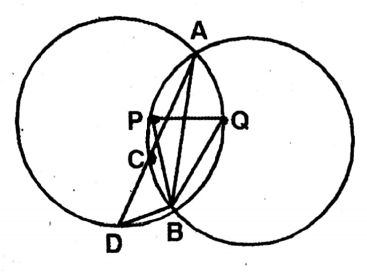
Question 8. Each of two equal circles passes through the center of the other and the two circles intersect each other at points A and B. If a straight line through point A intersects the two circles at points C and D, let us prove that ABCD is an equilateral triangle.

Solution:

Given

Each of two equal circles passes through the center of the other and the two circles intersect each other at points A and B. If a straight line through point A intersects the two circles at points C and D

Let P & Q are the centres of two equal circles. They cut each other at A and

Join, A,P; A,Q; B,P; B,Q; A,B; P,Q.

∴AP = BP = ΔAB = AQ = PQ

∴ΔAPQ & BQ are equilateral triangles.

∴∠PAQ=  ∠APQ= ∠AQP = ∠PBQ = ∠BPQ = ∠BQP = 60°.

Now, ∠APB =∠APQ+ ∠BPQ = 60° + 60° = 120°

∠AQB = ∠AQP+∠PQB = 60° +60° = 120°

∴ ∠APB = ∠AQB = 120°

In the circle with centre P, APB is the angle at the centre & ADB is the angle at the circumference on the same arc AQB.

∴∠ADB = 1/2 

∠APB = 1/2  x 120° = 60°

∠CDB = 60°

Again, in the circle with center Q, ZAPB & ZACB are the angles at the circumference on the same arc.

∠ACB = ∠APB = 120°.

∴∠BCD = 180° – ∠ACB= 180°- 120° = 60°

∴ In ABCD, CDB = ∠BCD = 60°

Remaining DBC= 180° (∠CDB + <BCD) 

= 180° – (60° 60°) = 60°

∴ All the angles of BCD are equal.

∴ ABCD is an equilateral triangle.

WBBSE Solutions For Class 10 Maths Chapter 7 Theorems Related To Angles In A Circle 9

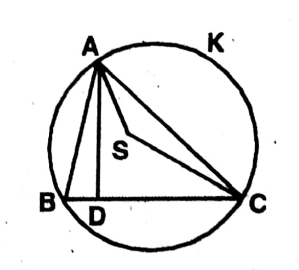
Question 9. S is the center of the circumcircle of AABC and if ADI BC, let us prove that <BAD = <SAC.

Solution: S is the circumcenter of △ABC & AD ⊥ BC.

To prove, ∠BAD = ∠SAC

Join, S, A & S, and C.

Proof: SA = SC (Radii of same circle)

Again, in △SAC, AS = SC

∠SAC = ∠SCA

Again, in △SAC,

∠ASC + ∠SAC + ∠SAC = 180°

or, ∠ASC + 2∠SAC = 180° [∵ ∠SAC = ∠SCA]

∴ 2∠SAC = 180° – ∠ASC

or ∠SAC = \(90^{\circ}-\frac{1}{2} \angle \text { ASC }\)          …(1)

Again, in the circle with center S, ∠ASC is the angle at the centre & ∠ABC is the angle at the circumference on the same arc ∠AKC.

∴ \(\angle \mathrm{ABC}=\frac{1}{2} \angle \mathrm{ASC}\)          …(2)

∠SAC = 90° – ∠ABC       …(3)

in ∠ABD, ∠ADB = ∠ADC = 90°

∴ ∠ADB + ∠BAD  = 90°

or, ∠BAD = 90° – ∠ADB = 90° – ∠ABC       …(4)

∴ From (3) & (4), ∠SAC = ∠BAD        Proved.


WBBSE Solutions For Class 10 Maths Chapter 7 Theorems Related To Angles In A Circle 11

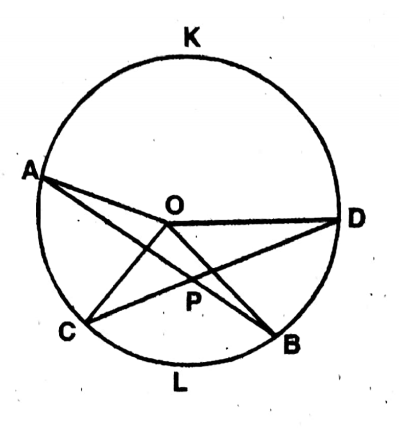
Question 10. Two chords AB and CD of a circle with center O intersect each other at the point P, let us prove that AOD + BOC = 2BPC. If AOD and BOC are supplementary to each other, let us prove that the two chords are perpendicular to each other.

Solution:

Given

Two chords AB & CD of a circle with center O,

intersect each other at P.

To prove,

∠AOD + ∠BOC = 2BPC

If ∠AOD & BOC are supplementary to each other, then prove that the chords are perpendicular to each other.

Join, O, A; O, B; O, C; O, D; & B, D.

In the circle with center O, AOB is the angle at the center & ABD is the angle at the circumference, in the same arc AKD.

∴∠ABD = 1/2 = ∠AOD

or, ∠AOD = 2 x ∠ABD

“WBBSE Class 10 Maths Exercise 7.3 Theorems Related to Angles in a Circle problem solutions”

Again, in the circle with center O, ∠BOC is the angle at the center and BDC is the angle at the circumference on the same arc ZBLC.

∴∠BOC = 2 x <BDC

∴∠AOD + ∠BOC = 2(∠ABD + 2BDC) = (<PBD + BDP)——(1)

Now in the triangle PBD, Ext. ∠BPC

∴ ∠BPC = ∠PBD + 2BDP

From (1), ∠AOD +∠BOC = 2∠BPC (Proved 1st part)

Again, if ∠AOD + ∠BOC = 2 right angles

2 x ∠BPC =∠AOD +∠BOC = 2 right angles

∴∠BPC = 90°

BP PC, i.e., Two chords AB & CD are perpendicular to each other. Proved – 2nd part.

WBBSE Solutions For Class 10 Maths Chapter 7 Theorems Related To Angles In A Circle 12

Question 11. If two chords AB and CD of a circle with center O, when produced, intersect each other at the point P, let us prove that ∠AOC – BOD = 2∠BPC.

Solution:

Given

Two chords AB and CD of the circle with center O, when produced, cut each other at P, outside the circle.

To prove, ∠AOC – BOD = 2 x <BDC

Join O, A; O, B; O, C; O, D; & A, D.

Proof: In the circle with center O,∠AOC is K

the angle at the center & ZADC is the angle at the circumference on the same arc. AKC, 

∴ ∠AOC = 2∠ADC

Again, in that circle BAD is the angle at

the center & BAD is the angle at the circumference on the same arc BD,

∴ ∠BOD = 2∠BAD

∠AOC – ∠BOD=2(∠ADC-∠BAD) —–(1)

In ΔAPD, External ∠ADC = ∠APD + ∠PAD = ∠APC + ∠PAD

or, ∠APC =∠ADC – ∠PAD

2(∠ADC-∠PAD) 2∠APC

∠AOC –

BOD = 2∠APC [from (1)]

WBBSE Solutions For Class 10 Maths Chapter 7 Theorems Related To Angles In A Circle 13

Question 12. We drew a circle with point A of quadrilateral ABCD as the center which passes through points B, C, and D. Let us prove that CBD + /CDB = <BAD.

Solution: The circle is drawn with center A of the quadrilateral ABCD, passing through B, C, and D.

To prove, CBD + /CDB = 1/2 ∠BAD

Proof : 2∠BCD = 360 – <BAD

∴∠BCD = 180° -1/2 ∠BAD

From ABCD, ∠BDC + 4CBD = 180° – ∠BCD

or, <CBD + /CDB = 180° – (180° -1/2 ∠BAD) 

=1/2 ∠BAD Proved.

WBBSE Solutions For Class 10 Maths Chapter 7 Theorems Related To Angles In A Circle 14

Question 13. O, is the circumcentre of AABC and OD is perpendicular on the side BC; let us prove that BOD = <BAC

Solution: O is the circumcentre & OD is perpendicular to BC. 

To prove,∠BOD = BAC

Join O, A; O, B; O, C; O, D &A, D. 

Proof: From ΔAOC, 

∠AOC+∠OAC+∠OCA = 180°

.. 2∠OAC = 180° – ∠AOC 90° – ∠ABC

∠BAD 90° – ∠ABC =∠OAC

.. <BAC = ∠OAC + ZOAB = ∠BOD Proved.

WBBSE Solutions For Class 10 Maths Chapter 7 Theorems Related To Angles In A Circle 15

Chapter 7 Theorems Related To Angles In A Circle Exercise 7.3 Multiple Choice Question

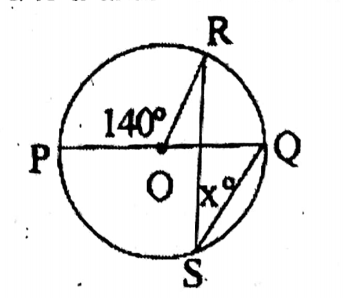
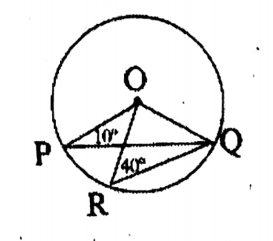
Question 1. In the adjoining figure, If ‘O’ is the center of the circle and PQ is a diameter then the value of x is

1. 140
2. 40
3. 80
4. 20

Solution: ROQ 180° 140° = 40°

.. x = <RSQ = 1/2 x 40° = 20°

Answer: 4. 20°

WBBSE Solutions For Class 10 Maths Chapter 7 Theorems Related To Angles In A Circle 16

“Class 10 WBBSE Maths Exercise 7.3 Theorems Related to Angles in a Circle step-by-step solutions”

Question 2. In the adjoining figure, if O is the center of circle, then the value of x is

1. 70
2. 60
3. 40
4. 200

Solution: BOR = 360° (140° +80°) = 360° 220° = 140°

∴∠QPR = 1/2  ZQOR= 1/2 x 140° = 70°

Answer. 2. 70°

WBBSE Solutions For Class 10 Maths Chapter 7 Theorems Related To Angles In A Circle 17

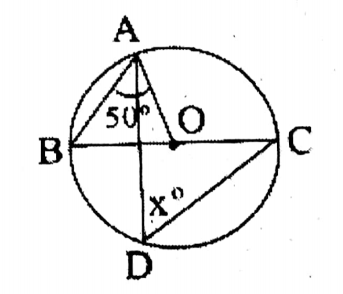
Question 3. In the adjoining figure, if O is the center of the circle and BC is the diameter then the value of x is

1. 60
2. 50
3. 100
4. 80

Solution:∠AOC 1800° – 80° = 100°

∴∠ADC = x2 = 100°/ 2

= 50°

Answer. 2. 50°

WBBSE Solutions For Class 10 Maths Chapter 7 Theorems Related To Angles In A Circle 18

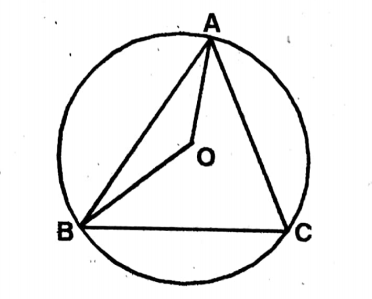
Question 4. If O is the circumcentre of AABC and ZOAB = 50°, then the value of ZACB is

1. 50°
2. 100°
3. 40°
4. 80°

Solution: If OAB = 50°

∠AOB 180°

(50° + 50°) = 180° – 100° = 80°

∴ ∠ACB = 1/2

AOB = 1/2 x 80° = 40°

Answer. 3. 40°

D:\Ameerun\Chapter 7 Exercise 7.3\WBBSE Solutions For Class 10 Maths Chapter 7 Theorems Related To Angles In A Circle 19.png

Question 5. In the adjoining figure, if O is centre of circle, the value of POR is

1. 20°
2. 40°
3. 60°
4. 80°

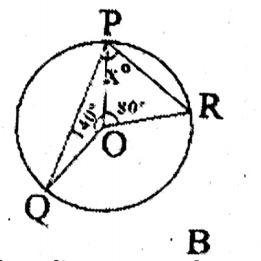
Solution: POQ = 180° –  20° = 160°

∠QOR = 180° – 80° = 100°

∠POR 160° – 100° = 60°

Answer. 3. 60°

WBBSE Solutions For Class 10 Maths Chapter 7 Theorems Related To Angles In A Circle 20WBBSE Solutions For Class 10 Maths Chapter 7 Theorems Related To Angles In A Circle 20

Chapter 7 Theorems Related To Angles In A Circle Exercise 7.3 True or False

1. In the adjoining figure, if O is the center of the circle, then ∠AOB = 2∠ACD.

False

2. point O lies within the triangular region ABC in such a way that OA OB and ZAOB = 2ZACB. If we draw a circle with centre O and length of radius OA, then the point C lies on the circle. 

True

WBBSE Solutions For Class 10 Maths Chapter 7 Theorems Related To Angles In A Circle 21

Chapter 7 Theorems Related To Angles In A Circle Exercise 7.3 Let us Fill in the blanks

1. The angle at the Half center is the angle on the circle, subtended by the same arc.

2. The lengths of two chords AB and CD of a circle with centre O are equal. If APB and AQC are angles on the circle, then the values of the two angles are  Equal.

3. If O is the circumcentre of an equilateral triangle, then the value of the from angle formed by an side of the triangle is  120°.

Chapter 7 Theorems Related To Angles In A Circle Exercise 7.3 Short answers

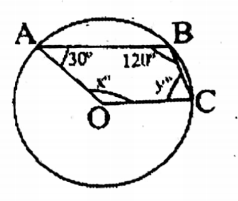
Question 1. In the adjoining figure, O is the center of the circle, if ∠OAB = 30°, ∠ABC = 120°,∠BCO = y° and ∠COA = x°, let us find x and y. 

Solution.

Given

In the adjoining figure, O is the center of the circle, if ∠OAB = 30°, ∠ABC = 120°,∠BCO = y° and ∠COA = x°

∠AOC = x° 360°- 2 x 120° = 120°

∠BCO = y°

=360° -2(120° +30° + 120°) = 360°

WBBSE Solutions For Class 10 Maths Chapter 7 Theorems Related To Angles In A Circle 22

“WBBSE Class 10 Chapter 7 Theorems Related to Angles in a Circle Exercise 7.3 solution guide”

Question 2. O is the circumcentre of the triangle ABC and D is the midpoint of the side BC. If <BAC 40°, let us find the value of BOD. 

Solution. BOC = 2BAC = 2 x 40° = 80°

<BOD= (90° –  180-80 / 2)

= 90° – 50° = 40°

WBBSE Solutions For Class 10 Maths Chapter 7 Theorems Related To Angles In A Circle 23

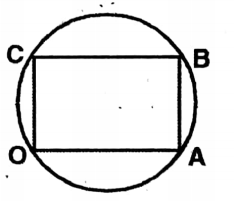
Question 3. Three points A, B, and C lie on the circle with center O in such B a way that AOCB is a parallelogram, let us calculate the value of the side ZAOC.

Solution. ∠AOC 360°-2/ABC

=1/3 x 360° = 120°

WBBSE Solutions For Class 10 Maths Chapter 7 Theorems Related To Angles In A Circle 24

Question 4. O is the circumcentre of the isosceles triangle ABC and ABC= 120°; if the length of the radius of the circle is 5 cm, let us find the value of the side AB.

Solution. 

Given

O is the circumcentre of the isosceles triangle ABC and ABC= 120°; if the length of the radius of the circle is 5 cm

∠ACB = 180°-120° /2  = 30°

∴∠AOB 60°

As OA = OB,

∴ ∠OAB ∠OBA = 60°

∴ OA OB = AB = 5 cm.

WBBSE Solutions For Class 10 Maths Chapter 7 Theorems Related To Angles In A Circle 25

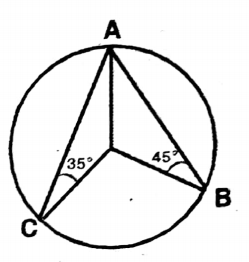
Question 5. Two circles with centers A and B intersect each other at points C and D. The center B of the other circle lie on the circle with center A. If ZCQD = 70°, let us find the value of ZCOD.
Solution.

Given

Two circles with centers A and B intersect each other at points C and D. The center B of the other circle lie on the circle with center A. If ZCQD = 70°,

CAD (360°-4 x 70) = 80°

∠CPD= 1/2 ZCAD = 1/2 x 80° = 40°

Example :

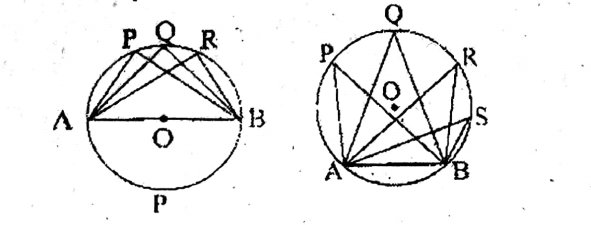
Each semi-circle angle is one right angle.

All the semicircle angles are equal.

∠APB =∠AQB = ∠ARB =∠ASB.

WBBSE Solutions For Class 10 Maths Chapter 7 Theorems Related To Angles In A Circle 26

WBBSE Solutions For Class 10 Maths Chapter 7 Theorems Related To Angles In A Circle 27

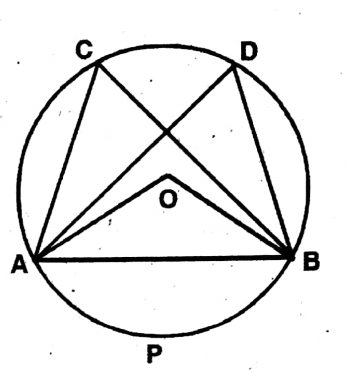
Question 6. Let us prove that all angles of a circle formed by the same arc are equal.

Solution: Let in the circle with center O, ∠ACB &∠ADB are the two angles at the circumference on the same arc ∠APB. 

To prove ∠ACB = ∠ADB.

Join O, A & O, B.

As on the arc ∠APB, AOB is the angle at the center and ∠ACB

& ∠ADB is the angles on the circumference.

∴∠AOB = 2∠ACB & ∠AOB = 2∠ADB

∴ ∠ACB = ∠ADB Proved.

WBBSE Solutions For Class 10 Maths Chapter 7 Theorems Related To Angles In A Circle 28

Question 7. Let us prove that if all angles of a circle subtended by circular arcs be equal then the lengths of the arcs are equal.

Solution: Let O is the center of the circle & the angles ∠ACB, ∠ADB, and ∠AEB are the angles on the circumference are equal,

i.e.,∠ACB = ∠ADB = ∠AEB.

To prove that the angles are on an arc of equal length.

Proof: If the angle on the circumference is half of the angle at the center then they will be on the same arc.

∴ ∠AOB = 2∠ACB = 2∠ADB = 2∠AEB

∴ The angles on the same arc∠APB.

“West Bengal Board Class 10 Maths Exercise 7.3 Theorems Related to Angles in a Circle solutions”

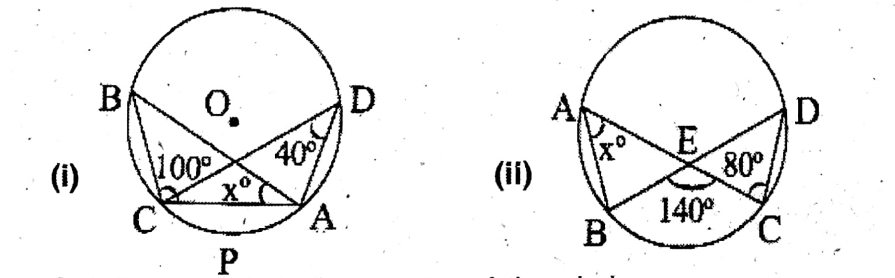
Question 8. Let us see the figure of the circle below and let us find the value of x. O is the center of the circle.

Solution: O is the center of the circle.

∠ABC and∠ADC are the front angles on the circle formed by the minor arc /CPA.

∴∠ABC = ∠ADC= 40° ( Given that ∠ADC = .40°)

and in ΔABC, ∠ABC + ∠ACB +∠BAC = 180°

∴ 40°+100° + x = 180°

or, x° 180° 140° = 40°

∴ x = 40.

WBBSE Solutions For Class 10 Maths Chapter 7 Theorems Related To Angles In A Circle 29

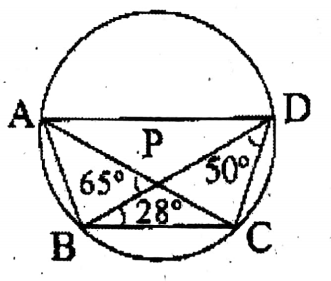
Question 9. In the adjoining figure, 65°. CBD = 28°; Let us determine the values of ADB,ABD, <BAC, ACB, CAD, and ACD.

Solution:

In the adjoining figure, 65°. CBD = 28°;

<BAC = <BDC = 50° Again, CAD = ADB = 28°

BDC = 50°, APB = 28°

In ABPC, Exterior ∠APB = ∠PBC +∠PCB.

65° = 28° + ACB;

ACB = 37°

InΔABP ∠ABP + ∠BPA + ∠PAB = 180°

∠ABP = ∠ACB = 37°

∠ABP = ∠ADB = 37°

∠ACD = ∠ABD = 65°

WBBSE Solutions For Class 10 Maths Chapter 7 Theorems Related To Angles In A Circle 30

WBBSE Solutions For Class 10 Maths Chapter 7 Theorems Related To Angles In A Circle Exercise 7.2

WBBSE Solutions For Class 10 Maths Chapter 7 Theorems Related To Angles In A Circle Exercise 7.2

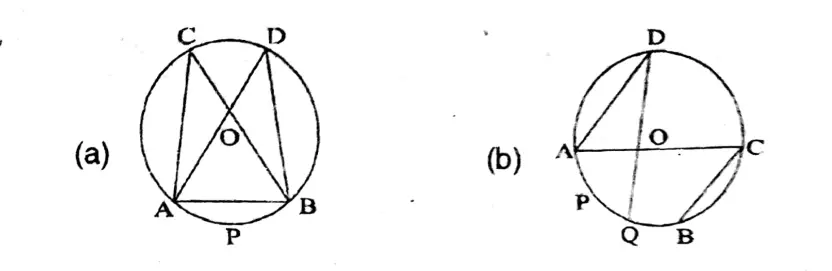
Question 1. I drew a circle and I drew two angles in the segment in that circle which (a) are formed with the same arc; (b) are not formed with the same arc. 

WBBSE Solutions For Class 10 Maths Chapter 7 Theorems Related To Angles In A Circle 1

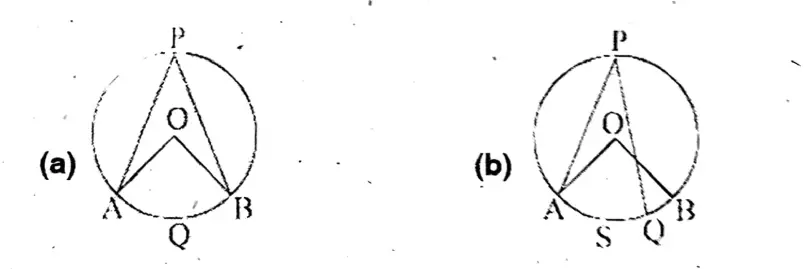
Question 2. I drew angles at the centre and the angle in the segment which (a) are formed with same arc; (b) are not formed with the same arc.

Read and Learn More WBBSE Solutions For Class 10 Maths

WBBSE Solutions For Class 10 Maths Chapter 7 Theorems Related To Angles In A Circle 2

(a) In fig (1), the angle at the centre O and the angle in the segment are formed with the same arc. 

(b) In fig (2) angle at the centre & angle in the segment are not formed with the same arc.

WBBSE Solutions For Class 10 Maths Chapter 7 Theorems Related To Angles In A Circle Exercise 7.2

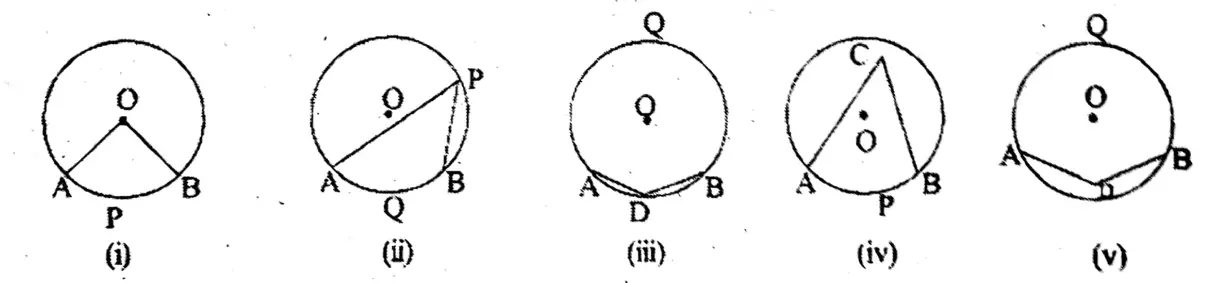
Question 3. Let us look at the picture and let us give an answer (O is the centre of the circle)

WBBSE Solutions For Class 10 Maths Chapter 7 Theorems Related To Angles In A Circle 3

“WBBSE Class 10 Maths Theorems Related to Angles in a Circle Exercise 7.2 solutions”

Solution: 

(i) ∠AOB, is the angle at the centre of the arc APB.

(ii) ∠APB in the segment is formed with arc ÁQB

(iii) In fig (iii) ∠ADB is cyclically formed with arc AQB

(iv) In fig (iv) ∠ACB is cyclically formed with arc APB

(v) In fig (v) ∠ADB is not an angle in the segment formed with the arc AQB.

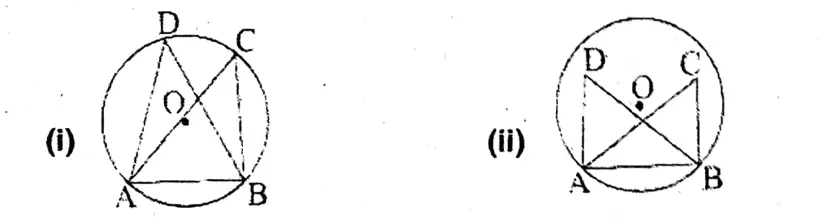
WBBSE Solutions For Class 10 Maths Chapter 7 Theorems Related To Angles In A Circle 4

In fig. (i) two angles ∠ACB &∠ADB are in the same arc.

In fig. (ii)∠ACB & ∠ADB are two angles that lie in the segment ADCB.

Class 10 Maths Class 10 Social Science
Class 10 English Class 10 Maths
Class 10 Geography Class 10 Geography MCQs
Class 10 History Class 10 History MCQs
Class 10 Life Science Class 10 Science VSAQS
Class 10 Physical Science Class 10 Science SAQs

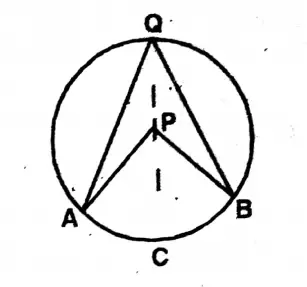
Question 4. I drew a circle with centre P and by drawing an angle ∠APB at the centre and an angle ∠AQB at the point on the circle by the arc ACB, we shall prove that, ∠APB2∠AQB

Solution:

I drew a circle with centre P and by drawing an angle∠APB at the centre and an angle ∠AQB at the point on the circle by the arc ACB

Let on the arc ACB of the circle with centre P, ∠APB is the angle at the centre & ∠AQB is the angle on the circumference.

To prove, ∠APB = 2 ∠AQB.

Join Q, P and produce to R.

Proof: In ΔAPQ, AP = PQ (Radii of the same circle)

∴ ∠PAQ = ∠AQP

Again, QP is produced to R.

∴ External ∠APQ = ∠PAQ + ∠AQP = ∠2AQP

Similarly, from ∠BQP, ∠BPR = 2∠BQP

∴ ∠APB = ∠APR + ∠BPR = 2 (∠AQP + ∠BQP)

= ∠AQB Proved

WBBSE Solutions For Class 10 Maths Chapter 7 Theorems Related To Angles In A Circle 5

“West Bengal Board Class 10 Maths Chapter 7 Theorems Related to Angles in a Circle Exercise 7.2 solutions”

Question 5. The circle with centre O passes through three points A, B and C; if ABO = 35° and ACO = 45°, let us write by calculating the value of BOC.

Solution:

Given

The circle with centre O passes through three points A, B and C; if ZABO = 35° and ZACO = 45°,

In ΔOAB, OA = OB (radii of the same circle) OAB= ∴ ∠OBA = 35°

In ΔOAC, OA = OC (radii of the same circle) OAC= ∴ ∠OCA = 45°

WBBSE Solutions For Class 10 Maths Chapter 7 Theorems Related To Angles In A Circle 6

Solution: ∠BAC = 35° + 45° 80°

“WBBSE Class 10 Theorems Related to Angles in a Circle Exercise 7.2 solutions explained”

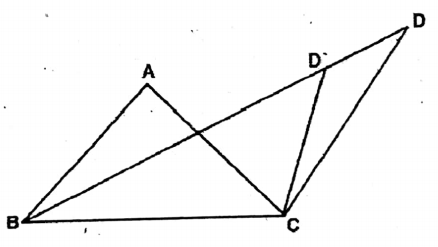
Question 7. ABC is an isosceles triangle with sides AB = AC; we draw ADBC in such a way that △DBC and △ABC lie on the same side of BC and ∠BAC = 2/BDC. Let us prove that the circle drawn with centre A and with radius AB is passing through point D, i.e., point D lies on the circle.

Solution:

Given

ABC is an isosceles triangle with sides AB = AC; we draw ADBC in such a way that ADBC and AABC lie on the same side of BC and ZBAC = 2/BDC.

Proof: Let the circle is not passing through D. If cuts BD at D’.

Join C, D’.

Now, BAC is the angle at the centre of the circle with

centre A and BDC is the angle on the circumference on

the same arc.

∴ ∠BAC = 2 ZBDC

But BAC 2 ZBDC (given)

∴ ∠BDC = <BD’C

It is not possible until point D. Coincide with D’ as an external angle of a triangle cannot be equal with its internal opposite angle.

∴ Point D is on the circle.

WBBSE Solutions For Class 10 Maths Chapter 7 Theorems Related To Angles In A Circle 9

WBBSE Solutions For Class 10 Maths Chapter 6 Compound Interest And Uniform Rate Of Increase Or Decrease Exercise 6.2

WBBSE Solutions For Class 10 Maths Chapter 6 Compound Interest And Uniform Rate Of Increase Or Decrease Exercise 6.2

Question 1. At present the population of the village of Pahalanpur is 10000; if the population is being increased at the rate of 3% every year, let us write by calculating its population after 2 years.

Solution:

Given

At present the population of the village of Pahalanpur is 10000; if the population is being increased at the rate of 3% every year,

Present population = 10000

After one year, the population will be

= 10000 + 3/100 x 10000

=10000 + 300

= 10300.

After 2nd year, population will be = 10300 + 3 / 100 X 10300 + 309

= 10609

After 2nd year, population will be = 10609

Read and Learn More WBBSE Solutions For Class 10 Maths

Question 2. The rate of increase in the population of a state is 2% in a year. The present population is 80000000; let us calculate the population of the state after 3 years.

Solution:

Given

The rate of increase in the population of a state is 2% in a year. The present population is 8000000

Present population = 80000000

After one-year population will be

= 8000000 + 2/100 × 80000000 

= 80000000 + 1600000 ‘

= 81600000

Class 10 Maths Class 10 Social Science
Class 10 English Class 10 Maths
Class 10 Geography Class 10 Geography MCQs
Class 10 History Class 10 History MCQs
Class 10 Life Science Class 10 Science VSAQS
Class 10 Physical Science Class 10 Science SAQs

After 2nd year the population will be

= 83232000+ 83232000 x 2/100

= 81600000+1632000

= 83232000

After 3rd year the population will be

= 83232000+83232000 x 2/100

= 83232000+ 1664640 = 84896640.

“WBBSE Class 10 Maths Compound Interest and Uniform Rate of Increase or Decrease Exercise 6.2 solutions”

Question 3. The price of a machine in a leather factory depreciates at the rate of 10% every year. If the present price of the machine be Rs. 100000, let us calculate what will be the price of that machine after 3 years.

Solution:

Given

The price of a machine in a leather factory depreciates at the rate of 10% every year. If the present price of the machine be Rs. 100000

Present price of the machine = Rs. 100000

After 1 year the price will be = Rs. (100000 – 10/100 × 100000 ) = Rs. 90,000

After 2nd year the price will be = Rs. 90000- 10/100 x 90000) = Rs. 81000

∴ After 3rd year the price will be

Rs.(81000-10/100x 81000)

= Rs. (81000 – 8100) Rs. 72900.

WBBSE Solutions For Class 10 Maths Chapter 6 Compound Interest And Uniform Rate Of Increase Or Decrease Exercise 6.2

Question 4. As a result of Sarba Siksha Abhiyan, the students leaving the school before completion, the students are readmitted, so the number of students in a year is increased by 5% in comparison to the previous year. If the number of such readmit- ted students in a district be 3528 in the present year, let us write by calculating, the number of students readmitted 2 years before in this manner.

Solution:

Given

As a result of Sarba Siksha Abhiyan, the students leaving the school before completion, the students are readmitted, so the number of students in a year is increased by 5% in comparison to the previous year. If the number of such readmit- ted students in a district be 3528 in the present year

Let at present no. of students = 3528.

Let two years before, no. of students was x & rate = 5%.

∴According to the problem,

X (1+5/100) = 3528

Or X x 105/100×105/100 = 3528

∴ X = 3528 x 100 x 100/105×105

= 3200

∴Two years before no. of students was 3200.

Question 5. Through the publicity of the road-safety program, street accidents in the Purulia district decreased by 10% in comparison to the previous year. If the number of street accidents this year is 8748, let us write by calculating the number of street accidents 3 years before in the district.

Solution:

Given

Through the publicity of the road-safety program, street accidents in the Purulia district decreased by 10% in comparison to the previous year. If the number of street accidents this year is 8748

No. of street accidents decreases by 10% every year in comparison to the previous year.

No. of street accidents this year is 8748.

Let no. of street accidents 3 years before was x.

According to the problem,

x(1-10/100)³= 8748

Or, X x(9/10)³ = 8748

or, X x 9×9×9/10x10x10 = 8748

∴x = 8748x10x10x10 / 9x9x9

= 12000

∴No. of street accidents 3 years before was 12000 

“West Bengal Board Class 10 Maths Chapter 6 Compound Interest and Uniform Rate of Increase or Decrease Exercise 6.2 solutions”

Question 6. A cooperative society of fishermen implemented such an improved plan for the production of fishes that the production in a year will be increased by 10% in comparison to the previous year. In the present year if the cooperative society can produce 406 quintals of fish, let us write by calculating what will be the production of fishes after 3 years.

Solution:

Given

A cooperative society of fishermen implemented such an improved plan for the production of fishes that the production in a year will be increased by 10% in comparison to the previous year. In the present year if the cooperative society can produce 406 quintals of fish

Production in a year increases by 10% in comparison to the previous year. In the present year, the production of fish is 400 quintals.

∴ Production of fish after 3 years will be

=400 (1+10/100)³ quintals

= 400 X 11/100×11/100×11/100

=532.4 quintals

Production of fish after 3 years will be =532.4 quintals

Question 7. The height of a tree increases at a rate of 20% every year. If the present height of the tree is 28.8 metres, let us calculate the height of the tree 2 years before.

Solution:

Given

The height of a tree increases at a rate of 20% every year. If the present height of the tree is 28.8 metres,

Let 2 years before the height of the tree was x m.

Now the height of the tree = X (1+20/100)² m = 28.8 m.

X X(6/5)² = 28.8

X x 36/25 = 28.8

X = 28.8×25 / 36 = 20 m.

∴ 2 years before the height of the tree was = 20 m.

Question 8. Three years before today a family had planned to reduce the expenditure of electric bills by 5% in comparison to the previous year. 3 years before, that family had to spend Rs. 4000 a year on electric bills. Let us write by calculating how much amount the family will have to spend to pay the electric bill in the present year.

Solution:

Given

Three years before today a family had planned to reduce the expenditure of electric bills by 5% in comparison to the previous year. 3 years before, that family had to spend Rs. 4000 a year on electric bills.

The expenditure on the electric bill was reduced by 5% in comparison to the previous year.

3 years before the expenditure for the electric bill was Rs. 4000.

∴ The present electric expenditure will be

= Rs. 4000(1-5/100)³

= Rs. 4000 x 95/100 x 95/100 x 95/100

= Rs. 3429.50. Ans.

The present electric expenditure will be = Rs. 3429.50.

Question 9. Weight of Savan babu is 80 kg. In order to reduce his weight, he started regular morning walks. He decided to reduce his weight every year by 10%. Let us write by calculating his weight after 3 years.

Solution:

Given

Weight of Savan babu is 80 kg. In order to reduce his weight, he started regular morning walks. He decided to reduce his weight every year by 10%.

Present mass of Savan babu is 80 kg.

He decided to reduce his mass every year by 10%. 

∴After 3 years his mass will be

= 80 x(1-10/100)³

= 80 x (9/10)³kg

=80 x 9/10 x 9/10 x 9/10 kg

= 58.32 kg.

After 3 years his mass will be = 58.32 kg.

“WBBSE Class 10 Compound Interest and Uniform Rate of Increase or Decrease Exercise 6.2 solutions explained”

Question 10. At present, the sum of the number of students in all M.S.K in a district is 399. If the number of students increased in a year was 10% of its previous year, let us calculate the sum of the number of students 3 years before in all the M.S.K In the district.

Solution:

Given

At present, the sum of the number of students in all M.S.K in a district is 399. If the number of students increased in a year was 10% of its previous year

If the number of students increased in a year by 10% in comparison to the previous year.

The present no. of students = 3993 and let the no. of students 3 years was x.

∴ X x (1+10/100)³ = 3993

Or, X x 11/10 x 11/10 x 11/10 = 3993

∴ X = 3993 x 10 x10x10 / 11x11x11

x = 3 x 1000 

= 3000.

Question 11. As the farmers are becoming more alert to the harmful effects of applying only chemical fertilizers and insecticides in agricultural lands, the number of farmers using fertilizers and insecticides in the village of Rasulpur decreases by 20% in a year in comparison to its previous year. Three years before, the number of such farmers was 3000; let us calculate the number of such farmers in that village now.

 Solution:

Given

As the farmers are becoming more alert to the harmful effects of applying only chemical fertilizers and insecticides in agricultural lands, the number of farmers using fertilizers and insecticides in the village of Rasulpur decreases by 20% in a year in comparison to its previous year. Three years before, the number of such farmers was 3000;

No. of farmers using chemical fertilizer decreases by 20% in the current year in comparison to the previous year.

3 years before no. of such farmers was 3000.

.. No. of farmers will be

=3000 x (1-20/100)³

=3000 x 4/5 x 4/5 x 4/5

= 1536.

No. of farmers will be = 1536.

Question 12. The price of a machine in the factory is Rs. 18000. The price of that machine decreases by 10% in each year. Let us calculate its price after 3 years.

Solution:

Given

The value of a machine in a factory is Rs. 180000.

The value of the machine depreciates at 10% every year.

∴ The value of the machine after 3 years will be

= Rs. 180000 x (1-10/100)³

= Rs. 18000 x (9/10)³

= Rs. 18000 x 729 / 1000 

 = Rs. 131220.

The value of the machine after 3 years will be  = Rs. 131220.

Question 13. For the families having no electricity in their houses, a Panchayat samiti of village Bakultala accepted a plan to offer electricity connections. 1200 families in. this village have no electric connection in their houses. In comparison to the previous year, it is possible to arrange electricity every year for 75% of the families having no electricity, let us write by calculating the number of families without electricity after 2 years.

Solution:

Given

For the families having no electricity in their houses, a Panchayat samiti of village Bakultala accepted a plan to offer electricity connections. 1200 families in. this village have no electric connection in their houses. In comparison to the previous year, it is possible to arrange electricity every year for 75% of the families having no electricity,

No. of family = 1200

In comparison to the previous year, it is possible to arrange electricity every year for 75% of the family having no electricity.

∴ No. of families without electricity after 2 years

= 1200 x (1-75/100)²

=1200 x (1-3/4)²

= 1200 x 1/7 x 1/4

=75.

No. of families without electricity after 2 years =75.

Question 14. As a result of continuous publicity on harmful reactions to the use of cold drinks filled, bottles, the number of users of cold drinks is decreased by 25% every year in comparison to the previous year. 3 years before the number of users of cold drinks in a town was 80000. Let us write by calculating the number of users of cold drinks in the present year.

Solution:

Given

As a result of continuous publicity on harmful reactions to the use of cold drinks filled, bottles, the number of users of cold drinks is decreased by 25% every year in comparison to the previous year. 3 years before the number of users of cold drinks in a town was 80000.

No. of users of cold drinks decreases by 25% every year in comparison to the previous year.

3 years before the number of users of cold drinks in a town was 80000.

∴No. of users of cold drinks in the present year

= 80000 x (1-25/100)³

= 80000 x (3/4)³

=80000 x 27/64

= 33750.

No. of users of cold drinks in the present year = 33750.

“WBBSE Class 10 Maths Exercise 6.2 Compound Interest and Uniform Rate of Increase or Decrease problem solutions”

Question 15. As a result of publicity on smoking, the number of smokers is decreased by 6 1/4 % every year in comparison to the previous year. If the number of smokers at present in a city is 33750, let us write by calculating the number of smokers in that city 3 years before.

Solution:

Given

As a result of publicity on smoking, the number of smokers is decreased by 6 1/4 % every year in comparison to the previous year. If the number of smokers at present in a city is 33750,

No. of smokers decreases by 6 1/4 % (25/4 %) every year in comparison to the previous year.

Let the no. of smokers 3 years before be x. 

According to the problem,

X x (1- 25/4 /100)³

=33750

Or, X x (1-25/100)³

=33750

Or, X x (15/16)³

=33750

Or, X x 15 x 15 x 115 / 16 x 16 x 16

=33750

∴ X =33750 x 16 x 16 x 16 / 15 x 15 x 15 

= 40960

∴ 3 years before no. of smokers was 40960

WBBSE Solutions Guide Class 10 Maths Chapter 6 Compound Interest And Uniform Rate Of Increase Or Decrease Exercise 6.2 Multiple Choice Questions

Question 1 In the case of compound interest, the rate of compound interest per annum is– 

1. Equal
2. Unequal
3. Both equal or unequal
4. None of these

Answer. 1. Equal

Question 2. In the case of compound interest

1. The principal remains unchanged each year
2. Principal changes in each year
3. The principal may be equal or unequal in each year

Answer. 2. Principal changes in each year

Question 3. At present the population of a village is p and if the rate of increase of population per year is 2r%, the population will be after n years.

1. P (1+r/100) n
2. p (1+r/50) n
3. p (1+r/50)2n
4. P (1-r/50) n                     

Answer: 2. p (1+r/50) n

Question 4. The present price of a machine is Rs. 2p and if the price of the machine decreases by 2r% each year, the price of the machine will be

1. Rs.p (1-r/50)n
2. Rs.2p (1-r/50)n
3. Rs.p (1-r/100)2n
4. Rs.2p (1-r/100)2n

Answer: Rs.2p (1-r/100)2n

Question 5. A person deposited Rs. 100 in a bank and got the amount Rs. 121 for two years. The rate of compound interest is

1. 10%
2. 20%
3. 5%
4. 10 ½%

Answer. 1. 10%

“Class 10 WBBSE Maths Exercise 6.2 Compound Interest and Uniform Rate of Increase or Decrease step-by-step solutions”

WBBSE Solutions Guide Class 10 Maths Chapter 6 Compound Interest And Uniform Rate Of Increase Or Decrease Exercise 6.2 True Or False

Question 1. The compound interest will be always less than simple interest for some money at a fixed rate of interest for a fixed time.

Answer: False

Question 2. In the case of compound interest, interest is to be added to the principal at a fixed time interval, i.e., the number of principals increases continuously.

Answer: True

WBBSE Solutions Guide Class 10 Maths Chapter 6 Compound Interest And Uniform Rate Of Increase Or Decrease Exercise 6.2 Fill In The Blanks

1. The compound interest and simple Interest for one year at the fixed rate of interest on a fixed sum of money are Equal.

2. If some things are increased by a fixed rate with respect to time, that is the same rate.

3. If some things are decreased by a fixed rate with respect to time, this is a uniform rate of Decrease

WBBSE Solutions Guide Class 10 Maths Chapter 6 Compound Interest And Uniform Rate Of Increase Or Decrease Exercise 6.2 Short Answer

Question 1. Let us write the rate of compound interest per annum so that the amount of Rs. 400 for 2 years becomes Rs. 441.

Solution: Let the rate of compound interest = r%

∴ \(400 \times\left(1+\frac{r}{100}\right)^2=441\)

\(\left(1+\frac{r}{100}\right)^2=\frac{441}{400}\) \(\left(1+\frac{r}{100}\right)^2=\left(\frac{21}{20}\right)^2\)

∴ \(1+\frac{\mathrm{r}}{100}=\frac{21}{20}\)

or, \(\frac{r}{100}=\frac{21}{20}-1\)

∴ \(\frac{r}{100}=\frac{1}{20}\)

∴ \(r=\frac{100}{20}=5\)

∴ Rate = 5%


Question 2. If a sum of money doubles itself at compound interest in n years, let us write in how many years It will become four times.

Solution: Let the principal = Rs. p

& rate of C.I = R

∴ \(p\left(1+\frac{R}{100}\right)^n=2 p\)

or, \(\left(1+\frac{\mathrm{R}}{100}\right)^n=2\)

Now in’t’ years, amount will be 4p

∴ \(\left(1+\frac{R}{100}\right)^t=4 p\)

\(\left(1+\frac{R}{100}\right)^t=4=2^2=\left(1+\frac{R}{100}\right)^{2 n}\)

∴ Time = 2n.

“WBBSE Class 10 Chapter 6 Compound Interest and Uniform Rate of Increase or Decrease Exercise 6.2 solution guide”

Question 3. Let us calculate the principle that at the rate of 5% compound interest per annum becomes Rs. 615 after two years.

Solution: Let the principal = Rs. p.

∴ \(P\left\{\left(1+\frac{5}{100}\right)^2-1\right\}=615\)

or, \(P \times\left\{\left(\frac{21}{20}\right)^2-1\right\}=615\)

or, \(P \times\left(\frac{441-400}{400}\right)=615\)

∴ \(P=\frac{615 \times 400}{41}=15 \times 400\)

P = Rs. 6000

“West Bengal Board Class 10 Maths Exercise 6.2 Compound Interest and Uniform Rate of Increase or Decrease solutions”

Question 4. The price of a machine depreciates at the rate of r% per annum, let us find the price of the machine that was n years before.

Solution: The value of the machine n years before was Rs.= V/ (1-r/100)

= V x (1-r/100)-n

Question 5: If the rate of increase in population is r% per year, the population after n years is p; let us find the population that was n years before.

Solution: n years before, no. of population was = P / (1-r/100) n = P x (1+r/100)-n

WBBSE Solutions For Class 10 Maths Chapter 6 Compound Interest And Uniform Rate Of Increase Or Decrease Exercise 6.1

WBBSE Solutions For Class 10 Maths Chapter 6 Compound Interest And Uniform Rate Of Increase Or Decrease Exercise 6.1

Question 1. If I take a loan of Rs. 1400 at 5% compound interest per annum for 2 years, let us write by calculating how much compound interest and the total amount I shall pay.

Solution:

Given

I take a loan of Rs. 1400 at 5% compound interest per annum for 2 years

When Principal = Rs. 1400,

Compound interest =10.25×1400 / 100

= Rs. 143.50

Principal & compound interest are in direct proportion.

Amount = Rs. (1400+ 143.50) Rs. 1543,50.

Read and Learn More WBBSE Solutions For Class 10 Maths

Question 2. Let us write by calculating what is the amount of Rs. 1000 for 2 years at the rate of 5% compound interest per annum.

Solution: Amount = Rs. 1000 (1+5/100)²

= Rs. 1000 x (22/20)²

=Rs.1000 x 441/400

=Rs. 2205/2

=Rs. 1102.50

“WBBSE Class 10 Maths Compound Interest and Uniform Rate of Increase or Decrease Exercise 6.1 solutions”

Question 3. At 5% compound interest per annum, let us find the compound inter- est on Rs. 10,000 for 3 years.

Solution: Compound interest for 3 years = Rs. \(10000\left\{\left(1+\frac{5}{100}\right)^3-1\right\}\)

= \(\text { Rs. } 10000\left\{\left(1+\frac{1}{20}\right)^3-1\right\}\)

= \(\text { Rs. } 10000\left\{\left(\frac{21}{20}\right)^3-1\right\}\)

= \(\text { Rs. } 10000\left\{\frac{9261-8000}{8000}\right\}\)

= \(\text { Rs. } 10000\left(\frac{1261}{8000}\right)\)

= \(\text { Rs. } \frac{6305}{4}\)

= Rs. 1576.25

Class 10 Maths Class 10 Social Science
Class 10 English Class 10 Maths
Class 10 Geography Class 10 Geography MCQs
Class 10 History Class 10 History MCQs
Class 10 Life Science Class 10 Science VSAQS
Class 10 Physical Science Class 10 Science SAQs

Question 4. Let us find compound interest on Rs. 1000 at the rate of 10% compound interest per annum and the interest being compounded at 6 monthly intervals.

Solution: Compound interest on Rs.1000 for 1 year at 10% per annum compound interest compound semiannually.

Amount = \(\text { Rs. } 1000\left(1+\frac{1 / 2}{100}\right)^{2 \times 1}\)

= \(\text { Rs. } 1000\left(1+\frac{10}{200}\right)^2\)

= \(\text { Rs. } 1000\left(\frac{21}{20}\right)^2\)

= \(\text { Rs. } 1000 \times \frac{441}{400}\)

= \(\text { Rs. } \frac{2205}{2}\)

= Rs. 1102.50

∴ Compound interest = Rs.(1102.50 – 1000) = Rs. 102.50

WBBSE Solutions For Class 10 Maths Chapter 6 Compound Interest And Uniform Rate Of Increase Or Decrease Exercise 6.1

Question 5. Let us write by calculating compound interest on Rs. 10,000 at the rate of 8% compound interest per annum for 9 months, compounded at an interval of 3 months.

Solution: Compound interest for 9 months = Rs. (1102.50-1000)

= Rs. 102.50.

Question 6. If the rate of compound interest for the first year is 4% and for 2nd year is 5%, let us find the compound interest on Rs. 25000 for 2 years.

Solution: Amount after two years on Rs.25,000 at two rates of 4% for 1st year & 5% for 2nd year

= \(\text { Rs. } 25,000\left(1+\frac{4}{100}\right)\left(1+\frac{5}{100}\right)\)

= \(\text { Rs. } 25,000 \times \frac{104}{100} \times \frac{105}{100}\)

= Rs. 27300

∴ Compound interest = Rs. 27300 – Rs. 25000

= Rs. 2300

“West Bengal Board Class 10 Maths Chapter 6 Compound Interest and Uniform Rate of Increase or Decrease Exercise 6.1 solutions”

Question 7. I lend Rs. 10,000 at the rate of 4% compound interest per annum for 2 1/2 years, let us write by calculating how much total money I shall pay.

Solution: Amount for 2 1/2 years = Rs. (10816+216.32) = Rs. 11032.32.

Question 8. Let us find the amount of Rs. 30,000, at the rate of 6% compound interest per annum for 2 1/2 years.

Solution: Amount for 2 1/2 years at the rate of 6%. Compound interest

= Rs. \(\left[30000\left(1+\frac{6}{100}\right)^2+3000\left(1+\frac{6}{100}\right)^2 \times \frac{6}{12} \times \frac{6}{100}\right]\)

= Rs. \(\left[30000\left(1+\frac{6}{100}\right)^2\left(1+\frac{6}{12} \times \frac{6}{100}\right\}\right]\)

= Rs. \(\left(30000 \times \frac{106 \times 106}{100 \times 100} \times \frac{103}{100}\right)\)

= Rs. Ps. 34719.24

Question 9. Let us write by calculating what sum of money will amount to Rs. 3528 after 2 years at the rate of 5% compound interest per annum.

Solution: Let the principal = Ra, X

According to the problem,

\(x\left(1+\frac{5}{100}\right)^2=3528\)

or, \(\times \frac{105}{100} \times \frac{105}{100}=3528\)

∴ \(x=\frac{2528 \times 100 \times 100}{105 \times 105}=3200\)

∴ Principal = ps 3200.

Question 10. Let us see by calculating alternatively that Minatididi deposits Rs. 3,00,000 in the bank.

Solution: Let the principal for 19t year = Rs. x.

Interest for the 151 year at 8% = Rs. \(\frac{8 x}{100}\)

∴ Principal for the 2nd year = Rs. \(\left(x+\frac{8 x}{100}\right)={Rs} \frac{106 x}{100}\)

Again, the interest for the and year at 8% = Rs. \(\frac{B}{100} \times \frac{106 x}{100}={Rs} \frac{864 x}{10000}\)

∴ Principal for the 3rd year = Rs. \(\left(\frac{106 x}{100}+\frac{864 x}{10000}\right)=\text { Rs. } \frac{11664 x}{10000}\)

∴ The interest for the 3rd year (one year) at 85% Rs.\( \frac{8 \mathrm{x}}{100}+\frac{11664 \mathrm{x}}{10000}=\text { Rs. } \frac{93312 \mathrm{x}}{1000000}\)

∴ After 3 years, amount will be Rs. \(\left(\frac{11664 x}{10000}+\frac{93312 x}{1000000}\right)={Rs} \cdot \frac{1259712 x}{1000000}\)

∴ According to the problem,

\(\frac{1259712 x}{1000000}=37791.36\)

∴ \(x=\frac{37791.36 \times 1000000}{1259712}=\mathrm{Rs} \cdot 30,000\)

Minati Di depcaited Rs.30,000 in the bank.

“WBBSE Class 10 Compound Interest and Uniform Rate of Increase or Decrease Exercise 6.1 solutions explained”

Question 11. The simple interest and compound interest of a certain sum of money for 2 years are Rs. 840 and Rs. 869.40 respectively. Let us calculate that sum of money and the rate of interest.

Solution: Simple interest for 2 years = Rs. 840

∴ Simple interest for 1 year = Rs. \(\frac{840}{2}\) = Rs. 420

Difference between Compound interest & simple interest for 2 years

= Rs. (869.40 – 840) = Rs. 29.40

∴ Interest on Rs. 420 for 1 year = Rs. 29.40

∴ Interest on Rs. 100 for 1 year = \(\text { Rs. } \frac{29.40}{420} \times 100 .=\text { Rs. } 7\)

∴ Rate of interest = 7%.

Principal = \(\text { Rs. } \frac{420 \times 100}{7}\) = Rs. 6,000.

Question 12. Let us calculate at what rate of compound interest, Rs. 5,000 will amount to Rs. 5832 in 2 years.

Solution: Let the rate of compound interest = r%

p = Rs.5,000; A = Rs.5832; Time = n = 2 years.

∴ \(A=P\left(1+\frac{r}{100}\right)^n\)

or, \(5832=5000\left(1+\frac{r}{100}\right)^2\)

or, \(\frac{5832}{5000}=\left(1+\frac{r}{100}\right)^2\)

or, \(\left(i+\frac{r}{100}\right)^2=\left(\frac{27}{25}\right)^2\)

\(1+\frac{r}{100}=\frac{27}{25}\)

or, \(\frac{r}{100}=\frac{27}{25}-1=\frac{2}{25}\)

∴ \(r=\frac{2 \times 100}{25}=8\)

∴ the rate of compound interest = 8%.

Question 13. Let us write by calculating in how many years Rs. 5000 will by compound interest at the rate of 10% per annum amount to Rs. 6050.

Solution: Let the required time (year) = n.

P = Rs. 5000, A = Rs. 6050, Rate (f) = 10%

∴ \(A=P\left(1+\frac{r}{100}\right)^n\)

or, \(6050=6000\left(1+\frac{10}{100}\right)^n\)

\(\frac{6050}{5000}=\left(\frac{11}{10}\right)^n\)

or, \(\left(\frac{11}{10}\right)^2=\left(\frac{11}{10}\right)^{\mathrm{n}}\)

∴ n = 2.

∴ Required Time = 2 years.

Question 14. I have Rs. 5000 in my hand. I deposited that money in a bank at the rate of 8.5% compound interest per annum for two years. Let us write by calculating how much money. I shall get it at the end of 3 years.

Solution: P = Rs. 5000, R = 8.5%

Time (n) = 2 years.

∴ Amount \(A=P\left(1+\frac{R}{100}\right)^n\)

= \(\text { Rs. } 5,000\left(1+\frac{8.5}{100}\right)^2=\text { Rs. } 5.000\left(\frac{1065}{1000}\right)^2\)

= \(\text { Rs. } \frac{5000 \times 1085 \times 1005}{1000 \times 1000}=\text { Rs } \cdot \frac{6660125}{1000}\)

= Rs. 5686.125.

Question 15. Let us calculate the amount of Rs. 5000 at the rate of 8% compound interest per annum for 3 years.

Solution: Principal (P) = Rs.5000,

Rate (R) = 8%

Time (n) = 3 years.

\(A=P\left(1+\frac{R}{100}\right)^n\)

= \(\text { Rs. } 5000\left(1+\frac{8}{100}\right)^8\)

= \(\text { Rs. } 5000 \times\left(\frac{27}{25}\right)^3\)

= \(\text { Rs. } 6000 \times \frac{27 \times 27 \times 27}{25 \times 25 \times 25}\)

= Rs. 6296.56

“WBBSE Class 10 Maths Exercise 6.1 Compound Interest and Uniform Rate of Increase or Decrease problem solutions”

Question 16. Goutam babu borrowed Rs. 2000 at the rate of 6% compound interest per annum for 2 years. Let us write by calculating how much compound interest at the end of 3 years he will pay.

Solution: P = Rs. 2000, R = 6%, Time (n) = 2  years, C.I. = ?

\(A=P\left(1+\frac{A}{100}\right)^n=R s .2000\left(1+\frac{6}{100}\right)^2\)

= \(\text { Rs. } 2000 \times \frac{53}{50} \times \frac{53}{50}=\text { Rs. } 2247.20\)

∴ Compound interest = Rs. (2247.20 – 2000)

= Rs. 247,20.

Question 17. Let us write by calculating the amount of Rs. 30,000 at the rate of 9% compound interest per annum for 3 years.

Solution: P = Rs. 30,000

Rate (R) = 9%,

Time (n) = 3 yedra,

C.I. ?

\(\mathrm{A}=\mathrm{P}_s \cdot 30000 \times\left(1+\frac{9}{100}\right)^3\)

= Rs \(30,000 \times \frac{109}{100} \times \frac{109}{100} \times \frac{109}{100}=\text { Rs. } 38850.87\)

∴ Compound interest = Rs. (38850.87 – 30,000)

= Rs. 8850.87

Question 18. Let us write by calculating the amount of Rs. 80,000 for 2 years at the rate of 5% compound interest per annum.

Solution: P = Rs. 80,000

R = 5%

n = \(2 \frac{1}{2} \text { years }\)

A = \(\text { Rs. } 80000\left(1+\frac{5}{100}\right)^2+80000\left(1+\frac{5}{100}\right)^2 \times \frac{6}{12} \times \frac{5}{100}\)

= \(\text { Rs. } 80,000\left(1+\frac{5}{100}\right)^2\left(1+\frac{5}{200}\right)\)

= \(\text { Rs. } 60,000 \times \frac{105}{100} \times \frac{105}{100} \times \frac{205}{200}=\text { Rs. } 80,405\)

Question 19. Chandadavi borrowed some money for 2 years in compound interest at the rate of 8% per annum. Let us calculate, if the compound interest is Rs. 2496, then how much money she had lent?

Solution: Let she look a loan of Rs. X.

According to the problem,

\(x\left\{\left(1+\frac{8}{100}\right)^2-1\right\}=2496\)

or, \(\left\{\left(1+\frac{2}{25}\right)^2-1\right\}=2496\)

or, \(x \times \frac{729-625}{625}=2496\)

∴ \(x=\frac{2496 \times 625}{104}\)

x = 15000

∴ She took a loan of Rs. 15000

Question 20. Let us write by calculating the principal which becomes Rs. 2648 after getting 8% compound interest per annum for 3 years.

Solution: Let the principal = Rs. x.

According to the problem,

\(x\left\{\left(1+\frac{10}{100}\right)^3-1\right\}=2648\)

or, \(x\left\{\left(\frac{11}{10}\right)^3-1\right\}=2648\)

or, \(x\left(\frac{1331-1000}{1000}\right)=2648\)

or, x x 331 = 2648 x 1000

or, \(x=\frac{2648 \times 1000}{331}\)

∴ x = 8000

∴ Required principal = Rs. 8,000.

“Class 10 WBBSE Maths Exercise 6.1 Compound Interest and Uniform Rate of Increase or Decrease step-by-step solutions”

Question 21. Let us write by calculating what sum of money at the rate of 8% compound – interest per annum for 3 years will amount to Rs. 31492.80.

Solution: Let the pricipal = Rs. x

According to the problem,

\(x\left(1+\frac{8}{100}\right)^3=31492.80\)

or, \(x \times\left(\frac{108}{100}\right)^3=31492.80\)

\(x=\frac{31492.80 \times 100 \times 100}{108 \times 108}=25000\)

∴ Principal = Rs. 25000.

Question 22. Let us calculate the difference between the compound interest and simple in- terest on Rs. 12,000 for 2 years, at 7.5% interest per annum.

Solution: Compound interest on Rs. 12,000 for 2 years at the rate of 7.5% C.I.

= \(\text { Rs. } 12,000\left\{\left(1+\frac{7.5}{100}\right)^2-1\right\}\)

= \(\text { Rs. } 12,000\left\{\left(\frac{1075}{1000}\right)^2-1\right\}\)

= \(\text { Rs. } 12,000\left\{\left(\frac{43}{40}\right)^2-1\right\}=\text { Rs. } 12,000\left(\frac{1849-1600}{1600}\right)\)

= \(\text { Rs. } 12000 \times \frac{249}{1600}=\text { Rs. } \frac{3735}{2}\)

= Rs.1967.50

Again, simple interest on Rs. 12,000 for 2  years at 7.5% S.I.

= \(\text { Rs. } 12000 \times \frac{7.5}{100} \times 2\)

= \(\text { Rs. } 12000 \times \frac{75}{100 \times 10} \times 2=\text { Rs. } 1800\)

∴ Difference between C.I. & S.I.

= Rs. (1867.50 – 1800) = Rs. 67.50

Question 23. Let us write by calculating the difference between compound interest and simple interest of Rs. 10,000 for 3 years at 5% per annum.

Solution: Compound interest on Rs.10,000 for 3 years at the rate of 5%.

= \(\text { Rs. } 10000\left\{\left(1+\frac{5}{100}\right)^3-1\right\}\)

=\( \text { Rs. } 10000\left\{\left(\frac{21}{20}\right)^3-1\right\}\)

= \(\text { Rs. } 10000\left(\frac{9261}{8000}-1\right)=\text { Rs. } 10000\left(\frac{9261-8000}{8000}\right)\)

= \(\text { Rs, } 10000 \times \frac{1261}{8000}=\frac{12610}{8}=1576.25\)

Again, simple interest = Rs. \(10000 \times \frac{5}{100} \times 3\) = Rs. 1,500.

∴ Different between C.I & S.I

= Rs. (1576.25 – 1500) = Rs. 76.25

Question 24. Let us write by calculating the sum of money, if the difference between com- pound interest and simple interest for 2 years at the rate of 9% interest per annum is Rs. 129.60.

Solution: Let the principal = Rs. x

∴ C.I. on Rs, x for 2 years at the rate of 9%.

= \(\text { Rs. } x\left\{\left(1+\frac{9}{100}\right)^2-1\right\}\)

= \(\text { Rs. } x\left\{\left(\frac{109}{100}\right)^2-1\right\}=\text { Rs. } x\left\{\frac{109 \times 109-100 \times 100}{100 \times 100}\right\}\)

= \(\text { Rs. } x \times\left(\frac{11881-10000}{10000}\right)\)

= \(\text { Rs. } x \times \frac{1881}{10000}=\text { Rs. } \frac{1881 \mathrm{x}}{10000}\)

Again, simple interest on Rs x for 2 years at the rate of 9%.

= \(\text { Rs. } x \times \frac{9}{100} \times 2=\frac{18 x}{100}\)

According to the problem,

⇒ \(\text { Rs. }\left(\frac{1881 \mathrm{x}}{10000}-\frac{18 \mathrm{x}}{100}\right)=\text { Rs. } 129.60\)

or, \(\frac{81 x}{10000}=129.60\)

or, 81x = 129.60 x 10000

x= \(\frac{1296000}{81}=16000\)

∴ Required principal = Rs. 16,000


Question 25. If the rates of compound interest for the first and the second year are 7% and 8% respectively, let us write by calculating compound interest on Rs. 6000 for 2 years.

Solution: After 2 years amount on Rs. 6,000 at the rate of 7% for 1st year & 8% for 2nd year respectively

= \(\text { Rs. } 6000 \times\left(1+\frac{7}{100}\right)\left(1+\frac{8}{100}\right)\)

= \(\text { Rs. } 6000 \times \frac{107}{100} \times \frac{108}{100}=\text { Rs. } \frac{69336}{10}\)

= Rs. 6933.6

∴ Compound interest = Rs.(6933.6 – 6000) = Rs. 933.6

“WBBSE Class 10 Chapter 6 Compound Interest and Uniform Rate of Increase or Decrease Exercise 6.1 solution guide”

Question 26. If the rate of compound interest for the first and second year are 5% and 6% respectively, let us calculate the compound interest on Rs. 5000 for 2 years.

Solution: After 2 years amount on Rs. 5000 at the rate of 5% for the 1st year & 6% for the 2nd year respectively.

= \(\text { Rs. } 5,000 \times\left(1+\frac{5}{100}\right) \times\left(1+\frac{6}{100}\right)\)

= \(\text { Rs. } 5,000 \times \frac{105}{100} \times \frac{106}{100}=\text { Rs. } 5565\)

∴ Compound interest = Rs. (5565 – 5000) = Rs. 565


Question 27. If the simple interest on a certain sum of money for 1 year is Rs. 50 and compound interest for 2 years is Rs. 102, let us write by calculating the sum of money and the rate of interest.

Solution: Simple Interest for 1 year = Rs. 50

∴ Simple Interest for 2 years = 2 Rs. 50 = Rs. 100

but compound interest for 2 years = Rs. 102

∴ Interest on Rs. 50 for 1 year = Rs. (102 – 100) = Rs. 2

∴ Interest on Rs. 100 for 1 year = \frac{2}{50} \times 100 = Rs. 4

∴ Rate of interest = 4%

∴ Principal = \(\frac{\mathrm{Sl} \times 100}{\mathrm{R} \times \mathrm{t}}\)

= \(\frac{50 \times 100}{4 \times 1}\)

= Rs. 1250.


Question 28. If simple interest and compound interest of a certain sum of money for two years are Rs. 8400 and Rs. 8652, then let us write by calculating the sum of money and the rate of interest.

Solution:

Given

If simple interest and compound interest of a certain sum of money for two years are Rs. 8400 and Rs. 8652

Simple interest for 2 years = Rs. 8400

∴ Simple interest for 1 year = Rs. 4200.

Difference between compound interest & simple interest for 2 years = Rs. (8652-8400) = Rs 252.

∴ Interest on Rs. 4200 for 1 year = Rs. 252

∴ Interest on Rs. 100 for 1 year = Rs. 252 / 4200 x 100 = Rs. 6.

∴ Rate of interest = 6%.

∴ Principal S.I x 100 / Rx time

= 4200 x 100 / 6×1

= Rs. 70,000.

Question 29. Let us calculate compound interest on Rs. 6000 for 1 year at the rate of 8% compound interest per annum compounded at the interval of 6 months.

Solution: Compound interest for 1 year = \(\mathrm{P}\left\{\left\{1+\frac{\mathrm{H}}{200}\right)^2-1\right\}\)

= \(\text { Rs. } 6,000\left\{\left(1+\frac{8}{200}\right)^2-1\right\}\)

= \(\text { Rs. 6,000 }\left\{\left(\frac{26}{26}\right)^2-1\right\}=\text { Rs. 6,000 }\left(\frac{676-625}{625}\right)\)

= \(\text { Rs. } 6,000 \times \frac{51}{625}=\text { Rs. } \frac{2488}{5}=\text { Rs. } 499.60\)

“West Bengal Board Class 10 Maths Exercise 6.1 Compound Interest and Uniform Rate of Increase or Decrease solutions”

Question 30. Let us write by calculating compound interest on Rs. 6250 at the rate of 10% compound interest per annum, compounded at the interval of 3 months.

Solution: 9 months = \(\frac{9}{12}\) year = \(\frac{3}{4}\) year.

∴ Compound interest on Rs. 6250 for \(\frac{3}{4}\) year at 10%

= \(\text { Rs. } P\left\{\left(1+\frac{\mathrm{F}}{400}\right)^{4 \times \frac{3}{4}}-1\right\}=\operatorname{Pss} 6250\left\{\left(1+\frac{10}{400}\right)^3-1\right\}\)

= \(\text { Rs. } 6250 \times\left\{\left(\frac{41}{40}\right)^3-1\right\}=\text { Rs. } 6250\left\{\frac{68921-64000}{64000}\right\}\)

= \(\text { Rs. } 6260 \times \frac{4921}{64000}=\text { Rs. } \frac{123025}{256}=\text { Rs. } 480.57 \text { Apporx. }\)


Question 31. Let us write by calculating at what rate of interest per annum Rs. 6000 will amount to Rs. 69984 in 2 years.

Solution: P = Rs. 6,000

A = Rs. 69984

Time (n) = 2 years,

Rate (R) = ?

∴ \(P\left(1+\frac{A}{100}\right)^n=A\)

\(\text { Rs. } 60000\left(1+\frac{A}{100}\right)^2=\text { Rs. } 69984\)

or, \(\left(1+\frac{A}{100}\right)^2-\frac{60984}{60000}=\frac{11664}{10000}=\left(\frac{108}{100}\right)^2\)

∴ \(1+\frac{R}{100}=\frac{106}{100}\)

∴ \(\frac{A}{100}=\frac{8}{100}\)

∴ A = 8

∴ Rate(R) = 8%


Question 32. Let us calculate in how many years Rs. 4000 will amount to Rs. 46656 at the rate of 8% compound interest per annum.

Solution: P = Rs. 4000;

A = pa.46656,

R = 8%

Time (n) = ?

∴ \(P\left(1+\frac{A}{100}\right)^n=A\)

or, \text { Rs. } 40,000\left(1+\frac{B}{100}\right)^n=\text { Rs. } 46656

∴ \left(1+\frac{8}{100}\right)^n-\frac{46856}{40000}=\frac{11664}{10000}=\left(\frac{108}{100}\right)^2

or, \left(\frac{108}{100}\right)^n=\left(\frac{108}{100}\right)^2

∴ n = 2

Time = 2 years.


Question 33. Let us write by calculating at what rate of compound interest per annum, the amount on Rs. 10,000 for 2 years is Rs. 12100.

Solution: P = Rs. 10,000

A = Rs. 12100

Time (n) = 2 years,

Rate (R) = ?

∴ \(P\left(1+\frac{A}{100}\right)^n=A\)

\(\text { Rs. } 10000\left(1+\frac{\mathrm{R}}{100}\right)^2=12100\)

or, \(\left(\frac{100+\mathrm{R}}{100}\right)^2=\frac{12100}{10000}=\left(\frac{11}{10}\right)^2\)

∴ \(\frac{100+R}{100}=\frac{11}{10}\)

∴ 100 + A = 110

∴ A = 10

∴ Rate = 10%


Question 34. Let us calculate in how many years Rs. 50000 will amount to Rs. 60500 at the rate of 10% compound interest per annum.

Solution: P = Rs 50,000

R = Rs. 60,500

Rate (R) = 10%

Time (n) = ?

∴ \(P\left(1+\frac{A}{100}\right)^n=A\)

\text { Rs. } 50,000\left(1+\frac{10}{100}\right)^n=60,500

or, \left(\frac{110}{100}\right)^n=\frac{60500}{50000}=\frac{605}{500}=\left(\frac{11}{10}\right)^2

or, \left(\frac{11}{10}\right)^n=\left(\frac{11}{10}\right)^2

∴ n = 2

∴ Time = 2 years.


Question 35. Let us write by calculating in how many years Rs. 30,000 will amount to Rs. 399300 at the rate of 10% compound interest per annum.

Solution: P = Rs. 300000,

A = Rs. 399300,

Rate (R) = 10%

Time (n) = ?

∴ \(P\left(1+\frac{A}{100}\right)^n=A\)

\(\text { Rs. } 300000\left(1+\frac{10}{100}\right)^{\text {n }}=\text { Rs. } 399300\)

or, \(\left(1+\frac{1}{10}\right)^n=\frac{399300}{300000}\)

or, \(\left(\frac{11}{10}\right)^n=\left(\frac{11}{10}\right)^3\)

∴ n = 3

∴ Time = 3 years.

“Class 10 WBBSE Maths Exercise 6.1 solutions for Compound Interest and Uniform Rate of Increase or Decrease”

Question 36. Let us calculate the compound interest and amount on Rs. 1600 for 1 the rate of 10% compound interest per annum, compounded at an interval of 6 months.

Solution: P = Rs.1600, R = 10%

Time (n) = \(\frac{3}{2} \times 2\) = 3, A = ?

\(A=P\left(1+\frac{R}{200}\right)^n\)

= \(R s \cdot\left(600\left(1+\frac{10}{200}\right)^3\right.\)

= \(\text { Rs. } 1600\left(1+\frac{10}{200}\right)^3\)

= \(\text { Rs. } 1600\left(\frac{21}{20}\right)^3\)

= \(\text { Rs. } 1600 \times \frac{21 \times 21 \times 21}{20 \times 20 \times 20}\)

= \(\frac{21 \times 21 \times 21}{5}\)

= \(\text { Rs. } \frac{9261}{5}\)

= Rs. 1852.20

∴ Amount = Rs. 1852.20

Compound interest = (Rs 1852.20 – Rs.1600)

= Rs. 25220.


Question 37. At present, 4000 students have been taking training from this train- ing centre. In the last 2 years, it has been decided that the facility to get a chance for a training programme in this centre will be increased by 5% in comparison to its previous year. Let us see by calculating how many students will get a chance to join this training programme at the end of 2 years.

Solution:

Given

At present, 4000 students have been taking training from this train- ing centre. In the last 2 years, it has been decided that the facility to get a chance for a training programme in this centre will be increased by 5% in comparison to its previous year.

After 2 years the total number of candidates

= 4000 x (1+ 5 / 100)

= 4000 x105 /100 x  105 100 

= 4410. Ans.

After 2 years the total number of candidates = 4410.

Question 38. The price of a motor car is Rs. 3 lakhs. If the price of the car depreciates at the rate of 30% every year, let us write by calculating the price of the car after 3 years.

Solution:

Given

The price of a motor car is Rs. 3 lakhs. If the price of the car depreciates at the rate of 30% every year

After 3 years, the price of the car

= Rs. 300000 X (1- 30/100)3

= Rs. 30,0000 X (7/10)3

Rs. 300000 X (7x7x7 / 10×10×10)

= Rs. 102900.

After 3 years, the price of the car = Rs. 102900.

“WBBSE Class 10 Chapter 6 Compound Interest and Uniform Rate of Increase or Decrease Exercise 6.1 problem-solving steps”

Question 39. At present the population of a city is 576000; if it is being increased  at the rate of 6 2/3 % every year, let us calculate its population 2 years ago.

Solution: Let 2 years before, population of the city was x.

According to the problem,

∴ \(x\left(1+\frac{62 / 3}{100}\right)^2\)=576000

Or, \(x \times\left(1+\frac{20}{3 \times 100}\right)^2\) = 576000

Or, \(\mathrm{x} \times\left(1+\frac{1}{15}\right)^2\) = 576000

Or, \(x \times \frac{16}{15} \times \frac{16}{15}\) = 576000

∴ x = \(\frac{576000 \times 15 \times 15}{16 \times 16}\)

= \( \frac{576000 \times 225}{256}\)

= 2250 × 225 = 506250

∴ 2 years before, the population of the city was = 506205.

WBBSE Solutions For Class 10 Maths Chapter 5 Ration And Proportion Exercise 5.3

WBBSE Solutions For Class 10 Maths Chapter 5 Ration And Proportion Exercise 5.3

Question 1. If a: b = c:d, let us show that:

1.  (a² + b²): (a²-b²) = (ac + bd): (ac-bd)

Solution: \(\left(a^2+b^2\right):\left(a^2-b^2\right)=(a c+b d):(a c-b c)\)

Let \(\frac{\mathrm{a}}{\mathrm{b}}=\frac{\mathrm{c}}{\mathrm{d}}=\mathrm{k}\)     [k ≠ 0]

∴ a = bk, c = dk

L.H.S. = \(\frac{a^2+b^2}{a^2-b^2}=\frac{(b k)^2+b^2}{(b k)^2-b^2}=\frac{b^2 k^2+b^2}{b^2 k^2-b^2}=\frac{b^2\left(k^2+1\right)}{b^2\left(k^2-1\right)}=\frac{k^2+1}{k^2-1}\)

R.H.S. = \(\frac{a c+b d}{a c-b d}=\frac{b k \cdot d k+b d}{b k \cdot d k-b d}=\frac{b d k^2+b d}{b d k^2-b d}=\frac{b d\left(k^2+1\right)}{b d\left(k^2-1\right)}=\frac{k^2+1}{k^2-1}\)

∴ L.H.S. = R.H.S.

“WBBSE Class 10 Maths Ratio and Proportion Exercise 5.3 solutions”

2. √a²+ b²: √b² + d² = (pa + qc): (pb + qd)

Solution: \(\sqrt{a^2+b^2}: \sqrt{b^2+d^2}=(p a+q c):(p b+q d)\)

L.H.S. = \(\frac{\sqrt{\mathrm{a}^2+\mathrm{c}^2}}{\sqrt{\mathrm{b}^2+\mathrm{d}^2}}=\frac{\sqrt{\mathrm{b}^2 \mathrm{k}^2+\mathrm{d}^2 \mathrm{k}^2}}{\sqrt{\mathrm{b}^2+\mathrm{d}^2}}=\frac{\mathrm{k}\left(\sqrt{\mathrm{b}^2+\mathrm{d}^2}\right)}{\left(\sqrt{\mathrm{b}^2+\mathrm{d}^2}\right)}=\mathrm{k}\)

R.H.S. = \(\frac{p a+q c}{p b-q d}=\frac{p d k+q d k}{p b-q d}=\frac{k(p d+q d)}{p b-q d}=k\)

∴ L.H.S. = R.H.S


Question 2. (a²+ b² + c²) (x² + y²+z²) = (ax + by + cz)²

Solution:

To prove, (a² + b² + c²) (x² + y²+z²) = (ax + by + cz)²

L.H.S= (a²+ b² + c²) (x² + y² + z²)

= (a²+ b² + c²) (a²k² + b²k² + c²k²) = k²(a² + b² + c²) (a² + b² + c²) = k²(a² + b² + c²)²

= k²(a² + b² + c²)²

R.H.S. = (ax+by+ cz)²

(a.ak + b.bk+c.ck)² = {k(a² + b² + C²)}²

(a² + b²+ c²) (x² + y²+z²) = (ax + by + cz)² Proved.

L.H.S = R.H.S

Class 10 Maths Class 10 Social Science
Class 10 English Class 10 Maths
Class 10 Geography Class 10 Geography MCQs
Class 10 History Class 10 History MCQs
Class 10 Life Science Class 10 Science VSAQS
Class 10 Physical Science Class 10 Science SAQs

Question 3. If a: b = c : d = e: f, let us prove that,.

1. Each ratio = \(\frac{5 a-7 c-13 e}{5 b-7 d-13 f}\)

Solution: Each ratio = \(\frac{5 a-7 c-13 e}{5 b-7 d-13 f}\)

Let, \(\frac{\mathrm{a}}{\mathrm{b}}=\frac{\mathrm{c}}{\mathrm{d}}=\frac{\mathrm{e}}{\mathrm{f}}=\mathrm{k}\) (where k ≠ 0)

∴ a = bk; c = dk; e = fk

\(\frac{5 a-7 c-13 e}{5 b-7 d-13 f}\)

= \(\frac{5 b k-7 d k-13 f k}{5 b-7 d-13 f}\)

= \(\frac{k(5 b-7 d-13 f)}{(5 b-7 d-13 f)}=k\)

∴ \(\frac{\mathrm{a}}{\mathrm{b}}=\frac{\mathrm{c}}{\mathrm{d}}=\frac{\mathrm{e}}{\mathrm{f}}=\mathrm{k}\)

= \(\frac{5 a-7 c-13 e}{5 b-7 d-13 f}\)

WBBSE Solutions For Class 10 Maths Chapter 5 Ration And Proportion Exercise 5.3

2. (a² + c² + e²) (b² + c² + e²) (b² + d² + f²) = (ab + cd + ef)²

Solution: To prove \(\left(a^2+c^2+e^2\right)\left(b^2+c^2+e^2\right)\left(b^2+d^2+f^2\right)=(a b+c d+e f)^2\)

L.H.S. = \(\left(a^2+c^2+e^2\right)\left(b^2+d^2+f^2\right)\)

= \(\left(b^2 k^2+d^2 k^2+d^2 k^2\right)\left(b^2+d^2+f^2\right)\)

= \(k^2\left(b^2+d^2+f^2\right)\left(b^2+d^2+f^2\right)=k^2\left(b^2+d^2+f^2\right)^2\)

R.H.S. = \((a b+c d+e f) 2\)

= \((\mathrm{bk} \cdot \mathrm{b}+\mathrm{dk} \cdot \mathrm{d}+\mathrm{fk} \cdot \mathrm{f}) 2\)

= \(\left\{\mathrm{k}\left(\mathrm{b}^2+\mathrm{d}^2+\mathrm{f}^2\right)\right\}^2=\mathrm{k}^2\left(\mathrm{~b}^2+\mathrm{d}^2+\mathrm{f}^2\right)^2\)

L.H.S. = R.H.S.

\(\left(a^2+c^2+e^2\right)\left(b^2+c^2+e^2\right)\left(b^2+d^2+f^2\right)=(a b+c d+e f)^2\)         Proved.

“West Bengal Board Class 10 Maths Chapter 5 Ratio and Proportion Exercise 5.3 solutions”

Question 4. If a, b, c, and d are in continued proportion, let us prove that

1. \(\left(a^2+b^2+c^2\right)\left(b^2+c^2+d^2\right)=(a b+b c+c d)^2\)

Solution: \(\left(a^2+b^2+c^2\right)\left(b^2+c^2+d^2\right)=(a b+b c+c d)^2\) as a, b, c, d are continued proportional.

Let \(\frac{\mathrm{a}}{\mathrm{b}}=\frac{\mathrm{b}}{\mathrm{c}}=\frac{\mathrm{c}}{\mathrm{d}}=\mathrm{k}\)     (where k ≠ 0).

⇒ \(\mathrm{c}=\mathrm{dk} ; \mathrm{b}=\mathrm{ck}=\mathrm{dk} \cdot \mathrm{k}=\mathrm{dk}^2, \mathrm{a}=\mathrm{bk}=\mathrm{dk}^2 \cdot \mathrm{k}=\mathrm{dk}^2\)

L.H.S. = \(\left(a^2+b^2+c^2\right)\left(b^2+c^2+d^2\right)\)

= \(\left\{\left(\mathrm{dk}^3\right)^2+\left(\mathrm{dk}^2\right)^2+(\mathrm{dk})^2\right\}\left\{\left(\mathrm{dk}^2\right)^2+(\mathrm{dk})^2+(\mathrm{d})^2\right\}\)

= \(\left(d^2 k^6+d^2 k^4+d^2 k^2\right)\left(d^2 k^4+d^2 k^2+d^2\right)\)

= \(d^2 k^2\left(k^4+k^2+1\right) d^2\left(k^4+k^2+1\right)\)

= \(d^4 k^2\left(k^4+k^2+1\right)^2\)

R.H.S = \((a b+b c+c d)^2\)

= \(\left(\mathrm{dk}^3 \cdot \mathrm{dk}^2+\mathrm{dk}^2 \cdot \mathrm{dk}+\mathrm{dk} \cdot \mathrm{d}\right)^2\)

= \(\left(d^2 k^5+d^2 k^3+d^2 k\right)^2\)

= \(\left\{\mathrm{d}^2 \mathrm{k}\left(\mathrm{k}^4+\mathrm{k}^2+1\right)\right\}^2\)

= \(d^4 k^2\left(k^4+k^2+1\right)^2\)

L.H.S. = R.H.S.   Proved.


2. (b – c)²+(c – a)² + (b – d)² = (a – d)²

Solution: To prove, \((b-c)^2+(c-a)^2+(b-d)^2=(a-d)^2\)

L.H.S. = \((b-c)^2+(c-a)^2+(b-d)^2\)

= \(\{\mathrm{dk}(\mathrm{k}-1)\}^2+\left\{\mathrm{dk}\left(1-\mathrm{k}^2\right)\right\}^2+\left\{\mathrm{d}\left(\mathrm{k}^2-1\right)\right\}^2\)

= \(d^2 k^2\left(k^2-2 k+1\right)+d^2 k^2\left(1-2 k^2+k^4\right)+d^2\left(k^4-2 k^3+1\right)\)

= \(d^2\left(k^4-2 k^3+k^2+k^2-2 k^4+k^6+k^4-2 k^2+1\right)\)

= \(d^2\left(k^6-2 k^3+1\right)=d^2\left(k^3-1\right)^2\)

R.H.S. = \((a-d)^2=\left(d k^2-d\right)^2=d^2\left(k^3-1\right)^2\)

∴ L.H.S. = R.H.S. Proved.


Question 5:

1. If m/a = n/b, let us show that (m²+n²) (a²+b²) = (am + bn)².

Solution:

Given

m/a = n/b

If m/a = n/b, prove that (m² + n²) (a² + b²) = (am + bn)².

Let, m/a = n/b = k(where k ≠ 0)

m = ak; n=bk

L.H.S = (m²+n²) (a²+b²)

= (a²k² + b²k²) (a²+ b²) = k²(a²+ b²) (a²+ b²) = {k(a²+ b²)}²

R.H.S. = (am bm)²

= (a.ak + b.bk)² = (a²k + b²k)² = {k(a² + b²)}²

  ∴ L.H.S. R.H.S. Proved.

2. If a/b = x/y, let us show that (a + b) (a² + b²) x³ = (x + y)(x² + y²) a³.

Solution: If a/b = x/y, prove that (a + b) (a² + b²) x³ = (x + y)(x² + y²) a³.

Let a/b = x/y = k(where k ≠ 0)

∴ a=bk & x=yk

L.H.S = (a + b) (a² + b²) x³

(bk + b) (b²k² + b²) (yk)³ = b(k + 1) b²(k² + 1) y³k³

= b3k3y (k + 1) (k² + 1)

R.H.S.= (x + y) (x²+ y²) a³

=(yk + y) (y²k² + y²) (b³k³) = y(k + 1) y²(k² + 1) 

= b³k³ b³k³y³(k+1) (k² + 1)

∴ L.H.S. = R.H.S. Proved.

“WBBSE Class 10 Ratio and Proportion Exercise 5.3 solutions explained”

3. If, \(\frac{x}{\mid m-n^2}=\frac{y}{m n-\left.\right|^2}=\frac{z}{n \mid-m^2}\) , let us show that lx + my + ny = 0.

Solution: If \(\frac{x}{\mid m-n^2}=\frac{y}{m n-\left.\right|^2}=\frac{z}{n \mid-m^2}\)

Prove that, lx + my + nz = 0.

Let \(\frac{x}{\mid m-n^2}=\frac{y}{m n-1^2}=\frac{z}{n \mid-m^2}=k\) (where k ≠ 0)

∴ \(\left.x=k\left(\mid m-n^2\right), y=k(m n-l) ; x=k(n)-m^2\right)\)

Now, lx + my + nz

= \(\left.\left.\mathrm{k}(\mathrm{k}) \mathrm{m}-\mathrm{n}^2\right)+\mathrm{mk}(\mathrm{mn}-\mathrm{P})+\mathrm{rk}(\mathrm{n})-\mathrm{m}^2\right)\)

= \(\mathrm{k}\left[1^2 \mathrm{~m}-\ln ^2+\mathrm{m}^2 \mathrm{n}-1 P \mathrm{~m}+\ln ^2-\mathrm{m}^2 \mathrm{n}\right]\)

= k x 0 = 0 Proved.


4. If \(\frac{x}{b+c-a}=\frac{y}{c+a-b}=\frac{z}{a+b-c}\) let us show that (b-c) x + (c-a)y + (a-b) x=0.

Solution: \(\frac{x}{b+c-a}=\frac{y}{c+a-b}=\frac{z}{a+b-c}\)

Prove that (b – c)x + (c – a)y + (a – b)z = 0

Let \(\frac{x}{b+c-a}=\frac{y}{c+a-b}=\frac{z}{a+b-c}=k\) (where k ≠ a)

∴ x = k(b + c – a)

y = k(c + a – b)

z = k(a + b – c)

L.H.S. = (b – c)x + (c – a)y + (a – b)z

= (b – c)(b + a – a)k + (c – a)(c + a – b)k + (a – b)(a + b – c)k

= \(k\left[b^2-c^2-a b+a c+c^2-a^2-b c+a b+\left(a^2-b^2\right)-a c+b c\right)\)

= k x 0 = 0 = R.H.S. Proved.


5. If \(\frac{x}{y}=\frac{a+2}{a-2}\), let us show that \(\frac{x^2-y^2}{x+y^2}=\frac{4 a}{a^2+4}\).

Solution: If \(\frac{x}{y}=\frac{a+2}{a-2}\)

prove that \(\frac{x^2-y^2}{x+y^2}=\frac{4 a}{a^2+4}\)

squaring both sides.

\(\frac{x^2}{y^2}=\frac{(a+2)^2}{(a-2)^2}\)

or, \(\frac{x^2-y^2}{x^2+y^2}=\frac{(a+2)^2-(a-2)^2}{(a+2)^2+(a-2)^2}\)

or, \(\frac{x^2-y^2}{x^2+y^2}=\frac{\left(a^2+4 a+4\right)-\left(a^2-4 a+4\right)}{\left(a^2+4 a+4\right)+\left(a^2-4 a+4\right)}\)

or, \(\frac{x^2-y^2}{x^2+y^2}\)

= \(\frac{a^2+4 a+4-a^2+4 a+4}{a^2+4 a+4+a^2-4 a+4}\)

= \(\frac{x-4 a}{x\left(a^2+4\right)}\)

∴ \(\frac{x^2-y^2}{x^2+y^2}=\frac{4 a}{a^2+4}\)       Proved.


6. If \(x = \frac{8 a b}{a+b}\) let us write by calculating the value of \(\frac{x+4 a}{x-4 a}+\frac{x+4 b}{x-4 b}\)

Solution: \(x = \frac{8 a b}{a+b}\), find the value of \(\frac{x+4 a}{x-4 a}+\frac{x+4 b}{x-4 b}\).

Given, \(\frac{x}{1}=\frac{8 a b}{a+b}\)

\(\frac{x}{4 a}=\frac{2 b}{a+b}\) \(\frac{x+4 a}{x-4 a}=\frac{2 b+a+b}{2 b-a-b}\) \(\frac{x+4 a}{x-4 a}=\frac{3 b+a}{b-a}\)

Again, \(\frac{x}{1}=\frac{8 a b}{a+b}\)

or, \(\frac{x}{4 b}=\frac{2 a}{a+b}\)

or, \(\frac{x+4 b}{x-4 a}=\frac{2 a+a+b}{2 a-a-b}=\frac{3 a+b}{a-b}\)

∴ \(\frac{x+4 a}{x-4 a}+\frac{x+4 b}{x-4 b}=\frac{3 b+a}{b-a}=\frac{3 a+b}{a-b}\)

or, \(=\frac{(3 b+a)}{b-a}-\frac{(3 a+b)}{b-a}\)

= \(\frac{3 b+a-3 a-b}{h-a}\)

= \(\frac{2 b-2 a}{b-a}\)

= \(\frac{2(b-2 a)}{(b-a)}\)

∴ \(\frac{x+4 a}{x-4 a}+\frac{x+4 b}{x-4 b}=2\)

“WBBSE Class 10 Maths Exercise 5.3 Ratio and Proportion problem solutions”

Question 6. If \(\frac{x+y}{3 a-b}=\frac{y+z}{3 b-c}=\frac{z+x}{3 c-a}\), let us show that \(\frac{x+y+z}{a+b+c}=\frac{a x+b y+c z}{a^2+b^2+c^2}\).

Solution. If \(\frac{x+y}{3 a-b}=\frac{y+z}{3 b-c}=\frac{z+x}{3 c-a}\), prove that \(\frac{x+y+z}{a+b+c}=\frac{a x+b y+c z}{a^2+b^2+c^2}\)

Let \(\frac{x+y}{3 a-b}=\frac{y+z}{3 b-c}=\frac{z+x}{3 c-a}=k\) (where k ≠ 0).

∴ x + y = k(3a – b)     …(1)

x + z = k(3b – c)       …(2)

z + x = k(3c – a)

Adding, 2(x + y + z) = k.2(a + b + c)

∴ x + y + z = k(a + b + c)       …(4)

Subtracting (2) from (4), we get

x = k(a – 2b + 2c)

Similarly, y = k(b – 2c + 2a) and z = (c – 2a + 2b)

∴ \(\frac{x+y+z}{a+b+c}=\frac{k(a+b+c)}{(a+b+c)}=k\)

Again, \(\frac{a x+b y+c z}{a^2+b^2+c^2}=\frac{a k(a-2 b+2 c)+b k(b-2 c+2 a)+c k(c-2 a+2 b)}{\left(a^2+b^2+c^2\right)}\)

= \(\frac{k\left(a^2-2 a+b+2 a c+b^2-2 b c+2 a b+c^2-2 a c+2 b c\right)}{\left(a^2+b^2+c^2\right)}\)

= \(\frac{k\left(a^2+b^2+c^2\right)}{\left(a^2+b^2+c^2\right)}=k\)

∴ \(\frac{x+y+z}{a+b+c}=\frac{a x+b y+c z}{a^2+b^2+c^2}\)       Proved.


Question 7. If \(\frac{\mathrm{x}}{\mathrm{a}}=\frac{\mathrm{y}}{\mathrm{b}}=\frac{\mathrm{z}}{\mathrm{c}}\) , let us show that \(\frac{x^2-y z}{a^2-b c}=\frac{y^2-z x}{b^2-c a}=\frac{z^2-x y}{c^2-a b}\).

Solution: If \(\frac{\mathrm{x}}{\mathrm{a}}=\frac{\mathrm{y}}{\mathrm{b}}=\frac{\mathrm{z}}{\mathrm{c}}\)

prove that, \(\frac{x^2-y z}{a^2-b c}=\frac{y^2-z x}{b^2-c a}=\frac{z^2-x y}{c^2-a b}\)

Let \(\frac{\mathrm{x}}{\mathrm{a}}=\frac{\mathrm{y}}{\mathrm{b}}=\frac{\mathrm{z}}{\mathrm{c}}=\mathrm{k}\) (where k ≠ 0).

∴ x = ak, y = bk, & z = ck

∴ \(\frac{x^2-y z}{a^2-b c}=\frac{a^2 k^2-b k \cdot c k}{a^2-b c}=\frac{k^2\left(a^2-b c\right)}{a^2-b c}=k^2\)

\(\frac{\mathrm{y}^2-\mathrm{zx}}{\mathrm{b}^2-\mathrm{ca}}=\frac{\mathrm{b}^2 \mathrm{k}^2-\mathrm{ck} \cdot \mathrm{ak}}{\mathrm{b}^2-\mathrm{ca}}=\frac{\mathrm{k}^2\left(\mathrm{~b}^2-\mathrm{ca}\right)}{\left(\mathrm{b}^2-\mathrm{ca}\right)}=\mathrm{k}^2\) \(\frac{z^2-x y}{c^2-a b}=\frac{c^2 k^2-a k \cdot b k}{c^2-a b}=\frac{k^2\left(c^2-a b\right)}{\left(c^2-a b\right)}=k^2\)

∴ \(\frac{x^2-y z}{a^2-b c}=\frac{y^2-z x}{b^2-c a}=\frac{z^2-x y}{c^2-a b}\)    Proved.


Question 8.

1. If \(\frac{3 x+4 y}{3 u+4 v}=\frac{3 x+4 y}{3 u-4 v}\) , let us show that \(\frac{x}{y}=\frac{u}{v}\).

Solution: If \(\frac{3 x+4 y}{3 u+4 v}=\frac{3 x+4 y}{3 u-4 v}\) prove that \(\frac{x}{y}=\frac{u}{v}\)

or, \(\frac{3 x+4 y}{3 x-4 y}=\frac{3 u+4 v}{3 u-4 v}\)

or, \(\frac{3 x+4 y+3 x-4 y}{3 x+4 y-3 x+4 y}=\frac{3 u+4 v+3 u-4 v}{3 u+4 v-3 u+4 v}\)

or, \(\frac{6 x}{8 y}=\frac{6 u}{8 v}\)

∴ \(\frac{x}{y}=\frac{u}{v}\)      Proved.


2. If (a+b+c+d) : (a+b-c-d) = (a-b+c-d) : (a-b-c+d),let us prove that a:b = c:d.

Solution: If (a + b + c + d):(a + b – c – d) = (a – b + c – d):(a – b – c + d),

Prove that a:b = c:d

\(\frac{a+b+c+d}{a+b-c-d}=\frac{a-b+c-d}{a-b-c+d}\)

or, \(\frac{a+b+c+d+a+b-c-d}{a+b+c+d-a-b+c+d}=\frac{a-b+c-d+a-b-c+d}{a-b+c-d-a+b+c-d}\)

or, \(\frac{2(a+b)}{2(c+d)}=\frac{2 a-2 b}{2 c-2 d}\)

or, \(\frac{a+b}{c+d}=\frac{a-b}{c-d}\)

or, ac – ad + bc – bd = ac + ad – bc – bd

or, 2bc = 2ad

or, ad = bc

∴ \(\frac{a}{b}=\frac{c}{d}\)

i.e., a:b = c:d Proved.


Question 9.

1. If \(\frac{a^2}{b+c}=\frac{b^2}{c+a}=\frac{c^2}{a+b}=1\), let us show that \(\frac{1}{1+a}+\frac{1}{1+b}+\frac{1}{1+c}=1\).

Solution: If \(\frac{a^2}{b+c}=\frac{b^2}{c+a}=\frac{c^2}{a+b}=1\)

prove that \(\frac{1}{1+a}+\frac{1}{1+b}+\frac{1}{1+c}=1\)

\(\frac{a^2}{b+c}=\frac{b^2}{c+a}=\frac{c^2}{a+b}=1\)

∴ \(a^2=b+c ; b^2=c+a ; c^2=a+b\)

\(\frac{1}{1+a}+\frac{1}{1+b}+\frac{1}{1+c}\)

= \(\frac{a}{a+a^2}+\frac{b}{b+b^2}+\frac{1}{c+c^2}\)

= \(\frac{a}{a+b+c}+\frac{b}{b+c+a}+\frac{c}{c+a+b}\)

= \(\frac{a+b+c}{a+b+c}=1\)     Proved.

2. If x² : (by+cz)=y² :(cz + ax) = z² : (ax+by)=1, let us prove that \(\frac{a}{a+x}+\frac{b}{b+y}+c / c+z=1\).

Solution: If \(x^2:(b y+c z)=y^2:(c z+a x)=z^2:(a x+b y)=1\)

Prove that \(\frac{a}{a+x}+\frac{b}{b+y}+c / c+z=1\)

\(\frac{x^2}{b y+c z}=\frac{y^2}{c z+a x}=\frac{z^2}{a x+b y}=1\)

∴ \(x^2=b y+c z ; y^2=c z+a x ; z^2=a x+b y\)

L.H.S. = \(\frac{a}{a+x}+\frac{b}{b+y}+\frac{c}{c+z}\)

= \(\frac{a x}{a x+x^2}+\frac{\text { by }}{b y+y^2}+\frac{c z}{c z+z^2}\)

= \(\frac{\mathrm{ax}}{\mathrm{ax}+\mathrm{by}+\mathrm{cz}}+\frac{\mathrm{by}}{\mathrm{by}+\mathrm{cz}+\mathrm{ax}}+\frac{\mathrm{by}}{\mathrm{by}+\mathrm{cz}+\mathrm{ax}}\)

= \(\frac{a x+b y+c z}{a x+b y+c z}=1\)      Proved.

“Class 10 WBBSE Maths Exercise 5.3 Ratio and Proportion step-by-step solutions”

Question 10.

1. If \(\frac{x}{x a+y b+z c}=\frac{y}{y a+z b+x c}=\frac{z}{z a+x b+y c}\) and x+y+z ≠ 0, let us show that each ratio is equal to \(\frac{1}{a+b+c}\).

Solution: Given, \(\frac{x}{x a+y b+z c}=\frac{y}{y a+z b+x c}=\frac{z}{z a+x b+y c}\)

& x + y + z ≠ 0.

Prove that each ratio = \(\frac{1}{a+b+c}\)

= \(\frac{x}{x a+y b+z c}=\frac{y}{y a+z b+x c}=\frac{z}{z a+x b+y c}=\frac{x+y+z}{x a+y b+z c+y a+z b+x c+z a+x b+y c}\)

= \(\frac{(x+y+z)}{a(x+y+z)+b(x+y+z)+c(x+y+z)}=\frac{(x+y+z)}{(x+y+z)+(a+b+c)}\)

= \(\frac{1}{a+b+c}\)    Proved.

2. If \(\frac{x^2-y z}{a}=\frac{y^2-z x}{b}=\frac{z^2-x y}{c}\), let us prove that (a+b+c) (x+y+z) = ax +by+cz.

Solution: \(\frac{x^2-y z}{a}=\frac{y^2-z x}{b}=\frac{z^2-x y}{c}\)

Prove that (a + b + c)(x + y + z) = ax + by + cz

Let \(\frac{x^2-y z}{a}=\frac{y^2-z x}{b}=\frac{z^2-x y}{c}=\frac{1}{k}\) (where ≠ 0).

∴ \(a=k\left(x^2-y z\right) ; b=k\left(y^2-z x\right) ; c=k\left(z^2-x y\right)\)

L.H.S. = (a + b + c)(x + y + z)

= \(\left(k\left(x^2-y z+y^2-z x+z^2-x y 1\right)(x+y+z)\right.\)

= \(k(x+y+z)\left(x^2+y^2+z^2-x y-y z-z x\right)=k\left(x^2+y^2+z^2-3 x y z\right)\)

R.H.S. = \(\mathrm{ax}+\mathrm{by}+\mathrm{cz}=\mathrm{k}\left(\mathrm{x}^2-\mathrm{yz}\right) \mathrm{x}+\mathrm{k}\left(\mathrm{y}^2-\mathrm{zx}\right) \mathrm{y}+\mathrm{k}\left(\mathrm{z}^2-\mathrm{xy}\right) \mathrm{z}\)

= \(k\left(x^2-x y z+y^2-x y z+z^2-x y z\right)\)

= \(\mathrm{k}\left(\mathrm{x}^2+\mathrm{y}^2+\mathrm{z}^2-\mathrm{xy} 2\right)\)

∴ L.H.S. = R.H.S.         Proved.

3. If \(\frac{a}{y+z}=\frac{b}{z+x}=\frac{c}{x+y}\), let us prove that \(\frac{a(b-c)}{y^2-z^2}=\frac{b(c-a)}{z^2-x^2}=\frac{c(a-b)}{x^2-y^2}\).

Solution: If \(\frac{a}{y+z}=\frac{b}{z+x}=\frac{c}{x+y}\)

Prove that \(\frac{a(b-c)}{y^2-z^2}=\frac{b(c-a)}{z^2-x^2}=\frac{c(a-b)}{x^2-y^2}\)

Let, \(\frac{a}{y+z}=\frac{b}{z+x}=\frac{c}{x+y}=k\)  (where k ≠ 0)

∴ a = k(y + z); b = k(z + x); c = k(x + y)

\(\frac{a(b-c)}{y^2-z^2}=\frac{k(y+z) k(z+x-x-y)}{y^2-z^2}=\frac{k^2(z+y)(z-y)}{-(y+z)(z-y)}=-k^2\) \(\frac{b(c-a)}{z^2-x^2}=\frac{k(z+x) k(x+y-y-z)}{z^2-x^2}=\frac{k^2(z+x)(z-y)}{-(z+x)(x-y)}=-k^2\) \(\frac{c(a-b)}{x^2-y^2}=\frac{k(x+y) k(y+z-z-x)}{x^2-y^2}=\frac{k^2(x+y)(x-y)}{-(x+y)(x-y)}=-k^2\)

∴ \(\frac{a(b-c)}{y^2-z^2}=\frac{b(c-a)}{z^2-x^2}=\frac{c(a-b)}{x^2-y^2}\)  Proved.

“Class 10 WBBSE Maths Exercise 5.3 solutions for Ratio and Proportion”

Chapter 5 Ration And Proportion Exercise 5.3 Multiple Choice Questions

1. The fourth proportion of 3, 4, and 6 are

1. 8
2. 10
3. 12
4. 24

Answer. The 4th proportional of 3,4 & 6 =4×6/3 = 8———-(1)

2. The 3rd proportion of 8 and 12 is

1. 12
2. 16
3. 18
4. 20


Answer.
The 3rd proportional of 8 &
12 = 12 x 12/8 = 18 ———-(3)

3. The mean proportion of 16 and 25 is

1. 400
2. 100
3. 20
4. 40

Answer. The mean proportional of 16 & 25 = √16×25 = 4 x 5=20———-(3)

4. a is a positive number and if a: 27/64 = 3/4: a, then the value of a is

1. 81/256
2. 9
3. 9/16
4. 16/9

Answer: If a: 27/64 = 3/4: a

∴ a= √27/64 x 3/4 = √81/256 = 9/16—————–(3)

“WBBSE Class 10 Chapter 5 Ratio and Proportion Exercise 5.3 solution guide”

5. If 2a = 3b = 4c, then a:b:c is

1. 3:4:6
2. 4:3:6
3. 3:6:4
4. 6:4:3

Answer: If 2a=3b=4c, find a:b:c

or, 2a/12 = 3b/12 = 4c/12

or a/6 = b/4 = c/3

∴ a:b:c = 6:4:3——–(4)

Chapter 5 Ration And Proportion Exercise 5.3 True or False

1. Compound ratio of ab:c², bc:a² and ca:b² is 1:1

Answer: ab/c² x bc/a² x ca/b² = 1:1

True

2. x³y, x²y² and xy³ are continued proportional.

Answer: If x³y/x²y² = x²y²/xy³

or, x/y = x/y

Chapter 5 Ration And Proportion Exercise 5.3 True Or False

1. If the product of three positive consecutive numbers is 64, then their mean proportion is 4

2. If a: 2 = b: 5 = c: 8, then 50% of a = 20% of b = 12.5%  of c.

Chapter 5 Ration And Proportion Exercise 5.3 Short Answers

Question 1. If a/2 = b/3 = c/a = 2a-3b+4c/p , let us find the value of p.

Solution: \(\frac{\mathrm{a}}{2}=\frac{\mathrm{b}}{3}=\frac{\mathrm{c}}{4}=\frac{2 \mathrm{a}-3 \mathrm{~b}+4 \mathrm{c}}{\mathrm{p}}=\mathrm{k} \text { (let) }\)

∴ a = 2k, b = 3k & c = 4k

∴ 2a – 3b + 4c = pk

or, 2.2k – 3.3k + 4.4k = pk

11k = p.k

∴ p = 11.

“West Bengal Board Class 10 Maths Exercise 5.3 Ratio and Proportion solutions”

Question 2. If \(\frac{3 x-5 y}{3 x+5 y}=\frac{1}{2}\), let us find the value of \(\frac{3 x^2-5 y^2}{3 x^2+5 y^2}\)

Solution: If \(\frac{3 x-5 y}{3 x+5 y}=\frac{1}{2}\) or, 6x – 10y = 3x + 5y

or, 6x – 3x = 10y + 5y

or, 3x + 5y

∴ x = 5y

\(\frac{3 x^2-y^2}{3 x^2+5 y^2}=\frac{3(5 y)^2-5 y^2}{3(5 y)^2+5 y^2}\)

= \(\frac{75 y^2-5 y^2}{75 y^2+5 y^2}\)

= \(\frac{70 y^2}{80 y^2}=\frac{7}{8}\)

WBBSE Solutions For Class 10 Maths Chapter 5 Ration And Proportion Exercise 5.2

WBBSE Solutions For Class 10 Maths Chapter 5 Ration And Proportion Exercise 5.2

Question 1. Let us find the value of x for the following proportions :

1.10 : 35 :: x : 42

Solution: 10 : 35 :: x : 42

or, 10/35 = X/42

or, 35X = 10 x 42

X = 10 x 42/35

X = 420/35

X = 12

2. X : 50 :: 3 : 2

Solution: X : 50:: 3 : 2

or, 2X = 50 x 3

X= 50 x 3/2

X = 150/2

=75

Read and Learn More WBBSE Solutions For Class 10 Maths

Question 2. Let us find the fourth proportional of the following:

1. 1/3, 1/4, 1/5

Solution: Given: 1/3, 1/4, 1/5

4th Proportional = \(\frac{\frac{1}{4} \times \frac{1}{5}}{1 / 3}\)

4th Proportional = 3/20

2. 9.6 kg, 7.6 kg, 28.8 kg.

Solution: Given: 9.6 kg, 7.6 kg, 28.8 kg.

4th proportional = 7.6kg x 28.8kg / 9.6kg

4th Proportional=22.8

3. \(x^2 y^2, y^2 z, z^2 x\)

Class 10 Maths Class 10 Social Science
Class 10 English Class 10 Maths
Class 10 Geography Class 10 Geography MCQs
Class 10 History Class 10 History MCQs
Class 10 Life Science Class 10 Science VSAQS
Class 10 Physical Science Class 10 Science SAQs

Solution: Given: \(x^2 y^2, y^2 z, z^2 x\)

∴ 4th proportional = \(\frac{y^2 z \times z^2 x}{x^2 y}=\frac{y z^3}{x^2 y}\)

4. \((\mathbf{p}-\mathbf{q}),\left(\mathbf{p}^2-\mathbf{q}^2\right), \mathbf{p}^2-\mathbf{p q}+\mathbf{q}^2\)

Solution: \((\mathbf{p}-\mathbf{q}),\left(\mathbf{p}^2-\mathbf{q}^2\right), \mathbf{p}^2-\mathbf{p q}+\mathbf{q}^2\)

∴ 4 th proportional = \(\frac{\left(p^2-q^2\right)\left(p^2-p q+q^2\right)}{(p-q)}=(p+q)\left(p^2-p q+q^2\right)\)

= \(p^3+q^3\)

WBBSE Solutions For Class 10 Maths Chapter 5 Ration And Proportion Exercise 5.2

Question 3. Let us find the 3rd proportional of the following positive numbers

1. 5, 10

Solution: Given: 5, 10

3rd Proportional = \(\frac{10 \times 10}{5}=20 \text {. }\)

2. 0.24, 0.6

Solution: Given: 0.24, 0.6

3rd proportional = \(\frac{0.6 \times 0.6}{0.24}=\frac{36}{24}=\frac{3}{2}=1.5\)

3. \(\mathbf{p}^3 q^2, q^2 \mathbf{r}\)

Solution: \(\mathbf{p}^3 q^2, q^2 \mathbf{r}\)

3rd proportional = \(\frac{q^2 r \times q^2 r}{p^3 q^2}=\frac{q^4 r}{p^3 q^2}=\frac{q^2 r^2}{p^3}\)

4. \((x-y)^2,\left(x^2-y^2\right)^2\)

Solution: \((x-y)^2,\left(x^2-y^2\right)^2\)

∴ 3rd proportional = \(\frac{\left(x^2-y^2\right)^2\left(x^2-y^2\right)^2}{2}\)

= \(\frac{(x+y)^2(x-y)^2(x+y)^2(x-y)^2}{(x-y)^2}\)

= \((x+y)^2(x-y)^2\)


Question 4. Let us find the mean proportional of the following positive numbers

1. 5 and 80

Solution: 5 and 80

Required mean proportional = √5×80 = √400 = 20.

2. 8.1 and 2.5

Solution: 8.1 & 2.5

Mean proportional = √8.1×2.5 = 20.25 = 4.5.

3. x3y and xy3

Solution: x3y and xy3

Mean proportional √x3y.xy3

=√x4y4

=x2y2

4. (x − y)2, (x + y)2

Solution: (x-y)2, (x + y)2

Mean proportional = √(x-y)2. (x+y)2

=(x-x) (x + y). 

Question 5. If the two ratios a: b and c : d express mutually opposite relations, let us write what relation will be expressed by their inverse relation.

Answer. Each other are inverse proportion.

Question 6. Let us write how many continued proportions can be constructed by three numbers in continued proportions.

Answer. Two.

Question 7. If the first and second of the five numbers in continued proportion are 2 and 6 respectively, let us find the fifth number.

Solution: Let 5 consecutive proportional numbers are a, b, c, d, e.

∴ \(\frac{\mathrm{a}}{\mathrm{b}}=\frac{\mathrm{b}}{\mathrm{c}}=\frac{\mathrm{c}}{\mathrm{d}}=\frac{\mathrm{d}}{\mathrm{e}}\)

Here, a = 2 & b = 6.

∴ \(c=\frac{6 \times 6}{2}=18\)

∴ \(\frac{6}{18}=\frac{18}{d}\)

∴ \(\mathrm{d}=\frac{18 \times 18}{6}=54\)

Again, \(\frac{\mathrm{c}}{\mathrm{d}}=\frac{\mathrm{d}}{\mathrm{e}} \text { or, } \frac{18}{54}=\frac{54}{\mathrm{e}}\)

∴ \(e=\frac{54 \times 54}{18}=54 \times 3=162\)


Question 8. Let us write by calculating what should be added to each of 6, 15, 20, and 43 to make the sums proportional.

Solution: 6, 15, 20 & 43

Let x be the required number, which should be added to each term.

Then (6 + x) : (15 + x) :: (20 + x) : (43 + x)

or, \(\frac{6+x}{15+x}=\frac{20+x}{43+x}\)

or, (6 + x)(43 + x) = (15 + x)(20 + x)

or, \(258+43 x+6 x+x^2=300+20 x+15 x+x^2\)

or, 49x – 35x = 300 – 258

or, 14x = 42

∴ \(x=\frac{42}{14}=3\)

∴ The required number = 3.

Question 9. Let us find what should be subtracted from each of 23, 30, 57, and 78 to make the results proportional.

Solution: Let x be the number which should be subtracted from each of the terms & then they will be proportional.

∴ (23 – x) : (30 – x) :: (57 – x) : (78 – x)

or, \(\frac{23-x}{30-x}=\frac{57-x}{78-x}\)

or, (30 – x)(57 – x) = (23 – x)(78 – x)

or, \(1710-57 x-30 x+x^2=1794-78 x-23 x+x^2\)

or, 87x + 101x = 1794 – 1710

or, 14x = 84

∴ \(x=\frac{84}{14}=6\)

∴ The required number = 6.


Question 10. Let us find what should be subtracted from each of p, q, r, and s to have four numbers in proportion.

Solution: p, q, r, s.

Let x be the number which should be subtracted from each of the terms so that they will be proportional.

∴ (p – x) : (q – x) : (r – x) : (s – x)

or, \(\frac{p-x}{q-x}=\frac{r-x}{s-r}\)

or, (q – x)(r – x) = (p – x)(s – x)

or, \(q r-r x-q x+x^2=p s-p s-s x+x^2\)

or, px + sx – rx – qx = ps – qr

or, x(p + s – r – q) = ps – qr

∴ \(x=\frac{p s-q r}{p+s-r-q}\)

∴ The required number = \(\frac{p s-q r}{p+s-r-q}\)


WBBSE Solutions For Class 10 Maths Chapter 5 Ration And Proportion Exercise 5.2 Applications

Question 1. If 5: 4: 10: 8, then with the help of componend and dividend of proportion, we get, (5+ 4): (5-4)::(10+8):WBBSE Solutions For Class 10 Maths Chapter 5 Ration And Proportion 7

Solution: (5+ 4) : (5-4) = (10+8): (10-8)

Question 2. If a b::c: d, prove that (4a + 7b): (4a7b) :: (4c+ 7d): (4c-7d)

Solution: If a : b :: c : d,

Prove that (4a + 7b): (4a7b) :: (4c+ 7d): (4c-7d)

Let \(\frac{\mathrm{a}}{\mathrm{b}}=\frac{\mathrm{c}}{\mathrm{d}}=\mathrm{k}\)       [k ≠ 0]

∴ a = bk and c = dk

L.H.S = \(\frac{4 a+7 b}{4 a-7 b}=\frac{4 \times b k+7 b}{4 \times d k-7 b}=\frac{4 b k+7 b}{4 d k-7 b}=\frac{b(4 k+7)}{b(4 k-7)}\)

= \(\frac{4 \mathrm{k}+7}{4 \mathrm{k}-7}\)

R.H.S = \(\frac{4 \mathrm{c}+7 \mathrm{~d}}{4 \mathrm{c}-7 \mathrm{~d}}=\frac{4 \times \mathrm{dk}+7 \mathrm{~d}}{4 \times \mathrm{dk}-7 \mathrm{~d}}=\frac{\mathrm{d}(4 \mathrm{k}+7)}{\mathrm{d}(4 \mathrm{k}-7)}\)

= \(\frac{4 \mathrm{k}+7}{4 \mathrm{k}-7}\)

∴ L.H.S = R.H.S


Question 3. We can write by applying the addenda property of proportion, 2/3 = 6/9 = 8/12 = 2+6+8 / + + .

Solution: 2/3 = 6/9 = 8/12

= 2+6+8/ 3+9+12

= 16/24

Question 4. \(\frac{x}{a+b-c}\) \(\frac{\mathrm{y}}{\mathrm{b}+\mathrm{c}-\mathrm{a}}\) \(\frac{z}{c+a-b}\), let us prove that each ratio = \(\frac{x+y+z}{a+b+c}\)

Solution: \(\frac{x}{a+b-c}\)

= \(\frac{\mathrm{y}}{\mathrm{b}+\mathrm{c}-\mathrm{a}}\)

= \(\frac{z}{c+a-b}\)

By applying addendo,

Each ratio = \(\frac{x+y+z}{a+b-c+b+c-a+c+a-b}\)

= \(\frac{x+y+z}{a+b+c}\)

Question 5. If (4a+5b) (4c-5d) = (4a-5b) = (4a-5b) (4c + 5d), let us prove that a, b, c, and d are in proportion.

Solution:

Given

If (4a+5b) (4c-5d) = (4a-5b) = (4a-5b) (4c + 5d

(4a+5b) (4c-5d) = (4a-5b) = (4a-5b) (4c + 5d)

or, 16ac +20bc20ad25bd = 16ac – 20bc + 20ad – 25bd

or, 20bc+20bc = 20ad + 20ad

or, 40bc = 40ad

or, bc = ad

a/b = c/d

a, b, c & d are in proportion

WBBSE Solutions For Class 10 Maths Chapter 5 Ration And Proportion Exercise 5.1

WBBSE Solutions For Class 10 Maths Chapter 5 Ration And Proportion Exercise 5.1

Question 1. Let us see the ratios given below and let us write in the blank places.

Solution:

WBBSE-Solutions-For-Class-10-Maths-Chapter-5-Ration-And-Proportion1

Question 2. Let us write the inverse ratio of the lowest form of x2yp: xy2p

Read and Learn More WBBSE Solutions For Class 10 Maths

Solution: x^2 y p: x y^2 p

= \(\frac{x}{y}\)

= x : y

∴ Inverse ratio of the lowest form of \(x^2 y p: x^2\) p is y : x.

“WBBSE Class 10 Maths Ratio and Proportion Exercise 5.1 solutions”

Question 3. If the ratio of two numbers is 2: 3 and their H.C.F is 7, let us write two numbers.

Solution: Numbers are (2 x 7) = 14 and (3 x 7) = 21.

Question 4. Let us write the inverse ratio of the mixed ratio of three ratios p2q: r, qr: p, and r2p: q.

Solution: Compound ratio of \(p^2 q: r, q^2 r: p\)

and \(\mathrm{r}^2 \mathrm{p}: \mathrm{q} \text { is } \mathrm{p}^2 \mathrm{q}^2 \mathrm{r}^2: \mathrm{pqr}: 1\)

∴ the inverse ratio = 1 : pqr.

Question 5. If A: B=3:7 and B: C = 8:5, let us find A: C [Let me do it myself]. Solution: A B = 4:5 and B: C=6:7

Solution: A : B = 4 : 5

And B : C = 6 : 7

∴ \(\frac{\mathrm{A}}{\mathrm{B}} \times \frac{\mathrm{B}}{\mathrm{C}}=\frac{4}{5} \times \frac{6}{7}=\frac{24}{35}\)

∴ A : C = 24 : 35

Question 6. If A: B=5:9 and B: C = 4:5, let us write the value of A: B: C .

Solution: If A : B = 5 : 9

and B : C = 4 : 5,

the value of B in two cases 9 & 4, their LCM = 9 x 4 = 36

A : B = 5 : 9 = 5 x 4 : 9 x 4 = 20 : 36

B : C = 4 : 5 = 4 x 9 : 5 x 9 = 36 : 45

∴ A : B : C = 20 : 36 : 45

WBBSE Solutions For Class 10 Maths Chapter 5 Ration And Proportion Exercise 5.1

Question 7. If x: y = 7:4, let us show that (5x-6y): (3x+11y) 11: 65 .

Solution: x : y = 7 : 4

Let, x = 7p & y = 4p

∴ \(\frac{5 x-6 y}{3 x+11 y}=\frac{5 \times 7 p-6 \times 4 p}{3 \times 7 p+11 \times 4 p}=\frac{35 p-24 p}{21 p+44 p}=\frac{11 p}{65 p}=\frac{11}{65}\)

∴ (5x – 6y) : (3x + 11y) = 11 : 65

Alternative method:

\(\frac{5 x-6 y}{3 x+11 y}=\frac{\frac{5 x-6 y}{y}}{\frac{3 x+11 y}{y}}=\frac{5 \frac{x}{y}-6}{3 \frac{x}{y}+11}=\frac{5 \times \frac{7}{4}-6}{3 \times \frac{7}{4}+11}\)

= \(\frac{\frac{35}{4}-6}{\frac{21}{4}+11}=\frac{\frac{35-24}{4}}{\frac{4}{4}}=\frac{11}{65}=11: 65\)

“West Bengal Board Class 10 Maths Chapter 5 Ratio and Proportion Exercise 5.1 solutions”

Question 8. If (2x+5y): (5x-7y)= 5: 3, let us find x: y. 

Solution: (2x + 5y) : (5x – 7y) = 5:3

or, \(\frac{2 x+5 y}{5 x-7 y}=\frac{5}{3}\)

or, 5(5x – 7y) = 3(2x + 5y)

or, 25x – 35y = 15y + 35y

or, 19x = 50y

or, \(\frac{x}{y}=\frac{50}{19}\)

∴ x : y = 50 : 19


Question 9. If (7x – 5y): (3x+4y) = 7: 11, let us find the value of (5x-3y): (6x +5y).

Solution: (7x – 5y) : (3x + 4y) = 7 : 11

or, \frac{7 x-5 y}{3 x+4 y}=\frac{7}{11}

or, 11(7x – 5y) = 7(3x + 4y)

or, 77x – 55y = 21x + 28y

or, 77x – 21x = 55y + 28y

or, 56x = 83y

or, \frac{x}{y}=\frac{83}{56}

or, x : y = 83 : 56

∴ Let x = 83p & y = 56p

(5x – 3y) : (6x + 5y)

(5x – 3y) : (6x + 5y)

= (5 x 83p – 3 x 56p) : (6 x 83p + 5 x 56p)

= (415p – 168p) : (498p + 280p)

= 247p : 778p

= 247 : 778.


Question 10. Let us write what should be added to each term of the ratio 5: 3 to make the ratio 7: 6.

Solution: Let the required number be x, which should be added to the both terms.

∴ \frac{5+x}{3+x}=\frac{7}{6}

or, 7(3 + x) = 6(5 + x)

or, 21 + 7x = 30 + 6x

or, 7x – 6x = 30 – 21

∴ x = 9

∴ the required number = 9


Question 11. Let us express the following as ratio and let us write by understanding ratio of equality, ratio of leser inequality, ratio of greater inequality in each case :

1. 4 months and 1 year 6 months

Solution: 4 months:

1 year 6 months = 4 months (126) months 

= 4 months: 18 months

 = 2: 9 The ratio is of lesser inequality.

2. 75 paise and Re. 1 and 25 paise

Solution: 75p & Re. 1 & 25p

= 75p: 125p

=3:5 This ratio is of lesser inequality.

3. 60 cm and 0.6 meter

Solution: 60 cm. & 0.6 m.

= 60 cm: (0.6 x 100)cm 60 cm: 60 cm

 = 1:1 This is equality.

4. 1.2 kg and gram.

Solution: 1.2 kg & 60 gm

= 1.2 kg: 60 gm 

= (1.2 x 1,000) gm: 60 gm

=1200 gm 60 gm

= 20:1 This ratio is of greater inequality.

“WBBSE Class 10 Ratio and Proportion Exercise 5.1 solutions explained”

Question 12.

1. Let us write the ratio of p kg and q gram.

Solution: p kg & q gram

= (px 1000)gm: q gram 

= 1000 p: q

2. Let us write when it is possible to find the ratio of x days and z months. 

Solution: It is possible if both quantities are expressed in the same unit.

3. Let us write what type of mixed ratio of a ratio and its inverse ratio. 

Solution: It will be equality.

4. Let us find the mixed ratio of   a/b: c, b/c: a c/a: b

Solution: The compound ratio of \(\left(\frac{a}{b}: c\right) ;\left(\frac{b}{c}: a\right) \&\left(\frac{c}{a}: b\right)\) is \(\left(\frac{a}{b} \times \frac{b}{c} \times \frac{c}{a}\right):(c \times a \times b)=1: a b c\)


5. Let us write by calculating what ratio x2: yz will form with the mixed ratio xy: z2.

Solution: Let the required ratio = p : q

∴ \(\left(x^2 \cdot p\right):(y z \cdot q)=x y: z^2\)

or, \(\frac{p x^2}{q y z}=\frac{x y}{z^2}\)

∴ \(\frac{p}{q}=\frac{x y \cdot y z}{x^2 \cdot x^2}\)

= \(\frac{y^2}{x z}=y^2: x z\)

6. Let us calculate the compound ratio of inverse ratios of x2: yz/x, y2: zx/y, x2:yx/z

Solution: The inverse ratios of \(\left(x^2: \frac{y z}{x}\right),\left(y^2: \frac{z x}{y}\right) \&\left(z^2: \frac{x y}{z}\right) are \left(\frac{y z}{x}: x^2\right),\left(\frac{z x}{y}: y^2\right) \&\left(\frac{y x}{z}: z^2\right).\)

The required compound ratio is

\(\left(\frac{y z}{x} \times \frac{z x}{y} \times \frac{y x}{z}\right):\left(x^2 \times y^2 \times z^2\right)\)

= \(x y z: x^2 y^2 z^2=1: x y z\)

“WBBSE Class 10 Maths Exercise 5.1 Ratio and Proportion problem solutions”

Question 13. Let us find the mixed ratio or compound ratio of the following ratios

1. 4:5, 5:7 and 9: 11

Solution: The compound ratio of (4: 5), (5: 7) & (9: 11) is (4 x 5 x 9): (5 x 7 x 11)= 36: 77

2. (x+y): (xy), (x2 + y2) (x + y)2 and (x2 y2)2: (x4 – y4)

Solution: The compound ratio of

\((x+y):(x-y) ;\left(x^2+y^2\right):(x+y)^2 \&\left(x^2-y^2\right): x^4-y^4\)

= \(\frac{(x+y)\left(x^2+y^2\right)\left(x^2-y^2\right)^2}{(x-y)(x+y)^2 \cdot\left(x^4-y^4\right)}\)

= \(\frac{(x+y)\left(x^2+y^2\right)(x+y)^2\left(x^2-y^2\right)^2}{(x-y)(x+y)(x+y)\left(x^2+y^2\right)(x-y)(x+y)}\)

= \(\frac{(x+y)^3(x-y)^2}{(x+y)^3(x-y)^2}=\frac{1}{1}=1: 1\)

Question 14.

1. If A: B 6: 7 and B: C = 8: 7, let us find A: C.

Solution: Find A : C; of A : B = 6 : 7 & B : C = 8 : 7

\(\frac{A}{C}=\frac{A}{B} \times \frac{B}{C}\)

= \(\frac{6}{7} \times \frac{8}{7}\)

= \(\frac{48}{49}\)

∴ A : C = 48 : 49.

2. If A: B=2: 3, B: C=4:5 and C:D = 6:7,let us find A:D

Solution: \(\frac{A}{D}=\frac{A}{B} \times \frac{B}{C} \times \frac{C}{D}=\frac{2}{3} \times \frac{4}{5} \times \frac{6}{7}=\frac{16}{35}\)

∴ A : D = 16 : 35.

3. If A: B=3: 4 and B: C = 2:3, let us find A: B: C.

Solution: Find A : B : C, if A : B = 3 : 4 & B : C = 2 : 3

A : B = 3 : 4

B : C = 2 : 3 = 4 : 6

∴ A : B : C = 3 : 4 : 6.

4. If x y = 2:3 and y: z = 4: 7 let us find x:y: z. 

Solution: x : y = 2:3=8:12

y: z = 4:7 =12:21

x:y: z= 8: 12:21

“Class 10 WBBSE Maths Exercise 5.1 Ratio and Proportion step-by-step solutions”

Question 15.

1. If x : y = 3 : 4, let us find (3y-x): (2x + y).

Solution: If x : y = 3 : 4,

find (3y – x) : (2x + y)

Let x = 3k & y = 4k (where k is a real no & k ± 0)

∴ \(\frac{3 y-x}{2 x+y}=\frac{3 \times 4 k-3 k}{2 \times 3 k+4 k}=\frac{12 k-3 k}{6 k+4 k}=\frac{9 k}{10 k}=\frac{9}{10}=9: 10\)

∴ (3y – x) : (2x + y) = 9 : 10.

2. If a:b = 8: 7, let us show that (7a-3b): (11a-9b) = 7:5.

Solution: If a : b = 8 : 7; show that,

(7a – 3b) : (11a – 9b) = 7 : 5

Let a = 8k & b = 7k (where k is a real number & k ≠ 0)

∴ \(\frac{7 \mathrm{a}-3 \mathrm{~b}}{11 \mathrm{a}-9 \mathrm{~b}}=\frac{7 \times 8 \mathrm{k}-3 \times 7 \mathrm{k}}{11 \times 8 \mathrm{k}-9 \times 7 \mathrm{k}}=\frac{56 \mathrm{k}-21 \mathrm{k}}{88 \mathrm{k}-63 \mathrm{k}}=\frac{35 \mathrm{k}}{25 \mathrm{k}}=\frac{7}{5}=7: 5\)

∴ (7a – 3b) : (11a – 9b) = 7 : 5.

3. If p q = 5: 7 and p-q=-4, let us find the value of 3p+ 4q.

Solution: If p : q = 5 : 7 & p – q

= -4; find 3p + 4q

let p = 5kq &

q = 7k, (where k is a real number & k ≠ 0)

∴ 5k – 7k = -4 or -2k = -4

∴ k = 2

∴ 3p + 4q = 3 x 5k + 4 x 7k

= 15k + 28k

= 43k

= 43 x 2 = 86

3p + 4q = 86.

Question 16.

1. If (7x-5y): (3x+4y) = 7: 11, let us show that (3x-2y): (3x+4y) = 127: 473.

Solution: If (7x – 5y) : (3x + 4y) = 7 : 11, show that (3x – 2y) : (3x + 4y) = 127 : 473

\(\frac{7 x-5 y}{3 x+4 y}=\frac{7}{11}\)

or, 11 x (7x – 5y) = 7 x (3x + 4y)

or, 77x – 55y = 21x + 28y

or, 77x – 21x = 28y + 55y

or 56x = 83y

∴ \(\frac{x}{y}=\frac{83}{56}\)

Let x = 83k & y = 56k, (where k is a real number & k ≠ 0)

∴ (3x – 2y) : (3x + 4y)

= (3 x 83k – 2 x 56k) : (3 x 83k + 4 x 56k)

= (249 – 112k) : (249k + 224k)

= 137k : 473k

= 137 : 473

∴ (3x – 2y) : (3x + 4y) = 137 : 473 Proved.

“WBBSE Class 10 Chapter 5 Ratio and Proportion Exercise 5.1 solution guide”

2. If (10x+3y): (5x+2y)=9:5, let us show that (2x + y): (x+2y) = 11 : 13.

Solution: If (10x + 3y) : (5x + 2y) = 9 : 5,

show that (2x + y) : (x + 2y) = 11 : 13.

\(\frac{10 x+3 y}{5 x+2 y}=\frac{9}{5}\)

or, 5(10x + 3y) = 9(5x + 2y)

or, 50x + 15y = 45x + 18y

or, 50x – 45x = 18y – 15y

∴ \(\frac{x}{y}=\frac{3}{5}\)

Let x = 3k & y = 5k, (where k is a real number & k ≠ 0)

∴ (2x + y) : (x + 2y)

= (2 x 3k + 5k) : (3k + 2 x 5k) = (6k + 5k) : (3k + 10k)

= 11k : 13k = 11 : 13

∴ (2x + y) : (x + 2y) 11 : 13 Proved.


Question 17.

1. Let us calculate what term should be added to both terms of the ratio 2: 5 to make the ratio 6:11.

Solution: Let x be the number which should be added with both the terms of 2:5 to get the ratio of 6:11.

∴ \(\frac{2+x}{5+x}=\frac{6}{11}\)

or, 6(5 + x) = 11(2 + x)

or, 30 – 22 = 11x – 6x

or, +8 = +5x

∴ x = \(\frac{8}{5}\)

∴ The required number = \(\frac{8}{5}\).


2. Let us calculate what term should be subtracted from each term of the ratio a: b to make the ratio m : n.

Solution: Let the number = x.

∴ \(\frac{a-x}{b-x}=\frac{m}{n}\)

or, an – nx = bm – mx

or, mx – nx = bm – an

or, x(m – n) = bm – an

∴ \(x \frac{b m-a n}{m-n}\)

∴ The required number = \(\frac{b m-a n}{m-n}\)


3. What term should be added to the antecedent and subtracted from the consequent of ratio 4: 7 to make a compound ratio of 2: 3 and 5: 4?

Solution: Let the required number = x

According to the problem,

\(\frac{4+x}{7-x}=\frac{2}{3} \times \frac{5}{4} \text { or, } \frac{4+x}{7-x}=\frac{5}{6} \text { or } 6 \times(4+x)=5 \times(7-x)\)

or, 24 + 6x = 35 – 5x

or, 6x + 5x = 35 – 24

11x = 11

∴ \(x=\frac{11}{11}=1\)

∴ The required number = 1.

“West Bengal Board Class 10 Maths Exercise 5.1 Ratio and Proportion solutions”

Application 1. Let us see whether the four numbers 2, 3, 4, and 6 are in proportion or not.

Solution: 2 x 6=3 x 4 and 3 x 4 =2×6

2:3::4:6

Application 2. Let us see whether the four numbers 2.5, -2, -5, and 4 are in proportion or not.

Solution: 2.5 x 4 =(-2) x (-5) and (-2) x (-5)=2.5 x 4

Application 3. Let us see whether four the numbers 2, 7, 12, and 42 are in proportion or not.

Solution: 2 x 42 = 84 &.7 x 12 = 84

2:7:: 12:42 (Are in proportion)

Application 4. Let us see whether four terms -√2, 6, 1, and √18 are in proportion or not.

Solution:

Four terms -√2, 6, 1, and √18

(-√2) * (-√18)

= √36

= 6. & 6 1=6

(√2):6::1: (√18) (Are in proportion).

Application 5. Let us see whether 2a, 3b, 6ac, and 9bc are proportional or not. 

Solution: 2a x 9bc=18abc & 3b x 6ac=18abc

Application 6. Let us see whether 8x, 5yz, 40qx, and 25qyx are proportional or not.

Solution: 8x, 5yz, 40qx & 25qyz

8x x 25qyz = 200qxyz & 5yz x 40qx=200qxyz

8x 5yz: 40qx: 25qyz (Are in proportion).

Application 7. If 8: y:: 2:21, let us write by calculating the value of y. 

Solution: If 8 : y:: 2:21, find the value of y.

Ans. 8 x 21 = y x 2 or 2y= 168 

y=168/2

= 84.

The value of y = 84.

Application 8. Let us find the fourth proportion of 6, 9, and 12.

Solution: 6x = 9 x 12

x =9×12/6

= 18. Answer

The fourth proportion of 6, 9, and 12 is 18.

Application 9. Let us write by calculating the fourth proportion of 5, 4, 25.

Solution: Let the 4th proportional = x

5:4:: 25: x

or, 5x = 4 x 25

x = 4×25/5

=20.

Fourth proportional = 20 Answer

“Class 10 WBBSE Maths Exercise 5.1 solutions for Ratio and Proportion”

Application 10. Let us write by calculating how many independent proportions can be obtained from the proportional numbers 5, 6, 10, and 12 and mention those proportions. 

Solution: 5, 6, 10, and 12 are proportional.

5:6::10: 12

1. 5, 10, 6, 12;
2. 6, 5, 12, 10;
3. 10, 5, 12, 6

These 3 are the different forms of proportion.

Application 11. Let us write by calculating which number is to be added to each of 12, 22, 42, and 72 to make the sums proportional. 

Solution: 12, 22, 42, 72

Let x be the number which should be added with each term so that the sums will be proportional.

∴ (12 + x) : (22 + x) :: (42 + x) : (72 + x)

or, \(\frac{12+x}{22+x}=\frac{42+x}{72+x}\)

or, 864 + 72x + 12x + x2 = 924 + 42x + 22x + x2

or, 84x – 64x = 924 – 864

or, 20x = 60

∴ \(x=\frac{60}{20}=3\)

∴ The required number = 3.


Application 12. Let us write by calculating which number is to be added to each of 3.6, 7, and 10 to make the sums proportional.

Solution: Let the required number = x

∴ (3 + x) : (6 + x) :: (7 + x) : (10 + x)

∴ \(\frac{3+x}{6+x}=\frac{7+x}{10+x}\)

or, 30+10 x+3 x+x^2=42+7 x+6 x+x^2

30 + 13x = 42 + 13x.

∴ If any real number (≠ 0) is added, the sums will be in proportional.

“WBBSE Class 10 Chapter 5 Ratio and Proportion Exercise 5.1 problem-solving steps”

Application 13. Let us find the 3rd proportion of 9 and 15.

Solution: x = 15×15 / 9

x=25

Application 14. Let us find 3rd proportional of Rs. 3 and Rs. 12.

Solution: Let the 3rd proportional = Rs x.

∴ \(\frac{3}{12}=\frac{12}{x}\)

or, 3x = 12 x 12

∴ \(x=\frac{12 \times 12}{3}=48\)

∴ 3rd proportional = Rs. 48


Application 15. Let us write by calculating the mean proportional of 0.5 and 4.5.

Solution: Let the 3rd proportional = x

∴ \(\frac{9 p q}{12 p q^2}=\frac{12 p q^2}{x}\)

∴ \(x=\frac{144 p^2 q^4}{9 p q}=16 p q\)


Application 16. If the extreme terms of three positive continued proportional numbers are pqr, pr/q let us find the mean proportional.

Solution: Mean proportional = √0.5×4.5= √2.25 1.5 Ans.

Application 17. Let us find the mean proportional of positive numbers xy2 and xz2 [Let me do it myself].

Solution: Mean proportional = \(\sqrt{x y^2 \times x z^2}=\sqrt{x^2 y^2 z^2}=x y z\)


WBBSE Solutions For Class 10 Maths Chapter 4 Rectangular Parallelopiped or Cuboid Exercise 4.2

WBBSE Solutions For Class 10 Maths Chapter 4 Rectangular Parallelopiped or Cuboid Exercise 4.2

Question 1. Let us write the names of 4 cuboids and 4 cube-shaped solid things in our environment.

1. Name of 4 rectangular parallelopipeds:
Brick;
Matchbox;
Mathematics book;
Geometry box.

2. Name of 4 cubes:
Dice of ludo;
Ice cube;
Rubix cube;
Square suitcase.

Read and Learn More WBBSE Solutions For Class 10 Maths

WBBSE Solutions For Class 10 Maths Chapter 4 Theorems Related To Circle 1

“WBBSE Class 10 Maths Rectangular Parallelepiped or Cuboid Exercise 4.2 solutions”

Question 2. Let us write the names of surfaces, edges, and vertices of the adjoining cuboidal.

Name of the surfaces:
ABCD;
EFGH;
ADEF;
BCGH;
ABEH;
CDFG.

Name of the edges:
AB,
BC,
CD,
DA,
EF,
FG,
EH,
GH,
AE,
BH,
CG & F
G.

Class 10 Maths Class 10 Social Science
Class 10 English Class 10 Maths
Class 10 Geography Class 10 Geography MCQs
Class 10 History Class 10 History MCQs
Class 10 Life Science Class 10 Science VSAQS
Class 10 Physical Science Class 10 Science SAQs

Vertexes are:
A,
B,
C,
D,
E,
F,
G
& H.

Question 3. The length, breadth, and height of a cuboidal room are 5 m, 4 m, and 3 m respectively. Let us write the length of the longest rod which can be kept in that room.

Solution: Length of the rod = Diagonal of the room

= \(\sqrt{1^2+b^2+h^2}\)

= \(\sqrt{5^2+4^2+3^2}=\sqrt{25+16+9}=\sqrt{50}=5 \sqrt{2} \mathrm{~m}\)

“West Bengal Board Class 10 Maths Chapter 4 Rectangular Parallelepiped or Cuboid Exercise 4.2 solutions”

Question 4. The area of one surface of a cube is 64 sq.m., let us calculate the volume of the cube.

Solution: Surface area of the cube = 64 sqm.

∴ Length of one side of the cube = √64 = 8 m.

∴ The volume of the cube = ṁ

WBBSE Solutions For Class 10 Maths Chapter 4 Rectangular Parallelopiped or Cuboid Exercise 4.2

Question 5. In our Bokultala village, a canal is cut whose breadth is 2 m and depth is 8 d cm. If the total quantity of soil extracted is 240 cubic metres, then let us calculate the total surface area of the cube.

Solution: Let the length of the canal = x m.

Breadth = 2 m.

Depth = 8 d cm. = 0.8 m.

∴ According to the problem,

= x.2.(0.8)

= 240

∴ \(x=\frac{240}{2 \times 0.8}=\frac{240 \times 10}{2 \times 8}=150 \mathrm{~m}\)

“WBBSE Class 10 Rectangular Parallelepiped or Cuboid Exercise 4.2 solutions explained”

Question 6. If the length of the diagonal of a cube is 4√3 cm, then let us calculate the total surface area of the cube.

Solution: Diagonal of a cube = 4√ 3 cm.

As diagonal of a cube = √ 3 x side.

Length of one side of the cube

= \(\frac{4 \sqrt{3}}{\sqrt{3}}\)

= 4 cm.

∴ Total surface area of a cube

= \(6 \times(\text { side })^2\)

= \(6 \times(4)^2\)

= 16 x 6 sqcm.

= 96 sqcm.


Question 7. The sum of the length of the edges of a cube is 60 cm, let us out the volume of the cube.

Solution: There are 12 edges of a cube & all the edges are equal.

∴ 12 x Length one edge = 60 cm

∴ Length of one edge = \(\frac{60}{12} \mathrm{~cm}=5 \mathrm{~cm}\)

Volume of a cube = (one edge)3 = (5)3 cu.cm = 125 cu.cm.


Question 8. If the sum of the areas of 6 surfaces of a cube is 216 sq. cm, then let us calculate the volume of the cube.

Solution: Total area of 6 surfaces of cube = 6 x (side)2

∴ \(6 \times(\text { side })^2=216 \text { sqcm }\)

∴ \((\text { Side })^2=\frac{216}{6}=36 \mathrm{sqcm} .\)

∴ Length of one side = √36 = 6 cm

∴ Volume of a cube = (side)3 = (6 cm)3 = 216 cu.cm.


Question 9. The volume of a rectangular parallelopiped is 432 sq. cm. If it is converted into two cubes of equal volumes, then let us calculate the length of each edge of each cube.

Solution: Volume of a rectangular parallelopiped is 432 cu.cm.

If it is bisected into two equal cubes

∴ Volume of each cube = \(\frac{432}{2}\)

= 216 cu.cm.

(Length of each edge)3 = 216

Length of each edge = \(\sqrt[3]{216}\)

= 6 cm.


Question 10. Each side of a cube is decreased by 50%. Let us calculate the ratio of the volumes of the original cube and the changed cube.

Solution: Let one side of a cube = x cm.

∴ Its volume = x3 cu.cm.

If the length is reduced 50% then the new length of the cube = \(\frac{x}{2}\) cm.

∴ Volume of the new cube = \(\left(\frac{x}{2} \mathrm{~cm}\right)^3=\frac{x^3}{8}\)

∴ Ratio of volume of the original cube & volume of new cube

= \(x^3: \frac{x^3}{8}\)

= \(1: \frac{1}{8}\)

= 8 : 1

“WBBSE Class 10 Maths Exercise 4.2 Rectangular Parallelepiped or Cuboid problem solutions”

Question 11. If the ratio of length, breadth and height of a cuboidal box is 3: 2:1 and its volume is 384 cc then let us calculate the total surface area of the box.

Solution: Let the length, breadth & height of the rectangular box are 3x cm, 2x cm & : cm respectively.

According to the problem,

3x, 2x, x = 384

or, 6x3 = 384

\(x^3=\frac{384}{6}=64=(4)^3\)

∴ x = 4

Length = 3 x 4 = 12 cm.

Breadth = 2 x 4 = 8 cm.

& Height = 1 x 4 = 4 xm.

Total Area of 6 surfaces of the rectangular parallelopiped

= 2(L x B + L x H + B x H)

= 2(12 x 8 + 12 x 4 + 8 x 4) sqcm.

= 2(96 + 48 + 32) sqcm.

= 2(96 + 48 + 32) sqcm

= 2 x 176 sqcm.

= 352 sqcm.


Question 12. The inner length, breadth and height of a box of tea are 7.5 dcm and 5.4 dcm respectively, if the weight of the box filled with tea is 52 kg 350gm, but in an empty state, its weight is 3.75 kg then let us write by calculating, the weight of 1 cubic dcm. tea.

Solution: Inside length = 7.5 dcm.

Breadth = 6 dcm.

& Height = 5.4 dcm.

Inside volume of the box

= (7.5 x 6 x 5.4) cu.dcm.

= 243 cu.dcm.

The weight of tea = (52.350 – 3.750)kg.

= 48.600 kg.

∴ Weight of 243 cu.dcm tea = 48.60 kg.

∴ Weight of 1 cu.dcm tea = \(\frac{48.60}{243} \mathrm{~kg}=0.2 \mathrm{~kg}=200 \mathrm{gm}\)

∴ Weight of 1 cu dcm tea = 200gm.

“Class 10 WBBSE Maths Exercise 4.2 Rectangular Parallelepiped or Cuboid step-by-step solutions”

Question 13. The length, breadth and weight of a brass plate with a squared base are x cm, 1 mm and 4725 gm respectively, if the weight of 1 cubic dcm of brass is 8.4 gm, then let us write by calculating the value of x.

Solution: Length of the square plate = xcm.

Breadth of the square plate = x cm

Height of the square plate = 1 mm = 0.1 cm.

Volume of the square plate = \(0.1 \mathrm{x}^2 \mathrm{cu} . \mathrm{cm}\)

Wt. of 1 cu.cm brass plate = 8.4 gm.

Wt. of \(0.1 \mathrm{x}^2 \mathrm{cu} . \mathrm{cm}\) brass plate = \(0.1 x^2 \times 8.4 \mathrm{gm}\)

According to the problem, \(0.1 \mathrm{x}^2 \times 8.4=4725\)

∴ \(x^2=\frac{4725}{0.1 \times 8.4}=225 \times 25\)

∴ \(x=\sqrt{225 \times 25}\)

= 15 x 5

= 75 cm.

∴ Value of x = 75 cm.


Question 14. The height of Chandamri Road is to be raised. So, 30 cuboidal holes with equal depth and of equal measure are dug out on both sides of the road and with this soil, my road is elevated. If the length and breadth of each hole are 14 m and 8 m respectively and if the total quantity of soil required to make the road is 2520 cubic metres men let us calculate the depth of each hole.

Solution: Let the depth of each hole = x m.

Volume of each hole = 14 x 8 x x cum.

Volume of 30 holes = 30 x 14 x 8 x x cum.

According to the problem,

30 x 14 x 8 x x = 2520

∴ \(x=\frac{2520}{30 \times 14 \times 8}=\frac{6}{8}=\frac{3}{4} \mathrm{~m}\)

∴ Depth of each hole

= \(\frac{3}{4} m\)

= 0.75 m.


Question 15. If 64 water-filled buckets of equal measure are taken out from a cubical water-filled tank, then 1/3rd of the water remains in the tank. If the length of one edge of the tank is 1.2 m, then let us calculate and write the quantity of water that can be held in each bucket.

Solution: Length of each side of the tank = 1.2m

Volume of the tank

= \((1.2 \mathrm{~m})^3 \mathrm{~m}^3\)

= 1.728 m3

= 1728 cu.dcm.

= 1728 litre.

In 64 buckets water contained

= \(\left(1-\frac{1}{3}\right)\)

= \(\frac{2}{3}\) part of the tank

= \(\frac{2}{3}\) x 1728 litre

= 2 x 576 litre.

∴ 1 Bucket contains = \(\frac{2 \times 576}{64}\)

= 18 litres.

Question 16. If the length, breadth and height of one packet of one gross matchbox are 2.8 dcm and 0.9 dcm respectively, then let us calculate the volume of one match box [one gross 12 dozen]. But if the length and breadth of one matchbox be 5 cm and 3.5 cm, then let us calculate its height of it.

Solution: Volume of 1 gross (12 x 12)

match boxes = (2.8 x 1.5 x 0.9) cu.acm.

Volume of 1 match box = \(\frac{2.8 \times 1.5 \times 0.9}{12 \times 12}\) cu.dcm.

= \(\frac{3.780}{12 \times 12}\) cu.dcm

= 0.02625 cu.dcm

= 26.25 cu.cm.

Let the height of a match box = hcm.

∴ Volume = 5 x 3.5 x h cu.cm.

∴ 17.5 h = 26.25

∴ \(\mathrm{h}=\frac{26.25}{17.5}=1.5 \mathrm{~cm}\)

∴ Height of each match box = 1.5 cm.

Question 17. Half of a cuboidal water tank with a length of 2.1 m and breadth of 1.5 m is filled with water. If 630 litres of water is poured more into the tank, then let us calculate and write the depth that will be increased.

Solution: Length of the tank = 2.1m = 21dcm.

Breadth of the tank = 1.5 m = 15 dcm

Let the height of increased water = x dcm.

∴ According to the problem,

21 x 15 x x = 630

∴ \(x=\frac{630}{21 \times 15}=2\)

∴ Height of the water level increased by 2 dcm.

Question 18. The length and breadth of a rectangular field of the village are 20 m and 15 m respectively. For the construction of pillars in the 4 corners of that field 4 cubic holes having lengths of 4 m are dug out and the soils removed are dispersed on the remaining land. Let us calculate and write the height of the surfaces of the field that is increased by.

Solution: Area of the field

= 20 m x 15 m

= 300 sqm.

Area of the land for 4 pillars

= 4 x (4)2 sqm.

= 64 sqm.

∴ Remaining part of the land

= (300 – 64) sqm.

= 236 sqm.

Volume of earth removed

= 4 x (4)3 Cum

c = 256 Cum.

Let increased height of the remaining field x m.

∴ 236 x x = 256

\(x=\frac{256}{236}=\frac{64}{59}=1 \frac{5}{59} \mathrm{~m}\)

“WBBSE Class 10 Chapter 4 Rectangular Parallelepiped or Cuboid Exercise 4.2 solution guide”

Question 19. For elevating 6.5 DCM of low land with a length of 48 m and breadth of 31.5 m, it is decided that the soil will be collected by scooping a hole in a nearby land with a length of 27 m and breadth of 18.2 m, let us calculate the depth of the hole in metre.

Solution: Let the depth of the hole – xm.

Volume of earth removed from the hole = 27 x 18.2 x x cum.

According to the problem,

27 x 18.2 x x = 48 x 31.5 x 0.65

∴ \(\mathrm{x}=\frac{48 \times 31.5 \times 0.65}{27 \times 18.2} \mathrm{~m}\)

= \(\frac{48 \times 315 \times 65}{27 \times 182 \times 100}=2 \mathrm{~m}\)

∴ Depth of the hole = 2 m.


Question 20. There were 800 lit, 725 lit and 575 lit kerosene oil in three kerosene oil drums of the house. The oil of these three drums is poured into a cuboidal pot and for this, the depth of oil in drums becomes 7 dams. If the ratio of the length and breadth of the cuboidal pot is 4: 3, then let us write by calculating the length and breadth of the pot. If the depth of the cuboidal pot would be 5 dcm, then let us calculate whether 1620 lit oil can be kept or not in that pot.

Solution: Let the length & the breadth of the rectangular tank are 4x d cm & 3x dcm

Total volume of soil = (800 + 725 + 575) litre.

∴ Volume of the tank = (4 x x 3x x 7) cu.dcm.

According to the problem,

4x x 3x x 7 = 2100

Or 84 x^2=2100

∴  \(x^2=\frac{2100}{84}=25\)

∴ x = √ 25 = 5

∴ Length & breadth of the tank = (4 x 5)d cm and (3 x 5)d cm = 20 dcm & 15 dcm.

Question 21. The daily requirements of water for three families in our three-story flat are 1200 lit, 1050 lit and 950 lit respectively. After fulfilling these requirements in order to put up a tank again and to deposit to store 25% of the required water, only land having a length of 2.5 m and breadth of 1.6 m has been produced. Let us calculate the depth of the tank in metres that should be made. If the breadth of the land would be more by 4 dcm, then let us calculate the depth of the tank to be made.

Solution: Total volume of water required for 3 families = (1200 + 1050 + 950)

litre = 3200 litre.

Now to keep 25% of more water, i.e., 3200 \times \(\frac{25}{100}=800 litre\).

Total volume of water = (3200 + 800) = 4000 litre.

Length of the tank = 2.5 m = 25 dcm.

Breadth of the tank = 1.6m = 16 dcm.

Let the height of the tank = x dcm.

∴ 25 x 16 x x = 4000

∴ \(x=\frac{4000}{25 \times 16}=10 \mathrm{dcm} .=1 \mathrm{~m}\)

Question 22. The weight of a wooden box made of wooden planks with a thickness of 5 cm along with its covering is 115.5 kg. But the weight of the box filled with rice is 880.5 kg. The length and breadth of the inner side of the box are 12 dcm and 8.5 dcm respectively and the weight of 1 cubic dcm rice is 1.5 kg. Let us write the inner height of the box after calculation. Let us calculate the total expenditure of colour the outside of the box if the rate is Rs. 1.50 per sq. dcm.

Solution: Weight of rice inside the box = (880.5 – 115.5) kg.

= 765 kg.

Volume of the box = \(\frac{765}{1.5}\) = 510 cu.dcm.

Let the height of the box = h dcm.

According to the problem,

12 x 8.5 x h = 510

\(\mathrm{h}=\frac{510}{12 \times 8.5}=5 \mathrm{dcm}\)

Outside length of the box = (12 + 2 x 0.5) = 13 dcm.

Outside breadth of the box = (8.5 + 2 x 0.5) = 9.5 dcm.

Outside height of the box = (5 + 2 x 0.5) = 6 dcm.

Total outside surface area o fthe box = 2(13 x 9.5 + 13 x 6 + 9.5 x 6) sq.dcm.

= 2(123.5 + 78 + 57) = 2 x (258.5) = 517 sq.dcm.

∴ 517 x Rs. 1.50 = Rs. 775.50.

Question 23. The depth of a cuboidal pond with a length of 20 m and breadth of 18.5 m is 3.2 m, let us write by calculating the time required to irrigate the whole water of the pond with a pump having the capacity to irrigate 160-kilo lit water per hour. If that quantity of water is poured on a paddy field with a ridge having a length of 59.2 m and a breadth of 40 m, then what is the depth of water in that land – let us write by calculating it. [1 cubic metre = 1 kilo litre]

Solution: Volume of the water in the rectangular tank = (20 x 18.5 x 3.2) cum.

= 1184 cum.

= 1184 Kilolitre.

Time required to remove the water from the tank by pump

= \(\frac{1184}{160}\)

= \(\frac{37}{5}\) hr

= 7hr24 m.

2nd part:

Let the height of water in the paddy field = hm.

Volume of water in the paddy field will be 59.2m x 40 m . h m. = 2368 h cum.

∴ 2368h = 1184

∴ \(\mathrm{h}=\frac{1184}{2368}=0.5 \mathrm{~m}\)

∴ Height of water level = 0.5 m.

Chapter 4 Theorems Related To Circle Exercise 4.2 Multiple-Choice Questions

Question 1. The inner volume of a cuboidal box is 440 cc. and the area of the inner base is 88 sq. cm, the inner height of the box is

1. 4 cm
2. 5 cm
3. 3 cm
4. 6 cm

Answer.

Given

The inner volume of the rectangular box = 440 cu. cm.

& inner area of the bottom of the box = 88 sqm.

Height of the box =440/88=5cm————–(b)

Question 2. The length, breadth and height of a cuboidal hole are 40 m, 12 m and 16 m respectively. The number of planks having a height of 5 m breadth of 4 m and thickness of 2 m, can be kept in that hole is

1. 190
2. 192
3. 184
4. 180

Answer: The length, breadth & height of a rectangular hole are 40m, 12 m & 26 m respectively

volume = (40 x 12 x 16)m3.

And the length, breadth & thickness of a rectangular wooden plank are 5m, 4m & 2m respectively.

∴ Its volume = (5 x 4 x 2)m3.

∴ No. of planks = \(\frac{40 \times 12 \times 16}{5 \times 4 \times 2}=12 \times 16=192\)         …(2)

Question 3. The surface area of a cube is 256 sq.m, and the volume of the cube is

1. 64 cubic metre
2. 216 cubic metre
3. 256 cubic metre
4. 512 cubic metre

[Hints: The number of surfaces is 6]

Answer: Side faces of a cube = 256 sqm

∴ Area of one surface = \(\frac{256}{4}=64 \text { sqm. }\)

∴ Each side of the cube = √64 = 8 m.

∴ Volume of the cube = (8)3 = 512 m3       …(4)

Question 4. The ratio of the volumes of the two cubes is 1: 27, and the ratio of the total surface areas of the two cubes is

1. 1:3
2. 1:8
3. 1:9
4. 1: 18

Answer: As the ratio of volume of two cubes are 1 : 27.

∴ The ratio of each side of the cubes

= 31 : 3√27 = 1:3.

The ratio of total surface areas of the two cubes

= 6(1)2 : 6(3)2 = 12 : 32 = 1 : 9

Question 5. If the total surface area of a cube is s sq. unit and the length of the diagonal is d unit, then the relation between s and d is

1. s = 6d2

2. 3s = 7d

3. S3 = d2

4. d2 = s/2

Answer: Total surface area of a cube = s sq.unit.

Diagonal of a cube = d unit.

Let one side of cube x unit.

∴ Total surface area (s) = 6x2 sq unit.

Diagonal (d) = 3x unit

∴ d = 2d2

∴ \(\frac{s}{2}\) = d2    —-(4)

“West Bengal Board Class 10 Maths Exercise 4.2 Rectangular Parallelepiped or Cuboid solutions”

Chapter 4 Theorems Related To Circle Exercise 4.2 True or False

1. If the length of each edge of a cube is twice of that 1st cube then the volume of this cube is 4 times more than that of the 1st cube.

False

2. In the rainy season, the height of rainfall in 2 hectares of land is 5 cm, and the volume of rainwater is 1000 cubic metres.

True

Chapter 4 Theorems Related To Circle Exercise 4.2 Fill In The Blanks.

1.  The number of diagonals of a cuboid is No. of diagonals = 4

2. The length of the diagonal on the surface of a cube =  √2  x the length of one edge.

WBBSE Solutions For Class 10 Maths Chapter 4 Rectangular Parallelopiped or Cuboid Exercise 4.1

WBBSE Solutions For Class 10 Maths Chapter 4 Rectangular Parallelopiped or Cuboid Exercise 4.1

Question 1. I am observing that the length, breadth, and height of the rectangular parallelopiped box, brought by my brother, are 40 cm, 25 cm, and 15 cm respectively.

Solution:

I am observing that the length, breadth, and height of the rectangular parallelopiped box, brought by my brother, are 40 cm, 25 cm, and 15 cm respectively.

Total surface area of a rectangular box

=2 (L x B+ L x H + B x H)

=2 (40 x 25+ 40 x 15+ 25 x 15) sqcm.

=2 (1000+ 600 + 375) sqcm.

= 2 x 1975 sqcm.

= 3950 sqcm. Ans.

Total surface area of a rectangular box = 3950 sqcm.

Read and Learn More WBBSE Solutions For Class 10 Maths

Question 2. The length, breadth, and height of a rectangular parallelopiped box are 15 cm, 12 cm, and 20 cm respectively. Let me write its total surface area. 

Solution:

The length, breadth, and height of a rectangular parallelopiped box are 15 cm, 12 cm, and 20 cm respectively.

Total Surface area of a rectangular parallelopiped

=2 (15 x 12 + 15 x 20 + 12 x 20) sqcm.

=2 (180 + 300 +240) sqcm = 2 x (720) sqcm

= 1440 sqcm. Ans.

Total Surface area of a rectangular parallelepiped = 1440 sqcm.

“WBBSE Class 10 Maths Rectangular Parallelepiped or Cuboid Exercise 4.1 solutions”

Question 3. By measuring, I see that the length of one side of the cube, brought by Rajia is 27 cm.

Solution: Length of one side of a cube = 27 cm.

∴ Total surface area of the cube = 6 x (27)2sqcm.

= 4374 sqcm.

WBBSE Solutions For Class 10 Maths Chapter 4 Rectangular Parallelopiped or Cuboid Exercise 4.1

Question 4. Let us write by calculating the number of colored papers required to cover the whole surface of a cube whose length of one side is 12 cm.

Solution: Total area of the colour paper required for the cube

= 6 x (12)2 sqcm.

= 6 x 144 sqcm.

= 884 sqcm.

“West Bengal Board Class 10 Maths Chapter 4 Rectangular Parallelepiped or Cuboid Exercise 4.1 solutions”

Question 5. The length, breadth, and height of our living room are 7 m, 5 m, and 4 m respectively. The shape of the room isWBBSE Solutions For Class 10 Maths Chapter 4 Rectangular Parallelopiped Or Cuboid 3 [cube/rectangular parallelopiped] Let us calculate the total area to color four walls of the room.

Solution: The length, breadth & height of the room arc 7m, 5m, and 4m respectively.

∴ The room is a rectangular parallelopiped.

∴ The area of the 4 walls of the room

2 x (L + B) x H

= 2(7 + 5) x 4 sqcm.

= 96 sqcm.

Class 10 Maths Class 10 Social Science
Class 10 English Class 10 Maths
Class 10 Geography Class 10 Geography MCQs
Class 10 History Class 10 History MCQs
Class 10 Life Science Class 10 Science VSAQS
Class 10 Physical Science Class 10 Science SAQs

Question 6. Let us write the length of one side of a cube whose total surface area is 150 sq. cm.

Solution: Let one side of a cube = a cm.

∴ Total surface area of the cube = 6a2

∴ 6a2 =

∴ \(a^2=\frac{150}{6}=25\)

∴ \(a= \pm \sqrt{25}= \pm 5\)

But a ≠ -5 as length of the cube is positive.

∴ Length of the cube = 5 cm.

Question 7. Let us calculate the length of one side of a cube whose total surface area is 486 sq.m.

Solution: Let one side of a cube = am.

∴ 6a2 = 486. or,

a2 = 81 or,

a = 81 = 9

One side of the cube = 9m.

Question 8. A cuboidal room has its length, breadth, and height as a, b, and c units respectively and if a + b + c = 25 units, ab + bc + ca= 240.5 units, then let us write the length of the longest rod that can be kept in this room.

Solution: \((a+b+c)^2=a^2+b^2+c^2+2(a b+b c+c a)\)

or, \((25)^2=a^2+b^2+\dot{c}^2+2.240 .5\)

or, \(625=a^2+b^2+c^2+481\)

∴ \(a^2+b^2+c^2=625-481=144\)

∴ The diagonal of the room = \(\sqrt{a^2+b^2+c^2}\)

= √144 = 12 m.

“WBBSE Class 10 Rectangular Parallelepiped or Cuboid Exercise 4.1 solutions explained”

Question 9. I have made a rectangular parallelopiped by joining two cubes side by side made by Mita, whose edge is 8 cm in length. Let us calculate the total surface area and the length of the diagonal of the rectangular parallelopiped which is made in this way.

Hints: The length of the rectangular parallelopiped which is made = (8 + 8)cm = 16 cm, breadth = 8 cm, height = 8 cm.

Solution: If two cubes are placed side by side. New length of the parallelopiped

= (8 + 8) = 16 cm.

Breadth = 8 cm.

Height = 8 cm.

∴ Total area of the rectangular parallelopiped

= 2(16 x 8 + 16 x 8 + 8 x 8)sqcm.

= 2(128 + 128 + 64)sqcm.

= 2 x 320

= 640 sqcm.

∴ Diagonal of the rectangular parallelopiped

= \(\sqrt{(16)^2+(8)^2+(8)^2}\)

= \(\sqrt{256+64+64}\)

= √384

= 8√6 cm.

If the height of a rectangular parallelopiped is increased, its volume will increased.

Application 10. By measuring the cuboidal box, I am observing that the length is 32 cm, breadth is 21 cm, and height is 15 cm.

Solution: Volume of the sand = 32 x 21 x 15 cu. cm = 10080 cu. cm.

Application 11. The length of one side of a cube is 5 cm and its volume is WBBSE Solutions For Class 10 Maths Chapter 4 Rectangular Parallelopiped Or Cuboid 3 c.c = WBBSE Solutions For Class 10 Maths Chapter 4 Rectangular Parallelopiped Or Cuboid 3 c.c

Solution: Length of one side of a cube = 5cm.

∴ Volume of the cube = (5)3cu.cm

= 125 cu.cm.

“WBBSE Class 10 Maths Exercise 4.1 Rectangular Parallelepiped or Cuboid problem solutions

Question12. If the length, breadth, and volume of a cuboidal room are 8 m, 6 m, and 192 cubic m respectively, then let us calculate the height of the room and the area of the four walls of the room.

Solution: According to the problem,

8 x 6 x 4 = 192 h

= \frac{192}{8 \times 6}

= 4

∴ Area of the 4 walls of the room

= 2 x (8 + 6) x 4

= 2 x 14 x 4 sqm.

= 112 sqm.

Question 13. The length and breadth of cuboidal water land in the neighboring villages are 18 m and 11 m respectively. In this water land, water is being irrigated from a nearby pond with a pump. If the pump can irrigate 39,600 lit. water per hour then for how much time is required to raise the height of the water level by 3.5 cm of the water land [1 lit. – 1 cubic DCM.]

Solution: The pump will run = \(\frac{180 \times 110 \times 3.5}{39600} \mathrm{hr}\)

= \(\frac{180 \times 110 \times 35}{39600 \times 10} \times 60 \mathrm{~min}\)

= 35 x 3 = 105 min

= 1 hr 45 min.

Question 14. If the pump can fill 37,400 lit. water in 1 hour, then what time will be required to raise the height of water 17 dcm of a cuboidal water land whose length is 18 m and breadth is 11 m. Let us write by calculating it. 

Solution: Length, Breadth & Height of the tanks are 18m, 11m & 17 dc,

Respectively volume of the tank = (180 x 110 x 17) cu.dcm.

= 180 x 110 x 17 litre.

∴ The pump will run = \(\frac{180 \times 110 \times 17}{37400}\)

= 9 hours.

“Class 10 WBBSE Maths Exercise 4.1 Rectangular Parallelepiped or Cuboid step-by-step solutions”

Question 15. From a wooden log with a length of 5 cm., a breadth of 5 dcm. and the thickness of 3 cm, 40 planks are 2 cm in length and 2 cm in breadth are cloven. For cleaving, wood has been destroyed. But still now 108 cubic dcm of wood remains in the log. What is the thickness of each plank that is cloven.

Solution: Total volume of the log = 40 dcm x 5 dcm x 3 dcm.

= (40 x 5 x 3)cu.dcm.

= 6000 dcm.

Total volume of wood wasted = \(600 \times \frac{2}{10}\)

= 12 cu.dcm.

Let the thickness of each plate = x dcm.

∴ Volume of each plate = 20 x 2 x x cu.dcm.

Volume of 40 plate = 40 x (20 x 2 x x)

= 1600 x cu.dcm.

According to the problem,

1600x + 108 + 12 = 600

1600x = 600 – 120 = 480

∴ \(x=\frac{480}{1600}=0.3 \mathrm{dcm}\)

∴ Thickness of each plate = 0.3 dcm.