WBBSE Class 10 Physical Science Chapter 2 Behaviour Of Gases Short Answer Questions

WBBSE Class 10 Physical Science  Chapter 2 Behaviour Of Gases Short Answer Type Questions

WBBSE Class 10 Gas Behaviour Question 1. State one point of difference between the expansion of gas and the expansion of solid.
Answer:

For any range of temperature rise all gases expand equally, but different solids expand by different amounts for the same range of temperature rise.

Question 2. Why does not the volume of a real gas become zero at absolute zero?
Answer:

Explanation: Any gas or vapour liquefies much before reaching this low temperature -273°C. Again, Charles’s law is valid for gases, not for liquids. Hence this situation of zero volume of gas is never attained practically.

“WBBSE Class 10 Physical Science Chapter 2 short answer questions, Behaviour of Gases”

WBBSE Class 10 Gas Behaviour

Question 3. Why type of automobile is inflated to a lesser pressure in summer than in winter?
Answer:

Explanation: In summer, the room temperature is much higher as compared to winter consequently, the same volume of air will exert greater pressure in summer. Therefore, it is always advisable to inflate the tyre to a lesser extent in summer as compared to winter to avoid bursting the tyre.

WBBSE Class 10 Physical Science Chapter 2 Behaviour Of Gases Short Answer Questions

Question 4. Is it possible to cool a gas below absolute zero?
Answer:

Explanation: No, it is not possible to cool a gas below absolute zero. At absolute gas, the kinetic energy of the gas molecules becomes zero. The molecules come to rest at the bottom of the container. Therefore, the pressure of the gas is also zero. It is, therefore, impossible to cool a gas below absolute zero, since there is no heat left to be removed from the gas.

Question 5. What is an effusion of a gas?
Answer:

Effusion Of A Gas: It is the passage of a gas under pressure through a tiny hole in a container process of effusion is used to separate the isotopes of an element. During effusion, the lighter isotopes escape first from the pores of the container leaving behind the heavier isotopes.

Question 6. How does an ideal gas differ from a real gas?
Answer:

Explanation: Ideal gas obeys gas laws or the gas equation PV = nRT at all temperatures and pressures where as real gas obeys the gas laws or the gas equation only at high temperatures and low pressures.

There is no cooling or heating effect observed when an ideal gas expands in a vacuum whereas a real gas shows either a cooling or heating effect.

WBBSE Class 10 Gas Behaviour

Question 7. Why aerated bottles are kept underwater during summer?
Answer:

Explanation: Areated water bottles contain carbon dioxide gas dissolved in aqueous solution under pressure. In summer, the solubility of the gas in solution decreases with a rise in temperature.

Consequently, the amount of free gas in the bottle increases. This leads to an increase in pressure. Thus, the bottle may explode. To avoid explosion, bottles are kept under cold water in summer.

Class 10 Maths Class 10 Social Science
Class 10 English Class 10 Maths
Class 10 Geography Class 10 Geography MCQs
Class 10 History Class 10 History MCQs
Class 10 Life Science Class 10 Science VSAQS
Class 10 Physical Science Class 10 Science SAQs

Question 8. Is it possible to keep liquid nitrogen in a sealed cylinder at ordinary temperatures like ammonia?
Answer:

Reason: No, it is not possible to keep the liquid nitrogen in a sealed container at an ordinary temperature like ammonia because the critical temperature of nitrogen is very low whereas the critical temperature of ammonia is lighter than that of ordinary temperature.

Question 9. What is normal temperature and pressure (NTP)?
Answer:

NTP or STP (Standard Temperature and Pressure): It is defined as the pressure exerted by a column of mercury 76 cm. in height at 0°C, at 45° latitude and at mean sea level.

Question 10. Calculate the value of normal pressure in the CGS and SI system.
Answer:

  • Normal pressure in CGS system: 76 x 13.6 x 980 1.013 × 10⁶ dyne/cm2
  • Normal pressure in SI system: 1.013 x 10⁵ N/m2 = 1.013 x 10⁵ pascals.

Question 11. State Boyle’s law.
Answer:

Boyle’s law (1662): At constant temperature, the volume of a definite mass of any gas varies inversely to the pressure of the gas.

WBBSE Class 10 Gas Behaviour

Question 12. State Charle’s law.
Answer:

Charle’s law (1787): At constant pressure, the volume of a given mass of any gas increases or decreases by \(\frac{1}{273}\) of its volume at 0°C for each one-degree rise or fall in temperature.

“Class 10 WBBSE Physical Science Chapter 2 short answer questions, Behaviour of Gases study material”

Question 13. What is real gas? What is an ideal gas?
Answer:

  1. Real gas: It is a gas which does not obey the general gas equation and all other gas laws strictly but tends towards ideality at low pressure and high temperature.
  2. Ideal gas: It is a gas that obeys the general gas equation and other gas laws under all conditions of temperature and pressure.

Question 14. State the values of universal gas constant R in different units.
Answer:

Values of universal gas constant R in different units:

  1. 0.0821 lit atm mol-1 K-1
  2. 8.314 x 10′ erg mol-1 K-1
  3. 8.314 J mol-1 K-1
  4. 1.987 cal mol-1 K-1

WBBSE Class 10 Gas Behaviour

Question 15. What is the relation between the density and pressure of an ideal gas?
Answer:

The relation between the density and pressure of an ideal gas

According to the ideal gas equation

\(\mathrm{PV}=\mathrm{nRT}=\frac{\mathrm{m}}{\mathrm{M}} \mathrm{RT}\)

Where ‘m’ is the mass of gas and m is its molecular mass.

\(\mathrm{P}=\frac{\mathrm{m}}{\mathrm{V}} \frac{\mathrm{RT}}{\mathrm{M}}\) \(\text { or, } P=d \frac{R T}{M} \text { where } d=\frac{m}{V}=\text { density of the gas }\)

∴ d α p constant temperature.

Question 16. What is the equation of state? What is the universal gas constant?
Answer:

Equation of state: From the combination of. Boyle’s and Charle’s laws we get,

\(\frac{P V}{T}=K\)

The numerical value of the constant of proportionality (K) depends upon the quantity of gas and the units in which volume and pressure are expressed but is totally independent of the nature of the gas.

For 1 mole of gas, the constant is termed a universal gas. Constant.

∴ \(\frac{P V}{T}=R\)

or, PV = RT.

This is known as the general gas equation for ‘n’ moles of the gas, therefore, the gas equation may be written as :

PV = nRT.

WBBSE Class 10 Gas Behaviour

“WBBSE Class 10 Physical Science Chapter 2, Behaviour of Gases short answer solutions”

Question 17. What is absolute zero? Define the absolute scale of temperature.
Answer:

Absolute zero: The lowest possible temperature at which a given mass of gas does not occupy any volume or does not exert any pressure is known as absolute zero.

Absolute scale of temperature. The temperature scale has been devised by taking -273°C as zero and using the magnitude of each degree as absolute or Kelvin scale of temperature.

Question 18. State two characteristics of gases.
Answer:

Characteristics of gases :

  • A gas has no definite shape or volume. It takes the shape and attains the volume in which it is kept this tendency of scattering of the gas molecules is called the expansion of gas.
  • If a few gases which do not react with each other, are kept in a container, these gases mix with each other and a homogeneous mixture is prepared thus the property is known as diffusion.

Question 19. State pressure-Temperature relationship por Gay Lussac’s law.
Answer:

Pressure-Temperature relationship or Gay-Lussac’s law:

At constant volume, the pressure of a given mass of a gas increases by \(\frac{1}{273}\) of its original value at 0°C for every 1°C rise in temperature.

WBBSE Class 10 Gas Behaviour

Question 20. Reduce the mathematical expression of Boyle’s law.
Answer:

The mathematical expression of Boyle’s law:

If P be the pressure and V the volume of a given mass of a gas, then according to Boyle’s law,

\(V \propto \frac{1}{P}\) (the mass and the temperature remaining constant)

or, \(V=\frac{K}{P}\) (K is a proportionality constant)

or, PV = K (constant)

This is the mathematical expression of Boyle’s law.

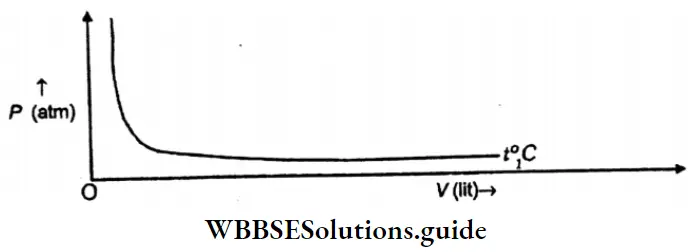
Question 21. What will be the nature of the graph is P is plotted against V for a given mass of gas at constant temperature?
Answer:

Explanation of graph: On plotting P against volume V fat at a given temperature, the graph will be a rectangular hyperbola as shown below.

Rectangular Hyperbala


Question 22. When a balloon inflates, it seems to violate Boyle’s law. Explain.
Answer:

When a balloon inflates, it seems to violate Boyle’s law.

Explanation: When a rubber balloon is inflated with the end of a pump, the pressure inside increases but the volume instead of suffering, decreases in accordance with Boyle’s law increases.

This happens because, with the introduction of air, the mass of the gas increases resulting in an increase in volume Thus, inflation of a balloon by mouth or pump appears to violate Boyle’s law but it is not so in the true sense.

Question 23. Deduce the mathematical expression of Charle’s law.
Answer:

The mathematical expression of Charle’s law:

Let Vo be the volume of a definite mass of a gas at 0°C, then the volume of 1°C rise in temperature will be = \(\left(\mathrm{Vo}+\mathrm{Vo} \times \frac{1}{273}\right)\)

The volume of t°C rise in temperature will be = \(\mathrm{Vo}+\mathrm{Vo} \times \frac{1}{273}\)

If Vt represents this volume at t°c

It \(V t+V_0+V_o+\frac{t}{273}=V_0\left(1+\frac{t}{273}\right)\)

similarly, when the temperature at the same mass of gas is gradually made to decrease its volume at t°C is given by

\(V t+V o+V o \times \frac{l}{273}=V_0\left(1-\frac{l}{273}\right)\)

“WBBSE Class 10 Behaviour of Gases short answer questions, Physical Science Chapter 2”

Question 24. Establish the combined law of Boyle’s and Charle’s laws.
Answer:

Combination of Boyle’s law and Charle’s law:

Let V be the volume of a given mass of gas at pressure P and temperature T (absolute)

From Boyle’s law, \(\mathrm{V} \propto \frac{1}{\mathrm{P}}\) [When temperature and mass of the gas are constant]

From Charle’s law, V α T [When pressure and mass of the gas are constant]

∴ \(V \propto \frac{T}{P}\) when both T and P vary.

or, \(V=\frac{K T}{P} \text { or, } \frac{P V}{T}=K[K \text { constant }]\)

Now, if V1 is the volume of a gas at pressure P1 and temperature T1 and V2 is the volume of the same amount of gas at pressure P2 and temperature T2 then,

\(\frac{P_1 V_1}{T_1}=\frac{P_2 V_2}{T_2}\)

“WBBSE Class 10 Physical Science Chapter 2, Behaviour of Gases important short answer questions”

Question 25. Define-Partial law.
Answer:

Partial law: The partial pressure of any constituent gas or vapour in a mixture is defined as the pressure which the said gas would exert if it alone had occupied the entire volume occupied by the mixture, with temperature in both cases remaining the same.

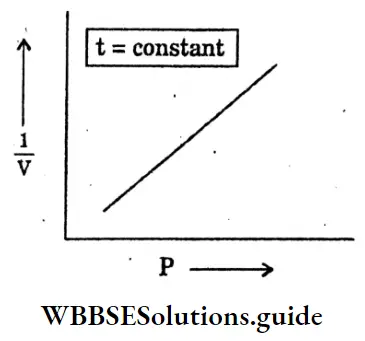
Question 26. Draw a graph between pressure (P) vs volume (1/V) at constant pressure.
Answer:

Pressure Between Volume At Constant Pressure


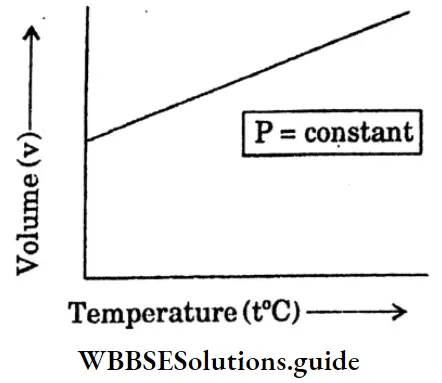
Question 27. Draw V vs t at constant pressure (P) for Charles law.

Answer:

Constant Pressure For Charles Law


“Class 10 WBBSE Physical Science Chapter 2, Behaviour of Gases short answer key”

Question 28. What is the relation between pressure and density at a constant temperature?
Answer:

The relation between pressure and density at a constant temperature

The density of a gas at a constant temperature is proportional to pressure.

\(\frac{P}{P}=\text { Constant. }\)

WBBSE Class 10 Physical Science Solutions

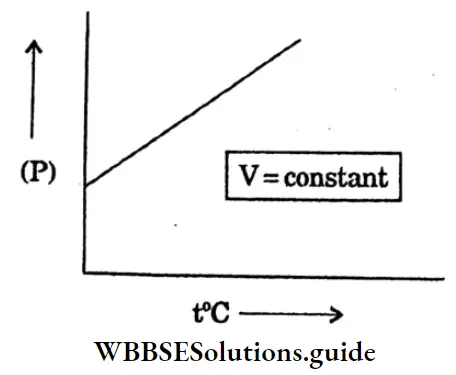
Question 29. Draw a graph of pressure (P) VS temperature (t) at constant volume.
Answer:

Pressure Between Temperature At Constant Volume


WBBSE Solutions For Class 10 Physical Science And Environment Chapter 4 Thermal Phenomena

WBBSE Class 10 Physical Science Solutions

Chapter 4 Thermal Phenomena MCQs

Question 1. What is the S.I. unit of Heat?

  1. Joule
  2. Calorie
  3. Kelvin
  4. Celsius

Answer: 1. Joule

Question 2. Two spheres made of material have radii in the ratio of 1: 2. Both are at the same temperature. The ratio of heat radiation energy emitted per second by them is :

  1. 1:2
  2. 1:8
  3. 1:4
  4. 1:16

Answer: 2. 1:4.

Question 3. The total number of divisions present in the fundamental interval of the Celsius scale is :

  1. 80
  2. 180
  3. 100
  4. 120

Answer: 3. 100.

Read And Learn More: WBBSE Solutions For Class 10 Physical Science And Environment

Question 4. 1 Calorie is equal to :

  1. 4.2J
  2. 4.2 erg.
  3. 1J
  4. 1.8 k

Answer: 1. 4.2J

“WBBSE Class 10 Physical Science and Environment Chapter 4 solutions, Thermal Phenomena”

Question 5. The rate of cooling at 600 K, if the surrounding temperature is 300k is R, The rate of cooling at 900 K is :

  1. \(\frac{16}{3} R\)
  2. 2R
  3. 3R
  4. \(\frac{2}{3} R\)

Answer: 1. R.

WBBSE Solutions For Class 10 Physical Science And Environment Chapter 4 Thermal Phenomena

Question 6. If Im denotes the wavelength at which the radiative emission from a black body at a temperature TK is maximum, then

  1. λm α T
  2. λm α T2
  3. λm does not depend on T
  4. λm α T-1

Answer: 4. λm α T-1

Question 7. A body cools from 50°C to 40°C in 5 minutes. Its temperature comes down to 33.33°C in the next 5 minutes. The temperature of the surroundings is :

  1. 15°C
  2. 20°C
  3. 25°C
  4. 10°C

Answer: 2. 20°C.

“Class 10 WBBSE Physical Science and Environment Chapter 4 solutions, Thermal Phenomena study material”

Question 8. The volume of water is minimum at :

  1. 4°C
  2. 10°C
  3. 5°C
  4. 9°C

Answer: 1. 4°C.

Question 9. The density of water is maximum at :

  1. 40°C
  2. 4°C
  3. 10°C
  4. 25°C

Answer: 2. 4°C.

Question 10. The coefficient of linear expansion of a solid depends on :

  1. Unit of length
  2. Scale of temperature
  3. Density of the material
  4. None of these

Answer: 2. Scale of temperature.

Question11. A good insulator of heat is:

  1. Copper
  2. Mercury
  3. Trapped air
  4. Iron

Answer: 3. Trapped air.

“WBBSE Class 10 Physical Science Chapter 4, Thermal Phenomena solved examples”

Question 12. A body cools from 60°C to 50°C in 10 min. If the room temperature is 25°C, the temperature of the body at the end of the next 10 min. will be :

  1. 38.5°C
  2. 40°C
  3. 45°C
  4. 42.85°C

Answer: 4. 42.85°C.

Physics Class 10 WBBSE

Question 13. A black body has a maximum wavelength Im at 2000K. Its corresponding wavelength at 3000K will be :

  1. \(\frac{3}{2} \lambda \mathrm{m}\)
  2. \(\frac{2}{3} \lambda \mathrm{m}\)
  3. \(\frac{16}{81} \lambda \mathrm{m}\)
  4. \(\frac{81}{16} \lambda \mathrm{m}\)

Answer: 2. \(\frac{2}{3} \lambda \mathrm{m}\)

Question 14. If the temperature of a block body is doubled, the wavelength at which the spectral radiancy has its maximum is :

  1. Doubled
  2. Halved
  3. Quadrapled
  4. Unchanged

Answer: 2. Halved.

“WBBSE Class 10 Thermal Phenomena solutions, Physical Science and Environment Chapter 4”

Question 15. A body takes T minutes is cool from 62°C to 61°C when the surrounding temperature is 30°C. The time taken by the body to cool is 30°C. The time taken by the body to cool 46°C to 45°C is:

  1. Greater than T minute
  2. Equal to T minute
  3. Equal to \(\frac{T}{2}\)
  4. Less than T minute

Answer: 1. Greater than T minute.

Class 10 Maths Class 10 Social Science
Class 10 English Class 10 Maths
Class 10 Geography Class 10 Geography MCQs
Class 10 History Class 10 History MCQs
Class 10 Life Science Class 10 Science VSAQS
Class 10 Physical Science Class 10 Science SAQs

Question 16. Heat given to a body which rises its temperature by 1°C is :

  1. Water equivalent
  2. Specific heat
  3. Temperature gradient
  4. Thermal capacity

Answer: 4. Thermal capacity.

Question 17. During the adiabatic process, the pressure of a gas is found to be proportional to the cube of its absolute temperature.

The ratio \(\frac{C P}{C V}\) for gas is.

  1. \(\frac{4}{3}\)
  2. 2
  3. \(\frac{5}{3}\)
  4. \(\frac{3}{2}\)

Answer: 4. \(\frac{3}{2}\)

Question 18. Two bars of copper having the same length but unequal cross-section are heated to the same temperature. The change in length will be :

  1. Equal in both bars
  2. More in thinner bar
  3. More in thicker bar
  4. Cannot say

Answer: 1. Equal in both bars.

Question 19. A gaseous mixture consists of 16g of Helium and 16g of Oxygen. The ratio \(\) of the mixture is :

  1. 1.54
  2. 1.4
  3. 1.63
  4. 1.59

Answer: 3. 1.63.

“Class 10 WBBSE Physical Science and Environment Chapter 4, Thermal Phenomena easy explanation”

Question 20. The specific heat of a gas in a gas in an isothermal process is:

  1. Infinite
  2. Zero
  3. Negative
  4. Remains zero

Answer: 1. Infinite.

WBBSE Class 10 Physical Science Question Answer

Question 21. What is the upper fixed point in the Fahrenheit scale?

  1. 212°F
  2. 232°F
  3. 202°F
  4. 211°F

Answer: 1. 212°F.

Question 22. The Fahrenheit and Kelvin scales of temperature will have the same reading at :

  1. – 40
  2. 313
  3. 574.25
  4. 732.25

Answer: 1. – 40.

Question 23. At what temperature, the volume of an ideal gas at 0°C becomes triple?

  1. 182°C
  2. 819°C
  3. 546°C
  4. 646°C

Answer: 3. 546°C.

“WBBSE Class 10 Physical Science Chapter 4 solutions, Thermal Phenomena PDF”

Question 24. The specific heat of ice at 0°C melting into at 0°C is :

  1. Zero
  2. Infinity
  3. More than zero
  4. Less than zero

Answer: 2. Infinity.

Question 25. Boiling water is changing into steam. The specific heat of boiling water is :

  1. Zero
  2. One
  3. Infinity
  4. Less than one
  5. Answer: 3. Infinity.

WBBSE Class 10 Physical Science Question Answer

Question 26. Which of the following has the highest specific heat?

  1. Copper
  2. Water
  3. Hydrogen
  4. Silver

Answer: 3. Hydrogen.

Question 27. One gram of ice at 0°C is added at 5g of water to 10°C. The final temperature of the mixture is

  1. -5°C
  2. 5°C
  3. 0°C
  4. None of these

Answer: 1. – 5°C.

Question 28. The specific heat of an ideal gas varies with temperature T as:

  1. T1
  2. T2
  3. T-1
  4. T0

Answer: 4. T0 .

Question 29. 22g CO2, at 27°C is mixed with 16g of Oxygen at 37°C. The temperature of the mixture is:

  1. 32°C
  2. 27°C
  3. 37°C
  4. 30°C

Answer: 1. 32°C.

Question 30. A balloon contains 500 m3 of He at 27°C and 1 atmosphere pressure. The volume of He at -3°C and 0.5 atmosphere pressure will be :

  1. 70m3
  2. 900m3
  3. 1000m3
  4. 500m3

Answer: 2. 900 m3.

“WBBSE Class 10 Physical Science Chapter 4, Thermal Phenomena important questions”

Question 31. 100g of ice is mixed with 100g of water at 100°C. The final temperature of the mixture is :

  1. 10°C
  2. 20°C
  3. 40°C
  4. 30°C

Answer: 1. 10°C.

Question 32. For making a thermometer quick-acting.

  • The bulb of the thermometer should be of greater volume
  • The bulb of the thermometer should be of less volume
  • The bulb of the thermometer should be spherical

Answer: 2. Bulb of the thermometer should be of less volume

Question 33. The water equivalent of a body is 10 kg. Its thermal capacity is :

  1. 10JK-1
  2. 1JK-1
  3. 42000J.K-1

Answer: 3. 42000 J.K-1

Question 34. The liquid whose specific heat is the highest is :

  1. Water
  2. Alcohol
  3. Kerosene

Answer: 1. Water.

Question 35. Thermal capacity of 10g. a liquid having specific heat 0.03 in the CGS system is :

  1. 3cal.°C-1
  2. 30Cal.°C-1
  3. 33.3 Cal.°C-1
  4. 30 kelvin

Answer: 1. 3 Cal. °C-1

Question 36. If the temperature of a body is increased by 36° in the Fahrenheit scale then this increase in Celsius scale will be :

  1. 20°
  2. 36°
  3. 64.8°
  4. 55.9°

Answer: 1. 20°.

“Class 10 Physical Science and Environment Thermal Phenomena solutions, WBBSE syllabus”

Question 37. An equal amount of heat is given to two liquids A and B of equal mass. The specific heat of B is twice that of A. The ratio of the rise in temperature of A and B will be :

  1. 1:1
  2. 1:2
  3. 2:3
  4. 2:1

Answer: 4. 2:1.

Question 38. 1°C change = _______ °F Change

  1. \(\frac{9}{6}\)
  2. \(\frac{9}{5}\)
  3. \(\frac{5}{9}\)
  4. \(\frac{16}{9}\)

Answer: 2. \(\frac{9}{5}\)

Question 39. The thermal capacity of a unit mass of a body is called its :

  1. Specific heat
  2. Mass
  3. Material temperature

Answer: 1. Specific heat.

Question 40. 0°C = ________ °F

  1. 32
  2. 40
  3. – 40
  4. -32

Answer: 1. 32.

WB Class 10 Physical Science Question Answer Chapter 4 Thermal Phenomena Very Short Answer Type Questions

Question 1. What is the fundamental principle of Calorimetry?
Answer: Heat lost by lost Heat gained by a cold body.

Question 2. What is the unit of coefficient of thermal conductivity in SI?
Answer: Wm K-1.

Question 3. Name the element which is the best conductor of heat.
Answer: Silver.

Question 4. What is the absorbing power of a perfectly black body?
Answer: One.

Question 5. What is the reflecting power of a perfectly black body?
Answer: Zero.

Question 6. What is an anomalous expansion of water?
Answer: In the range of 0°C to 4°C, the volume of water decreases instead of increasing, like other liquids. This is known as anomalous expansion of water.

Question 7. What is a perfectly black body?
Answer: A body which absorbs all radiations incident it.

Question 8. By which mode does the heat reach the earth from the Sun?
Answer: Radiation.

“WBBSE Class 10 Chapter 4 Physical Science, Thermal Phenomena step-by-step solutions”

Question 9. Can convection take place in a solid?
Answer: No, for convection a fluid medium is required.

Question 10. What is the difference between 1°C and IC°?
Answer: 1°C is a particular temperature, while 1C° is the interval of one degree Celsius of temperature.

Question 11. Which is more expansible -solid, liquid or gas?
Answer: gas.

Question 12. Is the coefficient of linear expansion possible in the case of a liquid?
Answer: No, liquid has no definite length.

Question 13. What is the value of latent heat of fusion of ice in the CGS system?
Answer: 80 Calg-1.

Question 14. Is it possible that heat is supplied to a body without changing the temperature?
Answer: Yes, during a change of state there is no change in temperature although heat is supplied.

WB Class 10 Physical Science Question Answer

Question 15. Is there any upper fixed point in the Kelvin Scale?
Answer: 273.13K, which is the triple point of water.

Question 16. What is the reading of 27°C on the absolute scale?
Answer: The reading of the temperature in the absolute scale (273 + 27) 300K

Question 17. Which liquid has the highest specific heat?
Answer: The specific heat of water is the highest.

Question 18. Of 0°C and 0°F which one is less?
Answer: Of 0°C and 0°F, 0°F is less.

Question 19. How much work is to be performed to produce 1 cal heat?
Answer: To produce 1 cal heat, 4.2 × 10⁷ erg or 4.2J work is to be performed.

Question 20. Of a liquid and a solid, whose specific heat is greater?
Answer: Usually specific heat of solids is less than that of liquids.

Physics Class 10 WBBSE Chapter 4 Thermal Phenomena Fill In The Blanks

Question 1. γr = γa  + ________.
Answer: γg

Question 2. The volume of water is minimum at _________.
Answer: 4°C.

Question 3. The density of water is maximum at __________.
Answer: 4°C.

Question 4. Carbon dioxide is a ________ gas.
Answer: Greenhouse.

“WBBSE Maths Class 10 Thermal Phenomena, Chapter 4 key concepts”

Question 5. The unit of thermal conductivity in the CGS system is _________.
Answer: Cm2S-1.

Question 6. From Charle’s law, we find y = _________°C-1
Answer: \(\frac{1}{273}\)

Question 7. From pressure law, we find γv = _________ °C-1
Answer: \(\frac{1}{273}\)

Question 8. The specific heat of the water in the SI system is
Answer: 4200 J Kg-1 K-1.

Question 9. The unit of thermal conductivity in the SI system is _________.
Answer: Jm-1 S-1 K-1

Question 10. 1 calorie = ________ Jule.
Answer: 4.18

Question 11. Heat is a form of _________.
Answer: Energy.

Question 12. Three different types of motions are translational motion, vibrational motion and _________.
Answer: Rotational motion.

Question 13. SI unit of heat is _________.
Answer: Joule.

Question 14. Temperatures are measured with a __________.
Answer: Thermometer.

Question 15. _________ is the upper fixed point in the Fahrenheit scale.
Answer: 212° F

Question 16. Three types of expansions in solids are linear expansion, superficial expansion and _________.
Answer: Volume expansion

Question 17. Real expansion of the liquid = expansion of the vessel + _________.
Answer: Apparent expansion of the liquid.

Question 18. The specific heat of a gas in an isothermal process is :
Answer: Infinite

Question 19. The specific heat of an ideal gas varies with temperature T as ___________.
Answer: T0

Question 20. 100g of ice is mixed with 100g of water at 100°C. The final temperature of the mixture is __________.
Answer: 10°C.

Question 21. Wax _______ definite melting point.
Answer: Has no.

Question 22. The unit of latent heat in SI is
Answer: J.Kg-1

Question 23. A mixture of ice and common salt is known as ________.
Answer: Freezing mixture.

Question 24. With the increase of pressure boiling point of water _______.
Answer: Increases.

Question 25. The amount of heat required to convert 2g of water at 100°C completely into steam at the same temperature is ________.
Answer: 200 cal.

Question 26. If the air contains more water vapour then rate of evaporation _________.
Answer: Decreases.

“WBBSE Class 10 Physical Science Chapter 4, Thermal Phenomena summary”

Question 27. If 80 cal of heat is given to lg of ice at 0°C, its temperature will be
Answer: 0°C.

Question 28. _______ has the highest specific heat.
Answer: Hydrogen

Question 29. 100g. of ice is mixed with 100g of water at 100°C. The final temperature of the mixture is _______.
Answer: 10°C

Question 30. ________ is the best conductor of heat.
Answer: Silver.

Class 10 Physical Science Solution WBBSE Chapter 4 Thermal Phenomena Short Answer Type Questions

Question 1. What do you mean by heat?
Answer:

Heat: It is a form of energy which produces a sensation of warmth.

Question 2. What are the different types of solutions?
Answer:

Different types of motions are

  1. Translational motion
  2. Vibrational motion
  3. Rotational motion

Question 3. What is the definition of heat with respect to motion?
Answer:

Definition of heat with respect to motion:

Heat possessed by a body is the total thermal energy of the body and is the sum of kinetic energies of all the individual molecules forming the body due to translational, vibrational and rotational to translational, vibrational and rotational motions of molecules.

Question 4. What is temperature?
Answer:

Temperature: It is the thermal condition of a body that determines the direction of flow of heat when the body is placed in thermal contact with another body.

Question 5. What do you mean by calorie?
Answer:

Calorie

Calorie It is the quantity of heat required to raise the temperature of 1 g water through 1°C.

“WBBSE Class 10 Physical Science Chapter 4 Thermal Phenomena, definitions and examples”

Question 6. What is the upper fixed point of a thermometer?
Answer:

Upper fixed point: It is the temperature of steam from water boiling under a pressure of 86cm. of mercury at sea pressure of 76 cm. of mercury at sea level and 45° latitude.

Question 7. What is the water equivalent of a body?
Answer:

Water equivalent: The water equivalent of a body is the mass of water that will be heated through one degree by the amount of heat that raises the temperature of the body through one degree.

WBBSE Solutions Guide Class 10

Question 8. What is molar-specific heat at constant pressure? (CP)?
Answer:

Molar-specific heat at constant pressure:

The molar specific heat of a gas at constant pressure (CP) is the amount of heat required to raise the heat required to raise the temperature of one mole of the gas through one degree keeping the pressure constant throughout.

Question 9. What is the lower fixed point of a thermometer?
Answer:

Lower fixed point: It is the temperature of melting ice under a pressure of 16 cm of mercury at sea level and 45° latitude.

Question 10. What is a fundamental interval?
Answer:

Fundamental Interval: The difference between the fixed point of a scale is called a fundamental interval.

Question 11. What do you mean by thermal expansion?
Answer:

Thermal Expansion: The dimension of all substances generally increases with an increase in temperature. The phenomenon is known as thermal expansion.

Question 12. What are the types of expansion in solids?
Answer:

Types of expansions in solid :

  • Linear expansions
  • Superficial expansions
  • Volume expansions.

Question 13. What is an apparent expansion of the liquid?
Answer:

Apparent expansion of the liquid: If the expansion of the liquid is measured ignoring the expansion is called the apparent expansion of the liquid.

Question 14. What is the real expansion of the liquid?
Answer:

Real expansion of the liquid: When the actual expansion of the liquid is measured by considering the expansion of the containing vessel, it is called real expansion of the liquid.

Question 15. What is the conclusion of Hope’s experiment?
Answer:

Conclusion of Hope’s experiment:

From Hope’s experiment, it is proved that water at the bottom is densest at 4°C. After a sufficiently long time, the temperature of the lower thermometer falls slightly due to loss of heat by conduction to the upper regions.

Question 16. What is molar-specific heat at constant volume (CV)?
Answer:

Molar specific heat at constant volume (Cv): The molar specific heat of a gas at constant volume (Cv) is the amount of heat required to raise the temperature of one mole of the gas through one degree keeping the volume constant throughout.

Question 17. What is Regelation?
Answer:

Regelation: The phenomenon of melting of ice under pressure and freezing again on releasing the pressure is called regelation.

Question 18. What do you mean by the vapour pressure of a liquid?
Answer:

Vapour pressure: Whenever a liquid evaporates at any temperature, the vapour exerts a definite pressure on everything in contact. This pressure is called the vapour pressure of the liquid a that temperature.

Question 19. What is the conduction of heat?
Answer:

Conduction: It is the process of the transfer of heat through a substance without any detectable motion of the particles of the substance.

Question 20. What is the Radiation of heat?
Answer:

Radiation: It is the transmission of heat from a hot body to a cold body without the help of any medium and without appreciable heating at the intervening medium if any.

Question 21. What is the perfectly black body?
Answer:

Perfectly black body: A perfectly black body is that which absorbs completely the radiations of all the wavelengths on it.

Question 22. What is the greenhouse effect?
Answer:

Greenhouse effect: The greenhouse effect is an example of the selective absorption of heat by glass. The amount of heat transmitted through a substance depends on the temperature of the source of heat.

“WBBSE Class 10 Physical Science Thermal Phenomena, revision notes”

Question 23. What is the convection of heat?
Answer:

Convection of heat: It is the process by which heat is transmitted through a liquid or gas from a hotter point to a colder point due to the bodily motion of the heated particles of the substances.

Question 24. What do you mean by global warming?
Answer:

Global warming: Carbon dioxide, water vapour, methane, nitrous oxide, tropospheric ozone, chloro-fluoro carbon compounds, halogens compounds etc. Increasing the amount of greenhouse gases in the atmosphere, the temperature of earth increases, It is known as global warming.

Question 25. What is the thermal expansion of solids?
Answer:

Thermal expansion of solids

The dimensions of all substances increase with the increase in temperature. The phenomenon is known as the thermal expansion of solids.

Question 26. Define the coefficient of linear expansion of a solid.
Answer:

The coefficient of linear expansion of a solid

The coefficient of linear expansion is defined as the fractional increase in the length of the solid per degree rise in temperature.

Question 27. How do you relate the coefficient of linear expansion of a rod with the length and temperature?
Answer:

The increase in the length of the rod due to heating is very nearly proportional to the length of the rod and the rise in temperature.

Question 28. Define the coefficient of superficial Expansion.
Answer:

The coefficient of superficial Expansion

The coefficient of superficial expansion of a solid is defined as the fractional change in its temperature.

Question 29. Define the coefficient of cubical expansion of a solid.
Answer:

The coefficient of cubical expansion of a solid is defined as the fractional increase in the volume of the solid per degree rise in temperature.

Question 30. A brass disc fits tightly into the base of the steel plate. Should you apply heat in order to remove the disc from the base?
Answer:

  • The coefficient of linear expansion of brass is greater than that of steel. So if we apply heat then the brass disc will fit more tightly into the base. But it we cool the concerned region.
  • Then the decrease in the diameter of the brass disc will be more than that of the base of the steel plate. So the disc will become loose and can be easily removed from the bore.

Question 31. Define the apparent thermal expansion of liquids.
Answer:

When the expansion is measured by ignoring the expansion of the containing vessel it is called the apparent expansion of the liquid.

Question 32. What do you mean by the coefficient of real expansion of liquid?
Answer:

Coefficient of real expansion of liquid

The coefficient of real expansion of liquid is the fraction of its volume by which it actually expands at are degree rise in temperature.

Question 33. Write the relation between the expansion coefficient of liquid. Yr = Ya + Yg.
Answer:

Relation between the expansion coefficient of liquid. Yr = Ya + Yg

Yr = Coefficient of real expansion of a liquid

Ya = Coefficient of apparent expansion of liquid

Yg = coefficient of volume expansion of the material of the vessel.

Question 34. What is a weight thermometer?
Answer:

Weight thermometer

The coefficient of apparent expansion of a liquid may be determined with a thermometer, it is called a weight thermometer.

Question 35. Power Supply lines or telephone lines are slightly sagged, why?
Answer:

Power Supply lines or telephone lines are slightly sagged,

The lines contract being cooled in winter. If they are kept taught before two plates, then due to the thermal stress. Lives may tumble or the lines may srap.

“Class 10 WBBSE Physical Science Chapter 4 Thermal Phenomena, multiple-choice questions”

Question 36. A breaker is filled to the brain with water at 4°C. What will you notice if the temperature is decreased or increased? Give reasons for your answer.
Answer:

A breaker is filled to the brain with water at 4°C

The density of water is greatest at 4°C, and the volume of a given mass of water is least at that temperature. As the bear was filled to the brim, in both cases, the wafer overflowed from the beaker.

Question 37. The state of a fixed mass of a gas at constant temperature is inversely proportional to its pressure.
Answer:

\(V \alpha \frac{1}{p}\)

Question 38. Write the relation between the pressure and density of a gas at a constant pressure.
Answer:

The density of a gas at a constant temperature is proportional to pressure \(\frac{p}{\ell}\) = constant (P = pressure p = pressure)

Question 39. State Charles’ law.Question
Answer:

Charles’ law

The pressure remaining constant, the volume of a given mass of any gas increases or decreases by the constant fraction \(\frac{1}{273}\) of its volume at 0°C, for every degree Celsius increases or decreases of temperature.

“WBBSE Class 10 Thermal Phenomena solutions, Chapter 4 worksheet”

Question 40. Define the volume coefficient of a gas.
Answer:

The volume coefficient of a gas

The volume coefficient (yp) of a gas may be defined as the fractional increase in the volume of the gas at 0°C for each degree Celsius rise in temperature, the pressure being kept constant.


WBBSE Solutions For Class 10 Physical Science And Environment

WBBSE Solutions For Class 10 Physical Science And Environment

WBBSE Madhyamika Model Question Paper 2023 Physical Science And Environment Set 2

WBBSE Class 10 Physical Science Question Answer In English

Multiple Choice Questions Physical Science And Environment

Question 1.  Which among the following gases absorb long wavelength infrared radiation emitted from the earth’s surface

  1. N2
  2. O2
  3. CH3
  4. He

Answer: 3. CH3

Question 2. At STP, 2-24 L is occupied by

  1. 4.4 g CO2
  2. 0.64g SO
  3. 28 g CO
  4. 16g O. [C= 12. O -16. S = 32]

Answer: 1. 4.4 g CO2

Read And Learn More: WBBSE Solutions For Class 10 Physical Science And Environment

Question 3. How many molecules of CO2 will be produced when I mole C reacts completely with 1 mole O2?

  1. 6.022 x 10²³
  2. 1.806 x 1024
  3. 6.022 x 10²²
  4. 6.022 x 1024

Answer: 3. 6.022 x 10²³

“WBBSE Madhyamika Model Question Paper 2023, Physical Science and Environment Set 2”

Question 4. For a solid, how many types of thermal expansion coefficients are there?

  1. One
  2. Two
  3. Three
  4. Four

Answer: 3. Three

WBBSE Madhyamika Model Question Paper 2023 Physical Science And Environment Set 2

Question 5. Which one of the following has the highest wavelength?

  1. x-ray
  2. y-ray
  3. Infrared ray
  4. Ultraviolet ray

Answer: 3. Infrared ray

Question 6. In the case of refraction if the angle of incidence and the angle refraction are 45° and 30° respectively, then the angle of deviation is

  1. 75°
  2. 15°
  3. 7-5°
  4. 37.50

Answer: 2. 15°

Question 7. Temperature remains unchanged if the potential difference between the two ends of a conductor is V and the current through the conductor is I, which of the following is true?

  1. V∞ I
  2. V∞ I2
  3. V ∞ I-1
  4. V ∞ r-2

Answer: 1. V∞ I

Question 8 . The relation among electromotive force (V), work (W) and charge (Q) is

  1. Q=WV
  2. Q=V/W
  3. Q=V/W2
  4. Q = W/V

Answer: 4. Q = W/V

Question 9. For the atom produced by ẞ-particle emission from a radioactive atom

  1. Mass number increases
  2. Atomic number increases
  3. Mass number decreases
  4. Atomic number decreases

Answer: 2. Atomic number increases

Question 10. To which group of the long 

  1. Group 1
  2. Group 16 (e)
  3. Group 17
  4. Group 2

Answer:  3. Group 17

Question 11. Solid state of which of the following compounds is composed of ions?

  1. Sodium chloride
  2. Hydrogen chloride
  3. Naphthalene glucose

Answer: 1. Sodium chloride

Class 10 Maths Class 10 Social Science
Class 10 English Class 10 Maths
Class 10 Geography Class 10 Geography MCQs
Class 10 History Class 10 History MCQs
Class 10 Life Science Class 10 Science VSAQS
Class 10 Physical Science Class 10 Science SAQs

Question 12. Which of the following has the highest ability to conduct electricity?

  1. Pure water
  2. An aqueous solution of Sugar cane
  3. Liquid hydrogen chloride
  4. Aqueous solution of acetic acid

Answer: 4. Aqueous solution of acetic acid

“Class 10 WBBSE Model Question Paper 2023, Physical Science and Environment Set 2 study material”

Question 13. In the first step of fixation of nitrogen which of the following compounds as a result of lightning

  1. NO
  2. NO2
  3. N2O5
  4. HNO3

Answer: 1. NO

Question 14. Which of the following is the formula of bauxite, ore of aluminum?

  1. Al2O3
  2. Al2O3H2O
  3. Al20O3 2H2O
  4. A1F3 . 3NaF

Answer: 3. Al20O3 2H2O

Question 15. Which of the following is the alkyl group containing two carbon atoms

  1. Methyl
  2. Ethyl
  3. Propyl
  4. Isopropyl

Answer: 2. Ethyl

Class 10 Physical Science WBBSE Physical Science And Environment Answer The Following Questions

Question 1. Write down the unit of calorific value of the fuel.
Or

Does the temperature increase of decrease with an increase in altitude in the strato- sphere?
Answer:

Kilo Joule/Kg OR The temperature increases.

Question 2. Which radiation, coming from the sun is prevented by the ozone layer from falling on the earth’s surface?
Answer: Ultra Violet Ray (UV ray).

Question 3. State whether the following. the statement is true or false: The volume of gas molecules is taken into consideration in Avogradro’s raw.
Answer: False.

Question 4. The product of volume and pressure of how many grams of Ni gas is 244 liter atmosphere at STP? [N= 14].
Answer: 280g.

Question 5. State whether the following statement is True or False: The constituent particles of a material change position during the conduction of heat through it.
Or, The width and the cross-section of a conductor remain unchanged, what is the relation between the thermal resistance and thermal conductivity of that conductor?
Answer: 

False or \(R_T \alpha \frac{1}{K}\) [d and A constant]

Question 6. What will lie the angle of incidence when a ray of light passes through the centre of curvature of a concave mirror?
Answer: 0°.

Question 7. How many rectangular surfaces are there in a prism?
Answer: 3.

Question 8. Give an example of a semiconductor.
Answer: Silicon (Si).

Question 9. A thin wire and a thick wire of the same conducting material have the same length. Which one of them will carry more current connected to the same potential difference?
Answer: Thick wire.

Question 10. Mention one misuse of the nuclear fission reaction.
Or
Which law explains the release of huge amounts of energy in nuclear fusion?

Answer:

Atom Bomb Or E = mc [m = Decreasing mass, C = Vacuum, E = Produced energy).

Question 11. Match the right column with the left column:

Left column- Right column

Oxide layers protect from attack by water vapor- AI

Group 1 cement of the logn periodic table having the least reducing property accelerates the rusting of iron – LI

When the metal remains exposed to air metal slowly develops green patches on its surface – Cu

Group 2 cement of the long periodic table having the least atomic radius – Bc

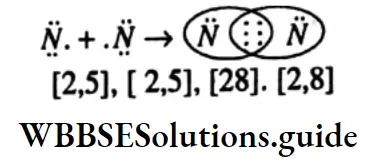
Question 12. Draw the Lewis dot structure of N? molecules, (atomic number of N is 7)
Answer:

WBBSE Madhyamik Model Question Paper 2023 Physical Science And Environment Set 2 Structure Of N Molecule

Question 13. Which kind of electricity is used in electrolysis?
Answer:
Direct Current (dc)
Or
Write down the cathode reaction in the electrolysis of acidulated water using platinum electrodes.
Answer:
H + e → H, H+H → H2

Question 14. In electroplating gold on brass, what is the electrolyte used?
Answer: Solution of Potassium Aurocyanide [K[Au(CN)2].

Question 15.What colour is formed in the reaction of ammonia with Nessler’s reagent?
Answer:
Copper-brown color.

“WBBSE 2023 Madhyamika Physical Science and Environment, Set 2 Model Question Paper download”

Question 16. Write down the formula of the precipitate formed when H’S gas is passed through an aqueous solution of silver nitrate.
Or
Write the name of the compound which is formed by the reaction of nitrogen with magnesium metal nl a high temperature.
Answer:
Ag2S or Magnesium Nitride (Mg2 N2).

Class 10 Physical Science WBBSE

Question 17. What is the value of the H-C-H bond angle in methane? 1 Or, Write the IUPAC name of CH CH2COOH- 1.
Answer:
109° 28′ OR Propanoic Acid.

Question 18. What is the industrial source of CGN7?
Answer: The gaseous substances contained in the petroleum mine or coal mine.

WB Class 10 Physical Science Question Answer Physical Science And Environment Answer The Following Questions

Question 1. What is the concept of sustainable development?
Answer:

The concept of sustainable development

Sustainable development means obtaining and utilizing natural resources discriminately so that they do not get exhausted completely, keeping the future generation in mind.

Question 2 . 1 g of a gas at 7°C and 2-atmosphere pressure occupies a volume of 410 mL. Determine the molar mass of the gas. (R=0-082 litre atmosphere mole’ 11C1}
Or
A fixed mass of gas occupies a volume of 273 cm3 at STP. At what pressure the above gas will occupy a volume of 300 cm3 at 27″C?2
Answer:

Given

1 g of a gas at 7°C and 2-atmosphere pressure occupies a volume of 410 mL.

Mass of gas (W) = 1 g.

Temperature (T) = 7° c=(273+7) k=280k.

Pressure(P0 = 2 atm and volume (v) = 410 ml =0.41L

Let the molar mass of gas = M

From PV = (\(\left(\frac{W}{M}\right)\))

M= \(\frac{W R T}{P V}\) Or,

M= \(\frac{1 \times 0.082 \times 280}{2 \times 0.41}\)

= 28

∴ The molar mass of gas = 28 g. mol-1                                       

Or

Answer: Primary Pressure of the gas (P1) = 76 cm mercury pressure, Temperature (T1)=273k and volume (V1)=273 cm and final temperature (T2)=(27+273) K = 300k, volume (V2)= 300 cm. Let, final pressure = P2.

From the combined law of Charles and Boyle’s

⇒ \(\frac{P_1 V_1}{T_1}=\frac{P_2 V_2}{T_2}\) Or

⇒ \(P_2=\frac{P_1 V_1 T_2}{T_1 V_2}\)

⇒ \(P_2=\frac{76 \times 273 \times 300}{273 \times 300}\)

P2= 76

∴ The final pressure of the gas = 76 cm mercury pressure

Question 3. What is the refractive index of a medium? 
Or
Which type of detection of vision is rectified a convex lens?
Answer:

The refractive index of a medium is \(\frac{\sin i}{\sin r}\) = 1μ2

That is the refraction of the second medium in respect of the first medium

WBBSE Madhyamik Model Question Paper 2023 Physical Science And Environment Set 2 Second In medium In Respect Of The First Medium

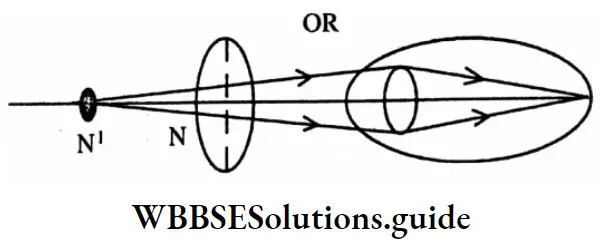
Suppose, near a person with a long type of defect of vision, there is point N and near his eyes, there is point N. The vocal length of the convex lens

will be such that after refraction through the lens the irregular image of point N1 is formed at point N1. So, the person sees point N1 at point N1

“WBBSE Madhyamika 2023 Physical Science and Environment, Set 2 Model Question Paper with solutions”

Question 4. Two resistances r1, and r2, when connected separately to the same potential difference, it was seen that the current flowing through r1, was six times the current flowing through r1. Determine the ratio of and r2
Answer:

Given

Two resistances r1, and r2, when connected separately to the same potential difference, it was seen that the current flowing through r1, was six times the current flowing through r1.

Let, Potential difference = V and through resistances r1 , and r2, the current following is I1 and I2 respectively.

I = 6I2

In case of  r1 V= I ______________(1)

In case of r2V = r____________ (2)

By comparing 1 and 2 we get

I1 r1 = I2r2

Or \(\frac{r_1}{r_2}=\frac{I_1}{I_2}=\frac{I_2}{6 I_1}=\frac{1}{6}\)

∴ r1 : r2= 1:6

Question 5. How did Kossel explain the formation of ionic bonds?
Or

Liquid hydrogen chloride cannot conduct electricity, but molten sodium chloride can conduct electricity. Explain.
Answer:

Koss el’s explanation –

  1. At the time of the chemical bond between two different elements, an electro-positive atom of the element gives out one or more electrons from its orbit and an other electro-negative atom of another element receives the refused electron in its outermost orbit.
  2. Thus, the two atoms, like their nearest neutral gas, gain a symmetrical electron pattern.
  3. Then, the Cation and the Anion with the coulombian attraction force, form an ionic bond.

Or
Hydrogen chloride is a compound with the same valency; so, there is no ion even when it is liquid. So, liquid hydrogen chloride is not able to conduct electricity.

Again NaCl is a ionic compound even in the solid state, it has Na* and Cl- ions in it.

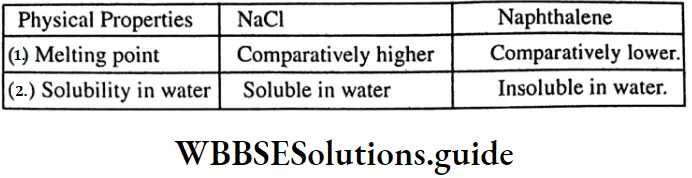
Question 6 . Distinguish between Sodium chloride and naphthalene by two physical properties.
Answer:

Difference between Sodium chloride and naphthalene by two physical properties

WBBSE Madhyamik Model Question Paper 2023 Physical Science And Environment Set 2 Physicla Properties

Question 7. Between two aqueous solutions, one is Ferric chloride and the other is Aluminium
chloride. How would you identify the Ferric chloride solution using an aqueous solution of ammonia? Answer with a balanced chemical equation.
Answer:

In two solutions, by adding the solution of ammonia separately, brown residual is formed. That solution can be identified as Ferric Chloride. Moreover, the other solution with white gum-like residual is the solution of aluminum chloride.

Equation:

FeCI3 +3NH4OH → Fe(OH)3↓+3NH4 CI

AICI3 +3NH4OH → Al(OH)3 +3NH4 CI

Question 8. Why zinc blend can be called both mineral and ore of zinc?
Or
Mention two ways of preventing rusting of iron.

Answer: Zinc blend (ZnS) is naturally hard and metallic are found in mines. Hence it is called the ore of zinc.
Or

  1. Galvanization or the layer of melted zinc on iron prevents rusting.
  2. Tar Clour etc. prevent rusting.

Question 9. Write with a balanced chemical equation what happens when methane is burnt in oxygen.
Or
Mention one use of each acetic acid and ethyl alcohol.
Answer:
CH4 (methane) +2O2 – CO2+H2O
Or

  1. Acetic Acid – Vinegar, preserves fish and flush, to cook pickle.
  2. Ethyl alcohol – Resin, scent artificial rubber and fiber, medicine when produced takes ethyl alcohol as a soluble agent.

WBBSE Class 10 Physical Science Question Answer Physical Science And Environment Answer The Following Questions

Question .1 What is meant by the moler volume of a gas? Mention two reasons for the deviation of real gases from the behavior of ideal gases.
Answer:

Moler volume of a gas:

In a certain temperature and pressure the volume of 1-mole quantity of a gaseous element is called the molar volume of the gas.

Ideal gas molecules are similar to mass point, but real gas molecules, no matter how small. They are, and cannot be ignored. Molecules of ideal gases have no force of attraction and distraction among them. Molecules of real gases show attractive force.

Question 2. How many grams of ammonium sulfate is required to prepare 558 g of by the reduction of Fe2O3 with Al at high temperature? How many moles of Fe2O3required in the reaction? [Fe=55 8. Al = 27.0 = 16]
Or
By heating 32.1 g ammonium chloride with calcium hydroxide 10.2g NH3 33.3 g CaCI, and 10.8 g H2O are obtained. How many grams of calcium hydroxide take part in the reaction? How many mole of NH3, and how many liters of NH3, at STP are formed in the reaction? (N = 14. H=1)
Answer

Fe2O3+2 Al→ 2Fe + Al2O3

2×278→  2×55.8g

2×55.8g Fe needs 2x27g Al.

558g Fe needs = \(\frac{2 \times 27 \times 558}{2 \times 55.8}\)

= 270g Al.

Again,

2x27g Al reacts with 1 mol Fe2O3.

270g Al reacts with mol Fe2O3

Or

Answer: As per the law of the regularity of mass, the mass of NH4 Cl+ mass of Ca(OH)2=

NH3 mass + CaCl2 mass + H2O mass

32.1g+ mass of Ca(OH)2

= 10.2g+33.3g + 10.8g

Or

Mass of Ca(OH)2= (10.2 +33.3 + 10.8)g-32.1g = 54.3g-32.1g = 22.2g

We know, 17g NH3 = 1 mol NH3

10.2g NH3 =\(=\frac{1}{17} \times 10.2 \mathrm{~mol}\)x 10.2 mol

= 0.6mol

In STP, 1 mol. NH, volume = 22.4litre

∴ 0.6 mol. NH3 volume = 22.4×0.6 litre = 13.44 litre.

“WBBSE Madhyamika Model Question Paper 2023, Physical Science and Environment Set 2 PDF”

Question 3. Which quantities remain fixed in the definition of the volume expansion coefficient of a gas? Name a non-metal which is a good conductor of heat.
Or
What is meant by ‘the linear expansion coefficient of copper is 17 x10-6 °C? Why does the value remain the same even in Kelvin scale?
Answer:

  1. The quantities remaining fixed are
  2. The pressure of the gas, and
  3. Mass of the gas.

Diamond is a nonmetal which is a good conductor of heat.
Or
The linear expansion coefficient of copper is 17×10-6 means if 1°C temperature is increased of any copper rod, the length of the rod will increase by 17×10-6 portion of the primary length of the rod.

Since the change of 1°C and the change of 1 K are the same, the value remains the same in Kelvin Scale also.

Question 4. What type of mirror is used by dentists? Why a ray of light does not deviate as a result of refraction through a glass slab?
Answer:

The dentists use a concave mirror

WBBSE Madhyamik Model Question Paper 2023 Physical Science And Environment Set 2 The Dentist Use Concave Mirror

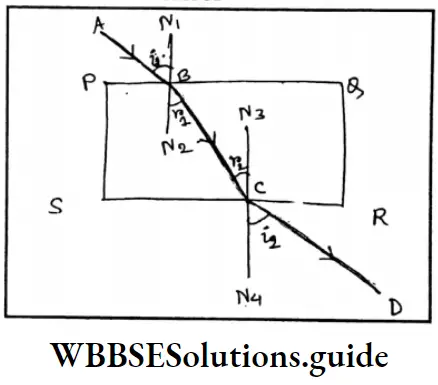
Here PQRS is a rectangular glass slab. ABCD is the direction of a ray of light. N1N2 and N3 N4 are two perpendiculars on B and C points where the reflection takes place. Al point B, because of refraction of light, ABN1 = (angle of incidence) and CBN2 =r, (refraction angle). At point C, because of refraction, BCN3 =r2 (angle of incidence) DCN4 = i2 (refraction angle).

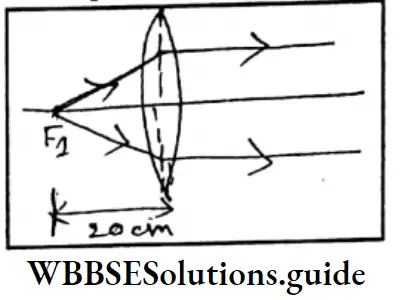
Question 5. When an object is placed 20 cm away from a convex lens, no image is obtained on either side of the lens. What is the focal length of the lens? If the refractive index of glass with respect to air is 1.5, what is the refractive index of air with respect to glass?
Or
The length of an object is 5 cm. An image of length 10 cm is obtained when it is placed at.a distance of 2 cm in front of a convex lens. What is the linear magnification and image distance?
Answer:

Given

The length of an object is 5 cm. An image of length 10 cm is obtained when it is placed at.a distance of 2 cm in front of a convex lens.

The slab of glass is rectangular. The two opposite sides are parallel. Hence,

⇒ N1 N2 II, N3 N4

Again N1 N2 II, N3 N4and transversal is BC.

<N2 C= <BCN3 (Alternative Angle)

r1 = r2 , Again, refraction angle i2 = i1 AB || CD i1 = i2.

∴ The ray does not deviate

The focal length of the lens = 20cm

At a distance of 20 cm from the convex lens, an object is placed. Then the refracted rays of light will be parallel.

∴ In respect of air, the refraction index of glass will be

⇒ \(g^\mu \text { air }=\frac{1}{\text { air } \mu g}=\frac{1}{1.5}\)

= 0.67

Air μg = 1.5

Or

Answer:

In respect of glass, a refractive index of air will be –

  1. Length of the object (h1) = 5cm
  2. Length of the image (h2 ) = 10cm

WBBSE Madhyamik Model Question Paper 2023 Physical Science And Environment Set 2 Glass Refractine Index

∴ Linear magnification = m

= \(\frac{h_2}{h_1}\)

= \(\frac{10}{5}\)

∴ m = 2

∴ Image distance (V) = mu = (2×2) m = 4cm.

“Class 10 WBBSE Madhyamika Model Question Paper 2023, Physical Science Set 2 practice questions”

Question 6. Write in brief the basic principle of hydroelectric power generation.
Answer:

The basic principle of hydroelectric power generation

The principle of hydropower is that the potential energy of water that is stored at great heights in the dam is changed to kinetic energy by allowing the water to flow at high speed. The kinetic energy of flowing water is utilized to produce electricity.

Question 7. A current of 1A flow when an electric bulb is connected to 220 V mains. What would be the current when the same bulb is connected to 110V mains?
Or
Find the ratio of resistances for two bulbs of 220V-60W and 220V-60W.
Answer:

A current of 1A flow when an electric bulb is connected to 220 V mains.

Potential difference (V2) = 220V and current flow in the bulb (I1) = 1A.

Again Potential difference (V2) = 110 V

Let, the current flow in the bulb for the second time = I,

Resistance of the bulb = R

∴ V1 =I1R ___________(1)

V2 =I2R______________(2)

∴ \(\frac{V_1}{V_2}=\frac{I_1}{I_2}\) Or,

⇒ \(I_2\frac{V_2 I_2}{V_1}\)

⇒ \(I_2\frac{110 \times 1}{220}\)

I2= 0.5A

Or

Answer:

R= \(\frac{V_2}{P}\)______________(1)

\(=\frac{220 \times 220}{60} \Omega\)____________(2)

\(\frac{110 \times 110}{60} \Omega\)____________(3)

⇒ \(2 \div 3=\frac{R_1}{R_2}=\frac{220 \times 220}{60} \times \frac{60}{110 \times 110}\)

= \(\frac{R_1}{R_2}\)

∴ R1 : R2

Question 8. Explain why a new element is formed by a particle emission but no new element is formed by y-ray emission from a radioactive element.
Answer:

The nature of a particle is like He2+

  1. From the nucleus of a radioactive element, when a particle is emitted, the mass number of the new nucleus is 4 units less.
  2. The atomic number is less by 2 units So, so a new element is formed a radioactive element.
  3. Again, the Y-ray has a small wavelength. It is electromagnetic. In the case of y-rays, the atomic number is unchanged So, no new element is formed.

Question 9. Write down Dobereiner’s law of triads. Arrange Cl, Br, I, F in increasing ‘order of their oxidizing power.
Or
What is the important conclusion of Moscley’s experiment? What is me impor- tance of this conclusion in regard to the periodic table?

Answer:

Dobereiner’s law of triads.

Dobereiner’s law of triads states that the atomic mass of the middle element of a triad is he arithmetic mean of the atomic masses of the two other elements. Increasing order of oxidizing power-1<Br<el<F.
Or
Answer: Mosley concluded that there were three unknown elements between aluminum and gold. There were only 92 elements up to and including uranium and 14 rare-earth elements.

The importance of this conclusion in the case of the periodic table:

  1. Mendeleev’s periodic law is rectified.
  2. The elements are arranged in the periodic table by atomic number instead of atomic masses.

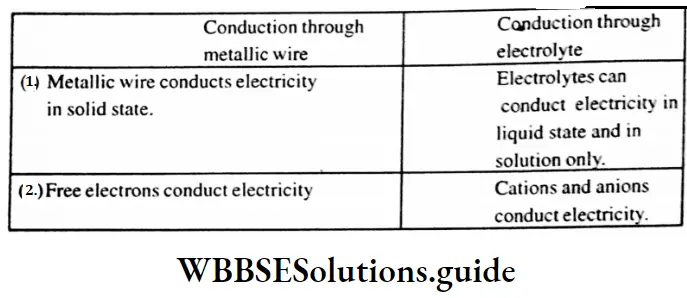
Question 10. Write two differences between the conduction of electricity through a metallic wire and an electrolyte during electrolysis. In the electrolytic refining of copper metal, impure copper rod is used as which electrode?’
Answer:

WBBSE Madhyamik Model Question Paper 2023 Physical Science And Environment Set 2 Conduction Through Metallic Wire And Conduction Through Electrolyte

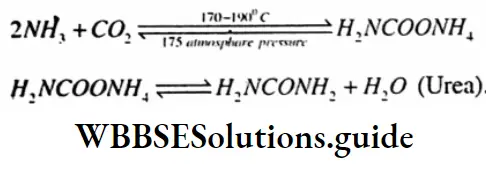
Question 11. Write the names of the chemicals used and the balanced chemical equation in the industrial production of urea.
Answer:

The chemicals are :

  1. Liquid ammonia
  2. Liquid CO2
  3. Balanced chemical equation

WBBSE Madhyamik Model Question Paper 2023 Physical Science And Environment Set 2 Balanced Chemical Euaqtion

“WBBSE Class 10 Model Question Paper 2023, Physical Science and Environment Set 2 exam pattern”

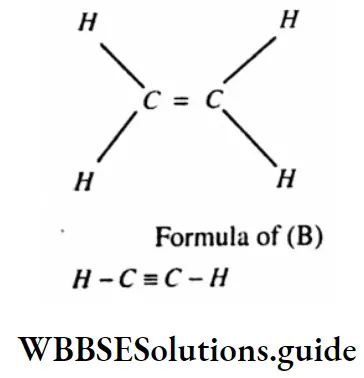
Question 12. (A) and (B) are two unsaturated hydrocarbons, each containing 2 carbon atoms. On reaction with bromine per molecule and (B) adds two molecules of bromine per molecule. Write the structural formula of (A) and (B). Write a balanced chemical equation of the reaction of (B) with bromine.
Answer:
Or
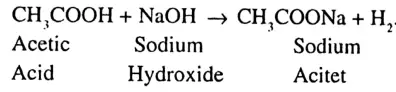
Write a balanced chemical equation of the reaction of sodium hydroxide with acid. Which one between
just and polyethylene is environment-friendly for packaging and why?

WBBSE Madhyamik Model Question Paper 2023 Physical Science And Environment Set 2 Hydrocarbons

(A) and (B) are two unsaturated hydrocarbons, each containing 2 carbon atoms. On reaction with bromine per molecule and (B) adds two molecules of bromine per molecule.

The balanced chemical equation of the reaction of (B) with bromine

HC ≡ CH+2Br2—CHBr2–CHBr2( 1, 1, 2, 2-Tetrabromithane)

Or

Answer:

The equation is –

WBBSE Madhyamik Model Question Paper 2023 Physical Science And Environment Set 2 The equation Of Acetic Acid

Jute is environment-friendly. It is formed with cellulose organic polymer. So, it is decomposed by bacteria and fungi, etc. easily. Hence, it is environmentally friendly.

WBBSE Solutions For Class 10 Physical Science And Environment Chapter 3 Chemical Calculations

WBBSE Class 10 Physical Science Question Answer In English

Chapter 3 Chemical Calculations MCQs

Question 1. Which of the following contains the least number of molecules?

  1. 1.12 LSO2 at STP
  2. 1 gm-mole SO2
  3. 32g SO2
  4. 4 x 10²³ molecules of SO2

Answer: 1. 1.12 L SO2 at STP.

Question 2. Who put forward the law of conservation of mass?

  1. Cannizzaro
  2. Lavoisier
  3. Dolton
  4. Ge Lusaka

Answer: 2. Lavoisier.

Read And Learn More: WBBSE Solutions For Class 10 Physical Science And Environment

Question 3. No. of atoms present in 3.7g. mole of nitrogen is :

  1. 4.45 x 1024
  2. 6.023 x 1024
  3. 1.204 x 1024
  4. 3.023 × 10²³

Answer: 1. 4.45 × 1024.

“WBBSE Class 10 Physical Science and Environment Chapter 3 solutions, Chemical Calculations”

Question 4. The balanced equation for the chemical equation :

Ag2 SO4 + BaCl2 → BaSO4+ AgCl is:

  1. Ag2 SO4 + BaCl2 = BaSO4 + AgCl
  2. Ag2 SO2+ BaCl2 = BaSO4 + 2AgCl
  3. Ag2 SO4 + 2BaCl2= 2BaSO4 + AgCl

Answer: 2. Ag2 SO2+ BaCl2 = BaSO4 + 2AgCl

Question 5. The balanced equation for the chemical equation :

FeCl3 + SnCl2  → FeCl2 + Sn Cl4 is :

  1. Fecl3 + 2 SnCl2 = FeCl2 + 2SnCl4
  2. 2FeCl4 + SnCl2 = 2FeCl2+ SnCl4
  3. 3FeCl3 + SnCl2 = 3 FeCl2 + SnCl4

Answer: 2.  2FeCl4 + SnCl2 = 2FeCl2+ SnCl4

WBBSE Solutions For Class 10 Physical Science And Environment Chapter 3 Chemical Calculations

Question 6. NaOH + HCl = NaCl + H2O; the type of reaction is :

  1. Substitution reaction
  2. Addition reaction
  3. Neutralization reaction

Answer: 3. Neutralization.

Question 7. Ammonium cyanate changes to urea on heating is an example of :

  1. Decomposition reaction
  2. Direct combination reaction
  3. Rearrangement reaction

Answer: 3. Rearrangement reaction.

Question 8. The chemical equation provides :

  1. Some information
  2. All information
  3. No information

Answer: 1. Some information.

Question 9. The balanced equation for the chemical equation

MnO2 + HCl → MnCl2 + Cl2 + H2O is:

  1. MnO2 + 2HCl = 2MnCl2 + Cl2 + H2O
  2. 2MnO2 + HCI = 2MnCl2 + Cl2 +H2O
  3. MnO2+3HCI = MnCl2+ 3Cl2 + 2H2O
  4. MnO2 + 4HCI = MnCl2+ Cl2+2H2O

Answer: 4. MnO2 + 4HCI = MnCl2+ Cl2+2H2O

Question 10. N2 + O2 = 2NO – Q Cal; this reaction is :

  1. Endothermic
  2. Exothermic
  3. Rearrangement
  4. Decomposition

Answer: 1. Endothermic.

Class 10 Maths Class 10 Social Science
Class 10 English Class 10 Maths
Class 10 Geography Class 10 Geography MCQs
Class 10 History Class 10 History MCQs
Class 10 Life Science Class 10 Science VSAQS
Class 10 Physical Science Class 10 Science SAQs

Question 11. Which of the following one takes part in a chemical reaction?

  1. Electron
  2. Proton
  3. Iron
  4. Positron

Answer: 1. Electron.

Question 12. NH3 + HCI = NH4Cl; it is a type of chemical reaction :

  1. Substitution
  2. Direct combination
  3. Addition reaction
  4. Rearrangement

Answer: 2. Direct combination.

Question 13. 27g of Al will react completely with how many grams of oxygen?

  1. 8g.
  2. 16g.
  3. 32g.
  4. 24g.

Answer: 4. 24g.

Question 14. The reaction in which two or more reactants combine directly forming molecules of new substances is called :

  1. Direct combination
  2. Neutralization reaction
  3. Addition reaction
  4. Decomposition

Answer: 1. Direct combination

Question 15. Calcium pyrophosphate is represented by the formula Ca2P2O7. The molecular formula of ferric pyrophosphate is :

  1. Fe2 (P2O7)4
  2. Fe2 (P2O7)
  3. Fe (P2O7)3
  4. Fe 4 (P2O7)3

Answer: 4. Fe 4 (P2O7)3

“Class 10 WBBSE Physical Science Chapter 3 solutions, Chemical Calculations study material”

Question 16. The chemical formula of a particular compound represents :

  1. The size of its molecule
  2. The shape of its molecule
  3. The total number of atoms in a molecule
  4. The number of different types of atoms in a molecule

Answer: 4. The number of different types of atoms in a molecule.

Question 17. The formula which represents the simple ratio of atoms in a compound is called :

  1. Empirical formula
  2. Molecular formula
  3. Rational formula
  4. Structural formula

Answer: 1. Empirical formula.

Question 18. If 0.5 mole of BaCl2 is mixed with 0-2 mol of Na3PO4, the maximum number of mol of Ba3 (PO4)2 that can be formed of:

  1. 0.7
  2. 0.5
  3. 0.30
  4. 0.10

Answer: 4. 0.10.

Question 19. 2.76 g. of silver carbonate on being strongly heated yields residue weighting:

  1. 2.4 8g
  2. 2.15g
  3. 2.32g
  4. 2.64g

Answer: 3. 2.32g.

Question 20. The reaction in which molecule or molecules of a compound break down into comparatively simpler molecules in the presence of heat or electricity is called :

  1. Decomposition
  2. Direct combination
  3. Double composition
  4. Neutralization reaction

Answer: 1. Decomposition.

Question 21. The balanced equation for the chemical equation :

2KCI03 → KCI +O2

  1. 2KCIO3 = 2KCI + 3O2
  2. KCIO2 = KCI + 2O2
  3. 4KCIO3  = 2KCI + 2O2

Answer: 1. 2KCIO2 = 2KCI + 3O2

Question 22. Fe+ S = FeS; it is a type of chemical reaction :

  1. Decomposition reaction
  2. Displacement reaction
  3. Combination reaction
  4. Dis placement reaction

Answer: 3. Combination reaction.

“WBBSE Class 10 Physical Science Chapter 3, Chemical Calculations solved examples”

Question 23. 1 amu = _________ g.

  1. 1.6605 10-24 g
  2. 1.660059 × 10⁻²³ g
  3. 1.66 x 10⁻¹¹ g
  4. 1.65 x 10⁻²¹ g

Answer: 1. 1.6605 10-24 g

Question 24. 2SO2 +O2…. 2SO3 ; What type of reaction is it?

  1. Reversible type of reaction
  2. Oxidation-reduction type of reaction
  3. Redox type of reaction

Answer: 1. Reversible type of reaction.

Question 25. A + B2 = A2 + B is an example of what type of reaction?

  1. Oxidation-reduction type of reaction
  2. Reversible type of reaction
  3. Redox type of reaction

Answer: 1. Oxidation – reduction type of reaction.

Question 26. CuO+H2 = Cu + H2O is an example of what type of reaction?

  1. Redox type of reaction
  2. Oxidation-reduction type of reaction
  3. Reversible type of reaction

Answer: 1. Redox type of reaction.

Question 27. Ag NO3 + NaCl = AgCl + NaN03 is an example of what type of reaction?

  1. Double decomposition type of reaction
  2. Direct combination type of reaction
  3. Substitution type of reaction

Answer: 1. Double decomposition type of reaction.

Question 28. What is the percentage of water in blue vitriol?

  1. 36.07 %
  2. 36.77%
  3. 49.07 %
  4. 55.77%

Answer: 1. 36.07%.

“WBBSE Class 10 Chemical Calculations solutions, Physical Science Chapter 3”

Question 29. 49g H2SO4 = ________ mole.

  1. 0.55 mol
  2. 0.5 mol
  3. 0.15 mol
  4. 0.1 mol

Answer: 2. 0.5 mol.

Question 30. The weight of oxygen obtained on heating 24.5g KCIO3 is :

  1. 19.6 g
  2. 29.6g
  3. 9.6 g
  4. 10.6g

Answer: 3. 9.6g.

Question 31. How much hydrogen is produced when steam is passed over 28kg of red hot iron?

  1. 1.33 kg
  2. 2.33 kg
  3. 3.33 kg
  4. 0.33 kg

Answer: 1. 1.33 kg.

Question 32. How much CaO is obtained from 10 kg? CaCO3 ?

  1. 5.6 kg.
  2. 6.6 kg
  3. 7.6 kg
  4. 3.6 kg

Answer: 1. 5.6 kg.

Question 33. NH4CNO (R) CO (NH2)2; What type of chemical reaction is it?

  1. Rearrangement reaction
  2. Substitution reaction
  3. Addition reaction

Answer: 1. Rearrangement reaction.

Question 34. In a balanced chemical equation, what sign needs to be placed instead of the arrow sign?

  1. Greater than sign
  2. Smaller than sign
  3. Equal to sign

Answer: 3. Equal to sign.

Question 35. Calcium carbonate contains what percentage of calcium?

  1. 40%
  2. 60%
  3. 50%
  4. 75%

Answer: 1. 40%.

Question 36. Zn + NaOH → H2 + ________.

  1. Na2 ZnO4
  2. Na2 ZnO2
  3. Na2 ZnO2
  4. NaZn 03

Answer: 2. Na2 ZnO2

Question 37. CO + Cl2 = COCl2What type of reaction is it?

  1. Rearrangement
  2. Substitution
  3. Addition

Answer: 3. addition.

Question 38. 2Mg + O2 = 2MgO; What type of chemical reaction is it?

  1. Neutralization reaction
  2. Substitution reaction
  3. Direct combination type of chemical reaction

Answer: 3. Direct combination type of chemical reaction.

Question 39. Molecular formula = _______ × empirical formula.

  1. n
  2. m
  3. t
  4. y

Answer: 1. n

Question 40. Atomic mass = Equivalent weight x _________.

  1. Volume
  2. Mass
  3. Valency
  4. Velocity

Answer: 3. Valency.

Chapter 3 Chemical Calculations Very Short Answer Type Questions

Question 1. State a limitation of a chemical equation.
Answer: A reaction whether exo-thermic or endo-thermic is not known from a chemical equation.

Question 2. Give an example of an addition reaction.
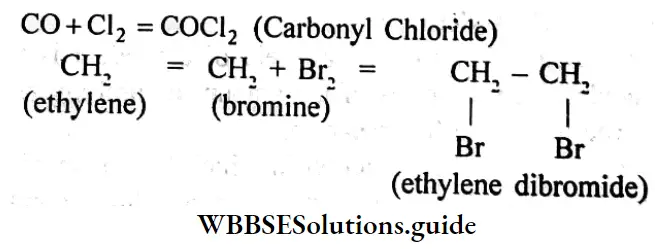
Answer: Carbon monoxide reacts with chlorine to form carbonyl chloride (COCL2) is an example of an addition reaction.

Question 3. What is the molecular weight of ammonium phosphate?
Answer: 149.

Question 4. How much CaCO3 will react with dil HCI to produce 22g CO2?
Answer: 50g.

Question 5. How much potassium chlorate is to be heated to produce as much oxygen as required to burn 6g, of carbon completely?
Answer: 40.83g

WB Class 10 Physical Science Question Answer

Question 6. Give an example of a thermal decomposition type of reaction.
Answer: Calcium carbonate on heating decomposes into calcium oxide and carbon dioxide is an example of a thermal decomposition type of reaction.

Question 7. What is the mole number of a substance?
Answer: \(\text { Mole number of a substance }=\frac{\text { Wt. of the substance in gram }}{\text { Gram-molecular weight of the substance }}\)

Question 8. How many grams of limestone are needed to get 48g? CO2?
Answer: 109.09g.

Question 9. How much quantity of silver chloride (AgCI) can be obtained from 1.0g silver nitrate?
Answer: 0.0844g.

Question 10. Balance the following reaction: Fe + H2O (R) Fe3O4 + H2
Answer: Balanced equation of \(\)

Question 11. Give an example of a substitution reaction.
Answer: Chlorine reacts with methane (CH4 ) to form successively CH3CI, CH2Cl2, CHCI3 and ultimately CCI4 in the presence of sunlight is an example of a substitution reaction.

\(\mathrm{CH}_4+\mathrm{Cl}_2 \stackrel{\text { Sunlight }}{\longrightarrow} \mathrm{CH}_3 \mathrm{Cl}+\mathrm{HCl}\) ⇒ \(\mathrm{CH}_3 \mathrm{Cl}+\mathrm{Cl}_2 \stackrel{\text { Sunlight }}{\longrightarrow} \mathrm{CH}_2 \mathrm{Cl}_2+\mathrm{HCl}\)

\(\mathrm{CH}_2 \mathrm{Cl}_2+\mathrm{Cl}_2 \stackrel{\text { Sunlight }}{\longrightarrow} \mathrm{CHCl}_3+\mathrm{HCl}\) ⇒ \(\mathrm{CH}_2 \mathrm{Cl}_3+\mathrm{Cl}_2 \stackrel{\text { Sunlight }}{\longrightarrow} \mathrm{CCl}_4+\mathrm{HCl}\)

Question 12. Give an example of a polymerization type of chemical reaction.
Answer: \(\mathrm{n}\left(\mathrm{CH}_2=\mathrm{CH}_2\right) \rightarrow\left(-\mathrm{CH}_2-\mathrm{CH}_2-\right) \mathrm{n}\)

Question 13. Give an example of is isomerization type of chemical reaction.
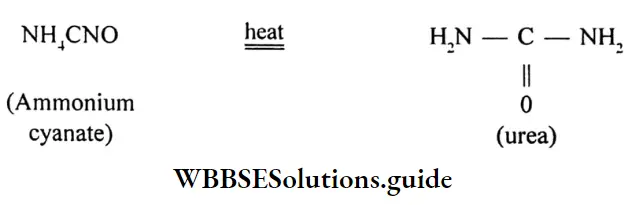
Answer: \(\mathrm{NH}_4 \mathrm{CNO} \rightarrow \mathrm{NH}_2 \mathrm{CONH}_2 \text { (Urea) }\)

Question 14. Write the relation between molecular weight and vapor density.
Answer: Molecular = 2 x vapor density.

“Class 10 WBBSE Physical Science Chapter 3, Chemical Calculations easy explanation”

Question 15. What is the atomic mass unit?
Answer: It is the quantity of mass equal to [latexl\frac{1}{12}[/latex]th of the mass of a carbon atom (12C)

l amu 1.6605 × 10⁻²⁴ g.

Question 16. What is solubility?
Answer: The amount of solute in grams that can be dissolved in 100 grams of a solvent to form a saturated solution at a definite temperature is called solubility.

Question 17. What is a gram’s atomic mass?
Answer: It is the atomic mass of an element expressed in grams.

Question 18. What is normality (N)?
Answer: It is the number of gram equivalents of solute dissolved per liter of a solution.

Question 19. Give an example of the catalytic type of chemical reaction.
Answer: \(\mathrm{N}_2+3 \mathrm{H}_2 \mathrm{Fe} \rightleftharpoons \mathrm{MO} 2 \mathrm{NH}_3\)

Question 20. What is atomic mass?
Answer: It is the average relative mass of an atom of an element as compared to the mass of a carbon atom (12C) taken as 12.

WB Class 10 Physical Science Question Answer Chapter 3 Chemical Calculations Fill In The Blanks

Question 1. KCIO3 → KCI + _________.
Answer: O2.

Question 2. The law of conservation of mass is shown to be ________ equation.
Answer: Valid.

Question 3. Fe + CuSO4= Cu + FeSO4; it is a _________reaction.
Answer: substitution.

Question 4. CuO + H2 = Cu + H2O; it is an ________ reaction.
Answer: oxidation-reduction.

Question 5. There are many
Answer: limitations.

Question 6. Zn + NaOH → H2 + __________.
Answer: Na2 ZnO2.

Question 7. mg + CO2→  _______ + C
Answer: MgO.

Question 8. 49g H2SO4 = ________ mole.
Answer: 0.5 mol.

Question 9. Calcium carbonate contains _______ % calcium.
Answer: 40.

“WBBSE Class 10 Physical Science Chapter 3 solutions, Chemical Calculations PDF”

Question 10. Molecular formula = n x ________.
Answer: Empirical formula.

Question 11. A symbolic chemical reaction may be called a chemical equation only when it is balanced by putting the least numerals as formulae in it.
Answer: Coefficients.

Question 12. CO + Cl2 = COCl2 : This is a ________
Answer: Reaction.

Question 13. Chemical reaction means a permanent ________ between the atoms or radicals of the combining substances.
Answer: Rearrangement.

Question 14. In a balanced chemical equation _______ sign is placed instead of the arrow sign.
Answer: Equal.

Question 15. MnO2 + HCl → MnCl2 + _______ + H2O.
Answer: Cl2

Question 16. From a chemical equation, the time required for the completion of the reaction is not ________.
Answer: Known.

Question 17. From a chemical equation, the time required for the _______ of the reaction is not known.
Answer: Completion.

Question 18. If the reactants and products are gaseous then at the same temperature and pressure the ratio in ______ is known.
Answer: Volumes.

Question 19. 12g carbon combines with 32g oxygen producing ________ liter of carbon dioxide at NTP.
Answer: 22.4

Question 20. The empirical formula is the formula of a compound that gives the ______ whole number ratio of the atoms of various elements present in one molecule of the compound.
Answer: Simple.

Question 21. The molecular formula is the formula of a compound that gives the _______ number of the atoms of various elements present in one molecule of the compound.
Answer: Actual.

Question 22. The percentage of an element in a chemical compound is the number of parts by weight of its present _______ in parts by weight of the compound.
Answer: 100.

Question 23. The weight of oxygen obtained on heating 24.5g KCIO3 is
Answer: 9.6 g.

WBBSE Solutions Guide Class 10

Question 24. Decomposition or analysis is a process where a compound ________ into a simpler substance.
Answer: Splits.

Question 25. The empirical formula of a compound is HO and its molecular weight is 34. Therefore its molecular formula is __________.
Answer: H2O2.

Question 26. A chemical equation is one where the formulae of the ________ of a chemical reaction are connected with plus (+) signs in one set and those of the products are similarly connected in another set.
Answer: Reactants.

Question 27. In the double decomposition process, two different compounds, react chemically to produce two new compounds by mutual ________ radicals.
Answer: Interchange.

Question 28. NaOH + HCl = NaCl + H2O2; the type of reaction is
Answer: Neutralisation reaction.

Question 29. 27g of Al will react completely with _________ g of oxygen?
Answer: 24g.

Question 30. _______ takes part in a chemical reaction.
Answer: Electron.

Question 31. N2 + O2 2NO – Q cal; this reaction is ________.
Answer: Endothermic.

Question 32. Mag + H2SO4 = _______ + H2.
Answer: MgSO4.

WBBSE Solutions Guide Class 10 Chapter 3 Chemical Calculations Short Answer Type Questions

Question 1. What are the limitations of chemical formulas?
Answer:

Limitations of chemical formula

  1. If fails to convey whether the elements in a molecule are present in the form of atoms or ions.
  2. It does not tell anything about the binding force that holds atoms in a molecule together.
  3. It does not tell us about the arrangement of various atoms with respect to one another within the molecule.

Question 2. What is the limiting reactant?
Answer:

Limiting reactant: The reactant that is completely used and determines the amount of product formed is known as limiting reactant.

Question 3. Define reactants in a chemical reaction.
Answer:

Reactants:

The substances with which a chemical reaction is started are called the reactants.

Question 4. What is the percent yield?
Answer:

Percent yield: Percent yield which is the ratio of the actual yield to the theoretical yield multiplied by 100.

Question 5. What is meant by decomposition reaction?
Answer:

Decomposition: When a molecule of a substance is broken down or decomposed in a chemical reaction to form two (or more) new substances in the presence of heat or electricity. It is called decomposition.

Example:

Calcium carbonate on heating decomposes into calcium oxide and carbon dioxide. \(\mathrm{CaCO}_3 \stackrel{\text { heat }}{\longrightarrow} \mathrm{CaO}+\mathrm{CO}_2\)

Electricity is passed through acidulated water hydrogen and oxygen are produced due to the decomposition of water. 2H2O = 2H2+O2

“WBBSE Class 10 Physical Science Chapter 3, Chemical Calculations important questions”

Question 6. What is meant by addition reaction?
Answer:

Addition reaction: The reaction in which one reactant molecule directly combines with other molecules of reactant forming new molecules of the product without leaving any part of the molecules of reactants is known as an addition reaction.

Example:

WBBSE Solutions For Class 10 Physical Science And Environment Chapter 3 Chemical Calculations Addition Reaction


Question 7. What is the structural formula?
Answer:

Structural formula: A formula that gives the actual arrangement of the different atoms in the molecule or shows how the different atoms in the molecule are linked together is called a structural or a graphic formula of the compound.

Question 8. What do you mean by a chemical reaction?
Answer:

Chemical reaction: Any chemical change in matter that involves the transformation of matter into a new substance or new substance is termed a chemical reaction.

Question 9. What are mass volume relationship problems?
Answer:

Mass volume relationship problems: In this type of problem. mass or volume of one of the reactants or products is calculated from the volume or mass of other substances.

Question 10. Define products in a chemical reaction.
Answer:

Products: The substances formed as the result of the chemical reaction are called the products.

Question 11. What is the percentage of an element?
Answer:

Percentage of an element: The percentage of an element in a chemical compound is the number of parts by weight of it present in 100 parts by weight of the compound.

“Class 10 Physical Science and Environment Chemical Calculations solutions, WBBSE syllabus”

Question 12. Define double decomposition reaction.
Answer:

Double decomposition reaction

The reaction in which the constituent of the molecules of reactants change their position and form molecules of new substances is called. Double decomposition

Example: AgNO3 + NaCl = AgCl + NaNO3

Question 13. What is the molecular formula?
Answer:

Molecular formula: It is the formula of a compound that gives the actual number of atoms of various elements present in one molecule of the compound.

Question 14. Define oxidation-reduction type reaction.
Answer:

Oxidation-reduction reaction: The chemical reaction in which a chemical species loses electrons (s) is an oxidation reaction and the reaction in which a chemical species gains electrons (s) is called an oxidation-reduction reaction.

Question 15. What is the empirical formula?
Answer:

Empirical formula: It is the formula of a compound that gives the simple whole number ratio of the atoms of various elements in one molecule of the compound.

Question 16. What are mass-mass relationship problems?
Answer:

Moss-moss relationship problems: In this type of problem, the moss of one of the reactant products is to be calculated if that of the other reactant products is given.

Question 17. What are volume-volume relationship problems?
Answer:

Volume-volume relationship problems: In this type of problem, the volume of one of the reactants or products is to be calculated from the volume of some other reactant and product.

Question 18. What is a theoretical yield?
Answer:

Theoretical yield: The theoretical yield of a product is the maximum yield obtainable as calculated on the basis of the amount of limiting reactant used.

“WBBSE Class 10 Chapter 3 Physical Science, Chemical Calculations step-by-step solutions

Question 19. Define direct combination reaction.
Answer:

Direct combination: The reaction in which two or more reactions combine directly forming molecules of a new substance is called direct combination.

Example:

Burning magnesium wire reacts directly with oxygen forming new molecules of magnesium oxide. 2Mg +O2 = 2MgO

Question 20. What is meant by the acid-base reaction on neutralization reaction?
Answer:

Acid-base reaction or neutralization reaction: In this reaction, an acid reacts with a base forming salt and water. An equivalent amount of an acid neutralizes an equivalent amount of a base. This is known as a neutralization reaction.

Example:

\(\underset{\text { (acid) }}{\mathrm{HCl}}+\underset{\text { base }}{\mathrm{NaOH}}=\underset{\text { (salt) }}{\mathrm{NaCl}}+\underset{\text { (water) }}{\mathrm{H}_2 \mathrm{O}}\)

Question 21. Define Chemical equation.
Answer:

Chemical equation: A brief representation of a chemical reaction by using symbols of atoms of the elements and formulae of molecules of reactants and products maintaining the balance in between is known as a chemical equation.

It reveals both the qualitative and quantitative aspects of a chemical change.

Question 22. Define substitution reaction.
Answer:

Substitution reaction: It is a chemical reaction in which one atom or molecule of a compound is replaced by another atom or molecule of another substance.

Example: Zn + CuSO4 = ZnSO4 + Cu.

Question 23. What is meant by rearrangement reaction?
Answer:

Rearrangement reaction: A reaction where a compound changes by internal arrangement of its atoms into another substance with different properties but having the same composition is known as a rearrangement reaction.

Example:

Ammonium cyanate changes to urea on heating.

WBBSE Solutions For Class 10 Physical Science And Environment Chapter 3 Chemical Calculations Ammonium Cyanale Changes To Urea On Heating


Question 24. Why is a chemical equation called a balanced equation?
Answer:

A chemical equation must be balanced because, from the law of conservation of mass, the total reacting mass of the reactants must be equal to the total mass of the products.

Question 25. What is meant by ‘The vapor density of SO2 is 32′?
Answer:

‘The vapor density of SO2 is 32′

The vapor density of SO2 is 32 under the same conditions of temperature and pressure, a certain volume of SO2 is 32 times heavier than the same volume of hydrogen.

Question 26. Write the significance of a chemical equation.
Answer:

The chemical equation signifies

  1. The names of the reactants and the products our products formed as a result of chemical reactions.
  2. The relative number of atoms and molecules of the reactants taking part and also the product in a chemical reaction.
  3. Weight-weight, weight-volume, and volume-volume relations amongst the reactants and products are obtained from a chemical equation.

Question 27. What is the substitution reaction? Write an example.
Answer:

Substitution reaction: An atom or group in a molecule is replaced by another atom or group.

Example: CuSO4 Fe = FeSO4 + Cu.

Question 28. Write the relation between normal density and vapor density.
Answer:

At STP, normal density vapor density x 0.08.

Question 29. State the law of conservation of mass in chemical reactions.
Answer:

Law of conservation of mass in chemical reaction. In a chemical change, the total mass of the reaction is equal to the total mass of the products. Matter can neither be created nor destroyed.

Question 30. Short Note-Double decomposition.
Answer:

Double decomposition: Two compounds exchange their cations and anions to produce new compounds.

PbSO4 + Na2CO4 = PbCO3 + Na2SO4

Question 31. What are the classification of problems based upon the chemical reactions?
Answer:

The classifications of the problem based on the chemical reactions

  • Mass-Mass relationship problems
  • Mass-volume relationship problems
  • Volume-volume relationship problems

Question 32. Short Note-Problems based on chemical equation.
Answer:

Problems based on chemical equation: The problems based upon chemical equation may be classified as :

  • Mass-mass relationship problems – In this type of problem, the mass of one of the reactant products is to be calculated if that of the outer reactant products is given.
  • Mass-volume relationship problems – In this type of problem, the mass or volume of one of the reactants or products is calculated from the volume or mass of other substances.
  • Volume-volume relationship problems. In this type of problem, the volume of one of the reactants or products is to be calculated from the volume of some other reactant or product.

Question 33. Write the relation between molecular weight and vapor density.
Answer:

Molecular weight = 2 x Vapour density.

Question 34. Define-chemical equation.
Answer:

Chemical equation: Balancing the number of atoms of reactants and products, the representation of a chemical reaction in short by symbol and formula is called a chemical equation.

Question 35. Write the partial elimination of the limitations
Answer:

Partial elimination of the limitations

  • (s), (i) or (g) may be written respectively for solid, liquid, and gaseous reactants and products.
  • For exothermic reaction (4H) and for endothermic reaction (+ 4H) may be written.
  • Temperature pressure and catalyst may be written on the arrow of the arrowheel equation.
\(\begin{aligned}
& \mathrm{CaCO}_3(\mathrm{~S}) \stackrel{\text { heat }}{\longrightarrow} \mathrm{CaO}(\mathrm{s})+\mathrm{CO}_2(\mathrm{~g}) \uparrow \\
& \begin{aligned}
\mathrm{C}(\mathrm{s})+\mathrm{O}_2(\mathrm{~g}) \rightarrow & \mathrm{CO}_2(\mathrm{~g}) \uparrow \mathrm{CO}_2(\mathrm{~g}) \uparrow+(4 \mathrm{H}) \\
& +(4 \mathrm{H})
\end{aligned}
\end{aligned}\)

“WBBSE Class 10 Chemical Calculations, Physical Science Chapter 3 key concepts”

Question 36. Short Note-Addition reaction.
Answer:

Addition reaction: When two molecules combine chemically with the detachment of any part, the reaction is called an addition reaction, Generally unsaturated compounds are given this reaction.

CO + Cl2 = COCl2

Question 37. Write an example of a balanced equation.
Answer:

An example of a balance equation: CaCO3 + 2HCI = CO2 + CaCl2 + H2O

Class 10 Physical Science WBBSE

Question 38. Write the limitations of a chemical equation.
Answer:

The limitations of the chemical equation :

  • The physical states of the reactants and products
  • The reaction condition (i.e. temperature, pressure, and catalyst if required)
  • Whether the reaction is exo thermic or endo thermic in nature.
  • The concentration of the reactants

Question 39. \(\text { Prove, vapour density }=\frac{\text { Molecular weight of gas }}{\text { molecular weight of hydrogen }}\)
Answer:

\(\begin{aligned}
\text { Vapour density of gas (D) } & =\frac{\mathrm{n} \text { molecules of gas }}{\mathrm{n} \text { molecules of hydrogen }} \\
& =\frac{\text { weight of } 1 \text { molecule of gas }}{\text { weight of } 1 \text { molecules of hydrogen }} \\
& =\frac{\text { molecular weight of mass }}{\text { molecular weight of hydrogen }}
\end{aligned}\)

“WBBSE Class 10 Physical Science Chapter 3, Chemical Calculations summary”

Question 40. Short Note Direct combination reaction.
Answer:

Direct combination reaction: The direct combination reaction takes place as soon as the reactants come into indirect contact. Sometimes heat, light, pressure, or catalyst is necessary to start the reaction.

Example: The reaction between Mg and O2 starts with the application of heat.

2Mg +O2= 2MgO

Question 41. Short Note-Decomposition reaction.
Answer:

Decomposition reaction: By this reaction, a compound is changed to different substances. This reaction is conducted by heat or electricity CaCO3 on heating decomposed calcium oxide (CaO) and carbon dioxide (CaO) and carbon dioxide (CaO) and carbon dioxide (CO2)

CaCO3 = CaO + CO2

Acidified water on electrolysis is decomposed to form H2 and O2.

2H2O=2H2 ↑ +O2

Question 42. State Avogadro’s law’
Answer:

Avogadro’s law: ‘Under the same conditions of temperature pressure, equal volumes of all gases contain the same number of molecules.


WBBSE Madhyamika Model Question Paper 2023 Physical Science And Environment Set 3

WBBSE Class 10 Physical Science Question Answer In English

Multiple Choice Questions Physical Science And Environment

Question 1. Which of the following greenhouse gases has the maximum contribution towards global warming?

  1. N2O
  2. CH4
  3. CO2
  4. H2O

Answer: 3. CO2

Question 2. According to Boyle’s law what is the PV-P graph?

WBBSE Madhyamika Model Question Paper 2023 Physical Science And Environment Set 3 Boyles Law Of PVP Graph

Answer: 2 PV-P Graph

Read And Learn More: WBBSE Solutions For Class 10 Physical Science And Environment

Question 3. If the vapour density of a carbon-containing gaseous substance.is 13. Which of the following can be its molecular formula?

  1. CO2
  2. C2H4
  3. C2H
  4. C2H2

Answer: 4. C2H2

Question 4. The unit of coefficient of linear expansion of a solid is

  1. m
  2. nr!
  3. °C-1
  4. °C

Answer:  3. °C-1

“WBBSE Madhyamika Model Question Paper 2023, Physical Science and Environment Set 3”

WBBSE Madhyamika Model Question Paper 2023 Physical Science And Environment Set 3

Question 5. An object is placed in between the optical centre and the focus of a thin convex lens. What is the nature of the image of the object?

  1. Real and inverted
  2. Virtual and inverted
  3. Rea and erect
  4. Virtual and erect

Answer: 4. Virtual and erect

Question 6. When a ray of light is incident perpendicularly on a transparent glass slab, what will be its angle of deviation?

  1. 180°
  2. 30°
  3. 90°

Answer: 1. 0°

Question 7. Which of the units given below is the SI unit of resistance?

  1. Volt
  2. Ampere
  3. Coulomb
  4. Ohm

Answer: 4. Ohm

“Class 10 WBBSE Model Question Paper 2023, Physical Science and Environment Set 3 study material”

Question 8. In a domestic electric circuit, the fuse wire is connected to which of the following? live line

  1. Earth line
  2. Live line
  3. Neutral line
  4. Both live and neutral line

Answer: 2. Live lineWBBSE Madhyamika Model Question Paper 2023 Physical Science And Environment Set 3

Question 9. β-ray emitted from a radioactive clement is an electromagnetic wave

  1. A stream of electrons
  2. A stream of neutrons
  3. A stream of protons
  4. Electromagnetic wave

Answer: 1. A stream of electrons

Question 10. How many groups are there in the long periodic table?

  1. 7
  2. 8
  3. 9
  4. 18

Answer: 4.18

Class 10 Maths Class 10 Social Science
Class 10 English Class 10 Maths
Class 10 Geography Class 10 Geography MCQs
Class 10 History Class 10 History MCQs
Class 10 Life Science Class 10 Science VSAQS
Class 10 Physical Science Class 10 Science SAQs

Question 11. Information of which of the following compounds’ octet rule is not obeyed?

  1. NaCl
  2. LiH
  3. KCl
  4. CaO

Answer: 2. LiH

Question 12. Which of the following can conduct electricity?

  1. Molten NaCl
  2. Liquid HCI
  3. Solid NaCl
  4. Aqueous solution of glucose

Answer: 1. Molten NaCl

Question 13. What will be the colour of (the resulting solution when excess aqueous ammonia is added to an aqueous solution of copper sulphate?

  1. Yellow
  2. Green
  3. Deep blue
  4. Brown

Answer: 3. Deep blue

Question 14. In which of the following alloys zinc is present?

  1. Bell metal
  2. Brass
  3. Bronze
  4. Duralumin.

Answer: 2. Brass

Question 15. Which of the following is a saturated hydrocarbon?

  1. C3H6
  2. C2H
  3. C2H2
  4. C2H6

Answer: 4. C2H6

WBBSE Class 10 Physical Science Question Answer Physical Science And Environment Answer The Following Questions

Question 1. Mention one use of biogas.
Or
What is the role of NO in the decomposition of ozone in the ozone layer?
Answer:

Use of biogas

Biogas-1st is used as a fuel.
Or
Role of NO – No reacts with ozone(O3) and decomposes NO2 and O2.

Question 2. Among charcoal, petrol and ethanol which one is a fossil fuel?
Answer: Petrol is a fossil fuel.

“WBBSE 2023 Madhyamika Physical Science and Environment, Set 3 Model Question Paper download”

Question 3. Under constant pressure, at what temperature in degrees Celsius, the volume of an ideal gas will be zero according to Charles’ law?
Answer:
The volume of an ideal gas will be zero at a temp. of -273° C.

Question 4. What is the unit of M in the equation PV –RT? (Symbols have usual meaning)
Answer:
Unit of M-g/mol.

Question 5. Whether the following statement is ‘true’ or ‘false’?  The real expansion of any liquid depends on the expansion of the vessel in which it is kept.
Or
Among iron, invar and copper which one has the least coefficient of linear ex- pansion?
Answer:
True.
Or
Answer: Invar has the least coefficient of linear expansion.

Question 6. Between the angle of incidence and the angle of refraction which one is greater when light travels from a rarer to a denser medium?
Answer: The angle of incidence is greater than the angle of refraction.

Question 7. What type of mirror is used in the viewfinder of a motor car?
Answer: Concave mirror.

Question 8. How does the resistance of a semiconductor change with the increase of temperature?
Answer: The resistance of a semiconductor decreases with an increase in temperature.

WBBSE Class 10 Physical Science Question Answer

Question 9. Which type of energy is transformed into electrical energy in a dynamo?
Answer: Mechanical energy.

Question 10. Arrange [5 and 7-rays in ascending order of their penetrating power.
Or
Which kind of nuclear reaction is the source of the sun’s energy?
Answer: α<β<γ.
Or
Nuclear fusion.

Question 11. Match the right Column with the left Column:

Left Column – Right Column

An alkali metal K – The most electronegative element F

An element whose anion Fe accelerates the rusting of iron –  Extracted from haematite – Fe

Extracted from haematite K – An alkali metal – K

Most electronegative element Cl – An element whose anion accelerates the rusting of iron Cl

Question 12. What type of chemical bond is present in CaO?
Answer:
CaO has an ironic bond between them.

Question 13. What is used as a cathode to electroplate silver over a copper spoon?
Or
Give an example of a compound whose aqueous solution is a weak electrolyte.
Answer:

A copper spoon is used as a cathode.
Or
Weak electrolyte → NH3

Question 14. During electrolysis which electrode is called a cathode?
Answer: The electrode connected to the negative terminal of a battery is called the cathode.

Question 15. State one use of liquid ammonia.
Or
Write the formula of the precipitate formed when an aqueous ammonia solution is added to an aqueous solution of aluminium chloride.
Answer: 

Use of liquid Ammonia-used as a refrigerant in ice making.
Or
NH4Cl precipitate is formed.

Question 16. In the laboratory preparation of nitrogen, an aqueous solution of which compound is mixed will aqueous solution of ammonium chloride and healed?
Answer: A concentrated solution of aqueous sodium nitrate is used.

Question 17. Write the IUPAC name of CH3, CH2CHO.
Or
Wine the structural formula of positional CH3 CH2 CH2 OH.
Answer: Propanal.

Or

WBBSE Madhyamika Model Question Paper 2023 Physical Science And Environment Set 3 Position Of Isomer

Question 18. Mention one use of polytetrafluoroethylene.
Answer: Use coating articles and cookware to make them non-sticky.

WB Class 10 Physical Science Question Answer Physical Science And Environment Answer The Following Questions

Question 1. What is methane hydrate?
Answer:

Methane hydrate

Methane hydrate is a crystalline solid consisting of a methane molecule surrounded by a cage of interlocking water molecules.

Question 2. The pressure of a fixed mass of a gas at a temperature of 0°C. is doubled while the volume is halved. What will be the final temperature of the gas? 
Or
Under constant pressure fixed mass of a gas is heated from 0°C to 546°C. What is the ratio of the final volume of the gas to its initial volume?
Answer:

Given

The pressure of a fixed mass of a gas at a temperature of 0°C. is doubled while the volume is halved.

No, the final temperature will not change As, PV = K according to Boyle’s law.

⇒ 2P × V/2 = PV = K

Or

According to Charle’s law,

Vt = V0 (1+_t/273)

Or, Vt = V0 (1+2)

Or, Vt= 3V0

Therefore, volume changes 3times the initial volume.

“WBBSE Madhyamika 2023 Physical Science and Environment, Set 3 Model Question Paper with solutions

Question 3. What is meant by the optical centre of a convex lens?
Or
Why does the earth’s sky appear blue during daytime?
Answer:

Optical centre of a convex lens

If a ray of light strikes one surface of a lens that emergent ray from the other surface is parallel to it, and the corresponding refracted ray passes through a definite point on the principal axis. The point is the optical centre of the lens.

Or

According to Rayleigh’s law,

Scattering a 1/ γ4 [y wavelength of light]

The lesser the wavelength of light, more will be the scattering of light, since we know, the wavelength of blue is much less and is sensitive to our eyes. So sky appears blue during day time.

Question 4. State Lenz’s law related to electromagnetic induction.
Answer:

Lenz’s law related to electromagnetic induction

According to Lenz’s law, the induced current will be such that it will oppose the cause producing it.

Question 5. Write with an example how according to Lewis’s concept a covalent bond is formed.
Or
Why the bond in sodium chloride cannot he expressed as Na-CI?
Answer:

Each atom achieves a Lewis octet by forming a double bond. A covalent bond takes two electrons it occurs between two atoms and the electrons are shared euqally. Example water (H2O).
Or
The bond in Sodium chloride cannot be expressed as Na-Cl because the solution contains only Na+ and Cl- ions and water, but not the metal Na(S).

Question 6. Give one example each of a liquid and a solid covalent compound.
Answer:

Liquid covalent bond → H2O.

Solid covalent bond → CH4

Question 7. Write with a balanced chemical equation what happens when H2S gas is passed through an aqueous copper sulphate solution.
Answer: CuSO4 +H2S→ CUS+H2SO4

Question 8. Write down the cathode reaction when an aqueous solution of MSO2 (M = metal) is electrolysed. Write with reason whether the reaction is oxidation or reduction.
Or

Give one use of each copper and aluminium.
Answer:

Cathode reaction –

M2++ 2e → M.

Reductions placed at the cathode.

Or

Coppered used to make household utensils.

Aluminium is used to make the external parts of aeroplanes.

Question 9. What is the condition of the substitution reaction of methane with chlorine? Write tile balanced chemical equation of the first step of the reaction.
Or

Write with a balanced chemical equation what happens when ethanol reacts with metallic sodium.
Answer:

Condition → displacement of one atom occurs.

→ Occurs in unsaturated hydrocarbons.

Or

2C2H5 OH+2Na →2C2H5ONa+H2

Class 10 Physical Science WBBSE Answer The Following Questions

Question 1. Establish an ideal gas equation on the basis of Boyle’s law, Charles’s law and Avogadro’s law.
Answer: Equation according to Boyle’s law.

⇒ PV=K (P = Pressure of gas, V= its volume, K= proportionality constant.) Charles law – VIT K = Constant.

⇒ Avogadro’s law – PV=nRT [ R= molar gas constant]

Question 2. SO2 required for the industrial production of sulphuric acid is produced by burning iron pyrites in excess air current.

The chemical equation of the reaction is given below:

4FeS2+11O2→ 2Fe2O3 +8SO2. How many grams of FeS2 is required for the production of 512g of SO2 Fe= 56, S= 32, O=16).
Or
By heating 200g of a metal carbonate 112g of metal oxide and a gaseous compound are produced. Vapour density of the gaseous compound is 22. How many moles of the gaseous compound is produced in the reaction?
Answer:

Given

By heating 200g of a metal carbonate 112g of metal oxide and a gaseous compound are produced. Vapour density of the gaseous compound is 22.

SO2 512g.

Molecular mass of SO2 →32+32 = 64

Moles of SO2  = 512/64 = 8mol.

For 8moles of SO2

4moles of FeS2 is required

Molecular mass of FeS2 → 56 +64 = 120g.

Therefore, 4moles of FeS2 → 120 x 4 = 480g.

480g of FeS2 is required.

Or

200g → 112g

MCO3 MO

Vapour dencity = 22. Mass of the gaseous component = 200-112=  8g.

Molecular weight = 2 x V.D

= 2 x 2.2

= 4.4

No of moles= 8/4.4

= 1.81 moles.

“WBBSE Madhyamika Model Question Paper 2023, Physical Science and Environment Set 3 PDF”

Question 3. What is thermal conductivity? What is its SI unit?
Or
Define the coefficient of surface expansion, Write its SI unit.
Answer:

Thermal conductivity

The coefficient of thermal conductivity at the material of a substance is numerically equal to the quantity of heat that conducts in one second normally through a slab of unit length and unit area, that difference of temperature between its end faces, being one degree. Its SI Unit is Jm’ Or, Wm’ K-‘.

Or

It is defined as the fractional change in the surface area of the solid per degree rise in temperature.

β = \(\frac{S_2-S_1}{S_1\left(t_2-t_1\right)}\) S1 and S2 are the surface areas of a solid at t1 and t2 respectively. Y= coefficient of surface expansion unit

α = K-1 or °C-1. γ = K-1 or, °F-1

β = K-1 Or °C-1 Or °F  γ = K-1 Or °C-1 Or °F-1

Question 4. How can an erect and magnified image be formed with the help of a convex lens? With the help of which type of lens long-sightedness can be rectified?
Answer:
An erect and magnified image can be formed by keeping the object between the focus and the optical centre of a convex lens.

WBBSE Madhyamika Model Question Paper 2023 Physical Science And Environment Set 3 Optical Centre Of Convex Lens

Long-sightedness can be rectified using a concave lens.

Question 5. If the velocity of light in a medium is 2x10s m/s, what will be the refractive index of that medium?
Or
The refractive index of a medium with respect to air is V2. If the angle of incidence of a ray of light in air is 45° determine the angle of deviation for that ray in case of refraction.
Answer:

If the velocity of light in a medium is 2x10s m/s

We know,

⇒ \(\mu\frac{v}{c}=\mu=\frac{2 \times 10^8}{3 \times 10^8}\)

= \(\frac{2}{3}\)

= 0.67

Or

Given,

⇒ μ = \(\sqrt{2}\). We know

WBBSE Madhyamika Model Question Paper 2023 Physical Science And Environment Set 3 Deviation Ray

= r= \(\sin ^{-1}\left(\frac{1}{2}\right)\)

= r= 30°

∴ i-r

= S= 45 – 30 = 15°

∴ Angle of Direction is 15°

Question 6. Write ionic’s laws related to the heating effect of current.
Answer:

Joule’s Laws:

  1. The amount of heat produced in a conductor in a given interval of time is proportional to the square of the current passed. H∞l (when R and t are constant).
  2. The amount of heat produced by a given current in a given time is proportional to the resistance of the conductor. H∞ R (when I and t are constant).
  3. The amount of heat produced in a given conductor by a given current is proportional to the time for which the current passes. H∞t (when I and R are constant).

“WBBSE Madhyamika Model Question Paper 2023, Physical Science and Environment Set 3 sample paper

Question 7. Calculate the equivalent resistance when a wire of resistance 10 ohm is divided in two equal parts and connected in parallel combination.
Or
There are two 60-watt lamps and two 80-watt fans in a house. The lamps and fans run 5 hours daily. Find out the expense in a month if a unit of electricity costs Rs. 4/-. (assume one month 30 days).
Answer:

WBBSE Madhyamika Model Question Paper 2023 Physical Science And Environment Set 3 Electricity

Equivalent resistance

→ 1/Rl= \(\frac{1}{R}\)+ \(\frac{1}{R}\) = \(\frac{2}{R}\)

∴Rl = \(\frac{2}{R}\)

Or

Given, 2 60W bulb & 2 80W bulb.

∴ Total Power

= 2 (60 + 80)

= 2 x 140

= 280w

Question 8. Compare the charge and ionising power of the a and y rays. Mention one use of radioactivity.
Answer:

Pow in BOT unit

⇒ \(\frac{280 \times 5}{1000}\)

= 1. 4 B.O.T

Total expense = 1.4 x 4 x 30 = Rs. 168

WBBSE Madhyamika Model Question Paper 2023 Physical Science And Environment Set 3 Ionising Power Of Rays

One use of radioactivity: To estimate age: Dating technique.

Question 9. What is meant by the ionisation energy of an atom of an element? Arrange Li, Rb, K and Na in the increasing order of their ionisation energy.
Or

Mention the similarity of properties of hydrogen with one property of Group 1 elements and two properties of Group 17 elements.
Answer:

Ionisation energy of an atom of an elemen

It is the minimum energy required to remove a valence from a neutral gaseous atom Rb < K < Na < Li.

Or

Like all other Group 1 elements it has one electron in its outermost shell. Like all other group 17 elements it acquires noble gas configuration on gaining one electron.

Question 10.  What is present along with pure alumina in the molten mixture which is electrolysed for the extraction of aluminium by electrolysis? What are used as cathode and anode in this electrolysis?
Answer:

Fluospar and Cryolite is used in the molten mixture.

Cathode – Graphite

Anode – Graphite rods.

“WBBSE Class 10 Model Question Paper 2023, Physical Science and Environment Set 3 exam pattern”

Question 11. Write the conditions and balanced chemical equation for the industrial production of ammonia by Haber’s process.
Answer:

Hober’s Process.

\(\mathrm{N}_2+3 \mathrm{H}_2 \underset{550^{\circ} \mathrm{C}}{\stackrel{200 \mathrm{atn}}{\longrightarrow}} 2 \mathrm{NH}_3\)

Condition.

A pressure of 200 atm is required. Higher than this pressure may damage the plant.

A temperature of 550° C is maintained below this temp the process will be very slow.

A catalyst like finely divided iron is used, so that the maximum surface area of the catalyst can be used & molybdenum is used to increase its efficiency.

“Class 10 WBBSE Madhyamika Model Question Paper 2023, Physical Science Set 3 practice questions”

Question 12. The molecular formula of an organic compound is C2H4O2. The compound is soluble in water and on the addition of NaHCO3. to the aqueous solution of the compound CO2 evolved. Identify the organic compound. Write, with conditions and a balanced chemical equation, the reaction of the compound with ethanol.
Or
Compare three properties of organic and inorganic compounds..
Answer:

The molecular formula of an organic compound is C2H4O2. The compound is soluble in water and on the addition of NaHCO3. to the aqueous solution of the compound CO2 evolved.

Organic Compound is – CH3COOH

CH3COOH + C2H5OH H2SO4 → CH3 -C-O-C2H5 +H2O

Or

WBBSE Madhyamika Model Question Paper 2023 Physical Science And Environment Set 3 Organic Compounds And Inorganic Compounds

WBBSE Solutions For Class 10 Physical Science And Environment Chapter 2 Behaviour Of Gases

WBBSE Class 10 Physical Science Question Answer In English

Chapter 2 Behaviour Of Gases Very Short Answer Type Questions

Question 1. Write the ideal gas equation for one gram-mole gas.
Answer: PV = RT.

Question 2. What is the value of absolute temperature in Fahrenheit scale?
Answer: (-) 459.4° F

Question 3. What is the SI unit of pressure?
Answer: The SI unit of pressure is Pascal.

“WBBSE Class 10 Physical Science and Environment Chapter 2 solutions, Behaviour of Gases”

Question 4. How is an atmosphere of gas determined?
Answer: the atmosphere of gas pressure is determined by Barometer invented by Torricelli.

Question 5. Give a mathematical expression of Boyle’s law.
Answer: V x P = Constant.

Question 6. Give a mathematical expression of Charles’s law.
Answer: \(\frac{\mathrm{V}}{\mathrm{T}}=\text { Constant. }\)

Question 7. What is meant by ideal gases?
Answer: Gases which obey Boyle’s law and Charle’s law at all pressure and temperature.

Read And Learn More: WBBSE Solutions For Class 10 Physical Science And Environment

Question 8. What is the effect of the withdrawal of heat from a gas at constant volume?
Answer: The temperature of the gas falls.

Question 9. What is Torr?
Answer: Torr is the unit of pressure used at high vacuum. 1 Torr 1 mm of Hg.

WBBSE Solutions For Class 10 Physical Science And Environment Chapter 2 Behaviour Of Gases

Question 10. Give a main property a gas.
Answer: Diffusion is a main property of a gas.

Question 11. What is Loschmidt’s number?
Answer: The number of molecules present in 1 ml. of gas or vapour at STP is known as the Loschmidt number.

Question 12. Is Charle’s law applicable to liquids?
Answer: Charle’s law is not applicable to liquids.

Question 13. What will be the volume of an ideal gas at absolute gas?
Answer: The volume, will be zero.

Question 14. What is the cause of the temperature of the gas?
Answer: Kinetic energy is possessed by gaseous molecules.

Question 15. Why are gaseous molecules always in incessant motion?
Answer: Because gaseous molecules have no mutual force of attraction.

Question 16. How does the volume of a gas change for each degree Celsius rise of temperature at constant pressure?
Answer: \(\frac{1}{273}\) of the volume of the gas at 0°C increases.

“Class 10 WBBSE Physical Science Chapter 2 solutions, Behaviour of Gases study material”

Question 17. What will happen when a gas-filled balloon is heated?
Answer: The balloon will burst as the supplied heat increases the volume of the gas inside the balloon.

Question 18. What are the variable quantities in Charle’s law?
Answer: In Charle’s law, the variable quantities are temperature and volume.

Question 19. What are the variable quantities in Boyle’s law?
Answer: In Boyle’s law, the variable quantities are pressure and volume.

14. What are the constant quantities in Charle’s law?
Answer: In Charle’s law, the constant quantities are the mass of the gas and pressure.

Physics Class 10 WBBSE Chapter 2 Behaviour Of Gases Fill In The Blanks

Question 1. The volume of a gas is zero at ________ temperature.
Answer: Absolute

Question 2. According to the kinetic theory of gases, the kinetic energy of gases is directly proportional to its ________.
Answer: absolute on Kelvin temperature.

Question 3. The law which describes the relationship between the volume and temperature of a gas at constant pressure is called _______.
Answer: Charle’s law.

Question 4. The scale of temperature with – 273°C as zero is called _________.
Answer: Absolute or Kelvin temperature scale.

“WBBSE Class 10 Physical Science Chapter 2, Behaviour of Gases solved examples”

Question 5. According to the kinetic theory of gases, a gas consists of discrete particles called _________.
Answer: molecules.

Class 10 Maths Class 10 Social Science
Class 10 English Class 10 Maths
Class 10 Geography Class 10 Geography MCQs
Class 10 History Class 10 History MCQs
Class 10 Life Science Class 10 Science VSAQS
Class 10 Physical Science Class 10 Science SAQs

Question 6. Real gases do not behave like ideal gases because they have intermolecular _______ and the molecules do not have negligible volume.
Answer: attraction.

Question 7. Absolute scale reading = Celsius scale reading + _________.
Answer: 273.

Question 8. 330K ________ °C.
Answer: 57.

Question 9. The pressure of a gas is determined by _________.
Answer: Manometer.

Question 10. The value of normal pressure in the SI system is ________ pascal.
Answer: 1.013 × 10⁵.

Question 11. The boiling point of water is ________ Kelvin.
Answer: 273.

Question 12. At ________ °C, the gas molecules become motionless.
Answer: (-) 273.

Question 13. At constant temperature, the volume of a given mass of gas varies ________ as its pressure.
Answer: Inversely.

Question 14. For a given mass of a gas or vapour at a constant temperature, pressure ________ = constant.
Answer: Volume.

Question 15. The law of pressure is known as _________.
Answer: Regnault’s law.

Question 16. Any real gas becomes _______ before it reaches absolute zero.
Answer: Liquefied.

Question 17. P1 V1 = P2 V2 is related to ________.
Answer: Boyle’s law.

Question 18. The relation between pressure, temperature and density of a gas is _________.
Answer: \(\frac{\mathrm{P}}{\mathrm{DT}}=\text { constant }\)

Question 19. The boiling point of water on the Kelvin scale is _________.
Answer: 373 K.

Question 20. A constant temperature for a given volume of gas the product of its pressure and its volume is ________.
Answer: Constant.

Question 21. The value of absolute zero is ________ on the Celsius scale.
Answer: -273°C.

Question 22. The equation of ideal gas for a gram-moles is _________.
Answer: PV = nRT

Question 23. The volume of a given mass of gas varies directly as ________ temperature at constant pressure.
Answer: absolute.

“WBBSE Class 10 Behaviour of Gases solutions, Physical Science Chapter 2”

Question 24. Gases like H2 , O2 , N2 , Cl2, etc. Which abey Boyle’s law and Charle’s law at low pressure and _______ temperature are called real gases.
Answer: high.

Question 25. The constant quantities in Boyle’s law are _______ and temperature.
Answer: mass.

Question 26. Gaseous molecules have no mutual force of _________ So they are always in an incessant motion.
Answer: Attraction.

Question 27. If heat is supplied to a gas, its molecules move with more ________ So the temperature of the gas rises.
Answer: energy.

Question 28. The normal temperature is taken as 0°C or _______ K and the normal pressure is taken as 76cm mercury or 1 atmosphere.
Answer: 273.

Question 29. Attractive forces and size effects in a gas can be neglected at ________.
Answer: low pressure and high temperatures.

Question 30. P, V, and T stand for pressure, volume and temperature of a gas _______ will express Boyle’s law.
Answer: \(V \times \frac{1}{P} \text { when } T \text { is constant }\)

Question 31. The relation between Celsius and absolute scale is ________.
Answer: T = t + 273.

Question 32. Normal pressure is _________.
Answer: 1.013 106 dyne/cm2.

Question 33. Gases often deviate from the ideal gas behaviour because their molecules __________.
Answer: have forces of attraction between them.

Question 34. In the ideal gas equation PV = nRT, the value of R depends upon _________.
Answer: unit of measurement.

Question 35. At constant mass and constant volume, the relation between pressure and temperature is _________.
Answer: Gay Lussac’s law.


Chapter 2 Behaviour Of Gases Mathematical Problem

Question 1. A gas is allowed to expand at a constant temperature from an initial volume of 200 ml to a final volume 200 ml. At the end of the expansion the pressure of the gas was found to be in I atmosphere, what was the initial pressure of the gas?
Answer:

Given

A gas is allowed to expand at a constant temperature from an initial volume of 200 ml to a final volume 200 ml. At the end of the expansion the pressure of the gas was found to be in I atmosphere

V1 = initial volume of the gas = 200ml

P1 = initial pressure of the gas =? atm

V2= final volume of the gas = 1200 ml

P2  = final pressure of the gas = 1 atm.

From Boyle’s law,

P1V1 = P2V2

X x 200 = 1 x 1200

\(X=\frac{1200}{200}\)

= 6 atoms

The initial pressure of the gas is 6 atm.

“Class 10 WBBSE Physical Science Chapter 2, Behaviour of Gases easy explanation”

Question 2. A certain volume of the gas was found to be at a pressure of 1000 mm of mercury. When the pressure was decreased by 500 mm the gas occupied a volume of 2000 Cm3?
Answer:

Calculate the initial volume occupied by the gas if the change was done at a constant temperature.

V1 = Initial volume of the gas = ? Cm3

P1 = Initial pressure of the gas = 100 mm.

V2 = Final volume of the gas = 2000 Cm3

P2 = Final pressure of the gas = 500 m

From Boyle’s law,

P1V1 = P2V2

1000 × 500 × 2000

\(x=\frac{500 \times 2000}{1000}\)

= 1000 Cm3

The initial volume occupied by the gas is 1000 Cm3.

“WBBSE Class 10 Physical Science Chapter 2 solutions, Behaviour of Gases PDF”

Question 3. A vessel of volume 2000 cm3 contains 0.1 mol of oxygen and 0.2 mol of carbon dioxide. If the temperature of the mixture is 300 K. Find its pressure.
Answer:

Given

A vessel of volume 2000 cm3 contains 0.1 mol of oxygen and 0.2 mol of carbon dioxide. If the temperature of the mixture is 300 K.

We know, \(\mathrm{p}=\frac{\mathrm{nRT}}{\mathrm{V}}\)

The pressure due to oxygen is

\(p_1=\frac{(0.1 \mathrm{~mol})\left(8.3 \mathrm{JK}^{-1} \mathrm{~mol}^{-1}\right)(300 \mathrm{~K})}{\left(2000 \times 10^{-6} \mathrm{~m}^{-3}\right)}\)

= 1.25 x 10⁵ pa

Similarly, the pressure due to carbon dioxide

P2 = 2.50 x 10⁵ pa

The total pressure in the vessel

P = P1 + P2

= (1.25 + 2.50) x 105 pa

=3.75 x 10⁵ pa

The total pressure in the vessel =3.75 x 10⁵ pa

WBBSE Madhyamika Model Question Paper 2023 Physical Science And Environment Set 1

WBBSE Class 10 Physical Science Question Answer In English

Multiple Choice Question And Answers Physical Science And Environment

Question 1. Which among the following gases does not help in the depletion of ozone in the ozone layer?

  1. NO
  2. NO2
  3. CFC
  4. CO2

Answer: 4. CO2

Question 2. What is the value of PV for 11.2 litres of an ideal gas at STP?

  1. 2RT
  2. RT
  3. 0.5RT
  4. 11.2 RT

Answer: 3. 0.5RT

Read And Learn More: WBBSE Solutions For Class 10 Physical Science And Environment

Question 3. According to the following chemical equation CH4+2O2→ CO2 +2H2O What volume of 0, will be required to burn 10 moles of CH4 at STP?

  1. 448L
  2. 224L
  3. 44.8L
  4. 22.4L

Answer: 1. 448L

Question 4. Which among the following substances has the highest heat conductivity?

  1. Silver
  2. Diamond
  3. Copper
  4. Aluminium

Answer: 2. Diamond

WBBSE Madhyamika Model Question Paper 2023 Physical Science And Environment Set 1

Question 5. If a beam of red light and a beam of violet light are incident at the same angle on the inclined surface of a prism from an air medium and produce angles of refraction r and v respectively, which of the following is correct?

  1. r = v
  2. r= \(\frac{1}{V}\)
  3. r> v
  4. r < v

Answer: 4. r<v

“WBBSE Madhyamika Model Question Paper 2023, Physical Science and Environment Set 1”

Question 6. A point source of light is placed at the centre of curvature of a concave mirror. The angle of deviation of the rays incident on the mirror from this source and reflected from it is

  1. 180°
  2. 90°
  3. 360°

Answer: 2. 180°

Question 7. Coulomb’s law related to electric charges is applicable when the two charges

  1. One is the point, One is spherical
  2. Both are spherical
  3. One is the point, One is extended
  4. Both are points

Answer: 4. Both are points.

Question 8. The characteristics of a fuse wire are

  1. High resistance high melting point
  2. Low resistance, low melting point
  3. Low resistance high melting point
  4. High resistance low

Answer: 2. High resistance low melting point.

Question 9. Present in a particle

  1. One proton, one neutron
  2. One proton
  3. Two protons two neutrons
  4. One electron

Answer: 3. Two protons, two neutrons.

“Class 10 WBBSE Model Question Paper 2023, Physical Science and Environment Set 1 study material”

Question 10. Which of the following is not a periodic property of elements?

  1. Density
  2. Melting point
  3. Boiling point
  4. Radioactivity

Answer:  4. Radioactivity

Question 11. In which of the following compounds there is no existence of molecules?

  1. Hydrogen chloride
  2. Calcium oxide
  3. Methane
  4. Ammonia

Answer: 4. Ammonia.

Question 12. Which of the following statements is correct in the case of electrolysis of CuSO4 solution using Cu electrodes?

  1. The mass of the cathode decreases
  2. The mass of the anode increases
  3. The concentration of CuSO4 in the solution decreases
  4. The concentration of CuSO4 in the solution remains unchanged

Answer: 4. The concentration of CuSO4 in the solution remains unchanged.

Question 13. What colour is produced when H2S gas is passed through an alkaline aqueous solution of sodium nitroprusside?

  1. Violet
  2. Orange
  3. Deep blue
  4. Green

Answer: 1. Violet.

Class 10 Maths Class 10 Social Science
Class 10 English Class 10 Maths
Class 10 Geography Class 10 Geography MCQs
Class 10 History Class 10 History MCQs
Class 10 Life Science Class 10 Science VSAQS
Class 10 Physical Science Class 10 Science SAQs

Question 14. The formula of red haematite, an area of iron, is

  1. FeO
  2. Fe2O3
  3. Fe3O
  4. FeCO3

Answer: 3. Fe2O3

Question 15. By the reaction of aqueous NaHCO3 with which of the following compounds CO2 is produced?

  1. CH3 CH2 OH
  2. CH3CHO
  3. CH3 COCH3
  4. CH3 COOH

Answer: 4. CH3 COOH

Class 10 Physical Science WBBSE Physical Science And Environment Answer The Following Questions

Question 1. Which fuel gas is harvested from the coal bed?
Answer: Methane
Or
Name a gas present in the air, the increase in the amount of which causes global warming.
Answer: CO2

Question 2. Name an energy source which can be used for sustainable development.
Answer: Solar energy.

Question 3. Write whether the following statement is true or false. The speed of the gas molecules contained in a closed vessel at fixed temperature and pressure is the same.
Answer: True.

Question 4. What is the nature of the V versus T graph according to Charles’s law?
Answer: If the straight line increase backwards, it will go through the main point.

Question 5. Write whether the following statement is true or false. Among copper, invar and iron the linear expansion coefficient of iron is the lowest.
Answer: True.
Or
What is the unit of volume expansion coefficient?
Answer: K^(-1).

“WBBSE 2023 Madhyamika Physical Science and Environment, Set 1 Model Question Paper download”

Question 6. What is meant by the pole of a spherical mirror?
Answer: It refers to the middle point of the spherical mirror.

Question 7. Write down one use of X-Ray.
Answer: Medical science.

Question 8. Name a machine where electrical energy is converted to mechanical energy.
Answer: Electric motor.

Question 9. Apart from the live wire, what are the two other wires in the household circuit?
Answer: Neutral wire and earth wire.

Question 10. Which kind of nuclear reaction produces energy in a nuclear reactor?
Answer:
Nuclear division.
Or
Give an example of a natural radioactive element.
Answer: Uranium / Thorium.

Question 11. Match the Right column with the left column.
Answer:

Left column – Right column 

Krypton – A noble element

Neptunium – Transuranic element

Copper  – Prepared by carbon reduction of the oxide of the metal

Zinc  – In the alloy brass, the metal whose percentage amount is higher than that of the other metal.

Question 12. Between chloroform and sodium chloride which is not soluble in water?
Answer: Chloroform.

Question 13. Name e metal which is extracted by the process of electrolysis.
Answer: Aluminium (Al)
Or
Which is the anode in the electroplating of silver or brass spoon?
Answer: Silver.

Class 10 Physical Science WBBSE

Question 14. Which energy causes chemical reactions during electrolysis?
Answer: From electrical energy to chemical energy.

Question 15. Show with the help of an appropriate litmus paper that the aqueous solution of ammonia is alkaline in nature.
Answer: Red litmus paper will become blue.

Question 16. NaOH+H2S →______+H2O
Answer: Na2S.

Question 17. Write one use of Urea.
Answer: Fertiliser.

Question 18. Write the structural formula of propanone.
Answer: CH3-CO-CH3
Or
Wohler first prepared an organic compound from an inorganic compound in the laboratory. What is the organic compound?
Answer:
Urea.

Question 19. Give an example of a biodegradable natural polymer.
Answer: Cellulose of Protein.

Class 10 Physical Science WBBSE Physical Science And Environment Answer The Following Questions

Question 1. Write with reason in which layer among the layers of the atmosphere the pressure is the highest.
Answer:

The pressure is the highest in Troposphere, because among all the layers of the atmosphere, the temperature is the lowest ture Moreover, when temperature decreases, pressure increases.

Question 2. Find out the ratio of the Volumes occupied by 32g O2 and 44g CO2 gases at 27°C temperature and 700 mm Hg pressure (C= 12, O= 16).
Answer:

Molar mass of O2 = (16+16) 32 g = 1 mol

Molar mass of CO2 = (12+32) 44 g = 1 mol

So, Volume of both is = 22.4 litre.

Ratio of volume = 1:1

Or

A fixed mass of a gas occupies a volume of 520 cm3 at -13°C temperature. Keeping the pressure unchanged, when the gas is heated the volume of the gas increases to 700 cm. What is the final temperature of the gas in degrees Celsius?
Answer:

Given

A fixed mass of a gas occupies a volume of 520 cm3 at -13°C temperature. Keeping the pressure unchanged, when the gas is heated the volume of the gas increases to 700 cm.

Mass of the gas const. (m)

According to the problem

T1 =-13°C= 273° + (-13°)K

= 260K.

V1= 520 cm3

P1 = 76 cm [Mercury pressure]

T2 = ?

V2  = 700 cm3

P2  = 76cm.

⇒ \(\frac{P_1 V_1}{T_1}=\frac{P_2 V_2}{T_2}\)

⇒ \(\frac{76 \times 520}{260}\)

∴ \(=\frac{76 \times 700}{T_2}\)

T2 = 350

= (350-273)

= 77°C.

Final temperature = 77° C./350K.

“WBBSE Madhyamika 2023 Physical Science and Environment, Set 1 Model Question Paper with solutions”

Question 3. Mention two features of the image formed by a simple camera.
Answer:

  1. The image is real.
  2. The image is inverted.

Or
Where in front of a concave mirror image of an extended object placed at infinity will be formed by the mirror? Mention one feature of the image.
Answer: The object should be placed within the focus of the mirror. The image will be real and inverted.

Question 4. Mention one similarity and one dissimilarity between electromotive force and potential difference?
Answer:

Similarity – Both are related to energy.

Dissimilarity:

WBBSE Madhyamik Model Question Paper 2023 Physical Science And Environment Set 1 Electromotion Force And Potential Difference

Question 5. By giving an example of an iconic compound show that its ions do not obey the octet rule.
Answer:

PCI2 (The electron number in the outermost orbit is 10. P is the central atom.
Or
Explain why the melting point of sodium chloride is much greater than that of glucose.
Answer: Salts have high intermolecular forces. Hence, they have a higher melting point than covalent compounds like glucose.

Question 6. Show that F forms an ionic bond with Na but it forms a covalent bond with H (The atomic number of H F and Na are 1, 9 and 11 respectively).
Answer:

H and F both are non-metals; so, they share their electrons and make covalent bonds. But as Na is Metal. It gives e to F and Na+, and F are formed and they form ionic bonds.

Question 7. Write with the balanced chemical equation, what happens when Nitrogen gas is passed over calcium carbide heated at 1100°C.
Answer:

⇒ \(\mathrm{CaC}_2+\mathrm{N}_2 \stackrel{1100^{\circ} \mathrm{C}}{\longrightarrow} \mathrm{CaCN}_2+\mathrm{C}\)

Question 8. Write the balanced chemical equation of the reaction for the formation of metallic iron from ferric oxide by thermit process. Write an application of the process.
Answer: 

⇒ \(\mathrm{Fe}_2 \mathrm{O}_3+2 \mathrm{Al} \stackrel{\text { Heat }}{\longrightarrow} 2 \mathrm{Fe}+\mathrm{Al}_2 \mathrm{O}_3\)

Or
Write the balanced chemical equation of the reaction that occurs when a piece of metallic CuSO What information is obtained from this reaction about the relative position of Cu and Fe in the activity series of metals?
Answer:

Fe + CuSO4– FeSO4 + Cu↓

On the submerged portion of Fe, the red metallic copper layer is formed

Question 9. Select the members of a homologous series from the following compound and arrange them in increasing order of their molecular weights: CH3 COOH, CH3CH2OH, CH3OCH3, CH3OH, C2 H4, C2H6, CH3CH2OH, C3H4
Answer:

The members are CH3CH2OH, CH3OH. Arranged in increasing order – CH3OH, CH3C H2OH.
Or
Write with an example what is meant by functional group.
Answer:

Function groups are specific substituents within melecules that are respon- sible for the characteristic chemical reaction of those melecules. Example-

⇒ CH3 – CH2OH (Ethyl alcohol)

⇒ CH3O – CH3 (Diethyl ether)

Class 10 Physical Science Solution WBBSE Physical Science And Environment Answer The Following Questions

Question 1. State Avogadero’s law.

At a certain fixed temperature and pressure, the molar volumes (V/n) of the real gases are nearly equal and at STP the limit is 22.4 L met.  How Avogadro’s law can be arrived at from this information obtained from experiments?
Answer:

Avogadero’s law

Equal volumes of gases at the same temperature and pressure contain equal numbers of molecules.

Given

At a certain fixed temperature and pressure, the molar volumes (V/n) of the real gases are nearly equal and at STP the limit is 22.4 L met.

1 mol of gas contains 6.022×10²³  numbers of atoms.

6.022×10²³ numbers of atomic volumes are very merged in respect of the volume of gas.

Question 2. A and B react to produce C according to the following chemical equation. 2A+ B →2C A, B and C are the formulas for three gaseous substances. The vapour densities of A and B are 32 and 16 respectively. Find out the vapour density of C.

Answer:

Given

A and B react to produce C according to the following chemical equation. 2A+ B →2C A, B and C are the formulas for three gaseous substances. The vapour densities of A and B are 32 and 16 respectively.

2A+B-2C

Vapour density of A = 32

Vapour density of B = 16

We know,

Vapour density = 1/2 x molecular mass.

∴ Molecular mass of A = (2 x 32) = 64 g

∴ Total Molecular mass reactant (64×2) + 32 = 160 g

B(2×16)= 32 g

‍ ∴ Mass of 2C = 160g

Mass of C= \(\frac{160}{2}\)g

C= 80g

∴ Vapour density of C = 1/2 x molecular mass

= \(\frac{1}{2}\) x 80=40 g

Or

According to the following chemical equation:

  1. 2ZnS +3O2 → 2ZnO +2SO2 from 100 mole of ZnS
  2. How many grams of ZnO, and
  3. How many mol of SO, will be produced? (Zn65.5, S = 32, O= 16)

Answer:

2ZnS +3O2 → 2ZnO +2SO2

⇒ 2 x (65.5 + 32) → 2 x (65.5+ 16)

⇒ 195→ 163

1= 163/195

ZnO = 8,150gm

195→ (32+32) = 128

195→128

1 → 128/195

9750→ \(\frac{128 \times 9750}{195}\)

= 6400gm

= \(\frac{6400}{64}\)

= 100  mole SO2

  1. 8,150 gm of ZnO, and
  2. 100 mole of SO, will be produced.

Or
Give an example of the volume expansion of a liquid on heating. The area of a solid substance at a temperature of T1 K is A sqm and that at a temperature of T1K is A, sqm. Write down the mathematical expression of or the coefficient of area expansion with unit of that solid substance.
Answer:

Given

The area of a solid substance at a temperature of T1 K is A sqm and that at a temperature of T1K is A, sqm.

The volume of alcohol in an alcohol thermometer increases at the time of increase in temperature.

At temperature T1 the area is A1 of the solid

At T2 the area is A2

∴ The mathematical expression of the coefficient of area expansion is \(\beta=\frac{A_2-A_1}{T_2-T_1}\)

Unit cm/°c in CGS

mr-1 in SI.

“WBBSE Madhyamika Model Question Paper 2023, Physical Science and Environment Set 1 PDF”

Question 3. Write down the three factors on which the conduction of heat through a solid substance depends.
Answer:

The factors are:

  1. Area of the width intersection
  2. Change of temperature, and
  3. Length of the solid substance.

Question 4. What is the dispersion of light? Will there be a dispersion of white light within a glass slab after retraction when white light is incident on the glass slab at an angle of 45°?
Answer: The phenomenon of splitting white light into its constituent colours is known as the dispersion of light.
Answer: Yes.

Question 5. The principal section of the prism is an equilateral triangle If a ray of light is incident at an angle of 30° on one of the refracting surfaces and emerges at an angle of 45° from the other refracting surface, what is the angle of deviation?

WBBSE Madhyamik Model Question Paper 2023 Physical Science And Environment Set 1Equilateral Triangle

δ =i1+i2– A

= 30°-45-60° (As it is an equilateral triangle)

= 15°

Question 6. Two metallic conductors A and B of the same length have resistivities of 1.6×10⁸ Ω and 3.2×10⁻⁸ m respectively. These two conductors are separately connected to the same potential difference what would be the ratio of their cross sections in order to have the same current flowing through each of them?
Answer:

Given

Two metallic conductors A and B of the same length have resistivities of 1.6×10⁸ Ω and 3.2×10⁻⁸ m respectively. These two conductors are separately connected to the same potential difference

R= \(\frac{P l}{A}\) and

V=IR

R= \(\frac{V}{l}\)

R = \(\frac{V}{l}\)

= \(\frac{P l}{A}\)

As potential difference(v), current (I)and Length(l) are

∴ \(\frac{P}{A}\) Constant

∴ \(\frac{P_1}{A_1}=\frac{P_2}{A_2}\)

⇒  \(\frac{1.6 \times 10^{-8}}{A_1}=\frac{3.2 \times 10^{-8}}{A_2}\)

⇒ \(\frac{A_2}{A_1}=\frac{2}{1}\)

⇒ A1 : A2  = 1:2

Or

The series combination of two 10Ω-ohm resistances is connected in parallel combination with a 20-ohm resistance. Determine the equivalent resistance of the final combination.
Answer:

Given

The series combination of two 10Ω-ohm resistances is connected in parallel combination with a 20-ohm resistance.

Series combination:

∴ Equivalent resistance = Rp.

∴ Rp = R1+R2

= 10Ω+10Ω = 20 Ω

∴ Rp =20 Ω

WBBSE Madhyamik Model Question Paper 2023 Physical Science And Environment Set 1 Physical Science And Environment Equivalent Resistance

Parallel combination

Equivalent resistance = \(\frac{1}{R p}\)

⇒ \(\frac{1}{R p}=\frac{1}{R_1}+\frac{1}{R_2}\)

= \(\frac{1}{20}+\frac{1}{20}\)

= \(\frac{1+1}{20}\)

= \(\frac{2}{20}\)

= \(\frac{1}{10} \Omega\)

Rp=10 Ω

“Class 10 WBBSE Madhyamika Model Question Paper 2023, Physical Science Set 1 practice questions”

Question 7. What is meant by electrical power? The dating of a bulb is written as 220V- 100W. What is its meaning?
Answer:

Electrical power

Electrical power is the rate of consumption of electrical energy in respect of the time of some electric machine. We mean that the bulb is to be used at 220 volts potential difference to glow fully and the electrical energy will be spent at the rate of 100 joule/second or a power of 100w will be required.

WB Class 10 Physical Science Question Answer Question 8. From which part of the atom is the radioactive rays emitted? Which of the radioactive rays has the highest penetrating power and which has the highest ionising power?
Answer:

From the nucleus:

  1. γ Ray has the highest penetrating power.
  2. α Ray has the highest ionising power.

Question 9. Mention the dissimilarity of properties of hydrogen with one property of group 1 elements and two properties of group 17 elements.
Answer:

Dissimilarity with group 1 elements Hydrogen is non-metal and diatomic gas. Group I elements or bases are monoatomic hard substances.

  • Hydrogen is an electropositive element; halogens are electronegative.
  • Hydrogen is a reductant, but halogens are oxidants.

Arrange as directed:

Or

  1. Na(11), K (19), Li (3), and Rb (37) belong to Group 1 of the long periodic table according to decreasing order of atomic radius.
  2. S (16) O (8), Te (52), and Se (34) belong to Group 16 of the long periodic table according to increasing order to electronegativity.
  3. Ca(20), Be (4), Sr (38), and Mg (12) belong to group 2 of the long periodic table according to decreasing order of reducing power.

(The atomic numbers have been given within the first brackets after the symbols of the elements):

  1. Rb> K > Na > Li
  2. Te< Se <S<0
  3. Sr>Ca> Mg> Be [Reducing powers increases from up to down]

Question 10. On what basis electrolytes have been classified as strong and weak system slectrolytes? Give an example of a strong electrolyte.
Answer:

The electrolytes are classified as strong and weak on the basis of how much they are ionised. Strong electrons are ionised almost completely the weak electro- lytes are ionised a little.

NaOH is a strong electrolyte.

“WBBSE Class 10 Model Question Paper 2023, Physical Science and Environment Set 1 exam pattern”

Question 11. Write mentioning the name of the catalyst and condition, how nitric oxide is manufactured by oxidising ammonia with the help of aerial oxygen. Write also the balanced chemical equation of the reaction.
Answer:
Catalyst- Pt or Pt Rh. condition 5-7 atm, 700° – 800° c, 0.0014 second.

⇒ \(4 \mathrm{NH}_3+5 \mathrm{O}_2 \frac{\text { Pt or Pt Rh (Catalyst })}{5-7 \mathrm{~atm}, 700-800^{\circ} \mathrm{C}, 0.0014 \mathrm{sec}}=4 \mathrm{NO}+6 \mathrm{H}_2 \mathrm{O}\)

Question 12. Two different organic compounds A and B have the same molecular formula of C2H6O, A reacts with metallic sodium to produce hydrogen gas but B does not react with metallic sodium. Write structural formulas of the compounds A and B. Write the balanced chemical equation of the reaction of A with metallic sodium. A = CH3CH2OH  B = CH3OCH3

Two different organic compounds A and B have the same molecular formula of C2H6O, A reacts with metallic sodium to produce hydrogen gas but B does not react with metallic sodium.

⇒ \(\mathrm{CH}_3 \mathrm{CH}_2 \mathrm{OH} \mathrm{Na} \mathrm{CH}_3 \mathrm{CH}_2 \mathrm{ONA}+\frac{1}{2} \mathrm{H}_2\)

Or
Write the condition for the reaction of the addition of hydrogen to ethylene. Write the balanced chemical equation of the reaction. Mention one use of CNG.

Answer: In the presence of Pt, Pd or raney nickel, the reaction of the addition of hydrogen is dove

⇒ \(\mathrm{CH}_2=\mathrm{CH}_2+\mathrm{H}_2 \frac{\mathrm{Pt}, \mathrm{pd}}{\text { or, RaneyNi}} \mathrm{CH}_3–\mathrm{CH}_3\)

CNG is used as fuel.

WBBSE Solutions For Class 10 Physical Science And Environment Chapter 8 Physical And Chemical Properties Of Matter

Class 10 Physical Science WBBSE Chapter 8 Physical And Chemical Properties Of Matter MCQs

Question 1. The basis of the modern periodic table is

  1. Atomic volume
  2. Atomic number
  3. Atomic size
  4. Atomic weights

Answer:  2. Atomic volume.

Question 2. Which of the following has the maximum value of electron affinity?

  1. F
  2. Cl
  3. Br
  4. I

Answer: 2. Cl.

Read And Learn More: WBBSE Solutions For Class 10 Physical Science And Environment

Question 3. Characteristics of transition elements is incomplete

  1. d-orbitals
  2. f-orbitals
  3. p-orbitals
  4. s-orbitals

Answer: 1. d-orbitals.

Question 4. The element with the highest first ionization potential is 

  1. Boron
  2. Carbon
  3. Nitrogen
  4. Oxygen

Answer: 3. Nitrogen.

Class 10 Physical Science WBBSE

Question 5. The long form of periodic table based on 

  1. Atomic number
  2. Atomic mass
  3. Number of neutrons
  4. None of these

Answer: 1. Atomic number.
WBBSE Solutions For Class 10 Physical Science And Environment Chapter 8 Physical And Chemical Properties Of Matter

Question 6. How many periods are there in the Mendeleev’s periodic table

  1. 7
  2. 10
  3. 6
  4. 14

Answer: 1. 7

“WBBSE Class 10 Physical Science and Environment Chapter 8 solutions, Physical and Chemical Properties of Matter”

Question 7. The percentage of noble gas present in the air is

  1. 5%
  2. 0.01%
  3. 1%
  4. 11%

Answer: 3.1%.

Question 8. The shape of the NaCl crystal is 

  1. Tetrahedral
  2. Octahedral
  3. Hexagonal
  4. Icosahedral

Answer: 2. Octahedral.

Question 9. Which has the largest first ionization energy?

  1. 4
  2. na
  3. K
  4. Rb

Answer: 1. 4.

Class 10 Physical Science WBBSE

Question 10. Which one of the following has the largest size?

  1. Br-1
  2. I
  3. I

Answer: 3. I

Question 11. Which one of the following is the smallest in size?

  1. N3-
  2. O2
  3. F
  4. Na

Answer: 4. Na

Question 12. The element in the third group and third of the periodic table is 

  1. B
  2. Na
  3. Al
  4. Mg

Answer: 3. Al

Question 13. 5f subshell is successively filled up in 

  1. Actinoids
  2. Lanthanoids
  3. Tropical metals
  4. Normal metal

Answer: 1. Actinoids.

Class 10 Maths Class 10 Social Science
Class 10 English Class 10 Maths
Class 10 Geography Class 10 Geography MCQs
Class 10 History Class 10 History MCQs
Class 10 Life Science Class 10 Science VSAQS
Class 10 Physical Science Class 10 Science SAQs

Question 14. Which of the following form coloured salts?

  1. Non-metals
  2. Metals
  3. p-block elements
  4. Transmission elements

Answer: 2. Metals.

Question 15. In the long-form periodic table, the block containing non-metals is 

  1. s
  2. p
  3. d
  4. f

Answer:  2. p

Question 16. Lithium shows a diagonal relationship with

  1. Ne
  2. Mg
  3. Be
  4. Ce

Answer: 2. Mg.

Question 17. The iso-electronic atom of Ca2+ of Ca2+is

  1. Mg
  2. Ne
  3. Ar
  4. K

Answer: 3. Ar.

Question 18. Which of the following substances has the highest melting point?

  1. NaCl
  2. KCl
  3. MgO
  4. BaO

Answer: 3. MgO.

Question 19. The total number of electrons that take part in forming bonds in N2 is

  1. 2
  2. 4
  3. 6
  4. 10

Answer: 3. 6

Question 20. The compound which contains both ionic and covalent bonds is

  1. CH4
  2. H2
  3. KCN
  4. KCI

Answer: 3. KCN

Question 21. C-C bond length in the saturated compound is 

  1. 1.47A°
  2. 1.38A°
  3. 1.54A°

Answer: 3. 1.54A°.

Question 22. The shortest carbon bond distance is found in the?

  1. Diamond
  2. Benzene
  3. Acetylene
  4. Ethane

Answer:  3. Acetylene.

Question 23. Which of the following is the most polar?

  1. CaCl4
  2. CCI2
  3. Sncl4

Answer: 3. Sncl4

Question 24. Which of the following exists as monoatomic?
Answer:

  1. Sulphur
  2. Helium
  3. Fluorine

Answer: 2. Helium.

“Class 10 WBBSE Physical Science Chapter 8 solutions, Physical and Chemical Properties of Matter study material”

Question 25. Which class of substance is a common component of all electrovalent compounds?

  1. Non-Metal
  2. Metal
  3. Metalic oxide

Answer: 3. Metal.

Question 26. Which of the following bonds will be non-polar

  1. N – H
  2. C – H
  3. F- F
  4. O- H

Answer: 3. F – F.

Question 27. Which of the following is more covalent?

  1. SnCI4
  2. SnBr4
  3. Snl4

Answer: 1. SnCl4

Question 28. Which among the following bonds shows the maximum bond strength?

  1. Sigma bond
  2. λ bond
  3. Co-ordinate bond
  4. Hydrogen bond

Answer: 1. Sigma bond.

Question 29. The element with the atomic number 9 car exhibits an oxidation state of

  1. +1
  2. -1
  3. + 3
  4. -3

Answer: 2.- 1.

Question 30. Which agent conducts electricity during electrolysis?

  1. Water
  2. Ion
  3. Atom
  4. Molecule

Answer: 2. Ion.

Question 31. What is the volume ratio of produced hydrogen and oxygen from the electrolysis of water?

  1. 1:2
  2. 2:3
  3. 2:1
  4. 1:1

Answer: 3. 2 :1.

Question 32. The flow of current in an electrolyte is due to

  1. Atoms
  2. Electrons
  3. Ions

Answer: 3. Ions.

Question 33. The amount of an ion discharged during electrolysis is not directly proportional to 

  1. Resistance
  2. Time
  3. Current
  4. Non of these

Answer: 1. Resistance

Question 34. On the electrolysis of a q. solution of sodium sulphate, on the cathode, we get

  1. Na
  2. H2
  3. CO
  4. SO3

Answer: 1. Na.

Question 35. The unit of quantity of electricity is 

  1. Volt
  2. Coulomb
  3. Ampere
  4. Ohm

Answer: 2. Coulomb.

Question 36. For the electroplating of nickel, nickel sulphate is mixed with 

  1. Water
  2. Nitric acid
  3. Boric acid
  4. H2SO4

Answer: 3. Boric acid.

Question 37. During electrolysis of copper using copper electrodes of copper in solution is 

  1. Increased
  2. Decreased
  3. Unaltered

Answer: 3. Unaltered.

Question 38. Ammonia is :

  1. Acidic
  2. Basic
  3. Neutral
  4. None of these

Answer: 2. Basic.

Question 39. The high heat of the vaporization of ammonia is due to its 

  1. Basic nature
  2. Polar nature
  3. High solubility
  4. Hydrogen bonding.

Answer: 4. Hydrogen bonding.

Question 40. The reaction N2+3H2, = 2NH3, is

  1. Exothermic
  2. Endo thermic
  3. Neither of the two
  4. Both the two

Answer: 1. Exothermic

Question 41. Nessler’s reagent is :

  1. K2Hgl4
  2. K2 Hgl4+KOH.
  3. K2Hgl4
  4. KHgl4+KOH

Answer: 2. K2 Hgl4+KOH.

Question 42. Which is most explosive?

  1. NCI3
  2. Pcl3
  3. AsCl3
  4. All

Answer: 1. NCI3

Question 43. With an excess of Cl2, ammonia gives 

  1. NCI3
  2. HCI3
  3. NH4CI
  4. NO2

Answer: 1. NCI3

Question 44. Non-combustible hydride is 

  1. NH3
  2. PH3
  3. AsH3
  4. SbH3

Answer: 1. NH3

Question 45. An aqueous solution of ammonia consists of

  1. H+
  2. OH
  3. NH4
  4. NH+OH

Answer: 4. NH+OH

Question 46. The vapour density of ammonia is 

  1. 7
  2. 8.5
  3. 7.5
  4. 17

Answer: 2. 8.5.

Question 47. H2S is 

  1. Smells like fish
  2. Lighter
  3. Sightly heavier than air
  4. None of these

Answer: 1. Smells like fish.

Question 48. The gas which is absorbed by NaOH 

  1. NH
  2. H2S
  3. O2
  4. None of these

Answer: 2.H2S

Question 49. H2 S gas is passed through 

  1. P2O5
  2. CaCl2
  3. CaO
  4. None of the above

Answer: 1. P2O5

Question 50. The molecular weight of H2S is 

  1. 32
  2. 34.
  3. 36
  4. 38

Answer: 2. 34.

Question 51. The percentage of nitrogen in the air by volume is

  1. 20
  2. 30
  3. 78
  4. 88

Answer: 78.

Question 52. The solubility of nitrogen in water is 

  1. Low high
  2. Very low
  3. High
  4. Very high

Answer: 4. Very high.

Question 53. Nitrogen-containing organic fertilizer is

  1. Nitro slim
  2. Ammonium sulphate
  3. Urea
  4. Ammonium nitrate

Answer: 3. Urea.

Question 54. Who discovered nitrogen

  1. Daniel Rutherford
  2. Bohr
  3. Dalton
  4. Lavoisier

Answer: 3. Daniel Rutherford.

Question 55. In the contract process for the production of H2SO4, on an industrial scale, the impurities of arsenic are removed by :

  1. Fe2O3
  2. Al (OH)3
  3. Fe (OH)3
  4. Cr (OH)3

Answer: 3. Fe(OH)3

WBBSE Class 10 Physical Science Solutions

Question 56. Oil of vitriol is 

  1. H2SO3
  2. H2SO4
  3. H2S2O7
  4. H2S2O8

Answer: 2. H2SO4

Question 57. Aquafortis is 

  1. HNO3
  2. HNO2
  3. H2NO3
  4. H2N2O2

Answer: 1.HNO3

“WBBSE Class 10 Physical Science Chapter 8, Physical and Chemical Properties of Matter solved examples”

Question 58. Oleum is

  1. H2SO5
  2. H2S2O7
  3. H2S2O8
  4. H2SO3

Answer: 2. H2S2O7

Question 59. Most of the plants contain 

  1. Iron
  2. Zin C
  3. Sodium
  4. Potassium

Answer: 4. Potassium.

Question 60. The fluorspar is 

  1. CasO4
  2. Baso4
  3. CaCO3
  4. CaF2

Answer: 4.CaF2

Question 61. Which of the following is not an area of calcium?

  1. Gypsum
  2. Limestone
  3. Dolomite
  4. Carnalite

Answer: 4. Carnalite

Question 62. Haematite is 

  1. Fe3O4
  2. Fe2O3
  3. Fe2O4

Answer: 2. Fe2O3

Question 63. Which of the elements is present in haemoglobin?

  1. Mg
  2. Fe
  3. Cu
  4. Zn

Answer: 2. Fe.

Question 64. Pin iron is also called

  1. Wrought iron
  2. Cast iron.
  3. Steel
  4. Stainless steel

Answer: 2. Cast iron.

Question 65. The metal present in insulin is 

  1. Copper
  2. Iron
  3. Zin C

Answer: Zin C.

Question 66. Which of the following contains nitrogen?

  1. Fats
  2. Proteins.
  3. Carbohydrate
  4. None

Answer: 2. Proteins

Question 67. Which of the following gases is used in welding?

  1. C2H4
  2. C2H2
  3. CH4
  4. C2H2

Answer: 2. C2H2

Question 68. Marsh gas mainly contains

  1. H2S
  2. CO
  3. CH4
  4. C2H2

Answer: 3. CH4

Question 69. The general formula for alkenes is 

  1. CnHzn
  2. CnH2n+2
  3. CnHzn-2
  4. C2nHzn

Answer: 1. CnHzn.

“WBBSE Class 10 Physical and Chemical Properties of Matter solutions, Physical Science and Environment Chapter 8”

Question 70. Acidic hydrogen is present in 

  1. Ethyne
  2. Ethene
  3. Benzene

Answer: 1. Ethyne.

Class 10 Physical Science Solution WBBSE Chapter 8 Physical And Chemical Properties Of Matter Very Short Answer Type Questions

Question 1. Periodic changes of what occurs in a periodic table?
Answer: Physical and chemical properties of sets of elements arranged in some manner change periodically.

Question 2. What is the name ‘Oxygen’ group?
Answer: Chalcagens, group.

Question 3. What are ‘d’-block elements called?
Answer: ‘d’-block elements are called transition elements.

Question 4. Is radioactivity a periodic property?
Answer: Radioactivity is not a periodic property.

Question 5. Between Na and Nat which one has greater in size.
Answer: Na has greater in size than Na.

Question 6. Are vander whal’s radii larger than covalent radii?
Answer: Van der Waal’s radii are larger than covalent radii.

Question 7. Have ionisation energies a positive value?
Answer: Ionisation energies have a positive value.

Question 8. What are the elements of the second period called?
Answer: Elements of the second period are called bridge elements.

Question 9. Is the second I.P is always greater than the first I.P. of a given species?
Answer: The second I.P. is always greater than the first I.P. of a given species.

Question 10. What is the valency of an alkali metal?
Answer: The valency of an alkali metal is 1.

“Class 10 WBBSE Physical Science Chapter 8, Physical and Chemical Properties of Matter easy explanation”

Question 11. What is the relation between N3- and O2-?
Answer:  N3- and O2- are iso-electronic ions.

Question 12. Between Br and I which one has a metallic character?
Answer: Between Br and I, iodine has a metallic character.

Question 13. What is the valency present in NaH?
Answer: Electrovalency is present in NaH.

Question 14. Which one of NaCl and C6H12O6 will have a higher melting point?
Answer: NaCl.

Question 15. Between MgCl2, and CHCI3, which one is electro-valent in nature?
Answer: MgCl2

Question 16. What do you mean by valence shell?
Answer: The outermost shell of an atom is known as the valence shell.

Question 17. What is the nearest inert element of a chlorine atom?
Answer: The nearest inert element of the chlorine atom is argon (Ar).

Question 18. How many long pair (s) is/are present in XeOF4?
Answer: 1 (one).

Question 19. What is the type of bonding in ferric chloride?
Answer: The type of bonding in ferric chloride is covalent.

Question 20. What is the valency of carbon in CH4, compound?
Answer: The valency of carbon is 4 in the CH4 compound.

Question 21. What is called cryolite?
Answer: AIF3, 3NaF is called cryolite.

Question 22. Is mercury an electrolyte?
Answer: Mercury is a good conductor but not an electrolyte.

Class 10 Physical Science Solution WBBSE

Question 23. Which agent conducts electricity through an electrolyte?
Answer: Jons conduct electricity through an electrolyte.

“WBBSE Class 10 Physical Science Chapter 8 solutions, Physical and Chemical Properties of Matter PDF”

Question 24. What is the function of acid or alkali mixed in water during electrolysis of water?
Answer: Acid or alkali increases the number of ions that help electrolysis.

Question 25. Name two non-electrolytes.
Answer: Sugar solution and glycerine are two non-electrolytes.

Question 26. Name a metal and a non-metal which can be used as electrodes.
Answer: Metal Platinum

Question 27. Between Brand OH which ion will be discharged first at the anode?
Answer: Between Br and OH,OH ion will be discharged first at the anode as the position of OH ion is lower than that of Br in the electrochemical series.

Question 28. What is called fluorspar?
Answer: CaF, is called fluorspar.

Question 29. What is Nessler’s reagent?
Answer: Nessler’s reagent Nessler’s reagent is an alkaline solution (KOH) of potassium mercuric iodide [K2 Hgl4]

Question 30. Which Particular substance is used to dry ammonia gas?
Answer: Ammonia is dried with calcium oxide (CaO).

Question 31. What is the amount of ammonia present in liquor ammonia?
Answer: 35% (by weight)

Question 32. What is the density of H2S at NTP?
Answer: The density of H2S gas is 1.53 g/L at NTP.

Question 33. Which acid is used to prepare H2S gas in the laboratory?
Answer: Dilute sulphuric acid.

Question 34. Mention one identifying test for H2S.
Answer: head acetate paper turns black when it is held in HS gas.

Question 35. Name the chemicals used in the laboratory method of preparation of nitrogen.
Answer:

Chemicals required: Ammonium chlorides (NH4CI) and sodium nitrite (NaNO2.)

Question 36. What are the ways of fixation of nitrogen?
Answer:

There are two ways of fixation of nitrogen:

  1. By electric discharge
  2. The biochemical reaction through bacteria

Question 37. What is the molecular weight of nitric acid?
Answer: The molecular weight of nitric acid is 63.

Question 38. What is the specific gravity of sulphuric acid?
Answer: 1.84.

Question 39. Which Acid is called the ‘King of chemicals”?
Answer: Sulphuric acid (H2SO4) is called the ‘king of chemicals’.

Question 40. What is laughing gas?
Answer: Nitrous oxide (N2O) is called laughing gas.

Question 41. Name a reducing acid.
Answer: Hydrochloric acid (HCI) is an example of a reducing acid.

Question 42. What is royal water?
Answer: Aqua regia is also known as royal water.

Question 43. What is the basic component of chuni (ruby), Panna (emerald) etc.?
Answer: The basic component of chuni and panna is Al2O3

Question 44. What is called Mohr’s salt?
Answer: FeSO4, (NH4)2, SO4, 6H2O is called Mohr’s salt.

Question 45. What is Kipp’s base?
Answer: A mixture of FeS+H2SO4, is called Kipp’s base.

“WBBSE Class 10 Physical Science Chapter 8, Physical and Chemical Properties of Matter important questions

Question 46. What is called Fool’s gold?
Answer: CuFeS2 is called Fool’s god.

Question 47. What is Hydrolith?
Answer: Calcium hydride is known as hydrolith.

Question 48. What is ketose?
Answer: The carbohydrate-containing keto (C = O) group is called ketose.

Question 49. What is amylum?
Answer: Starch is called amylum.

Question 50. What is TEL?
Answer: TEL is commonly used antiknock compound tetraethyl lead, [(C2H5)4, Pb]

Class 10 Physical Science Solution WBBSE Chapter 8 Physical And Chemical Properties Of Matter Fill In The Blanks

Question 1. The energy released when an electron is added to a neutral gaseous atom is called ________ the atom.
Answer: Electron affinity

Question 2. There are ________ elements in the fourth period of the periodic table.
Answer: 18

Question 3. Hydrogen belongs to the________ period.
Answer: IA (one)

Question 4. Helium belongs to the ________ group. 
Answer: 0 (zero)

Question 5. Na+ ion is ________ in size than no-atom.
Answer: Smaller

Question 6. On Pauling’s electronegativity scale, the element next to F is ________
Answer: Oxygen.

Question 7. Elements of group IA are called ________ metals.
Answer: Alkali

Question 8. The term ‘periodic’ means ________ of anything at regular intervals.
Answer: Recurrence

Question 9. The elements belonging to zero group are chemically________
Answer: Insert

Question 10. 10 strong electro-positive elements are ________ good
Answer: Reducing agent

Question 11. Covalent compounds do not-produce ________  in solution or in fused states, so these are non-electrolytes. 
Answer: Ions

Question 12. Almost all the participants in a covalent compound are________
Answer: Non-metals.

Question 13. In an ammonia molecule, each hydrogen atom is related to one pair of shared ________ so the covalency of hydrogen is 1.
Answer: Electrons.

Question 14. Valency of an element in a covalent compound is measured by its relation to the number of shared ________
Answer: Electron-pairs

Question 15. The valency of an element in an electrovalent compound is the number of ________ an atom of it gains or loses in forming the compound.
Answer: Electrons

Question 16. A chemical bond is a strong force of attraction that holds; together ________ in a molecule or crystal.
Answer: Atoms

Question 17. Electrovalency is the type of chemical bonding established by the actual transference of one or more ________  electron (s).
Answer: Valence.

Question 18. In covalency, two or more atoms of the same or different non-metallic elements combine chemically by the process of ________ one or more pairs of valence electrons.
Answer: Sharing.

Question 19. Electrovalent compounds are formed by strong attractive electrostatics between ions of opposite charge.
Answer: Forces.

Question 20. In the formation of all electrovalent compounds, a________ is involved.
Answer: Metal.

Question 21. Formation of NaCl involves ________In energy.
Answer: Decrease.

Question 22. Helium atom contains electron. 
Answer: Two (2).

Question 23. Chemical reactions of covalent compounds usually ________
Answer: Slow.

Question 24. Solid NaCl is a ________ conductor of electricity.
Answer: Bad.

“Class 10 Physical Science and Environment Physical and Chemical Properties of Matter solutions, WBBSE syllabus”

Question 25. Covalent compounds are generally soluble in ________ solvents
Answer: Non-polar.

Question 26. ________ Is a vessel in which electrolysis is carried out.is involved.
Answer: Voltameter.

Question 27. In electrolytes, electrical conduction occurs by the migration of________
Answer: Ions.

Question 28. Rubber is________ of electricity.
Answer: Non-conductor.

Question 29. Mercury is a good conductor of electricity but is not an________
answer: Electrolyte.

Question 30. The aqueous solution of sugar is ________
answer: Non-electrolyte.

Question 31. In electrolysis________ conduct electricity.
Answer: Ions.

Question 32. Between H+and Al3+ _______ion is discharged first at the anode.
Answer: H

Question 33. 2H+ 2e → ________
Answer: 2H

Question 34. In electroplating, the plating metal is used as________
Answer: Cathode.

Question 35. Aluminium is extracted by the electrolysis of a molten mixture of bauxite and ________
Answer: Cryolite.

Question 36. Ammonia has a typical ________ smell
Answer: Pungent.

Question 37.________ reagent is used for the identification of ammonia.
Answer: Nessler’s.

Question 38. Ammonia is dried with ________
Answer: Calcium oxide.

Question 39. Ammonia is ________ for eyes
Answer: Harmful.

Question 40. 2NH4Cl+Ca(OH)2 = __________ +CaCl2+ 2H2O
Answer: 2NH3

Question 41. Ammonia gas is collected by __________ the Displacement of air.
Answer: Downward.

Question 42. An aqueous solution of ammonia is __________
Answer: Alkaline.

Question 43. When ammonia l Eakes from the factory we should wash our eyes with __________
Answer: Water.

Question 44. In ammonia, we have nitrogen and __________
Answer: Hydrogen.

Question 45. Ammonia is dried by passing through __________
Answer: Quick line.

Question 46. Ammonia is __________ soluble in water.
Answer: Highly.

“WBBSE Class 10 Chapter 8 Physical Science, Physical and Chemical Properties of Matter step-by-step solutions

Question 47. H2S gas is absorbed in __________ Solution
Answer: Sodium hydroxide.

Question 48. __________ Is used in order to dry H2S
Answer:  P2O5

Question 49. H2S is a weak __________ acid.
Answer: Dibasic.

Question 50. Molecular formula of sulphuretted hydrogen is__________
Answer: H2S

Question 51. H2S +H2 SO4 (cons.) = 5 + __________+ 2 H2O
Answer:
SO2

Question 53. H2S gas is 1.5 times heavier than __________
Answer: Air.

Question 54. H2S gas turns lead acetate __________
Answer: Black.

Question 55. Solubility of nitrogen in water very __________
Answers
: Low.

Question 56. Nitrogen is a __________ gas.
Answer: Colour less.

Question 57. Liquid nitrogen is used as __________
Answer:
Condenser.

“WBBSE Class 10 Physical and Chemical Properties of Matter, Physical Science Chapter 8 key concepts”

Question 58. N2 + __________ = 2NH3
Answer: 3H2

Physics Class 10 WBBSE

Question 59. CaC2 + N2 = __________ +C
Answer: CaCN2

Question 60. Natural source of nitrogen is __________
Answer: Air.

Question 61. Nitrogen gas is collected by the __________ displacement of water.
Answer: Downward.

Question 62. The solubility of nitrogen in water is about __________ m/L at NTP.
Answer: 23.5.

Question 63. Nitrolim reacts with steam to form calcium carbonate and
Answer: Ammonia.

Question 64. Nitrogen is a relatively __________ element
Answer: Non-reactive.

Question 65. MnO2+4HCI = MnCI2 +_____ 2H2O
Answer: Cl2

Question 66. 4NH3+ 5O2=_______+6H2O
Answer: 4NO

Question 67.____________ acid is known as aquafortis.
Answer: Nitric.

Question 68. The molecular formula of oleum is __________
Answer: H2S2O7.

Question 69. AgNO3 + HCl = __________ +HNO3
Answer: AgCl.

Question 70. For dehydration
Answer: Sulphuric acid.

Question 71. The boiling point of sulphuric acid is
Answer:
338°C.

Question 72.__________ is also known as chile saltpetre.
Answer: NaNO3

Question 73. NaCl + H2SO4 = ___________HCl (150°C – 200°C)
Answer:
NaHSO4

“WBBSE Class 10 Physical Science Chapter 8, Physical and Chemical Properties of Matter summary”

Question 74. At high temperatures, HNO3 decomposes as:
Answer:
4HNO3 =  4NO2 +_________ + 2H2O

Question 75. C12H22O11 (sugar) + cone. H2SO4 = __________(11HO+H2SO4 )
Answer: 12C.

Question 76. The colour of fuming nitric acid is __________
Answer: Yellowish.

Question 77. Concentrated HNO3 is not used to prepare HCl since the former is highly __________
Answer: Volatile.

Question 78. Concentrated sulphuric acid has a great affinity to __________
Answer: Water.

Question 79. 3 HCI + HNO3 (cone) = NOCI + __________ +2H2O (Nitrosyl Chloric)
Answer: 2 (CI).

Physics Class 10 WBBSE

Question 80. Gold is alloyed with copper or silver to make it __________
Answer: Hrder.

Question 81. Zinc oxide is an __________ oxide.
Answer: Amphoteric.

Question 82. The chief ore of aluminium is __________
Answer: Bauxite (AI2O3, 2H2O).

Question 83. The formula of malachite is __________
Answer: CuCO3, Cu (OH)2

Question 84. Brass is an alloy of __________
Answer: Copper and zinc.

Question 85. FeSO4 , 7H2O is known as __________
Answer: Green vitriol.

Question 86. MgCl2 on electrolysis gives Mg.
Answer: Molten.

Question 87. Bell metal is an alloy of __________
Answer: Copper and tin.

Question 88. Stainless steel is an alloy of __________
Answer: Chromium, nickel and iron.

Question 89. Generally, the density of iron is __________
Answer: 7.85 g/ml.

Question 90. AlC3 evolves __________ when treated with water.
Answer: Methane.

Question 91. Wurtz reaction is used for the preparation of __________
Answer: Alkanes.

Question 92. _______________ is the abbreviation of polyvinyl chloride.
Answer: PVC.

Question 93. The monomer of____________ is tetrafluoro ethene.
Answer: Teflon.

Question 94. Vitamin C is soluble in____________
Answer: Water.

Question 95. The carbon chains in alkalines are____________
Answer: Zig-Zag.

Question 96. The function group of organic acid is____________
Answer:  – COOH.

Question 97. Proteins contain various kinds of acids____________
Answer: Amino.

Question 98._______ and proteins are the polymerisation products of amino____________ acids.
Answer: Polypeptides.

Question 99. Starch is____________saccharide.
Answer: Poly.

Physics Class 10 WBBSE Chapter 8 Physical And Chemical Properties Of Matter Short Answer Type Questions

Question 1. What is atomic volume?
Answer:

Atomic volume: Atomic volume of an element is the volume in cm3 occupied by one gram atom of the element in the solid state hence it is also called gram- atomic volume.

Question 2. What is Mendeleev’s periodic law?
Answer:

Mendeleev’s periodic law (1869): The physical and chemical properties of elements are the periodic function of their atomic numbers.

“WBBSE Class 10 Physical Science Chapter 8 Physical and Chemical Properties of Matter, definitions and examples”

Question 3. What is modern periodic law?
Answer:

Modern periodic law (Moseley): It states that the physical and chemical properties of elements are the periodic function of their atomic numbers.

Question 4. What is ionic radius?
Answer:

Ionic radius: it is defined as the effective distance from the nucleus of an ion upto which it has an influence in the ionic bond.

Question 5. What is the metallic radius?
Answer:

Metallic radius

It is defined as one half of inter-nuclear distance between two nearest metal atoms in a metalic lattice is called metallic radius.

r mettalic \(=\frac{\text { Inter-nuclear distance between two nearest metal atoms in metallic lattice }}{2}\)

Question 6. What is Ionisation energy (IE) or Ionisation potential (IP) ?
Answer:

Ionisation energy or Ionisation potential: First ionisation energy is defined as the amount of energy required to remove one valence electron from an isolated neutral gaseous atom resulting in the formation of a monovalent positive ion.

Question 7. What is electron affinity?
Answer:

Electron affinity (EA): First electron affinity or simply electron affinity is the amount of energy released when one electron is added to a neutral gaseous atom to form a monovalent negative ion.

Physics Class 10 WBBSE

Question 8. What is the necessity of arranging elements in the periodic table?
Answer:

Necessity of arranging elements in the periodic table: It was observed from the early days that there were few groups of elements each of which had almost identical chemical and physical properties. So, a systematic arrangement of elements is essential since it is difficult to remember the individual properties of elements.

Question 9. What is periodicity?
Answer:

Periodicity: It is the recurrence of elements with similar propertes after certain regular intervals when these are arranged in the increasing order of their atomic numbers.

Question 10. What is the definition of electronegativity?
Answer:

Electronegativity (Pauling’s definition): It is the attractive force which an atom, bonded by a covalent bond exerts on the bond pair of electrons responsible for the covalent bond. The electro-negativity of the elements increases from left to night of the periods in a periodic table.

Question 11. What are s-block elements?
Answer:

S-block elements: These are the elements of IA or 1 group (alkali metals; configuration ns’) and IIA or 2 group (alkaline earth metals; configuration ns3). These are so named because the last electron in them enters S-oribitals.

Question 12. What are p-block elements?
Answer:

P-block elements: These are the elements in which the last electron enters p- orbital of valence shell. The elements with configurations ns2 np’ to ns2 np constitute this block. Thus p-block consists of elements of group IIIA (13), IVA (14), VA (15), VIA (16), VIIA (17) and zero groups (18).

Question 13. What is covalent radius?
Answer:

Covalent radius: It is defined as one-half of the distance between the centres of nuclei of two similar atoms held together by a purely covalent single bond.

Question 14. Explain how the atomic size of the electron change in periodic table?
Answer:

Atomic size: The distance of the outermost orbit from the nucleus of a spherically shaped atom is called the atomic size. The atomic size gradually decreases from left to right of the period upto the group VIIB, again increasing in the end element.

Question 15. What is Vander waal’s radius?
Answer:

Vander Waal’s radius: It is defined as one-half of the internuclear distance between two similar, adjacent atoms belonging to two neighbouring molecules of the same substance in the solid state.

r vander waals= \(\frac{\text { (Internuclear distance between two non-bonded nearest neighbouring atoms) }}{2}\)

Question 16. How many periods and groups are pressnt in Mendeleev’s periodic table?
Answer: Mendelev’s periodic table contains seven periods and nine groups.

Question 17. What are the conditions necessary for the formation of Ionic bond?
Answer:

The condition necessary for the formation of Ionic bond:

  • Formation of cation from a neutral atom having low ionisation energy.
  • Formation of an anion from a neutral atom with high value of electron affinity.
  • Formation of crystal lattice from oppositely charged ions involving large release of energy.

Question 18. What are the causes of chemical combination?
Answer:

Cause of chemical combination :

  • Tendency to acquire nobe gas configuration.
  • Tendency to acquire minimum energy.

Question 19. What are the characleristics of ionic compound’s?
Answer:

The characleristics of ionic compound’s

  • All ionic compounds are usually crystalline solids and are composed of ions even in the solid state.
  • lonic compounds have low valatility high density and high stability.
  • Ionic solid have high melting points and boiling points due to the presence of strong attractive forces between the oppositely charged ions.
  • lonic compounds are highly soluble in polar solvents (such as water) having high dielectric constant (80) but insoluble in organic solvents (such as benzene, alcohol, ether etc.)

Question 20. What is Ionic bonding?
Answer.

Ionic bonding: The electrostatic force of attraction which holds the oppositely charged ions together is called ionic bond or electrovalent bond and the compounds which are formed by the transference of electrons from one atom to another are known as ionic or electrovalent compounds. The number of electrons which an atom loses or gains while forming an ionic bond is known as electrovalency.

Question 21. What are the factors on which Lattice energy depends?
Answer:

Lattice energy depends upon the following factors:

  1. The magnitude of charge of ions: It increases with an increase in charge on cation-anion or both.
  2. Size of cation: For a common anion, the lattice energy decreases with an increase in size.
  3. Size of anion: For a common cation, the lattice energy decreases, with the increased size of anion.

Question 22. What are the common types of bonds?
Answer:
Depending upon the mode of acquiring the nearest noble gas configuration.

There are three common types of bonds :

  1. Ionic or Electrovalent bond
  2. Covalent bond and
  3. Coordinate or Dative bond.

Question 23. State the common reason behind the phenomena of electron release or electron capture by atoms to form ions.
Answer:

Explanation: An element goes into chemical bondage with another element since it tends to attain the stable state of its nearest inert element in the periodic table. To fulfil this, an atom either gains or loses electrons 70 possess 8 electrons or 2 electrons (for hydrogen atoms) in its outermost orbit. As a result of losing electrons, atoms are transformed to positive ions and on gaining electrons atoms transform to negative ions.

Question 24. What is the electronic theory of bonding?
Answer:

Electronic theory of bonding: Atoms combine by transfer of electrons (ionic bonding) or by sharing of electrons (covalent bonding).

Question 25. What is Lattice energy?
Answer:

Lattice energy: The lattice energy of an ionic solid is the amount of energy released when the required number of cations and anions combine to form one mole of an ionic solid.

Question 26. What are the main types of physical bonds?
Answer:

The main types of physical bonds are:

  1. Hydrogen bond
  2. Metallic bond
  3. Vander Waal’s interactions.

Question 27. What is a covalent bond?
Answer:

Covalent bond (G.N. Lewis, 1916): A covalent bond is formed by the mutual sharing of electrons between the atoms, both of which are short electrons. The compound so formed is called covalent compound. The member of electrons contributed by an atom for sharing is known as its covalency.

Depending upon the number of electrons shared between two atoms being one, two or three, we have single covalent bond (: or =), double covalent bond (: : or=) and triple covalent bond (::: or≡).

Question 28. What are the exceptions of the octet rule?
Answer:

Exceptions of octet rule: There are many atoms which do not obey the octet rule and may contain six (as in BF3), or ten (as in PF3) electrons.

Question 29. What are the characteristics of covalent compounds?
Answer:

 Characteristics of covalent compounds :

  1. Covalent compounds exist in solid, liquid and gaseous state.
  2.  These compounds have low melting and boiling points.
  3. These (except graphite) are bad conductors and react sowly.
  4. These are soluble in non-polar solvents such as benzene, acetone etc. but are insoluble in polar solvents such as water.
  5. Due to the directional nature of covalent bonds. These compounds show stereoisomerism.

Question 30. What is octet rule?
Answer:

Octet rule: It states that atoms react because they have a tendency to complete their octet (or duplet) i.e. to have eight electrons in the valence shell (or two electrons if only one shell is present) They can do so by losing, gaining or sharing electrons.

Question 31. Write down the electronic configuration of a chlorine atom, a chlorine ion.
Answer:

Electronic configuration of chlorine atom: 2, 8, 7 electronic configuration of a chlorie ion is: 2, 8

WB Class 10 Physical Science Question Answer

Question 32. Water is generally a good solvent for ionic compounds why?
Answer:

Explanation:

The dielectric constant of water is high (80): The electrostatic force of attraction between oppositely charged ions gets reduced to (\(\frac{1}{8}\)) of the original force in air. Hence, ions of an electrovalent compound get separated which is then solvated by water.

Question 33. Why does the tendency of sharing electrons grow in many nonmetallic atoms during the formation of covalent compounds?
Answer:

Explanation: During the formation of covalent compounds of non-metallic atoms, each participant involved in the process tends to attain a duplet or octet stable state. To attain such stable state they share electrons.

Question 34. SnCl is a poor conductor of electricity. Why?
Answer:

Explanation: SnCl4, being a covalent compound does not ionise and hence, is a poor conductor of electricity.

Question 35. What are conductors?
Answer:

Conductors: A substance which allows the electric current to flow through it is called a conductor, for example, Cu, Ag, Al etc.

Question 36. What is Non-conductors?
Answer:

Non-conductors: A substance which does not-conductor. for example, wood, gas, rubber etc.

Question 37. What are electrolytic conductors or electrolytes?
Answer:

Electrolytic conductors or electrolytes: These are compounds which in the fused state on in solution in a suitable. solvent (particulary water) conduct an electric current and undergo distinct chemical Decomposition during the process of conducting current.

For example, Aqueous solution of H2SO4, NaOH, NaCl etc.

Question 38. Why is mercury considered as non-electrolyte?
Answer:

Explanation: Mercury is a liquid metal. It conducts electricity but during the passage of electric current, it is not decomposed. So, it is considered as non- electrocyte.

“WBBSE Class 10 Physical and Chemical Properties of Matter, Physical Science Chapter 8 revision notes”

Question 39. What is Electrolysis?
Answer:

Electrolysis: The process of chemical decomposition of an electrolyte in solution or in the state by the passage of electric current is called electrolysis.

Question 40. What is electrolytic conduction?
Answer:

Question Electrolytic conduction: The movement of ions towards oppositely charged electrodes is known as electrolytic conduction.

Question 41. What is called Electrodes?
Answer:

Electrodes: The two metallic or graphite strips or rods, placed in a voltameter to pass electrolyte during electrolysis are known as electrodes.

Question 42. What is called Electrolytic dissociation?
Answer:

Electrolytic dissociation: The splitting up of an electrolyte into ions is known as electrolytic dissociation. This is a reversible process. This means that the electrolyte molecules break up partly into ions and the ions in solution constantly reunite to form the undissociated molecules.

Question 43. What are Metallic conductors?
Answer:

Metallic conductors: These are the substances (metals) which allow the current to pass through them but do not undergo any change in themselves. for example,Cu, Ag, An etc.

Question 44. What are Non-metallic conductors?
Answer:

Non-metallic conductors: These are the substances (non-metals) which allow the current to pass through them out and do not undergo any change in themselves, for example, Graphite, gas-carbon etc.

Question 45. What are the applications of electrolysis :
Answer:

Application of electrolysis:

  1. Electroplating
  2. Electro-refining of metals.
  3. Electro-typing
  4. Extraction of metals.

Question 46. What are the conditions for a good deposit?
Answer:

Conditions for good deposit:

  1. High current density
  2. Low temperature
  3. High metal concentration in the electrolyte
  4. The electrolyte must be complex salt of the metal to be deposited.

Question 47. Explain the electroplating of Ag.
Answer:

Electroplating of Ag:

Electrolyte: Potassium argento cyanide solution K [Ag (CN)2]

⇒ K [Ag (CN)2]→ K ̄+Ag‍ ̄+2CN ̄

Electrodes:

  1. Cathode: the article is to be electroplated.
  2. Anode: Pure Ag plate
  3. Reaction at cathode: Ag + e → Ag↓

WB Class 10 Physical Science Question Answer

Question 48. Explain the electroplating of Ni.
Answer:

1. Electroplating of Ni: Electrolyte Nickel sulphate (NiSO) with Boric acid (H3BO3)

⇒ NiSO4……… Ni2-+ 4SO2-

2. Electrodes:

  1. Cathode: The article is to be electroplated.
  2. Anode: Pure Ni-plate.

3. Reaction at the cathode: Ni2-+2e→ Ni↓

Question 49. What is the cathodic reaction? Give one example.
Answer:

Cathodic reduction: The reduction of ions taking place at a cathode of a cell is known as cathode reduction.

Example: Reduction of Cu2- ions to cu at the cathode of Daniell cell is an example of cathodic reduction.

Question 50. Anhydrous HCI is a bad conductor of electricity but aqueous HCI is a good conductor. Why?
Answer:

Explanation: Being covalent in nature, anhydrous HCI is a bad conductor. However, in aqueous solution, it ionsies to give H and Cl- ions which conduct the electricity.

Question 51. State two physical properties of HCI :
Answer:

Physical properties of HCI :

  • It is a colourless gas with a choking smell and strongly fuming in moist air, hydrogen chloride is 1.27 times as heavy as air; it neither burns nor supports burning.
  • It is highly soluble in water. At 0°C, 450 ml of hydrogen chloride gas is dissolved in 1 ml of water.

Question 52. How is pure hydrogen chloride prepared?
Answer: Preparation of pure hydrogen chloride Pure hydrogen is obtained by the action of water upon silicon tetrachloride.

Equation: SiCI4 + 4H2O=  Si (OH)4+ 4 HCI

Question 53. State the reaction of HCI with Na.
Answer:

Reaction of HCI with N

Hydrogen chloride neither burns in the air nor supports combustion. However, burning sodium continues to burn in the gas with a bright yellow flame producing hydrogen and anhydrous sodium chloride.

Equation: 2Na + 2HCl = 2NaCl + H2↓.

Question 54. What is a reaction between NaCO, and HCI?
Answer:

Reaction of Na2 CO3 with HCI :

HCl reacts with Na2CO3 to liberate carbon dioxide.

Na2CO3 + 2HCI = 2NaCl + CO2 ↑+ H2O.

Question 55. Why hydrogen chloride is not collected over displacement of water?
Answer:

Reason: Hydrogen chloride is highly soluble in water. It has been found that at 0°C, 450 ml of hydrogen chloride is dissolved in 1 ml of water. So, it is not collected over displacement of water.

Question 56. How copper and silver react with hydrochloric acid?
Answer: Generally, copper and silver are not attacked by hydrochloric acid. In the presence of air, copper and silver react very slowly producing corresponding chlorides and water.

Equations:

2Cu + 4 HCI + O2= 2CuCl2 + 2H2O

4Ag + 4HCI + O2 4AgCl + 2H2O

Question 57. How does ammonia react with hydrogen chloride?
Answer: Reaction of ammonia with hydrogen chloride: Ammonia in contact with hydrogen chloride gives dense white fumes of solid ammonium chloride. This reaction is an example of the formation of a solid product by the interaction of two gases.

Equation:  NH3 (g) + HCI (g) NH4CI (S)

Question 58. Show the presence of chloride ions in hydrochloric acid.
Answer:

Presence of chloride ion in hydrochloric acid: When hydrochloric acid is added to a solution of silver nitrate, a white precipitate of the chloride of silver is obtained.

Silver chloride is insoluble in nitric acid but soluble in ammonium hydroxide.

Equation: AgNO3 + HCI + AgCl ↓ + HNO3

Question 59. State the identification of hydrogen chloride gas.
Answer:

Identification of hydrogen chloride gas: Dense white fumes are formed when a glass rod, moistened with strong ammonium a solution, is held in the hydrogen chloride gas.

Equation:  NH3 (g) + HCI (g) NH4CI (s)

Question 60. Why nitric acid is prepared at a lower temperature (200°C) in the laboratory?
Answer:

Nitric acid is prepared at a lower temperature (200°C) in the laboratory because.

  • At high temperatures, nitric acid decomposes.

4 HNO3=  4NO2 +O2 + 2H2O.

  • Nitric acid vapour attacks the glass surface of the retort.
  • Sodium sulphate (Na2SO4) formed at higher temperatures sticks to glass and is difficult to remove from the glass retort.

Question 61. What are the physical properties of nitric acid?
Answer:

Physical properties of nitric acid :

  • Pure nitric acid is a colourless, fuming liquid of specific gravity 1.52 at 15°C
  • It boils at 86°C and freezes at -42°C into a transparent crystalline substance.
  • It is highly soluble in water.

WB Class 10 Physical Science Question Answer

Question 62. State the reaction of nitric acid with alkalis.
Answer:

Reaction of nitric acid with alkalis: As nitric acid is a strong acid, it rapidly reacts with and neutralises alkalis to form salt and water.

Equations:

1. NaOH + HNO3= NaNO3 + H2O

2. NH4 OH + HNO3 = NH4NO3 + H2O

Question 63. What is aqua regia? What is its use?

Answer:

Aqua regia: A mixture of conc. HNO, (1 vol.) and conc. hydrochloric acid (3 vols.) is known as aqua regia.

Au + 4HCI + HNO3=  HAUCI4+NO+ 2H2O

(Soluble chloro auric acid)

Use of aqua regia: It dissolves gold and platinum.

“Class 10 WBBSE Physical Science Chapter 8 Physical and Chemical Properties of Matter, multiple-choice questions”

Question 64. What is fuming sulphuric acid or oleum?
Answer:

Fumming sulphuric acid or oleum: Fumming sulphuric acid or oleum is obtained when SO3 is passed over 98% (approximately) sulphuric acid.

Equation: H2SO4+SO3=  H2S2O7 (oleum)

Question 65. What is passive iron?
Answer:

  • Passive iron: Cold and concentrated nitric acid or fuming nitric acid or fuming nitric acid when comes in contact with iron produces passive iron is chemically inactive.
  • Cause of passivity: The nitric acid when comes in contact with iron, an insoluble coating of iron oxide (Fe3O4) forms on iron at initial stage. The coating makes iron chemically inactive.

Question 66. What is acid rain?
Answer:

Acid rain:

  • The oxides NO2 and SO2 reacting with moisture and oxygen of air corres ponding produce HNO3 and H2SO4. The acids dissolve in rainwater. The rain coming down on earth carrying these acids is known as acid rain.
  • The function of acid rain The acids present in the rainwater damage buildings monuments, and statues by corrosion. Soil also becomes acidic which causes degradation of soil that in turn causes decline in forest area and agricultural productivity.

Question 67. State the effect of SO2 pollution.
Answer:

Effect of SO2 pollution:

  • SO2 creates problems in eyes and also in the lungs,
  • Many diseases like asthma, bronchitis etc. affect if SO2 is inhaled.

Question 68. What is stone cancer?
Answer:

Stone cancer:  In the atmosphere, sulphur dioxide (SO) gas reacts with oxygen and water vapour producing sulphuric acid.  The acid being dissolved in rainwater comes down on marble walls. The marble walls thus corrode, the corrosion of the marble is called stone cancer.

Question 69. State physical properties of H2SO4.
Answer:

Physical properties of :

  • It is a colourless, odourless heavy oily liquid.
  • Its specific gravity is 1.84 and its b.p. (boiling point) is 338°C.
  • It is soluble in water and it is a corrosive acid.

Question 70. Water is not added on concentrated sulphuric acid to make it dilute why?
Answer:

Explanation: Huge amount of heat is produced if water is added to concentrated sulphuric acid. As a result, water all on a sudden being volatilised spreads all around and Creates a Problem. So conc H2SO4 acid is slowly added to with constant stirring.

“WBBSE Class 10 Physical and Chemical Properties of Matter solutions, Chapter 8 worksheet

Question 71. State the reaction of H2SO4 with carbonates and bicarbonates.

.Answer: Reaction of H2SO4 with carbonates and bicarbonates: At ordinary temperature, it liberates carbon dioxide from carbonates and bicarbonates.

Equations: 

Na CO3 + H2SO4 = NaSO4+ CO2↑ +H2O

NaHCO3 + H2SO4= NaH2SO4 + CO2↑ +H2O.

Question 72. Explain the following: Concentrated nitric acid turns yellow in sun light. Answer: Explanation:

Nitric acid turns yellow because of its decomposition forming nitrogen dioxide (NO) gas.

Equation: 4HNO3 =  4NO2+ 2H2O +O2

Question 73. Concentrate Nitric acid can be kept is a vessel made of aluminium-Why?
Answer:

Reason: Concentrate Nitric acid does not react with aluminium, so it can be kept in the aluminium vessel.

Question 74. What is thermite? What is its use?
Answer:

Thermite: Thermite is a mixture of aluminium powder and ferric oxide.

Use: It is used for welding purposes.

Question 75. State what happens when? Zn is added to the caustic soda solution.
Answer:

Explanation: Zinc reacting with caustic soda solution produces sodium zincate and hydrogen gas.

Equation: Zn + 2NaOH = Na2 ZnO2 + H2

Question 76. What is stainless steel? State one use of it.
Answer:

Stainless steel: It is an alloy which composes iron (Fe) = 73%, Chromium (Cr) = 18% Nickel (Ni) = 8% and carbon (C) Uses of stainless steel: It is broadly used to make instruments.

Question 77. Why alumina (Al2O3) cannot be reduced by carbon?
Answer:

Explanation: At high temperatures, Al2O3 reacts with carbon to form aluminium carbide.

Equation: 2Al2O3 + 9C → AI4C3+6CO

Question 78. Why aluminium cannot be obtained by the electrolysis of bused AICI,?
Answer:

Explanation: Aluminium cannot be obtained by the electrolysis of fused AICI3, since it is covalent solid and sublimes at 453K.

79. Although less conducting than copper, aluminium is used for power transmission. Why?
Answer:

Explantion:  Aluminium being lighter and cheaper than copper is used for power transmission.

Question 80. Why did aluminium act as a good reducing agent?
Answer:

Explanation: Reducing the character of a substance depends upon its affinity for oxygen. Aluminium due to its high affinity for oxygen is a good reducing agent. It reduces a large number of oxides of other metals.

For example: 2A1+ Fe2O3 →  Al2O3 + 2Fe + heat.

Question 81. Explain the following: Anode mud in copper refining contains silver and gold.
Answer:

Explanation: Silver and gold being less electro-positive cables because it is a good conductors. Moreover, being a noble metal, it is not affected by the atmosphere.

Question 82. What is organic chemistry?
Answer:

Organic chemistry: All carbon-containing compounds except oxides of carbon, metal carbonate, bicarbonate, hydrogen cyanide and metallic cyanides are organic compounds and the chemistry of organic compounds is called organic chemistry.

Question 83. What are Monosaccharides?
Answer:

Monosaccharides: These are the compounds such as glucose and fructose which do not break into simpler compounds on hydrolysis.

Question 84. What is Moltose?
Answer:

Moltose: It is obtained by the partial hydrolysis of starch by enzyme diastase present in malt.

Question 85. What is Lactose?
Answer:

Lactose: It occurs in the milk of all animals cow’s milk contains about 5% Lactose while human milk contains about 7% lactose.

Question 86. What is Cellulose?
Answer:

Cellulose: It is the main structural material of wood and other plants. Cotton is about 80% cellulose.

Question 87. What are Amino acids?
Answer:

Amino acids: These are organic compounds containing both amino and carboxylic group in their molecules. They are represented by the general formula.
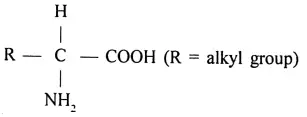
WBBSE Solutions For Class 10 Physical Science And Environment Chapter 8 Physical And Chemical Properties Of Matter Amino Acids

Question 88. What are essential amino acids?
Answer:

Essential amino acids: Human body can synthesise 10 out of 20 a-amino acids found in proteins. The remaining 10 must be present in our diet and are called essential amino acids.

Question 89. What is Zwitter ion?
Answer:

Zwitter ion: In aqueous solution, the acidic carboxyl group donates a proton to the basis amino group to form an internal salt called a dipolar ion or zwitter ion. Although it is neutral overall, it contains both a positive and a negative charge.
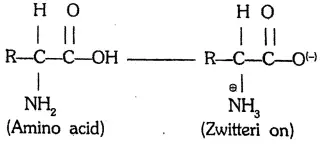
WBBSE Solutions For Class 10 Physical Science And Environment Chapter 8 Physical And Chemical Properties Of Matter Zwitter Ion

Question 90. What are peptides
Answer:

Peptides: These are condensation products of self-amides formed by the reaction of two or more amino acid molecules.

WBBSE Class 10 Physical Science Solutions

Question 91. What is peptide linkage?
Answer:

Peptide linkage:
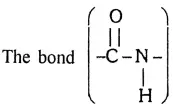
WBBSE Solutions For Class 10 Physical Science And Environment Chapter 8 Physical And Chemical Properties Of Matter Peptide Linkage

The bond Between the Carboxyl group of an acid molecule and nitrogen of the other amino acid molecule is known as the peptide bond or peptide linkage.

Question 92. What is Denaturation?
Answer:

Denaturation: After coagulation, proteins lose their physiological activity and certain other properties. This phenomenon is known as denaturation.

Question 93. What are Enzymes?
Answer:

Enzymes: These are also proteins which acts as catalyst in many biochemical reactions. Enzymes are specific in action due to their specific structural arrangement.

Question 94. What is the biuret test?
Answer:

Biuret test: To alkaline solution of proteins add a dilute solution of CuSO Formation of violet colour confirms proteins.

Question 95. What are vitamins?
Answer:

Vitamins: These are the biomolecules needed in small quantities, that regulates many biochemical function and prevent the development of many deficiency diseases.

Question 96. What are fats?
Answer:

Fats: These are organic compounds composed of carbon, hydrogen and oxygen. They are made of glycerol and fatty (organic) acids. Fats may be of animal or vegetable origin.

Question 97. State examples of conjugated proteins and derived proteins.
Answer:

Conjugated proteins:

  1. Phosphoproteins
  2. Glycoproteins.

Derived proteins: This type of protein is obtained after the partial hydrolysis of protein of very high molecular weight by acid, base or enzyme to simplier proteins.

Question 98. What are the types of simple proteins?
Answer:

Types of simple proteins :

Albumins → Example, milk, serum etc.

Globumins → Example, egg, yolk, tissues etc.

Glutemins→ Example, wheat, rice etc.

Prolomins → Example, barley, wheat etc.

Scleroproteins →Example, Keratin, fibroin etc.

Question 99. What are Alkynes?
Answer:

Alkynes: Those unsaturated hydrocarbons containing triple bonds (S) between two adjacent carbon atoms in their molecules are called as alkynes.

For example, Acetylene
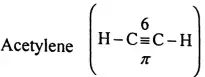
WBBSE Solutions For Class 10 Physical Science And Environment Chapter 8 Physical And Chemical Properties Of Matter Alkynes

Question 100. What is Isomerism?
Answer:

Isomerism: In organic chemistry when the same molecular formula represents two or more compounds which differ in their physical and chemical properties, then such compounds are called isomers and the phenomenon is called isomerism.

Question 101. What is catenation?
Answer:

Catenation: The property by virtue of which carbon forms covalent linkage chains is called catenation.

Question 102. What are the types of structural isomers?
Answer:

Types of structural isom:

Chain isomerism; For example,
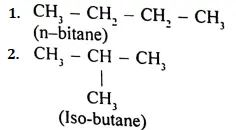
WBBSE Solutions For Class 10 Physical Science And Environment Chapter 8 Physical And Chemical Properties Of Matter Chain Isomerism


WBBSE Solutions For Class 10 Physical Science And Environment Chapter 1 Concerns About Our Environment

WBBSE Class 10 Physical Science Question Answer In English

Chapter 1 Concerns About Our Environment MCQs

Question 1. The source of heat on the surface of the sun

  1. Nuclear fusion reaction
  2. Nuclear fission reaction
  3. Thermal reaction
  4. Redox reaction

Answer: 1. Nuclear fusion reaction.

Question 2. The fuel used as aviation fuel in jet airplanes is a special grade of :

  1. Petrol
  2. Kerosene
  3. Ethanol
  4. Methanol

Answer: 2. Kerosene.

Read And Learn More: WBBSE Solutions For Class 10 Physical Science And Environment

Question 3. The ozone layer is present in :

  1. Troposphere
  2. Ionosphere
  3. Stratosphere
  4. Mesosphere

Answer: 3. Stratosphere.

“WBBSE Class 10 Physical Science and Environment Chapter 1 solutions, Concerns About Our Environment”

Question 4. Sewage water is purified by:

  1. Microorganism
  2. light
  3. Fishes
  4. Aquatic plants

Answer: 1. Microorganisms

WBBSE Solutions For Class 10 Physical Science And Environment Chapter 1 Concerns About Our Environment

Question 5. Which of the following is not a constituent of Los Angels smog?

  1. CxHy
  2. 03
  3. NO2
  4. SO2

Answer: 4. SO2

Question 6. Which of the following is a secondary pollutant?

  1. CO2
  2. N2O
  3. PAN
  4. SO2

Answer: 3. PAN.

Class 10 Maths Class 10 Social Science
Class 10 English Class 10 Maths
Class 10 Geography Class 10 Geography MCQs
Class 10 History Class 10 History MCQs
Class 10 Life Science Class 10 Science VSAQS
Class 10 Physical Science Class 10 Science SAQs

Question 7. Ozone is stratosphere depleted by :

  1. CF2CL2
  2. C7F6
  3. CF6 CL6
  4. C6F6

Answer: 1. CF2CL2

“Class 10 WBBSE Physical Science Chapter 1 solutions, Concerns About Our Environment study material”

Question 8. The smog is essentially caused by the presence of:

  1. Oand 03
  2. 03 and N2
  3. Oxides of Sulphur and Nitrogen
  4. Oxygen and Nitrogen

Answer: 3. Oxides of sulphur and Nitrogen.

Question 9. The SI unit of calorific value is :

  1. Cal g-1
  2. B Thu g-1
  3. J kg-1
  4. Jg-1

Answer: 3. J kg-1

Question 10. The major source of Co pollution is :

  1. Exhaust from automobiles
  2. Forest fires
  3. Volcanic eruptions
  4. Industrial process

Answer: 1. Exhaust from automobiles.

Question 11. Which of the following is not a chemical pollutant?

  1. Solid wastes
  2. Liquid wastes
  3. Pesticides
  4. Noise

Answer: 4. Noise.

Question 12. The minimum wind speed requires for running a wind-mill is :

  1. 50 km/hr.
  2. 15 km/hr.
  3. 25 km/hr.
  4. 10 km/hr.

Answer: 2. 15 km/hr.

Question 13. Which of the following energy sources is not responsible for global warming?

  1. Fossil fuels
  2. Solar energy
  3. Methane hydrate
  4. All

Answer: 2. solar energy.

“WBBSE Class 10 Physical Science Chapter 1, Concerns About Our Environment long answer solutions”

Question 14. Among the following fuels whose quality is most bad?

  1. LPG
  2. Methane
  3. Petrol
  4. Coal

Answer: 4. coal.

Question 15. Which of the following gases is responsible for ozone layer depletion?

  1. O2
  2. NO
  3. N2
  4. All of these

Answer:  2. NO

Question 16. The compound present in the maximum amount in acid rain is :

  1. H2CO3
  2. HCI
  3. HNO3
  4. H2SO4

Answer: 4. H2SO4

Question 17. Man-made chemicals responsible for the depletion of the ozone layer is

  1. Ethylene
  2. Acetylene
  3. Teflon
  4. CFC

Answer: 4. CFC.

Question 18. Depletion of the ozone layer causes

  1. Lung cancer
  2. Breast cancer
  3. Blood cancer.
  4. Skin cancer

Answer: 4. Skin cancer.

Question 19. The aromatic compounds present as particulates are :

  1. Benzene
  2. Toluene
  3. Poly cyclic hydrocarbons
  4. Nitrobenzene

Answer: 3. Polycyclic hydrocarbons.

Question 20. In any sample of water, it is always found that:

  1. BOD > COD
  2. BOD < COD
  3. BOD = COD
  4. None of these

Answer: 2. BOD < COD

Question 21. The main cause of Minamata disease is

  1. Arsenic pollution
  2. Lead pollution
  3. Cadmium pollution
  4. Mercury pollution

Answer: 4. Mercury Pollution.

Question 22. Excess nitrate in drinking water can cause:

  1. Methenoglo binomial
  2. Kidney damage
  3. Laxative effect
  4. Liver damage

Answer: 1. Methemoglobinemia.

“WBBSE Class 10 Concerns About Our Environment solutions, Physical Science Chapter 1

Question 23. What is the safety limit of arsenic content in drinking water according to WHO?

  1. 0.01mgL-1
  2. 0.1mgL-1
  3. 0.001 mgL-1
  4. 0.05 mgL-1

Answer: 1. 0.01 mgL-1

Question 24. Biosphere is :

  1. The gases enveloping the earth
  2. Earth’s crust
  3. Surface and groundwaters
  4. Region of earth where life exists

Answer: 4. Region of earth where life exists.

Question 25. Energy sources that can be replenished, once they are used up are called:

  1. Renewable sources
  2. Natural sources
  3. Non-renewable sources
  4. Synthetic sources

Answer: 1. Renewable sources.

Question 26. The difference between the output energy and the input energy is termed as :

  1. Net energy output
  2. Maximum output energy
  3. Minimum output energy
  4. Zero output energy

Answer: 4. Zero output energy.

“Class 10 WBBSE Physical Science and Environment Chapter 1, Concerns About Our Environment easy explanation”

Question 27. Which metal is used in connecting wires that connect solar cells in a solar panel?

  1. Copper
  2. Silver
  3. Iron
  4. Gold

Answer: 2. Silver.

Question 28. What is the principle behind a solar power plant?

  1. Light energy changes into electrical energy
  2. Light energy changes into kinetic energy
  3. Heat energy changes into light energy
  4. Light energy changes into heat energy

Answer: 1. Light energy changes into electrical energy.

Question 29. The instrument used for measuring soil salinity is :

  1. Photo meter
  2. Voltameter
  3. Conductivity meter
  4. Calorimeter

Answer: 3. Conductivity meter.

Question 30. The ozone layer of the stratosphere requires protection from the indiscriminate use of:

  1. Pesticides
  2. Atomic explosions
  3. Aerosols and high-flying jets
  4. Balloons

Answer: 3. Aerosols and high-flying jets.

Class 10 Physical Science WBBSE

Chapter 1 Concerns About Our Environment Very Short Answer Type Questions

Question 1. What is COD?
Answer: COD means Chemical Oxygen Demand.

Question 2. Name some methods used in green chemistry.
Answer: The use of sunlight, microwaves, sound waves, and the use of enzymes.

Question 3. What is PCB?
Answer: PCB is polychlorinated biphenyl. It is a highly toxic compound.

Question 4. Name of main compounds causing damage to the ozone layer.
Answer: Nitric oxide (NO) and Freons.

Question 5. In which of the atmospheric layers does the increase in attitude result in an increase in temperature?
Answer: Stratoshere and Thermosphere.

Question 6. Which one is more harmful to the human body-CO or CO2?
Answer: CO is more harmful to the human body.

Question 7. Name two sinks of carbon dioxide.
Answer: Ocean dissolves it and plants which use it for photosynthesis.

Question 8. Which disease is caused due to the formation of holes in the ozone layer and why?
Answer: Ultraviolet rays coming from the sun reach the earth passing through the ozone hole cause skin cancer.

“WBBSE Class 10 Physical Science Chapter 1 solutions, Concerns About Our Environment PDF”

Question 9. What types of aromatic compounds are present as particulates in the air?
Answer: Polycyclic aromatic hydrocarbons (PAH).

WB Class 10 Physical Science Question Answer

Question 10. What is siltation?
Answer: The mixing of soil or rock particles into water is known as siltation.

Question 11. Mention the range of temperature of the atmosphere.
Answer: The range of temperature of the atmosphere is from – 92°C to + 1200°C.

Question 12. What compound is formed when CO gas combines with blood?
Answer: Carboxyhemoglobin.

Question 13. Name some methods of waste management.
Answer: Burning and incineration, recycling process, sewage treatment, and dumping method.

Question 14. What is the main source of carbon monoxide in the atmosphere?
Answer: Coal, petrol, and incomplete combustion of other fossil fuels.

Question 15. Name some gases which are responsible for the greenhouse effect.
Answer: Carbon dioxide (CO2), Methane (CH4), Water vapor (H2O), Cholorofluoro carbon (CFC), Nitrous Oxide (N2O)

Chapter 1 Concerns About Our Environment Fill In The Blanks

Question 1. Between NO2 and NO ______ is more harmful.
Answer: NO2

Question 2. The word, ‘PAH’ denotes
Answer: Polyaromatic hydrocarbon.

Question 3. The lung disease caused by silica is _________.
Answer: Silicosis.

Question 4. The total mass of gaseous substances in the atmosphere is nearly
Answer: 5.5×10¹⁵ ton.

Question 5. The amount of carbon dioxide in the atmosphere is approximately
Answer: 0.031%

Question 6. CO, When mixed with water, forms_______.
Answer: Carboxyhemoglobin.

Question 7. The methane gas-producing field is ________.
Answer: Paddy field.

Question 8. The full form of TEL is _________.
Answer: Tetra ethyl lead.

Question 9. The smoke of cars pollutes the air as there is __________ gas.
Answer: CO.

Question 10. SO2 and NO2 cause pollution by increasing _________.
Answer: acidity.

“WBBSE Class 10 Physical Science Chapter 1, Concerns About Our Environment important questions”

Question 11. The word ‘CFC’ means
Answer: Cholorofluoro carbon.

Question 12. London smog is _______ in nature.
Answer: Reducing.

Question 13. The main air pollutants are_____, ______, ______.
Answer: SO2 , SO3 , NO2.

Question 14. The depletion of ozone over Antarctica occurs in _______ season.
Answer: spring.

Question 15. The pH of ordinary rainwater is _______
Answer: 5.6

Question 16. ______ may contain cancer-causing hydrocarbon.
Answer: Sooty smoke.

Question 17. Plants grow ________ in high concentrations of CO2.
Answer: better.

Question 18. The mesosphere and thermosphere are collectively known as ________.
Answer: the ionosphere.

Question 19. Gas released during the Bhopal tragedy was ________.
Answer: methyl iso cyanate (MIC)

Question 20. One remarkable phenomenon that happened in the troposphere is __________.
Answer: Greenhouse.

WB Class 10 Physical Science Question Answer

Question 21. Greenhouse gases can absorb _________ radiation.
Answer: infra-red.

Question 22. The formation of ozone holes increases the tendency of human beings to be attacked by _______.
Answer: Cancer.

Question 23. Depletion of the ozone layer takes place mainly over _________.
Answer: Antarctica.

Question 24. The whirlpool of wind formed in the stratosphere surrounding Antarctica is known as _________.
Answer: Polar vortex.

Question 25. The formation of chlorophyll is retarded in presence of SO. This phenomenon is known as _________.
Answer: Chlorosis.

Question 26. The SI unit of calorific value is ___________.
Answer: Jkg-1

Question 27. Ozone is stratosphere depleted by _________.
Answer: CF2CL2.

Question 28. Sewage water is purified by ________.
Answer: Microorganism.

Question 29. The compound present in the maximum amount in acid rain is _________.
Answer: H2SO4.

Question 30. The biosphere is ________.
Answer: Region of earth where life exists.

WBBSE Class 10 Physical Science Question Answer In English

Chapter 1 Concerns About Our Environment Short Answer Type Questions

Question 1. How does carbon monoxide molecule link to hemoglobin molecule?
Answer:

In the hemoglobin molecule Fe (2) atom is linked to five groups by coordinate bonds and the sixth site remains free. In normal conditions, aerial oxygen O2 links to Fe (2) of this vacant coordination site.

Now carbon monoxide (CO) is a stronger length than oxygen molecule in case of the presence of both CO and O2, CO occupies the vacant coordination site in hemoglobin instead of oxygen.

Question 2. What is meant by inversion temperature in different regions of the atmosphere?
Answer:

Inversion temperature: As we proceed from one region of the atmosphere to the next higher region, the trend of temperature changes either from increase to decrease or from decrease to decrease. This trend of either increase or decrease is called inversion temperature.

Question 3. What is siltation?
Answer:

Siltation

Siltation In this process of mixing soil particles with water. The soil particles present in water procedure turbidity. Due to the turbidity of the water, the free movements of the aquatic organisms in hindered, and as a result their growth and productivity also get reduced.

Question 4. What are combustible and noncombustible materials?
Answer:

Combustible materials: Materials that can be burnt are combustible materials

Non-combustible materials: Materials that cannot be burnt are non-combustible materials.

Question 5. What is a solar cell?
Answer:

Solar cell: It is a device that directly converts solar energy into electrical energy.

Question 6. What are the types of sources of energy?
Answer:

Types of sources of energy: There are two types of sources of energy. These are

  1. Renewable sources of energy
  2. Non-renewable sources of energy.

Question 7. What is nuclear fission?
Answer:

Nuclear fission: It is a process in which a heavier nucleus splits into a lighter nucleus with the release of huge amounts of energy.

Question 8. What is destructive distillation?
Answer:

Destructive distillation: It is a process of burning wood in a limited supply of oxygen.

Question 9. What is a windmill?
Answer:

Windmill: It is a device that converts wind energy to mechanical or electrical energy.

Question 10. What is a good source of energy?
Answer:

Good source of energy: A good source of energy should be renewable and environmentally friendly.

Question 11. Define Ocean Thermal Energy (OTE).
Answer:

Ocean Thermal Energy (OTE):

The energy available due to the difference in the temperature of water at the surface of the ocean and at deeper levels is called ocean Thermal Energy.

Question 12. Define Geothermal energy.
Answer:

Geothermal energy:

Geothermal energy is the heat energy from hot rocks present inside the earth.

Question 13. What is a Biogas plant?
Answer:

Biogas plant

A biogas plant consists of locushaped, underground tank, which is made of bricks and has a dome-shaped roof, made of cement and bricks.

Question 14. What is Biogas?
Answer:

Biogas

Biogas is a mixture of methane, carbon dioxide, hydrogen, and hydrogen sulfide.

“Class 10 Physical Science and Environment Concerns About Our Environment solutions, WBBSE syllabus”

Question 15. What is a solar heating device?
Answer:

Solar heating device

A device that gets heated by using the sun’s heat energy is called a solar heating device.

WBBSE Class 10 Physical Science Question Answer

Question 16. What is a solar cell?
Answer:

Solar cell:

A solar cell is a device that converts solar energy directly into electricity.

Question 17. What do you mean by Biomass?
Answer:

Biomass:

Biomass is the organic matter which is used as fuel to produce energy.

Question 18. What is a solar cooker?
Answer:

Solar cooker

The solar cooker is a device that is used to cook food by utilizing the heat energy radiated by the sun.

Question 19. What are Non-renewable sources of energy?
Answer:

Non-renewable sources of energy

Those sources of energy which have accumulated in nature over a very, very long time and cannot be quickly replaced when exhausted are called nonrenewable sources of energy.

Question 20. Write the other name of nonrenewable sources of energy.
Answer:

The name of non-renewable sources of energy is nonconventional sources of energy.

Question 21. What do you mean by renewable sources of energy?
Answer:

Renewable sources of energy

These sources of energy which are being produced continuously in nature and are inexhaustible, are called renewable sources of energy.

Question 22. What do you mean by fossil fuel?
Answer:

Fossil fuel

A natural fuel formed deep under the earth from the pre-historic remains of living organisms (like plants and animals) is caused by fossil fuel.

Question 23. What is the major source of energy for generating electricity in power plants?
Answer:

The major source of energy for generating electricity in power plants is fossil fuels.

“WBBSE Class 10 Chapter 1 Physical Science, Concerns About Our Environment step-by-step solutions”

Question 24. What is petroleum?
Answer:

Petroleum

The crude oil petroleum is a complex mixture of several solid liquid and gaseous hydrocarbons mixed with water, salt, and earth particles.

Question 25. What do you mean by Hydro-Power plant?
Answer:

Hydro-Power plant:

A power plant that produces electricity by using flowing water to rotate a turbine is called a hydropower plant.

Question 26. What is the Green House Effect?
Answer:

Green House Effect

Green House Effect is the process of warming a planet’s surface and its Lower atmosphere by the absorption and emission of infrared radiations by atmospheric gases.

Question 27. What do you mean by Global warming?
Answer:

Global warming

Global warming means the increase in average temperature near the earth’s surface due to an increase in the amount of greenhouse gases in the atmosphere.

Question 28. What is natural gas?
Answer:

Natural gas

Natural gas is a fossil fuel that is found on top of petroleum under the earth.

Question 29. If you could use any source of energy for heating your food, which one would you use and why?
Answer:

We use LPG (Liquefied Petroleum Gas) for heating our food; because it is easily available in our kitchen, gives on smoke on burning, and takes less time to do the job.

Question 30. In which season does the depletion of layar on Antarctica take place and when is it filled up again?
Answer:

During the springtime in Antarctica i.e. in the months of September and October, the depletion of the ozone layer of the stratosphere takes place. But after the spring in the months of November and December, the produced ozone hole is filled up.

Question 31. Give the names of two energy sources that you would consider to be exhaustible. Give reasons, for your choice.
Answer:

Coal and petroleum are exhaustible energy sources because their stock is going to be finished in the near future and it takes millions of years for their formation.

Question 32. Fish do not grow as well in warm water as in cold water-explain why.
Answer:

Explanation: The solubility of gas in water depends on the temperature. Consequently, the amount of soluble oxygen in warm water becomes less than that of cold water. As Oxygen is very essential for the respiration and growth of fish in water, the growth of fish becomes less in warm water.

Question 33. What is chlorosis?
Answer:

Chlorosis: The process of sulfur dioxide gas in the atmosphere retards the production of chlorophyll in the leaves of plants. In consequence of which the green colour of leaves is lost this phenomenon of the disappearance of the green color of leaves is known as chlorosis.

Question 34. Name two energy sources that you would consider to be renewable. Give reasons for your choice.
Answer:

Solar energy and wind energy are examples of renewable energy sources because they get quickly replenished.

“WBBSE Class 10 Concerns About Our Environment, Physical Science Chapter 1 key concepts”

Question 35. What are the disadvantages of fossil fuels?
Answer:

Disadvantages of fossil fuels :

The following are the dis advantage of fossil fuels:

  1. These are non-renewable.
  2. They produce air pollutants on burning.

Question 36. What is a hydroelectric power plant?
Answer:

Hydroelectric power plant: In this power plant energy from flowing water is utilized to produce electricity on a large scale.

Question 37. What are the disadvantages of a solar cooker?
Answer:

The disadvantages of a solar cooker are:

  1. The direction of the reflector of a solar cooker has to be changed from time to time to keep it facing the seen.
  2. The box-type solar cooker cannot be used for baking or for frying.
  3. If the day sky is covered with clouds, even then solar cookers cannot be used to work food.
  4. The solar cooker cannot be used to cook food during nighttime.

Question 38. What do you mean by a solar constant?
Answer:

Solar constant: The amount of solar energy received per second by one square meter area of the near-earth space (exposed perpendicularly to the rays of the sun at an average distance between the sun and the earth, is called the solar constant.

Question 39. What is a solar heating device?
Answer:

Solar heating device: A device that gets heated by using Sun’s heat energy is called a solar heating device.

Question 40. Write a short note on the advantages of LPG.
Answer:

The advantages of LPG :

  1. LPG burns with a smokeless flame and so does not cause air pollution.
  2. LPG does not produce any poisonous gases on burning.
  3. LPG is easy to handle and convenient to store.
  4. LPG is a very neat and clean domestic fuel.

Question 41. ‘Natural gas is used as a fuel for a number of purposes’- Explain it.
Answer:

‘Natural gas is used as a fuel for a number of purposes’

  1. Natural gas is used as a domestic and industrial fuel.
  2. Natural gas is used as a fuel in thermal power plants for generating electricity.
  3. Compressed Natural gas is being used increasingly as a fuel in transport vehicles.