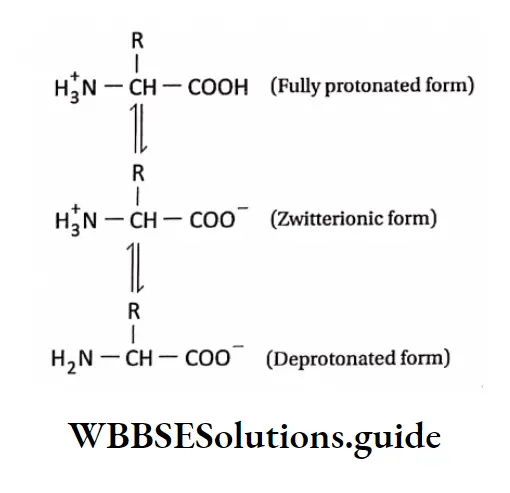
Anatomy Of Flowering Plants Multiple Choice Question And Answers

Anatomy Of Flowering Plants Multiple Choice Questions

Question 1. Identify the wrong statement in the context of Heartwood—

  1. It is highly durable
  2. It conducts water and minerals efficiently
  3. It comprises dead elements with highly lignified walls
  4. Organic compounds are deposited in it

Answer: 2. It conducts water and minerals efficiently

Question 2. The vascular cambium normally gives rise to—

  1. Primary phloem
  2. Secondary xylem
  3. Periderm
  4. Phelloderm

Answer: 2. Secondary xylem

Anatomy of flowering plants MCQs with answers

Question 3. Which of the following is made up of dead cells?

  1. Collenchyma
  2. Phellem
  3. Phloem
  4. Xylem parenchyma

Answer: 2. Phellem

Question 4. The cortex is the region found between—

  1. Epidermis And Stele
  2. Pericycle And Endodermis
  3. Endodermis And Pith
  4. Endodermis And Vascular Bundle

Answer: 1. Epidermis And Stele

Read and Learn More WBCHSE Multiple Choice Question and Answers for Class 11 Biology

Question 5. The balloon-shaped structures called tyloses—

  1. Originate in the lumen of vessels
  2. Characterised the sapwood
  3. Are extensions of xylem parenchyma cells into vessels
  4. Are linked to the ascent of sap through xylem vessels

Answer: 3. Are extensions of xylem parenchyma cells into vessels

WBCHSE Anatomy Of Flowering Plants Multiple Choice Question And Answers

Question 6. Read the different components from (a) to (d) in the list given below and tell the correct order of the components with reference to their arrangement from the outer side to the inner side in a woody dicot stem—

  1. Secondary cortex
  2. Wood
  3. Secondary phloem
  4. Phellem

The correct order is—

  1. 4,3,1,2
  2. 3,4,2,1
  3. 1,2,4,3
  4. 4,1,3,2

Answer: 4. 4,1,3,2

Class 11 Biology Class 11 Chemistry
Class 11 Chemistry Class 11 Physics
Class 11 Biology MCQs Class 11 Physics MCQs
Class 11 Biology Class 11 Physics Notes

Question 7. Tracheids differ from other tracheary elements in—

  1. Having Casparian strips
  2. Being imperforate
  3. Lacking nucleus
  4. Being lignified

Answer: 2. Being imperforate

Question 8. You are given a fairly old piece of dicot stem and a dicot root. Which of the following anatomical structures will you use to distinguish between the two?

  1. Secondary xylem
  2. Secondary phloem
  3. Protoxylem
  4. Cortical cells

Answer: 3. Protoxylem

Question 9. Which of the following tissues provide maximum mechanical support to plant organs?

  1. Sclerenchyma
  2. Collenchyma
  3. Parenchyma
  4. Aerenchyma

Answer: 1. Sclerenchyma

MCQs on anatomy of flowering plants for NEET

Question 10. Which of the following parts of the dicot root is made up of cells with suberin deposition in tangential as well as radial walls?

  1. Epidermis
  2. Endodermis
  3. Cortex
  4. Pericycle
  5. Xylem

Answer: 1. Epidermis

Question 11. Which of the following characters are not applicable to the anatomy of the dicot stem choose the correct options given below.

  1. Collenchymatous hypodermis
  2. Polyarch xylem
  3. The presence of Casparian strips on the endodermis
  4. Open vascular bundle

The presence of medullary rays of these Select the correct answer using the codes given below—

  1. 1,4, and 5
  2. 2 and 3
  3. 2 and 5
  4. 1,2, and 3
  5. 3,4 and 5

Answer: 2. 2 and 3

Question 12. Which of these characteristics does/does not apply to the vascular bundle of the monocot stem?

  1. Conjoint
  2. Endarch protoxylem
  3. Open
  4. Phloem parenchyma is absent

Select the correct answer using the codes given below—

  1. 1 and 2
  2. 2 and 3
  3. 3 and 4
  4. only 3
  5. 1 and 4

Answer: 4. only 3

Question 13. When one wood is lighter in colour with a lower density, the other wood is darker with a higher density. They are—

  1. Springwood and autumnwood
  2. Heartwood and latewood
  3. Springwood and earlywood
  4. Sapwood and springwood
  5. Autumn wood and springwood

Answer: 1. Springwood and autumn wood

Question 14. The epidermal hairs present on the stem of the plant are called

  1. Trichomes
  2. Root hair
  3. Stomata
  4. Guard cells

Answer: 1. Trichomes

Question 15. Choose the incorrect statement

  1. Gymnosperms lack vessels in their xylem
  2. The cell wall of collenchyma is made up of cellulose, hemicellulose and pectin
  3. The first formed primary xylem elements are called protoxylem
  4. The cell wall of parenchyma is made up of pectin
  5. Gymnosperms have albuminous cells and sieve cells in their phloem

Answer: 4. The cell wall of parenchyma is made up of pectin

Question 16. In a dicotyledonous stem, which of the following is the sequence of tissues from inside to outside?

  1. Pith, phloem, cambium, protoxylem, metaxylem, pericycle, parenchyma, collenchyma, endodermis and epidermis
  2. Pith, cambium, phloem, protoxylem, metaxylem, pericycle, endodermis, parenchyma, collenchyma and epidermis
  3. Pith, phloem, protoxylem, metaxylem, cambium, pericycle, endodermis, parenchyma, collenchyma and epidermis
  4. Pith, protoxylem, metaxylem, cambium, phloem, pericycle, endodermis, parenchyma, collenchyma and epidermis

Answer: 4. Pith, protoxylem, metaxylem, cambium, phloem, pericycle, endodermis, parenchyma, collenchyma and epidermis

Question 17. A piece of wood having no vessels (trachea) must belong to

  1. Teak
  2. Mango
  3. Pine
  4. Palm

Answer: 3. Pine

Question 18. Which one of the following has bast fibres?

  1. Parenchyma
  2. Sclerenchyma
  3. Phloem
  4. Xylem

Answer: 3. Phloem

Question 19. The arrangement of vascular tissue in the androcentric vascular bundle is—

  1. Concentric
  2. Radial
  3. Collateral
  4. Bicollateral

Answer: 1. Concentric

Question 20. A simple, living permanent tissue which is absent in roots is—

  1. Collenchyma
  2. Chlorenchyma
  3. Aerenchyma
  4. Parenchyma

Answer: 2. Chlorenchyma

Question 21. A layer of cells impervious to water because of a band of suberised matrix is called the—

  1. Endodermis
  2. Caspairan strip
  3. Plasmodesmata
  4. None of these

Answer: 2. Caspairan strip

Question 22. Which is a living mechanical tissue?

  1. Phloem
  2. Parenchyma
  3. Collenchyma
  4. Sclerenchyma

Answer: 3. Collenchyma

Question 23. The age of a tree can be estimated by—

  1. Its height and girth
  2. Biomass
  3. Number of annual rings
  4. Diameter of its heartwood

Answer: 3. Number of annual rings

Multiple choice questions on plant anatomy

Question 24. Which one of the following characters is not found in the transverse section of the monocot stem?

  1. Sclerenchyma bundle sheath
  2. Lysigenous cavity
  3. Sclerenchymatous hypodermis
  4. Starch sheath

Answer: 4. Starch sheath

Question 25. Identify the correct pair of statements.

  1. The functions of sieve tubes are controlled by the nucleus of companion cells.
  2. Albuminous cells are present in angiosperms.
  3. In dicot root, the vascular cambium is completely secondary in origin.
  4. Cylindrical meristems contribute to the formation of the primary plant body.

Choose the correct answer

  1. 1 and 3
  2. 3 and 4
  3. 1 and 2
  4. 2 and 3

Answer: 1. 1 and 3

Question 26. Interfascicular cambium is a—

  1. Primary meristematic tissue
  2. Primordial meristem
  3. Type of protoderm
  4. Secondary meristematic tissue

Answer: 4. Secondary meristematic tissue

Question 27. Which of the following is calcium carbonate?

  1. Raffides
  2. Druces
  3. Cystolith
  4. All of these

Answer: 3. Cystolith

Question 28. In pteridophytes, phloem is without—

  1. Sieve cells
  2. Sieve tubes
  3. Companion cells
  4. Bast fibres

Answer: 3. Companion cells

Question 29. Hydrophytes are characterised by

  1. The presence of sclerenchyma
  2. The presence of aerenchyma
  3. The absence of aerenchyma
  4. The presence of root nodules

Answer: 2. The presence of aerenchyma

Question 30. Casparian strips are present in the

  1. Epiblema
  2. Cortex
  3. Pericycle
  4. Endodermis

Answer: 4. Endodermis

MCQs on anatomy of plants with explanations

Question 31. Interfascicular cambium develops from—

  1. Medullary rays
  2. Xylem parenchyma
  3. Endodermis
  4. Price

Answer: 1. Medullary rays

Question 32. Which one of the following pairs is an example of lateral meristem?

  1. Phellogen and phelloderm
  2. Phellogen and fascicular cambium
  3. Procambium and phelloderm
  4. Interfascicular cambium and phellem

Answer: 2. Phellogen and fascicular cambium

Permanent Tissue Notes

Permanent Tissue

Permanent Tissue Definition: The tissues that are composed of mature cells derived from meristematic tissues which have lost their dividing property are known as permanent tissues.

Permanent Tissue  Distribution: Permanent tissues are found all over the plant body.

Permanent Tissue  Characteristics:

  1. Mature cells are unable to divide.
  2. These cells are either living or dead.
  3. Living cells contain protoplasm while the dead cells lack it.
  4. the cells have thin or thick cell walls. thick cell walls often show various ornamentations due to plate meristem uneven deposition of cell wall materials.
  5. Cells are of definite shapes and are vacuolated.
  6. The cells may be homogeneous (cells are similar in size, shape, and structure) or heterogeneous (cells differ in size, shape and structure).
  7. Intercellular space may or may not be present.

Read and Learn More: WBCHSE Notes for Class 11 Biology

Permanent Tissue  Function:

  1. Food production,
  2. Food and water storage,
  3. Provide mechanical support,
  4. Transports water, dissolved minerals and food.
  5. Secretion and excretion of different substances.

“permanent tissue notes for biology students”

Anatomy Of Flowering Plants Differences between meristematic tissue and permanent tissue

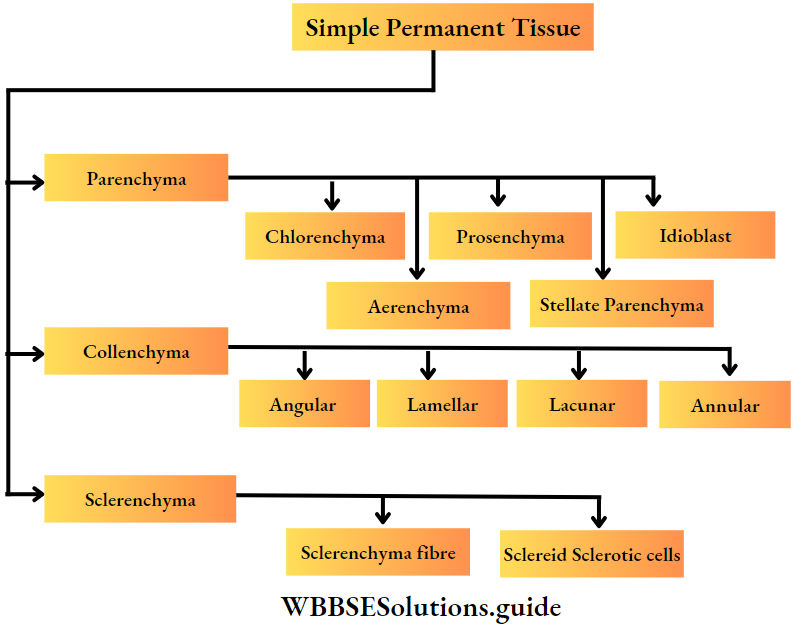
Permanent Tissue  Classification: Based on organisaion and function, permanent tissues are of three types—simple permanent tissue, complex permanent tissue and secretory tissue.

Permanent Tissue Notes

Simple permanent tissue

Simple permanent tissue Definition: The tissues that are composed of the same type of cells and are thus homogeneous are known as simple permanent tissues.

Class 11 Biology Class 11 Chemistry
Class 11 Chemistry Class 11 Physics
Class 11 Biology MCQs Class 11 Physics MCQs
Class 11 Biology Class 11 Physics Notes

Simple permanent tissue Types: There are three types of simple permanent tissues in plants.

  1. Parenchyma,
  2. Collenchyma and
  3. Sclerenchyma. Details are given in the following chart.

“simple permanent tissue function “

Anatomy Of Flowering Plants Simplepermanent tissue

Parenchyma

Parenchyma Definition: The term parenchyma refers to simple permanent tissue, composed of isodiametric, living and thin-walled cells, that have cell walls made up of cellulose.

Parenchyma Origin: Parenchyma cells originate from protoderm and ground meristem. Secondary parenchyma cells originate from secondary meristems. Parenchyma cells of vascular bundles originate from the procambium.

“detailed notes on permanent tissue in plants”

Parenchyma Distribution: It is the most common simple permanent tissue in plants and occupies major portions of the plant body. Parenchyma mainly occupies the softer, non-woody portions of the plant body like the epidermis of root, stem and leaves, cortex of root and stem, mesophyll of leaves, pulp of the fleshy fruits, embryo and endosperm of the seeds, etc.

Parenchyma Characteristics:

  1. At the beginning of a plant’s life, during embryo development parenchymatous tissues develop.
  2. Parenchyma is composed of isodiametric cells with very prominent intercellular spaces.
  3. The cells have functional protoplasts with nuclei.
  4. These tissues are connected with various physiological functions of the plant.
  5. Individual parenchyma cells usually have thin walls which are made up of cellulose.
  6. The internal structure of the parenchyma cells varies according to its function
  7. The parenchyma cells possess a distinct nucleus and the cytoplasm is vacuolated.
  8. In the matured parenchymatous cell cytoplasm remains as a primordial cuticle because of the presence of a large central vacuole.
  9. Parenchyma cells may be oblong and arranged in parallel as in the palisade cells of the mesophyll tissue, in the medullary rays, etc They may be multilobed or folded as found in spongy cells of the mesophyll tissue.
  10. The non-green parenchyma cells contain leucoplasts.
  11. In storage regions of plants, the cell walls of parenchyma may be thick due to hemicellulose deposition, as found in the endosperm of date palm seeds. Primary pit fields may be present in the wall.
  12. Parenchyma tissue is considered to be primitive as the multicellular plants of the lower groups consist only of parenchyma.
  13. It is the fundamental tissue of the plant body as it provides the ground for other tissues. Parenchyma tissue is the precursor of all other tissues. So, the parenchyma tissue is considered to be the most primitive tissue, both phylogenetically and ontogenetically.

“types of permanent tissue with examples”

Anatomy Of Flowering Plants Parenchyma tissue

“two types of tissue in plants “

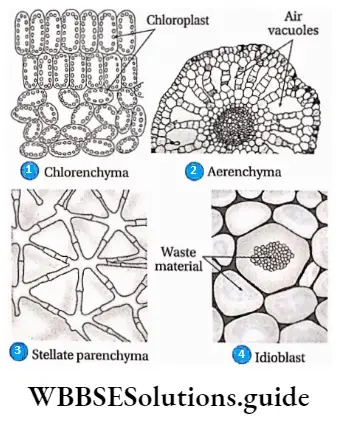
Parenchyma Types: On the basis of structure and function, parenchyma is classified into the following types—

  1. Chlorenchyma: The parenchyma cells, usually observed in the cortical region of young stems and mesophyll tissue of leaves contain chloroplasts and are called chlorenchyma. These tissues take part in photosynthesis. In leaf, chlorenchyma is of two types, palisade and spongy parenchyma.
  2. Aerenchyma: A spongy, parenchymatous tissue with large air spaces found in the intercellular spaces of cortical regions of aquatic plants is known as aerenchyma. The aerenchyma cells store air to provide buoyancy in an aquatic environment and allow the circulation of gaseous substances.
  3. Prosenchyma: The parenchyma cells which become elongated and thick-walled, are known as prosenchyma. These cells are found in the pericycle region and provide mechanical strength to the plants.
  4. Idioblast: There are certain specialised parenchyma cells containing oils, tannins, crystals of calcium oxalate, etc., which are called idioblasts. These cells act as storage of reserves, excretory material, pigments etc. They differ from the surrounding cells in size, content and functions.
  5. Stellate parenchyma: The star-shaped parenchyma cells with long arms and air cavities are called stellate parenchyma. These cells are found in the stems of Scirpus, Juncus, etc., and in the mesophyll tissues of Canna leaves.
  6. Xylem and phloem parenchyma: In vascular bundles, two types of parenchyma are found—xylem and phloem parenchyma. Xylem parenchyma helps in the transportation of water, and dissolved minerals and phloem parenchyma transport food, as components of the xylem and phloem tissues respectively.

“simple and complex permanent tissue notes”

Anatomy Of Flowering Plants Different types ofparenchyma tissues

“simple tissue definition “

Parenchyma Function:

  1. Parenchyma cells in the mesophyll tissue manufacture food through photosynthesis.
  2. Xylem and phloem parenchyma are involved in the transport of water, dissolved minerals and food respectively.
  3. Epidermal cells of stems, roots and leaves protect the inner tissues from desiccation.
  4. Aerenchyma in aquatic plants gives buoyancy, helps in gaseous exchange and to withstand mechanical stress in aquatic environments.
  5. Parenchyma cells also help in the secretion and storage of various useful products like oils, nectar, resin, etc.
  6. They can store food and water.
  7. Parenchyma cells play an important role in the healing of wounds and regeneration of damaged tissues.
  8. Prosenchyma provides mechanical strength to the plants.
  9. Epidermal parenchyma of the leaves is modified to form guard cells and stomata.

Shoot Apex Notes

Shoot Apex Notes

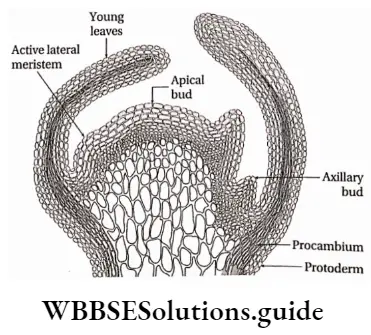
Shoot apex Definition: The region, situated immediately above the uppermost leaf-forming cell or leaf primordium, is known as the shoot apex.

root and shoot apical meristem

Shoot apex Characteristics:

  1. It occurs as a terminal (at the tip of the stem) and axillary bud (at the axil of a leaf).
  2. The shoot apex is protected by the leaf primordia. Sometimes they are protected by structures called bud scales.
  3. The vegetative shoot apex is the apical meristem, responsible for unlimited growth to form the different parts of the plant.
  4. The shoot apex is more or less convex in the longitudinal section.
  5. It shows changes in shape with the emergence of new leaves. The shoot apex becomes broadened during the initiation of leaf primordia.
  6. The number of leaf primordia and the direction of broadening of the shoot apex is determined by phyllotaxy.
  7. The time period between the initiation of two successive leaves is called plastochron. The changes that occur in the shoot apex during this period are; known as plastochronic changes.
  8. The size of the shoot apex also varies among the seeded plants.
  9. In pteridophytes, the shoot apex is formed of a single cell, whereas in the case of gymnosperms or angiosperms, it is multicellular.
  10. Due to reproductive changes, the shoot apex gets transformed into the reproductive shoot apex, During this process, the tip of the shoot becomes swollen and gradually changes into a flower.
Class 11 Biology Class 11 Chemistry
Class 11 Chemistry Class 11 Physics
Class 11 Biology MCQs Class 11 Physics MCQs
Class 11 Biology Class 11 Physics Notes

“shoot apex notes for class 11 biology”

Read and Learn More: WBCHSE Notes for Class 11 Biology

Anatomy Of Flowering Plants Active plastochronic region

shoot apical meristem

Theories related to the structural organisation of shoot apex:

To explain the structure and activity of shoot apex, many theories have been propounded by different scientists. Some important theories related to the structure and activity of shoot apex are discussed below.

Shoot Apex Notes

root apical meristem diagram

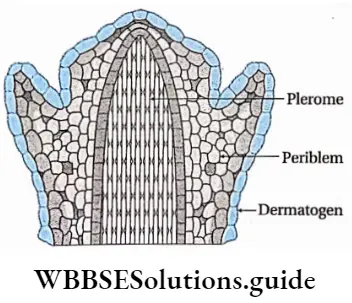
Histogen theory: The histogen theory was propounded by Hanstein (1868). He distinguished the shoot apex of angiosperms into three zones. These zones are known as histogen (Greek: histos=’tssoe’ gennaein=’to produce’). The three zones are

  1. The outermost single layer or from which the epidermis of the stem and leaf are formed is known as dermatogen.
  2. The middle zone from which the endodermis and cortex develop is known as the periblem.
  3. The central history, from which the stele (the core of the plant made up of pith, vascular bundles and pericycle) develops, is known as the plerome.

Anatomy Of Flowering Plants L.S. ofshoot apex showing regions according to the histogen theory

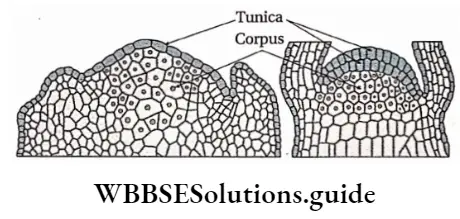
1. Tunica-Corpus theory: Schmidt (1924) proposed the Tunica-Corpus theory for the angiosperm shoot apex development. According to this theory, the shoot apex is divided into two regions, the tunica and the corpus.

“detailed notes on shoot apex structure and function”

Tunica is the outermost layer of the meristematic tissue, formed of one or more cell layers. The tunica surrounds the inner cell mass—the corpus. Cells of the tunica region are smaller than the cells of the corpus region.

“shoot apex meristem types and functions explained”

The cells of tunica divide anticlinally. If tunica is single-layered, it forms only the epidermis. If it is multilayered, the epidermis evolved from the outermost layer, while the inner layers took part in the formation of leaf primordia and cortex. The tunica enlarges the surface area.

2. The corpus is the central mass of cells surrounded by tunica cell layers. The corpus cells are larger. They divide in various planes so that a mass of irregularly arranged cells is formed, hence corpus increases in volume.

The corpus develops from its own initials situated beneath those of tunica. The corpus zone gives rise to the pith, the vascular bundles and a part of the cortex.

Anatomy Of Flowering Plants L.S. ofa shoot apex showing distritution oftunica and corpus

” organization of root apical meristem “

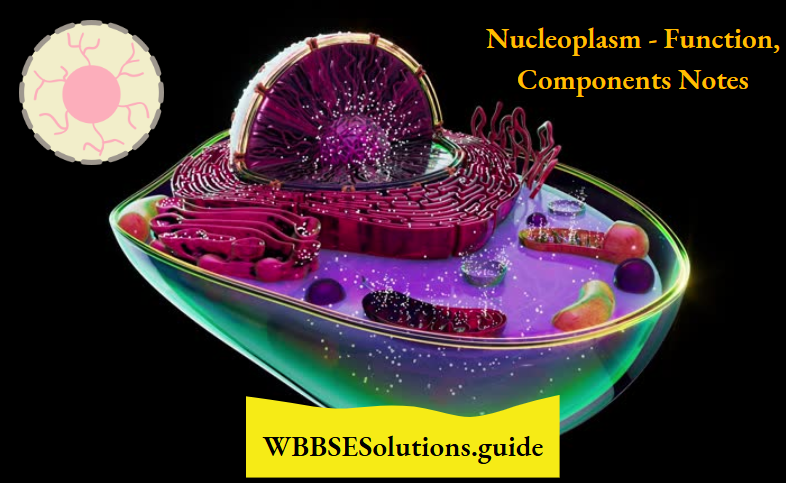
Nucleoplasm – Function, Components Notes

Nucleoplasm

Nucleoplasm Definition: The semi-liquid, slightly acidic, non-pigmented, almost transparent, granular fluid present in the space between the nuclear membrane and nucleolus, is called nucleoplasm.

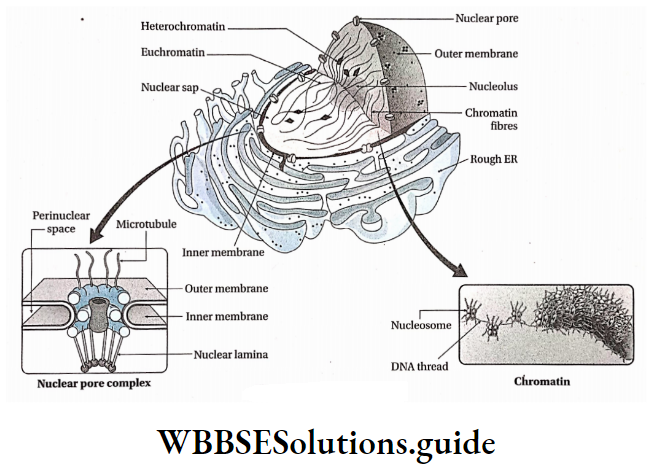
Nucleoplasm Ultrastructure: It contains nucleic acid, protein, different types of enzymes (DNA polymerase, RNA polymerase, nucleotide transferase, nucleoside phosphorylase, kinase, dehydrogenase, endonuclease, etc.), cofactors (CoA, ATP), minerals (calcium, magnesium, phosphorus), RNP granules (ribonucleoprotein particles) and fewer lipids.

Nucleoplasm Functions:

  1. It helps in the synthesis of DNA, and RNA. It also acts as a storehouse of the components required for protein synthesis.
  2. It maintains the turgidity of the nucleus.
  3. It houses nucleolus and chromatin.

Nucleoplasm Definition:

Thread-like coiled, elongated structure, present in the nucleoplasm and stained with basic stain and which condenses during cell division, to form chromosomes is called chromatin.

Nucleoplasm function and components explained 

During interphase stage i.e., during the non-dividing stage, chromatin appears like thread and forms a reticular structure. These are known as chromatin fibers.

During cell division, the chromatin condenses into thick, compact, and dense structures. This structure is known as a chromosome.

Nucleoplasm - Function Components Notes

” components of nucleus “

Ultrastructure: Chromatin is mainly composed of a combination of DNA, proteins (histones and non-histones), and some RNA (DNA-31%, RNA-5%, histone- 36%, non-histone protein-28%).

The histones form disc-like structures around which portions of the DNA wrap themselves to form structural units, called nucleosomes. This structure resembles beads along a string.

Class 11 Biology Class 11 Chemistry
Class 11 Chemistry Class 11 Physics
Class 11 Biology MCQs Class 11 Physics MCQs
Class 11 Biology Class 11 Physics Notes

The chromatin fibers are distributed in the nucleoplasm.

Chromatin exists in two conformational states—

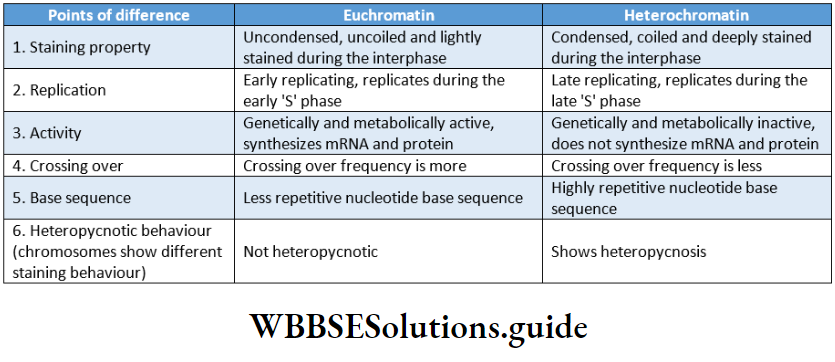
Heterochromatin The condensed and more coiled, deeply stained, non-functional, inert regions of the chromosome are known as heterochromatin. These regions possess highly repetitive base sequences of DNA that are genetically inactive (i.e., do not take part in gene expression).

Components of nucleoplasm and their role in the nucleus 

Heterochromatin is late replicating in nature i.e., replicates in late S-phase.

Heterochromatin is of two types—

  1. Facultative and
  2. Constitutive heterochromatin.

“define nucleoplasm “

Facultative heterochromatin: The chromatin, that remains condensed and non-functional (heterochromatin-like) in certain cell types or in special stages of development, is known as facultative heterochromatin.

It remains euchromatin-like in other stages. For, one of the X chromosomes in somatic cells of mammalian females gets heterochromatinised to form a ‘Barr body’ (inactive X-chromosome) during interphase.

Constitutive heterochromatin: The chromatin, that remains permanently condensed and nonfunctional throughout the cell cycle, is known as constitutive heterochromatin.

Constitutive heterochromatin is found in the centromeric region of the chromosome and the greater part of the human Y chromosome.

Nucleoplasm vs cytoplasm – differences and functions 

Euchromatin: The less coiled, lightly stained functional part of the chromatin is known as euchromatin.

These regions possess less repetitive base sequences of DNA which is genetically active (i.e., it takes part in gene expression through mRNA and during protein synthesis) during interphase. It replicates during the early ‘S’ phase.

Biology Class 11 Chapter 8 Cell The Unit Of Life Nucleus And Its Parts

“nucleoplasm function “

Functions: Chromatin constitutes genes. It carries and transfers genes in living organisms. The euchromatin associated with acidic proteins, is involved in the transcription process to synthesise RNA from DNA.

Biology Class 11 Chapter 8 Cell The Unit Of Life Ultrastructure Of Nucleus

Nucleolus

Nucleolus Definition: The deeply stained, spherical, non-membranous structure that is composed of protein and nucleic acids, is found within the nucleus and which plays an important role in ribosome synthesis is called the nucleolus.

Origin and location: It originates from one or two nuclear chromatins. It emerges from the nuclear or SAT chromosome (a part of the chromosome that is separated from the main chromosome body by a secondary constriction) during the telophase stage (phase of cell division) and attaches to the nuclear organizer region (secondary constriction).

It does not form from each chromosome. The Nucleolar Organiser region (NOR) is composed of tandem repeats (repetition of one or more adjacent nucleotides) of rRNA genes, which can be found in several different chromosomes.

Discovery: The nucleolus was discovered by Fontana and its detailed structure was studied by Wagner (1832). The term ‘nucleolus’ was coined by Bowman.

Number a ltd shape: Generally, a nucleus may contain 1-4 nucleoli. The shape and number depend on the metabolic activity of the cell.

In highly active cells (neurons, oocytes, secretory cells kidney cells, etc.) where proteins, enzymes, and other substances are synthesized more, their size enlarges and they also increase in number.

Nucleoplasm vs cytoplasm – differences and functions 

Again, in less active cells, the nucleolus is either absent or smaller in size.

Ultrastructure: Nucleolus is not surrounded by a membrane. It is believed that calcium ion maintains its structural integrity.

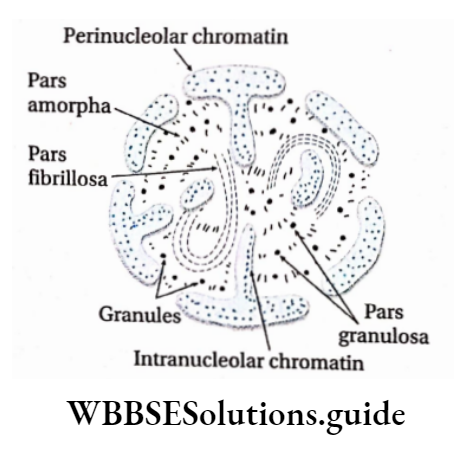
Its four main components are—

  1. Chromatin part,
  2. Pars amorpha or amorphous matrix,

The dense fibrillar component (dfc) or pars fibrillosa and 0 granular components (gc) or pars granulosa.

Chromatin part: The chromatin thread formed from DNA at the exterior of the nucleolus, is known as perinucleolar chromatin.

A part of this chromatin takes a tubular shape and extends to the matrix. This is known as intranuclear chromatin. It helps in rRNA formation.

Pars amorpha: Proteinaceous matrix that contains floating granular and thread-like parts.

Pars fibrillose: It is a centrally located thin thread (50-80A) of ribonucleoprotein. It is also known as nucleolonema.

Pars granulosa: They are the ribonucleoprotein granules (150-200A diameter) in the matrix. Ribosomes are synthesized from here.

Functions:

  1. The nucleolus is known as the ribosome factory as it is involved in the synthesis of ribosomes.
  2. It stores ribosomal protein.
  3. It participates in the formation of spindle fibers.

Biology Class 11 Chapter 8 Cell The Unit Of Life Ultyrastructure Of Nucleolus

Functions of nucleus

Controls cellular metabolism: Nucleus controls all the metabolic activity of cells and so, is known as the brain of the cell.

Carrier of genetic material: Chromatin of the nucleus carries genes through which hereditary features pass from one generation to the next.

Control of protein synthesis: Nucleus controls gene expression through the synthesis of different types of RNA and protein.

Formation of ribosomes: Nucleolus helps in the formation of ribosomes.

Pronucleus: Nucleus containing haploid chromosomes (n), at the stage before fertilization.

nucleoplasm

Amphinucleus: Nucleus with diploid chromosome. E.g., a nucleus of body cells.

Heminucleus: Nucleus carrying haploid chromosome. E.g., the nucleus of gametes.

Macronucleus and Micronucleus: The Nucleus that is larger in shape is the macronucleus and the smaller one is the micronucleus. (Found in Paramoecium)

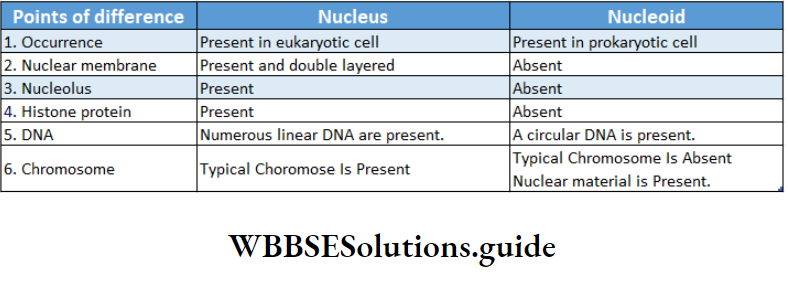
Biology Class 11 Chapter 8 Cell The Unit Of Life Difference Between Nucleus And Nucleoid

Biology Class 11 Chapter 8 Cell The Unit Of Life Cell Difference Between Euchromatin Heterochromatin

Biology Class 11 Chapter 8 Cell The Unit Of Life Difference Between Nucleus And Nucleolus

Cytoplasmic Inclusion

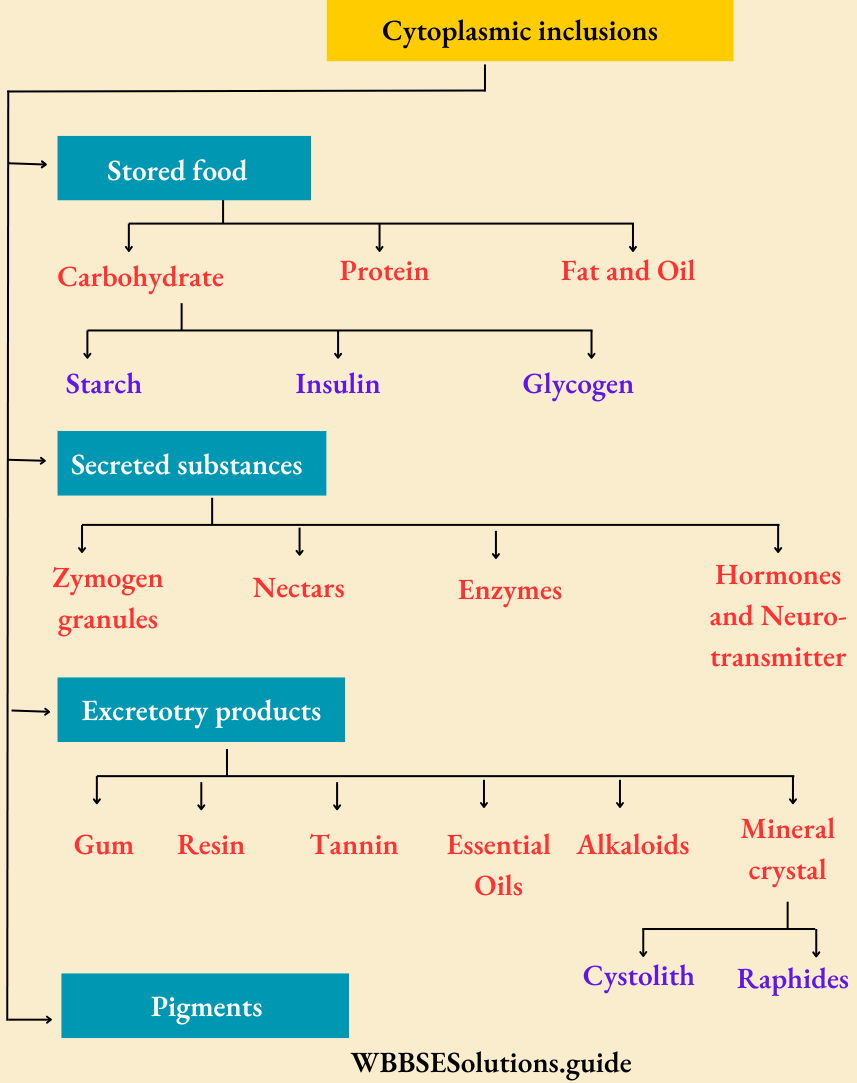
Cytoplasmic Inclusion Definition: All the non-living substances produced during the metabolic activity of the cell, together are known as cytoplasmic inclusions.

In plant cells, these are called ergastic substances and in animal cells, they are called metaplastic bodies.

Types: These are divided into groups which are as follows—

Biology Class 11 Chapter 8 Cell The Unit Of Life Cytoplasmic Inclusions

Some main cytoplasmic inclusions: The major cytoplasmic inclusions are discussed below.

Reserve food: The end products of metabolism stored in the cell for future use are known as reserve food. They may be carbohydrates, proteins, fats, and oils.

Carbohydrates: These include starch, glycogen, and inulin. These are described below

Starch is a polysaccharide made up of glucose units. It is stored in plant cells,

Glycogen is a polysaccharide made up of glucose units. The stored glycogen in the animal body is called animal starch.

Inulin is a polysaccharide made up of fructose units.lt remains dissolved in the cell sap.

Protein: In animal cells, protein mainly forms the cytoskeleton but in plant cells, they are present as aleurone grains in seeds of castor, maize, wheat, etc.

Fats and oils: They are formed of fatty acids and glycerol. In plants, these are stored in the endosperm and cotyledons of seeds of mustard, nut, castor, etc. In animals, they are stored in the adipose tissue and liver cells.

Secretory materials: The secretory materials are stored in the form of zymogen granules, hormones, neurotransmitters, enzymes, and nectar.

Zymogens: These are inactive precursors of enzymes like pepsinogen (precursor of pepsin), trypsinogen (precursor of trypsin), etc. They appear like membrane-bound granules.

Nucleoplasm function in eukaryotic and prokaryotic cells 

Hormones and neurotransmitters: These are chemical messengers that control various metabolic functions. Hormones are found in both plants and animals while neurotransmitters are found only in animals.

Enzymes: These catalysts are present in both plant and animal cells. They catalyze different metabolic reactions.

Nectar: In plants, nectar is secreted by nectar glands or special cells in flowers. It attracts the insects for pollination. A honey bee collects the nectar for the synthesis of honey.

Excretory products: Different types of metabolic end products are produced within plant and animal cells. In animal cells, the waste products are toxic, hence they are eliminated or excreted out of the body.

In plant cells, most of the excretory products are non-toxic and stored as cell inclusions within the cell.

Some of the excretory products of plant cells are—

Gums: Gums are hydrophilic, viscous, amorphous, colloidal substances, found in the stems of plants like acacia, google, and camphor.

Resin: Resins are excretory substances soluble in ether and alcohol. These are present in the leaves and stems of pine trees, opium plants, saal trees, etc. These are used as medicine and polish.

Latex: It is a milky, viscous, white colloidal substance found in specialized cells or ducts called laticifers of stems and leaves of banyan, papaya, jackfruit, etc.

Tannins: These are the nitrogenous wastes of plants as granular masses In the leaves and barks of tea, pine, date palm, hemlock, etc.

Essential oils: These are volatile oils found in petals (rose, jasmine), stems, and leaves (Eucalyptus).

Nucleoplasm and its importance in genetic material storage

Alkaloids: Different types of nitrogenous compounds, stored in the cells of different parts of the plant body are known as alkaloids. E.g., Quinine (root and stem of Cinchona), caffeine (in coffee), nicotine (leaves of tobacco), etc. These excretory substances have medicinal value.

Mineral crystals: Mineral crystals are formed by mineral salts. E.g., calcium salts are deposited in the form of calcium crystals in special parenchymatous cells of the plant body.

These are of two types—

Cystolith: Cystoliths are calcium carbonate crystals that appear like a bunch of grapes. They are deposited within special, enlarged cells of plants, called lithocysts. For, leaves of banyan, fig, and rubber have deposits of cystolith.

Raphide: Raphides are crystals of calcium oxalate. These are deposited within special, enlarged cells of plants, called idioblasts. E.g., leaves of Colocasia, water hyacinth, yam, onion.

Pigments: Few cells synthesize certain pigments like chlorophyll, anthocyanin, carotene, etc. that give color to the plant cells or organs like flowers, fruits, leaves, roots, etc. Similarly, in animal cells, different types of pigments are present like hemoglobin in the RBCs, melanin in skin and hair cells, etc.

Cell The Unit Of Life Question And Answers

Class 11 Biology WBCHSE Cell The Unit Of Life Questions And Answers

Question 1. What is a biomembrane or biological membrane?
Answer:

Biomembrane or biological membrane

The membrane surrounding the cytoplasm of all cells and organelles of eukaryotic organisms which contain similar repeating units of protein-lipid, is called biomembrane or biological membrane.

Cell The Unit Of Life

Question 2. What is a unit membrane?
Answer:

Membrane

The protein-lipid-protein membrane which encloses many cells and cell organelles is known as a unit membrane. It was previously believed to be composed of three layers—an inner lipid layer enclosed by two outer protein layers.

Cell: The Unit of Life questions and answers PDF 

Question 3. Why is ER called reticulum?
Answer:

ER consists of a mesh or reticulum in the endoplasm region of cytoplasm and so ER is known as endoplasmic reticulum.

Question 4. What is autophagosome?
Answer:

Autophagosome

These are secondary lysosomes that digest the cell’s own constituents through a process called autophagy.

Read and Learn More WBCHSE Solutions For Class 11 Biology

Question 5. Why cell wall of bacteria or prokaryotic cells is tough?
Answer:

The cell wall of bacteria or prokaryotic cells is tough due to the presence of peptidoglycan (a compound made of oligosaccharides and protein).

Cell The Unit Of Life Question And Answers

Question 6. What is known as a mesosome? What is its function?
Answer:

Mesosome: The folded region of plasma membrane towards the cytoplasm in a prokaryotic cell, mainly in the case of Gram-negative bacteria, is known as mesosome.

Function: It helps in respiration, replication, and cell division.

Class 11 Biology Class 11 Chemistry
Class 11 Chemistry Class 11 Physics
Class 11 Biology MCQs Class 11 Physics MCQs
Class 11 Biology Class 11 Physics Notes

Class 11 biology Cell: The Unit of Life Q&A 

Question 7. What is the characteristic feature of prokaryotic ribosomes?
Answer:

Characteristic feature of prokaryotic ribosomes

The ribosome of a prokaryotic cell is 70S and it remains scattered within the cytoplasm.

Question 8. What is the characteristic feature of the eukaryotic ribosome?
Answer:

Characteristic feature of the eukaryotic ribosome

The ribosome of the eukaryotic cell is the 80S (in organelles, it is 55S or 70S) and these are attached to either the surface of RER or nuclear membrane or may remain scattered within the cytoplasm.

Question 9. What is the composition of the cytoplasmic skeleton?
Answer:

Composition of the cytoplasmic skeleton

The cytoplasmic skeleton is made up of microfilament, microtubule, and intermediate filament.

Question 10. Where does transcription take place in prokaryotic and eukaryotic cells?
Answer:

Transcription occurs in the cytoplasm of a prokaryotic cell and in the nucleus of a eukaryotic cell.

Question 11. What is microfibril?
Answer:

Microfibril

The main structural component of the cell wall which is made up of glucose units is called microfibril. It is composed of 20 micelle fibers.

Question 12. What is micelle?
Answer:

Micelle

The primary fiber formed by arranging numerous cellulose units (100) parallel is called a micelle.

Short answer questions on Cell: The Unit of Life

Question 13. What is desmotubule?
Answer:

Desmotubule

The thin (20 nm), simple or branched, membrane-bound tubule, present at the center of plasmodesmata is called a desmotubule.

Question 14. What are lonesome?
Answer:

Lonesome

Fungi, some algae, and some higher plant cells contain mesosome-like inner folds of plasma membrane. These are known as lonesomes. Their function is similar to mesosomes.

Question 15. What is chromocentre?
Answer:

Chromocentre

The dark, chromatin-containing parts in the nuclear reticulum is called chromocentres or karyosomes.

Question 16. What is perimitochondrial space?
Answer:

Perimitochondrial space

The space between inner and outer mitochondrial membranes which contains water, enzymes, and mineral salts, is called perimitochondrial space.

Question 17. What are oxysome granules or granules or elementary granules?
Answer:

The tennis racket-like structures arranged like chains in the inner wall of mitochondria (M-face) are the oxysome granules or granules. They contain the enzyme ATPase.

Cell: The Unit of Life chapter-wise questions with solutions

Question 18. What is a diplosome?
Answer:

Diplosome

The pair of centrioles in a centrosome is known as a diplosome.

Question 19. What are Microbodies?
Answer:

Microbodies

The unit membrane-bound, oxidizing organelles that are found scattered within the cytoplasm and carry out oxidation are called microbodies, such as—peroxisome, glyoxysome, and spherosome.

Question 20. What is a chromophobe cell?
Answer:

Chromophobe cell

The cells which do not have any affinity for dyes, are called chromophobe cells. These cells are found in the frontal part of the pituitary gland.

Question 21. How do salivary juice and tears act as bacteriocidal fluid?
Answer:

Salivary juice and tears contain lysozyme, an enzyme that hydrolyses the peptidoglycan layer of the cell wall of the bacterial cells. As a result, lysozyme can destroy invading pathogens.

Question 22. Water turns red when the beetroot is boiled in it, but this does not happen when the carrot is boiled. Why?
Answer:

Water turns red when the beetroot is boiled in it, but this does not happen when the carrot is boiled.

Vacuole in cells of beetroot contains the pigment yS-cyanin. On boiling the cell membrane dies and becomes permeable, and vacuoles break down and release the pigment into water.

Beta-cyanin being soluble in water, dissolves in it and turns the water red. However, the carotene pigment of carrot is present in the thylakoids of the plastid. On boiling, the pigment is not released into the water.

The pigment is also insoluble in water. So, carrots do not impart any color to water when boiled. It also proves that the cell membrane is semipermeable.

Question 23. Why are mitochondria less in chloroplast-containing green plant cells than in animal cells?
Answer:

Green plant cells which contain chlorophyll can synthesize ATP in chloroplasts as well as mitochondria. But animal cells lack chloroplast and hence, most of the ATP is synthesized by mitochondria only. So, mitochondria are less in green plant cells but more in animal cells.

Question 24. Why are cristae formed in the wall of the inner membrane of mitochondria?
Answer:

Cristae increase the surface area of the inner membrane of mitochondria, thus increasing the availability of enzymes, that are necessary for respiration.

Question 25. Which are the second largest organelle in plant and animal cells?
Answer:

Next to the nucleus, the second largest organelle is plastid in plant cells and mitochondria in animal cells.

Class 11 Biology WBCHSE Cell The Unit Of Life Very Short Question And Answers

Question 1. What is a cell?
Answer:

Cell

The cell is the structural and functional unit of life.

Question 2. Who was the propounder of the unit membrane concept?
Answer: J. D. Robertson was the propounder of the unit membrane concept.

Question 3. Who invented the electron microscope?
Answer: M. Knoll and E. Ruska (1931).

Question 4. What is the resolving power of human eyes?
Answer: 0.1 nm

Question 5. Name the smallest and largest cells of organisms on earth.
Answer: The smallest cell is PPLO and the largest cell is the egg of an ostrich.

Question 6. Name the scientist who introduced the term ‘cell’.
Answer: Robert Hooke

Question 7. What is a cell wall?
Answer:

Cell wall

The thick, rigid, dead, permeable, and cellulosic outermost covering of some protists, fungi, and eukaryotic plant cells is called the cell wall.

Question 8. Give two examples of prokaryotic cells.
Answer: Oscillatoria sp., Anabaena sp.

Question 9. What is a centrosome?
Answer:

Centrosome

The membrane-less organelle that forms spindle fibers during cell division is called a centrosome.

Question 10. What is lysosome?
Answer:

Lysosome

Lysosomes are sac-like structures that are bound by a single membrane and are involved in intracellular digestion.

Question 11. What is the main function of the plasma membrane?
Answer: The plasma membrane allows selective transport of substances in and out of the cell.

Question 12. Mention the major role of the Golgi apparatus.
Answer: Golgi bodies have secretory functions and they secrete enzymes, hormones, mucus, etc.

Question 13. What is pinocytosis?
Answer:

Pinocytosis

The process by which a cell engulfs fluids is called pinocytosis.

Question 14. What is osmosis?
Answer:

Osmosis

The movement of solvent molecules from a region of lower solute concentration through a semipermeable membrane into a region of higher solute concentration is called osmosis.

Question 15. Define cell membrane.
Answer:

Cell membrane

The living, semi-permeable outer covering of cytoplasm is made up of called cell membrane.

Question 16. Who discovered ribosome?
Answer: G. Palade

Question 17. What are plasmodesmata?
Answer:

Plasmodesmata

The membrane-bound tubules of the endoplasmic reticulum that pass through the intervening cell wall and make connections between adjacent plant cells are called plasmodesmata.

Question 18. What do you mean by polysome?
Answer:

Polysome

The complex formed between an mRNA and more than one ribosome is called a polyribosome.

Question 19. What are autophagosomes?
Answer:

Autophagosomes

The double membrane-bound vesicle that encloses worn-out cell organelles and fuses with lysosomes which digest these cell organelles during autophagy, is called autophagosome.

Question 20. What is phagocytosis?
Answer:

Phagocytosis

The process by which a cell engulfs solid substances is called phagocytosis.

Question 21. State the main function of the centriole.
Answer: The centrioles play an important role in cell division by forming a spindle and providing a mechanism for the arrangement and movement of chromatids.

Question 22. What are plastids?
Answer:

Plastids

The double membrane-bound, spherical or oval-shaped, pigmented and unpigmented organelles of plant cells that synthesize organic compounds are called plastids.

Objective questions on Cell: The Unit of Life with answers

Question 23. Name the single membrane-bound cell organelle, which is rich in hydrolytic enzymes.
Answer: Lysosome

Question 24. What is the main role of dictyosome?
Answer:

Main role of dictyosome

Dictyosome helps in the secretion and formation of cell walls.

Question 25. What is thylakoid?
Answer:

Thylakoid

Sac-like structures in the chloroplasts that are arranged into stacks are called thylakoids.

Question 26. Who proposed the cell theory?
Answer: Schleiden and Schwann

Question 27. Who discovered the Golgi body?
Answer: Camillo Golgi

Question 28. What is the function of peroxisome?
Answer:

Function of peroxisome

Peroxisome carries out oxidative reactions in the cell and protects the cell from harmful oxidative radicals.

Question 29. Who discovered the nucleolus?
Answer: F. Fontana (1774)

Question 30. What is selective permeability?
Answer:

Selective permeability

A membrane that allows both solvent and solute to pass but in a selective manner, is called a selectively permeable membrane.

Question 31. What is leucoplast?
Answer:

Leucoplast

Colourless plastid that stores fat are called leucoplast.

Question 32. Why is mitochondria called the ‘ powerhouse’ of the cell?
Answer: Mitochondria synthesizes energy in the form of ATP and so is called the ‘power house of the cell’.

Question 33. Where is rRNA synthesized?
Answer:

rRNA is synthesized in the nucleolus.

Question 34. What is active transport?
Answer:

Active transport

The process of transport of biochemical substances across a membrane that requires energy is called active transport.

Question 35. What is cystolith?
Answer:

Cystolith

Cystoliths are calcium carbonate crystals that occur in the form of a bunch of grapes in special enlarged cells in the leaf of plants of certain families.

Question 36. What is raphide?
Answer:

Raphide

Raphides are crystals of calcium oxalate that are stored within specialized plant cells called idioblasts.

Question 37. What are grana?
Answer:

Grana

Thylakoids of chloroplast are arranged in the form of stacks which are called grana.

Question 38. What is the function of lysosomes?
Answer:

The function of lysosomes

Lysosome is the intracellular digestive organelle that hydrolyses damaged and worn-out parts of the cell.

Question 39. State the function of leucoplast.
Answer:

Function of leucoplast

Leucoplast stores fat, proteins, and starch. They are capable of transforming into other plastids.

Question 40. What do you mean by cytoskeleton?
Answer:

Cytoskeleton

The complex network of protein filaments that forms a mesh and structural support of the eukaryotic cell is called the cytoskeleton.

Question 41. What is chloroplast?
Answer:

Chloroplast

The plastid that contains the pigment chlorophyll and is responsible for photosynthesis is called chloroplast. GERL system refers to the associative function of Golgi bodies, endoplasmic reticulum, ribosome, and lysosome.

Question 42. What do you mean by the GERL system?
Answer:

GERL system

The GERL System refers to the associative Function Of Golgi Bodies, Endoplasmic Reticulum, Ribosomes, And Lysosomes.

Question 43. State the function of the centriole.
Answer: Centrioles form spindle fibers during cell division.

Question 44. In the 80S ribosome, what does the letter S stand for?
Answer: ‘S’ stands for Svedberg which is the unit of sedimentation coefficient.

Class 11 Biology WBCHSE

Question 45. Who first showed the presence of mitochondria in living cells?
Answer: Altman

Question 46. Name the internal membrane present in prokaryotic cells.
Answer: Plasma membrane

Question 47. Who discovered the centrosome?
Answer: Edouard Van Beneden in 1883.

Question 48. What is the function of the nuclear membrane?
Answer:

Function of the nuclear membrane

Substances are translocated through the nuclear pore. It also separates the nucleus from the cytoplasm.

Important Cell: The Unit of Life questions and answers

Question 49. What is aleuroplast?
Answer:

Aleuroplast

Aleuroplast is a type of leucoplast that stores protein.

Question 50. Name a secretory material of the cell.
Answer: Zymogen granules.

Question 51. What is the feature of a metacentric chromosome?
Answer: The centromere is present in the middle of the chromosome and the chromosome appears like ‘V’ at the anaphase stage of cell division.

Question 52. What is referred to as the satellite chromosome?
Answer:

The chromosomes that have a small region at the terminal of secondary constriction are called satellite chromosomes.

Question 53. Which pigment is mainly responsible for the color of the carrot?
Answer: Carotene

Question 54. What is the significance of vacuole in a plant cell?
Answer:

Significance of vacuole in a plant cell

Vacuole maintains osmotic pressure for turgidity in a plant cell.

Cell The Unit Of Life Multiple Choice Question And Answers

Cell The Unit Of Life Multiple Choice Questions

Question 1. Which of the following cell organelles is responsible for extracting energy from carbohydrates to form ATP-

  1. Ribosome
  2. Chloroplast
  3. Mitochondrion
  4. Lysosome

Answer: 3. Mitochondrion

Question 2. Which of the following components provides a sticky character to the bacterial cell—

  1. Nuclear membrane
  2. Plasma membrane
  3. Glycocalyx
  4. Cell wall

Answer: 3. Glycocalyx

MCQ on Cell: The Unit of Life for NEET with answers

Question 3. Microtubules are the constituents of—

  1. Spindle fibers, centrioles, and cilia
  2. Centrioles, spindle fibres, and chromatin
  3. Centrosomes, nucleosomes, and centrioles
  4. Cilia, flagella, and peroxisomes

Answer: 1. Spindle fibers, centrioles, and cilia

Question 4. Which of the following cell organelles is enclosed by a single membrane?

  1. Chloroplasts
  2. Lysosomes
  3. Nuclei
  4. Mitochondria

Answer: 2.  Lysosomes

Cell The Unit Of Life Multiple Choice Question And Answers

Question 5. A cell organelle containing hydrolytic enzyme is—

  1. Lysosome
  2. Microsome
  3. Ribosome
  4. Mesosome

Answer: 1. Lysosome

Class 11 biology Cell: The Unit of Life MCQ with solutions

Question 6. Which of the following structures is not found in prokaryotic cells?

  1. Plasma membrane
  2. Nuclear envelope
  3. Ribosome
  4. Mesosome

Answer: 2. Nuclear envelope

Class 11 Biology Class 11 Chemistry
Class 11 Chemistry Class 11 Physics
Class 11 Biology MCQs Class 11 Physics MCQs
Class 11 Biology Class 11 Physics Notes

Question 7. Which of the following are not membrane-bound?

  1. Mesosomes
  2. Vacuoles
  3. Ribosomes
  4. Lysosomes

Answer: 3. Ribosomes

Question 8. Cellular organelles with membranes are—.

  1. Lysosomes, Golgi apparatus, and mitochondria
  2. Nuclei, ribosomes, and mitochondria
  3. Chromosomes, ribosomes, and endoplasmic reticulum
  4. Endoplasmic reticulum, ribosomes and nuclei

Answer: 1.  Lysosomes, Golgi apparatus, and mitochondria

Question 9. A protoplast is a cell—

  1. Without division
  2. Without plasma membrane
  3. Without nucleus
  4. Undergoing division

Answer: 1.  Without division

Important MCQs on Cell: The Unit of Life for competitive exams

Question 10. The function of the gap junction is to—

  1. Stop substances from leaking across a tissue
  2. Performing cementing to keep neighboring cells together
  3. Facilitate communication between adjoining cells by connecting the cytoplasm for rapid transfer of ions, small molecules, and some large molecules
  4. Separate two cells from each other

Answer: 3. Facilitate communication between adjoining cells by connecting the cytoplasm for rapid transfer of ions, small molecules, and some large molecules

Question 11. Chromatophores take part in—

  1. Respiration
  2. Photosynthesis
  3. Growth
  4. Movement

Answer: 2. Photosynthesis

Question 12. Match the columns and identify the correct option—

Biology Class 11 Chapter 8 Cell The Unit Of Life Match The Following Question 12

Answer: 3. 

Question 13. Which structure performs the function of mitochondria in bacteria?

  1. Nucleoid
  2. Ribosomes
  3. Cell wall
  4. Mesosomes

Answer: 4. Mesosomes

Cell: The Unit of Life chapter MCQ with explanatio

Question 14. Match the following columns

Biology Class 11 Chapter 8 Cell The Unit Of Life Match The Following Question 13

  1. 1-4,2-2,3-1,4-3
  2. 1-1,2-2,3-4,4-3
  3. 1-1,2-3,3-2,4-4
  4. 1-4,2-3,3-1,4-2

Answer: 

Question 15. The solid linear cytoskeletal elements having a diameter of 6 nm and made up of a single type of monomer are known as—

  1. Microtubules
  2. Microfilaments
  3. Intermediate filaments
  4. Lamins

Answer: 2. Microfilaments

Question 16. The osmotic expansion of a cell kept in water is chiefly regulated by—

  1. Mitochondria
  2. Vacuoles
  3. Plastids
  4. Ribosomes

Answer: 2. Vacuoles

Question 17. The component of bacteria that retains the crystal violet stain during gram staining is—

  1. O antigen
  2. Lipopolysaccharide
  3. Peptidoglycan
  4. Cytoplasmic membrane

Answer: 3. Peptidoglycan

Question 18. Which of the following is always absent in prokaryotic cells?

  1. Ribosome
  2. Mitochondria
  3. Dma
  4. Cell wall

Answer: 2. Mitochondria

Question 19. Which one of the following bacteria is observed as a chain-like formation?

  1. Escherichia coli
  2. Bacillus subtilis
  3. Streptococcus pyogenes
  4. Micrococcus flavus

Answer: 3. Streptococcus pyogenes

Question 20. The primary cell wall is mainly made up of—

  1. Lignin
  2. Pectin
  3. Cellulose
  4. Protein

Answer: 3. Cellulose

Question 21. The chromosome with centromere near the end is called—

  1. Acrocentric
  2. Metacentric
  3. Sub-metacentric
  4. Telocentric

Answer: 1. Acrocentric

Question 22. Choose the correctly matched ones.

  1. Vibrio—rod-like bacteria
  2. Mesosome—helps in cell wall formation
  3. Smooth endoplasmic reticulum—synthesis of lipid
  4. Vacuoles—rich in hydrolytic enzymes

Choose The Correct Option 

  1. 2 And 3
  2. 1 And 4
  3. 1 And 3
  4. 2, 3 And 4
  5. 1, 3 And 4

Answer: 1. 2 And 3

Question 23. Which of these organelles does not contain ribosomes?

  1. Rough endoplasmic reticulum
  2. Chloroplast
  3. Golgi apparatus
  4. Mitochondria

Choose The Correct Option 

  1. 1 And 2
  2. 1 And 4
  3. Only 4
  4. Only 3
  5. 2, 3 And 4

Answer: 4. Only 3

Question 24. One type of chromosome has a middle centromere, whereas the other has terminal centromeres. They are—

  1. Metacentric and acrocentric
  2. Metacentric and telocentric
  3. Sub-metacentric and telocentric
  4. Telocentric and acrocentric
  5. Acrocentric and metacentric

Answer: 2. Metacentric and telocentric

Question 25. Which of the following statements is correct?

  1. Elaioplasts store starch, whereas aleuroplasts store proteins
  2. Acrocentric chromosomes have only one arm
  3. The core of the cilium or flagellum is the basal body
  4. Membranous extensions into the cytoplasm in cyanobacteria which contain pigments are called chromatophores

Answer: 4. Membranous extensions into the cytoplasm in cyanobacteria which contain pigments are called chromatophores

Question 26. The Golgi complex plays a major role—

  1. In trapping the light and transforming it into chemical energy
  2. In digesting proteins and carbohydrates
  3. As energy-transforming organelles
  4. In post-translational modification of proteins and glycosidation of lipids

Answer: 4. In post-translational modification of proteins and glycosidation of lipids

Question 27. Which one of the following organelles in the figure correctly matches its function?

Biology Class 11 Chapter 8 Cell The Unit Of Life Multiple Choice Question 27

  1. Rough endoplasmic reticulum, formation of glycoproteins
  2. Golgi apparatus, protein synthesis
  3. Golgi apparatus, formation of glycolipids
  4. Rough endoplasmic reticulum, protein synthesis

Answer: 4. Rough endoplasmic reticulum, protein synthesis

Cell: The Unit of Life chapter MCQ with explanation

Question 28. A major site for the synthesis of lipids is—

  1. Rer
  2. Symplast
  3. Nucleoplasm

Answer: 2. Symplast

Question 29. Match the following columns:

Biology Class 11 Chapter 8 Cell The Unit Of Life Match The Following Question 29

  1. 1-4,2-5,3-1,4-2
  2. 1-5,2-4,3-2,4-2
  3. 1-3,2-1,3-2,4-4
  4. 1-2,2-3,3-5,4-1

Answer: 3. 1-3,2-1,3-2,4-4

Question 30. Which one of the following does not differ in e. Coli and chlamydomonas?

  1. Ribosomes
  2. Chromosomal organization
  3. Cell wall
  4. Cell membrane

Answer: 4. Cell membrane

Question 31. N-acetyl muramic acid is found in—

  1. Cell wall component of plant
  2. Cell wall component of gram-positive bacteria
  3. Cell wall component of fungal coat material
  4. Viral coat material

Answer: 2. Cell wall component of gram-positive bacteria

Question 32. Identify the bacterium that appears violet

  1. Gram staining—
  2. Salmonella enterica
  3. Escherichia coli
  4. Mycobacterium tuberculosis
  5. Rhizobium meliloti

Answer: 3. Escherichia coli

Question 33. Which of the cell organelles lacks a membrane?

  1. Mesosome
  2. Ribosome
  3. Mitochondria
  4. Liposome

Answer: 3. Mitochondria

Question 34. Which one of the following also acts as a catalyst in a bacterial cell?

  1. Snrna
  2. 23S rRNA
  3. Hnrna
  4. 5S rRNA

Answer: 3. Hnrna

Question 35. The cell theory is not applicable to—

  1. Algae
  2. Fungi
  3. Viruses
  4. Lichens

Answer: 3. Viruses

Question 36. Robert Hooke used the term ‘cell’ in the year—

  1. 1650
  2. 1665
  3. 1865
  4. 1960

Answer: 2. 1665

Question 37. Plant cells normally lack—

  1. Ribosomes
  2. Golgi bodies
  3. Centrioles
  4. Cell membrane

Answer: 3. Centrioles

Question 38. The detailed structure of the membrane was studied after the advent of the electron microscope during—

  1. 1930S
  2. 1950S
  3. 1970S
  4. 1990S

Answer: 2. 1950s

Question 39. Tonoplast is the membrane covering of—

  1. Vacuole
  2. Mitochondria
  3. Chloroplast
  4. Lysosome

Answer: 1. Vacuole

Question 40. Mitochondria will be found in abundance in cells of tissues having—

  1. Minimum activity
  2. Average activity
  3. Maximum activity
  4. None of these

Answer: 3. Maximum activity

Question 41. The types of ribosomes found in prokaryotic cells are—

  1. 100S
  2. 80S
  3. 60S
  4. 70S

Answer: 3. 60s

Biomolecules Notes

Biomolecules Introduction

Biomolecules

The body of an organism is just like a chemical factory. Numerous chemical reactions are continuously occurring inside our body.

Such reactions constitute the metabolic pathways of the various biochemical processes like respiration, photosynthesis, etc.

These reactions involve different molecules and enzymes. Many of these molecules such as carbohydrates, proteins, and lipids are the major constituents of the living body.

The collection or sum total of all these molecules present within a cell is called the cellular pool. All such molecules that are involved in the maintenance and metabolic processes of the living body are called biomolecules.

Different molecules found in a living body—Biomolecules

Biomolecules occur naturally in living organisms. All forms of life have biomolecules as their constituents.

Biomolecules consist mainly of carbon and hydrogen with nitrogen, oxygen, sulfur, and phosphorus.

The biomolecules are divided into two types—

  1. Inorganic and Organic.
  2. Inorganic molecules

These molecules either contain fewer carbon and hydrogen atoms or none at all.

They remain dissolved in the cellular fluid and form a colloidal solution, For example, different minerals (in the form of ions and salts), water, gaseous products, etc.

Biomolecules notes for NEET PDF

Inorganic molecules are of two types—

  1. Water And
  2. Inorganic Salts.

Water: About 90% of the cellular protoplasm is made up of water.

Biomolecules Notes

Water is required for the following functions—

  1. Solvent: Water is used as a solvent in different organic and inorganic cellular components.
  2. Medium for metabolic reactions: Several metabolic reactions take place in aqueous medium.
  3. Temperature regulation: Water plays an important role in regulating the body temperature mainly in higher animals and also in plants.
  4. pH regulation: The balance between the acidic and basic components in the body is maintained by water.

Inorganic salts: Inorganic salts can carry out the following functions—

  1. Structure of body parts: Different body parts such as bones, teeth, etc., have inorganic salts as one of the major components.
  2. Chemical reactions: Inorganic salts also take part in different chemical reactions within the body.
  3. Formation of organic molecules: Organic biomolecules such as DNA, RNA, etc., have inorganic salts as one of the major components.
Class 11 Biology Class 11 Chemistry
Class 11 Chemistry Class 11 Physics
Class 11 Biology MCQs Class 11 Physics MCQs
Class 11 Biology Class 11 Physics Notes

Organic molecules

In these molecules, the number of carbon and hydrogen atoms is more compared to inorganic molecules.

Different sugars, lipids, amino acids, proteins, nucleic acids, etc., fall under this group.

They are divided into two types—

  1. Macromolecules And
  2. Macromolecules.

Micromolecules: The molecules, that have a simple structure, low molecular weight, and are mostly water soluble, are called micromolecules.

Class 11 biology biomolecules notes with diagrams

Examples: Monosaccharides, amino acids, nucleotides, etc.

Macromolecules: The larger molecules that are made up of smaller monomeric units (micromolecules), linked by chemical bonds, through polymerization reaction, are called macromolecules.

Examples: Proteins (polymer of amino acids), nucleic acids (polymer of nucleotides) etc.
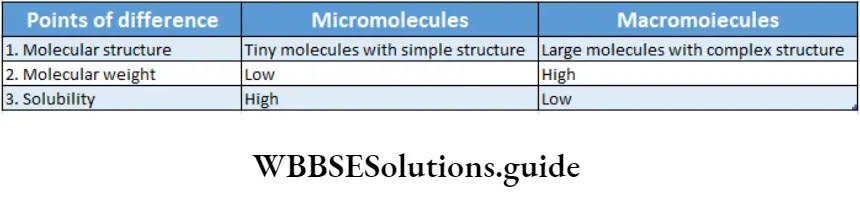
Biology Class 11 Chapter 9 Biomolecules Difference Between Micromolecules And Marcomolecules

Different Essential Elements Of —Living Bodies

Among elements, about 22 are essential for the body.

According to their requirement, the elements are divided into two categories—

  1. Macroelements And
  2. Microelements.

Macroelements

These elements are required by the body in large amounts. Also, deficiency of any of them may inhibit the growth and physiological functioning of the body.

About 95% of the cellular components are made of these elements. In our body, oxygen, carbon, hydrogen, nitrogen, etc., are examples of macroelements.

Biomolecules Notes Significant Biomolecules

Carbohydrates, lipids, proteins, and nucleic acids are four main macromolecules.

Carbohydrates

Carbohydrates Definition: Carbohydrates are polyhydroxy aldoses, ketoses, and their derivatives that yield- such compounds in hydrolysis where the ratio of carbon to hydrogen to oxygen atom is 1:2:1.

General formula: Cn(H20)n

Nomenclature: French term ‘Hydrate de carbone’, gives rise to the word ’carbohydrates1.

It is a class of compound called ‘saccharide’ derived from the Greek word ‘saccharin’ meaning sugar.

Sources: The natural sources of carbohydrates are plants—grapes, mango, sugarcane, beet, potato, maize, wheat, rice, vegetables, etc.; animals—milk, liver, fish, meat, etc.

Classification of carbohydrates: All carbohydrates are classified into three basic types— monosaccharide, oligosaccharide, and polysaccharide.

Biomolecules Chart
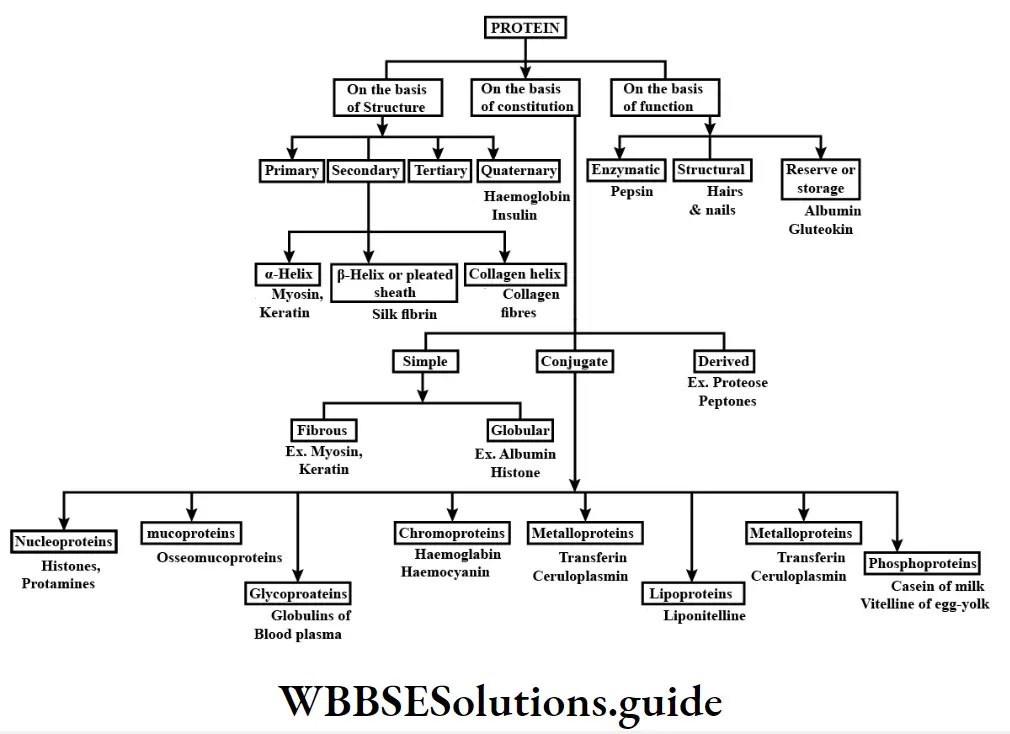
Biology Class 11 Chapter 9 Biomolecules Classification Of Protiens

More facts on carbohydrates

Free fructose is not generally available in the body but it is available in free form only in semen. Levulose is present in honey.

In some carbon compounds hydrogen and oxygen may be present in a 2:1 ratio but they are not considered carbohydrates. For example, acetic acid (CH3C00H) etc

In a DNA molecule, the two intertwined strands are not parallel, i.e., antiparallel. One strand is aligned 5′-3′ while the other is aligned 3′-5′.

The diameter of the DNA helix is about 20A.

In this structure, the helix makes a turn at every 3.4 nm length of DNA, and the distance between two neighboring base pairs is 0.34 nm. Hence, there are about 10 base pairs per turn.

The intertwined strands make two grooves of different widths, referred to as the major groove and the minor groove, which may facilitate binding with specific proteins.

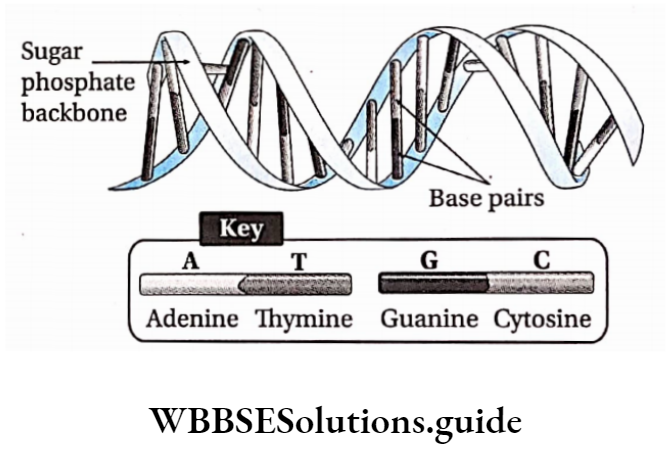
Each DNA molecule has a sugar-phosphate backbone, with nitrogenous bases attached to them.

The nitrogenous bases of one DNA molecule form a hydrogen bond with the adjacent base belonging to the other DNA molecule.

A binds with T with a double bond & G binds with C with a triple bond. This keeps the helical structure of the DNA stable, with its diameter constant.

Biomolecules Notes

In a single strand of DNA, the amount of A is not equal to that of T, while the amount of G is not equal to that of C. On the other hand, in the case of double-stranded, A + G = T + C.
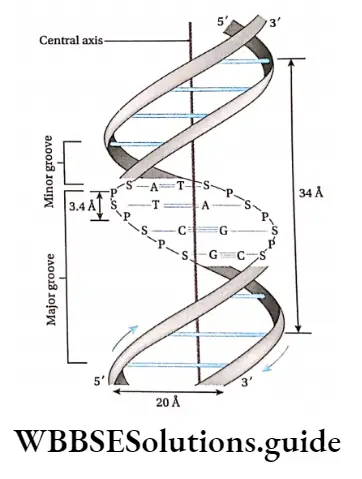
Biology Class 11 Chapter 9 Biomolecules DNA Double- Helix

Types of DNA: Most organisms have regular double-helical forms of DNA. Some bacteriophages and animal viruses have single-stranded DNA.

In prokaryotic organisms (bacteria, etc.), the DNA molecule is not linear, rather it is circular.

DNA can be classified according to the following characters—

  1. The number of nucleotides in each turn,
  2. The bond angle between the nitrogenous base pairs,
  3. The diameter of dna double helix,
  4. The direction often of double helix structure, i.e., Right or left.

There are three major forms of DNA helices—A-DNA, B-DNA, and Z-DNA. The structure of B-DNA was proposed by Watson and Crick, which has been discussed in detail in this chapter.

The comparisons between the three forms of DNA.
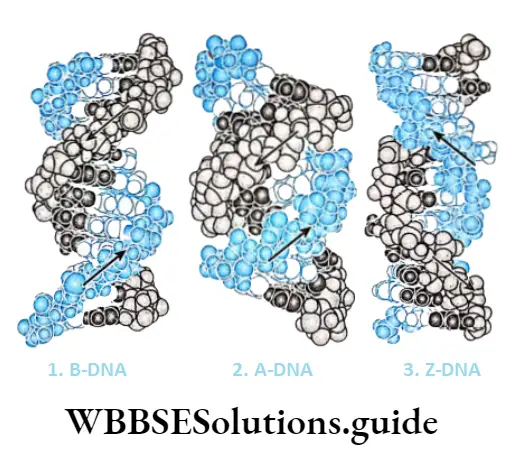
Biology Class 11 Chapter 9 Biomolecules Types Of DNA

Biology Class 11 Chapter 9 Biomolecules Comparsion Between B,A And Z-DNA

Ribonucleic acid (RNA): RNA is a type of nucleic acid that is comprised of a single-stranded polynucleotide chain and responsible for protein synthesis.

Biology Class 11 Chapter 9 Biomolecules RNA Molecule

Occurrence: The non-genetic RNA is present in all prokaryotic and eukaryotic cells. It occurs both in the nucleus as well as in the cytoplasm.

In some viruses, like TMV, influenza virus, retrovirus (HIV), etc., RNA acts as a genetic material and is known as ‘Genetic RNA’.

Quantity: The quantity of RNA depends on the metabolic reactions of the cell. During protein synthesis, the amount of RNA increases in cells.

Structural features:

Cellular RNA, both genetic and non-genetic, is single-stranded and may fold upon itself to form hairpin-like structures entirely or at certain.

Biology Class 11 Chapter 9 Biomolecules Nucleotide (Uridylic Acid) in RNA

  1. Regions Rheovirus has double-stranded genetic RNA.
  2. The strand is unbranched but may be folded in some cases so that the structure is complex.
  3. They are made up of several nucleotides linked by 3′-5′ phosphodiester bonds.
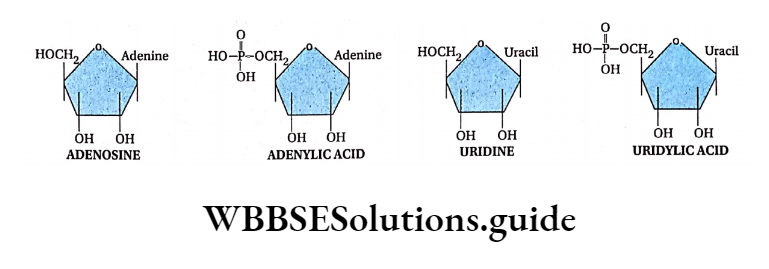
  4. Every nucleotide is made up of a ribose sugar, a nitrogenous base, and a phosphate. The nucleotides are called ribonucleotides.
  5. The nitrogenous bases present in RNA are adenine, guanine, cytosine, and uracil.
  6. The main function of RNA is protein synthesis. It is the main genetic material in many viruses.
  7. RNA is of different types. They are discussed under separate heads below.

Biology Class 11 Chapter 9 Biomolecules Nucleosides And Nucleotides In RNA

Types of RNA: The different types of RNA have been discussed below.

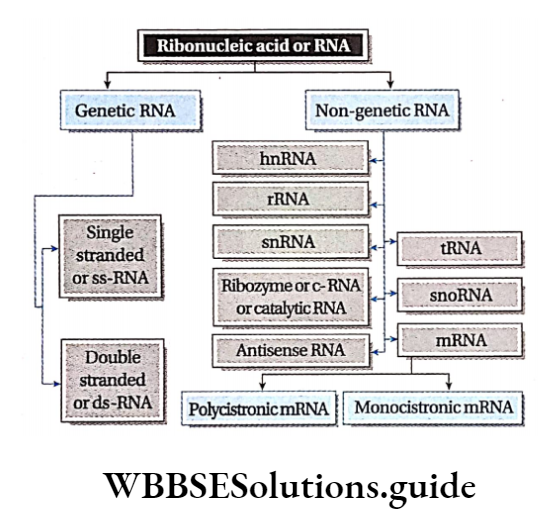
Biology Class 11 Chapter 9 Biomolecules Ribonucleic Acid Or RNA

Genetic RNA: The RNA that acts as genetic material in the absence of DNA, is called genetic RNA.

For example, Tobacco Mosaic viruses (TMV), wound tumor viruses, etc. contain genetic RNA.

This type of RNA is again of two types—

Single-stranded RNA: The RNA molecule made up of a single strand is called single-stranded RNA. E.g., TMV (plant virus), influenza (animal virus).

Double-stranded RNA: The RNA molecule made up of two strands is called double-stranded RNA. E.g., Wound tumor virus (plant virus), Rheovirus (animal virus), etc.

Non-genetic RNA: The RNA presenting the prokaryotic and eukaryotic cells, where DNA is the main genetic material, is called non-genetic RNA. These are synthesized from DNA by transcription.

In both prokaryotic and eukaryotic cells, three principal types of RNA are found. They are messenger RNA (mRNA), transfer RNA (tRNA), and ribosomal RNA (rRNA).

Biology Class 11 Chapter 9 Biomolecules Difference Between rRNA,mRNA And tRNA

Genetic material: DNA is the biological molecule that stores all the genetic information of the cell. In some viruses, RNA may function as the molecule that stores genetic information.

Transmission of hereditary characters: DNA functions as the molecule, that carries the genetic information from parents to offspring.

Synthesis of protein: Coded genetic information is transferred to the mRNA from DNA by the process of transcription. These codes are used to synthesize proteins by translation with the help of rRNA and tRNA.

Thus, information in DNA or genes is expressed in the form of proteins. Messenger RNA (mRNA) is the nucleic acid that carries information from the nucleus to the cytoplasm on which proteins are made.

Biomolecules Notes

The rRNA is a constituent of ribosome. This type of RNA helps in binding mRNA to ribosome and also in decoding the codons.

They also help in catalyzation of amino acid assembly into a polypeptide chain. The tRNA transports amino acids to the growing end of a polypeptide chain at ribosomes.

Role in metabolic activity: DNA indirectly controls the metabolic activity of the cell through the synthesis of necessary protein molecules, like enzymes.

Role In gene mutation and variation: Changes in the sequences of base pairs of DNA alter the arrangement of nucleotides in mRNA.

This causes alterations of codons which lead to changes in proteins. This induces variations in organisms leading to mutations. Mutation when leads to evolution can give rise to new species.

Biomolecules Class 11 Notes

Concept Of Metabolism

Definition: The sum total of all chemical reactions constantly occurring in the living organism, that are necessary for maintaining the living state of cells and that of the organism, is termed as metabolism.

The metabolic reactions take place as a series of linked reactions. These multi-step processes are called metabolic pathways.

Metabolic pathways of a living system can be categorized into two types—

  1. Anabolic pathways and
  2. Catabolic pathways.

Anabolic pathways

These pathways are constructive in nature and result in the formation of complex structures from simpler ones. Anabolic pathways consume energy and hence, are endergonic in nature.

For example, amino acids are linked together to synthesize proteins. Protein synthesis requires energy input and is an example of the anabolic pathway.

Catabolic pathways

These pathways are destructive in nature and lead to the breakdown of complex substances into simpler ones.

Catabolic pathways are made up of exergonic reactions because they release energy.

For example, glycolysis is a catabolic pathway where glucose breaks down to produce two molecules of pyruvic acids.

The energy released during catabolic pathways is stored in the form of chemical energy in the high-energy bonds of ATP (Adenosine triphosphate) molecules.

ATP acts as a link between exergonic and endergonic reactions. This is because ATP is hydrolyzed to release the chemical energy needed for various endergonic (energy-consuming) reactions.

Living Stage

A living system exists in a steady state, characterized by particular concentrations of all the biomolecules present within the living system.

The steady state is in a non-equilibrium state because the living system is working continuously. It prevents itself from reaching the state of equilibrium so that it is able to perform work.

The rate of formation, utilization, and transformation of biomolecules is called turnover. The rate of turnover of molecules in a metabolic pathway is called metabolic; flux.

For being in the state of metabolic flux, the metabolites tend to reach equilibrium. The equilibrium state is not reached because the end products of the metabolic pathways are utilized again.

Thus, the living organism tends to attain a steady state by metabolic flux. This takes place in the presence of energy, which is produced as a result of different metabolic reactions.

So, we can conclude that, without metabolism, a living state cannot exist.

According to Lehninger and others, biomolecules are normally present as essential organic components of living systems, and their essential organic compounds are collectively called metabolites.

These are mainly of two types—

Primary metabolites: They are formed as intermediates and produced via normal metabolic pathways in almost all living organisms, e.g., sugar, amino acids, nucleotides, lipids, proteins, etc.

Secondary metabolites: They are formed especially by the alteration of primary metabolites, mainly in the plant’s body, e.g., alkaloids, pigments, aromatic compounds, terpenoids, etc.

Enzymes

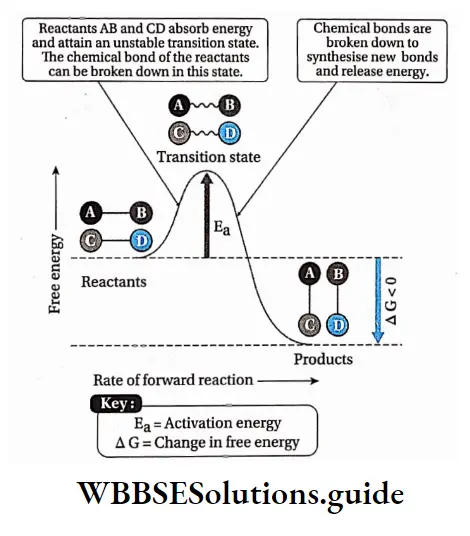
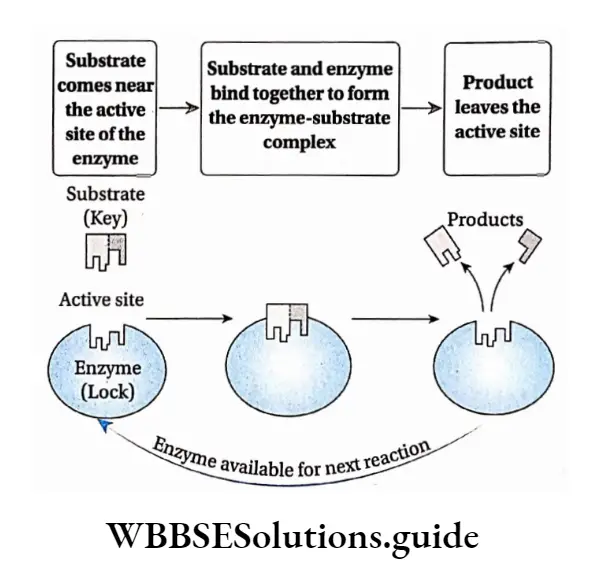
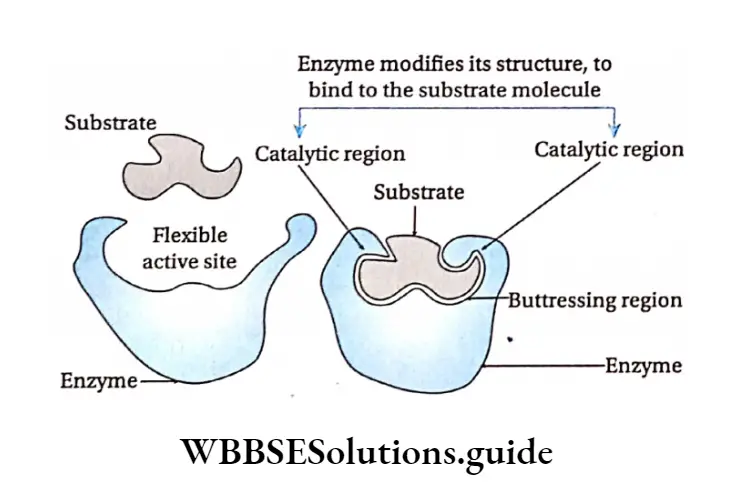
Enzymes Definition: Enzymes are protein molecules acting as biological catalysts that are able to accelerate the rate of chemical reactions in cells. While they remain unchanged at the end of the process.

Enzymes Discovery:

  • Jon Jakob Berzilius (1835) was the first to term the activity of enzymes ‘catalytic’.
  • Louis Pasteur (1850) concluded from his studies that fermentation of sugar to alcohol is catalyzed by a vital force in living yeast cells, which he termed as ‘ferments’
  • The term ‘enzyme’ was coined by W. Kuhne in 1878.
  • It is derived from the Greek words, En= in and Zyme = yeast.
  • In 1897, Edward Buchner was the first to isolate the enzyme, zymase, which was able to ferment sugar. (f)J.B. Sumner first purified and crystallized the urease enzyme from jack bean.
  • After this, John Northrop (1930) isolated many enzymes like ‘pepsin’, and ‘trypsin’ in crystalline form. Sumner and Northrop were awarded the Nobel Prize in Chemistry along with Wendell Stanley in 1946.
  • Thomas Cech and Sidney Altman (1983) were awarded the Nobel Prize in chemistry for the discovery of the catalytic property of RNA.

Properties of enzymes: The properties of enzymes are discussed in separate heads below.

Reversibility: Most of the enzymes are able to catalyze reversible reactions.

This property of the enzyme is dependent on various factors. For example, fumarase catalyses the conversion of malic acid to fumaric acid at pH 7.8 and the reverse reaction occurs at pH 6.2.

Biomolecules chapter summary with important points

\(\text { Malic acid } \frac{\text { Fumarase }(\mathrm{pH}: 7.8)}{\text { Fumarase }(\mathrm{pH}: 6.2)} \text { Fumaric acid }\)

Reusability: Enzymes remain unchanged and are released after the completion of the biochemical reactions. The unchanged enzyme is reused again.

Solubility: Enzymes are proteinaceous in nature and are soluble in water, mild glycerol, sodium chloride solution, and alcohol.

Proteinaceous nature: Enzymes are generally globular proteins. All the enzymes have a specific amino acid sequence.

Usually, they are colloidal in nature and have high molecular weights. For example, the molecular weight of bacterial ferredoxin is 6000 Da.

Carry charge: Enzymes are charged molecules.

Due to the presence of amino acids, each enzyme has a charge. The charge depends on the pH of the solution.

Biocatalysis: The enzymes show catalytic properties. They cannot initiate or stop a reaction, but only accelerate the rate of reactions. They also remain unchanged at the end of the reaction and, thus, can be reused as minute quantities are required for every reaction.

Buffering capacity: Enzymes have a buffering capacity (acid-base). They are amphoteric molecules that behave both as acids and bases.

Isoelectric point or pH (I): Each enzyme has a specific isoelectric point. It is a specific pH at which the net charge of protein equals zero so that it does not move in an electric field.

pH temperature sensitivity: Due to the proteinaceous nature, enzymes are extremely sensitive to the pH and temperature. Their structure and activity depend on these two factors.

Most enzymes have an optimum pH which ranges between 4 to 9 and the optimum temperature range for the activity of the enzymes is 37°-40°C.

At very low temperatures, the enzymes are not active. At high temperatures of 50°-60, °C usually enzyme activity is usually damaged, however, few enzymes are activated at higher temperatures (e.g., Taq polymerase from Thermus aquaticus).

For most enzymatic reactions, a 10° C rise in temperature doubles the rate of reaction. While the temperature decreases by 10° C the rate becomes half.

This measure of the rate of change of a biological or chemical system as a consequence of the change of temperature by 10° C is called Q10 (temperature coefficient).

\(\begin{array}{r}
\mathrm{Q}_{10}=\frac{\text { Rate of the reaction at temperature }(\mathrm{t}+10)^{\circ} \mathrm{C}}{\text { Rate of the reaction at temperature } \mathrm{t}^{\circ} \mathrm{C}} \\
\text { [Mostly, value of } \mathrm{Q}_{10}=2 \text { to 3] }
\end{array}\)

Denaturation: When enzymes are heated or exposed to extremely high temperatures, the non-covalent bonds between peptide chains break giving rise to the primary structure of the enzyme which is a protein.

This unfolding of protein is due to the loss of secondary, tertiary, and quaternary structures. Due to this effect of denaturation, the loss of activity takes place due to the loss of the active site.

Biomolecules Class 11 Notes

Specificity: Enzymes catalyze specific reactions. Each enzyme is specific for each reaction.

This catalysis occurs in the special site where the reactants (known as substrates in enzymatic reactions) bind and react to form the products.

This site is known as the active site of the enzyme, which is specific for the substrates. For example, sucrase catalyzes the hydrolysis of sucrose only. Similarly, protease breaks down proteins.

Activity: The activity of the enzyme refers to the rate of reaction at which it binds to the substrate. Enzymes lower the activation energy of the reactions.

The measure of enzyme activity, i.e., specific activity is usually expressed as n moles of substrate transformed to products per minute per mg of the enzyme under optimal conditions of measurements.

NEET biomolecules revision notes with MCQs

It can catalyze the conversion of about 104-105 units of the substrate into products, in one minute.

Substrate concentration: The activity of the enzymes depends on the concentration of the substrate. The activity of the enzymes increases up to a certain concentration of the substrate, after which it attains a maximum velocity.

Location:

  1. It is present in all living cells. They may remain within the cells in inactive form. These are called proenzymes or zymogens. They are converted to active enzymes only in the presence of certain factors.
  2. Some of the intercellular enzymes remain within certain organelles such as nucleus, mitochondria, plastid, etc. They may also remain within the cytosol or attached to the plasma membrane, etc.
  3. Extracellular enzymes like pepsin are synthesized within the cells of some organs but are secreted outside the cells, where they show their action.

Chemical nature of enzymes: All enzymes are protein in nature but ribozyme is a complex of the ribosomal RNA (rRNA) and protein. This catalyzes the synthesis of protein from the mRNA template. Generally, the enzyme is of two types-

Biology Class 11 Chapter 9 Biomolecules Chemical Nature Of Enzymes

Simple enzyme: It comprises only a protein part called apoenzyme. E.g., pepsin, trypsin, amylase.

Conjugated enzyme: It comprises a protein part or apoenzyme with a non-protein part or cofactor. A cofactor can be inorganic or organic in nature. Conjugated enzymes are also called holoenzymes.

Apoenzyme: The protein part of the enzyme is called apoenzyme. The inactive form of the apoenzyme is known as a proenzyme or zymogen.

The proenzyme may contain several extra amino acids in the protein. These additional amino acids are removed by proteolysis.

This allows the final specific tertiary structure to be formed before it is activated as an apoenzyme.

The apoenzyme is thermolabile. It is destroyed under high temperatures and on application of heat. The apoenzymes have one or more active sites to which co-factors attach and form the holoenzyme.

Biology Class 11 Chapter 9 Biomolecules Simple And Conjugated Enzymes

Biology Class 11 Chapter 9 Biomolecules Difference Between Apoenzyme And Holoenzyme

Cofactor: The nonprotein part of the enzyme responsible for the catalytic activity is called cofactor. Cofactor is thermostable. There are three recognized categories of cofactors. These are of the following types

Inorganic ion: Inorganic ions are alternately called metal activators. The different types of inorganic ions like Cu2+, K+, Fe2+, Mg2+, Zn2+, Mn2+, etc., play an important role in activating the catalytic reaction. For example, zinc is a cofactor of the enzyme carboxypeptidase.

Prosthetic group: The organic nonproteneous cofactor or inorganic factor that remains firmly attached to the protein part of the enzyme through a covalent bond and assists in the catalytic activity, is known as the prosthetic group.

For example, in peroxidase and catalase, which catalyze the breakdown of hydrogen peroxide to water and oxygen, haem is the prosthetic group and it is a part of the active site of the enzyme.

Co-enzyme: The organic non-proteinaceous, heat-stable part of an enzyme that remains loosely attached to the apoenzyme, is called a coenzyme.

Usually, they attach only at the time of catalysis. E.g., NAD (Nicotinamide adenine dinucleotide), NADP (Nicotinamide adenine dinucleotide phosphate).

This is derived from nicotinic acid and can exist in both oxidized and reduced forms.

Biomolecules Class 11

Metalloenzyme

The enzymes which contain metal ions, that are directly bound to the protein or to enzyme-bound non-protein components, are called metalloenzymes. E.g., Carbonic anhydrase is a zinc metalloenzyme.

Biology Class 11 Chapter 9 Biomolecules Difference Between Apoenzyme And Co-Enzyme

Biology Class 11 Chapter 9 Biomolecules Difference Between Prosthetic Group And Co-Enzyme


Structure of the enzyme: Enzymes are proteins and are made up of long chains of amino acids. The linear chains may fold to form tertiary structures.

Different enzymes have different sequences of amino acids.

The active site is a location on the enzymes that are formed when the enzymes fold into their functional shape.

The substrate binds to the enzyme at the active site. The complex formed by the union of the enzyme and its substrate is called the enzyme-substrate complex.

Once the substrate has been chemically modified, meaning the reaction ends, it becomes a product.

That product then gets released from the active site of the enzyme.

Biology Class 11 Chapter 9 Biomolecules Enzyme And Substrate Forming An Enzyme Substrate Complex

Nomenclature and classification of enzymes

  • Enzymes react upon specific substrates. They are named according to the substrate with the suffix-ose or by adding ‘lytic’ to the name of the substrate.
  • Enzymes can be named according to the reactions they catalyze. For example, oxidase (this type of enzyme catalyzes oxidation reactions). Enzymes can also be named according to the type of substrate of the reaction they catalyze.
  • In such cases, ‘in’ may be added to the name of the substrate. E.g., pepsin, trypsin, etc.
  • Enzymes may also be named according to their source. For example, papain is obtained from papaya.
  • According to a modern process of naming, enzymes may have two parts in their names.
  • The first part denotes the substrate while the second part denotes the reaction catalyzed by the enzyme. Example: glutamate-pyruvate transaminase.

Nomenclature and classification of enzymes based on International rules

  • In 1961 the commission of enzymes of the International Glutamic Acid + Pyruvic Acid Union of Biochemistry and Molecular Biology (IUBMB) framed certain rules for the nomenclature and classification of enzymes.
  • The commission recognized six different classes of enzymes, which were further divided into subclasses.
  • The enzymes are now named according to their systematic position and are given the commission number. In this pattern of naming the first number indicates the class to which the enzyme belongs and subsequent numbers indicate sub-class in that order.
  • For example, nitrate reductase, or nitrate oxidoreductase, is named E.C.1.7.1.1. Here, E.C. stands for enzyme commission.

The number 1, denotes the class of enzyme—oxidoreductase.

Here, the number, 7 means that it belongs to the subclass of enzymes that acts on another nitrogenous compound as electron donors.

The next number denotes that the enzyme has NAD+ or NADP+ as an acceptor of electrons.

The last number 1 indicates the above enzyme as the first enzyme of the series. This enzyme helps in the reduction of nitrate to nitrite.

The main six classes of enzymes are discussed under separate heads below.

E.C.l or Oxidoreductases: The enzymes that catalyze oxidation and reduction reactions of their substrate, i.e., the enzymes that catalyze the transfer of H or O atoms or electrons from one molecule to another are known as an oxidoreductase.

E.g., Oxidases (cytochrome oxidase), reductase (nitrate reductase), dehydrogenase (lactate dehydrogenase), etc.

Biology Class 11 Chapter 9 Biomolecules E.C.1 Or Oxidoreductases

E.C.2 or Transferases: Transferases are the enzymes that catalyze the transfer of a functional group from one molecule to another. E.g., transaminase (leucine Transaminase), Phosphotransferase(2′-Phosphotranferase),etc.

Biology Class 11 Chapter 9 Biomolecules E.C.2 Or Lyases

E.C.3 or Hydrolases: The enzymes which catalyze the breaking down of specific bonds of various compounds by the addition of water molecule are known as hydrolases.

In hydrolysis reactions, C-O, C-N, and C-S bonds are cleaved by the addition of H20 in the form of OH- and H+ to the atoms forming the bond. Example Esterase (acetylcholine esterase), glycosidase (protease), peptidase (trypsin), etc.

\(\text { Sucrose }+\mathrm{H}_2 \mathrm{O} \longrightarrow \text { Sucrase } \longrightarrow \text { Glucose }+ \text { Fructose }\) \(\text { Protein }+\mathrm{H}_2 \mathrm{O} \stackrel{\text { Protease }}{\longrightarrow} \text { Peptides }\)

E.C. 4 or Lyases: Lyases are the enzymes that catalyze the cleaving of C-C, C-O, C-N, and C-S bonds without hydrolysis or oxidation. E.g., decarboxylase (pyruvate decarboxylase), aldolase (fructose bisphosphate aldolase), etc.

Biology Class 11 Chapter 9 Biomolecules E.C.4 Or Lyases

E.C.5 or Isomerases: Enzymes that catalyze the isomerization reactions that cause intramolecular rearrangement of atoms in the substrates and thus form one isomer from another, are known as isomerases. Examples are isomerase (phosphohexo isomerase), epimerase (4-hydroxyproline epimerase), etc.

Biology Class 11 Chapter 9 Biomolecules E.C.5 Or Isomerases

E.C.6 or Ltgasc (Synthetase): Ligases are the enzymes that catalyze the synthesis of C-C, C-S, C-O, and C-N bonds in reactions coupled with the cleavage of high-energy phosphate bonds in ATP or some other nucleotide.

Examples: carboxylase (pyruvate carboxylase), synthetase (glutamine synthetase, aminoacyl tRNA Synthetase), ligase (malate CoA Ligase), Etc.

Biology Class 11 Chapter 9 Biomolecules E.C.6 Or Ligase (Synthetase)

Mechanism Of Enzyme Action

The action of an enzyme depends on different factors. Enzymes are biocatalysts in nature.

All the reactions in a living organism’s body are catalyzed by enzymes.

But to begin the reactions, some amount of energy is required to initiate the reaction. Enzymes enhance the rate of chemical reactions by lowering their activation energy.

Biomolecules Class 11 Activation energy

The activation energy of a reaction is the amount of energy in calories required to bring all the molecules in one mole of a substance at a given temperature to the transition state at the top of the energy barrier.

At this point, there is equal probability for reactants to undergo a reaction to form products or to fall back and remain unreacted.

Michaelis and Menten described the activity of the enzymes with respect to activation energy. They observed that reactions that are not catalyzed by enzymes, occur at a slower rate and require higher activation energy.

For example, hydrolysis of casein requires 20600 kcal/mol in the absence of any enzyme, while only 12600 kcal/mol is required in the presence of the enzyme.

Biology Class 11 Chapter 9 Biomolecules Activaction Energy

Collision theory

According to this theory, the rate of a chemical reaction is proportional to the number of collisions between reactant molecules.

So, the more often the reactant molecules collide, the more often they react to each other and the faster is the reaction rate.

Biology Class 11 Chapter 9 Biomolecules Chemical Reaction And Conversion Of Energy

The point in the chemical reaction where there is the maximum value of energy is called the transition state.

The reactant molecules collide with each other, if they hit with enough energy to go through the transition state, they will react and form new molecules.

In the transition state, new bonds are formed while old ones are broken.

Biomolecules Class 11 Models Of Enzyme Action

Two models have been proposed regarding the mode of enzyme action:

Lock and Key hypothesis: According to this hypothesis, the enzyme active site has a configuration complementary to the shape of the substrate so that the enzyme and substrate can recognize and fit each other. This model was proposed by Fischer (1890).

According to this model, Each enzyme [E] has a specific active site or catalytic site into which only the substrate [S] fits.

The enzyme [E] and the substrate [S] both possess complementary conformation, which fits exactly into one another just like a key fits into a lock.

The active site of the enzyme is rigid and fixed, which further helps in the binding.

After binding, the enzyme [E] and the substrate [S] form the ES complex.

This [ES] complex immediately breaks down into the product [P] and enzyme [E] and the product is released from the catalytic site of the enzyme.

\(\mathrm{E}+\mathrm{S} \rightleftharpoons \mathrm{ES} \longrightarrow \mathrm{P}+\mathrm{E}\)

Special groups like -NH2, -COOH, etc., help in binding the enzyme and the substrate. Co-enzymes and activators may also influence the binding.

Biology Class 11 Chapter 9 Biomolecules Lock And Key Hypothesis Of Enzyme Action

Biomolecules Class 11 Notes

Limitations of the model: Fischer explained enzyme specificity and rigidity of the binding sites of the enzymes.

However, he could not explain the allosteric behavior of enzymes (binding to a molecule at a site other than the active site) which emphasizes that the active site of an enzyme changes its conformational ensemble in order to bind with the substrate.

Induced fit hypothesis: Koshland et al. (1959) suggested another model of enzyme action with some modifications to the lock and key hypothesis.

According to this model, the active site contains two groups—the buttressing region and the catalytic region.

But the tressing region binds the substrate and forms a complex. Catalytic region weakens the bond of the substrate by electrophilic and nucleophilic processes and leads to the formation of the product maximum velocity or Vmax

This hypothesis proposes that the enzymes and their active sites are not rigid, but rather physically more flexible.

When a substrate combines with the buttressing region of an enzyme, it induces conformational changes in the enzyme structure.

This brings the catalytic region opposite to those bonds of the substrate that are to be weakened. The amino acids in the active site are modified into specific structures.

This enables the enzyme to bind with the substrate and perform its catalytic activity effectively.

The substrate changes into a product and gets released from the buttressing site due to structural changes in the site. As a result, the product is released.

Biology Class 11 Chapter 9 Biomolecules Induced Fit Hypothesis Of Enzyme Action

Regulation Of Enzyme Action

The action Of enzymes is regulated by different factors.

Factors affecting enzyme action

Substrate concentration: The catalytic activity of the enzyme is influenced by substrate concentration.

The rate of enzyme action increases with increasing substrate concentration.

If the substrate concentration is increased gradually from a very low concentration, the enzyme activity at first rises proportionately.

If this is plotted on a graph it will show a steep rise in the initial velocity (V0) With further increase in the substrate concentration, the initial rise in velocity of enzyme action falls and ultimately reaches a point where this velocity neither increases nor decreases. This point is called the maximum velocity or Vmax.

Biology Class 11 Chapter 9 Biomolecules Graphical Represention Of Michaelis Menten Equation

The initial reaction rate, V0 can be described by Michaelis-Menten equation as proposed by Leonor Michaelis and Maud Menten (1930).

\(\mathrm{V}_0=\frac{\mathrm{V}_{\max }[\mathrm{S}]}{\mathrm{K}_{\mathrm{M}}+[\mathrm{S}]}\)

where, Vmax= Maximum velocity

S = Substrate concentration

KM = Michaelis-Menten constant

V0 = Initial velocity

The substrate concentration at which half the maximum velocity, -y is attained by an enzyme catalysed reaction is called KM or Michaelis-Menten constant.

When initial velocity (V0) of an enzyme catalysed reaction is half of the maximum velocity (vmax) i.e., V0 \(v_0=\frac{v_{\max }}{2},\) hen the equation changes as follows—

\(\text { When, } v_0=\frac{v_{\text {max }}}{2}\) \(\frac{V_{\max }}{2}=\frac{V_{\max }[S]}{K_M+[S]}\) \(\text { or, } \quad \frac{1}{2}=\frac{[S]}{K_M+[S]} \text { or, } K_M+[S]=2[S]\)

or, Km =[s]

Thus the Michaelis-Menten constant [KM] is the amount of substrate concentration [S] when the initial velocity of an enzyme action is half of the maximum velocity \(\left[\frac{V_{\max }}{2}\right]\).

The KM value is an indicator of the affinity that an enzyme has for its substrate. Therefore, the value of KM is different for different enzymes. The KM value of the protease, which acts on a variety of proteins, varies with the type of protein.

An equation with a high KM indicates that the enzyme does not bind efficiently with the substrate, and Vmax will only be reached if the substrate concentration is high enough to saturate the enzyme.

Temperature: Enzymatic reactions usually take place between 20°-40°C, but at high temperature of 60’-70°C they get denatured as they are thermolabile. Generally the enzymatic action is maximum at an optimum temperature of 37C.

Biology Class 11 Chapter 9 Biomolecules Temperature Sensitivity Of Enzyme

Enzyme concentration: The increase in the concentration of enzyme increases the rate of enzyme action within the cell.

At constant temperature and pH, a high level of substrate concentration increases the rate of enzyme action proportionately.

Product concentration: A high concentration of accumulated product inhibits an enzyme to catalyse a forward reaction.

This type of inhibition is known as feedback inhibition or product inhibition.

pH: Enzymatic action is sensitive to pH. Each enzyme shows its maximum activity at a particular pH known as optimum pH. Some enzymes are active in acidic medium while others in alkaline medium. Each enzyme can act efficiently at its optimum pH. E.g., pepsin acts at an optimum pH of about 2.0 while trypsin acts at an optimum pH of 8.5

Biology Class 11 Chapter 9 Biomolecules Effect Of Ph On Different Enzymes

Methods of regulation of enzyme action

Enzyme action can be accelerated or inhibited by allosteric modulation and feedback regulation.

Allosteric modulation: The property of an enzyme by which an effector molecule binds to any site other than the active site of the enzyme, resulting in acceleration or inhibition of enzyme action is known as allosteric modulation.

Allosteric site: Some enzymes possess a second site of activity other than the active site, called the allosteric site. Such enzymes are known as allosteric enzymes.

Allosteric enzymes do not obey Michaelis-Menten kinetics. The effector molecule or allosteric modulator binds to the effector or allosteric site while the substrate molecule binds to the active site for the reaction to take place.

Allosterism: Some modulator molecules upon binding to the allosteric sites of the enzymes influence the enzyme activity. This phenomenon is called allosterism.

Compounds that can speed up the enzyme action are known as allosteric activators or inducers while those which slow down the reaction rate of an allosteric enzyme are known as allosteric inhibitors.

Types of allosteric: According to the property there are two types of allosteric—

Positive allosteric: When an effector or inducer molecule that binds with the allosteric site of an enzyme, enhances the binding capacity or the functional efficacy of the active site, then it is known as positive allosteric. In this case, the reaction proceeds in the forward direction resulting in formation of the product.

Biology Class 11 Chapter 9 Biomolecules Positive Allosterism

This in turn increases the enzyme activity and hence the rate of the reaction increases. An example of positive allosterism is the binding of oxygen molecules to hemoglobin.

Negative allosteric: Sometimes, when an inhibitor molecule binds with the allosteric site of an enzyme, the conformation of the active site changes. As a result, the substrate cannot bind to it. This is known as negative allosterism.

In this type, the reaction is inhibited so, the product is not formed. This, in turn, reduces the rate of the reaction. For example, when 2,3-bisphosphoglyceric acid binds to an allosteric site of hemoglobin, the affinity towards oxygen decreases in all subunits of the protein.

Biology Class 11 Chapter 9 Biomolecules Negative Allosterism

Biology Class 11 Chapter 9 Biomolecules Difference Between Enzyme Activactor And Inhibitor

Biology Class 11 Chapter 9 Biomolecules Difference Between Positive Allosterism And Negative Allosterism

Feedback regulation: When the concentration of the end product of a series of enzymatic reactions regulates the activity of the enzymes involved, the phenomenon is called feedback regulation.

When a large amount of product is produced, it binds to an allosteric site of the first enzyme in that reaction series, thus, inhibiting its activity. When the concentration of the end product decreases, it frees the allosteric site and the enzyme reverses back to its active state.

For example, the amino acid isoleucine is synthesized through a series of biochemical reactions from the amino acid threonine. An adequate amount of isoleucine as an end product in the cell, inhibits the activity of the enzyme threonine deaminase.

It is caused by feedback inhibition which prevents the further synthesis of isoleucine. A decrease in the concentration of isoleucine in the cell, activates the threonine deaminase enzyme by feedback mechanism.

Biology Class 11 Chapter 9 Biomolecules Feed back Inhibition

Carbohydrates, proteins, lipids, and nucleic acids notes

Enzyme Inhibitors And Enzyme Inhibition

The substances that inhibit the activity of the enzymes are called enzyme inhibitors and the mechanism by which they do so is called enzyme inhibition.

Types Of Enzyme Inhibition

Enzyme inhibition is of two types—

  1. Irreversible and
  2. Reversible.

Irreversible inhibition: The method of inhibition by which the activity of the enzymes is inhibited permanently and cannot be restored, is called irreversible inhibition.

Characteristics: An irreversible inhibitor binds to the active site and changes its structure permanently or destroys the protein structure of an enzyme.

It stops the enzymatic activity and the enzyme cannot be recovered.

Heavy metal ions, SH groups, radiations like UV rays, X-rays, are responsible for irreversible inhibition.

For example, salts of cyanides inhibit the activity of cytochrome oxidase essential for cellular respiration, resulting in cell death.

Reversible inhibition: The method of inhibition by which the activity of an enzyme is inhibited temporarily is called reversible inhibition.

Characteristics: In this type of inhibition, some inhibitor molecules may attach to the active site by non-covalent interactions.

It may also involve feedback inhibition or modification of the active site by positive modulator, etc.

When these inhibitors are released from the active site, the enzyme reverses back to the functional state.

Types: There are three types of reversible inhibition—competitive, non-competitive and uncompetitive.

Competitive inhibition: Competitive inhibitors are molecules that are structurally similar to the substrates and compete with the substrates to bind at active sites.

This leads to slowing down of the reactions. The mechanism is called competitive inhibition. Competitive inhibitors increase KM value, thus decrease substrate affinity of the active site. Vmax remains unchanged.

For example, malonate is the competitive inhibitor of succinate dehydrogenase. Malonate binds to the active site of succinate dehydrogenase, preventing succinate from binding to it.

Non-competitive inhibition: Non-competitive inhibitors have no structural similarity with the substrate but may form an inhibitor-enzyme complex at the allosteric site of the enzyme.

It inactivates an enzyme by changing the structure of the active site. Thus, the substrate can no longer recognise or bind to the active site of the enzyme.

This prevents the enzyme-substrate complex formation. Non-competitive inhibitors lower the Vmax of an enzyme but keep the value of KM unchanged.

For example, non-nucleoside reverse transcriptase inhibitors or NNRTIs (like Etravirine) can bind to the reverse transcriptase enzyme of HIV, inhibiting the synthesis of viral RNA without interfering with substrate binding. This inhibitor is used as an anti-HIV drug.

Biology Class 11 Chapter 9 Biomolecules Enzyme Inhibition Plot

Uncompetitive inhibition: Uncompetitive inhibitors bind to the enzyme after the formation of the enzyme-substrate complex.

It binds close to the active site. This stops the action of the enzyme by altering the structure of the enzyme-substrate complex.

As a result, KM decreases. The Vmax also decreases as a result of the removal of activated complexes.

Biology Class 11 Chapter 9 Biomolecules Uncompetitive Inhibition

Significance Of Enzyme Inhibition

  1. Excess products can be regulated by feedback inhibition.
  2. An idea about the different metabolic reactions within the body can be derived.
  3. Structure and activity of the enzymes can also be explained by these theories.
  4. Different medicines and pesticides can be designed applying the knowledge of enzyme inhibition.

Biology Class 11 Chapter 9 Biomolecules Difference Between Competitive And Non Competitive Inhibitors

Biology Class 11 Chapter 9 Biomolecules Difference Between Inorganic Catalysts And Enzymes(Organic Catalysts)

Denaturation of enzymes

High temperature, high energy radiation (UV rays, X-rays, etc.), heavy metals (Ag+, Hg 2+, As+), salts, concentrated acids, alkali, etc., affect the active site of the enzymes. This in turn changes the structure of the proteins, breaking the hydrogen bonds. This finally destroys the enzyme integrity permanently.

Isoenzyme or Isozyme

  • The different forms of an enzyme, differing only in certain amino add sequences but catalyzing the same reaction, are called isoenzymes.
  • Generally, different isoenzymes are found within different cells and tissues.
  • Due to slight differences in the molecular structure, they have different properties (like favorable pH, affinity towards the substrate, the effect of inhibition, etc.).
  • For example, the lactate dehydrogenase enzyme of human cells has five isoenzymes.
  • An enzyme, a-amylase, of wheat endosperm has 16 isoenzymes. Alcohol dehydrogenase of maize has 4 isoenzymes.

Allozyme

Allozymes or allozymes are variant forms of an enzyme that are coded by different genes of the same locus. E.g., DNA polymerase.

Proenzymes or Zymogens

Proenzymes or zymogens are biologically inactive substances which are metabolized into enzymes. For example, HCl of gastric juice alters the inactive pepsinogen to an active pepsin enzyme.

Biomolecules Notes

  • Amphiphilic: A molecule having both hydrophilic and hydrophobic parts.
  • Calorific value: The energy contained in food or fuel, determined by heat produced by the complete combustion of its unit quantity. This is expressed in joules per kilogram.
  • Chiral molecule: A molecule that is non-superposable on its mirror image.
  • Culture medium: It is a solid or liquid mixture of various substances, designed to support the growth of microscopic organisms, plants, etc., in artificial environmental situations.
  • Furfural: It is a heterocyclic (ring structure) aldehyde compound having a chemical formula of C5H4O2. It is a colorless oily liquid, which quickly darkens when exposed to air.
  • Glycocaiyx.’The glycocalyx is a glycoprotein-polysaccharide covering that surrounds the cell membranes of some bacteria.
  • Hexosamine: It is an amino sugar produced by the addition of an amine group to a hexose. Example glucosamine (based upon glucose), fructosamine (based upon fructose), etc.
  • Fmmunog robin: Any of several classes of structurally related proteins, found in serum, other body fluids, and tissues, that help in fighting diseases is called immunoglobin or antibody.
  • Melanin: A pigment, produced by melanocyte cells, that gives color to human skin, hair, and eyes.
  • Mucopolysaccharides: These are heteropolysaccharides composed of hexosamines and repeating units of monosaccharides.
  • Mutation: A relatively permanent, heritable alteration in the genetic material involving a physical or a biochemical change.
  • Myelin sheath: It is a covering made of myelin, a fatty colorless substance, around the axon(long slender projection) of some neurons and acts as an electrically insulating layer.
  • Neurotransmitters: The chemicals that enable transmission, i.e., conduction of electrical impulses through the nerve cells and across chemical synapses or junctions between adjacent nerve cells.
  • Non-polar molecule: If electrons are shared equally by the atoms forming a molecule, then there is no resulting charge and the molecule is non-polar.
  • Nucleosome: A structural unit of an eukaryotic chromosome, consisting of a length of DNA coiled around a core of histone proteins.
  • Polar molecule; A polar molecule has a partial positive charge in one part of the molecule and a complementary negative charge in the other part.
  • Polarized light: The light waves in which vibrations occur in a single plane.
  • Spectrophotometer: An apparatus for measuring the intensity of light in a part of the spectrum, especially as transmitted or emitted by particular substances.
  • Stereoisomer: Each of two or more compounds differing only in the spatial arrangement of their atoms.
  • Sugar acids: A monosaccharide containing -COOH group. Thermolabile: A substance that can be destroyed by the application of heat.
  • X-ray diffraction: It is a rapid analytical technique primarily used for the identification of crystalline substances and crystalline phases in a material and can provide information on its atomic and molecular structure. It is also called X-ray crystallography.
  • Zwitterion: A neutral molecule having both positively and negatively charged groups.

Points of remember

  1. Sugar acids: A monosaccharide containing -COOH group.
  2. Thermolabile: A substance that can be destroyed by the application of heat.
  3. X-ray diffraction: It is a rapid analytical technique primarily used for the identification of crystalline substances and crystalline phases in a material and can provide information on its atomic and molecular structure of it.
  4. It is also called X-ray crystallography.
  5. Zwitterion: A neutral molecule having both positively and negatively charged groups.
  6. Most enzymes are conjugated proteins.
  7. The activity of an enzyme can be determined by its turnover number. It is the maximum number of chemical conversions of substrate molecules per second that an active site will execute for a given enzyme concentration.
  8. The activity of an enzyme depends on the nature and concentration of substrate and products, temperature, and pH.
  9. The iodine test is performed to determine the presence of starch. Iodine reacts with starch to produce a deep blue color.
  10. To determine the presence of reducing sugars, Benedict’s test is performed.
  11. Copper sulfate reacts with the reducing sugars to produce a brown/red-colored precipitate of Cu20. This determines the presence of reducing sugars.
  12. To distinguish between the aldose and the ketose sugars, Seliwanoff’s test is done, if a red-colored precipitate is obtained by a reaction between the sample solution and Seliwanoff’s reagent (HCL+ resorcinol), the sample sugar is a ketose sugar.

Metabolism – Definition, Types, Process

Concept Of Metabolism

Definition: The sum total of all chemical reactions constantly occurring in the living organism, that are necessary for maintaining the living state of cells and that of the organism, is termed as metabolism.

The metabolic reactions take place as a series of linked reactions. These multi-step processes are called metabolic pathways.

Metabolic pathways of a living system can be categorized into two types—

  1. Anabolic pathways and
  2. Catabolic pathways.

Anabolic pathways

These pathways are constructive in nature and result in the formation of complex structures from simpler ones. Anabolic pathways consume energy and hence, are endergonic in nature.

” metabolism definition”

For example, amino acids are linked together to synthesize proteins. Protein synthesis requires energy input and is an example of the anabolic pathway.

Catabolic pathways

These pathways are destructive in nature and lead to the breakdown of complex substances into simpler ones.

Catabolic pathways are made up of exergonic reactions because they release energy.

For example, glycolysis is a catabolic pathway where glucose breaks down to produce two molecules of pyruvic acids.

The energy released during catabolic pathways is stored in the form of chemical energy in the high-energy bonds of ATP (Adenosine triphosphate) molecules.

ATP acts as a link between exergonic and endergonic reactions. This is because ATP is hydrolyzed to release the chemical energy needed for various endergonic (energy consuming) reactions.

Living Stage

A living system exists in a steady state, characterized by particular concentrations of all the biomolecules present within the living system.

The steady state is in a non-equilibrium state because the living system is working continuously. It prevents itself from reaching the state of equilibrium so that it is able to perform work.

Types of metabolism in the human body

The rate of formation, utilization, and transformation of biomolecules is called turnover. The rate of turnover of molecules in a metabolic pathway is called metabolic; flux.

For being in the state of metabolic flux, the metabolites tend to reach equilibrium. The equilibrium state is not reached because the end products of the metabolic pathways are utilized again.

Class 11 Biology Class 11 Chemistry
Class 11 Chemistry Class 11 Physics
Class 11 Biology MCQs Class 11 Physics MCQs
Class 11 Biology Class 11 Physics Notes

Thus, the living organism tends to attain a steady state by metabolic flux. This takes place in the presence of energy, which is produced as a result of different metabolic reactions.

So, we can conclude that, without metabolism, a living state cannot exist.

Metabolism - Definition, Types, Process

According to Lehninger and others, biomolecules are normally present as essential organic components of living systems, and their essential organic compounds are collectively called metabolites.

These are mainly of two types—

Primary metabolites: They are formed as intermediates and produced via normal metabolic pathways in almost all living organisms, e.g., sugar, amino acids, nucleotides, lipids, proteins, etc.

Secondary metabolites: They are formed especially by the alteration of primary metabolites, mainly in the plant’s body, e.g., alkaloids, pigments, aromatic compounds, terpenoids, etc.

Enzymes

Enzymes Definition: Enzymes are protein molecules acting as biological catalysts that are able to accelerate the rate of chemical reactions in cells. While they remain unchanged at the end of the process.

“what is metabolism “

Enzymes Discovery:

  • Jon Jakob Berzilius (1835) was the first to term the activity of enzymes ‘catalytic’.
  • Louis Pasteur (1850) concluded from his studies that fermentation of sugar to alcohol is catalyzed by a vital force in living yeast cells, which he termed as ‘ferments’
  • The term ‘enzyme’ was coined by W. Kuhne in 1878.
  • It is derived from the Greek words, En= in and Zyme = yeast.
  • In 1897, Edward Buchner was the first to isolate the enzyme, zymase, which was able to ferment sugar. (f)J.B. Sumner first purified and crystallized the urease enzyme from jack bean.
  • After this, John Northrop (1930) isolated many enzymes like ‘pepsin’, and ‘trypsin’ in crystalline form. Sumner and Northrop were awarded the Nobel Prize in Chemistry along with Wendell Stanley in 1946.
  • Thomas Cech and Sidney Altman (1983) were awarded the Nobel Prize in chemistry for the discovery of the catalytic property of RNA.

Properties of enzymes: The properties of enzymes are discussed in separate heads below.

Reversibility: Most of the enzymes are able to catalyze reversible reactions.

This property of the enzyme is dependent on various factors. For example, fumarase catalyses the conversion of malic acid to fumaric acid at pH 7.8 and the reverse reaction occurs at pH 6.2.

\(\text { Malic acid } \frac{\text { Fumarase }(\mathrm{pH}: 7.8)}{\text { Fumarase }(\mathrm{pH}: 6.2)} \text { Fumaric acid }\)

Reusability: Enzymes remain unchanged and are released after the completion of the biochemical reactions. The unchanged enzyme is reused again.

Solubility: Enzymes are proteinaceous in nature and are soluble in water, mild glycerol, sodium chloride solution, and alcohol.

Proteinaceous nature: Enzymes are generally globular proteins. All the enzymes have a specific amino acid sequence.

Usually, they are colloidal in nature and have high molecular weights. For example, the molecular weight of bacterial ferredoxin is 6000 Da.

Carry charge: Enzymes are charged molecules.

Due to the presence of amino acids, each enzyme has a charge. The charge depends on the pH of the solution.

Biocatalysis: The enzymes show catalytic properties. They cannot initiate or stop a reaction, but only accelerate the rate of reactions. They also remain unchanged at the end of the reaction and, thus, can be reused as minute quantities are required for every reaction.

Buffering capacity: Enzymes have a buffering capacity (acid-base). They are amphoteric molecules that behave both as acids and bases.

Isoelectric point or pH (I): Each enzyme has a specific isoelectric point. It is a specific pH at which the net charge of protein equals zero so that it does not move in an electric field.

pH temperature sensitivity: Due to the proteinaceous nature, enzymes are extremely sensitive to the pH and temperature. Their structure and activity depend on these two factors.

Most enzymes have an optimum pH which ranges between 4 to 9 and the optimum temperature range for the activity of the enzymes is 37°-40°C.

At very low temperatures, the enzymes are not active. At high temperatures of 50°-60, °C usually enzyme activity is usually damaged, however, few enzymes are activated at higher temperatures (e.g., Taq polymerase from Thermus aquaticus).

For most enzymatic reactions, a 10° C rise in temperature doubles the rate of reaction. While the temperature decreases by 10° C the rate becomes half.

This measure of the rate of change of a biological or chemical system as a consequence of the change of temperature by 10° C is called Q10 (temperature coefficient).

\(\begin{array}{r}
\mathrm{Q}_{10}=\frac{\text { Rate of the reaction at temperature }(\mathrm{t}+10)^{\circ} \mathrm{C}}{\text { Rate of the reaction at temperature } \mathrm{t}^{\circ} \mathrm{C}} \\
\text { [Mostly, value of } \mathrm{Q}_{10}=2 \text { to 3] }
\end{array}\)

Denaturation: When enzymes are heated or exposed to extremely high temperatures, the non-covalent bonds between peptide chains break giving rise to the primary structure of the enzyme which is a protein.

This unfolding of protein is due to the loss of secondary, tertiary, and quaternary structures. Due to this effect of denaturation, the loss of activity takes place due to the loss of the active site.

“metabolic process “

Specificity: Enzymes catalyze specific reactions. Each enzyme is specific for each reaction.

This catalysis occurs in the special site where the reactants (known as substrates in enzymatic reactions) bind and react to form the products.

This site is known as the active site of the enzyme, which is specific for the substrates. For example, sucrase catalyzes the hydrolysis of sucrose only. Similarly, protease breaks down proteins.

Activity: The activity of the enzyme refers to the rate of reaction at which it binds to the substrate. Enzymes lower the activation energy of the reactions.

The measure of enzyme activity, i.e., specific activity is usually expressed as n moles of substrate transformed to products per minute per mg of the enzyme under optimal conditions of measurements.

It can catalyze the conversion of about 104-105 units of the substrate into products, in one minute.

Substrate concentration: The activity of the enzymes depends on the concentration of the substrate. The activity of the enzymes increases up to a certain concentration of the substrate, after which it attains a maximum velocity.

Location:

  1. It is present in all living cells. They may remain within the cells in inactive form. These are called proenzymes or zymogens. They are converted to active enzymes only in the presence of certain factors.
  2. Some of the intercellular enzymes remain within certain organelles such as nucleus, mitochondria, plastid, etc. They may also remain within the cytosol or attached to the plasma membrane, etc.
  3. Extracellular enzymes like pepsin are synthesized within the cells of some organs but are secreted outside the cells, where they show their action.

Chemical nature of enzymes: All enzymes are protein in nature but ribozyme is a complex of the ribosomal RNA (rRNA) and protein. This catalyzes the synthesis of protein from the mRNA template. Generally, the enzyme is of two types-


Biology Class 11 Chapter 9 Biomolecules Chemical Nature Of Enzymes

“metabolism definition and example “

Simple enzyme: It comprises only a protein part called apoenzyme. E.g., pepsin, trypsin, amylase.

Conjugated enzyme: It comprises a protein part or apoenzyme with a non-protein part or cofactor. A cofactor can be inorganic or organic in nature. Conjugated enzymes are also called holoenzymes.

Apoenzyme: The protein part of the enzyme is called apoenzyme. The inactive form of the apoenzyme is known as a proenzyme or zymogen.

The proenzyme may contain several extra amino acids in the protein. These additional amino acids are removed by proteolysis.

Metabolism process step by step

This allows the final specific tertiary structure to be formed before it is activated as an apoenzyme.

The apoenzyme is thermolabile. It is destroyed under high temperatures and on application of heat. The apoenzymes have one or more active sites to which co-factors attach and form the holoenzyme.

Biology Class 11 Chapter 9 Biomolecules Simple And Conjugated Enzymes

“metabolism concept “

Biology Class 11 Chapter 9 Biomolecules Difference Between Apoenzyme And Holoenzyme

Cofactor: The nonprotein part of the enzyme responsible for the catalytic activity is called cofactor. Cofactor is thermostable. There are three recognized categories of cofactors. These are of the following types

Inorganic ion: Inorganic ions are alternately called metal activators. The different types of inorganic ions like Cu2+, K+, Fe2+, Mg2+, Zn2+, Mn2+, etc., play an important role in activating the catalytic reaction. For example, zinc is a cofactor of the enzyme carboxypeptidase.

Prosthetic group: The organic nonproteneous cofactor or inorganic factor that remains firmly attached to the protein part of the enzyme through a covalent bond and assists in the catalytic activity, is known as the prosthetic group.

For example, in peroxidase and catalase, which catalyze the breakdown of hydrogen peroxide to water and oxygen, haem is the prosthetic group and it is a part of the active site of the enzyme.

Co-enzyme: The organic non-proteinaceous, heat-stable part of an enzyme that remains loosely attached to the apoenzyme, is called a coenzyme.

Usually, they attach only at the time of catalysis. E.g., NAD (Nicotinamide adenine dinucleotide), NADP (Nicotinamide adenine dinucleotide phosphate).

This is derived from nicotinic acid and can exist in both oxidized and reduced forms.

Metalloenzyme

The enzymes which contain metal ions, that are directly bound to the protein or to enzyme-bound non-protein components, are called metalloenzymes. E.g., Carbonic anhydrase is a zinc metalloenzyme.

Biology Class 11 Chapter 9 Biomolecules Difference Between Apoenzyme And Co-Enzyme

Biology Class 11 Chapter 9 Biomolecules Difference Between Prosthetic Group And Co-Enzyme


Structure of the enzyme: Enzymes are proteins and are made up of long chains of amino acids. The linear chains may fold to form tertiary structures.

Different enzymes have different sequences of amino acids.

The active site is a location on the enzymes that are formed when the enzymes fold into their functional shape.

The substrate binds to the enzyme at the active site. The complex formed by the union of the enzyme and its substrate is called the enzyme-substrate complex.

Once the substrate has been chemically modified, meaning the reaction ends, it becomes a product.

“metabolic function “

That product then gets released from the active site of the enzyme.

Biology Class 11 Chapter 9 Biomolecules Enzyme And Substrate Forming An Enzyme Substrate Complex

Nomenclature and classification of enzymes

  • Enzymes react upon specific substrates. They are named according to the substrate with the suffix -ose or by adding ‘lytic’ to the name of the substrate.
  • Enzymes can be named according to the reactions they catalyze. For example, oxidase (this type of enzyme catalyzes oxidation reactions). Enzymes can also be named according to the type of substrate of the reaction they catalyze.
  • In such cases, ‘in’ may be added to the name of the substrate. E.g., pepsin, trypsin, etc.
  • Enzymes may also be named according to their source. For example, papain is obtained from papaya.
  • According to a modern process of naming, enzymes may have two parts in their names.
  • The first part denotes the substrate while the second part denotes the reaction catalyzed by the enzyme. Example: glutamate-pyruvate transaminase.

Nomenclature and classification of enzymes based on International rules

  • In 1961 the commission of enzymes of the International Glutamic Acid + Pyruvic Acid Union of Biochemistry and Molecular Biology (IUBMB) framed certain rules for the nomenclature and classification of enzymes.
  • The commission recognized six different classes of enzymes, which were further divided into subclasses.
  • The enzymes are now named according to their systematic position and are given the commission number. In this pattern of naming the first number indicates the class to which the enzyme belongs and subsequent numbers indicate sub-class in that order.
  • For example, nitrate reductase, or nitrate oxidoreductase, is named E.C.1.7.1.1. Here, E.C. stands for enzyme commission.

The number 1, denotes the class of enzyme—oxidoreductase.

Here, the number, 7 (1.7) means that it belongs to the subclass of enzymes that acts on another nitrogenous compound as electron donors.

The next number (1.7.1) denotes that the enzyme has NAD+ or NADP+ as an acceptor of electrons.

The last number 1 (1.7.1.1) indicates the above enzyme as the first enzyme of the series. This enzyme helps in the reduction of nitrate to nitrite.

The main six classes of enzymes are discussed under separate heads below.

E.C.l or Oxidoreductases: The enzymes that catalyze oxidation and reduction reactions of their substrate, i.e., the enzymes that catalyze the transfer of H or O atoms or electrons from one molecule to another are known as an oxidoreductase.

E.g., Oxidases (cytochrome oxidase), reductase (nitrate reductase), dehydrogenase (lactate dehydrogenase), etc.

Biology Class 11 Chapter 9 Biomolecules E.C.1 Or Oxidoreductases

“metabolism diagram “

E.C.2 or Transferases: Transferases are the enzymes that catalyze the transfer of a functional group from one molecule to another. E.g., transaminase (leucine Transaminase), Phosphotransferase(2′-Phosphotranferase),etc.

Biology Class 11 Chapter 9 Biomolecules E.C.2 Or Lyases

E.C.3 or Hydrolases: The enzymes which catalyze the breaking down of specific bonds of various compounds by the addition of water molecule are known as hydrolases.

In hydrolysis reactions, C-O, C-N, and C-S bonds are cleaved by the addition of H20 in the form of OH- and H+ to the atoms forming the bond. Example Esterase (acetylcholine esterase), glycosidase (protease), peptidase (trypsin), etc.

\(\text { Sucrose }+\mathrm{H}_2 \mathrm{O} \longrightarrow \text { Sucrase } \longrightarrow \text { Glucose }+ \text { Fructose }\) \(\text { Protein }+\mathrm{H}_2 \mathrm{O} \stackrel{\text { Protease }}{\longrightarrow} \text { Peptides }\)

E.C. 4 or Lyases: Lyases are the enzymes that catalyze the cleaving of C-C, C-O, C-N, and C-S bonds without hydrolysis or oxidation. E.g., decarboxylase (pyruvate decarboxylase), aldolase (fructose bisphosphate aldolase), etc.

Biology Class 11 Chapter 9 Biomolecules E.C.4 Or Lyases

E.C.5 or Isomerases: Enzymes that catalyze the isomerization reactions that cause intramolecular rearrangement of atoms in the substrates and thus form one isomer from another, are known as isomerases. Examples are isomerase (phosphohexo isomerase), epimerase (4-hydroxyproline epimerase), etc.

Biology Class 11 Chapter 9 Biomolecules E.C.5 Or Isomerases

E.C.6 or Ltgasc (Synthetase): Ligases are the enzymes that catalyze the synthesis of C-C, C-S, C-O, and C-N bonds in reactions coupled with the cleavage of high-energy phosphate bonds in ATP or some other nucleotide.

Examples: carboxylase (pyruvate carboxylase), synthetase (glutamine synthetase, aminoacyl tRNA Synthetase), ligase (malate CoA Ligase), Etc.

Biology Class 11 Chapter 9 Biomolecules E.C.6 Or Ligase (Synthetase)

Mechanism Of Enzyme Action

The action of enzyme depends on different factors. Enzymes are biocatalysts in nature.

All the reactions in a living organism’s body are catalysed by enzymes.

But to begin the reactions, some amount of energy is required to initiate the reaction. Enzymes enhance the rate of chemical reaction by lowering their activation energy.

Activation energy

The activation energy of a reaction is the amount of energy in calories required to bring all the molecules in one mole of a substance at a given temperature to the transition state at the top of the energy barrier.

At this point there is equal probability for reactants to undergo reaction to form products or to fall back and remain unreacted.

Michaelis and Menten described the activity of the enzymes with respect to activation energy. They observed that reactions that are not catalysed by enzymes, occur at a slower rate and require higher activation energy.

For example, hydrolysis of casein requires 20600 kcal/mol in the absence of any enzyme, while only 12600 kcal/mol is required in the presence of the enzyme.

Biology Class 11 Chapter 9 Biomolecules Activaction Energy

Collision theory

According to this theory, the rate of a chemical reaction is proportional to the number of collisions between reactant molecules.

So, the more often the reactant molecules collide, the more often they react to each other and the faster is the reaction rate.

Biology Class 11 Chapter 9 Biomolecules Chemical Reaction And Conversion Of Energy

The point in the chemical reaction where there is the maximum value of energy is called transition state.

The reactant molecules while colliding with each other, if they hit with enough energy to go through the transition state, they will react and form new molecules.

At the transition state, new bonds are formed while old ones are broken.

Models Of Enzyme Action

Two models have been proposed regarding the mode of enzyme action:

Lock and Key hypothesis: According to this hypothesis, the enzyme active site has configuration complementary to the shape of the substrate so that the enzyme and substrate can recognise and fit to each other. This model was proposed by Fischer (1890).

According to this model Each enzyme [E] has a specific active site or catalytic site into which only the substrate [S] fits.

The enzyme [E] and the substrate [S] both possess complementary conformation, which fits exactly into one another just like a key fits into a lock.

The active site of the enzyme is rigid and fixed, which further helps in the binding.

After binding, the enzyme [E] and the substrate [S] form the ES complex.

This [ES] complex immediately breaks down to the product [P] and enzyme [E] and product is released from catalytic site of the enzyme.

Difference between catabolism and anabolism

\(\mathrm{E}+\mathrm{S} \rightleftharpoons \mathrm{ES} \longrightarrow \mathrm{P}+\mathrm{E}\)

Special groups like -NH2, -COOH etc., help in binding the enzyme and the substrate. Co-enzymes and activators may also influence the binding.

Biology Class 11 Chapter 9 Biomolecules Lock And Key Hypothesis Of Enzyme Action

Limitations of the model: Fischer explained enzyme specificity and rigidity of the binding sites of the enzymes.

But he could not explain the allosteric behaviour of enzymes (binding to a molecule at a site other than the active site) which emphasises that the active site of enzyme changes its conformational ensemble in order to bind with the substrate.

Induced fit hypothesis: Koshland et al. (1959) suggested another model of enzyme action with some modifications to the lock and key hypothesis.

According to this model the active site contains two groups—buttressing region and catalytic region.

But tressing region binds the substrate and forms a complex. Catalytic region weakens the bond of the substrate by electrophilic and nucleophilic processes and leads to the formation of the product maximum velocity or Vmax

This hypothesis proposes that, the enzymes and their active sites are not rigid, rather physically more flexible.

When a substrate combines with the buttressing region of an enzyme, it induces conformational changes in the enzyme structure.

This brings the catalytic region opposite to those bonds of the substrate that are to be weakened. The amino acids in the active site are modified into specific structure.

This enables the enzyme to bind with the substrate and perform its catalytic activity effectively.

The substrate changes into product and gets released from the buttressing site due to structural changes in the site. As a result the product is released.

Biology Class 11 Chapter 9 Biomolecules Induced Fit Hypothesis Of Enzyme Action

Regulation Of Enzyme Action

The action Of enzymes are regulated by different factors.

Factors affecting enzyme action

Substrate concentration: The catalytic activity of enzyme is influenced by substrate concentration.

The rate of enzyme action increases with increasing substrate concentration.

If the substrate concentration is increased gradually from a very low concentration, the enzyme activity at first rises proportionately.

If this is plotted on a graph it will show a steep rise in the initial velocity (V0) With further increase in the substrate concentration, the initial rise in velocity of enzyme action falls and ultimately reaches a point where this velocity neither increases nor decreases. This point is called the maximum velocity or Vmax.

Biology Class 11 Chapter 9 Biomolecules Graphical Represention Of Michaelis Menten Equation

The initial reaction rate, V0 can be described by Michaelis-Menten equation as proposed by Leonor Michaelis and Maud Menten (1930).

\(\mathrm{V}_0=\frac{\mathrm{V}_{\max }[\mathrm{S}]}{\mathrm{K}_{\mathrm{M}}+[\mathrm{S}]}\)

where, Vmax= Maximum velocity

S = Substrate concentration

KM = Michaelis-Menten constant

V0 = Initial velocity

The substrate concentration at which half the maximum velocity, -y is attained by an enzyme catalysed reaction is called KM or Michaelis-Menten constant.

When initial velocity (V0) of an enzyme catalysed reaction is half of the maximum velocity (vmax) i.e., V0 \(v_0=\frac{v_{\max }}{2},\) hen the equation changes as follows—

\(\text { When, } v_0=\frac{v_{\text {max }}}{2}\) \(\frac{V_{\max }}{2}=\frac{V_{\max }[S]}{K_M+[S]}\) \(\text { or, } \quad \frac{1}{2}=\frac{[S]}{K_M+[S]} \text { or, } K_M+[S]=2[S]\)

or, Km =[s]

Thus the Michaelis-Menten constant [KM] is the amount of substrate concentration [S] when the initial velocity of an enzyme action is half of the maximum velocity \(\left[\frac{V_{\max }}{2}\right]\).

The KM value is an indicator of the affinity that an enzyme has for its substrate. Therefore, the value of KM is different for different enzymes. The KM value of the protease, which acts on a variety of proteins, varies with the type of protein.

An equation with a high KM indicates that the enzyme does not bind efficiently with the substrate, and Vmax will only be reached if the substrate concentration is high enough to saturate the enzyme.

Temperature: Enzymatic reactions usually take place between 20°-40°C, but at high temperature of 60’-70°C they get denatured as they are thermolabile. Generally the enzymatic action is maximum at an optimum temperature of 37C.

Biology Class 11 Chapter 9 Biomolecules Temperature Sensitivity Of Enzyme

Enzyme concentration: The increase in the concentration of enzyme increases the rate of enzyme action within the cell.

At constant temperature and pH, a high level of substrate concentration increases the rate of enzyme action proportionately.

Product concentration: A high concentration of accumulated product inhibits an enzyme to catalyse a forward reaction.

This type of inhibition is known as feedback inhibition or product inhibition.

pH: Enzymatic action is sensitive to pH. Each enzyme shows its maximum activity at a particular pH known as optimum pH. Some enzymes are active in acidic medium while others in alkaline medium. Each enzyme can act efficiently at its optimum pH. E.g., pepsin acts at an optimum pH of about 2.0 while trypsin acts at an optimum pH of 8.5

Biology Class 11 Chapter 9 Biomolecules Effect Of Ph On Different Enzymes

Methods of regulation of enzyme action

Enzyme action can be accelerated or inhibited by allosteric modulation and feedback regulation.

Allosteric modulation: The property of an enzyme by which an effector molecule binds to any site other than the active site of the enzyme, resulting in acceleration or inhibition of enzyme action is known as allosteric modulation.

Allosteric site: Some enzymes possess a second site of activity other than the active site, called the allosteric site. Such enzymes are known as allosteric enzymes.

Allosteric enzymes do not obey Michaelis-Menten kinetics. The effector molecule or allosteric modulator binds to the effector or allosteric site while the substrate molecule binds to the active site for the reaction to take place.

Allosterism: Some modulator molecules upon binding to the allosteric sites of the enzymes, influence the enzyme activity. This phenomenon is called allosterism.

Compounds which can speed up the enzyme action are known as allosteric activators or inducers while those which slow down the reaction rate of an allosteric enzyme are known as allosteric inhibitors.

Types of allosterism: According to the property there are two types of allosterism—

Positive allosterism: When an effector or inducer molecule that binds with the allosteric site of an enzyme, enhances the binding capacity or the functional efficacy of the active site, then it is known as positive allosterism. In this case, the reaction proceeds in the forward direction resulting in formation of product.

Biology Class 11 Chapter 9 Biomolecules Positive Allosterism

This in turn increases the enzyme activity and hence the rate of the reaction increases. An example of positive allosterism is the binding of oxygen molecules to haemoglobin.

Negative allosterism: Sometimes, when an inhibitor molecule binds with the allosteric site of an enzyme, the conformation of the active site changes. As a result, the substrate cannot bind to it. This is known as negative allosterism.

In this type, the reaction is inhibited so, product is not formed. This in turn, reduces the rate of the reaction. For example, when 2,3-bisphosphoglyceric acid binds to an allosteric site of haemoglobin, the affinity towards oxygen decreases in all subunits of the protein.

Biology Class 11 Chapter 9 Biomolecules Negative Allosterism

Biology Class 11 Chapter 9 Biomolecules Difference Between Enzyme Activactor And Inhibitor

Biology Class 11 Chapter 9 Biomolecules Difference Between Positive Allosterism And Negative Allosterism

Feedback regulation: When the concentration of the end product of a series of enzymatic reactions regulates the activity of the enzymes involved, the phenomenon is called feedback regulation.

When large amount of product is produced, it binds to an allosteric site of the first enzyme in that reaction series, thus, inhibiting its activity. When the concentration of the end product decreases, it frees the allosteric site and the enzyme reverses back to its active state.

For example, the amino acid isoleucine is synthesised through a series of biochemical reactions from the amino acid threonine. An adequate amount of isoleucine as an end product in the cell, inhibits the activity of the enzyme threonine deaminase.

It is caused by feedback inhibition which prevents the further synthesis of isoleucine. A decrease in the concentration of isoleucine in the cell, activates the threonine deaminase enzyme by feedback mechanism.

Biology Class 11 Chapter 9 Biomolecules Feed back Inhibition

Enzyme Inhibitors And Enzyme Inhibition

The substances that inhibit the activity of the enzymes are called enzyme inhibitors and the mechanism by which they do so is called enzyme inhibition.

Types Of Enzyme Inhibition

Enzyme inhibition is of two types—

  1. Irreversible and
  2. Reversible.

Irreversible inhibition: The method of inhibition by which the activity of the enzymes is inhibited permanently and cannot be restored, is called irreversible inhibition.

Characteristics: An irreversible inhibitor binds to the active site and changes its structure permanently or destroys the protein structure of an enzyme.

It stops the enzymatic activity and the enzyme cannot be recovered.

Heavy metal ions, SH groups, radiations like UV rays, X-rays, are responsible for irreversible inhibition.

For example, salts of cyanides inhibit the activity of cytochrome oxidase essential for cellular respiration, resulting in cell death.

Reversible inhibition: The method of inhibition by which the activity of an enzyme is inhibited temporarily is called reversible inhibition.

Characteristics: In this type of inhibition, some inhibitor molecules may attach to the active site by non-covalent interactions.

It may also involve feedback inhibition or modification of the active site by positive modulator, etc.

When these inhibitors are released from the active site, the enzyme reverses back to the functional state.

Types: There are three types of reversible inhibition—competitive, non-competitive and uncompetitive.

Competitive inhibition: Competitive inhibitors are molecules that are structurally similar to the substrates and compete with the substrates to bind at active sites.

This leads to slowing down of the reactions. The mechanism is called competitive inhibition. Competitive inhibitors increase KM value, thus decrease substrate affinity of the active site. Vmax remains unchanged.

Examples of metabolism in everyday life

For example, malonate is the competitive inhibitor of succinate dehydrogenase. Malonate binds to the active site of succinate dehydrogenase, preventing succinate from binding to it.

Non-competitive inhibition: Non-competitive inhibitors have no structural similarity with the substrate but may form an inhibitor-enzyme complex at the allosteric site of the enzyme.

It inactivates an enzyme by changing the structure of the active site. Thus, the substrate can no longer recognise or bind to the active site of the enzyme.

This prevents the enzyme-substrate complex formation. Non-competitive inhibitors lower Vmax of an enzyme but keeps the value of KM unchanged.

For example, non-nucleoside reverse transcriptase inhibitors or NNRTIs (like Etravirine) can bind to the reverse transcriptase enzyme of HIV, inhibiting the synthesis of viral RNA without interfering with substrate binding. This inhibitor is used as an anti-HIV drug.

Biology Class 11 Chapter 9 Biomolecules Enzyme Inhibition Plot

Uncompetitive inhibition: Uncompetitive inhibitors bind to the enzyme after formation of enzyme-substrate complex.

It binds close to the active site. This stops the action of the enzyme by altering the structure of enzyme-substrate complex.

As a result, KM decreases. The Vmax also decreases as a result of removal of activated complexes.

Biology Class 11 Chapter 9 Biomolecules Uncompetitive Inhibition

Significance Of Enzyme Inhibition

  1. Excess products can be regulated by feedback inhibition.
  2. An idea about the different metabolic reactions within the body can be derived.
  3. Structure and activity of the enzymes can also be explained by these theories.
  4. Different medicines and pesticides can be designed applying the knowledge of enzyme inhibition.

Biology Class 11 Chapter 9 Biomolecules Difference Between Competitive And Non Competitive Inhibitors

Biology Class 11 Chapter 9 Biomolecules Difference Between Inorganic Catalysts And Enzymes(Organic Catalysts)

Denaturation of enzymes

High temperature, high energy radiation (UV rays, X-rays etc.), heavy metals (Ag+, Hg 2+, As+), salts, concentrated acids, alkali etc., affect the active site of the enzymes. This in turn changes the structure of the proteins, breaking the hydrogen bonds. This finally destroys the enzyme integrity permanently.

Isoenzyme or Isozyme

  • The different forms of an enzyme, differing only in certain amino add sequences but catalysing the same reaction, are called isoenzymes.
  • Generally, different isoenzymes are found within different cells and tissues.
  • Due to slight difference of the molecular structure, they have different properties (like favourable pH, affinity towards substrate, effect of inhibition etc.).
  • For example, lactate dehydrogenase enzyme of human cells, has five isoenzymes.
  • An enzyme, a-amylase, of wheat endosperm has 16 isoenzymes. Alcohol dehydrogenase of maize has 4 isoenzymes.

Allozyme

Allozymes or alloenzymes are variant forms of an enzyme which are coded by different genes of same locus. E.g., DNA polymerase.

Proenzymes or Zymogens

Proenzymes or zymogens are biologically inactive substances which are metabolized into enzymes. For example, HCl of gastric juice alters the inactive I pepsinogen to active pepsin enzyme.

Nucleic Acids – Definition, Examples & Functions

Nucleic Acids

Nucleic Acids Definition: The nucleotide polymers that are responsible for determining and regulating the genetic characteristics of an organism, are called nucleic acids. Nucleic acids are present in all living cells.

They derive their name due to their existence inside the nucleus and their acidic nature.

There are two nucleic acids—DNA (deoxyribonucleic acid) and RNA (ribonucleic acid).

They are polymers of nucleotides linked in a chain through phosphodiester bonds.

In biological systems, they especially serve as genetic information-carrying molecules. In some cases, RNA molecules serve as catalysts. Nucleic acid was first isolated by Friedrich Miescher (1859) from nuclei of pus cells.

He named this substance nuclein. Later this compound was renamed nucleic acid, due to its acidic properties, by Altmann (1889).

Nucleic acids definition, types, and examples 

Chemical Composition Of Nucleic Acids

Nucleic acids are polymers of monomeric subunits of nucleic acids called nucleotides. Nucleotides join with each other through phosphodiester bonds, to form the chain.

Class 11 Biology Class 11 Chemistry
Class 11 Chemistry Class 11 Physics
Class 11 Biology MCQs Class 11 Physics MCQs
Class 11 Biology Class 11 Physics Notes

Nucleotides have a distinctive structure composed of three components, covalently bound together.

They are— A nitrogen-containing “base”—either a pyrimidine (one ring) or purine (two rings),

A 5-carbon sugar—ribose or deoxyribose,  A phosphate group.

Biology Class 11 Chapter 9 Biomolecules Chemical Composition Of Nucleic Acids

The combination of a base and a pentose sugar is called a nucleoside. Nucleotides also exist in activated forms containing two or three phosphates, called nucleotide diphosphates or triphosphates.

If the sugar in a nucleotide is deoxyribose, the nucleotide is called a deoxynucleotide. If the sugar is ribose, it is termed a ribonucleotide.

There are five common bases, and four of them are generally represented in either DNA or RNA.

Purines include adenine and guanine, and pyrimidines include uracil, cytosine and thymine.

Nucleic Acids - Definition Examples And Functions

Structure and function of nucleic acids in biology 

Chemical components of nucleic acids: The nucleic acid is made of several nucleotide units arranged together to form polynucleotide strands. Nucleotides are made up of the following units.

Pentose sugar:

  1. The 5-carbon sugar of nucleic acid is known as pentose sugar.
  2. The 5th carbon atom of the sugar molecule lies outside the ring structure.
  3. The pentose sugar is of two types—ribose and deoxyribose sugar.
  4. The nucleic acid with ribose sugar is called ribonucleic acid or RNA and the one with deoxyribose sugar is called deoxyribonucleic acid or DNA.
  5. The chemical formula of ribose sugar is C5H10O5.
  6. The carbon atoms in the pentose sugar are numbered 1′, 2′, 3′ and so on. Deoxyribose sugar lacks one oxygen atom at the second carbon atom in the ring. The molecular formula of this sugar is C5H10O4.

Biology Class 11 Chapter 9 Biomolecules Pentose Sugars

Phosphate group: It is an important part of a nucleotide, present in both DNA and RNA. A molecule of orthophosphoric acid remains attached to the pentose sugar as a phosphate group.

Biology Class 11 Chapter 9 Biomolecules Phosphoric Acid

Examples of nucleic acids and their biological role 

Nitrogenous base: These are nitrogen-containing organic molecules. They are heterocyclic molecules, i.e., they have a ring structure.

Based on the aromatic ring structure, two types of nitrogenous bases are found in nucleic acids—

  1. A nitrogenous base with a single ring is known as a pyrimidine ring and
  2. A nitrogenous base with a double ring is known as a purine ring.

Pyrimidine:

  1. It is comprised of a single heterocyclic ring with four carbon and two nitrogen atoms. The nitrogen atoms are present in the first and third positions in the ring.
  2. Pyrimidine bases are of three types, namely thymine (T), cytosine (C) and uracil (U).
  3. In DNA, pyrimidines are thymine and cytosine, whereas in RNA, thymine is replaced by uracil.
  4. Chemically, thymine is 5-methylpyrimidine-2,4-dione, cytosine is 4-aminopyrimidine-2-one and uracil is pyrimidine-2,4-dione.

Biology Class 11 Chapter 9 Biomolecules Pyrimidine Nitrogenous Bases

Purine: They are made of two heterocyclic rings—

  • One being a 6-carbon pyrimidine ring and the other being a 5-carbon imidazole ring. Both the rings share fourth and fifth carbon atoms between them.
  • The nitrogen atoms are present in the first, third, seventh and ninth positions.
  • Purine bases are of two types, namely adenine (A) and guanine (G).
  • Chemically, adenine is purine-6-amine and guanine is purine-2-amine-6-one.

Types of nucleic acids—DNA and RNA

Nucleic acids are generally of two types—

  • Deoxyribonucleic acid (DNA)
  • Ribonucleic acid (RNA). These are described under separate heads.

Deoxyribonucleic acid: The self-replicating biomolecules, that are present in the chromosomes and carry genetic information are called Deoxyribonucleic acid or DNA.

Biology Class 11 Chapter 9 Biomolecules Deoxyribonucleic Acid DNA

“function of nucleic acid “

Deoxyribonucleic acid Location: Most of the DNA is present mainly in the nucleus and sometimes in other cell organelles, in the living cell.

Deoxyribonucleic acid Quantity: The unit of measuring the DNA content is a picogram (pg) [lpg = 10’12g]. The DNA content is dependent on the species as well as the cells of the organism.

The DNA content is also dependent on the ploidy (chromosome number) of the cells.

Each chromatid is made up of one DNA molecule. Hence, there are two molecules of DNA present in two chromatids containing chromosomes of the prophase and metaphase stages of cell division. On the other hand,

DNA and RNA nucleic acids – structure and functions 

There is one molecule of DNA present in a single chromatid containing chromosomes of the anaphase stage of cell division. About 1.9m long DNA is present in 23 pairs of chromosomes, in humans.

Structural features: The structural features of DNA are described below.

Deoxyribonucleic acid Shape: In eukaryotic cells, DNA appears as long, thread-like, and unbranched while in prokaryotic cells, mitochondria, plastids etc., it is circular.

In eukaryotes, the nuclear DNA is attached to histone proteins, to form chromatin fibers. Excessive coiling or supercoiling of chromatins gives a distinct chromosome structure.

Deoxyribonucleic acid Length: The length of DNA depends on the species. For example, mitochondrial DNA is about 5 nm long while bacterial DNA is about 1.4 //m long, etc.

Biology Class 11 Chapter 9 Biomolecules Structure Of DNA

Nucleic acids and their role in genetic information 

Chemical structure of DNA: Most DNA exists in the double helix form, in which two linear strands of DNA are wound around each other.

The major force favourable for the formation of this helix structure is complementary base pairing.

Complementary base pairing occurs between A (adenine) and T (thymine) with two hydrogen bonds, and between G (guanine) and C (cytosine) with three hydrogen bonds.

The two strands of DNA are antiparallel to one another. This implies that one strand is aligned in a 5′ to 3′ direction, while the other strand is aligned in a 3′ to 5′ direction.

Biology Class 11 Chapter 9 Biomolecules Chemical Constituents Of DNA

Biology Class 11 Chapter 9 Biomolecules Structures Of Adenosine, Adenylic Acid, Uridine And Uridylic Acid

Nucleotide chains: When nucleotides are bound with each other by phosphodiester bonds, they form polynucleotide chains.

Two such polynucleotide chains form a molecule of DNA. When the number of nucleotide units is less than 20, it is called an oligonucleotide. When such a number exceeds 20, it is called a polynucleotide.

Biology Class 11 Chapter 9 Biomolecules DNA Polynucleotide Chain


“biological importance of nucleic acid “

Biology Class 11 Chapter 9 Biomolecules Different Types Of Bonds Present In Nucleic Acids, Their Nature And Location

Double helix structure of DNA: The first information about the structure of DNA came from X-ray diffraction data on DNA structure collected by Rosalind Franklin and Maurice Wilkins in the early 1950’s.

On the basis of Chargaff’s chemical data, Wilkins and Franklin’s X-ray diffraction data and inferences drawn from there, Watson and Crick proposed the double helix model of DNA (1953).

For their contributions, Watson, Crick and Wilkins were awarded the Nobel Prize in Physiology and Medicine in the year 1962 (Franklin died of ovarian cancer in 1958 and the Nobel prize is not awarded posthumously). The features of the double helix model of DNA are given below

The eachdoublein ahelixright-handmodel helix proposes wound two around strands the of same axis.

In a DNA molecule, the two intertwined strands are not parallel, i.e., antiparallel. One strand is aligned 5′-3′ while the other is aligned 3′-5′.

The diameter of the DNA helix is about 20A.

In this structure, the helix makes a turn at every 3.4 nm length of DNA, and the distance between two neighboring base pairs is 0.34 nm. Hence, there are about 10 base pairs per turn.

The intertwined strands make two grooves of different widths, referred to as the major groove and the minor groove, which may facilitate binding with specific proteins.

Each DNA molecule has a sugar-phosphate backbone, with nitrogenous bases attached to them.

Functions of nucleic acids in protein synthesis 

The nitrogenous bases of one DNA molecule form a hydrogen bond with the adjacent base belonging to the other DNA molecule.

A binds with T with a double bond & G binds with C with a triple bond. This keeps the helical structure of the DNA stable, with its diameter constant.

In a single strand of DNA, the amount of A is not equal to that of T, while the amount of G is not equal to that of C. On the other hand, in the case of double-stranded, A + G = T + C.

Biology Class 11 Chapter 9 Biomolecules DNA Double- Helix

Types of DNA: Most organisms have regular double-helical forms of DNA. Some bacteriophages and animal viruses have single-stranded DNA.

In prokaryotic organisms (bacteria, etc.), the DNA molecule is not linear, rather it is circular.

DNA can be classified according to the following characters—

  1. The number of nucleotides in each turn,
  2. The bond angle between the nitrogenous base pairs,
  3. The diameter of dna double helix,
  4. The direction often of double helix structure, i.e., Right or left.

There are three major forms of DNA helices—A-DNA, B-DNA, and Z-DNA. The structure of B-DNA was proposed by Watson and Crick, which has been discussed in detail in this chapter.

The comparisons between the three forms of DNA.
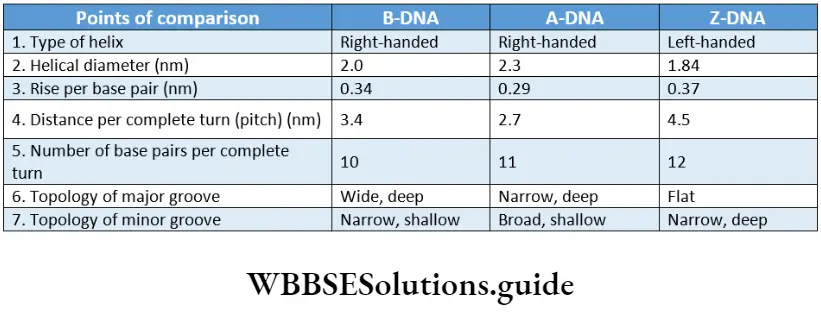
Biology Class 11 Chapter 9 Biomolecules Types Of DNA

Biology Class 11 Chapter 9 Biomolecules Comparsion Between B,A And Z-DNA

Ribonucleic acid (RNA): RNA is a type of nucleic acid that is comprised of a single-stranded polynucleotide chain and responsible for protein synthesis.
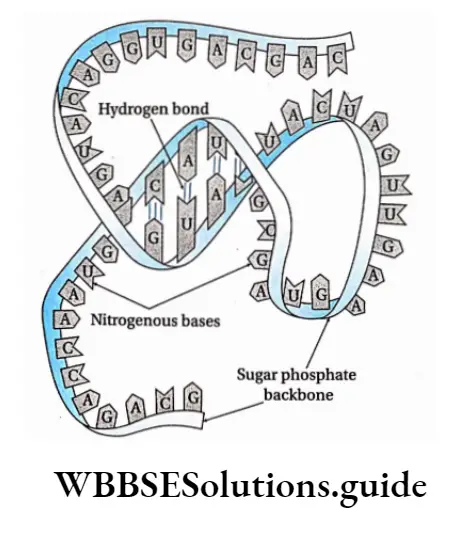
Biology Class 11 Chapter 9 Biomolecules RNA Molecule

Occurrence: The non-genetic RNA is present in all prokaryotic and eukaryotic cells. It occurs both in the nucleus as well as in the cytoplasm.

In some viruses, like TMV, influenza virus, retrovirus (HIV), etc., RNA acts as a genetic material and is known as ‘Genetic RNA’.

Quantity: The quantity of RNA depends on the metabolic reactions of the cell. During protein synthesis, the amount of RNA increases in cells.

Structural features:

Cellular RNA, both genetic and non-genetic, is single-stranded and may fold upon itself to form hairpin-like structures entirely or at certain.
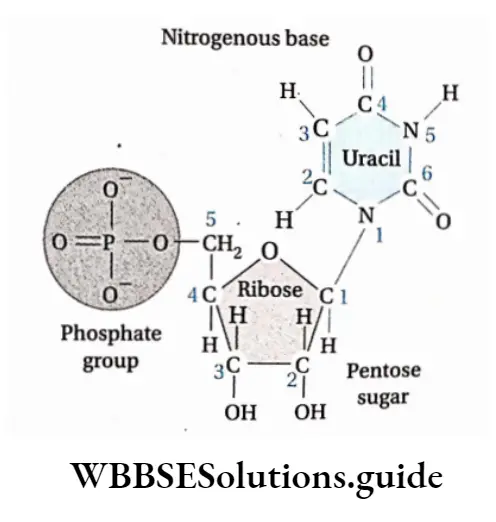
Biology Class 11 Chapter 9 Biomolecules Nucleotide (Uridylic Acid) in RNA

  1. Regions Rheovirus has double-stranded genetic RNA.
  2. The strand is unbranched but may be folded in some cases so that the structure is complex.
  3. They are made up of several nucleotides linked by 3′-5′ phosphodiester bonds.
  4. Every nucleotide is made up of a ribose sugar, a nitrogenous base, and a phosphate. The nucleotides are called ribonucleotides.
  5. The nitrogenous bases present in RNA are adenine, guanine, cytosine and uracil.
  6. The main function of RNA is protein synthesis. It is the main genetic material in many viruses.
  7. RNA is of different types. They are discussed under separate heads below.
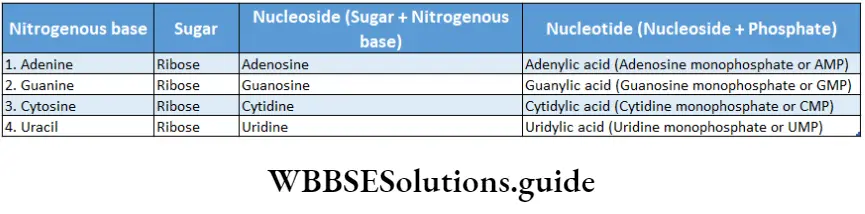
Biology Class 11 Chapter 9 Biomolecules Nucleosides And Nucleotides In RNA

Types of RNA: The different types of RNA have been discussed below.
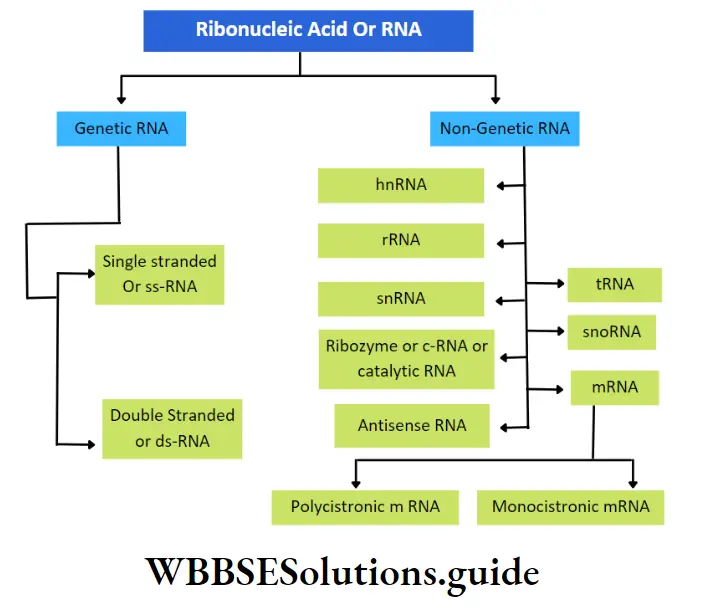
Biology Class 11 Chapter 9 Biomolecules Ribonucleic Acid Or RNA

Genetic RNA: The RNA that acts as genetic material in the absence of DNA, is called genetic RNA.

For example, Tobacco Mosaic viruses (TMV), wound tumor viruses, etc. contain genetic RNA.

This type of RNA is again of two types—

Single-stranded RNA: The RNA molecule made up of a single strand is called single-stranded RNA. E.g., TMV (plant virus), influenza (animal virus).

Double-stranded RNA: The RNA molecule made up of two strands is called double-stranded RNA. E.g., Wound tumor virus (plant virus), Rheovirus (animal virus), etc.

Non-genetic RNA: The RNA presenting the prokaryotic and eukaryotic cells, where DNA is the main genetic material, is called non-genetic RNA. These are synthesized from DNA by transcription.

In both prokaryotic and eukaryotic cells, three principal types of RNA are found. They are messenger RNA (mRNA), transfer RNA (tRNA), and ribosomal RNA (rRNA).
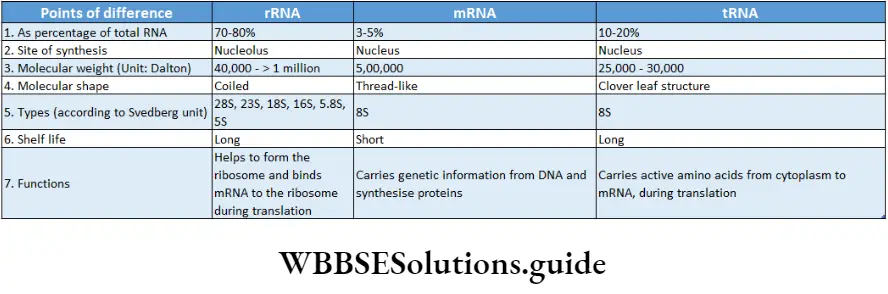
Biology Class 11 Chapter 9 Biomolecules Difference Between rRNA,mRNA And tRNA

Genetic material: DNA is the biological molecule that stores all the genetic information of the cell. In some viruses, RNA may function as the molecule that stores genetic information.

Transmission of hereditary characters: DNA functions as the molecule, that carries the genetic information from parents to offspring.

Synthesis of protein: Coded genetic information is transferred to the mRNA from DNA by the process of transcription. These codes are used to synthesize proteins by translation with the help of rRNA and tRNA.

Thus, information in DNA or genes is expressed in the form of proteins. Messenger RNA (mRNA) is the nucleic acid that carries information from the nucleus to the cytoplasm on which proteins are made.

Nucleic acids in living organisms – importance and examples

The rRNA is a constituent of ribosome. This type of RNA helps in binding mRNA to ribosome and also in decoding the codons.

They also help in catalyzation of amino acid assembly into a polypeptide chain. The tRNA transports amino acids to the growing end of a polypeptide chain at ribosomes.

Role in metabolic activity: DNA indirectly controls the metabolic activity of the cell through the synthesis of necessary protein molecules, like enzymes.

Role In gene mutation and variation: Changes in the sequences of base pairs of DNA alter the arrangement of nucleotides in mRNA.

This causes alterations of codons which lead to changes in proteins. This induces variations in organisms leading to mutations. Mutation when leads to evolution can give rise to new species.

Proteins Structure Functions and Synthesis Notes

Proteins

Proteins Definition: Proteins are a class of complex nitrogenous organic compounds, composed of amino acid residues joined by peptide bonds.

Nomenclature: The term ‘protein1 has been derived from the Greek word, ‘proteos’, which means primary or of the first rank.

Proteins Source: Plants—different types of pulses, like lentils, peas, mung etc., seeds of soybean, gram, nuts, etc. Animals—fish, meat, eggs, milk, etc.

Proteins Structure: All protein molecules have a backbone made up of linear chains of polypeptides.

These polypeptides are made up of amino acids joined together by peptide bonds. These amino acids are called the building blocks of protein molecules.

“proteins structure functions and synthesis notes for class 12”

Structural components: The elements that makeup proteins are carbon, hydrogen, oxygen and nitrogen. Sometimes, sulphur, phosphorus, iron and iodine are also present.

Structural unit—amino acid: The number of amino acids in a protein molecule may vary considerably. For example, the smallest protein is insulin, which is made up of 51 amino acid molecules.

” protein structure and function”

Examples of larger proteins are chymotrypsin (which contains 246 amino acid molecules) and haemoglobin (which contains 574 amino acid molecules). Amino acid has been discussed under a separate head.

Amino acid

Amino acid Definition: The structural unit of proteins, that is made up of carbon, hydrogen, oxygen and nitrogen are called amino acids.

Structure of amino acids: Chemically, amino acids are carboxylic acids containing at least one amino group.

In amino acids, the amino group (—NH2) is attached generally to the a-carbon atom (the carbon atom to which the functional group, in this case, the —COOH, is attached) of the molecule, hence they are called α-amino acids.

Class 11 Biology Class 11 Chemistry
Class 11 Chemistry Class 11 Physics
Class 11 Biology MCQs Class 11 Physics MCQs
Class 11 Biology Class 11 Physics Notes

“detailed notes on protein structure and function”

β or α -amino acid is the one where the amino group (—NH2) is attached to the other carbon rather than a -carbon and they are very uncommon in nature.

Proteins Structure Functions And Synthesis Notes

The following parts remain covalently attached to the a-carbon—

  • A hydrogen molecule (H), a positively-charged, basic amino group (-NH2) A negatively-charged, acidic carboxyl group(-COOH),
  • An alkyl group R may be H as in glycine, or methyl (—CH3) in the case of alanine or maybe some other group.

Types of amino acids: Amino acids can be classified based on the following—

According to nutritional importance: There are 20 different types of amino acids that can be combined to make a protein.

The sequence of amino acids determines each protein’s unique 3-dimensional structure and its specific function. Amino acids may be of two types—

  1. Essential and
  2. Non-essential.

Essential amino acids: These are the amino acids that are indispensable for the life and growth of an organism (usually referring to human) but is not produced in the body or produced in insufficient amounts.

primary structure of protein

They must be supplied through diet. The essential amino acids and their functions in the human body are listed below.

Biology Class 11 Chapter 9 Biomolecules ESsential Amino Acids And Their Functions

Non-essential amino adds: They are amino acids that are synthesised or derived from the essential amino acids within the body.

Hence, an organism does not have to depend solely on proteins in the diet as their sources. These have various important functions in the proper functioning and growth of an organism.

Biology Class 11 Chapter 9 Biomolecules Non Essential Amino Acids And Their Functions

” protein structure primary secondary tertiary and quaternary”

Biology Class 11 Chapter 9 Biomolecules Structure Of 21 Amino Acids Useds By Cell To Bulid Proteins

According to the functional group, R: The following are the different types of amino acids based on the acidic or basic nature of the R group—

Biology Class 11 Chapter 9 Biomolecules Amino Acids

Acidic amino acids: These amino acids contain more than one —COOH group. Example Aspartic acid and glutamic acid.

Basic amino acids: These amino acids contain more than one —NH2 group. Example Lysine, Arginine.

Neutral amino acids: These amino acids contain one NH2 and one —COOH group. Example Glycine, Alanine.

“protein synthesis process step by step explanation”

According to electrical conductance: The following are the different types of amino acids on the basis of electrical conductance—

structure and function of proteins

Biology Class 11 Chapter 9 Biomolecules Amino Acids Electrical Conducatance

Non-polar amino acids: They are insoluble in water and do not conduct electricity. Example glycine.

Polar uncharged amino acids: They have polar side chains. Example valine.

Polar-charged amino acids: They are soluble in water and have a positively or negatively charged group. Example lysine (positively charged), and glutamic acid (negatively charged).

According to the structure offside chain: The following chart shows the different types of amino acids on the basis of the structure of the side chain.

Biology Class 11 Chapter 9 Biomolecules Amino Acid Structure Of Side Chain

Aliphatic amino acids: These amino acids contain an aliphatic hydrocarbon chain. Examples are Glycine, alanine, valine, and isoleucine.

Aromatic amino acids: These amino acids contain aromatic side chains. Examples are Phenylalanine, tyrosine, and tryptophan.

Alcoholic amino acids: These amino acids contain hydroxyl groups in side chains. Examples are Serine and threonine.

“levels of protein structure with examples and functions”

Heterocyclic amino acids: These amino acids contain nitrogen in side chains. Example Histidine.

Sulphur-containing amino acids: These amino acids contain sulphur groups in side chains. Examples are Cysteine and methionine.

Pyrollidine ring-containing amino acid: These amino acids contain pyrollidine ring in side chains. Example Proline, hydroxyproline.

Structure Of Protein

Proteins are made up of polypeptide chains, where amino acids are joined together by peptide bonds.

There are generally four types of structures found in proteins—

Primary structure: Linear arrangement of amino acids linked by peptide bonds, in a peptide chain is called the primary structure of protein.

For example, insulin hormone is comprised of 51 amino acids in two chains, one of 21 and the other of 30 amino acids.

“structural organization of proteins “

Other than peptide bonds, intra and inter-chain disulphide bonds may also be present as covalent linkages between two amino acids, cysteine.

Secondary Structure: After Synthesis, polypeptide chains are folded or plated into different shapes, called their secondary structure. This folding or pleating leads to hydrogen bonding between the amino acids in the chain.

“role of proteins in biological systems notes”

The hydrogen bonding exists between the oxygen atom of the carboxyl group of one amino acid with the hydrogen atom of the amino group of another amino acid. The hydrogen bonds, provide great stability to the shape of the protein.

Two common types of secondary structure are— Alpha (α) Helix and Beta (β) Pleated Sheets. (By Pauling and Corey)

α-helix: An α-helix structure is formed due to the twisting of the long polypeptide chains into a right-handed screw (helix).

Hydrogen bonds exist between the amino group of each amino acid molecule and the carboxyl group of an amino acid located at the adjacent turn of the helix.

The side chains of the amino acids are projected outwards in such a structure. Example Proteins present in hair, nails, feathers, beak etc., show this structure.

Biology Class 11 Chapter 9 Biomolecules Helix

composition of proteins

β-pleated sheet: In some proteins, two or more polypeptides (in their primary structures) join each other laterally by hydrogen bonds and form a sheet-like structure, called a yS-pleated sheet.

In this case, the side chains of the amino acids reside one above the other.
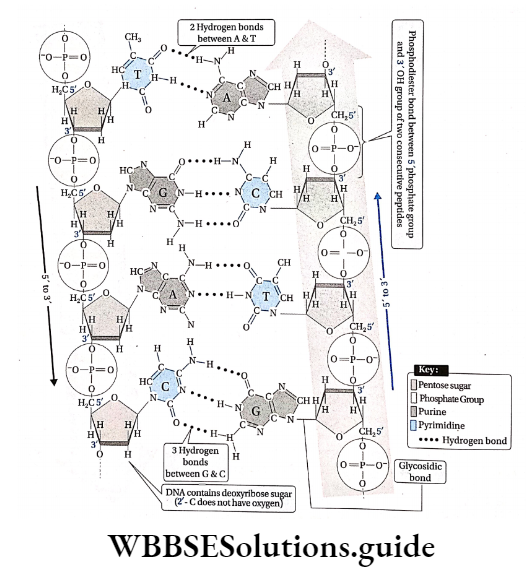
For example, Fibroin protein in silk fibres shows this structure.
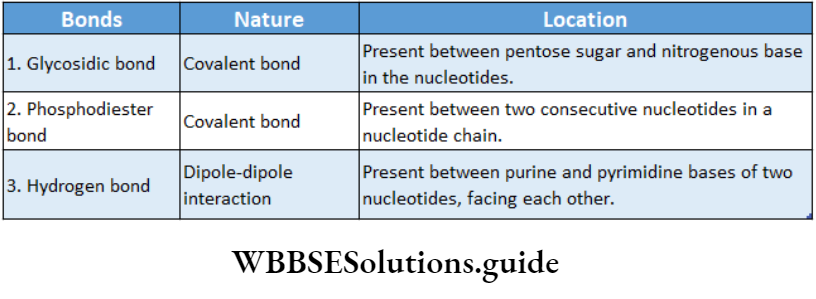
Biology Class 11 Chapter 9 Biomolecules beta Pleated Sheet

Tertiary structure: The tertiary structure is the final specific geometric shape that a protein assumes.

This may involve coiling or pleating, often with straight chains of amino acids in between.

Generally, this structure is visible in the case of globular proteins, such as histones, different enzymes, etc.

Tertiary structure is held together by four different bonds and interactions— disulphide bonds, ionic bonds, hydrogen bonds, van der Waals, hydrophobic and hydrophilic interactions. Examples myoglobin and many enzyme proteins.

Biology Class 11 Chapter 9 Biomolecules Structure Of Protein

Different bonds and interactions in the tertiary structure of a protein

  1. Disulphide bonds: Where two cysteine molecules are bound together, a strong double bond (S = S) is formed between the sulphur atoms within the cysteine monomers.
  2. Ionic bonds: If two oppositely charged ‘R1 groups (+ve and -ve) of two amino acids find themselves close to each other, an ionic bond forms between them.
  3. Hydrogen bonds: Bonds between the oxygen of the -C00H group and the hydrogen molecule of the -NH2 group.
  4. Hydrophobic and hydrophilic interactions: Some amino acids may be hydrophobic while others are hydrophilic. In a water-based environment, a globular protein will orient itself in such a way that its hydrophobic parts are towards its centre and its hydrophilic parts are towards its periphery.
  5. van der Waals interactions: It is the weakest intermolecular interaction between 2 or more atoms or molecules that are very close to each other on the polypeptide chain.

Quaternary structure: Some proteins are made up of multiple polypeptide chains of primary, secondary or tertiary structure, sometimes with an inorganic component.

These multiple polypeptides bind with each other through non-covalent interactions. For example, Haemoglobin exhibits a quaternary structure which is made up of two chains and two chains.

Properties of protein

Different properties of proteins are discussed below.

Properties of protein Nature: Usually colourless, crystalline solids in nature and polar molecules, usually soluble in water.

Properties of protein Stereoisomerism: All amino acids, except glycine, have at least one asymmetric carbon. Therefore they are chiral molecules and exhibit isomerism. They exist in either D or L isomeric form.

Absorption of light: The proteins in tissues and in protein crystals, strongly absorb ultraviolet (UV) light.

  • Rather, it is the amino acids which make up the proteins that absorb the UV light.
  • The amino acids tryptophan, tyrosine, and cysteine absorb light in the UV range.
  • Therefore, different proteins can have different absorption coefficients and even the wavelength of maximum absorption may differ.
  • This fact can be used to help identify different types of proteins by relatively fast and simple optical tests with the help of a spectrophotometer.

Amphoteric or ampholytic: Both amino and carboxyl groups present in an amino acid can react with acids and bases to form salts.

“mechanism of protein synthesis with diagrams and explanation”

Such property is called amphoterism and the compounds are known as ampholytes or amphoteric compounds.

Isoelectric pH: The pH at which a protein is electrically neutral is called isoelectric pH. In this case, the carboxyl group can either lose a proton (H+) or the amino group can accept a proton.

Colloidal property: Due to their huge size the proteins exhibit many colloidal properties. E.g. slow diffusion rate, Tyndall effect, etc.

Zwitterion formation: If both carboxyl and amino groups of an amino acid are ionised, it forms a zwitterion or dipolar ion.

Biology Class 11 Chapter 9 Biomolecules Zwitterion

Denaturation and coagulation: The tertiary structure of proteins can be broken by heating or by using chemicals. On application of heat, the kinetic energy of protein molecules with a tertiary structure, increases.

This makes the structure vibrate more, and so the bonds that maintain their shape (which are mainly weak, non-covalent bonds) become more likely to break.

When a protein loses its shape in this way, it is said to be denatured. The proteins will not regain their original complex shape even after the temperature is lowered.

Hydration: Since the polar heads of the molecules are placed outward, they bind easily with water molecules.

The water molecules surrounding the protein molecule form a layer called hydration layer.

Solubility: Proteins are generally water soluble, some are soluble in salt solution or in weak acids or alkalies.

With the weight, and structure of the protein molecule as well as the pH of the medium, the solubility of the proteins changes.

Viscosity: Proteins show viscosity due to their large structures.

Precipitation: Magnesium sulphate, sodium sulphate etc., can precipitate proteins.

Putrefaction: In the presence of oxygen, proteins can give rise to products like NH3, C02, H20 and oxides of N.

Classification of proteins

Proteins are classified on the basis of different characteristics.

Classification based on structure: Proteins may be of three types—Simple, conjugate and derived proteins.

Biology Class 11 Chapter 9 Biomolecules Classification Of Protiens

Simple proteins: These proteins yield only amino acids upon hydrolysis.

They are further divided into two types, according to their structure—

  1. Simple globular proteins and
  2. Simple fibrous proteins.

Simple globular proteins: The simple proteins that have globular or spherical shapes, fall under this category.

They are soluble in water, alcohol or alkaline medium.

They may be of the following types—

Albumins: These are water-soluble, for example, serum albumin of plasma, my albumin of muscle, ovalbumin of egg white, lactoalbumin of milk, etc.

Globulin: These are insoluble in water but soluble in salt solutions, for example, serum globulin of plasma, myoglobulin of muscle, ova globulin of egg yolk, etc.

Glutelins: These are plant proteins which are soluble in dilute acids and alkalies, for Example prize in of rice, glutenin of wheat, glutelin of corn, etc.

Prolamines: These are plant proteins found in seeds, soluble in 70-80% alcohol, for example, zein of corn, hordein of barley, gliadin of wheat, etc.

“ribosomes and their role in protein synthesis notes”

Sderoproteins or Albuminoids: These are found in the exoskeletal structures, for example, keratin of hair, horn, hooves, and nails, elastin and collagen of connective tissue—bones, cartilage, tendons, ligaments, etc.

Protamines: These are animal proteins, strongly basic and soluble in water, for example, salmon of salmon fish sperm and clupeid of herring fish sperm, etc.

Simple fibrous proteins: These simple proteins have long and thread-like structures. These are insoluble in cold water, and generally found only in animal cells. These are also known as selenoproteins. They are important for the formation of the structure of the body.

Examples:

  1. Keratin (constitutes hair, nails, horns etc.),
  2. Collagen (constitutes tendons, cartilage, etc.),
  3. Elastin (present in ligaments, blood vessels, cartilage, etc.),
  4. Fibrin is present in silk fibres.

Conjugated proteins: These yield simple globular proteins along with non-protein substances upon hydrolysis. Examples are nucleoprotein (histone + nucleic acid), metalloprotein, chromoprotein, etc.

Nucleoproteins: These are formed by the combination of two simple proteins, histone or protamine, with nucleic acids (DNA or RNA).

For example DNA + basic or histone deoxyribonucleoprotein (DNPs), RNA + acidic or non-histone protein= ribonucleoproteins (RNPs) of ribosomes.

Phosphoproteins: These are formed by the combination of simple protein with phosphoric acid. Example caseinogen of milk, ovovitellin of egg yolk, etc.

Metalloproteins: These are formed by the combination of simple proteins with metallic elements. For example, the enzyme carbonic anhydrase contains Zn ions, haemoglobin, and other enzyme proteins with metallic elements such as Co, Mn, Cu, Mg, etc.

Chromoproteins: These are coloured proteins, formed by the combination of simple proteins with at least one metallic protein. Examples are haemoglobin, haemocyanin, etc.

Glycoproteins or mucoproteins: Glycoproteins are formed by the combination of simple protein with carbohydrates. Example mucin of saliva, FSH, LH, etc.

When the hexosamine-rich mucopolysaccharide content in the proteins is more than 4%, they are known as mucoproteins.

Example haptoglobin. Components of plasma, combined with haemoglobin during haemolysis form a haptoglobinhaemoglobin compound which is removed from blood by the spleen.

Lipoproteins: They are formed by the combination of simple proteins with lipids. For example, lipoproteins are present in the cell membranes, the brain etc.

Derived proteins: These proteins are obtained as intermediate products during hydrolysis of simple or conjugated proteins. Example peptone, and proteases.

The derived proteins are mainly of two types—primary-derived proteins and secondary-derived proteins.

Primary derived proteins: These derived proteins are formed from other proteins, without the process of hydrolysis. These proteins do not vary in size from the original molecule. For example, egg albumin can be coagulated into a derived protein by high temperature, X-rays, UV-rays, etc.

The primary derived proteins are of the following types—

Protean: It is an insoluble substance, that is produced by the action of enzymes, water or dilute acids on proteins. Example fibrin produced from fibrinogen.

Metaproteins: It is insoluble in water but soluble in acid or alkalies. They are produced by further action of acid and alkali on proteins at 30-60°C. Example acid and alkali metaproteins.

Coagulated proteins: It is an insoluble substances produced by heat or alcohol. Example coagulated egg white, cooked meat, etc.

Secondary derived proteins: These derived proteins are produced from larger protein molecules as a result of hydrolysis of the peptide bonds.

Because of hydrolysis, these are smaller than the original proteins. For example, proteins are converted into peptones within the stomach.

The secondary derived proteins are of the following types—

Proteoses: These are water-soluble derived proteins, coagulable by heat, produced when acid hydrolysis proceeds beyond the level of metaproteins. Examples are albumose from albumin, globulose from globulin, etc.

Peptones: Proteose forms a precipitate with ammonium sulphate but peptone does not.

These are water soluble derived proteins, non-coagulable by heat, produced by enzyme catalysed reaction or acid hydrolysis as it proceeds beyond the level of proteoses.

Classification based on the presence of essential amino acids: Based on the presence of essential amino acids in their structure, proteins are classified into two types—

First-class or complete proteins: The proteins that contain essential amino acids, along with other non-essential amino acids, in proper quantities, are called first-class proteins. Example animal proteins.

Second-class or incomplete proteins: The proteins that contain essential amino acids in lesser quantities or may not contain any of the essential amino acids are called second-class proteins. Example plant proteins.

Classification on the basis of the number of polypeptide chains:

Based on the number of polypeptide chains, proteins are divided into two types—

Monomeric proteins: Proteins made of a single polypeptide chain are called monomeric proteins. Example monomeric G-protein.

Polymeric proteins: Proteins made of more than one polypeptide chain are called polymeric proteins.

  1. Example globin protein of haemoglobin.
  2. Biological importance of proteins

Proteins have enormous biological importance. These are—

Component of body structures: Proteins form the major building components of our body. Cell membranes and membranes of organelles are composed of lipids and proteins.

In order to give strength and protection to biological structures, various proteins serve as supporting filaments.

For example, tendons and cartilage are formed of collagen, ligaments contain elastin, etc.

Functional proteins: Enzymes, hormones, plasma proteins, pigments, etc., are important proteins which carry out different important cellular functions.

Source of energy: In the absence or shortage of carbohydrates and lipids, proteins act as a source of energy.

During fasting and disorders like diabetes, energy is utilised from the oxidation of proteins. The calorific value of proteins is 4.2kcal/g.

“importance of proteins in metabolism and cellular functions

SDA of protein of thermoregulation: During protein metabolism about 30% extra heat is generated in our body as specific Dynamic Action and this heat is used to regulate our body temperature.

Growth, repair and protection: Proteins are essential for normal growth, protection and repair of damaged tissues and cells.

Cellular communication: Proteins help during cellular communication.

Immunity: Many proteins take part in defence mechanisms against pathogens. The immunoglobulins produced by lymphocytes of vertebrates, participate in the immunological functions.

Fibrinogen and thrombin are blood clotting proteins which repair damaged vascular systems. Various toxins and venoms produced by plants and animals have defensive functions.

Biological value of protein

The efficiency of a given protein, which supplies the nitrogen requirements to the animal body, is called the biological value of proteins. It actually depends on the dietary protein content which contains all essential amino acids.

Biological value of protein is determined by the formula—

\(\begin{aligned}
& \text { Biological value } \\
& \text { of protein }
\end{aligned}=\frac{\mathrm{N}_2 \text { present in the food }}{\mathrm{N}_2 \text { absorbed in the body }} \times 100\)

Neural function: Proteins are also responsible for regulating certain functions of the nervous system.

Several proteins act as neurotransmitters which take part in the conduction of nerve impulses throughout the nervous system.

Encephalin, a pentapeptide, stimulates a type of nerve endings called nociceptors.

This leads to metabolic reactions within the body during severe chemical, mechanical or thermal stimulations.

Regulatory functions: Several functional proteins regulate the metabolism within the body. Proteins also regulate gene function.

Detoxification: There are several proteins which take part in detoxification, i.e., degradation and/or elimination of toxins, drugs, medicines or harmful chemicals. These proteins have antioxidative properties.

They help to maintain physiological balance in organisms.

Storage: Storage proteins serve as biological reserves of important metal ions and amino acids. Plants store such proteins in seeds. In animals, these proteins are found in egg whites and milk.

Contractile protein: Actin and myosin are filamentous proteins present in the skeletal muscles that help in contraction during movement and
locomotion.

Role in cellular functions: Spindle microtubules, cilia, and flagella are formed by polymerisation of protein tubulin dimers. Spindle microtubules take part in cell division.

Flagella and cilia help in the movement of bacteria, algae, etc. Microtubules form the tail of sperm in animals.