Chemical Kinetics – Notes on Rate of Reaction, Formulas

Chemical Kinetics

A knowledge of the kinetics of the reaction employed in an industrial process helps to maintain optimum conditions for the reaction so that the process becomes economically viable. Generally, chemical reactions that are fast with a high yield of products at reasonable costs are used in industrial processes.

The study of rates of reactions helps in understanding the mechanisms of reactions. An understanding of the mechanism of a biochemical reaction helps in analyzing how an enzyme works.

Reaction Rate

The rate of a reaction may be expressed in terms of the amount of reactants consumed or the amount of products formed in n given time. In other words, it is the change in concentration of the reactant or product with respect to the change in time after the reaction has been initiated.

Chemical kinetics class 12 chemistry notes

Since the rate of a reaction is influenced by temperature, the temperature of the reaction mixture should be held constant during the course of the reaction. If it is not possible to measure the concentration directly, then a change that is directly proportional to the concentration can be measured.

For example, the change in the number of moles per cubic meter or a change in the pressure of a gas, if a gas is involved in the reaction, can be measured.

Thus, the rate of a reaction can be defined as

⇒ \(\frac{change in the concentration of the product}{time taken}\)

or, \(\frac{change in the concentration of the reactant}{time taken}\)

Units of rate of reaction If the concentration is expressed in mol L-1 then the unit of the rate of a reaction is mol Vs. In a gaseous reaction, when the concentration of gases is expressed in terms of their partial p then the unit of the rate is atm s-1 or bar s-1.

Let us consider the thermal decomposition of nitrogen pentoxide N2O5, which gives the brown gas nitrogen dioxide and molecular oxygen.

\(\underset{\text { colourless }}{2 \mathrm{~N}_2 \mathrm{O}_5(\mathrm{~g})} → \underset{\substack{\text { brown } \\(4 \text { moles })}}{4 \mathrm{NO}_2(\mathrm{~g})}+\underset{\text { colourless }}{\mathrm{O}_2(\mathrm{~g} \text { mole })}/latex]

The rate of the reaction is the rate at which N2O5 decomposes or the rate at which O2 and NO2 are formed.

Here we assume that there is no change in the volume of the reaction system. In other words, there is no removal from or addition to the reaction system. As you can see, the number of moles of gases increases from 2 to 5, which means there is an increase in the pressure of the reaction system during the reaction.
Chemical Kinetics - Notes on Rate of Reaction, Formulas

The change in concentration of the reactant or the products can also be measured by measuring the increase in pressure.

Let us first study the formation of the product O2.

⇒ [latex]\text { Reaction rate }=\frac{\text { change in concentration of oxygen }}{\text { time interval }}\)

⇒ \(\frac{\Delta\left[\mathrm{O}_2\right]}{\Delta t}=\frac{\text { concentration of } \mathrm{O}_2 \text { at time } t_2-\text { concentration of } \mathrm{O}_2 \text { at time } t_1}{t_2-t_1}\)

Here square brackets indicate molar concentration. Shows the concentration as a function of time at 55°C for the reaction

⇒ \(2 \mathrm{~N}_2 \mathrm{O}_5(\mathrm{~g}) \rightarrow 4 \mathrm{NO}_2(\mathrm{~g})+\mathrm{O}_2(\mathrm{~g})\)
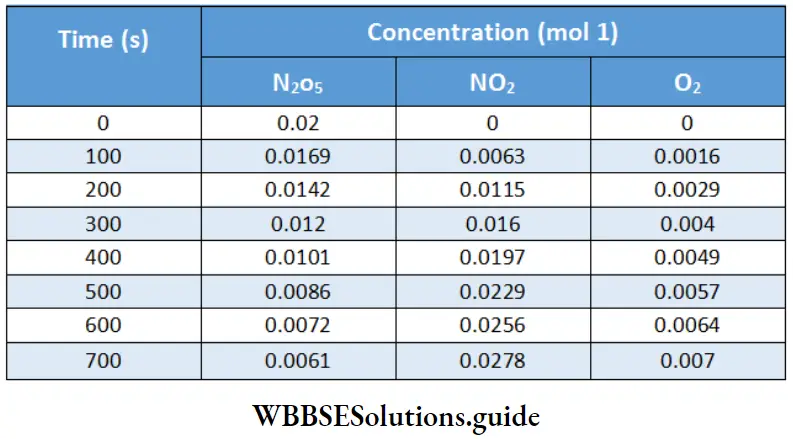
Basic Chemistry Class 12 Chapter 4 Chemical Kinetics the concentration as a function of time at 55 degrees C for the reaction

Refer to Table During the time period 400 s to 500 s, for example, the average rate of formation of O2 will be 8 x 10⁻⁶ mol L _1 s _1 because the rate of formation of

O2 = \(\frac{0.0057-0.0049}{500-400}=8 \times 10^{-6} \mathrm{~mol}^{-1} \mathrm{~L}^{-1} \mathrm{~s}^{-1}\)

Now let us express the rate of the reaction in terms of the change in the concentration of NO2. During till same time period 400 seconds to 500 s, the rate of formation of NO2 will be

⇒\(\frac{0.0229-0.0197}{500-400}=3.2 \times 10^{-5} \mathrm{~mol} \mathrm{~L}^{-1} \mathrm{~s}^{-1}\)

Rate of reaction and factors affecting chemical kinetics

The rate of formation of NO2 is 4 times that of O2 because for 2 mol of N2O5,1 mol of O2 and 4 mol of NC are formed. In other words, the rate is in accordance with the 4: 1 stoichiometric coefficient ratio of NO2 and C in the chemical equation.

Similarly, we can expect the rate of disappearance of N2O5 to be twice that of the formation of O2 As the products form, the reactant disappears. Hence, the value of A[N2O2 ]/Af turns out to be negative.

B all rates of reactions are reported as positive quantities. Thus, to maintain the reaction rate as a positive quantity the rate of a reaction is defined as the rate of formation of products or rate of disappearance of reactants divided by the corresponding stoichiometric coefficient in the balanced chemical equation, the coefficient being taken as positive for products and negative for reactants.

Thus, rate of disappearance of

⇒\(-\frac{[0.0086-0.0101]}{[500-400]}=1.5 \times 10^{-5} \mathrm{~mol} \mathrm{~L}^{-1} \mathrm{~s}^{-1} \approx 2 \times 8 \times 10^{-6} \mathrm{~mol} \mathrm{~L}^{-1} \mathrm{~s}^{-1}\)

Thus, the rate of formation of O2

⇒ \(\text { rate of formation of } \mathrm{NO}_2=\frac{1}{2} \text { the rate of decomposition of } \mathrm{N}_2 \mathrm{O}_5\)

or, \(\frac{\Delta\left[\mathrm{O}_2\right]}{\Delta t}=\frac{1}{4} \frac{\Delta\left[\mathrm{NO}_2\right]}{\Delta t}=-\frac{1}{2} \frac{\Delta\left[\mathrm{N}_2 \mathrm{O}_5\right]}{\Delta t}\)

Therefore, for the reaction

⇒ \(2 \mathrm{~N}_2 \mathrm{O}_5(\mathrm{~g}) \rightarrow 4 \mathrm{NO}_2(\mathrm{~g})+\mathrm{O}_2(\mathrm{~g})\)

Rate of reaction = \(\frac{1}{2} \frac{\Delta\left[\mathrm{N}_2 \mathrm{O}_5\right]}{\Delta t}=\frac{1}{4} \frac{\Delta\left[\mathrm{NO}_2\right]}{\Delta t}=\frac{\Delta\left[\mathrm{O}_2\right]}{\Delta t}=8 \times 10^{-6} \mathrm{~mol} \mathrm{~L}^{-1} \mathrm{~s}^{-1}\)

A plot of concentration versus time for the three gases NO2, N2O2, and O2 using the data from Table. As you can see, there are no straight lines, which means the rate (as determined by the slope of the curve) is different for different time intervals. The steeper the slope, the faster the rate. For example, the rate between 600 s and 700 s turns out to be 5.5 x 10⁻⁶ mol L-1s-1 while that between 300 s and 400 s is 9 x 10⁶ mol L-1s-1.

The slope of the curve can be determined by finding the coordinates of any two points on the curve. If we choose the x coordinates of the points to be 600 s and 700 s, the respective y coordinates will be 0.0072 mol L-1 and 0.0061 mol L-1 (concentration of N2O2).

⇒ \(\text { Slope }=\frac{\text { change in } y}{\text { change in } x}=\frac{\Delta y}{\Delta x}=\frac{\Delta\left[\mathrm{N}_2 \mathrm{O}_5\right]}{\Delta t}\)

⇒ \(\frac{0.0061-0.0072}{700-600}=-1.1 \times 10^{-5} \mathrm{~mol} \mathrm{~L}^{-1} \mathrm{~s}^{-1}\)

Rate = \(-\frac{1}{2} \cdot \frac{\Delta\left[\mathrm{N}_2 \mathrm{O}_5\right]}{\Delta t}=-\frac{1}{2} \times\left(-1.1 \times 10^{-5}\right)=5.5 \times 10^{-6} \mathrm{~mol} \mathrm{~L}^{-1} \mathrm{~s}^{-1}\)
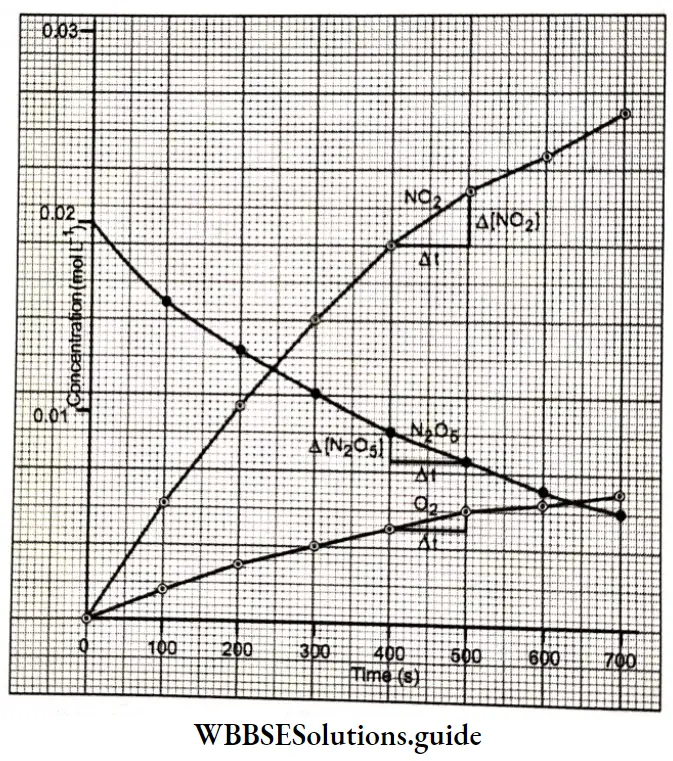
Basic Chemistry Class 12 Chapter 4 Chemical Kinetics plot of consentration versus time for the three gases

The rote of a reaction is not uniform during the course of the reaction, Initially, It la more but decreases with the decrease in the concentration of the reactant, Therefore, we may conclude Ilia! the mill rate (tetmnlHrit during n time internal to the accrue mission rule during that lime.

Chemical kinetics formulas and equations explained

Thus fin 10 A mol 1, 1 s 1the average reaction rate during the time interval 400 to 500 s, instantaneous rate If the change In concentration of the reactant and the product la determined consecutively at gradually decreasing time-intervals, a lime-interval which Is almost zero will be readied, The reaction rate determined at such an instant is called Instantaneous rale, l! is represented as (considering decomposition of nitrogen pentoxide)

⇒ \(r_{\text {lint }}=-\underset{\Delta t \rightarrow 0}{2} \frac{1}{\Delta t} \frac{\Delta\left[\mathrm{N}_2 \mathrm{O}_5\right]}{\Delta t}=-\frac{1}{2} \frac{d\left[\mathrm{~N}_2 \mathrm{O}_5\right]}{d t}=\frac{1}{4} \times \frac{d\left|\mathrm{NO}_2\right|}{d t}=\frac{d\left[\mathrm{O}_2\right]}{d t}\)

(note that the denominator contains the respective stoichiometric coefficients)

The instantaneous rate of the consumption of a reactant or formation of a product at some time / can be calculated by finding the slope of a graph of cells (reactant’s or product’s) molar concentrations plotted against the time, and the slope evaluated at the instant of interest.

The plot of the molar concentration of NO2 versus time. In order to find the Instantaneous rate of reaction at 400 s, a tangent Is drawn at this time and Its slope 11 is calculated as \(\left(\frac{\Delta y}{\Delta x}\right)\) as shown.
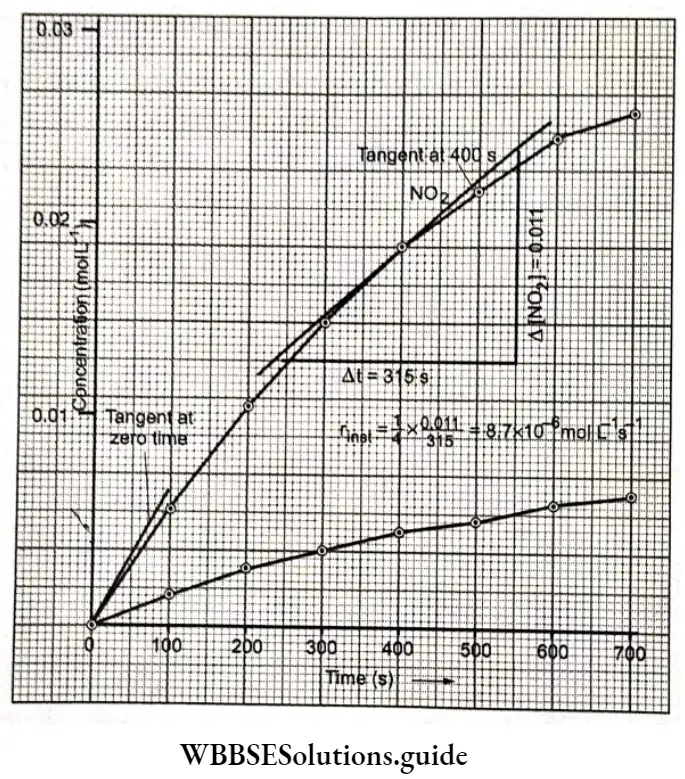
Basic Chemistry Class 12 Chapter 4 Chemical Kinetics The plot of molar consentration

The instantaneous rate is then given by

⇒\(r_{\text {inst }}=\frac{1}{4} \text { slope }=\frac{1}{4} \times\left(\frac{0.011}{3.15}\right)=8.7 \times 10^{-6} \mathrm{~mol} \mathrm{~L}^{-1} \mathrm{~s}^{-1}\)

We can also find the initial rate of the reaction, the rate when no products are formed, from the slope of the tangent at zero time

Initial rate = \(\frac{1}{4} \times\left(\frac{0.0038}{50}\right)=1.9 \times 10^{-5} \mathrm{~mol} \mathrm{~L}^{-1} \mathrm{~s}^{-1}\)

It may be clearly seen that the instantaneous rate and initial rate are different.

Example 1. Express the relationship between the rate of production of iodine and the rate of consumption of hydrogen iodide in the following reaction.

⇒ \(2 \mathrm{HI} \rightarrow \mathrm{H}_2+\mathrm{I}_2\)
Solution:

The stoichiometries of I2 and HI in the reaction are 1 and 2 respectively.

Hence, the rate = \(-\frac{1}{2} \cdot \frac{\Delta[\mathrm{HI}]}{\Delta t}=\frac{\Delta\left[\mathrm{I}_2\right]}{\Delta t}\)

Now you know that the rate of a reaction is determined by measuring the change in concentration of any of the reactants or the products. But how is the concentration or a change in it during the course of the reaction measured? As you know, whether or not a reaction has occurred can be determined by observing changes in any of the reactants or products, such as changes in state, temperature, and color. Thus, by observing any such change in the property of either a reactant or a product, the change in its concentration can be determined.

Titration, colorimetry (a technique in which the absorption of light by a substance is measured), conductimetry (measuring the conductance of a solution) and pressure measurements are some of the techniques used to follow the concentration change of reactants or products.

Factors Affecting The Rate Of A Reaction

As you can see the rate of a reaction decreases with an increase in time. The rates tend to decrease as the reaction proceeds forward and reactants are consumed. You know that reactions take place as a result of collisions between molecules of reactants.

According to the kinetic molecular theory, the pressure exerted by a gas is proportional to the frequency with which molecules of the gas collide with tire walls of the container. The more the number of molecules present in a given volume, the greater is the number of collisions.

And if the number of collisions between the reacting molecules is larger (at the beginning of the reaction), the higher will be the rate.of the reaction. As the concentration of reactants decreases, the rate decreases.

NCERT class 12 chemical kinetics chapter notes

Apart from the concentration of the reactants, there are several factors which influence the rate of a reaction. These are the surface area and concentration of the reactants, temperature and pressure conditions of the reaction, and the presence of catalysts and light. Electric and magnetic fields also affect the rate of a reaction.

A larger surface area helps in better contact between the reactants and hence leads to an increased number of collisions between the reactant molecules resulting in a faster rate of reaction. Increasing the concentration of a reactant does not always increase the rate of a reaction.

In general, increasing the temperature increases the rate of chemical reactions. This is why food, if not refrigerated, spoils faster in summer than in winter.

Influence Of Concentration Rate Law

You know that the rate of a reaction at a given temperature depends on the concentration of one or more reactants and products.

Let us consider the reaction between bromine and formic acid in an aqueous solution catalyzed by acid.

⇒ \(\mathrm{Br}_2(\mathrm{aq})+\mathrm{HCOOH}(\mathrm{aq}) \stackrel{\mathrm{H}^*}{\longrightarrow} 2 \mathrm{Br}^{-}(\mathrm{aq})+2 \mathrm{H}^{+}(\mathrm{aq})+\mathrm{CO}_2(\mathrm{~g})\)

When the concentration of bromine during the course of the reaction is plotted against time, we obtain a curve as shown. The rate of this reaction can thus be expressed as

⇒ \(\text { rate }=-\frac{d\left[\mathrm{Br}_2\right]}{d t}\)

A plot of the reaction rate against the concentration of bromine is shown. It is a straig] line, indicating that the reaction rate is directly proportional to the concentration of bromine, i.e.„

reaction rate ac [Br2 ]

or, reaction rate = k[Br2].
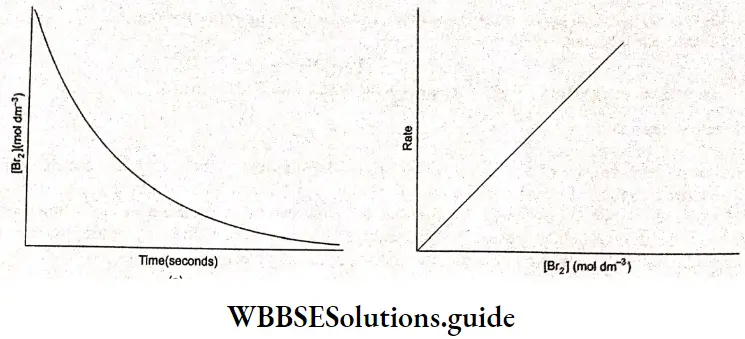
Basic Chemistry Class 12 Chapter 4 Chemical Kinetics plots for the reaction between bromine and formic acid

Here k is called the rate constant or velocity constant and is characteristic of the reaction being studied. The rate constant is independent of the concentrations of the reactants. However, it depends on the temperature. An equation of this kind which is experimentally determined for a reaction is called the rate equation or rate law of that equation. The rate law of a reaction gives the dependence of the reaction rate on the concentration of each reactant.

Experimental findings reveal that the rate of a reaction is usually proportional to the molar concentrations of the reactants raised to a simple power.

⇒ \(\text { Rate }=k[R]^n\)

In the given equation, [R] is the molar concentration of the reactant raised to a simple power n, which may or may not be the same as the stoichiometric coefficient of the reactants in the balanced chemical equation.

Similarly, for a general reaction

mA + nB → product

the rate law is of the form

⇒ \(\text { rate }=-\frac{d[\mathrm{~A}]}{d t}=k[\mathrm{~A}]^m[\mathrm{~B}]^n\)

This equation is called the differential rate equation or rate expression. The exponents m and n are usually positive integers. These exponents for a reaction are determined experimentally as also the rate constant k.

The rate law for the reaction between Br2 and formic acid turns out to be

⇒ \(\text { rate }=k\left[\mathrm{Br}_2\right][\mathrm{HCOOH}]^0\)

or, \(\text { rate }=k\left[\mathrm{Br}_2\right]\)

In this case, the two exponents m and n are 1 and 0 respectively. The rate, therefore, depends only on the concentration of Br2 and not on that of HCOOH. We could either have all the reactants appearing in the rate law or only some may appear; the exponents may or may not be the same as the stoichiometric coefficients.

Reaction order:

Let us now see how the rate is affected by the value of the exponent. In Equation 2, if m =1, it means that the rate of the reaction depends linearly on the concentration of one of the reactants, A. If the concentration of A is doubled so will be the rate. But if it is assumed that m = 2, then if the concentration of A is doubled, the rate quadruples, i.e., increases four times (∵ [2A] = 4[A]2)

Similarly, the rate of the reaction is also affected by the value of n. If the concentration of A is kept constant and that of B is doubled, and the rate also doubles, it means the rate of the reaction depends linearly on the concentration of B. Now in the case of the reactant A, if we take the second assumption (m¯²) to be true then the rate equation for the reaction will be

rate = k [A]²[B]¹

=k[A]²[B].

Thus, exponents m and n in the rate law indicate how sensitive the rate is to changes in the concentration of A and B. The dependence of the reaction rate on concentration is expressed in terms of reaction order.

For the given chemical reaction the order of the reaction with respect to A is m (the exponent of A in the rate law) and the order with respect to B is n. The overall order of a reaction is the sum of the exponents in the rate law and is m + n for the above reaction.

Definition and types of rate of reaction in chemical kinetics

A reaction whose overall order is 1 is called a first-order reaction, one with an order of 2 is called a second-order reaction, one with order 3 is called a third-order reaction, and so on.

For example, the reaction involving the decomposition of hydrogen peroxide is

⇒ \(2 \mathrm{H}_2 \mathrm{O}_2(\mathrm{aq}) \rightarrow 2 \mathrm{H}_2 \mathrm{O}(\mathrm{l})+\mathrm{O}_2(\mathrm{~g})\)

The rate law for this reaction is

rate = k[H2O2].

Its order with respect to H2O22 is one and its overall order is also one. Hence it is a first-order reaction.

Let us consider the reaction between HCl and NaOH

⇒ \(\mathrm{Na}^{+}+\mathrm{Cl}^{-}+\mathrm{H}_3 \mathrm{O}^{+}+\mathrm{OH}^{-} \rightarrow \mathrm{H}_2 \mathrm{O}+\mathrm{Na}^{+}+\mathrm{Cl}^{-}\)

It is of the first order with respect to each of the reactants H3O+ and OH.

⇒ \(\text { Rate }=k\left[\mathrm{H}_3 \mathrm{O}^{+}\right]\left[\mathrm{OH}^{-}\right]\)

But the overall order is 2. Hence, it is a second-order reaction.

NO2 (g) + CO(g) → NO(g) + CO2 (g)

The rate law of the given reaction is

rate = k [NO2]²[CO]O2.

The order of this reaction is two with respect to NO2 and zero with respect to CO. The overall order is two because [CO]0 =1, just as in algebra. It is called a second-order reaction. The concentration of carbon monoxide raised to power zero implies that the rate of the reaction is independent of the concentration of CO provided that some CO is present.

H2(g) + 2NO(g) → N2O(g) + H2O(g)

The rate law for this reaction is

rate = k [NO]2[H2 ]

The order of the reaction is two with respect to NO and one with respect to H2. The overall order of the reaction is three. Therefore it is a third-order reaction.

Note that the order of a reaction or the power of the concentration of the reactant in the rate expression of a reaction has no connection with the stoichiometric coefficient of the reactant.

It is also important to note that a rate law is established experimentally and cannot in general be inferred from the chemical equation for the reaction.

Unit of rate constant You know that

⇒ \(k=\frac{\text { rate }}{{\text { (concentration })^n}^{(}}\)

The SI unit of concentration is mol L-1 and that of time is s.

Therefore,

⇒ \(k=\frac{\mathrm{mol} \mathrm{L}^{-1}}{\mathrm{~s}} \times \frac{1}{(\text { concentration })^n}\)

Thus, the units of k for different reaction orders will be as follows.
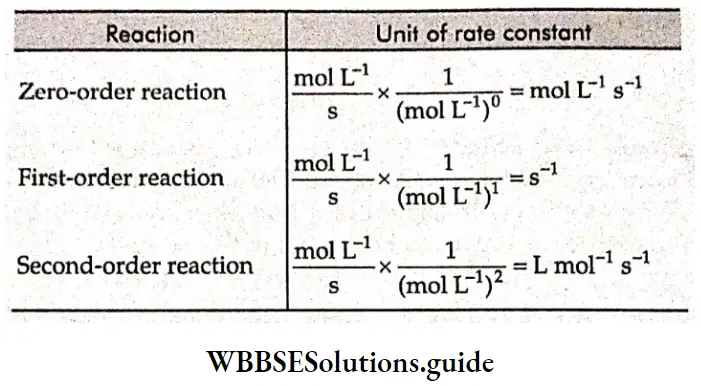
Basic Chemistry Class 12 Chapter 4 Chemical Kinetics The units of k for different reaction orders

Integrated Rate Laws

As discussed earlier in the chapter, the rate law of a reaction gives the rate of a reaction at a given instant. In other words, it tells us the rate of a reaction at a certain composition of the reaction mixture. If we have to find out how the concentrations depend on time, we need to integrate the differential rate expressions.

An integrated rate law is an expression that gives the concentration of a species as a function of time. Another way of saying this is that the integrated rate law is used to predict the concentration of a species at any time after the start of the reaction.

Also, the law helps find the rate constant and thereby the order of the reaction. Let us derive and study the rate laws for zero- and first-order reactions.

Zero-order reactions:

Consider the reaction A → P, which obeys the zero-order rate law, i.e., the rate of the reaction is proportional to the concentration of the reactants, raised to the power zero.

⇒ \(\text { Rate }=-\frac{d[\mathrm{~A}]}{d t}=k[\mathrm{~A}]^0=k[1]=k\)

As the equation shows, the rate of such a reaction is independent of the concentration of the reactant throughout the course of the reaction. Integrating Equation 4.1 we get

⇒ \(\int_{[\hat{\mathrm{A}}]_0}^{[\mathrm{A}]} d \mathrm{~A}=-\int_0^t k d t\)

⇒ \([\mathrm{A}]-[\mathrm{A}]_0=-k t\)

or \([\mathrm{A}]=-k t+[\mathrm{A}]_0\)

where [A]0 is the initial concentration of A and [A] is its final concentration.

This equation is called the integrated rate law.

This is an equation of the form y = mx + c, which is the equation of a straight line. Hence a graph of [A] vs time is a straight line with a slope, -k. Zero-order reactions are uncommon but they can occur under special conditions. For example, the decomposition of gaseous ammonia on a hot platinum surface is a zero-order reaction.

⇒ \(2 \mathrm{NH}_3(\mathrm{~g}) \stackrel{\mathrm{Pt}, 1130 \mathrm{~K}}{\longrightarrow} \mathrm{N}_2(\mathrm{~g})+3 \mathrm{H}_2(\mathrm{~g})\)

⇒ \(\text { Rate }=k\left[\mathrm{NH}_3\right]^0=k\)
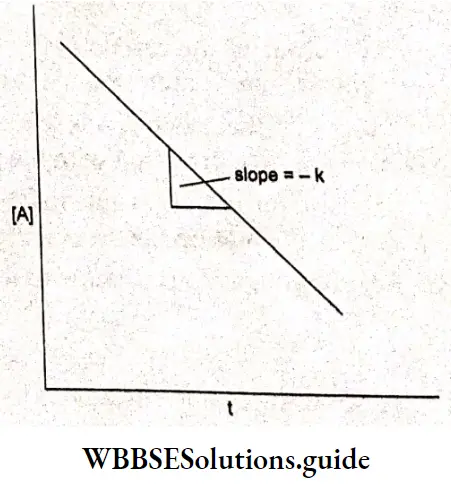
Basic Chemistry Class 12 Chapter 4 Chemical Kinetics A plot of concentration of the reactant as a function of time t for a zero order reaction

First-order reactions:

For a first-order reaction of the type

A → P

the differential rate law is

⇒ \(\text { rate }=-\frac{d[\mathrm{~A}]}{d t}=k[\mathrm{~A}]\)

⇒ \(-\frac{d[\mathrm{~A}]}{[\mathrm{A}]}=k d t .\)

On integrating from f = 0, when the concentration of A is [A]0, to the time t, when the molar concentration of A is [A], we obtain

⇒ \(|-\ln [\mathrm{A}]|_{[\mathrm{A}]_0}^{[\mathrm{A}]}=k|t|_0^t\)

⇒ \(-\ln [\mathrm{A}]+\ln [\mathrm{A}]_0=k t\)

or, \(\ln [\mathrm{A}]=\ln [\mathrm{A}]_0-k t\)

The exponential form of the equation can be given as

⇒ \(\ln \frac{[\mathrm{A}]}{[\mathrm{A}]_0}=-k t\)

This suggests that for all first-order reactions the concentration of the reactant decays exponentially with time. [A] is the concentration of A at time f and [A]0 is its initial concentration. Thus, the integrated rate law equation can be written as

⇒ \(\ln \frac{[\mathrm{A}]}{[\mathrm{A}]_0}=-k t\)

The above equation can also be written as

⇒ \(k=\frac{1}{t} \ln \frac{[\mathrm{A}]_0}{[\mathrm{~A}]}\)

or, \(k=\frac{1}{\left(t_2-t_1\right)} \ln \frac{\left[\mathrm{A}_1\right]}{\left[\mathrm{A}_2\right]}\)

Here the concentrations [A x ] and [A 2 ] are at times fx and 12 respectively.

Integrated rate laws can be used to determine the order and rate constant of a reaction. For this we need experimental data of the concentration of the reactant as a function of time.

For a first-order reaction, the plot of In [A] vs f should be a straight line. This is clear from the equation

In [A] = In [A]0– kt
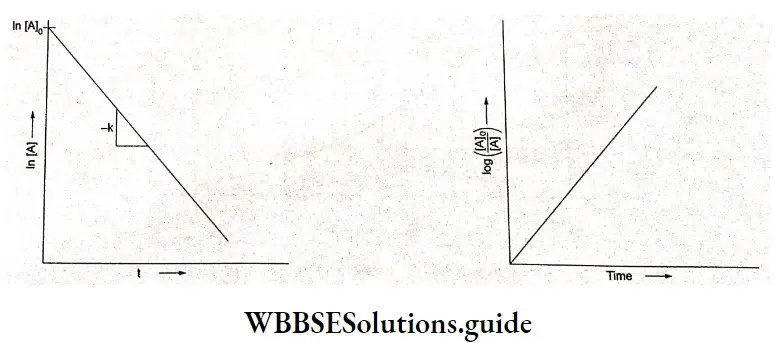
Basic Chemistry Class 12 Chapter 4 Chemical Kinetics plot of In A vs t for a first order reaction and plot of log vs t for a first order reaction

It is of the form Y-a~ bX. where Y is In [A], X is I. b, the slope, is(-) and the intercept is In[A]0.

For any reaction, we plot In [A] vs. f from the experimental data of that reaction, and if it does not give a straight line, the reaction is not of the first order.

Equation 43 may also be written as

⇒ \(2.303 \log \left\{\frac{[\mathrm{A}]}{[\mathrm{A}]_0}\right\}=-k t\)

or, \(-2.303 \log \left\{\frac{[\mathrm{A}]}{[\mathrm{A}]_0}\right\}=k t\)

or, \(2.303 \log \left\{\frac{[\mathrm{A}]_0}{[\mathrm{~A}]}\right\}=k t\)

or, \(\log \left\{\frac{[\mathrm{A}]_0}{[\mathrm{~A}]}\right\}=\frac{k t}{2.303}\)

A plot of log \(\left\{\frac{[\mathrm{A}]_0}{[\mathrm{~A}]}\right\}\) versus t gives a straight line with slope \(\frac{k}{2.303}\)

The thermal decomposition of N2 Og dealt with at the beginning of this chapter is a first-order reaction and its rate law is rate = k[N205].

The decomposition of hydrogen peroxide in a dilute sodium hydroxide solution is described by the equation

2H2O2(aq) → 2H2O(1) + O2 (g)

Let us find the order of this reaction. The concentration of H2O2 as a function of time was found to be as follows.
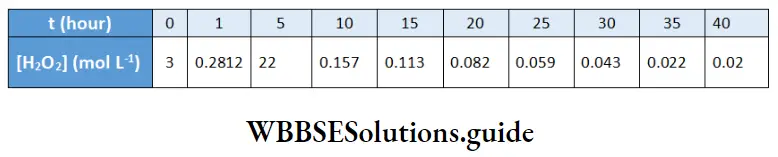
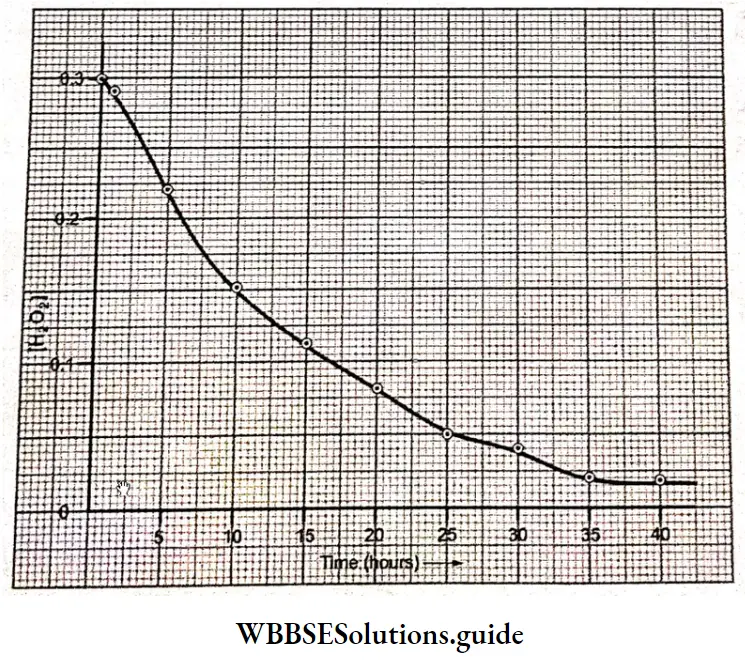
Basic Chemistry Class 12 Chapter 4 Chemical Kinetics first order reaction

Basic Chemistry Class 12 Chapter 4 Chemical Kinetics plot of concentration of H2O2 versus time for the decomposition of H2O2

A plot of the concentration of H2O2 as a function of time. It may be seen from the graph the concentration of the reactant decays exponentially with time. On plotting In[H2O2] versus time, a fight line is obtained indicating that the reaction is of the first order

Whether a reaction is of zero, first, or second order can be found by a simple plot of the reaction rate concentration of the reactant.
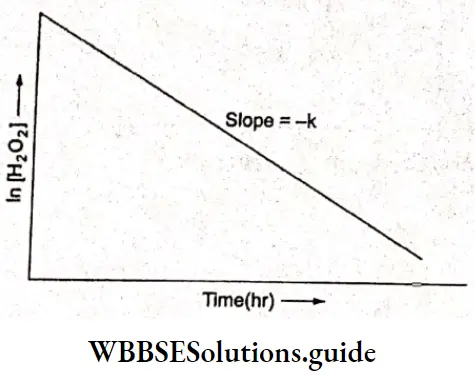
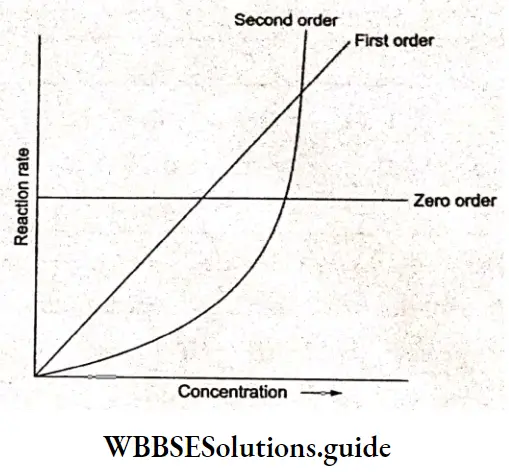
Basic Chemistry Class 12 Chapter 4 Chemical Kinetics obtained indicating that the reaction is of the first order

Basic Chemistry Class 12 Chapter 4 Chemical Kinetics plot of reaction rate aganist concentration of reactant with respect to which order has to be determined

Example 1. The reaction of N2O2 with water produces HNO3.

⇒ \(\mathrm{N}_2 \mathrm{O}_5+\mathrm{H}_2 \mathrm{O} \rightarrow 2 \mathrm{HNO}_3\)

The reaction is of the first order with respect to each reactant. Write the rate law for the reaction.

When \(\left[\mathrm{N}_2 \mathrm{O}_5\right] \text { is } 0.13 \times 10^{-6} \mathrm{~mol} \mathrm{~L}^{-1}\) and \(\left[\mathrm{H}_2 \mathrm{O}\right]=2.3 \times 10^{-4} \mathrm{~mol} \mathrm{~L}^{-1}\)

the rate of the reaction is 4.55 x 10⁻¹⁰ mol L-1 min-1. What is the rate constant for the reaction?
Solution:

Since the reaction is of the first order with respect to each reactant, the power of each reactant must be 1 in the rate law.

Therefore, rate = k[N2O5 ][H2O].

Given that rate = \(4.55 \times 10^{-10} \mathrm{~mol} \mathrm{~L}^{-1} \mathrm{~min}^{-1},\left[\mathrm{~N}_2 \mathrm{O}_5\right]=0.13 \times 10^{-6} \mathrm{~mol} \mathrm{~L}^{-1}\)

and \(\left[\mathrm{H}_2 \mathrm{O}\right]=2.3 \times 10^{-4} \mathrm{~mol} \mathrm{~L}^{-1}\)

Substituting these values in the rate law

⇒ \(4.55 \times 10^{-10}=k\left(0.13 \times 10^{-6}\right)\left(2.3 \times 10^{-4}\right)\)

or, \(k=\frac{4.55 \times 10^{-10}}{0.13 \times 10^{-6} \times 2.3 \times 10^{-4}}=15.05 \mathrm{~L} \mathrm{~mol}^{-1} \mathrm{~s}^{-1}\)

The rate constant is 15.05 L mol-1 s-1.

Example 2. The rate of formation of a dimer in a second-order dimerization reaction is 9.1 x 10⁻⁶ mol L-1 s-1 at 0.05 M monomer concentration. Calculate the rate constant.
Solution:

Given

The rate of formation of a dimer in a second-order dimerization reaction is 9.1 x 10⁻⁶ mol L-1 s-1 at 0.05 M monomer concentration.

For a second-order reaction

rate = k[A]²

or 9.1 x106 =k(0.05)²

⇒ \(k=\frac{9.1 \times 10^{-6}}{(0.05)^2}=3.64 \times 10^{-3} \mathrm{~L} \mathrm{~mol}^{-1} \mathrm{~s}^{-1}\)

Example 3. Consider the following data the reaction.

A + B → product
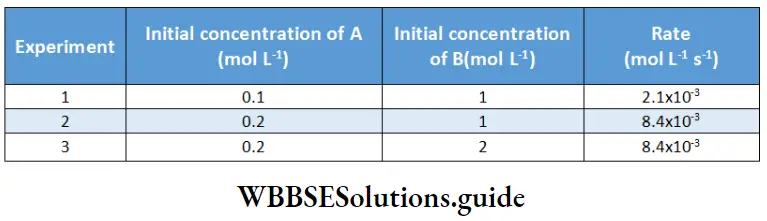
Basic Chemistry Class 12 Chapter 4 Chemical Kinetics integrated rate laws example 3

Determine the order of reaction with respect to A and B, and the overall order of the reaction,
Solution:

In experiments 1 and 2, the concentration of B is constant. Hence,

⇒ \(\frac{\text { rate }_1}{\text { rate }_2}=\frac{k[\mathrm{~A}]_1^a[\mathrm{~B}]_1^b}{k[\mathrm{~A}]_2^a[\mathrm{~B}]_2^b}=\frac{k[\mathrm{~A}]_1^a}{k[\mathrm{~A}]_2^a}\)

⇒ \(\log \text { rate }_1-\log \text { rate }_2=a \log \frac{[\mathrm{A}]_1}{[\mathrm{~A}]_2}\)

On substituting the respective values, we get

⇒ \(\log 2.1 \times 10^{-3}-\log 8.4 \times 10^{-3}=a \log \left(\frac{0.1}{0.2}\right)=a \log (0.5)\)

or, \(-2.6778-(-2.0758)=a(-0.3010)\)

or, \(-0.6021=a(-0.3010)\)

or, \(\frac{0.6021}{0.3010}=a\)

⇒ a = 2.

The order with respect to A is 2.

Now consider experiments 2 and 3, where the concentration of A is the same. We get

⇒ \(\log \text { rate }_2-\log \text { rate }_3=b \log \left(\frac{[\mathrm{B}]_2}{[\mathrm{~B}]_3}\right)\)

or, \(\log 8.4 \times 10^{-3}-\log 8.4 \times 10^{-3}=b \log \left(\frac{1}{2}\right)\)

b log (0.5) = 0

⇒ b = 0 [as log (0.5) ≠ 0].

The order with respect to B is zero. Hence the overall order is a + b = 2.

Example 4. The following data was obtained at 300 K for the reaction 2A + B → C+ D.
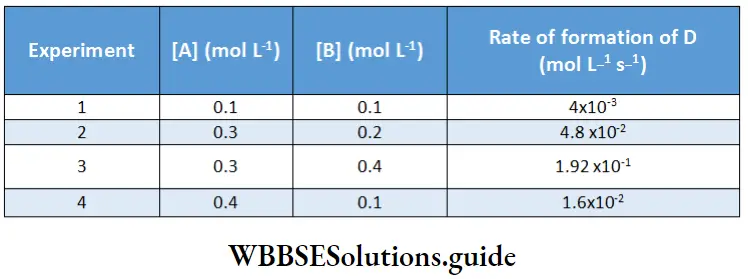
Basic Chemistry Class 12 Chapter 4 Chemical Kinetics integrated rate laws example 4

Calculate the rate of formation of D when [A] = 0.7 mol L-1 and[B] = 0.3 mol L-1.
Solution:

In experiments 1 and 4, the concentration of B is the same.

Therefore, \(\log \frac{\text { rate }_1}{\text { rate }_4}=a \log \frac{[\mathrm{A}]_1}{[\mathrm{~A}]_4}\)

⇒ \(\log \frac{4 \times 10^{-3}}{1.6 \times 10^{-2}}=a \log \left(\frac{0.1}{0.4}\right)\)

log 0.25 = a log (0.25)

a = 1.

The order with respect to A is one.

In experiments 2 and 3, the concentration of A is the same. Therefore,

⇒ \(\log \frac{\text { rate }_2}{\text { rate }_3}=b \log \frac{[\mathrm{B}]_2}{[\mathrm{~B}]_3}\)

or, \(\log \frac{4.8 \times 10^{-2}}{1.92 \times 10^{-1}}=b \log \left(\frac{0.2}{0.4}\right)\)

or log 0.25 = blog (0.5)

⇒ -0.6021 = b(-0.3010)

⇒ b = 2.

The order with respect to B is two.

Hence, the overall order of the reaction is 3. The rate law for the reaction is

rate = k[A][B]².

Taking the observed values from any one of the experiments (say 1) and substituting the rate and concentration of A and B, we get

4 x 10¯³ = k(0.1)(0.1)²

⇒ \(k(0.1)(0.1)^2=4 \times 10^{-3} \Rightarrow k=\frac{4 \times 10^{-3}}{1 \times 10^{-3}}=4 \mathrm{~L}^2 \mathrm{~mol}^{-2} \mathrm{~min}\)

The value of the rate can now be determined with A = 0.7 mol L-1 and B = 0.3 mol L-1 by simply substituting the values of the concentrations and k in the rate law.

Rate = 4 x (0.7)(0.3)2 = (2.8)(0.09).

∴ rate = 0.252 mol L¯¹ min¯¹

Example 5. For a reaction A+B → C the following data was obtained.
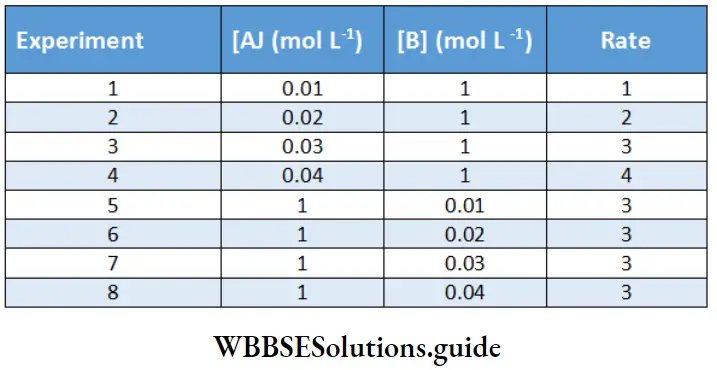
Basic Chemistry Class 12 Chapter 4 Chemical Kinetics integrated rate laws example 5

By plotting a graph of reaction rate vs. concentration of the reactant, find the order of the reaction.
Solution:

In experiments 1 2,3 and 4 the concentration of B is much more than that of A. Hence, these data can tv used to determine order with respect to A,

⇒ \(\text { Rate }=K \mid A]^a[B]^b\)

⇒ \(\text { Nate }=K(A)^2\)

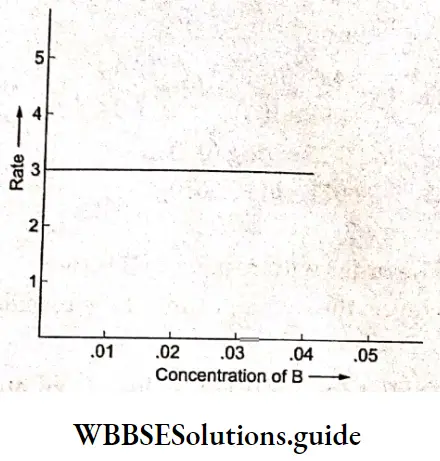
Since the plot of rate vs. concentration of A is a straight line, the reaction is of the first order with respect to A. In experiments 5, 6. 7, and 8 the concentration of A is in excess and hence these data can be used to determine the order with respect to B. A plot of rate vs. concentration of B is obtained as given below on the right.
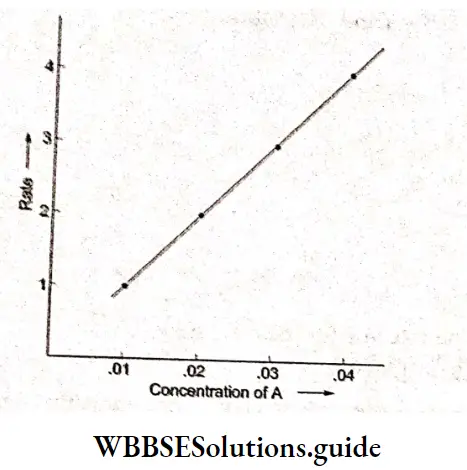
Basic Chemistry Class 12 Chapter 4 Chemical Kinetics plot of rate vs A

Basic Chemistry Class 12 Chapter 4 Chemical Kinetics plot of rate vs B

Since we obtain a line parallel to the x-axis, the rate is independent of the concentration of B. The reaction is of zero order with respect to B. Even without plotting the graph, a close look at the data tells us that the rate is constant for all experiments 4-8 even though the concentration of B is varying. Hence the order is zero with respect to B. The overall order of the reaction is 1 + 0 =1.

Example 6. The reaction between NO and H2 occurs as follows.

2H2(g) + 2NO(g)4 – 2H2O(g) + N2(g)

Several experiments were performed by keeping the concentration of one of the reactants constant and changing the concentration of the other. The initial rates obtained are tabulated below.
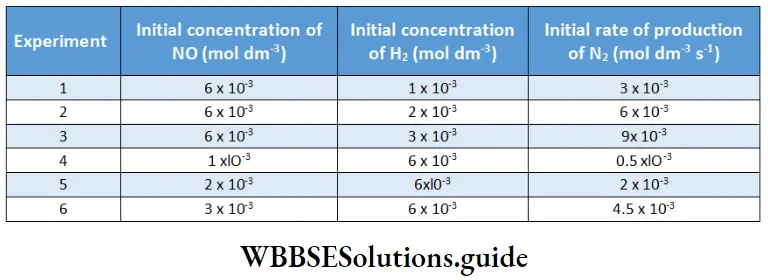
Basic Chemistry Class 12 Chapter 4 Chemical Kinetics integrated rate laws example 6

What is the order of the reaction with respect to NO and H2? Write down the rate law. Calculate the rate constant k.
Solution:

In experiments 1, 2, and 3 the concentration of NO is constant; the data from these experiments give us the order of the reaction with respect to H2. (The symbol 0 in the subscript denotes the initial conditions.)
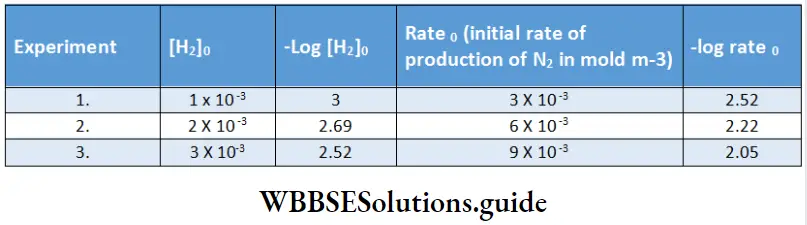
Basic Chemistry Class 12 Chapter 4 Chemical Kinetics integrated rate laws example 6.1

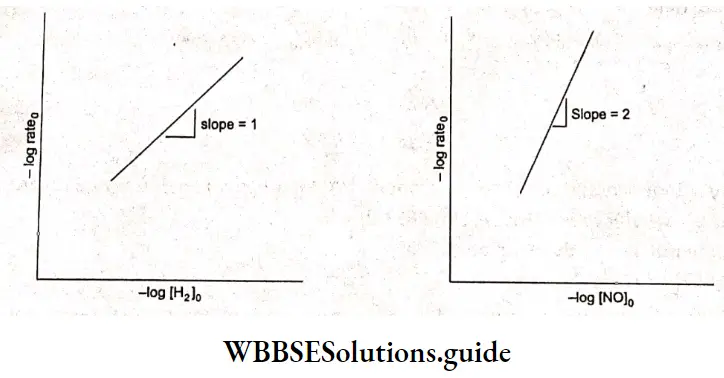
The plot of -log rate 0 vs -log [H2]0 is a straight line with slope 1.

Hence, the order with respect to H2 is one. Similarly, we can plot -log rate O vs -log[NO]0 for experiments 4, 5, and 6.
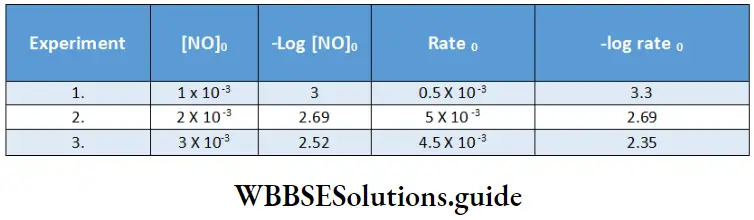
Basic Chemistry Class 12 Chapter 4 Chemical Kinetics integrated rate laws example 6.2

The slope obtained from the plot gives a value of 2, which is the order with respect to NO.

Hence, the overall order = order (H2) + order (NO)

=1 + 2

= 3.

Hence, the reaction is of the third order.

The rate law is rate = k[H2][NO]2.
Basic Chemistry Class 12 Chapter 4 Chemical Kinetics first order reactions example 6

Taking the observed values from any one of the experiments and substituting the concentration of H2 and NO, we get (experiment 1)

⇒ \(3 \times 10^{-3}=k \cdot\left(1 \times 10^{-3}\right)\left(6 \times 10^{-3}\right)^2\)

⇒ \(k=\frac{3 \times 10^{-3}}{6 \times 10^{-9}}=0.5 \times 10^6=5 \times 10^5 \mathrm{dm}^6 \mathrm{~mol}^{-2} \mathrm{~s}^{-1}\)

Example 7. The reaction A+ B → C was studied by performing several experiments and the following information was obtained.
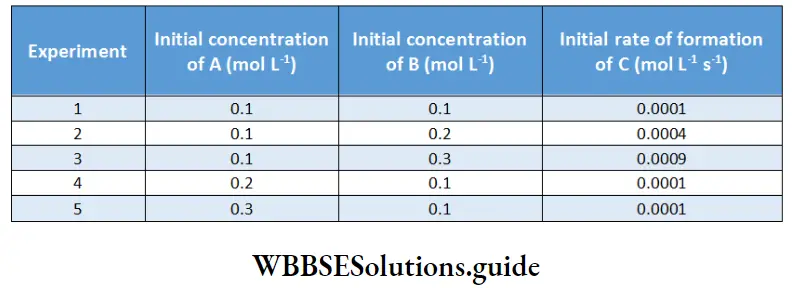
Basic Chemistry Class 12 Chapter 4 Chemical Kinetics integrated rate laws example 7

What is the order of the reaction with respect to A anti that with respect to B Write down the rate law.

Calculate the rate constant, k.

Solution:

In experiments 1, 2, and 3, the concentration of A is constant; hence these data can give us the order with respect to B.

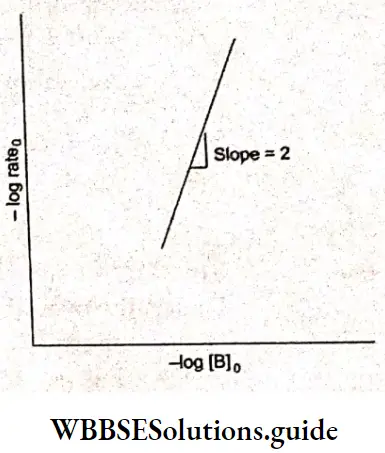
In the initial rate method, \(-\log \text { rate }_0 \text { vs }-\log [\mathrm{B}]_0\) is plotted
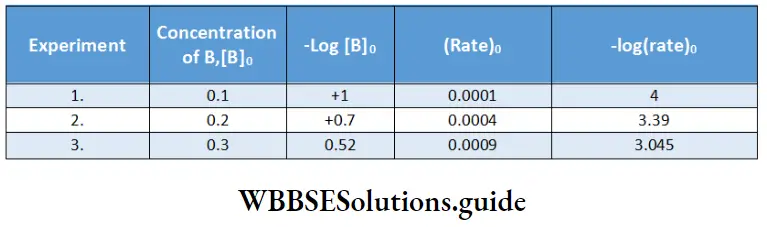
Basic Chemistry Class 12 Chapter 4 Chemical Kinetics integrated rate laws example 7.1

The slope can be determined from the two corresponding values on the x- and y-axes.

For instance,

⇒ \(\frac{y_2-y_1}{x_2-x_1}=\frac{4-3.39}{1-0.7} \cong 2\).

Therefore the order with respect to B is two.

Using the values obtained from experiments 4 and 5, we get the following data.
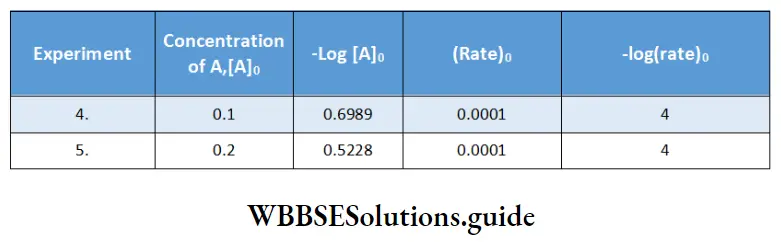
Basic Chemistry Class 12 Chapter 4 Chemical Kinetics integrated rate laws example 7.2

The rate is independent of the concentration of A. Hence, the reaction is of zero order in A.

Therefore, the overall order of the reaction (2 + 0) = 2.

Hence, the rate law of the reaction,

rate = k[A]°[B]².

On substituting the values obtained from experiment 1 in the rate law equation, we calculate the
rate constant.

0.0001 = k[0.1][0.1]²

⇒ \(\frac{0.0001}{(0.1)^3}=k\)

k- 0.1 L mol-1 s-1
Basic Chemistry Class 12 Chapter 4 Chemical Kinetics first order reactions example 7

Example 8. A first-order reaction is 30% complete in one hour. Calculate the rate constant for the reaction. In how much time will the reaction proceed to 80% completion?
Solution:

Given

A first-order reaction is 30% complete in one hour. Calculate the rate constant for the reaction.

For a first-order reaction, the integrated rate law is

⇒ \(\ln \frac{[\mathrm{A}]}{[\mathrm{A}]_0}=-k t\)

If the reaction proceeds to 30% completion, it means 30% of [A] has been consumed and 70% [A] remains.

Substituting 100 for [A]0 70 for [A] and 60 min for t, we get

⇒ \(\ln \left(\frac{70}{100}\right)=-k \times 60\)

or, 2.303 log (0.7)= -k x 60

or, \(k=\frac{\log (0.7)}{60}=5.95 \times 10^{-3} \mathrm{~min}^{-1}\)

For the reaction to proceed to 80% completion, A must become 20.

In \(\ln \left(\frac{20}{100}\right)=-5.95 \times 10^{-3} \times t\)

or, \(t=\frac{-2.303 \log (0.2)}{1.12 \times 10^{-3}}=270.5 \mathrm{~min}\)

Example 9. A reaction that is of the first order with respect to reactant A has a rate constant of 5 min-1. If we start with 5 mol L-1 of A, would the concentration of A reach 0.05 mol L-1?
Solution:

Given

A reaction that is of the first order with respect to reactant A has a rate constant of 5 min-1. If we start with 5 mol L-1 of A,

For a first-order reaction

⇒ \(\ln \frac{[\mathrm{A}]}{[\mathrm{A}]_0}=-k t\),

where [A] is the concentration of A at time t and [A]0 is the initial concentration of A.

Substituting the values of [A] = 0.05 mol L-1, [A]0 =5 mol L-1and k =5 min-1, we get

⇒ \(\ln \frac{0.05}{5}=-5 t\)

or, \(-\frac{1}{5} \ln \frac{0.05}{5}=t\)

⇒ \(-\frac{1}{5} \times 2.303 \log 0.01=t\)

⇒ \(-0.4606 \log \left(1 \times 10^{-2}\right)=t\)

⇒ -0.4606 x (-2) =t

⇒ 0.9212 = t

∴ t= 0.9212 min or 55.2 s.

It takes 55.2 seconds for the concentration of A to reach 0.05 mol L-1.

Example 10. For the isomerization of cyclopropanone to propene in the gaseous phase at 433°C, the following data were obtained.
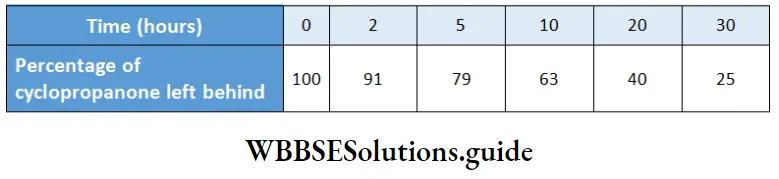
Basic Chemistry Class 12 Chapter 4 Chemical Kinetics integrated rate laws example 10

Find the order of the reaction and calculate the rate constant.
Solution:

If it is a first-order reaction, a plot of In \(\frac{[\mathrm{A}]}{[\mathrm{A}]_0}\) vs. t should be a straight line. Considering [A]0 =100 and the other values at various times as [A], we can calculate In \(\left(\frac{[\mathrm{A}]}{[\mathrm{A}]_0}\right)\)
Basic Chemistry Class 12 Chapter 4 Chemical Kinetics integrated rate laws example 10.1

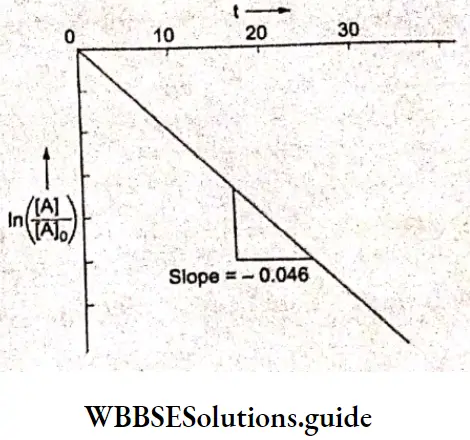
A plot of In \(\frac{[\mathrm{A}]}{[\mathrm{A}]_0}\) vs f is a straight line with slope = -0.046

Hence it is n first-order reaction.

Since slope = -k,

k = 0.046 hours-1

⇒ \(\frac{0.046}{3600}=1.277 \times 10^{-5} \mathrm{~s}^{-1}\)
Basic Chemistry Class 12 Chapter 4 Chemical Kinetics first order reactions example 10

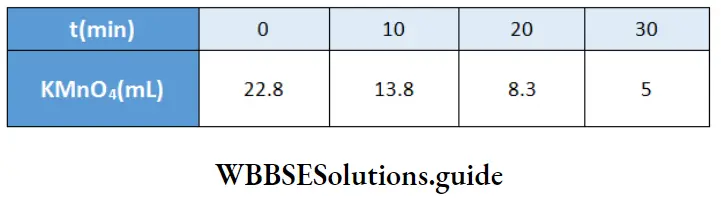
Example 11. The rate of decomposition of hydrogen peroxide at a particular temperature was measured by titrating its solution acidic KMn04 solution. The following results were obtained
Basic Chemistry Class 12 Chapter 4 Chemical Kinetics integrated rate laws example 11

Show that it is a first-order reaction. Calculate the rate constant of the reaction.
Solution:

The titer value of KMnO4 is proportionate to the amount of H2O2 left undecomposed.

For a first-order reaction,

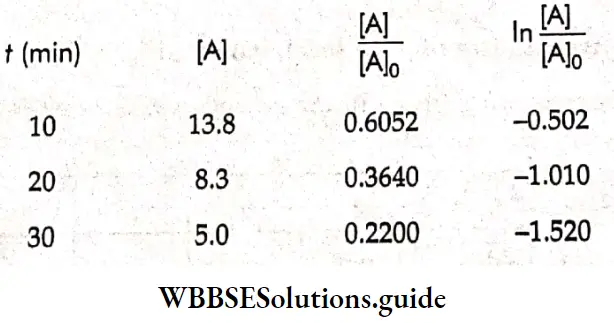
In \(\frac{[\mathrm{A}]}{[\mathrm{A}]_0}\) = -kt and a plot of in \(\frac{[\mathrm{A}]}{[\mathrm{A}]_0}\) vs t is a straight line.

[A]0 = 22.8 (at time = 0 min).
Basic Chemistry Class 12 Chapter 4 Chemical Kinetics integrated rate laws example 11.1

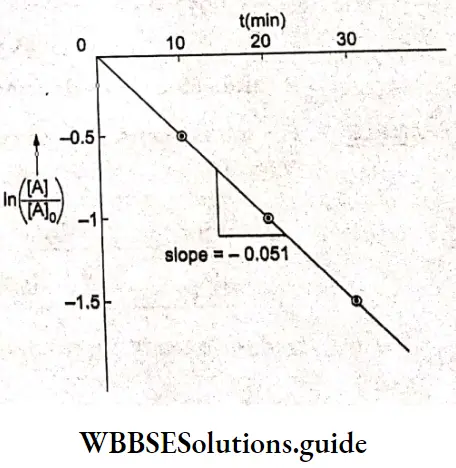
Since the plot is a straight line, the reaction is of the first order.

And slope = -0.051 = -k

=> k= 0.051 min-1.
Basic Chemistry Class 12 Chapter 4 Chemical Kinetics first order reactions example 11

Example 12. Consider the decomposition of SO2Cl2 to SO2 and Cl2. It follows first-order kinetics at 675 K. If the rate constant is 2×10⁻⁵ min-1, find the percentage of SO2Cl2 that decomposes in 57.7 hours.
Solution:

Given

Consider the decomposition of SO2Cl2 to SO2 and Cl2. It follows first-order kinetics at 675 K. If the rate constant is 2×10⁻⁵ min-1,

For a first-order reaction

⇒ \(\ln \frac{[\mathrm{A}]}{[\mathrm{A}]_0}=-k t ; \text { let } \frac{[\mathrm{A}]}{[\mathrm{A}]_0}=\mathrm{X}\)

Then, In \((X)=-2 \times 10^{-5} \times 57.7 \times 60\)

⇒ \(\log X=-\frac{0.06924}{2.303}=-0.0300\)

X = 0.9332.

The ratio of SO2Cl2 remaining undissociated to the initial amount is 0.9332.

0.93 x 100= 93% of SO2Cl2 remains undissociated.

This means 100- 93 = 7% of SO2Cl2 would have dissociated in 57.7 hours.

Factors affecting the rate of chemical reaction

Example 13. The dehydration of oxalic acid occurs according to the equation

H2C2O4 → CO + CO2 + H2O

The reaction is followed by titrating oxalic acid With KMnO4. In one such experiment, the following data were obtained.
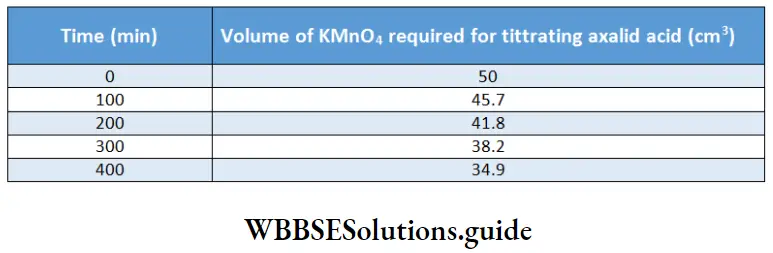
Basic Chemistry Class 12 Chapter 4 Chemical Kinetics first order reactions example 13

Find the order of the reaction and the rate constant.
Solution:

Here, we are titrating the oxalic acid that remains undissociated. Hence, the litre value at zero time gives the initial concentration of oxalic acid and other titer values indicate the amount of oxalic acid left behind.

For a first-order reaction a plot of In [A] vs. t must be a straight line.

In [A] = In [oxalic acid remaining undissociated].

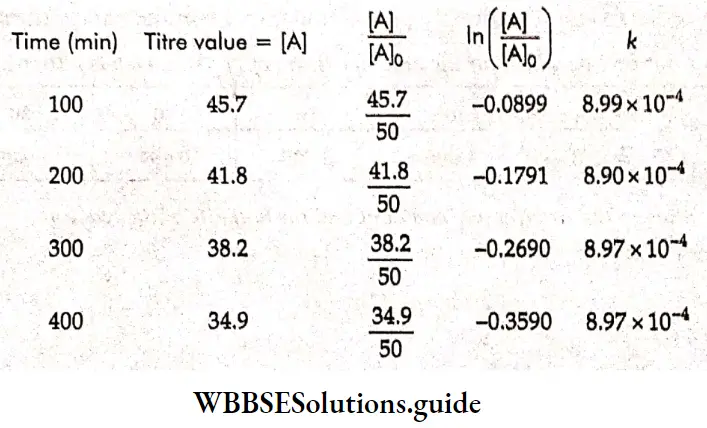
Since we do not know the tire concentration of oxalic acid, the ratio of the titer values can give us the ratio of concentrations. At time 0 min, tire initial concentration, [A]0 = 50.
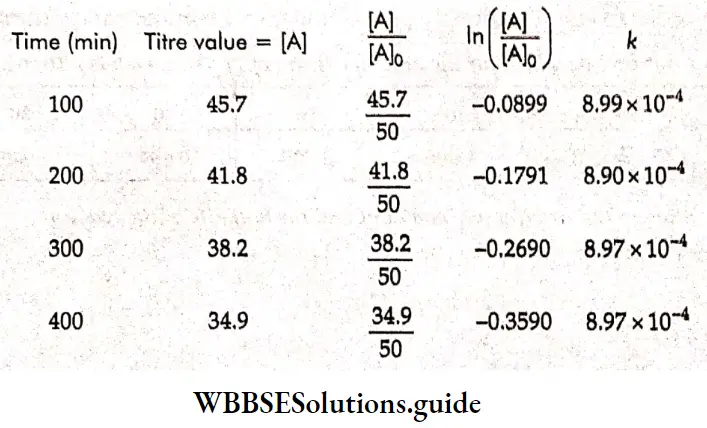
Basic Chemistry Class 12 Chapter 4 Chemical Kinetics integrated rate laws example 13.1

The value of k can be determined from the equation

⇒ \(k=-\left(\ln \frac{[\mathrm{A}]}{[\mathrm{A}]_0}\right) \times \frac{1}{t}\)

Since the value of k is constant, the reaction is of the first order.

Half-life

The half-life of a reactant, denoted by f1/2, is the time taken for the concentration of a reactant to fall to half of it initial amount.

For a first-order reaction, we can find the half-life of reactant A by substituting

⇒ \([\mathrm{A}]=\frac{1}{2}[\mathrm{~A}]_0 \text { and } t=t_{1 / 2}\)

Equation 4.3, so that

⇒ \(\ln \left(\frac{\frac{1}{2}[\mathrm{~A}]_0}{[\mathrm{~A}]_0}\right)=-k t_{1 / 2}\)

⇒ \(t_{1 / 2}=-\left[\ln \left(\frac{1}{2}\right)\right] \times\left(\frac{1}{k}\right)=\frac{\ln 2}{k}=\frac{0.693}{k}\)

It is interesting to note that the half-life of a first-order reaction does not depend on the initial concentration of the reactant. Natural and artificial radioactive decay takes place through first-order reactions.

The integrated rate law for a zero-order reaction is given by

[A] = -kt +[A]0.

Substituting \([\mathrm{A}] \text { by } \frac{1}{2}[\mathrm{~A}]_0 \text { and } t \text { by } t_{1 / 2} \text {, we get }\)

⇒ \(\frac{1}{2}[\mathrm{~A}]_0=-k t_{1 / 2}+[\mathrm{A}]_0\)

or, \(+k t_{1 / 2}=[\mathrm{A}]_0-\frac{1}{2}[\mathrm{~A}]_0\)

or, \(k=\frac{1}{2} \frac{[\mathrm{A}]_0}{t_{1 / 2}}\)

or, \(t_{1 / 2}=\frac{[\mathrm{A}]_0}{2 k}\)

where [A]0 is the initial concentration of the reactant and k, is the rate constant.

The half-life of a zero-order reaction is directly proportional to the initial concentration of the reactant.

Example 1. The following data were obtained for the decomposition of N2O2, which is a first-order reaction
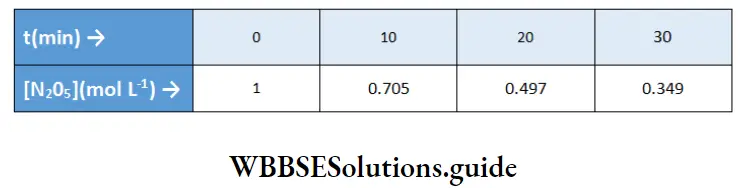
Basic Chemistry Class 12 Chapter 4 Chemical Kinetics half life example 1.1

Determine the value of the specific rate constant and the half-life of the reaction.
Solution:

For a first-order reaction,

⇒ \(\ln \frac{[\mathrm{A}]}{[\mathrm{A}]_0}=-k t\)
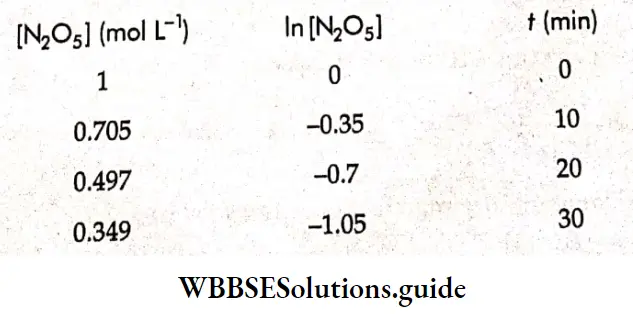
Basic Chemistry Class 12 Chapter 4 Chemical Kinetics half life example 1.2

If a graph is plotted between t and ln[N205], we obtain a straight line with slope = -k.

⇒ \(\text { Slope }=\frac{Y_2-Y_1}{X_2-X_1}=\frac{-0.35}{10}=-0.035=-k\)

⇒ k =0.035 min-1.

⇒ \(\text { Half-life, } t_{1 / 2}=\frac{0.693}{k}=19.8 \mathrm{~min}\)
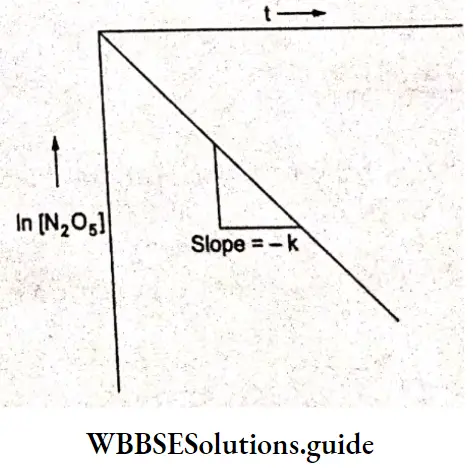
Basic Chemistry Class 12 Chapter 4 Chemical Kinetics half life example 1

Example 2. The half-life for the reaction (first order)

⇒ \(\mathrm{N}_2 \mathrm{O}_5 \rightarrow 2 \mathrm{NO}_2+\frac{1}{2} \mathrm{O}_2\) is 2.4 hours at 30°C.

  1. Starting with 100 g of N2O2, how many grams will remain after a period of 9.6 hours?
  2. How much time should be required to reduce 5x 10⁵ molecules o/N2O2 to 10 molecules?

Solution:

Half-life means the time taken for half of the reactant to disappear. If we start with 100 g, after one half-life 50 g will remain. Now of this 50 g, half the amount = 25 g will remain after another half-life, and so on.

1. After 2.4 hours,\(\frac{1}{2}\) x 100 =50 g will remain.

After 4.8 hours, \(\frac{1}{2}\) (50) = 25 g will remain.

After 7.2 hours, \(\frac{1}{2}\)(25) =12.5 g will remain.

After 9.6 hours, \(\frac{1}{2}(12.5)=\frac{1}{2} \times \frac{1}{2} \times \frac{1}{2} \times \frac{1}{2} \times 100=6.25 g\) will remain,.

We can derive a general formula here.

After 4 half-lives, \(\left(\frac{1}{2}\right)^4\) (100) g will remain.

Therefore, after n half-lives, \(\left(\frac{1}{2}\right)^n\left(C_0\right)\) of the substance will remain, where CO is the initial amount present.

2. \(t_{1 / 2}=2.4 \text { hours }\)

For a first-order reaction,

⇒ \(k=\frac{0.693}{t_{1 / 2}}=\frac{0.693}{2.4}=0.288 \text { hour }^{-1}=\frac{0.288}{60 \times 60} \mathrm{~s}^{-1}\)

⇒ \(8.02 \times 10^{-5} \mathrm{~s}^{-1}\)

⇒ \(\ln \frac{[\mathrm{A}]}{[\mathrm{A}]_0}=-k t\)

⇒ \(2.303 \log \left(\frac{10^5}{5 \times 10^5}\right)=-8.02 \times 10^{-5} \times t\)

⇒ \(t=\frac{2.303 \log \left(\frac{1}{5}\right)}{-8.02 \times 10^{-5}}=\frac{-1.6097}{-8.02 \times 10^{-5}}=20071.42 \mathrm{~s}\)

⇒ \(\frac{20071.4}{3600} h=5.57\)

It will take 5.57 hours = 5 hours 34.2 min for reducing 5 x10⁵ molecules to 105 molecules

Example 3. The thermal decomposition of N2O2 follows first-order reaction kinetics.

2N2O2(g) 4NO2(g)+ O2(g)

Rate= k[N2O2].

What will happen to the rate if the concentration of N2Os is doubled and halved?
Solution:

Since the rate is directly proportional to [N2O5], increasing the concentration to double its value will double the value of the rate of the reaction (as k remains constant). Similarly, decreasing the concentration of N2O2 to half of its value will result in the rate being reduced to half.

Example 4. Consider the oxidation of nitric oxide

⇒ \(2 \mathrm{NO}(\mathrm{g})+\mathrm{O}_2(\mathrm{~g}) \rightarrow 2 \mathrm{NO}_2(\mathrm{~g})\)

The rate law is given as

rate= \(\text { rate }=[\mathrm{NO}]^2\left[\mathrm{O}_2\right]\)

How will the rate of the reaction be affected when the concentration of NO is doubled, NO is tripled and (c) O2 is doubled?
Solution:

The rate depends on the square of the concentration of NO.

On doubling the concentration, rate = k{2 x [NO]}2[O2 ] = k x 4[NO]2[O2]

The new rate will then be 4 times the earlier one. On tripling the concentration of NO, the rate will be 3 or 9 times the original rate. When the concentration of O2 is doubled, the rate will be doubled as the rate depends directly on the first power of O2

Determination of rate law

It is very important to note that a rate law is established experimentally and cannot in general be inferred from the chemical equation for the reaction. One of the methods for the determination of the rate law is called the Ostwald method in which the concentration of one of the reactants is much less than that of the others. Consider a reaction with two reactants A and B, If the reactant B is taken in excess, then even when the reaction reaches completion, the concentration of B is only marginally affected. It is a good approximation to take its concentration as a constant throughout the reaction. Even if the true rate law is

rate = k[A][B],

we say that rate =k[A] where k’ = k[B]0 where [B]0 is the initial concentration of the reactant B, which hardly changes. Since the true law has been forced into an effective first-order form, it is called a pseudo-first-order rate law and the reaction under such conditions is a pseudo-first-order reaction.

For example, consider the reaction between ozone and NO.

O3 + NO → O2 + NO2

or that between O3 and NO2.

O3+ 2NO2 → 2N3 + O2

Both these reactions are of the second order overall and of the first order with respect to each reactant.

Rate = k[O3][NO].

Rate = k[O3][NO2].

The integrated rate law for a reaction that is of the first order with respect to two reactants is complicated.

However, a simple rate law expression can be derived for such a reaction when the concentration of one of the reactants is much higher than that of the other. The concentration of O3 is generally hundreds to thousands of times greater than the concentration of NO in polluted air. The concentration of ozone remains more or less constant during the course of the reaction.

The rate law can be simplified to

rate = k[NO],

where k = k[O3]0 where [O3]0 is the initial concentration of ozone.

The above rate law looks like the rate law of a first-order reaction; it appears to obey first-order kinetics. It is hence called a pseudo-first-order reaction and the rate constant is called the pseudo-first-order rate constant.

Temperature dependence of reaction rate

For many chemical reactions, the rate increases as the temperature is raised. You must have noticed that curd sets faster in summer than in winter. When the temperature is relatively high metabolic reactions are faster. It is said that fever is our friend because we fight infection with a fever.

The rise in the body temperature upsets the balance of mission rates in the foreign organism, thus preventing it from further invading the body. Also, an increase in the temperature of the body kills the invading organism. Reaction rates are found to increase exponentially with an increase in temperature. In general, for a 10 C rise in temperature, the reactions become two or three times faster. For example, the rate of hydrolysis of sucrose is 4.1 times more at 35’Cl than at 25cC.

Arrhenius’s equation:

In 1889 Arrhenius studied the data accumulated on reaction rates and found that the rate constant k of most chemical reactions increases exponentially as a function of temperature, T. The mathematical form of this relation is called Arrhenius’s equation, which is as follows.

⇒ \(k=A \exp \left(-\frac{E_a}{R T}\right)\)

Here, k is the rate constant, A is called the pre-exponential factor, frequency factor, or collision frequency. It is also simply called the Arrhenius constant. Ea is called the activation energy. The term exp \(\left(-\frac{E_a}{R T}\right)\) represents an activation state factor. Collectively these quantities (A and Ea) are called Arrhenius parameters.

Activation energy:

Activation energy is the minimum energy required for a chemical reaction to take place. It is the minimum kinetic energy required by reactant molecules to break bonds and form new ones (those of products).

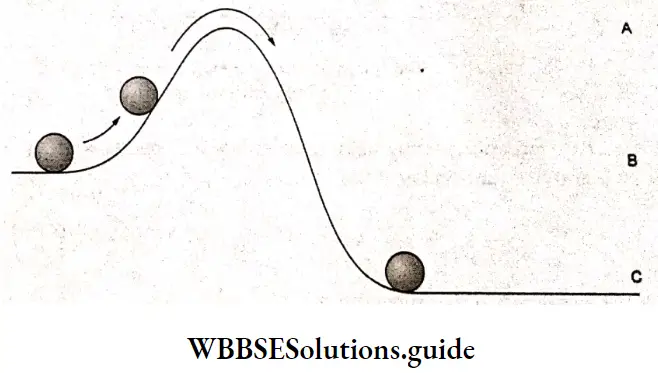
To understand the concept of activation energy better, consider a boulder that has to be moved up a hill.
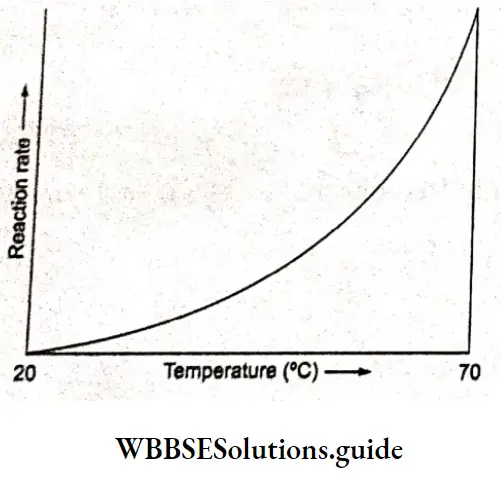
Basic Chemistry Class 12 Chapter 4 Chemical Kinetics temperature dependence of reaction rates

Basic Chemistry Class 12 Chapter 4 Chemical Kinetics the minimum energy required by the boulder to cross the barrier is the activation energy

The boulder initially at position B loses some of its potential energy when it reaches position C. However, it should have sufficient kinetic energy to cross the barrier at A. As the boulder moves from position B to A, it gradually loses its kinetic energy and gains potential energy.

If the kinetic energy of the boulder is higher than its potential energy at A, it can cross and reach the other side of the hill. From here, it can simply slide down to reach C, The minimum energy required by the boulder to cross the barrier is the activation energy. It is the difference between the energy at B and that at A.

Let us now consider the following chemical reaction.

A + BC → AB + C

If the reaction occurs in a single step, the reactant molecules collide with each other, and the electron distribution about the three nuclei (A, B, and C) changes in the course of a collision such that a new bond between A and B is formed and at the same time the bond between B and C breaks.

Between the reactant stage and product stage, the nuclei pass through a stage in which all three species (A, B, and C) are weakly linked together. This has a higher potential energy than both reactants and products.

The reactants must gain enough energy to overcome this energy barrier. The energy actually comes from the ‘ kinetic energy of the molecules which is converted into potential energy. The height of the potential energy barrier is called activation energy.

Taking the natural logarithm of both sides of Arrhenius’s equation, we get

⇒ \(\ln k=\ln A-\frac{E_a}{R T}=\ln A-\left(\frac{E_a}{R}\right)\left(\frac{1}{T}\right)\)

A graph plotted between In k (In of rate constant) and \(\frac{1}{T}\) where T is the absolute temperature at which k is measured, is a straight line with a slope equal to \(-\frac{E_a}{R}\). The intercept is In A, from which A can be calculated.
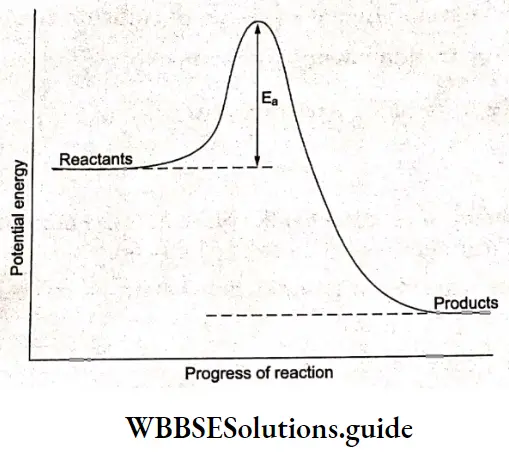
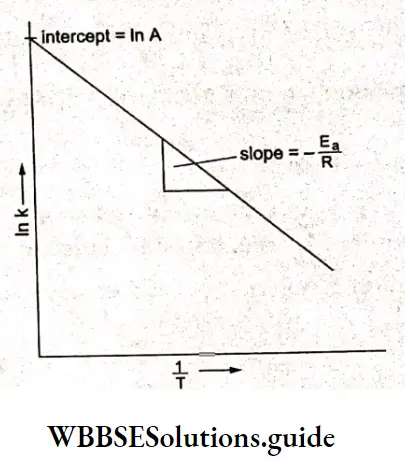
Basic Chemistry Class 12 Chapter 4 Chemical Kinetics the height of the potential energy barrier is called activation energy

Basic Chemistry Class 12 Chapter 4 Chemical Kinetics the intercept is In A from which A can be calculated

Activation energy may also be calculated if the rates are available at only two temperatures. At temperature T1, the above equation becomes

⇒ \(\ln k_1=\ln A-\left(\frac{E_a}{R}\right) \cdot \frac{1}{T_1}\)

At temperature T2, it becomes

⇒ \(\ln k_2=\ln A-\left(\frac{E_a}{R}\right) \cdot \frac{1}{T_2}\)

Subtracting the first equation from the second,

⇒ \(\ln k_2-\ln k_1=-\frac{E_a}{R}\left(\frac{1}{T_2}-\frac{1}{T_1}\right) \text { or } \ln \left(\frac{k_2}{k_1}\right)=-\frac{E_a}{R}\left(\frac{1}{T_2}-\frac{1}{T_1}\right)\)

This equation can be used to calculate Ea from the rate constants and k2 at temperatures Ta and T2.

Example 1. The rate constant first-order reaction becomes five times the original rate constant when the temperature rises from 350 K to 400 K. Calculate the activation energy for the reaction.
Solution:

Given

The rate constant first-order reaction becomes five times the original rate constant when the temperature rises from 350 K to 400 K.

⇒ \(\ln k=\ln A-\frac{E_a}{R T}\) (Arrhenius’s equation)

At T = 350 K, let the rate constant = k.

∴ at T = 400 K, the rate constant = 5k.

Substituting the values at 350 K and 400 K,

⇒ \(\ln k=\ln A-\frac{E_a}{8.314 \times 350}\)

and In (5k) = \(\ln A-\frac{E_a}{8.314 \times 400}\)

Subtracting Equation (1) from Equation (2), we have

⇒ \(\ln (5 k)-\ln k=-\frac{E_a}{8.314 \times 400}+\frac{E_a}{8.314 \times 350}\)

⇒ \(\ln \left(\frac{5 k}{k}\right)=\frac{E_a}{8.314}\left(\frac{-1}{400}+\frac{1}{350}\right)\)

⇒ \(\ln 5=\frac{E_a}{8.314}\left(-2.5 \times 10^{-3}+2.857 \times 10^{-3}\right)\)

⇒ \(\frac{1.609 \times 8.314}{3.57 \times 10^{-4}}=E_a\)

⇒ \(E_a=37.47 \mathrm{~kJ} \mathrm{~mol}^{-1}\)

Example 2. The rate constants for the decomposition of HI at different temperatures are as follows.
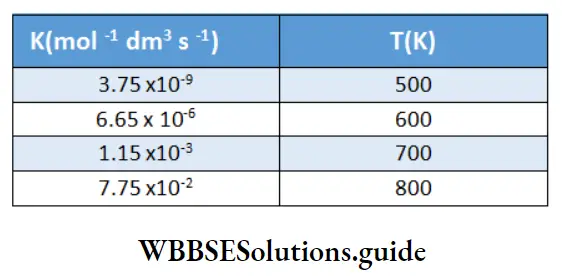
Basic Chemistry Class 12 Chapter 4 Chemical Kinetics temperature dependence of reaction rate example 2.1

Find the value of the activation energy for this reaction.
Solution:

A plot of In k vs \(\frac{1}{T} \text { gives }\left(-\frac{E_a}{R}\right)\) as the slope.
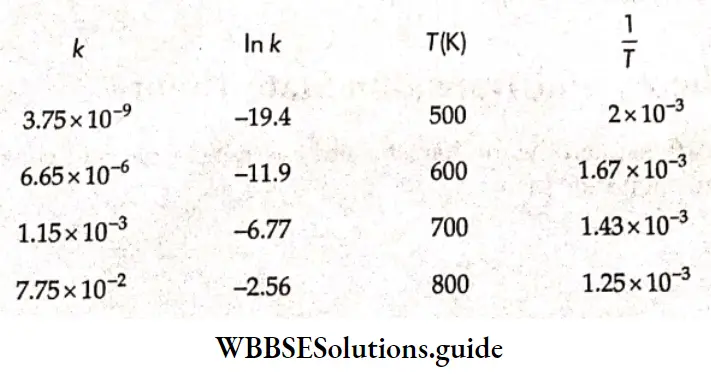
Basic Chemistry Class 12 Chapter 4 Chemical Kinetics temperature dependence of reaction rate example 2.2

⇒ \(\text { Slope }=-22727.2=-\frac{E_a}{R}\)

⇒ \(E_a=R \times 22727.2=8.314 \times 22727.2=188954.5 \mathrm{~J} \mathrm{~mol}^{-1}\)

or, \(E_a=188.9 \mathrm{~kJ} \mathrm{~mol}^{-1}\)

The activation energy for the decomposition of HI is 188.9 kJ mol-1.
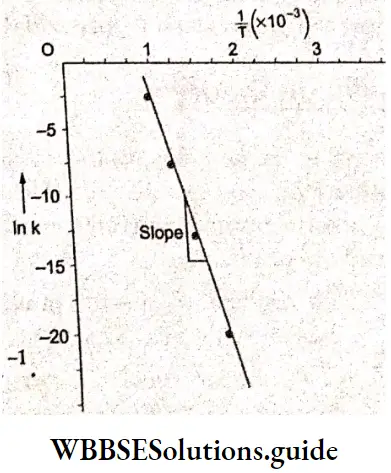
Basic Chemistry Class 12 Chapter 4 Chemical Kinetics temperature dependence of reaction rate example 2

Effect of catalyst

Yet another very important factor determining the rate of a reaction is the presence of a catalyst. A catalyst is a substance that increases the rate of a reaction without itself undergoing any permanent chemical change. An example is manganese dioxide, which speeds up the thermal decomposition of potassium chlorate.

⇒ \(2 \mathrm{KClO}_3(\mathrm{~s}) \stackrel{\mathrm{MnO}_2 \text {, heat }}{\longrightarrow} 2 \mathrm{KCl}(\mathrm{s})+3 \mathrm{O}_2(\mathrm{~g})\)

In the absence of a catalyst, KClO3 decomposes very slowly, even when heated, but when a small amount of MnO2

is mixed with the KClO3 before heating, the rapid evolution of oxygen takes place. The MnO2 can be recovered unchanged after the reaction is complete.

Most industrial processes, such as the manufacture of ammonia, sulphuric add, nitric acid, and polymers, involve the use of catalysts. Biological catalysts or enzymes affect the rates of reactions taking place during metabolic activities.

How does a catalyst work? It increases the rate of a reaction by lowering the activation energy. The potential energy barrier between the reactants and products is reduced, thus facilitating a faster reaction (Figure 4.13). A catalyst participates in the chemical reaction by forming an intermediate complex with the reactants, which finally breaks down to form the products, and the catalyst is obtained back.

Temperature and catalyst effects on reaction rate

The concentration of the catalyst does not appear in the rate law of any reaction because while it is consumed in one step, it is regenerated in another step. Let us consider the decomposition of H2O2

⇒ \(2 \mathrm{H}_2 \mathrm{O}_2(\mathrm{aq}) \rightarrow 2 \mathrm{H}_2 \mathrm{O}(\mathrm{l})+\mathrm{O}_2(\mathrm{~g})\)
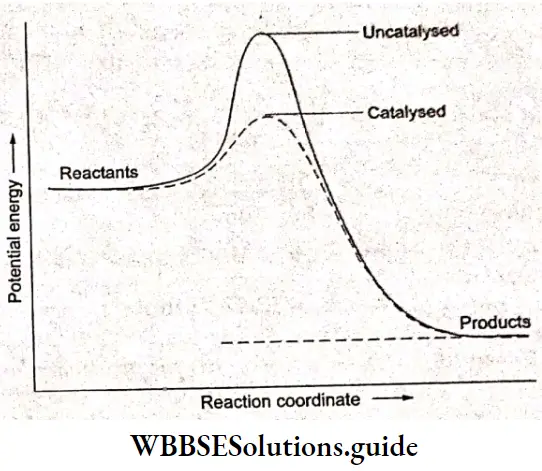
Basic Chemistry Class 12 Chapter 4 Chemical Kinetics effect of catalyst on activation energy

This reaction has a high activation energy of 76 kJ mol-1 at room temperature and hence this decomposition is very slow. In the presence of the iodide ion, the reaction is appreciably faster because it proceeds by a different, lower-energy, pathway.

\(\begin{gathered}
\mathrm{H}_2 \mathrm{O}_2(\mathrm{aq})+\mathrm{I}^{-}(\mathrm{aq}) \rightarrow \mathrm{H}_2 \mathrm{O}(\mathrm{l})+\mathrm{IO}^{-}(\mathrm{aq}) \\
\mathrm{H}_2 \mathrm{O}_2(\mathrm{aq})+\mathrm{IO}^{-}(\mathrm{aq}) \rightarrow \mathrm{H}_2 \mathrm{O}(\mathrm{l})+\mathrm{O}_2(\mathrm{~g})+\mathrm{I}^{-}(\mathrm{aq}) \\
\hline 2 \mathrm{H}_2 \mathrm{O}_2(\mathrm{aq}) \rightarrow 2 \mathrm{H}_2 \mathrm{O}(\mathrm{l})+\mathrm{O}_2(\mathrm{~g})
\end{gathered}\)

The H2O2 first oxidizes the catalyst I to the hypoiodite ion (IO) and then reduces the intermediate IO back to I-1. The activation energy is, thus, lowered by 19 kJ mol-1.

Collision Theory and Transition State Theory

Two theories have been put forward which explain the mechanistic and energetic aspects of chemical reactions. These are the collision theory and the transition state theory.

Collision theory:

According to the collision theory, an atom, ion or molecule can undergo a reaction only when it collides with another atom, ion or molecule. The reacting atoms, ions or molecules are assumed to be hard spheres. However, only a small number of collisions result in a chemical reaction. The following conditions must be fulfilled for a collision to be effective.

1. The transfer or sharing of electrons between the colliding species must give a structure that is capable of existence. In other words, stable bonds or new stable chemical species should be formed.

2. The collision must take place with sufficient energy—the outer electronic shells of the atoms should penetrate each other to some extent so that the bonding electrons can be rearranged.

3. The orientation of the molecules when they collide must that the atoms directly involved in the sharing or transfer of electrons come into contact with each other

Now, let us consider these three aspects in a rate equation of a bimolecular elementary reaction(see section or reaction mechanisms) A + B → P.

The rate of the reaction can be expressed as

Rate = f x P x Z [A][B]

where P and Z represent the three aspects of collision theory, [A] and [B] are the reactant concentrations. The rate constant k then takes the form.

k = f x P x Z

To understand what ‘f’ denotes, let us see the effect of temperature on the above reacting system Changing the temperature of a reacting system has two effects.

On raising the temperature, molecules tend to move faster and hence there are a larger number of collisions but calculations show that only a small percentage of the rate increase with temperature can be accounted for by the larger number of collisions. The more important factor is the kinetic energy of the molecules and it is found that the average kinetic energy of molecules increases with an increase in temperature.

In other words, the activation energy required for the reaction to take place is provided by the collisions of the reactant molecules with each other or with the walls of the reaction vessel. Only a few fast-moving molecules will have enough energy to react if the activation energy is larger than the average kinetic energy of the molecules. The kinetic energy is converted to the potential energy of the molecule.

If the activation energy is smaller than the kinetic energy, then the fraction of molecules having the required kinetic energy will be large and most collisions will result in the reaction. As a result, the reaction will be fast.
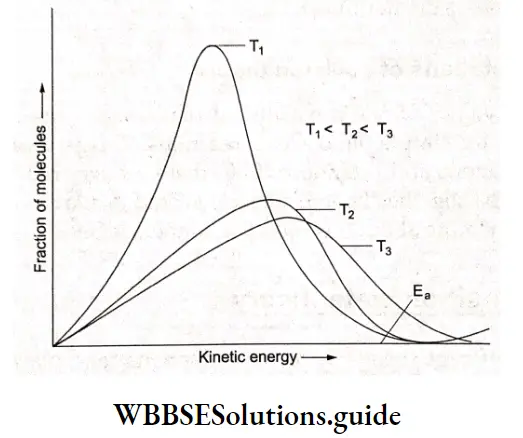
Basic Chemistry Class 12 Chapter 4 Chemical Kinetics average kinetic energy at different temperatures

The fraction of molecules (f) that possesses kinetic energy equal to or greater than Ea is equal to \(e^{-E_f / k T}\) as in Arrhenius’s equation. As the temperature increases, the curve broadens resulting in an increase in the fraction of molecules having an energy Ea, As T increases, \(\frac{1}{T}\) decreases, and f increases exponentially, Z in Equation 4.7 is called the collision frequency and is defined as the number of collisions per second per unit volume of the reaction mixture.

For collisions between reactant molecules A and B, Z is represented as Though a large fraction of molecules may possess kinetic energy greater than the activation energy, all collisions between such molecules may not lead to products. This is the third aspect of collision theory.

The fraction of collisions that lead to products is restricted by the requirement of proper orientation of the colliding molecules. This is represented by the probability or steric factor P, which denotes the fraction of collisions in which the reacting molecules have the right orientation to form the product.

For example, in the reaction, between HCl and NH3 to form NH4Cl, the N end of NH3 must hit the H end of HCl. Such a collision which results in the formation of a product is called an effective collision. Collision of the N of NH3 with Cl of HCl does not result in Hr formation of NH4Cl and hence it is termed as ineffective collision. The following shows an effective and an ineffective collision for the reaction between HCl and NH-.,
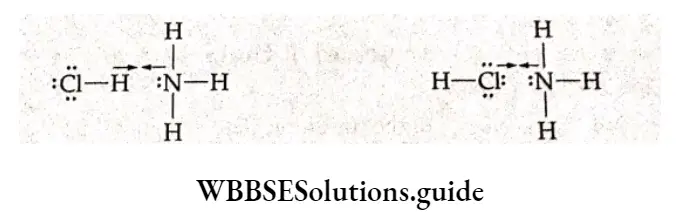
Basic Chemistry Class 12 Chapter 4 Chemical Kinetics effective collision and ineffective collision

The value of P is usually between 0 and 1. The rate constant can thus be written as

k = fPZAB = PZAB e-2Ea/RT

It is interesting to note that tins resemble Arrhenius’s equation (Equation 4.6) and by a comparison of those two equations, we got

A = PZAB

where A is the Arrhenius factor.

Arrhenius’s equation reflects two aspects of the collision theory of reaction rates. The frequency factor A indicates the number of collisions that lead to a proper orientation of the reactant species to enable the formation of products, The exponential term \(e^{\left(-E_a / RT\right)}\) the fraction of collisions in which the energy of the reacting spades is greater than Ea

Limitation of collision theory:

The values of rate constants calculated using the collision theory are in agreement with the experimental values only for simple bimolecular reactions. This is because the molecules are considered to be hard spheres and the vibrations and rotations within them are ignored. There is no way of determining P. It can only be obtained by comparing the theoretically calculated A (Arrhenius factor) and the experimentally observed value. You will study more about this theory in higher classes,

Transition state theory

A different theory as to how reactions take place pictures the formation of a transition slate by the two (or more) reacting molecules instead of their collision. The molecules undergoing reactions are considered to be approaching each other and under each other’s influence, a transition state is formed.

The tire transition state or the activated complex is a combination of reacting molecules, intermediate between reactants and products. Some bonds begin to break while new ones begin to form.

For example, in the reaction between ammonia and methyl bromide, the N-C bond begins to form in the transition state, the C-Br bond begins to weaken, and partial charges develop on tire nitrogen and bromine atoms.
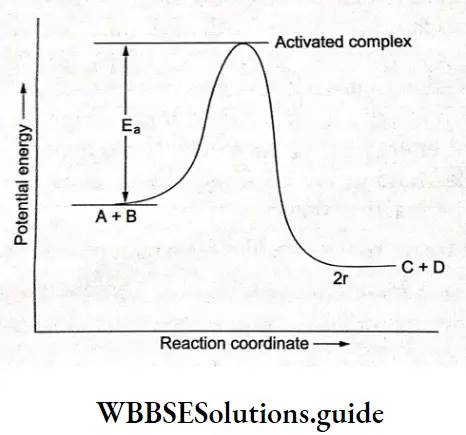
Basic Chemistry Class 12 Chapter 4 Chemical Kinetics a plot potential energy versus reaction coordinate

⇒ \(\mathrm{NH}_3+\mathrm{CH}_3 \mathrm{Br} \longrightarrow\left[\mathrm{CH}_3 \mathrm{NH}_3\right]^{+}+\mathrm{Br}^{-}\)
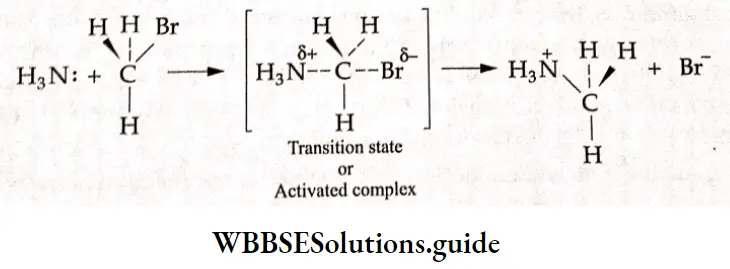
Basic Chemistry Class 12 Chapter 4 Chemical Kinetics transition state or activated complex

An activated complex cannot ordinarily be isolated. It breaks down to give either reactants or products depending on the conditions of the reaction.

The energy of the transition state is higher than that of the two reactants by an amount of Ea —the activation energy. For the reaction to take place, the sum of tire kinetic energies of A and B must be will least equal to or greater than E„.

After reaching the transition state, the molecules start losing energy and ultimately reach a state of energy even lower than that of the initial state. The energy thus lost is transferred to other molecules and they reach the transition state; the reaction proceeds in this the size of the activation energy barrier depends on the direction from which it is approached.

If the reaction is exothermic in the forward direction, Ea is smaller in the forward direction than in the reverse direction. It is easier to cross the smaller energy barrier in the case of the exothermic reaction than in the reverse endothermic reaction.

Difference between average rate and instantaneous rate of reaction

At the same temperature, some reactions have a high activation energy and some have a low activation energy. If we compare two reactions at the same temperature, the one with a lower activation energy will be fast and have a high rate constant whereas the one which has a higher activation energy will have lower k and lower rate.

Increasing the temperature increases the value of \(e^{\left(-E_a / R T\right)}\) and hence gives a larger k. A rise in temperature also increases A. Any change in the conditions of the reaction that increases the number of collisions with a favorable orientation of the molecules results in a high value of k.

Reaction mechanisms

Most chemical reactions occur in a series of elementary reaction steps, rather than in a single step.

The process or pathway by which a reaction occurs actually is called the reaction mechanism or reaction path.

A balanced chemical equation does not tell us anything about the actual pathway (steps in the reaction); it just tells us what molecules and how many of them react to form what kind of products. The mechanism of a reaction can be deduced from a knowledge of the rate law of that reaction.

As already discussed, the rate law and order of a reaction have to be experimentally determined, and once determined, a mechanism for the reaction can be suggested. Here, we shall look at the mechanisms of some simple reactions.

First, consider the example of the decomposition of ozone. The chemical equation for the overall reaction is

2O3 → 3O2

The reaction, however, appears to follow a mechanism involving two steps.

O3 → O2 + O

O+O3 → 2O2

Atomic oxygen is produced in the first step and is consumed in the second step. Hence it is not shown in the overall reaction. Such species which are produced in one step and consumed in another are called intermediates.

Most reactions proceed in several steps involving one or more reaction intermediates. These intermediates may be short-lived or may persist. The rate of such a multistep reaction is determined by the slowest step.

Now consider a reaction involving two consecutive steps of the first order. If in a chemical reaction, a reactant produces an intermediate (I) which decays to form the product (P), we can say that the reaction takes place in two steps.

A → I Rate of formation of I = k1[A]

I → P Rate of formation of P = k2[I]

Shows that the concentration of the intermediate (I) grows and reaches a maximum initially.

Meanwhile, the concentration of the product also rises. After the concentration of the intermediate reaches a maximum, it decays to zero and that of the product reaches its final value.

An example of such a reaction is the radioactive decay of uranium. The half-lives of uranium and neptunium are given.

⇒ \({ }^{239} \mathrm{U} \stackrel{23.5 \mathrm{~min}}{\longrightarrow}{ }^{239} \mathrm{~Np} \stackrel{2.35 \text { days }}{\longrightarrow}{ }^{239} \mathrm{Pu}\)
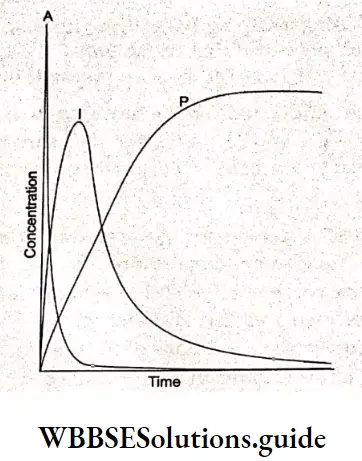
Basic Chemistry Class 12 Chapter 4 Chemical Kinetics the concentations of the reactant

An intermediate may also be formed when we have two reactants; an example of such a reaction is the enzyme-catalyzed reaction in which a substrate S is converted to products. The proposed mechanism is

⇒ \(\mathrm{E}+\mathrm{S} \rightleftharpoons \mathrm{ES} \rightarrow \text { products }+\mathrm{E}\)

where E is the enzyme and ES is the intermediate, a state in which the enzyme is bound to the substrate.

The rate-determining step:

Reactions that take place in more than one step are called complex reactions. Each complex reaction is generally a combination of a sequence of elementary reactions, which we refer to as steps. The overall balanced equation for a reaction is the sum of its elementary steps.

Elementary reactions individually may involve one or more molecules. Those involving a single molecule are called unimolecular while those that involve two molecules are called bimolecular. Similarly, there may be tennolecular reactions (involving three molecules), and so on.

The molecularity of an elementary reaction refers to the number of reacting particles, viz., atoms, molecules, or ions, in that particular step. The order and molecularity of a reaction are two different aspects.

While the order is determined experimentally and may or may not be the same as the stoichiometry of the molecule under consideration, the molecularity of the reaction can be judged from the stoichiometry of a particular step of a reaction.

The order of a reaction is applicable to an elementary as well as a complex reaction while molecularity is applicable only to an elementary reaction. The order may be zero or fractional but molecularity can only be a positive integer. The order is determined by the slowest step in a complex reaction, i.e., the rate-determining step.

Generally, the molecularity of the rate-determining step is the same as the order of the overall reaction. To understand this better, let us consider the mechanism for the oxidation of the iodide ion by H2O2 in an acid medium and find the rate equation. For the reaction

⇒ \(\mathrm{H}_2 \mathrm{O}_2+2 \mathrm{H}^{+}+2 \mathrm{I}^{-} \rightarrow \mathrm{I}_2+2 \mathrm{H}_2 \mathrm{O}\)

the suggested mechanism is

⇒ \(\mathrm{H}_2 \mathrm{O}_2+\mathrm{I}^{-} \rightarrow \mathrm{OH}^{-}+\mathrm{HOI}\) (slow)

⇒ \(\mathrm{H}^{+}+\mathrm{OH}^{-} \rightarrow \mathrm{H}_2 \mathrm{O}\) (fast)

⇒ \(\mathrm{HOI}+\mathrm{H}^{+}+\mathrm{I}^{-} \rightarrow \mathrm{I}_2+\mathrm{H}_2 \mathrm{O}\) (fast)

Since the slowest step determines the rate, the rate equation for the reaction is

⇒ \(\text { rate }=-\frac{d\left[\mathrm{H}_2 \mathrm{O}_2\right]}{d t}=k\left[\mathrm{H}_2 \mathrm{O}_2\right]\left[\mathrm{I}^{-}\right]\)

Let us consider one more example and see how the rate law is In agreement with the rate-determining step.
Consider the decomposition of NO2.

2NO2(g) → 2NO(g) + O2(g)

This reaction is of the second order with respect to NO2. The two steps in which this reaction occurs are

2NO2 → NO+NO3

NO3 → NO+O2

In the first step, a collision between a pair of NO2 molecules produces a short-lived activated complex in which the two molecules share an oxygen atom. Such activated complexes have a lifetime of ~ 10 -15 s and fall apart forming products or reactants.

To form products, the shared oxygen is transferred from one NO2 molecule to another forming a molecule of NO and a molecule of NO2. The NOa thus formed decomposes in the second step again by the formation of another activated complex.

NO2 is called the intermediate in this mechanism as it is produced in one step and consumed in the next. Intermediates are neither considered as reactants nor as products and hence do not appear in the equation describing the reaction.
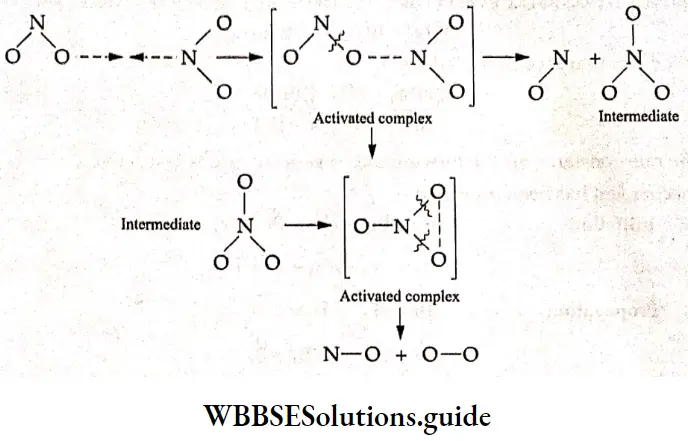
Basic Chemistry Class 12 Chapter 4 Chemical Kinetics mechanism for the thermal decomposition of NO2

The lines between the atoms just show that a bond exists between the two—the nature of the bond is not shown.

The observed rate law which indicates an order of 2 with respect to NO2 can be predicted for step 1 but not for step 2. This means that the rate of the overall reaction is controlled by step 1 rather than step 2. The first step is the controlling step which is also the slower of the two in this case and is called the rate-determining step.

The rate for the first step is

⇒ \(\text { rate }=-\frac{\Delta\left[\mathrm{NO}_2\right]}{\Delta t}=k_1\left[\mathrm{NO}_2\right]^2\)

If the rate constant k1 is much less than that for step 2, k2, then

⇒ \(\text { rate }=-\frac{\Delta\left[\mathrm{NU}_3\right]}{\Delta t}=k_2\left[\mathrm{NO}_3\right]\)

In fact, it has been found that

k1 << k2.

In an unimolecular reaction, a single molecule shakes itself apart or its atoms into a new arrangement as in the isomerization of cyclopropane to propene.

⇒ \(\underset{\text { Cyclopropane }}{\Delta} \rightarrow \mathrm{CH}_2=\underset{\text { Propene }}{\mathrm{CH}}-\mathrm{CH}_3\)

An unimolecular elementary reaction is of the first order. For example in a reaction A → B,

⇒ \(\frac{d[\mathrm{~A}]}{d t}=-k[\mathrm{~A}]\)

In a bimolecular elementary reaction, two molecules collide with each other and then react. Such a reaction is of second order; the rate is proportional to the concentrations of the two reactants.

For a reaction of the type A + B → product

⇒ \(\frac{d[\mathrm{~A}]}{d t}=-k[\mathrm{~A}][\mathrm{B}]\)

Chain reactions:

A chain reaction is a complex reaction comprising a sequence of reactions in which the intermediate formed in the first step generates a reactive intermediate in the subsequent step, and so on. The intermediates responsible for the propagation of a chain reaction are called chain carriers. They may be radicals ions, or neutrons in nuclear fission reactions.

The steps in a chain reaction are classified as the initiation step, propagation step, and termination step. There can be more than one propagation or termination step possible for a chain reaction. Many gas-phase reactions and liquid-phase polymerization reactions are chain reactions. The formation of HBr from H2 and Br2 is a chain reaction.

⇒ \(\mathrm{H}_2(\mathrm{~g})+\mathrm{Br}_2(\mathrm{~g}) \rightarrow 2 \mathrm{HBr}(\mathrm{g})\)

Experimental methods to determine reaction rate

The rate law for the reaction is complicated.

⇒ \(\frac{d[\mathrm{HBr}]}{d t}=\frac{k\left[\mathrm{H}_2\right]\left[\mathrm{Br}_2\right]^{3 / 2}}{\left[\mathrm{Br}_2\right]+k^{\prime}[\mathrm{HBr}]}\)

where k and K are the rate constants for the forward and reverse reactions respectively.

The following mechanism has been proposed.

Initiation \(\mathrm{Br}_2+\mathrm{Br}_2 \rightarrow \mathrm{Br}+\mathrm{Br}+\mathrm{Br}_2\)

or \(\mathrm{Br}_2+\mathrm{H}_2 \rightarrow \dot{\mathrm{Br}}+\dot{\mathrm{Br}}+\mathrm{H}_2\)

Propagation \(\dot{\mathrm{Br}}+\mathrm{H}_2 \rightarrow \mathrm{HBr}+\dot{\mathrm{H}}\)

or \(\dot{\mathrm{H}}+\mathrm{Br}_2 \rightarrow \mathrm{HBr}+\dot{\mathrm{Br}}\)

Retardation \(\dot{\mathrm{H}}+\mathrm{HBr} \rightarrow \mathrm{H}_2+\dot{\mathrm{Br}}\)

Termination \(\dot{\mathrm{Br}}+\dot{\mathrm{Br}}+\mathrm{H}_2 \rightarrow \mathrm{Br}_2+\mathrm{H}_2^*\)

\(\dot{\mathrm{Br}}+\dot{\mathrm{Br}}+\mathrm{Br}_2 \rightarrow \mathrm{Br}_2+\mathrm{Br}_2^*\)

A dot indicates a free radical and a star indicates an activated molecule.

As you already know, free radicals are highly reactive. The chain reaction continues until the termination step occurs. In this step, either Br2 or H2 removes the excess energy of recombination and exists as an activated (high-energy) molecule.
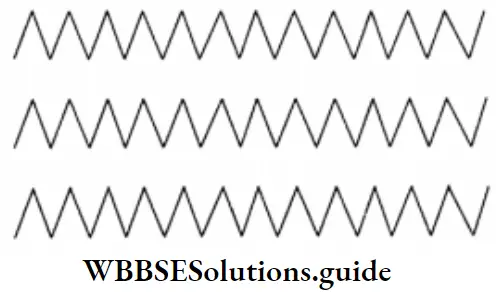
Polymers Types, Classification, Properties

Polymers

Many things of everyday use are made of polymers. For example, fabric for clothing and furniture, plastic utensils, containers, toys, toothbrushes, synthetic rubber for automobile tyres, paints and varnishes, paper and pens.

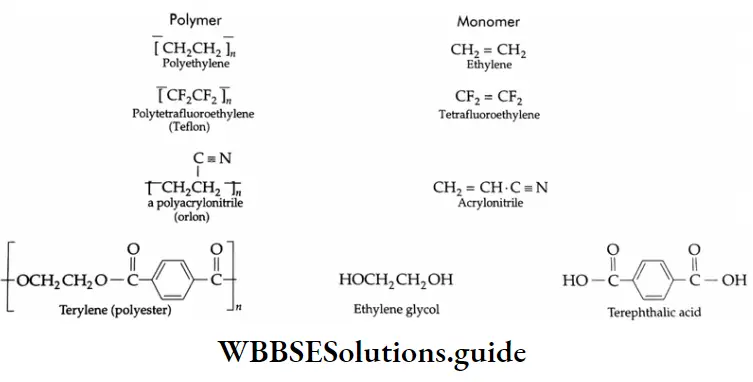
  • Large molecules (macromolecules) formed by a series of chemical reactions between small molecules are called polymers; the word is derived from the Greek polymers meaning “many parts” (poly = many, meros = parts).
  • The small molecules that make up the giant polymer are called monomers, meaning “of one part”. The formation of large molecules by the linking together of small molecules is called polymerisation.
  • The structural formulae of some common polymers, along with the monomers from which they are made, are given below.

Basic Chemistry Class 12 Chapter 15 Polymers Polymers And Monomer

  • Polymers made up of a few monomers are called oligomers. An example is crystalline sulphur, a molecule of which has eight sulphur atoms arranged in a ring. As is obvious, the monomeric unit is a sulphur atom.
  • – OH
  • The properties of polymers are related to molecular mass, size and structure. The molecular mass of a polymer depends on the conditions of polymerisation.
  • The length of the polymer chain depends upon the availability of monomer molecules in the reaction mixture. Thus, a polymer contains chains of varying lengths.
  • Therefore the molecular mass of a polymer is expressed as an average.

Polymers class 12 chemistry notes

Polymers Classification

Polymers May Be Classified In Several Ways.

On the basis of the type of chain

Polymers may be made up of three types of chains-linear, branched and crosslinked.

1. Linear-chain polymers:

High-density polymers with long straight chains are called linear-chain polymers. Examples are polyethene and polyvinyl chloride. The chains in such a polymer may be depicted as follows.

Basic Chemistry Class 12 Chapter 15 Polymers Linear Chain Polymer

2. Branched-chain polymers:

Low-density polymers having linear chains with some branches are called branched-chain polymers. An example of such a polymer is polypropylene. The chains in a branched-chain polymer may be shown as follows.

Basic Chemistry Class 12 Chapter 15 Polymers Branched Polymer

3. Crosslinked polymers:

Crosslinked polymers contain strong covalent bonds between various linear chains. Examples of such polymers are bakelite and melamine. The chains in the polymer may be depicted. The monomers in a crosslinked polymer generally have two or three functional groups.

Basic Chemistry Class 12 Chapter 15 Polymers Crosslinked Polymers Are More Rigid Than Branched Chain Or Linear Chain Polymers

On The Basis Of Intermolecular Force

Polymers are known for their special mechanical properties such as toughness, elasticity and tensile strength. The degree of toughness, elasticity and so on depends upon the intermolecular forces in the large polymer molecules.

These forces may be van der Waals forces, forces due to hydrogen bonds, etc. Such forces are present in smaller molecules too but their effect is not so pronounced. The larger the molecule, the greater is the effect.

Polymers may be divided into four groups based on the strength of their intermolecular forces—

  1. Thermoplastics,
  2. Thermosetting Polymers,
  3. Elastomers And
  4. Fibres.

Polymers Types, Classification, Properties

Thermoplastics

  • As you know, a polymer may be linear, branched or crosslinked. The first two types of polymers are said to be thermoplastic as they can be moulded into different shapes, after being heated and then cooled.
  • They soften on heating and harden on cooling. They also dissolve in the appropriate solvents. These polymers possess an intermolecular force of attraction that is between those of elastomers and fibres.
  • Common examples of thermoplastics are polythene, polystyrene and polyvinyl chloride.

Thermosetting polymers

  • A crosslinked polymer, i.e., one in which the monomer chain is crosslinked to other adjacent chains to form a three-dimensional network, is a thermosetting polymer. It is less soluble in solvents than a thermoplastic is.
  • It hardens on heating and can be moulded only once because it becomes rigid and heat cannot soften it for remoulding. Examples of thermosetting polymers are bakelite and urea-formaldehyde resins.

Basic Chemistry Class 12 Chapter 15 Polymers Thermosetting Polymers

Elastomers

  • Polymers with elastic qualities are known as elastomers. In these polymers, each chain is held together by weak van der Waals forces of attraction. Among the polymers, the binding force is the weakest in elastomers.
  • These weak forces allow the polymer to be stretched. Elastomers also contain a few short chains of sulphur atoms, which serve as linkages between the polymer chains.

Definition and classification of polymers in chemistry

  • The sulphur chains help align the polymer chains, so the material does not undergo a permanent change when stretched, but springs back to its original shape and size when the stress is removed.
  • Vulcanised rubber is a common example of an elastomer. Other examples are buna-S, buna-N and neoprene.

Stretched vulcanised rubber retains its elasticity.

Basic Chemistry Class 12 Chapter 15 Polymers Stretched Vulcanised Rubber

Fibres

  • Synthetic fibres are thread forming semicrystalline solids which possess high tensile strength and high modulus of elasticity.
  • In order to have a high tensile strength, the chains of atoms in a polymer should be able to attract one another, but not so strongly that the plastic cannot be initially extended to form the fibres.
  • Ordinary covalent bonds would be too strong. Hydrogen bonds, with a strength of about one-tenth that of ordinary covalent bonds, link the chains in the desired manner.
  • Examples of fibres are polyamides [nylon 6, 6, nylon 6 and polyesters (Terylene)].

Basic Chemistry Class 12 Chapter 15 Polymers Fibres

On The Basis Of Their Sources

On the basis of their sources, polymers are classified as natural, semi-synthetic and synthetic.

Natural polymers

  • Plants produce an enormous number of molecules, which vary in size, shape and function. Some of them, such as cellulose, starch and rubber, are large polymers.
  • The polymer cellulose is a constituent of cotton, wood and the cell walls of plants. It is a condensation polymer whose monomer unit is the molecule β-glucose.

Basic Chemistry Class 12 Chapter 15 Polymers Natural Polymers

  • Another natural polymer is starch. It is a constituent of many plants, including potatoes, wheat, rye, oats, corn and rice. The a-glucose molecule is the monomer unit for this polymer.
  • This molecule differs from that of B-glucose only with respect of the relative position of the OH group bonded to Cl. In a-glucose, this -OH group is pointed towards the bottom of the ring; in γ-glucose, it is pointed towards the top.

Basic Chemistry Class 12 Chapter 15 Polymers Another Natural Starch

The structures of cellulose and starch

Another naturally occurring polymer is rubber. The name rubber was given to this substance when it was found to rub out pencil marks. Rubber is formed from the monomer isoprene, C5H8 and is also called cis-polyisoprene.

Basic Chemistry Class 12 Chapter 15 Polymers Isoprene

Where n = 11, 000 to 20,000

The structure may be represented as

Basic Chemistry Class 12 Chapter 15 Polymers Poly Cis Isoprene And Group Are Cis

The cis structure of natural rubber is vital to its elasticity.

Gutta-percha is a naturally occurring isomer of rubber in which all the -CH2-CH2-groups are trans.

Basic Chemistry Class 12 Chapter 15 Polymers Poly Trans Isoprene

  • Poly trans isoprene (the-CH2-CH2– groups are trans)
  • The trans compound is hard and brittle.
  • Rubber is extracted from trees. It occurs as latex (a suspension of rubber particles in water) that oozes from rubber trees when their trunks are slit.
  • On treatment with 1% acetic acid, the rubber particles are precipitated from the latex as a gummy mass. The gummy mass is not only elastic and water-repellent but also very sticky, especially when warm.
  • In 1839, Charles Goodyear discovered that heating latex with sulphur produces a material (vulcanised rubber) that is no longer sticky, but still elastic and water-repellent.
  • Vulcanised rubber contains short chains of sulphur atoms which bind the polymer chains of natural rubber. It is an elastomer, and its structure may be represented.

Basic Chemistry Class 12 Chapter 15 Polymers Vulcanised Rubber Short Chains Of Sulphur And Elastomer

The composition of a car tyre:

Basic Chemistry Class 12 Chapter 15 Polymers Composition Of A Car Tyre

Semisynthetic polymers

  • Cellulose was the first polymer to be chemically modified to new substances useful to human beings. When made to react with acetic anhydride in acetic acid using a little sulphuric acid as a catalyst, cellulose is converted into its acetate.
  • When a solution of cellulose triacetate is forced through small holes into a solution of dilute acetic acid, the water precipitates it in the form of a continuous thread that can be used to weave fabrics.
  • The use of cellulose in a variety of other products is based on similar modifications of structure. For example, the hydroxyl groups in cellulose are converted into alkoxide anions by a base. These anions add to CS2 to give compounds known as xanthate esters.
  • The basic solution of cellulose xanthate salts can be forced out of spinners into dilute H2SO4 to form rayon threads. If thin slits are used, sheets of cellophane are formed. Both rayon and cellophane are essentially cellulose in a transformed physical state.

Synthetic polymers

These are polymers synthesised in the laboratory or in manufacturing units and may be obtained by two processes polymerisation or chain-growth polymerisation and condensation polymerisation or step-growth polymerisation.

Addition polymerisation:

  • Addition polymerisation generally occurs between molecules containing one or more double bonds. No small molecules are liberated during this process.
  • A very important group of olefinic compounds that undergoes addition polymerisation is of the type CH2=CH-Y, where Y may be H, X, COOR, CN, etc.

⇒\(n \mathrm{CH}_2=\mathrm{CH}-\mathrm{Y} \longrightarrow\left(\mathrm{CH}_2-\mathrm{CH}-\mathrm{Y}\right)_n\)

Polymerisation Mechanism:

Alkenes and their derivatives polymerise by the free-radical mechanism in the presence of organic peroxides such as benzoyl peroxide, acetyl peroxide and t-butyl peroxide.

  • For example, ethylene polymerises under high pressure (1000 atm) at an elevated temperature (473 K). The reaction is initiated by a free radical (catalyst) produced by organic peroxides, for example benzoyl peroxide, acetyl peroxide, and t-butyl peroxide.
  • The polymerisation of ethylene, initiated by dibenzoyl peroxide, is a radical chain reaction. The peroxide is first cleaved homolytically to give two benzoate radicals, which produce the phenyl radical. The phenyl radical adds to the alkene to give an unstable primary carbon radical.
  • This step is called the chain-initiating step. The primary carbon radical adds to another molecule of the alkene, and so on. This step is termed as the chain-propagating step. Finally, the chain is terminated by combination with another radical (the chain-terminating step).

The following steps are involved.

1. Chain Initiation:

Basic Chemistry Class 12 Chapter 15 Polymers Chain Initiation

2. Chain Propagation:

⇒ \(\mathrm{C}_6 \mathrm{H}_5 \mathrm{CH}_2 \dot{\mathrm{C}} \mathrm{H}_2+\mathrm{CH}_2=\mathrm{CH}_2 \rightarrow \mathrm{C}_6 \mathrm{H}_5 \mathrm{CH}_2 \mathrm{CH}_2 \mathrm{CH}_2 \dot{\mathrm{C}} \mathrm{H}_2 \rightarrow \mathrm{C}_6 \mathrm{H}_5\left(\mathrm{CH}_2-\mathrm{CH}_2-\mathrm{CH}_2-\dot{\mathrm{C}} \mathrm{H}_2\right.\)

3. Chain Termination:

Basic Chemistry Class 12 Chapter 15 Polymers Chain Termination

Anionic and cationic polymerisations also take place, but they are not as common as the free radical processes. Ionic polymerisations are usually very fast and exothermic.

Example 1. Give the mechanism for the formation of a segment of polyvinyl chloride containing three units of vinyl chloride initiated by HO.

Solution:

Mechanism for the formation of a segment of polyvinyl chloride containing three units of vinyl chloride initiated by HO

Basic Chemistry Class 12 Chapter 15 Polymers Vinyl Chloride And Intiated By HO

Addition polymers:

Polymers synthesised by addition polymerisation are called addition polymers. A polymer made of only one type of monomer is known as a homopolymer. A polymer made of more than one type of monomer is known as a copolymer.

Polyethylene or polyethene: There are two varieties of polythene-

  1. Low-density polyethene (Ldp) And
  2. High-density polythene (Hdp).

1. Low-density polythene:

Low-density polythene is produced at high temperatures (473 K) and high pressure (≈ 1000 to 2000 atmospheres) using oxygen or peroxide as the initiator (catalyst). Under these circumstances, free radicals attack the chain at random positions, thus causing irregular branching.

  • The polythene with irregular branching is less dense and more flexible since the molecules are generally far apart and their arrangement is not so precisely ordered. this material is used for making squeeze bottles toys and flexible pipes , among other things

⇒ \(\underset{\text { Ethylene }}{n\left(\mathrm{CH}_2=\mathrm{CH}_2\right)} \underset{473 \mathrm{~K}}{\stackrel{\mathrm{O}_2}{\longrightarrow}}+\underset{\text { Polythene }}{\left.\mathrm{CH}_2-\mathrm{CH}_2-\right)_n}\)

2. High-density polythene:

High-density polyethene is produced at low temperatures (333 K To 343K) and comparatively low pressure(6-7atmospheres) in the presence of a catalyst (C2H2)3 Al/TiCl4 (Ziegler-Natta catalyst).

  • This catalyst yields almost exclusively linear polythene. The molecules in linear polythene are strongly attracted to one another by van der Waals forces, yielding a tough, high-density compound due to close packing, which is useful in making toys, bottles and buckets.

Basic Chemistry Class 12 Chapter 15 Polymers Polythene

Polythenes formed under different pressures and catalytic conditions have different molecular structures and hence different physical properties.

Polypropylene:

Polypropylene was prepared for the first time by the Italian chemist Natta in 1960, an achievement for which he was awarded the Nobel Prize in 1963.

He prepared polypropylene by dissolving propylene in the inert solvent heptane containing triethylaluminium and titanium chloride catalyst at a high temperature (373 K) under a pressure of 10 atm.

Basic Chemistry Class 12 Chapter 15 Polymers Polypropylene

Polypropene is a substitute for polythene. It is lighter and stronger than the latter. Its softening point is relatively high, and it is used for making hard fibres because it has a high tensile strength.

Types of polymers with examples and applications

These fibres are used for making carpets and ropes. Polypropene is also used to make bottles, glasses, pens, toys, electrical goods and pipes.

Polystyrene:

Polystyrene On polymerisation in the presence of dibenzoyl peroxide (catalyst), styrene yields polystyrene.

Basic Chemistry Class 12 Chapter 15 Polymers Styrene Yields Polystyrene

Styrene itself is prepared from benzene by the following method.

Basic Chemistry Class 12 Chapter 15 Polymers Styrene Is Prepared By Benzene

Polystyrene is a transparent polymer and is used in manufacturing food containers, bottles, plastic cups, combs, toys and television cabinets.

Teflon:

Teflon is prepared by heating tetrafluoroethene under high pressure in the presence of ammonium peroxy sulphate.

Basic Chemistry Class 12 Chapter 15 Polymers Teflon

Teflon is incombustible and is not affected by acids or alkalis. It is used for making insulating material, bearings and nonstick utensils.

Polyvinyl chloride (PVC):

Polyvinyl chloride is obtained by heating vinyl chloride in the presence of benzoyl peroxide in an inert solvent.

Basic Chemistry Class 12 Chapter 15 Polymers Polyvinyl Chloride

Vinyl chloride itself is obtained by the reaction of ethyne (acetylene) with HCl in the presence of HgCl2 catalyst.

Basic Chemistry Class 12 Chapter 15 Polymers Acetylene And Vinyl Chloride

PVC is used in making pipes, plastic syringes, hard plastic bottles, raincoats, shoes, curtains and garden hoses.

Polyacrylonitrile (orlon):

Orlon is prepared by the polymerisation of acrylonitrile (vinyl cyanide) in the presence of FeSO2/H2O2

Basic Chemistry Class 12 Chapter 15 Polymers Polyacrylonitrile

Orlon is water-resistant and is used in making carpets and blankets.

Polymethyl methacrylate (PMMA):

It is prepared by the polymerisation of methyl methacrylate in the presence of benzoyl peroxide (catalyst).

Basic Chemistry Class 12 Chapter 15 Polymers Polymethyl Methacrylate

It is tough and transparent, and is popularly known as plexiglass. It finds use in the manufacture of aeroplane windows, contact lenses, automobile tail lights and in plastic surgery.

Neoprene:

Neoprene, a synthetic rubber, is a polymer of chloroprene (2-chloro-1, 3-butadiene).

Basic Chemistry Class 12 Chapter 15 Polymers Neoprene

Chloroprene:

Chloroprene itself is prepared from ethyne (acetylene).

Basic Chemistry Class 12 Chapter 15 Polymers Chloroprene Ethyne

Neoprene is more resistant than natural rubber to oils and solvents. It is tougher and wears better than rubber. It is used mostly in applications where its toughness and resistance to oil and grease are important, such as in gaskets, sealing rings, and engine mountings. It is also used in making automobile tyres.

Example 2: Draw the structures of the monomers used to synthesise the following polymers.

Basic Chemistry Class 12 Chapter 15 Polymers Example 2 Polymers

Solution:

Basic Chemistry Class 12 Chapter 15 Polymers Example 2 Solution 2 Polymers

Buna-N-rubber:

 The polymerisation of butadiene in the presence of sodium gives a polymer known as buna-N- rubber. It was the first synthetic rubber to be manufactured. However, it is not very useful.

Basic Chemistry Class 12 Chapter 15 Polymers Bunna N Rubber

All the addition polymers described above are homopolymers—they contain the same type of monomer units.

Copolymerisation

  • If two or more monomers polymerise to give a single polymer containing different subunits, the product is a copolymer and the process is called copolymerisation.
  • The copolymer can be made by addition polymerisation (chain-growth polymerisation) and condensation polymerisation (step-growth polymerisation).
  • A copolymer can have useful properties that are different from and often superior to those of a homopolymer. Buna-S-rubber is an example of a copolymer.

Buna-S-rubber:

 Buna-S-rubber is a copolymer prepared by the polymerisation of three moles of butadiene and one mole of styrene. This polymer is tough and possesses properties close to those of natural rubber.

Basic Chemistry Class 12 Chapter 15 Polymers Buna S Rubber

The double bonds in the chain allow this polymer to undergo vulcanisation like a natural rubber polymer chain.

Buna-S-rubber is manufactured on a large scale and used to make automobile and truck tyres. A pure form this polymer is used as a replacement for the latex in chewing gum.

All synthetic rubbers can be vulcanised and can be stretched to twice their length. Once the external force is removed, they return to their initial size and shape.

Condensation polymers:

Condensation polymers are formed when bifunctional monomer molecules are linked. This happens when the monomer molecules react, and a small molecule such as that of water, HCl or alcohol is released. Polyesters and polyamides are examples of condensation polymers.

Classification of polymers based on source, structure, and properties

Polyester:

A typical polyester is prepared by heating a alcohol (ethylene glycol) and a diacid (terephthalic acid) in the presence of a catalyst.

Terephthalic acid (containing two carboxylic acid groups) and ethylene glycol (containing two alcohol groups) can react at both ends.

The reaction of one carboxylic acid group of terephthalic acid with one alcohol group of ethylene glycol initially produces an ester molecule with an acid group at one end and an alcohol group at the other.

Basic Chemistry Class 12 Chapter 15 Polymers Polyester

Subsequently, the remaining acid group can react with another alcohol group, and the alcohol group can react with another acid molecule. The process continues until an extremely large polymer molecule, known as a polyester, is produced with a molecular weight in the range of 10,000-20,000.
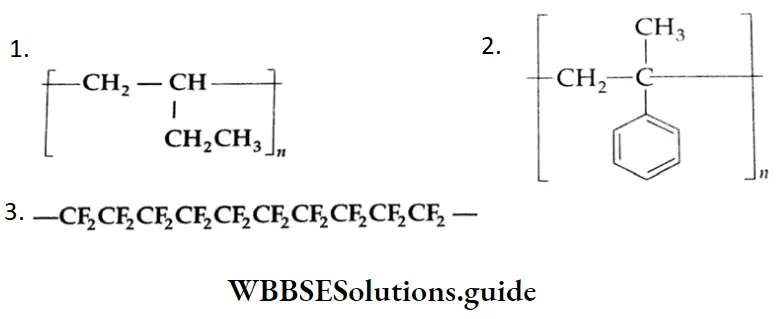
Basic Chemistry Class 12 Chapter 15 Polymers Polyester Or Terylene

This condensation polymerisation is also called step-growth polymerisation since each step produces a distinct functionalised species.

Polyester can be spun into a fibre from the melt. The fibre is used in making textile fibres marketed under the names Dacron and Terylene. The blending of polyester with cotton provides a fabric with high durability and anticrease properties.

Polyamides (nylons):

Polyamides Many nylons have been prepared and tried in the consumer market. Two of them  nylon 6, 6 and nylon 6-have been the most successful.

Nylon 6, 6 is prepared by the reaction of equimolecular quantities of hexamethylenediamine and adipic acid under high pressure and at high temperatures. The resultant melt is spun into fibre.

Basic Chemistry Class 12 Chapter 15 Polymers Spun Into Fibre

The polymer is made up of alternating —NH(CH2)6 NH- and -(C2) 4 4O— units, each having six carbon atoms, and is called nylon 6, 6.

Nylon 6 is prepared by heating caprolactum with water at a high temperature.

Basic Chemistry Class 12 Chapter 15 Polymers Nylon 6 Is Heating Caprolactum

This caprolactum monomer is a cyclic amide and the polymer does not have alternating units—each unit is the same containing six carbon atoms and is called nylon 6.

Caprolactum itself is synthesised from cyclohexanone in the following manner.

Basic Chemistry Class 12 Chapter 15 Polymers CAprolactum Is Synthesised From Cyclohexanone

Nylons have been widely accepted as textile fibres because they are strong, have desirable elastic properties, and can be drawn into very fine fibres. They are used to prepare fishing nets, ropes and brushes, among other things.

Example 3: Identify the monomer units used to make the following polymers.

Basic Chemistry Class 12 Chapter 15 Polymers Example 3 Polymers

Solution:

Basic Chemistry Class 12 Chapter 15 Polymers Example 3 Solution 3 Polymers

Example 4:  What is the significance of the numbers 6, 6 and 6 in nylon 6, 6 and nylon 6?

Solution:

The significance of the numbers 6, 6 and 6 in nylon 6, 6 and nylon 6

  • The numbers 6, 6 in the name of nylon 6, 6 refer to the six carbon atoms of hexamethylenediamine and the six carbon atoms of adipic acid.
  • The number 6 in nylon 6 indicates that six carbon atoms are contributed by the reactant caprolactum.

Glyptal:

Glyptal is prepared by the reaction of ethylene glycol with phthalic acid. It is used to prepare paints and lacquers.

Basic Chemistry Class 12 Chapter 15 Polymers Glyptal

Bakelite or phenol-formaldehyde plastic:

Bakelite is obtained by condensing phenol with formaldehyde under either acidic or basic conditions. Under acidic conditions, polymerisation proceeds to give a three-dimensional network of phenol rings held together at the ortho- and para-positions by methylene groups.

Bakelite is a stiff material with little solubility in organic solvents and a high resistance to electricity and heat. It is used to make a variety of household objects and electrical fixtures. The polymer has the useful property of being thermosetting.

Basic Chemistry Class 12 Chapter 15 Polymers Bakelite Or Phenol Formaldehyde Plastic

The reaction of phenol with formaldehyde also produces o-hydroxymethylphenol which further reacts with phenol to give a linear product-novolac-used in paints. On being heated with formaldehyde, novolac undergoes cross-linking to form bakelite.

Basic Chemistry Class 12 Chapter 15 Polymers Cross Linking To Form Bakelite

Urea-formaldehyde plastic:

On being heated with formaldehyde in the presence of a dilute acid, urea gives urea-formaldehyde plastic. This plastic is colourless and does not fade in sunlight. It is used to make household materials and kitchenware.

Formica, used to cover the surfaces of furniture, cupboards, and so on, is also prepared from urea-formaldehyde plastic. In the form of an ion-exchange resin, urea-formaldehyde plastic is used to purify water.

Basic Chemistry Class 12 Chapter 15 Polymers Urea Formaldihyde

Melamine-formaldehyde plastic:

Melmac, a polymer used in the manufacture of unbreakable kitchenware, is made by the condensation polymerisation of melamine and formaldehyde.

Basic Chemistry Class 12 Chapter 15 Polymers Melamine Formaldehyde Plastic

Melamine itself is produced by the trimerisation of cyanamide (NH2)—CN).

Basic Chemistry Class 12 Chapter 15 Polymers Melamine

Hard plastics are made softer by mixing them with a plasticizer. Di-isooctylphthalate is generally used as a plasticizer.

Basic Chemistry Class 12 Chapter 15 Polymers Di isooctylphthalate

Biodegradable Polymers

Plastics are not very easily degraded and cause environmental problems such as soil pollution. Because of the current global concern for the environment, researchers have been attempting to come up with biodegradable polymers.

In recent years, synthetic polymers have been produced that have built-in susceptibility to bacteria or fungi. The functional groups of the polymers are similar to those of biopolymers.

Aliphatic polyesters and polyamides are important biodegradable polymers.

Poly (B-hydroxybutyrate-ß-hydroxy valerate), PHBV

It is a biodegradable copolymer obtained by the reaction of B-hydroxybutyric acid with β-hydroxyvaleric acid.

Basic Chemistry Class 12 Chapter 15 Polymers Poly beta Hydroxybutyrate And Beta Hydroxyvalerate

Nylon 2-nylon 6:

This a biodegradable copolymer obtained by the reaction of glycine with 6 aminohexanoic acid.

Basic Chemistry Class 12 Chapter 15 Polymers Nylon 2 And Nylon 6

This polymer is made up of alternating -NH-CH2)-C- and -NH(CH2)2)5 C— units having two carbon atoms and six carbon atoms respectively, and is called nylon 2-nylon 6.

Polymers Multiple-Choice Questions

Question 1. Natural rubber is a polymer of

  1. Ethylene
  2. Benzene
  3. Isoprene
  4. None Of These

Answer: 3. Isoprene

Question 2. The polymerisation of which of the following leads to the formation of neoprene rubber?

  1. Chloroprene
  2. Isoprene
  3. 1,3-Butadiene
  4. Acetylene

Answer: 1. Chloroprene

Question 3. Which of the following is a natural polymer?

  1. Protein
  2. Polythene
  3. Buna-S
  4. Bakelite

Answer: 1. Protein

Question 4. Which of the following contains ester linkages?

  1. Terylene
  2. Nylon
  3. Teflon
  4. Bakelite

Answer: 1. Terylene

Question 5. Which of the following is obtained by the condensation of adipic acid and hexamethylene diamine?

  1. Rayon
  2. Terylene
  3. Nylon 6, 6
  4. Carbon Fibre

Answer: 3. Nylon 6, 6

Question 6. Teflon, polystyrene and neoprene are

  1. Copolymers
  2. Condensation Polymers
  3. Homopolymers
  4. Monomers

Answer: 3. Homopolymers

Natural, synthetic, and semi-synthetic polymers with examples

Question 7. Which of the following contains an amide linkage?

  1. Nylon 6, 6
  2. Terylene
  3. Teflon
  4. Bakelite

Answer: 1. Nylon 6, 6

Question 8. Phenol is used in the formation of which of the following?

  1. Bakelite
  2. Polystyrene
  3. Nylon
  4. PVC

Answer: 1. Bakelite

Question 9. In the Ziegler method, which of the following catalysts is used in the formation of polythene?

  1. Lithium Tetrachloride And Triphenylaluminium
  2. Titanium Tetrachloride And Triethylaluminium
  3. Titanium Oxide
  4. Titanium Isoperoxide

Answer: 2. Titanium Tetrachloride And Triethylaluminium

Question 10. PMMA is a polymer of which of the following?

  1. Methyl Methacrylate
  2. Methyl acrylate
  3. Ethyl acrylate
  4. All Of These

Answer: 1. Methyl Methacrylate

Question 11. Orlon is a polymer of which of the following?

  1. Tetrafluoroethylene
  2. Acrylonitrile
  3. Ethanoic acid
  4. Benzene

Answer: 2. Acrylonitrile

Question 12. Natural rubber is a polymer of which of the following?

  1. Trans-Isoprene
  2. Cis-Isoprene
  3. Co-Cis- And Trans Isoprene
  4. None Of These

Answer: 2. Cis-Isoprene

Question 13. Which of the following is used in making nonstick cookware?

  1. Polystyrene
  2. Polytetrafluoroethene
  3. Polythene
  4. None Of These

Answer: 2. Polytetrafluoroethene

Question 14. Which of the following is an example of a copolymer?

  1. Nylon 6
  2. Nylon 6, 6
  3. PMMA
  4. Polythene

Answer: 2. Nylon 6, 6

Question 15. Which of the following is formed by condensation polymerisation?

  1. Polythene
  2. PVC
  3. Teflon
  4. Nylon 6, 6

Answer: 4. Nylon 6, 6

Question 16. Using which of the following can PVC be prepared?

  1. CH3CH=CH2
  2. C6H5CH=CH2
  3. CH2=CH-CI
  4. CH2 = CH

Answer: 3. CH2=CH-CI

Question 17. Which of the following is a thermosetting polymer?

  1. Nylon 6
  2. Nylon 6, 6
  3. Bakelite
  4. SBR

Answer: 3. Bakelite

Question 18. In an elastomer, the intermolecular forces are

  1. Nil
  2. Weak
  3. Strong
  4. Very Strong

Answer: 2. Weak

Question 19. Which of the following is a biodegradable polymer?

  1. Polythene
  2. PVC
  3. Bakelite
  4. PHBV

Answer: 4. PHBV

Question 20. Which of the following is formed by condensation polymerisation?

  1. Rayon
  2. Nylon
  3. Dacron
  4. Artificial Silk

Answer: 1. Rayon and 4. Artificial Silk

Question 21. Which of the following is formed by condensation polymerisation?

  1. Polyethylene
  2. Bakelite
  3. Melamine
  4. Vulcanised Rubber

Answer: 2. Bakelite 3. Melamine and 4. Vulcanised Rubber

Addition vs condensation polymers – differences and examples

Question 22. Which of the following pairs of monomer molecules will form an addition polymer?

Basic Chemistry Class 12 Chapter 15 Polymers Question 22 Monomer Molecules From Addition Of Polymer
Answer: 1

Question 23. Which of the following pairs of monomer molecules will form a condensation polymer?

Basic Chemistry Class 12 Chapter 15 Polymers Condensation Of Polymer
Answer: 3

The P Block Elements Notes

The P Block Elements

The long form of the periodic table is divided into s, p, d and f blocks. Elements are grouped in four blocks depending upon the subshell in which the valence electron of the atom of an element enters, the p block on the periodic table constitutes Groups 13 to 18.

In class XI you have already studied the chemistry of the elements of Groups 13 and 14 along with those of Groups 1 and 2. The p-block elements show a much greater variation In properties than that shown by s- and d-block elements.

The variation in properties of p-block elements is tine in varying atomic sizes, ionisation enthalpies, electronegativities, and electron gain enthalpies. You know that the valence shell electronic configuration of the p-block elements is wsJMp’ h.

The first member of the group differs from the subsequent members due to its small size and nonavailability of d orbitals in its atoms. The p-block elements comprise metals, nonmetals and metalloids, thereby showing diversity In their properties.

P-block elements class 12 chemistry notes

Group 15 Elements

This group comprises the elements nitrogen, phosphorus, arsenic, antimony and bismuth. Nonmetnllic character changes to metallic character gradually, on descending the group. Nitrogen and phosphorus are nonmetals, arsenic and antimony are metalloids, while bismuth is a metal. The elements of Group 15 are less metallic than the corresponding elements of Group 14.

Occurrence And Uses

Nitrogen is present to the extent of 78% in the atmosphere. However, it is not very abundant in the earth’s crust as all nitrites and nitrates are water soluble. The major minerals are Indian saltpetre (KNO3) and Chile saltpetre (NaNO3). Nitrogen is an essential constituent of proteins and amino acids. Phosphorus is the eleventh element in order of abundance in the earth’s crust.

The common minerals of phosphorus arc fluorapatite [Ca9(PO4)6 , CaF2] and hydroxyapatite [Ca9(PO4)6Ca(OH)2], which are present in phosphate rocks. Phosphorus is an essential constituent of plants and animals.

It is present in bones, teeth and other hard tissues of the animal body. Arsenic, antimony and bismuth are not abundant and occur in trace amounts as sulphides along with other minerals.

Nitrogen is used in iron and steel industries and oil refineries to maintain an inert atmosphere. Liquid nitrogen is used as a refrigerant. Large amounts of nitrogen are used in the manufacture of ammonia and calcium cyanamide.

The major use of phosphorus is in making phosphatic fertilisers. Phosphates are also used in the food industry, in detergents and as pharmaceuticals. Phosphorus is used in safety matches and to make phosphor-bronze, an alloy.

It is also used to make pesticides and organophosphorus compounds. Arsenic is used to dope semiconductors and to alloy with lead to make it harder. Compounds of arsenic are used as pesticides and weedicides.

Antimony is used in alloys with tin and lead. It is used to electroplate steel to prevent rusting. Bismuth is used to make low-melting alloys which are used in fuses and fire alarms.

Atomic And Physical Properties

Basic chemistry Class 12 Chapter 7 The P Block Elements Physical properties of Group 1 5 elements.

Electronic configuration

The valence shell electronic configuration of these elements is ns2np3. The presence of completely filled s orbitals and half-filled p orbitals confers extra stability to the electronic configuration.

Size

Like in other groups, the atomic and ionic radii of elements increase on moving down the group. There is a substantia] increase in size from nitrogen to phosphorus. However, the increase in size from phosphorus to arsenic and then from antimony to bismuth is less due to the presence of filled d or f orbitals.

Ionisation enthalpy

It decreases down the group due to an increase in atomic size. The first ionisation enthalpy is quite high because of the stable ns2  np3 configuration.

Electron gain enthalpy

In Group 15, the electron gain enthalpy of nitrogen is positive whereas that of other elements is negative. The positive electron gain enthalpy of nitrogen is due to its compact atomic size. In the case of other elements, though the electron gain enthalpy is negative, it is not very high as the elements of the group have stable, half-filled p orbitals.

Properties and characteristics of p-block elements

Electronegativity

Electronegativity decreases down the group with an increase in atomic size and metallic behaviour of the elements. However, the difference in electronegativities is less pronounced with increasing atomic weight.

The P Block Elements Notes

Boiling and melting points

All elements in this group are polyatomic and display allotropy, except nitrogen. There is an increase in boiling point down the group; however, the variation in melting point is not regular.

Chemical Properties

Oxidation states and trends in chemical reactivity

The elements of this group have five electrons in their outermost shell. The elements exhibit a maximum oxidation state of +5. The stability of the +5 oxidation state decreases down the group due to the increasing inert pair effect. The only well-characterised binary compound of bismuth in the +5 oxidation state is BiF5.

(As you know from your previous class, the inert pair effect is the tendency of s electrons to remain inert, i.e., not to take part in bond formation.) Nitrogen and phosphorus may also form N-3  and P-3 species with electropositive metals, by gaining three electrons. For example, magnesium and calcium nitrides (Mg3N2 and Ca3N2), which constitute N3- ions.

Tire stability of the -3 oxidation state decreases down the group as the electropositive character of the element increases. Nitrogen displays a wide range of oxidation states, ranging from -3 to +5. The common oxidation states of phosphorus and arsenic are -3, +3 and +5.

In the case of nitrogen, disproportionation reactions are common as exemplified by the case of nitrous acid

3HNO2 →HNO3+H2O+2NO

In the case of phosphorus, such reactions are common

4H3PO3→3H3PO4+PH3

You have already studied in your previous class that in a disproportionation reaction, a substance is both oxidised and reduced. In the examples discussed above the reactant contains nitrogen and phosphorous in the +3 oxidation state.

This oxidation state is not very stable and a higher stable oxidation state, i.e., +5 state is known for the elements. For the heavier members of the group, the stability of the +5 oxidation state decreases and that of the +3 state increases (inert-pair effect). Hence the tendency for disproportionation decreases.

Bond type

Group 15 elements generally form covalent compounds. However, there is a decrease in the covalent character in the order P > As > Sb > Bi. Antimony and bismuth form tripositive cations due to an increase in metallic character, on moving down the group.

Formation of penta- and hexa-coordinated derivatives

Due to the nonavailability of d orbitals, nitrogen cannot expand its octet. The heavier members of the group use d orbitals to form species like PCI5, PF6, and AsF5.

Tendency to form multiple bonds and catenation

The tendency to form multiple bonds relative to single bonds decreases on descending the group. Nitrogen is diatomic two atoms are bound by a triple bond in a molecule. Nitrogen also forms pπ-pπ bonds with other elements having comparable size and electronegativity (like C and O).
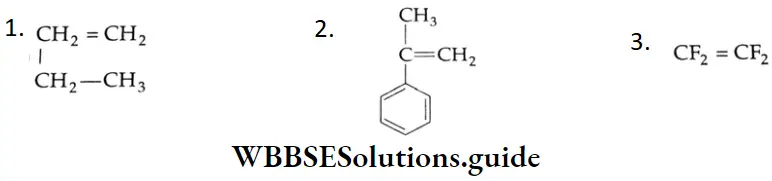
The other members of the group do not form multiple bonds as the orbitals are larger and diffuse and therefore do not allow effective overlap. Phosphorus, arsenic and antimony are tetraatomic, the atoms being linked by single bonds.

Recently compounds like R3P= O and R3P= CH2 (R = alkyl group) have been isolated involving dir-pn bonds, i.e., overlap of d orbitals of phosphorus with p orbitals of carbon and oxygen.

P-block elements group-wise classification and examples

The trialkyl and triaryl derivatives of phosphorus and arsenic act as electron-pair donors towards transition metals, where the unshared electron pair on phosphorus and arsenic is donated to the vacant d orbital of the metal.

The bond thus formed is strengthened by an overlap of filled d orbitals of the metal with vacant d orbitals of P or As. This is referred to as a dπ-dπ bond.

The single N-N bond is weaker than the single P-Pbond. This is due to the small size of nitrogen and small N-N bond length, which lends to high Intcreledrunic repulsion between the nonbonding electrons.

Thus the catenation power of phosphorus Is greater than that of nitrogen. This Is manifested in a large number of allotropes of phosphorus.

Anomalous behaviour of nitrogen Nitrogen, the first member of group 15, differs considerably from the rest of the members. These differences arise due to the small size of nitrogen, ils high electronegativity, its tendency to form stable pn pa bonds and the nonavailability of d orbitals in its valence shell.

Some of the anomalous properties of nitrogen are listed as follows.

  • Nitrogen exists as a diatomic gaseous molecule, while the lower members of the group exist as polyatomic solids.
  • Nitrogen is inert due to the high strength of the NnN bond. The rest of the members of the group are more reactive.
  • Nitrogen forms pπ-pπ bonds with itself and with elements like carbon and oxygen. Consequently, it forms a large number of oxides which are monomeric, unlike those of phosphorus which arc dimeric. Also, it forms species N3 and CN.
  • The maximum covalency of nitrogen is four. The other elements can expand their octet and form species with coordination numbers five and six.

Reactivity towards hydrogen

The elements of Group 15 form trihydric of the general formula EH3. Their ease of formation and stability decrease down the group. This can be explained in terms of E—H bond enthalpy. On descending the group, the size of E increases so that the orbitals become larger and more diffuse.

Consequently, these orbitals do not undergo effective overlap with the small 1 s orbital of hydrogen which leads to a decrease in bond enthalpy on descending the group. Thus, the reducing power of the hydrides increases down the group.

Basic chemistry Class 12 Chapter 7 The P Block Elements Structure of ammonia molecule

Basic chemistry Class 12 Chapter 7 The P Block Elements Properties of hydrides (EH3) of the elements of Group 15

Apart from ammonia, the other hydrides are toxic gases. The low volatility of ammonia is dm* to intermolecular hydrogen bonding.

The hydrides of Group 15 elements have a pyramidal structure. The central atom is sp3 hybridised having a lone pair of electrons. Due to the repulsion between the lone pair and a bond pair of electrons, the bond angle reduces from 109°27′ (that of a regular tetrahedron) to 107°48’.

Thus the tetrahedral shape is slightly distorted. (The shape of the ammonia molecule is described as pyramidal since one of the tetrahedral positions is occupied by a lone pair.) Distortion due to lone pairs is even more in PH3, AsH3 and SbH3, causing the bond angle to reduce further up to 91.3°.

Group 13 elements – boron family properties and examples

Hydrides of Group 15 elements donate lone pairs of electrons and thus behave as Lewis bases. The basicity decreases down the group.

Reactivity towards oxygen

Since the Group 15 elements exhibit predominantly two oxidation states +3 and +5, two types of oxides are known— and E205. The +5 oxidation state in bismuth is not stable. Therefore it’s the main oxide! is Bi2Ov Oxides of nitrogen and phosphorus are acidic, those of arsenic and antimony are amphoteric, while that of bismuth is basic.

Thus the basic character of the oxides increases down the group as the metallic character increases. When an element forms two oxides E2O3 and E2O5, the oxide in the higher oxidation state is more acidic.

Reactivity towards halogens

Trihalides, EX3, of all elements are known. Of all nitrogen halides, only NF5 is stable due to the strong N-F bond. The trihalides of other elements are stable and are predominantly covalent, except BiF3. The pentahalides are fewer in number than trihalides.

Nitrogen does not form pentahalides due to the non-availability of d orbitals in its valence shell. The well-characterised pentahalides are PX5 (X = F, Cl, Br), AsF5, SbF5, SbCl5 and BiF5. Pentahalides are more covalent than trihalides.

This is because the central atom in the +5 oxidation state has greater polarising power and can polarise the anion considerably. You have studied in class XI that when the degree of polarization is large, the concentration of electrons increases between the two bonded atoms and the covalent character increases.

Reactivity towards metals

Group 15 elements react with metals to form binary compounds in which they exhibit a -3 oxidation state. Nitrogen forms nitrides with lithium (Li3N), alkaline earth metals (Mg3N2, Ca3N2, etc.) and aluminium (AIN). There are also examples of phosphides (Ca3P2), arsenides (Na3As, Mg3As2), antimonides (Zn3Sb2) and bismuthides (Mg3Bi2).

Nitrogen (N2)

Nitrogen is the most abundant gas in the atmosphere. It comprises about 78.1% of the atmosphere by volume. It is less abundant in the earth’s crust because of the high solubility of nitrates.

Preparation

Nitrogen is obtained commercially by the fractional distillation of liquefied air. Air is first cooled to remove water vapour and carbon dioxide and then liquefied. On fractional distillation, nitrogen distils out first, leaving behind oxygen.

In the laboratory, nitrogen is obtained by warming an aqueous solution of ammonium chloride and sodium nitrite. This produces the thermally unstable ammonium nitrite, which decomposes to give nitrogen.

⇒ \(\mathrm{NH}_4 \mathrm{Cl}(\mathrm{aq})+\mathrm{NaNO}_2(\mathrm{aq}) \stackrel{\Delta}{\longrightarrow} \mathrm{NaCl}(\mathrm{aq})+\mathrm{NH}_4 \mathrm{NO}_2(\mathrm{aq}) \stackrel{\Delta}{\longrightarrow} \mathrm{N}_2(\mathrm{~g})+2 \mathrm{H}_2 \mathrm{O}\)

Small amounts of nitric acid and nitric oxide are formed as by-products in this reaction and may be removed by passing the gaseous product through a mixture of aqueous sulphuric acid and potassium dichromate.

Other methods of preparation of nitrogen include the oxidation of ammonia by bromine and the thermal decomposition of ammonium dichromate.

⇒ \(8 \mathrm{NH}_3+3 \mathrm{Br}_2 \stackrel{\Delta}{\longrightarrow} \mathrm{N}_2+6 \mathrm{NH}_4 \mathrm{Br}\)

⇒ \(\left(\mathrm{NH}_4\right)_2 \mathrm{Cr}_2 \mathrm{O}_7 \stackrel{\Delta}{\longrightarrow} \mathrm{N}_2+\mathrm{Cr}_2 \mathrm{O}_3+4 \mathrm{H}_2 \mathrm{O}\)

Small quantities of very pure nitrogen can be obtained by the thermal decomposition of sodium azide or barium azide.

⇒ \(2 \mathrm{NaN}_3 \stackrel{\Delta}{\longrightarrow} 3 \mathrm{~N}_2+2 \mathrm{Na}\)

Properties

Nitrogen is a colourless, odourless and nontoxic gas. The gas has low freezing and boiling points and low solubility in water. The two stable isotopes of nitrogen are 14N and 15N.

Nitrogen exists as a diatomic molecule, N =N. It is rather inert at room temperature due to the high bond enthalpy of the N =N bond. However, at elevated temperatures, it becomes increasingly reactive and combines directly with hydrogen oxygen, and some electropositive metals.

⇒ \(\mathrm{N}_2(\mathrm{~g})+3 \mathrm{H}_2(\mathrm{~g}) \underset{\text { catalyst }}{\stackrel{773 \mathrm{~K}}{\rightleftharpoons}} 2 \mathrm{NH}_3(\mathrm{~g})\)

⇒ \(\mathrm{N}_2(\mathrm{~g})+\mathrm{O}_2(\mathrm{~g}) \stackrel{2000 \mathrm{~K}}{\rightleftharpoons} 2 \mathrm{NO}(\mathrm{g})\)

⇒ \(6 \mathrm{Li}(\mathrm{s})+\mathrm{N}_2(\mathrm{~g}) \stackrel{\Delta}{\longrightarrow} 2 \mathrm{Li}_3 \mathrm{~N}(\mathrm{~S})\)

Ammonia

Small amounts of ammonia are present in nature as it is released from the decay of nitrogenous organic matter like urea.

⇒ \(\mathrm{NH}_2 \mathrm{CONH}_2+\mathrm{H}_2 \mathrm{O} \rightarrow\left(\mathrm{NH}_4\right)_2 \mathrm{CO}_3\)

Preparation

Ammonia is obtained by heating ammonium salts with an alkali in the laboratory.

⇒ \(2 \mathrm{NH}_4 \mathrm{Cl}+\mathrm{Ca}(\mathrm{OH})_2 \stackrel{\Delta}{\longrightarrow} \mathrm{CaCl}_2+2 \mathrm{NH}_3+2 \mathrm{H}_2 \mathrm{O}\)

On a large scale, ammonia is prepared by the Haber process.

⇒ \(\underbrace{\mathrm{N}_2(\mathrm{~g})+3 \mathrm{H}_2(\mathrm{~g})}_{4 \text { volumes }} \rightleftharpoons \underbrace{2 \mathrm{NH}_3(\mathrm{~g})}_{2 \text { volumes }} \quad \Delta_{\mathrm{f}} \mathrm{H}^{\ominus}=-46.1 \mathrm{~kJ} \mathrm{~mol}^{-1}\)

One volume of nitrogen combines with three volumes of hydrogen to give two volumes of ammonia. The reaction is reversible, accompanied by a reduction in volume and is exothermic. According to Le Chatelier’s principle, the forward reactions are favoured by high pressure and low temperature.

This reaction is carried out at a pressure of 150-250 Pa and a temperature of 600-700 Kin the presence of a finely divided iron catalyst with small amounts of oxides of potassium, aluminium and molybdenum.

The gases are passed over four beds of catalyst, with cooling between each pass. On each pass about 15% conversion occurs and the unreacted gases are recycled so that eventually an overall conversion of 98% can be achieved.

Basic chemistry Class 12 Chapter 7 The P Block Elements Flow chart for manufacture of ammonia

Properties

Ammonia is a colourless gas at room temperature (freezing point 198.4 K boiling point 239.7 K) and has a strong, characteristic pungent smell. It can be liquefied easily. The molecules of ammonia are extensively associated with hydrogen bonding both in the liquid and solid states.

Thus, it is less volatile than the other Group 15 hydrides. It is highly soluble in water and its aqueous solution is weakly basic owing to the presence of OH“ ions as shown by the following reaction.

⇒ \(\mathrm{NH}_3(\mathrm{~g})+\mathrm{H}_2 \mathrm{O}(\mathrm{l}) \rightleftharpoons \mathrm{NH}_4^{+}(\mathrm{aq})+\mathrm{OH}^{-}(\mathrm{aq})\)

NH3 and NH4OH both react with acids forming ammonium salts. These salts are thermally unstable and decompose on heating. If the anion is not oxidising, ammonia is evolved.

⇒ \(\mathrm{NH}_4 \mathrm{Cl} \stackrel{\Delta}{\longrightarrow} \mathrm{NH}_3+\mathrm{HCl}\)

If the anion is oxidising then NH+4 is oxidised to N2 or N2O.

⇒ \(\mathrm{NH}_4 \mathrm{NO}_2 \stackrel{\Delta}{\longrightarrow} \mathrm{N}_2+2 \mathrm{H}_2 \mathrm{O}\)

⇒ \(\mathrm{NH}_4 \mathrm{NO}_3 \stackrel{\Delta}{\longrightarrow} \mathrm{N}_2 \mathrm{O}+2 \mathrm{H}_2 \mathrm{O}\)

⇒ \(\left(\mathrm{NH}_4\right)_2 \mathrm{Cr}_2 \mathrm{O}_7 \stackrel{\Delta}{\longrightarrow} \mathrm{N}_2+4 \mathrm{H}_2 \mathrm{O}+\mathrm{Cr}_2 \mathrm{O}_3\)

When aqueous ammonia is added to a metal salt solution, in many cases the metal hydroxide or hydrated oxide is precipitated.

CaCI2(aq)+2NH4OH(aq) →Ca(OH)2(s)+2NH4CI(aq)
Zn(NO3)(aq)+2NH4OH(aq)→Zn(OH)2(s)+2NH4NO3(aq)
2FeCI3(aq)+3NH4OH(aq) →FeO3.xH2O(s)+3NH4CI(aq)

In the ammonia molecule, the nitrogen atom is sp3 hybridised. There are three bond pairs and one lone pair. The resultant structure is pyramidal with an unshared electron pair on nitrogen. The bond angle (107.8°) is less than the bond angle associated with sp3 hybridisation (109.5°) due to distortion caused by the lone pair.

The ammonia molecule donates this lone pair to electron-pair acceptors and thus behaves as a Lewis base. It donates these electrons to many transition metal ions, forming complex compounds. When ammonia solution is added to copper sulphate solution, a deep blue colouration is obtained owing to the formation of [Cu(NH3)4]2+ ions

⇒ \(\mathrm{Cu}^{2+}(\mathrm{aq})+4 \mathrm{NH}_3(\mathrm{aq}) \rightleftharpoons\left[\mathrm{Cu}\left(\mathrm{NH}_3\right)_4\right]^{2+}(\mathrm{aq})\)

AgCl(s) dissolves inNH3(aq) to form a complex, [Ag(NH3)2 ]C1. You are familiar with this reaction as it forms the basis of confirming chloride ions in salt analysis.

CI(aq)+AgNO3(aq)→AgCI(s)+NO3(aq)
AgCI(s)+2NH3(aq)→[Ag(NH3)2]+(aq)

Uses

Ammonia is widely used in the manufacture of a large number of nitrogenous fertilisers like urea, ammonium nitrate, ammonium sulphate and ammonium phosphate. It is also used to prepare many inorganic nitrogen-containing compounds, the most important being nitric acid. Ammonia and ammonium compounds are used in the preparation of explosives, fibres and plastics.

Ammonia is also used as a refrigerant and in the manufacture of detergents and numerous inorganic and organic chemicals. Synthetic ammonia is the key to the industrial production of most inorganic nitrogen compounds as shown in the given scheme.

Basic chemistry Class 12 Chapter 7 The P Block Elements Hydrazine

Oxides Of Nitrogen

Nitrogen forms a large number of oxides in the oxidation states +1 to +5. The oxides in the lower oxidation states are neutral while those in the higher oxidation states are acidic.

They exhibit pπ- pπ bonding between nitrogen and oxygen and exist as resonance hybrids of different canonical forms. Their formulae, names, methods of preparation and structures are summarized in.

Oxoacids Of Nitrogen

Nitrogen forms several oxoacids, many of which are unstable in the free state and are known only in aqueous solution or as their salts. The principal species are hyponitrous acid (H2N2O2, a weak acid, whose salts are known), hydronitrous acid (H4N2O4, whose sodium salt is known), nitrous acid (HNO2) unstable and weak though salts are known and nitric acid (HNO3) which is the most stable and the important one.

Nitric acid, HNO3

Nitric acid is one of the three most important acids in the modern chemical industry (the others are sulphuric acid and hydrochloric acid).

Preparation In the laboratory nitric add is prepared by heating an alkali metal nitrate with concentrated sulphuric acid.

⇒ \(\mathrm{KNO}_3+\mathrm{H}_2 \mathrm{SO}_4 \stackrel{\Delta}{\longrightarrow} \mathrm{KHSO}_4+\mathrm{HNO}_3\)

It is industrially prepared by the Ostwald process, which involves the catalytic oxidation of ammonia to NO.

Basic chemistry Class 12 Chapter 7 The P Block Elements Oxoacids of nitrogen

The nitric and air cooled and the mixture of gases is absorbed in a counter-current of water. During this process, nitric oxidised to nitrogen dioxide, which dissolved in water to give nitric acid.

⇒ \(2 \mathrm{NO}(\mathrm{g})+\mathrm{O}_2(\mathrm{~g}) \rightleftharpoons 2 \mathrm{NO}_2(\mathrm{~g})\)

⇒ \(3 \mathrm{NO}_2(\mathrm{~g})+\mathrm{H}_2 \mathrm{O}(\mathrm{l}) \rightleftharpoons 2 \mathrm{HNO}_3(\mathrm{aq})+\mathrm{NO}(\mathrm{g})\)

The nitric oxide is recycled and the aqueous nitric acid can be concentrated by distillation to the extent of up to 68% by mass since at this composition a constant-boiling mixture (azeotrope) is formed. Further concentration to 98% may be achieved by dehydrating with concentrated sulphuric acid or phosphorous pentoxide.

Properties Pure nitric acid is a colourless liquid (freezing point 231.4 K, boiling point 355.6 K). It has a specific gravity of 1.504. On exposure to light, it undergoes slight decomposition to N02 and Oz and thus acquires a yellowish-brown colour.

4HNO3→4NO2+O2+2H2O

Basic chemistry Class 12 Chapter 7 The P Block Elements The oxides of nitrogen.

It is a strong add and is completely dissociated in aqueous solutions

⇒ \(\mathrm{HNO}_3(\mathrm{aq})+\mathrm{H}_2 \mathrm{O}(\mathrm{l}) \rightleftharpoons \mathrm{H}_3 \mathrm{O}^{+}(\mathrm{aq})+\mathrm{NO}_3^{-}(\mathrm{aq})\)

Nitric add forms a large number of nitrates, which are highly soluble in water. Dilute nitric acid (< 2M) behaves as a typical strong acid. More concentrated aqueous solutions are strongly oxidising and attack most metals except noble metals like gold and platinum.

When nitric acid acts as an oxidising agent, it is reduced and the products of reduction depend upon the concentration of the acid, temperature and the other reactant.

Zinc reacts with dilute nitric acid to give nitrous oxide and with the concentrated acid, it forms nitrogen dioxide. With copper, dilute nitric acid gives nitric oxide and concentrated acid gives nitrogen dioxide.

4Zn+10HNO3(dil.)→4Zn(NO3)2+N2O+5H2O
Zn+4HNO3(conc.)→Zn(NO3)2+2NO2+2H2O
3Cu+8HNO3(dil.)→3Cu(NO3)2+2NO+4H2O
Cu+4HNO3(conc.)→Cu(NO3)+2NO2+2H2O

Metals like aluminium and chromium are rendered passive by concentrated nitric acid due to the formation of a superficial oxide film on the surface of the metal.

Concentrated nitric acid oxidises nonmetals to their corresponding oxides or oxoacids.

C+4HNO3(conc.)→Cu(NO3)2+2H2O

⇒ \(\mathrm{P}_4+20 \mathrm{HNO}_3 \longrightarrow \underset{\text { Phosphoric acid }}{4 \mathrm{H}_3 \mathrm{PO}_4}+20 \mathrm{NO}_2+4 \mathrm{H}_2 \mathrm{O}\)

S8+48HNO3→8H2SO4+48NO2+16H2O

⇒ \(\mathrm{I}_2+10 \mathrm{HNO}_3 \longrightarrow \underset{\text { logic acid }}{2 \mathrm{HIO}_3}+10 \mathrm{NO}_2+4 \mathrm{H}_2 \mathrm{O}\)

A mixture of concentrated nitric and hydrochloric acids (1 : 3 by volume respectively) is referred to as aqua regia; it is a very powerful oxidising mixture and dissolves metals like gold and platinum. However, it does not dissolve silver; instead, it forms an insoluble chloride with it.

When nitric acid is mixed with concentrated sulphuric acid, the nitronium ion(NO2) is obtained, which is the active species used in the nitration of organic compounds.

Test for nitrates Nitrates are detected by the brown ring test. A freshly prepared ferrous sulphate solution is added to an aqueous solution of the nitrate followed by the slow addition of concentrated sulphuric acid along the side of the test tube so that it forms the layer at the bottom.

A brown ring appears at the interface of the two liquids, which confirms the presence of nitrate ions in the solution. The ferrous ions reduce the nitrate ions to nitrogen monoxide. This reacts with hydrated ferrous ions to form a brown complex.

NO+3Fe2++4H+→NO+3Fe3++2H2O

⇒ \(\underset{\text { Hydrated ferrous ion }}{\left[\mathrm{Fe}\left(\mathrm{H}_2 \mathrm{O}\right)_6\right]^{2+}}+\mathrm{NO} \longrightarrow \underset{\text { Brown colour }}{\left[\mathrm{Fe}\left(\mathrm{H}_2 \mathrm{O}\right)_5 \mathrm{NO}^{2+}\right.}+\mathrm{H}_2 \mathrm{O}\)

Structure Nitric acid has a planar structure. The bond parameters of a molecule of nitric acid are as follows.

Basic chemistry Class 12 Chapter 7 The P Block Elements Structure of nitric acid

The nitrate ion has a planar structure with equal bond lengths.

Nitric acid is largely used in the production of ammonium nitrate, which is employed for the production of fertilisers and other nitrates, which are used in the manufacture of explosives. It is used to make cyclohexanone

Which is one of the starting materials to prepare the monomers for the polymers nylon 6, 6 and nylon 6. Another major use is in the preparation of organic nitro compounds like nitroglycerine, nitrocellulose and trinitrotoluene. Minor uses include the pickling of stainless steel and the etching of metals. It is also used as an oxidiser in rocket fuel.

Phosphorus—Allotropic Modification

The main allotropes of phosphorus are white phosphorus, red phosphorus and black phosphorus.

White phosphorus is the most common allotrope obtained by the condensation of gaseous or liquid states. It is a waxy, translucent solid, pale yellow in colour and soluble in carbon disulphide and benzene. It is toxic, spontaneously catches fire and is, therefore, stored underwater. It reacts with moist air and gives out a characteristic faint glow and this is referred to as chemiluminescence.

It consists of discrete tetrahedral P4 units. The P-P bond angle is 60° and there is a considerable angular strain in the molecule. This accounts for the low stability and high reactivity of this allotrope. It readily catches fire in the air, forming the pentoxide.
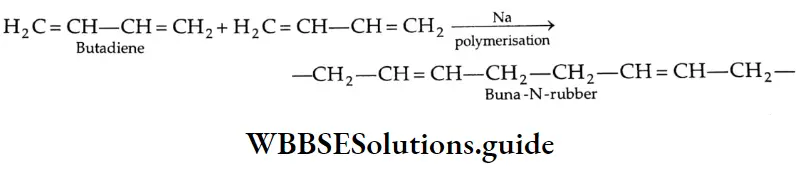
P4+5O2→P4O10

Red phosphorus is obtained by heating white phosphorus at 573 K in the absence of air for several days. It is less reactive than white phosphorous and does not display chemiluminescence. It has a polymeric structure consisting of tetrahedral P4 units joined together.

Basic chemistry Class 12 Chapter 7 The P Block Elements The structures of (1) white phosphorus and (2) red phosphorus

Thermodynamically the most stable form is black phosphorus. It exists in two forms—a-black phosphorus and (3-black phosphorus. The a-form is obtained by heating red phosphorus in a sealed tube at 803 K.

It sublimes in the air and consists of opaque, monoclinic crystals. The |3-form is obtained by heating white phosphorus at 473 K under high pressure. It is inert and has a layered structure. Important physical properties of these allotropes are summarized.

Basic chemistry Class 12 Chapter 7 The P Block Elements Some important physical properties of the three allotropes of phosphorus

Phosphine

Preparation

Phosphine, PH3, is the hydride of phosphorus. It is obtained by the alkaline hydrolysis of yellow phosphorus or by the reaction of calcium phosphide with water or dilute acid.

⇒ \(\mathrm{P}_4+3 \mathrm{NaOH}+3 \mathrm{H}_2 \mathrm{O} \longrightarrow \mathrm{PH}_3+3 \mathrm{NaH}_2 \mathrm{PO}_2\)
Sodium hypophosphite

Ca3P2+6H2O→2PH3+3Ca(OH)2
Ca3P2+6HCI→2PH3+3CaCI2

The phosphine obtained is purified by passing it through hydrogen iodide, whereby phosphonium iodide is formed. This treatment with alkali gives pure phosphine.

PH3+HI→PH4I
PH4I+NaOH→PH3+NaI+H2O

Phosphine catches fire spontaneously because it contains traces of diphosphine (P2H6), which is inflammable.

Properties

Phosphine is a colourless, toxic gas having an unpleasant odour similar to that of rotten fish. It is sparingly soluble in water and the resultant solution undergoes photodecomposition to give red phosphorus and hydrogen.

Pure phosphine is stable in the air but catches fire above 423 K.

⇒ \(\mathrm{PH}_3+2 \mathrm{O}_2 \stackrel{423 \mathrm{~K}}{\longrightarrow} \mathrm{H}_3 \mathrm{PO}_4\)

It is feebly basic and forms phosphonium salts with acids.

PH3+HX→PH4X

Itbums in chlorine to give phosphorus trichloride and phosphorus pentachloride

PH3+3CI2→PCI3+3HCI
PH3+4CI2→PCI5+3HCI

When phosphine is bubbled through aqueous solutions of copper and mercury(2) salts, the corresponding phosphides are precipitated.

3CuSO4+2PH3(g)→Cu3P2(s)+3H2SO4(aq)
3HgCI2(aq)+2PH3(g)p2(s)+6HCI(aq)

Uses

The spontaneous combustion of phosphine is used in Holme’s signals in deep seas and oceans for signalling danger to ships. Containers containing calcium phosphide and calcium carbide are pierced and thrown into the sea.

Group 14 elements – carbon family in p-block elements

In the presence of water, calcium phosphide hydrolyses to give phosphine which contains traces of inflammable P2H4. As stated earlier, diphosphine catches fire spontaneously. This ignites the ethyne produced by the hydrolysis of calcium carbide, and a luminous flame is obtained. Phosphine is also used in smoke screens.

Phosphorus Halides

All the possible phosphorus trihalides, PX4 (X=F, Cl, Br, I) and phosphorus pentahalides, PX5(X=F, Cl, Br) are known.

Phosphorus trichloride

This is commercially the most important trihalide of phosphorus.

It may be prepared by passing dry chlorine over gently heated white phosphorus.

P4+6CI2→4PCI3

It may also be obtained by treating white phosphorus with thionyl chloride.

P4+8SOCI2→4PCI3+4SO2+2SO2CI2

Phosphorus trichloride is a colourless, pungent-smelling liquid with a boiling point of 349 K. In moist air, i1 undergoes hydrolysis to give fumes of hydrochloric acid.

PCI3+3H2O→H3PO3+3HCI

Phosphorus trichloride reacts with oxygen to form phosphorus oxy-chloride and with chlorine, it forms phosphorus pentachloride

2PCI3+O2→2POCI3
PCI3+CI2→PCI5

PCI3 reacts with organic compounds containing —OH group (carboxylic acids, alcohols) as follows.

3RCOOH+PCI3→3RCOCI+H3PO3
3ROH+PCI3→3RCI+H3PO3

The shape of the PCI3 molecule is pyramidal and the phosphorus atom in the molecule is a sp3 hybridised

Basic chemistry Class 12 Chapter 7 The P Block Elements The structure of PCI3

Phosphorus pentachloride

This is the most well-characterised pentahalide of phosphorus.

It is prepared by the reaction of chlorine with phosphorus trichloride.

\(\mathrm{PCl}_3+\mathrm{Cl}_2 \stackrel{\mathrm{CCl}_4}{\longrightarrow} \mathrm{PCl}_5\)

It can also be obtained by treating white phosphorus with an excess of dry chlorine or thionyl chloride.

P4+10CI2→4PCI5
P4+10SO2CI2→4PCI5+10SO2

PCI5 is a yellowish-white powder.

It sublimes on heating and decomposes at a higher temperature to give the trichloride and chlorine.

\(\mathrm{PCl}_5 \stackrel{\Delta}{\longrightarrow} \mathrm{PCl}_3+\mathrm{Cl}_2\)

PCI5 is susceptible to hydrolysis, which is a two-step reaction.

⇒ \(\mathrm{PCl}_5+\mathrm{H}_2 \mathrm{O} \longrightarrow\underset{\begin{array}{c}\text { Phosphorus } \\\text {oxychloride }\end{array}}{\mathrm{POCl}_3}+2 \mathrm{HCl}\)

PCI5 is an excellent chlorinating agent and converts alcohols and carboxylic acids to their respective chloi derivatives.

R.OH+PCI5→RCI+POCI3+HCI
R.COOH+PCI5→RCOCI+POCI3HCI

It converts many metals to the corresponding chlorides.

⇒ \(\mathrm{Sn}+2 \mathrm{PCl}_5 \stackrel{\Delta}{\longrightarrow} \mathrm{SnCl}_4+2 \mathrm{PCl}_3\)

In the gaseous and liquid states, PCI5 has a trigonal bipyramidal structure. The two axial P-Cl bonds are longer (240 pm) than the three equatorial bonds (202 pm). This is because bond-pair-bond-pair repulsions are stronger in the axial atoms than in the equatorial atom.

Basic chemistry Class 12 Chapter 7 The P Block Elements Axial position

PCI5 dimerises in the solid state and exists as an ionic solid, containing the tetrahedral [PCI4]+ cation and the octahedral [PCI6] anion.

Basic chemistry Class 12 Chapter 7 The P Block Elements The structure of PCI5 in the (1) gaseous and liquid states, and (2) solid state

Oxides Of Phosphorus

Phosphorus forms two oxides—the trioxide (P4O6) and the pentoxide (P4O10). The former is prepared by burning white phosphorus in a limited supply of air, while for the other an excess of air is needed.

\(\mathrm{P}_4+3 \mathrm{O}_2 \stackrel{\Delta}{\longrightarrow} \mathrm{P}_4 \mathrm{O}_6\)

Both the oxides are soluble in water, forming acidic solutions. This is expected as they are oxides o a nonmetal.

P4O6+6H2O→4H3PO3
P4O10+6H2O→4H3PO4

Due to the inability of phosphorus to form pπ-pπ double bonds with oxygen, its oxides are dimeric (P4O6 and P4O10). This is in sharp contrast to the oxides of nitrogen which are monomeric (N2O3 and N2O5)

Oxoacids Of Phosphorus

Phosphorus forms a large number of oxoacids. Before we discuss the properties and structure of each oxoaci note the following points in this context.

  1. In a molecule of phosphorus acid, the phosphorus atom is sp3 hybridised and tetrahedrally surrounded by other atoms.
  2. The ionisable acidic hydrogens in the molecules are attached to oxygen atoms, i.e., every acid contains at least one P-OH bond. These oxygens, which are attached to hydrogen, are called hydroxylic oxygens. All oxoacids also contain nonhydroxylic oxygens where the oxygen atom is linked only to phosphor forming the P = O bond.
  3. In addition to P-OH and P = O bonds, the acids may contain either P-H or P-P bonds.
  4. The presence of P-H bonds in the oxoacids confers reducing and not acidic properties.

The names, formulae, methods of preparation and some salient features of the oxoacids of phosphorus are shown.

Basic chemistry Class 12 Chapter 7 The P Block Elements The oxoacids of phosphorus

It is seen that oxoacids containing phosphorus in their lower oxidation state are reducing. For example, hypophosphorus acid (H3P02) reduces silver salts to the metal.

⇒ \(4 \mathrm{AgNO}_3+2 \mathrm{H}_2 \mathrm{O}+\mathrm{H}_3 \mathrm{PO}_2 \longrightarrow 4 \mathrm{Ag}+4 \mathrm{HNO}_3+\mathrm{H}_3 \mathrm{PO}_4\)

The oxoacids in the +5 oxidation state do not have reducing or oxidising properties. Disproportionation is common for oxoacids containing phosphorus in the +3 oxidation state.

⇒ \(4 \mathrm{H}_3 \stackrel{+3}{\mathrm{PO}_3} \longrightarrow 3 \mathrm{H}_3 \stackrel{+5}{\mathrm{PO}_4}+\stackrel{-3}{\mathrm{P}} \mathrm{H}_3\)

The molecular structures of the oxoacids of phosphorus along with the types of bonds present in a molecule of the various oxoacids are shown in.

Basic chemistry Class 12 Chapter 7 The P Block Elements Structures of the oxoacids of phosphorus

Group 16 Elements

Group 16 of the periodic table comprises oxygen, sulphur, selenium, tellurium and polonium. The elements of the group are called chalcogens or ore-forming elements as most metals occur as their oxides or sulphides. Nonmetallic character is maximum in oxygen and sulphur, weaker in selenium and tellurium whereas the short-lived and radioactive polonium is predominantly metallic.

Occurrence And Uses

The amount of oxygen present in dry air is about 20.946% by volume. Oxygen is the most abundant element in the earth’s crust. Most of the combined oxygen is in the form of silicates, oxides and water.

In contrast, the abundance of sulphur in the earth’s crust is only 0.03-0.1%. It is the 16th most abundant element and occurs mostly in the form of sulphide (zinc blende—ZnS, galena—PbS, cinnabar—HgS, and copper pyrites—CuFeS2) and sulphate (gypsum—CaSO4 2H2O, Epsom salt—MgSO4 -7H20, baryte—BaSO4) ores. Elemental sulphur is also present as hydrogen sulphide in natural gas, crude oil and volcanic ash.

Sulphur is a constituent of proteins and enzymes and some amino acids, for example, cysteine. The other elements of Group 16 show comparatively low abundance. Selenium and tellurium occur among sulphide ores.

The main source of selenium and tellurium is the anode mud obtained during the electrolytic refining of copper. Thorium and uranium minerals contain polonium as a natural decay product.

Oxygen is essential for life—most life processes are based on oxidative metabolism. It is used in various energy generation processes through the combustion of wood and fossil fuels. Rocket fuels have liquid oxygen as the oxidant.

Oxyacetylene flames have very high temperatures and are used in welding. Many chemical industries use oxygen as an oxidant. Mountaineers use oxygen cylinders at high altitudes. Ozone, an allotrope of oxygen, is used as a disinfectant and for water sterilisation. It is also a bleaching agent.

Sulphur is predominantly used for the manufacture of sulphuric acid, which in turn is used in making fertilisers and other chemicals. Elemental sulphur is used in the vulcanisation of rubber and as a disinfectant.

Selenium is used to decolourise glass and as a photoconductor in photocopying machines. Tellurium is used as an additive to steel to increase its ductility. Tellurium and polonium are toxic.

Atomic And Physical Properties

Basic chemistry Class 12 Chapter 7 The P Block Elements Physical properties of Group 16 elements

Electronic configuration

The valence-shell electronic configuration of these elements isns2np4. They attain a noble-gas configuration by gaining two electrons, thus forming an E2” anion (E = O, S, Se, Te) or by sharing two electrons and thus forming two covalent bonds.

Size

The atomic size of Group 16 elements increases down the group as extra shells of electrons are added. The small atomic radius of oxygen and the absence of d orbitals in its atom are responsible for the distinctive chemical properties and also the high electronegativity of the element.

Ionisation enthalpy

The ionisation enthalpy of the elements decreases down the group as the size of the atom increases. The ionisation enthalpies of the Group 16 elements are strikingly less than those of the corresponding Group 15 elements. The unexpectedly high first ionisation enthalpies of Group 15 elements is due to the extra stability associated with half-filled p orbitals, which is not there in Group 16 elements.

Electronegativity

Oxygen is the second most electronegative element, fluorine being the most. Within the group, the electronegativity decreases on moving down. This indicates that the metallic character increases down the group.

Electron gain enthalpy

The electron gain enthalpy of oxygen is less negative than that of sulphur due to the small atomic size of oxygen. The electron gain enthalpy becomes less negative from sulphur to polonium.

Boiling and melting points

Due to small size, high electronegativity and absence of d orbitals, in an oxygen molecule, pπ-pπ bonds are formed between two oxygen atoms (0=0). Thus oxygen is stable and exists as a diatomic molecule in the gaseous state.

Oxygen too has a triatomic allotrope—ozone. The other elements of the group do not form multiple bonds and exist as polyatomic solids. In fact, sulphur is octa-atomic (S8). The large difference between the boiling points of oxygen and sulphur and that between their melting points can be explained on the basis of their atomicity (oxygen exists as O2 and sulphur as S8). All elements of the group exhibit allotropy.

Chemical Properties

Oxidation states and trends in chemical reactivity

As you already know, the outermost electronic configuration of the elements of Group 16 is ns2np4 short of the nearest noble-gas configuration by two electrons. The elements can achieve the nearest noble-gas configuration by gaining or sharing two electrons.

Thus, the E2- ion of Group 16 elements exists with highly electropositive elements. Group 16 elements exhibit variable oxidation states due to the presence of empty d orbitals. Oxygen (which has no d orbitals) generally exhibits a-2 oxidation state.

In peroxides, however, it exhibits a -1 oxidation state (O-22)• The stability of the -2 oxidation state decreases down the group. Oxygen usually displays a negative oxidation state, except in some binary compounds with fluorine like OF2 and O2F2 (Fluorine is more electronegative than oxygen.)

Sulphur, selenium and tellurium show a tendency for covalency with formal oxidation states of +2, +4 and +6 in compounds where they are combined with more electronegative elements like oxygen or halogens.

The reactivity of elements generally decreases down the group. Sulphur combines with all elements except noble gases, nitrogen, tellurium, iodine, platinum and gold.

Bond type

Oxygen readily forms the divalent anion, O2-. The tendency for the formation of the divalent anion decreases from sulphur onwards due to an increase in the size of the atom and a decrease in electronegativity. Compounds in a positive oxidation state are generally covalent; the covalent character decreases down the group.

Tendency to form multiple bonds and catenation

The tendency to form multiple bonds decreases down the group. Thus oxygen exists as Oz held by 0=0, while the other elements are polyatomic. The bond energy of the oxygen-oxygen double bond, 0=0, is 498 kJ mol-1.

This makes the 0=0 bond more than three times as strong as the 0-0 bond (bond energy for 0-0 is 142 kJ mol-1). In comparison, the S = S bond is less than twice as strong as the S-S single bond (bond energy for S = S is 434 kJ mol -1, and that for S-S is 264 kJ mol-1 ). The tendency of catenation in sulphur is much higher; this is evident from the large number of allotropes of sulphur.

Anomalous behaviour of oxygen Oxygen differs considerably from the rest of the members of the group. The factors responsible for this anomalous behaviour of oxygen are small size, high electronegativity, nonavailability of d orbitals and the tendency to form pn-multiple bonds.

Some specific differences between the properties of oxygen and the other members of the group are as follows.

  • Oxygen is a gas while the other members are solids.
  • Oxygen is diatomic while the other members are polyatomic.
  • Being highly electronegative, oxygen shows only negative oxidation states of -2 and -1 (except with fluorine) while other elements of the group show positive oxidation states.
  • Oxygen tends to form hydrogen bonds.

Reactivity towards hydrogen

Binary hydrides of the general formula H2E are known as Group 16 elements. Some of the physical properties of their hydrides are summarised. The thermal stability of the hydrides decreases down the group. As the size of the central atom increases, the strength of the covalent H-E bond decreases. Thus both bond enthalpy and thermal stability decrease.

A consequence of decreasing bond enthalpy is the increase in acidic character. In other words, bond cleavage becomes easier and dissociation of H2E to H+and HE becomes easier. The stability of hydrides decreases on descending the group and H2Te in fact is thermodynamically unstable.

Apart from water, the hydrides are foul-smelling, toxic gases. The high boiling point of water is due to the presence of intermolecular hydrogen bonding. Hydrogen sulphide and the lower hydrides are reducing agents and the reducing power increases down the group. The hydrides are with two lone pairs. angular in shape. The central atom is sp3 hybridised

Basic chemistry Class 12 Chapter 7 The P Block Elements Properties of hydrides (H2E) of elements of Group 16

Reactivity towards oxygen

Group 16 elements mainly form dioxides (EO2) and trioxides (EO3). The dioxides are known for all elements, whereas the trioxides are known for sulphur, selenium and tellurium. The oxides are acidic in nature. The reducing power of the dioxides decreases down the group.

Reactivity towards halogens

The elements of Group 16 form a large number of binary compounds with halogens. The three main types of halides are EX2, EX4 and EX6, but other halides are also known. The halogen compounds of sulphur, selenium, tellurium and polonium are called halides.

Oxygen too combines with halogens but its compound with fluorine only is said to be a halide. The compounds of oxygen with other halogens are oxides and not halides. This is so because of the high electronegativity of oxygen, which is exceeded only by fluorine and not chlorine, bromine and iodine.

The highest oxidation states of the Group 16 elements are realised only in combination with the most electronegative fluorine. Also, for a given oxidation state of Group 16 elements, fluoride is the most stable. Among the hexafluorides, SF6 is extremely stable. Its inertness is due to the sterically hindered sulphur in an octahedral structure.

SF6 is unaffected by water as the protected sulphur atom does not allow hydrolysis, which is a thermodynamically favoured reaction. On the other hand, SeF6 and TeF6 are slightly more reactive and TeF6 is hydrolysed, probably due to the large size of the central atom.

The tetrafluorides of sulphur, selenium and tellurium are stable and exist as a gas (SF4), liquid (SeF4) and solid (TeF4) respectively. The central atom in these compounds has sp3 hybridization and thus the molecular structure is trigonal bipyramidal with one lone pair in the equatorial position. This kind of geometry is called see-saw geometry.

Basic chemistry Class 12 Chapter 7 The P Block Elements Structure of SF6

Basic chemistry Class 12 Chapter 7 The P Block Elements Molecular structure ofSF4


Basic chemistry Class 12 Chapter 7 The P Block Elements Molecular structure of SCI2

Dimeric monohalides of the type S2X2 (X = F, Cl, Br) and Se2X2(X = Cl, Br) are known. However, they are unstable and tend to be disproportionate as follows.

2SeCI2→SeCI4+3Se

The hydrolysis is also accompanied by disproportionation.

2Se2CI2+2H2O→H2Se+3Se+4HCI

Oxygen

Oxygen occurs as dioxygen (O2) and ozone (O3). Dioxygen (O2) exists as a gas and makes up 21 per cent of air in the atmosphere. It makes up 89 per cent by weight of the water in the oceans. Oxygen also occurs as sulphates, carbonates, nitrates, borates, etc. The three stable isotopes of oxygen are 16O,17O and 18O. We will now discuss the preparation and properties of dioxygen.

Preparation

1. The most convenient method of preparation of oxygen in the laboratory is by the thermal decomposition of potassium chlorate in the presence of manganese dioxide as a catalyst.

⇒ \(2 \mathrm{KClO}_3 \underset{420 \mathrm{~K}}{\stackrel{\mathrm{MnO}_2}{\longrightarrow}} 2 \mathrm{KCl}+3 \mathrm{O}_2\)

In the absence of manganese dioxide, the reaction occurs slowly at 670-720 K. Apart from potassium chlorate, potassium nitrate, potassium permanganate and barium peroxide also give dioxygen on heating.

⇒ \(2 \mathrm{KNO}_3 \stackrel{\text { heat }}{\longrightarrow} 2 \mathrm{KNO}_2+\mathrm{O}_2\)

⇒ \(2 \mathrm{KMnO}_4 \stackrel{\text { heat }}{\longrightarrow} \mathrm{K}_2 \mathrm{MnO}_4+\mathrm{MnO}_2+\mathrm{O}_2\)

⇒ \(2 \mathrm{BaO}_2 \stackrel{\text { heat }}{\longrightarrow} 2 \mathrm{BaO}+\mathrm{O}_2\)

2. Oxygen can also be prepared by the thermal decomposition of oxides of less reactive metals (metals placed low in the electrochemical series) like mercury and silver and also from oxides of some metals in their higher oxidation states.

⇒ \(2 \mathrm{HgO} \stackrel{\text { heat }}{\longrightarrow} 2 \mathrm{Hg}+\mathrm{O}_2\)

⇒ \(2 \mathrm{Ag}_2 \mathrm{O} \stackrel{\text { heat }}{\longrightarrow} 4 \mathrm{Ag}+\mathrm{O}_2\)

⇒ \(2 \mathrm{PbO}_2 \stackrel{\text { heat }}{\longrightarrow} 2 \mathrm{PbO}+\mathrm{O}_2\)

⇒ \(2 \mathrm{~Pb}_3 \mathrm{O}_4 \stackrel{\text { heat }}{\longrightarrow} 6 \mathrm{PbO}+\mathrm{O}_2\)

⇒ \(3 \mathrm{MnO}_2 \stackrel{\text { heat }}{\longrightarrow} \mathrm{Mn}_3 \mathrm{O}_4+\mathrm{O}_2\)

3. Another convenient method of preparation of oxygen is by the action of water on sodium peroxide or by the decomposition of hydrogen peroxide in the presence of manganese dioxide.

2Na2O2+2H2O→4NaOH+O2
2H2O2→2H2O+O2

4. Commercially, oxygen is obtained by the liquefaction of air. Initially, carbon dioxide and water vapour are removed from the air, and then the air is liquefied and subjected to fractional distillation. Nitrogen with a lower boiling point (77 K) distils out first leaving oxygen behind.

5. Large amounts of oxygen are obtained by the electrolysis of water.

⇒ \(2 \mathrm{H}_2 \mathrm{O} \stackrel{\text { electrolysis }}{\longrightarrow} 2 \mathrm{H}_2+\mathrm{O}_2\)

Hydrogen is liberated at the cathode and oxygen at the anode.

Properties

Dioxygen is a colourless, odourless and tasteless gas. It has a freezing point of 65 K and a boiling point of 90 K. It is slightly soluble in water (30.8 g per dm3 of water at 298 K and atmospheric pressure). This small amount of dissolved oxygen in water sustains aquatic life.

Oxygen has an even number of electrons yet it is paramagnetic. You have learnt about this in your previous class under molecular orbital theory.

Oxygen is a supporter of combustion. It reacts with most metals (except some less reactive metals like gold platinum, and noble gases) and nonmetals to form the respective oxides.

2Ca+O2→2CaO
2Mg+O2→2MgO
4AI+3O2→2AI2O3
4Fe+3O2→2Fe2O3
2H2+O2→2H2O
S+O2→SO2
C+O2→CO2
P4+5O2→P4O10

The bond dissociation enthalpy of the O = O bond in an oxygen molecule is high and to initiate the reactions, initial heating is needed. However, these reactions are exothermic in nature and the heat liberated can sustain the reactions.

Oxygen reacts with a variety of compounds as shown.

⇒ \(2 \mathrm{SO}_2+\mathrm{O}_2 \underset{723 \mathrm{~K}, 2 \mathrm{~atm}}{\stackrel{\mathrm{V}_2 \mathrm{O}_5}{\longrightarrow}} 2 \mathrm{SO}_3\)

This reaction is the basis of the contact process for the manufacture of sulphuric acid.

⇒ \(4 \mathrm{NH}_3+5 \mathrm{O}_2 \underset{500 \mathrm{~K}}{\stackrel{\mathrm{Pt}}{\longrightarrow}} 4 \mathrm{NO}+6 \mathrm{H}_2 \mathrm{O}\)

This reaction is involved in the Ostwald process for the manufacture of nitric acid.

Metal sulphides react with oxygen to form oxides. These oxides may then be reduced to give the metal.

⇒ \(2 \mathrm{ZnS}+3 \mathrm{O}_2 \longrightarrow 2 \mathrm{ZnO}+2 \mathrm{SO}_2\)

Both saturated and unsaturated hydrocarbons cause an excess of oxygen to give carbon dioxide and water.

CH4 + 2O2→CO2 + 2H2O
H2C= CH2 + 3O2→2CO2 + 2H2O
2HC = CH+ 5O2→4CO2 + 2H2O

As these reactions are highly exothermic, hydrocarbons are used as fuels.

Oxides

Oxygen reacts with almost all the elements to form binary compounds called oxides. An element may form more than one oxide. For example, nitrogen forms six oxides.

Metal oxides can be simple (for example CaO, ZnO, Fe2O3) where the metal displays one oxidation state or they can be mixed (for example FeO4, Pb3O4). A mixed oxide is made up of two oxides, in which the metal shows two oxidation states.

Thus Pb3O4 may be considered to be a mixture of PbO2 and PbO and may also be formulated as PbO2 2PbO. Depending on how an oxide behaves chemically, the oxides can be classified as

  1. Acidic,
  2. Basic,
  3. Amphoteric And
  4. Neutral.

The oxide that combines with water to give an acidic solution is referred to as acidic. Generally, oxides of nonmetals are acidic. For example,

CO2+H2O→H2CO3
P4O10+6H2O→4H3PO4
SO2+H2O→H2SO3
CI2O7+H2O→2HCIO4

Acidic oxides react with bases to form salt and water oxides of metals generally basic as they dissolve in water to give a basic solution. for example,

MgO+2H2O→Mg(OH)2
CaO+2H2O→Ca(OH)2
Na2O+H2O→2NaOH

Basic oxides react with acids to form salt and water. Amphoteric oxides are some metallic oxides which show both acidic and basic properties. They react with acids as well as bases to form salts. For example,

ZnO+2HCI→ZnCI2+H2O
ZnO+2NaOH+ H2O→Na[Zn(OH)4]

When a metal forms oxides exhibiting different oxidation states, then the oxides which have metals in their higher oxidation states display acidic properties; for example, V2O5 and Mn2O7 are acidic in nature.

Some oxides like CO, N2O and NO display neither acidic nor basic properties and are called neutral oxides.

Group 15 elements – nitrogen family and their chemical behavior

Ozone

As already stated elemental oxygen exists in two allotropic modifications, dioxygen (O2) and trioxygen or ozone (O3).

Ozone is present in the upper atmosphere at a height of about 20 km from the earth’s surface. It is formed by the action of ultraviolet radiation on oxygen.

⇒ \(3 \mathrm{O}_2 \stackrel{\text { UV light }}{\longrightarrow} 2 \mathrm{O}_3\)

The ozone layer in the atmosphere protects us from the harmful effects of ultraviolet rays.

It has been shown that oxides of nitrogen, particularly nitric oxide, combine rapidly with ozone.

NO+O3→NO2+O2

Nitric oxide emitted by supersonic aircraft is responsible for the slow depletion of the ozone layer. Another threat to the ozone layer is chlorofluorocarbons (CFCs) or freons which are used as refrigerants and as aerosol propellants.

These molecules diffuse into the stratosphere and undergo slow photochemical degradation to produce atomic chlorine which reacts with ozone. Ozone being thermodynamically unstable liberates nascent oxygen, which combines with the CIO* free radical.

⇒ \(\mathrm{CFCl}_3 \stackrel{\text { UV rays }}{\longrightarrow} \dot{\mathrm{C}} \mathrm{FCl}_2+\mathrm{Cl}^{\circ}\)

⇒ \(\mathrm{Cl}^*+\mathrm{O}_3 \longrightarrow \mathrm{ClO}^*+\mathrm{O}_2\)

\(\mathrm{ClO}^*+\mathrm{O} \longrightarrow \mathrm{Cl}^*+\mathrm{O}_2\)

Preparation

Ozone can be obtained by the action of a silent electric discharge through pure and dry oxygen.

⇒ \(3 \mathrm{O}_2 \longrightarrow 2 \mathrm{O}_3 ; \Delta H^{\ominus}(298 \mathrm{~K})=+142.6 \mathrm{~kJ} \mathrm{~mol}^{-1}\)

This is an endothermic reaction. It is essential to use a silent electric discharge as it generates less heat; if the temperature of the reaction is allowed to rise continuously then the ozone formed may decompose back to oxygen. This reaction produces only about 10% ozone. The product is actually? a mixture of dioxygen and is called ozonised oxygen.

Properties

Ozone is a pale blue gas which condenses to give a deep blue liquid and a violet-black solid. It has a strong characteristic smell and is heavier than air. Ozone is slightly soluble in water but readily soluble in organic solvents.

Ozone in low concentrations is not so toxic, but it becomes harmful in concentrations above 100 ppm. Then it may cause respiratory problems, headaches and nausea. Ozone is diamagnetic. It is not very stable and decomposes slowly to give dioxygen.

2O3→3O2

This reaction is exothermic and therefore the enthalpy of the reaction is negative. The reaction is also associated with an increase in entropy (positive ΔS). Thus the reaction is thermodynamically favoured and the Gibbs energy change (ΔG) has a large negative value. Thus high concentration of ozone can lead to an explosion.

Ozone is a very powerful oxidising agent next only to fluorine in oxidising power. It releases atomic oxygen in the reaction which brings about oxidation.

O3→O2+O
2NO2+O3→N2O5+O2
S+HO2+O3→ H2SO4

Ozone oxidises metal sulphides to their respective sulphates.

⇒ \(\mathrm{PbS}+4 \mathrm{O}_3 \longrightarrow \mathrm{PbSO}_4+4 \mathrm{O}_2\)

Thus when ozone is passed through a suspension of lead sulphide (black), the colour changes from black to white, owing to the formation of the white lead sulphate.

Ozone oxidises halogen acids to halogens, potassium iodide to iodine and acidified ferrous salts to ferric salts.

⇒ \(2 \mathrm{HCl}+\mathrm{O}_3 \longrightarrow \mathrm{Cl}_2+\mathrm{H}_2 \mathrm{O}+\mathrm{O}_2\)

⇒ \(2 \mathrm{KI}+\mathrm{H}_2 \mathrm{O}+\mathrm{O}_3 \longrightarrow \mathrm{I}_2+2 \mathrm{KOH}+\mathrm{O}_2\)

⇒ \(2 \mathrm{Fe}^{2+}+2 \mathrm{H}^{+}+\mathrm{O}_3 \longrightarrow 2 \mathrm{Fe}^{3+}+\mathrm{H}_2 \mathrm{O}+\mathrm{O}_2\)

The reaction of ozone with potassium iodide is used for quantitative estimation of ozone as the iodine liberated can be estimated by titrating with sodium thiosulphate, using starch as the indicator.

Ozone has an angular structure. The bond length in ozone is 128 pm which is intermediate between the 0-0 single bond length of 148 pm and the 0 = 0 double bond length of 110 pm. The structure is a resonance hybrid of the two resonating forms, as shown in.

Basic chemistry Class 12 Chapter 7 The P Block Elements The structure of ozone and the two contributing resonance forms

Uses

Ozone is used as a disinfectant and for sterilising water. It is used for bleaching delicate fabrics, oils, ivory, starch, etc. It is used in the industry for the manufacture of potassium permanganate, artificial silk, etc. It finds use in organic chemistry, as an oxidising agent and for carrying out ozonolysis.

Allotropic Modifications Of Sulphur

Sulphur has a strong tendency towards catenation and this is manifested in a large number of allotropes of sulphur. The main allotropes of sulphur are rhombic (α-sulphur) and monoclinic ((β-sulphur).

The rhombic form is stable at room temperature whereas monoclinic sulphur is stable over 369 K. Rhombic sulphur is a bright yellow solid, readily soluble in carbon disulphide. It is soluble in ether, alcohol and benzene too but to a lesser extent.

It gets converted to the monoclinic form on slow heating above 369 K. It has a melting point of 385.8 K and a specific gravity of 2.06. It is obtained when a solution of sulphur in carbon disulphide is crystallised.

Monoclinic sulphur is prepared by melting rhombic sulphur in a dish and letting it cool till a superficial crust is formed. Two holes are pierced into the crust and the liquid sulphur lying below the crust (which has not yet solidified) is poured out through one of the holes.

Small needle-like crystals of monoclinic sulphur become visible. Monoclinic sulphur melts at 393 K, has a specific gravity of 1.98 and is soluble in carbon disulphide. Bel this temperature rhombic sulphur is stable and at this temperature, both forms are in equilibrium. This temperature is called the transition temperature.

Both rhombic and monoclinic sulphur consist of S8 rings, the sulphur atoms joined together in the shape of a crown. The packing pattern varies leading to different symmetry in crystals. Several other ring sizes from S6 to S20 have been synthesised in the recent past. A form is also known where the S6 rings are arranged in the chair conformation.

Plastic sulphur is an amorphous form of sulphur obtained when molten sulphur is poured into cold water. In addition to this several chain polymers also exist in the liquid and vapour states. Above 1000 K the main species is S2, which like O2 is paramagnetic.

Basic chemistry Class 12 Chapter 7 The P Block Elements Structure of S8 ring

Sulphur Dioxide

When sulphur is burnt in the air, sulphur dioxide is the main product obtained (along with 6-8% sulphur trioxide)

S+O2→SO2

In the laboratory sulphur dioxide is prepared by heating copper turnings with concentrated sulphuric acid.

⇒ \(\mathrm{Cu}+2 \mathrm{H}_2 \mathrm{SO}_4 \longrightarrow \mathrm{CuSO}_4+\mathrm{SO}_2+\mathrm{H}_2 \mathrm{O}\)

It is also obtained when a sulphite is treated with dilute sulphuric acid.

⇒ \(\mathrm{Na}_2 \mathrm{SO}_3+2 \mathrm{H}^{+} \longrightarrow 2 \mathrm{Na}^{+}+\mathrm{H}_2 \mathrm{O}+\mathrm{SO}_2\)

Commercially, sulphur dioxide is obtained as a by-product in the roasting of sulphide ores.

⇒ \(2 \mathrm{PbS}+3 \mathrm{O}_2 \longrightarrow 2 \mathrm{PbO}+2 \mathrm{SO}_2\)

⇒ \(4 \mathrm{FeS}_2+11 \mathrm{O}_2 \longrightarrow 2 \mathrm{Fe}_2 \mathrm{O}_3+8 \mathrm{SO}_2\)

Properties

Sulphur dioxide gas has a sharp, choking odour. It can be readily liquefied at room temperature at a pressure of two atmospheres. It is an acidic oxide and dissolves in water to give sulphurous acid.

⇒ \(\mathrm{SO}_2+\mathrm{H}_2 \mathrm{O} \rightleftharpoons \mathrm{H}_2 \mathrm{SO}_3\)

When sulphur dioxide reacts with sodium hydroxide, it forms two salts—sodium hydrogen sulphite (i\ahlb(J3) and sodium sulphite (Na2S03). With an excess of sodium hydroxide, sodium sulphite is formed; this reacts with more sulphur dioxide to form sodium hydrogen sulphite.

⇒ \(2 \mathrm{NaOH}+\mathrm{SO}_2 \longrightarrow \mathrm{Na}_2 \mathrm{SO}_3+\mathrm{H}_2 \mathrm{O}\)

⇒ \(\mathrm{Na}_2 \mathrm{SO}_3+\mathrm{SO}_2+\mathrm{H}_2 \mathrm{O} \longrightarrow 2 \mathrm{NaHSO}_3\)

Sulphur dioxide acts as an oxidising agent as well as a reducing agent. However, its role as a reducing agent is more pronounced. It reduces Cr2O2-7 to Cr3+

⇒ \(\mathrm{Cr}_2 \mathrm{O}_7^{2-}+2 \mathrm{H}^{+}+3 \mathrm{SO}_2 \longrightarrow 2 \mathrm{Cr}^{3+}+3 \mathrm{SO}_4^{2-}+\mathrm{H}_2 \mathrm{O}\)

It decolorises potassium permanganate solution and reduces ferric salts to ferrous salts.

⇒ \(2 \mathrm{MnO}_4^{-}+5 \mathrm{SO}_2+2 \mathrm{H}_2 \mathrm{O} \longrightarrow 2 \mathrm{Mn}^{2+}+5 \mathrm{SO}_4^{2-}+4 \mathrm{H}^{+}\)

⇒ \(2 \mathrm{Fe}^{3+}+\mathrm{SO}_2+2 \mathrm{H}_2 \mathrm{O} \longrightarrow 2 \mathrm{Fe}^{2+}+\mathrm{SO}_4^{2-}+4 \mathrm{H}^{+}\)

Sulphur dioxide oxidises hydrogen sulphide to sulphur.

⇒ \(2 \mathrm{H}_2 \mathrm{~S}+2 \mathrm{SO}_2 \longrightarrow 2 \mathrm{H}_2 \mathrm{O}+3 \mathrm{~S}\)

It combines with chlorine in the presence of charcoal as a catalyst to form sulphuryl chloride.

⇒ \(\mathrm{SO}_2+\mathrm{Cl}_2 \stackrel{\mathrm{C}}{\longrightarrow} \mathrm{SO}_2 \mathrm{Cl}_2\)

Sulphur dioxide reacts with oxygen in the presence of vanadium pentoxide as a catalyst to form sulphur trioxide. The reaction, as you know, forms the basis of the contact process for the manufacture of sulphuric acid.

⇒ \(2 \mathrm{SO}_2+\mathrm{O}_2 \stackrel{\mathrm{v}_2 \mathrm{O}_5}{\longrightarrow} 2 \mathrm{SO}_3\)

Sulphur dioxide has an angular structure.

Basic chemistry Class 12 Chapter 7 The P Block Elements The structure of S02 (1)angular structure and (2) resonance structure

Uses

The main use of sulphur dioxide is in the manufacture of sulphuric acid. It is also used as a bleaching agent for wool and silk, as a disinfectant and in petroleum and sugar refining. Liquid sulphur dioxide is used as a nonaqueous solvent.

Oxoacids Of Sulphur

Sulphur forms a significant number of oxoacids. All are not known in the free state but exist in solution and the form of salts. Some of the important oxoacids of sulphur and their structures are listed.

Basic chemistry Class 12 Chapter 7 The P Block Elements Some important oxoacids of sulphur.Basic chemistry Class 12 Chapter 7 The P Block Elements Some important oxoacids of sulphur.1

While calculating oxidation states, remember that the oxidation state of oxygen normally is -2; however, it is -1 in peroxides.

Sulphuric Acid

It is the most important industrial chemical produced worldwide. It is manufactured by the contact process. shows a flow diagram for the process.

Basic chemistry Class 12 Chapter 7 The P Block Elements Flow diagram for the manufacture of sulphuric acid by the contact process

The process involves the following three steps.

Production of SO2 It is obtained by burning sulphur or by roasting iron pyrites.

S+O2→SO2

⇒ \(4 \mathrm{FeS}_2+11 \mathrm{O}_2 \longrightarrow 2 \mathrm{Fe}_2 \mathrm{O}_3+8 \mathrm{SO}_2\)

Oxidation of SO2 to SO3 The SO2 produced contains oxygen with it. The gaseous mixture is purified by passing it first through a dust precipitator and then a washing and cooling chamber. The mixture is then introduced to a drying chamber where concentrated sulphuric acid is sprayed to remove moisture.

Further, the gases are passed through an arsenic purifier containing gelatinous ferric hydroxide, which absorbs arsenic and its compounds present as impurities in the mixture. Now the gases are passed through a testing chamber where they are exposed to a strong beam of light to check whether any impurities are present. Impurities, if present in the mixture, scatter light.

If the gases are found impure, then the initial process is repeated till all the impurities are removed. Now the gaseous mixture is heated to about 720-820 K in a preheater and passed through a catalytic converter where the following reaction occurs.

⇒ \(2 \mathrm{SO}_2+\mathrm{O}_2 \longrightarrow 2 \mathrm{SO}_3 \quad \Delta_r H^{\ominus}=-196.6 \mathrm{~kJ} \mathrm{~mol}^{-1}\)

The catalyst used is V2O5 at the optimum condition of a temperature of 720 K and pressure of 2 bar. The reaction is exothermic and accompanied by a decrease in volume; thus the forward reaction can proceed if the temperature is low and pressure is high. However, if the temperature is very low, then the reaction becomes too slow.

Absorption of S03 into H2SO4 to give oleum The sulphur trioxide is absorbed in concentrated sulphuric acid to give oleum (H2S2O7).

⇒ \(\mathrm{SO}_3+\mathrm{H}_2 \mathrm{SO}_4 \longrightarrow \mathrm{H}_2 \mathrm{~S}_2 \mathrm{O}_7\)

The oleum is diluted with water to give sulphuric acid. The sulphuric acid thus obtained is generally 96-98% pure.

⇒ \(\mathrm{H}_2 \mathrm{~S}_2 \mathrm{O}_7+\mathrm{H}_2 \mathrm{O} \longrightarrow 2 \mathrm{H}_2 \mathrm{SO}_4\)

Sulphur trioxide cannot be directly dissolved in water because the reaction is highly exothermic and the water evaporates from the mixture due to the heat produced.

Properties

Sulphuric acid is a colourless, viscous liquid with a specific gravity of 1.84 at 298 K. It freezes at 283 K and boils at 590 K. It has a strong affinity for water and its dissolution in water is highly exothermic.

Therefore if water is poured into concentrated acid, the heat evolved leads to instant boiling of the water which splashes violently. To prevent this the acid is diluted by slowly adding it to water with constant stirring and not the other way.

Sulphuric acid is a strong dibasic acid. It ionises in two steps:

⇒ \(\mathrm{H}_2 \mathrm{SO}_4+\mathrm{H}_2 \mathrm{O} \rightleftharpoons \mathrm{H}_3 \mathrm{O}^{+}+\mathrm{HSO}_4^{-} \quad\) K_4>10

⇒ \(\mathrm{HSO}_4^{-}+\mathrm{H}_2 \mathrm{O} \rightleftharpoons \mathrm{H}_3 \mathrm{O}^{+}+\mathrm{SO}_4^{2-} \quad K_{a_2}^{\prime}=1.2 \times 10^{-2}\)

You know that the greater the value of the ionisation constant of an acid, the stronger the acid. The larger value of the acid ionisation constant Ka1(Ka1>10) shows that sulphuric acid is dissociated into H+ and HSO4to a large extent.

It forms two series of salts—hydrogen sulphates or acid sulphates, for example, NaHS04, and sulphates or normal sulphates, for example, Na2SO4.

Sulphuric acid is a strong dehydrating and oxidising agent. It has a low volatility. Some of its main chemical properties are as follows.

Acidic nature We have already mentioned that sulphuric acid is a strong acid and forms two series of salts. The dilute acid reacts with active metals, liberating hydrogen.

⇒ \(\mathrm{M}+\mathrm{H}_2 \mathrm{SO}_4 \text { (dilute) } \longrightarrow \mathrm{MSO}_4+\mathrm{H}_2\)

M=Active metal, for example, Fe, Zn

Metal oxides and carbonates dissolve in dilute sulphuric acid.

⇒ \(\mathrm{ZnO}+\mathrm{H}_2 \mathrm{SO}_4 \text { (dilute) } \longrightarrow \mathrm{ZnSO}_4+\mathrm{H}_2 \mathrm{O}\)

⇒ \(\mathrm{CaCO}_3+\mathrm{H}_2 \mathrm{SO}_4 \text { (dilute) } \longrightarrow \mathrm{CaSO}_4+\mathrm{H}_2 \mathrm{O}+\mathrm{CO}_2\)

Low volatility Sulphuric acid is a strong acid with low volatility. The concentrated acid is used to prepare a more volatile acid in reaction with the corresponding salt. For example, when sulphuric acid is treated with sodium chloride, HC1 is evolved.

⇒ \(2 \mathrm{NaCl}+\mathrm{H}_2 \mathrm{SO}_4 \longrightarrow \mathrm{Na}_2 \mathrm{SO}_4+2 \mathrm{HCl}\)

Sulphuric acid also liberates hydrogen fluoride from a metal fluoride and nitric acid from a nitrate. Strong dehydrating agent Since concentrated sulphuric acid has a strong affinity for water, it is used to dry gases (provided they do not react with it). It removes water from organic compounds. For example, it chars sugar.

⇒ \(\mathrm{C}_{12} \mathrm{H}_{22} \mathrm{O}_{11} \stackrel{\text { conc. } \mathrm{H}_2 \mathrm{SO}_4}{\longrightarrow} 12 \mathrm{C}+11 \mathrm{H}_2 \mathrm{O}\)

Some other examples of its dehydrating action are shown.

⇒ \(\underset{\text { Formic acid }}{\mathrm{HCOOH}} \stackrel{\text { conc. } \mathrm{H}_2 \mathrm{SO}_4}{\longrightarrow} \mathrm{CO}+\mathrm{H}_2 \mathrm{O}\)

⇒ \(\begin{aligned}& \mathrm{COOH} \stackrel{\text { conc. } \mathrm{H}_2 \mathrm{SO}_4}{\longrightarrow} \mathrm{CO}+\mathrm{CO}_2+\mathrm{H}_2 \mathrm{O} \\& \mathrm{COOH}\end{aligned}\)
Oxalic acid

Oxidising agent Hot concentrated sulphuric acid is a moderately strong oxidising agent. It oxidises metals and nonmetals, itself getting reduced to sulphur dioxide.

⇒ \(\mathrm{Cu}+2 \mathrm{H}_2 \mathrm{SO}_4 \text { (conc.) } \longrightarrow \mathrm{CuSO}_4+\mathrm{SO}_2+2 \mathrm{H}_2 \mathrm{O}\)

⇒ \(\mathrm{C}+2 \mathrm{H}_2 \mathrm{SO}_4 \text { (conc.) } \longrightarrow \mathrm{CO}_2+2 \mathrm{SO}_2+2 \mathrm{H}_2 \mathrm{O}\)

⇒ \(3 \mathrm{~S}+2 \mathrm{H}_2 \mathrm{SO}_4 \text { (conc.) } \longrightarrow 3 \mathrm{SO}_2+2 \mathrm{H}_2 \mathrm{O}\)

Uses

Sulphuric Acid Is An Important Industrial Chemical And Is needed in bulk amounts in various processes. It is mainly employed in

  1. The manufacture of fertilisers, for example., ammonium sulphate and superphosphate,
  2. The manufacture of dyes, paints, pigments, drugs and detergents,
  3. Petroleum refining,
  4. Manufacture of explosives, for example, dynamite and TNT,
  5. Metallurgical applications (used to clean the surface of metals before electroplating and galvanising), and
  6. Storage batteries.

Group 17 Elements

This group of the p block comprises fluorine, chlorine, bromine, iodine and astatine, the last member being radioactive. Group 17 elements are called halogens (in Greek, halogen means ‘salt giver’). They are highly reactive nonmetals.

The general characteristics of the elements are similar to those of the elements of Groups 1 and 2 of the periodic table. There is also a regular gradation in physical and chemical properties within the group.

Occurrence And Uses

Due to the high reactivity of the halogens they occur naturally as compounds only. They occur as halides; however, iodine, which is easily oxidised, is also found as iodates. The important ores of fluorine are fluorspar (CaF2), fluorapatite [3Ca3(PO4)2 -CaF2] and cryolite (Na3AlF6).

Chlorine is widely present as sodium chloride (and to a lesser extent as chlorides of potassium, magnesium and calcium) in seawater. The deposits of dried-up seas contain these as well as camalite (KC1- MgCl2 • 6H2O). Bromine and iodine are less abundant.

They occur as bromides and iodides in seawater. Iodine is present in certain forms of marine life like seaweeds. Sodium iodate is present as an impurity in Chile saltpetre (NaNO3) deposits.

Fluorine is used to make UF6 and SF6. The former is used for nuclear power generation and the latter is a dielectric. Important compounds obtained from fluorine are freons and Teflon (polytetrafluoroethylene).

Nonstick cookware is coated with Teflon. Sodium fluoride is used for fluoridation of water. A concentration of 1 ppm of fluoride in drinking water reduces the chances of dental caries. Tin fluoride is used in fluoride toothpastes.

Chlorine is used to purify drinking water and for bleaching textiles, wood pulp and paper. It is also used for the preparation of industrially important organic compounds like chlorinated hydrocarbons (CHCI3, CCI4, feons, DDT) polyvinyl chloride and inorganic compounds like HCI and bleaching powder.

It is also used in the manufacture of dyes and drugs, in the extraction of gold and platinum and in the preparation of some toxic compounds like phosgene (COCl2), tear gas (CCI3NO2) and mustard gas (CICH2CH2SCH2CH2CI).

Bromine is used in the manufacture of silver bromide and potassium bromide, which are respectively used in photography and as a sedative. Iodine is used for the manufacture of potassium iodide and iodoform.

A solution of iodine in alcohol is called a tincture of iodine and is used as an antiseptic. Common salt is iodised by adding sodium or potassium iodide/iodate to it. This is essential as a lack of iodine in the body leads to goitre.

Atomic And Physical Properties

Some important physical constants of the halogens are listed in. The halogens exist as diatomic molecules and a regular gradation in physical properties is observed as we descend the group.

Basic chemistry Class 12 Chapter 7 The P Block Elements Atomic and physical properties of halogens

Electronic configuration

The valence-shell electronic configuration of these elements is ns2np5, i.e., only one electron is needed to complete the octet.

Size

The halogens are the smallest atoms in their respective periods in the modern periodic table. This is due to their highly effective nuclear charge. The atomic size increases on moving down the group.

Ionisation enthalpy

Haloeens exhibit high ionisation enthalpies and therefore have little tendency to lose valence-shell electrons and form positive ions. On moving down the group the ionisation enthalpy decreases due to an increase in the atomic size.

Electronegativity

Halogens have very high electronegativity values which decrease on moving down the group, i.e., with an increase in size. Fluorine is the most electronegative element.

Electron gain enthalpy

The halogens have the most negative electron gain enthalpies in their respective periods. This indicates that a lot of energy is evolved when the reaction X -> X” takes place. Halogens need only one electron to acquire a stable noble-gas configuration.

This tendency decreases with an increase in size and the electron gain enthalpy becomes less negative on descending the group. However, the electron gain enthalpy of fluorine is less negative than that of chlorine. This is because the fluorine atom is very small in size and the incoming electron encounters a lot of electron-electron repulsion in a small 2 p subshell.

Physical properties

There is a steady increase in the melting and boiling points of the elements on moving down the group. At room temperature, fluorine and chlorine are gases, bromine is a liquid and iodine is a solid.

Fluorine is light yellow, chlorine is greenish-yellow, and bromine and iodine are reddish-brown and violet respectively. The absorption of visible radiation by atoms of the elements results in the promotion of electrons to higher energy levels.

When these electrons return to the lower energy levels, the energy absorbed is emitted—the frequency of which lies in the visible range. Thus elements exhibit specific colours. All halogens are soluble in water.

However, their reaction to water varies. Fluorine and chlorine both react with water to form the respective halides and oxygen. The reaction is a violent case of fluorine.

Bromine and iodine are sparingly soluble in water and energy has to be supplied to make them oxidise water. Halogens dissolve in organic solvents like carbon disulphide, chloroform and carbon tetrachloride to give coloured solutions.

An anomaly is noted in a variation of bond dissociation enthalpy of the halogen molecules. The X-X bond dissociation enthalpy is expected to decrease down the group with the increase in atomic size resulting in less effective atomic overlap. This trend is well noted from chlorine to iodine in the group.

However, the F-F bond dissociation enthalpy is abnormally low. This is because the fluorine atom is very small. Also, the intemuclear distance (F-F) is small in the F2 molecule. This leads to strong repulsion between the lone pairs of electrons in the small F2 molecule. This factor is responsible for the high reactivity of fluorine.
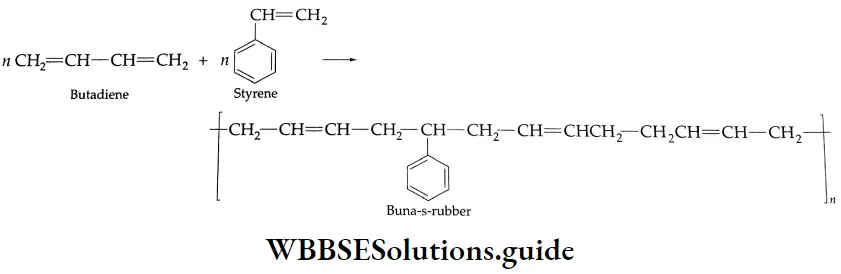
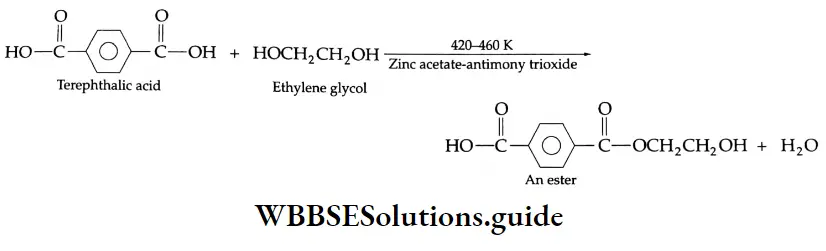
Chemical Properties

Oxidation states and trends in chemical reactivity

The halogens exhibit a -1 oxidation state in most of their compounds. This is the only oxidation state displayed by fluorine.

The other halogens may display oxidation states of +1, +3, +5 and +7in some of the compounds. The positive oxidation states are displayed in halogen oxides, oxoacids and interhalogens.

Oxidation states of +3, +5 and +7 are realised by the unpairing of the s electron pair and its promotion to the vacant d orbitals. Chlorine and bromine also display oxidation states of +4 and +6 in their oxides.

The halogens are highly reactive and the reactivity decreases down the group.

The high reactivity of halogens is due to the following factors.

  1. Low enthalpy of dissociation The X-X bond is weak. Therefore, the diatomic molecule dissociates readily.
  2. High oxidising power The halogens have high negative electron gain enthalpies, i.e., they have a strong tendency to acquire electrons and are good oxidising agents. Fluorine is the strongest oxidising agent. Generally speaking, a higher member can displace a lower member of the group from the halide. The following reactions illustrate this.

F2+2X→2F+X2
CI2+2X→2CI+X2Br2+I2
Br2+2I→2Br+I2

The oxidising power of halogens doorcases down the group. This is reflected in their decreasing reduction fv4oiUi.il. in descending the group.

Basic chemistry Class 12 Chapter 7 The P Block Elements I ht' oxidising power of halogens doorcases down the group.

As you know, the reduction potential of an element depends on various factors and is shown in the form of a Born-flavour cycle.

⇒ \(\begin{aligned}
\frac{1}{2} \mathrm{X}_2(\mathrm{~s}) \longrightarrow \frac{1}{2} \mathrm{X}_2(\mathrm{~g}) \stackrel{\frac{1}{2} \Lambda_{\mathrm{dit} t} f^{\mathrm{O}}}{\longrightarrow} & \mathrm{X}(\mathrm{g}) \\
\downarrow & \downarrow \Delta_{\mathrm{eg}} H^{\Theta}
\end{aligned}\)

⇒ \(\mathrm{X}^{-} \text {(aq) } \quad \stackrel{\Delta_{\text {hyd }} H^{\Theta}}{\longleftarrow} \quad \mathrm{X}^{-}(\mathrm{g})\)

The reactions of halogens with water indicate their relative oxidising powers. Fluorine oxidises water. Bromine and chlorine dissolve in water, forming hydrohalic and hypohalous acids. The reaction of iodine with water has a positive Gibb’s energy change, i.e., it is nonspontaneous. In fact, an iodide is oxidised to iodine by oxygen. This is the reverse of the reaction observed with fluorine.

⇒ \(2 \mathrm{~F}_2+2 \mathrm{H}_2 \mathrm{O} \longrightarrow 4 \mathrm{H}^{+}+4 \mathrm{~F}^{-}+\mathrm{O}_2\)

⇒ \(\mathrm{X}_2+\mathrm{H}_2 \mathrm{O} \longrightarrow \mathrm{HX}+\mathrm{HOX}\)

⇒ \(4 \mathrm{I}^{-}+4 \mathrm{H}^{+}+\mathrm{O}_2 \longrightarrow 2 \mathrm{I}_2+2 \mathrm{H}_2 \mathrm{O}\)

Anomalous Behaviour Of Fluorine

Fluorine differs from the other halogens because of its exceptionally small size, low F-F bond dissociation enthalpy and the absence of d orbitals in its valence shell.

Some specific examples of its anomalous behaviour are as follows.

  • Fluorine is more reactive than other halogens due to the low F-F bond dissociation enthalpy. Also, due to its high electronegativity, it forms strong bonds with other elements.
  • Most reactions of fluorine are exothermic due to the formation of strong bonds with other elements.
  • Fluorine is the strongest oxidising agent and may oxidise elements to the highest oxidation state. For example, in SF6 and IF7, the oxidation states of sulphur and iodine are +6 and +7 respectively.
  • In HF, fluorine forms strong hydrogen bonds. Thus, HF is a liquid while the other hydrogen halides are gases.
  • Fluorine forms only one oxoacid while the other halogen forms more oxoacids.
  • Due to the high electronegativity of fluorine, fluorides have greater ionic character than other halides.

Reactivity towards hydrogen

All halogens combine with hydrogen to form hydrogen halides, HX. The reaction with fluorine is violent while that with iodine is slow, indicating that the reactivity of the halogens decreases on descending the group. Hydrogen halides are covalent in the gaseous state, but in aqueous solutions, they function as strong acids. Some properties of hydrogen halides are given in.

Basic chemistry Class 12 Chapter 7 The P Block Elements Properties of hydrogen halides

They undergo dissociation in water giving acidic solutions.

⇒ \(\mathrm{HX}+\mathrm{H}_2 \mathrm{O} \rightleftharpoons \mathrm{H}_3 \mathrm{O}^{+}+\mathrm{X}\)

⇒ \(\mathrm{HF}<\mathrm{HCl}<\mathrm{HBr}<\mathrm{HI}\)

Various factors contribute to the acid strength and an important factor is bond enthalpy. The bond enthalpy decreases from HF to HI. Thus HF is the weakest acid, and HI is the strongest acid. Intermolecular hydrogen bonding also contributes to the low acidity of HF.

Reactivity towards oxygen

A large number of binary compounds of halogens and oxygen are known. The important compounds are shown in.

Basic chemistry Class 12 Chapter 7 The P Block Elements Important compounds of halogens with oxygen

Binary compounds of fluorine with oxygen are called oxygen fluorides due to the higher electronegativity of fluorine, whereas the analogous compounds with other halogens are called halogen oxides. As the electronegativity difference between the halogens and oxygen is small, the bonds are essentially covalent.

Oxygen fluorides are strong fluorinating agents. O2F2 is used to remove plutonium from spent nuclear fuel by converting it to PuF6. Apart from OF2, all oxides have positive Gibbs energy of formation and are unstable with respect to dissociation to the elements.

The oxides of iodine are the most stable followed by the oxides of chlorine. The oxides of bromine are the least stable. This can be explained by taking into consideration both kinetic and thermodynamic factors of the reactions involved. The higher oxides tend to be more stable than the lower ones.

Group 16 elements – oxygen family in p-block elements

Except for that of iodine, all oxides tend to be explosive. Because of its oxidising nature, CIO2 is used as a bleaching agent for paper pulp and textiles and as a germicide in water treatment. I2O5 quantitatively oxidises carbon monoxide to carbon dioxide and is therefore used in the estimation of carbon monoxide.

Reactivity towards metals

The halogens combine with most metals to form metal halides.

⇒ \(2 \mathrm{M}+n \mathrm{X}_2 \longrightarrow 2 \mathrm{MX}_n\)

Fluorine and chlorine react with practically all metals whereas bromine and iodine combine with most metals except the noble metals. The fluorides are all ionic. This is quite obvious as fluorine is the most electronegative element in the periodic table and when it combines with an electropositive metal, owing to the large electronegativity difference an ionic compound is formed. The ionic character of a metal halide follows the order:

fluoride > chloride > bromide > iodide.

Among metal halides in which the constituent elements are the same, the halide in which the halogen is in the higher oxidation state is more covalent than the one in which the halogen is in the lower oxidation state. Thus TICl3, PbCl4, AsCl3, UF4 are more covalent thanTICl, PbCl2, AsCl3 and UF4 respectively.

Reactivity towards other halogens

The halogens combine among themselves to form binary compounds called interhalogen compounds. Interhalogens of the type XX’, XX3, XX’5 and XX’7 are known. (Here X is the higher member and X is the lower member of the group.) We will discuss interhalogens later in this chapter.

Chlorine

Chlorine was first prepared by Scheele (1774) by oxidising HCI with MnO2. Davy (1810) identified it to be an element and coined the name chlorine on account of its colour (chlorosis in Greek means greenish-yellow).

Preparation

Chlorine can be prepared by oxidising HCI with MnO2

⇒ \(\mathrm{MnO}_2+4 \mathrm{HCl} \longrightarrow \mathrm{Cl}_2+\mathrm{MnCl}_2+2 \mathrm{H}_2 \mathrm{O}\)

In practice, a mixture of common salt and concentrated H2SO4 is taken in place of HCI.

⇒ \(\mathrm{MnO}_2+4 \mathrm{NaCl}+4 \mathrm{H}_2 \mathrm{SO}_4 \longrightarrow \mathrm{MnCl}_2+4 \mathrm{NaHSO}_4+2 \mathrm{H}_2 \mathrm{O}+\mathrm{Cl}_2\)

It is also obtained upon the oxidation of HC1 by potassium permanganate.

⇒ \(2 \mathrm{KMnO}_4+16 \mathrm{HCl} \longrightarrow 2 \mathrm{KCl}+2 \mathrm{MnCl}_2+8 \mathrm{H}_2 \mathrm{O}+5 \mathrm{Cl}_2\)

Chlorine is produced commercially by two main processes as follows.

  1. The electrolysis of brine (concentrated sodium chloride solution) in the manufacture of NaOH
    ⇒ \(2 \mathrm{NaCl}+2 \mathrm{H}_2 \mathrm{O} \stackrel{\text { electrolysis }}{\longrightarrow} 2 \mathrm{NaOH}+\mathrm{Cl}_2+2 \mathrm{H}_2\)
  2. By the oxidation of hydrogen chloride Gatsby oxygen at 723 Kin the presence of copper chloride as a catalyst
    ⇒ \(4 \mathrm{HCl}+\mathrm{O}_2 \longrightarrow 2 \mathrm{H}_2 \mathrm{O}+2 \mathrm{Cl}_2\)

Properties

Chlorine is a pungent-smelling, yellowish-green gas which can be liquefied to a greenish-yellow liquid. It reacts with metals and nonmetals to form chlorides.

⇒ \(2 \mathrm{Na}+\mathrm{Cl}_2 \longrightarrow 2 \mathrm{NaCl}\)

⇒ \(\mathrm{Mg}+\mathrm{Cl}_2 \longrightarrow \mathrm{MgCl}_2\)

⇒ \(2 \mathrm{Al}+3 \mathrm{Cl}_2 \longrightarrow 2 \mathrm{AlCl}_3\)

⇒ \(\mathrm{P}_4+6 \mathrm{Cl}_2 \longrightarrow 4 \mathrm{PCl}_3\)

⇒ \(\mathrm{S}_8+4 \mathrm{Cl}_2 \longrightarrow 4 \mathrm{~S}_2 \mathrm{Cl}_2\)

⇒ \(\mathrm{H}_2+\mathrm{Cl}_2 \longrightarrow 2 \mathrm{HCl}\)

It reacts with compounds containing hydrogen (i.e., hydrides, hydrocarbons, etc.) to form hydrogen chloride.

⇒ \(\mathrm{H}_2 \mathrm{~S}+\mathrm{Cl}_2 \longrightarrow 2 \mathrm{HCl}+\mathrm{S}\)

⇒ \(\mathrm{C}_{10} \mathrm{H}_{16}+8 \mathrm{Cl}_2 \longrightarrow 16 \mathrm{HCl}+10 \mathrm{C}\)

The reactions of chlorine with saturated hydrocarbons are substitution reactions and those with unsaturated hydrocarbons are addition reactions.

⇒ \(\mathrm{CH}_4+\mathrm{Cl}_2 \stackrel{\mathrm{uv}}{\longrightarrow} \mathrm{CH}_3 \mathrm{Cl}+\mathrm{HCl}\)

⇒ \(\mathrm{CH}_3 \mathrm{Cl}+\mathrm{Cl}_2 \stackrel{\text { uv }}{\longrightarrow} \mathrm{CH}_2 \mathrm{Cl}_2+\mathrm{HCl}\)

⇒ \(\mathrm{CH}_2 \mathrm{Cl}_2+\mathrm{Cl}_2 \stackrel{\mathrm{uv}}{\longrightarrow} \mathrm{CHCl}_3+\mathrm{HCl}\)

⇒ \(\mathrm{CHCl}_3+\mathrm{Cl}_2 \stackrel{\mathrm{uv}}{\longrightarrow} \mathrm{CCl}_4+\mathrm{HCl}\)

⇒ \(\mathrm{H}_2 \mathrm{C}=\mathrm{CH}_2+\mathrm{Cl}_2 \longrightarrow \underset{\text { 1,2-dichloroethane }}{\mathrm{C}_2 \mathrm{H}_4 \mathrm{Cl}_2}\)

Chlorine reacts with ammonia to give different products depending on the relative proportions of the reactants. With excess ammonia, the products are nitrogen and ammonium chloride, while with excess chlorine, nitrogen trichloride is formed.

⇒ \(8 \mathrm{NH}_3+3 \mathrm{Cl}_2 \longrightarrow 6 \mathrm{NH}_4 \mathrm{Cl}+\mathrm{N}_2\)

⇒ \(\mathrm{NH}_3+3 \mathrm{Cl}_2 \longrightarrow \mathrm{NCl}_3+3 \mathrm{HCl}\)

Chlorine dissolves in water to give a yellow solution. This is called chlorine water. Soon after the solution is prepared it turns colourless due to the following reaction.

⇒ \(\mathrm{Cl}_2+\mathrm{H}_2 \mathrm{O} \longrightarrow \mathrm{HCl}+\mathrm{HOCl}\)

Hypochlorous acid (HOC1) releases nascent oxygen, which is responsible for the oxidising and bleaching action of aqueous chlorine.

⇒ \(\mathrm{HOCl} \longrightarrow \mathrm{HCl}+\mathrm{O}\)

The bleaching action is permanent. Freshly prepared chlorine water is a strong oxidising agent and oxidises ferrous to ferric.

⇒ \(2 \mathrm{Fe}^{2+}+\mathrm{Cl}_2 \longrightarrow 2 \mathrm{Fe}^{3+}+2 \mathrm{Cl}^{-}\)

It also oxidises sulphur dioxide to sulphuric acid and iodine to iodic acid.

⇒ \(\mathrm{SO}_2+2 \mathrm{H}_2 \mathrm{O}+\mathrm{Cl}_2 \longrightarrow \mathrm{H}_2 \mathrm{SO}_4+2 \mathrm{H}^{+}+2 \mathrm{Cl}^{-}\)

⇒ \(\mathrm{I}_2+6 \mathrm{H}_2 \mathrm{O}+5 \mathrm{Cl}_2 \longrightarrow 2 \mathrm{HIO}_3+10 \mathrm{H}^{+}+10 \mathrm{Cl}^{-}\)

Chlorine in reaction with cold and dilute alkalis produces a mixture of chloride and hypochlorite. However, with hot and concentrated alkalis, chlorine forms chloride and chlorate.

⇒ \(\underset{\text { (dilute) }}{2 \mathrm{NaOH}}+\mathrm{Cl}_2 \stackrel{\text { cold }}{\longrightarrow} \underset{\begin{array}{c}
\text { Sodium } \\
\text { hypochlorite }
\end{array}}{\mathrm{NaOCl}}+\mathrm{NaCl}+\mathrm{H}_2 \mathrm{O}\)

⇒ \(\underset{\text { (concentrated) }}{6 \mathrm{NaOH}}+\mathrm{Cl}_2 \stackrel{\text { hot }}{\longrightarrow} \underset{\begin{array}{l}
\text { Sodium } \\
\text { chlorate }
\end{array}}{\mathrm{NaClO}_3}+5 \mathrm{NaCl}+5 \mathrm{H}_2 \mathrm{O}\)

Both these reactions are disproportionation reactions as chlorine (oxidation state zero) undergoes simultaneous oxidation to hypochlorite (oxidation state +1) or chlorate (oxidation state +3) and chloride (oxidation state -1).

The reaction of chlorine with slaked lime yields bleaching powder.

⇒ \(2 \mathrm{Ca}(\mathrm{OH})_2+2 \mathrm{Cl}_2 \longrightarrow \mathrm{Ca}(\mathrm{OCl})_2+\mathrm{CaCl}_2+2 \mathrm{H}_2 \mathrm{O}\)

It is a mixture of calcium hypochlorite, calcium chloride and calcium hydroxide and is represented as Ca(OCI)2.CaCI2.Ca(OH)2.2H2O.

Basic chemistry Class 12 Chapter 7 The P Block Elements Some important reactions of chlorine

Hydrogen Chloride

It is prepared by heating sodium chloride with concentrated sulphuric acid.

⇒ \(\mathrm{NaCl}+\mathrm{H}_2 \mathrm{SO}_4 \stackrel{\Delta}{\longrightarrow} \mathrm{NaHSO}_4+\mathrm{HCl}\)

⇒ \(\mathrm{NaHSO}_4+\mathrm{NaCl} \stackrel{\Delta}{\longrightarrow} \mathrm{Na}_2 \mathrm{SO}_4+\mathrm{HCl}\)

⇒ \(2 \mathrm{NaCl}+\mathrm{H}_2 \mathrm{SO}_4 \stackrel{\Delta}{\longrightarrow} \mathrm{Na}_2 \mathrm{SO}_4+2 \mathrm{HCl}\)

The HCI produced is dried by passing through concentrated sulphuric acid.

The presence of HCI can be detected by holding a glass rod dipped in ammonia at the mouth of the test tube where the reaction has taken place when white fumes of ammonium chloride have evolved.

⇒ \(\mathrm{NH}_3+\mathrm{HCl} \longrightarrow \mathrm{NH}_4 \mathrm{Cl}\)

Properties

Hydrogen chloride is an extremely pungent-smelling, colourless gas which can be liquefied to give a colourless liquid and solidified to give a white solid.

It is highly soluble in water and yields an acidic solution, which is called hydrochloric acid.

⇒ \(\mathrm{HCl}+\mathrm{H}_2 \mathrm{O} \longrightarrow \mathrm{H}_3 \mathrm{O}^{+}+\mathrm{Cl}^{-}\)

Hydrochloric acid is a strong acid. It liberates hydrogen from reacting with active metals.

⇒ \(\mathrm{Zn}+2 \mathrm{HCl} \longrightarrow \mathrm{ZnCl}_2+\mathrm{H}_2\)

⇒ \(\mathrm{Fe}+2 \mathrm{HCl} \longrightarrow \mathrm{FeCl}_2+\mathrm{H}_2\)

In reaction with iron, the product formed is ferrous chloride and not ferric chloride as the evolved hydrogen prevents further oxidation of iron. When salts of weak acids (carbonates, sulphites, thiosulphates, sulphides) are treated with dilute hydrochloric acid, the anion is displaced.

⇒ \(\mathrm{Na}_2 \mathrm{CO}_3+2 \mathrm{HCl} \longrightarrow 2 \mathrm{NaCl}+\mathrm{H}_2 \mathrm{O}+\mathrm{CO}_2\)

⇒ \(\mathrm{Na}_2 \mathrm{SO}_3+2 \mathrm{HCl} \longrightarrow 2 \mathrm{NaCl}+\mathrm{H}_2 \mathrm{O}+\mathrm{SO}_2\)

⇒ \(\mathrm{Na}_2 \mathrm{~S}_2 \mathrm{O}_3+2 \mathrm{HCl} \longrightarrow 2 \mathrm{NaCl}+\mathrm{H}_2 \mathrm{O}+\mathrm{SO}_2+\mathrm{S}\)

⇒ \(\mathrm{Na}_2 \mathrm{~S}+2 \mathrm{HCl} \longrightarrow 2 \mathrm{NaCl}+\mathrm{H}_2 \mathrm{~S}\)

Group 17 elements – halogens and their reactivity

A mixture of three parts of concentrated hydrochloric acid and one part of concentrated nitric acid is called aqua regia Aqua regia combines with noble metals forming soluble chloro complexes.

⇒ \(\mathrm{Au}+4 \mathrm{H}^{+}+4 \mathrm{Cl}^{-}+\mathrm{NO}_3^{-} \longrightarrow\left[\mathrm{AuCl}_4\right]^{-}+\mathrm{NO}+2 \mathrm{H}_2 \mathrm{O}\)

⇒ \(3 \mathrm{Pt}+16 \mathrm{H}^{+}+18 \mathrm{Cl}^{-}+4 \mathrm{NO}_3^{-} \longrightarrow 3\left[\mathrm{PtCl}_6\right]^{2-}+4 \mathrm{NO}+8 \mathrm{H}_2 \mathrm{O}\)

Uses

  1. Hydrochloric acid is used as a laboratory reagent
  2. It is used in the pharmaceutical industry
  3. It is used in the manufacture of chlorine and other chemicals.

Oxoacids Of Halogens

Oxoacids of halogens have oxygen attached to the halogen. They have the general formula HOX(O)n where n=0, 1, 2, 3. Due to its small size and high electronegativity, fluorine forms only one oxoacid—the unstable HOF. The other halogens form four acids—hypohalous (HOX), halos (HOXO), halic (HOXO2) and perhalic (HOXO3). Most of the oxoacids are known solutions or salts. The oxoacids of halogens and their structures are shown in.

Basic chemistry Class 12 Chapter 7 The P Block Elements Oxoacids of halogens

Interhalogen Compounds

These are binary compounds of two different halogen atoms having the general formula AXn where both A and X are halogens and X has a higher electronegativity. The value of n may be 1, 3, 5 or 7. The halogen with the lower e ec onega city is assigned a positive oxidation state.

The total number of halogen atoms is always even as this gives rise to a magnetic species, which is generally more stable. The interhalogens can be prepared by a direct combination of the halogens or by the action of a halogen on an interhalogen compound.

A few examples are as follows.

CI2+F2→2CIF
CI2+3F2→2CIF3
Br2+5F2→2BrF3
CIF3+F2→CIF5
IF5+F2→IF7

Lists some interhalogens of the four types together with their physical state and colour at room temperature. In the interhalogens of the type AX5 and AX7, A is a large halogen (Br or I) and X is fluorine. This type exists as it is easier to pack a large number of small atoms around a large atom.

Basic chemistry Class 12 Chapter 7 The P Block Elements Some interhalogen compounds

Most of the interhalogens are volatile solids or liquids and their physical properties are intermediate between those of the constituent halogens. The stability of interhalogen compounds increases with an increase in the difference in electronegativity between the two halogen atoms.

Interhalogen compounds are predominantly covalent and are generally more reactive than halogens (except fluorine). This is because the A-X bond in interhalogens is less stable than the X-X bond in halogens, except for the F-F bond.

All interhalogens hydrolyse to give a halide and an oxohalide (hypohalite in case of AX, halitein case of AX3, halate in case of AX5 and perhalate in case of AX7). The smaller halogen is converted to the halide and the larger to the oxohalide.

⇒ \(\mathrm{ClF}+\mathrm{H}_2 \mathrm{O} \longrightarrow \mathrm{F}^{-}+\mathrm{OCl}^{-}+2 \mathrm{H}^{+}\)

⇒ \(\mathrm{ICl}+\mathrm{H}_2 \mathrm{O} \longrightarrow \mathrm{Cl}^{-}+\mathrm{OI}^{-}+2 \mathrm{H}^{+}\)

The VSEPR theory is applied to assign structures to the interhalogen compounds. Let us discuss a few types here.

In CIF3 (AX3 type), the chlorine atom has seven electrons in the outermost shell, out of which three will be used in a bond formation with three fluorine atoms, leaving behind four unused electrons. Thus, there are two lone pairs and three bond pairs, giving rise to sp3d hybridisation, i.e., a trigonal bipyramidal structure.

The two lone pairs will occupy the equatorial positions to minimise repulsions. The molecule is T-shaped with the axial fluorines slightly bent away from the lone pairs and the T is slightly bent.

Basic chemistry Class 12 Chapter 7 The P Block Elements Structure of CIF3

In order to quickly assign the hybridisation of the central atom in the compound to deduce its structure, the following steps will prove to be helpful.

  1. Count the valence electrons of all the atoms. Add or subtract electrons equal to the charge for anions and cations respectively.
  2. If the total number of valence electrons in the compound is less than 8, divide by 2. The quotient gives the number of electron pairs. For two electron pairs the hybridisation is sp, for three it is sp2 and for four it is sp3.
  3. If the total number of valence electrons exceeds 8, divide by 8 to get the quotient Qj and remainder R. If R = 0, then Q: gives a number of electron pairs. If R≠O then further divide R by 2 to get Q2. Add Q1 and Q2 to get the number of electron pairs and assign hybridisation accordingly (Ch = number of bond pairs and Q2 =number of lone pairs).

Let us now deduce the hybridisation of chlorine in CIF3 by following the abovementioned steps in sequence.

  1. Total number of valence electrons = 7 + 3 x 7 = 28
  2. ⇒ \(Q_1=\frac{28}{8}=3 ; R_1=4\)
  3. ⇒ \(Q_2=\frac{R_1}{2}=2 ; \quad ∴ Q_1+Q_2=5\)

There are five electron pairs around the central atom, and the hybridisation is sp3d

In interhalogen compounds of the type AX5, for example, BrF5, the hybridisation is deduced as follows.

  1. Total number of valence electrons =7+5×7 = 42
  2. \(Q_1=\frac{42}{8}=5 ; R_1=2\)
  3. \(Q_2=\frac{R_1}{2}=1 ; \quad ∴ Q_1+Q_2=5+1=6\)

There are six electron pairs around the central atom, giving rise to sp3d2 hybridisation.

There are four bond pairs and one lone pair, giving rise to a square pyramidal structure. Similarly, it can be shown that IF7 has sp3d3 hybridization, giving rise to a pentagonal bipyramidal structure.

Basic chemistry Class 12 Chapter 7 The P Block Elements Structures of (1) BrF5 and (2) IF7

Uses

Interhaloeens are useful as nonaqueous solvents. Many of these undergo self-ionisation, for example.

⇒ \(2 \mathrm{BrF}_3 \longrightarrow \mathrm{BrF}_2^{+}+\mathrm{BrF}_4^{-}\)

C1F3 and BrF3 are good fluorinating agents and are used in the enrichment of converted to hexafluoride.

⇒ \(\mathrm{U}+3 \mathrm{ClF}_3 / 3 \mathrm{BrF}_3 \longrightarrow \mathrm{UF}_6+3 \mathrm{CIF} / 3 \mathrm{BrF}\)

Group 18 Elements

The elements of this group are helium, neon, argon, krypton, xenon and radon. Group 18 elements are called inert gases, rare gases or noble gases. The last member, radon, is radioactive and short-lived. Group 18 elements are chemically inert as their valence-shell orbitals are completely filled. They react with few compounds and are therefore called noble gases.

Occurrence And Uses

Apart from radon, the other noble gases are present in the atmosphere to an extent of about 1% (the major component being argon). Helium is commercially obtained from natural gas, the other sources of helium and neon are radioactive minerals like pitchblende and monazite. Radon is obtained by the radioactive decay of 27h Ra.

⇒ \({ }_{88}^{226} \mathrm{Ra} \longrightarrow{ }_{86}^{222} \mathrm{Rn}+{ }_2^4 \mathrm{He}\)

Helium is noninflammable and light and therefore used to fill balloons employed in meteorological observations. A mixture of helium and oxygen is used by deep-sea divers for respiration and is also used to provide relief to asthmatic patients. Helium has the lowest boiling point among all elements and thus is used to carry out research at very low temperatures. It is nonradioactive has high thermal conductivity, and is therefore used as a heat transfer agent in gas-cooled atomic reactors. Liquid helium is used as a coolant in superconducting coils used to build superconducting magnets which form a part of the NMR spectrometers used in MR! systems for clinical diagnosis.

Neon is used in discharge tubes and fluorescent lamps for advertising purposes. Neon bulbs are used in gardens and greenhouses. Neon can carry high currents at high voltages and is used to protect electrical instruments, e.g., voltmeters and rectifiers.

Argon is used to create an inert atmosphere in metallurgical operations carried out at high temperatures, for example., welding. It is used to fill electric light bulbs. Krypton and xenon are used for filling electric bulbs and phototubes. Radon is used in radioactive research and in the treatment of cancer.

Atomic And Physical Properties

Some physical characteristics of the noble gases are summarised in.

Basic chemistry Class 12 Chapter 7 The P Block Elements Atomic and physical properties of group 18 elements.

The electronic configuration of helium is Is2 while the other members of the group have a complete octet of electrons in their outermost shell, or the valence-shell configurations in these elements are MS2up6.

All the noble gases are monatomic. They have large atomic radii, which are actually van der Waals radii (van der Waals radii are nonbonded radii, which represent the distance of closest approach) and not ionic or covalent radii.

The atomic radii increase down the group. They have high ionisation enthalpy due to a stable electronic configuration. They have no tendency to accept electrons, as is reflected by large, positive electron gain enthalpy values.

Noble gases are colourless, tasteless odourless and sparingly soluble in water. Noble-gas atoms are held together by weak van der Waals forces, which can be readily overcome and hence they have low melting and boiling points.

As stated earlier, helium has the lowest boiling point among all elements (4.2 K). It has the unique property of diffusing through substances like rubber, glass and plastic.

Chemical Reactivity And Compounds

The stable electronic configuration of the elements leads to the involvement of high energies in the loss or gain of electrons (revealed by high ionisation enthalpy values and positive electron gain enthalpy values). Owing to this the noble gases show very low chemical reactivity.

The reactivity of noble gases was constantly investigated and the first real compound of a noble gas was made in 1962. Bartlett had observed that PtF6 combined with molecular oxygen (Oz) to form 02[PtF6 Since the first ionisation enthalpies of O2 (O2 ->O2+, 1175 kJ mol-1) and Xe (Xe —» Xe+; 1170 kJ mol-1) are comparable, it was predicted that a similar compound could be formed by making Xe react with PtF6. In fact, PtF6 vapours reacted with xenon at room temperature to form a reddish-yellow solid which was incorrectly thought of as xenon hexa fluoroplatinate.

⇒ \(\mathrm{Xe}(\mathrm{g})+\mathrm{PtF}_6(\mathrm{~g}) \longrightarrow \underset{\text { Xenon hexafluoroplatinate }}{\mathrm{Xe}^{+}\left[\mathrm{PtF}_6\right]^{-}(\mathrm{s})}\)

Actually, the product formed was really a more complicated one [XeF]+[Pt2F11]. After this, it was found that xenon combined with electronegative elements like fluorine and oxygen to form various compounds.

Xenon oxofluorides can be obtained from fluorides. Fluorine and oxygen are strong oxidising agents and highly electronegative and hence can oxidise xenon to display positive oxidation states in compounds.

The ionisation enthalpies of He, Ne and Ar are too high to allow the formation of compounds. The ionisation enthalpy of Kr is lower, and so KrF2 is known, Rn is radioactive and its compounds have not been isolated; the < presence of RnF2 has been confirmed by radiotracer techniques.

Xenon-Fluorine Compounds

Xenon forms three fluorides, XeF2, XeF4 and XeF6 by direct combination with fluorine. The fluoride former depends on the prevailing experimental conditions.

In all the reactions involving the formation of a xenon fluoride, the reactants are taken in a nickel container and subjected to high temperature and pressure. Depending on the proportion of reactants, temperature and pressure that prevails during the reaction, different xenon fluorides are formed, which are shown in the following.

⇒ \(\begin{aligned}
& \mathrm{Xe}(\mathrm{g})+\mathrm{F}_2(\mathrm{~g}) \stackrel{673 \mathrm{~K}, 1 \mathrm{bar}}{\longrightarrow} \mathrm{XeF}_2(\mathrm{~g}) \\
& \quad(2: 1 \text { ratio })
\end{aligned}\)

⇒ \(\begin{aligned}
& \mathrm{Xe}(\mathrm{g})+2 \mathrm{~F}_2(\mathrm{~g}) \stackrel{873 \mathrm{~K}, 6-7 \text { bar }}{\longrightarrow} \mathrm{XeF}_4(\mathrm{~g}) \\
& \quad(1: 5 \text { ratio })
\end{aligned}\)

⇒ \(\begin{aligned}
& \mathrm{Xe}(\mathrm{g})+3 \mathrm{~F}_2(\mathrm{~g}) \stackrel{573 \mathrm{~K}(60-70 \mathrm{bar})}{\longrightarrow} \mathrm{XeF}_6(\mathrm{~g}) \\
& \quad(1: 20 \text { ratio })
\end{aligned}\)

XeF6 can also be made by the fluorination of XeF4 with oxygen fluoride at low temperature

⇒ \(\mathrm{XeF}_4+\mathrm{O}_2 \mathrm{~F}_2 \stackrel{143 \mathrm{~K}}{\longrightarrow} \mathrm{XeF}_6+\mathrm{O}_2\)

The xenon fluorides are colourless, crystalline solids which sublime at 298 K. They are powerful fluorinating agents. They are susceptible to hydrolysis. Hydrogen fluoride is formed during the hydrolysis of all xenon fluorides.

⇒ \(2 \mathrm{XeF}_2+2 \mathrm{H}_2 \mathrm{O} \longrightarrow 2 \mathrm{Xe}+4 \mathrm{HF}+\mathrm{O}_2\)

⇒ \(6 \mathrm{XeF}_4+12 \mathrm{H}_2 \mathrm{O} \longrightarrow 4 \mathrm{Xe}+2 \mathrm{XeO}_3+24 \mathrm{HF}+3 \mathrm{O}_2\)

XeF6 undergoes partial hydrolysis as well as complete hydrolysis.

⇒ \(\mathrm{XeF}_6+\mathrm{H}_2 \mathrm{O} \longrightarrow \underset{\substack{\text { Xenon } \\ \text { oxofluoride }}}{\mathrm{XeOF}_4}+2 \mathrm{HF}\)

⇒ \(\mathrm{XeF}_6+2 \mathrm{H}_2 \mathrm{O} \longrightarrow \mathrm{XeO}_2 \mathrm{~F}_2+4 \mathrm{HF}\)

⇒ \(\mathrm{XeF}_6+3 \mathrm{H}_2 \mathrm{O} \longrightarrow \mathrm{XeO}_3+6 \mathrm{HF}\)

The products of partial hydrolysis are xenon oxyfluorides and HF while that of complete hydrolysis is xenon trioxide.

It may be noted here that the oxidation state of xenon in XeF6, XeOF4, XeO2F2 and XeO3 is +6 and thus the hydrolysis of XeF6 whether partial or complete is not a redox reaction, unlike in the other cases, where there is a change in the oxidation state of Xe. [XeF2 gives Xe, the change in oxidation state is from +2 to zero; XeF4 has Xe in the +4 oxidation state, it gives Xe (zero oxidation state).]

Xenon fluoride acts as a fluoride acceptor as well as a fluoride donor. In reactions with fluoride ion acceptors, it forms cationic species whereas in reactions with fluoride ion donors, it forms anionic species.

⇒ \(\mathrm{XeF}_2+\underset{\substack{\text { Fluoride } \\ \text { ion acceptor }}}{\mathrm{PF}_5} \longrightarrow[\mathrm{XeF}]^{+}\left[\mathrm{PF}_6\right]^{-}\)

⇒ \(\mathrm{XeF}_4+\underset{\substack{\text { Fluoride ion } \\ \text { acceptor }}}{\mathrm{SbF}_5} \longrightarrow\left[\mathrm{XeF}_3\right]^{+}\left[\mathrm{SbF}_6\right]^{-}\)

⇒ \(\mathrm{XeF}_6+\underset{\substack{\text { Fluoride } \\ \text { ion donor }}}{\mathrm{MF}} \longrightarrow \mathrm{M}^{+}\left[\mathrm{XeF}_7\right]^{-}\)

Xenon fluorides are strong oxidising and fluorinating agents and combine quantitatively with hydrogen.

⇒ \(\mathrm{XeF}_2+\mathrm{H}_2 \longrightarrow \mathrm{Xe}+2 \mathrm{HF}\)

⇒ \(\mathrm{XeF}_4+2 \mathrm{H}_2 \longrightarrow \mathrm{Xe}+4 \mathrm{HF}\)

⇒ \(\mathrm{XeF}_6+3 \mathrm{H}_2 \longrightarrow \mathrm{Xe}+6 \mathrm{HF}\)

The structures of xenon fluorides can be derived from the VSEPR theory. In XeF2, Xe has eight valence electrons out of which two are involved in bond formation. Thus there are two bond pairs and three lone pairs giving rise to sp3d hybridisation with the lone pairs in equatorial positions.

The resultant structure is linear. On the other hand, in XeF4 the central atom undergoes sp3d2 hybridisation. There are two lone pairs and the resultant structure is square planar. XeF6 has a distorted octahedral structure involving sp3d3 hybridisation. There is one lone pair present at the centre of one of the triangular faces.

Basic chemistry Class 12 Chapter 7 The P Block Elements Structures of (1) XeF2, (2) XeF4 and (3) XeF6

Xenon-Oxygen Compounds

Oxides

Two oxides of xenon—XeO3 and XeO4—are known. XeO3 is more important and is formed during the hydrolysis of XeF4 and XeF6. It is highly explosive and a vigorous oxidising agent. It has a pyramidal structure involving sp3 hybridisation and one lone pair.

Oxyfluorides

Xenon oxyfluoride (XeOF2) is obtained by the partial hydrolysis of XeF4

⇒ \(\mathrm{XeF}_4+\mathrm{H}_2 \mathrm{O} \longrightarrow \mathrm{XeOF}_2+2 \mathrm{HF}\)

Xenon oxytetrafluoride (XeOF4) and xenon dioxydifluoride (XeO2F2) are obtained during the partial hydrolysis of XeF6. The structures of the oxyfluorides are shown in XeOF2 has a T-shaped structure due to sp3d hybridisation and two lone pairs. XeOF4 has a square-pyramid structure because xenon is sp3d2 hybridised with one lone pair. In XeO2F2 xenon is sp3d hybridised with one lone pair, giving rise to a see-saw geometry.

Basic chemistry Class 12 Chapter 7 The P Block Elements Structures of (1) XeOF2

The P Block Elements Multiple-Choice Questions

Question 1. Which of the following is not an acidic oxide?

  1. N2O
  2. N2O
  3. P4O6
  4. SO2

Answer: 1. N2O

Question 2. In the molecular state, phosphorus exists as

  1. P
  2. P2
  3. P4
  4. Px

Answer: 3. P4

Question 3. Which of the following is true for PCI5?

  1. All the P-Cl bonds are equivalent.
  2. The axial bonds are longer than the equatorial bonds.
  3. The axial bonds are shorter than the equatorial bonds.
  4. The five P-Cl bond lengths differ from each other.

Answer: 2. The axial bonds are longer than the equatorial bonds.

Question 4. The strongest base among the following is

  1. NF3
  2. NH3
  3. PF3
  4. PH3

Answer: 2. NH3

Question 5. The hybridisation of P in PCI3 is

  1. sp2
  2. sp2d
  3. sp3d2
  4. sp3

Answer: 4. sp3

Question 6. Which of these is paramagnetic?

  1. N2O
  2. N2O
  3. N2O3
  4. N2O4

Answer: 2. N2O

Question 7. PH3 is evolved when phosphorus is treated with

  1. H2O
  2. HCI
  3. NaOH
  4. None of these

Answer: 3. NaOH

Question 8. Solid PClg is made up of

  1. discrete PCI5 units
  2. [PCI6]+[PCI4]
  3. [PCI4]+[PCI6]
  4. [P2CI8]2+[P2CI12]2-

Answer: 3. [PCI4]+[PCI6]

Question 9. Which of these contains an O-O linkage?

  1. H2SO3
  2. H2S2O3
  3. H2SO4
  4. H2S2O8

Answer: 4. H2S2O8

Question 10. Which of the following is not a diprotic acid?

  1. H2SO3
  2. H2SO4
  3. H3PO3
  4. H3PO4

Answer: 3. H3PO3

Group 18 elements – noble gases and their properties

Question 11. Which of the following is a reducing agent?

  1. SO2
  2. SO3
  3. NO2
  4. CO2

Answer: 1. SO2

Question 12. The correct order of stability of Group 15 hydrides is

  1. H2O>H2S>H2Se>H2Te
  2. H2Te>H2Se>H2S>H2O
  3. H2S>H2O>H2Se>H2Te
  4. H2Te>H2Te>H2Se>H2S

Answer: 1. H2O>H2S>H2Se>H2Te

Question 13. The correct order of bond enthalpy among the following is

  1. CI2<I2<Br2<F2
  2. F2<I2<CI2<Br2
  3. F2<Br2<CI2<I2
  4. I2<F2<Br2<CI2

Answer: 4. I2<F2<Br2<CI2

Question 14. In the reaction Cl2+ 2X“ —> X2+ 2C1, X is

  1. Br orI
  2. I only
  3. F, Br or I
  4. F only

Answer: 1. Br orI

Question 15. The reaction 3C10 —> C103 + 2C1 is an example of

  1. Decomposition
  2. Disproportionation
  3. Oxidation
  4. Reduction

Answer: 2. Disproportionation

Question 16. When concentrated sulphuric acid is added to sodium chloride, the gas evolves is

  1. SO
  2. SO3
  3. CI2
  4. HCI

Answer: 4. HCI

Question 17. Hydrogen bonding is not present in

  1. PH3
  2. NH3
  3. H2O
  4. HF

Answer: 1. PH3

Question 18. Among hydrogen halides, the correct order of acidity is

  1. HF<HCI<HI<HBr
  2. HI<HBr<HCI<HF
  3. HF<HCI<HBr<HI
  4. HI<HBr<HF<HCI

Answer: 3. HF<HCI<HBr<HI

Question 19. The hybridisation of Cl in CIF3 is

  1. sp2d
  2. sp2
  3. sp3
  4. sp3d

Answer: 4. sp3d

Question 20. Which of these is paramagnetic?

  1. CI2
  2. S2
  3. N2
  4. Br2

Answer: 2. S2

Question 21. The hydrolysis product of XeF4 is

  1. Xe+HF
  2. XeO3+O2+HF
  3. Xe+HF+XeO3+O2
  4. XeOF4

Answer: 3. Xe+HF+XeO3+O2

Question 22. Which of these is a planar molecule?

  1. XeO3
  2. XeOF4
  3. XeO4
  4. XeF4

Answer: 4. XeF4

Question 23. The hybridisation of Xe in XeF4 is

  1. sp3d
  2. sp3d
  3. sp2
  4. sp3

Answer: 2. sp3d

Question 24. Which among the following is tetrahedral?

  1. XeO4
  2. XeF4
  3. XeOF4
  4. XeOF2

Answer: 1. XeO4

Question 25. Which among these does not exist?

  1. XeF2
  2. NeF2
  3. XeO3
  4. XeF4

Answer: 2. NeF2

Question 26. The N2 molecule is isoelectronic with

  1. CO,CN+ and NO+
  2. CO, CNand NO+
  3. CO+,N2O and O2-2
  4. O2+O2 and CO+

Answer: 2. CO, CNand NO+

Question 27. Which of these metals is rendered passive on treatment with concentrated HNO3?

  1. Cr
  2. Ni
  3. Cu
  4. Fe

Answer: 1. Cr

Question 28. Which of these is a dibasic acid and reducing agent?

  1. H3PO4
  2. H3PO2
  3. H3PO3
  4. HPO3

Answer: 3. H3PO3

Haloalkanes And Haloarenes Notes

Haloalkanes And Haloarenes

Haloalkanes:

An alkyl halide (haloalkane) or aryl halide (haloarene) is formed when one of the hydrogens in an alkane or benzene molecule is replaced by a halogen atom (fluorine, chlorine, bromine or iodine). For Example,

Basic chemistry Class 12 Chapter 10 Haloalkanes and Haloarenes Chloromethane

Chemists often use R-X as a general formula for alkyl halides; R stands for any alkyl group and X for any halogen. The aryl group in a halobenzene is denoted by the symbol Ar to distinguish it from the alkyl group R.

These classes of compounds find wide applications. For Example, chlorine-containing antibiotics, Chloramphenicol and Aureomycin are very effective in the treatment of bacterial infections. Chloroquine is used as a drug in the treatment of malaria.

Haloalkanes and haloarenes class 12 chemistry notes

Our body produces the iodine-containing hormone, thyroxine, the deficiency of which causes a disease called goitre. These are all aryl halides. A majority of alkyl halides are employed as insecticides and there exists virtually no soil microorganism which can degrade them into nontoxic metabolic products

Classification On The Basis Of The Number Of Halogen Atoms

Haloalkanes or haloarenes are classified as mono-, di- or tri-halogen compounds depending on whether they contain one, two or three halogen atoms. For Example,

Basic chemistry Class 12 Chapter 10 Haloalkanes and Haloarenes On the basis of the number of halogen atoms Haloalkanes or haloarenes

Monohalo compounds are further classified on the basis of the hybridisation of the carbon atom to which the halogen atom is attached.

Compounds contalnting an sp3 C—X bond (X = F, Cl, Br, I)

1. Alkyl halides or haloalkanes (R—X) Alkyl halides other than methyl halides are classified as primary (1°), secondary (2°) or tertiary (3°), depending upon the number of carbons attached to the halogen-bearing carbon.

Basic chemistry Class 12 Chapter 10 Haloalkanes and Haloarenes Alkyl halides or haloalkanes

2. Allyl halides In an allyl halide, the halogen atom is attached to that sp -sp-hybridised carbon which is bonded to the carbon forming a carbon-carbon double bond.

Basic chemistry Class 12 Chapter 10 Haloalkanes and Haloarenes Allyl halides

3. Benzylic halide In a benzylic halide, the halogen atom is attached to that sp3 -hybridised carbon which is bonded to a benzene ring.

Basic chemistry Class 12 Chapter 10 Haloalkanes and Haloarenes Benzylic halide

Compounds containing an sp2 C—X bond

1. Vinylic halides In a vinylic halide, the halogen atom is bonded to the sp2-hybridised carbon atom that forms a carbon-carbon double bond.

Basic chemistry Class 12 Chapter 10 Haloalkanes and Haloarenes Vinylic halides

2. Aryl halides In an aryl halide, the halogen atom is attached to the sp2-hybridised carbon atom of an aromatic ring.

Basic chemistry Class 12 Chapter 10 Haloalkanes and Haloarenes Aryl halides

Dihalo compounds (dihalides) are classified as vicinal (or vie) dihalides and geminal (or gem) dihalides. Molecules with two halogen atoms connected to the same carbon are called geminal (or gem) dihalides. Molecules with two halogen atoms connected to neighbouring carbons, as in the case of 1, 2-dibromoethane, are called vicinal (or vie) dihalides.

Basic chemistry Class 12 Chapter 10 Haloalkanes and Haloarenes the case of 1, 2-dibromoethane,

Nomenclature

The common names of alkyl halides are simply the alkyl derivatives of the corresponding hydrogen halides. he /UPAC names are halo derivatives of the corresponding hydrocarbons. In the common names, the prefixes n-, •c- (s-) and text- (/-) indicate normal, secondary and tertiary respectively.

Basic chemistry Class 12 Chapter 10 Haloalkanes and Haloarenes Common and IUPAC names of some alkyl and aryl halides

Example Write the IUPAC names of the following.

Basic chemistry Class 12 Chapter 10 Haloalkanes and Haloarenes 2-Bromobutane

2-Bromobutane

Basic chemistry Class 12 Chapter 10 Haloalkanes and Haloarenes 1-Iodocyclohexene

1-Iodocyclohexene

Basic chemistry Class 12 Chapter 10 Haloalkanes and Haloarenes 3-Bromo-2-chloro-4-iodopentane

3-Bromo-2-chloro-4-iodopentane

Basic chemistry Class 12 Chapter 10 Haloalkanes and Haloarenes 1-Bromo-2-fluoro-4-iodo-3-methylbutane

1-Bromo-2-fluoro-4-iodo-3-methyl butane

Basic chemistry Class 12 Chapter 10 Haloalkanes and Haloarenes 4-Bromo-2, 2, 6, 6-tetramethyl-4-heptene-3-one

4-Bromo-2, 2, 6, 6-tetramethyl-4-heptene-3-one

Basic chemistry Class 12 Chapter 10 Haloalkanes and Haloarenes 3-Iodo-4-nitrobenzaldehyde

3-Iodo-4-nitrobenzaldehyde

Example Write the structures of all the possible isomers of the monochloro derivative of methylcyclohexane (excluding stereo structures).

Solution

Basic chemistry Class 12 Chapter 10 Haloalkanes and Haloarenes the monochloro derivative of methylcyclohexane

Methods Of Preparation From alkanes

Cyclic and acyclic hydrocarbons can be chlorinated or brominated in the presence of visible or ultraviolet light. For Example, methane on chlorination yields a mixture of methyl chloride, methylene chloride, chloroform and carbon tetrachloride.

⇒ \(\mathrm{CH}_4+\mathrm{Cl}_2 \stackrel{\text { hv }}{\longrightarrow} \underset{\text { Methyl chloride }}{\mathrm{CH}_3 \mathrm{Cl}}+\mathrm{HCl}\)

Haloalkanes and haloarenes chapter important questions and answers

⇒ \(\mathrm{CH}_3 \mathrm{Cl}+\mathrm{Cl}_2 \stackrel{\text { hv }}{\longrightarrow} \underset{\text { Methylene chloride }}{\mathrm{CH}_2 \mathrm{Cl}_2}+\mathrm{HCl}\)

⇒ \(\mathrm{CH}_2 \mathrm{Cl}_2+\mathrm{Cl}_2 \longrightarrow \underset{\begin{array}{c}
\text { Trichloromethane } \\\text { (chloroform) }\end{array}}{\mathrm{CHCl}_3}+\mathrm{HCl}\)

⇒ \(\mathrm{CHCl}_3+\mathrm{Cl}_2 \longrightarrow \underset{\begin{array}{c}\text { Tetrachloromethane } \\\text { (carbon tetrachloride) }\end{array}}{\mathrm{CCl}_4}+\mathrm{HCl}\)

Haloalkanes And Haloarenes Notes

Haloalkanes And Haloarenes Class 12 Notes

Mechanism

⇒ \(\mathrm{Cl}: \mathrm{Cl} \stackrel{\text { heat }}{\longrightarrow} \mathrm{Cl}^{\circ}+\mathrm{Cl}^{\cdot}\)
Chlorine-free radical

⇒ \(\mathrm{Cl}^{\cdot}+\mathrm{CH}_4 \longrightarrow \mathrm{HCl}+\underset{\begin{array}{c} \text { Methyl free } \\ \text { radical } \end{array}}{\mathrm{CH}_3}\)

⇒ \(\cdot \mathrm{CH}_3+\mathrm{Cl}: \mathrm{Cl} \longrightarrow \underset{\text { Methyl chloride }}{\mathrm{CH}_3 \mathrm{Cl}}+{ }^{\circ} \mathrm{Cl}\)

⇒ \(\mathrm{CH}_3 \mathrm{Cl}+\cdot \mathrm{Cl} \longrightarrow \underset{{\text { Chloromethyl } \\ \text { free radical }}}{\cdot \mathrm{CH}_2 \mathrm{Cl}+\mathrm{HCl}}\)

⇒ \(\cdot \mathrm{CH}_2 \mathrm{Cl}+\mathrm{Cl}: \mathrm{Cl} \longrightarrow \underset{\begin{array}{c} \text { Methylene } \\ \text { chloride } \end{array}}{\mathrm{CH}_2 \mathrm{Cl}_2+\mathrm{Cl}}\)

⇒ \(\mathrm{CH}_2 \mathrm{Cl}_2+\cdot \mathrm{Cl} \longrightarrow \underset{{\text { Dichloromethyl } \\ \text { free radical }}}{\cdot \mathrm{CHCl}_2}+\mathrm{HCl}\)

⇒ \(\cdot \mathrm{CHCl}_2+\mathrm{Cl}: \mathrm{Cl} \longrightarrow \underset{\text { Chloroform }}{\mathrm{CHCl}_3+{ }^{\circ} \mathrm{Cl}}\)

⇒ \(\mathrm{CHCl}_3+\mathrm{Cl} \longrightarrow \underset{{\text { Trichloromethyl } \\ \text { free radical }}}{\cdot \mathrm{CCl}_3}+\mathrm{HCl}\)

⇒ \(\cdot \mathrm{CCl}_3+\mathrm{Cl}: \mathrm{Cl} \longrightarrow \underset{{\text { Carbon } \\ \text { tetrachloride }}}{\mathrm{CCl}_4}+\cdot \mathrm{Cl}\)

The ease of substitution at various carbon atoms is tertiary > secondary > primary, which is the same as the stability of the various alkyl radicals. For Example, the chlorination of propane yields a mixture of 1-chloropropane and 2-chloropropane.

Basic chemistry Class 12 Chapter 10 Haloalkanes and Haloarenes the chlorination of propane yields

The bromination of an alkane is similar to chlorination except that the rate of the reaction is slow. The bromination of isobutane gives tert-butyl bromide as the major product.

Basic chemistry Class 12 Chapter 10 Haloalkanes and Haloarenes The bromination of isobutane gives tert-butyl bromide as the major product.

Fluorohydrocarbons cannot be prepared by the direct fluorination of alkanes, because the reaction is explosive. Fluorine can, however, be introduced by the replacement of chlorine from an alkyl chloride using mercurous fluoride.

2CH3CI+ Hg2F2 →2CH3F+ Hg2Cl2

The iodination of an alkane is reversible and leads to the regeneration of the alkane.

Haloalkanes And Haloarenes Class 12 Notes

⇒ \(\mathrm{R}-\mathrm{H}+\mathrm{I}_2 \rightleftharpoons \mathrm{R}-\mathrm{I}+\mathrm{HI}\)

The reaction is, therefore, not synthetically useful and direct iodination is usually achieved by using a strong oxidising agent (HIO3 or HNO3 ) to destroy the HI formed in the process.

HIO3 + 5HI→3I2 + 3H2O

From Alkenes

1. Addition of HX

The addition of hydrogen halides to alkenes gives a variety of alkyl halides. HF, HBr and HI can be added at room temperature, while HCI is added at a higher temperature.

Basic chemistry Class 12 Chapter 10 Haloalkanes and Haloarenes Addition of HX

In the case of unsymmetrical olefins, the reaction proceeds under the Markovnikov rule.

Basic chemistry Class 12 Chapter 10 Haloalkanes and Haloarenes Markovnikov rule

Mechanism The hydrogen halides add on to the olefins by an ionic mechanism.

Basic chemistry Class 12 Chapter 10 Haloalkanes and Haloarenes Mechanism The hydrogen halides add on to the olefins by an ionic mechanism

In the presence of light or peroxide, the addition of hydrogen bromide follows a free-radical mechanism the product is formed according to the anti-Markovnikov rule.

Mechanism

⇒ \(\mathrm{CH}_3-\mathrm{CH}=\mathrm{CH}_2+\mathrm{HBr} \stackrel{\text { peroxide }}{\longrightarrow} \mathrm{CH}_3-\mathrm{CH}_2-\mathrm{CH}_2-\mathrm{Br}\)

⇒ \(\mathrm{HBr} \stackrel{\text { peroxide }}{\longrightarrow} \dot{\mathrm{H}}+\dot{\mathrm{Br}}\)

⇒ \(\mathrm{CH}_3-\mathrm{CH}=\mathrm{CH}_2+\dot{\mathrm{Br}} \longrightarrow \mathrm{CH}_3-\dot{\mathrm{C}} \mathrm{H}-\mathrm{CH}_2-\mathrm{Br}\)

⇒ \(\mathrm{CH}_3-\dot{\mathrm{C}} \mathrm{H}-\mathrm{CH}_2-\mathrm{Br}+\mathrm{HBr} \longrightarrow \mathrm{CH}_3-\mathrm{CH}_2-\mathrm{CH}_2-\mathrm{Br}+\dot{\mathrm{Br}}\)

In contrast to the addition of HBr, the free radical addition of HI and HC1 to olefins normally does not take place.

⇒ \(\dot{\mathrm{X}}+\mathrm{H}_2 \mathrm{C}=\mathrm{CH}_2 \longrightarrow \mathrm{XCH}_2 \dot{\mathrm{C}} \mathrm{H}_2 \quad\left[\begin{array}{ll}
\mathrm{X}=\mathrm{Cl} ; & \Delta H=-26 \mathrm{kcal} \mathrm{mol}^{-1} \\
\mathrm{X}=\mathrm{Br} ; & \Delta H=-5 \mathrm{kcal} \mathrm{mol}^{-1} \\
\mathrm{X}=\mathrm{I} ; & \Delta H=+7 \mathrm{kcal} \mathrm{mol}^{-1}
\end{array}\right]\)

⇒ \(\mathrm{XCH}_2 \dot{\mathrm{C}} \mathrm{H}_2+\mathrm{HX} \longrightarrow \mathrm{XCH}_2 \mathrm{CH}_3+\dot{\mathrm{X}}\left[\begin{array}{ll}
\mathrm{X}=\mathrm{Cl} ; & \Delta H=+5 \mathrm{kcal} \mathrm{mol}^{-1} \\
\mathrm{X}=\mathrm{Br} ; & \Delta H=-11 \mathrm{kcal} \mathrm{mol}^{-1} \\
\mathrm{X}=\mathrm{I} ; & \Delta H=-27 \mathrm{kcal} \mathrm{mol}^{-1}
\end{array}\right]\)

For the addition of HCl, the first step is exothermic and so the addition of the chlorine atom takes place readily but the second step is endothermic so this step is not possible. The initially formed radical is unable to decompose HCI.

For the addition of HBr, both the steps are exothermic and so the addition takes place readily. For the free radical addition of HI, the first step is endothermic. Therefore, no HI will add on to an olefin.

Haloalkanes And Haloarenes Class 12 Notes

2. Addition of halogens

Dihalides are formed by the addition of halogens to alkenes.

Basic chemistry Class 12 Chapter 10 Haloalkanes and Haloarenes Addition of halogens

From Alcohols

Alcohols are important starting materials for the preparation of alkyl halides. Various reagents such as PCI5, PBr3, PI3 and SOCl2 readily displace the alcoholic group to yield the corresponding halides.

⇒ \(\mathrm{CH}_3-\mathrm{CH}_2-\mathrm{OH}+\mathrm{PCl}_5 \longrightarrow \underset{\text { Ethyl chloride }}{\mathrm{CH}_3-\mathrm{CH}_2-\mathrm{Cl}+\mathrm{POCl}_3+\mathrm{HCl}}\)

⇒ \(3 \mathrm{CH}_3-\mathrm{CH}_2-\mathrm{OH}+\mathrm{PI}_3 \longrightarrow \underset{\text { Ethyl iodide }}{3 \mathrm{CH}_3-\mathrm{CH}_2-\mathrm{I}+\mathrm{H}_3 \mathrm{PO}_3}\)

⇒ \(\mathrm{C}_2 \mathrm{H}_5 \mathrm{OH}+\mathrm{SOCl}_2 \longrightarrow \underset{\text { Ethyl chloride }}{\mathrm{C}_2 \mathrm{H}_5 \mathrm{Cl}}+\mathrm{SO}_2+\mathrm{HCl}\)

The three hydrohalogen acids HI, HBr and HC1 also react with alcohols but at different rates i.e., HI > HBr > HCI

⇒ \(\mathrm{CH}_3-\mathrm{CH}_2-\mathrm{OH}+\mathrm{HI} \stackrel{\Delta}{\longrightarrow} \mathrm{CH}_3 \mathrm{CH}_2-\mathrm{I}+\mathrm{H}_2 \mathrm{O}\)

With primary alcohols, hydroiodic acid reacts most readily while hydrochloric acid requires zinc chloride as a catalyst and hydrobromic acid displays an intermediate reactivity

⇒ \(\underset{\text { Ethyl alcohol }}{\mathrm{C}_2 \mathrm{H}_5 \mathrm{OH}}+\mathrm{HCl} \stackrel{\text { anhydrous } \mathrm{ZnCl}_2}{\longrightarrow} \underset{\text { Ethyl chloride }}{\mathrm{C}_2 \mathrm{H}_5 \mathrm{Cl}}+\mathrm{H}_2 \mathrm{O}\)

Mechanism

Basic chemistry Class 12 Chapter 10 Haloalkanes and Haloarenes Mechanism

Furthermore, a tertiary alcohol reacts more rapidly than a secondary alcohol, which in turn reacts faster than a primary alcohol.

The Halogen-Exchange Method

This method is used to prepare alkyl iodides which are otherwise not easily obtained. It involves treating an alkyl chloride or bromide with a solution of sodium iodide.

⇒ \(\underset{(\mathrm{X}=\mathrm{Cl}, \mathrm{Br})}{\mathrm{R})}+\mathrm{X}+\mathrm{NaI} \stackrel{\text { acetone }}{\longrightarrow} \underset{\text { Alkyl iodide }}{\mathrm{R} \mathrm{I}}+\mathrm{NaX}\)

This reaction is called the Finkelstein reaction.

An alkyl fluoride is best prepared by heating an alkyl chloride or alkyl bromide in the presence of mercurous fluoride.

2CH3 —C1+ Hg2F2→2CH3—F+Hg2Cl2

This reaction is known as Swart’s reaction.

By The Hunsdiecker Reaction

Alkyl halides and aryl halides can be prepared by decomposing the silver salt of carboxylic acid using chlorine or bromine in the presence of CC14.

⇒ \(\underset{\text { iilver carboxylate }}{\mathrm{RCOOAg}}+\mathrm{Br}_2 \underset{\Delta}{\stackrel{\mathrm{CCl}_4}{\longrightarrow}} \mathrm{R}-\mathrm{Br}+\mathrm{CO}_2+\mathrm{AgBr}\)

The reaction probably proceeds through a free-radical mechanism as shown below.

Basic chemistry Class 12 Chapter 10 Haloalkanes and Haloarenes By the Hunsdiecker reaction

Physical Properties

Melting and boiling points

The melting and boiling points of alkyl halides are higher than those of alkanes with the same number of carbon atoms. This is because of their greater dipole-dipole and van der Waals attractions.

In alkyl halides having the same alkyl groups, the boiling and melting points increase with the increase in the atomic weight of the halogen. Thus, the boiling point of methyl fluoride is the lowest while that of methyl iodide is the highest.

In the case of isomeric alkyl halides, the boiling point depends upon surface area. The boiling point of the primary halide is the highest and that of the tertiary halide is the lowest.

Basic chemistry Class 12 Chapter 10 Haloalkanes and Haloarenes Melting and boiling points

Specific gravity

Most halides are liquids. The bromides, iodides and polyhalides, in general, have a specific gravity greater than and are, therefore, heavier than water.

Solubility

Alkyl halides are insoluble in water because of their inability to form hydrogen bonds with water.

Haloalkanes And Haloarenes Class 12 Notes

Chemical Reactions

Alkyl halides mainly undergo the following two types of chemical reactions.

  1. Nucleophilic substitution reactions
  2. Elimination reactions

In addition, alkyl halides undergo some other characteristic reactions which we will discuss subsequently.

Nucleophilic Substitution Reactions

All the halogens are significantly more electronegative than carbon. As a result, a carbon-halogen bond is polar. The majority of reactions that alkyl halides undergo involve heterolytic cleavage of the carbon-halogen bond, with the halogen departing as X-.

Basic chemistry Class 12 Chapter 10 Haloalkanes and Haloarenes Nucleophilic substitution reactions

In such a case, the halogen is referred to as a departing nucleophile. The order of reactivity of alkyl halides is

R—I>R—Br>R—Cl>>R—F

The strengths of the C—X bonds and dipole moments have been measured and are listed.

Basic chemistry Class 12 Chapter 10 Haloalkanes and Haloarenes The strengths of the C—X bonds and dipole moments have been measured and are listed

It is clearly the easiest to break a C—I bond and the most difficult to break a C—F bond. Iodine is the leaving group and fluorine is a very bad one with the other halogens in between.

In this chapter, we will confine our attention to reactions in which the halogen is attached to a saturated (i.e., sp3 -hybridised) carbon.

The main nucleophilic substitution reactions that alkyl halides (in particular ethyl bromide) undergo are as follows.

1. Hydrolysis The reaction of ethyl bromide with aqueous NaOH gives ethyl alcohol.

C2H5Br + NaOH -> C2H5OH + NaBr

Mechanism

Basic chemistry Class 12 Chapter 10 Haloalkanes and Haloarenes Hydrolysis

Solvolysis If the attacking nucleophile is the solvent, the reaction is called a solvolysis reaction.

2. Reaction with potassium hydrosulphide Ethyl bromide on treatment with aqueous alcoholic KSH yields alcohol.

Basic chemistry Class 12 Chapter 10 Haloalkanes and Haloarenes Reaction with potassium hydrosulphide

3. Reaction with sodium alkoxide On treatment with sodium ethoxide, ethyl bromide gives diethyl ether.

⇒ \(\mathrm{C}_2 \mathrm{H}_5 \mathrm{Br}+\mathrm{C}_2 \mathrm{H}_5 \text { ŌNa } \rightarrow \mathrm{C}_2 \mathrm{H}_5-\mathrm{O}-\mathrm{C}_2 \mathrm{H}_5+\mathrm{NaBr}Diethyl ether\)

4. Reaction with ammonia On being heated with concentrated ammonia in a sealed tube, ethyl bromide gives a mixture of amines.

⇒ \(\mathrm{C}_2 \mathrm{H}_5-\mathrm{Br}+\mathrm{NH}_3 \rightarrow \underset{\text { Ethylamine }}{\mathrm{C}_2 \mathrm{H}_5-\mathrm{NH}_2}+\mathrm{HBr}\)

⇒ \(\mathrm{C}_2 \mathrm{H}_5-\mathrm{Br}+\mathrm{C}_2 \mathrm{H}_5-\mathrm{NH}_2 \rightarrow \underset{\text { Diethylamine }}{\left(\mathrm{C}_2 \mathrm{H}_5\right)_2 \mathrm{NH}}+\mathrm{HBr}\)

⇒ \(\mathrm{C}_2 \mathrm{H}_5 \mathrm{Br}+\left(\mathrm{C}_2 \mathrm{H}_5\right)_2 \mathrm{NH} \rightarrow \underset{\text { Triethylamine }}{\left(\mathrm{C}_2 \mathrm{H}_5\right)_3 \mathrm{~N}}+\mathrm{HBr}\)

⇒ \(\mathrm{C}_2 \mathrm{H}_5-\mathrm{Br}+\left(\mathrm{C}_2 \mathrm{H}_5\right)_3 \mathrm{~N} \rightarrow \underset{{\text { Tetraethylammonium } \\ \text { bromide }}}{\left(\mathrm{C}_2 \mathrm{H}_5\right)_4 \mathrm{~N}^{+} \mathrm{Br}^{-}}\)

Ammonia is a nucleophilic reagent.

Haloalkanes And Haloarenes Class 12 Notes

Basic chemistry Class 12 Chapter 10 Haloalkanes and Haloarenes Reaction with ammonia

Similarly ethylamine, diethylamine and triethylamine act as nucleophilic reagents.

5. Reaction with silver acetate On being heated with the silver salt of carboxylic acid, ethyl bromide yields an ester.

⇒ \(\mathrm{C}_2 \mathrm{H}_5-\mathrm{Br}+\underset{\text { Silver acetate }}{\mathrm{CH}_3-\mathrm{CO} A \stackrel{+}{\rightarrow}} \rightarrow \underset{\text { Ethyl acetate }}{\mathrm{C}_2 \mathrm{H}_5-\mathrm{O}-\mathrm{CO}}-\mathrm{CH}_3+\mathrm{AgBr}\)

Important reactions of haloalkanes and haloarenes

In this reaction, the acetate anion is the nucleophilic reagent.

Basic chemistry Class 12 Chapter 10 Haloalkanes and Haloarenes Reaction with silver acetate

6. Substitution by the cyanide (nitrile) anion On being heated with an alcoholic solution of KCN, ethyl bromide gives ethyl cyanide (ethyl nitrile).

⇒ \(\mathrm{C}_2 \mathrm{H}_5 \mathrm{Br}+\mathrm{AgCN} \longrightarrow \underset{\text { Ethyl isocyanide }}{\mathrm{C}_2 \mathrm{H}_5-\stackrel{+}{\mathrm{N}} \equiv \mathrm{C}+\mathrm{AgBr}}\)

⇒ \(\mathrm{C}_2 \mathrm{H}_5-\mathrm{Br}+\mathrm{KCN} \longrightarrow \underset{\text { Ethyl cyanide }}{\mathrm{C}_2 \mathrm{H}_5-\mathrm{CN}+\mathrm{KBr}}\)

Basic chemistry Class 12 Chapter 10 Haloalkanes and Haloarenes Substitution by the cyanide

KCN is ionic and provides predominantly cyanide ions in solution. The carbon and nitrogen atoms of the CN: ion are in a position to donate electron pairs. However, the attack takes place mainly through carbon and not through nitrogen because the resulting C—C bond in alkyl cyanide (C—CN) is stronger than the C N bond.

Upon reacting with silver cyanide (AgCN), ethyl bromide gives ethyl isocyanide.

⇒ \(\mathrm{C}_2 \mathrm{H}_5 \mathrm{Br}+\mathrm{AgCN} \longrightarrow \underset{\text { Ethyl isocyanide }}{\mathrm{C}_2 \mathrm{H}_5-\stackrel{+}{\mathrm{N}} \equiv \mathrm{C}+\mathrm{AgBr}}\)

Silver cyanide, AgCN, is essentially covalent. Therefore, the lone pair on the nitrogen is mainly available for covalent bond formation, resulting predominantly in the formation of isocyanides.

Basic chemistry Class 12 Chapter 10 Haloalkanes and Haloarenes Silver cyanide, AgCN, is essentially covalent

7. Reaction with silver nitrite On being heated with silver nitrite, an alcoholic solution of alkyl halide gives a mixture of nitroalkane and alkyl nitrite. These are separated by fractional distillation.

Basic chemistry Class 12 Chapter 10 Haloalkanes and Haloarenes Reaction with silver nitrite

Mechanism The nitrite anion \((\mathrm{O}=\ddot{\mathrm{N}}-\overline{\mathrm{O}})\) is an ambident nucleophile with two different points of linkage. The linkage through oxygen results in the formation of alkyl nitrites while that through the nitrogen atom leads to the formation of nitroalkanes.

Basic chemistry Class 12 Chapter 10 Haloalkanes and Haloarenes Ambident nucleophile with two different points of linkage.

8. Reaction with sodium acetylide On treatment with sodium acetylide, ethyl bromide yields a higher alkyne.

For Example,

⇒ \(\mathrm{C}_2 \mathrm{H}_5 \mathrm{Br}+\mathrm{Na}-\mathrm{C} \equiv \mathrm{CH} \rightarrow \mathrm{C}_2 \mathrm{H}_5-\mathrm{C} \equiv \mathrm{CH}+\mathrm{NaBr}1-Butyne\)

Sodamide (NaNH2 ) reacts with acetylene to give sodium acetylide.

⇒ \(\mathrm{H}-\mathrm{C} \equiv \mathrm{C}-\mathrm{H}+\stackrel{+}{\mathrm{N}} \mathrm{a}-\mathrm{NH}_2 \rightarrow \mathrm{H}-\mathrm{C} \equiv \overline{\mathrm{C}}-\stackrel{+}{\mathrm{N}} \mathrm{a}+\mathrm{NH}_3\)

Mechanisms of nucleophilic substitution reactions

A nucleophilic substitution reaction may be described as one in which a substituent is replaced by a nucleophile

The following general equation represents nucleophilic substitution

Basic chemistry Class 12 Chapter 10 Haloalkanes and Haloarenes Substrate

The above type of traction can take place in the following two ways.

Possibility 1 The leaving group is ejected first and then the nucleophile comes in.

Possibility 2 The leaving group is ejected at the same time as the nucleophile is attached.

Let us now examine each of the possibilities separately.

According to possibility 1, the leaving group goes out with the bonded pair of electrons, leaving a carbonium ion in the first step. In the second or final step the nucleophile, with its lone pair of electrons, interacts with the carbonium ion to form the product.

1. First step:

Basic chemistry Class 12 Chapter 10 Haloalkanes and Haloarenes First step

2. Second step:

Basic chemistry Class 12 Chapter 10 Haloalkanes and Haloarenes Second step

The rate of the overall reaction in a multistep process is dependent on the slow step. In the example cited above, the slow step (rate-determining step) is the first step

  1. Requiring more energy than the second step.
  2. Which creates a charged species out of a neutral molecule.
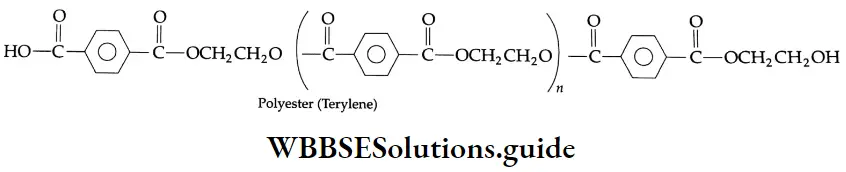
Rate of overall reaction α rate of slow step reaction (1)

α[substrate]

The rate of the reaction is dependent on the concentration of the substrate molecule only and is independent of the concentration of the nucleophile because the nucleophile becomes involved only after the rate-determining step. Thus the reaction is unimolecular and is termed SN1—S stands for substitution, N for nucleophilic and 1 indicates that the reaction is unimolecular.

Example s of SN1 reactions Tertiary halides usually undergo SN1 displacements. For Example, f-butyl bromide is hydrolysed to f-butyl alcohol through an unimolecular process.

⇒ \(\left(\mathrm{CH}_3\right)_3 \mathrm{C}-\mathrm{Br} \stackrel{\mathrm{O}}{\longrightarrow}\left(\mathrm{CH}_3\right)_3 \mathrm{C}-\mathrm{OH}+\stackrel{\ominus}{\mathrm{Br}}\)

The rate of the reaction depends only on the concentration of the alkyl halide and is independent of the concentration of the added nucleophile. The reaction occurs according to the following rate equation:

Rate=K1[(CH3)3C—Br]

The mechanism of the reaction involves two steps. In the first step, the halide ionises to form an intermediate carbonium ion, which then readily combines with the nucleophile to form the product.

Basic chemistry Class 12 Chapter 10 Haloalkanes and Haloarenes The mechanism of the reaction involves two steps.

It might seem that the addition of a nucleophile, i.e., an \(\mathrm{O} \stackrel{\ominus}{\mathrm{H}}\) ion, would affect the rate of the reaction in Step 2. But this step is so much faster than Step 1 that the effective rate measured is that of Step 1, i.e., the ionisation step.

Tertiary alkyl halides undergo SN1 reactions very fast because of the high stability of tertiary carbonium ions. The order of reactivity of alkyl halides in the case of SN1 reactions is tertiary halide > secondary halide > primary halide.

Allylic and benzylic halides undergo SN1 reactions in which the intermediate carbonium ion is stabilised by resonance.

Basic chemistry Class 12 Chapter 10 Haloalkanes and Haloarenes Allylic and benzylic halides

There are some nucleophilic substitution reactions in which the substrate (R L) as well as the nucleophile \(: \stackrel{\ominus}{N u}\) take part in the rate-determining step. In such a case, the nucleophile attacks the carbon atoms from the side opposite to that of the leaving group and forms a pentavalent transition state which finally collapses to give the product (R—Nu) and the leaving group \(\text { (: } \stackrel{\ominus}{\mathrm{L}})\)

⇒ \(: \stackrel{\ominus}{N u}+R-L \frac{\text { slow }}{\text { (a) }}[\mathrm{Nu}–\mathrm{R}–\mathrm{L}] \underset{\text { (b) }}{\stackrel{\text { fast }}{\rightarrow}} \mathrm{Nu}-\mathrm{R}-: \stackrel{\ominus}{\mathrm{L}}\)

Definition and classification of haloalkanes with examples

The rate of the reaction depends upon the concentration of the substrate (R—L) as well as that of the nucleophile \(\text { (: } \stackrel{\ominus}{\mathrm{Nu}})\) both the reactants being involved in the rate-determining step (a).

Rate of reaction α rate of slow step (a)
⇒ \(\propto[R-L][\stackrel{\ominus}{N u}]\)

Since the rate of the reaction is dependent on the concentration of the substrate and that of the nucleophile, the reaction is bimolecular and is termed an SN2 reaction, 2 indicating that the reaction is bimolecular.

Example s of SN2 reactions Primary halides usually undergo SN2 reactions. For Example, methyl bromide is hydrolysed to methyl alcohol upon reacting with an aqueous solution of sodium hydroxide. The hydroxide ion displaces the bromide ion.

Basic chemistry Class 12 Chapter 10 Haloalkanes and Haloarenes The hydroxide ion displaces the bromide ion.

[The solid wedge represents the bond above the plane of the paper, the dashed line below the plane of the paper and a straight line represents a bond on the plane of the paper.]

The hydroxide ion attacks the carbon atom bearing the leaving group from behind and the bromide ion

departs from the opposite side. In the transition state, the \(\mathrm{O} \stackrel{\ominus}{\mathrm{H}}\) ion and the \(\stackrel{\ominus}{\mathrm{Br}}\) ion is only partially bonded to the central carbon atom. Finally, a new covalent bond is formed between the hydroxide ion and the carbon atom with the loss of the bromide ion.

Methyl halides undergo SN2 reactions most rapidly because there are only three small hydrogen atoms Tertiary halides are the least reactive because bulky alkyl groups slow down the approaching nucleophiles. The order of reactivity of alkyl halides in the case of SN2 reactions is primary halide > secondary halide > tertiary halide.

Basic chemistry Class 12 Chapter 10 Haloalkanes and Haloarenes Methyl halides

Stereochemical aspect of nucleophilic substitution reactions

Before discussing the stereochemical aspect of nucleophilic substitution reactions in detail, it is useful to discuss some terms used in optical isomerism such as optical activity, chirality, retention of configuration, inversion of configuration and racemisation.

Plane polarised light and optical activity An ordinary beam of light vibrates in all directions. A plane of polarised light is one which vibrates entirely in one direction. An ordinary beam of light can be converted to a plane polarised light by passing it through a specially constructed prism, called Nicol prism. Certain compounds may rotate the plane polarised light either to the left (anticlockwise) or to the right (clockwise).

Compounds which rotate plane polarised light to the left are said to be laevorotatory or of the 1-form. The degree of rotation of light in such cases is prefixed by a – (minus) sign. If the light is rotated to the right, the compound is said to be dextrorotatory or of the d-form. The degree of rotation of light in such cases is prefixed by a + (plus) sign.

The el¬ and /- isomers of a compound are known as optical isomers and the phenomenon is termed optical isomerism. The optical activity of a compound is identified and estimated by an instrument known as a polarimeter.

Enantiomers, diastereomers and chirality Enantiomers are structures that are not identical but are mirror images of each other.

Stereoisomers that are not mirror images of one another are called diastereoisomers. The term diastereoisomer is sometimes shortened to diastereomer.

Basic chemistry Class 12 Chapter 10 Haloalkanes and Haloarenes Stereoisomers that are not mirror images of one another are called diastereoisomers.

1 and 3 form a pair of enantiomers. I and 2, and II and IE, form a pair of diastereomers. Structures are said to be chiral if they cannot be superimposed on their mirror images. A hand cannot be superimposed on its mirror image.

If you hold your left hand up to a mirror, the image looks like a right hand. When we try to superimpose our hands on each other, we simply cannot do so. A hand and a foot are chiral objects whereas a ball and a glass are achiral objects. Achiral structures are superimposable in their mirror images.

Basic chemistry Class 12 Chapter 10 Haloalkanes and Haloarenes A hand and a foot are chiral objects whereas a ball and a glass are achiral objects.

A carbon atom carrying four different groups is a chiral carbon. Such a carbon is sometimes also referred to as an asymmetric carbon atom. For Example,

Basic chemistry Class 12 Chapter 10 Haloalkanes and Haloarenes A carbon atom carrying four different groups is a chiral carbon.

The asymmetric carbon atoms are indicated by a star (*).

Examples of achiral carbon-containing compounds:

Basic chemistry Class 12 Chapter 10 Haloalkanes and Haloarenes Examples of achiral carbon-containing compounds

Inversion, retention and racemisation To understand these terms consider the following general reaction.

Basic chemistry Class 12 Chapter 10 Haloalkanes and Haloarenes Inversion, retention and racemisation To understand these terms consider the following general reaction.

If (2) is obtained the process is called retention of configuration because (1) and (2) have a similar configuration. If (3) is obtained the process is known as inversion of configuration because the configuration of 3 is inverted with respect to (1).

If a 50: 50 mixture of (2) and (3) is obtained then the process is called racemisation. The resulting racemic product is optically inactive as one isomer will rotate plane polarised light in the direction opposite to that in which the other isomer will.

Now let us consider the stereochemical aspect of SN1 and SN2 reactions taking the Example of optically active alkyl halides.

In the case of optically active alkyl halides, an SN1 reaction involves racemisation, i.e., an equimolecular mixture of the d- and l- isomers is produced. This is possible because the carbonium ion formed as an intermediate in

Basic chemistry Class 12 Chapter 10 Haloalkanes and Haloarenes 1-Phenylethyl bromide racemic mixture

The rate-determining step has an equal chance of being attacked from both sides, giving one isomer having the same configuration and the other having the opposite configuration. This process may be illustrated by citing the Example of the hydrolysis of I-phenyl ethyl bromide.

However, the SN2 reaction of an optically active compound proceeds with a complete inversion of configuration. This is because the nucleophile will be linked to the opposite side with respect to the leaving group (halide ion) in an optically active alkyl halide.

This process may be illustrated by citing the Example of the hydrolysis of 2-bromooctane. The hydrolysis of the optically active 2-bromooctane with sodium hydroxide gives the optically active 2-octanol with an inverted configuration.

Such reactions are generally accompanied by a change in optical rotation and its direction as well. It is termed as Walden inversion or flipping. The reaction may be likened to an umbrella flipping in a high wind, the attacking nucleophile being analogous to a high wind.

Basic chemistry Class 12 Chapter 10 Haloalkanes and Haloarenes Inversion of configuration

SN2 vs SN1

The two mechanisms termed SN1 and SN2 are the extremes.

The solvent, substrate structure, nucleophile and, to a lesser extent, the leaving group and reaction temperature, nil contribute to determining the mechanism. We shall briefly examine the effect of some of these parameters.

Solvent A reaction is favoured by an ionising solvent whose dielectric constant is high. Ionising solvents accelerate the rate of an SN1 reaction while that of an SN2 reaction is relatively solvent-independent. Substrate structure In SN2 reactions the order of reactivity of various alkyl halides follows the sequence

CH3 —X > primary > secondary > tertiary

In contrast to SN2 reactions, the sequence of reactivity of alkyl halides follows the following order in SN1 reactions.

Tertiary > secondary > primary > CH3 —X.

Nucleophile While the nature of the nucleophile does not alter the rate of an SN1 reaction, that of an SN2 reaction is altered by the nucleophile. The high concentration of a good nucleophile will favour an SN2 reaction.

Elimination Reactions

A reaction involving the loss of two atoms or groups from a molecule, without there being any substitution b) other atoms or groups, is known as an elimination reaction. This is the reverse of an addition reaction.

Most commonly a proton is lost from one carbon whereas a nucleophile is lost from the adjacent carbon; these tw< carbon atoms are usually referred to as |i- and a-carbons respectively.

Basic chemistry Class 12 Chapter 10 Haloalkanes and Haloarenes Elimination reactions

The reaction is known as a reaction or 1, 2-elimination reaction.

Orientation in an elimination reaction

Sometimes elimination reactions lead to mixtures of alkene products; usually, one alkene is formed as a major product and the other as a minor product. There are two empirical rules governing orientation in those reactions.

1. Saytzev rule (Zaitsev rule) states that an alkyl halide capable of forming a double bond in either direction of the chain preferably yields that alkene in which there are a greater number of alkyl groups attached to the double bond. That is, the more substituted olefin is formed as the major product. For Example, 2-bromobutane gives 2-butene as the major product.

Basic chemistry Class 12 Chapter 10 Haloalkanes and Haloarenes . Saytzev rule

The stability of alkenes follows the order

R2C=CR2>R2C=CHR>RCH=CHR>RCH=CH2>CH2=CH2

The greater stability of the more-substituted alkene is explained on the basis of hyperconjugation.

Basic chemistry Class 12 Chapter 10 Haloalkanes and Haloarenes basis of hyperconjugation.

The number of resonating structures increases in more-substituted alkenes and consequently increases stability.

2. The Hofmann rule states that quaternary ammonium salts yield predominantly the least-substituted alkene.

Basic chemistry Class 12 Chapter 10 Haloalkanes and Haloarenes The Hofmann rule

In this case, the hydroxide ion abstracts a proton from the β-carbon, resulting in the formation of a double bond and expulsion of a tertiary amine.

Basic chemistry Class 12 Chapter 10 Haloalkanes and Haloarenes If a quaternary ammonium salt has ethyl as well as propyl groups

If a quaternary ammonium salt has ethyl as well as propyl groups attached to the positively charged nitrogen the propyl group shows relatively little tendency to lose a β-hydrogen.

Basic chemistry Class 12 Chapter 10 Haloalkanes and Haloarenes If a quaternary ammonium salt has ethyl as well as propyl groups

Let us now see how the nature of the nucleophile determines whether a reaction will be a substitution read or an elimination reaction.

Basicity

The more basic the nucleophile the more likely is that elimination will replace substitution as the main reaction of an alkyl halide.

For Example,

Basic chemistry Class 12 Chapter 10 Haloalkanes and Haloarenes Basicity

Size

One of the best bulkier bases for promoting elimination and avoiding substitution is potassium f-butoxide. The large alkyl substituent makes it hard for the negatively charged oxygen to attack carbon in a substitution reaction but it has no problem attacking hydrogen.

Small nucleophile—substitution

Basic chemistry Class 12 Chapter 10 Haloalkanes and Haloarenes Small nucleophile—substitution

Large nucleophile—elimination

Basic chemistry Class 12 Chapter 10 Haloalkanes and Haloarenes Large nucleophile—elimination

Example Among the following, which alkyl halide would you expect to react more rapidly by the SN2 mechanist Explain.

Basic chemistry Class 12 Chapter 10 Haloalkanes and Haloarenes Among the following

Basic chemistry Class 12 Chapter 10 Haloalkanes and Haloarenes because it is a primary halide.

Basic chemistry Class 12 Chapter 10 Haloalkanes and Haloarenes Among the following.

Basic chemistry Class 12 Chapter 10 Haloalkanes and Haloarenes because the bromide ion is a better leaving group.

Example Which of the following SN1 reactions would you expect to take place more rapidly? Explain.

Basic chemistry Class 12 Chapter 10 Haloalkanes and Haloarenes reactions would you expect to take place more rapidly

Solution (1), is because water is more polar than CH3OH.

Example Suggest a reagent (or reagents), and state the type of reaction and mechanism involved for each of the following transformations.

1. CH3CH2— Br -> CH3CH2N(CH3)3

Basic chemistry Class 12 Chapter 10 Haloalkanes and Haloarenes Suggest a reagent

2. CH3CH2Br -> CH3CH2CN

Basic chemistry Class 12 Chapter 10 Haloalkanes and Haloarenes Suggest a reagent .

Example Write the structure of the expected product. Indicate the type of reaction and the mechanism involved.

Solution

Basic chemistry Class 12 Chapter 10 Haloalkanes and Haloarenes Hofmann elimination

Temperature

Temperature has an important role to play in deciding whether a reaction is an elimination or a substitution reaction. Elimination is favoured at high temperatures.

Reaction With Metals

1. Alkyl halides react with metallic sodium in dry ether to form alkanes containing an even number of carbon atoms.

⇒ \(2 \mathrm{C}_2 \mathrm{H}_5-\mathrm{I}+2 \mathrm{Na} \longrightarrow \underset{\text { Butane }}{\mathrm{CH}_3-\mathrm{CH}_2-\mathrm{CH}_3+2 \mathrm{NaI}}\)

This reaction is known as the Wurtz reaction.

Mechanism The reaction is believed to proceed through a nucleophilic attack by the alkyl ion on the alkyl halide.

Basic chemistry Class 12 Chapter 10 Haloalkanes and Haloarenes the alkyl ion on the alkyl halide.

2. Alkyl halides react with metallic zinc in dry ether to form an alkane containing an even number of carbon atoms.

Nomenclature of haloalkanes – IUPAC rules and common names

⇒ \(2 \mathrm{CH}_3 \mathrm{CH}_2 \mathrm{I}+\mathrm{Zn} \longrightarrow \mathrm{CH}_3 \mathrm{CH}_2 \mathrm{CH}_2 \mathrm{CH}_3+\mathrm{ZnI}_2\)

This is called the Frankland reaction.

Mechanism

Basic chemistry Class 12 Chapter 10 Haloalkanes and Haloarenes Frankland reaction

3. When alkyl or aryl halides are refluxed with magnesium in dry ether, alkyl or aryl magnesium halides (R—Mg—X) are formed. They are known as Grignard reagents. They are organometallic compounds. (The metal magnesium is attached to the carbon.)

⇒ \(\mathrm{R}-\mathrm{X}+\mathrm{Mg} \stackrel{\text { dry ether }}{\longrightarrow} \underset{(\mathrm{R}=\text { alkyl, aryl) }}{\mathrm{R}-\mathrm{Mg}-\mathrm{X}}\)

⇒ \(\mathrm{C}_2 \mathrm{H}_5 \mathrm{Br}+\mathrm{Mg} \underset{\text { ether }}{\stackrel{\text { dry }}{\longrightarrow}} \mathrm{C}_2 \mathrm{H}_5 \mathrm{MgBr}\)

⇒ \(\mathrm{C}_6 \mathrm{H}_5 \mathrm{Br}+\mathrm{Mg} \underset{\text { ether }}{\stackrel{\text { dry }}{\longrightarrow}} \mathrm{C}_6 \mathrm{H}_5 \mathrm{MgBr}\)

Grignard reagents form loose covalent bonds with the solvent ether molecules and form solutions in ether.

Basic chemistry Class 12 Chapter 10 Haloalkanes and Haloarenes Grignard reagent-ether solvate

Since the electronegativities of magnesium and carbon are very different, the Grignard reagents may 1 regarded as polar compounds which are sources of nucleophilic carbanions R.

⇒ \(\stackrel{\delta-}{\mathrm{R}}-\stackrel{\delta_{+}^{+}}{\mathrm{Mg}}-\mathrm{X} \longrightarrow \stackrel{\ominus}{\mathrm{R}}+\stackrel{+}{\mathrm{M} g X}\)

Example Is (CH3)3 CO K+ an organometallic compound? If not, why?

Solution

No, the metal is bonded to an oxygen, not a carbon. This is an example of an alkoxide salt.

Haloarenes

Aryl halides (haloarenes) are those compounds in which the halogen atom (F, Cl, Br, I) is attached directly benzene ring. Unlike alkyl halides, these compounds are characterised by their relative inertness towards r common nucleophiles.

Nomenclature

Simple aryl halides are named by prefixing the halo derivative to the word benzene, for example, iodobenzene. The three disubstituted isomers are differentiated by the use of ortho-, meta- and para-.

Basic chemistry Class 12 Chapter 10 Haloalkanes and Haloarenes Nomenclature

Numbering, however, is required when more than two halo atoms or other substituents are attached to the ring.

Basic chemistry Class 12 Chapter 10 Haloalkanes and Haloarenes Iodobenzene

Iodobenzene m-Dichlorobenzene 2-Bromol, 4-dimethylbenzene

Methods Of Preparation

Halogenation

The chlorination or bromination of benzene is carried out at an ordinary temperature in the presence of iron or a Lewis acid (AICI3 or FeCI3 ).

Basic chemistry Class 12 Chapter 10 Haloalkanes and Haloarenes Methods of preparation

From diazonium salts

This is the most general method used to prepare all types of aryl halides. An aromatic amine is first diazotised. The diazonium salt can then be reacted with a metal halide to obtain the aryl halide.

Aryl chlorides and bromides are conveniently prepared by the treatment of a freshly prepared solution of diazonium salt with cuprous chloride or cuprous bromide. This is known as the Sandmeyer reaction.

Basic chemistry Class 12 Chapter 10 Haloalkanes and Haloarenes From diazonium salts

Aryl iodides are, however, obtained by treating the diazonium salt with aqueous potassium iodide.

Basic chemistry Class 12 Chapter 10 Haloalkanes and Haloarenes potassium iodide.

For the preparation of aryl fluorides, the solution of benediazonium chloride is treated with fluoroboric acid, HBF4. The solid benzene diazonium fluoroborate, ArN2+BF4, which precipitates out, is filtered, washed and dried. When heated, the fluoroborate decomposes to give the aryl fluoride.

Basic chemistry Class 12 Chapter 10 Haloalkanes and Haloarenes The solid benzenedlazonium fluoroborate

Hunsdlockor reaction

Aryl bromides are obtained by heating the silver salts of aromatic acids with bromine.

Basic chemistry Class 12 Chapter 10 Haloalkanes and Haloarenes Hunsdlockor reaction


Physical Properties

Aryl halides are polar. They are insoluble in water. For aryl halides having the same aryl group but different halogen atoms, the melting and boiling points increase with the increase in molecular weight.

For Example, the melting point of iodobenzene is the highest and that of fluorobenzene is the lowest, p-isomers, being symmetrical, have high melting points. They are better packed in the crystal lattice.

Chemical Reactions

Nucleophilic substitution

Aryl halides do not generally undergo nucleophilic substitution reactions due to the following reasons.

1. Resonance effect In an aryl halide, the electron pair on the halogen atom is in conjugation with the benzene ring.

Basic chemistry Class 12 Chapter 10 Haloalkanes and Haloarenes Chemical reactions

This gives the C—Cl bond a double bond character and thus the bond length decreases. The shorter the bond length, the greater the bond strength and the lower the reactivity. Thus, under ordinary conditions, a nucleophilic attack does not take place.

2. In an alkyl halide, the carbon attached to the halogen is sp3 -sp3-hybridised. However, in an aryl halide, the carbon attached to the halogen is sp2 -sp2 -hybridised. The sp2 -sp2 -hybridised carbon with greater s-character is electronegative. Thus, the breaking of the C—X bond becomes difficult.

Basic chemistry Class 12 Chapter 10 Haloalkanes and Haloarenes the breaking of the C—X bond becomes difficult

However, nucleophilic substitution reactions of aryl halides are possible in extreme conditions

1. Substitution by hydroxyl group On being heated with aqueous sodium hydroxide at 613 K and 300 atm, chlorobenzene gives phenol.

Basic chemistry Class 12 Chapter 10 Haloalkanes and Haloarenes Substitution by hydroxyl group

2. Substitution by the amino group The reaction of chlorobenzene with ammonia at high temperature (573 K) and high pressure yields aniline.

Basic chemistry Class 12 Chapter 10 Haloalkanes and Haloarenes Substitution by amino group

3. Substitution by the —CN group On being heated in the presence of cuprous cyanide at 473 K, chlorobenzene gives benzonitrile (phenyl cyanide).

Basic chemistry Class 12 Chapter 10 Haloalkanes and Haloarenes Substitution by the —CN group

The above reactions 1-3 take place easily when electron-attracting groups such as —NO2, — C = N and —SO3 H are present at the ortho- and para-positions. Note the condition of the reactions.

Basic chemistry Class 12 Chapter 10 Haloalkanes and Haloarenes the ortho- and para- positions

The presence of an electron-withdrawing group at the 0- and p- positions increases the rate. The presence of an electron-attracting group on any position of the ring does not increase the rate equally. No effect on the reactivity of an aryl halide is observed by the presence of an electron-withdrawing group at the m- position.

The mechanism is as follows.

Basic chemistry Class 12 Chapter 10 Haloalkanes and Haloarenes the presence of an electron-withdrawing group at the m- position.

The presence of a nitro group at the 0- and p- positions withdraws the electron cloud from the benzene ring. As a result, the attack of the nucleophile on a halobenzene becomes easier. The resulting carbanion thus formed gets stabilised through resonance.

Preparation of haloalkanes from alcohols and hydrocarbons

The negative charge appearing at the 0- and p- positions (see structure X) with respect to the halogen substituent is also stabilised by the nitro group through resonance. In the case of m-nitrobenzene, none of the resonating structures bears a negative charge on the carbon atom bearing the nitro group.

The presence of the nitro group at the m- position therefore does not stabilise the negative charge and hence they do not undergo nucleophilic substitution easily.

Electrophilic substitution

The benzene ring of an aryl halide undergoes the usual electrophilic substitution reactions such as halogenation, nitration, sulphonation and Friedel-Crafts reactions. In an aryl halide, the halogen atom deactivates the ring due to its more electronegative character but at the same time, it is 0- and p- directing as is evident from the resonating structures of aryl halides.

Basic chemistry Class 12 Chapter 10 Haloalkanes and Haloarenes Electrophilic substitution

Due to resonance, the electron density increases more at the 0- and p- positions than at the m- position. Tt electrophilic substitution reactions in aryl halides require slightly more extreme conditions as compared to those in benzene.

1. Halogenation

Basic chemistry Class 12 Chapter 10 Haloalkanes and Haloarenes Halogenation

2. Nitration

Basic chemistry Class 12 Chapter 10 Haloalkanes and Haloarenes Nitration

3. Sulphonation

Basic chemistry Class 12 Chapter 10 Haloalkanes and Haloarenes Sulphonation

4. Friedel-Crafts reaction

Basic chemistry Class 12 Chapter 10 Haloalkanes and Haloarenes Friedel-Crafts reaction

Example Chlorine is an electron-withdrawing group. Yet it is 0- and p- directing in electrophilic substitution reactions. Why?

Solution:

Chlorine withdraws electrons through the -I-effect and releases electrons through resonance. In electrophilic reactions, chlorine cannot stabilise the following carbocation through the -I-effect.

Basic chemistry Class 12 Chapter 10 Haloalkanes and Haloarenes Chlorine is an electron-withdrawing group.

Through resonance, chlorine in chlorobenzenes makes the ortho- and para- para–intermediates more stable.

Basic chemistry Class 12 Chapter 10 Haloalkanes and Haloarenes chlorine in chlorobenzenes makes the ortho- and para- intermediates more stable.

Basic chemistry Class 12 Chapter 10 Haloalkanes and Haloarenes chlorine in chlorobenzenes makes the ortho- and para- intermediates more stable

Reactions with metals

1. Wurtz-Fittig reaction On being heated with an alkyl halide and metallic sodium in dry ether, an aryl halide yields alkyl benzene. This reaction is called the Wurtz-Fittig reaction.

Basic chemistry Class 12 Chapter 10 Haloalkanes and Haloarenes Reactions with metals

2. Fittig reaction Two molecules of an aryl halide, on being heated with sodium in the presence of dry ether, give diphenyl. This reaction is called the Fittig reaction.

Basic chemistry Class 12 Chapter 10 Haloalkanes and Haloarenes Fittig reaction

Polyhalogen Compounds

Dichloromethane (methylene chloride)

Dichloromethane is widely used as a

  1. Solvent.
  2. Paint Remover.
  3. Propellent In Aerosols.

A high concentration of methylene chloride in the air may cause dizziness, nausea and numbness of fingers and toes.

Methylene chloride has to be handled with care. Direct contact with the eyes can bum the cornea and direct contact with the skin may cause intense burning and mild redness of the skin. Methylene chloride also affects our central nervous system.

Trichloromethane (chloroform)

Chloroform is used as a solvent for fats, waxes, resins, etc. Fortified by alcohol, it finds use as a general anaesthetic, but its use is discouraged because of its harmful side effects such as nausea and liver toxicity.

The major use of chloroform is in the production of the refrigerant freon. Inhaling chloroform causes dizziness and headache. Chloroform is slowly oxidised by air in the presence of light to an extremely poisonous gas, carbonyl chloride, also known as phosgene. It is, therefore, stored in closed, dark bottles.

⇒ \(2 \mathrm{CHCl}_3+\mathrm{O}_2 \stackrel{\text { light }}{\longrightarrow} \underset{\text { Phosgene }}{2 \mathrm{COCl}_2}+2 \mathrm{HCl}\)

Triiodomethane (iodoform)

It is used as an antiseptic. Due to its bad smell, it has been replaced by other formulations containing iodine, such as tincture iodine.

Tetrachloromethane (carbon tetrachloride)

Carbon tetrachloride is used

  1. As A Fire Extinguisher Under The Name Pyrene.
  2. As A Refrigerant.
  3. In The Synthesis Of Chlorofluorocarbons.
  4. As A Dry-Cleaning Agent.

Exposure to CCI4 causes liver cancer. It also causes dizziness, nausea and vomiting. 1’his chemical may irritate the eyes on contact.

Freons

The chlorofluorocarbon compounds of methane and ethane are collectively known as freons. They are used extensively as noncorrosive coolants, lubricants and nonpoisonous fire extinguishing liquids. They are also used as aerosol propellants, and for refrigeration and air-conditioning purposes.’

Freons and ozone depletion The ozone (O3) layer in the stratosphere shields the earth from ultraviolet (UV) radiation that is harmful to living organisms.

Freons often make their way into the troposphere and diffuse unchanged into the stratosphere. They initiate a free-radical chain reaction that can upset the natural ozone balance. The reactions are as follows:

⇒ \(\mathrm{CFCl}_3+h v \rightarrow \dot{\mathrm{C} F C l}{ }_2+\dot{\mathrm{C}} \mathrm{l}\)

⇒ \(\dot{\mathrm{Cl}}+\mathrm{O}_3 \rightarrow \mathrm{ClO}+\mathrm{O}_2\)

⇒ \(\mathrm{ClO}+\mathrm{O} \rightarrow \mathrm{O}_2+\dot{\mathrm{Cl}}\)

In the chain-initiating step, UV light causes the homolytic cleavage of one C—Cl bond of the freon. The chlorine atom destroys thousands of molecules of O3 before it diffuses out of the stratosphere or reacts with other substances. This reaction, therefore, is responsible for the depletion of the ozone layer.

DDT (p, p’-dichlorodiphenyltrichloroethane)

DDT is used as an insecticide. It is effective against mosquitoes that spread malaria. The use of DDT is banned in many countries because it is harmful and non-biodegradable.

Haloalkanes And Haloarenes Multiple-Choice Questions

Question 1. Which of the following is an aryl halide?

Basic chemistry Class 12 Chapter 10 Haloalkanes and Haloarenes aryl halide

Answer: 4.

Basic chemistry Class 12 Chapter 10 Haloalkanes and Haloarenes aryl halide.

Question 2. Which of the following is an allyl halide?

  1. CH2 = CH—Cl
  2. HC = C—CH2CI
  3. CH2 = CH—CHCICH3
  4. CH2 = CH—CH2CH2CI

Answer: 3. HC = C—CH2CI

Question 3. Which of the following is a vinyl halide?

  1. CH2 = CH—CHB1CH3
  2. CH3—C(Br) = CH2
  3. CH2 = CH—CH2—CH2—Cl
  4. HC H C—Br

Answer: 2. CH3—C(Br) = CH2

Question 4. How many isomers (including stereoisomers) are possible for C4H9Br?

  1. 3
  2. 2
  3. 4
  4. 5

Answer: 4. 5

Question 5. How many isomers does C5H11CI have?

  1. 3
  2. 4
  3. 6
  4. 8

Answer: 4. 8

Question 6. The reaction of ethyl bromide with metallic sodium in dry ether gives

  1. Ethane
  2. Butane
  3. Propane
  4. Ethylene

Answer: 2. Butane

Question 7. Which of the following is used as an anaesthetic agent?

  1. Chloroform
  2. Iodoform
  3. Acetylene
  4. Methane

Answer: 1. Chloroform

Question 8. On being boiled with alcoholic KOH, ethyl bromide gives

  1. Ethyl Alcohol
  2. Ethylene
  3. Acetylene
  4. Methane

Answer: 2. Ethylene

Question 9. The IUPAC name of secondary butyl chloride is

  1. 3-chloroquine
  2. 1-chloro-2-methylpropane
  3. 2-chloroquine
  4. 2-chloro-2-methylpropnne

Answer: 2.1-chloro-2-methylpropane

Question 10. The reaction CH3CH2Br + OH→CH3CH2OH + Br   is

  1. SN1
  2. SN2
  3. Elimination Reaction
  4. None Of These

Answer: 2. SN2

Question 11. The conversion of ethyl bromide to alcohol using aqueous KOH is an Example of

  1. An Addition Reaction
  2. A Substitution Reaction
  3. Dehydrohalogenation
  4. An Elimination Reaction

Answer: 2. A Substitution Reaction

Question 12. The products of the reaction (CH3)3C— Br + CH3ONa→ are

  1. (CH3)3C—ONa + CH3Br
  2. (CH3)2C = CH2 + CH3OH + NaBr
  3. (CH3)3C—OCH3 + NaBr
  4. (CH3)3C—CH2OH + NaBr

Answer: 3. (CH3)3C—OCH3 + NaBr

Question 13. The reaction of (CH3)3CMgCl with D2O gives

  1. (CH3)3CD
  2. (CH3)3COD
  3. (CD3)3CD
  4. (CD3)3OD

Answer: 1. (CH3)3CD

Question 14. Which of the following is a refrigerant?

  1. COCl2
  2. CCl4
  3. CF4
  4. CF2Cl2

Answer: 4. CF2Cl2

Question 15. Which of the following has a high dipole moment?

  1. CH3CI
  2. CH2CI2
  3. CHCI3
  4. CCI4

Answer: 1. CH3CI

Physical and chemical properties of haloalkanes

Question 16. On being heated with aqueous NaOH, chloroform gives

  1. CH3COONa
  2. HCOONa
  3. CH3OH
  4. HCOOH

Answer: 2. HCOONa

Question 17. The main product of

  1. Basic chemistry Class 12 Chapter 10 Haloalkanes and Haloarenes main product
  2. CH3CH=CHCH3
  3. CH2=CH—CH2—CH3152.00 ne of these
  4. No Golden Passport to Hindi for Class 11

Answer: 2. CH3CH=CHCH3

Question 18. DDT is

  1. An Insecticide
  2. Biodegradable
  3. Nonbiodegradable
  4. None Of These

Answer: 1. An Insecticide

Coordination Compounds And Organometallics Notes

Coordination Compounds And Organometallics

Coordination Compounds:

One of the characteristic features of transition elements is their ability to form coordination compounds or complexes. Haemoglobin in blood, chlorophyll in plants, dyes and vitamin B12 are all examples of coordination compounds.

Coordination compounds find manifold applications in chemical analysis, chemical industry, metallurgical processes and medicinal chemistry. The challenging field of bioinorganic chemistry, i.e., the application of inorganic chemistry to living systems, also deals with coordination compounds.

In this chapter, we shall study some aspects of this important class of compounds as well as a new class of compounds—organometallic compounds, which contain metal-carbon bonds.

Coordination Compounds

Coordination compounds are addition compounds and are formed by the addition of stoichiometric amounts of two or more stable compounds. Double salts are also addition compounds but they exist in the crystalline state lose their identity in solution and dissociate into simple ions. In contrast, coordination compounds or complexes retain their identity in solution.

Alcohol, phenol, and ether class 12 chemistry notes

Mohr’s salt [FeSO4.(NH4)2SO4 -6H2O] and potash alum [K2SO4.AI2(SO4)3 -24H2O] are double salts. A solution of Mohr’s salt cannot be distinguished from a solution obtained by mixing ferrous sulphate and ammonium sulphate since both contain Fe2+, NH4 and SO4 ions.

Unlike double salts, coordination compounds do not dissociate in solution. When aqueous ammonia is added to copper(2) sulphate solution, a dark blue colouration is obtained. The addition of alcohol to the solution results in the precipitation of tetraammine copper(2) sulphate as dark blue needle-shaped crystals.

⇒ \(\mathrm{CuSO}_4+4 \mathrm{NH}_3+\mathrm{H}_2 \mathrm{O} \rightarrow \mathrm{CuSO}_4 \cdot 4 \mathrm{NH}_3 \cdot \mathrm{H}_2 \mathrm{O}\)
Tetraammine copper(2) sulphate monohydrate

This is a coordination compound represented as [Cu(NH3 )4]SO4. On dissociation, it forms [Cu(NH3)4]2+ and SO2– ions and thereby retains its identity.

Another example of a coordination compound is potassium hexacyanoferrate(2), also called potassium ferrocyanide, K4[Fe(CN)6]. This on dissolution produces K+ and [Fe(CN)6]4 ions. The complex ion does not dissociate further to give Fe2+ and CN.

Coordination Compounds And Organometallics Notes

Important terms used In the context of coordination compounds

Coordination entity (complex) A coordination entity or complex comprises a central metal atom or ion attached to and surrounded by a group of anions or neutral molecules. These ions or molecules are called ligands and they can donate an electron pair to the central atom or ion, for example [Cu(NH3)4]2+, [Fe(H2O)6]2+ and [Fe(CN)6]4-.

A coordination entity may be cationic if it has a net positive charge, for example, [CO(NF3)4Cl2]+, and anionic if it bears a negative charge, for example [Ag(CN)2] or electrically neutral, example [Pt(NH3)2Cl2]. These are also called molecular complexes.

Classification of alcohols, phenols, and ethers with examples

Central atom/ion The metal atom or cation of a coordination entity to which a fixed number of ligands or electron pair donors are attached is called the central atom/ion. For example, the complexes [Cu(NH3)]2+ and [FeCl6]3-, the central ions are Cu2+ and Fe3+ respectively.

Ligands A ligand is a neutral or anionic species capable of donating a pair of electrons to the central metal/ion thus forming a coordinate bond. Ligands may be anions like Cl, CN, OH‘, C2O4  or neutral molecules like NH3, H2O, NH2, CH2 NCH2 NH2   (ethane-1, 2-diamine) all containing lone pair of electrons.

In a coordination entity, the ligand acts as a Lewis base (electron-pair donor) and the metal atom/ion as a Lewis acid (electron-pair acceptor).

Coordination number The total number of sigma bonds formed by ligands surrounding the metal ion is called the coordination number of the central atom/ion. For example, the coordination number of platinum in [Pt (: NH3)4]2+ is 4.

The sigma bonding electrons can be represented as dots preceding the donor atom.

Remember that pi-bonds if any present between the ligand and the central atom/ion are not considered while determining the coordination number.

Coordination polyhedron Ligands in the complex are arranged in a fixed geometric pattern. The spatial arrangement of ligands attached around the central metal atom/ion is called the coordination polyhedron. The common shapes of coordination polyhedra are tetrahedral, square planar and octahedral. Square pyramidal and trigonal bipyramidal entities are also known.

Coordination Compounds and Organometallics Examples of coordination entities

Coordination and ionisation spheres The coordination sphere is made up of the central atom/ion and the ligand. In the formula, it is represented as enclosed in square brackets.

In the complex [Co(NH3)6]Cl3, the coordination sphere is made up of Co3+ and six NH3 molecules (ligand).

A cationic or anionic complex needs anions or cations to preserve its electrical neutrality. Such ions are called counter ions. They are not directly attached to the metal ion and are present in the ionisation sphere, for example in [CO(NH3)6 ]CI3 the ionisation sphere is made up of three C ions.

Alcohol, phenol, and ether chapter important questions and answers

The oxidation number of a central atom The oxidation number of the central metal atom is the charge it would carry if all ligands were parentheses after the name or symbol of the metal.

Some examples of coordination entities, their central atom and the oxidation number are summarised.

Coordination Compounds and Organometallics Examples of coordination entities

Types of ligands Ligands may be classified in two ways: (1) on the basis of the charge they carry, and (2) on the basis of the number of donor atoms they contain.

A ligand may be negative (Cl, F, SCN, etc.), neutral (NH3, H2O) or, very rarely, positive (NH2NH3+).

When a ligand is bound to the central metal ion through one donor atom, it is called a monodentate or unidentate ligand, for example, H2O, NH3, Cl, CN, etc. Ligands having two donor atoms are called bidentate or bidentate ligands.

Some examples of bidentate ligands are as follows:

Coordination Compounds and Organometallics Oxalate ion

The IUPAC nomenclature has accepted certain short-form notations for some legends. Some of these are ox (oxalate), gly (glycine), EDTA (ethylene diamine tetraacetic acid), en (ethane-1, 2-diamine), etc.

Ligands containing more than two donor atoms are called polydentate. These may be tridentate or tridentate having three donor atoms, tetradentate, having four donor atoms, pentadentate (five) and hexadentate (six). An important hexadentate legend is ethylenediaminetetraacetate (EDTA).

Coordination Compounds and Organometallics Ethylenediaminetetraacetate

Some ligands may have two donor atoms but the two sites are not used simultaneously. These are called ambidentate ligands, for example, the thiocyanate ion (SCN) can ligate through either the sulphur or the nitrogen atom.

Similarly, the nitrite ion (NO2) can coordinate through the nitrogen or the oxygen atom. Chelating ligands and chelates When a bidentate and a polydentate ligand bind a single metal ion using ds two or more (in the case of polydentate) donor atoms, a complex known as a chelate is formed.

Primary, secondary, and tertiary alcohols with examples

Such ligands are mlJed chelating ligands. An example of a chelate is the complex formed between ethylenediamine and Cu2+ it is represented as

Coordination Compounds and Organometallics Chelating ligands and chelates

Chelate complexes form a ring structure.

Chelating ligands form more stable complexes than those formed by monodentate ligands. This is called the chelate effect. The five-membered or six-membered rings are the most stable.

A molecule of a bidentate ligand blocks two coordinate sites whereas a tridentate ligand blocks three coordinate sites, and so on.

Structure and classification of alcohols in organic chemistry

Therefore, while calculating the coordination number of a metal ion, knowledge of the type of the ligand is important. For example, the coordination number of iron in [Fe(C2O4 )3]3+ is 6 and not 3 as oxalate is a bidentate ligand.

Homoleptic and heteroleptic complexes A homoleptic complex is one in which the metal ion is bound to only one ligand, for example [Co(H2O)6]3+. However, if a metal is bound to more than one ligand, for example, [Co(NH3)4(H2O)6]3+, it is referred to as a heteroleptic complex.

Werner’s Theory of Coordination Compounds Notes

Werner’s Coordination Theory

Alfred Werner, a Swiss chemist, won the Nobel Prize in 1913 for his work on the linkage of atoms and the coordination theory. Prior to him Tassaert had observed and noted that two stable compounds, cobalt(3) chloride and ammonia, combined to give a stable compound, CoCl3 -6NH3. A series of such compounds was then prepared and they were initially named on the basis of their colours.

Coordination Compounds and Organometallics Series of compounds formed by the reaction

Werner studied such compounds and, in 1893, proposed his coordination theory, which has been a guiding principle in the advancement of inorganic chemistry. Werner put forward his theory before the discovery of the electron and therefore had no idea about the electronic theory of valency.

The postulates of Werner’s theory are as follows.

  1. A metal exhibits two types of valency—(a) primary valency and (b) secondary valency. In modem terminology, primary valency refers to the oxidation state (number of charges on the complex ion) and secondary valency, to the coordination number. The primary valency is ionisable while the secondary valency is not.
  2. Every metal tends to satisfy both types of valency. The primary valency is satisfied by negative ions that neutralise the charge and the secondary valency by ligands (neutral molecules or negative ions).
  3. The secondary valencies are directed towards fixed positions in space.

Werner’s theory of coordination compounds class 12 notes

Such spatial arrangements are called coordination polyhedra. This leads to the definite geometry of coordination entities and explains isomerism. (Isomerism is noted in green and violet forms of CoCl3.4NH3.)

Werner designated CoCl3 -6NH3 as the coordination compound having three chlorines as primary valencies and six ammonia as secondary valencies.

Coordination Compounds and Organometallics Luteocobaltic chloride

Werner formulated the complex as (CO(NH3)6]CI3. The primary valency (Werner’s theory) or oxidation state (in modern terms) of cobalt is +3, satisfied by three chloride ions. The secondary valency or coordination number is 6, satisfied by six ammonia molecules.

The coordination sphere comprises cobalt and six NH, ligands which are nonionisable. The ionisation sphere comprises three ionisable Cl ions. The complex dissociates to give four ions, [CO(NH3)6]3+ and 3Cr.

When one mole of the compound is treated with excess silver nitrate, three moles of AgCl are precipitated. CoCl3 -5NH3 is formed from CoCl3•6NH3 by the loss of one ammonia molecule.
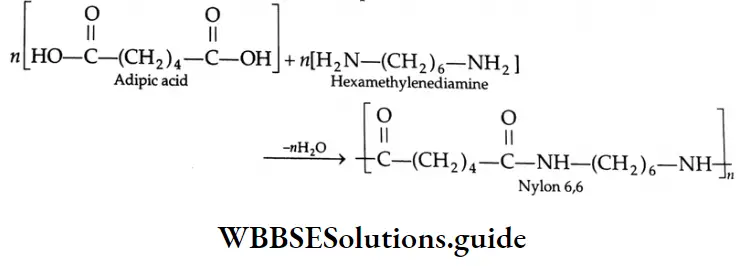
Coordination Compounds and Organometallics Praseocobaltic chloride

The complex was formulated as [Co(NH3)5CI]CI2. Werner did this in accordance with postulate 2, which states that both primary and secondary valencies must be satisfied. There are five NH3 molecules, so one Cl serves the dual purpose of satisfying primary and secondary valencies.

Such a Cl is nonionisable. On adding silver nitrate two CI ions are precipitated as AgCl and the complex ionises to give [Co[NH3)5Cl]2++ 2CI.
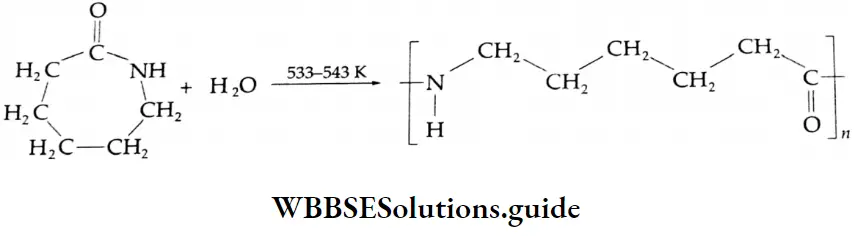
Extending the theory to CoCl3.4NH3, Werner gave the following formula for the compound: [CO(NH3)4Cl2 ]+ Cl. This gives 1 mole of AgCl with silver nitrate.
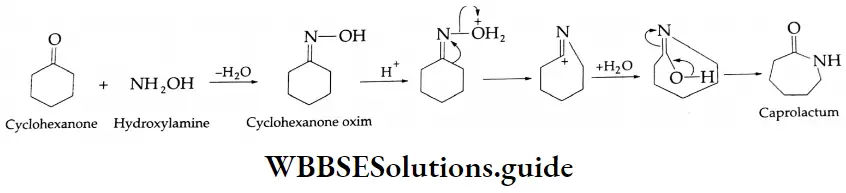
Coordination Compounds and Organometallics Praseocobaltic chloride.
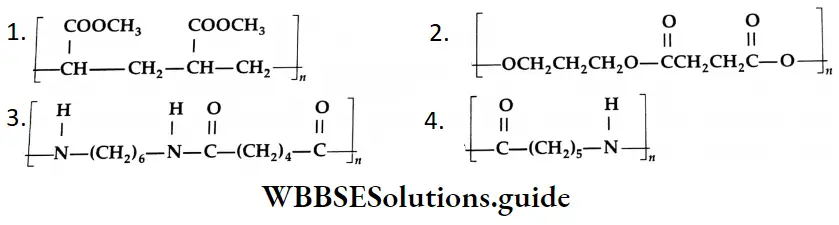
Postulate 3 of the theory deals with the stereochemistry of coordination entities. Werner suggested that six-coordinate complexes have octahedral structures whereas four-coordinate complexes have square planar or tetrahedral structures.

Werner's Theory of Coordination Compounds Notes

Example What are the coordination entities and counter ions in the given compounds? How do they ionise in solution?

⇒ \(\left[\mathrm{Cr}\left(\mathrm{NH}_3\right)_6\right] \mathrm{Cl}_3,\left[\mathrm{Co}\left(\mathrm{NH}_3\right)_3 \mathrm{Cl}_3 \mathrm{l}, \mathrm{K}_4\left[\mathrm{Fe}(\mathrm{CN})_6 \mathrm{l}, \mathrm{Na}_2\left[\mathrm{PtCl}_4 \mathrm{l}, \mathrm{Ni}(\mathrm{CO})_4, \mathrm{~K}_2\left[\mathrm{Ni}(\mathrm{CN})_4\right]\right.\right.\right.\)

Solution table

Coordination Compounds and Organometallics Coordination entities and counter ions

[CO(NH3)3CI3]and Ni(CO)4 do not have counter ions.

Example Specify the oxidation numbers of metals in the following.

  1. [Cr(CN)(H2O)(en)2]2+
  2. [PdBr4]2-
  3. [CoCI3(H2O)3]
  4. [CrCI2(en)2]+
  5. K3(Cr(CN6)]

Solution

To find the oxidation numbers of the respective metals in each case, let us assume the oxidation number to be x

(1) Oxidation state of CN = -1 and H2O and en are neutral.

∴ x-1 +0 + 0 = 2,   ∴  x = +3.

(2) The oxidation state of Br = -1.

∴ x + 4(-l) = -2

or x-4 = -2,    ∴  x = +2.

(3) The oxidation state of Cl = -1 and H2O is neutral.

x + 3{-1) + 0 = 0  or   x-3 = 0, ∴ x = +3.

(4) Oxidation state of Cl = -1 and en is neutral.

x + 2(-1) + 0 =1 or x- 2 =1,  ∴ x = +3.

(5) The oxidation state of K = +1 and

oxidation state of CN = -1.

∴  3×1+ x + 6(-1) = 0

or 3 + x- 6 = 0  or  x- 3 = 0,

.’. x = +3

Explanation of Werner’s theory in coordination chemistry

Example Write the correct formula for the following coordination compounds:

  1. CrCl3•6H2O (violet with 3 chloride ionslunit formula)
  2. CrCl3• 6H2O (light green with 2cI/unit formula)
  3. CrCl3 6H2O (dark green with1cI/unit formula)

Solution

  1. Since there are 3CI/unit formula, the primary valency of cobalt is 3 and the 3CI ions are in the ionisation sphere.
    Therefore, the formula is [Co(H2O)6]Cl3.
  2. There are 2cIin the ionisation sphere therefore formula is [Co(H2O)5CI]CI2•H2O.
  3. There is only one chloride ion in the ionisation sphere. Therefore, the formula is [Co(H2O)4Cl2]CI•H2O.

Nomenclature Of Coordination Compounds

A comprehensive system of nomenclature of coordination compounds has been given by the IUPAC. The basic rules for the systematic naming of coordination compounds are summarised as follows.

Rules For Naming A Mononuclear Complex

1. Order of listing ions The cation is named first followed by the anion. This is the normal practice while naming salt. For example,

(1) NaCl—sodium chloride

(2)[CO(NH3)6]CI3—hexaamminecobalt(HI) chloride

Here the cation is [Co(NH3)6]3+

(3) Nonionic complexes are given a one-word name

[PtCl2(NH3)2]—diamminedichoroplatinum(2)

2. Names of ligands While naming, the negative ligands end in -O, for example, chloro (Cl ) and cyano (CN)Neutral ligands have no special ending for example, aqua (H2O), ammine (NH3) and carbonyl (CO).

3. Order of listing ligands Ligands are named alphabetically prior to [CoBrCl(NH3)4]CI is called tetraammine bromochlorocobalt (3) chloride.

4. Numerical prefixes The prefixes di-, tri-, tetra-, penta-, etc., indicate the number of ligands of the same type. When the name of the ligand already includes such a prefix (like that in ethane-1, 2-diamine) t en to avoid confusion the modified prefixes bis-, tris-, tetrakis-, pentakis- are used and the ligand is p ce in parentheses.

For example, [Co(en)2]2(SO4)3 is named as bis(ethane-l, 2-diamine)cobalt(3) sulphate, ere en is NH2CH2CH2NH2.

5. Termination of names Cationic and neutral complexes have no special ending whereas anionic complexes terminate in -ate. example [Ag(NH3)2]+ is diamminesilver(1) ion and K2[PtCl6] is named potassium hexachloroplatinate(II). Sometimes Latin names of metals are used in anionic complexes.

The following examples illustrate this:

K3[Fe(CN)6] Potassium hexacyanoferrate(3)

Na2 [SnCl4] Sodium tetrachlorostannate(2)

K[AuCl4] Potassium tetrachloroaurate(1)

6. Oxidation number The oxidation number of the central metal atom is indicated in Roman numerals in parentheses after the name of the metal. In the examples given below, the oxidation number of cobalt is 3.

[CoCl2(NH3)4]NO3 Tetraamminedichlorocobalt(3) nitrate.

7. In the case of an ambidentate ligand, the atom coordinated to the central atom is indicated by writing the symbol of the donor atom in bold letters after the name of the ligand separated by a hyphen.

The following examples illustrate the rule.

Na3[Cr(SCN)6] Sodium hexathiocyanato-S-chromate(3)

Na3[Cr(NCS)6] Sodium hexathiocyanato-N-chromate(3)

The ambidentate nitrite ion may donate through the nitrogen or the oxygen atom. It is then referred to as nitrito-N and nitrito-O accordingly.

The names of some common ligands are given in followed by some examples of coordination compounds and their names

Coordination Compounds and Organometallics Common ligands and their names
Coordination Compounds and Organometallics Common ligands and their names.

Coordination Compounds and Organometallics Some coordination compounds and their IUPAC names

Rules For Formulating A Mononuclear Complex

1. Order of listing

  1. The central atom is listed first.
  2. The ligands are then listed alphabetically. The negative ligands are listed before the ligands. Polydentate ligands are also listed alphabetically.

2. Use of brackets The formula of the coordination entity is enclosed in square brackets, atomic and enclosed in parentheses.

3. Balancing of charges The charge of the cation(s) is balanced by the charge of the anion(s).

The following examples illustrate the rules.

Coordination Compounds and Organometallics Balancing of charges

Example Using IUPAC norms write the names of the following coordination entities and compounds.

  1. [CoCI(NO2)(NH3)4]CI
  2. [CuCI2(CH3NH2)2]
  3. [PtCl(NH2CH3)(NH3)2]Cl
  4. [Mn(H2O)6]2+
  5. [Co(en)3]3+
  6. [Cd(SCN)4]2+
  7. [Ti(H2O)6]3+

Solution

  1. Tetraamminechloronitrito-N-cobalt(3) chloride
  2. Dichlorobis(methylamine)copper(2)
  3. Wamminechloromethylamine platinum(2) chloride
  4. Hexaaquamaganese(2) ion
  5. Tris(ethane-1, 2-diamine)cobalt(3) ion
  6. Tetrathiocyanato-S-cadmium(2) ion
  7. Hexaaquatitanium(3) ion.

Werner’s theory key points and postulates

Example Using IUPAC norms write the formulae of the following.

  1. Tetrahydroxozincate(2) ion
  2. Hexaamminecobalt (3) sulphate
  3. Potassium tetrachloropalladated
  4. Potassium trioxalatochromated(3)
  5. Diamminedichloroplatinum(2)
  6. Hexaammineplatinum(4)
  7. Potassium tetracyanonickelate(2)
  8. Tetrabromocuprate(2)
  9. Pentaamminenitrito-O-cobaltate(3)
  10. Pentaamminenitrito-N-cobaltate(3)

Solution

  1. [Zn(OH)4]2-
  2. [Co(NH3)6]2(SO4)3
  3. K2[PdCl4]
  4. K3[Cr(C2O4)3]
  5. [PtCl2(NH3)2]
  6. [Pt(NH3)6]4+
  7. K2[Ni(CN)4]
  8. [CuBr4]2-
  9. [Co(ONO)(NH3)5]2-
  10. [Co(NO2)(NH3)5]2-

Isomerism In Coordination Compounds

Two or more compounds having the same molecular formula but different structural formulae and therefore different properties are known as isomers.

Coordination compounds exhibit two main types of isomerism – Structural isomerism and stereoisomerism.

These may be further classified as follows.

Coordination Compounds and Organometallics Isomerism

Ionisation Isomerism

Compounds having the same composition but yielding different ions in solution are called ionisation isomers. The isomerism arises due to the interchange of groups within and outside the coordination spheres. This happens when the counter ion in a complex salt is itself a potential ligand.

There are two isomers corresponding to the formula Co(NH3)5 BrSO4. One is red-violet yielding a white precipitate with BaCl2 and is represented as [CoBr(NH3)5]SO4. The other is red and gives a pale yellow precipitate with AgNO3 and is represented as [Co(SO4)(NH3)5]Br.

Other examples of the pairs of compounds which produce different ions in solution are [PtCl2(NH3)4 |Br2 and [PtBr2 and (NH3)4]CI2; [Co(NO3)(NH3)]NO3

Solvate Or Hydrate Isomerism

Hydrate isomers have the same molecular formula but differ in the number of water molecules present as ligands (in the coordination sphere) or as molecules of hydration (outside the coordination sphere).

There are three distinct hydrate isomers of the compounds with the molecular formula CrCl3 -6H2O. They differ in colour and properties.

The three isomers can also be identified by the addition of excess silver nitrate to their aqueous solutions and on heating with concentrated sulphuric acid as given below.

Coordination Compounds and Organometallics Solvate or hydrate isomerism

Other examples of hydrate isomers are as follows.

[CoCl(H2O)(en)2]CI2 and [CoCl2(en)2 ]CI•H2O;

[CoCI(H2O)(NH3)4 ]Br2 and [CoBrCl(H2O)(NH3)4 ]Br•H2O

Linkage Isomerism

Linkage isomerism occurs in coordination compounds containing ambidentate ligands. The isomers differ in the mode of attachment of the ambidentate ligand.

For example, the NO2 ion can be attached either through the nitrogen or the oxygen atom and the SCN ion may be attached through either the sulphur or the nitrogen atom. The compound [Co(NO2)(NH3)5]CI2 is yellow and here the nitrogen atom of NO2 acts as the electron pair donor.

The other isomer [Co(ONO)(NH3)5]CI2 is red and a nitrite complex—it contains the Co(ONO) link. Na2 [Pt(SCN)4] and Na2 [Pt(NCS)4] form another example of linkage isomerism.

Werner’s theory of coordination compounds in organic chemistry

Coordination Isomerism

This type of isomerism is exhibited when both the cation and anion are complex ions and the interchange of ligands between cationic and anionic entities of different metal ions takes place. The isomers differ in the distribution of ligands in the cation and anion.

Some examples are as follows.

  1. [Co(NH3)6][Cr(CN)6] and [Cr(NH3) 6][Co(CN)6]
  2. [Cu(NH3)4][PbCl4] and [Pt(NH3) 4][CuCl4]
  3. [Co(en)3][CrCl6] and [Cr(en)3][CoCl3]

Geometric Isomerism

This type of isomerism arises due to ligands occupying different positions around the central metal ion. The ligands in question may be adjacent to each other (cis form) or opposite to each other (transform).

Hence this is also referred to as cis-trans isomerism. It is most common in square-planar and octahedral complexes.

1. Square-planar complexes

Square-planar complexes of the type [Ma2b2] and [Ma2bc] (where M is the metal and a, b, c are monodentate ligands) show geometrical isomerism.

The examples shown illustrate the point.

Coordination Compounds and Organometallics The cis and trans isomers of the square-planar [Ma2b2] type and The cis and trans isomers

Apart from colour, the isomers differ in physical and chemical properties. The cis isomer has a finite depth moment whereas the trans isomer has zero dipole moment, cis [PtCl2(NH3)2] is referred to as cis-platin and used in the treatment of cancer.

Coordination Compounds and Organometallics The cis and trans isomers of the square-planar (Ma2bc) type and The cs and trans isomers.

Square-planar complexes having unsymmetrical bidentate ligands or ligands whose donor atoms are different, for example, glycine where one donor atom is N and the other is O, exhibit this isomerism.

Coordination Compounds and Organometallics The cis and trans isomers of the glycine complex

It may be noted that square-planar complexes of the type Ma3b and Mab3 do not show geometrical isomerism as in all cases the spatial arrangement around the central metal is the same.

Tetrahedral complexes also do not show geometrical isomerism because, in a tetrahedral geometry, all positions are adjacent to each other.

2. Octahedral complexes

Octahedral complexes of the type (Ma4b2 ], [Ma2b4 ], [Ma3b3 ] and [Ma4be] exhibit geometric isomerism. Let us consider the six positions of an octahedron.

The trans-positions are 1-6, 2-4 and 3-5 while the cis-positions are 1-2, 1-3, 1-4, 1-5, 2-3, 6-3, 6-4, etc.

Coordination Compounds and Organometallics Six positions of on octahedron

Geometrical isomerism in octahedral complexes of Ma3b3 types can also be of facial (fac) or meridional (mer) type.

Coordination Compounds and Organometallics The geometric isomers

In the face form a set of similar ligands forms one face of the octahedron and the isomer is called the facial (fac) isomer. On the other hand, when the positions are around the meridian of the octahedron, we get the meridional isomer (mer).

Optical Isomerism

Optical isomers or enantiomers are pairs of molecules which rotate a plane of polarised light equally but in opposite directions. The isomers are non-superimposable mirror images of each other and have no plane of symmetry.

The only property that distinguishes the two isomers is the rotation of the plane of polarised light in a polarimeter. The isomer is dextrorotatory (d) or (+) if it rotates the plane of the polarised light to the right and laevorotatory (1) or (-) if the plane of the polarised light is rotated to the left. A mixture containing equal amounts of d and l or isomers is a racemic mixture with a net zero rotation.

Optical isomerism is common in octahedral complexes having bidentate ligands. Square planar complexes are seldom optically active.

Some typical examples of optically active octahedral complexes are as follows.

1. In a coordination entity of the type [M(AA)3 ], where AA is a symmetrical bidentate ligand the complex exists in two forms.

For example, in [Co(en)3]3+ and [Cr(ox)3]5- the symmetrical bidentate ligands are ethane-1, 2-diamine (en, N donor) and the oxalate ion (ox, O donor) respectively. Here en represents H2 NCH2 CH2 NH2.


Coordination Compounds and Organometallics Optical isomers

In the case of M(AA)2a2] and [M(AA)2ab] type of coordination entities where AA is a symmetrical, bidentate ligand and a, b are monodentate ligands only the cis-isomer shows optical activity.

For example, [CoCl2(en)2 ]+ exhibits geometrical isomerism and only the cis form is optically active. The transform, which is superimposable on its mirror image, is optically inactive.

Coordination Compounds and Organometallics Optical isomers of cis and Optically inactive trans

3. |M(AA)b2c2 ] type complexes exhibit optical activity, example [CrCl2(NH3)2(en)]+

Coordination Compounds and Organometallics complexes exhibit optical activity

As you can see, the structure is not superimposable in its mirror image.

Example Predict the type of isomerism in the following compounds.

  1. [PtBr(NH3)3 INO2 and [PtNO2(NH3)3]Br
  2. [Cr(ox)3]3-
  3. [CoCl2(en)2]+

Solution

  1. Ionisation isomerism
  2. Optical isomerism
  3. Geometrical isomerism; cis form will be optically active.

Example How will you distinguish between [Co(NH3)5SO4]Br and[Co(NH3)5Br]SO4?

The complex [Co(NH3)5SO4 ]Br in solution ionises to give [Co(NH3 )5SO4]+ and Br. Therefore, on adding AgNO3 to the solution, a pale yellow precipitate of AgBr is obtained.

On the other hand, the complex [CO(NH3)5 Br]SO4 will yield [Co(NH3)5Br]+ and SO4 in solution. On adding BaCl2 to the solution, a white precipitate of BaSO4 is obtained.

Solution

Example How many geometric isomers are possible in the following?

  1. [(Co(en)3]3+
  2. [CrCl3[H2O)3]

Solution

  1. None
  2. Two

Coordination Compounds and Organometallics geometric isomers are possible

Bonding In Coordination Compounds

Werner was the first to make an attempt to describe the bonding in coordination compounds. He did not have at his disposal any of the modem instruments and techniques to deduce the structure of coordination complexes.

The Werner theory put forward in 1893 was not based on any theoretical principles. Moreover, the electron was discovered later in 1896 by Sir Thomson.

Once the importance of the electron in chemical bonding was established, Sidgwick and Lowry suggested that the primary and secondary valencies of Werner’s theory actually ionic and covalent (coordinate) bonds respectively. Werner’s theory could not explain

  1. why do only transition metals form coordination compounds
  2. the directional nature of the bonds
  3. characteristic magnetic and optical properties of coordination compounds.

Many theories, that too after 1930, were extended to coordination compounds in order to explain the above points. These are Valence Bond Theory (VBT), Crystal Field Theory (CFT), Ligand Field Theory (LFT) and Molecular Orbital Theory (MOT). At this level of learning, we will restrict ourselves to an elementary treatment of the application of VBT and CFT to coordination compounds.

Primary and secondary valency in Werner’s theory

Metal Carbonyls

Metal carbonyls are a class of compounds involving carbon monoxide (CO) as a ligand. The first carbonyl to be synthesised was tetra carbonyl nickel Ni(CO)4. Carbonyls may be homoleptic or heteroleptic. In homoleptic carbonyls, the metal is bonded only to carbonyl ligands whereas in heteroleptic carbonyls, the metal is attached to other ligands, in addition to carbonyl.

Most of the transition metals form stable homoleptic carbonyls. For example, Cr(CO)6, Mo(CO)6, W(CO)6, Mn2(CO)10, Fe(CO)5 , Fe2(CO)9, Fe3(CO)12, Co2(CO)8, Ni(CO)4, etc. The structures of some metal carbonyls are shown below.

Coordination Compounds and Organometallics Structures of some homoleptic metal carbonyls

The mononuclear carbonyls (involving one metal atom) have simple structures like octahedral, trigonal bipyramidal, tetrahedral, etc. In Mn2(CO)10, two square pyramidal Mn(CO)5 units are joined by an Mn—Mn bond. In Co2(CO)8 there is a Co—Co bond and two carbonyl groups act as a bridge between the metal atoms.

The mononuclear carbonyls are volatile and toxic. They are colourless or light-coloured at room temperature and pressure. The iron and nickel mononuclear carbonyls are exceptions—they are liquids.

Carbonyls are soluble in hydrocarbon solvents, with the exception of Fe2(CO)9. Polynuclear carbonyls are deeply coloured, example Fe3 (CO)12, dodecocarbonyltriiron is a dark grass green solid.

Bonding in carbonyls

For convenience, the study of bonding in metal carbonyls may be considered to be a two-step process. In the first step, a weak cr-bond is formed by the donation of electrons from the carbonyl ligand to a vacant hybrid orbital of the metal.

In this process, carbon monoxide acts as a weak electron pair donor, i.e., a Lewis base. The weak cr-bond is strengthened by rt-bonding, which is the second step. In this step, the filled d orbitals of the transition metal overlap with a vacant antibonding (π) molecular orbital of carbon monoxide.

Coordination Compounds and Organometallics Synergic bonding in a metal carbonyl

Thus CO is also an electron pair acceptor, i.e., a Lewis acid. Therefore carbon monoxide is referred to as an o-b.ise and jo-add because during o-bond formation it acts as a Lewis base and during π-bond formation, as a Lewis acid. Such bonding is referred to as synergic bonding.

Applications Of Coordination Compounds And Organometallics

Coordination Compounds

Coordination compounds find manifold applications in biology, analytical chemistry and industry. Some of them are discussed as follows.

Biological systems

You have already studied chlorophyll (green photosynthetic pigment) and haemoglobin (red pigment of blood which transports oxygen), the two vital compounds in biological systems.

They are coordination compounds containing the macrocyclic porphyrin ligand attached to magnesium and iron respectively.

Myoglobin, the reservoir of oxygen in higher animals, and vitamin B12 are also coordination compounds of iron and cobalt. Many enzymes like carbonic anhydrase and carboxypeptidase A are also coordination compounds.

Analytical Chemistry

Coordination compounds are used in qualitative and quantitative analysis. The colour reactions undergone by metal ions with the different chelating ligands are highly sensitive and specific. They are used for the detection of micro amounts of metal ions.

For example, the cherry-red colouration of nickel(II) with dimethylglyoxime and the Prussian blue colouration of ferric ions with potassium ferrocyanide is a result of complex formation.

Ethylenediaminetetraacetic acid (EDTA) is a versatile chelating agent and is used in complexometric titrations (complexometric titration is a type of titration based on complex formation between the analyte and titrant) to estimate various metals.

A common application of EDTA titration is to determine the hardness of water by estimating the amount of Ca2+ and Mg2+ ions present in the sample.

Metallurgy

Complex formation is also used in the extraction processes of the noble metals silver and gold. When extracted from their ores silver and gold combine with potassium cyanide to form the complexes [Ag(CN2] and [Au(CN)2] respectively in an aqueous solution. The metals are then precipitated from this solution by adding a more electropositive metal zinc, which displaces the noble metal from the complex.

Industry

  1. Coordination compounds are used as catalysts in many chemical reactions. For example, [Co(CN)5]3- is used for the hydrogenation of alkenes. Tungsten and molybdenum complexes are used for chemical nitrogen fixation.
  2. The cyanide complexes of silver and gold are used for silver and gold plating of metal articles.
  3. Sodium thiosulphate (hypo solution) is used as a fixer in photography. It dissolves the undecomposed silver halides as a soluble coordination compound. The complex ion formed is [Ag(S2O3)2 ]3“.
  4. Many common dyes and pigments are coordination entities, for example, phthalocyanin blue.
  5. Many chelating agents are used as antidotes in cases of metal poisoning. EDTA is used in the treatment of lead poisoning. D-penicillamine and desferrioxime B are chelating ligands used to remove excess copper and iron. Cis diamminedichloroplatinum(2), known as cis-platin, is used as an anti-cancer agent.

Organometallics

  1. Organometallic compounds are widely used as catalysts in industrial processes. They may act as homogeneous (soluble in the reaction medium) or heterogeneous (insoluble in the reaction medium) catalysts.
    Examples of two important catalysts are chlorotic (triphenylphosphine)rhodium(1) (Wilkinson’s catalyst) used in the hydrogenation of alkenes and triethylaluminium which along with titanium tetrachloride (Ziegler Natta catalyst) is used in low-temperature polymerisation of alkenes.
  2. Organolithium and organomagnesium compounds are used for the synthesis of many organic compounds.
  3. Organoarsenic compounds are used in the treatment of syphilis. New drugs are synthesised nowadays by using metallocenes.
  4. Ethylmercury chloride is used in agriculture to prevent infection in young plants.

Coordination Compounds And Organometallics Multiple-Choice Questions

Question 1. Potassium ferricyanide is a

  1. Double Salt
  2. Mixed Salt
  3. Chelate
  4. Complex

Answer: 4. Complex

Question 2. EDTA is a

  1. Hexadentate Ligand
  2. Monodentate Ligand
  3. Bidentate Ligand
  4. Tridentate Ligand

Answer: 1. Hexadentate Ligand

Werner’s theory of coordination compounds and its significance

Question 3. Which reagent is used to identify nickel?

  1. 2, 2′-Dipyridyl
  2. Dimethylglyoxime
  3. Potassium Ferrocyanide
  4. Potassium Ferricyanide

Answer: 2. Dimethylglyoxime

Question 4. The IUPAC name for [CoCl3(NH3)2(H20)] is

  1. Diammineaquatrichlorocobalt(3)
  2. Aquatrichlorodiamminechlorocobalt(3)
  3. Diammineaquatrichlorocobaltate(3)
  4. Diamminetrichloroaquacobalt(3)

Answer: 1. Diammineaquatrichlorocobalt(3)

Question 5. In K4[Fe(CN)6] the hybridisation of the central metal is

  1. sp3
  2. dsp2
  3. d2sp3
  4. sp2

Answer: 3. d2sp3

Question 6. A complex involving square planar geometry displays the hybridisation

  1. sp3
  2. d2sp
  3. sp3d
  4. dsp2

Answer: 4. dsp2

Question 7. SCN is an example of an

  1. Ambidentate Ligand
  2. Bidentate Ligand
  3. Tridentate Ligand
  4. Chelating Ligand

Answer: 1. Ambidentate Ligand

Question 8. The oxidation number of Co in [Co(en)3]2(SO4)3 is

  1. +2
  2. +3
  3. +4
  4. +5

Answer: 2. +3

Question 9. Which among the following is colourless?

  1. [Ti(H2O)6]3+
  2. [Ti(NO3)4]
  3. [Cr(NH3)6]3+
  4. [Ni(H2O)6]2+

Answer: 2. [Ti(NO3)4]

Question 10. [Co(NH3)5NO3]SO4 and [Co(NH3)5SO4]NO3 exhibit

  1. Coordination isomerism
  2. Linkage isomerism
  3. Optical isomerism
  4. Ionisation isomerism

Answer: 4. Ionisation isomerism

Question 11. What is the coordination number of the metal in [Mn(en)2Cl2]?

  1. 6
  2. 4
  3. 5
  4. 3

Answer: 1. 6

Question 12. What is the oxidation state of iron in K4[Fe(CN)6]?

  1. 1
  2. 2
  3. 3
  4. 4

Answer: 2. 2

Postulates of Werner’s theory in coordination chemistry

Question 13. Which of these is correct?

  1. CuSO4 -5H2O is colourless.
  2. Fe(CO)5 is an organometallic compound.
  3. Zn2+ forms coloured compounds.
  4. [Ni(CN)4]2 is tetrahedral.

Answer: 2. Fe(CO)5 is an organometallic compound.

Question 14 How many ions are formed when [Co(NH3)6]CI3 is dissolved in water?

  1. 6
  2. 3
  3. 4
  4. 2

Answer: 3. 4

Question 15. Which of these ligands forms a chelate?

  1. Acetate
  2. Oxalate
  3. Ammonia
  4. Cyanide

Answer: 2. Oxalate

Question 16. The structure of Fe(CO)5 is

  1. Tetrahedral
  2. Square Pyramidal
  3. Octahedral
  4. Trigonal Bipyramidal

Answer: 4. Trigonal Bipyramidal

Question 17. Which among the following is the most stable?

  1. [Co(NH3)6]3+
  2. [CoF6]3
  3. [CoCl6]3
  4. [CoI6]3

Answer: 1. [Co(NH3)6]3+

Question 18. Which among the following will not exhibit geometrical isomerism?

  1. [Cr(NH3)4Cl2]+
  2. [Pt(NH3)2Cl2]
  3. [Cr(NH3)3Cl3]
  4. [Cr(NH3)5Cl]2+

Answer: 4. [Cr(NH3)5Cl]2+

Question 19. Which of these will show both geometrical and optical isomerism?

  1. [Co(en)2CI2]+
  2. [Co(NH3)5CI]2+
  3. [Co(NH3)4Cl2]+
  4. [Co(OX)3]3

Answer: 1. [Co(en)2CI2]+

Question 20. The IUPAC name for [Co(NH3)6][Cr(CN)6] is

  1. Hexaamminecobalt(3) Hexacyanochromate(3)
  2. Hexaamminecobaltate(3) Hexacyanochromium(3)
  3. Hexaamminecobalt(3) Hexacyanochromium(3)
  4. Hexaamminecobaltate(3) Hexacyanochromate(3)

Answer: 1. Hexaamminecobalt(3) Hexacyanochromate(3)

Question 21. The oxidation number of Pt in K[Pt(C2H4)Cl3] is

  1. 4
  2. 2
  3. 3
  4. l

Answer: 2. 2

Question 22. The Ziegler-Natta catalyst contains

  1. Iron
  2. Rhodium
  3. Titanium
  4. Magnesium

Answer: 3. Titanium

Question 23. The oxidation number of Ni in [Ni(CO)4] is

  1. 0
  2. 1
  3. 2
  4. 3

Answer: 1. 0

The concept of primary and secondary valency explained

Question 24. Which will yield Fe3+ in solution?

  1. [Fe(CN)6]3-
  2. Fe(CN)6]4
  3. FeSO4
  4. K2SO4 .Fe2(SO4)3

Answer: 4. K2SO4 .Fe2(SO4)3

Crystal Field Theory, Definition, Examples, Diagrams

Crystal-Field Theory (CFT)

Crystal-Field Theory (CFT):

This theory was proposed by Bethe and Van Vleck. In this theory, the attraction between the central atom and ligands is assumed to be purely electrostatic. The theory is very useful in explaining the magnetic behaviour and electronic spectra of transition metal complexes.

Before discussing the CFT it is worthwhile to study the shapes of d orbitals because the crystal field treatment of coordination compounds is based on the spatial relationships of the d orbital to the surrounding ligands in an asymmetric field.

Coordination Compounds and Organometallics The shapes of d orbitals and a set of octahedrally arranged ligands.

In CFT it is assumed that ligands are point charges if they are anions or point dipoles if they are neutral molecules. The other assumption is that there is no interaction between metal and ligand orbitals. In other words, there is no allowance for covalence in metal-ligand bonds.

Crystal field theory class 12 chemistry notes

The crystal-field theory may be applied to coordination complexes to answer the question as to how the energies of a set of d orbitals split when a set of ligands is placed around a central metal ion.

The d orbitals of an isolated gaseous metal atom or ion have the same energy, i.e., they are degenerate. If a spherically symmetrical field of negative charge surrounds the metal ion, the d orbitals remain degenerate.

However, in the presence of an asymmetric field (as in complexes), this degeneracy disappears, as the d orbitals, by virtue of the difference in their shapes, are not affected equally. This phenomenon is known as crystal-field splitting. Here we shall discuss the octahedral and tetrahedral complexes.

Octahedral complexes

The octahedral complex is the simplest case to consider. Assume that the metal atom is at the centre surrounded by six ligands at the vertices of an octahedron. For convenience, the arrangement is defined relative to a set of cartesian axes x, y and 2. The metal atom is at the origin and the ligands are positioned symmetrically along the cartesian axes.

Compare the shapes of the d orbitals with the octahedral arrangement of ligands. As you can see the lobes of the orbitals dx2-y2 and dz2 point along the x, y and z axes while those of the orbitals,dxy,dxz and dyz point between the axes.

This shows that the orbitals dx2-y2 and dz2 on the one hand and the orbitals, dxy,dxz and dyz on the other hand have equivalent relationships to the set of ligands. Therefore, we may say that five d orbitals form two sets each containing two and three orbitals respectively.

Then it should be obvious that the electron present in any one of the orbitals of a set will be repelled to the same extent by the ligands. Thus, the orbitals within a set are equivalent in energy or degenerate (remember this is not the case when a spherically symmetrical field surrounds the metal atom).

Coordination Compounds and Organometallics An odahedrally arranged set of ligands in relation to a set of cartesian coordinates with a metal atom at the centre

As the ligands approach the metal atom, the orbitals lying along the axes (dz2 and dx2-y2 ) get more strongly repelled than those which have lobes directed between the axes (dxy,dxz and dyz). Thus, one set of orbitals gets raised in energy and the other is lowered relative to the average energy in the spherical crystal field.

Therefore one conclusion of the crystal-field theory is that the spatial relationships of the d orbitals to the surrounding ligands cause the five d orbitals to split into two sets.

Definition and explanation of crystal field theory

The orbitals dxy,dyz and dzx with lower energy are known as the t2g orbitals. The orbitals dz2 and dx2-y2 are known as e8 orbitals.

In an octahedral field, the electrons present in eg orbitals experience greater repulsion than the electrons in t2g orbitals.

Coordination Compounds and Organometallics Splitting of d orbitals in an octahedral field

The difference in energy between the two sets of d orbitals is denoted by Δ0 (the symbol o in the subscript stands for octahedral) and is called crystal field stabilisation energy (CFSE). On splitting, the energy of two eg orbitals increases by (3/5) A0 and that of the three t2g orbitals decreases by (2/5) Δ0.

When a metal has only d electron (d ion), for example, [Ti(H2O)6]3+, then the electron is present in one of the lower t2g orbitals. In d2 and d3 entities, the three t2g orbitals are filled singly by Hund’s rule.

Crystal field theory with examples and diagrams

For a d4 ion, there are two possibilities -the fourth electron may enter an eg orbital of higher energy (t2g3eg1) or may pair an electron in a t2g orbital (t2g4 ).

The exact configuration adopted is governed by the relative magnitudes of Δ0 and P. (P is the energy needed to cause the pairing of an electron in an orbital.)

Crystal Field Theory, Definition, Examples, Diagrams

If Δ0 < P, then the fourth electron goes to the eg orbital as the energy needed for pairing is more. This is called a weak-field, high-spin situation. If A Δ0> P then pairing occurs in t2g orbitals. This is called a strong-field, low-spin situation. The strong-field situation is generally more stable than the weak-field situation.

Coordination Compounds and Organometallics strong-field a weak-field, high-spin situation.

The configuration of coordination entities with four to seven d electrons (the strong-field situation is more stable than the weak-field situation)

Tetrahedral Complexes

In tetrahedral complexes the direction of approach of ligands is different; the t2g orbitals are closer to the ligands than the eg orbitals. Thus the crystal field splitting in tetrahedral complexes is the opposite to that in octahedral complexes.

Coordination Compounds and Organometallics Splitting of d orbitals in tetrahedral field

The magnitude of crystal field splitting Δt is less than Δ0. \(\left(\Delta_t=\frac{4}{9} \Delta_0\right)\) (This number \(\left(\frac{4}{9}\right)\) has been obtained from spectroscopy). Δ0 is the energy difference between d orbitals in the octahedral field whereas At is the energy difference in the tetrahedral field.

Crystal field splitting energy and its significance

The magnitude of crystal field splitting depends on the

  1. Nature of the ligands
  2. Charge on the metal ion (generally A increases with charge)
  3. Position of the metal in the periodic table—whether it is in the first, second or third row of transition elements. The general trend for Δ is 3d < 4d < 5d. Thus, heavier transition metals generally form low-spin complexes.

Ligands causing small crystal-field splitting are called weak-field ligands while those causing large crystal-field splitting are called strong-field ligands.

The common ligands can be arranged in ascending order of A. This order is constant for different metals and is called the spectrochemical series.

weak-field I- < Br< S2 <cI < NO3 < F< OH- <C2O42-< H2O< EDTA < NH3 and pyridine < en < NO2 < CN< CO strong-field

Magnetic Properties Of Coordination Compounds

Coordination compounds may be paramagnetic or diamagnetic. Paramagnetism arises due to the presence of unpaired electrons and if no unpaired electrons are present, the compound is diamagnetic.

The magnetic moment of a coordination compound, which is related to the number of impaired electrons, is an experimentally determined value and is related to the number of unpaired electrons.

Crystal field splitting in octahedral and tetrahedral complexes

A study of the magnetic moment values of complexes of two metals of the 3d series reveals some interesting facts. For metal ions containing up to three electrons in the d orbitals, there is a direct relation between the magnetic moment values and the number of d electrons.

For example, in Ti3+ (d1 ), V3+ (d2 ) and Cr3+ (d3 ), the magnetic moment of the coordination compound is equal to that of the corresponding free ion. For these metal ions, two vacant 3d orbitals are available to hybridise with one 4s and three 4p orbitals to give six hybrid orbitals needed for octahedral geometry.

However, when the metal ion has more than three d electrons, the required number of d orbitals needed for octahedral hybridisation (d2 sp3 ) is not available. A vacant pair of d orbitals in such cases may result from the redistribution of electrons in d orbitals.

Thus, in a d4 system (Cr2+, Mn3+) one of the d electrons pairs up leaving two impaired electrons, while in d5(Mn2+, Fe3+) and d6 (Fe2+, Co3+) systems two and three electrons pair up leaving one and zero unpaired electrons respectively. Hence, in such cases, the magnetic moment of the coordination compound does not tally with that of the free metal ion.

In reality, all coordination compounds involving d4, d5 and d6 metal ions do not show similar magnetic properties. [Mn(CN)6]3 has a magnetic moment corresponding to two impaired electrons, while [MnF6]3- has a magnetic moment corresponding to four unpaired electrons.

Magnetic studies reveal that [Fe(H2O)6]3+ has five unpaired electrons, while [Fe(CN)6]4- has one unpaired electron. [Co(NH3)6]3+ is diamagnetic while [CoF6]3- has four unpaired electrons. Thus, the magnetic behaviour changes with the nature of the ligand.

Octahedral crystal field splitting diagram and explanation

The ligands which induce pairing of the 3d electrons form inner orbital complexes exhibiting d2sp3 hybridisation. In the case of ligands which do not cause pairing of the 3d electrons, complexes are of the outer orbital type (sp3 d2 ), where the metal utilises 4d orbitals.

The magnetic moment of an ion in a complex is given by

⇒ \(\mu=\sqrt{n(n+2)}\) where n is the number of impaired electrons.

Example Find the expected magnetic moment for tetrahedral and square planar complexes of (2) and Co(2).
Solution

Ni(U) has d8 configuration and in tetrahedral complexes will have 2 unpaired electrons. The magnetic moment will be \(\mu=\sqrt{n(n+2)}=\sqrt{2} \times 4 \approx 2.8 \mathrm{BM}\)

Ni(2) in square planar complexes that have no unpaired electron and are diamagnetic.

Co(II) has d7 configuration and in tetrahedral complexes will have 3 impaired electrons, i.e., n = 3.

∴\(\mu=\sqrt{3(3+2)}=3.87 \mathrm{BM}\)

Co(2) in square-planar complexes will have one unpaired electron, i.e., n =1.

∴\(\mu=\sqrt{1(1+2)}=1.73 \mathrm{BM}\)

Example The spin-only magnetic moment of (./[NICIJ2 is 2.83 IIM. Predict the geometry of the complex
Solution

The coordination number of Ni(2) in the above complex is 4 and the geometry can be tetrahedral or square planar. the number of 3d orbitals of Ni(2) is 8. Square planar geometry involves dsp2 hybridisation in this case the d electron paired up and occupied will be diamagnetic.

Coordination Compounds and Organometallics geometry of the complex.

If the geometry is tetrahedral, then the hybridisation is sp3 and there are two unpaired d electrons, making the complex paramagnetic.

Coordination Compounds and Organometallics geometry of the complex.

In this case \(\mu=\sqrt{2(2+2)}=\sqrt{8}=2.83 \text { BM. }\)

Thus the complex is tetrahedral.

Colour In Coordination Compounds

Coordination compounds of transition metals display a range of colours. Absorption of light at a specific wavelength in the visible part of the electromagnetic spectrum causes the excitation of a d electron from a lower energy d orbital to a higher energy one.

The colour of the coordination entity observed is complementary to the wavelength absorbed. The relation between colours absorbed and light reflected is shown in.

Coordination Compounds and Organometallics Colours absorbed, colours observed and wavelengths of light absorbed

Colour is associated with the electronic transition from a lower set of d orbitals to a higher set. The electron absorbs radiation in the visible range and undergoes this transition. When the electron returns to the original level the energy absorbed is emitted.

As the energy difference depends on the nature of the metal, the ligands and the oxidation number, it is obvious that the colour will be different in these cases.

For example, [Ni(H2O)6]2+ is green whereas [Ni(NH3)6]2+ is blue. The colour also varies with the oxidation number and coordination number of the metal. For example, [Cr(H2O)6]3+ and [Cr(H2O)6]2+ have different oxidation numbers.

The former is violet and the latter is blue. [Co(H2O)6]2+ and [CoCl4]2+ have different: coordination numbers. The former is pink and the latter is blue. The colour change is seen, since the value of •nergy difference depends on these factors.

Thus the crystal-field theory can successfully explain the colour of transition metal complexes.

The ion [Ti(H2O)6]3+ shows an absorption maximum at 498 runs and is violet in colour. This is an octahedral complex of Ti(m) which has a single d electron in a t2g level and the configuration may be represented as t21eg0. By absorbing energy corresponding to the blue-green region of the spectrum, the single d electron is promoted to the eg level and the configuration of the excited state is t2g0eg1.

Coordination Compounds and Organometallics The transition of the single electron

This type of electronic transition is called a d-d transition and it arises due to the splitting of d orbitals. Crystal-field splitting will not occur in the absence of ligands and thus anhydrous CuSO4 is colourless.

The magnitude of crystal-field splitting depends on the ligand and thus the colour of complex changes with the ligand, for example [Cu(H2O)4]2+ is pale blue while [Cu(NH3)4]2+ is dark blue (almost purple).

When nickel(2) chloride is dissolved in water the complex [Ni(H2O)6]2+ is formed. Now, if an aqueous solution of a bidentate ligand, ethane-1, 2, -diamine (en), is added to the aqueous solution in the molar ratios1:1, 2: 1 and 3: 1 progressively, a colour change is observed at each step as follows.

⇒ \(\left[\mathrm{Ni}\left(\mathrm{H}_2 \mathrm{O}\right)_6\right]^{2+}+\mathrm{en}=\left[\mathrm{Ni}\left(\mathrm{H}_2 \mathrm{O}\right)_4(\mathrm{en})^{2+}+2 \mathrm{H}_2 \mathrm{O}\right.\)
pale blue

⇒ \(\left[\mathrm{Ni}\left(\mathrm{H}_2\mathrm{O}\right)_4(\mathrm{en})\right]^{2+}+\mathrm{en}=\underset{\text { purple }}{\left[\mathrm{Ni}\left(\mathrm{H}_2 \mathrm{O}\right)_2(\mathrm{en})_2\right]^{2+}}+\underset{2 \mathrm{H}_2 \mathrm{O}}{\mathrm{O}}\)

⇒ \(\left[\mathrm{Ni}\left(\mathrm{H}_2 \mathrm{O}\right)_2(\mathrm{en})_2\right]^{2+}+\text { en }=\underset{\text { violet }}{\left[\mathrm{Ni}(\mathrm{en})_3\right]^{2+}+2 \mathrm{H}_2 \mathrm{O}}\)

This shows how the colour of a complex changes under the influence of a ligand.

Limitations Of Crystal-Field Theory

We have seen that the crystal-field theory can successfully explain the formation of coordination compounds and their structures, colours and magnetic properties. However, it suffers from some inherent weaknesses. It cannot correlate the extent of crystal-field splitting with the charge on the ligand.

Anionic ligands having high charge density should cause greater splitting, but this is not generally so. Another defect is that it considers the metal-ligand interaction to be electrostatic and ignores the covalent character of the bond.

These drawbacks are taken care of in more advanced models like the molecular orbital theory and ligand-field theory, which are beyond the scope of this book.

Stability Of Coordination Compounds

A coordination compound generally does not dissociate appreciably in solution. The extent of dissociation depends upon the strength of the metal-ligand bond. The stability of a coordination compound is measured in terms of its stability constant.

A metal ion in an aqueous solution is hydrated. On adding a ligand to the solution, the water molecules are replaced by the ligand. This generally occurs in a step-wise manner as follows.

⇒ \(\begin{aligned}
& {\left[\mathrm{M}\left(\mathrm{H}_2 \mathrm{O}\right)_n\right]+\mathrm{L} \rightleftharpoons\left[\mathrm{M}\left(\mathrm{H}_2 \mathrm{O}\right)_{n-1} \mathrm{~L}\right]+\mathrm{H}_2 \mathrm{O}} \\
& {\left[\mathrm{M}\left(\mathrm{H}_2 \mathrm{O}\right)_{n-1} \mathrm{~L}\right]+\mathrm{L} \rightleftharpoons\left[\mathrm{M}\left(\mathrm{H}_2 \mathrm{O}\right)_{n-2} \mathrm{~L}_2\right]+\mathrm{H}_2 \mathrm{O}} \\
& {\left[\mathrm{M}\left(\mathrm{H}_2 \mathrm{O}\right) \mathrm{L}_{n-1}\right]+\mathrm{L} \rightleftharpoons\left[\mathrm{ML}_n\right]+\mathrm{H}_2 \mathrm{O}} \\
&\end{aligned}\)

The equilibrium constant for each step is referred to as the formation constant.

For example, the formation constant for the first step is

⇒ \(K_1=\frac{\left[\mathrm{M}\left(\mathrm{H}_2 \mathrm{O}\right)_{n-1} \mathrm{~L}\right]}{\left[\mathrm{M}\left(\mathrm{H}_2 \mathrm{O}\right)_n\right][\mathrm{L}]}\)

It may be noted that charges have been omitted and L is considered to be an unidentate ligand for the sake of simplicity.

The overall reaction may be written as

⇒ \(\left[\mathrm{M}\left(\mathrm{H}_2 \mathrm{O}\right)_n\right]+n \mathrm{~L} \rightleftharpoons\left[\mathrm{ML}_n\right]+n \mathrm{H}_2 \mathrm{O}\)

The stability constant or the equilibrium constant of the reaction is denoted by β.

⇒ \(\beta_n=\frac{\left[\mathrm{ML}_n\right]}{\left[\mathrm{M}\left(\mathrm{H}_2 \mathrm{O}\right)_n\right][\mathrm{L}]^n}\)

Note that the concentration of water is assumed to remain constant.

Tetrahedral crystal field splitting diagram and energy levels

It can be easily shown that βn = k1….k2……kn

In other words, the overall stability constant is the product of the stepwise stability constants.

The stepwise and overall stability constants are generally expressed as log K1, log K2, log βn etc. The stability of a coordination compound is directly proportional to its stability constant. Let us consider the stepwise formation of [Cd(CN)4]2-. The reactions are as follows.

⇒ \(\mathrm{Cd}^{2+}+\mathrm{CN}^{-} \rightleftharpoons \mathrm{Cd}(\mathrm{CN})^{+} ; K_1=\frac{\left[\mathrm{Cd}(\mathrm{CN})^{+}\right]}{\left[\mathrm{Cd}^{2+}\right]\left[\mathrm{CN}^{-}\right]}\)

⇒ \(\mathrm{Cd}(\mathrm{CN})^{+}+\mathrm{CN}^{-} \rightleftharpoons \mathrm{Cd}(\mathrm{CN})_2 ; K_2=\frac{\left[\mathrm{Cd}(\mathrm{CN})_2\right]}{\left[\mathrm{Cd}(\mathrm{CN})^{+}\right]\left[\mathrm{CN}^{-}\right]}\)

⇒ \(\mathrm{Cd}(\mathrm{CN})_2+\mathrm{CN}^{-} \rightleftharpoons \mathrm{Cd}(\mathrm{CN})_3^{-} ; K_3=\frac{\left[\mathrm{Cd}(\mathrm{CN})_3^{-}\right]}{\left[\mathrm{Cd}(\mathrm{CN})_2\right]\left[\mathrm{CN}^{-}\right]}\)

⇒ \(\mathrm{Cd}(\mathrm{CN})_3^{-}+\mathrm{CN}^{-} \rightleftharpoons \mathrm{Cd}(\mathrm{CN})_4^{2-} ; K_4=\frac{\left[\mathrm{Cd}(\mathrm{CN})_4^{2-}\right]}{\left[\mathrm{Cd}(\mathrm{CN})_3^{-}\right]\left[\mathrm{CN}^{-}\right]}\)

On adding Equations (i) to (iv), p4 =\(\beta_4=\frac{\left[\mathrm{Cd}(\mathrm{CN})_4^{2-}\right]}{\left[\mathrm{Cd}^{2+}\right]\left[\mathrm{CN}^{-}\right]^4}\)

The stability constant values are log K1=5.48, log K2 =5.12, log K3 = 4.63, log K4 = 3.65 and log β4 =18.8. There is a decrease in successive stability constants.

The reciprocal of the stability constant is referred to as the dissociation constant or instability constant and gives a measure of the extent of dissociation of the complex.

Example: The overall stability constant for the complex [Cu(NH3)4]2+ and the values of log β4, log K1 log K2 and log K3 respectively are as follows.

log β4=11-9, log K1 = 4.0, log K2 = 3.2 and log K3 = 2.7. Find the value of the stepwise stability constant, i.e., log K4.
Solution

Given

The overall stability constant for the complex [Cu(NH3)4]2+ and the values of log β4, log K1 log K2 and log K3 respectively are as follows.

Factors affecting crystal field splitting energ

log β4=11-9, log K1 = 4.0, log K2 = 3.2 and log K3 = 2.7.

We know that β4 = K1 x K2 x K3 x X4.

log β4 = log K1 + log K2 + log K3 + log K4

or log K4 = log β4 – (log K1 + log K2 + log K3 )

=11.9 -(4.0 + 3.2 + 2.7) = 2.0.

Example: The overall stability constant, pÿfor[Ni(NH3)6]2+ is 9.98 x10⁷. Calculate the dissociation constant for the same.
Solution

Given

The overall stability constant, pÿfor[Ni(NH3)6]2+ is 9.98 x10⁷.

The overall dissociation constant is the reciprocal of the overall stability constant, i.e. \(\frac{1}{\beta_6}\)

⇒ \(\frac{1}{\beta_6}=\frac{1}{9.98 \times 10^7}=1.002 \times 10^{-8} \text {. }\)

Valence Bond Theory Of Coordination Compounds Notes

Valence bond theory (VBT)

This theory was proposed by Linus Pauling in 1931 and is closely related to the concept of hybridisation.

What Is A Valence Bond Theory?

The main postulates of the alence Bond theory are as follows.

  1. The central metal ion makes some vacant orbitals (equal to the coordination number of the metal) available to accept electron pairs from the ligands.
  2. Appropriate combinations of s, p and d orbitals hybridise to give equivalent orbitals having specific spatial orientations making for a definite geometry.
    • The common hybridisations we come across in coordination compounds are sp3 (tetrahedral), dsp2 (square planar), sp3d (trigonal bipyramidal or square pyramidal) and d2sp3 (octahedral).
  3.  Each ligand has at least one orbital containing a lone pair of electrons.
  4. The vacant hybrid orbitals of the metal overlap with the filled orbitals (with the lone pair of electrons) of the ligand to form a coordinate bond. Let us now study how VBT is applied to coordination compounds with coordination numbers 6 and 4

Coordination number 6

1. [Fe(CN)6]3- ion

Iron (Z = 26) has the outer electronic configuration of 3d6 4s2. In this compound, iron is in the +3 oxidation state, so the outer electronic configuration is 3d5.

Since Fe(3) has a 3d5 configuration, it is implied that the d orbitals are singly filled (Hund’s rule), i.e., they are five impaired electrons. But it was experimentally found that the complex has one unpaired electro! This is explained by the presence of the ligand (CN), the d electrons get paired up.

Now out of the fr degenerate d orbitals two contain a pair of electrons each, while one contains a single electron. The other two are vacant and accept electron pairs from ligands.

The six empty orbitals of the metal (two 3d, one and three 4p) hybridise forming d22p3 orbitals, which accept a pair of electrons from each CN ion.

Coordination Compounds and Organometallics d2sp3 hybridisation

The molecule has octahedral geometry and is paramagnetic due to the presence of one unpaired electrical

Valence Bond Theory Examples

Note: CN is referred to as a strong-field ligand and induces pairing of the d electrons of the metal. Another example of a strong-field ligand is NH3. The terms strong-field and weak-field originate from spectroscopy and crystal field effects, which are beyond the scope of this book.

2. [Fe(H2O)6]3+ ion

Valence Bond Theory of coordination compounds class 12 notes

Iron in this compound is in the +3 oxidation state. The compound is paramagnetic with five unpaired electrons. The d electrons remain unpaired and the metal makes available one 4s orbital, three 4p orbitals and two 4d orbitals (total 6) to form an octahedral complex.

Coordination Compounds and Organometallics octahedral complex

Note: H2O and F are weak-field ligands and do not induce pairing of the d electrons of the metal.

3. [CO(NH3)6]3+ ion

The outer electronic configuration of cobalt is 3d74s2 and in this compound, its oxidation state is +3. Ammonia is a strong-field ligand and induces pairing of 3d electrons giving a diamagnetic octahedral complex.

Coordination Compounds and Organometallics diamagnetic octahedral complex.

4. [CoF6]3- ion

This octahedral complex of Co3+ is paramagnetic having four unpaired electrons. The 3d electrons are not paired up as F is a weak-field ligand; thus the central metal utilises 4d orbitals for bond formation.

Coordination Compounds and Organometallics paramagnetic having four unpaired electrons.

Valence Bond Theory Examples

From the above examples, it should be clear that in octahedral complexes, the central metal may (n- 1)d or nd orbitals for bond formation. When a complex is formed by using (n- 1)d orbitals (when a strong-field ligand coordinates) it is called an inner orbital complex and when a complex is formed by using ud orbitals, it is called an outer orbital complex.

An outer orbital complex has a greater number of unpaired electrons than an inner orbital complex—consequently the former is called a high-spin comp ex and the latter, a low-spin complex.

Valence Bond Theory Of Coordination Compounds Notes

Coordination number 4

1. [Ni(CN)4]2- .

The outer electronic configuration of nickel is 3d8 4s2. CN is a strong-field ligand and causes the pairing of the 3d electrons leaving a vacant 3d orbital. The complex is therefore diamagnetic, has a dsp2 hybridisation and is square planar.

Coordination Compounds and Organometallics hybridisation and is square planar

2. [NiCl4]2-

The complex is paramagnetic and tetrahedral. The d electrons are not paired up as Cl is a weakfield ligand.

Key concepts in valence bond theory for coordination compounds

Valence Bond Theory Examples

Coordination Compounds and Organometallics The complex is paramagnetic and tetrahedral.

Limitations of VB theory or Valence Bond Theory Of Coordination Compounds Limitations

The valence bond theory is able to explain the structure and magnetic properties of a large number of coordination compounds.

However,Valence Bond Theory Of Coordination Compounds has the following limitations.

  1. It cannot explain the colour and spectra of complexes.
  2. The theory gives a rough idea about the magnetic behaviour of a complex from a knowledge of the number of unpaired electrons but does not explain the variation of magnetic moment with temperature.
  3. It does not give an idea about the kinetic stability of a complex.
  4. One cannot distinguish between a strong-field ligand and a weak-field ligand using this theory.

Valence Bond Theory in coordination chemistry explained

Example Applying Vbt to predict the shape and magnetic behaviour of [Co(CO)4].
Solution

Carbon monoxide is a neutral ligand and the oxidation state of cobalt is -1. The outer electronic configuration of Co is 3d-74s2. CO is a strong-field ligand that induces the pairing of 3d electrons and forces the 4s electron into the 3d orbital. Thus, the complex is sp3 hybridised, i.e., tetrahedral in shape and diamagnetic.

Coordination Compounds and Organometallics VBT predrict the shape and magnetic behaviour

Example Applying VBT predicts the number of unpaired electrons in the following complexes.

  1. [Fe(CN)6]4-
  2. [FeF6]3-
  3. [Pt(CN)4]2-
  4. [PtCI4 ]2-

Solution

  1. 0
  2. 5
  3.  0
  4. 2

Extraction Of The Crude Metal From The Concentrated Ore Notes

Principles And Processes Of Isolation Of Elements

Elements:

That matter is made up of different elements is something you have known for a long time. Clements are present in the earth’s crust and also in water bodies (seas and oceans). Elements naturally occur in the form of compounds. However, some of the less reactive elements like gold, platinum, carbon, sulphur and noble gases are found in the free state.

The naturally occurring compounds of elements present in the earth’s crust are called minerals. Minerals may be obtained by mining. A metal may be present in many minerals, but it may be profitably extracted from only a few of them.

“extraction of crude metal from concentrated ore notes”

The mineral from which a metal can be extracted on a commercial basis Is called an ore. Ores are generally associated with rocks and sand.

The process of obtaining a pure metal from an ore is referred to as metallurgy.

Occurrence and Abundance of Metals

As already stated, metals are generally present in the earth’s crust in the combined state. Being exposed to air and moisture, many metals occur as oxides. The abundance of oxygen and its high electronegativity also contribute to the formation of natural oxides.

Many metals occur as sulphides and carbonates too. However, halides, sulphates, phosphates and silicates are also not so uncommon. Different metals occur in different chemical combinations because of the differences in their chemical properties.

For example, as you can see in Table 6.1, calcium occurs as a carbonate whereas beryllium occurs as a silicate. Despite their chemical similarity (both Be and Ca belong to Group 2), the metals occur in different chemical combinations in nature.

The carbonate of beryllium is unstable whereas that of calcium is stable. Differences in the ionic sizes and different enthalpies of the formation of compounds also lead to an enormous variety of minerals in nature.

Basic chemistry Class 12 Chapter 6 Principles and Processes of Isolation of Elements Some important types of ores

As you can a metal may occur in more than one form but to extract it commercially, only a suitable ore is chosen. Generally, silicate minerals are not chosen because it is difficult to extract metals from them.

The abundance of elements in the earth’s crust or any other region like the oceans and the atmosphere also varies to a great extent. For example, lithium is the thirty-fifth most abundant element in the earth’s crust. The elements belonging to the same group (Group 1)—sodium and potassium—are the seventh- and eighth most abundant elements respectively.

“steps involved in extraction of crude metal”

Aluminium is the most abundant metal in the earth’s crust, being present in igneous rocks, clay, and mica and as a constituent of some gemstones. However, it is extracted from a hydrated oxide called bauxite.

Extraction Of The Crude Metal From The Concentrated Ore Notes

In other words, bauxite is an ore of aluminium. Likewise, iron is found as oxides, sulphides and carbonate but the most important ores are the oxides. Whenever it is possible to extract metals from them, oxides are preferred to sulphides because the latter have to be roasted and during that process, sulphur dioxide, a polluting gas, is produced.

Basic chemistry Class 12 Chapter 6 Principles and Processes of Isolation of Elements Chief ores of some important metals

Extraction of Metals

Metals are generally extracted from their ores by reduction. However, prior to this, the ore is subjected to various operations. Broadly, the three steps involved in metallurgy are as follows.

  1. Concentration of the ore
  2. Extraction of the crude metal from the concentrated ore
  3. Refining of the metal

Different methods and techniques are employed for each stage. The choice of the technique depends on the nature of the ore, the chemical reactivity of the metal to be extracted, the type of impurity present in the ore and the available commercially viable processes.

The big lumps of the ore are crushed into smaller pieces. The crushed ore is then ground into fine powder and this process is called pulverisation. The pulverised ore is then concentrated.

Concentration Of Ores Notes

The ores obtained from the earth’s crust contain impurities (gangue). The removal of these impurities from the ore is called concentration, ore dressing or beneficiation.

Some of the important methods of concentration of ores are discussed.

Hydraulic washing or gravity separation

Hydraulic Separation Method

The method is based on the difference between the specific gravities of the ore and the gangue particles. The powdered ore is washed with an upward stream of running water. The lighter gangue particles are washed away, leaving the heavier ore particles behind. The oxide ores of iron and tin and native ores of gold and silver are concentrated by this method.

Basic chemistry Class 12 Chapter 6 Principles and Processes of Isolation of Elements Hydraulic washing

Basic chemistry Class 12 Chapter 6 Principles and Processes of Isolation of Elements Diagrammatic representation of Wilfley table

Concentration Of Ores In Chemistry

Hydraulic washing of the ore is also done using a Wilfley table. The table is rectangular, sloping at 25°, with ribs on its top. The powdered ore is introduced on the table surface by vibrating hoppers.

The water is made to flow over the table surface for washing the ore; the lighter gangue particles are flushed off the table soon whereas the heavier ore particles are retained by the grooves in the table.

Magnetic separation

This method has limited applicability and is employed when either the ore or the gangue is magnetic in nature. The powdered ore is placed on a conveyor belt which passes over two rollers, one of which has an electromagnet in it. As the ore passes over the belt, the magnetic particles get attracted by the magnetic roller and fall below the roller, while the nonmagnetic particles fall separately, away from the roller.

Basic chemistry Class 12 Chapter 6 Principles and Processes of Isolation of Elements Magnetic separation

Froth flotation

This process is widely used for the concentration of sulphide ores, for example, those of zinc, copper and lead. The principle behind this technique is that the ore particles are preferentially wetted by oil and that of the gangue by water.

The finely powdered ore is suspended in water and certain chemicals called collectors (for example pine oil, xanthates, fatty acids) and froth stabilisers (for example cresols, and aniline) are added. The collectors prevent wetting of the mineral particles by water and froth stabilisers stabilise the froth.

“methods of extracting metals from ores”

A vigorous stream of air Is blown through the ore-wafer suspension. The ore particles are rendered hydrophobic by collectors so that the air bubbles adhere only to particles of tire ore and carry them to the surface while gangue particles are left behind.

This results In the formation of a froth on the surface carrying ore particles. The froth is skimmed off the surface. It is then dried to recover the ore particles.

Sometimes the ore may contain sulphides of two metals. These may be separated from each other by adjusting the relative proportions of oil and water. In some cases, depressants are used, which selectively prevent one type of sulphide from coming with the froth.

A mixture of ZnS and PbS may be separated by using NaCN as the depressant, NaCN forms a computer. zinc and prevents ZnS from being carried with the froth.

Basic chemistry Class 12 Chapter 6 Principles and Processes of Isolation of Elements Froth flotation process proosse

⇒ \(4 \mathrm{NaCN}+\mathrm{ZnS} \rightarrow \mathrm{Na}_2\left[\mathrm{Zn}(\mathrm{CN})_4\right]+\mathrm{Na}_2 \mathrm{~S}\)

Leaching (Hydrometallurgy)

This method is employed when the ore is soluble In a suitable solvent One of the most importantappSesfier of leachings is in Bayer’s process, where pure aluminium oxide (Al203) Is obtained from bauxite—the principal ore of aluminium.

The main impurities present in the ore are silica and oxides of iron and titanium. The ore is first treated with concentrated sodium hydroxide at 473-523 K at high pressure. Al203 and St02 dissolve as sodmrn. aluminate and sodium silicate respectively, leaving the impurities behind.

⇒ \(\mathrm{Al}_2 \mathrm{O}_3(\mathrm{~s})+2 \mathrm{NaOH}(\mathrm{aq})+3 \mathrm{H}_2 \mathrm{O}(\mathrm{l}) \rightarrow 2 \mathrm{Na}\left[\mathrm{Al}(\mathrm{OH})_4\right](a q)\)

The solution is then filtered and cooled and its pH is lowered by passing carbon dioxide through it, and hydrated aluminium oxide gets precipitated. This process is hastened by seeding the reaction mixture with fresh precipitated hydrated aluminium oxide.

⇒ \(2 \mathrm{Na}\left[\mathrm{Al}(\mathrm{OH})_4\right (\mathrm{aq})+\mathrm{CO}_2(\mathrm{~g}) \rightarrow \mathrm{Al}_2 \mathrm{O}_3 \cdot x \mathrm{H}_2 \mathrm{O}(\mathrm{s})+2 \mathrm{NaHCO}_3(\mathrm{aq})\)

Sodium silicate remains in solution. The hydrated oxide is filtered, dried and then heated to give pure alumina.

“difference between concentration and extraction of ore”

⇒ \(\mathrm{Al}_2 \mathrm{O}_3 \cdot x \mathrm{H}_2 \mathrm{O} \stackrel{1473 \mathrm{~K}}{\longrightarrow} \mathrm{Al}_2 \mathrm{O}_3(\mathrm{~s})+x \mathrm{H}_2 \mathrm{O}(\mathrm{g})\)

Another important application of leaching is in the concentration of silver and gold ores by using sodium or potassium cyanide. The finely powdered ore is treated with a dilute solution of NaCN or KCN in the presence of air. The metal forms a soluble complex leaving the impurities behind.

⇒ \(4 \mathrm{M}(\mathrm{s})+8 \mathrm{CN}^{-}(\mathrm{aq})+2 \mathrm{H}_2 \mathrm{O}(\mathrm{aq})+\mathrm{O}_2(\mathrm{~g}) \rightarrow 4\left[\mathrm{M}(\mathrm{CN})_2 \mathrm{~J}^{-}(\mathrm{aq})+4 \mathrm{OH}^{-}\right.\)

The metal may be recovered by treating the solution with powdered zinc, which replaces the metal in the complex.

⇒ \(2\left[\mathrm{M}(\mathrm{CN})_2\right]^{-}(\mathrm{aq})+\mathrm{Zn}(\mathrm{s}) \rightarrow\left[\mathrm{Zn}(\mathrm{CN})_4\right]^{2-}(\mathrm{aq})+2 \mathrm{M}(\mathrm{s})\)

Extraction Of The Crude Metal From The Concentrated Ore

If the metal in the concentrated ore is present in the oxidised state (i.e., in the form of a compound), the die oxide has to be reduced in order to obtain the metal in the free state. As you know, not all compounds can be reduced with equal ease.

Generally, oxides can be most readily reduced. So the extraction of metals is usually done from their oxides. Metals found in water-free and oxygen-poor conditions occur as their sulphides and not oxides. In the extraction of such metals, the process of reduction is preceded by conversion of the ore into respective oxide.

Conversion of ore Into metal oxide

Melnls present in ores as hydrated oxides, carbonates and sulphides are converted into their oxides by either calcination or roasting. The choice of the process employed depends upon the chemical composition of the ore.

Calcination This process is used when the ore is in the form of a carbonate or a hydrated oxide. The concentrated ore is heated in a reverberatory furnace below its melting point, either in the absence of air or in a limited supply of air. During the process, the following changes occur.

  1. Moisture and volatile impurities present in the ore are removed.
  2. Impurities like sulphur, phosphorus and arsenic are removed as their volatile oxides.
  3. Hydrated oxides and hydroxides undergo dehydration to give the oxides.
    \(\mathrm{Fe}_2 \mathrm{O}_3 \cdot x \mathrm{H}_2 \mathrm{O} \stackrel{\Delta}{\longrightarrow} \mathrm{Fe}_2 \mathrm{O}_3+x \mathrm{H}_2 \mathrm{O}\)
    Limonite
  4. Carbonate ores are converted to oxides by the loss of carbon dioxide.
    \(\mathrm{CaCO}_3 \cdot \mathrm{MgCO}_3 \stackrel{\Delta}{\longrightarrow} \mathrm{CaO}+\mathrm{MgO}+\mathrm{CO}_2\)
    Dolomite
    \(\mathrm{CaCO}_3 \stackrel{\Delta}{\longrightarrow} \mathrm{CaO}+\mathrm{CO}_2\)
    Limestone
    \(\mathrm{ZnCO}_3 \stackrel{\Delta}{\longrightarrow} \mathrm{ZnO}+\mathrm{CO}_2\)
    Calamine
    \(\mathrm{CuCO}_3 \cdot \mathrm{Cu}(\mathrm{OH})_2 \stackrel{\Delta}{\longrightarrow} 2 \mathrm{CuO}+\mathrm{H}_2 \mathrm{O}+\mathrm{CO}_2\)
    Malachite
  5. The ore becomes porous.

Roasting This method is employed mostly for sulphide ores. The ore is heated strongly, in an excess of air, at a temperature insufficient to melt it. This is usually done in a reverberatory furnace. In the process of roasting the sulphide ores are converted to oxides. Some examples are as follows.

\(2 \mathrm{PbS}+3 \mathrm{O}_2 \rightarrow 2 \mathrm{PbO}+2 \mathrm{SO}_2\)
Galena
\(2 \mathrm{ZnS}+3 \mathrm{O}_2 \rightarrow 2 \mathrm{ZnO}+2 \mathrm{SO}_2\)
Zinc blende
\(2 \mathrm{Cu}_2 \mathrm{~S}+3 \mathrm{O}_2 \rightarrow 2 \mathrm{Cu}_2 \mathrm{O}+2 \mathrm{SO}_2\)
Copper glance

The sulphur dioxide liberated in the processes is used to manufacture sulphuric added by the contact process.

Reduction of the oxide to the metal

The roasted or the calcined ore contains the metal in the form of its oxide, i.e., the metal is present in the positive oxidation state. To obtain the metal in its free state, the metal oxide has to be reduced.

Generally, carbon is used as the reducing agent due to its availability and low cost. However, the process of reduction by carbon requires high temperatures, which is expensive. Another disadvantage is the formation of carbides with metals.

Carbon combines with the oxygen of the metal oxide to give the free metal and carbon monoxide. For example,

⇒ \(\mathrm{ZnO}+\mathrm{C} \stackrel{\Delta}{\longrightarrow} \mathrm{Zn}+\mathrm{CO}\)

The carbon monoxide produced may also bring about the reduction of any unreacted oxide.

⇒ \(\mathrm{ZnO}+\mathrm{CO} \stackrel{\Delta}{\longrightarrow} \mathrm{Zn}+\mathrm{CO}_2\)

In all cases, heating is required. Sometimes, the temperature needed for reduction by carbon is too high to make the process economically viable. Then the reduction is done by another highly electropositive metal. Aluminium i one such metal. It releases a large amount of energy on oxidation to A1203. In the process, the metal to be extracted gets reduced to its free state. The release of a large amount of energy when aluminium reacts with iron(III) oxide is the basis of the thermit process, which you have studied in your earlier class. The temperature attained due to this highly exothermic reaction is enough to melt iron, and it is therefore used in localised welding.

⇒ \(2 \mathrm{Al}+\mathrm{Fe}_2 \mathrm{O}_3 \rightarrow \mathrm{Al}_2 \mathrm{O}_3+2 \mathrm{Fe}\)

TW thermal tivaHwnl of mineral* and ores to bring about physical and chemical transformations enabling extraction of the metal is studied in pyrometallurgy—a branch of metallurgy.

In Older to make the choice of reducing agent to reduce a metal oxide and to know the appropriate temperature m\k\l for reduction, it is helpful to use some basic concepts of thermodynamics, particularly the variation in Gibbs fits’ energy of the reactions.

Thermodynamics in Metallurgy

In the process of extracting a metal from its ore, the main difficulty is generally faced in the reduction of the metal oxide. The Gibbs free energy changes occurring during these processes are of importance in metallurgy. You have already studied that the change in AG (Gibbs free energy) for any reaction at a specified temperature (in Kelvin) is given by the equation:

⇒ \(\Delta G^{\Theta}=\Delta H^{\Theta}-T \Delta S^{\Theta},\)

where AH and AS refer to the enthalpy and entropy changes respectively for that reaction and T is the specified temperature. You already know that the change in Gibbs free energy for a reaction can also be expressed as

⇒ \(\Delta G^\theta=-R T \ln K\)

where K is the equilibrium constant for that reaction. For a reaction to be spontaneous, i.e., for it to proceed in the desired direction, AGe should be negative. A negative value of AGÿ is possible only if AHe is negative and ASÿ is positive. As the temperature increases, the value of TAS° also increases, so that TASe > A and therefore AGe becomes more negative.

Consider a reaction involving the formation of an oxide from a metal and oxygen.

⇒ \(2 x \mathrm{M}(\mathrm{s} \text { or } \mathrm{l})+\mathrm{O}_2(\mathrm{~g}) \rightarrow 2 \mathrm{M}_x \mathrm{O}(\mathrm{s} \text { or } \mathrm{l})\)

[Both (s) and (1) are used in the reaction as both the metal and the oxide may melt at a very high temperature.]

Oxygen is used up in the reaction in its gaseous form. You know that gases have greater randomness than solids and liquids, and therefore a high entropy. So in this reaction, the entropy decreases (as the products are not gases) and therefore ASe is negative. As the temperature increases TAS’0’ becomes more negative and since TASe is subtracted from AH0, AGe becomes less negative.

Thus the magnitude of AGe decreases with an increase in temperature.

Ellingham diagram

Ellingham diagrams show the values of standard Gibbs free energy changes for chemical reactions in graphical form with AGe as the ordinate and temperature as the abscissa. The most common diagrams are for the metal oxide systems, i.e., showing the reaction of a metal with oxygen. However, diagrams are also known for metal sulphides and halides. These diagrams help us to predict the conditions under which a metal ore will be reduced to the metal.

The free energy changes that occur when 1 g mol of a common reactant (oxygen) is used may be plotted as a function of temperature (with AGe decreasing upwards) for a number of reactions of metals to their oxides as shown in. The graph shown is called an Ellingham diagram for oxides. (Similar Ellingham diagrams can be drawn for sulphides and halides as well.) The Ellingham diagram for oxides has the following important features.

  1. The graphs for metal-to-metal oxide formation slope upwards as AG° becomes less negative, i.e., free energy change decreases with an increase in temperature.
  2. Each plot is a straight line and at the kinks in the lines, the slope changes, indicating a change in the phase of the metal, i.e., it either melts or vaporises, and the entropy of the reaction changes accordingly.

Basic chemistry Class 12 Chapter 6 Principles and Processes of Isolation of Elements Ellingham diagram showing the change in for formation of oxides

The following are the chemical reactions involved in the formation of the respective oxides

  • 2Ag+O2→Ag2O
  • 2Hg+O2→2HgO
  • 2Ni+O2→2NiO
  • 2Fe+O2→2FeO
  • C+O2→CO2
  • 2C+ O2 -> 2CO
  • \(\frac{4}{3} \mathrm{Cr}+\mathrm{O}_2 \rightarrow \frac{2}{3} \mathrm{Cr}_2 \mathrm{O}_3\)
  • Ti+O2→TiO2
  • \(\frac{4}{3} \mathrm{Al}+\mathrm{O}_2 \rightarrow \frac{2}{3} \mathrm{Al}_2 \mathrm{O}_3\)
  • 2Mg+O2→2MgO
  • 2Ca+O2→2CaO

Entropy Increases as solid changes to liquid and liquid changes to gas, As you can see in the Slope Of the I lg-1 JgO line changes at the boiling point of mercury (l,e„ 630 K) and that of the Mg-MgO line changes at 1303 K.

3. As the temperature Is raised, a stage will come when the graph for a metal oxide crosses the \(\Delta G^\theta\) = 0 line. If it’s temperature, the free energy of formation of the oxide is negative, i.e., the oxide is stable. Above this temperature, the free energy of formation of the oxide is positive, i,e., the oxide is unstable and it decomposes, Theoretically, all graphs will cross the ΔG = 0 line at some temperature but generally these temperatures are too high and thus thermal decomposition of oxides is not an economically and technologically feasible process for obtaining the metals, In practice, AgO and HgO decompose at attainable temperatures,

4. In a number of extraction processes, one meal Is used to reduce the oxide of another metal, which is to be extracted, If the Oils process is feasible the metal which is used as a reducing agent should form more stable oxide than Ine oxide which Is being reduced, A vertical line drawn on the Ellingham diagram of metal oxides, al any temperature, gives the order of the stability of the metal oxides, which decreases on moving upwards, Any meal can reduce the oxides of those metals which lie above it in the Ellingham diagram of metal oxides, This Is because \(\Delta G^\theta\) becomes more negative by an amount equal to the difference between the two graphs al a certain temperature.

Thus, Al can reduce oxides of Fe, Cr and Ni but It cannot reduce MgO below 1773 K (point of Intersection of 2Mg+O2 →2MgO and \( \frac{4}{3} \mathrm{Al}+\mathrm{O}_2 \rightarrow \frac{2}{3} \mathrm{Al}_2 \mathrm{O}_3\) lines), At tills temperature, AG(t becomes zero and equilibrium results, and an increase In temperature will make the reaction proceed provided no kinetic barriers exist

Carbon As A Reducing Agent

Carbon is an Inexpensive and easily available reducing agent if combined with oxygen to give two oxides, CO (on partial oxidation) and C02 (on complete oxidation).

⇒ \(\mathrm{C}(\mathrm{g})+\frac{1}{2} \mathrm{O}_2(\mathrm{~g}) \rightarrow \mathrm{CO}(\mathrm{g})\)

⇒ \(\mathrm{C}+\mathrm{O}_2(\mathrm{~g}) \rightarrow \mathrm{CO}_2(\mathrm{~g})\)

In the case of partial oxidation of carbon, 2 volumes of CO are produced for every volume of oxygen consumed; thus ASe for the reaction is positive. Hence, \(\Delta G^\theta\) becomes increasingly negative as temperature increases. We know that \(\Delta G^{\Theta}=\Delta H^{\Theta}-T \Delta S^{\Theta}\), which is the basis for the appearance of the Ellinghum diagram.

We also know that the enthalpy and entropy of a reaction are, to a reasonable approximation, independent of temperature; therefore the slope of a line in the Ellingham diagram should be equal to the ASe of that reaction.

If a graph is plotted between \(\Delta G^\theta\) and T for the formation of carbon monoxide, we will get a line sloping downwards.

Basic chemistry Class 12 Chapter 6 Principles and Processes of Isolation of Elements Ellingham diagram showing the change in for carbon oxidation

In the case of complete oxidation of carbon, the volumes of oxygen consumed and COZ produced are almost the same, so there is hardly any change in \(\Delta G^\theta\). Therefore, the graph between AGe and T0 is almost horizontal. As we can see the two lines (one for the formation of CO2 and the other for the formation of CO) intersect at 983 K.

Below this temperature, the formation of CO2 is favoured while above this temperature, the formation of CO is favoured. (The more negative the value of \(\Delta G^\\) theta, the more is the reaction favoured.)

“reduction process in metallurgy class 12”

When the Ellingham diagram for the formation of oxides of carbon is superimposed on the Ellingham diagram for the formation of metal oxides, the line for the formation of carbon monoxide intersects all the metal-metal oxide lines due to its slope in the opposite direction. Hence, carbon can reduce any metal oxide provided the temperature is sufficiently high.

Basic chemistry Class 12 Chapter 6 Principles and Processes of Isolation of Elements Ellingham diagram showing the intersection of all the metal-metal.

The use of carbon for reduction purposes is not feasible for metal oxides seen towards the bottom of the Ellingham diagram. The reduction of these oxides requires very high temperatures, making the reduction process uneconomical and technologically difficult. One more limitation encountered in carrying out such reduction processes is that the metals may form carbides.

We know that a reaction between two or more elements can be expressed in the form of a chemical equation. The reduction of a metal oxide by carbon or carbon monoxide can be expressed as a combination of various reactions whose AyG values are available in the literature. These reactions can be coupled to determine ArGe. If ArGe for the reaction is negative then the reaction is feasible.

During reduction, the metal oxide decomposes as

⇒ \(\mathrm{M}_x \mathrm{O}(\mathrm{s}) \rightarrow x \mathrm{M}(\mathrm{s} \text { or } \mathrm{l})+\frac{1}{2} \mathrm{O}_2(\mathrm{~g})\)

The reducing agent combines with the oxygen liberated in (a).

⇒ \(\mathrm{C}(\mathrm{s})+\frac{1}{2} \mathrm{O}_2(\mathrm{~g}) \rightarrow \mathrm{CO}(\mathrm{g})\)

⇒ \(\mathrm{C}(\mathrm{s})+\mathrm{O}_2(\mathrm{~g}) \rightarrow \mathrm{CO}_2(\mathrm{~g})\)

“how is crude metal extracted from concentrated ore”

The values of CO and C02 are available in the literature. The decomposition of MxO is the reverse of its formation.

⇒ \(x \mathrm{M}(\mathrm{s} \text { or } \mathrm{l})+\frac{1}{2} \mathrm{O}_2(\mathrm{~g}) \rightarrow \mathrm{M}_x \mathrm{O}(\mathrm{s})\)

The AyGe of (d) is known. Thus, ArGe of (a) is the reverse of AyGe of MxO. If Equation (a) is added to Equations (b) and (c) separately then the composite equations respectively are as follows.

⇒ \(\mathrm{M}_x \mathrm{O}(\mathrm{s})+\mathrm{C}(\mathrm{s}) \rightarrow x \mathrm{M}(\mathrm{s} \text { or } \mathrm{l})+\mathrm{CO}(\mathrm{g})\)

⇒ \(\mathrm{M}_x \mathrm{O}(\mathrm{s})+\frac{1}{2} \mathrm{C}(\mathrm{s}) \rightarrow x \mathrm{M}(\mathrm{s} \text { or } \mathrm{l})+\frac{1}{2} \mathrm{CO}_2(\mathrm{~g})\)

These chemical equations represent the chemical reactions occurring between MxO and carbon and ArG” be determined.

While using carbon as a reducing agent, the CO produced during reduction may get oxidised to C02 according to the following equation.

⇒ \(\mathrm{CO}(\mathrm{g})+\frac{1}{2} \mathrm{O}_2(\mathrm{~g}) \rightarrow \mathrm{CO}_2(\mathrm{~g})\)

Thus, CO(g) may also act as a reducing agent as here.

⇒ \(\mathrm{M}_x \mathrm{O}(\mathrm{s})+\mathrm{CO}(\mathrm{g}) \rightarrow x \mathrm{M}(\mathrm{s} \text { or } \mathrm{l})+\mathrm{CO}_2(\mathrm{~g})\)

It has been shown that below 983 K, CO is more readily oxidised to COz than carbon and is a better-reducing agent. However, above 983 K, carbon is a better-reducing agent than CO as the latter becomes more stable and less susceptible to oxidation to C02.

Example The values ofAfG* ofMgO and CO respectively at 127 K and 2273 K are as follows.

⇒ \(\frac{1}{2} \mathrm{Mg}(\mathrm{s})+\mathrm{O}_2(\mathrm{~g}) \rightarrow \mathrm{MgO}(\mathrm{s}) ; \quad \Delta_f G^{\ominus}=-941 \mathrm{~kJ} \mathrm{~mol}^{-1}(1273 \mathrm{~K})=-314 \mathrm{~kJ} \mathrm{~mol}^{-1}(2273 \mathrm{~K})\)

⇒ \(\mathrm{C}(\mathrm{s})+\frac{1}{2} \mathrm{O}_2(\mathrm{~g}) \rightarrow \mathrm{CO}(\mathrm{g}) ; \quad \Delta_f G^{\ominus}=-439 \mathrm{~kJ} \mathrm{~mol}^{-1}(1273 \mathrm{~K})=-628 \mathrm{~kJ} \mathrm{~mol}^{-1}(2273 \mathrm{~K})\)

Indicate whether carbon can be used as a reducing agent at 1273 K and 2273 K.

Solution

The overall reaction for the reduction of magnesium oxide is

⇒ \(\mathrm{MgO}(\mathrm{s})+\mathrm{C}(\mathrm{s}) \rightarrow \mathrm{Mg}(\mathrm{s})+\mathrm{CO}(\mathrm{g}) \quad \Delta_r G^\theta=\Delta_f G_{(\mathrm{C} \rightarrow \mathrm{Co})}^{\ominus}-\Delta_f G_{\left(\mathrm{M}_{\mathrm{g}} \rightarrow \mathrm{Mg}_g \mathrm{O}\right)}^{\ominus}\)

⇒ \(\text { At } 1273 \mathrm{~K}, \Delta_r G^{\ominus}=-439-(-941)=+502 \mathrm{~kJ} \mathrm{~mol}^{-1} \text {. }\)

Since \(\Delta_r G^{\Theta}\) is positive, the reaction is not possible,

⇒ \(\text { At } 2273 \mathrm{~K}, \Delta, G^{\Theta}=-628-(-314)=-314 \mathrm{~kJ} \mathrm{~mol}^{-1}\)

Since \(\Delta_r G^{\Theta}\) is negative, the reaction can proceed.

Example The reaction is endothermic at low temperatures but becomes exothermic above the melting point of magnesium. Example giving a reason.

⇒ \(\mathrm{MgO}(\mathrm{s})+\mathrm{C}(\mathrm{s}) \rightarrow \mathrm{Mg}(\mathrm{s})+\mathrm{CO}(\mathrm{g})\)

Solution

The entropy of the liquid state is higher than the entropy of the Solid State. Thus above the melting point of magnesium, the entropy of the products is high, i.e., AS is more positive and thus the reaction becomes exothermic, i.e., ΔG becomes negative.

Under what conditions can magnesium be used for the reduction of chromium oxide?

Solution

The equations involved in the process are

⇒ \(\frac{4}{3} \mathrm{Cr}+\mathrm{O}_2 \rightarrow \frac{2}{3} \mathrm{Cr}_2 \mathrm{O}_3\)

⇒ \(2 \mathrm{Mg}+\mathrm{O}_2 \rightarrow 2 \mathrm{MgO}\)

The overall reaction is

⇒ \(\frac{2}{3} \mathrm{Cr}_2 \mathrm{O}_3+2 \mathrm{Mg} \rightarrow 2 \mathrm{MgO}+\frac{4}{3} \mathrm{Cr}\)

According to the Ellingham diagram (Figure 6.5), the reaction will be possible at any temperature above the point of intersection of the Cr203 and MgO curves.

Example The thermite reaction is exothermic, but does not proceed at room temperature and needs initiation by heating. However, once the reaction has started, further heating is not needed. What do you think might be the reason for this?

⇒ \(2 \mathrm{Al}+\mathrm{Cr}_2 \mathrm{O}_3 \rightarrow 2 \mathrm{Cr}+\mathrm{Al}_2 \mathrm{O}_3\)

Solution

The reaction has a very high activation energy as both reactants are in the solid state. Thus initiation is needed. As the reaction is exothermic, the reaction proceeds on its own, once the activation energy is attained.

Reduction Of Sulphides

Although carbon reduces oxides quite effectively, it is not so effective when used directly on sulphides of metals. The reason why carbon reduces oxides at high temperatures is that the AG vs. T plot for CO has a negative slope due to the positive AS value, i.e., the formation of CO becomes more feasible at high temperatures. In the case of sulphides, the reaction should be

⇒ \(\mathrm{MS}(\mathrm{s})+\frac{1}{2} \mathrm{C}(\mathrm{s}) \rightarrow \mathrm{M}(\mathrm{s})+\frac{1}{2} \mathrm{CS}_2(\mathrm{~g})\)

There is no compound formed by the reaction between carbon and sulphur which is analogous to CO (i.e., CS) with a negative slope. The Age vs. T plot for CS2 is almost horizontal.

⇒ \(\frac{1}{2} \mathrm{C}(\mathrm{s})+\mathrm{S}(\mathrm{g}) \rightarrow \frac{1}{2} \mathrm{CS}_2(\mathrm{~g})\)

That is, the plot cannot intersect the plots of metal sulphides. In other words, carbon does not have much affinity for sulphur and thus sulphides are first roasted to oxides and then reduced.

Limitations of the Ellingham diagram The study of the \(\Delta G^{\Theta}\) vs. T plots merely suggests whether or not a reaction is possible. It can only indicate whether or not thermodynamically a reducing agent can be used. It totally ignores the kinetic aspect of a reaction, i.e., the rate of a reaction.

“roasting and calcination in metallurgy”

A reaction is thermodynamically feasible if ArG° I; is negative; however, sometimes the rate of the reaction may be so low that despite the reaction being thermodynamically possible, it does not occur. The study of Fllingtwm diagrams does not include the pÿlMtity of any other competing reaction. For example, carbon cannot be used as a reducing agent for some metals which form carbides.

It is also implicitly assumed that the reactants and products are In equilibrium, which Is not necessarily true. Sometimes, if the reactants and products are all solids, the reaction is stow and becomes possible if there is a change in phase, i.e., a compound melts.

This is because the randomness increases in tire liquid state resulting in an increase in ASe. For instance, the reduction of ZnO and MgO by carbon becomes more spontaneous after the melting point of Zn or Mg as this results in greater A$i%.

Some of the common extraction processes are discussed as follows.

Extraction Of Iron From Its Oxides

Iron is extracted from its oxides in a blast furnace. The furnace is a tall refractory-lined cylindrical structure that is charged at the top. The refractory material generally used is MgO. (Refractory materials are those that can withstand high temperatures without melting or softening).

The calcined ore mixed with coke (a reducing agent) and limestone (slag forming) is referred to as charge, which is fed from the top of the blast furnace and a blast of hot air is introduced from the bottom. Coke bums to produce heat and CO.

⇒ \(2 \mathrm{C}(\mathrm{s})+\mathrm{O}_2(\mathrm{~g}) \rightarrow 2 \mathrm{CO}(\mathrm{g})\)

Basic chemistry Class 12 Chapter 6 Principles and Processes of Isolation of Elements A blast furnace

Since the reaction is exothermic, the temperature at the lower part of the furnace is very high. As the gases move up, they meet the descending charge and the temperature drops gradually, on moving towards the top of the furnace, resulting in a temperature gradient in the furnace. The iron oxide is reduced to iron mainly by CO and some reduction takes place by coke.

Knowing the thermodynamics of the process helps us to understand how the reduction occurs and why the blast furnace is chosen for extracting iron from its oxide.

The following is the main reduction step in the process.

⇒ \(\mathrm{FeO}(\mathrm{s})+\mathrm{C}(\mathrm{s}) \rightarrow \mathrm{Fe}(\mathrm{s} / \mathrm{l})+\mathrm{CO}(\mathrm{g})\)

This is the overall reaction obtained by coupling two reactions. One is the reduction of metal oxide to metal and the other is the oxidation of carbon to CO.

⇒ \(\mathrm{FeO}(\mathrm{s}) \rightarrow \mathrm{Fe}(\mathrm{s})+\frac{1}{2} \mathrm{O}_2(\mathrm{~g}) ; \Delta G_1\)

⇒ \(\mathrm{C}(\mathrm{s})+\frac{1}{2} \mathrm{O}_2(\mathrm{~g}) \rightarrow \mathrm{CO}(\mathrm{g}) ; \quad \Delta \mathrm{G}_2\)

Δ, G for the overall reaction is

⇒ \(\Delta_r G=\Delta G_2+\Delta G_1\)

The reaction will proceed when ArG is negative. If we consider the Ellingham diagram showing the change in AG for the formation of oxides then we find that the AG plot for Fe ->• FeO is sloping upwards while that for Q QQ is sloping downwards.

The two lines intersect at about 1073 K. Above this temperature the C -> CO line falls below the Fe -» FeO line and a reduction of FeO occurs.

As discussed earlier in this section, there is a temperature gradient in the furnace. We have also studied earlier that below 983 K, carbon monoxide is a better-reducing agent than carbon.

The other oxides of iron (Fe203 and Fe30< ) get reduced at relatively lower temperatures by CO, Thus the reactions occurring in the upper parts of the blast furnace/ which are at lower temperatures than that at the bottom, are as follows.

3Fe2O3+CO→2Fe3O4+CO2
Fe3O4+CO→3FeO+CO2
Fe2O3+CO→2FeO+CO2

At a higher temperature in the furnace, coke is the reducing agent

CO2+C →2CO
FeO+CO→Fe+CO2

Adding these reactions, we get

Limestone is added to the charge to form slag; thus, it acts as a flux It decomposes to form CaO. This combines with infusible impurities like silica present in the concentrated ore to form an easily fusible material called slag.

⇒ \(\mathrm{CaO}+\mathrm{SiO}_2 \rightarrow \mathrm{CaSiO}_3\)

Flux Cangue Slag

Slag melts at the temperature that prevails in the furnace. It is insoluble in the molten metal and being lighter floats on the surface of the metal therefore it can be skimmed off, and molten iron gets collected at the bottom of the furnace. Slag protects the molten iron from being oxidised.

The iron thus obtained is called pig iron. It contains impurities like carbon (4%) and smaller amounts of sulphur, phosphorus, silicon and manganese. Another form of iron is called cast iron. It has a lower carbon content and is very hard and brittle. The purest form of iron is wrought iron.

It is malleable in nature and is prepared by heating cast iron in the presence of air in a reverberatory furnace lined with haematite. Limestone is added as flux. In the presence of air, impurities like sulphur, silicon and phosphorus are oxidised to the respective oxides. These combine with CaO (obtained by the thermal decomposition of limestone) to form slag. Haematite oxidises carbon to carbon monoxide.

Fe2O3+3C→2Fe+3CO

Thus all impurities from cast iron are removed

Extraction Of Copper From Copper(I) Oxide

Copper(I) oxide is not very stable and can be readily reduced by carbon. (In the Ellingham diagram the Cu→ Cu2 Oline lies above the C→C02and C -> CO lines.)

Generally copper is present as the sulphide along with iron sulphide in the ore. The sulphide ore is first roasted to give the oxide.

2Cu2S+3O2→2Cu2O+2SO2

Iron, if present as a sulphide, is also converted to its oxide.

2FeS+3O2→2FeO+2SO2

The roasted ore is then heated in a reverberatory furnace, using silica as flux. FeO combines with silica to form iron silicate slag, which floats on the surface and therefore can be easily skimmed off leaving behind copper matte, which consists of Cu2O and unreacted Cu2Sand FeS.

⇒ \(\mathrm{FeO}+\mathrm{SiO}_2 \rightarrow \underset{\text { Slag }}{\mathrm{FeSiO}_3}\)

The molten matte is fed into a silica-lined converter through which hot compressed air is blown, which causes partial oxidation. The remaining FeS is converted to FeO, which forms a slag with silica.

2FeS+3O2→2FeO+2SO2

⇒ \(\mathrm{FeO}+\mathrm{SiO}_2 \rightarrow \underset{\text { Slag }}{\mathrm{FeSiO}_3}\)

The supply of hot compressed air is turned off after some time and self-reduction of the oxide and sulphide occurs.

2Cu2O+Cu2S→6Cu+SO2

The molten copper obtained is 99% pure and is called blister copper. The term blister comes from the (fact that as the melt solidifies, the dissolved sulphur dioxide, oxygen and nitrogen escape giving rise to blisters on the surface of the metal.

Extraction Of Zinc From Zinc Oxide

The main ore of zinc is zinc blende (ZnS), which is first concentrated and then roasted to form the oxide. The zinc oxide is made into briquettes with coke and clay and heated In vertical retorts at 1673 K. (The temperature range for the reduction of ZnO is higher than that in the two cases discussed above.) The coke reduces the oxide to zinc.

ZnO+C→Zn+CO

The zinc obtained distils off because its boiling point is lower than the temperature of the retort. The gaseous zinc is prone to reoxidation; therefore it is collected by sudden cooling.

Not all elements can be obtained from their ores by the reduction of their oxides by carbon. Some of them which are active metals are reduced by electrolysis whereas those which are not so active can be reduced by adding some reducing element.

Electrolytic Reduction

Active metals like alkali metals, alkaline earth and aluminium cannot be obtained by the reduction of their oxides by carbon. This is because their oxides are very stable and can be only reduced at extremely high temperatures. However, at such high temperatures, the metals may form carbides.

Example Of Magnetic Separation

Such active metals are obtained by the electrolysis of their fused salts. The relation between Gibbs energy and electrode potential is as follows.

⇒ \(\Delta G^{\Theta}=-n F E^{\Theta}\)

where n is the number of electrons involved in the redox process, Ee is the electrode potential of the redox couple and F is the Faraday constant. Highly reactive metals have large negative Ee values and it is difficult to carry out their reduction chemically.

In electrolysis, the fused salt dissociates to form M”+ ions, which migrate to the cathode and get deposited and discharged (lose their charge by gaining electrons) there. Only such materials are used as electrodes which do not react with the metal.

Basic chemistry Class 12 Chapter 6 Principles and Processes of Isolation of Elements Electrolytic cell for extraction of aluminium

An important example is the electrolysis of A1203 to give aluminium. Purified A1203 is mixed with cryolite (Na3AlF6) or calcium fluoride, which lowers the melting point of the mixture and makes it more conducting. The fused mixture is electrolysed in a cell containing a graphite-lined steel cathode and graphite anode. Aluminium is liberated at the cathode and oxygen at the anode.

At cathode      AI2O3→2AI3++3O2-

AI3++3e→AI (I)

The oxygen combines with the carbon anodes to give COand CO.

At anode C(s)+O2-→CO2(g)+2e
C(s)+2O2-→CO2(g)+4e

Thus, the carbon anodes are progressively burnt away.

Metal Displacement

You have studied in your previous class that when a more reactive metal like iron is brought in contact with the solution of a less reactive metal like copper the former goes into the solution and the latter precipitates out.

Cu2+(aq)+Fe(s) →Fe2+(aq)+Cu(s)

This principle may be applied in metallurgy. Low-grade copper ores may be leached using or subjected to the action of certain bacteria. To this solution, scrap iron is added, which displaces copper. (Leaching with bacteria is known as bioleaching.)

Extraction Based on Oxidation

So far you have studied extraction based on reduction. Nonmetals are generally extracted by oxidation. A common example is the extraction of chlorine from seawater. The following reactions show the oxidation of chlorine.

2CI(aq)+2H2O(I) →2OH(aq)+H2(g)+CI2(g)

The \(\Delta G^{\ominus}\) for this reaction is +422\(E^\theta=-2.2 \mathrm{~V}\) and £e‘= -2.2 V, You know that for a reaction to become spontaneous£e (the electrode potential) should be positive.

To make the net potential positive (in case of negative potential values) an external emf greater than the standard potential value of the die reaction has to be applied. Thus, in tins case the minimum potential needed is +2.2 V. If molten NaCl is electrolysed then sodium metal is produced at the cathode.

The extraction of gold and silver by leaching the native ores with sodium cyanide also involves oxidation in the first step.

4Au(s)+8CN(aq)+2H2O(aq)+O2(g)→4[Au(CN)2](aq)+4OH

This is because the oxidation state of gold in the elemental state is zero whereas in the cyanide complex is +1 (i.e., the electron is lost). In the next step, gold is recovered from the cyanide complex by displacement by zinc.

2[Au(CN)2](aq)+Zn(s)→2Au(s)+[Zn(CN)4]2-(aq)

In this step, zinc acts as a reducing agent as it reduces gold from Au (I) to Au.

Refining Techniques

A metal obtained by extraction is not pure. It is contaminated with various impurities, a few examples of which are as follows.

  1. Other metals also present in the ore are obtained by simultaneous reduction of their oxides.
  2. Metalloids like silicon and nonmetals like phosphorus are obtained by the reduction of their oxides.
  3. Unreacted oxides and sulphides of the metals.
  4. Substances used in the furnace like flux and slag.

To obtain the pure metal, it is important to subject the crude metal to an appropriate refining technique so that the impurities are removed. The choice of the refining technique depends on the nature of the metal, the nature of impurities present and the purpose for which the pure metal is needed.

Some common methods of refining are as follows.

Distillation

This method is used when the metal being purified has a low boiling point, like mercury, cadmium and zinc. The impure metal is heated in an iron retort and the vapours are chilled to obtain the pure metal. The less volatile impurities are left behind.

Liquation

This technique is used when the melting point of the metal is lower than that of the impurities. Theerode metal is heated on a sloping surface. It melts and flows down the Scope, from where it is collected. Tin and lead are purified by this method.

Electrolytic Refining

This method is used in the refining of metals like copper,anc. aluminium, gold. silver and nickel. A block of the pure metal is made of the anode, while a thin strip of fee pure metal is made of fee cathode. The electrodes are suspended in an electrolyte.

An electrolyte is a Squid that conducts electodtj’ due to the presence of ions. Electrolytes are molten ionic compounds or solutions of ionic salts or compounds that ionise in solution. In electrolytic refining, a fee solution of an ionic salt of fee metal to be extracted is used as a fee electrolyte.

On passing current, fee electrolytes dissociate?, fee metal Ions deposit on the cathode as fee pure metaL while an equivalent amount of fee metal dissolves from fee anode and passes into solution as fee metal ion. The reactions involved in the fee process are as follows.

Anode: M→Mn++ne

Cathode: Mn++ne→M

Basic chemistry Class 12 Chapter 6 Principles and Processes of Isolation of Elements Electrolytic refining

The impurities present may either be more electropositive than the metal being refined, or less electropositive. An optimum voltage is applied such feat fee more electropositive metal impurities remain in solution, while fee less electropositive ores remain un-ionised and deposit under fee anode as anode mud.

In the refining of copper, the electrolyte is copper sulphate solution, the fee anode is a block of blister copper, while the fee cathode is a thin strip of pure copper. Impurities like selenium, tellurium, silver, gold, platinum and antimony form fee anode mud.

Zone Refining

This technique is employed to get metals of very high purity. Germanium, silicon, gallium, indium and boron, which are used in semiconductors, are purified by this method. This method is based on the fact that the solubility impurities are different in the solid and liquid states of a material.

Generally, the solubility is more in the liquid state than in the solid state. Thus, when molten metal is allowed to cool, the impurities remain in the melt, while the pure metal crystallises out.

“chemical processes involved in metal extraction”

The impure metal is taken in the form of a rod and a mobile circular heater is fitted at one end of the rod.  The portion of the metal rod in contact with the heater melts. The heater is slowly moved forward and the molten zone moves along with the heater.

As the heater moves forward, pure metal crystallises out of the melt and impurities pass on to the adjacent molten zone. The process is repeated several times; the heater is moved in fee same direction. The impurities get concentrated on one end of the rod and this end is cut off to obtain fee pure metal.

Basic chemistry Class 12 Chapter 6 Principles and Processes of Isolation of Elements Zone refining process

Vapour Phase Refining

This method is used to purify certain metals. The basic requirement of the process is that the metal to be purified should form a volatile compound on being heated with a reagent; furthermore, the volatile compound should undergo thermal decomposition at a high temperature to give the pure metal. There are two important processes based on this technique —the Mond process and the Van Arkel method.

Mond process

This method is used to obtain highly pure nickel. Nickel oxide is heated with water gas to 323 K. The hydrogen reduces nickel oxide, leaving behind impure nickel.

NiO(s)+H2(g) →Ni(s)+H2O(g)

The impure nickel is heated in a current of carbon monoxide at 330-350 K and forms a volatile carbonyl complex, tetracarbonyl nickel. This complex undergoes thermal decomposition at 450-470 K to give pure nickel.

⇒ \(\underset{\text { Impure }}{\mathrm{Ni}}+4 \mathrm{CO} \rightarrow \mathrm{Ni}(\mathrm{CO})_4\)

Van Arkel method

This method is used to prepare highly pure samples of titanium and zirconium. These metals are difficult to extract because they react readily with air, oxygen, nitrogen and hydrogen at elevated temperatures. The respective oxides cannot be reduced by C or CO as the oxides form carbides. The crude metal is heated in an evacuated vessel in the presence of iodine to form the volatile tetraiodide—Til4 or Zrl4.

The iodide is then brought in contact with an electrically heated tungsten filament when it decomposes to give the pure metal which gets deposited on the filament. The iodine liberated in the process is reused.

⇒ \(\underset{\text { Impure }}{\mathrm{Ti}(\mathrm{s})}+2 \mathrm{I}_2(\mathrm{~g}) \stackrel{523 \mathrm{~K}}{\longrightarrow} \mathrm{TiI}_4(\mathrm{~g}) \stackrel{1800 \mathrm{~K}}{\longrightarrow} \underset{\text { Pure }}{\mathrm{Ti}(\mathrm{s})}+2 \mathrm{I}_2(\mathrm{~g})\)

⇒ \(\mathrm{Zr}(\mathrm{s})+2 \mathrm{I}_2(\mathrm{~g}) \stackrel{870 \mathrm{~K}}{\longrightarrow} \mathrm{ZrI}_4(\mathrm{~g}) \stackrel{2073 \mathrm{~K}}{\longrightarrow} \mathrm{Zr}(\mathrm{s})+2 \mathrm{I}_2(\mathrm{~g})\)

An essential requirement of the process is that the metal should not be volatile at the temperature at which the decomposition of the iodide takes place.

Chromatographic Methods

As you know from your previous class, chromatography is a useful process to separate the constituents of a mixture. It is based on the principle that when a mixture is moved through an adsorbent, different components of the mixture are adsorbed to different extents.

Chromatography involves two phases—a stationary phase and a mobile phase. Many different chromatographic processes are available depending on the choice of the two phases. A few examples are paper chromatography, column chromatography and gas chromatography.

In column chromatography, an adsorbent like silica or A1203 is packed in a glass column similar to a burette. This is the stationary phase. A mixture of compounds (in soluble form) is introduced from the top of the column. As the mixture trickles down the column, the different components are adsorbed in different areas of the column and are seen as coloured bands.

The mixture to be purified is dissolved in a suitable solvent and poured through the top of the column. As the liquid percolates through the adsorbent, the different components are adsorbed at different regions of the column.

The strongly adsorbed component is adsorbed readily and is present towards the top of the column and the weakly adsorbed component towards the bottom. The adsorbed components are then removed by using a suitable reagent.

This process is called elution and the reagent used is called the eluate. The weakly adsorbed component is eluted first followed by the strongly absorbed ones. This method is suitable for elements which are available in very small amounts and whose impurities are chemically similar to the element being purified.

“pyrometallurgy vs hydrometallurgy vs electrometallurgy”

Zirconium and hafnium can be separated from each other by passing a solution of their chlorides (NrCI4 and HfCI4) in anhydrous methanol through a silica column followed by elution with 1.9 M HCI whereby NrCI4 is eluted. HfCI4 is later eluted by using 3.5 M H2SO4.

Basic chemistry Class 12 Chapter 6 Principles and Processes of Isolation of Elements Column chromatography

Uses of Aluminium, Copper, Iron and Zinc

Aluminium is a very useful metal due to its properties like high electrical conductivity, lightness, resistance to corrosion, and the fact that it can be recycled. Aluminium wires are used as electrical conductors. Aluminium powder is used for making paints and lacquer.

Aluminium foil is used for wrapping photographic films, medicines, and food items like sweets and chocolates. Aluminium metal is used to extract manganese and chromium from its oxides.

Being corrosion-resistant, the metal is used to make utensils. Alloys of aluminium are light and strong and find a variety of uses. The greatest use of aluminium alloys is in construction.

Copper is a very good conductor of heat and electricity and is highly malleable. It is used to make electrical wires and cables. Alloys of copper like brass (with zinc) and bronze (with tin) are very useful.

Copper compounds like basic copper hydroxide (also known as Bordeaux mixture) are used to prevent potato blight (a fungal disease).

Iron is a widely used metal and many industries are based on iron. The uses of iron are manifold. Cast iron is an important engineering material with a wide range of applications. For example, it is used in making pipes, tanks, railway coaches, machines and car parts.

It is also used to manufacture wrought iron and steel. Examples of items produced from wrought iron include nuts, bolts, rivets, horseshoes, boiler tubes, agricultural implements and furniture. There are various types of steel like nickel steel, chrome steel and stainless steel.

Steel is used in making a variety of things, from the thinnest surgical needle to immense ships. Modern structures like skyscrapers and bridges are based on a steel framework. Nickel steel is used in ship and aircraft building, for automobiles and as support in reinforced concrete and railroad tracks.

Chrome steel is used in making cutting tools while stainless steel is used in making utensils, surgical equipment, and cycle and automobile parts.

Zinc is an important constituent of alloys like brass, solder, bronze and German silver. A large proportion of zinc is used to galvanize metals like iron to prevent corrosion. Zinc metal is used in dry batteries. Zinc oxide is used as a paint pigment and in pharmaceutical products. Zinc sulphide is used for making luminous dials.

Principles And Processes Of Isolation Of Elements Multiple-Choice Questions

Question 1. The impurities present in an ore are called

  1. Slag
  2. Flux
  3. Mineral
  4. Gangue

Answer: 1. Gangue

Question 2. Which of these metals does not occur in the native state?

  1. Gold
  2. Platinum
  3. Lead
  4. Silver

Answer: 2. Platinum

Question 3. Which of these is an ore of copper?

  1. Malachite
  2. Calamine
  3. Haematite
  4. Bauxite

Answer: 1. Malachite

Question 4. Froth floatation is used to concentrate

  1. Native Ores
  2. Oxide Ores
  3. Sulphide Ores
  4. None Of These

Answer: 3. Sulphide Ores

“refining of crude metal in metallurgy”

Question 5. Which of these is a depressant?

  1. Xanthate
  2. Pine Oil
  3. Aniline
  4. Sodium Cyanide

Answer: 4. Sodium Cyanide

Question 6. Which of these is used as a collector in froth flotation?

  1. Aniline
  2. Pine Oil
  3. Cresol
  4. None Of These

Answer: 2. Pine Oil

“extraction of iron from its ore step by step

Question 7. Ti02 is separated from bauxite by leaching with

  1. Acid
  2. Alkali
  3. Sodium Cyanide
  4. Water

Answer: 2. Alkali

Question 8. Which of these ores is roasted?

  1. ZnCO3
  2. CaCO3. MgCO3
  3. ZnS
  4. AI2O3.xH2O

Answer: 2. CaCO3. MgCO3

Question 9. Which of these is used as a flux in the extraction of iron from its oxide?

  1. C
  2. CO
  3. Fe2O3
  4. CaO3

Answer: 4. CaO3

Question 10. The purest form of iron is

  1. Wrought Iron
  2. Cast Iron
  3. Pig Iron
  4. Steel

Answer: 1. Wrought Iron

Question 11. Which metal can be purified by distillation?

  1. Iron
  2. Copper
  3. Lead
  4. Zinc

Answer: 4. Zinc

Question 12. In the extraction of aluminium, the anode is made of

  1. Aluminium
  2. Cryolite
  3. Carbon
  4. Iron

Answer: 3. Carbon

Question 13. Copper is refined by

  1. Distillation
  2. Liquation
  3. Zone Refining
  4. Electrolysis

Answer: 4. Electrolysis

Question 14. Which of these is purified by zone refining?

  1. Ge
  2. Pb
  3. A1
  4. Fe

Answer: 1. Ge

Basic Chemistry Class 12 Chapter 16 Chemistry In Every Day Life Notes

Chemistry In Every Day Life

Chemistry influences every aspect of life. Food, clothing, furniture, medicines, and so on, are all associated with chemistry. Sugar and rubber (from plants); oils, fats, and proteins (from animals); insecticides, dyes, perfumes, explosives, lubricants, solvents, refrigerants, and fuels (petroleum) are products of organic compounds.

In this chapter, we shall discuss some important aspects of the chemistry of drugs, food, and cleansing agents.

Drugs

  • A drug is a chemical that has a low molecular mass (~100 to 500 u). It interacts with a macromolecular target(s) and brings about a biological response. If this biological response helps prevent, manage or cure a disease, the chemical is called a medicine. Medicines are also used to alleviate pain.
  • However, medicines should not be taken in dosages higher than required. Doing so would cause adverse effects. Remember that contraceptives and nutrients are not considered to be medicines/drugs.
  • WHO (1966) has given a more comprehensive definition.
  • “A drug is any substance or product that is used or is intended to be used to modify or explore physiological systems or pathological states for the benefit of the recipient.”
  • Ehrlich defined the term chemotherapy as treatment with chemicals that are toxic to infectious microorganisms but harmless to humans.

“class 12 chemistry chapter 16 notes”

Classification Of Drugs

Drugs are classified in four different ways.

  1. One classification is based on the pharmacological effect of the drugs available for the treatment of a particular type of symptom/disease. For example, analgesics are painkillers, antipyretics reduce fever, and antiseptics destroy or arrest the growth of microorganisms (bacteria).
  2. Some drugs have a similar action on any biochemical process. For example, antihistamines inhibit the action of histamines, which cause allergic reactions.
  3. Yet another classification is based on chemical structure. Drugs with common structural features do have similar pharmacological activity. For example, sulphonamides have the following common structural features.

Basic Chemistry Class 12 Chapter 16 Chemistry In Everyday Life Sulphonamidesc

Drugs may also be classified based on molecular targets. They usually interact with macromolecules such as carbohydrates, lipids, proteins, and nucleic acids. These macromolecules are called target molecules or drug targets. Drugs with common structural features may have the same mechanism of action on targets.

Class 12 chemistry chapter 16 chemistry in everyday life notes

Catalytic Activity Of Enzymes

Almost all biological reactions in our body are carried out under the catalytic influence of enzymes. Hence, enzymes are a very important target of drug action. Drugs can either increase or decrease the rate of enzymatically mediated reactions.

Enzymes perform two major functions in their catalytic activity.

1. The catalytic activity of an enzyme is due to the presence of a specific site, on its surface, called the active site.

  • This site is characterized by the presence of functional groups that form weak bonds, such as ionic bonds, hydrogen bonds, or van der Waals bonds, with the substrate molecule.
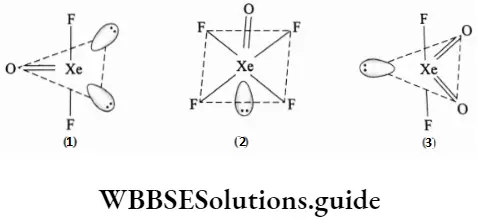
  • The enzyme can also be attached to the substrate through dipole-dipole attraction.
  • An enzyme has a distinct cavity in which the substrate is bound. The cavity contains an active center in which the amino acids are grouped in such a way as to enable them to combine with the substrate. The substrate induces a conformational change in the enzyme.
  • This aligns amino acid residues or the other groups on the enzyme in the correct spatial orientation for substrate binding.

Basic Chemistry Class 12 Chapter 16 Chemistry In Every Day Life Notes

2. After attaining the abovementioned appropriate steric orientation, the reactants (enzyme and substrate) react to form the products. As the enzyme surface has no affinity for the product molecules, the latter leaves the enzyme surface quickly to make room for fresh molecules of substrates to be bound at the active site.

Basic Chemistry Class 12 Chapter 16 Chemistry In Everyday Life Enzyme Catalytic Activity

Inhibition Of Enzymes

Inhibition of enzymes is a common mode of drug action. Drugs can block the binding site of an enzyme and thus prevent the binding of the substrate. Such drugs are called enzyme inhibitors.

Drugs inhibit the attachment of the substrate to the active site in two different ways.

1. Some drugs compete with the normal substrate for attachment to the active site of the enzyme. Such drugs are called competitive inhibitors.

Basic Chemistry Class 12 Chapter 16 Chemistry In Everyday Life Inhibition Of Enzyme

2. Some drugs react with an adjacent site (called an allosteric site) and not with the active site of the enzyme. They alter the enzyme in such a way that it loses its catalytic property—the attachment of inhibitors at the allosteric site changes the shape of the active site in such a way that the substrate is unable to recognize the active site.

“chemistry in everyday life class 12 notes”

The enzyme is made ineffective permanently if the bond formed between the inhibitor and the enzyme is a strong covalent bond. In such a case, the enzyme-inhibitor complex is degraded by the body, and a new enzyme is synthesized.

Basic Chemistry Class 12 Chapter 16 Chemistry In Everyday Life Allosteric Site

Receptors As Drug Targets

Many drugs exert their physiological effects by binding to a specific cellular binding site called a receptor. A drug (agonist) interacts with its receptor by the same kinds of bonding interactions-hydrogen bonding, electrostatic attractions, and van der Waals interactions.

The most important factor in bringing together a drug and a receptor is a close fit: the greater the affinity of a drug for its binding site, the higher is the drug’s potential biological activity.

Agonists: These are drugs that mimic a natural messenger and activate a receptor to produce an effect. These come into play when the natural messenger is not available.
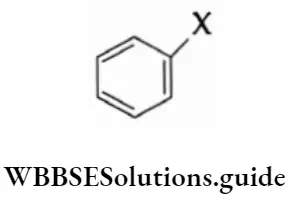
Antagonists: Antagonists attach themselves to receptors and prevent them from functioning. They are useful when a message is required to be blocked.

Basic Chemistry Class 12 Chapter 16 Chemistry In Everyday Life Antagonists

Transfer Of Message Into The Cell By The Receptor

Our body has a large number of different receptors which interact with different chemical messengers. (Chemical messengers are in fact chemicals.) These receptors bind with specific chemical messengers because their binding sites (active sites) have different shapes, structures, and amino acid compositions.

To accommodate a chemical messenger, the shape of the receptor site changes. This causes the transfer of a message into the cell. The chemical messenger gives a message to the cell without in fact entering the cell.

Basic Chemistry Class 12 Chapter 16 Chemistry In Everyday Life Transfer Of Message Into The Cell By The Receptor

Types Of Drugs

Antacids

Under normal conditions, the stomach contains a certain amount of hydrochloric acid. The H+ ion of HCl participates in the process of digestion. An excess of this acid causes indigestion.

Excess HCl can be produced due to various reasons-overeating, the ingestion of certain kinds of spicy food, and increased stress.

The function of an antacid is to relieve indigestion by reducing the amount of stomach acid (gastric acid) to a normal level by neutralisation. Various compounds such as magnesium hydroxide, aluminium hydroxide and sodium bicarbonate, which have basic properties, can reduce acidity.

⇒ \(\mathrm{NaHCO}_3+\mathrm{H}^{+} \rightarrow \mathrm{H}_2 \mathrm{O}+\mathrm{CO}_2+\mathrm{Na}^{+}\)

⇒ \(\mathrm{Mg}(\mathrm{OH})_2+2 \mathrm{H}^{+} \rightarrow 2 \mathrm{H}_2 \mathrm{O}+\mathrm{Mg}^{2+}\)

⇒ \(\mathrm{Al}(\mathrm{OH})_3+3 \mathrm{H}^{+} \rightarrow 3 \mathrm{H}_2 \mathrm{O}+\mathrm{Al}^{3+}\)

“important topics in chemistry in everyday life”

However, excessive use of bicarbonate can cause hypersecretion of hydrochloric acid by the cells of the stomach lining, causing ulcers. Such ulcers can be life-threatening in advanced stages and the only treatment is to remove the ulcerated part of the stomach by surgery.

Metal hydroxides such as magnesium hydroxide and aluminum hydroxide are better options because they are insoluble and do not increase the pH value above 7. Although antacids do relieve acidity, they do not cure the cause of hyperacidity. Unless the cause of the hyperacidity is removed, antacids bring only temporary relief.

Basic Chemistry Class 12 Chapter 16 Chemistry In Everyday Life Types Of Drugs Of Antacid

Chemistry in everyday life class 12 short notes

Histamine, a chemical, also stimulates the secretion of pepsin and hydrochloric acid in the stomach. A major breakthrough in the treatment of hyperacidity came when cimetidine, an antihistamine, was discovered to prevent the interaction of histamine with the receptors present in the stomach wall.

When cimetidine is administered, less acid is released in the stomach. Later, another drug, ranitidine (Zantac) was discovered and widely used in the treatment of hyperacidity.

Basic Chemistry Class 12 Chapter 16 Chemistry In Everyday Life Treatment Of Hyperacidity Of Cimetidine And Ranitidine

Antihistamines

  • Histamine has various functions. It causes dilation of blood capillaries. In addition, it makes the capillaries more permeable to blood fluids.
  • Thus these fluids can readily leak out of the capillaries and cause swelling of the tissues. The compound causes contraction and spasms of the smooth muscles in the bronchial tubes.
  • It can produce skin swellings and stimulate the glands that secrete watery nasal fluids, mucus, tears, saliva, and so on.
  • Histamine is released in the body due to an allergic reaction caused by dust, pollen, or certain kinds of food.
  • The net effect of its actions includes runny nose, congestion, and sneezing. Antihistamine compounds work against the action of histamine.
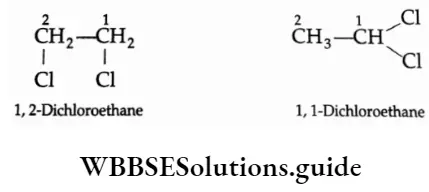
Basic Chemistry Class 12 Chapter 16 Chemistry In Everyday Life Antihistamines

Antihistamines and histamines have certain structural features in common, as shown below.
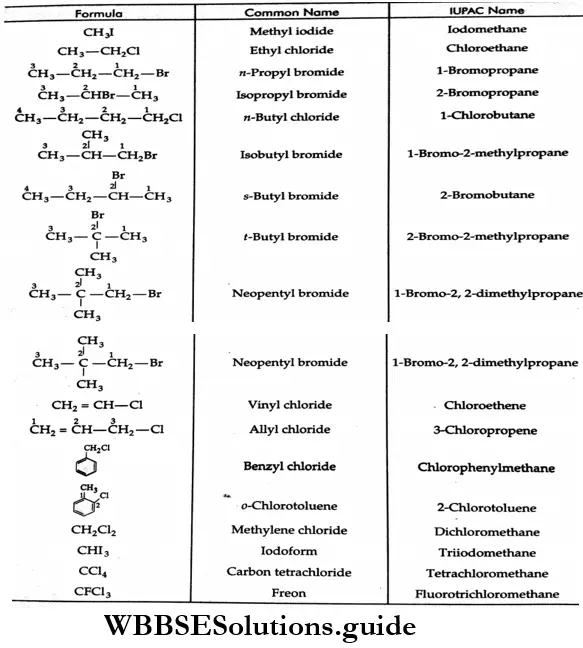
Basic Chemistry Class 12 Chapter 16 Chemistry In Everyday Life Structures Of Antihistamines And Histamines

Due to the similarity in their structural features, antihistamines mimic histamines in their chemical reactions and can take the place of histamines. This, in effect, blocks the action of histamines and the symptoms caused by histamines begin to disappear.

“applications of chemistry in daily life”

Some commonly used antihistamines are Diphenylhydramine (Benadryl), Brompheniramine (Dimetapp), Promethazine (Phenergan), and Terfenadine (Trexyl, Seldane).

Basic Chemistry Class 12 Chapter 16 Chemistry In Everyday Life Promethazine

Basic Chemistry Class 12 Chapter 16 Chemistry In Everyday Life Dipheniramine

Basic Chemistry Class 12 Chapter 16 Chemistry In Everyday Life Terfenadine

Basic Chemistry Class 12 Chapter 16 Chemistry In Everyday Life Brompheniramine

Antihistaminic agents are used primarily in the management of certain allergic disorders.

Many antihistamines such as diphenylhydramine and brompheniramine produce variable degrees of central nervous system depression and as such they all have sedative action. Terfenadine is a nonsedative antiallergic.

“drugs and medicines in chemistry class 12”

Some antihistaminic drugs and their brand names:

Basic Chemistry Class 12 Chapter 16 Chemistry In Everyday Life Some Anitihistaminic Drugs And Their Brand Names

Excess histamine production by the body also causes the hypersecretion of hydrochloric acid by the cells of the stomach lining, leading to the development of ulcers.

The antihistamines that block the histamine receptors, thereby preventing the allergic responses associated with excess histamine production, do not affect HCl production.

“role of chemistry in food and nutrition”

The reason is that a second kind of histamine receptor triggers the release of acid into the stomach.