WBBSE Notes For Class 7 Geography Chapter 2 Determination Of The Position Of A Place On The Earths Surface

Chapter 2 Determination Of The Position Of A Place On The Earth’s Surface

The location of a place on the rotating earth is of vital importance. The most important aspect of Geography is to find out the location of a place on the earth’s surface. Because of the spherical shape of the earth, it is very difficult to fix the position of a point about the whole of the earth.

We know that the location or distance between two places on a flat surface is measured by a tape or rope in inch, foot mile etc. or cm, metre, km, etc. This is called ‘Linear distance’.

But the distance or location of a place on a spherical or curved surface is measured in seconds, minutes and degrees. This is called ‘Angular distance’.

“WBBSE class 7 geography chapter 2 notes”

The distance between any two places on a curved earth’s surface is measured by the angle made by two straight lines that meet at the centre of the earth from the two places on the earth’s surface is called ‘Angular distance’.

Read and Learn More WBBSE Notes for Class 7 Middle Class Geography

So, the location of a place on the earth is determined by angular measurements. For e.g. Kolkata is located at 22°34′ north latitude and 88°24′ east longitude.
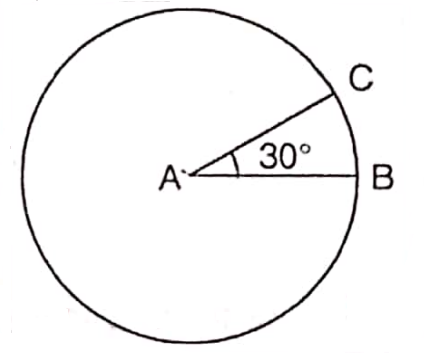
WBBSE Solutions class 7 Geography chapter 2 Determination Earth by angular distance

Chapter 2 Determination Of The Position Of A Place On The Earths Surface Determination Of The Location Of A Place On A Flat Or Plane Surface

location of a student in the classroom can be marked by two reference lines namely the ‘rows from the teacher’s table and the number of seats from the entrance to the classroom.

Therefore to find out the location of student ‘S’ in the rectangular classroom ABCD, parallel lines are drawn from the sides of AB (Line of Teachers table), AC (Line of the entrance of the room) cl intersecting at ‘S’, ‘P’ i.e. R.T. and P.Q.

“class 7 social science geography “

Now the actual location of the student (S) in the classroom (ABCD rectangle) can be found by measuring the distance of ‘RS’ and ‘PS’.
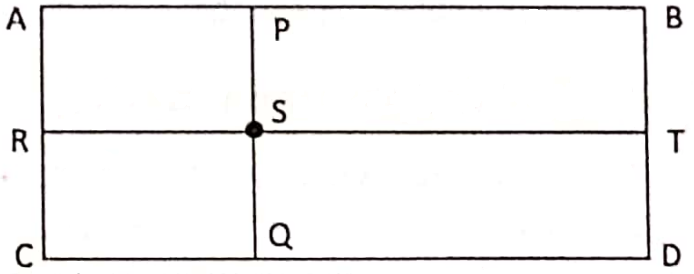
WBBSE Solutions class 7 Geography chapter 2 Determination of the position of a place on the earths surface location on a plane surface

Determination of the location of a place on a spherical or curved earth surface :

In order to locate each and every place on the earth’s surface correctly, a network of horizontal and vertical lines is drawn on the globe. This network of lines is called the ‘Earth Grid’.

The location of any place on the sphere is to be determined with the help of imaginary lines encircling the earth is an East-West and North-South direction.
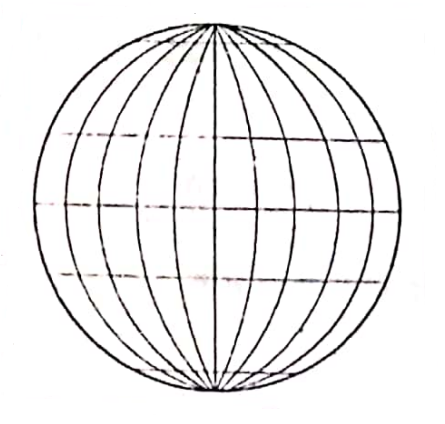
WBBSE Solutions class 7 Geography chapter 2 Determination of the position of a place on the earths surface Earth Grid

East-West Extended Lines Or Parallels Of Latitudes :

The imaginary East-West extended circles including the Equator and the two poles are known as parallels of Latitude. The parallels lying north of the Equator is know as the north parallels of latitude and the parallels south of the Equator as the south parallels of latitude.
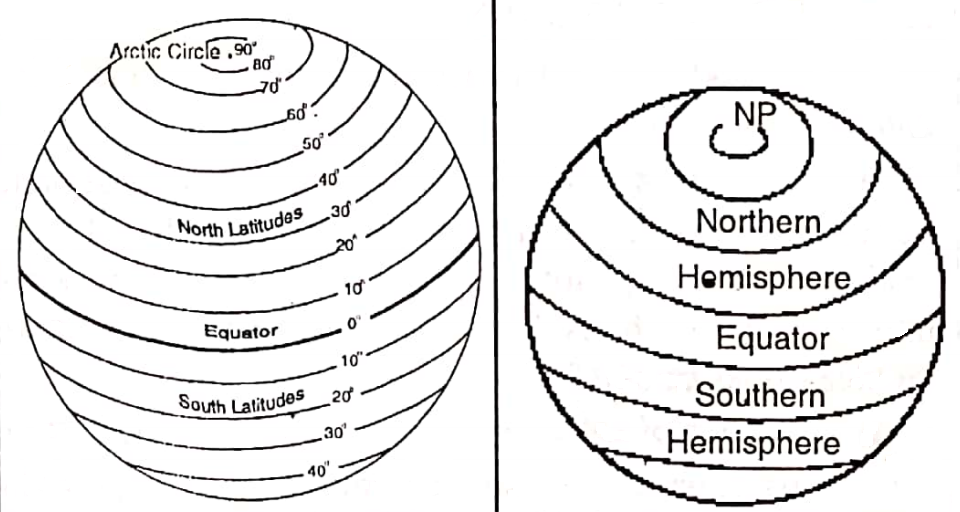
WBBSE Solutions class 7 Geography chapter 2 Determination of the position of a place on the earths surface Parallels of Latitudes on the Globe

The Equator :

The Equator is an imaginary line on the globe passing through the midpoints between the North Pole and the South Pole. It is a circle whose centre is the centre of the globe. The Equator divides the globe into two hemispheres.

The hemisphere that lies north of the equator or that contains the North Pole is known as the Northern Hemisphere and the hemisphere south of the Equator or that contains the South Pole is the Southern Hemisphere. The word ‘hemisphere’ means half of a sphere or a globe.

The Equator is also called the Great Circle because it is the greatest parallel and other parallels decrease in size gradually. Another name for the Equator is the Line of Equinox because throughout the year the equatorial region has equal lengths of day and night.

“determination of the position of a place on the earth’s surface WBBSE”
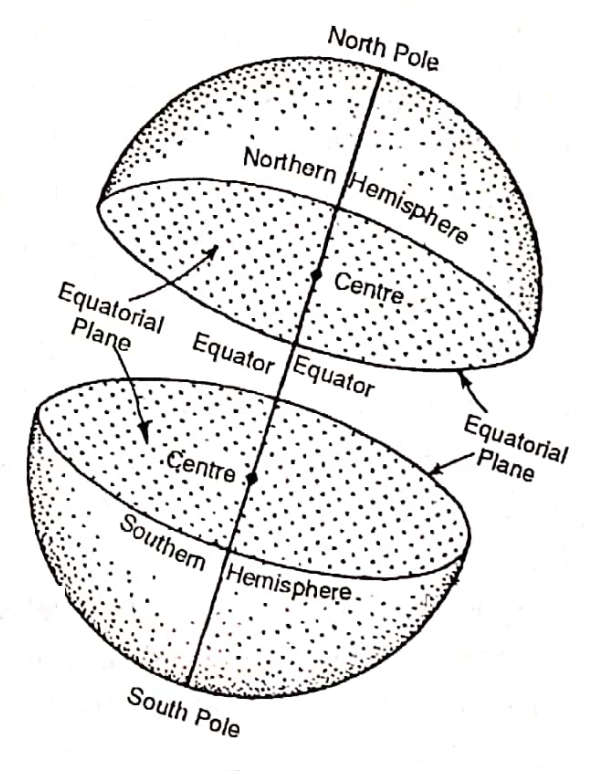
WBBSE Solutions class 7 Geography chapter 2 Determination Chapter 2 Determination Of The Position Of a Place On The Earths Surface The Equator divides the earth

Importance Of The Equator :

1. The Equator divides the earth into two hemispheres. It helps to know about the position of a place is how much north or south on the earth’s surface.
2. The Equator also helps to find out the latitude of a place on the earth’s surface.

WBBSE Notes For Class 7 Geography Chapter 2 Determination Of The Position Of A Place On The Earths Surface

The Equatorial Plane :

The plane bounded by the Equator of the earth is known as the Equatorial plane. If the earth could be sliced into two halves all along the Equator, the Equatorial plane could be seen and the earth could be divided into two halves.

Latitude :

The latitude of a place on the earth is the angular distance of that place north or south of the Equator. If a line is drawn from any place to the north or south of the Equator to the centre of the earth, the angle formed by the line with the equatorial plane is the angular distance of that place.

This angular distance is the latitude of that place.

“exercise 2 solved questions on determination of position class 7”

Example :

The Latitude of Kolkata is 22°34′ north. The word ‘North’ ‘means Kolkata is located in the northern hemisphere and 22°34’ indicates the angle produced by a straight line joining Kolkata and the centre of the earth and the Equator drawn on the Equatorial plane.

Based on latitude, we also describe different regions of the earth as under.

Low Latitude: The region between the Equator (000 and 30°N or S.

Mid-latitude : The region between 30° and 60° N and S

High Latitudes: The region between 60° and 90° N and S. (Polar region)

Importance Of Latitudes :

1. It helps in the location of a place for latitudes and shows how a place is north and south of the Equator.
2. Latitudes are used to divide the earth into temperature belts. Thus the latitude of a place gives an idea about climate.

Parallels Of Latitude Or Line Of Latitude

On either side of the Equator east-west extending imagináry circles, lying parallel to each other are called Lines of Latitude or Parallels of Latitude.
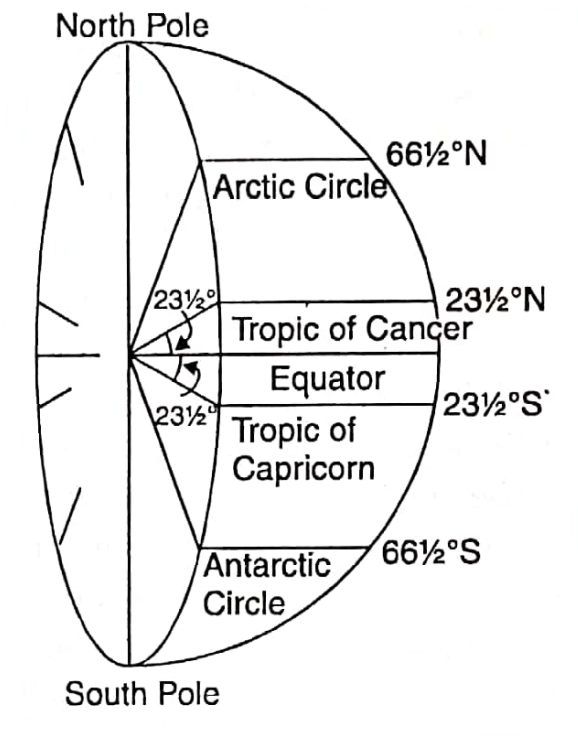
WBBSE Solutions class 7 Geography chapter 2 Determination of the position of a place on the earths surface Latitude is the angular distance

Chapter 2 Determination Of The Position Of A Place On The Earths Surface Difference Between Latitude And Parallels Of Latitude

Latitude is the angular distance of any place north or south of the Equator. Parallels of Latitude means an imaginary line joining an infinite number of places having the same angular distance from the Equator. They are mainly extensive east-west trending circles.

Characteristics of Parallels of Latitude :

  1. Parallels of Latitudes are imaginary full circles on the earth, all parallel to the Equator. i.e. they always remain an equal distance apart.
  2. All parallels represent true east-west lines.
  3. Parallels intersect meridians. at right angles. This fact holds true for any place on the globe, except the two poles.
  4. All parallels except the Equator are smaller circles.
  5. The Equator is a Great Circle and the only parallel drawn from the earth’s centre.
  6. An infinite number of parallels may be drawn on the globe. Therefore, every point on the globe, except the North Pole or the South Pole lies on a parallel.
  7. Latitudes are of the same value in both the northern and southern hemispheres. But more than one latitude of the same value does not exist in one hemisphere.
  8. The value of latitudes is measured from the Equator (0°) northwards to the point of the North pole (90°N) and southwards to the South Pole (90°S).

Important Parallels Of Latitude :

Important lines of Latitude and their distance from the Equator in degrees are given below.
The Equator = 0°
Tropic of cancer = 232 or 23°30′N, Tropic of Capricorn = 23°30’S.
Arctic Circle = 66°30′ N and Antarctic Circle = 66°30’S. North Pole 90°N, South Pole.= 90°S.

“what is terrarium class 7 “
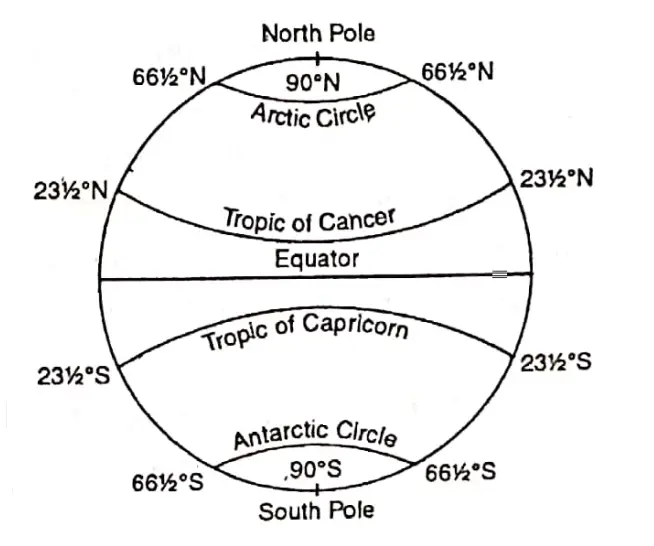
 

WBBSE Solutions class 7 Geography chapter 2 Determination Chapter 2 Determination Of The Position Of a Place On The Earths Surfaces some important parallels of latitude

Chapter 2 Determination Of The Position Of A Place On The Earths Surface North-South Extended Lines Or Meridians Of Longitude

Lines of longitude or Meridian of Longitude are imaginary lines joining places located at the same angular distance east or west of the Prime Meridian.

Prime Meridian :

North-south extended semi- circular the particular imaginary line drawn along the Royal Observatory of Greenwich near London is called the Prime Meridian whose value is 0°. This is also known as Greenwich Meridian.
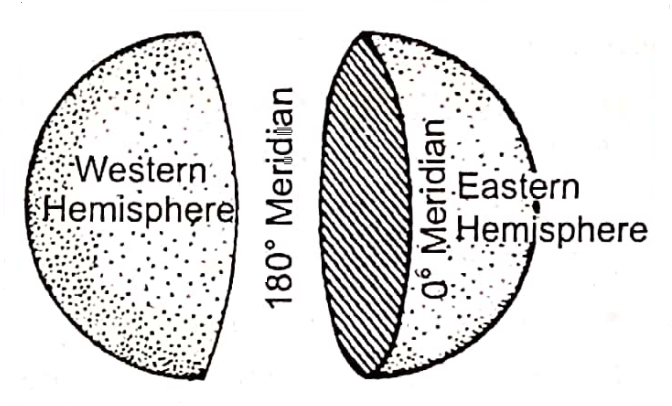
WBBSE Solutions class 7 Geography chapter 2 Determination of the position of a place on earths surface prime Meridian divides the earth

Importance Of Prime Meridian :

  1. The Prime. Meridian divides the earth into two equal halves or the eastern and western hemispheres.
  2. It helps us to know about the position of a place is how much east or west is on the earth’s surface.
  3. The local time of the prime meridian is known as Greenwich Mean Time or G.M.T. It is accepted all over the world as the standard time.

Longitude :

The longitude of a place on the earth is the angular distance of that place east or west of the Prime Meridian. The angle formed by the location of any place east or west of the Prime Meridian to the centre of the earth and the plane of the Prime Meridian is called the longitude.

Example :

The Longitude of Kolkata is 88°24′ east. The word ‘East’ means Kolkata is located in the eastern hemisphere and 88°24′ indicates the angular distance of Kolkata from the Prime Meridian.

Meridian Of Longitude :

A line of longitude passing from the North Pole to the South Pole and forming half of a Great Circle is called the Meridian of Longitude. From the Greenwich meridian (Prime Meridian), all other meridians are measured.
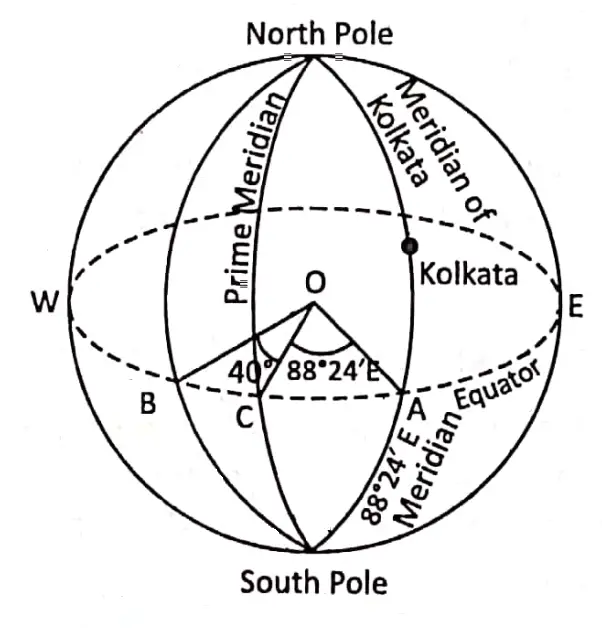
WBBSE Solutions class 7 Geography chapter 2 Determination Chapter 2 Determination Of The Position Of a Place On The Earths SurfaceThe angular distance to the east and west of meridians

Difference between Longitude and Meridians of Longitude :

Longitude is the angular distance of a place east or west of the Prime Meridian. Meridians of longitude are imaginary semi or half-circles each of them joining all the places having the same longitudes either east or west of the Prime Meridian extending from the North Pole to the South Pole.

Features Of Meridians Of Longitudes :

  1. All lines of longitudes are semi-circular of equal length.
  2. All meridians of longitude are equal in length but not parallel to each other.
  3. The distance between two lines of longitude is maximum at the Equator and decreases gradually away from the Equator.
  4. The lines of longitudes converge at the two poles.
  5. Lines of longitudes are called ‘Meridians’ because all places along a longitude line have noon or midday at the same time.
  6. Value of the meridians of longitude increases from the Prime Meridian to the east and west up to 180°.
  7. The longitude of a meridian has a definite value.
  8. 180°E and 180°W meridian of longitude is one line.
  9. All meridians cut all latitudinal lines at right angles.
  10. All places on the same meridian have sunrise, noon and sunset at the same time.

Importance Of Meridians Of Longitude :

  1. The Meridians of longitudes show how a place is located to the east or west of the Prime Meridian.
  2. All places on the same longitude have sunrise, noon and sunset at the same time.
  3. It enables us to calculate time.
  4. With the help of meridians of longitudes the local time of a place is easily determined.

Chapter 2 Determination Of The Position Of A Place On The Earths Surface Relation Between Parallels Of Latitudes And Meridians Of Longitudes

  1. The Parallels of latitudes and meridians of longitude intersect at a right angle to each other.
  2. The meridians converge at both poles. This means the meridians together from the angle of 360° at each of the poles.
  3. The areas of the graticules demarcated by two adjacent parallels and two adjacent meridians diminishes gradually from the Equator to the poles.

Difference Between Parallels Of Latitude And Meridians Of Longitude :


Parallels of Latitude Meridians of Longitude
1. The imaginary horizontal circular lines drawn by joining places having the same latitude are called Parallels of Latitude. 1.  The imaginary vertical semicircular lines drawn by joining places having the same longitude are called Meridian’ of longitude
2. Parallels of latitude encircle the earth in an east-west direction. the earth. 2. Meridians of longitude extend in a north-south direction on the earth.
3. Each parallel is a complete circle. 3. Each meridian is a semi or half-circle.
4. Parallels of latitude are not equal in length. Their lengths decrease towards the poles. 4. All meridians are of equal length.
5. The linear distance between the parallels is equal to each other. 5. The linear distance between the meridians decreases towards the poles.
6. The parallel’s latitude is measured from the Equator. 6. The Meridians of longitude are Measured From the Prime Meridian.
7. These are divided into North and South parallels of latitude. 7. These are divided into East and West meridians of longitude.
8. In the same parallel at different places sunrise, noon and sunset occur at different times. 8. All places on a particular meridian sunrise, noon and sunset occur at the same time.
9. In the same parallel of latitude at different regions local time is different. Thus in determining the local time it has no role to play. 9. In the same meridian of longitude has the same local time at all the regions along it. Thus, determining the local time has an important role.
10. Parallels of latitude help in dividing the earth’s surface into heat belts or temperature zones. 10. Meridians of longitude help in determining the time zones.


WBBSE Solutions class 7 Geography chapter 2 Determination of the position of a place on the earths surface location of a place by parallels of latitude and meridians longitude

Chapter 2 Determination Of The Position Of A Place On The Earths Surface Location Of A Place On The Earth’s Surface

On a spherical earth’s surface, the exact location of a place can be determined by latitude and longitude together.

Example: The location of Kolkata is at 88°24′ east longitude and 22°34′ north latitude.

“WBBSE class 7 geography chapter 2 important questions”

So, Kolkata is located at the point of intersection between 88°24′ east meridian of longitude and 22°34′ north parallel of latitude.

Location Of A Place On The Globe :

The Globe is a small-scale model of the Earth. So, the exact location of a place can be identified with the help of circles of parallel and half circles of meridian of longitudes drawn on the spherical Globe.

Kolkata is located at the point of intersection between 88°24′ (88) east meridian of longitude and 22°34′ (22) north parallel of latitude as shown on the diagram.
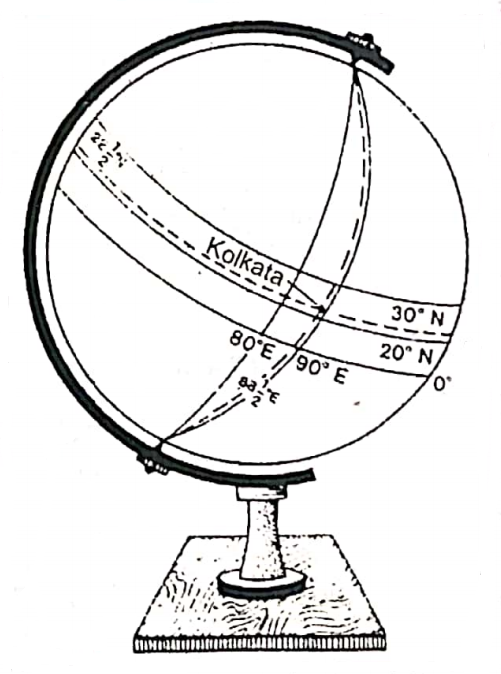
WBBSE Solutions class 7 Geography chapter 2 Determination of the location of kolkata

Chapter 2 Determination Of The Position Of A Place On The Earth’s SurfaceLocation Of A Place On The Wall Maps And Atlas

A map or Atlas is flat. Thus on a flat surface of paper of a map or an Atlas the circular shape of the latitudes cannot be drawn, they are shown as parallel straight lines Meridians of longitude also do not meet at the poles, they run in a north-south direction as straight lines.
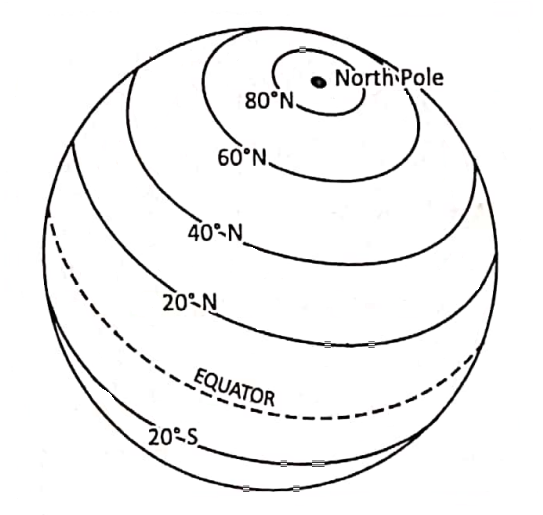
WBBSE Solutions class 7 Geography chapter 2 Determination of the position of a place on the earths surface parallels on earth's surface

Longitude And Time :

Longitude and time have a very close relationship. Longitudes help in the calculation of Noon and Local time. Each degree of longitude takes 4 minutes to rate. A difference of 1° of longitude has a time difference of 4 minutes. It must be remembered that a difference of 15° in longitudes causes a time of difference of 1 hour.

Local Time :

When a meridian comes in line with the centre of the sun local mid-day is said to have occurred at all places on the meridian. Fixing time on the basis of the local mid-day of a place is known as the local time of a place.

The for each degree o longitude local time varies by 4 minutes. This means that for cities like Delhi, London, New York etc. local time will differ from one point to another from place to place within a country or from country to country.
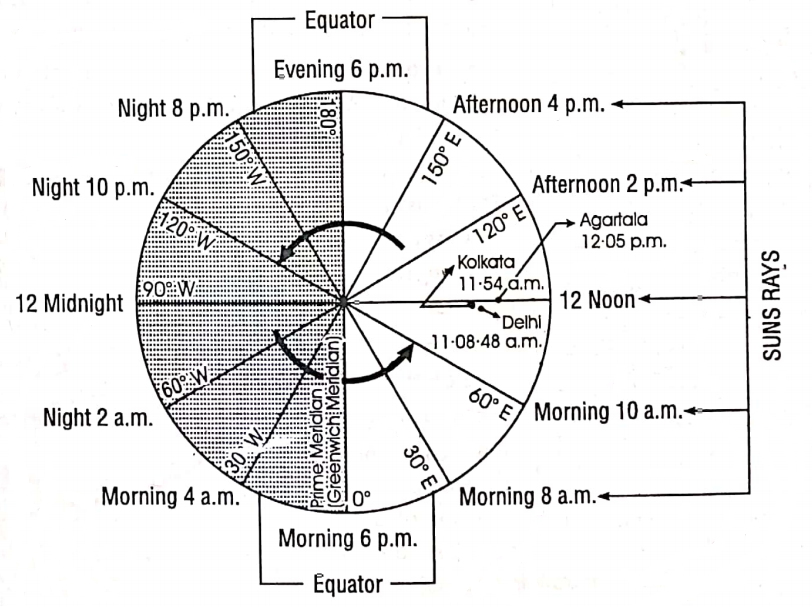
WBBSE Solutions class 7 Geography chapter 2 Determination Chapter 2 Determination Of The Position Of a Place On The Earths Surface see how time is related to longitude

Standard Time :

In a country, local times of places at different longitudes differ from each other. If each place maintained its own time schedule based on its own local time much inconveniences would have been corrupted. To avoid such inconveniences the local time of a central place of a country or part of a country is generally selected for the time of the country (or selected region) as a whole. This time is known as a standard time of the country (or part of the country or a scheduled region).

“how to determine the location of a place on earth class 7”

I. S. T.: The local time of 82°30′ E (Passing through near Allahabad) is selected as Indian Standard Time (I. S. T). I. S. T. is ahead of G.M.T by (5 hours 30 minutes) It is followed throughout the country.

G. M. T.: The local time of Greenwich (Prime Meridian or 0° meridian), is regarded as the standard time of the zone at 0° and this is called Greenwich Mean Time or G.M.T. Fig. 2.14: Meridian determining Indian Standard Time Astronomers call in universal times, and regarded Greenwich at the reference meridian for all calculation.

Time Zones: The surface of the earth has been divided into 24 time zones or as many hours in a day. The time from one zone to the next zone differs by one hour only.
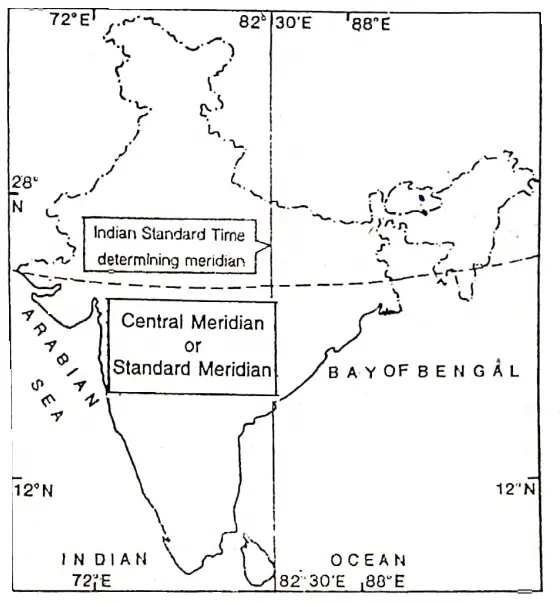
WBBSE Solutions class 7 Geography chapter 2 Determination of the position of a place on the earths surface Meridian determining Indian standard time

International Date Line: A line that roughly follows the 180° meridian, with some deviations to avoid land masses and groups of islands is called the International Date Line(I.D.L).

The date the Atlantic Ocean immediately off the line is one day earlier than to the West. This situation occurs because of the accumulated time change of one hour for each 15° of longitude West and East of the Greenwich Meridian (0°); i.e. 180° W of Greenwich is 12 hours slow but 180°E is 12 hours fast.

“latitude and longitude explanation WBBSE geography”
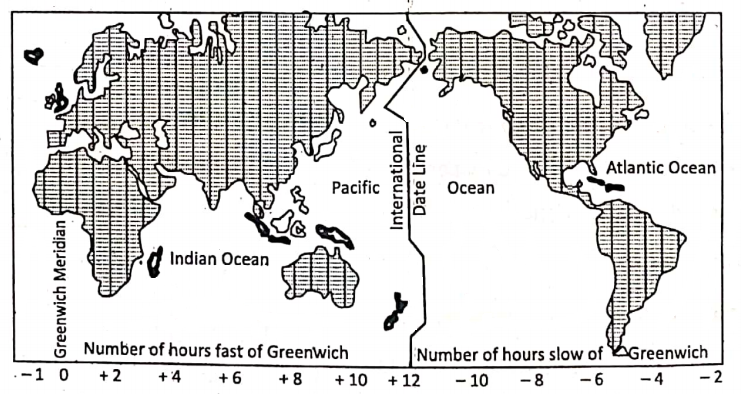
WBBSE Solutions class 7 Geography chapter 2 Determination of the position of a place on the earths surface International Date Line and time zones of the earth

G.P.S. Or Global Positioning System :

Global positioning system or G.P.S. is a modern .technological system which helps to determine the latitude or longitude of a place on the earth. This system is performed by artificial satellites. This system is presently used in navigation, aviation and other modern transportation and communication systems.
WBBSE Notes For Class 7 Geography Chapter 1 Motions Of The Earth

Chapter 1 Motion Of The Earth Introduction

The Earth—our homeland is a planet. The earth appears to be stationary. But the earth is not stationary in the universe. The ancient people used to think that the earth was a static body and that the sun, stars, and other heavenly bodies revolved around it.

It was only in 476 A.D., the great Indian astronomer and philosopher, Aryabhatta came to know that the earth is a revolving body in space and it is revolving around the sun.

This idea of the great Indian scientist influenced the thoughts. of the scientists of the later ages all over the world.

Read and Learn More WBBSE Notes for Class 7 Middle Class Geography

It was after about one thousand years came learned Nicholas Copernicus in 1543 A.D., Galileo Galili in 1610, and Johans Capler in 1630 with the idea to ascertain the movement of planets and stars of the universe.

The earth has three basic movements, namely galactic movement, rotation, and revolution.

Galactic movement is the movement of the earth with the sun and the rest of the solar system in an orbit around the center of the milky way galaxy.

This movement has little effect on the changing environment of the earth and is the concern of astronomers rather than geographers.

“WBBSE class 7 geography chapter 1 notes”

The other two movements of the earth, rotation on its axis facing the sun and revolution around the ^un on an elliptical orbit cause the phenomena of day and night, variation in the length of day arid night, and the change of seasons.

The Earth undergoes both rotation and revolution simultaneously. Thus both these two motions are of vital interest to the geographer.

The Rotation of the Earth :

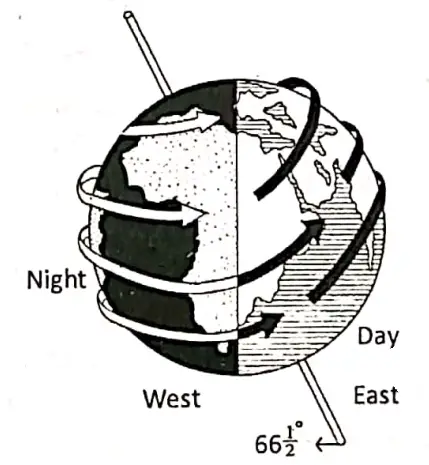
The spinning of the earth on its own axis from west to east causing day and night is called ‘rotation’.

The earth rotates on its axis once in 24 hours (23 hours 56 minutes and 4 seconds).

It is a solar day. The movement is also known as the ‘Diurnal Motion’ Or ‘the daily movement of the; earth’.

WBBSE Solutions class 7 Geography chapter 1 motion of the earth rotation of the earth


The Revolution Of The Earth :

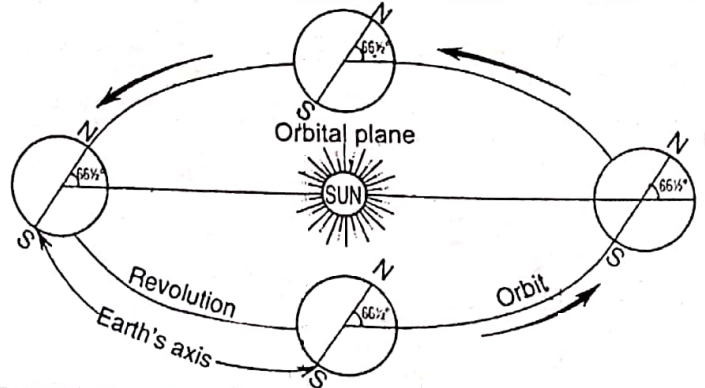
While the earth rotates on its axis, it revolves around the sun, in an anticlockwise direction along an elliptical orbit in a little less than 365 days 6 hours is called the ‘Revolution of the earth.

WBBSE Solutions class 7 Geography chapter 1 motion of the earth revolution of the earth


The Period of Revolution :

The duration of one complete revolution is 365 days 5 hours48 minutes and 46 seconds.

This period is called the ‘solar year’. In the round figure, this is considered as 365 days i.e. one year.

So the revolution of the earth is also known as the ‘Annual Motion’ or the ‘yearly motion of the earth’.

“motions of the earth WBBSE class 7 geography”

Leap year :

The earth takes approximately 365 days 6 hours (actually 365 days 5 hours, 48 minutes 46 seconds) to complete one revolution around the sun.

We refer to this period as a year and consider it as 365 days.

The balance of 6 hours every year gets added and becomes (6 hours x 4 = 24 hours) or 1 day in four years.

Hence, once in four years, the length of the year is taken as 366 days by adding an extra day to the calendar in the month of February.

We call such a year a ‘Leap year’. In a leap year, the month of February gets 29 days and the year consists of 366 days.

All non-centurial years which are divisible by 4 and all centurial years (those ending ’00’) which are divisible only by 400, are made ‘Leap years’.

For example 1984, 1988, 1992, 1996, and 2000 years are leap years. But 1900 is not a leap year as it is not divisible by 400.

WBBSE Notes For Class 7 Geography Chapter 1 Motions Of The Earth

Chapter 1 Motion Of The Earth Features Related to the Earths Revolution

Earth’s Orbit  And Orbital Plane:

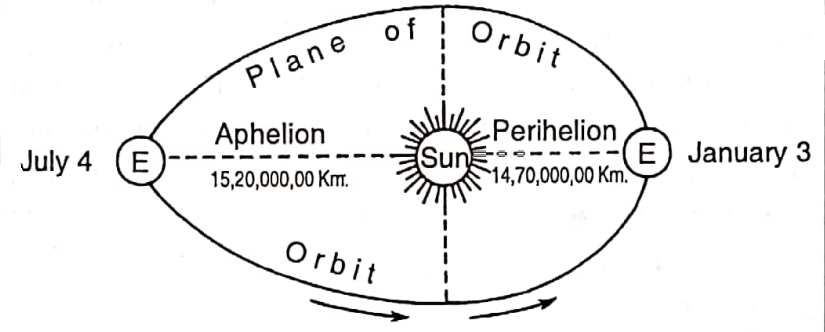
The fixed elliptical path along which the Earth revolves around the sun is called the Earth’s orbit.

Circumference of the earth’s orbit is 960 million (96 crores) km.

The plane, on which the earth moves, is called the ‘plane of orbit’ or ‘orbital plane’, center of the earth and the sun lie on this plane.

“what do you mean by natural environment for class 7 “


WBBSE Solutions class 7 Geography chapter 1 motion of the earth The earth elliptical orbit and variation of its distance from the sun


Shape Of The Earth’s Orbit :

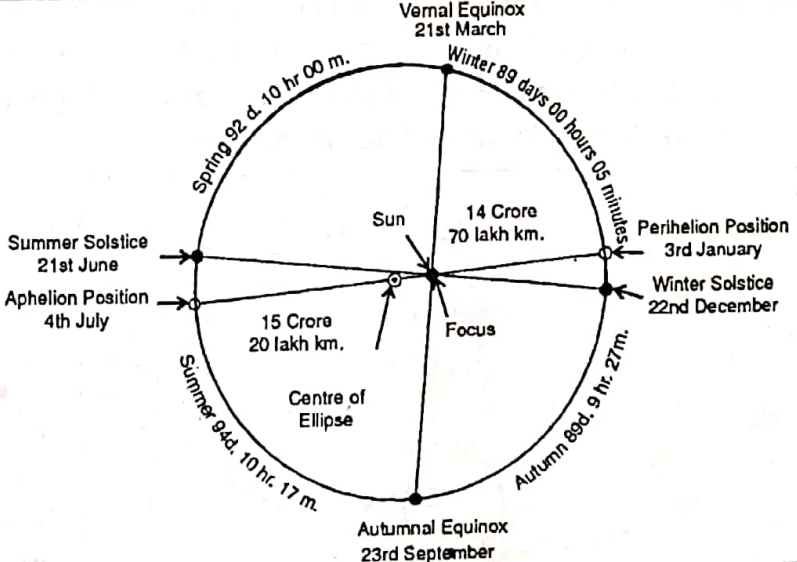
Earth’s orbit is called elliptical, for its shape is an ellipse. The sun is Located at the ‘Focus’ of this ellipse.

Position Of The Earth On Its Orbit :

Aphelion and perihelion: the distance between the earth and the sun is not constant. the orbit of the earth is not circular in shape within it. the distance between the sun and earth reduce to about 14 crores 70 lacks (147 million) km at perihelion (from Greek: peri, close or near to; helios, sun) on 3rd January.

The distance rises to about 15 crores 20 lacks (152 million) km at aphelion (from Greek: ap, away; helios, sun) on 4th July.

“exercise 1 solved questions on motions of the earth”


WBBSE Solutions class 7 Geography chapter 1 motion of the earth perihelion and aphelion position of the earth


Effects Of Aphelion And Perihelion

  1. The average distance between the sun and the earth is 15 crore km. Considering the distance of the sun, this difference is nothing and so it does not really affect the temperature on the earth’s surface. However, summers and winters are slightly moderated in the northern hemisphere and intensified in the southern hemisphere owing to the coincidence of perihelion and aphelion.
  2. As the earth is slightly nearer in January than in July, the winter sun in the. Northern Hemisphere appears biggest because of perihelion.
  3. The speed of the1 earth is revolving around the sun is not uniform. The earth journeys more quickly in its orbit when it is at perihelion than it does when it is at aphelion. This causes less duration of winter in the northern hemisphere and summer in the southern hemisphere.

The Inclination And Parallelism Of The Earth’s Axis On The Plane Of Its Orbit And Its Result :

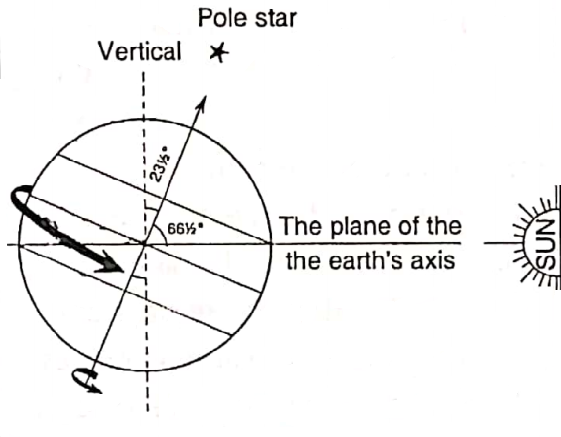
The axis of the earth is inclined at an angle of 661⁄2° on its orbital plane. It always points to the same direction i.e. to the polestar during the revolution of the earth and remains parallel in all positions on the orbit of the earth. The inclination of the earth’s axis is responsible for causing varying lengths of day and night and season changes during the year.

If the earth’s axis were vertical to the orbital plane, all places on the earth will have 12 hours of daylight and 12 hours of the night. There will be no seasonal changes also.


WBBSE Solutions class 7 Geography chapter 1 motion of the earth The tilt of the earth's axis


Velocity or speed of the Revolution :

The earth moves in an anticlockwise direction at a very high speed. The mean speed or velocity of the earth in its orbit is about 107000 km per hour. The speed comes to 29-72 km per second. The bullet from a gun moves at a speed of 9 km per second.

It means that the Earth moves in its orbit around the sun with a speed three times that of a bullet. It is the greatest at perihelion and the least at aphelion.

“WBBSE class 7 geography chapter 1 important questions”

Escape Velocity :

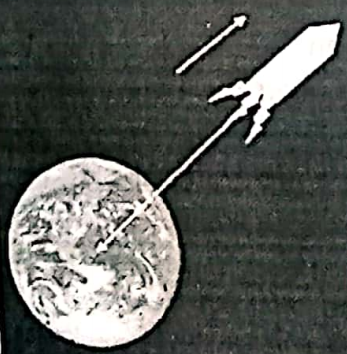
We know that if we throw any object upward, it will go up to a certain distance and then fall down due to the gravitational force of the earth. But always it is not true. If an object is thrown up at a very high speed can travel past the gravitation attraction of the Earth and escape to space.

Any object thrown at a speed or velocity of 11-2 km per second, will go past the zone influenced by gravity and will start revolving around the Earth. This velocity is called ‘Escape velocity’. Artificial satellites are launched into their orbits at escape velocity.


WBBSE Solutions class 7 Geography chapter 1 motion of the earth Escape velocity


Apparent Annual Movement of the Sun

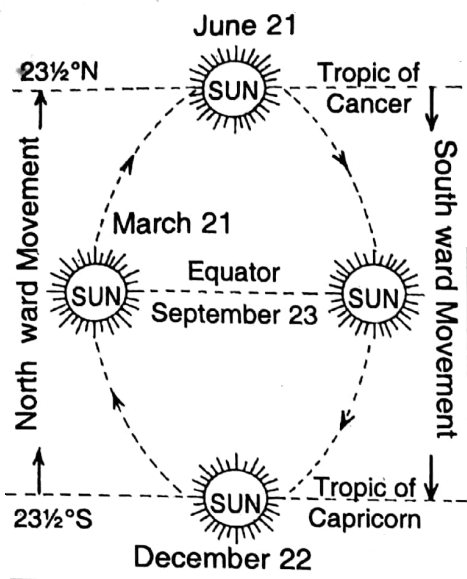
While the earth revolves around the sun over the course of a year, the sun seems to move between 23½° N and 23½° S latitudes. As the sun does not actually move, this migration of the sun is known as its apparent annual movement.

This apparent movement of the sun’s perpendicular position from the Tropic of Cancer (23½° N latitudes) to the Tropic of Capricorn (23½° S latitudes).

southward and again from the Tropic of Capricorn (23½° S latitudes) to the Tropic of Cancer (23½° N latitude) northward continuously holds on round the year without any break.

So once a year the sun shines directly over each tropic and twice a year over all the places lying between the tropics (Tropic means ‘turning place’).


WBBSE Solutions class 7 Geography chapter 1 motion of the earth The apparent of annual movement of the sun


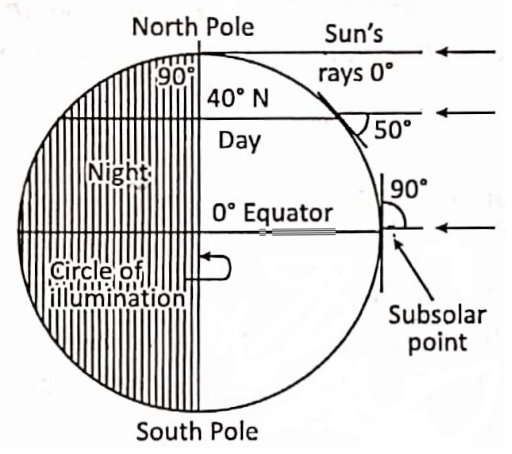
Sub-solar point :

The point at which the sun remains perpendicular to the earth is called the sub-solar point. The sub-solar point moves a 47° latitude range between the Tropic of Cancer (23½° N) and the Tropic of Capricorn (23½° S) crossing the Equator (0° latitude) twice annually.

Proofs or Evidence of the Earth’s Revolution :

The following facts prove that the earth revolves around the sun.

  1. The more frequent occurrence of meteors during fixed periods of the year.
  2. We do not see the same set of stars at the same time, during different seasons.
  3. The duration of the days and nights are not equal throughout the year.
  4. The change of seasons proves that the earth revolves around the sun.
  5. The other planets are revolving around the sun. The earth is also a planet and it is expected that it also should move around the sun.


Effects of Revolution

The revolution of the earth results in-

1. Idea of a year formed: One complete revolution gives us the length of the year. It is the major unit of time.

2. Determination of latitudes: The revolution of the earth helps us to determine latitudes. In the summer season, the places on the earth which have vertical sun are all situated at 23½º N. For example, the sun is vertical at 23½° N (Tropic of Cancer) on June 21 and at. 23½° S (Tropic of Capricorn) on December 22, Equator (0°) is situated in between the two positions.

3. Shifting of wind belts: Due to the various inclination of sun rays on the earth from the Equator to the poles, the temperature is different. In fact, various pressure belts are formed. Due to the apparent movement of the sun, the pressure belts are shifted due to the inclination of sun- rays.

Wind belts are also shifted towards the north in summer and towards the south in winter. It has tremendous economic and psychological importance.

4. Variation in the length of days and nights: The earth is tilted at 66½° angle on its orbital plane during revolution around the sun. So there is variation in the length of day and night on the earth’s surface i.e., days are longer than nights at some places; while nights are longer than days in others.

“types of earth’s motions rotation and revolution”

Days and nights are equal only twice in a year-21st March and 23rd September on all the places of the earth

stored at place. If the storing heat is continued for several days the place becomes hot. Again if the nights are larger than the days, the heat is fully released at night and the place becomes cold within a few days.

5. Change Of Seasons :

Seasons: Seasons refer to those periods of the year which have some peculiar weather and climatic conditions.

Causes of Seasons: Seasons are caused by-

  1. The revolution of the earth around the sun.
  2. The spherical shape of the earth.
  3. The inclination of the earth’s axis at an angle of 66½º to the plane of orbit.
  4. The elliptical shape of the earth’s orbit and
  5. The parallelism of the earth’s axis throughout its all positions along the plane of its orbit.


WBBSE Solutions class 7 Geography chapter 1 motion of the earth variations of lengths of day and night


Change of Seasons

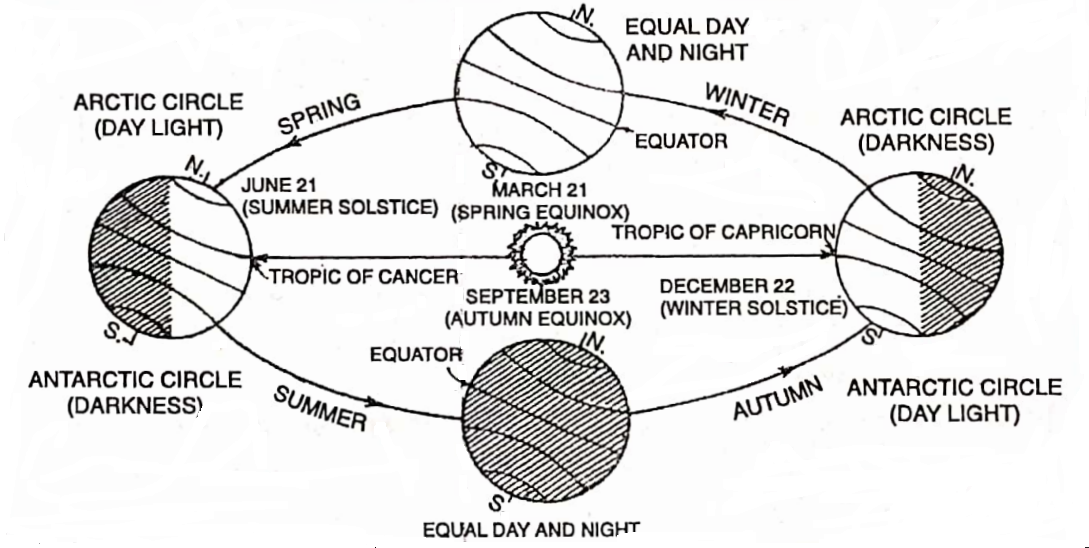
From the point of view of the earth’s inclination, there are four positions of solstices and equinoxes. Hence there are the following four seasons according to the positions of the earth in one complete revolution of the earth around the sun.

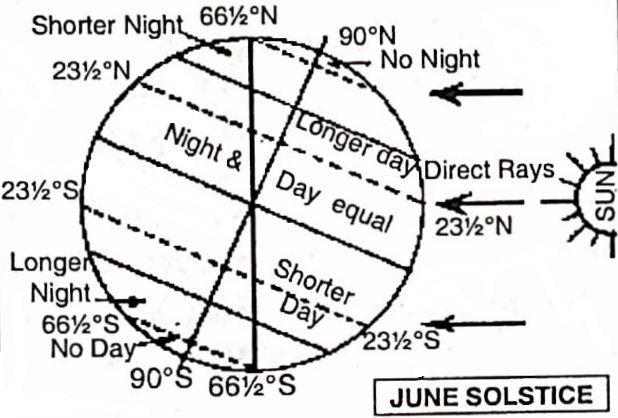
1. Summer Solstices – On June 21; the northern hemisphere is inclined towards the sun while the southern hemisphere is inclined away from the sun. The sun’s rays fall vertically on the Tropic of Cancer (23½° N), so at this time of the year, the northern hemisphere has summer with longer days and shorter nights.

while the southern hemisphere, receiving slanting rays, has winter with shorter days and longer nights. This position is called summer solstice as the sun seems to stand still (solstitial-sun standing still).

WBBSE Solutions class 7 Geography chapter 1 motion of the earth variations of lengths of day and night

2. Autumnal Eqxuino – On September 23, the northern and southern hemispheres are equally inclined towards the sun. The sun’s rays are vertical at the Equator. As a result, the season is neither cold nor hot.

It is a situation between summer and winter. It is called the autumn season in the northern hemisphere and the southern hemisphere has sprung. This position is called the autumnal equinox (equinox-equal night).

WBBSE Solutions class 7 Geography chapter 1 motion of the earth March and september equinoxs

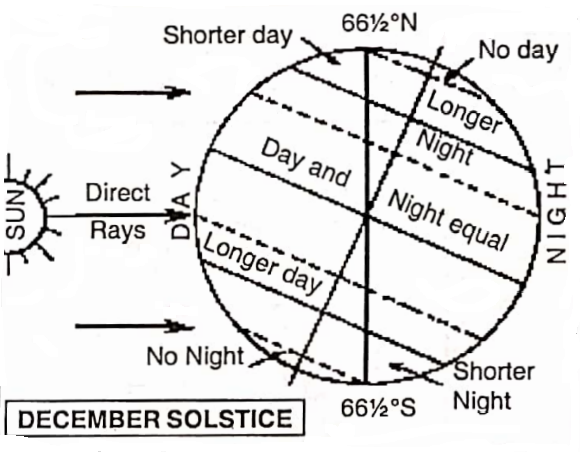
3. Winter Solstice -On December 22, the southern hemisphere leans most towards the sun, and the sun’s rays fall vertically on the Tropic of Capricorn (23½° S).

“effects of earth’s rotation day and night cycle”

As a result at this time of the year the southern hemisphere has summer with longer days and shorter nights, while the northern hemisphere has winter with shorter days and longer nights.

This position is called 90°N Day & Night equals the winter solstice.

WBBSE Solutions class 7 Geography chapter 1 motion of the earth December(winter) solstice

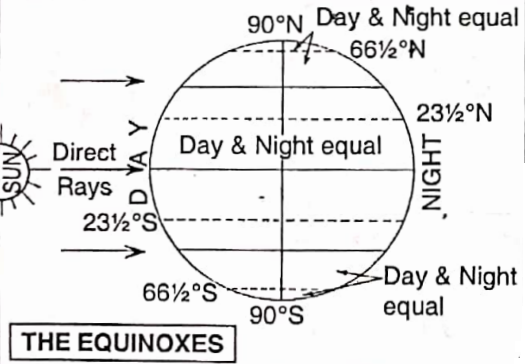
4. Vernal or Spring Equinox -On March 21, the northern and southern hemispheres are equally inclined towards the sun. The sun’s rays again fall vertically on the Equator. So the days and nights are equal like Day & Night September 23, it is neither too hot nor too cold.

Now it is autumn in the southern hemisphere and spring in the northern hemisphere. This position is called the vernal or spring equinox.

WBBSE Solutions class 7 Geography chapter 1 motion of the earth the equinoxes


Aurora Borealis And Aurora Australis

During the long night extending over months together in polar regions peculiar lights in different colors and different forms flash into the sky at intervals. This polar light is known as aurora.

These spectacular colored lights, probably electromagnetic in origin in the ionosphere, are seen near the horizon in the night sky in high latitudes.

The light phenomenon seen in the sky at night in the northern hemisphere mainly in higher latitudes is known as ‘Aurora Borealis’ or ‘Northern Lights’.The light phenomenon seen in the sky at night in the southern hemisphere is known as ‘Aurora Australis’ or ‘Southern Lights’.

“how earth’s revolution causes seasons class 7”

Named for the Roman goddess of dawn, an aurora is a colorful night light display in or near the Arctic and Antarctic circles.

Midnight Sun :

On 21st June the position of the earth is so located on the orbit that the north pole leans towards the Sun. The vertical rays of the sun fall directly on the Tropic of Cancer.

Every part of the northern hemisphere remains in sunlight for more than 12 hours. All places within the Arctic Circle receive sunlight for the whole 24 hours.

In the region beyond the Arctic Circle, the Sun is visible in the sky at midnight. It is called ‘Midnight Sun’. Hammerfest (Norway) situated at 700N latitude, the region beyond the Arctic Circle, has continuous daylight from May 13 to July, 29. It is therefore popularly known as the ‘Land of Midnight Sun’.

“tilt of the earth’s axis and its impact WBBSE”

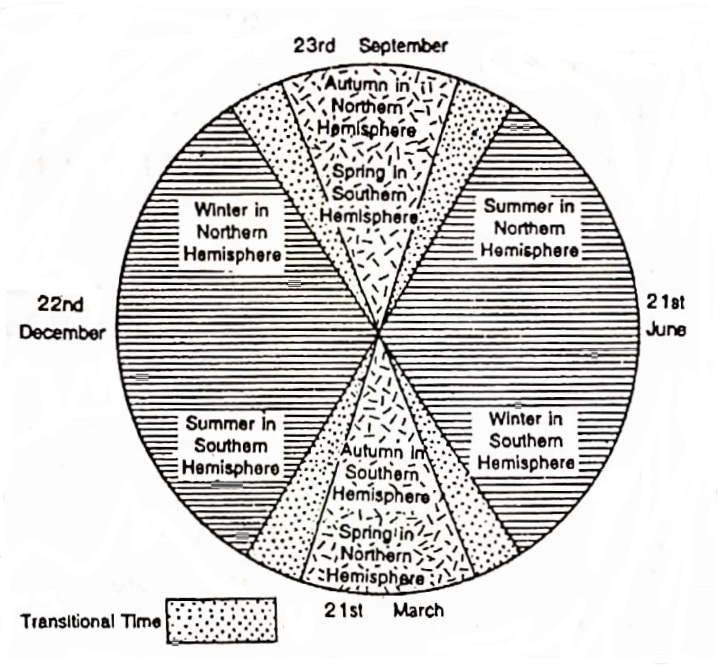
Cycle Of Seasons

There are many seasons like summer, winter, etc. in a year. The seasons have a close relationship with the annual movement of the sun’s rays on the earth’s surface.

WBBSE Solutions class 7 Geography chapter 1 motion of the earth Cycle of seasons

Cycle Of Seasons

Northern Hemisphere Southern Hemisphere Duration (in Montly)
Summer season Winter season May-July
Autumn Season Spring season August-October
Winter Season Summer Season November-January
Spring Season Autumn season February-April


Exceptions In The Change Of Seasons :

  1. There is no change of seasons-only winter occurs at the poles, as the polar regions receive inclined sun rays throughout the year.
  2. There is no change of seasons-only one hot and humid summer occurs over the Equator as the days and nights are equal throughout the year.
  3. India also experiences like other parts of the world, four seasons-summer, autumn, winter, and spring. But in West Bengal, early winter is called Dewi season (Hementa), and late summer, when heavy rainfall occurs, is called the rainy season.

“difference between rotation and revolution class 7”

The Influence Of The Earth’s Revolution On Living Beings:

  1. It is due to the revolution of the earth a suitable climate and natural environment are formed which is favorable for living beings.
  2. For the revolution of the earth variation of temperature is found in different places of the earth and it encourages the growth of a wide variety of plants, animals, and living beings at different parts of the earth.
  3.  It is due to the revolution of the earth, people get different environmental conditions in their ways of living and livelihood is different. Types of food, clothing, shelter, and customs may be different.
  4. It is for the revolution of the earth people get different natural environments in which they follow different economic, social, and cultural activities.