WBBSE Solutions For Class 8 Maths Chapter 13 Factorisation Of Algebraic Expressions

Factorization Of Algebraic Expressions

Today at school we have made rectangles and squares of different sizes using coloured cardboard.

Papia and Tathagaiha stuck those figures on a long thick chart paper and wrote the algebraic expressions for their area below the corresponding figures.

We all have planned to find out the length of each side of a rectangle or a square by fractions of each algebraic expression.

WBBSE Solutions For Class 8 Chapter 13 Factorisation Of Algebraic Expressions Coloured Cardboard

Question 1. On the school blackboard, I resolve \(49 x^2+70 x y+25 y^2\)

Solution:

\(49 x^2+70 x y+25 y^2=7 x^2+2 x 7 x \times 5 y+5 y^2\)

= \((7 x+5 y)^2\)

I got \(49 x^2+70 x y+25 y^2=(9 x+5 y) x(9 x+5 y)\)

The length of each side of the square = 7x + 5y unit.

Class 8 General Science Class 8 Maths
Class 8 History Class 8 Science LAQs
Class 8 Geography Class 8 Science SAQs
Class 8 Maths Class 8 Geography
Class 8 History MCQs Class 8 History

“WBBSE Class 8 Maths Chapter 13 solutions, Factorisation of Algebraic Expressions”

Question 2. It is seen on the factorization of \(\left(81 a^2-72 a b+16 b^2\right)\)

The length of each side of the square = 9a – 4b

Read and Learn More WBBSE Solutions For Class 8 Maths

Question 3. Rehana factorized \(\left(64 m^2-121 n^2\right)\)

Solution:

She got, \(\left(64 m^2-121 n^2\right)\) = (8m + 11 n) x (8m – 11 n)

The length of the rectangle = 8m + 11n units and the length of the other side is units (8m – 11n).

Question 4. But Shiraz factorized [/latex]\left(125 a^3+8 b^3\right)[/latex]

Solution:

Given

\(125 a^3+8 b^3=5 a^3+2 b^3\)

= \((5 a+2 b)\left\{(5 a)^2-(5 a) \times(2 b)+4 b^2\right\}\)

[/latex]\left(125 a^3+8 b^3\right)[/latex] = (5a + 2b) (25a2 – 10ab + 4b2)[/latex][/latex]

Question 5. Utpal factorized \(\left(27 x^3-343 y^3\right)\)

Solution:

Given

\(27 x^3-343 y^3=3 x^3-7 y^3\)

\(\left(27 x^3-343 y^3\right)\) = \((3 x-7 y)\left(9 x^2+21 x y+49 y^2\right)\)

I factorize \(\left(x^2+7 x+12\right)\) but how shall I write down \(\left(x^2+7 x+12\right)\) as the product of two algebraic expressions?

Question 6. At first, let us write all known identities that help to factorize:

Solution:

\((a+b)^2=a^2+2 a b+b^2\) ………………………….. (1)

\((a-b)^2=a 2-2 a b+b^2\)  ……………………………(2)

\(a^2-b^2=(a+b) \times(a-b)\)  ………………………… (3)

\(a^3+b^3=(a+b) \times\left(a^2-a b+b^2\right)\)  ………………….(4)

\(a^3-b^3=(a-b) \times\left(a^2+a b+b^2\right)\) …………………(5)

\(x^2+(a+b) x+a b=(x+a)(x+b)\)  ………………….(6)

Question 7. I try to factorize the algebraic expression \(\left(x^2+7 x-18\right)\) with the help of identity no. 4

Solution:

\(x^2+7 x-18\)

There a + b = 7 and a × b = -18

-18 = 1 x(-18)=(-1 )x(18)=(-2)x9=2x(-9)=(-3)x6=3x(-6) and 7=9+(-2)

∴ Here a = 9 and b = -2

∴ I get from the identity no. 4

\(x^2+7 x-18=(x+9)\{x+(-2)\}\)

= (x+9)(x-2)

I get by factorizing

\(x^2+7 x-18=x^2+(9-2) x-18\)

= \(x^2+9 x-2 x-18\)

= x (x+9)-2 (x+9) = (x+9)(x-2)
WBBSE Solutions For Class 8 Maths Chapter 13 Factorisation Of Algebraic Expressions

Question 8. Let’s try to factorize \(\left(a^2-11 a+30\right) \text { and }\left(m^2-4 m-12\right) \cdot a^2-11 a+30\)

Solution:

30= 1×30=2×15=3×10=5×6

30=5×6, 11=5+6

1. \(m^2-4 m-12\)

Solution:

-12=(-1)×12= 1×(-12) = (-2)×6

= 2×(-6)= 3×(-4)= -3×4

-12 =(-2)×6, 4 =6+(-2)

2. \(a^2-11 a+30\)

Solution:

= \(a^2-(5+6) a+30\)

= \(a^2-5 a-6 a+30\)

= a (a-5)-6(a-5)

= (a-5)(a-6)

\(a^2-11 a+30\) = (a-5)(a-6)

3. \(m^2-4 m-12\)

Solution:

= \(m^2-(6-2) m-12\)

= \(m^2-6 m+2 m-12\)

= m(m-6) +2(m-6)

= (m-6)(m+2)

∴ We will find out two numbers a and b to resolve the binomial expression \(x^2+p x+q\)(the highest power of the variable in the algebraic expression is 2) into factors so that

a+b = p and a x b =q

∴ In that case the algebraic expression will be

\(x^2+(a+b) x+a b\)

=\(x^2+a x+b x+a b\)

= x (x+a) + b (x+a)

= (x+a) (x+b)

= (m-6)(m+2) = (x+a) (x+b)

“Class 8 WBBSE Maths Chapter 13 solutions, Factorisation study material”

Question 9. I try to resolve \(\left(x^2-x-20\right) \text { and }\left(b^2-10 b+16\right)\)

1. \(x^2-x-20\)

Solution:

-20 =5×(-4)

and 1= 5-4

2. \(b^2-10 b+16\)

Solution:

16= 8 × 2

and 10 = 8 + 2

3. \(x^2-x-20\)

Solution:

= \(x^2-(5-4) x-20\)

= \(x^2-5 x+4 x-20\)

= x(x-5)+4(x-5)

= (x-5)(x+4)

\(x^2-x-20\) = (x-5)(x+4)

4. \(b^2-10 b+16\)

Solution:

= \(b^2-(8+2) b+16\)

= \(b^2-8 b-2 b+16\)

= b(b-8)-2(b-8)

= (b-8)(b-2)

\(b^2-10 b+16\) = (b-8)(b-2)

“WBBSE Class 8 Maths Chapter 13, Factorisation of Algebraic Expressions solved examples”

Question 11. We factorize (x2+ 20xy – 96y2) and (1-5x-36×2). Each term of (x2+20xy-96y2) has variable. At first eliminate the variable from the last term.

Solution:

Given

\(x^2+20 x y-96 y^2\)

= \(\left\{\frac{x^2}{y^2}+\frac{20 x y}{y^2}-\frac{96 y^2}{y^2}\right\} x y^2\)

= \(\left\{\left(\frac{x}{y}\right)^2+20\left(\frac{x}{y}\right)-96\right\} x y^2\)

= \(\left(a^2+20 a-96\right) y\)       [Let \(\frac{x}{y}\) = a]   

= \(\left(a^2+24 a-4 a-96\right) y^2\)     [96=24×4 and 20=24-4]                                                           

= \(\{a(a+24)-4(a+24)\} y^2\)

= \((a+24)(a-4) y^2\)

= \(\left(\frac{x}{y}+24\right)\left(\frac{x}{y}-4\right) y^2\) [Puting a=\(\frac{x}{y}\)

= \(\left(\frac{x+24 y}{y}\right)\left(\frac{x-4 y}{y}\right) y^2\)

= \(\frac{(x+24 y)(x-4 y)}{y^2} y^2\)

= (x + 24y) (x-4y)

Alternative method

= \(x^2+20 x y-96 y^2\)

= \(x^2+(24 y-4 y) x-24 y \times 4 y\)

= \(x^2+24 x y-4 x y-24 y \times 4 y\)

= x (x + 24y) – 4y (x + 24y)

= x + 24y × x- 4y

Question 12. We try to factorize \(\left(1-5 x-36 x^2\right)\).

Solution:

Given

\(\left(1-5 x-36 x^2\right)\).

= \(1-5 x-36 x^2\)

= \(1-(9-4) \times(-9) \times 4 x^2\)

= \(1-9 x+4 x-9 \times 4 \times x^2\)

= 1 (1-9x) + 4x(1-9x)

= (1-9x)(1+4x)

\(\left(1-5 x-36 x^2\right)\) = (1-9x)(1+4x)

Question 13. I try to factorize (x-1) (x+3) (x-2)(x-6) +96.
Solution:

Given

(x-1) (x+3) (x-2)(x-6) +96.

But how will we factorize and with the help of which identity

x-1, x+3, x-2 and x-6? Let’s find the sum of the coefficients of two terms containing x only will be the product of two pair of expression among the four expressions

– 1-2 = – 3 and + 3 – 6= – 3

Then, the coefficient of x is the product (x-1)(x-2) is -3 and that of (x+3)(x-6) is (-3).

Then, (x-1)(x+3)(x-2)(x-6)+96

= (x-1 )(x+3)(x-2)(x-6) + 96

= \(\left(x^2-x-2 x+2\right)\left(x^2+3 x-6 x-18\right)+96\)

= \(\left(x^2-3 x+2\right)\left(x^2-3 x-18\right)+96\)

= (a+2) (a-18) + 96

= \(a^2-2 a-18 a-36+96\)

= \(a^2-16 a+60\)

= \(a^2-(10+6) a+60\)

= \(a^2-10 a-6 a+60\)

= a (a=10) -6 (a=10)

= (a-10) (a-6)

= \(\left(x^2-3 x-10\right)\left(x^2-3 x-6\right)\) [Let a=x2-3x]

= \(\left(x^2-5 x+2 x-10\right)\left(x^2-3 x-6\right)\)

= \(\{x(x-5)+2(x-5)\}\left(x^2-3 x-6\right)\)

= \((x-5)(x+2)\left(x^2-3 x-6\right)\)

(x-1) (x+3) (x-2)(x-6) +96 = \((x-5)(x+2)\left(x^2-3 x-6\right)\)

Question 14. Let’s factorize the algebraic expression \(x^2+3 x-(p+5)(p+2)\).

Solution:

Given

\(x^2+3 x-(p+5)(p+2)\) \(x^2+3 x-(p+5)(p+2)\)

= \(x^2+\{(p+5)-(p+2)\} x-(p+5)(p+2)\)

= \(x^2+(p+5) x-(p+2) x-(p+5)(p+2)\)

= x (x+p+5) – (p+2) (x+p+5)

= (x+p+5) (x-p-2)

\(x^2+3 x-(p+5)(p+2)\) = (x+p+5) (x-p-2)

Algebraic Expressions Exercise

Question 1. Comparing the following algebraic expressions with the identity \(x^2+(p+q) x+p q=(x+p)(x+q)\), let’s write the values of p and q and factorize them.

Algebraic expression:

Given

\(x^2+(p+q) x+p q=(x+p)(x+q)\)

= \(x^2-8 x+15\)

= \(x^2-40 x-129\)

= \(m^2+19 m+60\)

= \(x^2-x-6\)

= \((a+b)^2-4(a+b)-12\)

= \((x-y)^2-x+y-2\)

Values of p & q:

p= -5, q= -3

p=3, q=-43

p=15, q=4

p=-3, q=2

p=-6, q=2

p=-2, q=1

Resolve into factors: 

= (x-5) (x-3)

= (x+3) (x-43)

= (m+15) (m+4)

= (x-3) (x+2)

= (a+b-6) (a+b+2)

= (x-y-2) (x-y+1)

“WBBSE Class 8 Factorisation of Algebraic Expressions solutions, Maths Chapter 13”

Question 2. Let’s resolve into factors :

1. \((a+b)^2-5 a-5 b+6\)

= \((a+b)^2-5 a-5 b+6\)

= \((a+b)^2-5(a-b)+6\)

Let a + b = x

∴ \(x^2-5 x+6\)

= \(x^2-(3+2) x+6\)

= \(x^2-3 x-2 x+6\)

= x(x-3)-2 (x-3)

= (x-3) (x-2)

Putting the value of x (a+b-3) (a+b-2),

2. \(\left(x^2-2 x\right)^2+5\left(x^2-2 x\right)-36\)

Solution:

\(\left(x^2-2 x\right)^2+5\left(x^2-2 x\right)-36\)

Let \(x^2-2 x=a\)

∴ \(a^2+5 a-36\)

= \(a^2+(9-4) a-36\)

= \(a^2+9 a-4 a-36\)

= a (a+9) – 4 (a+9)

= (a+9) (a-4)

Putting the value of a, (x2 – 2x +9) (x2 – 2x – 4)[/latex][/latex]

3. (p2-3q2)2-16(p2-3q2) + 63[/latex][/latex]

Solution:

(p2-3q2)2-16(p2-3q2) + 63[/latex][/latex]

Let x p2 – 3q2 = x[/latex][/latex]

∴ x2-16x + 63[/latex][/latex]

= x2 – (9+7) x + 63[/latex][/latex]

= x2 – 9x – 7x + 63[/latex][/latex]

= x (x-9) -7 (x-9)

= (x-9) (x-7)

Putting the value of x, (p2 – 3q2-9)(p2-3q2-7)[/latex][/latex]

4. a4+4a2-5[/latex][/latex]

Solution:

a4+4a4-5[/latex][/latex]

= a4+ (5-1) a2-5[/latex][/latex]

= a4 + 5a2-a2-5[/latex][/latex]

= a2 (a2+5) – 1 (a2+5)[/latex][/latex]

= (a2+5) (a2-1) = (a2+5) (a+1) (a-1)[/latex][/latex]

a4+4a2-5[/latex][/latex] = (a2+5) (a2-1) = (a2+5) (a+1) (a-1)[/latex][/latex]

5. \(x^2 y^2+23 x y-420\)

Solution:

\(x^2 y^2+23 x y-420\)

= \(x^2 y^2+(35-12) x y-420\)

= \(x^2 y^2+35 x y-12 x y-420\)

= xy (xy + 35) -12 (xy + 35)

= (xy + 35) (xy -12)

\(x^2 y^2+23 x y-420\) = (xy + 35) (xy -12)

6. \(x^4-7 x^2+12\)

Solution:

= \(x^4-7 x^2+12\)

= \(x^4-(4+3) x^2+12\)

= \(x^4-4 x^2-3 x^2+12\)

= \(x^2\left(x^2-4\right)-3\left(x^2-4\right)\)

= \(\left(x^2-4\right)\left(x^2-3\right)\)

= \((x+2)(x-2)\left(x^2-3\right)\)

\(x^4-7 x^2+12\) = \((x+2)(x-2)\left(x^2-3\right)\)

7. \(a^2+a b-12 b^2\)

Solution:

\(a^2+a b-12 b^2\)

= \(a^2+(4-3) a b-12 b^2\)

= \(a^2+4 a b-3 a b-12 b^2\)

= a(a+4b) -3b (a+4b)

= (a+4b) (a-3b)

\(a^2+a b-12 b^2\) = (a+4b) (a-3b)

8. \(p^2+31 p q+108 q^2\)

Solution:

\(p^2+31 p q+108 q^2\)

= \(p^2+(27+4) p q+108 q^2\)

= \(p^2+27 p q+4 p q+108 q^2\)

= p (p+27q) + 4q (p+27q)

= (p+27q) (p+4q)

\(p^2+31 p q+108 q^2\) = (p+27q) (p+4q)

9. \(a^6+3 a^3 b^3-40 b^6\)

Solution:

\(a^6+3 a^3 b^3-40 b^6\)

= \(a^6+(8-5) a^3 b^3-40 b^6\)

= \(a^6+8 a^3 b^3-5 a^3 b^3-40 b^6\)

= \(a^3\left(a^3+8 b^3\right)-5 b^3\left(a^3+8 b^3\right)\)

= \(\left(a^3+8 b^3\right)\left(a^3-5 b^3\right)\)

= \(\left\{(a)^3+(2 b)^3\right\}\left(a^3-5 b^3\right)\)

= \((a+2 b)\left(a^2-2 a b+4 b^2\right)\left(a^3-5 b^3\right)\)

\(a^6+3 a^3 b^3-40 b^6\) = \((a+2 b)\left(a^2-2 a b+4 b^2\right)\left(a^3-5 b^3\right)\)

10. (x+1) (x+3) (x-4) (x-6) + 24 .

Solution:

(x+1) (x+3) (x-4) (x-6) + 24

= (x+1) (x-4) (x+3) (x-6) + 24

= \(\left(x^2-3 x-4\right)\left(x^2-3 x-18\right)+24\)

Let \(x^2-3 x=a\)

∴ (a-4) (a-18) + 24

= \(a^2-22 a+72+24\)

= \(a^2-22 a+96\)

= \(a^2-(16+6) a+96\)

= \(a^2-16 a-6 a+96\)

= a (a-16) -6 (a-16)

= (a-16) (a-6)

(x+1) (x+3) (x-4) (x-6) + 24 = (a-16) (a-6)

Putting the value of a, \(\left(x^2-3 x-16\right)\left(x^2-3 x-6\right)\)

“Class 8 WBBSE Maths Chapter 13, Factorisation easy explanation”

11. \((x+1)(x+9)(x+5)^2+63\)

Solution:

\((x+1)(x+9)(x+5)^2+63\)

= \(\left(x^2+10 x+9\right)\left(x^2+10 x+25\right)+36\)

Let \(x^2+10 x=a\)

∴  (a+9) (a+25) + 63

= \(a^2+34 a+225+63\)

= \(a^2+34 a+288\)

= \(a^2+(18+16) a+288\)

= \(a^2+18 a+16 a+288\)

= a (a+18 + 16(a+18)

= (a+18) (a+16)

Putting the value of a, \(\left(x^2+10 x+18\right)\left(x^2+10 x+16\right)\)

= \(\left(x^2+10 x+18\right)\left\{\left(x^2+(8+2) x+16\right\}\right.\)

= \(\left(x^2+10 x+18\right)(x 2+8 x+2 x+16)\)

= \(\left(x^2+10 x+18\right)\{x(x+8)+2(x+8)\}\)

= \(\left(x^2+10 x+18\right)(x+8)(x+2)\)

= \((x+2)(x+8)\left(x^2+10 x+18\right)\)

12. x(x+3) (x+6) (x+9) + 56

Solution:

= x(x+3) (x+6) (x+9) + 56

= x(x+9) (x+3) (x+6) + 56

= \(\left(x^2+9 x\right)\left(x^2+9 x+18\right)+56\)

∴ Let \(x^2+9 x=a\)

= a (a+18) + 56

= \(a^2+18 a+56\)

= \(a^2+(14+4) a+56\)

= \(a^2+14 a+4 a+56\)

= a(a+14) +4 (a+14)

= (a+14) (a+4)

Putting the value of a,

\(\left(x^2+9 x+14\right)\left(x^2+9 x+4\right)\)

= \(\left(x^2+7 x+2 x+14\right)\left(x^2+9 x+4\right)\)

= \(\{x(x+7)+2(x+7)\}\left(x^2+9 x+4\right)\)

= \((x+7)(x+2)\left(x^2+9 x+4\right)\)

13. \(x^2-2 a x+(a+b)(a-b)\)

Solution:

\(x^2-2 a x+(a+b)(a-b)\)

= \(x^2-2 a x+a^2-b^2\)

= \((x-a)^2-(b)^2\)

= (x-a+b) (x-a-b)

\(x^2-2 a x+(a+b)(a-b)\) = (x-a+b) (x-a-b)

14. \(x^2-b x-(a+3 b)(a+2 b)\)

Solution:

\(x^2-\{(a+3 b)-(a+2 b)\} x-(a+3 b)(a+2 b)\)

= \(x^2-(a+3 b) x+(a+2 b) x-(a+3 b)(a+2 b)\)

= x(x-a-3b) + (a + 2b) (x-a-3b)

= (x-a-3b) (x+a+2b)

\(x^2-b x-(a+3 b)(a+2 b)\) = (x-a-3b) (x+a+2b)

15. \((a+b)^2-5 a-5 b+6\)

Solution:

\((a+b)^2-5 a-5 b+6\)

= \((a+b)^2-5(a+b)+6\)

Let a + b = x

∴ \(x^2-5 x+6\)

= \(x^2-(3+2) x+6\)

= \(x^2-3 x-2 x+6\)

= x (x-3) – 2 (x-3)

= (x-3) (x-2)

Putting the value of x, (a+b-3) (a+b-2)

\((a+b)^2-5 a-5 b+6\) = (a+b-3) (a+b-2)

16. \(x^2+4 a b x-\left(a^2-b^2\right)^2\)

Solution:

\(x^2+4 a b x-\left(a^2-b^2\right)^2\)

= \(x^2+4 a b x-\{(a+b)(a-b)\}^2\)

= \(x^2+4 a b x-(a+b) 2(a-b)^2\)

= \(x^2+\left\{(a+b)^2-(a-b)^2\right\} x-(a+b)^2(a-b)^2\)

= \(x^2+(a+b)^2 x-(a-b) 2 x-(a+b)^2(a-b)^2\)

= \(x\left\{x+(a+b)^2\right\}-(a-b)^2\left\{x+(a+b)^2\right\}\)

= \(\left\{x+(a+b)^2\right\}\left\{x-(a-b)^2\right\}\)

= \(\left(x+a^2+2 a b+b^2\right)\left(x-a^2+2 a b-b^2\right)\)

\(x^2+4 a b x-\left(a^2-b^2\right)^2\) = \(\left(x+a^2+2 a b+b^2\right)\left(x-a^2+2 a b-b^2\right)\)

17. x2 – \(\left(a+\frac{1}{a}\right)\)x + 1

Solution:

= \(x^2-a x-\frac{x}{a}+\frac{a}{a}\)

= \(x(x-a)-\frac{1}{a}(x-a)=(x-a)\left(x-\frac{1}{a}\right)\)

x2 – \(\left(a+\frac{1}{a}\right)\)x + 1 = \(x(x-a)-\frac{1}{a}(x-a)=(x-a)\left(x-\frac{1}{a}\right)\)

18. \(x^6 y^6-9 x^3 y^3+8\)

Solution:

\(x^6 y^6-9 x^3 y^3+8\)

= \(x^6 y^6-(8+1) x^3 y^3+8\)

= \(x^6 y^6-8 x^3 y^3-x^3 y^3+8\)

= \(x^3 y^3\left(x^3 y^3-8\right)-1\left(x^3 y^3-8\right)\)

= \(\left(x^3 y^3-8\right)\left(x^3 y^3-1\right)\)

“WBBSE Class 8 Maths Chapter 13 solutions, Factorisation of Algebraic Expressions PDF”

= \(\left\{(x y)^3-(2)^3\left\{(x y)^3-(1)^3\right\}\right.\)

= \((x y-2)\left(x^2 y^2+2 x y+4\right)(x y-1)\left(x^2 y^2+x y+1\right)\)

\(x^6 y^6-9 x^3 y^3+8\) = \((x y-2)\left(x^2 y^2+2 x y+4\right)(x y-1)\left(x^2 y^2+x y+1\right)\)

Question 19. \(3 x^2+14 x+18\)

Solution:

= \(\frac{9 x^2+42 x+24}{3}\)

= \(\frac{(3 x)^2+14 \times 3 x+24}{3}\)

= \(\frac{y^2+14 y+24}{3}\) [Let 3x=y]

= \(\frac{y^2+12 y+2 y+24}{3}\)

= \( \frac{y(y+12)+2(y+12)}{3}\)

= \(\frac{(y+12)(y+2)}{3}\)

= \(\frac{(y+12)(y+2)}{3}\)

= \(\frac{(3 x+12)(3 x+2)}{3}\)            [Putting y=3x,we get]

= \(\frac{3(x+4)(3 x+2)}{3}\)

= (x+4)(3x+2)

Alternatively we write,

\(3 x^2+14 x+8\)

We find two numbers a and b such that a+b = 14 and a × b = 3 × 8 = 24

= 12×2 and 14= 12+2

= \(3 x^2+14 x+8\)

= \(3 x^2+(12+2) x+8\)

= \(3 x^2+12 x+2 x+8\)

= 3x (x+4) +2 (x+4)

= (x+4) (3x+2)

\(3 x^2+14 x+18\) = (x+4) (3x+2)

Question 20. Lets resolve \(6 x^2-x-15\) into factors and let’s write what are the possible lengths of the side (in units) of the yellow rectangular board.
Solution:

\(6 x^2-x-15\)

∴ -90 =10×(-9) and -1 = 10+(-9)

= \(6 x^2-x-15\)

= \(6 x^2-(10-9) x-15\)

= \(6 x^2-10 x+9 x-15\)

= 2x (3x-5)+3(3x-5)

= (3x-5) (2x + 3)

Question 21. Let’s express 2 algebraic expressions \(x^2+13 x-48 \text { and } 6 y^2-y-15\) as the difference between two squares. Now let’s try to resolve into factors with the help of the identity \(a^2-b^2=(a+b)(a+b)\).

Solution:

= \(x^2+13 x-48\)

= \( x^2+2 \cdot x \cdot \frac{13}{2}+\left(\frac{13}{2}\right)^2-\left(\frac{13}{2}\right)^2-48\)

= \(\left(x+\frac{13}{2}\right)^2-\frac{169}{4}-48\)

= \(\left(x+\frac{13}{2}\right)^2-\left(\frac{169}{4}+48\right)\)

= \( \left(x+\frac{13}{2}\right)^2-\frac{169+192}{4}\)

= \(\left(x+\frac{13}{2}\right)^2-\frac{361}{4}\)

= \(\left(x+\frac{13}{2}\right)^2-\left(\frac{19}{4}\right)^2\)

= \(\left(x+\frac{13}{2}+\frac{19}{2}\right)\left(x+\frac{13}{2}-\frac{19}{2}\right)\)

= \(\left(x+\frac{13+19}{2}\right)\left(x+\frac{13-19}{2}\right)\)

= (x+16) (x-3)

Factorize \(\left(x^2+13 x-48\right)\) by middle-term factor method.

\(x^2+13 x-48\)

= \(x^2+16 x-3 x-48\)

= x (x+16) -3 (x+16)

= (x+16) (x-3)

“WBBSE Class 8 Maths Chapter 13, Factorisation important questions”

Algebraic Expressions Exercise 13.2

Question 1. Let’s resolve into factors \(\left(a^2-a-72\right) \text { and }\left(2 x^2-x-1\right)\) by expressing the algebraic expressions as the difference of two squares.
Solution:

Given

\(\left(a^2-a-72\right) \text { and }\left(2 x^2-x-1\right)\) 

\(a^2-a-72\)

= \(a^2-(9-8) a-72\)

= \(a^2-9 a+8 a-72\)

= a (a-9) +8 (a-9)

= (a-9) (a+8)

\(2 x^2-x-1\)

= \(2 x^2-(2-1) x-1\)

= \(2 x^2-2 x+x-1\)

= 2x (x-1) +1 (x-1)

= (x-1) (2x+1)

Question 2.  Let’s resolve into factors —

1. \(2 a^2+5 a+2\)

Solution:

\(2 a^2+5 a+2\)

= \(2 a^2+(4+1) a+2\)

= \(2 a^2+4 a+a+2\)

= 2a (a+2) +1 (a+2)

= (a+2) (2a+1).

\(2 a^2+5 a+2\) = (a+2) (2a+1).

2. \(3 x^2+14 x+8\)

Solution:

\(3 x^2+14 x+8\)

= \(3 x^2+(12+2) x+8\)

= \(3 x^2+12 x+2 x+8\)

= 3x (x+4) +2 (x+4)

= (x+4) (3x+2)

\(3 x^2+14 x+8\) = (x+4) (3x+2)

3. \(2 m^2+7 m+6\)

Solution:

\(2 m^2+7 m+6\)

= \(2 m^2+(4+3) m+6\)

= \(2 m^2+4 m+3 m+6\)

= 2m (m+2) +3 (m+2)

= (m+2) (2m+3)

\(2 m^2+7 m+6\) = (m+2) (2m+3)

4. \(6 x^2-x-15\)

Solution:

\(6 x^2-x-15\)

= \(6 x^2-(10-9) x-15\)

= \(6 x^2-10 x+9 x-15\)

= 2x (3x – 5) +3 (3x – 5)

= (3x – 5) (2x + 3)

\(6 x^2-x-15\) = (3x – 5) (2x + 3)

5. \(9 r^2+r-8\)

Solution:

\(9 r^2+r-8\)

= \(9 r^2+(9-8) r-8\)

= \(9 r^2+9 r-8 r-8\)

= 9r (r+1) -8 (r+1)

= (r+1) (9r-8)

\(9 r^2+r-8\) = (r+1) (9r-8)

6. \(6 m^2-11 m n-10 n^2\)

Solution:

\(6 m^2-11 m n-10 n^2\)

= \(6 m^2-(15-4) m n-10 n^2\)

= \(6 m^2-15 m n+4 m n-10 n^2\)

= 3m (2m-5n) +2n (2m-5n)

= (2m-5n) (3m+2n)

\(6 m^2-11 m n-10 n^2\) = (2m-5n) (3m+2n)

7. \(7 x^2+48 x y-7 y^2\)

Solution:

\(7 x^2+48 x y-7 y^2\)

= \(7 x^2+(49-1) x y-7 y^2\)

= \(7 x^2+49 x y-x y-7 y^2\)

= 7x (x+7y)-y(x+7y)

= (x+7-y) (7x-y)

\(7 x^2+48 x y-7 y^2\) = (x+7-y) (7x-y)

8. \(12+x-6 x^2\)

Solution:

\(12+x-6 x^2\)

= \(12+(9-8) x-6 x^2\)

= \(12+9 x-8 x-6 x^2\)

= 3 (4+3x) – 2x (4+3x)

= (4+3x) (3-2x)

\(12+x-6 x^2\) = (4+3x) (3-2x)

9. \(6+5 a-6 a^2\)

Solution:

\(6+5 a-6 a^2\)

= \(6+(9-4) a-6 a^2\)

= \(6+9 a-4 a-6 a^2\)

= 3 (2+3a)-2a (2+3a)

= (2+3a) (3-2a)

\(6+5 a-6 a^2\) = (2+3a) (3-2a)

10. \(6 x^2-13 x+6\)

Solution:

\(6 x^2-13 x+6\)

= \(6 x^2-(9+4) x+6\)

= 3x (2x-3) -2 (2x-3)

= (2x-3) (3x-2)

\(6 x^2-13 x+6\) = (2x-3) (3x-2)

11. \(99 a^2-202 a b+99 b^2\)

Solution:

\(99 a^2-202 a b+99 b^2\)

= \(99 a^2-(121+81) a b+99 b^2\)

= \(99 a^2-121 a b-81 a b+99 b^2\)

= 11 a (9a-11 b)-9b(9a-11 b)

= (9a-11b) (11a-9b)

\(99 a^2-202 a b+99 b^2\) = (9a-11b) (11a-9b)

“Class 8 Maths Factorisation solutions, WBBSE syllabus”

12. \(2 a^6-13 a^3-24\)

Solution:

\(2 a^6-13 a^3-24\)

= \(2 a^6-(16-3) a^3-24\)

= \(2 a^6-16 a 3+3 a^3-24\)

= \(2 a 3\left(a^3-8\right)+3\left(a^3-8\right)\)

= \(\left(a^3-8\right)\left(2 a^3+3\right)\)

= \(\left\{(a)^3-(2) 3\right\}\left(2 a^3+3\right)\)

= \((a-2)\left(a^2+2 a+4\right)\left(2 a^3+3\right)\)

\(2 a^6-13 a^3-24\)= \((a-2)\left(a^2+2 a+4\right)\left(2 a^3+3\right)\)

13. \(8 a^4+2 a^2-45\)

Solution:

\(8 a^4+2 a^2-45\)

= \(8 a^4+(20-18) a^2-45\)

= \(8 a^4+20 a^2-18 a^2-45\)

= \(4 a^2\left(2 a^2+5\right)-9\left(2 a^2+5\right)\)

= \(\left(2 a^2+5\right)(4 a 2-9)\)

= \(\left(2 \mathrm{a}^2+5\right)\left\{(2 \mathrm{a})^2-(3)^2\right\}\)

= \(\left(2 a^2+5\right)(2 a+3)(2 a-3)\)

\(8 a^4+2 a^2-45\) = \(\left(2 a^2+5\right)(2 a+3)(2 a-3)\)

14. \(6(x-y)^2-x+y-15\)

Solution:

[/latex]6(x-y)^2-x+y-15[/latex]

= \(6(x-y)^2-(x-y)-15\)

Let x-y=a

∴ \(6 a^2-a-15\)

= \(6 a^2-(10-9) a-15\)

= \(6 a^2-10 a+9 a-15\)

= 2a (3a – 5) + 3 (3a – 5)

= (3a – 5) (2a + 3)

Putting the value of a, (3x-3y-5) (2x-2y+3)

\(6(x-y)^2-x+y-15\) = (3x-3y-5) (2x-2y+3)

15. \(3(a+b)^2-2 a-2 b-8\)

Solution.

\(3(a+b)^2-2 a-2 b-8\)

= \(3(a+b)^2-2(a+b)-8\)

Let a + b = x

∴ \(3 x^2-2 x-8\)

= \(3 x^2-(6-4) x-8\)

= \(3 x^2-6 x+4 x-8\)

= 3x (x-2) +4 (x-2)

= (x-2) (3x+4)

Putting the value of x, (a+b-2) (3a+3b+4)

\(3(a+b)^2-2 a-2 b-8\) = (a+b-2) (3a+3b+4)

16. \(6(a+b)^2+5\left(a^2-b^2\right)-6(a-b)^2\)

Solution:

\(6(a+b)^2+5\left(a^2-b^2\right)-6(a-b)^2\)

= \(6(a+b)^2+5(a+b)(a-b)-6(a-b)^2\)

Let a+b=x and a-b=y

∴ \(6 x^2+5 x y-6 y^2\)

= \(6 x^2+(9-4) x y-6 y^2\)

= \(6 x^2+9 x y-4 x y-6 y^2\)

= 3x (2x+3y) -2y (2x+3y)

= (2x+3y) (3x-2y)

Putting the values x and y, (2a+2b+3a-3b) (3a+3b-2a+2b) = (5a-b) (a+5b)

\(6(a+b)^2+5\left(a^2-b^2\right)-6(a-b)^2\)= (5a-b) (a+5b)

Question 3. Let’s resolve the following algebraic expressions into factors by expressing them as the difference of two squares.

1. \(x^2-2 x-3\)

Solution:

\(x^2-2 x-3\)

= \(x^2-2 x+1-4\)

= \((x)^2-2 \times 1+(1) 2-(2)^2\)

= \((x-1)^2-(2)^2\)

= (x-1+2) (x-1-2)

= (x+1) (X-3)

\(x^2-2 x-3\) = (x+1) (X-3)

2. \(x^2+5 x+6\)

Solution:

\(x^2+5 x+6\)

= \((x)^2+2 \cdot x \cdot \frac{5}{2}+\left(\frac{5}{2}\right)^2+6-\left(\frac{5}{2}\right)^2 \)

= \(\left(x+\frac{5}{2}\right)^2+6-\frac{25}{4}\)

= \(\left(x+\frac{5}{2}\right)^2+\frac{24-25}{4}\)

= \(\left(x+\frac{5}{2}\right)^2-\frac{1}{4}\)

= \(\left(x+\frac{5}{2}\right)^2-\left(\frac{1}{2}\right)^2\)

= \( \left(x+\frac{5}{2}+\frac{1}{2}\right)\left(x+\frac{5}{2}-\frac{1}{2}\right)\)

= (x+3) (x+2)

\(x^2+5 x+6\) = (x+3) (x+2)

“WBBSE Class 8 Chapter 13 Maths, Factorisation of Algebraic Expressions step-by-step solutions”

3. \(3 x^2-7 x-6\)

Solution:

\(3 x^2-7 x-6\)

= \(3\left(x^2-\frac{7}{3} x-2\right)\)

= \( \left\{(x)^2-2 \cdot x \cdot \frac{7}{6}+\left(\frac{7}{6}\right)^2-\left(\frac{7}{6}\right)^2-2\right\}\)

= \(3\left\{\left(x-\frac{7}{6}\right)^2-\left(\frac{49}{36}+\frac{2}{1}\right)\right\}\)

\(=3\left\{\left(x-\frac{7}{6}\right)^2-\frac{121}{36}\right\}\) \(=3\left\{\left(x-\frac{7}{6}\right)^2-\left(\frac{11}{6}\right)^2\right\}
\)

= \(3\left(x-\frac{7}{6}+\frac{11}{6}\right)\left(x-\frac{7}{6}-\frac{11}{6}\right) \)

= \(3\left(x+\frac{4}{6}\right)(x-3)\)

= (3x+2) (x-3)

\(3 x^2-7 x-6\) = (3x+2) (x-3)

4. \(3 a^2-2 a-5\)

Solution:

= \(3\left(a^2-\frac{2}{3} a-\frac{5}{3}\right)\)

= \(3\left\{(a)^2-2 \cdot a \cdot \frac{1}{3}+\left(\frac{1}{3}\right)^2-\left(\frac{1}{3}\right)^2-\frac{5}{3}\right\}\)

= \(3\left\{\left(a-\frac{1}{3}\right)^2-\frac{1}{9}-\frac{5}{3}\right\}\)

= \(3\left\{\left(a-\frac{1}{3}\right)^2-\left(\frac{1+15}{9}\right)\right\}\)

= \(3\left\{\left(a-\frac{1}{3}\right)^2-\frac{16}{9}\right\}\)

= \(3\left\{\left(a-\frac{1}{3}\right)^2-\left(\frac{4}{3}\right)^2\right\}\)

= \(3\left(a-\frac{1}{3}+\frac{4}{3}\right)\left(a-\frac{1}{3}-\frac{4}{3}\right)\)

= \(3(a+1)\left(a-\frac{5}{3}\right)\)

= (a+1) (3a-5)

\(3 a^2-2 a-5\) = (a+1) (3a-5)

Question 4. Let’s resolve into factors

1. \(a x^2+\left(a^2+1\right) x+a\)

Solution:

\(a x^2+\left(a^2+1\right) x+a\)

= \(a x^2+a^2 x+x+a\)

= ax (x + a) + 1 (x + a)

= (x + a) (ax + 1)

\(a x^2+\left(a^2+1\right) x+a\) = (x + a) (ax + 1)

2. \(x^2+2 a x+(a+b)(a-b)\)

Solution:

\(x^2+2 a x+(a+b)(a-b)\)

= \(x^2+2 a x+a^2-b^2\)

= \((x+a)^2-(b)^2\)

= (x + a + b) (x + a – b)

\(x^2+2 a x+(a+b)(a-b)\) = (x + a + b) (x + a – b)

3. \(a x^2-\left(a^2+1\right) x+a\)

\(a x^2-\left(a^2+1\right) x+a\)

= \(a x^2-a^2 x-x+a\)

= ax (x – a) -1 (x – a)

= (x – a) (ax – 1)

\(a x^2-\left(a^2+1\right) x+a\) = (x – a) (ax – 1)

4. \(a x^2+\left(a^2-1\right) x-a\)

Solution:

\(a x^2+\left(a^2-1\right) x-a\)

= \(a x^2+a^2 x-x-a\)

= ax (x + a) – 1 (x + a)

= (x + a) (ax – 1)

\(a x^2+\left(a^2-1\right) x-a\) = (x + a) (ax – 1)

5. \(a x^2-\left(a^2-2\right) x-2 a\)

Solution:

\(a x^2-\left(a^2-2\right) x-2 a\)

= \(a x^2-a^2 x+2 x-2 a\)

= ax (x – a) + 2 (x – a)

= (x – a) (ax + 2)

\(a x^2-\left(a^2-2\right) x-2 a\) = (x – a) (ax + 2)

“WBBSE Maths Class 8 Factorisation of Algebraic Expressions, Chapter 13 key concepts”

6. \(a^2+1-\frac{6}{a^2}\)

Solution:

= \(a^2+1-\frac{6}{a^2}\)

= \(a^2+3-2-\frac{6}{a^2}\)

= \(a\left(a+\frac{3}{a}\right)-\frac{2}{a}\left(a+\frac{3}{a}\right)\)

= \(\left(a+\frac{3}{a}\right)\left(a-\frac{2}{a}\right)\)

\(a^2+1-\frac{6}{a^2}\) = \(\left(a+\frac{3}{a}\right)\left(a-\frac{2}{a}\right)\)

WBBSE Solutions For Class 8 Maths Chapter 14 H.C.F And L.C.M Of Algebraic Expressions

H.C.F And L.C.M Of Algebraic Expressions

We had some coloured ribbons of different lengths. We had a green ribbon of length 32 metre and a yekkow ribbon of length 104 metre and a yellow ribbon of length 56 metre.

We have decided that we cut off the gretedt length of same side from the ribbons in such away that no portion of the ribbon is left cut.

Question 1. Let us calculate what will be the G.C.D of 32,104,56

Solution.

Given

32,104,56

G.C.D of 32, 104, 56

32=2×2×2×2×2

104=2×2×2×13

56= 2×2×2×7

∴ G.C.D of 32,104,and56 2×2×2×8

∴ The greatest length of ribbon we have to cut is metre, i.e., we factorise the three numbers into prime factors and consider the highest common factor, G.C.D of the three numbers.

WBBSE Class 8 Maths Chapter 14 H.C.F And L.C.M Of Algebraic Expressions

Question 2. If we had a green ribbon of length 2a2b metre, a yellow ribbon of length 4ab2metre and a blue ribbon of length 6a2b2, let’s calculate the greatest length of the same size we have cut from the ribbons in such a way that no portion of the ribbon is left.

How will I get the G.C.D of 2a2b,4ab2 and 6a2b2?

Solution.

Given

If we had a green ribbon of length 2a2b metre, a yellow ribbon of length 4ab2metre and a blue ribbon of length 6a2b2

G.C.D of 2a2b,4ab2 and 6a2b2

At first we resolve 2a2b,4ab2 and 6a2b2 into prime factors.

2a2b= 2×a×a×b

4ab2= 2×2×a×b×b

6a2b2= 3×2×a×a×b×b

Alternately, G.C.D of 2,4 and 6=2 Lowest power of a is a, the lowest power of is bis b in the expressions 2a2b,4ab2 and 6a2b2.

Class 8 General Science Class 8 Maths
Class 8 History Class 8 Science LAQs
Class 8 Geography Class 8 Science SAQs
Class 8 Maths Class 8 Geography
Class 8 History MCQs Class 8 History


“WBBSE Class 8 Maths Chapter 14 solutions, H.C.F and L.C.M of Algebraic Expressions”

∴ The required G.C.D = 2a1b1=2ab

∴ G.C.D of 2a2,4ab2 and 6a2b2 is 2ab

Read and Learn More WBBSE Solutions For Class 8 Maths

Question 3. Let’s find the G.C.D of 6x2yz3,10x3y3z3 and 8x2yz4.

Solution:

Given

6x2yz³,10x3y3z3 and 8x²yz4.

At first we factorize 6x2yz3, 10x3y3z3and 8x²yz4into prime factors.

6x2yza = 3×2×x×x×y×z×z×z

10x3y3z3 = 5×2×x×x×x×y×y×y×z×z×z

8x2yz4 = 2×2×2×x×x×y×z×z×z×z

∴ G.C.D of 6x2yz3, 10x3y3z3and 8x2yz4 is = 2x2z3

Alternately, G.C.D of 6,10 and 8 is = 2

In 6x2yz3, 10x3y3z3and 8x2yz4 the lowest power of x is 2, the lowest power of y is 1 and the lowest power of z is 3;

∴ G.C.D of 6x2yz3, 10x3y3z3and 8x2yz4 is = 2x2z3

Question 4. Let’s find the G.C.D of (x3 + 2×2) and (x3+11×2+18x).

Solution.

Given,

First expression, x3+2x2 =x2(x + 2)

Second expression, x3 + 11 x2 + 18x = x (x2 + 11 x + 18).

= x (x2 + 9x + 2x + 18) = x (x+9) (x+2)

∴ Required G.C.D is = x (x+2)

Algebraic Expressions Exercise

Question 1. Let’s find the G.C.D of the algebraic expressions x (x2-9), x2-x-12

Solution:

Given algebraic expressions x (x2-9), x2-x-12

First expression = x (x2-9)

= x {(x)2-(3)2}

First expression = x (x+3) (x-3)

Second expression = x2 – x – 12

= x2-(4-3) x – 12

= x2 – 4x + 3x – 12

= x (x-4) +3 (x-4)

Second expression = (x-4) (x+3)

Required G.C.D is = (x+3)

“Class 8 WBBSE Maths Chapter 14 solutions, H.C.F and L.C.M study material”

Question 2. However; if we stich 4xy2z decimeter red ribbon, 6yz2x decimeter blue ribbon, and 10zx2y decimeter green ribbon on the curtain step by step then let’s calculate the least amount of curtain is required to stich the ribbons completely.

Solution:

Given

If we stich 4xy2z decimeter red ribbon, 6yz2x decimeter blue ribbon, and 10zx2y decimeter green ribbon on the curtain step by step

Let’s try to find the L.C.M of 4xy2z, 6yz2z and 10zx2y.

Let’s factorize 4xy2z, 6yz2x and 10zx2y.

4xy2Z = 2×2× x ×y ×y ×z

6yz2x = 3×2× x × y × z ×z

10zx2y=5×2×x×x×y×z

∴ The common factor of 4xy2z, 6yz2x and 10zx2y is 2xyz, and other factors are 2,3,5,x,y,z.

∴ L.C.M. of 4xy2z, 6yz2x and 10zx2y is 2xyz×2×3×5×x×y×z = 60x2y2z2

In 4xy2z, 6yz2x and 10zx2y the highest power of x is 2, the highest power of y is 2 and the highest power of z is 2.

∴ L.C.M. of 4xy2z, 6yz2x and 10zx2y = 60x2y2z2

Algebraic Expressions Exercise

Question 1. Let’s find the L.C.M of 2(x-4) and (x2-3x+2). And Let’s find the G.C.D L.C.M of and (x3-8), (x2+3x-10) and (x3+2x2+8x).

Solution:

Given expressions (x3-8), (x2+3x-10) and (x3+2x2+8x)

First expression, x3-8

= x3-(2)3

First expression= (x-2) (x2+2x+4)

Second expression, x2+3x-10

= x2+5x-2x-10

= x(x+5)-2 (x+5)

= (x+5) (x-2)

Second expression= x(x2+2x-8)

Third expression, x3+2x2-8x

= x (x2+2x-8)

= x {x2+4x-2x-8}

= x {x(x+4)-2 (x+4)}

Third expression= x(x+4) x (x-2)

Required G.C.D. = x – 2

Required L.C.M. = x(x-2)(x2+2x+4)(x-5)(x+4)

Algebraic Expressions Exercise

Question 1. Let’s find the G.C.D and the L.C.M of (y3-8), (y3-4y2+4y) and (y2+y-6).

Solution:

Given (y3-8), (y3-4y2+4y) and (y2+y-6).

First expression, y3-8

= (y)3-(2)3

First expression= (y-2)(y2+2y+4)

Second expression, y3-4y2+4y

= y (y2-4y+4)

= y{(y)2-2.y.2 + (2)2}

Second expression= y (y-2)2 = y (y-2) (y-2)

Third expression, y2+y-6

= y2+(3-2) y-6

= y2+3y-2y-6

= y(y+3)-2 (y+3)

Third expression= (y+3) (y-2)

Required G.C.D. = (y-2)

Required L.C.M = y(y+3)(y-2)2(y2+2y+4)

“WBBSE Class 8 Maths Chapter 14, H.C.F and L.C.M of Algebraic Expressions solved examples”

Algebraic Expressions Exercise

Question 1. Let’s find the G.C.D of the following algebraic expressions :

1. 4a2b2, 20ab2

Solution:

Given 4a2b2, 20ab2

4a2b2 = 2×2×a×a×b×b

20ab2 =2×2×5×a×b×b

Required G.C.D. = 2×2×a×b×b

G.C.D= 4ab2

G.C.D = 4ab2

2. 5p2q2,10p2q2, 25p4q3

Solution:

Given 5p2q2, 10p2q2, 25p4q3

5p2q2= 5×p×p×q×q

10p2q2 = 2×5×p×p×q×q

25p4q3= 5×5×p×p×p×p×q×q×q

Required G.C.D. = 5×p×p×q×q = 5p2q2

G.C.D. = 5p2q2

3. 7y3z6, 21 y2,14z2

Solution:

Given 7y3z6, 21 y2,14z2

7y3z6= 7×y×y×y×z×z×z×z×z×z

21y2 =3×7×y×y

14z2 = 2×7 × z × z

Required G.C.D. = 7

4. 3a2b2c, 12a2b4c2, 9a5b4

Solution:

Given 3a2b2c, 12a2b4c2, 9a5b4

3a2b2c= 3×a×a×b×b×c .

12a2b4c2= 2×2×3×a×a×b×b×b×b×c×c

9a5b4= 3×3×a×a×a×a×a×b×b×b×b

Required G.C.D. = 3a2b2

“WBBSE Class 8 H.C.F and L.C.M of Algebraic Expressions solutions, Maths Chapter 14”

Question 2. Let’s find the L.C.M. of the following expressions :

1. 2x2y3,10x3y

Solution:

Given 2x2y3, 10x3y

2x2y3= 2×X×x×y×y×y

10x3y= 2×5×X×X×X×y

2. 7p2q3, 35p3q, 42pq4

Solution:

Given 7p2q3, 35p3q, 42pq4

7p2q3 = 7 x p x p x q x q x q

35p3q = 5×7×p×p×p×q

42pq4= 2×3×7×p×q×q×q×q

Required L.C.M. = 2×3×5×7×p3q3

Required L.C.M.  = 210 p3q4

3. 5a5b, 15ab2c, 25a2b2c2

Solution:

Given 5a5b, 15ab2c, 25a2b2c2

5a5b = 5 × a × a × a × a × a × b

15ab2c = 3×5×a×b×b×c

25a2b2 c2= 5×5×a×a×b×b×c×c

Required L.C.M. = 75a5b2c2

4. 11a2bc2, 33a2b2c, 55a2bc2

Solution:

Given 11 a2bc2, 33a2b2c, 55a2bc2

11 a2bc2 = 11×a×a×b×c×c

33a2b2c = 3×11×a×a×b×b×c

55a2bc2= 5×11×a×a×b×c×c

Required L.C.M. =165a2b2c2

“Class 8 WBBSE Maths Chapter 14, H.C.F and L.C.M easy explanation”

Question 3. Let’s find G.C.D of the following algebraic expressions :

1. 5x (x+y), x3-xy2

Solution:

Given 5x (x+y), x3-xy2

First expression, = 5x (x+y)

Second expression, x3-xy2

= x (x2-y2) .

= x (x+y) (x-y)

Required G.C.D. = x (x+y)

2. x3-3x2y, x2-9y2

Solution:

Given x3-3x2y, x2-9y2

First expression, x3-3x2y

= x2(x-3y)

Second expression, x2-9y2

=(x)2-(3y)2

= (x+3y) (x-3y)

Required G.C.D. = (x-3y)

3. 2ax(a-x)2, 4a2x (a-x)3

Solution:

Given 2ax(a-x)2, 4a2x (a-x)3

First expression, 2ax(a-x)2

=2ax (a-x) (a-x)

Second expression, 4a2x (a-x)3

= 2×2×a×a×x (a-x) (a-x) (a-x)

Required G.C.D. = 2ax (a-x)2

4. x2-1, x2-2x+1, x3+x2-2x

Solution:

Given x2-1, x2-2x+1, x3+x2-2x

First expression, x2-1

= (x)2-(1)2

= (x+1) (x-1)

Second expression, x2-2x+1

= (x)2-2.x.1 + (1)2

= (x-1)2

= (x-1) (x-1)

Third expression, x3+x2-2x

= x(x2+x-2)

= x (x2+ 2x – x-2)

= x {x(x +2) -1 (x+2)}

= x (x+2) (x-1)

Required G.C.D. = (x-1)

5. a2-1, a3-1, a2+a-2

Solution:

Given a2-1, a3-1, a2+a-2

First expression, a2-1

= (a)2-(1)

= (a+1) (a-1)

Second expression, a3-1

= (a)3– (1 )3

= (a-1) (a2+a-2)

Third expression, a2+a-2

= a2+(2-1) a-2

= a2+2a-a-2

= a (a+2) -1 (a+2)

= (a+2) (a-1)

Required G.C.D. = (a-1)

6. x2+3x+2, x2+4x+3, x2+5x+6

Solution:

Given x2+3x+2, x2+4x+3, x2+5x+6

First expression, x2+3x+2

= x2+(2+1)x+2

= x2+2x+x+2

= x (x+2)+1 (x+2)

= (x+2) (x+1)

Second expression, x2+4x+3

= x2 + (3+1)x + 3

= x2 + 3x + x + 3

= x (x+3) +1 (x+3)

= (x+3) (x+1)

Third expression, x2+5x+6

= x2 + (3+2) x+6

= x2+3x+2x+6

= x(x+3) + 2 (x+3)

= (x+3) (x+2)

Required G.C.D. = 1

“WBBSE Class 8 Maths Chapter 14 solutions, H.C.F and L.C.M of Algebraic Expressions PDF”

7. x2+xy, xz + yz, x2+ 2xy+y2

Solution:

Given x2+xy, xz + yz, x2+ 2xy+y2

First expression, x2+xy

= x (x+y)

Second expression, xz + yz

= z (x+y)

Third expression, x2+ 2xy+y2

= (x+y)2

= (x+y) (x+y)

Required G.C.D. = (x+y)

8. 8 (x2-4), 12 (x3+8), 36 (x2-3x-10)

Solution:

Given 8 (x2-4), 12 (x3+8), 36 (x2-3x-10)

First expression, 8 (x2-4)

= 8{(x)2-(2)2}

= 2×2×2 (x+2) (x-2)

Second expression, 12 (x3+8)

= 12{(x)3+(2)3}.

= 2x2x3 (x+2) (x2-2x+4)

Third expression, 36 (x2-3x-10)

= 36 {x2-(5-2) x-10}

= 36 (x2-5x+2x-10)

= 36 {x (x-5) +2 (x-5)}

= 2×2×3×3 (x-5) (x+2)

Required G.C.D. = 4(x+2)

9. a2-b2-c2+2bc, b2-c2-a2+2ac, c2-a2-b2+2ab

Solution:

Given a2-b2-c2+2bc, b2-c2-a2+2ac, c2-a2-b2+2ab

First expression, a2-b2-c2+2bc

= a2-(b2-2bc + c2)

= (a)2– (b-c)2

= (a+b-c) (a-b+c)

Second expression, b2-c2-a2+2ac

= b2– (a2-2ac+c2)

= (b)2 – (a-c)2

= (b+a-c) (b-a+c)

= (a+b-c) (b-a+c)

Third expression, c2-a2-b2+2ab

= c2-(a2-2ab+b2)

= (c)2 – (a-b)2 = (c+a-b) (c-a+b)

= (a-b+c) (c-a+b)

Required G.C.D. = 1

10. x3-16x, 2x3+9×2+4x, 2x3+x2-28x

Solution:

Given x3-16x, 2x3+9x2+4x, 2x3+x2-28x

First expression, x3-16x

= x (x2-16)

= x {(x)2– (4)2}

x (x+4) (x-4)

= x (2x2+8x+x+4)

= x {2x (x+4) +1 (x+4)}

= x (x+4) (2x +1)

Third expression, 2x3+x2-28x = x (2x2+x-28)

= x (2x2 + 8x – 7x – 28)

= x {2x (x + 4) – 7 (x + 4)}

= x (x + 4) (2x – 7)

Required G.C.D. = x (x + 4)

11. 4x2-1, 8x3-1, 4x2-4x+1

Solution:

Given 4x2-1,8x3-1,4x2-4x+1

First expression, 4x2-1

= (2x)2– (1)2

= (2x +1) (2x-1)

Second expression, 8x3-1

= (2x)3 – (1)3

= (2x-1) {(2x)2+2x.1 + (1)2}

= (2x-1) (4×2+2x+1)

“WBBSE Class 8 Maths Chapter 14, H.C.F and L.C.M important questions”

Third expression, 4x2-4x+1

= (2x)2– 2.2x.1 + (1)2

= (2x-1)2= (2x-1) (2x-1)

Required G.C.D. = (2x-1)

12. x3-3x2-10x, x3+6x2+8x, x4-5x3-14x2

Solution:

Given x3-3x2-10x, x3+6x2+8x, x4-5x3-14x2

First expression, x3-3x2-10x

= x (x2-3x-10)

= x {x2– (5-2) x -10}

= x (x2-5x+2x-10)

= x {x (x-5) +2 (x-5)}

= x (x-5) (x+2)

= x (x+4) (x+2)

Third expression, x4-5×3-14x2

= x2 (x2-5x-14)

= x2 (x2-7x+2x-14)

= x2{x (x-7)+2(x-7)}

= x.x(x-7)(x+2)

Required G.C.D. = x(x+2)

13. 6x2-13xa+6a22, 6x2+11xa-10a2, 6x2+2xa-4a2

Solution:

Given 6x2-13xa+6a2, 6x2+11xa-10a2, 6x2+2xa-4a2

First expression, 6x2-13xa+6a2

= 6x2 – (9+4) xa + 6a2

= 6x2 – 9ax – 4ax + 6a2

= 3x (2x-3a)-2a(2x-3a)

= (2x – 3a) (3x – 2a)

Second expression, 6x2+11xa-10a2

=6x2+(15-4) xa -10a2

= 6x2+ 15ax-4ax-10a2

= 3x (2x+5a) -2a (2x+5a)

= (2x+5a) (3x-2a)

Third expression, 6x2+2xa-4a2

= 2 (3x2+xa-2a2)

= 2 (3x2+3ax-2ax-2a2)

= 2 (3x (x+a) -2a (x+a)}

= 2 (x+a) (3x-2a)

Required G.C.D. = (3x – 2a)

Question 4. Let’s find the L.C.M of the following algebraic expressions :

1. p2-q2, (p+q)2

Solution:

Given p2-q2, (p+q)2

First expression, p2-q2

= (p+q) (p-q)

Second expression, (p+q)2

= (p+q) (p+q)

Required L.C.M. .= (p+q)2 (p-q)

2. (x2y2-x2), (xy2-2xy+x)

Solution:

Given (x2y2-x2), (xy2-2xy+x)

First expression, (x2y2-x2)

= x2(y2-1)

= x2(y+1) (y-1)

Second expression, (xy2-2xy+x)

= x(y2-2y+1)

= x (y-1 )2

= X (y-1) (y-1)

Required L.C.M. = x2 (y-1)2 (y+1)

“Class 8 Maths H.C.F and L.C.M solutions, WBBSE syllabus”

3. (p+q) (p+r), (q+r) (r+p), (r+p) (p+q)

Solution:

Given (p+q) (p+r), (q+r) (r+p), (r+p) (p+q)

Required L.C.M. = (p+q) (q+r) (r+p)

4. ab4-8ab, a2b4+8a2b, ab4-4ab2

Solution:

Given ab4-8ab, a2b4+8a2b, ab44-4ab2

First expression, ab4-8ab

= ab(b3-8)

= ab {(b)3-(2)3}

= ab (b-2) {(b)2+b2 + (2)2}

= ab (b-2) (b2+2b+4)

Second expression, a2b4+8a2b

= a2b (b3+8)

= a2b {(b)3+(2)3}

= a2b (b+2) {(b)2-b.2. + (2)2}

= a2b (b+2) (b2-2b+4)

Third expression, ab4-4ab2

= ab2(b2-4)

= ab2 {(b)2 – (2)2}

= ab2 (b+2) (b-2)

Required L.C.M. = a2b2 (b-2) (b+2) (b2+ 2b+4) (b2– 2b+4)

5. x4+x2y2+y4, x3y+y4, (x2-xy)3

Solution:

Given x4+x2y2+y4, x3+y4, (x2-xy)3

First expression, x4+x2y2+y4

= (x2)2 + 2.x2.y2+ (y2)2 – x2y2

= (x2+y2)2 – (xy)2

= (x2+y2+xy) (x2+y2-xy)

= (x2+xy+y2) (x2-xy+y2)

Second expression, x3y+y4 = y (x3+y3)

= y (x+y) (x2-xy+y2)

Third expression, (x2-xy)3

= {x (x-y)}3

= x3 (x-y)3 .

Required L.C.M. = x3y (x+y) (x-y)3 (x2+ xy + y2) (x2-xy+y2)

6. p2 + 2p, 2p4+3p3-2p2, 2p3-3p2-14p.

Solution:

Given p2 + 2p, 2p4+3p3-2p2, 2p3-3p2-14p

First expression, p2+ 2p

p2+ 2p = P (P+2)

Second expression, 2p4+3p3-2p2

= p2 (2p2+3p-2)

= p2 (2p2+4p-p-2)

= p2 (2p (p+2) -1 (p+2)}

2p4+3p3-2p2 = p2 (p+2) (2p-1)

Third expression, 2p3-3p2-14p

= p (2p2-3p-14)

= P (2.P2– (7-4) p-14}

= p (2p2-7p+4p-14)

= P (P (2p-7) +2 (2p-7)}

2p3-3p2-14p = P (2p-7) (p+2)

Required L.C.M. = p2 (p+2) (2p-1) (2p-7)

7. x2-y2+z2-2xz, x2-y2-z2+2yz, xy+zx+y2-z2

Solution:

Given x2-y2+z2-2xz, x2-y2-z2+2yz, xy+zx+y2-z2

First expression, x2-y2+z2-2xz

= x2-2xz+z2-y2

= (x-z)2– (y)2

= (x-z+y) (x-z-y)

x2-y2+z2-2xz = (x+y-z) (x-y-z) .

Second expression, x2-y2-z2+2yz

=x2 – (y2-2yz+z2)

= (x)2 – (y-z)2

x2-y2-z2+2yz = (x+y-z) (x-y+z)

Third expression, xy+zx+y2-z2

= x (y+z) + (y+z) (y-z)

xy+zx+y2-z2 = (y+z) (x+y-z)

Required LC.M. = (y+z) (x+y-z) (x-y+z) (x-y-z)

7. x2-xy-2y2, 2x2-5xy+2y2, 2x2+xy-y2

Solution:

Given x2-xy-2y2,2x2-5xy+2y2,2x2+xy-y2

First expression, x2-xy-2y2

= x2-(2-1 )xy-2y2

= x2-2xy + xy – 2y2

= x (x-2y) + y (x-2y)

x2-xy-2y2 = (x-2y) (x+y)

Second expression, 2x2-5xy+2y2

= 2x2-(4+1) xy + 2y2

= 2x2 – 4xy – xy + 2y2

= 2x (x-2y) -y (x-2y)

2x2-5xy+2y2= (x-2y) (2x-y)

Third expression, 2x2+xy-y2

= 2x2+(2-1) xy -y2

= 2x2+2xy-xy-y2

= 2x (x+y) – y (x+y)

2x2+xy-y2 = (x+y) (2x-y)

Required L.C.M. = (x+y) (x-2y) (2x-y)

“WBBSE Class 8 Chapter 14 Maths, H.C.F and L.C.M of Algebraic Expressions step-by-step solutions”

8. 3x2-15x+18, 2x2+2x-24, 4x2+36x+80

Solution:

3x2-15x+18, 2x2+2x-24, 4x2+36x+80

First expression, 3x2-15x+18

= 3(x2-5x+6)

= 3 (x2-(3+2) x+6)

= 3 (x2-3x-2x+6)

= 3 (x (x-3) -2 (x-3)}

= 3 (x-3) (x-2)

= 2 {x (x+4) -3 (x+4)}

3x2-15x+18 = 2 (x+4) (x-3)

Third expression, 4x2+36x+80

= 4 (x2+9x+20)

= 4 {x2 + (5+4) x+20}

= 4 (x2+5x+4x+20)

= 4{x (x+5) +4 (x+5)}

4x2+36x+80 = 2x2 (x+5 (x+4) .

Required L.C.M. =2×2×3 (x-2) (x-3) (x+4) (x+5)

= 12 (x-2) (x-3) (x+4) (x+5)

L.C.M. = 12 (x-2) (x-3) (x+4) (x+5)

9. (a2+2a)2, 2a3+3a3-2a, 2a4-3a3-14a2

Solution:

Given (a2+2a)2, 2a3+3a3-2a, 2a4-3a3-14a2

First expression, (a2+2a)2

= {a(a+2)}2

= a2 (a+2)2

(a2+2a)2 = a.a (a+2) (a+2)

Second expression, 2a3+3a3-2a

= a (2a2+3a-2)

= a {2a2+(4-1) a-2}

= a (2a2+4a-a-2)

= a {2a (a+2) -1 (a+2)

2a3+3a3-2a = a (a+2) (2a-1)

Third expression, 2a4-3a3-14a2

= a2 (2a2-3a-14)

= a2{2a2-(7-4) a-14}

= a2 (2a2-7a+4a-14)

= a2 {a (2a-7) +2 (2a-7)}

2a4-3a3-14a2 = a.a (2a-7) (a+2)

Required L.C.M. = a2 (a+2)2 (2a-1) (2a-7)

10. 3a2-5ab-12b2, a5-27a2b3, 9a2+24ab+16b2

Solution:

Given 3a2-5ab-12b2, a5-27a2b3, 9a2+24ab+16b2

First expression, 3a2-5ab-12b2

= 3a2-(9-4)ab-12b2

= 3a2-9ab+4ab-12b2

= 3a (a-3b) + 4b (a-3b)

3a2-5ab-12b2 = (a-3b) (3a+4b)

Second expression, a5-27a2b3

= a2 (a3-27b3)

= a2 {(a)3-(3b)3}

= a2 (a-3b) {(a)2+a.3b+(3b)2}

a5-27a2b3 = a2 (a-3b) (a2+3ab+9b2)

Third expression, 9a2+24ab+16b2

= (3a)2+2.3a.4b + (4b)2

9a2+24ab+16b2 = (3a+4b)2= (3a+4b) (3a+4b)

Required L.C.M. = a2 (a-3b) (3a+4b)2(a2+3ab+9b2)

Question 5. Let’s find the G.C.D and the L.C.M of the following expressions :

1. x3-8, x2+3x-10, x3+2x2-8x

Solution:

Given x3-8, x2+3x-10, x3+2x2-8x

First expression, x3-8

= (x)3 – (2)3

x3-8 = (x-2) (x2+2x+4)

Second expression, x2+3x-10

= x2+(5-2) x-10

= x2 + 5x- 2x-10

= x (x+5) -2 (x+5)

x2+3x-10 = (x+5) (x-2)

Third expression, x3+2x2-8x

= x (x2+2x-8)

= x {x2+(4-2)x-8}

= x (x2+4x-2x-8)

= x (x(x+4)-2(x+4)}

x3+2x2-8x = x (x+4) (x-2)

Required G.C.D. = (x-2)

Required L.C.M. = x (x-2) (x+4) (x+5) (x2+2x+4)

2. 3y2-15y+18, 2y2+2y-24, 4y2+36y+80

Solution:

Given 3y2-15y+18, 2y2+2y-24, 4y2+36y+80

First expression, 3y2-15y+18

= 3 (y2-5y+6)

= 3 (y2-3y-2y+6)

= 3 {y (y-3) -2 (y-3)}

3y2-15y+18 = 3 (y-3) (y-2)

Second expression, 2y2+2y-24 = 2(y2+y-12)

= 2 (y2+4y-3y-12)

= 2 {y (y+4) -3 (y+4)}

2y2+2y-24 = 2 (y+4) (y-3)

Third expression, 4y2+36y+80

= 4 (y2+9y+20)

= 4 (y2+5y+4y+20)

= 4 {y (y+5) +4 (y+5)}

4y2+36y+80 = 2x2 (y+5) (y+4)

Required G.C.D. = 1

Required L.C.M. = 12 (y-2) (y-3) (y+4) (y+5)

3. a3-4a2+4a, a2+a-6, a3-8

Solution:

Given a3-4a2+4a, a2+a-6, a3-8

First expression, a3-4a2+4a = a (a2-4a+4)

= a {(a)2-2.a.2 + (2)2}

a3-4a2+4a = a (a-2)2 = a (a-2) (a-2)

Second expression, a2+a-6

= a2 + 3a – 2a – 6

= a (a+3) -2 (a+3)

a2+a-6 = (a+3) (a-2)

Third expression, a3-8 = (a)3-(2)3

= (a-2) {(a)2 + a.2 + (2)2}

a3-8 = (a-2) (a2+2a+4)

Required G.C.D. = (a-2)

Required L.C.M. = a(a-2)2(a+3) (a2+2a+4)

“WBBSE Maths Class 8 H.C.F and L.C.M of Algebraic Expressions, Chapter 14 key concepts”

4. a2+b2-c2+2ab, c2+a2-b2+2ca, b2+c2-a2+2bc

Solution:

Given a2+b2-c2+2ab, c2+a2-b2+2ca, b2+c2-a2+2bc

First expression, a2+b2-c2+2ab

= a2+2ab+b2-c2

= (a+b)2-(c)2 = (a+b+c) (a+b-c)

Second expression, c2+a2-b2+2ca

= a2+2ca+c2-b2

= (a+c)2-(b)2

= (a+c+b) (a+c-b)

c2+a2-b2+2ca = (a+b+c) (a-b+c)

Third expression, b2+c2-a2+2bc

= b2+2bc+c2-a2

= (b+c)2-(a)2

= (b+c+a) (b+c-a)

b2+c2-a2+2bc = (a+b+c) (b+c-a)

Required G.C.D. = (a+b+c)

Required L.C.M. = (a+b+c) (a-b+c) (a+b-c) (b+c-a)

5. x3-4x, 4(x2-5x+6), (x2-4x+4)

Solution:

Given x3-4x, 4(x2-5x+6), (x2-4x+4)

First expression, x3-4x

= x (x2-4)

First expression= x {(x)2-(2)2}

x3-4x= x (x+2) (x-2)

Second expression, 4(x2-5x+6)

= 4 {x2– (3+2) x+6}

= 4 (x2-3x-2x+6)

Second expression= 4 {x (x-3) -2 (x-3)}

4(x2-5x+6)= 2x2 (x-3) (x-2) .

Third expression, (x2-4x+4)

= (x)2-2.x.2 + (2)2

Third expression= (x-2)2

(x2-4x+4) = (x-2) (x-2)

Required G.C.D. = (x-2)

Required L.C.M. = 4x (x+2) (x-2) (x-3)

WBBSE Solutions For Class 8 Maths Chapter 12 Mixture

Mixture

The ratio of Assam tea and Darjeeling tea in casket number 1 is 5: 2

The ratio of Assam tea and Darjeeling tea in casket number 2 is 2: 1

Have we got a new variety of tea after blending various qualities of tea in different ratios?

What can be termed such blending?

Solution:

Such blending

Such blending is called mixture.

The proportional part of Assam tea in the blended tea of casket number 1 is

= \(\frac{5}{5+2}=\frac{5}{7}\)

The proportional part of Darjeeling tea in the blended tea of casket number 1 is

= \(\frac{2}{7}\)

“WBBSE Class 8 Maths Chapter 12 solutions, Mixture”

The proportional part of Assam tea in the blended tea of casket number 2 is

= \(\frac{2}{2+1}=\frac{2}{3}\)

The proportional part of Darjeeling tea in the blended tea of casket number 2 is

= \(\frac{1}{3}\)

Read and Learn More WBBSE Solutions For Class 8 Maths

Question 1. Let’s calculate the quantities of Assam tea and Darjeeling tea out of 21 kg of blended tea in casket number 1.

Solution:

The quantity of Assam tea out of 21 kg blended tea in casket  number 1

= \(21 \mathrm{~kg} \times \frac{\mathrm{5}}{7}\) =15 kg

And the quantity of Darjeeling tea is = \(21 \mathrm{~kg} \times \frac{\mathrm{2}}{7}\) = 6 kg

Class 8 General Science Class 8 Maths
Class 8 History Class 8 Science LAQs
Class 8 Geography Class 8 Science SAQs
Class 8 Maths Class 8 Geography
Class 8 History MCQs Class 8 History

Question 2. Let’s calculate the quantities of Assam tea and Darjeeling tea out of 21 kg of blended tea is casket number 2.

Solution:

The quantity of Assam tea out of 21 kg of blended tea of casket number 2 is

= \(21 \times \frac{2}{3} \mathrm{~kg}\) = 14 kg

And the quantity of Darjeeling tea is

= \(21 \times \frac{1}{3} \mathrm{~kg}\) = 7 kg

Question 3. Let’s work out the quantities of the ratio of Assam tea and Darjeeling tea if an additional 7 kg of Assam tea is mixed with 25 kg of blended tea in casket number 3.

Solution:

The quantity of Assam tea in casket number 3 is = 15 kg

And the quantity of Darjeeling tea is =10 kg

Total quantity of Assam tea after mixing 7 kg of that of the same

= 15 kg + 7 kg = 22 kg

Total quantity of Assam tea after mixing 7 kg of that of the same = 22 kg

WBBSE Solutions For Class 8 Maths Chapter 12 Mixture

Question 4. Let’s calculate what quantity of Darjeeling tea needs to be mixed with the blending casket number. 2 so that ratio of Darjeeling tea and Assam tea will be 7: 4 in the new blend.

Solution:

Let x kg Darjeeling tea will be mixed.

∴ If x kg Darjeeling tea is mixed, quantity of Darjeeling tea is = (7 + x) kg.

In the new mixture Assam tea : Darjeeling tea = 14 : (7 + x)

B.T.P.,

= \(\frac{14}{7+x}=\frac{7}{4}\)

or, 49 + 7x = 56

or, 7x = 56 – 49

or,7x=7

or, x= 7/7

or, x= 1

If we mix 1 kg Darjeeling tea in casket number 2, the ratio of the quantities of Assam tea and Darjeeling tea in the new mixture will be 7:4

“Class 8 WBBSE Maths Chapter 12 solutions, Mixture study material”

Question 5. I prepared two types of beverage in my house. The ratios of measurement of syrup and water in the 2 types of beverage are 2 : 7 and 1: 5 respectively. Let’s calculate the ratio of measurement of syrup and water if 27 liters of the first beverage is mixed with 18 liters of the second.

Solution:

Given

I prepared two types of beverage in my house. The ratios of measurement of syrup and water in the 2 types of beverage are 2 : 7 and 1: 5 respectively.

The proportional part of the quantity of syrup in the 1st beverage is

= \(\frac{2}{2+7}=\frac{2}{9}\)

And the proportional part of the quantity of water is = \(\frac{7}{9}\)

The quantity of syrup in the first beverage is = \(\frac{2}{9} \times 27\)= 6

And the quantity of water is = \(\frac{7}{9} \times 27\) =21

The proportional part of the quantity of syrup of the second beverage is

= \(\frac{1}{6}\)

And the proportional part of water is = \(\frac{5}{6}\)

∴ The quantity of syrup in 181 of beverage of the second type is = 3 And the quantity of water is = 15

∴ The quantity of syrup in the new beverage is = 6 I + 3 I = 9

And the quantity of water is = 21 1 + 15 1 = 36

∴ In the new beverage the quantity of syrup : quantity of water is = 9 : 36 = 1 : 4.

Question 6. Let’s try to calculate in what ratio of the measurements of two beverage needs to be mixed so that the ratio of syrup and water will be 5 : 21.

Solution:

Let x I of first beverage is mixed with y I of second beverage.

∴ The quantity of syrup in x I of 1st beverage is = \(\frac{2}{9} \times X=\frac{2 x}{9}\)

And the quantity of water is = \(\frac{7}{9} \times x\)

= \(\frac{2 x}{9}\)

The quantity of syrup in y I of 2nd beverage is = \(\frac{1}{6} \times y\)

= \(\frac{y}{6}\)

And the quantity of water is = \(\frac{5}{6} \times y\)

= \(\frac{5y}{6}\)

∴ The quantity of syrup in the new mixture is = \(\frac{2 x}{9} 1+\frac{y}{6}\)

= \(\left(\frac{2 x}{9}+\frac{y}{6}\right)\)
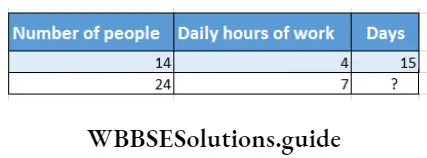
And the quantity of water is = \(\frac{7 x}{9} 1+\frac{5 y}{6}\)

= \(\left(\frac{7 x}{9}+\frac{5 y}{6}\right)\)
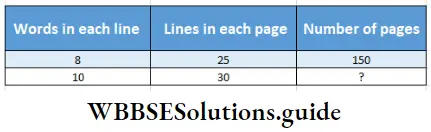
B.T.P.,

= \(\frac{\frac{2 x}{9}+\frac{y}{6}}{\frac{7 x}{9}+\frac{5 y}{6}}=\frac{5}{21}\)

or, \(21\left(\frac{2 x}{9}+\frac{y}{6}\right)=5\left(\frac{5 y}{6}+\frac{7 x}{9}\right)\)
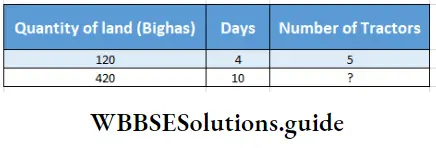
or, \(21\left(\frac{4 x+3 y}{18}\right)=5\left(\frac{14 x+15 y}{18}\right)\)
or, 21 (4x + 3y) = 5(14x + 15y)

or, 84x + 63y = 70x + 75y

or, 84x – 70x = 75y – 63y

or, 14x = 12y

or, \(\frac{x}{y}=\frac{12}{14}=\frac{6}{7}\)

∴ x : y=6 : 7

∴ If the two beverages are mixed up in the ratio of measures of 6 : 7, then the ratio of measures of syrup and water in the new beverage will be 5 : 21.

Question 8. My brother has prepared a beverage in a jug with syrup and water in a ratio of measurement of 3 : 1. Let’s work out what part of the drink should be removed and replaced by water so that the volume of syrup and water becomes equal.

Solution:

Given

My brother has prepared a beverage in a jug with syrup and water in a ratio of measurement of 3 : 1.

Let in the jug there is x units beverage. Of this y units beverage is taken out and the same quantity of water is mixed.

Quantity of syrup in x units beverage

= \(\frac{3}{4} \times x\) units = \(\frac{3 x}{4}\) units

And the quantity of water is = \(\frac{x}{4}\) units

The quantity of syrup in y units beverage

= \(\frac{3}{4} \times y\) units

= \(\frac{3 y}{4}\)

And the quantity of water is = \(\frac{y}{4}\) units

If y units are taken out from x units beverage,

syrup in the remaining beverage = \(\left(\frac{3 x}{4}-\frac{3 y}{4}\right)\) units
and the quantity of water is = \(\left(\frac{x}{4}-\frac{y}{4}\right)\)
Again, y units of water is added.

∴ Now quantity of water is = \(\left(\frac{x}{4}-\frac{y}{4}+y\right)\)
B.T.P,

= \(\frac{\frac{x}{4}-\frac{y}{4}+y}{\frac{3 x}{4}-\frac{3 y}{4}}=\frac{2}{1}\)

or, \(\frac{x}{4}-\frac{y}{4}+y=\frac{6 x}{4}-\frac{6 y}{4}\)

or, \(\frac{x}{4}-\frac{6 x}{4}=\frac{y}{4}-y-\frac{6 y}{4}\)

or, \(\frac{x-6 x}{4}=\frac{y-4 y-6 y}{4}\)

or, \(-\frac{5 x}{4}=-\frac{9 y}{4}\)

or, 5x = 9y

or, = \(y=\frac{5 x}{9}\)

∴ Total \(\frac{5}{9}\) part of the beverage will be removed and a 9 replaced by water with same quantity so that ratio becomes 2:1

Mixture Exercise

Question 1. The ratio of measurements of water and dettol in 36 liters of water is 5 : 1. Let’s work out what volume of water should be added to the mixture so that the ratio of measurements of water and dettol becomes 3:1.

Solution:

Given

The ratio of measurements of water and dettol in 36 liters of water is 5 : 1.

Ratio of water and dettol is = 5:1

Proportional part of water in the mixture

= \(\frac{5}{5+1}=\frac{5}{6}\)

Proportional part of dettol in the mixture

= \(\frac{1}{5+1}=\frac{1}{6}\)

∴ Quantity of water in 36 liters of the mixture

= \(\frac{5}{6} \times 36\)

= 30

∴ Quantity of dettol in 36 liters of the mixture

= \(\frac{1}{6} \times 36\)

= 6

Let after adding x liters dettol in the mixture, the ratio of quantities of dettol and water will be 3 : 1.

∴ Total quantity of dettol after adding x liters of dettol = (6 + x) I. The ratio of water and dettol in the new mixture = 30 : 6 + x.

B.T.P.

= \(\frac{30}{6+x}=\frac{3}{1}\)

or, 18+3x=30

or, 3x=30-18

or, \(x=\frac{12}{3}\)

or, x = 4

4 liters dettol should be added into the mixture.

“WBBSE Class 8 Maths Chapter 12, Mixture solved examples”

Question 2. In a certain type of brass the ratio of measurements of Copper and Zinc is 5 : 2. Let’s work out what will be the ratio of Copper and Zinc in 25 kg of such brass if 4 kg of Copper is added to it.

Solution:

Given

In a certain type of brass the ratio of measurements of Copper and Zinc is 5 : 2.

Ratio of Copper and Zinc in the Brass = 5 : 2

Proportional part of Copper in the Brass

= \(\frac{5}{5+2}=\frac{5}{7}\)

Proportional part of Zinc in the Brass

= \(\frac{2}{5+2}=\frac{2}{7}\)

Quantity of Copper in 28 kg Brass

= \(\frac{5}{7} \times 28\) kg

= 20 kg

Quantity of Zinc in 28 kg Brass

= \(\frac{2}{7} \times 28\) kg

= 8kg

After adding 4 kg Copper, total quantity of Copper = (20 + 4) kg

= 24 kg

The ratio of Copper and Zinc in the new Brass = 24:8

= 3:1

Question 3. Brijan babu has made phenyl water solution of 60 liters in which the ratio of measurements of phenyl and water is 2 : 23. Let’s workout how much phenyl should be added to this solution so that the ratio of measurements of phenyl and water becomes 9 : 46.

Solution:

Given

Brijan babu has made phenyl water solution of 60 liters in which the ratio of measurements of phenyl and water is 2 : 23.

Ratio of phenyl and water in the mixture = 2 : 23

Proportional part of water in the mixture = \(\frac{2}{2+23}=\frac{2}{25}\)

Proportional part of phenyl in the mixture = \(\frac{23}{2+23}=\frac{23}{25}\)

The quantity of phenyl in 60 liters of the mixture

= \(\frac{2}{25} \times 60\)

= \(\frac{24}{5} I=4.8 I\)

Quantity of phenyl in 60 liters of the mixture

= \(\frac{23}{25} \times 60\)

= \(\frac{276}{5}\)

= 55.2

Let by adding x liters phenyl in the mixture, the ratio of water and phenyl will become 9 : 46.

∴ After adding x liters phenyl, the total quantity of phenyl = (4.8 + x)

Ratio of phenyl and water in the new mixture = (4.8 + x) : 55.2

B.T.P.,

(4.8 + x) : 55.2 = 9:46 .

or, \(\frac{4.8+x}{55.2}=\frac{9}{46}\)

or, 220.8 + 46x = 496.8

or, 46x = 496.8 – 220.8

or, 46x = 276.0

or, \(x=\frac{276}{46}\)

or, x = 6

After adding 6 liters phenyl in the mixture the ratio of water and phenyl will become 9 : 46.

Question 4. Amina bibi has prepared masonry mixture with sand and cement in a ratio of measurement 7 r 1. But after the brick work it is seen that 72 kg of mixture remains. She has added more cement with this mixture and the ratio of measurement of sand to cement becomes 6 :1. Let’s work out the total quantity of cement she has mixed.

Solution:

Given

Amina bibi has prepared masonry mixture with sand and cement in a ratio of measurement 7 r 1. But after the brick work it is seen that 72 kg of mixture remains. She has added more cement with this mixture and the ratio of measurement of sand to cement becomes 6 :1.

Ratio of sand and cement in the mixture =7:1

Proportional part of sand in the mixture

= \(\frac{7}{7+1}=\frac{7}{8}\)

Proportional part of cement in the mixture

= \(\frac{1}{7+1}=\frac{1}{8}\)

Quantity of sand in 72 kg mixture

= \(\frac{7}{8} \times 72\) kg = 63 kg

Quantity of cement in 72 kg mixture

= \(\frac{1}{8} \times 72\) kg = 9 kg

Let after adding x kg cement in the mixture the ratio of sand ant cement will be 6 : 1.

∴ Total quantity of cement after adding x kg cement = (9+x) kg

Ratio of sand and cement in the new mixture = 63 : (9 + x)

B.T.P.

= \(\frac{63}{9+x}=\frac{6}{1}\)

or, 54 + 6x = 63

or, 6x = 63 – 54

or, 6x = 9

or, x = \(\frac{9}{6}\)

or, x = 1.5

∴ 1.5 kg cement was added.

“WBBSE Class 8 Mixture solutions, Maths Chapter 12”

Question 5. The ratio of measurements of Copper, Zinc and Nickel ir German silver is 4 : 3 : 2 respectively. Let’s work out what weight (in kgs) of Zinc should be added to 54 kg of German silver, sc that the ratio of measurements becomes 6:5:3.

Solution:

Given

The ratio of Copper, zinc and Nickel in the German silver is =4:3:2

Quantity of Copper in 54 kg mixture

= \(\frac{4}{9} \times54\) kg

= 24 kg 1 6

Quantity of Zinc in 54 kg mixture

= \(\frac{3}{9} \times54\) kg

= 18 kg

Quantity of Nickel in 54 kg mixture

= \(\frac{2}{9} \times54\) kg

=12 kg

Ratio of Copper, Zinc and Nickel in the new German silver = 6:5:3

Proportional part of Copper in the new German silver = \(\frac{6}{14}\)

Proportional part of Zinc in the new German silver = \(\frac{5}{14}\)

Proportional part of Nickel in the new German silver = \(\frac{3}{14}\)

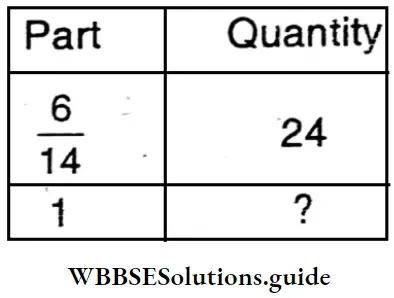
∴ In the new German silver the quantity of copper will be 24 kg but by adding Zinc the quantity of mixture will increase.

In mathematical language the problem is –

WBBSE Solutions For Class 8 Chapter 12 Mixture Part Quantity

Here the proportion is direct.

∴ Total quantity of new German silver

= \(24 \times \frac{14}{6}\)

= 56 kg

∴ Zinc will be added = (56 – 54) kg

=2 kg

∴ 2kg Zinc should be added.

Question 6. In two different kinds of washing powder the ratios of measurement of soda and soap powder are 2 : 3 and 4 : 5. Let’s work out the part of the soap powder in the new washing powder which is prepared by mixing 10 kg of first soap powder with 18 kg of second soap powder.

Solution:

Given

In two different kinds of washing powder the ratios of measurement of soda and soap powder are 2 : 3 and 4 : 5.

In the first washing powder the ratio of soda arid soap powder = 2:3.

Proportional part of first washing powder in the soda

= \(\frac{2}{2+3}=\frac{2}{5}\)

Proportional part of soap powder in the first washing powder

= \(\frac{3}{2+3}=\frac{3}{5}\)

Quantity of powder in 10 kg of the 1st washing powder

= \(\frac{3}{5} ×10\) kg

= 6 kg

Ratio of soda and soap powder in the second washing powder = 4:5

Proportional part of soap powder in the 2 nd washing powder

= \(\frac{5}{4+5}=\frac{5}{9}\)

Quantity of soap powder in 18 kg of the 2nd washing powder

= \(\frac{5}{9} \times 18\)kg

= 10kg

Total quantity of soap powder by mixing both types of washing powder

= (6+10) kg = 16 kg

And the total quantity of washing power = (10 + 18) kg = 28 kg

Soap powder in new washing powder

= \(\frac{16}{28}\) part = \(\frac{4}{7}\) part

In new washing powder \(\frac{4}{7}\) part is soap powder.

Question 7. Two similar vessels contain \(\frac{1}{3}\) and  \(\frac{1}{4}\)parts fruit juice. I filled water in the remaining empty part of these vessels and poured the juice mixed with water of the two vessels into another big vessel. Let’s work out the ratio of measurement of fruit and water in the new vessel.

Solution:

Given

Two similar vessels contain \(\frac{1}{3}\) and  \(\frac{1}{4}\)parts fruit juice. I filled water in the remaining empty part of these vessels and poured the juice mixed with water of the two vessels into another big vessel.

Fruit juice in 1st vessel = \(\frac{1}{3}\) part

∴ Water in 1st vessel = \(\left(1-\frac{1}{3}\right)\) part
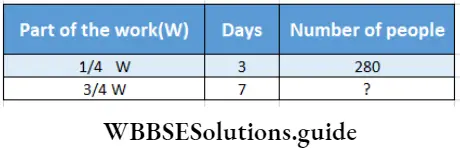
= \(\frac{2}{3}\)
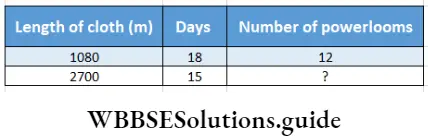
Fruit juice in 2nd vessel = \(\frac{1}{4}\) part
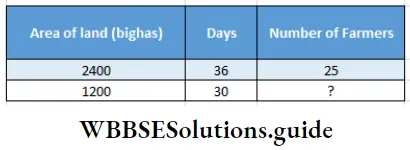
Water in 2nd vessel

= \(\left(1-\frac{1}{4}\right) \text { part }=\frac{3}{4} \text { part }\)

Total quantity of fruit juice in new vessel

= \(\left(\frac{1}{3}+\frac{1}{4}\right)\) part
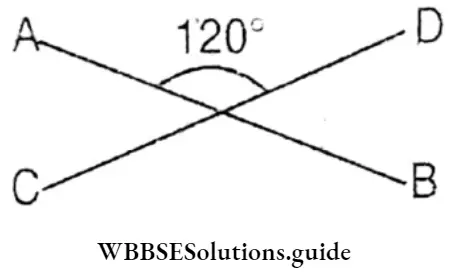
=\(\frac{4+3}{12} \text { part }=\frac{7}{12} \text { part }\) part

Total quantity of fruit juice in new vessel

= \(\left(\frac{2}{3}+\frac{3}{4}\right)\) part
= \(\frac{8+9}{12}\) part

= \(\frac{17}{12}\) part

The ratio of quantities of fruit juice and water in new vessel

= \(\frac{7}{12}: \frac{17}{12}\)

= 7 : 17

The ratio of quantities of fruit juice and water in new vessel = 7 : 17

Question 8. Reshmi Khatiin has filled 3 similar glasses of equal size with beverage. The ratios of measurements of water and syrup in these glasses are respectively 3 : 1, 5 : 3 and 9 : 7. I poured the beverage of these three glasses into a big vessel. Let’s workout the ratio of measurements of water and syrup in the new vessel.

Solution:

Given

Reshmi Khatiin has filled 3 similar glasses of equal size with beverage. The ratios of measurements of water and syrup in these glasses are respectively 3 : 1, 5 : 3 and 9 : 7. I poured the beverage of these three glasses into a big vessel.

Ratio of water and syrup in 1st glass = 3:1

Proportional part of water = \(\frac{3}{3+1}=\frac{3}{4}\)

And proportional part of syrup = \(\frac{1}{3+1}=\frac{1}{4}\)

Ratio of water and syrup in second glass = 5:3

Proportional part of water = \(\frac{5}{5+3}=\frac{5}{8}\)

Proportional part of syrup = \(\frac{3}{5+3}=\frac{3}{8}\)

Ratio of water and syrup in third glass = 9:7

“Class 8 WBBSE Maths Chapter 12, Mixture easy explanation”

Proportional part of water = \(\frac{9}{9+7}=\frac{9}{16}\)

Proportional part of syrup = \(\frac{7}{9+7}=\frac{7}{16}\)

The beverages of all three glasses are poured into a big vessel.

∴ Water in the big vessel

= \(\left(\frac{3}{4}+\frac{5}{8}+\frac{9}{16}\right) \text { part }\)

= \(\frac{12+10+9}{16} \text { part }\)

= \(\frac{13}{16} \text { part }\)

Syrup in the big vessel

= \(\left(\frac{1}{4}+\frac{3}{8}+\frac{7}{16}\right) \text { part }\)

= \(\frac{4+6+7}{16} \text { part }\)

= \(\frac{17}{16} \text { part }\)

Ratio of syrup and water in the new vessel

= \(\frac{31}{16}: \frac{17}{16}\)

= 31 : 17

Ratio of syrup and water in the new vessel = 31 : 17

Question 9. Two different types of brass contain Copper and Zinc in the ratios of measurement respectively 8 : 3 and 15:7. Let’s workout in what ratio of measurement of Copper and Zinc will be if these two types of brass are mixed together in the ratio of measurement 5:2.

Solution:

Given

Two different types of brass contain Copper and Zinc in the ratios of measurement respectively 8 : 3 and 15:7.

Let 5 x kg of first kind of brass is mixed with 2 x kg of second kind of brass. The ratio of Copper and Zinc in first brass =8:3.

Sum of ratio = 8 + 3 = 11

Quantity of Copper in 5 x kg of first brass

= \(\frac{8}{11} \times 5 x=\frac{40 x}{11}\) kg

Quantity of Zinc in 5 x kg of the first brass

= \(\frac{3}{11} \times 5 x=\frac{15 x}{11} \mathrm{~kg}\) kg

Ratio of copper and Zinc in the second brass = 15:7

Sum of ratio = 15 + 7 = 22

Quantity of Copper in 2 x kg of the second brass

= \(\frac{15}{22}\) 2x kg

= \(\frac{15 x}{11} \cdot \mathrm{kg}\)

Quantity of Copper in 2 x kg of the second brass

= \(\frac{7}{22}\) 2x kg

= \(\frac{7 x}{11} \mathrm{~kg}\) kg

Total quantity of Copper in the new brass

= \(\left(\frac{40 x}{11}+\frac{15 x}{11}\right)\) kg
= \(\left(\frac{40 x+15 x}{11}\right)\) kg
= \(\frac{55 x}{11} \mathrm{~kg}=5 x\) kg

Total quantity of Zinc in the new brass

= \(\left(\frac{15 x}{11}+\frac{7 x}{11}\right)\) kg
= \(\left(\frac{15 x+7 x}{11}\right)\) kg
= \(\frac{22 x}{11} \mathrm{~kg}=2 \mathrm{x}\) kg

So, the ratio of Copper and Zinc in the new brass = 5x : 2x

= 5:2

The ratio of Copper and Zinc in the new brass = 5:2

“Class 8 Maths Mixture solutions, WBBSE syllabus”

Question 10. Two different types of stainless steel contain chromium and steel in the ratio of measurement respectively 2:11 and 5 : 21. Let’s workout in what proportion these two types of steel should be mixed so that the ratio of measurement of chromium and steel becomes 7 : 32.

Solution:

Given

Two different types of stainless steel contain chromium and steel in the ratio of measurement respectively 2:11 and 5 : 21.

Let by adding x kg of first stainless steel with y kg of second stainless steel the ratio of chromium and steel in the new stainless steel will be

Ratio of chromium and steel in the first stainless steel = 2:11

Proportional part of chromium = \(\frac{2}{2+11}=\frac{2}{13}\)

Proportional part of steel = \(\frac{11}{2+11}=\frac{11}{13}\)

Chromium in x kg of first stainless steel =\(\frac{2 x}{13}\) kg

Steel in x kg of first stainless steel = \(\frac{11 x}{13}\) kg

Ratio of chromium and steel in the second stainless steel = 5:21

Proportional part of chromium = \(\frac{5}{5+21}=\frac{5}{26}\)

Proportional part of steel = \(\frac{21}{5+21}=\frac{21}{26}\)

Chromium in y kg of second stainless steel

=\(\frac{5}{26} \times y \mathrm{~kg}=\frac{5 y}{26} \mathrm{~kg}\)

Total quantity of chromium in new stainless steel

= \(\left(\frac{2 x}{13}+\frac{5 y}{26}\right)\) kg
= \(\frac{4 x+5 y}{26}\) kg

Total quantity of steel in new stainless steel

= \(\left(\frac{11 x}{13}+\frac{21 y}{26}\right)\) kg
= \(\frac{22 x+21 y}{26}\) kg
B.T.P.,

= \(\frac{4 x+5 y}{26}: \frac{22 x+21 y}{26}\) = 7:32
or, (4x + 5y) : (22x + 21y) = 7:32

or, \(\frac{4 x+5 y}{22 x+21 y}=\frac{7}{32}\) = 7:32

or, 154x + 147y = 128x + 160y

or, 154x – 128x = 160y – 147y

or, 26x = 13y

or, \(\frac{x}{y}=\frac{13}{20}\)

or, \(\frac{x}{y}=\frac{1}{2}\)

or, x : y = 1 : 2

If both types of stainless steel are mixed in the ratio 1 : 2, the ratio of chromium and steel in the new stainless steel will be 7 : 32.

Question 11. In a vessel of beverage the ratio of measurement of syrup and water is 5 : 2. Let’s work out what part of the drink should be removed and replaced by water so that the volumes of syrup and water become equal.

Solution:

Given

In a vessel of beverage the ratio of measurement of syrup and water is 5 : 2.

Ratio of water and syrup in the beverage = 5:2

Proportional part of syrup = \(\frac{5}{5+2}=\frac{5}{7}\)

Proportional part of water = \(\frac{2}{5+2}=\frac{2}{7}\)

Let x part of the beverage is taken out and is replaced by the same quantity of water so that the ratio of syrup and water will be equal.

Syrup in x part of the beverage

= \(\frac{5}{7} \times x\) part = \(\frac{5 x}{7}\) part

Water in x part of the beverage

= \(\frac{2}{7} \times x\) part = \(\frac{2 x}{7}\) part

Syrup in remaining part of the beverage

= \(\left(\frac{5}{7}-\frac{5 x}{7}\right)\) part

= \(\frac{5-5 x}{7}\) part

Water in syrup = \(\left(\frac{2}{7}-\frac{2 x}{7}+x\right)\) part

= \(\frac{2-2 x+7 x}{7}\) part

= \(\frac{2+5 x}{7}\) part

B.T.P.,

= \(\frac{2+5 x}{7}=\frac{5-5 x}{7}\)

of, 2 + 5x = 5 – 5x

or, 5x + 5x = 5 – 2

or, 10x = 3

or, \(x=\frac{3}{10}\)

If \(\frac{3}{10}\) part of this beverage is taken out and replaced by the same quantity of water then the ratio syrup and water will be equal.

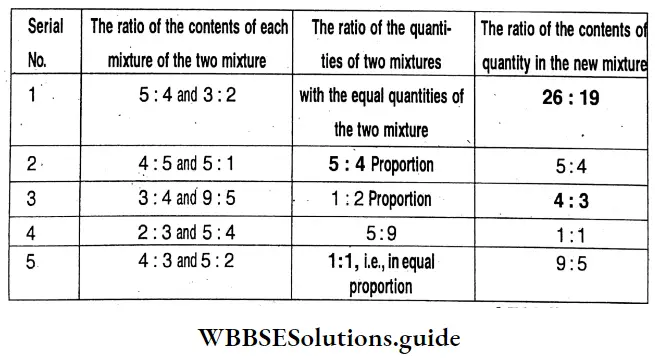
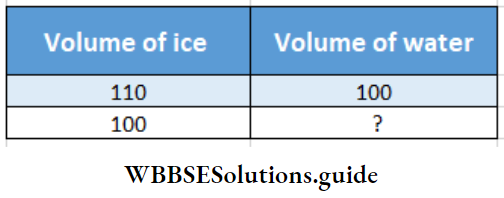
Question 12. Let’s see the table below write in mathematical language and try to find out the answer.

Solution:

WBBSE Solutions For Class 8 Chapter 12 Mixture Mathematical Language

Question 13. There are 3 kinds of liquids in a beverage of 700 liters. The ratio of measurements of the first and second liquid is 2 : 3 and the ratio of measurements of the second and the third liquid is 4:3. Let’s work out the ratio in which the first and second liquid should be mixed so that the ratio of measurement of the three liquid^ may become 6 : 5 : 3 in the same beverage.

Solution:

Given

There are 3 kinds of liquids in a beverage of 700 liters. The ratio of measurements of the first and second liquid is 2 : 3 and the ratio of measurements of the second and the third liquid is 4:3.

Ratio of first and second liquids in the mixture = 2:3

= 2×4 : 3×4 = 8 : 12

∴ Ratio of first second and third liquids in the mixture = 8 : 12 : 15

Total mixture = 700 I

∴ Amount of 1st liquid in the mixture = \(\frac{8}{35} \times 700\) = 160

Amount of 2nd liquid in the mixture = \(\frac{12}{35} \times 700\) = 240

Amount of 3rd liquid in the mixture = \(\frac{15}{35} \times 700\) = 300

Ratio of first second and third liquids in the new mixture =6 : 5 : 3

= 6×100 : 5×100 : 3×100

= 600 : 500 : 300

∴ Amount of first liquid to be taken = (600 – 160) = 440

Amount of second liquid to be taken = (500 – 240) = 260

440 of first and 260 of second mixture should be mixed.

Question 14. In a certain quantity of syrup the ratio of measurements of water and the rest part of the syrup is 89 : 11. Let’s workout what quantity of water should be added in 22 liters of the syrup so that the ratio of measurement of syrup and the rest part of the liquid becomes 90 : 10.

Solution:

Given

In a certain quantity of syrup the ratio of measurements of water and the rest part of the syrup is 89 : 11.

Ratio of water and the rest part of the syrup = 89 : 11

Proportional part of water in the syrup

= \(\frac{89}{89+11}=\frac{89}{100}\)

Proportional part of rest of the syrup in the syrup

= \(\frac{11}{89+11}=\frac{11}{100}\)

∴ Quantity of water in 22 liters of the syrup

= \(\frac{89}{100} \times 22\)

“WBBSE Class 8 Maths Chapter 12, Mixture important questions”

= \(\frac{979}{50}\)

Quantity of rest of syrup in 22 liters of the syrup

= \(\frac{11}{100} \times 22\)

= \(\frac{121}{50}\)

Let by adding x liters syrup the ratio of water and the rest part is 9:1

B.T.P.,

= \(\left(\frac{979}{50}+x\right): \frac{121}{50}=90: 10\)

or, \(\left(\frac{979+50 x}{50}\right): \frac{121}{50}=90: 10\)

or, (979+50x) : (121 = 9 : 1

or, \(\frac{979+50 x}{121}=\frac{9}{1}\)

or, 979+50x = 1089

or, 50x =  1089-979

or, 50x = 110

or, x = \(\frac{110}{50}\)

or, x = \(\frac{11}{5}\)

or, x = 2.2

In 22 liters of this syrup, by adding 2.2 liters water, the ratio of water and the rest part of syrup becomes 90 : 10.

Question 15. The ratio of the volumes of three bottles is 5 : 3 : 2. These three bottles are filled will the solution of phenyl and water. The ratios of measurement of phenyl and water in three bottles each are 2 : 3, 1 : 2 and 1 : 3 respectively. \(\frac{1}{3}\)part of the first bottle,\(\frac{1}{2}\) part of the second bottle and \(\frac{2}{3}\) part of the third bottle are mixed together now. Let’s work out the ratio of phenyl and water in the new solution.

Solution:

Given

The ratio of the volumes of three bottles is 5 : 3 : 2. These three bottles are filled will the solution of phenyl and water. The ratios of measurement of phenyl and water in three bottles each are 2 : 3, 1 : 2 and 1 : 3 respectively. \(\frac{1}{3}\)part of the first bottle,\(\frac{1}{2}\) part of the second bottle and \(\frac{2}{3}\) part of the third bottle are mixed together now.

Let the volumes of the three bottles are respectively : 5x I, 3x I and 2x I

Ratio of water and phenyl in the first bottle =2 : 3

Sum of ratio =2 + 3 = 5

∴ Amount of phenyl in the bottle first

=\(\frac{2}{5} \times 5 x \times \frac{1}{3} \quad I=\frac{2 x}{3}\)

Amount of water in the first bottle

= \(\frac{3}{5} \times 5 \times \times \frac{1}{3} I=\times I\)

Amount of phenyl and water in the second bottle = 1:2

Sum of ratio = 1+2 = 3

Amount of phenyl in the second bottle

= \(\frac{1}{3} \times 3 \times \times \frac{1}{2} \mid=\frac{x}{2}\)

Amount of water in the second bottle

= \(\frac{2}{3} \times 3 \times \times \frac{1}{2} \quad I=x I\)

Ratio of water and phenyl in the third bottle = 1:3

Sum of ratio = 1+3+4

Amount of phenyl in the third bottle

= \(\frac{1}{4} \times 2 x \times \frac{2}{3} \quad \mid=\frac{x}{3}\)

Amount of water in the third bottle

“WBBSE Class 8 Maths Chapter 12 solutions, Mixture PDF”

= \(\frac{3}{4} \times 2 x \times \frac{2}{3} 1=x\)

Ratio of phenyl and water in the new mixture

= \(\left(\frac{2 x}{3}+\frac{x}{2}+\frac{2 x}{3}\right):(x+x+x)\)

= \(\frac{4 x+3 x+2 x}{6}: 3 x\)

= \(\frac{9 x}{6}: 3 x\)

= \(\frac{9}{6}: 3\)

= \(\frac{9}{6} \times 6: 3 \times 6=9: 18\)

= 1 : 2

The ratio of phenyl and water in the new solution = 1 : 2

WBBSE Solutions For Class 8 Maths Chapter 11 Percentage

Percentage

Today we will go to the fair at Khadinan village. My sister and I will go there with our elder brother. There is Rs. 75 with my elder brother, Rs. 50 with me and Rs. 35 with my sister.

Question 1.  Let’s calculate in percentage the amount which my elder brother has more than me.

Solution:

My brother has more than me Rs. 75 – Rs. 50 = Rs. 25

The excess amount he has in percentage is =\(\frac{25}{50}\) x100 = Rs. 50

My brother has 50% more amount than me. In other language,

On Rs. 50, Rs. 25 is more

On Rs.1, Rs. \(\frac{25}{50}\) is more 50

On Rs. 100, Rs.\(\frac{25}{50}\) x 100 = Rs. 50 is more.

My brother has 50% more amount than me.

“WBBSE Class 8 Maths Chapter 11 solutions, Percentage”

Question 2. Let’s calculate in percentage the amount which I have less than my elder brother.

Solution:

My elder brother’s money in comparison with me, I have less Rs. 25

For Rs. 1, I have less amount of Rs. \(\frac{25}{75}\)

For Rs. 100, I have less amount of Rs. \(\frac{25}{75} \times 100=\text { Rs. } 33 \frac{1}{3}\)

I have \(33 \frac{1}{3} \%\) less amount than my elder brother.

The sum total of amount we have = Rs. (75+50+35) = Rs. 160

Read and Learn More WBBSE Solutions For Class 8 Maths

My elder brother calculated that we spent 10% of the amount at the time of going to the fair.

Let’s work out the sum we spent at the time of going to the fair.

= \(10 \%=\frac{.10}{100} \text { part }=\frac{1}{10} \text { part }\)

∴ Of the total amount the part was spent at the time of going to the fair.

Class 8 General Science Class 8 Maths
Class 8 History Class 8 Science LAQs
Class 8 Geography Class 8 Science SAQs
Class 8 Maths Class 8 Geography
Class 8 History MCQs Class 8 History

So, of Rs. 160, 10% = Rs. \(\left(160 \times \frac{10}{100}\right)\) = Rs. 16

∴ Rs. 16 was spent at the time of going to the fair.

I came across Sunit at the fair.

Four of us rode on a merry-go-round. We spent Rs. 40 for this ride.

WBBSE Solutions For Class 8 Maths Chapter 11 Percentage

Question 3. Let’s work out the amount we spent for riding on the merry-go-round.

Solution:

Out of Rs. 160, we spent Rs. 40

Out of Rs. 1 the amount spent Rs. \(\frac{40}{160}\)

Out of 100 the amount spent Rs. \(\frac{40}{160} \times 100=\text { Rs. } 25\)

∴ Of the total amount 25% was spent on the ride of merry-go-round.

We have decided to spend 35% of the total amount for fooding.

“Class 8 WBBSE Maths Chapter 11 solutions, Percentage study material”

Question 4. Let’s calculate the sum for this purpose.

Solution:

Out of Rs.160, I spent 35% = Rs.\(\left(160 \times \frac{35}{100}\right)\) = Rs. 56

∴ We shall spend Rs. 56 in the fair for our food.

I spent Rs. 24 to buy glass bangles in the fair.

Question 5. Let’s calculate in percentage the amount I spent for purchasing glass bangles in the fair.

Solution:

Out of Rs. 160, I spent to purchase glass bangles Rs, 24

Out of Rs. 1,1 spent to purchase glass bangles Rs. \(\frac{24}{160}\)

Out of Rs. 100, I spent to purchase glass bangles Rs. =\(\frac{24}{160} \times 100\)= Rs. 15

∴ Out of the total amount I spent for glass bangles =15%

Question 6.  I painted in red 15% of the bamboo and \(\frac{1}{5}\) part in green.

Solution:

∴ Of the total length I painted \(\frac{15}{100}\) part = \(\frac{3}{20}\) part in red, but how much percent of total length is painted in yellow, let’s calculate.

Question 7.  If the bamboo is 2 m long and of which 38 cm is coloured with yellow then what is the percentage of yellow in relation to the whole length of the bamboo?

Solution:

Given

If the bamboo is 2 m long and of which 38 cm is coloured with yellow

Length of bamboo = 2 m = 200 cm.

Of 200 cm long bamboo yellow coloured is 38.

∴ Of 1 cm long bamboo yellow coloured is \(\frac{38}{200}\)

∴ Of 100 cm long bamboo yellow coloured is \(\frac{38}{200} \times 100 \mathrm{~cm}=19\)

∴ Of the total length of the bamboo,19% is yellow coloured.

“WBBSE Class 8 Maths Chapter 11, Percentage solved examples”

Question 8.  A train will go to Budwan from Howrah station. The distance of cord line between Burdwan and Howrah is 85 km. But .the distance in the main line is 5% more than in the cord line. Let’s calculate the distance between Howrah and Burdwan in the main line by the method of proportion.

Solution:

Given

A train will go to Budwan from Howrah station. The distance of cord line between Burdwan and Howrah is 85 km. But .the distance in the main line is 5% more than in the cord line.

That distance is 5% more through main line.

That means, if the distance in cord line is 100 km then in the main line it is 5 km more.

So the distance through main line is (100 + 5) km = 105 km.

In mathematical language the problem is –

WBBSE Solutions For Class 8 Chapter 11 Percentage The Distance In Card Line And Main Line

If the distance between Howrah and Burdwan is more / less in the cord line, in the main line it is inversely or less. Both those distances are Directly (directly/inversely) related.

So, 100:85::105:?

The distance in mainline is = \(\frac{85 \times 105}{100}\)

Let’s work out by unitary method.

If the distance in the cord line is 100 km then in the main line is 105 km.

If the distance in the cord line is 1 km then in the main line it is

= \(\frac{105}{100} \mathrm{~km}.\)

If the distance in the cord line is 85 km then in the main line it is will be

= \(85 \times \frac{105}{100}\) km. = 89.25km

Question 9. Niyamat uncle of Faridpur has used high – yielding paddy seed in his field. For this, the cost of production of paddy has increased by 35% but the cost of cultivation has increased by 35%. Let’s workout the present profit of Niyamat uncle in comparison with the previous return of Rs. 1220 by investing Rs. 450 in the same field.

Solution:

Given

Niyamat uncle of Faridpur has used high – yielding paddy seed in his field. For this, the cost of production of paddy has increased by 35% but the cost of cultivation has increased by 35%.

Let’s work out the increase in the cost of cultivation after using light- yielding paddy seeds by the rule of three.

In mathematical language the problem is –

WBBSE Solutions For Class 8 Chapter 11 Percentage The Cost Before Using High Yielding And After High Using Yielding

For using high – yielding paddy seeds the expense earlier and the expense at present are there in the Directly (directly / inverse) relation.

∴ For using high-yielding paddy seed the present is

=  Rs. 135 × \(\frac{450}{100}\) = Rs.607.50

Let’s work out by unitary method.

Before the use of high-yielding seed

If Rs.100 was the expense, now it is Rs.135

If Re. 1 was the expense,now it is Rs. \(\frac{135}{100}\)

If Rs. 450 was the expense, now it is Rs.\(\frac{135×450}{100}\) = Rs. 607.50

Question 10. Let’s workout by the rule of three the production of paddy after using high-yielding seeds.

Solution:

The production of paddy increased by 30%, i.e., if the production of paddy was Rs. 100, it is now Rs. (100 + 30) = Rs 130.

In mathematical language the problem is –

WBBSE Solutions For Class 8 Chapter 11 Percentage The Production Of Paddy Seed

The production before the use of high-yielding paddy is with the production after that use Direct (direct / inverse) related.

As the production of paddy in earlier has increased (i.e., from Rs. 100 to Rs. 1220)

So, the production of paddy will now Increase (increase/decrease).

Due to the use of high-yielding seed the production will be

= Rs. \(130 \times \frac{1220}{100}=\text { Rs. } 1586\)

Let’s work out by unitary method.

Before the use of high-yielding seed :

If the production was Rs.100, it is now Rs. 130.

If the production was Rs. 1, it is Rs. \(\frac{130}{100}\)

If the production was Rs. 1220, it is now \(\frac{130 \times 1220}{100}\)

Before the use of high-yielding seeds Niyamat uncle got an income of Rs. 1220- Rs. 450 = Rs. 770

Now the income is = Rs. (1586 – 607.50 ) = Rs. 978.50

More income is = Rs. ( 978.50 – 770 ) = Rs. 208.50

“WBBSE Class 8 Percentage solutions, Maths Chapter 11”

Question 11. Uma devi of Pahalampur has used high-yielding seeds in her fields. As a result the production of paddy has increased by 20%. But the cost of production of paddy has increased by 25%. Earlier she used to grow the production worth Rs. 1560 by spending Rs. 600. Let’s work out how much she will earn more now using high-yielding seeds.

Solution:

Given

Uma devi of Pahalampur has used high-yielding seeds in her fields. As a result the production of paddy has increased by 20%. But the cost of production of paddy has increased by 25%. Earlier she used to grow the production worth Rs. 1560 by spending Rs. 600.

Eariercost = Rs. 600

Earlier amount from the yield = Rs. 1560

Increase in the cost of cultivation = Rs. 600 x 25% = \(\frac{600 \times 25}{100}\) Rs. 150

New cost of cultivation = Rs. (600 + 150)

= Rs. 750

Increase in the amount from yield = Rs. 1560 x 20%

= Rs. \(\frac{1560 \times 20}{100}\)

= Rs. 312

New cost of cultivation = Rs. (1560 + 312)

= Rs. 1872

Earlier income = Rs. (1560 – 600) = Rs. 960

New income = Rs. (1872 – 750) = Rs. 1122

Increase in income = Rs. (1122 – 960) = Rs. 162

Question 12. Today I shall reach station quickly. Let’s work out by how much will the speed of my vehicle have to be increased if I want to reduce the time of going to station from my house by 20%.

Solution:

Let’s think that it will take 100 seconds to reach the station from my house moving at a speed of 100 unit/second.

∴ In mathematical language, the problem is –

WBBSE Solutions For Class 8 Chapter 11 Percentage Time And Speed

To reach a certain distance earlier the speed needs to increase (increase/decrease)

The speed is in increased (direct / inverse) relation with the time to reach a certain distance.

Let’s work out by the rule of three to reach in 100-20 = 80 seconds the speed of the vehicle will be 125 (unit / second).

Let’s work out by unitary method.

To reach in 100 seconds the speed of the vehicle will be 100 unit /second.

To reach in 1 second the speed of the vehicle will be 100 x 100 unit/second.

To reach in 80 seconds the speed of the vehicle will be \( \frac{100 \times 100}{80}\)unit/second.

= 125 unit/second

∴ To reduce the time of going to station from house by 20% the speed of the vehicle will be increased by –

(125 unit / second – 100 unit / second ) = 25 unit/ second So the speed needs to be increased by 25%.

Let’s work out how much the speed of my vehicle will have to be increased if I want to reduce time by 10% for the same distance.

Let by going from home to station at 100 unit/second speed 100 seconds time is taken.

In mathematical language, the problem is –

WBBSE Solutions For Class 8 Chapter 11 Percentage Time And Speed Units Or Second

Speed is increased to cover same distance in less time, i.e., time and speed are inversely related.

∴ To reach in 90 seconds the speed of car will be = \(\frac{100 \times 100}{90}\) unit/second = 111.11 unit/second

∴  Increase in the speed of car = (111.11 – 100) unit/second

=11.11 unit/second

Question 13. Let calculate how much of Ramesh Babu’s monthly expenditure on onions will decrease if he reduces its consumption by 20%.
Solution:
In mathematical language, the problem is –
WBBSE Solutions For Class 8 Chapter 11 Percentage Quantity Of Onions And Prise Of onions
His monthly expenditure will be = 120 × \(\frac{80}{100}\) = Rs. 96
Decrease in Ramesh Babu’s monthly expenditure = Rs. (100 – 96) = Rs. 4
∴ The monthly expenditure on onions will decrease by 4%.

Percentage Exercise

Question 1. I have Rs. 50 with me. I spent 12% of that sum to purchase a pen. Let’s work out the amount I spent for purchasing a pen.
Solution:
Given 50 Rupees with me and spent 12% to purchase a pen

Cost of pens = Rs. 50 x 12%

= Rs. \(\frac{50 \times 12}{100}\) = Rs.6

∴ Cost of each pen = Rs. 6

6 rupees I spent for purchasing a pen.

Question 2. It needs 12% tax to import a machine from abroad. Let’s work out the cost of the machine here after paying the tax if it costs Rs. 300000 abroad.

Solution:

Given

It needs 12% tax to import a machine from abroad.

Price of machine = Rs. 3,00,000

Tax = 3,00,000 x 120%

= Rs. \(\frac{3,00,000 \times 120}{100}\)

= Rs. 3,60,000

The price of machine here = Rs. (3,00,000 + 3,60,000)

= Rs. 6,60,000

The price of machine here = Rs. 6,60,000

Question 3. Let’s write by calculating :

1. Rs. 80 x 15%

Solution:

Given Rs. 80 x 15%

= Rs. \(\frac{80 \times 15}{100}\)

= Rs. 12
Rs. 80 x 15%= Rs. 12

2. 12% of Rs. 215

Solution:

Given Rs. 215 x 12%

= Rs. \(\frac{215 \times 12}{100}\)

= Rs. \(\frac{129}{5}\)

= Rs. 25.80

Rs. 215 x 12% = Rs. 25.80

3. 110% of 37.8 meters

Solution:

Given 110% of 37.8 meters

= \(\frac{37.8 \times 110}{100} \mathrm{~m}\)

= 41.58m

110% of 37.8 meters = 41.58m

4. 200% of 480 gm

Solution:

Given 200% of 480 gm

= \(\frac{480 \times 200}{100} \mathrm{gm}\)

= 960 gm.

200% of 480 gm = 960 gm.

Question 4. (1)How much is Rs. 2.25 of Rs. 5?

Solution:

Given Rs.2.24 of Rs.5

= \(\frac{2.25}{5} \times 100 \%\)

= 45%

Rs.2.24 of Rs.5 = 45%

“Class 8 WBBSE Maths Chapter 11, Percentage easy explanation”

2. How much is 85 gm of 17 gm?

Solution:

Given 85 gm of 17 gm

= \(\frac{85}{17 \times 1000} \times 100 \%\)

= 0.1%

85 gm of 17 gm = 0.1%

3. How much is 2 kg 250 gm of 0.72 quintal?

Solution:

Given 250 gm of 0.72 quintal

2 kg 250 gm = 2250 gm

0.72 quintal = .72 x 100 x 1000 gm.

= 72000 gm.

∴ \(\frac{2250}{72000} \times 100 \%\)

= \(3 \frac{1}{8} \%=3.125 \%\)

250 gm of 0.72 quintal = \(3 \frac{1}{8} \%=3.125 \%\)

Question 5. Let’s fill up the table below:

Solution:

WBBSE Solutions For Class 8 Chapter 11 Percentage Percentage And Fraction

Question 6. The ratio of hydrogen and oxygen in water is 2:1. Let’s workout the percentage of hydrogen and oxygen in water.

Solution:

Given

Ratio of hydrogen and oxygen in water = 2:1

Sum of ratio = 2 + 1 =3

Hydrogen in water = \(\frac{2}{3}\) part

= \(\frac{2}{3} \times 100 \%\)

= \(66 \frac{2}{3} \%\)

Oxygen in water = \(\frac{1}{3}\) part

= \(\frac{1}{3} \times 100 \%\)

= \(33 \frac{1}{3} \%\)

Of the quantity of water, hydrogen is \(66 \frac{2}{3} \%\) and oxygen is \(33 \frac{1}{3} \%\).

Question 7. 1500 bottles were produced in a factory at Hridaypur. New 1695 bottles are produced there. Let’s workout the percentage increase in production in that factory.

Solution:

Given

1500 bottles were produced in a factory at Hridaypur. New 1695 bottles are produced there.

Bottles were produced in a factory = 1500

New bottles are produced = 1695

Increase in production = (1695 – 4500) = 195

% increase in production = \(\frac{195}{1500} \times 100 \%\) = 13%

The production has increased by 13%.

Question 8. The quantity of Nitrogen, Oxygen and Carbon dioxide in air is 75.6%, 23.04%, and 1.36%. Let’s work out the quantity of each in 25 liters of air.

Solution:

Given

The quantity of Nitrogen, Oxygen, and Carbon dioxide in air is 75.6%, 23.04%, and 1.36%.

In 25 I air nitrogen is = 25 I x 75.6 %

= \(\frac{25 \times 756}{100 \times 10}\)

= 18.9 liters

In 25 I air oxygen is = 25 I x 23.04%

= \(\frac{25 \times 23.04}{100}\)

= 5.76 liters

In 25 I air carbon dioxide is = 251x 1.36%

= \(\frac{25 \times 1.36}{100}\)

= 0.34 I

∴ In 25 I air nitrogen is 18.9 I, oxygen is 5.6 I, and carbondioxide is 0.34.

Question 9. Trisha has bought a book from the book stall of Milan dada. He gave her discounts of 10% and 5% respectively. Let’s work out how much Trisha paid to Milan dada if the M.R.P of the book was Rs. 200.

Solution:

Given

Trisha has bought a book from the book stall of Milan dada. He gave her discounts of 10% and 5% respectively.

Price of book = Rs. 200

First discount = Rs. 200 x 10%

= Rs. \(\frac{200 \times 10}{100}\)

= Rs. 20

Price of book after giving first discount = Rs.(200-20)

= 180

Second discount = Rs. 180×5

= Rs. \(\frac{180 \times 5}{100}\)

= Rs. 9

Price of book after giving second discount = Rs. (180-9)

= 171

Trisha gave Milan Dada Rs. 171.

“WBBSE Class 8 Maths Chapter 11 solutions, Percentage PDF”

Question 10. The length of each arm of a rectangle was increased by 10%. Let’s work out the percentage of increase in area by the rule of three.

Solution:

Given

The length of each arm of a rectangle was increased by 10%.

Let the length of each side of rectangle is 100 units.

∴ Area of the rectangle = (100)2sq.units.

= 10,000sq.units.

Increase in each side of the rectangle = 10%of100

= \(\frac{100 \times 10}{100} \text { units. }\)

= 10 units

∴ After increase, length of each side of the rectangle = (100+10) units

= 110units.

∴ Area of rectangle = (110)2 units

= 12100 units

Increase in area = (12100-10000)

= 2100 units.

% Increase in area of rectangle = \(\frac{2100 \times 100}{10000}\)

= 21%

The area of that rectangle increased by 21%.

WBBSE Solutions For Class 8 Chapter 11 Percentage Original Area And Increase In Area

There is a direct relation.

Percentage increase in area of rectangle = \(2100 \times \frac{100}{10000}=21 \%\)

Question 11. We get 15% discount if electricity bill is paid in time. My aunt got a rebate of Rs. 54 by paying the bill in time. Let’s v/ork out the total amount of the bill.

Solution:

Given

We get 15% discount if electricity bill is paid in time. My aunt got a rebate of Rs. 54 by paying the bill in time.

Let the bill was Rs. x.

Discount = 15% X. Rs. x

= Rs. \(\frac{X \times 15}{100}\) = Rs. \(\frac{3 x}{20}\)

B.T.P.,

= \(\frac{3 x}{20}=54\)

or x = \(\frac{54 \times 20}{3}\)

or, x = 360

∴ The electricity bill was of Rs. 360.

“WBBSE Class 8 Maths Chapter 11, Percentage important questions”

Question 12. The price of sugar has increased by 20%. Let’s work out the percentage of sugar if the monthly expenses of sugar remained same.

Solution:

Given

The price of sugar has increased by 20%.

Let in Rs. 100r 100 kg sugar is bought and its price is Rs. 100. Increase in the price of sugar = 20% of Rs. 100.

= Rs. \(\frac{100 \times 20}{100}\)

= Rs. 20

∴ After increase new price of 100 kg sugar

= Rs. (100 + 20) = Rs. 120

∴ After increase, in Rs. 120, 100 kg sugar will be bought.

∴ After increase, in Rs. 1, \(\frac{100}{120}\) kg sugar will be bought.

∴ After increase, in Rs. 100, \(\frac{100}{120} \times 100\) kg sugar will be bought.

∴ After increase, in Rs. 100, \(\frac{250}{3}\) kg sugar will be bought.

∴ Decrease in sugar consumption \(=\left(100-\frac{250}{3}\right) \mathrm{kg} .\)

= \(\frac{50}{3} \mathrm{~kg}\)

∴ % decrease in sugar consumption = \(\frac{50 \times 100}{3 \times 100}\)

= \(16 \frac{2}{3} \%\)

∴ If the monthly expenses of sugar remains same, its consumption is to be decreased by 16

= \(16 \frac{2}{3} \%\)

“Class 8 Maths Percentage solutions, WBBSE syllabus”

Question 13. When water freezes into ice, it increases in volume by 10%. Let’s workout in percentage how much it will decrease in volume if the ice melts into water.

Solution:

Given

When water freezes an increase of 10% occurs in volume. If 100 cube units be the volume of ice = (100 + 10) cube units = 110 cubic units

In mathematical language the problem is –

WBBSE Solutions For Class 8 Chapter 11 Percentage Volume Of Ice And Water

Relation will be – Directly proportional.

∴ Volume of water ( ?) = \(100 \times \frac{100}{110}=\frac{1000}{11}=90 \frac{10}{11}\)

∴ Decrease in volume due to melting = \(\left(100-90 \frac{10}{11}\right)=9 \frac{1}{11} \%\)

∴ There will be \(9 \frac{1}{11} \%\) decrease in volume.

Question14. Due to use of high-yielding seed Utpal babu has got 55% production hike in paddy cultivation. But for this the cost of cultivation has increased by 40%. Previously a yield of Rs. 3000 was produced by investing Rs. 1200. Let’s work out whether his income will be increased or decreased after using high-yielding seeds.

Solution:

Given

Due to use of high-yielding seed Utpal babu has got 55% production hike in paddy cultivation. But for this the cost of cultivation has increased by 40%. Previously a yield of Rs. 3000 was produced by investing Rs. 1200.

Earlier cost in paddy farming = Rs. 1200

Earlier price of yield = Rs. 3000

Increase in cost = 40% of Rs. 1200

= Rs. \(\frac{1200 \times 40}{100}\)

= Rs. 480

New cost after using high-yielding seed = Rs. (1200 + 480)

= Rs. 1680

Increase in yield = 55% of Rs. 3000

= Rs. \(\frac{3000 \times 55}{100}\)

= Rs. 1650

New, the price of yield is = Rs. (3000 + 1650)

= Rs. 4650

Earlier income = Rs. (3000 – 1200)

= Rs. 1800

New income = Rs. (4650 – 1680) = Rs. 2970

Increase in income = Rs. (2970- 1800) = Rs. 1170

∴ Income increased by Rs. 1170

“WBBSE Class 8 Chapter 11 Maths, Percentage step-by-step solutions”

Question 15. In a legislative election 80% voters cast their votes and the winning candidate got 65% of the cast votesi Let’s workout the percentage of total voters who supported him.

Solution:

Given

In a legislative election 80% voters cast their votes and the winning candidate got 65% of the cast votes

Let the total number of voters are 100.

∴ Votes cast = 80% of 100

= \(\frac{100 \times 80}{100}=80\)

Votes got by winning candidate = 65% of 80

= \(\frac{80 \times 65}{110}=52\)

∴ The winning candidate got 52% of the total votes cast.

Question 16. This year the students of Waianda H.S. school have passed 85% in Hindi, 70% in maths and 65% in both subjects A+ scoring. If the number of students are 120 then let’s work out how many students :

Solution:

  1. Who got A+ in both subjects
  2. Who got A+ only in maths
  3. Who got A+ only in Hindi
  4. Who got A+ in no subject

Number of students = 120

1. In both subjects got A+

Solution:

= 65% of 120

= \(\frac{120 \times 65}{100}\) = 78 Students

2. Students who got A+ in Maths Only

Solution:

= 70% of 120

= \(\frac{120 \times 70}{100}\) = 84 Students

Who got A+ only in Maths are = (84 – 78) = 6

3. Got A+ in Hindi only

Solution:

Students who got A+ in Hindi = 85% of 120

= \(\frac{120 \times 85}{100}\)

Who got A+ only in Hindi are = (102 – 78) = 24

4. Did not get A+ in both subjects

Solution:

= 120 – (78 + 6 + 24)

= 120-108=12

“WBBSE Maths Class 8 Percentage, Chapter 11 key concepts”

Question 17. The income of Amina bibi was increased by 20% and later decreased by 20%. Let’s workout the total percentage change of her income.

Solution:

Given

The income of Amina bibi was increased by 20% and later decreased by 20%.

Let the original income was Rs. 100.

1st increased = 20% of Rs. 100

= Rs. \(\frac{100 \times 20}{100}\)

= Rs. 20

Income after 1st increase = Rs. (100 + 20)

= Rs. 120

Then decrease = 20% of Rs. 120

= Rs. \(\frac{120 \times 20}{100}\)

= Rs. 24

Income after decrease = Rs. (120 – 24)

= Rs. 96

Decrease in her income = Rs. (100 – 96) = Rs. 4

% decrease in her income = \(\frac{4 \times 100}{100}\)= 4%.

The original income of Amina bibi has decreased by 4%.

“WBBSE Class 8 Maths Chapter 11, Percentage summary”

Question 18. The length of a rectangle is increased by 15% and the breadth is reduced by 15%. Let’s work out the percentage increase or decrease of area.

Solution:

Given

The length of a rectangle is increased by 15% and the breadth is reduced by 15%.

Let the length of rectangle is x units & breadth is y units.

∴ Area of the rectangle = L x B

= x×y sq. units

= xy sq. units

Length of rectangle after 15% increase

= x+xX15%

= \(x+\frac{x \times 15}{100}\)

= \(\frac{23 x}{20}\) units

Breadth of rectangle after 15% decrease = y-y×15%

= \(y-\frac{y \times 15}{100}\)

= \(\frac{17y}{20}\) units

∴ New area of the rectangle = \(\frac{23 x}{20} \times \frac{17 y}{20}\) sq.units

= \(\frac{391 x y}{400}\) sq.units

∴ Decreases in the area of the rectangle = xy – \(\frac{391 x y}{400}\) sq.units

= \(\frac{400 x y-391 x y}{400}\) sq.units

= \(\frac{9 x y}{400}\) sq.units

∴ % decrease in the area of the rectangle = \(\frac{9 x y \times 100}{400 ×x y}=2 \frac{1}{4} \%\)

∴ The area of the rectangle decreased by \(2 \frac{1}{4} \%\).

Question 19. The length, breadth and height of a room are 15 m, 10m and 5 m. If the length, breadth and height are increased by 10 % each then work out the increase of the area of the 4 walls of the room.

Solution:

Given

The length, breadth and height of a room are 15 m, 10m and 5 m. If the length, breadth and height are increased by 10 %

Area of the 4 walls of the room = 2 (15 + 10) x 5 sq.m = 250 sq.m

After 10% increase, length of the room = \(\frac{110}{100} \times 15 \mathrm{~m}=\frac{33}{2} \mathrm{~m}\)

After 10% increase, breadth of the room =\(\frac{110}{100} \times 10\) =11 m

After 10% increase, hight of the room = \(\frac{110}{100} \times 5 \mathrm{~m}\) = \(\frac{11}{2}\) m

After 10% increase, the area of the 4 walls of the room = \(2\left(\frac{33}{2}+11\right) \times \frac{11}{2}\) sq.m

= \(2\left(\frac{33+22}{2}\right) \times \frac{11}{2}\) sq.m

= \(\frac{605}{2}\) sq.m

Increase in the area of the 4 walls of the room

= \(\left(\frac{605}{2}-250\right)\)

= \(\left(\frac{605-500}{2}\right) \mathrm{sq} \cdot \mathrm{m}=\frac{105}{2} \mathrm{sq} \cdot \mathrm{m}\)

Percentage increase in the area of the 4 walls of the room = = \(\frac{105 \times 100}{2 \times 250}\) = 21%

There will be 21 % increase in the area of the 4 walls of the room.

Question 20. In annual sports 20% of the students took part in 100 m race 15% of the students in 200 m sprint and 10% of the students took part in the long jump event. 5% of the students took part in these three events. Let’s work out the number of students who did not take part in any of the events if the total number of the students were 780.

Solution:

Given

In annual sports 20% of the students took part in 100 m race 15% of the students in 200 m sprint and 10% of the students took part in the long jump event. 5% of the students took part in these three events.

Total number of students = 780

Number of students taking part in 100 m race = 20% of 780

= \(\frac{780 \times 20}{100}\)

= 156

Number of students taking part in 200 m race = 15% of 780

= \(\frac{780 \times 15}{100}\)

= 117

Number of students taking part in long jump race = 10% of 780

= \(\frac{780 \times 150}{100}\)

= 78

Number of students taking part in all three games = 5% of 780

= \(\frac{780 \times 5}{100}\)

= 39

Number of students taking part only in 100 m race = (156- 39) = 117

Number of students taking part only in 200 m race = (117- 39) = 78

Number of students taking part only in long jump = (78 – 39) = 39

Number of students who did not take part in any of the three games

= 780-(39+ 117 + 78 + 39)

= 780-273 = 507

The number of students who did not take part in any of the three games = 507

WBBSE Solutions For Class 8 Maths Chapter 10 Rule Of Three

Rule Of Three

Question 1. I have bought a dozen of exercise books from the Banerjee book stall of our locality for Rs. 90 only. Let’s calculate the price of such exercise book by the Rule of three.

Solution:

Given

I have bought a dozen of exercise books from the Banerjee book stall of our locality for Rs. 90 only.

In mathematical language the problem is

No. of exercise books (pcs.) Price of exercise books in Rs.

1 dozen = 12 90

8                  ?

The relation is: If the number of exercise books increases Increase price will increase. If the number of exercise books decreases price Will Decrease decrease.

∴ 12 : 8 :: 90:?

Or, cost of exercise books ( ?) = Rs. 90×8/12

∴ Cost of 8 books = Rs 60

We got, Second quantity variable value =

WBBSE Solutions For Class 8 Chapter 10 Rule Of Three Second QuantityVariable Value

Question 2. If Rs.1772 is needed for making 7 ploughs, how much will be needed for making 12 ploughs? (apply the rule of three)

Solution:

Given

Rs.1772 is needed for making 7 ploughs

To make more number of ploughs much much less money will be needed.

Number of ploughs and their making costs are Directly (directly/inversely) proportional.

Class 8 General Science Class 8 Maths
Class 8 History Class 8 Science LAQs
Class 8 Geography Class 8 Science SAQs
Class 8 Maths Class 8 Geography
Class 8 History MCQs Class 8 History

“WBBSE Class 8 Maths Chapter 10 solutions, Rule of Three”

Question 3. 24 people had food provision for 20 days. Let’s work out using the method of Rule of Three how long the remaining food will last for 40 people.

Solution:

Given

24 people had food provision for 20 days.

With the same quantity of food the more number of people will cover will cover (much/less) days.

So the number of people and number of days are inversely (direct / inversely) proportional.

WBBSE Solutions For Class 8 Maths Chapter 10 Rule Of Three

Read and Learn More WBBSE Solutions For Class 8 Maths

Rule Of Three Exercise 10.1

Question 1. Today my father has bought 15 kg of rice for Rs. 390. Let’s work out using the Rule of Three method how much he would require if he would have bought the same quality of 17 kg of rice.

Solution:

Given

Today my father has bought 15 kg of rice for Rs. 390.

In mathematical language, the problem is –

WBBSE Solutions For Class 8 Chapter 10 Rule Of Three Quantity Of Rice (In kg) Price Of Rice

Relation will be – If quantity of rice increases the price of rice will increase; so the quantity and price of rice will be directly proportional.

∴ 15: 17:: 390:?

or, \(\frac{15}{17}=\frac{390}{?}\)

∴ Value (?) = \(\frac{17 \times 390}{15}\)

= Rs. 442

∴ Price of 17 kg rice will be 442.

“Class 8 WBBSE Maths Chapter 10 solutions, Rule of Three study material”

Question 2. Venkat uncle will make 4 shirts of same size with 20 meters of cloth. Let’s work out using the rule of three method how many meters of cloth Venkat uncle will have to purchase for making 12 such shirts.

Solution:

Given

Venkat uncle will make 4 shirts of same size with 20 meters of cloth.

In mathematical language, the problem is –

WBBSE Solutions For Class 8 Chapter 10 Rule Of Three Number of shirts Quantity of cloth

Relation will be – If the number of shirts increases, the quantity of cloth will increase, so they will be directly proportional.

4 : 12 :: 20:?

or, \(\frac{4}{12}=\frac{20}{?}\)

or, Quantity of cloth (?) =\(\frac{12 \times 20}{4}\)= 60 meter

∴ In making 12 shirts 60 meter cloth will be needed.

60 meters of cloth Venkat uncle will have to purchase for making 12 such shirts.

“WBBSE Class 8 Maths Chapter 10, Rule of Three solved examples”

Question 3. It took 15 days for 30 labourers to dig a pond at Bakultala village. Let’s work out using the rule of three method in how many days 25 heads of labourers could have completed the said work.
Solution:

Given

It took 15 days for 30 labourers to dig a pond at Bakultala village.

In mathematical language the problem is –

WBBSE Solutions For Class 8 Chapter 10 Rule Of Three Number Of People Days

Relation will be – If the number of days increases, the number of people will decrease, so they will be inversely proportional.

30: 25 :?:15

or, \(\frac{30}{25}=\frac{?}{15}\)

∴ Time(?)= \(\frac{30}{25}\) ×15 = 18 days.

∴ 25 men will require 18 days.

In 18 days 25 heads of labourers could have completed the said work

Question 4. My aunt reached my maternal uncle’s house in five hours by driving the car at a speed of 40 kmph. Let’s work out using the rule of three method how long it would have taken if she would drive the car at a speed of 50 kmph.

Solution:

Given

My aunt reached my maternal uncle’s house in five hours by driving the car at a speed of 40 kmph.

In mathematical language the problem is – Speed of Car (kmph) Time (in hours)

WBBSE Solutions For Class 8 Chapter 10 Rule Of Three Speed Of Car (Kmph) Time (In hours)

Relation will be – If speed of car increases, time will decrease, so they are inversely proportional.

∴ 40 : 50 : 5

or, \(\frac{40}{50}=\frac{?}{5}\)

or. Time (?) = \(\frac{40}{50} \times 5=4\)

∴ 50 kmph speed will require 4 hours time.

Question 5. There was a stock of food grains for 9 days to cater the needs of 4000 people in a shelter camp in Mongalpur village. After 3 days 1000 people left the camp for another place. Let’s work out for how many days the rest of people will consume.

Solution:

Given

There was a stock of food grains for 9 days to cater the needs of 4000 people in a shelter camp in Mongalpur village. After 3 days 1000 people left the camp for another place.

Stock of food grains for 9 days to cater = 4000

After 3 days people left the camp = 1000

3 days later number of remaining people (4000 – 1000) = 3000

Remaining food grains for = (9-3) days = 6 days

In mathematical language the problem is –

WBBSE Solutions For Class 8 Chapter 10 Rule Of Three Number Of People Days.

Relation will be – If number of people decreases the foodgrains will last longer, so they are inversely proportional.

4000 : 3000 : : ? : 6

or, \(\frac{4000}{3000}=\frac{?}{6}\)

or, Time ( ?) = \(\frac{4000}{3000} \times 6=8\)

Remaining people will consume the food for 8 days.

“WBBSE Class 8 Rule of Three solutions, Maths Chapter 10”

Question 6. 42 labourers of a farm at Nasirpur village can cultivate the entire land of the farm in 24 days. But suddenly 6 labourers became ill during the period of cultivation. Let’s work out using the rule of three method how many days it will take to cultivate the entire land of the farm by the rest of the labourers.

Solution:

Given

42 labourers of a farm at Nasirpur village can cultivate the entire land of the farm in 24 days. But suddenly 6 labourers became ill during the period of cultivation.

Labourers of a farm at Nasirpur village = 42

Suddenly labourers became ill during the period of cultivation = 6

Members becoming ill, remaining left = (42 – 6) = 36 In mathematical language the problem is-

WBBSE Solutions For Class 8 Chapter 10 Rule Of Three Number Of Members Days

Relation will be – if number of members decreases then the number of days will increase. So they are inversely proportional.

∴ 42 : 36 : 24

or, \(\frac{42}{36}=\frac{?}{24}\)

or, Time ( ?) = \(\frac{24 \times 42}{36}\) x 42 = 28 days

Rest of the labourers will require to cultivate 28 days.

“Class 8 WBBSE Maths Chapter 10, Rule of Three easy explanation”

Question 7. It take 27 days to make 1000 spare parts by 16 numbers of machines. Let’s work out using the rule of three method how many days it will take to make the same number of spare parts if additional two machines are installed.

Solution:

Given

It take 27 days to make 1000 spare parts by 16 numbers of machines.

2 machines are installed, new number = 16 + 2 =18

In mathematical language, the problem is –

WBBSE Solutions For Class 8 Chapter 10 Rule Of Three Number Of Machines Day

Relation will be – If number of machines increases, number of days will decrease, so they are inversely proportional.

16 : 18 :: ? : 27

or, \(\frac{16}{18}=\frac{?}{27}\)

or, Time ( ?) = \(\frac{16}{18}\) x 27 = 24

18 machines will require 24 days to produce same number of spare parts in 24 days.

Question 8. See the relations below, express them in mathematical language, and solve by using rule of three.

Solution:

WBBSE Solutions For Class 8 Chapter 10 Rule Of Three No Of Pens Price Of Pens

If prices are of Rs. 112.50 then what will be the value of 12 pens?

Relation will be – If number of pens increases, its price will increase, so they are directly proportional.

∴ 25 : 12 :: 112.5: ?

or, \(\frac{25}{12}=\frac{112.5}{?}\)

∴  Value ( ?) = \(\frac{12 \times 112.5}{25}\)

= 54

∴ 12 pens will value Rs. 54.

WBBSE Solutions For Class 8 Chapter 10 Rule Of Three Velocity Distance

A car with velocity 9 kmph, in a given time, can cover 112.5 km distance.

The same car will cover how much distance in the same time with speed 12 kmph? .

Relation will be – If velocity increases, distance will-increase, so they are directly proportional.

∴ 9:12:: 112.5 : ?

or, \(\frac{9}{12}=\frac{112.5}{?}\)

or, Distance ( ?) = \(\frac{12 \times 112.5}{9}\)

or, Distance ( ?) = \(\frac{12 \times 1125}{9 \times 10}\)

= 150

That car with speed 12 kmph in the given time will cover 150 km distance.

WBBSE Solutions For Class 8 Chapter 10 Rule Of Three Number Of Pumps Total Land Of Cultivation

6 pumps in a given time can irrigate 31.2 Bigha land, 13 pumps in the same time will cultivate how much ?

Relation will be – If number of pumps increases, measure of land will increase, so they are directly proportional.

∴ 6 : 13: : 31.2:?

or, \(\frac{6}{13}=\frac{31.2}{?}\)

or, Measure of land ( ?) = \(\frac{13 \times 31.2}{6}\)

= \(\frac{13 \times 312}{6 \times 10}\)

= \(\frac{13 \times 52}{10}\)

= 67.6 Bighas.

13 pumps in the same time will cultivate 67.6 bighas land.

WBBSE Solutions For Class 8 Chapter 10 Rule Of Three Per Student Daily Number Of Students Amount Of Grain

If each student eats 306 gm grains, total grains required for 425 students = 306 x 425 gm = 130050 gm If in a school for 425 students 130050 gm grain is required then if students are 458 how much grain will be required?

Relation will be – If number of students increases, amount of grain

will increase, so they are directly proportional.

∴ 425 : 458 :: 130050 : ?

or, \(\frac{425}{458}=\frac{130050}{?}\)

or, Measure of grain ( ?) = \(\frac{458 \times 130050}{425}\)

= \(\frac{458 \times 5222}{17}\) gm.

“WBBSE Class 8 Maths Chapter 10 solutions, Rule of Three PDF”

Question 9. The walls and boundary walls of Bapan’s house are to be built. So, masons are working for building the wall. Let’s work out using the Rule of Three method how many days it will take for 10 masons tp build 320 sq.m, of walls if 5 masons can build 120 sq m. of walls in 4 days.

Solution:

Given

The walls and boundary walls of Bapan’s house are to be built. So, masons are working for building the wall. L

In mathematical language the problem is –

WBBSE Solutions For Class 8 Chapter 10 Rule Of Three In Mathematical Language The Problem Is

There are three items :

  1. No. of masons
  2. Time,
  3. Quantity of work

Let’s find the relation in two steps.

First step – During the same work if the number of masons increases then the time will decrease (much / less) and if number of masons decreases time will much (much / less). The number of masons and time are inversely (inversely/directly) proportional.

∴ ?:4:: 5: 10

Required time = \(4 \times \frac{5}{10}\)

Required time = 2 days ‘ Second step – If the number of masons is constant, the time will be needed for doing more work much (More / less) amount of work is less, time is needed will cover (More / less). So number of masons and amount of work are Directly (directly / Inversely) proportional.

So, 7:2:: 320 : 128

Required time = \(2 \times \frac{320}{128}\) days = 5 days – 64

So we get putting two steps together-

∴ Required time = \(4 \times \frac{5}{10} \times \frac{320}{128}\) days = 5 days 32

Question 10. Milkman Mahesh of Rashedpur fed 4 bundles of straw to 8 cows for 15 days. Let’s work out using the rule of three method how many bundles of straw will have to be stored to feed 10 cows for 72 days during raing season.

Solution:

Given

Milkman Mahesh of Rashedpur fed 4 bundles of straw to 8 cows for 15 days.

In mathematical language, the problem is –

WBBSE Solutions For Class 8 Chapter 10 Rule Of Three Stored To Feed 10 Cows for 72 Days During Raing Season

Let’s find the relation.

First step- If the number of cows increases, the quantity of straw will Increase (increase / decrease) and if the number of cows decreases, straw will be will cover (More / less).

Second step – If the number of cows remains constant then the quantity of straw will Increase (increase / decrease) and if time decreases, quantity of straw less (more/less).

∴  With time quantity of straw is Direct (inversely / directly)

The required amount required of straw = \(4 \times \frac{10}{8} \times \frac{72}{15}\) = 24 bundles.

Rule Of Three Exercise Exercise

Question 1. The work for construction of the village road will be started. It has been decided that 14 people will work 4 hours daily for 15 days to complete the total work. Let’s work out using the rule of three method how long it will take to complete the work by 24 people working 7 hours daily.

Solution:

Given

The work for construction of the village road will be started. It has been decided that 14 people will work 4 hours daily for 15 days to complete the total work.

In mathematical language the problem is –

WBBSE Solutions For Class 8 Chapter 10 Rule Of Three Work By 24 People Working 7 Hours Daily

Relation will be – If number of people and daily hours of work increase, days will decrease, so they are inversely proportional.

∴ Required days ( ?) = \(15 \times \frac{14 \times 4}{24 \times 7}\)=5

24 people do daily 7 hours work then the work will be is completed in 5 days.

Question 2. In a book of 105 pages written by Subhash uncle there are average 25 lines in each page and there are average 8 words in each line. Let’s work out using the rule of three method how many pages will be there in the book if there are 30 lines in each page having 10 words in each line.

Solution:

Given

In a book of 105 pages written by Subhash uncle there are average 25 lines in each page and there are average 8 words in each line.

In mathematical language the problem is –

WBBSE Solutions For Class 8 Chapter 10 Rule Of Three Words In Each Line Lines In Each Page Number Of Pages

Relation will be – If number of words and number of lines increase, number of pages will decrease, so they are inversely proportional.

∴ Number of pages = 105×\(\frac{8 \times 25}{10 \times 30}\)

= 70

There will be 70 pages.

“WBBSE Class 8 Maths Chapter 10, Rule of Three important questions”

Question 3. 540 bighas of land of an agricultural farm are to be cultivated in 14 days. 120 bighas of land was cultivated in first 4 days by 5 tractors of equal strength. Let’s work out using rule of three method how many tractors are required to complete the cultivation in time.

Solution:

Given

540 bighas of land of an agricultural farm are to be cultivated in 14 days. 120 bighas of land was cultivated in first 4 days by 5 tractors of equal strength.

540 bighas of land of an agricultural farm are to be cultivated = 14 days

120 bighas of land was cultivated = 4 days

After 4 days cultivating land,

Remaining days = (14 – 4) = 10

Remaining land = (540 -120) = 420 bighas

WBBSE Solutions For Class 8 Chapter 10 Rule Of Three Cultivating Land An Additional Of 2 Tractors Are Required

Relation will be – If number of days increases, and days also, number of tractors will decrease.

∴ Number of tractors (?) = \(5 \times \frac{420}{120} \times \frac{4}{10}\)

= 7

Number of more tractors = (7-5) = 2

For cultivating land an additional of 2 tractors are required.

Question 4. 30 heads of people repair 3/7 part of a road of a village in 15 days. Let’s work out using the method of rule of three how many days it will take to repair the rest of the road if additional 10 heads of people join.

Solution:

Given

30 heads of people repair 3/7 part of a road of a village in 15 days.

Remaining Work  \(=\left(1-\frac{3}{7}\right)=\frac{4}{7}\) Part

Number of people = (30+10) = 40 In mathematical language the problem is-

WBBSE Solutions For Class 8 Chapter 10 Rule Of Three Number Of People And Part Of Work Decrease Days Will Increase

Relation will be – If number of people and part of work decrease, days will increase.

∴ Required days ( ?) = \(15 \times \frac{30 \times 4 \times 7}{40 \times 7 \times 3}=15\)

To repair the remaining road 15 days are required.

Question 5. A pump of 5 HP can lift 36000 L of water in 8 hrs. Let’s work out using rule of three method how long it will take to lift 63000 L water by a 7 HP pump.

Solution:

Given

A pump of 5 HP can lift 36000 L of water in 8 hrs.

In mathematical language the problem is –

WBBSE Solutions For Class 8 Chapter 10 Rule Of Three HP Quantity Of Water (Liters) Time

Relation will be – If HP increases time will decrease. If quantity of water increases time will increase.

∴ Required time = \(8 \times \frac{5}{7} \times \frac{63000}{36000}\)

= 10 hours

10 hours time is required.

“Class 8 Maths Rule of Three solutions, WBBSE syllabus”

Question 6. There are two motors of 5 HP and 3 HP in a factory. The 5 HP motor requires 20 units of electricity in 8 hrs. Let’s work out using the rule of three how many units will be required if the 3 HP motor works for 10 hours.

Solution:

Given

There are two motors of 5 HP and 3 HP in a factory. The 5 HP motor requires 20 units of electricity in 8 hrs.

In mathematical language the problem is –

WBBSE Solutions For Class 8 Chapter 10 Rule Of Three 3 HP Motor 10 Hours Use Requires 15 Units Electricity

Relation will be – If HP and time increase, electricity will increase

∴ Required electricity ( ?) = \(20 \times \frac{3}{5} \times \frac{10}{8}\) units

= 15 units

∴ If 3 HP motor 10 hours use requires 15 units of electricity.

Question 7. In a loom at Gopalnagar 14 weavers can weave 210 sarees in 12 days. The workshop got an order to supply 300 sarees within 10 days during the pujas. Let’s work out using the rule of three how many extra weavers have to be employed to complete the work in time.

Solution:

Given

In a loom at Gopalnagar 14 weavers can weave 210 sarees in 12 days. The workshop got an order to supply 300 sarees within 10 days during the pujas.

In mathematical language the problem is-

WBBSE Solutions For Class 8 Chapter 10 Rule Of Three Number Of Sailors Days

The relation will be – If days increase, weavers will decrease and if number of sarees increase, weavers will increase.

∴ Number of weavers = \(14 \times \frac{12}{10} \times \frac{300}{210}\)

= 24

Number of more weavers = (24- 14) = 10

To complete the work in time 10 more weavers are required.

“WBBSE Class 8 Chapter 10 Maths, Rule of Three step-by-step solutions”

Question 8. A company has got the work of unloading goods from a ship in 10 days. 280 people have been employed for this purpose. After 3 days it is seen that 1/4th of the work has been completed. Let’s work out using the rule of three method how many people are to be engaged to complete the work in time.

Solution:

Given

A company has got the work of unloading goods from a ship in 10 days. 280 people have been employed for this purpose. After 3 days it is seen that 1/4th of the work has been completed.

3 days later remaining work = \(\left(1-\frac{1}{4}\right) \frac{3}{4}\) = part

Remaining Time = (10 – 3) = 7 days

In mathematical language, the problem is –

WBBSE Solutions For Class 8 Chapter 10 Rule Of Three Work In Time 80 More Ppeople Are Required

Relation will be – If work increases number of people will increase. If days increase number of people will decrease.

∴ Number of people = \(280 \times \frac{3}{4} \times \frac{4}{1} \times \frac{3}{7}\) = 360

Number of more people = (360 – 280) = 80

To complete the work in time 80 more people are required.

Question 9. A power loom is 2 \(\frac{1}{4}\) times powerful than a hand loom. 12 hand looms weave 1080 m of length of cloth is 18 days. Let’s work out by the rule of three how many powerlooms would be required to weave 2700 m length of cloth in 15 days.

Solution:

Given

A power loom is 2 \(\frac{1}{4}\) times powerful than a hand loom. 12 hand looms weave 1080 m of length of cloth is 18 days.

In mathematical language the problem is –

WBBSE Solutions For Class 8 Chapter 10 Rule Of Three Length Of Cloth Days Number Of Powerlooms

Relation will be – If length of cloth increases number of powerlooms increases and if days decrease, number of powerlooms will increase.

∴ Number of landlooms (?) = 12 × \(\frac{27000}{1080} \times \frac{18}{15}\)

= 36

\(frac{9}{4}\)handlooms1 production = 1 Powerlooms’ production

∴ 1 handlooms’ production = \(\frac{4}{9}\) Powerlooms’ production

∴ 36 handlooms’ production = \(\frac{4}{9} \times 36\) Powerlooms’ production

= 16 Powerlooms’ production

To complete 2700 m long clpth in 15 days, 16 powerlooms are required.

Question 10. 2400 bighag of land of a cooperative society can be cultivated by 25 farmers in 36 days. It was seen that half of the land of the society could be cultivated in 30 days after purchasing a tractor. Let’s work out the power of a tractor equivalent to the number of farmers using the rule of three.

Solution:

Given

2400 bighag of land of a cooperative society can be cultivated by 25 farmers in 36 days. It was seen that half of the land of the society could be cultivated in 30 days after purchasing a tractor.

In mathematical language the problem is –

WBBSE Solutions For Class 8 Chapter 10 Rule Of Three A Tractors Power Is Equal To 15 Farners

Relation will be – It area of land increases, number of farmers will increase. If number of farmers decrease, days wiH increase.

∴ Number of farmers = \(25 \times \frac{1200}{2400} \times \frac{36}{30}\)= 15

∴ A tractor’s power is equal to 15 farmers.

Question 11. A ship takes 25 days to Sail from Kolkata to Cochin. The ship started With 36 sailors for each of which 850 gm of food was alloted. But the ship rescued 15 sailors from another sinking-ship after 13 days of journey and the ship reached Cochin in 10 days increasing the speed. Let’s work out using the method of the rule of three what will be the quantity of food of each sailor will require to reach cochin safely if entire storage of food could be consumed by this time.

Solution:

Given

A ship takes 25 days to Sail from Kolkata to Cochin. The ship started With 36 sailors for each of which 850 gm of food was alloted. But the ship rescued 15 sailors from another sinking-ship after 13 days of journey and the ship reached Cochin in 10 days increasing the speed.

13 days later:

Number of sailors =36+15

= 51

Food for remaining days = (25-13)

= 12 days

In mathematical language, the problem is –

WBBSE Solutions For Class 8 Chapter 10 Rule Of Three Number Of Sailors Days..

Relation will be – If number of sailors and days increase, food stock will decrease.

∴ Food stock (?) = \(850 \times \frac{36}{51} \times \frac{12}{10}\)

Every sailor will comsume 720 gm per day.

Question 12. 36 people of a certain village construct 120 m of road by 8 people working 6 hours daily. Another 6 people are involved in this work and the duration of work of each day is increased by 2 hours. Find the length of road to be constructed in 3 days.

Solution:

Given

36 people of a certain village construct 120 m of road by 8 people working 6 hours daily. Another 6 people are involved in this work and the duration of work of each day is increased by 2 hours.

In mathematical language, the problem is –

WBBSE Solutions For Class 8 Chapter 10 Rule Of Three 3 HP Motor 10 Hours Use Requires 15 Units Electricity

Relation will be – If number of people increases, work will increase. If hours increase, work will increase. If days increase, work will increase.

Length of road (?) = \(120 \times \frac{42}{36} \times \frac{8}{6} \times \frac{9}{8}\)

= 210

Now, in 9 days 210 m long road can be constructed.

Question 13. 250 people can excavate a pond of size 15m long, 35 m wide and 5.2 m deep in 18 days by working 10 hours daily. Let’s work out using the rule of three method how many days it will take-for 300 people to excavate a pond of size 65 m long, 40 m wide and 5.6 m deep by working 8 hours daily.

Solution:

Given

250 people can excavate a pond of size 15m long, 35 m wide and 5.2 m deep in 18 days by working 10 hours daily.

In mathematical language, the problem is –

Number of people Volume of pond Work per day Days (L x B x H) time (hours)

WBBSE Solutions For Class 8 Chapter 10 Rule Of Three Number Of Volume Of Pound

Relation will be – If number of people increases, days will decrease. If volume of pond increases, days will increase.

∴ Required days (?) = \(18 \times \frac{250}{300} \times \frac{65 \times 40 \times 5.6}{50 \times 35 \times 5.2} \times \frac{10}{8}\)

= 30

∴ 30 days are required.

“WBBSE Maths Class 8 Rule of Three, Chapter 10 key concepts”

Question 14. Let’s make mathematical problems with the help of given relations and find out their solutions by rule of three.

Solution:

WBBSE Solutions For Class 8 Chapter 10 Rule Of Three Number Of Labourers (Inheads) Time Days Quantity Of Land (Bighas)

If 5 famers can cultivate 18 bigha land in 15 days then 10 farmers will cultivate how many bighas land in 10 days?

Relation will be – If number of farmers and days increase, quantity of land will increase.

∴ Quantity of land (?) = \(18 \times \frac{10}{5} \times \frac{10}{15}\) = 24 Bigha

∴ 24 Bighas land can be cultivated by 10 farmers in 10 days.

WBBSE Solutions For Class 8 Maths Chapter 8 Properties Of Parallel Lines And Transversal

Properties Of Parallel Lines And Transversal

The transversal is PQ [AB/PQ] but there is transversal.

My sister Sahali formed a transversal as in the picture shown below by fixing bits of cardboard with the help of nails.

As a result of it, many angles have been formed. She has named some of the angles. Measuring with a protractor I have seen∠1=∠3 again ∠2=∠4; they are VOA angles.

WBBSE Solution For Class 8 Chapter 8 Properties Of Parallel Lines And Transversal VOA Angle

Again,∠5=vercically opposite ∠7and ∠6 vertically opposite Angle = angle ∠8

WBBSE Solution For Class 8 Chapter 8 Properties Of Parallel Lines And Transversal Vertically Opposite Angles

4 pairs of corresponding angles are (∠l and ∠5), ( ∠2 and ∠6]),(∠4 and ∠8), and (∠3 and∠7])

It is seen by measuring with a protractor ∠1 =110° and ∠5 = 110°

“WBBSE Class 8 Maths Chapter 8 solutions, Properties of Parallel Lines and Transversal”

[ Let’s draw parallel lines and their transversals and write by measuring corresponding angles ]

Read and Learn More WBBSE Solutions For Class 8 Maths

∴∠1 = ∠5

and ∠2=70° and ∠6=70°

∴∠2 = ∠6

[ Let’s write and measure ]

Class 8 General Science Class 8 Maths
Class 8 History Class 8 Science LAQs
Class 8 Geography Class 8 Science SAQs
Class 8 Maths Class 8 Geography
Class 8 History MCQs Class 8 History

Pritam, Sonali, Seemanta, and Meher, them, drew a pair of parallel lines and transversal in their respective exercise book. By measuring the corresponding angles by the protractor they say the measurement of each angle is the same. [Let’s draw and write]


WBBSE Solution For Class 8 Chapter 8 Properties Of Parallel Lines And Transversal Pair Of Parallel Lines Transversal

AB and CD are two parallel straight lines. A transversal EF is drawn which cuts both transversals, at M and N points respectively.

Here four pairs of corresponding angles are the following :

∠1 and ∠5, ∠2and ∠6, ∠4 and ∠8, ∠3and ∠7

∠1 = 120° and ∠5= 120°  ∴ ∠1 =∠5

∠2 = 60°and ∠6=60°  ∴ ∠2=z6

∠4 = 60° and ∠8= 60°  ∴ ∠4 = ∠8

∠3 = 120° and ∠7= 60°  ∴ ∠3=∠7

Two pairs of alternate angles on the blackboard are (∠4 and ∠6), (∠3 and ∠5)

It is seen by measuring with a protractor, ∠4 = 70° and ∠6 = 70°,

“Class 8 WBBSE Maths Chapter 8 solutions, Parallel Lines and Transversal study material”

[ Let’s draw parallel lines and their transversals and write the measurement of alternate angles by measuring with a protractor]

∴ ∠4=∠6

and ∠3=70° and ∠5=70°

∴ ∠3≠∠5 [=/≠put]

Four of our friends have drawn two parallel lines and their transversal in their exercise books. Two pairs of alternate angles have been named and measuring with a protractor, it is seen that the measurements of alternate angles are equal.

[Let’s draw and examine]

WBBSE Solution For Class 8 Chapter 8 Properties Of Parallel Lines And Transversal Measurements Of Alternate Angle Are Equal

Two parallel lines AB and CD and transversal EF are drawn, which result in a pair of alternate angles ∠1 and ∠4 and ∠2 and ∠3, formed.

∠1 = 75°, ∠4= 75°

∴ ∠1 = ∠4

∠3 = 115°, ∠2= 115°

∴ ∠2 = ∠3

If a straight line intersects two parallel lines then the interior angles opposite to the transversal form a pair of alternate angles.

“WBBSE Class 8 Maths Chapter 8, Properties of Parallel Lines and Transversal solved examples”

Measurement of each pair of these angles is [ equal/ unequal]. (∠3and ∠6) (and ∠4 and ∠5) It is seen by measuring with a protractor,

∠3= 110° and ∠6 = 70° and

WBBSE Solution For Class 8 Chapter 8 Properties Of Parallel Lines And Transversal Measuring With Protractor

∠4= 70° and ∠5 = 110°

It seen that ∠3+∠6=180° and ∠4+∠5=180°

WBBSE Solution For Class 8 Chapter 8 Properties Of Parallel Lines And Transversal Stright Line Intersects Two Parallel Lines

∠1 and ∠3 and ∠2 and ∠4

In figure 1, ∠1=70°,∠3=110º

∠2=110°,∠4=70°

∴ ∠1+∠3=180° and ∠2+∠4=180°

In figure 2, ∠1+∠3=180° and ∠2+∠4=180°

In figure 3,  ∠1 + ∠3 = 180° and ∠2 + ∠ 4 = 180°

In figure 4, ∠1 + ∠3 = 180° and ∠2 +∠4 = 180°

If a straight line intersects two parallel lines then the sum of measurement of two interior angles in the same side of the transversal is 2 right angles. Nipa drew many pairs of the parallel lines and nonparallel lines. I draw transversal of each pair. Consequently, corresponding angles, alternate angles, and interior angles in the same side of transversal have been formed.

WBBSE Solution For Class 8 Chapter 8 Properties Of Parallel Lines And Transversal Parallel Lines And Nonparallel Lines 1

  1. ∠1 = ∠2
  2. ∠1≠ ∠2
  3. ∠1 ≠∠2(=/≠)
  4. ∠1 ≠2(=/≠)
  5. ∠1 =∠2 (=/≠)
  6. ∠1 + ∠2= 120° degree
  7. ∠1 +∠2=180° degree’
  8. ∠1 +∠2 = 210° degree

I have drawn a few more. Let’s see what I have. got.

WBBSE Solution For Class 8 Chapter 8 Properties Of Parallel Lines And Transversal Angles

Let’s verify by placing two interior angles ∠3 and ∠6 in the same side of the transversal whether ∠3 + ∠6 = [180°] is true or not.

Let’s write in the table below as we get by activity-

WBBSE Solution For Class 8 Chapter 8 Properties Of Parallel Lines And Transversal Placing Two Interior Angles

Now I have drawn two straight lines on my exercise book and their transversal. I have measured alternate angles with a protractor.

It is seen when the measurement of the alternate angles are equal then the straight fines are parallel.

WBBSE Solution For Class 8 Chapter 8 Properties Of Parallel Lines And Transversal Alternate Angles Are Equal Then Stright Line Are Parallel

 [parallel/nonparallel [let’s write & verify],

I draw two straight lines and a transversal on the exercise book. Let’s measure the corresponding angles are equal then two straight lines are parallel (Parallel/unparallel)

WBBSE Solution For Class 8 Chapter 8 Properties Of Parallel Lines And Transversal Corresponding Angles Are Equal Two Stright Lines Are Parallel

If a straight line intersects a pair of straight lines and the measurement of one pair of corresponding angles is equal then the two straight lines are parallel to each other.

Priya has drawn a pair of straight lines and their transversal on the blackboard. Consequently, many interior angles have been formed.

“WBBSE Class 8 Parallel Lines and Transversal solutions, Maths Chapter 8”

I will see by measuring with a protractor whether the interior angles on the same side of the transversal are supplementary with one another, i.e., the sum of the interior angles of the same side of the transversal is 2 right angles.

WBBSE Solution For Class 8 Chapter 8 Properties Of Parallel Lines And Transversal Measuring Angle 1 And 2 Is 180

WBBSE Solution For Class 8 Chapter 8 Properties Of Parallel Lines And Transversal Measuring Angle 1 And 2 Is 120

Measuring we get ∠1 + ∠2 = 80° Measuring we get ∠1 + ∠2= 120

It is seen by using a scale that AB and CD are parallel [ Parallel/ unparallel ]

In the second figure AB and CD are unparallel [ Parallel/unparallel ]

WBBSE Solutions For Class 8 Maths Chapter 8 Properties Of Parallel Lines And Transversal

Properties Of Parallel Lines And Transversal Exercise

Question 1. Chandra takes ruled paper. She draws a transversal between two lines. As a result, 4 corresponding angles, two pairs of alternate angles, and two pairs of interior angles are formed. Let’s find out and number them. Verify by measuring with a protractor:

Solution:

Given

Chandra takes ruled paper. She draws a transversal between two lines. As a result, 4 corresponding angles, two pairs of alternate angles, and two pairs of interior angles are formed.

Corresponding angles are equal in measure;

Alternate angles are equal in measure; and,

The interior angles on the same side of a traversal are supplementary.

WBBSE Solution For Class 8 Chapter 8 Properties Of Parallel Lines And Transversal Corresponding Angle Alternate Angle And Interior Angle Of A Tranversal

AB and CD are two parallel lines and EF is a transversal. 4 pairs of corresponding angles are: ∠1 and ∠2, ∠3 and ∠4, ∠5 and ∠7, ∠6 and ∠8

2 pairs of alternate angles are :

∠3and ∠7, ∠6and ∠2

2 pairs of interior angles are :

∠3 and ∠2, ∠6 and ∠7

1. ∠1 = 110° and ∠2 = 110°  ∴ ∠1 = ∠2

∠1 =70°and ∠7 = 70°  ∴ ∠5= ∠7

∠3 = 70° and ∠4 = 70°  ∴ ∠3= Z4

∠6 = 110°and ∠8 = 110° ∴  ∠6- ∠8

2. ∠3 = 70° and ∠7 = 70°  ∴ ∠3= ∠7

∠6 = 110°and ∠2 = 110° ∠6 = ∠2

3. ∠3 = 70°and ∠2 = 110°.∠3 + ∠2 = 180°

∴ Supplementary to each other.

∠6 = 110° and ∠7 = 70°  ∴ ∠6+∠7=180°

Question 2. Let’s see and write from the figure beside which are corresponding angles, which are alternate angles and which are the interior angles in the same of the transversal.

Solution:

Corresponding → ∠1 and ∠5, ∠2and∠6

WBBSE Solution For Class 8 Chapter 8 Properties Of Parallel Lines And Transversal Corresponding Angle Alternate Angle And Interior Angle

∠4and ∠8, ∠3and ∠7

Alternate →  ∠4 and ∠6,∠3and ∠5

Interior angles in the same side of the transversal ∠4 and ∠5, ∠3 and ∠6 are supplementary to each other.

“Class 8 WBBSE Maths Chapter 8, Properties of Parallel Lines easy explanation”

Question 3. If AB||CD then let’s write the measurement of the angles given below :

Solution:

Given

AB||CD

The measurement of the angles given below

WBBSE Solution For Class 8 Chapter 8 Properties Of Parallel Lines And Transversal AB Parallel CD Measurement Of The Angles

Question 4. In the figure beside if XY||PQ, write the measurement of 7 angles.

Solution:

Given

XY||PQ

WBBSE Solution For Class 8 Chapter 8 Properties Of Parallel Lines And Transversal XY Parallel PQ

The measurement of 7 angles are given below

∠1=130°, ∠2=50°, ∠3=130°, ∠4=130°, ∠5=50°, ∠6=130°, ∠7=50°

Question 5. Examining the measurement of the angles given below let’s conclude logically that AB & CD are parallel.

Solution:

WBBSE Solution For Class 8 Chapter 8 Properties Of Parallel Lines And Transversal AB And CD Are Parallel

  1. In figure 1 the sum of interior angles in same side of transversal isn’t 180°, so AB and CD are not parallel.
  2. In figure EF stands on sraight line AB. Measurement of adjacent angle is 60°. Corresponding angle of this angle is 60°. So AB and CD are parallel.
  3. The measurement of corresponding angles is unequal. So AB and CD aren’t parallel.

Question 6. In figure AB||CD and ∠EGB = 50°; find the measure of ∠AGE, ∠AGH, ∠BGH.∠GHC, ∠GHD, ∠CHF and ∠DHF.

Solution:

Given

In figure AB||CD and ∠EGB = 50°

WBBSE Solution For Class 8 Chapter 8 Properties Of Parallel Lines And Transversal AB Parallel CD

∠AGE = 130°, ∠AGH = 50°, ∠BGH = 130°, ∠GHC = 130°, ∠GHD = 50°, ∠CHF = 50°, ∠DHF = 130°

Question 7.

WBBSE Solution For Class 8 Chapter 8 Properties Of Parallel Lines And Transversal AB Parallel CD Angle PQR

From figure AB||CD; find the measure of ∠PQR.

Solution:


AB and CD are parallel and PQ and QR intersect at Q. From point Q parallel to AB a straight line QM is drawn.

∴ QM||AB and QM||CD

∠APQ = alternate ∠PQM = 30°

∠CRQ = alternate ∠RQM = 40°

∠PQR = ∠PQM + ∠RQM = 30° + 40° = 70°

Question 8.

WBBSE Solution For Class 8 Chapter 8 Properties Of Parallel Lines And Transversal Angle Of Delta APR

“WBBSE Class 8 Maths Chapter 8 solutions, Parallel Lines and Transversal PDF”

From the figure PQ||RS, ∠BPQ = 40°; ∠BPR=155° and ∠CRS = 70°. Find the value of the angles of A APR.

Solution:

Given

From the figure PQ||RS, ∠BPQ = 40°; ∠BPR=155° and ∠CRS = 70°.

∠BPQ = 40°, ∠BPR = 155°

∴ ∠QPR = ∠BPR – ∠BPQ = 155°-40° = 115°

∴ PQ//RS  ∴ ∠QPR + ∠PRS = 180°

∴ ∠PRS = 180° -∠QPR = 180° – 115° = 65°

In Δ APR ∠APR = 180° – ∠BPR = 180° – 155° = 25°

∠ARP = 180° – (∠CRS + ∠PRS)

= 180° – (70°+65°)

= 180° – 135° ,

= 45°

∠ARP = 45°

∴ ∠APR = 180° – (25° + 45°)

∠APR = 180° – 70°= 110°

∠APR = 110°

Question 9. In midst of two parallel lines AB and CD is a point O. OP and OQ respectively are perpendicular to parallel lines AB and CD. Prove that P,0,Q all are concurrent.

Solution:

Given

In midst of two parallel lines AB and CD is a point O. OP and OQ respectively are perpendicular to parallel lines AB and CD.

WBBSE Solution For Class 8 Chapter 8 Properties Of Parallel Lines And Transversal Concurrent

∴ OP⊥ AB

∴ ∠OPB = 90°

∴ On point P sum of the adjacent angles is = 90° + ∠1 = 180°

∴ ∠1 = 180°- 90° = 90°

∴ Both external sides lie on a same straight line.

Again, OQ⊥CD

∴ ∠OQD = 90°

∴ On point Q the sum of adjacent angles is

= 90° + ∠2 = 180°.

∠2 = 180° – 90° = 90°

∴ Both external sides lie on a same straight line.

∴ P, O, Q all three are concurrent.

“WBBSE Class 8 Maths Chapter 8, Properties of Parallel Lines and Transversal important questions”

Question 10. The diagonal AC of two angles is parallel to each other. Let’s prove either these angles are equal in measurement or they are supplementary.

Solution:

Given

The diagonal AC of two angles is parallel to each other.

WBBSE Solution For Class 8 Chapter 8 Properties Of Parallel Lines And Transversal AC Of Two Angles Is Parallel To Each Other

∴ AB||DE and BC a transversal.

∴ ∠ABC= ∠BDE (Alternate angles)

Again BC||EF and DE is a transversal.

∠BDE=∠DEF(Alternate angles).

∴ ∠ABC = ∠DEF Proved

Question 11. The diagonal AC of the parallelogram ABCD bisects ∠BAD. Let’s prove that the diagonal AC also bisects ∠BCD.

Solution:

Given

The diagonal AC of the parallelogram ABCD bisects ∠BAD.

WBBSE Solution For Class 8 Chapter 8 Properties Of Parallel Lines And Transversal AC Of The Parallelogram ABCD Bisects

In the parallelogram, ABCD AB||DC and AC is a transversal.

∴ ∠BAC = alternate ∠ACD

and ∠DAC = alternate ∠ACB

AC is the bisector of ∠BAD

∴ ∠BAC = ∠DAC

∴ ∠ACD = ∠ACB

∴ AC diagonal also bisects ∠BCD

Question 12. Let’s prove that if one angle of a parallelogram is a right angle, then all other angles of the parallelogram are also right angles.

Solution:

WBBSE Solution For Class 8 Chapter 8 Properties Of Parallel Lines And Transversal Angle Of A Parallelogram Iis Right Angle

Let ABCD is a parallelogram whose ∠ABC=1 right angle.

“Class 8 Maths Properties of Parallel Lines and Transversal solutions, WBBSE syllabus”

We have to prove that ABCD is a parallelogram whose each angle is a right angle.

Proof : ABCD is a parallelogram.

∴ ∠ABC = ∠ADC

∴ ∠ABC = 1 right angle ∠ADC = 1 right angle

∴ AB||DC and BC is a transversal.

∴ ∠ABC + ∠BCD = 2 right angles

or, 1 right angles + ∠BCD = 2 right angles

or, ∠BCD = 1 right angle

∴ ∠BAD = ∠BCD = 1 right angle

∴ In parallelogram ABCD each angle is a right angle.

WBBSE Solutions For Class 8 Maths Chapter 9 Relation Between Two Sides Of A Triangle And Their Opposite Angles

Relation Between Two Sides Of A Triangle And Their Opposite Angles

Subina has formed many colourful pieces of cardboard. Now she is trying to make a simple closed figure with three colourful pieces of cardboard and nails.

She makes –

WBBSE Solution Class 8 Chapter 9 Relation Between Two Sides Of A Triangle And Their Opposite Angles Colourful Pieces Of Cardboard

Measurements of opposite angles equal [ equal/unequal ]

“WBBSE Class 8 Maths Chapter 9, Relation Between Two Sides of a Triangle and Their Opposite Angles solved examples”

Tapan drew a triangle MAT in which MA=MT. Let’s prove logically and step by step that ΔMAT ∠MAT= ∠MTA

WBBSE Solution Class 8 Chapter 9 Relation Between Two Sides Of A Triangle And Their Opposite Angles Triangle

Given: MAT is a triangle where MA = MT. Prove that ∠MAT = ∠MTA.

Construction: In A MAT MX the bisector of ZAMT, is drawn which cuts AT at X.

Proof: ΔMAX and ΔMXT

MA = MT .

∠AMX = ∠TMX [ MX is the bisector of ∠AMT] MX is common to both.

∴ΔMAX = ΔMXT(S-A-S)

∴∠MAX = ∠MTX, i.e., ∠MAT = ∠MTA Proved

“WBBSE Class 8 Maths Chapter 9 solutions, Triangle sides and opposite angles PDF”

Read and Learn More WBBSE Solutions For Class 8 Maths

Now we draw such triangles where measurement of two angles are equal. Let’s find the length of sides of these triangles by scale.

WBBSE Solution Class 8 Chapter 9 Relation Between Two Sides Of A Triangle And Their Opposite Angles Measurement Of Two Angles Are Equal

Let measure by scale,

In ΔABC AB=1.5cm, BC=1.5cm, and CA=2.1cm

ΔPQR PQ=1.7cm, QR=1.7cm and RS= 1.7cm

ΔXYZ XY=2cm,YZ=2cm and ZX=3.5cm

It is seen that the length of the sides are equal] [equal/unequal]

WBBSE Solutions For Class 8 Maths Chapter 9 Relation Between Two Sides Of A Triangle And Their Opposite Angles

Relation Between Two Sides Of A Triangle  Exercise

Question 1. Let’s see the isoceles triangles below and let’s write without measuring which angles are equal in measurement in each triangle.

Solution:

WBBSE Solution Class 8 Chapter 9 Relation Between Two Sides Of A Triangle And Their Opposite Angles Isoceles Triangle Measuring Two Sides Are Equal

In ΔABC ∠BAC = ∠BCA = 70°

In ∠ABC is drawn BD which cuts AC at D.

ΔABD and ΔBCD

∠ABD = ∠CBD = 20° [BD in bisector of Z BAC ]

∠BAD = ∠BCD (Given)

And BD is common.

Class 8 General Science Class 8 Maths
Class 8 History Class 8 Science LAQs
Class 8 Geography Class 8 Science SAQs
Class 8 Maths Class 8 Geography
Class 8 History MCQs Class 8 History

∴ ΔABD ≅ ΔBCD (A-A-S)

∴ AB = BC

In ΔPQR , ∠QOR = Z PRQ = 45°

∴ PQ = QR

In ΔXYZ ∠YXZ = ∠YZX = 35°

∴ XY = YZ

“WBBSE Class 8 Maths Chapter 9 solutions, Relation Between Two Sides of a Triangle and Their Opposite Angles”

Question 2. Let’s see the isoceles triangles below and let’s write without measuring which angles are equal in measurement in each triangle.

Solution:

WBBSE Solution Class 8 Chapter 9 Relation Between Two Sides Of A Triangle And Their Opposite Angles Isoceles Triangle.

The angles are equal in measurement in each triangle are

In ΔABC AB = BC = 5 cm.

∴∠ACB = ∠BAC

In ΔPQR PQ = PR = 8 cm.

∴∠PRQ = ∠PQR

“WBBSE Class 8 Triangle sides and opposite angles solutions, Maths Chapter 9”

Question 3. Line segments AB and CD intersect each other at O. Let’s prove that AC and BD are parallel. Let’s write what kind of quadrilateral is ABCD.

Solution:

WBBSE Solution Class 8 Chapter 9 Relation Between Two Sides Of A Triangle And Their Opposite Angles AC And BD Are Parallel

Given

Line segments AB and CD intersect each other at O.

AB and CD are straight lines which bisect each other at O, i.e.,

AO = OB and CO = OD.

Prove that AC and BD straight lines are parallel to each other.

Proof: In ΔAOD and ΔBOC

AO = OB and CO = OD

And ∠AOD = Vertically Opposite Angle ∠BOC

∴ ΔAOB ≅ ΔBOC (S-A-S)

∴ AD = BC

Now, In ΔAOC and ΔBOD

AO = OB and CO = OD

and AOC = Vertically Opposite Angie ∠BOD

∴ ΔAOC = ΔBOD

∴ AC = BD

The lengths of opposite sides of □ ABCD are equal and the lengths of both diagonals are equal.

ABCD is a rectangle and AC = BD. Proved

“Class 8 WBBSE Maths Chapter 9 solutions, Triangle sides and opposite angles study material”

Question 4. E and F are two points on two straight lines AB and CD respectively. O is the mid point of line segment EF; we draw a straight line passing through O which intersects AB and CD at P and Q respectively. Let’s prove that O bisects the line segment PQ.

Solution:

Given

E and F are two points on two straight lines AB and CD respectively. O is the mid point of line segment EF; we draw a straight line passing through O which intersects AB and CD at P and Q respectively.

WBBSE Solution Class 8 Chapter 9 Relation Between Two Sides Of A Triangle And Their Opposite Angles AB Parallel CD And OIs The Mid Point

AB//CD and O is the midpoint of, EF i.e., OE = OF Prove that PO = OQ.

Proof: In ΔEOP and ΔQOF

∠EOP = Vertically Opposite Angle ∠FOQ

OE = OF

and ∠PEO = alternate ∠OFQ (AB//CD and EF is a transversal)

∴ ΔEOP ≅ ΔQOF (A – A – S)

∴ PO = OQ, i.e., PQ straight line is bisected at O.

Question 5. If we produce the base of an isoceles triangle in both sides then two exterior angles are formed. Let’s prove that they are equal in measurement.

Solution:

Given

If we produce the base of an isoceles triangle in both sides then two exterior angles are formed.

WBBSE Solution Class 8 Chapter 9 Relation Between Two Sides Of A Triangle And Their Opposite Angles Isoceles Triangle

ABC is an isoceles triangle where AB = AC. Base of isosceles ΔABC base, BC is extended to BD and CE on both sides.

∠ABD = ∠ACE

In ΔABC, AB = AC

∴ ∠ABC = ∠ACB

AB stands on CD straight line

∴ ∠ABC + ∠ABD = 180°

∴ Similarly, ∠ACB + ∠ACE = 180°

∴ ∠ABC + ∠ABD = ∠ACB + ∠ACE

∠ABC = ∠ACB

∴ ∠ABD = ∠ACE Proved.

“Class 8 WBBSE Maths Chapter 9, Relation Between Two Sides and Angles easy explanation”

Question 6. Let’s prove that the lengths of the medians are equal in an equilateral triangle.

Solution:

WBBSE Solution Class 8 Chapter 9 Relation Between Two Sides Of A Triangle And Their Opposite Angles Equilateral Triangle

Let ABC is an equilateral triangle whose medians are AD, BE, and CF. Prove that AD = BE = CF.

AB = AC ( ABC is an equilateral triangle)

 1/2AB=1/2AC

∴ BF = CE

In ΔBCF and ΔBCE,

BF = CE (Proved)

∠FBC = ∠BCE ( ABC is an equilateral triangle Each angle is 60°.) and BC is common.

∴ ΔBCF ≅ ΔBCE (S-A-S)

∴ BE = CF

Similarly, it can be proved that AD = BE.

∴ AD = BE = CF. Proved

WBBSE Solutions For Class 8 Maths Chapter 7 Concept Of Vertically Opposite Angles

Concept Of Vertically Opposite Angles

It is seen that two pieces of ribbons on the card of Motiur are in one way while the two pieces of ribbons on the card of Annesha are in another way. However, the ribbons in the two cards intersect each other and form several angles. Let’s find the relation between them.

WBBSE Solutions For Class 8 Chapter 7 Concept Of Vertically Opposite Angles First Card

WBBSE Solutions For Class 8 Chapter 7 Concept Of Vertically Opposite Angles Second Card

Measuring by protractor we see that in the first card ∠1 = 90 degree ∠2 = 90 degree ∠3 = 90 degree ∠4 = 90 degree

∠1= ∠2= ∠3= ∠4= 90 degree

Class 8 General Science Class 8 Maths
Class 8 History Class 8 Science LAQs
Class 8 Geography Class 8 Science SAQs
Class 8 Maths Class 8 Geography
Class 8 History MCQs Class 8 History

“WBBSE Class 8 Maths Chapter 7 solutions, Concept of Vertically Opposite Angles”

Measuring by protractor we see that in the ∠1 = 120 degree ∠2 = 60 degree ∠3 = 120 degree ∠4 = 60 degree

Also, we see by measuring by protractor ∠1 =∠3 =120 degree ∠ 2 = ∠4 = 60 degree

Read and Learn More WBBSE Solutions For Class 8 Maths

Theorem: If two straight lines intersect each other then the measurements of vertically opposite angles are equal.

(Given): AB and CD intersect at O. As a result two pairs of vertically opposite angles ∠AOD, ∠BOG, and ∠AOC, ∠BOD are formed.

WBBSE Solutions For Class 8 Chapter 7 Concept Of Vertically Opposite Angles AB And CD Are Stright Line Intersecting At O

∠AOD = ∠BOC and ∠AOC = ∠BOD

Proof :

∠AOD + ∠AOC = 180° [As CD stands on OA, therefore the sum of the measurement of angles is 180°]

∠AOC + ∠BOC = 180° [As AB stands on OC, therefore the sum of measurement of adjacent angles is 180°

∠AOD + ∠AOC = ∠AOC + ∠BOC Hence, ∠AOD = ∠BOC ( Subtracting ∠AOC from both sides). Again, we can write-

BOC + BOD = 180° [As AB stands on CD, therefore the sum of measurement of adjacent angles is 2 right angles.]

WBBSE Solutions For Class 8 Maths Chapter 7 Concept Of Vertically Opposite Angles

Concept Of Vertically Opposite Angles Exercise

Question 1.  Two straight lines PQ and RS intersect at O and some vertically opposite angles are formed, let’s draw and write the names.

Given

Two straight lines PQ and RS intersect at O and some vertically opposite angles are formed

WBBSE Solutions For Class 8 Chapter 7 Concept Of Vertically Opposite Angles Stright Line PQ and RS

1. Let’s try to find the measurement of the angles from the figure below.

Solution:

WBBSE Solutions For Class 8 Chapter 7 Concept Of Vertically Opposite Angles Measurements Of The Angle 1

  1. ∠1=35°
  2. ∠2=145°
  3. ∠3=35°
  4. ∠4=145°

2. 

WBBSE Solutions For Class 8 Chapter 7 Concept Of Vertically Opposite Angles Measurements Of The Angle 2

  1. ∠TOS=20°
  2. ∠ROQ=60°
  3. ∠POT=40°
  4. ∠ROP=120°
  5. ∠QOS=120°

Question 3. Tirtha drew two straight lines PQ and XY intersecting at O. Let’s measure the vertically opposite angles by a protractor.

Solution:

WBBSE Solutions For Class 8 Chapter 7 Concept Of Vertically Opposite Angles Stright Line PQ And XY

Given

Tirtha drew two straight lines PQ and XY intersecting at O.

∠POX = opposite ∠YOQ = 50c

or, ∠POY = opposite ∠QOX= 130°

Question 4. Let’s try to find the answer to the questions given below, studying the figure beside.

Solution:

WBBSE Solutions For Class 8 Chapter 7 Concept Of Vertically Opposite Angles Complementary Angles

  1. ∠AOM and ∠MOD are complementary angles
  2. ∠AOC and ∠BOC are complementary angles
  3. ∠AOC and ∠BOD are complementary angles

Question 5. If two straight lines intersect each other then the measurement of vertically opposite angles are equal; prove it logically.

Solution:

WBBSE Solutions For Class 8 Chapter 7 Concept Of Vertically Opposite Angles AB And CD Are Stright Line Intersecting At O

Given

If two straight lines intersect each other then the measurement of vertically opposite angles is equal

AB and CD are straight lines intersecting at O. As a result two pairs of vertically opposite angles are formed- ∠AOD, ∠BOC, and ∠AOC and ∠BOD. Prove that ∠AOD=∠BOC and ∠AOC= ZBOD.

Proof: Straight-line CD stands on OA

∴ ∠AOD + ∠AOC = 180°

Again, AB stands on a straight line OC.

∠AOC + ∠BOC = 180°

∴ ∠AOD + ∠AOC = ∠AOC + ∠BOC

Hence, ∠A0D= ∠B0C( ZSubtracting AOC from both sides) Similarly, it can be proved that ∠AOC =∠BOD.

Question 6. Find the value of ∠BOD, ∠BOC, and ∠AOC

Solution:

WBBSE Solutions For Class 8 Chapter 7 Concept Of Vertically Opposite Angles OD Stands On Stright Line AB

∴ OD stands on a straight line AB

∠AOD + ∠BOD = 180° .

or, 120° + ∠BOD = 180°

or, ∠BOD = 180° – 120° = 60°

∠QOR and ∠POR

∠BOC = Vertically Opposite Angle ∠AOD = 120°

∠AOC = Vertically Opposite Angle ∠BOD = 60°

“Class 8 WBBSE Maths Chapter 7 solutions, Vertically Opposite Angles explained”

Question 7. The sum of ∠POR and ∠QOS is 110°, find the value of ∠POS, ∠QOS,

Solution:

WBBSE Solutions For Class 8 Chapter 7 Concept Of Vertically Opposite Angles Angle POR And Angle QOS iS 110

Given

The sum of ∠POR and ∠QOS is 110°

The sum of ∠POR and ∠QOS is 110°.

∠POR = VOA ∠QOS = \(\frac{110^{\circ}}{2}\) =55°

∠POS = 180° – 55° = 125°

∠QOR = VOA ∠POS = 125°

Question 8. OP, OQ, OR, and OS are concurrent. OP and OR are on the same straight line. P and R point are situated on opposite sides of O. ∠POQ = Z ROS and ∠POQ = ∠QOR. If ∠POQ = 50° then find the measurement of ∠QOR, ∠ROS, and ∠POS.

Solution:

WBBSE Solutions For Class 8 Chapter 7 Concept Of Vertically Opposite Angles Concurrent

Given

OP, OQ, OR, and OS are concurrent. OP and OR are on the same straight line. P and R point are situated on opposite sides of O. ∠POQ = Z ROS and ∠POQ = ∠QOR. If ∠POQ = 50°

∠POQ + ∠QOR = 180°

or, 50° + ∠QOR = 180°

or, ∠QOR = 180° – 50° – 130°

∠ROS = VOA ∠POQ = 50°

∠POS = VOA ∠QOR = 130°

Question 9. Four rays meet at a point in such a way that the measurement of opposite angles is equal. Let’s prove that two straight lines are formed by those four rays.

Solution:

WBBSE Solutions For Class 8 Chapter 7 Concept Of Vertically Opposite Angles Opposite Angles Are Equal

Given

Four rays meet at a point in such a way that the measurement of opposite angles are equal.

Let OA, OB, OC, and OD four rays meet at the O point, as a result of which ∠AOB = Vertically Opposite Angle ∠COD and ∠AOD = Vertically Opposite Angle ∠BOC. We have to prove OA, OC and BO, OD lie on the same straight line.

“WBBSE Class 8 Maths Chapter 7, Concept of Vertically Opposite Angles solved examples”

Proof : ∠AOB + ∠AOD = ∠COD + ∠BOC

= 1/2 (∠AOB + ∠AOD + ∠COD + ∠BOC)

= \(\frac{1}{2}\)x360°

= 180°

∴  ∠AOB and ∠AOD are two adjacent angles whose sum of measurements is equal to two right angles.

∴ Their external sides OB and OD lie on the same straight line.

Similarly, it can be proved that OA and OC lie on the same straight line.

Question 10. Let’s prove that the internal and external bisectors of an angle are perpendicular to each other.

Solution:

WBBSE Solutions For Class 8 Chapter 7 Concept Of Vertically Opposite Angles Internal And External Bisector

Let the external  ∠BOC be ∠AOC OD be the internal bisector of ∠BOC and OE be the bisector of ∠AOC.

We have to prove that ∠COD + ∠COE = 1 right angle.

Proof: OC stands on a straight line AB ∠BOC + ∠AOC = 2 right angles 2 ∠COD + 2 ∠COE = 2 right angles or, ∠COD+ ∠COE = 1 right angle or, ∠EOD = 1 right angle So, OD and OE are perpendicular to each other.

∴ The internal and external bisectors of an angle are perpendicular to each other.

“WBBSE Class 8 Vertically Opposite Angles solutions, Maths Chapter 7”

Question 11. If two straight lines intersect each other then four angles are formed. Let’s prove that the sum of measures of the four angles is four right angles.

Solution:

WBBSE Solutions For Class 8 Chapter 7 Concept Of Vertically Opposite Angles Opposite Angles Are Equal

Given

If two straight lines intersect each other then four angles are formed.

Straight lines AB and CD intersect at O

Prove that ∠AOD + ∠DOB + ∠BOC + ∠COA = 4 right angles.

Proof: OD stands on a straight line AB

∠AOD + ∠DOB = 2 right angles

Again, AB straight line stands on OC

∴ ∠BOC + ∠COA = 2 right angles

∠AOD + ∠DBO + ∠BOC + ∠COA = 4 right angles

“Class 8 WBBSE Maths Chapter 7, Vertically Opposite Angles easy explanation”

Question 12. In triangle PQR, Z PQR = z PRQ. If we extend QR on both sides then two exterior angles are formed. Let’s prove that the measurement of external angles are formed. Let’s prove that the bisectors of these angles are two perpendicular straight lines.

Solution:

WBBSE Solutions For Class 8 Chapter 7 Concept Of Vertically Opposite Angles Two Perpendicular Stright Line

Given

In triangle PQR, Z PQR = z PRQ. If we extend QR on both sides then two exterior angles are formed.

In triangle PQR ∠PQR = ∠PRQ. On both sides of QR, C, and D are extended. We have to prove that ∠PQC = ∠PRD.

Proof: PQ stands on CD straight line ∠PQC + ∠PQR = 180°

Hence, straight-line PR stands on the straight-line CD.

∴ ∠PRQ + ∠PRD = 180°

∴ ∠PQC + ∠PQR = ∠PRQ + ∠PRD

∴ ∠PQR – ∠PRQ (Given)

∠PQC = ∠PRD Proved

“WBBSE Class 8 Maths Chapter 7 solutions, Vertically Opposite Angles PDF”

Question 13. Two straight lines intersect each other at a point and thus four angles are formed. Let’s prove that the bisectors of these angles are two perpendicular straight lines.

Solution:

WBBSE Solutions For Class 8 Chapter 7 Concept Of Vertically Opposite Angles Bisector Of These Angles Are Two Perpendicular Stright Line

Given

Two straight lines intersect each other at a point and thus four angles are formed.

Let two straight lines AB and CD intersect at O. AOD, ∠DOB, ∠BOC, and ∠AOC are formed. Again let OF, OE, OH, and OG are respectively the external bisectors of ∠AOD, ∠DOB, ∠BOC, and ∠AOC. We have to prove that OE⊥LOF, OG⊥LOH, OF⊥ LOG, and OH⊥OE

“WBBSE Class 8 Maths Chapter 7, Vertically Opposite Angles important questions”

Proof:  OD stands on a straight line AB

∠AOD + ∠BOD = 2 right angles

or, \(\frac{1}{2} \angle \mathrm{AOD}+\frac{1}{2} \angle \mathrm{BOD}=\frac{1}{2} \times 2\) right angles

or, ∠DOF + ∠DOE = 1 right angle

or, ∠EOF = 1 right angle

∴ OE ⊥OF

Similarly, it can proved that OG⊥LOH, OF ⊥OG, and OH⊥OE Proved.

WBBSE Solutions For Class 8 Maths Chapter 6 Complementary Angles Supplementary Angles And Adjacent Angles

Complementary Angles Supplementary Angles And Adjacent Angles

WBBSE Solution For Class 8 Chapter 6 Complementary Angles Supplementary Angles And Adjacent Angles Angles 1

It is seen that the sum of ∠A and ∠E is 90° or one right angle. What can be termed such two angles?

WBBSE Solution For Class 8 Chapter 6 Complementary Angles Supplementary Angles And Adjacent Angles Angles 2

If the sum of measurement of 2 angles is 90°, then they are called complementary angles to each other. Here the complementary angle of ∠A is ∠E and vice-versa. I got ∠E is the complementary angle ∠A ∠B [∠C /∠D]

“WBBSE Class 8 Maths Chapter 6 solutions, Complementary Angles Supplementary Angles and Adjacent Angles”

Which pair among ∠H, ∠I and ∠L form complementary angles?

∠H and ∠I are complementary, and ∠l and ∠L are complementary to each other.

Class 8 General Science Class 8 Maths
Class 8 History Class 8 Science LAQs
Class 8 Geography Class 8 Science SAQs
Class 8 Maths Class 8 Geography
Class 8 History MCQs Class 8 History

Now I write the measurement of the supplementary angle of ∠G and draw it with a protractor.

The supplementary angle of ∠G is = 180° – 118° – 62°

Read and Learn More WBBSE Solutions For Class 8 Maths

WBBSE Solutions For Class 8 Maths Chapter 6 Complementary Angles Supplementary Angles And Adjacent Angles

Complementary Angles Exercise

Question 1. Let’s find which pair of angles are complementary or supplementary among the following pairs of angles and then draw.

Solution:

10°, 170°; 38°, 52°; 35°, 65°; x90°, 90°; 25°, 165°; 45°, 45°

10°, 170° supplementary

90°, 90° supplementary

45°, 45° complementary

38°, 52° complementary

WBBSE Solution For Class 8 Chapter 6 Complementary Angles Supplementary Angles And Adjacent Angles ABC And CBD Are Supplementary Angles.

∠ABC and ∠CBD are supplementary angles.

WBBSE Solution For Class 8 Chapter 6 Complementary Angles Supplementary Angles And Adjacent Angles MNO And MNP Are Supplementary Angles.

∠MNO and ∠MNP supplementary.

WBBSE Solution For Class 8 Chapter 6 Complementary Angles Supplementary Angles And Adjacent Angles WXY And YXZ Are Supplementary Angles.

“Class 8 WBBSE Maths Chapter 6 solutions, Complementary and Supplementary Angles explained”

∠WXY and ∠YXZ are supplementary angles.

WBBSE Solution For Class 8 Chapter 6 Complementary Angles Supplementary Angles And Adjacent Angles PQR And RQS Are Supplementary Angles.

∠PQR and ∠RQS are supplementary angles.

WBBSE Solution For Class 8 Chapter 6 Complementary Angles Supplementary Angles And Adjacent Angles Adjacent Angles

New we think whether are 1,2 are 4 ∠A and ∠B are adjacent angles.

In figures 2 and 3 one side of ∠A and ∠B aren’t complementary but in figure one side ∠A and ∠B is (ordinary) but on one side of there are two angles.

In figure, 3 the origin of both angles isn’t same.

In figure 4  both angles are adjacent angles because origin of both is same and on both sides, there are ∠A and ∠B.

WBBSE Solution For Class 8 Chapter 6 Complementary Angles Supplementary Angles And Adjacent Angles Adjacent Angle 1

Here we measure both [a] and \b\ are complementary angles. If ∠A = 65°, ∠B = 115°; then ∠A + ∠B = 180° degrees.

WBBSE Solution For Class 8 Chapter 6 Complementary Angles Supplementary Angles And Adjacent Angles Adjacent Angle 2

Now we see both adjacent angles ∠A and ∠B. are ∠A = 65 degrees. ∠B = 115 degrees and ∠A + ∠B = 180 degrees. My brother kept a pen in the pen-stand as is shown in the picture. We see that two adjacent angles adjacent ∠A and ∠B are formed. Measuring we get ∠A + ∠B = 180 degrees.

WBBSE Solution For Class 8 Chapter 6 Complementary Angles Supplementary Angles And Adjacent Angles A And B Adjacent Angles

WBBSE Solution For Class 8 Chapter 6 Complementary Angles Supplementary Angles And Adjacent Angles Strainght Line Then Two Adjacent Angles

It is seen by measuring adjacent angles that ∠PQY= 45°, ∠PQX = 135° and ∠PQY + ∠PQX = 180° and ∠MND = 130°, ∠MNC = 50° and ∠MND + ∠MNC= 180°

It one ray is inclined on a straight line then two adjacent angles are formed. The sum of the measurement of them is equal to two right angles right angle or M 180 degrees.

Complementary Angles Exercise

Question 1. Let’s write the sum of measurements of which adjacent angles are two right angles in the figures below.

Solution:

WBBSE Solution For Class 8 Chapter 6 Complementary Angles Supplementary Angles And Adjacent Angles Adjacent Angles.

Question 2. Let’s draw a straight line AB and consider a point P on the line AB. Let’s erect a ray from P on the straight line AB. As a result, two adjacent angles are formed. Now we measure the adjacent angles and examine whether the sum of the measurement of those angles is 180° or not.

Solution:

WBBSE Solution For Class 8 Chapter 6 Complementary Angles Supplementary Angles And Adjacent Angles Straight Line Are Formed Two Adjacent Angles

On the line AB from the point P we draw a straight line, so are formed two adjacent angles ∠QPA and ∠QPB.

∠QPA = 60°, ∠QPB – 120°

The sum of the angles is = 60° + 120° = 180° or two right angles.

“WBBSE Class 8 Maths Chapter 6, Complementary Angles and Adjacent Angles solved examples”

Now we will play a game with the help of three colourful sticks. We will form two angles whose sum total is 180° or 2 right angles joining one end of these colourful sticks. I formed

By stick ∠A and ∠B are termed.

∠A = 113°and ∠B = 67° ∠A + ∠B = 180 degree

WBBSE Solution For Class 8 Chapter 6 Complementary Angles Supplementary Angles And Adjacent Angles 2 Right Angles Joining One End Of These Colourful Sticks

The common side of two adjacent angles ∠A & ∠B is Green coloured stick. It is seen by drawing on the exercise book that two uncommon sides of two adjacent angles ∠A and ∠B, i.e., the red and the blue sticks lie on a straight line.

Zakir formed

Formed by sticks where ∠A = 70°, ∠B = 110°.

Here the common side of ∠A and ∠B is the green coloured stick.

It is seen by drawing on an exercise book that two uncommon sides of two adjacent angles ∠A ∠B, i.e., the red and the blue sticks lie on a straight line.

WBBSE Solution For Class 8 Chapter 6 Complementary Angles Supplementary Angles And Adjacent Angles The Red And The Blue Sticks Lie On A Straight Line

Julefa drew some angles in her exercise book and measured them with a protractor. She marked the angles.

WBBSE Solution For Class 8 Chapter 6 Complementary Angles Supplementary Angles And Adjacent Angles Protractor Use Some Angles

Siraj will take two such angles from the angles drawn by Julefa, the sum of which is 180°or two right angles. Then he will see that the two exterior arms are in the same straight line.

“WBBSE Class 8 Complementary Angles Supplementary Angles solutions, Maths Chapter 6”

At first, I took ∠ABC = 80°. New I took the supplementary 100 degrees or angle of ∠XYZ. Now I placed side AB of ∠ABC or the side XY of ∠XYZ.

WBBSE Solution For Class 8 Chapter 6 Complementary Angles Supplementary Angles And Adjacent Angles It Is Seen That Segments YZ And BE Lie On The Same Straight Line BC

It is seen that segments YZ and BE lie on the same straight line BC. Similarly, I placed the supplementary angle of 155 degrees of 25° as the figure beside.

It is seen that two line segments KL and EF lie on the same straight line.

WBBSE Solution For Class 8 Chapter 6 Complementary Angles Supplementary Angles And Adjacent Angles It Is Seen That Two Line Segments KL And EF Lie On The Same Straight

∠PQR. Let’s draw adjacent angles with the angles whose measurements are given below and examine whether the external sides of those adjacent angles lie on a same straight line or not.

WBBSE Solution For Class 8 Chapter 6 Complementary Angles Supplementary Angles And Adjacent Angles RS Straight Line

∠PQR = 85°. Its supplementary angle is ∠PQS = 95°. It’s external arms QR and QS lie on the straight line.

I got if the sum of measurement of two adjacent angles is 180° or 2 right angles, their external sides lie on a same straight line.

“Class 8 WBBSE Maths Chapter 6, Complementary Angles easy explanation”

Let’s draw adjacent angles with the angles, whose measurements are given below and examine whether the external sides of those adjacent angles lie on a same straight line or not.

  1. 37°, 113°
  2. 41°, 139°
  3. 94°, 86°
  4. 90°, 90°

WBBSE Solution For Class 8 Chapter 6 Complementary Angles Supplementary Angles And Adjacent Angles Adjacent Angles By Using Protractor

Question 1. Let’s think and write :

1. Whether two complementary angles are acute to each other or not.

Solution:

Two acute angles can be complementary two each other.

2. Whether two acute angles are supplementary to each other or not.

Solution:

Two acute angles cannot be supplementary to each other.

3. Let’s write whether one acute angle and one obtuse angle are complementary to each other. Also, examine whether two right angles are complementary to each other or not.

Solution:

One acute angle and one obtuse angle and two right angles cannot be complementary to each other.

4. Let’s write whether two obtuse angles are supplementary to each other or not.

Solution:

Two obtuse angles are not supplementary to each other.

5. Let’s write whether two right angles are supplementary to each other or not.

Solution:

Two right angles are not supplementary to each other.

6. Let’s write whether one acute angle and and obtuse angle are supplementary to each other or not.

Solution:

One acute angle and one obtuse angle can be supplementary to each other.

“WBBSE Class 8 Maths Chapter 6 solutions, Supplementary Angles and Adjacent Angles PDF”

7. Whether two adjacent angles are complementary to each other.

Solution:

Whether two adjacent angles can be complementary to each other.

8. Two adjacent angles are supplementary to each other.

Solution:

Two adjacent angles can be supplementary to each other.

Question 2. Let’s draw adjacent angles with angles whose measurements are given below and examine which pair of angles are complementary to each other:

Solution:

Given

45°,45°,120°,30°,110°;42°,48°,37°,43°,85°,95°;

WBBSE Solution For Class 8 Chapter 6 Complementary Angles Supplementary Angles And Adjacent Angles Pair Of Angles Are Complementary

45°,45° – Complementary angles

70°, 110° – Supplementary angles

48°, 42° – Complementary angles

95°, 85° – Supplementary anglers

Question 3. Let’s see the measurement of the angles given below and examine which pair of angles are complementary to each other: 31°,47°,64°,29°,43°,59°,17°,26°

Solution:

Given

31°,47°,64°,29°,43°,59°,17°,26°

47° and 43° – Complementary angles

64° and 26° – Complementary angles

31° and 59° – Complementary angles

“WBBSE Class 8 Maths Chapter 6, Complementary and Supplementary Angles important questions”

Question 4. Let’s see the measurement of the angles given below and examine which pair of angles are supplementary to each other:

Solution:

47°,58°,69°,75°,133°,105°,122°,125°

47° and 133° – Supplementary angles

58° and 122° – Supplementary angles

Question 5. Let’s define adjacent angles and write which pair of angles are adjacent from the following figures :

Solution:

WBBSE Solution For Class 8 Chapter 6 Complementary Angles Supplementary Angles And Adjacent Angles Pair Of Angles Are Adjacent

When two angles have a common arm, origin and both angles are on either common arm, those angles are called adjacent angles. In first and third figures  ∠A and ∠B are adjacent angles.

Question 6. Let’s draw adjacent angles by protractor whose measurements are given below :

Solution:

35°,45°,18°,42°,32°,90°,73°,63°

WBBSE Solution For Class 8 Chapter 6 Complementary Angles Supplementary Angles And Adjacent Angles Adjacent Angles By Using Protractor

∠ABC + ∠CBD = 35° + 45° = 80°

∠PQR + ∠RQS = 18° -4- 42° = 60°

∠XO Y + ∠YOZ = 32° + 90° =122°

∠MON + ∠NOR = 73° + 63° = 136°

Question 7. Sayantani drew a straight line AB. I erected a ray PQ from a point P on AB. As a result, two adjacent angles ∠PQB and ∠PQA are formed. Let’s write the measurement of ∠PQB and ∠PQA and ∠PQB + ∠PQA by using protractor.

Solution:

Given

Sayantani drew a straight line AB. I erected a ray PQ from a point P on AB. As a result, two adjacent angles ∠PQB and ∠PQA are formed.

WBBSE Solution For Class 8 Chapter 6 Complementary Angles Supplementary Angles And Adjacent Angles Sayantani Drew A Straight Line AB

Question 8. Shakil draws two adjacent angles ∠ABC and ∠ABD whose sum of measurements is 180°; I also drew ∠ABC and ∠ABD like Shakil and examined whether points D, B and C lie on a same straight line or not.

Solution:

Given

Shakil draws two adjacent angles ∠ABC and ∠ABD whose sum of measurements is 180°; I also drew ∠ABC and ∠ABD like Shakil


WBBSE Solution For Class 8 Chapter 6 Complementary Angles Supplementary Angles And Adjacent Angles ABC Lie On A Same Straight Line.

Question 9. ∠ABC and ∠ABD are formed whose sum is 180°. We see that D, B and C lie on a same straight line.

Solution:

Given

∠ABC and ∠ABD are formed whose sum is 180°.

WBBSE Solution For Class 8 Chapter 6 Complementary Angles Supplementary Angles And Adjacent Angles Angles AOD And DOC And COB

Let’s find the value of X from the figure beside.

∠AOD + ∠DOC+ ∠COB=180C

or, 3x° + 80° + x° = 180°

or, 4x° = 180° – 80°

or, 4x° = 100°

= \(x^{\circ}=\frac{100^{\circ}}{4}=25^{\circ}\)

The value of  \(x^{\circ}=\frac{100^{\circ}}{4}=25^{\circ}\)

“Class 8 Maths Complementary and Supplementary Angles solutions, WBBSE syllabus”

Question 10. From the figure if ∠AOP, ∠BOP are greater than 140°, then find the value of ∠AOP and ∠BOP.

Solution:

WBBSE Solution For Class 8 Chapter 6 Complementary Angles Supplementary Angles And Adjacent Angles AOP And BOP Are Greater Than 140

Given

From the figure if ∠AOP, ∠BOP are greater than 140°,

Let ∠BOP = x°

∠AOP = x° + 140°

∠AOP + ∠BOP = 180°

∴ x° + 140° + x° = 180°

or, 2x° = 180° – 140°

or, 2x° = 40°

or, x° = \(\frac{40^{\circ}}{2}\)

or, x° = 20°

∴ ∠BOP – 20° ∠AOP = 20° + 140° = 160°

Question 11. Measurement of two adjacent angles are 35°-and 145°. Let’s write how the external! sides of those two angles are situated.

Solution:

Given

Measurement of two adjacent angles are 35°-and 145°.

= 35° + 145° = 180°

∴ Both external sides of the adjacent angles lie on a same straight line.

Question 12. From the figure OA and OE line segments are situated in which manner?

Solution:

WBBSE Solution For Class 8 Chapter 6 Complementary Angles Supplementary Angles And Adjacent Angles OA And OE Line Segments


∠AOB+ ∠BOC + ∠COD+ ∠DOE

= 20° + 55° + 81°+24°

= 180°

∠AOB+ ∠BOC + ∠COD+ ∠DOE = 180°

∴ OA and OE are situated on a sama straight line.

WBBSE Solutions For Class 8 Maths Chapter 5 Cubes

Cubes

Today Sundy and Firoz are making many colourful boxes.

Measuring we see that the length of the box is 1 cm, breadth is 1 cm and height is 1 cm, i.e., each of these boxes is cubical.

Length of each side of this cubical box is 1 cm.

But to make a cubical box of side 3 cm in length,27 small boxes are required.

What shall we call such numbers like 1, 8, 27,?

1,8, 27 are called perfect cube numbers because 1 = (1)3, 8

= (2)3, 27 = 33, 8 = 23, 64 = 43, 125 = 53, .

Class 8 General Science Class 8 Maths
Class 8 History Class 8 Science LAQs
Class 8 Geography Class 8 Science SAQs
Class 8 Maths Class 8 Geography
Class 8 History MCQs Class 8 History

i.e., cubes of 1,2, 3, 4, 5, are respectively 1, 8, 27, 64, 125,…

I try to make a cube with 32 cubes of same size:

32 = 2×2×2×2×2

= (2 × 2) x (2 × 2) × 2

= 4×4×4, i.e., 32 ≠ (any integer)3

Read and Learn More WBBSE Solutions For Class 8 Maths

We see, it not possible to make a bic, cube with 32 small cubes. But it is possible to make a big cube with 32×2=64 small cubes. So, 64 is a perfect cube number, i.e., 32 is not a perfect cube number but we get a perfect cube number by multiplying 32 with the smallest positive integer 2 because 64 = 43

Let’s see whether Tatai can make a big cube with 54 small cubes of the same size as above.

54 = 2×3×3×3

We see 54 is a not-perfect cube number (Perfect cube no. / not perfect cube number.)

∴  Is 54? If we divide by the smallest positive integer then we will get perfect cube number. So, 54÷2 = 27 a not perfect cube number Because 27 = 33.

Cubes Exercise

Question 1. Let’s find perfect cube from the following numbers: 125, 500, 64, 73, 729, 968.

Solution:

Given

125, 500, 64, 73, 729, 968.

125 = 53, 64 = 44, 73, 729 = 93

Let’s write perfect cubes in the chart below, making cube from 1 to 20.

See the term from the above chart 9 = 13 + 23, 280= 43+ 63, 1729 = 103+ 103(Let’s make another).

Firoz made many big cubes attaching these small cubes. Suhana and I are measuring the length of each side of cube.

WBBSE Solution For Class 8 Chapter 5 Cubes Perfect Cubes In The Chart

There are 27 small cubes in this big cube.

See, the length of each side of big cube beside the picture is 3 cm. I got differently 27 = 33

What can be termed 3 of 27?

Cubing 3, we get 27.

So the cube root of 27 is 3.

125= 5×5×5=53

“WBBSE Class 8 Maths Chapter 5 solutions, Cubes”

∴ \(\sqrt[3]{125}\) = 5

729 = 3×3×3×3×3×3

= 33+33

∴ \(\sqrt[3]{729}\) = 3×3=9

Cubes Exercise

Question 1. Let’s form two cubes with sides of length 5 cm and 1 cm. Let us calculate the number of small cubes to form the big cube.

Solution:

Given

Sides of length 5 cm and 1 cm.

WBBSE Solution For Class 8 Chapter 5 Cubes Two Cubes With Sides Of Length

Number of small cubes required to make this big cube = (5)3 = 5 × 5 × 5 = 125

Question 2. Sumanta has made many cubes of 1 cm length. Manami is trying to make big cubes attaching these small cubes. Let’s see in which of the cube given below Manami will be able to make big cubes.

1. 100

Solution:

Given

100 = 2 × 2 × 5 × 5 = 22 × 52

2. 1000

Solution:

Given

1000 = 10 × 10 × 10 = (10)3

∴ \(\sqrt[3]{1000}\) = 10

“Class 8 WBBSE Maths Chapter 5 solutions, Cubes study material”

3. 1331

Solution:

Given

1331 = 11×11×11= (11)3

∴ \(\sqrt[3]{1331}\)=11

4. 324

Solution:

Given

324 = 2×2×3×3×3×3 = (2)2 × (3)2 × (3)2

5. 3375.

Solution:

Given

3375 = 15×15×15 = (15)3

∴ \(\sqrt[3]{3375}\) = 15

6. 1372

Solution:

Given

1372 = 2×2×7×7×7 = 273

Question 2. Manami can make a big cube by attaching the following number of small cubes :

Solution:

  • 1000,
  • 1331
  • 3375

Question 3. Let us write number which is not a perfect cube in the numbers given below :

1. 216

Solution:

Given

216 = 2 x 2 x 2 x 3 x 3 x 3

= 23 x 33

= 63

216 = 63

2. 343

Solution:

Given

343 = 7 x 7 x 7

= 73

343 = 73

3. 1024

Solution:

Given

1024 =2×2×2×2×2×2×2×2×2×2

= 23×23×23×2

= 83×2

1024 = 83×2

4. 324

Solution:

Given

324 = 2×2×3×3×3×3

= 23 × 33 × 3

324 = 23 × 33 × 3

“WBBSE Class 8 Maths Chapter 5, Cubes solved examples”

5. 1744

Solution:

Given

1744 = 2 × 2 × 2 × 2 × 109

= 23×2 ×109

1744 = 23×2 ×109

6. 1372

Solution:

Given

1372 = 2 × 2 × 7 × 7 × 7

= 22 × 73

1372 = 22 × 73

The following aren’t perfect cube numbers :

  • 1024,
  • 324,
  • 1744 and
  • 1372

Question 4. Dabnath has made a cuboid whose length, breadth, and height are respectively 4 cm, 3 cm, and 3 cm. Let’s see how many cuboids of this type will form a cube.

Solution:

Given

Dabnath has made a cuboid whose length, breadth, and height are respectively 4 cm, 3 cm, and 3 cm.

Length of the cuboid = 4 cm

Breadth = 3 cm.

Height = 3 cm

∴  Number of cuboids required to make the cube = 4×3×3 = 36

Question 5. Let us calculate with which positive smallest number should be multiplied by the numbers below so that the product will be a perfect cube.

1. 675

Solution:

Given

675 = 3 ×3 × 3 × 5 × 5 = 33 × 52

∴  675 is not a perfect cube number.

But, 33 ×52 × 5 = 33 × 53 = (15)3

= 3375

Multiplying 675 by the smallest positive number 5, the product 3375 will be a perfect cube number.

2. 200

Solution:

Given

200 = 2×2×2×5×5 = 23×52

∴ 200 is not a perfect cube number.

But, 23×52×5 = 23×53=(10)3 = 1000

Multiplying 200 by the smallest positive number 5, the product 1000, will be a perfect cube number.

3.108

Solution:

Given

108 = 3 × 3 × 3 × 2 × 2 = 33 × 22

∴ 108 is not a perfect cube number.

But, 33 × 22×2

= 33 × 23

= (6)3

= 216

∴  Multiplying 108 by the smallest positive number 2, the product 216 will be a perfect cube number.

“WBBSE Class 8 Cubes solutions, Maths Chapter 5”

4. 121.

Solution:

Given

121 = 11 ×11 = (11)2

∴ 121 is not a perfect cube number

But, (11)2 × 11 = (11)3 = 1331

∴ Multiplying 121 by the smallest positive number 11, the product 1331 will be & perfect cube number.

5. 1225

Solution:

Given

1225 = 5×5×7×7 = 52×72

∴  1225 is not a perfect cube number

But, 52 × 72 × 5 × 7

= 53 × 73

= (35)3

= 42875

∴ Multiplying 1225 by the smallest positive number 35, the product 42875 will be a perfect cube number.

Question 6. Let us calculate with which positive smallest number should the number be divided so that the quotient will be a perfect cube.

1. 7000

Solution:

Given

7000 = 7 × 10 × 10 × 10 = 7 × (10)3

∴ Dividing 7000 by the smallest positive number 7, the quotient will be a perfect cube number.

∴ Required number = 7

2. 2662

Solution:

Given

2662 = 2×11 × 11 × 11 = 2 × (11)3

∴ Dividing 2662 by the smallest positive number 2, the quotient will be a perfect cube number.

∴ Required number = 2

3. 4394

Solution:

Given

4394 = 2 × 13 × 13 × 13 = 2 × (13)3

Dividing 4394 by the smallest positive number 2, the quotient will be a perfect cube number.

Required number = 2

4. 6750

Solution:

Given

6750 = 2 × 3 × 3 × 3 × 5 × 5 × 5 = 2 × 33 × 53

Dividing 6750 by the smallest positive number 2, the quotient will be a perfect cube number.

Required number = 2

“Class 8 WBBSE Maths Chapter 5, Cubes easy explanation”

5. 675

Solution:

Given

675 = 3×3×3×5×5 = 33×52

Dividing 675 by the smallest positive number 25, the quotient will be a perfect cube number.

Required number = 25

Question 7. Let us write the number below as product of prime factors and write the cube roots of the numbers.

1. 512

Solution:

Given

512 = 2 × 2 × 2 × 2 × 2 × 2 × 2 × 2 × 2

The cube root of 512

= 23 × 23 × 23 = 83

∴ \(\sqrt[3]{512}\) = 8

The cube root of 512 = 8

2. 1728

Solution:

Given

1728 = 2×2×2×2×2×2×3×3×3

= 23×23×33

=(12)3

∴ \(\sqrt[3]{1728}\)= 12

The cube root of 1728 = 12

3. 5832

Solution:

Given

5832 = 2×2×2×3×3×3×3×3×3

= 23× 33×33=(18)3

∴ \(\sqrt[3]{5832}\)= 18

The cube root of 5832 = 18

4. 15625

Solution:

Given

15625 = 5×5×5×5×5×5

= 53×53 = (25)3

∴ \(\sqrt[3]{15625}\) = 25

The cube root of 15625 = 25

5. 10648

Solution:

Given

10648 = 2×2×2×11×11×11

= 23× 113= (22)3

∴ \(\sqrt[3]{10648}\) = 2

After measuring we see that the length of a side of this cubical box is 12 cm. ‘

∴ Volume = 123 cc. = 1728 cc.

Question 8. If the length of a side of the cubical box was x cm, then the volume was = (x cm)3 = x3 cc. If the length of a side of the cubical box was (x + 2) cm, then the volume of the box was = (x + 2)3 cm.

Solution:

Given

If the length of a side of the cubical box was x cm, then the volume was = (x cm)3 = x3 cc. If the length of a side of the cubical box was (x + 2) cm, then the volume of the box was = (x + 2)3 cm

Let us see what we get after expanding (x + 2)3.

(x + 2)3 = (x + 2) x (x + 2)2

= (x + 2) {x2 + 4x + 4} [with the help of identity (a + b)2 = a2 + 2ab + b2]

= (x + 2) x2 + (x + 2) 4x + (x + 2) 4 [with the help of Distributive Law]

= x3+ 2x2 + 4×2+ 8x + 4x + 8 [with the help of associative] law]

= x3+ 6x2 + 12x + 8

Titli wrote the length of a side of this cube as (a + b) cm.

∴ The volume of this cube is (a + b)3 cc.

= (a + b)3 = (a + b) (a + b)2

= (a + b) × a2 + 2ab + b2

= (a + b) x a2 + (a + b) 2ab + (a + b) b2 [Distributive Law]

= a3 + b2a + 2a2b + 2ab2 + ab2 + b3 [Distributive Law]

= a3 + ab2 + 2a2b + 2ab2 + ab2 + b3 [b2a = ab2, by commutative Law of Multiplication.]

= a3 + 3a2b + 3ab2 + b3

We get (a + b)3 = a3 + 3a2b + 3ab2 + b3

(a + b)3 = a3 + 3a2b + 3ab2 + b3

= a3 + 3ab (a + b) + b3

We got with the help of commutative & distributive laws (a + b)3 = a3+ b3 + 3ab (a + b)

1. (2y + 3)3 (Let’s expand).

Solution:

Given (2y + 3)3

= (2y)3 + 3 (2y)3 3 + 3.2y. (3)3 + (3)3 there a =2y b = 3

(2y + 3)3 = (2y)3 + 3 (2y)3 3 + 3.2y. (3)3 + (3)3

2. (15)3

Solution:

Given (15)3

= (10+5)3

= 3375

(15)3 = 3375

3. (101)3

Solution:

Given (101)3

= (100+1)

= (100+1)

= 1030301

(101)3 = 1030301

“WBBSE Class 8 Maths Chapter 5 solutions, Cubes PDF”

4. (210)

Solution:

Given (210)

= (200+10)3

= 9261000

(210) = 9261000

5. If the length of one side of the cube is = (a – b) cm, we get,

Solution:

The volume of the cube = (a – b)3 cc

(a – b)3 Let’s see by expanding

(a – b)3 = {a + (- b)}3 = a3 + 3 (a2) (-b) + 3a (-b)2 + (-b)3

(a – b)3 = a3 – 3a3b + 3ab2 – b3

With the help of identity no.3, I expand

6. (99)3 and find the value of it.

Solution:

Given (99)3

= (100 – 1)3

= (100)3 – 3 (100)2 x 1 + 3 x 100 x (1 )2 – (1 )3

= 970299

(99)3 = 970299

Question 9. If x – \(\frac{1}{9 x}\)= 1 then find the value of 27×3 – \(\frac{1}{27 x^3}\)

Solution:

= \(x-\frac{1}{9 x}=1\)

or, \(3\left(x-\frac{1}{9 x}\right)\) = 1×3(Multiplying both sides by 3)

or,\(3 x-\frac{1}{3 x}\) = 3

or,\(\left(3 x-\frac{1}{3 x}\right)^3\) = 3 (Cubing both sides)

or,\(27 x^3-\frac{1}{27 x^3}-3 \times 3 x \times \frac{1}{3 x}\left(3 x-\frac{1}{3 x}\right)\) = 27

or,\(27 x^3-\frac{1}{27 y^3}-3 \times 3\) = 27

∴ \(27 x^3-\frac{1}{27 x^3}\) = 36

WBBSE Solution For Class 8 Chapter 5 Cubes Length Of A Side Of A Cube And Volume Of The Cube

Question 10. Let us solve the questions below with the help of identities from I to IV.

1.  If x – y = 2 then find the value of x3 – y3 – 6xy.

Solution:

Given x – y = 2

x3 – y3 – 6xy = x3 – y3 – 3xy.2 = x3 – y3 – 3xy (x – y)

= (x – y)3.

= (2)3

= 8

The value of x3 – y3 – 6xy = 8

2. If a + b = – -then prove that a3+ b3 – ab = \((a+b)^3-3 a b(a+b)-a b\)

Solution:

Given a3+ b3 – ab = \((a+b)^3-3 a b(a+b)-a b\)

L.H.S. = a3 + b3 – ab .

= (a + b)3 – 3ab (a + b) – ab

a3+ b3 – ab = (a + b)3 – 3ab (a + b) – ab

= R.H.S. Proved

3. If x + y = 2 and \(\frac{1}{x}+\frac{1}{y}=2\) then find the value of x3 + y3.

Solution:

Given

x + y = 2 and \(\frac{1}{x}+\frac{1}{y}=2\)

= \(\frac{1}{x}+\frac{1}{y}=2\)

= \(\frac{y+x}{x y}\) =2

= \(\frac{x+y}{x y}\) = 2

or, \(\frac{2}{x y}\)= 2

or, xy = 1

= x3 + y3

= (x + y)3 – 3xy (x + y)

= (2)3 – 3×1 x 2

= 8-6

= 2

The value of x3 + y3 = 2

WBBSE Solutions For Class 8 Maths Chapter 5 Cubes

4. If \(\frac{x^2-1}{x}\) = 2 then find the value of \(\frac{x^6-1}{x^3}\)

Solution:

Given

\(\frac{x^2-1}{x}\) = 2

= \(\frac{x^2-1}{x}=2\)

or, \(\frac{x^2}{x}-\frac{1}{x}=2\)

or,\(x-\frac{1}{x}=2\)

∴ \(\frac{x^6-1}{x^3}\)

= \(\frac{x^6}{x^3}-\frac{1}{x^3}\)

= \(x^3-\frac{1}{x^3}\)

= \((x)^3-\left(\frac{1}{x}\right)^3\)

= \(\left(x-\frac{1}{x}\right)^3+3 \cdot x \cdot \frac{1}{x}\left(x+\frac{1}{x}\right)\)

= (2)3 + 3x2

= 8 + 6

= 14

The value of \(\frac{x^6-1}{x^3}\) = 14

“WBBSE Class 8 Maths Chapter 5, Cubes important questions”

5.  If x + \(\frac{1}{x}\) = 5 then find the value of x³ + \(\frac{1}{x^3}\)

Solution:

Given

x + \(\frac{1}{x}\) = 5

= \(x+\frac{1}{x}=5\)

= \(x^3+\frac{1}{x^3}\)

= \((x)^3+\left(\frac{1}{x}\right)^3\)

= \(\left(x+\frac{1}{x}\right)^3-3 \cdot x \cdot \frac{1}{x}\left(x-\frac{1}{x}\right)\)

= (5)3-3×5

= 125-15

=110

The value of x³ + \(\frac{1}{x^3}\) =110

6. If x = y + z then find the value of x3– y3– 3xyz.

Solution:

Given

x = y + z

= x – y = z

= (x – y)3 = (z)3 (Cubing both sides)

= x3– y3– 3xy (x – y) = z3

= x3– y3 – 3xy.z = z3 (∴x – y = z)

= x3– y3 – 3xy.z=0

The value of x3– y3– 3xyz =0

“Class 8 Maths Cubes solutions, WBBSE syllabus”

7. If xy ( x + y) = m then prove that x3+ y3+ 3m =\(\frac{m^3}{x^3 y^3}\)

Solution:

Given xy ( x + y) = m

xy ( x + y) = m

= x + y=\(\frac{m}{x y}[latex]

= [latex](x+y)^3=\left(\frac{m}{x y}\right)^3\)

= \(x^3+y^3+3 x y(x+y)=\frac{m^3}{x^3 y^3}\)

= \(x^3+y^3+3 x y \cdot \frac{m}{x y}=\frac{m^3}{x^3 y^3}\)

= \(x^3+y^3+3 m=\frac{m^3}{x^3 y^3}\)

Proved.

8. If 2x + \(\frac{1}{3 x}\) = 4 then prove that 27x3 + \(\frac{1}{8 x^3}\) = 189.

Solution:

Given

2x + \(\frac{1}{3 x}\) = 4

= \(2 x+\frac{1}{3 x}=4\)

= \(\frac{3}{2}\left(2 x+\frac{1}{3 x}\right)=\frac{3}{2} \times 4\)(Multiplying sides by \(\frac{3}{2}\)

= \(3 x+\frac{1}{2 x}=6\)

= \(\left(3 x+\frac{1}{2 x}\right)^3=(6)^3\)(Cubing both sides)

= \((3 x)^3+\left(\frac{1}{2 x}\right)^3+3.3 x \frac{1}{2 x}\left(3 x+\frac{1}{2 x}\right)=216\)

= \(27 x^3 \frac{1}{8 x^3}+\frac{9}{2} x 6=216\)

= \(27 x^3+\frac{1}{8 x^3}=216-27\)

= \(27 x^3+\frac{1}{8 x^3}=189\)

Proved.

9. If 2a-\(\frac{2}{a}\)+1=0 then find the value of \(a^3-\frac{1}{a^3}+2\)

Solution:

Given

2a-\(\frac{2}{a}\)+1=0

= \(2 a-\frac{2}{a}+1=0\)

or, \(2\left(a-\frac{1}{a}\right)=-1\)

or, \(a-\frac{1}{a}=-\frac{1}{2}\)

∴ \(a^3-\frac{1}{a^3}+2\)

= \((a)^3-\left(\frac{1}{a}\right)^3+2\)

= \(\left(a-\frac{1}{a}\right)^3+3 \cdot a \cdot \frac{1}{a}\left(a-\frac{1}{a}\right)+2\)

= \(\left(-\frac{1}{2}\right)^3+3\left(-\frac{1}{2}\right)+2\)

= \(\left(-\frac{1}{2}\right)^3+3\left(-\frac{1}{2}\right)+2\)

= \(-\frac{1}{8}-\frac{3}{2}+2\)

= \(\frac{-1-12+16}{8}\)

= \(\frac{3}{8}\)

The value of \(a^3-\frac{1}{a^3}+2\) = \(\frac{3}{8}\)

10. a3+b3+c3 = 3abc then find the value of (a+b+c). Given (a≠b≠c).

Solution:

Given a3+b3+c3 = 3abc

or, (a+b)3-3ab(a+b)+c3=3abc

or, (a+b)3+c3-3ab(a+b)-3abc=0

or, (a+b+c){(a+b)2-(a+b)c+(c)2}=0

or, (a+b+c) (a2+2ab+b2-ac-bc+c2-3ab)=0

or, (a+b+c) (a2+b2+c2-ab-ac-ac)=0

The product of both expressions is zero.

At least one of the expressions is zero.

Here a≠b≠c

a+b+c=0

The value of (a+b+c) =0

11. If m+n=5 and mn=6 then find the value of (m2+n2)(m3+n3).

Solution:

Given m+n=5 and mn= 6

(m2+n2) (m3+n3)

= {(m+n)-2mn}{(m+n)3-3mn(m+n)}

= {(5)2-2×6}{(5)3-3×6×5}

= (25-12) (125-90)

= 13×35

= 455

The value of (m2+n2)(m3+n3) = 455

Question 11. Let’s multiply with the help of identity no.5

1. (7 + 3x) (49 – 21 x + 9x2)

Solution:

Given (7 + 3x) (49 – 21 x + 9x2)

= (7 + 3x) (49 – 21 x + 9x2)

= (7 + 3x) {(7)2 – 7 x 3x + (3x)2}

= (7)3 + (3x)3

= 343 + 27x3

(7 + 3x) (49 – 21 x + 9x2) = 343 + 27x3

2. (x2 + y²) (x4 – x2y2 + y4)

Solution:

Given (x2 + y2) (x4 – x2y2 + y4)

(x2+y2){(x2)2-x2y2+(y2)2}

= (x2)3+(y2)3

= x6+y6

(x2 + y2) (x4 – x2y2 + y4) = x6+y6

Question 12. Let’s try to factorize the following algebraic expression with the help of identity no. V

1. p3q3 + 1

Solution:

Given p3q3 + 1

= p3q3 + 1

= (pq)3 + (1)3

= pq+1×p2q2-pq+1

p3q3 + 1 = pq+1×p2q2-pq+1

Question 13. Let’s find the product of the following algebraic expression with the help of identity no. VI

1. (p – 2q) (p2 + 2pq + 4q2)

Solution:

Given (p – 2q) (p2 + 2pq + 4q2)

= (p – 2q) (p2 + 2pq + 4q2)

= (P – 2q) {p2+ p x 2q + (2q)2}

= (p)3 – (2q)3 [ By identity no. V ]

= (p)3-8q3

(p – 2q) (p2 + 2pq + 4q2) = (p)3-8q3

2. (x2 – 1) (x4 + x2 + 1)

Solution:

Given (x2 – 1) (x4 + x2 + 1)

= (x2 – 1) {(x2)2 + x2 x 1 + 12}

= ((x2)3-(1)3)

= x6-1

(x2 – 1) (x4 + x2 + 1) = x6-1

3. 2x {(4x – 3)2 + (4x – 3) (2x – 3) + (2x – 3)2}

Solution:

Given 2x {(4x – 3)2 + (4x – 3) (2x – 3) + (2x – 3)2}

= {(4x – 3) – (2x – 3)} {(4x – 3)2 + (4x – 3) + (2x – 3)2}

[Since : (4x – 3) – (2x – 3)} = 4x – 3 – 2x + 3 = 2x]

Let 4x – 3 = a and 2x – 3 = b = (a – b) {a2 + ab + b2}

= a3 – b3 [ With the help of identity no. VI]

= (4x – 3)3– (2x -3)3 [By replacing a = 4x – 3 and b = 2x – 3]

= {(4x)3 – 3.(4x)2 x 3+3.4x.33-(3)3}-{(2x)3-3(2x)2 3+3 x 2x x 32.33}

= 64x3 – 144x2 + 108x – 27 – {8x3 – 36x2 + 54x – 27}

= 56x3 – 108x2 + 54x

2x {(4x – 3)2 + (4x – 3) (2x – 3) + (2x – 3)2} = 56x3 – 108x2 + 54x

“WBBSE Class 8 Chapter 5 Maths, Cubes step-by-step solutions”

Question 14. Let’s factorize the following algebraic expressions with the help of identity no. VI

1. 64 I3 – 343

Solution:

Given 64 I3 – 343

= (4l)3-(7)3

= (4l-7)×(16l2+28l+49)

64 I3 – 343 = (4l-7)×(16l2+28l+49)

2. (x+2)3-(x-2)3

Solution:

Given (x+2)3-(x-2)3

= {(x + 2) – (x – 2)} {(x + 2)2 + (x + 2) (x – 2) + (x – 2)2}

= (x + 2 – x + 2) {x2 + 4x + 4 + x2 – 4x + 4}

= 4x3x2+4

(x+2)3-(x-2)3 = 4x3x2+4

Question 15. Let’s factorize the following algebraic expressions with the help of identity no. 4

1. 8m3 + 12m2n + 6mn2 + 2n3

Solution:

Given 8m3 + 12m2n + 6mn2 + 2n3

= (2m)3 + 3(2m)2 n+3.2mn2 + n3 + n3

= (2m + n)3 + n3

= 2m + 2n x

8m3 + 12m2n + 6mn2 + 2n= 2m + 2n x

2. a3 – 9b3 + (a + b)3

Solution:

Given a3 – 9b3 + (a + b)3

= a3 – b3 – 8b3 + (a + b)3

= a3 – b3+ x(a + b)3 – (2b)3

= (a – b) (a2 + ab + b2)+(a + b – 2b)x{(a + b)2 + 2b(a + b)+4b2}

= (a – b) (a2 + ab + b2 + a2 + 2ab + b2 – 2ab – 2b2 + 4b2}

= (a – b)×(2a2+ab+4b2)

a3+b3=a+b×a2+ab+b2)

a3-b3=(a-b)×(a2-ab+b2)

a3 – 9b3 + (a + b)3 = (a – b)×(2a2+ab+4b2)

WBBSE Solution For Class 8 Chapter 5 Cubes First Algebraic Expression And Second Algebraic Expression

Let’s simplify using formula :

1. (a + b) (a – b) (a2 + ab + b2) (a2 – ab + b2)

Solution:

Given (a + b) (a – b) (a2 + ab + b2) (a2 – ab + b2)

= (a + b) (a2 – ab + b2) (a – b) (a2 + ab + b2)

= (a3+b3) (a3-b3)

= (a3)2-(b3)2 = a6 – b6

(a + b) (a – b) (a2 + ab + b2) (a2 – ab + b2) = a6 – b6

2. (a – 2b) (a2 + 2ab + 4b2) (a³ + 8b³)

Solution:

Given (a – 2b) (a2 + 2ab + 4b2) (a³ + 8b³)

= (a – 2b) {(a)2 + a. 2b + (2b)2} (a3 + 8b3)

= {(a)3 – (2b)3} (a3 + 8b3) = (a3-8b3) (a3 + 8b3)

= (a3)2 – (8b3)2

= a6 – 64b6

(a – 2b) (a2 + 2ab + 4b2) (a3 + 8b3) = a6 – 64b6

“WBBSE Maths Class 8 Cubes, Chapter 5 key concepts”

3. (4a2 – 9) (4a2 – 6a + 9) (4a2 + 6a + 9)

Solution:

Given (4a2 – 9) (4a2 – 6a + 9) (4a2 + 6a + 9)

= {(2a)2 – (3)2} (4a2 – 6a + 9) (4a2 + 6a + 9)

= (2a + 3) (2a – 3) (4a2 – 6a + 9) (4a2 + 6a + 9)

= (2a + 3) {(2a)2 – 2a.3 + (3)2} (2a – 3) {(2a)2 + 2a.3 + (3)2}

= {(2a)3 + (3)3} {(2a)3 – (3)3} .

= (8a3 + 27) (8a3 – 27)

= (8a3)2 – (27)2

= 64a6-729

(4a2 – 9) (4a2 – 6a + 9) (4a2 + 6a + 9) = 64a6-729

4. (x-y) (x2+xy+y2) + (y-z) (y2+yz+z2) + (z-x) (z2+zx+x2)

Solution:

Given (x-y) (x2+xy+y2) + (y-z) (y2+yz+z2) + (z-x) (z2+zx+x2)

= x3 – y3 + y3 – z3 + z3 – x3 = 0

(x-y) (x2+xy+y2) + (y-z) (y2+yz+z2) + (z-x) (z2+zx+x2) = 0

5.  (x+1) (x2-x+1) + (2x-1) (4x2+2x+1 )-(x-1) (x2+x+1)

Solution:

Given (x+1) (x2-x+1) + (2x-1) (4x2+2x+1 )-(x-1) (x2+x+1)

= (x)3 + (1 )3 + (2x)3 – (1 )3 (x)3 – (1 )3}

= x3 + 1 + 8x3 – 1- (x3 – 1)

= 9x3 – x3 + 1

= 8x3+ 1

(x+1) (x2-x+1) + (2x-1) (4x2+2x+1 )-(x-1) (x2+x+1) = 8x3+ 1

6. If x + \(\frac{1}{x}\)= -1 then find the value of (x3 – 1).

Solution:

Given x + \(\frac{1}{x}\)= -1

\(\left(x+\frac{1}{x}\right) x=-1(x)\)

x2+x+1=0[by transposition]

x3-1

or, (x-)x ×  x2+x+1

=(x-1)×0=0

The value of (x3 – 1)=0

7.  If a + \(\frac{9}{a}\)= 3 then find the value of (a3 + 27).

Solution:

Given a + \(\frac{9}{a}\)= 3

or, \(\frac{a^2+9}{a}\) = 3

or, a2+9=3a

or, a2 – 3a + 9 = 0

= a3+ 27 = (a)3+ (3)3

= (a + 3) {(a)2 – a.3 + (3)2}

= (a + 3) (a2 – 3a + 9)

= (a + 3) x 0 = 0

The value of (a³ + 27) = 0

8. If \(\frac{a}{b}+\frac{b}{a}\)= 1 then find the value of (a3 + b3).

Solution:

Given \(\frac{a}{b}+\frac{b}{a}\)= 1

= \(\frac{a}{b}+\frac{b}{a}\)= 1

= \(\frac{a^2+b^2}{a b}=1\)

a2 +b2=ab

or, a2-ab+b2= 0

∴ a3 + b3

= (a + b) (a2 – ab + b2)

= (a + b) x 0 = 0

The value of (a³ + b³) = 0

9. Let’s factorize the following algebraic expressions :

1. 1000a3+ 27b6

Solution:

Given 1000a3+ 27b6

= (10a)3 + (3b2)3

= (10a + 3b2) {(10a)2 – 10a.3b2 + (3b2)2}

= (10a + 3b2) (100a2 – 30ab2 + 9b4)

1000a3+ 27b6 = (10a + 3b2) (100a2 – 30ab2 + 9b4)

2. 1-216z3.

Solution:

Given 1-216z3

=(1)3-(6z)3

= (1- 6z) {(1)2 + 1.6z + (6z)2}

= (1-6z) (1 + 6z + 36z2)

1-216z3 = (1-6z) (1 + 6z + 36z2)

3. m4-m

Solution:

Given m4-m

= m (m3 – 1)

= m{(m)3-(1)3}

= m (m-1) (m2 + m + 1)

m4-m = m (m-1) (m2 + m + 1)

4. 192a3 + 3

Solution:

Given 192a3 + 3

= 3 (64a3 + 1)

= 3 {(4a)3 + (1)3}

= 3 (4a + 1) {(4a)2 – 4a. 1 + (1)2}

= 3 (4a+ 1) (16a2-4a + 1)

192a3 + 3 = 3 (4a+ 1) (16a2-4a + 1)

“WBBSE Class 8 Maths Chapter 5, Cubes summary”

5. 16a4x33 + 54ay3

Solution:

Given 16a4x33 + 54ay3

= 2a (8a3x3 + 27y3)

= 2a {(2ax)3 + (3y)3}

= 2a (2ax + 3y) {(2ax)2 – 2ax.3y + (3y)2}

= 2a (2ax + 3y) (4a2x2 – 6axy + 9y2)

16a4x33 + 54ay3 = 2a (2ax + 3y) (4a2x2 – 6axy + 9y2)

6. 729a3b3c3 – 125

Solution:

Given 729a3b3c3 – 125

= (9abc)3 – (5)3

= (9abc – 5) {(9abc)2 + 9abc.5 + (5)2}

= (9abc – 5) (81a2b2c2 + 45abc + 25)

729a3b3c3 – 125 = (9abc – 5) (81a2b2c2 + 45abc + 25)

7. \(\frac{27}{a^3}-\frac{1}{27 b^3}\)

Solution:

Given \(\frac{27}{a^3}-\frac{1}{27 b^3}\)

⇒ \(\left(\frac{3}{a}\right)^3-\left(\frac{1}{3 b}\right)^3 \)

⇒ \(\left(\frac{3}{a}-\frac{1}{3 b}\right)\left\{\left(\frac{3}{a}\right)^2+\frac{3}{a} \cdot \frac{1}{3 b}+\left(\frac{1}{3 b}\right)^2\right\} \)

⇒ \(\left(\frac{3}{a}-\frac{1}{3 b}\right)\left(\frac{9}{a^2}+\frac{1}{a b}+\frac{1}{9 b^2}\right)\)

\(\frac{27}{a^3}-\frac{1}{27 b^3}\)= \(\left(\frac{3}{a}-\frac{1}{3 b}\right)\left(\frac{9}{a^2}+\frac{1}{a b}+\frac{1}{9 b^2}\right)\)

8. \(\frac{x^3}{64}-\frac{64}{x^3}\)

Solution:

Given \(\frac{x^3}{64}-\frac{64}{x^3}\)

⇒ \(\left(\frac{x}{4}\right)^3-\left(\frac{4}{x}\right)^3\)

⇒ \( \left(\frac{x}{4}-\frac{4}{x}\right)\left\{\left(\frac{x}{4}\right)^2+\frac{x}{4} \cdot \frac{4}{x}+\left(\frac{4}{x}\right)^2\right\} \)

⇒\( \left(\frac{x}{4}-\frac{4}{x}\right)\left\{\left(\frac{x}{4}\right)^2+2 \cdot \frac{x}{4} \cdot \frac{4}{x}+\left(\frac{4}{x}\right)^2-\frac{x}{4} \cdot \frac{4}{x}\right\} \)

⇒ \(\left(\frac{x}{4}-\frac{4}{x}\right)\left\{\left(\frac{x}{4}+\frac{4}{x}\right)^2-1\right\} \)

⇒ \( \left(\frac{x}{4}-\frac{4}{x}\right)\left\{\left(\frac{x}{4}+\frac{4}{x}\right)^2-(1)^2\right\} \)

⇒ \(\left(\frac{x}{4}-\frac{4}{x}\right)\left(\frac{x}{4}+\frac{4}{x}+1\right)\left(\frac{x}{4}+\frac{4}{x}-1\right)\)

\(\frac{x^3}{64}-\frac{64}{x^3}\)=  \(\left(\frac{x}{4}-\frac{4}{x}\right)\left(\frac{x}{4}+\frac{4}{x}+1\right)\left(\frac{x}{4}+\frac{4}{x}-1\right)\)

9. x3 + 3x2y + 3xy2 + 2y3

Solution:

Given x3 + 3x2y + 3xy2 + 2y3

= x3 + 3x2y + 3xy2 + y3 + y3

= (x + y)3 + y3

= (x + y + y) {(x + y)2 – (x + y) y + (y)2}

= (x + 2y) (x2 + 2xy + y2– xy – y2 + y2)

= (x + 2y) (x2 + xy + y2)

x3 + 3x2y + 3xy2 + 2y3 = (x + 2y) (x2 + xy + y2)

10. 1 + 9x + 27x2 + 28x3

Solution:

Given 1 + 9x + 27x2 + 28x3

= 1 + 9x + 27x2 + 27x3 + x3 .

= (1)3 + 3.(1 )2 .3x + 3.1. (3x)2 + (3x)3 + x3

= (1 + 3x)3 + (x)3

= (1 + 3x + x) {(1 + 3x)2 – (1 + 3x) x + (x)2}

= (1 + 4x) (1 + 6x + 9x2 – x – 3x2 + x2)

= (1 + 4x) (1 + 5x + 7x2)

1 + 9x + 27x2 + 28x= (1 + 4x) (1 + 5x + 7x2)

11.  x3 – 9y3 – 3xy (x – y)

Solution:

Given x3 – 9y3 – 3xy (x – y)

= x3 – 9y3 – 3x2y + 3xy2

= x2 – 3x2y + 3xy2 – y3 – 8y3

= (x – y)3– (2y)3

= (x – y – 2y) {(x-y)2 + (x-y) 2y + (2y)2}

= (x-3y) (x2 – 2xy + y2 + 2xy – 2y2 + 4y2)

= (x – 3y) (x2 + 3y2)

x3 – 9y3 – 3xy (x – y) = (x – 3y) (x2 + 3y2)

12. 8-a3 + 3a2b – 3ab2 + b3

Solution:

Given 8-a3 + 3a2b – 3ab2 + b3

= 8- (a3 – 3a2b + 3ab2 – b3)

= (2)3 – (a – b)3

= {2 – (a -b)}{(2)2 + 2(a – b) + (a-b)2}

= (2 – a + b) (4 + 2a – 2b + a2 – 2ab + b2)

8-a3 + 3a2b – 3ab2 + b3 = (2 – a + b) (4 + 2a – 2b + a2 – 2ab + b2)

13. x6 + 3x4b2 + 3x2b4 + b6 + a3b3

Solution:

Given x6 + 3x4b2 + 3x2b4 + b6 + a3b3

= (x2)3+ 3.(x2)2.b2 + 3.x2.(b2)2 + (b2)3 + a3b3

= (x2 + b2)3 + (ab)3

= (x2 + b2 + ab) {(x2 + b2)2 – (x2 + b2) ab + (ab)2}

= (x2 + b2 + ab) (x4 + 2x2b2 + b4 – x2ab – ab3 + a2b2)

= (x2 + ab + b2) (x4 + 2x2b2 – abx2 + a2b2 – ab3 + b4)

x6 + 3x4b2 + 3x2b4 + b6 + a3b3 = (x2 + ab + b2) (x4 + 2x2b2 – abx2 + a2b2 – ab3 + b4)

14.  x6+27

Solution:

Given x6+27

= (x2)3 + (3)3

= (x2 + 3) {(x2)2 – x2.3 + (3)2}

= (x2 + 3) (x4 – 3x2 +9)

x6+27 = (x2 + 3) (x4 – 3x2 +9)

15.  x6 – y6

Solution:

Given x6 – y6

= (x3)2 – (y3)2 = (x3 + y3) (x3 – y3)

= (x + y) (x2 – xy + y2) (x – y) (x2 + xy + y2)

= (x + y) (x – y) (x2 – xy + y2) (x2 + xy + y2)

x6 – y6 = (x + y) (x – y) (x2 – xy + y2) (x2 + xy + y2)

16.  x12– y

Solution:

Given x12– y

= (x6)2 – (y6)2

= (x6 + y6) (x6 – y6)

= {(x2)3+(y2)3} {(x3)2 – (y3)2}

= (x2 + y2) {(x2)2– x2.y2 + (y2)2} (x3 + y3) (x3 – y3)

= (x2+ y2) (x4– x2y2 + y4) (x + y).(x2– xy + y2) (x-y) (x2 + xy + y2)

= (x + y) (x – y) (x2 + y2) (x2 – xy + y2) (x2 + xy + y2) (x4 – x2y2 + y4)

x12– y = (x + y) (x – y) (x2 + y2) (x2 – xy + y2) (x2 + xy + y2) (x4 – x2y2 + y4)

“WBBSE Class 8 Maths Chapter 5 Cubes, definitions and examples”

17. m3 – n3 – m (m2 – n2) + n(m – n)

Solution:

Given m3 – n3 – m (m2 – n2) + n(m – n)

= (m-n) (m2+mn+n2) -m(m+n) (m-n) +n(m-n)(m-n)

= (m-n) (ref + rpfi + rf – ryf – rprfi + mn -rf) –

= (m-n) mn = mn (m-n)

m3 – n3 – m (m2 – n2) + n(m – n) = mn (m-n)