WBBSE Solutions For Class 9 Physical Science And Environment Concept Of Mole

Concept Of Mole Very Short Answer Type :

Question 1. Which scientist gave the concept of molecules first?
Answer: Scientist Amadeo Avogadro gave the concept of molecules first.

Question 2. Define a molecule.
Answer:
Molecule: A molecule is the smallest particle of the substance (element or compound) which can exist independently.

Question 3. What is the number of molecules in 1°8 g water? (H=I, O=16)
Answer: 6023 x 10+23.WBBSE Solutions For Class 9 Physical Science And Environment Concept Of Mole

Question 4. Write the name of the scientist who gave the idea of the molecule.
Answer: Avogadro.

Read and Learn all WBBSE Solutions for Class 9 Physical Science And Environment

Question 5. What is the number of molecules in 22°4 liter of ammonia at STP?
Answer: 6.023 x 10²³J

Question 6. If the number of molecules in V liters of hydrogen gas at STP is n, what is the number of molecules in \(\frac{v}{10}\) liters of CO2 gas at STP?
Answer: Number of molecules in \(\frac{v}{10}\) litres of CO2 gas =\(\frac{n}{10}\)

Wbbse Class 9 Physical Science Solutions

Question 7. How many atoms are present in one molecule of sulphuric acid?
Answer: 7 (H = 2, S=1, O = 4).

Question 8. What is the number of nitrogen atoms in 14 g of nitrogen gas?
Answer: \(=\frac{6^{.} 023 \times 10^{23}}{2}\) =3.115 x 10²³

Question 9. What is the number of molecules of oxygen in one mole of oxygen molecule?
Answer: 6.023 x 10²³. molecules.

Question 10. How many molecules of carbon dioxide are present in 11 grams of carbon dioxide?
Answer: 1.50575 x 10²³.

WBBSE Solutions For Class 9 Physical Science And Environment Concept Of Mole

WBBSE Class 9 concept of mole solutions

Question 11. What would be the volume of 22 gram of carbon dioxide at standard temperature and pressure -? (C=12, O=16)
Answer: 11.2 liters.

Question 12. 22.4 liter of ammonia and 22.4 liters of carbon dioxide at NTP will
(1) The number of molecules be the same or different
(2) The number of atoms be the same or different?
Answer:
(1) Same
(2) different.

Question 13. What is atomicity?
Answer: Atomicity is the number of atoms present in the elementary molecule of a substance.

Wbbse Class 9 Physical Science Solutions

Question 14. What is the number of electrons in one mole of electrons?
Answer: 6.023 x 10²³ electrons. (Avogadro’s Number of electrons).

Question 15. What is the value of Avogadro’s number?
Answer: The value of Avogadro’s number is 6.023 x 10²³.

Question 16. What is the mass of 1 gm mole CO2?
Answer: 1 mole CO2 = gm molecular mass of CO2 = molecular mass expressed in gram = 44 gram.

Question 17. What is the atomic mass of oxygen?
Answer: The atomic mass of oxygen is 16 a.m.u.

Question 18. What is the number of molecules in one mole of an element?
Answer: The number of molecules in one mole of any element is 6.023 x 10²³.

Question 19. What is the relation between one mole and a gram molecular mass?
Answer: One mole of a molecule means its gram molecular mass.

Question 20. How many atoms of oxygen are present in one mole of it?
Answer.
As oxygen is diatomic, the number of atoms in one mole = 6.023 x 1023 x 2 = 127046 x 1023.

Wbbse Class 9 Physical Science Solutions

Question 21. a.m.u. stands for what?
Answer: a.m.u. is the abbreviation of the atomic mass unit.

Question 22. Name the element which is taken as the standard for measurement of atomic mass.
Answer: The carbon-12 isotope is taken as the standard for measurement of atomic mass.

Question 23. The unit of which physical quantity is the mole?
Answer: A mole is the unit of the amount of a substance.

Question 24. What is the mass of 1 gram H-atom?
Answer: 1 gram H-atom means gm atomic mass of hydrogen, i.e., 1 gm of hydrogen.

Question 25. What is the volume of 1 gram mole of any gas at S.T.P.?
Answer:  The volume of one gram mole of any gas at S.T.P. is 22.4 liters.

Wbbse Class 9 Physical Science Solutions

Question 26. How many grams make 1 gram atom of nitrogen?
Answer: The atomic weight of nitrogen = 14. So, 14 grams of nitrogen is equivalent to, 1 gram atom of nitrogen.

Question 27. What is meant by 1 mole H2?
Answer: The molecular mass of Hydrogen (H2) is 2. So, 1 mole H2 is 2 gm hydrogen.

Question 28. How many H, molecules are contained in. one mole of hydrogen gas?
Answer: Number of hydrogen molecules in a mole of hydrogen gas = 6.023 x 10²³.

Question 29. What is the relation between molecular weight and vapor density?
Answer: Molecular weight is twice the vapor density of a gas.

Question 30. What is the number of molecules in one gram-molecular weight of a gas at N.T.P.?
Answer: 67023 x 1023

Question 31. What is the vapor density of a gas? 
Answer: The vapor density of a gaseous substance is the ratio of the weights of a certain volume of that gas and the same volume of Hydrogen gas at N.T.P.

Question 32. What is meant by ‘1 mole NH3?
Answer: The molecular weight of NH3 = 14 + 3 = 17.

Wbbse Class 9 Physical Science Solutions

17g of ammonia (NH3 ) = 1 mole.

Question 33. What is a mole of a substance?
Answer: The molecular weight of a substance expressed in gram is called mole of the substance.

Question 34. What is the molar volume of a substance?
Answer: The molar volume of a substance is the volume of the gram molecular weight of any substance in a gaseous state.

Concept of mole WBBSE Class 9 solutions with answers

Question 35. What is the vapour density of a gas?
Answer: Vapour density is the ratio of weights of some volume of a gas or vapor to the weight of the same volume of hydrogen at the same temperature and pressure.

Question 35. What is Avogadro’s number?
Answer: Avogadro’s number is the number of molecules present in 1 gram molecule of a substance.

Question 37. What is the atomicity of helium?
Answer: The atomicity of helium is 1.

Question 38. Who postulated the atomic theory?
Answer. John Dalton postulated the atomic theory.

Question 39. Give the name of a monoatomic gas.
Answer: Argon (Ar).

Question 40. Which element has atomicity 4?
Answer: Phosphorus.

Question 41. Which one is heavier between 2-gram-molecule ammonia and 2-gram-molecule carbon dioxide?
Answer: 2 gram-molecule ammonia = (2 17) g = 34 g NH3 .

2 gram-molecule carbon dioxide = (2 44) g = 88 g CO2 .

So, 2-gram-molecule carbon dioxide is heavier than 2-gram-molecule ammonia.

WBBSE Class 9 Physical Science Chapter 4.2 Question Answer

Question 42.Determine the moles of atoms for each of the following elements (1) 64 g of O (2) 23.8 g of U [M = 238]
Answer:
(1) 4.0 mole
(2) 0.1 mole.

Question 43. Determine the gram of each element in (1) 2.0 moles of K (2) 0.1 mole of U.
Answer:
(1) 78 g
(2) 23.8 g.

Question 44. A small cup of coffee contains 3.14 mol of water molecules. How many H2 O molecules are present in it 
Answer:  1.891 x 1024.

Question 45. The mass of a copper coin is 3.2 g. Suppose it was pure copper. How many moles of Cu atoms would the coin contain, given a molar mass of Cu of 63.54 g mol?
Answer. 0.0504 mol Cu.

Question 46. Determine the formula mass of the following compounds.
(1) Na3PO4 (atomic mass : Na = 23, P = 31)
(2) Cu3(PO4)2 (atomic mass : Na = 23, P = 31)
Answer:
(1) 164
(2) 382

Question 47. Determine the moles of molecules in 500 g of CaCO3.
Answer: First, determine the formula mass of CaCO3.

Formula mass =(1×40)+(2 × 14)+(6×16)=164

n=\(\frac{\mathrm{m}}{\mathrm{M}}\)=\(\frac{500 \mathrm{~g}}{100 \mathrm{~g} \mathrm{~mol}^{-1}}\)

Question 48. Determine the moles of molecules in 13.2 g (NH4)2SO4.
Answer: 0.1 mol.

Question 49. Determine the grams of the compound in 2.5 mol of Ca(NO3)2. Formula mass = (1 x 40) + (1 x 12) + (3 x 16) = 100. Apply n= 5 mc
Answer:

Formula mass = (1 x 40) + (2 x 14) + (6 x 16) = 164; n=\(\frac{\mathrm{m}}{\mathrm{M}}\)

∴ m=n x M=2.5 mol x 164 g mol = 410 g.

WBBSE Class 9 Physical Science mole concept notes

Question 50. Find the molar mass of Na2SO4.
Answer:

Molar mass = (2 x molar mass of Na) + (molar mass of S) + (4 x molar mass of O)

= (2 x 22.99) + (32.06) + 4(16) g mol-1

 = 142.04g mol-1

Concept Of Mole 2 Marks Question And Answers:

Question 1. What is the molar volume of a gas at STP?
Answer:

The molar volume of a gas at STP

Molar Volume: The volume of a gram molecule of any gas at STP is called its molar volume. Its value at STP is 22.4 liters.

We know, 1 gram molecule of a gas contains Avagadro’s number of molecules.

So, the molar volume of a gas contains Avogadro’s number of molecules.

Question 2. What is Berzillius’ hypothesis?
Answer:

Berzillius’ hypothesis

Under the same conditions of temperature and pressure, equal volumes of all gases contain the same number of atoms.

Question 3. Two identical jars contain CO2 and NO at the same temperature and pressure. Which jar contains a greater number of oxygen atoms?
Answer:

Given

Two identical jars contain CO2 and NO at the same temperature and pressure.

According to Avogadro’s hypothesis, both gases contain an equal number of molecules. Each molecule of CO2 contains 2 oxygen atoms whereas each molecule of NO contains 1 oxygen atom. So, the jar containing CO2 will have more oxygen atoms.

Question 4. What is the importance of Avogadro’s law in chemistry?
Answer:

Importance of Avogadro’s law in chemistry

(1) It is Avogadro’s law which states the difference between molecules and atoms for the first time.
(2) Gay-Lussac’s law of gaseous volumes can be proved with the help of this law.
(3) With the help of this law we can correlate Gay-Lussac’s law of gaseous volumes and Dalton’s atomic theory.

Question 5. ‘Molecular weight of nitrogen is 28’ – what does it mean?
Answer:

The molecular weight of nitrogen is 28’

The molecular weight of nitrogen is 28, i.e., one molecule of nitrogen is 28 times heavier than 1/16th of the weight of one atom of ‘16O or one molecule of nitrogen is 28 times heavier than 1/12th of the weight of one atom of 12C.

Question 6. Out of 2 g of hydrogen and 16 g of oxygen, whose volume is greater at standard temperature and pressure and why?
Answer:

Given

Out of 2 g of hydrogen and 16 g of oxygen,

The molecular weight of hydrogen = 2 x 1 = 2.

Therefore, the volume of 2 g of hydrogen at STP is 22.4 l.

The molecular weight of oxygen = 2 x 16 = 32.

Therefore, the volume of 32 g of oxygen at STP is 22°4 |, i.e., the volume of 16 g of oxygen at STP is 112 |. So, the volume of 2 g of hydrogen is greater than that of 16 g of oxygen at STP.

Question 7. Define Avogadro’s law.
Answer:

Avogadro’s law

Avogadro’s law states that “under identical conditions of temperature and pressure, equal volumes of all gases contain an equal number of molecules”.

For example: If we enclose equal volumes of three gases Hydrogen (H2), Oxygen (O2), and Chlorine (Cl2) in different flasks of the same capacity (volumes) under similar conditions of temperature and pressure, we find that all the flasks have the same number of molecules. However, these molecules may differ in size and mass.

Wbbse Class 9 Physical Science Question Answer

Question 8. What do you mean by the atomicity of a gas?
Answer:

Atomicity: The number of atoms present in one molecule of a substance is called its atomicity. Avogadro’s law helps in determining the atomicity of gaseous elements such as hydrogen, oxygen, chlorine, etc.

For example, The atomicity of oxygen (O2) is 2, the atomicity of chlorine (Cl2) is 2, etc.

Question 9. Define the atomic mass of an element in the C12 scale.
Answer:

Atomic mass: The atomic mass of an element is defined as the average relative mass of an atom of an element as compared to the mass of an atom of Carbon [C12] taken as 12.

In other words, atomic mass is a number that expresses as to how many times an atom of the element is heavier than 1/12 th of the mass of a Carbon atom [C12]. Therefore,

\(\text { Atomic mass }\)=\(\frac{\text { Mass of atom }}{\left.1 / 12 \text { Mass of Carbon}[ \mathrm{C}^{12}\right]}\)

Question 10. What is the atomic mass unit?
Answer:

Atomic mass unit

One atomic mass unit is defined as the quantity of mass equal to 1/12  of the mass of an atom of Carbon [C12].

The scale of relative masses of atoms is called the atomic mass unit scale. It is abbreviated as a.m.u.

Important questions on mole concept WBBSE Class 9

Question 11. What is average atomic mass? What is the average atomic mass of chlorine?
Answer:

Average atomic mass

Many elements occur in nature as mixtures of several isotopes. To define the atomic mass of these elements is to determine the atomic mass of each isotope separately and then combine them in the ratio of their proportion of occurrence. This is called average atomic mass.

Chlorine occurs in nature in the form of two isotopes with atomic masses 35 and 37 in the ratio of 3:1 respectively. Therefore,

Average atomic mass of chlorine \(=\frac{35 \times 3+37 \times 1}{3+1}\)= 35.5 a.m.u.

Question 12. Define Gram Atomic Mass or Gram Atom.
Answer:

Gram Atomic Mass: The atomic mass of an element expressed in grams is the gram atomic mass or gram atom.

For example The atomic mass of oxygen = 16 a.m.u.

Therefore, the gram atomic mass of oxygen = 16 g.

Question 13. Define the molecular mass of a substance.
Answer:

Molecular mass: The molecular mass of a substance may be defined as “the average relative mass of its molecular as compared to the mass of an atom of Carbon (C12) taken as 12”.

For example, The molecular mass of CO2 is 44 a.m.u.

Question 14. Find the relation between molecular weight, molar volume, and density of a gas.
Answer: The relation between molecular weight, molar volume, and density of a gas is molecular weight = molar volume x density.

Question 15. Which is heavier between 1-mole carbon and 1-mole sodium? Why?
Answer:  1 mole of sodium is heavier. Because the atomic mass of sodium is 23 and the atomic mass of carbon is 12.

Question 16. How many grams of CO, is produced when 12 g of carbon is burnt more than oxygen?
Answer: C + O2= CO2 (CO2= 12 +2 x 16 = 12 + 32 = 44)

44 g CO2 is produced when 12 g carbon is burnt in excess oxygen.

Question 17. The volume of 0°44 grams of a gas at STP is 224 cm. What is its molecular mass?
Answer:

Given

The volume of 0°44 grams of a gas at STP is 224 cm.

The volume of gram molecular mass of the gas = 22.4 liter at STP
= 22400 cm3.

Molecular mass \(=\frac{0.44 \times 22400}{224}\)=44.

WBBSE Class 9 Physical Science Chapter 4.2 Question Answer

Question 18. What is the number? of molecules in each of 32 grams of oxygen and 44 grams of carbon dioxide? (C=12, O=16)
Answer:
No. of molecules of 32 gm of oxygen at N.T.P.= 6.023 x 10²³ molecules.
No. of molecules of 32 gm of oxygen at N.T.P.=6.023 x 10²³molecules.

Question 19. What is the volume of 4 grams of sulfur-di-oxide gas at standard temperature and pressure? (S = 32, O = 16).
Answer: Gram molecular mass of sulfur dioxide (SO2)= 32 + 32 = 64 gm.

At NTP, 64 gm of SO2 occupies a volume of 22.4 liters.

∴\(\frac{22 \cdot 4 \times 4}{64} \text { litre }\)

liter = 1.4 litres.

∴ The required volume is 1.4 liters.

Question 20. How many molecules of carbon dioxide are present in 11 grams of carbon dioxide?
Answer: Gram molecular mass of CO2 = 12x 16 x 2

= 12 + 32 = 44 gm.

At. N.T.P. 44 gm of CO2 will have 6.023 x 10²³ no. of molecules.

Question 21. What would be the volume of 22 grams of carbon dioxide at standard temperature and pressure? (C = 12, O = 16)
Answer: Gram molecular mass of CO2 = 12 x 32 = 44 gm.

At, N.T.P. 44 gm of CO2 will occupy 22.4 litre

1  gm of CO2 will occupy=\(\frac{22 \cdot 4}{44}\)

22  gm of CO2 will occupy=\(\frac{22.4 \times 22}{44_2}\)=11.2 litre.

∴The required volume = 11.2 liters.

WBBSE Class 9 solved exercises on concept of mole

Question 22. What is the number of molecules in 1 g mol of hydrogen and also in 1 gm of hydrogen?
Answer: Number of molecules in 1 g mol of H2

= 6023 x 1023.

Now, 1 g mol of H2= 2 g of H2.

∴ Number of molecules in 1 gram of

hydrogen \(=\frac{6.023 \times 10^{23}}{2}\)

= 3.0115 x 10²³ 

WBBSE Class 9 Physical Science Chapter 4.2 Question Answer

Question 23. What is the volume of 4 g of SO2 gas? at standard temperature and pressure? (S= 32, O = 16)
Answer: Mass of 1 gm mol of sulfur dioxide (SO2)

=82+2×16=64g.

The volume of 64 g of SO2 at STP = 22.4 L.

∴ Volume of 4 g of SO2 at STP =\(=\frac{22. 4}{64} \times 4\)

=1.4 L.

Question 24. What is the number of molecules present in 1.8 g of water?
Answer:

Gram-molecular weight of water = 18 g.
∴The number of molecules in 18 g of water = 6.023 x 10²³.

∴ Number of molecules in 1.8 g of water

\(=\frac{6023 \times 10^{23}}{18} \times 1.8\)

= 6.023 x 10²³ 

Question 25. The volume of 0.44 g of a gas at STP. is 224 cm3. What is the molecular weight of the gas?
Answer:

Given

The volume of 0.44 g of a gas at STP. is 224 cm3.

22.4 L = 22.4 x 1000 cm3= 22400 cm3

Here, the mass of 224 cm3 of the gas = 0.44 g.

∴  Mass of 22400 cm3 of the gas

\(=\frac{0.44}{224} \times 22400\) =44g.

∴ The molecular weight of the gas = 44.

Question 26. Determine the mass of one molecule of water.
Answer:

The mass of one molecule of water

The molecular weight of water = 18; therefore, the gram-molecular weight of water = 18 g.

We know, the number of molecules in 1 g. mol of water = 6.023 x 10²³

∴ The mass of 6.023 x 10²³  molecules of water = 18 g.

∴ The mass of 1 molecule of water

\(=\frac{18}{6^{.023 \times 10^{23}}} \mathrm{~g}\)

=2.9885x 10⁻²³ g

WBBSE Class 9 Physical Science Chapter 4.2 Question Answer

Question 27. 64 g oxygen = how many g atoms of oxygen?
Answer:

Gram-atomic weight of oxygen =16 g.

Now, 16 g oxygen = 1 g atom of oxygen.

∴ 64 g oxygen \(=\frac{1}{16} \times 64\)

= 4g atom of oxygen.

Question 28. 2 g atom of sulphur.= How many grams of sulfur?
Answer

: Atomic weight of sulfur (S) = 32.

∴1g atom of S = 32 g of S.

∴2g atom of S = 32 x 2= 64 g of S.

Question 29. 5. g mol of water = how many grams of water?
Answer:

The molecular weight of water (H2 O)

=2×1+16=18.

∴ g mol of water = 18 g of water.

∴ 5 g mol of water = 18 x 5 = 90 g of water.

WBBSE Class 9 Physical Science Avogadro’s number solutions

Question 30. 200 g of CaCO3 = how many g mol of CaCO3?
Answer:  Molecular weight of CaCO3

= 40+12+16×3= 100.

∴100 g of CaCO3= 1 g mol of CaCO3

∴ 200 g of CaCO3 \(=\frac{200}{100}\)

= 2g mol of CaCO3.

Question 31. What is the mass of 14 | of oxygen at STP?
Answer: Molecular weight of oxygen = 32.

Mass of 22.4 l of oxygen at STP = 32 g.

∴ Mass of 14 l of oxygen at STP \(=\frac{32 \times 14}{22.4}\)

= 20g.

Question 32. If the mass of 2.24 ‘| of a gas at STP is 4.4 g, what would be the molecular weight of that gas?
Answer: Mass of 2.24 l of the gas at STP = 4.4 g.

∴  Mass of 22.4 l of the gas at STP \(=\frac{4.4 \times 22.4}{22.4}\)=44g.

∴  The gram-molecular weight of the gas = 44 g.

∴  The molecular weight of the gas = 44.

Question 33. What is the mass of 4 g mol of oxygen in grams? What would be the volume of that quantity of oxygen at STP?
Answer: Molecular weight of oxygen (O2) = 32.

∴ 1 g mol of O2 = 32 g of O2

∴ 4g mol of O2= 32 x 4 = 128 g of O2

Again, we know, the volume of 1 g mol of O, at STP = 22.4 l

∴ The volume of 4 g mol of O2 at STP

= 22.4 x 4  l = 89.6  l.

Question 34. How many grams of oxygen are there in 2 g atom of oxygen? What is the number of oxygen molecules in it?
Answer: We know, 1 g atom of oxygen = 16 g of oxygen.

∴ 2 g atom of oxygen

= 16 x 2 = 32g of oxygen.

∴ 1 g mole 32 g of oxygen contains 6.023 x 10²³ molecules.

WBBSE Class 9 Physical Science Chapter 4.2 Question Answer

Question 35. What is the number of molecules in 1 g mol of hydrogen and also in.1 gram of hydrogen?
Answer: Number of molecules in 1 g mol of H2 = 6.023 X 10²³
Now, 1 g mol of H2  = 2 g of H2

∴ Number of molecules in 4 gram of hydrogen \(=\frac{6.023 \times 10^{23}}{2}\) = 3.0115 x 10²³

Question 36. Determine the moles of atoms for each of the following elements. (1) 36g of C (2) 6.4 g of O.
Answer:

The formula is, n = uM m= mass in g given, M = g atomic mass in g mol

n = number of moles

(1)m=369,M=12g mol-1     

∴ n\(=\frac{36 \mathrm{~g}}{12 \mathrm{~g} \mathrm{~mol}^{-1}}\)=3 mole

(2) m= 6.4 g, M= 16 g mol-1

∴ n \(=\frac{6.4 \mathrm{~g}}{16 \mathrm{~g} \mathrm{~mol}^{-1}}\)=0.4 mole

Question 37. Determine the grams of each element in (1) 3.0 moles of He; (2) 0.10 mole of C.
Answer:

m = nM

(1)n=3.0 mol, M=4g mol-1

∴ m=3.0 mol x 4.08 g mol-1= 12.0 g

(2) n= 0.1 mol, M= 12 g mol-1

∴ m=0.1 mol x 12.0g mol-1 = 1.2g

Question 38. Determine the formula mass of the following compounds (1) Fe2O3 , (2) CO2 (atomic mass: Fe = 56, O = 16).
Answer:

(1) Fe2O3 ⇒ (2 x 56 +3 x 16) = 112 + 48 = 160.

(2) CO2  ⇒ (1x 124+ 2x 16) = 12+ 32=44,

Question 39. How many moles of NH3 can be produced from 2.0 mol H, in the reaction? N2(g) + 3H,(g) 2NH3(9)
Answer:

From the balanced chemical equation, we see that 3 mol H, reacts (with 1 mol N2) to give 2 mol NH3.

2.0 mol of H2 \(=\frac{2}{3} \times 2\)=\(\frac{4}{3}\)

=1.33mol of NH3

Concept Of Mole 3 Marks Questions And Answers

Question 1. What are the corollaries obtained from Avogadro’s hypothesis?
Answer:

The following corollaries are obtained from Avogadro’s hypothesis

(1) The molecules of elementary gases are diatomic, e.g. hydrogen, oxygen, etc.

(2) The difference between a molecule and an atom is shown by this hypothesis.

(3) The molar volume of any gas at N.T.P. is 22.4 lit.

(4) The molecular weight of any gas is twice its vapor density.

(5) The molecular formula of any gas can be found.

Question 2. What is meant by the standard density and vapor density of a gas?
Answer:

Standard density and vapor density of a gas

The mass of 1 liter of a gas at STP expressed in grams is called the standard density of the gas.
Example: The standard density of hydrogen is 0.0898 g L-1. This means that the mass of 1 L of hydrogen at STP is 0.0898 g.

Vapor density or relative density: A gas may be defined as the ratio of the weight of a certain volume of the gas to the weight of the same volume of hydrogen gas, measured under the same conditions of temperature and pressure.

ie., vapour density of a gas, D \(=\frac{\text { mass of } V \text { volume of the gas }}{\text { mass of } V \text { volume of hydrogen }}\) (at the same temperacture and pressure).

Mole-mass and mole-volume relationship Class 9 WBBSE notes

Question 3. What is gram-molecular volume or molar volume? What is its value at STP?
Answer:

Gram-molecular volume or molar volume

At STP the volume occupied by one gram-mole of any gas is called the grammolecular volume or molar volume of that gas.

This volume depends on temperature and pressure but does not depend on the nature or properties of the gas.

The gram-molecular volume of any gas at STP is 22.4L. As,

(1) The volume of one gram-mole of O2 or 32 g of O2 i.e., molar volume of oxygen at STP = 22.4 L.

(2) The volume of one gram-mole of CO2  or 44 g of CO2 i.e., molar volume of CO2 at STP = 22.4 L.

Question 4. In 22.4L of ammonia and 22.4L carbon dioxide at STP,
(1) will the number of molecules be the same or different?
(2) will the number of atoms be the same or different?
Answer:

(1) According to Avogadro’s hypothesis, under the same conditions of temperature and pressure, equal volumes of all gases contain equal numbers of molecules. Therefore, in 22.4 L of ammonia and 22.4 L of carbon dioxide gases at STP, the number of molecules will be the same.

(2) One molecule of ammonia (NH3) contains 1 atom of nitrogen and 3 atoms of hydrogen, i.e., the total number of atoms (1 + 3) = 4. On the other hand, one molecule of carbon dioxide (CO2) contains 1 atom of carbon and 2 atoms of oxygen, i.e., the total number of atoms (1 + 2) = 3. Therefore, the number of atoms in the above two cases will be different.

Question 5. Explain the concept of a molecule.
Answer:

Molecule

Just as the ultimate particle of an element is an atom, the ultimate particle of a chemical compound is called a molecule. The molecules are made up of atoms of the same or different elements and are capable of independent existence. Thus, a molecule
contains two or more atoms. The properties of a substance are due to the properties of its molecules. Molecules can be classified into two types :

(1) Homoatomic molecules: These molecules are made up of the atoms of the same element. For example, molecules_as H2 , N2 , O2 , P4, etc.

(2) Hetroatomic molecules: These molecules are made up of atoms of different elements. For example, molecules of HCI, CO2,  NH3, CH4, etc.

Question 6. Explain how Avogadro’s law can be applied in different chemical reactions.
Answer: Avogadro’s taw explains any chemical reaction involving gases. For example, in the case of the formation of hydrogen chloride gas, we observe that one volume of hydrogen gas combines with one volume of chlorine gas to form two volumes of hydrogen chloride
gas.

This can be explained in the following equation :
Hydrogen + Chlorine —> Hydrogen Chloride gas
1 Volume 1 Volume 2 Volume
Suppose, one volume of a gas contains n molecules. Therefore, according to Avogadro’s
law, we have
= Hydrogen + Chlorine → Hydrogen Chloride gas
n molecules + n molecules  →  2n molecules

or,  1 molecules + 1 molecule → 2 molecules

or,  ½  Molecules + ½  Molecules → 1 molecules

This implies that one molecule of hydrogen chloride gas is composed of ½ a molecule of hydrogen and ½  molecule of chlorine. This is possible because a molecule may contain
more than one atom. One molecule of hydrogen is found to contain 2 hydrogen atoms. Thus, ½ molecule of hydrogen means one atom of it. Similarly, ½ molecule of chlorine
means one atom of it. Therefore, one molecule of hydrogen chloride is formed from one atom of hydrogen and one atom of chlorine. This is in agreement with Dalton’s atomic theory.

Question 7. Explain the mole concept. Define mole with examples.
Answer:

M

ole

It has been found experimentally that one gram atom of any substance contains as many atoms as are present in one gram atom of carbon (12C), ie., in 12 g of 12C. The Value of the number is found to be 6.023 x 10²³. Hence, a mole represents 6.023 x 10²³ atoms or molecules.

Mole: A mole is the amount of any substance that contains as many elementary particles (atoms, molecules, or ions) as there are atoms in exactly 0.012 Kg (i.e., 12 g) of
carbon (12C).

Hence, one mole = 6.023 x 10²³ particles

One mole of atoms = 6.023 x 10²³ atoms.

One mole of molecules. = 6.023 x 10²³   ions.

The number 6.023 x 10²³  is called Avogadro’s number.

8. Give examples of the atomic mass of some common elements referred to as 12C= 12.
Answer:

Table: Atomic mass of a few common elements referred to as 12C = 12.

Element Symbol         Atomic mass Element                                    Symbol

                            Atomic mass

Aluminium A1 27.0 Lead Pb 207.2
Antimony     Sb 121.8 Lithium Li 6.94
Arsenic AS 74.9 Manganese Mn 54.9
Argon Ar 18 Magnesium Mg 24.3
Beryllium Be 9.01 Mercury Hg 200.6
Bismuth Bi 209 Neon Ne 20.2
Boron B 10.8 Nickel Ni 58.7
Bromine Br 79.9 Nitrogen N 14.0
Calcium Ca 40.1 Oxygen O 16.0
Carbon C 12.0 Phosphorus P 31.0
Chlorine Cl 35.5 Potassium K 39.1
Copper Cu 63.5 Silicon Si 28.1
Fluorine F 19.0 Silver Ag 107.9
Helium He 4.0 Sodium Na 23.0
Hydrogen H 1.0 Sulfur S 32.1
Iodine l 126.9 Tin Sn 118.7
 Iron Fe 55.8 Zinc Zn 65.4


Question 9. How many (1) Molecules, (2) Nitrogen atoms, and (3) Hydrogen atoms are there in 11.2 liters of ammonia at STP? 

Answer: 11.2 liters of ammonia contains

(1) ½ x (6.023 x 1023 ) molecules = 3.0115 x 10% molecules.

(2) Number of nitrogen atoms = 3.0115 x 10²³.

(3) Number of hydrogen atoms = 9.0345 x 10²³.

Question 10. State Avogadro’s law. If there are 6.022x 10²³ molecules present in V liter of nitrogen gas at STP, how many molecules are present in 2V liter of sulfur dioxide gas at STP?
Answer:
Avogadro’s law:  Equal volumes of all gases under the same condition of temperature and pressure contain the same number of molecules. 6.023 x 10²³ molecules of any gas at STP occupy 22.4 lit.

∴ V litre = 22.4 litre

∴ No molecules in 2V litre of sulfur dioxide

= 6.023 x1023   x 2 = 12.046 x 10²³ .

Question 11. lf the number of molecules in 22.4 l of CO, gas at STP be 6.023 x 10²³, what would be the number of molecules in 11.2 l of  O2 gas at STP?
Answer:

Given

lf the number of molecules in 22.4 l of CO, gas at STP be 6.023 x 10²³

Number of molecules in 22.4 l of CO gas at

STP = 6.023 x 10²³.

According to Avogadro’s hypothesis, the number of molecules in 22.4 l of O2  gas at STP would also be 6.023 x 10²³

∴The number of molecules in 11.2 of O2 ,  gas at STP

\(=\frac{6.023 \times 10^{23}}{22.4} \times 112\)=3.011 x 10²³

Best study material for concept of mole WBBSE Class 9

Question 12. What is the volume of 7 g of nitrogen at standard temperature and pressure? (N = 14)
Answer:

The atomic weight of nitrogen = 14.

Since nitrogen is a diatomic gas, the molecular weight of nitrogen = 14 x 2= 28.

∴ 28 g of nitrogen = 1g mol of nitrogen

or, 1 g of nitrogen = \(\frac{1}{28}\) g mol of nitrogen

or, 7 g of nitrogen \(\frac{1}{28} \times 7\)= \(\frac{1}{4}\) g mol of nitrogen

We know, the volume of 1 g mol of nitrogen at STP = 22.4 l

∴ volume of g mol of nitrogen at STP \(=\frac{22 \cdot 4}{4} l\)=5.6 l.

Question 13. Calculate the gram molecular mass of sugar (C12 H22 O11)s
Answer:

Since the atomic mass of C = 12, H =1 and O = 16,

molecular mass of sugar (C12 H22 O11)

= 12x 124+22×1+16x 11 = 342.

Therefore, the gram molecular mass of sugar = 342 g.

Question 14. What is the gram-molecular weight of potassium chlorate? (K = 39, Cl = 35.5, O = 16)
Answer:

The molecular formula of potassium chlorate is KCIO3, Therefore, the molecular weight of potassium chlorate

= 39+ 355+16×3

= 39 + 35.5 + 48 = 122.5

∴ Gram-molecular weight of KCIO3 = 122.5 g.

Question 15. How many g mol of sulphuric acid are there in 49 g of sulphuric acid? (5 = 32,O=16, H=1)
Answer:

The molecular formula of sulphuric acid is H2SO4

Therefore, the molecular weight of sulphuric acid

=2×1+32+4×16

=2+ 32+ 64=98

∴  98 g of  H2SO4 = 1 g. mol of H2SO4

or 1 g of  H2SO4 =\(\frac{1}{98}\) mol of H2SO4

or, 49 g of H2SO4 = \(\frac{1}{98}\) ×49  mol of H2SO4

= 0.5 g. mol of H2SO4.

WBBSE Class 9 Physical Science Chapter 4.2 Question Answer

Question 16. The mass of 11.2 | of a gas at STP is 22 g. What is the molecular weight of that gas?
Answer:

Mass of 11.2 l of the gas at STP = 22 g

∴  Mass of 1 of the gas at STP \(=\frac{22}{11 \cdot 2}\)

∴  Mass of 22.4 l of the gas at STP \(=\frac{22}{11.2} \times 22 \cdot 4\)=44g

Question 17. The vapor density of a gas is 16. What is the mass of one molecule of that gas?
Answer:

Given

Vapor density of the gas = 16.

The molecular weight of that gas

= 2 x vapour density
=2x 16 = 32.

Therefore, 1 g mol of that gas = 32 g.
We know, the number of molecules present in 1 g mol of the gas is 6.023 x 10²³ g

∴ Mass of 6.023 x10²³  molecules = 32 g

or , Mass of 1 molecule  = 32 ⁄ 6.023×10²³ g

= 5.3129 x 10⁻²³ g.

Question 18. If in 18 g of water, the number of molecules is n, what is the number of molecules in 100 g of CaCO3 and 44 g of CO2? What is the value of this number? (Ca = 40,C = 12, O = 16)
Answer:

Molecular weight of H2O = 2x 1+ 16 = 18

∴ 1 g mol of water = 18 g of water

Molecular weight of
CaCO3 = 40 + 12+ 16x 3 = 100

∴  1 g mol of CaCO3 = 100 g of CaCO3
Molecular weight of
CO2 = 12 + 16x 2 = 12 +32 = 44

∴ 1g mol of CO2 = 44 g of CO2

We know, 1 g mol of any substance contains the same number of molecules.

∴  if there are n molecules in 18 g of water, i.e., in 1 g mol of water, there would be n molecules in 100 g of CaCOi.e., in 1 g mol of CaCO and there are also n molecules in 44
g of CO2 i.e., in 1 g mol of CO2.

This number is called Avogadro’s number. Its value is 6.023 x 10²³.

WBBSE Class 9 Physical Science Chapter 4.2 Question Answer

Question 19. What is the mass of 4 g mol of oxygen in grams? What is the volume of that Z quantity of oxygen at STP?
Answer:

The molecular weight of oxygen = 32.

Therefore, the mass of 1 g mol of O2 = 32 g.

Or, the mass of 4 g mol of O2 = 32 x 4 = 128g.

The volume of 1 g mol of O2 at STP = 22.4 l.

Volume of 4 g mol of O2 at STP = 22.4 x 4

= 89.6 l.

Question 20. What are the numbers of oxygen atoms and hydrogen atoms in 0.9 g of water?
Answer:

Molecular weight of H2O = 2x 1+ 16 = 18.

Therefore, 18 g of water = 1 g mol of water

or, 1 g of water \(=\frac{1}{18}\) g. mol of water

or, 0.9 g of water  \(=\frac{1}{18}\) × 0.9 or  ½  mol of water

Now, 1 g mol of water contains 6.023 x 10²³ molecules

\(=\frac{1}{20}\) mol of water contains  \(\frac{6.023 \times 10^{23}}{20}\)molecules = 3.0115 x 10 molecules.

Now, since 1 molecule of water consists of 1 atom of oxygen and 2 atoms of hydrogen.

∴ In 3.0145 x 10²² molecules of water, the number of oxygen atoms = 3.0115 x 10²², and the number of hydrogen atoms = 2 x 3.0115 x 1022= 6.023 x 10²².

WBBSE Class 9 Physical Science molar mass and stoichiometry solutions

Question 21. What is the number of molecules in 8 g of oxygen?
Answer:

The molecular weight of oxygen = 32.

∴ 32 g oxygen = 1 g mol of oxygen

or, 8 g oxygen \(=\frac{8}{32}\) mol of oxygen

\(=\frac{1}{4}\) mol of oxygen

Again, we know that 1 g mol of oxygen contains 6.023 x10²³  molecules.

\(=\frac{1}{4}\) g  mol of oxygen contains \(\frac{6.023 \times 10^{23}}{4}\)

or, 1.506 x 10²³ molecules,

ie., there are 1.506 x 10²³ molecules in 8 g of oxygen.

Question 22. Explain the significance of Avogadro’s number.
Answer:

Avogadro Number (NA): Its significance in Chemistry, Biology, and Physics: Atoms or molecules can’t be seen by the naked eye but can be visualized or felt the amount of something having NA number of atoms or molecules. We can feel how much water is there in 18 g of water and know that it contains 1 mole or NA, the number of water molecules.

In any chemical change, the molecules change their number, volume, and amount

aA + bB →  cC + dD

We say that a mole of A reacts with b mole of B to produce c mole of C and d mole of D. If the species are gaseous, then using NA we can express the volume ratio of A, B, C, and D also.

In biological systems, most of the important changes are nothing but chemical changes and the use of NA is equally applicable here. In photosynthesis reach, carbohydrate is produced according to the following reaction :

\(6 \mathrm{CO}_2+6 \mathrm{H}_2 \mathrm{O} \stackrel{\text { light }}{\longrightarrow} \mathrm{C}_6 \mathrm{H}_{12} \mathrm{O}_6+6 \mathrm{O}_2\)

The ratio of amounts or volumes of different species can be given by using the mole concept. In physics, say for example, in radioactive decay, the mole concept is important for the same reason.

West Bengal Board Class 9 Physical Science Book Solution

Question 23. Explain Berzilius’s hypothesis based on Dalton’s atomic theory.
Answer:

Explanation of Berzilius’s hypothesis based on Dalton’s atomic theory: Under the same conditions of temperature and pressure, one volume of hydrogen and one volume of chlorine combine to form two volumes of hydrogen chloride gas.

According to Berziliu’s hypothesis, suppose that under the same conditions of temperature and pressure, each volume of gas contains number of atoms. We can say,
n-number of hydrogen atoms + n-number of chlorine atoms
= 2n number of hydrogen chloride atoms

∴ 1 atom of hydrogen + atom of chlorine
= 2 atoms of hydrogen chloride

∴ ½  atom of hydrogen + ½ atom of chloride

= 1 atom of hydrogen chloride

Now, the existence of  ½ atom of hydrogen and  ½ atom of chlorine is impossible according to

Dalton’s atomic theory, so the hypothesis clashed with the basic concept of atomic theory. Hence, it was rejected by Dalton.

Question 24. Explain Gay-Lussac’s law with the help of Avogadro’s hypothesis.
Answer:

Explanation of Gay-Lussac’s law with the help of Avogadro’s hypothesis : From experimental result it has been found that under the same conditions of temperature and Pressure, one volume of hydrogen combines with one volume of chlorine to produce two volumes of hydrogen chloride gas.

Suppose, under the same conditions of temperature and pressure, each volume of gas contains n-number of molecules.

So, n-number of hydrogen molecules + n-number of chlorine molecules.

= 2 n-number of hydrogen chloride molecules.
∴ 1 molecule of hydrogen + 1 molecule of chlorine
= 2 molecules of hydrogen chloride gas.

∴ ½  molecule of hydrogen +½   molecule of chlorine

= 1 molecule of hydrogen chloride
This is to say,

1 molecule of hydrogen chloride must contain ½  molecule of hydrogen and ½  molecule of chlorine.

This fact does not go against Dalton’s atomic theory. Later on, it is known from Avogadro’s hypothesis that each molecule of hydrogen and chlorine contains two atoms. .

So, 1 atom of hydrogen + 1 atom of chlorine
= 1 molecule of hydrogen chloride gas.

In this way Dalton’s atomic theory and Gay-Lussac’s law were harmonized with the help of Avogadro’s hypothesis.

Wb Class 9 Physical Science Question Answer

Question 25. Prove that hydrogen molecule is diatomic in nature.
Answer:

Proof of diatomic nature of hydrogen molecule: From experimental result we know that under the same conditions of temperature and pressure one volume hydrogen and one volume of chlorine combine chemically to form two volumes of hydrogen chloride gas.

Let us suppose that under the same conditions of pressure and temperature at the time of experiment one volume of hydrogen gas contains n-molecules.

So, according to Avogadro’s hypothesis under the same conditions of temperature and pressure, one volume of chlorine contains n-molecules and two volumes of hydrogen chloride gas contain 2n molecules.

This fact can be represented by the following equation :

n-molecules of hydrogen + n-molecules of chlorine

= 2n molecules of hydrogen chloride gas.

∴  1 molecule of hydrogen + 1-molecule of chlorine

= 2 molecules of hydrogen chloride gas.

So, 1 molecule of hydrogen chloride

½ molecule of hydrogen +  ½  molecule of chlorine.

Now, according to Dalton’s atomic theory an atom is indivisible.

So, one molecule of hydrogen chloride contains at least one atom of hydrogen and one atom

of chlorine. This one atom of hydrogen comes from ½ molecule of hydrogen.

So, one molecule of hydrogen must contain two atoms.

Question 26. What are the differences between molecular weight and acutal weight (mass) of a molecule ?
Answer:

Differences between molecular weight and actual weight (mass) of a molecule :

Molecular weight Actual weight (mass) of a Molecule
(1)    It is a number which represents how many times a molecule of a substance is heavier than ½ th Part of the  weight (mass) of carbon (C = 12) (1) It is the number of times one molecule of a  substance is heavier than one atomic mass unit (a.m.u.) which is 1.6603 x10⁻²⁴ g.
(2)    It is the ratio of two weights, i.e., a pure number and has no unit. (2)    It represents the actual mass of a molecule and so it is not unitless.
(3)    It is a number which denotes the actual weight (mass) in gram of 6.023 x 10²³or Avogadro’s number of molecules of the substance. (3) it represents the mass of a single molecule of a substance.


West Bengal Board Class 9 Physical Science Book Solution

Question 27. Gram-molecular volume of all gases at NTP is 22.4 litres—prove it.
Answer:

If the molecular mass of a gas is M, then we know that the limiting density of the gas =0.0898× \(\frac{M}{2} g\)/litre.

From the definition of limiting density it can be written that mass of 1 litre gas at NTP =0.0898× \(\frac{M}{2} g\)

So, at NTP volume of 0.0898 x g gas = 1 litre.

∴  At NTP volume of 1 g gas \(\frac{2}{M \times 0.0898}\)litre

∴ At NTP volume of M g or 1 gram molecule gas

\(=\frac{2 \times M}{M \times 0.0898}\)=\(\frac{2}{0.0898}\)=22.27 litre

Atomic mass of hydrogen in oxygen scale is 2.016. In that case, calculating in a similar way we can obtain .

Volume of 1 gram-molecule gas at NtP=\(\frac{2.016}{0.0898}\)=22.4litre.

So, at NTP volume of 1 gram-molecule of any gas is 22.4 litre.

Question 28. Deduce the relation between density and vapour density of a gas on the basis of hydrogen.
Answer:

Relation between density and vapour density of a gas on the basis of hydrogen:

Vapour density(D)\(=\frac{\text { Weight of a gas of volume V (at NTP) }}{\text { Weight of } V \text { volume of hydrogen (at NTP) }}\)

∴ \(D\)=\(\frac{\text { Weight of } 1 \text { litre of a gas (at NTP) }}{\text { Weight of } 1 \text { litre of a hydrogen (at NTP) }}\) \(=\frac{\text { Density of gas }(\mathrm{d})}{\text { Density of hydrogen gas }}\)

∴ Density of gas (d) = D × 0.00898

(Density of hydrogen gas= 0.0898)

∴ d= D × 0.089.

Question 29. What is the actual weight of a molecule ? What is the actual weight of an atom ?
Answer:

Actual weight of a molecule : Suppose, the molecular mass of any subsiance = M. So, gram-molecular weight of the substance = M g.

We know that there are present 6.023 x 10²³ molecules in gram-molecular weight.

∴  Weight of 6.023 x 10²³ molecules = M g.

∴  Weight of 1 molecule \(=\frac{M}{6.023 \times 10^{23}} g\)

Actual weight of an atom :

Suppose, the atomic mass of an element = A

So, gram-atomic weight of the element = A g

We know that there are 6.023x 10²³ toms present in gram-atomic weight.

∴ Weight of 6.023 x 10²³ atoms = A g

∴ Weight of 1 atom\(=\frac{A}{6.023 \times 10^{23}} g\).

West Bengal Board Class 9 Physical Science Book Solution

Question 30. Deduce the relation between vapour density and the molecular weight of a gas.
Answer:

Relation between vapour density and the molecular weight of a gas : From the definition of vapour density,

D\(=\frac{\text { Weight of } V \text { volume of a gas at NTP }}{\text { Weight of } V \text { volume of hydrogen at NTP }}\)

Suppose ,V volume of the gas contains ‘n’ molecules then by Avogadro’s hypothesis, V volume of hydrogen will also contain ‘n’ molecules of hydrogen.

∴ D\(=\frac{\text { Weight of ‘ } n \text { ‘ molecules of the gas (at NTP) }}{\text { Weight of ‘ } n \text { ‘ molecules of hydrogen gas (at NTP) }}\)

\(=\frac{n \times \text { weight of one molecule of the gas }}{n \times \text { weight of one molecule of hydrogen }}\) \(=\frac{\text { weight of one molecule of the gas }}{\text { weight of one molecule of hydrogen }}\)

\(=\frac{\text { weight of one molecule of the gas }}{\text { weight of } 2 \text { atoms of hydrogen }}\)        (Hydrogen is a diatomic element)

∴ D= ½ ×\(=\frac{\text { weight of one molecule of the gas }}{\text { weight of one molecule of hydrogen }}\)

½ × M (M=molecular weight of the gas )

∴ D\(=\frac{M}{2}\)

or, M= 2D

i.e., Molecular weight=2 × its vapour density.

Question 31. Potassium superoxide, KO2 is an air purifier as it reacts with CO2 and releases O2, 4KO2(s) + 2CO2(g) —> 2K2CO3(s) + 3O2(g)
Answer:

Strategy: Find  Vat given (T, P)

Use n\(=\frac{V}{V_m}\) to find n of CO2

Use mKO2 = nKO2 .Mko2

nKO2  is obtained from stoichiometry.

Vm(CO2)\(=\frac{R T}{P}\)=0.0821 293.15/1 l=24.47 l mol-1

nCO2 \(=\frac{V}{V_m}\)\(=\frac{501}{24.47 \mid \mathrm{mol}^{-1}}\)= 2.043 mole.

From stoichimetry,2 mol CO2 reacts with 4 mol KO2 

∴ nKO2 \(=\frac{4}{2}\)×nKO2 =2 × 2.043mol=4.086 mol.

Wb Class 9 Physical Science Question Answer

Question 32. What mass of Al is needed to reduce 10.0 kg of Cr(IIl) oxide to produce chromium metal ? \(2 \mathrm{Al}(I)+\mathrm{Cr}_2 \mathrm{O}_3(\mathrm{~s}) \stackrel{\Delta}{\longrightarrow} \mathrm{Al}_2 \mathrm{O}_3(\mathrm{~s})+2 \mathrm{Cr}(I)\)
Answer:

M(Cr2 O3)= 152.0g mol-1 ; 1 mol Cr2 O3=2mol AI; MAI =26.98 g mol-1

Now apply the formula:

\(\mathrm{n}_{\mathrm{c}_2} \mathrm{O}_3\)=\(\frac{10.0 \times 10^3 \mathrm{~g}}{152 \mathrm{gmol}^{-1}}\)

nAI =2×\(\mathrm{n}_{\mathrm{c}_2} \mathrm{O}_3\)

2×65.78mol=131.58.

∴  mAI= nAI×MAI

131.58 mol ×26.98 g mol-1

= 3,550 g

=3.55Kg.

WBBSE Solutions for Class 9 Physical Science And Environment

WBBSE Solutions For Class 9 Physical Science And Environment Solution

Physical Science Solution Very Short Answer Type:

Question 1. Write down the name of an inorganic and an organic solvent.

Answer: Name of an inorganic solvent: Water.
Name of an organic solvent: Benzene.

Question 2. What is the unit of solubility?
Answer: Solubility has no unit.

Question 3. What are the sizes of the colloid particles?
Answer:
Sizes of the colloid particles:
10-5cm to 10-7 cm in diameter.

Question 4. What is occlusion?
Answer: Hydrogen gets dissolved in spongy palladium and similar metals. This phenomenon is called occlusion.

Read and Learn all WBBSE Solutions for Class 9 Physical Science And Environment

Question 5. What is TEL?
Answer: Tetra ethyl lead (TEL).

Question 6. What is the formula of Epsom salt?
Answer:
Epsom salt: MgSO4, 7H2O.

Wbbse Physical Science And Environment Class 9 Solutions

Question 7. What is SPM?
Answer: Suspended particulate matter (SPM).

Question 8. What do you mean by smog?
Answer: Smog is fog-containing smoke.

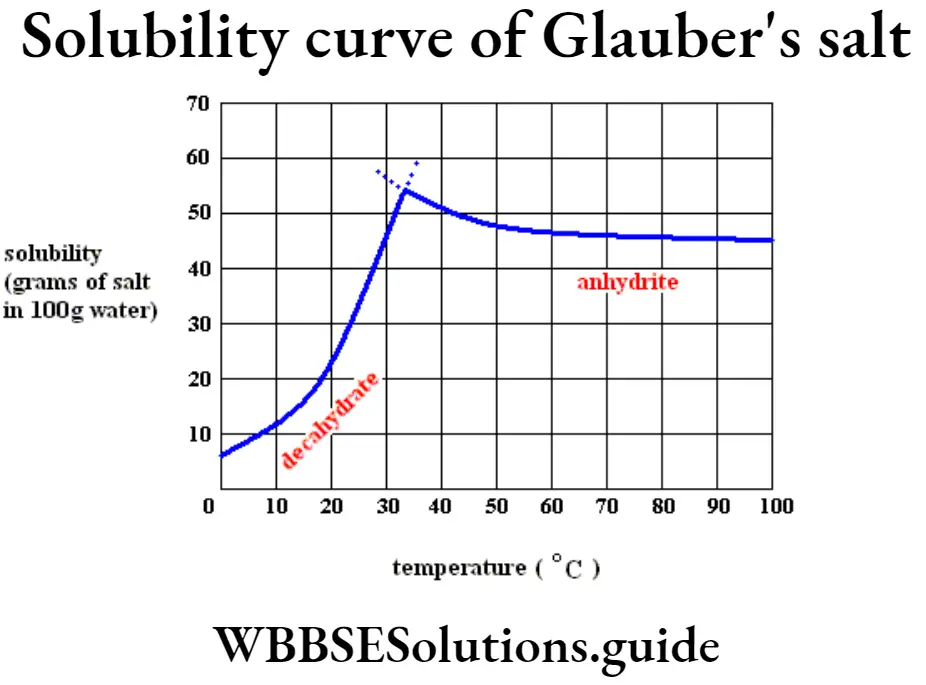
Question 9. How does the solubility of sodium sulfate change with temperature? Or, Give an example of a substance whose solubility first increases and then decreases with the increase in temperature very slowly.
Answer: The solubility of sodium sulfate first increases up to 40°C and then it slowly decreases to a little extent up to 80°C.

Question 10. Give an example of a neutral drying agent.
Answer: Anhydrous magnesium sulfate (MgSO4).

WBBSE Solutions For Class 9 Physical Science And Environment Solution

WBBSE Class 9 solution chapter solutions

Question 11. Give an example of an acidic drying agent.
Answer: Phosphorus pentoxide ( P2O5) is an acidic drying agent.

Question 12. Give an example of a basic drying agent.
Answer: Quick lime (CaO) is a basic drying agent.

Question 13. Give an example of aerosol.
Answer: One aerosol-fog.

Question 14. Give an example of one natural colloid.
Answer: Gelatin or Glue is a natural colloid.

Question 15. What is mist? 
Answer: Aerosol is formed by the suspension of liquid particles (water, acid, etc.) in air.

Wbbse Physical Science And Environment Class 9 Solutions

Question 16. Name two diseases caused by SPM.
Answer: Asthma and lung cancer.

Question 17. Solubility of which substance does not change appreciably with an increase of temperature?
Answer: Sodium chloride. (NaCl)

Question 18. What is Mother liquor?
Answer: In the process of crystallisation, the saturated solution left after the separation of crystals is called Mother liquor.

Question 19. The solubility of A at °C is x”. What does it mean?
Answer: It means x gram of A can produce a saturated solution when dissolved in 100 grams of solvent at t°C.

Question 20. Give an example of a compound whose solubility in water decreases with an increase in temperature. 
Answer: The solubility of slaked lime decreases with an increase in temperature.

Question 21. What are the components of a colloidal solution?
Answer:
Components of a colloidal solution :
(1) Dispersed phase
(2) Dispersion medium.

Question 22. Write down the name of a substance whose solubility decreases with an increase in temperature.
Answer:
Solubility decreases with a temperature increases: Calcium sulphate (CaSO4).

Question 23. Which gas is dissolved in soda water? 
Answer: Carbon dioxide (CO2).

Question 24. Write down the name of a substance whose solubility increases tremendously with an increase in temperature.
Answer:
Solubility increases tremendously with an increase in temperature:
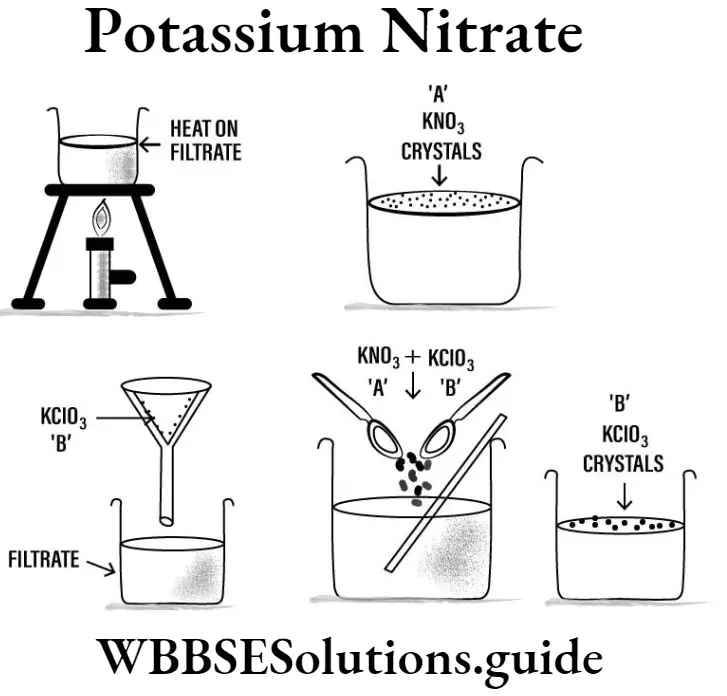
Potassium nitrate (KNO3).

Question 25. Give one example of a salt having water of crystallisation.
Answer:
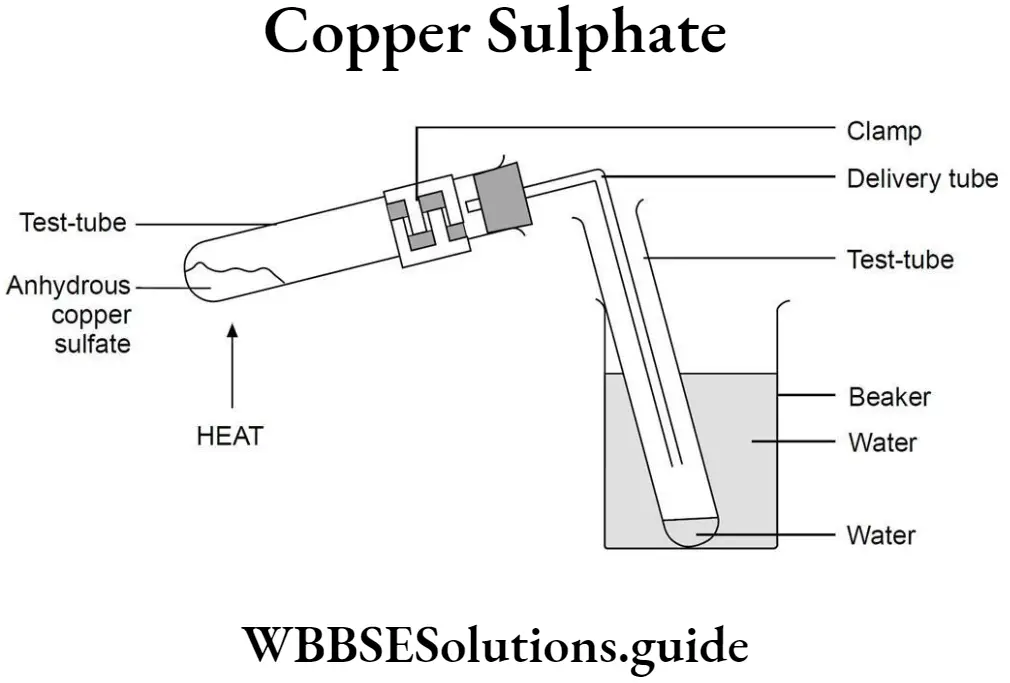
Example of a salt having water of crystallisation: Blue vitriol (CuSO4. 5H2O).

Question 26. What is the effect of increase in pressure on the solubility of a solid in water?
Answer: Increase in pressure does not cause any change of solubility of a solid in water.

Wbbse Physical Science And Environment Class 9 Solutions

Question 27. Name a deliquescent substance.
Answer:
Deliquescent substance :
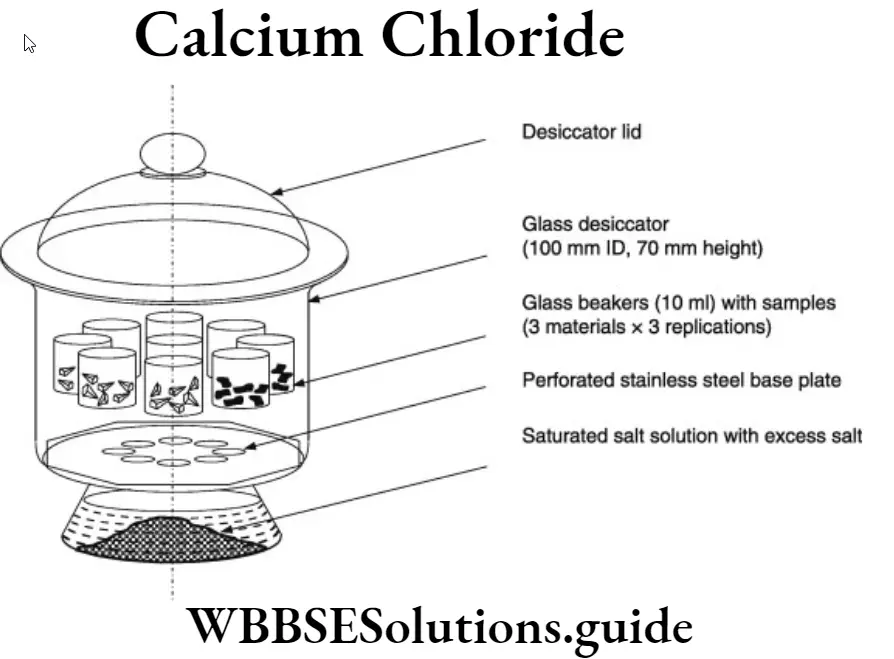
Calcium chloride (CaCl2).

Question 28. Mention one particulate matter in air that causes its pollution.
Answer:
Particulate matter in air that causes its pollution:
Fine particles of dust.

Question 29. Is solution a mixture or compound?
Answer: Solution is a mixture.

Question 30. Why does edible salt (NaCl) become moist in the rainy season?
Answer: Edible salt (NaCl) becomes moist in the rainy season due to the presence of deli quescent MgCl2, 6H2O as impurity in it.

Question 31. Name an efflorescent substance.
Answer:
Efflorescent substance: Washing soda (Na2CO3.10H2O).

Question 32. What happens if a saturated solution is cooled 
Answer: The cooled solution sheds the excess solute as crystals.

Question 33. What is the effect of increase in pressure on the solubility of a gas in water ?
Answer: Increase in pressure increases solubility of a gas.

Solution WBBSE Class 9 solutions with answers

Question 34. What is solute?
Answer:
Solute: The substances which are present in smaller quantities and get dissolved are called solutes.

Question 35. What is solvent?
Answer:
Solvent: The medium in which the solutes are uniformly dispersed through dissolution is known as the solvent.

Question 36. What is a homogeneous mixture?
Answer:
Homogeneous mixture: A homogeneous mixture is one in which the constituent substances are so intimately mixed that even a very close examination cannot distinguish any surface of separation between them.

Wbbse Physical Science And Environment Class 9 Solutions

Question 37. What is a heterogeneous mixture?
Answer:
Heterogeneous mixture: A heterogeneous mixture is one in which the particles of the constituent substances of a mixture are distinctly distinguishable.

Question 38. What is a colloidal solution?
Answer:
Colloidal solution: A colloidal solution is a stable heterogeneous solution consisting of finely divided particles of a substance (of the size of 10-5 cm to 10-7cm in diameter) uniformly dispersed in a continuous medium.

Question 39. What are dispersed phase and dispersion medium? 
Answer:
Dispersed phase and dispersion medium: The finely divided Particles are called the dispersed phase and the continuous medium is called the dispersion medium.

Question 40. What is suspension?
Answer:
Suspension: The particle in suspension state is 10-4 cm in diameter.

Question 41. What is true solution?
Answer:
True solution: The particle in true solution is 10-8 cm in diameter

Question 42. What is sol?
Answer:
Sol: It is a colloidal system in which a solid is dispersed in a liquid
Example: Paints.

Question 43. What is emulsion?
Answer:
Emulsion: It is a colloidal system in which a liquid is dispersed in another liquid .
Example: Milk

Question 44. What is Gel?
Answer:
Gel: It is a colloidal system in which a liquid is dispersed in a solid
Example:  Fruit jellies, cheese, etc.

Question 45. What is aerosol?
Answer:
Aerosol: It is a colloidal system having a solid or a liquid dispersed in a gas
Example: Fog, smoke, clouds, etc.

Question 46. Define Lyophilic colloids.
Answer:
Lyophilic colloids: These are the substances which pass readily into the colloidal state whenever mixed with a suitable solvent
 Protein, starch, etc.

Question 47. Define Lyophobic colloids.
Answer:
Lyophobic colloids: These are the substances which do not yield colloidal solutions on mere shaking with a liquid.
Example: Gold, silver, Fe (OH)3, As2 O3

Question 48. What are positive sols?
Answer:
Positive sols:
These are the sols which carry positive charge on the dispersed phase particles.
Example:  Sols of Fe(OH)3, Al(OH)3 , etc.

Question 49. What are negative sols?
Answer:
Negative sols: These are the sols which carry negative charge on their particles).
Example:  Sols of Cu, Ag, Au, As2,S3,  etc.

Question 50. What are multi-molecular colloids?
Answer:
Multi-molecular colloids:
These are the colloids in which the individual particles consist of aggregates of atoms of small molecules having molecular size less than 10-7 cm in diameter
Example: Sols of gold atoms, platinum sol.

Question 51. What are macro-molecular colloids?
Answer:
Macromolecular colloids : These are the colloids in which the size of the particles of the dispersed phase are of the order of colloidal dimensions.
Example: Sol of starch, cellulose

Question 52. What is peptisation?
Answer:
Peptisation: It is the process of converting precipitates into colloidal state by adding small amount of a suitable electrolyte.

Question 53. What is dialysis?
Answer:
Dialysis :
It is the process of separating substances in colloidal state from those present in ionic states with the help of semipermeable membrane.

Question 54. What is Tyndall effect?
Answer:
Tyndall effect: It is the scattering of light from the surface of colloidal particles and a beam of light passed through a colloidal solution becomes visible as a bright streak. The illuminated path is called the Tyndall effect.

Question 55. What is Brownian movement?
Answer:
Brownian movement: This is a ceaseless, erratic, and random motion of colloidal particles as a result of their bombardment by the molecules of dispersion medium.

WBBSE Class 9 Physical Science solution notes

Question 56. What is electrophoresis?
Answer:
Electrophoresis: It is the movement of charged colloidal particles, under the influence of an electric field, towards the oppositely charged electrodes.

Question 57. What is coagulation?
Answer:
Coagulation: It is the phenomenon of changing of colloidal state to a suspended state. It can be brought about by adding an electrolyte to a colloidal solution.

Question 58. What is Hardy Schulze’s rule? 
Answer:
Hardy Schulze rule: It states the greater the valency of the coagulating ion added, the greater is its power to coagulate.

Question 59. What is gold number?
Answer:
Gold number: It is the weight in milligrams of a protective colloid which prevents the coagulation of 10 mi of a given gold sol on adding 1 ml of 10% solution of sodium chloride.

Question 60. What is solubility?
Answer:
Solubility: Solubility of a given solute in a solvent is defined as the weight in grams of the solute dissolved in 100 grams of the solvent so as to saturate the solution at a given temperature.

Question 61. What is Henry’s law?
Answer: At a definite temperature the solubility of a gas in a particular solvent is proportional to the pressure applied on the gas. This is Henry’s law.

Question 62. What are crystals? 
Answer:
Crystals:
Crystals are homogeneous solid particles (big or small) with definite geometric shape, and are bounded by plane surfaces meeting at sharp edges.

Question 63. What is crystallisation ?
Answer:
Crystallisation : Crystallisation is a process by which crystals of a substance are obtained from its solution.

Question 64. What is water of crystallisation ?
Answer:
Water of crystallisation : When a crystal is formed from the aqueous solution of a substance then one or more fixed number of water molecules associated with each molecules of that substance by chemical bonding are called water of crystallisation.

Question 65. What are hydrated crystals?
Answer:
Hydrated crystals: Crystals having the water molecules associated with them are called hydrated crystals.

Question 66. Which is the solvent in the following binary solutions?
(1) Sugar and water
(2) 70 ml of alcohol and 30 ml water
(3) Soda water.
Answer:
(1) Water
(2) Alcohol
(3) Water (CO2 , is solute).

Question 67. Which is the solute in the-following solutions 
(1) Hydrogen chloride and water
(2) 80 ml of nitrogen and 20 mI hydrogen.
Answer: (1) Hydrogen chloride
(2) Hydrogen.

Question 68. If 15 g of a saturated solution of sodium chloride at 20°C, leaves a solid residue of 3 g, when evaporated to dryness, calculate the solubility of NaCl at that temperature.
Answer:

Given

If 15 g of a saturated solution of sodium chloride at 20°C, leaves a solid residue of 3 g, when evaporated to dryness,

Wt. of water in solution = 15 − 3 = 12 g.
So 12 g H2O dissolves 3 g of solid.

∴ 100 g H2O dissolves \( \frac{3}{12} \times 100\)g of solid = 25 g.

∴ Solubility in % (w/w) = 25.

Question 69. A 200 mi saline solution contains 1.8 g of NaCl. Find the % w − v of the solution.
Answer:

Given

A 200 mi saline solution contains 1.8 g of NaCl.

% w-v=\(\frac{w}{V} \times 100\) = 0.9% (w in ‘g’ and V in ml taken)

Question 70. 50.9 of sugar is dissolved in water to prepare a 2.50-litre solution, calculate its concentration in grams per litre.
Answer:

Given

50.9 of sugar is dissolved in water to prepare a 2.50 litre solution

Mass of sugar = 50 g.

Volume of solution = 2.50 litre

∴ g/l  Concentration\(=\frac{50 \mathrm{~g}}{2.5001}\)  = 20 gl-1

Question 71. 8 g of NaOH is dissolved in water to prepare 1500 mi solution. Calculation its molar concentration. (NaOH = 40)
Answer:

Given

8 g of NaOH is dissolved in water to prepare 1500 mi solution.

Weight of NaOH = 8g.

Volume of solution = 1500 ml.

8x 1000

Molarity of the solution \(=\frac{8 \times 1000}{1500 \times 40}\)=0.13 mol.L-1

Question 72. At 20°C, 5 g of a salt is dissolved in 10 g of water and the solution is saturated. What will be the solubility of salt at that temperature?
Answer:

Given

At 20°C, 5 g of a salt is dissolved in 10 g of water and the solution is saturated

Mass of solute = 50 g and mass‘of the solvent = 10 g.

So, solubility \(=\frac{\text { wt. of solute }}{\text { wt. of solvent }} \times 100\)

=\(\frac{5}{10} \times 100\)

=50

Solution 2 Marks Questions And Answers:

Question 1. Why does a finely powdered solute dissolve much quicker in a liquid solvent than a lump of equal weight of the same solute?
Answer: Dissolution of a solid solute in a liquid solvent takes place from the surface of the solid exposed to the liquid solvent, so, if larger surface area of the solid be exposed to the liquid, greater rate of dissolution takes place. For this reason, a finely powered solute dissolves much quicker in a liquid solvent than a lump of equal weight of the same solute.

Question 2. What are concentrated and dilute solutions?
Answer:

Concentrated and dilute solutions

A solution that contains a relatively small amount of solute compared to the amount of solvent is referred to as dilute, while a solution that contains a relatively large amount of solute is referred to as a concentrated solution.

Question 3. Can there be solvents other than water? 
Answer: Liquids other than water may also act as solvents. Sulfur is insoluble in water but dissolves in carbon disulfide forming a clear solution. Water is incapable of dissolving camphor, waxes, fats, and oils but chloroform, ether, alcohol, benzene, etc. are good solvents for these substances.

Question 4. What do you mean by ‘dispersed phase’ and ‘dispersion medium’?
Answer:

Dispersed phase: The component of the colloid present in small amounts and which behaves like a solute in a solution is called dispersed phase.

Dispersion medium: The component of colloid present in excess amount and which behaves like a solvent in a solution is called dispersion medium.

Question 5. Define the unit of concentration of the solution in percentage.
Answer:

Concentration of solution in percentage

If V ml of the solution contains W g of the solute, the percentage of the solution is \(\frac{W}{V} \times 100 \%\).

Question 6. Define the unit of concentration of the solution in grams per liter.
Answer:

The concentration of solution in grams per liter:
Its unit is g/l. When 1 litre (1000. ml) of the solution contains w grams of the solute, its strength is w g/1l.

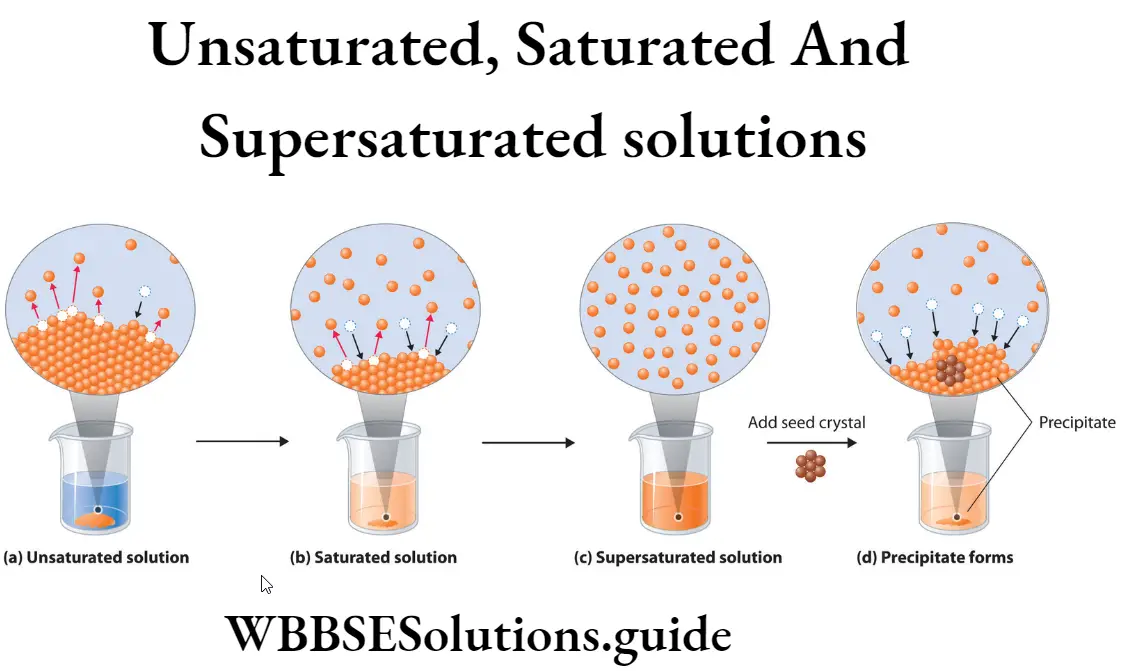
Question 7. What happens when a saturated solution of a substance at 100°C is cooled to 60°C?
Answer: The solution becomes super-saturated and an amount of solid substance which is in excess than can be present in a saturated solution at 60° will separate out.

Question 8. What is meant by 2% NaCl solution?
Answer:

2% NaCl solution

2% NaCl solution means that 100 milliliters of the given solution of sodium chloride in water contains 2 gm of dissolved NaCl.

Question 9. What is meant by a concentration of 20 gm/liter of a solution?
Answer:

The concentration of 20 gm/liter of a solution

A concentration of 20 ml liter means that 1 liter, ie., 1000 milliliters of the given solution contains 20 gm of dissolved solute.

Question 10. What is the difference between aqueous and non-aqueous solutions?
Answer:

The difference between aqueous and non-aqueous solutions

True solution of any solute in water is called an aqueous solution, e.g. vinegar. The true solution in any solvent except water is called non-aqueous solution, e.g. amino acids dissolved in acetone.

Important questions on solution WBBSE Class 9

Question 11. What is an anhydrous substance or salt?
Answer:

Anhydrous substance or salt

A hydrated salt which completely loses its water of crystallisation or a substance that-does not exist in hydrated state can be called anhydrous.

Question 12. What is hydrated substance or hydrated salt?
Answer:

Hydrated substance or hydrated salt

A substance (or salt) which contains certain fixed number of water molecules, bound to its one molecule, into loose chemical bond, is called hydrated substance or hydrated salt.

Question 13. Why are anhydrous calcium chloride and phosphorus pentoxide kept in air tight bottles?
Answer: Anhydrous calcium chloride and P2O5 are deliquescent substances and become liquid by absorbing moisture from air if they come in contact with air. That is why, these substances are to be stored in air tight bottles.

Question 14. Giving example, state the use of suspension in our daily life.
Answer: Many substances insoluble in dispersing medium but which form suspension temporarily are used for analytical purposes. For example, sparingly soluble barium sulphate dispersed in water is an opaque medium and is used for taking intestinal X-ray photograph.

Question 15. State the observation on the basis of which you may identify a suspension.
Answer: If the particles in a heterogenous and opaque solution can be seen by the naked eye or under an ordinary microscope and get settled on keeping, then it is a suspension.

Question 16. What do you mean by solution ? Give an example.
Answer:

Solution:

A homogeneous mixture of solid substance, in liquid (usually water) having same physical properties in every part of it is called the solution.

Example: When small quantity of sugar is added in a glass full of water, then the sugar will disappear in the water on stirring. The product so obtained is called the solution of sugar in water.

Question 17. What are solvent and solute? Give example.
Answer:

Solvent: A liquid (say water) which allows a solid to dissolve in it, so as to form solution, is called solvent.

Solute: A solid which dissolves (disappears) in a liquid (say water) to form a solution is called solute.

Examples: When sugar dissolves in water to make a solution, then water is called solvent and the sugar is called solute.

Question 18. How can it be known with a single experiment whether a solution is saturated or not?
Answer: Take some waier in a beaker and dissolve some sugar into it. Stir well to make it a clear solution. Now add some more sugar into the solution and stir well the solution. If the sugar dissolves completely at the room temperature, then the solution is unsaturated. If the sugar stops dissolving at the same temperature and settles down in the bottom of the beaker, then the solution is saturated at that temperature.

Question 19. What is a colloidal solution? Give example. 
Answer:

Colloidal solution

A solution in which the size of solute particles is larger than that of the molecules of true solution but less than the suspended particles, it is said to be a colloidal solution.

Example: Very finely ground sulphur when mixed with water, filtration does not remove all the sulphur particles. Some particles of sulphur are fine enough to remain permanently mixed with the water, it is called colloidal solution. When the liquid is examined by an ultramicroscope, it can be seen that sulphur particles are in rapid random motion at room temperature. This movement of colloidal particles is known as the Brownian movement.

Question 20. What are the suspended particulate matter in air ?
Answer :

Suspended particulate matter in air

The finely divided solid or liquid particles suspended in air are called particulates. Some of the examples of

Particulates present in the air are Dust, smoke, fumes, mist, flyash. Particulates can be solids or liquids. For example, dust, smoke and fumes are solid particulates, whereas mist and spray are liquid particulates. Other particulates in the air are pollen grains, Bacteria, Fungi, Viruses, fine sand particles, pesticides, and dust of several industrial wastes.

Some particulates are very small, fe particles and have a diameter of less than one micrometer such as smoke, fumes, aerosols, etc. Large solid particles such as dust, mist,etc. have a diameter more than-one micrometer.

Question 21. Define solubility of a solute.
Answer:

Solubility of a solute

The solubility of a solute in a solvent at a particular temperature is the number of grams of the solute necessary to saturate 100 gms of the solvent at that temperature.

Thus, solubility of a solute at t°C\(=\frac{\text { mass of solute }(\mathrm{g})}{\text { mass of solvent }(\mathrm{g})} \times 100\).

For example The solubility of potassium nitrate in water at 20°C is 32. It means that at 20°C, 32 gm of potassium nitrate (maximum amount) can be dissolved in 100 gm of water to make a saturated solution of it.

Question 22. On what factors does the solubility of substances depend?
Answer :

Different substances have different solubilities at different temperaturés.

The difference in solubilities of substances depends upon :

(1) Nature of solute

(2) Nature of solvent used

(3) Temperature

(4) Pressure.

Question 23. What are solubility curves? State their application.
Answer:

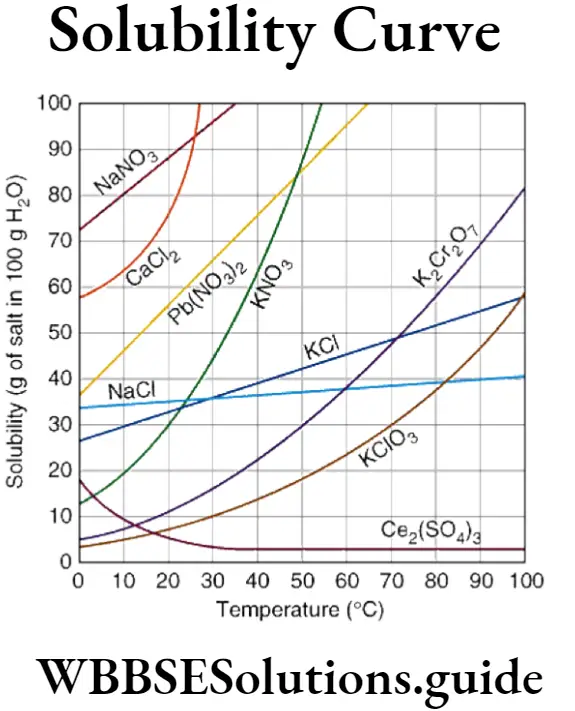
Solubility curves

The graph drawn for the solubility of a substance at different temperatures is called the solubility curve. In the solubility curve graph, temperature is plotted on the x-axis, and the solubility of the substance in 100 gm of water on the y-axis. Some uses of solubility curves are:

(1) To find the solubility of a given substance at some particular temperature.

(2) To compare the solubility of different substances at a given temperature.

Question 24. What are crystals and crystallization?
Answer:

Crystals and crystallization

When a saturated solution available at a particular temperature is cooled to a lower temperature, then some of the dissolved solutes will separate out in the form of a definite geometrical shape called a crystal. The process of forming crystals is called crystallization. Crystals are homogeneous solids bounded by a plane surface at definite angles to one another and having a definite geometric shape.

Question 25. State the physical properties of crystals with examples.
Answer :

The physical properties of crystals of a substance are :

(1) Crystals are solid particles having a definite regular shape.

(2) Crystals are bounded by flat surfaces at definite angles to each other.

(3) Crystals are the purest form of substances. The impurities dissolved in the saturated solution will be separated.

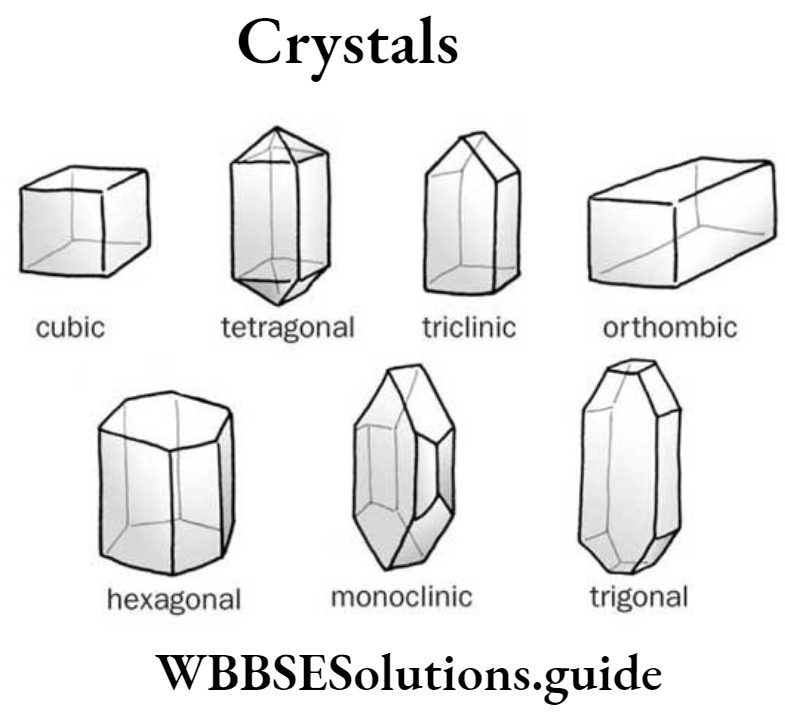
Examples of some crystals :
WBBSE Solutions For Class 9 Physical Science And Environment Solution Crystals.

Question 26. What is Water of Crystallization?
Answer:

Water of Crystallization

Crystals of some substances bind a certain fixed number of water molecules while separating from their saturated solution on cooling. These fixed numbers of water molecules attached to the crystals of the substances determine the shape and colour of the crystals, called water of crystallization. The fixed number of water molecules form a loose chemical bond.

For example :
Copper sulphate crystals – CuSO4.5H2O

Magnesium sulphate – MgSO4.7H2O

Washing soda or hydrated sodium carbonate – NaCO3.10H2O

Question 27. What are hygroscopic substances? Give example.
Answer:

Hygroscopic substances

A substance which when placed in open air, absorbs moisture from it, but does not change its state, is called hygroscopic substance.

Example: Anhydrous sodium carbonate (Na2 CO3).

Anhydrous quick lime (CaO).

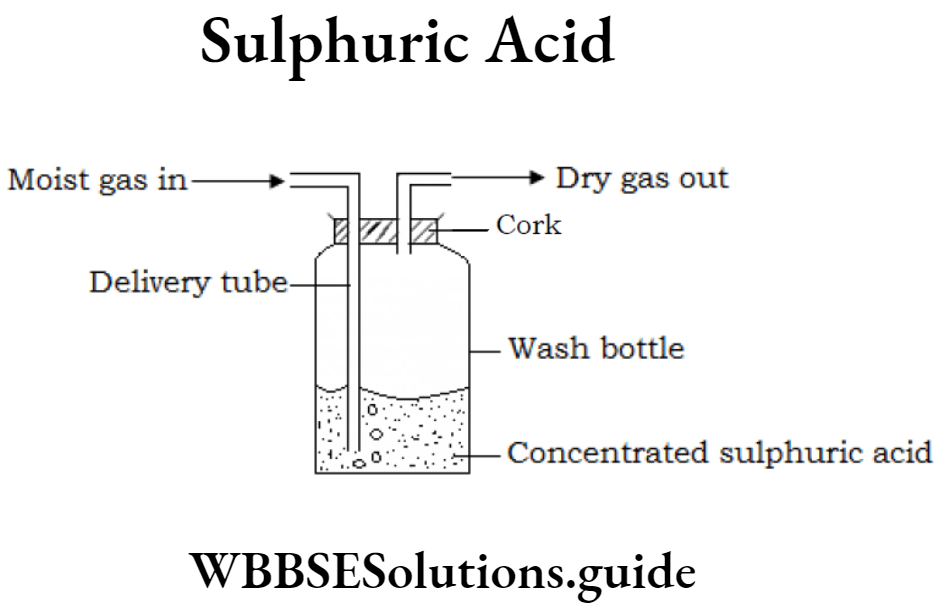
Concentrated sulphuric acid (H2SO4).

WBBSE Class 9 solved exercises on solution

Question 28. What are drying agents: Give some examples of drying agents.
Answer:

Drying agents

The substances which can absorb moisture from other substances without chemically reacting with them, are called drying agents.

Examples of drying agents:

Anhydrous Calcium chloride (CaCl2),

Quick lime (CaO),

Phosphorus pentoxide (P2 O5 ),

Concentrated sulphuric acid (H2SO4).

Silica gel, etc.

Question 29. What is the cause of efflorescence? Give one example of an efflorescent substance.
Answer:

Cause of efflorescence: Efflorescence happens only when the vapor pressure within the hydrated crystal at ordinary temperature is greater than the vapour pressure of the atmosphere. These hydrated crystals are called efflorescent substances.

Example: Na2CO3, 10H2O.

Question 30. What is the cause ‘of deliquescence? Give one example of a deliquescent sub- stance.
Answer:

Cause of deliquescence: Deliquenscence occurs when the vapour pressure of water in the deliquescent substance is less than the vapour pressure in the atmosphere at ‘ordinary temperature.

Example: CaCl2.

Question 31. Why does the colour of sky appear to be blue?
Answer: Colour of sky appears to be blue due to the scattering of blue light by dust particles along with water suspended in air.

Question 32. What is fire foam?
Answer:

Fire foam: Carbon dioxide froth made. mixing a solution of sodium bicarbonate and alum is called fire foam. It is used in fire extinguishers. A protective gold such as glue or dextrin is added to stabilize the foam.

Question 33. What do you understand by (1) Aqueous solution and (2) Non-request solution? Give example.
Answer:
(1) Aqueous solution: A solution obtained by dissolving a solute in water is called aqueous solution.

Example: A solution prepared by dissolving 5 gm of common salt in water is an aqueous solution of salt and is written as NaCl (aq).

(2) Non-Aqueous solution: A solution in which the solvent is any liquid except water is called a non-aqueous solution. Thus, a solution of sugar in alcohol is an example of nonaqueous solution.

Question 34. What are the differences between suspension, colloidal, and true solution in respect of the size of their solute particles?
Answer:

The differences between suspension, colloidal, and true solution in respect of the size of their solute particle

The particles of a solute forming a true solution of molecular size (1-10A) are invisible and do not settle on standing. The solute forming suspension are much bigger (>2000A) and visible, if not by the naked eye, at least under a microscope. The particles seitle down within a short time. But the sizes of the particles (10A-2000A) forming colloidal solution are bigger than molecules but too small to be visible under a most powerful microscope.

Question 35. The solubility of urea is 109.04 g/100 cc in water at 20°C. A solution is formed by dissolving 500 g urea in 1 liter water. State the nature of the solution formed.
Answer:

Given

The solubility of urea is 109.04 g/100 cc in water at 20°C. A solution is formed by dissolving 500 g urea in 1 liter water.

The solution formed is unsaturated since it contains lesser amount of the solute than that can be dissolved in the given volume of water at 20°C.

The solution contains\(\frac{500 \mathrm{~g}}{1000 \mathrm{c} . \mathrm{c}} \times 100\)= 50 g urea per 100 c.c. water.

Question 36. The concentration of an aqueous solution of NaCl is 2% wiv. Express the strength of the solution in g militre.
Answer:

Given

The concentration of an aqueous solution of NaCl is 2% wiv.

100 millilitres of the given water solution contains 2 gm of NaCl.

∴ 1000 milliliter of the given water solution contains \(\frac{2 \times 1000}{100}\)=g

∴ The strength of the solution = 20 g/litre.

Question 37. How many grams of NaCl will be necessary to prepare 500 mi of 5% NaCl?
Answer:

5% NaCl contains 5 grams of NaCl per 100 mi of the solution.

So the number of grams of NaCl required to prepare 500 ml of 5% NaCl solution

\(=\frac{5}{100}\)= 500 = 25 gm.

Question 38. 15.20 gm of a saturated solution of cane sugar at 20°C contains 10.28 g of cane sugar. Calculate the solubility of cane sugar at 20°C.
Answer:

Given

15.20 gm of a saturated solution of cane sugar at 20°C contains 10.28 g of cane sugar.

10.20 gm of sugar is present in 15.20 g of the solution.

Amount of water present in 15.20 g of the solution

= (15.20 -10.20) g= 5g.

Now, 5 g of water contains 10.20 g of sugar.

100 g of water contains\(\frac{10.20 \times 100}{5}\)=204 g of sugar.

Solubility of sugar in water at 20°C = 204.

Question 39. 2.5 g of sodium chloride is dissolved in water and the volume is made up to exactly 250 cm3. Determine the percentage strength of this solution.
Answer:

Given

2.5 g of sodium chloride is dissolved in water and the volume is made up to exactly 250 cm3.

strength in weight by volume (w/v) is the number of solute particles presenting in 100 c.c. of the solution.

∴ Percentage strength of the sodium chloride solution

(% by w/v)\(=\frac{2.5 \times 100}{250}\)=1

Question 40. 1. 5 gm of sodium chloride is dissolved in water and the volume is made up to exact 250 cm3. Determine the percentage strength of this solution.
Answer:

Given

5 gm of sodium chloride is dissolved in water and the volume is made up to exactly 250 cm3.

5 gm of solute is present in 250 c.c. of the given solution. So the weight-volume (w/v) The percentage strength of the given solution will be

\(\frac{5}{250}\) = 250x 100 = 2% (w/v).

Question 41. Why does effervescence occur when a soda water bottle is opened?
Answer: Soda water is a solution of carbon dioxide in water prepared. under high pressure. For this reason when a bottle of soda water is opened, i.e., pressure on the liquid content in the bottle is reduced, effervescence or rising bubbles occur. These effervescences form as a part of dissolved CO gas escapes through the liquid.

Question 42. Why does clear line water turn miiky when heated?
Answer: Since solubility of slaked lime [Ca(OH)2] decreases with increase in temperature, clear lime water, which is an aqueous solution of Ca(OH)2 or slaked lime, turns milky when heated.

Reason : Due to decrease of solubility at a higher temperature, the excess undissolved slaked ‘lime remains in suspension for which the solution appears milky.

Question 43. Give a simple experiment with which a given solution can be identified whether it is unsaturated or saturated or supersaturated.
Answer: A little quantity of solute of the given solution is added to the solution; if the solute dissolves instantly, the given solution slowly increases, the given salution is supersaturated.

Question 44. Calculate the molality of a solution prepared by dissolving 10.5 g of NaCl in 250 g of H2O.
Answer:

Molarity (m)=\(\frac{\mathrm{n}(\mathrm{mol})}{\mathrm{w}(\mathrm{kg})}\)=\(\frac{\left(10.5 \mathrm{~g} / 58.44 \mathrm{~g} \mathrm{~mol}^{-1}\right)}{\left(250 \mathrm{~g} / 1000 \mathrm{~g} \mathrm{~kg}^{-1}\right)}\)

=0.719 mol Kg-1

We report this molality as 0.719 m NaCl solution.

Question 45. 36 g of saturated solution of sodium chloride at 20°C, when evaporated to dryness, leaves a solid residue of 9 g. Calculate the solubility of sodium chloride.
Answer:

Given

36 g of saturated solution of sodium chloride at 20°C, when evaporated to dryness, leaves a solid residue of 9 g.

Weight of water in solution = (36 − 9) = 27 g.
27 g water dissolves 9 g NaCl

∴ 100 g water dissolves\(=\frac{9}{27} \times 100\)=33.33

Solubility of NaCl in water at 20°C=33.33

Question 46. Find the weight of potassium nitrate which is to be taken to prepare 60 g pure crystals from its saturated solution at 80°C. The solubility of potassium nitrate at 80°C is 140 g. and at 25°C is 100g.
Answer:

Solubility at 80°C = 140, Solubility at 25°C = 100.

Amount of crystals obtained when the solution is cooked to 25°C = 140 −100 = 40g.

To obtain 40g KNO3 crystals potassium nitrate was taken = 140 g.

To obtain 60g KNO3 crystals potassium nitrate to be taken \(=\frac{140}{40} \times 60\)=210g.

Question 47. At 20°C, in 12 g of a saturated solution of sugar, 2 g of sugar is dissolved. What will be the solubility of sugar ?
Answer:
Solution:

Given

At 20°C, in 12 g of a saturated solution of sugar, 2 g of sugar is dissolved.

Mass of solution = 12 g, mass of sugar (solute) = 2 g.

So, the mass of solvent (water) = 12 − 2 = 10.

So, solubility \(=\frac{\text { wt. of solute }}{\text { wt. of solvent }} \times 100\)=\(\frac{2}{10} \times 100\)= 20.

WBBSE Class 9 Physical Science types of solutions solutions

Question 48. At 20°C, the solubility of NaCl is 36. At this temperature in a saturated solution of the salt 400 g water is present. What amount of salt is obtained on evaporation of the solution?
Answer:

Given

At 20°C, the solubility of NaCl is 36. At this temperature in a saturated solution of the salt 400 g water is present.

Mass of solvent = 400 g, and solubility = 36.

So, solubility\(=\frac{\text { wt. of solute }}{\text { wt. of solvent }} \times 100\)  or, 36\(=\frac{\text { wt. of solute }}{400} \times 100\)

So, wt. of solute\(=\frac{400 \times 36}{100}\)=144g.

Question 49. At 30°C, the solubility of salt is 40. What amount of water is required to form a solution with 30 g of salt? What will be the amount of the solution?
Answer:

Given

At 30°C, the solubility of salt is 40. What amount of water is required to form a solution with 30 g of salt?

Mass of solute = 30, solubility = 40

So, solubility\(=\frac{\text { wt. of solute }}{\text { wt. of solvent }} \times 100\)  or, 40\(=\frac{30}{\text { wt. of solvent }} 100\)

∴  wt. of solvent \(=\frac{30 \times 100}{40}\)=75g.

Amount of water required = 75 g.

And the amount of the solution = wt. of solute + wt. of solvent = (30 + 75) = 105 g.

Question 50. A solution contains 2 g of the solute in 25 mi of the solution at 25°C. What will be the gram per liter strength of the solution? 
Answer:

Given

A solution contains 2 g of the solute in 25 mi of the solution at 25°C.

25 ml contains 2 g of solute.

1 ml contains \(\frac{2}{25}\) g of solute.

1 l=100 ml contains\(\frac{2 \times 1000}{25}\)=2×40 g of solute=80

Question 51. A solution contains 5 g mole of a solute in 250 ml-of the solution at 27°C. What will be the mol I” strength of the solution?
Answer:

Given

A solution contains 5 g mole of a solute in 250 ml-of the solution at 27°C.

250 ml contains 5 g mole of solute.

1 ml contains \(\frac{5}{250}\)mole of solute.

1 l= 1000 ml contains \(\frac{5 \times 1000}{250}\) g mole of solute

=5 x 4 g mole of solute = 20 g mole of solute.

So, strength = 20 mol L-1 .

Question 52. A solution contains 8 g of NaCl in 25 g of water at 30°C. What will be the weight percentage strength of the solution?
Answer:

Given

A solution contains 8 g of NaCl in 25 g of water at 30°C.

25 g water contains 8 g of the solute

1 g water contains\(\frac{8}{25}\)  of the solute

or, 100g water contains \(\frac{8 \times 100}{25}\) g of the solute

= 8x 4 g of the solute

= 32 g of solute.

So, the strength = 32%.

Question 53. A solution has a strength 40 mol L-1 at 30°C. What will be the amount of solute present in 250 ml of that solution at 30°C?
Answer:

Given

A solution has a strength 40 mol L-1 at 30°C.

1 l= 1000 ml contains 40 moles of solute

1 ml contains\(\frac{40}{1000}\) moles of solute

250 ml contains\(\frac{40\times 250}{1000}\)   moles of solute

= 10 moles of solute

So, no. of gram mole of solute present = 10.

Question 54. At 27°C a solution has a strength of 35%. What will be the amount of the solute in 50 g of water?
Answer:

In 100 g water, amount of solute present = 35 g.

1 g water, amount of solute present =\(\frac{35}{100}\)

∴ In 50 g water, amount of solute present =\(\frac{35\times 50}{100}\)

So, the amount of solute = 17.5 gram.

Question 55. At 25°C, the strength of a solution is 60 g/l. What will be the amount of solute in 250 ml of that solution?
Answer:

In 1000 mi solution amount of solute = 60 g.

1 ml solution amount of solute =\(\frac{60}{1000}\) g.

In 250 ml solution amount of solute = \(\frac{60\times 250}{1000}\) g

= 15 g.

So, the amount of solute = 60 g.

Solution 3 Marks Questions And Answers:

Question 1. Given below is a list of some colloids. Make a list selecting them based on dispersing medium. Smoke, fog, cloud, milk, jelly, cheese, blood, paint, shaving cream, milk of magnesia.
Answer:

Fog, Cloud              →    Air (gas)
Smoke                     →    Air (gas)
Shaving cream        →    Liquid (water)
Blood                      →    Liquid (water)
Paint                        →    Liquid (water)
Milk of Magnesia    →    Liquid (water)
Milk                         →    Liquid(water)
Jelly, Cheese            →    Solid

Question 2. Classify the following into true solution, colloid, and suspension 
(1) Lime water
(2) Aerated water
(3) Milk
(4) Sugar in water
(5) Writing ink,
(6) Blood
(7) Butter
(8) Muddy water
(9) Calcium carbonate in water
(10) Liquid
Answer:

True solutions: Lime water, aerated water, sugar in water.

Colloids: Milk, butter, blood, writing ink, liquid adhesive.

Suspension: Muddy water, calcium carbonate in water.

Question 3. State the different types of solutions by combining different states of matter.
Answer:

We can classify the different types of solution into :

(1) Solids in liquid

(2) Liquid in liquid

(3) Gases in liquid

Examples : The solution of solids in liquids are – solution of sugar and water, solution of potassium nitrate in water, etc.

The solution of liquids in liquids are   solution of milk and water, solution of water and glycerine, etc.

The solution of gases in liquids are – water and air, water and carbon dioxide (soda water or aerated water).

Question 4. State the differences between solution and colloids.
Answer :

The main differences between true solutions and colloids are given below :

Solution (or true solution) Colloid (or colloidal solution)
1.    The average size of solute particle in a true solution is 10-8 cm. 1.    The size of solute particles in a colloid is between 10-7 cm and 10-5 cm.
2.    A true solution is a homogeneous mixture. 2.    A colloid is a heterogeneous mixture.
3.    A true solution is transparent. 3.    A colloid solution is translucent.
4.    The particles of a true solution cannot be seen even with a microscope. 4.    Some particles of colloids can be seen with a powerful microscope.
5.    A true solution does not scatter light. 5.    A colloid solution scatters a beam of light passing through it and renders its path visible.


Question 5. How do the suspended particulate matter in air lead to air pollution?

Answer: Suspended particulate matter in air are a kind of air pollutant.

The various ill eff of the particulate matter present in air are the following:

(1) The particulate pollutants cause various allergic reactions. in the human body. They produce diseases like asthma, and tuberculosis, effect on eyes, etc..

(2) The particulate pollutants in air contain metal particles like lead, mercury, arsenic, zine, tin, etc. which are toxic (poisonous) to most of the living organisms; men, animals and plants.

(3) The particulate matter reduce visibility by producing haze in the atmosphere, and hinder the traffic.

(4) The particulates like smoke make our clothes and buildings dusty.

(5) The particulate suspended in air disturb the thermal balance of earth.

Question 6. How are the particulate matter containing metallic particles harmful for the human beings?
Answer: The metallic particles present in air are of lead, mercury, zinc, nickel, arsenic, etc. All the metal particles are toxic in nature. The most harmful metals for the human beings are lead and mercury. The iead particles are released into air by the exhausts of motor vehicles. Lead is a cumulative poison, it keeps on accumulating in the tissues of the human body. lt damages organs like liver, kidney and intestine and causes malformation of red blood cells in the body Asbestos dust is also a major pollutant of the atmosphere. Asbestos dust also causeslung cancer.

Question 7. How do you prepare the crystals of potassium nitrate in laboratory?
Answer : First prepare the saturated solution of potassium nitrate (KNO3) by dissolving potassium nitrate in water and boiling the solution for some time. After strongly heating the solution, it is allowed to cool slowly in a beaker. After some time fine crystals will separate out from the solution in a definite shape.

WBBSE Solutions For Class 9 Physical Science And Environment Solution Potassium Nitrate.

Concentration of solutions Class 9 WBBSE notes

Question 8. What do you mean by hydrated substances (hydrated salt) and anhydrous substances (anhydrous salt) ? 
Answer :

Hydrated Substance: A substance or salt which contains certain fixed number of water molecules, bound to its one molecule, is called hydrated substance.

Anhydrous Substance: A hydrated substance which completely loses its water of crystallization is called anhydrous substance or anhydrous salt.

Examples of crystalline hydrated salts –

Copper sulphate crystals (Blue vitriol) – CuSO4. 5H2O.

Hydrated magnesium salt (Epsom Salt) – MgSO4. 7H2O

Hydrated ferrous sulphate (Green vitriol) – FeSO4 . 10H2O

Hydrated sodium carbonate (Washing soda) – NaCO4. 10H2O

Barium chloride (Barium chloride crystals) – BaCl2. 2H2O

Question 9. Give examples of some anhydrous crystalline salts.
Answer :

Some crystalline salts having no molecule of water are:

Sodium chloride – NaCl

Ammonium chloride – NH4Cl

Potassium Nitrate – KNO3

Silver nitrate – AgNO3

Potassium Permanganate – KMnO4

Potassium Dichromate – K2Cr2O7

Question 10. Show by a simple experiment that copper sulphate (blue vitriol) contains molecules of water. 
Answer :

Take some copper sulphate crystals in a hard glass test tube and strongly heat it. The crystals will slowly turn to a white powder and water drops will come out from the mouth of the test tube. Collect the water drops in a beaker. The blue crystals of copper sulphate will turn to a white powder after losing their water of crystallization.

WBBSE Solutions For Class 9 Physical Science And Environment Solution Copper Sulphate.
Question 11. What are ‘Deliquescence’ and ‘Deliquescent substances’? Give an example of some deliquescent substances.
Answer :

Deliquescences: When a certain crystalline substance is placed in open air, it absorbs moisture from air and changes to liquid state, then this phenomenon is called deliquescence The crystalline substances that absorb moisture from open air and change to liquid state are called deliquescent substances.

For example Anhydrous calcium chloride (CaCl2 ),


Anhydrous sodium hydroxide (NaOH),

Anhydrous potassium hydroxide (KOH),

Anhydrous ferric chloride (FeCl3) etc.

Question 12. Describe an apparatus used to dry a substance using a drying agent.
Answer:

A simple apparatus used in laboratory to dry substances is a desiccator. A desiccator is an air tight glass vessel having a wire gauze. A drying agent Rage such as anhydrous calcium chloride is used to dry 2 wet solids.

WBBSE Solutions For Class 9 Physical Science And Environment Solution Calcium Chloride.

Best study material for solution WBBSE Class 9

Question 13. Discuss some different types of solutions Anhydrous calcium which do not have a liquid as a solvent.
Answer:

(1) Solution of gases in gases: According to the definition, if a gas does not interact with another, it may form a solution. Thus, a solution of oxygen (solute) in excess of nitrogen (solvent) as in air, is a solution of this type.

(2) Solution of solids in solids: Brass is a solution of a solid solute in a solid solvent. It is a homogeneous mixture of copper and zinc. Copper being present in excess is regarded as the solvent.

(3) Solution of gases in solids: The homogeneous mixture obtained by absorbing hydrogen gas in certain solid metals like palladium, nickel, etc. at a high temperature is an example of solution of gas in solids.

(4) Solution of solids in gases: The homogeneous mixture of dust particles and particles of solid fuels such as carbon, sulphur, etc. with air forms smoke and this is an example of a solution of solids in gases.

(5) Solution of liquids in gases: Minute particles of liquids suspended homogeneously in a gas medium forms mist. :

(6) Solutions of liquids in solids: Sodium-mercury amalgam, silver-mercury amalgam, etc. belong to this type of solution, where sodium and silver are the solvents and mercury is the solute.

Wb Class 9 Physical Science Question Answers

Question 14. How can you prepare a super saturated solution of a solid solute (hypo) at room temperature?
Answer:

Preparation of a supersaturated solution: Supersaturated solution can be prepared by heating a few crystals of sodium thiosulphate or hypo (Na2S2 O3, 5H2 O) in a test tube. The-crystals appear to melt or they dissolve in their own water’of crystallization and a very concentrated solution. of the salt in -water is gained. The test tube is plugged with cotton wool-and alloted to-cdol to room temperature. This solution is super saturated and even after cooling no excess soliite separates out. Ifa crystal of the salt is now added into this solution, the crystal growsup in sizé and~the whole liquid’ begins to solidify with the evolution of heat.

Question 15. Briefly describe the process of crystallisation.
Answer:
Crystallization:
Crystallisation is a process from which the crystal of a substance is obtained from its solution.

Process of crystallisation for the preparation of crystal : 

(1) From saturated solution of a substance: A hot saturated solution of the substance is slowly cooled and then the crystal of that substance is obtained.

(2) From unsaturated solution: An unsaturated solution is vapourised, then a concentrated solution of it is obtained. Now if this solution is gradually cooled then crystals of the substance are obtained.

(3) Sublimation process: lodine, Camphor, etc. are sublime. If the sublimate so formed is cooled then the crystals of the substances are deposited in the pot.

(4) From molten matter: Solid sulphur taken in a pot is heated to melt it and then by slowly cooling, the crystals of B-sulphur are obtained.

Question 16. Mention the uses of hygroscopic substances. Give two differences between deliquescent substances and hygroscopic substances.
Answer:

Uses of Hygroscopic substances : These substances are generally used as dying agents for many gases and solids and air. For example, ammonia gas is dried by quick- lime.

Differences between Hygroscopic and Deliquescent substances :
(1) Deliquescent substances are crystalline solids but hygroscopic substances may be non-crystalline solids or liquids.

(2) Deliquescent substances change into solution on absorbing moisture from air but hygroscopic substances do not change their states on doing so.

Question 17. State the names and uses of a few drying agents. Name one dying agent for drying
(1) Ammonia. gas
(2) Hydrogen sulphide gas
(3) Hydrogen gas
(4) Sulphur dioxide gas.
Answer:
Examples of drying agents: A few drying agents frequently used for drying other chemicals are :

(1) Anhydrous calcium chloride (CaCl2) in the desscicator in the laboratory for drying chemicals.

(2) Anhydrous sodium sulphate (Na2SO4) for drying organic solvents.

(3) Anhydrous magnesium sulphate (MgSO4) is used for drying esters, carbonyl compounds.

(4) Conc. H2SO4 is used for drying hydrogen chloride (HCI), CO2, SO2 gases.

(5) Quicklime (CaO) is used for drying ammonia gas.

(6) (1) Basic Quick lime (CaO) is used for drying basic ammonia (NH3) gas.

(2) Acidic phosphorus pentoxide (P2O5) is used for drying acidic. hydrogen sulphide gas.

(3) Cone. H2SO4 or anhydrous CaCl2 can be used for drying H, gas.

(4) Conc. H2SO4 can be used for drying SO2 gas.

Wb Class 9 Physical Science Question Answers

Question 18. (1) What do you understand by the strength of a solution?
(2) Define standard solution.
(3) How can you express the strength or concentration of a solution?

Answer:

(1) Strength of a solution: The strength of a solution means the concentration of the solute in the solution, i.e., the amount of solute present in a definite volume of the solution. The amount of dissolved solute in a definite volume of the solution determines the strength of the solution.

(2) Standard solution: A solution of known strength, i.e., a solution which contains a known amount of dissolved solute in a definite volume of the solvent is called a standard solution.

(3) Units of strength of solution: The strength or concentration of a dilute solution can be expressed by

(1) Percentage strength in weight by volume (W/V x 100)

(2) Grarn per litre (g/l).

Question 19. Point cut the main differences between suspension and colloid.
Answer:

Main differences between suspension and colloid

Colloidal Solution Suspension
1.    Size range of colloidal particles : 10A- 2000A. 1.    Particles forming suspension are of size greater than 2000A.
2.    Colloidal particles are invisible under powerful microscope but the scattering of light can be viewed by ultra microscope. 2.    Particles are invisible either to the naked eye or under an ordinary microscope.
3.    Colloidal particles readily pass through filter paper but slowly through parchment paper. 3.    Cannot pass through filter or parchment paper.
4.    Colloidal particles scatter light, i.e.. show Tyndal effect. 4.    Do not show Tyndal effect.


Question 20. Describe briefly the mechanism of formation of a solution where a solid dissolves in a liquid.

Answer:

Mechanism of formation of solution of a solid in a liquid: When a solid solute comes in contact with a liquid solvent, the tiny solid particles of diameter 10-8 cm or less leave the surface of the solid solute depending on temperature and as the concentration of the solution increases, some solid particles return and deposit on the surface of the lump of solute.

At the beginning, the rate of leaving the solute surface increases and it slows down when the concentration of the solution increases. If the rate of leaving the surface of the solute is greater than that of their return, the solid dissolves totally.

Wb Class 9 Physical Science Question Answers

Question 21. Why does a lump of sugar candy dissolve more quickly in water when it is kept suspended in the water than when it is just left in the water of a tumbler?
Answer:

& jump of sugar candy if kept suspended in water, taken in a glass tumbler, dissolves more quickly than when it is dipped at the bottom of water in the tumbler. This Happens because the layers of water near the suspended lump of candy become concentrated due to dissolution of a part of the candy and become heavier and.

So move down and less concentrated and lighter water layers move near the lump. In this way, the rate of dissolution of the candy increases, i.e., it goes into solution quickly. Same thing happens if the solution is stirred, when the concentrated layers of water are displaced due to stirring. But if the lump is left at the bottom of water, the concentrated and heavier water layers remain there and water layers of less concentration hardly come near it, so the lump takes a lot of time to get dissolved.

Question 22. Does formation of a solution always accompany heat exchange?
Answer:

There is almost always heat changes accompanying formation of solutions. This means that some solutes, when go into solution, heat is evolved and for some other solutes, heat is absorbed. For example, KNO3, NH4Cl, etc. absorb heat while they go into solution, i.e., the change is endothermic, so their solubility increases with rise in temperature. In fact, solubility of most of the solid substances increases with rise in temperature, so by increasing the temperature of a solution, more solute may be dissolved in it.

Exception :

Solubility of sodium chloride (NaCl) remains almost unchanged with rise in temperature. Again, heat evolves when calcium hydroxide [Ca(OH)2], Zinc phosphate [Zn,(PO4)2] an hydrous sodium sulphate (Na2SO4), etc. go into solution, the change in such cases is exothermic, so their solubility decreases with rise in temperature. Hence, solubility of a substance of this type increases due to cooling.

Thus, in general, increase in temperature favours an endothermic change while decrease in temperature favours an exothermic change.

Wb Class 9 Physical Science Question Answers

Question 23. State the properties of a true solution.
Answer :

The main properties of a true solution are :


(1) A true solution is always clear and transparent (light can easily pass through it).

(2) A true solution is homogeneous in nature.

(3) The particles of a solute break down to almost molecule size and cannot be seen under a microscope.

(4) A true solution can easily pass through filter paper as pores of filter paper are bigger than the molecules of solution.

(5) The solute can be recovered from true solution by physical methods (as evaporating the solute or crystallization of solute).

(6) In true solution, particles of the solute do mat settle down, provided the temperatures are kept constant.

Question 24. Describe the effect of temperature and pressure on the solubility of the solids and gases.
Answer :

The effect of temperature and pressure on solubility are :

(1) The solubility of solids in liquids usually increases due to increase in temperature and decreases due to decrease in temperature.

(2) The solubility of solids in liquids remain unaffected by change in pressure.

(3) The solubility of gases in liquids usually decrease on increasing the temperature and increases on decreasing the temperature.

(4) The solubility of gases in liquids increases on increasing the pressure and decreases on decreasing the pressure.

Question 25. State with examples the effect of temperature on the solubility of different solids.
Answer:

(1) Solids whose solubility remain unaffected with rise in temperatures are :

Common salt (sodium chloride)− NaCl
Potassium chloride – KCI
Lithium chloride – LiCl

(2) Solids whose solubility increases with an increase in temperature are :
Copper Sulphate – CuSO4
Potassium Nitrate – KNO3
Sodium Nitrate – NaNO3
Ammonium chloride – NH4Cl

(3) Solids whose solubility decreases with an increase in temperature are :
Slaked line (Calcium hydroxide)
Sodium Sulphate – Na2SO4
Calcium Sulphate – CaSO4

Wbbse Class 9 Physical Science Question Answers

Question 26. Show by a simple experiment that concentrated sulphuric acid is used to dry a gas or air.
Answer:

Concentrated sulphuric acid is taken in a glass  Moist gas Dry gas bottle fitted lightly with two glass tubes with the help of a cork. One end of a glass tube is dipped in the acid while the other glass tube end is kept above the acid level. Now a moist gas is passed through the first tube into the acid. The sulphuric acid will absorb the water vapour and the dry gas will be obtained from the second tube.

WBBSE Solutions For Class 9 Physical Science And Environment Solution Sulphuric Acid.


Question 27. What are unsaturated solutions, saturated solution and super-saturated solutions? Explain with examples.
Answer :

Unsaturated Solution: A solution which Drying Bottle can dissolve more of the solid solute, at a given temperature, is called unsaturated solution at that temperature.

Saturated Solution: A solution which cannot dissolve more of solute, at a given temperature, is called saturated solution at that temperature.

Super-Saturated Solution: A solution is said to be Super—Saturated when it contains in solution more of the solute than it could hold at that temperature if crystals of the solute were present.

Examples :
(1) When a teaspoon of sugar is added in a beaker containing water, it dissolves completely. The solution so formed is unsaturated.

(2) Add more sugar to the unsaturated solution of sugar in water. The solute (sugar) stops dissolving at some particular temperature. The solution is saturated at that temperature. Adding some more, sugar, it will settle down in the bottom of the beaker.

(3) On heating, the undissolved solute (sugar) will dissolve with respect to room temperature. This type of solution is called Super Saturated solution. On cooling the uper—Saturated solution, the excess. solute (sugar) appears in the form of crystals. The left solution will remain saturated.

WBBSE Solutions For Class 9 Physical Science And Environment Solution Unsaturated,Saturated and Supersaturated solutions

WBBSE Class 9 Physical Science solubility and saturation solutions

Question 28. Show how you prepare 1 l of 2(M) NaCl solution.
Answer:

Calculation M \(=\frac{n}{V(\text { in I })}\)M=2\(=\frac{n}{11}\)

n=2 mol = 2 x 58.5 g NaCl = 117.0 g NaCl

So, you have to dissolve 117 g NaCl in 11 water.

Step 1: Weigh out 117 g NaCl.

Step 2: Transfer that amount of NaCl to a 1! (marked) Flask:

Step 3: Add water and fill to 1l mark.

Wb Class 9 Physical Science Question Answers

29. From the following experimental results determine the solubility of KCI at 25°C. Weight of clean and dry porcelain basin = 31.75 g.
Weight of the basin with saturated solution = 157.25 g.
Weight of the basin with dry salt = 77.25 g.
Answer: (1) Weight of the saturated KC solution = (157.25 − 31.75) = 125.5 g.

(2) Weight of KCI in the saturated solution = (77.25 − 31.75) = 45.50 g.

(3) Weight of water in saturated solution = (125.50 −45.50) = 80.00 g.

So at 25°C, 80 g water dissolves a maximum 45.50 g KCI to give a saturated solution.

∴ at 25°C 100g water dissolves \(=\frac{45.50 \times 100}{80}\)

= 56.875 g KCI to give saturated solution.

∴ Solubility of KCI at 25°C = 56.875.

Question 30. Mention the different ways to express the concentration of a solution.
Answer:

The concentration of a solution can be expressed in several different ways :

(1) Percentage by weight (% w/w): It is the amount of solute in grams present in 100 grams of the solution.

(2) Weight/volume percentage (% w/v): It is the amount of solute in grams present in 100 ml of the solution.

(3) Volume/volume percentage (% v/v): It is the volume in mi of the solute present in 100 ml of the solution.

(4) Strength: It is the number of grams of the solute dissolved per litre of the solution.

(5) Normality (N): It is the number of gram equivalent of the solute dissolved per litre of a solution.

(6) Molarity (M): It is the number of moles of solute dissolved per litre of the solution.

(7) Molality (m): It is the number of moles of solute dissloved in 1000 grams of the solvent.

(8) Formality (F): Formality of a Solution is the number of gram formula weight of the ionic solute (e.g. NaCl) dissolved per litre of the solution.

(9) Mole fraction: It is the ratio of the number of moles of one component to the total number of moles of substances in the solution.

(10) Parts per million (ppm) : It is defined as the number of parts of a component per million parts of the solution.

Question 31. Tabulate the features of true solutions, colloids and suspensions.
Answer:

Features True Solutions Colloids Suspensions
(1) Particles that compose the solute in solution Atoms, ions or molecules Groups of ions, atoms, or molecules Large groups of insoluble particles
(2) Size of particles Less than 1 mm (1 nm = 10-9 m) 1-100 nm Greater than 100 nm
(3) Separation of solute and solvent by filtering Will not affect separation Will not affect separation Will affect separation
(4) Separation by semipermeable membrane Will not affect separation Will affect separation Will affect separation


Question 32. Differentiate between true solution, suspension and colloids.

Answer:
Differences between true solution, suspension and colloids :

Suspension Colloids True Solution
(1) Diameter of the particle is equal to or more than 10-4cm. The diameter of the particle is in between 10-5to l0-7 cm Diameter of the particle is less than 10-8cm.
(2) Particles are visible by naked eye or by microscope. Particles are not visible by naked eye or by microscope but can be observed by ultramicroscope. Not visible even by ultramicroscope.
(3)    Heterogeneous-two phase system. Heterogeneous-two phase system Homogeneous-one phase system.
(4)    Cannot pass through filter paper or parchment paper. May pass through filter paper but cannot pass through parchment paper. Can easily pass through filter paper or parchment paper.
(5)    The whole system looks opaque. The who»e system looks opaque The system is totally transparent.


Question 33. How can saturated, unsaturated and supersaturated solutions be identified?

Answer:

Identification of saturated, unsaturated and supersaturated solutions: Excess solute must be added for identification.

(1) If on addition of the solute to a solution, the solute dissolves and the density of the solution increases, then the given solution is unsaturated.

(2) If the excess solute is left undissolved at the bottom of the container and the density of the solution decreases by the addition of a piece of solute to a solution, then the solution is super saturated.

Wbbse Class 9 Physical Science

Question 34. Write a note on different concentration units of solubility.
Answer:

Different concentration units :

(1) Percent strength: It is the number of grams of the solute present in 100 ml of the solution. Thus 10% Na2CO3 means that 10 g of Na2CO3 are present in.100 ml of the solution. 15% HNO, solution’ means 15 g of HNO3 are present in 100 ml of the solution.

(2) Gram of solute per litre : This is the number of gram of solute in 1 litre of the solution.

(3) Molarity (M) : The molarity of a solution is the number of gram moles of the solute present in one litre of the solution.

Thus if 1 mole of solute is dissolved in 1 litre of solution, the solution is said to be 1 M.

Similarly, if , \(\frac{1}{10}\)th of a mole of a solute in dissolved in 1 lit of solution, it is said to be decimolar\(\left(\frac{M}{10}\right)\)

Thus, if 1 | HC! solution contains 36.5 g HCl, the molarity is 1;

if 1 l HCI solution contains 71 g HCI, the molarity is 2.

Let a gram of solute of molecular weight m be dissolved in v lit of solution.

∴ Number of moles of solute \(=\frac{a}{m}\)

Thus v | solution contains\(\frac{a}{m}\)  moles of solute.

Or, 1 | solution   contains \(\frac{a}{mv}\)moles of solute.

Or, the molaritty of the solution (M)\(=\frac{a}{m v}\)=\(\frac{a / v}{m}\) .

\(\text { Or, Molarity of the solution }(\mathrm{M})=\frac{\text { Weight of the solute in gram per litre }}{\text { Gram-Molecular weight of the solute }}\) .

Wbbse Class 9 Physical Science

Question 35. write a note on the conversion of concentration of a solution from one unit to another
Answer:

Coversion of concentration of solution from one unit to another :

(1) From percent strength to molarity: If the strength of a solution be x% and the molecular weight of the solute be m, then 100 ml solution contains x of solute.

∴ 1000 ml solution contains 10x g of solute.

∴ Molarity \(=\frac{\text { Gram of solute per litre }}{\text { Gram Molecular weight }}\) (M)=\(\frac{10 x}{m} \text { (M) }\)

(2) From molarity to percent strength: If the strength of a solution is x (M), then %

Strength\(=\frac{\text { Molarity } \times \text { Gram }-\text { molecular weight of the solute }}{10}\)

(3) From molarity to gram per liter: Gram of salute per litre of the solution

= Molarity x Mol-wt.

To note that w does not depend on temperature but volume (V) depends. ae all these concentration units (which involve volume) are temperature dependent.

Question 36. What are the properties of suspension?
Answer:

Properties of suspension :
(1) Nature: Hetergeneous in nature.
(2) Visibility: Can be seen with naked eyes
(3) Size of the particle: Size of the suspended particles is nearly 10-4 cm (10-6 m).
(4) Sedimentation: Particles of suspension have a tendency to settle down when left undisturbed.
(5) Separation: Particles can be separated by filtration.

Question 37. Classify colloids with examples.
Answer:

Common Examples of Colloids :

SI. No. Dispersion medium Dispersed phase Common name of the system Examples
1 Liquid Gas Foam Soap lather, shaving cream foam, Lemonade froth, etc.
2 Solid Gas Solid foam Pumice stone, foam rubber, sponge.
3 Gas Liquid Aerosol of liquid Fog, mist, clouds, liquid sprays, etc.
4 Solid Liquid Gel Jellies, cheese, butter, Tooth paste, etc.
5 Solid Solid Solid sol Colored gemstone, colored glass, etc.
6 Liquid Solid Sol Gold sol, sulphur sol, ink, paints, starch solution, muddy water, etc.
7 Gas Solid Aerosol of solid Smoke, dust, etc.
8 Liquid Liquid Emulsion Milk, face cream, etc. hair cream,  emulsified medicine, etc.


Question 38. What are the properties of colloids ?

Answer:

Properties of colloids :

(1) Heterogeneous nature: Colloidal solution is heterogeneous in nature having dispersed phase and dispersion medium.

(2) Visibility: Particle size being very small cannot be seen by naked eyes.

(3) Filterability: Cannot filter with ordinary filter paper, but can be separated by ultrafilters.

(4) Stability: Quite stable, the dispersed particles do not settle down on keeping for a long time.

(5) Colloidal particles show Brownian movement: The colloidal particles in dispersion medium move continuously in zig-zag path, this movement of the particles is called Brownian movement.

(6) Tyndal effect: Colloidal particles are big enough to scatter a beam of light passing through it and make its path vissible. This phenomenon is called Tyndal effect. With the help of this effect distinction between true solution and colloidal solution is made.

Question 39. Write a short note on emulsion.
Answer:

Emulsion: Emulsion is a liquid-liquid colloidal system, of which one is water and the other is an oil. Two types of emulsions are formed with two types of liquids.

(1) Oils dispersed in water (O/W type): In the system water acts as dispersion medium e.g. milk, here tiny droplets of liquid fat are dispersed in water and casein acts as an emulsifier.

(2) Water dispersed in oil (W/O type): Oil acts as dispersion medium, e.g. stiff greases, here water is dispersed in lubricating oil, butter, cod-liver oil, cold cream. Perparation of emulsion using water, oil and soap Dispersion of a liquid in the form of an emulsion is called emulsification. Emulsions are prepared by agitating a small proportion of one liquid with the bulk of the other, by passing a mixture of two liquids through a colloidal milk called homogenizer.

The emulsions prepared by shaking the two liquids are not stable and to make them stable a third substance is added in small amount during the preparation of emulsion, which is called emulsifer or emulsifying agent. The common emulsifying agents are soap, detergents, gum, gelatin, etc.

Question 40. Mention the uses of emulsifiers in daily life.
Answer:

Use of emulsifiers in everyday life : Some hydrophilic colloids are added in small quantities to the colloidal system or emulsion to stabilise and protect their colloidal nature.

Example: (1) In the commercial preparation of ice cream a little gelatin is added to protect the colloid to give a smooth taste. This little amount of gelatin prevents ice cream from forming gritty crystals of ice and lactose (sugar).

(2) Gum arabic is added to certain inks to stabilize it.

(3) The colloidal dispersion of silver bromide used in the preparation of photographic films, is stabilised by addition of gelatin.

(4) Emulsion paints are stabilised by adding the emulsifier tetrasodium pyrophosphate, sodium lauryl sulphate, etc.

Question 41. Write the effect of pressure and temperature on the solubility of gases in liquids.
Answer:

The effect of pressure and temperature on the solubility of gases in liquids (water)

(1) Effect of pressure: An increase of pressure on the surface of water causes increase in solubility of gas in water. In soda water bottle (or in cold drinks bottles}  CO2 is dissolved at a higher pressure than normal pressure. Solubility of CO2 increases with increase in pressure in the solution. On opening the lid of soda water bottle, the dissolved excess gas at higher pressure rapidly bubbles out because on opening the lid the pressure on the solution suddenly decreases. There is a very little effect of pressure on the dissolution of solids.

(2) Effect of temperature: An increase in temperature of water causes decrease of solubility of gas in water. Gases are more soluble in cold water than in at higher temperature. Boiling water loses its taste because the taste of water due to the dissolved gases in it, on boiling these gases, escape out of water. Generally, solubility of solids increases with increase in temperature.

Question 42. What are the factors affecting solubility?
Answer:

Factors affecting solubility: The rate of solubility of a ‘solid in water (liquid) depends on the following factors :

(1) The particle size of the solute: Smaller is the particle size of the solute, greater is the rate of solubility. It is due to smaller particle size; greater its total surface area in contact with the solvent and greater the rate of solubility.

(2) Stirring the mixture of solute and solvent: Brings more solvent in contact with the solute and increases the rate of solution formation.

(3) Temperature: Solubility of gas in liquid decreases with rise in temperature. But the solubility of most of the solids in water usually increases with rise in temperature.

Question 43. Write a short note on solubility curves.
Answer:

Solubility curves: If the solubility of a solute in a given 10 solvent is plotted against respective temperatures, a line graph a is obtained showing the effect of temperature on the solubility of a solute. This graph is called solubility curve.

Graphical representation of temperature dependence of, solubility of following compounds in water are given. Here the solubility of substances are plotted along the ordinate (Y-axis) and the temperature along the abscissa (x-axis).

(1) Substances like KNO3 show a considerable increase in Lae solubility with increase in temperature.

(2) The solubility of NaCl increases a little with increase in temperature.

WBBSE Solutions For Class 9 Physical Science And Environment Solution Solubility Curve.


(3) Solubility of Glauber’s salt (Na2SO4,10H2O) : Its solubility rises till it reaches 32.8°C; it is the solubility of hydrated Na2SO4, 10H2O and above 32.8°C it is the solubility of anhydrous Na2SO4 salt.

WBBSE Solutions For Class 9 Physical Science And Environment Solution Solubility Curve of Glauber's salt.(4) The solubility curve of Ca(OH)2 shows there is a decrease of solubility after attaining certain temperature.
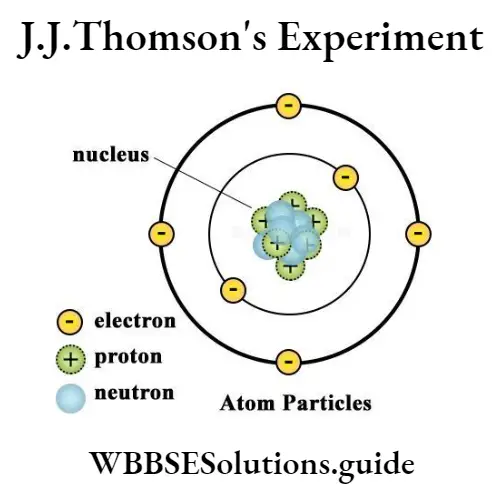
Wbbse Class 9 Physical Science

Question 44. Write about the dissolution of micromolecules and macromolecules in water.
Answer:

Dissolution of micromolecules and macromolecules in water: Macromolecules are so small that during dissolution they enter into the intermolecular space between the water molecule and get easily dissolved and form solution. But the micromolecules which are in very fine state are generally present in the form of colloid or suspension in the water.

In case of macromolecules, their size is so large that during dissolution they do not enter into the intermolecular space of water molecules, rather they displace many water molecules and go into that space and get dissolved in water. For example, bigger molecules like protein, DNA, starch, which are generally polymeric material, are always dissolved in this form.

Question 45. Write briefly various non-aqueous solvents with their uses.
Answer:

Non-aqueous solvents and their use :

Non-aqueous solvents Use of dissolve Use in our everyday life
1. Benzene, Toluene, Xylene chloroform Rubber, plastics, varnishes 1. Petrol, Kerosene, and ammonia are used in laundries for dry cleaning, for removing grease adhering on clothes.
2. Turpentine od, castor oil Paints, paraffin wax 2. Turpentine oil is used for removing paint stain.
3. Carbon disulphide Sulphur, Phosphorus 3. Borax solution for removing coffee and tea stain from clothes.
4. Petrol Grease, rubber, Chlorophyll 4. Iodine solution in alcohol is called a tincture of iodine used for dressing wounds.
5. Acetone Nail Polish (Cellulose acetate) 5. Manufacture of perfumes: Aroma substances are dissoved in alcohol.
6. Alcohol Iodine, naphthalene, chlorophyll Resin, chlorophyll. 6. Extraction Of ChlorophyifIt is extracted by plant materials. with alcohol, petrol, etc.


WBBSE Solutions for Class 9 Physical Science And Environment

WBBSE Solutions For Class 9 Physical Science And Environment Atomic Structure

Atomic Structure Very Short Answer Type Questions

Question 1. What is the term used to express the sum of the number of neutrons and protons present in an atom of an element?
Answer: As the nucleus is composed of protons and neutrons, they are collectively called nucleons.

Question 2. The number of which particle is different between 612C and 613C?
Answer: Neutron.

Question 3. State one difference between H and H+.
Answer: H is an unstable hydrogen atom carrying no net electric charge. H+ is a positive hydrogen ion carrying a unit positive charge.

Question 4. What are electron shells?
Answer: The electrons outside the nucleus of the atom rotate in definite numbers in certain specified circular paths around the nucleus. These concentric circular paths of the rotating electrons are called electron shells.

Read and Learn all WBBSE Solutions for Class 9 Physical Science And Environment

Wbbse Physical Science And Environment Class 9 Solutions

Question 5. What is an atom?
Answer: The smallest particle of an element which may not exist independently but contains all the properties of that element and takes part in chemical reactions, is called an atom.

Question 6. Which two particles of an atom are present in equal numbers?
Answer: The numbers of protons and electrons are equal in an atom.

Question 7. What are nucleons?
Answer: As the nucleus is composed of protons and neutrons, they are collectively called nucleons.

Question 8. Can the electrons stay inside the nucleus?
Answer: No, electrons can’t stay inside the nucleus.

Question 9. Name an atom that does not contain a neutron.
Ans: Neutron is absent in the nucleus of an ordinary hydrogen atom (11H).

Question 10. What is the force that holds together the nucleons in the nucleus of an atom?
Answer: Nuclear force firmly holds together the nucleons inside the nucleus.

Wbbse Physical Science And Environment Class 9 Solutions

Question 11. The atomic number of magnesium is 12; what is the number of electrons in the Mg2+ ion?
Answer: The number of electrons in the Mg2+ ion is 10.

Question 12. What is heavy water?
Answer: Heavy water is that kind of water where hydrogen has been substituted by deuterium. The formula of heavy water is D2O (molecular weight is 20).

Question 13. The atom of an element has 2 electrons in the K shell, 8 electrons in the L shell, and 7 electrons in the M shell. What is its atomic number?
Answer: The atomic number of the element is (2+8+7) = 17.

Question 14. What is the number of charged particles present in Clion? (Atomic number of Class 17)
Answer:
(1) Number of negatively charged particles (Electrons) = 18.
(2) Number of positively charged particles (Protons) = 17.

Question 15. Sodium (atomic number 11) forms Na‘ after losing 1 electron. From which of the orbits is K, L, or M of the sodium atom the electron is lost?
Answer: The electron is lost from the ‘M’ orbit of the sodium atom.

Question 16. The number of electrons and that neutrons in an atom are 6 and 8 respectively. What is the mass number of the atom?
Answer: Mass number = Number of protons (= number of electrons) + number of neutrons =
6+8= 14.

Wbbse Physical Science And Environment Class 9 Solutions

Question 17. Which one is neutral and which one is positively charged among electron, proton, and neutron?
Answer: Neutrons are neutral and protons are positively charged.

Question 18. Name the fundamental constituent particles of an atomic nucleus.
Answer: The main and fundamental constituent particles of an atom are electrons, protons, and neutrons.

Question 19. What are the numbers of protons and neutrons in the atom, 92 X235?
Answer: Protons = 92, Neutrons = 143.

Question 20. Name the Indian sage who propounded the idea of the atom ‘para Manu’.
Answer: Maharshi Kanad.

WBBSE Solutions For Class 9 Physical Science And Environment Atomic Structure

WBBSE Class 9 atomic structure solutions 

Question 21. What is the meaning of “atom”?
Answer: In Greek, ‘atom’ means indivisible.

Question 22. Who proposed the name atom?
Answer: The Greek philosopher Democritus.

Question 23. Who did for the first time propound the modern theory of the atom? Or, By whom was the concept of the atom developed?
Answer: John Dalton in 1808.

Question 24. Who was the discoverer of the electron?
Answer: William Crookes.

Question 25. Name the scientist who showed that the proton is one of the constituents of an atom.
Answer: Goldstein.

Wbbse Physical Science And Environment Class 9 Solutions

Question 26. Who was the discoverer of the neutron?
Answer: J. Chadwick (1932).

Question 27. Who gave the name Neutron?
Answer: Rutherford.

Question 28. What is the symbol of an electron?
Answer: The symbol of the electron is e or _1 0e

Question 29. What is the symbol of the proton?
Answer: The symbol of the proton: is 11P Or P+

Question 30. What is the symbol! of a neutron?
Answer: The symbol of neutron: n or 01n

Question 31. Name the lightest atom. 
Answer: The hydrogen atom is the lightest.

Question 32. What are protons?
Answer: Positively charged sub-atomic particles having unit mass and unit positive charge are called protons, i.e., a proton is a positively charged hydrogen ion (H1+).

WBBSE class 9 atomic structure question and answers

Question 33. Name the positively charged particle in the structure of an atom.
Answer: Proton present in the nucleus is positively charged.

Question 34. How is a proton formed?
Answer: A proton is formed by the removal of one electron from a hydrogen atom.

Question 35. State the relative mass and charge of a proton. 
Answer: The relative mass of a proton is 1 amu and its relative charge is +1 (plus one).

Question 36. State the absolute charge and mass of a proton.
Answer: The absolute charge of a proton is 1.6 x1027 coulomb of positive charge and its absolute mass is 1.6 x10_19  kg.

Atomic structure WBBSE Class 9 solutions with answers

Question 37. How many times is a proton heavier than an electron?
Answer: A proton is about 2000 times heavier than an electron.

Question 38. What is the mass of a neutron in a kilogram?
Answer: The mass of a neutron is 1.67 x 1027kg.

Question 39. What is the absolute charge of an electron?
Answer: The absolute charge of an electron is 1.6 x10¹⁹  coulomb.

Question 40. What is the mass of an electron?
Answer: The mass of an electron is 9.1 x 1031 kg.

WBBSE class 9 atomic structure question and answers

Question 41. Why are electrons called planetary electrons?
Answer: Electrons revolve around the nucleus in different orbits as the planets revolve around the sun in various orbits.

Question 42. Why is the nucleus of an atom positively charged?
Answer: Because the nucleus contains protons which are positively charged particles.

Question 43. Name the isotope of an atom whose nucleus consists of one proton only.
Answer: The atom of protium (ordinary hydrogen) has a nucleus consisting of one proton only.

Question 44. State the main differences between proton and neutron.
Answer: The proton is a positively charged fundamental particle while the neutron is an electrically neutral particle.

Question 45. Write the name of the neutral particle present in the structure of an atom.
Answer: Neutron.

wbbse class 9 physical science solutions

Question 46. The number of which sub-atomic particle is fixed in the nuclei of all the atoms of an element?
Answer: Protons.

Question 47. Write the name of the fundamental particle of an atom that is not present in the nucleus of an atom.
Answer: Electron.

Question 48. Name two radioactive elements.
Answer: Radium and Uranium are two radioactive elements.

WBBSE class 9 atomic structure question and answers

Question 49. What is the maximum number of electrons that may be present in the M-shell of an atom when it is the outermost shell?
Answer: Eight (8).

Question 50. An atom has a mass number of 23 and an atomic number of 11. What is the number of electrons in it?
Answer: The number of electrons in this atom of atomic number 11 is also 11.

Question 51. An atom of an element has 11 protons, 11 electrons, and 12 neutrons. What is the atomic mass of the atom?
Answer: The atomic mass of the atom will be (11 + 12) or 23.

Question 52. If an element ‘X’ has mass number 24 and atomic number 12, how many neutrons does its atom contain?
Answer: The number of neutrons in the atom will be (24 − 12) or 12.

Question 53. What can be known about the nucleus of the atom from the symbol,  11Na23?
Answer: The symbol,  11Na23 reveals that the nucleus of sodium atom is made. Up of 11 protons and (23 − 11) or 12 neutrons.

Question 54. Find out the number of neutrons in 17Cl35.
Answer: (35 – 17) or 18 neutrons are present in 17Cl35

wbbse class 9 physical science solutions

Question 55. Name the fundamental property used to identify an element.
Answer: Atomic Number (Z).

Question 56. Write down the relation between mass number and atomic number.
Answer: Mass number of an atom = atomic number + number of neutrons in the atom.

Question 57. The atomic number of sodium is 11. What do you mean by the statement?
Answer: The statement means that the nucleus of a sodium atom has eleven units of positive charge, i.e., eleven protons.

Question 58. Give the atomic number of the atom in which the M-shell contains 4 electrons.
Answer: 14 (2, 8, 4)

WBBSE class 9 atomic structure question and answers

Question 59. What is the maximum number of electrons the M-shell of the atom can accommodate?
Answer: 18 electrons.

Question 60. State the number of electrons in H+, H, and H
Answer: The number of electrons in H+, H, and H are zero, 1, and 2 respectively.

Question 61. Give an example of a nuclide that contains 2 neutrons.
Answer: Helium (24He ).

Question 62. Define the term isotope.
Answer: Isotopes are atoms of the same element having the same atomic number but different mass numbers.

wbbse class 9 physical science solutions

Question 63. How do isotopes of an element differ from one another?
Answer: The isotopes of an element differ in the number of neutrons in their nuclei.

Question 64. What is the reason for the different atomic masses of the isotopes of an element?
Answer: The isotopes of an element have different mass numbers because they contain different numbers of neutrons.

65. What is the reason for identical chemical properties of all the isotopes of an element?
Answer: All the isotopes of an element have identical atomic numbers.

Question 66. Give one similarity between them. A pair of isotopes.
Answer: A pair of isotopes have the same number of protons in their nuclei.

WBBSE Class 9 Physical Science atomic structure notes

67. Give one difference between a pair of isotopes.
Answer: A pair of isotopes differ in the number of neutrons in their nuclei.

68. Write down the names of the three isotopes of hydrogen
Answer: Protium (1H1), Deuterium (1H2), Tritium (1H3).

WBBSE class 9 atomic structure question and answers

wbbse class 9 physical science solutions

Question 69. Of which element protium is an isotope?
Answer: Protium (ordinary Hydrogen) is an isotope of hydrogen.

Question 70. What is called the total number of protons and neutrons present in an atom of an element?
Answer: Mass number.

Question 71. Are the atomic masses of the elements always whole numbers?
Answer: No, atomic masses of many elements are fractions and not whole numbers.

Question72. Give an example of an element having fractional atomic mass.
Answer: Chlorine has a fractional atomic mass of 35.5.

Question 73. What is the reason for fractional atomic masses of elements?
Answer: The fractional atomic masses of elements are due to the existence of their isotopes having different masses.

Question74. The same element may have different nuclides. What are they called?
Answer: Isotopes.

Question 76. If three neutrons less are taken away from 228U92then how would you write the nuclide?
Answer: The formula of the new nuclide is 225U92

Question 77. The same element may have different nuclides. What are they called?
Answer: isotopes.

Question 78. Name the lightest particle of an atom.
Answer: Electron.

Question 79. Which particle of an atom is negatively charged?
Answer: Electron.

Question 80. Which particle of an atom is positively charged?
Answer: Proton.

Question 81. Which particle of an atom is neutral?
Answer: Neutron.

Important questions on atomic structure WBBSE Class 9

Question 82. What is a valence shell?
Answer: The outermost shell of an atom is called the valence shell.

Question 83. What do you mean by valence electrons?
Answer: Electrons present in the valence shell are called valence electrons.

Question 84. What are the isotopes of Helium?
Answer: 2He4  And  2He3.

Question 85. What is the maximum number of electrons that may exist in an orbit?
Answer: 2n2

86. In how many orbits the electrons may be distributed?
Answer: In 7 orbits numbered 1, 2, 3, 4, 5, 6, 7 or designated as K, L, M, N, O, P, Q.

Question 87. What do you mean by the statement that “The mass of a Hydrogen atom is almost equal to the mass of a proton”?
Answer: A hydrogen atom has only one proton in its nucleus and one electron in the outermost shell. The mass of an electron is negligible compared to that of the proton. Hence, it may be said that the mass of a Hydrogen atom is almost equal to the mass of a proton.

Question 88. Can an element have more than one atomic weight?
Answer: No.

Question 89. Which fundamental particle is responsible for producing isotopes?
Answer: Neutrons.

Question 90. Name the heaviest isotope of hydrogen.
Answer: Tritium is the heaviest isotope of hydrogen.

Question 91. Between ion and atom, which one is more stable and why?
Answer: Generally ion is more stable than an atom. Lons have stable electronic configurations. So, ions are more stable than atoms.

Question 92. In which parts of an atom do electrons, protons, and neutrons exist?
Answer: Neutrons and protons exist in the nucleus and electrons are present in different orbits around the nucleus.

Question 93. Name the heaviest particle and the lightest particle in an atom.
Answer: A neutron is the heaviest particle and an electron is the lightest particle in. an atom.

Question 94. Name the positively charged particle and the neutral particle in the structure of an atom.
Answer: The Proton present in the nucleus is positively charged and the neutron is neutral.

Question 95. What is a valence electron?
Answer: The electrons in the outermost. The orbit of an atom, which participates in chemical bonding, is called valence electrons.

Atomic Structure 2 Marks Questions And Answers

Question 1. What are isobaric elements? Give examples.
Answer:

Isobaric elements

If atoms of different elements have the same mass number but different atomic numbers, then these elements are known as isobaric elements.

For example, 26Fe57 and 2 7Co57 have the same mass number but their atomic weights are 26 and 27 respectively. Calcium – 46 and Titanium – 46 have the symbols, 20Ca46 and  22Ti45
and are isobaric elements. In the isobaric elements, the mass numbers are the same, but the numbers of protons and neutrons are different.

Question 2. Define Atom.
Answer:

Atom – The smallest particle of an element which may or may not exist independently but contains all the properties of that element and takes part in chemical reactions is called an atom.

Question 3. Why are the physical properties of isotopes different?
Answer: The mass numbers of the isotopes of an element are different. Hence, they contain different numbers of neutrons in their atoms. Due to differences in the number of neutrons, their physical properties like mass, density, N.P., B.P., etc. are different.

Question 4. What is Nuclide? Give example.
Answer:

Nuclide

A nuclide is a more or less unstable specific type of atom of definite mass no. and atomic number that exists for a measurable time. Eg.− 92U235

WBBSE Class 9 solved exercises on atomic structure

Question 5. What are fundamental particles? Why are they called ‘fundamental’?
Answer:

Fundamental particles: The sub-atomic particles, electrons, protons, and neutrons are known as fundamental particles.

Reason: Experimentally it is found that these particles are the primary components of all atoms of all elements, except ordinary hydrogen, the nucleus of which does not contain neutrons. That is why, they are known as fundamental particles.

Question 6. State some other sub-atomic particles other than electrons, protons, and neutrons.
Answer:

Other sub-atomic particles are :

(1) Positron
(2) Antiproton
(3) Messon
(4) Neutrino
(5) Antineutrino
(6) V-particle
(7) Deuteron, etc.

Question 7. Distinguish between atomic number and mass number.
Answer:

Difference between atomic number and mass number :

Atomic Number Mass Number
(1)    It is equal to the number of protons present in the nucleus of an atom. (1)    It is equal to the sum of the number of protons and neutrons present in the nucleus of an atom.
(2)    From the atomic number, several valence electrons can be determined, which in turn, gives the idea about the ability of the chemical combination of the atoms. (2)    Mass number gives an idea about the atomic mass of the element concerned but it does not give any idea about the chemical activity of the element unless the number of protons or the no. of neutrons is indicated.


Question 8. Name the fundamental particles of an atom.
Answer:

An atom is mainly composed of three particles :

(1) Negatively charged particle: Electron
(2) Positively charged particle: Proton
(3) Electrically neutral particle: Neutron.

Question 9. Write the similarities and dissimilarities between,92U235  and 92U238 atoms.
Answer:

Similarities: Both of them contain the same number of protons and electrons (92).

Dissimilarities :
Number of neutrons in  92U235  = 235 – 92 = 143
Number of neutrons in  92U238 = 238 – 92 = 146

Question 10. Write the uses of isotopes.
Answer:

Uses of isotopes

(1) Radioactive isotopes are widely used for diagnostic purposes in medicine. Cobalt-60 is used in the treatment of cancer.

(2) The age of minerals, rocks, and earth can be determined with the help of a radioactive carbon-14 isotope.

Question 11. Define the atomic weight of any element in oxygen (O = 16) and carbon (C = 12) scales.
Answer:

(1) In oxygen (O = 16) scale: Atomic weight (relative atomic mass) of an element

From a specified source is the ratio of the average mass per atom of the element \(\frac{1}{16}\)to that of an oxygen atom.

∴ \(\text { Relative atomic mass of an element }\)=\(\frac{\text { average mass of an atom of the element }}{\frac{1}{16} \text { th jart of the mass of an oxygen atom }}\)

\(=\frac{\text { mass of an atom of the element }}{\text { mass of an oxygenatom }} \times 16\)


(2) In carbon (C =12) scale:
An atomic weight or relative atomic mass of an element

From a given source is the ratio of the average mass per atom of the element to \(\frac{1}{12}\) the mass of an atom of 6C12.

∴ \(\text { Relative atomic mass of an element }\)=\(\frac{\text { average mass of an atom of the element }}{\frac{1}{12} \text { th jart of the mass of an carbon atom }}\)

\(=\frac{\text { averagemass of an atom of the element }}{\text { mass of a carbon atom }} \times 12\)

WBBSE Class 9 Physical Science atomic models solutions

Question 12. Is there any difference between atomic weight and mass number? Explain with a suitable example. In most cases which is greater and why?
Answer:

Difference between atomic weight and mass number

Atomic Weight Mass Number
1.    Atomic weight represents the ratio of the average mass per atom of the element to 1/12th of an atom of 6c12 1. The mass number of an atom is the total number of protons and neutrons present in the nucleus.
 2.    Atomic weight may be a fraction. 2. A mass number is always a whole number and can’t be a fraction.


In most of the cases mass number is greater than the atomic weight. Most of the elements have more than two isotopes. So, the mass number is greater than the atomic weight.

Example: Oxygen has three isotopes 8O16, 8O17, and 8O18. The atomic weight of oxygen is 16.
Mass numbers of 8O17 and 8O18atoms are greater than the atomic weight of the oxygen atom.

Question 13. Why is an atom electrically neutral?
Answer:

The number of protons in the nucleus and the total number of orbits of the atom are always equal. Again, the amount of positive charge is equal to the amount of negative charge of an electron. So the total negative charge is equal to the total positive charge and hence an atom is electrically neutral.

Question 14. Why do the electrons revolve around the nucleus?
Answer:

Electrons are revolving around the nucleus in different concentric circular paths or elliptical paths. There exists a strong electrostatic force of attraction between the positively charged nucleus and the negatively charged electrons. This force of attraction supplies the necessary centripetal force to the electrons to revolve around the nucleus.

Question 15. Why are the isotopes of an element placed at the same position in the periodic table? Or, Why are the chemical properties of the isotopes the same?
Answer:

Isotopes of an element with the same atomic number have the same number of electrons in their outermost shell Chemical property depends on the atomic number, i.e., the number of protons or, electronic configuration. As the electronic configuration of isotopes is identical, chemical properties are also identical. So, the isotopes are placed in the same position in the periodic table.

Question 16. What is the relation between 17A35 and 17A37 Are the chemical properties of these two above elements completely different or more or less the same? Justify with reasons.
Answer:

The atomic mass of 17A35= 35; the number of protons = 17. The atomic mass of 17A37= 37; the number of protons = 17; “both atoms contain 17 protons, but the number of neutrons is different. So, they are isotopes of each other. The chemical property of the element depends only upon the number of protons present in the nucleus of the constituent atom. In this case, as the number of protons is the same, so they have the same chemical properties.

Question 17. The atomic number is the fundamental property of an element but not atomic weight.
Answer:

The atomic number is the fundamental property of an element but not the atomic weight.

The atomic weight of an element may differ due to the presence of isotopes. However, the atomic number cannot be the same for two elements. Chemical properties change with a change in the atomic number. That is why, atomic number is considered as the fundamental property of an element rather than its atomic weight.

Question 18. The formula of an atom of an element is 92U238. Write the number of protons, and electrons.Neutronss are present in the atom.
Answer:

Given

The formula of an atom of an element is 92U238.

From 92U238 we know that atomic number = 92 and mass number = 238.

∴ The nucleus of 92U238nuclide contains 92 protons and (238-92) or 146 neutrons. Number of electrons = 92.

Subatomic particles Class 9 WBBSE notes

Question 19. What is the atomic mass unit? 1 amu = how many grams?
Answer:

Atomic mass unit

An atomic mass unit (amu) is a unit that is used to express the atomic or molecular masses. One atomic mass unit = 1/12 the part of the mass of one carbon atom (C-12) at rest and in its ground state.

1 amu or 1 u = 1°6603 X 10-24 g.

Question 20. Compare Proton and Neutron.
Answer:

Similarities :

(1) Both are heavier than electrons.
(2) Both exist in the nucleus.

Dissimilarities :

(1) Proton is positively charged. Neutron is neutral.

Question 21. Write the number of electrons in 40 K 19. Write the electronic arrangement of the atom having this number of electrons.
Answer:

Number of electrons – 19

Electronic configuration − K shell – 2, L shell – 8, M shell – 8, N shell – 1

Question 22. What is an ion? Between an atom and an ion of an element, which particle present in them differs in number?
Answer:

Ion

Lons are electrically charged atoms or groups of atoms. Lons are produced when an atom either gives up electron(s) or accepts electrons or a salt undergoes ionization by the effect of solvent or heat.

Anions are the acidic part of salts. As,  Cl, SO2-4, NO3, and OH are anions.

Electronic configuration ofMg+2= K shell = 2, L shell = 8.

Question 23. The atom of an element contains 2 electrons in the K shell, 8 electrons in the L shell, 8lectrons in the M shell, and 2 electrons in the N shell. What is the atomic number and valency of the element?
Answer:

Given

The atom of an element contains 2 electrons in the K shell, 8 electrons in the L shell, 8lectrons in the M shell, and 2 electrons in the N shell.

The atomic no. of the element = (2 + 8 + 8 + 2) = 20.

∴ Valency of the element = 2.

Question 24. There are 2 electrons in the K shell, 8 electrons in the L shell, and 6 electrons in the M shell in the atom of an element. What is the atomic number of the element? What is the maximum valency of the element? What is the number of neutrons in the atom of the element if the mass number of the element is 32?
Answer:

Given

There are 2 electrons in the K shell, 8 electrons in the L shell, and 6 electrons in the M shell in the atom of an element.

The atomic no. of the element = no. of protons

= total no. of electrons in K, L, and M shells.

=2+8+6=16.

Maximum valency of the element = 18 − 16 = 2.

No. of neutrons = Mass no − Atomic no.

= 32-16 = 16.

Question 25. What is meant by,8O16? Show its electronic configuration.
Answer:

8O16

(1) It is an isotope of oxygen.
(2) The symbol of the element is “O”.
(3) The atomic no. of the element is 8 and its mass no. is 16.

Electronic configuration of,8O16 is 2, 8, 6.

Question 26. How many protons and neutrons are there in the atom
143 57X
Answer: 143 57 X
Protons = 57
Neutrons = 143 − 57 = 86

Question 27. There are 2, 8, and 7 electrons in the K, L, and M shells respectively of an atom of an element. What is the atomic number of the element? What is its valency? What is the number of neutrons if the mass number of the element is 37? To which group of the periodic table does the element belong?
Answer:

Given

There are 2, 8, and 7 electrons in the K, L, and M shells respectively of an atom of an element.

The atomic no. of the element =2+8+7.

Valency of the element =18-17 =1

No. of neutrons = Mass no− Atomic no.

= 37-17 =20

It belongs to group VII.

Question 28. The atomic weight of chlorine is 35.46 concerning the atom “O”. What does it mean?
Answer:

One atom of chlorine is 35.46 times heavier than \(\frac{1}{16}\) th part.of an oxygen atom.

Question 29. What do you mean by nuclear force?
Answer:

Nuclear force

The protons and neutrons (nucleus) are bonded inside the nucleus by a strong attractive force which is called the nuclear force. The force exists between proton-proton, proton-neutron, and neutron-neutron. If, in a nucleus, the number of protons is much more than the number of neutrons or the number of neutrons is much more than the number of protons, the nuclear force becomes weak. The nuclei of such elements become unstable and tend to disintegrate.

Question 30. Find the relation between mass number and atomic number.
Answer:

Relation between mass number and atomic number

The mass number of an atom = several protons + several neutrons.

Let the number of protons = atomic number = Z

number of neutrons = N

and mass number of an atom = A

Then, A=Z+N.or Z=A-N

Atomic number = mass number – number of neutrons.

Question 31. Give the maximum number of electrons in the first four orbits.
Answer:

ORBIT Orbit Number (n) Maximum number of electrons in the orbit
First orbit or K-Shell 1 2 x 12= 2
Second orbit or L-Shell 2 2 x 22 = 8
Third orbit or M-Shell 3 2×32= 18
Fourth orbit or N-Shell 4 2 x 42= 32


Question 32. Explain how the mass number and atomic number of chlorine are represented symbolically.

Answer:

The symbol of Chlorine can be written as
17 Cl 35or 17 Cl 37

Here, A= 35, Z=17

N= A – Z

∴ N= 35 -17 =18

Question 33. Define isotopes. Give examples.
Answer:

Isotopes: The atoms of the same element having the same atomic number but different mass numbers are called isotopes.

For example, hydrogen has three isotopes: 1H1,1H2, and 1H3

Oxygen has three isotopes: 8 O16, 8 O17 and 8O18

Chlorine has two isotopes: 17 Cl 35 and  17 Cl 37

Question 34. State the properties of Isotopes.
Answer:

The main properties of isotopes are :

(1) The number of protons (atomic number) in all the isotopes of an element is the same.

(2) The electronic configurations of all the isotopes of the same element are similar.

(3) They have same number of valence electrons.

(4) The physical properties such as mass, density, melting points, boiling points, etc. of the isotopes of the same element are different.

Question 35. Why is the average atomic weight of chlorine fractional? Give a reason. 
Answer:

The average atomic weight of chlorine is taken as 35.5. The fractional atomic weight of chlorine is because natural chlorine has three parts of 17 Cl 35 and one part of 7 Cl 37
The atomic mass of 3 atoms of17 Cl 35=3 x 35 = 105 a.m.u.
The atomic mass of 1 atom of 17 Cl 37 = 1 x 37 = 37 a.m.u.
Atomic mass of 4 atoms of natural chlorine = 105 + 37 = 142 a.m.u.

Average atomic mass of chlorine = 142 ÷  4 = 35.5 am. u.

Hence, the average atomic weight is fractional.

Question 36. Define isobars. Give examples.
Answer:

Isobars:  Isobars are the atoms of different elements having different atomic numbers but the same mass number. Isobars have different numbers of protons, electrons as well as neutrons. So they have different physical as well as chemical properties.

Example: 18Ar40, 19K40, 20Ca40 – each has the same mass number but different atomic numbers. That is why, they are known as isobars of each other.

Question 37. What are the differences between isotopes and isobars? Explain with suitable examples.
Answer:

The differences between isotopes and isobars

Isotopes Isobars
(1)    Isotopes are the atoms of the element having the same atomic number but different mass numbers. (1)    Isobars are the atoms of different elements having different atomic numbers but the same mass number.
(2)    Isotopes have identical chemical properties (2)    Isobars have different chemical properties.
Example:  8 O16 and 8 O17 are isotopes of each other as they have the same atomic number but different mass numbers. Example: 18Ar40 and 19K40 are isobars of each other as they havethea same mass number but different atomic numbers.


Question 38. Write the number of protons and neutrons present in the nuclide,6 A13. Write the electronic configuration of an atom of the above element. Write the difference between the structures of the nuclides 6A13 and,6 A12. Why are the chemical properties of these two nuclides the same? (A = symbol of an element).
Answer:

In, 6 A13 nuclide, the number of protons = 6 and the number of neutrons = (13 – 6) or 7.

(1) See of electrons = 6. Among these 6 electrons, 2 electrons are in K orbit and 4 electrons are in L orbit.

(2) The nucleus of 6 A13 nuclides contains 6 protons and 7 neutrons. On the other hand, the nucleus of 6 A12 contains 6 protons and 6 neutrons.

6 A13 contains one more neutron than, 6 A13.

(3) Due to the presence of the same number of protons, i.e., the same atomic number, the chemical properties of both are the same.

Question 39. Write the mass number and atomic number of the atom 92X235. If there is one more neutron, how will the element be expressed?
Answer:

(1)Mass number of 92X235, A = 235 and atomic number, Z = 92.

…Number of neutrons present, N = A – Z + 235 – 92 =143.

(2) If one more neutron is present in that atom, the mass number will also be increased by one unit.

In that case, the new element will be expressed as 92X235+1= 92X235.

Atomic Structure  3 Marks Questions And Answers:

Question 1. Describe J.J. Thomson’s atomic theory
Answer:

J.J. Thomson’s atomic theory

Thomson discovered the electron in the year 1897. His work put forward a new theory that the atom was made up of small particles. Thus, he discovered the electrons. He proved his theory using the cathode ray tube. J. Thomas used a highly evacuated discharge tube. He placed two anodes inside the tube.

He fixed two plates parallel to each other inside the tube. He passed a thin cathode ray through the pinhole of the tube. He could see the sides of the tube glowing in green color. The glow traveled in a straight line. The green glow was caused by the cathode rays. Now, Thomson applied an electric field. The ray deflected to the positively charged plate. Thus, Thomson discovered the electrons.WBBSE Solutions For Class 9 Physical Science And Environment Structure Of Atom Electron discovered by J.J .Thomson

Question 2. State the importance of J.J. Thomas’s experiment.
Answer:

Importance of J.J. Thomas’s experiment

Thomson discovered the electrons and it was q proved that atoms were made up of protons, electrons, and neutrons. Thus, Thomson proved that the atom was divisible. Since the atom was neutral, Thomson ‘suggested that the negatively charged electron equaled the positively charged proton and neutrons had no charges.

Thomson suggested to consider the atom as a sphere. It has positively charged particles. The positively charged particles were surrounded by the negatively charged electrons. The electrons were placed there atom Particles due to electrostatic forces.

WBBSE Solutions For Class 9 Physical Science And Environment Structure Of Atom J.J.Thomson's Experiment Of Atom Particle

Question 3. Describe Rutherford’s alpha particle experiment.
Answer:

Rutherford’s alpha particle experiment

In 1910, a physicist from New Zealand, Ernest Rutherford performed an experiment known as Rutherford’s gold foil experiment. This experiment determined to find out the structure of an atom.

The alpha particles were confined to a narrow beam by passing them through a lead sheet through a slit. An extremely thin gold foil was bombarded with a narrow beam of fast-moving alpha particles.

On bombarding, the alpha particles were scattered in different directions with different angles and were detected by the fluorescent rotatable detector, which has a microscope and a screen coated with zinc sulfide. The whole experimental setup was placed in an evacuation.

WBBSE Solutions For Class 9 Physical Science And Environment Structure Of Atom Alpha Particle

Chamber to prevent scattering by the air molecules. These particles after striking the screen caused scintillations. Before performing this experiment it was assumed by Rutherford that most of the alpha particles would pass through the gold foil with less deflection.

He assumed this based on the theory proposed by J.J. Thomson. This was assumed because the alpha particles are heavy and the negative charge in the “plum pudding model” is widely spread.

Question 4. Describe Rutherford’s Atomic Model.
Answer:

Rutherford’s Atomic Model

Rutherford’s atomic model, also known as the planetary model is a model of the atom proposed by the physicist Ernest Rutherford.

The following are the main points of Rutherford’s theory :

(1) Most of the part of an atom is empty.

(2) Approximately all the mass of the atom is concentrated at the center of the atom which is now called the nucleus.

(3) In the central region of the atom the positively charged particles are present.

(4) The charge on the nucleus of an atom is positive and is equal to Z.e where Zis charge number, e is the charge of a proton.

(5) The negatively charged particles, i.e., electrons revolve around the central positive portion in different circular orbits.

(6) The central region (nucleus) is very small in size compared to the size of an atom.

Bohr Model Of Atom Class 9

Question 5. State the limitations of Rutherford’s model.
Answer:

Limitations of Rutherford’s model

Rutherford’s model did not make any new headway in explaining the electronic structure of the atom. Rutherford’s concentration of most of the atom’s mass into a very small core made some type of planetary model, as such a core would contain most of the atom’s mass, similar to the sun containing most of the solar system’s mass. Rutherford’s model was later improved and quantified by one of his students, Niels Bohr, with the known Bohr’s model of the atom.

There were mainly two defects in Rutherford’s atomic theory which are shown as follows:

1. Being a charged particle, the electron must emit energy when it is accelerated, according to classical electromagnetic theory. We know that around the nucleus the motion of electrons is accelerated, hence it must radiate energy. But this does not happen in actual practice.

Assume that if it occurs then due to continuous loss of energy orbits of electrons must decrease continuously. As a_ result electrons will fall into the nucleus eventually after some time. But this is against the practical situation and hence this shows that the atom is unstable.

2. If the electrons emit energy continuously, a continuous spectrum should be formed. But practically, line spectrum is observed.

Bohr Model Of Atom  Question 6. Describe Bohr’s model of the atom.
Answer:

According to Bohr’s theory :

(1) The atom consists of a small positively charged nucleus at its center.

(2) The whole mass of the atom is concentrated at the nucleus and the volume of the nucleus is smaller than the volume of the atom by a ratio of about 1:10°.

(3) The nucleus contains all the protons and neutrons of the atom.

(4) The electrons of the atom revolve around the nucleus in definite circular paths known as orbits which are designated as K, L, M, N or numbered as n=1, 2, 3, 4 outward from the nucleus.

(5) Each orbit is associated with a fixed amount of energy. Therefore, these orbits are also known as energy levels or energy shells.
WBBSE Solutions For Class 9 Physical Science And Environment Structure Atom Of Bohr's Model Of Atom


Bohr Model Of Atom Class 9 WBBSE

Question 7. Compare all the proposed models of an atom by J. J. Thomson, Rutherford, and Neils Bohr.
Answer:

J. J. Thomson: Since discharge tube experiments suggested the presence of negatively charged particles in a neutral atom, J. J. Thomson suggested that electrons are embedded in a sphere of positive charge.

E. Rutherford: The good foil experiment of Rutherford suggested that all the positive charge is located in a very small space which is 10° times the radius of an atom. Therefore, Rutherford gave a model in which electrons are revolving around the nucleus.

Neils Bohr: To explain the stability of an atom and atomic spectra, Bohr suggested that electrons move around the nucleus in orbits that have fixed energy shells. There is a loss or gain in energy of an electron when it moves from one orbit to the other.

Question 8. How did Neils Bohr modify Rutherford’s model?
Answer:

Rutherford’s model failed to explain the electromagnetic principles, stability of an atom, line spectra of an atom, etc. In 1913 Neils Bohr modified Rutherford’s model by taking the help of quantum theory.
WBBSE Solutions For Class 9 Physical Science And Environment Structure Of Atom Rutherford Failed Experiment

Structure Of Atom

Question 9. Describe the structure of the atom based on modern theory.
Answer:

Structure of the atom based on modern theory

Based on a modern concept, the atom is built up of tiny particles called sub-atomic particles—proton, and neutron. Atoms can be divided into two parts — the nucleus and the extranuclear part.

Bohr Model Of Atom Class 9 WBBSE

Nucleus: Protons and neutrons of an atom are packed in extremely small volumes of the Electron nucleus at the center of the atom. Shells All the protons are positively charged and hence nucleus has a positive charge. The proton and neutrons present in the nucleus together are called nuclei.

WBBSE Solutions For Class 9 Physical Science And Environment Structure Of Atom Structure Of Atom Modern Theory

The whole of the mass of an atom is due to the nucleus Electron (e7) containing proton and neutron. Electrons revolving outside are of negligible mass. Hence, the sum of neutrons and protons in the nucleus is known as the mass number.

The nucleus is the central part of the atom which contains protons and neutrons. Protons are positively charged particles while neutrons have no charge. Electrons revolve around the nucleus in different orbits having negligible mass. Electrons are negatively charged particles. The number of electrons is equal to the number of protons in an atom. The number of neutrons may or may not be equal to that of a proton.

Structure Of Atom

Question 10. Describe the fundamental particles of an atom.
Answer:

Fundamental particles of an atom

The main and fundamental particles of an atom are electrons, protons, and neutrons.

Electron: Electrons are negatively charged particles revolving around the nucleus in the extranuclear part of the atom, in the definite orbit (marked C in the given figure). The number of electrons is the same as the number of protons in an atom.

The charge on an electron is 4.8033 x10⁻¹⁰ e.s.u and in S.l. unit is 1.6022 x 10⁻¹⁹

Coulomb. The mass of electron in C.G.S unit = 9.0196 x10-38 gm and in a.m.u. = 0.00054859.

WBBSE Solutions For Class 9 Physical Science And Environment Structure Of Atom Fundamental Particles Of Atom

That electrons are negatively charged particles, is verified by the cathode rays tube.

Protons: Proton, the lightest positive charged particle, resides in the nucleus (marked A in the given figure). Its mass is about 1837 times the mass of an electron. The number of protons and electrons is equal in an atom.

The charge of a proton is 4.8033 x 10⁻¹⁰ e.s.u. and S.1. unit is 1.6022 x 10⁻¹⁹coulomb.

The mass of a proton is 1.6726 x 10⁻²⁴ gm and in a.m.u. is 1.007277.

Neutron: Neutrons exist in the nucleus and contain no charge (marked. as B i). The number of neutrons is independent of the number of protons. Ordinary hydrogen contains no neutrons.

The mass of neutrons in grams is 1.6749 x10⁻²⁴ and in amu, the unit is 1.008665.

Thus, the mass of one neutron is approximately equal to the mass of one proton.

Best study material for atomic structure WBBSE Class 9

Question 11. Define an atomic number of an element. State its main characteristics.
Answer:

Atomic number: The number of protons in the nucleus of an atom of an element is called its atomic number. Since an atom is electrically neutral, the number of protons is equal to the number of electrons in an atom.

The characteristics of atomic number are the following :

(1) The atomic number, of an element Represents its fundamental property. No two elements can have the same atomic number.
(2) An element is identified by its atomic number.
(3) The atomic number of an element is stable. It does not change during a chemical reaction.
(4) Atomic number of an element is usually denoted by the letter Z.

Question 12. What are the main points of similarities between the solar system and atomic structure?
Answer :

The similarities existing between the solar system and atomic structure are the following given below :

Solar System Atomic Structure
1.    In the solar system, planets revolve around the central sun in different fixed orbits. 1.    In atomic structure, the electrons revolve around the nucleus in different orbits.
2. Most of the space between the sun and the planets is empty. 2.    Most of the space between the nucleus and electrons is empty.
3.    The mass of the sun is several times greater than that of any other planet. 3.    The mass of the nucleus is many times greater than the revolving electrons.
4.    The path of rotation of planets around the sun is not circular but slightly elliptical. 4.    The rotational paths of electrons are circular and elliptical.
5.    There exists a gravitational force between the sun and rotating planets, necessary for the rotation of planets. 5.    There exists an electrostatic attractive force between the positively charged nucleus and negatively charged extra nuclear electrons, necessary for the rotation of electrons.
6. The planets rotate about their axis while revolving around the sun. 6.    Electrons rotate about their axis while revolving around the nucleus.


Question 13. Explain the electronic configuration of an atom in its extranuclear part. Circular and elliptical both.
Answer:

Electrons revolve around the nucleus part of the atom in definite orbits. These orbits are known as energy levels quantum numbers or shells. These orbits are known as first shell or K-orbit, second shell or L-orbit, third shell or M-orbit, etc. These orbits are K, L, M, N, O, P, and Q orbits.

The Bohr-Bury. scheme presented by Bohr and Bury in 1921 regarding filling the orbits of atoms with electrons is given as :

(1) An orbit can have a maximum number of2n2 electrons, where n represents the number of the orbit.
(2) The outermost orbit can not have more than 8 electrons and the inner orbit can not have more than 18 electrons.
(3) Before the completion of an orbit the next orbit starts filling, as soon as the outermost orbit gets 8 electrons, the next orbit starts filling.
(4)An atom becomes stable when it has 8 electrons in its outermost orbit.
WBBSE Solutions For Class 9 Physical Science And Environment Structure Of Atom Structure Of Atom Nuclear Part

Question 14. Mention the dissimilarities between the solar system and the structure of atoms.
Answer :

Following are the main points of dissimilarities between the solar system and the structure of atoms.

Solar System Atomic Structure
1.    In the solar system, there is one planet in one orbit. 1.    In atomic structure, the number of electrons in an orbit may be one or more than one.
2.    The force acting between the sun and the planets is gravitational. 2.    The force acting between the nucleus and electrons is electrostatic.
3.    The planets experience gravitational attraction between them. 3.    The force acting between electrons is repulsive.
4.    In the solar system the planets are of different masses and different volumes. 4.    In atomic structure all the electrons are of the same mass and volume.
5.    The planetary orbitals lie nearly in the same plane. 5.    In atomic structure, the electrons’ orbitals lie in different planes.
6.    The sun and planets are not electrically charged. 6.    The nucleus is charged positively and electrons are charged negatively.
7.    Some of the planets in the solar system have satellites as Earth has a moon. 7.    Electrons in an atom do not have satellite electrons.
8.    The planets do not escape from the solar system. 8.    Electrons can leave an atom or more electrons can be gained by an atom.


Question 15. Define the mass number of an element. State its main characteristics.
Answer:

Mass number: The total number of protons and neutrons in one atom of an element is called its mass number.

The characteristics of mass number are the following :

(1) Mass number = number of protons + number of neutrons.
(2) It is usually denoted by the letter A.
(3) A mass number is always a whole number. Since the number of protons and the number of neutrons are in whole numbers, hencé mass number cannot be in fractions.

Question 16. How are the mass number and atomic number of an element represented symbolically? Give the example of oxygen.
Answer:

Generally mass number of an element is represented on the upper left or right side of the symbol and the atomic number in subscripts is on the lower left side of the symbol of the element.

For example, the symbol of oxygen can be written as 6O16 or 8O16
where, mass number = 16, atomic number = 8.
The number of neutrons = A- Z=16-8=8.

Question 17. Explain the electronic configurations of some elements from hydrogen to calcium element.
Answer:

The electronic configurations of some elements are given in the following table :

Element Symbol Atomic number Electronic arrangement In different orbit
K L M N 0 P
Hydrogen H 1 1
Helium He 2 2
Lithium U 3 2 1
Berylium Be 4 2 2
Boron B 5 2 3
Carbon. C 6 2 4
Nitrogen N 7 2 5
Oxygen O 8 2 6
Fluorine F 9 2 7
Neon Ne 10 2 8
Sodium Na 11 2 8 1
Magnesium Mg 12 2 8 2
Aluminium Al 13 2 8 3
Silicon Si 14 2 8 4
Phosphorus P 15 2 8 5
Sulfur s 16 2 8 6
Chlorine s 16 2 8 7
Argon Ar 18 2 8 8
Potassium K 19 2 8 8 1
Calcium Ca 20 2 8 8 2


Question 18. What is orbital? What are the differences between orbit and orbital?
Answer:

Orbital: An orbital may be defined as a region in the space around the nucleus where the probability of finding the electron is maximum.

The main differences between orbits and orbitals are :

(1) Orbit is a well-defined circular path around the nucleus in| which electrons revolve. Orbital represents the region in space around the nucleus in which the probability of finding the electrons is maximum.
(2) Orbit represents the planar motion of an electron. Orbital represents the three-dimensional motion of an electron around the nucleus.
(3) All orbits are circular. Orbitals have different shapes. The orbitals are s, p, d, f, …, etc. The s – s-orbital is spherical, the p-orbital is dumbbell-shaped, etc.
(4) Orbits have a definite path of an electron, while orbitals do not specify any definite path.

Question 19. Describe the different isotopes of hydrogen gas.
Answer :

Hydrogen gas has three isotopes :

(1) Ordinary hydrogen (Protium)
(2) Deuterium, and

(3) Tritium. Ordinary hydrogen (Protium) is represented by 1H1

Mass number = 1
Number of protons (Atomic number) = 1
Number of electrons = 1.
Number of neutrons = 0

Deuterium is represented by 1H2

Mass number = 2
Number of protons (Atomic number) = 1
Number of electrons = 1
Number of neutrons = 1

Tritium is represented by 1H3

Mass number = 3
Number of protons (Atomic number) = 1
Number of electrons = 1
Number of neutrons = 2

Diagrammatically they are expressed as below :

WBBSE Solutions For Class 9 Physical Science And Environment Structure Of Atom Different Types Of Isotopes

Question 20. What are the differences between atomic weight and the weight of an atom?
Answer:

The differences between atomic weight and the weight of an auto

Atomic Weight Weight of an atom
1.    Atomic weight does not represent the actual weight of an atom. 1. The weight of an atom represents its actual weight.
2.    Atomic weight represents the ratio of the average mass per atom of the element to 1/12th of an atom of 6c12 2. The weight of an atom represents the summation of masses of all constituent particles present in that atom.
3.    Since atomic weight is a ratio of two weights, it is a dimensionless physical quantity. 3. The weight of an atom has a definite unit
Example: The atomic weight of hydrogen is 1.0078, which is a pure number.  Example: The actual weight of a hydrogen atom is 1.6725 x 10⁻²⁴g).


WBBSE class 9 atomic structure question and answers

Question 21. Define an ion. State its different types.
Answer:

Ion

When an atom loses one or more electrons from an outermost orbit or gains one or more electrons in that orbit, then the resultant electronically Onaged particle is called an Ions are of two types: cations and anions.

(1) Cation: Cation is a positively charged atom or radical. When an atom loses one or more electrons from its outermost orbit, it becomes. A cation (positively charged particle).
For example :   Na-e→   Na+
(2,8,1)      (2,8)

(2) Anion: Anion is a negatively charged atom or radical. When an atom of an element accepts one or more electrons in its outermost orbit, the atom becomes an anion (negatively charged).
Cl +e→   Na+
(2,8,7)         (2,8,8) 

Question 22. Is there any difference between atomic weight and mass number? Explain with a suitable example. In most cases which is greater and why?
Answer:

Atomic Weight Mass Number
1.    Atomic weight represents the ratio of the average mass per atom of the element to 1/12th of an atom of 6c12. 1. The mass number of an atom is the total number of protons and neutrons present in the nucleus.
 2.    Atomic weight may be a fraction. 2. A mass number is always a whole number and can’t be a fraction.


In most of the cases mass number is greater than the atomic weight. Most of the elements have more than two isotopes. So mass number is greater than the atomic weight.

Example: Oxygen has three isotopes 8 O16, 8 O17, and  8 O18. The atomic weight of oxygen is 16. Mass numbers of  8 O17 and 8 O18 atoms are greater than the atomic weight of an oxygen atom.

Question 23. Why are atomic weight and mass number of all elements not the same? For which element are these same?
Answer:

Atomic weight and mass number have different values due to the presence of different numbers of isotopes of a particular element. This is because the atomic weight of those elements is the average of the mass numbers of isotopes present in different ratios.

(1)Example: isotopes of chlorine having mass numbers 35 and 37 are present in the chlorine gas in 75.4 % and 24.6 % respectively, so

atomic weight of chlorine\(=\frac{35 \times 75.4+37 \times 24.6}{100}\)\(=35.46 \approx 35.5\)

∴  The atomic weight and mass number of chlorine are different.

(2)Elements that have no isotopes have identical atomic weights and mass numbers.

(3)Example: Sodium has no isotope. The atomic weight and mass number of sodium are the same (23).

Question 24. Write the importance of Dalton’s atomic theory.
Answer:

Importance of Dalton’s atomic theory

(1) Dalton’s atomic theory for the first time stated that the atom is the smallest particle of an element which is a revolutionary idea in science.
(2) Atomic theory can explain how atoms of different elements combine to form compounds.
(3) Atomic theory can explain the law of conservation of mass and other laws of chemical combination (except Gay Lussac’s law).
(4) Avogadro’s hypothesis. The concept of molecules was derived from Dalton’s atomic theory.

WBBSE class 9 atomic structure question and answers

Question 25. Compare electron and proton.
Answer:

Similarities :

(1) Both are present in all atoms of all elements.
(2) Both are electrically charged particles.

Dissimilarities :

(1) The electron is negatively charged. The proton is positively charged.
(2) A proton is 1836 times heavier than an electron.
(3) Proton exists in the nucleus. Electrons rotate around the nucleus in definite orbits.

Question 26. State the difference between atoms and ions.
Answer:

Difference between atoms and ions

Atoms Ions
1.    An atom is electrically neutral. The number of protons in the nucleus is the same as the number of electrons in its shells. 1.    An ion is an electrically charged particle formed either by accepting an electron or donating an electron by an atom of an element.
2. The electronic configuration of atoms in their outermost shell ranges from 1 to 7 electrons (except noble gases). 2.    All ions have an electronic configuration of either 2 or 8 in their outermost shells.
3.    An atom may or may not be able to exist independently. 3.    An ion cannot exist independently.
4. The properties of an atom are independent of the properties of its ions. 4. The properties of ions are different from that of atoms.


WBBSE Class 9 Bohr’s and Rutherford’s model solutions

Question 27. How is the nucleus stable though it contains positively charged protons?
Answer:

In the nucleus, there should be repulsion between positively charged particles and protons and the nucleus should be unstable, but this is not happening. This contradiction was solved by Yukawa. According to him, protons emit π+ meson which is absorbed by neutron.

p −π+ → n

n+ π+ → p

Thus, the conversion of proton into neutron and neutron into proton is responsible for the origin of nuclear force between them which binds the nucleons. Thus, the nucleus becomes stable.

Question 28. Compare an electron, a proton, and a neutron concerning their masses, charges, and positions in the atom.
Answer:

Name of the particle and symbol Mass (g) Amount and nature of charge Position In atom
Electron (e or  1e0) 9.11×10⁻²⁸ 4.8x 10⁻¹⁰esu ofcharge or 1.6×10⁻¹⁹  coulomb, negatively charged In different orbits outside the nucleus of an atom
Proton (P or 1H1) 1.6725×10⁻²⁴ 4.8x 10⁻¹⁰ esu o charge or 1.6×10⁻¹⁹   coulomb, positively charged Inside the nucleus of an atom
Neutron(n or 0n1) 1.675×10⁻²⁴ 0, neutral Inside the nucleus of an atom


Question 29. An ion is more stable than an atom. Explain.
Answer:

An ion is more stable than an atom.

An ion attains stability when its parent atom gains or loses electrons, as the case may be. The stability of the ion is total if its parent atom gains or loses electrons to its full capacity and the stability is partial if the process of gain or loss of electrons is partial at a certain stage. For example, a calcium atom of atomic number 20 (2, 8, 8, 2) can lose 2 electrons to establish the stable octet state, but if at a certain stage of its incomplete ionization process, it loses one electron producing the unstable Ca+  ion its

Stability is partial; ultimately when it loses both the electrons producing the Ca+ + ion, it is stable. An ion is stable if it does not at all tend to gain or lose electrons. Hence, an ion is more stable than an atom.

Question 30. The atomic number of an element is 2 and its mass number is A. What is the structure of the nucleus? Name the element.
Answer:

The atomic number of an element is 2 and its mass number is A.

The number of protons in the nucleus of the atom is 2 since the atomic number is 2. Again, its mass number is 4, number of neutrons is 4 – 2 of 2. Thus, the nucleus contains 2 protons and 2 neutrons.

Also, the number of protons equals the number of electrons. The number of electrons in the K shell is 2. The element is helium.

Question 31. Describe the structures of the nuclei of different isotopes of carbon.
Answer:

There are three isotopes of carbon: 6A12, 6A13  and 6A14

Isotopes Mass Number Atomic Number Number of protons =AtomNumberic Number of neutrons =mass number -atomic number
1.6c12 12 6 6 12 – 6 =6
2. 6c13 13 6 6 13-6=7
3. 6c14 14 6 6 14-6 = 8


Question 32. Describe the structures of the nuclei of the three isotopes of oxygen.
Answer:

Isotopes Mass Number Atomic Number Number of protons = Atomic Number Number of neutrons = mass number -atomic number
1. 8c16 16 8 8 16-8 = 8
2. 8c17 17 8 8 17-8 = 9
3. 8c18 18 8 8 18-8= 10


Question 33. Describe the structures of the nuclei of different isotopes of uranium.
Answer:

Isotopes Mass Number Atomic Number Number of protons = Atomic Number Number of neutrons = mass number -atomic number
1. 92U235 235 92 92 235 – 92 = 143
2. 92U238 238 92 92 238 – 92 = 146
3. 92U239 239 92 92 239 – 92 = 147


WBBSE class 9 atomic structure question and answers


Question 34. Write the limitations of Dalton’s atomic theory.
Answer:

Limitations of Dalton’s atomic theory

(1) The concept that atoms are indivisible is no longer valid. Now, it is known that atoms are divisible and composed of sub-atomic particles like protons, neutrons, electrons,s and other particles.

(2) This theory fails to explain Gay Lussac’s law of gaseous volumes.

(3) Atoms of the same element are always the same in all respects and atoms of different elements are different in all respects this statement is also not correct. After the discovery of isotopes, it is known that atoms of the same element may differ in mass and physical properties. Similarly, after the discovery of isobars, it is known that atoms of different elements may have the same mass.

(4) At present, the atoms of Uranium like heavy elements can be split to produce several atoms of different lighter elements by the process of nuclear fission. Again, an atom of a new heavy element can be formed from several hydrogen atom-like atoms at a very high temperature through the process of nuclear fusion. So, atoms can be created or destroyed.

(5) Dalton’s atomic theory fails to explain how atoms combine to form molecules.

(6) Dalton gave an idea regarding atoms. He was not able to give any idea regarding the molecules of an element or a compound. Thus, he even considered the smallest particle of a compound to be an atom. This is also a limitation of Dalton’s atomic theory.

Question 35. What are the numbers of protons and neutrons in a 4020 X atom? Write down the electronic configuration of the atom. 
Answer:

4020X Number of protons = 20

Number of neutrons = 40 − 20 = 20

Electronic configuration

K (Shell) – 2

L (Shell) – 8

M (Shell) – 8

N (Shell)- 2 electrons and the number of protons are the same in these atoms.

Question 36. Define atomic mass. Can the atomic mass and molecular mass be the same for any element? Answer with reason. 
Answer:

Atomic mass: The atomic mass of an element is defined as the average relative mass of an atom of an element as compared to the mass of an atom of Carbon (C12) taken as 12.

In other words, atomic mass is a number that expresses how. Many times an atom of the element is heavier than 1/12 th of the mass of a Carbon atom(C12). Therefore,

\(\text { Atomic mass }=\frac{\text { Mass of an atom }}{1 / 12 \text { Mass of a Carbon atom }\left(\mathrm{C}^{12}\right)}\)

The atomic mass and molecular mass are the same for only monoatomic elements. Example Sodium. Because the symbol and formula for sodium is Na.

The atomic mass of sodium = 23.

The molecular mass of sodium = 23.

WBBSE class 9 atomic structure question and answers

Question 37. What is the relation between 35 17A and  37 17A? What are the number of neutrons in each of them? What is an ion? 
Answer:

The relation between 35 17A and  37 17A

The nuclides   35 17A and  37 17A differ in mass number (35 & 37), and hence, in the number of neutrons. The former contains 2 more neutrons than the latter. The two species, despite having different mass numbers, have the same number of protons or atomic numbers (17), and hence, contain the same number of protons or electrons. So they are isotopes of each other and will have the same chemical properties.

Both have the same number of protons (17) and extra-nuclear electrons (17).
17 Cl 35 contains two more neutrons (20) than 17 Cl 35 (number of neutrons in it = 35 − 17 = 18).

38. What is the relationship between the two atoms 35 17A and   3717 B? Will the chemical properties of these be entirely different or approximately similar? Justify your answer.
Answer:

Relationship between the two atoms 35 17A and   3717 B

3517A and   3717B are isotopes of each other because they have the same atomic number but different mass numbers. They have the same chemical properties because their outermost electronic configurations are the same. The number of electrons in both atoms is 17, so they have approximately the same chemical properties.

Question 39. The electronic configuration of an element is K(2), L(8), and M(6).

(1) What will be its period and group in Mendeleev’s periodic table?
Answer:

(1) Period − 3rd
(2) Group − 6th

(2) What are the number of valence electrons?
Answer:

Number of valence electrons = 6.

(3) What will be its valency?
Answer:

Valency −  2

(4) Is the element a metal or non-metal?
Answer:

The element is a non-metal.

Question 40. Write the names of three particles present in an atom. What is the solar model of the atom? Show with diagram.
Answer:

(1) Electrons, protons, and neutrons are the particles present in an atom.

(2) Solar model of the atom :

(1) In the solar model of an atom the rotational paths of electrons are slightly elliptical.
(2) Nucleus lies at the focus.
(3) The nucleus is composed of neutrons and protons. They are called nucleons.
(4) The atom is not at all solid, most of the atomic space is empty.
(5) The atomic nucleus is positively charged because it.is composed of positively charged protons and electrically neutral neutrons.
(6) Nuclear density is very high because of its low volume.
WBBSE Solutions For Class 9 Physical Science And Environment Structure Of Atom Atomic Model Of Na-Atom

WBBSE Solutions for Class 9 Physical Science And Environment

WBBSE For Class 9 Physical Science And Environment Chapter 1 Measurement MCQS

Chapter 1 Measurement MCQs

Question 1. What is the SI unit of temperature?

  1. Calorie
  2. Kelvin
  3. Centigrade
  4. None of the above

Answer: (2) Kelvin

Question 2. Which unit should be chosen to measure the distance between two stars?

  1. Kilometre
  2. Femtometre
  3.  Lightyear
  4. None of the above

Answer: (3) Lightyear

Read And Learn More WBBSE Solutions For Class 9 Physical Science And Environment MCQS

Question 3. Which physical quantity has the dimension \(\left[\mathrm{LT}^{-2}\right]\)

  1. Velocity
  2. Acceleration
  3. Temperature
  4. None of the above

Answer: (2) Acceleration

WBBSE For Class 9 Physical Science And Environment Chapter 1 Measurement MCQS

WBBSE Class 9 measurement MCQs with answers

Question 4. What is the unit of atomic weight?

  1. Gram
  2. Milligram
  3. No unit
  4. None of the above

Answer: (3) No unit.

Question 5. At what temperature density of water is maximum?

  1.  0°C
  2. 4°C
  3. 1K
  4. None of the above

Answer: (2) 4°C.

Measurement chapter multiple choice questions for WBBSE Class 9

Question 6. Of the following quantities, which is a scalar quantity?

  1. Velocity
  2. Time
  3. Weight
  4. Force

Answer: (2) Time.

Question 7. The dimension of velocity is

  1. \(\left[\mathrm{LT}^{-1}\right]\)
  2. \(\left[\mathrm{LT}^{-2}\right]\)
  3. \(\left[\mathrm{ML}^{-1} \mathrm{~L}^{-2}\right]\)
  4. \(\left[\mathrm{MLT}^{-1}\right]\)

Answer: (1) \(\left[\mathrm{LT}^{-1}\right]\)

Question 8. Which one is not a fundamental unit?

  1. Metre
  2. Litre
  3. Kilogram
  4. Second

Answer: (2) Litre.

Question 9. A light year is a unit of

  1. Time
  2. Distance
  3. Temperature
  4. None of the above

Answer: (2) Distance.

Important measurement questions for Class 9 Physical Science

Question 10. To measure the diameter of an atom, the unit used is 

  1. Ohm 5
  2. Metre
  3. Fermi
  4. Millilitre

Answer: (3) Fermi

Question 11. 1 fermi is

  1. \(10^{-15}\) meter
  2. \(10^{-10}\) meter
  3. \(10^{-5}\) meter
  4. None of the above

Answer: (1) \(10^{-15}\)meter

Question 12. 1 X-unit is

  1. \(10^{-13}\)em
  2. \(10^{-12} \)em
  3. \(10^{-11}\)em
  4. None of the above

Answer: (3) \(10^{-11}\)em

WBBSE Class 9 Physical Science MCQs on units and measurements

Question 13. 1 light year is equal to

  1. 9.45 x \(10^{10}\) km
  2. 9.47 x \(10^{11}\)km
  3. 9.467 x \(10^{12}\)km
  4. None of the above

Answer: (3) 9.467 x\(10^{12}\)  km.

Question 14. Which one is a scalar quantity?

  1. Acceleration
  2. Velocity
  3. Work
  4. None of the above

Answer: (3) Work.

Question 15. An object has a density of 4 g/c.c. and a volume 20 c.c. What will be the mass of the object?

  1. 80g
  2. 40g
  3. 5g
  4. None ofthe above

Answer: (1) 80g

Question 16. Identify the vector quantity

  1. Mass
  2. Volume
  3. Time
  4. Weight

Answer: (4) Weight.

Question 17. The unit of volume is a

  1. Fundamental unit
  2. Derived unit
  3. None of these
  4. None of the above

Answer: (2) Derived unit.

Solved MCQs on measurement for WBBSE Class 9

Question 18. The density of Hg is

  1. 13.6 g/c.c.
  2. 12.6 g/c.c.
  3. 11.6 g/c.c.
  4. None of the above

Answer: (1) 13.6 g/c.c.

Question 19. The watch used in running competitions is 

  1. Pendulum clock
  2. Stop watch
  3. Table clock
  4. One of the above

Answer: (2) Stop watch.

Question 20. The dimension of Retardation is

  1. \( \left[\mathrm{LT}^{-1}\right]\)
  2. \( \left[\mathrm{LT}^{-2}\right]\)
  3. \( \left[\mathrm{LT}^{}\right]\)
  4. None of the above

Answer: (2)\( \left[\mathrm{LT}^{-2}\right]\)

Question 21. 1 parsec is

  1. 30:84 km
  2. 29:75 km
  3. 28:82 km
  4. None of the above

Answer: (1) 30:84 km

Question 22. 1 Astronomical Unit (AU) is

  1. 1.495 x\( 10^8 \)km
  2. 2:57 km
  3. 3:82 km
  4. None of the above

Answer: (4) 1.495 x\( 10^8 \) km.

Question 23. The dimension\(\left[\mathrm{MLT}^{-2}\right]\) corresponds to

  1. Pressure
  2. Momentum
  3. Force
  4. Energy

Answer: (4) Force

Question 24. SI unit of mass is

  1. Gram
  2. Kg
  3. Quintal
  4. Ton

Answer: (2) Kg

SI units and conversion MCQs Class 9 WBBSE

Question 25. SI unit of weight is

  1. Kg
  2. Dyne
  3. Newton
  4. Metre

Answer: (3) Newton

Question 26. Select the fundamental unit

  1. Litre
  2. Newt
  3. Ampere
  4. Coulomb

Answer: (3) Ampere

Question 27. The periodic time of a simple pendulum is proportional to the

  1. Its length
  2. Square root of its length
  3. Reciprocal of its length
  4. Square of its length

Answer: (2) Square root of its length

Question 28. The number of basic units in SI system is 

  1. 7
  2. 6
  3. 5
  4. 4

Answer: (1) 7

Question 29. The prefix mega stands for

  1. \(10^9\)
  2. \(10^8\)
  3. \( 10^7\)
  4. \(10^6\)

Answer: (4)\( 10^6\)

Best multiple choice questions on measurement for WBBSE Class 9

Question 30. One liter stands for

  1. \(10^3 \mathrm{~m}^3\)
  2. \(10^{-3} \mathrm{~m}^3\)
  3. \(10^3 \mathrm{~m}^3\)
  4.  \(10^3 \mathrm{~m}^3\)

Answer: (2) \(10^{-3} \mathrm{~m}^3\)

31. The dimension of force is

  1. \(\left[\mathrm{M^2LT}^2\right]\)
  2. \(\left[\mathrm{ML}^{-2} \mathrm{~T}^{-2}\right]\)
  3. \(\left[\mathrm{MLT}^2\right] \)
  4. \(\left[\mathrm{MLT}^{-2}\right] \)

Answer: (4)\(\left[ [\mathrm{MLT}^{-2}\right] \)

Question 32. Density is equal to Mass Volume

  1. Mass/Volume
  2. Volume/Mass
  3. Volume x Mass
  4. None of these

Answer: (1) Mass/Volume

Question 33. Newton is a

  1. Fundamental unit
  2. Derived unit
  3. Number
  4. None of these

Answer: (2) Derived unit

Question 34. \(10^{-6}\)m stands for

  1. Nanometer
  2. Mitron
  3. Femtometer
  4. Picometer

Answer: (2) Micron

Question 35. Light year indicates

  1. Time
  2. Distance
  3. A phenomenon of light energy
  4. None of the above

Answer: (2) Distance

Question 36. The unit used to measure the wavelength of visible light is usually

  1. \(10^{-15}\)m
  2. \(10^{-7}\)m
  3. \(10^{-9}\)m
  4. \(10^{-12}\)m

Answer: (3) \(10^{-9}\)m

Question 37. X-ray unit is

  1. \(10^{-3}\)m
  2. \(10^{-13}\)m
  3. \(10^{-6}\)m(4) \(10^{-4}\)m

Answer: (2) \(10^{-13}\)m

Question 38. Atomic mass unit is used to express

  1. Absolute molecular mass
  2. Relative mass compared to the mass of hydrogen
  3. Comparison between the masses of carbon and oxygen
  4. None of the above

Answer: (1) Absolute molecular mass

Question 39. Dimension of plane angle is

  1. Radian
  2. Zero
  3. Steradian
  4. \(L^{-1}\)

Answer: (1) Zero

Question 40. The unit used to measure the distance between two planets is

  1. Kilometer
  2. Gigameter
  3. \(10^{15}\)m
  4. Lightyear

Answer: (1) Light year

WBBSE Class 9 Physical Science errors and accuracy MCQs

Question 41. Candela is a

  1. Source of artificial light
  2. Unit of solid angle
  3. Unit of luminous intensity
  4. None of the these

Answer: (3) Unit of luminous intensity

Question 42. A physical quantity having magnitude but no dimension is

  1. A point
  2. Mechanical advantage
  3. Mole
  4. Ampere

Answer: (2) Mechanical advantage

Question 43. Dimension of frequency is

  1. \(\mathrm{LT}^{-1}\)
  2. \(\mathrm{T}^{-1}\)
  3. \( \mathrm{ML}^{-3}\)
  4. \(\mathrm{MLT}^2\)

Answer: (2) \(\mathrm{T}^{-1}\)

Question 44. If u = unit, n = magnitude, then the measure is

  1. n/u
  2. \(\mathrm{n}^2 u\)
  3. nu
  4. n+u

Answer: (3) nu

Question 45. Which one of the following is not a physical quantity?

  1. Mass
  2. Volume
  3. Pressure
  4. Length

Answer: (3) Pressure

Question 46. What is the dimensional formula of force?

  1. \(\left[\mathrm{M}^0{L} \mathrm{~T}^{-1}\right]\)
  2. \( \left[\mathrm{ML}\mathrm{~T}^{-2}\right]\)
  3. \(\left[\mathrm{ML}^2 \mathrm{~T}^{-2}\right]\)
  4. \(\left[\mathrm{ML}^{-1} \mathrm{~T}^{-2}\right]\)
  5. Answer: (2) \( \left[\mathrm{ML}\mathrm{~T}^{-2}\right]\)

Question 47. One astronomical (AU) is the average distance between

  1. The sun and moon
  2. The earth and the moon
  3. The earth and the sun
  4. None of these

Answer: (2) The earth and the sun

Question 48. What is the least count of a linear meter scale?

  1. 1cm
  2. 0.1 cm
  3. 0.01 cm
  4. 0.001 cm

Answer: (2) 0.1 cm

Question 49. 1 A is equal to

  1. \(10^{-6}\)m
  2. \(10^{-8}\)m
  3. \(10^{-10}\)m
  4. \(10^{8}\)m

Answer: (3)\(10^{-10}\)m

Question 50. Which one of the following is a fundamental/basic unit?

  1. Lightyear
  2. kg.m/s
  3. kg/m$
  4. Newton

Answer: (1) Lightyear

Question 51. Which one is a quantity with unit but without dimension?

  1. Pressure
  2. Velocity
  3. Solid angle
  4. Area

Answer: (3) Solid angle

Question 52. How many km are there in one light year?

  1. 9.46 x \(10^{15}\)
  2. 9.46 x \(10^{12}\)
  3. 9.46 x \(10^9\)
  4. 9.46 x \(10^6\)

Answer: (2) 9.46 x \(10^{12}\)

Question 53. Unit of temperature in SI system is

  1.  °K
  2.  K
  3. °F
  4. °C

Answer:  (2) K


WBBSE Solutions For Class 9 Physical Science And Environment Chapter 3 Matter: Structure And Properties

Chapter 3 Matter: Structure And Properties Very Short Answer Type:

Question 1. What is the unit of density in the SI system?
Answer: The unit of density in the SI system is: kg\(m^{-3}\).

Question 2. What is the unit of specific gravity in the CGS system?
Answer: The unit of specific gravity in the CGS system is: gc\(m^{-3}\).

Question 3. What is fluid?
Answer: The word fluid comes from the Latin word ‘fluere’ meaning ‘to flow’.

Question 4. Is pressure a scalar quantity?
Answer: No, pressure is not a scalar quantity. It is a vector quantity.

Read and Learn all WBBSE Solutions for Class 9 Physical Science And Environment

Question 5. Give the dimensional formula of pressure.
Answer: The dimensional formula of pressure is : \(\left[\mathrm{ML}^{-1} \mathrm{~T}^{-2}\right]\).

Question 6. What is the relation between the density and the specific gravity of a substance?
Answer: The relation is ey of substance = specific gravity of the substance x density of water at 4°C.

Question 7. What is buoyancy?
Answer: The upward thrust that any fluid exerts upon a body partly or wholly submerged in it is called its buoyancy.

WBBSE Solutions For Class 9 Physical Science And Environment Chapter 3 Matter Structure And Properties

WBBSE Class 9 matter structure and properties solutions

Question 8. Does buoyancy depend on the depth of the liquid in which a body is immersed?
Answer: The buoyancy does not depend on the depth of the liquid in which the body is immersed.

Question 9. Is there any gas in the Torricellian space?
Answer: The space above the mercury level in the tube contains practically nothing but a negligible amount of mercury vapor and is known as the Torricellian vacuum.

Question 10. Will the siphon work if there is a hole at any point in the longer arm above the surface of the liquid in the vessel in which the shorter arm is placed?
Answer: When a hole is made at any point in the longer arm above the surface of the liquid in the vessel in which the shorter arm is placed, the siphon will not work.

Question 11. Is surface tension a vector quantity?
Answer: Surface tension is a scalar quantity as it has no specific direction.

Question 12. What is the unit of surface energy?
Answer: The unit of surface energy is Joule.

Question 13. What is capillarity?
Answer: The phenomenon of rise or fall of liquid in a capillary tube is called capillarity.

Question 14. Define ‘angle of contact’.
Answer: The angle at which the tangent to the liquid surface at the point of contact makes with the solid surface inside the liquid is called the angle of contact.

Question 15. What happens to the surface tension of a liquid when an impurity is mixed in it?
Answer: The presence of impurities in the liquid surface or dissolved in it considerably affect the force of surface tension and surface tension depends on the degree of contamination.

Question 16. How can the rough sea be calmed?
Answer: The rough sea can be calmed by pouring oil on seawater.

Question 17. In a streamlined flow, what is the velocity of the liquid in contact with the containing vessel?
Answer: Zero.

Question 18. What is terminal velocity?
Answer: Terminal velocity of a body is the constant maximum velocity acquired by a body while falling through a viscous fluid.

Question 19. Can two streamlines cross each other?
Answer: No. Two streamlines cannot cross each other.

Matter structure and properties WBBSE Class 9 solutions with answers

Question 20. What is the terminal velocity of a body in a freely falling system?
Answer: Terminal velocity of a body in a freely falling system is zero.

Question 21. What is the acceleration of a body falling through a viscous fluid after terminal velocity is reached?
Answer: Zero.

Question 22. The velocity of water in a river is less on the bank and large in the middle. Explain.
Answer: The velocity of water in contact with solid banks is zero and it increases as we go towards the middle of the river.

Question 23. The velocity of fall of a man jumping with a parachute first increases and then becomes constant. Why?
Answer: It is because of the fact the man attains terminal velocity.

Question 24. What is the SI unit of coefficient of viscosity?
Answer: The SI unit of coefficient of viscosity is Decapoise (Ns\(m^{-2}\)).

Question 25. What is critical velocity?
Answer:

Critical velocity: It is the velocity of flow of a liquid up to which its flow is streamlined and above which its flow becomes turbulent.

Question 26. Does viscosity come into play if there is relative motion of the liquid layers?
Answer: Yes, it depends on the relative velocity of the two layers.

Question 27. Does viscosity depend on the area of the layers in contact?
Answer: Viscosity depends on the area of the liquid layers.

Question 28. What do you mean by an ideal fluid?
Answer: An ideal fluid has zero viscosity and zero compressibility.

Question 29. Is viscosity a vector?
Answer: No, viscosity is a scalar quantity.

Question 30. Write down the dimensional formula for the coefficient of viscosity.
Answer: The dimensional formula for the coefficient of viscosity is : \(\left[\mathrm{ML}^{-1} \mathrm{~T}^{-1}\right]\)

Question 31. How does the viscosity of a liquid change with change in temperature?
Answer: The viscosity of liquid increases with a decrease in temperature and vice-versa.

Question 32. How does the viscosity of a gas change with change in temperature?
Answer: The viscosity of a gas increases with increase in temperature and vice-versa.

Question 33. What is the value Reynold  number for streamline flow?
Answer: NR < 2000.

Question 34. Why does an air bubble in a liquid rise up?
Answer: As terminal velocity of the air bubble is negative.

Question 35. Is Bernoulli’s theorem valid for viscous liquid?
Answer: No.

WBBSE Class 9 Physical Science matter structure notes

Question 36. Water and castor oil are taken in two different flasks and shaken Violently and kept on a table. Which liquid will come to rest earlier?
Answer: Castor oil having higher viscosity will come to rest earlier.

Question 37. Between friction force and viscous force, which one depends on velocity?
Answer: Viscous force depends on velocity, but friction force is independent of velocity.

Question 38. The hotter liquid flows faster than a colder one. Why? 
Answer: The coefficient of viscosity of ligule decreases with rise in temperature and so liquid flows faster.

Wbbse Class 9 Physical Science Solutions

Question 39. What are the properties of a liquid satisfying Bernoulli’s theorem?
Answer: The liquid must be an ideal one.

Question 40. What are the dimensions of stress and strain?
Answer: Stress = \(\left[\mathrm{ML}^{-1} \mathrm{~T}^{-2}\right]\) and strain = \(\left[\mathrm{M}^{0}{L}^{0} \mathrm{~T}^{0}\right]\).

Question 41. What is more elastic — water or air?
Answer: Water.

Question 42. Why are springs made of steel and not of copper?
Answer: Because the modulus of elasticity of steel is more than that of copper.

Question 43. What is the value of modulus of rigidity for a liquid ?
Answer: Zero.

Question 44. What is the value of Young’s modulus for an incompressible liquid ?
Answer: Zero.

Question 45. What is the unit of Poisson’s ratio?
Answer: Poisson’s ratio is a pure number and thus it has no unit.

Question 46. What is the value of bulk modulus for an incompressible liquid ?
Answer: Infinite.

Question 47. What is more elastic — steel or rubber?
Answer: Steel.

Question 48. What is more fundamental stress or strain?
Answer: Strain, as stress is developed only when a body is strained.

Question 49. Is Poisson’s ratio an elastic modulus?
Answer: No. Poisson’s ratio is unitless while elastic modulus has unit N\(m^{-2}\).

Wbbse Class 9 Physical Science Solutions

Question 50. Is there any truly rigid body?
Answer: No.

Question 51. If the barometer reading at a place be 74.5 cm, find the pressure per square centimeter.
Answer:

Here, h = 74.5 cm, d = 13.6 g/c\(m^{3}\)

Hence the pressure, p = hdg = 74.5 x 13.6 x 980 = 992936 dyn/c\(m^{2}\).

Question 52. Atmospheric pressure at a place is 750 mm. Find the pressure at the place. [Given, density of mercury = 13.6 g/cc and g = 980 cm/\(m^{2}\).
Answer:

p = hdg = 75 x 13.6 x 980 = 0.9995 x 10⁶ dyn/c\(m^{2}\).

Question 53. Find the pressure at a depth of 5 m below the surface of a lake. (Density of water = 1000 kg \(m^{-3}\)).
Answer:

Pressure = hpg

=5 x 1000 x 9.8 = 4.9 x \({10}^{4}\) N\(m^{-2}\).

Wbbse Class 9 Physical Science Solutions

Question 54. What is hydrostatics?
Answer:

Hydrostatics: The branch of physics that deals with fluid at rest is called hydrostatics.

Question 55. What is hydrodynamics ?
Answer:

Hydrodynamics: The branch which deals with fluid in motion is called hydrody- namics.

Question 56. What is density?
Answer:

Density: The density of a substance is its mass per unit volume.

Question 57. What is specific gravity?
Answer:

Specific gravity: Specific gravity of a substance is the ratio of the density of the substance to the density of water at 4°C.

Question 58. What is relative density?
Answer:
Relative density: The specific gravity being ratio of two densities, it is also called relative density.

Question 59. What is hydrostatic pressure?
Answer:

Hydrostatic pressure: The normal force exerted by a fluid at rest per unit area of the surface in contact with it is called the pressure of the fluid or hydrostatic pressure.

Wbbse Class 9 Physical Science Solutions

Question 60. What is thrust ?
Answer:

Thrust: The total normal force exerted by a fluid at rest on a surface in contact with it is called thrust.

Question 61. What are the units of pressure?
Answer:

Unit of pressure :

(1) CGS : Dyne c\(m^{-2}\)
(2) SI: N\(m^{-2}\) or pascal (Pa).

WBBSE class 9 physical science chapter 3 question answer

Question 62. Write the dimensional formula of pressure.
Answer:

Dimension of pressure : \(\left[\mathrm{ML}^{-1} \mathrm{~T}^{-2}\right]\)

Important questions on matter structure WBBSE Class 9

Question 63. What are the units of thrust?
Answer:

Units of Thrust :

(1) CGS: Dyne
(2) SI: Newton (N).

Question 64. What are the units of surface tension?
Answer:

Units of surface tension :

(1) CGS: Dyne c \(m^{-1}\)
(2) Sl: N \(m^{-1}\).

Question 65. What is the dimensional formula of surface tension?
Answer:

Dimensional formula of surface tension : \(\left[\mathrm{MT}^{-2}\right]\)

Question 66. What is decompose?
Answer:

Decapoise: If 1-newton tangential force is required to maintain a velocity gradient of 1 m \(s^{-1}\)/m between two layers each of area 1 \(m^{2}\), it is called 1 decapoise.

Question 67. What is poise?
Answer:

Poise: If 1 dyne tangential force is required to maintain a velocity gradient of 1 cm \(s^{-1}\)/cm. between two layers each of area 1 c \(m^{2}\), it is called 1 poise

WBBSE class 9 physical science chapter 3 question answer

Question 68. Write the mathematical expression of terminal velocity.
Answer:

The expression of terminal velocity : v\(=\frac{2 r^2(\alpha-d) g}{9 \eta}\)

(Consider a small sphere of radius r and density d falling under gravity in a viscous fluid of density α and coefficient of viscosity η and terminal velocity is r)

Question 69. What is Reynold’s number?
Answer:

Reynold’s number (R): It is the ratio of the inertial force per unit area to viscous force per unit area for a flowing fluid.

Question 70. What is the perfectly inelastic body?
Answer:

Perfectly inelastic body: A body is said to be perfectly inelastic or plastic when it does not regain its original configuration at all on the removal of deforming force, however small it may be.

Question 71. What is tensible stress?
Answer:

Tensible stress: If there be an increase in length or extension of a body in the direction of the applied force, the stress developed is called tensile stress.

Question 72. What is compression stress?
Answer:

Compression stress: When the deforming force acts tangentially to the surface of a body to produce a change in the shape of the body, then the stress developed in the body is called tangential stress.

Chapter 3 Matter: Structure And Properties 2 Marks Questions And Answers:

Question 1. What is air pressure?
Answer:

Air pressure

Air has weight. Air pressure is the weight of the column of air above a horizontal surface of a unit area (e.g. one square meter). The column of air extends to the top of the atmosphere. As we go up and reach a higher altitude, the pressure is lower because the column of air is reduced.

Question 2. How is air pressure measured?
Answer:

Mercury barometers and aneroid barometers are commonly used to measure air pressure. The height of the mercury column will vary according to the air pressure. The higher the air pressure, the greater will be the height of the mercury column. By measuring the height of the column, the air pressure at the base of the column can be determined.

Question 3. What is an aneroid barometer?
Answer:

Aneroid barometer

An aneroid barometer consists of a disk-shaped capsule made of a thin metal membrane. The capsule is partially evacuated of air. Changes in atmospheric pressure change the size of the capsule, which in turn, moves an ink pointer.

In this way, pressure changes are recorded continuously as the pointer moves over a rotating drum. Nowadays, digital barometer is commonly used because it is portable and accurate. An electrical capacitor it is used to measure the change in air pressure.

WBBSE class 9 physical science chapter 3 question answer

Question 4. What is the unit of pressure?
Answer:

Unit of pressure

Pascal (Pa) is the international standard unit for pressure. The meteorological community uses hectopascal (hPa) as the unit of pressure.

Question 5. How do we compare the pressure measured at different locations?
Answer:

To compare pressure readings taken at different locations, it is convenient to convert them to a common level, e.g. the sea level. The conversion takes into account a number of factors that affect the weight of air (e.g. temperature, gravity of the earth).

Question 6. What is pressure in liquids?
Answer:

Pressure in liquids

Liquid has its own weight, this causes pressure on the wall of the container in which liquid is held; it also causes pressure on any object immersed in the liquid.

Question 7. How is the pressure of liquids measured?
Answer:

Pressure in liquids is due to the weight of the liquid acting on the surface of any object in the liquid.

Formula: Pressure caused by liquid, P=h.d.g

P = Pressure
h = Depth
d = Density of liquid
g = Gravitational Field Strength.

Question 8. What are the characteristics of pressure in liquid?
Answer:

Characteristics of pressure in liquid

(1) Pressure acts in all directions.
(2) Pressure acting on a liquid at rest will be transmitted equally in all directions.
(3) The pressure in a liquid increases with depth.
(4) Pressure in a liquid depends only on its vertical distance from the surface of the liquid.

WBBSE class 9 physical science chapter 3 question answer

Question 9. What does Archimedes’ principle state?
Answer:

The principle states that : “A body immersed in a liquid forces weight by an amount equal to the weight of the liquid displaced.”

Archimedes’ principle also states that  “When a body is immersed in a liquid, an upward thrust, equal to the weight of the liquid displaced, acts on it.” Thus, when a solid is fully immersed in a liquid, it loses weight which is equal to the weight of the liquid it displaces.

Question 10. What does the law of floatation state? 
Answer:

Law of floatation state

A body will float if the weight of the body is equal to the weight of the liquid displaced. If the weight of the immersed body is more than the weight of the water displaced, the body will sink.

Question 11. Define the density of a substance.
Answer:

Density of a substance

The density of a substance is its mass per unit volume:

Density = Mass /Volume.

Wbbse Physical Science And Environment Class 9 Solutions

Question 12. Define relative density or specific gravity.
Answer:

Relative density or specific gravity

The “relative density” or “specific gravity” of a substance is defined as the ratio of its density to the density of water at 4 degrees Celsius.

Relative density = Density of substance ÷ Density of water at 4°C.

Question 13. What is surface tension?
Answer:

Surface tension

Surface tension is a property of liquids that arises from unbalanced molecular cohesive forces at or near a surface. At an air-water interface, the surface tension results from the greater attraction of water molecules to each other (due to cohesion) than to the molecules in the air (due to adhesion). The net effect is an inward force at its surface that causes water to behave as if its surface were covered with a stretched elastic membrane.

Because of the relatively high attraction of water molecules for each other, water has a high surface tension. Surface tension arises from the strong interactions between water molecules, called hydrogen bonding. It is this strong interaction which also manifests itself in the other unusual properties of water such as its high boiling point.

Question 14. Why is a meniscus the curve in the upper surface of a liquid close to the surface of the container? 
Answer:

The meniscus is the curve in the upper surface of a liquid close to the surface of the container or another object. It is caused by surface tension. It can be either convex or concave, depending on the liquid and the surface.

Question 15. Explain the formation of a meniscus in the upper surface of a liquid.
Answer:

A concave meniscus occurs when the particles of the liquid are more strongly attracted to the container than to each other, causing the liquid to climb the walls of the container. This occurs b

etween water and glass.

A convex meniscus occurs when the particles in the liquid have a stronger attraction to each other than to the material of the container. Convex menisci. occur, for example, between mercury and glass in barometers.

Question 16. State the factors affecting the surface tension: of a liquid.
Answer:

(1) Presence of impurities in the liquid surface or dissolved in it.
(2) Surface tension is dependent on temperature.

Question 17. What is viscosity?
Answer:

Viscosity

The viscosity of a fluid is a measure of its resistance to gradual deformation by shear stress or tensile stress. For liquids, it corresponds to the informal concept of “thickness”. For example, honey has a much higher viscosity than water.

Viscosity is a property arising from collisions between neighboring particles in a fluid that are moving at different velocities. When the fluid is forced through a tube, the particles that comprise the fluid generally move more quickly near the tube’s axis and more slowly near its walls.

Wbbse Physical Science And Environment Class 9 Solutions

Question 18. Explain the Laminar Flow.
Answer:

Laminar Flow

The resistance to flow in a liquid can be characterized in terms of the viscosity of the fluid if the flow is smooth. In the case of a moving plate in a liquid, it is found that there is a layer or lamina that moves with the plate, and a layer, which is essentially stationary if it is next to a stationary plate.

There is a gradient of velocity as you move from the stationary to the moving plate, and the liquid tends to move in layers with successively higher speed. This is called laminar flow, or sometimes, “streamlined” flow. Viscous resistance to flow can be modeled for laminar flow, but if the lamina breaks up into turbulence, it is very difficult to characterize the fluid flow.

Question 19. What is Dynamic (shear) viscosity?
Answer:

Dynamic (shear) viscosity

The dynamic (shear) viscosity of a fluid expresses its resistance to shearing flows, where adjacent layers move parallel to each other with different speeds. It can be defined through the idealized situation known as a Couette flow, where a layer of fluid is trapped between two horizontal plates, one fixed and one moving horizontally at constant speed u.

Question 20. What is Kinematic viscosity?
Answer:

Kinematic viscosity

The kinematic viscosity (also called “momentum diffusivity”) is the ratio of the dynamic viscosity “μ” to the density of the fluid “μ”. It is usually denoted by the Greek letter nu (μ).

WBBSE Class 9 solved exercises on matter structure and properties

Question 21. What is Bulk viscosity?
Answer:

Bulk viscosity

When a compressible fluid is compressed or expanded evenly, without shear, it may still exhibit a form of internal friction that resists its flow. These forces are related to the rate of compression or expansion by a factor “μ”; called the volume viscosity, bulk viscosity or second viscosity.

Question 22. What is a Viscometer?
Answer:

Viscometer

Viscosity is measured with various types of viscometers and rheometers. A rheometer is used for those fluids that cannot be defined by a single value of viscosity and, therefore, require more parameters to be set and measured than is the case for a viscometer. One of the most common instruments for measuring kinematic viscosity is the glass capillary viscometer.

Wbbse Physical Science And Environment Class 9 Solutions

Question 23. Explain the rate of flow. of a liquid.
Answer:

Rate of flow. of a liquid

The common application of laminar flow would be in the smooth flow of a viscous liquid through a tube or pipe. In that case, the velocity of the flow varies from zero at the walls to a maximum along the centerline of the vessel. Dividing the flow into thin cylindrical elements and applying the viscous force to them, we can calculate the flow profile of the laminar flow in a tube.

Question 24. Define Bernoulli’s Theorem.
Answer:

Bernoulli’s Theorem

Bernoulli’s Theorem states that for the streamlined flow of an ideal liquid, the total energy (i.e., the sum of pressure energy, potential energy, and kinetic energy) per unit mass remains constant at every cross-section throughout the liquid flow.

Question 25. What is elasticity?
Answer:

Elasticity

Elasticity is the property of an object or material that causes it to be restored to its original shape after distortion. It is said to be more elastic if it restores itself more precisely to its original configuration.

Question 26. Give an example of an elastic object.
Answer:

Example of an elastic object

A spring is an example of an elastic object when stretched, it exerts a restoring force that tends to bring it back to its original length. This restoring force is generally proportional to the amount of stretch, as described by Hooke’s Law. For wires or columns, the elasticity is generally described in terms of the amount of deformation (strain) resulting from a given stress.

Question 27. Define stress and strain.
Answer:

Stress and strain

Normal stress on a body causes a change in length or volume and tangential stress produces a change in the shape of the body. The ratio of change produced in the dimensions of a body by a system of forces or couples, in equilibrium, to its original dimensions is called strain.

Strain = Change in Dimension / Original Dimension.

Question 28. What are the units of strain?
Answer:

Units of strain

As strain is a ratio, it has no units and dimensions.

Question 29. What is Hooke’s law?
Answer:

Hooke’s law

Hooke’s law gives a relationship between stress and strain. According to Hooke’s law, within the elastic limit, the strain produced in a body is directly proportional to the stress produced.

Or stress /strain = a constant.

Question 30. What is the Modulus of Elasticity?
Answer:

Modulus of Elasticity

Stress/Strain a constant, known as the Modulus of Elasticity. Its unit is N\(m^2\).

Corresponding to the three types of strain, there are three moduli of elasticity :
1. Young’s modulus, corresponding to longitudinal strain;
2. Bulk modulus, corresponding to volume strain; and,
3. Rigidity modulus, corresponding to shearing strain.

Question 31. Calculate the pressure at the bottom of a pond of depth 10 m. Given that density of water = 1000 kg/\(m^3\) and acceleration due to gravity at that place = 9.8 m/\(s^2\).
Answer:

Here, depth of the pond (h) = 10 m, density of water (d) = 1000 kg/\(m^3\)

acceleration due to gravity (g) = 9.8 m/\(s^2\)

∴  Pressure at the bottom of the pond (P) = hdg = 10 x 1000 x 9.8 = 98000 N/\(m^2\).

∴  Required pressure at the bottom of the pond = 98000 N/\(m^2\).

Question 32. Calculate the depth of water in a cistern that is filled with water of density 1000 kg/\(m^3\) and pressure at any point on its bottom is 9800 N/\(m^2\). Take g = 9.8 m/\(s^2\)
Answer:

Here, pressure at the bottom (P) = 98000 N/\({m}^{2}\); density of water (d) = 1000 kg/\(m^3\) acceleration due to gravity (g) = 9.8 m/\(s^2\).

∴ P=hdg    ∴h\(=\frac{P}{d g}\)=\(\frac{9800}{1000 \times 9.8}\)=1m.

∴Depth of water in the cistern = 1 m.

Wbbse Class 9 Physical Science And Environment Solutions

Question 33. The mass of 4 m of iron is 31200 kg. Calculate the density of iron in SI unit.
Answer:

Given

The mass of 4 m of iron is 31200 kg.

Density \(=\frac{\text { Mass }}{\text { Volume }}\)     (Here, mass = 31200 kg, volume = 4 \(m^3\))

⇒ \(=\frac{31200}{4}\) kg/ \(m^3\) =7800 kg/\(m^3\)

∴ Density of iron = 7800 kg/\(m^3\).

Question 34. A body of mass 100 g has a volume of 40 cc. Determine the density of the material of the body. If the density of water is 1 g/cc, then state whether the body will sink or float in water.
Answer:

Given

A body of mass 100 g has a volume of 40 cc.

Here, mass = 100 g, volume = 40 cc.

∴ Density for the material of the body\(=\frac{\text { Mass }}{\text { Volume }}\) \(=\frac{100}{40}\)g/cc=2.5g/cc

Since the density of the body (2.5 g/cc) is greater than the density of water (1 g/cc), the body will sink in water.

WBBSE Class 9 Physical Science states of matter solutions

Question 35. The relative density of gold is 19.3. If the density of water be \({10}^{3}\)Kg/\({m}^{3}\)‘, calculate the density of silver in SI unit.
Answer:

Given

The relative density of gold is 19.3. If the density of water be \({10}^{3}\)Kg/\({m}^{3}\)‘,

Relative density of a substance \(=\frac{\text {Density of the substanc }}{\text { Density of water }}\)

19.3\(=\frac{\text { Density of the gold }}{10^3 \mathrm{~kg} / \mathrm{m}^3}\).

∴Density of gold =19.3 × \({10}^{3}\)Kg/\({m}^{3}\)

Question 36. When a tensile force of 60 N is applied to a metal wire of length 50 m and area of cross-section \({10}^{-6}\) \({m}^{2}\), elongation of the wire is 4 x 10\({m}^{-3}\). Calculate :
(1) stress and
(2) strain.
Answer:

Hence, force (F) = 60 N, area of cross-section (A) = \({10}^{-6}\) \({m}^{2}\)

The original length of the wire (1) = 5 m,

Expansion in length (Δl) = 4 x\({10}^{-3}\) m.

(1) Stress \(=\frac{F}{A}\)= \(\frac{60}{10^{-6}} \mathrm{~N} / \mathrm{m}^2\)

\(=6 \times 107 \mathrm{~N} / \mathrm{m}^2\)

(2) Strain \(=\frac{\Delta l}{I}\)

=\(\frac{4 \times 10^{-3}}{5}\)

=0.8 \(10^{-3}\)=\(8 \times 10^{-4}\)

Wbbse Class 9 Physical Science And Environment Solutions

Question 37. If the strain be 1% of 0.1, find the change in length of a wire 5 m long. If the cross-section is 1 mm? and load 19 kg-wt, what is the ratio of stress to strain? Change in length
Answer:

Strain\(=\frac{\text { Change in length }}{\text { Original length }}\)

∴ Change in length = Strain x original length\(=\left(\frac{1}{100} \times 0.1 \times 5\right)\)=5×\(10^{-3}\) m=5mm.

Now, stress =\(\frac{\text { Load }(F)}{\text { Area of cross }-\sec \text { tion }(A)}\)\(=\frac{10 \times 9.8 \mathrm{~N}}{1 \times 10^{-6} \mathrm{~m}^2}\)=9.8 ×\(10^7 \mathrm{~N} / \mathrm{m}^2\).

⇒ \(\frac{\text { Stress }}{\text { Strain }}\)=\(\frac{9.8 \times 10^7}{\frac{1}{100} \times 0.1} \mathrm{~N} / \mathrm{m}^2\)=N/\({m}^2\)=9.8×1010 N\({m}^2\).

Question 38. A solid body weighs 50 N. It is immersed in water and the weight of it in water is 45 ar the relative density of the solid.
Answer:

Weight of the body in air (\(W_1\)) = 50 N.

Weight of the body in water (\(W_2\)) = 45 N.

Loss of weight of the body in water=50N-45N=5N

Therefore, R.D. of the body \(=\frac{W_1}{W_1-W_2}\)=\(\frac{50 N}{5 N}=\)=10.

Question 39. A block of 36 cc ice floats on water. What volume of it remains above water surface?
Answer:

It is known that nearly 1/12 part of the volume of an ice block remains above water when it floats on water.

Here, the total volume of the ice block is 36 cc.

∴1/12 of 36 cc = 3 cc.

So, 3 cc of ice remains above the water surface.

Wbbse Class 9 Physical Science And Environment Solutions

Question 40. The weight of a body in air is 33 g-wt and when immersed in a liquid of density 0.75 g/cc, it weighs 24 g-wt. Determine the volume and density of the body.
Answer:

Given

The weight of a body in air is 33 g-wt and when immersed in a liquid of density 0.75 g/cc, it weighs 24 g-wt.

Apparent loss of weight of the body when immersed in the liquid

= (33 — 24) g-wt, or 9 g-wt, so, the mass of the liquid displaced by the body is 9 g.

Now, volume of the body = volume of the displaced liquid = 9 g/0.75 g/cc = 12 cc.

Density of the body = mass/volume = 33 g/12 cc = 2.75 g/cc. (sin¢e, 33 g-wt has the mass 33 g).

Question 41. Gold has a density of 19.3 g/cc. An ornament weighs 5.80 g in air and 5.25 g in water. Is the ornament made of pure gold?
Answer:

Given

Gold has a density of 19.3 g/cc. An ornament weighs 5.80 g in air and 5.25 g in water.

From Archimedes’ principle, the volume of the ornament = (5.80 − 5.25) cc = 0.55 cc. Now, considering the density of pure gold as 19.3 g/cc, the weight of the ornament in air = (19.3 x 0.55) g-wt = 10.615 g-wt. But as indicated in the problem, the weight of the ornament in the air is 5.80 g-wt. Hence, the ornament is not made of pure gold.

Question 42. 20 kg weight is suspended from a wire 600.5 cm long and 1 m\(m^2\)cross section. When the weight is removed, the length of the wire decreases by 0.5 cm. Find Young’s modulus of the wire.
Answer:

Given

20 kg weight is suspended from a wire 600.5 cm long and 1 m\(m^2\)cross section. When the weight is removed, the length of the wire decreases by 0.5 cm.

We. know if the initial length of a wire is L the change of its length is x, weight suspended from the wire is mg, then longitudinal strain = x/L and longitudinal stress  = mg/π\(r^2\);

Therefore, Young’s modulus, Y \(=\frac{\text { Longitudinal stress }}{\text { Longitudinal strain }}\)\(\frac{m g / \pi r^2}{x / L}\)=\(\frac{m g L}{\pi r^2 x}\).

In the problem, mass m is 20 x 1000 g and acceleration due to gravity is g = 980 cm/\(\sec ^2\)

Initial length L= 600.5 − 0.5 = 600 cm, change of length x = 0.5 cm. π\(r^2\)= 1 m\(m^2\)

=0.01c\(m^2\)

therefore, Y\(=\frac{20 \times 1000 \times 980 \times 600}{0.01 \times 0.5}\)=2.35×\(10^{12} \mathrm{dyn} / \mathrm{cm}^2\).

Wbbse Class 9 Physical Science And Environment Solutions

Question 43. 2.2 kg weight is suspended from a wire 10 m long and a cross-section area 2mm. If the strain be 0.001%, find the elongation of the wire.
Answer:

Given

2.2 kg weight is suspended from a wire 10 m long and a cross-section area 2mm. If the strain be 0.001%,

The length of the wire is 1000 cm if the increase in length of the wire is x cm, then percentage strain \(\frac{x}{1000} \times 100\)= 0.001 (according to the problem).

Therefore, x = 0.001 x 10 = 0.01 cm.

Cross-section of the wire = 2 m\({m}^{2}\) = 0.02 c\({m}^{2}\), 1 kg weight = 1000 x 980 d

Hence, stress \(=\frac{1000 \times 980}{0.02}\)=\(\frac{98 \times 10^4}{2 \times 10^{-2}}\)=48×106 dyne/c\({m}^{2}\).

Question 44. 8 kg weight is suspended from a wire of length 2 m and diameter 0.5 mm. If the length of the wire increases by 2.88 mm, find Young’s modulus of the wire.
Answer:

Given

8 kg weight is suspended from a wire of length 2 m and diameter 0.5 mm. If the length of the wire increases by 2.88 mm

Here, the length of the wire L = 200 cm, the radius of the wire (r) = 0.25 mm = 0.025 cm.

Therefore, the cross-section area of the wire = π\({r}^{2}\) = π x\((0.025)^2\); increase in length, x = 0.228 cm, weight (mg) = 8 x 1000 x 980 dyne.

Therefore, Young’s. modulus \(=\frac{\text { Stress }}{\text { Strain }}\)

= \(\frac{\mathrm{mg} / \pi r^2}{\mathrm{x} / \mathrm{L}}\)

⇒ \(=\frac{m g L}{\pi r^2 x}\)

⇒ \(=\frac{8 \times 1000 \times 980 \times 200}{\pi \times(0.025)^2 \times 0.288}\)

⇒ \(=2.773 \times 10^{12} \mathrm{dyn} / \mathrm{cm}^2\).

Wbbse Class 9 Physical Science And Environment Solutions

Question 45. A cylindrical vessel of diameter 28 cm contains a liquid up to a height of 20 cm. Find the pressure and thrust on the bottom of the vessel. (Given density of the liquid = 0.9 g\({m}^{-3}\)).
Answer:

Given, diameter of the vessel = 28 cm; radius, r \(=\frac{28}{2}\) = 14cm

Height of the liquid in the vessel = 20cm

Area of the bottoms of the vessel =π\(r^2\)=π×\({14}^{2}\)=616c\({m}^{2}\)

Density of the liquid, ρ= 0.9 g c\({m}^{-3}\)

Pressure = hρg = 20 x 0.9 x 980 =17840 dynes/\({m}^{-2}\)

Thrust = Pressure x area = 17640 x 616 = 10866240 dyne.

Question 46. A body having a volume of  \(50 \mathrm{~cm}^3\) weighs 0.5 kg In air. Find its density.
Answer:

Given, volume of the body = 50c[latex]{m}^{3}[/latex]=50×\({10}^{-6}\)\({m}^{3}\)

Mass of the body =0.5kg.

Density of the body \(=\frac{\text { mass }}{\text { volume }}\)\(=\frac{0.5}{50 \times 10^{-6}}\)=104 Kg\({m}^{-3}\).

Question 47. The density of water is 1000 kg \({m}^{-3}\). if the density of gold be 19320 kgm\({m}^{-3}\), find the relative density of the gold. 
Answer:

Given, density of water = 1000 kg\({m}^{-3}\).

Density of gold = 19320 kg\({m}^{-3}\).

∴ Relative density of gold \(=\frac{\text { density of gold }}{\text { density of water }}\)

⇒ \(=\frac{19320}{1000}\)=19.32.

Question 48. The relative density of silver is 10.5. Find the density of silver.
Answer:

Given, the relative density of silver = 10.5

Now, relative density of silver \(=\frac{\text { density of gold }}{\text { density of water }}\)

∴ density of silver = relative of silver x density. of water

= 10.5 x 1000 = 10500 kg\({m}^{-3}\).

Question 49. A metallic wire of length 60 cm when stretched along length by a normal force becomes 61 cm. Find the longitudinal strain.
Answer:

Given, the original length of the wire, l= 60cm.

The final length of the wire, l’= 61 cm.

Increase in length, Δl = l− l’=61 = 60 = 1 cm.

Longitudinal strain \(=\frac{\Delta l}{1}\)=\(\frac{1}{60}\)=0.017.

Question 50. A metallic wire of radius 0.1 cm and length 2 m is extended by a weight of 2.5 kg. Find the normal stress set up.
Answer:

Given external deforming force, F = 2.6 kg wt = 2.5 x 9.8 N.

Radius of the wire, r=0.1cm=0.1×\({10}^{-2}\)

Area of cross-section of the wire =π\({r}^{2}\)\(=\pi(10-3)^2 \mathrm{~m}^2\).

∴ Normal stress \(=\frac{\text { external decor ming force }}{\text { area }}\)

∴ \(=\frac{2.5 \times 9.8}{\pi\left(10^{-3}\right)^2}\)=\(7.8106 \mathrm{Nm}^{-2}\).

Question 51. The ratio of radii of two Wires of the same material is 2: 1. If these wires are stretched by equal force, find the ratio of the stresses produced in them.
Answer:

Given,\(r_1: r_2\)=2:1;\(F_1: F_2\)=F

stress(S)\(=\frac{\text { force }}{\text { area }}\)\(=\frac{F}{\pi r^2}\) or, sα\(\frac{1}{r^2}\)

∴\(\frac{s_1}{s_2}\)=\(\frac{r_2^2}{r_1^2}\)\(=\left(\frac{1}{2}\right)^2=\frac{1}{4}\).

Question 52. A force on 1000 N causes an increase of 0.1% in the length of a wire of area of cross-section\(10^{-6} \mathrm{~m}^2\), Calculate the Young’s modulus of the material of: ‘the wire.
Answer:

Given, F = 1000 N; a =\({10}^{-6}\)

⇒ \({m}^{2}\)

⇒ \(\frac{\Delta l}{I}\)=0.1%\(=\frac{1}{1000}\)=\(10^{-3}\)

Y\(=\frac{\mathrm{F} / \mathrm{a}}{\Delta \mathrm{l} / \mathrm{l}}\)=\(\frac{1000}{10^{26} \times 10^{-3}}\)\(=10^{12} \mathrm{Nm}^{-2}\)

Question 53. A water-filled cone of height 50 cm and the base area 20 cm? is placed on a table with the base on the table. What is the thrust offered by the water on the table?
Answer:

Thrust = Pressure x area = hdg x A

∴Thrust

= 50 x 1 x 980 x 20, h = 50cm

= 9.8 x 10⁵ dyne, d = 1 gc\({m}^{-3}\)

= 9.8N, g = 980cm/\({s}^{-2}\)

A = 20 c\({m}^{2}\)                                    

Question 54. The pressure of air in a soap bubble of 0.7 cm diameter is 8 mm of water above the atmospheric pressure. Calculate the surface tension of the soap solution.
Answer:

The excess of pressure inside a soap bubble is given by

P\(=\frac{4 T}{r}\) , P=8mm=0.8cm, r=0.7cm/2=0.35cm

∴T\(=\frac{\mathrm{Pr}}{4}\)

∴ \(=\frac{0.8 \times 980 \times 0.35}{4}\)

=68.6 dyne c\(m^{-1}\).

Question 55. The surface tension of water is 0.072 N\({m}^{-1}\) Calculate the excess pressure inside a water drop of diameter 1.2 mm.
Answer:

P\(=\frac{2 T}{r}\)=\(\frac{4 T}{d}\),  R=0.72N\({m}^{-1}\)

⇒ \(=\frac{4 \times 0.072}{1.2 \times 10^{-3}}\)

d=1.2 mm=1.2×\({10}^{-3}\)

⇒ \(=240 \mathrm{Nm}^{-2}\)

Question 56. One end of an iron wire of length 250 cm of diameter 1 mm is rigidly fixed with a beam and a weight of 8 kg is placed at the other end. Calculate the elongation of the wire. (Y of iron\(=20 \times 10^{11} \text { dyne } \mathrm{cm}^{-2}\),=9.8 m \({s}^{-2}\)).
Answer:

l\(=\frac{F L}{A}\)

L=250cm=2.5m

or,l\(=\frac{8 \times 9.8 \times 2.5}{\pi / 4\left(10^{-3}\right)^2 \times 2 \times 10^{11}}\)

=0.125×\({10}^{-2}\)m

d =1mm=\({10}^{-3}\)m

W=8kg-wt

=20 1011 dyne c\({m}^{-2}\) =2.01011N\({m}^{-2}\)

g = 9.8 m \({s}{-2}\)

l  = ?

Question 57. What is Pascal’s law?
Answer:

Pascal’s Law: The pressure applied at any place to an enclosed fluid at rest is transmitted with undiminished magnitude to every portion of the fluid and acts normally to the surface in contact with the fluid.

Question 58. What are the conditions for Archimedes’ principle and buoyancy?
Answer:

Conditions for Archimedes’s principle and buoyancy :

(1) As Archimedes’ principle involves the weight of a body, so the principle does not hold when the body is in weightless condition like the state of free fall of the body in an artificial satellite moving in a circular orbit. ‘
(2) The buoyancy does not depend on the depth of the liquid to which the body is immersed or on the immersed volume of the body and the density of the displaced liquid at a particular place.

Question 59. What is S.T.P.?
Answer:

Standard or Normal temperature and pressure: The standard or normal atmospheric pressure is defined as the pressure exerted by a column of mercury 76 cm high at 0°C at 45° latitude and mean sea level.

Question 60. State any two conditions for working of a. siphon.
Answer:

Conditions for the working of a siphon are :

(1) At first the whole tube must be filled with liquid.
(2) The end of the longer tube must be below the level of the liquid in the other vessel.

Question 61. What is: surface energy?
Answer:

Surface energy: It is the amount of work done against the force of surface tension in forming the liquid surface of a given area at a constant temperature.

Question 62. What is the angle of contact?
Answer:

The angle of contact: The angle at which the tangent to the liquid surface at the point of contact makes with the solid surface inside the liquid is called the angle of contact.

Question 63. State two factors on which the value of the angle of contact depends.
Answer:

The value of angle of contact :

(1) Depends on the nature of the liquid and the solid in contact.
(2) Depends on the medium above the free surface of the liquid.

Question 64. State two applications of surface tension.
Answer:

Applications of surface tension :

(1) The surface tension of soap solution is low, and thus it is used for washing. Hot soap solution is still better as surface tension decreases with rise in temperature.

(2) Surface tensions of lubricating oils and paints are kept low so that they can spread easily.

Question 65. State the units of co-efficient of viscosity in CGS and SI systems.
Answer:

Units of co-efficient of viscosity :

(1) CGS: Poise
(2) SI: Pascal-second (PaS) or decompose.

Question 66. State two factors on which terminal velocity depends.
Answer:

(1) The terminal velocity of a sphere varies directly as the square of its radius of it.
(2) The terminal velocity of a sphere is inversely proportional to the coefficient of viscosity.

Question 67. State two factors affecting viscosity.
Answer:

(1) The viscosity of a liquid decreases with an increase in temperature.
(2) The viscosity of all gases increases with increase in temperature.

Question 68. What is streamlined flow?
Answer:

Streamline Flow: The streamlined or orderly flow of a fluid is that flow in which every particle of the fluid follows exactly the path of its preceding particle and has the same velocity in magnitude and direction as that of its preceding particle while crossing that point.

Question 69. What is Turbulent flow?
Answer:

Turbulent Flow: When a fluid moves with a velocity greater than its critical velocity, the motion of the particles of the fluid becomes disorderly or irregular and such a flow is called turbulent flow. :

Question 70. What is the significance of Reynold’s number?
Answer:

Significance of Reynold’s number (R) :

(1) R < 2000, the flow of a liquid is streamline or laminar.
(2) R > 3000, the flow of a liquid is turbulent.
(3) 2000 < R < 3000, the flow is streamline or turbulent.

Question 71. What is pressure energy?
Answer:

Pressure energy: The energy possessed by a liquid by virtue of its pressure and is measured by work done in pushing the liquid in the vessel against the pressure without imparting any velocity to it is called the pressure energy of the liquid.

Question 72. State any application of Bernoulli’s theorem. 
Answer:

(1) Atomiser or sprayer: It is based on Bernoulli’s principle. It is used for spraying liquids like perfumes, etc.

Question 73. State two limitations of Bernoulli’s theorem.
Answer:

(1) It is assumed that the velocity of every particle of a liquid passing through any particular cross-section of the tube is uniform. But actually, particles of the liquid in the central layer have maximum velocity and those closer to the tubewell have minimum velocity. Thus, the mean velocity of the particles should be taken.

(2) The liquid in motion experiences a viscous drag, which should be considered.

Question 74. What is a perfectly rigid body?
Answer:

Perfectly rigid body: A body is said to be perfectly rigid when no relative displacement between its parts occurs under the action of a deforming force, however large it may be.

Question 75. What is normal stress?
Answer:

Normal stress: When the deforming force acts normally over an area of a body, then the internal restoring force set up per unit area of cross-section is called normal stress.

Question 76. What is tangential stress?
Answer:

Tangential stress: When the deforming force acts tangentially to the surface of a body to produce a change in the shape of the body, then the stress developed in the body is called tangential stress.

Question 77. A floating body loses it weight explains.
Answer:

Explanation: The weight of a floating body is equal to the weight of the liquid displaced by it. These two forces act in opposite directions along the vertical line. Thus these forces balance each other and apparently, the floating body loses weight.

Question 78. Does siphon work on the surface of the moon? Explain.
Answer:

Explanation: There being no atmosphere on the moon, there is no atmospheric pressure. So, the siphon does not work on the moon.

Question 79. Explain whether the rate of flow of a liquid through a siphon will change if the atmospheric pressure changes.
Answer:

Explanation: No. The rate of flow of a liquid through a siphon depends on the differences of pressures of liquid columns in its two limbs and not on the barometric pressure.

Question 80. Can you siphon out water from a leaking boat to the river?
Answer:

Explanation: No, the boat is floating on the river, and water leaks into the boat from the river. Thus water inside the boat would be always on the same level as that of the river outside. So, it is not possible to siphon out water in this case.

Question 81. Why should a field be plowed before sowing?
Answer:

Explanation: This is done to break the tiny capillaries through which water rises and finally evaporates. The plowing of the field helps the soil to retain moisture.

Question 82. Explain why oil rises in the wick of a lamp.
Answer:

Explanation: The pores in the wick serve the purpose of a number of line capillaries. The oil rises due to capillary action.

Question 83. What is elastic fatigue?
Answer: The property of an elastic body by virtue of which its behavior becomes less elastic under the action of repeated alternating deforming forces is called elastic fatigue.

Question 84. How will the reading of a mercury barometer, placed inside a lift, change if the lift starts moving downwards with a given acceleration? Give reasons for your answer.
Answer:

Reason: Let the left descend with acceleration f. The effective acceleration with which it descends will be (g − f). Thus, the weight of the mercury column in the barometer decreases. But atmospheric pressure remains the same, the height of the mercury column in the barometer would be more.

Question 85. Will the rate of flow change in a siphon if water is replaced by mercury?
Answer:

No, the rate of flow of liquid in a siphon does not depend on the density of the liquid.

Question 86. Can you use water in a barometer?
Answer:

The height of the water barometer would be about 10 m, which is not practicable. Further, water sticks to glass, and water is to be colored.

Question 87. Why does not water wet a glass rod coated with wax?
Answer:

Because the force of adhesion between water and wax is less than the force of cohesion between water molecules.

Question 88. Water is coming out of a hole made on the wall of a freshwater tank. If the size of the hole is increased,
(1) will the velocity of the efflux of water change?
(2) will the volume of water coming out per second change?
Answer:

(1) Velocity of efflux remains unaltered, as it depends only on the depth of the hole below the fresh surface of the water,
(2) Volume changes, as the volume of the liquid flowing per second depends upon the area of the cross-section of the hole.

Question 89. Explain why still water runs deep.
Answer:

Explanation: From the equation of continuity, we have, av = constant.

The speed of still water is very small so the area would be large. Thus still water becomes deep.

Question 90. Why does the velocity increase when water flowing in a broader pipe enters into a narrower pipe?
Answer:

From the equation of continuity, we have av = constant. So, when water enters into a narrower pipe flowing from a broader pipe, then the area of the cross-section decreases, and thus the velocity of flow increases.

Question 91. Why does not mercury wet glass?
Answer:

The cohesive force between mercury molecules is greater than the adhesive force between mercury and glass.

Question 92. Why does hot soup taste better than cold soup?
Answer:

Soap bubbles burst when the pressure inside them becomes more than outside atmospheric pressure. So, soap bubbles burst after some time.

Question 93. The diameter of a ball is twice that of another ball. What will be the ratio of their terminal velocities in water?
Answer:

We know that the terminal velocity is directly proportional to the square of the radius of the ball, i.e., the terminal velocity o (radius of the ball).

∴ The ratio of their terminal velocities will be 4: 1.

Question 94. Small air bubbles rise slower than the bigger on through a liquid, why?
Answer:

The terminal velocity of the bubble is proportional to the square of the radius of the bubble. So, smaller air bubbles having smaller radii would have low values of terminal velocities and. rise at a slower rate.

Question 95. Why do clouds float in the sky?
Answer:

The tiny drops of water present in clouds have negligibly small terminal velocities. So, clouds float in the sky.

Question 96. Why should the lubricant oils be of high viscosity?
Answer:

Lubricants are used to decrease dry friction between different parts of the machines. The lubricants with high viscosity would stick to the machine parts and would not come out during the movements of the machine parts.

Question 97. Why is viscosity called internal friction?
Answer: There is a backward drag on each of the upper layers of a flowing liquid by the lower layer. So, viscosity acts like friction from within and thus it is called internal friction.

Question 98. What is the elastic limit?
Answer:

Elastic limit: It is the upper limit of deforming force up to which the body regains its original shape or size completely or the removal of deforming force and beyond which, on increasing the deforming force, the body loses its property of elasticity and gets permanently deformed.

Question 99. How will the weight of a body be affected when it falls with its terminal velocity through a viscous medium?
Answer:

When a body falls through a viscous medium with its terminal velocity, it moves with constant velocity. So, no resultant force is acting on the body, as pull due to gravity is balanced by viscous drag and buoyancy of the medium. Hence the effective weight of the body becomes zero.

Question 100. The stream of water flowing at high speed from a garden hose pipe tends to spread like a fountain when held vertically up but tends to narrow down when held vertically down. Why?
Answer:

As the stream falls, its speed v increases, and consequently its area of cross-section, a will decrease; according to the equation of continuity, av = constant, and hence the stream becomes narrow. When the stream goes up, its speed decreases, so its area of cross-section increases, and hence it becomes broader and spreads out like a fountain.

Question 101. It is advised not stand near a running train. Why?
Answer:

When a fast-moving train passes on a rail, the velocity of streams of air between the rail and the man standing near the rail will be larger than the velocity of air streams on the other side of the man away from the rail.

Following Bernoulli’s theorem, the pressure of air will be low in between the man and the rail and high on the other side of the man. Thus the man may be pushed towards the rail and may meet with an accident.

Question 102. ‘The Poisson’s ratio depends only on the nature of the material and not at all on the stress applied within elastic limit’ explains.
Answer:

Poisson’s ratio\(=\frac{\text { lateral strain }}{\text { longitudinal strain }}\) which does not involve stress within the elastic limit and depends only on the nature of the material.

Question 103. Why are small liquid drops spherical in shape, while big drops are flat?
Answer:

A liquid drop attains a spherical shape to have minimum surface area and hence minimum potential energy state. In a small liquid drop the force due to surface tension is large compared to the force due to the weight of the drop or gravitational pull and the drop attains a spherical shape. But as the size of the drop increases, its weight also increases, which pulls the drop downwards and it becomes flat.

Question 104. Water rises in a capillary tube whereas mercury falls in the same tube. Explain.
Answer:

Explanation: The cohesive force between mercury molecules is much larger than the force of adhesion between mercury and glass, while the force of adhesion between water and glass is much more than the force of cohesion between water molecules.

Question 105. Two soap bubbles of unequal sizes are blown at the ends of a capillary tube. Which one will grow at the cost of the other?
Answer:

Excess of pressure p is inversely proportional to the radius r of the soap bubble,i.e., p inside a small bubble will be more than that inside the large bubble. So, the big bubble will grow at the cost of the smaller one.

Question 106. Oil spreads over the surface of the water while it does not do so on the oil surface. Explain.
Answer:

Explanation: The surface tension of oil is less than the surface tension of water. So on spreading oil on the surface of water, it spreads in all directions due to the higher force of surface tension of water.

Question 107. Why does? surface tension varies with temperature?
Answer:

With the increase of temperature, the force of cohesion of the liquid molecules decreases. So surface tension decreases with the increase of temperature.

Question 108. Why do two mercury drops form one drop when brought in contact?
Answer:

Explanation: Liquids tend to attain a minimum surface area state due to surface tension. When two drops come in contact, they form a single drop for decreasing surface area.

Question 109. Explain how a spider walks easily on the surface of water.
Answer:

Explanation: The free surface of water behaves as a stretched membrane due to surface tension. This membrané is depressed due to the weight of the spider. The vertical component of the surface tension balances the weight of the spider and hence it is able to walk on the water surface.

Question 110. A needle may float on clean water but sink in water having detergent. Explain.
Answer:

Explanation: The free surface of water acts like a stretched membrane due to surface tension and a needle can float on it. But on adding some detergent, the surface tension of water decreases and the tension in the membrane is weakened and it can no longer hold the weight of the needle. ?

Question 111. Small pieces of camphor dance when placed on the surface of water. Why?
Answer:

The surface tension of water decreases when camphor dissolves in it. Due to its irregular shape, the camphor dissolves unevenly on different sides. So, unbalanced surface tension forces act on the camphor, and hence the piece of camphor moves randomly in different directions.

Question 112. The velocity of water in a river is less on the bank and larger in the middle; why?
Answer:

Explanation: The water in the river flows in the form of streams. The forces of adhesion is less on the streams in the middle of the river than near the bank. So, the velocity of streams near the bank is minimum and maximum in the middle of the river.

Chapter 3 Matter: Structure And Properties 3 Marks Questions And Answers

Question 1. What happens when a metallic block is immersed in a liquid?
Answer:

When a metallic block is immersed in water (or any other liquid), four vertical forces act upon the block below the surface of water. These forces can be grouped into two types of forces.

Downward forces:
(1) The weight of the block.
(2) The downward thrust due to the pressure of the liquid on the upper surface of the block.

Upward forces :
(1) The tension of the spring which measures the apparent weight.
(2) The upward thrust due to the liquid present below the lower surface of the block. This upward thrust is known as Buoyancy.

Question 2. What happens to the weight of a body when immersed in water?
Answer: T

he more a body is immersed in water, the more the weight of the body decreases. The weight of the body is least when it is completely immersed in water. This means that loss in weight of the body increases as it is completely immersed in water. When a body is partly or completely immersed in water (or any other liquid), then Loss in weight of the body

= Weight of water (liquid) displaced by the body

= Buoyant forcé or upthrust exerted by water (any liquid) on the body.

Question 3. Explain the effects of surface tension.
Answer:
Several effects of surface tension can be seen with ordinary water:

(1) Beading of rain water on a waxy surface, such as a leaf. Water adheres weakly to wax and strongly to itself, so water clusters into drops.

(2) Formation of drops occurs when a mass of liquid is stretched. The animation shows water adhering to the faucet gaining mass until it is stretched to a point where the surface tension can no longer keep the drop bonded to the faucet.

(3) Floatation of objects denser than water occurs when the object is non-wettable and
its weight is small enough to be borne by the forces arising from surface tension.

(4) Separation of oil and water (in this case, water, and liquid wax) is caused by a tension in the surface between dissimilar liquids. This type of surface tension is called “interface tension”.

Question 4. Explain the types of Strain.
Answer: Strain is of three types depending upon the change produced in a body and the stress applied.

The three types of strain are :
1. Longitudinal Strain,
2. Volume Strain and
3. Shearing Strain.

Longitudinal Strain: It is the ratio of the change in the length of a body to the original length of the body. If L is the original length of a wire or a rod and the final length of the wire or the rod is L+ΔL under the action of normal stress, the change in length is ΔL.

Longitudinal. Strains = Change in length/ Original length = ΔL/L

Volume Strain: It is the ratio of the change in volume of a body to its original volume. if V is the original volume of a body and V+ΔV is the volume of the body under the action of normal stress, the change in volume is ΔV.

Volume Strains Change in volume/ Original volume= ΔV/V

Shearing Strain: It is the angle through which a face originally perpendicular to the fixed face is tuned. (or) 4 is the ratio of the displacement of a layer to its distance from the fixed layer.

Question 5. Explain the effect of
(1) Density,
(2) Temperature,
(3) Pressure on the viscosity of liquids and gases.
Answer:

(1) With the increase in density, the viscosity of liquid increases, while for gases, it decreases.

(2) With the increase in temperature, the viscosity of a liquid decreases, while that of gases increases.

(3) With the increase in pressure, the viscosity of liquids except water increases and that of water decreases. In the case of gases, viscosity is practically independent of pressure.

Question 6. Write a short note on the siphon and its application.
Answer:

Siphon and its application: Siphon is an arrangement used to transfer liquid from one vessel to the other without disturbing the liquid. Its action depends on atmospheric pressure. A siphon, in its simplest form, consists of an inverted U-tube, completely filled with liquid and its shorter arm dips into the liquid to be transferred, while the longer arm is put in the vessel of lower level with respect to the liquid to be transferred.
WBBSE Solutions For Class 9 Physical Science And Environment Chapter 3 Matter Structure And Properties siphon

The action of siphon : Let us take two points A and B inside the liquid on the same horizontal plane.

Now, pressure at the point A, \(\left(P_A\right)\)

= Atmospheric pressure − pressure of the liquid column AC =\(P_0-h_1\) dg and d = density of the liquid

Again, pressure at the point B, \(\left(P_B\right)\)= Atmospheric pressure − pressure of the liquid column BD \(=P_0-h_2\)

As \(h_1<h_2\)  ∴\(h_1 d g<h_2 d g\)

∴\(\left(P_0-h_1 d g\right)>\left(P_0-h_2 d g\right)\) or,\(P_A>P_B\)

Hence, liquid will flow from A to B and it flows continuously until \(\mathrm{h}_1\)=\(\mathrm{h}_2\)   siphon does not work in vacuum and for the working of siphon, the height,\(\mathrm{h}_1\) should not be greater than the barometric height for the liquid used.

Application : A siphon is used to transfer liquid from one vessel to the other easily without disturbing the whole volume of the liquid.:It is also used in automatic flushes fitted in lavatories.

Question 7. What are the factors affecting the surface tension of a liquid?
Answer:

The surface tension of a liquid depends on. the following factors :

(1) Temperature: The surface tension of a liquid usually decreases with an increase in the temperature of the liquid. Beyond a certain characteristic temperature of a liquid, called critical temperature, the surface tension of the liquid vanishes.

(2) Presence of dissolved substances in a liquid : The surface tension a liquid is affected by the presence of dissolved substances. in a liquid, its surface tension changes. Presence of dissolved inorganic substances in a liquid surface tension of the liquid increases but due to the Riesenes of dissolved organic substances in a liquid, its surface tension decreases.

(3) Presence, of impurity : Due to presence. of impurity surface tension of a liquid usually decreases. For example, due to the presence of oil, grease, etc. in water, the surface tension of contaminated water decreases.

(4) Nature of the medium in contact with the liquid: The surface tension of the liquid depends on the nature of the medium in contact with the liquid. For example, the surface tension of water in contact with dry air is more than the surface tension of water in contact with moist air.

(5) Electrification of the surface of a liquid: Usually surface tension of a liquid decreases the surface of that liquid is electrified.

Question 8. State and explain Bernoulli’s theorem.
Answer:

For the streamlined flow of a non-viscous and incompressible ideal fluid, the sum of the pressure energy, kinetic energy, and potential energy per unit mass of the fluid is always constant. This is known as Bernoulli’s theorem.

Mathematically\(\frac{P}{\rho}+\frac{1}{2} v^2+\)+gh=Constant

(Where \(\frac{P}{\rho}\) is the pressure energy per unit mass; oY is the kinetic energy per unit mass \(\frac{1}{2} v^2\)is the potential energy per unit mass]

If the pressure of the fluid be P, then work done by the fluid pressure

W = Force displacement = PA. x = P.V [A = area, V = volume]

∴pressure energy per unit mass\(=\frac{W}{m}\)=\(\frac{P V}{m}\)=\(\frac{P}{\frac{m}{V}}\)=\(\frac{P}{\rho}\)

∴(\(\rho=\frac{m}{\rho}\) = density of the fluid)

Kinetic energy per unit mass\(=\frac{\frac{1}{2} m v^2}{m}\)  [v = velocity of the fluid]\(=\frac{1}{2} v^2\)

Potential energy per unit mass \(=\frac{P . E}{\text { mass }}\)=\(\frac{m g h}{m}\) (where the symbols have their usual meanings)

So, Bernoulli’s theorem states that the total energy of a small amount of an ideal liquid flowing without friction from one point to the other, in a streamlined flow, remains constant. It should be noted here that while obtaining Bernoulli’s equation, the force of viscosity of the fluid that comes into play has not been accounted for. In this equation loss of energy due to heat is also not considered.

Question 9. Write a short note on Hooke’s law.
Answer:

Hooke’s law: English physicist Robert Hooke studied the relation between elongation produced in an elastic wire and the tension in it. He formulated a law in 1676, known as Hooke’s law of elasticity. It is stated that within the elastic limit, stress is directly proportional to strain.

Mathematically, stress cc strain (within elastic limit) = constant this constant is known as modulus of elasticity which depends mainly upon the nature of the material of the body.

Physical and chemical properties Class 9 WBBSE notes

Question 10. What are the characteristics of liquid pressure? 
Answer:

(1) The liquid at rest exerts equal pressure at a point inside the liquid in all directions.

(2) The liquid at rest exerts equal pressure at all points at the same horizontal level in the liquid.

(3) The liquid pressure is independent of the shape of the liquid surface or the area of the liquid surface but depends upon the height of the liquid column.

(4) Total pressure at a depth ‘h below the liquid surface is equal to (p + hdg), where ‘p’ is the atmospheric pressure and is the density of the liquid.

(5) Average pressure on the side walls of a container having liquid of density D up to a height; h’ is ½ hdg.

(6) The liquid pressure is a scalar quantity.

(7) The thrust exerted by a liquid on the walls of the vessel in contact with the liquid acts normally to the surface of the vessel.

(8) The free surface of a liquid at rest is horizontal.

(9) The liquid always finds its own level.

(10) The gauge pressure at a point in a liquid is the difference between total pressure at that point and atmospheric pressure.

11. What are the conditions for the floatation of a body?
Answer:

Conditions for floatation of a body :

(1) When the weight of the body (w) is greater than the weight of the liquid displaced (w), then the body sinks, i.e., w > w.

(2) When the weight of the body (w) is equal to the weight of the liquid displaced (w), then the body floats completely immersed anywhere within the liquid, i.e., w = w’.

(3) When the weight of the body is less than the weight of the liquid displaced, then the body floats partly immersed on the surface of the liquid, j.e., w < wi.

Question 12. What are the conditions for the working of a siphon?
Answer:

Conditions for the working of a siphon are :

(1) At first the whole tube must be filled with liquid.

(2) The end of the longer tube must be below the level of the liquid in the other vessel.

(3) The height h must be less than the height of the corresponding liquid barometer, otherwise, the atmospheric pressure will not be able to raise the liquid to the top of the tube.

(4) The siphon will not work in a vacuum due to the absence of atmospheric pressure.

Question 13. State some applications of surface tension.
Answer:

Applications of surface tension :

(1) Surface tension of soap solution is low, and thus it is used for washing. Hot soap solution is still better as surface tension decreases with rise in temperature.

(2) Surface tension of lubricating oils and paints is kept low so that they can spread easily.

(3) The surface tensions of antiseptics are kept low so that they can spread quickly.

(4) Oil spreads over the surface of water because the surface tension of oil is less than that of water.

(5) Rough sea can be calmed by pouring oil on seawater.

(6) In soldering, flux is added to reduce the surface tension of molten tin, so that it can spread.

Question 14. What are the factors on which terminal velocity depends?
Answer:

Terminal velocity depends upon :

(1) The terminal velocity of a sphere varies directly as the square of the radius of it.

(2) The terminal velocity of a sphere is inversely proportional to the coefficient of viscosity.

(3) If the density of the material of the sphere be less than the density of the fluid, then the sphere would move upwards to attain terminal velocity.

Question 15. What are the factors on which viscosity depends?
Answer:

Variation of viscosity:

(1) The viscosity of a liquid decreases with an increase in temperature.

(2) The viscosity of all gases increases with increase in temperature.

(3) With the increase in pressure, the viscosity of liquids increases, but the viscosity of water decreases.

(4) With the increase in pressure, the viscosity of gases remains unchanged.

Question 16. What are the types of energy a liquid possesses in motion?
Answer:

Energy of a liquid in motion: A liquid in motion possesses three types of energy. These are :

(1) Pressure energy : The energy possessed by a liquid by virtue of its pressure and is measured by the work done in pushing the liquid in the vessel against the pressure without imparting any velocity to it is called the pressure energy of the liquid.

(2) Potential energy: The energy possessed by a liquid by virtue of its height or position above the surface of the earth or any reference level taken as zero level is called the potential energy of the liquid.

(3) Kinetic energy: The energy possessed by a liquid by virtue of its. motion or velocity is called the kinetic energy of the liquid.

Question 17. State some applications of Bernoulli’s theorem.
Answer:

Applications of Bernoulli’s theorem :

(1) Atomiser or sprayer: It is based on Bernoulli’s principle. It is used for spraying liquids like perfumes, etc.

(2) Blowing off the roofs during storms: During storms or cyclones, sometimes, the roofs of a hut are found to blow off without causing any damage to the side walls of the house.

(3) Motion on two parallel boats: The boats sailing in the same direction parallel to each other, a small distance apart, are found to come closer to each other.

(4) Shape of an airplane wing: The shape of an airplane’s wings, i.e., aerofoil is made in such a way that its upper surface is curved more than its lower surface.

(5) Spinning of a ball (Magnus effect): A cricket ball is thrown straight without any spin. The streamlines of air passing are seen evenly passing above and below the ball and the ball continues to move along the original straight direction. But if the ball is released with a spin, the streamlines of air in the same direction as the direction of spinning of the ball, while these are oppositely directed.

Question 18. State the limitations of Bernoulli’s theorem.
Answer:

Limitations of Bernoullis’s theorem :

(1) It is assumed that the velocity of every particle of the liquid passing through any particular cross-section of the tube is uniform. But actually, particles of liquid in the central layer have maximum velocity and those closer to the tubewell have minimum velocity. Thus, the mean velocity of the particles should be taken.

(2) The liquid in motion experiences a viscous drag, which should be considered.

(3) It is assumed here that there is no loss of energy when liquid is in motion. But there is always some loss of energy as some kinetic energy is lost as heat.

(4) When the liquid is flowing on a curved path, the energy due to centrifugal force should be considered.

Question 19. Classify physical bodies on the basis of elastic property.
Answer:

Types of bodies according to elastic property :

(1) Perfectly rigid body: A body is said to be perfectly rigid when no relative displacement between its parts occurs under the action of a deforming force, however large it may be.

(2) Perfectly elastic body: A body is said to be perfectly elastic when it regains its original configuration immediately and completely after the removal of the deforming force, however large it may be.

(3) Perfectly inelastic body: A body is said to be perfectly inelastic or plastic when it does not regain its original configuration at all on the removal of deforming force, however small it may be.

(4) Partly elastic body: A body is said to be partly elastic when after the removal of the deforming force, it regains only partly its original configuration.

Question 20. Classify the modulus of elasticity.
Answer:

Types of modulus of elasticity :

(1) Young’s modulus of elasticity: It is the ratio of the longitudinal stress to the longitudinal strain within the elastic limit.

(2) Bulk Modulus of Elasticity: Bulk modulus of elasticity is the volume stress (normal stress) to the volume strain within the elastic limit. ape

(3) Modulus of rigidity: Modulus of rigidity or shear modulus of a material fs the ratio of the shearing stress to the shearing strain within the elastic limit.

Best study material for matter structure WBBSE Class 9

Question 21. Write a short note on the elastic property of a material.
Answer:

Elastic property of Material: A stress-strain curve for a wire of elastic material is shown in the figure below. From the figure it is found that OA y portion of the curve is a straight line, i.e., stress is linearly related to strain. Hence, the material obeys Haoke’s law. This is the c region of perfect elasticity and ‘A’ represents the elastic limit of the material.

WBBSE Solutions For Class 9 Physical Science And Environment Chapter 3 Matter: Structure And Properties Elastic property of material


When the stress on the wire is increased beyond ‘A’, ie., of elastic limit. Hooke’s law is no longer capable of explaining the =O elastic behavior. On removal of stress, the wire does not regain the Elastic property of its original length completely and the wire is said to have acquired a material permanent set. The wire behaves like a plastic body.

If the process of stretching continues further, a stage is reached when the wire is found to undergo a relatively large strain with almost no increase of stress. This occurs at point ‘B’ called yield point. Beyond this point, metals are called ductile.

Further, an increase in stress ultimately results in the breaking of the wire, and the corresponding point ‘C’ on the curve is called the breaking point. Breaking stress is the maximum stress that can be applied to a material before it ruptures. If a solid breaks soon after crossing the elastic limit, it is called brittle.

Question 22. Mathematically express the flow of a liquid.
Answer:

Flow’ of liquid: Let us consider a non-viscous liquid in streamlined flow through a tube AB of varying cross-section. Let \(a_1\) and \(a_2\) are the areas of a cross-section of the tube at A and B and\(v_1\) and \(v_2\) are the velocities of the flow of liquid at A and B respectively.

Also, let \(ρ_1\) and (be the densities of the liquid at A and \(ρ_2\). Thus volume of liquid entering per second at A =\(a_1\)\(v_1\) , and mass ot this liquid =\(a_1\)\(v_1\) \(ρ_1\).

Similarly, volume of the liquid leaving per second at B =\(a_2\)\(v_2\) and its mass = \(a_2\)\(v_2\) \(ρ_2\).

If the flow is steady and there is no loss of liquid, then \(a_1\)\(v_1\) \(ρ_1\). = \(a_2\)\(v_2\) \(ρ_2\).

As the liquid is incompressible, then \(a_1\)\(v_1\)=\(a_2\) \(v_2\) Or, av = constant.\(ρ_1\)=\(ρ_2\)
WBBSE Solutions For Class 9 Physical Science And Environment Chapter 3 Matter Structure And Properties Flow of LiquidThis is known as the equation of continuity. Thus, the larger the area of the cross-section, the smaller will be the velocity of liquid flow and vice-versa. Again, the rate of flow of liquid = av = constant.

Thus in a streamlined flow of a non-viscous liquid through a tube the rate of flow of liquid is constant. It is found that the stream of water coming out has different velocities at different places, consider two points A and B separated by a vertical distance h, having cross-sectional areas\(a_1\) and\(a_2\) respectively. Let the velocities of the stream of water at A and B be \(v_1\) and \(a_1\) respectively. Now we have,
WBBSE Solutions For Class 9 Physical Science And Environment Chapter 3 Matter: Structure And Properties Streamline flow

⇒ \(v_2^2\)=\(v_1^2+2 g h\)

i.e.,\(v_1\) >\(v_2\)

Now, from\(a_1\)\(v_1\)=\(a_2\)\(v_2\)we have

⇒ \(a_1\)>\(a_1\)

So, the jet of following water becomes narrower as it goes down. For the same reason, deep water runs slow.

Question 23. Mention some applications of elasticity in daily life.
Answer:

Elasticity in daily life: In our daily lives, most of the materials we use undergo different types of stress. So, in designing a structure, proper consideration is given to possible stresses.

Some of the examples are :

(1) The parts of the machine are designed in such a way that they are not subjected to stress beyond the elastic limit.

(2) In cranes, used for lifting heavy loads, thick and strong metallic ropes are used and the thickness of these ropes is determined by the elastic limit of the material of the rope.

(3) The bridges are so designed that they do not bend much or break under their own weight or of the heavy load of traffic.

(4) Electric poles are made hollow instead of solid ones as hollow shafts are stronger than solid ones.

(5) Maximum height of a mountain on the earth can be estimated from the elastic behavior of the earth.

WBBSE Class 9 atomic structure and bonding solutions

Question 24. How do materials behave beyond elastic limits?
Answer:

The behavior of materials beyond the elastic limit: When a wire is stressed beyond the elastic limit of the material of the wire, Hooke’s law is no longer applicable to account for the elastic behavior of the material. The wire does not regain its original shape completely even after the removal of stress and the wire acquires a permanent set. The solid behaves like a plastic body.

(1) Ductility: The materials that show a light plastic range beyond the elastic limit are called ductile materials. Now a wire of the material is found to undergo a relatively large strain with practically no increase of stress. At this stage, wires can be drawn from the rods of metals. This property of the materials is called ductility. Examples of ductile materials are copper, silver, iron, aluminum, etc:

(2) Brittleness: The solids which break soon after crossing the elastic limit, are called brittle and the property is called brittleness. Examples include glass, cast iron, etc.

(3) Malleability: If a solid is subjected to compression, instead of tension, then also the body acquires a permanent set beyond a certain stage. This is the elastic limit for compression. Beyond this limit, the body behaves like a plastic body and the material of the body is called malleable. These materials can be hammered or rolled into sheets.

Question 25. Derive the expression of pressure of a liquid at a point.
Answer:

Pressure of a liquid at a point: As shown in the diagram, a vessel contains some liquid of density d. P is a point within the liquid. Around P area A is considered. This area A is considered as the base of an imaginary cylinder whose height ‘h’ extends up to the surface of the liquid.

So, the weight of the liquid is contained. in this imaginary cylinder is the thrust on the area a. Volume of the liquid contained in the imaginary cylinder = Ah. Mass of the liquid in the imaginary cylinder = Ahd (∴mass = volume x density).
WBBSE Solutions For Class 9 Physical Science And Environment Chapter 3 Matter Structure And Properties Pressure Of Liquid

∴ Weight of the liquid in the imaginary cylinder = Ahdg (g is acceleration due to gravity). Thus, the thrust on the area A = Ahdg

And pressure P \(=\frac{\text { Thrust }}{\text { Area }}\)=\(\frac{\text { Ahdg }}{A}\)=hdg.

Hence, pressure at a point inside a liquid = depth of the point x density of the liquid x acceleration due to gravity. ‘ Thus it can be concluded that pressure at a point in a liquid thus increases with depth.

Question 26. Experimentally prove that liquid has a lateral pressure which increases with depth.
Answer:

Experiment: A long jar with three outlets A, B, and C along its length is taken. The three outlets are closed with corks or with molten wax. The jar is now filled with water or with any other liquid. The three openings are then opened simultaneously. Liquid flows out through the holes in jets. other vessels also. Although the vessels have different shapes

Observation: Of the three liquid jets, the range of the middle one is the longest on the horizontal plane that passes through the base of the cylinder. The liquid jets exert a pushing force on finger tips with which the liquid flow is put to stop.

Now, it can be noted that the force increases appreciably from the upper outlet A to the lower ones; it is maximum at the lowermost outlet C.
WBBSE Solutions For Class 9 Physical Science And Environment Chapter 3 Matter Structure And Properties Hydrostatic PressureInference: Liquid has lateral pressure which increases with depth.

Question 27. Demonstrate the principle liquid finds its own level.
Answer:

Water finds its own level: It means that different segments of water or any other liquid in unequal levels attain the same horizontal level when the segments are brought in an interconnected state.

A demonstration: As shown in the adjacent diagram, A, B, C, D, and E are a few glass vessels, the shapes and each other at their bases. Now, some water, preferably colored, is poured in any of the vessels.

It will be seen that the liquid flows into And volumes and contains unequal in quantities of water, yet, the height of water in each is the same. Also, the water surface in each vessel is horizontal.
WBBSE Solutions For Class 9 Physical Science And Environment Chapter 3 Matter Structure And Properties Liquid it has own level

Question 28. State two applications of the principle that liquid finds its own level.
Answer:

(1) Water supply in the city: The important property of a liquid is that it finds its own level helps the water supply in cities. Here, drinking water is raised with a pump to the main reservoir placed at such a great height that taps, tanks, etc. in domestic and public uses at different parts of the city are much below it.
WBBSE Solutions For Class 9 Physical Science And Environment Chapter 3 Matter Structure And Properties Water Supply in CityThus, a large difference of levels is maintained between the water in the main reservoir and that in any domestic water tank. Since liquid flows from higher level to lower level, water from the main reservoir flows to domestic taps and reservoirs.

(2) Artesian well: An artesian well is named after the province of Artois in France. Various types of rocks exist below the earth’s surface. One type of these is generally made of sand, clay, gravel, etc. and so water can sip through it. This rock is known as permeable rock. Another type of rock made of slate and stone is known as impermeable rock.

Water cannot percolate through it. Due to atmospheric pressure as well the heavy weight of impermeable rocks above, the water in the permeable rock is under high pressure. But water cannot flow up or down, because impermeable rock layers are present above and below the permeable rock.

Now, if a vertical tunnel is drilled to reach nearly the bottom of the permeable rock, water gushes out. This rush of water occurs because liquid finds its own level.
WBBSE Solutions For Class 9 Physical Science And Environment Chapter 3 Matter Structure And Properties Artesian Well

Question 29. Write a short note on the barometer.
Answer:

In the laboratory, occasionally, information about atmospheric pressure becomes necessary for different experiments. A barometer is an instrument used to measure atmospheric pressure at a place.

The principle of the barometer is dependent on Pascal’s law. The law states that if pressure is exerted within a confined liquid, the; iL liquid transmits that pressure within itself in all directions in Gas: Soe unchanged magnitude, and the transmitted pressure acts normally at each point on the walls of the container.
WBBSE Solutions For Class 9 Physical Science And Environment Chapter 3 Matter Structure And Properties BarometerUses of barometer :

(1) It is normally used to measure atmospheric pressure at a place.

(2) It is known that atmospheric pressure changes by about 2.5 cm for a change of altitude of 275 m. With this relation, the altitude of some places may be determined. For this purpose, a modified form of the barometer, known as an Aneroid barometer is used. This instrument is used in airplanes. Reservoir

(3) It is used for forecasting weather.

Question 30. How is buoyancy measured?
Answer:

Take a spring balance and a block of wood. Also, take a beaker containing some water. First, the body is weighed in air with the help of a spring balance. The reading in the balance is noted. Now weigh the body with about half a portion of the body being immersed in water. Reading in the balance is noted.

Now weigh the body with the spring balance, the body is fully immersed in water. The reading in the balance is noted. It is seen that the weight of the body decreases as a greater portion of it is immersed in water.

Thus, buoyancy a body depends on the volume of it immersed in water. The greater part of the body immersed in water, the less is the weight.
WBBSE Solutions For Class 9 Physical Science And Environment Chapter 3 Matter Structure And Properties Buoyancy Measured

Question 31. The base area of a bottle is 5 c\({m}^{2}\)? and the depth of water in that bottle when it is completely filled is 30 cm. If the density of water be 1 g/cc then calculate the pressure and the thrust exerted by water at the bottom of the bottle. (Given g = 980 cm/\({s}^{2}\)),
Answer:

Here, depth of water (h) = 30 cm

density of water (d) = 1 g/cc

acceleration due to gravity (g) = 980 cm/\({s}^{2}\).

area of the base (A) = 5 c\({m}^{2}\)

∴The pressure of water at the bottom of the bottle,

P = hdg = 30 x 1 x 980 = 29400 dyne/c\({m}^{2}\)

Thrust exerted at the bottom = Pressure x Area = (29400 x 5) dyne = 147000 dyne.

∴Pressure at the bottom = 29400 dyne/c\({m}^{2}\)

and thrust at the bottom = 147000 dyne.

Question 32. The volume of a solid body of mass 490 g is 175 cc. Calculate
(1) The density of the solid body,
(2) Mass of water displaced by the solid body when fully immersed,
(3) Relative density of the solid. State whether the body will float or sink in water.
Answer:
Solution: (1) Density of the solid body\(=\frac{\text { Mass }}{\text { Volume }}\)=\(\frac{490}{175}\) =2.8/cc

(2) Here, the solid body will displace its own volume of water when fully immersed. So, the volume of displaced water is 175 cc, As the density of water is 1g/cc, so the mass of water displaced by the body = volume x density = (175 x 1)g = 175 g.

(3) Relative density of this solid\(=\frac{\text { Density of Solid }}{\text { Density of Water }}\)=\(\frac{2.8 \mathrm{~g} / \mathrm{c} . c \text { : }}{1 \mathrm{~g} / \mathrm{c} . \mathrm{c} .}\)=2.8.

As the relative density of the material of the solid (2.8) is greater than that of water (1); so the solid body will sink in water.

Question 33. Relative densities of two substances P and Q are 3.5 and 0.8 respectively. Find the densities of P and Q. Also find whether they will float or sink in water (Given that density of water = 1000 kg/\({m}^{3}\)).
Answer:

Relative density of P = 3.5

∴\(\frac{\text { Density of } P}{\text { Density of water }}\)=3.5

∴ Density of P = 3.5 x density of water = (3.5 x 1000) kg/\({m}^{3}\) = 3500 kg/\({m}^{3}\) .

Similarly, density of Q = 0.8 x density of water = (0.8 x 1000) kg/\({m}^{3}\) = 800 kg/\({m}^{3}\) .

Since the density of P is greater than that of water, the substance P will sink in water.

Again, the density of Q is less than that of water, so the substance Q will float in water.

Question 34. A wire 30 m long and 2 m\({m}^{2}\)? The cross-section is stretched by 0.49 cm when a load of 5 kg is hung from its free end. Find
(1) longitudinal stress,
(2) longitudinal strain and
(3) Young’s modulus for the material of the wire.
Answer:

Here, the original length of the wire (l) = 30 m.

Area of its cross-section (A) = 2 m.\({m}^{2}\) = 2 x  \({10}^{-6}\) \({m}^{2}\) .

Elongation in length (Δl) = 0.49 cm = 4.9 x \({m}^{-3}\) m.

Load applied (F) = 5 kg-wt = (5 x 9.8) N.

(1) Longitudinal stress \(\left(\frac{F}{A}\right)\)=\(\frac{5 \times 9.8}{2 \times 10^{-6}}\)=\(2.45 \times 10^7 \mathrm{~N} / \mathrm{m}^{2}\)

(2) Longitudinal strain \(\left(\frac{\Delta l}{1}\right)\)=\(\frac{4.9 \times 10^{-3}}{30}\)=1.5×\(10^{11} \mathrm{~N} / \mathrm{m}^2\)

(3) Young’s modulus (Y) \(=\frac{\frac{F}{A}}{\frac{\Delta I}{1}}\)=\(\frac{2.45 \times 10^7}{1.63 \times 10^{-4}}\)
=1.5×\(10^{11} \mathrm{~N} / \mathrm{m}^2\)

Question 35. A steel rod has a radius of 1 cm and a length of 1 m. A 100 KN force stretches it along its length. Calculate the
(1) Stress,
(2) Elongation and
(3) Percentage strain on the rod. Given that Young’s modulus of elasticity for the steel rod = 2 x \({10}^{11}\) N/\({m}^{2}\)
Answer:

Here, the area of the cross-section of the rod (A) =π\(\left(10^{-2}\right)^2 \mathrm{~m}^2\)\(10^{-4}\)π=\({m}^{2}\).

Initial length (l) = 1m

Force applied (F) = 100 kN =\({10}^{5}\)N

Young’s modulus (Y) = 2 x\({10}^{11}\)N/\({m}^{2}\).

(1) Stress \(=\frac{F}{A}\)=\(\frac{10^5}{10^{-4} \pi}\)=3.18×\(10^8 \mathrm{~N} / \mathrm{m}^2\)

(2) Elongation =Δl\(=\frac{F \cdot L}{A Y}\)=\(\frac{10^5 \times 1}{10^{-4} \pi \times 2 \times 10^{11}}\) =1.59×\({10}^{-3}\)

(3) Percentage strain \(=\frac{\Delta l}{1} \times 100 \%\)\(=\frac{1.59 \times 10^{-3}}{1} \times 100 \%\)=1.59×\({10}^{-3}\)×100%=0.159%.

Question 36. The volume of a solid of mass 700 g is 350 cc. Find the density of the solid, the weight of water displaced by it, and R.D. of the body.
Answer:

Mass of the body = 700 g.

The volume of the body = 350 cc

Therefore, density of the solid\(=\frac{700 \mathrm{~g}}{350 \mathrm{cc}}\) = 2 g/cc.

The body displaces water equal to its own volume. The volume of the body is 350 cc, so the body displaces 350 cc of water. The weight of 350 cc water is 350 gram-weight. Hence, the weight of water displaced by the body is 350 grams.

So, R.D.\(=\frac{700 \text { gram weight }}{350 \text { gram weight }}\)=2.

Question 37. A body weighs 78 g-wt in air. It displaces 13 g-wt water when completely immersed in it.
(1) What is the apparent weight of the body?
(2) What is the buoyancy on the body?
(3) What is the volume of displaced water?
(4) What is the volume of the body?
Answer:

(1) Apparent wt. = wt. in air −wt. of displaced water. = (78− 13) g-wt = 65 g-wt.
(2) Buoyancy on the body = wt. of the water displaced by the body = 13 g-wt.
(3) The volume of displaced water is 13 cc, for, 1 g-wt water has 1 cc volume.
(4) Volume of the body = volume of the water displaced by it = 13 cc.

WBBSE Solutions for Class 9 Physical Science And Environment

WBBSE Solutions for Class 9 Physical Science And Environment

WBBSE Solutions for Class 9 Physical Science And Environment

WBBSE Solutions for Class 9 Physical Science AndEnvironment