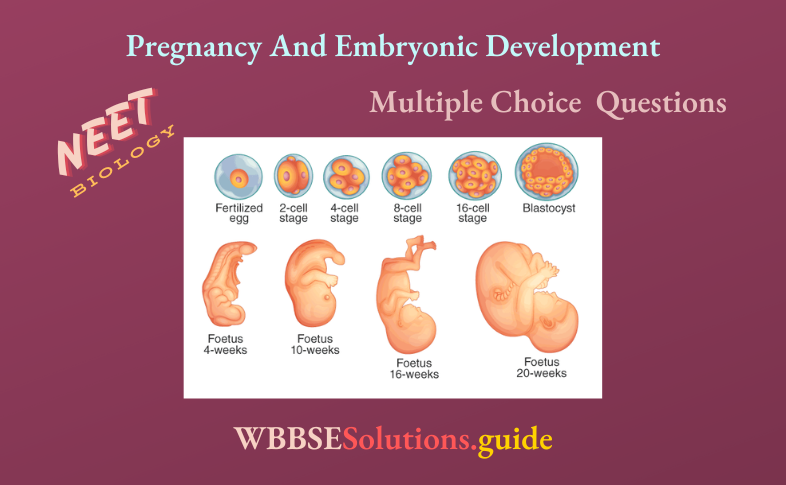
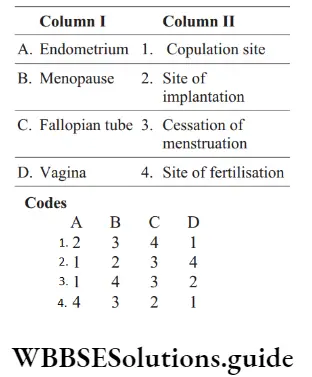
NEET Biology Parturition And Lactation Multiple Choice Question And Answers

Biology MCQs with answers for NEET Parturition And Lactation

Question 1. The process of delivery of foetus is called

  1. Parturition
  2. Implantation
  3. Fertilisation
  4. Lactation

Answer:  1. Parturition

Parturition is the process of giving birth to young one or the delivery of foetus.

Question 2. The baby ready for birth weighs about

  1. 2.7 to 4.5 kg
  2. 1.2 to 2.5 kg
  3. 4 to 6 kg
  4. 3.5 to 5 kg

Answer:  1. 2.7 to 4.5 kg

The average birth weight of a human baby is about 2.7 to 4.5 kg.

Read And Learn More: NEET Biology Multiple Choice Question And Answers

Question 3. Assertion Parturition is induced by neural signal in maternal pituitary. Reason (R) At the end of gestation period, the maternal pituitary releases prolactin which causes uterine contractions.

  1. Both A and R are true and R is the correct explanation of A
  2. Both A and R are true, but R is not the correct explanation of A
  3. A is true, but R is false
  4. Both A and R are false

Answer:  4. Both A and R are false

  • Both A and R are false and can be corrected as Parturition is induced by a complex neuroendocrine mechanism. The signals for parturition originate from the fully developed foetus and the placenta. These induces mild uterine contractions called foetal ejection reflex.
  • This triggers the release of oxytocin from the maternal pituitary. Oxytocin acts on the uterine muscles and causes stronger uterine contractions.

“human reproduction mcqs class 12 “

Question 4. Parturition may be divided into …………… stages.

  1. 2
  2. 3
  3.  4
  4.  5

Answer:  2. 3

Parturition is divided into three stages namely, dilation, expulsion and placental.

Biology MCQs with answers for NEET

NEET Biology Parturition And Lactation Multiple Choice Question And Answers

NEET Biology Parturition and Lactation MCQs with answers

Question 5. The first stage of parturition lasts for about

  1. 12 hours
  2. 20 min
  3. 45 min
  4. 60 min

Answer:  1. 12 hours

The first stage of parturition, i.e. dilation lasts for about 12 hours.

Question 6. During the second stage of parturition,

  1. Amnion and chorion rupture
  2. Placenta, umbilical cord and foetal membrane are expelled
  3. The umbilical cord is ligatured at two places close to the baby
  4. The foetal placenta is pulled out from the uterine wall

Answer:  3. The umbilical cord is ligatured at two places close to the baby

The umbilical cord is ligatured at two places close to the baby during the second stage of parturition, i.e. expulsion.

Question 7. In which stage of parturition, the contraction of the uterus close the cervix and prevents excess bleeding?

  1. 1st stage–dilation
  2. Expulsion
  3. Placental stage
  4. All of these

Answer: 3. Placental stage

In the placental stage of the parturition, the contraction of the uterus close the cervix and prevents excess bleeding.

Question 8. During dilation stage of parturition,

  1. Amnion and chorion rupture
  2. Amniotic fluid passes out
  3. The foetal placenta is pulled out from the uterine wall
  4. All of the above

“what is true for cleavage “

Answer:  4. All of the above

  • During the dilation stage of parturition, the cervix widens and opens to about ten centimeters, so as to allow the passage of the baby.
  • The amnion and chorion ruptures, amniotic fluid passes out and the foetal placenta is pulled out from the uterine wall.

Thus, option 4 is correct.

Biology MCQs with answers for NEET

Question 9. What changes take place in the foetus before parturition?

  1. The foetus grows up to 70 cm
  2. The foetus settles in head downward position in the pelvic cavity
  3. The foetus develops bluish-pink pigmentation
  4. The nervous system of foetus develop fully

Answer:  2. The foetus settles in head downward position in the pelvic cavity before parturition.

Important MCQs on Parturition and Lactation for NEET

Question 10. Which hormone is responsible for relaxing the ligaments of pelvic girdle?

  1. Relaxin
  2. Oxytocin
  3. Progesterone
  4. Prostaglandin

Answer:  1. Relaxin

The hormone relaxin relaxes the ligament of the pelvic girdle for the easy birth of the baby.

Question 11. Consider the following statements.

  1. Relaxin is secreted in the early stages of pregnancy.
  2. Relaxin prevents the dilation of uterus.

Choose the correct option.

  1. Statement 1 is correct, but 2 is incorrect
  2. Statement 1 is incorrect, but 2 is correct
  3.  Both statements 1 and 2 are correct
  4. Both statements 1 and 2 are incorrect

Answer:  4. Both statements 1 and 2 are incorrect

  • Both statements 1 and 2 are incorrect and can be corrected as Relaxin is a hormone secreted by the corpus luteum and the placenta in the terminal stage of pregnancy.
  • It causes the cervix (neck) of the uterus to dilate and prepares the uterus for the action of oxytocin during labour (parturition).

Question 12. The foetal hormones accumulate in the mother’s blood till they cause

  1. An increase in progesterone and prostaglandins
  2. A decrease in progesterone and increase in prostaglandins
  3. An increase in progesterone and decrease in prostaglandins
  4. Decrease in progesterone and prostaglandins

Answer:  2. A decrease in progesterone and increase in prostaglandins

There is a decrease in progesterone and increase in prostaglandins when foetal hormones accumulate in the mother’s blood. It helps to promote uterine contractions and progress to labour.

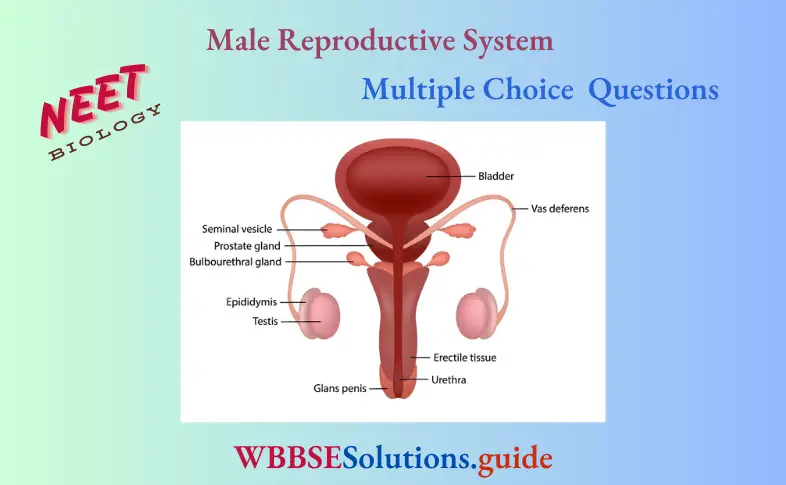
“diagrammatic sectional view of male pelvis showing reproductive system “

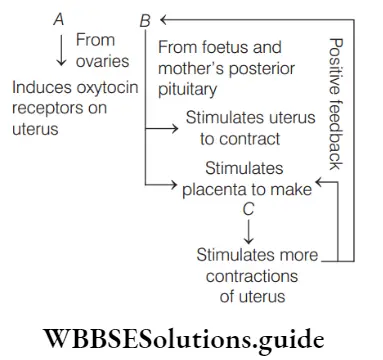
Question 13. Name A, B and C hormones in the given figure.

NEET Biology Parturition and Lactation Question 13

  1. A–Prostaglandin, B–Oxytocin, C–Oestrogen
  2. A–Oestrogen, B–Oxytocin, C–Prostaglandin
  3. A–Oestrogen, B–Prostaglandin, C–Oxytocin
  4.  A–Prostaglandin, B–Oestrogen, C–Oxytocin

Answer:  2. A–Oestrogen, B–Oxytocin, C–Prostaglandin

NEET quiz on Parturition and Lactation with solutions

Question 14. …………… is injected by doctors to induce delivery.

  1. Inhibin
  2. Oxytocin
  3. Oestrogen
  4. Prolactin

Answer:  2. Oxytocin

Doctors inject oxytocin hormone for the strong contraction of uterine wall, so as to induce labour pains.

Biology MCQs with answers for NEET

Question 15. In human adult females, oxytocin

  1. Stimulates pituitary to secrete vasopressin
  2. Causes strong uterine contractions during parturition
  3. Is secreted by anterior pituitary
  4. Stimulates growth of mammary glands

Answer:  2. Causes strong uterine contractions during parturition

In human adult female, oxytocin released by the pituitary gland (neurohypophysis) causes contraction of the uterus during labour and stimulates milk ejection from the breasts by causing the contraction of muscle fibres in the milk ducts.

Question 16. Which of the following hormones initiate parturition?

  1. ACTH, hCG, oxytocin
  2. ACTH, corticosteroid, oxytocin
  3. Corticosteroid, ACTH, prostaglandin
  4. ACTH, progesterone, hCG

Answer:  2. ACTH, corticosteroid, oxytocin

ACTH, corticosteroid and oxytocin initiate the parturition process in humans.

NEET expected MCQs on Parturition and Lactation 2025

Question 17. Reduced progesterone allows the secretion of ……………… hormone.

  1. ACTH
  2. FSH
  3. STH
  4. oxytocin

Answer:  4. oxytocin

At the end of gestation period, oxytocin hormone is released from hypothalamus and stored in posterior part of pituitary. It is then released in the blood stream when the level of progesterone decreases.

Question 18. ACTH causes the release of corticosteroid hormone from ………… of foetus.

  1. Adrenal glands
  2. Ovary
  3. Kidney
  4. Thyroid

Answer:  1. Adrenal glands

ACTH stimulates the adrenal glands to release the corticosteroid hormone in foetus during parturition. It helps in the lung maturation of foetus.

Question 19. The foetal-ejection reflex in humans triggers release of

  1. Oxytocin from maternal pituitary
  2. Oxytocin from foetal pituitary
  3. Human Chorionic Gonadotropin (hCG) from placenta
  4. Human Placental Lactogen (hPL) from placenta

Answer:  1. Oxytocin from maternal pituitary

Foetal-ejection reflex triggers the release of oxytocin from the maternal pituitary. Oxytocin acts on uterine muscles and causes strong contractions.

“hormones secreted by placenta “

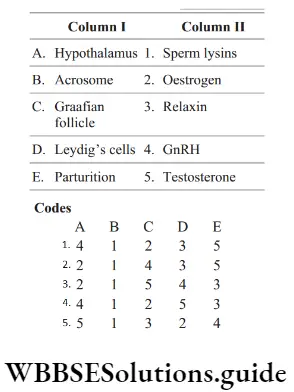
Question 20. Match the following columns.

NEET Biology Parturition and Lactation Question 20 Match The Following Column

Answer:  4. A-4, B-1, C-2, D-5, E-3

NEET Biology Parturition and Lactation MCQs with explanations

Question 21. Secretion of milk by mammary glands is known as

  1. Lactogenesis
  2. Galactopoesis
  3. Galactogenesis
  4. Glucogenesis

Answer:  1. Lactogenesis

Lactogenesis is the process of secretion of milk from the mammary glands.

Question 22. Lactation begins

  1. Towards the end of pregnancy
  2. Towards the beginning pregnancy
  3.  Towards the beginning of puberty
  4. Throughout the life cycle

Answer:  1. Towards the end of pregnancy

Lactation in human female begins towards the end of pregnancy.

Biology MCQs with answers for NEET

Question 23. Galactopoiesis means

  1. Secretion of milk
  2. M of milk secretion
  3. Discharge of milk from mammary glands
  4. Both 1 and 2

Answer:  2. M of milk secretion

Galactopoiesis refers to the maintenance of milk secretion. It is regulated by thyroxine and cortisol.

Question 24. Milk secretion is regulated by

  1. Increased secretion of progesterone
  2. Increased secretion of oestrogen
  3. Increased secretion of prolactin
  4. Increased secretion of relaxin

Answer:  3. Increased secretion of prolactin

Milk secretion is regulated by increased secretion of prolactin hormone which is released from the anterior pituitary.

Mock test on Parturition and Lactation for NEET preparation

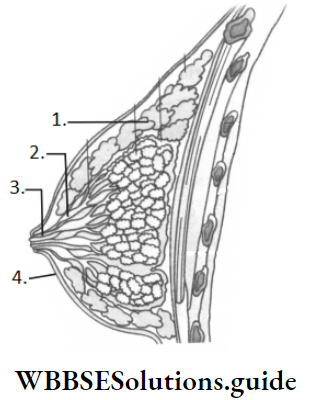
Question 25. Milk secreted from the cells of alveoli of mammary lobes reaches to the nipple. Identify the order that it follows by passing through Lactiferous Duct (L), Mammary duct (M), Mammary Tubule (T) and Mammary Ampulla (A).

  1. TAML
  2. TMAL
  3. MTAL
  4. ATML

Answer:  2. TMAL

Route of milk secretion is Mammary Tubule (T), Mammary Duct (M), Mammary Ampulla (1), Lactiferous Duct (L), i.e. TMAL.

Question 26. First milk produced after childbirth is called

  1. Sebum
  2. Cercumen
  3. T milk
  4. Colostrum

Answer:  4. Colostrum

  • The milk that comes out of the mammary glands during the initial days of lactation is called colostrum.
  • It contains antibodies and nutrients for the baby. Thus, breast feeding is recommended by doctros for bringing up a healthy baby.

Question 27. Colostrum plays an important role for newborn babies as

  1. Colostrum have antigen
  2. Colostrum have antibody
  3.  Both 1 and 2
  4.  Colostrum have more nutrients than ordinary milk

Answer:  2. C have antibody

Colostrum contains antibody-A (IgA), which protects against the pathogenicity in newborn.

Biology MCQs with answers for NEET

Question 28. The type of sugar found in breast milk is

  1. Glucose
  2. Sucrose
  3. Lactose
  4. Galactose

Answer:  3. Lactose

Milk produced in human females contains proteins like casein, lactalbumin, etc., fat, lactose sugar, vitamins, mineral salts and water. It is poor in iron and has a very small quantity of vitamin-C.

Question 29. Milk of lactating mother is composed of

  1. Na+ and   Ca2+
  2. Water and fats
  3. Sugars and proteins
  4. All of the above

Answer:  4. All of the above

Human breast milk is composed of carbohydrates, fats, proteins, vitamin water, sugar and minerals along with sodium, calcium, antibodies, enzymes.

Thus, option 4 is correct.

NEET practice test on Parturition and Lactation

Question 30. Identify the correct statements.

  1. Increased secretion of prolactin initiates milk formation
  2. Prolactin inhibits release of LH
  3. Suppression of menstrual cycle at the time of lactation
  4. All of the above

Answer:  4. All of the above

“human reproduction class 12 important questions pdf “

All given statements are correct. Increased secretion of prolactin initiates milk formation. Prolactin inhibits the release of LH and suppression of menstrual cycle at the time of lactation. Thus, option 4 is correct.

Biology MCQ For NEET With Answers

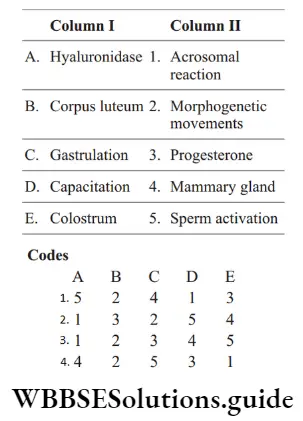
Question 31. Match the following columns with correct combination.

NEET Biology Parturition and Lactation Question 31 Match The Following Column

Answer:  2. A–1, B–3, C–2, D–5, E–4

Question 32. The time period of development of embryo in uterus

  1. Gestation
  2. Incubation
  3. Implantation
  4. None of the above

Answer:  1. Gestation

The time period from the start of pregnancy till parturition is called gestation.

Question 33. Human pregnancy lasts for ………… days from the start of the last menstrual cycle.

  1. 266
  2. 300
  3. 280
  4. 225

Answer:  3. 280

The average length of human gestation is 280 days or 40 weeks, from the first day of the woman’s last menstrual period.

“neetprep reproduction in organisms “

Question 34. Exact time of human gestation period is

  1. 9 month ± 15 days
  2. 9 month ± 20 days
  3.  9 month ± 7 days
  4. 9 months ± 1 days

Answer:  3.  9 month ± 7 days

The duration of pregnancy in human being is about 9 months ± 7 days, which is called gestation period.

NEET Biology Pregnancy And Embryonic Development Multiple Choice Question And Answers

Biology MCQ For NEET With Answers Pregnancy and Embryonic Development

Question 1. After implantation, finger-like projections on the trophoblast are called …A… which are surrounded by …B… and maternal blood. Here, A and B refer to

  1. A–chorion, B–foetal cell
  2. A–chorionic villi, B–uterine tissue
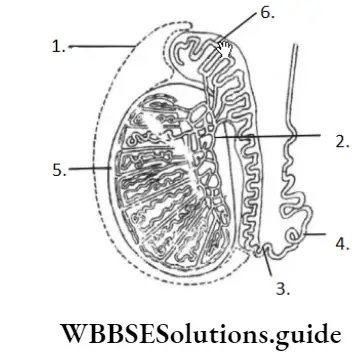
  3. A–uterine tissue, B–chorionic villi
  4. A–foetal cell, B–chorion

Answer:  2.  A–chorionic villi, B–uterine tissue

Question 2. The layer of uterus which becomes much eroded due to placental villi is known as

  1. Endothelium
  2. Endometrium
  3. Endoderm
  4. Trophoblast

Answer:  2.  Endometrium

During the development of foetus, endometrium gets eroded due to placental villi.

Read And Learn More: NEET Biology Multiple Choice Question And Answers

Question 3. Chorionic villi are formed by the modification of

  1. Outer layer of trophoblast
  2. Inner layer of trophoblast
  3. Inner cell mass
  4. Blastocyst

Answer:  1. Outer layer of trophoblast

Chorionic villi are the modification of outer trophoblast layer of blastocyst, which get attached to the endometrium of uterus.

pregnancy and embryonic development class 12

Question 4. The number of foetal membranes in humans is

  1. 2
  2. 3
  3. 4
  4. 0

Answer:  3. 4

Humans possess four foetal membranes, viz. amnion, chorion, allantois and yolk sac.

Biology MCQ For NEET With Answers

NEET Biology Pregnancy And Embryonic Development Multiple Choice Question And Answers

NEET Biology Pregnancy and Embryonic Development MCQs with answers

Question 5. Extraembryonic membranes are also called

  1. Foetal membranes
  2. Embryonic membranes
  3. Accessory membranes
  4. Placental membranes

Answer:  1. Foetal membranes

Extraembryonic membranes are also called foetal membranes.

Question 6. Foetal membranes provide

  1. Protection to embryo
  2. Nutrition to embryo
  3. Protection and nutrition to embryo
  4. None of the above

Answer:  3. Protection and nutrition to embryo

Extraembryonic membranes or foetal membranes are concerned with protection, respiration, excretion and nutrition of developing embryo.

Question 7. The first extraembryonic membrane to make its appearance in the mammals is

  1. Allantois
  2. Amnion
  3. Yolk sac
  4. Serosa

Answer:  3. Yolk sac

The yolk sac is first membranous sac attached to an embryo. It is formed by the cells of hypoblast adjacent to the embryonic disc. This is alternatively called the umbilical vesicle.

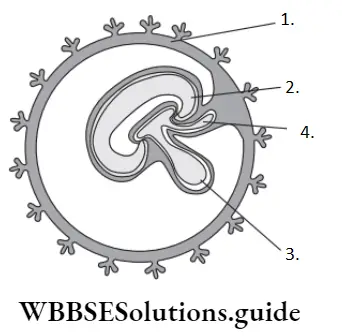
Question 8. Identify A, B, C and D in the figure given below.

NEET Biology Pregnancy and Embryonic Development Question 8

  1. A–Yolk sac, B–Amnion, C–Allantois, D–Chorion
  2. A–Chorion, B–Amnion, C–Yolk sac, D–Allantois
  3. A–Chorion, B–Amnion, C–Allantois, D–Yolk sac
  4. A–Chorion, B–Allantois, C–Amnion, D–Yolk sac

Answer:  2. A–Chorion, B–Amnion B–Yolk sac, D–Allantois

pregnancy and embryonic development class 12

Question 9. The yolk sac in mammals is

  1. Absent
  2. Secretory
  3. Active
  4. Present right after fertilisation then disappears

Answer:  3. Active

An active yolk sac is found in mammals. It serves as the first site of blood cell production in human ontogeny until about the 6th week, when the liver takes over this role.

Biology MCQ For NEET With Answers

Question 10. In an organism having amnion, the foetal membranes are

  1. Zona pellucida, vitelline membrane
  2. Allantois, chorion
  3. Choroid, vitelline membrane
  4. None of the above

Answer:  2. Allantois, chorion

Amnion, chorion, allantois and yolk sac are the foetal membranes or extraembryonic membranes of reptiles, birds and mammals.

Question 11. Which extraembryonic membrane in humans prevents desiccation of the embryo inside the uterus?

  1. Yolk sac
  2. Amnion
  3. Chorion
  4. Allantosis

Answer:  2. Amnion

Amnion surrounds the embryo and forms amniotic cavity that is filled with amniotic fluid. The amniotic fluid serves as a shock absorber for the foetus (protects the embryo from external injury), regulates foetal body temperature and prevents its desiccation.

Question 12. The amnion of mammalian embryo is derived from

  1. Ectoderm and mesoderm
  2. Ectoderm and endoderm
  3. Mesoderm and trophoblast
  4. Endoderm and mesoderm

Answer:  1. Ectoderm and mesoderm

Amnion in mammals is formed from mesoderm on outer side and ectoderm on inner side.

Important MCQs on Pregnancy and Embryonic Development for NEET

Question 14. Consider the following statements.

  1. Chorion is derived from trophoblast on outer side.
  2. The inner side of chorion is derived from endoderm.

Choose the correct option

  1. Statement 1 is correct, but 2 is incorrect
  2. Statement 1 is incorrect, but 2 is correct
  3. Both statements 1 and 2 are correct
  4. Both statements 1 and 2 are incorrect

Answer:  1. Statement 1 is correct, but 1 is incorrect.

Chorion is formed from outer trophoblast and somatopleuronic mesoderm inside.

Biology MCQ For NEET With Answers

Question 15. Urinary bladder of the embryo is

  1. Yolk sac
  2. Allantois
  3. Amnion
  4. Both chorion and allantois

Answer:  2. Allantois

Allantois stores the metabolic waste of embryo and thus, acts as urinary bladder of the embryo

pregnancy and embryonic development class 12

Question 16. …A… is composed of endoderm inside and somatopleuric extraembryonic mesoderm outside. In humans, it is small and help in gaseous exchange.

  1. Allantois
  2. Chorion
  3. Amnion
  4. Placenta

Answer:  1. A–allantois

Question 17. …A… completely surrounds the embryo and protects it. It also takes part in the formation of …B…. . Here, A and B refer to

  1. A–Chorion, B–placenta
  2. A–Amnion, B–amniotic cavity
  3. A–Allantois, B–endoderm
  4. A–Yolk sac, B–endoderm

Answer:  1. A–Chorion, B–placenta

Question 18. Which of the foetal membrane is directly connected with blood?

  1. Allantois
  2. Amnion
  3. Chorion
  4. Yolk sac

Answer:  3. Chorion

The chorion membrane is a fibrous tissue layer containing the foetal blood vessels. Villi formed on the outer surface of the chorion, maximise the surface area for contact with maternal blood.

Question 19. Consider the following statements.

  1. The space between embryo and the amnion is called amniotic cavity which is filled with clear watery fluid secreted by both embryo and membrane.
  2. It protects the embryo from shock and desiccation.

Choose the correct option.

  1. Statement 1 is correct, but 2 is incorrect
  2. Statement 1 is incorrect, but 2 is correct
  3. Both statements 1 and 2 are correct
  4. Both statements 1 and 2 are incorrect

Answer:  3. Both statements, 1 and 2 are correct.

Question 20. The placenta is fully developed

  1. In first week of pregnancy
  2. By the end of third month
  3. Immediately after implantation
  4. By the end of second week of pregnancy

Answer:  2. By the end of third month

In humans, placenta is fully developed by the end of third month of pregnancy and it lasts throughout the pregnancy.

Biology MCQ For NEET With Answers

Question 21. The placenta of human beings belongs to the category of

  1. Haemo-chorialis
  2. Syndesmo-chorialis
  3. Endothelio-chorialis
  4. Epithelio-chorialis

Answer:  1. Haemo-chorialis

The placenta of human beings belongs to the category of haemo-chorialis. In this, maternal blood baths foetal chorionic villi directly.

NEET quiz on Pregnancy and Embryonic Development with solutions

Question 22. The type of placenta found in human beings is

  1. Diffused
  2. Zonary
  3. Cotyledonary
  4. Metadiscoidal

Answer:  4. Metadiscoidal

Metadiscoidal type of placenta is present in human being. In it, the villi are restricted to one disc only. It is also called monodiscoidal condition.

Question 23. Placenta acts as an

  1. Endocrine gland
  2. Exocrine gland
  3. Apocrine gland
  4. Merocrine gland

Answer:  1. Endocrine gland

Placenta releases oestrogens, progesterone, HCG and relaxin. That is why, it is considered as an endocrine gland.

Question 24. Human placenta develops from

  1. Ectoderm
  2. Trophoblast
  3. Endoderm
  4. Mesoderm

Answer:  2. Trophoblast

Tropho-ectoderm (trophoblast) is the outermost layer of the cells of a blastocyst. It forms the foetal part of placenta and do not form any part of the embryo properly.

Question 25. The placenta lacks ……………

  1. Arteries
  2. Veins
  3. Smooth muscles
  4. Nerves

Answer:  4. Nerves

Nerves are not found in placenta. The placenta may be the only human organ that is uninnervated. Only the segment of umbilical cord, closest to the foetus contain nerve fibres.

Biology MCQs with answers for NEET

Question 26. In humans, the placenta is

  1. Allanto-chorial
  2. Pseudo-cotyledon
  3. Haemochorial
  4. All of the above

Answer:  4. All of the above

The human placenta is allanto-chorial, i.e. the chorial placental circulation is connected with the foetal allantois. It is also haemochorial, metadiscoidal, pseudocotyledon (the villi are grouped and incompletely separated by walls that are between them). Thus, option 4 is correct.

Question 27. As compared to the simplest type of placenta, how many barriers are lost in human placenta?

  1. One
  2. Two
  3. Three
  4. Four

Answer:  3. Three

The simplest type of placenta possesses six barriers. In humans, three barriers are lost. These include uterine epithelium, uterine connective tissue and endothelium of maternal blood vessel.

Question 28. The role of placenta is to

  1. Convey nerve impulses
  2. Act as storage organ
  3. Protect embryo from shocks
  4. Provide nutrition for developing embryo

Answer:  4. Provide nutrition for developing embryo

The placenta helps to provide oxygen and nutrients to the foetus, whilst removing carbon dioxide and other waste product. It metabolises a numbers of substances and can release metabolic products into maternal and foetal circulations.

pregnancy and embryonic development class 12

Question 29. Which of the following hormones is not secreted by placenta?

  1. Oestrogen
  2. Progesterone
  3. Prolactin
  4. HCG

Answer:  3. Prolactin

Prolactin is a hormone produced by the anterior pituitary gland and not by placenta.

Question 30. Which of the following substances move from foetal blood to maternal blood?

  1. Glucose
  2. Antibodies
  3. CO2 and urea
  4. Vitamins

Answer:  3. CO2 and urea

Foetal waste, such as CO2 and urea move from foetal to maternal blood. Glucose, antibodies and vitamins move from maternal blood to foetal blood.

Biology MCQs with answers for NEET

Question 31. Which one of the following is not the function of placenta?

  1. Facilitates supply of oxygen and nutrients to embryo
  2. Secretes oestrogen
  3. Facilitates removal of carbon dioxide and waste material from embryo
  4. Secretes oxytocin during parturition

Answer:  4. Secretes oxytocin during parturition

Option 4 is not the function of placenta. Oxytocin is secreted by posterior pituitary gland and not by the placenta. Rest options represent the functions of placenta.

Question 32. Assertion (A) Placenta is connected to the foetus by an umbilical cord. Reason (R) Foetal components of the placenta are derived from the chondroblast.

  1. Both A and R are true and R is the correct explanation of A
  2. Both A and R are true, but R is not the correct explanation of A
  3. A is true, but R is false
  4. Both A and R are false

Answer:  3. A is true, but R is false

A is true, but R is false. Reason can be corrected as The foetal component is composed of all placental portions which originate from the blastocyst, including the placental disc, the amniotic and chorionic membranes (often referred to as the foetal membranes) and the umbilical cord. The maternal component is termed decidua and is derived from the maternal endometrium.

NEET expected MCQs on Pregnancy and Embryonic Development 2025

Question 33. A deciduate placenta is one in which union of chorionic villi and uterine mucosa is extensive and complete. Identify which of the following is not a deciduate placenta.

  1. Zonary deciduate
  2. Discoidal deciduate
  3. Contra-deciduate
  4. Metadiscoidal deciduate

Answer:  3. Contra-deciduate

Contra-deciduate is not a deciduate placenta. In this type, foetal villi and uterine crypts are so intimately connected that most of foetal placenta is left behind at birth to be broken and absorbed by maternal leucocytes, e.g. mole.

Question 34. A placenta that takes part of uterine mucosa with it when it is expulsed is

  1. Decidua
  2. True placenta
  3. Omphaloidean placenta
  4. None of the above

Answer:  1. Decidua

Human placenta is deciduous type, i.e. at birth, variable amount of maternal uterine mucosa is pulled out with blood.

Question 35. Oxygenated blood flowing in umbilical cord of mammalian embryo is

  1. 50% maternal and 50% foetal
  2. 100% maternal
  3. 100% foetal
  4. 75% maternal and 25% foetal

Answer:  2. 100% maternal

Oxygenated blood flowing in umbilical cord of mammalian embryo is 100% maternal.

Biology MCQs with answers for NEET

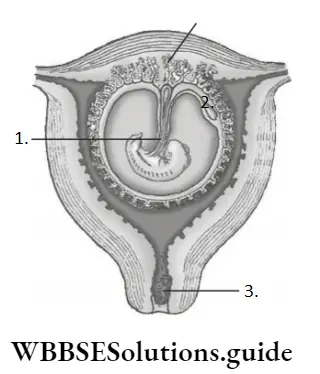
Question 36. In the given diagram, find out A, B and C.

NEET Biology Pregnancy And Embryonic Development Question 36

  1. A–Plug of mucous in cervix, B–Placental villi, C–Umbilical cord
  2. A–Umbilical cord, B–Placental villi, C–Plug of mucus in cervix
  3. A–Umbilical cord, B–Plug of mucus in cervix, C–Placental villi
  4. A–Placental villi, B–Plug of mucus in cervix, C–Umbilical cord

Answer:  2. A–Umbilical cord B–Placental villi C–Plug of mucus in cervix

pregnancy and embryonic development class 12

Question 37. Umbilical cord is formed from

  1. Yolk sac-amnion
  2. Yolk sac-allantois
  3. Yolk sac-chorion
  4. Chorion-allantois

Answer:  4. Chorion-allantois

Umbilical cord is formed from chorion-allantois. It begins to form by the end of third week of development and by the fifth week of development, its formation is completed.

Question 38. In the foetus, the blood vessel connecting the pulmonary artery to the aorta is the ductus

  1. Caroticus
  2. Thoracicus
  3. Venosus
  4. Botalli

Answer:  3. Venosus

In foetus, ductus venosus connects the pulmonary artery to the aorta.

Question 39. Consider the following statements.

  1. The outer surface of chorion develops chorionic villi.
  2. Human placenta is also called chorionic placenta.

Choose the correct option.

  1. Statement 1 is correct, but 2 is incorrect
  2. Statement 1 is incorrect, but 2 is correct
  3. Both statements 1 and 2 are correct
  4. Both statements 1 and 2 are incorrect

Answer:  3. Both statements 1 and 2 are correct.

The outer surface of the chorion in humans develops a number of finger-like projection called chorionic villi. Because the chorion takes part in the formation of placenta, the human placenta is chorionic placenta.

Question 40. Which of the following statements about maternal and foetal blood in placenta is incorrect?

  1. The maternal and foetal blood is not in direct contact
  2. There is always compatibility between maternal and foetal blood
  3. The pressure of the maternal blood is far too high for the foetal blood vessels
  4. Oxygen from the maternal blood passes into the foetal blood

Answer:  2. There is always compatibility between maternal and foetal blood

tatement in option is incorrect and can be corrected as Maternal and foetal blood are not always compatible, e.g. Rh incompatibility. Rest options are correct about maternal and foetal blood in placenta.

Question 41. Which hormone plays an important role during pregnancy?

  1. HCG
  2. FSH
  3. LH
  4. Progesterone

Answer: 1. HCG

Human Chorionic Gonadotropin (hCG) is secreted by trophoblastic cells whose properties are similar to that of Luteinizing Hormone (LH). If pregnancy is confirmed, hCG maintains the corpus luteum and stimulates progesterone secretion. So, hCG hormone plays an important role during pregnancy.

Biology MCQs with answers for NEET

Question 42. Assertion In a woman, hCG is excreted with urine during pregnancy. Reason (R) Presence of hCG in urine is the basis for pregnancy test.

  1. Both A and R are true and R is the correct explanation of A
  2. Both A and R are true, but R is not the correct explanation of A
  3. A is true, but R is false
  4. Both A and R are false

Answer: 1. Both A and R are true and R is the correct explanation of A.

During pregnancy, hCG is secreted in greater amount by placenta and thus, it is excreted in urine. It forms the basis of pregnancy test.

Question 43. In the event of pregnancy, the corpus luteum persists under the influence of

  1. LH
  2. FSH
  3. Chorionic gonadotropin
  4. Progesterone

Answer:  3. Chorionic gonadotropin

Human Chorionic Gonadotropin (hCG) is a peptide hormone produced during pregnancy. Its role is to prevent the disintegration of the corpus luteum of the ovary and thereby, maintain progesterone production that is critical for pregnancy in humans.

NEET Biology Pregnancy and Embryonic Development MCQs with explanations

Question 44. Hormones secreted by the placenta to maintain pregnancy are

  1. HCG, hPL, progestogens, prolactin
  2. HCG, progestogens, oestrogens, glucocorticoids
  3. HCG, hPL, progestogens, oestrogens
  4. HCG, hPL, oestrogens, relaxin, oxytocin

Answer:  3. HCG, hPL, progestogens, oestrogens

  • Placenta releases human Chorionic Gonadotropin (hCG) hormone which stimulates the corpus luteum during pregnancy to release oestrogen and progesterone and also rescues corpus luteum from regression.
  • Human Placental Lactogen (hPL) is involved in growth of body of mother and breast. Progesterone maintains pregnancy and prevent uterine contractions by increasing uterine threshold to contractile stimuli.

pregnancy and embryonic development class 12

Question 45. The function of hPL is/are

  1. Stimulate breast growth and development
  2. Increase resistance of mother’s tissue to insulin
  3. Promote breakdown of maternal fats
  4. All of the above

Answer:  4. All of the above

All the listed functions are attributed to hPL. Thus, option is correct.

Biology MCQs with answers for NEET

Question 46. Select the correct option describing gonadotropin activity in a normal pregnant female.

  1. High level of FSH and LH stimulates the thickening of endometrium
  2. High level of FSH and LH facilitates implantation of the embryo
  3. High level of hCG stimulates the synthesis of oestrogen and progesterone
  4. High level of hCG stimulates the thickening of endometrium

Answer:  3. High level of hCG stimulates the synthesis of oestrogen and progesterone

Option is correctly describing the gonadotropin activity in a normal pregnant female. hCG is released by placenta which helps in sustaining the level of sex hormones like oestrogen and progesterone to support pregnancy.

Rest options are not correct and can be corrected as High level of progesterone stimulates thickening of endometrium and facilitates implantation of embryo.

Question 47. Identify the correct statement.

  1. HCG, hPL and relaxin are produced in women only during pregnancy
  2. During pregnancy, the level of hormones like oestrogens, progestogens, cortisol, prolactin, thyroxine, etc., are increased several folds in the maternal blood
  3. Increased production of hCG, hPL, progesterone, etc., is essential for supporting the foetal growth, metabolic changes in the mother and maintenance of pregnancy
  4. All of the above

Answer:  4. All of the above

All given statements are correct. hCG, hPG and relaxin are produced during pregnancy. Also, the levels of other hormones like oestrogen, progesterone, cortisol, prolactin, thyroxine, etc., increased several folds in maternal blood.

Increased production of these hormones is essential for supporting the foetal growth, metabolic changes in the mother and maintenance of pregnancy. Thus, option 4 is correct.

Question 48. hCS (human Chorionic Somatomammotropin) was previously called

  1. Human Placental Lactogen (hPL)
  2. Chorionic thyrotropin
  3. Chorionic corticotropin
  4. Relaxin

Answer:  1. Human Placental Lactogen (hPL)

Human Placental Lactogen (hPL) was previously called human Chorionic Somatomammotropin (hCS).

Question 49. ……….. secretes the hormone relaxin.

  1. Placenta
  2. Ovary
  3. Anterior lobe of pituitary
  4. Posterior lobe of pituitary

Answer:  2. Ovary

Relaxin is secreted by ovary. It increases the flexibility of the pubic symphysis and ligaments of the sarcoiliac and sacrococcygeal joints that help to dilate the uterine cervix during labour pain.

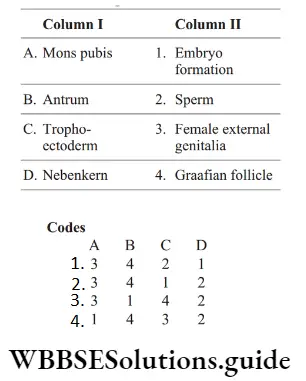
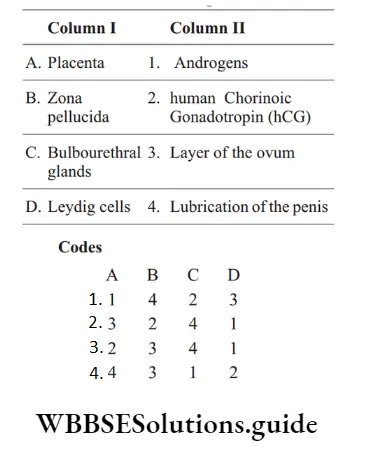
Question 50. Match Column I with Column II and select the correct option using the codes given below

NEET Biology Pregnancy and Embryonic Development Question 50 Match The Column

Answer:  2. A-3, B-4, C-1, D-2

Question 51. The main function of trophoectoderm in mammalian embryo is

  1. Protection of the developing cells
  2. Drawing food for the developing cells
  3. Formation of yolk sac
  4. Formation of body of developing embryo

Answer:  2. Drawing food for the developing cells

rophoectoderm forms placenta which helps to draw food or nutrition for the developing cells.

NEET Biology Mcq

Question 52. Which of the following is not derived from ectoderm?

  1. Inner ear
  2. Middle ear
  3. Optic nerve
  4. Skin

Answer:  2. Middle ear

  • External ear, outer layer of tympanic membrane, membranous labyrinth (internal ear) are the derivative of ectoderm.
  • Epithelium of Eustachain tube, middle ear, inner layer of tympanic membrane are derived from endoderm. So, middle ear is not derived from ectoderm.

pregnancy and embryonic development class 12

Question 53. Bones of our body are derived from the mesoderm except

  1. Facial
  2. Femur
  3. Radula
  4. Occipital

Answer: 1. Facial

All bones are derived from the mesoderm, but only facial bones are derived from the ectoderm.

Question 54. In human body, ectoderm produces

  1. Nervous system
  2. Sweat gland
  3. lens of eye
  4. All of these

Answer:  4. All of these

All given options derived from ectoderm in human body. In human body, ectoderm produces nervous system, sweat gland, eye lens, etc.Thus, option is correct.

Question 55. Eye develops from

  1. Ectoderm
  2. Mesoderm
  3. Endoderm
  4. Ecto-endoderm

Answer:  1. Ectoderm

Eye (retina, lens and cornea) develops from embryonic ectoderm.

Question 56. Salivary glands are derived from

  1. Ectoderm
  2. Mesoderm
  3. Endoderm
  4. All of these

Answer:  1. Ectoderm

Salivary glands are ectodermal in origin.

NEET Biology Mcq

Question 57. Ectodermal origin is seen in

  1. Spleen
  2. Hypothalamus
  3. Pituitary gland
  4. Both 2 and 3

Answer:  4. Both 2 and 3

Hypothalamus and pituitary gland are derived from embryonic ectoderm. Thus, option is correct.

Mock test on Pregnancy and Embryonic Development for NEET preparation

Question 58. Which option contain mesodermal structures only?

  1. Kidney, urinary and genital ducts
  2. Nasal epithelium, coelomic epithelium
  3. Urinary bladder, pancreas
  4. All of the above

Answer:  1. Kidney, urinary and genital ducts

Kidney, urinary and genital ducts are mesodermal in origin.

Question 59. Notochord, skeletal system and dermis of the skin are the derivatives of

  1. Mesoderm
  2. All the three layers
  3. Ectoderm
  4. Endoderm

Answer: 1. Mesoderm

Notochord, skeletal system and dermis of the skin are mesodermal in origin.

pregnancy and embryonic development class 12

Question 60. In humans, visceral peritoneum, circulatory system and muscles are derived from

  1. Mesoderm
  2. Ectoderm
  3. Endoderm
  4. Both 1 and 2

Answer:  1. Mesoderm

Visceral peritoneum, circulatory system and muscles are derived from mesoderm in humans.

NEET Biology Mcq

Question 61. The lateral mesoderm splits to form visceral and parietal layer which encloses the

  1. Proctodaeum
  2. Stomodaeum
  3. Splanchnocoel
  4. None of these

Answer:  3. Splanchnocoel

Splanchnocoel in vertebrates embryo is a pair of temporary coelomic cavities located on either side of the body below the gut. Lateral mesoderm splits to form visceral and parietal layer which encloses the splanchnocoel.

Question 62. After gastrulation, the roof of archenteron is formed by

  1. Neural plate
  2. Mesoderm
  3. Ectoderm
  4. Chordamesoderm

Answer:  4. Chordamesoderm

Chordamesoderm is a type of mesoderm that lies along the central axis under the neural tube. It gives rise to notochord. It forms the roof of archenteron after gastrulation process.

Question 63. Which of the following system is not mesodermal in origin?

  1. Circulatory system
  2. Muscular system
  3. Nervous system
  4. None of the above

Answer:  3. Nervous system

Nervous system is derived from the ectoderm (not mesoderm) layers. The other three structures are mesodermal in origin.

Question 64. All the following structures are ectodermal except one which is mesodermal in origin.

  1. Epithelium of retina
  2. Optic nerve
  3. Eye lens
  4. Outer eye layers

Answer:  4. Outer eye layers

Outer eye layers are mesodermal (not ectodermal) in origin.

NEET Biology Mcq Chapter Wise

Question 65. Which of the following is correct?

  1. Mesoderm produces brain
  2. Ectoderm produces liver
  3. Mesoderm produces skeleton
  4. Endoderm produces heart

Answer:  3. Mesoderm produces skeleton

Option is correct.Connective tissue, bone (skeleton) and cartilage, heart, blood, muscles and gonads are formed from mesoderm. Rest options are incorrect.

Question 66. Spleen develops from

  1. Ectoderm
  2. Mesoderm
  3. Endoderm
  4. None of these

Answer:  2. Ectoderm

Spleen is mesodermal in origin.

Question 67. Gonads are derived from embryonic

  1. Mesoderm
  2. Endoderm
  3. Ectoderm
  4. Mesoderm and endoderm

Answer: 1. Mesoderm

Gonads are derived from embryonic mesoderm.

NEET practice test on Pregnancy and Embryonic Development

Question 68. The only human system that is derived from all the three germ layers is

  1. Digestive system
  2. Excretory system
  3. Respiratory system
  4. Nervous system

Answer: 1. Digestive system

The human digestive system is derived from all the three germ layers, e.g. mouth is ectodermal, mesentron or midgut is endodermal and walls of gut are mesodermal in origin.

Question 69. Which layer develops first during embryonic development?

  1. Ectoderm
  2. Mesoderm
  3. Endoderm
  4. Both 2 and 3

Answer:  3. Endoderm

Endodermal cells are formed first during gastrulation (embryonic development). They first cover the free surface of the embryonal knob. Then, they rapidly multiply, spread out in all directions.

pregnancy and embryonic development class 12

Question 70. Ontogenetically the liver is …………… in origin.

  1. Ectodermal
  2. Endodermal
  3. Epidermal
  4. Mesodermal

Answer:  2. Endodermal

Ontogenetically, the liver is derived from endoderm.

Question 71. After the formation of endoderm, the embryonic knob becomes columnar to form

  1. Amniotic cavity
  2. Embryonic disc
  3. Embryonic coelom
  4. Chorion

Answer:  2. Embryonic disc

The floor of the amniotic cavity is formed by the embryonic disc. It is composed of a layer of prismatic cells called the embryonic ectoderm. These are derived from the inner cell mass and lie in apposition with the endoderm.

NEET Biology Mcq Chapter Wise

Question 72. Human tongue is derived from

  1. Ectoderm
  2. Mesoderm
  3. Endoderm
  4. Both 1 and 2

Answer:  3. Endoderm

Human tongue is derived from endoderm.

Question 73. An endodermal structure is

  1. Intestinal glands
  2. Salivary glands
  3. Ciliary muscles
  4. Both 1 and 3

Answer: 1. Intestinal glands

Intestinal glands are endodermal in origin.

Question 74. Archenteron is lined with

  1. Ectoderm
  2. Mesoderm
  3. Endoderm
  4. Mesoderm and endoderm

Answer:  3. Endoderm

Archenteron is lined with the endoderm.

Question 75. From one egg in gastrula if all endodermal cells are removed the organism will lack

  1. Eyes
  2. Heart
  3. Brain
  4. Visceral organs

Answer:  4. Visceral organs

If the endodermal cells are removed at gastrula stage of the development, the organisms will lack the visceral organs.

NEET Biology Mcq Chapter Wise

Question 76. The endodermal derivatives include

  1. Thyroid
  2. Pineal gland
  3. Spleen
  4. Pituitary

Answer:  1. Thyroid

Thyroid gland is endodermal derivatives.

Question 77. Choose the odd one out.

  1. Prostate gland
  2. Vaginal lining
  3. Sclerotic coat of eye
  4. Thymus

Answer:  3. Sclerotic coat of eye

Option is odd one out because Sclerotic coat of eye is mesodermal in origin, whereas the other three structures are endodermal in origin.

pregnancy and embryonic development class 12

Question 78. Identify the correctly matched pair/pairs of the germ layers and their derivatives.

  1. Ectoderm – Epidermis
  2. Endoderm – Dermis
  3. Mesoderm – Muscles
  4. Mesoderm – Notochord
  5. Endoderm – Enamel of teeth

Choose the correct answer

  1. 1 and 4 only
  2. 1 and 2 only
  3. 1, 3 and 4 only
  4. 1, 2, 3 and 5 only

Answer:  3. 1, 3 and 4 only

  • 1, 3 and 4 are correctly matched pairs of the germ layers and their der4at4es. Ectoderm – Epidermis, Mesoderm – Muscles Mesoderm – Notochord.
  • Rest options (2 and 5) are not correctly matched pairs of the germ layers and their der4at4es. These can be corrected as Mesoderm-Dermis Ectoderm-Enamel of teeth.

Question 79. Stem cell can give rise to/the

  1. Any types of cells
  2. Heart cells
  3. Special tissue
  4. Special organs only

Answer: 1. Any types of cells

Stem cells are cells that can differentiate into any types of cell. They are also called totipotent cells. Stem cells are found abundantly in plants and animals.

Question 80. Inner cell mass contains certain cells known as ………….., which have the potency to g4e rise to all types tissues and organs.

  1. Stem cell
  2. Germ cell
  3. Mesodermal cell
  4. Special cell

Answer: 1. Stem cells are the specialised cell found in inner cell mass. They can transform or differentiated into any kind of cells.

Question 81. The term, ‘metaplasia’ refers to the process by which

  1. Differentiated cell is able to become transformed into a differentiated cell of another type
  2. Cell becomes differentiated
  3. Cell grows abnormally fast
  4. None of the above

Answer: 1. Differentiated cell is able to become transformed into a differentiated cell of another type

Metaplasia is the transformation of one differentiated cell type to another differentiated cell type. The change from one type of cell to another may be part of a normal maturation process or
caused by some sort of abnormal stimulus.

Question 82. The life history of an organism completed in the egg or in womb of the mother is called

  1. Post-natal development
  2. Pre-natal development
  3. Antogenetic development
  4. All of the above

Answer:  2. Pre-natal development

Pre-natal development refers to the process in which baby develops from a single cell called zygote into an embryo and later into a foetus inside the mother’s body.

Question 83. In human beings, at the end of 12 weeks during first trimester of pregnancy the following is observed

  1. Eyelids and eyelashes are formed
  2. Most of the major organ systems are formed
  3. The head is covered with fine hair
  4. Movement of the foetus

Answer:  2. Most of the major organ systems are formed

In human beings at the end of 12 weeks or first trimesters, most of the major organ systems are formed, e.g. the limbs and external genital organs are well-developed.

Question 84. Consider the following statements.

  1. During second trimester, hCG level increases.
  2. Placenta produces progesterone during second trimester.

Choose the correct option.

  1. Statement 1 is correct, but 2 is incorrect
  2. Statement 1 is incorrect, but 2 is correct
  3. Both statements 1 and 2 are correct
  4. Both statements 1 and 2 are incorrect

Answer:  2. Statement 1 is incorrect, but 2 is correct

pregnancy and embryonic development class 12

Statement I is incorrect, but 2 is correct. Incorrect statement can be corrected as In 2nd trimester of pregnancy, hCG level declines and corpus luteum deteriorates and the placenta completely takes over the production of progesterone which maintains the pregnancy.

Question 85. Embryologist can draw the fate maps of future organ of embryo in ………… stage.

  1. Blastula
  2. Morula
  3. Early gastrula
  4. late gastrula

Answer:  1. Blastula

Fate map is the map of future organs of the embryo and it is decided in blastula stage of embryo. Hence, fate map is drawn in blastula stage.

Question 86. During embryonic development, the establishment of polarity along anterior/posterior, dorsal/ventral or medial/lateral axis is called

  1. Organiser phenomenon
  2. Axis formation
  3. Anamorphosis
  4. Pattern formation

Answer:  2. Axis formation

  • All vertebrate eggs are strongly polar structures. The two opposite poles are differentiated as animal pole and vegetal pole. The imaginary axis passing through these two poles is called polar axis or animal-vegetal axis. It is the main axis of egg.
  • Thus, during embryonic development, the establishment of polarity along anterior/posterior, dorsal/ventral or media/lateral axis is called axis formation.

Question 87. The embryo is designated as foetus

  1. When heart starts beating
  2. After the second month
  3. After the completion of seventh month
  4. Both 1 and 2

Answer: 2. After the second month

After the completion of second month, the embryo is called foetus.

Question 88. The early stage human embryo distinctly possesses

  1. Gills
  2. Gill slits
  3. External ear (pinna)
  4. Eyebrows

Answer:  2. Gill slits

Early human embryo possesses a dorsal hollow nerve cord, a well developed notochord and a series of gill slits, which represent the fundamental chordate characters.

Question 89. The branch of embryology which concerns with the study of abnormal embryonic development is termed as

  1. Gerantology
  2. Teratology
  3. Embryology
  4. None of the above

Answer:  2. Teratology

Teratology is the study of foetal malformations (i.e. abnormal embryonic development).

Question 90. Women who consume the drug thalidomide for relief from vomiting during early months of pregnancy gave birth to children with

  1. No spleen
  2. Harelip
  3. Extra fingers and toes
  4. Underdeveloped limbs

Answer:  4. Underdeveloped limbs

Thalidomide is a well-known synthetic teratogen drug which is often consumed by pregnant lady during early months of pregnancy to gain relief from vomiting. Use of this drug causes multiple defects in the growing embryo, out of which underdeveloped limbs in foetus is very common.

Question 91. From which embryonic structure does vertebral column develop?

  1. Notochord
  2. Nerve cord
  3. Coelom
  4. Atrium

Answer: 1. Notochord

  • Notochord is a flexible rod-like structure of mesodermal cells that is the principal longitudinal structural element of chordates and of the early embryo of vertebrates.
  • It plays an organisational role in nervous system development. In later vertebrate development, it becomes a part of the vertebral column.

Question 92. The process by which one part of a developing embryo influences the differentiation of other parts is known as

  1. Transduction
  2. Induction
  3. Metamorphosis
  4. None of these

Answer:  2. Induction

Induction is the process by which one part of a developing embryo influences the differentiation of other parts. It directs the development of various tissues and organs in most animal embryos.

Question 93. Heart is formed in embryo during …………… month of development.

  1. Fourth
  2. First
  3. Fifth
  4. Second

Answer:  2. First

In human embryo, the heart is formed during the first month of development.

Question 94. Interauricular septum in the embryonic stages has

  1. Fenestra ovalis
  2. Fossa ovalis
  3. Fenestra rotunda
  4. Foramen ovalis

Answer:  4. Foramen ovalis

The fossa ovalis is an oval depression in the interior part of the interauricular septum. It represents the foramen ovale of the foetus. The floor of the foramen ovale represents the fused wall of the septum primum of the foetus.

pregnancy and embryonic development class 12

Question 95. Limbs and digits of the foetus develop in ………… of development.

  1. 2nd month
  2. 3rd month
  3. 4th month
  4. 5th month

Answer:  1. 2nd month

The limbs and digits of the foetus develop by the 2nd month of pregnancy.

Question 96. Most of the organs of foetus are formed during ………… of development.

  1. 1st month
  2. 2nd month
  3. 3rd month
  4. 4th month

Answer:  3. 3rd month

Most of the organs of foetus are formed during the 3rd months of development.

Question 97. External genitalia develop in the ……………… of development.

  1. 2nd month
  2. 5th month
  3. 3rd month
  4. 1st month

Answer:  3. 3rd month

External genitalia develop in the the third month of development of the embryo.

Question 98. Appearance of hair on head is observed during ……………… of development.

  1. 2nd month
  2. 3rd month
  3. 4th month
  4. 5th month

Answer:  4. 5th month

The first movements of the foetus and appearance of hair on its head are usually observed during the 5th month of pregnancy.

Question 99. Baby moves vigorously, responds to the touch and loud noises, swallows amniotic fluid and urinates during ………. of development.

  1. 20 weeks
  2. 24 weeks
  3. 26 weeks
  4. 28 weeks

Answer:  4. 28 weeks

After 28 weeks of development, foetus move vigorously, responds to the touch and loud noises, swallows amniotic fluid and urinates.

Question 100. Body covered with fine hair, eyelid separates and eyelashes are formed during of development.

  1. 3rd month
  2. 4th month
  3. 5th month
  4. 6th month

Answer:  4. 6th month

In human embryo, during 6th month of development, the body is covered with fine hair, eyelid separates and eyelashes are formed.

Question 101. Match the following columns

NEET Biology Pregnancy and Embryonic Development Question 101 Match The Column

Answer:  3. A–2, B–3, C–4, D–1

NEET Biology Fertilisation And Implantation Multiple Choice Question And Answers

Biology MCQ For NEET With Answers Fertilisation and Implantation

Question 1. The phenomenon of fertilisation was first perceived by

  1. Hertwig
  2. Leeuwenhoek
  3. Wiseman
  4. Karl Ernst von Baer

Answer:  1. Hertwig

Oscar Hertwig (1875) first described the fusion of sperm and nuclei, i.e. fertilisation in sea urchin.

Question 2. Fertilisation was discovered by

  1. Strasburger
  2. Robert Brown
  3. Darwin
  4. Lamarck

Answer:  1. Strasburger

Fertilisation was discovered by Edward Strasburger in angiosperms.

Read And Learn More: NEET Biology Multiple Choice Question And Answers

Question 3. The release of semen by penis into vagina during copulation (coitus) is known as

  1. Insemination
  2. Fertilisation
  3. Zygote
  4. Gametogenesis

Answer:  1. Insemination

Insemination is another word for sexual intercourse or coitus in which the semen is released through penis into the vagina.

“human reproduction mcqs class 12 “

Question 4. Sperm enters from which part of egg?

  1. From animal pole in unfertilised egg
  2. From vegetal pole in unfertilised egg
  3. Anywhere in unfertilised egg except animal pole
  4. All of the above

Answer:  1. From animal pole in unfertilised egg

Sperm enters the egg from animal pole in unfertilised egg by dissolving plasma membrane of ovum.

Question 5. In man, coagulated semen liquefies in vagina of female due to the presence of an enzyme. Identify the enzyme.

  1. Fibrinogenase
  2. Fibrinolyase
  3. Fibrinolysin
  4.  Fibrinolysinase

Which is the correct answer?

  1. 1 and 2
  2. 1 and 3
  3. Only 1
  4. Only 2

Answer:  1. 1 and 2

Fibrinogenase and fibrinolyase enzymes help in the liquefication of coagulated semen in the vagina. Thus, option is correct.

NEET Biology Fertilisation And Implantation Multiple Choice Question And Answers

“human reproduction mcq class 12 “

Question 6. During the passage of sperms in vaginal tract, many sperms are engulfed by

  1. Phagocytes
  2. Macrophages
  3. Cuboidal epithelium
  4. Fertilizin

Answer:  1. Phagocytes

Many sperms are engulfed by phagocytes released by female’s immune system during the passage of sperm in vaginal tract of female reproductive system.

Biology MCQ For NEET With Answers

Question 7. Identify the correct match.

NEET Biology Fertilisation And Implantation Question 7 Identify The Correct Match.

Answer:  1. A–2, B–3, C–1

NEET Biology Fertilization and Implantation MCQs with Answers

Question 8. Which one of the following statements is false in respect of viability of mammalian sperm?

  1. Sperm is viable for only upto 24 hours
  2. Survival of sperm depends on the pH of the medium and is more active in alkaline medium
  3. Viability of sperm is determined by its motility
  4. Sperms must be concentrated in a thick suspension

Answer:  1. Sperm is viable for only upto 24 hours

Statement in option is false. It can be corrected as Sperms remain viable for 48-72 hours after being ejaculated into the female’s reproductive tract. Rest statements are true in respect of viability of mammalian sperm.

Question 9. Consider the following statements.

  1. Sperm cells die immediately when placed in a petridish right after they are released from the body.
  2. Semen contains prostaglandins that bring about contraction of uterine smooth muscles in females.

Choose the corect option.

  1. Statement 1 is correct, but 2 is incorrect
  2. Statement 1 is incorrect, but 2 is correct
  3. Both statements 1 and 2 are correct
  4. Both statements 1 and 2 are incorrect

Answer:  2. Statement 1 is incorrect, but 2 is correct.

Incorrect statement can be corrected as Sperm can survive for some time in petridish, but when they do not get appropriate environment, they will die. At – 196°C, they can be stored for years. This is the temperature which is maintained at sperm bank.

Question 10. Fertilisation in humans is practically feasible only if NEET 2016

  1. The ovum and sperms are transported simultaneously to ampullary-isthmic junction of the cervix
  2. The sperms are transported into cervix within 48 hrs of release of ovum in uterus
  3. The sperms are transported into vagina just after the release of ovum in Fallopian tube
  4. The ovum and sperms are transported simultaneously to ampullary-isthmic junction of the Fallopian tube

Answer:  4. The ovum and sperms are transported simultaneously to ampullary-isthmic junction of the Fallopian tube

The fusion of a haploid male gamete (sperm) and a haploid female gamete (ovum) to form a diploid zygote is called fertilisation. In human beings, it takes place in the ampullary-isthmic junction of the oviduct (Fallopian tube), when ovum and sperms are transported simultaneously at this site.

Biology MCQ For NEET With Answers

Question 11. Every copulation does not result in fertilisation and pregnancy due to failure of sperm to reach the

  1. Ampulla
  2. Cervix
  3. Endometrium
  4. Myometrium

Answer:  1. Ampulla

It is necessary for a sperm to reach the ampullary region because, it is the site where ova stay for two days after ovulation. That is why, every intercourse does not result in fertilisation.

Question 12. Grey crescent is the area

  1. At the point of entry of sperm into ovum
  2. Just opposite to the site of entry of sperm into ovum
  3. At the animal pole
  4. At the vegetal pole

Answer:  2. Just opposite to the site of entry of sperm into ovum

Grey cresent is lightly pigmented crescent-shaped area of marginal cytoplasm on the dorsal side, exactly opposite to the site of entry of sperm into ovum.

“diagrammatic sectional view of male pelvis showing reproductive system “

Question 13. The side opposite to the polar body and nucleus in the ovum is called

  1. North pole
  2. Vegetal pole
  3. South pole
  4. Animal pole

Answer:  2. Vegetal pole

The side opposite to the polar body and nucleus in the ovum is known as vegetal pole.

Question 14. The point of sperm entry in the secondary oocyte is made possible by the

  1. Cone of rejection
  2. Cone of reception
  3. Fertilisation cone
  4. Both 2 and 3

Answer:  4. Both 2 and 3

The secondary oocyte forms a projection termed as the cone of reception or fertilisation cone from where the sperm enters into it. Thus, option is correct.

Important MCQs on Fertilization and Implantation for NEET

Question 15. Which enzyme is involved in penetration of sperm into ovum?

  1. Hyaluronidase
  2. Zona lysine/Acrosin
  3. Fertilizin
  4. Both 1 and 2

Answer:  4. Both 1 and 2

The hyaluronidase enzyme of acrosome hydrolyses the hyaluronic acid of follicular cells. Zona lysine or acrosin digest zona pellucida, so, that the sperm can penetrate the ovum. Thus, option is correct.

Biology MCQ For NEET With Answers

Question 16. Exflagellation of the sperm during fertilisation of egg occurs due to

  1. Sodium
  2. Polar body
  3. Capsule
  4. Lysosome

Answer:  4. Lysosome

The sperm during fertilisation, loses its flagella (exflagellation) as only the nucleus of the sperm can fuse with the egg nucleus. This process of exflagellation is brought about by lysosome.

Question 17. The sperm obtains energy for movement in female genital tract from

  1. Hyaluronidase enzyme produced by acrosome
  2. Proximal centriole in the neck
  3. Mitochondria in the middle piece
  4. Axial filament

Answer:  3. Mitochondria in the middle piece

The sperm gets energy for the movement in the female genital tract by ATP produced by the mitochondria found in the middle piece of sperm.

Question 18. Consider the following statements.

  1. Hyaluronidase is a type of sperm lysin.
  2. Hyaluronidase distrupts the follicular cells of ovum during penetration into it.

Choose the correct option.

  1. Statement 1 is correct, but 2 is incorrect
  2. Statement 1 is incorrect, but 2 is correct
  3. Both statements 1 and 2 are correct
  4. Both statements 1 and 2 are incorrect

Answer:  2. Both statements 1 and 2 are correct.

Hyaluronidase is the sperm lysin that acts on ground substances of follicle cells and help the sperm to penetrate the ovum.

Question 19. The chemicals released by gametes which aid in their union in human are

  1. Pheromones
  2. Termones
  3. Gamones
  4. Desmosomes

Answer:  3. Gamones

Gamones are the chemicals released by human gametes. These chemicals aid in species specific union of gametes.

Biology MCQs with answers for NEET

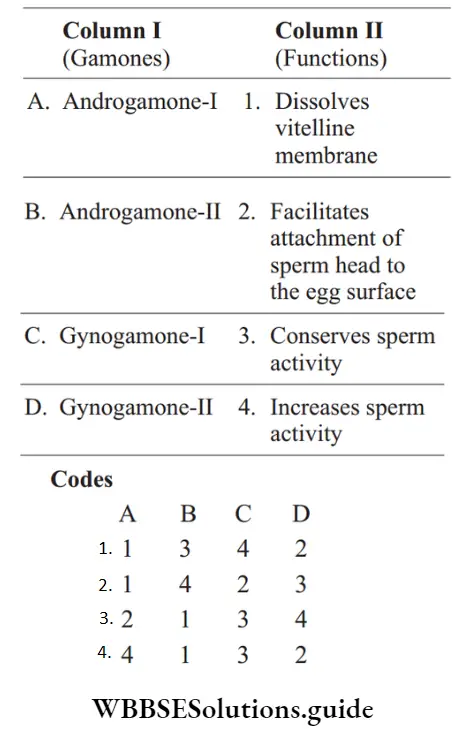
Question 20. Match Column I with Column II and choose the correct option from the codes given below

NEET Biology Fertilisation And Implantation Question 20 Match Column 1 with Column 2.

Answer:  4. A–4, B–1, C–3, D–2

Process of Fertilization and Zygote Formation MCQs for NEET

Question 21. The initial step in the activation of ovum during the process of fertilisation is

  1. Formation of the fertilisation cone
  2. Fertilizin-antifertilizin reaction
  3. Penetration of sperm in the egg
  4. Formation of the fertilisation membrane

Answer:  2. Fertilizin-antifertilizin reaction

“hormones secreted by placenta “

During fertilisation, the initial step of ovum activation is fertilizin-antifertilizin compatibility reaction. Fertilizin of egg interacts with antifertilizin of the sperm of same species. This interaction makes the sperm stick to the egg surface. This event is then followed by penetration of sperm into the egg.

Question 22. ‘Fertilizin’ is a

  1. Carbohydrate
  2. Glycoprotein
  3. Phospholipid
  4. None of the above

Answer:  2. Glycoprotein

Fertilizin is a glycoprotein that is composed of monosaccharides and amino acids.

Question 23. Fertilizins are the substances released from

  1. Mature egg
  2. Sperms
  3. Immature egg
  4. Polar body

Answer:  1. Mature egg

Fertilizin is found on the membrane of mature egg. It is present as a chemical sheet on the egg and it can only be recognised by antifertilizin.

Question 24. Antifertilizin is present Manipal 2004

  1. On the tip of sperm
  2. On the layer of ova
  3. Both on the tip of sperm and on layer of ova
  4. All over the sperm

Answer: 1. On the tip of sperm

The tip of sperm contains a proteinaceous substance known as antifertilizin. It is a protein which is composed of acidic amino acids

Biology MCQs with answers for NEET

Question 25. Which of the following are secretions produced by the spermatozoa at the time of fertilisation?

  1. Fertilizin and antifertilizin
  2. Antifertilizin and sperm lysin
  3. Fertilizin and sperm lysin
  4. Only sperm lysin

Answer:  2. Antifertilizin and sperm

Antifertilizin and sperm lysin are the secretions produced by the spermatozoa at the time of fertilisation. Antifertilizins are acid protein to which fertilizin of egg attach at the site of zona pellucida. Sperm lysins such as hyaluronidase, zona lysin or acrosin by acrosome which prepares the sperm to fertilise the ovum.

Question 26. Assertion A sperm sticks to an egg for fertilisation. Reasons (R) Interaction of surface receptors, fertilizin on the egg and antifertilizin on the sperm head makes them adhere together.

  1. Both A and R are true and R is the correct explanation of A
  2. Both A and R are true, but R is not the correct explanation of A
  3. A is true, but R is false
  4. Both A and R are false

Answer:  1. Both A and R are true and R is the correct explanation of A.

Sperm enters into an egg for fertilisation. The attachment of sperm to the egg takes place due to the interaction of surface receptors, fertilizin on the egg and antifertilizin on the sperm head.

Topic-wise Fertilization and Implantation MCQs for NEET with Explanation

Question 27. The sperm penetrates the ovum

  1. Mechanically
  2. Chemically
  3. Electrostatically
  4. Thermally

Answer:  2. Chemically

The penetration of the sperm through the corona radiata of ovum is aided by enzymatic substance called hyaluronidase (mucopolysaccharide hyaluronic acid). Thus, it is a chemical reaction.

Question 28. Sperm lysins contain

  1. Hyaluronidase
  2. Corona penetrating enzyme
  3. Acrosin
  4. All of the above

Answer:  4. All of the above

There are many enzymes in the acrosome like hyaluronidase, pectin, corona penetrating enzyme, acrosin, etc. These are collectively called
sperm lysins. Thus, option is correct.

Question 29. Which chemical event of fertilisation involves the presence of hyaluronidase enzyme?

  1. Acrosomal reaction
  2. Cortical reaction
  3. Amphimixis
  4. Activation of egg

Answer: 1. Acrosomal reaction

Hyaluronidase enzyme assists in acrosomal reaction. This enzyme acts on the ground substances of follicle cells and allow the sperm to penetrate zona pellucida.

Biology MCQs with answers for NEET

Question 30. When the acrosome membrane of the sperm breaks, it is called

  1. Activation
  2. Agglutination
  3. Capacitation
  4. Cavitation

Answer:  3. Capacitation

Capacitation is the process in which the acrosome membrane of the sperm breaks and release its enzymes to dissolve the egg membrane.

Question 31. The preparation of sperm before the penetration of ovum is called

  1. Insemination
  2. Coition
  3. Spermiation
  4. Capacitation

Answer:  4. Capacitation

  • After insemination, sperms undergo capacitation that provides them the ability to fertilise an ovum. It consists of three processes
    neutralisation of inhibitory factors present in semen
  • weakening of covering membrane of acrosome head by dissolution of cholesterol entry of Ca 2+ into sperms which changes sperm movement from undulations to whiplash motion.

NEET Biology Role of Hormones in Fertilization and Implantation MCQs

Question 32. Consider the following statements.

  1. Secretions of female genital tract inhibit sperm’s fertilising capability.
  2. Before penetration, receptor site of acrosomes are exposed.

Choose the corect option.

  1. Statement 1 is correct, but 2 is incorrect
  2. Statement 1 is incorrect, but 2 is correct
  3. Both statements 1 and 2 are correct
  4. Both statements 1 and 2 are incorrect

Answer:  Statement 1 is incorrect, but 2 is correct.

  • Incorrect statement can be corrected as The sperms in the female genital tract attain the capability of fertilising the egg by the secretions of female genital tract.
  • These secretions of the female genital tract remove the coating on the surface of the sperms, particularly those on acrosome.
  • Thus, the receptor sites on the acrosome are exposed and sperm become active to penetrate the egg. This phenomenon of sper activation in mammals is called capacitation.

“testicular lobules “

Question 33. Capacitation takes place in

  1. 12 hrs
  2. 10 hrs
  3. 8 hrs
  4. 6 hrs

Answer:  4. 6 hrs

Capacitation takes about 5-6 hours. This process enables the sperms to fertilise the egg.

Question 34. Capacitation occurs in

  1. Rete testis
  2. Epididymis
  3. Vas deferens
  4. Female reproductive tract

Answer:  4. Female reproductive tract

Capacitation involves the series of changes that occur in the sperm, while inside the female reproductive tract.

Biology MCQs with answers for NEET

Question 35. Consider the following statements.

  1. Oocyte gets depolarised after the binding of sperm to it.
  2. Depolarisation prevents monospermy.

Choose the correct option.

  1. Statement 1 is correct, but 2 is incorrect
  2. Statement 1 is incorrect, but 2 is correct
  3. Both statements 1 and 2 are correct
  4. Both statements 1 and 2 are incorrect

Answer: 1. Statement 1 is correct, but 2 is incorrect.

Binding of the sperm to the secondary oocyte induces depolarisation of the oocyte plasma membrane. Depolarisation prevents polyspermy, i.e. the entry of more than one sperm into the oocyte. It ensures monospermy.

Question 36. Polyspermy is prevented by

  1. Formation of fertilisation membrane
  2. Formation of vitelline membrane
  3. Agglutination reaction
  4. Zona pellucide

Answer: 1. Formation of fertilisation membrane

Polyspermy is prevented by the formation of fertilisation membrane. Soon after the entry of sperm into egg, cortical granules present beneath the egg’s plasma membrane release chemical substances to form vitelline membrane which later get converted into fertilisation membrane. It acts as the slow block to polyspermy.

Assisted Reproductive Technologies (IVF, ICSI) MCQs for NEET

Question 37. Besides activating the egg another role of a sperm is to carry ……… to egg.

  1. RNA
  2. Mitochondria
  3. DNA
  4. Ribosomes

Answer:  3. DNA

The head of the sperm cell contains the male’s genetic information in DNA, that is to be
passed on to the next generation. Normally , the head of a sperm cell contains one copy of each chromosome.

Question 38. When more than one sperm establish contact and penetrate into the egg, then it is called

  1. Monospermy
  2. Polyspermy
  3. Both 1 and 2
  4. None of these

Answer:  3. Both 1 and 2

The head of the sperm cell contains the male’s genetic information in DNA, that is to be passed on to the next generation. Normally , the head of a sperm cell contains one copy of each chromosome.

Question 39. What happens during fertilisation in humans after many sperms reach close to the ovum?

  1. Secretions of acrosome helps only one sperm to enter cytoplasm of ovum through zona pellucida
  2. All sperms except those nearest to the ovum lose their tails
  3. Cells of corona radiata trap all the sperms except one
  4. Only two sperms nearest to the ovum penetrate zona pellucida

Answer:  1. Secretions of acrosome helps only one sperm to enter cytoplasm of ovum through zona pellucida

During fertilisation in humans, many sperms reach close to the ovum. As sperm comes in contact with the zona pellucida layer of the ovum, it induces changes in the membrane that blocks the entry of additional sperm. The secretions of acrosome helps one sperm to enter the cytoplasm of ovum through zona pellucida.

NEET Biology Mcq

Question 40. Acrosome reaction in sperm is triggered by

  1. Capacitation
  2. Release of lysin
  3. Influx of Ca2+
  4. Release of fertilizin

Answer:  3. Influx of

Acrosome reaction is triggered by Ca2+ ions. It involves the uptake of Ca 2+ ions and efflux of H+ ions to generate high pH and negative surface charge. It thus, help in the release of acrosomal enzyme from acrosome.

Question 41. Binding of sperm to secondary oocyte results in …A… that ensures …B… .The words suitable to fill the blanks are

  1. A–polyspermy, B–polarisation
  2. A–polarisation, B–polyspermy
  3. A–depolarisation, B–monospermy
  4. A–monospermy, B–depolarisation

Answer:  3. A–depolarisation, B–monospermy.

Question 42. The final event in the process of fertilisation is

  1. Formation of gametes
  2. Egg activation
  3. Amphimixis
  4. Organisational change in egg cytoplasm

Answer:  3. Amphimixis

Entry of sperm stimulates the secondary oocyte to start the suspended meiosis-II, thus resulting in the formation of one ootid and 2-3 polar body. Ootid changes to ovum whose nuclei fuses with the male pronuclei. This process is called amphimixis (final event of fertilisation).

Question 43. The phenomenon of nuclear fusion of sperm and egg is known as

  1. Karyogamy
  2. Parthenogenesis
  3. Vitellogenesis
  4. Oogenesis

Answer:  1. Karyogamy

Karyogamy is the process of nuclear fusion of sperm cell and ovum.

Question 44. The resultant product of amphimixis is

  1. Haploid ovum
  2. Diploid egg
  3. Diploid ovum
  4. Haploid egg

Answer:  2. Diploid egg

Amphimixis involves the fusion of male and female pronuclei that produce a diploid egg called zygote.

Question 45. When the site of fertilisation is the ovary, it is called

  1. Tubal pregnancy
  2. Ectopic pregnancy
  3. Abdominal pregnancy
  4. Ovarian pregnancy

Answer:  2. Ectopic pregnancy

Ectopic pregnancy refers to the condition in which the implantation occurs outside the uterus, typically in a Fallopian tube or ovary.

Question 46. Consider the following statements.

  1. Most ecotopic pregnancies occur in Fallopian tube.
  2. Ecotopic pregnancy causes abdominal pain and vaginal bleeding.

Choose the correct option.

  1. Statement 1 is correct, but 2 is incorrect
  2. Statement 1 is incorrect, but 2 is correct
  3. Both statements 1 and 2 are correct
  4. Both statements 1 and 2 are incorrect

Answer:  3. Both statements 1 and 2 are correct.

Ectopic pregnancy is a complication of pregnancy in which implantation of embryo takes place at site other than uterus. Most ectopic pregnancies (90%) occur in the Fallopian tube, which are known as tubal pregnancies and few occur in ovaries. Signs and symptoms include abdominal pain and vaginal bleeding.

NEET Biology Mcq

Question 47. Which of the following shows the process of fertilisation?

  1. 2n → n
  2. n → n
  3. n + n → 2n
  4. 2n → 2n

Answer:  3. n + n → 2n

During fertilisation, haploid spermatozoan (n) unites with haploid ovum (n) to form a diploid zygote (2n). Thus, n+n = 2n shows the process of fertilisation.

Question 48. Fertilisation is defined as the process by which Karnataka CET 1994

  1. A diploid spermatozoan unites with a haploid ovum to form a triploid zygote
  2. A haploid spermatozoan unites with a haploid ovum to form a diploid zygote
  3. A diploid spermatozoan unites with a diploid ovum to form a diploid zygote
  4. A diploid spermatozoan unites with a haploid ovum to form a diploid zygote

Answer:  2. A haploid spermatozoan unites with a haploid ovum to form a diploid zygote

Fertilisation is the fusion of a haploid spermatozoan (male gamete) with human ovum (female gamete), to form a diploid zygote.

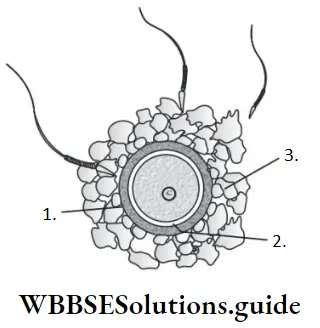
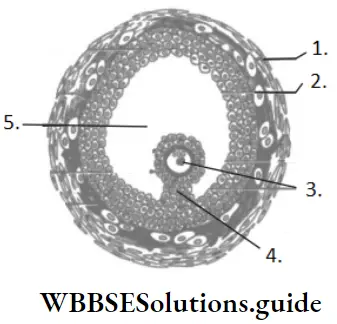
Question 49. The given diagram refers to ovum surrounded by few sperms. Identify A, B and C in the diagram.

NEET Biology Fertilisation And Implantation Question 49 Few Sperms

  1. A–Zona pellucida, B–Perivitelline space, C–Corona reticulata
  2. A–Zona pellucida, B–Vitelline membrane, C–Theca internal
  3. A–Zone pellucida, B–Perivitelline space, C–Corona radiata
  4. A–Oolemma, B–Perivitelline space, C–Corona radiata

Answer:  3. A–Zone pellucida, B–Perivitelline space, C–Corona radiata

Question 50. A layer of cortical granules is found beneath the

  1. Zona pellucida
  2. Fertilisation core
  3. Plasma membrane
  4. Hyaline layer

Answer: 3. Plasma membrane

The cortical granules are present beneath the egg’s plasma membrane. They release chemical substance between the ooplasm and plasma membrane.

Question 51. For entering the ovum, the sperm penetrates the corona radiata and zona pellucida with the help of

  1. Mucopolysaccharide in these layers
  2. Hyaluronic acid
  3. Enzymes released by ovum
  4. Zona lysin

Answer:  4. Zona lysin

Zona lysins are proteolytic enzymes that are capable of degenerating the zona pellucida. It enables the passage for sperm cells through the ovum.

Question 52. The granules present beneath the plasma membrane of oocyte cells are called …A… .These granules fuse with the plasma membrane of oocyte and release their content including … B … between the …C… and zona pellucida. This ensures the …D… . Here A, B, C and D refer to

  1. A–monospermy, B–plasma membrane, C–cortical enzyme, D–cortical granules
  2. A–cortical granule, B–cortical enzyme, C–plasma membrane, D–monospermy
  3. A–cortical enzyme, B–cortical granules, C–plasma membrane, D–monospermy
  4. A–cortical enzyme, B–cortical granules, C–monospermy, D–plasma membrane

Answer:  2.  A–cortical granule, B–cortical enzyme, C–plasma membrane, D–monospermy.

Question 53. The fertilisation membrane during fertilisation is synthesised by

  1. Mitochondria Rajasthan
  2. Golgi bodies
  3. Acid mucopolysaccharides of cortical granules
  4. All of the above

Answer:  3.  Acid mucopolysaccharides of cortical granules

During fertilisation process, the fertilisation membrane is synthesised by acid mucopolysaccharides of cortical granules.

Question 54. Why does fertilisation not occur during pregnancy?

  1. Secretion of high levels of oestrogen and progesterone
  2. Woman cannot have intercourse during pregnancy
  3. High level of HCl kills the ovum
  4. An abnormal ovum is released during pregnancy

Answer:  1. Secretion of high levels of oestrogen and progesterone

During pregnancy, high levels of progesterone and oestrogen are secreted that inhibit the release of follicular stimulating hormones. Therefore, ovulation does not occur and thereby, pregnancy is prevented.

Question 55. Just after fertilisation, the first change is

  1. Formation of grey crescent
  2. Activation of egg
  3. Formation of receptacle cone
  4. Cortical reaction

Answer:  2. Activation of egg

The entry of sperm stimulates the secondary oocyte to complete meiosis-II. It is called egg activation. Thus, just after fertilisation, the first change is activation of egg.

Question 56. Formation of activation calyx in the egg takes place

  1. Before fertilisation
  2. After fertilisation
  3. At the time of cleavage
  4. At the time of amphimixis

Answer:  2. After fertilisation

After fertilisation, structural proteins derived from the contents of the cortical granules of egg harden the vitelline membrane and transform it into the fertilisation membrane (envelope) or activation calyx and prevent the entry of other sperms. It is a slow method to prevent polyspermy.

Question 57. Meiotic division of the secondary oocyte is completed

  1. Time of copulation
  2. After zygote formation
  3. At the time of fusion of a sperm with an ovum
  4. Prior to ovulation

Answer:  3. At the time of fusion of a sperm with an ovum

Meiotic division of secondary oocyte is completed after the entry of sperm in secondary oocyte, which lead to the formation of a large ovum and a tiny 2nd polar body.

Question 58. Extrusion of second polar body from egg nucleus occurs

  1. After entry of sperm, but before fertilisation
  2. After fertilisation
  3. Before entry of sperm into ovum
  4. Simultaneously with first cleavage

Answer:  1. After entry of sperm, but before fertilisation

Extrusion of second polar body from egg nucleus occurs after the entry of sperm, but before fertilisation. The entry of sperm into the ovum induces completion of the meiotic division of the secondary oocyte. Entry of sperm causes breakdown of Metaphase Promoting Factor (MPF) and turns on the Anaphase Promoting Complex (APC).

Question 59. In human zygote, the male sex is determined by which of the following criteria?

  1. Mother gets good nutrition
  2. Father is stronger than mother
  3. Strength of male chromosome
  4. Required composition of chromosomes

Answer:  4.  Required composition of chromosomes

In a human zygote, male sex is determined by the required composition of chromosomes, i.e. ‘X’ and ‘Y’. Male sex is denoted by XY and female sex is denoted by XX chromosomes.

NEET Biology Mcq

Question 60. The number of autosomes in human female ovum is

  1. 11 pairs
  2. 12 pairs
  3. 22
  4. 23

Answer:  3. 22

A normal human female ovum has 22 autosomes and one sex chromosome. Thus, it contains haploid set or 23 chromosomes.

Question 61. In man, sperms contain autosomes and

  1. Only Y-chromosome
  2. Only X-chromosome
  3. Either X or Y-chromosomes
  4. Both X and Y-chromosomes

Answer:  3. Either X or Y-chromosomes

The sperms contain haploid set of chromosomes, i.e. 22 autosomes and either X or Y chromosomes, so that the total number of chromosomes is 23.

Question 62. Freshly released human egg has

  1. One Y-chromosome
  2. One X-chromosome
  3. Two X-chromosomes
  4. One X-chromosome and one Y-chromosome

Answer:  2. One X-chromosome

Human female has two X chromosomes. When eggs are formed through meiosis, each egg carries 22 autosomes and one X chromosome, i.e. the haploid set of chromosomes, 23.

Question 63. Identify the sex of baby A, B, C and D.

NEET Biology Fertilisation And Implantation Question 63 Sex Of Baby

  1. A–Girl, B–Boy, C–Girl, D–Boy
  2. A–Boy, B–Girl, C–Boy, D–Girl
  3. A–Boy, B–Boy, C–Girl, D–Girl
  4. A–Girl, B–Girl, C–Boy, D–Boy

Answer: 1. A–Girl, B–Boy, C–Girl, D–Boy

Number of autosomes in both male and female is same, i.e. 44 or 22 pairs. Sex chromosomes in female is XX and in male is XY. Thus, in the given diagram, 44 + XX–Girl (A and C), 44 + XY–Boy (B and D)

Question 64. Assertion In humans, the gamete contributed by the male determines whether the child produced will be male or female. Reason (R) Sex in humans is a polygenic trait, depending upon a cumulative effect of some genes on X-chromosome.

  1. Both A and R are true and R is the correct explanation of A
  2. Both A and R are true, but R is not the correct explanation of A
  3. A is true, but R is false
  4. Both A and R are false

Answer:  3. A is true, but R is false

A is true, but R is false. In humans, the gametes contributed by male determines the sex of a child. Reason can be corrected as Sex in humans is a polygenic trait, depending upon a cumulative effect of some genes present on Y-chromosome and not on X-chromosome.

Question 65. The cell division that takes place in a zygote is known as

  1. Meiosis
  2. Mitosis
  3. Cleavage
  4. Differentiation

Answer:  3. Cleavage

Cleavage is the division that takes place in a zygote.

Question 66. Type of cleavage in fertilised egg depends on

  1. Amount of yolk
  2. Number of cells
  3. Number of mitochondria in the sperm
  4. Number of testes

Answer:  1. Amount of yolk

The rate and nature of cleavage is much affected by the factors like light, temperature, medium, amount of yolk, cytoplasmic organisation, mitosis, etc.

Question 67. Consider the following statements.

  1. During cleavage, all divisions are meiotic.
  2. Cleavage occurs two hours after fertilisation.

Choose the correct option.

  1. Statement 1 is correct, but 2 is incorrect
  2. Statement 1 is incorrect, but 2 is correct
  3. Both statements 1 and 2 are correct
  4. Both statements 1 and 2 are incorrect

Answer:  4. Both statements 1 and 2 are incorrect

Both statements 1 and 2 are incorrect and can be corrected as Mitotic division takes place at the time of cleavage. It produces unequal cells. It occurs about 30 hours after fertilisation.

NEET Biology Mcq

Question 68. In human, cleavage is

  1. Slow and synchronous
  2. Fast and synchronous
  3. Slow and asynchronous
  4. Fast and asynchronous

Answer:  1. Slow and asynchronous

Cleavage in human is slow and synchronous. Cleavage in mammalian ovum takes place during its passage through the Fallopian tube to the uterus.

Question 69. Cleavage is a unique form of mitotic cell division in which

  1. There is no growth of cells
  2. No spindle develops to guide the cells
  3. The nucleus does not participate
  4. The plasma membranes of daughter cells do not separate

Answer: 1. There is no growth of cells

Cleavage division does not bring any appreciable increase in the mass of protoplasm in the developing embryo. Cells do not grow in size during cleavage.

Question 70. Meroblastic cleavage refers to which type of division of eggs?

  1. Incomplete
  2. Total
  3. Horizontal
  4. Spiral

Answer:  1. Incomplete

In meroblastic cleavage, segmentation line does not pass through the egg and remain confined to a part of the egg. Thus, it is an incomplete cleavage.

Question 71. What is true for cleavage?

  1. Size of embryo increases
  2. Size of cells decreases
  3. Size of cells increases
  4. Size of embryo decreases

Answer:  2. Size of cells decreases

Option is true. Immediately after fertilisation, the fertilised ovum undergoes a series of cell division in close succession. These divisions are cleavage divisions. The cell size decreases during cleavage. Rest options are not true for cleavage.

Question 72. If the first cleavage furrow divides the zygote completely into, the cleavage type is

  1. Radial
  2. Equatorial
  3. Meroblastic
  4. Holoblastic

Answer:  4. Holoblastic

The complete division of an isolecithal or microlecithal egg into blastomeres is called holoblastic cleavage. In such cleavage, furrow divides the cell completely in two halves.

Blastocyst Formation and Implantation Process MCQs for NEET

Question 73. Holoblastic cleavage may occur in eggs which are

  1. Oligolecithal only
  2. Mesolecithal only
  3. Microlecithal only
  4. Both oligolecithal and mesolecithal

Answer:  3. Microlecithal only

Holoblastic cleavage occurs in microlecithal eggs. The blastomeres formed by holoblastic cleavage may be equal or unequal in size.

Question 74. Assertion Holoblastic cleavage with almost equal-sized blastomeres is a characteristic of placental animals. Reason (R) Eggs of most mammals, including human are of centrolecithal type.

  1. Both A and R are true and R is the correct explanation of A
  2. Both A and R are true, but R is not the correct explanation of A
  3. A is true, but R is false
  4. Both A and R are false

Answer:  3. A is true, but R is false.

Holoblastic cleavage is found in the eggs, which are microlecithal (little yolk). In such eggs, the cleavage is complete and thus, it is called holoblastic cleavage. Reason can be corrected as Human eggs are microlecithal not centrolecithal.

Question 75. What is true about cleavage in the fertilised egg in humans?

  1. It starts while the egg is in Fallopian tube
  2. It starts when the egg reaches uterus
  3. It is meroblastic
  4. It is identical to the normal mitosis

Answer:  1. It starts while the egg is in Fallopian tube

  • Option is true about cleavage in the fertilised egg in human. Cleavage in the mammalian zygote occurs during its passage through the Fallopian tube to the uterus. Rest options are not true and can be corrected as Cleavage in humans is holoblastic.
  • Cleavage is not identical to mitosis because in former, size of daughter cells decreases but in latter daughter cells are identical to parent cells.

Question 76. The organelles of the sperms that play an important role in the first cleavage of the zygote after syngamy is

  1. Mitochondria
  2. Golgi bodies
  3. Centriole
  4. Head

Answer:  3. Centriole

In the neck of human sperm, one pair of centriole is present. They also enter with nucleus in the ovum. Rest of sperm is left behind. The first division in zygote takes place due to centrioles. They form spindle fibre for first cell division.

NEET Biology Mcq Chapter Wise

Question 77. Which organelle of the sperm plays an important role in first cleavage of zygote?

  1. Distal centriole
  2. Proximal centriole
  3. Axial filament
  4. Mitochondria

Answer:  2.  Proximal centriole

Proximal centriole plays an important role in first cleavage of the zygote. The distal centriole degenerates whereas mitochondria and axial filament do not enter the ovum.

Question 78. Select the correct statement?

  1. Cleavage follows gastrulation
  2. Yolk content of egg has no role in cleavage
  3. Cleavage is repeated mitotic division of zygote
  4. Gastrulation and blastulation are followed by each other

Answer:  3. Cleavage is repeated mitotic division of zygote

  • Statement in option is correct. Cleavage is repeated mitotic cell divisions that increase the number of cells, but does not change the size of the original mass of zygote.
  • Other statements are incorrect and can be corrected as Cleavage follows fertilisation and the type of cleavage depends upon the amount of yolk present in cell. In the events of fertilisation, blastulation is followed by gastrulation.

Question 79. During second cleavage,

  1. Division is vertical at right angles to the first division
  2. Division is horizontal at right angles to the first division
  3. Two blastomeres divide resulting into four-celled stage
  4. Both 1 and 2

Answer:  4. Both 1 and 2

The second cleavage occurs within forty hours after fertilisation .It occurs vertically at right angles to the plane of the first, resulting in four blastomeres. Thus, option is correct.

Question 80. The cells formed by cleavage are called

  1. Blastocysts
  2. Blastomeres
  3. Morula
  4. Trophoblast

Answer:  2. Blastomeres

The cells formed by cleavage are called blastomeres.

Question 81. Cleavage converts zygote into a mass of cells called

  1. Blastomere
  2. Blastula
  3. Gastrula
  4. Morula

Answer:  4. Morula

Cleavage converts zygote into a mass of cells called morula. Morula is a solid ball of cells resulting from the division of zygote.

Question 82. Cleavage continues up to

  1. Blastula
  2. Morula
  3. Gastrula
  4. Implantation

Answer:  2. Morula

Cleavage continues up to morula stage in humans. After this, other events of embryonic development begin to occur, e.g. blastulation, formation of germ layer, organogenesis, etc.

Question 83. Embryo at 8-16 cell stage is called

  1. Blastula
  2. Morula
  3. Trophoblast
  4. All of these

Answer:  2. Morula

Embryo at 8 to 16 stages is called morula stage of embryo.

Question 84. Which one of the following statements about morula in humans is correct?

  1. It has almost equal quantity of cytoplasm as an uncleaved zygote, but with much more DNA
  2. It has far less cytoplasm as well as less DNA than in an uncleaved zygote
  3. It has more or less equal quantity of cytoplasm and DNA as in uncleaved zygote.
  4. It has more cytoplasm and more DNA than an uncleaved zygote

Answer:  1. It has almost equal quantity of cytoplasm as an uncleaved zygote, but with much more DNA

Statement in option is correct. During cleavage, growth of blastomeres does not occur. Repeated divisions increase the DNA content but increase in the amount of cytoplasm does not occur. Thus, morula has almost equalquantity of cytoplasm as an uncleaved zygote, but with much more DNA. Rest statements are not correct about morula in humans.

Question 85. Consider the  following statements.

  1. In morula stage, the cell divides without increase in size.
  2. Zona pellucida disappears before the cleavage starts.

Choose the correct option.

  1. Statement 1 is correct, but 2 is incorrect
  2. Statemen t 1 is incorrect, but 2 is correct
  3. Both statements 1 and 2 are correct
  4. Both statements 1 and 2 are incorrect

Answer:  1. Statement 1 is correct, but 2 is incorrect.

Incorrect statement can be corrected as The zygote is covered by zona pellucida, which remains intact till the end of the cleavage.

NEET Biology Mcq Chapter Wise

Question 86. The mulberry-shaped stage of embryo is called

  1. Morula
  2. Gastrula
  3. Blastula
  4. Blastomere

Answer:  1. Morula

The fourth cleavage division in embryo results in the formation of 16 celled mulberry-shaped solid mass of cells termed morula

Question 87. Rearrangement of blastomere and formation of central fluid-filled cavity in the morula is called

  1. Blastulation
  2. Morulation
  3. Gastrulation
  4. None of these

Answer:  1. Blastulation

Blastulation is the formation of a blastula from a morula. The morula is an embryo filled evenly with cells (blastomeres), but the blastula contains a fluid-filled cavity called blastocoels.

Question 88. Blastulation starts in the

  1. Ovaries
  2. Fallopian tubes
  3. Uterus
  4. Vagina

Answer:  3. Uterus

Blastulation starts inside the uterus after the completion of cleavage.

Question 89. Select human developmental stages and its place of occurrence in normal pregnant woman.

  1. Late morula –Middle part of Fallopian tube
  2. Blastula–End part of Fallopian tube
  3. Blastocyst–Uterine wall
  4. 8-celled morula–Starting point of Fallopian tube

Answer:  3.  Blastocyst–Uterine wall

In a pregnant woman, blastocyst attaches to the uterine wall. Other options represent incorrect place of occurrence of given stages. These can be corrected as Late morula – End part of Fallopian tube Blastula – Uterus 8-celled morula – Middle-end point of Fallopian tube

Question 90. Identify A and B in the figure.

NEET Biology Fertilisation And Implantation Question 90

  1. A–Blastocyst, B–Blastomere
  2. A–Blastula, B–Plasma membrane
  3. A–Blastomere, B–Zona pellucida
  4. A–Zona pellucida, B–Blastomere

Answer:  3. A–Blastomere, B–Zona pellucida

Question 91. Zona pellucida disintegrates at

  1. Morula stage
  2. Blastula stage
  3. After fertilisation
  4. Gastrula stage

Answer:  2. Blastula stage

Zona pellucida is glycoprotein layer surrounding the plasma membrane of the ovum. It disintegrates at the blastula stage.

Question 92. Assertion Zona pellucida does not disappear when blastocyst reaches the uterus. Reason (R) Role of zona pellucida is to check the implantation of the blastocyst at the vaginal site.

  1. Both A and R are true and R is the correct explanation of A
  2. Both A and R are true, but R is not the correct explanation of A
  3. A is true, but R is false
  4. Both A and R are false

Answer:  4. Both A and R are false

Both A and R are false and can be corrected as Zona pellucida disappears when blastocyst reaches to the uterus and check the implantation of blastocyst at the uterine wall.

Question 93. Assertion Twins may arise from a single egg or from two eggs. Reason (R) One egg gives rise to identical twins by the separation of blastomeres and two eggs produces non-identical twins.

  1. Both A and R are true and R is the correct explanation of A
  2. Both A and R are true, but R is not the correct explanation of A
  3. A is true, but R is false
  4. Both A and R are false

Answer:  1. Both A and R are true and R is the correct explanation of A.

Twins are of two types Identical twins (maternal twins) One egg gives rise to identical twins by complete separation of blastomere. Non-identical twins (paternal twins) Two eggs fertilised by two sperms form non-identical twins

Question 94. Identical twins are also known as

  1. Monozygotic twins
  2. Dizygotic twins
  3. Fraternal twins
  4. Both 1 and 2

Answer:  1. Monozygotic twins

Identical twins or monozygotic twins are two individuals that develop from a single fertilised egg cell (zygote) by its division into two genetically identical parts. Each part eventually gives rise to a separate individual and these twins are therefore, identical in every respect.

Question 95. The structure which differentiate gastrula from blastula

  1. 3 germ layers
  2. Micromeres
  3. Blastocoel
  4. None of the above

Answer:  1. 3 germ layers

In triploblastic organisms, the gastrula is trilaminar (three – layered) structure. Thus, the structure of three germ layers differentiates the gastrula from blastula.

Question 96. The process of gastrulation begins soon after blastulation and ends with the

  1. Formation of three germinal layers
  2. Formation of organs
  3. Formation of gut
  4. Development of heart

Answer:  1. Formation of three germinal layers

During gastrulation, the blastula transforms and the cells begin to manifest their different fates. By the end of gastrulation, three different germ layers are formed namely, ectoderm, mesoderm and endoderm.

Question 97. During gastrulation, the blastocoel is replaced

  1. Archenterone
  2. Pseudocoelom
  3. Coelom
  4. None of these

Answer:  1. Archenterone

  • Gastrulation is the rearrangement of cells that are already present in blastula. On the dorsal side of the blastula, some blastomeres invaginate on the grey crescent and form a slit or groove. This groove forms an archenterone cavity.
  • The outer of archenterone is the blastopore and its upper margin is the dorsal lip of blastopore. So, the blastocoel is replaced by archenterone during gastrulation.

NEET Biology Mcq Chapter Wise

Question 98. The 32 cell stage of the human embryo is

  • Smaller than the fertilised egg
  • Same size as the fertilised egg
  • Two times the size of the fertilised egg
  • Four times the size of the fertilised egg

Answer:  2. Same size as the fertilised egg

In human embryo , the 32-celled stage is of same size as the fertilised egg.

Question 99. Which is the correct sequence in the development of man?

  1. Fertilisation → Zygote → Cleavage → Morula → Blastula → Gastrula
  2. Zygote → Morula → Blastula → Differentiation
  3. Fertilisation → Cleavage → Gastrula → Morula → Blastula
  4. Cleavage → Zygote → Blastula → Morula → Gastrula

Answer:  1. Fertilisation → Zygote → Cleavage → Morula → Blastula → Gastrula

The correct sequence in the development of man is Fertilisation → Zygote → Cleavage → Morula → Blastula → Gastrula Thus, option is correct.

Question 100. Which is a nutritive membrane?

  1. Trophoblast
  2. Embryonal knob
  3. Mesoderm
  4. Ectoderm

Answer:  1. Trophoblast

Trophoblasts cells form the outer layer of a blastocyst. They provide nutrients to the embryo. Thus, trophoblast is known as nutritive membrane.

Question 101. The cells of the trophoblast in contact with inner mass of cells are called

  1. Cells of embryo
  2. Cells of Rauber
  3. Cells of organogenesis
  4. Cells of blastula

Answer:  2. Cells of Rauber

Cells of Rauber are the cells of trophoblast in contact with inner mass of cells over the embryonic disc.

Question 102. The formative movements that take place during gastrulation are

  1. Invagination and involution
  2. Epiboly and emboly
  3. Invagination and ingression
  4. Ingression and delamination
  5. Only involution

Answer:  2. Epiboly and emboly

Epiboly is a cell movement that occurs in the early embryo at the same time as gastrulation. It is one of many movements in the early embryo. Emboly means the insertion of cells. It is a type of morphogenetic movement that occurs during gastrulation.

Question 103. Ingression is defined as

  1. The rolling movement of meso and endodermal cells
  2. Overgrowth of meso on the endodermal
  3. Detachment of meso and endodermal cells in groups
  4. None of the above

Answer:  4. None of the above

Ingression involves the separation of mesoderm from ectoderm and segregation of these two primary germ layers.

Question 104. Study the figure given below. Identify the option that correctly describes the A, B and the function ofA and B, repectively.

NEET Biology Fertilisation And Implantation Question 104

  1. A–Trophoblast gets attach to the endometrium, B–Inner cell mass differentiated as embryo
  2. A–Inner cell mass gets attach to the endometrium, B–Trophoblast differentiated as embryo
  3. A–Trophoblast mass differentiated as embryo, B–Inner cell gets attach to the endometrium
  4. A–Ectoderm differentiated as embryo, B–Endoderm gets attach to the endometrium

Answer:  1. A–Trophoblast gets attach to the endometrium, B–Inner cell mass differentiated as embryo

Option correctly describe A and B and their respective functions. In the given diagram, A is trophoblast which attaches to endometrium and B is inner cell mass which differentiates as embryo. Rest options are incorrect.

Question 105. Inner mass of cell gives rise to

  1. Foetal part
  2. Embryo
  3. Notochord
  4. All of the above

Answer:  2. Embryo

The trophoblast encircles the blastocoel and inner mass cell. The inner mass cell is the precursor of the embryo. It means that inner mass gives rise to embryo.

Question 106. In the process of implantation, the blastocyst begins to attach to

  1. Inner walls of the mesosalpinx
  2. Endometrium of ovary
  3. Endometrium of the uterus
  4. Myometrium of the uterus

Answer:  3.  Endometrium of the uterus

Implantation is a process in which a developing embryo, moving as a blastocyst through a uterus, makes contact with the endometrium of the uterus and remains attached to it until birth.

Question 107. After what time duration does the fertilised ovum transplant in the uterus?

  1. 6 days
  2. 9 days
  3. 14 days
  4. 7 days

Answer:  4. 7 days

Fertilised ovum is transplanted in the uterus 7 days after the fertilisation.

Question 108. During implantation, level of which hormone is highest?

  1. Oestrogen
  2. Progesterone
  3. LH
  4. FSH

Answer:  2. Progesterone

Progesterone stimulates the proliferation of endometrium of uterus and prepares it for implantation. Thus, its level is the highest during implantation.

Question 109. Which of the following is a correct sequence in human embryodevelopment?

  1. Cleavage → Gastrulation →Blastulation
  2. Blastulation → Cleavage → Gastrulation
  3. Cleavage → Blastulation → Gastrulation
  4. Gastrulation → Blastulation → Cleavage

Answer:  3. Cleavage → Blastulation → Gastrulation

The correct sequence in human embryo development is Cleavage → Blastulation → Gastrulation. Thus, option is correct.

Question 110. Termination of gastrulation is marked by

  1. Obliteration of archenteron
  2. Closure of neural tube
  3. Obliteration of blastocoel
  4. Closure of blastocoel

Answer:  3. Obliteration of blastocoel

Gastrulation starts with the morphogenetic movements of cells of gastrula and terminates with the complete obliteration of cavity of blastula, i.e. blastocoel.


NEET Biology  Gametogenesis Multiple Choice Question And Answers

Gametogenesis or Gametogenesis MCQs

Question 1. The first phase in the sexual reproduction of organism is

  1. Spermatogenesis
  2. Ovulation
  3. Oogenesis
  4. Gametogenesis

Answer:  4. Gametogenesis

Gametogenesis is the first phase in sexual reproduction of organisms.

Question 2. The process of formation of gametes from primordial germ cells of gonad is called

  1. Gametogenesis
  2. Spermatogenesis
  3. Spermatocytogenesis
  4. Oogenesis

Answer:  1. Gametogenesis

Read And Learn More: NEET Biology Multiple Choice Question And Answers

Gametogenesis is the process of formation of male and female sex cells from primordial germ cells of gonad. It occurs by the division of diploid gametocytes into various gametes.

Question 3. Germ cells in mammalian gonads are produced by

  1. Only mitosis
  2. Only meiosis
  3. Both mitosis and meiosis
  4. Without cell division

Answer:  3. Both mitosis and meiosis

Gametogenesis involves both mitosis and meiosis, so as to produce the germ cells in mammalian gonads.

spermatogenesis takes place in

Question 4. Which is not associated with gametogenesis?

  1. Formation of ova
  2. Formation of spermatid
  3. Release of ova
  4. Change of spermatids to spermatozoa

Answer:  3. Release of ova

Gametogenesis is the process of formation of gametes in sexually reproducing organisms. Release of ova is not associated with it.

NEET Biology Gametogenesis MCQs with Answers

Question 5. In spermatogenesis, a primary spermatocyte produces four similar sperms while in oogenesis, a primary oocyte forms

  1. Four similar ova
  2. Three large ova and one polar body
  3. Two large ova and two polar bodles
  4. One large ovum and two polar bodies

Answer:  4. One large ovum and two polar bodies

Four haploid sperms are produced in the process of spermatogenesis whereas in oogenesis, primary oocyte forms one large ovum and two polar bodies.

Gametogenesis Class 12

NEET Biology Gametogenesis Multiple Choice Question And Answers

Gametogenesis NEET Biology Important Question

Question 6. How many ova and sperms would be produced from 100 secondary oocytes and 100 secondary spermatocytes during gametogenesis in humans?

  1. 100 ova, 100 sperms
  2. 100 ova, 200 sperms
  3. 50 ova, 100 sperms
  4. 200 ova, 200 sperms

Answer:  2. 100 ova, 200 sperms

One secondary oocyte produce one ovum and one secondary spermatocyte produces 2 sperms. Thus, 100 secondary oocytes would produce 100 ova and 100 secondary spermatocytes would produce 200 sperms.

Question 7. How many sperms and ova will be produced from 20 primary spermatocytes and 20 primary oocytes?

  1. 80 sperms and 80 ova
  2. 80 sperms and 40 ova
  3. 80 sperms and 20 ova
  4. 20 sperms and 20 ova

Answer:  3. 80 sperms and 20 ova

One primary spermatocyte gives rise to four sperms and one primary oocyte give rise to one ovum. Thus, 80 sperms would be produced from 20 primary spermatocytes and 20 ova would be formed from 20 primary oocytes.

Question 8. The process of maturation of reproductive cells of testes in male so as to form the male gamete or sperm is known as

  1. Spermatogenesis
  2. Gametogenesis
  3. Ogenesis
  4. None of the above

Answer:  1. Spermatogenesis

Spermatogenesis is the process of formation of haploid spermatozoa from diploid germinal cells in seminiferous tubules.

Question 9. Spermatogenesis takes place in

  1. Epididymis
  2. Seminiferous tubules
  3. Vasa deferentia
  4. Penis

Answer:  2. Seminiferous tubules

Spermatogenesis takes place inside the seminiferous tubules that are present within the testes.

Question 10. Find the odd one out.

  1. Spermatocyte
  2. Polar body
  3. Spermatid
  4. Spermatogonium

Answer:  2. Polar body

Polar body is formed during oogenesis whereas other three structures are formed during spermatogenesis.

spermatogenesis takes place in

Question 11. How many days do it take for spermatogenesis to take place?

  1. 40 to 65 days
  2. 60 to 75 days
  3. 70 to 95 days
  4. 50 to 65 days

Answer:  2. 60 to 75 days

The whole process of spermatogenesis takes about 60- 75 days. In humans, spermatocyte maturation takes 23.5 days, spermiogenesis takes 21.6 days and the total estimated time for spermatogenesis is approximately 74 days

Gametogenesis Class 12

Question 12. Consider the following statements.

  1. Primary and secondary spermatocytes contain diploid number of chromosomes.
  2. Spermatids contain haploid set of chromosomes.

Choose the corect option.

  1. Statement 1 is correct, but 2 is incorrect
  2. Statement 1 is incorrect, but 2 is correct
  3. Both statements 1 and 2 are correct
  4. Both statements 1 and 2 are incorrect

Answer:  2. Statement 1 is incorrect, but 2 is correct

Statement 1 is incorrect, but 2 is correct. Incorrect statement can be corrected as Primary spermatocytes have diploid set of chromosomes. Secondary spermatocytes and spermatids have haploid set of chromosomes.

Question 13. Spermatogenesis is promoted by

  1. Oestrogen
  2. Progesterone
  3. Testosterone
  4. Oxytocin

Answer:  3. Testosterone

The process of formation of spermatozoa from spermatogenic cells is called spermatogenesis. Testosterone promotes the process of spermatogenesis.

NEET Biology Gametogenesis Practice Questions

Question 14. From the labels given in the diagram below, identify ‘Spermatid and Sertoli cell, Spermatogonium and Spermatozoa’, respectively.

NEET Biology Gametogenesis Question 14 Spermatogonium And Spermatozoa

  1. D and E, A and C
  2. E and F, A and B
  3. A and C, B and E
  4. B and E, F and A

Answer:  4. B and E, F and A

Spermatid –B Sertoli cell–E Spermatogonium–F Spermatozoa–A

Gametogenesis Class 12

Question 15. Given below diagram refers to the TS of testis showing few seminiferous tubules.

NEET Biology Gametogenesis Question 15 Seminiferous Tubules

A, B, C, and D in the above figure represent.

  1. A–Sertoli cells, B–Secondary spermatocyte, C–Interstitial cells, D–Sperms
  2. A–Interstitial cells, B–Spermatogonia, C–Sertoli cells, D–Sperms
  3. A–Sertoli cells, B–Spermatozoa, C–Interstitial cells, D–Sperms
  4. A–Sertoli cells, B–Spermatogonia, C–Interstitial cells, D–Sperms

Answer:  4. A–Sertoli cells, B–Spermatogonia, C–Interstitial cells, D–Sperms

A–Sertoli cells, B–Spermatogonia, C–Interstitial cells, D–Sperms

Question 16. Germinal cell in the testes is known as

  1. Primordial cells
  2. Primary spermatocytes
  3. Spermatogonium
  4. Spermatozoan

Answer:  1. Primordial cells

The primordial cell is called as germinal cells in the testis. These are cuboidal cells that give rise to sperms.

spermatogenesis takes place in

Question 17. Which cells are formed earliest in the sequence of sperm production?

  1. Spermatozoa
  2. Spermatocyte
  3. Spermatid
  4. Spermatogonia

Answer:  4. Spermatogonia

In the sequence of spermatogenesis, spermatogonia is formed earliest. Spermatogonia → Primary spermatocytes → Secondary spermatocytes → Spermatocytes → Spermatozoa.

Question 18. In spermatogenesis, the phase of maturation involves

  1. The growth of spermatogonia into primary spermatocyte
  2. The formation of spermatogonia from gonocytes through mitosis
  3. The formation of spermatids from primary spermatocytes through meiosis
  4. The formation of oogonia from the spermatocytes through meiosis

Answer:  3. The formation of oogonia from the spermatocytes through meiosis

In the maturation phase of spermatogenesis, spermatids are formed from primary spermatocytes through meiosis.

Question 19. Spermatogonia are formed after which cell division?

  1. Meiosis-I
  2. Meiosis-2
  3. Mitosis
  4. Amitosis

Answer:  3. Amitosis

Spermatogonia are formed after mitotic (or mitosis) cell division of undifferentiated primordial germ cell.

Mcqs On Gametogenesis

Question 20. Spermatogonia undergo a growth phase to become

  1. Primary spermatocyte
  2. Secondary spermatocyte
  3. Spermatid
  4. Spermatozoa

Answer: 1. Primary spermatocyte

Formation of primary spermatocyte is called spermatocytogenesis. It occurs during growth phase, involving the growth of spermatogonia.

Question 21. Primary spermatocytes differ from spermatogonium in

  1. Number of chromosomes
  2. Size and volume
  3. DNA content
  4. Size of chromosome

Answer:  2. Size and volume

During spermatogenesis, one of the spermatogonium enlarges in size and volume and is called primary spermatocytes. Both spermatogonium and primary spermatocyte are diploid (2n). Thus, primary spermatocytes possess more volume and size as compared to spermatogonium.

Question 22. During spermatogenesis, the first meiotic division is observed in

  1. Sertoli cells
  2. Spermatids
  3. Spermatozoans
  4. Primary spermatocytes
  5. Secondary spermatocytes

Answer:  4. Primary spermatocytes

The first maturation division during spermatogenesis occur in primary spermatocytes. It is reductional or meiotic division. Hence, the primary spermatocyte divides into two haploid daughter cells called secondary spermatocytes.

Question 23. Sperms formed from 4 primary spermatocytes are

  1. 4
  2. 1
  3. 16
  4. 32

Answer:  3. 16

Spermatogenesis is the formation of sperms or spermatozoa from a germ cell. Four spermatozoa are produced from a primary spermatocyte, therefore, 16 spermatozoa will be formed from four primary spermatocytes.

Question 24. In spermatogenesis, reduction division of chromosome occurs during the conversion of

  1. Spermatogonia to primary spermatocytes
  2. Primary spermatocytes to secondary spermatocytes
  3. Secondary spermatocytes to spermatids
  4. Spermatids to sperms

Answer:  2. Primary spermatocytes to secondary spermatocytes

In spermatogenesis, reduction division or meiosis I occurs during the conversion of primary spermatocytes to secondary spermatocytes.

Mcqs On Gametogenesis

Question 25. 2 16n = in a primary spermatocyte, which is in metaphase of first meiotic division. What shall be the total number of chromatids in each of the secondary spermatocyte?

  1. 16
  2. 24
  3. 32
  4. 8

Answer:  1. 16

The total number of chromatids in each of the secondary spermatocytes is 16 because it contains 8 chromosomes, having two chromatids each.

Question 26. Which of the following statements is wrong?

  1. Sertoli cells provide nutrition to the developing male germ cells
  2. Leydig cells synthesise and secrete androgens
  3. Secretions of the acrosome helps the sperm to enter into the cytoplasm of the ovum
  4. Secondary spermatocytes are diploid
  5. The fluid filled cavity in the tertiary follicle is called antrum

Answer:  4. Secondary spermatocytes are diploid

Statement in option is wrong because secondary spermatocytes are haploid (n). Rest all statements are correct.

Question 27. In humans, at the end of the first meiotic division, the male germ cells differentiate into the

  1. Spermatids
  2. Spermatogonia
  3. Primary spermatocytes
  4. Secondary spermatocytes

Answer:  4. Secondary spermatocytes

  • During embryonic development, the primordial germ cells migrate to the testes, where they become spermatogonia.
  • At puberty, the spermatogonia proliferate rapidly by mitosis. Some undergo growth phase to become primary spermatocytes that further undergo meiotic division-I to become secondary spermatocytes.

Question 28. How many sperms are formed from a secondary spermatocyte?

  1. 4
  2. 8
  3. 2
  4. 1

Answer:  3. 2

Each secondary spermatocyte gives rise to two spermatids that undergo transformation to form two sperms. Overall, both secondary spermatocytes give rise to four sperms.

spermatogenesis takes place in

Question 29. Each secondary spermatocyte after second meiotic division produces

  1. Four haploid spermatids
  2. Only one haploid spermatid
  3. Two haploid spermatids
  4. Two diploid spermatids
  5. Four diploid spermatids

Answer:  3. Two haploid spermatids

After second meiotic division, each secondary spermatocyte produces two haploid spermatids.

Mcqs On Gametogenesis

Question 30. Consider the following statement

  1.  The immediate predecessors of spermatids are secondary spermatocytes.
  2.  Spermatids are formed after the meiotic division.

Choose the correct option.

  1. Statement I is correct, but 2 is incorrect
  2. Statement I is incorrect, but 2 is correct
  3. Both statements I and 2 are correct
  4. Both statements I and 2 are incorrect

Answer:  3. Both statements I and 2 are correct.

The spermatid is the haploid male gamete that is formed by the division of secondary spermatocyte. As a result of meiosis, each spermatid contains only half of the genetic material present in the original primary spermatocytes.

Question 31. Spermatids are transformed into spermatozoa by

  1. Spermiation
  2. Spermatogenesis
  3. Meiosis
  4. Spermatosis
  5. Spermiogenesis

Answer:  5. Spermiogenesis

Spermiogenesis is the final stage of spermatogenesis, which results in the maturation of spermatids into mature, motile spermatozoa.

Question 32. At which stage of spermatogenesis, sperms acquire their structural maturity and contain a haploid nucleus and other organelles?

  1. Spermiogenesis
  2. Maturation phase
  3. Multiplication phase
  4. Growth phase

Answer:  1. Spermiogenesis

Spermiogenesis is the process of transforming spermatids into mature sperm having haploid nucleus and other organelles.

Mcqs On Gametogenesis

Question 33. Spermioteleosis is another name of

  1. Maturation of ovum
  2. Spermiogenesis
  3. Spermatogenesis
  4. Degeneration of sperms

Answer:  2. Spermiogenesis

Spermioteleosis is also known as spermiogenesis.

Question 34. What do you mean by the term spermioteleosis ?

  1. Conversion of spermatids to sperm
  2. Conversion of spermatogonium to spermatid
  3. Conversion of spermatid to spermatogonium
  4. Conversion of primary spermatocyte to secondary spermatocyte

Answer:  1. Conversion of spermatids to sperm

Question 35. The term, ‘spermatozoan’ was coined by

  1. Von Baer
  2. Leeuwenhoek
  3. Spemann
  4. Swammerdam

Answer:  1. Von Baer

The term spermatozoan was coined by von Baer.

Question 36. In the formation of spermatozoa, the spermatids attach to

  1. Leydig cells
  2. corona radiata cells
  3. Sertoli cells
  4. First polar body

Answer:  3. Sertoli cells

The spermatids attach to the Sertoli cell during spermatogenesis because Sertoli cell produce testicular fluid, including a protein that binds to and concentrates testosterone. It is essential for the development of the spermatozoa.

Question 37. Androgen Binding Protein (ABP) is secreted by

  1. Interstitial cells
  2. Leydig cells
  3. Sertoli cell
  4. None of these

Answer:  2. Leydig cells

FSH stimulates the Sertoli cells to secrete androgen-binding protein into the lumen of seminiferous tubules.

Gametogenesis NEET Previous Year Questions with Solutions

Question 38. The difference between spermiogenesis and spermiation is

  1. In spermiogenesis, spermatids are formed, while in spermiation, spermatozoa are formed
  2. In spermiogenesis, spermatozoa are formed, while in spermiation, spermatozoa are released from Sertoli cells into the cavity of seminiferous tubules
  3. In spermiogenesis, spermatozoa from Sertoli cells are released into the Cavity of seminiferous tubules, while in spermiation spermatozoa are formed
  4. In spermiogenesis spermatozoa are formed, while in spermiation, spermatids are formed

Answer:  3. In spermiogenesis, spermatozoa from Sertoli cells are released into the Cavity of seminiferous tubules, while in spermiation spermatozoa are formed

Spermiogenesis involves transformation of spermatids so as to form spermatozoa whereas spermiation is the release of the spermotozoa from Sertoli cells into the lumen of seminiferous tubule.

Question 39. What is the correct sequence of sperm formation?

  1. Spermatogonia, spermatocyte, spermatozoa, spermatid
  2. Spermatogonia, spermatozoa, spermatocyte, spermatid
  3. Spermatogonia, spermatocyte, spermatid, spermatozoa
  4. Spermatid, spermatocyte, spermatogonia, spermatozoa

Answer: 3. Spermatogonia, spermatocyte, spermatid, spermatozoa

  • In testis, the immature male germ cells or spermatogonia (2n) multiply by mitotic division and increase in number to form primary spermatocytes (2n).
  • The latter divide meiotically to form secondary spermatocytes (n). The secondary spermatocytes undergo second meiotic division to produce spermatids (n) which gets transformed into spermatozoa (sperms) by the process called spermiogenesis.

Thus, option 3  represents correct sequence of sperm formation.

Gametogenesis Mcq With Answers

Question 40. The release of ………………… leads to initiation of spermatogenesis.

  1. GnRH
  2. lactin
  3. Testosterone
  4. oestrogen

Answer:  1. GnRH

The release of Gonadotropin Releasing Hormone (GnRH) from hypothalamus at puberty initiate spermatogenesis.

spermatogenesis takes place in

Question 41. GnRH stimulates two hormones ……… and ……… from anterior lobe of pituitary.

  1. FSH and GH
  2. FSH and LH
  3. LH and testosterone
  4. Testosterone and LH

Answer:  2. FSH and LH

GnRH stimulates the synthesis and secretion of the gonadotropins, Follicle Stimulating Hormone (FSH), and Luteinizing Hormone (LH) from the anterior lobe of pituitary gland in males to commence gametogenesis.

Question 42. Synthesis of testosterone by Leydig cells is stimulated by

  1. LTH
  2. TSH
  3. FSH
  4. ICSH

Answer:  4. ICSH

ICSH is the Luteinizing hormone. In male, it stimulates the synthesis of testosterone by Leydig cell.

Question 43. Spermatogenesis is induced by

  1. FSH
  2. ICSH
  3. STH
  4. ATH

Answer:  1. FSH

FSH (Follicle Stimulating Hormone) is secreted by anterior pituitary and it stimulates spermatogenesis in males. It stimulates Sertoli cells for the conversion of spermatids to sperms (spermiogenesis).

Question 44. The hormone which acts on Sertoli cells and stimulates the process of spermiogenesis is

  1. GnRH
  2. Androgen
  3. FSH
  4. LH

Answer:  3. FSH

FSH stimulates Sertoli cells of the testes to secrete an Androgen-Binding Protein (ABP) that concentrates testosterone in the seminiferous tubules. It helps to stimulate the process of spermiogenesis.

Gametogenesis Mcq With Answers

Question 45. Consider the following statements.

  1. The receptors for FSH and testosterone are not found on germ cells, but on Sertoli cells.
  2. In males, LH is known as ICSH.

Choose the correct option.

  1. Statement I is correct, but 2 is incorrect
  2. Statement I is incorrect, but 2 is correct
  3. Both statements I and 2 are correct
  4. Both statements I and 2 are incorrect

Answer:  3. Both statements 1 and 2 are correct.

Question 46. A boy sustains injury to his anterior pituitary even before attaining puberty. FSH is no longer released, but LH secretion is normal. What changes will be observed once he grows into an adult?

  1. He will develop secondary sex characters
  2. He will be sterile
  3. He will have improper functioning of testicular interstitial cells
  4. Both 1 and 2

Answer:  2. He will be sterile

Secondary sexual characters and functioning of testicular interstitial cells depends upon the LH and spermatogenesis depends upon FSH. Thus, after the injury to anterior pituitary the boy will be sterile due to complete absence of spermatogenesis.

Question 47. If spermatogenesis proceeds too rapidly, inhibin is released and reduces the secretion of

  1. Luteinizing Hormone (LH)
  2. Follicle Stimulating Hormone (FSH)
  3. Testosterone
  4. Interstitial Cell Stimulating Hormone (ICSH)

Answer:  2. Follicle Stimulating Hormone (FSH)

  • FSH stimulates Sertoli cells of testes to secrete an Androgen Binding Protein (ABP) that concentrates testosterone in the seminiferous tubules.
  • It also secretes a peptide hormone, inhibin which suppresses FSH synthesis and release by negative feedback effect.

Question 48.

NEET Biology Gametogenesis Question 48

Identify A and B in the above figure.

  1. FSH and GH
  2. LH and androgen
  3. GH and LH
  4. GH and lactin

Answer:  2. LH and androgen

A–LH, B–androgens

Question 49. Identify A, B, C and D hormones in the diagram below.

Gametogenesis Mcq With Answers
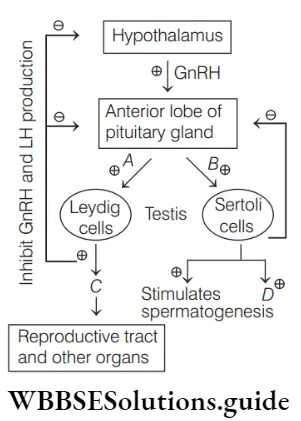
NEET Biology Gametogenesis Question 49

  1. A–Inhibin, B–FSH, C–Testosterone, D–LH
  2. A–Testosterone, B–Inhibin, C–LH, D–FSH
  3. A–FSH, B–LH, C–Inhibin,D–Testosterone
  4. A–LH, B–FSH, C–Testosterone, D–Inhibin

Answer:  4.  A–LH, B–FSH, C–Testosterone D–Inhibin

Question 50. Assertion In testis, spermatogenesis occurs in the seminiferous tubules and testosterone is secreted by Sertoli cells. Reason (R) Testosterone promotes growth and maturation of primary sex organs but has no role in accessory sex characters.

  1. Both A and R are true and R is the correct explanation of A
  2. Both A and R are true, but R is not the correct explanation A
  3. A is true, but R is false
  4. Both A and R are false

Answer:  4. Both A and R are false

Both A and R are false and can be corrected as

In testis, spermatogenesis occurs in the seminiferous tubules and testosterone is secreted by interstitial cells. Testosterone promotes growth and maturation of secondary sex organs. It also promotes the development of secondary sex characters.

Question 51. Identify A, B and C in the diagram below.

NEET Biology Gametogenesis Question 51

  1. A–Acrosome, B–Tail, C–Mitochondria
  2. A–Plasma membrane, B–Acrosome, C–Mitochondria
  3. A–Mitochondria, B–Acrosome, C–Plasma membrane
  4. A–Mitochondria, B–Plasma membrane, C–Tail

Answer:  2. A–Plasma membrane, B–Acrosome, C–Mitochondria

Gametogenesis Mcq With Answers

Question 52. Sperm is also called

  1. Male gamete
  2. Paternal gamete
  3. Male gamete sex cells
  4. All of these

Answer:  4. All of these

Sperms are also referred as male spermatozoa, or paternal gamete or simply male gamete.

Question 53. The cell organelle that is absent in human sperm is

  1. ER
  2. Mitochondria
  3. Nucleus
  4. Centriole

Answer:  1. ER

In human sperms, Endoplasmic Reticulum (ER) is absent.

Question 54. Which of the following contains the actual genetic part of a sperm ?

  1. Whole of it
  2. Tail
  3. Middle piece
  4. Head

Answer:  4. Head

Head is the main part of the sperm containing nucleus, DNA, etc. The head containing the haploid nuclei possess the genetic material.

Question 55. Sperm lysins are found in

  1. Neck region of sperm
  2. Tail region of sperm
  3. Head region of sperm
  4. Middle and tail regions of sperm

Answer:  3. Head region of sperm

Sperm lysins are found in the head region of sperm within the acrosome.

spermatogenesis takes place in

Question 56. Head of a mature sperm comprises of

  1. Elongated haploid nucleus covered by acrosomal material/cap
  2. Two centrioles and axial filament
  3. Acrosome without nucleus
  4. Mitochondrial sheath and cytoplasm

Answer:  1. Elongated haploid nucleus covered by acrosomal material/cap

The mature sperm consists of a head, middle piece and tail. The head is covered by the acrosome cap and contains a nucleus of dense genetic material comprising 23 chromosomes.

Mcq On Gametogenesis

Question 57. Acrosome of human sperm is rich in

  1. Hyaluronidase and acrosin
  2. Hyaluronic acid and acrosin
  3. Hippuric acid and uric acid
  4. Creatinine

Answer:  1. Hyaluronidase and acrosin

The acrosome of human sperm is rich in sperm lysins called hyaluronidase and acrosin.

Question 58. Acrosome of sperm is formed from

  1. Nucleus of spermatid
  2. Mitochondria of spermatid
  3. Golgi complex of spermatid
  4. Centrosome of spermatid

Answer:  3. Golgi complex of spermatid

The acrosome is a cap-like specialised structure that is derived from the Golgi complex during the maturation of the sperm.

Objective Questions on Gametogenesis for NEET

Question 59. Which one of the following statements about human sperm is correct?

  1. Acrosome has a conical pointed structure used for piercing and penetrating the egg, resulting in fertilisation
  2. The sperm lysins in the acrosome dissolve the egg envelope facilitating fertilisation
  3. Acrosome serves as a sensory structure leading the sperm towards the ovum
  4. Acrosome serves no particular function

Answer:  2. The sperm lysins in the acrosome dissolve the egg envelope facilitating fertilisation

Option is correct. Acrosome a small pointed structure at the tip of nucleus. It breaks down just Option is correct. Acrosome a small pointed structure at the tip of nucleus. It breaks down just

Question 60. Which of the following is true regarding sperm?

  1. Fertilizin–for penetrating egg membrane
  2. Hyalurodinase–for penetrating egg membrane
  3. Acrosin–dissolves corona radiata
  4. Capacitation–takes place in penis

Answer:  2. Hyalurodinase–for penetrating egg membrane

  • Option is true regarding sperm as Hyaluronidase is a hydrolytic enzyme present in the acrosome of sperm. It lyses the glycosaminoglycans in the extracellular matrix, holding the cell of the corona radiata together.
  • Thus, it helps the sperm to penetrate the egg membrane. Other options represent incorrectly matched pairs and can be corrected as Fertilizin is the receptor on ovum that is involved in species-specific fertilisation. Acrosin helps in penetrating zona pellucida and capacitation occurs in female reproductive tract.

Mcq On Gametogenesis

Question 61. Acrosome is a type of 

  1. Lysosome
  2. Flagellum
  3. Ribosome
  4. Basal body

Answer:  1. Lysosome

Acrosome is a lysosome-like organelle that is derived from the Golgi apparatus. The acrosome contains digestive enzymes (including hyaluronidase and acrosin) needed to penetrate the ovum.

Question 62. Select the incorrect statement.

  1. Nucleus of sperm contain nucleolus and chromatin
  2. Perforatorium is the narrow space between nucleus and acrosome within sperm’s head
  3. The centrioles of sperm are present at right angles to each other
  4. None of the above

Answer:  1. Nucleus of sperm contain nucleolus and chromatin

Statement in option is incorrect because the nucleus of sperm do not contain nucleoplasm and nucleolus. It is very small and contains only chromatin. Rest all statements are correct.

Question 63. Sperm releases lysozyme as it

  1. Aids in fertilisation
  2. Dissolves oocyte membrane
  3. Increases sperms motility
  4. Delays fertilisation

Answer:  1. Aids in fertilisation

The sperm releases lysozyme, which helps to dissolved egg membrane and thus, aids in fertilisation.

Question 64. A cross section at the midpoint of the middle piece of a human sperm will show

  1. Centriole, mitochondria and 9 + 2 arrangement of microtubules
  2. Centriole and mitochondria
  3. Mitochondria and 9 + 2 arrangement of microtubules
  4. 9 2+ arrangement of microtubules only

Answer:  3. Mitochondria and 9 + 2 arrangement of microtubules

  • The cross section of the sperm middle piece shows the axial bundle of microtubules or axoneme surrounded by a microtubular sheath in which the mitochondria of the spermatid have been arranged in a helical manner.
  • The microtubular structure enables the sperm to swim through the reproductive tract of the female. The microtubules are present in 9 + 2 arrangement.

Question 65. Neck of sperm contains

  1. Mitochondria
  2. Centriole
  3. lysosomes
  4. Nucleus

Answer:  2. Centriole

Neck of sperm contains two centrioles namely, proximal centriole and distal centriole.

Mcq On Gametogenesis

Question 66. Nebenkern represents

  1. Mitochondrial spiral of sperm
  2. Acrosome of sperm
  3. Centriole of sperm
  4. Tail of sperm

Answer:  1. Mitochondrial spiral of sperm

Neberkern represents the mitochondrial spiral in the middle piece of sperm.

Question 67. The ……………… gives rise to the axial filament of the sperm.

  1. Distal centriole
  2. Acrosome
  3. Proximal centriole
  4. Fibrillar sheath

Answer:  1. Distal centriole

The distal centriole gives rise to the axial filaments of the sperm. It is located away from the head of sperm, attached to the base of axoneme.

Question 68. The 9 + 2 arrangement of microtubules is found in ………….. of sperm.

  1. Head only
  2. Head and neck
  3. Tail
  4. Middle piece

Answer:  3. Tail

Among given options, the tail part of the sperm possesses 9+2 arrangement of microtubules as it is a flagellar structure.

Question 69. Except the end piece, the entire sperm is covered by

  1. Cytoplasmic membrane
  2. Tunica vaginalis
  3. Peritoneum
  4. Tunica albuginea

Answer:  1. Cytoplasmic membrane

Almost all parts of the sperm is covered by cytoplasmic membrane except the end piece.

Question 70. Which is the longest part of sperm?

  1. Head
  2. Neck
  3. Middle part
  4. Tail

Answer:  4. Tail

The tail portion is the longest part of sperm. It is a slender, hair-like bundle of filaments that connects to the head and middle piece.

Question 71. The tail of sperm consists of …………regions.

  1. Two
  2. Three
  3. Four
  4. Single

Answer:  1. Two

The tail of sperm consists of two parts Main part – cytoplasm surrounded by two fibres. End piece – axonema is present.

Question 72. Optimum temperature for sperm production is

  1. 25-30°C
  2. 40-50°C
  3. 35 -40°C
  4. 30-35°C

Answer:  4. 30-35°C

Optimum temperature for sperm production in humans is 30-35°C. It is about 2°C lower than the normal body temperature.

Question 73. Consider the following statements.

  1. Clupein protein is not found in human sperm.
  2. Clupein protein is highly basic arginine rich protein.

Choose the correct option.

  1. Statement I is correct, but 2 is incorrect
  2. Statement I is incorrect, but 2 is correct
  3. Both statements I and 2 are correct
  4. Both statements I and 2 are incorrect

Answer:  2. Statement I is incorrect, but 2 is correct.

Incorrect statement can be corrected as Clupein is a type of protein found in the human sperm.

Question 74. The fluid containing secretion of seminal vesicles, prostate gland and sperms from the testis is known as

  1. Serum
  2. Semen
  3. lymph
  4. Coelomic fluid

Answer:  2. Semen

Seminal plasma is the combined secretion of three glands named, seminal vesicles, prostate gland,  Cowper’s gland. Together with sperm, they collectively form semen.

Question 75. Human male ejaculates …A… to …B…million sperm. At least …C… should have normal shape and size and …D… should show vigorous motility.

Here A, B, C, and D refer to

  1. A–100, B–200, C–30%, D–40%
  2. A–200, B–300, C–60%, D–40%
  3. A–300, B–400, C–60%, D–40%
  4. A–400, B–500, C–60%, D–40%

Answer:  2.  A–200, B–300, C–60%, D–40%

Mcq On Gametogenesis

Question 76. Seminal plasma in humans is rich in

  1. Fructose and calcium, but has no enzymes
  2. Glucose and certain enzymes, but has no calcium
  3. Fructose and certain enzymes, but poor in calcium
  4. Fructose, calcium and certain enzymes

Answer:  4.  Fructose, calcium and certain enzymes

  • Seminal plasma in humans is rich in fructose, calcium and certain enzymes. Fructose is the source of energy for the sperm.
  • Enzymes nourish and activate the spermatozoa to swim. Calcium apparently have role in sperm motility.

spermatogenesis takes place in

Question 77. The volume of the semen released per ejaculation is ………… in man.

  1. 2-5 mL
  2. 5-8 mL
  3. 1-2 mL
  4. 6-10 mL

Answer:  1. 2-5 mL

The average volume of semen released during ejaculation is 2 to 5 mL. Volumes consistently less than 1.5 mL (hypospermia) or more than 5.5 mL (hyperspermia) are probably abnormal. Lower volumes may occur after very frequent ejaculation and higher volumes might be ejaculated after prolonged abstinence.

Question 78. Ejaculation is a …A…response. Erection is a …B…response. Identify, A and B refer to

  1. A–parasympathetic, B–sympathetic
  2. A–parasympathetic, B–parasympathetic
  3. A–sympathetic, B–parasympathetic
  4. A–sympathetic, B–sympathetic

Answer:  3.  A–Sympathetic, B–Parasympathetic.

Question 79. ……% of sperms is present in the semen.

  1. 30
  2. 50
  3. 60
  4. 10

Answer:  4. 10

The semen contains 10% of sperms of its total volume.

Question 80. Azoospermia means

  1. More than one ovum produced
  2. Unable to bear an offspring
  3. Cessation of menstruation
  4. Absence of sperm in semen

Answer:  4.  Absence of sperm in semen

Azoospermia is the medical condition in which semen does not contain sperm.

Question 81. A person is said to be suffering from infertility when the sperm cells display

  1. A count more than 120 million/mL semen
  2. Increased acrosomal activity
  3. Normal morphology
  4. Count of less than 200 million/mL semen

Answer:  4.  Count of less than 200 million/mL semen

The count of less than 200 million /mL semen signifies infertility.

Question 82. Manchette is

  1. Condensed nucleus in male cell
  2. Condensed nucleolus in male cell
  3. Condensed nucleoplasm in sperm
  4. Condensed centromere in sperm

Answer:  3.  Condensed nucleoplasm in sperm

The manchette is a transient skirt-like structure surrounding the elongating spermatid head and is only present during spermatid elongation. Manchette is condensed nucleoplasm in sperm.

Question 83. Consider the following statements.

  1. The process of ova formation is called oogenesis.
  2.  Oogenesis begins at the onset of puberty in ovaries.

Choose the correct option.

  1. Statement 1 is correct, but 2 is incorrect
  2. Statement 1 is incorrect, but 2 is correct
  3. Both statements 1 and 2 are correct
  4. Both statements 1 and 2 are incorrect

Answer:  1.  Statement 1 is correct, but 2 is incorrect

Statement 1 is correct, but 2 is incorrect and can be corrected as Oogenesis is the process by which ova is formed inside the mammalian ovary. It is initiated in the embryonic stage.

Question 84. Oogenesis comprises

  1. Multiplication phase
  2. Growth phase
  3. Maturation phase
  4. All of the above

Answer:  4. All of the above

Mcq On Gametogenesis

Oogenesis is the process of formation, development and maturation of haploid ova from diploid germinal cells of ovary. Oogenesis comprises of three phases

  • Multiplication phase
  • Growth phase
  •  Maturation phase

Question 85. During oogenesis, how many ova are formed at the end of two maturation divisions from a single primary oocyte?

  1. One
  2. Two
  3. Three
  4. Four

Answer:  1. One

During oogenesis, only one ovum is formed from a single primary oocyte and rest polar bodies are formed.

Spermatogenesis and Oogenesis MCQs for NEET

Question 86. In humans, what is the ratio of number of gametes produced from one male primary sex cell to the number of gametes produced from one female primary sex cell?

  1. 1: 4
  2. 1: 1
  3. 4: 1
  4. 1: 3

Answer:  3. 4: 1

  • From a diploid primary spermatocyte, four haploid spermatozoa are produced through meiosis.
  • While, from a diploid primary oocyte, only one haploid ovum is formed, rest are polar bodies. Hence, the ratio between male gametes and female gametes produced from respective primary sex cells is 4: 1.

Question 87. One oogonium forms

  1. 1 ovum + 3 polar bodies
  2. 1 ovum + 1 polar body
  3. 1 ovum without centrioles + 3 polar bodies
  4. single ovum and no polar body

Answer:  3. 1 ovum without centrioles + 3 polar bodies

One oogonium forms one ovum without centriole and three polar bodies.

Question 88. In human females, at the time of birth, there are two million ova. How many of them normally reach maturity in the course of normal reproductive life?

  1. 500
  2. 1,000
  3. 2,000
  4. 5,000

Answer:  1. 500

At birth, there are approximately 2 million eggs and by the time of puberty, only about 300,000 remain in ovary. Of these, only 400 to 500 reach maturity and ovulate during a women’s reproductive life time.

Question 89. Female gamete mother cells are also known as

  1. Oogonia
  2. Ovum
  3. Ootid
  4. Oocyte

Answer: 1. Oogonia

Female gamete mother cells are called oogonia.

Question 90. A human female has the maximum number of primary oocytes in her ovaries

  1. At birth
  2. Just prior to puberty
  3. Early in her fertile years
  4. Midway through her fertile years

Answer:  1. At birth

No more oogonia are formed and added in ovary after birth. A larger number of these follicles degenerate during the phase from birth to puberty. Therefore, maximum number of primary oocytes are found at the time of birth.

Question 91. Primordial follicles within the female ovary start to develop

  1. At puberty
  2. Around age 5
  3. At birth
  4. During prenatal development

Answer:  4. During prenatal development

Primordial follicles start developing at the foetal or prenatal stage and after birth, this development stops.

Question 92. In which phase of oogenesis, the oogonium develops into primary oocyte under the influence of FSH?

  1. Multiplication phase
  2. Growth phase
  3. Maturation phase
  4. Cleavage

Answer:  2. Growth phase

In growth phase of oogenesis, the oogonia develop into primary oocyte under the influence of follicle– stimulating hormone.

Question 93. Tremendous increase in volume of cytoplasm and organelles in primary oocyte takes place during

  1. Previtellogenesis
  2. Vitellogenesis
  3. Ovulation
  4. Cleavage

Answer: 1. Previtellogenesis

Previtallogenesis is characterised by an intensive synthesis of rRNA and by change in the cytoplasm morphology. There is an increase in the quantity of endoplasmic reticulum, mitochondria and Golgi complex.

Question 94. At the time of birth, the oocyte is present in …… stage of cell cycle.

  1. Prophase- 1
  2. Prophase-2
  3. Meiosis-2
  4. Mitosis

Answer: 1. Prophase- 1

Oogenesis starts in the foetal stage. Till the time of birth, they remain in prophase-I stage. Oogenesis resumes at the time of puberty when GnRH is produced by hypothalamus.

spermatogenesis takes place in

Question 95. The cortex of human ovary contains thousands of immature ova within small spheres that are composed of a single layer of cells. These are

  1. Mature follicles
  2. Primary follicles
  3. Secondary follicles
  4. Corpus luteum

Answer:  2. Primary follicles

A primary follicle is an immature ovarian follicle. It is surrounded by single layer of cuboidal granulosa cells.

Question 96. Meiosis during ovum formation occurs in

  1. Primordial germ cell
  2. Primary oocyte
  3. Oogonium
  4. Secondary oocyte

Answer:  2. Primary oocyte

Meiosis during ovum formation occurs in primary oocyte. It result in the formation of secondary oocyte and first polar body.

Mcq On Gametogenesis

Question 97. In humans, the oocyte is maintained in a state of meiotic arrest by the secretions of

  1. Granulosa cells
  2. Zona pellucida
  3. Cumulus oophorus
  4. Theca

Answer:  1. Granulosa cells

The follicular cells are surrounded by granulosa cells, which secrete oestrogens and Meiosis Inhibiting Factor (MIF) that leads to meiotic arrest.

Question 98. At which stage of the cell cycle does the development of secondary oocyte get arrested before pregnancy?

  1. Anaphase-1
  2. Prophase-2
  3. Metaphase-2
  4. Telophase-1

Answer:  3. Metaphase-2

Before pregnancy, the secondary ooctye gets arrested at the metaphase-2 stage of cell cycle.

Question 99. Primary oocyte surrounded by a layer of granulosa cells is called

  1. Secondary follicle
  2. Ootid
  3. Primary follicle
  4. Tertiary follicle

Answer:  3. Primary follicle

Primary oocyte surrounded by a layer of granulosa cell is called primary follicle, which are 2n in number.

Question 100. Vitellogenesis occurs during the formation of

  1. Ootid in the Fallopian tube
  2. Secondary oocyte in the Fallopian tube
  3. Primary oocyte in the Graafian follicle
  4. Oogonial cell in the Graafian follicle

Answer:  3. Primary oocyte in the Graafian follicle

In ovary, vitellogenesis occurs during the formation of primary oocyte in the Graafian follicle.

Question 101. Oocyte is liberated from ovary under the influence of LH after completing

  1. Mitosis and before liberating polar bodies
  2. Meiosis-1 and before liberating polar bodies
  3. Both mitosis and meiosis
  4. Meiosis-1 and after releasing polar body

Answer:  4. Meiosis-1 and after releasing polar body

Oocyte is released from the ovary in the secondary oocyte stage under the influence of LH, during ovulation. This stage is the result of
first meiotic division of primary oocyte into a large secondary oocyte and a small first polar body.

spermatogenesis takes place in

The secondary oocyte starts undergoing the second meiotic division which does not proceed beyond metaphase until a sperm enters it.

Question 102. Select the incorrect statement.

  1. Oogenesis is started inside ovary and is completed in oviduct
  2. Ovum is much larger than oogonium
  3. Oogonia form egg nest at the tips of egg tubes of pfluger during maturation phase
  4. Oogenesis is a discontinuous process

Answer:  3. Oogonia form egg nest at the tips of egg tubes of pfluger during maturation phase

Statement in option is incorrect and can be corrected as Oogonia form rounded masses or egg nest at the tip of egg tubes of pfluger during the growth phase of oogenesis. Rest all options are correct.

Question 103. Stroma is a term applied to

  1. Gall stone
  2. Ovarian follicles
  3. Connective tissue in which Graafian follicles are embedded
  4. Connective tissue surrounding the seminiferous tubules

Answer:  3. Connective tissue in which Graafian follicles are embedded

  • The stroma of the ovary is a type of connective tissue, abundantly supplied with blood vessels in which Graafian follicular cells are embedded.
  • The stroma also contains ordinary connective tissue such as reticular fibers and collagen.

Question 104. The tertiary follicle changes into

  1. Graafian follicle
  2. Oocyte
  3. Megaspore mother cell
  4. Ovum

Answer:  1. Graafian follicle

A tertiary follicle changes into the mature Graafian follicle. The secondary oocyte forms a new membrane called zona pellucida surrounding it.

Question 105. Transformation of a young follicle into Graafian follicle is controlled by

  1. Progesterone
  2. lactogenic hormone
  3. Follicular stimulating hormone
  4. Luteinizing hormone

Answer:  3. Follicular stimulating hormone

spermatogenesis takes place in

Follicle stimulating hormone stimulates the development of young follicle into the mature Graafian follicle.

Question 106. Cumulus oophorus is

  1. Mass of sperm embedded in Sertoli cells
  2. Heap of eggs
  3. Mass of epithelial cells in Graafian follicles
  4. Heap of maturing follicles

Answer:  3. Mass of epithelial cells in Graafian follicles

The cumulus oophorus or discus proligerus is a cluster of epithelial cells that surround the oocyte in the Graafian follicle.

Question 107. Assertion In Graafian follicles, the primary oocyte and the follicle cells may be regarded as sibling cells. Reason (R) Both arise from the same parent cell, the oogonium, by mitotic divisions.

  1. Both A and R are true and R is the correct explanation of A
  2. Both A and R are true, but R is not the correct explanation of A
  3. A is true, but R is false
  4. Both A and R are false

Answer:  1.  Both A and R are true and R is the correct explanation of A.

Primary oocyte and follicle cells both arises from the oogonium by the mitosis cell division. Hence, they (Graafian follicle and primary oocytes) are regarded as the sibling cells.

Question 108. During multiplication phase of oogenesis,

  1. Oogonium grows and form primary oocyte
  2. Germinal cells undergo mitosis to form oogonia
  3. Primary oocyte undergoes maturation
  4. Secondary oocyte undergoes maturation

Answer:  2. Germinal cells undergo mitosis to form oogonia

During multiplication phase of oogenesis, germinal cells undergo mitosis to produce oogonia or egg mother cells. No more oogonia are formed after birth.

Question 109. During maturation phase of oogenesis,

  1. Primary oocyte undergoes meiotic division-I and shows equal nuclear division and unequal cytoplasmic division
  2. Haploid secondary oocyte undergo meiotic division-2 to form ovum
  3. Both 1 and 2
  4. Primary oocyte undergoes meiotic division-I which shows equal nuclear and cytoplasmic division

Answer:  3. Both 1 and 2

In maturation phase, the primary oocyte undergoes meiotic division-I and shows equal nuclear division and unequal cytoplasmic division. It results in the formation of haploid secondary oocyte and first polar body. The former further undergo meiotic division-2 to form ovum.

Question 110. Egg is liberated from ovary at the

  1. Secondary oocyte stage
  2. Primary oocyte stage
  3. Oogonial stage
  4. Mature ovum stage

Answer:  1. Secondary oocyte stage

Egg is liberated from the ovary (ovulation) at secondary oocyte stage when meiosis-2 is arrested in secondary oocyte.

spermatogenesis takes place in

Question 111. Which of the following has haploid chromosomes?

  1. Oogonia
  2. Primary oocyte
  3. Secondary oocyte
  4. Primary spermatocyte

Answer:  3. Secondary oocyte

Secondary oocyte has haploid set of chromosomes. Oogonia is a diploid mother cell. Primary oocyte is a diploid cell formed from oogonia Primary spermatocyte is formed from diploid spermatogonium.

Question 112. Select the correct option of haploid cells from the following groups.

  1. Primary oocyte, secondary oocyte, spermatid
  2. Secondary spermatocyte, first polar body, ovum
  3. Spermatogonia, primary spermatocyte, spermatid
  4. Primay spermatocyte, secondary spermatocyte, second polar body

Answer:  2. Secondary spermatocyte, first polar body, ovum

  • Out of the given options, the haploid cells are secondary spermatocyte, first polar body, ovum secondary oocyte, spermatid and second polar body.
  • The diploid cells are primary oocyte and primary spermatocyte. Thus, option is correct.

Question 113. Mature human ovum is

  1. Haploid
  2. Non-motile
  3. Spherical in shape
  4. All of the above

Answer:  4. All of the above

Mature human ovum is generally haploid spherical, non-motile gamete with yolky cytoplasm and enclosed by one or more egg envelopes.

Question 114. Human egg is

  1. Alecithal
  2. Mesolecithal
  3. Telolecithal
  4. Centrolecithal

Answer:  1. Alecithal

Human egg is alecithal. In it, the amount of yolk is almost nill than the amount of cytoplasm.

Question 115. Select the correct statement.

  1. The nucleus of human ovum contains a prominent nucleolus
  2. The large nucleus of ovum is called germinal vesicle
  3. Primary egg membranes are secreted by ovum itself
  4. All of the above

Answer:  4. All of the above

All the given statements are correct.

Question 116. As compared to the sperm, the egg contains more

  1. Chromosomes
  2. Centrioles
  3. Cytoplasm
  4. Mitochondria

Answer:  3. Cytoplasm

An egg is larger than the sperm cell. Unlike a sperm cell, the egg contains a lot of cytoplasm however, the number of chromosomes is same.
Egg do not contain centriole and mitochondria.

Question 117. The size of the egg chiefly depends upon the

  1. Size of the animal
  2. Amount of yolk reserved in it
  3. Amount of food taken by the mother
  4. All of the above

Answer:  2. Amount of yolk reserved in it

The size of the egg chiefly depends upon the amount of yolk reserved in it.

Question 118. The side of ovum with nucleus and polar body is called

  1. Animal pole
  2. Vegetal pole
  3. Cumulus oophorus
  4. Ootid

Answer:  1. Animal pole

The animal pole is the point on the surface of an egg that is diametrically opposite to the vegetal pole and usually marks the most active part of the protoplasm or the part containing least yolk. This side contains nucleus and the polar body.

spermatogenesis takes place in

Question 119. The plasma membrane of human ovum is covered with

  1. Theca externa
  2. Corona radiata
  3. Zona pellucida
  4. Theca interna

Answer:  3. Zona pellucida

The zona pellucida is a glycoprotein layer surrounding the plasma membrane of mammalian ovum.

Question 120. The membrane that appear in mammalian egg immediately after ovulation is

  1. Chorion
  2. Zona pellucida
  3. Corona radiata
  4. Vitelline membrane

Answer:  3. Corona radiata

Just after ovulation, the layer formed around the ovum is called corona radiata. It is formed by the granulosa cells of cumulus oophorus. It probably increases the likelihood that the ovum will be picked up in the uterine tube.

Question 121. The layer of cells immediately surrounding the ovum, but outside the zona pellucida is called

  1. Corona radiata
  2. Membrana granulosa
  3. Theca interna
  4. Germinal epithelium

Answer: 1. Corona radiata

The ovum possesses three coverings, inner plasma membrane, middle glycoprotein zona pellucida and outer cellular corona radiata with
radially elongated scattered cells held in mucopolysaccharide.

Question 122. Corona radiata is made up of

  1. Vitelline membrane
  2. Zona pellucida around the oocyte
  3. Follicular cells around the oocyte
  4. Membrana granulosa

Answer:  3. Follicular cells around the oocyte

spermatogenesis takes place in

The corona radiata is the innermost layer of the cells of the cumulus oophorus. It is made up of follicular cells around the oocyte.

Question 123. Select the incorrect statement.

  1. Zona pellucida is secreted by the ovum itself
  2. Corona radiata is a primary egg membrane
  3. Hyaluronic acid which binds corona radiata cells is a mucopolysaccharide
  4. Zona pellucida is extracellular material that is composed of various glycoproteins

Answer:  2. Corona radiata is a primary egg membrane

Statement in option is incorrect and can be corrected as Corona radiata is a secondary egg membrane because it is not secreted by ovum itself. Zona pellucida is the primary egg membrane. Rest all options are correct.

Question 124. Consider the following statements.

  1. Corona radiata is non-cellular layer.
  2. Zona pellucida is a cellular layer.

Choose the correct option.

  1. Statement 1 is correct, but 2 is incorrect
  2. Statement 1 is incorrect, but 2 is correct
  3. Both statements 1 and 2 are correct
  4. Both statements 1 and 2 are incorrect

Answer:  4. Both statements 1 and 2 are incorrect

Both statements 1 and 2 are incorrect and can be corrected as The corona radiata is cellular layer that forms around a developing oocyte
in the ovary and remain with it upon ovulation, whereas the zona pellucida is a non-cellular layer.

Question 125. There is no ………… in ovum.

  1. Nucleus
  2. Germinal vesicle
  3. Centriole
  4. Corona radiata

Answer:  3. Centriole

  • There is no centriole in ovum or secondary oocyte because during fertilisation, sperm’s centrioles are recurited in zygote.
  • Since, only one pair is needed in one cell, ovum looses its centriole along with second polar body during second maturation division.

Question 126. Layers of an ovum from outside to inside is

  1. Corona radiata, zona pellucida and vitelline membrane
  2. Zona pellucida, corona radiata and vitelline membrane
  3. Vitelline membrane, zona pellucida and corona radiata
  4. Zona pellucida, vitelline membrane and corona radiata

Answer:  1. Corona radiata, zona pellucida and vitelline membrane

Layers of an ovum from outside to inside are as follows Corona radiata → Zona pellucida → Vitelline membrane

NEET Gametogenesis Topic-wise Questions with Explanations

Question 127. Which activity occurs first during the development of an egg?

  1. Induction
  2. Differential growth
  3. Polarity
  4. Gastrulation

Answer:  3. Polarity

Polarity occurs during the first stage of egg development. The side of ovum which forms the extrudes polar bodies is called animal pole and the opposite side is called vegetal pole.

Question 128. A small space between ooplasm and vitelline membrane is called

  1. Lacunae
  2. Perivitelline space
  3. Intercellular space
  4. Stroma

Answer:  2. Perivitelline space

The perivitelline space is the space between the ooplasm and the vitelline membrane of an oocyte or fertilised ovum.

Question 129. Assertion Ovum retains most of the contents of the primary oocyte and is much larger than a spermatozoan. Reason (R) Ovum needs energy to go about in search of a spermatozoan for fertilisation.

  1. Both A and R are true and R is the correct explanation of A
  2. Both A and R are true, but R is not the correct explanation of A
  3. A is true, but R is false
  4. Both A and R are false

Answer:  3. A is true, but R is false.

Reason can be corrected as 3. A is true, but R is false. Reason can be corrected as

Question 130. Cumulus proligerus cells are found around

  1. Oviducal funnel
  2. Corpus albicans
  3. Ovum
  4. Ovary

Answer:  3. Ovum

Cumulus oophorus (discus proligerus) is a solid mass of follicular cells that surround the developing ovum. It projects into the antrum of the Graafian follicle.

Question 131. In human ovum, nucleus is eccentric called

  1. Ooplasm
  2. Germinal vesicle
  3. Oocyte
  4. Germinal layer

Answer: 2. Germinal vesicle.

In human ovum, the eccentric nucleus is known as germinal vesicle.

Question 132. An atretic follicle is

  1. Also known as corpus albicans
  2. Fails to mature and degenerates
  3. Released from the ovum
  4. None of the above

Answer:  2. Fails to mature and degenerates

An atretic follicle fails to mature and thus degenerates. It occurs continually throughout a women’s life as she is born with millions of follicles, but ovulate only around 400 times in her lifetime.

spermatogenesis takes place in

Question 133. One of the minute cell which separates from the animal egg during maturation is known as

  1. Primary spermatogonia
  2. Secondary oogonia
  3. Primary oogonia
  4. Polar body

Answer:  4. Polar body

  • During maturation phase, polar bodies are extruded. The primary oocyte undergoes meiosis-I producing two haploid cells (n), the larger one is secondary oocyte and the smaller one is a first polar body.
  • Meiosis-2 of secondary oocyte further results in the formation of functional egg or ovum and a second polar body.

Question 134. Polar bodies formed during the formation of oocytes are

  1. Smaller cells formed due to unequal meiosis
  2. Structures which break off as bud during oogenesis
  3. Structures formed during spermatogenesis
  4. Daughter cells formed after mitosis

Answer:  1. Smaller cells formed due to unequal meiosis

  • A polar body is a small haploid cell that is formed concomitantly as an egg cell during oogenesis. It generally does not have the ability to be fertilised.
  • When certain diploid cells in animals undergo cytokinesis after meiosis to produce egg cells, they divide unevenly.

Question 135. Assertion One polar body is released by the oocyte during ovulation. Reason (R) When the oocyte is in Fallopian tube, it is in second metaphase state.

  1. Both A and R are true and R is the correct explanation A
  2. Both A and R are correct, but R is not the correct explanation of A
  3. A is true, but R is false
  4. Both A and R are false

Answer:  1. Both A and R are true and R is the correct explanation of A.

  • The secondary oocyte that is released during ovulation has completed first meiotic division and released one polar body.
  • The secondary oocyte get arrested at second metaphase stage of meiosis-2. This division resumes when the sperm penetrate it.

Question 136. Match the following columns.

NEET Biology Gametogenesis Match The Column Question 136

Answer:  2. A–4, B–2, C–3, D–1

Question 137. What is the role of polar bodies during oogenesis?

  1. Polar bodies ensure that the ovum contain the most cytoplasm
  2. They rid the body of defective sets of chromosomes, leaving the ‘good’ set within the ovum
  3. They are merely the byproduct of meiosis and serve no function
  4. They prevent the development of most sets of multiple births

Answer:  1. Polar bodies ensure that the ovum contain the most cytoplasm

Polar bodies ensure that the ovum contains most of the cytoplasm during oogenesis due to the unequal division.

Question 138. Given below is a flowchart showing influence of hormones on gametogenesis in human females. Identify A, B, C and D form the options given below.

NEET Biology Gametogenesis Question 138 Hormones on Gametogenesis

  1. A–GnRH, B–Oestrogen and progesterone, C–Ovary, D–FSH and LH
  2. A–GnRH, B–Progesterone and LH, C–Ovary, D–Oestrogen and FSH
  3. A–GnRH, B–FSH and estrogen, C–Ovary, D–LH and progesterone
  4. A–GnRH, B–FSH and LH, C–Ovary, D–Oestrogen and progesterone

Answer:  4.  A–GnRH, B–FSH and LH, C–Ovary, D–Oestrogen and progesterone.

Question 139. 1st polar body is formed at which stage of oogenesis?

  1. 1st meiosis
  2. 2nd mitosis
  3. 1st mitosis
  4. Differentiation

Answer:  1. 1st meiosis

spermatogenesis takes place in

Question 140. The seminal plasma along with the sperm is called

  1. Spermatid
  2. Spermatozoa
  3. Semen
  4. All of these

Answer: 3.  Semen

Question 141. The number of sperms produced from 24 secondary spermatocytes will be

  1. 24
  2. 48
  3. 12
  4.  96

Answer: 2.  48 sperms will be produced from 24 secondary spermatocytes.

Question 142. What do you mean by the term spermioteleosis ?

  1. Conversion of spermatids to sperm
  2. Conversion of spermatogonium to spermatid
  3. Conversion of spermatid to spermatogonium
  4. Conversion of primary spermatocyte to secondary spermatocyte

Answer:  1. Conversion of spermatids to sperm

Question 143. One million oocytes and one million secondary spermatocytes will form

  1. 2 million ova and 2 million sperms
  2. 1 million ova and 1 million sperms
  3. 2 million ova and I million sperms
  4. 1 million ova and 2 million sperms

Answer: 4.  1 million ova and 2 million sperm

NEET Biology Menstrual Cycle Multiple Choice Question And Answers

Biology MCQs with answers for NEET Menstrual Cycle

Question 1. The cyclic discharge of blood and cellular debris from the uterus through vagina is called

  1. Estrous cycle
  2. Reproductive cycle
  3. Menstrual cycle
  4. Life cycle

Answer:  3. Menstrual cycle

The menstrual cycle is the regular natural change that occurs in the female reproductive system. It involves the cyclic discharge of blood and cellular debris from uterus, via vagina.

Question 2. The reproductive cycle in the female primate monkeys, apes and human beings is called

  1. Menstrual cycle
  2. Menarche
  3. Menopause
  4. Ovulation

Answer:  1. Menstrual cycle

“human reproduction mcqs class 12 “

The rhythmic series of changes that occurs in the reproductive organs of female primates (monkeys, apes and human beings) is called menstrual cycle.

Read And Learn More: NEET Biology Multiple Choice Question And Answers

Question 3. Given below are various terms and their related informations.

  1. Precocious puberty – Puberty attained before normal age.
  2. Testes – Also called spermaries.
  3. Luteal phase – Occurs immediate after menstrual phase.
  4. Anestrus phase – Female mate with male

Choose the option containing incorrectly matched pairs.

  1. 1 and 2
  2. 3 and 4
  3. 2 and 4
  4. 2, 3 and 4

Answer:  2. 3 and 4

Pairs 3 and 4 are incorrectly matched and can be corrected as Luteal phase occurs immediately after ovulatory phase. During anestrus phase of estrous cycle, female does not mate with male. Rest pairs are correct.

NEET Biology Menstrual Cycle Multiple Choice Question And Answers

“which hormone control menstrual cycle “

Question 4. Match the items given in Column I with those in Column 2 and select the correct option given below.

NEET Biology Menstrual Cycle Match The Column Question 4

Answer:  3. A-2, B-3, C-1

Question 5. Hormones for the menstrual cycle are produced by

  1. Ovaries only
  2. Uterus only
  3. Ovaries and uterus
  4. Ovaries and anterior pituitary

Answer:  4. Ovaries and anterior pituitary

Menstrual cycle is regulated by certain hormones, some of which are secreted by the pituitary gland. The hormones produced by the pituitary gland influence the ovaries. The hormones secreted by the ovaries affect the walls of the uterus.

Biology MCQs with answers for NEET

Question 6. The human female shows menstruation at regular intervals right from

  1. Infancy to puberty
  2. Puberty to pregnancy
  3. Menopause to puberty
  4. Puberty to menopause

Answer:  4. Puberty to menopause

Menstruation usually starts during puberty, between the age of 10 and 16 years and it continue until menopause.

“which hormone controls menstrual cycle “

Question 7. The first menstrual cycle in female is known as

  1. Menopause
  2. Menarch
  3. Reproductive cycle
  4. Menstruation

Answer:  2. Menarch

Menarch is the technical term for the first menstrual cycle in female.

NEET Biology Menstrual Cycle MCQs with answers

Question 8. Human female is

  1. Seasonal ovulator
  2. Occasional ovulator
  3. Periodical ovulator
  4. Spontaneous ovulator

Answer:  3. Periodical ovulator

Human female is periodical ovulator, i.e. they ovulates regularly after a certain fixed period.

Question 9. Sequence of hormones during menstrual cycle is Odisha

  1. Oestrogen, progesterone and FSH
  2. Progesterone, oestrogen and FSH
  3. FSH, oestrogen and progesterone
  4. FSH, progesterone and oestrogen

Answer:  3. FSH, oestrogen and progesterone

The correct sequence of hormonal regulation during menstrual cycle is FSH (stimulation of Graafian follicles), oestrogen (endometrium thickening), LH (ovulation), progesterone (maintenance of pregnancy).

Question 10. Menstrual cycle starts when there is

  1. Decrease in progesterone level
  2. Increase in oestrogen level
  3. FSH release
  4. Release of oxytocin

Answer:  1. Decrease in progesterone level

Menstrual cycle starts with bleeding phase or menstruation. Decrease in progesterone level leads to shedding of uterus lining during this phase.

Biology MCQs with answers for NEET

Question 11. Changes in GnRH pulse frequency in females is controlled by circulating levels of

  1. Progesterone only
  2. Progesterone and inhibin
  3. Oestrogen and progesterone
  4. Oestrogen and inhibin

Answer:  3. Oestrogen and progesterone

  • GnRH is secreted by the hypothalamus which stimulates the anterior lobe of pituitary gland to secrete Luteinizing Hormone (LH) and FSH. FSH stimulates the growth of the ovarian follicles and stimulates the formation of oestrogens.
  • LH stimulates the corpus luteum to secrete progesterone. Rising levels of progesterone and oestrogen inhibits the release of GnRH, which in turn, inhibits the secretion of FSH and LH.

Question 12. The area that experiences the greatest change during menstrual cycle is

  1. Vagina
  2. Perimetrium
  3. Cervix
  4. Endometrium

Answer:  4. Endometrium

Endometrium wall of uterus periodically changes in different stages of menstrual cycle.

Important MCQs on Menstrual Cycle for NEET

Question 13. Some important events in the human female reproductive cycle are given below. Arrange the events in a proper sequence.

  1. Secretion of FSH
  2. Growth of corpus luteum
  3. Growth of the follicle and oogenesis
  4. Ovulation
  5. Sudden increase in the levels of LH

Choose the correct answer

  1. I → 4 → 3 → V → 2
  2. 2 → I → 3 → 4 → V
  3. 3 → I → 4 → 2 → V
  4. I → 3 → V → 4 → 2

Answer:  4. I→3→V→4→2

Question 14. Which one of the following statements is/are correct?

  1. FSH and LH occur in both males and females
  2. FSH and LH stimulate the follicle to secrete oestrogen
  3. The ovarian cycle depends on the blood levels of FSH and LH
  4. All of the above

Answer:  4. All of the above

All the given statements are correct.

Question 15. Which one of the following is the most likely the root cause for menstruation is not occurring in human female regularly?

  1. Maintenance of the hypertrophical endometrial lining
  2. Maintenance of high concentration of sex hormones in the blood stream
  3. Retention of well-developed corpus luteum
  4. Fertilisation of the ovum

Answer:  2.  Maintenance of high concentration of sex hormones in the blood stream

  • High concentration of sex steroids (oestrogen) exerts negat4e feedback on anterior pituitary, thus decreasing the LH and FSH secretion and their release.
  • It lowers the level of LH and FSH in blood. Due to insufficient LH level, ovulation does not occurs which causes irregular menstruation.

Question 16. Assertion Level of gonadotropins in blood increases during puberty. Reason (R) Increased level of LH and FSH are responsible for initiating menstrual cycle.

  1. Both A and R are true and R is the correct explanation of A
  2. Both A and R are true, but R is not the correct explanation of A
  3. A is true, but R is false
  4. Both A and R are false

Answer:  1. Both A and R are true and R is the correct explanation of A.

Increased level of gonadotropins, LH and FSH is observed during puberty due to the secretion of GnRH from hypothalamus. These hormonal changes induce the onset of menstrual cycle.

Question 17. Which one of the following statements is incorrect about menstruation ?

  1. At menopause, there is abrupt increase in gonadotropic hormones
  2. The beginning of menstruation cycle is called menarche
  3. During normal menstruation, about 40 mL blood is lost
  4. The menstrual blood can clot easily

Answer:  4. The menstrual blood can clot easily

Statement in option 4 is incorrect and can be corrected as Menstrual blood do not clot due to the presence of fibrinolysin in it. Other statements are correct.

Biology MCQs with answers for NEET

Question 18. Assertion After ovarieotomy, menstrual cycle in woman may be stopped. Reason (R) Ovarian hormones induce menstrual cycle.

  1. Both A and R are true and R is the correct explanation of A
  2. Both A and R are true, but R is not the correct explanation of A
  3. A is true, but R false
  4. Both A and R are false

Answer:  1. Both A and R are true and R is the correct explanation of A.

Ovaries secrete steroid sex hormones like progesterone and oestrogen which are responsible for controlling menstrual cycle. Ovarieotomy or removal of ovary would stop menstrual cycle permanently.

Question 19. Menstrual phase is known as

  1. luteal phase
  2. Destructive phase
  3. Follicular phase
  4. Ovulatory phase

Answer:  2. Destructive phase

Menstrual phase is known as destructive phase because it involves the destruction of uterine walls.

“biology human reproduction “

Question 20. The number of days for which the menstrual phase of menstrual cycle lasts is about

  1. 28
  2. 14
  3. 10
  4. 4

Answer:  4. 4

Menstruation is the stage of the menstrual cycle during which the endometrium is shed because fertilisation has not occurred. It occurs for about 4 days.

Question 21. Assertion During menstrual phase about 50-100 mL of blood is lost. Reason (R) In the menstrual phase, shedding of endometrial lining along with ovum takes place due to reduced titre of oestrogen and progesterone.

  1. Both A and R are true and R is the correct explanation of A
  2. Both A and R are true, but R is not correct explanation of A
  3. A is true, but R is false
  4. Both A and R are false

Answer:  2.  Both A and R are true, but R is not the correct explanation of A.

Menstrual phase continues for 3- 5 days and involves the discharge of blood (a total of 50-100 mL) along with casting off endometrial lining. It occurs due to reduced concentration of oestrogen and progesterone

Menstrual Cycle chapter-wise MCQs for NEET

Question 22. Menstruation is caused due to

  1. Breakdown of the endometrium
  2. Rupture of the Graafian follicle
  3. Releasing of progesterone
  4. None of the above

Answer:  1. Breakdown of the endometrium

Breakdown of uterine endometrium in the absence of fertilisation and decreased level of progesterone causes menstruation.

Question 23. Menstrual flow occurs due to the lack of

  1. Progesterone
  2. FSH
  3. Oxytocin
  4. Vasopressin

Answer:  1. Progesterone

Menstruation occurs when the progesterone secreting structure, i.e. corpus luteum disintegrate in the absence of fertilisation. Thus, the level of progesterone decreases in blood during menstruation.

Biology MCQ For NEET With Answers

Question 24. Levels of oestrogen and progesterone are minimum at the time of

  1. Onset of menstrual phase
  2. Secretory phase
  3. Ovulation
  4. Follicular phase

Answer:  1. Onset of menstrual phase

Menstruation occurs when the progesterone secreting structure, i.e. corpus luteum disintegrate in the absence of fertilisation. Thus, the level of progesterone decreases in blood during menstruation.

Question 25. Dysmenorrhoea means

  1. Absence of menstruation
  2. Painful menstruation
  3. Heavy bleeding
  4. Irregular menstruation

Answer:  2. Painful menstruation

Dysmenorrhoea means painful menstruation or menstrual cramps. The pain usually occur in the pelvis or lower abdomen.

Question 26. Menstruation indicates the

  1. Confirmation of pregnancy
  2. Absence of pregnancy
  3. Suppression of pregnancy
  4. Maturity

Answer:  2. Absence of pregnancy

Menstruation indicates the absence of pregnancy as it occurs when secondary oocyte is not fertilised.

Question 27. Identify the event that occurs at the beginning of menstruation.

  1. Ovulation takes place
  2. Corpus luteum degenerates
  3. Progesterone and oestrogen level increases
  4. Levels of LH and FSH increases

Answer:  2. Corpus luteum degenerates

In beginning of menstrual phase, the corpus luteum degenerates because of decreasing progesterone level in the absence of fertilisation. This leads to the degradation of endometrium wall.

Biology MCQ For NEET With Answers

Question 28. Low levels of LH during the secretory phase of the menstrual cycle are primarily due to

  1. Low oestrogen level
  2. Inhibin
  3. Low progesterone level
  4. High oestrogen and progesterone level

Answer:  4. High oestrogen and progesterone level

At the onset of secretory or luteal phase, level of gonadotropin like LH decreases due to increased secretion of progesterone. A secondary rise in oestrogens causes further gonadotropin suppression.

Question 29. The phase of menstrual cycle in humans in which repair of endometrium takes place is called

  1. Menstrual phase
  2. Proliferative phase
  3. Secretory phase
  4. Ovulatory phase

Answer:  2. Proliferative phase

  • During the proliferative phase of the menstrual cycle, follicles inside the ovaries develop and mature for the preparation of ovulation.
  • The levels of FSH increase in the blood stream. The endometrium ( the lining of the uterus) becomes thicker or repaired after menstruation.

NEET quiz on Menstrual Cycle with solutions

Question 30. What happens during the follicular phase of menstrual cycle?

  1. Proliferation of endometrium wall
  2. Reduction of endometrium wall
  3. Shedding of endometrium wall
  4. No effect on endometrium wall

Answer:  1. Proliferation of endometrium wall

During the follicular phase, follicles in the ovary mature and proliferation of endometrium wall takes place.

Question 31. Consider the following statements.

  1. Follicular phase is also known as proliferat4e phase.
  2. Follicular phase lasts for about 16-18 days.

Choose the correct option.

  1. Statement 1 is correct, but 2 is incorrect
  2. Statement 1 is incorrect, but 2 is correct
  3. Both statements 1 and 2 are correct
  4. Both statements 1 and 2 are incorrect

Answer:  1. Statement 1 is correct, but 2 is incorrect

Statement 1 is correct, but 2 is incorrect and can be corrected as The follicular phase lasts for about 7-8 days, i.e. from the day 6-13 of menstrual cycle.

Biology MCQ For NEET With Answers

Question 32. Which hormone is not likely to be found in higher levels during follicular phase?

  1. LH
  2. FSH
  3. Prolactin
  4. Oestrogen

Answer:  3. Prolactin

During follicular phase, prolactin is not found in blood in higher level as it is secreted during lactation.

Question 33. Select the incorrect statement.

  1. LH and FSH decrease gradually during the follicular phase
  2. LH triggers secretion of androgens from the Leydig cells
  3. FSH stimulates the sertoli cells which help in spermiogenesis
  4. LH triggers ovulation in ovary

Answer:  1. LH and FSH decrease gradually during the follicular phase

Statement in option is incorrect and can be corrected as During follicular phase, FSH secretion increases by the anterior lobe of the pituitary gland to stimulate the growth of ovarian follicles. LH secretion also increases gradually as it reaches the peak level at the end of follicular phase.

“neetprep reproduction in organisms “

Question 34. …A…secreted by the anterior lobe of pituitary stimulates the ovarian follicle to secrete …B…Here A and B refers to

  1. A–FSH, B–progesterone
  2. A–FSH, B–inhibin
  3. A–Inhibin, B–FSH
  4. A–FSH, B–oestrogen

Answer:  4. A–FSH, B–oestrogen

A–FSH (Follicle Stimulating Hormone), B–oestrogen.

Question 35. Which one of the following events is correctly matched with time period in normal menstrual cycle?

  1. Release of egg – 5th day (approximately)
  2. Endometrium regenerates – 5-14 days (approximately)
  3. Endometrium secrete nutrients for implantation – 11-18 days (approximately)
  4. Rise in progesterone level – 1-15 days (approximately)

Answer:  2. Endometrium regenerates – 5-14 days (approximately)

  • Option 2 is correctly matched. Endometrium regenerates during follicular phase, occurring at around 5-14 days.
  • Other options are incorrectly matched and can be corrected as Egg is released at around day 14, endometrium prepare for implantation at around 15-25 days during which progesterone level also increases.

Question 36. Oestrogen and progesterone causes the endometrium to

  1. Increases in thickness
  2. Decrease in thickness
  3. Degenerate
  4. Phagocytise myometrium

Answer:  1. Increases in thickness

The thickness of endometrium is maintained (increase) by two hormones, namely progesterone and oestrogen.

Biology MCQ For NEET With Answers

Question 37. On an average, proliferative phase of menstrual cycle starts from ……. day of the cycle.

  1. 2nd
  2. 3rd
  3. 5th
  4. 4th

Answer:  3. 5th

In normal human female, proliferat4e phase starts from the 5th day of menstrual cycle.

Question 38. A human female is born with a million of primary oocyte at the time of birth, but only around 500 eggs get a chance of maturity. What is the destiny of rest of eggs?

  1. Rest of eggs differentiate back to thecal and granulosa cells
  2. Rest of eggs nurture the dominant follicular cells
  3. Rest of eggs move out of the ovary and are destroyed by leucocytes
  4. Rest of eggs breakdown and are absorbed, i.e. degenerat4e follicular atresia

Answer:  4. Rest of eggs breakdown and are absorbed, i.e. degenerat4e follicular atresia

At birth, a baby girl has approximately 7 to 2 million eggs (oocytes). Every single month of her life until she reaches puberty, she loses about 11,000 eggs. By the time she is in her teens, she has around 3 to 4 million of eggs and fewer than 500 are ovulated. Rest of eggs breakdown and are absorbed, i.e. they undergo degenerat4e follicular atresia.

Question 39. Structure of Graafian follicle was described by

  1. De Graaf
  2. Mayer
  3. Leeuwenhoek
  4. All of these

Answer:  1. De Graaf

Reinier de Graaf described the structure of Graafian follicle.

NEET expected MCQs on Menstrual Cycle 2025

Question 40. The term antrum is applied to

  1. Cavity of Graafian follicle
  2. Blastocoel
  3. Archenteron
  4. None of the above

Answer:  1. Cavity of Graafian follicle

The term antrum is applied to the cavity of Graafian follicle that is represented as the fluid-filled space.

Question 41. Identify the wrongly labelled part.

NEET Biology Menstrual Cycle Question 41

  1. Primary follicle
  2. Ovum
  3. Graafian follicle
  4. Corpus luteum

Answer: 3. Graafian follicle

Graafian follicle in wrongly labelled as it is a fluid-filled structure formed from tertiary follicle in the mammalian ovary within which secondary oocyte develops prior to ovulation.

Question 42. Identify the labels C and D in the diagram.

NEET Biology Menstrual Cycle Question 42

  1. Secondary spermatocyte and primary spermatocytes
  2. Tertiary follicles showing antrum and Graafian follicle
  3. Primary spermatocyte showing antrum and secondary spermatocytes
  4. Graafian follicle and ovum

Answer:  2. Tertiary follicles showing antrum and Graafian follicle

In the given diagram, C–Tertiary folicle showing antrum, D–Graafian follicle

NEET Biology Mcq

Question 43. Which part of ovary in mammals acts as an endocrine gland after ovulation?

  1. Graafian follicle
  2. Stroma
  3. Germinal epithelium
  4. Vitelline membrane

Answer:  1. Graafian follicle

After ovulation, the Graafian follicle changes into corpus luteum and secretes progesterone. Hence, Graafian follicle acts as an endocrine gland after ovulation.

Question 44. Graafian follicle contains

  1. Oogonial cells
  2. Corpus luteum
  3. Theca externa and theca interna
  4. Corpus albicans

Answer:  3. Theca externa and theca interna

Graafian follicle is the mature follicle present in the ovary. It consists of an outermost layer called theca externa and inner to it, theca interna is present.

Question 45. In mammals, oestrogens is secreted by the Graafian follicle from its

  1. External theca
  2. Internal theca
  3. Zona pellucida
  4. Corona radiate

Answer:  2. Internal theca

In mammals, FSH stimulates the growth and maturation of immature oocytes into mature Graafian follicles before ovulation. Oestrogen is produced by theca interna of the developing follicular cells.

Question 46. Graafian follicles are formed from

  1. Stroma of ovaries
  2. Germinal epithelium of ovaries
  3. Columnar epithelium of testes
  4. Assembly of ribosomes in blastula

Answer:  2. Germinal epithelium of ovaries

Number of small ovarian follicles are found embedded in the cortical stroma of an ovary. These follicles are initially formed during embryonic development by the proliferation of primordial germ cells of germinal epithelium. Later, they mature into Graafian follicle.

Question 47. Innermost layer of Graafian follicle is

  1. Membrane granulosa
  2. Corona radiata
  3. Theca externa
  4. Discus proligerus

Answer:  2. Corona radiata

Among given options, corona radiata is the innermost layer of Graafian follicle. It is present directly adjacent to the zona pellucida.

Question 48. In the diagram of section of Graafian follicle, different parts are indicated by alphabets. Choose the answer in which these alphabets have been correctly matched with the parts they indicate.

NEET Biology Menstrual Cycle Question 48

  1. A–Theca externa, B–Theca interna, C–Ovum, D–Cumulus oophorus, E–Antrum
  2. A–Membrana granulosa, B–Theca externa, C–Ovum, D–Cumulus oophorus, E–Antrum
  3. A–Membrana granulosa, B–Theca interna, C–Ovum, D–Cumulus oophorus, E–Anturm
  4. A–Theca externa, B–Theca interna, C–Ovum, D–Membrana granulosa, E–Antrum

Answer:  1. A–Theca externa, B–Theca interna, C–Ovum, D–Cumulus oophorus, E–Antrum.

Question 49. Consider the following statements.

  1. Ovulation is the process of follicle rupture and release of ova.
  2. Ovulatory phase is also known as pre-luteal or post-follicular phase.

Choose the correct option.

  1. Statement 1 is correct, but 2 is incorrect
  2. Statement 1 is incorrect, but 2 is correct
  3. Both statements 1 and 2 are correct
  4. Both statements 1 and 2 are incorrect

Answer:  3. Both statements 1 and 2 are correct.

Ovulation occur during ovulatory phase due to LH surge. The mature Graafian follicle rupture to release secondary oocyte or ova during this phase. This phase occur before the luteal phase (pre-luteal) and after the completion of follicular phase (postfollicular).

NEET Biology Mcq

Question 50. The shortest phase in menstrual cycle is

  1. Menstrual phase
  2. Ovulatory phase
  3. Secretory phase
  4. Proliferative phase

Answer:  2. Ovulatory phase

Ovulatory phase occurs on the 14th day of the menstrual cycle and lasts for only one day. Thus, it is the shortest phase of menstrual cycle.

Question 51. Stigma is a spot on the surface of human ovary where

  1. Oviduct is attached
  2. Ovulation takes place
  3. Ovary is attached
  4. Uterus is attached

Answer:  2. Ovulation takes place

A stigma (also called macula pellucida) in mammalian reproduct4e anatomy refers to the area of the ovarian surface, where the Graafian follicle burst open during ovulation and release the ovum.The stigma later heal and the residual follicle transformes into the corpus luteum.

Question 52. The ovulation occurs

  1. Alternately from the two ovaries
  2. Simultaneously from both the ovaries
  3. From the one ovary alone throughout the life
  4. From the birth

Answer:  1. Alternately from the two ovaries

Usually, only a single oocyte from one ovary is released during each menstrual cycle, with each ovary taking an alternate turn every month.

Question 53. Ovulation in the human female normally takes place during the menstrual cycle

  1. At the mid secretory phase
  2. Just before the end of the secretory phase
  3. At the beginning of the proliferative phase
  4. At the end of the proliferative phase

Answer:  4. At the end of the proliferative phase

Ovulation, i.e. the release of secondary oocyte from the Graafian follicle, normally takes place at the end of the proliferative phase.

Question 54. The below diagram describes the changes that occur in the endometrium during a normal menstruation. Choose the option with correct description for points A, B, C and D.

NEET Biology Menstrual Cycle Question 54

  1. A–Ovulation, B–Menstruation
  2. A–Ovulation, C–Menstruation
  3. A–Menstruation, C–Ovulation
  4. B–Ovulation, D–Menstruation

Answer:  3. A–Menstruation, C–Ovulation

Ovulation occurs on the 14-16th day of menstrual cycle. This is indicated as C. During menstruation the endometrium wall of the uterus is shed. It takes place at day 1-5 of the menstrual cycle, which is indicated as A.

Question 55. At which phase, LH attain peak level?

  1. Menstrual phase
  2. Follicular phase
  3. Ovulatory phase
  4. Luteal phase

Answer:  1. Menstrual phase

The peak level of LH is attained during ovulatory phase, when the Graafian follicle is fully matured and burst to release the ovum.

Question 56. Which set is similar?

  1. Corpus luteum – Graafian follicles
  2. Sebum – Sweat
  3. Bundle of His – Pacemaker
  4. Vitamin-B7 – Niacin

Answer:  1. Corpus luteum – Graafian follicles

The zona granulosa and theca cells of Graafian follicle remain in the ovary after ovulation. They get surrounded by capillaries and the connective tissue evolve in it to form the corpus luteum (a temporary endocrine gland). Thus, Graafian follicle and corpus luteum are similar

Question 57. Probable fertility period of menstrual cycle is from ……… to ………… .

  1. 5-8 days
  2. 9-12 days
  3. 13-16 days
  4. 17-20 days

Answer: 3. 13-16 days

Ovulation occurs about 14 days before the menstruation starts. If average menstrual cycle is of 28 days, the probable fertility period is from 13 to16 days.

Question 58. If a woman consumes some drug which is rich in LH, then which of the phenomenon occurs ?

  1. Menstruation stops
  2. Ovulation will occur
  3. Activation of oestrogen occurs
  4. Activation of FSH occurs

Answer:  2. Ovulation will occur

If a women consumes a drug, which is rich in Luteinizing hormone, ovulation will occurs because this hormone causes the rupture of mature Graafian follicle.

Question 59. Which of the following hormone levels will cause release of ovum (ovulation) from the Graafian follicle?

  1. High concentration of progesterone
  2. Low concentration of LH
  3. Low concentration of FSH
  4. High concentration of oestrogen

Answer:  4. High concentration of oestrogen

Oestrogen level is the highest on 14th day of menstrual cycle. It causes LH rise rapidly during this period and causes release of ovum from Graafian follicle.

NEET Biology Mcq

Question 60. During the ovulatory phase, the structure called corpus luteum is formed from

  1. Ruptured Graafian follicle
  2. Epididymis
  3. Isogametes
  4. Endometrium

Answer:  1. Ruptured Graafian follicle

Corpus luteum develops from a ruptured Graafian follicle after the release of secondary oocyte from it.

Question 61. Which of the following events is not associated with ovulation in human female?

  1. Release of secondary oocyte
  2. LH surge
  3. Decrease in estradiol
  4. Full development of Graafian follicle

Answer:  3. Decrease in estradiol

During ovulation, i.e. on day 14th the level of oestrogen or estradiol is the highest in blood. Thus, decrease in estradiol is not associated with ovulation in human female.

Question 62. At the time of ovulation in human female, all are true except that

  1. First podocyte is expelled
  2. Zona pellucida is broken down
  3. Meiosis-I has just occurred
  4. Meiosis-2 is arrested at metaphase

Answer:  2. Zona pellucida is broken down

All options are correct except the statement in option because the zona pellucida remain intact during ovulation.

Question 63. Identify the incorrect match.

  1. Ovulation–LH and FSH attain peak and sharp fall in secretion of progesterone
  2. Secretory phase–Development of corpus luteum and increased secretion of progesterone
  3. Menstruation–Breakdown of endometrium and ovum is not fertilised
  4. Proliferative phase–Rapid regeneration of myometrium and maturation of Graafian follicle

Answer:  4. Proliferative phase–Rapid regeneration of myometrium and maturation of Graafian follicle

Option 4 is incorrectly matched and can be corrected as During proliferat4e phase, rapid regeneration of endometrium occurs and Graafian follicle attain maturity at the end of this phase.

Question 64. Assertion Production of FSH increases, while that of LH decreases in the ovulation phase. Reason (R) Due to decrease in the level of LH, ovulation (releasing of ova) takes place.

  1. Both A and R are true and R is the correct explanation of A
  2. Both A and R are true, but R is not the correct explanation of A
  3. A is true, but the R is false
  4. Both A and R are false

Answer:  4. Both A and R are false

Both A and R are false and can be corrected as During ovulation, production of FSH decreases, while that of LH increases. Increase in the level of LH results in ovulation.

NEET Biology Menstrual Cycle MCQs with explanations

Question 65. Consider the following statements.

  1. LH surge refers to rapid secretion of LH.
  2. LH surge occurs during the middle of menstrual cycle.

Choose the correct option.

  1. Statement 1 is correct, but 2 is incorrect
  2. Statement 1 is incorrect, but 2 is correct
  3. Both statements 1 and 2 are correct
  4. Both statements 1 and 2 are incorrect

Answer:  3. Both statements 1 and 2 are correct.

LH surge is rapid secretion of LH leading to its maximum level, during the middle of menstrual cycle. It results in ovulation.

Question 66. An oocyte is released from the ovary under the influence of LH

  1. After completing meiosis and before polar bodies are released
  2. After completing meiosis-1 and before the release of polar bodies
  3. After completing meiosis
  4. After completing meiosis-1 and after the release of polar bodies

Answer:  4. After completing meiosis-1 and after the release of polar bodies

In human females, ova are released from the ovary in the secondary oocyte stage. It has completed first meiotic d4ision and released the first polar body.

Question 67. Longest period of menstrual cycle is

  1. Secretory phase
  2. Ovulatory phase
  3. Menstrual phase
  4. Pre-ovulatory phase

Answer:  1. Secretory phase

Longest period of menstrual cycle is secretory or luteal phase which extends from 15th to 28th day of the menstrual cycle. It occur after ovulation.

Question 68. Secretory phase is also known as

  1. Luteal phase
  2. Destructive phase
  3. Follicular phase
  4. Ovulatory phase

Answer:  1. Luteal phase

The secretory phase is also known as the luteal phase due to the occurrence of corpus luteum during this phase.

Question 69. The secretory phase of the menstrual cycle lasts for about

  1. 14 days
  2. 8 days
  3. 6 days
  4. 3 days

Answer:  1. 14 days

Secretory phase of the menstrual cycle extends from 15th to 28th day of the menstrual cycle. Thus, it lasts for about 14 days.

Question 70. The phase of menstrual cycle where fertilisation may occur is

  1. Follicular
  2. Luteal
  3. Bleeding phase
  4. None of these

Answer:  2. Luteal

The chances of fertilisation or conception are higher after the release of ova, that is during the luteal phase.

NEET Biology Mcq

Question 71. After ovulation, the collapsed ovarian follicle shrinks and becomes filled with cells to form

  1. Corpus atresia
  2. Corpus adiposum
  3. Corpus luteum
  4. Corpus albicans

Answer:  3. Corpus luteum

After the release of secondary oocyte during ovulation, remaining components of Graafian follicle transform into corpus luteum.

Question 72. Which of the following is correct about secretory phase of human menstrual cycle?

  1. It is also called follicular phase and includes cycle days 6-13
  2. It is also called proliferat4e phase and includes cycle days 13-26
  3. It is also called luteal phase and includes cycle days 15-28
  4. It is also called menstrual phase and includes cycle days 3-5

Answer:  3. It is also called luteal phase and includes cycle days 15-28

Option 3 is correct as Secretory phase is also called as luteal phase. It includes days 15-28 in a 28 days cycle.

Question 73. Which is not true about the luteal phase of the menstrual cycle?

  1. Progesterone level is high
  2. Fertilisation may occur
  3. Ovulation occurs
  4. The endometrial glands enlarge

Answer:  3. Ovulation occurs

In luteal phase of menstrual cycle, ovulation does not occur. Infact this phase occur immediate after ovulation.

Question 74. Study the graph and correlate the uterine events to the hormonal levels on

  1. 6-15 days
  2. 16-25 days
  3. 26-28 days (if the ovum is not fertilised)

NEET Biology Menstrual Cycle Question 74

Choose the correct option that describes the events and the hormonal levels.

  1. A–Regeneration of corpus luteum, B–Myometrium thickens, becomes vascularised ready for implantation of embryo, C–Degeneration of endometrium
  2. A–Degeneration of endometrium, B–Graafian follicle thickens, becomes vascularised, ready to receive and implant ovum, C–Regeneration of endometrium
  3. A–Degeneration of endometrium, B–Endometrium thickens, becomes vascularised, ready for implantation of embryo, C–Regeneration of endometrium
  4. A–Regeneration of endometrium, B–Endometrium thickens, becomes vascularised ready to receive and implant embryo, C–Degeneration of endometrium.

Answer:  4. A–Regeneration of endometrium, B–Endometrium thickens, becomes vascularised ready to receive and implant embryo, C–Degeneration of endometrium.

NEET Biology Mcq Chapter Wise

Question 75. The substance secreted by the corpus luteum is

  1. Hormone
  2. Enzyme
  3. Pheromone
  4. Bile

Answer:  1. Hormone

Hormone is secreted by corpus luteum.

Question 76. Main function of corpus luteum is

  1. Facilitate fertilisation
  2. Facilitate ovulation
  3. Secrete progesterone
  4. Facilitate passage of ova in oviduct

Answer:  3. Secrete progesterone

Progesterone is secreted by the corpus luteum which help to sustain endometrium for implantation of zygote, if fertilisation occurs.

Question 77. Which hormone level reaches peak during luteal phase of menstrual cycle ?

  1. Luteinizing hormone
  2. Progesterone
  3. Follicle stimulating hormone
  4. Oestrogen

Answer:  2. Progesterone

During the luteal phase, the corpus luteum secretes increasing quantities of progesterone due to which it attains the peak during this phase.

Question 78. Secretion from which of the following structures prepares the inner wall of the uterus for implantation?

  1. Ovary
  2. Pituitary gland
  3. Corpus luteum
  4. Ovarian follicle

Answer:  3. Corpus luteum

Secretion from corpus luteum prepares the inner wall (endometrium) of the uterus for implantation.

Question 79. The corpus luteum secretes progesterone that conveys negat4e feedback and inhibits the release of

  1. ABP and ICSH
  2. LH and ICSH
  3. LH and FSH
  4. FSH and TSH

Answer:  3. LH and FSH

The corpus luteum secretes progesterone, which exerts negat4e feedback and inhibits the release of gonadotropins, LH and FSH during luteal phase.

Question 80. Assertion Luteal phase of menstrual cycle is also called as secretory phase. Reason (R) Corpus luteum is formed in this phase which secretes progesterone.

  1. Both A and the R are true and R is the correct explanation of A
  2. Both A and R are true, but R is not the correct explanation of A
  3. A is true, but R is false
  4. Both A and R are false

Answer:  1. Both A and R are true and R is correct explanation of A.

During the luteal phase, corpus luteum is formed in the ovary. It secretes progesterone due to which this phase is also called secretory phase.

Menstrual Cycle mock test for NEET preparation

Question 81. Which one of the following is the correctly matched event occurring during the menstrual cycle?

  1. Ovulation–LH and FSH attains the peak level and a sharp fall in the secretion of progesterone
  2. Proliferat4e phase–Rapid regeneration of myometrium and maturation of Graafian follicle
  3. Development of corpus luteum– Secretory phase and increased secretion of progesterone
  4. Menstruation–Breakdown of myometrium and ovum do not fertilised

Answer:  3. Development of corpus luteum– Secretory phase and increased secretion of progesterone

  • Option is correctly matched. In secretory phase, a yellowish structure called corpus luteum is formed. The corpus luteum plays an important role in the preparation of endometrium for the implantation of the fertilised egg by secreting oestrogen and progesterone.
  • Other options are incorrectly matched and can be corrected as During ovulation, LH attains peak level and not FSH. During proliferative phase, endometrium proliferates and during mensuration, breakdown of endometrium occurs.

Question 82. Match the hormones in Column I with their functions in Column 2.

NEET Biology Menstrual Cycle Question 82

Answer:  1. A–5, B–4, C–2, D–1

Question 83. Before the formation of corpus luteum, the body formed is

  1. Corpous albicans
  2. Corpous media
  3. Corpous haemorrhagicum
  4. None of the above

Answer: 3. Corpous haemorrhagicum

The corpus hemorrhagicum (bleeding corpus luteum ) is a temporary structure formed immediately after ovulation before the formation of corpus luteum. It is formed from the ovarian follicle as it collapses and is filled with blood that quickly clots.

Question 84. Consider the following statements.

  1. Oestrogen level rise during mid-follicular and mid-luteal phase.
  2. Oestrogen level fall immediate after ovulation.

Choose the correct option.

  1. Statement 1 is correct, but 2 is incorrect
  2. Statement 1 is incorrect, but 2 is correct
  3. Both statements 1 and 2 are correct
  4. Both statements 1 and 2 are incorrect

Answer:  3. Both statements 1 and 2 are correct.

NEET Biology Mcq Chapter Wise

Question 85. The following graph of relat4e concentrations of the four hormones present in the blood plasma of a woman during her menstrual cycle. Identify the hormones A, B, C and D.

NEET Biology Menstrual Cycle Question 85

  1. A–FSH, B–Progesterone, C–LH, D–Oestrogen
  2. A–LH, B–Progesterone, C–FSH, D–Oestrogen
  3. A–FSH, B–Oestrogen, C–LH, D–Progesterone
  4. A–LH, B–Oestrogen, C–FSH, D–Progesterone

Answer:  3. A–FSH, B–Oestrogen, C–LH, D–Progesterone.

Question 86. No new follicles develop in the luteal phase of the menstrual cycle because

  1. Follicles do not remain in the ovary after ovulation
  2. FSH levels are high in the luteal phase
  3. LH levels are high in the luteal phase
  4. Both FSH and LH levels are low in the luteal phase

Answer:  4. Both FSH and LH levels are low in the luteal phase

Due to the low level of LH and FSH, no new follicle develops or grow during the luteal phase of menstrual.

Question 87. The figure shows a section of human ovary. Select the option which g4es the correct identification ofA and B with function/characteristic

NEET Biology Menstrual Cycle Question 87

  1. A–Primary oocyte–It is the prophase-I of the meiotic d4ision
  2. B–Corpus luteum–Secretes progesterone
  3. A–Tertiary follicle–Forms Graafian follicle
  4. B–Corpus luteum–Secretes oestrogen

Answer:  2. B–Corpus luteum–Secretes progesterone

In the g4en diagram, B is corpus luteum which secrete progesterone during luteal phase of menstrual cycle.

Question 88. The events of the menstrual cycle are represented below. In which of the following option, the level of FSH, LH and progesterone is mentioned correctly.

NEET Biology Menstrual Cycle Question 88
NEET Biology Menstrual Cycle Question 88.

Answer:  1.  Option 1 correctly mention the level of different hormones at g4en periods. During the 13th-14th days, Graafian follicle reaches the vertex of maturity and ovulation occurs.

Thus, FSH and LH are at high level, whereas progesterone level is low. During 21st-23rd days, i.e. the middle of luteal phase, progesterone level is high, whereas the level of gonadotropins, LH and FSH is low so as to suppress the growth of new follicles.

NEET Biology Mcq Chapter Wise

Question 89. When pregnancy does not occur, the life of corpus luteum is about

  1. 10 days
  2. 14 days
  3. 28 days
  4. Corpus luteum is not found

Answer:  2. 14 days

The lifespan of corpus luteum is about 14 days in the absence of fertlisation. It is similar to that of luteal phase.

Question 90. If after ovulation no pregnancy results, the corpus luteum

  1. Is maintained by the presence of progesterone
  2. Degenerates in a short time
  3. Becomes act4e and secretes lot of FSH and LH
  4. Produces lot of oxytocin and relaxin

Answer:  2. Degenerates in a short time

In the absence of pregnancy, the egg is not fertilised. The corpus luteum stops secreting progesterone and degenerates in short time.

Question 91. If fertilisation of egg does not occur the corpus luteum

  1. Reduces secretion of progesterone
  2. Changes to corpus albicans
  3. Enhances secretion of progesterone
  4. level of progesterone and oestrogen increases

Answer:  2. Changes to corpus albicans

If the ovum is not fertilised, the corpus luteum changes to white or colourless structure called corpus albicans.

Question 92. Corpus luteum is maintained in a woman under the effect of

  1. Prolactin
  2. Oestrogen
  3. Human chorionic gonadotropin
  4. Somatomammotropin

Answer:  3. Human chorionic gonadotropin

Corpus luteum secretes significant amounts of progesterone hormone and moderate amounts of hormones like estradiol and relaxin. human Chorionic Gonadotropin (hCG) hormone maintains corpus luteum to secrete progesterone during pregnancy.

Question 93. Both corpus luteum and macula lutea are

  1. Found in human ovaries
  2. A source of hormones
  3. Characterised by a yellow colour
  4. Contributory in maintaining pregnancy

Answer:  3. Characterised by a yellow colour

Both corpus luteum and macula lutea are characterised by yellow colour. After an egg is released from the ovary, the cells that line the ovarian follicle change shape and colour to become a corpus luteum (yellow body). Macula lutea is the yellowish spot present at the posterior pole of eye.

94. In females, the hormone inhibin is secreted by

  1. Granulosa and theca cells
  2. Granulosa cells and corpus luteum
  3. Granulosa and cumulus oophorus cells
  4. Granulosa cells and zona pellucida

Answer:  2. Granulosa cells and corpus luteum

Inhibin is produced in females by granulosa cell and corpus luteum under the control of FSH and Luteinizing Hormone (LH).

NEET practice test on Menstrual Cycle

Question 95. If mammalian ovum fails to get fertilised, which one of the following is unlikely?

  1. Corpus luteum will disintegrate
  2. Progesterone secretion rapidly declines
  3. Oestrogen secretion further decreases
  4. Primary follicle starts developing

Answer:  3. Oestrogen secretion further decreases

If the mammalian ovum fails to get fertilised, corpus luteum degenerates, so progesterone also decreases rapidly. Primary follicle start developing and estrogen secretion does not decrease further.

Thus, option 3 is incorrect.

Question 96. When uterine bleeding stops in females at age of 50 years the stage is called

  1. Menopause
  2. Menstrual
  3. Monarche
  4. Mesovarium

Answer:  1. Menopause

Menopause is defined as the phase when menstrual cycle permanently cease due to the natural depletion of ovarian oocytes from ageing. It marks the permanent end of fertility.

NEET Biology Mcq Chapter Wise

Question 97. In woman, cessation of menstruation occurs at the age of

  1. 12-14 years
  2. 45-58 years
  3. 60 years
  4. Does not occur at all

Answer:  2. 12-14 years

Cessation of menstrual cycle is called menopause. It occurs in females at the age of 45-58 years.

Question 98. Match the following columns.

NEET Biology Menstrual Cycle Question 98

Answer: 1. A-2, B-3, C-4, D-1

Question 99. At menopause, there is rise in urinary excretion of

  1. FSH
  2. STH
  3. Progesterone
  4. MSH

Answer:  1. FSH

  • During menopause, when oestrogen production falls below a critical value, it can no longer inhibit the production of the gonadotropins FSH and LH.
  • Instead, the gonadotropins FSH and LH (mainly FSH) are produced after menopause in large and continuous quantities. Thus, these (mainly FSH) are excreted out in the urine.


NEET Biology Organism And Its Environment Multiple Choice Question And Answers

Biology MCQs with answers for NEET Organism And Its Environment

Question 1. Different organisms are adapted to their environment in terms of not only survival but also reproduction’.

This statement belongs to

  1. Physiological ecology
  2. Species ecology
  3. Population ecology
  4. All of the above

Answer: 1. Physiological ecology

Ecology at the organism level is essentially called physiological ecology which tries to understand how different organisms are adapted to their environments.

Question 2. A wide variety of habitats are formed by

  1. Different kinds of species inhibiting that area
  2. Different kinds of predation
  3. Regional and local variations of environmental conditions
  4. All of the above

Answer: 3. Regional and local variation of environmental conditions

Regional and local variations of environmental conditions within each biome lead to the formation of a wide variety of habitats.

Read And Learn More: NEET Biology Multiple Choice Question And Answers

Question 3. Major biomes of India include

  1. Tropical rainforest
  2. Alpine region
  3. Deciduous forest
  4. Desert
  5. Himalayan region
  6. Sea Coast

Choose the correct combination for a given question.

  1. 1, 3, 4 And 5
  2. 1, 2, 3 And 4
  3. 2, 3, 4 And 6
  4. 1, 3, 4 And 6

Answer: 4. 1, 3, 4 And 6

“organism and population neet pyq “

There are four major biomes in India tropical rainforest, deciduous forest, desert, and sea coast.

According to the climate conditions, there are four major forest types in India.

Forest Types

  • Mean Annual Temperature
  • Tropical rainforest – 23-27ºC
  • Tropical deciduous forest – 22-32ºC
  • Temperate broad-leaved forest – 6-20°C
  • Temperate needle-leaved forest – 6-15°C

Thus, option (4) is correct.

Biology MCQs with answers for NEET

Question 4. The formation of major biomes such as deserts, and rainforests takes place by

  1. Rotation of earth around the sun
  2. Tilting of the earth on its axis
  3. Both (1) and (2)
  4. None of the above

Answer: 4. Both (1) and (2)

The rotation of our planet around the sun and the tilt of the earth on its axis causes annual variations in the intensity and duration of the temperature, which leads to the formation of major biomes. Thus, option (3) is correct.

NEET Biology Organism And Its Environment Multiple Choice Question And Answers

NEET Biology Organism and Its Environment MCQs with answers

Question 5. Which determines the flora and fauna of a place?

  1. Weather
  2. Climate
  3. Both (1) and (2)
  4. Habitat

Answer: 2. Climate

Climate

  • It is the long-term property of the atmosphere. It is an average weather.
  • The climate is the same over larger areas.
  • Climate determines the flora and fauna of a place.
  • Climate remains the same over a long period of time.

Question 6. Severe winters with few months of summer are found in

  1. Tundra
  2. Arctic
  3. Taiga
  4. Antarctica

Answer: 1. Tundra

Light is very poor in Tundra with temperatures as low as –30 to –40°C in winter. Summer is only for about 60 days with l0ºC.

Question 7. Match the following columns.

NEET Biology Organism and Its Environment MCQs Question 7 Match the following columns

Answer: 4. A-6, B-5, C-4, D-3, E-2, F-1, G-7

Biology MCQs with answers for NEET

Question 8. Which part of the world has a high density of organisms?

  1. Grasslands
  2. Savannahs
  3. Deciduous forests
  4. Tropical rainforests

Answer: 4. Tropical rainforests

  • Tropical rainforests occur in equatorial and subequatorial regions. The forests receive all the external inputs for optimum plant growth.
  • Due to abundant plant growth, a large number of animals live in tropical rainforests. Thus, tropical rainforests of the world have a high density of organisms.
  • Other options are explained as If grassland fire occurs periodically it prevents tree growth. In savannahs, periods of drought are common. In deciduous forests are found
    predominantly broad-leaved hardwood deciduous trees.

Question 9. Select the incorrect statement about the coniferous forest.

  1. They are found in cold regions of heavy rainfall and high humidity
  2. They have long winters with short summers
  3. The soil is basic (alkaline) and mineral-rich
  4. Essential nutrients like ca, n, and k are leached down due to the absence of evaporation

Answer: 3. The soil is basic (alkaline) and mineral-rich

The statement in option (3) is incorrect and can be corrected as The soil in the coniferous forests is low in minerals and nutrient content. The soil is light in color and usually acidic in nature. Rest statements are correct about coniferous forests.

Important MCQs on Organism and Its Environment for NEET

Question 10. Dense evergreen vegetation of broad sclerophyllous leaves and shrubs with fire-resistant resinous plants is known as

  1. Chaparral vegetation
  2. Savannah vegetation
  3. Steppe grassland
  4. Tundra vegetation

Answer: 1. Chaparral vegetation

Chaparral vegetation is composed of broad-leaved evergreen shrubs, bushes, and small trees usually less than 2.5 m (about 8 feet) tall. It is an evergreen shrub forest that usually contains resin but is resistant to fires. Chaparral is found in regions with a climate similar to that of the Mediterranean area, characterized by hot, dry summers and mild, wet winters.

Biology MCQs with answers for NEET

Question 11. Plants such as Prosopis, acacia, and Capparis represent examples of tropical

  1. Thorn forests
  2. Deciduous forests
  3. Evergreen forests
  4. Grasslands

Answer: 1. Thorn forests

  • Prosopis, Acacia, and Capparis are non-succulent, thorny hot desert plants, i.e. examples of thorn forest plants. Other options are explained as Deciduous forests are present in both the Northern and Southern hemispheres and contain broad-leaved, hardwood deciduous trees, for example. oak, maple, chestnut, etc.
  • Evergreen forests occur in equatorial and sub-equatorial regions important plants are rosewood ebony, mahogany, fig, etc. Grasslands are large plains covered by grasses.

Question 12. One of the following biomes has evergreen vegetation and animals well-adapted to drought

  1. Chaparral
  2. Veldts
  3. Tundra
  4. Pampas

Answer: 1. Chaparral

The extreme conditions found in the chaparral biome are very different just like day and night. As a result, animals and plants that live here have to be highly adaptable.

Question 13. Which one of the following pairs is mismatched?

  1. Tundra – permafrost
  2. Savannah – acacia trees
  3. Prairie – epiphytes
  4. Coniferous forest – evergreen trees

Answer: 3. Prairie – epiphytes

(3) Option (3) is a mismatched pair and can be corrected as Prairie is grassland and epiphytes and ephemerals are found in the desert. Rest options are correct matched pairs as

  • In Tundra, much of the ground stays frozen around the year, this condition is called permafrost.
  • The Acacia trees are common in African savannahs.
  • In coniferous forests, all plants do not shed their leaves at the same time hence forests remain evergreen.

Biology MCQ For NEET With Answers

Question 14. The presence of plants arranged into well-defined vertical layers depending on their height can be seen best in

  1. Tropical savannah
  2. Tropical rainforest
  3. Grassland
  4. Temperate forest

Answer: 2. Tropical rainforest

Tropical rainforest exhibits five different vertical strata, i.e. ground vegetation, shrubs, short canopy trees, tall canopy trees, and tall emergent trees.

NEET quiz on Organism and Its Environment with solutions

Question 15. The geographical limit within which a population exists is called

  1. Niche
  2. Ecosystem
  3. Habitat
  4. Biome

Answer: 3. Habitat

The geographical limit within which a population exists is called habitat. A habitat is an ecological or environmental area that is inhabited by a particular species of animal, plant, or other type of organism.

Question 16. According to Odum, …………… Is the address of an organism.

  1. Habitat
  2. Niche
  3. Adaptation
  4. Community

Answer: 1. Habitat

According to Odum, habitat is the address of an organism and a niche is its ‘profession’.

Question 17. Environmental factors that characterize the habitat of an ecosystem is/are

  1. Abiotic components
  2. Biotic components
  3. Both (1) and (2)
  4. Temperature

Answer: 3. Both (1) and (2)

  • The most important elements that lead to so much variation are temperature, water, light, and soil.
  • Physiochemical components alone do not characterize the habitat of an organism completely.
  • They include biotic factors also. So, for the characterization of habitat, both abiotic and biotic components are needed. Thus, option (3) is correct.

Biology MCQ For NEET With Answers

Question 18. Biotic factors are

  1. Chemical factors of soil which affect life
  2. Physical factors of soil which affect life
  3. Any living component that affects another organism
  4. Factors of atmosphere that affect life

Answer: 3. Any living component that affects another organism

Biotic components or biotic factors can be described as any living component that affects another organism or shapes the ecosystem.

Question 19. Which of the following factors cannot be regarded as non-living?

  1. Light
  2. Temperature
  3. Interspecific competition
  4. Rainfall

Answer: 3. Interspecific competition

Interspecific competition in ecology is a form of competition in which individuals of different species compete for the same resources in an ecosystem (for example. food or living space). So, it is not regarded as a non-living factor.

Question 20. Which of these is an edaphic factor?

  1. Soil
  2. Light
  3. Rainfall
  4. Wind

Answer: 1. Soil

Edaphic factors are environmental conditions that are determined by the physical, chemical, and biological characteristics of the soil.

NEET expected MCQs on Organism and Its Environment 2025

Question 21. Which of the following is an indirect ecological factor?

  1. Temperature
  2. Soil structure
  3. Light
  4. Air

Answer: 2. Soil structure

Temperature, light, and air are direct ecological factors because these factors have a direct influence on the processes and behavior of the organisms. So, soil organism slopes are indirect ecological factors.

Question 22. Abiotic factors affect

  1. Structure of organisms.
  2. Physiology of organisms.
  3. Behaviour of organisms.

Choose the correct option.

  1. 1 And 2
  2. 2 And 3
  3. 1, 2 And 3
  4. 1 And 3

Answer: 3. 1, 2 And 3

Abiotic factors are non-living or physical factors that influence the survival, growth, structure, physiology, behavior, interactions, and reproduction of organisms in an ecosystem. Thus, option (3) is correct.

Biology MCQ For NEET With Answers

Question 23. Niche is

  1. All the biological factors in the organism’s environment
  2. The functional role played by the organism where it lives
  3. The range of temperature that the organism needs to live
  4. The physical space where an organism lives

Answer: 2. The functional role played by the organism where it lives

Ecological niche was termed by J. Grinnell. It refers to the functional role played by the organism where it lives.

Question 24. Temperature decreases progressively from the

  1. The equator towards the poles
  2. Poles towards the equator
  3. Plain towards mountain
  4. Both (1) and (3)

Answer: 4. Both (1) and (3)

Temperature decreases progressively from the equator towards the poles because the sun is less far from the equator and it receives more direct sunlight as we go to the equator it decreases and in poles, it becomes very little or none.

Question 25. Temperature plays a key role in the sustenance of living beings because

  1. Kinetics of locomotion depend on temperature
  2. The Kinetics of enzymes depend on the temperature
  3. High temperature facilitates digestion
  4. Low temperature facilitates digestion

Answer: 2. Kinetics of enzymes depend on temperature

Enzymes are very sensitive to variations in temperature. A slight decrease or increase in temperature can cause denaturation or inactivation of enzymes. That way temperature is very significant to living beings.

Question 26. Metabolic reactions in animals take place at very …… temperature ranges as enzymes are sensitive to temperature changes. But for some microorganisms such as those living in deep-sea thermal vents or geysers, metabolism occurs at a temperature beyond … b….

  1. A–narrow, b–100°c
  2. A–broad, b–100°c
  3. A–median, b–100°c
  4. A–broad, b–40°c

Answer: 1. A–narrow, b–100°c

Question 27. The temperature gradient over the earth’s surface is

  1. 6.4 to 6.5ºc per 1000 m altitude
  2. 6.4 to 6.5ºc per 1000 m latitude
  3. 7.5 to 9.5°c per 1000 m latitude
  4. 7.5 to 9.5°c per 1000 m altitude

Answer: 1. 6.4 to 6.5ºc per 1000 m altitude

  • The temperature gradient over the earth’s surface is 6.4-6.5ºC per 1000 m altitude or 10° latitude. Therefore, there is a lowering of mean temperature from the equator to the poles.
  • Tropical, subtropical, temperate, and Arctic organisms living in these zones are respectively called megatherms, mesotherms, microtherms, and hekistotherms.

NEET Biology Organism and Its Environment MCQs with explanations

Question 28. The average temperature of thermal springs and deep-sea hydrothermal vents exceeds

  1. 50°C
  2. 60°C
  3. 70°C
  4. 100°C

Answer: 4. 100°C

There are unique habitats such as thermal springs and deep-sea hydrothermal vents where average temperature exceeds 100°C.

Biology MCQ For NEET With Answers

Question 29. Organisms that can tolerate a narrow range of temperatures are called

  1. Polythermal
  2. Stenothermal
  3. Oligothermal
  4. Eurythermal

Answer: 2. Stenothermal

Stenothermal organisms are those organisms, which can tolerate a narrow range of temperature. They live within a narrow range of temperatures because of their requirement for nearly constant temperature throughout the year, for example. amphibians, reptiles.

Question 30. Eurythermal are

  1. Organisms that can tolerate a wide range of temperature
  2. Organisms that can tolerate a low range of temperature
  3. Organisms that cannot tolerate a low range of temperature
  4. Organisms that cannot tolerate a wide range of temperature

Answer: 1. Organisms that can tolerate a wide range of temperature

“population attributes “

Eurythermal organisms are those organisms, that can tolerate a wide range of temperature variations. Most mammals and birds can live in very wide temperature variations.

Question 31. Given below are examples of various organisms. Identify stenothermals from the given examples.

  1. Birds
  2. Family-Asteraceae
  3. Polar bear
  4. Human
  5. Lizards
  6. Amphibians
  7. Coconut

Choose the correct option.

  1. 3, 5, 6 And 7
  2. 2, 3, 4 And 6
  3. 1, 2, 3 And 4
  4. 7, 6, 5 And 1

Answer: 1. 3, 5, 6 And 7

Stenothermal organisms are those organisms, that live within a narrow range of temperatures because of their requirement of nearly constant temperature throughout the year, e.g. polar bears, lizards, amphibians, and coconut (warm tropical areas). Thus, option (1) is correct.

Question 32. The organisms present in tropical regions are

  1. Mesotherms
  2. Megatherms
  3. Microtherms
  4. Hekistotherms

Answer: 2. Megatherms

Organisms, which present in tropical regions are called megatherms. Tropical, subtropical, temperate, and Arctic organisms living in these zones are respectively called megatherms, mesotherms, microtherms, and hekistotherms.

NEET Biology Mcq

Question 33. Match the following columns.

NEET Biology Organism and Its Environment MCQs Question 33 Match the following columns.

Answer:

Question 34. The productivity and distribution of plants mainly depend on

  1. Soil
  2. Temperature
  3. Water
  4. Light

Answer: 3. Water

A–3, B–2, C–1

“population attributes “

Question 35. Life on Earth is said to have originated in

  1. Air
  2. Water
  3. Soil
  4. All of these

Answer: 3. Soil

Next to temperature water is the most important factor that influences life. Life originated in water. Life is unsustainable without water.

Question 36. Salt concentration (parts per thousand) is less than 5% in

  1. Sea water
  2. Inland water
  3. Hypersaline water
  4. Freshwater

Answer: 2. Inland water

  • The salinity of water bodies is generally measured in parts per thousand. It determines what kind of organisms can live in it.
  • The salinity of the sea is 30-35 parts per thousand, while inland water and some lagoons is less than 5 parts per thousand or more than 100 parts per thousand, respectively.

Mock test on Organism and Its Environment for NEET preparation

Question 37. Salt concentration in

  1. Sea water is …a…
  2. Hypersaline water is …b….

Choose the correct option for a and b.

  1. A–30-35%, b–>100%
  2. A–> 100%, b–30-35%
  3. A–>100%, b–<10%
  4. A–< 10%, b–< 10%

Answer: 1. A–30-35%, b–>100%

Question 38. An animal species was found to have a wide tolerance towards salinity and habitat conditions but narrow towards temperature conditions. Which of the following options expresses the said species correctly?

  1. Stenothermal, euryhaline, and precious
  2. Eurythermal, stenohaline and stenophagic
  3. Eurythermal, trihydric, and tenacious
  4. Stenophagic, euryhaline, and eurythermal

Answer: 1. Stenothermal, euryhaline, and precious

Question 39. 1. Eel, 2. Whale, 3. Sting ray which of them is/are stenohaline and euryhaline?

Stenohaline euryhaline

  1. 1, 3 2
  2. 1, 2 3
  3. 2, 3 1
  4. 1 2, 3

Answer: 1. 1, 3 2

Stenohaline (whale and string rays) and euryhaline (eel). Thus, option (3) is correct.

NEET Biology Mcq

Question 40. The plant of this group is adapted to live partly in the water, partly above the substratum, and free from water.

  1. Xerophytes
  2. Thalophytes
  3. Halophytes
  4. Hydrophytes

Answer: 3. Halophytes

“population attributes “

  • Halophytes are plants adapted to grow in saline conditions. They adapted to live partly in water, partly above the substratum, and free from water. They grow in mangroves, coastal dunes, and marshes.
  • The environmental conditions are high salinity and high levels of water. A number of these plants possess negatively geotropic vertical roots called pneumatophores.

Question 41. Pneumatophores are characteristic of

  1. Halophytes
  2. Freshwater plants
  3. Oxylophytes
  4. Psammophytes

Answer: 3. Oxylophytes

  • Halophytes are plants adapted to grow in saline conditions. They adapted to live partly in water, partly above the substratum, and free from water. They grow in mangroves, coastal dunes, and marshes.
  • The environmental conditions are high salinity and high levels of water. A number of these plants possess negatively geotropic vertical roots called pneumatophores.

Question 42. Which of the following is a xerophytic condition?

  1. High temperature and high humidity
  2. High temperature and low humidity
  3. Low temperature and high humidity
  4. Low temperature and low humidity

Answer: 2. High temperature and low humidity

A xerophyte is a species of plant that has adaptations to survive in an environment with low humidity and high temperatures such as a desert or an ice or snow-covered region in the Alps or the Arctic.

Question 43. Xerophytes are mostly

  1. Succulents
  2. Water-related
  3. Mesophytes
  4. None of the above

Answer: 1. Succulents

Desert plants (xerophytes) are generally succulent, i.e. the plants conserve water by storing it in fleshy leaves or stems.

NEET Biology Mcq

Question 44. Which of the following is an ecological energy source?

  1. Air
  2. Sunlight
  3. Soil
  4. Both (2) and (3)

Answer: 2. Sunlight

Sunlight is the primary ecological energy source for all living organisms.

“population attributes “

Question 45. Sunlight is crucial for

  1. Photosynthesis
  2. Heterotrophic mode of nutrition
  3. Chemosynthesis
  4. All of the above

Answer: 1. Photosynthesis

Light is essential for photosynthesis. The amount of photosynthesis depends upon the quality, intensity, and duration of light. Photosynthetic yield is maximum in equator and tropical areas.

Question 46. Photosynthetic yield is maximum at the

  1. Equator region
  2. Polar region
  3. Both (1) and (2)
  4. Arid region

Answer: 1. Equator region

In tropical areas (equator region), there is more sunlight than the other areas. So, tropical areas have more photosynthetic yield than other areas.

Question 47. Differentiation in certain organisms occurs in light. It is called

  1. Morphogenesis
  2. Photomorphogenesis
  3. Organogenesis
  4. Embryogenesis

Answer: 2. Photomorphogenesis

  • In plants, growth is favored by increased availability of food, moderate light intensity, and red light. Maximum photosynthesis occurs in red light. Blue light favors moderate but normal growth.
  • The differentiation of various tissues and organs in response to light is called photomorphogenesis.

NEET Biology Mcq

Question 48. The radiation with a greater wavelength than visible light is

  1. Uv
  2. Ir
  3. Microwaves
  4. Radiowaves

Answer: 1. Uv

  • Radiation below the visible light (less than 400 nm) is ultraviolet (UV) radiation, while those above (more than 700 nm) the visible light are infrared or heat waves.
  • The amount of light and its intensity vary with latitude and season. Light intensity, light duration, and light quality influence a number of life processes of organisms.

Question 49. Plants adapted to grow in shade are

  1. Psammophytes
  2. Sciophytes
  3. Mesophytes
  4. Xerophytes

Answer: 2. Sciophytes

Sciophytes are shade plants that grow in 10 areas having moderate to low intensity of light. Optimum growth occurs with light of 10-30% of full sunlight.

Question 50. The sun-loving plants are referred to as

  1. Halophytes
  2. Heterotrophs
  3. Sciophytic
  4. Heliophysics

Answer: 4. Heliophytic

Heliophytes are plants which grow under sunlight. Their buds lie in the mud. They are referred to as sun-loving plants. Other options are explained as

  • Halophytes are plants that grow in saline soil.
  • Sciophytes are those plants that grow in shades.
  • Heterotrophic organisms do not make their own food and depend on other plants and animals for their nutritional requirements.

“population attributes “

Question 51. The environment is perpetually dark in oceans at depths of

  1. More than 100 m
  2. More than 500 m
  3. Less than 100 m
  4. Less than 500 m

Answer: 2. More than 500 m

Deep (>500 m) in the oceans, the environment is perpetually dark and its inhabitants are not aware of the existence of celestial sources of light.

Question 52. In which area, do diurnal temperatures in the soil surface vary?

  1. Sea
  2. Lake
  3. Tundra
  4. Desert

Answer: 4. Desert

Diurnal temperature variations are greatest very near the earth’s surface. High desert regions typically have the greatest diurnal temperature variations, while low-lying humid areas typically have the least.

NEET Biology Mcq

Question 53. Edaphology is the relationship between

  1. Plant and biosphere
  2. Soil and living organisms
  3. Animal and ecosystem
  4. Soil and biosphere

Answer: 2. Soil and living organisms

  • Edaphic factors are environmental conditions that are determined by the physical, chemical, and biological characteristics of the soil.
  • The study of edaphic factors is called edaphology. So, edaphology is the relationship between soil and living organisms.

Question 54. Plants that grow in sandy soil are known as

  1. Heliophytes
  2. Psammophytes
  3. Sciophytes
  4. Mesophytes

Answer: 2. Psammophytes

Plants growing on sandy soils are known as psammophytes. Psammophytic plants can be grown on sand and gravel. So, these plants can convert desert areas into greenland.

Question 55. What is the best pH of the soil for the cultivation of plants?

  1. 3.4-5.4
  2. 6.5-7.5
  3. 4.5-8.5
  4. 5.5-6.5

Answer: 4. 5.5-6.5

  • Soil nature is described in pH values. It can be alkaline, acidic, or neutral. Highly acidic and highly saline soil often remains injurious to plant growth, microorganisms, etc.
  • Soil pH strongly affects microbial activities. Neutral or slightly acidic soil (5.5-6.5) remains best for the growth of the majority of plants.

Question 56. Soil salinity is measured by

  1. Parameter
  2. Potometer
  3. Calorimeter
  4. Conductivity meter

Answer: 4. Conductivity meter

“population attributes “

  • The conductivity meter measures soil salinity. A photometer is used for measuring the rate of transpiration. A pedometer is an apparatus for knowing the relative sizes of stomata.
  • A calorimeter is an object used for calorimetry for the process of measuring the heat at any chemical reaction.

Question 57. Abundant plant growth can be observed in

  1. Acidic soil
  2. Basic soil
  3. Neutral soil
  4. Slightly acidic soil

Choose the option containing the correct combination.

  1. 1 And 2
  2. 2 And 3
  3. 1 And 3
  4. 3 And 4

Answer: 4. 3 And 4

  • Most of the plants grow in neutral or slightly acidic soil with pH = 6.5.
  • Some plants like chilli grow in acidic soil (pH = 5).
  • Basic soils are clay soils with high pH, a poor soil structure, and a low infiltration capacity. Thus, option (4) is correct.

Question 58. A major source of soil moisture is

  1. Rainwater
  2. Underground water
  3. River water
  4. Atmospheric humidity

Answer: 1. Rainwater

The major source of soil moisture is mainly rainwater, which is retained by the soil. Sand can retain very less water and clay soil can retain maximum water.

Question 59. Clay soil is obtained

  1. In desert
  2. On seashore
  3. Around ponds
  4. On rocks

Answer: 3. Around ponds

Clay particles are rich in nutritive salts and can hold or retain water very firmly. They are mostly found near lakes and ponds.

Question 60. Good soil is

  1. Which holds the whole of the water that enters into it
  2. Which allows the percolation of the water slowly from it
  3. Which allows water to pass very quickly from it
  4. Which allows a limited amount of water to be retained in it

Answer: 1. Which holds the whole of the water that enters into it

“population attributes “

A good soil is one that is airy, has water held between its particles, and allows slow percolation of water.

Question 61. Main factors determining the vegetation of any area.

  1. Ph of soil.
  2. Mineral composition of the soil.
  3. Water holding capacity of soil.
  4. Precipitation.

Choose the correct option.

  1. 1 And 2
  2. 2 And 3
  3. 1, 2 And 3
  4. 1, 2, 3 And 4

Answer: 3. 1, 2 And 3

All given factors (1, 2, and 3) determine the vegetation of any area except 4.

  • Weather changes have little impact on the flora and fauna of a place because it is the short-term property of the atmosphere and it changes from place to place. pH, mineral, water water-holding capacity of soil determine the flora and fauna of any area.
  • Incorrect factors can be corrected as Precipitation also plays a key role in determining the vegetation of an area. Thus, option (3) is correct.

Question 62. Identify the factors that affect the property and nature of soil in different places.

  1. Climate
  2. Weathering process
  3. Topography
  4. All of the above

Answer: 4. All of the above

  • Soil nature and properties of soil depend on climate, topography, and the weathering process or weathering of rocks into fine powder can occur due to atmospheric changes, mechanical forces, chemical changes, and biological breakdown.
  • The physical and chemical properties of soil determine the type of plants that can grow in a particular habitat and the characteristics of the bottom sediments of the aquatic environment determine the type of benthic animals. Thus, option (4) is correct.

Question 63. Homeostasis is

  1. The tendency of biological systems to change with changes in the environment
  2. The tendency of biological systems to resist change
  3. Disturbance of self-regulatory system and natural controls
  4. Biotic materials used in homeopathic medicines

Answer: 2. Tendency of biological systems to resist change

Homeostasis is any self-regulating process by which an organism tends to maintain stability while adjusting to conditions that are best for its survival. It is the tendency of biological systems to resist change.

Question 64. The figure given below is a diagrammatic representation of the response of organisms to abiotic factors. What does a, b, and c represent respectively?

NEET Biology Organism and Its Environment MCQs Internal level and External level

  1. Conformer regulator partial regulator
  2. Regulator partial regulator conformer
  3. Partial regulator conformer
  4. Regulator conformer partial regulator

Answer: 4. Regulator conformer partial regulator

  • In the graph, line A represents the regulator, line B represents the conformer, and line C represents the partial regulator. Organisms that are able to maintain homeostasis by physiological means that ensure constant body temperature are called regulators. Organisms that are not able to maintain a constant internal temperature are called conformers.
  • Partial regulators are organisms that have the ability to regulate, but only over a limited range of environmental conditions, beyond which they simply conform.

Question 65. Plants grow sparsely in arid regions of the world

  1. Only because of the high temperature
  2. Because no seeds fall on their soil
  3. Because of several factors combined together
  4. Because the soil is sandy

Answer: 3. Because of several factors combined together

“population attributes “

  • The growth of plants in arid regions is sparse. The reason is that the plants have adapted to these regions. They have developed specialized structures which help in the reduction of the transpiration rate.
  • These regions have less amount of water in the soil. The temperature is very high so the level of vegetation is low. Thus, plants grow sparsely in arid regions of the world because of several factors combined together.

66. Most mollusks and cry fishes are

  1. Thermoconformers
  2. Osmoconformers
  3. Osmoregulatory
  4. All of the above

Answer: 3. Osmoregulatory

Most mollusks and cry fishes are osmoregulatory. Birds and mammals are thermoconformers and osmoconformers, respectively. Thus, option (3) is correct.

Question 67. Organisms capable of maintaining constant body temperature are

  1. Stenothermal
  2. Homoiothermal
  3. Poikilothermal
  4. Conformers

Answer: 2. Homoiothermal

  • Homoiothermal organisms are those who can maintain their internal body temperature at a relatively constant value by using metabolic processes to counteract fluctuations in the temperature of the environment, e.g. birds and mammals.
  • They have relatively high internal temperature which permits fast action of muscles, and nerves and enables them to lead highly active lives.

Question 68. Regulators are also called

  1. Endotherms
  2. Exotherms
  3. Ectotherms
  4. Hydrothermal

Answer: 1. Endotherms

Regulators are also called endotherms. Evolutionary biologists believe that the success of mammals is mainly due to their ability to maintain a constant body temperature (endotherms) and live comfortably.

Question 69. Gloger’s rule is related to

  1. Color
  2. Extremities
  3. Narrow wing
  4. Size

Answer: 1. Colour

Gloger’s rule is related to color. In warm-blooded animals, including, humans, pigmentation is lesser in colder areas, yellow-brown to red in arid climates, and black in humid hot areas.

Question 70. Regulators are the animals that

  1. Cannot maintain their body homeostasis
  2. Maintain their body homeostasis
  3. Regulate their heartbeat
  4. Regulate their blood circulation

Answer: 2. Maintain their body homeostasis

Some organisms are able to maintain a constant body temperature (homeostasis) and constant osmotic concentration despite changes in the external environment. They are called regulators. Only birds, and mammals belong to the category of regulators.

“population attributes “

Question 71. What percentage of animals on this earth are regulators?

  1. 2%
  2. 3%
  3. 4%
  4. 1%

Answer: 4. 1%

About 99% of animals and nearly all plants do not have a mechanism to maintain a constant internal body environment. Only 1% of organisms can maintain body temperature changes with the surrounding temperature (ectotherms). Thus, 1% of animals on this earth are regulators.

Question 72. The animals that rely on the heat from the environment rather than metabolism to raise their body temperature are, in the strict sense, called

  1. Ectothermic
  2. Poikilothermic
  3. Homeothermic
  4. Endothermic

Answer: 1. Ectothermic

Ectotherms gain most of their heat from the environment to raise their body temperature. This is because they have a low metabolic rate, i.e. the amount of heat to generate, is too small to have much effect on body temperature.

Question 73. Circadian rhythm is a metabolic or behavioral

  1. 24 Min cycle
  2. 24 Hrs cycle
  3. 24 Sec cycle
  4. 24 Day Cycle

Answer: 2. 24 Hrs cycle

Circadian rhythm is the 24-hour internal clock in our brain that regulates cycles of alertness and sleepiness by responding to light changes in our environment. Our physiology and behavior are shaped by the earth’s rotation around its axis.

Question 74. Partial regulators are organisms which

  1. Can regulate body temperature to a large extent according to environmental conditions
  2. Can regulate body temperature to a limited extent according to environmental conditions
  3. Can regulate body temperature only over a limited range of environmental conditions
  4. None of the above

Answer: 2. Can regulate body temperature to a limited extent according to environmental conditions

  • Some species are partial regulators. They have the ability to regulate their body temperature up to a certain limit extent according to environmental conditions.
  • Beyond that limit they become conformers. Further, they are not essential that regulators of one attribute would be a regulator of other attributes as well.

Question 75. An overwhelming majority of …a… Animals and nearly all plants cannot maintain a constant internal environment. Their body temperature …b… With the ambient temperature. In aquatic animals, the osmotic concentration of the body fluids …c… With that of the ambient water osmotic concentration. These animals and plants are simply conformers. Choose the correct option for a, b, and c.

  1. A–1%, b–varies, c–constant
  2. A–97%, b–constant, c–varies
  3. A–9%, b–varies, c–constant
  4. A–99%, b–varies, c–changes

Answer: 4. A–99%, b–varies, c–changes

Question 76. Which of the following statements regarding responses of organisms to abiotic factors is false?

  1. All birds and mammals are capable of thermoregulation
  2. The majority of animals and nearly all plants cannot maintain a constant internal environment
  3. Shivering is a kind of exercise that produces heat and raises body temperature
  4. Very small animals are commonly found in polar regions as they have to spend less energy to generate body heat
  5. Diapause is a stage of suspended development seen in zooplanktons

“population attributes “

Answer: 4. Very small animals are commonly found in polar regions as they have to spend less energy to generate body heat

  • The statement in option (4) is incorrect and can be corrected as Heat loss or heat gain is a function of surface area.
  • Since small animals have a larger surface area relative to their volume they tend to lose body heat very fast, when it is cold outside and they have to expend much more energy to generate body heat through metabolism.
  • Hence, very small animals are rarely found in polar areas. Rest all statements are correct regarding responses of organisms to abiotic factors.

Question 77. The lowest temperature of any land mass in the universe was recorded in

  1. North America (1949)
  2. Greenland (1950)
  3. Antarctica (2010)
  4. Siberia (1947)

Answer: 3. Antarctica (2010)

The lowest temperature recorded in Antarctica in 2010 was –94.7ºC.

Question 78. The success of mammals on Earth is largely because

  1. They have the ability to maintain a constant body temperature
  2. They can conform to the changes in the environment
  3. They can take care of their young ones as they have mammary glands to suckle them
  4. They can reduce metabolic activity and go into a state of dormancy during unfavorable conditions

Answer: 1. They have the ability to maintain constant body temperature

Mammals are endothermic. Endothermy (maintenance of internal temperature) enables these animals to live at temperatures that other land vertebrates cannot bear. Thus, the success of mammals on earth is largely because they have the ability to maintain constant body temperature.

Question 79. Conformers remain dormant in adverse conditions due to

  1. The inability to move
  2. The inability to digest properly
  3. The inability to maintain homeostasis
  4. The ability to maintain homeostasis

Answer: 3. The inability to maintain homeostasis

Conformers remain dormant in adverse conditions due to the inability to maintain homeostasis. In conformers, the body temperature changes with the surrounding temperature they are also called ectotherms. 99% of animals are conformers.

“population attributes “

Question 80. Conformers are also referred to as

  1. Endotherms
  2. Ectotherms
  3. Isotherms
  4. Both (2) or (3)

Answer: 2. Ectotherms

The animals and plants in which the osmotic concentration and temperature of the body change according to ambient conditions of water are called conformers (also known as ectotherms).

Question 81. It is much easier for a small animal to run uphill than for a large animal, because

  1. It is easier to carry a small body weight
  2. Smaller animals have a higher metabolic rate
  3. Small animals have a lower O2 requirement
  4. The efficiency of muscles in large animals is less than in small animals

Answer: 2. Smaller animals have a higher metabolic rate

It is much easier for a small animal to run uphill than for a large animal because smaller animals have higher Basic Metabolic Rate (BMR) related to sustained energy production and delayed muscle fatigue

Question 82. A terrestrial animal must be able to

  1. Conserve water
  2. Actively pump salts out through the skin
  3. Excrete a large amount of salt in urine
  4. Excrete a large amount of water in urine

Answer: 1. Conserve water

Terrestrial animals lose water by evaporation from respiratory and body surfaces, excretion in urine, and elimination in the feces. They replace such losses by water in the food, drinking water when available, and retaining metabolic water formed in cells by oxidation of foods, especially carbohydrates. Thus, a terrestrial animal must be able to conserve water.

Question 83. Ephemerals are xerophytes that are

  1. Drought enduring
  2. Drought escaping
  3. Drought resisting
  4. None of the above

Answer: 2. Drought escaping

Ephemerals are plants with a short life cycle (seed germination to seed production) having several generations in one year. Desert ephemerals pass the drought/day season as dormant seeds. Therefore, these are called drought escaping.

Question 84. Animals undergo an inactive stage during winter which is known as

  1. Aestivation
  2. Hibernation
  3. Adaptation
  4. Acclimatization

Answer: 2. Hibernation

  • Animals undergo an inactive stage during winter which is known as hibernation. Hibernation is a sleep-like state in which some animals pass the winter months as a way of surviving food scarcity and cold weather.
  • Various physiological changes occur, such as lowering of the body temperature and slowing of the pulse rate and other vital processes and the animal lives on its reserve of body fat. Animals that hibernate include bats, hedgehogs, many fish, amphibians, and reptiles.

“population attributes “

Question 85. The stage of suspended development shown by zooplanktons is called

  1. Desiccation
  2. Diapause
  3. Hibernation
  4. Homeostasis
  5. Aestivation

Answer: 2. Diapause

Under unfavorable conditions, many zooplankton species in lakes and ponds are known to enter diapause, a stage of suspended development.

Question 86. Consider the following statements.

  1. Cold deserts too exist for example. Tibet, gobi.
  2. Desert can be hot, for example. Thar, Sahara.

Choose the correct option.

  1. Statement 1 is correct, but 2 is incorrect
  2. Statement 1 is incorrect, but 2 is correct
  3. Both statements 1 and 2 are correct
  4. Both statements 1 and 2 are incorrect

Answer: 3. Both statements 1 and 2 are correct

Both statements I and II are correct. Desert can be cold (e.g. Tibet, Gobi) and hot (For example. Thar, Sahara). In true desert is a place that has a rainfall of less than 12 cm/yr, while an extreme desert is less than 7cm/yr.

Question 87. Just as a person moves from Delhi to Shimla to escape the heat for the duration of a hot summer, thousands of migratory birds from Siberia and other extremely cold northern regions move to

  1. Western ghats
  2. Meghalaya
  3. Corbett national park
  4. Keoladeo national park

Answer: 4. Keoladeo National Park

A person moving from Delhi to Shimla to escape the heat for the duration of a hot summer, thousands of migratory birds from Siberia and her extremely cold Northern regions move to Keoladeo National Park. Keoladeo National Park is a vast bird sanctuary in Rajasthan.

Question 88. Microorganisms and some lower plants show the formation of …a… To outlive harsh environments, whereas …b… In higher plants are a means of continuing the generation through harsh environmental conditions.

  1. A–spores, B–seeds
  2. A–seeds, B–spores
  3. A–spines, B–spores
  4. A–seeds, B–mucilage

Answer: 1. A–spores, B–seeds

Question 89. Diapause is a stage of suspended development in water bodies such as lakes and ponds. The season in which it occurs in

  1. Summer
  2. Winter
  3. Autumn
  4. Spring

Answer: 2. Winter

Diapause occurs during unfavorable conditions mostly in winter when the temperature is too low to survive.

Question 90. Match the following columns.

NEET Biology Organism and Its Environment MCQs Question 90 Match the following columns.

Answer: 5. A–2, B–4, C–1, D–3

Question 91. Match the following columns.

NEET Biology Organism and Its Environment MCQs Question 91 Match the following columns.

Answer: 1. A–5, B–1, C–3, D–4

Question 92. An attribute of some organisms that enables them to survive and reproduce in their habitat is called

  1. Phenotypic plasticity
  2. Adaptations
  3. Mimicry
  4. Surviving abilities

Answer: 2. Adaptations

Adaptation develops due to the natural selection of suitable variations appearing in living beings through mutation and recombination. It enables the organism to survive and reproduce in its habitat.

Question 93. The adaptations in an organism are meant for

  1. Optimum primary production
  2. Optimum lifespan
  3. Optimum mobility
  4. Optimum survival and reproduction

Answer: 4. Optimum survival and reproduction

Adaptation is an attribute of an organism (morphological, physiological, and behavioral) that enables it to survive and reproduce in its habitat. It enables the organism to survive and reproduce in its habitat.

Question 94. Different types of adaptations existing in animals are

  1. Morphological
  2. Physiological
  3. Behavioural
  4. All of these

Answer: 4. All of these

There are three different types of adaptations existing in animals. Behavioral–responses made by an organism that help it to survive/reproduce Physiological – a body process that helps an organism to survive and reproduce Morphological feature of an organism‘s body that helps it to survive/reproduce. Thus, option (4) is correct.

Question 95. Examples of behavioral adaptation.

  1. Basking by desert lizards in the sun.
  2. Hiding in burrows by some animals.
  3. Thermal gaping.

Choose the correct option.

  1. 2 And 3
  2. 2 And 3
  3. 1, 2 And 3
  4. None of the examples

Answer: 1. 2 And 3

  • All given examples (2 and 3) are of behavioral adaptation except because some organisms show behavioral adaptation to cope with variation in the environment. Desert lizards lack the physiological ability to deal with high temperatures.
  • They keep their body temperature fairly constant by behavioral means. They enjoy in sun and absorb heat when their body temperature is low. When their body temperature starts increasing it moves into shades. Thus, option (1) is correct.

Question 96. The development of patagia in animals is a

  1. Cave adaptation
  2. Aquatic adaptation
  3. Volant adaptation
  4. Arboreal adaptation

Answer: 3. Volant adaptation

The animals that show the presence of patagia or wings show volant or flight adaptations. The patagia or wings are enclosed with light feathers that allow the body of the bird to become light in weight.

Question 97. The adjustment of a pupil of our eye to light intensity is an example of

  1. Entropy
  2. Steady-state
  3. Adaptation
  4. All of these

Answer: 3. Adaptation

The adjustment of a pupil of our eye to light intensity is an example of adaptation.

Question 98. In an ecological sense, desert animals are termed as

  1. Arboreal
  2. Benthos
  3. Cursorial
  4. Xeric

Answer: 4. Xeric

The organisms, desert plants, or animals adapted to dry conditions are called xeric. As xeric plants have spinous leaves and animals are uricotelic.

Question 99. Desert plants are generally Manipal 1998, 1999

  1. Herbaceous
  2. Viviparous
  3. Heterophyllus
  4. Succulent

Answer: 4. Succulent

  • Desert plants are generally succulent, i.e. the plants conserve water by storing it in fleshy leaves or stems.
  • Succulents are found either in dry regions or in areas, where there is sufficient water but not easily available (e.g. in salt marshes) such plants are often modified to reduce water loss by transpiration.

Question 100. The succulent stem is found in

  1. Pisum
  2. Casuarina
  3. Oxalis
  4. Euphorbia

Answer: 4. Euphorbia

Opuntia is a xerophytic plant, which lives in dry habitat. The plant has fleshy organs where water and mucilage are stored. The stem is modified into a flat green structure, therefore Opuntia is also called phylloclades.

Question 101. Which one of the following is a xerophytic plant in which the stem is modified into a flat green and succulent structure?

  1. Opuntia
  2. Casuarina
  3. Hydrilla
  4. Acacia

Answer: 1. Opuntia

Opuntia is a xerophytic plant, which lives in dry habitat. The plant has fleshy organs where water and mucilage are stored. The stem is modified into a flat green structure, therefore Opuntia is also called phylloclades.

Question 102. The most effective defense of plants against herbivores are

  1. Morphological
  2. Chemical
  3. Tem oral
  4. Developmental

Answer: 1. Morphological

The first line of defense in plants is an intact and impenetrable barrier composed of bark and a waxy cuticle. Both protect plants against herbivores. Leaf modification into spines, the presence of sharp thorns, and spiny leaf margins are some of the morphological defenses.

Question 103. Acacia arabica is a

  1. Mesophyte
  2. Hydrophyte
  3. Xerophyte
  4. Halophyte

Answer: 3. Xerophyte

Acacia arabica is a xerophyte. Xerophytes are plants of dry habitats, where the environment favors a higher rate of transpiration than absorption. In these plants, leaves are small and vestigial to cut transpiration.

Question 104. Casuarina equisetifolia is a

  1. Mesophyte
  2. Xerophyte
  3. Halophyte
  4. Forest epiphyte

Answer: 2. Xerophyte

Casuarina equisetifolia is a non-succulent xerophyte. In Casuarina, leaves are vestigial to cut off transpiration and to survive in a dry environment.

Question 105. Cactaceae stores water in leaves, it implies

  1. Ephemerals
  2. Drought resistant
  3. Annuals
  4. Non-succulents

Answer: 2. Drought resistant

Cactus are drought-resistant or succulents. The plants have fleshy organs where water and mucilage are stored. The stems and leaves of succulents possess very thick cuticles. Stomata are sunken.

Question 106. A succulent xerophyte is

  1. Capparis
  2. Calotropis
  3. Agave
  4. None of these

Answer: 3. Agave

In succulent xerophytes, plants have fleshy organs where water and mucilage are stored. Depending upon the organ where succulence occurs, the succulents show chylocauly, for example. Opuntia, chylophylly, example. Agave and Chylorhizy example. Asparagus.

Question 107. Which of the following plants has a non-succulent, xerophytic, and thick leathery leaf with a white sticky waxy coating?

  1. Nerium
  2. Bryophyllum
  3. Calotropis
  4. Ruscus

Answer: 1. Nerium

Non-succulents and xerophytes include all non-succulent herbs, shrubs, and trees that can endure wilting. Nerium is a non- succulent xerophyte. Nerium leaves have densely pubescent surfaces which minimize the rate of transpiration because they keep the air current well-elevated above the stomata.

Question 108. Pick up the xerophytic set.

  1. Zizyphus, opuntia, euphorbia
  2. Musa, Ceratophyllum, legume
  3. Labiateae, zizyphus, opuntia
  4. Hydrilla, zizyphus, pisum

Answer: 1. Zizyphus, opuntia, euphorbia

Question 109. Among the plants listed, point out one that does not fit into the ecological group represented by other plants.

  1. Acacia
  2. Rhizophora/vallisneria
  3. Euphorbia
  4. Aloe

Answer: 2. Rhizophora/vallisneria

Acacia, Aloe, and Euphorbia are xerophytic plants, while Vallisneria is a hydrophyte and Rhizophora belongs to the halophyte plant group. So, option (2) does not fit into the ecological group represented by another plant.

110. The features of the xerophytic plant leaves are

  1. Leathery surface
  2. Large surface area
  3. Waxy cuticle

Sunken stomata on the upper epidermis

  1. 1, 2 And 4
  2. 2 And 3
  3. 1, 3 And 4
  4. 1 And 4

Answer: 3. 1, 3 And 4

All given features are of xerophytic plant leaves except 2. Xerophytes are the plants living in xeric (dry) habitats. Plants growing in such regions develop characteristics to tolerate drought. Xerophytes develop the following characteristic features

  • In general, the leaves are highly reduced to decrease the loss of water by transpiration.
  • In some plants, leaves are modified into spines, for example. Euphorbia, Opuntia.
  • The waxy coating is present on leaves and stems as in Calotropis.
  • The presence of sunken stomata covered by hair, for example. Nerium and Ephedra.
  • Stomata are generally found on the lower surface of the leaves. Thus, option (c) is correct.

Question 111. Consider the following statements.

  1. Many xerophytic plants have thick cuticles on the leaf epidermis and sunken stomata.
  2. Some xerophytic plants have special photosynthetic pathway (cam) that enables their stomata to close during the day.
  3. Opuntia has spines (modified leaves), and photosynthetic phylloclade (stem).
  4. An animal can adapt to a totally new environment by acclimatizing itself to its surroundings.
  5. All adaptations are genetically not fixed.

Choose the option containing

Correct statements.

  1. 1, 2, 3 And 4
  2. 2, 3, 4 And 5
  3. 3, 4, 5 And 1
  4. 1, 2, 3, 4 And 5

Answer: 4. 1, 2, 3, 4 And 5

All given statements are correct. Thus, option (4) is correct.

Question 112. Which one of the following is the specific xerophytic adaptation?

  1. Presence of spines
  2. Absence of stomata
  3. Absence of long tap root system
  4. Presence of stipular leaves

Answer: 1. Presence of spines

  • Xerophytes are the plants living in xeric (dry) habitats. The roots of these plants may be deep tap roots penetrating the soil to great depths so as to absorb water to the maximum.
  • Roots can also be shallow but extensive and spread so as to collect and hold rainwater. In many xerophytes, leaves are reduced to form spines to reduce the transpiration losses as in cacti.

Question 113. Match the following columns.

NEET Biology Organism and Its Environment MCQs Question 113 Match the following columns

Answer: 1. A–2, B–3, C–1

Question 114. Match the following columns.

NEET Biology Organism and Its Environment MCQs Question 114 Match the following columns.

Answer: 1. A–2, B–3, C–1

Question 115. Which one of the following hydrophytes has both hydrophytic and xerophytic adaptation?

  1. Nerium
  2. Agave
  3. Vallisneria
  4. None of these

Answer: 4. None of these

  • Hydrophytes are plants like water lilies that have adapted to living in watery conditions.
  • They have little to no root systems and have leaves that often help in flotation.
  • Xerophytes are the opposite of hydrophytes and are plants adapted for living in extremely dry conditions with little access to water.
  • All given options are not hydrophytes having both hydrophytic and xerophytic adaptations.

Thus, option (4) is correct.

Question 116. Which of the following does not have stomata?

  1. Mesophytes
  2. Serophytes
  3. Submerged hydrophytes
  4. Hydrophytes

Answer: 3. Submerged hydrophytes

Stomata are meant for gaseous exchange and are present on the epidermis of the leaf. In submerged hydrophytes, leaves are found submerged in the water and stomata are absent.

Question 117. The waxy surface of the floating leaves of the hydrophytes prevents

  1. Respiration
  2. Photosynthesis
  3. Transpiration
  4. Clogging of stomata

Answer: 4. Clogging of stomata

The wax coating protects the leaves from chemical and physical injuries and also prevents the water clogging of stomata.

Question 118. Hydrophytes are characterized by

  1. Leaf reduced to spines
  2. Well-developed vascular tissue
  3. Well-developed mechanical tissue
  4. Delicate and mucilaginous stem

Answer: 4. Delicate and mucilaginous stem

  • Hydrophytes are water-loving plants. The plant body is covered with mucilage. Mucilage protects the plants from epiphytes, pathogens, and animals.
  • It also functions as a lubricant and reduces friction against water current. The stem is delicate because the xylem is poorly developed. So, hydrophytes are characterized by delicate and mucilaginous stems.

Question 119. Which of the following characteristics are exhibited by heliophytes?

  1. Well-developed conductive and mechanical tissues
  2. Longer branched roots
  3. High osmotic pressure
  4. All of the above

Answer: 4. All of the above

All given characters are exhibited by heliophytes. Thus, option (4) is correct.

Question 120. Plants that behave as mesophytes in the rainy season and as xerophytes in summer are called

  1. Xerophytes
  2. Mesophytes
  3. Tropophytes
  4. Phreatophytes

Answer: 3. Tropophytes

Tropophytes are plants that behave as xerophytes at one period of the year, i.e. in the summer season, and behave as mesophytes or hydrophytes at another part, i.e. during the rainy season. Phreatophytes are plants that depend for their water supply upon groundwater that lies within reach of their roots.

Question 121. Match the following columns.

NEET Biology Organism and Its Environment MCQs Question 121 Match the following columns.

Answer: 4. A–2, B–1, C–3

NEET practice test on Organism and Its Environment

Question 122. Positively photo-blastic seeds germinate only in the presence of

  1. Soil
  2. Air
  3. Light
  4. None of the above

Answer: 3. Light

A number of seeds are sensitive to light hence they are called photoblastic seeds. Positively photoblastic seeds germinate only in the presence of light, e.g. Viscum, Lactuca, Rumex. Negatively photoblastic seeds do not germinate in the presence of light, for example. onion, tomato.

Question 123. Which one of the following refers to Allen’s rule?

  1. An organism can move from a stressful habitat to a more hospitable area and return when the stressful period is over
  2. If the stressful conditions are localized or remain only for a short duration, an organism either migrates or suspends itself
  3. Low atmospheric pressure in higher altitudes results in altitude sickness
  4. Mammals from colder climates have shorter ears and limbs to minimize heat loss

Answer: 4. Mammals from colder climates have shorter ears and limbs to minimize heat loss

  • The principle of Allen’s rule describes that organisms undergo changes and adaptations depending on the environment and geographical conditions.
  • The organisms When introduced to a stressful climate, organisms develop certain features that will allow them to survive.
  • They have small ears and limbs to prevent loss of heat. This property of warm-blooded organisms was observed and stated in Allen’s rule.

Question 124. Match the following columns.

NEET Biology Organism and Its Environment MCQs Question 124 Match the following columns

Answer: 3. A–4, B–3, C–2, D–1

Question 125. At high altitudes, we do not feel in good health. The reason for sickness may be due to

  1. Low atmospheric pressure
  2. High atmospheric pressure
  3. High temperature
  4. Both (2) and (3)

Answer: 1. Low atmospheric pressure

At high altitudes, there is low atmospheric pressure and due to that body does not get enough oxygen, which leads to altitude sickness.

Question 126. Altitude sickness occurs while in the high mountains or in people not acclimatized to the mountainous environment. Symptoms of this sickness include

  1. Nausea
  2. Fatigue
  3. Heart palpitations
  4. All of the above

Answer: 4. All of the above

Nausea, fatigue, and heart palpitations are due to the unavailability of proper oxygen in the body. At high altitudes, the atmospheric pressure is low. So, O2 is not easily available for respiration. So to improve the efficiency of respiration, RBC increases in the blood thus increasing the binding efficiency of haemoglobin. So, all given symptoms include high altitude sickness. Thus, option (4) is correct.

Question 127. The body compensates for low oxygen availability at high altitudes by

  1. Increasing rbc.
  2. Decreasing binding affinity of hemoglobin.
  3. Increasing binding affinity of haemoglobin.
  4. Increasing breathing rate.
  5. Increasing heartbeat.

Choose the correct option for the given statement.

  1. 1, 2 And 3
  2. 2, 3 And 4
  3. 1, 3 And 4
  4. 1, 2 And 4

Answer: 3. 1, 3 And 4

The body compensates for low oxygen availability at high altitudes by increasing RBC production, increasing the binding capacity of hemoglobin (through increasing 2, 3-bisphosphoglyceric acid), and increasing breathing rate. Thus, option (3) is correct.

Question 128. Many freshwater animals cannot live for long in seawater and vice-versa mainly because of the

  1. Change in n levels
  2. Change in the levels of thermal tolerance
  3. Variations in light intensity
  4. Osmotic problems
  5. Spectral quality of solar radiation

Answer: 4. Spectral quality of solar radiation

  • Organisms found in freshwater have a problem of excess internal water because of endosmosis. Organisms found in the ocean or salt water have a problem with low internal water content due to exosmosis.
  • For aquatic organisms, the quality (chemical composition, pH) of water becomes important. Many freshwater animals cannot live for long in seawater and vice-versa because of the osmotic problems they would face.

Question 129. Which of the following pairs is correctly matched?

  1. Uricotelism – aquatic habitat
  2. Parasitism – intraspecific relationship
  3. Excessive perspiration – xeric adaptation
  4. Streamlined body – aquatic adaptation

Answer: 4. Stream-lined body – aquatic adaptation

  • (4) Option (4) is a correctly matched pair. Streamlined body–aquatic adaptation. Rest options are not correctly matched pairs and can be corrected as Parasitism–interspecific relationship in which one species (parasite) benefits for growth and reproduction and other species (host) is harmed.
  • Parasites live on or inside the body of the host. Uricotelism is the removal or excretion of uric acid. Excessive perspiration is a warning sign of thyroid problems, diabetes, or infection.

Question 130. What adaptation do seals living in below-freezing temperatures show that enables them to survive?

  1. The body surface is covered with long hair
  2. The presence of a thick layer of fat beneath the skin
  3. Both (1) and (2)
  4. They have genetic regulations for avoiding cold climate

Answer: 2. Presence of a thick layer of fat beneath the skin

Seals have a thick layer of fat called blubber that helps, them to trap warmth in their bodies. Younger seal skin is kept warm by a layer of water-repellent fur, which remains until the seals grow the fat layer. Thus, option (2) is correct.

Question 131. Which of the following adaptations is observed in xerocole?

  1. Nocturnal habit
  2. Concentrated urine
  3. Large ears to regulate the body temperature
  4. All of the above

Answer: 4. All of the above

A xerocole, commonly referred to as a desert animal, is an animal adapted to live in the desert. The main challenges they must overcome are lack of water and excessive heat. The main adaptation features include concentrated urines the nocturnal habit and large ears to regulate the body temperature. Thus, option (d) is correct.

Question 132. The body temperature of many animals corresponds to the environmental temperature. They are known as

  1. Heterothermic
  2. Homeothermic
  3. Endothermic
  4. Poikilothermic

Answer: 4. Poikilothermic

  • Poikilothermic or cold-blooded organisms are animals that have no internal metabolic mechanism for regulating their body temperatures.
  • Some (usually smaller) animals have unregulated temperatures, but most have sophisticated physiological and behavioral techniques for obtaining their desired core body temperature from the environment. Cold-blooded animals are often referred to as ectotherms.

Question 133. Animals that rely on the heat from the environment, rather than on metabolism, to raise their body temperature is, in the strict sense, called

  1. Ectothermic
  2. Poikilothermic
  3. Homeothermic
  4. Endothermic

Answer: 1. Ectothermic

Ectothermic, refers to organisms that control body temperature through external means. As a result, organisms are dependent on environmental heat sources and have relatively low metabolic rates.

Question 134. Ectothermic animals are also called

  1. Poikilotherms
  2. Cold-blooded
  3. Both (1) and (4)
  4. Endotherms

Answer: 3. Both (1) and (4)

Poikilothermic or cold-blooded or ectotherms are those animals (e.g. reptiles, fish, amphibians) in which the body temperature fluctuates with changes in environmental temperature.

Question 135. Which of the following is an adaptation for osmoregulation shown by desert animals?

  1. Shorter ears
  2. Spiny and highly cornified skin
  3. Presence of antifreeze proteins
  4. Shorter limbs

Answer: 2. Spiny and highly cornified skin

Spiny and highly cornified skin is an adaptation for osmoregulation shown by desert animals. Other options are explained as Shorter ears and limbs are adaptations shown by animals that live in extremely cold conditions. Some of them also accumulate antifreeze proteins which lowers the freezing point of their body fluids.

Question 136. The kangaroo rat found in deserts of North America meets its water needs even without an external source of water by

  1. Internal fat oxidation
  2. Taking liquid food
  3. Aestivation
  4. Hibernation

Answer: 1. Internal fat oxidation

Many adaptations have evolved over a long evolutionary time in kangaroo rats. In the absence, of an external source of water, the kangaroo rat in North American deserts is capable of meeting all its water requirements through internal fat oxidation. It also has the ability to concentrate its urine.

Question 137. Which of the following is dominant in the desert?

  1. Lizard
  2. Tiger
  3. Leopard
  4. Hyla

Answer: 1. Lizard

  • Desert lizards lack the physiological ability that mammals have to deal with the high temperatures of their habitat, but manage to keep their body temperature fairly constant by behavioral means.
  • They bask in the sun and absorb heat when their body temperature drops below the comfort zone, but move into shade when the ambient temperature starts increasing. So, the lizard is dominant in the desert.

Question 138. Which one of the following organs helps in physiological adaptation in desert rodents?

  1. Spleen
  2. Liver
  3. Kidney
  4. Lungs

Answer: 3. Kidney

  • Kidneys play a major role in reducing the amount of water lost from the body by producing highly concentrated urine.
  • The loop of Henle in kangaroo rats is longer than most other animals. The longer the loop of Henle is more surface area, the more fluid traveling through it is exposed.
  • This enables efficient reabsorption of water and the production of concentrated urine. Thus, the kidney helps in physiological adaptation in desert rodents.

Question 139. Consider the following four statements (i-iv) about certain desert animals such as kangaroo rats.

  1. They have a dark color and high rate of reproduction and excrete solid urine.
  2. They do not drink water, breathe at a slow rate to conserve water, and have their body covered with thick hairs.
  3. They feed on dry seeds and do not require drinking water.
  4. They excrete very concentrated urine and do not use water to regulate body temperature.

Which two of the above statements for such animals are true?

  1. 1 And 3
  2. 1 And 2
  3. 3 And 4
  4. 2 And 3

Answer: 3. 3 And 4

  • Statements 3 and 4 are true for kangaroo rats as Kangaroo rat (Dipodomys merriami) feeds on dry seeds. It seldom drinks water. The requirement of water is met by food (10%) and metabolic water (90%).
  • Water loss is prevented by living in burrows during the day, the concentration of urine, and solidification of feces. It has a thick coat to minimize evaporative desiccation. Other statements are not true about certain desert animals such as kangaroo rats.

Question 140. Consider the following statements.

  1. Mammals of warmer climates generally have shorter ears and limbs to minimize heat loss.
  2. All organisms have behavioral adaptations that allow them to respond quickly to stressful situations.
  3. Some organisms possess behavioral adaptations which allow them to migrate temporarily to a less stressful situation.
  4. Invertebrates and fishes live at great depths in the ocean and have biochemical adaptations to cope with high pressure.

Choose the option containing

Correct statements.

  1. 1 And 2
  2. 3 And 4
  3. 1, 3 And 4
  4. 1, 2 And 4

Answer: 2. All organisms have behavioral adaptations that allow them to respond quickly to a stressful situation.

  • Statements 3 and 4 are correct. Some organisms show behavioral adaptation to cope with variation in the environment.
  • Desert lizards lack the physiological ability to deal with high temperatures. Organisms that live in great depths of the oceans are commonly known as deep sea creatures.
  • Many deep sea creatures have organic molecules known as piezolytes that prevent the collapse of macromolecules present in their bodies thereby helping them survive under great pressure. Other statements are not correct.


NEET Biology Female Reproductive System Multiple Choice Question And Answers

Biology MCQ For NEET With Answers Female Reproductive System

Question 1. Which of the following is not a part of female reproductive organ?

  1. Uterus
  2. Ovary
  3. Seminal vesicle
  4. Clitoris

Answer:  3. Seminal vesicle

Seminal vesicle is an accessory gland in male reproductive system. Rest are the structures of female reproductive system.

Question 2. Ovaries are the …A… sex organs which produce ovum and several steroid hormone called … B … hormones. Here A and B refer to

  1. A–secondary, B–accessory
  2. A–accessory, B–endocrine
  3. A–primary, B–ovarian
  4. A–primary, B–exocrine

Answer:  3. A–primary, B–ovarian

Read And Learn More: NEET Biology Multiple Choice Question And Answers

Question 3. Ovaries are situated on either side of

  1. Urinary bladder
  2. Rectum
  3. Fallopian tube
  4. Uterus

Answer: 4. Uterus

oviduct in vertebrates is modified

The ovaries are paired organs located on either side of the uterus, within the broad ligament, below the uterine (Fallopian tube) tubes.

Question 4. Ovary is held to coelom by

  1. Mesovarium
  2. Ovarian ligaments
  3. Mesorchium
  4. Ovarian membrane

Answer: 1. Mesovarium

Mesovarium projects from the posterior surface of the broad ligament and attaches to the hilum of the ovary. It helps to keep ovaries within coelom at definite place.

Question 5. Each ovary is suspended from the dorsal body wall by

  1. Mesorchium
  2. Mesosalpinx
  3. Mesovarium
  4. Mesometrium

Answer: 3. Mesovarium

The ovaries are suspended from dorsal abdominal wall by mesovarium. The ovary is not covered by the mesovarium rather, it is covered by germinal epithelium.

Female Reproductive System MCQ For NEET

NEET Biology Female Reproductive System Multiple Choice Question And Answers

NEET Biology Female Reproductive System MCQs with Answers

Question 6. The ovary of a newborn female baby may contain

  1. One to a few ova
  2. One thousand to a few thousands
  3. About 10 thousand
  4. 2.5-5 million ova

Answer: 4. 2.5-5 million ova

When girls are born, they have about 2.5 to 5 million ova in their ovaries, nestled in fluid-filled cavities called follicles.

Question 7. Each ovary is attached to the uterus by a fold of

  1. Peritoneum
  2. Mesovarium
  3. Vaginalis
  4. Spermatic cord

Answer: 1. Peritoneum

The ovary is anchored to the posterior wall of the broad ligament of uterus by a double fold of peritoneum.

Question 8. In mammals, the ovary is primarily related to

  1. Production of ovum
  2. Production of hormones
  3. Development of secondary sexual characters
  4. All of the above

Answer:  4.  All of the above

  • In mammals, ovary is a ductless reproductive gland in which the female reproductive cells (ovum) are produced.
  • They secrete hormones and also help in maintaining secondary sexual characteristics.

Thus, option 4. is correct

Important MCQs on Female Reproductive System for NEET

Question 9. The interstitium surrounding the mammalian ovary is/are

  1. Smooth muscles
  2. Membranes
  3. Connective tissue
  4. None of the above

Answer:  3. Connective tissue

The ovary interstitial tissue is found between follicles, corpora lutea and the vascular systems. Interstitium that surrounds the mammalian ovary is a type of connective tissue.

Question 10. Consider the following statements.

  1. The stroma of ovary is a type of epithelial tissue.
  2. The stroma contains blood vessels, stroma cells, etc.

Choose the correct option.

  1. Statement 1 is correct, but 2 is incorrect
  2. Statement 1 is incorrect, but 2 is correct
  3. Both statements 1 and 2 are correct
  4. Both statements 1 and 2 are incorrect

Answer:  2. Statement 1 is incorrect, but 2 is correct.

  • Incorrect statement can be corrected as The stroma of ovary is a type of connective tissue. It is supplied with blood vessels consisting for the most part of spindle-shaped stroma cells.
  • The stroma also contains ordinary connective tissue such as reticular fibres and collagen.

Question 11. Which region of the ovary shows different developmental stages of ovarian follicles?

  1. Medulla
  2. Cortical
  3. Stroma
  4. Corpus luteum

Answer:  2. Cortical

The developing stage of ovarian follicles are found in the cortical region of the ovary.

Female Reproductive System MCQ For NEET

Question 12. Oviducts were named Fallopian tubes due to its

  1. Structural features
  2. Functional aspects
  3. Discover
  4. Origin and evolution

Answer: 3. Discover

Oviducts are called Fallopian tubes after the name of Gabriele Falloppio, who described them for the first time

oviduct in vertebrates is modified

Question 13. ……………… extends from ovary to uterus.

  1. Fallopian tube
  2. Vagina
  3. Ureter
  4. Spermatic cord

Answer: 1. Fallopian tube

At the upper corners of the uterus, the Fallopian tubes extend from ovaries to the uterus.

Structure and Function of Female Reproductive Organs MCQs for NEET

Question 14. Ostium is an aperture present in

  1. Oviduct
  2. Uterus
  3. Ovisac
  4. Cloaca

Answer: 1. Oviduct

Ostium is the aperture present in the infundibulum part of the oviduct which helps in the collection of ovum for fertilisation.

Question 15. The tube which carries eggs from the ovary is

  1. Oviduct
  2. Ureter
  3. Sperm duct
  4. Uterus

Answer: 1. Oviduct

Oviduct connects the ovaries and uterus. It carries the eggs to the uterus.

Question 16. Mullerian duct is

  1. Oviduct
  2. Sperm duct
  3. Ureter of man
  4. Urethra

Answer: 1. Oviduct

Oviducts are independently developed Mullerian ducts which develop alongside the kidney ducts.

Question 17. The length of human Fallopian tube is about

  1. 8-9 cm long
  2. 9-10 cm long
  3. 10-12 cm long
  4. 12-17 cm long

Answer:  3. 10-12 cm long

Each Fallopian tube is about 10-12 cm long and extends from periphery of each ovary to the uterus.

Question 18. Oviduct is supported by a double fold of peritoneum called

  1. Mesorchium
  2. Mesosalpinx
  3. Mesovarium
  4. Mesometrium

Answer: 2. Mesosalpinx

The Fallopian tube opens into the peritoneal cavity. It is attached to the broad ligament by double fold of peritoneum, the mesosalpinx.

Female Reproductive System MCQ For NEET

Question 19. Fallopian tube is internally lined by

  1. Cuboidal epithelium
  2. Squamous epithelium
  3. Ciliated epithelium
  4. Germinal epithelium

Answer: 3. Ciliated epithelium

Fallopian tube is internally lined by ciliated epithelium. The ciliated cells serve to move the ovum away from the ovary and towards the uterus.

Topic-wise Female Reproductive System MCQs for NEET with Explanation

Question 20. The part of Fallopian tube closest to the ovary is

  1. Isthmus
  2. Infundibulum
  3. Cervix
  4. Ampulla

Answer:  2. Infundibulum

The part of Fallopian tube closer to the ovary is funnel-shaped infundibulum.

Question 21. The infundibulum has finger-like projections called

  1. Cilia
  2. Fimbriae
  3. Flagella
  4. Tentacles

Answer:  2. Fimbriae

Fimbriae are the finger-like projections located at the ends of the Fallopian tubes, closest to the ovaries.

Question 22. Fimbriated funnel is

  1. Proximal part of oviduct
  2. Uterus part
  3. Urinary bladder part
  4. Ureter part

Answer: 1. Proximal part of oviduct

The proximal part of the oviduct is called the infundibulum, which is flared and fimbriated.

Question 23. The main function of fimbriae of Fallopian tube is

  1. Development of ovary
  2. Collection of the ovum after ovulation
  3. Development of ova
  4. Collection of sperm for fertilisation
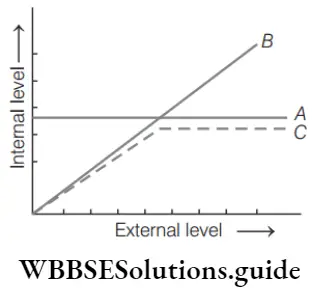
Answer:  2. Collection of the ovum after ovulation

The edges of the infundibulum possess finger-like projections called fimbriae, which help in the collection of ovum after ovulation.

Female Reproductive System MCQ For NEET

Question 24. The middle dilated part of oviduct is called

  1. Isthmus
  2. Fallopian tube
  3. Ampulla
  4. Infundibulum

Answer:  3. Ampulla

The ampulla is the portion of the Fallopian tube. It is an intermediate or middle dilated portion, which curves over the ovary

NEET Biology Menstrual Cycle and Hormonal Regulation MCQs

Question 25. ……….. is short, slender, narrow structure which opens into the uterus.

  1. Isthmus
  2. Uterine segment
  3. Ampulla
  4. Infundibulum

Answer:  1. Isthmus

The isthmus is a short, slender and narrow structure that opens into the uterus.

oviduct in vertebrates is modified

Question 26. The structure which is capable of stretching many times of its size is

  1. lungs
  2. Stomach
  3. Uterus
  4. Pupil of the eye

Answer:  3. Uterus

Uterus is a thick-walled muscular structure between the bladder and rectum in female mammals. The uterus expands and becomes increasingly muscular to accommodate the growing foetus during pregnancy.

Question 27. Match the following columns.

table

Answer:  A-2, B-1, C-3, D-4

Question 28. Uterus is also known as

  1. Cervical canal
  2. Womb
  3. Brood pouch
  4. Ampulla

Answer:  2. Womb

Uterus is also known as womb.

Question 29. The heaviest component of the uterus is

  1. Broad ligament
  2. Myometrium
  3. Graafian follicle
  4. Endometrium

Answer:  2. Myometrium

Myometrium is the middle thick layer of the uterus. By weight, myometrium is the heaviest component of uterus wall.

Question 30. In normal conditions, human uterus is about

  1. 5 cm long × 5 cm wide × 5 cm thick
  2. 8 cm long × 5 cm wide × 2 cm thick
  3. 5 cm long × 5 cm wide × 3 cm thick
  4. 8 cm long × 20 cm wide × 0.5 cm thick

Answer:  2. 8 cm long × 5 cm wide × 2 cm thick

The uterus is shaped like an inverted pear. In normal condition, the uterus is 8 cm long, its wall thickness is approximately 2 cm and its width is 5 cm.

Question 31. Uterus is lined by

  1. Squamous epithelium
  2. Cuboidal epithelium
  3. Simple columnar epithelium
  4. Urothelium

Answer:  4. Urothelium

The internal surface of the uterus is lined by uterine epithelial cells (urothelium) which undergoes dramatic changes during pregnancy.

Biology MCQ For NEET With Answers

Question 32. Consider the following statements.

  1.  The mesentry of uterus is mesometrium.
  2. Mesometrium constitutes majority of broad ligament of uterus.

Choose the correct option

  1. State ment 1 is correct, but 2 is incorrect
  2. Statement 1 is incorrect, but 2 is correct
  3. Both statements 1 and 2 are correct
  4. Both statements 1 and 2 are incorrect

Answer:  3. Both statements 1 and 2 are correct.

oviduct in vertebrates is modified

The mesometrium is the mesentry of the uterus. It constitutes the majority of the broad ligament of the uterus, excluding the portions adjacent to the uterine tube (the mesosalpinx) and ovary (the mesovarium). The ureter is among the structures found in the mesometrium.

Question 33. Complete the analogy.

Mesovarium: Ovary: : Mesometrium: ……………..

  1. Clitoris
  2. Uterus
  3. Testis
  4. Penis

Answer:  2. Uterus

The ovary remains attached to the abdominal wall by a ligament called mesovarium. The uterus lies in the fold of peritoneum called mesometrium. Thus, the correct answer is mesometrium : Uterus

Question 34. In women, uterus includes

  1. Fundus
  2. Body
  3. Cervix
  4. All of these

Answer:  4. All of these

In human female , the uterus is divided anatomically into three regions, i.e. fundus, body and cervix.

Thus, option is 4. correct.

Biology MCQ For NEET With Answers

Question 35. The superior portion of the uterus is

  1. Body
  2. Cervix
  3. Fundus
  4. Infundibulum

Answer:  3. Fundus

Superior region of uterus is called fundus. It is somewhat rounded in shape.

Question 36. Which of the following does not line the uterus?

  1. Tunica albuginea
  2. Perimetrium
  3. Endometrium
  4. Myometrium

Answer:  1. Tunica albuginea

Tunica albuginea is the connective tissue covering of the testis and not of uterus.

Question 37. Outermost covering of uterus is called as

  1. Mesometrium
  2. Myometrium
  3. Endometrium
  4. Perimetrium

Answer:  4. Perimetrium

The perimetrium is the outer serosa layer of the uterus, equivalent to peritoneum. It is embryonically derived from visceral peritoneum.

Question 38. Middle lining of uterus is called as

  1. Mesometrium
  2. Myometrium
  3. Endometrium
  4. Perimetrium

Answer:  2. Myometrium

The myometrium is the middle layer of the uterine wall, consisting mainly of uterine smooth muscle cells, supporting stromal and vascular tissue.

Biology MCQ For NEET With Answers

Question 39. The inner glandular layer of the uterus is

  1. Endometrium
  2. Myometrium
  3. Fallopian tubes
  4. Perimetrium
  5.  Infundibulum

Answer: 1. Endometrium

Endometrium is inner glandular layer that lines the uterine cavity and undergoes cyclic changes during menstrual cycle.

Disorders of Female Reproductive System MCQs for NEET

Question 40. The uterus opens into the vagina by a canal called

  1. Cervical canal
  2. Fundus
  3. Ampulla
  4. Oviducts

Answer: 1. Cervical canal

  • The cervix is the part of uterus which joins the anterior wall of the vagina and opens into it through cervical canal.
  • The cervix communicates with the body of the uterus on top by an aperture called internal os and with the vagina below by an opening the external os.

Question 41. Lower narrow end of uterus is called

  1. Urethra
  2. Cervix
  3. Clitoris
  4. Vulva

Answer:  2. Cervix

Lower narrow end of uterus is called cervix which joins the anterior wall of the vagina and opens into it. During labour, the cervix enlarges greatly to allow the passage of the foetus.

Question 42. Identify A, B, C and D.

NEET Biology Female Reproductive System Question 42

  1. A–Oviduct, B–Uterus, C–Cervix, D–Ovary
  2. A–Cervix, B–Uterus, C–Ovary, D–Tumour
  3. A–Uterus, B–Uterine cavity, C–Oviductal funnel, D–Ovary
  4. A–Cervix, B–Uterine cavity, C–Fallopian tube, D–Ovary

Answer:  4.  A–Cervix, B–Uterine cavity, C–Fallopian tube, D–Ovary.

Question 43. Given below is the female reproductive system of humans. Identify A to F.

NEET Biology Female Reproductive System Question 43 Reproductive System Of Humans

  1. A–Ampulla, B–Isthmus, C–Infundibulum, D–Fallopian tube, E–Ovary, F–Uterine fundus
  2. A–Isthmus, B–Infundibulum, C–Uterine fundus, D–Fallopian tube, E–Ovary, F–Ampulla
  3. A–Isthmus, B–Ampulla, C–Infundibulum, D–Fallopian tube, E–Ovary, F–Uterine fundus
  4. A–Ampulla, B–Infundibulum, C–Isthmus, D–Fallopian tube,E–Ovary, F–Uterine fundus

Answer:  3.  A–Isthmus, B–Ampulla, C–Infundibulum, D–Fallopian tube E–Ovary, F–Uterine fundus.

oviduct in vertebrates is modified

Question 44. In adult human females, vagina is about

7.5 cm long

20.5 cm long

15.5 cm long

2.5 cm long

Answer:  1.  7.5 cm long

  • Because of the presence of the cervix in the front wall of the vagina, there is a difference in length between the front and back wall.
  • The former is approximately 7.5 cm (2.5 to 3 inch) long and the latter is approximately 9 cm (3.5 inch) long. During sexual arousal, the vagina expands both in length and width.

Biology MCQs with answers for NEET

Question 45. Which bacteria is present in vagina?

  1. Lactobacillus
  2. E. coli
  3. Cornea bacterium
  4. Vibrio cholerae

Answer:  1. Lactobacillus

Lactobacillus is found in vagina. It converts glycogen present in the vagina into an acidic substance, which prevents fungal infection in the vagina.

Question 46. Bartholin’s glands are also called(or)Vestibular glands secrete

  1. Vestibular glands
  2. lenticular glands
  3. Rudimentary glands
  4. Sexual glands

Answer: 1. Vestibular glands

The Bartholin’s glands are also called vestibular glands. These are two pea-sized compound alveolar glands located slightly posterior, to the left and right of the opening of the vagina.

Question 47. Bartholin’s glands are situated on

  1. The sides of head of some amphibians
  2. Each side of vagina in human female
  3. Either side of urethra in human male
  4. Either side of vasa deferens in human male

Answer:  2.  Each side of vagina in human female

The Bartholin’s glands are located on each side of the vaginal opening in human female.

Question 48. Bartholin’s gland of female corresponds to ………… gland of male.

  1. Inguinal
  2. Prostate
  3. Cowper’s
  4. Rectal

Answer:  3. Cowper’s

Bartholin’s glands of the female reproductive system are homologous to the Cowper’s glands of the male reproductive system.

Question 49. Bulbovestibular glands found in the female are also known as

  1. Cowper’s gland
  2. perineal gland
  3. Bartholin’s gland
  4. prepuce

Answer:  3. Bartholin’s gland

Bulbovestibular glands present in human female are also called as Bartholin’s glands.

Question 50. In female mammals, Bartholin’s glands open into the

  1. Vestibule and release a lubricating fluid in the vagina
  2. Uterus and release a lubricating fluid during the birth of young ones
  3. Urinary bladder and assist in release of urine
  4. Fallopian tubes and release a secretion which makes sperms motile

Answer:  1. Vestibule and release a lubricating fluid in the vagina

The greater vestibular glands or Bartholin’s glands are paired glands situated one on each side of the vaginal opening. They open into the vestibule and release lubricating fluid in vagina.

Biology MCQs with answers for NEET

Question 51. In the following diagram of female reproductive system of human, identify A to E.

NEET Biology Female Reproductive System Question 51 Female Reproductive System

  1. A–Urethra, B–Urinary bladder, C–Uterus, D–Cervix, E–Vagina
  2. A–Urethra, B–Urinary bladder, C–Uterus, D–Vagina, E–Cervix
  3. A–Urethra, B–Urinary bladder, C–Uterus, D–Cervix, E–Vagina
  4. A–Uterus, B–Urinary bladder, C–Urethra, D–Cervix, E–Vagina

Answer:  4. A–Uterus, B–Urinary bladder, C–Urethra, D–Cervix, E–Vagina

Question 52. Cushion of fatty tissue covered by skin and pubic hair is called

  1. Mons pubis
  2. labia majora
  3. Clitoris
  4. vagina

Answer:  1. Mons pubis

Mons pubis is anterior most portion of the external genitalia. It is covered by skin and pubic hair. It acts as a cushion during intercourse.

Question 53. …………… is a fleshy fold of tissue that extends below the mons pubis and surrounds the vaginal opening.

  1. Labia minora
  2. Labia majora
  3. Hymen
  4. Clitoris

Answer:  2. Labia majora

Labia majora are two large fleshy folds of skin which form the boundary of vulva. They extend below the mons pubis and surround the vaginal opening. They are partly covered by pubic hair and contain large number of sebaceous (oil) glands.

Fertilization, Pregnancy, and Parturition MCQs for NEET

Question 54. The female structure that is homologous to the scrotum of the male are

  1. Labia minora
  2. Labia majora
  3. Clitoris
  4. Urethral folds

Answer:  2. Labia majora

oviduct in vertebrates is modified

Labia majora is a part of female external genitalia and is homologous to the scrotum of male.

Question 55. Identify the odd one.

  1. Labia majora
  2. Fimbriae
  3. Infundibulum
  4. Isthmus

Answer: 1. Labia majora

In the given options, option is odd one because labia majora belong to the external genitalia of females. Rest three represent the parts of Fallopian tubes.

Biology MCQs with answers for NEET

Question 56. Smaller and thinner lip-like folds located medially to the labia majora is called

  1. labia minora
  2. Mons pubis
  3. Clitoris
  4. Hymen

Answer:  1. labia minora

The labia minora are two small, thin folds of skin, lacking fatty tissue. They are found medially to labia majora.

Question 57. Posteriorly, the labia minora are fused together to form

  1. Mons pubis
  2. Fourchette
  3. Clitoris
  4. Hymen

Answer:  2. Fourchette

Posteriorly, the labia minora are joined or fused behind the vaginal opening by a fold of skin, the fourchette.

Question 58. In virginal state, a thin fold of mucous membrane is present at the vaginal opening is present, it is called

  1. Rugae
  2. Myometrium
  3. Hymen
  4. Hilum

Answer:  3. Hymen

The hymen is a thin piece of mucosal tissue that surrounds or partially covers the external vaginal opening.

Question 59. ………… is a small erectile organ lying at the anterior side of the labia minora.

  1. Labia majora
  2. Clitoris
  3. Vestibule
  4. Vulva

Answer:  2. Clitoris

The clitoris is small erectile organ, found right under the point where the inner labia meet and form a little hood. The head of the clitoris may vary in size, but only the tip of the clitoris can be seen at the top of the vulva, under the clitoral hood.

Question 60. The female’s organ equivalent to glans penis of male is

  1. Vestibule
  2. Hymen
  3. Baculum
  4. Clitoris

Answer:  4. Clitoris

The clitoris is an erectile structure, homologous to the male penis. Like penis, clitoris is formed by two corpora cavernosa and the glans, covered by the prepuce. Thus, they both have same origin and are richly supplied with blood and nerve endings.

Question 61. Vaginal orifice, urethral orifice and clitoris are protected by

  1. labia majora
  2. Anus
  3. labia minora
  4. Vulva

Answer:  4. Vulva

The vulva is the part of external genital structure. It protects vaginal opening, clitoris and the opening to the urethra.

Question 62. Vestibule is

  1. Right and left longitudinal folds of labia minora
  2. Fleshy elevation above the labia majora
  3. Median vertical depression of vulva enclosing vagina and urethral opening
  4. A thin layer of mucous membrane

Answer: 3. Median vertical depression of vulva enclosing vagina and urethral opening

The vaginal opening is called the vestibule of vagina. A vestibule is a median vertical space of vulva that encloses vagina and urethral openings.

Question 63. The external genitalia of female reproductive system are collectively called

  1. Vagina
  2. Vulva
  3. Cervix
  4. Clitoris

Answer:  2. Vulva

The female external genitalia include the mons pubis, labia majora, labia minora, vaginal introitus, hymen and clitoris. These organs are collectively called the vulva.

Biology MCQs with answers for NEET

Question 64. Assertion (A) Females are prone to infection of urethra than males. Reason (R) Urethra is shorter in female than male.

  1. Both A and R are true and R is the correct explanation of A
  2. Both A and R are true, but R is not the correct explanation of A
  3. A is true, but R is false
  4. Both A and R are false

Answer:  1. Both A and R are true and R is the correct explanation of A

Both A and R are true and R is the correct explanation of A. Urethra of females are shorter than male. Therefore, infection of urethra is more common in females than in males.

Question 65. Urethera in female differs from male is being

  1. Only excretory
  2. Birth and excretory
  3. Highly muscular
  4. long erectile tube

Answer: 1. Only excretory

In females, urethra serves the purpose of urination only, but in males, urethra is common passage for both urination and semen ejaculation. So, urethra in female differs from male in being only excretory.

Question 66. Consider the following statements.

  1. Breast consist of adipose tissue only.
  2. Areola contain montgomery’s gland which moisturise nipple during breastfeeding.

Choose the corect option.

  1. Statement 1 is correct, but 2 is incorrect
  2. Statement 1 is incorrect, but 2 is correct
  3. Both statements 1 and 2 are correct
  4. Both statements 1 and 2 are incorrect

Answer:  2. Statement 1 is incorrect, but 2 is correct

Statement 1 is incorrect, but 2 is correct. Incorrect statement can be corrected as Internally, the breast consists of the glandular tissue forming mammary glands, the fibrous tissue (connective tissue) and the fatty or adipose tissue. Mammary glands are modified sweat glands.

oviduct in vertebrates is modified

Question 67. Mammary glands are ………. glands.

  1. Endocrine
  2. Merocrine
  3. Apocrine
  4. Holocrine

Answer: 3. Apocrine

  • Apocrine glands are found primarily in the breast of lactating mammals and these are apocrine glands.
  • The apical portion of the secretory cell of the gland pinches off and enters the lumen. It loses part of its cytoplasm in their secretions.

Question 68. The base of the nipple shows dark brown rounded area called

  1. Clitoris
  2. Areola
  3. Hymen
  4. Vestibule

Answer:  2.  Areola

The areola is the dark pigmented area around the nipple. Areola and nipple can range in colour from light pink to purplish to light grey depending on skin colour.

Question 69. Breast tissue is mainly composed of

  1. Glandular tissue
  2. Squamous tissue
  3. Ciliated tissue
  4. Epithelium tissue

Answer: 1. Glandular tissue

The glandular tissue comprises about 15-20 lobes in each breast. Each lobe is made up of number of lobules. Each lobule is composed of grape-like cluster of milk secreting glands termed as alveoli.

Question 70. In females, the growth of breasts after puberty is called

  1. Amenorrhoea
  2. Menarche
  3. Menorrhoea
  4. Thelarche

Answer:  4. Thelarche

Thelarche is the onset of secondary breast development, which often represent the beginning of pubertal development.

Question 71. The ducts which carry milk from mammary glands to nipple are called

  1. lactiferous sinuses
  2. lactiferous ducts
  3. Areola
  4. Ejaculatory duct

Answer:  2.  lactiferous ducts

Lactiferous duct carries milk from mammary glands to nipple in human females.

Question 72. Mammary lobules contain cluster of cells called … A …, which secretes …B… . Alveoli open into mammary tubules, which join to form …C… . Identify A, B and C.

  1. A–milk, B–mammary duct, C–alveoli
  2. A–mammary duct, B–sweat, C–alveoli
  3. A–mammary duct, B–milk, C–alveoli
  4. A–alveoli, B–milk, C–mammary duct

Answer:  4. A–alveoli, B–milk, C–mammary duct.

Question 73. Identify the correct statements pertaining to breasts.

  1. A pair of rounded structures present in pectoral region on ventral thoracic wall
  2. Each breast contains fatty connective tissue and numerous lactiferous ducts
  3. Lactiferous ducts dilate and form lactiferous sinuses just beneath the nipple to store milk
  4. All of the above

Answer:  4. All of the above

  • All given statements are correct pertaining to breasts. The breast is the tissue overlying the chest muscles. Women’s breasts are made up of specialised tissue that produces milk (glandular tissue) as well as fatty tissue.
  • The milk producing part of the breast is organised into 15 to 20 sections, called lobes.

Question 74. Mark the correct statement regarding mammary glands are considered to be the part of reproductive system in the female because

  1. Mammary glands are the secondary sexual characters
  2. They are well-developed in female and vestigial in male
  3. After puberty, breast size increases due to the secretion of oestrogen
  4. All of the above

Answer:  4.  All of the above

  • All statements are correct. The mammary glands are not the part of the female reproductive tract, but are important in secondary sexual characteristics. The mammary glands develop in the tissue underneath the skin.
  • Both male and females start with the same tissues, but normally only females generate the correct hormonal signals to promote development of this glands at puberty. Thus, these are vestigial in males. Its size increases due to secretion of oestrogen.

Thus, option 4. is correct.

Question 75. Given below is the sectional view of mammary gland. Identify A, B, C and D.

NEET Biology Female Reproductive System Question 75 mammary gland

  1. A–Alveolus, B–Subcutaneous fat, C–Areola, D–Alveoli
  2. A–Alveolus, B–Lactiferous duct, C–Mammary duct, D–Areola
  3. A–Alveolus, B–Mammary duct, C–Lactiferous duct, D–Lactogenic spot
  4. A–Subcutaneous fat, B–Mammary duct, C–Lactiferous duct, D–Areola

Answer:  4. A–Subcutaneous fat, B–Mammary duct, C–Lactiferous duct, D–Areola

Question 76. Vestibular glands secrete

  1. Hormones
  2. Enzymes
  3. Lubricating fluid
  4.  Sweat

Answer: 3. Lubricating fluid

Question 77. The female’s organ equivalent to glans penis of male is

  1. Vestibule
  2. Hymen
  3. Baculum
  4. Clitoris

Answer:  1. Vestibule

NEET Biology Male Reproductive System Multiple Choice Question And Answers

Biology MCQs with answers for NEET Male Reproductive System

Question 1. Human beings are

  1. Homosexual
  2. Monoecious
  3. Dioecious
  4. Hermaphrodite

Answer: 3. Dioecious

Dioecious is a characteristic of a species, which mean presence of male and female reproductive. Organs in two individual. So, human beings are dioecious.

Read And Learn More: NEET Biology Multiple Choice Question And Answers

Question 2. In humans, the primary sexual organs are called

  1. Gametes
  2. Gonads
  3. Mammary glands
  4. Gemmules

Answer:  2. Gonads

The reproductive system of sexually reproducing animal consists of primary sexual organs called gonads, which produce gametes and hormones.

” human reproduction mcqs class 12″

Question 3. The pouch in which the testes are suspended outside the abdominal cavity is

  1. Tunica albuginea
  2. Inguinal canal
  3. Epididymis
  4. Scrotum

Answer:  4. Scrotum

Scrotum is a pouch of deeply pigmented skin, divided into two separate sacs. Each sac contains one testis.

Question 4. Scrotum remains connected with abdomen or pelvic cavity by

  1. Spermatic cord
  2. Inguinal canals
  3. Foreskin
  4. Iobules

Answer:  2. Inguinal canals

The scrotum remains connected with the abdomen or pelvic cavity by inguinal canals.

NEET Biology Male Reproductive System MCQs with answers

Question 5. The passage through which the testes descend from the abdominal cavity in the scrotum is called

  1. Alimentary canal
  2. Inguinal canal
  3. Vertebral canal
  4. Spinal canal

Answer:  2. Inguinal canal

“what is true for cleavage “

The inguinal canals are two passages in the anterior abdominal wall through which the testis descends from the abdominal cavity into the scrotum.

NEET Biology Male Reproductive System Multiple Choice Question And Answers

Important MCQs on Male Reproductive System for NEET

Question 6. If inguinal canals fail to close or reopen, it results in

  1. Impotency
  2. Cryptorchidism
  3. Testes swelling
  4. Inguinal hernia

Answer:  4. Inguinal hernia

An inguinal hernia is a protrusion of abdominal cavity contents through the inguinal canal in which inguinal canal unable to close or reopen. This may cause pain or discomfort especially during coughing, exercise or bowel movements.

Biology MCQs with answers for NEET

Question 7. Gubernaculum connects

  1. Testes with scrotum
  2. Testes with ovaries
  3. Ovaries with scrotum
  4. Testes with epididymis

Answer: 1. Testes with scrotum

“class 12th biology chapter 3 mcq “

  • In males, the upper part of the gubernaculum degenerates. The lower part persists as the gubernaculum testis.
  • This ligaments connect the testis to the most inferior portion of the scrotum, tether it in place and limit the degree to which the testis can move within the scrotum. So, gubernaculum connects testes with scrotum.

Question 8. Internally scrotum is divided into two compartments by

  1. Septum scroti
  2. Trabeculum
  3. Spermatic cord
  4. Septum

Answer: 1. Septum scroti

Internally scrotum is divided into two compartments by a muscle septum called septum scroti.

Question 9. Testes are protected in scrotum because they 

  1. Produce heat
  2. Produce sperm
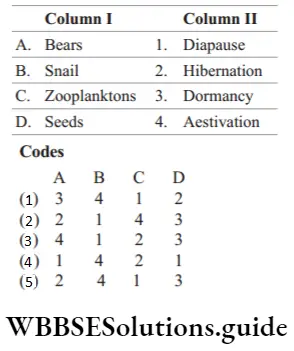
  3. Help in micturition
  4. Control the ambient temperature lower than general body

Answer:  4. Control the ambient temperature lower than general body

In mammals, scrotal sac or scrotum acts as a thermoregulator and maintain the ambient temperature of testes which is 2°C lower than the normal temperature of the body. It protects the sperms against relatively high temperature.

NEET previous year questions on Male Reproductive System

Question 10. In most mammals, the testes are located in scrotal sac for

  1. More space to visceral organs
  2. Sex differentiation
  3. Independent functioning of kidney
  4. Spermatogenesis

Answer:  4. Spermatogenesis

In mammals, testes are located in scrotal sac to carryout the process of spermatogenesis.

Question 11. What will happen, if the temperature of scrotal sac temporarily goes to about 4°C or more than the body temperature?

  1. Testes will be pushed into abdomen
  2. Increased sperm formation
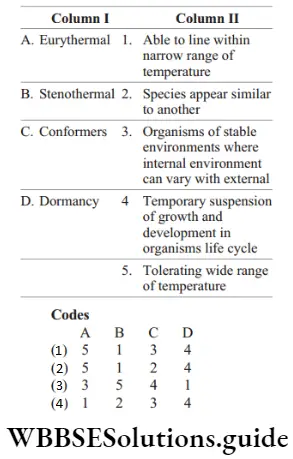
  3. Scrotal sacs contract and come close to body
  4. Spermatogenic tissue will be destroyed

Answer:  4. Spermatogenic tissue will be destroyed

Higher temperature (4°C) would damage the sperm inside the testicles due to the damage of spermatogenic tissue.
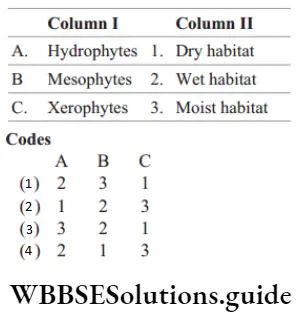
Biology MCQs with answers for NEET

Question 12. Consider the following statements.

  1. During cold, scrotum becomes wrinkled.
  2.  Scrotum prevents heat loss during in low temperature conditions.

Choose the correct option.

  1. Statement 1 is correct, but 2 is incorrect
  2. Statement 1 is incorrect, but 2 is correct
  3. Both statements 1 and 2 are correct
  4. Both statements 1 and 2 are incorrect

Answer:  3. Both statements 1 and 2 are correct.

When the temperature is too low, the tunica dartos muscle contracts, thus cause the scrotal skin to wrinkle. Due to this, the scrotum has a smaller surface area and thus, heat loss is prevented.

“hormones secreted by placenta “

Question 13. Which muscle pulls the scrotum towards the body during low temperature?

  1. Dartos muscles
  2. Cremaster muscles
  3. Alary muscle
  4. Corpora cavernosa

Answer:  2. Cremaster muscles

Cremaster muscles contract and pull the scrotum towards the body during low temperature.

Question 14. The muscles that keep the testes warm are
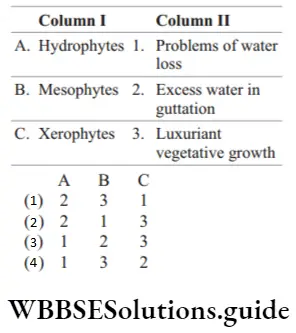
  1. Cremaster
  2. Dartos
  3. Both 1 and 2
  4. Mesorchium
Answer:  3. Both 1 and 2

In cold weather, by contracting simultaneously, cremaster muscles pull the testes toward body and dartos muscle shrink the scrotal sac. Thus, the surface area of scrotum is decreased to retain heat and keep testes warm.

Question 15. Each compartment of scrotum encloses

  1. Testis and epididymis
  2. Testis, epididymis, a spermatic cord
  3. Testis, spermatic cord and a part of vas deferens
  4. Testis, epididymis, a spermatic cord and part of vas deferens

Answer:  4. Testis, epididymis, a spermatic cord and part of vas deferens

  • Scrotum in male reproductive system is a thin external sac of skin that is divided into two compartments.
  • Each compartment contains one of the two testes, the glands that produce sperm and one of the epididymis, where the sperm is stored. It also contains a spermatic cord and part of vas deferens.

Biology MCQs with answers for NEET

Question 16. The testis during early and middle foetal life is located in the

  1. Inguinal canal
  2. Abdominal cavity
  3. Pelvic cavity
  4. Scrotal sacs

Answer:  2. Abdominal cavity

During early and middle foetal life, the testes are located in the abdominal cavity. They descend to the scrotal sac during the late foetal development.

Question 17. Testes begin to descend from abdomen during 3rd week of gestation and descend is completed by …… week of gestation.

  1. 10th
  2. 15th
  3. 28th
  4. 18th

Answer:  3. 28th

  • During seventh month or 28th week of development, testes descend permanently into the respective scrotal sacs.
  • Thus, testes begin to descend from abdomen during 3rd week of gestation and descend is completed by 28th week of gestation.

“testicular lobules “

Question 18. Failure of descend of testis in scrotal sacs is called

  1. Vasectomy
  2. Tubectomy
  3. Cryptorchidism
  4. Impotency

Answer:  3. Cryptorchidism

The failure of descend of testes into scrotum is called cryptorchidism. It is caused by deficient secretion of testosterone by foetal testes. It leads to sterility.

Question 19. Testis is ………… in origin.

  1. Ectodermal
  2. Mesodermal
  3. Endodermal
  4. Both 1 and 3

Answer:  2. Mesodermal

Mesoderm is a primary germ layer of the embryo lying between the other two germ layers, namely ectoderm and endoderm. The testis is mesodermal in origin.

Question 20. Assertion Testes are located in the scrotum, outside the coelom. Reason (R) A vaginal coelom partly surrounds the testis in the scrotum.

  1. Both A and R are true and R is the correct explanation of A
  2. Both A and R are true, but R is not the correct explanation of A
  3. A is true, but R is false
  4. Both A and R are false

Answer:  3. A is true, but R is false

A is true, but R is false. Reason can be corrected as Vaginal coelom partly surrounds the testis in scrotum is a wrong statement because vagina is the part of external genitalia (vulva) in the female reproductive system and scrotum is a sac-like structure in which testes are suspended in males.

NEET quiz on Male Reproductive System with solutions

Question 21. Gubernaculum cord is a contractile structure that

  1. Pulls down the testis during breeding season into the scrotal sac
  2. Allows daily migration of the testis from the abdominal cavity into the scrotum
  3. Helps ejaculation of spermatozoa from testis
  4. Keeps the testis in proper position

Answer:  4. Keeps the testis in proper position

Gubernaculum cord is a structure which keeps the testis in its actual position. It is also called the caudal genital ligament.

Biology MCQ For NEET With Answers

Question 22. A connective tissue cord extending between the testis and abdominal wall is called

  1. Testis cord
  2. Gubernaculum
  3. Mesentric cord
  4. Spermatic cord

Answer:  4. Spermatic cord

The spermatic cord extends between testes and abdominal wall. This passes through the inguinal canal.

Question 23. Human possess pair of testes

  1. Two
  2. One
  3. Three
  4. Four

Answer:  2. One

In man, one pair of testis is present.

Question 24. Length and width of testis is

  1. 4-5 cm and 2-3 cm
  2. 5-6 cm and 3-4 cm
  3. 4-5 cm and 4-5 cm
  4. 7-8 cm and 8-9 cm

Answer:  1. 4-5 cm and 2-3 cm

Each human testis is oval in shape with a length of about 4 to 5 cm and a width of about 2 to 3 cm.

Question 25. An incomplete peritoneal covering of testes is called

  1. Tunica vaginalis
  2. Tunica albuginea
  3. Tunica vascularis
  4. Tunica reticulosa

Answer:  1. Tunica vaginalis

The tunica vaginalis is the pouch of serous membrane that covers the testes. It is derived from the abdominal peritoneum.

Question 26. Innermost covering of testes is

  1. Tunica reticulosa
  2. Tunica vaginalis
  3. Tunica albuginea
  4. Tunica vasculosa

Answer:  4. Tunica vasculosa

The tunica vasculosa is the innermost vascular layer of the testis. It consists of a plexus of blood vessels held together by delicate areolar tissue.

Biology MCQ For NEET With Answers

Question 27. The capsule enclosing testis of mammal is called as

  1. Tunica albuginea
  2. Tunica membrana
  3. Tunica vaginalis
  4. Tunica vasculosa

Answer:  1. Tunica albuginea

Each testis is externally covered by a white fibrous capsule called tunica albuginea, which is produced inside the testis as fibrous septa.

Question 28. The compartments in mammalian testes are known as

  1. Testicular lobules
  2. Seminiferous tubules
  3. Sertoli cells
  4. Interstitial cells

Answer:  1. Testicular lobules

There are about 250 compartments in each human testis called testicular lobules.

Question 29. How many compartments (approximately) are there in each human testis?

  1. 250
  2. 300
  3. 350
  4. 400

Answer:  1. 250

There are about 250 compartments in each human testis called testicular lobules.

“human reproduction class 12 important questions pdf “

Question 30. Testicular lobules contain

  1. 3-5 seminiferous lobules
  2. 5-7 seminiferous lobules
  3. 2-6 seminiferous tubules
  4. 1-3 seminiferous tubules

Answer:  4. 1-3 seminiferous tubules

Each testicular lobule contains 1-3 seminiferous tubules. These are coiled tubules that constitute most of the testis and enclose spermatogenic tissue.

Question 31. Which of the following is correct about mammalian testes?

  1. Graafian follicles, Sertoli cells, Leydig’s cells
  2. Graafian follicles, Sertoli cells, Seminiferous tubules
  3. Sertoli cells, Seminiferous tubules, Leydig’s cells
  4. Graafian follicle, Leydig’s cells, Seminiferous tubule

Answer:  3.  Sertoli cells, Seminiferous tubules, Leydig’s cells

Option 3. is correct. Other options are incorrect about mammalian testes because Graafian follicles are present in human ovaries.

Biology MCQ For NEET With Answers

Question 32. Consider the following statements.

  1. The length of single seminiferous tubule is about 50-60 cm.
  2. Seminiferous tubule constitutes about 90% of testis.

Choose the correct option.

  1. Statement 1 is correct, but 2 is incorrect
  2. Statement 1 is incorrect, but 2 is correct
  3. Both statements 1 and 2 are correct
  4. Both statements 1 and 2 are incorrect

Answer:  3. Both statements 1 and 2 are correct

Question 33. Seminiferous tubules are lined by

  1. Squamous germinal epithelial cells
  2. Cuboidal germinal epithelial cells
  3. Ciliated germinal epithelial cells
  4. Non-ciliated germinal epithelial cells

Answer:  2. Cuboidal germinal epithelial cells

Seminiferous tubules consist of a multilayered cuboidal germinal epithelium that helps in spermatogenesis.

NEET expected MCQs on Male Reproductive System 2025

Question 34. Inflammation of the seminiferous tubules could interfere with the ability to

  1. Make semen alkaline
  2. Secrete testosterone
  3. Produce spermatozoa
  4. Eliminate urine from the bladder

Answer:  3. Produce spermatozoa

The main function of seminiferous tubules is to produce spermatozoa. Inflammation of seminiferous tubules could interfere with its function.

Question 35. Inner portion of the seminiferous tubules contains

  1. Sertoli cells
  2. Male germ cell
  3. Both 1 and 2
  4. Interstitial or Leydig cell

Answer:  3. Both 1 and 2

Inner portion of seminiferous tubules is lined by male germ cells and Sertoli cells. Thus, option is correct.

Question 36. From the germinal epithelium arises

  1. Sertoli cells
  2. Interstitial cells
  3. Spermatogonium
  4. Sustentacular cells

Answer:  3. Spermatogonium

The cuboidal cells in germinal epithelium of seminiferous tubules undergo mitosis to produce spermatogonium.

Question 37. Sertoli’s cells are found

  1. Between the seminiferous tubules
  2. In the germinal epithelium of ovary
  3. In the upper part of the Fallopian tube
  4. In the germinal epithelium of the seminiferous tubules

Answer:  4. In the germinal epithelium of the seminiferous tubules

Sertoli cells or nurse cells are found in the germinal epithelium of seminiferous tubules, which nourish the developing sperms.

NEET Biology Mcq Chapter Wise

Question 38. Sertoli cells are also called

  1. Sustentacular cells
  2. Sperm cells
  3. Interstitial cells
  4. Leydig cells

Answer:  1. Sustentacular cells

Sertoli cells are also called sustentacular cells because they provide supporting framework in which germ cells are embedded. They are irregular columnar in shape and its basal aspect is attached to basement membrane by hemidesmosomes.

Question 39. Sertoli cells are involved in

  1. Excretion
  2. Respiration
  3. Nutrition of sperms
  4. All of the above

Answer: 3. Nutrition of sperms

Sertoli cells function as nurse cells as they provide nutrition to sperms. They also help in phagocytising defective sperms and secrete inhibin hormone.

Question 40. The part of blood-testis barrier in males is formed by

  1. Scrotum
  2. Epididymis
  3. Sertoli cells
  4. Leydig cells

Answer:  3. Sertoli cells

The Blood-Testis barrier (BTB) is an inter-Sertoli functional complex that is found around the basal aspect of seminiferous epithelium. The BTB formed by Sertoli cells isolates developing spermatogonia from blood.

Question 41. All of the following are found in seminiferous tubules except

  1. Sertoli cells
  2. Leydig’s cells
  3. Spermatids
  4. Spermatogonia

Answer:  2. Leydig’s cells

Leydig’s cells or interstitial cells are present in interstitial space in the outer region of seminiferous tubules.

Question 42. Leydig’s cells are present in

  1. Kidneys and seminiferous tubules
  2. Seminiferous tubules of testes
  3. Connective tissue surrounding the seminiferous tubules of testes
  4. Cells lining the epidermis of the testes

Answer:  3. Connective tissue surrounding the seminiferous tubules of testes

In between the seminiferous tubules, connective tissue contains the groups of polygonal cells called interstitial or Leydig’s cells.

Question 43. Which of the following is the endocrine tissue of testes?

  1. Epidermis
  2. Inguinal canal
  3. Leydig cells
  4. Spermatic cord

Answer:  3.  Leydig cells

Leydig’s cells are endocrine in function as they secrete male sex hormone, androgens.

NEET Biology Mcq Chapter Wise

Question 44. Interstitial cells secrete

  1. Androgens
  2. Oestrogen
  3. FSH
  4. Inhibin

Answer:  1. Androgens

Interstitial cells secrete androgen (testosterone), i.e. male sex hormones.

NEET Biology Male Reproductive System MCQs with explanations

Question 45. Select the incorrect statement about Leydig cells.

  1. They are found in groups up to ten cells around seminiferous tubules
  2. These are known as polygonal cells
  3. These cells have eosinophilic cytoplasm and large round nucleus
  4. Lipid content is almost negligible in Leydig cells

Answer:  4. Lipid content is almost negligible in Leydig cells

Statement in option is incorrect and can be corrected as Lipid content is abundant in Leydig cells because they are responsible for testosterone production which is a steroid hormone.

Question 46. Select the option which correctly matches the endocrine gland with its hormone and its function. Endocrine gland > Hormone > Function.

  1. Ovary > FSH > Stimulates follicular development and the secretion of oestrogens
  2. Placenta > Oestrogen > Initiates secretion of the milk
  3. Corpus luteum > Oestrogen > Essential for maintenance of endometrium
  4. Leydig cells > Androgen > Initiates the production of sperms

Answer:  4.  Leydig cells > Androgen > Initiates the production of sperms

Option 4. is correctly matched as Leydig cells > Androgens > Initiates the production of sperms. Other options are incorrectly matched. These can be corrected as

  • FSH is secreted by anterior pituitary gland and not by ovary.
  • Corpus luteum secretes progesterone to maintain endometrium.
  • Placenta secretes oxytocin to initiate milk secretion

Question 47. Assertion (A)Each testis is attached to the abdominal wall by a ligament. Reason (R) Leydig or interstitial cells secrete androgens of which testosterone is the most potent.

  1. Both A and R are true and R is the correct explanation of A
  2. Both A and R are true, but R is not the correct explanation of A
  3. A is true, but R is false
  4. Both A and R are false

Answer:  2.  Both A and R are true, but R is not the correct explanation of A

  • Both A and R are true, but R is not the correct explanation of A. Each testis is attached to abdominal wall by a testicular ligament.
  • Testes develop retroperitoneally on posterior abdominal wall and descend to scrotum before birth, under the influence of testosterone. This is the most potent androgen and is being secreted by Leydig or interstitial cells of testis.

Question 48. The seminiferous tubules of the testis opens into the vasa efferentia through

  1. Vasa deferentia
  2. Rete testis
  3. Epididymis
  4. Seminiferous tubules

Answer:  2.  Rete testis

The seminiferous tubules are closed at one end, but on the other side they join to a network called rete testis from where fine ciliated ductules called vasa efferentia arises.

Question 49. Numerous fine ducts arising from rete testis are called

  1. Vas deferens
  2. Vasa efferentia
  3. Tubuli recti
  4. Epididymis

Answer:  2.  Vasa efferentia

12-20 Numerous fine ducts called vasa efferentia arise from rete testis to the vas deferens.

Question 50. Vasa efferentia are muscular tubes, each of which connects

  1. An epididymis to vas deferens
  2. Vas deferens to seminal vesicle
  3. Rete testis to vas deferens
  4. Rete testis to epididymis

Answer:  4.  Rete testis to epididymis

Vasa efferentia arise from the rete testis and open into epididymis located along the posterior surface of rete testis. The epididymis leads to vas deferens.

Question 51. If for some reason, the vasa efferentia in the human reproductive system get blocked, the gametes will not be transported from

  1. Testes to epididymis
  2. Epididymis to vas deferens
  3. Ovary to uterus
  4. Vagina to uterus

Answer:  1. Testes to epididymis

If the vasa efferentia in the human reproductive system gets blocked, the gametes will not be transported from testes to epididymis because vasa efferentia connects the testis to epididymis.

Question 52. The vasa efferentia exit the testis and open into the …A… located along the …B… surface. Here, A and B refer to

  1. A–rete testis, B–epididymis
  2. A–epididymis, B–rete testis
  3. A–epididymis, B–posterior
  4. A–epididymis, B–anterior

Answer:  3.  A–epididymis, B–posterior

  • As the vasa efferentia leave the testis, they enter the larger, upper portion of the epididymis (A), located along the posterior surface.
  • The vasa efferentia then join to form a single, coiled ductus epididymis, in the middle region of the epididymis.

Question 53. Consider the following statements.

  1. Epididymis is small, curved, elongated structure in males.
  2.  Epididymis is found along the anterior side of each testis.

Choose the correct options.

  1. Statement 1 is correct, but 2 is incorrect
  2. Statement 1 is incorrect, but 2 is correct
  3. Both statements 1 and 2 are correct
  4. Both statements 1 and 2 are incorrect

Answer:  1.  Statement 1 is correct, but 2 is incorrect

Statement I is correct, but II is incorrect. The epididymis is a small, curvedshaped elongated structure which is found along the posterior side of each testis.

Question 54. Wolffian duct forms

  1. Epididymis
  2. Oviduct
  3. Ejaculatory duct
  4. Urethra

Answer:  1.  Epididymis

  • The Wolffian duct (also known as archinephric duct, Leydig’s duct and mesonephric duct) is a paired organ found in mammals including humans during embryogenesis.
  • It connects the primitive kidney, Wolffian body (mesonephros) to the cloaca and serves as the progenitor for certain male reproductive organs.
  • In an ale, it develops into a system of connected organs between the testis and the prostate, namely rete testis, efferent ducts, epididymis, vas deferens, seminal vesicle and prostate.

Question 55. In man, the epididymis from anterior to posterior is divided into

  1. Caput, corpus and cauda
  2. Corpus, vas deferens and caput vas deferens
  3. Corpus, cauda and caudal region
  4. Caput, cauda and vas deferens

Answer: 1. Caput, corpus and cauda

The epididymis consists of three parts, i.e. caput, corpus and cauda

Question 56. The head of the epididymis at the head of the testis is called

  1. Cauda epididymis
  2. Vas deferens
  3. Caput epididymis
  4. Gubernaculum

Answer: 3. Caput epididymis

The caput epididymis is the head region of epididymis and is located on superior side of the testis.

Question 57. The narrow middle part of epididymis is called

  1. Caput epididymis
  2. Cauda epididymis
  3. Corpus epididymis
  4. All of the above

Answer: 3.Corpus epididymis

The corpus epididymis is narrow middle and highly convoluted part which connects the caput epididymis to cauda epididymis.

Male Reproductive System mock test for NEET preparation

Question 58. Sperms are stored temporarily in

  1. Vasa deferentia
  2. Vasa efferentia
  3. Epididymis
  4. Rete testis

Answer:  3. Epididymis

In epididymis, the sperms are stored for few hours to a few days until it comes out along with ejaculations.

NEET Biology Mcq Chapter Wise

Question 59. In the male reproductive system, sperm are concentrated in the

  1. Rete testis
  2. Epididymis
  3. Vas deferens
  4. Seminal vesicle

Answer: 2. Epididymis

In males, sperms are concentrated in the epididymis. Sperm concentration refers to the number of sperm per unit volume of semen.

Question 60. The sperm becomes mature and completely motile while in the

  1. Rete testis
  2. Cauda epididymis
  3. Vasa deferentia
  4. Seminal vesicle

Answer: 2. Cauda epididymis

Spermatozoa formed in the testis enter the caput epididymis, progress to the corpus and finally reach the cauda region, where they are stored, become matured and gain motility.

Question 61. The movement of spermatozoa from the epididymal duct and seminal fluid into the ejaculatory duct to urethra is under the control of

  1. Parasympathetic and sympathetic nerve
  2. Parasympathetic nerve only
  3. Sometimes sympathetic and sometimes parasympathetic nerves
  4. Sympathetic nerve only

Answer:  4. Sympathetic nerve only

The movement of spermatozoa, from the epididymal duct and seminal fluid into the ejaculatory duct to the urethra is under the control of sympathetic nervous system.

Question 62. Cauda epididymis leads to

  1. Vas efferent
  2. Vas deferens
  3. Ejaculatory duct
  4. Urethra

Answer:  2. Vas deferens

Vas deferens is large duct that arises from cauda epididymis and reaches up to seminal vesicles.

Question 63. ‘XX’ is a thick structure of male reproductive system which arises from cauda epididymis. ‘XX’ are 2 in number and its lining has many stereocilia. Identify ‘XX’.

  1. Vasa efferentia
  2. Vasa deferentia
  3. Penis
  4. Scrotum

Answer:  2. Vasa deferentia

Vasa deferentia emerge from the cauda epididymis on each side leave the scrotal sac and enter the abdominal cavity through inguinal canal. They are lined by many stereocilia to transport the sperms.

Question 64. Vas deferens is also known as

  1. Spermatic ducts
  2. Seminiferous tubule
  3. Seminal ducts
  4. Both 1 and 3

Answer:  3. Seminal ducts

The vas deferens is also called seminal duct. It is a part of the male reproductive system of many vertebrates

Question 65. Vas deferens passes through

  1. Haversian canal
  2. Inguinal canal
  3. Neural canal
  4. Central canal

Answer:  2. Inguinal canal

The vas deferens pass through the inguinal canal into pelvis where it is joined by the seminal vesicles to form the ejaculatory duct. The latter passes through the prostate into the urethra.

Question 66. Pseudostratified columnar epithelium lines one of the following.

  1. Vas deferens
  2. Buccal cavity
  3. Bowman’s capsule
  4. All of the above

Answer:  1. Vas deferens

The mucosa of the vas deferens forms low longitudinal folds which are lined by a pseudostratified columnar epithelium.

NEET Male Reproductive System practice test online

Question 67. If the vas deferens of a man is surgically disconnected

  1. Sperms in the semen will be without nuclei
  2. Semen will be without sperms
  3. Spermatogenesis will not occur
  4. Sperms in the semen will be non-motile

Answer:  2. Semen will be without sperms

Function of vasa deferentia is the conduction of sperms from epididymis to penis. If it is surgically disconnected, the semen would not contain sperms.

Question 68. Vasa deferentia and seminal vesicle together form the

  1. Caput epididymis
  2. Corpus epididymis
  3. Ejaculatory duct
  4. Rete testis

Answer: 3. Ejaculatory duct

The vas deferens loops over urinary bladder, where it joins a duct from seminal vesicle to form the ejaculatory duct.

NEET Biology Mcq Chapter Wise

Question 69. Ejaculatory duct contains

  1. Sperms
  2. Secretion of seminal vesicles
  3. Both 1 and 2
  4. Testosterone

Answer:  3. Both 1 and 2

Ejaculatory ducts carry sperms and secretion of seminal vesicles because it is formed by the union of vas deferens and the duct of seminal vesicle. Thus, option is correct.

Question 70. Both ejaculatory ducts open into

  1. Urinary bladder
  2. Prostate gland
  3. Seminal vesicle
  4. Urethra

Answer:  4. Urethra

Both ejaculatory ducts pass through prostate gland and open into urethra at the seminal colliculus.

Question 71. The shared terminal duct of the reproductive and urinary system in the human male is

  1. Urethra
  2. Ureter
  3. Vas deferens
  4. Vasa efferentia

Answer: 1. Urethra

Urethra is the urinary duct which originates from the neck of urinary bladder and opens to the exterior at the tip of penis in males. It is a common pathway for passage of urine and semen.

Question 72. Select the correct sequence for transport of sperm cells in male reproductive system.

  1. Testis → Epididymis → Vasa efferentia → Rete testis → Inguinal canal → Urethra
  2. Seminiferous tubules → Rete testis → Vasa efferentia → Epididymis → Vas deferens → Ejaculatory duct → Urethra → Urethral meatus
  3. Seminiferous tubules → Vasa efferentia → Epididymis → Inguinal canal → Urethra
  4. Testis → Epididymis → Vasa efferentia → Vas deferens → Ejaculatory duct → Inguinal canal → Urethra → Urethral meatus

Answer:  2.  Seminiferous tubules → Rete testis → Vasa efferentia → Epididymis → Vas deferens → Ejaculatory duct → Urethra → Urethral meatus

The correct sequence for transport of sperm cells in male reproductive system is Seminiferous tubules → Rete testis → Vasa efferentia → Epididymis → Vas deferens → Ejaculatory duct → Urethra → Urethral meatus.

Question 73. Identify A to F in the diagram given below.

NEET Biology Male Reproductive System Question 73

  1. A–Tunica vaginalis, B–Rete testis, C–Caput epididymis, D–Vas deferens, E–Septa of testis, F–Cauda epididymis
  2. A–Tunica vaginalis, B–Rete testis, C–Cauda epididymis, D–Mediastinum testis, E–Vas deferens, F–Caput epididymis
  3. A–Tunica vaginalis, B–Rete testis, C–Cauda epididymis, D–Vas deferens, E–Tunica albuginea, F–Caput epididymis
  4. A–Tunica vaginalis, B–Rete testis, C–Caput epididymis, D–Mediastinum testis, E–Vas deferens, F–Cauda epididymis

Answer:  3.  A–Tunica vaginalis, B–Rete testis, C–Cauda epididymis, D–Vas deferens, E–Tunica albuginea, F–Caput epididymis

In given diagram, A–Tunica vaginalis, B–Rete testis, C–Cauda epididymis, D–Vas deferens, E–Tunica albuginea, F–Caput epididymis.

Question 74. External genitalia of male is called

  1. Testis
  2. Penis
  3. Scrotum
  4. Hemipenis

Answer:  2. Penis

External genitalia of male is called penis. It serves as the passage for both urine and sperm.

Question 75. Penis is located

  1. In front of scrotum
  2. Inside the abdomen
  3. Both 1 and 2
  4. Behind the scrotum

Answer:  1. In front of scrotum

The penis is located above or in front of the scrotum. It is made up of spongy tissue and blood vessels. The shaft of the penis surrounds the urethra and is connected to the pubic bone.

Question 76. ……………… is the external opening of penis.

  1. Ureter
  2. Urinary bladder
  3. Urethral meatus
  4. Prepuce

Answer:  3. Urethral meatus

The urethra originates from the urinary bladder and extends through the penis to its external opening called urethral meatus.

Question 77. Prepuce is

  1. Covering of glans penis
  2. Copulatory organs of birds
  3. Female organ equal to penis
  4. None of the above

Answer: 1. Covering of glans penis

The prepuce is the primary covering for the glans and inner mucosal lining of the penis. These internal organs are shielded by the foreskin to prevent abrasion, drying and contamination by dirt.

Question 78. Select the correct statement with respect to prepuce.

  1. It is a junctional mucocutaneous tissue
  2. It is composed of squamous pentalaminar epithelium
  3. It is also called as frenulum or foreskin
  4. All of the above

Answer:  4.  All of the above

All the given statements are correct regarding prepuce.

Question 79. The anterior tissue of penis is called

  1. Corpora cavernosa
  2. Corpus spongiosum
  3. Dartos muscle
  4. Cremaster muscle

Answer:  2. Corpus spongiosum

Corpus spongiosum is a column of spongy tissue that runs through the shaft and glans of the penis and thus, it forms the anterior tissue of penis.

It surrounds the urethra. It contains blood vessels that fill with blood aid in penis erection.

Question 80. The glans penis is enlarged due to

  1. Corpus cavernosum
  2. Corpus spongiosum
  3. Corpus callosum
  4. Corpus albicans

Answer:  2. Corpus spongiosum

The penis becomes enlarged, hardened and erect as a result of increased blood pressure in corpus spongiosum that is also considered erectile tissue.

Question 81. The glans surface of penis which has sebaceous glands produces a waxy secretion called

  1. Smegma
  2. Sebum
  3. Wax oil
  4. Both 1 and 2

Answer: 1. Smegma

Smegma is a waxy secretion of the oil (sebaceous) glands around the genitals. In men, smegma often found under the foreskin of the penis.

Question 82. Consider the following statements.

  1. The human penis consists of four erectile tissues.
  2. Corpus spongiosum forms the dorsal column in penis.

Choose the correct option.

  1. Statement 1 is correct, but 2 is incorrect
  2. Statement 1 is incorrect, but 2 is correct
  3. Both statements 1 and 2 are correct
  4. Both statements 1 and 2 are incorrect

Answer:  4. Both statements 1 and 2 are incorrect

  • Both statements 1 and 2 are incorrect and can be corrected as The penis consists of three columns of erectile tissue that are wrapped in connective tissue and covered with skin.
  • The two dorsal columns are the corpora cavernosa. The single, midline ventral column surrounds the urethra and is called as corpus spongiosum.

Question 83. In the body of penis, postero-lateral tissues are called

  1. Corpus spongiosum
  2. Dartos muscles
  3. Cremaster muscles
  4. Corpora cavernosa

Answer:  4. Corpora cavernosa

Corpora cavernosa is the postero-lateral tissue of penis. It is the sponge-like tissue which contains most of the blood in penis during erection.

Question 84. Given below are various structures of male reproductive system and their characteristics.

  1. Vasa efferentia – Arise from rete testis
  2. Epididymis – Leads to vas deferens
  3. Suspensory ligament – Found at the tip of penis
  4. Number of suspensory – Four ligaments

Choose the option containing incorrectly matched pairs.

  1. 1 and 2
  2. 3 and 4
  3. 2 and 4
  4. 1 and 3

Answer:  2. 3 and 4

Pairs 3 and 4 are incorrectly matched pairs and can be corrected as Two suspensory ligaments that are composed of primarily elastic fibres, support the penis at its base. Other options are correctly matched pairs.

Question 85. Which of the following is/are the accessory gland/s of the male reproductive system?

  1. Seminal vesicles
  2. Prostate gland
  3. Cowper’s gland
  4. All of these

Answer:  4. All of these

The accessory genital glands in male, along with their duct systems are collectively called secondary sex organs. These are seminal vesicles, prostate and Cowper’s glands. Thus, option 4. is correct.

Question 86. Seminal vesicles are present at the base of

  1. Penis
  2. Bladder
  3. Testis
  4. Prostate gland

Answer:  2. Bladder

Seminal vesicles are present at the base of urinary bladder and join the ejaculatory duct.

Question 87. Seminal vesicle is present between

  1. Prostate gland and urethra
  2. Urinary bladder and rectum
  3. Above the testis
  4. Near epididymis

Answer:  2. Urinary bladder and rectum

The seminal vesicles are located between the urinary bladder and the rectum as it is present below the seminal vesicle and above the rectum.

Question 88. Select the incorrect statement.

  1. Seminal gland is derived from the mesonephric duct
  2. Prostaglandins in seminal gland secretions suppress female immune response to foreign semen
  3. Secretion of seminal gland is acidic in nature
  4. Inner layer of seminal gland is comprised of pseudostratified columnar epithelium

Answer:  3. Secretion of the seminal gland is acidic in nature

Statement in option is incorrect. Secretions of seminal gland are alkaline in nature. It neutralises acidity of male urethra and vagina to facilitate the survival of spermatozoa.

Question 89. 60% of semen is produced by the

  1. Prostate gland
  2. Seminal vesicle
  3. Cowper’s gland
  4. Testes

Answer:  2. Seminal vesicle

Seminal vesicle produces 60% of the semen and provides alkaline medium in the sperm for the neutralisation of vaginal acidic medium.

Question 90. The nutritive medium in the ejaculated sperm is obtained from

Seminal fluid

Vaginal fluid

Uterine fluid

Prostatic fluid

Answer:  1. Seminal fluid

Seminal fluid contains sugar, citric acid, proteins, inorganic phosphorus, prostaglandins and various enzymes. The sugar is a source of energy (nutritive medium) for the sperms.

Question 91. Which male accessory reproductive structure secretes fluid containing ascorbic acid, flavins and prostaglandins?

  1. Epididymis
  2. Seminal vesicles
  3. Vas deferens
  4. Prostate gland

Answer:  2. Seminal vesicles

Seminal vesicle secretes seminal fluid containing ascorbic acid, flavins and prostaglandins. It form a 1.5 to 2.5 mL volume of ejaculate.

Question 92. Seminal plasma in human males is rich in

  1. Fructose and calcium
  2. Glucose and calcium
  3. DNA and testosterone
  4. Ribose and potassium

Answer:  1. Fructose and calcium

Seminal plasma in human males is rich in fructose, calcium and certain enzymes. It provides a medium for transport of sperms, nourishes and activates sperms.

Question 93. Select the correct statement regarding the function of seminal fluid is

  1. Maintain motility of sperms
  2. Maintain the viability of Sperms
  3. Provide energy and nourishment
  4. All of the above

Answer:  4. All of the above

The seminal fluid helps to maintain motility, viability and provides energy for the nourishment of sperm.

Thus, option is 4. correct.

Question 94. Prostate gland is a 

  1. Digestive gland
  2. Sperm producing gland
  3. Semen secreting accessory gland of male
  4. Hormone producing gland of the ovary

Answer:  3. Semen secreting accessory gland of male

  • The prostate gland is a single large accessory gland that surrounds the urethra. It produces a milky, slightly acidic secretion (about 6.5pH) which forms 25% of the volume of semen.
  • This secretion contains citric acid, enzymes and prostaglandins. Secretion of the prostate gland nourishes and activates the spermatozoa to swim.

Question 95. Prostate gland is present

  1. Below the kidney
  2. Below the ureter
  3. Between the urinary bladder and penis
  4. Between the penis and scrotum

Answer:  3. Between the urinary bladder and penis

The prostate is a walnut-sized gland located between the bladder and the penis, just in front of the rectum. The urethra runs through the centre of the prostate, from the bladder to the penis, letting urine flow out of the body.

Question 96. Select the incorrect statement regarding prostate gland.

  1. It secrete proteolytic enzymes
  2. It comprises 90% of semen volume
  3. The secretions of prostate gland are slightly acidic in nature
  4. None of the above

Answer:  2. It comprises 90% of semen volume

Statement in option is incorrect and can be corrected as The prostate gland secretes prostate fluid, one of the components of semen and constitutes 30% of it.

Question 97. The function of prostate gland is

  1. Storage of semen
  2. Provide motility to sperms
  3. Formation of semen
  4. Release of hormones

Answer:  2. Provide motility to sperms

Prostatic secretion contains substances important for sperm motility. These are notably albumin and proteolytic enzymes, fibrinolysin and fibrinogenase.

Question 98. A constituent of the fluid of prostate gland

  1. Citrate
  2. lactic acid
  3. Fructose
  4. Mitochondria

Answer: 1. Citrate

The fluid secreted by the prostate gland makes up about one-third of the total volume of semen and contains various enzymes, zinc and citrate.

Question 99. The fluid rich in calcium citrate, fibrinolysin and acid phosphatase is secreted by

  1. Cowper’s glands
  2. Prostate gland
  3. Seminal vesicles
  4. Epididymis

Answer:  2. Prostate gland

The fluid secreted by the prostate gland contains various enzymes such as fibrinolysin, acid phosphatase and inorganic compounds like zinc and calcium citrate.

Question 100. Seminal fluid coagulates on ejaculation due to

  1. Acid phosphate
  2. Sugar fructose
  3. Calcium and fibrinogen content from prostatic secretion
  4. Secretion of epididymis

Answer:  3. Calcium and fibrinogen content from prostatic secretion

The secretion of prostate gland contains calcium and fibrinogen which combine with the secretion of seminal vesicles and thus, the semen gets coagulated after ejaculation.

Question 101. Human semen is liquid at ejaculation but soon coagulates and again undergoes secondary liquefaction by ……… enzyme released by the prostate.

  1. Erepsin
  2. Cathepsin
  3. lysin
  4. Plasmin

Answer:  4. Plasmin

Human semen contains plasmin which aids in liquefaction of coagulated semen in female genital tract.

Question 102. Label A, B, C and D in the following diagram.

NEET Biology Male Reproductive System Question 102

  1. A–Ureter, B–Seminal vesicle, C–Prostate, D–Bulbourethral gland
  2. A–Ureter, B–Prostate, C–Seminal vesicle, D–Bulbourethral gland
  3. A–Vas deferens, B–Seminal vesicle, C–Prostate, D–Bulbourethral gland
  4. A–Vas deferens, B–Vesicle, C–Bulbourethral gland, D–Prostate

Answer:  3. A–Vas deferens, B–Seminal vesicle, C–Prostate, D–Bulbourethral gland

Question 103. Bulbourethral gland is also known as

  1. Prostate gland
  2. Cowper’s gland
  3. Perineal gland
  4. Salivary gland

Answer:  2. Cowper’s gland

Bulbourethral gland is also called as Cowper’s gland. It is pea-shaped gland and is located beneath the prostate gland.

Question 104. Function of bulbourethral gland is

  1. lubrication of penis
  2. To increase motility of sperm
  3. To enhance the sperm count
  4. All of the above

Answer:  1. lubrication of penis

Bulbourethral gland secretes mucus, which lubricate penis during intercourse. This reduces the friction during the copulation.

Question 105. Consider the following statements.

  1. Bulbourethral glands are present on either side of urethra in males.
  2.  Bulbourethral glands secrete alkaline fluid.

Choose the correct option.

  1. Statement 1 is correct, but 2 is incorrect
  2. Statement 1 is incorrect, but 2 is correct
  3. Both statements 1 and 2 are correct
  4. Both statements 1 and 2 are incorrect

Answer:  3.  Both statements 1 and 2 are correct.

Question 106. Starting from the maximum, arrange the following male reproductive accessory organs in the correct order, based on the amount of secretion.

  1.  Prostate gland
  2.  Seminal vesicle
  3.  Bulbourethral gland

Choose the correct answer

  1. 1 > 2 >3
  2. 3 > 2 > 1
  3. 2 > 3 > 1
  4. 2 > 1 > 3

Answer:  4.  2 > 1 > 3

Composition of seminal plasma is Seminal gland-60%, prostate gland-30% and bulbourethral gland-1%. Thus, the correct order is 2 > 1 > 3.

Question 107. Which of the following is not seen in male reproductive system?

  1. Mesosalpinx
  2. Bulbourethral glands
  3. Epididymis
  4. Seminal vesicles

Answer:  1.  Mesosalpinx

Mesosalpinx is a double fold of peritoneum which supports the Fallopian tube in females. Thus, it is not seen in male reproductive system. Rest three structures are found in male reproductive system.

Question 108. Temperature of the scrotum which is necessary for the functioning of testis is always below body temperature. This difference is 

  1. 2 ºC
  2. 3 ºC
  3. 4 ºC
  4.  6 ºC

Answer: 1. 2 ºC

Question 109. ‘Testes are extraabdominal in position’. Which of the following is the most appropriate reason?

  1. Narrow pelvis in male
  2. Special protection for testis
  3. Prostate gland and seminal vesicles occupy maximum space
  4. Requires lower temperature than normal body temperature

Answer:  2. Special protection for testis

Question 110. Wrinkling of scrotum is brought about by

  1.  Dartos muscles
  2.  Cremaster muscles
  3. Alary muscles
  4. Cardiac muscles

Answer:  1. Dartos musules

Wrinkling of scrotum is brought about by involuntary dartos muscle.

Question 111. In humans, the unpaired male reproductive structure is

  1. Seminal vesicle
  2. Prostate
  3. Bulbourethral gland
  4. Testes
  5.  Vas deferens

Answer: 2. Prostate gland is an unpaired male accessory sex gland.

NEET Biology Sexual Reproduction In Flowering Plants Miscellaneous Multiple Choice Question And Answers

Biology MCQs with answers for NEET Sexual Reproduction In Flowering Plants  Miscellaneous

Question 1. The book ‘An Introduction to Embryology of Angiosperms’ was written by

  1. Maheshwari
  2. Yuho
  3. Stanley
  4. Nageli

Answer: 1. Maheshwari

“reproduction in flowering plants neet questions “

The publication of the late Professor P. Maheshwari’s text, An Introduction to the Embryology of Angiosperms, serves as valuable guide for students and a rich source for research workers.

Read And Learn More: NEET Biology Multiple Choice Question And Answers

Question 2. Which of the following is false in angiosperms?

  1. Egg cell – Haploid
  2. Megaspore – Diploid
  3. Pollen grain – Haploid
  4. Synergid – Haploid
  5.  Endosperm – Triploid

Answer: 2. Megaspore – Diploid

Option is false and can be corrected as Megaspore mother cell (2n) undergoes reduction division to form 4 haploid (n) megaspores by the process called megasporogenesis.  Thus, megaspore is haploid (n).

Rest options are true in angiosperms.

Important sexual reproduction in plants questions for NEET exam

Question 3. If the haploid number in a flowering plant is 14. What shall be the number of chromosomes in integuments, antipodal cells, embryo, endosperm, and nucellus, respectively?

  1. 14, 28, 7, 42, 21
  2. 7, 14, 42, 28, 14
  3. 28, 14, 28, 42, 28
  4. 42, 28, 14, 28, 14

Answer: 3. 28, 14, 28, 42, 28

Integument is a diploid cell 2n = 2 ×14 = 28 Antipodal cells are haploid (n) = 14 Embryo is diploid (2n) = 2 × 14 = 28 Endosperm is triploid (3n) = 3 × 14 = 42 Nucellus is diploid (2n) = 2 × 14 = 28

Biology MCQs with answers for NEET

NEET Biology Sexual Reproduction In Flowering Plants Miscellaneous Multiple Choice Question And Answers

NEET Biology sexual reproduction in flowering plants MCQs with answers

Question 4. Match Column 1 with Column 2 and choose the correct option from the codes given below

NEET Biology Miscellaneous.

“reproduction in lower and higher plants mcq “

Answer: 5. A–4, B–5, C–1, D–2, E–3

Question 5. Which of the following statement(s) is/are true?

  1. Endothecium lies behind epidermis.
  2. Fusion of egg with male gamete is called apogamy.
  3. Synergids are haploid.
  4. The point at which funicle touches the ovule is raphe.

Choose the correct answer

  1. 2 and 4 only
  2. 1 and 4 only
  3. 1 and 2 only
  4. 1 and 3 only
  5. None of these

Answer:  4. 1 and 3 only

  • Statements 1 and 3 are true whereas 2 and 4 are false. Incorrect statements can be corrected as Apogamy is the development of a plant without the union of gametes, development of a sporophyte from a gametophyte without fertilisation.
  • Fusion of egg with male gamete is called syngamy. The point at which funicle touches the ovule is hilum.

Biology MCQs with answers for NEET

Question 6. Study the following statements and select the correct option.

  1. Tapetum nourishes the developing pollen grains.
  2. Hilum represents the junction between ovule and funicle.
  3. In aquatic plants, such as water hyacinth and water lily, pollination is by water.
  4. The primary endosperm nucleus is triploid.

“reproduction in flowering plants class 12 questions and answers “

Choose the correct answer 

  1. 1 and 2 are correct, but 3 and 4 are incorrect
  2. 1, 2, and 4 are correct, but 3 is incorrect
  3. 2, 3, and 4 are correct, but 1 is incorrect
  4. 1 and 4 are correct, but 2 and 3 are incorrect
  5.  2 and 4 are correct, but 1 and 3 are incorrect

Answer: 2. 1, 2, and 4 are correct, but 3 is incorrect

“reproduction in flowering plants questions and answers pdf class 12 “

All given statements are correct except 3. Incorrect statement can be corrected as In water hyacinth and lily, the pollination agency is not water but insects. Although they are aquatic plants, it is not necessary that all aquatic plants are pollinated by water.

Miscellaneous MCQs on sexual reproduction in flowering plants for NEET

Question 7. Consider the following statements with respect to flowering plants.

  1. Pollen grains represent the male gametes.
  2. The functional megaspore develops into the embryo sac represents the female gamete.
  3. Transfer of pollen grains from anther to the stigma of different plants is known as xenogamy.
  4. Transfer of pollen grains from anther to the stigma of another flower of the same plant is known as geitonogamy.

Of the above statements

  1. 1 and 2 alone are correct
  2. 1 and 3 alone are correct
  3. 2 and 4 alone are correct
  4. 3 and 4 alone are correct

Answer: 4. 3 and 4 alone are correct

  • Statements 3 and 4 are correct whereas 1 and 2 are incorrect with respect to flowering plants. Incorrect statements can be corrected as
  • Pollen grains represents male gametophyte that carry male gametes. The functional megaspore develops into embryo sac that represents female gametophyte.

Biology MCQs with answers for NEET

Question 8. A botanist collected some fruits with hook-like spines and when the seeds of the same have been germinated, they turned out to be asteraceous taxa, bearing sepalous and wind-pollinated flowers. The fruit he collected was of

  1. Xanthium strumarium
  2. Lactuca sat4a
  3. Carthamus tinctorius
  4. Sphaeranthus indica

“reproduction in plants question and answers “

Answer: 1. Xanthium strumarium

  • The fruits collected by botanist belongs to Xanthium strumarium, which are known as rough cocklebur and are a species of annual plants of family–Asteraceae.
  • During flowering, they give rise to an asepalous flower which later turns into fruits with hook-like spines.

NEET Biology Apomixis And Polyembryony Multiple Choice Question And Answers

NEET Biology Mcqs Apomixis and Polyembryony

Question 1. ‘Apomixis’ term was given by

  1. Focke
  2. Swingle
  3. Winkler
  4. Nawaschin

Answer: 3. Winkler

In botany, apomixis was defined by Hans Winkler as replacement of normal sexual reproduction by asexual reproduction without fertilisation.

Read And Learn More: NEET Biology Multiple Choice Question And Answers

Question 2. Seed formation without fertilisation in flowering plants involves the process of

  1. Sporulation
  2. Budding
  3. Somatic hybridisation
  4. Apomixis

Answer: 4. Apomixis

Apomixis is a special process found to generate seeds without fertilisation in flowering plants. It is a form of asexual reproduction that mimics sexual reproduction.

NEET Biology Apomixis and Polyembryony MCQs with Answers

Question 3. What is common between vegetative reproduction and apomixis?

  1. Both are applicable to only dicot plants
  2. Both bypass the flowering phase
  3. Both occur round the year
  4. Both produce progeny identical to the parent

Answer: 4. Both produce progeny identical to the parent

  • Apomixis is a reproductive process in plants that superficially resembles normal sexual reproduction but in which there is no fusion of gametes.
  • The embryos develop simply by division of a diploid cell of the ovule. So, both vegetative reproduction and apomixis produce progeny identical to the parent.

NEET Biology Mcqs Chapter Wise

NEET Biology Apomixis And Polyembryony Multiple Choice Question And Answers

Important MCQs on Apomixis and Polyembryony for NEET

Question 4. In a type of apomixis known as adventive embryony, embryos develop directly from the

  1. Nucellus or integuments
  2. Synergids or antipodals in an embryo sac
  3. Accessory embryo sacs in the ovule
  4. Zygote

Answer: 1. Nucellus or integuments

Adventive embryo formation is a type of apomixis in which embryos are formed from diploid integumental or nucellar cells.

Question 5. Apomictic embryos in citrus arise from

  1. Synergids
  2. Maternal sporophytic tissue in ovule
  3. Antipodal cells
  4. Diploid egg

Answer:  2.  Maternal sporophytic tissue in ovule

In Citrus, apomictic embryos arise from maternal sporophytic tissue like nucellus and integuments in ovule. This type of embryo is called adventive embryo.

Question 6. Assertion (A) In apomixis, plants of new genetic variations are not produced. Reason (R) In apomixis, reductional division takes place.

  1. Both A and R are true and R is the correct explanation of A
  2. Both A and R are true, but R is not the correct explanation of A
  3. A is true, but R is false
  4. Both A and R are false

Answer: 4. Both A and R are false

  • Both A and R are false and can be corrected as Apomixis is a kind of asexual reproduction in which viable embryo is formed within the confines of the seed coat, without meiosis and syngamy.
  • Since, it is an asexual reproduction, the offspring produced are identical to the parent plants. In apomixis, embryos are formed from gametophytic or sporophytic cells which undergo stages of embryogeny and eventually develop into mature embryos

Difference Between Apomixis and Polyembryony MCQs for NEET

Question 7. Seedless watermelons are produced by crossing between

  1. Triploid female plant with diploid male plant
  2. Tetraploid female plant with tetraploid male plant
  3. Diploid female plant with tetraploid male plant
  4. Tetraploid female plant with diploid male plant

Answer: 4. Tetraploid female plant with diploid male plant

Seedless watermelons are triploid. They have three sets of chromosomes. This odd number results in them being sterile and not producing seeds. The way they become triploid is by mating a diploid male with a tetraploid female.

Question 8. Occurrence of more than one embryo is called

  1. Polyembryony
  2. Embryony
  3. Parthenogenesis
  4. Fertilisation

Answer: 1. Polyembryony

Occurrence of more than one embryo is called polyembryony. It is generally found in family–Citraceae. Orange and lemon are common examples of polyembryony.

NEET Biology Mcqs Chapter Wise

Question 9. Adventive polyembryony in Citrus is due to

  1. Nucellus
  2. Integuments
  3. zygotic embryo
  4. Fertilised egg

Answer: 1. Nucellus

  • In Citrus, many embryos are formed from the structures outside the embryo, i.e. nucellus.
  • This is commonly called adventive polyembryony. In Citrus, up to 10 nucellar embryos are formed.

“endosperm is present in mature seeds of “

Question 10. In which of the following cleavage, polyembryony is observed?

  1. Lobelia
  2. Argemone mexicana
  3. Phaseolus vulgaris
  4. Mangifera

Answer: 1. Lobelia

NEET Biology Asexual Reproduction and Polyembryony MCQs

In cleavage polyembryony, zygote gets cleaved into two or more units, e.g. Nicotiana rustica, Lobelia, etc. It is common in gymnosperms, but it is of rare occurrence in angiosperms.

Question 11. The phenomenon of polyembryony was first observed in

  1. Citrus
  2. Mangifera
  3. Cucurbita
  4. Euphorbia

Answer: 1. Citrus

Strasburger in 1878 first observed the regular occurrence of polyembryony in certain species of Citrus in nature.

“gynoecium of michelia “

Question 12. In Argemone mexicana and Phaseolus vulgaris, embryos develop

  1. By cleavage of zygote
  2. From synergids and antipodal
  3. From nucellus and integuments
  4. From endosperm

Answer: 2. From synergids and antipodal

The embryo may develop from synergids and antipodal cells in the embryo sac in Argemone mexicana and Phaseolus vulgaris. These embryos are haploid in nature.

NEET Exam Apomixis and Polyembryony Most Repeated MCQs

Question 13. The ‘necrohormone theory’ for the induction of polyembryony was proposed by

  1. Leroy
  2. Haberlandt
  3. Maheshwari
  4. Winkler

Answer: 2. Haberlandt

Haberlandt proposed the ‘necrohormone theory’ for the induction of polyembryony in the year 1991-1992