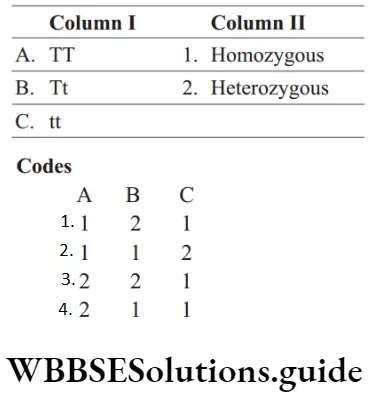
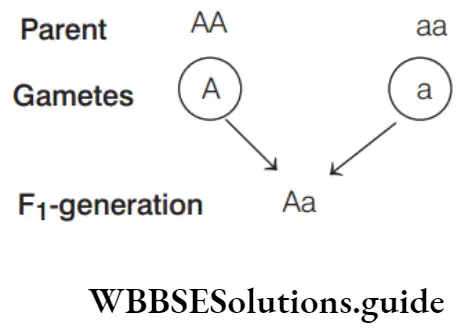
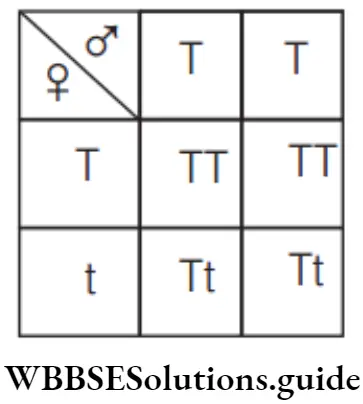
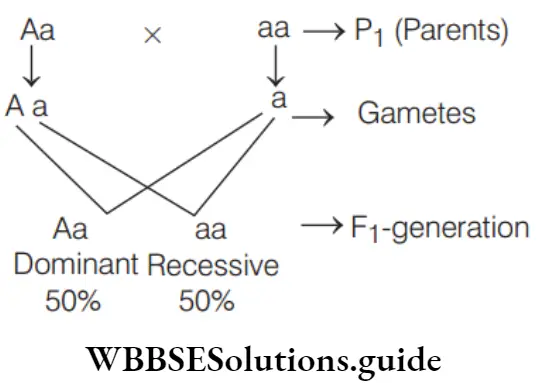
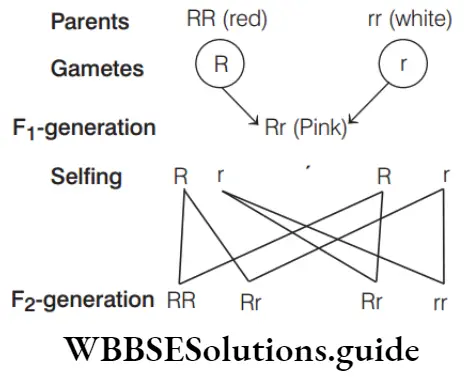
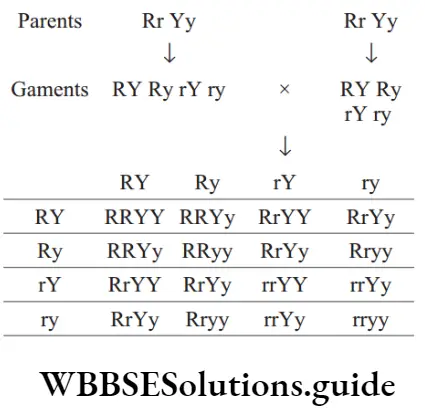
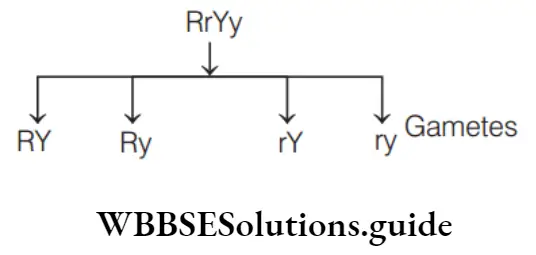
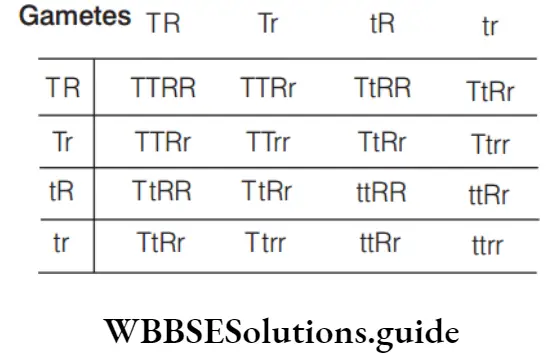
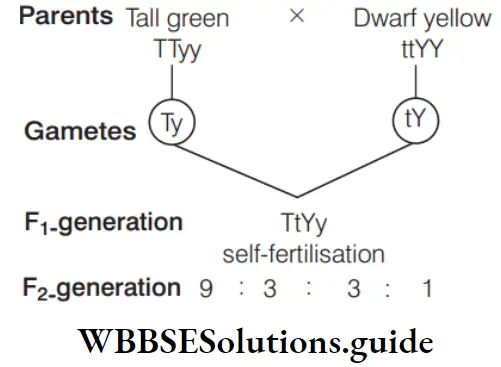
NEET Biology Deviation From Mendelism Multiple Choice Question And Answers

Deviation From Mendelism

Question 1. A phenomenon in which neither of the alleles of a gene is completely dominant over the other and hybrid is intermediate between the two parents is called

  1. Incomplete dominance
  2. Complete dominance
  3. Codominance
  4. Complementary dominance

Answer: 1. Incomplete dominance

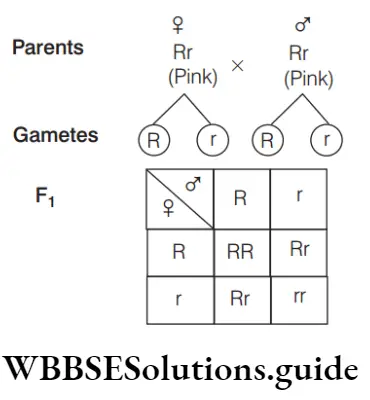
Incomplete dominance is the phenomenon in which none of the alleles being dominant, and the hybrid produced by crossing two pure individuals is a mixture of the parents.

Question 2. The phenomenon of incomplete dominance was observed by

  1. De Vries
  2. Correns
  3. Tschermark
  4. None of these

Answer:  2. Correns

  • While Mendel’s work laid the foundation, it was German botanist Carl Correns (1864-1933) who was credited with the actual discovery of incomplete dominance.
  • In the early 1900s, Correns conducted similar research on four O’ clock plants. In his work, Correns observed a blend of colours in flower petals.

Read And Learn More: NEET Biology Multiple Choice Question And Answers

Question 3. An example of intragenic gene interaction.

  1. Incomplete dominance
  2. Codominant
  3. Multiple alleles
  4. All of the above

Answer:  4. All of the above

  • Post-Mendelian gene interaction involves the influence of alleles and non-alleles on the normal phenotypic expression of genes. It is two types, namely, intragenic (allelic) and intergenic (non-allelic).
  • In the intragenic interaction, the two alleles of a gene interact to produce a phenotypic expression different from typical dominant-recessive phenotype, e.g. incomplete dominance, codominance, multiple alleles.
  • In intergenic or non-allelic interaction, two or more independent genes present on the same or different chromosomes interact to produce different expression, e.g. epistasis, duplicate genes, complementary genes, supplementary genes, lethal genes, inhibitory genes, etc.

Thus, option (4) is correct.

law of incomplete dominance

Question 4. Genotypic and phenotypic ratio in monohybrid cross remains same in case of

  1. Sex-linked genes
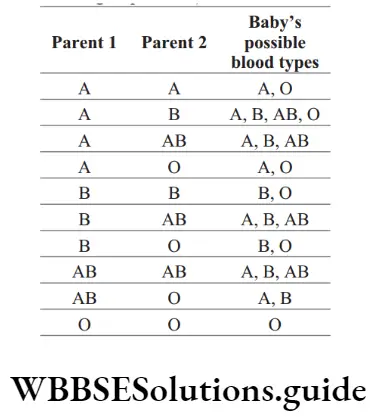
  2. Pseudoallelic genes
  3. Intermediate inheritance
  4. Dominant and recessive genes

Answer:  3. Intermediate inheritance

Genotypic and phenotypic ratio in monohybrid cross remains same in case of intermediate inheritance.

NEET Biology Deviation From Mendelism Multiple Choice Question And Answers

NEET Biology Deviation from Mendelism MCQs with Answers

Question 5. Incomplete dominance is demonstrated in

  1. Antirrhinum majus
  2. Pisum sativum
  3. Hibiscus rosa-sinensis
  4. Abutilon indicum

Answer:  1. Antirrhinum majus

  • Carl Correns reported incomplete dominance in Antirrhinum majus and Mirabilis jalapa. In both the case, there are two types of flower colour in pure state, red and white.
  • When the two types of plants are crossed, the hybrid or plants of F1 -generation have pink flowers. The pink colour apparently appears due to mixing of red and white colours (incomplete dominance).

Question 6. Incomplete dominance is shown by

  1. Primrose
  2. Mirabilis
  3. Helianthus
  4. China rose

Answer:  2. Mirabilis

Question 7. Phenotypic ratio in plant snapdragon in F2 is

  1. 1: 1
  2. 2: 1
  3. 3: 1
  4. 1: 2: 1

Answer:  4. 1: 2: 1

Phenotypic ratio in snapdragon plant in F2 is 1:2:1.

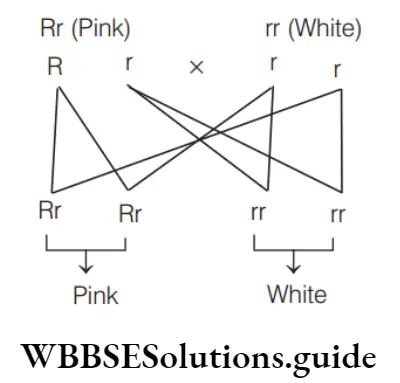
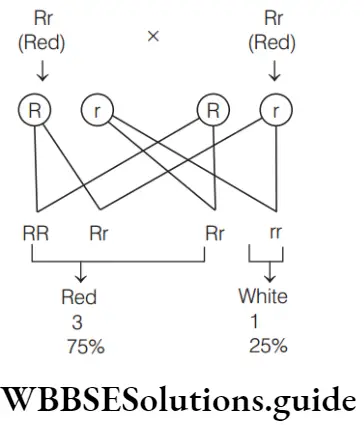
Question 8. In Mirabilis, a hybrid for red (RR) and white (rr) flower produces pink (Rr) flower. A plant with pink flower is crossed with white flower, the expected phenotypic ratio is

  1. Red: pink : white (1: 2 : 1)
  2. Pink: white (1: 1)
  3. Red: pink (1: 1)
  4. Red: white (3: 1)

Answer:  2. Pink: white (1: 1)

Mirabilis jalapa shows incomplete dominance.

NEET Biology Deviation from Mendelism Mirabilis Jalapa

The ratio of pink and white flower is 1:1.

law of incomplete dominance

Question 9. Leaf colour in Mirabilis jalapa is an example of

  1. Non-Mendelian inheritance
  2. Mendelian inheritance
  3. Chemical inheritance
  4. Both 2 and 3

Answer:  1. Non-Mendelian inheritance

  • The inheritance due to the genes found in cytoplasm (mitochondria and chloroplast) is called cytoplasmic inheritance or non-Mendelian inheritance.
  • The leaves of Mirabilis jalapa may be green, white or variegated. This is due to cytoplasmic inheritance.

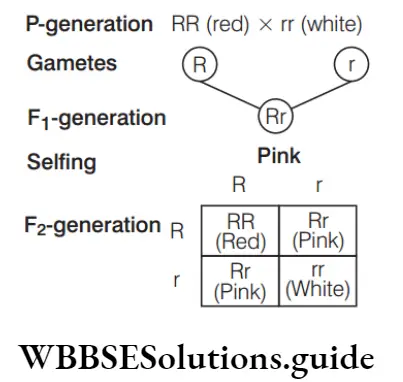
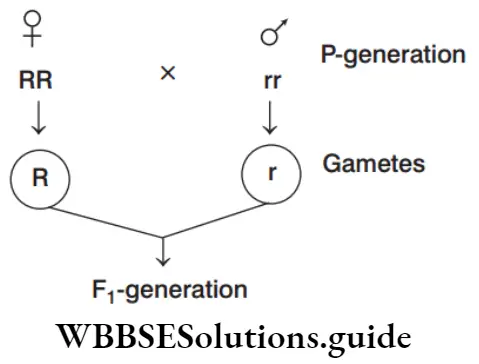
Question 10. RR (red) flowered plant is crossed with rr (white) flowered plant. All of the Rr offspring are pink. This is an indication that the R gene is

  1. Codominant
  2. Recessive
  3. Incompletely dominant
  4. Linked

Answer:  3. Incompletely dominant

The offspring Rr are pink due to partial expression of both alleles R and r. Thus, the gene R shows incomplete dominance.

NEET Biology DeviationFrom Mendelism Generations

Important MCQs on Deviation from Mendelian Genetics for NEET

Question 11. When phenotypic and genotypic ratio resembles in F2-generation. It is an example of

  1. Law of segregation
  2. Law of incomplete dominance
  3. Complimentary genes
  4. Epistasis

Answer:  2. Law of incomplete dominance

law of incomplete dominance

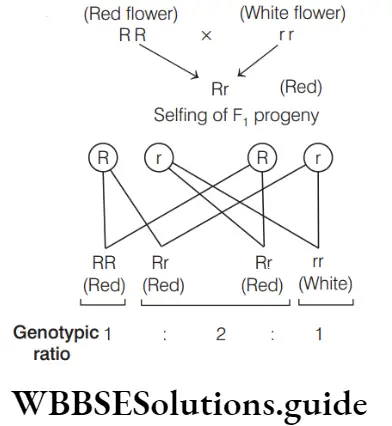
Incomplete dominance is not blending inheritance because parental characters reappear in F2-generation. Pink colour flower appear due to incomplete dominance of red colour trait over white flower trait. Both genotypic ratio and phenotypic ratio in the case of incomplete dominance are same, i.e. 1: 2: 1.

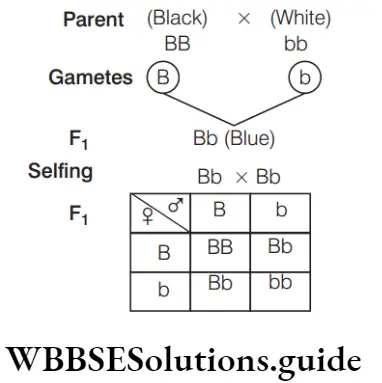
Question 12. A blue fowl was obtained after crossing between a white and black fowl. Then the ratio of their F1 – generation will be

  1. 3: 1
  2. 9: 7
  3. 1:2:1
  4. 13: 3

Answer:  3. 1:2:1

Since the cross between white and black fowl produced an intermediate phenotype, i.e. blue fowl, it is an example of incomplete dominance.

NEET Biology DeviationFrom Mendelism Question 12

Ratio = 1: 2: 1
Phenotypic ratio 1: 2: 1
(Black: Blue: White)
Genotypic ratio 1: 2: 1 (1BB: 2Bb 1bb)Thus, the correct answer is option (3).

Question 13. Two plants, one with black flower and other with white coloured flower were crossed in an experiment. In the next generation, grey coloured flowers were obtained. The reason for the result is

  1. Incomplete dominance
  2. Pseudodominance
  3. Codominance
  4. None of the above

Answer:  1. Incomplete dominance

  • The expression of the character in a hybrid or F1 individual is intermediate or a fine mixture of the expression of the two alleles of the parents.
  • If a plant with black flowers (say BB) on crossing with plant with white flowers (say bb), produced grey coloured flower (Bb), it means that the allele B is incompletely dominant over the recessive allele b. This is an example of incomplete dominance.

Question 14. Starch synthesis gene in pea plant is the example of

  1. Single gene producing more than one effect
  2. Multiple genes producing more than one effect
  3. Two genes producing more than one effect
  4. Multiple genes producing less than one effect

Answer:  1. Single gene producing more than one effect

  • Occasionally, a single gene product may produce more than one effect. For example, starch synthesis in pea seeds is controlled by one gene.
  • It has two alleles, B and b. Starch is synthesised effectively by BB and have bigger grains. In contrast, homozygous bb has lesser efficiency in starch synthesis and produce smaller grains.

law of incomplete dominance

Question 15. During the study of incomplete dominance, in a cross between true breeding red flowers (RR) and true breeding white flowers (rr), when F1 was self-pollinated, the resulted F2 ratio may be

  1. 1 (RR) red: 2 (Rr) pink: 1 (rr) white
  2. 2 (RR) red: 1 (Rr) pink: 1 (rr) white
  3. 1 (RR) red: 1 (Rr) pink: 2 (rr) white
  4. 3 (RR) red: 1 (rr) white

Answer: 1. 1 (RR) red: 2 (Rr) pink: 1 (rr) white

Cross between RR and rr would generate F2 generation as 1 RR: 2 Rr: 1rr.

Question 16. What will be the ratio of F2– generation, if red flowered variety of Mirabilis jalapa is crossed with white flowered variety?

  1. 1: 1: 1 : 1
  2. 3: 1
  3. 1: 2: 1
  4. 2: 3

Answer:  3. 1: 2: 1

Mirabilis jalapa show incomplete dominance. Thus, the F2-generation would have 1 : 2 : 1 ratio of red, pink and white flowers.

Question 17. The cross which will produce most pink flowers.

  1. Red × Red
  2. Red × Pink
  3. Pink × Pink
  4. Red × White

Answer:  4. Red × White

Pink colour flower is an intermediate character that is obtained by crossing homozygous red and white flowers.

Question 18. Andalusian fowl shows

  1. Codominance
  2. Incomplete dominance
  3. Multiple alleles
  4. All of the above

Answer:  2. Incomplete dominance

  • Andalusian fowl shows blending inheritance. It is also called as incomplete dominance. In Andalusian fowl, if a cross is made between black feathered fowl and white one, F1 -generation will have a blue feathered fowl.
  • After selfing, it produces black-blue and white feathers in the ratio of 1: 2 : 1. Refer to the cross in Ans. 12.

law of incomplete dominance

Question 19. In Antirrhinum, two plants with pink flowers were hybridised. The F1 plants produced red, pink and white flowers in the proportion of 1 red, 2 pink and 1 white. What could be the genotype of the two plants used for hybridisation? Red flower colour is determined by RR and white by rr genes.

  1. Rrrr
  2. RR
  3. Rr
  4. Rr

Answer:  3. Rr

The genotype of the two plants used for cross would be Rr

NEET Biology DeviationFrom Mendelism Question 19

The incomplete dominance of dominant allele (here R) over recessive allele (here r) could be due to mutations (insertion, deletion, substitution or inversion of nucleotides). The mutant allele generally produces a faulty or no product.

Question 20. All of given options obeys Mendel’s laws except

  1. Codominance
  2. Independent assortment
  3. Dominance
  4. Purity of gametes

Answer:  1. Codominance

In the given options, only codominance does not obey Mendel’s laws of dominance. It is an example of non-Mendelian intragenic interaction.

Question 21. When both alleles of a pair are fully expressed in a heterozygote, they are called

  1. Lethal
  2. Codominants
  3. Semidominants
  4. Recessive allele

Answer:  2. Codominants

law of incomplete dominance

  • Codominance is the condition that arises when both alleles in a heterozygous organism are dominant and are fully expressed in the phenotype.
  • For example, the human blood group AB is the result of two alleles, A and B, both being expressed equally A is not dominant to B, nor vice-versa.

Question 22. A gene showing codominance has

  1. Alleles that are recessive to each other
  2. Both alleles independently expressed in the heterozygote
  3. One allele dominant on the other
  4. Alleles tightly linked on the same chromosome

Answer:  2. Both alleles independently expressed in the heterozygote

Incomplete Dominance and Codominance MCQs for NEET

Question 23. Which Mendelian idea is depicted by a cross in which the F1 – generation resembles both the parents?

  1. Law of dominance
  2. Inheritance of one gene
  3. Codominance
  4. Incomplete dominance

Answer:  3. Codominance

In codominance, F1 -generation resembles both the parents, e.g. blood group inheritance.

Question 24. Assertion (A) There are cows of two colour coats. Reason (R) It is the case of codominance.

  1. Both A and R are true and R is the correct explanation of A
  2. Both A and R are true, but R is not the correct explanation of A
  3. A is true, but R false
  4. Both A and R are false

Answer:  1. Both A and R are true and R is the correct explanation of A

Both A and R are true and R is the correct explanation of A. There are cows of two colour coats, which is only possible in case of codominance where character of both the alleles are expressed.

Question 25. Identify the wrong statement.

  1. Alleles b and c also produce sugar
  2. Alleles IA and IB produce sugars
  3. When IB and b or i are present only IB is expressed
  4. Both IA and IB are present together and they express because of codominance

Answer:  1. Alleles b and c also produce sugar

  • Statement in option (1) is wrong because AB blood group in humans is controlled by three multiple alleles, i.e IA , IB and i.
  • The IA and IB alleles produce enzyme glycosyl transferase for the synthesis of sugars. Allele i does not produce any enzyme/antigen.
  • Both IA and IB are codominant and these both are dominant over i. Since, b and c represent recessive forms, they cannot produce sugar. Rest statements are correct.

Question 26. An example for codominance is

  1. Eye colour in Drosophila
  2. Seed shape and colour in pea plants
  3. AB blood group in man
  4. Haemophilia in man
  5. Baldness in man

Answer:  3. AB blood group in man

The phenomenon of expression of both the alleles in a heterozygote is called codominance. Alleles for blood group A (IA ) and for blood group B (IB) are codominant, so that when they come together in an individual, they produce blood group AB.

law of incomplete dominance

Question 27. Blood grouping in humans is controlled by

  1. 4 alleles in which A is dominant
  2. 3 alleles in which AB is codominant
  3. 3 alleles in which none is dominant
  4. 3 alleles in which A is dominant
  5. None of the above

Answer:  2. 3 alleles in which AB is codominant

The three alleles controlling the human blood groups are IA ,IB,IO in which AB is codominant.

Question 28. A child of blood group O cannot have parents of blood groups

  1. AB and AB/O
  2. A and B
  3. B and B
  4. O and O

Answer:  1. AB and AB/O

A child of blood group O cannot have parents of blood groups AB and AB/O.

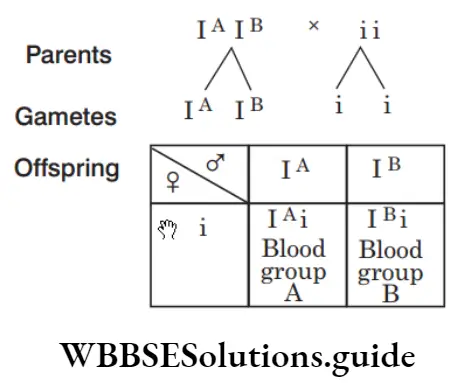
AB blood group possesses the genotype IA IB. AB × AB would generate blood groups A, B or AB.
AB × O would generate blood groups A or B, but never O. In the presence of dominant alleles, recessive allele (i) cannot be expressed.

Question 29. If mother has ‘O’ blood group, child also has O group. What will be the blood group of father?

  1. O
  2. A
  3. B
  4. All of these

Answer:  4. All of these

law of incomplete dominance

The cross between blood group O and either O, A or B can produce progeny with blood group O. But in such condition, father should have heterozygous genotype (in case of blood group A or B).

NEET Biology DeviationFrom Mendelism Heterozygous Genotype

Thus, option 4 is correct.

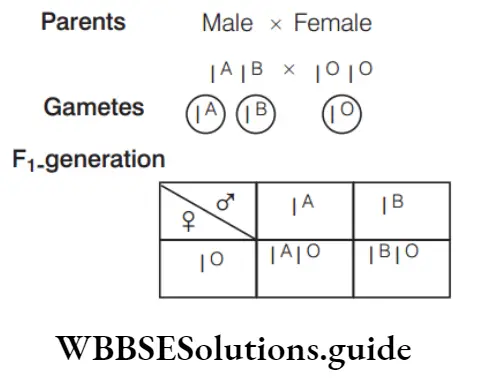
Question 30. First husband of Asha had ABO blood type A and their child had type O. She remarried and her second husband had ABO blood type B and their child had type AB. What is the ABO genotype of Asha and also name her blood type?

  1. Ii, blood type O
  2. IB, blood type B
  3. IAIB, blood type AB
  4. IAi, blood type A

Answer:  4. IAi, blood type A

  • Asha’s child from her first husband had blood group type O, i.e. genotype (ii). It means that the child received two recessive alleles, one from each of his parents (i from father and i from mother Asha).
  • Asha’s child from second husband had blood group type AB, i.e. genotype IA IB. As the child’s father had blood group type B (genotype
    IBi/IBIB), it means that the child received IB allele from father and IA allele from Asha.
  • Above discussion makes it clear that Asha’s blood group type contains i and I A genes, thus her blood group type is A with genotype IA i.

law of incomplete dominance

Question 31. In the ABO blood group system in humans, if a person of type B blood has children with a person of type AB blood, what blood types could their children have?

  1. Type-AB, type-A and type-B
  2. Type-B and type-AB
  3. Type-AB, type-A, type-B and type-O
  4. Type-A and type-B

Answer:  1. Type-AB, type-A and type-B

Since, A and B alleles are codominant, the possible blood types of the children are type-AB, type-A and type-B.

Topic-wise Deviation from Mendelian Genetics MCQs for NEET with Explanation

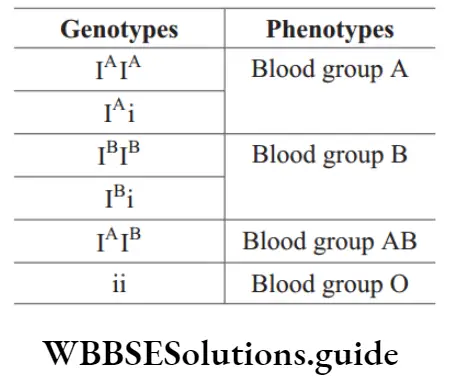
Question 32. ABO blood group is determined by three different alleles. How many genotypes and phenotypes are possible? Genotypes Phenotypes

img

Answer: 2. 6 4

The 3 alleles IA , IB and i of gene I in ABO blood group system can produce six different genotypes and four different phenotypes as shown below

NEET Biology DeviationFrom Mendelism Question 32

Question 33. A man with A group of blood marries a woman with B group of blood. The possibility of blood group AB in their children will be

  1. 25%
  2. 75%
  3. 50%
  4. 100%

Answer: 1. 25%

  • In this case, the genotype of the partner with ‘A’ blood group will be either IA IA or IA 1. The genotype of the partner with ‘B’ blood group will be either IBIB or IBi.
  • The progeny can have all the four types of blood groups 25% O (2), 25% A (IA IA or IA i), 25% B (IB IB or IBi) and 25% AB (IA IB).

Question 34. A child of O group has B group father. The genotype of father will be

  1. IOIO
  2. IBIB
  3. IAIB
  4. IBIO

Answer:  4. IBIO

The genotype of the child with O blood group would be IOIO (recessive). Hence, the genotype of the father can only be I IB O, i.e. heterozygous B blood group.

Question 35. When both the parents are of blood group AB, children would be of blood group

  1. A, B, AB and O
  2. A, B and AB
  3. A and B
  4. A, AB and O

Answer:  2. A, B and AB

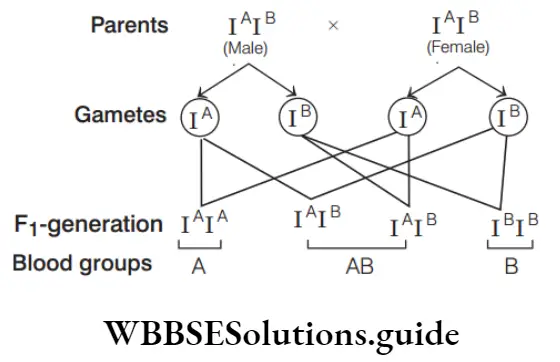
When both parents have blood group AB (IA IB) then offspring can have blood group A, B and AB.

NEET Biology DeviationFrom Mendelism Question 35

law of incomplete dominance

Question 36. Children have A and B types of blood. What are the blood types of parents?

  1. A and O
  2. AB and A
  3. AB and O
  4. A and B

Answer:  3. AB and O

Among given options, only AB and O can produce both A and B blood type in progeny.

NEET Biology DeviationFrom Mendelism Question 36

So, blood types of parents are AB and O.

Question 37. Blood group B can have alleles

  1. Ii
  2. IAIA
  3. IBIB
  4. IBIB or IBi

Answer:  4. IBIB or IBi

Blood group B can have two types of genotype. It can be found in homozygous (I IB B) or in heterozygous (I iB ) condition.

Question 38. If one parent belongs to A blood group and the other to O blood group, their children possibly represent

  1. A and B groups only
  2. AB only
  3. A and O groups only
  4. All four groups

Answer:  3. A and O groups only

Children with parents having blood groups A and O will have blood groups either A or O.

Question 39. Assertion (A) A woman can go to the court if a man refuses to own his child. He has blood group B and women has A, while child has O. Reason (R) Genetically she is right, he can be father of the child.

  1. Both A and R are true and the R is the correct explanation of A
  2. Both A and R are true, but R is not the correct explanation of A
  3. A is true, but R false
  4. Both A and R are false

Answer:  1. Both A and R are true and the R is the correct explanation of A

Both A and R are true and R is the correct explanation of A. Man has blood group B, it means he will have alleles I IB B or I IB O and woman has blood group A, that can have alleles I IA A or I IA O.

So there is possibility of a producing child with blood group O. In such condition, both man and woman are heterozygotes and have blood group genotype I IB 0 and I IA 0, respectively.

Question 40. Which of the following genotypes does not produce any sugar polymer on the surface of the RBC?

  1. IAIA
  2. IBi
  3. IAIB
  4. Ii
  5. IBIB

Answer:  4. Ii

Genotype ii does not produce any sugar polymer on the surface of the RBC because it is recessive allele. The blood group associated with this genotype is O.

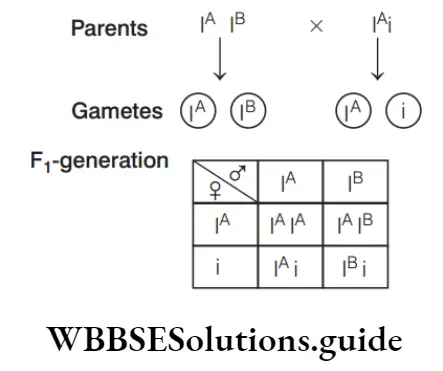
Question 41. The genotypes of a husband and wife are I AI B and I A i. Among the blood types of their children, how many different genotypes and phenotypes are possible?

  1. 3 genotypes, 3 phenotypes
  2. 3 genotypes, 4 phenotypes
  3. 4 genotypes, 3 phenotypes
  4. 4 genotypes, 4 phenotypes

Answer:  3. 4 genotypes, 3 phenotypes

Mating between I IA B and I iA can produce 4 genotypes and 3 phenotypes as shown in cross given below.

NEET Biology DeviationFrom Mendelism Question 41

law of incomplete dominance

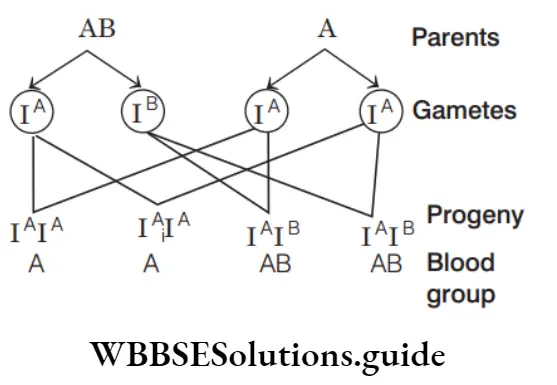
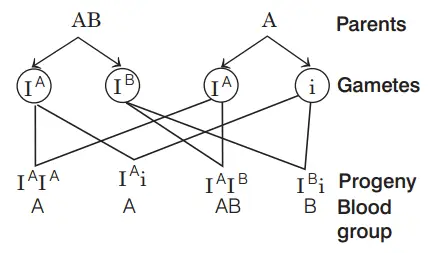
Question 42. A man of A blood group marries a woman of AB blood group. Which type of progeny would indicate that man is heterozygous?

  1. O
  2. B
  3. A
  4. AB

Answer:  2. B

  • Possible blood groups of children born to parents having A and AB groups are A, B and AB. These parents cannot have children possessing O group of blood.
  • AB blood group parent is always a heterozygote, while A blood group parent can either be a homo or heterozygote. If the male parent with blood group A in question is homozygote then no child with blood group B will be born.

NEET Biology DeviationFrom Mendelism Question 42

When the male parent is heterozygote then only blood group B of progeny shows that male parent is heterozygous.

NEET Biology DeviationFrom Mendelism Question 42.

Question 43. Four children belonging to the same parents have the following blood groups A, B, AB and O. Hence, the genotypes of the two parents are

  1. Parents are homozygous for ‘A’ group
  2. One parent is homozygous for ‘A’ and another parent is homozygous for ‘B’
  3. One parent is heterozygous for ‘A’ and another parent is heterozygous for ‘B’
  4. Parents are homozygous for ‘B’ group

Answer:  3. One parent is heterozygous for ‘A’ and another parent is heterozygous for ‘B’

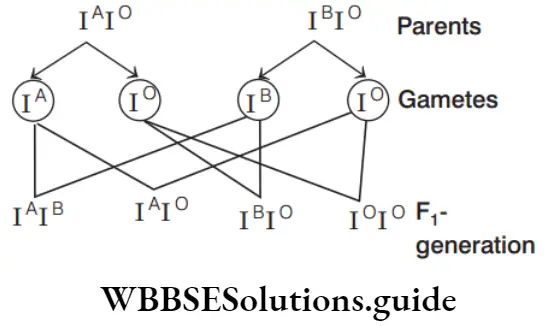
Four children belonging to the same parents will have the blood groups A, B, AB and O, if the genotypes of one parent is heterozygous for ‘A’ (IA IO) and another parent is heterozygous for ‘B’ (IBIO). It is illustrated below

NEET Biology DeviationFrom Mendelism Question 43

IA IB = AB blood group
IA IO = A blood group
IBIO= B blood group
IOIO = O blood group

Question 44. With regard to the ABO blood typing system, if a man who has type B blood and a woman who has type A blood were to have children, what blood types could the children have?

  1. A or O
  2. B or O
  3. AB or O
  4. A, B, AB or O

Answer:  2. B or O

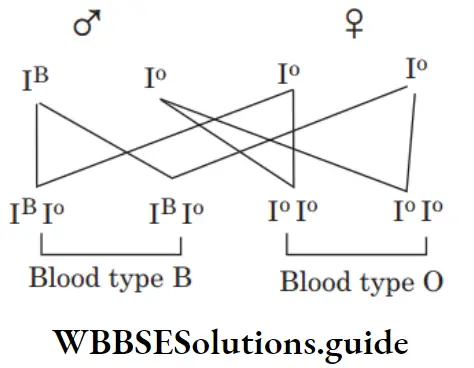
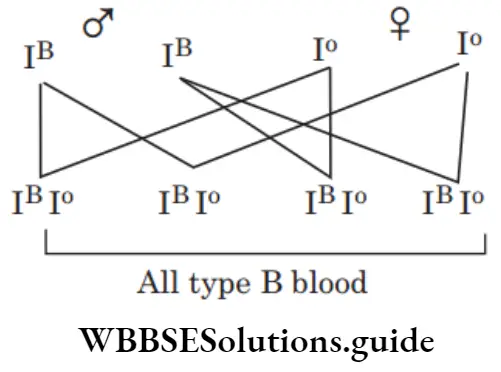
The man has type B blood and woman has type O blood. So, the genotype of their blood group will be IBIB or IBIO and IOIO, respectively. The blood type of child will be either B or O. This is illustrated below

NEET Biology DeviationFrom Mendelism Question 44 1B.

NEET Biology DeviationFrom Mendelism Question 44 IO

law of incomplete dominance

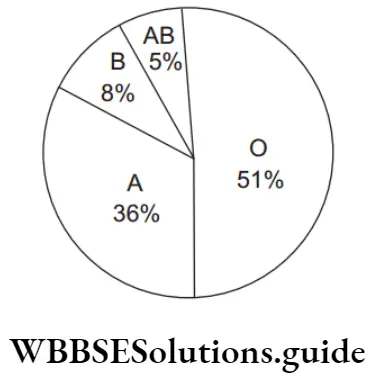
Question 45. Percentage of blood groups in India is given in the diagram below.

NEET Biology DeviationFrom Mendelism Percentage of blood groups

  1. Choose the correct option from the given statements.
  2. Only 10% of individuals are heterozygous for blood group allele
  3. Group A is the most common as it is the homozygous recessive group
  4. The alleles for blood group A and O are dominant to the allele for blood group O
  5. Any individual, selected at random from the sample population, has a 1 in 20 chance of being blood group AB

Answer:  4. Any individual, selected at random from the sample population, has a 1 in 20 chance of being blood group AB

As given in the pie chart, the AB blood group percentage is 5% in India. So, it can be said that any individual, selected at random from sample population has 1 in 20 chance of being blood group AB.

Question 46. A child’s blood group is ‘O’. The parent’s blood groups cannot be

  1. AB
  2. A and B
  3. B and O
  4. A and A
  5. None of these

Answer: 1. AB

A child’s blood group is ‘O’, i.e. it has no antigen, but group AB possess both the antigen A and B. Thus, it is not possible for the ‘O’ blood group individual to have parents with blood group AB. It is illustrated in cross given below

NEET Biology DeviationFrom Mendelism Question 46

NEET Biology Multiple Allelism and Pleiotropy MCQs

Question 47. Most popularly known blood grouping is the ABO grouping. It is named ABO and not ABC, because ‘O’ in it refers to having

  1. Overdominance of this type on the genes for A and B types
  2. One antibody only either anti-A or anti-B on the RBCs
  3. No antigens A and B on RBCs
  4. Other antigens besides A and B on RBCs

Answer:  3. No antigens A and B on RBCs

In ABO blood group, O refers to O blood group that has no antigen (A and B) on RBCs.

Question 48. The father has blood group AB and mother ‘O’. The child is supposed to have which of the following blood groups?

  1. B or O
  2. A or B
  3. Only B
  4. Only A

Answer:  2. A or B

  • The father has blood group ‘AB’ and mother has ‘O’. The child is supposed to have blood group ‘A’ or ‘B’. The genotype of father having blood group AB will be IA IB.
  • The genotype of mother having blood group O will be ii. Group ‘O’ blood has no antigens on RBC and has anti A and anti – B antibodies in serum.
  • Blood group AB has antigens A and B (but no antibodies in serum), thus the offsprings of AB and O blood groups would be ‘A’ or ‘B’. Refer to cross in Ans. 46.

Question 49. Which of the following characteristics represent ‘inheritance of blood groups’ in humans?

  1. Dominance
  2. Codominance
  3. Multiple allele
  4. Incomplete dominance
  5. Polygenic inheritance

Choose the correct answer

  1. 2, 3 and 5
  2. 1, 3 and 5
  3. 2, 4 and 5
  4. 1, 2 and 3

Answer:  4. 1, 2 and 3

  • Inheritence in the human blood group shows multiple alleles, dominance as well as codominance. Within the ABO blood group system, the A and B gene are codominant, i.e. these are expressed equally whenever present together. The O gene is recessive and only expressed when neither A nor B is present.
  • Three alleles are responsible for the different types of blood groups in human which shows multiple allelism. Alleles IA and IB show dominance on allele i.

Question 50. Parents of blood groups O and AB cannot have a child of group AB because

  1. Gene O is dominant over gene A
  2. Gene O is dominant over gene B
  3. Gene A or B is absent in one of the parents
  4. Gene A and B are absent in one of the parents

Answer:  3.  Gene A or B is absent in one of the parents

Parents of blood group O and AB cannot have a child of group AB because gene A or B is absent in one of the parents. Refer to Ans. 46.

law of incomplete dominance

Question 51. An individual with genotype I BIO has blood group

  1. A
  2. B
  3. AB
  4. O

Answer:  2. B

An individual with genotype I IB O has blood group B. As per law of dominance, allele IB is dominant and it will be expressed, whereas allele IO being recessive would not be expressed.

Question 52. If two people with ‘AB’ blood group marry and have sufficiently large number of children these children could be classified as ‘A’ blood group: ‘AB’ blood group: ‘B’ blood group in 1 : 2 : 1 ratio. Modern technique of protein electrophoresis reveals presence of both ‘A’ and ‘B’ type proteins in ‘AB’ blood group individuals. This is an example of

  1. Incomplete dominance
  2. Partial dominance
  3. Complete dominance
  4. Codominance

Answer:  4. Codominance

  • ABO blood group system in human beings is an example of codominant, dominant–recessive and multiple alleles.
  • Blood groups are controlled by the gene I located on 9th chromosome that has 3 multiple alleles, out of which any two are found in a person.
  • In codominance, both genes I IA and B express completely. So, given example in question is an example of codominance.

Question 53. An exception to Mendel’s law is

  1. Law of independent assortment
  2. Law of segregation
  3. Law of dominance
  4. Law of linkage

Answer:  4. Law of linkage

Linkage is the tendency of two or more genes to inherit together. Mendel’s laws are true only in the absence of linkage and gene interaction. Thus, linkage is an exception to Mendel’s law.

Question 54. Choose the incorrect one out.

  1. Codominant genes are never haplosufficient
  2. Dominant phenotype is expressed when a gene is haplosufficient
  3. Incomplele dominance is the presence of haplosufficiency
  4. In homozygous condition, an allele can express its phenotype be it the dominant or recessive allele in nature

Answer:  3. Incomplele dominance is the presence of haplosufficiency

Option (3) is incorrect and can be corrected as Haplosufficiency is the condition when an allele can express itself fully and produce its phenotype completely even in heterozygous condition. Incomplete dominance results from lack of haplosufficiency. Rest all options are correct.

Question 55. Failure in which of the following phenomenon would result in linkage?

  1. Law of dominance
  2. Law of segregation
  3. Law of independent assortment
  4. Law of separation

Answer:  3. Law of independent assortment

Failure of independent assortment would result in the linkage of genes on the chromosomes. Due to this, the two alleles present closely together fails to seggregate during gamete formation and thus inherit together.

law of incomplete dominance

Question 56. In genetic crosses showing recessive epistasis such as mice coat colour, F2 phenotypic ratio is

  1. 9 : 3: 4
  2. 9 : 6: 1
  3. 12 : 3: 4
  4. 13 : 3

Answer: 1. 9 : 3: 4

  • Epistasis due to recessive gene is known as recessive epistasis, i.e. out of the two pairs of genes, the recessive epistatic gene masks the activity of the dominant gene on the other gene locus.
  • In genetic crosses showing recessive epistasis such as mice coat colour, F2 phenotypic ratio is 9 : 3: 4.

Question 57. In a dihybrid cross, between two heterozygotes AaBb : AaBb, if we get 3:1 ratio among the offsprings, the reason for this may be

  1. Polygenes
  2. Linked genes
  3. Pleiotropic genes
  4. Hypostatic genes

Answer:  2. Linked genes

  • In case of dihybrid cross between AaBb × AaBb, if we get 3:1 ratio among the offsprings then it may be due to the presence of linked genes.
  • These genes are placed on the same chromosome and do not show independent assortment at the time of gamete formation. These genes show a dihybrid ratio of 3: 1. Complete linkage allows the gene combination of parental traits to be inherited together.

Question 58. TtRr represents heterozygous tall, heterozygous pink. If this plant is self-crossed then (T-dominant, t-recessive, R-dominant, r-recessive)

  1. 25% plants have red flower.
  2. 25% plants have white flower.
  3. 50% plants have pink flower.
  4. 50% plants are tall.

Choose the correct option.

  1. 1 and 2
  2. 1, 2 and 3
  3. 2, 3 and 4
  4. 1, 2,3 and 4

Answer:  2. 1, 2 and 3

TtRr represents (heterozygous tall and pink). Hence, in accordance with the ratio of incomplete dominance, i.e. 1 : 2 : 1, 25% plants have red flower, 25% plants have white flower and 50% plants have pink flower.

Question 59. The F2 dihybrid ratio 12:3:1 is explained on the basis of

  1. Epistatic interaction
  2. Complementary gene action
  3. Interaction between two alleles
  4. Both 1 and 2

Answer:  1. Epistatic interaction

Epistasis is a type of gene interaction in which one gene masks or prevents the expression of another. Such interactions give modified F2 ratio as 12: 3 : l.

Question 60. Which of the following ratio shows complementary gene interaction?

  1. 9:7
  2. 15:1
  3. 1:2:1
  4. 9:3:3:1

Answer: 1. 9:7

Complementary gene interaction was first discovered by William Bateson and Reginald Punnett in 1906.

9:7 ratio shows that 9 offspring have both dominant genes, while 7 is having either one dominant or both recessive genes.

Question 61. Independent assortment of genes does not takes place when

  1. Genes are located on homologous chromosomes
  2. Genes are linked and located on same chromosome
  3. Genes are located on non-homogenous chromosome
  4. All of the above

Answer:  2. genes are linked and located on same chromosome

Genes that are located on the same chromosome are not free to participate in independent assortment and are referred to as linked genes. These genes tend to be inherited together.

Question 62. Lack of independent assortment of two genes, A and B in fruitfly, Drosophila is due to

  1. Repulsion
  2. Recombination
  3. Linkage
  4. Crossing over

Answer:  3. Linkage

Lack of independent assortment of two genes, A and B in fruitfly Drosophila is due to linkage, in which genes are located close to each other and they do not assort independently.

Question 63. When two dominant independently assorting genes react with each other, they are called

  1. Collaborative genes
  2. Complementary genes
  3. Duplicate genes
  4. Supplementary genes

Answer:  2. Complementary genes

law of incomplete dominance

Two genes present on separate loci that interact together to produce a dominant phenotype are called complementary genes. In F2 -generation, 9:7 ratio is obtained by them.

Question 64. Multiple phenotype is seen in

  1. Dominance relationship
  2. Particulate inheritance
  3. Monogenic inheritance
  4. Polygenic inheritance

Answer:  4. Polygenic inheritance

  • Polygenic inheritance is a type of inheritance controlled by one or more genes in which the dominant alleles have cumulative effect with each dominant allele expressing a part or unit of the trait and the full trait being shown only when all the dominant alleles are present.
  • The genes involved in quantitative inheritance are called polygenes (also called cumulative genes). Quantitative inheritance is therefore, also called polygenic inheritance. It is also named as multiple factor inheritance as mutiple phenotypes are seen in it.

Cytoplasmic Inheritance and Gene Interaction MCQs for NEET

Question 65. Skin colour inheritance in man is

  1. Monogenic
  2. Polygenic
  3. Sex-linked
  4. Multiple alleles
  5. Epistasis

Answer:  2. Polygenic

Inheritance of skin colour in man is an example of polygenic inheritance. It shows cumulative effect, i.e. two independent dominant genes produce additive effect in an individual.

Question 66. Who gave first experimental evidence of the polygenic concept of inheritance?

  1. Galton (1883)
  2. Malthus (1828)
  3. Nilsson Ehle (1908)
  4. None of the above

Answer:  3. Nilsson Ehle (1908)

Continuous variation is due to the additive effect of two or more genes for a trait. Such type of inheritance is called polygenic inheritance. Nilsson Ehle gave first experimental evidence of the polygenic concept of inheritance.

Question 67. The total number of types of gametes produced in a cross between a negro and albino parent is

  1. 64
  2. 16
  3. 08
  4. 04

Answer:  3. 08

The F1 -generation has mullatoes with 8 types of gametes. The genetic combination is AaBbCc. As there are three pairs of heterozygous alleles, it will form 8 types of gametes.

Question 68. Select the statement which is not correct?

  1. Polygenic character is controlled by multiple alleles
  2. In case of polygenic inheritance, thousands of intermediate phenotypes are found between 2 extreme ones
  3. Height, weight, skin colour are polygenic
  4. Polygenic character is controlled by multiple genes

Answer:  1. Polygenic character is controlled by multiple alleles

  • Statement in option (1) is not correct. Quantitative or polygenic inheritance is that type of inheritance in which the complete expression of a trait is controlled by two or more genes.
  • The complete trait develops only by the cumulative effect of all homologous and non-homologous dominant alleles influencing that trait. Inheritance of skin colour in man is an example of polygenic inheritance. Rest all options are correct.

Question 69. The polygenic genes show

  1. Similar genotype
  2. Different karyotype
  3. Different phenotype
  4. None of the above

Answer:  4. None of the above

A polygenic trait is governed by more than one gene where dominant allele of each gene express a part of trait and full trait is expressed by dominant alleles of all genes. Depending upon genotype, it produce multiple or different phenotypes.

Question 70. Which one of the following pairs of features is a good example of polygenic inheritance?

  1. Human height and skin colour
  2. ABO blood group in humans and flower colour of Mirabilis jalapa
  3. Hair pigment of mouse and tongue rolling in humans
  4. Human eye colour and sickle-cell anaemia

Answer:  1. Human height and skin colour

Statement in option (a) is a good example of polygenic inheritance as Inheritance of human height and skin colour are examples of polygenic inheritance. Rest all options are false.

Question 71. The phenotypic ratio of polygenes representing skin colour in human is

  1. 1: 4 : 6: 4: 1
  2. 1: 2: 1
  3. 1: 6: 15: 20 : 15: 6: 1
  4. 1: 3: 1

Answer:  3. 1: 6 : 15: 20 : 15: 6: 1

The phenotypic ratio of polygenes representing skin colour in human is
1 : 6 : 15 : 20 : 15 : 6 : 1.

Question 72. Grain colour in wheat is determined by three pairs of polygenes. Following the cross AABBCC (dark colour) × aabbcc (light colour) in F2-generation. What proportion of the progeny is likely to resemble either parent?

  1. Half
  2. Less than 5%
  3. One third
  4. None of these

Answer:  2. Less than 5%

  • Polygene results in quantitative inheritance. This inheritance is characterised by the occurrence of intermediate forms between the parental types. There will be 7 phenotypes (l: 6: 15: 20: 15: 6: 1) when three polygene pairs are involved.
  • The total number of progeny would be 64. Out of these 64, only two are likely to resemble either parent. Hence, their proportion in F2-generation would be less than 5%.

law of incomplete dominance

Question 73. Multiple factor inheritance has been observed in which of the following characteristic of wheat?

  1. Height of the plant
  2. Colour of the grain
  3. Shape of legumes
  4. Number of spikelets

Answer:  2. Colour of the grain

A few instances of multiple factor inheritance are kernel or grain colour in wheat, cob length in maize, yield of crop plants including size, shape and number of seeds or fruits per plant.

Question 74. Which of the following is not the type of epistasis?

  1. Dominant
  2. Recessive
  3. Collaborative
  4. Supplementary

Answer:  3. Collaborative

All given options are types of epistasis except collaborative. Epistasis can be of many types based on the ability of an allele in masking and modification of gene effects. It can be of dominant, recessive, complementary or supplementary.

Question 75. Assertion (A) A gene affecting the character of another gene not located on similar locus of the homologous chromosome is called epistatic gene. Reason (R) Epistatic gene hides the expression of an allele at a different locus.

  1. Both A and R are true and R is the correct explanation of A
  2. Both A and R are true, but R is not the correct explanation of A
  3. A is true, but R is false
  4. Both A and R are false

Answer:  1. Both A and R are true and R is the correct explanation of A

Question 76. The process that involves intergenic suppression or the masking effect which one gene locus has upon the expression of another is called

  1. Epistasis
  2. Dominance
  3. Incomplete dominance
  4. Recessive
  5. Pleiotropy

Answer:  1 . Epistasis

  • Originally, the term epistasis meant that the phenotypic effect of one gene is masked by a different gene (locus).
  • Thus, epistatic mutations have different effects in combination, than individually. In epistasis, two independent non-allelic genes affect the same trait in such a way that one overmasks the expression of other.

Question 77. A pleiotropic gene

  1. Controls a trait only in combination with another gene
  2. Controls multiple traits in an individual
  3. Is expressed only in primitive plants
  4. Is a gene evolved during Pliocene

Answer:  2. Controls multiple traits in an individual

  • The ability of a gene to have multiple phenotypic effects because it influences a number of characters simultaneously is known as pleiotropy.
  • The gene having a multiple phenotypic effect because of its ability to control expression of two or more characters is called pleiotropic gene.
  • In human beings, pleiotropy is exhibited by syndromes like sickle-cell anaemia and
    phenylketonuria.

Question 78. Assertion (A) The phenomenon of a single gene influencing more than one character is pleiotropism. Reason (R) The gene responsible for phenylketonuria affects a number of abnormal phenotypic traits.

  1. Both A and R are true and R is the correct explanation of A
  2. Both A and R are true, but R is not the correct explanation of A
  3. A is true, but R false
  4. A is false, but R is true
  5. Both A and R are false

Answer:  2. Both A and R are true, but R is not the correct explanation of A

Both A and R are true, but R is not the correct explanation of A. The phenomenon of a single gene influencing more than one character is pleiotropism and phenylketonuria is its example.

Linked Genes and Crossing Over MCQs for NEET

Question 79. Pleiotropic genes have

  1. Repressed phenotype
  2. Hidden phenotype
  3. Multiple phenotype
  4. All of the above

Answer:  3. Multiple phenotype

Pleiotropic gene is such a gene which has a wider effect on phenotype, i.e. it controls several phenotypic, traits. It has mutliple phenotypes. Sickle-cell anaemia is caused by one such pleiotropic gene.

Question 80. The best example for pleiotropy is

  1. Skin colour
  2. Phenylketonuria
  3. Colour blindness
  4. ABO blood group

Answer:  2. Phenylketonuria

  • The best example for pleiotropy is phenylketonuria. In phenylketonuria, a single gene mutation that codes for enzyme phenylalanine hydrodxylase is seen.
  • This manifests itself through phenotypic expression characterised by mental retardation, reduction in hair and skin pigmentation.

Question 81. Name the phenomenon where two genes have the same expression of the character?

  1. Pleiotropy
  2. Phenocopy
  3. Penetrance
  4. Expressivity

Answer:  1. Pleiotropy

Pleiotropy is the condition where either a single gene has multiple functions in the body or two genes have the same expression of the single character.

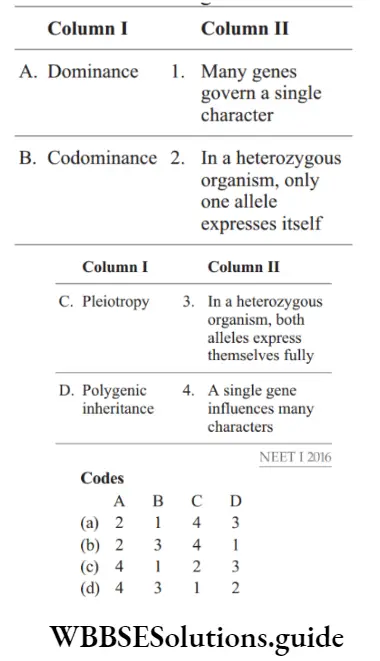
Question 82. Match the following columns.

NEET Biology Deviation From Mendelism Question 82 Match The Following Column.

Answer:  2. A–2, B–3, C–4, D–1

law of incomplete dominance

Question 83. The presence of continuous phenotypic variation in an F1 -generation suggests that a character is inherited by

  1. Gene linkage
  2. Epistasis
  3. Polygenic inheritance
  4. Recombination

Answer:  3. Polygenic inheritance

  • Quantitative or polygenic inheritance is that type of inheritance in which the complete expression of a trait is controlled by two or more genes (i.e. the presence of continuous phenotypic variation in an F1 -generation).
  • The complete trait develops only by the cumulative effect of all homologous and non-homologous
    dominant alleles influencing that trait. Inheritance of skin colour in man is an example of polygenic inheritance.

NEET Biology Mendelism Multiple Choice Question And Answers

NEET Biology Mcq Mendelism

Question 1. Principle or laws of inheritance were enunciated by

  1. Mendel
  2. Morgan
  3. Bateson
  4. Punnett

Answer:  1. Mendel

Principle or laws of inheritance were enunciated by Mendel. There are four principles or laws of inheritance based on monohybrid and dihybrid cross.

Question 2. Under which topic, Mendel’s work was published in ‘Natural History Society of Brunn’?

  1. Mendel’s Laws of Inheritance
  2. Experiments in Plant Hybridisation
  3. Experiment on Heredity and Variation
  4. Origin of Species

Answer:  2. Experiments in Plant Hybridisation

“genetics questions “

Mendel’s paper ‘Experiments on Plant Hybridisation’ was published in proceedings of Natural Science Society of Brunn in 1866.

Read And Learn More: NEET Biology Multiple Choice Question And Answers

Question 3. Mendel’s findings were rediscovered by

  1. De Vries
  2. Correns
  3. Tschermak
  4. All of these

Answer:  4. All of these

In 1900, three workers independently rediscovered the principles of heredity already worked out by Mendel. These workers were Hugo de Vries (Holland), Carl Correns (Germany) and Erich von
Tschermak (Austria).

Thus, option 4 is correct.

NEET Biology Mcq

NEET Biology Mendelism Multiple Choice Question And Answers

NEET Biology Mendelism MCQs with answers

Question 4. Mendel’s law were true for situation in which

  1. Alleles are affected by their environment
  2. Alleles show complete dominance
  3. Alleles of a gene alter the affect of a different gene
  4. A given character is determined by more than one gene

Answer:  2. Alleles show complete dominance

Mendel’s law were able to predict accurately the pattern of inheritance for a situation in which alleles show complete dominance. Effect of the environment, other alleles, etc., were not explained by the Mendel. He was not aware of polygenic traits also.

“questions about genetics “

Question 5. Which of the following are the laws yielded by Mendel’s studies?

  1. Law of dominance
  2. Law of segregation
  3. Law of independent assortment
  4. All of the above

Answer:   4. All of the above

Mendel’s studies yielded three laws of inheritance, i.e. the law of dominance, the law of segregation and the law of independent assortment. Thus, option 4 is correct.

Question 6. It was during Mendel’s investigation that ….A…. and …..B….. were applied together in biology.

Choose the correct set of answers.

  1. A–statistical analysis, B–mathematical logic
  2. A–statistical analysis, B–physical logic
  3. A–statistical analysis, B–chemistry logic
  4. A–statistical analysis, B–genetic coding

Answer:  1. A–statistical analysis, B–mathematical logic

During Mendel’s investigation, statistical analysis (A) and mathematical logic (B) were applied
together in biology.

NEET Biology Mcq

Question 7. Which one from those given below is the period for Mendel’s hybridisation experiments?

  1. 1856-1863
  2. 1840-1850
  3. 1857-1869
  4. 1870-1877

Answer:  1. 1856-1863

Mendel conducted hybridisation experiments on pea plant for 7 years between 1856 -1863 and his data was published in 1865.

Important MCQs on Mendelism for NEET

Question 8. Mendel conducted hybridisation experiments on garden peas for

  1. 7 years
  2. 6 years
  3. 5 years
  4. 4 years

Answer:  1. 7 years

Question 9. Choose the correct statement.

  1. Mendel died in 1884 without getting any recognition during his lifetime
  2. Correns converted two generalisations of Mendel into two laws of heredity
  3. Mendel had maintained statistical records of all the experiments
  4. All of the above

Answer:  4. All of the above

All the given statements are correct.

Biology MCQs with answers for NEET

Question 10. During the experiments, Mendel called genes by the term

  1. Traits
  2. Characters
  3. Factors
  4. Qualities

Answer: 3.  Factors

  • Mendel proposed that inheritance is controlled by paired germinal units or factors, now called genes. They are present in all cells of the body and are transferred to the next generation
    through gametes.
  • Factors or genes are thus, physical basis of heredity. They represent small segments of chromosomes.

Question 11. The botanical name of garden pea is

  1. Pisum sativum
  2. Lathyrus odoratus
  3. Mangifera indica
  4. Solanum tuberosum

Answer:   1. Pisum sativum

The botanical name of garden pea is Pisum sativum. It is herbaceous annual plant of the family–Fabaceae.It is grown virtually worldwide for its edible seeds.

Question 12. The experimental material in Mendel’s experiment was

  1. Pisum sativum
  2. Oryza sativa
  3. Mirabilis jalapa
  4. None of the above

Answer:  1. Pisum sativum

Gregor Johann Mendel conducted hybridisation experiments on garden pea (Pisum sativum) and proposed the laws of inheritance in living organisms.

Biology MCQs with answers for NEET

Question 13. Pollination type adopted by Mendel in his experiment.

  1. Artificial pollination
  2. Cross pollination
  3. Natural pollination
  4. Both 1 and 2

Answer:  4. Both 1 and 2

Mendel conducted artificial pollination/cross-pollination using true breeding pea lines. A true breeding line is one that have undergone continuous self-pollination, shows stable trait inheritance and expression for several generation. Thus, option is correct.

Question 14. Mendel investigated characters in garden pea plant that were manifested in two ……………… trait.

  1. Similar
  2. Non-zygote
  3. Identical
  4. Opposite

Answer:  4. Opposite

Mendel investigated those characters in garden pea that were mainfested as two opposite traits, one was dominant and other one was recessive.

Question 15. Mendel was lucky to work on pea plants for his experiment because

  1. Pea flowers are normally self-pollinated, but can be readily cross pollinated
  2. There are several varieties in peas with observable alternative form of a trait
  3. The selected seven characters in the experiment are located on the same chromosome
  4. The selected seven characters were located on different chromosomes

Answer:  4. The selected seven characters were located on different chromosomes

  • Mendel worked on garden pea. He choose only those characters which showed consistent results. He worked on seven characters.
  • These characters showed complete independent assortment despite the seven characters chosen by him were present on four different chromosomes, i.e. 1, 4, 5 and 7.

“genetic questions “

Biology MCQs with answers for NEET Question 16. The number of contrasting characters studied by Mendel for his experiments was

  1. 14
  2. 4
  3. 2
  4. 7

Answer:  1.  14

Mendel selected 7 pairs or 14 characters of true breeding pea plant varieties for his experiment.

Question 17. Mendel’s laws of inheritance are applicable only for

  1. Protista
  2. Monera
  3. Diploid organism
  4. Haploid organism

Answer:  3. Diploid organism

  • Mendel’s laws of inheritance are applicable for the organisms, which are multicellular and diploid and form haploid gametes during sexual reproduction.
  • This law is applicable to organism having single gene pair containing two alleles, one dominant over the other. Protista and Monera, both are the unicellular organisms.

Question 18. Which of the following is correct about Mendel’s statement?

  1. 7 characters, 7 pair traits
  2. 7 paired characters, 7 traits
  3. 7 characters, 7 traits
  4. 7 pair characters, 7 pair traits

Answer:  2. 7 paired characters, 7 traits

Mendel conducted cross breeding experiments on garden pea (Pisum sativum). He studied the inheritance of 7 different pairs of contrasting characters or 7 traits in this plant, but considered only one pair at a time.

Question 19. Which one of the following traits of garden pea studied by Mendel was a recessive feature?

  1. Green pod colour
  2. Round seed colour
  3. Axial flower position
  4. Green seed colour

Answer:  4. Green seed colour

Recessive traits studied by Mendel were are wrinkled seed coat, green seed colour, white flower colour, constricted pod shape, yellow pod colour, terminal flower position, dwarf stem height.

Mendelian genetics MCQs for NEET with solutions

Question 20. The colour based contrasting traits in seven contrasting pairs, studied by Mendel in pea plant were

  1. 1
  2. 2
  3. 3
  4. 4

Answer: 3.  3

Out of the seven pairs of contrasting traits studied by Mendel in pea plants, yellow seed colour, violet flower colour, green pod colour were three colour based traits.

Question 21. Mendel selected Pisum sativum for his experimental investigations among various plants available in the Monastery garden. Which of the following can be a reason for this?

  1. It has a short life cycle
  2. It has distinctive, contrasting traits like tall and dwarf plant
  3. It easily undergoes self-pollination
  4. All of the above

Answer: 4.  All of the above

Biology MCQ For NEET With Answers

  • Mendel selected Pisum sativum due to following features Pure varieties of pea are available.
    Pea plants show a number of easily detectable contrasting characters.
  • The flower structure of pea allow controlled breeding. Pea flower normally remains closed and undergoes self- pollination. It is an annual plant with short lifespan and gives result within 3 months. A large number of seeds are produced per plant.
  • The plant is grown easily and does not require after-care except at the time of pollination. Though pea plant is self- pollinated, but it can be cross breed manually. F1 hybrids are fertile.

Thus, option 4 is correct.

Question 22. Mendel studied seven pairs of contrasting characters for his breeding experiment with Pisum sativum. Which of the following characters were not considered for his experiment?

  1. Pod shape
  2. Leaf shape
  3. Plant height
  4. Pod colour

Answer:  2. Leaf shape

“gene questions “

The seven pairs of contrasting characters studied by Mendel were Tall or dwarf nature of plants Axillary or terminal flowers Green or yellow coloured pods Smooth or wrinkled seed shape Inflated or constricted pods Yellow or green seed colour White or violet flowers. Thus, he did not considered leaf shape.

Question 23. Among the following characters, which one was not considered by Mendel in his experiments on pea?

  1. Stem – Tall or dwarf
  2. Trichomes – Glandular or non-glandular
  3. Seed – Green or yellow
  4. Pod – Inflated or constricted

Answer:  2. Trichomes – Glandular or non-glandular

Nature of trichomes, i.e. glandular or non-glandular was not considered by Mendel. Whereas stem, seed and pod were considered.

Question 24. Which character was dominant among the 7 characters in Mendel’s experiment?

  1. Plant height–Dwarf
  2. Flower position–Terminal
  3. Pod colour–Green
  4. Seed colour–Green

Answer:  3. Pod colour–Green

Among the given options, green pod colour is dominant, whereas the other three are recessive traits.

Characters >Dominant traits > Recessive traits Seed shape > Round > Wrinkled Seed colour >Yellow > Green Flower colour >Violet >White Pod shape >Full or inflated > Constricted Pod colour > Green >Yellow Flower position >Axial >Terminal Stem height > Tall >Dwarf

Question 25. According to Mendelism which character shows dominance?

  1. Terminal position of flower
  2. Green colour in seed coat
  3. Wrinkled seeds
  4. Violet flower colour

Answer:  4. Violet flower colour

Question 26. Mendel was successful in discovering the principles of inheritance as

  1. He took pea plants for his experiments
  2. He did not encounter linkage between the genes for the characters, he considered
  3. He had in depth knowledge on hybridisation
  4. He was a famous mathematician

Answer:  2. He did not encounter linkage between the genes for the characters, he considered

Mendel took only those traits for his studies which did not show linkage, interaction or incomplete dominance. Mendel was lucky in selecting those traits whose genes did not interact. They were either present on different chromosomes or showed complete recombination.

Question 27. Mendel, while studying the garden pea (Pisum sativum) observed its seven traits. Which one does not match with its dominant character?

  1. Flower colour–Purple
  2. Flower position–Axial
  3. Pod colour–Yellow
  4. Seed shape–Round

Answer:  3. Pod colour–Yellow

Option does not match with its dominant character because yellow pod colour is a recessive character. Rest options represents the correct match with their dominant characters.

Question 28. Some of the dominant traits studied by Mendel were

  1. Round seed shape, constricted pod shape and axial flower position
  2. Green pod colour, inflated pod shape and axial flower position
  3. Yellow seed colour, violet flower colour and yellow pod colour
  4. Axial flower position, green pod colour and green seed

Answer:  2. Green pod colour, inflated pod shape and axial flower position

Question 29. The genes controlling the seven pea characters studied by Mendel are now known to be located on how many different chromosomes?

  1. Seven
  2. Six
  3. Five
  4. Four

Answer:  4. Four

Biology MCQ For NEET With Answers

Question 30. Which of the following statements is not correct about pea plant?

  1. It is a plant with short annual life cycle
  2. Flowers are unisexual and cross pollinating
  3. They can undergo easy emasculation
  4. The offspring produced by cross-pollination are fertile

Answer:  2. Flowers are unisexual and cross pollinating

Statement in option is not correct and can be corrected as Flowers of pea plant are bisexual and self-pollinating. Rest statements are correct about pea plant.

Question 31. Mendel’s contribution for genetic inheritance was

  1. The idea that genes are found on chromosomes
  2. Providing a mechanism that explains patterns of inheritance
  3. Describing how genes are influenced by the environment
  4. Determining that the information contained in DNA codes for proteins

Answer: 2. Providing a mechanism that explains patterns of inheritance

Mendel gave the laws of inheritance, which provides the mechanism that explains the pattern of inheritance.

Question 32. In Mendel’s studies, inflated pod of pea is a/an

  1. Dominant character
  2. Incompletely dominant character
  3. Recessive character
  4. Abnormal character

Answer:  1. Dominant character

NEET quiz on Mendelism with solutions

Question 33. Among the seven pairs of contrasting traits in pea plant as studied by Mendel, the number of traits related to flower, pod and seed, respectively were

  1. 2, 2, 2
  2. 2, 2, 1
  3. 1, 2, 2
  4. 1, 1, 2

Answer: 1.  2, 2, 2

Mendel worked on garden pea and chose seven characters for his study. He studied 2 traits related to flower, i.e. colour and position, 2 traits related to pod, i.e. shape and colour and 2 traits related to seed, i.e. shape and colour and one trait related to stem, i.e. height.

Question 34. In Mendel’s seven contrasting traits of pea, total number of flower based characters studied by him was

  1. 2
  2. 3
  3. 4
  4. 5

Answer:  1. 2

In Mendel’s seven contrasting traits of pea, total number of flower based characters tested by him was 2. These were flower colour and position.

Question 35. The recessive character in Mendel’s pea plant was

  1. Green pod
  2. Yellow pod
  3. Axial flower
  4. Round seed

Answer:  2. Yellow pod

Question 36. Which is correct about traits chosen by Mendel for his experiment on pea plant?

  1. Terminal pod was dominant
  2. Constricted pod was dominant
  3. Green pod colour was dominant
  4. Tall plants were recessive

Answer:  3. Green pod colour was dominant

Option is correct about traits chosen by Mendel for his experiment on pea plant as green pod colour is dominant. Other options are incorrect and can be corrected as Terminal constricted pod is recessive trait whereas tall plant height is a dominant trait.

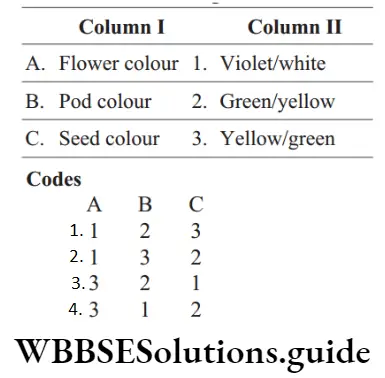
Question 37. Match the following columns.

NEET Biology Mendelism Question 37 Match Following Column

Answer:  1. A–1, B–2, C–3.

Question 38. In his classic experiments on pea plants, Mendel did not use

  1. Seed shape
  2. Flower position
  3. Seed colour
  4. Pod length

Answer:  4. Pod length

Mendel did not used pod length.

Biology MCQ For NEET With Answers

Question 39. Mendel always started his experiment (monohybrid and dihybrid cross) with

  1. Any pea plant
  2. A heterozygous plant
  3. A pureline plant
  4. A fresh new plant

Answer:  3. A pureline plant

For each of the characters that Mendel choose, he obtained pure lines of plants.

Question 40. The year 1900 AD is highly significant for geneticists due to

  1. Chromosome theory of heredity
  2. Discovery of genes
  3. Rediscovery of Mendelism
  4. Principle of linkage

Answer: 3.  Rediscovery of Mendelism

In the year 1900, Hugo de Vries, Carl Correns and von Tschermak independently rediscovered the research carried out by Mendel and his experiments on heredity or variations and laid the basis of modern genetics. Thus, the year 1900 AD is highly significant for geneticists.

Question 41. Mendel studied inheritance of seven pairs of traits in pea which can have 21 possible combinations. If you are told that in one of these combinations, independent assortment is not observed in later studies, your reaction will be

  1. Independent assortment principle may be wrong
  2. Mendel might not have studied all the combinations
  3. It is impossible
  4. Later studies may be wrong

Answer:  2.  Mendel might not have studied all the combinations

  • Law of independent assortment is applicable to only those factors or genes which are located on different chromosomes.
  • Probably the characters were present on same chromosome and showed linkage which Mendel might not have studied all the combinations.

Question 42. From his experiments, Mendel concluded that

  1. Recessive traits disappear in all crosses
  2. Individual characters blend with each factor
  3. Some factors are dominant
  4. Factors for the same trait are separated during fertilisation

Answer:  3. Some factors are dominant

On the basis of experiments performed, Mendel formulated that some factors are dominant. These
factors are able to express themselves in heterozygous condition, i.e. in the presence of other allele.

Question 43. Which of the following was not considered by Mendel?

  1. Test cross
  2. Linkage
  3. Back cross
  4. None of the above

Answer:  2. Linkage

  • Two or more loci and their representative genes are said to be linked if they occur on the same
    chromosomes.
  • Linkage was not considered by Mendel because the 7 pairs of characters chosen by Mendel were coincidently present on 7 different chromosomes, so the chances of linkage will negligible.

Question 44. Mendel failed to discover linkage because seven characters chosen by him were

  1. On 4 chromosomes on which they were closely placed
  2. On 4 chromosomes far apart
  3. On different seven chromosomes
  4. On different two chromosomes

Answer:  2. On 4 chromosomes far apart

Mendel could not find out linkage because all of his experimental characters of pea were present far apart from each other on 4 different chromosome. Linkage occurs between closely placed genes.

Question 45. The offspring of a cross between two individuals differing in at least one set of characters is called

  1. Polyploid
  2. Mutant
  3. Hybrid
  4. Variant

Answer:  3. Hybrid

The cross between two different homozygous lines produces an F1 hydrbid that is heterozygous, having two alleles, one contributed by each parent. For example, Triticale is the hybrid of crossing of wheat and rye.

Question 46. F1 -generation means

  1. First flowering generation
  2. First fertile generation
  3. First filial generation
  4. First seed generation

Answer: 3. First filial generation

The 1st generation obtained by crossing two parents is called as first filial generation or F1 -generation.

Question 47. F2 -generation is produced by

  1. Crossing F1 progeny with another plant having different trait
  2. Selfing the heterozygous progeny
  3. Selfing the parents
  4. A cross between recessive parents

Answer:  2. Selfing the heterozygous progeny

Mendel obtained F2 progeny from F1 plants by selfing the heterozygous progeny obtained from F1 cross.

Question 48. The recessive parental trait is expressed without any blending in the F2 – generation. We can infer, that F1plant produces gamete by the process of …A… and allele of parental pair …B… from each other and only one gamete is transmitted a gamete. Here, A and B are

  1. A–mitosis, B–aggregate
  2. A–meiosis, B–segregate
  3. A–meiosis, B–aggregate
  4. A–mitosis, B–segregate

Answer:  2. A–meiosis, B–segregate

Question 49. Monohybrid cross is

  1. A cross between two individuals differing in one trait
  2. A cross between two individuals having only one character
  3. A cross between the individuals of two different parents
  4. A cross between the two individuals that differ in two traits

Answer:  1. A cross between two individuals differing in one trait

A cross involving two individuals differing only in one character or trait is called monohybrid cross.

Question 50. Mendel’s first law is

  1. Law of segregation
  2. Law of independent assortment
  3. Law of variation
  4. Law of dominance

Answer:  4. Law of dominance

Mendel’s first law is known as law of dominance. According to this law, an individual, heterozygous for a pair of allele, expresses a trait pertaining to one allele, thus preventing other allele from expressing itself.

Question 51. A pure tall plant can be differentiated from a hybrid tall plant

  1. By measuring length of the plant
  2. By spraying gibberellin
  3. If all plants are tall after selfpollination
  4. If all plants are dwarf after selfpollination

Answer: 3.  If all plants are tall after selfpollination

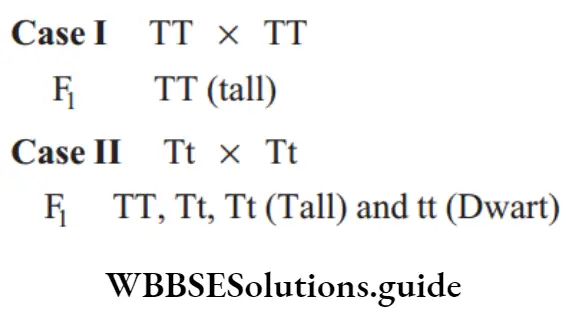
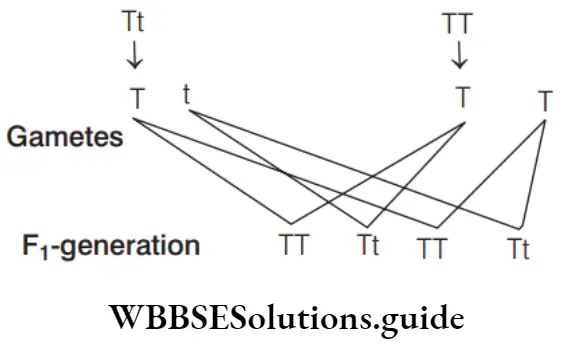
A pure tall can be differentiated from a hybrid tall plant when crossed.

NEET Biology Mendelism Hybrid Tall Plant

If all plants are tall after self pollination, it shows that is pure tall plant (dominant character).

NEET expected MCQs on Mendelism 2025

Question 52. The character which appears in F1 -generation is called

  1. Recessive
  2. Dominant
  3. Latent
  4. None of these

Answer:  2. Dominant

The characters that appear in the F1 -generation are called dominant traits and those that appear for the first time in the F2 -generation are called recessive traits.

Question 53. By seeing the ratio of F1 and F2 generation, Mendel proposed that something was stably passed down unchanged over successive generation and called this something as

  1. Alleles
  2. Genes
  3. Chromosome
  4. Factors

Answer:  4. Factors

  • Based on the ratio of F2 and F1 – generation, Mendel proposed that something stable was being passed down from parent to F1 to F2 – generation and so on, unchanged, through the gametes.
  • He called these things as factors, now known as genes. Genes therefore, are the units of inheritance required to express a particular trait.

Question 54. Mendel crossed tall and dwarf plants in F2 -generation and obtained both the tall and dwarf plants. This indicates

  1. Blending of characters
  2. Atavism
  3. Non-blending of characters
  4. Recessive traits are not expressed

Answer: 3.  Non-blending of characters

Mendel crossed tall and dwarf plants in F2 -generation and obtained both the tall and dwarf plant. Dominant and recessive were expressed or appeared separately. This shows that there is no mixing or non-blending of characters.

Question 55. The phenotypic ratio of a monohybrid cross in F2 -generation is

  1. 3: 1
  2. 3:1:2
  3. 2 :1:1
  4. 9:3:3:1

Answer:  1. 3: 1

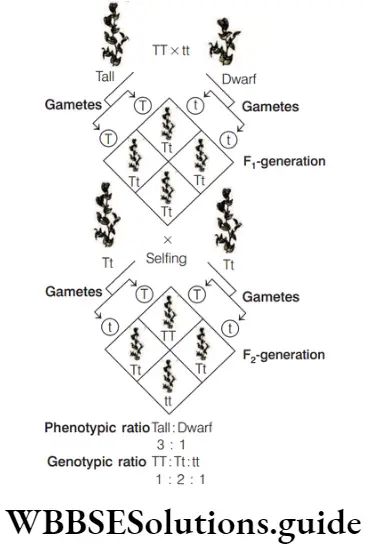
A Punnett square is used to understand a typical monohybrid cross conducted between true breeding tall plants and true breeding dwarf plants. The phenotypic ratio in F2 -generation,
in monohybrid cross is 3: 1.

NEET Biology Mendelism A Punnett square

Question 56. The genotypic ratio of a monohybrid cross in F2 -generation is

  1. 3: 1
  2. 1 : 2: 1
  3. 2: 1: 1
  4. None of these

Answer:  2. 1 : 2: 1

Question 57. The allele which does not express in F1 -generation in the presence of another allele is

  1. Dominant
  2. Recessive
  3. Codominant
  4. Incompletely dominant

Answer:  2.  Recessive

In F1 -generation, only dominant characters are expressed by dominant genes, while recessive genes and their expressions are suppressed.

Question 58. In Pisum sativum, the dwarfness of plant is a …………… character.

  1. Dominant
  2. Recessive
  3. Codominant
  4. Incomplete dominance

Answer:  2. Recessive

Question 59. Mendel’s work remain unrecognised for long time due to

  1. Communication was not easy.
  2. Concept of factors which did not blend was not accepted.
  3.  Use of mathematics to explain biological problem was unacceptable.
  4. He could not provide any physical proof for the existence of factors.

Choose the correct option.

  1. 1 and 2
  2. 2 and 3
  3. 3 and 4
  4. 1, 2, 3 and 4

Answer:  4. 1, 2, 3 and 4

All the given statements are correct.

Question 60. Pure tall plants are crossed with pure dwarf plants. In the F1 -generation, all plants were tall. These tall plants of F1-generation were selfed and the ratio of tall to dwarf plants obtained was 3: 1. This is called

  1. Dominance
  2. Inheritance
  3. Codominance
  4. Heredity

Answer:  1.  Dominance

The phenomenon given in the question expresses the monohybrid cross of Mendel. This is called the law of dominance. It states that when a pair of alleles or allelomorphs are brought together in F1 hybrid, then only one of them express itself while masking the expression of other completely.

Question 61. When alleles of two contrasting characters are present together, one of the characters expresses itself during the cross, while the other remains hidden. This is the

  1. Law of purity of gametes
  2. Law of segregation
  3. Law of dominance
  4. Law of inheritance

Answer:  3. Law of dominance

Biology MCQ For NEET With Answers

Question 62. In genetics, the use of checker board was done by

  1. Mendel
  2. Correns
  3. Punnett
  4. Darwin

Answer:  3. Punnett

Punnett square (British geneticist, RC Punnett,1927) is a checker board used to show the result of a cross between two organisms. It was first done by Punnett.

Question 63. A graphical representation using which the probability of all possible genotypes of an offspring in genetic cross can be calculated is called

  1. Burnett square
  2. Morgan square
  3. Punnett square
  4. Test cross

Answer:  3. Punnett square

Punnett square was developed by British geneticist Reginald C. Punnett. It is a graphical representation to calculate the probability of all possible genotypes of offspring in genetic cross.

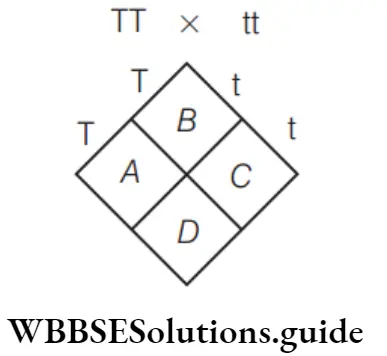
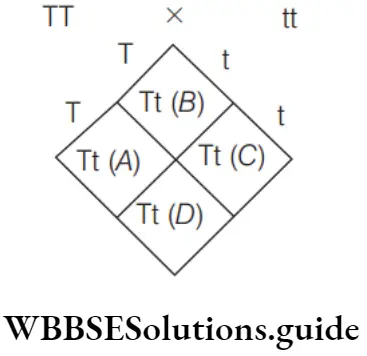
Question 64. Choose correct option for A, B, C and D in the given figure.

NEET Biology Mendelism Question 64

  1. A–tt, B–TT, C–TT, D–TT
  2. A–Tt, B–Tt, C–Tt, D–Tt
  3. A–TT, B–TT, C–Tt, D–TT
  4. A–Tt, B–Tt, C–Tt, D–TT

Answer:  2. A–Tt, B–Tt, C–Tt, D–Tt

NEET Biology Mendelism Question 64.

NEET Biology Mendelian inheritance MCQs with explanations

Question 65. Match the following columns.

NEET Biology Mendelism Question 65 Match Following Column

Answer:  1. A–1, B–2, C–1

Question 66. The technique of hybridisation used by Mendel was

  1. Back cross
  2. Double cross
  3. Single cross
  4. Emasculation

Answer:  4.  Emasculation

The technique of hybridisation used by Mendel was emasculation, which means removal of anthers or stamens before anthesis, i.e. opening of flower to prevent self-pollination in bisexual flowers.

Question 67. The crossing of an organism with a double (homozygous) recessive in order to determine whether it is homozygous or heterozygous for a character under consideration is known as

  1. Back cross
  2. Test cross
  3. Reciprocal cross
  4. Dihybrid cross

Answer:  2. Test cross

Test cross is performed to determine the genotype of F1 plant. In a typical test cross, an organism showing dominant phenotype and whose genotype is to be determined is crossed with one that is homozygous recessive for the allele being investigated, instead of self-crossing.

The progenies of such a cross can easily be analysed to predict the genotype of the test organism.

Question 68. Which is a test cross?

  1. Ww × ww
  2. Ww × WW
  3. Ww × Ww
  4. WW × ww

Answer:  1. Ww × ww

A test cross is a cross between heterozygous F1 -generation and recessive parent, i.e. Ww
( F1 -generation) × ww (recessive parent).

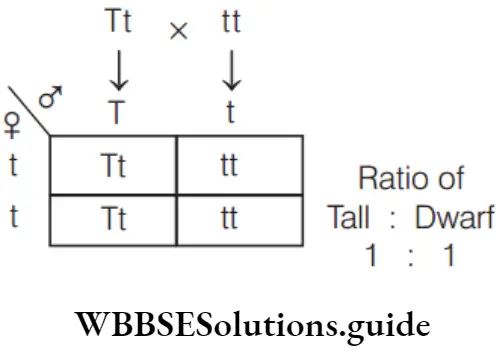
Question 69. In hybridisation, Tt × tt gives rise to the progeny of ratio

  1. 1: 1
  2. 2: 1
  3. 1: 2
  4. 1: 2: 1

Answer:  1. 1: 1

In a test cross, individual is crossed with recessive parent.

NEET Biology Mendelism Test Cross

Ratio 1: 1

So, test cross gives rise to progeny whose ratio is 1: 1.

Question 70. The genotype of a plant showing the dominant phenotype can be determined by

  1. Test cross
  2. Dihybrid cross
  3. Pedigree analysis
  4. Back cross

Answer:  1. Test cross

Question 71. Select the correct statement.

  1. Genes located on same or different chromosomes, but distantly apart from each other assort independently.
  2. Genes which fails to assort independently are usually present very close, on the same chromosome
  3. Characters pass from parents to offsprings as factors, without blending or mixing
  4. All of the above

Answer:   4. All of the above

All the given statements are correct.

Question 72. Test cross is used to

  1. Check heterozygosity in F1-generation
  2. Check heterozygosity in F2 -generation
  3. Check independent assortment
  4. Check segregation

Answer:  1. Check heterozygosity in F1-generation

  • Crossing of F1 individual having dominant phenotype with its homozygous recessive parent is called test cross and the progeny of test cross is called test cross progeny. Test cross was devised by Mendel to prove that F1 obtained by crossing two pure breeding parents is heterozygous or hybrid.
  • If the unknown genotype is homozygous, half the progeny will exhibit the dominant trait and other half exhibit the recessive trait. So, a test cross is used to check heterozygosity in F1-generation.

Biology MCQ For NEET With Answers

Question 73. A test cross is carried out to

  1. Determine the genotype of a plant at F2
  2. Predict whether two traits are linked
  3. Assess the number of alleles of a gene
  4. Determine whether two species or varieties will breed successfully

Answer: 1.  Determine the genotype of a plant at F2

When a tall plant from F1 or F2

has TT or Tt composition, its genotype cannot be predicted. Therefore, to determine the genotype of a tall plant in F2, Mendel crossed the tall plant from F2 with a dwarf parent. Thus, was called test cross.

Question 74. Ratio of progeny, when a red coloured heterozygous crossed with a white coloured plant in which red colour is dominant to white colour is

  1. 3: 1
  2. 1: 1
  3. 1: 2 :1
  4. 9: 3: 3: 1

Answer:  2. 1: 1

The given condition represents a test cross in which heterozygous red progeny is crossed with homozygous recessive white coloured parent. The test cross gives 1: 1 ratio in monohybrid condition, whereas 1: 1: 1: 1 in dihybrid condition.

Question 75. Law of purity of gametes put forward by Mendel was proved by

  1. Monohybrid cross
  2. Dihybrid cross
  3. Test cross
  4. Out cross

Answer:  3. Test cross

  • A gamete may carry either the dominant or the recessive factor but not both, as we find in F1
    individuals. This is why it is called either as ‘principle of segregation’ or as ‘law of purity of gametes’.
  • While 3: 1 ratio in F2 -generation of a monohybrid cross suggested that segregation of alleles does take place, the test cross confirmed it.

Question 76. The best method to determine the homozygosity and heterozygosity of an individual is

  1. Self-fertilisation
  2. Back cross
  3. Test cross
  4. Mono cross

Answer:  2. Back cross

The best method to determine the homozygosity and heterozygosity of an individual is back cross. Crossing of F1 (dominant phenotype) with any one of the parent is called back cross.

Question 77. When a plant of F1 -generation is crossed with homozygous dominant parents, it is known as

  1. Simple cross
  2. Test cross
  3. Back cross
  4. Special cross

Answer:  3. Back cross

Crossing of F1 (dominant phenotype) with any one of the dominant or recessive parent is called
back cross.

Question 78. Which of the statement is correct?

  1. Each back cross is a test cross
  2. Each test cross is a back cross
  3. Test cross and back cross are the same
  4. Reappearance of similar characters in a test cross is called a back cross

Answer: 2. Each test cross is a back cross

Statement in option is correct as each test cross is a back cross, but each back cross is not a test cross. Thus, test cross is a type of back cross.

Question 79. Hinny and mule are the example of

  1. Test cross
  2. Dihybrid cross
  3. Back cross
  4. Reciprocal cross

Answer:  4. Reciprocal cross

A hinny is a domestic equine hybrid that is the offspring of a male horse, a stallion and a female donkey, a jenny. It is the reciprocal cross to the more common mule, which is the product of a male donkey, a jack and a female horse, a mare.

Question 80. Two crosses between the same pair of genotypes or phenotypes in which the sources of the gametes are reversed in one cross, is known as

  1. Test cross
  2. Reciprocal cross
  3. Dihybrid cross
  4. Reverse cross

Answer: 2.  Reciprocal cross

A reciprocal cross means that the same two parents are used in two experiments in such a way that if in one experiment A is used as the female parent and B is used as the male parent then in the other experiment, A will be used as the male parent and B as the female parent.

Question 81. Mendel’s reciprocal crosses gave identical results because

  1. Of segregation of characters
  2. Of complete dominance
  3. Characters are not sex-linked
  4. Of homozygous plants

Answer:  3. Characters are not sex-linked

  • Mendel’s reciprocal cross gave the same results, i.e. when a white flowered female plant was crossed with a red flowered male plant, the F1 was red.
  • In the reciprocal cross, red flowered female and white flowered male also gave a red flower. This was observed because the characters are not sex-linked.

Question 82. In monohybrid cross between pure tall and pure dwarf pea plant, how many types of genotypes are found in F2 -generation?

  1. 4
  2. 3
  3. 8
  4. 9

Answer:  2. 3

In monohybrid cross between pure tall and pure dwarf pea plant, three genotypes are found in F2 -generation, i.e. TT (pure tall), Tt (hybrid tall) and tt (dwarf).

Question 83. If a heterozygous tall plant is crossed with dwarf plant, what will be the ratio of dwarf plant in the progeny?

  1. 50 %
  2. 25 %
  3. 75 %
  4. 100 %

Answer:  1. 50 %

Heterozygous tall plant (Tt) will produce gametes T and t, whereas dwarf plant (tt) will produce gametes t. When heterozygous tall plant is crossed with dwarf plant, the progeny will show following combinations.

NEET Biology Mendelism Heterozygous Tall Plant

Thus, the population of tall and dwarf plants will be 50%.

Question 84. What result Mendel would have got, had he self-pollinated a tall F2 plant?

  1. TT and Tt
  2. All Tt
  3. No TT
  4. All tt

Answer:  1. TT and Tt

  • In F2 -generation, two types of tall individuals are obtained pure tall (TT) and hybrid tall (Tt). Self-pollination of pure tall F2
  • plant (TT) would give rise to all tall individuals of genotype TT, whereas self-pollination of hybrid tall F2
  • plant (Tt) would give rise to tall and dwarf individuals of genotypes TT, Tt and tt. Thus, option 1 is most appropriate answer.

Question 85. F1 progeny of a cross between pure tall and dwarf plant is always

  1. Tall
  2. Short
  3. Intermediate
  4. Half short and half tall

Answer:  1. Tall

After crossing a pure tall plant with a dwarf one, the plants of F1 -generation are all tall.

Question 86. Mendel crossed true breeding tall and dwarf plant varieties in his experiment. The tall character dominant first appeared in F1 and recessive character dwarf appeared in

  1. F1
  2. F2
  3. F3
  4. F2 and F3

Answer:  4. F2 and F3

The recessive trait appears in F2 and F3 -generation, but not in  F1 -generation.

NEET Biology Mendelism Appears Generations

Question 87. The law of dominance is illustrated in the garden pea by

  1. Heterozygous tall × heterozygous tall
  2. Homozygous tall × homozygous tall
  3. Pure dwarf × pure dwarf
  4. Homozygous tall × pure dwarf

Answer: 4.  Homozygous tall × pure dwarf

The law of dominance in garden pea is illustrated by TT × tt. The resultant F1 -generation would be tall (Tt) only.

Question 88. According to Mendel, plants of F1 -generation show

  1. Law of dominance
  2. Purity of gametes
  3. Independent assortment of genes
  4. All of the above

Answer:  1. Law of dominance

  • Law of dominance states that in a heterozygous condition, the allele whose characters are expressed over the other allele is called the dominant allele and the characters of this
    dominant allele are called dominant characters.
  • The characters that appear in the F1 -generation are called as dominant characters.Thus, plants of F1 -generation shows law of dominance.

Question 89. Match the following columns.

NEET Biology Mendelism Question 89 Match Following Column

Answer:  3. A–3, B–5, C–1, D–2

Mendelism mock test for NEET preparation

Question 90. A tall true breeding garden pea plant is crossed with a dwarf true breeding garden pea plant. When the F1 plants were selfed the resulting genotypes were in the ratio

  1. 1 : 2 : 1 :: Tall homozygous : Tall heterozygous : Dwarf
  2. 1 : 2 : 1 :: Tall heterozygous : Tall homozygous : Dwarf
  3. 3: 1 :: Tall: Dwarf
  4. 3: 1:: Dwarf: Tall

Answer:  1. 1: 2 : 1:: Tall homozygous: Tall heterozygous: Dwarf

When a tall true breeding garden pea plant is crossed with a dwarf true breeding garden pea plant and the plants were selfed, the resulting genotypes were in the ratio of 1:2:1, i.e. Tall homozygous : Tall heterozygous : Dwarf Parents :

NEET Biology Mendelism Tall homozygous Parents And Gametes

Question 91. 3: 1 ratio in F2-generation is explained by

  1. Law of partial dominance
  2. Law of dominance
  3. Law of incomplete dominance
  4. Law of purity of gametes

Answer:  2. Law of dominance

3:1 ratio in F2-generation is explained by law of dominance.

Question 92. Mendel self-pollinated the F2 plant and found that …A… plants continued to generate dwarf plants in …B… and …C… generations. He concluded that the genotype of the dwarf is …D… . Choose the correct option for A, B, C and D.

  1. A–dwarf, B–F3, C–F4, D–homozygous
  2. A–dwarf, B–F3, C–F4, D–heterozygous
  3. A–tall, B–F5, C–F6, D–homozygous
  4. A–tall, B–F5, C–F6, D–heterozygous

Answer:  1. A–dwarf, B–F3, C–F4, D–homozygous

Question 93. The crossing of a homozygous tall pea plant and homozygous dwarf pea plant would yield plants in the ratio of

  1. 2 tall:2 dwarf
  2. All homozygous dwarf
  3. All heterozygous tall
  4. One homozygous tall: one homozygous dwarf: two heterozygous tall

Answer:  3. All heterozygous tall

Crossing of homozygous tall (TT) and homozygous dwarf (tt) would yield all heterozygous tall (Tt) plants in F1 -generation.

Question 94. From a single ear of corn a farmer planted 200 kernels which produced 140 tall and 40 short plants. The genotypes of these offsprings are most likely

  1. TT and Tt only
  2. TT, Tt and tt
  3. Tt and tt only
  4. TT and tt only

Answer:  2.  TT, Tt and tt

  • Mature corn plants produce ears that contain hundreds of seeds or kernels. Each seed is formed by the fertilisation of an egg by a male gamet.
  • It has both the allele for height, i.e. T and t. So, the offspring produced by the crossing of Tt and Tt will have genotype as TT, Tt and tt. In this, 140 tall include TT and Tt gamete and 40 dwarf plants possess tt gametes.

Question 95. A plant is heterozygous for tallness (Tt). The possibility of t gamete fertilising either T or t is

  1. 1/8
  2. 1/2
  3. 1/4
  4. 1/6

Answer:  2. 1/2

Plant heterozygous for tall trait has two alleles, one governing tallness and other governing dwarf trait. This plant will produce two types of gametes, T and t. Hence, the possibility of fertilising either T or t is 1/2, i.e. 50%.

Question 96. In Mendelian monohybrid cross, phenotypic ratio in F2 is 3: 1. How many types of gametes are formed in F1 -generation?

  1. Only one type
  2. Two types
  3. Four types
  4. Eight types

Answer:  2. Two types

In a monohybrid cross only one trait of a character is crossed with other. Each character is governed by two alleles. Thus, after meiosis gametes formed in F1 -generation contain only one allele. The resultant gametes are hence of two types.

Question 97. F2 progeny of monohybrid cross shows

  1. Two phenotypes and two genotypes
  2. Two phenotypes and three genotypes
  3. Two genotypes and three phenotypes
  4. One phenotype and two genotypes

Answer:  2. Two phenotypes and three genotypes

F2 progeny of monohybrid cross shows two phenotypes and three genotypes. The cross between F1 progeny obtained from homozygous tall (TT) and homozygous dwarf (tt) plant yield (three types of genotypes) homozygous tall (TT), heterozygous tall (Tt) and homozygous dwarf (tt). The two phenotypes will be tall and dwarf.

Question 98. When red flowered plants are crossed with white flowered plants, the F2 -generation gives a ratio of 3:1. What do you conclude?

  1. That there are lethal genes
  2. That there is independent assortment
  3. That white colour is dominant
  4. That red colour is dominant

Answer:  4. That red colour is dominant

Crossing of red colour flower with white colour flower yield the progeny in ratio 3 : 1. As per law of dominance, the red colour flower is dominant, as it expressed maximally whereas the white colour in flower is a recessive trait.

Question 99. Haemolytic jaundice is caused by a dominant gene but only 20% of the people actually develop it. What proportion of the children would be expected to develop the disease if a heterozygous man marries a homozygous normal woman?

  1. 0.5
  2. 0.2
  3. 0.8
  4. 0.1

Answer:  4. 0.1

H allele is for haemolytic jaundice

NEET Biology Mendelism Haemolytic Jaundice

As shown above, there is 50% (half, 1/2) probability of progeny being haemolytic, but only 20% of people develop this disease so,

⇒ \(\frac{20}{100}\) × \(\frac{1}{2}\)

= \(\frac{10}{100}\)

= \(\frac{1}{10}\)

= 0.1

Question 100. If a heterozygous dominant plant (Tt) crossed with homozygous dwarf plant (tt), then the percentage of progeny having dwarf character is

  1. 60%
  2. 40%
  3. 50%
  4. 70%

Answer: 3. 50%

(Heterozygous tall) × (Homozygous dwarf)

NEET Biology Mendelism Questiom 100

Phenotypic ratio 1: 1 (50% tall, 50% dwarf) Genotypic ratio 1: 1. Hence, percentage of progeny having dwarf character is 50%.

Question 101. Find out the percentage of dominant phenotype in cross between Pp and Pp. P-dominant, p-recessive

  1. 25%
  2. 50%
  3. 75%
  4. 100%

Answer:  3. 75%

Cross between Pp × Pp Gametes P, p; P, p Progeny PP, Pp, Pp, pp First three progeny 1, 2, 3 have the dominant traits, whereas the fourth progeny has recessive trait. Therefore, the ratio between dominant of recessive progeny is 3:1 or percentage of dominant progeny is 75%.

Question 102. Find the percentage of recessive phenotype in a cross between pp and Pp, where P refers to dominant and p refers to recessive.

  1. 5%
  2. 50%
  3. 75%
  4. 100%

Answer:  2. 50%

Percentage of recessive phenotype = 50% (pp)
Percentage of dominant phenotype = 50% (Pp)

NEET Biology Mendelism Questiom 102

Question 103. Out of the four progenies obtained in F2 -generation by crossing pure tall and pure dwarf, how many of them will receive only recessive trait from both parents?

  1. All four
  2. One
  3. Two
  4. Three

Answer:  2. One

Only one progeny will receive recessive trait from both parents and therefore, it is dwarf (tt).

NEET Biology Mendelism Questiom 103

Question 104. Which of the following cross will produce terminal flower in garden pea?

  1. AA × Aa
  2. Aa × Aa
  3. Aa × AA
  4. AA × aa

Answer:  2. Aa × Aa

Axillary position (A) is dominant over terminal position. When Aa × Aa is crossed, we get 3:1 ratio, i.e. three axillary flowers and one terminal flower.

Among the given options, only Aa × Aa can produce terminal flower.

Question 105. Mendel crossed a pure white flowered recessive pea plant with a dominant pure red-flowered plant. The first generation of hybrids from the cross should show

  1. 50% white-flowered and 50% redflowered plants
  2. All red-flowered plants
  3. 75% red-flowered and 25% white flowered plants
  4. All white-flowered plants

Answer:  2. All red-flowered plants

The first generation of hybrids from the cross would show all red flowered plant, but they would exist in heterozygous state.

Question 106. A pea plant parent having violet coloured flowers with unknown genotype was crossed with a plant having white coloured flowers, in the progeny 50% of the flowers were violet and 50% were white. The genotypic constitution of the parent having violet coloured flowers was

  1. Homozygous
  2. Merozygous
  3. Heterozygous
  4. Hemizygous

Answer:  3.  Heterozygous

In the question, a test cross between plants having violet coloured flowers ( F1 hybrid) with plants having white coloured flowers (homozygous recessive parent) produces progeny with violet and white flowers in equal proportion, indicating that F1 hybrids are heterozygous

Question 107. The leaf colour of certain plants is controlled by one gene. For that gene, the allele G = orange and g = green. You have a plant with orange leaves, but do not know whether that plant’s genotype is GG or Gg. If you cross your unknown plant with one of the plants whose genotype is listed below, you will be able to determine your unknown’s genotype. With which plant would you cross it?

  1. GG
  2. Gg
  3. Gg
  4. Either of parents

Answer:  2. Gg

  • To know the genotype of dominant phenotype, we will cross that plant with the respective recessive phenotype. This is called test cross.
  • The progeny of such cross can easily be analysed to predict the genotype of test organism. So here, to know the genotype of the leaf colour of that plant, test cross would be performed with the recessive homozygous, gg plant.

Question 108. Rrrr (progeny): Red (dominant) flowered (heterozygous) were crossed with white flower. The result will be

  1. 350 red: 350 white
  2. 450 red: 250 white
  3. 380 red: 320 white
  4. None of the above

Answer:  1. 350 red: 350 white

The cross of red dominant heterozygous progeny with white flower is shown below

NEET Biology Mendelism Question 108

Thus, option 1 is correct.

Question 109. If a woman is homozygous normal and her husband is heterozygous for a genetically inherited recessive disease and they decide to become parents, what is the probability that they will have a healthy child?

  1. 1 out of 4
  2. 2 out of 4
  3. 3 out of 4
  4. 4 out of 4

Answer:  4. 4 out of 4

All of the children will be healthy since none of them can be homozygous recessive (aa).
However, there will be a 50% chance at each birth that the children will be carriers (Aa). The remaining 50% will be healthy homozygous dominant (AA).

Question 110. Mendel found that the reciprocal crosses yielded identical results. From that he concluded that

  1. There is independent assortment of trait
  2. Sex plays a role in deciding the dominance of a trait
  3. There is no dominance of any trait
  4. Sex has no influence on the dominance of traits

Answer:  4. Sex has no influence on the dominance of traits

  • A cross with the phenotype of each sex reversed as compared with the original cross, to test the role of parental sex on inheritence pattern is called reciprocal cross.
  • Reciprocal cross is made to eliminte the effect of cytoplasmic traits and to know whether the alleles are present on sex chromosome or autosomes.
  • Mendel found that reciprocal crosses yielded identical results. From that, he concluded that sex has no influence on the dominance of traits.

Question 111. Match the following columns.

NEET Biology Mendelism Question 111 Match Following Column

Answer:  1. A–2, B–4, C–1, D–3

Question 112. On inbreeding, the homozygous parents will produce

  1. All similar offspring
  2. 25% similar and 75% dissimilar
  3. 75% similar and 25% dissimilar
  4. 50% similar and 50% dissimilar

Answer: 1. All similar offspring

Inbreeding is the production of offspring from the mating or breeding of individuals or organisms that are closely related genetically. So, the homozygous parent will produce all similar offspring.

Question 113. What will be the genetic constitution of the offspring of a cross of individuals heterozygous (Zz) for an allele?

  1. All ZZ
  2. All zz
  3. 1/2 ZZ: 1/2 zz
  4. 1/4 ZZ: 1/2 Zz : 1/4 zz

Answer:  4. 1/4 ZZ: 1/2 Zz : 1/4 zz

NEET Biology Mendelism Questiom 113

Thus, the genetic constitution of the offspring of a cross of individuals heterozygous (Zz) for an allele would be 1/4 ZZ: 1/2 Zz: 1/4 zz

Question 114. Find out the genotype and phenotype of F1 -generation (R = dominant and red, r = recessive and white) from the given cross.

NEET Biology Mendelism Question 114

  1. Rr and white
  2. Rr and red
  3. Rr and pink
  4. RR and white

Answer:  2.  Rr and red

Genotype is Rr and phnotype is red because the R is dominant so, the F1 -hybrid will be red.

Question 115. Identify a cross in which l/4th of the offsprings show recessive trait?

  1. Rr × RR
  2. Rr × rr
  3. Rr × Rr
  4. Both 2 and 3

Answer: 3. Rr × Rr

A cross between two heterozygous dominant individual (e.g. Rr × Rr) would yield 1/4 th of offspring with recessive trait (i.e. rr) in F2 generation.

Question 116. tt mates with Tt. What will be characteristic of offspring?

  1. 75% recessive
  2. 50% recessive
  3. 25% recessive
  4. All dominant

Answer:  2. 50% recessive

On mating tt with Tt, 50% offspring would be recessive and 50% would be heterozygous dominant.

Question 117. The proportion of plants that were dwarf and tall in F2-generation of Mendel monohybrid experiment

  1. 1/ 4  th and  3/4 th
  2. 3/4 th and 1/4 th
  3. 2/3 th and 1/3 th
  4. 1/3 th and 4/3 th

Answer:  1. 1/4 th and 3/4 th dwarf and tall respectivley Refer to cross in Ans. 103.

Question 118. In a monohybrid cross between two heterozygous individuals, the percentage of pure homozygous individuals obtained in F1 -generation is

  1. 25%
  2. 50%
  3. 75%
  4. 100%

Answer:  2. 50%

Let us consider a monohybrid cross between two tall heterozygous plants (Tt). The genotype of the offspring in F1 -generation will be TT, Tt,Tt and tt. Hence, half of the offspring (i.e 50%) are pure homozygous (TT and tt).

Question 119. Heterozygous purple flower is crossed with recessive white flower. The progeny has the ratio

  1. All purple
  2. All white
  3. 50% purple and 50% white
  4. 75% purple and 25% white

Answer:  3. 50% purple and 50% white

If we cross heterozygous purple flowers with parental flowers (recessive white flower) then we get 50% purple and 50% white.

Question 120. If two pea plants having red (dominant) coloured flowers with unknown genotypes are crossed, 75% of the flowers are red and 25% are white. The genotypic constitution of the parents having red coloured flowers will be

  1. Both homozygous
  2. One homozygous and other heterozygous
  3. Both heterozygous
  4. Both hemizygous

Answer:  3. Both heterozygous

In given situation, genotype of parents having red coloured flowers will be heterozygous.

NEET Biology Mendelism Questiom 120

Question 121. In a certain plant, red colour flower (R) is dominant over white colour flower (r). When a heterozygous Rr plant is crossed 64 offspring are obtained. The number of white offspring is

  1. 64
  2. 0
  3. 16
  4. 32

Answer:  3. 16

The given condition represents monohybrid cross in which dominance to recessive ratio is 3: 1. Out of the total 64 offsprings, the number of red offspring is 48 and white offspring is 16.

Question 122. If a pure tall pea plant is raised in nutrient deficient media such that it grows to the size of a dwarf plant and is then selfed, the progeny in normal media will be

  1. Dwarf
  2. All tall
  3. 50% tall and 50% dwarf
  4. 75% tall and 25% short

Answer:  2. All tall

Insufficient nutrient only changes the phenotype, but not the genotype of the plant. Hence, the pure tall pea plant still grow into all tall plants on returning to normal nutrient media.

Question 123. Pure red flowers were crossed with pure white flowers. Red is dominant. After selfing of F1 -generation, the proportions of plants producing white flowers in progeny would be

  1. 3/4
  2. 1/4
  3. 1/3
  4. 1/2

Answer:  2. 1/4

NEET Biology Mendelism Questiom 123

So, the proportion of white flower is 1/4.

Question 124. If a cross is made between AA and aa, the nature of F1 progeny will be

  1. Genotypically AA, phenotypically a
  2. Genotypically Aa, phenotypically a
  3. Genotypically Aa, phenotypically A
  4. Genotypically aa, phenotypically A

Answer:  3. Genotypically Aa, phenotypically A

If a cross is made between AA and aa, where ‘A’ is dominant over ‘a’,then the result will be according to Mendelian principles

NEET Biology Mendelism Questiom 124

Genotype = Aa
Phenotype = Same as that of AA

Question 125. Percentage of homozygous offspring in a monohybrid F2 cross is

  1. 25%
  2. 0%
  3. 100%
  4. 50%

Answer:  4. 50%

  • A monohybrid cross is a genetic mix between two individuals with homozygous genotypes, which result in an opposite phenotype.
  • A monohybrid ratio is the phenotypic ratio of different types of individuals occurring in the F2-generation of a monohybrid cross.
  • The percentage of homozygous offspring in a monohybrid F2 cross is 50%, which is homozygous dominant and recessive.

Question 126. 190 grains of jowar from single plant when sown produce 140 tall and 50 dwarf plants. The genotypes of these offsprings may be

  1. TT, tt
  2. TT, Tt
  3. Tt, Tt
  4. TT, Tt, tt

Answer:  4. TT, Tt, tt

  • The phenotypes obtained from growing 190 grains of jowar are 140 tall and 50 dwarf. This is
    approximately equal to 3:1 ratio.
  • Hence, this will be F2-generation and there will be 3 genotypes and two phenotypes. The genotypes will be TT, Tt, tt.

Question 127. When homozygous dominant parent is crossed with heterozygous parent, the percentage of offspring with different phenotype than either parent is

  1. 0
  2. 25
  3. 50
  4. 75

Answer:  1. 0

When homozygous dominant parent (TT) is crossed with heterozygous parent (Tt), the offspring produced is of same phenotype as that of parents.

NEET Biology Mendelism Homozygous Dominant Parent

Hence , the percentage of offspring with different phenotype is ‘0’.

Question 128. If a cross between two individuals produces offspring with 50% dominant character (A) and 50% recessive character (a), then the genotype of parents are

  1. Aa × Aa
  2. Aa × aa
  3. AA × aa
  4. AA × Aa

Answer:  2. Aa × aa

If a cross between two individuals produces offsprings with 50% dominant character (A) and 50%
recessive character (a), then the genotypes of parents will be Aa and as

NEET Biology Mendelism Questiom 128

Question 129. One of Mendel’s pure strains of pea plants had green peas. How many different kinds of eggs could such a plant produce with regard to pea colour?

  1. 1
  2. 2
  3. 4
  4. 8

Answer:  1. 1

Since, the given pea plant is a pure strain, its genotype for green peas will be homozygous and thus, it will produce only one kind of gamete.

Question 130. A true breeding plant producing red flowers is crossed with a pure plant producing white flowers. Allele for red colour of flower is dominant. After selfing, the plants of first filial generation, the proportion of plants producing white flowers in the progeny would be

  1. 1/3
  2. 1/2
  3. 3/4
  4. 1/4

Answer: 4. 1/4

Genotype of true breeding plant producing red flower = RR Genotype of pure plant producing White flower = rr

NEET Biology Mendelism Questiom 130

Thus, white flower producing progeny is 1/4.

Question 131. Two pea plants were subjected for cross-pollination. Of the l83 plants produced in the next generation, 94 plants were found to be tall and 89 plants were found to be dwarf. The genotypes of the two parental plants are likely to be

  1. TT and tt
  2. Tt and Tt
  3. Tt and tt
  4. TT and TT

Answer:  3. Tt and tt

The genotypes of the two parental plants are likely to be Tt and tt. When, the parents are crossed, the next generation shows the following results

NEET Biology Mendelism Questiom 131

Total number of plants produced were 183 and tall: dwarf are 94 : 89, which is almost 1 : l (test cross ratio).

Question 132. When parents P1 and P2 were crossed, F2 progeny was produced with three fourth similar features in phenotype to P2 and F1 and one fourth possessed contrasting traits. If the traits being considered here are for height are, ‘T’ for tall and ‘t’ for short. What will be the possible genotype of P1 and one fourth of F2?

  1. tt and Tt
  2. Tt and tt
  3. Tt and Tt
  4. tt and tt

Answer:  4. tt and tt

The possible genotype of P1 and one fourth of F2 is tt and tt, respectively.

Question 133. Heterozyous tall (Tt) is crossed with homozygous tall (TT), the percentage of heterozygous tall in the progeny would be 

  1. 25
  2. 50
  3. 75
  4. 100

Answer:  2. 50

A cross between heterozygous tall and homozygous tall is shown below

NEET Biology Mendelism Questiom 133

So, 50% heterozygous tall plants are produced.

Question 134. Offsprings of which of the following cross are all phenotypically alike?

  1. Dd × Dd
  2. Dd × dd
  3. DD × Dd
  4. Ww × Ww

Answer:  3. DD × Dd

The offsprings of cross DD × Dd would be dominant only. Thus, they are phenotypically alike, but differ genotypically.

NEET Biology Mendelism Questiom 134

Question 135. If ‘A’ represents the dominant gene and ‘a’ represents its recessive allele, which of the following would be the most likely result in the first generation offspring when ‘Aa’ is crossed with ‘aa’ ?

  1. All will exhibit dominant phenotype
  2. All will be of recessive type
  3. Dominant and recessive phenotype will be 50%
  4. Dominant phenotypes will be 75%

Answer:  3. Dominant and recessive phenotype will be 50%

‘A’ represents the dominant gene and ‘a’ represents its recessive allele. The result in the first generation offspring when Aa cross with aa is shown in cross below

NEET Biology Mendelism Questiom 135

Dominantphenotype

= Aa Homozygous recessivephenotype

= aa

Aa: aa → 1: 1

Question 136. Right handedness is dominant over left handedness. Most probable gene types with 2 right handed parents having left handed child is

  1. RR × rr
  2. Rr × RR
  3. RR × Rr
  4. Rr × Rr

Answer:  4. Rr × Rr

  • Right handedness is dominant over left handedness. If both the parents are right handed, then they must have either pure right handed genotype or dominant right handed and recessive left handed genotype.
  • But if they are having a left handed child, then the genotype of the child is (rr). So, both the parents should have recessive‘r’ gene in their genotypes. Hence, the probable genotype of both the parents is Rr and Rr, i.e. hybrid right handedness.

Question 137. Mendel’s principle of segregation is based on separation of alleles during

  1. Gamete formation
  2. Seed formation
  3. Pollination
  4. Embryonic development

Answer:  1. Gamete formation

The law of segregation states that when a pair of allelomorphs are brought together in the F1

hybrid, they coexist or remain together in the hybrid without blending or in any way contaminating each other and they separate completely and remain pure during the formation of gametes.

Question 138. Law of segregation of gametes was proposed by

  1. Mendel
  2. Huxley
  3. de Vries
  4. Robert Hooke

Answer: 1. Mendel

Law of segregation of gametes was proposed by Mendel. It was the 2nd law given by him.

Question 139. Which of the following statement is/are correct regarding law of segregation?

  1. Alleles separate from each other during gametogenesis
  2. Segregation of factors is due to separation of chromosomes during meiosis
  3. Law of segregation is called as law of purity of gametes
  4. All of the above

Answer:  4. All of the above

  • All given statements are correct regarding law of segregation. The principle or law of segregation is also called the purity of gametes.
  • This law states that the two factors of a character present in individual keep their identity distinct separate at the time of gametogenesis (meiosis) or sporogenesis, factors get randomly distributed to different gametes and then get paired again in different offspring as per the principle of probability. The principal of segregation can be deduced in Punnett square.

Thus, option (4) is correct.

Question 140. According to Mendel’s principle of segregation, germ cells always receive

  1. One pair to four alleles
  2. One quarter of the genes
  3. One of the paired alleles
  4. Any pair of alleles

Answer:  3. One of the paired alleles

Law of segregation states that heredity characters in the form of allele segregate from each other during the formation of gametes. Half of the gametes carry one allele and other half carries other allele. So, germ cells receive one of the paired alleles.

Question 141. The law of segregation of characters is also called the law of purity of gametes because

  1. Gametes have only one of the two alleles for each character
  2. Gametes cannot be contaminated
  3. Gametes are very different type of cells
  4. Both tall and dwarf plants in 1:2

Answer: 1. Gametes have only one of the two alleles for each character

The law of segregation of characters as also called the law of purity of gametes because gametes have only one of the two alleles for each character.

Question 142. Law of Mendel which is not completely applicable is

  1. Codominance
  2. Law of segregation
  3. Law of independent assortment
  4. Law of dominance

Answer: 3. Law of independent assortment

Except codominance, other three options are laws of inheritance given by Mendel. Out of these, law of independent assortment is not completely applicable. This is applicable to only those factors or genes which are present on different chromosomes, i.e. non-linked gene.

NEET practice test on Mendelism and inheritance

Question 143. In garden pea, round shape of seeds is dominant over wrinkled shape. A pea plant heterozygous for round shape of seed is selfed and 1600 seeds produced during the cross are subsequently germinated. How many seedlings would have the parental phenotype?

  1. 400
  2. 1600
  3. 1200
  4. 800

Answer:  3. 1200

Since, this pea plant is heterozygous for round shape, its genotype would be Rr. Parents Rr × Rr (selfing) Progeny RR, Rr, Rr, rr Phenotypically, the ratio will be 3 : 1, i.e. only rr seedlings will show wrinkled phenotype, rest will show round shape (Parental phenotype).

∴ \(\frac{ 3}{4}\) × 1600= 1200

⇒ 1200 → Round shape (RR, Rr)

⇒ 400 → Wrinkled (rr)

Question 144. In wheat, when a green plant was self-fertilised, the progeny had 20 green seedling and 14 white seedling; this result indicates that the parents were

  1. True breeding
  2. Homozygous for one allele
  3. Heterozygous for one allele
  4. Heterozygous for two duplicate alleles

Answer:  3. Heterozygous for one allele

When green plant was self-fertilised, appearance of white seedling in progeny indicate parents were heterozygous for one allele, e.g. Gg × Gg. Where G represent dominant green allele and g is recessive white allele.

Question 145. Which of the following points further strengthened Mendelism?

  1. Law of independent assortment which was based on monohybrid cross
  2. Law of independent assortment which could be stated on the basis of segregation of gametes
  3. Incomplete dominance gave a new way to Mendel
  4. A character controlled by a pair of unit factors

Answer:  4. A character controlled by a pair of unit factors

Law of independent assortment is based on dihybrid cross. In this , two characters or genes do not influence each other and separate independently during gamete formation. The trait which did not appear in F1 – generation reappeared in F2. Mendel called the substance responsible for each trait as factor. He stated that a character is controlled by a pair of unit factos. Later, this factors were called alleles.

Question 146. Find odd one out.

  1. YyRr
  2. YyRr
  3. YYRr
  4. YYRR

Answer:  1. YyRr

The odd option is yyRr because the phenotype of this plant will be green round, whereas the phenotype of rest of the plants will be yellow round.

Question 147. What type of gametes will form by genotype rrYy?

  1. Ry, rY
  2. RY, Ry
  3. Ry, Yy
  4. RR, Yy

Answer:  1. Ry, rY

Only two types of gametes are formed by genotype rrYy, i.e. ry and rY.

Question 148. In Mendelian dihybrid cross, when heterozygous round yellow are selfcrossed, round green offspring are represented by the genotype

  1. RrYy, RrYY, RRYy
  2. Rryy, RRyy, rryy
  3. rrYy, rrYY
  4. Rryy, RRyy
  5. RrYy, rryy, Rryy

Answer:  4. Rryy, RRyy

In Mendelian dihybrid cross, when heterozygous round yellow (Rr Yy) are self crossed, round green offsprings- are represented by RRyy, Rryy genotypes.

NEET Biology Mendelism Questiom 148

RR, Rr – Round rr – Wrinkled Yy, YY – Yellow yy – Green

Question 149. The types of gametes formed by the genotype RrYy are

  1. RY, Ry, rY, ry
  2. RY, Ry, ry, ry
  3. Ry, Ry, ry, ry
  4. Rr, RR, Yy, YY

Answer:  1. RY, Ry, rY, ry

Number of gametes is calculated is 2n, where n = number of heterozygotes. RrYy is a dihybrid, so four types of gametes are formed ( )22 as RY, Ry, rY, ry.

NEET Biology Mendelism Questiom 149

Question 150. A dihybrid plant on self-pollination, produces 400 phenotypes with 4 types of genotype. How many seeds will have genotype TtRr?

  1. 200
  2. 100
  3. 50
  4. 150

Answer:  2. 100

The self-pollination of a dihybrid plant yields the genotypic ratio of 1 TTRR: 2 TTRr: 1TTrr: 2Tt RR: 4 TtRr: 2Ttrr : 1ttRR: 1ttrr. The ratio of genotype Ttrr is 4/16. Hence, out of total 400 phenotypes, number of seeds having TtRr genotype will be 4/16 × 400 = 100 F -generation2 TtRr × TtRr

NEET Biology Mendelism Questiom 150

Question 151. When a pure tall plant (TT) having rounded seeds (RR) is crossed with dwarf plant (tt) having wrinkled seeds (rr) and their  F1  progeny are crossed among themselves to produce F2-generation, how many phenotypes will be observed?

  1. 16
  2. 9
  3. 4
  4. 2

Answer:  3. 4

Four types of phenotypes will be observed. They are tall round, tall wrinkled, dwarf round, dwarf wrinkled.

Question 152. A cross between pure tall pea plant with green pods and dwarf pea plant with yellow pods will produce ………… tall F2 plants out of 16.

  1. 15
  2. 7
  3. 12
  4. 13

Answer:  3. 12

Tall is dominant over dwarf and yellow pods are dominant over green pods.

NEET Biology Mendelism Questiom 152

Tallgreen:Tallyellow:Dwarfgreen:Dwarfyellow Total tall plants = 12

Question 153. Assertion (A) In dihybrid cross, the two pairs of factors are located in two pairs of homologous chromosomes. Reason (R) Each chromosome bears two pairs of factors.

  1. A and R are true and R is the correct explanation of A
  2. A and R are true, but R is not the correct explanation of A
  3. A is true, but R is false
  4. Both A and R are false

Answer:  3. A is true, but R is false

  • A is true, but R is false because, in a dihybrid cross, two different characters are crossed together. For example, a cross between round yellow seeds with green wrinkled seeds. Here, two characters both texture and colour are involved. Such a corss is called a dihybrid cross.
  • These two characters are located on different homologous chromosomes. But a single chromosome does not bear two factors, they are located on two different chromosome.

Question 154. If there are 15 green wrinkled plants in a typical Mendelian dihybrid cross, what is the total number of plants obtained in the cross?

  1. 135
  2. 245
  3. 140
  4. 240

Answer:  4. 240

The phenotypic ratio of Mendelian dihybrid cross is 9 : 3 : 3: 1 in which 9 specifies yellow round, 3 specifies greeen round, 3 specifies yellow wrinkled and 1 specifies green wrinkled. Then the total number of plants obtained in the cross would be as follows
∴ 9 ×15 = 135
3 ×15  = 45
3 × 15  = 45
1 × 15 = 15
So, total number of plants obtained in the cross = 240.

Question 155. In cross between yellow round (YYRR) and green wrinkled (yyrr), find out the ratio between seeds, having yellow and green seed colour.

  1. 3: 2
  2. 3: 1
  3. 9: 7
  4. 7: 9

Answer:  2. 3: 1

3:1 ratio appeared as 9:3:3: 1 such ratio appeared for several characters that Mendel studied.

9/16= Yellow round

3/16 = Yellow wrinkled

3/16 = Green yellow

1/16 = Green wrinkled

Seed colour–Yellow (9 + 3 = 12) :

Green (3 + 1 = 4) or 3: 1

Seed texture–Round (9 + 3 = 12) :

Wrinkled (3 + 1 = 4) or 3: 1

Question 156. In a dihybrid cross AABB × aabb, F2 progeny of AABB, AABb, AaBB and AaBb occurs in the ratio of

  1. 1: 1: 1: 1
  2. 9: 3 : 3: 1
  3. 1: 2: 2: 1
  4. 1:2: 2: 4

Answer:  3. 1: 2: 2: 1

When a cross is made between AABB × aabb, in the F2 generation, the genotypic ratio is AABB-1, AABb-2, AaBB-2, AaBb-4, AAbb-1, Aabb-2, aaBB-1, aaBb-2, aabb-1. So, the correct option is (3).

NEET Biology Mendelism Questiom 156

Question 157. In Mendel’s experiments with garden pea, round seed shape (RR) was dominant over wrinkled seeds (rr) and yellow cotyledon (YY) was dominant over green cotyledon (yy). What are the expected phenotypes in the F1 -generation of the cross RRYY × rryy?

  1. Only round seeds with yellow cotyledons
  2. Only wrinkled seeds with yellow cotyledons
  3. Only wrinkled seeds with green cotyledons
  4. Round seeds with yellow cotyledons and wrinkled seeds with yellow cotyledons

Answer:  1. Only round seeds with yellow cotyledons

When a cross (dihybrid) is made between plants bearing round yellow (RRYY) and wrinkled green (rryy) seeds, all the plants in F1  – generation would have only round seeds with yellow cotyledons because these are dominant traits.

Question 158. When red wheat kernel is crossed with white wheat kernel, the probability of getting darkest red plant is

  1. 1/16
  2. 4/16
  3. 6/16
  4. 2/16

Answer:  1. 1/16

When red wheat kernel is crossed with white wheat kernel, the probability of getting darkest red plant, i.e. AABB, is 1/16

Question 159. When yellow round heterozygous pea plants are self-fertilised, the frequency of occurrence of RrYY genotype among the offspring is

  1. 9/16
  2. 3/16
  3. 2/16
  4. 1/16
  5. 6/16

Answer:  3.  2/16

Yellow round heterozygous pea plant may be represented by genotype RrYy.On selfing such plants, total 16 genotypes will be obtained in the nextgeneration, out of which the frequency of occurrence of RrYY genotype is 2 or 2/16.

Question 160. In a dihybrid cross, where two parents differ in two pairs of contrasting traits like seed colour yellow (YY) and seed colour green (yy) with seed shape round (RR) and seed shape wrinkled (rr), the number of green coloured seeds (yy) among sixteen products of F2-generation will be

  1. 2
  2. 4
  3. 6
  4. 8

Answer:  2. 4

Since, round seed shape is dominant over wrinkled seed shape and yellow cotyledon is dominant over green cotyledon, so RRYY individual is round yellow and rryy is wrinkled green.

Question 161. The percentage of yr gametes in YyRr is

  1. 25%
  2. 50%
  3. 75%
  4. 100%

Answer:  1. 25%

The gametes produced by YyRr will be YR, Yr, yR and yr. Hence, the percentange of yr gametes would be 4/16 or 25%.

Question 162. From a cross AABb × aaBb, the genotypes AaBB : AaBb : Aabb : aabb will be obtained in which of the following ratio?

  1. 0: 3: 1: 0
  2. 1 : 2: 1 : 0
  3. 1: 1: 1: 1
  4. 1 : 1: 1 : 0

Answer:  2. 1: 2: 1 : 0

In the cross AABb × aaBb, the genotypes obtained are AaBB, AaBb and Aabb in a ratio of 1:2:1, whereas genotype aabb is not obtained. So, the correct answer is 1:2:1:0.

NEET Biology Mendelism Questiom 162

Question 163. In a plant species, flower colour yellow is dominant over white and fruit shape round is dominant over elongated. Crossing was performed between two purelines, one having yellow flower and round fruit and another with white flower and elongated fruit. About 20 plants survived in F1 progeny. Plants of F1 were allowed to self-fertilise and about 960 plants survived in F2. If the traits follow Mendelian inheritance, the number of plants would have yellow flower and round fruit in F1 and F2 are respectively,

  1. 20, 960
  2. 20, 540
  3. 10, 180
  4. 10, 600

Answer:  2. 20, 540

  • In F1 -generation, all the 20 plants would be heterozygous for the trait and thus, would possess yellow flower and round fruit.
  • When heterozygous plant of F1 -generation undergo selfing, F2progeny gives 9 : 3 : 3 : 1 phenotypic ratio, where out of 16 plants, 9 will have yellow flower with round fruit. Thus, in the given case, yellow flower with round fruit in F2 are= × =960 9 16 540 Thus, option (2) is correct.

Question 164. In a plant, red fruit (R) is dominant over yellow fruit (r) and tallness (T) is dominant over shortness (t). If a plant with RRTt genotype is crossed with a plant that is rrtt

  1. 25% will be tall with red fruit
  2. 50% will be tall with red fruit
  3. 75% will be tall with red fruit
  4. All the offspring will be tall with red fruit

Answer:  2. 50% will be tall with red fruit

Since, red fruit colour is dominant over yellow fruit colour and tallness is dominant over shortness, 50% offspring will be tall with red fruit.

NEET Biology Mendelism Questiom 164

Question 165. A red and tall dominant character hybrid plant is crossed with recessive white dwarf plant (RrTt × rrtt). What will be the ratio of respective four combinations : red tall, red dwarf, white tall and white dwarf plants in the next generation?

  1. 9:3:3:1
  2. 15:1:0:0
  3. 9 : 3 : 4: 0
  4. 4: 4: 4: 4

Answer:  4. 4: 4: 4: 4

The dihybrid plant with genotype RrTt produces four types of gametes (RT, Rt, rT and rt). The double recessive white dwarf plant produces only single type of gametes (rt). Since, the ratio 4:4:4:4 is equal to the 1:1:1:1 ratio, the correct option is (4).

Question 166. Due to the cross between TTRr × ttrr the resultant progenies show what percent of tall, red flowered plants?

  1. 50%
  2. 75%
  3. 25%
  4. 100%

Answer:  1. 50%

The cross can be represented as

NEET Biology Mendelism Questiom 166

Tall red:  TtRr- 50%
Tall white:  Ttrr – 50%

Thus, 50% progeny would have tall, red-flowered plants.

Question 167. When a tall and red flowered individual is crossed with a dwarf and white flowered individual, phenotype in the progeny is dwarf and white. What will be the genotype of tall and red flowered individual?

  1. TTRR
  2. TtRR
  3. TtRr
  4. TTRr

Answer:  3. TtRr

Recessive allele in a zygote appears only if both of its parents have this allele, i.e. they are
heterozygotes. Thus, individual would have TtRr genotype.

Question 168. An individual heterozygous for two alleles (WWTt) produce two million sperms. How many of the sperms will have both the recessive alleles (in millions)?

  1. 1
  2. 2
  3. 0.5
  4. 0.25

Answer:  3. 0.5

  1. The given heterozygous individual will produce sperms having following genotype WT, Wt, wT, wt in the ratio 1:1:1:1.
  2. Thus, out of 2 million sperms, sperms having both the recessive alleles are 0.25 × 2 million = 0.5 million sperms. So, the correct answer is option (3).

Question 169. When a tall plant with round seeds (TTRR) crossed with a dwarf plant with wrinkled seeds (ttrr), the F1 -generation consists of tall plants with round seeds. What would be the proportion of dwarf plant with wrinkled seeds in F2 -generation?

  1. 1:4
  2. 1:16
  3. 0
  4. 1:2

Answer:  2. 1:16

In F1 -generation, there are no dwarf plants with wrinkled seeds. This is Mendel’s dihybrid cross in which ratio of dwarf plants with wrinkled seeds to total genotypes in F2 -generation is 1:16.

Question 170. Independent assortment means

  1. Separation of characters of one parent
  2. Non-separation of characters of one parent
  3. Combination of parental characters
  4. Separation of parental characters

Answer:  1. Separation of characters of one parent

According to law of independent assortment, the two factors of each character assort or separate independent of the factors of other characters at the time of gamete formation. They get randomly re-arranged in the offspring,producing both parental and new combinations of traits.

Question 171. If two genes experience independent assortment, which assumption is most likely true?

  1. They are located in close proximity on the same chromosome
  2. Crossing over between the genes does not occur
  3. The genes are located on different chromosomes or are far apart on the same chromosome
  4. The expression of one gene does not affect the expression of the other

Answer: 3. The genes are located on different chromosomes or are far apart on the same chromosome

Option (3) is most likely to be true as genes on different chromosomes split up independently during gamete formation.

These genes are mostly located on different chromosomes or far apart from each other when present on same chromosome.

Question 172. Which of the following statements is true?

  1. Segregation occurs at the time of fertilisation
  2. Segregation occurs at time of mitosis
  3. Independent assortment of alleles occurs during the formation of gametes by dihybrid cross
  4. Segregation occurs only in monohybrids

Answer:  3. Independent assortment of alleles occurs during the formation of gametes by dihybrid cross

Statement in option is true as Independent assortment of alleles occurs during the formation of gametes by dihybrid cross. Rest statements are false.

Question 173. How many different types of phenotypes would be produced in F1 progeny of AABBCC × aabbcc that obeys Mendel’s law of independent assortment?

  1. 8
  2. 32
  3. 16
  4. 1

Answer:  4. 1

In a cross between AABBCC and aabbcc, the gametes are ABC and abc respectively, hence the F1 -generation will have genotype as AaBbCc, i.e. only one type of phenotype.

Question 174.

NEET Biology Mendelism Depicts

The figure depicts

  1. Linkage
  2. Independent assortment
  3. Law of dominance
  4. Equational division

Answer: 2. Independent assortment

  • The process of gametogenesis or meiosis cell division is shown in the diagram given in question. This clearly indicates towards the Mendel’s law of independent assortment.
  • The two factors of each character assort or separate independent of the factors of other characters at the time of gamete formation (gametogenesis) and get randomly re-arranged in the offspring producing both parental and new combination of traits.

Question 175. A women with albinic father marries an albinic man. The proportion of her progeny is

  1. 2 normal:1 albinic
  2. All normal
  3. All albinic
  4. 1 normal :1 albinic

Answer:  4. 1 normal :1 albinic

The women is heterozygous as albinic condition is recessive hence when she marries an albinic man, the offspring are 50% normal and 50% albinic. So, the proportion of her progeny is 1 normal: 1 albinic.

Question 176. BB for black colour alleles. bb for brown colour alleles. If a black mouse is crossed with a brown mouse and their offspring is then interbreed then find out the percentage of black coat in them.

  1. 75%
  2. 50%
  3. Cross is not possible as black and brown mouse are different species
  4. 100%

Answer:  1. 75%

Black colour (B) is dominant over the recessive brown so by cross, it is easily inferred that 75% of the offspring are black and 25% are brown.

NEET Biology Mendelism Questiom 176

Thus, interbreeding of black offspring would generate 75% black coat and 25% brown coat.

Question 177. A human male produces sperms with the genotypes AB, Ab, aB and ab pertaining to two diallelic characters in equal proportions. What is the corresponding genotype of this person?

  1. AaBB
  2. AABb
  3. AABB
  4. AaBb

Answer:  4. AaBb

A person producing four type of gametes must have two heterozygote alleles. Only option represents such condition.

NEET Biology Mendelism Questiom 177

So, the corresponding genotype will be AaBb.

Question 178. How many different types of gametes can be formed by F1 progeny, resulting from the following cross AABBCC × aabbcc

  1. 3
  2. 8
  3. 27
  4. 64

Answer:  2. 8

NEET Biology Mendelism Questiom 178

8 gametes will be formed by F1 progeny. Number of heterozygotes is 3. Number of gametes will be 2n or 23 = 8.

Question 179. An individual with genotype SsTtUu will produce …………… gametes.

  1. 4 types
  2. All same
  3. 8 different types
  4. 4 of one type and rest of one type

Answer:  3. 8 different types

Gametes are calculated by the formula 2n , where n = number of heterozygous alleles in genotype. Here, n =3. Thus, the number of combinations = 23= 8. The possible combinations are: STU, STu, StU, Stu, sTU, stU, sTu and stu.

Question 180. A tobacco plant heterozygous for albinism (a recessive character) is self-pollinated and 1200 seeds are subsequently germinated. How many seedlings would have the parental genotype?

  1. 1250
  2. 600
  3. 300
  4. 2250

Answer:  2. 600

  • Suppose heterozygous for albinism is represented by Aa. If heterozygous for albinism tobacco plant is self- pollinated, 1200 seeds are germinated.
  • The genotypic ratio is 1AA: 2Aa: 1aa. This shows that 50% seedlings have the parental genotype. Thus, out of 1200 seeds, 50% or 600 seedlings would have the parental genotype.

Question 181. In rabbits, the gene for grey fur (G) is dominant over that for black fur (g). In a litter, if 50% rabbits are grey, then the possible parental cross combination is

  1. GG × Gg
  2. GG × GG
  3. gg × gg
  4. Gg × gg

Answer:  4. Gg × gg

When heterozygous grey individuals (Gg) are crossed with homozygous black individuals (gg), then grey and black individuals will be obtained in equal ratio. It is a type of test cross and can be illustrated as

Question 182. A cell is heterozygous at four gene loci. How many different type of gametes can it form?

  1. 2
  2. 3
  3. 6
  4. 16

Answer:  4. 16

Number of gametes = 2n

  n = 4 (given)

24   =  2× 2× 2 ×2 = 16

NEET Biology Population Attributes Multiple Choice Question And Answers

Biology MCQs with answers for NEET Population Attributes

Question 1. The study of population is called

  1. Demography
  2. Bibliography
  3. Both and (b)
  4. Cartography

Answer: 1. Demography

Demography is the study of population in all aspects.

Question 2. The term ‘demography’ was first used by

  1. Darwin
  2. Guillard
  3. Millar
  4. Lamarck

Answer: 2. Guillard

The term demography was coined by Achille Guillard in 1855. But, in fact, John Grant is considered the real founder of demography, who wrote the book ‘Natural and Political Observations Made Upon the Bills of Mortality’, in 1762.

Read And Learn More: NEET Biology Multiple Choice Question And Answers

Question 3. July 11th is observed

  1. World population day
  2. No tobacco day
  3. World environmental day
  4. World health day

Answer: 1. World Population Day

World population day – 11th July No tobacco day – 31st May World environment day – 5th June World health day – 7th April

organism and population neet pyq

Question 4. In demography, we study

  1. Decrease or increase in population
  2. The ratio of different age groups of males and females
  3. Distribution of population in different countries
  4. All of the above

Answer: 4. All of the above

In demography, we study the decrease or increase in population, the ratio of different age groups of males and females, distribution of the population in different countries.

Question 5. Population

  1. Total number of interbreeding individuals of a species found in a particular place
  2. Total number of interbreeding individuals of a species found in the same geographical area
  3. Total number of interbreeding individuals of a species found in different geographical areas
  4. All of the above

Answer: 1. Total number of interbreeding individuals of a species found in a particular place

Population is the total number of interbreeding individuals of a species found in a particular area who share and compete for similar resources.

Biology MCQs with answers for NEET
NEET Biology Population Attributes Multiple Choice Question And Answers

NEET Biology Population Attributes MCQs with answers

Question 6. The significance of the study of population is to know

  1. The consequences of an uncontrolled population only
  2. The benefits of planned family
  3. The population growth, distribution, and density
  4. All of the above

Answer: 4. All of the above

The significance of population study is to know the consequence of uncontrolled population, the benefits of family planning, population growth, density, and distribution.

Question 7. The present population of the world is about

  1. 500 Million
  2. 100 Billion
  3. 7 Billion
  4. 15 Billion

Answer: 3. 7 Billion

The human population of the world is estimated to have crossed 7 billion in the year 2011 (as per the United Nations Organization)

Question 8. The least densely populated state of India is

  1. Kerala
  2. Sikkim
  3. Arunachal Pradesh
  4. Jammu and Kashmir

Answer: 3. Arunachal Pradesh

The state with the lowest population density is Arunachal Pradesh and the union territory with the lowest density of population is Andaman and Nicobar Islands. The union territory with the highest population density is Delhi.

Question 9. Census

  1. Official and periodic counting of the population of a species
  2. Unofficial counting of population
  3. Official and periodic counting of population of all species in a given area
  4. Official counting of males only

Answer: 1. Official and periodic counting of the population of a species

A census is an official counting of the population of a species and preparing data about age groups, birth rate, death rate, sex ratio, education, etc

Biology MCQs with answers for NEET

Question 10. According to the latest census, the most densely populated country in the world is

  1. Pakistan
  2. India
  3. Japan
  4. Bangladesh

Answer: 4. Bangladesh

Among these four Bangladesh is the most densely populated country. Monaco, one of the world’s smallest countries, is also second most densely populated country in the world

Question 11. The increase in population per unit of time is called

  1. Population growth
  2. Population dynamics
  3. Population ratio
  4. Population density

Answer: 1. Population growth

Population growth can be defined as the increase in population per unit of time.

population attributes

Question 12. What is the most important factor for the success of the animal population?

  1. Natality
  2. Unlimited food
  3. Adaptability
  4. Inter-species activity

Answer: 3. Adaptability

The process by which a species becomes fit for its survival in the environment is called adaptability. When the environmental factor changes the organism has to adapt to the surroundings by changing its temperature or metabolism over a period of time. Hence, adaptability is the result of natural selection.

Question 13. The technical term that describes population size is

  1. Population density
  2. Demography
  3. Population growth
  4. Population dynamics

Answer: 1. Population density

  • Population size is technically called population density (designated as n).
  • The size of a population depends upon several factors like mortality, natality, etc.
  • The size in nature could be as low as less than 10 (Siberian cranes at Bharatpur wetlands in any year) or go in millions (Chlamydomonas in a pond).

Question 14. Which of the following is not a dynamic of population?

  1. Natality
  2. Mortality
  3. Sex ratio
  4. Water potential

Answer: 4. Water potential

The main dynamics of the population are population density, natality, mortality, sex ratio, and age groups. Option (4) is not a dynamics of a population as water potential is the potential energy of water per unit volume relative to pure water.

Biology MCQs with answers for NEET

Question 15. Disturbed sex ratio is observed in which Indian state?

  1. Madhya Pradesh
  2. Arunachal Pradesh
  3. Bihar
  4. Haryana

Answer: 4. Haryana

Among the given states the worst sex ratio is seen in Haryana. As of today, Haryana’s sex ratio is 924 girls for 1000 boys. This is due to sex-selective abortion, infanticide, and neglect of the girl child.

Question 16. Population density means

  1. The number of individuals per unit area
  2. The number of individuals in a unit area at a specific time
  3. The concentration of the human population in a place
  4. None of the above

Answer: 2. The number of individuals in a unit area at a specific time

Population density is the number of individuals per unit (geographical) area at a specific time.

Question 17. Which of the following states has the highest population density?

  1. Bihar
  2. Madhya Pradesh
  3. Nagaland
  4. Maharashtra

Answer: 1. Bihar

Bihar is a highly populated state (1106 persons/sq km.) Followed by West Bengal 1028 and Kerala 860.

population attributes

Question 18. Population density can be calculated by

  1. D = s/n
  2. D = n/s
  3. D = s/w
  4. N = w/sd

Answer: 2. D = n/s

The total number of individuals present in a unit area or volume at a specific time is called its population density.

It can be calculated as

  • D = n/s,
  • Where, d = density,
  • N = total number of individuals in a region and
  • S = size of unit area in the region.

Question 19. The formula for the calculation of population density is d = n/a in this formula ‘a represents

  1. Whole world population
  2. Unit of time
  3. Population density
  4. Area of the land

Answer: 4. Area of the land

The formula for population density is d = n/a, where d is the population density, n is the total population and a is the land area covered by the population.

Biology MCQs with answers for NEET

Question 20. Find out the population density when n is 1000 and s is 100 m 2.

  1. 10
  2. 100
  3. 1
  4. 1000

Answer: 1.10

Population density

\(=\frac{\text { Number of individuals }}{\text { Area }}=\frac{1000}{100}=10\)

Question 21. If a pond has 20 lotus plants 8 new plants are added through reproduction. Then the birth rate is

  1. 0.8 offspring per lotus per year
  2. 0.2 offspring per lotus per year
  3. 0.4 offspring per lotus per year
  4. 0.6 offspring per lotus per year

Answer: 3. 0.4 offspring per lotus per year

  • Current number of lotus plants = 20
  • New plants added = 8
  • Birth rate = 8/20 = 0 4. Offspring per

Question 22. The country that shows a negative population growth rate is

  1. Brazil
  2. France
  3. Sweden
  4. America

Answer: 3. Sweden

Sweden, Germany, Italy, Denmark, and Hungary show negative population growth, i.e. The population is not growing but is actually losing population.

Question 23. The population of any species is

  1. A static phenomena
  2. A dynamic phenomena
  3. Neither (1) nor (2)
  4. Both (1) and (2)

Answer: 2. A dynamic phenomena

population attributes

The population keeps on changing due to various factors like immigration, emigration, natality, and mortality. So, it is a dynamic rather than a stable phenomenon.

Biology MCQ For NEET With Answers

Question 24. The dynamism of the population is

  1. Increase in population
  2. Change in population
  3. Decrease in population
  4. All of the above

Answer: 4. All of the above

Population dynamics refers to how populations of a species change over time (i.e. Increase or decrease in population). Important factors in population dynamics include rates of reproduction, death, and migration.

Question 25. The relative proportion of individuals of various age groups in the population is called ………… Of the population.

  1. Diversity
  2. Density
  3. Age structure
  4. Community

Answer: 3. Age structure

The age structure of a population is the distribution of people of various ages. It is a useful tool for social scientists, public health and health care experts, policy analysts, and policy-makers because it illustrates population trends like rates of births and deaths.

Question 26 The age distribution of a population is determined by the

  1. Timing of birth and deaths
  2. The rate at which the population is growing
  3. Both (1) and (2)
  4. None of the above

Answer: 3. Both (1) and (2)

The age distribution of a population is determined by the timing of birth and deaths and the rate at which the population is growing.

population attributes

Question 27. According to the population of the world, India is placed

  1. First
  2. Second
  3. Third
  4. Fourth

Answer: 2. Second

The ten countries with the largest population in the world today are China followed by India, the United States, Indonesia, Brazil, Pakistan, Nigeria, Bangladesh, Russia, and Mexico, therefore India resulted second.

Question 28. The average population density of developing countries such as India in comparison to developed countries like USA is

  1. Equal
  2. Less
  3. More
  4. Ever changing

Answer: 3. More

In 2018, the population density of the USA was approximately 36 residents per square kilometer of land area. In 2018, the population density of India was approximately 455 residents per square kilometer (the World Bank data). Therefore, the average density of India is higher in comparison to the USA.

Biology MCQ For NEET With Answers

Question 29. According to which theory will the human population out-run food supply?

  1. Intrusion theory
  2. Malthusian theory
  3. Eltons theory
  4. Malthusian theory

Answer: 2. Malthusian theory

Thomas R. Malthus put forward a theory of human population growth in 1778. A Malthusian catastrophe was a prediction of a forced return to subsistence-level conditions once population growth had outpaced agricultural production.

Question 30. Which one of the following is a population?

  1. A spider and some trapped flies in its web
  2. Earthworm that lives in grassland along with other arthropods
  3. All the plants in a forest
  4. All the oak trees in a forest

Answer: 4. All the oak trees in a forest

population attributes

Out of the given option, all the oak trees in a forest are considered as population. Population refers to the number of organisms/individuals of the same species that live in a particular geographic area at the same time with the capability of interbreeding.

Question 31. Who was the first scientist to estimate the human population?

  1. Darwin
  2. Malthus
  3. Garrod
  4. Vavilor

Answer: 2. Malthus

Malthus was the first man to publicly predict the limits of the human population and how population and well-being are connected. In 1798, Malthus wrote an essay on the principle of population, which explained his predictions and changed the views of many people.

Biology MCQ For NEET With Answers

Question 32. The higher human population in cities is mainly due to

  1. A lot of opportunities for education
  2. Availability of clean drinking water
  3. Better sanitation
  4. Higher-income resources

Answer: 4. Higher income resources

Birth and death rates are two major factors that determine the population growth of a country. Better medical facilities, food availability, and better economic condition have decreased the death rate as well as the birth rate have increased considerably. Thus, the higher human population in cities is mainly due to higher income resources.

Question 33. The highest and lowest population in India is in ………… And ……………. Respectively.

  1. Mp, Tripura
  2. Up, Sikkim
  3. Maharashtra, Nagaland
  4. Andhra Pradesh, Assam

Answer: 2. Up, Sikkim

According to the state census 2011, the most populated state in India is Uttar Pradesh with a population of 19.96 crores. The least populated state in the country is Sikkim with a population of 60,7688.

population attributes

Question 34. The socio-religious cause of growth in population is

  1. Early marriages
  2. Non-adoption of family planning methods
  3. Desire to have a male child
  4. All of the above

Answer: 4. All of the above

The socio-religious cause of growth in population is an increase in the number of young married couples, high fertility rates for the same ethnic groups, non-adoption of family planning methods, desire to have a male child, inadequate sexual education, and birth control provision.

Question 35. In Delhi, there is a large gap between birth and death rate. This shows that delhi has a population of

  1. School going children
  2. More old persons
  3. Middle-aged persons
  4. Adult ones

Answer: 1. School going children

Maximum death occurs in infants and old age people and maximum individuals are added by middle-aged persons. School-going children have lower mortality (death rate), hence there should be a large gap between birth rate and death rate in a population that has the maximum population of school-going children.

Biology MCQ For NEET With Answers

Question 36. Categorization of age groups for constituting population pyramids was done by

  1. Odum
  2. Karmonby
  3. Bodenheimer
  4. Daubenmier

Answer: 1. Odum

A population pyramid or age structure pyramid is a graphical representation of the distribution of various age groups in a population of a country or any particular region. It was developed by the American ecologist Howard Thomas Odum.

Question 37. The number of deaths per 1000 individuals in a population per year is called

  1. Sex ratio
  2. Mortality
  3. Natality
  4. Age structure

Answer: 2. Mortality

Mortality refers to the death of individuals in the population.

Question 38. The age structure of a population influences population growth. Identify the reason for this statement.

  1. Different age groups have different reproductive capabilities
  2. Different age groups have the same reproductive capabilities
  3. The age of an individual is directly proportional to reproductive capabilities
  4. None of the above

Answer: 1. Different age groups have different reproductive capabilities

population attributes

Different age groups have different reproductive capabilities due to which population growth is influenced. For example, when the pre-reproductive age group is more than the reproductive and post-reproductive. This type of population is expanding population.

Question 39. Age pyramids are of

  1. Two types
  2. Three types
  3. Four types
  4. None of the above

Answer: 2. Three types

The age pyramid is the graphic representation of different age groups found in a population with the pre-reproductive group at the base, reproductive ones in the middle, and the post-reproductive group at the top.

Age pyramids are of three types:

  1. Triangular age pyramid
  2. Bell-shaped age pyramid
  3. Urn-shaped age pyramid

Question 40. Which of the following factors regulate human life with reference to population density?

  1. Availability of food, housing, and health facilities
  2. Urbanization
  3. Climatic conditions
  4. All of the above

Answer: 4. All of the above

Factors that regulate population density are

  1. Physical factors water supply, climate, the shape of land, vegetation, soils, and availability of natural resources and energy.
  2. Human factors are social, political, and economic factors. Thus, option is correct.

Question 41. In India, human population is heavily weighted toward the younger age groups as a result of

  1. The short lifespan of many individuals and a low birth rate
  2. The long lifespan of many individuals and a low birth rate
  3. Short lifespan of many individuals and a high birth rate
  4. Long lifespan of many individuals and a high birth rate

Answer: 3. Short lifespan of many individuals and high birth rate

In India, there is a short lifespan of individuals and a high birth rate as compared to other countries. That is why the human population is heavily weighted towards the younger age groups.

Question 42. The present century has witnessed a remarkable increase in the population of India. One major factor for this is that

  1. Older people have begun to live longer
  2. More children are born in each family
  3. More children per family have begun to reach the reproductive age
  4. More people are marrying in the younger age group

Answer: 1. Older people have begun to live longer

population attributes

Due to the advancement in medical facilities, the average lifespan of a human has increased adding to the population of India as older people have begun to live longer with proper medical treatment.

Question 43. In any growing population, the maximum contribution is of

  1. Post-reproductive members
  2. Reproductive members
  3. Pre-reproductive members
  4. All of the above

Answer: 2. Reproductive members

A country’s age structure tracks the number of people in the pre-reproductive, reproductive, and post-reproductive years. In any growing population, the maximum contribution is of reproductive members.

Question 44. The reproductive value of an individual is greatest just before

  1. First reproduction
  2. Death
  3. Birth
  4. None of the above

Answer: 1. First reproduction

Fisher defined the reproductive value of individuals of a given age as their expected contribution to future population growth. It is highest just before first reproduction as with subsequent reproduction and increase of age there‘s a decrease in the chances of the individual contributing to future population.

Question 45. In a growing population of a country.

  1. Pre-reproductive individuals are more than reproductive individuals
  2. Pre-reproductive individuals are less than reproductive individuals
  3. Reproductive and pre-reproductive individuals are equal in number
  4. Reproductive individuals are less than post-reproductive individuals

Answer: 1. Pre-reproductive individuals are more than the reproductive individuals

Whenever the pre-reproductive individuals or the younger population size is larger than the reproductive group, the population will be an increasing population

Important MCQs on Population Attributes for NEET

Question 46. Population pyramids were first made by

  1. Bodenheimer
  2. Van Humboldt
  3. Daubenmire
  4. Elton

Answer: 1. Bodenheimer

  • Bodenheimer (1985) was the first ecologist to propose three major age groups in any population. These are pre-reproductive, reproductive, and post-reproductive.
  • A graphical representation of different age groups found in a population with pre-reproductive groups at the base, reproductive ones in the middle, and post-reproductive groups at the top is called age pyramid.

NEET Biology Mcq Chapter Wise

Question 47 The age pyramid with a broad base indicates

  1. A high percentage of young individuals
  2. A high percentage of old individuals
  3. A low percentage of young individuals
  4. A stable population

Answer: 1. High percentage of young individuals

  • An age pyramid is a pyramid that determines the number of individuals in a particular age group in a particular population. A pyramid with a broad base indicates a high percentage of young individuals. The base of the pyramid is formed by people in the age group of 0-14 years.
  • This also indicates the reproductive fertility of the individual of that population. The top of the pyramid is formed by the individuals of older age groups showing increased mortality.

Question 48. The ecological age group of a population includes

  1. Pre-reproductive
  2. Reproductive
  3. Post-reproductive
  4. Old-age group
  5. Adolescent age group
  6. Infertile age group

Choose the correct option for the given statements.

  1. 1, 2 And 3
  2. 3, 4 And 5
  3. 4, 5 And 6
  4. 1, 5 And 6

Answer: 1.1, 2 and 3

Statements 1, 2, and 3 are correct. A population has three ecological age groups

  1. Pre-reproductive
  2. Reproductive
  3. Post-reproductive this division of population was given by Bodenheimer in 1958.

Question 49. Which of the following age groups fall in the pre-reproductive age category?

  1. 15-59 Years
  2. 23-54 Years
  3. 0-14 Years
  4. 50-60 Years

Answer: 3. 0-14 Years

population attributes

The portion of individuals in different age groups. Pre-reproductive age (0-14) reproductive age (15-44) post-reproductive age (45+)

Question 50. Age pyramid a, b, and c indicates.
NEET Biology Population Attributes MCQs Post reproductive reproduclive pre reproductive

  1. A–expanding population, b–stable population, c–declining population
  2. A–expanding population, b–declining population, c–stable
    population
  3. A–stable population, b–declining, population c–expanding population
  4. A–declining population, b–stable, population c–expanding population

Answer: 1. A–expanding population, b–stable population, c–declining population

Question 51. A population having a large number of post-reproductive and a small number of pre-reproductive age groups is called

  1. Growing population
  2. Steady population
  3. Declining population
  4. Reproductive isolation

Answer: 3. Declining population

A population with a large number of post-reproductive or older individuals and a lesser number of pre-reproductive individuals will show a negative growth rate or decline in growth.

NEET Biology Mcq Chapter Wise

Question 52. The apex of the age pyramid of a stationary population is

  1. Very narrow
  2. Broad
  3. Almost equal to the base
  4. None of the above

Answer: 2. Broad

The apex of a diminishing population is broad and an expanding population is narrow, whereas in a stabilized population it is only smaller than pre-reproductive and reproductive age groups.

Question 53. A bell-shaped age pyramid of a population is indicative of

  1. The number of pre-reproductive and reproductive individuals is almost equal
  2. Post-reproductive individuals are comparatively fewer
  3. The population size remains stable
  4. All of the above

Answer: 4. All of the above

In a bell-shaped age pyramid, the number of pre-reproductive and reproductive individuals is almost equal. Post-reproductive individuals are comparatively fewer. Population size is stable.

Question 54. When it is observed that a population is grown then the type of age pyramid obtained is

  1. Bell-shaped age pyramid
  2. Urn-shaped age pyramid
  3. Triangular age pyramid
  4. None of the above

Answer: 3. Triangular age pyramid

In a triangular age pyramid population size is growing. The number of pre-reproductive individuals is very large whereas the number of reproductive individuals is moderate and post-reproductive are fewer.

Question 55. Zero growth in population is observed when

  1. Less number of births happen
  2. Less number of reproductive females are present
  3. The number of reproductive individuals is equal to pre-reproductive individuals
  4. A smaller number of males than females are present

Answer: 3. Number of reproductive individuals is equal to pre-reproductive individuals

Zero growth of population is indicated when various age groups are evenly balanced. This is observed in a bell-shaped age pyramid. The number of pre-reproductive and reproductive individuals is almost equal. Post-reproductive individuals are comparatively fewer thus population size is stable.

Question 56. Which of the following statements correctly correlates with the diagrams?
NEET Biology Population Attributes MCQs Post reproductive

  1. A and B are steady population
  2. A and D are declining population
  3. C and D are growing population
  4. B and D are declining population

Answer: 2. A and D are declining population

NEET Biology Mcq Chapter Wise

Question 57. A country with a high rate of population growth took measures to reduce it. The figure below shows age-sex pyramids of populations a and b twenty years apart. Select the correct interpretation of the interpretations
NEET Biology Population Attributes MCQs Age and Inte rpretations

population attributes

  1. B is the earlier pyramid and shows a stabilized growth rate
  2. B is more recent showing that the population is very young
  3. A is the earlier pyramid and no change has occurred in the growth rate
  4. A is more recent and shows a slight reduction in the growth rate

Answer: 4. A is more recent and shows a slight reduction in the growth rate

Question 58. Consider the following statements.

  1. The proportion of the reproductive age group is higher than the individuals in the pre-reproductive age group.
  2. The number of post-reproductive individuals is moderate.
  3. Declining or diminishing population.

Choose the pyramid that is descriptive of the above population characteristics.

  1. Bell-shaped age pyramid
  2. Triangular age pyramid
  3. Sphere-shaped age pyramid
  4. Urn-shaped age pyramid

Answer: 4. Urn-shaped age pyramid

The pre-reproductive and reproductive stages are less than the post-reproductive stages of this population. In this population, more older people are present. This type of age structure indicates the population is declining. This type of pyramid is known as an urn-shaped age pyramid

Question 59. The average ratio of men and women in the human population is

  1. 3:4
  2. 1:1
  3. 3:5
  4. 1:2

Answer: 2. 1:1

Sex ratios are defined as the number of females per thousand males sex ratio in India as percenus 2011 is 940 females per 1000 males

NEET Biology Mcq Chapter Wise

Question 60. Natality refers to

  1. Number of individuals leaving the habitat
  2. Birth rate
  3. Death rate
  4. Number of individuals entering a habitat

Answer: 2. Birth rate

Natality is the number of young individuals produced in a unit of time in a population in a given area and is added to the density. It is equivalent to the birth rate. It is measured either as an absolute (crude) natality rate or a specific natality rate.

Question 61. The total national income is divided by the total population of the country, then it is known as

  1. Per capita income
  2. Population income
  3. Per capita production
  4. Per capita gross income

Answer: 1. Per capita income

(1) Per capita income (PCI) or average income measures the average income earned per person in a given area (city, region, country, etc.) In a specified year. It is calculated by dividing the area’s total income by its total population.

NEET quiz on Population Attributes with solutions

Question 62. Which of the following is not an attribute of a population?

  1. Natality
  2. Mortality
  3. Species interaction
  4. Sex ratio

Answer: 3. Species interaction

Species interaction is not an attribute of a population. Rest options natality (birth rate), mortality (death rate), and sex ratio are population attributes.

Question 63. The sex ratio is defined as the

  1. The ratio of females to males in a population
  2. The ratio of males to females in a population
  3. Both (1) and (2)
  4. The ratio of infant to old people in a population

Answer: 1. Ratio of females to males in a population

The number of females and males per 1000 individuals in a given time is called as sex ratio.

NEET Biology Mcq Chapter Wise

Question 64. Natality refers to

  1. Death rate
  2. Number of individuals entering a habitat
  3. Number of individuals leaving the habitat
  4. Birth rate

Answer: 4. Birth rate

Natality refers to the birth rate.

  • The death rate is mortality.
  • Number of individuals entering a habitat is immigration.
  • A number of individuals leaving the habitat are emigration.

Question 65. The permanent decrease in population number occurs due to

  1. Mortality
  2. Natality and migration
  3. Territoriality
  4. Emigration

Answer: 1. Mortality

Mortality is the state of death it reduces the component and population and thus causes a permanent decrease in population number.

Question 66. To keep a population balanced reproduction is the phenomenon, an opposite in order to reduce it is

  1. Biotic control
  2. Mortality
  3. Fecundity
  4. Normality

Answer: 2. Mortality

Mortality is the average number of natural deaths per unit population per unit time.

Question 67. The number of individuals in the population who left the habitat and went elsewhere during the time period under consideration is known as

  1. Natality
  2. Mortality
  3. Emigration
  4. Immigration

Answer: 3. Emigration

Emigration refers to the number of individuals in a population who left the habitat and went elsewhere during the time period under consideration. Emigration decreases the size of a population. It is caused mainly due to calamities.

Question 68. Emigration pertains to

  1. One-way inward movement
  2. One-way outward movement
  3. Periodic departure and return
  4. Two-way movement of the entire population

Answer: 2. One-way outward movement

Emigration pertains to one-way outward movement.

Question 69. Periodic departure and return of an individual to an area is known as

  1. Immigration
  2. Migration
  3. Emigration
  4. Immigrant

Answer: 2. Migration

Migration is the temporary departure and return of organisms to an area due to unfavorable conditions of the environment, for example. Bird migration from Siberia and other extremely cold northern regions. Whereas, immigration and emigration are permanent phenomena.

Question 70. When new individuals come into a population from outside, it is described as

  1. Immigration
  2. Emigration
  3. Growth rate
  4. Natality

Answer: 1. Immigration

When a number of individuals of the same species come into a population from outside, it is described as immigration.

Question 71. The large gap between natality and mortality will result in

  1. Less old people in relation to children
  2. More old people
  3. Low dependency ratio
  4. Prosperous country

Answer: 2. More old people

The population will show an increase in the number of older people if there exists a large gap between natality and mortality.

Question 72. The disturbing aspect of the sex ratio in the population of India is due to

  1. Increased number of females
  2. Decreased number of females
  3. Decreased number of males
  4. Increased number of females and males

Answer: 2. Decreased number of females

India is one of the few countries where the number of males is more than the number of females. There has been a steady decrease in the female population since 1901. Thus, an option is correct.

Question 73. If the birth rate is 100, the death rate is 10, and the number of individuals in the population group is 1000, then what will be the percentage of the natural growth rate?

  1. 0.09%
  2. 9.0%
  3. 0.9%
  4. 90%

Answer: 2. 9.0%

Birth rate = 100

Death rate = 10

Number of individuals in the population = 1000

Natural growth rate = 100 − 10 = 90

So, the percentage of the growth rate

[Latex]=\frac{90}{100} \times 100=9 \%[/latex]

Question 74. According to the law of population growth, if an initial population of yeast cells 10 in number was allowed to grow for 6 hours, the expected number of individuals in the final population will be about

  1. 600
  2. 100
  3. 50
  4. 200

Answer: 4. 200

The projection of population

Growth in yeast is given by

[Latex]\mathrm{n}=n_o e^{r t}[/latex]

Where e = national logarithmic base = 2.72;

No = initial population;

R = intrinsic rate of increase;

T = time.

N = ×10×272(0.5×6)

Hence, n = 200.86, i.e. After 6 hours, the population is expected to have about 200 individuals.

Question 75. Information on the birth rate, death rate, sex ratio, and age distribution of a population can be obtained from

  1. Natality table
  2. Mortality table
  3. Age distribution table
  4. Life table

Answer: 4. Life table

The life table represents the survivorship of people from a certain population.

Question 76. The rapid decline in population due to a high mortality rate is called

  1. Population density
  2. Population crash
  3. Population explosion
  4. All of the above

Answer: 2. Population crash

The term population crash is most often used when referring to a drastic decline in the human population, which impacts the economy and the quality of life of individuals in the population.

Question 77. The rate of natural increase in human population refers to

  1. Birth rate
  2. Mortality
  3. Natality minus death rate
  4. Birth rate plus death rate

Answer: 3. Natality minus death rate

The rate of natural increase is defined as the crude birth rate minus the crude death rate. It is expressed as a rate per 1000 population.

Question 78. The impact of immigration on population density is

  1. Negative
  2. Positive
  3. Both (1) and (2)
  4. Neutralized by natality

Answer: 2. Positive

  • Population density is the number of individuals present per unit area or volume at a given time. It is calculated by the formula d n s= /, where d = density, n = total number of individuals, and s = number of units of space.
  • Since immigration increases the number of individuals in an area, population density increases. Thus, immigration has a positive impact on population density.

Question 79. The animal population becomes too large for its feeding source or its habitat, and its members starve/die but humans escape this disaster by

  1. Immigration only
  2. Emigration only
  3. Transportation of food
  4. Both (2) and (3)

Answer: 2. Emigration only

Humans are the most evolved organisms on earth. They are able to escape disaster by both emigration and transportation of food, unlike other animals on earth.

Question 80. Certain characteristic demographic features of developing countries are

  1. High fertility, low or rapidly falling mortality rate, rapid population growth, and a very young age distribution
  2. High fertility, high density, rapidly rising mortality rate, and a very young age distribution
  3. High infant mortality, low fertility, uneven population growth, and a very young age distribution
  4. High mortality, high density, uneven population growth, and a very old age distribution

Answer: 1. High fertility, low or rapidly falling mortality rate, rapid population growth and a very young age distribution

  • Demography is the study of population in all aspects. Fertility refers to the number of children per couple. The mortality rate is the average number of natural deaths per unit population per unit time. Age distribution refers to the proportionate occurrence of individuals of the three age groups.
  • Developing countries usually have a high rate of population growth, because of increasing fertility and declining mortality.

Question 81. Population explosion means

  1. Sudden loss of population
  2. Reduction in biotic potential
  3. Sudden increases in the old age population
  4. Tremendous increase in overall population

Answer: 4. Tremendous increase in overall population

The rapid increase of population in a short duration is called population explosion. It happens with unlimited resources and the least resistance.

Question 82. Which one of the following causes population explosion?

  1. Decrease in infant mortality rate and increase in death rate
  2. Decrease in death rate, maternal mortality rate, and infant mortality rate
  3. Decrease in infant mortality rate and decrease in the number of people of reproductive age
  4. Decrease in death rate and increase in maternal mortality rate

Answer: 2. Decrease in death rate, maternal mortality rate, and infant mortality rate

Question 83. Bio-index number means

  1. Natality – mortality
  2. Mortality/natality
  3. Natality × mortality
  4. Natality/mortality

Answer: 4. Natality/mortality

The percentage ratio of natality over mortality is known as vital or bio index, i.e. Natality/mortality × 100. It determines the growth of a population.

Question 84. The change in population size at a given time interval t, is given by the expression, n nt = + + − −0 b I d e, i, b and d, respectively stand for

  1. I–rate of immigration, b–mortality rate, d–natality rate
  2. I–the rate of emigration, b–the natality rate, d–the mortality rate
  3. I–mortality rate, b–natality rate, d–rate of immigration
  4. I–mortality rate, b–rate of immigration, d–natality rate
  5. (E) i–rate of immigration, b–natality rate, d–mortality rate

Answer: 5. I–the rate of immigration, b–natality rate, d–the mortality rate

Stands for the rate of immigration, b stands for the natality rate, and d stands for the mortality rate.

Question 85. Which of the following are the most convincing reasons for increasing population growth in a country?

  1. The low population of old people
  2. High birth rate
  3. The high population of young children
  4. Low mortality rate

Answer: 3. High population of young children

  • A population with a large number of pre-reproductive individuals (below the age of 18 years) or young children will show a rapid increase while the one with large numbers of postreproductive individuals (age group of 19 – 45 years) will show a decline.
  • The young children will attain the reproductive age group in the next 10-15 years and contribute to the increase in population

Question 86. Consider the following statements?

  1. In a population, birth rate and death rate refer to per capita births and deaths, respectively.
  2. Isolated individuals of a species are rarely observed in nature.
  3. The size of a population always remains stable at any given point in time.
  4. Ecological effects of any factors on population growth are generally reflected in its size/population density.

Choose the option containing

Correct option.

  1. 1 And 2
  2. 2 And 3
  3. 1, 2 And 3
  4. 1, 2 And 4

Answer: 4. 1, 2 And 4

All statements are correct except 3. The incorrect statement can be corrected as the size of the population keeps on changing due to various factors or phenomena like birth rate, death rate, emigration, or immigration. So, it is a dynamic phenomenon rather than a stable one.

Question 87. Natality is balanced by mortality. There will be

  1. Decrease in population growth
  2. Zero population growth
  3. Increase in population growth
  4. Overpopulation

Answer: 2. Zero population growth

  • The standard formula for calculating growth rate is gr = n/t
  • Here, gr is the growth rate expressed as a number of individuals. N is the total change in population size for the entire time period also expressed as a number of individuals. Therefore if. Birth = death then n (b–d) = 0 hence, gr = 0/t = 0 so, the correct option is zero population growth.

Question 88. A biologist studied the population of rats in a barn. He found that the average natality was 250, average mortality was 240, immigration was 20, and emigration 30. The net increase in population is

  1. 15
  2. 05
  3. Zero
  4. 10

Answer: 3. Zero

Net increase in population (natality + immigration) − (mortality + emigration) (250 + 20) − (240 + 30) = 270 − 270 = 0 thus, option is correct.

Question 89. The declining phase of a population occurs when

  1. Mortality > natality
  2. Natality > mortality
  3. Mortality = natality
  4. Natality = mortality = 0

Answer: 1. Mortality > natality

The declining population has a higher death rate than the birth rate. So, the population of young members is lower than that of old members, for example. Japan.

Question 90. If there are non-limiting or unlimited conditions are provided then what will happen to the population?

  1. Natality increases
  2. Mortality decreases
  3. Mortality increases
  4. Natality decreases

Choose the correct combination.

  1. 1 And 2
  2. 1 And 3
  3. 1 And 4
  4. 4 And 3

Answer: 1. 1 And 2

Statements I and ii are correct as if there is unlimited condition provided to a population then the population will grow fast by increasing their birth rate and decreasing their death rate.

Question 91. Choose the incorrect statement.

  1. Drastic and sudden changes in the surrounding environment do not affect the population density
  2. Mortality and emigration decrease the population density
  3. Natality and immigration increase the population density
  4. Food availability and predation pressure affect population density

Answer: 3. Natality and immigration increases the population density

The statement in option (3) is incorrect and can be corrected as adverse conditions affect the population by influencing the natality and mortality of the population. It also affects immigration and emigration. Rest all statements are correct.

Question 92. Population grows due to

  1. Natality + emigration
  2. Natality + immigration
  3. Mortality + immigration
  4. Mortality + emigration

Answer: 2. Natality + immigration

The addition of new individuals by reproduction, i.e. Natality, and entry of individuals from outside, i.e. Immigration contributes to population growth.

Question 93. Which of the following is correct?

  1. Population change = (birth + immigration)–(death + emigration)
  2. Population change = (birth + immigration) +(death + emigration)
  3. Population change = (birth + emigration) + (death–immigration)
  4. Population change = (birth – immigration)–(death + emigration)

Answer: 1. Population change = (birth + immigration)–(death + emigration)

Population change = (birth + immigration) − (death + emigration)

Question 94. The ratio of natality and mortality of a population expressed in percentages is

  1. Vital index
  2. Growth rate
  3. Survival rate
  4. Biotic potential

Answer: 1. Vital index

The percentage ratio of natality over mortality is known as vital index natality/ mortality × 100. It determines the growth of a population.

Question 95. What is true about the isolated small tribal populations?

  1. There is a decline in population as boys marry girls only from their own tribe
  2. Hereditary diseases like color blindness do not spread in the isolated population
  3. Wrestlers who develop strong body muscles in their lifetime pass this character on to their progeny
  4. There is no change in population size as they have a large gene pool

Answer: 1. There is a decline in population as boys marry girls only from their own tribe

In isolated small tribal populations if boys marry girls only from their own tribe then there will be a decline in population because at some stage marriage will stop due to isolation (neither immigration nor emigration will occur) on the other hand marriages within the same tribe will lead to homozygosity of disease and ultimately death, thus leading to a decline in population.

Question 96. Two opposite forces operate in the growth and development of every population. One of them relates to the ability to reproduce at a given rate. The force opposing to it is called

  1. Mortality
  2. Fecundity
  3. Biotic control
  4. Environmental resistance

Answer: 4. Environmental resistance

  • The environmental factor that can check the growth of population size constitutes environmental resistance. These include predators, food, water, nesting sites, etc. All living things tend to reproduce until the point at which their environment becomes a limiting factor.
  • No population human or otherwise, can grow indefinitely eventually some biotic or abiotic variable will begin to limit population growth.

Question 97. The stationary phase of a population occurs when

  1. Natality > mortality
  2. Natality = mortality
  3. Mortality > natality
  4. Natality = 0

Answer: 2. Natality = mortality

The stationary phase results from a situation in which the growth rate and death rate are equal, i.e. Natality equals mortality

Question 98. Population dispersion can be defined as

  1. Movement from one place to another and as well as immigration
  2. Spatial distribution of individuals
  3. Migration from a natal site
  4. Random mixing of two populations

Answer: 2. Spatial distribution of individuals

Dispersion patterns or distribution patterns refer to how the individuals in a population are distributed in space at a given time.

Question 99. Assertion natural populations are capable of rapid number increase but remain constant in size. Reason (R) Human interference has led to the constancy of the size of natural populations.

  1. Both a and r are true and r is the, but correct explanation of a
  2. Both a and r are true, but r is not the correct explanation of a
  3. A is true, but r is false
  4. Both a and r are false

Answer: 3. A is true, but r is false

Question 100. Match the following columns. Column 1 column 2
NEET Biology Population Attributes MCQs Question 100 Match the following columns.

Answer: 3. A-3, b-2, c-1

Question 101. Study the figure and identify a to d.
NEET Biology Population Attributes MCQs Population density

  1. A–immigration, b–decrease, c–mortality, d–decrease
  2. A–decrease, b–immigration, c–decrease, d–increase
  3. A–increase, b–immigration, c–increase, d–mortality
  4. A–increase, b–decrease, c–decrease, d–mortality

Answer: 3. A–increase, b–immigration, c–increase, d–mortality

Question 102. The mathematical expression of population growth is called

  1. Population curve
  2. Growth curve
  3. Density curve
  4. Biotic curve

Answer: 2. Growth curve

The mathematical expression of population growth is called a growth curve.

Question 103. Geometric representation of age structure is a characteristic of

  1. Biotic community
  2. Population
  3. Landscape
  4. Ecosystem

Answer: 2. Population

Geometric representation of age structure is a characteristic of the population. In most populations, individuals are of different ages. The proportion of individuals in each age group is called the age structure of that population.

Question 104. Population a–has an intrinsic rate of natural increase of 0.2. Population b–has an intrinsic rate of natural increase of 0.3. Population c–has an intrinsic rate of natural increase of 0.4. Population d–has an intrinsic rate of natural increase of 0.5. Which population will increase fastest?

  1. D
  2. C
  3. B
  4. A

Answer: 1. D

The population having the highest (0.5) intrinsic rate will increase fastest among all of the given populations. Thus, population d will increase fast.

Question 105. Who stated that a population is a self-regulating system?

  1. Wynne Edward
  2. Tr Malthus
  3. Lamarck
  4. Darwin

Answer: 2. Tr Malthus

Thomas R. Malthus was an economist of England who in 1838 wrote an article on ‘principles of population’. According to him, increasing population creates an imbalance in population and environment. When the imbalance reaches a certain value, some factors like hunger, epidemics, floods, earthquakes, war, etc., Will bring the population to a desired level. It means the population is a self-regulating system.

Question 106. Who said that the population would exceed food resources?

  1. Oparin theory
  2. Malthus theory
  3. Darwin theory
  4. Theory of Lamarck

Answer: 2. Malthus theory

Malthus in his book ‘Essay of Human Population’ said that the human population increases in geometrical ratio whereas food and space increase in an arithmetic ratio.

Question 107. Who stated that the human population grows geometry

  1. Malthus
  2. Darwin
  3. Cannon
  4. Lamarck

Answer: 1. Malthus

Firstly, Malthus calculated that the number of organisms can increase geometrically (1, 2, 4, 8, 16, …) and food supply increases arithmetically (1, 2, 3, 4, …).

Question 108. The equation represents which of the following?

  1. Natality
  2. Growth rate
  3. Mortality
  4. All of the above

Answer: 1. Natality

Natality is the rate of production of new individuals per unit of time. It can be represented by

Question 109. The correct statement is

  1. In a population, the number of births is different from the birth rate
  2. A sigmoid growth curve is a depiction of exponential growth
  3. In a logistic growth curve, the asymptote is beyond the carrying capacity
  4. ‘R’ is equal to the difference between the number of births and the number of deaths in a population

Answer: 1. In a population, the number of births is different from the birth rate

  • (1) Option (1) is correct. Birth, i.e. Production of new offspring is an attribute of an individual whereas birth rate, i.e. Production of new individuals per unit population per unit time is an attribute of population.
  • Other options are incorrect and can be corrected as a sigmoid growth curve is a depiction of logistic growth, a more realistic growth model where individuals compete for limited resources and the fittest individual survives and reproduces.
  • In an exponential growth curve (j-shape curve) the asymptote is beyond carrying capacity as resources are unlimited. ‘R’ is the intrinsic rate of natural increase.

Question 110. The aggregates of a process that determine the size and composition of any population is called

  1. Population dispersal
  2. Population dynamics
  3. Population explosion
  4. Population density

Answer: 2. Population dynamics

Population dynamics is the study of how and why populations change in size and structure over time. Important factors in population dynamics include rates of reproduction, death, and migration.

Question 111. Density-dependent population regulation results when

  1. Only birth rate changes in response to density
  2. Only death rate changes in response to density
  3. Both (1) and (2)
  4. Population density fluctuates very little

Answer: 3. Both (1) and (2)

Density-dependent population regulation results when there are changes in the birth rate and death rate in a population.

NEET expected MCQs on Population Attributes 2025

Question 112. If the rate of addition of new members, increases with respect to the individual lost from the population, then the graph obtained has

  1. Declined growth
  2. Zero population growth
  3. Exponential growth
  4. None of the above

Answer: 3. Exponential growth

If the rate of addition of members in a population increases with respect to the loss of members of the population, then the population is under exponential growth. Exponential growth is a form of population growth in which the rate of growth is related to the number of individuals present.

Question 113. In a population, unrestricted reproductive capacity is called as

  1. Biotic potential
  2. Fertility
  3. Carrying capacity
  4. Birth rate

Answer: 1. Biotic potential

Biotic potential is the maximum (unrestricted) reproductive capacity of an organism under optimum environmental conditions. Carrying capacity refers to the maximum number of individuals that can be sustained by the environment. Birth rate refers to number of births per unit population.

Question 114. A rapid increase in the population or positive growth is observed if

  1. Less number of young ones are present
  2. A large number of young ones are present
  3. A large number of old ones are present
  4. A large number of childbirth are present

Answer: 2. Large number of young ones are present

A population having a large number of young individuals will show a rapid increase in population. It is called positive growth.

Question 115. Presently human population is following which of these trends?

  1. Sigmoid
  2. J-shaped
  3. Stagnant
  4. None of these

Answer: 1. Sigmoid

  • Sigmoid curves are observed in all those populations that show a vigorous acceleration and never level off for long enough to establish carrying capacity, i.e. The number of individuals is never static but rises and falls about an average.
  • J -curve is seen in populations that have precise survival limits and unfavorable changes such as accumulation of toxic wastes or scarcity of food will kill individuals quickly. Thus, presently human population is following sigmoid trends.

Question 116. Exponential growth in the human population occurs in

  1. Lag phase
  2. Log phase
  3. Plateau stage
  4. First stage

Answer: 2. Log phase

Exponential growth in the human population occurs in the log phase.

Question 117. Carrying capacity is the capacity of

  1. The habitat to sustain a certain number of individuals at par with the resources
  2. Population reproduce and compete with each other for resources
  3. Individuals to adjust to the changes in the environment
  4. Both (2) and (3)

Answer: 1. The habitat to sustain a certain number of individuals at par with the resources

Carrying capacity can be defined as a species’ average population size in a particular habitat. The species population size is limited by environmental factors like adequate food, shelter, water, and mates. Thus, option (1) is correct.

Question 118. Below diagram indicates.
NEET Biology Population Attributes MCQs Population size

  1. Exponential growth curve
  2. Logistic growth pattern
  3. J-shaped curve
  4. Both (1) and (3)

Answer: 4. Both (1) and (3)

As we can see clearly in the given diagram the growth of the population is unlimited and increasing. That is the distinguishing feature of the exponential growth model or curve. As it has a j-shaped appearance so, it is also called a j-shaped curve.

119. Population termed r-strategists

  1. Have j-shaped growth curves
  2. Have type-iii survivorship curve
  3. Are usually pioneer species
  4. All of the above

Answer: 4. All of the above

  • During about period of time, some populations produce many offspring that require little care. Therefore, these populations usually have a survivorship curve similar to type 3.
  • These tend to have j-shaped growth curves until some environmental change causes them to decline usually within a short time.
  • From an evolutionary point of view, such species have undergone selection to maximize their rate of natural increase and for this reason, they are termed as r-strategist. So, the correct answer is a have j-shaped growth curves.

Question 120. Exponential growth in plants can be expressed as

  1. Lt = LO + rt
  2. Le = Lt rt
  3. W= WO en
  4. Wt = Wo en
  5. Wt = Wo + en

Answer: 3. W w et = 0 rt

The exponential growth can be expressed as

Where, wt = final size of population (weight, height, number, etc.).

0 = Initial size of population at the beginning of the period

r = growth rate

t = time of growth

e = base of natural logarithms

Question 121. The integral form of the exponential growth equation as

N = Noen

Identify a, b, c, and d from the given equation.

  1. Population density after time t.
  2. Population density at time zero.
  3. Intrinsic rate of natural increase.
  4. The base of natural logarithms (2.71828).

Choose the incorrect statements.

  1. A–r, b-e, c–n0, d–ne
  2. A–nt, b–n0, c–r, d–e
  3. A–n0, b–ne, c–r, d–e
  4. A–n0, b–ne, c–e, d–r

Answer: 2. A–nt, b–n0, c–r, d–e is the integral form of the exponential growth equation. It is also called the Verhulst-pearl logistic growth curve.

Question 122. Identify true statements pertaining to exponential growth.

  1. No population can follow the exponential growth for long
  2. Exponential growth slows down as the population nears its log phase
  3. Bacterial colonies have been observed to maintain exponential growth always
  4. Both (1) and (3)

Answer: 1. No population can follow the exponential growth for long

No population can grow exponentially because

  1. Limited resources
  2. Carrying capacity
  3. Interspecies competition
  4. Natural resistance

Question 123. No resource is …a… For populations of any species thus resulting in …b… For limited resources and limiting exponential growth. Only the survival of the …c… Is observed. Choose the correct option for a, b, and c.

  1. Limited, b–competition, c–fittest
  2. A–unlimited, b–sharing, c–most intelligent
  3. A–unlimited, b–competition, c–fittest
  4. A–limited, b–sharing, c–weakest

Answer: 3. A–unlimited, b–competition, c–fittest

Question 124. Population exploiting a resource rapidly and showing the unbound increase in numbers are

  1. K – selected
  2. R – selected
  3. Growth selected
  4. Unselected

Answer: 2. R – selected

Population exploiting a resource rapidly and showing an unbound increase in numbers are r-selected species. These are the species that produce many cheap offspring and live in unstable environments.

Question 125. Which of the following is correct for r-selected species?

  1. A large number of progeny with small size
  2. A large number of progeny with large size
  3. A small number of progeny with small size
  4. A small number of progeny with large size

Answer: 1. Large number of progeny with small size

R-selected species are the ones that are found in the sparsely crowded ecological niche to exploit it and aim at the production of a large number of small-sized progeny with lower survival rates due to the short gestation period and early attainment of maturity.

Question 126. When food and space for a population are unlimited.

  1. Each species has the ability to realize fully its inherited potential to grow.
  2. Then it is equal to dn
  3. It is described by the j-shaped curve.
  4. It is described by an S-shaped curve.
  5. There is more competition among themselves.

Choose the incorrect statements.

  1. 1, 2 And 3
  2. 2, 3 And 4
  3. 4 And 5
  4. 1, 4 And 5

Answer: 3. 4 And 5

When food and space are unlimited then the population.

  1. Increases by using its maximum biotic potential.
  2. Shows exponential growth where dn dt rn
  3. Shows an exponential growth curve also called a J-shaped curve.
  4. Show greater intrinsic rate. Rest statements iv and v are incorrect as an s-shaped curve and competition is shown by population when food is limited.

Question 127. Which of the following is correct?

  1. Birth rate: number of young ones per 100 individuals in a year
  2. Carrying capacity: maximum number of children which a female
    can carry in her lifetime
  3. Replacement level: the number of young ones that a female should produce to replace her in the population
  4. Exponential growth: the phase of rapid or geometrical growth

Answer: 4. Exponential growth: the phase of rapid or geometrical growth

NEET Biology Population Attributes MCQs with explanations

Question 128. If resources are unlimited the population density can scale greatly. Then this is said to be a …a…. If left unchecked then …b… Animals such as elephants, as proved by Darwin, can grow into large numbers and this characteristic is known as …c….

  1. A–logistic growth, b–fast-growing, c–carrying capacity
  2. A–logistic growth, b–slow growing, c–biotic potential
  3. A–exponential growth, b–slow growing, c–biotic potential
  4. A–exponential growth, b–fast-growing, c–biotic potential

Answer: 3. A–exponential growth, b–slow growing, c–biotic potential

Question 129. Logistic growth is observed when

  1. No resistance to increasing population occurs
  2. Unlimited food is present
  3. Fixed carrying capacity is present
  4. All of the above

Answer: 3. Fixed carrying capacity is present

Logistic growth model, no population can continue to grow exponentially, as the resource availability becomes limiting at a certain point in time. Logistic growth models have fixed carrying capacity. It is described by the equation

Rate of change in population density
N = population density at t
R = intrinsic rate of natural increase
K = carrying capacity
NEET Biology Population Attributes MCQs Population density.N

Question 130. Exponential growth is observed

  1. Only when there is sexual reproduction
  2. Only when there is asexual reproduction
  3. Only when there is a fixed carrying capacity
  4. Only when there is no inhibition from crowding

Answer: 4. Only when there is no inhibition from crowding

When the resource availability is unlimited in the habitat, the population grows in an exponential or geometric fashion. As resources are unlimited then there is no inhibition from crowding.

Question 131. The ability to produce maximum offspring is

  1. Carrying capacity
  2. Biotic potential
  3. Environmental resistance
  4. None of the above

Answer: 2. Biotic potential

  • Biotic potential refers to the rate at which a population of a given species will increase when there are no limits of any sort on its rate of growth. It is defined by the formula
  • Where n is the number of individuals in the population is the rate of change of its numbers over time and r is the intrinsic rate of natural increase for the population.

Question 132. Choose the correct sequence of stages of the growth curve for bacteria.

  1. Lag, log, stationary, decline phase
  2. Lag, log, stationary phase
  3. Stationary, lag, log, decline phase
  4. Decline, lag, log phase

Answer: 1. Lag, log, stationary, decline phase

The growth curve for bacteria is sigmoid. The first phase is the phase of slow growth − the lag phase. The second phase is the period of accelerated growth − the log phase. The third phase is the phase when the growth rate becomes stable − the stationary phase. Finally growth rate declines.

Question 133. …a… Is the initial phase in a logistic growth curve where the resources are …b… . This phase is followed by acceleration, deceleration and then becomes an asymptote

  1. A–lag phase, b–unlimited
  2. A–log phase, b–unlimited
  3. A–lag phase, b–limited
  4. A–stationary phase, b–limited

Answer: 1. A–lag phase, b–unlimited

Question 134. The logistic population growth model describes a population’s growth when an upper limit to growth is assumed. This upper limit of growth is known as the population …a…and as ‘n’ gets larger, dn dt …b….

  1. A–carrying capacity, b–decrease
  2. A–carrying capacity, b–increases
  3. A–reproductive fitness, b–increases
  4. A–reproductive fitness, b–decreases

Answer: 1. A–carrying capacity, b–decreases.

Mock test on Population Attributes for NEET preparation

Question 135. Exponential growth occurs in

  1. Yeast
  2. Asexual reproduction
  3. Bacteria
  4. All of these

Answer: 4. All of these

Exponential growth occurs when the increase in population becomes rapid and soon attains its full potential rate due to constant requirements with respect to the availability of food and other requirements. Exponential growth occurs in bacteria, yeast as well and amoeba asexual reproduction.

Question 136. After an exponential increase, population growth declines and stagnates. The growth curve is

  1. S-shaped
  2. J-shaped
  3. Straight line
  4. Circular

Answer: 1. S-shaped

In a S-shaped growth curve, first, there is a slow increase in population. Following this, there is a rapid increase in growth. After this, the growth becomes stagnant and the population becomes stable.

Question 137. Which of the following shows Verhulst-pearl logistic growth?

  1. \(\frac{d N}{d t}=r N\left(\frac{K-N}{K}\right)\)
  2. Nt = Noert
  3. \(\frac{d N}{d t}=r N\)
  4. \(N\left(\frac{K-N}{K}\right)\)

Answer: 1. \(\frac{d N}{d t}=r N\left(\frac{K-N}{K}\right)\)

  • A population growing in a habitat with limited resources shows initially a lag phase, followed by phases of increase and decrease, and finally, the population density reaches the carrying capacity.
  • A plot of n in relation to time (t) results in a sigmoid curve. This type of population growth is called Verhulst-pearl logistic growth as explained by the following equation \frac{d N}{d t}=r N\left(\frac{K-N}{K}\right)
  • where n = population density at a time t, r = intrinsic rate of natural increase, and k = carrying capacity.

Question 138. Which option is correct for curves A and B?
NEET Biology Population Attributes MCQs Population density.N

NEET Biology Population Attributes MCQs Population density.N .

Answer: 2. NEET Biology Population Attributes MCQs Population density.N ..

An exponential growth curve is also called a J-shaped curve or geometric growth curve. A logistic curve is also called a sigmoid growth curve or s-shaped curve. Thus, option (2) is correct for curves a and b.

Question 139. A population growing in a habitat with limited resources shows four phases of growth in the following sequence.

  1. Acceleration → deceleration → lag phase → asymptote
  2. Asymptote → deceleration → deceleration → lag phase
  3. Lag phase → acceleration → deceleration → asymptote
  4. Acceleration → lag phase → deceleration → asymptote

Answer: 3. Lag phase → acceleration → deceleration → asymptote

When the population grows in a habitat with limited resources it first increases slowly, i.e. Lag phase, then the population grows rapidly in the acceleration phase. After the acceleration phase, the rate of growth slows down and reaches the asymptote phase when the population density reaches carrying capacity.

Question 140. The asymptome stage of the population is the stage of
population in which the population is

  1. Changing
  2. Decreasing
  3. Increasing
  4. At equilibrium

Answer: 4. At equilibrium

The asymptome stage of the population is the stage of population in which the population birth rate is equal to the death rate in other words population is stabilised or at equilibrium.

Question 141. When in a population birth rate and death rate exactly balance each other, it is called

  1. Plateau phase
  2. Acceleration phase
  3. Exponential phase
  4. Initial growth

Answer: 1. Plateau phase

The plateau phase is also called a steady state when the population is in equilibrium, i.e. Birth rate balances the death rate.

Question 142. Most of the invertebrates and plant populations have

  1. Less biotic potential
  2. More biotic potential
  3. The high mortality rate in the younger stages
  4. Both (2) and (3)

Answer: 4. Both (2) and (3)

Most of the invertebrates and plant populations have more biotic potential and a high mortality rate in the younger stages.

Question 143. Which of the following is an r-strategist?

  1. Human
  2. Insect
  3. Rhinoceros
  4. Whale

Answer: 2. Insect

Organisms that show r-strategy are relatively small organisms with short lifespans and often live in unstable environments. Their survival depends on their ability to produce a large number of offspring rather than on their ability to compete.

NEET practice test on Population Attributes

Question 144. The rapid decline in the population, due to the high mortality rate, is called

  1. Population explosion
  2. Population crash
  3. Population density
  4. All of the above

Answer: 2. Population crash

Population crashes may occur due to any sudden environmental change or occurrence of natural calamities such as earthquakes, famine, epidemics, drought, etc. In these situations, a rapid death toll may occur which might cause a rapid decline in the population.

Question 145. The best way to reduce the population of undesirable species is

  1. Reduce the carrying capacity of the environment for that species
  2. Elimination of females
  3. Elimination of the young generation
  4. None of the above

Answer: 1. Reduce the carrying capacity of the environment for that species

The best way to reduce the population of undesirable species is by reducing the carrying capacity of the environment for that species.

Question 146. If the mean and the median pertaining to a certain character of a population are of the same value, the following is most likely to occur

  1. A bi-modal distribution
  2. A t-shaped curve
  3. A skewed curve
  4. A normal distribution

Answer: 4. A normal distribution

If the mean and the median pertaining to a certain character of a population are of the same value a normal distribution is most likely to occur.

Question 147. The period or the duration required to double the population is called

  1. Doubling time
  2. Growth period
  3. Exponential (log) period
  4. All of these

Answer: 1. Doubling time

Doubling time is the amount of time it takes for a given quantity to double in size or value at a constant growth rate.

Question 148. Find out, when carrying capacity is 400, population size is 300 and r is 0.01.

  1. 0.01
  2. 0.8
  3. 0.75
  4. 0.45

Answer: 3. 0.75

In the given question k is the carrying capacity, i.e. 400, Population size (N) is 300, and ‘r’ is the intrinsic rate of natural increase is 0.01.

Question 149. A population increases in size on adjusting to the changes in its environment. This is observed in the

  1. Log phase
  2. Lag phase
  3. Decline phase
  4. None of the above

Answer: 2. Lag phase

The lag phase represents a population adjusting new environment. It is the initial phase in which a population adapts themself according to the environment and starts to increase its number even with the availability of unlimited resources.

Question 150. The equation = rn (the law of population growth) given by French mathematician pf Verhulst suggests the rate of increase of population per unit of time depends upon

  1. Innate capacity for increase
  2. Population size
  3. Unutilized opportunity for population growth
  4. All of the above

Answer: 4. All of the above

  • Verhulst published in 1838 the
  • Where n represents the number of individuals at time t, r is the intrinsic growth rate and k is the carrying capacity. So, the rate of increase of population per unit of time depends upon population size, innate capacity for increase, and unutilized opportunity for population growth.

Question 151. The population of an insect species shows an explosive increase in numbers during the rainy season followed by its disappearance at the end of the season. What does this show?

  1. S-shaped or sigmoid growth of this insect
  2. The food plants mature and die at the end of the rainy season
  3. Its population growth curve is of j-type
  4. The population of its predators increases enormously

Answer: 3. Its population growth curve is of j-type

Question 152. Match column 1 with column 2 and choose the correct option.
NEET Biology Population Attributes MCQs Question 152 Match Column 1 with Column 2 and choose the correct option.

Answer: 4. A–2, b–3, c–4, d–1

Question 153. In the sigmoid growth curve given by the side, the alphabets indicate the sequence of events. Choose the correct option where the alphabet specifies the event.
NEET Biology Population Attributes MCQs Growth

  1. A – phases of slow growth, b – phases of exponential growth, c – phases of diminishing growth, d – stationary phase
  2. A – phase of rapid growth, b – phase of diminishing growth, c – stationary phase, d – phase of slow growth
  3. A – diminishing growth, b – exponential growth, c – slow growth, d – stationary growth
  4. A – stationary phase, b – phase of slow growth, c – phase of rapid growth, d – phase of diminishing growth

Answer: 1. A – phases of slow growth, b – phases of exponential growth, c – phases of diminishing growth, d – stationary phase

Question 154. Given population growth curve represents the logistic growth curve. In this curve find out what A, B, and C indicate.
NEET Biology Population Attributes MCQs Stationary phase

  1. A–log phase, b–population size, c–stationary phase
  2. A–population density, b–lag phase, c–carrying capacity
  3. A–population density, b–carrying capacity, c–lag phase
  4. A–carrying capacity, b–log phase, c–population density

Answer: 3. A–population density, b–carrying capacity, c–lag phase

Question 155. Which model is considered a more realistic one?

  1. Logistic model
  2. Exponential model
  3. Spherical model
  4. J-shaped model

Answer: 1. Logistic model

No population have the unlimited resources to survive and reproduce. Every population in nature has given a certain amount of limited natural resources that is limited. Keeping this point of view logistic growth is more realistic than the exponential growth curve.

Question 156. Identify the statement pertaining to the logistic model of population growth.

  1. The growth rate increases as the size of the population approaches the
    carrying capacity.
  2. All individuals have the same effect on population growth.
  3. There are unlimited natural resources.

As population increases the competition goes on increasing. Select the correct combination.

  1. 1 And 2
  2. Only 4
  3. 4 And 3
  4. 1 And 3

Answer: 2. Only 4

Statement iv is correct as the logistic model shows that as the population increases the competition goes on increasing. No population can continue to grow exponentially, as resource availability becomes limiting at a certain point in time. Logistic growth models have fixed carrying capacity.

Question 157. The carrying capacity of an environment is represented by

  1. S
  2. K
  3. J
  4. C

Answer: 2. K

A given habitat has limited resources to support a certain number of individuals of a population beyond which no further growth is possible. This limit is called nature’s carrying capacity (k) for that species.

Question 158. Match the terms in column 1 with column 2 and select the correct option.
NEET Biology Population Attributes MCQs Question 158 Match the terms in Column I with Column II and select the correct

Answer: 3. A–2, b–5, c–1, d–3

Question 159. As a country becomes industrialized, its population growth

  1. Gradually increases
  2. Gradually decreases
  3. Rapidly comes down
  4. Becomes stable

Answer: 1. Gradually increases

Industrialization resulted in an increase in population.

Question 160. The maximum growth rate occurs in

  1. Stationary phase
  2. Senescent phase
  3. Lag phase
  4. Exponential phase

Answer: 4. Exponential phase

Maximum growth rate occurs in exponential acceleration or log phase. The point at which the exponential growth begins to slow down is known as inflection point

Question 161. Exponential growth in a given population of a microorganism is limited by

  1. Competition for food
  2. Accumulation of waste matter
  3. Both (1) and (2)
  4. None of the above

Answer: 3. Both (1) and (2)

  • The exponential phase is characterized by the vigorous growth of the bacteria where it is in the constant state of division. As the bacterial population continues to grow, all the nutrients in the growth medium are used up by the microorganism for their multiplication.
  • This results in the accumulation of waste materials. The reproduction rate will slow down, the cells undergoing division will be equal to the number of cell death, and finally, bacteria stops its division completely. Thus, the correct answer is option (3).

Question 162. Identify the condition in which the logistic and exponential growth of the population have zero growth rate.

  1. B = d
  2. R = 0
  3. K = n
  4. All of the above

Answer: 4. All of the above

In the stationary phase of logistic growth K = N then the population growth becomes zero. In the exponential phase when b = d or r (increase rate) =0 then the population increase becomes zero (stable).

Question 163. When environmental conditions are non-limiting what will happen?

  1. Maximum mortality and minimum natality
  2. Mortality minimum
  3. Natality minimum
  4. Mortality maximum

Answer: 2. Mortality minimum

Maximum reproductive capacity or biotic potential (R) can be realized only when environmental resources are non-limiting and conditions favor minimum mortality (specific mortality). However, the environment has a limiting effect on the rise of population. The sum of abiotic (e.g. Temperature, water, space, etc.) And biotic (e.g. Food, competition, disease, predation, etc.) Factors check the rise in population size and prevent the species from realizing its biotic potential. It helps in limiting population size below the carrying capacity.

Question 164. A population fluctuates when it attains carrying capacity

  1. Due to unlimited natural resources
  2. Due to exponential growth
  3. Due to limiting factors
  4. Due to Darwin’s fitness

Answer: 3. Due to limiting factors

Due to limiting factors, increased competition, and environmental resistance, the population fluctuates when it reaches carrying capacity.

Question 165. Asymptote in a logistic growth curve is obtained when

  1. The value of ‘r’ approaches zero
  2. K = n
  3. K > n
  4. K < n

Answer: 2. K = n

A population growing in a habitat with limited resources shows a logistic growth curve.

For logistic growth,

If k = n then

The population reaches an asymptote.

Question 166. When does the growth rate of a population following the logistic model equal zero? The logistic model is given as dn/dt or rn (1-n/k).

  1. When n/k is exactly one
  2. When n nears the carrying capacity of the habitat
  3. When n/k equals zero
  4. When the death rate is greater than the birth rate

Answer: 1. When n/k is exactly one

When N/k is exactly one, the growth rate of a population following the logistic growth model is equal to zero. The logistic model is given as

Where n = population density at the time ‘t’.

R = intrinsic rate of natural increase

K = carrying capacity

When n/k = 1 , then 1 − n/k = 0

Therefore, dn/dt = 0

Question 167. In the sigmoid growth curve, the upper asymptote represents the period of

  1. Establishment
  2. Positive acceleration
  3. Negative acceleration
  4. Equilibrium

Answer: 4. Equilibrium

The upper limit of the sigmoid curve is known as the upper asymptote. This represents the period of equilibrium. A sigmoid curve is also known as an s-shaped growth curve. The point of stabilization or zero growth value (symbolized by k) or carrying capacity of the environment for that organism.

Question 168. The semi-log of per minute growing bacteria is plotted against time. What will be the shape of the graph?

  1. Sigmoid
  2. Hyperbolic
  3. Ascending straight line
  4. Descending straight line

Answer: 3. Ascending straight line

Semi-log of per minute growing bacterium when plotted against time would yield an ascending straight line.

Question 169. Consider the following statements.

  1. Populations evolve in their habitats, to maximize their reproductive fitness, also called Darwinian fitness.
  2. The population growth rate r is inversely related to generation time.
  3. The short lifespan housefly producing a large number of eggs could be considered as a k-selected species.
  4. Under a particular set of selection pressures, organisms evolve toward the most efficient reproductive strategies.
  5. Studies regarding traits from the history of organisms show that these traits have evolved in relation to the constraints imposed by biotic and abiotic factors in their habitat.

Choose the option containing the correct statements.

  1. 1, 2 And 3
  2. 1, 3 And 4
  3. 3, 4 And 5
  4. 1, 2, 4 And 5

Answer: 4. 1, 2, 4 And 5

All statements are correct except statement iii and it can be corrected as the housefly which has a short lifespan, produces a large number of eggs, hence can be considered as ‘r’ selected species. Depending on the number of offspring an organism gives birth to, there are two types of species

  • R-selected species of organisms of this type give birth to more young ones during their life cycle. Parents care for their offspring less and their size is also small.
  • K-selected species of organisms of this kind give less birth during their life cycle. They care more about their children. Their size and lifespan are more than r-selected species, e.g. Man, mammal, bird, etc.

Question 170. Which mechanism prevents the integrity of species?

  1. Geographical isolation
  2. Reproductive isolation
  3. Recombination
  4. Mutation

Answer: 2. Reproductive isolation

Reproductive isolation prevents the integrity of species. Sexual attraction between males and females of a given species may be weak or absent. In most animal species, members of the two sexes must first search for each other and come together.

Question 171. The various factors like environment, weather, climate, food, and various other factors limit the population of an area near its

  1. Carrying capacity
  2. Biotic potential
  3. Negative effective point
  4. Managing capacity

Answer: 1. Carrying capacity

Carrying capacity refers to the maximum number of individuals that can be sustained by the environment.

Question 172. An association of individuals of different species living in the same habitat and having functional interactions is

  1. Ecosystem
  2. Population
  3. Ecological niche
  4. Biotic community

Answer: 4. Biotic community

A biological or biotic community is an assemblage of populations of different species of plants, animals, bacteria, and fungi that live in a particular area and interact with one another through competition, predation, mutualism, etc.

Question 173. Life history traits of organisms have evolved in relation to the constraints imposed by which components of habitat. Ecological studies pertaining to adaptations of organism’s reproductive traits are due to

  1. Water
  2. Abiotic components
  3. Biotic components
  4. Both (2) and (3)

Answer: 4. Both (2) and (3)

Life history traits of organisms have evolved in relation to the constraints imposed by biotic and abiotic components of the habitat in which they live

Question 174. Community is

  1. Groups of independent populations of the same species interact with each other.
  2. Groups of independent populations of the same species interact with each other in a specific area.
  3. Group of independent interacting populations of different species in a specific area.
  4. Group of independent and interacting populations of different species in different areas

Select the correct option.

  1. 1, 2 And 4
  2. 1, 3 And 4
  3. 1, 2 And 3
  4. Only 3

Answer: 4. Only 3

Statement iii is correct as a community in an assemblage of populations of different species of plants, animals, bacteria, fungi, etc., Which live in a particular area and interact with one another. Each biotic community has a specific composition and structure.

Question 175. Species differ from each other due to

  1. Mutations
  2. Adaptations
  3. Variations
  4. Isolation

Answer: 4. Isolation

The field of biology describes ‘isolation’ as a process by which two species that could otherwise produce hybrid offspring are prevented from doing so.

Question 176.

  1. Species-level
  2. Population-level
  3. Individual level
  4. Community level

At which level does selection come into existence?

  1. 1 And 2
  2. Only 2
  3. 3 And 4
  4. Only 4

Answer: 2. Only 2

  • Level selection operates on the population level. Population is a grouping of similar individuals in a particular geographical area or space. The different populations of the same organism present in particular geographical areas are called local populations/demes.
  • Selection operates only at the population level. A local population adapted genetically to its particular environment is called ecotype.

Question 177. Some animals do not like others to enter their habitat. This habitat is

  1. Territory
  2. Parasitism
  3. Predation
  4. Symbiosis

Answer: 1. Territory

Some animals do not like others to enter their habitat. This habitat is territory Animals that defend territories in this way are referred to as territorial

Question 178. Organisms compete for resources to survive and sustain and be able to reproduce efficiently, so as to increase their population. They have evolved ways of doing so and this can be referred to as

  1. Mendel’s fitness
  2. Darwinian fitness
  3. Lamarck’s fitness
  4. Individual fitness

Answer: 2. Darwinian fitness

When food and space for the population are unlimited. Each species has the ability and potential to grow, as Darwin observed while developing his theory of natural selection. He called this the reproductive or Darwinian fitness.

Question 179. Aspects such as sedentary habit, territoriality, etc., Not aiding diversification are classified as

  1. Reproductive isolation
  2. Mutational effects
  3. Biological barriers
  4. Genetic incompatibility

Answer: 3. Biological barriers

  • Biological barriers are factors that prevent species migration, interbreeding, or free movement. What determines the barrier depends on the species and its method of movement.
  • For some species, biological barriers are sedentary habits, physical like bodies of water, mountains, or deserts. Mutation effects is the formation of altered protein from mutated genes. When the species are not able to cross-breed it is called genetic incompatibility. Thus, option (3) is correct.

Question 180. Which factor maintains the distinctive traits of species?

  1. Specific niche
  2. Reproductive isolation
  3. Cooperative interaction
  4. Continuous inter-communication

Answer: 2. Reproductive isolation

  • A species is a group of individuals, which resemble with each other in morphological, physiological, biochemical, and behavioral characters.
  • These individuals are capable of breeding, feeding in between themselves under natural conditions, but are incapable of breeding with members of other species. This is referred to as reproductive isolation.

Question 181. Keystone species is one which

  1. Is present in a maximum number
  2. Governs the property of the ecosystem
  3. Is present in the minimum number
  4. All of the above

Answer: 2. Governs the property of the ecosystem

Keystone species help maintain the structure and functioning of an ecosystem. This is because compared to other species in a given habitat, their numbers are greater. Keystone species also determine the numbers and types of other species in an ecosystem. It governs the property of the ecosystem.

Question 182. What is a keystone species?

  1. A rare species that has minimal impact on the biomass and on other species in the community
  2. A dominant species that constitutes a large proportion of the biomass and which affects many other species
  3. A species that makes up only a small proportion of the total biomass of a community yet has a huge impact on the community’s organization and survival
  4. A common species that has plenty of biomass yet has a fairly low impact on the community’s organization

Answer: 3. A species that makes up only a small proportion of the total biomass of a community yet has a huge impact on the community’s organization and survival

A keystone species is a species that has a disproportionately large effect on its environment relative to its abundance. They play a critical role in maintaining the structure of an ecological community, affecting many other organisms in an ecosystem and helping to determine the types and number of various other species in the community. Thus, option (3) is correct

Question 183. The removal of ‘keystone’ species will affect

  1. The producers
  2. The consumers
  3. The ecosystem
  4. The decomposers

Answer: 3. The ecosystem

Without the keystone species, the ecosystem would be dramatically different or cease to exist altogether. Keystone species have low functional redundancy This means that if the species were to disappear from the ecosystem, no other species would be able to fill its ecological niche.

Question 184. Keystone species deserve protection because these

  1. Are capable of surviving in harsh environmental conditions
  2. Indicate the presence of certain minerals in the soil
  3. Have become rare due to overexploitation
  4. Play an important role in supporting other species

Answer: 4. Play an important role in supporting other species

  • Keystone species deserve protection because they play an important role in supporting other species. A keystone species is a species that has a disproportionately large effect on its environment relative to its abundance.
  • They play a critical role in maintaining the structure of an ecological community, affecting many other organisms in an ecosystem and helping to determine the types and number of various other species in the community. Thus, option (3) is correct.

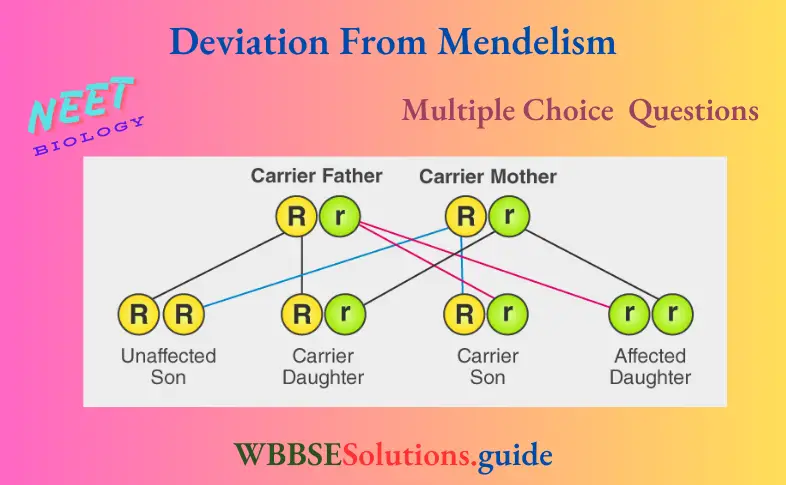
NEET Biology Introduction To Genetics Multiple Choice Question And Answers

Biology MCQs with answers for NEET Introduction To Genetics

Question 1. The branch of botany dealing with heredity and variation is called

  1. Geobotany
  2. Sericulture
  3. Genetics
  4. Evolution

Answer:  3. Genetics

Genetics is the branch of botany that deals with the study of heredity and variations.

Question 2. The term heredity refers to

  1. Transmission of characters
  2. Mixing of characters
  3. Blending of inheritance
  4. Both 1 and 3

Answer:  1. Transmission of characters

Heredity (L. Hereditas- Heirship or inheritance) is the transmission of genetic characters from parents to their offspring.

Read And Learn More: NEET Biology Multiple Choice Question And Answers

Question 3. ‘Father of Genetics’ is

  1. De Vries
  2. Mendel
  3. Bateson
  4. Robert Hooke

Answer:  2. Mendel

Gregor Johann Mendel (1822- 1884) is known as the ‘Father of Genetics’ because he was the first to demonstrate the mechanism of transmission of characters.

“mcq on genetics with answers pdf “

Question 4. Term genetics was coined by

  1. Morgan
  2. William Bateson
  3. Johannsen
  4. Carl Correns

Answer:  2. William Bateson

  • Genetics word is derived from the Greek word genesis, which stands for descent. Term genetics was introduced by Bateson in 1906.
  • Other options are explained as Morgan gave the function of chromosomes in transmitting heredity. Johannsen coined the term ‘gene’. Carl Correns explained incomplete dominance.

Biology MCQs with answers for NEET

NEET Biology Introduction To Genetics Multiple Choice Question And Answers

NEET Biology Introduction to Genetics MCQs with answers

Question 5. Variation is

  1. Differences between parents and offsprings
  2. Differences between individuals of same species
  3. Differences among the offspring of the same parents
  4. All of the above

Answer:  4. All of the above

  • All given options describes variation. Variation is the degree of difference in the progeny and between the progeny and the parents.
  • The term variation is also used for a single difference in a trait, which can be the difference between individuals of same species or among the offspring of the same parents.

Thus, option (4) is correct.
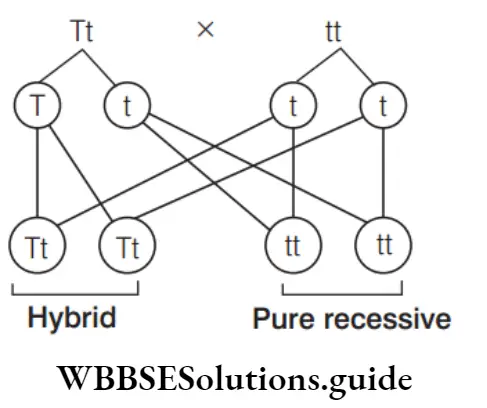
Question 6. Exact alikeness to parents is absent in humans because of

  1. Variations produced by crossing over at the time of gamete formation
  2. Variations produced by chance distribution of chromosome
  3. Both 1 and 2
  4. None of the above

Answer:  3. Both 1 and 2

“genetics questions “

  • Genetic variations arise because of recombination or crossing over during gamete formation. Recombination is a very important source of genetic variation among sexually reproducing organisms.
  • Variations are also produced by chance distribution or segregation of chromosomes during anaphase-I of meiosis and hence, exact alikeness to parents is absent.

Question 7. Which of the following is the unit of inheritance?

  1. Phenotype
  2. Genotype
  3. Gene
  4. None of the above

Answer:  3. Gene

A gene is the basic physical and functional unit of heredity. Genes are made up of DNA. Some genes act as instructions to make molecules called proteins.

Biology MCQs with answers for NEET

Question 8. Gene is

  1. One pair of allele
  2. Alternative form of a genome
  3. Present in allelic form on homologous chromosomes
  4. All of the above

Answer:  4. All of the above

Gene contain an allelic pair present on homologous chromosomes. These are the alternate form of genome.

Thus, option (4) is correct.
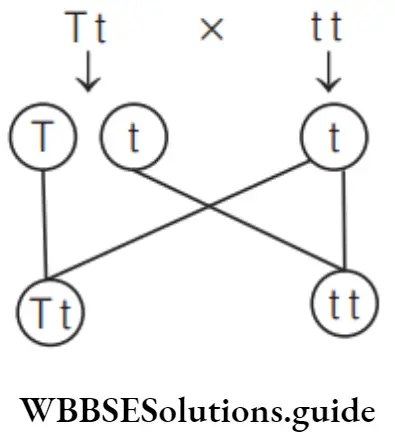
Important MCQs on Genetics for NEET

Question 9. Unit of inheritance that expressed a particular trait of organism.

  1. Factors
  2. Genes
  3. Phenotype
  4. Genotype

Answer:  2. Genes

Genes are the units of inheritance required to express a particular trait of organism. Mendel proposed that something stable was being passed down from parent to F1 to F2- generation and so on, unchanged through the gametes. He called them factors and now these are known as genes.

Biology MCQs with answers for NEET

Question 10. Which one of the following best describes a gene?

  1. A triplet of nucleotide bases
  2. A specific length of DNA responsible for the inheritance and expression of the character
  3. A specific length of single-stranded RNA
  4. Both 2 and 3

Answer:  2. A specific length of DNA responsible for the inheritance and expression of the character

Gene is a particular segment of DNA which is responsible for the inheritance and expression of particular character.

Question 11. Genes are composed of

  1. Histones
  2. Hydrocarbons
  3. Polynucleotides
  4. Lipoproteins

Answer: 3. Polynucleotides

A gene consists of a polynucleotide sequence that encodes a functional polypeptide or RNA sequence.

Question 12. Gene controls

  1. Heredity, but not protein synthesis
  2. Protein synthesis, but not heredity
  3. Both heredity and protein synthesis
  4. Biochemical action of some enzymes

Answer:  3. Both heredity and protein synthesis

Gene controls protein synthesis through controlling the synthesis of a specific protein and it controls heredity through transmission of hereditary characters from one generation to another. So, it controls both heredity and protein synthesis.

NEET previous year questions on Genetics

Question 13. Genes are arranged in

  1. Ribosome
  2. Chromosome
  3. Centrosome
  4. Lysosome

Answer:  2. Chromosome

  • Gene is a unit of heredity, composed of DNA and arranged on chromosomes.
  • It is a sequence of nucleotides of DNA concerned with a specific function, one or more of these structural genes, coding for protein, may be associated with other genes controlling their expression.

Question 14. The term factor for gene was coined by

  1. William Bateson
  2. Johann Mendel
  3. Johannsen
  4. F Griffith

Answer:  2. Johann Mendel

“questions about genetics “

During his experiments, Mendel called factors as ‘something unchanged that pass from parent to offspring through the gametes over successive generation’. So, the term factor for gene was coined by Johann Mendel.

Biology MCQ For NEET With Answers

Question 15. Alleles are

  1. Alternative forms of a gene
  2. Alternative forms of a gene that govern similar characters of trait
  3. Which govern only single character of trait
  4. All of the above

Answer:  1. Alternative forms of a gene

  • Alleles are alternative form of a gene that govern contrasting characters of single trait.
  • Alleles are various forms of a gene or Mendelian factor which occur on the same locus on homologous chromosome and control the same trait.

Question 16. Assertion (A) A pair of contrasting characters is termed as allele. Reason (R) Two alleles of a gene express equally in an individual.

  1. Both A and R are true and R is the correct explanation of A
  2. Both A and R are true, but R is not the correct explanation of A
  3. A is true, but R is false
  4. Both A and R are false

Answer:  3. A is true, but R is false

A is true, but R is false. Reason can be corrected as Some genes have just a few alleles, but others have many. A dominant allele is one that is expressed to a greater degree than the other alleles.

NEET quiz on Genetics with solutions

Question 17. The term ‘allelomorphic’ implies

  1. Any two characters
  2. A pair of contrasting characters
  3. Sex-linked characters
  4. A pair of non-contrasting characters

Answer:  2. A pair of contrasting characters

Allelomorphs control different expressions or traits of the same character. The term ‘allelomorphic’ implies a pair of contrasting characters.

Biology MCQ For NEET With Answers

Question 18. A gamete normally contains

  1. Many alleles of a gene
  2. All alleles of a gene
  3. Two alleles of a gene
  4. One allele of a gene

Answer:  4. One allele of a gene

A gamete is produced by the meiosis in cell division. When gametes are produced, the alleles of the gene separate and go into different sex cells. It means a gamete normally contains one allele of a gene.

Question 19. What is not true about alleles?

  1. Two or more alternative forms of gene are called alleles or allelomorphs
  2. Round and wrinkled form of genes are alleles of each other
  3. Alleles occupy different loci on homologous chromosome
  4. Alleles do not show incomplete dominance

Answer:  3. Alleles occupy different loci on homologous chromosome

  • Option (3) is not true and can be corrected as Genes which codes for a pair of contrasting traits is called alleles.
  • They are slightly different forms of the same gene, e.g. TT, tt, Tt. They occupy same locus on homologous chromosome. Rest options are correct about allele.

Question 20. If the genotype of an individual consists of only one type of genes at same locus it is known as

  1. Homozygous
  2. Heterozygous
  3. Monoallelic
  4. Uniallelic

Answer:  1. Homozygous

  • The diploid condition in which the alleles at a given locus are identical is called homozygous. In homozygous condition, organisms have two similar genes or alleles for a particular character in a homologous pair of chromosomes, e.g. TT or tt.
  • Organisms containing two different alleles or individual containing both dominant and recessive genes of an allele pair, e.g. Tt is known as heterozygous or hybrid.

Question 21. Pureline breed refers to

  1. Homozygosity
  2. Heterozygosity
  3. Homozygosity with only dominant genes
  4. Heterozygosity and linkage

Answer:  1. Homozygosity

Pureline breed continue to breed true and are formed in homozygous individuals that are identical. So, it refers to homozygosity.

Biology MCQ For NEET With Answers

Question 22. A homozygous individual produces gametes of ………… types.

  1. 1
  2. 2
  3. 3
  4. Many

Answer: 1. 1

A homozygous have only one type of alleles, so they produce only one kind of gamete.

NEET expected MCQs on Genetics 2025

Question 23. If a genotype consists of different types of alleles, it is called

  1. Homozygous
  2. Heterozygous
  3. Monoallelic
  4. Uniallelic

Answer:  2. Heterozygous

  • In heterozygous individuals or hybrids, a character is represented by two contrasting (different) alleles. Out of the two contrasting alleles, only one is able to express its effect in the individual.
  • It is called dominant allele. The other allele which does not show its effect in the heterozygous individual is called as recessive allele, e.g. in case of hybrid tall pea plants (Tt), ‘T’ is dominant allele, whereas ‘t’ is recessive allele.

Question 24. Types of gametes produced by a heterozygous individuals is/are

  1. 1
  2. 2
  3. 3
  4. Many

Answer: 2.  2

As heterozygous individual have two different types of chromosomes, they produce two types of gametes.

“questions about genetics “

Question 25. The allele which expresses itself in both homozygous and heterozygous condition is called

  1. Dominant allele
  2. Recessive allele
  3. Incomplete dominant allele
  4. Inherited allele

Answer:  1. Dominant allele

  • In heterozygous individuals or hybrids, a character is represented by two contrasting factors called alleles or allelomorphs.
  • Out of the two contrasting alleles, only one is able to express its effect in the individual. It is called dominant factor or dominant allele.
  • The other allele which does not show its effect in the heterozygous individual is called recessive factor or recessive allele.

Biology MCQ For NEET With Answers

Question 26. The factors which expresses only in homozygous condition is

  1. Dominant
  2. Recessive
  3. Hidden
  4. Cryptic

Answer:  2. Recessive

The allele which does not show its effect in heterozygous individual is called recessive factor or recessive allele. It expresses itself in the absence of dominant factor or allele or in homozygous condition.

NEET Biology Genetics MCQs with explanations

Question 27. Genotype is

  1. Genetic constitution of an organism
  2. Genetic constitution of somatic cells
  3. Genetic constitution of plastids
  4. Genetic constitution of germ cells

Answer:  1. Genetic constitution of an organism

Genotype designates the genetic make up or genetic constitution of an organism.

Question 28. Group of genes present in an ecosystem is called

  1. Genotype
  2. Gene pool
  3. Genome
  4. Phenotype

Answer:  2. Gene pool

Aggregate of all the genes and their alleles present in population is called gene pool.

Question 29. Gene flow is the

  1. Transfer of genes between genetically distinct, but inbreeding population
  2. Transfer of genes from outside to chromosomes
  3. Transfer of genes from females to males of an organism
  4. Transfer of genes from sperms to eggs
  5. None of the above

Answer:  1. Transfer of genes between genetically distinct, but inbreeding population

  • In population genetics, gene flow (also known as gene migration or allele flow) is the transfer of genetic variation from one population to another.
  • If the rate of gene flow is high enough, then two populations are considered to have equivalent allele frequencies and therefore, effectively be a single population. Thus, option (1) is correct.
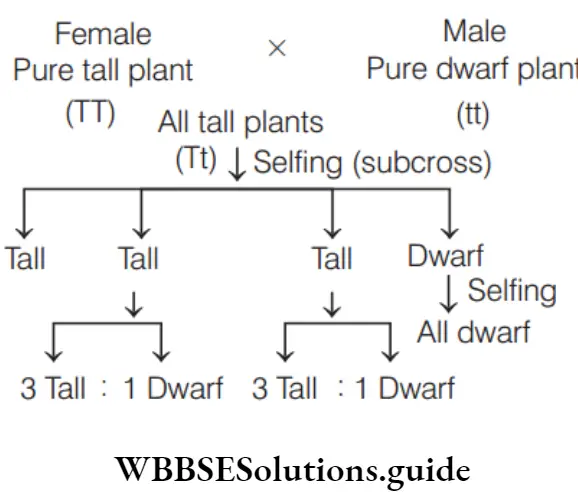
NEET Biology Mcq Chapter Wise

Question 30. The total set of DNA present in a cell is called as

  1. Genome
  2. Codon
  3. Anticodon
  4. Gene

Answer:  1. Genome

In classical genetics, a genome is a haploid set of chromosome (gamete). In modern molecular biological term, the genome is the heredity information encoded in DNA. Genome is the total set of DNA present in a cell.

Question 31. Gametes are pure because

  1. They are formed from one parent
  2. They have one gene
  3. They have only one allele
  4. They have one character

Answer:  3. They have only one allele

“questions about genetics “

Gametes are pure because they have only one allele. A gamete may be defined as a haploid cell taking part in sexual fusion. Nuclei from both the gametes fuse to form a diploid zygote.

Question 32. Genes are responsible for the growth and differentiation in an organism through regulation

  1. Of translocation
  2. Of transduction and translation
  3. Of transformation
  4. Of translation and transcription

Answer:  4. Of translation and transcription

  • Different genes in an organism are meant for the synthesis of different proteins. A variety of mechanisms are now known, which regulate gene expression at different levels including transcription, i.e. processing of mRNA and translation.
  • Eukaryotic structural gene has two types of interspersed regions, i.e. exons and introns.

Genetics mock test for NEET preparation

Question 33. Identify the correct order of organisation of genetic material from largest to smallest.

  1. Genome, chromosome, gene, nucleotide
  2. Chromosome, genome, nucleotide, gene
  3. Chromosome, gene, genome, nucleotide
  4. Genome, chromosome, nucleotide, gene

Answer:  1. Genome, chromosome, gene, nucleotide

  • The correct order of organisation of genetic material from largest to smallest is genome, chromosome, gene, and nucleotide. In genome, all the genes are contained in a single set of chromosomes.
  • The instructions in our genome are present in the form of DNA. A gene is a segment of DNA or
    chromosome situated at a specific locus (gene locus).
  • A nucleotide is the basic unit of DNA, made up of a pentose sugar, phosphoric acid, and a nitrogenous base.

NEET Biology Mcq Chapter Wise

Question 34. Phenotype of an organism is the result of

  1. Genotype and environment interactions
  2. Mutations and linkages
  3. Cytoplasmic effects and nutrition
  4. Environmental changes and sexual dimorphism

Answer:  1. Genotype and environment interactions

  • The external manifestation, morphological, physiological expression of an individual with regard to one or more characters is called phenotype. For recessive genes, phenotype and genotype are similar.
  • For dominant genes, the phenotype is same for both homozygous states. Phenotype is influenced by environment as well as age. Many phenotypes are determined by multiple genes.
  • Thus, the identity of phenotype is determined by genotype and environment.


NEET Biology Infertility Multiple Choice Question And Answers

Biology MCQs with answers for NEET Infertility

Question 1. Inability to conceive or produce children even after many years of unprotected sexual cohabitation is called

  1. Infertility
  2. Erectile dysfunction
  3. Amniocentesis
  4. None of the above

Answer: 1. Infertility

Infertility is often defined as the condition of not conceiving even after 12 months of regular sexual intercourse without the use of birth control methods.

Question 2. Primary infertile patient is the person who

  1. Have never conceived in the past
  2. Had conceived earlier, but unable to conceive again
  3. Cannot produce ova
  4. None of the above

Answer: 1. Have never conceived in the past

“mcq reproductive health “

Primary infertility denotes those patients who have never conceived in lifetime even after one year of active sexual activity without using birth control methods.

Read And Learn More: NEET Biology Multiple Choice Question And Answers

Question 3. Secondary infertility refers to

  1. Patients who choose not to conceive
  2. Sterility
  3. Impotency
  4. Previous pregnancy, but failure to conceive subsequently

Answer:  4. Previous pregnancy, but failure to conceive subsequently

Secondary infertility indicates the previous pregnancy, but failure to conceive subsequently, i.e. earlier the couple have conceived but now unable to do so.

Question 4. Consider the following statements

  1. Infertility is the inability to produce viable offspring due to the defects in the female partner.
  2. Complete lactation helps in contraception.
  3. Spreading awareness can help create a reproductively healthy society.

Choose the option containing correct statements.

  1. Only 2
  2. 1, 2 and 3
  3. 2 and 3
  4. 1 and 3

Answer:  3. 2 and 3

“questions about reproductive health “

Statements 2 and 3 are correct. Statement I is incorrect and can be corrected as Infertility is the inability to produce viable offspring due to defects in female or male partner.

Biology MCQs with answers for NEET

NEET Biology Infertility Multiple Choice Question And Answers

NEET Biology Infertility MCQs with answers

Question 5. ………… is the type of infertility when exact reason is not known.

  1. Tubal infertility
  2. Idiopathic infertility
  3. Impotency
  4. Cryptorchidism

Answer:  2. Idiopathic infertility

Unexplained infertility is infertility that is idiopathic in the sense that its causes remain unknown even after infertility check up like semen analysis in man, assessment of ovulation and Fallopian tubes in woman, etc.

Question 6. Which of the following diseases causes male infertility?

  1. Scrotal hernia
  2. Phimosis
  3. Orchitis
  4. All of the above

Answer:  4. All of the above

  • All the listed factors cause male infertility. Scrotal hernia is the abnormal protrusion of part of an organ or tissue through the structures normally containing it.
  • Phimosis is a condition in which tight foreskin cannot be pulled back over the head of the penis. Orchitis is an inflammation of one or both testicles.

Thus, option (4) is correct.
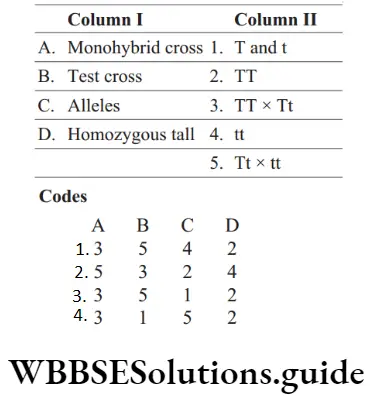
Question 7. Orchitis is caused in males due to

  1. Elongated prepuce
  2. Inflammation of testicles
  3. Swelling of spermatid cord
  4. Inflammation of vas deferens

Answer:  2.  Inflammation of testicles

“reproductive health bank of biology “

Orchitis is an inflammatory condition of one or both testicles in males. It is generally caused by a viral or bacterial infection. Most cases of orchitis in children are caused by infection with the mumps virus

Question 8. Tubal infertility in females is caused due to

  1. Absence of ovaries
  2. Absence of Fallopian tube
  3. Ligated Fallopian tubes
  4. Infections in reproductive tract

Answer:  3. Ligated Fallopian tubes

Tubal infertility occurs when the Fallopian tube(s) prevent sperm from reaching the fertilisation site to fertilise an egg or prevents a fertilised embryo from reaching the uterus for pregnancy. So, tubal infertility in females is caused due to ligated Fallopian tube.

Biology MCQs with answers for NEET

Question 9. In the production of test tube babies,

  1. Fertilisation and foetus formation is external
  2. Fertilisation and foetus formation is internal
  3. Fertilisation is internal and foetus formation is external
  4. Fertilisation is external and foetus formation is internal

Answer:  4 . Fertilisation is external and foetus formation is internal

  • In the production of test tube babies, an ovum is taken out from a woman’s Fallopian tube and fertilised with preserved sperm in a test tube.
  • After that zygote is formed that is implanted in the woman’s uterus for further embryonic development. Thus, fertilisation is external and foetus formation is internal in test tube babies.

Infertility MCQs for NEET with solutions

Question 10. In vitro fertilisation is a technique that involves transfer of which one of the following into the Fallopian tube?

  1. Embryo only up to 8 cell stage
  2. Either zygote or early embryo up to 8 cell stage
  3. Embryo of 32 cell stage
  4. A foetus of eight weeks

Answer:  2. Either zygote or early embryo up to 8 cell stage

Zygote Intra Fallopian Transfer (ZIFT) is an example of In Vitro Fertilisation (IVF). In this, the zygote or early embryos up to 8 blastomeres are transferred into the Fallopian tube. If the embryo has more than 8 blastomeres then, it is transferred into uterus. This process is called as IUT.

Question 11. Which of the following is the correct sequence of events in development of test tube baby?

  1. Removal of unfertilised ovum → In vitro fusion of sperm and ovum → Development of zygote up to 32 cell stage → Embryo transfer into the uterus of mother
  2. Fusion of sperm and ovum in vitro → Removal of unfertilised ovum and transfer in to the uterus of mother → Formation and development of zygote up to 32 cell stage
  3. Embryo transfer into the uterus of mother → Formation and development of zygote up to 32 cell stage → Fusion of sperm and ovum in vitro → Removal of unfertilised ovum
  4. Formation and development of zygote up to 32 cell stage → Fusion of sperm and ovum in vitro → Removal of unfertilised ovum → Embryo transfer into the uterus

Answer:  1. Removal of unfertilised ovum → In vitro fusion of sperm and ovum → Development of zygote up to 32 cell stage → Embryo transfer into the uterus of mother.

Question 12. The first test tube baby was born in

  1. USA
  2. France
  3. England
  4. India

Answer:  3. England

In, 1978, Louise Joy Brown was the world’s first baby conceived, via. In Vitro fertilisation (IVF). He was born in Manchester, England.

Biology MCQs with answers for NEET

Question 13. A woman whose womb is used as a substitute for the biological mother to nurse the embryo is called

  1. Interrogate mother
  2. Surrogate mother
  3. Both 1 and 2
  4. None of the above

Answer:  2. Surrogate mother

During IVF, developing embryo is transplanted in the uterus of another female. A woman who nurse the embryo is called surrogate mother.

“class 12 reproductive health “

Question 14. Reduced sperm count in males is referred to as

  1. Oligospermia
  2. Azoospermia
  3. Absolute impotency
  4. Cryptorchidism

Answer:  1. Oligospermia

Oligospermia is the technical term for reduced sperm count in males.

Infertility important questions for NEET

Question 15. Condition in which motility remains very less is

  1. Azoospermia
  2. Polyspermia
  3. Oligospermia
  4. Asthenospermia

Answer:  4. Asthenospermia

Asthenospermia refers to the less motility of sperms.

Biology MCQs with answers for NEET

Question 16. When very less or nil sperms are present in semen, such a condition is referred to as

  1. Oligospermia
  2. Polyspermia
  3. Azoospermia
  4. None Of These

Answer:  3. Azoospermia

  • Azoospermia is the medical condition in which semen contains very little or no sperm. It is associated with infertility, but many forms are amenable to medical treatment.
  • In humans, azoospermia affects about 1% of the male population and may be seen in up to 20% of male infertility situations.

Question 17. Infertile couples can now have children with the help of

  1. Art
  2. Family planning
  3. Rch programme
  4. All of the above

Answer:  1.  Art

Infertile couples can now have children with the help of ART, which is Assisted Reproductive Technology. It include in vitro fertilisation, ZIFT, IUT, GIFT, etc.

NEET Biology Infertility previous year questions

Question 18. Which of the following is a technique of direct introduction of gametes into the oviduct?

  1. GIFT
  2. ET
  3. IVF
  4. POST

Answer:  1. GIFT

The technique of direct introduction of gametes into oviduct is called Gamete Intra Fallopian Transfer (GIFT).

Biology MCQ For NEET With Answers

Question 19. Assisted reproductive technology does not include

  1. Zygote extra Fallopian transfer
  2. In vitro fertilisation and embryo transfer
  3. Artificial insemination
  4. Gamete intra Fallopian transfer

Answer:  1. Zygote extra Fallopian transfer

  • Assisted Reproductive Technology (ART) includes Zygote Intra Fallopian Transfer (ZIFT)
  • In vitro Fertilisation (IVF) and Embryo Transfer (ET) Artificial insemination (AI) Gamete Intra Fallopian Transfer (GIFT), ART does not include zygote extra Fallopian transfer.

Question 20. Which of the following techniques are used in IVF?

  1. ZIFT
  2. IUT
  3. ICSI
  4. AI

Choose the correct option.

  1. 1 and 3
  2. 3 and 4
  3. 2 and 3
  4. 1, 2, 3 and 4

Answer:  4.  1, 2, 3 and 4

All the listed techniques are used in 4 F. Thus, option (4) is correct.
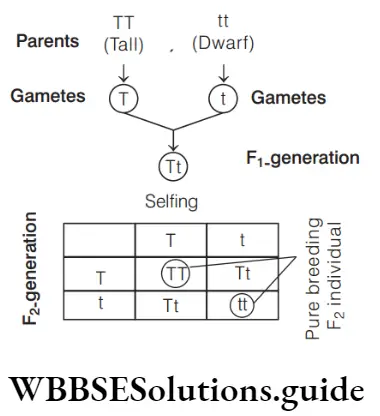
Question 21. Match the following columns.

NEET Biology Infertility Question 21 Match The Following Column

Answer:  2. A–3, B–5, C–2

Infertility quiz for NEET preparation

Question 22. Consider the following statements.

  1. Both ZIFT and IUT are embryo transfer techniques.
  2. In both ZIFT and IUT, the number of cells in zygote is same.

Choose the correct option.

  1. Statement 1 is correct, but 2 is incorrect
  2. Statement 1 is incorrect, but 2 is correct
  3. Both statements 1 and 2 are correct
  4. Both statements 1 and 2 are incorrect

Answer:  1. Statement 1 is correct, but 2 is incorrect

  • Statement 1 is correct, but 2 is incorrect because ZIFT (Zygote Intra Fallopian Transfer) is the technique in which zygote or early embryo with up to 8 blastomeres is transferred into the Fallopian tube of female.
  • Whereas in IUT, embryo with more than 8 blastomeres is transferred into the uterus. Thus, difference between ZIFT and IUT lies in number of the cells of the zygote.

Biology MCQ For NEET With Answers

Question 23. Artificial insemination means

  1. Artificial introduction of sperms of a healthy donor into the vagina
  2. Introduction of sperms of a healthy donor directly into the ovary
  3. Transfer of sperms of a healthy donor to a test tube containing ova
  4. Transfer of sperms of husband to a test tube containing ova

Answer:  1. Artificial introduction of sperms of a healthy donor into the vagina

  • In artificial insemination technique, the semen of a healthy donor male is collected and is introduced artificially through a flexible polyethylene catheter into the vagina or uterus.
  • Best results are obtained when the motile sperm count is more than 10 million. The fertilising capacity of spermatozoa (sperms) is for 24- 48 hours. The procedure may be repeated 2-3 times over a period of 2-3 days.

Question 24. Read the statements below and match them to their respective technologies that are given.

  1. Collected gametes are made to form the zygote in the laboratory.
  2. Zygote or early embryo with up to 8 blastomeres is transferred into the oviduct.
  3. Zygote with more than 8 blastomeres, is transferred into the uterus.
  4. Fusion of the gametes in the female reproductive tract.
  5. Transfer of the ovum from a donor to the oviduct of the recipient.
  6. Sperm is injected into the ovum, in vitro.

Choose the correct answer

  1.  GIFT
  2. ZIFT
  3. AI
  4. ICSI
  5.  IUT
  6. IVF
  7. IVI
  8. In vivo fertilisation

Codes

  1. 1-F, 2-B, 3-E, 4-H, 5-A, 6-D
  2. 1-G, 2-B, 3-F, 4-H, 5-A,6-D
  3. 1-G, 2-B, 3-F, 4-H, 5-C, 6-F
  4. 1-F, 2-B, 3-A, 4-H, 5-A, 6-G

Answer: 1. 1-F, 2-B, 3-E, 4-H, 5-A, 6-D

Question 25. In case of a couple, where the male is having a very low sperm count, which technique will be suitable for fertilisation?

  1. Intrauterine transfer
  2. Gamete intracytoplasmic Fallopian transfer
  3. Artificial insemination
  4. Intracytoplasmic sperm injection

Answer:  4.  Intracytoplasmic sperm injection

Infertility due to low sperm count in male partner is overcome by using artificial insemintaion method. In case, the sperm count is very low, a single healthy sperm is injected into an ovum. It is called intra cytoplasmic sperm injection.

NEET Biology Infertility MCQs with explanations

Question 26. Embryo with more than 16 blastomeres formed due to in vitro fertilisation is transferred into

  1. Uterus
  2. Fallopian tube
  3. Fimbriae
  4. Cervix

Answer:  1. Uterus

Embryo with more than 16 blastomeres, formed due to in vitro fertilisation is transferred into uterus for implantation.

Biology MCQ For NEET With Answers

Question 27. First case of IVF-ET technique success was reported by

  1. Bayliss and Starling Taylor
  2. Robert Steptoe and Gilbert Brown
  3. Louis Joy Brown and Benting Best
  4. Patrick Steptoe and Robert Edwar

Answer:  4. Patrick Steptoe and Robert Edwar

  • First test tube baby (IVF-ET technique) was Louis Joy Brown. He was born to Lesley and Gilbert Brown on July 1978 in England under the assistance of Dr. Patrick Steptoe and Dr. Robert Edward.
  • Dr. Robert Edward got Nobel Prize in 2010 for developing a technique for the production of test tube baby.

Question 28. The technique called Gamete Intra Fallopian Transfer (GIFT) is recommended for those females

  1. Who cannot produce an ovum
  2. Who cannot retain the foetus inside uterus
  3. Whose cervical canal is too narrow to allow passage for the sperms
  4. Who cannot provide suitable environment for fertilisation

Answer:  1. Who cannot produce an ovum

  • Gamete Intra Fallopian Transfer (GIFT) is recommended for those females who cannot produce an ovum.
  • In this process, the eggs of the donor woman are removed and in a form of mixture with sperm transferred into Fallopian tube of another woman who cannot produce ovum, but can provide suitable environment for fertilisation. Thus in GIFT, site of fertilisation is Fallopian tube, not laboratory.

Question 29. GIFT technique is useful for women,

  1. Whose fimbriae fail to capture ovum
  2. Who have sperm antibodies in their cervical secretion
  3. Who have at least one potent Fallopian tube
  4. All of the above

Answer:  4. All of the above

GIFT is useful for women with atleast one potent Fallopian tube. It can help those where fimbriae does not function efficiently or presence of spermicidal antibodies in cervical secretions.

Thus, option (4) is correct.
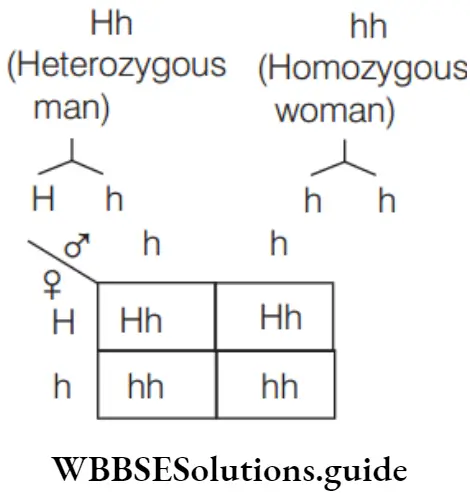
Infertility mock test for NEET aspirants

Question 30. Which of the following is wrongly matched?

  1. IUT – Semen collected from husband or donor is artificially introduced either into the vagina or into the uterus
  2. GIFT – Transfer of embryos with more than 8 blastomeres into the Fallopian tube
  3. ICSI – Sperm directly injected into the ovum
  4. ZIFT – Transfer of embryos with up to 8 blastomeres into the Fallopian tube
  5. IVF – Fertilisation outside the body in almost similar conditions as that in the body

Answer:  2. GIFT – Transfer of embryos with more than 8 blastomeres into the Fallopian tube

Option (2) is wrongly matched pair and can be corrected as GIFT or Gamete Intra Fallopian Transfer is a method of transfer of an ovum collected from a donor female into the Fallopian tube. Rest options are correctly matched pairs.

Biology MCQ For NEET With Answers

Question 31. The stage of cells at which it is transferred into the uterus after induced fertilisation of ova in the laboratory is

  1. Embryo at 4 blastomeres stage
  2. Embryo at 2 blastomeres stage
  3. Morula
  4. Zygote

Answer:  3. Morula

After induced fertilisation, embryo at morula stage is transferred into the uterus.

Question 32. The technique that involves transfer of embryo into oviduct is called

  1. ZIFT
  2. IUT
  3. GIFT
  4. AI

Answer: 1. ZIFT

Question 33. In which of the following techniques, the embryos are transferred to assist those females who cannot conceive?

  1. GIFT and ZIFT
  2. ICSI and ZIFT
  3. GIFT and ICSI
  4. ZIFT and IUT

Answer:  4. ZIFT and IUT

  • Option (4) is the correct answer because the techniques by which the embryos are transterred to assist those females who cannot conceive are ZIFT and IUT. Both are Embryo Transfer (ET) methods.
  • Options (1), (2) and (3) are incorrect. In GIFT, gamete is transferred into the Fallopian tube of female who cannot produce ova. In ICSI, sperm is directly injected into the ovum.
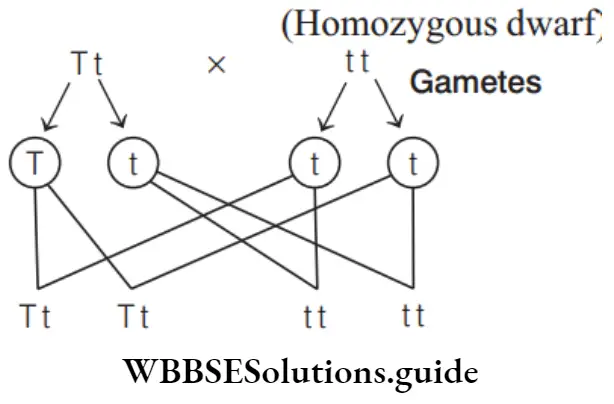
Question 34. The test tube baby programme employs which one of the following techniques?

  1. Intra Cytoplasmic Sperm Injection (ICSI)
  2. Intra Uterine Insemination (IUI)
  3. Gamete Intra Fallopian Transfer (GIFT)
  4. Zygote Intra Fallopian Transfer (ZIFT)

Answer:  4. Zygote Intra Fallopian Transfer (ZIFT)

  • In test tube baby programme, ova from the female and sperms from the male are collected and are induced to form zygote under simulated conditions in the laboratory.
  • The zygote with up to 8 blastomeres could then be transferred into the Fallopian tube (ZIFT or Zygote Intra Fallopian Transfer) and embryos with more than 8 blastomers, into the uterus (IUT or Intra Uterine Insemination) to complete its further development. Thus, the test tube baby programme employs ZIFT technique.

NEET practice test on Infertility chapter

Question 35. In which technique, the donor semen is artificially introduced to the uterus?

  1. Intravaginal insemination
  2. Intrauterine insemination
  3. Intracytoplasmic sperm injection
  4. Gamete intra-Fallopian transfer

Answer:  2. Intrauterine insemination

  • Intra Uterine Insemination (IUI) is a method of Artificial Insemination (AI) in which sperms collected either from the husband or a healthy donor are artificially introduced into the uterus of female.
  • In this technique, about 0.3 mL of washed and concentrated semen (placing unwashed semen directly into uterus can cause severe cramps) having at least 1 million sperms are artificially introduced through a polyethylene catheter into the uterus of the female.

Question 36. Artificial reproductive techniques are not always applicable because

  1. It is an expensive technique, hence only few people can afford it
  2. It is not possible in women with damaged uterine wall
  3. It has raised ethical, legal, and moral concerns
  4. All of the above

Answer:  4. All of the above

ART is expensive and raise ethical moral and legal issues. Although it help to overcome most infertilities, in case of damaged uterine tissue, it cannot be employed. Thus, option (4) is correct.
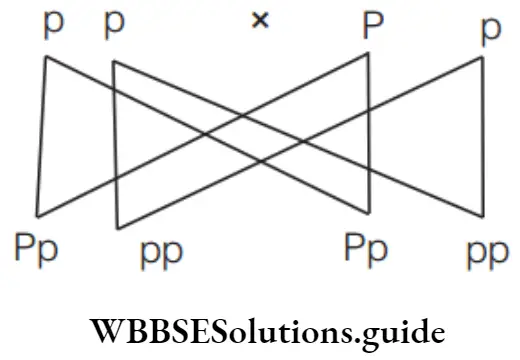
 

NEET Biology Medical Termination Of Pregnancy Multiple Choice Question And Answers

Biology MCQs with answers for NEET Medical Termination of Pregnancy (MTP)

Question 1. One of the legal methods of birth control is

  1. By having coitus at the time of day break
  2. By aborting female foetus to decrease female population
  3. Abortion by taking an appropriate medicine
  4. By abstaining from coitus from day 10 to 17 of the menstrual cycle

Answer: 3.  Abortion by taking an appropriate medicine

  • Intentional or voluntary termination of pregnancy by taking an appropriate medicine before full term is called Medical Termination of Pregnancy (MTP) or induced abortion.
  • Nearly 45 to 50 million, MTPs are performed in a year, all over the world which account to 1/5th of the total number of conceived pregnancies in a year.

Read And Learn More: NEET Biology Multiple Choice Question And Answers

Question 2. Legally accepted term of ‘abortion’ is

  1. MTP
  2. MMTP
  3. MTTP
  4. None of these

Answer: 1.  MTP

Legally acceptable term of abortion is MTP (Medical Termination of Pregnancy).

Important MCQs on Medical Termination of Pregnancy for NEET

  1. Medical Termination of Pregnancy
  2. Mental Trauma Phase
  3. Treatment of Menstrual Pain
  4. Both 1  and 3

Answer: 1. Medical Termination of Pregnancy

MTP stands for Medical Termination of Pregnancy.

NEET Biology Medical Termination of Pregnancy MCQs with answers

Question 4. MTP is used to

  1. Discontinue the pregnancy if dangerous for the mother
  2. Get rid of unwanted pregnancy
  3. Discontinue the pregnancy if dangerous for foetus
  4. All of the above

Answer: 4.  All of the above

MTP is used to discontinue the pregnancy if it is dangerous for the mother or foetus and to get rid of unwanted pregnancy. Thus, option (d) is correct.
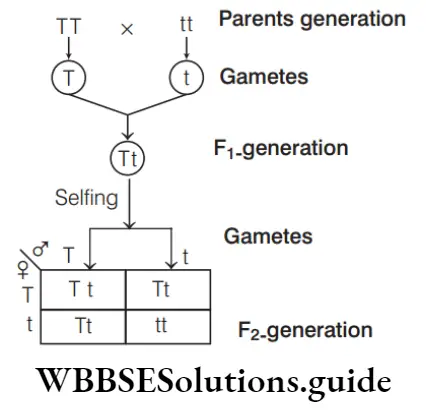
Question 5. Ethical principles in support of abortion do not include

  1. A woman’s right to autonomous choice
  2. A woman has no moral obligation or duty to carry a foetus
  3. Fertilisation does not automatically bestow moral status on a foetus
  4. Abortion is of utilitarian value to a woman

Answer:  4. Abortion is of utilitarian value to a woman

  • Option 4 does not support the ethical principles of abortion because a sharp distinction exists between those who support a woman’s right to choose abortion and those who oppose abortion on the grounds of foetal rights to life.
  • Abortion does not impart any utilitarian value to a woman. Rest options include in support of ethical principles

Biology MCQs with answers for NEET

NEET Biology Medical Termination Of Pregnancy Multiple Choice Question And Answers

NEET previous year questions on Medical Termination of Pregnancy

Question 6. In India, medical termination of pregnancy (i.e. abortion) was legalised in

  1. 1951
  2. 1961
  3. 1971
  4. 1981

Answer: 3. 1971

In India, the Medical Termination of Pregnancy Act was legalised in 1971.

“mcq reproductive health “

Question 7. Medical Termination of Pregnancy (MTP) is considered safe till how many weeks of pregnancy?

  1. Eight weeks
  2. Twelve weeks
  3. Eighteen weeks
  4. Six weeks

Answer:  2. Twelve weeks

  • Medical Termination of Pregnancy (MTP) or abortion is the termination of pregnancy before the foetus becomes viable.
  • MTP is comparatively safe up to 12 weeks (the first trimester) of pregnancy.
  • It becomes more risky after the first trimester period of pregnancy as the foetus becomes intimately associated with the maternal tissues.

“class 12 reproductive health “

Question 8. MTP can be carried out by

  1. Dilation and curettage
  2. Vacuum aspiration
  3. Administration of prostaglandins
  4. All of the above

Answer: 4. All of the above

  • All given various methods are available to carry out MTP. These include vacuum aspiration, prostaglandin administration, dilation and curettage.
  • Thus, option 4 is correct.
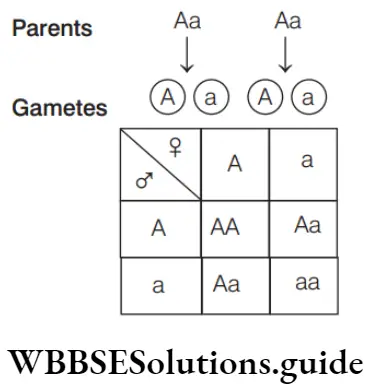
Biology MCQs with answers for NEET

Question 9. What is the latest stage of pregnancy when an abortion can be under taken pursuant to the Medical Termination of Pregnancy Act, 1971?

  1. 26 weeks
  2. 24 weeks
  3. 28 weeks
  4. 20 weeks

Answer: 4. 20 weeks

The Medical Termination Pregnancy Act, 1971 is responsible for the legalisation of abortion. However legally, it can only be performed up to 20 weeks of conception.

NEET quiz on Medical Termination of Pregnancy with solutions

Question 10. MTP along with amniocentesis is being ..A… to abort even normal healthy …B… foetuses.

  1. A-used, B-male
  2. A-misused, B-female
  3. A-helpful, B-female
  4. A-helpful, B-unwanted

Answer: 2.  A–misused, B–female

“questions about reproductive health “

Question 11. Consider the following statements.

  • The MTP (Amedment) Act, 2017 was enacted by government of India to reduce illegal abortions and consequent maternal mortality.
  • The opinion of two registered medical practitioners is required to carryout MTP if pregnancy has lasted more than 12 weeks

Choose the correct option.

  1. Statement 1 is correct, but 2 is incorrect
  2. Statement 1 is incorrect, but 2 is correct
  3. Both statements 1 and 2 are correct
  4. Both statements 1 and 2 are incorrect

Answer: 3. Both statements 1 and 2 are correct

NEET Biology Population Stabilisation And Birth Control Multiple Choice Question And Answers

Biology MCQ For NEET With Answers Population Stabilisation And Birth Control

Question 1. Study of the human population is known as ………… .

  1. Anthropology
  2. Demography
  3. Geography
  4. Ethnology

Answer: 2. Demography

  • Demography is the study of statistics such as births, deaths, income or the incidence of diseases, which illustrate changing structure of the human population.
  • Other options are explained as Anthropology is the study of human behaviour, biology and societies.
  • Geography is the study of places and relationships between people and their environment.
  • Ethnology is the study of the characteristics of different people, differences and relationships between them.

Read And Learn More: NEET Biology Multiple Choice Question And Answers

Question 2. 11th July is observed as

  1. World Population Day
  2. No Tobacco Day
  3. World Environment Day
  4. World Health Day

Answer: 1. World Population Day

  • World Population Day is an annual event that is observed on 11th July every year. It seeks to raise awareness of global population issues.
  • The event was established by the Governing Council of the United Nations Development Programme in 1989.

“neetprep reproductive health “

Question 3. Consider the following statements.

  1. India is the second largest populated country in world.
  2. China’s population is largest among all countries.

Choose the correct option.

  1. Statement 1 is correct, but 2 is incorrect
  2. Statement 1 is incorrect, but 2 is correct
  3. Both statements 1 and 2 are correct
  4. Both statements 1 and 2 are incorrect

Answer:  3. Both statements 1 and 2 are correct

Both statements 1 and 2 are correct as The countries with largest population are as follows

Country    –    Human population

China          –    1341000000
India           –     1210000000
USA             –     311075000
Indonasia     –   237556363
Brazi            –  190732694

Thus, China is most populated country in world and India is the second largest country in terms of population count.

NEET Biology Population Stabilization MCQs with answers

Question 4. Given below is the count of world population in different years.

  1. 1900 – ~ 2 billion
  2. 2000 – ~ 6 billion
  3. 2011 – ~ 7.2 billion

Choose the option containing correctly matched pairs.

  1. 1 only
  2. 1 and 2 only
  3. 1, 2 and 3
  4. 2 and 3only

Answer: 3.  1, 2 and 3

All the given options represent correctly matched pairs. Thus, option (c) is correct.
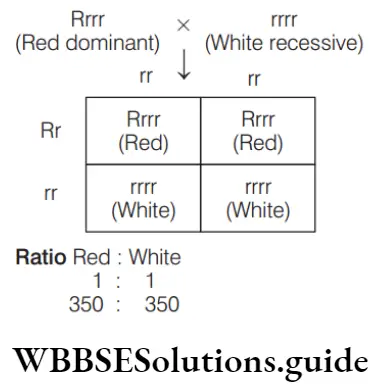
Biology MCQ For NEET With Answers

NEET Biology Population Stabilisation And Birth Control Multiple Choice Question And Answers

Question 5. Assertion (A) Human population has doubled every 35 years in contrary to 200 years since 1600-1800. Reason (R) Rapid increase is due to the availability of better health facilities.

  1. Both A and R are true and R is the correct explanation of A
  2. Both A and R are true, but R is not the correct explanation of A
  3. A is true, but R is false
  4. Both A and R are false

Answer:  1. Both A and R are true and R is the correct explanation of A.

“mcq reproductive health “

  • Better medical or health facilities play a major role in increasing the population.
  • Invention of vaccines for almost all dreadful diseases for infants and adults has led to the reduction in death rate.

So, the population has doubled every 35 years in contrary to 200 years since 1600-1800.

Question 6. What is meant by population explosion?

  1. Increased frequency of diseases in population
  2. Rapid increase in population number
  3. Rapid decrease in population number
  4. None of the above

Answer:  2. Rapid increase in population number

Rapid increase in population over a relatively short period is called population explosion. In 150 years, from 1700 AD human population has doubled from 0.6 billion to 1.2 billion. In contrast, it increased five times during the next 150 years. In 2011, it was 7 billion.

Important MCQs on Birth Control for NEET

Question 7. A reason for the occurrence of population explosion is

  1. Decline maternal mortality rate
  2. Decline rate of infant mortality
  3. Better medical services
  4. All of the above

Answer:  4. All of the above

Few reasons for population explosion are as follows

  • Decline death rate
  • Decline Maternal Mortality Rate (MMR)
  • Decline rate of infant mortality.
  • Better medical services

Thus, option 4 is correct.
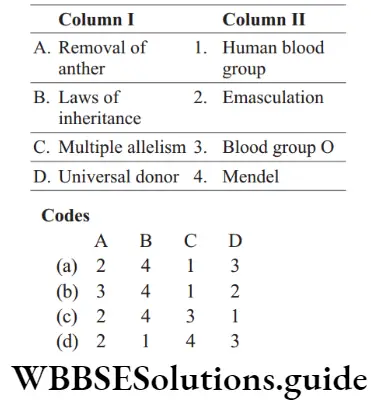
Biology MCQ For NEET With Answers

Question 8. Assertion (A) Overpopulation has become a serious problem in developing countries. Reason (R) It leads to exhaustion of natural resources, causes unemployment and increases pollution.
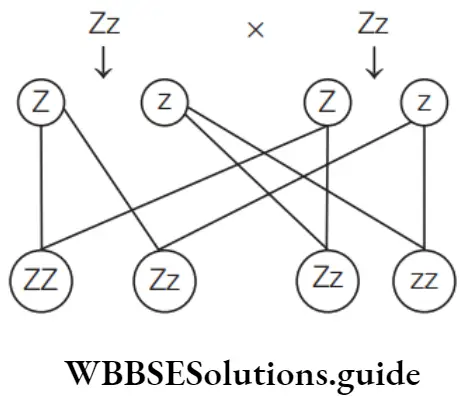
  1. Both A and R are true and R is the correct explanation of A
  2. Both A and R are true, but R is not the correct explanation of A
  3. A is true, but R is false
  4. Both A and R are false

Answer:  1. Both A and R are true and R is the correct explanation of A.

Overpopulation may exhaust natural resources, causes unemployment and increases pollution, especially in developing countries.

Question 9. Certain demographic features of developing countries are

  1. High fertility, low or rapidly falling mortality rate, rapid population growth and a very young age distribution
  2. High fertility, high density, rapidly rising mortality rate and a very young age distribution
  3. High infant mortality, low fertility, uneven population growth and a very young age distribution
  4. High mortality, high density, uneven population growth and a very old age distribution

Answer:  1. High fertility, low or rapidly falling mortality rate, rapid population growth and a very young age distribution

Some characteristic demographic features of developing countries are high fertility, low or rapidly falling mortality rate rapid population growth and a very young age distribution.

Question 10. The year 1927 saw a decline in population. The reason for this is

  1. First World War
  2. Flood
  3. Food scarcity
  4. Second World War

Answer: 3. Food scarcity

  • The decline in population in 1927 occurred due to food scarcity.
  • First World War took place within year 1916 to 1918 and second World War took place between 1940 to 1942.

Question 11. In India, human population is heavily weighted towards younger age groups as a result of

  1. Short lifespan of many individuals and low birth rate
  2. Long lifespan of many individuals and low birth rate
  3. Short lifespan of many individuals and high birth rate
  4. Long lifespan of many individuals and high birth rate

Answer:  3. Short lifespan of many individuals and high birth rate

In India, human population is heavily weighted towards the younger age group as a result of high birth rate and short lifespan of many individuals.

Biology MCQ For NEET With Answers

Question 12. Where we can find overstrained infrastructure due to population growth?

  1. In rural areas
  2. In forest areas
  3. In desert areas
  4. In urban areas

Answer:  4. In urban areas

  • Due to overpopulation, growth facilities such as housing, transportation, healthcare and education become inadequate.
  • The worst symptoms of congestion in every aspect of living conditions are manifested in the urban areas.

Question 13. In India, the Population Policy was announced in the year

  1. 1971
  2. 1976
  3. 1978
  4. 1981

Answer: 2. 1976

“questions about reproductive health “

In April 1976, India framed its first ‘National Population Policy’.

It was called for an increase in the legal minimum age of marriage from 15 to 18 for females and from 18 to 21 for males.

Question 14. Practice which does not help greatly in arresting population explosion is

  1. Use of contraceptives by the married couple
  2. Educating the masses about the benefits of planned family
  3. Vasectomy and tubectomy
  4. Early child marriage

Answer: 4. Early child marriage

  • Early child marriage does not help in arresting population explosion.
  • It contributes to higher total fertility as women marrying earlier tend to both have children earlier and bear more children over their lifetime than if, they had married later.
  • Whereas use of contraceptives by married couples, vasectomy and tubectomy, educating the masses about the benefits of planned family helps in arresting population explosion.

NEET quiz on Population Stabilization and Birth Control with solutions

Question 15. What is the need to control the population growth in India?

  1. To improve the standard of living among existing people
  2. To utilise all the natural resources among the existing people
  3. To participate in war among neighbouring nations
  4. To increase the mortality rate in India

Answer:  1. To improve the standard of living among existing people

  • The need for controlling population growth is urgent and pressing, so that the existing people may have an improved standard of living.
  • Overpopulation causes various ill effects on both humans and as well as on the environment.

Biology MCQ For NEET With Answers

Question 16. Which of the following parameter of the population can be negative?

  1. Birth rate
  2. Replacement level
  3. Growth rate
  4. All of the above

Answer:  3. Growth rate

Population growth rate is the annual average growth rate. It can be a negative parameter. Birth rate and replacement level can never be negative.

Question 17. The best way to control population is

  1. Educating people on the importance of small families
  2. Family planning
  3. Better living conditions
  4. Better healthcare

Answer:  2. Family planning

  • Family planning is the best way to control population.
  • It allows people to attain their desired number of children and determines the spacing of pregnancies.

Question 18. ‘Hum Do Hamare Do’ slogan encourages

  1. Family planning
  2. Immunisation
  3. Electronic growth
  4. Patriotism

Answer: 1. Family planning

“class 12 reproductive health “

‘Hum do Humare Do’ slogan encourages family planning.

Question 19. Assertion (A) Zero population growth should be achieved as early as possible to control human population. Reason (R) This demands a couple to have more than two children.

  1. Both A and R are true and R is the correct explanation of A
  2. Both A and R are true, but R is not the correct explanation of A
  3. A is true, but R is false
  4. Both A and R are false

Answer: 3. A is true, but R is false

  • A is true, but R is false because two children per couple holds good for zero population growth.
  • But in large democratic countries like India, it will take many years for population growth to attain the zero level because couple need to have less than two children to obtain zero growth.

Biology MCQs with answers for NEET

Question 20. The …………… forbids the practice of child marriages in India.

  1. The Children Act, 1960
  2. Dowry Prohibition Act, 1961
  3. Prohibition of Child Marriage Act, 2006
  4. Commissions for the Protection of Child Rights

Answer:  3. Prohibition of Child Marriage Act, 2006

  • According to the Prohibition of Child Marriage Act (PCMA), 2006, child marriage is a marriage in which the boy is under the age of 21 years and the girl is lesser than 18 years of age.
  • It came into effect from 1st November 2007, replacing the Child Marriage Restraint Act (CMRA) of 1929 or Sharda Act.
  • This law was amended in 1978, wherein the legal age of marriage of girls was raised from 15 to 18 years and of boys from 18 to 21 years. The amended law was known as the Child Marriage Restraint Act, 1929.

Question 21. Age group in a population is classified on the basis of

  1. Reproduction rate
  2. Death rate
  3. Age of marriage
  4. Sex ratio

Answer:  1. Reproduction rate

Age groups in a population are classified on the basis of reproductive age. Three major age groups are as follows

  • People aged 30-44-Post reproductive years
  • People aged 15-29-Reproductive years
  • People aged 0-14-Pre-reproductive years

Question 22. Increasing the minimum marriageable age of girls and boys

  1. Reduces the child bearing period of a married couple
  2. Increases the child bearing period
  3. First increases and then decreases the child bearing period
  4. No effect

Answer:  1. Reduces the child bearing period of a married couple

Raising the minimum age of marriage reduces the fertility (child bearing) period, thereby the chances of birth become less

Biology MCQs with answers for NEET

Question 23. Consider the following statements.

  1. Reproductive potential is maximum reproductive capacity of a population under optimal conditions.
  2. Pouplation shows highest fertility in botic potential.

Choose the correct option.

  1. Statement 1 is correct, but 2 is incorrect
  2. Statement 1 is incorrect, but 2 is correct
  3. Both statements 1 and 2 are correct
  4. Both statements 1 and 2 are incorrect

Answer:  2. Statement 1 is incorrect, but 2 is correct

  • Statement I is incorrect, but II is correct because, Biotic potential I is the maximum reproductive capacity of a population under optimum environmental conditions.
  • Whereas, reproductive potential is the relative capacity of a species to reproduce itself under optimum conditions.

Question 24. ‘Sex ratio’ simply refers to

  1. Number of males/1000 females
  2. Number of females/1000 males
  3. Both 1 and 2
  4. None of the above

Answer: 2. Number of females/1000 males

Sex ratio refers to the number of females /1000 males in the population. It is an important social indicator to measure the extent of prevailing equity between males and females in a society at a given point of time.

“reproductive health bank of biology “

Question 25. According to the census of 2011, the state to show poorest sex ratio is

  1. Kerala
  2. Gujarat
  3. West Bengal
  4. Haryana

Answer: 4. Haryana

According to the census, 2011, Haryana has the lowest sex ratio (877) in Indian states, while the union territory, Daman Diu has lowest sex ratio of 618.

Question 26. ………… is responsible for declining female:male ratio.

  1. Marriage
  2. Female foeticide
  3. Contraceptives
  4. Coitus interruptus

Answer: 2. Female foeticide

Female foeticide involves the process of finding out the sex of the foetus and then aborting it, if it is a girl. It is the major factor for declining female to male ratio.

Biology MCQs with answers for NEET

Question 27. The vital index means

  1. Natality – Mortality
  2. Natality – Mortality/100
  3. Mortality – Natality
  4. Natality- Mortality × 100

Answer: 4. Natality- Mortality × 100

  • Vital index is defined as the ratio of births to deaths within a population during a given time.
  • Birth rate or natality rate is defined as number of births per 1000 individuals of a population per year.
  • Death rate or mortality rate is generally expressed as number of deaths per 1000 individuals of a population per year. Therefore, the formula of vital index is Natality x 100 Mortality

Question 28. The best permanent measure to arrest overpopulation is

  1. Employing vasectomy and tubectomy on the deserving partners of the couple
  2. Use of condoms by the partners of the couple
  3. Coitus interruptus
  4. Safe period method

Answer: 1. Employing vasectomy and tubectomy on the deserving partners of the couple

The best (more or less) permanent measure to arrest overpopulation and birth control is option 1, while options 2, 3 and 4 have a limited advantage.

Question 29. The success of birth control programmes in controlling population growth is dependent on

  1. Use of contraceptives
  2. Tubectomy
  3. Vasectomy
  4. Acceptability of the above procedures by people

Answer: 4. Acceptability of the above procedures by people

The success of birth control programmes in controlling population growth is dependent on acceptability of the use of contraceptives, tubectomy and vasectomy by all people of society.

Question 30. Natural methods of contraception involve

  1. Increased spermicidal activity
  2. Preventing fertilisation
  3. Decreasing mortality
  4. Increasing mortality

Answer: 2. Preventing fertilisation

Natural methods of contraception are natural ways to prevent fertilisation. These methods do not employ the use of any device or medicine.

Biology MCQs with answers for NEET

Question 31. Which of the following is abstinence method for birth control?

  1. Use of condom
  2. Use of diaphragm
  3. Tubectomy
  4. Avoiding intercourse

Answer:  4. Avoiding intercourse

Abstinence means avoiding intercourse when the chances of conception are the highest.

Whereas use of condom, diaphragm and tubectomy are measures for birth control.

Question 32. Periodic abstinence is avoiding intercourse during the …………… of menstrual cycle.

  1. Luteal phase
  2. Ovulatory phase
  3. Menstrual phase
  4. None of these

Answer:  2. Ovulatory phase

In periodic abstinence, intercourse is avoided by couple during the ovulatory phase of menstrual cycle.

Question 33. Risky period of conception’, here refers to ‘period’

  1. 3rd to7th day
  2. 7th to13th day
  3. 12th to14th day
  4. 17th to25th day

Answer: 3. 12th to14th day

  • A female is most fertile at the time of ovulation, which usually occurs 12th to14th days before the next period starts.
  • This is the time of the month when the female is most likely to get pregnant, i.e. it is the risky period of conception.

Question 34. ‘Safe period’ a means of birth control is based on

  1. Ovulation occurs on the 14th day of menstrual cycle
  2. Ovum survives for about 2 days
  3. Sperms remain alive for about 3 days
  4. All of the above

Answer:  4. All of the above

“reproductive health bank of biology “

  • ‘Safe period’ refers to the days when a woman has minimal chances of getting pregnant.
  • Ovulation occurs on the 14th day of menstrual cycle, ovum survives for about two days and if insemination takes place then sperms remains active for three days in female reproductive tract.
  • During this period, chances of fertilisation are very high thus, one should abstain from coitus from day 10th to17th of menstrual cycle when ovulation could be expected.
  • If one consider these parameters, they can calculate their safe period according to their menstrual cycle. Thus, option 4 is correct.

Biology MCQs with answers for NEET

Question 35. The temporary method of birth control which involves withdrawal of the penis by male before ejaculation is

  1. Vasectomy
  2. Coitus interruptus
  3. Spermicides
  4. IUCD

Answer:  2. Coitus interruptus

Coitus interruptus, also known as withdrawal or the pull-out method, is a method of birth control in which the male partner, during sexual intercourse, withdraws his penis from a woman’s vagina prior to ejaculation.

Question 36. Identify the natural contraception methods.

  1. Implantation
  2. Lactational amenorrhea
  3. Condoms
  4. Vasectomy
  5. Tubectomy
  6. Sterilisation

Choose the correct option.

  1. 1 and 2
  2. 3 and 4
  3. 5 and 4
  4. Only 2

Answer:  4. Only 2

Among the listed methods, lactational amenorrhea is the natural contraception method to prevent unwanted pregnancies.

Question 37. Lactational amenorrhea is

  1. Absence of menses in adult age
  2. Late onset of menses
  3. Absence of menses during lactation
  4. No menses during pregnancy

Answer: 3. Absence of menses during lactation

Lactational amenorrhea refers to the absence of menstruation during intense lactation period. This method is effective only up to maximum period of six months after childbirth.

Question 38. Assertion (A) A woman rarely, conceives during lactation period. Reason (R) Ovulation does not occur during lactation in a postpartum woman.

  1. Both the A and R are true and R is the correct explanation of A
  2. Both A and R are true, but R is not the correct explanation of A
  3. A is true, but R is false
  4. Both A and R are false

Answer: 1. Both A and R are true and R is the correct explanation of A.

  • Lactational amenorrhea method is based on the fact that ovulation do not occur during the period of intense lactation following parturition.
  • Therefore, as long as the mother breast feeds the child, chances of conception are almost nil.

Question 39. Match the following columns.

NEET Biology Population Stabilisation and Birth Control Question 39 Match The Following Columns

Answer: 2. A-2, B-1, C-3, D-5, E-4

Question 40. Ovulation does not occur in lactating mothers because of the release of

  1. Inhibin
  2. Prolactin
  3. Prostaglandin
  4. Oxytocin

Answer:  2. Prolactin

  • In lactating mother, the release of prolactin helps in the production of milk.
  • This hormone suppresses the release of Follicle Stimulating Hormone (FSH), so during intense lactation, ovulation does not occur.

Question 41. The use of contraceptive during lactation

  1. Decreases milk secretion
  2. Increases milk production
  3. Enhances the antibody production
  4. Both 2 and 3

Answer: 1. Decreases milk secretion

“reproductive health bank of biology “

According to WHO study, users of the combined and contraceptive pills experienced a 42% decline in milk volume after 18 weeks and they excrete small quantities of antibodies in their breast milk, which can have adverse effects on child.

Biology MCQs with answers for NEET

Question 42. Birth control devices are mass produced and sold at nominal prices by government to

  1. Control price rise of articles
  2. Gain entry in the field of competition
  3. Control population explosion
  4. Compete with foreign countries

Answer:  3. Control population explosion

Birth control devices are mass produced and sold at nominal prices by government to control population explosion.

Question 43. A contraceptive is

  1. Condom, cervical cap or diaphragm
  2. Intrauterine device
  3. Pill
  4. All of the above

Answer:  4. All of the above

Condom, cervical cap, IUD and pills (combined pills and minipills) are the contraceptives that are used as birth control measures. Thus, option 4 is correct.

Question 44. An ideal contraceptive should have which of the following characteristics?

  1. User friendly
  2. Easily available
  3. Cheap and effective
  4. Interrupt coitus
  5. Expensive and effective

Choose the correct answer

  1. 1, 3 and 4
  2. 1, 4 and 5
  3. 1, 2 and 3
  4. 2, 4 and 5

Answer: 3. 1, 2 and 3

An ideal contraceptive should be user friendly, easily available, cheap, effective and reversible with least side effects.

It should not interfere with the sexual drive, desire and sexual act or coitus of the user.

Question 45. An example of mechanical barrier in men that help in family planning is

  1. Condom
  2. Mala-D
  3. IUD
  4. Copper-T

Answer: 1. Condom

  • Mechanical barriers are devices that provide a physical barrier between the sperm and the egg. Examples of mechanical barriers include the male condom, female condom, diaphragm, cervical cap and sponge.
  • The condom is the only contraceptive method that helps to prevent Sexually Transmitted Infections (STIs).

Question 46. How are condoms helpful?

  1. They decrease sperm motility
  2. They increase sperm motility
  3. They act as a barrier to prevent fusion of sperm and ova
  4. They increase phagocytosis

Answer:  3. They act as a barrier to prevent fusion of sperm and ova

  • Condoms are the barriers madeup of thin rubber/latex sheath used to cover the penis in the male and vagina or cervix in female.
  • They prevent the deposition of the ejaculated semen into the vagina of the female. Thus, they prevent the fusion of sperm and ova.

NEET expected MCQs on Birth Control 2025

Question 47. Assertion (A) Use of condoms safeguards a person against sexual diseases such as AIDS and also keep a check on unwanted pregnancy. Reason (R) Certain contraceptives are planted under the skin of the upper arm to prevent pregnancy.

  1. Both A and R are true and R is the correct explanation of A
  2. Both A and R are true, but R is not the correct explanation of A
  3. A is true, but R is false
  4. Both A and R are false

Answer: 2. Both A and R are true, but R is not the correct explanation of A.

  • AIDS can be prevented by using condoms that are a kind of barrier contraceptives.
  • Contraceptive planted under the skin are called implant and these have synthetic steroid preparation. It works similar to the contraceptive pills.

Question 48. Female condoms are also known as

  1. Femidom
  2. Ring condom
  3. Caps
  4. All of the above

Answer:  1. Femidom

Femidom term is used for female condoms.

Question 49. …………. are counterparts of condom for females.

  1. IUCD
  2. Condom
  3. Diaphragm and cervical cap
  4. Copper-T

Answer: 3. Diaphragm and cervical cap

Diaphragm and cervical cap are counterparts of condom for females. Other options are explained as IUCD, is an Intrauterine Contraceptive Device, which is a small device made from plastic and copper. These are planted inside the uterus. It is also known as coil and copper-T is one of its example.

“reproductive health bank of biology “

Question 50. Which of the following is a mechanical barrier used in birth control?

  1. Loop
  2. Dalcon shield
  3. Copper-T
  4. Diaphragm

Answer:  4. Diaphragm

  • The diaphragm is a shallow, dome-shaped cup with a flexible rim that fits securely in the vagina to cover the cervix.
  • It blocks the semen from entering the cervix and thus, it is a mechanical barrier used in birth control. Loop, Dalcon shield and copper-T are intrauterine devices.

Question 51. The action of vaginal diaphragm is to

  1. Prevent the ova to come in the uterus
  2. Prevent the sperm to come in contact with ova
  3. Act as a spermicidal agent
  4. Prevent the implantation of a zygote

Answer: 2. Prevent the sperm to come in contact with ova

The diaphragm covers the cervix and physically prevents sperm from entering the uterus. The spring in the rim of the diaphragm forms a seal against the vaginal walls. These are inserted deep into the vagina and prevent the sperm to come in contact with ova.

Question 52. Diaphragms are contraceptive devices, used by females.

  1. They are introduced into the uterus.
  2. They are placed to cover the cervical region.
  3. They act as physical barriers for sperm entry.
  4. They act as spermicidal agents.

Choose the option containing correct statements for diaphragm.

  1. 1 and 2
  2. 1 and 3
  3. 2 and 3
  4. 3 and 4

Answer: 3. 2 and 3

  • Statements 2 and 3 are correct for diaphragm whereas 1 and 4 are incorrect.
  • These can be corrected as Diaphragm is placed in vagina and it acts as a mechanical barrier for contraception.

Question 53. Spermicidal cream used as the coating of condoms, diaphragms, cervical cap and vaults are meant

  1. For lubrication
  2. To prevent infection
  3. For increasing effectiveness
  4. To provide medication

Answer: 3. For increasing effectiveness

Spermicidal creams contain chemicals, which kill the sperms. If they are used along with the barrier contraceptives, the effectiveness of contraception increases.

Question 54. Jellies and cream

  1. Are spermicidal in nature
  2. Entangle the sperms
  3. Prevent the release of ova
  4. Enable the sperms to reach towards ovum rapidly

Answer: 1. Are spermicidal in nature

When spermicidal tablets, foam, jellies and cream are introduced into the vagina before sexual intercourse, it adheres to the mucous membrane and kills the sperm. Thus, these are spermicidal in nature.

Question 55. Which of the following is a method of birth control?

  1. IUDs
  2. ZIFT
  3. GIFT
  4. 4F-ET

Answer:  1. IUDs

Among the listed options, IUDs help in birth control. Other options represent assisted reproductive techniques which are explained as

  • ZIFT is Zygote Intra Fallopian Transfer
  • GIFT is Gamete Intra Fallopian Transfer
  • IVF-ET is In Vitro Fertilisation and Embryo Transfer

Question 56. IUD refers to

  1. Intra Uterus Device
  2. Intra Uterine Device
  3. Inter Uterine Device
  4. Inter Ureter Device

Answer: 2.  Intra Uterine Device

The full form of IUD is Intra Uterine Device.

“reproductive health bank of biology “

Question 57. Which one of the following is the most widely accepted method of contraception in India at present?

  1. Cervical caps
  2. Tubectomy
  3. Diaphragms
  4. IUDs

Answer:  4. IUDs

IUDs are ideal contraceptives for females who want to delay pregnancy. They are one of the widely accepted methods of contraception in India. On the other hand, cervical caps, tubectomy and diaphragms also act as contraceptives

Question 58. Intrauterine devices are used to prevent

  1. The sperm from reaching the egg
  2. The sperm from leaving the male reproductive system
  3. The sperm from surviving for many days in the female reproductive system
  4. All of the above

Answer:  1. All of the above

The Intra Uterine Device (IUD) causes a foreign body reaction in the uterus, thus leading to cellular and biochemical changes in the endometrium and uterine fluids. These changes impair the viability of the gamete and thus, prevent sperms from reaching the egg.

NEET Biology Birth Control MCQs with explanations

Question 59. Which of the following is a correct statement ?

  1. IUDs once inserted need not be replaced
  2. IUDs are generally inserted by the user herself
  3. IUDs increase phagocytosis of sperms in the uterus
  4. IUDs suppress gametogenesis

Answer: 3. IUDs increase phagocytosis of sperms in the uterus

Statement in option 3 is correct. Rest of the statements are incorrect and can be corrected as

  • IUDs can be replaced as this is a reversible contraception method.
  • IUDs are inserted by doctors or expert nurses in the uterus through vagina.
  • IUDs do not affect gametogenesis.

Question 60. The material used in manufacturing IUDs is

  1. Plastic only
  2. Metal only
  3. Plastic or metal
  4. Latex sheaths

Answer: 3. Plastic or metal

IUDs are manufactured using plastics or metal objects

Question 61. Disadvantages of IUD include

  1. Haemorrhage
  2. Chances of infection
  3. Spontaneous expulsion of IUD
  4. All of the above

Answer:  4. All of the above

  • Disadvantages of IUD includes haemorrhage, chances of infection and spontaneous expulsion of IUD. Menstruation flow may become heavier, longer or more painful, though this may improve after a few months.
  • It does not protect against STD, so the user may need to use condoms as well. If the user get an infection through fitted IUD, it could lead to a pelvic infection, if not treated. Most women stop using an IUD because of vaginal bleeding and pain, although these side effects are uncommon. Thus, option 4 is correct.

Question 62. An example of non-medicated IUD is

  1. Cu-T
  2. Cu-7
  3. Multiload-375
  4. Lippes loop

Answer:  4. Lippes loop

Lippes loop is a non-medicated IUD. It is a flexible polyethylene plastic loop of appropriate size for the uterine cavity. On the other hand, Cu-T, Cu-7, Multiload 375 are medicated intrauterine devices.

Question 63. Who discovered Lippes loop?

  1. Jack Lippes
  2. Daniel Lippes
  3. R L Lippes
  4. None of these

Answer:  1. Jack Lippes

In 1960, Jack Lippes made the first model of his ‘Double-S’ intrauterine contraceptive device, Lippes loop.

Question 64. Which IUD increases the phagocytosis of the sperms within the uterus?

  1. Non-medicated IUD
  2. Copper releasing IUD
  3. Both 1 and 2
  4. Hormone releasing IUD

Answer:  3. Both 1 and 2

  • Both IUDs in option 1 and 2, increase phagocytosis of sperms within the uterus.
  • They are available in the form of non-medicated IUDs, copper releasing IUDs and the hormone-releasing IUDs. Thus, option 3 is correct.

Question 65. Among the following methods of contraception, which can be regarded as the most cost effective reversible contraceptive?

  1. Copper-T
  2. Oral pills
  3. Tubectomy
  4. Vasectomy

Answer: 1. Copper-T

Among the given options, copper-‘T’ is the most effective method of reversible contraception.

Question 66. An example of copper releasing IUD is

  1. Cu-T
  2. Cu-7
  3. Multiload-375
  4. All of these

Answer:  4. All of these

Copper releasing IUDs that are frequently used include Cu-T, Cu-7 and Multiload-375. Thus, option (d) is correct.

“reproductive health bank of biology “

Question 67. Cu-T prevents pregnancy by preventing

  1. Fertilisation
  2. Ovulation
  3. Implantation of fertilised egg
  4. None of the above

Answer: 1. Fertilisation

  • Cu- T is an intrauterine copper releasing IUD. This device is inserted by doctors in the uterus through vagina.
  • Cu ions that are released in the uterus suppress sperm motility and the fertilising capacity of the sperms. Thus, it prevents pregnancy by preventing fertilisation.

Question 68. The function of copper ions in copper releasing IUDs is

  1. They suppress sperm motility and fertilising capacity of sperms
  2. They inhibit gametogenesis
  3. They make uterus unsuitable for implantation
  4. They inhibit ovulation

Answer: 1. They suppress sperm motility and fertilising capacity of sperms

Cu2+obstructs sperm motility in the female genital tract and thus, supresses fertilising capacity of sperms.

Question 69. Select the hormone releasing intrauterine devices.

  1. Vaults, LNG-20
  2. Multiload-375, Progestasert
  3. Progestasert, LNG-20
  4. Lippes loop, Multiload-375

Answer:  3. Progestasert, LNG-20

  • Progestasert and LNG-20 are hormone releasing IUDs, which make the uterus unsuitable for implantation and the cervix hostile to sperms.
  • In contrast, vaults are mechanical contraceptives, Multiload-375 and Lippes loop are non-hormonal IUDs for preventing pregnancy.

Question 70. Progestogens alone or in combination with oestrogens can be used as a contraceptive in the form of Reason (R) These hormones inhibit ovulation.

  1. Only implants
  2. Only injections
  3. pills, injections and implants
  4. Only pills

Answer: 3.  pills, injections and implants

  • Progestogens alone or in combination with oestrogens can be used as a contraceptive in the form of pills, injections and implants under the skin.
  • They inhibit ovulation and implantation of the zygote as well as alter the quality of cervical mucus to prevent/retard entry of sperm.

Question 71. Which is the hormonal method of birth control?

  1. Pill
  2. IUD
  3. Vasectomy
  4. Femidom

Answer: 1. Pill

  • Use of oral contraceptive pills is the hormonal method of birth control. Pills have to be taken daily for the period of 21 days starting preferably within the first five days of menstrual cycle.
  • After a gap of 7 days (during which menstruation occurs), it has to be repeated in the same pattern till female desires to prevent conception.

Question 72. Which of the following contraceptive methods do involve a role of hormone?

  1. Lactational amenorrhea, pills, emergency contraceptives
  2. Barrier method, lactational amenorrhea, pills
  3. Cu-T, pills, emergency contraceptives
  4. Pills, emergency contraceptives, barrier methods

Answer: 1.  Lactational amenorrhea, pills, emergency contraceptives

  • In lactational amenorrhea, due to high prolactin level, gonadotropin level decreases. Oral pills are either progestogens or progestogen-oestrogen combinations used by the females.
  • Emergency contraceptives include the administration of progestogens or progestogen-oestrogen combination or IUDs within 72 hours of coitus. So, lactational amenorrhea, oral pills and emergency contraceptives involve a role of hormone.

Question 73. Assertion (A) There is no male contraceptive oral pill available as yet. Reason (R) Male spermatogenic cycles are erratic.

  1. Both A and R are true and R is the correct explanation of A
  2. Both A and R are true, but R is not the correct explanation of A
  3. A is true, but R is false
  4. Both A and R are false

Answer: 3.  A is true, but R is false.

Although, there is ongoing research into a male contraceptive pill, but these are not available yet. To develop one such pill, male spermatogenic cycle is required to be studied in details. Like mentioned, it is not erratic, but occur in a sequential manner.

Question 74. Given below are the four methods and their modes of action in achieving contraception. Choose the correct mode of action in Column I for the methods in Column 2.

NEET Biology Population Stabilisation and Birth Control Question 74 Match The Following Columns

Answer:  3. A-3, B-1, C-4, D-2

Mock test on Birth Control for NEET preparation

Question 75. Administration of progesterone, progestogen-oestrogen combination and IUDs are effective in

  1. 72 hrs
  2. 48 hrs
  3. 24 hrs
  4. 96 hrs
  5. Answer: 1. 72 hrs

Administration of oral contraceptives is effective in 72 hours. Oral contraceptive pills increase the risk ofintravascular clotting. Therefore, they are not recommended for women with a history of disorders of blood clotting.

Question 77. One of the following is not a method of contraception. Which one?

  1. Condoms
  2. Pills of a combination of oxytocin and vasopressin
  3. Lippes loop
  4. Tubectomy

Answer: 2. Pills of a combination of oxytocin and vasopressin

  • Oxytocin is a birth hormone that induces foetal ejection reflex and milk ejection following parturition.
  • Vasopressin (antidiuretic hormone) reabsorbs water from the renal tubules to conserve water in the body. They have no role in contraception.

Question 78. Consider the following statements and choose the right ones.

  1. MTP is safe in 2nd trimester.
  2. Generally, chances of conception are nil until mother breast feed the child for two years.
  3. Intrauterine devices like copper-T are effective contraceptive.
  4. Contraceptive pills may be taken up to one week after coitus to prevent conception.

Choose the correct answer

  1. 3 and 4
  2. 1 and 3
  3. 1 and 2
  4. 2 and 3

Answer:  1. 3 and 4

  • Statements 3 and 4 are correct whereas I and II are incorrect. These can be corrected as
  • MTP (Medical Termination of Pregnancy) is safe until the first trimester (12 weeks) and chances of conception are nil until the mother breast feed child, up to six months only.

“reproductive health bank of biology “

Question 79. Pills have to be taken daily for period of … A… day preferably, starting within first five days of menstrual cycle.

It has to be restarted in the same pattern after a gap of …B… days.

  1. A–27, B–1
  2. A–21, B–7
  3. A–22, B–5
  4. A–24, B–4

Answer: 2. A–21, B–7

  • Oral contraceptive pills (oral pills) are used in the form of tablets therefore, they are called ‘pills’.
  • Pills have to be taken daily for the period of 21 (A) days, starting within the first five days of menstrual cycle.  After a gap of 7 (B) days, it has to be repeated.

Question 80. What role do contraceptive pills carry out?

  1. They inhibit ovulation and implantation.
  2. They alter the quality of cervical mucus to prevent or retard the entry of sperms.
  3. They prevent the ejaculated semen from entering the female vagina.
  4. They inhibit spermatogenesis.

Choose the correct option.

  1. 1, 2 and 4
  2. 1, 2 and 3
  3. 1 and 2
  4. 1, 2, 3 and 4

Answer:  3. 1 and 2

Oral pills inhibit ovulation and implantation. They alter the quality of cervical mucus to prevent or retard the entry of sperm. But they have no role in preventing spermatogenesis and insemination. Thus, option 3 is correct.

Question 81. Assertion (A) Ovulation is controlled by the hormone oestrogen. Reason (R) Contraceptives are therefore, made up of both oestrogen and progesterone.

  1. Both A and R are true and R is the correct explanation of A
  2. Both A and R are true, but R is not the correct explanation of A
  3. A is true, but R is false
  4. A is false, but R is true

Answer:  4. A is false, but R is true.

Assertion can be corrected as The process of ovulation is controlled by the hypothalamus of the brain and through the release of hormones, Luteinizing Hormone (LH) and Follicle-Stimulating Hormone (FSH).

secreted by the anterior lobe of the pituitary gland.

Question 82. Which of the following contraceptive devices makes uterus unsuitable for implantation?

  1. Progestasert
  2. Cu-T
  3. Lippes loop
  4. Multiload

Answer: 1. Progestasert

Progestasert is a hormone releasing IUD, which makes the uterus unsuitable for implantation and cervix hostile to the sperms.

Question 83. Which hormone of the female body is suppressed by the oral contraceptive pills?

  1. FSH
  2. Oestrogen
  3. Progesterone
  4. Testosterone

Answer:  1. FSH

  • Contraceptive pills contain progestogens and oestrogen hormones.
  • These hormones suppresses the FSH (Follicle Stimulating Hormone) which stimulates follicle growth and ovulation.

Question 84. An example of daily oral contraceptive pill is

  1. Saheli
  2. Mala-D
  3. I-pill
  4. All of these

Answer:  2. Mala-D

  • Regular dose oral contraceptive pill can be used as post-coital pill in prescribed dose. Currently available daily oral pills are Mala-D and Mala-N. Mala-N or combined oral contraceptives use two hormones (oestrogen and progestin) to prevent pregnancy.
  • Other options are explained as Saheli, the new oral contraceptive for the females contains a non-steroidal preparation.
  • It is a once a week pill with very few side effects and high contraceptive value.
  • I-pill is used as an emergency contraceptive tablet to prevent unwanted pregnancy in case of unprotected sex or contraception faliure.

Question 85. Use of the pill is associated with an increased risk of

  1. Stroke
  2. Endometrial cancer
  3. Ovarian cancer
  4. All of the above

Answer: 1. Stroke

  • Oral contraceptive pills have been associated with increased risk for myocardial infarction, stroke and venous thromboembolism.
  • Studies have been published recently that suggest that these risks are minimal in appropriately chosen low risk women.

NEET practice test on Population Stabilization

Question 86. Which among the following is regarded as an absolute contraindication of oral contraceptive pill ?

  1. Eczema/Dermatitis
  2. Lactating mother
  3. Carcinoma breast
  4. Epilepsy

Answer: 3. Carcinoma breast

Absolute contraindications of oral contraceptive pills include thrombophlebitis or thromboembolic disorders, cerebrovascular or coronary artery disease, carcinoma of the breast or other oestrogen- dependent neoplasia, undiagnosed abnormal genital bleeding, known or suspected pregnancy, benign or malignant liver tumour.

Question 87. The difference of oral contraceptives and hormonal implants.

  1. Differ in sites of implantation
  2. Differ in duration of action
  3. Both 1 and 2
  4. Differ in constituents

Answer:  3. Both 1 and 2

Hormonal implants and oral contraceptives have the combination of oestrogen and progestogen hormones.

Their mode of working is same but the site of implantation and the duration of action is different. Thus, option 3 is correct.

“reproductive health bank of biology “

Question 88. The oral contraceptive developed at CDRI was

  1. Saheli
  2. Mala-D
  3. Both 1 and 2
  4. None of these

Answer: 3. Both 1 and 2

The contraceptive pill called Saheli was developed by CDRI, Lucknow whereas Mala-D was developed by CDRI, Dehradun. Thus, option 3 is correct.

Question 89. Facts about ‘Saheli’ are

  1. Developed at CDRI, Lucknow.
  2. Contains a steroidal preparation.
  3. ‘Once-a-week’ pill.
  4. Many side effects.
  5. High contraceptive value.
  6. Very few side effects.

Choose the correct answer

  1. 1, 2, 3, 6 and 5
  2. 1, 3, 5 and 6
  3. 1, 2, 3, 4 and 5
  4. 1, 3, 4 and 5

Answer: 2. 1, 3, 5 and 6

Facts listed in 1, 3, 5 and 6 are correct. Facts 2 and 4 are incorrect and can be corrected as Saheli is non-steroidal pill and it has least side effects.

Question 90. Assertion (A) Saheli is most desirable female oral contraceptive. Reason (R) It is the only non-steroidal contraceptive without any side effects.

  1. Both A and R are true and R is the correct explanation of A
  2. Both A and R are true, but R is not the correct explanation of A
  3. A is true, but R is false
  4. Both A and R are false

Answer:  1. Both A and R are true and R is the correct explanation of A.

Being non-steroidal, Saheli has least side effects. Therefore, it is highly desirable female oral contraceptive.

Question 91. The contraceptive ‘Saheli’

  • Blocks oestrogen receptors in the uterus, preventing eggs from getting implanted
  • Is a post-coital contraceptive
  • Is an IUD
  • Increases the concentration of oestrogen and prevents ovulation in females.

Answer:  1. Blocks oestrogen receptors in the uterus, preventing eggs from getting implanted

  • The contraceptive ‘Saheli’ blocks oestrogen receptors in the uterus, thus prevent eggs from getting implanted.
  • It contains the molecule centchroman which instead of using oestrogen to prevent pregnancy, blocks the oestrogen to do the same.

Question 92. Match the following columns.

NEET Biology Population Stabilisation and Birth Control Question 92 Match The Following Columns

Answer:  4. A-3, B-1, C-2, D-4

Question 93. Which of the following methods is not available for males?

  1. Surgical
  2. Hormonal
  3. Contraceptive
  4. Abstinence

Answer:  2. Hormonal

Hormonal pills for females are available to prevent unwanted pregnancies, e.g. Mala-D, Saheli, etc. Such hormonal pills are not available for males.

Question 94. Progesterone or progestogen-oestrogen combination injections and implants are used by the females under the

  1. Skin of the inner arm above elbow
  2. Vagina
  3. Stomach’s upper skin
  4. Cervix

Answer:  1. Skin of the inner arm above elbow

To achieve contraception, six matchstick-sized capsules containing steroids are inserted under the skin of female’s inner arm above the elbow. These steroid capsules slowly release the synthetic progesterone for about five years.

Question 95. Consider the following statements.

  1. Birth control pills do not cause cardiovascular problem.
  2. A woman who substitutes the biological mother to nurse the embryo is called surrogate mother.

Choose the correct option.

  1. Statement 1 is correct, but 2 is incorrect
  2. Statement 1 is incorrect, but 2 is correct
  3. Both statements 1 and 2 are correct
  4. Both statements 1 and 2 are incorrect

Answer:  2. Statement I is incorrect, but II is correct.

  • Incorrect statement can be corrected as Oral contraceptive pills increase the risk of intra vascular clotting.
  • Therefore, they are not recommended for women with a history of disorders of blood clotting, blood vessel damage, hypertension, liver malfunction, heart disease or cancer of the breast or reproductive system.

Question 96. Which of the following technique is safest?

  1. Rhythm method
  2. Use of physical barriers
  3. Termination of unwanted pregnancy
  4. Sterilisation techniques

Answer:  4. Sterilisation techniques

The success rate of the sterilisation method is very high as compared to the other techniques and the number of complications are also very less. So, sterilisation technique is the safest and best

Question 97. The term ‘sterilisation’ refers to

  1. Tubectomy
  2. Vasectomy
  3. Hysterectomy
  4. All of these

Answer:  4. All of these

Sterilisation refers to any process that eliminates, removes or kills all forms of life. In humans, it is achieved by tubectomy, vasectomy, hysterectomy, etc. Thus, option 4 is correct.

“reproductive health bank of biology “

Question 98. What does surgical method of contraception result in?

  1. Preventing gamete motility
  2. Preventing gamete formation
  3. Gametogenesis promotion
  4. Facilitates implantation

Answer:  1. Preventing gamete motility

In surgical method of contraception, vas deferens in males and Fallopian tubes in female are cut due to which the motility of gametes is inhibited.

Question 99. Surgical removal of a segment of vas deferens and ligation cut ends is known as

  1. Tubectomy
  2. Vasectomy
  3. Gonadectomy
  4. Castration

Answer:  2. Vasectomy

Surgical removal and then ligation of vas deferens or sperm duct in males is called vasectomy.

Question 100. Surgical removal of testes is known as

  1. Testectomy
  2. Gonadectomy
  3. Castration
  4. None of these

Answer: 3. Castration

  • Castration is any surgical, chemical or otherwise action, by which an testicles loses its function.
  • Surgical castration is bilateral orchidectomy and chemical castration uses pharmaceutical drugs to impair the testes. Thus, surgical removal of testes is known as castration

Question 101. Which of the following is incorrect regarding vasectomy?

  1. No sperm occurs in seminal fluid
  2. No sperm occurs in epididymis
  3. Vasa deferentia is cut and tied
  4. Irreversible sterility

Answer:  2.  No sperm occurs in epididymis

Option 2  is incorrect and can be corrected as Following vasectomy, sperms are formed in testis but they cannot move out of reproductive tract. The option (b), stating that no sperm occurs in epididymis is wrong because, it is a part of testis only. Thus, sperms are found in epididymis even after vasectomy. Rest options are correct regarding vasectomy.

Question 102. Vasectomy

  1. Prevents the production of sperm in the testes
  2. Prevents the production of semen
  3. Prevents the movement of sperm into the urethra
  4. Prevents a man from having an erection

Answer:  3. Prevents the movement of sperm into the urethra

Following vasectomy, sperm would not be found in female genital tract, e.g. urethra.

Question 103. From the images given below identify, in which condition of the uterus is fertilisation impossible?

NEET Biology Population Stabilisation and Birth Control Uterus Is Fertilisation

  1. 1 and 2
  2. 2 and 3
  3. 3 and 4
  4. 1and 4

Answer:  3. 3 and 4

Fertilisation is not possible in situations C and D because ova would not be able to reach fertilisation site due to blocked or cutted Fallopian tubes.

Question 104. Which of the following approaches does not give the defined action of contraceptive?

  1. Barrier methods – Prevent fertilisation
  2. Intrauterine devices – Increase phagocytosis of sperms, suppress sperm motility and fertilising capacity of sperms
  3. Hormonal contraceptives – Prevent retarded entry of sperms, prevent ovulation and fertilisation
  4. Vasectomy – Prevents spermato genesis

Answer:  4. Vasectomy – Prevents spermato genesis

Option 4 does not give the defined action of contraceptive and can be corrected as Vasectomy causes sterilisation by preventing transfer of sperms.

It does not prevent spermatogenesis. Rest options give the defined action of contraceptive.

Question 105. If the vasa deferentia of man is surgically removed then

  1. Semen will be without sperms
  2. Spermatogenesis will not take place
  3. Sperms in semen will be non-motile
  4. Sperms will be enucleated

Answer: 1. Semen will be without sperms

Function of vasa deferentia is the conduction of sperms from testes to external genitilia. If it is disconnected, semen will be without sperms.

Question 106. Match the contraceptive methods given under Column 1 with their examples given under Column 2. Select the correct option from those given below.

NEET Biology Population Stabilisation and Birth Control Question 106 Match The Following Columns

Answer: 1. A-4, B-2, C-3, D-1

107. Surgical removal of uterus is called

  1. Vasectomy
  2. Tubectomy
  3. Hysterectomy
  4. Anatomy

Answer:  3. Hysterectomy

A hysterectomy is an operation to remove a woman’s uterus. A woman may have a hysterectomy for different reasons, including uterine fibroids that cause pain, bleeding or other problems.

Question 108. The instrument used in tubal ligation

  1. Laryngoscope
  2. Proctoscope
  3. Laparoscope
  4. None of these

Answer:  3. Laparoscope

Tubal ligation is blocking of Fallopian tube. This procedure is performed using an instrument called laparoscope.

Question 109. Tubectomy, a method of sterilisation involves

  1. Small part of the Fallopian tube is removed or tied up
  2. Ovaries are removed surgically
  3. Small part of vas deferens is removed or tied up
  4. Uterus is removed surgically

Answer: 1. Small part of the Fallopian tube is removed or tied up

Tubectomy is a method of female sterilisation. A small part of the Fallopian tube is removed or tied up through a small incision in the abdomen or through vagina.

Question 110. Match the following figures with their respective identity.

  1. Tubectomy
  2. Vasectomy
  3. Implants
  4. Condoms
  5. Copper-T

NEET Biology Population Stabilisation and Birth Question 110

  1. A-4, B-5, C-3, D-2, E-1
  2. A-4, B-5, C-2, D-1, E-3
  3. A-1, B-2, C-3, D-4, E-V
  4. A-3, B-4, C-V, D-1, E-2

Answer:  1. A-IV, B-V, C-III, D-II, E-I

  1. Question 111. Identify the incorrect statement regarding the techniques of contraception.
  2. Tubectomy prevents oogenesis in females.
  3. Purpose of tubectomy is to prevent formation of ova.
  4. The most important component of the oral contraceptive pills is progestogens.
  5. Contraceptive oral pills help in birth control by preventing ovulation.

Choose the correct answer

  1. 1, 2 and 3
  2. 1 and 2
  3. 3, 4 and 2
  4. 2 and 1

Answer:  2.  1 and 2

  • Statements 1 and 2 are incorrect.
  • These can be corrected as The purpose of tubectomy is to block the passage of ova and it does not interfere with oogenesis. Rest statements are true regarding the techniques of contraception.


NEET Biology Reproductive Health Problems And Strategies Multiple Choice Question And Answers

Biology MCQ For NEET With Answers Reproductive Health Problems And Strategies

Question 1. Reproductive health is the wellbeing of

  1. Physical aspects
  2. Emotional and behavioural aspects
  3. Social aspects
  4. All of the above

Answer:  4. All of the above

The term ‘reproductive health’ simply refers to healthy reproductive organs with normal functions. However, it has broader perspectives and includes emotional, physical, behavioural and social aspects of reproduction also. Thus, option 4 is correct.

Read And Learn More: NEET Biology Multiple Choice Question And Answers

Question 2. Which of the following is the correct defination given about reproductive health by WHO?

  1. Healthy reproductive organs with normal functions
  2. Total well-being of physical, emotional, behavioural and social aspects
  3. Free of all STDs (Sexually Transmitted Diseases)
  4. To have healthy diet for reproductive health

Answer:  2. Total well-being of physical, emotional, behavioural and social aspects

  • According to the World Health Organisation (WHO), reproductive health refers to ‘a total well-being in all aspects of reproduction, i.e. physical, emotional, behavioural and social’.
  • Therefore, a society with people having physically and functionally normal reproductive organs, normal emotional and behavioural interactions among them in all sex-related aspects might be called reproductively healthy.

Reproductive health problems and solutions NEET MCQs

Question 3. Consider the following statements.

  1. WHO stands for World Health Organisation.
  2. World Health Day is celebrated on 6th July every year.

Choose the correct option.

  1. Statement 1 is correct, but 2 is incorrect
  2. Statement 1 is incorrect, but 2 is correct
  3. Both statements 1 and 2 are correct
  4. Both statements 1 and 2 are incorrect

Answer:  1. Statement 1 is correct, but 2 is incorrect.

Incorrect statement can be corrected as World Health Day is celebrated on 7th April to mark the anniversary of the founding of WHO in 1948.

Biology MCQ For NEET With Answers

NEET Biology Reproductive Health Problems And Strategies Multiple Choice Question And Answers

NEET Biology reproductive health MCQs with answers

Question 4. Expand CDRI.

  1. Centralised Drug Development and Research Institution
  2. Child Development Research Institute
  3. Central Drug Research Institute
  4. Common Development Research Institute

Answer:  3. Central Drug Research Institute

CDRI stands for Central Drug Research Institute.

Question 5. CDRI is located in

  1. Delhi
  2. Kanpur
  3. Lucknow
  4. Chennai

Answer:  3. Lucknow

The Central Drug Research Institute is a multidisciplinary research laboratory in Lucknow, employing scientific personnel from various areas of biomedical sciences.

Question 6. Family planning programme was initiated in the year

  1. 1941
  2. 1951
  3. 1961
  4. 1981

Answer:  2. 1951

India is amongst the first countries in the world to initiate action plans and programmes at a national level to attain total reproductive health as a social goal. These programmes are called ‘family planning programmes’ and were initiated in 1951.

“questions about reproductive health “

Question 7. What does RCH stands for in RCH programmes?

  1. Reproductive and Child Healthcare
  2. Reproductive Care and Hygiene
  3. Routine Checkup of Health
  4. Reproduction of Child Health and Care

Answer:  1. Reproductive and Child Healthcare

RCH stands for Reproductive and Child Healthcare. It includes improved programmes covering wider reproduction related areas are currently in operation under this programme.

Biology MCQ For NEET With Answers

Question 8. What are the various means of improving reproductive health?

  1. Education
  2. Awareness
  3. Encouraging myths
  4. Ban on amniocentesis

Choose the correct option.

  1. 1 and 2
  2. 2 and 3
  3. 3 and 4
  4. 1, 2 and 4

Answer:  4. 1, 2 and 4

1, 2 and 4 represent the various means of improving reproductive health. 3 does not represents the mean of improving reproductive health because myths are the false beliefs. They do not provide any help or information for the upkeep of one’s reproductive health.

Reproductive health problems and strategies NEET MCQs

Question 9. To maintain reproductive health of the society, it is essential to

  1. Provide sex education in schools
  2. Prevent and control sexually transmitted diseases by providing proper information about reproductive organs, safe and hygienic practices
  3. Develop various programmes such as family planning programmes and RCH
  4. All of the above

Answer:  4. All of the above

  • All given options are very important to maintain a good reproductive health for a healthy society and population.
  • It is achevied by providing sex education in schools to prevent and control sexually transmitted diseases, by providing proper information about reproductive organs, safe and hygienic practices, develops various programmes such as family planning programmes and RCH.

Thus, option 4 is correct.

Question 10. Which of the following factors can cause problems related to reproductive health?

  1. Misuse of amniocentesis
  2. Myths and misconceptions regarding sex-related aspects
  3. Congenital or acquired infertility
  4. All of the above

Answer:  4. All of the above

All the listed factors can cause problems related to reproductive health. Thus, option 4 is correct.

Biology MCQ For NEET With Answers

Question 11. Amniocentesis is the procedure to detect

  1. Chromosomal pattern of the foetus by obtaining amniotic fluid
  2. Amount of chorionic fluid from developing embryo
  3. Chromosomal pattern of child after childbirth
  4. Chromosomal pattern before fertilisation

Answer:  1. Chromosomal pattern of the foetus by obtaining amniotic fluid

Amniocentesis is a medical procedure in which a small amount of amniotic fluid, which contains foetal cells is sampled to detect chromosomal pattern of the foetus.

Important reproductive health questions for NEET exam

Question 12. Through amniocentesis, foetal cells can be cultured and tested for detecting various diseases of foetus by

  1. Karyotype
  2. Enzyme production
  3. DNA analysis
  4. All of the above

Answer:  1. Karyotype

Through aminocentesis, karyotypic study of somatic cells is done to determine abnormalities in the foetus due to change in chromosome number, e.g. Down’s syndrome.

Question 13. Which of the following cannot be detected in a developing foetus by amniocentesis?

  1. Klinefelter syndrome
  2. Sex of the foetus
  3. Down’s syndrome
  4. Jaundice

Answer:  4. Jaundice

Amniocentesis is used to determine the chromosomal disorders. Jaundice is a metabolic disorder and thus, cannot be determined by using this technique.

Biology MCQs with answers for NEET

Question 14. In context of amniocentesis, which of the following statements is incorrect?

  1. It is usually done when a woman is between 14-16 weeks pregnant
  2. It is used for prenatal sexdetermination
  3. It can be used for detection of Down’s syndrome
  4. It can be used for detection of cleft palate

Answer:  4.  It can be used for detection of cleft palate

“class 12 reproductive health “

Statement in option 4 is incorrect and can be corrected as Amniocentesis does not help in the detection of cleft palate. Cleft palate are birth defects that occur when a baby’s lip or mouth do not form properly during pregnancy. Rest statements are correct in context of amniocentesis.

Solved MCQs on reproductive health for NEET Biology

Question 15. Foetal sex can be determined by examining cells from the amniotic fluid by looking for

  1. Barr bodies
  2. Autosomes
  3. Chiasmata
  4. Kinetochore

Answer:  1. Barr bodies

  • Presence of Barr bodies in amniotic fluid indicate that foetus is female as these are absent in male. Other options are explained as Autosomes are not sex chromosomes.
  • Chiasmata is a point at which paired chromosomes remain in contact during the first metaphase of meiosis, at which crossing over and exchange of genetic material occur. Kinetochore is a disc-shaped protein structure associated with duplicated chromatid in eukaryotic cells.

Question 16. Amniocentesis is most commonly misused for

  1. Male foeticide
  2. Female foeticide
  3. Detecting prenatal diseases
  4. All of the above

Answer:  2. Female foeticide

Biology MCQs with answers for NEET

Amniocentesis is being misused to kill a normal female foetus. This procedure has been legally banned for use in determination of sex to avoid female foeticide in India.

Question 17. Assertion (A) The technique shown in the given figure is frequently used in prenatal disease treatment. Reason (R) This technique cannot be used for sex-determination of child.

NEET Biology Reproductive Health Assertion

  1. Both A and R are true and R is the correct explanation of A
  2. Both A and R are true, but R is not the correct explanation of A
  3. A is true, but R is false
  4. Both A and R are false

“reproductive health bank of biology “

Answer:  4. Both A and R are false

Both A and R are false and can be corrected as The technique shown in figure is anmiocentesis. which is used for foetal sex-determination and diagnosis of prenatal disease based on chromosomal pattern in the amniotic fluid surrounding the developing foetus. This technique is banned in India at present due to its role in increased female foeticides.

NEET Biology Common Diseases In Human Multiple Choice Question And Answers

Biology MCQ For NEET With Answers Common Diseases in Human

Question 1. Koch’s postulates include which of the following?

  1. The organism must be regularly found in the body of the potential
  2. Must be isolated and grown in an artificial medium
  3. Inoculated culture in a healthy person must cause disease and should be recorded again
  4. All of the above

Answer: 4. All of the above

Read And Learn More: NEET Biology Multiple Choice Question And Answers

  • Koch’s postulates are as follows
  • The microorganism must be found in abundance in all organisms suffering from the disease, but should not be found in healthy organisms.
  • The microorganism must be isolated from diseased organisms and grown in pure culture artificial medium.
  • The cultured microorganism should cause disease when introduced into a healthy organism.
  • The microorganism must be reisolated from the inoculated, diseased experimental host and identified as being identical to the original specific causative agent.

Common Diseases In Humans NEET

Question 2. It is not possible to apply Koch’s postulates to

  1. Diphtheria
  2. Cholera
  3. Leprosy
  4. Tuberculosis

Answer: 3. Leprosy

  1. Koch’s postulates are not applicable for leprosy and syphilis.
  2. Mycobacterium leprae causing leprosy produces endospores on which
  3. Koch’s postulates are not applicable, because Mycobacterium leprae cannot be cultured in vitro.
  4. Koch’s postulates are applicable for diphtheria, cholera and tuberculosis.

“mcq on malaria “

Question 3. Koch’s postules are not applicable to

  1. Smallpox
  2. Diphtheria
  3. Tuberculosis
  4. Typhoid

Answer: 1. Smallpox

Koch’s postulates are applicable for diphtheria, tuberculosis and typhoid, but not for smallpox.

Common Diseases In Humans NEET

Biology MCQ For NEET With Answers

NEET Biology Common Diseases In Human Multiple Choice Question And Answers

NEET Biology Common Diseases in Humans MCQs with Answers

Question 4. Consider the following statements.

  • A pathogen or an infectious agent is a microorganism, such as a virus, bacterium, fungus that causes disease in its host.
  • The pathogens multiply in the host body and interfere with normal vital activities, resulting in morphological and functional damage.

Choose the correct option.

  1. Statement 1 is correct, but 2 is incorrect
  2. Statement 1 is incorrect, but 2 is correct
  3. Both statements 1 and 2 are correct
  4. Both statements 1 and 2 are incorrect

Answer: 3. Both statements 1 and 2 are correct

Common Diseases In Humans NEET

Question 5. A reservoir of infection is the one in which

  1. Large-scale infection occurs
  2. The pathogen resides without producing disease
  3. The pathogen passes its sexual phase
  4. The pathogen passes its asexual phase

Answer: 2. The pathogen resides without producing disease

A reservoir is usually a living host of a certain species, such as an animal or a plant, inside which a pathogen survives, often (though not always) without causing disease in the reservoir itself.

Question 6. The period from the entrance of pathogens into the body and their multiplication to show initial symptoms of disease is known as

  1. Incubation period
  2. First period
  3. Climax period
  4. Infection period

Answer: 1. Incubation period

The period between infection due to the entrance of the pathogen and the appearance of first (initial) symptoms due to the multiplication of pathogens is the incubation period.

Biology MCQ For NEET With Answers

Question 7. The biological agents of the disease include

  1. Minerals, vitamins, proteins and carbohydrates
  2. Viruses, bacteria, fungi, helminths and other organisms
  3. Heat, cold, humidity pressure, radiations
  4. All of the above

Answer: 2. Viruses, bacteria, fungi, helminths and other organisms

  • The biological agents that cause disease fall into five groups, i.e. viruses, bacteria, fungi, protozoans and helminths (worms).
  • Protozoa and worms are usually grouped together as parasites, and are the subject of the discipline of parasitology, whereas viruses, bacteria, and fungi are the subject of microbiology.

“human health and disease “

Common Diseases In Humans NEET

Question 8. The study of the causative agent of disease is called

  1. Aetiology
  2. Immunology
  3. Epidemiology
  4. Pharmacology

Answer: 1. Etiology

Aetiology is the study of the causative agent of a disease or the science that deals with such causes.

  1. Elephantiasis and dengue
  2. Malaria and yellow fever
  3. Ringworm and dengue
  4. Yellow fever and dengue

Question 9. Typhoid fever is caused by

  1. Salmonella
  2. Shigella
  3. Escherichia
  4. Giardia

Answer: 1. Salmonella

  • Typhoid fever is caused by the bacteria, Salmonella typhi (S. typhosa). Other options are explained as
  • Bacterial genus- Shigella causes shigellosis or bacillary dysentery.
  • Escherichia coli is a facultative anaerobe found in the intestine of human beings.
  • Giardia is a flagellate protozoan, which causes giardiasis prolonged diarrhoeal disease.

Question 10. The name of Mary Mallon is related with the disease

  1. Typhoid
  2. Cholera
  3. Malaria
  4. AIDS

Answer: 1. Typhoid

Mary Mallon (nicked name typhoid Mary born on September 23rd, 1869, in Cookstown, Country Tyrone, Ireland) was a famous typhoid carrier who allegedly gave rise to multiple outbreaks of typhoid fever. So, the name of Mary Mallon is related with the disease typhoid.

Common Diseases In Humans NEET

Question 11. Identify the common symptoms of typhoid.

  1. High fever and weakness
  2. Headache and loss of appetite
  3. Stomach pain and constipation
  4. All of the above

Answer: 4. All of the above

Sustained high fever, weakness, stomach pain, constipation, headache and loss of appetite are some of the common symptoms of typhoid.

“common cold differs from pneumonia in that “

Biology MCQ For NEET With Answers

Question 12. The typhoid pathogen is directly transmitted

  1. Through urine
  2. Through water
  3. Through blood
  4. Through hormone

Answer: 2. Through water

The pathogen of typhoid is directly transmitted through contaminated water and food, etc.

Question 13. Identify the correct pair representing the causative agent of typhoid fever and the confirmatory test for typhoid.

  1. Plasmodium vivax/UTI test
  2. Streptococcus pneumoniae/Widal test
  3. Salmonella typhi/Anthrone test
  4. Salmonella typhi/Widal test

Answer: 4. Salmonella typhi/Widal test

Show correct pair as Salmonella typhi is the causative agent of typhoid and its confirmatory test is the Widal test. It is based on antigen-antibody reaction.

Common Diseases In Humans NEET

Question 14. Salmonella typhosa causes

  1. An acute infection of the intestine that causes high fever and weakness
  2. Enlargement of the spleen and pain in the stomach
  3. Rose-coloured rashes on the body
  4. All of the above

Answer: 4. All of the above

Typhoid fever is caused by Salmonella typhi (S. typhosa). Salmonella typhosa causes an acute infection of the intestine that causes high fever and weakness, enlargement of spleen and pain in the stomach and rose-coloured rashes on the body

Question 15. Complications of typhoid fever include

  1. Ulceration And Bleeding
  2. Haemorrhage
  3. Relapse
  4. All of the above

Answer: 4. All of the above

Symptoms (complications) of typhoid are weakness, high fever, a rash of red spots on the chest and abdomen, chills, sweating and in serious cases, inflammation of the spleen and bones, ulceration or bleeding, delirium, relapse and erosion of the intestinal wall leading to haemorrhage.

Question 16. The widal test may come positive during _________ week of disease.

  1. First
  2. Second
  3. Third
  4. Fourth

Answer: 2. Second

The widal test is a diagnostic test for typhoid fever that measures agglutinating antibodies to O and H antigens of Salmonella typhi. However, it can show a false negative reading (high O-agglutination titers) in patients. But, the widal test mostly comes positive during the second week of the disease.


Biology MCQ For NEET With Answers

Question 17. Which cellular component of Salmonella typhi is responsible for its pathogenicity?

  1. Phosphorylated glucosamines
  2. Lipopolysaccharides
  3. Lipid A
  4. H-antigen

Answer: 2. Lipopolysaccharides

Lipopolysaccharide (LPS) protects the typhoid bacteria from the environment. It is the cellular component of Salmonella typhi which is responsible for its pathogenicity.

Question 18. The natural host of S. typhi is

  1. Housefly
  2. Mosquito
  3. Cockroaches
  4. Man

Answer: 4. Man

S. Typhi is a highly host-adapted pathogen, humans comprise the only natural host and reservoir of this infection.

Common Diseases In Humans NEET

Question 19. The organism which causes pneumonia in human beings is

  1. Atrichous
  2. Monotrichous
  3. Amphitrichous
  4. Peritrichous

Answer: 1. Atrichous

Coccus forms are always atrichous. Pneumonia is caused by the Pneumococcus bacteria.

Important MCQs on Common Human Diseases for NEET

Question 20. Select the incorrect statement.

  1. Pneumonia is caused by
  2. Streptococcus and Haemophilus bacteria
  3. Pneumonia causes shirtlessness of breath
  4. Pneumonia mainly affects the liver
  5. All of the above

Answer: 3. Pneumonia mainly affect the liver

Streptococcus pneumoniae and Haemophilus influenzae are responsible for the disease pneumonia in humans, which infects the alveoli of the lungs. As a result of the infection, the alveoli get filled with fluid leading to severe problems in respiration.

NEET Biology Mcq Chapter Wise

Question 21. How does pneumonia spread?

  1. Due to droplets released from an infected person
  2. Infected released droplets inhaled by healthy person
  3. Sharing contaminated objects of an infected person
  4. All of the above

Answer: 4. All of the above

A healthy person acquires the pneumonia infection by inhaling the droplets/aerosols released by an infected person or even by sharing glasses and utensils with an infected person.

Question 22. Grey to bluish-coloured lips and nails are observed in a person suffering from

  1. Pneumonia
  2. Malaria
  3. Amoebiasis
  4. Typhoid

Answer: 1. Pneumonia

  • Shortness of breath in bacterial pneumonia may cause a deprivation of oxygen in cells of the body. This can be seen evidently through a change in colour of the nails and lips.
  • The nail bed turns white in colour resulting in white nail syndrome (leukonychia) and the lips may turn pale or bluish in colour.
  • It can also cause blue colouration of the nails, lips and toes, known as cyanosis in severe pneumonia.

Question 23. The pathogen Haemophilus influenzae is responsible for the disease

  1. Influenza
  2. Pneumonia
  3. Plague
  4. Diphtheria

Answer: 2. Pneumonia

Pneumonia is a serious disease of the lungs caused by pathogens Streptococcus and Haemophilus influenzae (bacteria).

Common Diseases In Humans Class 12

Question 24. Diphtheria is characterised by

  1. Suffocation
  2. Hydrophobia
  3. Dehydration
  4. Gum bleeding

Answer: 1. Suffocation

Diphtheria is a serious, infectious disease caused by the bacterium Corynebacterium diphtheriae that produces a toxin and an inflammation in the membrane lining of the throat, nose, trachea and other tissues. The diphtheria toxin can damage the heart muscles and cause heart failure or paralyse the breathing muscles thus, causing suffocation.

NEET Biology Mcq Chapter Wise

Question 25. Diphtheria is caused by

  1. Poisons released from dead bacterial cells into the host tissue
  2. Poisons released by living bacterial cells into the host tissue
  3. Excessive immune response by the host’s body
  4. Poisons released by virus into the host tissues

Answer: 2. Poisons released by living bacterial cells into the host tissue

Diphtheria is a highly infectious disease caused by Corynebacterium diphtheriae which liberates soluble toxin, i.e. poisons released by living bacterial cells into the host tissue. The toxin affects nerves and cause double vision, difficulty in swallowing and paralysis of breathing muscles and limbs.

Question 26. The disease whose vector is flea and pathogen is bacteria is

  1. Cholera
  2. Typhoid
  3. Plague
  4. Leprosy

Answer: 3. Plague

Plague is caused by Yersinia pestis (pathogen), a Gram-negative bacterium and transmitted by rat flea (vector). It is primarily a disease of rodents like rats, squirrels and carnivores like dogs, cats, etc. Man is incidentally attacked by rat fleas when the rat population decreases.

“virus infected cells secrete proteins called “

Question 27. Yersinia pestis is responsible for

  1. Syphilis
  2. Whooping cough
  3. Plague
  4. Leprosy

Answer: 3. Plague

  • Plague is caused by Yersinia pestis, a Gram-negative bacterium.
  • Other options are explained as Whooping cough or pertussis is caused by Bordetella pertussis, syphilis is caused by Treponema pallidum and leprosy (Hansen’s disease) is caused by Mycobacterium leprae.

Common Diseases In Humans Class 12

Question 28. Which is an endoparasite of skin?

  1. Xenopsylla
  2. Yersinia
  3. Ancylostoma
  4. Mycobacterium leprae

Answer: 4. Mycobacterium leprae

Mycobacterium leprae is the aetiologic agent of leprosy affecting the skin and peripheral nerves, So, it is an endoparasite of skin.

NEET Biology Mcq Chapter Wise

Question 29. Anti-Leprosy Day is observed on

  1. 24th March
  2. 30th January
  3. 1st December
  4. 5th November

Answer: 2. 30th January

Anti-Leprosy Day (Martyrdom Day of Mahatma Gandhi) is celebrated all over India on the 30th of January. World Leprosy Day, observed on the last Sunday of January, focuses on the target of zero cases of leprosy-related disabilities in children.

Question 30. When children play barefooted in pools of dirty water and flood water, they may suffer from diseases like

  1. Leptospirosis and bilharzia
  2. Malaria, amoebic dysentery and leptospirosis
  3. Bilharzia, infective hepatitis and diarrhoea
  4. Guinea worm infection, elephantiasis and amoebic dysentery

Answer: 1. Leptospirosis and bilharzia

  • Leptospirosis is a bacterial zoonotic disease caused by spirochaetes of the genus- Leptospira that affects humans and a wide range of animals. Humans become infected through contact with water, food or soil containing urine from these infected animals.
  • This may happen by swallowing contaminated food or water or through skin contact. Schistosomiasis or bilharzia is a life-threatening parasitic disease caused by a worm that lives in snail. Humans can be infected when they come in contact with water bodies where the snail lives.
  • Thus, when children play barefooted in pools of dirty water and flood water, they may suffer from diseases like leptospirosis and bilharzia.

Question 31. Leprosy is diagnosed by which of the following set of symptoms?

  1. Fever, loss of pigmentation
  2. Deformity of fingers, scales, ulcers, loss of pigmentation, numbness of body parts
  3. Frequent watery stools and deformities in fingers or toes
  4. White spots on the skin without any scares or ulcers

Answer: 2. Deformity of fingers, scales, ulcers, loss of pigmentation, numbness of body parts

Early symptoms begin in cooler areas of the body and include loss of sensation. Signs of leprosy are painless ulcers, skin lesions, loss of pigmentation, deformity of fingers, eye dryness, reduced blinking and numbness of body parts.

Common Diseases In Humans Class 12

Question 32. Leprosy is also famous as

  1. Koch’s disease
  2. Hansen’s disease
  3. Pertussis
  4. Cholera

Answer: 2. Hansen’s disease

Hansen’s disease (also known as leprosy) is an infection caused by slow-growing bacteria called Mycobacterium leprae.

Question 33. The causative agent of Hansen’s disease is

  1. Mycobacterium tuberculosis
  2. Mycobacterium leprae
  3. Corynebacterium diphtheriae
  4. Clostridium tetani

Answer: 2. Mycobacterium leprae

Hansen’s disease (also known as leprosy) is an infection caused by slow-growing bacteria called Mycobacterium leprae.

Question 34. Tetanus disease is caused by

  1. Virus
  2. Bacteria
  3. Fungi
  4. Mycoplasma

Answer: 2. Bacteria

Tetanus is an acute and serious infection of the central nervous system caused by bacterial infection of open wounds.

Question 35. ‘Lockjaw’ occurs in case of

  1. Tetanus
  2. Rigor mortis
  3. Tuberculosis
  4. Leprosy

Answer: 1. Tetanus

Tetanus is an acute, often fatal disease marked by tonic muscular spasm and hyperreflexia, resulting in lockjaw, generalised muscle spasm, opisthotonos and seizures.

Question 36. A person likely to develop tetanus is immunised by administering

  1. Preformed antibodies
  2. Wide spectrum antibiotics
  3. Weakened germs
  4. Dead germs

Answer: 3. Weakened germs

Tetanus toxoid is a vaccine consisting of growth products of Clostridium tetani treated with formaldehyde serving as an active immunising agent. Hence, a person likely to develop tetanus is immunised by administering weakened germs.

Question 37. Which of the following is a waterborne disease?

  1. TB
  2. Hepatitis
  3. Smallpox
  4. Cancer

Answer: 2. Hepatitis

Among given options, hepatitis is water-borne disease, whereas TB and smallpox are contagious diseases. Cancer is a non-infectious disease.

Common Diseases In Humans Class 12

Question 38. Doctors and nurses are more prone to get the infection of which of the following?

  1. Hepatitis-A
  2. Hepatitis-B
  3. Hepatitis-C
  4. Chronic hepatitis

Answer: 2. Hepatitis-B

Hepatitis B spreads through contaminated needles, sexual contact, mother-to-infant, close personal contact, blood transfusion and organ transplantation. In the hospital, doctors and nurses are more prone to hepatitis B if accidentally, they mishandle contaminated blood or needles.

Question 39. Which of the following is sexually transmitted disease?

  1. Hepatitis-A
  2. Hepatitis-B
  3. Hepatitis-C
  4. Hepatitis-D

Answer: 2. Hepatitis-B

Hepatitis B is a serious infection of the liver caused by a virus. The virus is found in blood, semen, vaginal fluids and saliva. It is the only sexually transmitted disease that has a safe and effective vaccine to protect against infection.

Question 40. Hepatitis virus serum is

  1. HIV
  2. HAV
  3. HAHBV
  4. HBV

Answer: 4. HBV

HBV is Hepatitis-B Virus. It was earlier known as serum hepatitis. Hepatitis B is caused by a highly contagious virus that infects the liver.

Question 41. Epidemic jaundice can occur in following conditions

  1. Hepatitis-a
  2. Hepatitis-b
  3. Hepatitis-c
  4. Hepatitis-d

Answer: 1. Hepatitis-a

  • Hepatitis-A is a liver disease caused by the Hepatitis-A Virus (HAV).
  • The virus is primarily spread when an uninfected and unvaccinated person ingests food or water that is contaminated with the faeces of an infected person.
  • Today hepatitis-A has transformed from epidemic jaundice to a vaccine-preventable disease.

Common Diseases In Humans Class 12

Question 42. Hepatitis-B virus is a

  1. Hepadna Virus
  2. Variola Virus
  3. Retrovirus
  4. Picorna Virus

Answer: 1. Hepadna Virus

Hepadnaviridae is a family of viruses. Its best-known member is hepatitis-B virus. Diseases associated with this family include liver infections, such as hepatitis, hepatocellular carcinomas (chronic infections) and cirrhosis.

Question 43. Rhinovirus causes

  1. Common cold
  2. Malaria
  3. Aids
  4. Pneumonia

Answer: 1. Common cold

Rhinoviruses represent one such group of viruses, which causes one of the most infectious human ailments, the common cold.

Question 44. Which of the following viruses causes common cold-like symptoms?

  1. Adenovirus
  2. Simian virus-40
  3. T4 virus
  4. MSZ virus

Answer: 1. Adenovirus

Adenovirus is one or a group of DNA-containing viruses causing infection of the upper respiratory tract that produce symptoms resembling those of the common cold.

Bacterial Diseases In Humans NEET

Question 45. Symptoms of common cold are

  1. Cough and sore throat
  2. Nasal congestion
  3. Headache
  4. All of the above

Answer: 4. All of the above

Symptoms of common cold are nasal congestion and discharge, sore throat, hoarseness, cough, headache, tiredness, etc.

Bacterial, Viral, and Fungal Diseases MCQs for NEET

Question 46. Common cold is not cured as it is

  1. Caused by a virus
  2. Caused by a gram-positive bacterium
  3. Caused by a gram-negative bacterium
  4. Not an infectious disease

Answer: 1. Caused by a virus

  • The common cold is caused by some 100 types of rhinoviruses. It is one of the most common infectious disease in human.
  • Antibiotics are substances that destroy or inhibit the growth of microorganisms, particularly disease-producing bacteria and fungi.
  • Since the viruses do not possess cell wall and their own protein-synthesising apparatus, they are not attacked by antibiotics. Thus, the common cold is not cured as it is caused by virus.

Question 47. Common cold differs from pneumonia in that

  1. Pneumonia is a communicable disease, whereas common cold is a nutritional deficiency disease
  2. Pneumonia can be prevented by a live attenuated bacterial vaccine, whereas common cold has no effective vaccine
  3. Pneumonia is caused by a virus, while common cold by a bacteria
  4. Pneumonia pathogen infects alveoli, whereas common cold affects nose and respiratory passage, but not lungs.

Answer: 4. Pneumonia pathogen infects alveoli, whereas common cold affects nose and respiratory passage, but not lungs

Bacterial Diseases In Humans NEET

Question 48. Severe Acute Respiratory Syndrome (SARS)

  1. Is caused by a variant of pneumococcus pneumoniae
  2. Is caused by variant of the common cold virus (coronavirus)
  3. Is an acute form of asthma
  4. Affects non-vegetarians much faster than the vegetarian

Answer: 2. Is caused by variant of the common cold virus (coronavirus)

SARS is caused by a member of the coronavirus family of viruses (the same family that can cause the common cold). When someone with SARS coughs or sneezes, infected droplets spread in the air.

Question 49. Arbovirus causes

  1. Malaria
  2. Dengue
  3. Filariasis
  4. None of these

Answer: 2. Dengue

  • Dengue fever is caused by an RNA-containing arbovirus (arthropod-born virus) of the Flavivirus group.
  • Malaria is caused by Plasmodium vivax and filariasis is caused by any one of several thread-like parasite roundworms.
  • The two species of worms most often associated with this disease are Wuchereria bancrofti and Brugia malayi.

Question 50. Aedes aegypti is a vector of disease

  1. Plague
  2. Malaria
  3. Dengue
  4. Kala-azar

Answer: 3. Dengue

The virus of dengue fever is transmitted by the bite of vector, Aedes aegypti (mosquito).

Question 51. Consider the following statements.

  1. A disease that has mosquito as a vector.
  2. The disease is also called as ‘breakbone fever’.
  3. Symptoms of this disease include high fever accompanied by severe headache, vomiting, etc.
  4. There are four different types of a virus that can cause this disease.

Identify the disease.

  1. Malaria
  2. Dengue
  3. Chikungunya
  4. Filariasis

Answer: 2. Dengue

  • All given statements belong to dengue disease.
  • Dengue is a disease in which the mosquito is a vector viz Aedes aegypti. There are four serotypes of a virus that can cause dengue.
  • This disease is also known as breakbone fever as it involves severe pains of the joints and muscles along with high fever, severe headache, vomiting, bleeding gums, etc.

Bacterial Diseases In Humans NEET

Question 52. Smallpox is caused by a kind of

  1. Bacteria
  2. Virus
  3. Protozoans
  4. Helminths

Answer: 2. Virus

Smallpox is an acute highly communicable disease. It is caused by virus named Variola virus.

Question 53. How is smallpox transmitted?

  1. Droplets released through cough or sneeze from a patient
  2. Touching objects contaminated by bodily fluids of a patient
  3. The bite of a Musca domestica carrying the virus
  4. Both (1) and (2)

Answer: 4. Both (1) and (2)

  • Smallpox is a disease caused by Variola virus causing high fever, rash in limbs or face and fatigue.
  • This disease is transmitted only through person to person and does not involve any sort of vector.
  • When a person comes in contact with the saliva or bodily fluids of an infected person then there can be a chance of small pox occurrence.
  • The contact can occur through droplets released in cough or sneeze by the patient, touching or sharing objects contaminated by patient body fluids, etc.

Question 54. James Phipps and Ali Marvow are related to a viral disease that is no more now. The disease is

  1. TB
  2. Smallpox
  3. Cowpox
  4. Chickenpox

Answer: 2. Smallpox

  • James Phipps and Ali Marvow are related to a viral disease that is no more now. The disease is smallpox.
  • Smallpox can produce antibodies or antitoxins in human blood and it has no specific treatment, thus only prevention is vaccination.
  • Smallpox outbreaks occurred long times ago, but the disease was totally eradicated after a successful worldwide vaccination programme.

Bacterial Diseases In Humans NEET

Question 55. Eradication of smallpox has been ossible due to the following except

  1. Use of highly effective vaccine
  2. Immunisation programmes
  3. Elimination of animal reservoir
  4. International cooperation

Answer: 3. Elimination of animal reservoir

Animal reservoir of smallpox does not exist, so its elimination has nothing to do with smallpox. Use of highly effective vaccines, immunisation programmes and international cooperation, are all related to the elimination of smallpox.

Question 56. Smallest animal virus is

  1. Poxvirus
  2. Coliphage
  3. Rhinovirus
  4. Poliovirus

Answer: 4. Poliovirus

Poliovirus is the smallest animal virus which is small RNA viruses. It is non-enveloped and about 20-30 amps in size.

Question 57. Polio is caused by a

  1. Bacteriophage
  2. Virus with a single-strand RNA
  3. Virus with a single-strand DNA
  4. Virus with double-strand DNA

Answer: 2. Virus with a single-strand RNA

Polio is caused by poliovirus which has single-strand RNA as genetic material.

Viral Diseases In Humans NEET

Question 58. The region in the body where the poliovirus multiplies is

  1. Nerve cells
  2. Muscle cells
  3. Intestinal cells
  4. None of these

Answer: 3. Intestinal cells

The virus multiplies in the lymphatic tissues of the alimentary canal, within the tonsils, Peyer’s patches of intestinal region, etc. It enters the regional lymphatics, then the bloodstream and finally to the spinal cord and brain.

Question 59. Antivenom injection contains preformed antibodies while polio drops that are administered into the body contain

  1. Activated pathogens
  2. Harvested antibodies
  3. Gamma globulin
  4. Attenuated pathogens

Answer: 4. Attenuated pathogens

Antivenom injection contains preformed antibodies while polio drops that are administered into the body contain attenuated pathogens. Oral Polio Vaccine (OPV) are of two types

  1. OPV sabin – Live attenuated vaccine
  2. OPV salk – Killed vaccine

Question 60. If a certain person shows production of interferons in his body, the chances are that he has got an infection of

  1. Typhoid
  2. Measles
  3. Malaria
  4. Tetanus

Answer: 2. Measles

Interferons are produced in response to viral infections,  for example, measles. Whereas typhoid and tetanus are bacterial diseases. Malaria is caused by a protozoan.

Question 61. Common symptoms of measles are

  1. Dew drop-like rashes on skin and high fever
  2. Eruption of small red spots and inflammation of mucous membrane of nose
  3. Lacerating ulcers
  4. None of the above

Answer: 2. Eruption of small red spots and inflammation of mucous membrane of nose

  • Clinical features of measles include fever and upper respiratory infection.
  • Koplik’s spots can be seen on the buccal mucosa during this stage.
  • The common symptoms of measles are eruption of small red spots and inflammation of mucous membrane of nose.

Viral Diseases In Humans NEET

Question 62. Mumps is an infection of

  1. Submandibular gland
  2. Submaxillary gland
  3. Parotid gland
  4. Sublingual gland

Answer: 3. Parotid gland

  • Mumps is a very contagious infection of one or more of the salivary glands (parotid gland). These glands are located on either side of the face, below the ears.
  • Mumps is spread from person to person through direct contact with saliva and discharges from the nose and throat of infected persons.
  • Mumps can be spread by coughing, sneezing or even talking. The main symptoms are severe swelling and soreness of the cheeks and jaw.
  • They usually start with neck or ear pain, loss of appetite, tiredness, headache and low fever. About a third of persons infected with the mumps virus have no symptoms.

Question 63. Which one of the following is an example of zoonosis disease?

  1. Measles
  2. Diphtheria
  3. Leprosy
  4. Rabies

Answer: 4. Rabies

  • Infectious diseases transmitted from animal to man are called zoonosis.
  • Zoonotic diseases are caused by harmful germs like viruses, bacteria, parasites and fungi coming into contact with the saliva, blood, urine, mucus faeces or other body fluids of an infected animal.
  • Among given options rabies is an example of zoonosis disease.
  • Other options are explained as Leprosy is a chronic granulomatous diseases of man involving primarily the skin.

Topic-wise Common Human Diseases MCQs for NEET with Explanation

Question 64. Hydrophobia is a feature of which disease?

  1. Poliomyelitis
  2. Measles
  3. Rabies
  4. Hepatitis

Answer: 3. Rabies

Hydrophobia is caused by a virus named rabies virus. It is introduced into the body by the bite of rabid dog or mad dog. Fear of water is the most important characteristic symptom of rabies.

Fungal Diseases In Humans NEET

Question 65. Chickenpox is caused by

  1. Adenovirus
  2. Varicella virus
  3. SV-40 virus
  4. Bacteriophage T2

Answer: 2. Varicella virus

Varicella zoster virus causes chickenpox as a primary infection in a non-immune individual.

Question 66. The painful skin condition, known as shingles, is associated with

  1. Chickenpox
  2. Rabies
  3. Influenza
  4. Polio

Answer: 1. Chickenpox

Chickenpox is viral disease. After the usual childhood case of chicken pox, the virus remains inactive in a person’s nerve cells. If reactivated later in life, it causes painful skin condition called shingles.

Question 67. The most common and most infectious childhood exanthemata is

  1. Rubella
  2. Variola
  3. Chickenpox
  4. Leprosy

Answer: 3. Chickenpox

Chickenpox (Varicella) is a highly contagious acute exanthematous disease that is most common in childhood. It is characterised by successive crops of lesions that progress rapidly.

Question 68. When is ‘Malaria Day’ celebrated?

  1. 5th June
  2. 25th April
  3. 15th August
  4. 20th September

Answer: 2. 25th April

World Malaria Day (WMD) is an international observance commemorated every year on the 25th April and recognises global efforts to control malaria.

Question 69. The primary host of Plasmodium is

  1. Man odisha
  2. Male culex
  3. Sheep
  4. Female anopheles

Answer: 4. Female anopheles

Plasmodium is a protozoan parasite, which causes malaria in human beings. The primary host of Plasmodium is female Anopheles mosquito.

Fungal Diseases In Humans NEET

Question 70. Motile zygote of Plasmodium occurs in

  1. The gut of female anopheles
  2. Salivary glands of anopheles
  3. Human RBCs
  4. Human liver

Answer: 1. Gut of female anopheles

Motile zygote of Plasmodium occurs in gut of female Anopheles. Zygote is formed in stomach of mosquito about 9-10 days after sucking the blood containing gametocytes, of an infected human.

Question 71. Plasmodium completes its life cycle in

  1. Multiple host
  2. Two hosts
  3. One host
  4. It does not involve a host

Answer: 2. Two hosts

Plasmodium completes its life cycle in two hosts (digenetic), i.e. man and female Anopheles mosquitoes.

Question 72. The infectious stage of plasmodium that enters the human body is

  1. Sporozoites
  2. Female gametocytes
  3. Male gametocytes
  4. Trophozoites

Answer: 1. Sporozoites

  • The infective stage of Plasmodium that is inoculated into human blood by female Anopheles is a minute form called sporozoite.
  • These are present in the saliva of female Anopheles mosquitoes. So, the malarial parasite is introduced into the blood of man as a sporozoite.

Question 73. Where will you look for the sporozoites of the malarial parasite?

  1. RBCs of humans suffering from malaria
  2. Spleen of infected person
  3. Salivary glands of freshly moultedn female Anopheles mosquito
  4. Saliva of infected female Anopheles mosquito

Answer: 4. Saliva of infected female Anopheles mosquito

When an infected female Anopheles bites a healthy person, Plasmodium in the form of ‘sporozoites’ are transmitted from saliva of mosquito into the human body.

Question 74. Infective stage ofPlasmodium in man is

  1. Merozoites
  2. Ookinetes
  3. Sporozoites
  4. None of these

Answer: 3. Sporozoites

Infective stage of malaria is sporozoite. Plasmodium enters the human body as sporozoites (infectious form) through the bite of an infected female Anopheles mosquito.

Question 75. The infectious form of malarial parasite inside a human migrates to the

  1. Erythrocytes of human
  2. Liver cells of human
  3. Stomach of mosquito
  4. Salivary gland of a mosquito

Answer: 2. Liver cells of human

  • A mosquito causes malarial infection by taking a blood meal.
  • First, sporozoites enter the bloodstream and then migrate to the liver of man.

Question 76. The poisonous substance released as a result of rupturing of schizont in the RBC of malaria patient is

  1. Haematin
  2. Haemoglobin
  3. Haemozoin
  4. Haem

Answer: 3. Haemozoin

In malaria the infected RBCs gets ruptured and result in the release of haemozoin into the blood. It causes chills, shivers and followed by fever.

Question 77. Haemozoin is released into the blood during the infection of plasmodium vivax at every

  1. 24 h
  2. 48 h
  3. 72 h
  4. 12 h

Answer: 2. 48 h

Haemozoin is released into blood during the infection of Plasmodium vivax at every 48 h.

Question 78. The relationship between malaria and female Anopheles mosquito was discovered by

  1. Grassi, Bignami, Batenetelli
  2. Charles Laveran
  3. Ronald Ross
  4. E Short

Answer: 3. Ronald Ross

The relationship between malaria and female Anopheles mosquito was discovered by Ronald Ross. Ross found malaria parasites growing as cysts (oocysts) on the stomach wall of an Anopheles mosquito (in 1897), which was previously fed on malarial patients.

Question 79. Sporogony of malarial parasite occurs in

  1. Stomach wall of mosquito
  2. Salivary glands of mosquito
  3. RBCs of man
  4. Liver of man

Answer: 1. Stomach wall of mosquito

Sporogony of malarial parasites occurs in stomach wall of mosquito (Anopheles). It is an asexual multiplication phase. The nucleus of the oocyst divides and followed by cytoplasmic division. Thus, several sporozoites are formed.

Fungal Diseases In Humans NEET

Question 80. Haemozoin is a toxic substance formed in case of malaria. It is produced by

  1. Globin protein of RBC
  2. Colour pigment of RBC
  3. Dead WBC
  4. Cryptozoic

Answer: 1. Globin protein of RBC

During erythrocytic schizogony, the haem of haemoglobin or globin protein RBCs changes to toxic substance, haemozoin which is responsible for malarial attack.

Question 81. During the erythrocytic schizogony of Plasmodium vivax, fine granules appear in the cytoplasm of infected RBC. They are known as

  1. Maurer’s dots
  2. Haemozoin granules
  3. Ferritin
  4. None of the above

Answer: 2. Haemozoin granules

Sporogony of malarial parasites occurs in stomach wall of mosquito (Anopheles). It is an asexual multiplication phase. The nucleus of the oocyst divides and followed by cytoplasmic division. Thus, several sporozoites are formed.

NEET Biology Immunity and Human Diseases MCQs

Question 82. Fertilisation of two gametes of Plasmodium and formation of zygote occurs in _______ of mosquito.

  1. Lungs
  2. Salivary Glands
  3. Liver
  4. Stomach

Answer: 4. Stomach

The Zygote of Plasmodium is formed in stomach of mosquito about 9-10 days after sucking the blood of an infected human.

Question 83. Maurer’s dots are observed in the erythrocytes of men if they are infected with 

  1. Plasmodium malariae
  2. Plasmodium vivax
  3. Plasmodium falciparum
  4. Plasmodium ovale

Answer: 3. Plasmodium falciparum

Plasmodium falciparum causes malignant tertian malaria. It invades host RBC which does not get enlarged but greenish Maurer’s dots or clefts are seen.

Question 84. All stages of plasmodium get digested in stomach of female Anopheles except Rajasthan

  1. Sporozoite
  2. Gametocyte
  3. Erythrocyte
  4. None of these

Answer: 2. Gametocyte

The gametocytes of Plasmodium are not affected by the digestive enzymes of host mosquito.

Question 85. Which of the following malarial parasites has the longest incubation period?

  1. Plasmodium vivax
  2. Plasmodium falciparum
  3. Plasmodium ovale
  4. Plasmodium malariae

Answer: 4. Plasmodium malariae

  • Plasmodium malaria is the causative organism of quartan malaria, which is characterised by the recurrence of fever every fourth day.
  • Its incubation period is about 18-24 days which is greater among all the species of malarial parasites.

Question 86. Which species found in South America and West Africa is least harmful?

  1. P. ovale
  2. P. vivax
  3. P. falciparum
  4. P. malariae

Answer: 1. P. ovale

P. ovale is found is tropical Africa, causes mild tertian malaria. It is least harmful among four species of Plasmodium ovale.

Fungal Diseases In Humans NEET

Question 87. Cerebral malaria is caused by

  1. Plasmodium vivax
  2. Plasmodium ovale
  3. Plasmodium malariae
  4. Plasmodium falciparum

Answer: 4. Plasmodium falciparum

Plasmodium falciparum causes cerebral malaria which is life-threatening.

Question 88. Black water fever is caused due to

  1. P. vivax
  2. P. ovale
  3. P. falciparum
  4. P. malariae

Answer: 3. P. falciparum

Black water fever is caused by Plasmodium falciparum. It is called black water fever because patient produces dark coloured urine due to the destruction of erythrocytes.

Question 89. Malignant malaria is caused by

  1. Plasmodium falciparum
  2. Plasmodium ovale and malariae
  3. Plasmodium vivax
  4. Plasmodium malariae

Answer: 1. Plasmodium falciparum

Malignant tertian cerebral malaria is caused by Plasmodium falciparum, which is tropical in distribution.

Question 90. Benign tertian malaria is caused by

  1. Plasmodium vivax
  2. Plasmodium ovale
  3. Plasmodium malaria
  4. Plasmodium falciparum

Answer: 1. Plasmodium vivax

P. vivax causes benign tertian fever.

Question 91. Malarial infection can be prevented by

  1. Wire causing of doors and windows
  2. A sprinkling of kerosene on water bodies
  3. Introducing larvicidal fishes in ponds
  4. All of the above

Answer: 4. All of the above

  • Malarial infection can be prevented by the use of antimalarial drugs and use of protection measures against mosquito bites.
  • These include wire gausing of doors and windows, sprinkling of kerosene on water bodies, introducing larvicidal fishes in ponds, etc.

Question 92. Schuffner’s dots are seen in Red Blood Corpuscles (RBCs) of man due to which of the following diseases?

  1. Malaria
  2. Kala-azar
  3. Diabetes
  4. Filaria

Answer: 1. Malaria

  • During malaria, the RBCs of man gets somewhat enlarged and irregular in shape.
  • A number of orange or yellow eosinophilic granules of unknown nature, called Schuffner’s dots appear in its cytoplasm.

Fungal Diseases In Humans NEET

Question 93. Which one of the following conditions though harmful in itself, is also a potential saviour from a mosquito-borne infectious disease?

  1. Leukaemia
  2. Thalassaemia
  3. Sickle-cell anaemia
  4. Pernicious anaemia

Answer: 3. Sickle-cell anaemia

A sickle-cell anaemia-affected person is more resistant to mosquito-borne infectious disease because the sickle-cell-shaped RBCs are hostile to the protozoan, Plasmodium.

Question 94. The carnivorous fish used for the eradication of mosquito larva in stagnated water is

  1. Gambusia
  2. Anabas
  3. Rohu
  4. Catla catla

Answer: 1. Gambusia

The carnivorous fish used for eradication of mosquito larva in stagnated water is Gambusia. It is a large genus of fish in family Poeciliidae (order- Cyprinodontiformes).

Question 95. A malarial drug is obtained from

  1. Stem of mango
  2. Bark of cinnamon
  3. Bark of cinchona
  4. Leaves of Ocimum

Answer: 3. Bark of cinchona

Bark of Cinchona officinalis yields a drug called quinine which is used for the treatment of malaria.

Question 96. Which of the following diagnostic test is performed for the analysis of malaria?

  1. Widal test
  2. QBC test
  3. ELISA test
  4. Western blot test

Answer: 2. QBC test

  • The QBC malaria test is a fluorescence microscopy-based malaria diagnostic test that speeds and simplifies malaria detection, with a combination of features and benefits unmatched by competing products.
  • Increased sensitivity is compared to thick film analysis, with proven advantages in cases of low parasitemia.

Question 97. Chloroquine is used for treatment of

  1. Malaria
  2. Tetanus
  3. Cancer
  4. AIDS

Answer: 1. Malaria

Chloroquine phosphate is in a class of drugs called Antimalarials and amebicides. It is used to prevent and treatment of malaria. It is also used to the treatment of amoebiasis.

Fungal Diseases In Humans NEET

Question 98. Entamoeba histolytica is a human parasite usually found in

  1. Intestine
  2. Liver
  3. Blood
  4. Mouth

Answer: 1. Intestine

  • Amoebiasis is an infection of intestine caused by the parasite, Entamoeba histolytica.
  • So, Entamoeba histolytica is a human parasite usually found in the intestine.

Question 99. The causative agent of amoebiasis is

  1. Plasmodium
  2. Entamoeba histolytica
  3. Houseflies
  4. Contaminated food and water

Answer: 2. Entamoeba histolytica

Amoebiasis is caused by Entamoeba histolytica. It is commonly found in the upper part of the large intestine and is very often lodged in the liver, lungs, brain and testes.

Question 100. Entamoeba histolytica is

  1. A viral parasite
  2. A bacterial parasite
  3. A protozoan parasite
  4. A fungal parasite

Answer: 3. A protozoan parasite

Entamoeba histolytica is a gastrointestinal protozoan parasite that possesses a serious health problem with 50 million annual infections throughout the world.

Question 101. The infective stage ofEntamoeba histolytica is

  1. Spore
  2. Egg
  3. Trophozoite
  4. Cyst

Answer: 4. Cyst

  • Entamoeba histolytica is a microscopic, monogenetic endoparasite of man.
  • Infection to man depends upon intake of food or water contaminated with faecal matter containing tetranuclear or quadrinucleate cysts of E. histolytica.
  • So, the infective stage of Entamoeba histolytica is cyst

Question 102. The infection ofEntamoeba takes place by

  1. Trophozoites
  2. Binucleate cyst
  3. Precystic stage
  4. Quadrinucleate cyst

Answer: 4. Quadrinucleate cyst

  • Entamoeba histolytica is a microscopic, monogenetic endoparasite of man.
  • Infection to man depends upon intake of food or water contaminated with faecal matter containing tetranucleate or quadrinucleate cysts of E. histolytica.
  • So, the infective stage of Entamoeba histolytica is a cyst

Question 103. The encysted, non-motile and non-feeding infectious stage of Entamoeba histolytica is called Punjab

  1. Schizont
  2. Zygote
  3. Minute form
  4. Abiotic form

Answer: 3. Minute form

The precystic or minute form of E. histolytica is small, spherical, non-motile and non-feeding form. It measures 12-15 in diameter, vacuoles are absent. It lives in the lumen of large intestine and is non-pathogenic to man. But when the resistance of host’s body is low, it changes into magna form and invades the tissues of intestine.

Question 104. Carriers of entamoeba histolytica are

  1. Mosquito of the genus, anopheles
  2. Cattle
  3. Musca domestica (housefly)
  4. Healthy human host

Answer: 3. Musca domestica (housefly)

  • Entamoeba histolytica is a monogenetic endoparasite of human causing amoebic dysentery.
  • Musca domestica (houseflies) and cockroaches, carry viable cysts on their legs or in their intestine and transfer them to unprotected food stuffs.

Cancer, AIDS, and Malaria MCQs for NEET

Question 105. Which of the following can be considered to be the main source of amoebic dysentery?

  1. Contaminated food and water
  2. Water and food contaminated by the faecal matter
  3. Water and food contaminated by urine
  4. Water and food contaminated by polluted air

Answer: 1. Contaminated food and water

Amoebic dysentery is caused by an intestinal endoparasite, Entamoeba histolytica, found in large intestine of humans. Infection takes place through contaminated food and water.

Fungal Diseases In Humans NEET

Question 106. In Entamoeba histolytica, the presence of chromatid bodies is characteristic of 

  1. Precystic stage
  2. Mature quadrinucleate stage
  3. Trophozoite stages
  4. Mature binucleate stage

Answer: 4. Mature binucleate stage

  • The presence of chromatid bodies during life cycle of Entamoeba histolytica is characteristic of cystic stage (mature binucleate stage).
  • During cystic stage, cytoplasm of E. histolytica contains one or two glycogen masses (reserve food) and one or more characteristic refractile bar-like chromatid bodies or chromidial bars with rounded ends.

Question 107. The pathogen of amoebiasis secretes ___________ enzyme which causes ulceration and acute diarrhoea.

  1. Haemolysin
  2. Proteolysis
  3. Cytolysin
  4. Hydrolysin

Answer: 3. Cytolysin

The pathogen of amoebiasis secretes cytolysin enzyme which causes ulceration and acute diarrhoea due to the destruction of intestinal mucosa.

Question 108. Common symptoms of amoebiasis include

  1. Constipation, stool with blood clots
  2. Abdominal pain and cramps
  3. Weakness
  4. All of the above

Answer: 4. All of the above

Symptoms of amoebiasis disease include constipation, abdominal pain and cramps, weakness, stools with excess mucus and blood clots

Question 109. Amoebiasis can be prevented by

  1. Boiling untreated water
  2. Consuming cooked food
  3. Proper washing of fruits and vegetables before their consumption
  4. All of the above

Answer: 4. All of the above

  • Entamoeba histolytica parasite can infect food and water so safety is of paramount importance. There are a few measures you can put in place to reduce the risk of amoebiasis, which include
  • Boiling untreated water especially when travelling or camping.
  • Washing fruit and vegetables before eating them.
  • Washing your hands, utensils and kitchen worktops before and after food preparation.
  • Ensuring that all food is cooked at the correct temperature.
  • Washing your hands every time you visit the toilet or after you have been in contact with an infected animal.
  • Ensuring that any cooked food is covered when left out to cool down.

Question 110. Identify the option that is not a symptom of disease caused by E. histolytica.

  1. Stools with excess mucus
  2. Constipation
  3. Abdominal pain
  4. Nasal discharge

Answer: 4. Nasal discharge

Nasal discharge is not a symptom of the disease (amoebiasis) caused by E. histolytica. Symptoms of amoebiasis disease include constipation, abdominal pain and cramps, stools with excess mucus and blood clots.

Question 111. The metazoan parasite transmitted through the contamination of food is

  1. Entamoeba
  2. Guinea worm
  3. Ascaris
  4. Filarial worm

Answer: 1. Entamoeba

  • Entamoeba histolytica is a microscopic, monogenetic endoparasite (metazoan parasite) of man.
  • Infection to man depends upon the intake of food or water contaminated with faecal matter containing tetranucleate or quadrinucleate cysts of E. histolytica.

Question 112. Kala-azar is caused by

  1. Trypanosoma cruzi
  2. Leishmania donovani
  3. Trypanosoma brucei
  4. Trypanosoma gambiense

Answer: 2. Leishmania donovani

Kala-azar is an infectious disease caused by an intracellular flagellate protozoan, Leishmania donovani.

Question 113. Phlebotomus argentipes is a vector for

  1. Leishmania donovani
  2. Trypanosoma cruzi
  3. Trypanosoma gambiense
  4. Trypanosoma evansi

Answer: 1. Leishmania donovani

Leishmania donovani is transmitted by a vector, Phlebotomus argentipes, which is also known as sandfly.

Question 114. Which of the following transmits visceral leishmaniasis?

  1. Phlebotomus
  2. Culex
  3. Both (1) and (2)
  4. None of the above

Answer: 1. Phlebotomus

Visceral leishmaniasis is transmitted by the bite of infected female Phlebotomus sandflies. The sandflies inject the infective stage from their proboscis during blood meals.

Question 115. Just as Xenopsylla is to Yersinia pestis, so is

  1. Glossina palpalis to Wuchereria bancrofti
  2. Culex to Plasmodium falciparum
  3. Homo sapiens to Taenia solium
  4. Phlebotomus to Leishmania donovani

Answer: 4. Phlebotomus to Leishmania donovani

  • Xenopsylla or rat flea transmits the pathogen Yersinia pestis, responsible for plague.
  • Like this, the sandfly Phlebotomus transmits the protozoan Leishmania donovani which is the causative agent of kala-azar, oriental sore, etc.

Question 116. The test for kala-azar which has high percentage of positive findings is

  1. Stool test
  2. Blood culture
  3. Liver biopsy
  4. Rapid blood test

Answer: 4. Rapid blood test

  • Serological testing is much more frequently used in areas, where leishmaniasis is endemic.
  • A 2014 Cochrane review (which is a database of systematic review in health care) evaluated different rapid diagnostic tests.
  • One of them, the rk39 immunochromatographic test gave correct, positive results in 92 people with visceral leishmaniasis.
  • So, the test for kala-azar which has high percentage of positive findings is rapid blood test.

Question 117. Sleeping sickness is caused by

  1. Wuchereria bancrofti
  2. Trypanosoma gambiense
  3. Plasmodium
  4. Varicella zoster

Answer: 2. Trypanosoma gambiense

  • Sleeping sickness is a dangerous disease of man in tropical Africa. Its causative agent is T. gambiense which is transmitted by a tse-tse fly, Glossina palpalis.
  • Infestation of the lymph system leads to glandular swelling which is symptomatic for sleeping sickness.

Question 118. Trypanosoma, the causative agent of African sleeping sickness belongs to which class of Protozoa?

  1. Rhizopoda
  2. Mastigophora
  3. Sporozoa
  4. Ciliata

Answer: 2. Mastigophora

  • Some Mastigophora are parasites , which depend on the infection of a host for the completion of their life cycle.
  • These parasites cause disease in humans and other animals. One example is the trypanosomes, which cause African sleeping sickness and Chaga’s disease.

Question 119. Which of the following is the infective stage of Trypanosoma gambiense?

  1. Crithidial form
  2. Leishmanial form
  3. Metacyclic form
  4. Leptomonad form

Answer: 3. Metacyclic form

The infection to man by T. gambiense is always initiated by the bite of the tse-tse fly, Glossina palpalis, which harbours the infective metacyclic forms in the lumen of its salivary glands.

Question 120. ‘Trypanosomiasis’ is transmitted by or carrier of Trypanosoma in man is

  1. Housefly
  2. May fly
  3. Tse-tse fly
  4. Fruitfly

Answer: 3. Tse

Sleeping sickness or African trypanosomiasis is a parasitic disease transmitted by the tse-tse fly.

Question 121. Chaga’s disease is caused by

  1. Trypanosoma gambiense
  2. Trypanosoma cruzi
  3. Leishmania donovani
  4. Trypanosoma rhodisiensi

Answer: 2. Trypanosoma cruzi

  • Chaga’s disease is an insect-transmitted parasitic disease common in South and Central America.
  • It is caused by Trypanosoma cruzi, causes sleeping sickness. It is spread by triatomine or kissing bugs and is one of the major health problems in South America.

Question 122. Select the incorrect statement.

  • African trypanosomiasis is caused by Trypanosoma brucei parasites
  • Chagas disease is known as American trypanosomiasis
  • Nagana disease is a form of trypanosomiasis that affects vertebrate animals such as cattle
  • None of the above

Answer: 4. None of the above

All the given statements are correct.

Question 123. Assertion (A) Stool test is done to detect giardiasis. Reason (R) Giardia is enteric flagellate protozoan.

  1. Both A and R are true and R is the correct explanation of A
  2. Both A and R are true, but R is not the correct explanation of A
  3. A is true, but R is false
  4. Both A and R are false

Answer: 1. Both A and R are true and R is the correct explanation of A

  • Stool test is done to detect giardiasis because Giardia is enteric flagellate protozoan.
  • Giardiasis spreads through contaminated food or water. The parasite, Giardia lives in the intestine and is passed in stool

Question 124. Ascariasis is caused by

  1. Wuchereria bancrofti
  2. Brugia malayi
  3. Ascaris lumbricoides
  4. Both (1) and (2)

Answer: 3. Ascaris lumbricoides

Ascariasis is caused by the common roundworm Ascaris lumbricoides.

Question 125. Infection ofAscaris usually occurs by

  1. Eating imperfectly cooked pork
  2. Tse-tse fly
  3. Mosquito bite
  4. Drinking water containing eggs of ascaris

Answer: 4. Drinking water containing eggs of ascaris

  • Ascaris, an intestinal parasite causes ascariasis. The eggs of the parasite are excreted along with the faeces of infected persons which contaminate soil, water, plants, etc.
  • A healthy person acquires this infection through contaminated water vegetables, fruits, etc.

Question 126. The symptoms of ascariasis include

  1. Gastrointestinal discomfort, vomiting
  2. Nervousness, convulsions
  3. Diarrhoea, colic pain
  4. All of the above

Answer: 4. All of the above

Symptoms of ascariasis disease include internal bleeding, muscular pain, fever, anaemia, blockage of the intestinal passage, impaired digestion, diarrhoea, nervousness, convulsions, colic pain, gastrointestinal discomfort and vomiting.

Question 127. Life cycle ofAscaris involves host

  1. One
  2. Two
  3. Three
  4. Five

Answer: 1. One

Man is the definitive host for Ascaris, so the life cycle of Ascaris involves one host.

Question 128. Ascaris larva reaches the host person’s heart through

  1. Subclavian vein
  2. Hepatic portal artery
  3. Pulmonary artery
  4. Post-caval vein

Answer: 4. Post-caval vein

  • Ascaris lumbricoides is an endoparasite in the small intestine of man lying freely in its lumen. Ascaris larva reaches the host person’s heart through post-caval vein.
  • A female worm lays enormous eggs which come out of the host body with faeces.
  • Under favourable conditions, juveniles are formed in the egg. Such eggs, when reach in the stomach of man with contaminated food and drink hatch out juveniles.
  • The juveniles undergo a journey within the body of man in following pathway bore through intestine → mesentric vein → hepatic portal vein → liver → hepatic vein → post-caval vein → right side of heart → pulmonary artery → lungs → bronchioles → bronchus ^ trachea → glottis → oesophagus → intestine.
  • It takes nearly 10 days and during this period, juvenile moult four times to become an adult.

Lifestyle Diseases and Their Prevention MCQs for NEET

Question 129. Hexylresorcinol crystals in gelatin capsules are recommended in the treatment of

  1. Ascariasis
  2. Malaria
  3. Filariasis
  4. Ringworm

Answer: 1. Ascariasis

  • Infection of ascariasis can be treated with a dose of antihelmintic hexylresorcinol crystals in gelatin capsule after about 12 hours fasting.
  • The dose, followed by a fast of another 4 hours, kills the worms, which can be finally expelled by a purgative like sodium sulphate.

Question 130. Adult worms ofAscaris live in the

  1. Lumen of lungs
  2. Lumen of intestine
  3. Lumen of stomach
  4. Lumen of liver

Answer: 2. Lumen of intestine

  • The development of Ascaris larva takes place outside the body of host in soil and their cleavage starts in shelled eggs.
  • First moulting takes place in soil in shelled egg whereas second moulting takes place in alveoli of lung, respectively. The final moulting takes place in intestine. Thus, adult worms of Ascaris live in the lumen of intestine.

Question 131. Ascaris is most commonly found in

  1. Men
  2. Women
  3. Children
  4. Both (1) and (2)

Answer: 3. Children

  • Ascaris is a genus of parasitic nematode worms known as the ‘small intestinal roundworms’.
  • It is most commonly found in children as they become infected with this disease more often than adults. The illness often develops after a child puts his hands in his mouth after playing in soil contaminated by faeces containing the roundworm eggs.

Question 132. Which diagnostic test is/are used in diagnosis of ascariasis?

  1. Stool test
  2. Blood test
  3. Widal test
  4. All of these

Answer: 1. Stool test

Stool test is the diagnostic test used in diagnosis ofascariasis. Stool examination is done to find for ova and parasites. But eggs do not appear in stool until at least 40 days after the person is infected.

Question 133. Chenopodium oil is used in

  1. Tuberculosis
  2. Typhoid
  3. Ascariasis
  4. Smallpox

Answer: 3. Ascariasis

Chenopodium is an herb. Oil made from this herb is used as medicine in ascariasis. Despite serious safety concerns, people take Chenopodium oil to kill roundworms and hookworms in the intestine.

Question 134. Consider the following statements about ascariasis.

  • The first larval stage is called rhabditi form larva.
  • Infection takes place through consumption of contaminated vegetables, fruits and water

Choose the correct option.

  1. Statement 1 is correct, but 2 is incorrect
  2. Statement 1 is incorrect, but 2 is correct
  3. Both statements 1 and 2 are correct
  4. Both statements 1 and 2 are incorrect

Answer: 3. Both statements 1 and 2 are correct

Question 135. The sites of the first, second and third moulting of the Ascaris larva are

  1. Soil, Lung And Intestine
  2. Liver, Stomach And Intestine
  3. Soil, Alveoli And Lung
  4. Soil, Intestine And Lungs

Answer: 1. Soil, Lung And Intestine

Question 136. The disease elephantiasis is caused by

  1. Protozoan
  2. Bacteria
  3. Elephant tick
  4. Filarial worm

Answer: 4. Filarial worm

Elephantiasis or filaria is caused by filarial worm, Wuchereria bancrofti and W. malayi. In elephantiasis, the legs become very heavy stout and elephant like. It spreads by the bite of female Culex mosquitoes.

Question 137. The causative agent of filaria is

  1. Wuchereria bancrofti
  2. Leishmania donovani
  3. Plasmodium vivax
  4. Trypanosoma gambiense

Answer: 1. Wuchereria bancrofti

Question 138. The disease filaria is transmitted by

  1. Housefly
  2. Sandfly
  3. Tse-tse fly
  4. Culex

Answer: 4. Culex

  • Filariasis is transmitted by wide range of mosquitoes, depending upon the geographic area.
  • In America, it is usually transmitted by Culex quinquefasciatus, whereas in Africa, common vector is Anopheles.
  • In Pacific and Asia, filaria is transmitted by Aedes and Mansonia.

NEET Biology Mcq

Question 139. The filariasis pathogens are transmitted to a healthy person through the bite of

  1. Female mosquito
  2. Housefly
  3. Cockroach
  4. None of these

Answer: 1. Female mosquito

The filarial pathogens are transmitted to a healthy person through the bite of female mosquito. Male mosquito do not act as vectors.

Question 140. Wuchereria is found in

  1. Lymph nodes
  2. Lungs
  3. Eye
  4. Gonads

Answer: 1. Lymph nodes

Wuchereria, the causative agent of filariasis is found in lymph nodes.

Question 141. In which disease does mosquito-transmitted pathogen cause chronic inflammation of lymphatic vessels?

  1. Elephantiasis
  2. Amoebiasis
  3. Ringworm disease
  4. Ascariasis

Answer: 1. Elephantiasis

Wuchereria, the causative agent of filariasis is found in lymph nodes.

Question 142. Filariasis is also called elephantiasis because

  1. Body part swell
  2. It is caused by elephant
  3. It is caused by ascaris
  4. It is caused by entamoeba

Answer: 1. Body part swell

  • Filariasis is characterised by the swelling of the legs, scrotum and some other parts of the body.
  • The disease is, therefore, commonly known as elephantiasis due to its resemblance to a leg of an elephant.

Question 143. Elephantiasis causing organism belongs to

  • Aschelminthes
  • Platyhelminthes
  • Cnidaria
  • Porifera

Answer: 1. Aschelminthes

The disease elephantiasis is caused by Wuchereria bancrofti, a member of phylum-Aschelminthes. It is an endoparasite of humans that lives in the lymphatic system.

Question 144. Which one of the following life cycle stages ofWuchereria bancrofti is infective to man?

  1. Microfilaria
  2. 1st stage larva
  3. 2nd stage larva
  4. 3rd stage larva

Answer: 4. 3rd stage larva

  • There microfilariae develop into first-stage larvae and subsequently into third-stage infective larvae.
  • The third stage infective larvae migrate through the hmocoel to the mosquito’s proboscis and can infect another human when the mosquito takes a blood meal.
  • So, 3rd stage larva of Wuchereria bancrofti is infective to man.

Question 145. Third stage larva ofWuchereria bancrofti carried by Culex mosquito is called

  1. Cysticercus
  2. Merozoite
  3. Microfilariae
  4. Trophozoite

Answer: 3. Microfilariae

  • The third infective stage of W. bancrofti carried by mosquito is called microfilariae.
  • The slender microfilariae, 150-300 in length, are commonly found in the circulating blood or lymph of patients suffering from an infection of the filarial worms.

Question 146. Identify the site where Wuchereria bancrofti is normally found in human body.

  1. Muscles of the legs
  2. Blood vessels of the thigh region
  3. Skin between the fingers
  4. Lymphatic vessels of the lower limbs

Answer: 4. Lymphatic vessels of the lower limbs

  • The site of Wuchereria bancrofti is lymphatic vessels of the lowerlimbs. Wuchereria bancrofti is a digenetic parasite which complete life cycle in two hosts. The final host is man harbouring the adult worm.
  • The disease passes through four stages in human beings.

Question 147. In filariasis, the vector insect injects infectious larvae into

  1. Dermis of skin
  2. Blood stream
  3. Liver
  4. Tongue

Answer: 1. Dermis of skin

  • The pathogen W. bancrofti spreads from one human being to another through mosquitoes like Culex and to a less extent by Anopheles and Aedes.
  • Upon taking the blood meal, the vector insect injects infectious larvae into dermis of skin.
  • The larvae then molt through two-three stages in about one year and gets matured to adult worms.

Question 148. Lymphatic filariasis affect

  1. Arms
  2. Vulva and breast
  3. Scrotum
  4. All of these

Answer: 4. All of these

Filariasis affects the lymphatic system of body and hence all the parts like the arms, scrotum, vulva and breast, etc., get affected.

Question 149. Diethylcarbamazine is used in treatment of which disease?

  1. Malaria
  2. Ascariasis
  3. Filariasis
  4. Typhoid

Answer: 3. Filariasis

In the treatment of filariasis, 100 mg of diethyl carbamazine is used twice a day for 3 weeks and for 5 days every six month.

Question 150. The organism that causes elephantiasis belongs to

  1. Insecta
  2. Protozoa
  3. Nematoda
  4. Coelenterata

Answer: 3. Nematoda

Wuchereria bancrofti is a parasitic filarial worm which is a nematode.

NEET Biology Mcq

Question 151. Assertion (A) Filarial worm is transmitted to humans by Culex mosquito. Reason (R) Culex prefers to breed in freshwater.

  1. Both A and R are true and R is the correct explanation of A
  2. Both A and R are true, but R is not the correct explanation of A
  3. A is true, but R is false
  4. Both A and R are false

Answer: 3. A is true, but R is false

Female Culex carries filarial worm from one person to another. It prefers to breed in dirty water near human habitation.

Question 152. The secondary host ofTaenia is

  1. Snail
  2. Pig
  3. Man
  4. Dog

Answer: 2. Pig

Taenia solium is called pork tapeworm characterised by the absence of an alimentary canal. The intermediate (secondary) host is pig and primary host is man.

Question 153. The larval stage of Taenia solium is known as

  1. Hydatid cyst
  2. Cysticercus cellulose
  3. Cysticercus bovis
  4. Procercoid

Answer: 2. Cysticercus cellulosae

  • At one time, the larvae and adult tapeworms were thought to be different species. For this reason, the larval stages are sometimes called by a different name.
  • The larval stage of T. solium is sometimes called Cysticercus cellulosae. The larval stage of T. saginata is sometimes called Cysticercus bovis.

Question 154. _________ causes ringworm.

  1. Bacteria
  2. Virus
  3. Protozoans
  4. Fungi

Answer: 4. Fungi

Ringworm is a skin infection caused by a fungus species of Microsporum, Epidermophyton or Trichophyton.

Question 155. The athlete’s foot disease in humans is caused due to

  1. Bacteria
  2. Fungi
  3. Virus
  4. None of these

Answer: 2. Fungi

An athlete’s foot is caused by a fungi and is typically acquired by coming into contact with infected skin or fungus in the environment.

Question 156. ‘Athlete’s foot’ is caused by

  1. Tinea pedis
  2. Tinea capitis
  3. Candida albican
  4. Rickettsia

Answer: 1. Tinea pedis

Athletes’ food is a fungus infection of the skin between the toes by a type of ringworm Tinea pedis. The infection results in itching, dryness, skin abrasions, etc.

Question 157. Ringworm causes

  1. Athlete’s foot
  2. Groin jock itch
  3. Thickening, discolouring of nail
  4. All of the above

Answer: 4. All of the above

Ringworm causes athlete’s foot, groin jock itch, and thickening and discolouring of nail.

Question 158. Ringworms are caused by

  1. Wuchereria
  2. Microsporum
  3. Haemophilus
  4. Epidermophyton

Choose the correct option

  1. 1 and 2
  2. 2 and 3
  3. 2 and 4
  4. 1 and 4
  5. 3 and 4

Answer: 3. 2 and 4

Ringworms are caused by Microsporum and Epidermophyton. Others are explained as Wuchereria causes elephantiasis and Haemophilus causes influenza.

Question 159. The pathogen Microsporum responsible for ringworm disease in humans belongs to the same kingdom of organisms as that of

  1. Taenia, a tapeworm
  2. Wuchereria,a filarial worm
  3. Rhizopus, a mould
  4. Ascaris, a roundworm

Answer: 3. Rhizopus, a mould

Microsporum is a member of Deuteromycetes of fungi and Rhizopus is also a fungi and member of Zygomycetes. So, Micosporum and Rhizopus belong to same kingdom.

Question 160. Dry, scaly lesions on the skin, nails and scalp are the symptoms of which of the following?

  1. Ringworm
  2. Skin allergy
  3. Botulism
  4. None of these

Answer: 1. Ringworm

  • Symptoms of ringworm disease are
  • Dry, scaly lesions on skin, nails and scalp.
  • Lesions are accompanied by intense itching.

Question 161. Fungi belonging to genera Microsporum, Trichophyton and Epidermophyton causes

  1. Ringworm
  2. Skin allergy
  3. Amoebiasis
  4. Measles

Answer: 1. Ringworm

  • A fungus parasitic upon the skin, usually a species of Microsporum, Epidermophyton or Trichophyton is responsible for ringworm.
  • They are also called cutaneous fungus.

Question 162. Ringworm infection can be prevented by

  1. Avoiding sharing of clothes, sports equipment and towels
  2. Washing clothes in hot water with fungicidal soap after suspected exposure to ringworm
  3. Avoiding barefooted walking
  4. All of the above

Answer: 4. All of the above

Ringworm infection can be prevented by avoiding sharing of clothes and all personal things, by washing clothes in hot waer with fungicidal soap after suspected exposure to ringworm avoiding barefooted walking.

Question 163. Plasmodium completes its life cycle in two hosts, asexual phase in __________ host and the sexual phase of life cycle in ______ host.

  1. Human, culex mosquito
  2. Human, female anopheles mosquito
  3. Human, aedes mosquito
  4. Human, male anopheles mosquito

Answer: 2. Human, female anopheles mosquito

Plasmodium completes its life cycle in two hosts, the asexual phase in human host and sexual phase of life cycle in female Anopheles mosquito.

Question 164. Which one of the following is not correctly matched?

  1. Glossina palpalis –Sleeping sickness
  2. Culex pipiens – Filariasis
  3. Aedes aegypti –Yellow fever
  4. Anopheles culicifacies–Leishmaniasis

Answer: 4. Anopheles culicifacies–Leishmaniasis

Glossina palpalis –Sleeping sickness is not correctly matched and can be corrected as Leishmaniasis is transmitted by sandfly Phlebotomus argentipes. Anopheles transmits malaria.

Rest options are correctly matched pairs.

Question 165. In present days, which of the following is most infective and found around us?

  1. Anopheles
  2. Aedes
  3. Culex
  4. All of the above

Answer: 4. All of the above

  • Anopheles stephensi is most common Indian species. Other are Culex fatigans and Aedes albopictus.
  • All given species are the most infective and found around us in present days.

Question 166. Which of the following sets of diseases is caused by bacteria?

  1. Cholera and tetanus
  2. Typhoid and smallpox
  3. Tetanus and mumps
  4. Herpes and influenza

Answer: 1. Cholera and tetanus

Cholera is caused by a bacterium, Vibrio cholerae and tetanus is caused by a bacterium, Clostridium tetani.

Question 167. Give the correct matching of causative agent/germ and disease.

  1. Anopheles – Malaria
  2. Leishmania – Sleeping sickness
  3. Glossina – Kala-azar
  4. Wuchereria – Filariasis

Answer: 4. Wuchereria – Filariasis

Question 168. Identify the group of diseases carried (transmitted) by insects.

  1. Typhoid, jaundice, tuberculosis
  2. Mumps, measles, smallpox
  3. Scabies, ringworm, swine flu
  4. Malaria, filaria, yellow fever

Answer: 4. Malaria, filaria, yellow fever

Mosquitoes are carriers of Malaria – Anopheles mosquito (female) Filariasis – Culex (female) Yellow fever – Aedes (female).

Question 169. Match Column 1 in causative organisms with Column 2 in their diseases.

NEET Biology Common Diseases in Human MCQs Question 169 Match The Column
Answer: A-3, B-5, C-1, D-2, E-4

Question 170. Which one of the following options gives the correct matching of a disease with its causative organism and mode of infection.

  1. Disease → Causative organisms → Mode of infection
  2. Typhoid → Salmonella typhi → With inspired air
  3. Pneumonia → Streptococcus pneumoniae → Droplet infection
  4. Elephantiasis → Wuchereria bancrofti → Infected water and food
  5. Malaria → Plasmodium vivax → Bite of male Anopheles mosquito

Answer: 2. Disease → Causative organisms → Mode of infection

  • Pneumonia disease is spreaded by the organism, Streptococcus pneumoniae and the mode of infection is by droplet infection.
  • Other options are incorrectly matched pairs and can be corrected as Typhoid spreads through contaminated food and water.
  • Elephantiasis is transmitted by mosquitoes. Malaria is transmitted by female Anopheles mosquito.

Question 171. The following table shows certain diseases, their causative organisms and symptoms.

  1. Diseases > Causative Organisms > Symptoms
  2. Filariasis > A > Inflammation
  3. Typhoid > B > High fever stomach pain
  4. C > Rhinoviruses > Nasal congestion and discharge
  5. Ascariasis > Ascaris > D

The correct option regarding A, B, C and D is

  1. A-Wuchereria, B-Salmonella typhi, C-Common cold, D-Internal bleeding, fever, anaemia
  2. A-Salmonella typhi, B-Ascaris, C-Typhoid, D-Stomach pain, headache
  3. A-Ascaris, B-Entamoeba histolytic, C-Pneumonia, D-Constipation, fever
  4. A-Entamoeba histolytic, B-Salmonella typhi, C-Common cold, D-Nasal discharge, high fever
  5. Answer: 4. A-Entamoeba histolytic, B-Salmonella typhi, C-Common cold, D-Nasal discharge, high fever
  6. A -Wuchereria, B-Salmonella typhi, C-common cold, D-Internal bleeding fever, anaemia.

Answer: 1. A-Wuchereria, B-Salmonella typhi, C-Common cold, D-Internal bleeding, fever, anaemia

Question 172. Heating food to 100°C will prevent all diseases except

  1. Salmonella infection
  2. Cholera
  3. Botulism
  4. Hepatitis-B

Answer: 4. Hepatitis-B

Hepatitis B is a viral disease and rest options are bacterial diseases. Hepatitis B is not transmitted through food but through sexual contact, contaminated syringes, etc. Thus, its transmission cannot be prevented by heating food at 100°C.

Question 173. 1. Wuchereria _______ and W _________ cause chronic inflammation of the organ.

2. ______ is an intestinal parasite that causes _________

3. ___________and _______ are responsible for ringworm.

4. Pneumonia and common cold are ________ diseases.

Most suitable combination to fill the blanks is

(1) 1. Bancrofti and malay

2. Ascaris, ascariasis

3. Microsporum, Trichophyton

4. Airborne

(2) 1. Microsporum, Trichophyton

2. Flatworm, ascariasis

3. Bancrofti and malayi

4. Waterborne

(3) 1. Entamoeba, Bancroft

2. Liverfluke, ascariasis

3. Trichophyton, malayi

4. Soilborne

(4) 1. Typhi, malayi

2. Wuchereria, ascariasis

3. Trichophyton, Bancroft

4. Airborne

Answer:

(1) 1. Bancrofti and malay

2. Ascaris, ascariasis

3. Microsporum, Trichophyton

4. Airborne

Question 174. In which one of the following pairs of diseases both are caused by viruses?

  1. Tetanus and typhoid
  2. Whooping cough and sleeping sickness
  3. Syphilis and AIDS
  4. Measles and rabies

Answer: 4. Measles and rabies

  • Measles and rabies are caused by virus. Tetanus and typhoid are caused by bacteria.
  • Whooping cough is caused by bacteria. Sleeping sickness is caused by parasitic flees.
  • Syphilis is caused by bacteria, while AIDS is final stage of HIV viral disease.

Question 175. Match the following columns and select the correct option from the codes given below.

NEET Biology Common Diseases in Human MCQs Common Diseases in Human Question 175 Match The Column

Answer: 1. A-4, B-3, C-1, D-2

Question 176. Match the following columns.

NEET Biology Common Diseases in Human MCQs Question 176 Match The Column

Answer: A-1, B-3, C-4, D-2

Question 177. Which of the following pair of diseases is caused by virus?

  1. Rabies, mumps
  2. Cholera, tuberculosis
  3. Typhoid, tetanus
  4. AIDS, syphilis

Answer: 1. Rabies, mumps

Rabies (hydrophobia) is caused by a virus named as rabies virus.

Mumps is an infectious disease causing fever, difficulty in opening the mouth and painful swelling of the parotid glands which lie just below the lobe of the ears. It is caused by a paramyxovirus.

Question 178. Which one of the following pairs of diseases are viral as well as transmitted by mosquitoes?

  1. Elephantiasis and dengue
  2. Malaria and yellow fever
  3. Ringworm and dengue
  4. Yellow fever and dengue

Answer: 4. Yellow fever and dengue

Yellow fever and dengue both are viral diseases as well as transmitted by mosquitoes

Question 179. Match the diseases in Column 1 with the appropriate items (pathogen/ prevention/ treatment) in Column 2.

NEET Biology Common Diseases in Human MCQs Question 179 Match The Column Using

Answer: 4. A-2, B-3, C-4, D-1

NEET Biology Human Reproduction Miscellaneous Multiple Choice Question And Answers

Biology MCQs with answers for NEET – Human Reproduction Miscellaneous

Question 1. The duration of the survival of the sperms in the female genital tract is the longest of 4 years in

  1. Guppy fish (Lebistes)
  2. Bats
  3. Turtle (Malaclemsys)
  4. All of the above

Answer:  2. Bats

In bats, the survival period of the sperms in the female genital tract is the longest, i.e. of about 4 years.

Question 2. The testes are present in abdominal cavity throughout the life and never come down in which of the following?

  1. Elephant
  2. Camel
  3. Whale
  4. All of these

Answer:  4. All of these

“human reproduction mcq class 12 “

The testes of elephant, whale and camel are intra abdominal, i.e. they lie inside the abdominal cavity. Thus, option is correct.

Read And Learn More: NEET Biology Multiple Choice Question And Answers

Question 3. FSH is injected to a rat which does not have the anterior lobe of pituitary. What does not occur in the rat?

  1. Proliferation of endometrium
  2. Development of corpus luteum
  3. Maturation of Graafian follicle
  4. Accumulation of oestrogen in the blood

Answer:  2. Development of corpus luteum

Development of corpus luteum is brought about by progesterone and LH not by FSH. Progesterone and LH are secreted by the anterior lobe of pituitary. Thus, in the absence of anterior pituitary lobe, corpus luteum would not be formed.

NEET Biology Human Reproduction MCQs with answers

Question 4. Amnion is absent in

  1. Birds
  2. Mammals
  3. Reptiles
  4. Fishes

Answer:  4. Fishes

The foetal membrane, amnion is absent in fishes because fishes are not amniotes. It is present in clade amniota, which includes reptiles, birds, and mammals.

Biology MCQs with answers for NEET

NEET Biology Human Reproduction Miscellaneous Multiple Choice Question And Answers

Human Reproduction NEET important MCQs

Question 5. Which animal has the longest gestation period?

  1. Shark
  2. Walrus
  3. Elephant
  4. Dog

Answer:  3. Elephant

“reproduction mcqs “

Elephant has the longest gestation period among the given animals. The gestation period of an elephant is about 624- 641 days.

Question 6. Sperm of animal species A cannot fertilise ovum of species B because

  1. Fertilizin of A and antifertilizin of B are not compatible
  2. Antifertilizin of A and fertilizin of B are not compatible
  3. Fertilizin of A and B are not compatible
  4. Antifertilizin of A and B are not compatible

Answer:  2. Antifertilizin of A and fertilizin of B are not compatible

  • During fertilisation, the approximation of sperm and ovum is carried out by fertilizin-antifertilizin compatibility reaction.
  • Fertilizin of egg interacts with antifertilizin of the sperm of same species. This interaction makes the sperm to stick to the egg surface. The given situation indicates the antifertilizin of species A is not compatible with fertilizin of species B.

Question 7. Identify the hormones A, B and C that are labelled in the given flowchart.

NEET Biology Miscellaneous Question 7

  1. A–GnRH, B–PRL, C–ICSH
  2. A–GnRH, B–ICSH, C–ISH
  3. A–GnRH, B–FSH, C–LH
  4. A–GH, B–FSH, C–LH

Answer:  3. A–GnRH, B–FSH, C–LH

Hypothalamus secretes GnRH (Gonadotropin Releasing Hormone), which stimulates pituitary to release FSH and LH (3). FSH stimulates ovarian follicles to grow while LH stimulates Leydig’s cells to secrete testosterone.

Question 8. The gestation period of cow is

  1. 30 days
  2. 270 days
  3. 280 days
  4. 300 days

Answer:  3. 280 days

The gestation period of cow is about 280 days.

NEET Human Reproduction MCQs with explanations

Question 9. If both ovaries are removed from a rat, then which hormone is decreased in blood?

  1. Oxytocin
  2. Oestrogen
  3. Prolactin
  4. Gonadotropic

Answer:  2. Oestrogen

When both ovaries are removed from a rat, then oestrogen is decreased in blood. The ovary produces ova and secretes female sex hormones, viz., oestrogen and progesterone.

Biology MCQs with answers for NEET

Question 10. In rabbit, head of the epididymis present at the head of the testis, is called

  1. Vas deferens
  2. Gubernaculum
  3. Cauda epididymis
  4. Caput epididymis

Answer:  4. Caput epididymis

Epididymis is that part of testis in which sperms develop. Its anterior part (head) is known as caput epididymis or globus major.

Question 11. Zonary placenta is found in

  1. Carnivores
  2. Herbivores
  3. Both 1 and 2
  4. None of these

Answer:  1. Carnivores

Zonary placenta is found in carnivores. In this type, the placenta takes the form of complete or incomplete band surrounding the foetus.

Question 12. The characteristic feature of the female reproductive system of …………… is the presence of only ovary.

  1. Fish
  2. Birds
  3. Reptiles
  4. Bat

Answer:  2. Birds

In birds, only one ovary is present, at the left side of the body.

NEET Biology Mcq Question 13. The estrous cycle is a characteristic of

  1. Human males only
  2. Human females only
  3. Mammalian males other than primates
  4. Mammalian females other than primates

Answer:  4. Mammalian females other than primates

Estrous cycle is the characteristic of mammalian females other than primates. It is affected by oestrogen hormone. Estrous is the period during which ovulation occurs and the females mate with male.

NEET Biology Human Reproduction practice test

Question 14. The yolk plug is formed by the protrusion of

  1. Blastomeres
  2. Ectodermal cells
  3. Mesodermal cells
  4. Endodermal cells

Answer:  4. Endodermal cells

“mcq on human reproduction class 12 pdf download “

The yolk plug is formed by the protrusion of endodermal cells. It is formed during the formation of dorsal lip of blastopore in amphibians.

Question 15. The most primitive type or mammalian placenta is

  1. Epitheliochorial
  2. Syndesmochorial
  3. Endotheliochorial
  4. Haemochorial

Answer:  1. Epitheliochorial

Epitheliochorial is the most primitive type of mammalian placenta. It has all the six barriers, between fetal and maternal blood, e.g. horse, ass and pig.