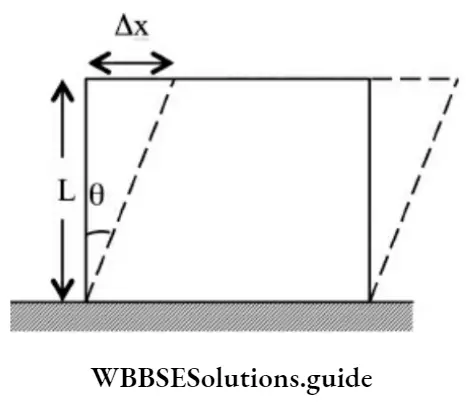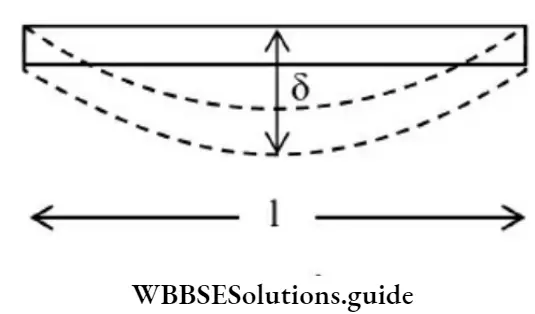
NEET Physics Magnetism and Matter Notes

NEET Physics Magnetism and Matter Notes

Magnetism and Matter

Coulomb’s law in magnetism is given by,

\(\mathrm{F}=\frac{\mu_0}{4 \pi} \frac{\mathrm{q}_{\mathrm{x}} \mathrm{q}_{\mathrm{E}_1}}{\mathrm{r}^2}\)

Where is the permeability of free space, \(\mathrm{q}_{\mathrm{m}_1} \text { and } \mathrm{q}_{\mathrm{m}_2}\) are the pole strengths ‘r’ is the distance between two poles.

Read And Learn More: NEET Physics Notes

The magnetic moment of a magnet is given by,

\(\overrightarrow{\mathrm{m}}=\mathrm{q}_{\mathrm{m}}(2 \vec{\ell})\)

Where 2l is the separation between two magnetic poles.

The magnetic moment of a current-carrying loop is given by,

\(\overrightarrow{\mathrm{m}}=\mathrm{I} \overrightarrow{\mathrm{A}}\)

Best Notes for Magnetism and Matter NEET Preparation

If there are N turns, \(\overrightarrow{\mathrm{m}}=\mathrm{NIA}\)

The magnetic moment of a revolving electron is given by,

\(\begin{gathered}
\mathrm{m}=\frac{\mathrm{eVT}}{2} \\
\mathrm{~m}=\frac{\mathrm{eVT}}{2} \times \frac{\mathrm{m}_{\mathrm{e}}}{\mathrm{m}_{\mathrm{e}}}=\frac{\mathrm{e}}{2 \mathrm{~m}_{\mathrm{e}}} \mathrm{L}
\end{gathered}\)

In vector form, \(\overrightarrow{\mathrm{m}}=-\left(\frac{\mathrm{e}}{2 \mathrm{~m}_{\ell}}\right) \overrightarrow{\mathrm{L}}\)

w.k.t., \(\mathrm{L}=\mathrm{n} \frac{\mathrm{h}}{2 \pi}\)

\(\mathrm{m}=\mathrm{n}\left(\frac{\mathrm{eh}}{4 \pi \mathrm{m}_{\mathrm{g}}}\right)\)

Bohr Magneton (mB)

It is the magnetic dipole moment associated with an atom due to the orbital motion of an electron in the ground state of a hydrogen atom (n =1)

∴ \(\mathrm{m}_{\mathrm{B}}=\frac{\mathrm{eh}}{4 \pi \mathrm{m}_{\mathrm{e}}}=9.27 \times 10^{-24} \mathrm{Am}^2\)

The magnetic field on the axis of a bar magnet is given by:

\(\mathrm{B}_{\mathrm{xx}}=\frac{\mu_0}{4 \pi} \frac{2 \mathrm{mr}}{\left(\mathrm{r}^2-l^2\right)^2}\)

If r > > l then

\(B_{2 x}=\frac{\mu_0}{4 \pi} \frac{2 m}{r^3} \text { or } \vec{B}_{2 x}=\frac{\mu_0}{4 \pi} \frac{2 \vec{m}}{r^3}\)
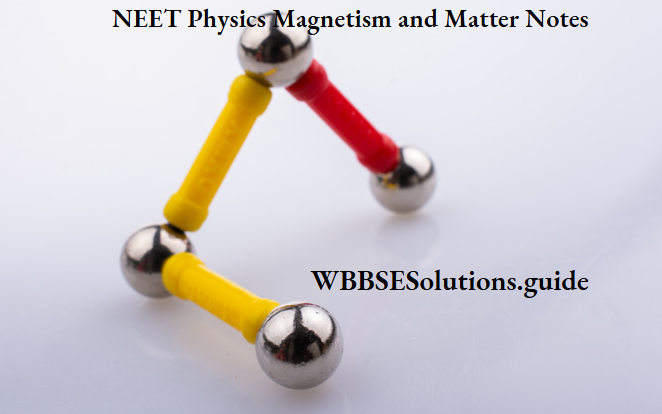
NEET Physics Magnetism and Matter Notes

Magnetism and Matter NEET Important Questions with Solutions

Magnetic Field on the Equatorial Line of a Bar Magnet

\(\mathrm{B}_{\mathrm{*q}}=\frac{\mu_0 \mathrm{~m}}{4 \pi}\)

If r > >l then, \(B_{e q}=\frac{\mu_0}{4 \pi} \frac{m}{r^3}\)

In vector form,

\(\vec{B}_{s q}=-\frac{\mu_0 \vec{m}}{4 \pi r^3}\)

Magnetic field due to a bar magnet or magnetic dipole at a general point,

\(B_{\theta 4}=\frac{\mu_0}{4 \pi r^3} \sqrt{3 \cos ^2 \theta+1}\)

Torque experienced by a bar magnet when it is placed in a uniform magnetic field is given by,

\(\begin{gathered}
\vec{\tau}=\vec{m} \times \vec{B} \\
\tau=m B \sin \theta
\end{gathered}\)

Tricks to Solve Magnetism and Matter Problems for NEET

The potential energy of a bar magnet placed in a uniform magnetic field.

\(\begin{aligned}
\mathrm{U} & =-\overrightarrow{\mathrm{m}} \cdot \overrightarrow{\mathrm{B}} \\
\mathrm{U} & =-\mathrm{mB} \cos \theta
\end{aligned}\)

Where is the angle between \(\overrightarrow{\mathrm{m}} \text { and } \overrightarrow{\mathrm{B}}\)

According to Gauss’ law in magnetism, the surface integral of magnetic field over a closed surface is always zero.

\(\text { i.e., } \oint_{\mathrm{s}} \overrightarrow{\mathrm{B}} \cdot \overrightarrow{\mathrm{ds}}=0\)

Consequences of Gauss’ Law in Magnetism

Number of magnetic field lines leaving the surface is equal to number of magnetic field lines entering the surface.

Magnetic monopoles do not exist i.e., poles exist in unlike pairs of equal strengths.

The magnetic moment induced per unit volume of the substance is the intensity of magnetization.

\(I=\frac{M}{V} A m^{-1}\)

Magnetic Susceptibility(χ):

\(\begin{gathered}
I \propto H \\
I=\chi H \\
\text { or } \chi=\frac{I}{H}
\end{gathered}\)

Magnetic Permeability(μ):

\(\mu=\frac{B}{H}\)

Relative magnetic permeability

\(\mu_r=\frac{\mu}{\mu_0}\)

Relations amongst B, H, I, \(\chi \text { and } \mu\)

\((1) B=\mu H=B_0+\mu_0 I=\mu_0(H+I)
(2) B=\mu_0 H(1+\chi)
(3) \mu=\mu_0(1+\chi)
(4) \mu_{,}=(1+\chi)\)

Magnetic Hysteresis Loop, B-H or I-H Curve
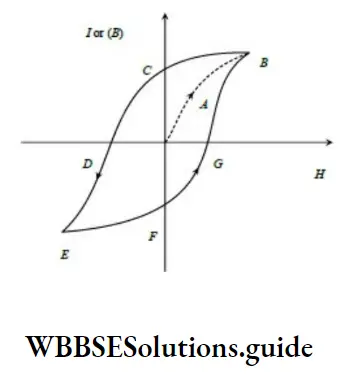
NEET Physics Magnetism and Matter Magnetic Hysteresis Loop, B-H or I-H Curve

  1. B always lags behind H. This property is called magnetic hysteresis.
  2. The curve drawn between B and H is called B-H curve. It is a closed curve for one complete cycle of magnetization.
  3. Hysteresis loss per cycle per unit volume = area bounded by the hysteresis loop.

Magnetic Properties of Materials NEET MCQs with Answers

Types of Magnetic Materials

  1. Diamagnetic materials: They are weakly repelled by the bar magnet.
  2. Paramagnetic materials: They are weakly attracted by the bar magnet.
  3. Ferromagnetic materials: They are strongly attracted by the magnet

Curie’s Law and Curie Temperature

For a paramagnetic material, magnetic susceptibility is inversely proportional to absolute temperature.

\(\text { i.e., } \chi \propto \frac{1}{T} \quad \text { or } \chi=\frac{C}{T}\)

For a ferromagnetic material

\(\chi=\frac{C}{\left(T-T_C\right)}\)

where Tc is called curie temperature.

The temperature at or above which the ferromagnetic material behaves like a paramagnetic material is called Curie temperature.

Earth’s Magnetism

It is described in terms of three quantities, which are called magnetic elements of the earth.

These are:

Magnetic declination (000) at a place is the angle between the magnetic meridian and the geographic meridian.

Magnetic Inclination or dip at a place is defined as the angle , which is the direction of total intensity of earth’s magnetic field, B makes with a horizontal line in the magnetic meridian.

Earth’s Magnetism and Magnetic Field Lines NEET Notes

The horizontal component, H is the component of the total intensity of earth’s magnetic field (B) in the horizontal direction in magnetic meridian,

\(\begin{aligned}
& \mathrm{H}=\mathrm{B} \cos \delta \\
& \mathrm{V}=\mathrm{B} \sin \delta
\end{aligned}\)

∴ \(\sqrt{H^2+V^2}=B\)

and \(\frac{V}{H}=\tan \delta\)

NEET Physics Moving Charges and Magnetism Notes

NEET Physics Moving Charges And Magnetism Notes

Moving Charges And Magnetism

Moving Charges

The force experienced by a charged particle when it is moving in a uniform magnetic field is

  1. Directly proportional to the strength of the magnetic field. i.e., \(F \propto B\)
  2. Directly proportional to the magnitude of charge. i.e., \(F \propto q\)
  3. Directly proportional to the component of velocity in a direction perpendicular to the direction of the magnetic field. i.e., \(F \propto v\) sinθ

Read And Learn More: NEET Physics Notes

∴\(\begin{aligned}
& \mathrm{F} \propto \mathrm{qvB} \sin \theta \\
& \mathrm{F}=\mathrm{kqvB} \sin \theta
\end{aligned}\)

In SI the value of k = 1

\(\mathrm{F}=\mathrm{qvB} \sin \theta\)
In vector form, \(\overrightarrow{\mathrm{F}}=\mathrm{q}(\overrightarrow{\mathrm{v}} \times \overrightarrow{\mathrm{B}})\)

NEET Physics Moving Charges and Magnetism Important Formulas

Case 1:

The magnetic field on q is zero if it is at rest (since v=0)

Case 2:

If angle between \(\overrightarrow{\mathrm{v}} \text { and } \overrightarrow{\mathrm{B}} \text { is } 0^{\circ} \text { or } 180^{\circ}\) is 0º or 180º

Then, F = 0 (∵sin 0º = 0 and sin 180º = 0)

Case 3:

When the charged particle moves perpendicular to the direction of magnetic field, then,

F = qvB(1) (∵sin 90º = 1)

\(\mathrm{F}_{\max }=\mathrm{qvB}\)

SI unit of the magnetic field is the tesla (T)

1 tesla (T) = 1 Weber meter-2 (Wbm-2)

Note:

The magnetic field is commonly expressed in gauss (G).

1 gauss (G) = 10-4 tesla(T)

1G = 10-4 T

Lorentz Force

If a charged particle moves in a region where both electric and magnetic fields are present, then the force experienced by the charged particle is called Lorentz force.

\(\begin{aligned}
& \vec{F}_L=\vec{F}_E+\vec{F}_B \\
& \vec{F}_L=q \vec{E}+q(\vec{v} \times \vec{B})=q[\vec{E}+(\vec{v} \times \vec{B})]
\end{aligned}\)

NEET Physics Moving Charges and Magnetism Notes

Best Short Notes for Moving Charges and Magnetism NEET

Motion of a charged particle inside a uniform magnetic field

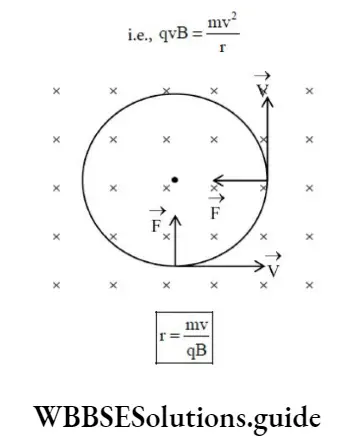
1. When is perpendicular to \(\overrightarrow{\mathbf{B}}\):

Using Flemings left hand rule it can be shown that the force acting on the charged particle is centripetal.

i.e., the necessary centripetal force for the revolution is given by magnetic force.

NEET Physics Moving Charges and Magnetism Motion of a charged particle inside a uniform magnetic field

Moving Charges and Magnetism NEET Important Questions and Answers

Moving Charges And Magnetism

Where ‘r’ is the radius of the circular path.

The time period of revolution of a charged particle is given by,

\(\begin{aligned}
&\mathrm{T}=\frac{\text { circumference }}{\text { speed }}=\frac{2 \pi \mathrm{r}}{\mathrm{v}}=\frac{2 \pi}{\mathrm{v}}\left(\frac{\mathrm{mv}}{\mathrm{qB}}\right)\\
&\mathrm{T}=\frac{2 \pi \mathrm{m}}{\mathrm{qB}}
\end{aligned}\)

The frequency of revolution is given by

\(\mathrm{f}=\frac{\mathrm{qB}}{2 \pi \mathrm{m}}\)

Note:

Time period and frequency are independent of velocity of the charged particle and radius of the circular path.

If the velocity of the charged particle increases, then the radius of the path also increases, without any change in time period, and frequency.

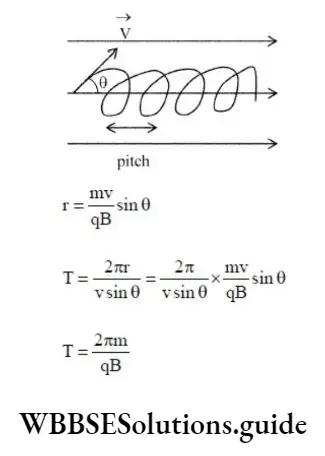
2. When and are inclined to each other, the charged particle moves in a helical path:

NEET Physics Moving Charges and Magnetism Motion of a charged particle inside a uniform magnetic field 2

The distance traveled by the charged particle in the direction of the magnetic field in a time equal to the time period is called pitch of the helical path.

\(\text { pitch }=v \cos \theta \times \frac{2 \pi m}{q B}\)

Magnetic Force on a Moving Charge NEET Notes

Cyclotron

It is a device used to accelerate heavy-charged particles.

Maximum velocity of the charged particle in a cyclotron is given by,

\(\mathrm{v}_{\max }=\frac{\mathrm{qBR}}{\mathrm{m}}\)

Where ‘R’ is the radius of the dees.

The maximum kinetic energy gained is given by,

\(\begin{aligned}
& \mathrm{E}_{\max }=\frac{1}{2} \mathrm{mv}_{\max }^2=\frac{1}{2} \mathrm{~m}\left(\frac{\mathrm{qBR}}{\mathrm{m}}\right)^2 \\
& \mathrm{E}_{\max }=\frac{1}{2} \frac{\mathrm{q}^2 \mathrm{~B}^2 \mathrm{R}^2}{\mathrm{~m}}
\end{aligned}\)

Note:

Cyclotron is not suitable for accelerating electrons.

Since the mass of the electron is very small its speed increases rapidly and starts moving at a relativistic speed.

The magnetic field at a point due to a current-carrying conductor can be calculated using Biot–Savart’s law.

According to Biot–Savart’s law the magnetic field dB produced by a small conductor of length d and carrying current I is given by,

\(\mathrm{dB}=\frac{\mu_0}{4 \pi} \frac{\mathrm{Id} \ell \sin \theta}{\mathrm{r}^2}\)

Where ‘r’ is the distance between the current element and the point where we want to calculate the magnetic field and θ is the angle between the direction of the current element and the line joining the current element and the point of observation.

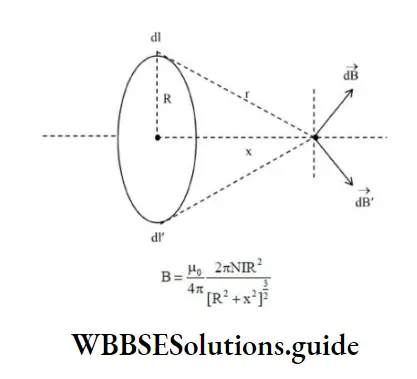
The magnetic field at a point on the axis of a circular loop carrying current

NEET Physics Moving Charges and Magnetism Magnetic field at a point on the axis of a circular loop carrying current

NEET Study Material for Moving Charges and Magnetism Chapter

Where N is the number of turns in the coil.

x is the distance between the point of observation and the center of the loop.

Case 1 :

Magnetic field at the center of the loop (x = 0)

\(\begin{aligned}
& \mathrm{B}=\frac{\mu_0}{4 \pi} \frac{2 \pi \mathrm{NI}}{\mathrm{R}} \\
& \mathrm{B}=\frac{\mu_0 \mathrm{NI}}{2 \mathrm{R}}
\end{aligned}\) \(\text { If } \mathrm{N}=1 \text {, then, } \mathrm{B}=\frac{\mu_0 I}{2 \mathrm{R}}\)

Case 2:

When x >> R,

\(\begin{aligned}
& \mathrm{B}=\frac{\mu_0}{4 \pi} \frac{2 \pi \mathrm{NIR}^2}{\mathrm{x}^3} \\
& \mathrm{~B}=\frac{\mu_0}{4 \pi} \frac{2 \mathrm{~m}}{\mathrm{x}^3} \quad(∵\mathrm{m}=\mathrm{NIA})
\end{aligned}\)

Where ‘m’ is known as magnetic moment of the coil.

Ampere’s Circuital Law

It states that “the line integral of magnetic field around a closed loop enclosing an arbitrary area is equal to times the total current passing through the area”.

\(\text { Mathematically, } \oint \overrightarrow{\mathrm{B}} \cdot \mathrm{d} \vec{\ell}=\mu_0 \mathrm{I}\)

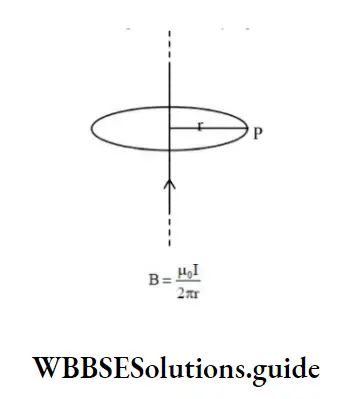
Magnetic field due to a long current carrying wire is given by,

NEET Physics Moving Charges and Magnetism Magnetic field due to a long current carrying wire

Where ‘r’ is the perpendicular distance between the point of observation and the wire.

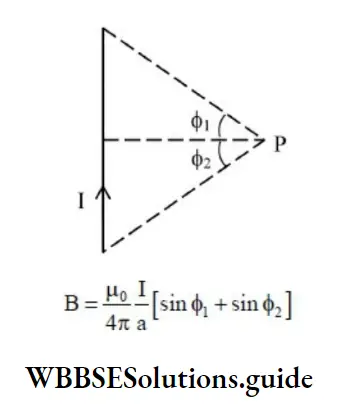
Magnetic field due to a current carrying wire of finite length is given by

NEET Physics Moving Charges and Magnetism wire of finite length

Magnetic Field Due To Moving Charge

Where, φ1and φ2 are the angles, which the lines joining the observation point with the two ends of the conductor make with the normal to the conductor from the observation point.

The magnetic field due to a long straight solenoid is given by,

\(\mathrm{B}=\mu_0 \mathrm{nI}\)

Where ‘n’ is the number of turns per unit length.

The magnetic field produced by a toroid is given by,

\(\mathrm{B}=\mu_0 \mathrm{nI}\)

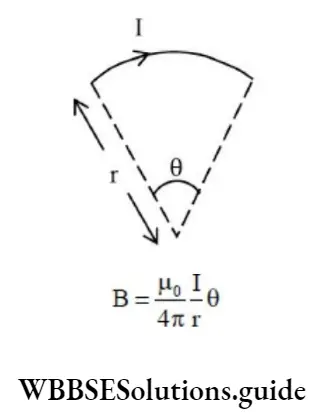
The magnetic field due to a circular arc of wire subtending an angle θ at the center

NEET Physics Moving Charges and Magnetism wire subtending an angle

If (for 1 complete loop)

\(\mathrm{B}=\frac{\mu_0 \mathrm{I}}{2 \mathrm{r}}\)

Magnetic force on a current-carrying conductor is given by,

\(\mathrm{F}=\mathrm{BI} l \sin \theta\)

In vector form, \(\overrightarrow{\mathrm{F}}=\mathrm{I}(\vec{\ell} \times \overrightarrow{\mathrm{B}})\)

The force between two infinitely long parallel current-carrying conductors is:

\(\mathrm{F}=\frac{\mu_0}{4 \pi} \frac{2 \mathrm{I}_1 \mathrm{I}_2}{\mathrm{r}}\)
∴ The force per unit length is given by,

\(\mathrm{f}=\frac{\mathrm{F}}{l}=\frac{\mu_0}{4 \pi} \frac{2 \mathrm{I}_1 \mathrm{I}_2}{\mathrm{r}}\)

Definition of Ampere

Let I1 = I2 = 1A, r = 1m, then

\(\mathrm{f}=10^{-7} \times \frac{2 \times 1 \times 1}{\mathrm{r}}=2 \times 10^{-7} \mathrm{~N}\)

Thus, one ampere is that current, which when flowing through each of the two parallel conductors of infinite length and placed in free space at a distance of 1 metre from each other, produces between them a force of newton per meter of their lengths.

The torque acting on a current loop placed in a magnetic field:

\(\tau=\text { BIA } \sin \theta\)

If there are N loops, then

\(\tau=\text { NBLA } \sin \theta
Or
\tau=\mathrm{mB} \sin \theta \quad(∵\mathrm{m}=\mathrm{NIA})\)

Mathematically, \(\vec{\tau}=\vec{m} \times \vec{B}\)

Figure of merit of a galvanometer is the current required to produce unit deflection in the galvanometer

The current sensitivity of a galvanometer is given by,

\(I_S=\frac{\theta}{I}=\frac{N B A}{K}\)

The voltage sensitivity of a galvanometer is given by,

\(\mathrm{V}_{\mathrm{S}}=\frac{\theta}{\mathrm{V}}=\frac{\theta}{\mathrm{IR}}=\frac{\mathrm{NBA}}{\mathrm{KR}}\)

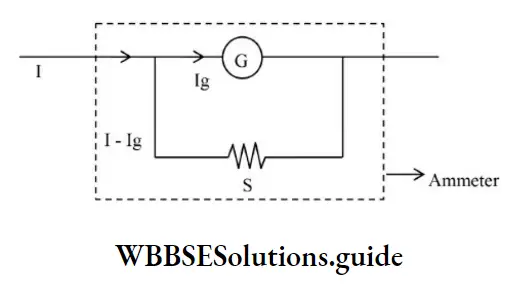
Conversion of galvanometer into an ammeter

NEET Physics Moving Charges and Magnetism Conversion of galvanometer into an ammeter

A galvanometer can be converted into an ammeter by connecting a low resistance called a shunt in parallel with the galvanometer coil.

\(S=\frac{I_g G}{I-I_g}\)

The resistance of the ideal ammeter is zero.

NEET Physics Moving Charges and Magnetism MCQs with Solutions

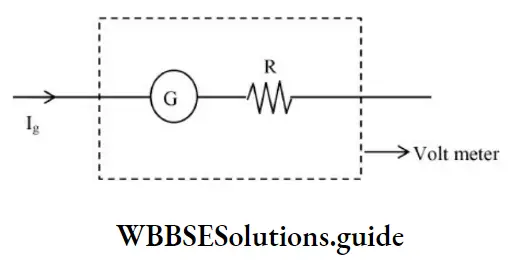
Conversion of a galvanometer into a voltmeter

NEET Physics Moving Charges and Magnetism Conversion of a galvanometer into a voltmeter

This can be done by connecting a high-resistance R in series with the galvanometer.

\(R=\frac{V}{I_g}-G\)

Resistance of a ideal voltmeter is infinity.

NEET Physics Current Electricity Notes

NEET Physics Current Electricity Notes

Current Electricity

Current Electricity Definition

Electric Current is defined as the rate of flow of charge in a conductor

I = \(\frac{dQ}{dt}\)

SI unit of current is ampere (A).

The direction in which a positive charge would move under the action of an electric field will be the direction of conventional current.

Read And Learn More: NEET Physics Notes

Resistance of a conductor at a particular temperature is

  1. Directly Proportional To The Length Of The Conductor And
  2. Inversely proportional to its area of cross-section.
\(\text { i.e., } \mathrm{R}=\frac{\rho \ell}{\mathrm{A}}\)

Where, is a constant of proportionality constant called resistivity of the conductor.

When \(\ell=1 \mathrm{~m} \text { and } \mathrm{A}=1 \mathrm{~m}^2 \text {, then } \mathrm{R}=\rho\).

Current Electricity Important Questions for NEET

The resistivity of a conductor depends on

  1. Nature of the conductor
  2. Temperature

SI Unit of resistivity is Ωm.

Ohm’s Law

The current flowing through a conductor is directly proportional to the potential difference developed across the ends of the conductor. (provided the physical conditions like temperature remain constant)

\(\begin{array}{r}
\mathrm{V} \propto \mathrm{I} \\
\mathrm{V}=\mathrm{RI}
\end{array}\)

Where R is the electric resistance

SI unit of resistance is Ω(Ohm).

The devices which obey Ohm’s law are called ohmic devices.

The devices that do not obey Ohm’s law are called non–Ophmic devices.

The velocity with which electrons drift in a conductor under the action of the electric field is called drift velocity (vd).

\(\left|\vec{v}_d\right|=\frac{e E \tau}{m}\)

Where ‘m’ is the mass of the electron and \(\tau\) is called the average relaxation time.

The magnitude of drift velocity per unit electric field is called mobility (μ)

\(\text { i.e., } \mu=\frac{\left|\overrightarrow{v_d}\right|}{E}=\frac{v_d}{E}\)

Difference Between AC and DC Circuits for NEET

The current density is given by,

\(
\begin{gathered}
I=\vec{J} \cdot \vec{A} \\
I=J A \cos \theta \\
J=\frac{I}{A \cos \theta}
\end{gathered}
If \theta=0^{\circ}, then \mathrm{J}=\frac{\mathrm{I}}{\mathrm{A}}\)

The direction of current density is the same as electric current.

The current density is also given by,

\(\overrightarrow{\mathrm{j}}=\sigma \overrightarrow{\mathrm{E}}\)

Where \(\sigma=\frac{1}{\rho}\) is the conductivity of the material.

Electrical conductivity (σ) is given by

\(\sigma=\frac{n e^2 \tau}{m}\)

∴ \(\text { Resistivity, } \rho=\frac{1}{\sigma}=\frac{m}{n e^2 \tau}\)

NEET Physics Current Electricity Notes

Ohm’s Law and Kirchhoff’s Laws NEET Questions

Temperature Dependence Of Resistivity

If and are resistivity at temperatures T0 and T respectively (T> T0), then

\(\rho_{\mathrm{T}}=\rho_0\left[1+\alpha\left(\mathrm{T}-\mathrm{T}_0\right)\right]\)

Where is the temperature coefficient of resistivity?

Similarly, in terms of resistance, we can write,

\(R_T=R_0\left[1+\alpha\left(T-T_0\right)\right]\)

Note:

Alloys like nichrome and manganin have very high resistivity and low value of α. Therefore wires made of these materials are suitable for making standard resistance and rheostat.

EMF (Electromagnetic force) of a source is the work done in transporting a unit positive charge from the lower to a higher potential of the source.

SI unit of emf is volt(V).

The terminal potential difference (V), emf (E), and internal resistance are related by the equation,

V = E – Ir (during discharging)

And V = E + Ir (during charging of a cell)

If I = 0, then V = E.

Therefore emf of a cell can also be defined as the potential difference across the terminals of the cell when no current flows through it.

Current Electricity NCERT Summary for NEET Physics

Resistors in Series

When ‘n’ resistors are connected in series, then

Rs = R1 + R2 + …. + Rn

If ‘n’ resistors of equal resistance ‘R’ are connected in series

Then, \(\mathrm{R}_{\mathrm{s}}=\mathrm{nR}\)

Resistors in Parallel

If ‘n’ resistors are connected in parallel then

\(\frac{1}{R_p}=\frac{1}{R_1}+\frac{1}{R_2}+\ldots+\frac{1}{R_z}\)

If ‘n’ resistors of equal resistance R are connected in parallel, then

\(\mathrm{R}_{\mathrm{p}}=\frac{\mathrm{R}}{\mathrm{n}}\)

Note:

Consider two resistors R1 and R2 connected in parallel with electric currents I1 and I2 flowing through them.

Since, the potential difference V across them is same, we have,

\(\begin{aligned}
\mathrm{V} & =\mathrm{I}_1 \mathrm{R}_1=\mathrm{I}_2 \mathrm{R}_2 \\
& \Rightarrow \frac{\mathrm{I}_1}{\mathrm{I}_2}=\frac{\mathrm{R}_2}{\mathrm{R}_1}
\end{aligned}\)

NEET Physics Chapter Wise Weightage Current Electricity

Therefore, the ratio of electric currents flowing through the resistors connected in parallel is in the inverse ratio of their resistances.

If I is the current flowing through the combination, then

\(I_1=\frac{R_2}{R_1+R_2} I \text { and } I_2=\frac{R_1}{R_1+R_2} I\) \(\text { current in one branch }\left(I_1\right)=\frac{\text { main current }(I) \times \text { resistance in other branch }\left(R_1\right)}{\text { sum of resistances }\left(R_1+R_2\right)}\)

Kirchhoff’s Junction Rule (KCL)

The junction rule states that the algebraic sum of currents entering into a junction is zero.

\(\sum I=0\)

The junction rule can also be stated as follows:

“At any junction of a circuit, the sum of currents entering the junction is equal to the sum of currents leaving the junction”.

Kirchhoff’s Loop Rule (KVL)

“The algebraic sum of potential differences across various elements around any closed loop in a particular direction must be zero”.

\(\sum_{\text {closed loog }} \Delta \mathrm{V}=0\)

Joule’s Law of Heating

When an electric current I is passed through a conductor of resistance R, it gets heated which indicates that electrical energy is being converted into heat.

The amount of heat produced in a conductor in time ‘t’ is given by,

\(\mathrm{H}=\mathrm{VIt}=\mathrm{I}^2 \mathrm{Rt}=\frac{\mathrm{V}^2}{\mathrm{R}} \mathrm{t}\)

Step-by-Step Solutions for Current Electricity NEET Problems

Note:

The amount of heat produced is independent of the direction of flow of the current.

The rate at which work is done by the source of emf in maintaining the current in the electric circuit is called power.

\(\mathrm{P}=\mathrm{VI}=\mathrm{I}^2 \mathrm{R}=\frac{\mathrm{V}^2}{\mathrm{R}}\)

Cells in Series

If ‘n’ cells are connected in series, then

\(\varepsilon_{\mathrm{s}}=\varepsilon_1+\varepsilon_2+\varepsilon_3+\ldots+\varepsilon_{\mathrm{n}} \text { and } r_{\mathrm{s}}=r_1+r_2+\ldots \ldots+r_n\)

If two cells are connected with the polarity of one cell reversed, then

Es = |E1 – E2| and rs = r1 + r2

If ‘n’ cells of emf E are connected in series and ‘P’ cells are connected in reverse order, then,

\(E_s=(n-2 P) E \text { and } r_s=n r\)

Cells in Parallel

If ‘n’ cells are connected in parallel, then

\(\begin{aligned}
& \frac{E_{e q}}{r_{o q}}=\frac{E_1}{I_1}+\frac{E_2}{r_2}+\ldots \ldots+\frac{E_2}{I_n} \\
& \frac{1}{r_{\mathrm{N}}}=\frac{1}{\mathrm{r}_1}+\frac{1}{\mathrm{r}_2}+\ldots . .+\frac{1}{\mathrm{r}_2} \\
&
\end{aligned}\)

Wheatstone’s bridge is a combination of four resistances used to calculate unknown resistance.

Metre bridge is a simple form of Whetstone’s bridge. (Or we can say the meter bridge works on the principle of the Wheatstone bridge.)

The unknown resistance ‘S’ can be calculated using the relation

\(\mathrm{S}=\frac{\mathrm{R}(1-l)}{l}\)

Where R is the known resistance and ‘l’is the balancing length.

Potentiometer and Wheatstone Bridge NEET Questions

Potentiometer

It is a device used to compare EMFs or to measure the internal resistance of a cell.

Principle of Potentiometer

When a constant current is flowing through a wire of a uniform area of the cross–section, the potential drop across any portion of the wire is directly proportional to the length of that portion.

\(\text { i.e., } \mathrm{v} \propto l \Rightarrow \mathrm{v}=\mathrm{k} l\) , where k is a constant called potential gradient.

The potentiometer can be used to compare emf’s of two cells, using the formula,

Measuring the balancing lengths l1 and l2 the ratio of emf’s can be found.

The potentiometer can be used to find the internal resistance of a cell,

\(\mathrm{r}=\left(\frac{l_1}{l_2}-1\right) \mathrm{S}\)

Where ‘S’ is the known resistance.

Concept of Internal Resistance and EMF for NEET Physics

Mixed Grouping of Cells

If ‘n’ identical cells are connected in a row and such ‘m’ rows are connected in parallel, then

Equivalent emf is, Eeq= nE

Equivalent resistance of the combination is, \(\mathrm{r}_{\mathrm{eq}}=\frac{\mathrm{nr}}{\mathrm{m}}\)

The main current in the circuit is,

\(\mathrm{I}=\frac{\mathrm{nE}}{\mathrm{R}+\frac{\mathrm{nr}}{\mathrm{m}}}=\frac{\mathrm{mnE}}{\mathrm{mR}+\mathrm{nr}}\)

Total number of cells = mn

Condition for maximum power, \(\mathrm{R}=\frac{\mathrm{nr}}{\mathrm{m}}\)

NEET Physics Wave Optics Notes

NEET Physics Wave Optics Notes

Doppler Effect in Light

The fractional change in frequency of light for an observer on earth is given by,

\(\frac{\Delta v}{v}=-\frac{V_{\text {radix }}}{C}\)

Where \(V_{\text {radinal }}\) is the component of the source velocity along the line joining the observer to the source relative to the observer.

\(V_{\mathrm{radial}}\) is taken positive when the source moves away from the observer.

The above equation is valid if \(\mathrm{V}_{\text {radial }}<<\mathrm{C}\).

Read And Learn More: NEET Physics Notes

Interference of Light

The phenomenon of redistribution of light energy in a medium as a result of the superposition of light waves from two coherent sources is called interference.

Theory of interference

If two waves \(\mathrm{y}_1=\mathrm{a}_1 \cos \omega \mathrm{t} \text { and } \mathrm{y}_2=\mathrm{a}_2 \cos (\omega \mathrm{t}-\phi)\), interfere, then,

The resultant amplitude is given by,

\(R=\sqrt{a_1^2+a_2^2+2 a_1 a_2 \cos \phi}\)

Case 1:

Constructive interference,

When , \(\cos \phi=1\)

\(\begin{aligned}
& R_{\max }=\sqrt{a_1^2+a_2^2+2 a_1 a_2} \\
& =\sqrt{\left(a_1+a_2\right)^2} \\
& \mathrm{R}_{\max }=\mathrm{a}_1+\mathrm{a}_2 \\
&
\end{aligned}\)

If a1 = a2 = a, then, Rmax = 2a.

NEET Physics Wave Optics notes

Note:

Condition for constructive interference,

\(\cos \phi=1 \Rightarrow \phi=2 \mathrm{n} \pi, \mathrm{n}=0,1,2,3, \ldots \ldots\)

In terms of path difference,

\(\Delta=\mathrm{n} \lambda, \mathrm{n}=0,1,2,3, \ldots\)

Coherent and incoherent sources NEET

Case 2:

Destructive interference,

When \(\cos \phi=-1\)

\(\begin{aligned}
R_{\min } & =\sqrt{a_1^2+a_2^2-2 a_1 a_2} \\
& =\sqrt{\left(a_1-a_2\right)^2} \\
R_{\min } & =a_1-a_2
\end{aligned}\)

If a1 = a2 then, Rmin = 0

Best notes for Wave Optics NEET

Note:

Condition for destructive interference,

\(\begin{aligned}
&\cos \phi=-1\\
&\phi=(2 n-1) \pi, \mathrm{n}=1,2,3, \ldots \ldots
\end{aligned}\)

In terms of path difference,

\(\Delta=(2 \mathrm{n}-1) \frac{\lambda}{2}, \mathrm{n}=1,2,3, \ldots .\)

NEET Physics Wave Optics Notes

Important formulas in Wave Optics for NEET

Young’s Double Slit Experiment

The position of bright fringes is given by,

\(\mathrm{x}_{\mathrm{n}}=\frac{\mathrm{n} \lambda \mathrm{D}}{\mathrm{d}}\) n=0,1,2…..

The position of dark fringes is given by,

\(\mathrm{x}=(2 \mathrm{n}-1) \frac{\lambda \mathrm{D}}{\mathrm{d}}\)

Expression of fringe width, \(\beta=\frac{\lambda D}{d}\)

Note:

  1. w.k.t., \(\Delta=\frac{\lambda}{2 \pi} \phi\)
  2. Intensity ∝ (amplitude)²
  3. If two waves \(\), superpose each other, then the resultant intensity is given by,
\(\mathrm{y}_1=\mathrm{a} \cos (\omega \mathrm{t}) \text { and } \mathrm{y}_2=\mathrm{a} \cos (\omega \mathrm{t}+\phi)\)

In the case of coherent addition, the maximum intensity is given by,

\(I=4 I_0 \cos ^2\left(\frac{\phi}{2}\right)\)

Imax = 4I0

In case of incoherent addition, Imax = 2I0

Young’s double slit experiment NEET questions

Diffraction of Light

The phenomenon of bending of light around the corners of obstacles or apertures is called diffraction of light.

In Fresnel’s diffraction, we use spherical or cylindrical wavefront.

In Fraunhoffer’s diffraction, we use plane wavefront.

Path difference in single slit diffraction is given by,

\(\text { a } \sin \theta=\lambda\)

Where ‘a’ is the slit width,

Condition for minima, \(\text { a } \sin \theta=\mathrm{n} \lambda, \mathrm{n}=1,2,3, \ldots \ldots\)

Condition for secondary maxima,

\(\mathrm{a} \sin \theta=(2 \mathrm{n}+1) \frac{\lambda}{2} \quad \mathrm{n}=1,2,3, \ldots \ldots\)

Fresnel Distance

This is the distance up to which ray optics is valid.

\(Z_F=\frac{a^2}{\lambda}\)

Limit of Resolution of a Telescope

It is the smallest angle subtended at the center of the objective of the telescope by two distinct objects whose images are just resolved.

\(\Delta \theta=\frac{1.22 \lambda}{\mathrm{a}}\)

The resolving power of a telescope is the reciprocal of the limit of resolution.

Interference and diffraction NEET notes

i.e., Resolving power of telescope, \(\frac{1}{\Delta \theta}=\frac{D}{1.22 \lambda}\)

where ‘D’ is the diameter of the objective.

Limit of resolution of a microscope

It is the minimum distance between two point objects whose images appear just resolved.

\(\mathrm{d}_{\min }=\frac{1.22 \lambda}{2 \mathrm{n} \sin \beta}\)

The product is called the numerical aperture and is the semi-vertical angle.

Resolving Power of a Microscope

It is the reciprocal of the minimum distance between two-point objects whose images appear just resolved.

Resolving power of a microscope, \(\frac{1}{\mathrm{~d}_{\min }}=\frac{2 \mathrm{n} \sin \beta}{1.22 \lambda}\)

Malus’ Law

When a beam of completely plane polarized light is passed through the analyzer, the intensity ‘I’ of the transmitted light varies directly as the square of the cosine of the angle θ between the transmission direction of the polarizer and analyzer.

\(i.e., I \propto \cos ^2 \theta
\mathrm{I}=\mathrm{I}_0 \cos ^2 \theta
\)

Where I0 is the maximum intensity of transmitted light.

Best books for Wave Optics NEET

Brewster’s law states that the tangent of an angle of polarization is equal to the refractive index of the medium.

\(\text { i.e., } \mathrm{n}=\tan \theta_{\mathrm{p}}\)

Where θp is the polarizing angle.

Note:

  1. For a particular angle of incidence, the reflected ray is completely polarized. This angle is called the Brewster angle or polarizing angle (θp)
  2. At polarizing angle, \(\theta_{\mathrm{p}}+\mathrm{r}=90^{\circ}\)

NEET Physics Thermodynamics And Kinetic Theory Of Gases Notes

NEET Physics Thermodynamics And Kinetic Theory Of Gases Notes

Thermodynamics and Kinetic Theory of Gases

Ideal Gas or Perfect Gas

  1. Molecules of the ideal gas are point masses, with zero volume.
  2. There is no intermolecular force between the molecules of ideal gas.
  3. There is no intermolecular potential energy for the molecules of ideal gas.
  4. The molecules of ideal gas possess only the kinetic energy.
  5. The ideal gas can not be converted into liquids or solids. (This is the consequence of the absence of intermolecular force).
  6. The internal energy of an ideal gas depends only on temperature.

Ideal Gas Equation: The equation which relates all the macroscopic variables [P, V, T] of an ideal gas is called ideal gas equation. It is given by, PV = nRT

∴ n → number of moles R = 8.31 J mol-1 K-1

For one mole of gas, PV = RT

Read And Learn More: NEET Physics Notes

Avagadro’s Hypothesis

Equal volumes of all gases at the same temperature and pressure contain the same number of molecules.

  • One mole of every gas at NTP has same volume equal to 22.4 litres.
  • One mole of every gas contains same number of molecules called Avagadro’s number. NA = 6.023 x 1025
  • Avagadro’s number is also equal to the number of atoms in 12g of Carbon -12.

Kinetic Theory Of Gases Equation

Real Gases

  • The gases actually found in nature are called real gases.
  • The molecules of the real gas have a finite volume.
  • There is intermolecular attraction or repulsion between the molecules of the real gas.
  • The intermolecular force is attractive at larger intermolecular separation and repulsive when the molecules are too close to each other.
  • Molecules of real gas have intermolecular potential energy as well as kinetic energy.
  • Real gases can be liquified or solidified.
  • The internal energy of real gases depends on volume, pressure as well as temperature.
  • Real gases do not obey the equation.

PV = nRT

Real gases obey the ideal gas equation at very low pressure and very high temperatures.

NTP or STP

  • NTP stands for normal temperature and pressure.
  • STP stands for standard temperature and pressure.
  • NTP and STP both mean the same.
  • They refer to a temperature of 273K or 00C and 1 atm pressure.

NEET Physics Thermodynamics And Kinetic Theory Of Gases Notes

NEET Physics Thermodynamics and Kinetic Theory of Gases Notes

Absolute Zero Temperature: The absolute zero refers to the zero of the Kelvin scale. i.e., absolute zero = 0K = -273.150C

  • At the absolute zero, all molecular motion ceases.
  • The volume of ideal gas becomes zero at the absolute zero.
  • The pressure of the ideal gas becomes zero at absolute zero.
  • The molecular energy or internal energy of the ideal gas becomes zero at absolute zero.
  • All real gases get liquified before reaching absolute zero.

Degree of Freedom

The number of ways in which a gas molecule can absorb energy is called degrees of freedom. Total degree of freedom f = Translational degree of freedom (ft) rotational degree of freedom (fr) + vibrational degree of freedom (fv)

ft is present at all temperatures, fr is present at ordinary temperatures and fv is present only at high temperatures.

The degree of freedom can be calculated by using the relation, f = 3N – k

Where N = number of atoms in the molecule (atomicity) k is the number of relations or constraints.

For a monoatomic molecule, f= 3 x 1 – 0 =3

For a diatomic molecule, f = 3 x 2 – 1 = 5

  • At very low temperatures (<70K), the degrees of freedom corresponding to the rotatory motion are absent.
  • Hence, the diatomic molecule possesses only 3 degrees of freedom.
  • At very high temperatures diatomic molecules have 7 degrees of freedom.

NEET Physics Thermodynamics Important Formulas

In triatomic molecules, degrees of freedom depend on the structure of the molecules.

For linear triatomic molecules, (k = 2)  f = 3 x 3 – 2 = 7

For a non-linear triatomic molecule, (k = 3) f = 3 x 3 – 3 = 6

Degrees Of Freedom Example:

  • CO2 is a linear molecule with 7 degrees of freedom
  • O3 and H2O are non-linear molecules with 6 degrees of freedom.

Maxwell’s Law of Equipartition of Energy

This law states that the kinetic energy is equally distributed among all the degrees of freedom and energy associated with each degree of freedom is = \(\frac{1}{2} K_b \mathrm{~T}\)

Where T is the absolute temperature and Kb is the Boltzmann constant.

⇒ \(\mathrm{K}_{\mathrm{B}}=\frac{\mathrm{R}}{\mathrm{N}_{\mathrm{A}}}=1.38 \times 10^{-23} \mathrm{~K}^{-1}\)

The kinetic energy of a molecule having f degrees of freedom is given by

⇒ \(\mathrm{U}_{\mathrm{k}}=\frac{\mathrm{f}}{2} \mathrm{~K}_{\mathrm{b}} \mathrm{T}\)

Total kinetic energy of 1 mole of gas with f degree of freedom is given by

⇒ \(\mathrm{U}_{\mathrm{k}}=\mathrm{N}_{\mathrm{A}}\left[\frac{\mathrm{f}}{2} \mathrm{~K}_{\mathrm{b}} \mathrm{T}\right]=\frac{\mathrm{f}}{2} \mathrm{RT}\)

Where NA is Avagadro’s number and R is the universal gas constant.

Best Short Notes for Thermodynamics and Kinetic Theory of Gases NEET

Specific Heat Capacity of Gases

In an ideal gas, the total energy of the gas or internal energy U of the gas is equal to the total kinetic energy of all the molecules in the gas.

For one mole of a monoatomic gas, the total energy is U = \(\frac{3}{2} \mathrm{~N}_A \mathrm{k}_{\mathrm{B}} \mathrm{T}=\frac{3}{2} \mathrm{RT}\)

The specific heat at constant volume for a monatomic gas is,

⇒ \(\mathrm{C}_{\mathrm{V}}=\frac{\mathrm{dU}}{\mathrm{dT}}=\frac{\mathrm{d}}{\mathrm{dT}}\left(\frac{3}{2} \mathrm{RT}\right)=\frac{3}{2} \mathrm{R}\)

w.k.t., CP – CV = R

∴ \(C_P=C_V+R=\frac{3}{2} R+R=\frac{5}{2} R\)

γ = \(\frac{C_P}{C_V}=\frac{\frac{5}{2} R}{\frac{3}{2} R}=\frac{5}{3}=1.67\)

For a diatomic gas \(\mathrm{U}=\frac{5}{2} \mathrm{RT}\)

⇒ \(\mathrm{C}_{\mathrm{V}}=\frac{5}{2} \mathrm{R} \quad \mathrm{C}_{\mathrm{p}}=\frac{7}{2} \mathrm{R}\)

⇒ \(\gamma=\frac{\mathrm{C}_{\mathrm{p}}}{\mathrm{C}_{\mathrm{V}}}=\frac{7}{5}=1.4\)

For non-linear triatomic, U = 3RT

⇒ CV = 3R

⇒ CP = 4R

In general, for poly atomic gas molecules, \(=\left(1+\frac{2}{f}\right)\)

Thermodynamics and Kinetic Theory of Gases NEET Important Questions and Answers

Note:

  • Specific heat capacity of solids = 3R
  • Specific heat capacity of water = 9R

Mean Free Path: The average distance travelled by a molecule between two successive collisions is called the mean free path.

It can be shown that, \(\bar{l}=\frac{1}{\sqrt{2} \pi d^2 \mathrm{n}}\)

Where d is the diameter of each molecule and n is the number of molecules per unit volume If m is the mass of each molecule and ρ is the density of the gas,

⇒ \(\bar{l}=\frac{\mathrm{m}}{\sqrt{2 \pi \mathrm{d}^2 \rho}} \quad\left(because \mathrm{n}=\frac{\rho}{\mathrm{m}}\right)\)

Boyle’s Law

It states that, at constant temperature, the volume of the given mass of the gas is inversely proportional to its pressure P.

i.e., PV = constant.

NEET Physics Thermodynamics And Kinetic Theory Of Gases Notes Boyle's Law

NEET Study Material for Thermodynamics and Kinetic Theory of Gases

Charle’s Law

It states that, at constant pressure, the volume of the given mass of the gas is proportional to its absolute temperature.

i.e., \(\frac{\mathrm{V}}{\mathrm{T}}\) = constant

NEET Physics Thermodynamics And Kinetic Theory Of Gases Notes Charle's Law

Expression for Pressure Exerted By a Gas

⇒ \(P=\frac{1}{3} \rho v_{\mathrm{vos}}^2\)

P = \(\frac{1}{3} \frac{M}{V} v_{\mathrm{ras}}^2\)

Calorie: The quantity of heat required to raise the temperature of 1g of water from 14.50 C to 15.50 C

Kinetic Molecular Theory Of Gases

First Law of Thermodynamics

When a certain amount of heat is given to a system, a part of it is used to increase the internal energy, and the remaining part is used in doing external work.

∴ dQ = dU + dW

The first law of thermodynamics is in accordance with law of conservation of energy.

Sign Convention

  • Work done by the system is taken positive.
  • Work done on the system is taken negative.
  • Increase in U is taken positive.
  • Decrease in U is taken negative.
  • Heat added to the system is taken positive.
  • Heat given out from the system is taken negative.

Laws of Thermodynamics and Heat Transfer NEET Notes

Thermodynamic Processes

1. Isothermal process:

PV = constant

dQ = dU + dW

dQ = dW

⇒ \(C_r=\frac{d U}{d T}=\infty\)

Work done by isothermal process is,

W = \(2.303 R T \log _{10} \frac{V_2}{V_1}\)

or,

W = \(2,303 R T \log _{10} \frac{P_1}{P_2}\)

2. Adiabatic process:

dQ = dU + dW

dU + dW = 0

PVγ= constant

Work done in adiabatic process is \(W=\frac{R}{\gamma-1}\left[T_1-T_2]\right.\)

Thermodynamics and Kinetic Theory of Gases Class 11 NCERT NEET

3. Isochoric process:

ΔV = 0

dQ = dU

4. Isobaric process: ΔP = 0

Heat Engine: A device used to convert heat energy into useful mechanical work is called heat engine.

NEET Physics Thermodynamics And Kinetic Theory Of Gases Heat Engine

The efficiency of an engine is the ratio between work done by the engine and the amount of heat absorbed by the system.

⇒ \(\eta=\frac{W}{Q_1}=\frac{Q_1-Q_2}{Q_1}=1-\frac{Q_2}{Q_1}\)

The efficiency of Carnot’s heat engine is given by

⇒ \(\eta=1-\frac{Q_2}{Q_1} \quad \text { Or } \quad \eta=1-\frac{T_2}{T_1}\)

Refrigerator: Coefficient of performance, \(\beta=\frac{Q_2}{W}=\frac{Q_2}{Q_1-Q_2}\)

or, \(\beta=\frac{T_2}{T_1-T_2}\)

NEET Physics Thermodynamics And Kinetic Theory Of Gases Refrigerator

Cyclic Process: “A process in which the system after passing through various stages returns to its initial state” is called as cyclic process.

For a cyclic process, PV graph is a closed curve. The area under P-V graph gives work done by the substance. In a cyclic process there will be no change in the internal energy.

i.e., ΔU = 0

Therefore, ΔQ = ΔW

The total heat absorbed by the system equals the work done by the system.

NEET Physics Thermal Properties Of Matter Notes

Thermal Properties of Matter

Temperatures in different scales are related as follows:

⇒ \(\frac{\mathrm{C}-0}{100}=\frac{\mathrm{F}-32}{180}=\frac{\mathrm{K}-273.15}{100}\)

Or, \(\frac{\mathrm{C}}{5}=\frac{\mathrm{F}-32}{9}=\frac{\mathrm{K}-273}{5}\)

Temperature difference in Celsius scale = temperature difference in kelvin scale

i.e., (T2 – T1)0C = (T2 – T1)K

Linear Expansion Of Solids

w.k.t., Δl ∝ L0 and Δl ∝ ΔT

or, Δl – α L0ΔT

α = \(\frac{\Delta l}{\mathrm{~L}_0 \Delta \mathrm{T}}\)

Where Δl is the change in length, L0 is the original length, ΔT is the increase in temperature, and α is known as the coefficient of linear expansion.

The unit of α is 0C-1 or K-1.

Read And Learn More: NEET Physics Notes

Superficial/areal expansion of solids

ΔA = \(\beta \mathrm{A}_0 \Delta \mathrm{T}\)

β = \(\frac{\Delta A}{A_0 \Delta T}\)

Where ‘β’ is known as the coefficient of areal expansion.

NEET Physics Thermal Properties Of Matter Notes

NEET Physics Thermal Properties of Matter Notes

Cubical or volume expansion of solids

ΔV = \(\gamma \mathrm{V}_0 \Delta \mathrm{T}\)

γ = \(\frac{\Delta \mathrm{V}}{\mathrm{V}_0 \Delta \mathrm{T}}\)

Where ‘γ’ is known as the coefficient of volume expansion.

α, β, and γ are related as follows

α = \(\frac{\beta}{2}=\frac{\gamma}{3}\) ⇒ α:β:γ = 1:2:3

The time period of oscillation of simple pendulum is given by,

∴ T = \(2 \pi \sqrt{\frac{\ell}{g}}\)

Fractional change in time period of a simple pendulum is given by,

∴ \(\frac{\Delta \mathrm{T}}{\mathrm{T}}=\frac{1}{2} \alpha \Delta \theta\)

NEET Physics Thermal Properties of Matter Important Formulas

In summer length of the pendulum of the clock will increase. Therefore, time period also increases. i.e., the clock will lose time.

Time lost by the clock in a day is given by

Δt = \(\left(\frac{1}{2} \alpha \Delta \theta\right) \times 86400\)

Pendulums are made of invar as their coefficient of linear expansion is very small.

Thermal Properties Of Matter

Thermal Stress

When a rod is fixed between two rigid walls and the temperature is increased, thermal stress develops in the rod. Thermal stress, \(\frac{\mathrm{F}}{\mathrm{A}}\)= YA α θΔ

Anomalous expansion of water: Generally, all materials expand on heating, and contract on cooling.

But as the temperature of the water is increased from 00C to 40C it contracts. This unusual behavior of water is called anomalous expansion.

NEET Physics Thermal Properties Of Matter Notes Anamalous Expansion Of Water

Best Short Notes for Thermal Properties of Matter NEET

For a given mass of water,

  • Density is maximum at 4° C and
  • Volume is minimal at 4° C

Heat

The amount of heat given to a body depends upon its mass (m), change in temperature (Δθ), and nature of material.

i.e., Q = mc Δθ, where c is the specific heat

The amount of heat required to raise the temperature of 1g of water from 14.50C to 15.50C is called one calorie.

1 cal = 4.18 J

Heat always flows from a body of higher temperature to a body at a lower temperature.

Specific heat capacity: The amount of heat required to increase unit mass of the substance by unit degree is called specific heat capacity.

c = \(\frac{\mathrm{Q}}{\mathrm{m} \Delta \theta} \mathrm{J} \mathrm{Kg}^{-1} \mathrm{~K}^{-1}\)

Heat Capacity

The amount of heat required to increase the temperature of given mass of the substance by unit degree is called its heat capacity.

Heat capacity = \(\frac{\mathrm{Q}}{\Delta \theta} \mathrm{JK}^{-1}\)

Thermal Properties of Matter NEET Important Questions and Answers

Molar specific heat: The amount of heat required to be given to increase the temperature of 1 mole of the substance by unit degree.

i.e., Molar specific heat = \(\frac{\mathrm{Q}}{\mu \Delta \theta}\)

Where μ is the number of moles of the substance.

Principle of calorimetry: When 2 bodies at different temperature are mixed, heat will be transferred from body at a higher temperature to a body at lower temperature till their temperature become equal.

i.e., Heat lost = Heat gained

Principle of calorimetry is in accordance with law of conservation of energy.

Water equivalent: When the heat capacity of a body is expressed in terms of mass of water, it is called water equivalent of the body.

Or

Water equivalent is the mass of water which when given same heat as the body, changes the temperature of water through the same range as that of the body, w = mc

Amount of heat supplied to an object to change its state is directly proportional to its mass, Q = mL

Where L is latent heat.

The latent heat of the fusion of ice is, Lf = 80 cal/g

Latent heat of vaporization of water is, Lv = 540 cal/g

Law of thermal conductivity: Consider a rod of length of ‘l’ and area of cross-section A whose faces are maintained at temperatures θ1 and θ2. The rod is insulated in order to avoid leakage of heat.

NEET Physics Thermal Properties Of Matter Notes Law Of Thermal Conductivity

NEET Study Material for Thermal Properties of Matter Chapter

Thermal Properties Of Matter

In steady state the amount of heat flowing from one face to the other face in time ‘t’ is given by,

Q = \(\frac{\mathrm{KA}\left(\theta_1-\theta_2\right) \mathrm{t}}{l}\)

Where ‘K’ is the thermal conductivity of material of the rod.

If the rod has variable cross-section, then

⇒ \(\frac{\mathrm{dQ}}{\mathrm{dt}}=-\mathrm{KA} \frac{\mathrm{d} \theta}{\mathrm{dx}}\)

The equation Q = \(\frac{\mathrm{KA}\left(\theta_1-\theta_2\right) \mathrm{t}}{l}\) can be written as,

⇒  \(\mathrm{H}-\frac{\mathrm{Q}}{\mathrm{t}}=\frac{\mathrm{KA} \Delta \theta}{l}\)

Or \(\mathrm{H}=\frac{\Delta \theta}{\left(\frac{l}{\mathrm{KA}}\right)}\)

Which is analogous to, I = \(\frac{\mathrm{V}}{\mathrm{R}}\)

∴ Thermal resistance is given by \(\mathrm{R}_{\mathrm{t}}=\frac{l}{\mathrm{KA}}\)

Series combination of metallic rods:

Equivalent thermal resistance is given by, RS = R1 + R2 + …… + Rn

Equivalent thermal conductivity is given by,

⇒  \(\mathrm{K}_{\mathrm{s}}\) = \(\frac{\mathrm{n}}{\frac{1}{\mathrm{~K}_1}+\frac{1}{\mathrm{~K}_2}+\ldots+\frac{1}{\mathrm{~K}_{\mathrm{a}}}}\)

For two rods, \(\mathrm{K}_{\mathrm{s}}=\frac{2 \mathrm{~K}_1 \mathrm{~K}_2}{\mathrm{~K}_1+\mathrm{K}_2}\)

Parallel combination of metallic rods: Equivalent thermal resistance is given by,

⇒  \(\frac{1}{R_s}=\frac{1}{R_1}+\frac{1}{R_2}+\ldots \ldots+\frac{1}{R_2}\)

Equivalent thermal conductivity is given by,

K = \(\frac{\mathrm{K}_1 \mathrm{~A}_1+\mathrm{K}_2 \mathrm{~A}_2+\ldots+\mathrm{K}_{\mathrm{a}} \mathrm{A}_{\mathrm{a}}}{\mathrm{A}_1+\mathrm{A}_2+\ldots+\mathrm{A}_{\mathrm{a}}}\)

For ‘n’ slabs of equal area, K  \(\frac{\mathrm{K}_1+\mathrm{K}_2+\ldots+\mathrm{K}_{\mathrm{a}}}{\mathrm{n}}\)

For two slabs of equal area, K = \(\frac{\mathrm{K}_1+\mathrm{K}_2}{2}\)

Thermal Properties of Matter Class 11 NCERT NEET

When ‘Q’ amount of energy falls on a surface, then a portion of energy gets reflected (Qr), a portion of energy gets transmitted (Qt) and a portion of energy gets absorbed (Qa) by the surface.

i.e., Q = Qa + Qt + Qr

1 = \(\frac{Q_{\mathrm{a}}}{Q}+\frac{Q_t}{Q}+\frac{Q_r}{Q}\)

Where, a = \(\frac{\mathrm{Q}_2}{\mathrm{Q}}\) is called absorptance.

t = \(\frac{Q_t}{Q}\) is called transmittance.

r = \(\frac{Q_f}{Q}\) is called reflectance.

Thermal Properties Of Matter

Stefan’s Law

Total power radiated by an object is given by, P = e σ AT4

Where 0 is called Stefan’s constant cr = 5.67×10 Wm K, e is emissivity and T is absolute temperature.

For a perfect black body, e = 1,

∴ P = σ AT4

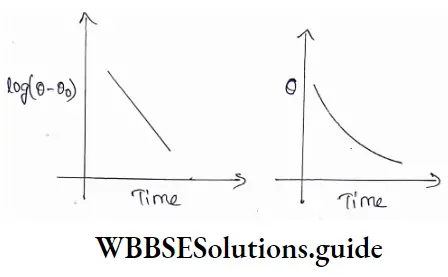
Newton’s law of cooling: The rate of fall in temperature of a body is directly proportional to the temperature difference between the body and surroundings. (The temperature difference should not exceed 400C)

i.e„ \(\frac{\mathrm{d} \theta}{\mathrm{dt}}=-\mathrm{k}\left(\theta-\theta_0\right)\)

Where θ is the temperature of the body and θ0 is the temperature of the surrounding.

During the experiment if θ changes from θ1 to θ2, then

Heat Transfer and Specific Heat Capacity NEET Notes

⇒ \(\frac{\mathrm{d} \theta}{\mathrm{dt}}=\mathrm{k}\left[\frac{\theta_1+\theta_2}{2}-\theta_0\right]\)

NEET Physics Thermal Properties Of Matter Notes Newton's Law Of Cooling

Wien’s Displacement Law

According to Wien’s law λmT = b = constant

Where λm is the wavelength corresponding to maximum energy emission and b is known as Wien’s constant b = 2.93 x 10⁻³ mK

Solar constant: It is the rate at which energy reaches the earth’s surface from the sun.

In SI units,

Solar constant, S = 1388Wm-2

NEET Physics Electric Charges And Fields Notes

Electric Charges And Fields

Some Basics Of Electric Charge

  • S.I. Unit of charge is coulomb (C).
  • Dimensional formula [Q] = [AT]
  • The process of sharing charges with the earth is called grounding or earthing.
  • When we rub two insulating objects against each other, we provide energy to overcome friction between the objects.
  • This energy is used to remove the electrons from one object and transfer them to other.
  • The electrons are removed from the object where they are less tightly held and transferred to the object where they are tightly held.
  • The object losing electrons becomes positively charged and the object gaining electrons will become negatively charged.
  • For example, when glass rod is rubbed with silk, some of the electrons are transferred from the glass rod to the silk cloth.
  • Thus, the rod gets positively charged and silk cloth gets negatively charged. No new charge is created during rubbing.
  • The number of electrons that are transferred is a very small fraction of the total number of electrons in the material body.

Concept of Electric Field Lines and Flux for NEET Physics

The substances which allow electric charges to pass through them easily are called conductors. The substances which do not allow electrical charges to pass through them easily are called insulators.

Read And Learn More: NEET Physics Notes

  • When some charge is transferred to a conductor, it readily gets distributed over the entire outer surface of the conductor.
  • Due to mutual repulsion between like charges, they always remain on the outer surface of the conductor.
  • Distribution of charge on the surface of the conductor depends upon the shape of the conductor.
    If some charge is put on an insulator, the charge stays at the same place.
  • In other words, the charges remain localised on an insulator.
  • 6.25 x10¹⁸ electrons constitute one coulomb of charge in magnitude.
  • When ‘n’ electrons are removed from a body, charge on the body will be +ne.
  • When ‘n’ electrons are added to a body charge on the body will be -ne.

Properties Of Charges

If a system has charges q1, q2, . . . . . qn the total charge of the system is given by the algebraic sum.

∴ qnet = q1 + q2 + . . . . + qn

i.e., charges are additive in nature.

  • Total charge on an isolated system is constant. (charge is neither be created, nor be destroyed) i.e., charge is conserved.
  • Charge on a body should be integral multiple of ‘e’. i.e., charge is quantised, q = ± ne, n = 0, 1, 2, . . . .
  • Like charges repel each other, and opposite charges attract each other.
  • Accelerated charges radiate energy in the form of electromagnetic waves.
  • Charge is a scalar quantity

NEET Physics Electric Charges And Fields Notes

Electric Charges and Fields NEET Important Questions

Coulomb’s Law

The force of attraction or repulsion between two point charges is directly proportional to product of magnitudes of charges and is inversely proportional to square of the distance between them, and this force acts along the line joining the two charges.

Difference Between Conductors and Insulators NEET Questions

⇒ \(\text { i.e., } F-k \frac{q_1 q_2}{r^2}\)

⇒ \(\text { where, } \mathrm{k}=\frac{1}{4 \pi \mathrm{r}_9}-9 \times 10^7 \mathrm{Nm}^2 \mathrm{C}^{-2},\)

⇒ \(\varepsilon_0=8.854 \times 10^{-12} \mathrm{~N}^{-1} \mathrm{~m}^{-2} \mathrm{C}^2\)

⇒ \(\varepsilon_0\) is called the absolute permittivity of free space.

⇒ \(\left[\mathrm{E}_0\right]=\left[\mathrm{ML}^{-1} \mathrm{~T}^{-1} \mathrm{~A}^2\right]\)

Dielectric constant (K) or relative permittivity \(\varepsilon_r\)

K = \(\varepsilon_f=\frac{\mathbf{F}_{\text {air } / \text { racuum }}}{\mathbf{F}_{\text {medium }}}\)

Electric Field Or Electric Field Intensity

Electric field at a point in space is the force experienced by a unit positive charge when placed at that point.

i e., \(\overrightarrow{\mathrm{E}}-\frac{\overrightarrow{\mathrm{F}}}{\mathrm{q}}\)

S.I. Unit of I is Nm-1 or Vm-1

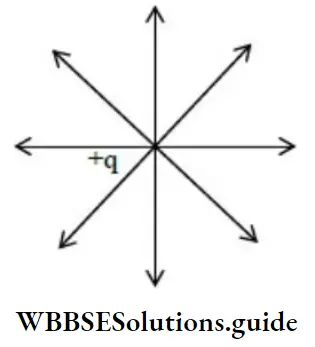
Electric field lines due to Isolated positive point charge.

NEET Physics Electric Charges And Fields Electric Field Lines Due To Isolated Positive Point Charge

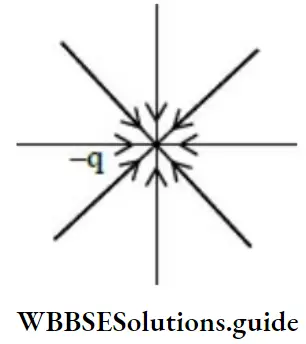
Electric field lines due to isolated Negative point charge.

NEET Physics Electric Charges And Fields Electric Field Due To Isolated Negative Point Charge

Properties of Electric Field Lines

  1. They always start from positive charge and end at negative charge.
  2. (In a charge free region, electric field lines start from positive charge and end at infinity and they start from infinity and end at negative charge)
  3. They do not form closed loops
  4. They never intersect each other (if they intersect, at the point of intersection there will be two directions for the electric field, which is not possible.)
  5. The tangent drawn at any point on an electric field line will give its direction at that point.
  6. Electric lines are always perpendicular to the surface of a condutor (irrespective of its shape)
  7. Crowded electric field lines indicate stronger electric field.

Electric Flux

Electric flux through an area is a measure of number of electric field lines passing through that area.

⇒ \(\phi_E=\overrightarrow{\mathrm{E}} \cdot \overrightarrow{\mathrm{A}}=\mathrm{EA} \cos \theta .\)

Electric flux is a scalar quantity.

Dimensions of electric flux \(\left[\phi_E\right]=\left[\mathbb{L}^3 \mathrm{~T}^{-3} \mathrm{~A}^{-1}\right]\)

A neutral point is a point where resultant electric field is zero.

Force experienced by a charged particle q when it is placed in a uniform electric field E is given by

⇒ \(\mathrm{F}=\mathrm{qE}\left(because \mathrm{E}=\frac{\mathrm{F}}{\mathrm{q}}\right)\)

Tricks to Solve Electric Charges and Fields Problems for NEET

∴ The acceleration of the charge is, \(\mathrm{a}=\frac{\mathrm{F}}{\mathrm{m}} \Rightarrow \mathrm{a}=\frac{\mathrm{qE}}{\mathrm{m}}\)

Velocity acquired by a charged particle starting from rest in time ‘t’ is given by \(\mathrm{v}=\mathrm{u}+\mathrm{at} \Rightarrow \mathrm{v}=\frac{\mathrm{qE}}{\mathrm{m}} \mathrm{t}\)

Momentum of the charged particle is given by, \(\mathrm{p}=\mathrm{mv}=\mathrm{m} \frac{\mathrm{qEt}}{\mathrm{m}}\)

∴ p =qEt

Kinetic energy gained by the charged particle in time ‘t’ is \(\mathrm{K}=\frac{1}{2} m v^2=\frac{1}{2} \mathrm{~m}\left(\frac{\mathrm{q}^2 \mathrm{E}^2 \mathrm{t}^2}{\mathrm{~m}^2}\right)\)

∴ \(\mathrm{K}=\frac{\mathrm{q}^2 \mathrm{E}^2 \mathrm{t}^2}{2 \mathrm{~m}}\)

Kinetic energy gained by the charged particle in travelling a distance y in the direction of uniform electric field is

⇒ \(v^2=u^2+2 a y\)

⇒ \(v^2=2 a y \quad(because  u=0)\)

K = \(\frac{1}{2} m v^2=\frac{1}{2} m(2 a y)=m\left(\frac{q E}{m}\right) y \quad\left(because a=\frac{q E}{m}\right)\)

∴ K = qEy

Electric Dipole

A pair of equal and opposite charges separated by a small distance.

Electric dipole moment: It is a vector, whose magnitude is equal to product of either charge and separation between the two charges. The direction of electric dipole moment is from negative to positive charge.

⇒ \(\overrightarrow{\mathrm{p}}=\mathrm{q} \times 2 \mathrm{a} \dot{\mathrm{p}}\)

⇒ \(|p|-p=(q) 2 a\)

Coulomb’s Law and Gauss’s Theorem NEET Questions with Solutions

Axial electric field due to a dipole:

⇒ \(\overrightarrow{\mathrm{E}}_{\mathrm{u}}=\frac{1}{4 \pi \varepsilon_0} \frac{2 p r}{\left(\mathrm{r}^2-\mathrm{a}^2\right)^2} \overrightarrow{\mathrm{p}}\)

If a < < r, then

⇒ \(\overrightarrow{\mathrm{E}}_{\mathrm{a}}=\frac{12 \mathrm{p}}{4 \pi r_0 \mathrm{r}^3} \dot{\mathrm{p}}\)

Equatorial Field Due to a Dipole

⇒ \(\vec{E}_{e q}=-\frac{1}{4 \pi r_0} \frac{p}{\left(r^2+a^2\right)^{\frac{3}{2}}} \dot{p}\)

If a << r, then

⇒ \(\overrightarrow{\mathrm{E}}_{\bar{q}}=-\frac{1}{4 \pi \varepsilon_n} \frac{\mathrm{p}}{\mathrm{p}} \hat{\mathrm{p}}\)

Relation between axial and equatorial electric fields

⇒ \(\left|\overrightarrow{\mathrm{E}}_{\mathrm{xx}}\right|=2\left|\overrightarrow{\mathrm{E}}_{\text {cas }}\right|\)

The electric field at any point around a dipole is given by,

E = \(\left[\frac{1}{4 \pi \delta_0} \frac{p}{r^3}\right] \sqrt{3 \cos ^2 \theta+1}\)

When an electric dipole is placed in a uniform electric field E, then the torque experienced by it is given by,

⇒ \(\vec{\tau}=\vec{P} \times \vec{E}\)

⇒ \(\tau=P E \sin \theta\)

Gauss’s law

The total electric flux through a closed surface in air is equal to \(\frac{1}{\varepsilon_0}\) times the total charge enclosed by the surface.

⇒ \(\phi_{\mathrm{E}}=\frac{1}{\mathrm{~s}_0}\left(\mathrm{q}_{\mathrm{DEt}}\right)\)

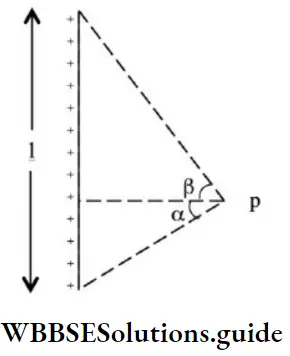
Electric field due to infinite long straight charged conductor,

E = \(=\frac{\lambda}{2 \pi E_0 r}\)

If the conductor is of finite length then

NEET Physics Electric Charges And Fields Electric Field Due To Infinite Long Straight Charged Conductor

NCERT Summary of Electric Charges and Fields for NEET

where r is the perpendicular distance between the conductor and the point P.

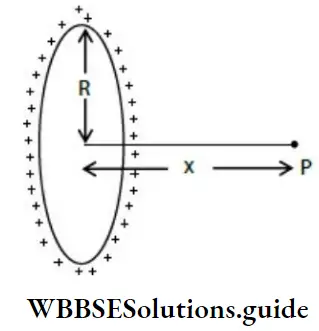
Electric field on the axis of a charged circular ring carrying charge Q.

E = \(\frac{1}{4 \pi \varepsilon_0} \frac{Q x}{\left(R^2+x^2\right)^{\frac{3}{2}}}\)

NEET Physics Electric Charges And Fields Electric Field On The Axis Of A Charged Circular Ring Carrying Charge Q

  1. When x = 0, E = 0
  2. x » R, then, E = \(\frac{1}{4 \pi E_0} \frac{Q}{x^2}\)

Electric field due to infinitely long plane sheet of charge E = \(\frac{\sigma}{2 \varepsilon_0}\)

Where ‘ σ ’ is surface charge density (charge per unit area)

Note: Electric field due to an infinite plane sheet of charge is independent of distance.

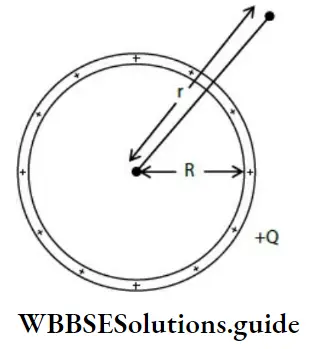
Electric field due to a charged conducting shell

NEET Physics Electric Charges And Fields Electric Field Due To A Charged Conducting Shell

1. At a point outside the shell \(E_{out}=\frac{1}{4 \pi x_v} \frac{Q}{r^2}\)

2. At a point on the surface of the shell \(E_{\text {Sur}}=\frac{1}{4 \pi \varepsilon_0} \frac{Q}{R^2}=\frac{1}{4 \pi \varepsilon_0} \frac{\sigma\left(4 \pi R^2\right)}{R^2} \quad\left[\sigma=\frac{Q}{4 \pi R^2}\right]\)

⇒ \(E_{\text {Sur}}=\frac{\sigma}{\varepsilon_0}\)

3. At a point inside the shell Ein = 0

Chapter-wise Weightage for NEET Physics Electric Charges and Fields

Electric field due to a charged conducting sphere

NEET Physics Electric Charges And Fields Electric Field Due To A Charged Conducting Sphere

⇒ \(\mathrm{E}_{\text {out }}=\frac{1}{4 \pi \varepsilon_0} \frac{\mathrm{Q}}{\mathrm{r}^2}\)\

⇒ \(\mathrm{E}_{\mathrm{Sur}}=\frac{\sigma}{\varepsilon_0}\)

⇒ \(\mathrm{E}_{\text {in}}=0\)

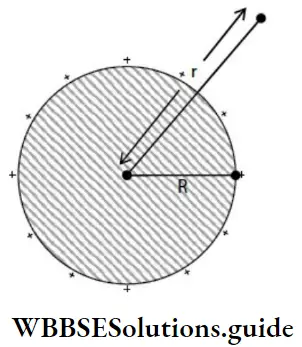
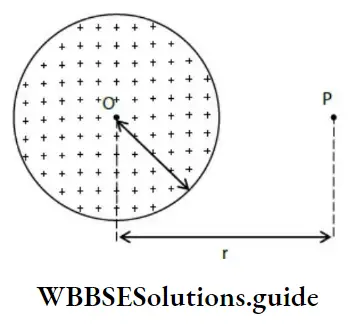
Electric field due to a uniformly charged non-conducting sphere (or uniform spherical cloud of charge)

NEET Physics Electric Charges And Fields Electric Field Due To Uniformly Charged Non Conductiong Sphere

⇒ \(E_{\text {outside }}=\frac{1 \cdot Q}{4 \pi \varepsilon_4 r^2}\)

⇒ \(E_{\text {Surface }}=\frac{1}{4 \pi r_0} \frac{Q}{R^2}\)

⇒ \(E_in=\frac{1}{4 \pi \varepsilon_0 R^3}\)

where r is the distance from the center

Step-by-Step Solutions for Electric Charges NEET Problems

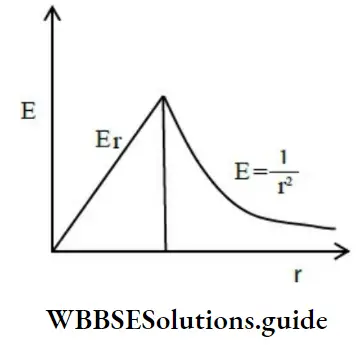
Variation of \(\overrightarrow{\mathrm{E}} \) with distance (r)

NEET Physics Electric Charges And Fields Variation Of E With Distance r

NEET Physics Waves Notes

Waves

Wave Definition:

The disturbance that is traveling through a medium or vacuum from one place to another by transferring the energy is called a wave.

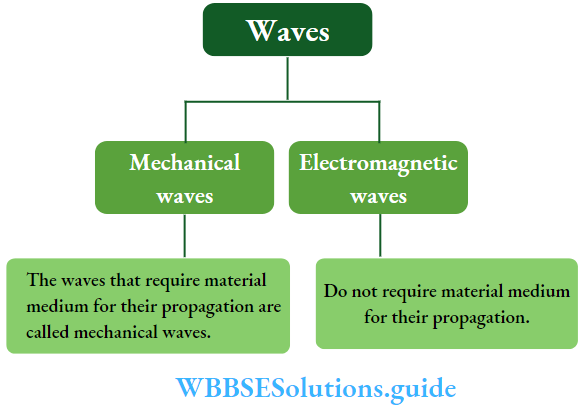
Classification of waves based on the need for a material medium.

NEET Physics Waves Notes Waves

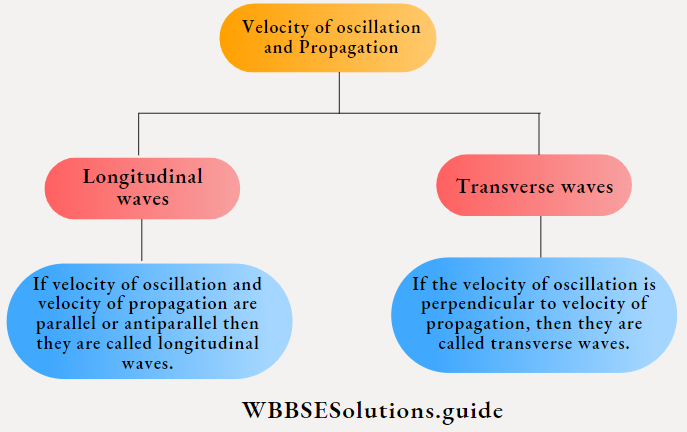
Classification based on the velocity of oscillation and the velocity of propagation:

NEET Physics Waves Notes Classification Of Longitudinal Waves And Transverse Waves

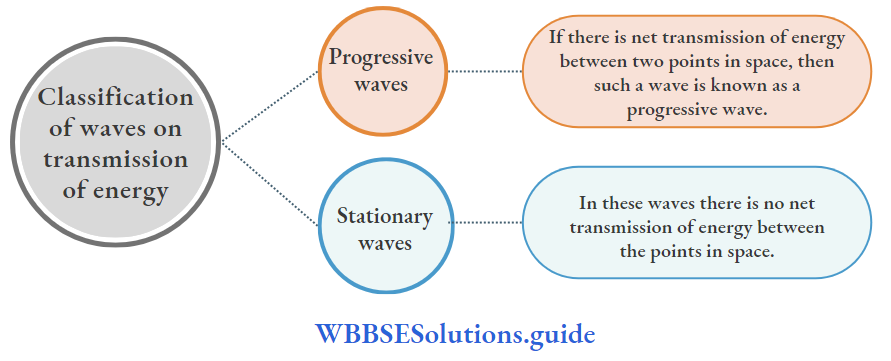
Classification of waves based on transmission of energy:

NEET Physics Waves Notes Classification Of Progressive And Stationary Waves

NEET Physics Waves notes

The wave velocity is given by, c = f λ.

Read And Learn More: NEET Physics Notes

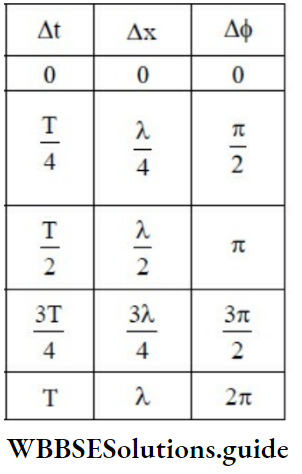
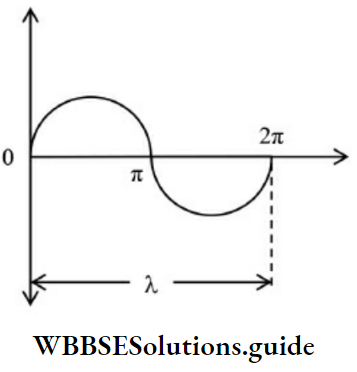
Relation between path difference and phase difference

⇒ \(\frac{\Delta \mathrm{x}}{\Delta \phi}=\frac{\lambda}{2 \pi}\)

⇒ \(\Delta \mathrm{x}=\frac{\lambda}{2 \pi} \Delta \phi\)

where Δx is the path difference and Δ∅ is the phase difference

NEET Physics Waves Path Differences

Standing waves and harmonics NEET notes

NEET Physics Waves Phase Difference

Equation of one-dimensional progressive wave,

y = \(A \sin (\omega t \pm k x)\)

Or \(y=A \cos (\omega t \pm k x)\)

Important formulas of Waves for NEET

A → amplitudes

⇒ \(\omega=2 \pi \mathrm{f}=\frac{2 \pi}{\mathrm{T}}\)= angular frequency

⇒ \(\mathrm{k}=\frac{2 \pi}{\lambda}\)= propagation constant

⇒ \(\frac{\omega}{\mathrm{k}}=\frac{2 \pi}{\mathrm{T}} \times \frac{\lambda}{2 \pi}=\lambda \mathrm{f}=\mathrm{c}\), wave velocity.

⇒ \(\frac{\mathrm{dy}}{\mathrm{dt}}=\mathrm{v}\), particle velocity.

“Wave velocity is a constant but particle velocity is variable”

⇒ \(\frac{1}{\lambda}=\bar{v}\), is called wave number.

NEET Physics Waves Notes

Types of waves in Physics for NEET

Reflection Of Waves

The return of a wave from the surface of the separation of two media is called reflection. The reflection of the wave occurs according to the following laws.

  • The angle of incidence = angle of reflection.
  • On reflection, there is no change in the velocity, frequency, or wavelength of the wave.
  • A phase difference of 1800 is introduced when the transverse wave is reflected from a denser medium and the longitudinal wave is reflected from a rarer medium.

Note:

  1. A medium is said to be denser if the velocity of the ave in it is lower.
  2. Vacuum is the rarer medium for electromagnetic waves, but it is the densest medium for sound waves.

Sound waves of frequency less than 20 Hz are called infrasonics.

Sound waves of frequency greater than 20000 Hz are called ultrasonics.

“It is found that the sensation of sound received by our ear persists for about 1/10 th of a second. This is called persistence of hearing

Echo: It is a sound that reaches the observer after reflection from some surface or object.

Beats

The number of beats produced per second is found to be equal to the difference in the frequencies of the superposing sound waves.

⇒ \(v_{\text {beat }}=\left|v_1-v_2\right|\)

Condition for hearing beats

  1. The frequency difference of the two waves should not be more than 10.
  2. The amplitudes of the two waves must be nearly equal.
  3. The direction of propagation of waves should be the same

Velocity of sound:

In liquids, C = \(\sqrt{\frac{B}{\rho}}\)

Where B is the bulk modulus.

In air, C = \(\sqrt{\frac{\gamma \mathrm{P}}{\rho}}=\sqrt{\frac{\gamma \mathrm{RT}}{\mathrm{M}}}\) (PV=RT)

In a long rod, C = \(\sqrt{\frac{Y}{\rho}}\)

Wave motion and its characteristics NEET notes

Y → Young’s Modulus.

In general, C = \(\sqrt{\frac{P}{\rho}}\)

Where E is the modulus of elasticity.

Note:

  • \(C \propto \frac{1}{\sqrt{\rho}}\)
  • \(C \propto \sqrt{\mathrm{T}}\)
  • The speed of sound in air is independent of pressure.
  • \(\mathrm{C}_{\text {solid}}>\mathrm{C}_{\text {liqquids }}>\mathrm{C}_{\text {gases }}\)
  • The sound is reflected or refracted according to the same laws as the light does. Among the gases, the velocity of sound is the largest in hydrogen.
  • Sound travels faster in solids because of its larger value of elasticity.
  • For every one-degree rise in temperature the speed of sound increases by 0.61m/s.

Tuning Fork

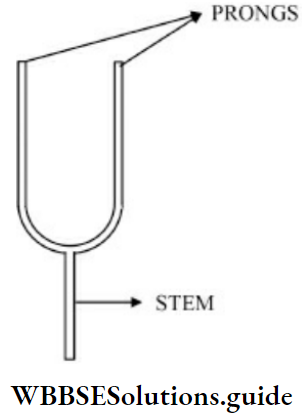
The prongs execute transverse vibrations and the stem executes the longitudinal vibrations. Both vibrate with the same frequency.

NEET Physics Waves Tuning Fork

Sound waves and their properties NEET

  • If we add a little wax to one of the prongs of the tuning fork, it is said to have been loaded. Loading decreases the frequency of the tuning fork.
  • If we file the prong of the tuning fork to make it thinner, the frequency of the tuning fork increases.
  • If the stem of a tuning fork is loaded, then the frequency of the tuning fork will increase.

Determination of frequency of the tuning fork using the phenomenon of beats:

Step 1: Suppose, we have a standard tuning fork of frequency v3 = 580 Hz.

The standard tuning fork and the experimental tuning fork of unknown frequency are sounded together. Let the number of beats produced per second be 6.

Then the frequency of the experimental tuning fork is either 580 + 6 = 586 Hz or 580 – 6 = 574 Hz.

Step 2: Let the experimental tuning fork be loaded and it is sounded together with the standard tuning fork.

Suppose the beat frequency in this case is 4.

Then it is evident that the frequency of the loaded experiment tuning fork has decreased by 6 – 4 = 2.

Therefore, the frequency of the experimental tuning fork has become either 584 Hz or 572 Hz.

But 4 beats are possible only with 584 Hz.

Hence the original frequency of the experimental tuning fork is 586 Hz.

Doppler Effect

The apparent change in the frequency heard by the listener, due to the relative motion between the source and observer is called the Doppler effect.

In the Doppler effect, the apparent frequency of sound as heard by the listener will be,

⇒ \(v^1=\frac{C-C_L}{C-C_S} v\)

v → original frequency

v1 → app. frequency.

C → speed of sound.

CL → speed of listener.

CS → speed of the source.

CL and CS are taken positively when they are in the direction of ‘C’ and vice versa.

Superposition principle and interference NEET

Doppler effect in light: \(v^1=\frac{C-C_L}{C-C_S} v\)

If λ’ is the apparent wavelength, then

⇒ \(\frac{\mathrm{C}}{\lambda^{\prime}}=\frac{\mathrm{C}-\mathrm{C}_{\mathrm{L}}}{\mathrm{C}-\mathrm{C}_5} \frac{\mathrm{C}}{\lambda}\)

⇒ \(\lambda^{\prime}=\frac{\mathrm{C}-\mathrm{C}_{\mathrm{S}}}{\mathrm{C}-\mathrm{C}_{\mathrm{L}}} \lambda\)

1. CL = 0, CS = u (source comes towards)

⇒ \(\lambda^{\prime}=\left(\frac{\mathrm{C}-\mathrm{u}}{\mathrm{C}}\right) \lambda=\left(1-\frac{\mathrm{u}}{\mathrm{C}}\right) \lambda\)

⇒ \(\Delta \lambda=\lambda^{\prime}-\lambda=-\frac{\mathrm{u}}{\mathrm{C}} \lambda \quad \text { (blue shift) }\)

Beats and Doppler effect NEET questions

2. Source goes away: \(\Delta \lambda=\frac{\mathrm{u}}{\mathrm{C}} \lambda\) (red shift)

3. Observer approaches source: \(\Delta \lambda=-\frac{\mathrm{u}}{\mathrm{c}} \lambda\)

4. Observer recedes from source: \(\Delta \lambda=\frac{\mathrm{u}}{\mathrm{C}} \lambda\)

Doppler effect is not observed when,

  1. There is no relative velocity between the source and the listener.
  2. When source and listener move in mutually perpendicular directions.
  3. When only the medium moves.

NEET Physics Oscillation Notes

Oscillation Displacement

Displacement in SHM can be represented by,

y = a sin cot → (1)

Where ‘y’ is instantaneous displacement, ‘a’ is amplitude, and ‘Q’ is angular frequency.

Simple Harmonic Motion (SHM) NEET Notes

Oscillation Velocity

Velocity of a particle in SHM

v = \(\frac{d y}{d t}=\frac{d}{d t}(a \sin \omega t) \Rightarrow v=a \omega \cos \omega t\) → (2)

v = \(a \omega\left[1-\sin ^2 \omega t\right]^{\frac{1}{2}}\)

v = \(\omega \sqrt{a^2-a^2 \sin ^2 \omega t}\)

v = \(\omega \sqrt{a^2-y^2}\)

⇒ \(v^2=\omega^2\left(a^2-y^2\right)\)

⇒ \(\frac{v^2}{\omega^2}=a^2-y^2 \Rightarrow \frac{v^2}{a^2 \omega^2}=1-\frac{y^2}{a^2}\)

⇒ \(\frac{v^2}{a^2 \omega^2}+\frac{y^2}{a^2}=1\)

Which is an equation of ellipse. This means, the graph of v versus y in SHM is an ellipse.

Read And Learn More: NEET Physics Notes

Oscillation Acceleration

Acceleration of SHM is given by,

NEET Study Material for Oscillations Chapter

A = \(\frac{d v}{d t}=\frac{d}{d t} a \omega \cos \omega t\)

A = \(-a \omega^2 \sin \omega t\) → (3)

A = \(-\omega^2 \mathrm{y}\)→(4)

Note: \(v_{\max }=a \omega ; A_{\max }=-\omega^2 a\)

NEET Physics Oscillation Notes

NEET Physics Oscillations Notes

Oscillation Potential Energy

The potential energy of a particle in SHM is,

U = \(\frac{1}{2} \mathrm{ky}^2\)

Where, k = \(m \omega^2\)

Oscillation Kinetic Energy

The kinetic energy of a particle in SHM is,

K = \(\frac{1}{2} m v^2=\frac{1}{2} m \omega^2\left(a^2-y^2\right)\)

∴ Total energy is, E = U + K

= \(\frac{1}{2}\)ky2 + \(\frac{1}{2}\)k(a2-y2)

= \(\frac{1}{2}\)ky2 + \(\frac{1}{2}\)ka2 – \(\frac{1}{2}\)ky2

E = \(\frac{1}{2}\)ka2

NEET Physics Oscillations Important Formulas

Note:

  • From the above equation, we see that energy is directly proportional to the square of the amplitude
  • Also, intensity (I) is directly proportional to the square of the amplitude

I = \(\frac{E}{A t} \ E \propto a^2\)

∴ I \(\propto a^2\)

Time of oscillation of a simple pendulum (for small oscillations) is given by

T = \(2 \pi \sqrt{\frac{\ell}{g}}\)

Period of oscillation of a spring mass system is given by,

⇒ \(2 \pi \sqrt{\frac{\mathrm{m}}{\mathrm{k}}}\)

Where k is the spring constant.

If a spring of spring constant k is cut into two halves, each part will have a spring constant equal to 2k.

Oscillation

NEET Physics Oscillation Spring Constant

Best Short Notes for Oscillations NEET

The above point can be understood easily by using,

F = kx and Y = \(\frac{F}{A \Delta}\) equation

If a spring of spring constant k is cut into n equal halves, the each part will have a spring constant equal to nk.

NEET Physics Oscillations MCQs with Solutions

The series combination of springs

⇒ \(\frac{1}{\mathrm{~K}_{\mathrm{eff}}}=\frac{1}{\mathrm{k}_1}+\frac{1}{\mathrm{k}_2}+\frac{1}{\mathrm{k}_3}+\ldots .+\frac{1}{\mathrm{k}_{\mathrm{a}}}\)

If there are two springs, then

⇒ \(\frac{1}{\mathrm{~K}_{\text {efe }}}=\frac{1}{\mathrm{k}_1}+\frac{1}{\mathrm{k}_2} \)

⇒ \(\frac{1}{\mathrm{~K}_{\text {eff }}}=\frac{\mathrm{k}_1+\mathrm{k}_2}{\mathrm{k}_1 \mathrm{k}_2}\)

⇒ \(\mathrm{~K}_{\text {eff }}=\frac{\mathrm{k}_1 \mathrm{k}_2}{\mathrm{k}_1+\mathrm{k}_2}\)

When ‘n’ springs of equal spring constants k are connected in series, then Keff = nk

Oscillations NEET Important Questions and Answers

Parallel combination of springs: When ‘n’ springs of spring constants kWhen ‘n’ springs of spring constants k1, k2, and so on are connected in series, then, k2, ….kn are connected in parallel, then,

Keff = k2 + k2 + ….. + kn

When ‘n’ springs of equal spring constants k are connected in parallel, then Keff = nk

NEET Physics Mechanical Properties Of Solids Notes

Mechanical Properties Of Solids

Restoring force per unit area is known as stress.

Stress = \(\frac{\mathrm{F}}{\mathrm{A}}\)

Its S.I. unit is Nm 2 or Pascal (Pa)

Strain is defined as the change in the configuration of the body to the original configuration

Longitudinal strain = \(\frac{\text { Change in length }}{\text { original length }}=\frac{\Delta \ell}{\mathrm{L}}\)

Volume strain = \(\frac{\text { Change in volume }}{\text { original volume }}=\frac{\Delta \mathrm{V}}{\mathrm{V}}\)

Shear strain = the angle by which a line perpendicular to the fixed face turns.

Read And Learn More: NEET Physics Notes

Hooke’s Law

Within the elastic limit, stress is directly proportional to strain.

i.e., Stress-Strain

Stress = K Strain

Where,

K=  \(\frac{\text { Stress }}{\text { Strain }}\) is called modulus of elasticity.

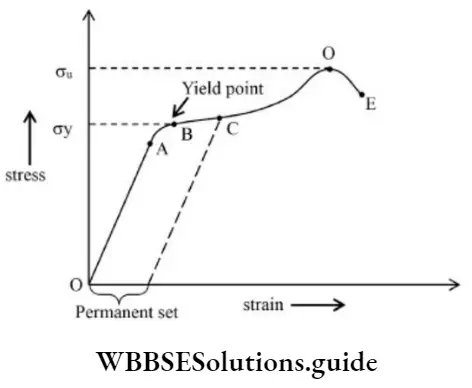
Stress-Strain Curve

NEET Physics Mechanical Properties Of Solids Strain Curve

NEET Physics Solids Chapter Notes with Important Formulas

Young’s Modulus

\(\mathrm{Y}=\frac{\text { Normal stress }}{\text { longitudinal strain }}=\frac{\mathrm{FL}}{\mathrm{A} \Delta I}\) If length of the wire is doubled, then strain = 1

∴ Y = Stress

Bulk Modulus

⇒ \(B=\frac{\text { Normal stress }}{\text { Volume strain }}=\frac{\frac{F}{A}}{-\frac{\Delta V}{V}}\)

⇒ \(\mathrm{B}=-\frac{\mathrm{PV}}{\Delta \mathrm{V}}\)

The reciprocal of Bulk modulus is called compressibility.

Compressibility, K = \(\frac{1}{B}\)

Best Short Notes for Mechanical Properties of Solids NEET

Modulus of rigidity (G):

NEET Physics Mechanical Properties Of Solids Modulus Of Rigidity

⇒ \(\mathrm{G}=\frac{\text { Shearing stress }}{\text { Shearing strain }}\)

⇒ \(\mathrm{G}=\frac{\mathrm{FL}}{\mathrm{A} \Delta \mathrm{x}}=\frac{\mathrm{F}}{\mathrm{A} \tan \theta}=\frac{\mathrm{F}}{\mathrm{A} \theta}\)

NEET Physics Mechanical Properties Of Solids Notes

Mechanical Properties of Solids NEET Important Questions

Poisson’s ratio:

⇒ \(\sigma=\frac{\text { Lateral strain }}{\text { Longitudinal strain }}\)

⇒ \(\sigma=-\frac{\frac{\Delta \mathrm{D}}{\mathrm{D}}}{\frac{\Delta \mathrm{L}}{\mathrm{L}}}\)

Where ‘D’ is diameter of the rod.

The maximum length of the wire that can be hung from the ceiling without breaking

Breaking stress =\(\frac{\text { Breaking force }}{\text { area of cross-section }}\)

⇒ \(\mathrm{S}=\frac{\mathrm{F}}{\mathrm{A}}-\frac{\mathrm{mg}}{\mathrm{A}}=\frac{\rho \vee \mathrm{g}}{\mathrm{A}}=\frac{\rho(\mathrm{A} l) \mathrm{g}}{\mathrm{A}}\)

⇒ \(\mathrm{S}-\rho l \mathrm{~g}\)

⇒ \(l=\frac{s}{\rho g}\)

NEET Physics Chapter Mechanical Properties of Solids

The maximum height of a mountain on earth is given by,

⇒ \(\mathrm{h}_{\max }=\frac{\mathrm{K}}{\rho \mathrm{g}}\)

Where K is the elastic limit of the earth-supporting material

The depression produced in a rectangular beam is given by,

NEET Physics Mechanical Properties Of Solids Rectangular Beam

⇒ \(\delta-\frac{\mathrm{w} l^3}{4 \mathrm{Ybd} \mathrm{d}^3}\)

Where l is the length of the beam, Y is Young’s modulus of the material of the beam, b is the breadth and d is the depth of the beam.

Work done in stretching a wire is given by,

⇒ \(\mathrm{W}=\frac{1}{2} \mathrm{~F} \Delta l\)

∴ The potential energy stored in a stretched wire is given by

⇒ \(\mathrm{U}=\frac{1}{2} \mathrm{~F} \Delta l\)

Where Δl is the increase in length.

∴ Potential energy per unit volume is given by,

Stress-Strain Curve and Elasticity NEET Notes

⇒ \(\mathrm{u}=\frac{\mathrm{U}}{\mathrm{v}}-\frac{1}{2} \frac{\mathrm{F} \Delta l}{\mathrm{~A} l}\)

⇒ \(\mathrm{u}=\frac{1}{2} \text { (stress) (strain) }\)

⇒ \(\mathrm{u}=\frac{1}{2} \times \mathrm{Y} \times(\text { strain })^2\)