NEET Physics Current Electricity Notes

NEET Physics Current Electricity Notes

Current Electricity

Current Electricity Definition

Electric Current is defined as the rate of flow of charge in a conductor

I = \(\frac{dQ}{dt}\)

SI unit of current is ampere (A).

The direction in which a positive charge would move under the action of an electric field will be the direction of conventional current.

Read And Learn More: NEET Physics Notes

Resistance of a conductor at a particular temperature is

  1. Directly Proportional To The Length Of The Conductor And
  2. Inversely proportional to its area of cross-section.
\(\text { i.e., } \mathrm{R}=\frac{\rho \ell}{\mathrm{A}}\)

Where, is a constant of proportionality constant called resistivity of the conductor.

When \(\ell=1 \mathrm{~m} \text { and } \mathrm{A}=1 \mathrm{~m}^2 \text {, then } \mathrm{R}=\rho\).

Current Electricity Important Questions for NEET

The resistivity of a conductor depends on

  1. Nature of the conductor
  2. Temperature

SI Unit of resistivity is Ωm.

Ohm’s Law

The current flowing through a conductor is directly proportional to the potential difference developed across the ends of the conductor. (provided the physical conditions like temperature remain constant)

\(\begin{array}{r}
\mathrm{V} \propto \mathrm{I} \\
\mathrm{V}=\mathrm{RI}
\end{array}\)

Where R is the electric resistance

SI unit of resistance is Ω(Ohm).

The devices which obey Ohm’s law are called ohmic devices.

The devices that do not obey Ohm’s law are called non–Ophmic devices.

The velocity with which electrons drift in a conductor under the action of the electric field is called drift velocity (vd).

\(\left|\vec{v}_d\right|=\frac{e E \tau}{m}\)

Where ‘m’ is the mass of the electron and \(\tau\) is called the average relaxation time.

The magnitude of drift velocity per unit electric field is called mobility (μ)

\(\text { i.e., } \mu=\frac{\left|\overrightarrow{v_d}\right|}{E}=\frac{v_d}{E}\)

Difference Between AC and DC Circuits for NEET

The current density is given by,

\(
\begin{gathered}
I=\vec{J} \cdot \vec{A} \\
I=J A \cos \theta \\
J=\frac{I}{A \cos \theta}
\end{gathered}
If \theta=0^{\circ}, then \mathrm{J}=\frac{\mathrm{I}}{\mathrm{A}}\)

The direction of current density is the same as electric current.

The current density is also given by,

\(\overrightarrow{\mathrm{j}}=\sigma \overrightarrow{\mathrm{E}}\)

Where \(\sigma=\frac{1}{\rho}\) is the conductivity of the material.

Electrical conductivity (σ) is given by

\(\sigma=\frac{n e^2 \tau}{m}\)

∴ \(\text { Resistivity, } \rho=\frac{1}{\sigma}=\frac{m}{n e^2 \tau}\)

NEET Physics Current Electricity Notes

Ohm’s Law and Kirchhoff’s Laws NEET Questions

Temperature Dependence Of Resistivity

If and are resistivity at temperatures T0 and T respectively (T> T0), then

\(\rho_{\mathrm{T}}=\rho_0\left[1+\alpha\left(\mathrm{T}-\mathrm{T}_0\right)\right]\)

Where is the temperature coefficient of resistivity?

Similarly, in terms of resistance, we can write,

\(R_T=R_0\left[1+\alpha\left(T-T_0\right)\right]\)

Note:

Alloys like nichrome and manganin have very high resistivity and low value of α. Therefore wires made of these materials are suitable for making standard resistance and rheostat.

EMF (Electromagnetic force) of a source is the work done in transporting a unit positive charge from the lower to a higher potential of the source.

SI unit of emf is volt(V).

The terminal potential difference (V), emf (E), and internal resistance are related by the equation,

V = E – Ir (during discharging)

And V = E + Ir (during charging of a cell)

If I = 0, then V = E.

Therefore emf of a cell can also be defined as the potential difference across the terminals of the cell when no current flows through it.

Current Electricity NCERT Summary for NEET Physics

Resistors in Series

When ‘n’ resistors are connected in series, then

Rs = R1 + R2 + …. + Rn

If ‘n’ resistors of equal resistance ‘R’ are connected in series

Then, \(\mathrm{R}_{\mathrm{s}}=\mathrm{nR}\)

Resistors in Parallel

If ‘n’ resistors are connected in parallel then

\(\frac{1}{R_p}=\frac{1}{R_1}+\frac{1}{R_2}+\ldots+\frac{1}{R_z}\)

If ‘n’ resistors of equal resistance R are connected in parallel, then

\(\mathrm{R}_{\mathrm{p}}=\frac{\mathrm{R}}{\mathrm{n}}\)

Note:

Consider two resistors R1 and R2 connected in parallel with electric currents I1 and I2 flowing through them.

Since, the potential difference V across them is same, we have,

\(\begin{aligned}
\mathrm{V} & =\mathrm{I}_1 \mathrm{R}_1=\mathrm{I}_2 \mathrm{R}_2 \\
& \Rightarrow \frac{\mathrm{I}_1}{\mathrm{I}_2}=\frac{\mathrm{R}_2}{\mathrm{R}_1}
\end{aligned}\)

NEET Physics Chapter Wise Weightage Current Electricity

Therefore, the ratio of electric currents flowing through the resistors connected in parallel is in the inverse ratio of their resistances.

If I is the current flowing through the combination, then

\(I_1=\frac{R_2}{R_1+R_2} I \text { and } I_2=\frac{R_1}{R_1+R_2} I\) \(\text { current in one branch }\left(I_1\right)=\frac{\text { main current }(I) \times \text { resistance in other branch }\left(R_1\right)}{\text { sum of resistances }\left(R_1+R_2\right)}\)

Kirchhoff’s Junction Rule (KCL)

The junction rule states that the algebraic sum of currents entering into a junction is zero.

\(\sum I=0\)

The junction rule can also be stated as follows:

“At any junction of a circuit, the sum of currents entering the junction is equal to the sum of currents leaving the junction”.

Kirchhoff’s Loop Rule (KVL)

“The algebraic sum of potential differences across various elements around any closed loop in a particular direction must be zero”.

\(\sum_{\text {closed loog }} \Delta \mathrm{V}=0\)

Joule’s Law of Heating

When an electric current I is passed through a conductor of resistance R, it gets heated which indicates that electrical energy is being converted into heat.

The amount of heat produced in a conductor in time ‘t’ is given by,

\(\mathrm{H}=\mathrm{VIt}=\mathrm{I}^2 \mathrm{Rt}=\frac{\mathrm{V}^2}{\mathrm{R}} \mathrm{t}\)

Step-by-Step Solutions for Current Electricity NEET Problems

Note:

The amount of heat produced is independent of the direction of flow of the current.

The rate at which work is done by the source of emf in maintaining the current in the electric circuit is called power.

\(\mathrm{P}=\mathrm{VI}=\mathrm{I}^2 \mathrm{R}=\frac{\mathrm{V}^2}{\mathrm{R}}\)

Cells in Series

If ‘n’ cells are connected in series, then

\(\varepsilon_{\mathrm{s}}=\varepsilon_1+\varepsilon_2+\varepsilon_3+\ldots+\varepsilon_{\mathrm{n}} \text { and } r_{\mathrm{s}}=r_1+r_2+\ldots \ldots+r_n\)

If two cells are connected with the polarity of one cell reversed, then

Es = |E1 – E2| and rs = r1 + r2

If ‘n’ cells of emf E are connected in series and ‘P’ cells are connected in reverse order, then,

\(E_s=(n-2 P) E \text { and } r_s=n r\)

Cells in Parallel

If ‘n’ cells are connected in parallel, then

\(\begin{aligned}
& \frac{E_{e q}}{r_{o q}}=\frac{E_1}{I_1}+\frac{E_2}{r_2}+\ldots \ldots+\frac{E_2}{I_n} \\
& \frac{1}{r_{\mathrm{N}}}=\frac{1}{\mathrm{r}_1}+\frac{1}{\mathrm{r}_2}+\ldots . .+\frac{1}{\mathrm{r}_2} \\
&
\end{aligned}\)

Wheatstone’s bridge is a combination of four resistances used to calculate unknown resistance.

Metre bridge is a simple form of Whetstone’s bridge. (Or we can say the meter bridge works on the principle of the Wheatstone bridge.)

The unknown resistance ‘S’ can be calculated using the relation

\(\mathrm{S}=\frac{\mathrm{R}(1-l)}{l}\)

Where R is the known resistance and ‘l’is the balancing length.

Potentiometer and Wheatstone Bridge NEET Questions

Potentiometer

It is a device used to compare EMFs or to measure the internal resistance of a cell.

Principle of Potentiometer

When a constant current is flowing through a wire of a uniform area of the cross–section, the potential drop across any portion of the wire is directly proportional to the length of that portion.

\(\text { i.e., } \mathrm{v} \propto l \Rightarrow \mathrm{v}=\mathrm{k} l\) , where k is a constant called potential gradient.

The potentiometer can be used to compare emf’s of two cells, using the formula,

Measuring the balancing lengths l1 and l2 the ratio of emf’s can be found.

The potentiometer can be used to find the internal resistance of a cell,

\(\mathrm{r}=\left(\frac{l_1}{l_2}-1\right) \mathrm{S}\)

Where ‘S’ is the known resistance.

Concept of Internal Resistance and EMF for NEET Physics

Mixed Grouping of Cells

If ‘n’ identical cells are connected in a row and such ‘m’ rows are connected in parallel, then

Equivalent emf is, Eeq= nE

Equivalent resistance of the combination is, \(\mathrm{r}_{\mathrm{eq}}=\frac{\mathrm{nr}}{\mathrm{m}}\)

The main current in the circuit is,

\(\mathrm{I}=\frac{\mathrm{nE}}{\mathrm{R}+\frac{\mathrm{nr}}{\mathrm{m}}}=\frac{\mathrm{mnE}}{\mathrm{mR}+\mathrm{nr}}\)

Total number of cells = mn

Condition for maximum power, \(\mathrm{R}=\frac{\mathrm{nr}}{\mathrm{m}}\)

NEET Physics Wave Optics Notes

NEET Physics Wave Optics Notes

Doppler Effect in Light

The fractional change in frequency of light for an observer on earth is given by,

\(\frac{\Delta v}{v}=-\frac{V_{\text {radix }}}{C}\)

Where \(V_{\text {radinal }}\) is the component of the source velocity along the line joining the observer to the source relative to the observer.

\(V_{\mathrm{radial}}\) is taken positive when the source moves away from the observer.

The above equation is valid if \(\mathrm{V}_{\text {radial }}<<\mathrm{C}\).

Read And Learn More: NEET Physics Notes

Interference of Light

The phenomenon of redistribution of light energy in a medium as a result of the superposition of light waves from two coherent sources is called interference.

Theory of interference

If two waves \(\mathrm{y}_1=\mathrm{a}_1 \cos \omega \mathrm{t} \text { and } \mathrm{y}_2=\mathrm{a}_2 \cos (\omega \mathrm{t}-\phi)\), interfere, then,

The resultant amplitude is given by,

\(R=\sqrt{a_1^2+a_2^2+2 a_1 a_2 \cos \phi}\)

Case 1:

Constructive interference,

When , \(\cos \phi=1\)

\(\begin{aligned}
& R_{\max }=\sqrt{a_1^2+a_2^2+2 a_1 a_2} \\
& =\sqrt{\left(a_1+a_2\right)^2} \\
& \mathrm{R}_{\max }=\mathrm{a}_1+\mathrm{a}_2 \\
&
\end{aligned}\)

If a1 = a2 = a, then, Rmax = 2a.

NEET Physics Wave Optics notes

Note:

Condition for constructive interference,

\(\cos \phi=1 \Rightarrow \phi=2 \mathrm{n} \pi, \mathrm{n}=0,1,2,3, \ldots \ldots\)

In terms of path difference,

\(\Delta=\mathrm{n} \lambda, \mathrm{n}=0,1,2,3, \ldots\)

Coherent and incoherent sources NEET

Case 2:

Destructive interference,

When \(\cos \phi=-1\)

\(\begin{aligned}
R_{\min } & =\sqrt{a_1^2+a_2^2-2 a_1 a_2} \\
& =\sqrt{\left(a_1-a_2\right)^2} \\
R_{\min } & =a_1-a_2
\end{aligned}\)

If a1 = a2 then, Rmin = 0

Best notes for Wave Optics NEET

Note:

Condition for destructive interference,

\(\begin{aligned}
&\cos \phi=-1\\
&\phi=(2 n-1) \pi, \mathrm{n}=1,2,3, \ldots \ldots
\end{aligned}\)

In terms of path difference,

\(\Delta=(2 \mathrm{n}-1) \frac{\lambda}{2}, \mathrm{n}=1,2,3, \ldots .\)

NEET Physics Wave Optics Notes

Important formulas in Wave Optics for NEET

Young’s Double Slit Experiment

The position of bright fringes is given by,

\(\mathrm{x}_{\mathrm{n}}=\frac{\mathrm{n} \lambda \mathrm{D}}{\mathrm{d}}\) n=0,1,2…..

The position of dark fringes is given by,

\(\mathrm{x}=(2 \mathrm{n}-1) \frac{\lambda \mathrm{D}}{\mathrm{d}}\)

Expression of fringe width, \(\beta=\frac{\lambda D}{d}\)

Note:

  1. w.k.t., \(\Delta=\frac{\lambda}{2 \pi} \phi\)
  2. Intensity ∝ (amplitude)²
  3. If two waves \(\), superpose each other, then the resultant intensity is given by,
\(\mathrm{y}_1=\mathrm{a} \cos (\omega \mathrm{t}) \text { and } \mathrm{y}_2=\mathrm{a} \cos (\omega \mathrm{t}+\phi)\)

In the case of coherent addition, the maximum intensity is given by,

\(I=4 I_0 \cos ^2\left(\frac{\phi}{2}\right)\)

Imax = 4I0

In case of incoherent addition, Imax = 2I0

Young’s double slit experiment NEET questions

Diffraction of Light

The phenomenon of bending of light around the corners of obstacles or apertures is called diffraction of light.

In Fresnel’s diffraction, we use spherical or cylindrical wavefront.

In Fraunhoffer’s diffraction, we use plane wavefront.

Path difference in single slit diffraction is given by,

\(\text { a } \sin \theta=\lambda\)

Where ‘a’ is the slit width,

Condition for minima, \(\text { a } \sin \theta=\mathrm{n} \lambda, \mathrm{n}=1,2,3, \ldots \ldots\)

Condition for secondary maxima,

\(\mathrm{a} \sin \theta=(2 \mathrm{n}+1) \frac{\lambda}{2} \quad \mathrm{n}=1,2,3, \ldots \ldots\)

Fresnel Distance

This is the distance up to which ray optics is valid.

\(Z_F=\frac{a^2}{\lambda}\)

Limit of Resolution of a Telescope

It is the smallest angle subtended at the center of the objective of the telescope by two distinct objects whose images are just resolved.

\(\Delta \theta=\frac{1.22 \lambda}{\mathrm{a}}\)

The resolving power of a telescope is the reciprocal of the limit of resolution.

Interference and diffraction NEET notes

i.e., Resolving power of telescope, \(\frac{1}{\Delta \theta}=\frac{D}{1.22 \lambda}\)

where ‘D’ is the diameter of the objective.

Limit of resolution of a microscope

It is the minimum distance between two point objects whose images appear just resolved.

\(\mathrm{d}_{\min }=\frac{1.22 \lambda}{2 \mathrm{n} \sin \beta}\)

The product is called the numerical aperture and is the semi-vertical angle.

Resolving Power of a Microscope

It is the reciprocal of the minimum distance between two-point objects whose images appear just resolved.

Resolving power of a microscope, \(\frac{1}{\mathrm{~d}_{\min }}=\frac{2 \mathrm{n} \sin \beta}{1.22 \lambda}\)

Malus’ Law

When a beam of completely plane polarized light is passed through the analyzer, the intensity ‘I’ of the transmitted light varies directly as the square of the cosine of the angle θ between the transmission direction of the polarizer and analyzer.

\(i.e., I \propto \cos ^2 \theta
\mathrm{I}=\mathrm{I}_0 \cos ^2 \theta
\)

Where I0 is the maximum intensity of transmitted light.

Best books for Wave Optics NEET

Brewster’s law states that the tangent of an angle of polarization is equal to the refractive index of the medium.

\(\text { i.e., } \mathrm{n}=\tan \theta_{\mathrm{p}}\)

Where θp is the polarizing angle.

Note:

  1. For a particular angle of incidence, the reflected ray is completely polarized. This angle is called the Brewster angle or polarizing angle (θp)
  2. At polarizing angle, \(\theta_{\mathrm{p}}+\mathrm{r}=90^{\circ}\)

NEET Biology Energy Flow Multiple Choice Question And Answers

NEET Biology Mcq Energy Flow

Question 1. Ecologists termed the transfer of energy from the sun to one organism to the next in a food chain as

  1. A Food Web
  2. A Top Consumer
  3. Energy Flow
  4. A pyramid of number

Answer: 3. Energy Flow

Energy after being accumulated by the primary producers is transferred through a food chain to different trophic levels (i.e. transfer of energy from the sun to one organism to the next in a food chain). This phenomenon is termed energy flow by ecologists.

ecosystem pyq neet

Question 2. The study of energy transfer in an ecosystem at different trophic levels is known as

  1. Bioenergetics
  2. Geobiocoenosis
  3. Holocoenosis
  4. Biosystem

Answer: 1. Bioenergetics

Bioenergetics is a field in biology that concerns with the study of energy flow through living systems.  So, the study of energy transfer in an ecosystem at different trophic levels is known as bioenergetics.

Read And Learn More: NEET Biology Multiple Choice Question And Answers

Question 3. The ecosystem creates

  1. Food Chain
  2. Biomass
  3. Food web
  4. Both 1 and 3

Answer: 4. Both 1 and 3

Ecosystem creates food chain and food web. A food chain is a series of populations through which food and the energy contained in it, passes in an ecosystem. The various levels in the passage of energy are called trophic levels. Several food chains are linked together to form a complex of interrelated food chains called as food web.

Question 4. Source of energy in an ecosystem is

  1. Sun Up Cpmt 2002
  2. ATP
  3. Sugar Made By Plant
  4. Green plant

Answer: 1. Sun Up Cpmt 2002

Sunlight is the ultimate source of energy in an ecosystem as it is the only inexhaustible resource which is utilised by green plants (primary productivity) and is passed on to higher trophic levels through food chain.

Biology MCQ For NEET With Answer
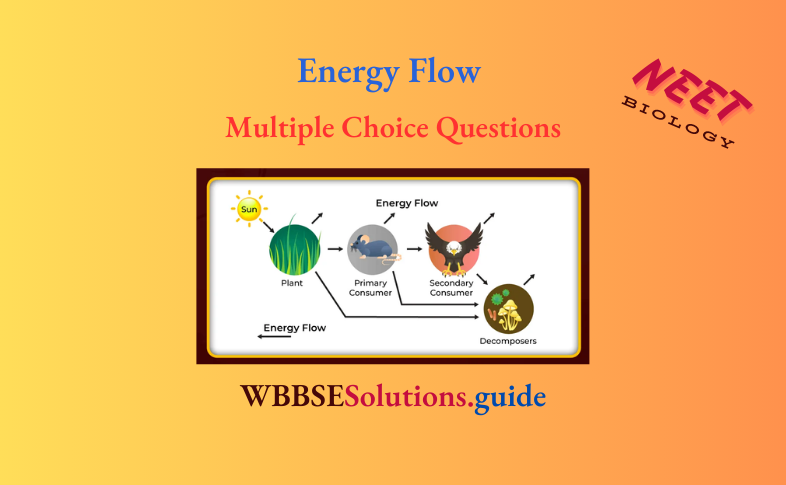
NEET Biology Energy Flow Multiple Choice Question And Answers

NEET Biology Energy Flow MCQs with Answers

Question 5. Energy enters in any ecosystem through

  1. Herbivores
  2. Carnivores
  3. Producers
  4. Decomposers

Answer: 3. Producers

The ultimate source of energy for the biosphere is solar energy, which is captured by producers through photosynthesis and stored in organic compounds. The stored energy in the form of food is transferred from producers to herbivores and then carnivores. So, energy enters in any ecosystem through producers.

“questions for ecology “

Question 6. Assertion A light is the energy which is stored as chemical energy in the form of food during photosynthesis. Reason (R) Light influences various activities of the organism like photoperiodism, etc.

  1. Both A and R are true and R is the correct explanation of A
  2. Both A and R are true, but R is not the correct explanation of A
  3. A is true, but R is false
  4. Both A and R are false

Answer: 2. Both A and R are true, but R is not the correct explanation of A

Both A and R are true, but R is not the correct explanation of A. Light energy is stored in plants in the form of chemical energy during photosynthesis, i.e. in the form of glucose and ATP. Light also influences various other activities like photoperiodism, etc.

Question 7. Of the total incident solar radiation, the proportion of it reaching the ground is 

  1. About 70%
  2. About 60%
  3. Less Than 50%
  4. More than 80%

Answer: 3. Less Than 50%

The source of energy in all ecosystem is solar energy. Less than 50% of the solar energy incident over earth is present in PAR (Photosynthetically Active Radiation). About 1-5% of incident solar radiation or 2-10% of PAR is captured for the photosynthetic organisms for the synthesis of organic matter (gross primary productivity).

Biology MCQ For NEET With Answers

NEET Biology Energy Flow Multiple Choice Question And Answers

Important MCQs on Energy Flow for NEET

Question 8. PAR stands for

  1. Photosynthesis Active Respiration
  2. Photosynthesis Absorb Radiation
  3. Photosynthetically Active Radiation
  4. Photosynthetically Active Reaction

Answer: 3. Photosynthetically Active Radiation

The source of energy in all ecosystem is solar energy. Less than 50% of the solar energy incident over earth is present in PAR (Photosynthetically Active Radiation). About 1-5% of incident
solar radiation or 2-10% of PAR is captured for the photosynthetic organisms for the synthesis of organic matter (gross primary productivity).

“ecosystems questions and answers “

Question 9. The percentage of PAR that is captured by plants in synthesis of organic matter is

  1. 50-80%
  2. 10-20%
  3. 70-100%
  4. 2-10%

Answer: 4. 2-10%

Plants capture only 2-10% of the PAR and this small amount of energy sustains the entire living world.

Question 10. Energy transfers or transformations are never 100% efficient. This is due to 

  1. Entropy
  2. Homeostasis
  3. Catabolism
  4. Anabolism

Answer: 1. Entropy

Entropy is the measure of system’s disorder, i.e. higher the entropy, the greater the disorder. In other words, it is the measure of the unavailability of a system’s energy to do work, so increase in entropy is accompanied by decrease in energy availability. Thus, energy transfer is never 100% efficient, as it is lost in different processes such as respiration, dissipation, maintain body temperature, etc.

Question 11. A biological model depicting the flow of energy from one trophic level to another.

  1. Energy link
  2. Food chain
  3. Phytoplankton cycle
  4. Photosynthesis

Answer: 2. Food chain

A biological model depicting the flow of energy from one trophic level to another is food chain.

Biology MCQ For NEET With Answers

Question 12. The direction of flow of energy in an ecosystem is

  1. Unidirectional
  2. Bidirectional
  3. Multidirectional
  4. All of the above

Answer: 1. Unidirectional

In an ecosystem, there is a constant unidirectional flow or transfer of energy from sunlight through plants and plant eating animals to flesh eating animals in the form of food.

Question 13. Flow of energy declines from lower to higher trophic level in an ecosystem. This is mainly explained by

  1. First Law Of Thermodynamics
  2. Second law of thermodynamics
  3. Both 1 and 2
  4. None of the above

Answer: 2. Second law of thermodynamics

According to second law of thermodynamics, ‘the transformation and transfer of energy do not occur spontaneously but involve degradation and loss in the form of heat’. So, flow of energy declines from lower to higher trophic level in an ecosystem.

“questions about ecosystem with answers “

Question 14. When food energy passes from herbivores to carnivores

  1. Some Energy Is Increased
  2. Some Energy Is Decreased
  3. Remain Unchanged
  4. Not relevant

Answer: 2. Some Energy Is Decreased

The actual percentage of energy that is transferred from one level to the next level is approximately 10%. About 90% of the energy is lost. Thus, we can say that when food energy passes from herbivores to carnivores, some energy is decreased.

Read And Learn More: NEET Biology Multiple Choice Question And Answers

Question 15. Which of the following processes does not affect the nutrient flow in an ecosystem?

  1. Migration
  2. Parasitism
  3. Predation
  4. Production

Answer: 1. Migration

Migration is the mass directional movements of large number of a species from one location to another. This process does not relate to the flow of nutrients in an ecosystem.

Question 16. Ecosystem is 

  1. Always Open
  2. Always Closed
  3. Both Open And Closed Depending Upon Community
  4. Both open and closed depending upon biomass

Answer: 1. Always Open

Ecosystem is an open system. It receives input in the form of solar energy and matter. It results in productivity or synthesis of organic food. Food with its contained energy passes through various components of ecosystem.

Energy Flow in an Ecosystem MCQs for NEET

Question 17. The transfer of energy from one trophic level to another is governed by the second law of thermodynamics. The average efficiency of energy transfer from herbivores to carnivores is

  1. 5%
  2. 10%
  3. 25%
  4. 50%

Answer: 2. 10%

According to the 10% law, at each trophic level, only 10% of the energy is transferred to the next trophic level. So, the average efficiency of energy transfer from herbivores to carnivores is 10%.

Biology MCQs with answers for NEET

Question 18. 10% law of flow of energy in ecosystem was proposed by

  1. Lindemann
  2. Carl Mobius
  3. Tansley
  4. Darwin

Answer: 1. Lindemann

Lindemann proposed the 10% law of flow of energy in an ecosystem. According to this law, only 10% energy is passed from one trophic level to other in a food chain.

“anthropogenic ecosystem “

Question 19. Only a small amount of the energy stored in food is available to the organism in the next trophic level. This is because

  1. There Are Lesser Consumers Than Producers In A Food Chain
  2. There Are Fewer Top Consumers Than Producers In A Food Chain
  3. Of Competition For Food Between Primary And Secondary Consumers
  4. Most of the energy is used for life processes

Answer: 4. Most of the energy is used for life processes

Only 10% of the herbivore productivity is utilised for raising productivity of primary carnivores. The rest is consumed in life processes, i.e. ingestion, respiration, maintenance of body heat and other activities.

Question 20. What per cent of incident sun radiation is utilised by plants?

  1. 0.01
  2. 0.001
  3. 10
  4. 20

Answer: 1. 0.01

Plant can utilise 1% (0.01) of total incident radiation. Sugarcane is the most efficient crop which utilises the 5% of total incident radiation and convert into photosynthetic product.

Biology MCQs with answers for NEET

Question 21. The direction of energy flow is UP CPMT

  1. Producer → Carnivore → Herbivore → Decomposer
  2. Producer → Herbivore → Decomposer → Omnivore
  3. Producer → Herbivore → Carnivore → Decomposer
  4. Producer → Carnivore → Herbivore → Decomposer

Answer: 3. Producer → Herbivore → Carnivore → Decomposer

In an ecosystem, the direction of flow of energy is unidirectional. Producers (Green plants) → Herbivore → Carnivore → Decomposer

Question 22. The correct sequence of components through which energy may pass from initial source through an ecosystem is

  1. Sun → Autotrophs → Heterotrophs → Environment → Space
  2. Space → Environment → Heterotrophs → Autotrophs → Sun
  3. Sun → Space → Environment → Heterotrophs → Autotrophs
  4. Sun → Space → Environment → Autotrophs → Heterotrophs

Answer: 4. Sun → Space → Environment → Autotrophs → Heterotrophs

The correct sequence of components through which energy may pass from initial source through an ecosystem is Sun → Space → Environment → Autotrophs → Heterotrophs

Question 23. On an average, the proportion of assimilated energy consumed by herbivorous in respiration is

  1. 10%
  2. 20%
  3. 30%
  4. 60%

Answer: 4. 30%

With increasing trophic levels, the respiration cost also increases sharply. On an average, producers consume about 20% of their gross productivity in respiration. The herbivores consume about 30% of assimilated energy in respiration.

“ecological pyramid of grassland ecosystem “

Question 24. If an ecosystem is composed of only three trophic levels, then how much energy will be conserved at the IIIrd trophic level?

  1. 30%
  2. 20%
  3. 10%
  4. 0.1%

Answer: 4. 0.1%

In an ecosystem, if we start from 100% energy being captured from sun, the producers (I st trophic level) receives its 10%, first consumer will receive only 1% and second consumer (III rd trophic level) will have only 0.1% energy.

Biology MCQs with answers for NEET

Question 25. Suppose 10,000 J of solar energy is incident on green vegetation. On the basis of 10% law of Lindemann, identify the amount of energy transferred to deer and then to tiger.
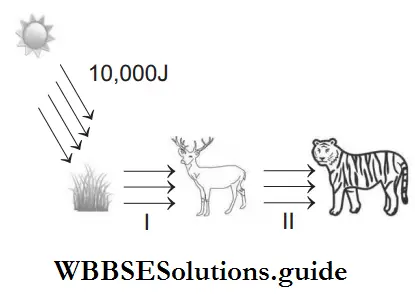
Energy Flow Lindemann

  1. 1-10 J, 2-1 J,
  2. 1-100 J, 2-10 J
  3. 1-10 J, 2-0.1 J
  4. 1- 0.1 J, 2-0.01 J

Answer: 1. 1-10 J, 2-1 J,

Only about 10% is stored at higher trophic level and the remaining 90% is lost in respiration, decomposition and waste in the form of heat. Since, 10,000 J of solar energy is incident on green vegetation, the latter having about 1% efficiency, trap about 100 J of energy and convert it into chemical energy by photosynthesis. The remaining 9980 J would be lost in the environment. The herbivore that feed on producers get 10% of the energy stored in plants, i.e. 10 J.

The remaining 90 J is lost to the environment. Carnivores feeding on herbivores would be able to store only 1 J of energy.

Topic-wise Energy Flow MCQs for NEET with Explanation

Question 26. If 20 J of energy is trapped at producer level, then how much energy will be available to peacock as food in the following chain? Plant → Mice → Snake → Peacock

  1. 0.02 J
  2. 0.002 J
  3. 0.2 J
  4. 0.0002 J

Answer: 1. 0.02 J

This is based on Lindemann’s 10% law. So, if plants trap 20 J energy then, Plant → Mice → Snake → Peacock 20 J 2 J 0.2 J 0.02 J So, energy available for peacock is 0.02 J.

Question 27. In an ecosystem, there is flow of energy at different trophic levels. This is as follows 

  1. Primary consumers–Secondary consumers–Decomposers–Producers
  2. Producers–Primary consumers– Secondary consumers–Tertiary consumers–Decomposers
  3. Producers–Decomposers–Primary consumers–Tertiary consumers– Secondary consumers
  4. Producers–Primary consumers– Tertiary consumers–Secondary consumers–Decomposers

Answer: 2. Producers–Primary consumers– Secondary consumers–Tertiary consumers–Decomposers

The feeding level from producers to consumers is called trophic level. The energy flows unidirectionally through various trophic levels, i.e. Producers → Primary consumers → Secondary consumers → Tertiary consumers →Decomposers

NEET Biology Mcq Chapter Wise

Question 28. Plants are

  1. Autotrophs
  2. Primary Producers
  3. Both 1 And 2
  4. Heterotrophs

Answer: 3. Both 1 And 2

In a food chain, a plant is primary producer. Producers are autotrophic organisms, which alone are able to manufacture organic food from inorganic raw materials in the process of photosynthesis.

Question 29. Biological equilibrium is equilibrium among the

  1. Producers
  2. Primary Consumers
  3. Decomposers And Producers
  4. Producers, consumers and decomposers

Answer: 4. Producers, consumers and decomposers

Biological equilibrium is equilibrium amongst the producers, consumers and decomposers. All these make a stable ecosystem by a dynamic balance.

Question 30. In a biotic community, the primary consumers are 

  1. Carnivores
  2. Omnivores
  3. Detritivores
  4. Herbivores

Answer: 4. Herbivores

Consumers are organisms that feed on their previous trophic level.

Thus in a biotic community, primary consumers are herbivores, i.e. rabbit, etc.

Question 31. All the animals that depend on plants for food are called

  1. Decomposers
  2. Root Feeders
  3. Consumers
  4. Omnivores

Answer: 3. Consumers

Primary consumers are those who consume producers (i.e. green plants) so they are called herbivores and the animals or consumer who consumes the herbivores or primary consumers are called the secondary or tertiary consumers. Thus, all the animals that depend on plants for food are called consumers.

Question 32. What is true of ecosystem?

  1. Primary consumers are least dependent upon producers
  2. Primary consumers are out number producers
  3. Producers are more than primary consumers
  4. Secondary consumers are the largest and most powerful

Answer: 3. Producers are more than primary consumers

The organisms in an ecosystem are classified into three main categories, i.e. producers, consumers and decomposers. The consumers utilise materials and energy stored by the producers.

In a true ecosystem, producers are more than primary consumers (herbivores and carnivores).

NEET Biology Mcq Chapter Wise

Question 33. Grasshopper is

  1. Primary Consumer
  2. Secondary Consumer
  3. Decomposer
  4. Primary decomposer

Answer: 3. Decomposer

A plant is a producer and the grasshopper is the primary consumer, which feeds on plant.

Question 34. These belong to the category of primary consumers.

  1. Insects and cattle
  2. Eagle and snakes
  3. Water insects
  4. Snakes and frogs

Answer: 1. Insects and cattle

Insects and cattle belong to primary consumers in their respective food chains as they are herbivores.

Question 35. Assertion Bacteria and fungi are microconsumers. Reason (R) Bacteria and fungi consume only a little part of living plants and animals.

  1. Both A and R are true and R is the correct explanation of A
  2. Both A and R are true, but R is not the correct explanation of A
  3. A is true, but R is false
  4. Both A and R are false

Answer: 3. A is true, but R is false

A is true, but R is false. Microconsumers are microscopic organisms such as bacteria and fungi. These microorganisms breakdown the complex organic compounds of dead bodies of both plants and animals and absorb some of the decomposed products, while release most of inorganic compounds into the environment. From there, these are used by the plants. These are biotic components of an ecosystem.

NEET Biology Mcq Chapter Wise

Question 36. In a forest ecosystem, fungi is

  1. Secondary Consumer
  2. Tertiary Consumer
  3. Decomposers
  4. Primary producers

Answer: 3. Decomposers

Decomposers in any ecosystem or food chain are fungi, bacteria and saprophytic organisms.

Question 37. Assertion Herbivores are also called as first order consumers. Reason (R) They obtain their food directly from plants.

  1. Both A and R are true and R is the correct explanation of A
  2. Both A and R are true, but R is not the correct explanation of A
  3. A is true, but R is false
  4. Both A and R are false

Answer: 1. Both A and R are true and R is the correct explanation of A

Both A and R are true and R is the correct explanation of A. Consumers of first order includes the herbivores which directly feed upon green plants (producers).

Question 38. Whale is

  1. Primary Producer
  2. Carnivorous Tertiary Consumer
  3. A Decomposer
  4. Herbivorous

Answer: 2. Carnivorous Tertiary Consumer

Carnivores that consume other carnivores are called tertiary consumers. Killer whales or orcas are a classic example of tertiary consumers. Killer whales hunt seals and sea lions.

NEET Biology 10% Law and Lindeman’s Law MCQs

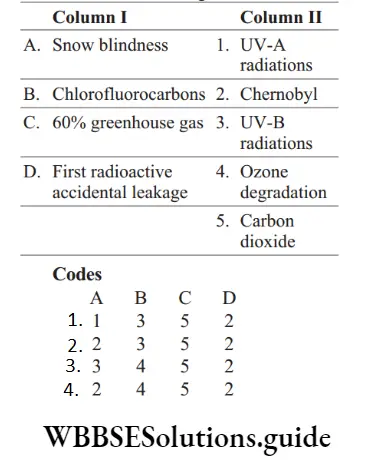
Question 39. Match Column I with Column II
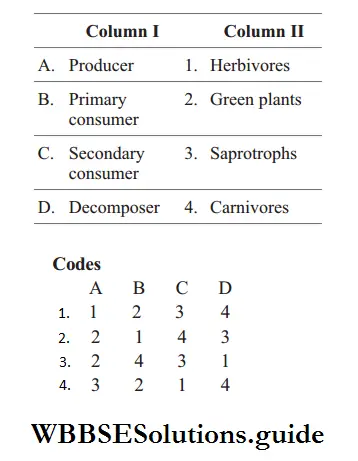
Energy Flow Match the following columns

Answer: 2. 2 1 4 3

Question 40. A rat feeding upon potato tuber is 

  1. Decomposer
  2. Producer
  3. Primary Consumer
  4. Carnivore

Answer: 3. Primary Consumer

Primary consumers include all the organisms that utilise plant products. The animals that eat plants as food are called primary consumers or herbivores, e.g. a rat feeding upon potato tuber.

Question 41. The frog that feeds on an insect is a 

  1. Primary Consumer
  2. Secondary Consumer
  3. Tertiary Consumer
  4. Decomposer

Answer: 2. Secondary Consumer

Primary consumer (insect) directly depends on the producer(plant) for food source. Secondary consumers (frog) include different organisms that feed on primary consumers (primary carnivore). Thus, the frog that feeds on an insect is a second consumer.

Question 42. Carnivores are

  1. Usually Primary Consumers
  2. Usually Secondary Consumers
  3. Usually Secondary Or Tertiary Consumers
  4. Usually Decomposers Rather Than Consumers

Answer: 3. Usually Secondary Or Tertiary Consumers

Carnivores are usually secondary or tertiary consumers as they feed on smaller animals.

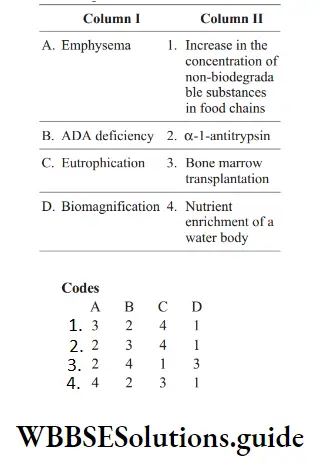
Question 43. Match the following columns
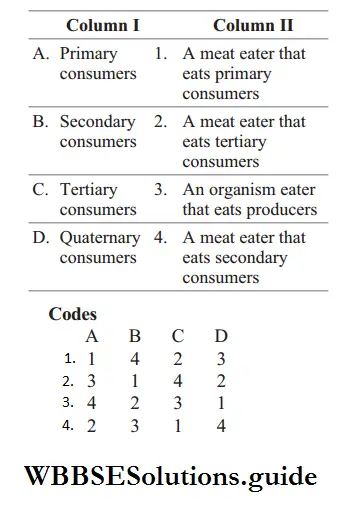
Energy Flow Match the following columns 1

Answer: 2. 3 1 4 2

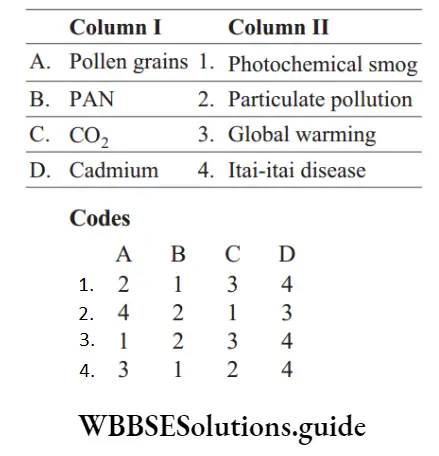
Question 44. Match the following columns.
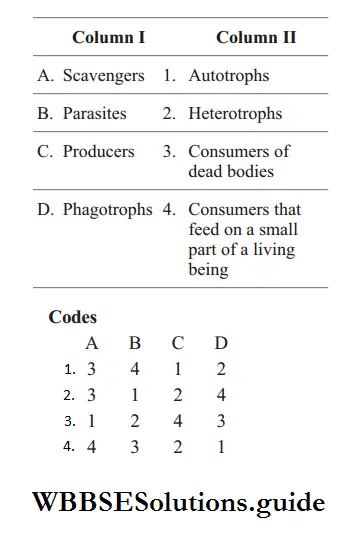
Energy Flow Match the following columns 2

Answer: 1. 3 4 1 2

Question 45. Which of the following exist in maximum number in terms of genera and species?

  1. Herbivore mammals
  2. Carnivore mammals
  3. Aquatic mammals
  4. Terrestrial mammals

Answer: 4. Terrestrial mammals

Terrestrial animals are animals that live predominantly or entirely on land. They have the maximum number in terms of genera and species as they also include most of the herbivores like cows and carnivores animals like lion and even omnivorous like rats as well. Thus, they exist in maximum number in terms of genera and species.

Question 46. The primary producers of the deep sea hydrothermal vent ecosystem

  1. Green Algae
  2. Chemosynthetic Bacteria
  3. Blue-Green Algae
  4. Coral reefs

Answer: 2. Chemosynthetic Bacteria

In deep hydrothermal vents, chemosynthetic bacteria are present as there is no light energy available there.

Question 47. Consider the following statements.

  1. The excess of organic matter is stored by green plants for the utilisation by the herbivores.
  2. Work energy put by man in agriculture is used in the ecosystem.

Choose the correct option.

  1. Statement 1 is correct, but 2 is incorrect
  2. Statement 1 is incorrect, but 2 is correct
  3. Both statements 1 and 2 are correct
  4. Both statements 1 and 2 are incorrect

Answer: 3. Both statements 1 and 2 are correct

Question 48. Consider the following statements.

  1. Tertiary consumers are green plants.
  2. Microconsumers breakdown the dead protoplasm into simpler ones. They are last in the sequence of a food chain.

Choose the correct option.

  1. Statement 1 is correct, but 2 is incorrect
  2. Statement 1 is incorrect, but 2 is correct
  3. Both statements 1 and 2 are correct
  4. Both statements 1 and 2 are incorrect

Answer: 1. Statement I is correct, but II is incorrect

Statement 1 is correct, but 2 is incorrect. Incorrect statement can be corrected as: Microconsumers breakdown dead protoplasm into simpler ones. They are first in the sequence of detritus food chain.

Question 49. If the primary producers are absent from any ecosystem which of the following will occur?

  1. Herbivores will not survive
  2. Carnivores will not survive
  3. Both will be disintegrated because of food absence
  4. No change will take place

Answer: 3. Both will be disintegrated because of food absence

In any ecosystem, if all primary producers are absent or removed, there will be reduction in primary productivity and biomass of producers.

No biomass will be available for transfer to next higher trophic levels, i.e. both will be disintegrated because of food absence.

Question 50. Fill up the blanks.

  1. Other name for herbivores…A… .
  2. Large …B… feed on secondary consumers.
  3. Secondary consumers are the source of nutrition for …C… .
  4. …D…is a network of many food chains.

Choose the correct option.

  1. A-secondary consumers, B-top predator, C-quaternary, D-Food web
  2. A-primary consumer, B-predators, C-tertiary consumer, D-Food web
  3. A-tertiary consumers, B-natural enemies, C-primary consumer, D-Food web
  4. A-quaternary consumers, B-alligator, C-top consumer, D-Food web

Answer: 2. A-primary consumer, B-predators, C-tertiary consumer, D-Food web

Question 51. Microconsumers are

  1. Primary Consumers
  2. Secondary Consumers
  3. Tertiary Consumers
  4. Decomposers

Answer: 4. Decomposers

Decomposers are also called microconsumers such as bacteria and fungi. They breakdown the complex organic substances of dead plants and animals to release most of inorganic substances back into the environment for their reuse by the producers.

Question 52. We refer to the following as the food chain.

  1. Large number of animals near a source of food
  2. Transfer of food energy from the green plants through a series of consumer organisms
  3. Large number of human beings forming a human chain near a source of food
  4. None of the above

Answer: 2. Transfer of food energy from the green plants through a series of consumer organisms

Transfer of food energy from the green plants through a series of consumer organisms is referred to as food chain.

Question 53. First link in any food chain is a green plant because

  1. Green Plants Can Synthesise Food
  2. They Can Eat Everything
  3. Fixed at one place
  4. None of the above

Answer: 1. Green Plants Can Synthesise Food

Green plants are called producers because they can synthesise food material in the presence of light (autotrophs). Thus, they form a first link in any food chain.

Question 54. Food chain consists of

  1. Plants
  2. Herbivores
  3. Carnivores
  4. All of these

Answer: 4. All of these

The food chain consists of producers, consumers and decomposers. Producers are plants. First order (Primary consumers) – Herbivores Third order (Tertiary consumers) – Secondary carnivores
Fourth order (Quaternary consumers) – Top carnivores.

Question 55. Food chain starts with

  1. N2-fixation
  2. Germination
  3. Respiration
  4. Photosynthesis

Answer: 4. Photosynthesis

Food chain starts with photosynthesis. The green plants always occupy first level in any given food chain and are commonly termed as the primary producers.

Question 56. Which of the following is the most diverse in a food chain?

  1. Herbivores
  2. Producers
  3. Omnivores
  4. Decomposers

Answer: 2. Producers

Producers are the most diverse in food chains. They are the direct and indirect source of food for all the trophic levels. They are always more in number and form largest population in a food chain.

Question 57. Consider the following statements.

  1. In a food chain, one organism holds only one position.
  2. In a food chain, the flow of energy can be easily calculated.
  3. In food chain, competition is limited to the members of same trophic level.

Which of the statements given above are correct?

  1. 1, 2 and 3
  2. 1 and 2
  3. 1 and 3
  4. 2 and 3

Answer: 1. 1, 2 and 3

All given statements are correct. The transfer of energy from producers to top consumers through a series of organisms is called food chain. One organism holds only one position. The flow of energy can be easily calculated. It is always straight and proceeds in a progressive straight line. Competition is limited to the members of same trophic level.

Question 58. Given below are statements about food chain.

  1. The transfer of energy from producers to top consumers through a series of organisms is called food chain.
  2. A food chain is always straight and proceeds in a progressive straight line.
  3. In a food chain, there is unidirectional flow of energy from sun to producers and subsequently to series of different types of consumers.

Which of the statements given above are correct?

  1. Only 2
  2. Only 3
  3. 1 and 3
  4. 1, 2 and 3

Answer: 4. 1, 2 and 3

All given statements are correct. A food chain is a sequence of populations or organisms of an ecosystem through which the food and its contained energy passes with each member becoming the food of later member of sequence. It is a single straight pathway through which food energy travels in the ecosystem. Energy flow in an ecosystem is always unidirectional or one way, i.e. Solar radiation → Producers → Herbivores → Carnivores. It cannot pass in the reverse direction.

Question 59. Which food chain correctly describes the flow of energy in an ecosystem?

  1. Grass → Cow → Human
  2. Caterpillar → Leaf→ Human
  3. Cow → Grass → Human
  4. Rat → Bird → Buffalo

Answer: 1. Grass → Cow → Human

Food chain in option correctly describes the flow of energy in an ecosystem as Producers (Grass) → Herbivores (Cow) → Carnivores (Human)

Question 60. Which one of the following is the food chain operating in ponds, lakes or sea?

  1. Grass → Insects → Frog → Birds
  2. Algae → Small animals → Fish → Big fish
  3. Grass → Dear → Lion
  4. None of the above

Answer: 2. Algae → Small animals → Fish → Big fish

In ponds, lakes or sea, the operating food chain is Algae → Small animals→ Fish → Big fish

Question 61. The correct sequence of food chain is

  1. Grass → Insect → Birds → Snake
  2. Grass → Wolf→ Dear → Buffalo
  3. Grass → Snake → Insect → Deer
  4. Bacteria → Grass → Rabbit → Wolf

Answer: 1. Grass → Insect → Birds → Snake

The first trophic level in a food chain comprises of producers, i.e. green plants. Second trophic level is occupied by organisms which feed on producers (called herbivores). Third trophic level is occupied by organisms which feed on herbivores (called carnivores). Considering all these points in composing food chain, option represents the correct sequence of food chain, i.e.
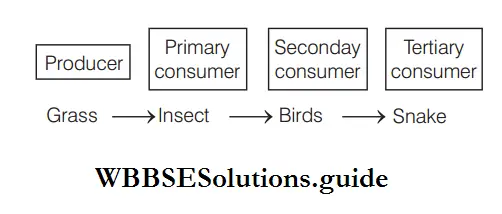
Energy Flow Primary and secondary and tertiary consumer

Question 62. Which one of the following is a correct food chain?

  1. Grasshopper → Grass → Snake → Frog → Eagle
  2. Grass → Grasshopper → Frog → Snake → Eagle
  3. Eagle → Snake → Grasshopper → Grass → Frog
  4. Frog → Snake → Eagle → Grasshopper → Grass

Answer: 2. Grass → Grasshopper → Frog → Snake → Eagle

Option is a correct food chain as Grass → Grasshopper → Frog → Snake → Eagle

Question 63. Select the incorrect food chain.

  1. Grass → Caterpillar → Butterfly → Deer → Lion
  2. Grass → Grasshopper → Frog → Snake → Eagle
  3. Grass → Deer → Lion
  4. Phytoplankton → Zooplankton → Fish (perch) → Fish (bass) → Man

Answer: 1. Grass → Caterpillar → Butterfly → Deer → Lion

Option represents incorrect food chain because butterfly do not feed upon caterpillar, neither deer eat butterfly. Rest options represents correct food chains.

Question 64. Which of these is correct sequence for food chain?

  1. Insect → Fish → Zooplankton → Phytoplankton
  2. Phytoplankton → Zooplankton → Insect → Fish
  3. Fish → Insect → Zooplankton → Phytoplankton
  4. Zooplankton → Phytoplankton → Insect → Fish

Answer: 2. Phytoplankton → Zooplankton → Insect → Fish

Option is correct sequence for food chain. Phytoplanktons → Zooplanktons → Insect → Fish

Question 65. Identify the order in which the following organisms occur in a food chain. The organisms are Gerbil, Grass, Kite

  1. Kite → Grass → Gerbil
  2. Grass → Kite → Gerbil
  3. Gerbil → Grass → Kite
  4. Grass → Gerbil → Kite

Answer: 4. Grass → Gerbil → Kite

Option is the correct order in which the following organisms occur in a food chains as Producers (Grass) → Herbivores (Gerbil) → Carnivores (Hawk or Kite)

Question 66. Identify the possible link ‘A’ in the following food chain Plant → Insect → Frog → ‘A’→ Eagle 

  1. Rabbit
  2. Wolf
  3. Cobra
  4. Parrot

Answer: 3. Cobra

Cobra is ‘A’ because frog is eaten by cobra and inturn, it is eaten by eagle.

Question 67. In grazing food chain, primary source of energy comes from

  1. Organic Remain
  2. Sun
  3. Water
  4. All of the above

Answer: 2. Sun

Sun is the primary source of energy in grazing food chain.

Question 68. This type of food chain begins with producers at the bottom most trophic level.

  1. Detritus food chain
  2. Grazing food chain
  3. Complex food chain
  4. All of the above

Answer: 2. Grazing food chain

Grazing Food Chain (GFC) is the most common food chain. In grazing food chain (e.g. grassland ecosystem), green plants (producers) constitute the bottom or first trophic level.

Question 69. In a grazing food chain, carnivores may also be referred to as

  1. Primary Producers
  2. Secondary Producers
  3. Primary Consumers
  4. Secondary Consumers
  5. Decomposers

Answer: 4. Secondary Consumers

The consumers that feed on herbivores are called carnivores. These carnivores are primary carnivores (secondary consumers). Those animals that depend on primary carnivores for food are called as secondary carnivores or tertiary consumers.

Primary and Secondary Productivity MCQs for NEET

Question 70. The food chain in which microorganisms breakdown the energy rich compounds is called

  1. Ecosystem Aiims 1999
  2. Detritus Food Chain
  3. Parasitic Food Chain
  4. Predator food chain

Answer: 2. Detritus Food Chain

Detritus food chain starts from dead organic matter and goes to detritus feeding organisms and on their predators. Such ecosystems are thus, less dependent on direct solar energy. These depend chiefly on the influx of organic matter produced in another system. So, the food chain in which microorganisms breakdown the energy rich compounds is called detritus food chain.

Question 71. Which of the following food chain may not be directly dependent upon solar energy?

  1. Grazing
  2. Detritus
  3. Soaking
  4. Depleting

Answer: 2. Detritus

Detritus food chain starts from dead organic matter and goes to detritus feeding organisms and on their predators. Such ecosystems are thus, less dependent on direct solar energy. These depend chiefly on the influx of organic matter produced in another system. So, the food chain in which microorganisms breakdown the energy rich compounds is called detritus food chain.

Question 72. The detritus food chain begins with

  1. Primary Producers J&K Cet
  2. Primary Consumers
  3. Secondary Consumers
  4. Dead organic matter

Answer: 4. Dead organic matter

The dead organic matter of plant or animal is called detritus. While a part of it remains on the soil surface as litter, the other part enters the soil. Many animals such as protozoans, nematodes, insects, etc., depend on detritus and hence, they are called as detritivores. From detritus, the chain proceeds to detritivores, then to carnivores and finally to top carnivores.

Question 73. Detritus food chain obtains energy from

  1. Organic Remains
  2. Air
  3. Radiation
  4. None of the above

Answer: 1. Organic Remains

In detritus food chain, primary source of energy is dead organic remains of plants and animals.

Question 74. Identify the food chain. Dead animal → Blow fly → Maggots → Common frog → Snake

  1. Grazing food chain
  2. Detritus food chain
  3. Decomposer food chain
  4. Predator food chain

Answer: 2. Detritus food chain

Detritus food chain begins from dead organic matter like dead remains of plants and animals.

Question 75. Which one of the following shows detritus food chain?

  1. Fallen leaves → Bacteria → Bivalve → Molluscs
  2. Small fish → Large fish → Crocodile
  3. Grass → Grasshopper → Frog
  4. None of the above

Answer: 1. Fallen leaves → Bacteria → Bivalve → Molluscs

The detritus food chains depend upon the dead organic matter either in the form of fallen leaves, etc., or dead animal bodies. Hence, the correct detritus food chain is Fallen leaves → Bacteria → Bivalve → Molluscs.

Question 76. In a food chain of grassland ecosystem, the top consumers are

  1. Carnivores
  2. Herbivores
  3. Either Carnivores Or Herbivores
  4. Bacteria

Answer: 1. Carnivores

Because carnivorous are not eaten by others, they are the top consumers.

Question 77. The organisms, which attack dead animals are

  1. First Link Of The Food Chain And Are Known As Primary Producers
  2. Second Link The Food Chain And Are Herbivorous
  3. Third Link Of The Food Chain And Are Tertiary Consumers
  4. Present at the end of food chain and are detritivores

Answer: 4. Present at the end of food chain and are detritivores

The organisms, which attack dead animals are present at the end of food chain and known as decomposers (detritivores). Decomposers are heterotrophic organisms, mostly bacteria and fungi, which feed on dead organic matter or detritus.

Question 78. In food chain, lion is a

  1. Primary Consumer
  2. Tertiary Consumer
  3. Secondary consumer
  4. Both 1 and 2

Answer: 4. Both 1 and 2

In a food chain, lion can be a secondary or tertiary consumer.

Question 79. During food chain, maximum energy is stored in Punjab, Manipal

  1. Producer
  2. Primary Consumer
  3. Decomposer
  4. Secondary consumer

Answer: 1. Producer

Producers constitute the first trophic level or base of a food chain. Maximum energy content is present in producers. They obtain the energy from solar radiations.

Question 80. With regard to ecological food chain, man is a

  1. Producer
  2. Consumer
  3. Both 1 and 2
  4. Producer and decomposer

Answer: 2. Consumer

Man is a consumer because man cannot produce the food himself and he depends on plants (producers) for food.

Question 81. Cow in a food chain represents

  1. Primary Consumer
  2. Heterotroph
  3. Herbivore
  4. All of the above

Answer: 4. All of the above

A primary consumer or herbivore or heterotroph are animals which feed on plants or plant products, e.g. grasshoppers and several other insects, rabbit, hare, field mouse, deer, antelope, cow, elephant, zooplankton, tadpoles and some fishes.

Question 82. Nepenthes is a

  1. Primary Producer
  2. Consumer
  3. Both 1 and 2
  4. None of the above

Answer: 3. Both 1 and 2

Nepenthes is a chlorophyll containing plant, so it synthesises food by the process of photosynthesis and acts as a primary producer. Because of being an insectivorous plant, it consumes insects like grasshopper and other small insects, so, it is also a consumer.

Question 83. The planktonic forms are

  1. Autotrophs
  2. Heterotrophs
  3. Chemotrophs
  4. Insectivorous types

Answer: 1. Autotrophs

Planktons are drifting organisms that inhabit the water column of ocean, seas and bodies of freshwater and also shore. So they are autotrophs. Maximum contribution of oxygen is from phytoplankton.

Question 84. Zooplanktons are

  1. Primary Consumers
  2. Secondary Consumers
  3. Tertiary Consumers
  4. Quaternary consumers

Answer: 1. Primary Consumers

Zooplanktons are the microscopic organisms which exist as drifting organisms suspended in the oceans. These include protozoans, foraminiferans, dinoflagellates, etc. They feed upon phytoplanktons, thus they are primary consumers.

Question 85. The statement, ‘tiger is the apex of the food chain’, indicates 

  1. Tiger Is Carnivore
  2. Tiger Has Many Enemies
  3. Tiger Has Maximum Biomass
  4. Tiger is dependent upon large number of herbivores and even large number of trees

Answer: 1. Tiger Is Carnivore

Tiger is dependent upon large number of herbivores and even more number of trees in forest. Thus, the given statement indicates tiger is carnivore.

Question 86. In the food chain, the saprophytic organisms are

  1. Producers
  2. Consumers
  3. Predators
  4. Decomposers

Answer: 4. Decomposers

A saprophyte or saprotroph is an organism which gets its energy from dead and decaying organic matter, i.e. decomposers.

Question 87. An organism contains carbon molecules which have passed through three levels of ecosystem. The organism.

  1. Primary Consumer
  2. Tertiary Consumer
  3. Predator
  4. Producer

Answer: 2. Tertiary Consumer

An ecosystem consists of biotic components like producers, primary consumers, secondary consumers (carnivores) and tertiary consumers and shows energy flow through these levels. Thus, carbon molecules in the form of food reach the level of tertiary consumer through three levels of ecosystem.

Question 88. If phytoplanktons are destroyed in the sea, then

  1. Algae Will Get More Space To Grow
  2. Primary Consumers Will Grow Luxuriantly
  3. It Will Affect The Food Chain
  4. No effect will be seen

Answer: 3. It Will Affect The Food Chain

Phytoplanktons are the main producers in the sea. The entire food chain depends upon production of food by the phytoplanktons. Thus, if phytoplanktons are destroyed in the sea, then it will affect the food chain adversely.

Question 89. When man eats fish which feeds on zooplanktons which have eaten small plants, the producer in the chain.

  1. Zooplanktons
  2. Small Plants
  3. Fish
  4. Man

Answer: 2. Small Plants

Small plants are producers in the food chain, these can prepare their food by the process of photosynthesis. Whereas, zooplanktons, fish and man are primary, secondary and tertiary consumers, respectively

Question 90. In grass-deer-tiger food chain, grass biomass is one tonne. The tiger biomass shall.

  1. 100 kg
  2. 10 kg
  3. 200 kg
  4. 1 kg

Answer: 2. 10 kg

Only 10% of the mass is transferred from one trophic level to another in the form of energy. Thus in given food chain, the biomass of tiger shall be 10 kg.

Question 91. A lion eats a zebra that feeds on grass. The lion here is a

  1. Primary Producer
  2. Primary Consumer
  3. Secondary Consumer
  4. Quaternary Consumer

Answer: 3. Secondary Consumer

Producers (Grass) → Primary consumers (Zebra) → Secondary consumers (Lion)

Question 92. In an ecosystem, insectivorous plants are considered as

  1. Herbivorous
  2. Primary Producers
  3. Predators
  4. Both 1 and 2

Answer: 2. Primary Producers

Insectivorous plants are autotrophs (primary producers) as they have chlorophyll. They do not eat insects for food, but use them as a source of nitrogen and phosphorus and use light to transform them into biomolecules.

Question 93. When frog eats grasshopper which thrives on green plants, the frog is

  1. Primary Producer
  2. Herbivore
  3. Primary Carnivore
  4. Top consumer

Answer: 3. Primary Carnivore

Primary consumer directly depends on the producer for food source. Secondary consumers include different organisms that feed on primary consumers (primary carnivore). Thus, when frog eats grasshopper (primary consumer) which thrives on green plants (producer), the frog is primary carnivore.

Question 94. If a big fish eats small fish which eats Hydra which in turn eats water fleas. Water fleas in turn eat phytoplaktons. In this chain, water fleas will be

  1. Producers
  2. Primary Consumers
  3. Secondary Consumers
  4. Top consumer

Answer: 2. Primary Consumers

In this food chain, water flea is primary consumers.

Question 95. In a food chain consisting of bear, algae, bugs and fish, the bear is a

  1. Tertiary Consumer
  2. Primary Consumer
  3. Secondary Consumer
  4. Primary producer

Answer: 1. Tertiary Consumer

Producers (Algae) → Primary consumers (Bugs) → Secondary consumers (Fish) → Tertiary consumers (Bear)

Question 96. Rabbits depend only on grass and other plants for survival. Hence, they are

  1. Decomposers
  2. Carnivores
  3. Producers
  4. Herbivores

Answer: 4. Herbivores

Herbivores (plant-eating animals) depend upon producers (plant) so, rabbits are herbivores.

Question 97. A wolf has just eaten a lamb. When tiger saw the wolf, it attacked and consumed it. The tiger in ecological terms is

  1. A Producer
  2. A Primary Consumer
  3. A Secondary Consumer
  4. A tertiary consumer

Answer: 4. A tertiary consumer

Grass(Producer) → Lamb (Primary consumer) → Wolf (Secondary consumer) → Tiger (Tertiary consumer)

Question 98. What will a man, who survives by feeding on both plants and animals and also consumes a primary consumer, be referred to as?

  1. Primary producer
  2. Primary consumer
  3. Secondary consumer
  4. Quaternary consumer

Answer: 3. Secondary consumer

Producers (Grain) → Primary consumers → Secondary consumers (Chicken). Thus, a man who survives by feeding on both plants and animals and also consumes a primary consumer, be referred to as secondary consumer.

Question 99. A purely vegetarian person acts as a

  1. Primary Producer
  2. Primary Consumer
  3. Secondary Consumer
  4. Tertiary consumer

Answer: 2. Primary Consumer

Primary consumers in an ecosystem are herbivores, which feed directly on producer (green plants). Thus, a purely vegetarian person acts as a primary consumer.

Question 100. Which one of the following is a primary consumer in maize field ecosystem?

  1. Lion
  2. Grasshopper
  3. Wolf
  4. Phytoplankton

Answer: 2. Grasshopper

In an ecosystem, producers (e.g. plants/ phytoplankton) belong to first trophic level, herbivores or primary consumer (e.g. grasshopper) to the second and carnivores or secondary consumer (e.g. lion, wolf) to the third trophic level.

Question 101. A snake feeding on a rat.

  1. Tertiary Consumer And Secondary Carnivore
  2. Primary Consumer And Herbivore
  3. Secondary Consumer And Primary Carnivore
  4. Primary consumer and secondary carnivore

Answer: 3. Secondary Consumer And Primary Carnivore

A primary consumer directly depends on the producer for food source. Secondary consumers include different organisms that feed on primary consumers. A snake eating a rat is an example of a secondary consumer (primary carnivore)

Question 102. Given flowchart represents grazing and detritus food chains. Grazing food chain : Grass → Rabbit → Lion Detritus food chain: Dead leaves → Woodlouse → Black bird The first trophic level of the grazing food chain and the detritus food chain respectively, are occupied by

  1. Grass And Dead Leaves
  2. Grass And Woodlouse
  3. Rabbit And Woodlouse
  4. Rabbit and black bird

Answer: 1. Grass And Dead Leaves

In grazing food chain, green plants or grass (producers) constitute the first trophic level. In detritus food chain, dead leaves constitute the first trophic level.

Question 103. Consider the following statements about grazing food chain.

  1. It starts with green plant called producers as first trophic level.
  2. Energy for grazing food chain comes from organic remain or detritus.
  3. A much less fraction of energy flows through this type of food chain in terrestrial ecosystem.

Which of the following statements given above are correct?

  1. 1 and 2
  2. 1 and 3
  3. 2 and 3
  4. 1, 2 and 3

Answer: 2. 1 and 3

Statements I and III are correct whereas statement II is incorrect. In grazing food chain, green plants (producers) constitute the first step (trophic level). A much less fraction of energy flows through this type of food chain in terrestrial ecosystem. Incorrect statement can be corrected as : dependent on influx from solar radiations for energy.

Question 104. Consider the following statements with regarding detritus food chain.

  1. Begins with dead organic matter and decomposers at the first trophic level.
  2. Large fraction of energy flows in this type of food chain in a terrestrial ecosystem.
  3. Energy for detritus food chain comes from sun.

Which of the statements given above are correct?

  1. 1 and 2
  2. 1 and 3
  3. 2 and 3
  4. 1, 2 and 3

Answer: 1. 1 and 2

Statements 1 and 2 are correct. Statement 3 is incorrect because, the detritus food chain depend upon the dead organic matter. A much large fraction of energy flows through this type of food chain. Energy for detritus food chains comes from organic remains or detritus.

Question 105. The bacteria which attack dead animals are 

  1. First Link Of The Food Chain And Are Known As Primary Producers
  2. Second Link Of The Food Chain And Are Herbivorous
  3. Third Link Of The Food Chain And Are Tertiary Consumers
  4. The end of food chain and are decomposers

Answer: 4. The end of food chain and are decomposers

Bacteria attacking the dead animals represent the end of the food chain and are decomposers. These are the organisms that obtain energy from chemical breakdown of organisms.

Question 106. If all the decomposers are eliminated from food chain then which of the following is the incorrect option for given statement?

  1. Enhancement of mineral cycles
  2. Stoppage of decomposition of organic matter
  3. Imbalance in environment
  4. Stoppage of energy flow

Answer: 1. Enhancement of mineral cycles

Option is incorrect for given statement and can be corrected as Decomposers are also known as mineralisers as they release minerals trapped in organic remains. So, in the absence of microorganisms, the flow of mineral will stop. Rest options are correct for given statement.

Question 107. Consider the following statements concerning food chains.

  1. Removal of 80% tigers from an area resulted in great increase in growth of vegetation.
  2. Removal of most of the carnivores resulted in an increased population of deer.
  3. The length of the food chains is generally limited to 3-4 trophic levels due to energy loss.
  4. The length of the food chains may vary from 2-8 trophic levels.

Which of the above statements are correct?

  1. 1 and 4
  2. 1 and 2
  3. 2 and 3
  4. 3 and 4

Answer: 3. 2 and 3

Statements 2 and 3 are correct concerning food chains : Statements I and IV are incorrect and can be corrected as Removal of 80% tigers (i.e. tertiary consumer) from an area would result in decreased growth of vegetation because there will be increased numbers of secondary or primary consumers which feed on green plant. The length of food chains is limited to 3-4 trophic levels.

Question 108. There are mainly three types of food chains in natural ecosystems, i.e. grazing food chain, detritus food chain and parasitic food chain. In which of the ecosystem will you observe grazing food chain?

  1. Pond ecosystem
  2. Terrestrial ecosystem
  3. Ocean ecosystem
  4. All of the above

Answer: 4. All of the above

In a grazing food chain, energy is acquired, via photosynthesis through producers. In all the listed ecosystems, grazing food chain observed.

Question 109. Which of the following statements regarding food chain is false?

  1. In an aquatic ecosystem, grazing food chain is the major conduit for energy flow
  2. In terrestrial ecosystems, a large fraction of energy flows through detritus food chain
  3. The detritus food chain begins with dead organic matter
  4. Primary consumers belong to the first trophic level
  5. Animals like cockroaches and crows are omnivores

Answer: 2. In terrestrial ecosystems, a large fraction of energy flows through detritus food chain

Statement in option 4 is false regarding food chain and can be corrected as The primary consumers or herbivores belong to the second trophic level. Rest statements are true regarding food chain.

Question 110. Select the option that correctly identifies A, B and C in the given table.
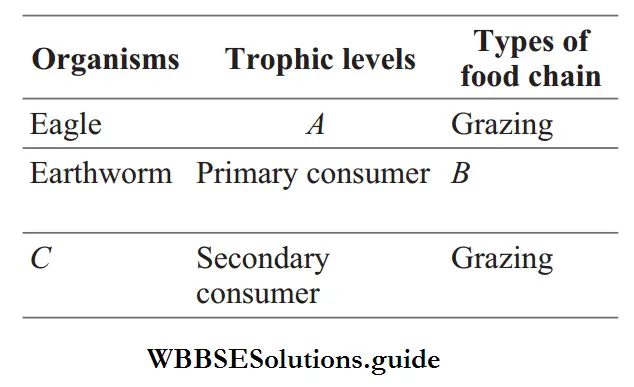
Energy Flow Organisms and Trophic levels and Types of food chain

  1. A–Secondary consumer, B–Grazing, C–Algae
  2. A–Top carnivore, B–Detritus, C–Frog
  3. A–Scavenger, B–Grazing, C–Hawk
  4. A–Decomposer, B–Detritus, C–Perch

Answer: 2. A–Top carnivore, B–Detritus, C–Frog

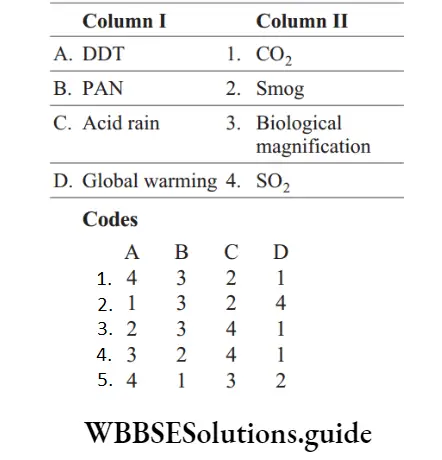
Question 111. Match the names of organisms given under Column I with the ecological names given under Column II. Choose the correct option from the codes given below
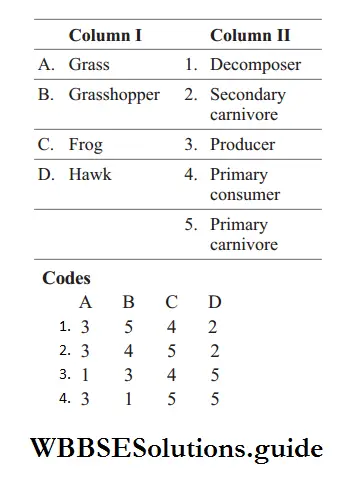
Energy Flow Match the following columns 3

Answer: 3. 1 3 4 5

Question 112. The biomass of tiger is 10 kg in food chain. grass → deer → tiger, The grass biomass will be

  1. 100 kg
  2. 2000 kg
  3. 1 tonn
  4. 20 tons

Answer: 3. 1 tonn

According to 10% law, in the following food chain, grasses, deer tiger, if tiger have 10 kg biomass then deer will have 10 time more of this and grasses will have 10 times more of deer’s biomass. Thus, grass would have 1 tonn or 1000 kg of biomass.

Question 113. In an ecosystem, an organism occupies a specific place in a food chain called

  1. Branching lines
  2. Progressive straight line
  3. Trophic level
  4. Standing crop

Answer: 3. Trophic level

Trophic level is a step or division of food chain which is characterised by the method of obtaining its food. The number of trophic levels is equal to the number of steps in a food chain.
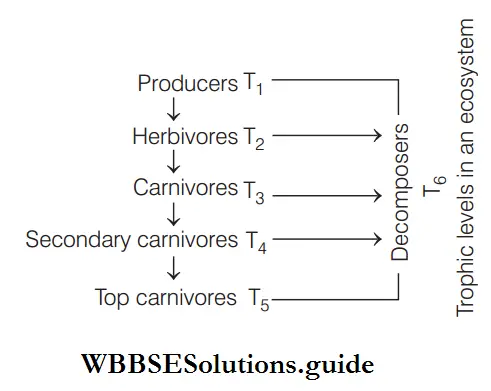
Energy Flow Trophic level

Question 114. Organisms are classified into trophic levels based on their

  1. Habitat
  2. Source Of Nutrients
  3. Weight
  4. All of the above

Answer: 2. Source Of Nutrients

Organisms are classified into trophic levels according to the source of their nutrients.

Question 115. Generally, the food chain has how many trophic levels?

  1. One
  2. Two
  3. Four
  4. Three

Answer: 3. Four

Plants represent the first trophic level and the herbivores make the second trophic level. The primary carnivores constitute the third trophic level and the secondary carnivores, such as large fish, man, etc., constitute the fourth trophic level of an ecosystem. So, the food chain has four trophic levels.

Question 116. The number of trophic levels in a food chain is limited to 4 or 5 because

  1. The Amount Of Food Produced By Producer Is Limited
  2. Consumer’s demand is high
  3. 90% of the food energy is lost as heat at each transfer between trophic levels
  4. Activity of decomposer is poor

Answer: 3. 90% of the food energy is lost as heat at each transfer between trophic levels

The number of trophic levels in a food chain is limited to 4 or 5 because 90% of the food energy is lost as heat at each transfer between trophic levels.

Question 117. The first trophic level in any kind of food chain is always a green plant because

  1. Of Their Wide Distribution
  2. They Alone Have A Capacity To Fix Atmospheric Co2, In The Presence/Absence Of Sunlight
  3. Their Richness In Chlorophyll
  4. Their capacity to convert light energy to chemical energy

Answer: 4. Their capacity to convert light energy to chemical energy

Trophic level is the specific place occupied by an organism in a food chain on the basis of its source of nutrition or food. Primary producers (green plants) belong to the first trophic level. They have prepare the food by photosynthesis by utilising radiant energy of sun, i.e. they have capacity to convert light energy to chemical energy.

Question 118. Each tropical level has a certain mass of living material at a particular time called

  1. Standing Crop
  2. Biomass
  3. Standing state
  4. None of these

Answer: 1. Standing Crop

Each trophic level has a certain mass of living material at a particular time called the standing crop. The standing crop is measured as the biomass of living organisms, as the number in a unit area.

Question 119. Standing crop means

  1. Amount Of Biomass Per Unit Area
  2. Energy Trapped By Producers
  3. Rate Of Energy Produced By Consumers
  4. Quantity of solar energy

Answer: 1. Amount Of Biomass Per Unit Area

Standing crop is the amount of living biomass per unit area present in an ecosystem.

Question 120. The trophic level of S-bacteria and cyanobacteria is

  1. Producer
  2. Consumer
  3. Saprotrophic Decomposer
  4. Primary consumer

Answer: 1. Producer

S-bacterium is chemosynthetic bacterium and cyanobacteria is a group of photosynthetic protists which can synthesise their own food material, i.e. producer.

Question 121. The second trophic level of longer food chains in a lake is 

  1. Phytoplankton
  2. Zooplankton
  3. Benthos
  4. Fishes

Answer: 2. Zooplankton

The second trophic level of longer food chains in a lake is occupied by primary consumers or zooplankton.

Question 122. Snake generally belongs to

  1. Saprophytes Up Cpmt
  2. Primary Consumer
  3. Second trophic level
  4. None of the above

Answer: 4. None of the above

Snakes are the secondary consumers. Herbivores belong to
second trophic level and called as primary consumer. So, all the given options do not belong to snake.

Question 123. In trophic level, herbivore animal occupies which trophic level?

  1. 1st
  2. 2nd
  3. Intermediate
  4. 3rd

Answer: 2. 2nd

Herbivores are primary consumers and occupy the second trophic level. They are mainly dependent on the plants at first trophic level for their food needs.

Question 124. If bamboo plant is growing in a far forest then what will be its trophic level?

  1. First
  2. Second
  3. Third
  4. Fourth

Answer: 1. First

Bamboo is a plant, which can produce its own food. It occupies a first trophic level.

NEET Biology Mcq

Question 125. In terrestrial ecosystem such as forest, maximum energy is found in which trophic level?

  1. T1
  2. T2
  3. T3
  4. T4

Answer: 1. T1

Maximum energy is found in first trophic level (T1 ), i.e. producers.

Question 126. Which of the following organisms occupy more than one trophic level in an ecosystem?

  1. Zooplankton
  2. Phytoplankton
  3. Frog
  4. Earthworm

Answer: 3. Frog

A single species may occupy more than one trophic level. Frog can be primary consumer as newly hatched tadpoles are mainly herbivores feeding on algae, detritus and plants. They become secondary consumers once their back legs develop.

They become fully carnivorous feeding on small water animals or even other tadpoles when food is scarce. So, frog occypy more than one trophic level in an ecosystem. Phytoplanktons are producers only which occupy first trophic level, zooplanktons which feed on phytoplanktons, occupy second trophic level and earthworm being detritivore occupy second trophic level in detritus food chain.

Question 127. Which one of the following animals may occupy more than one trophic level in the same ecosystem at the same time?

  1. Sparrow
  2. Lion
  3. Goat
  4. Frog

Answer: 1. Sparrow

Sparrow feeds upon grains hence called primary consumer and can also feed on insects, hence called secondary consumer at the same time in the same ecosystem.

Question 128. Which one of the following types of organisms occupy more than one trophic level in a pond ecosystem?

  1. Frog
  2. Phytoplanktons
  3. Fish
  4. Zooplanktons

Answer: 3. Fish

Fish occupy more than one trophic level in a pond ecosystem. A pond ecosystem is a delicate balance of fish, plants and other animals. Small fishes act as secondary consumer. They feed on primary consumer. Large fishes act as tertiary consumer. They feed on smaller fish.
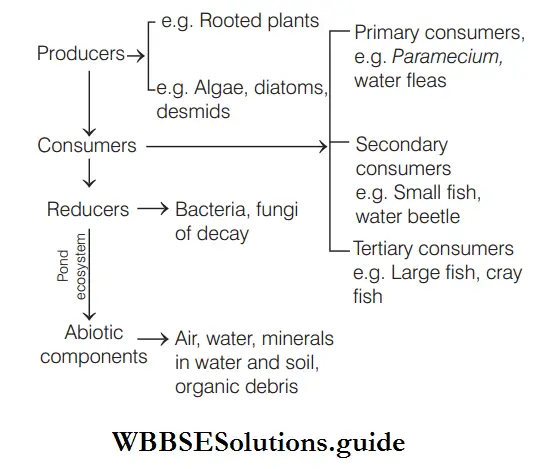
Energy Flow Fish occupy more than one trophic level in a pond ecosystem

Question 129. Mr. X is eating curd/yoghurt. For this food intake in a food chain he should be considered as occupying

  1. First Trophic Level Aiims
  2. Second Trophic Level
  3. Third Trophic Level
  4. Fourth trophic level

Answer: 3. Third Trophic Level

Mr. X eating curd/yoghurt should be considered as occupying third trophic level. Producers or green plants (first trophic level) are consumed by herbivore (second trophic level) and from them curd/ yoghurt (made from dairy breed) is derived. Thus, option is correct.

Question 130. In an aquatic ecosystem, the trophic level equivalent to cows in grasslands

  1. Phytoplanktons
  2. Zooplanktons
  3. Nektons
  4. Benthos

Answer: 2. Zooplanktons

In an aquatic ecosystem, the trophic level equivalent to cows in grasslands is zooplankton. They both occupy the second trophic level.

Question 131. Which of the following statements is incorrect?

  1. Biomass decreases from the first to fourth trophic level
  2. Energy content gradually increases from the first to the fourth trophic level
  3. The number of individuals decreases from the first trophic level to the fourth trophic level
  4. Energy content gradually decreases from the first to the fourth trophic level

Answer: 2. Energy content gradually increases from the first to fourth trophic level

The statement in the option is incorrect and can be corrected as The energy content decreases from the first (producer) to the fourth (consumer) trophic level. At each level, about 90% of energy is lost and only 10% is passed to the next level. The rest of other statements are correct.

Food Chain, Food Web, and Energy Pyramid MCQs for NEET

Question 132. Match Column I in trophic levels with Column II in their correct species examples in the grassland ecosystem. Select the correct option from the codes given below.
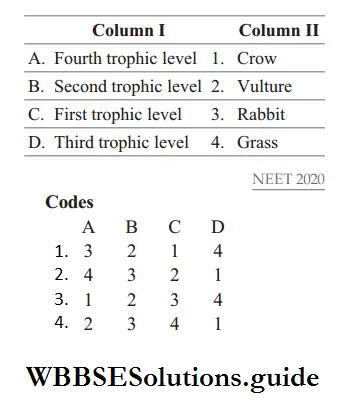
Energy Flow Match the following columns 4

Answer: 4. 2 3 4 1

Question 133. Assertion Trophic levels are only observed in the plant kingdom. Reason (R) Food chains and webs are formed due to linked organisms on basis of their nutrition.

  1. Both A and R are true and R is the correct explanation of A
  2. Both A and R are true, but R is not the correct explanation of A
  3. A is false, but R is true
  4. Both A and R are false

Answer: 3. A is false, but R is true

A is false, but R is true. Assertion can be corrected as Trophic levels are observed in both plant and animal kingdoms.

NEET Biology Mcq

Question 134. In an ecosystem, which one shows ‘one-way passage’?

  1. Free energy
  2. Carbon
  3. Nitrogen
  4. Potassium

Answer: 1. Free energy

The behaviour of energy in the ecosystem can be termed as unidirectional flow, i.e. from solar radiation → producers → herbivores → carnivores. This energy cannot pass in the reverse direction. There is decrease in the content and flow of energy with rise in trophic level. Thus, free energy shows one way passage in an ecosystem.

Question 135. Relationships between different organisms can be best described by

  1. Food Web Dpmt 2001
  2. Pyramid Of Energy
  3. Pyramid of mass
  4. Eltonian pyramids

Answer: 1. Food Web Dpmt 2001

A food web is a network of food chains which become interconnected at various trophic levels, so as to form a number of feeding connections among the different organisms of a biotic community.

Question 136. Assertion A network of food chains existing together in an ecosystem is known as a food web. Reason (R) An animal like kite cannot be a part of a food web.

  1. Both A and R are true and R is the correct explanation of A
  2. Both A and R are true, but R is not the correct explanation of A
  3. A is true, but R is false
  4. Both A and R are false

Answer: 3. A is true, but R is false

A is true, but R is false. Reason can be corrected as In the grazing food chain, the producers. (i.e. plants) are eaten by herbivores (i.e. rodents) and they are further eaten by carnivores, i.e. kite. Kites also eat small insects, snails, etc. Thus, kite can be a part of food web also.

Question 137. In a food web, each successive trophic level has

  1. Increased Total Energy
  2. More Total Energy
  3. Less Total Energy
  4. Non-estimated energy content

Answer: 3. Less Total Energy

In a food web, each successive trophic level has less total energy content. This is due to the reason that when energy is transferred from one level to the next, some energy is lost as heat to the environment.

NEET Biology Mcq

Question 138. Extinction of a species in a food chain is compensated by

  1. Food Chain Up Cpmt 2007
  2. Ecological Pyramid
  3. Food web
  4. None of the above

Answer: 3. Food web

Food webs provide stability to the ecosystem. Most animals are polyphagous, i.e. they feed on more than one kind of organisms. If the population of a species decreases to an endangered level, its predators shift to another prey and the endangered species may get a chance to recover its population. Thus, extinction of species in a food chain is compensated by food web.

Question 139. A food web is more realistic than a food chain to depict feeding relationships. The reason for this is because

  1. It Compares The Number Of Consumers To The Number Of Microorganisms In An Ecosystem
  2. Food Chains Use Only A Small Sampling Of Organisms
  3. A Food Web Explains Why There Are More Producers Than Consumers
  4. Producers are usually eaten by different consumers and most consumers are eaten by more than one predator

Answer: 4. Producers are usually eaten by different consumers and most consumers are eaten by more than one predator

Food webs are more realistic because they show that the producers are usually eaten by many different consumers and most consumers are eaten by more than one predator. In contrast, food chain consider only one orgainsm being eaten by another.

Question 140.
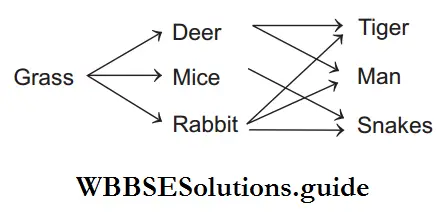
Energy Flow grass

The above diagram represents

  1. Food Chain
  2. Food Web
  3. A Population
  4. Ecosystem

Answer: 2. Food Web

The given diagram represents a food web.

Question 141. If a single plant species is removed from a food web, then most likely.

  1. An Animal Species Will Fill The Unoccupied Niche
  2. Other Plants Will Produce Enough Food For Herbivores
  3. Dependent Herbivores Will Have To Find New Food Sources
  4. Carnivores will be unaffected by the loss

Answer: 3. Dependent Herbivores Will Have To Find New Food Sources

Herbivores are primary consumers, they are mainly dependent on the plants for their food needs. If a single plant species is removed, then they have to find new or other food sources.

NEET Biology Mcq

Question 142. Consider the following statements about food web.

  1. One organism in a food chain can hold more than one position.
  2. The flow of energy is very difficult to calculate.
  3. A food chain can consist of branching lines too.
  4. Competition is amongst the members of same and different trophic levels.

Choose the option containing correct statements.

  1. 2 and 3
  2. 1, 3 and 4
  3. 2 and 4
  4. 1, 2, 3 and 4

Answer: 4. 1, 2, 3 and 4

All the given statements are correct.

Question 143. Identify the likely organisms (1), (2), (3) and (4) in the food web shown below.
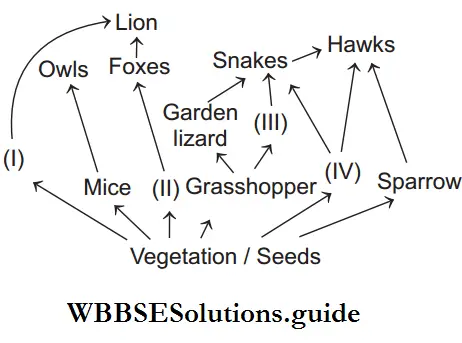
Energy Flow likely organisms

  1. Deer Rabbit Frog Rat
  2. Dog Squirrel Rat Deer
  3. Rat Dog Tortoise Crow
  4. Squirrel Cat Rat Pigeon

Answer: 1. Deer Rabbit Frog Rat

1-Deer, 2-Rabbit, 3-Frog, 4-Rat

Question 144. Identify A, B and C in the given flowchart.
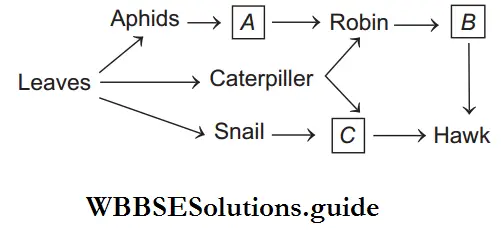
Energy Flow leaves

  1. A–Bulbul, B–Snake, C–Monkey
  2. A–Beetle, B–Lizard, C–Praying mantis
  3. A–Ladybird, B–Snake, C–Pigeon
  4. A–Lizard, B–Bird, C–Snake

Answer: 2. A–Ladybird, B–Snake, C–Pigeon

Leaves → Aphids → Ladybird → Robin → Snake → Hawk. Leaves → Snail → Pigeon → Hawk

Question 145. Given below is the diagram of a food web.
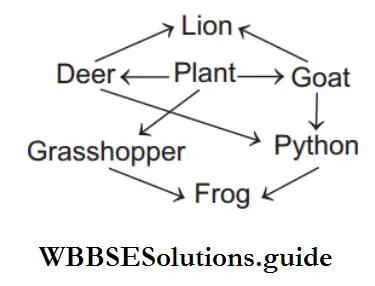
Energy Flow food web

What is incorrect in the above diagram?

  1. Goats feeding on plants
  2. Deer and goat both occupying the same level in the trophic level
  3. Frog consuming python
  4. Lion being a carnivore

Answer: 3. Frog consuming python

Plant → Deer → Python Plant → Grasshopper → Frog Plant → Goat → Lion Plant → Goat → Python Plant → Deer → Lion Plant → Grasshopper → Frog → Python Thus, option is incorrectly shown in the diagram.

Biology MCQs with answers for NEET

Question 146. Given food web contains some missing organisms A, B, C and D.
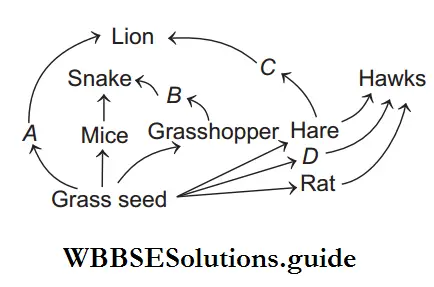
Energy Flow missing organisms

Identify these organisms and select the correct option.

  1. A–Deer, B–Frog, C–Foxes, D–Sparrow
  2. A–Dog, B–Squirrel, C–Deer, D–Hawks
  3. A–Cat, B–Eagle, C–Cow, D–Rat
  4. A–Eagle, B–Sparrow, C–Dog, D–Cat

Answer: 1. A–Deer, B–Frog, C–Foxes, D–Sparrow

Question 147. Study the food web given below and answer the questions that follows.
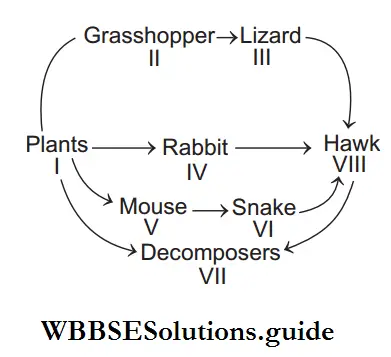
Energy Flow grasshopper

1. Which organisms act as secondary consumers?

2. Which organisms acts as primary consumers?

  1. 1 and 4 ; 1, 2 and 3
  2. 5 and 4; 2, 3 and 4
  3. 3 and 4 ; 2, 4 and 5
  4. 4 and 7 ; 6, 7 and 8

Answer: 3. 3 and 4 ; 2, 4 and 5

Secondary consumers are those which feed on primary consumers, i.e. carnivores. Primary consumers are animals, which feed directly on plants, i.e. herbivores.

  • Lizard (3) and snake (4) act as secondary consumers.
  • Grasshopper, (2) rabbit (4) and mouse (5) act as primary consumers.

Thus, option is correct.

NEET Biology Environmental Issues Miscellaneous Multiple Choice Question And Answers

Biology MCQs with answers for NEET Environmental Issues

Question 1. World Summit on Sustainable Development (2002) was held in

  1. Brazil
  2. Sweden
  3. Argentina
  4. South Africa

Answer: 4. South Africa

World Summit on Sustainable Development (2002) was held in Johannesburg, South Africa. 190 countries pledged their commitment to achieving by 2010, a significant in reduction the current rate of biodiversity loss at global, regional, and local levels.

“environmental issues mcqs “

Question 2. Match the items given in Column I with those in Column II and select the correct option from the codes given below.

NEET Biology Environmental Issues Miscellaneous Match the columns Q2

Answer: 3. A–3, B–4, C–1, D–2

Read And Learn More: NEET Biology Multiple Choice Question And Answers

Question 3. Sustainable environment means

  1. Disturbed Environment
  2. Polluted Environment
  3. Non-Developing Environment
  4. The environment which can be maintained

Answer: 4. Environment which can be maintained

Environmental sustainability is our responsible interaction with the environment to avoid depletion or degradation of natural resources and allow for long-term environmental quality. Thus, a sustainable environment means an environment that can be maintained.

NEET Biology Environmental Issues Miscellaneous Multiple Choice Question And Answers

NEET Biology Environmental Issues MCQs with Answers

Question 4. Strengthening of the concept of environmental monitoring is due to concern for the

  1. Quality Of Environment
  2. Quantity Of Environment
  3. Quality Of Monitor
  4. Pure air

Answer: 1. Quality Of Environment

“environment issues mcq “

The strengthening of the concept of environmental monitoring is due to concern for the quality of the environment. Environmental monitoring is a tool to assess environmental conditions and trends, support policy development and its implementation, and develop information for reporting to national policymakers, international forums, and the public.

Biology MCQs with answers for NEET

Question 5. Consider the following statements.

  1. By the end of the twentieth century, the forest cover in India was reduced to 19.4%.
  2. National Forest Policy was implemented in the year 1988.
  3. The average annual production of dry grass or hay in India is about 250 million tons.
  4. About 10% of the world’s population lives in arid or semiarid regions.

Choose the option containing the correct statements.

  1. Statements 1 and 4 are correct
  2. Statements 1, 3, and 4 are not correct
  3. Statements 1, 2, and 3 are correct
  4. Statement 3 is not correct

Answer: 3. Statements 1, 2, and 3 are correct

Statements 1, 2, and 3 are correct whereas 4 is incorrect. Incorrect statements can be corrected as Roughly 2.5 billion people, 30% of the world’s population, live in the dry areas, which cover more than 40% of the world’s land surface.

NEET Biology Environmental Issues Miscellaneous Multiple Choice Question And Answers

Important MCQs on Environmental Issues for NEET

Question 6. Match the following columns.

NEET Biology Environmental Issues Miscellaneous Match the columns Q 6

Answer: 2. A–4, B–3, C–2, D–1

“environmental questions “

Question 7. Identify the correctly matched pair.

  1. Kyoto Protocol – Climate change
  2. Montreal Protocol – Global warming
  3. Basal Convention – Biodiversity conservation
  4. Ramsar Convention – Groundwater pollution

Answer: 1. Kyoto Protocol – Climate change

Option 1 is a correctly matched pair, but other options are incorrectly matched and can be corrected as the Montreal protocol was about the depletion of the ozone layer. The basal convention was about hazardous waste and the Ramsar Convention was for the conservation and sustainable use of wetlands. Kyoto Protocol happened in 1997 was about climate change.

Question 8. Consider the following statements with respect to pollution.

  1. To control air pollution problems, by the end of 2002, all the buses of Delhi were converted to run on unleaded petrol.
  2. An electrostatic precipitator can remove over 99% of particulate matter present in the exhaust from a thermal power plant.
  3. It is possible to estimate the amount of organic matter in sewage water by measuring BOD.

Choose the option containing the correct statement(s).

  1. Statement 1 alone is correct
  2. Statement 2 alone is correct
  3. Statement 3 alone is correct
  4. Statements 1 and 2 are correct
  5. Statements 2 and 3 are correct

Answer: 5. Statements 2 and 3 are correct

Statements 2 and 3 are correct, whereas 1 is incorrect. Incorrect statements can be corrected as With its very large population of vehicular traffic, Delhi leads the country in its levels of air pollution. Under the directives of the Supreme Court of India, the government was asked to take, within a specified time, appropriate measures, including switching over the entire fleet of public transport, i.e. buses from diesel to Compressed Natural Gas (CNG). All the buses of Delhi were converted to run on CNG by the end of 2002.

Biology MCQs with answers for NEET

Question 9. NEERI is at

  1. New Delhi
  2. Nagpur
  3. Kolkata
  4. Chennai
  5. Rajasthan

Answer: 2. Nagpur

NEERI is a National Environmental Engineering Research Institute at Nagpur, which monitors environmental pollution.

Pollution and Its Types MCQs for NEET

Question 10. Consider the following statements.

  1. Soil with a vegetation cover is easily eroded by both wind and water.
  2. Excessive irrigation results in water logging of soil.
  3. Increased salt concentration damages agriculture.

Which of the statements given above is correct?

  1. 1 and 2
  2. 1 and 3
  3. 2 and 3
  4. 1, 2 and 3

Answer: 3. 2 and 3

“environmental questions and answers pdf “

Statements 2 and 3 are correct whereas statement 1 is incorrect and can be corrected as Soil without vegetation cover is easily eroded by both wind and water.

Read And Learn More: NEET Biology Multiple Choice Question And Answers

Question 11. Match the following columns.

NEET Biology Environmental Issues Miscellaneous Match the columns Q 11

Answer: 3. A–3, B–4, C–5, D–2

Question 12. The oxygen concentration at the floor of the deep ponds and lakes is very low because of the

  1. Overhanging Column Of Water
  2. Lesser Amount Of Sunlight
  3. Decomposers
  4. A large number of annual inhabitants

Answer: 2. Lesser Amount Of Sunlight

The oxygen concentration at the floor of the deep ponds and lakes is very low because of the lesser amount of sunlight.

Biology MCQs with answers for NEET

Question 13. Recently the Government of India has allowed the mixing of alcohol in petrol. What is the amount of alcohol permitted for mixing in petrol?

  1. 2.5%
  2. 10-15%
  3. 10%
  4. 5%

Answer: 4. 5%

Alcohol to the tune of 5% is allowed to be mixed in petrol as per the Government of India’s decision.

Question 14. Which one of the following combinations is wrong?

  1. Rio convention – Air pollution
  2. Kyoto Protocol – Climate change
  3. Montreal protocol – Ozone depletion
  4. Ramsar convention – Wetland conservation

Answer: 1. Rio convention – Air pollution

Option 1 is the wrong combination and can be corrected as The three Rio conventions

“mcq questions on environment with answers “

Question 15. IRRI proposed one of the following for the prevention of fertilizers pollution in agriculture

  1. Trickling Filter Method
  2. Mud Ball Technique
  3. Both 1 and 2
  4. None of the above

Answer: 3. Both 1 and 2

International Resources and Recycling Institute is one of the groups which proposes certain methods that help in the reduction of pollution. The group proposed two methods, i.e. trickling filter method and the mud ball technique which can be used for the prevention of pollution by fertilizer in agriculture.

Biology MCQs with answers for NEET

Question 16. The mudball technique has been proposed by

  1. Rice Research Institute, Cuttack
  2. CSIR, New Delhi
  3. Punjab Agriculture University, Ludhiana
  4. The International Rice Research Institute, Philippines

Answer: 4. The International Rice Research Institute, Philippines

The mud ball technique is a Japanese art form of binding mud and water to form a fine ball. This technique has been used by IRRI, Philippines as a method of fertilizer application to rice fields. This method reduces the amount of fertilizer applied but retains the output of rice.

Topic-wise Environmental Issues MCQs for NEET with Explanation

Question 17. What was the cause of the ‘Yusho’ disease which occurred in 1968 from a leak in a 1968 canning factory?

  1. DBCP
  2. PCB
  3. Formaldehyde
  4. Mercury

Answer: 2. PCB

Yusho disease (literally oil symptoms) was a mass poisoning by Polychlorinated Biphenyls (PCBs) which occurred in Northern Kyûshû, Japan in 1968.

Question 18. In a polluted environment, the maximum pollutant will occur in

  1. Primary Producers Amu
  2. Tertiary Consumers
  3. Secondary Consumers
  4. Primary consumers

Answer: 2. Tertiary Consumers

In a polluted environment, the maximum pollutant will occur in tertiary consumers.

Biology MCQs with answers for NEET

Question 19. Match the following columns and select the correct option from of codes given below.

NEET Biology Environmental Issues Miscellaneous Match the columns Q 19

Answer: 2. A–2, B–3, C–4, D–1

Question 20. Match Column I with Column II.

NEET Biology Environmental Issues Miscellaneous Match the columns Q 20

Answer: 1. A–2, B–1, C–3, D–4

Question 21. Find out incorrect statements in relation to pollution.

  1. Plastic is a non-degradable pollutant
  2. Water vapors, smoke fumes and dust mixture form smog
  3. PAN affects photosynthesis
  4. The ozone layer forms a protective shield in the ionosphere

Answer: 4. Ozone layer forms a protective shield in the ionosphere

The statement in option 4 is incorrect in relation to pollution and can be corrected as the Ozone layer forms a protective shield in the stratosphere. Rest statements are correct about pollution.

NEET Biology Global Warming and Climate Change MCQs

Question 22. Which one of the following is being tried in India as a biofuel substitute for fossil fuels?

  1. Jatropha
  2. Azadirachta
  3. Musa
  4. Aegilops

Answer: 2. Azadirachta

Azadirachta is being tried in India as a biofuel substitute for fossil fuels. Biofuels are fuels of biological origin. They constitute a renewable form of energy. Energy problems can be solved up to a great extent by efficient and proper use of these biofuels.

Biology MCQ For NEET With Answers

Question 23. Match the following columns and choose the correct option from the codes given below.

NEET Biology Environmental Issues Miscellaneous Match the columns Q 23

Answer: 4. A–3, B–2, C–4, D–1

Question 24. Which of the following are correctly matched?

  1. Arsenic poisoning – Black-foot disease
  2. Secondary effluent treatment – Biological process
  3. Pyrolysis – Solid soil waste disposal
  4. Tubifex –Water pollution indicator
  5. Biomagnification – Degradable pollutants

Choose The Correct Option

  1. 1, 2, 3 and 5
  2. 1, 3, 4 and 5
  3. 2, 3, 4 and 5
  4. 1, 2, 3 and 4

Answer: 4. 1,2,3 and 4

All pairs are correctly matched except pair V. Incorrect matched pair can be corrected as Biomagnification–Non-degradable pollutants

Solid Waste Management and Sustainable Development MCQs for NEET

Question 25. The green revolution was carried out in order to

  1. Decrease The Use Of Modern Farm Equipment
  2. Decrease Population Growth
  3. Make India Self-Sufficient In Food Grains
  4. Make India self-sufficient in milk production

Answer: 3. Make India Self-Sufficient In Food Grains

In India, the major goal of the green revolution was to increase agricultural production. MS Swaminathan initiated collaboration with Dr. Borlaug which reached the highest point into the green revolution through the introduction of Mexican varieties of wheat in India. Green Revolution depends mainly on plant breeding techniques for high-yielding and disease-resistant varieties in wheat, rice, maize, etc. Thus, the green revolution was carried out in order to make India self-sufficient in food grains.

Biology MCQ For NEET With Answers

Question 26. Which of the following statements is incorrect?

  1. Carbon monoxide is the major environmental pollutant
  2. All pollutants are waste
  3. Nitrogen (N) and magnesium (Mg) can pollute water
  4. Lichens are affected by sulfur dioxide

Answer: 2. All pollutants are waste

The statement in option 2 is incorrect and can be corrected as All processes create waste, but not all will create pollution. Since not all waste is harmful, not all waste is pollution. When waste is indeed harmful, it would then be classified as pollution. The rest statements are correct.

Question 27. Fill up the blanks.

  1. The effects of biomagnification of …A… and …B… can be observed significantly.
  2.  …C… poisoning can be observed in paper and paint industries.
  3. …D… separation is carried out by scrubbers.
  4. …E… is the first city in the world whose public transport system will completely run on CNG.

Complete the given set of statements by choosing appropriate options.

  1. A–phenol, B–nitrates, C–Heavy metals, D–Dust, E–Bengaluru
  2. A–lead, B–Copper, C–Inorganic compound, D–Wastewater, E–Mumbai
  3. A–mercury, B–DDT, C–Heavy metals, D–SO2, E–Delhi
  4. A–sodium, B–calcium, C–Organic compound, D–Dirty air, E–Chennai

Answer: 3. A–Mercury, B–DDT, C–Heavy metal, D–SO2, E–Delhi.

Question 28. Match the following items in Column I with Column II and choose the correct option from the codes given below.

NEET Biology Environmental Issues Miscellaneous Match the columns Q 28

Answer: 2. A–5, B–3, C–1, D–2, E–4

Deforestation and Biodiversity Loss MCQs for NEET

Question 29. Who among the following called as Father of the White Revolution?

  1. Norman Borlaug
  2. Verghese Kurien
  3. MS Swaminathan
  4. Lakdawala

Answer: 2. Verghese Kurien

The white revolution, known as Operation Flood, was launched in 1970. It was an initiative by India’s National Dairy Development Board (NDDB) and was the world’s biggest dairy development program. It transformed India from a milk-deficient nation into the world’s largest milk producer. Operation Flood was based on the experimental pattern setup by Verghese Kurien, chairman and founder of AMUL, who was named the Chairman of NDDB and was also recognized as the architect of operation flood. So, Verghese Kurien is called the as Father of the white revolution.

Biology MCQ For NEET With Answers

Question 30. The pollution in a city like Delhi may be controlled to a great extent

  1. By Proper Sewage And Proper Exit Of Chemicals From Factories
  2. By Wide Roads And Factories Away From The City
  3. By cleaning the city and scanty use of pesticides
  4. All of the above

Answer: 4. All of the above

All the given options are great extent the pollution in a city like Delhi may be controlled.

Question 31. Which of the following organisms is useful in degrading organic pollutants?

  1. Nitrosomonas
  2. Chlamydia
  3. Actinomycetes
  4. Pseudomonas

Answer: 4. Pseudomonas

Pseudomonas is a bacterium which is a decomposer and degrades organic matter.

Question 32. Which of the following is employed for clearing oil spillage?

  1. E. coli
  2. Bacillus thuringiensis
  3. Pseudomonas
  4. Streptococcus

Answer: 3. Pseudomonas

Oil spill biodegradation is a process of removal of petroleum and other hydrocarbon pollutants from the environment, Microorganisms namely Pseudomonas, Mycobacterium were found to be molded in alkyl aromatic (hydrocarbon) oil spill degradation

Question 33. Restoration of ecological equilibrium in mined areas can be achieved through

  1. Revegetation Of The Mined Habitats
  2. Conversion Of Mined Habitats Into Agricultural Ecosystems
  3. Prevention Of Soil Erosion
  4. Prevention of grazing

Answer: 1. Revegetation Of The Mined Habitats

Revegetation is the process of replanting and rebuilding the soil of disturbed land. This may be a natural process produced by plant colonization and succession, man-made rewilding projects, or accelerated process designed to repair damage to a landscape due to wildfire, mining, flood or other cause. Thus, restoration of ecological equilibrium in mined areas can be achieved through revegetation of the mined habitats.

Biology MCQ For NEET With Answers

Question 34. Pollution from animal excreta and organic waste from kitchen can be most profitably minimized by

  1. Storing Them In Underground Storage Tanks
  2. Using Them For Producing Biogas
  3. Vermiculture
  4. Using them directly as biofertilizers

Answer: 2. Using Them For Producing Biogas

Pollution from animal excreta and organic wastes from kitchen can be most profitable minimised using them in the generation of biogas. Biogas is a mixture of methane and carbon dioxide resulting from the anaerobic decomposition of such waste materials as domestic, industrial and agricultural sewage.

Question 35. Main component of biogas is

  1. CO2
  2. HS2
  3. SO2
  4. CH4
  5. O2

Answer: 4. CH4

The main component of biogas is methane (CH4). Methane is also an important constituent of natural gas. methane has high heat of combustion.

\(\mathrm{CH}_4+2 \mathrm{O}_2 \longrightarrow \mathrm{CO}_2+2 \mathrm{H}_2 \mathrm{O}+\text { Heat }\)

Question 36. A mutagen pollutant is

  1. Organophosphates
  2. Resins
  3. Chlorinated Hydrocarbons
  4. Nitrogen oxides

Answer: 3. Chlorinated Hydrocarbons

Mutagenic pollutants are those that cause mutation in DNA cells. Metabolites of Polycyclic Aromatic Hydrocarbons (PAHs) are mutagenic as they act as carcinogenic, e.g. acenaphthene. The source of PAHs can relate to the chemical industrial process burning of fossil fuels, etc.

  • Organophosphates are non-degradable pesticides
  • Resins are waste materials produced by the plants
  • Hydrocarbons are carcinogenic
  • Nitrogen oxides cause air pollution and acid rain.
  • Hence, the correct answer is chlorinated hydrocarbons.

NEET Biology Mcq Chapter Wise

Question 37. Which one of the following is an environment-related disorder with the correct main cause?

  1. Black lung disease (pneumoconiosis) found mainly in workers in stone quarries and crushers
  2. Blue baby disease (methemoglobinemia) due to heavy use of nitrogenous fertilizers in the area
  3. Non-Hodgkin’s lymphoma is found mainly in workers involved in the manufacture of neem-based pesticides
  4. Skin cancer mainly in people exposed to benzene and methane

Answer: 2. Blue baby disease (methemoglobinemia) due to heavy use of nitrogenous fertilizers in the area

Blue baby syndrome is blood-related condition found in babies due to nitrate poisoning (poisoning limits blood’s ability to carry oxygen thereby causing baby to look blue), known as methemoglobinaemia. This is a serious illness in infants which is caused when nitrate is converted into nitrite in the infant’s body. Nitrite capacity of the child’s blood (it replaces the oxygen on the red blood cells). This is an acute disease in which symptoms can develop rapidly in infants. However, in most cases, health deteriorates over a period of days. Clearly, expert medical advice should be sought immediately if these symptoms occur. So, blue baby disease occur due to heavy use of nitrogenous fertilisers is an evironmental related disorder.

NEET Biology Degradation By Improper Resource Utilisation Multiple Choice Question And Answers

NEET Biology Mcq Chapter Wise Degradation by Improper Resource Utilisation

Question 1. Environment (Protection) Act, to protect and improve the quality of our environmental air, water, and soil was passed in the year.

  1. 1971
  2. 1974
  3. 1981
  4. 1986

Answer: 4. 1986

The Environment (Protection) Act in 1986, noticeably brought the protection of air, water, and soil quality and the control of environmental pollutants, including noise, under its preview.

Question 2. Soil erosion is

  1. The Process Of Formation Of Soil
  2. The Process Of Removal And Transport Of Soil By Human Activities, Wind And Water
  3. The Natural Ability Of Soil Filtering Off Harmful Pollutants
  4. A Process often referred to as the ‘greenhouse’ effect

Answer: 2. The Process Of Removal And Transport Of Soil By Human Activities, Wind And Water

Soil erosion occurs when the soil is blown away by the wind or washed away by the rain. So, it is the process of removal and transport of soil by human activities, wind, and water.

“environmental issues mcqs “

Question 3. In India, soil erosion is mainly a result of

  1. Jhum Cultivation
  2. Deforestation
  3. Drought
  4. Less rainfall

Answer: 2. Deforestation

Soil erosion is mainly as a result of deforestation in India. Deforestation is the removal of a forest or stand of trees where the land is there after converted to non-forest use. Examples of deforestation include the conversion of forest land to farms, ranches, or urban use.

NEET Biology Mcq Chapter Wise

Question 4. Human activities that result in the removal of fertile topsoil is

  1. Overuse Of Agricultural Land
  2. Overgrazing
  3. Deforestation and poor irrigation practices
  4. All of the above

Answer: 4. All of the above

All given options are human activities in the removal of fertile top soil. Overcultivation, unrestricted grazing (over grazing), over use of agricultural land, and deforestation are poor irrigation practices. Humans play a major role in soil erosion through their use and abuse of natural resources, e.g. deforestation, grazing, faulty farming systems, high crop intensity, housing construction by cutting plant mining, etc.

Thus, option 4 is correct.
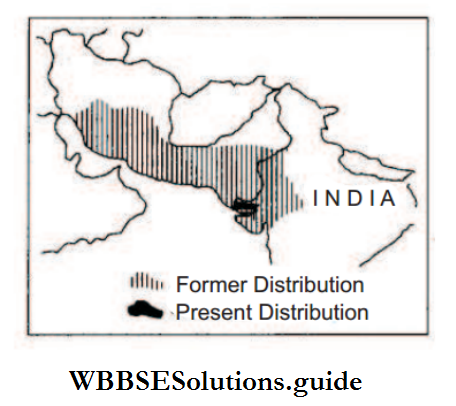
NEET Biology Degradation By Improper Resource Utilisation mcqs

NEET Biology Degradation by Improper Resource Utilization MCQs with Answers

Question 5. Which of the statements given below are correct about desertification?

  1. Conversion of former moist and fertile land into an arid desert area.
  2. It is a product of soil erosion.
  3. Desertified areas cannot be put to any use.

Choose the correct option.

  1. Only 1
  2. Only 3
  3. Only 2
  4. 1, 2 and 3

Answer: 4. 1,2, and 3

All given statements are correct about desertification as Desertification is a type of land degradation in which, a relatively dry land region becomes increasingly arid, typically losing its bodies of water as well as vegetation and wildlife. Desertified areas cannot be put to any use. The main cause of desertification is overgrazing others being soil erosion and deforestation.

Thus, option 4 is correct.
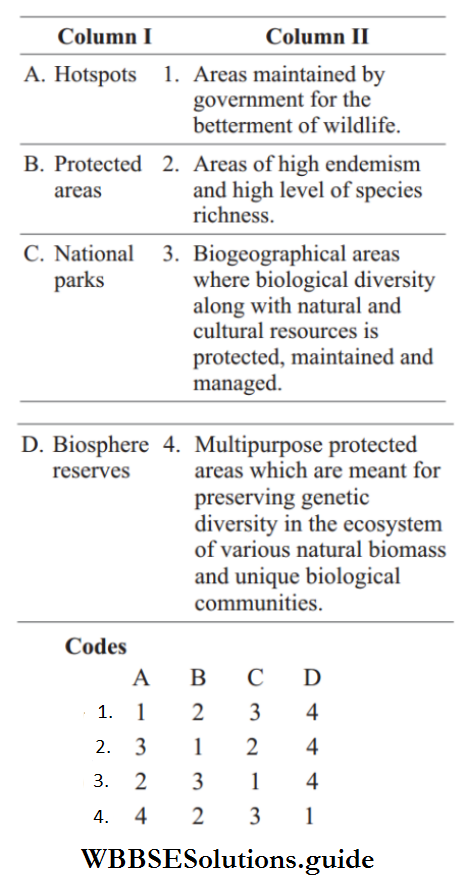
“global warming can significantly be controlled by “

Question 6. Identify the chief contributing factor to desertification.

  1. Overgrazing
  2. Human developmental activities
  3. Irrigated agriculture
  4. Population

Answer: 2. Human developmental activities

The chief contributing factor to desertification is human developmental activities.

NEET Biology Mcq Chapter Wise

Question 7. If an agricultural field is liberally irrigated for a prolonged period of time, it is likely to face the problem

  1. Metal Toxicity
  2. Alkalinity
  3. Acidity
  4. Salinity

Answer: 4. Salinity

The salinity of soil is a problem faced by farmers if they liberally irrigate agricultural fields for a prolonged period of time. Irrigation salinity is the accumulation of salts in the topsoil under irrigation. It is caused by over-irrigation of agricultural land, inefficient water use, poor drainage and the irrigation of unsuitable and leaky soil.

Question 8. The best way to conserve our water resources is

  1. Rain Water Harvesting
  2. Sustainable Water Utilisation
  3. Encouragement of natural regeneration of vegetation
  4. All of the above

Answer: 4. All of the above

All given options are the best ways to conserve our water resources.

Thus, option 4 is correct.
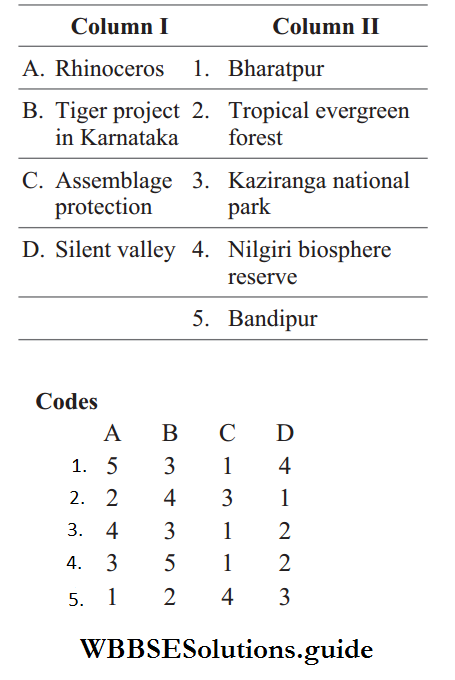
Question 9. Which one of the following factors is the main culprit for large-scale salinization in the country?

  1. Acid rain
  2. Use of pesticides
  3. Intensive irrigation without adequate drainage
  4. None of the above

Answer: 3. Intensive irrigation without adequate drainage

Water logging and salinisation of soils are common problems associated with surface irrigation. Irrigation-induced salinity can arise as a result of the use of any irrigation water, irrigation of saline water, etc., combined with inadequate leaching. Since all surface and ground water contain salts to varying degrees, intensive irrigation without drainage is often seen as the primary culprit for bringing salts into the field.

Important MCQs on Resource Degradation for NEET Biology

Question 10. Consider the following statements.

  1. Soil can be eroded by wind and water if not covered with vegetation.
  2. Water logging is observed in soils where excessive irrigation is carried out.
  3. Increase in salinity is detrimental to agriculture.

Choose the option containing the correct statement(s).

  1. Only 2
  2. Only 3
  3. 2 and 3
  4. 1, 2 and 3

Answer: 4. 1,2, and 3

All given statements are correct as Fertile topsoil takes hundreds of years to develop. Soil without a vegetation cover is eroded by both wind and water. A sandy patch is formed. Water logging in soil results from irrigation without proper drainage of water. This affects the plants and draws salts to the soil surface. The salt is either deposited as a layer on the land surface or collected at the root of plants. Increased salt concentration damages agriculture.

NEET Biology Mcq Chapter Wise

Question 11. Fill up the blanks.

  1. Low drainage capacity of soil and increased irrigation causes …A…
  2. A consequence of water logging is an increase in …B… and a decrease in …C…
  3. …D… was brought out to ensure a said minimum percentage of forest cover in the country.

Choose The Correct Option.

  1. A–water logging, B–root formation, C–aeration, D–Environment (Protection) Act
  2. A–water logging, B–salinity, C–aeration, D–National Forest Policy
  3. A–soil succession, B–leaves formation, C–nutrition, D–The National Forest Policy, 1989
  4. A–desertification, B–fruits, C–minerals, D–The National Forest Policy, 1986

Answer: 2. A–water logging, B–salinity, C–aeration, D–National Forest Policy

Read And Learn More: NEET Biology Multiple Choice Question And Answers

Question 12. Forests in India, according to Central Forestry Commission (1980) are about

  1. 19.4%
  2. 18.3%
  3. 30%
  4. 14.0%

Answer: 1. 19.4%

Forests in India according to Central Forestry Commission (1980) are about 19.4%. The total forest cover in India as of 2015 is 79.42 million hectares, i.e. 24.16% of India’s geographical area.

“environmental questions “

Question 13. The Earth Summit at Rio de Janeiro was held with the theme of

  1. Conservation of Energy
  2. Conservation of Forests and Biodiversity
  3. Saving Natural Resources
  4. Saving Animals in Wild

Answer: 2. Conservation of Forests and Biodiversity

United Nations Conference on Environment and Development (UNCED), by name of Earth Summit, a conference held at Rio de Janeiro, Brazil (June 3-14, 1992), to reconcile worldwide economic development with the protection of the environment.

Question 14. India has lost almost 40% of her …A… and about 1% of …B…

  1. A–Gangetic plains, B–Deccan plateau
  2. A–tropical forest, B–temperate forest
  3. A–Temperate forest, B–tropical forest
  4. A–Western ghats, B–deciduous forest

Answer: 2. A–tropical forest, B–temperate forest

Almost 40% of forests have been lost in the tropics, i.e. tropical forests,s and 1% of forests in the temperate region (B)

Question 15. The permanent removal, decrease, or deterioration of forests and woodlands is called

  1. Deforestation
  2. Afforestation
  3. Reforestation
  4. Forestation

Answer: 1. Deforestation

The permanent removal, decrease or deterioration of forests and woodlands is called deforestation.

Causes and Effects of Resource Degradation MCQs for NEET

Question 16. Clearing of large areas of forest to fulfill the needs of the growing human population is called

  1. Deforestation
  2. Reforestation
  3. Depletion Of Forest
  4. Forest erosion

Answer: 1. Deforestation

Population growth possesses serious threat to the forest. The forest is the basic needs of everyday life as they provide us with food, shelter and raw materials for other essentialities, but these forests are deforested for fulfilling the increasing demands of overpopulation like clearing of forests for agriculture, industries, urban area, etc. It is known as deforestation.

NEET Biology Mcq Chapter Wise

Question 17. Deforestation leads to

  1. Soil Erosion
  2. Global Warming
  3. Soil protection
  4. Both 1 and 2

Answer: 4. Both 1 and 2

“environment questions “

Deforestation leads to climate change, desertification, soil erosion, fewer crops, flooding, increased greenhouse gases in the atmosphere (global warming), and a host of problems for indigenous people.

Thus, option 4 is correct.

Question 18. Which of the following are responsible for deforestation?

  1. Clearing of land for agriculture
  2. Obtaining land for the construction of roads, buildings, and dams
  3. Selling of wood for foreign exchange
  4. All of the above

Answer: 4. All of the above

All given options are responsible for deforestation. Thus, option 4 is correct.

Question 19. Identify the deleterious effects of deforestation.

  1. CO2 concentration increases.
  2. Habitat destruction leads to loss of biodiversity.
  3. Disturbance in the hydrologic cycle.
  4. Desertification.

Choose the option containing the correct statements.

  1. 1, 2 and 3
  2. 2, 3 and 4
  3. 1, 3 and 4
  4. 1, 2, 3 and 4

Answer: 4. 1,2,3 and 4

All given statements are correct deleterious effects of deforestation. Deforestation can result in an increase in carbon dioxide (CO2) concentration in the atmosphere because trees that could hold a lot of carbon in their biomass are lost with deforestation. Deforestation also causes loss of biodiversity due to habitat destruction, disturbs the hydrologic cycle, causes soil erosion, and may lead to desertification in extreme cases.

Thus, option 4 is correct.

Biology MCQ For NEET With Answers

Question 20. Given below are the effects of deforestation. Identify the incorrect effect.

  1. Results in soil erosion
  2. Rainfall and weather pattern is affected
  3. Nutrient cycling occurs at a faster rate
  4. A large number of fauna lose their natural habitat

Answer: 3. Nutrient cycling occurs at a faster rate

Option 3 is the incorrect effect of deforestation whereas the rest options are correct as Deforestation can have many impacts including increased rates of soil erosion, decreased levels of rainfall, and destroys natural habitats of wildlife.

Question 21. Assertion Deforestation is one main factor contributing to global warming. Reason (R) Besides CO2, two other gases, methane and CFCs are also included under greenhouse gases.

  1. Both A and R are true and R is the correct explanation of A
  2. Both A and R are true, but R is not the correct explanation of A
  3. A is true, but R is false
  4. Both A and R are false

Answer: 2. Both A and R are true, but R is not the correct explanation of A

Both A and R are correct, but R is not the correct explanation of A. Deforestation reduces the number of trees that can efficiently use carbon dioxide for the process of photosynthesis. So, the concentration of carbon dioxide increase in the atmosphere, thereby making deforestation one of the main factor contributing to global warming. This is because carbon dioxide is a potent greenhouse gas. Besides carbon dioxide, methane, and CFCs are also greenhouse gases, but they are not due to deforestation. Methane release due to organic eruptions. CFCs are use as refrigerants.

Topic-wise Resource Utilization and Degradation MCQs for NEET with Explanation

Question 22. Consider the following statements regarding deforestation.

  1. It is the removal, decrease, or deterioration of forest cover of an area.
  2. It leads to soil erosion.
  3. Deforestation often causes flash floods.
  4. The deforested area can be used variously as cropland, industrial area, residential area, fallow land, etc.

Choose the option containing the correct statements.

  1. 1, 2 and 3
  2. 2, 3 and 4
  3. 1, 3 and 4
  4. 1, 2, 3 and 4

Answer: 4. 1,2,3, and 4

All given statements are correct as Deforestation is the conversion of forested areas to non-forested areas. It generally increases rate of soil erosion. Deforestation and soil erosion cause floods and droughts, as upper layers of soil become vulnerable to water and wind erosion. It includes the conversion of forest land to farms, ranches or urban use.

Thus, option 4 is correct.

Biology MCQ For NEET With Answers

Question 23. Deforestation may reduce the chances of

  1. Rainfall
  2. Frequent Cyclones
  3. Erosion Of Surface Soil
  4. Frequent landslides

Answer: 1. Rainfall

Destruction of forests is called deforestation and in the absence of plants, water cycle gets disturbed as less transpiration is seen. So, deforestation reduces the chances of rainfall.

Question 24. Which of the following will not lead to deforestation?

  1. Expansion of human settlements.
  2. Awareness on the importance of forests.
  3. Construction of dams.
  4. Conservation through the establishment of protected areas.
  5. The demand of wood.
  6. Expansion of cash crop cultivation.
  7. Stricter environmental laws.

Which of the statements given above is correct?

  1. 1, 2, and 3
  2. 3, 4 and 5
  3. 2, 3, 4 and 5
  4. 2, 4 and 7

Answer: 2,4, and 7

Statements 2, 4 and 7 will not lead to deforestation. Deforestation can be avoided by spreading awareness about forest, conserving areas of forest, and implementing strict environmental laws. Rest statements lead to deforestation.

Question 25. Slash-and-burn agriculture is called

  1. Mixed Farming
  2. Plantation Agriculture
  3. Jhum cultivation (shifting cultivation)
  4. All of the above

Answer: 3. Jhum cultivation (shifting cultivation)

Slash and burn farming is a form of Jhum cultivation (shifting agriculture) where the natural vegetation is cut down and burned as a method of clearing the land for cultivation and then, when the plot becomes infertile, the farmer moves to a new fresh plot and does the same again. This process is repeated over and over.

Question 26. Jhum cultivation in India is observed mainly in

  1. North Eastern States of India
  2. Western ghats
  3. Gangetic plains
  4. Coastal Areas of India

Answer: 1. North Eastern States of India

Jhum cultivation in India is observed mainly in the North-Eastern states of India. It refers to tribal methods of shifting cultivation.

Question 27. The shifting cultivation method called jhum belongs to the category of

  1. Industrial Forestry
  2. Agroforestry
  3. Commercial Forestry
  4. Social Forestry
  5. Conservation Forestry

Answer: 2. Agroforestry

The shifting cultivation method called Jhum belongs to the category of agroforestry.

“bod is related to “

Question 28. Which of the following practices has caused maximum damage to the biodiversity of Indian forests?

  1. Selective harvesting
  2. Block cutting
  3. Taungya cultivation
  4. Jhum cultivation

Answer: 4. Jhum cultivation

Jhum cultivation involves felling and burning of forests, followed by cultivation of crops for a few years and abandoning cultivation to allow the forest to regrow, but the major disadvantage is the loss of diversity of species.

NEET Biology Pollution and Resource Degradation MCQs

Question 29. Which of the statements given below are correct about Jhum cultivation?

  1. Also called the ‘slash and burn’ farming practice in the North-Eastern states of India.
  2. Trees are cut down and plant remains are burnt.
  3. The ash is used as a fertiliser and land is either cultivated or left for cattle grazing.
  4. After cultivation, the land is left fallow for several years to recover.

Choose the correct option.

  1. 1, 2 and 3
  2. 2, 3 and 4
  3. 1, 3 and 4
  4. 1, 2, 3 and 4

Answer: 4. 1,2,3 and 4

All given statements are correct as Jhum cultivation or slash and burn agriculture is the farming practice in the North-Eastern States of India. In this process, the farmers cut trees and burn plant remains. The land is then used for farming, cattle grazing, and the ash is used as a fertilizer. After cultivation, the land is left barren for years to recover.

Thus, option 4 is correct.

Biology MCQ For NEET With Answers

Question 30. What percentage of the total area in hilly regions does the National Forest Policy (1988) suggest to be under forests?

  1. 67%
  2. 33%
  3. 64%
  4. 34%

Answer: 1. 67%

The percentage of forest cover recommended National Forest Policy (1988) is 33% in plains, 67% in hills. The Indian National Forest Policy focuses on the importance of forests in maintaining ecological balance and environmental stability. So, the correct answer is option 1.

Question 31. A renewable exhaustible natural resource is

  1. Coal
  2. Petroleum
  3. Minerals
  4. Forest

Answer: 4. Forest

Exhaustible resources are those natural resources that are likely to be exhausted due to their continuous use. The forest is a renewable exhaustible resource that can be again and again produced. Coal, petroleum, and minerals are non-renewable exhaustible natural resources that cannot be again produced.

Question 32. The heaviest demand for forest products in India belongs to

  1. Fuel Industry
  2. Timber Industry
  3. Agricultural Tools
  4. Medicinal industry

Answer: 1. Fuel Industry

In India, the heaviest demand for forests is as a fuel, i.e. fuel industry.

Question 33. Prevention of soil pollution can be brought about by

  1. Increasing Bird Population
  2. Afforestation
  3. Removal Of Vegetation
  4. Encouraging Overgrazing

Answer: 2. Afforestation

Afforestation is the process of establishing a forest on land that is not a forest or has not been a forest for a long time by planting trees or seeds. Soil erosion occurs when the soil is blown away by the wind or washed away by the rain. The roots of trees/plants hold the soil. Thus, when more trees are planted their roots do not allow the soil to be blown or washed away and prevent soil erosion.

Question 34. Restoring a forest cover over an area that once housed a forest, but was removed at some point of time in the past is called

  1. Reforestation
  2. Afforestation
  3. Both 1 And 2
  4. Deforestation

Answer: 1. Reforestation

Restoring a forest cover over an area that once housed a forest, but was removed at some point of time in the past is called reforestation. Reforestation is the natural or intentional restocking of existing forests and woodlands that have been depleted, usually through deforestation.

Question 35. Reforestation helps in 

  1. Increasing Fertility Of Soil
  2. Reducing Floods
  3. Preventing Soil Erosion
  4. Preventing desertification
  5. All of the above

Answer: 5. All of the above

All given options help in reforestation. Reforestation is an inexpensive, but slow process for flood control. It improves soil fertility, reduces desertification and soil erosion.

Thus, option 5 is correct.

Biology MCQs with answers for NEET

Question 36. Consider the following statements.

  1. Reforestation is the process of restoring a forest that once existed but was removed at some point of time in the past.
  2. Reforestation can occur naturally in a deforested area due to a forest fire.
  3. A tree plantation movement or Van Mahotsava is being carried out in India since 1950.

Choose the option containing the correct statements.

  1. 1 and 2
  2. 1 and 3
  3. 2 and 3
  4. 1, 2 and 3

Answer: 4. 1,2 and 3

All given statements are correct as Reforestation is restoring a forest cover over an area where one existed earlier, but was removed at some point of time in the past. It may occur naturally in a deforested area. A tree plantation movement or Van Mahotsava is being carried out in India since 1950. Under this movement, both government and private agencies perform tree plantation during July and February every year. In these months, the soil has sufficient water to support the growth of plants.

Thus, option 4 is correct.

Biology MCQ For NEET With Answers

Question 37. Amrita Devi Bishnoi Wildlife Protection Award is conferred to individuals or communities based in

  1. Rural Areas
  2. Urban areas
  3. NGOs
  4. Hilly areas

Answer: 1. Rural Areas

In 1731, a Bishnoi woman, Amrita Devi showed exemplary courage by hugging a tree to prevent its cutting. Government of India has recently instituted, the Amrita Devi Bishnoi Wildlife Protection Award for individuals or communities from rural areas that have shown extraordinary courage and dedication in protecting wildlife.

Deforestation, Soil Erosion, and Overexploitation MCQs for NEET

Question 38. Amrita Devi Bishnoi Wildlife Protection Award is presented to those who have shown exemplary courage in

  1. Reducing Greenhouse Effect
  2. Reducing Air Pollution
  3. Reducing Global Warming
  4. Protecting wildlife

Answer: 4. Protecting wildlife

In 1731, a Bishnoi woman, Amrita Devi showed exemplary courage by hugging a tree to prevent its cutting. Government of India has recently instituted, the Amrita Devi Bishnoi Wildlife Protection Award for individuals or communities from rural areas that have shown extraordinary courage and dedication in protecting wildlife.

Question 39. Chipko Movement was launched for the protection of

  1. Forests
  2. Livestock
  3. Wetlands
  4. Grasslands

Answer: 1. Forests

Chipko Movement was launched for the protection of forests. It refers to the unique form of protest adopted by the rural people in the Himalayan region of India in the 1970s and 1980s, against the discriminatory logging and felling of trees that spelled the destruction of their environment. The first Chipko action occurred in April 1973. Over the next five years, the movement spread to several Hill Districts in Uttar Pradesh. In 1980, Chipko activists won a fifteen-year ban on green felling in the Himalayan forests.

Question 40. Chipko Movement was first led by 

  1. Sundarlal Bahuguna
  2. Rajiv Gandhi
  3. Ramdeo Misra
  4. Indira Gandhi

Answer: 1. Sundarlal Bahuguna

Chipko movement was first led under the leadership of Mr. Sunderlal Bahuguna. He presented a plan regarding the ban on tree felling in the Himalayas at the United Nations Environmental Programme (UNEP) meeting held in London in 1982.

Question 41. The aim of the Chipko Movement was to

  1. Create Awareness On Human Rights
  2. Create Awareness On Political Rights
  3. Expand Land Under Agricultural
  4. Expand land under forest cover

Answer: 4. Expand land under forest cover

The Chipko Movement refers to the conservation of trees in the Garhwal region of the Himalayas by the local women. It is an ecological movement started by Sunderlal Bahuguna which has won praises from world around. So, the aim of the Chipko movement was to expand land under forest cover.

Question 42. Which of the statements given below are correct about Chipko Movement?

  1. It is a movement initially meant for protecting trees, but is now meant for the preservation of the environment including habitat and wildlife.
  2. It was started in Garhwal, Himalayas in 1973 by Shri Sunderlal Bahuguna to prevent the cutting of trees.
  3. Local women hugged trees to prevent their cutting by the contractor.

Choose the correct option.

  1. 1 and 2
  2. 1 and 3
  3. 2 and 3
  4. 1, 2 and 3

Answer: 4. 1,2, and 3

All given statements are correct as Chipko Movement is a movement initially meant for protecting trees but is now meant for the preservation of the environment including habitat and wildlife. Chipko Movement was initiated in March 1973 in Gopeshwar in Chamoli district. Finally, Sunderlal Bahuguna started organized Chipko Andolan in Garhwal Himalayas (Uttarakhand), when in 1974, local women of Advani Village in Tehri Garhwal tied sacred thread around the trees to protect them from the axe of contractors by hugging them.

Thus, option 4 is correct.

Sustainable Resource Utilization and Conservation MCQs for NEET

Question 43. The Joint Forest Management concept was introduced in India during

  1. 1980s
  2. 1990s
  3. 1960s
  4. 1970s

Answer: 1. 1980s

The Joint Forest Management concept was introduced in India in the 1980s.

Question 44. The concept of Joint Forest Management (JFM) involves

  1. Working Of Government And Local Communities Together To Protect forests for mutual benefits
  2. NGOs coming together to protect forests in an area and obtain products from forests
  3. Conservation Of Forest By The State Government And Central Governments
  4. Taking over of agricultural land by the state government to convert to forest

Answer: 1. Working Of Government And Local Communities Together To Protect forests for mutual benefits

In 1980, the Government of India introduced the concept of ‘Joint Forest Management (JFM)’ to work closely with the local communities for protecting and managing forests on mutual benefit.

NEET Biology Greenhouse Effect, Global Warming and Ozone Depletion Multiple Choice Question And Answers

Biology MCQ For NEET With Answers Greenhouse Effect, Global Warming and Ozone Depletion

Question 1. Earth’s climate

  1. Has Been Stable Over The History Of The Planet
  2. Is Changing As A Result Of Natural And Human Processes
  3. Will Stabilise Over The Next Century, According To The Predictions Of Most Scientists
  4. Has been documented to have changed once due to the evolution of green photosynthesising plants

Answer: 2. Is Changing As A Result Of Natural And Human Processes

Earth’s climate is changing as a result of natural and human processes.

Read And Learn More: NEET Biology Multiple Choice Question And Answers

Question 2. …………………… is defined as the natural phenomenon of warming of the earth’s surface due to certain gases in the atmosphere.

  1. Global warming
  2. Ozone depletion
  3. Greenhouse effect
  4. El Nino effect

Answer: 3. Greenhouse effect

the most potent greenhouse gas in terms of efficiency is

Greenhouse gases are those gases, which are transparent to solar radiation, but retain and partially reflect back long-wave heat radiations CFCs, CO2, CH4 and NO2 are greenhouse gases. The phenomenon of keeping the earth warm due to the presence of these gases in the atmosphere is called the greenhouse effect.

Question 3. The climate of the world is threatened by

  1. Increasing Concentration Of Atmospheric Oxygen
  2. Decreasing Amount Of Atmospheric Oxygen
  3. Increasing Amount Of Atmospheric Carbon Dioxide
  4. Decreasing the amount of atmospheric carbon dioxide

Answer: 3. Increasing Amount Of Atmospheric Carbon Dioxide

The increase in the level of greenhouse gases (e.g. CO2, CH4, CFC, N2O, etc.) has led to the considerable heating of the earth’s surface leading to global warming. The relative contributions of various greenhouse gases to global warming are CO2 (60%) > CH4 (20%) > CFC (14%) >N2O(6%).

Thus, option 3 is correct.

NEET Biology Greenhouse Effect, Global Warming and Ozone Depletion mcqs

NEET Biology Greenhouse Effect, Global Warming, and Ozone Depletion MCQs with Answers

Question 4. What keeps the atmosphere around Earth warm?

  1. Warm air cannot escape, as in a greenhouse
  2. Molecules in the atmosphere absorb reflected radiations from the earth and retain that heat
  3. Fossil fuels release heat
  4. Plants release CO2 which is a warm gas

Answer: 2. Molecules in the atmosphere absorb reflected radiations from the earth and retain that heat

The atmosphere around the earth is warmed because molecules in the atmosphere are warmed by radiation from the earth and retain that heat.

Question 5. The greenhouse effect is warming due to 

  1. Infrared Rays Reaching Earth
  2. Moisture Layer In Atmosphere
  3. Increase In Temperature Due To Increase In Carbon Dioxide Concentration Of Atmosphere
  4. The ozone layer of the atmosphere

Answer: 3. Increase In Temperature Due To Increase In Carbon Dioxide Concentration In the Atmosphere

The greenhouse effect refers to the absorption of the sun’s radiations by atmospheric gases like carbon dioxide and the trapping of these radiations within the atmosphere. These are subsequently reflected on the earth’s surface and cause an increase in the global temperature called global warming. Infrared radiation reaching the world will not increase the temperature or moisture layer in the atmosphere. Thus, does not show the greenhouse effect. The ozone layer in the atmosphere absorbs the UV within the stratosphere so that they do not reach the earth’s surface.

“which of the following is not a major greenhouse gas “

Thus, option 3 is correct.

Biology MCQ For NEET With Answers

Question 6. What would be the average temperature on Earth assuming that there is no greenhouse effect occurring?

  1. 15°C
  2. –18ºC
  3. –6°C
  4. No change will be seen

Answer: 2. –18ºC

If there is no greenhouse effect, the average temperature at the surface of the earth would have been –18°C.

Question 7. The greenhouse effect has the following functional gases

  1. Transparent To Emission From Earth Surface For Passage To Outer Space
  2. Transparent To Both Solar And Long Wave Radiations From Earth
  3. Absorption Of Long Wave Radiations From Earth
  4. Absorption of polar radiations for warming the atmosphere

Answer: 3. Transparent To Both Solar And Long Wave Radiations From Earth

The reduction of the surface long-wave radioactive flux drives the greenhouse effect. Greenhouse gases, such as methane (CH4), nitrous oxide (NO2), water vapour (HO2) and carbon dioxide (CO2), absorb certain wavelengths of OLR (outgoing longwave radiation), preventing the thermal radiation from reaching space, adding heat to the atmosphere.

Important MCQs on Greenhouse Effect and Climate Change for NEET

Question 8. Which of the following is true for greenhouse gases?

  1. It is essential for respiration
  2. It is responsible for global warming
  3. It is responsible for the cooling of the climate
  4. It protects ozone

Answer: 2. It is responsible for global warming

Option 1 is true for global warming. Greenhouse gas is responsible for global warming. The phenomenon is similar to that of a greenhouse in which the glass-enclosed atmosphere gets heated up due to its insulation from the rest of the environment. Hence, global warming is also known as the greenhouse effect and the gases responsible for it are called greenhouse gases.

“which of the following is a greenhouse gas “

Question 9. The given diagram represents the greenhouse effect. Four points are marked in the diagram (1, 2, 3 and 4). Identify the option that correctly describes any one of these.

NEET Biology Greenhouse Effect Global Warming and Ozone Depletion Greenhouse effect

  1. 1 – The solar radiations pass over the earth but do not enter
  2. 2 – Radiations collide with the asteroid belt and are reflected away from the surface
  3. 3 – UV radiations emitted by plants keep the Earth warm
  4. 4 – Human activities release greenhouse gases that trap heat energy and increase the earth’s temperature

Answer: 4. 4 – Human activities release greenhouse gases that trap heat energy and increase the earth’s temperature

Question 10. Rise in temperature leads to deleterious changes in the environment resulting in odd climatic changes called

  1. Global Warming
  2. El Nino
  3. La Nina
  4. Greenhouse effect

Answer: 2. El Nino

The temperature of the earth has increased by 0.6º C in the last three decades, which will lead to changes in precipitation patterns. A rise in temperature leads to deleterious changes in the environment resulting in odd climatic changes called El Nino effect. The rise in temperature will lead to the increased melting of polar ice caps which will cause the rise in sea level and many coastal areas will be submerged.

Biology MCQ For NEET With Answers

Question 11. El Nino effect is closely associated with

  1. Global Warming
  2. Acid Rain
  3. Greenhouse Gases
  4. Tsunami

Answer: 1. Global Warming

El Nino effect is closely associated with global warming. Rise in temperature leads to deleterious changes in the environment and results in odd climatic changes.

Question 12. During the past 150 years, the concentration of CO2 has increased approximately from

  1. 200 ppm to 300 ppm
  2. 120 ppm to 280 ppm
  3. 280 ppm to 370 ppm
  4. 350 ppm to 450 ppm

Answer: 3. 280 ppm to 370 ppm

During past 150 years, the concentration of carbon dioxide has enormously increased from 280 ppm to about 370 ppm. This is because of more industrialisation, increased emission of exhaust gases, combustion of fossil fuels, deforestation, etc.

Causes and Consequences of Global Warming MCQs for NEET

Question 13. Checking of re-radiating heat by atmospheric dust, O3, CO2 and water vapours is

  1. Greenhouse Effect
  2. Solar Effect
  3. Ozone Layer Effect
  4. Global warming

Answer: 1. Greenhouse Effect

“which of the following are greenhouse gases “

Checking of re-radiating heat by atmospheric dust, ozone (O3), CO2 and water vapours is greenhouse effect. The sunlight that reaches the earth warms both atmosphere and the earth surface. The earth’s atmospheric system then radiates the heat as infrared radiation. Water vapour and several other gases, including carbon dioxide, methane and CFCs, warm the earth’s atmosphere because they absorb and re-emit radiation. This is called the greenhouse effect.

Biology MCQs with answers for NEET

Question 14. The greenhouse effect was coined by

  1. Fourier
  2. Tansley
  3. Arrhenius
  4. Odum

Answer: 3. Arrhenius

Svante Arrhenius was a Swedish scientist who was first to claim in 1896 that fossil fuel combustion may eventually result in enhanced global warming. He proposed a relation between atmospheric carbon dioxide concentration and temperature. He found that the average surface temperature of the earth is about 15°C because of the infrared absorption capacity of water vapour and carbon dioxide. This is called natural greenhouse effect.

Biology MCQ For NEET With Answers

Question 15. Assertion Global warming (greenhouse effect) occurs due to the penetrability of low wavelength radiation through ozone layer. Reason (R) CFC is a greenhouse gas which results in the impenetrability of long wavelength radiation through CO2 of the atmosphere.

  1. Both A and R are true and R is the correct explanation of A
  2. Both A and R are true, but R is not the correct explanation of A
  3. A is true, but R is false
  4. Both A and R are false

Answer: 1. Both A and R are true and R is the correct explanation of A

Both A and R are true and R is the correct explanation of A. The greenhouse effect refers to circumstances, where the short wavelength of visible light from the sun pass through a transparent medium and are absorbed, but the longer wavelength of the infrared re-radiation from the heated objects are unable to pass through that medium. The trapping of the long wavelength radiation leads to more heating and a higher resultant temperature. The CHNO2, ozone, CFC strongly absorbs infrared and does not allow as much of it to escape into space.


Question 16. The consequences of global warming.

  1. The average global temperature has increased almost by 0.6°C is last three decades, which will lead to change in precipitation patterns.
  2. Rise in temperature will lead to increased melting of polar ice caps leading to the rise in sea level and many coastal areas will be submerged.
  3. Warmer temperatures will intensify weed growth and eruption of diseases and pests, thus decreasing crop productivity.

Choose the correct option.

  1. 1 and 2
  2. 1 and 3
  3. 2 and 3
  4. 1, 2 and 3

Answer: 4. 1,2, and 3

  • All the given statements are consequences of global warming.
  • Global warming will raise the sea level due to the thermal expansion of sea water and the melting of glaciers and green land ice sheets.
  • Global warming will lead to explosive growth of weeds, increased incidence of plant diseases and pest as well as increased basal rate of respiration in plants.

Thus, option 4 is correct.

Question 17. Global warming has adverse effects on

  1. Terrestrial Life
  2. Aquatic Life
  3. Agriculture
  4. All of these

Answer: 4. All of these

All of the given options show adverse effect of global warming.

Thus, option 4 is correct.

Question 18. Identify the inappropriate approach towards reducing global warming.

  1. Limiting the use of fossil fuels
  2. Increasing vegetation cover for utilisation of CO2
  3. Minimise use of nitrogen fertilisers in agriculture
  4. Increase the use of air conditioners and refrigeration unit

Answer: 4. Increase the use of air conditioners and refrigeration unit

‘Global warming’ is the warming/heating up of earth’s atmosphere due to depletion of ‘ozone’ in the stratosphere. Major pollutants responsible for this depletion are Chlorofluorocarbons (CFCs), nitrogen oxides and hydrocarbons. CFCs are widely used as coolants in air conditioners, refrigerators, cleaning solvents, aerosol propellants and in foam insulation. So, decreasing the use of air conditioners, jet planes, greenhouse gases, etc., or developing the substitutes of CFCs will help to reduce global warming.

“which of the following effect is responsible for global warming “

Question 19. The molecular action of ultraviolet light is mainly reflected through

  1. Photodynamic Action
  2. Destruction Of Hydrogen Bonds Between Dna Strands
  3. Formation Of Pyridine
  4. Destruction of ester bonds

Answer: 2. Destruction Of Hydrogen Bonds Between Dna Strands

UV rays are highly injurious to living organisms since DNA and proteins of living organisms preferentially absorb UV rays and its high energy breaks the chemical bond of hydrogen within there molecule UV-B damage DNA and mutation may occur. They cause ageing of the skin, damage to skin cells and various types of skin cancer.

Question 20. Global warming can be controlled by

  1. Reducing Deforestation
  2. Planting Trees (Afforestation)
  3. Slowing Down The Growth Of Human Population
  4. Reduction Of Emission Of Greenhouse Gases Into The Atmosphere
  5. Cutting down the use of fossil fuels

Which of the statements given above are correct?

  1. 1, 2, 3 and 4
  2. 2, 3, 4 and 5
  3. 1, 3, 5 and 4
  4. 1, 2, 4 and 5

Answer: 4. 1,2,4, and 5

All statements are correct except 3 because an Increase in the level of greenhouse gases in the atmosphere causes a rise in the global mean temperature, called as global warming. Strategies for reducing global warming are

  • Reducing deforestation
  • Plantation
  • Reduction of emission of greenhouse gases into the atmosphere
  • Cutting down the use of fossil fuels

Thus, option 4 is correct.

Biology MCQs with answers for NEET

Question 21. A major contribution to greenhouse gases is from

  1. Germany
  2. USA
  3. Pakistan
  4. New Zealand

Answer: 2. USA

According to Holmes et. al. (1933), the USA is responsible for the largest portion of man-made contributions to the greenhouse effect (21%), followed by Russia (14%), European countries (14%), India (4%) and the rest of the world (36%).

“which of the following effect is responsible for global warming “

Question 22. The CO2 content in the atmospheric air is about

  1. 0.034%
  2. 0.34%
  3. 3.34%
  4. 6.5%

Answer: 1. 0.034%

The content of CO2 in atmospheric air is 0.034%. The main contributors to air are N2 and O2.

Question 23. CO2 increases atmospheric temperature as a result of

  1. Ozone Depletion
  2. Greenhouse Effect
  3. Blackman Effect
  4. Global warming

Answer: 4. Global warming

An increase in CO2 concentration leads to the formation of a thick layer of CO2 which functions as a glass panel of a greenhouse that prevents the heat from being re-radiated out of the earth’s surface which increases the temperature of the earth is called global warming.

Topic-wise Greenhouse Effect and Ozone Depletion MCQs for NEET with Explanation

Question 24. The greenhouse effect is the cumulative result of the influence of certain gases. Identify the gas which is not involved in this influence.

  1. Methane
  2. Chlorofluorocarbon
  3. Carbon dioxide
  4. Nitrogen

Answer: 4. Nitrogen

Nitrogen is not involved in the greenhouse effect. The relative contributions of various greenhouse gases to global warming are CO2, CH4, CFC, and NO2.

Question 25. An increase in the percentage of fauna and a decrease in flora may be dangerous because it enhances

  1. Percentage Of CO2 Up
  2. Percentage Of Radioactive Fallout
  3. Percentage Of O2
  4. Percentage of diseases

Answer: 1. Percentage Of CP2 Up

Because the increase in the percentage of fauna (animals) will increase the amount of CO2 in the atmosphere and the decrease in flora (plants) will decreasethe utilisation of CO2 via photosynthesis thereby increasing the percentage of CO2 in the atmosphere.

Question 26. Which of the following produces the least of the greenhouse effect?

  1. Water vapour
  2. Carbon dioxide
  3. Hydrogen gas
  4. Ozone

Answer: 1. Water vapour

Greenhouse gases that occur both naturally and from human activities include water vapour, carbon dioxide (CO2), methane (CH4), nitrous oxide (NO2 ) and ozone (O3 ).

Biology MCQs with answers for NEET

Question 27. CO2, CH4, H2O and CFCs are called greenhouse gases because they can absorb

  1. Ultraviolet Radiations
  2. Long Wave Infrared Radiations
  3. Visible Light Radiations
  4. Radiations

Answer: 2. Long Wave Infrared Radiations

The greenhouse gases are called so because they absorb the long wave infrared radiation reflected from earth surface and trap them such that they do not get reflected back to space. This trapping of long wave infrared radiation cause an increase in the temperature of the atmosphere called global warming.

Question 28. The trace gas which is produced in rice fields and is associated with global warming is 

  1. Methane
  2. Carbon Dioxide
  3. Hydrogen Sulphide
  4. Chlorine

Answer: 1. Methane

Methane gas which is also called marsh or trace gas is produced in the paddy (rice) fields due to the decay of garbage, aquatic, vegetation, etc. Carbon dioxide, methane and chlorofluorocarbons are associated with global warming. They warm the earth’s atmosphere because they absorb and re-emit radiations.

Question 29. Which important greenhouse gas other than methane is being produced from the agricultural fields?

  1. Sulphur dioxide
  2. Ammonia
  3. Nitrous oxide
  4. Arsine

Answer: 3. Nitrous oxide

Some of the important greenhouse gases are CO2, CFCs, nitrous oxide, ozone, methane, etc. Nitrous oxide is produced by denitrifying bacteria acting on artificial fertilisers applied to poorly aerated soil.

Question 30. Which of the following would most likely help to slow down the greenhouse effect? 

  1. Converting tropical forests into grazing land for cattle
  2. Ensuring that all excess paper packaging is burned to ashes
  3. Redesigning landfill dumps to allow methane to be collected
  4. Promoting the use of private rather than public transport

Answer: 3. Redesigning landfill dumps to allow methane to be collected

Redesigning landfill dumps to allow methane to be collected helps to slow down the greenhouse effect.

NEET Biology MCQ Chapter Wise

Question 31. Which one of the following gases contributes maximum to the ‘greenhouse effect’ on the earth?

  1. Carbon dioxide
  2. Chlorofluorocarbon
  3. Freon
  4. Methane

Answer: 1. Carbon dioxide

Due to excessive combustion activity, the content of CO2 in the atmosphere has been steadily rising. As carbon dioxide accumulates in the atmosphere, it absorbs more and more of the reflected infrared radiation. This could cause an increase in temperature referred to as the greenhouse effect. Other options are explained as Methane also causes the greenhouse effect, but comparatively lesser than CO2. Chlorofluorocarbons and freon cause the depletion of ozone layers.

Question 32. Carbon dioxide is called a greenhouse gas because it is 

  1. Used In Greenhouse To Increase Plant Growth
  2. Transparent To Heat, But Traps Sunlight
  3. Transparent To Sunlight, But Traps Heat
  4. Transparent to both sunlight and heat

Answer: 3. Transparent To Sunlight, But Traps Heat

The excess amount of CO2 forms a thick ‘blanket’ in the atmosphere which is transparent to sunlight but absorbs infrared radiation trapping heat near the earth’s surface. In this way, due to the CO2 blanket, the earth’s atmosphere works very much like a greenhouse which causes a warming up of the interior. So, carbon dioxide is called a greenhouse gas.

Question 33. CO2, CH4, NO2 and CFCs are called greenhouse gases because they absorb and emit

  1. UV rays
  2. Heat rays
  3. X-rays
  4. Gamma rays

Answer: 2. Heat rays

The gases responsible for the greenhouse effect are CO2 CH4, NO2, CFCs, etc. The earth’s atmosphere with a high concentration of greenhouse gases is transparent to incoming short-wave solar radiations but absorbs outgoing long-wave infrared radiations, particularly the earth’s thermal radiation (heat rays), trapping heat near the earth’s surface. In this way, the earth’s atmosphere works very much like a greenhouse by warming the interior.

NEET Biology Role of Greenhouse Gases in Climate Change MCQs

Question 34. Identify the greenhouse gases A, B, C and D and their percentage makeup in the atmosphere.

NEET Biology Greenhouse Effect Global Warming and Ozone Depletion greenhouse gases

  1. A–CO2 (40%), B–CH4 (20%), C–CFCs (14%), D–NO2 (36%)
  2. A–CO2 (60%), B–CH4 (20%), C–CFCs (14%), D–NO2 (6%)
  3. A–CO2 (60%), B–CH4 (10%), C–CFCs (24%), D–NO2 (6%)
  4. A–CO2 (10%), B–CH4 (80%), C–CFCs (4%), D–NO2 (6%)

Answer: 2. A–CO2 (60%), B–CH4 (20%), C–CFCs (14%), D–NO2 (6%).

Question 35. Match the following columns.

NEET Biology Greenhouse Effect Global Warming and Ozone Depletion Match the columns Q 35

Answer: 1. A–3, B–4, C–2, D–1

Question 36. If there was no carbon dioxide in the earth’s atmosphere, the temperature of earth would be

  1. Dependent On The Amount Of Oxygen In The Atmosphere
  2. Higher Than The Present
  3. Lower Than The Present
  4. The same of now

Answer: 3. Lower Than The Present

If there was no carbon dioxide in the earth’s atmosphere, the temperature of earth would be lower than the present.

Question 37. Under Column 1, list of gases that are known to have a ‘greenhouse effect’ is given. Relate them to their main source selecting from the list given under Column 2.

NEET Biology Greenhouse Effect Global Warming and Ozone Depletion Match the columns Q 37

Answer: 1. A–3, B–4, C–5, D–1, E–2

Question 38. The best solution to combat the greenhouse effect is

  1. To Use Diesel Vehicles
  2. To Stop Infrared From Entering The Earth
  3. Afforestation and grow abundant plants
  4. All of the above

Answer: 3. Afforestation and grow abundant plants

Tree planting is becoming an increasingly popular tool to combat climate change. So, the best solution to combat the greenhouse effect is afforestation and growing abundant plants.

Global Warming Control Measures and Sustainable Practices MCQs for NEET

Question 39. Assertion Methane component of greenhouse gases contributing to global warming is about 20%. Reason (R) Introduction of multipoint fuel injection engines in automobiles has decreased methane content in the exhausts.

  1. Both A and R are true and R is the correct explanation of A
  2. Both A and R are true, but R is not the correct explanation of A
  3. A is true, but R is false
  4. Both A and R are false

Answer: 3. A is true, but R is false

A is true, but R is false. The reason can be corrected as the Introduction of efficient engines in automobiles such as multipoint fuel injection engine have reduced the unburnt hydrocarbon (methane) content in the exhausts.

Question 40. Assertion The concentration of methane in the atmosphere has more than doubled in the last 250 years. Reason (R) Wetlands and rice fields are the major sources of methane.

  1. Both A and R are true and R is the correct explanation of A
  2. Both A and R are true, but R is not the correct explanation of A
  3. A is true, but R is false
  4. Both A and R are false

Answer: 1. Both A and R are true and R is the correct explanation of A

Both A and R are true and R is the correct explanation of A. The burning of fossil fuel, wetland and rice fields wastewater fermentation are the major sources of methane which increase after industrialisation. It is a greenhouse gas whose concentration is double now than it was 200 year ago. It contributes to 20 % of greenhouse gases which the global warming

Biology MCQs with answers for NEET

Question 41. UV-B radiation from sun causes which of the following disorder of eyes?

  1. Cataract
  2. Glaucoma
  3. Dilation of pupil
  4. Some defect in retina

Answer: 1. Cataract

UV radiation is a caused factor for cataract. Epidemiological studies have shown certain types of cataract are associated with a history of higher exposure of UV and especially UV-B radiation. It is mainly damaging to the retinal tissue. 10% decrease in stratospheric ozone causes UV-B radiation (Ultraviolet blue radiation).

Question 42. Greenhouse effect is contributed by

  1. Refrigerators
  2. Rice Fields
  3. Greenhouse gases released by herbivores
  4. All of the above

Answer: 4. All of the above

All given options are contributed from the greenhouse effect.

Thus, option 4 is correct.

Question 43. Today, the concentration of greenhouse gases is very high because of

  1. Use Of Refrigerator
  2. Increased Combustion Of Oils And Coal
  3. Deforestation
  4. All of the above

Answer: 4. All of the above

All given reasons in options are very high concentration of greenhouse gases.

Thus, option 4 is correct.

Question 44. If global warming continues, the organism which may face more severe threat is 

  1. Cow
  2. Dog
  3. Snow Leopard
  4. Dolphin

Answer: 3. Snow Leopard

If global warming continues then all the polar ice and glaciers will melt first. Hence, in the given option, snow leopard is the organism, which will face more severe threat due to destruction of habitat and other influences of ecological imbalance.

Question 45. An observance not occurring due to global warming.

  1. Rising sea level
  2. Increased agricultural productivity worldwide
  3. Worsening health effects
  4. Increased storm frequency and intensity

Answer: 2. Increased agricultural productivity worldwide

Increased agricultural productivity is not a consequence of global warming.

Question 46. Kyoto protocol has specified the commitments of different countries 

  1. To Mitigate Climate Changes
  2. Limit Production Of Chlorofluorocarbons
  3. To prepare a world climate programme
  4. None of the above

Answer: 1. To Mitigate Climate Changes

Kyoto protocol has specified the commitments of different countries to mitigate climate changes.

Effects of UV Radiation and Ozone Layer Protection MCQs for NEET

Question 47. ‘Kyoto protocol’ is a multination international treaty for

  1. Phasing Out Greenhouse Gases
  2. Controlling Ozone Destroying Substances
  3. Management Of Hazardous Wastes
  4. Conservation of biodiversity

Answer: 1. Phasing Out Greenhouse Gases

International conference held in Kyoto, Japan obtained commitments from different countries for reducing overall greenhouse gas emissions at a level 5% below 1990 level by commitment 2008-2012. It is called Kyoto protocol (December 1997).

Question 48. Kyoto protocol was endorsed

  1. CoP-5
  2. CoP-6
  3. CoP-4
  4. CoP-3

Answer: 4. CoP-3

The Kyoto protocol was adopted at the third session of the conference of parties to the UNFCCC (CoP-3) in 1997 in Kyoto, Japan. The Kyoto protocol is an International treaty (agreement) so reduce green house gas emissions, based on the premise that global warming exists and human-made CO2 emissions have caused it.

So, the correct answer is CoP-3.

NEET Biology MCQ Chapter Wise

Question 49. The second commitment period for Kyoto protocol was decided

  1. Cancun
  2. Durban
  3. Bali
  4. Doha

Answer: 4. Doha

The Kyoto protocol is an international agreement linked to the United Nations Framework Convention on climate change which commits its parties by setting internationally binding emissions reduction targets. In Doha, Qatar on 8th December in 2012, the ‘Doha Amendment to the Kyoto Protocol’ was adopted. The second commitment period was from 1st January in 2013 to 31st December in 2020.

Question 50. Temperature increases with height in which of the spheres? 

  1. Troposphere
  2. Stratosphere
  3. Mesosphere
  4. None of these

Answer: 2. Stratosphere

Stratosphere (second layer) extends up to 30-50 km. It shows increase in temperature from a minimum of about – 60°C to maximum of 5°C. This increase in temperature is due to ozone formation under the influence of UV-rays of solar radiation. Troposphere (first layer of atmosphere) and mesosphere (third layer) show a decrease of temperature with height.

Question 51. Assertion Ozone is a powerful oxidising agent in comparison to O2. Reason (R) Ozone is diamagnetic, but O2 is paramagnetic.

  1. Both A and R are true and R is the correct explanation of A
  2. Both A and R are true, but R is not the correct explanation of A
  3. A is true, but R is false
  4. Both A and R are false

Answer: 2. Both A and R are true, but R is not the correct explanation of A

Both A and R are true, but R is not the correct explanation of A. Due to the case with which it can liberate nascent oxygen, O3 (ozone) act as a powerful oxidising agent.

O2 → O2 + O

Ozone is a diamagnetic as there is no unpaired, but O2 is paramagnetic due to the presence of two unpaired electrons in pi molecular orbitals.

NEET Biology Mcq Chapter Wise

Question 52. The presence of ozone in the atmosphere of earth

  1. Hinders Higher Rate Of Photosynthesis
  2. Has Been Responsible For Increasing The Average Global Temperature In Recent Past
  3. Helps In Checking The Ultraviolet Rays To Earth
  4. Is Advantageous Since It Supplies Oxygen For People Travelling In Jets

Answer: 3. Helps In Checking The Ultraviolet Rays To Earth

The stratosphere present in the atmosphere contains ultraviolet radiation absorbs the harmful UV radiation and protect us from several chronic diseases. Only ozone effectively absorb the most energetic UV light, known as UV- C and UV-B, which cause biological damage. The protective role of the ozone layer in the upper atmosphere is so vital that scientist believe life on land probably would not have evolved and could not exist today without it.

So, the presence of ozone in the atmosphere of earth helps in checking the ultraviolet rays to earth.

Question 53. Ozone is spread in the swimming pool because 

  1. It Acts As Disinfectant
  2. To Absorbs Uv Radiations
  3. Ozone is easily available from O2
  4. All of the above

Answer: 1. It Acts As Disinfectant

Another common sterilising treatment for swimming pools other
than chlorination is ozone treatment. Ozone has several advantages over chlorine in that it is an effective bactericide and it is also effective against viruses. So, it acts as disinfectant.

Question 54. The thickness of ozone in a column of air from the ground to the top of the atmosphere is measured in terms of

  1. Decibel units
  2. Pascal units
  3. Svedberg units
  4. Dobson units
  5. Angstrom units

Answer: 4. Dobson units

The thickness of the ozone in a column of air from the ground to the top of the atmosphere is measured in terms of Dobson Units (DU).

Question 55. Which form of UV radiation can pass through the ozone layer?

  1. UV-A
  2. UV-B
  3. UV-C
  4. None of these

Answer: 1. UV-A

UV-A is the least harmful form of UV radiation having a wavelength of 320-390 nm. So, UV-A form of UV radiation can pass through the ozone layer.

Question 56. Which one of the following is a wrong statement?

  1. Greenhouse effect is a natural phenomenon
  2. Eutrophication is a natural phenomenon in freshwater bodies
  3. Most of the forests have been lost in tropical areas
  4. Ozone in upper part of atmosphere is harmful to animals

Answer: 4. Ozone in upper part of atmosphere is harmful to animals

Statement in option 4 is wrong and can be corrected as The troposphere is the lowest layer of earth’s atmosphere. Bad ozone formed in troposphere and is harmful to plants and animals. Rest statements are right.

Question 57. Which one of the following gases can deplete ozone layer in the upper atmosphere?

  1. Ammonia
  2. Methane
  3. Carbon monoxide
  4. Sulphur dioxide

Answer: 2. Methane

Methane (hydrocarbons), aerosols, freon gas and nitrogen oxides destroy ozone layer in upper atmosphere (stratosphere).

NEET Biology Mcq Chapter Wise

Question 58. The zone of atmosphere in which the ozone layer present is called

  1. Ionosphere
  2. Mesosphere
  3. Stratosphere
  4. Troposphere

Answer: 3. Stratosphere

The zone of atmosphere in which the ozone layer or shield is present in the stratosphere. It is also called ozonosphere where 90% of atmospheric ozone is present. In stratosphere, ozone is being formed and photodissociated. It dissipates the energy of UV radiations.

Question 59. In stratosphere, which of the following elements acts as a catalyst in degradation of ozone and release of molecular oxygen?

  1. Carbon
  2. Oxygen
  3. Fe
  4. Cl

Answer: 4. Cl

Chlorine acts as a catalyst in the degradation of ozone and release of molecular oxygen. The reaction occurs as follows

\(\begin{aligned}
\mathrm{Cl}+\mathrm{O}_3 & \rightarrow \mathrm{ClO} \\
\mathrm{ClO}+\mathrm{O}_3 & \rightarrow \mathrm{Cl}+2 \mathrm{O}_2
\end{aligned}\)

So, the correct answer is option 4.

Question 60. Which of the chemical reaction is not correct?

  1. \(\mathrm{CFCL}_3 \stackrel{\mathrm{UV}-\mathrm{C}}{\longrightarrow} \mathrm{CFCL}_2+\mathrm{CL}\)
  2. \(\mathrm{CF}_2 \mathrm{CL}_2 \stackrel{\mathrm{OV}-\mathrm{C}}{\longrightarrow} \mathrm{CF}_2 \mathrm{CLCL}\)
  3. \(\mathrm{NO}+\mathrm{O}_3 \stackrel{h v}{\longrightarrow} \mathrm{NO}_3+\mathrm{O}\)
  4. \(\mathrm{NO}_2+\mathrm{O}_3 \stackrel{h v}{\longrightarrow} \mathrm{NO}_3+\mathrm{O}_2\)

Answer: 3. \(\mathrm{NO}+\mathrm{O}_3 \stackrel{h v}{\longrightarrow} \mathrm{NO}_3+\mathrm{O}\)

Chemical reaction shown in option 3 is not correct and can be corrected as

\(\mathrm{NO}+\mathrm{O}_3 \stackrel{\mathrm{hv}}{\longrightarrow} \mathrm{NO}_3+\mathrm{O}_2\)

Nitric oxide (NO) released by jets reacts with ozone to form O2.

Question 61. The ionosphere is between

  1. Stratosphere And Mesosphere
  2. Mesosphere And Thermosphere
  3. Troposphere And Stratosphere
  4. Troposphere and thermosphere

Answer: 2. Mesosphere And Thermosphere

The ionosphere is a region of earth’s upper atmosphere from about 60 km to 1000 km altitude and includes the thermosphere, parts of mesosphere and exosphere. It is distinguished because it is ionised by solar radiation. So, ionosphere is between mesosphere and thermosphere.

NEET Biology Mcq Chapter Wise

Question 62. Ozone in stratosphere extends

  1. 10-20 km
  2. 20-30 km
  3. 15-30 km
  4. 25-40 km

Answer: 2. 20-30 km

The ozone layer is a shield which is present in stratosphere which is also called ozonosphere. It lies at an altitude of 20-30 km over equator.

Question 63. ‘Good ozone’ is found in the

  1. Mesosphere
  2. Troposphere
  3. Stratosphere
  4. Ionosphere

Answer: 3. Stratosphere

Good ozone occurs naturally in the earth’s upper atmosphere 10-30 miles above earth’s surface (stratosphere) where it forms a protective layer that shield us from the sun’s harmful ultraviolet rays.

Question 64. ‘Bad’ ozone is observed in

  1. Atmosphere
  2. Ionosphere
  3. Stratosphere
  4. Troposphere

Answer: 4. Troposphere

Bad ozone is formed in troposphere. It is harmful to plants and animals.

Question 65. Good ozone absorbs harmful…………………… from the sun.

  1. UV-rays
  2. Infrared Radiation
  3. Visible radiation
  4. X-rays

Answer: 1. UV-rays

Good ozone absorbs harmful UV-rays from the sun.

NEET Biology Mcq Chapter Wise

Question 66. Which of the following statements is correct about ozone?

  1. Tropospheric ozone protects us from UV radiations
  2. Stratospheric ozone is ‘bad’
  3. Tropospheric ozone is ‘good’
  4. Stratospheric ozone protects us from UV radiations

Answer: 1. Tropospheric ozone protects us from UV radiations

The statement in option 1 is correct. Rest statements are not correct and can be corrected as Ultraviolet radiation in the stratosphere are absorbed by ozone.

Question 67. Which of the following is a photochemical reaction product?

  1. CO and CO2
  2. SO2
  3. O3
  4. Fluorides

Answer: 3. O3

The ozone molecule is formed due to the action of the UV-rays with the oxygen molecule. When the UV-rays penetrate in earth’s atmosphere, the radiation react with the O2 molecules to form oxygen atoms which react again to form O3. This reaction is Known as photochemical reaction in which light and radiation form ozone.

Question 68. A prime health risks associated with exposure to harmful UV radiation due to depletion of stratospheric ozone.

  1. Damage to digestive system
  2. Neurological disorder
  3. Increased skin cancer
  4. Both 2 and 3

Answer: 4. Both 2 and 3

Increasing skin cancer, damages in DNA and proteins of living organisms (neurological disorder) are the result of ozone depletion.

Thus, option 4 is correct.

Question 69. UV rays are non-ionising type and are lethal due to the inactivation of

  1. Proteins
  2. Pigments
  3. Nucleic acid
  4. All of these

Answer: 4. All of these

Ultraviolet (UV) light is electromagnetic radiation with a wavelength shorter than that of visible light, but longer than X-rays. It is classified as non-ionising radiation and can cause inactivation of protein, pigments and nucleic acids.

Thus, option 4 is correct.

NEET Biology MCQ Chapter Wise

Question 70. Which of the following is not ionising radiation?

  1. Alpha rays
  2. Beta rays
  3. UV rays
  4. Infrared

Answer: 4. Infrared

The ionising radiations include X-rays, gamma rays, emission of α and β-particles. Some radiations with shorter wavelengths like UV rays, due to their light energy content are capable of causing harm to microorganisms and damage only the surface tissues of animals (including man) and plants. So, infrared is not ionising radiation.

NEET Biology MCQ Chapter Wise

Question 71. In coming years, skin related disorders will be more common due to

  1. Pollutants In Air
  2. Use Of Detergents
  3. Water Pollution
  4. Depletion of the ozone layer

Answer: 4. Depletion of the ozone layer

The ozone layer is a shield which is present in the stratosphere which is also called the ozonosphere. Depletion in the concentration of ozone over a restricted area as springtime decline over Antarctica is called an ozone hole. Thinning of the ozone layer increases the amount of UV-B radiation reaching the earth. It would increase the occurrence of cataracts, skin cancers, herpes, dimming of eyesight, photo burning, and deficient functioning of the immune system. So, in coming years’ skin related disorders will be more common due to depletion of ozone layer.

Question 72. Consider the following statements.

  1. UV rays play a key role in the production and degradation of ozone.
  2. Ozone in ionosphere acts as a shield to absorb UV radiations from the sun.
  3. One fourth of the incoming solar radiation is reflected by the atmospheric gases and clouds and only half of the incoming solar radiation falls on the earth’s surface, heating it.

Choose the option containing correct statements.

  1. 1 and 2
  2. 1 and 3
  3. 2 and 3
  4. 1, 2 and 3

Answer: 2. 2 and 3

All given statements are correct except 2. Incorrect statement can be corrected as Ozone present in stratosphere acts as a shield absorbing UV radiations coming from the sun.

Question 73. Fill up the blanks.

  1. The part of the electromagnetic spectrum of the sun that causes mutations – A
  2. Exposure of eyes to harmful UV radiations causes inflammation of this part of the eye – B
  3. Isotope of oxygen that combines with O2 to form ozone – C
  4. A natural phenomena that occurs once in few years which results change in weather patterns – D

Choose the correct option.

  1. A – UV-A, B – Retina, C – HO2, D – El Nino effect
  2. A – UV-B, B – Cornea, C – O (nascent oxygen), D – El nino effect
  3. A – Rays, B – Iris, C – O (nascent oxygen), D – Greenhouse effect
  4. A – Visible light, B – Cornea, C – NO2, D – Greenhouse effect

Answer: 2. A – UV-B, B – Cornea, C – O (nascent oxygen), D – El nino effect

Question 74. Fill up the blanks.

  1. When UV radiations in the …A… come in contact with CFCs …B… are released.
  2. These chloride atoms catalyse the reaction leading to the formation of …C…
  3. …D… present in the troposphere is harmful to life.
  4. Good ozone found in the stratosphere absorbs the incoming …E… from the sun.

Choose the correct option.

  1. A–stratosphere, B–chloride ions, C–O2, D–Bad ozone, E–UV radiations
  2. A–stratosphere, B–nitrogen ions, C– CO2, D–Bad ozone, E–infrared radiations
  3. A–ionosphere, B–chloride ions, C– N2O, D–Sulphur, E–UV radiations
  4. A–troposphere, B–oxygen ions, C– H2O, D–Bad ozone, E–UV radiations

Answer: 1. A–stratosphere, B–chloride ions C–O2, D–Bad ozone, E–UV radiations

NEET Biology Mcq

Question 75. Ozone hole means 

  1. Same Concentration Of Ozone
  2. Decrease In The Concentration Of Ozone
  3. Increase In The Concentration Of Ozone
  4. Hole In The Stratosphere

Answer: 2. Decrease In The Concentration Of Ozone

The ozone layer is a shield which is present in the stratosphere which is also called the ozonosphere. Depletion in the concentration of ozone over a restricted area as springtime decline over Antarctica is called ozone hole. Thinning of the ozone layer increases the amount of UV-B radiation reaching the earth. It would increase the occurrence of cataracts, skin cancers, herpes, dimming of eyesight, photo burning, and deficient functioning of immune system. So, in the coming years’ skin related disorders will be more common due to the depletion of the ozone layer.

Question 76. The ozone hole was first discovered over

  1. Arctic
  2. Antarctica
  3. Tropic
  4. Polar region

Answer: 2. Antarctica

An ozone hole was discovered over Antarctica by Farnanet et. al, 1985.

Question 77. The ozone hole was discovered in the year ………… over ………………….

  1. 1984, Antarctica
  2. 1985, Antarctica
  3. 1986, Arctic
  4. 1987, Arctic

Answer: 2. 1985, Antarctica

The depletion of ozone is particularly marked over the Antarctica region in 1985. This has resulted in the formation of a large area of thinned ozone layer, commonly called as the ozone hole.

Question 78. Snow blindness in Antarctica region is due to

  1. Inflammation of cornea due to high dose of UV-B radiation
  2. High Reflection Of Light Form Snow
  3. Damage To Retina Caused By Infrared Rays
  4. Freezing Of Fluids In The Eye By Low Temperature

Answer: 1. Inflammation of cornea due to high dose of UV-B radiation

Snow blindness in Antarctica region is due to inflammation of cornea due to high dose of UV-B radiation. It is a painful, temporary loss of vision due to overexposure to the sun’s UV rays. It also called photokeratitis (photo–light, keratitis– inflammation of the cornea).

Question 79. The maximum threat to the world is from

  1. Global Warming
  2. Ozone Hole
  3. Water Pollution
  4. Soil erosion

Answer: 2. Ozone Hole

Ozone hole is not an actual hole but an area of extreme reduction in ozone concentration in the ozone layer in stratosphere. Depletion or thinning of ozone layer allows harmful UV-rays to reach earth and causes skin ageing, skin cancer, cataract, etc. Thus, maximum threat of the world is from ozone hole.

Question 80. Which country has the greatest contribution for the ‘hole’ in the ozone layer?

  1. Russia
  2. Japan
  3. USA
  4. Germany

Answer: 3. USA

Depletion in the concentration of ozone over a restricted area as springtime decline over Antarctica is called an ozone hole. Depletion of ozone is due to action of sunlight over pollutants which release chemicals (e.g. chlorine) that destroy ozone. The major are chlorofluorocarbons (14% of total depletion), nitrogen oxides (3.5% depletion), sulphur dioxide, halon, carbon tetrachloride, methyl chloroform, chlorine, etc. The major contributor of these gases is USA.

NEET Biology MCQ Chapter Wise

Question 81. Ozone depletion in stratosphere shall result in 

  1. Forest Fires
  2. Greenhouse Effect
  3. Global Warming
  4. Increased incidence of skin cancer

Answer: 4. Increased incidence of skin cancer

Ozone depletion in stratosphere shall result in increased incidence of skin cancer and cataract.

NEET Biology Mcq

Question 82. The ozone hole over Antarctica develops each year between

  1. Late December And Early February
  2. Late February And Early April
  3. Late April And Early June
  4. Between The Months Of September And November
  5. None of the above

Answer: 4. Between The Months Of September And November

The ozone hole now occurs every year in Antarctica between the months of September and November, which is the South Pole’s springtime.

Question 83. …………… leads to reduction in the ozone umbrella protecting us from harmful UV rays.

  1. CFCs
  2. CO2
  3. PAN
  4. Coal burning

Answer: 3. PAN

Ozone protects us from the harmful UV radiation from the sun. Major pollutants responsible for the depletion of ozone layer are chlorofluorocarbons, nitrogen oxides and hydrocarbons. The threat to O3 is mainly from CFCs, which are known to deplete O3 by 14% at the current emission rate.

Question 84. Peeling of ozone umbrella, which protects us from UV- rays, is caused by 

  1. CO2
  2. PAN
  3. CFCs
  4. Coal burning

Answer: 3. CFCs

Peeling of the ozone umbrella, which protects us from UV rays is caused by CFCs. Chlorofluorocarbons (CFCs) and halons deplete ozone in stratosphere. CFCs are 20,000 times more efficient than CO2 in trapping energy in lower atmosphere. CFCs are also powerful greenhouse gases.

Question 85. The chemical name of freon is

  1. Dichlorofluoromethane
  2. Trichlorotrifluoroethane
  3. Dichlorofluorine
  4. Dichloroethane

Answer: 1. Dichlorofluoromethane

Dichlorodifluoromethane is a colourless gas usually sold under the brand name freon-12 and a chlorofluorocarbon halomethane used as a refrigerant and aerosol spray propellant.

Question 86. Which of the following is a chlorofluorocarbon?

  1. CFSO2
  2. CF2Cl2
  3. FClCO2
  4. ClF2C

Answer: 2. CF2Cl2

Chlorofluorocarbon (CFC) is a class of synthetic chemicals that are odourless, non-toxic, non-flammable and chemically inert. It is a molecule that contains chlorine, fluorine and carbon atoms. CFCs have been used as propellants in aerosol cans, as refrigerants in refrigerators and air conditioners and in the manufacture of foam packaging. They are partly responsible for the destruction of the ozone layer. Dichlorodifluoromethane (CCl2F2) is an example of a CFC and it was once used as a refrigerant before it was discovered that CFCs can cause ozone depletion.

Question 87. The common refrigerants chlorofluoromethane (freon) and NO2 is a severe pollutant because

  1. It Lowers Atmospheric Temperature
  2. It Prevents Cloud Condensation
  3. It Destroys Haemoglobin
  4. It Disrupts O3 Layer

Answer: 4. It Disrupts O3 Layer

Chlorofluorocarbons and freon cause depletion of ozone layers. CFCs are used as refrigerants. They are discharged in the lower part of the atmosphere from there they move upward and reach the stratosphere. In the stratosphere, UV rays act on them releasing Cl atoms, Cl degrade ozone releasing molecular oxygen. Cl atoms are not consumed in the reaction. Hence, whatever CFCs are added to the stratosphere, they have permanent and continuing effects on the ozone layer.

NEET Biology MCQ Chapter Wise

Question 88. Freon gas causing stratospheric ozone depletion is used mainly in

  1. Refrigerator
  2. Automobile
  3. Thermal Power Plant
  4. Steel industry

Answer: 1. Refrigerator

Freon is stable, non-flammable, low toxicity gas or liquid, which have generally been used in refrigerator and as aerosol propellants.

NEET Biology Mcq

Question 89. Chlorofluorocarbons are air-polluting agents, these are produced by 

  1. Diesel Trucks
  2. Jet Planes
  3. Rice Field
  4. Acid batteries

Answer: 2. Jet Planes

Chemicals released in the atmosphere with force in the form of mist or vapours are called aerosols. Jet aeroplanes release aerosols, which contain CFCs (Chlorofluorocarbons). CFCs are used as coolants in air conditioners, refrigerators, etc.

Question 90. What are the chief pollutants of the atmosphere which are most likely to deplete the ozone layer?

  1. Sulphur dioxide
  2. Nitrogen oxide and chlorofluorocarbons
  3. Carbon dioxide
  4. Carbon monoxide

Answer: 2. Carbon dioxide

Chlorofluorocarbons or CFCs and nitrogenous compounds such as NO2, NO, and NO2 are highly responsible for the depletion of the ozone layer.

Question 91. Aerosols are

  1. Chemicals Released In Air In The Form Of Mist Or Vapour With Force
  2. Gases Released From Exhaust Pump
  3. Mixture Of Carbon Particles And Mist
  4. A Suspension of fine solid particles or liquid droplets

Answer: 4. A Suspension of fine solid particles or liquid droplets

An aerosol is a suspension of fine solid particles or liquid droplets, in air or another gas. Aerosols can be natural or anthropogenic. Examples of natural aerosols are fog, dust, forest exudates and geyser steam. Examples of anthropogenic aerosols are haze, particulate air pollutants and smoke.

NEET Biology MCQ Chapter Wise

Question 92. Aerosols reduce primary productivity by

  1. Decreasing O2 Concentration In Atmosphere
  2. Reducing Photosynthesis
  3. Competing With CO2
  4. Being toxic to chloroplast

Answer: 4. Being toxic to chloroplast

Both liquid and solid aerosols are present in atmosphere, which are called particulate matter by Hodges (1973). Chemicals released in the atmosphere with force in the form of mist or vapours are called aerosols. Jet aeroplanes release aerosols, which contain CFC (chlorofluorocarbon). It is strong enemy of ozone and caused depletion of ozone layer. Aerosols affect the rate of photosynthesis and hence decrease primary productivity.

Question 93. The major aerosol pollutant in jet plane emission is

  1. Sulphur dioxide
  2. Carbon monoxide
  3. Methane
  4. Fluorocarbon

Answer: 4. Fluorocarbon

Aerosols are chlorofluoro hydrocarbon compounds released into air with force in the form of vapour. Main source of aerosols is the emission of jet planes, where fluorocarbon is used. These chlorofluorocarbons deplete the ozone layer in the higher atmosphere. These CFCs have produced a hole in the ozone layer.

Question 94. Which one of the following statements is not valid for aerosols?

  1. They are harmful to human health
  2. They alter rainfall and monsoon patterns
  3. They cause increased agricultural productivity
  4. They have negative impact on agricultural land

Answer: 3. They cause increased agricultural productivity

Aerosols are microscopic liquid or solid particles that are given out into the atmosphere either through man-made or natural processes such as burning of fossil fuels and volcanoes, respectively. Aerosols can be harmful for agriculture directly or indirectly. It can reduce precipitation by reducing the size of droplets, if aerosol particles are heavy, in nature it can settle on the ground, it can also add to global warming, etc.

Question 95. The supersonic jets cause pollution by the thinning of

  1. O2 layer
  2. O3 layer
  3. CO2 layer
  4. SO2 layer

Answer: 2. O3 layer

90% of naturally occurring atmospheric ozone occurs in the stratosphere. It removes all incoming UVA and 70% of the incoming UV-B at the equator, and 90% at\ poles. All aircraft produce water, CO2, CO, etc., in exhaust gases.

Thus, option 4 is correct.

Question 96. Assertion Major cause of ozone depletion is CFCs, but greenhouse gases also have a negative effect on the ozone layer. Reasons (R) Greenhouse gases increase the temperature of the troposphere, but decrease the temperature of the stratosphere which facilitates ozone depletion.

  1. Both A and R are true and R is the correct explanation of A.
  2. Both A and R are true, but R is not the correct explanation of A
  3. A is true, but R is false
  4. Both A and R are false

Answer: 1. Both A and R are true and R is the correct explanation of A.

Both A and R are true and R is the correct explanation of A. Greenhouse gases lower the temperature of the stratosphere and lower temperature facilitates ozone depletion, so greenhouse gases indirectly affected the ozone layer or ozone depletion.

Question 97. Consider the following statements.

  1. Chlorofluorocarbons deplete ozone.
  2. Chlorofluorocarbons contain chlorine, bromine and fluorine.

Choose the correct option.

  1. Statement 1 is correct, but 2 is incorrect
  2. Statement 1 is incorrect, but 2 is correct
  3. Both statements 1 and 2 are correct
  4. Both statements 1 and 2 are incorrect

Answer: 1. Statement 1 is correct, but 2 is incorrect

Statement 1 is correct, but 2 is incorrect. Incorrect statement can be corrected as Chlorofluorocarbons (CFCs) contain carbon and some combination of fluorine and chlorine atoms.

NEET Biology MCQ Chapter Wise

Question 98. Which one of the following pairs is mismatched?

  1. Fossil fuel burning – Release of CO2
  2. Nuclear power – Radioactive wastes
  3. Solar energy – The greenhouse effect
  4. Biomass burning – Release of CO2

Answer: 3. Solar energy – The greenhouse effect

Option 3 is mismatched pair and can be corrected as Solar energy coming to the earth is not responsible for the greenhouse effect. It is the increase in greenhouse gases in the atmosphere like CO2 which is released by the complete combustion of fossil fuels or biomass in industries or transportation vehicles that prevent the re-radiation of infrared radiation from the earth and result in an increase in the temperature of the earth. Rest options are correctly matched pairs.

Question 99. Which of the following protocols did aim for reducing the emission of chlorofluorocarbons into the atmosphere?

  1. Montreal protocol
  2. Kyoto protocol
  3. Gothenburg protocol
  4. Geneva protocol

Answer: 1. Montreal protocol

To control the deleterious effect of the stratospheric ozone depletion an international treaty was signed at Montreal, Canada in 1987. It is popularly known as the Montreal Protocol. The protocol aimed at reducing of the emission of chlorofluorocarbons into the atmosphere.

NEET Biology MCQ Chapter Wise

Question 100. Montreal protocol was signed in 1987 control for

  1. Emission Of Ozone Depleting Substances
  2. Release Of Greenhouse Gases
  3. Disposal Of E-Wastes
  4. Transport of genetically modified organisms from one country to another

Answer: 1. Emission Of Ozone Depleting Substances

Montreal Protocol was signed in 1987 to control the emission of ozone-depleting substances. It is a global agreement to protect the stratospheric ozone layer by phasing out the production and consumption of Ozone-Depleting Substances (ODS).

Question 101. World Ozone Day is celebrated on

  1. 5th June
  2. 22nd April
  3. 16th September
  4. 21st April

Answer: 3. 16th September

World Ozone Day is celebrated on the 16th of September. Other options are explained as 5th June – World Environment Day 21st April – National Yellow Bat Day 22nd April – National Earth Day

NEET Biology Solid Waste, Agrochemicals and Radioactive Waste Multiple Choice Question And Answers

Biology MCQs with answers for NEET Solid Wastes, Agrochemicals and Radioactive Wastes

Question 1. Undesirable changes affecting the productivity and quality of soil is called

  1. Soil Erosion
  2. Soil Conservation
  3. Soil Pollution
  4. Soil remediation

Answer: 3. Soil Pollution

Soil pollution is the alteration in soil caused by the removal or addition of substances which decreases its productivity and quality in terms of plant life, animal life, mineral content, water quality and textural changes.

Question 2. The soil pollutants that affect the food chain and food web by killing microorganisms and plants are

  1. Nitrogen Oxides
  2. Pathogens
  3. Chemical Fertilisers
  4. Pesticides

Answer: 4. Pesticides

“how many main components are there in integrated waste management “

The soil pollutants that affect the food chain and food web by killing microorganisms and plants are pesticides. In other hand, pesticides are synthetic toxic chemicals that definitely kill different types of pests and insects causing damage to agriculture, but it has many ecological repercussions.

Read And Learn More: NEET Biology Multiple Choice Question And Answers

Question 3. Positive pollution of soil is due to

  1. Excessive Use Of Fertilisers
  2. Reduction In Soil Productivity
  3. Addition of wastes on soil
  4. All of the above

Answer: 1. Excessive Use Of Fertilisers

Soil pollution is of two main types, negative and positive. Negative soil pollution includes overuse of soil and soil erosion. Positive pollution is a pollution caused by pesticides, herbicides and fumigants chemical fertilisers

So, positive pollution of soils is due to excessive use of fertilisers.

Question 4. Organic farming involves breeding of crops by restricting the use of

  1. Manure
  2. Biofertilisers
  3. Resistant Varieties
  4. Chemical fertilisers

Answer: 4. Chemical fertilisers

Organic farming is a form of agriculture that relies on techniques such as crop rotation, green manure, compost, resistant varieties and biological pest control. Organic farming restricts the use of chemical fertilisers.

Biology MCQs with answers for NEET

NEET Biology Solid Waste, Agrochemicals and Radioactive Waste Multiple Choice Question And Answers

NEET Biology solid waste management MCQs with answers

Question 5. Ramesh Chandra Dagar, a farmer in Sonipat, Haryana has adopted

  1. Alternate Organic Farming
  2. Integrated Organic Farming
  3. Chemical Farming
  4. Modern farming

Answer: 2. Integrated Organic Farming

Integrated organic farming adopted by Ramesh Chandra Dagar includes bee-keeping, dairy management, water harvesting, composting and agriculture.All these processes support each other and is an ideal, economical, extremely useful and sustainable process.

Question 6. Consider the following statements.

  1. This process involves using the waste products of one process as nutrients for another process.
  2. Zero waste is obtained as a result of this technique.
  3. It involves utilisation of resources to the maximum and thus increases the efficiency of production.

Identify the type of farming discussed above.

  1. Natural farming
  2. Organic farming
  3. Chemical farming
  4. Artificial farming

Answer: 4. Artificial farming

Statements given in question.

Organic farming is a form of agriculture that relies on techniques such as crop rotation, green manure, compost, resistant varieties and biological pest control. Organic farming restricts the use of chemical fertilisers.

Biology MCQs with answers for NEET

Question 7. Consider the following statements about Ramesh Chandra Dagar’s work in the field of organic farming.

  1. Ramesh Chandra Dagar’s work spreads across various branches of agriculture such as bee-keeping, dairy management, water harvesting, farming, etc.
  2. This process does not involve any external fertiliser. The manure obtained from animal husbandry is used for the crops.
  3. Field residues are composted and used as natural fertilisers.
  4. Gas generated through compost is used as fuel for various processes.

Choose the option containing correct statements.

  1. 1, 2 and 3
  2. 1, 3 and 4
  3. 2, 3 and 4
  4. 1, 2, 3 and 4

Answer: 4. 1,2,3 and 4

“waste management questions “

All given statements are correct. Integrated organic farming is a cyclical, zero-waste procedure, where waste products from one process are cycled in as nutrients for other processes. This allows the maximum utilisation of resource and increases the efficiency of production. There is no need of chemical fertilisers for crops as cattle excreta (dung) are used as manure. Crop waste is used to create compost, which can be used as a natural fertiliser or can be used to generate natural gas for satisfying the energy needs of the farm.

Agrochemicals and environmental pollution multiple choice questions for NEET

Question 8. Discarded solid materials produced as a result of human activities.

  1. Solid wastes
  2. Industrial wastes
  3. Hospital wastes
  4. None of these

Answer: 1. Solid wastes

Solid wastes are discarded solid materials produced as a result of human activities such as industries, agriculture, wastewater treatment plants, etc., Solid wastes can be biodegradable, recyclable or non-biodegradable. Solid wastes can be of the following types

  • Municipal solid waste Wastes from homes, offices, schools, hospitals, etc.
  • Industrial wastes The wastes like scraps, flyash, etc., generated by industries.
  • Hospital wastes Hazardous wastes containing disinfectants and other harmful chemicals generated by hospitals.
  • Electronic wastes These are the damaged electronic goods and irreparable computers.

Biology MCQs with answers for NEET

Question 9. Solid wastes can be

  1. Biodegradable
  2. Non-Biodegradable
  3. Both 1 And 2
  4. Only chemical waste

Answer: 3. Both 1 And 2

Solid waste can be biodegradable, recyclable or non-biodegradable.

Thus, option 3 is correct.

Question 10. Which of the following are examples of industrial solid wastes?

  1. Scraps
  2. Flyash
  3. Both 1 and 2
  4. Irreparable computers

Answer: 3. Both 1 and 2

Scraps and fly ash both are examples of industrial solid wastes.

“in solid waste management waste utilization is achieved by “

Question 11. Anaerobic or aerobic digestion of solid waste by the action of microorganisms is called

  1. Dumping
  2. Composting
  3. Incineration
  4. Pyrolysis

Answer: 2. Composting

Compost is organic matter that has been decomposed in a process called composting. This process recycles various organic materials otherwise regarded as waste products and produces a soil conditioner. Compost is rich in nutrients. In aerobic composting, aerobic organisms utilise considerable amounts of oxygen in decomposing organic matter to a relatively stable humus under suitable environmental conditions. In anaerobic decomposition, oxygen does not have access.

Biology MCQs with answers for NEET

Question 12. Match the sources of solid waste in Column I with the type of solid waste in Column 2.

table

Answer: 3. A–1, B–2, C–3

Question 13. Landfilling means

  1. Separation Of Biodegradable Waste Material From Non-Biodegradable Waste
  2. Burning Of Solid Waste Aerobically
  3. Dumping Of Solid Waste Into A Trench And Covering It With Soil Everyday
  4. Anaerobic burning of solid waste

Answer: 3. Dumping Of Solid Waste Into A Trench And Covering It With Soil Everyday

Question 14. Incineration involves

  1. Dumping Of Solid Wastes
  2. Aerobic Burning Of The Combustible Constituents
  3. Anaerobic Burning Of Combustible Constituents
  4. Compaction of solid waste

Answer: 2. Aerobic Burning Of The Combustible Constituents

Incineration is a waste treatment process that involves the combustion of organic substances contained in waste materials. Incineration and other high-temperature waste treatment systems are described as ‘thermal treatment’. The incineration of waste materials converts the waste into ash fuel and gas, etc.

Important solid waste, agrochemicals, and radioactive waste questions for NEET

Question 15. Which of the methods given below are helpful in solid waste disposal?

  1. Open burning
  2. Sanitary landfills
  3. Rag pickers and scrap dealers
  4. Natural degradation
  5. Recycling
  6. Incineration

Choose the correct option.

  1. 1, 2, 3 and 4
  2. 1, 2, 3, 4 and 5
  3. 2, 3, 4, 5 and 6
  4. 1, 2, 3, 4, 5 and 6

Answer: 4. 1,2,3,4,5 and 6

  • All given methods are helpful in solid waste disposal. Methods of solid waste disposal
  • Open-burning Municipal waste is reduced by burning in open dumps, but the leftover waste serves as the breeding ground for rats and flies.
  • Sanitary landfills Wastes are dumped in a depression or trench dug deep into the ground, after compaction it is covered with dirt.
  • Rag pickers and scrap dealers Wastes are collected and separated out into reusable or recyclable categories.
  • Natural breakdown The biodegradable materials are kept into deep pits in the ground for natural breakdown.
  • Recycling E-wastes can be recycled in specifically built facilities or manually to recover important metals.
  • Incineration Majority of e-wastes generated in developed world is exported to developing world here they are incinerated.

Thus, option 4 is correct.

Biology MCQ For NEET With Answers

Question 16. Heavy metals are detoxified in plants by

  1. ABA
  2. Allelopathic
  3. Phytochelatins
  4. Phytoalexins

Answer: 3. Phytochelatins

Phytochelatins bind (chelate) with heavy metals like cadmium.

Question 17. Goods such as discarded computers, television sets, etc., that cannot be repaired or reused are known as

  1. Electronic Waste
  2. Radioactive Waste
  3. Electronic Industrial Waste
  4. Solid waste

Answer: 1. Electronic Waste

Goods such as discarded computers, television sets, etc., that cannot be repaired or reused are known as e-waste. They are buried in landfills or incinerated.

Solved MCQs on radioactive waste and pollution for NEET Biology

Question 18. Disposal of e-wastes are carried out in two ways, namely …A… and …B….

  1. A–landfilling, B–incineration
  2. A–open air dumping, B–recycling
  3. A–landfilling, B–ocean dumping
  4. A–open area, B–incinerated

Answer: 1. A–landfilling, B–incineration

Question 19. Polyblend is

  1. A Type Of Rubber
  2. A Type Of Cement
  3. A Fine Powder Of Recycled And Modified Plastic
  4. An Artificial fibre

Answer: 3. A Fine Powder Of Recycled And Modified Plastic

A fine powder of recycled modified plastic is called polyblend. Polyblend has been mixed with bitumen to lay roads in Bengaluru. Polyblend enhanced bitumen’s water repellent properties and helped to increase the life of road.

Question 20. Polyblend, a fine powder of recycled modified plastic, has proved to be a good material for

  1. Making Plastic Sacks Neet
  2. Use As A Fertiliser
  3. Construction Of Roads
  4. Making Tubes And Pipes

Answer: 1. Making Plastic Sacks Neet

A fine powder of recycled modified plastic is called polyblend. Polyblend has been mixed with bitumen to lay roads in Bengaluru. Polyblend enhanced bitumen’s water repellent properties and helped ton increase the life of road.

Biology MCQ For NEET With Answers

Question 21. Who developed polyblend?

  1. Ahmed Khan
  2. Amrita Devi
  3. Verghese Kurien
  4. Salim Ali Khan

Answer: 1. Ahmed Khan

Ahmed Khan proved that blends of polyblend and bitumen, when used to lay roads enhanced the bitumen’s water repellant properties and helped to increase road life by a factor of three.

“maintenance in hazardous area should not be started without mcq “

Question 22. What role does polyblend play when it is combined with bitumen to lay roads?

  1. It improves bitumen’s water repelling property
  2. It increases the life of road
  3. Both 1 and 2
  4. It is a type of magnet which improve blood circulation when applied in human body part

Answer: 3. Both 1 and 2

A fine powder of recycled modified plastic is called polyblend. Polyblend has been mixed with bitumen to lay roads in Bengaluru. Polyblend enhanced bitumen’s water repellent properties and helped to increase the life of road.

Question 23. Consider the following statements about polyblend.

  1. In 1998, Ahmed Khan developed a polyblend which is a mixture of
    different recycled plastics.
  2. Polyblend mixed with bitumen has been used to lay roads in Bengaluru.
  3. Polyblend enhances bitumen’s water repellent properties and thus increasing the life of road.

Choose the option containing statements correct.

  1. 1 and 2
  2. 1 and 3
  3. 2 and 3
  4. 1, 2 and 3

Answer: 4. 1,2 and 3

All given statements are correct.

Thus, option 4 is correct.

Effects of agrochemicals on environment NEET MCQs with answers

Question 24. Excessive use of agrochemicals may lead to

  1. Contamination Of Groundwater
  2. Eutrophication
  3. Biomagnification
  4. All of the above

Answer: 4. All of the above

Excessive use of agrochemicals may lead to contamination of groundwater, eutrophication, biomagnification, etc.

Thus, option 4 is correct.

Biology MCQ For NEET With Answers

Question 25. The environmental pollutant that can cause birth defects is

  1. SO2
  2. CO
  3. Smog
  4. Radioactive element

Answer: 4. Radioactive element

Radioactive elements can cause birth defects as they can change the DNA of an individual.

Question 26. The ultimate environmental hazard to mankind is 

  1. Air Pollution
  2. Water Pollution
  3. Noise Pollution
  4. Nuclear pollution

Answer: 4. Nuclear pollution

Radioactive or nuclear pollution is a physical pollution of air, water or soil with radioactive materials. It is ultimate environmental hazard to mankind.

Question 27. Ionising radiations are more dangerous to

  1. Highly Specialised Cells
  2. Cells In Which Food Is Stored
  3. Mature Stable Cells
  4. Actively dividing cells

Answer: 4. Actively dividing cells

When radiation collides with molecules in living cells it can damage them. This can cause a mutation. If the DNA in the nucleus of a cell is damaged, the cell may become cancerous. In this case, the cell divides rapidly and causes serious health problems.

Question 28. Contamination of radioactive materials is dangerous because it causes

  1. Biological Magnification
  2. Gene Mutation
  3. Photochemical Smog
  4. Ozone destruction

Answer: 2. Gene Mutation

Radiations from nuclear wastes cause mutations at a very high rate. At high doses, nuclear radiations are lethal. At low doses radiations cause disorders and cancer. So, contamination of radioactive materials is dangerous because it causes gene mutation.

Biology MCQ For NEET With Answers

Question 29. A major source of radioactive pollution is

  1. Nuclear Leakage
  2. Improper Disposal Of Radioactive Wastes
  3. Both 1 And 2
  4. Use of water as coolant

Answer: 3. Both 1 And 2

Nuclear energy was assumed to be a natural, non-polluting way of electricity generation till the incidents at Three Mile Island and Chernobyl. It is now considered as the most potent pollutant. Leakage of radioactive materials from thermal power plants and unsafe disposal of radioactive wastes are the main causes of radioactive pollution.

Thus, option 3 is correct.

Question 30. Nuclear power stations even with adequate radiation safety measures generate 

  1. Thermal Pollution Of Water Bodies
  2. Thermal Pollution Of Soil
  3. Noise pollution
  4. All of the above

Answer: 1. Thermal Pollution Of Water Bodies

Thermal pollution can occur when water is used as a coolant in nuclear power or industrial plant and then returned to the aquatic environment at a higher temperature than its original. Thermal pollution can lead to a decrease in the dissolved oxygen level in the water, thereby increasing the biological demand of aquatic organisms for oxygen. So, nuclear power station even with adequate radiation safety measures generates thermal pollution of water bodies .

Best multiple choice questions on waste management and agrochemicals for NEET preparation

Question 31.

  1. When radiation from a nuclear power plant cross permitted levels it can be …A… to life.
  2. Exposure to low levels can cause …B….

Complete the given statement by choosing the appropriate option for A and B.

  1. A–lethal, B–cancer
  2. A–cancer, B–mutation
  3. A–beneficial, B–Down’s syndrome
  4. A–helpful, B–cancer

Answer: 1. A–lethal, B–cancer

Radiations from nuclear wastes cause mutations at a very high rate. At high doses nuclear radiations are lethal (A). At low doses, radiations cause disorders and cancer (B).

NEET Biology Mcq

Question 32. The problem associated with nuclear power plants is

  1. Thermal Pollution
  2. Emission Of Hazardous Radionuclides
  3. Disposal of radioactive waste
  4. All of the above

Answer: 4. All of the above

A nuclear power plant is a thermal power station in which the heat source is nuclear reactor. The high temperature produces during a nuclear reaction cause thermal pollution thereby affecting the life forms. Radiations are continuously released by the radioactive waste produce by these power plants that affect mankind for generation makes it hazardous.

Thus, option 4 is correct.

Question 33. Which of the following methods is the most suitable for disposal of nuclear waste?

  1. Shoot the waste into space
  2. Bury the waste under Antarctic ice-cover
  3. Dump the waste within rocks under deep ocean
  4. Bury the waste within rocks deep below the earth’s surface

Answer: 4. Bury the waste within rocks deep below the earth’s surface

Storage of nuclear waste should be done in suitably shielded containers and buried within rocks deep below the earth’s surface (500 m deep).

NEET Biology MCQ Chapter Wise

Question 34. Nuclear waste must be handled carefully in order to prevent leakage affecting the environment and its components. How should disposal of nuclear waste be carried out?

  1. Nuclear waste should be pretreated
  2. It should be stored in shielded containers
  3. It should be buried deep within the earth
  4. All of the above

Answer: 4. All of the above

Nuclear waste should be pretreated, stored in shielded containers and then buried deep within the earth.

Thus, option 4 is correct.

Question 35. The effect of today’s radioactive fallout will probably be more harmful to children of future generations than to children now living because 

  1. Infants Are More Susceptible To Radiations
  2. Susceptibility To Radiation Increase With Age
  3. Mutated Genes Are Frequently Recessive
  4. Contamination of milk supply is not cumulative

Answer: 3. Mutated Genes Are Frequently Recessive

The effect of radioactive fall out will be more harmful to children of future generations than to present day children as because this will cause mutation in the genetic level which is generally recessive, but in the future generation will

Question 36. Radioactive waste management includes

  1. Reprocessing Of Nuclear Spent To Remove Radioactive Elements
  2. Solidification And Burying Of Low Level Radioactive Wastes In Water Proof Concrete Tile Pools
  3. Nitrification of high level radioactive waste in glass matrix and encapsulating in canisters
  4. All of the above

Answer: 4. All of the above

All given options include radioactive waste management.

Thus, option 4 is correct.

NEET Biology Mcq

Question 37. Consider the following statements about harmful effects of radioactive pollution.

  1. Exposure to high doses of radiation from improper disposal of nuclear wastes can cause mutation.
  2. Nuclear radiations are lethal above certain levels.
  3. Continuous exposure to radiation such as X-rays can cause disorders and cancer.

Choose the option containing the correct statements.

  1. 1 and 2
  2. 1 and 3
  3. 2 and 3
  4. 1, 2 and 3

Answer: 4. 1,2, and 3

All given statements are correct about harmfull effects of rodioactive pollution. Radiations from nuclear wastes cause mutations at a very high rate. At high doses, nuclear radiations are lethal. Radiations such as gamma rays and X-rays can cause cancer and other health problems depending on the duration of the exposure, area of the body that is exposed to radiations, etc. At low doses, radiations cause disorders and cancer. Nuclear waste should be pre-treated and stored in shielded containers and then buried about 500 m deep within rocks.

Thus, option 4 is correct.

NEET Biology radioactive waste disposal and management MCQs

Question 38. Leukaemia is caused by

  1. Strontium-90
  2. Radon-222
  3. Cesium-137
  4. Iodine-131

Answer: 2. Radon-222

Radon-222 causes leukaemia. Other options are explained as Sr-90 causes bone cancer. Cesium-137 causes nervous, muscular and genetic damage. Iodine-131 damages WBC and causes skin cancer.

Question 39. Which one of the following occurs in radioactive fallout and behaves like calcium in the biogeochemical cycling of material in the ecosystem?

  1. Strontium-90
  2. Cobalt-60
  3. Caesium-137
  4. None of the above

Answer: 1. Strontium-90

The radioactive dust that falls to the earth after atomic explosion is called radioactive fallout. All nuclear explosions release 5% radioactive strontium-90 which causes pollution of air, water and soil. It replaces calcium in plants and animals. Sr-90 causes bone cancer and tissue degeneration in most animals and man.

Question 40. Man-made radioactive element Sr-90 accumulates in the body through

  1. Air
  2. Food Web
  3. Water
  4. Contaminated soil

Answer: 2. Food Web

The Sr-90 and Cs-137 become concentrated in human body, the last in food chain. Sr-90 reaches dairy products through vegetation and the use of it by cattle, then to man by consumption of contaminated food, meat, milk, dairy products. Hence, Sr-90 accumulates in the body through food web.

NEET Biology Mcq

Question 41. One of the most dangerous radioactive pollutants to Homo sapiens is

  1. Strontium-90
  2. Phosphorus-32
  3. Sulphur-35
  4. None of the above

Answer: 1. Strontium-90

Strontium- 90 is used in electron tubes to treat eye diseases and as a radiation source in industrial thickness gauges. Once in the body, Sr-90 acts like calcium and is readily incorporated into bones and teeth, where it can cause cancers of the bone, bone marrow and soft tissues around the bone.

Question 42. Which of the following damages WBC, bone-marrow and lymph nodes?

  1. I¹³¹
  2. Ca 40
  3. Caesium
  4. Sr90

Answer: 1. I¹³¹

I¹³¹ enters in human body through HO2 or food chain and damage WBC, can cause tumour formation, skin cancer and sterility.

NEET Biology MCQ Chapter Wise

Question 43. Which of the following radioactive element is found in tobacco smoke?

  1. Iodine-131
  2. Polonium-210
  3. Caesium-137
  4. Strontium-90

Answer: 2. Polonium-210

Polonium-210 is present in small amounts in the human body, due to low levels in the normal environment and the food chain, especially in seafood. Tobacco smokers have more polonium-210 because smoking causes it to accumulate in the lungs.

Question 44. What similarity can be observed in the incidents that occurred in Chornobyl, Three Mile Island, the Love Canal and Bhopal?

  1. All were radioactive disasters
  2. Environmental problems caused by global warming
  3. Major earthquakes in the earth’s history occurred at these places
  4. All were technological disasters caused by solid wastes

Answer: 2. Environmental problems caused by global warming

They were all radioactive disasters.

Question 45. The Chornobyl tragedy occurred on 

  1. 26th May 1966
  2. 26th April 1986
  3. 6th Aug 1947
  4. 9th May 1945

Answer: 2. 26th April, 1986

On 26th April, 1986 at the Chernobyl power station a huge amount of radioactive cloud was released into the atmosphere in which many people were killed.

NEET Biology Water Pollution Multiple Choice Question And Answers

Biology MCQs with answers for NEET Water Pollution

Question 1. The addition of hazardous material or heat to water which is harmful to humans, animals or desirable aquatic life is called

  1. Water Pollution
  2. Air Pollution
  3. Soil Pollution
  4. Noise pollution

Answer: 1. Water Pollution

The contamination of water bodies due to the changes in physical, chemical and biological properties of water that can be harmful to humans, animals or desirable aquatic life i

s called water pollution.

Question 2. When the pollutant flow is conveyed in well-defined channels as municipal or industrial waste, it is called

  1. Diffuse Source
  2. Non-Point Source
  3. Point source
  4. All of these

Answer: 3. Point source

There are two types of sources of water pollution, i.e. point sources and non-point sources.

Point sources are the sources of water pollution which are fixed at a place and have a specific location for discharging pollutants into a particular water body. These are factories, power plants, underground coal mines and oil wells situated close to the water sources. The point sources of water pollution discharge their pollutants directly into the water source.

“water pollution questions “

Non-point sources are the sources of water pollution which are scattered and do not have any specific location for discharging pollutants into a particular water body. These are runoff from fields, lawns and gardens, many small drains, rain water from roads and streets and dirty water from the different construction sites. Thus, when the pollutant flow is conveyed in well-defined channels or industrial waste it is called point source.

Read And Learn More: NEET Biology Multiple Choice Question And Answers

Question 3. Water pollution 

  1. Increases Oxygenation
  2. Decreases Turbidity
  3. Increases Turbidity And Deoxygenation
  4. Increases photosynthesis

Answer: 3. Increases Turbidity And Deoxygenation

Discharge of untreated sewage, surface runoff water from agricultural fields and industrial wastes lead to eutrophication and exclusive growth of planktons and blue-green alga. This increase turbidity and reduces level of dissolved oxygen (i.e. deoxygenation). Thus, killing aquatic animals like fishes.

Biology MCQs with answers for NEET

NEET Biology Water Pollution Multiple Choice Question And Answers

NEET Biology water pollution MCQs with answers

Question 4. The greatest problem of water conservation is to reduce the amount of

  1. Precipitation
  2. Runoff Water
  3. Groundwater
  4. Evaporation

Answer: 2. Runoff Water

The greatest problem of water conservation is to reduce the amount of runoff water. It is the flow of water that occurs when excess stormwater, meltwater or other sources flow over the earth’s surface.

Question 5. Water pollution is caused due to 

  1. Industrial Effluents
  2. Agricultural Discharges
  3. Sewage and other wastes
  4. All of the above

Answer: 4. All of the above

Oil spills and refinery discharge prevent oxygenation of water, inhibit plant growth and kill animal life. Fertilisers and pesticides used in agriculture are washed down into water bodies during rains. Both of them pollute water. Industrial effluents or wastes are also passed into water bodies. They contain a number of toxic chemicals which not only poison aquatic life, but also make the water unfit for domestic or agricultural use. Similarly treated or untreated sewage of municipalities, boats, ships, etc. is poured into water bodies.

Thus, option 4 is correct.

“questionnaire about water pollution “

Question 6. Water is normally not polluted by

  1. Sewage
  2. Radioactive Waste
  3. Oil Spills
  4. Aquatic plants

Answer: 4. Aquatic plants

Water is normally not polluted by aquatic plants. Aquatic plants play an important role in maintaining a healthy water garden or pond. They not only absorb carbon dioxide but also release oxygen into the water. They also improve the aquatic environment for fish, by absorbing nutrients from the water. Aquatic plants are critical to our freshwater ecosystems.

Biology MCQs with answers for NEET

Question 7. Which one of the following is not a bioindicator of water pollution?

  1. Sludge worms
  2. Blood worms
  3. Stone flies
  4. Sewage fungus

Answer: 3. Stone flies

Stone flies (e.g. Perla sp.) belong to order–Plecoptera of class–Insecta,which has the terrestrial mandibles. These are not bioindicators of water pollution.

Question 8. Assertion Liquid waste product from industrial processes and domestic activity are termed as effluents. Reason (R) Fertiliser factories, steel and textile sugar mills are some industries which release effluents.

  1. Both A and R are true and R is the correct explanation of A
  2. Both A and R both are true, but R is not the correct explanation of A
  3. A is true, but R is false
  4. Both A and R are false

Answer: 2. Both A and R both are true, but R is not the correct explanation of A

Both A and R are true, but R is not the correct explanation of A. Effluents are liquid industrial wastes released from steel, textile mills and fertiliser factories as a waste product.

Water pollution multiple choice questions for NEET

Question 9. Which of the following pollutant increases the hardness of water?

  1. H2SO4
  2. DDT
  3. Pb
  4. Cu

Answer: 1. H2SO4

Sulphuric acid (H2SO4) is highly reactive in water. It is also toxic and corrosive therefore increases the hardness of water.

Biology MCQs with answers for NEET

Question 10. Drinking of mineral water with very low level of pesticides (about 0.02 ppm) for long periods may

  1. Produce Immunity Against Mosquito
  2. Cause Leukaemia (Blood Cancer) In Most People
  3. Cause Cancer Of The Intestine
  4. Lead to the accumulation of pesticide residues in body fat

Answer: 4. Lead to accumulation of pesticide residues in body fat

In India, prolonged use of DDT (pesticide) can be detected in the body fat of the people, highest in the world. Most toxic pollutants such as pesticides do not degrade easily and therefore, accumulate within the body of an organism, especially in fat deposited portions. This process is known as biochemical concentration.

“water scarcity results in a higher incidence of- “

NEET Biology Water Pollution Multiple Choice Question And Answers

Important water pollution questions for NEET Biology exam

Question 11. Which of the following is the main factor of water pollution?

  1. Smoke
  2. Industrial waste
  3. Ammonia
  4. Detergents

Answer: 2. Industrial waste

Industrial waste is the main factor of water pollution. It is discharged into a river. Sewage agricultural chemical and industrial waste constitute the major water pollutant.

Biology MCQ For NEET With Answers

Question 12. Identify the Act formulated in 1974.

  1. The Water (Prevention and Control of Pollution) Act
  2. The Air (Prevention and Control of Pollution) Act
  3. The Noise (Prevention and Control of Pollution) Act
  4. The Environment (Protection) Act

Answer: 1. The Water (Prevention and Control of Pollution) Act

The Government of India has passed The Water (Prevention and Control of Pollution) Act in, 1974, to safeguard our water resources.

Question 13. Water be come polluted due to the presence or addition of 

  1. Inorganic Substances
  2. Organic Substances
  3. Biological agents
  4. All of the above

Answer: 4. All of the above

Water is the prime necessity of life. Water pollution is mainly caused by industrial wastes, sewage (household waste), insecticides and herbicides. Microorganisms such as protozoan, bacteria and virus also pollute water. So, water become polluted due to the presence of inorganic, organic and biological substances.

Thus, option 4 is correct.

“water scarcity results in a higher incidence of “

Question 14. With the rise of water temperature, dissolved oxygen

  1. Remains Unchanged
  2. Increases In Amount
  3. Decreases In Amount
  4. Is More available to the aquatic organisms

Answer: 3. Decreases In Amount

Amount of dissolved oxygen decreases with the rise in temperature of water. Hot wastewater is produced by many industries, thermal power plants and oil refineries. It is drainedout into water bodies. Consequently temperature of the water bodies rises, which decreases content of dissolved oxygen.

Question 15. Polluted water can be purified by using 

  1. Microorganisms
  2. Algae
  3. Pesticides
  4. Fishes

Answer: 1. Microorganisms

Polluted water can be purified by using microorganisms. Sewage water can be prevented by treating sewage before passing into the water bodies. Domestic sewage primarily contains biodegradable organic matter, which readily decomposer by bacteria and other microorganisms, which can multiply by using these organic substances as substrates and hence reduce some of the components of sewage.

Biology MCQ For NEET With Answers

Question 16. What will happen if our water resources are continued to be polluted by industrial wastes?

  1. Sufficient food will not be available to water organism
  2. Sufficient O2 will not be available to water organism
  3. BOD value of water will decrease
  4. Drinking water will not be available

Answer: 4. Drinking water will not be available

Polluted water is unsuitable for drinking, recreation, agriculture and industry. It diminishes the aesthetic quality of lakes and rivers. More seriously, contaminated water destroys aquatic life and reduces its reproductive ability.

“which is the most polluted river in the world “

Question 17. The effluents from industries contain which of the following heavy metals?

  1. Cadmium
  2. Lead
  3. Mercury
  4. All of these

Answer: 4. All of these

The effluents from industries contain cadmium, lead and mercury.

Thus opiton 4 is correct.

Question 18. Which of the following metal is a pollutant in water and causes sterility in human being?

  1. Manganese
  2. Mercury
  3. Chromium
  4. Arsenic

Answer: 1. Manganese

Manganese causes sterility, eye diseases, loss of memory or loss of vision in human beings. High percentage of manganese as water pollutant can be seen in water bodies along with thermal power stations and fungicides.

Solved MCQs on water pollution for NEET

Question 19. Blue baby syndrome is caused by

  1. Cadmium Pollution
  2. Mercury Poisoning
  3. Chronic Exposure To Arsenic
  4. Excess nitrate in drinking water

Answer: 4. Excess nitrate in drinking water

Blue baby syndrome is blood related condition found in babies due to nitrate poisoning (poisoning limits blood’s ability to carry oxygen thereby causing baby to look blue) known as methemoglobinemia.

Biology MCQ For NEET With Answers

Question 20. Cadmium polluted water affects

  1. RBCs
  2. bones
  3. liver
  4. Both 2 and 3

Answer: 4. Both 2 and 3

Consumption of cadmium causes bone disorder and cancer of lungs and liver. Thus, option 4 is correct.

Question 21. Itai-itai disease is due to

  1. Cadmium Poisoning
  2. Lack Of Pituitary Hormones
  3. NO2 poisoning
  4. None of the above

Answer: 1. Cadmium Poisoning

Itai-itai disease is chronic cadmium poisoning with renal tubular dysfunction followed by osteomalacia.

Question 22. Which of the following diseases is not caused by polluted water?

  1. Cholera
  2. Pneumonia
  3. Jaundice
  4. Dysentery

Answer: 2. Pneumonia

Pneumonia is caused due to air pollution not water pollution. Rest other disease are caused by polluted air.

“which is the most polluted river in the world “

Question 23. Chronic arsenic poisoning causes

  1. Ltai-Itai Disease
  2. Foot And Mouth Disease
  3. Blue Baby Syndrome
  4. Black foot disease

Answer: 4. Black foot disease

In China (Province of Taiwan), exposure to arsenic, via. drinking water has been shown to cause a severe disease of the blood vessels, which leads to gangrene, known as black foot disease. This disease has not been observed in other parts of the world, and it is possible that malnutrition contributes to its development.

NEET Biology Mcq

Question 24. Heavy metals like ‘Ni’ can be separated from water by

  1. Carboxymethyl Chitosan
  2. Biological Treatment
  3. Ultrafiltration
  4. Filtration

Answer: 2. Biological Treatment

Heavy metals present in the waste water are the major concern of the environmental pollution. Different methods that can be used for the removal of heavy metals are biosorption (using microorganisms), biofilter, activated sludge treatment,etc. In biological treatment, microorganism under anaerobic conditions acts like biosorption which absorbs heavy metal by the transfer of ions from solution phase to cellular phase and removes the metallic waste from water.

Question 25. Minamata disease was caused due to the consumption of 

  1. Sea Food Containing Lot Of Cadmium
  2. Fish Contaminated With Mercury
  3. Oysters With Lot Of Pesticide
  4. Sea Food contaminated with selenium

Answer: 2. Fish Contaminated With Mercury

A chemical factory belonging to Chicco Corporation, Japan release wastewater containing methylmercury from 1932 to 1968. This toxic chemical accumulated in the organisms in the Minamata Bay and slowly started bioaccumulation in shell fish and fishes. People surrounding the bay consumed these organisms which resulted in mercury poisoning. By 2004, a total compensation of 86 million dollars were paid and were order to clean up the contamination. Mercury consumption mainly affects central nervous system. This results impairment of vision, trembling, hair loss and inability to coordinate. Extreme poisoning can lead to insanity, paralysis which may lead to coma and eventually death. So, Minamata disease was caused due to the consumption of fish contaminated with mercury.

Best multiple choice questions on water pollution for NEET preparation

Question 26. Based on toxicological characteristics, the important forms of mercury is/are

  1. Elemental
  2. Inorganic
  3. Organic
  4. All of these

Answer: 4. All of these

The three forms of mercury are elemental mercury, inorganic mercury
compounds (primarily mercuric chloride) and organic mercury compounds (primary methyl mercury). All the three forms adversely effect the human health.

“which is the most polluted river in the world “

Thus, option 4 is correct.

Question 27. In Minamata Bay, Japan, the animals which remained free from Minamata disease are 

  1. Pigs
  2. Rabbits
  3. Dogs
  4. Cats

Answer: 2. Rabbits

Release of mercury in water causes pollution. Mercury enters the food chain killing fishes. Human beings feeding on such fishes will suffer from Minamata disease. Similarly, all carnivores feeding on fishes will develop this disease except rabbit because it is herbivore.

NEET Biology Mcq

Question 28. Water pollution can be stopped best by

  1. Treating Effluents To Remove Injurious Chemicals
  2. Rearing More Fishes
  3. Fumigation
  4. Spraying With Ddt

Answer: 1. Treating Effluents To Remove Injurious Chemicals

The industrial effluents with many injurious or hazardous chemicals must be treated before they are released in river, lake, pond or sea.

“which is the most polluted river in the world “

Question 29. Which of the following is not used for disinfection of drinking water?

  1. Chlorine
  2. Ozone
  3. Chloramine
  4. Phenyl

Answer: 4. Phenyl

Chlorine, ozone, chloramine are used for disinfection of drinking water. Phenyl does not use for this purpose.

Question 30. Municipal waste, containing human and animal excreta, food residues, detergents, and rich in bacteria and organic substances, is called 

  1. Sewage
  2. Sewer
  3. Sewerage
  4. None of these

Answer: 1. Sewage

Sewage is domestic, municipal or industrial liquid waste products disposed of, via. a pipe or similar structure. The composition of each sewage stream varies widely, but sewage derived from a large city can be expected to contain water, non-pathogenic bacteria, pathogens, organic particles, soluble organic material, inorganic particles, soluble inorganic material, animals, macrosolids, gases, emulsions and toxins.

Question 31. The below chart shows the sources of water pollution. Identify the option with correct combination.

NEET Biology Water Pollution Water Pollutants

  1. A–Domestic sewage, C–Colloidal solids, E–Heavy metals
  2. B–Industrial waste, D–Colloidal solids, E–Noble gases
  3. C–Colloidal solids, D–Domestic wastewater, E–Heavy metals
  4. A–Domestic sewage, D–Thermal (hot) wastewater, E–Wood debris

Answer: 1. A–Domestic sewage, C–Colloidal solids, E–Heavy metals

NEET Biology Water Pollution Water Pollutants.

NEET Biology eutrophication and water pollution MCQs

Question 32. Domestic sewage contains

  1. Suspended Solid
  2. Colloidal Material
  3. Dissolved material
  4. All of the above

Answer: 4. All of the above

Domestic sewage contain Suspended solids, e.g. sand, silt and clay. Colloidal materials, e.g. faecal matter, bacteria, paper and cloth fibres. Dissolved materials, e.g. nitrates, ammonia, phosphate, sodium, calcium salt.

Thus, option 4 is correct.

NEET Biology Mcq

Question 33. Domestic sewage mainly consists of …A… material which is easily decomposed by …B…

  1. A–inorganic, B–virus
  2. A–biodegradable, B–decomposers
  3. A–non-chemical, B–chemical processes
  4. A–synthetic, B–bacteria

Answer: 2. A–biodegradable, B–decomposers

Question 34. Expanded form of BOD is Odisha JEE

  1. Biochemical Oxygen Demand
  2. Biosynthetic Oxygen Demand
  3. Bird Oxygen Demand
  4. Biogeochemical Oxygen Demand

Answer: 1. Biochemical Oxygen Demand is expanded form of BOD.

Question 35. Biological Oxygen Demand (BOD) is a measure of 

  1. Industrial Wastes Poured Into Water Bodies
  2. Extent To Which Water Is Polluted With Organic Compound
  3. Amount Of Carbon Monoxide Inseparably Combined With Haemoglobin
  4. Amount Of Oxygen Needed By Green Plants During Night

Answer: 2. Extent To Which Water Is Polluted With Organic Compound

The microorganism in polluted bodies use dissolved oxygen to metabolise organic matter in polluted water. This is called biochemical oxygen demand. The more organic matter in sewage an polluted bodies, greater the BOD and hence less oxygen is left availabel for higher animals like fishes.

Question 36. Arrange the following options in ascending order of their BOD value.

  1. Sample of highly polluted pond water.
  2. Sample from unpolluted pond water.
  3. Distilled water.

Choose the correct option.

  1. 3,1,2
  2. 2,3,1
  3. 3,2,1
  4. 1,3,2

Answer: 3. 3,2,1

If the organic concentration is high, there will be high BOD because more dissolved oxygen will be used to breakdown the organic mass by bacteria. So, high BOD marks high pollution. Distilled water has no content of the organic substance as it has been treated and filtred. Unpolluted water pond will not have polluted source of organic mass, but the existing organisms die and their dead bodies contribute to a little raised BOD. Highly polluted water will show a very high BOD as it will take a lot of dissolved oxygen to breakdown the organic mass in water body. So, distilled water is least polluted, followed by unpolluted pond water and then highly polluted pond water.

Thus, option 3 is correct.

NEET Biology Mcq

Question 37. A lake with inflow of domestic sewage rich in organic waste may result in

  1. Drying Of The Lake Very Soon Due To Algal Bloom
  2. An Increased Production Of Fish Due Increase In Nutrients
  3. Death Of Fish Due To Lack Of Oxygen
  4. Increased Population Of Aquatic Food Web Organisms

Answer: 3. Death Of Fish Due To Lack Of Oxygen

A lake rich in domestic sewage nutrients will lead to eutrophication. Eutrophication is when the environment becomes enriched with nutrients. This can be a problem in marine habitats such as lakes as it can cause algal bloom and other aquatic plants following this overcrowding occurs and plants compete for sunlight, space and oxygen. It deoxygenates the water enough to kill the fish and other animals.

Question 38. What will be the effect of the addition of organic material on water?

  1. COD remains unaffected
  2. BOD remain unaffected
  3. Increases BOD
  4. Reduces BOD

Answer: 3. Increases BOD

The decomposition of organic matter by microbes requires oxygen. The degree of organic impurity of water is measured in terms of BOD. BOD is the oxygen in milligrams required by microorganisms to metabolise organic waste. When more organic matter are added to water the BOD of water will increase.

Role of pollutants in water contamination NEET MCQs with answers

Question 39. In which one of the following the BOD (Biochemical Oxygen Demand) of Sewage (S), Distillery Effluent (DE), Papermill Effluent (PE) and Sugarmill Effluent (SE) have been arranged in ascending order?

  1. SE < PE < S < DE
  2. PE < S < SE < DE
  3. S < DE < PE < SE
  4. SE < S < PE < DE

Answer: 3. S < DE < PE < SE

Biochemical Oxygen Demand (BOD) is the amount of oxygen required to decompose the organic material by the microorganisms. The more oxygen required for microorganisms that means there is more organic material. According to the central pollution control board, limit of BOD prescribed is 30ppm (mg/d) for 3 days at 27ºC. The BOD of the given pollutants in ascending order is S<DE<PE<SE.

Question 40. If a large quantity of domestic sewage is continuously emptied into a small stream, it leads to Punjab PMET

  1. Depletion Of Oxygen Content In-Stream Water
  2. Depletion Of Nutrients In The Stream Water
  3. Enrichment Of Oxygen Content In-Stream Water
  4. Increase in the total amount of life in the stream water

Answer: 1. Depletion Of Oxygen Content In-Stream Water

If large quantities of domestic sewage are continuously emptied into a small stream, it leads to depletion of oxygen content in stream water as microbes that develop to degrade the organic matter shall consume the oxygen and reduce its amount.

Question 41. The limit of BOD prescribed by the Central Pollution Control Board for the discharge of industrial and municipal wastewater into natural surface waters, is 

  1. < 10 ppm
  2. < 100 ppm
  3. < 30 ppm
  4. < 3.0 ppm

Answer: 1. < 10 ppm

The Central Pollution Control Board has prescribed the limit of BOD for the discharge of industrial and municipal waste in order to regulate the water pollution and for efficient water treatment and it is < 10 ppm.

Question 42. Assertion BOD of a river polluted by sewage is more than 20 ppm. Reason (R) Polluted river contains excess of organic matter.

  1. Both A and R are true and R is the correct explanation of A
  2. Both A and R are true, but R is not the correct explanation of A
  3. A is true, but R is false
  4. Both A and R are false

Answer: 1. Both A and R are true and R is the correct explanation of A

Both A and R are true and R is the correct explanation of A. Degree of impurity of water due to organic matter is measured in terms of BOD (Biochemical Oxygen Demand). BOD is the oxygen in milligrams required for five days in one litre of water at 20°C for the microorganisms to metabolise organic waste. It is measured in the milligrams of oxygen taken up in one litre of sewage. The effluent that is legally allowed to be discharged into a river or stream should be such that BOD at 20°C should not be more than 20 ppm, i.e. 20 mg per litre.

NEET Biology Mcq Chapter Wise

Question 43. The domestic sewage in large cities 

  1. Has A High Bod As It Contains Both Aerobic And Anaerobic Bacteria
  2. Is Processed By Aerobic And Then Anaerobic Bacteria In The Secondary Treatment In Sewage Treatment Plants (Stps)
  3. When Treated In Stps Does Not Really Require The Aeration Step As The Sewage Contains Adequate Oxygen
  4. Has very high amount of suspended solids and dissolved salts

Answer: 2. Is Processed By Aerobic And Then Anaerobic Bacteria In The Secondary Treatment In Sewage Treatment Plants (Stps)

Sewage water can be purified by passing it through Sewage Treatment Plants (STPs) with the action of heterotrophic microorganisms. There are three stages of this treatment, i.e. primary, secondary and tertiary. Primary treatment removes floating and suspended solids from sewage. In secondary treatment, a large number of aerobic heterotrophic microbes grow in the aeration tank.

The sediment of settling tank is called activated sludge. The remaining is passed into a large tank called anaerobic sludge digester. It is designed for continuous operation. The aerobic microbes present in the sludge get killed. Anaerobic microbes digest the organic mass as well as aerobic microbes of the sludge. Methanogenic bacteria produce a mixture of gases containing methane, H S2 and CO2.

Question 44. Relationship between DO and BOD is that they 

  1. Are Directly Proportional
  2. Are Inversely Proportional
  3. Are Not Related
  4. Always remain equal to each other

Answer: 2. Are Inversely Proportional

Biochemical Oxygen Demand (BOD) is the amount of oxygen required by microorganisms to decompose organic waste matter present in water. Dissolved oxygen (DO) is the amount of oxygen dissolved in water. BOD and DO are inversily proportional to each other, i.e. a decline in DO levels reflects a high level of BOD.

Question 45. Biochemical Oxygen Demand (BOD) may not be a good index for pollution for water bodies receiving effluents from

  1. Domestic Sewage
  2. Dairy Industry
  3. Petroleum Industry
  4. Sugar industry

Answer: 3. Petroleum Industry

Petroleum industry releases inorganic chemical pollutants which cannot be degraded by microbes. Thus, its BOD index cannot be measured.

Question 46. Biomagnification of DDT in an aquatic, food chain starting from water having a concentration of 0.003 ppm may go, in fish eating birds, upto 

  1. 2 ppm
  2. 25 ppm
  3. 50 ppm
  4. 100 ppm

Answer: 2. 25 ppm

Biomagnification is well-known for mercury and DDT. In this manner, the concentration of DDT is increased at successive trophic level, e.g. it is started at 0.003 ppm in water. It can ultimately reach upto 25 ppm in fish eating birds.

Question 47. Choose the correct statement regarding the biomagnifications of DDT in an aquatic food chain.

  1. Biomagnification is seen only up the trophic level and sometimes
    the lower levels have higher concentrations of toxicant.
  2. High concentrations of DDT disturbs calcium metabolism in birds, causing thinning of egg shell and premature breaking.
  3. Carnivorous fish have more concentration of DDT than the water itself and are consumed by humans.

Choose the option containing correct statements.

  1. 1 and 2
  2. 1 and 3
  3. 2 and 3
  4. 1,2 and 3

Answer: 3. 1 and 2

Statements 1 and 2 are correct, but 3 is incorrect because River water may have a very low concentration of DDT, but the carnivorous fish in that river contain very high concentration of DDT due to biomagnification. This carnivorous fish is taxic if consumed by human beings.

NEET Biology Mcq Chapter Wise

Question 48. DDT shows biomagnification (bioconcentration). It is found maximum in milk cream. Its concentration in human fat in India has reached a level of

  1. 5 to 10 ppm
  2. 51 to 75 ppm
  3. 13 to 31 ppm
  4. 100 to 145 ppm

Answer: 3. 13 to 31 ppm

Chlorinated hydrocarbons, such as DDT, are not very soluble in water. It generally contains only 1 to 2 parts of pesticide per billion parts of water. However, these compounds are very soluble in fats. Aquatic microorganisms absorb them in fat and oils where they accumulate to form concentrations many times greater than in water. The increased accumulation of toxic substances in the food pyramid is called biological magnification. In

Question 49. Find the correct order of biomagnification of DDT in an aquatic food chain.

  1. Water (0.003 ppm), zooplankton (0.5 ppm), small fish (0.04 ppm), large fish (2 ppm), fish-eating birds (25 ppm)
  2. Water (0.003 ppm), zooplankton (0.04 ppm), small fish (0.5 ppm), large fish (2 ppm), fish-eating birds (25 ppm)
  3. Water (0.003 ppm),fish-eating birds (25 ppm), zooplankton (0.5 ppm), small fish (0.04 ppm), large fish (25 ppm)
  4. Water (0.003 ppm), small fish (0.04 ppm), zooplankton (0.5 ppm), large fish (2 ppm), fish-eating birds (25 ppm)
  5. Water (0.003 ppm), large fish (0.04 ppm), small fish (0.5 ppm), zooplankton (2 ppm), fish-eating birds (25 ppm)

Answer: 2. Water (0.003 ppm), zooplankton (0.04 ppm), small fish (0.5 ppm), large fish (2 ppm), fish-eating birds (25 ppm)

Biomagnification involves a gradual increase in the concentration of chemicals like pesticides, e.g. DDT towards higher trophic levels in a food chain. In the given question, the food chain is Water → Zooplankton → Small fish → Large fish → Fish-eating birds Thus, the concentration of DDT must be lowest in water, highest in fish-eating birds and gradually increasing with intermediate trophic levels.

Question 50. The term ‘biomagnification’ refers to the

  1. Growth Of Organisms Due To Food Consumption
  2. Increase In Population Size
  3. Blowing Up Of Environmental Issues By Man
  4. Increase in the concentration of non-degradable pollutants as they pass through food chain

Answer: 4. Increase in the concentration of non-degradable pollutants as they pass through food chain

Biomagnification is defined as the gradual increase in the concentration of harmful pesticides (non-degradable pollutants) in the food chain, with an increase in trophic level.

Question 51. Which among the following is likely to have the highest levels of DDT depositions in its body?

  1. Seagull
  2. Phytoplankton
  3. Eel
  4. Crab

Answer: 1. Seagull

Biomagnification is the increase in the concentration of a compound in the tissue of an organism as the compound passes up a food chain usually as a result of food intake. Level of concentration of the compound increases in higher trophic levels as shown in the following chain Water → Phytoplanktons → Zooplanktons → Insects → Fish → Large fish Higher the trophic level higher will be the accumulation of organic compound. Hence, seagull is likely to have the highest level of DDT deposition in its body.

Question 52. What is true for DDT?

  1. It is not a pollutant
  2. It is a non-biodegradable pollutant
  3. It is an antibiotic
  4. It is an antiseptic agent

Answer: 2. It is a non-biodegradable pollutant

Option 2 is true for DDT. DDT, plastics, polythene, bags, insecticides, pesticides, mercury, lead, arsenic, metal articles like aluminium cans, synthetic fibres, glass objects, iron products and silver foils are non-biodegradable pollutants.

NEET Biology Mcq Chapter Wise

Question 53. In an area where DDT had been used extensively, the population of birds declined significantly because 

  1. Snake Was Feeding Exclusively On Birds
  2. Many Of The Birds Laid Eggs, But Did Not Hatch
  3. Bird Stopped Laying Eggs
  4. None of the above

Answer: 2. Many Of The Birds Laid Eggs, But Did Not Hatch

In an area where DDT had been used extensively, the population of birds declined significantly because many of the birds laid eggs, which did not hatched.

Question 54. The maximum biological magnification of DDT through the food web is seen in 

  1. Algae
  2. Bacteria
  3. Higher Plants
  4. Man

Answer: 4. Man

Those pollutants which either degrade very slowly or do not degrade at all are called non-degradable pollutants. They usually join the food chain and enter the body of an organism where their concentration always increases. This phenomenon is called biological magnification. These pollutants may degrade or destroy the resources, e.g. DDT, phenolic compounds. As man occupies the topmost trophic level of all the food chain, man cannot pass the toxicant to any other organism.

Hence, the correct option is 4.

Question 55. If a water body is contaminated with a toxicant, its biomagnification will be more marked in 

  1. Water
  2. Planktons
  3. Small Fishes
  4. Birds

Answer: 4. Birds

The more contaminated phytoplankton, zooplankton eats, the more pollutants it will have in it body. This is because the consumer at the successive trophic level to fulfil the energy requirement. Due to this toxicant keep on accumulating in successive trophic level. So, planktons will have least and birds will have the most toxicant present.

Question 56. Algal blooms in a lake

  1. Lead To Oxygen Depletion
  2. Increase CO2 Level
  3. Kill fishes and other organisms
  4. All of the above

Answer: 4. All of the above

Algal bloom in a lake occurs when it becomes rich in nutrient growth of macrophytes leads to oxygen depletion and increase CO2 level. Due to the lack of oxygen, fishes and other organisms are prone to death.

Thus, option 4 is correct.

Question 57. The term ‘Terror of Bengal’ corresponds to

  1. Eichhornia crassipes
  2. Decreased Biological Oxygen Demand
  3. Biomagnification
  4. Algal Bloom

Answer: 1. Eichhornia crassipes

Water hyacinth (Eichhornia crassipes) also called Terror of Bengal’ is one such plant that sometimes chokes ponds, lakes and rivers resulting in imbalance of ecosystem, dynamics of water bodies.

Question 58. Eutrophication of water bodies is associated with water

  1. Hole
  2. Water Hyacinth
  3. Lily
  4. None of these

Answer: 2. Water Hyacinth

Eutrophication is the pollution of water bodies. It occurs due to reduction of dissolved oxygen resulting from rich growth of algae and other microorganisms (due to rich in nutrients in lake or water body in which fertilised fields, domestic sewage are the main source). In eutrophic, water bodies sudden death of fishes takes place because of oxygen depletion. Such water bodies support the growth of plants like water hyacinth.

Question 59. What renders algal blooms and its distinctive colour in water?

  1. Their pigments
  2. Excretion of coloured substance
  3. Absorption of light by algal cell wall
  4. Formation of coloured chemicals in water

Answer: 1. Their pigments

Algal blooms impart a distinct colour to water due to their pigments.

Question 60. Consider the following statements.

  1. Algal blooms are formed by free floating algae.
  2. Algal bloom causes fish mortality and deterioration of water quality.
  3. Water hyacinth, the world’s most problematic aquatic weed is also called ‘Terror of Bengal’.

Choose the option containing correct statements.

  1. 1 and 2
  2. 1 and 3
  3. 2 and 3
  4. 1,2 and 3

Answer: 4. 1,2, and 3

All given statements are correct. The excess growth of planktonic algae that causes colouration of water is called algal blooms. They are toxic to animals and humans. In some cases, eutrophic water bodies support excessive growth of floating plants.

Question 61. Water hyacinth is grown in water to

  1. Absorb O2 Of Water
  2. Kill Microorganisms
  3. Absorb Heavy Metals And Radioactive Elements
  4. Supply food to aquatic animals

Answer: 3. Absorb Heavy Metals And Radioactive Elements

Microorganisms and certain plants like water hyacinth usually absorb heavy metals and radioactive elements present in water.

Question 62. Eutrophication is excessive growth of algae, plants and animals in water bodies due to nutrient enrichment particularly with

  1. Nitrogen And Phosphorus
  2. Calcium And Phosphorus
  3. Sodium And Calcium
  4. Nitrogen and calcium

Answer: 1. Nitrogen And Phosphorus

Eutrophication is excessive growth of algae, plants and animals in water bodies due to nutrient enrichment particularly with nitrogen and phosphorus.

Question 63. The accelerated ageing of lakes due to sewage and agricultural and industrial waste is called

  1. Nutrient Enrichment
  2. Accelerated Eutrophication
  3. Biomagnification
  4. None of the above

Answer: 2. Accelerated Eutrophication

Pollutants like effluents from the industries and sewage speed up this ageing process. This is called accelerated or cultural eutrophication. Hot wastewater from electricity generating units, thermal power plants is important pollutants.

Question 64. Nutrient enrichment of a lake will cause

  1. Eutrophication
  2. Stratification
  3. Biomagnification
  4. Bioaccumulation

Answer: 1. Eutrophication

Eutrophication is increase in amount of nutrients in water due to detergents, pesticides, etc., and it leads to organic loading, depletion of O2, etc.

Question 65. Eutrophication results in reduction of

  1. Mineral Salts
  2. Dissolved Oxygen
  3. Parasitic Protozoan
  4. Dissolved nitrate

Answer: 2. Dissolved Oxygen

Eutrophication is the phenomenon of nutrient enrichment of a water body that initially supports a dense growth of plants and animal life. The extensive increase of algal growth in water bodies is called water bloom (algal bloom). Due to death of these algae, their organic matter gets decomposed, due to which oxygen gets depleted and the aquatic animals die. Hence, eutrophication results in the reduction of dissolved oxygen.

Question 66. Consider the following statements about eutrophication.

  1. It is defined as the natural ageing of a water body due to nutrient enrichment.
  2. This accelerated ageing is as a result of sewage, agricultural and industrial wastes being dumped into the water body.
  3. Excessive nitrates and phosphates are responsible for eutrophication.
  4. Algae grow abundantly in the presence of nitrates and phosphates and using the oxygen present in the water body thereby reducing its availability to other organisms.

Choose option containing correct statements.

  1. 1 and 2
  2. 1,2 and 3
  3. 1,3 and 4
  4. 1, 2, 3 and 4

Answer: 1,2,3 and 4

All the given statements are correct.

Thus, option 4 is correct.

Question 67. Which one of the following statements is correct?

  1. Both Azotobacter and Rhizobium fix atmospheric nitrogen in root nodules of plants
  2. Cyanobacteria such as Anabaena and Nostoc are important mobilisers of phosphates for plant nutrition in the soil
  3. At present, it is not possible to grow maize without chemical fertilisers
  4. Extensive use of chemical fertilisers may lead to eutrophication of nearby water bodies

Answer: 4. Extensive use of chemical fertilisers may lead to eutrophication of nearby water bodies

The statement in option 4 is correct, but other options are incorrect. Incorrect statements can be corrected as At present, it is possible to grow maize without chemical fertiliser by using organic manures and compost. This is known as organic farming. Excessive use of chemical fertilisers contaminates water bodies due to runoff excess water and lead to increased algal growth due to nutrient enrichment of the water bodies. This is known as eutrophication. Azotobacter is a free-living bacterium in soil that fixes nitrogen whereas Rhizobium forms a symbiotic association with the root nodules of the plants and fix nitrogen. Cyanobacteria, i.e. Anabaena and Nostoc have specialised cells known as heterocysts which help in nitrogen fixation. Hence, these cyanobacteria are important mobilisers of nitrogen.

Question 68. Ganga Action Plan was started in Punjab

  1. 1947
  2. 1956
  3. 1982
  4. 1985

Answer: 4. 1985

Ganga is the major river in Northern India. To observe the implementation of Ganga Action Plan (GAP) for cleaning polluted stretches of the Ganga, the Central Ganga Authority (CGA) was setup in February 1985.

Question 69. The trickling filter method involves

  1. Pumping Of Sewage Water Into Aeration Tank Which Contains Sludge
  2. Passing Of Sewage Water Through A Thick Bed Of Gravel Stones
  3. Recycling Of Sewage Water
  4. Treatment of sewage with alum

Answer: 2. Passing Of Sewage Water Through A Thick Bed Of Gravel Stones

A trickling filter is a type of wastewater treatment system. It consists of a fixed bed of rocks, coke, gravel, slag, polyurethane foam, Sphagnum peat moss, and ceramic or plastic media over which sewage or other wastewater flows downward and causes a layer of microbial slime (biofilm) to grow, covering the bed of media. So, the trickling filter method involves passing of sewage water through a thick bed of gravel stones.

Question 70. A high amount ofEscherichia coli in water indicates Chandigarh 

  1. Hardness Of Water
  2. Industrial Pollution
  3. Sewage Pollution
  4. Pollution due to electromagnetic radiation

Answer: 3. Sewage Pollution

The presence of E. coli bacteria indicates possible sewage contamination of water because E. coli is found only in the mammalian intestinal tract including that of humans. E. coli bacteria belong to the coliform bacteria group. Coliforms found in mammals are called faecal coliforms. Most coliforms are E. coli. So, E. coli tests are used as an indicator of faecal coliforms.

Question 71. Primary treatment of wastewater includes

  1. Screening And Sedimentation Of Undissolved Solids In Raw Sewage
  2. Breakdown Of Organic Matter Into Harmless Materials
  3. Chlorination Of Water
  4. Precipitation of water

Answer: 1. Screening And Sedimentation Of Undissolved Solids In Raw Sewage

Primary treatment of wastewater includes screening and sedimentation of undissolved solids in raw sewage.

Question 72. Which of the following is absent in polluted water?

  1. Hydrilla
  2. Water hyacinth
  3. Larva of stone fly
  4. Both 1 and 3

Answer: 1. Hydrilla

Hydrilla is a freshwater plant. It is absent in polluted water. Stone fly (Plecoptera order) larva requires well-aerated, non-polluted water.

Question 73. Which of the following is put into an anaerobic sludge digester for further sewage treatment?

  1. Floating debris
  2. Effluents of primary treatment
  3. Activated sludge
  4. Primary sludge

Answer: 3. Activated sludge

Activated sludge is put into an anaerobic sludge digester for further sewage treatment. It contains biological flocs that contain bacteria and protozoan for further digestion of organic wastes under aerobic conditions.

Question 74. Tertiary treatment of wastewater includes

  1. Screening And Sedimentation Of Undissolved Solids
  2. Chlorination Of Water
  3. Removal of nitrates and phosphates by precipitation
  4. Both 1 and 2

Answer: 3. Removal of nitrates and phosphates by precipitation

Tertiary treatment is the final cleaning process that improves wastewater quality before it is reused, recycled or discharged to the environment. The treatment removes remaining inorganic compounds and substances, such as nitrogen and phosphorus.

Question 75. In the integrated wastewater treatment process in Arcata, heavy metals are removed by

  1. Only Conventional Method Of Sewage Treatment
  2. Biological Process In The Marsh
  3. Chemical Processes
  4. Chemical fertilisers

Answer: 2. Biological Process In The Marsh

Cleaning of wastewater in Arcata Marsh involves the removal of dissolved heavy metals through a biological process.

Question 76. A citizen group called Friends of the Arcata Marsh (FOAM) basically belongs to 

  1. Germany
  2. USA
  3. Canada
  4. UK

Answer: 2. USA

FOAM (Friends of the Arcata Marsh) is a non-profit organisation which for last 20 years has advanced the knowledge and educated the public about treatment and reuse of wastewater. It belongs to the USA.

Question 77. In the town of Arcata situated on Northern coast of …A…, an integrated wastewater treatment process was developed with the help of biologists from …B… . Biologists from the Humboldt State University in Arcata developed an integrated wastewater treatment process.

  1. A–Florida, B–Barry University
  2. A–California, B–Humboldt State University
  3. A–Florida, B–Abilene Christian University
  4. A–California, B–Becker University

Answer: 2. A–California, B–Humboldt State University

Question 78. Identify the advantages of ecological sanitation.

  1. It is a sustainable method of human method of waste disposal.
  2. It is cost-effective.
  3. Human excreta can be recycled into natural fertilisers, to replace chemical fertilisers.

Choose the option containing correct statements.

  1. 1 and 2
  2. 1 and 3
  3. 2 and 3
  4. 1, 2 and 3

Answer: 4. 1,2, and 3

All given statements are advantages of ecological sanitation.

Thus, option 4 is correct.

Question 79. An EcoSan toilet is a sustainable method of handling human excreta by using dry composting toilets. Such toilets can be found in

  1. Assom and Sri Lanka
  2. Andhra Pradesh and Maharashtra
  3. Kerala and Sri Lanka
  4. Karnataka and Nepal

Answer: 3. Kerala and Sri Lanka

An ecologically compatible system of disposal of human excreta is the use of dry composting toilets called ‘EcoSan’ toilets. No water is required. Human excreta is used as a natural fertiliser. EcoSan toilets are already working in many parts of Kerala and Sri Lanka.

Question 80. Match the following columns.

NEET Biology Water Pollution Match the columns Q 80

Answer: 2. A–2, B–3, C–4, D–1

NEET Biology Environmental Issues Multiple Choice Question And Answers

 Biology MCQ For NEET With Answers Environmental Issues

Question 1. Any foreign material or gases which when released into the atmosphere and prove harmful to man, vegetation, animals or buildings, etc., are known as

  1. Antigens
  2. Allergens
  3. Pollutants
  4. Toxins

Answer: 3. Pollutants

Pollutants are the foreign elements or gases which when released into the atmosphere prove harmful to man, vegetation, animals or buildings, etc.

Question 2. A pollutant is any substance, chemical or other factor that changes

  1. Natural Geochemical Cycles
  2. The Natural Balance Of Our Environment
  3. The Natural Flora Of Our Environment
  4. The natural wildlife of our region

Answer: 2. The Natural Balance Of Our Environment

Read And Learn More: NEET Biology Multiple Choice Question And Answers

The environment is our surrounding. This includes living and non-living around us. The non-living components of the environment are land, water and air. The living component are plants and animals. All plants and animals adjust to the environment in which they are born and live. A change in any component of the environment may cause discomfort and affect normal life. Any unfavourable change or degradation is the environmental pollution. Thus, the correct answer is option 2.

Question 3. A pollutant can best defined as anything that 

  1. Has A Natural Geochemical Cycle
  2. Changes in Homeostasis Of The Environment
  3. Disturbs The Natural Flora Of A Place
  4. Becomes stabilised in the ecosystem forever

Answer: 2. Changes Homeostasis Of The Environment

“environmental issues mcqs “

Pollutant is any substance, chemical or factor, which has the potential to harmfully affect the human being, plants and other animals and therefore, changes the homeostasis of environment.

Question 4. Pollution is defined as

  1. A Desirable Change In The Physical And Chemical Nature Of Our Air, Water And Land
  2. An Undesirable Change In The Physical, Chemical Or Biological Characteristics Of Our Air, Water And Land That May Harm Life On The Earth
  3. Depletion Of Mineral Resources
  4. None of the above

Answer: 2. An Undesirable Change In The Physical, Chemical Or Biological Characteristics Of Our Air, Water And Land That May Harm Life On The Earth Pollution can be defined as the undesirable change in the physical, chemical and biological properties of air, water and soil (land), which directly or indirectly affects human beings, i.e. life on earth.

Environmental Issues NEET Questions

NEET Biology Environmental Issues mcqs

NEET Biology Environmental Issues MCQs with Answers

Question 5. Pollution affects 

  1. Crossing Over
  2. Ecological Balance
  3. Linkage
  4. Mutation

Answer: 2. Ecological Balance

Ecological balance is the maintenance of an equilibrium between living components of an ecosystem. Pollution brings undesirable change in the environment which affects the human beings and other species and as well as living conditions, thus disturbing the ecological balance.

Question 6. Pollution is an unavoidable consequence of 

  1. Industrialisation
  2. Population
  3. Urbanisation
  4. Deforestation

Answer: 1. Industrialisation

Pollution is an unavoidable consequence of industrialisation.

Question 7. Which of the following is the most harmful environmental pollutant?

  1. Non-biodegradable chemicals
  2. Livestock waste
  3. Human organic wastes
  4. Natural nutrients present in excess

Answer: 1. Non-biodegradable chemicals

Biodegradable wastes are those wastes which easily gets degraded into simpler molecules over a period of time by microorganisms. Biodegradable wastes include human organic wastes, nutrient wastes, etc., whereas non-biodegradable substances accumulate in the environment and causes pollution. These wastes sometimes accumulate in an organism when they feed upon them and through biomagnification reaches a higher concentration in higher groups. So, non-biodegradable chemicals are most harmful environmental pollutant.

Question 8. Pollutants which are decomposed by nature and further recycled are called

  1. Non-Degradable
  2. Biodegradable
  3. Denaturable
  4. Simplificable

Answer: 2. Biodegradable

Biodegradable waste means useful waste. This is the waste that can be reused or recycled. Biodegradable waste consists of useful part of waste like peels of fruits and vegetable, waste food, paper waste, dry leaves, tea leaves dead plants, etc., fruits and vegetable waste can be used as manure to plants.

Environmental Issues NEET Questions

Question 9. Which of the following is considered as anthropogenic pollution?

  1. Pollution caused by volcanic eruptions
  2. Pollution caused by pollens
  3. Pollution caused by agricultural activities
  4. Pollution caused by forest fires

Answer: 3. Pollution caused by agricultural activities

Anthropogenic pollution is caused due to human (agricultural) activities. Burning of fossil fuels, deforestation, mining, sewage, industrial effluent, pesticides, fertilisers, etc., can cause anthropogenic pollution.

Question 10. Sand and dust storms cause

  1. Artificial Pollution
  2. Natural Pollution
  3. Both 1 And 2
  4. No pollution

Answer: 2. Natural Pollution

Sand and dust storms are caused because of various environmental factors like temperature, wind, air pressure, etc. The sand and dust storms produce natural pollution.

Important MCQs on Environmental Issues for NEET

Question 11. The effect of pollution first marked on

  1. Microorganisms
  2. Green Vegetation Of An Area
  3. Food crop
  4. None of the above

Answer: 2. Green Vegetation Of An Area

Plants form the base of the food level for all organisms. They require atmospheric gases for photosynthesis. Thus, any change in the atmosphere due to pollution is first observed in plants.

Thus, option 2 is correct.

Read And Learn More: NEET Biology Multiple Choice Question And Answers

Question 12. The pollutants which are already present in nature, but are released in substantial amounts by man are known as 

  1. Qualitative Pollutants
  2. Degradable Pollutants
  3. Primary Pollutants
  4. Quantitative pollutants

Answer: 4. Quantitative pollutants

Quantitative pollutants are those substances which are already present in the environment but are termed as pollutants when their concentration (quantity) increases in the environment, e.g. nowadays CO2 is present in the environment in greater quantity than normal.

Environmental Issues NEET Questions

Question 13. Which of the following is a rich source of energy, but never causes atmospheric pollution?

  1. Nuclear energy
  2. Solar energy
  3. Coal
  4. Wood

Answer: 2. Solar energy

Solar energy is the largest untapped energy source but never causes atmospheric pollution.

Air, Water, and Soil Pollution MCQs for NEET

Question 14. Biodegradable pollutants are the

  1. Domestic Wastes That Can Be Rapidly Decomposed Under Natural Conditions
  2. Industrial Wastes That Can Be Rapidly Decomposed Under Natural Conditions
  3. Industrial wastes that can be decomposed under artificial conditions
  4. None of the above

Answer: 1. Domestic Wastes That Can Be Rapidly Decomposed Under Natural Conditions

Biodegradable pollutants are domestic wastes that degrade or break down naturally. Materials like dead plants and animals, waste of paper, fruits, flowers and vegetables fall under biodegradable substances.

Question 15. Which one of the following is not biodegradable?

  1. Radioactive substances
  2. Baggage
  3. Molasses
  4. Agricultural wastes

Answer: 1. Radioactive substances

Radioactive substances are not biodegradable.

Question 16. This is a non-biodegradable pollutant.

  1. Sewage
  2. Sulphur dioxide
  3. Oxides of nitrogen
  4. Lead vapour

Answer: 4. Lead vapour

Non-biodegradable pollutants are those pollutants that cannot be degraded by natural processes, e.g. heavy metals such as lead in industrial effluents and DDT, mercuric salts, light chain phenolics and other chlorinated hydrocarbons used as pesticides, which eventually accumulate in the environment and may be concentrated in food chains.

Deforestation, Biodiversity Loss, and Ecological Imbalance MCQs for NEET

Question 17. Industrial waste contains

  1. Non-Biodegradable Waste
  2. Domestic Waste
  3. Electronic waste
  4. All of the above

Answer: 1. Non-Biodegradable Waste

Industrial wastes contain non-biodegradable waste. Those industrial wastes which cannot be decomposed into non-poisonous substances are the non-biodegradable wastes, e.g. plastics, flyash, synthetic fibres, gypsum, silver foil, glass objects, radioactive wastes, etc

Question 18. Which of the following are non-biodegradable pollutants?

  1. Mercuric salts
  2. Long chain phenolics
  3. DDT
  4. All of the above

Answer: 4. All of the above

Non-biodegradable pollutants are those pollutants that cannot be degraded by natural processes, e.g. heavy metals such as lead in industrial effluents and DDT, mercuric salts, light chain phenolics and other chlorinated hydrocarbons used as pesticides, which eventually accumulate in the environment and may be concentrated in food chains.

Topic-wise Environmental Issues MCQs for NEET with Explanation

Question 19. Pollution is not caused by

  1. Thermal Power Plant Up Cpmt
  2. Automobile
  3. Radioactive Power Plant
  4. Hydroelectric power plant

Answer: 4. Hydroelectric power plant

“environment issues mcq “

Hydroelectric power plants do not cause any type of pollution. Automobiles cause air pollution. Automobiles burn petroleum causing 80% of air pollution and 75% of noise pollution. The radioactive wastes released from radioactive power plants cause soil and water pollution. Hot effluents and hot water (e.g. thermal plants/atomic reactors) bring about a rise in water temperature. Warm water contains less oxygen and has a lower rate of putrescibility resulting in increased organic loading, and replacement of green algae by blue-green ones.

Question 20. Carcinogenic pollutants are

  1. Hydrocarbons
  2. Oxides Of Carbon
  3. Oxides Of Nitrogen
  4. Ozone

Answer: 1. Hydrocarbons

Hydrocarbons are composed of hydrogen and carbon only and are formed by incomplete combustion of fuel used in automobiles. Hydrocarbons are carcinogenic, i.e. they cause cancer.

Question 21. Pollution can be controlled by

  1. Sewage Treatment
  2. Manufacturing Electrically Operated Vehicles
  3. By checking atomic blasts
  4. All of the above

Answer: 4. All of the above

Checking atomic blasts will reduce radioactive pollution. Sewage pollution can be prevented by treating sewage before passing it into a water source in a sewage treatment plant or Effluent Treatment Plant (ETP). Electrically operated vehicles will control automobile exhaust and improve air quality in cities.

Thus, option 4 is correct.

Question 22. The Environment (Protection) Act to protect and improve the quality of the environment (air, water and soil) was passed by the Government of India in the year 

  1. 1971
  2. 1974
  3. 1981
  4. 1986

Answer: 4. 1986

The Environment (Protection) Act of 1986 (EPA) was enacted by the Government of India under Article 253 of the Indian Constitution.‘ The aim of the Environment Protection Act of 1986 is to improve and protect the human environment, most importantly to prevent hazards from happening and causing damage to the ecology.

Question 23. Allergic reactions may be due to

  1. Heavy Metal Particulate Pollutants
  2. Gaseous Pollutants
  3. Chlorofluoromethanes
  4. Spore, pollen

Answer: 4. Spore, pollen

Many people are allergic to dust, smoke, spores, pollen, etc. When there is wind and all these other pollutants are in air many of us suffer with sore eyes, cough, sneezing and bronchitis, etc., types of diseases.

Biology MCQ For NEET With Answers

Question 24. The ‘World Environment Day is on 

  1. 10th April
  2. 5th June
  3. 7th August
  4. 28th February

Answer: 2. 5th June

5th June of every year is a day used by the United Nations to stimulate worldwide awareness about environmental issues and encourages political action, thus celebrated as World Environment day.

Question 25. The presence of unwanted and harmful substances in the air by the activity of mankind is called

  1. Air Pollution
  2. Soil Pollution
  3. Water Pollution
  4. Land Pollution

Answer: 1. Air Pollution

The presence of unwanted and harmful substances in the air by the activity of humans is called air pollution.

NEET Biology Global Warming and Ozone Depletion MCQs

Question 26. An example of a point source of pollution.

  1. Mine
  2. Industrial estate
  3. Chimney
  4. All of the above

Answer: 3. Chimney

The chimney is a main point source of pollution where pollutants are released from a single point. Mining areas and industrial estates are area sources of pollution.

Question 27. The main source of air pollution is

  1. Burning Of Wood And Fossil Fuels
  2. Vehicular Traffic
  3. Running of industries
  4. All of the above

Answer: 4. All of the above

There are four main types of air pollution sources. Mobile sources such as cars, buses, planes, trucks and trains. Stationary sources such as power plants, oil refineries, industrial facilities and factories. Area sources such as agricultural areas, cities and wood-burning fireplaces. Natural sources are windblown dust, wildfires and volcanoes.

Thus, option 4 is correct

“environment issues mcq “

Question 28. Air pollution can harm plants by

  1. Reducing Growth And Yield
  2. Causing Premature Death
  3. Both 1 And 2
  4. Causing wilting

Answer: 3. Both 1 And 2

Air pollution reduces the growth and yield of crops and causes premature death of plants.

Biology MCQ For NEET With Answers

Question 29. Which of the following is the major source of air pollution?

  1. Cotton mills
  2. Thermal power plant
  3. Petroleum refineries
  4. Nuclear reactors

Answer: 1. Cotton mills

The cotton dust of less than 2 mm in size is 176 mg/100 m³ in fine mills and concentration above 150 mg/100 m3 produces pneumoconiosis or lung fibrosis called byssinosis. It is the main source of air pollution.

Waste Management and Sustainable Development MCQs for NEET

Question 30. Air pollution cannot be curbed by

  1. Minimising Fossil Fuel Burning
  2. Reducing Vehicular Traffic
  3. Increasing The Use Of Lead-Free Petrol
  4. Widening open space by reducing forest area

Answer: 4. Widening open space by reducing forest area

Air pollution can be curbed by afforestation and not by deforestation. Options 1, 2 and 3 helps in curbing air pollution.


NEET Biology Biodiversity Conservation Multiple Choice Question And Answers

NEET Biology Mcqs Biodiversity Conservation

Question 1. Biodiversity must be conserved because of its

  1. Broadly Utilitarian Benefits
  2. Narrowly Utilitarian
  3. Nil Utilitarian Benefits
  4. Ethical utilitarian benefits

Choose the correct option.

  1. 1,2,3, and 4
  2. 2,3, and 4
  3. 1,2, and 4
  4. 1,3 and 4

Answer: 3.1,2, and 4

There are many reasons, some are obvious and others are not so obvious, but all are equally important behind conserving biodiversity. They can be grouped into three categories, i.e. narrowly utilitarian, broadly utilitarian and ethical utilitarian.

Thus, option 3 is correct.

Read And Learn More: NEET Biology Multiple Choice Question And Answers

Question 2. Narrowly utilitarian products that are obtained from the biodiversity includes

  1. Ecosystem Services
  2. Industrial Products From Plants
  3. Aesthetic Value Of Blooming Flowers During Spring
  4. Aesthetic Pleasure Of Walking Through Thick Forests
  5. Fibre, Firewood And Other Construction Material
  6. Products of medicinal values

Choose the option containing correct set of products.

  1. 1, 2 and 3
  2. 2, 5 and 4
  3. 5, 5 and 6
  4. 1, 3 and 4

Answer: 2. 2, 5 and 4

The narrowly utilitarian focused conserving biodiversity for food (pulses, cereals, fruits), firewood, fibre, construction material, industrial products (tannins, lubricants, dyes, resins, perfumes) and the products of medicinal importance.

Thus, option 2 is correct.

“biodiversity questions “

Question 3. Why is it necessary to conserve the wildlife?

  1. To protect various food chains
  2. To maintain species diversity
  3. To safeguard the environment of earth
  4. All of the above

Answer: 4. All of the above

All given options are correct because widlife and the forests are the measure of the biodiversity of a particular region. By conserving the wildlife, we ensure that all diverse species in an area survive, breed and flourish, they maintain species diversity, protect the various food chains and web. Conservation of wildlife is vital for the ecological stability of earth.

Thus, option 4 is correct.

NEET Biology Mcqs

NEET Biology Biodiversity Conservation Multiple Choice Question And Answers

NEET Biology Biodiversity Conservation MCQs with Answers

Question 4. Wildlife conservation means the protection and preservation of 

  1. Only ferocious wild animals
  2. Only wild plants
  3. Non-cultivated plants and non-domesticated animals
  4. All the above living in natural habitat

Answer: 4. All the above living in natural habitat

Wildlife conservation is the strategy to protect wild plant or animal species and their habitats. The goal of wildlife conservation is to ensure that nature will be maintained for next generations and able to recognise the importance of wildlife. Wildlife includes ferocious wild animals, wild plants, non-cultivated plant and non-domesticated animals living in natural habitat.

Thus, option 4 is correct.

Question 5. Best way to preserve the wildlife is

  1. To Kill The Predators
  2. To Preserve Natural Habitat
  3. Vaccinate The Animals
  4. Optimise the breeding habit

Answer: 2. To Preserve Natural Habitat

The best way to preserve the wildlife is to preserve their natural habitat, so that wildlife can flourish and breed without any conflicts.

Question 6. Which one of the following is not wildlife conservation?

  1. Project dodo
  2. Project Indian bustard
  3. Project tiger
  4. Project hangul

Answer: 1. Project dodo

Indian Bustard is the bird which is found in the regions of Gujarat and Rajasthan. Tiger and hangul are the animals which have remained in very limited numbers due to human activities of hunting and poaching. There are projects which have been started as a part of conservation and protection of these animals and birds. There is no project named dodo which is included in wildlife conservation project.

Thus, option 1 is correct.

Question 7. Select the correct statement about biodiversity.

  1. Large scale planting of Bt cotton has no adverse effect on biodiversity
  2. Western ghats have a very high degree of species richness and endemism
  3. Conservation of biodiversity is just a fad pursued by the developed countries
  4. The desert areas of Rajasthan and Gujarat have a very high level of desert animal species as well as numerous rare animals

Answer: 2. Western ghats have a very high degree of species richness and endemism.

The statement in option 2 is correct.

  • Western ghats is biodiversity-rich zone along with endemism. The forests of the Western ghats are some of the best representatives of non-equatorial tropical evergreen forests in the world. The Western ghats have evolved into one of the richest centres of endemism owing to their isolation from other moist areas.
  • Other statements are incorrect and can be corrected as
  • Large scale planting of Bt cotton has adverse effect on biodiversity because it leads to the disappearance of lepidopterans insects.
  • Conservation of biodiversity is a major goal to both developed and developing countries.
  • The desert areas of Rajasthan and Gujarat support very little lifeform.

Important MCQs on Biodiversity Conservation for NEE

Question 8. Just as a person is moving from Delhi to Shimla to escape the heat for the duration of hot summer, thousands of migratory birds from Siberia and other extremely cold Northern regions move to CBSE AIPMT

  1. Western Ghats
  2. Meghalaya
  3. Corbett National Park
  4. Keolado National Park

Answer: 4. Keolado National Park

Migratory birds from Siberia are generally migrates at Keolado National Park, Bharatpur during winter season.

“which one is an endangered species in the following “

Question 9. Assertion Rann of Kutch has breeding grounds for flamingos. Reason (R) Rann of Kutch is a natural reserve for wild ass also.

  1. Both A and R are true and R is the correct explanation of A
  2. Both A and R are true, but R is not the correct explanation of A
  3. A is true, but R is false
  4. Both A and R are false

Answer: 2. Both A and R are true, but R is not the correct explanation of A

Both A and R are true, but R is not the correct explanation of A. Rann of Kutch has breeding grounds for flamingos due to favourable conditions. Wild ass are natural reserve of Rann of Kutch for the same reason.

Question 10. Which statement is correctly described the sustainable use of resources?

  1. Protected strips of the land allowing organisms to migrate from one wilderness to another
  2. A law that makes it illegal to harm any species listed as endangered or threatened
  3. The ability to use natural resources in a way that helps people to protect the ecosystem
  4. The study of the methods to help protect biodiversity

Answer: 3. The ability to use natural resources in a way that helps people to protect the ecosystem

The statement in option 3 is correctly described the sustainable use of resources. Conservation of biodiversity is the protection, uplift and scientific management of biodiversity, so as to maintain it at its optimum level and derive sustainable benefits for the present as well as future generations. Sustainable use is the ability to use natural resources in a way that helps people and protects the ecosystem. Rest statements are not correctly described the sustainable use of resources.

Question 11. What value can be obtained from medicinal drugs from plants and can be attributed to?

  1. Aesthetic value
  2. Ethical value
  3. Indirect economic value
  4. Direct economic value

Answer: 4. Direct economic value

Humans derive countless direct economic benefits from nature like food, firewood, fibre, construction material, industrial products and products of medicinal importance. More than 25% of the drugs currently sold in the market worldwide are derived from plants and 25,000 species of plants contribute to the traditional medicines used by native peoples around the world.

NEET Biology Mcqs Chapter Wise

Question 12. Which is the National Aquatic Animal of India?

  1. Gangetic shark
  2. River dolphin
  3. Blue whale
  4. Seahorse

Answer: 2. River dolphin

River dolphin represents the purity of the holy Ganga as it can only survive in pure and fresh water. It is the National Aquatic Animal of India

Question 13. Commercial latex is obtained from 

  1. Euphorbiaceae
  2. Acacia arabica
  3. Tectona grandis
  4. Manihot esculenta

Answer: 1. Euphorbiaceae

Commercial latex is obtained from the rubber tree Hevea brasiliensis. It belongs to the family–Euphorbiaceae.

“biodiversity quiz “

Question 14. Bishnoi of Rajasthan are famous for the protection of

  1. Black Buck–Antelope Cervicarpa
  2. Musk Deer–Moschus Mosciferus
  3. Rhino–Rhinoceros Unicomis
  4. Snow leopard–Panthera uncia

Answer: 1. Black Buck–Antelope Cervicarpa

Bishnois are strong lovers of wild animals. It is because of their protection that in Bishnoi-dominated areas deer and antelope (such as blue bulls, black bucks, chinkaras and chowsinghas) are seen grazing peacefully in their fields.

Question 15. Conservation of organisms in natural habitat is called 

  1. Ex Situ Conservation
  2. In situ conservation
  3. Both 1 and 2
  4. None of the above

Answer: 2. In situ conservation

In in situ conservation, the endangered species are protected in their natural habitats, so that the entire ecosystem is protected. Biosphere reserves, national parks, wildlife sanctuaries and sacred groves, all are examples of in situ conservation

Question 16. Which one of the following is an in situ method of biodiversity conservation?

  1. National park
  2. Botanical garden
  3. Zoological garden
  4. Scientific laboratory

Answer: 1. National park

In in situ conservation, the endangered species are protected in
their natural habitats, so that the entire ecosystem is protected. Biosphere reserves, national parks, wildlife sanctuaries and sacred groves, all are examples of in situ conservation

NEET Biology Mcqs Chapter Wise

Question 17. Assertion Conservation of biological diversity under natural conditions is in situ conservation. Reason (R) Increase of Manipur deer from 17 animals to 150 in Kolkata and Delhi zoos is one of example in situ conservation.

  1. Both A and R are true and R is the correct explanation of A
  2. Both A and R are true, but R is not the correct explanation of A
  3. A is true, but R is false
  4. Both A and R are false

Answer: 3. A is true, but R is false

A is true, but R is false. The reason can be corrected as the Increase of Manipur deer from 17 animals to 150 in Kolkata and DelhZoos is an example of ex-situ conservation.

Question 18. All the following are included under in situ conservation except 

  1. National Park
  2. Sanctuary
  3. Botanical Garden
  4. Biosphere reserve

Answer: 3. Botanical Garden

Botanical gardens conserve plant diversity ex-situ and can prevent extinction through integrated conservation action. Ex situ strategy is the conservation of selected threatened plant and animal species in places outside their natural habitat, where the population is conserved under stimulated conditions that closely resemble their natural habitats. It includes botanical gardens, zoological parks, wildlife safari, gene banks, etc.

Question 19. Which one of the following is not used for ex-situ plant conservation?

  1. Field gene banks NEET 2013
  2. Seed banks
  3. Shifting cultivation
  4. Botanical gardens

Answer: 3. Shifting cultivation

Shifting cultivation or Jhum cultivation causes deforestation. It is also called Slash and Burn agriculture.

In-situ and Ex-situ Conservation MCQs for NEET

Question 20. Bandipur in Karnataka state is the site of 

  1. The Tiger Project
  2. The Deer Project
  3. The Peacock Project
  4. The elephant project

Answer: 1. The Tiger Project

Bandipur national park established in 1974 as a tiger reserve under Project Tiger, is a national park located in Karnataka.

Question 21. Today …………… % of the total land surface of the earth has been set aside as nationally protected areas.

  1. 10
  2. 6.5
  3. 4.9
  4. 15.4

Answer: 4. 15.4

15% of the Earth’s land and 10% of its territorial waters is covered by national parks and other protected areas.

NEET Biology Mcqs Chapter Wise

Question 22. The largest tiger reserve in India is

  1. Nagarhole NEET 2013
  2. Valmiki
  3. Nagarjunsagar -Srisailam
  4. Periyar

Answer: 3. Nagarjunsagar -Srisailam

Nagarjunsagar -Srisailam tiger reserve is the largest tiger reserve in India and this is spread over 5 districts in Andhra Pradesh and Telangana. The area consists mostly of the Nallamala Hills

Question 23. For the conservation of the tiger ‘a tiger project’ is being run in the country. How many tiger reserves are there under this project?

  1. 10
  2. 14
  3. 12
  4. 50

Answer: 4. 50

Project Tiger was launched by the Government of India in the year 1973 to save the endangered species of tiger in the country. Starting from nine (9) reserves in 1973-74, the number is grown up to fifty (50).

Question 24. Which one of the following is the matching pair of a sanctuary and its main protected wild animal?

  1. North-Eastern Himalayan Region – Sambar
  2. Sunderban – Rhino
  3. Gir – Lion
  4. Kaziranga – Musk deer

Answer: 3. Gir – Lion

Option 3 is a correctly matched pair.

Lion is the main protected animal of Gir National Park, Gujarat. The rest others are incorrectly matched pairs and can be corrected as Rhino is protected in Kaziranga National Park, Assam. Tiger is protected in Sunderbans Tiger Reserve. Sambar deer is widely distributed and is protected in Perch, Kanha, and Bandipur.

Question 25. ‘Project Tiger’ in India was started in

  1. 1970
  2. 1973
  3. 1981
  4. 1985

Answer: 2. 1973

Project tiger is a tiger conservation programme launched in April 1973 by the Government of India. The administrating body for the project is the National Tiger Conservation Authority (NTCA). The NTCA was formed in 2005 as per the recommendation of the Tiger Task force.

Question 26. Identify the correct pair of an animal and its habitat

  1. Elephant – Ranthambore
  2. Flamingo – Rann of Kutch
  3. Wild elephant – Dachigam
  4. Great Indian bustard – Assom

Answer: 2. Flamingo – Rann of Kutch

Option 2 is correctly matched pair. The Rann of Kutch in Gujarat, is one of the few and biggest breeding sites of the flamingo in the world. Other options are incorrect pairs and can be corrected as

  • Ranthambore is the tiger reserve.
  • Dachigam is famous for the Kashmiri stag.
  • Assam is famous for rhinoceros.

Question 27. The national bird of India is 

  1. Hornbill
  2. Black Swan
  3. Peacock (Pavo Cristatus)
  4. House sparrow

Answer: 3. Peacock (Pavo Cristatus)

The national bird of India is the Indian peafowl commonly termed as a peacock.

Question 28. Which of the following plants are commonly found in the Sundarban biosphere reserve?

  1. Mangroves
  2. Cactus
  3. Juniperus
  4. Conifers

Answer: 1. Mangroves

The name Sundarban literally means ‘a beautiful forest’ if translated into the native language of Bengal. The name may have been derived from the Sundari trees (the mangrove species Heritiera fomes) that are found in Sundarbans in large numbers.

Question 29. Flamingos reproduce in 

  1. Chilka lake
  2. Sambhar lake
  3. Kutch
  4. Mansarovar

Answer: 1. Chilka Lake

Rann of Kutch, located in Gujarat, is also known as the city of Flamingo. It houses many beautiful Flamingos. After every Manson, these birds come here from central Asia to build their nests, breed in shifts through the winter and migrate in the summer. Rann of Kutch is a saline desert and Flamingos built its nest here. So, Flamingos reproduce in Chilka Lake.

Topic-wise Biodiversity Conservation MCQs with Explanation

Question 30. Silent Valley of Kerala is preserved because of

  1. Many Rare Species
  2. Many New Plants
  3. New Hybrids
  4. None of the above

Answer: 1. Many Rare Species

Silent valley is a tropical evergreen forest in Kerala declared as a national reserve forest because it contains very rare species of plants and animals. This area was explored in 1847 by the botanist Robert Wight. Rare species found here include the Ceylon frog-mouth, great Indian hornbill, lion-tailed macaque, Nilgiri langur, Hanuman langur, etc.

Question 31. The only ape found in India is

  1. Gorilla
  2. Chimpanzee
  3. Hoolock Gibbon
  4. Leaf monkey

Answer: 3. Hoolock Gibbon

Hoolock gibbons are found in several states of North-East India including Assam, Arunachal Pradesh, Manipur, Meghalaya, Tripura and Nagaland. They are also spotted in the Kaziranga national park, Manas wildlife sanctuary and Namdapha National Park.

Question 32. ‘Valley of flowers is found in

  1. Nilgiri hills
  2. North-Eastern Himalayas
  3. North-Western Himalayas
  4. Satpura hills

Answer: 3. North-Western Himalayas

Valley of Flowers established in 1931 is 87 sq. km. in North Western Himalaya is a national park with rare collection of flora. It is the core zone of Nanda Devi biosphere reserve.

Question 33. Crocodiles found in India are

  1. Crocodylus porosus and C. palustris
  2. C. palustris and Gavialis gangeticus
  3. G. gangeticus and C. porous
  4. C. porosus, C. palustris and G. gangeticus

Answer: 4. C. porosus, C. palustris and G. gangeticus

The mugger or marsh crocodile (Crocodylus palustris) is found in lakes and rivers throughout the country. The saltwater crocodile (C. porous) is found along the Eastern coast of the country and the Nicobar and Andaman Islands. The gharial (Gavialis gangeticus) is found in river areas, though is greatly reduced from its previous range.

Question 34. Which one of the following monkeys shows brachiation?

  1. Jumping monkey (Aotus)
  2. Typical monkey (Cebus)
  3. Spider monkey (Ateles)
  4. Rhesus monkey (Macaca)

Answer: 3. Spider monkey (Ateles)

Spider monkeys move through the forest canopy using tail-assisted brachiation, which involves hanging from the arms or tail and swinging from point-to-point

Biodiversity And Conservation Mcqs

Question 35. Indian wildness is in the category of ……………… by the Wildlife Protection Act of the Government of India.

  1. Rare Species
  2. Endangered Species
  3. Endemic Species
  4. Vulnerable species

Answer: 4. Vulnerable species

Indian wild-ass is currently listed as near threatened by IUCN. It is an endangered or threatened species due to the outbreak of South African Horse sickness. Besides disease, the ass’s other threats include habitat degradation.

Question 36. The source of ‘ivory’ is

  1. Tusks Of Elephant
  2. Bones Of Whale
  3. Antlers Of Deer
  4. Bones of elephant

Answer: 1. Tusks Of Elephant

The source of ivory is the tusk of elephants, which is very expensive and is made up of dentine. They are considered to the very valuable because of their texture, softness and its lack of a tough outer coating of enamel.

Question 37. The map given below indicates the former and the present distribution of an animal.

NEET Biology Biodiversity Conservation former distribution and present distribution

Which animal could it be?

  1. Wildass
  2. Nilgai
  3. Blackbuck
  4. Lion

Answer: 1. Wildass

The wildest, once widely distributed in the North-Western arid zone, are now confined to the Runn of Kutch and Pakistan. Indian wild-ass sanctuary is located in Gujarat. It is spread over 4954 km2, is the largest wildlife sanctuary in India.

Question 38. Which one of the following is a refuge for the Asiatic lion (Panthera leo persica)?

  1. Kanha national park (MP)
  2. Corbett national park (UP)
  3. Kaziranga national park (Assom)
  4. Gir Forest (Gujarat)

Answer: 4. Gir forest (Gujarat)

Panthera leo persica is listed as endangered species in the IUCN Red List. The population in India historically inhabited regions of Western Asia and the Middle East up to Northern India. But it is now restricted to the Gir forest (Gujarat) India.

Question 39. The lion-tailed monkeys (Malaca silenus) are found only in these regions

  1. Kaziranga and other parts of Assom
  2. Eastern ghats and Madras
  3. Western ghats including Travancore-Mysore
  4. Himalayan mountains

Answer: 3. Western ghats including Travancore-Mysore

The lion-tailed macaque or the wanderoo, is an old-world monkey endemic to the Western Ghats of South India including Travancore-Mysore. This mountainous region encompasses several Indian states, including Tamil Nadu, Kerala and Karnataka.

Biodiversity And Conservation Mcqs

Question 40. The first white tiger in the world was found in AIEEE

  1. Gir in Saurashtra
  2. Rewa in Madhya Pradesh
  3. Sundarbans in Bengal
  4. Corbett national park in Uttarakhand

Answer: 2. Rewa in Madhya Pradesh

The white tiger or bleached tiger is a pigmentation variant of the Bengal tiger, which is reported in the wild from time to time in the Indian states of Madhya Pradesh, Assom, West Bengal and Bihar, in the Sunderbans region and especially in the former state of Rewa. The first white tiger in the world was found in Rewa. It is also known as the Land of the White Tiger.

Question 41. In India, the rhinoceros is the most important protected species in

  1. Dachigam national park
  2. Kaziranga national park
  3. Sundarbans national park
  4. Dudhwa national park

Answer: 2. Kaziranga national park

Kaziranga national park is a protected area in Assam. Spread across the floodplains of the Brahmaputra river, its forests, wetlands and grasslands are home to tigers, elephants and the world’s largest population of Indian one-horned rhinoceroses. Ganges river dolphins swim in the park’s waters. Its visited by many rare migratory birds and grey pelicans roost near Kaziranga village.

Question 42. The total number of biodiversity hotspots in the world are

  1. 72
  2. 34
  3. 52
  4. 24

Answer: 2. 34

Biodiversity hotspots are areas of high endemism and high levels of species richness. Initially, 25 biodiversity hotspots were identified, but subsequently, nine more have been added to the list bringing the total number of biodiversity hotspots in the world to 34.

Question 43. An approximate of ……………… of the earth is covered by hotspots.

  1. 2.5%
  2. 3.5%
  3. Less than 2%
  4. 4.5%

Answer: 3. Less than 2%

The approximate percentage of the earth covered by terrestrial hotspots is 1.5% (less than 2%).

Question 44. Which one of the following is not observed in biodiversity hotspots?

  1. Endemism
  2. Accelerated species loss
  3. Lesser interspecific competition
  4. Species richness

Answer: 3. Lesser interspecific competition

All given options were observed in biodiversity hotspots except option 3. In biodiversity hotspots, interspecific competition is high. These hotspots are also regions of accelerated habitat loss. Ecologically, hotspots are determined by four factors number of species/area (species richness), degree of endemism (species confined to that region and not found anywhere else), degree of threat to habitat due to its degradation and fragmentation and degree of exploitation. Incorrect and option be corrected as In biodiversity hotspot areas, more interspecific competition will be observed due to more number of species.

NEET Biology Conservation Strategies and Biodiversity Hotspots MCQs

Question 45. In India, hotspot area is found in 

  1. Eastern Himalayas
  2. Gujarat
  3. Madhya Pradesh
  4. Eastern ghats

Answer: 1. Eastern Himalayas

Out of the 25 hotspots of the world, three are found in India. These are the Western Ghats, Sri Lanka, Indo-Burma and Eastern Himalayas and they extend to the neighbouring countries also. These areas show high degree of endemism and are inhabited by a wide variety of flowering plants, swallow-tailed butterflies, amphibians, reptiles and mammals.

Biodiversity And Conservation Mcqs

Question 46. Which one of the following areas in India, is a hotspot of biodiversity 

  1. Eastern ghats
  2. Gangetic plain
  3. Sundarbans
  4. Western ghats

Answer: 4. Western ghats

Out of the 25 hotspots of the world, three are found in India. These are Western Ghats, Sri Lanka, Indo-Burma and Eastern Himalayas and they extend to the neighbouring countries also. These areas show high degree of endemism and are inhabited by a wide variety of flowering plants, swallow-tailed butterflies, amphibians, reptiles and mammals.

Question 47. Match the following columns

NEET Biology Biodiversity Conservation Match the columns Q 47

Answer: 3. A–2, B–3, C–1, D–4

Question 48. Conservation of hotspots are best described as

  1. Islands Experiencing High Rates Of Extinction
  2. Areas Where Native Species Are Being Replaced With Introduced Species
  3. Areas Where The People Are Active Supporters Of The Biological Diversity
  4. Areas with large members of endemic species that are disappearing rapidly

Answer: 4. Areas with large members of endemic species that are disappearing rapidly

A biodiversity hotspot is a biogeographic region with a significant reservoir of biodiversity that is under threat from humans. To qualify as a biodiversity hotspot on Myers 2000 edition of the hotspot map, a region must meet two strict criteria, it must contain atleast 0.5% or 1500 species of vascular plants as endemics, and it has to have lost atleast 70% of its primary vegetation. Around the world, 25 areas quality under their definition with nine other possible candidates. These sites support nearly 60% of the world ‘s plant, bird, mammal, reptile and amphibian species with a very high share of endemic species.

Question 49. There are a total of …A… biodiversity hotspots now, …B… more than previously recorded….C… in Southern India is also one of the hotspots. It is presumed that strict protection measures can help in reducing the ongoing mass extinction by almost …D… .

Choose the correct Option:

  1. A–34, B–15, C–Eastern ghats, D–22%
  2. A–34, B–9, C–Western ghats, D–30%
  3. A–25, B–8-5, C–Nicobar islands, D–50 %
  4. A–44, B–9, C–Kaveri basin, D–30%

Answer: 2. A–34, B–9, C–Western ghats, D–30%

  1. There are a total of 34 biodiversity hotspots now, 9 more than previously recorded.
  2. The Western Ghats in Southern India is also one of the hotspots.
  3. It is preserved that strict protection can help in reducing the ongoing mass extinction by almost 30% (D).

Question 50. An area is declared as ‘hotspot’ when

  1. It Has 1500 Or More Endemic Species And 75% Of Its Original Habitat Is Lost
  2. It Has 1500 Or More Vertebrate Species And 75% Of Its Original Habitat Is Lost
  3. It Has More Than 2000 Species Of Plants
  4. Most of the species inhabiting the area is facing the risk of extinction

Answer: 3. It Has More Than 2000 Species Of Plants

An area to be declared as a hotspot it should have 1500 or more endemic species and 75% of its original habitat is lost. All over the world, 25 terrestrial hotspots have been identified for the conservation of biodiversity. Out of these 15 hotspots have tropical forests, 5 acres and Mediterranean time zones and 9 hotspots are present in the tropics.

Question 51. The concept of ‘hotspots’ was first introduced by

  1. Mayer
  2. Simpson
  3. Myers
  4. David

Answer: 3. Myers

  • The concept of hotspots was introduced by Norman Myers (1988).
  • He wrote a paper on the concept of the hotspot.

Question 52. Hotspots of biodiversity mean

  1. Areas Of The Earth That Contain Many Endemic Species
  2. Species Serves As Proxy For Entire Communities In Particular Area
  3. Species In Particular Niche/Area
  4. Species diversity at a particular area

Answer: 1. Areas Of The Earth That Contain Many Endemic Species

A biodiversity hotspot is a biogeographic region with a significant reservoir of biodiversity that is under threat from humans. To qualify as a biodiversity hotspot on Myers 2000 edition of the hotspot map, a region must meet two strict criteria, it must contain at least 0.5% or 1500 species of vascular plants as endemics, and it has to have lost at least 70% of its primary vegetation. Around the world, 25 areas quality under their definition with nine other possible candidates. These sites support nearly 60% of the world’s plant, bird, mammal, reptile and amphibian species with a very high share of endemic species.

Biodiversity And Conservation Mcqs

Question 53. Western ghats come under the ‘hotspot’ category because of

  1. High Elevation
  2. Tropical Climate
  3. Evergreen Forest
  4. High endemism

Answer: 4. High endemism

Western ghats are the mountain range that runs parallel to the Western coast of the Indian Peninsula. The area has over 7,402 species of flowering plants, 1,814 species of non-flowering plants, 139 mammal species, 508 bird species, 179 amphibian species and many more. Around 325 globally threatened species also occur there. A high degree of endemism exists there. All of these makes Western Ghat as hotspot of biodiversity.

Question 54. Which of the following is not a hotspot?

  1. Eastern Himalaya
  2. Western Himalaya
  3. Western ghats
  4. Indo-Burma region

Answer: 2. Western Himalaya

Out of the 25 hotspots of the world, three are found in India. These are the Western Ghats, Sri Lanka, Indo-Burma and Eastern Himalayas and they extend to the neighbouring countries also. These areas show high degree of endemism and are inhabited by a wide variety of flowering plants, swallow-tailed butterflies, amphibians, reptiles and mammals.

  1. Question 55. Which of the following species are restricted to a specific area?
  2. Sibling species
  3. Allopatric species
  4. Sympatric species
  5. Endemic species

Answer: 4. Endemic species

Endemic species are restricted to a specific area. Other options are explained as Sibling species are species, which do not interbreed but are otherwise difficult to separate on the basis of their morphological character alone. Sympatric speciation occurs when a species of organism becomes two different species inhabiting the same area. Allopatric speciation occurs because of a geographical barrier such as a mountain range.

Question 56. Western ghats have a large number of plant and animal species that are not found anywhere else. Which of the following terms will you use to notify such species?

  1. Endemic
  2. Vulnerable
  3. Threatened
  4. Keystone

Answer: 1. Endemic

Western ghats are the mountain range that runs parallel to the Western coast of the Indian Peninsula. The area has over 7,402 species of flowering plants, 1,814 species of non-flowering plants, 139 mammal species, 508 bird species, 179 amphibian species and many more. Around 325 globally threatened species also occur there. A high degree of endemism exists there. All of these make Western Ghat as hotspot of biodiversity.

Question 57. The number of individuals of a species in a particular ecosystem at a given time remains constant due to

  1. Human Beings
  2. Parasites
  3. Predators
  4. Food availability

Answer: 3. Predators

Predation is a type of interspecific competition. Predators feed on another organism, called as prey. A predator may become the prey of another organism. Predation is a mechanism of biological control, that helps in keeping the population of various organisms under chick. A rise in the predator population will reduce the prey population, which in turn will cause a reduction in the population of predators due to starvation and emigration.

Thus, option 3 is correct.

Question 58. Which of the following estimation is correct for the endemic biodiversity of India?

  1. Flowering plants 10%, mammals 60%, reptiles 33%, amphibians 36% and freshwater fish 53%
  2. Flowering plants 60%, mammals 53%, reptiles 10%, amphibians 33%, and freshwater fish 36%
  3. Flowering plants 36%, mammals 15%, reptiles 53%, amphibians 10% and freshwater fish 33%
  4. Flowering plants 33%, mammals 10%, reptiles 36%, amphibians 60% and freshwater fish 53%

Answer: 4. Flowering plants 33%, mammals 10%, reptiles 36%, amphibians 60% and freshwater fish 53%

33% of flowering plants, 10% of mammals, 36% of reptiles, 60% of amphibians and 53% of freshwater fishes are endemic biodiversity of India.

Question 59. Identify the odd combination of the habitat and the particular animal concerned.

  1. Dachigam National Park – Snow Leopard
  2. Sundarbans – Bengal tiger
  3. Periyar -Elephant
  4. Rann of Kutch – Wildass

Answer: 1. Dachigam National Park – Snow leopard

Option 1 is odd combination of the habitat and the particular animal concerned because. Dachigam national park is situated near Dal Lake in Jammu and Kashmir. It is known for the conservation of the most endangered Hangul or Kashmir stag in paramount. Dachigam national park is one of India’s most scenically beautiful wildlife reserves. It is located only 22 kilometers from Srinagar, the capital city of the Northern state of Jammu and Kashmir. It covers an area of 141 square kilometres.

Question 60. What number of national parks, biosphere and wildlife sanctuaries are present in India?

  1. 158, 62, 10
  2. 58, 412, 522
  3. 96, 412, 10
  4. 105, 18, 544

Answer: 4. 105, 18, 544

India has a total of 105 national parks, 18 biosphere reserves and 544 wildlife sanctuaries as of 2020 as given by the Ministry of Statistics and Programme Implementation.

Question 61. One of the following is associated with the conservation of forests.

  1. Kaziranga
  2. Bharatpur
  3. Silent valley
  4. Gir

Answer: 3. Bharatpur

Silent Valley has been established in 1984 after a national campaign to protect the Peninsula’s last substantial area of primary tropical, 35 sq. miles (90 sq. km) of park hold a valuable reserve of rare plants and herbs.

NEET Exam Biodiversity Conservation Most Repeated MCQs

Question 62. The correct set of sanctuaries located in Bihar and Jharkhand is

  1. Dalma, Kaziranga, Idduki and Chail
  2. Hazaribagh, Nagi Dam, Palamau, Dalma
  3. Bandipur, Cauvery, Dalma, Hazaribagh
  4. Debrigarh, Palamau, Dalma, Mahanadi

Answer: 2. Hazaribagh, Nagi Dam, Palamau, Dalma

Hazaribagh, Nagi Dam, Palamau and Dalma sanctuaries are located in Bihar. Hazaribagh wildlife sanctuary is home to sambar, nilgai, chital, sloth bears and black bears. Nagi Dam Bird Sanctuary is located in Jmaui, Bihar. It was declared a bird sanctuary on 25th Feb 1984. Palamau Tiger Reserve is one of the reserves in Jharkhand. Dalma wildlife sanctuary is located in Jharkhand. The park preserves tiger, elephants, barking deer, etc.

Question 63. A well-known bird sanctuary of our country is situated at

  1. Bandipur
  2. Kaziranga
  3. Palamu
  4. Bharatpur

Answer: 4. Bharatpur

Keoladeo Ghana Bird Sanctuary is located at Bharatpur, Rajasthan. The Bharatpur bird sanctuary is formerly known as Keoladeo National Park. It is a famous avifauna sanctuary that hosts thousands of birds, especially during the winter season.

Question 64. The Periyar sanctuary is located in J&K CET

  1. Kerala
  2. Tamil Nadu
  3. Karnataka
  4. Andhra Pradesh

Answer: 1. Kerala

The Periyar sanctuary is located in Kerala. The protected area encompasses 925 km2 of which 305 km2 of the core zone was declared as the Periyar National Park in 1982. The park is a repository of rare, endemic and endangered flora and fauna and forms the major watershed of two important rivers of Kerala, the Periyar and Pamba.

Question 65. Which of the following is not done in a wildlife sanctuary?

  1. Fauna is conserved
  2. Flora is conserved
  3. Soil and flora is utilised
  4. Hunting is prohibited

Answer: 3. Soil and flora is utilised

A wildlife sanctuary is a facility where animals are brought to live and be protected. The exploitation of soil and flora is a negative aspect of the conservation of wildlife. So, soil and flora is not done in a wildlife sanctuary.

Question 66. Simlipal is

  1. Sanctuary
  2. Biosphere Reserve
  3. National Park
  4. Zoo

Answer: 2. Biosphere Reserve

Simlipal is a biosphere reserve located in Odisha. Simlipal National Park derives its name from the abundance of red silk cotton trees growing in the area. It is the 7th largest national park in India.

Biodiversity And Conservation Mcqs

Question 67. Assertion Bharatpur and Kolleru sanctuaries are very famous. Reason (R) They are associated with migratory birds.

  1. Both A and R are true and R is the correct explanation of A
  2. Both A and R are true, but R is not the correct explanation of A
  3. A is true, but R is false
  4. Both A and R are false

Answer: 1. Both A and R are true and R is the correct explanation of A

Both A and R are true and R is the correct explanation of A. Bharatpur and Kolleru sanctuaries are very famous as Siberian crane visits them during winters and hence both the sanctuaries are associated with Siberian crane known as migratory birds.

Question 68. Which of the following sanctuaries has been promoted by Punjab Government for ecotourism?

  1. Chat Bir zoo
  2. Sultanpur sanctuary
  3. Bir Moti Bagh sanctuary
  4. Harike lake sanctuary

Answer: 4. Harike lake sanctuary

In 2006, the Ramsar convention declared Harike as a ‘Wetland of International Importance’ which in famous for birds. It is a home for thousands of ducks and many wild animals such as smooth Indian otters, Indian wild boar, etc. The government of Punjab make it a hub of ecotourism in order to create awareness to visitors about the importance of wildlife.

Question 69. Bir Bhunerheri wildlife sanctuary is situated in

  1. Punjab
  2. Haryana
  3. Rajasthan
  4. UP

Answer: 1. Punjab

In Punjab, Bir Bhunerheri wildlife sanctuary is situated. It is a protected area for wildlife. A number of old shi shan and kikar trees are found in the sanctuary area which provide good habitat to wildlife.

Question 70. Which of the following sanctuary/national park is recognised for ‘Project Tiger’?

  1. Dandeli
  2. Periyar
  3. Dachigam
  4. Bandhavgarh wildlife sanctuary

Answer: 4. Bandhavgarh wildlife sanctuary

The project tiger was launched in India in 1972 as a conservation programme for saving the Indian tiger population. Bandhavgarh wildlife sanctuary has a very high density of tiger. It is located in Madhya Pradesh.

Question 71. Kokkarebellur bird sanctuary is located in 

  1. Mandya
  2. Mysore
  3. Chamarajnagar
  4. Hassan

Answer: 1. Mandya

Kokkarebellur is a village in Maddur taluk of Mandya district of Karnataka, India. The main species of birds that nest in Kokkarebellur – the spot-billed pelican and painted stork (Ibis leucocephalus) which are given the conservation status of ‘near threatened category’ in the IUCN red list of 2008.

Question 72. Dudhwa National Park is located in 

  1. Madhya Pradesh
  2. Himachal Pradesh
  3. Arunachal Pradesh
  4. Uttar Pradesh

Answer: 4. Uttar Pradesh

The Dudhwa National Park is a national park in the Terai belt of marshy grasslands of Northern Uttar Pradesh. It is the part of Dudhwa Tiger Reserve in the Kheri and Lakhimpur, districts. Dudhwa National park is a stronghold of the Barasingha. Around half of the world’s barasinghas are present here.

Question 73. Which of the following is the first National Park in India?

  1. Kanha national park
  2. Periyar national park
  3. Corbett national park
  4. Bandipur national park

Answer: 3. Corbett national park

Jim Corbett was the first National Park of India, formerly called Hailey National Park, established in 1935. By 1970, India had only 5 national parks, while today there are 105 existing national parks in India covering an area of 40,501 km2, which is 1.23% of the geographical area of the country.

Question 74. The largest National Park of India is

  1. Corbett National Park, UP
  2. Bandhavgarh National Park, MP
  3. Periyar National Park, Kerala
  4. Sunderbans, WB

Answer: 4. Sunderbans, WB

Sundarbans is the largest tide-dominated delta in the world and the Indian Sundarbans delta covers area of 9630 square kilometres.

Question 75. Identify the correct match between tiger reserve and its state.

  1. Corbett – Madhya Pradesh
  2. Palamau – Odisha
  3. Manas – Assom
  4. Bandipur – Tamil Nadu

Answer: 3. Manas – Assom

Option 3 is the correct match. Rest other options are not correct matches and can be corrected as

  • Corbett – Uttrakhand
  • Palamau – Jharkhand
  • Bandipur – Karnataka

Question 76. Which one of the following is the correctly matched pair of an endangered animal and a national park?

  1. Great Indian bustard – Keoladeo National Park
  2. Lion – Corbett National Park
  3. Rhinoceros – Kaziranga National Park
  4. Wildass – Dudhwa National Park

Answer: 3. Rhinoceros – Kaziranga National Park

Option 3 is correctly matched pair. Other pairs are incorrectly matched and can be corrected as

  • Keoladeo National Park is in Rajasthan for migratory birds.
  • Corbett National Park of Uttarakhand for tigers.
  • Dudhwa National Park of UP again for tigers.

Question 77. If the number of a species increases in any national park, it can be due to 

  1. Intraspecific Competition
  2. Interspecific Competition
  3. Emigration
  4. Mutualism

Answer: 2. Interspecific Competition

If the number of species increases in any national park, it can be due to interspecific competition. It is a type of competition where individuals of different species compete for the same resources in an ecosystem.

Question 78. Incorrect match for wildlife national parks/sanctuaries of India is

  1. Kaziranga national park–Assom
  2. Dachigam Sanctuary–Jammu and Kashmir
  3. Periyar national park–Kerala
  4. Guindy national park–Odisha

Answer: 4. Guindy national park–Odisha

Option 4 is an incorrectly matched pair and can be corrected as Guindy National Park is a protected area of Tamil Nadu, located in Chennai, and one of the very few national parks situated inside a city. The park has a role in both ex-situ and in-situ conservation and is home to 400 black bucks, 2000 spotted deer and 24 jackals, etc. Rest options are correctly matched pairs.

Question 79. Kanha National Park is located in ………… and is famous for …………..

  1. Madhya Pradesh, elephant
  2. Madhya Pradesh, tiger
  3. Odisha, tiger
  4. Assom, elephant

Answer: 2. Madhya Pradesh, tiger

Kanha National Park was established in Madhya Pradesh in 1974 under Project Tiger. The park hosts Bengal tiger, Indian leopard, sloth bear, Barasingha. It is also the first tiger reserve in India to officially introduce a mascot, Bhoorsingh the Barasingha.

Question 80. Which of the following is true for national parks? 

  1. Tourism is allowed in the buffer zone
  2. No human activity is allowed
  3. Hunting allowed in the core zone
  4. Cattle grazing is allowed in the buffer zone

Answer: 2. No human activity is allowed

National parks are maintained by the government and are reserved areas for the betterment of wildlife. Human activity, cultivation, grazing, forestry and habitat manipulation are prohibited

Question 81. Rajaji National Park is situated in 

  1. Tamil Nadu
  2. Karnataka
  3. Uttarakhand
  4. UP

Answer: 3. Uttarakhand

Rajaji National Park is spread over the Pauri Garhwal, Dehradun and Saharanpur districts of Uttarakhand. Rajaji is home to avian species which are found in forested foothills and in open grassland.

Question 82. Management of the national park is controlled by 

  1. State government
  2. Central government
  3. United Nations
  4. Non-government organisations

Answer: 2. Central government

The Wildlife Protection Act, of 1972 is a central government act that permits the state governments to manage the national park. Hence, the management of the national park is controlled by the central government.

Question 83. Which of the following national parks is home to the famous musk deer or hangul?

  1. Keibul Lamjao national park, Manipur
  2. Bandhavgarh national park, Madhya Pradesh
  3. Eagle nest wildlife sanctuary, Arunachal Pradesh
  4. Dachigam national park, Jammu and Kashmir

Answer: 1. Keibul Lamjao national park, Manipur

Eagle nest or Eagle’s nest wildlife sanctuary is famous for its birds and tiger Dachigam National Park, Jammu and Kashmir is famous for hangul, Kashmir stag. Keibul Lamjao National Park, Manipur is famous for brow-antlered deer and the flagship species of Bandhavgarh National Park, Madhya Pradesh is Bengal Tiger.

Thus, the correct answer is option 1.

Threats to Biodiversity and Conservation Measures MCQs for NEET

Question 84. Which is preserved in a national park?

  1. Flora
  2. Fauna
  3. Both 1 and 2
  4. None of these

Answer: 3. Both 1 and 2

National parks are areas maintained by the Government and reserved for the betterment of wildlife. Both flora and fauna are preserved in a national park.

Thus, option 3 is correct.

Question 85. The Ranthambore national park is located in 

  1. Maharashtra
  2. Uttar Pradesh
  3. Gujarat
  4. Rajasthan

Answer: 4. Rajasthan

Ranthambore national park is a vast wildlife reserve near the town of Sawai Madhopur in Rajasthan. It is bounded to the North by the Banas River and to the South by the Chambal River. It was declared one of the Project Tiger Reserves in 1973.

Thus, option 3 is correct.

Question 86. The number of national parks included in the tiger project in 1972 were

  1. 17
  2. 13
  3. 10
  4. 18

Answer: 1. 17

In 1972-73, tiger projects were in 17 national parks and now to date, there are 50 tiger projects in a 71027.10 sq. km. area with about 2,967 tigers surviving.

Question 87. Match the following columns.

NEET Biology Biodiversity Conservation Match the columns Q87

Answer: 4. A–3, B–5, C–1, D–2

Question 88. Tiger is not a resident in which one of the following national parks?

  1. Sundarbans
  2. Gir
  3. Jim Corbett
  4. Ranthambhore

Answer: 2. Gir

Tiger is not resident in Gir national park. Gir has a large population of marsh crocodiles or muggers, which is among the 40 species of reptiles and amphibians recorded in the sanctuary. According to official census figures, Gir has about 300 lions and 300 leopards, making it one of the major big-cat concentrations in India. Sunderban, Ranthambhore and Jim Corbett are the habitats of tiger.

Question 89. The total biosphere reserves in the world are

  1. 408
  2. 714
  3. 808
  4. 1000

Answer: 2. 714

Biosphere reserve is an international designation by the United Nationals Educational, Scientific and Cultural Organisation (UNESCO) for representative parts of natural and cultural landscapes extending over large areas of terrestrial or coastal/marine ecosystems or a combination of both. There are currently 714 biosphere reserves in 129 countries, including 21 transboundary sites that belong to the world network of biosphere reserves.

Question 90. Core zone, buffer zone and manipulation zone are found in

  1. National Park
  2. Sanctuary
  3. Tiger Reserve
  4. Biosphere reserve

Answer: 4. Biosphere reserve

Core zone, buffer zone and manipulation zone are found in the biosphere reserve, these are important areas where the habitat and natural resources are strictly protected by the forest department.

Question 91. The first biosphere reserve established in India for conserving the gene pool of the flora and fauna and the lifestyle of the tribals is Kerala CEE

  1. Nilgiri biosphere reserve
  2. Nanda Devi biosphere reserve
  3. Uttarakhand biosphere reserve
  4. Great Nicobar Biosphere reserve
  5. Thar biosphere reserve

Answer: 1. Nilgiri Biosphere reserve

Nilgiri biosphere Reserve in Kerala, Karnataka and Tamil Nadu was established in the year 1986. This is the first biosphere reserve established in India for conserving the gene pool of the flora and fauna. It has the largest population of two endangered species, the lion-tailed macaque and Nilgiri tahr. Some of the plants are entirely restricted to the Nilgiri.

Question 92. Biosphere reserves differ from national parks and wildlife sanctuaries because in the former 

  1. Human Beings Are Not Allowed To Enter
  2. People Are An Integral Part Of The Ecosystem
  3. Plants Are Paid Greater Attention Than The Animals
  4. Living organisms are brought from all over the world and preserved for posterity

Answer: 2. People Are An Integral Part Of The Ecosystem

A biosphere reserve is a specific protected area of land or coastal environment where all the lite forms are conserved including plants, animals, microbes and humans. So, people are an integral component of this system.

Question 93. The region of biosphere reserve which is legally protected and where no human activity is allowed is known as 

  1. Core zone
  2. Buffer zone
  3. Transition zone
  4. Restoration zone

Answer: 1. Core zone

  • The biosphere reserve is a protected area with multipurpose activities.
  • It has three zones
  • Core zone – No human interference allowed
  • Buffer zone – Limited human activity such as research, and conservation activities allowed

Question 94. MAB stands for WB JEE

  1. Man and Biology Programme
  2. Man and Biosphere Programme
  3. Mammals and Biosphere Programme
  4. Mammals and Biology Programme

Answer: 2. Man and Biosphere Programme

Man and Biosphere Programme (MAB) is an intergovernmental scientific programme, launched in 1971 by UNESCO. It aims to establish a scientific basis for the improvement of relationships between people and their environments.

Question 95. Which of the following is a biosphere reserve?

  1. Thekady
  2. Nilgiris
  3. Dandeli
  4. Agumbe

Answer: 2. Nilgiris

Nilgiri biosphere Reserve in Kerala, Karnataka and Tamil Nadu was established in the year 1986. This is the first biosphere reserve established in India for conserving the gene pool of the flora and fauna. It has the largest population of two endangered species, the lion-tailed macaque and Nilgiri tahr. Some of the plants are entirely restricted to the Nilgiri.

Question 96. Sacred Forests Are Those Which Are

  1. Sacred To People
  2. Protected By Tribal Communities Having Faith In Them
  3. Protected by people for their resources
  4. None of the above

Answer: 2. Protected By Tribal Communities Having Faith In Them

Sacred groves of India are forest fragments of varying sizes, which are communally protected and which usually have a significant religious connotation for the protecting community. Hunting and logging are strictly prohibited within these patches.

Question 97. Oran is a 

  1. Sacred Grove
  2. Sacred Landscape
  3. Sacred Animal
  4. Endangered animal

Answer: 1. Sacred Grove

The sacred grove or oran is located at Mukan village of Bikaner district, which is spread over 290 hectares. It is being looked after by the Akhil Bhartiya Bishnoi Mahasabha. It is dedicated to Mehandipur BalajThese are rich in biogenetic diversity and are a refuge for wildlife.

Question 98. Khecheopalri Lake is a

  1. Sacred Lake
  2. National Park
  3. Wildlife Sanctuary
  4. Biosphere reserve

Answer: 1. Sacred Lake

Khecheopalri Lake is a sacred pilgrimage site, considered holy by both Buddhists and Hindus. According to Buddhist beliefs, the lake is believed to have been secreted by the goddess Tara who is said to be blessed by Rinpoche.

Global and National Biodiversity Conservation Efforts MCQs for NEET

Question 99. Sacred groves are especially useful in 

  1. Preventing Soil Erosion
  2. Year-Round Flow Of Water In Rivers
  3. Generating Environmental Awareness
  4. Conserving rare and threatened species

Answer: 4. Conserving rare and threatened species

An area with particular types of trees dedicated to local deities or ancestral spirits that are protected by local communities through social traditions and taboos incorporating spiritual and ecological values are called as sacred groves. Sacred groves act as an ideal centre for biodiversity conservation. Several plants and animals that are threatened in the forest are still well-conserved in some of the sacred groves

Question 100. The government-sponsored programme for growing trees in towns and cities for aesthetic value is called 

  1. Floriculture
  2. Agroforestry
  3. Social Forestry
  4. Urban Forestry

Answer: 4. Urban forestry

Urban forestry is the plantation of fruit, flower and shade-bearing plants in urban areas for aesthetic values and to reduce pollution.

Question 101. Which of the following is not an ex-situ conservation?

  1. Cryopreservation
  2. Seed bank
  3. Biosphere reserves
  4. Botanical garden

Answer: 3. Biosphere reserves

Ex-situ conservation is the conservation of selected rare plants/animals in places outside their natural homes. Ex situ conservation includes offsite collections (like botanical gardens, zoological parks, etc.), seed banks, tissue culture, cryopreservation, etc.

Question 102. All of the following are included in ‘ex-situ conservation’ except

  1. Wildlife Safari Parks Neet
  2. Seed Banks
  3. Botanical Gardens
  4. Sacred groves

Answer: 4. Sacred groves

Ex-situ conservation is the conservation of selected rare plants/animals in places outside their natural homes. Ex situ conservation includes offsite collections (like botanical gardens, zoological parks, etc.), seed banks, tissue culture, cryopreservation, etc.

Question 103. Which one of the following is related to the ex-situ conservation of threatened animals and plants?

  1. Wildlife safari parks
  2. Biodiversity hotspots
  3. Amazon rainforest
  4. Himalayan region

Answer: 1. Wildlife safari parks

Ex-situ conservation is the method of bringing out endangered species and protecting them in artificial habitats. Wildlife Safari Park is an example to protect threatened animals and plants in artificial environments. The rest of the options are in situ conservation.

Question 104. Endangered or threatened animals are protected from extinction by ex-situ conservation in

  1. Wildlife Sanctuary
  2. Biosphere Reserves
  3. National Parks
  4. Zoological parks

Answer: 4. Zoological parks

The regular zoo movement in India, began in the year 1855 when the first zoo was set up in Chennai zoological parks, animals enjoy protection. They have now become repositories of threatened wildlife and a storehouse of knowledge on animal behaviour, breeding habits, etc. Zoological Park is the place where they are assured of food, medical care and treatment and where they also feel safe from their natural enemies.

Question 105. Which organism can be conserved by the ex-situ conservation method?

  1. Only animals
  2. Only plants
  3. Threatened animals and plants
  4. None of the above

Answer: 3. Threatened animals and plants

Ex situ strategy is the conservation of selected threatened plants and animal species.

Question 106. Modern ex-situ conservation methods is/are

  1. In Vitro Fertilisation
  2. Cryopreservation
  3. Tissue culture
  4. All of the above

Answer: 4. All of the above

In recent years, ex-situ conservation has advanced beyond keeping threatened species in enclosures. Now, gametes of the threatened species can be preserved in viable and fertile condition for long periods using cryopreservation techniques. Eggs can be fertilised in vitro and plants can be propagated using tissue culture methods.

Thus, option 4 is correct.

Question 107. An example of ex situ conservation some as 

  1. National Park
  2. Seed Bank
  3. Wildlife Sanctuary
  4. Sacred grove

Answer: 2. Seed Bank

The seed bank is an example of ex-situ conservation. It is the most efficient method to conserve sexually reproducing plants. Currently only relatives of wheat (60 spp), potato (40 spp), tomato (10 spp) and to a limited extent, maize (15 spp) have been extensively collected and preserved in seed banks.

Question 108. One of the ex-situ conservation methods for endangered species is

  1. Wildlife Sanctuaries Aiims
  2. Biosphere Reserves
  3. Cryopreservation
  4. National parks

Answer: 3. Cryopreservation

Cryopreservation is the ex-situ conservation method for endangered species. It is preserved at – 196°C (liquid nitrogen), can maintain tissue culture, embryos, animal cells/ tissues, and spermatozoa indefinitely. The cryopreserved material is revived through special techniques when required. Whereas, wildlife sanctuaries, biosphere reserves and national parks are examples of in situ conservation.

Question 109. Pollen grains can be stored for several years in liquid nitrogen having a temperature of 

  1. –120°C
  2. –160°C
  3. –196°C
  4. –80°C

Answer: 3. –196°C

Pollen grains can be stored for several years in liquid nitrogen at – 196ºC (cryopreservation).

Question 110. One of the most important functions of botanical gardens is that 

  1. They Provide A Beautiful Area For Recreation
  2. One Can Observe Tropical Plants There
  3. They Allow Ex Situ Conservation Of Germplasm
  4. They provide the natural habitat for wildlife

Answer: 3. They Allow Ex Situ Conservation Of Germplasm

The botanical garden is one of the methods of ex-situ conservation. It allows ex-situ conservation of germplasm. Botanic gardens manage at least 105, 634 species, equating to 30% of all plant species diversity and conserving over 41% of known threatened species.

Question 111. The first white tiger safari in the world is in

  1. Nagarjuna Sagar – AP
  2. Kalkad Mundanthurai – Tamil Nadu
  3. Periyar – Kerala
  4. Mukundpur – Madhya Pradesh

Answer: 4. Mukundpur – Madhya Pradesh

The world’s first white tiger safari is at Mukundpur near Rewa in MP. The safari houses three white tigers, including two females named, Vindhya and Radha and one male named, Raghu. The first white tiger in Madhya Pradesh was spotted in the Vindhya region in 1915.

Question 112. Nandankanan Zoo is known for the

  1. Hippopotamus
  2. Nilgiri tahr
  3. White tiger
  4. Golden langur

Answer: 3. White tiger

Nandankanan (Odisha) is the first zoo in the world to breed white tigers and Melanistic tigers. Three white tigers were born in the Nandankanan Zoo in Odisha, in 1980.

Question 113. What is the most effective way to conserve plant diversity in an area?

  1. Tissue culture
  2. Botanical garden
  3. Biosphere reserve
  4. Seed banks

Answer: 3. Biosphere reserve

The biosphere reserve is the most effective way to conserve the plant diversity of an area. Because the plants are conserved in their natural habitat.

Question 114. A collection of plants and seeds having diverse alleles of all the genes of a crop is called 

  1. Herbarium
  2. Germplasm
  3. Gene Library
  4. Genome

Answer: 3. Gene Library

Gene library contains DNA fragments representing the entire genome of an organism. So, the collection of alleles of the genes of a crop is called gene library.

Question 115. What will happen if, the Bengal Tiger becomes extinct?

  1. Hyenas and wolves will become scarce
  2. The wild areas will be safe for man and domestic animals
  3. Its gene pool will be lost forever
  4. The populations of beautiful animals like deer will get stabilised

Answer: 3. Its gene pool will be lost forever

If the Bengal tiger becomes extinct. Its gene pool will be lost forever.

Question 116. An institution where valuable plant material likely to become irretrievably lost in the wild or in cultivation is preserved in a viable condition is known as CBSE AIPMT

  1. Genome
  2. Herbarium
  3. Gene Library
  4. Gene bank

Answer: 4. Gene bank

An institution where valuable plant material likely to become irretrievably lost in the wild or in cultivation is preserved in a viable condition is known as a gene bank. Gene banks are a type of biorepository that preserves genetic material.

Question 117. Germplasm conservation at liquid N2 temperature is Odisha

  1. Stratification
  2. Cryopreservation
  3. Scarification
  4. None of these

Answer: 2. Cryopreservation

Question 118. In the following in each set a conservation approach and an example of a method of conservation are given.

  1. In situ conservation– Biosphere reserve
  2. Ex-situ conservation– Sacred groves
  3. In situ conservation– Seed bank
  4. Ex-situ conservation– Cryopreservation

Select the option with a correct match of approach and method.

  1. 1 and 2
  2. 1 and 4
  3. 2 and 4
  4. 1 and 3

Answer: 2. 1 and 4

Option 2 is the correct match of approach and method. Other options are incorrect and corrected as In situ conservation – Sacred groves Ex situ conservation – Seed bank

Question 119. Given below is a list of areas that are entrusted for the protection of species whether endangered or not.

  1. Khangchendzonga
  2. Great Nicobar
  3. Bhadra
  4. National Seed Corporation
  5. National bureau of animal genetic resources

Choose the option with the correct set of descriptions matching the above order.

  1. 1–National park, 4–Seed bank, 5–Gene bank
  2. 2–Biological hotspot, 3–Wildlife sanctuary, 5–Zoo
  3. 3–Wildlife sanctuary, 4–Botanical park, 5–Seed bank
  4. 1–Marine wildlife sanctuary, 3–Snake park, 5–Gene bank

Answer: 1. 1–National park, 5–Seed bank, 5–Gene bank

The correct match is:

  • Khangchendzonga – National park
  • Great Nicobar – Biosphere reserve
  • Bhadra – Wildlife sanctuary
  • National Seed Corporation – Seed bank
  • National Bureau of animal genetic resources – Gene bank for various indigenous animal species

Question 120. When is the biodiversity day celebrated?

  1. 5th June
  2. 1st July
  3. 22nd May
  4. 8th March

Answer: 3. 1st July

The United Nations has proclaimed ‘May 22’ as the International Day for Biological (IDB) diversity to increase understanding and awareness of biodiversity issues.

Question 121. World Summit on Sustainable Development (2002) was held in 

  1. Argentina
  2. South Africa
  3. Brazil
  4. Sweden

Answer: 2. South Africa

Conservation of biodiversity is a collective responsibility of all nations. The historic Convention on Biological Diversity (The Earth Summit) held in Rio de Janeiro in 1992, called upon all nations to take appropriate measures for the conservation of biodiversity and sustainable utilisation of its benefits. The country which hosted the first World Earth summit on the conservation of the environment is Brazil. So, the world summit on sustainable development (2002) was held in South Africa. 190 countries pledged to reduce the rate of biodiversity loss by 2010 in 2002 in Johannesburg South Africa.

Question 122. The World Environment Day is celebrated on

  1. 6th June
  2. 5th June
  3. 6th August
  4. 5th May

Answer: 2. 5th June

Every year World Environment Day is celebrated on 5th June to spread awareness, to encourage people to take action and to protect the environment.

Question 123. India became a party to ‘Convention on Biological diversity’ in the year

  1. 1994
  2. 1993
  3. 1992
  4. 1998

Answer: 1. 1994

The ratification of the Convention on Biological Diversity in February 1994 by India was a formal recognition of the principles offered by the convention for forging closer international cooperation in the conservation and sustainable use of biological diversity.

Question 124. Identify the incorrect objective of the convention on biodiversity.

  1. Sustainable use of biodiversity
  2. Conservation of biodiversity
  3. Selective hunting of dangerous and threatening species
  4. Fair and equitable sharing of profits arising out of the genetic resources

Answer: 1. Sustainable use of biodiversity

  • Option 3 is incorrect objective of convention of biodiversity. Earth Summit promoted Convention on Biological Diversity. The main objectives of convention of biodiversity were
  • Adaptation of ways and means to conserve biodiversity.
  • Managing biodiversity for sustainable use.
  • Ensuring equitable sharing of the benefits from biological diversity including utilisation of genetic resources. Agenda 21, a product of Earth Summit, is a blue print for encouraging sustainable development of diversity through social, economic and environmental measures in the 21st century.
  • Thus, option 4 is an incorrect objective on biodiversity.

Question 125. How many countries pledged to reduce rate of biodiversity loss by 2010 in 2002 in Johannesburg, South Africa?

  1. 180
  2. 200
  3. 190
  4. 210

Answer: 3. 190

Question 126. The country which hosted the first World Earth Summit on the conservation of the environment is 

  1. India
  2. Brazil
  3. Peru
  4. Spain

Answer: Peru

Question 127. World Wildlife Week is 

  1. First Week Of September
  2. First Week Of October
  3. Third Week Of October
  4. Last week of October

Answer: 2. First Week Of October

World Wildlife Week is celebrated on first week of October. It aims to protect and preserve the flora and fauna. The first wildlife week was observed in 1957.

Question 128. The programme introduced by UNESCO to maintain our environment and to make wildlife conservation strategies is

  1. The World Wildlife Fund
  2. International Biological Programme
  3. Man and Biosphere Programme
  4. None of the above

Answer: 3. Man and Biosphere Programme

MAB or Man and Biosphere Programme, was launched by UNESCO in 1975. There are 14 projects under this programme, which focus on research and training with emphasis on ecological approach to study the inter-relationship between man and the environment.

Question 129. The Earth Summit held in Rio de Janeiro in 1992 was called 

  1. To Reduce CO2 Emissions And Global Warming
  2. For Conservation Of Biodiversity And Sustainable Utilisation Of Its Benefits
  3. To Assess Threat Posed To Native Species By Invasive Weed Species
  4. For immediate steps to discontinue use of CFCs that were damaging the ozone layer

Answer: 2. For the conservation of biodiversity and sustainable utilisation of its benefits

Earth Summit (Rio Summit)- 1992, called upon all nations to take appropriate measures for conservation of biodiversity and sustainable utilisation of its benefits.

Question 130. The Biodiversity Act of India was passed by the parliament in the year 

  1. 1992
  2. 1996
  3. 2000
  4. 2002

Answer: 4. 2002

The Biodiversity Act of India was passed by the parliament in the year 2002. The Biodiversity Act of India is concerned with the conservation of biological diversity, sustainable use of its components and equitable sharing of the benefits arising out of the use of biological resources. It was passed in 2002. This act of parliament received the assent of President of India on the 5th February 2003.

Question 131. A historic convention on the biological diversity held in Rio de Janerio in 1992 is known as 

  1. The Earth Summit
  2. Montreal Protocol
  3. Geneva Convention
  4. Janerio Convention

Answer: 1. The Earth Summit

The United Nations Conference on environment and Development is also known as the Rio Summit and Earth Summit. This was a major United Nations Conference held in Rio de Janeiro from June 3-14, in 1992.

Question 132. UNESCO under the programme MAB launched the concept of biosphere in

  1. 1971
  2. 1981
  3. 1975
  4. 1986

Answer: 3. 1975

Question 133. The Wildlife (Protection) Act 1972 was first amended in 

  1. 1991
  2. 1995
  3. 2001
  4. 2007

Answer: 1. 1991

The Wildlife (Protection) Act, 1972 has been amended from time to time in order to orient it towards impending changes in the whole scenario. The first amendment was made in 1986 followed by the major changes in the year 1991. This has been again amended (and signed) in January 2003 and punishment and penalty for offences under the Act have been made more stringent.

Question 134. The Environment Protection Act was passed in 

  1. 1968
  2. 1974
  3. 1981
  4. 1986

Answer: 4. 1986

In the wake of the Bhopal Tragedy, the Government of India enacted the Environment Protection Act in 1986 under Article 253 of the Constitution. It has 26 sections and 4 chapters. The purpose of the Act is to implement the decisions of the United Nations conference on the human Environment.