WBBSE Solutions For Class 9 Physical Science And Environment Atomic Structure

Atomic Structure Very Short Answer Type Questions

Question 1. What is the term used to express the sum of the number of neutrons and protons present in an atom of an element?
Answer: As the nucleus is composed of protons and neutrons, they are collectively called nucleons.

Question 2. The number of which particle is different between 612C and 613C?
Answer: Neutron.

Question 3. State one difference between H and H+.
Answer: H is an unstable hydrogen atom carrying no net electric charge. H+ is a positive hydrogen ion carrying a unit positive charge.

Question 4. What are electron shells?
Answer: The electrons outside the nucleus of the atom rotate in definite numbers in certain specified circular paths around the nucleus. These concentric circular paths of the rotating electrons are called electron shells.

Read and Learn all WBBSE Solutions for Class 9 Physical Science And Environment

Wbbse Physical Science And Environment Class 9 Solutions

Question 5. What is an atom?
Answer: The smallest particle of an element which may not exist independently but contains all the properties of that element and takes part in chemical reactions, is called an atom.

Question 6. Which two particles of an atom are present in equal numbers?
Answer: The numbers of protons and electrons are equal in an atom.

Question 7. What are nucleons?
Answer: As the nucleus is composed of protons and neutrons, they are collectively called nucleons.

Question 8. Can the electrons stay inside the nucleus?
Answer: No, electrons can’t stay inside the nucleus.

Question 9. Name an atom that does not contain a neutron.
Ans: Neutron is absent in the nucleus of an ordinary hydrogen atom (11H).

Question 10. What is the force that holds together the nucleons in the nucleus of an atom?
Answer: Nuclear force firmly holds together the nucleons inside the nucleus.

Wbbse Physical Science And Environment Class 9 Solutions

Question 11. The atomic number of magnesium is 12; what is the number of electrons in the Mg2+ ion?
Answer: The number of electrons in the Mg2+ ion is 10.

Question 12. What is heavy water?
Answer: Heavy water is that kind of water where hydrogen has been substituted by deuterium. The formula of heavy water is D2O (molecular weight is 20).

Question 13. The atom of an element has 2 electrons in the K shell, 8 electrons in the L shell, and 7 electrons in the M shell. What is its atomic number?
Answer: The atomic number of the element is (2+8+7) = 17.

Question 14. What is the number of charged particles present in Clion? (Atomic number of Class 17)
Answer:
(1) Number of negatively charged particles (Electrons) = 18.
(2) Number of positively charged particles (Protons) = 17.

Question 15. Sodium (atomic number 11) forms Na‘ after losing 1 electron. From which of the orbits is K, L, or M of the sodium atom the electron is lost?
Answer: The electron is lost from the ‘M’ orbit of the sodium atom.

Question 16. The number of electrons and that neutrons in an atom are 6 and 8 respectively. What is the mass number of the atom?
Answer: Mass number = Number of protons (= number of electrons) + number of neutrons =
6+8= 14.

Wbbse Physical Science And Environment Class 9 Solutions

Question 17. Which one is neutral and which one is positively charged among electron, proton, and neutron?
Answer: Neutrons are neutral and protons are positively charged.

Question 18. Name the fundamental constituent particles of an atomic nucleus.
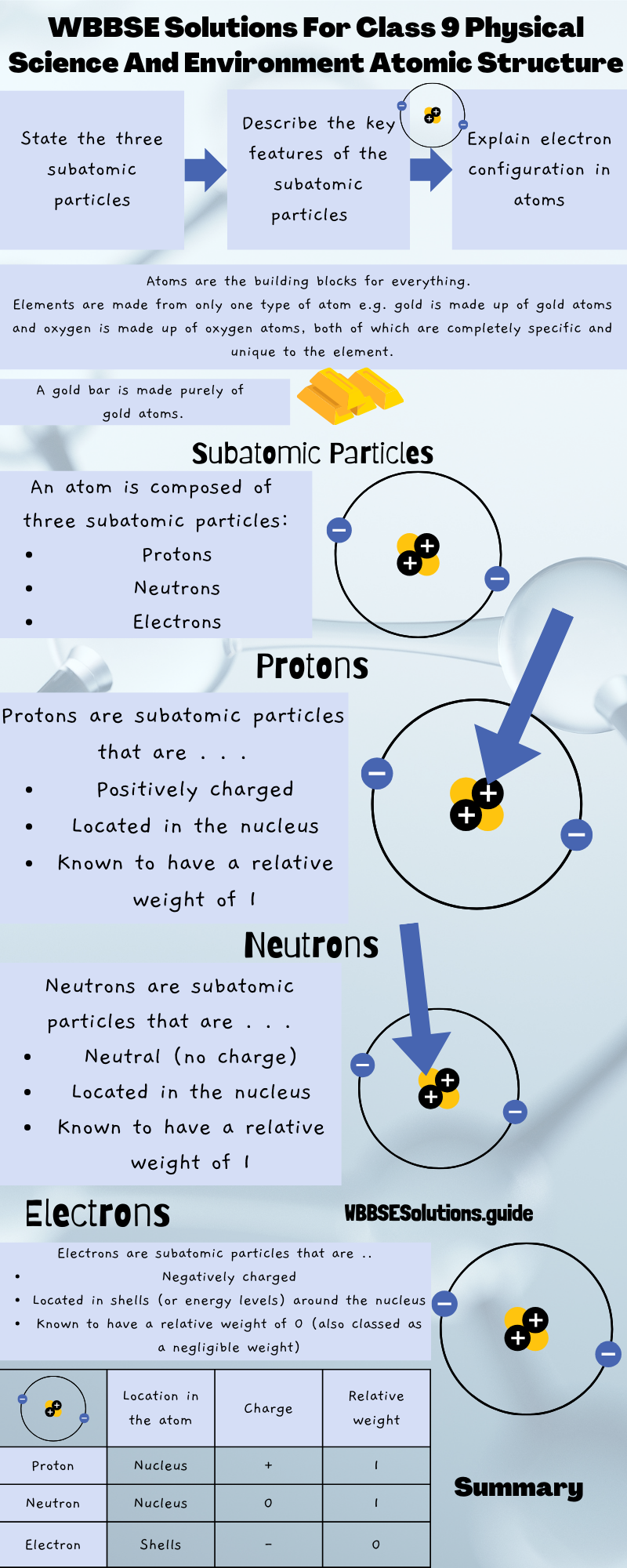
Answer: The main and fundamental constituent particles of an atom are electrons, protons, and neutrons.

Question 19. What are the numbers of protons and neutrons in the atom, 92 X235?
Answer: Protons = 92, Neutrons = 143.

Question 20. Name the Indian sage who propounded the idea of the atom ‘para Manu’.
Answer: Maharshi Kanad.

WBBSE Solutions For Class 9 Physical Science And Environment Atomic Structure

WBBSE Class 9 atomic structure solutions 

Question 21. What is the meaning of “atom”?
Answer: In Greek, ‘atom’ means indivisible.

Question 22. Who proposed the name atom?
Answer: The Greek philosopher Democritus.

Question 23. Who did for the first time propound the modern theory of the atom? Or, By whom was the concept of the atom developed?
Answer: John Dalton in 1808.

Question 24. Who was the discoverer of the electron?
Answer: William Crookes.

Question 25. Name the scientist who showed that the proton is one of the constituents of an atom.
Answer: Goldstein.

Wbbse Physical Science And Environment Class 9 Solutions

Question 26. Who was the discoverer of the neutron?
Answer: J. Chadwick (1932).

Question 27. Who gave the name Neutron?
Answer: Rutherford.

Question 28. What is the symbol of an electron?
Answer: The symbol of the electron is e or _1 0e

Question 29. What is the symbol of the proton?
Answer: The symbol of the proton: is 11P Or P+

Question 30. What is the symbol! of a neutron?
Answer: The symbol of neutron: n or 01n

Question 31. Name the lightest atom. 
Answer: The hydrogen atom is the lightest.

Question 32. What are protons?
Answer: Positively charged sub-atomic particles having unit mass and unit positive charge are called protons, i.e., a proton is a positively charged hydrogen ion (H1+).

WBBSE class 9 atomic structure question and answers

Question 33. Name the positively charged particle in the structure of an atom.
Answer: Proton present in the nucleus is positively charged.

Question 34. How is a proton formed?
Answer: A proton is formed by the removal of one electron from a hydrogen atom.

Question 35. State the relative mass and charge of a proton. 
Answer: The relative mass of a proton is 1 amu and its relative charge is +1 (plus one).

Question 36. State the absolute charge and mass of a proton.
Answer: The absolute charge of a proton is 1.6 x1027 coulomb of positive charge and its absolute mass is 1.6 x10_19  kg.

Atomic structure WBBSE Class 9 solutions with answers

Question 37. How many times is a proton heavier than an electron?
Answer: A proton is about 2000 times heavier than an electron.

Question 38. What is the mass of a neutron in a kilogram?
Answer: The mass of a neutron is 1.67 x 1027kg.

Question 39. What is the absolute charge of an electron?
Answer: The absolute charge of an electron is 1.6 x10¹⁹  coulomb.

Question 40. What is the mass of an electron?
Answer: The mass of an electron is 9.1 x 1031 kg.

WBBSE class 9 atomic structure question and answers

Question 41. Why are electrons called planetary electrons?
Answer: Electrons revolve around the nucleus in different orbits as the planets revolve around the sun in various orbits.

Question 42. Why is the nucleus of an atom positively charged?
Answer: Because the nucleus contains protons which are positively charged particles.

Question 43. Name the isotope of an atom whose nucleus consists of one proton only.
Answer: The atom of protium (ordinary hydrogen) has a nucleus consisting of one proton only.

Question 44. State the main differences between proton and neutron.
Answer: The proton is a positively charged fundamental particle while the neutron is an electrically neutral particle.

Question 45. Write the name of the neutral particle present in the structure of an atom.
Answer: Neutron.

wbbse class 9 physical science solutions

Question 46. The number of which sub-atomic particle is fixed in the nuclei of all the atoms of an element?
Answer: Protons.

Question 47. Write the name of the fundamental particle of an atom that is not present in the nucleus of an atom.
Answer: Electron.

Question 48. Name two radioactive elements.
Answer: Radium and Uranium are two radioactive elements.

WBBSE class 9 atomic structure question and answers

Question 49. What is the maximum number of electrons that may be present in the M-shell of an atom when it is the outermost shell?
Answer: Eight (8).

Question 50. An atom has a mass number of 23 and an atomic number of 11. What is the number of electrons in it?
Answer: The number of electrons in this atom of atomic number 11 is also 11.

Question 51. An atom of an element has 11 protons, 11 electrons, and 12 neutrons. What is the atomic mass of the atom?
Answer: The atomic mass of the atom will be (11 + 12) or 23.

Question 52. If an element ‘X’ has mass number 24 and atomic number 12, how many neutrons does its atom contain?
Answer: The number of neutrons in the atom will be (24 − 12) or 12.

Question 53. What can be known about the nucleus of the atom from the symbol,  11Na23?
Answer: The symbol,  11Na23 reveals that the nucleus of sodium atom is made. Up of 11 protons and (23 − 11) or 12 neutrons.

Question 54. Find out the number of neutrons in 17Cl35.
Answer: (35 – 17) or 18 neutrons are present in 17Cl35

wbbse class 9 physical science solutions

Question 55. Name the fundamental property used to identify an element.
Answer: Atomic Number (Z).

Question 56. Write down the relation between mass number and atomic number.
Answer: Mass number of an atom = atomic number + number of neutrons in the atom.

Question 57. The atomic number of sodium is 11. What do you mean by the statement?
Answer: The statement means that the nucleus of a sodium atom has eleven units of positive charge, i.e., eleven protons.

Question 58. Give the atomic number of the atom in which the M-shell contains 4 electrons.
Answer: 14 (2, 8, 4)

WBBSE class 9 atomic structure question and answers

Question 59. What is the maximum number of electrons the M-shell of the atom can accommodate?
Answer: 18 electrons.

Question 60. State the number of electrons in H+, H, and H
Answer: The number of electrons in H+, H, and H are zero, 1, and 2 respectively.

Question 61. Give an example of a nuclide that contains 2 neutrons.
Answer: Helium (24He ).

Question 62. Define the term isotope.
Answer: Isotopes are atoms of the same element having the same atomic number but different mass numbers.

wbbse class 9 physical science solutions

Question 63. How do isotopes of an element differ from one another?
Answer: The isotopes of an element differ in the number of neutrons in their nuclei.

Question 64. What is the reason for the different atomic masses of the isotopes of an element?
Answer: The isotopes of an element have different mass numbers because they contain different numbers of neutrons.

65. What is the reason for identical chemical properties of all the isotopes of an element?
Answer: All the isotopes of an element have identical atomic numbers.

Question 66. Give one similarity between them. A pair of isotopes.
Answer: A pair of isotopes have the same number of protons in their nuclei.

WBBSE Class 9 Physical Science atomic structure notes

67. Give one difference between a pair of isotopes.
Answer: A pair of isotopes differ in the number of neutrons in their nuclei.

68. Write down the names of the three isotopes of hydrogen
Answer: Protium (1H1), Deuterium (1H2), Tritium (1H3).

WBBSE class 9 atomic structure question and answers

wbbse class 9 physical science solutions

Question 69. Of which element protium is an isotope?
Answer: Protium (ordinary Hydrogen) is an isotope of hydrogen.

Question 70. What is called the total number of protons and neutrons present in an atom of an element?
Answer: Mass number.

Question 71. Are the atomic masses of the elements always whole numbers?
Answer: No, atomic masses of many elements are fractions and not whole numbers.

Question72. Give an example of an element having fractional atomic mass.
Answer: Chlorine has a fractional atomic mass of 35.5.

Question 73. What is the reason for fractional atomic masses of elements?
Answer: The fractional atomic masses of elements are due to the existence of their isotopes having different masses.

Question74. The same element may have different nuclides. What are they called?
Answer: Isotopes.

Question 76. If three neutrons less are taken away from 228U92then how would you write the nuclide?
Answer: The formula of the new nuclide is 225U92

Question 77. The same element may have different nuclides. What are they called?
Answer: isotopes.

Question 78. Name the lightest particle of an atom.
Answer: Electron.

Question 79. Which particle of an atom is negatively charged?
Answer: Electron.

Question 80. Which particle of an atom is positively charged?
Answer: Proton.

Question 81. Which particle of an atom is neutral?
Answer: Neutron.

Important questions on atomic structure WBBSE Class 9

Question 82. What is a valence shell?
Answer: The outermost shell of an atom is called the valence shell.

Question 83. What do you mean by valence electrons?
Answer: Electrons present in the valence shell are called valence electrons.

Question 84. What are the isotopes of Helium?
Answer: 2He4  And  2He3.

Question 85. What is the maximum number of electrons that may exist in an orbit?
Answer: 2n2

86. In how many orbits the electrons may be distributed?
Answer: In 7 orbits numbered 1, 2, 3, 4, 5, 6, 7 or designated as K, L, M, N, O, P, Q.

Question 87. What do you mean by the statement that “The mass of a Hydrogen atom is almost equal to the mass of a proton”?
Answer: A hydrogen atom has only one proton in its nucleus and one electron in the outermost shell. The mass of an electron is negligible compared to that of the proton. Hence, it may be said that the mass of a Hydrogen atom is almost equal to the mass of a proton.

Question 88. Can an element have more than one atomic weight?
Answer: No.

Question 89. Which fundamental particle is responsible for producing isotopes?
Answer: Neutrons.

Question 90. Name the heaviest isotope of hydrogen.
Answer: Tritium is the heaviest isotope of hydrogen.

Question 91. Between ion and atom, which one is more stable and why?
Answer: Generally ion is more stable than an atom. Lons have stable electronic configurations. So, ions are more stable than atoms.

Question 92. In which parts of an atom do electrons, protons, and neutrons exist?
Answer: Neutrons and protons exist in the nucleus and electrons are present in different orbits around the nucleus.

Question 93. Name the heaviest particle and the lightest particle in an atom.
Answer: A neutron is the heaviest particle and an electron is the lightest particle in. an atom.

Question 94. Name the positively charged particle and the neutral particle in the structure of an atom.
Answer: The Proton present in the nucleus is positively charged and the neutron is neutral.

Question 95. What is a valence electron?
Answer: The electrons in the outermost. The orbit of an atom, which participates in chemical bonding, is called valence electrons.

Atomic Structure 2 Marks Questions And Answers

Question 1. What are isobaric elements? Give examples.
Answer:

Isobaric elements

If atoms of different elements have the same mass number but different atomic numbers, then these elements are known as isobaric elements.

For example, 26Fe57 and 2 7Co57 have the same mass number but their atomic weights are 26 and 27 respectively. Calcium – 46 and Titanium – 46 have the symbols, 20Ca46 and  22Ti45
and are isobaric elements. In the isobaric elements, the mass numbers are the same, but the numbers of protons and neutrons are different.

Question 2. Define Atom.
Answer:

Atom – The smallest particle of an element which may or may not exist independently but contains all the properties of that element and takes part in chemical reactions is called an atom.

Question 3. Why are the physical properties of isotopes different?
Answer: The mass numbers of the isotopes of an element are different. Hence, they contain different numbers of neutrons in their atoms. Due to differences in the number of neutrons, their physical properties like mass, density, N.P., B.P., etc. are different.

Question 4. What is Nuclide? Give example.
Answer:

Nuclide

A nuclide is a more or less unstable specific type of atom of definite mass no. and atomic number that exists for a measurable time. Eg.− 92U235

WBBSE Class 9 solved exercises on atomic structure

Question 5. What are fundamental particles? Why are they called ‘fundamental’?
Answer:

Fundamental particles: The sub-atomic particles, electrons, protons, and neutrons are known as fundamental particles.

Reason: Experimentally it is found that these particles are the primary components of all atoms of all elements, except ordinary hydrogen, the nucleus of which does not contain neutrons. That is why, they are known as fundamental particles.

Question 6. State some other sub-atomic particles other than electrons, protons, and neutrons.
Answer:

Other sub-atomic particles are :

(1) Positron
(2) Antiproton
(3) Messon
(4) Neutrino
(5) Antineutrino
(6) V-particle
(7) Deuteron, etc.

Question 7. Distinguish between atomic number and mass number.
Answer:

Difference between atomic number and mass number :

Atomic Number Mass Number
(1)    It is equal to the number of protons present in the nucleus of an atom. (1)    It is equal to the sum of the number of protons and neutrons present in the nucleus of an atom.
(2)    From the atomic number, several valence electrons can be determined, which in turn, gives the idea about the ability of the chemical combination of the atoms. (2)    Mass number gives an idea about the atomic mass of the element concerned but it does not give any idea about the chemical activity of the element unless the number of protons or the no. of neutrons is indicated.


Question 8. Name the fundamental particles of an atom.
Answer:

An atom is mainly composed of three particles :

(1) Negatively charged particle: Electron
(2) Positively charged particle: Proton
(3) Electrically neutral particle: Neutron.

Question 9. Write the similarities and dissimilarities between,92U235  and 92U238 atoms.
Answer:

Similarities: Both of them contain the same number of protons and electrons (92).

Dissimilarities :
Number of neutrons in  92U235  = 235 – 92 = 143
Number of neutrons in  92U238 = 238 – 92 = 146

Question 10. Write the uses of isotopes.
Answer:

Uses of isotopes

(1) Radioactive isotopes are widely used for diagnostic purposes in medicine. Cobalt-60 is used in the treatment of cancer.

(2) The age of minerals, rocks, and earth can be determined with the help of a radioactive carbon-14 isotope.

Question 11. Define the atomic weight of any element in oxygen (O = 16) and carbon (C = 12) scales.
Answer:

(1) In oxygen (O = 16) scale: Atomic weight (relative atomic mass) of an element

From a specified source is the ratio of the average mass per atom of the element \(\frac{1}{16}\)to that of an oxygen atom.

∴ \(\text { Relative atomic mass of an element }\)=\(\frac{\text { average mass of an atom of the element }}{\frac{1}{16} \text { th jart of the mass of an oxygen atom }}\)

\(=\frac{\text { mass of an atom of the element }}{\text { mass of an oxygenatom }} \times 16\)


(2) In carbon (C =12) scale:
An atomic weight or relative atomic mass of an element

From a given source is the ratio of the average mass per atom of the element to \(\frac{1}{12}\) the mass of an atom of 6C12.

∴ \(\text { Relative atomic mass of an element }\)=\(\frac{\text { average mass of an atom of the element }}{\frac{1}{12} \text { th jart of the mass of an carbon atom }}\)

\(=\frac{\text { averagemass of an atom of the element }}{\text { mass of a carbon atom }} \times 12\)

WBBSE Class 9 Physical Science atomic models solutions

Question 12. Is there any difference between atomic weight and mass number? Explain with a suitable example. In most cases which is greater and why?
Answer:

Difference between atomic weight and mass number

Atomic Weight Mass Number
1.    Atomic weight represents the ratio of the average mass per atom of the element to 1/12th of an atom of 6c12 1. The mass number of an atom is the total number of protons and neutrons present in the nucleus.
 2.    Atomic weight may be a fraction. 2. A mass number is always a whole number and can’t be a fraction.


In most of the cases mass number is greater than the atomic weight. Most of the elements have more than two isotopes. So, the mass number is greater than the atomic weight.

Example: Oxygen has three isotopes 8O16, 8O17, and 8O18. The atomic weight of oxygen is 16.
Mass numbers of 8O17 and 8O18atoms are greater than the atomic weight of the oxygen atom.

Question 13. Why is an atom electrically neutral?
Answer:

The number of protons in the nucleus and the total number of orbits of the atom are always equal. Again, the amount of positive charge is equal to the amount of negative charge of an electron. So the total negative charge is equal to the total positive charge and hence an atom is electrically neutral.

Question 14. Why do the electrons revolve around the nucleus?
Answer:

Electrons are revolving around the nucleus in different concentric circular paths or elliptical paths. There exists a strong electrostatic force of attraction between the positively charged nucleus and the negatively charged electrons. This force of attraction supplies the necessary centripetal force to the electrons to revolve around the nucleus.

Question 15. Why are the isotopes of an element placed at the same position in the periodic table? Or, Why are the chemical properties of the isotopes the same?
Answer:

Isotopes of an element with the same atomic number have the same number of electrons in their outermost shell Chemical property depends on the atomic number, i.e., the number of protons or, electronic configuration. As the electronic configuration of isotopes is identical, chemical properties are also identical. So, the isotopes are placed in the same position in the periodic table.

Question 16. What is the relation between 17A35 and 17A37 Are the chemical properties of these two above elements completely different or more or less the same? Justify with reasons.
Answer:

The atomic mass of 17A35= 35; the number of protons = 17. The atomic mass of 17A37= 37; the number of protons = 17; “both atoms contain 17 protons, but the number of neutrons is different. So, they are isotopes of each other. The chemical property of the element depends only upon the number of protons present in the nucleus of the constituent atom. In this case, as the number of protons is the same, so they have the same chemical properties.

Question 17. The atomic number is the fundamental property of an element but not atomic weight.
Answer:

The atomic number is the fundamental property of an element but not the atomic weight.

The atomic weight of an element may differ due to the presence of isotopes. However, the atomic number cannot be the same for two elements. Chemical properties change with a change in the atomic number. That is why, atomic number is considered as the fundamental property of an element rather than its atomic weight.

Question 18. The formula of an atom of an element is 92U238. Write the number of protons, and electrons.Neutronss are present in the atom.
Answer:

Given

The formula of an atom of an element is 92U238.

From 92U238 we know that atomic number = 92 and mass number = 238.

∴ The nucleus of 92U238nuclide contains 92 protons and (238-92) or 146 neutrons. Number of electrons = 92.

Subatomic particles Class 9 WBBSE notes

Question 19. What is the atomic mass unit? 1 amu = how many grams?
Answer:

Atomic mass unit

An atomic mass unit (amu) is a unit that is used to express the atomic or molecular masses. One atomic mass unit = 1/12 the part of the mass of one carbon atom (C-12) at rest and in its ground state.

1 amu or 1 u = 1°6603 X 10-24 g.

Question 20. Compare Proton and Neutron.
Answer:

Similarities :

(1) Both are heavier than electrons.
(2) Both exist in the nucleus.

Dissimilarities :

(1) Proton is positively charged. Neutron is neutral.

Question 21. Write the number of electrons in 40 K 19. Write the electronic arrangement of the atom having this number of electrons.
Answer:

Number of electrons – 19

Electronic configuration − K shell – 2, L shell – 8, M shell – 8, N shell – 1

Question 22. What is an ion? Between an atom and an ion of an element, which particle present in them differs in number?
Answer:

Ion

Lons are electrically charged atoms or groups of atoms. Lons are produced when an atom either gives up electron(s) or accepts electrons or a salt undergoes ionization by the effect of solvent or heat.

Anions are the acidic part of salts. As,  Cl, SO2-4, NO3, and OH are anions.

Electronic configuration ofMg+2= K shell = 2, L shell = 8.

Question 23. The atom of an element contains 2 electrons in the K shell, 8 electrons in the L shell, 8lectrons in the M shell, and 2 electrons in the N shell. What is the atomic number and valency of the element?
Answer:

Given

The atom of an element contains 2 electrons in the K shell, 8 electrons in the L shell, 8lectrons in the M shell, and 2 electrons in the N shell.

The atomic no. of the element = (2 + 8 + 8 + 2) = 20.

∴ Valency of the element = 2.

Question 24. There are 2 electrons in the K shell, 8 electrons in the L shell, and 6 electrons in the M shell in the atom of an element. What is the atomic number of the element? What is the maximum valency of the element? What is the number of neutrons in the atom of the element if the mass number of the element is 32?
Answer:

Given

There are 2 electrons in the K shell, 8 electrons in the L shell, and 6 electrons in the M shell in the atom of an element.

The atomic no. of the element = no. of protons

= total no. of electrons in K, L, and M shells.

=2+8+6=16.

Maximum valency of the element = 18 − 16 = 2.

No. of neutrons = Mass no − Atomic no.

= 32-16 = 16.

Question 25. What is meant by,8O16? Show its electronic configuration.
Answer:

8O16

(1) It is an isotope of oxygen.
(2) The symbol of the element is “O”.
(3) The atomic no. of the element is 8 and its mass no. is 16.

Electronic configuration of,8O16 is 2, 8, 6.

Question 26. How many protons and neutrons are there in the atom
143 57X
Answer: 143 57 X
Protons = 57
Neutrons = 143 − 57 = 86

Question 27. There are 2, 8, and 7 electrons in the K, L, and M shells respectively of an atom of an element. What is the atomic number of the element? What is its valency? What is the number of neutrons if the mass number of the element is 37? To which group of the periodic table does the element belong?
Answer:

Given

There are 2, 8, and 7 electrons in the K, L, and M shells respectively of an atom of an element.

The atomic no. of the element =2+8+7.

Valency of the element =18-17 =1

No. of neutrons = Mass no− Atomic no.

= 37-17 =20

It belongs to group VII.

Question 28. The atomic weight of chlorine is 35.46 concerning the atom “O”. What does it mean?
Answer:

One atom of chlorine is 35.46 times heavier than \(\frac{1}{16}\) th part.of an oxygen atom.

Question 29. What do you mean by nuclear force?
Answer:

Nuclear force

The protons and neutrons (nucleus) are bonded inside the nucleus by a strong attractive force which is called the nuclear force. The force exists between proton-proton, proton-neutron, and neutron-neutron. If, in a nucleus, the number of protons is much more than the number of neutrons or the number of neutrons is much more than the number of protons, the nuclear force becomes weak. The nuclei of such elements become unstable and tend to disintegrate.

Question 30. Find the relation between mass number and atomic number.
Answer:

Relation between mass number and atomic number

The mass number of an atom = several protons + several neutrons.

Let the number of protons = atomic number = Z

number of neutrons = N

and mass number of an atom = A

Then, A=Z+N.or Z=A-N

Atomic number = mass number – number of neutrons.

Question 31. Give the maximum number of electrons in the first four orbits.
Answer:

ORBIT Orbit Number (n) Maximum number of electrons in the orbit
First orbit or K-Shell 1 2 x 12= 2
Second orbit or L-Shell 2 2 x 22 = 8
Third orbit or M-Shell 3 2×32= 18
Fourth orbit or N-Shell 4 2 x 42= 32


Question 32. Explain how the mass number and atomic number of chlorine are represented symbolically.

Answer:

The symbol of Chlorine can be written as
17 Cl 35or 17 Cl 37

Here, A= 35, Z=17

N= A – Z

∴ N= 35 -17 =18

Question 33. Define isotopes. Give examples.
Answer:

Isotopes: The atoms of the same element having the same atomic number but different mass numbers are called isotopes.

For example, hydrogen has three isotopes: 1H1,1H2, and 1H3

Oxygen has three isotopes: 8 O16, 8 O17 and 8O18

Chlorine has two isotopes: 17 Cl 35 and  17 Cl 37

Question 34. State the properties of Isotopes.
Answer:

The main properties of isotopes are :

(1) The number of protons (atomic number) in all the isotopes of an element is the same.

(2) The electronic configurations of all the isotopes of the same element are similar.

(3) They have same number of valence electrons.

(4) The physical properties such as mass, density, melting points, boiling points, etc. of the isotopes of the same element are different.

Question 35. Why is the average atomic weight of chlorine fractional? Give a reason. 
Answer:

The average atomic weight of chlorine is taken as 35.5. The fractional atomic weight of chlorine is because natural chlorine has three parts of 17 Cl 35 and one part of 7 Cl 37
The atomic mass of 3 atoms of17 Cl 35=3 x 35 = 105 a.m.u.
The atomic mass of 1 atom of 17 Cl 37 = 1 x 37 = 37 a.m.u.
Atomic mass of 4 atoms of natural chlorine = 105 + 37 = 142 a.m.u.

Average atomic mass of chlorine = 142 ÷  4 = 35.5 am. u.

Hence, the average atomic weight is fractional.

Question 36. Define isobars. Give examples.
Answer:

Isobars:  Isobars are the atoms of different elements having different atomic numbers but the same mass number. Isobars have different numbers of protons, electrons as well as neutrons. So they have different physical as well as chemical properties.

Example: 18Ar40, 19K40, 20Ca40 – each has the same mass number but different atomic numbers. That is why, they are known as isobars of each other.

Question 37. What are the differences between isotopes and isobars? Explain with suitable examples.
Answer:

The differences between isotopes and isobars

Isotopes Isobars
(1)    Isotopes are the atoms of the element having the same atomic number but different mass numbers. (1)    Isobars are the atoms of different elements having different atomic numbers but the same mass number.
(2)    Isotopes have identical chemical properties (2)    Isobars have different chemical properties.
Example:  8 O16 and 8 O17 are isotopes of each other as they have the same atomic number but different mass numbers. Example: 18Ar40 and 19K40 are isobars of each other as they havethea same mass number but different atomic numbers.


Question 38. Write the number of protons and neutrons present in the nuclide,6 A13. Write the electronic configuration of an atom of the above element. Write the difference between the structures of the nuclides 6A13 and,6 A12. Why are the chemical properties of these two nuclides the same? (A = symbol of an element).
Answer:

In, 6 A13 nuclide, the number of protons = 6 and the number of neutrons = (13 – 6) or 7.

(1) See of electrons = 6. Among these 6 electrons, 2 electrons are in K orbit and 4 electrons are in L orbit.

(2) The nucleus of 6 A13 nuclides contains 6 protons and 7 neutrons. On the other hand, the nucleus of 6 A12 contains 6 protons and 6 neutrons.

6 A13 contains one more neutron than, 6 A13.

(3) Due to the presence of the same number of protons, i.e., the same atomic number, the chemical properties of both are the same.

Question 39. Write the mass number and atomic number of the atom 92X235. If there is one more neutron, how will the element be expressed?
Answer:

(1)Mass number of 92X235, A = 235 and atomic number, Z = 92.

…Number of neutrons present, N = A – Z + 235 – 92 =143.

(2) If one more neutron is present in that atom, the mass number will also be increased by one unit.

In that case, the new element will be expressed as 92X235+1= 92X235.

Atomic Structure  3 Marks Questions And Answers:

Question 1. Describe J.J. Thomson’s atomic theory
Answer:

J.J. Thomson’s atomic theory

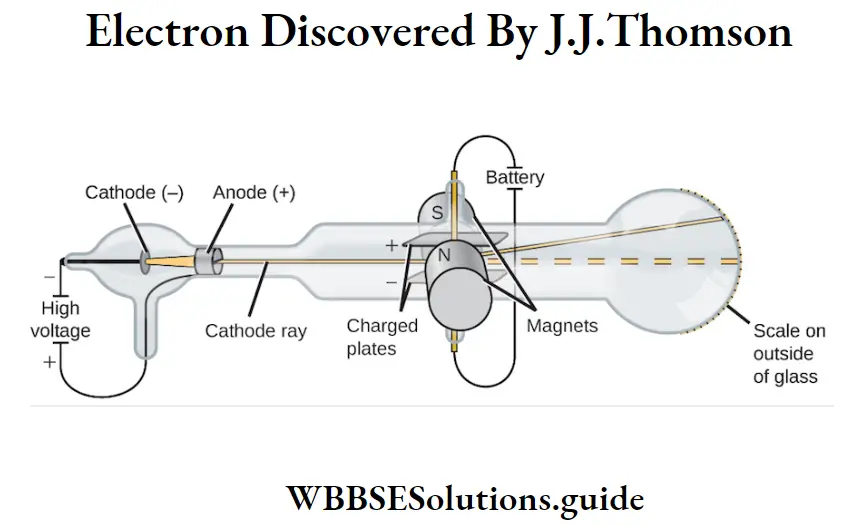
Thomson discovered the electron in the year 1897. His work put forward a new theory that the atom was made up of small particles. Thus, he discovered the electrons. He proved his theory using the cathode ray tube. J. Thomas used a highly evacuated discharge tube. He placed two anodes inside the tube.

He fixed two plates parallel to each other inside the tube. He passed a thin cathode ray through the pinhole of the tube. He could see the sides of the tube glowing in green color. The glow traveled in a straight line. The green glow was caused by the cathode rays. Now, Thomson applied an electric field. The ray deflected to the positively charged plate. Thus, Thomson discovered the electrons.WBBSE Solutions For Class 9 Physical Science And Environment Structure Of Atom Electron discovered by J.J .Thomson

Question 2. State the importance of J.J. Thomas’s experiment.
Answer:

Importance of J.J. Thomas’s experiment

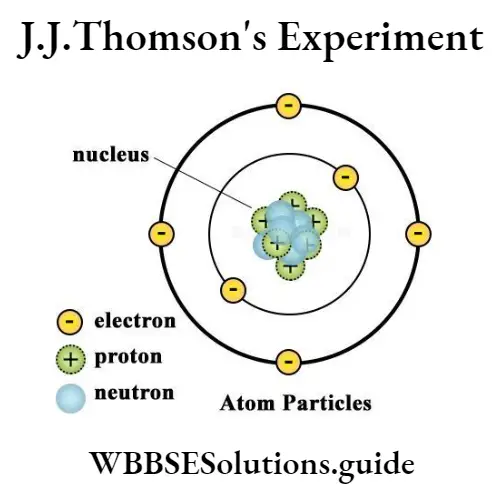
Thomson discovered the electrons and it was q proved that atoms were made up of protons, electrons, and neutrons. Thus, Thomson proved that the atom was divisible. Since the atom was neutral, Thomson ‘suggested that the negatively charged electron equaled the positively charged proton and neutrons had no charges.

Thomson suggested to consider the atom as a sphere. It has positively charged particles. The positively charged particles were surrounded by the negatively charged electrons. The electrons were placed there atom Particles due to electrostatic forces.

WBBSE Solutions For Class 9 Physical Science And Environment Structure Of Atom J.J.Thomson's Experiment Of Atom Particle

Question 3. Describe Rutherford’s alpha particle experiment.
Answer:

Rutherford’s alpha particle experiment

In 1910, a physicist from New Zealand, Ernest Rutherford performed an experiment known as Rutherford’s gold foil experiment. This experiment determined to find out the structure of an atom.

The alpha particles were confined to a narrow beam by passing them through a lead sheet through a slit. An extremely thin gold foil was bombarded with a narrow beam of fast-moving alpha particles.

On bombarding, the alpha particles were scattered in different directions with different angles and were detected by the fluorescent rotatable detector, which has a microscope and a screen coated with zinc sulfide. The whole experimental setup was placed in an evacuation.

WBBSE Solutions For Class 9 Physical Science And Environment Structure Of Atom Alpha Particle

Chamber to prevent scattering by the air molecules. These particles after striking the screen caused scintillations. Before performing this experiment it was assumed by Rutherford that most of the alpha particles would pass through the gold foil with less deflection.

He assumed this based on the theory proposed by J.J. Thomson. This was assumed because the alpha particles are heavy and the negative charge in the “plum pudding model” is widely spread.

Question 4. Describe Rutherford’s Atomic Model.
Answer:

Rutherford’s Atomic Model

Rutherford’s atomic model, also known as the planetary model is a model of the atom proposed by the physicist Ernest Rutherford.

The following are the main points of Rutherford’s theory :

(1) Most of the part of an atom is empty.

(2) Approximately all the mass of the atom is concentrated at the center of the atom which is now called the nucleus.

(3) In the central region of the atom the positively charged particles are present.

(4) The charge on the nucleus of an atom is positive and is equal to Z.e where Zis charge number, e is the charge of a proton.

(5) The negatively charged particles, i.e., electrons revolve around the central positive portion in different circular orbits.

(6) The central region (nucleus) is very small in size compared to the size of an atom.

Bohr Model Of Atom Class 9

Question 5. State the limitations of Rutherford’s model.
Answer:

Limitations of Rutherford’s model

Rutherford’s model did not make any new headway in explaining the electronic structure of the atom. Rutherford’s concentration of most of the atom’s mass into a very small core made some type of planetary model, as such a core would contain most of the atom’s mass, similar to the sun containing most of the solar system’s mass. Rutherford’s model was later improved and quantified by one of his students, Niels Bohr, with the known Bohr’s model of the atom.

There were mainly two defects in Rutherford’s atomic theory which are shown as follows:

1. Being a charged particle, the electron must emit energy when it is accelerated, according to classical electromagnetic theory. We know that around the nucleus the motion of electrons is accelerated, hence it must radiate energy. But this does not happen in actual practice.

Assume that if it occurs then due to continuous loss of energy orbits of electrons must decrease continuously. As a_ result electrons will fall into the nucleus eventually after some time. But this is against the practical situation and hence this shows that the atom is unstable.

2. If the electrons emit energy continuously, a continuous spectrum should be formed. But practically, line spectrum is observed.

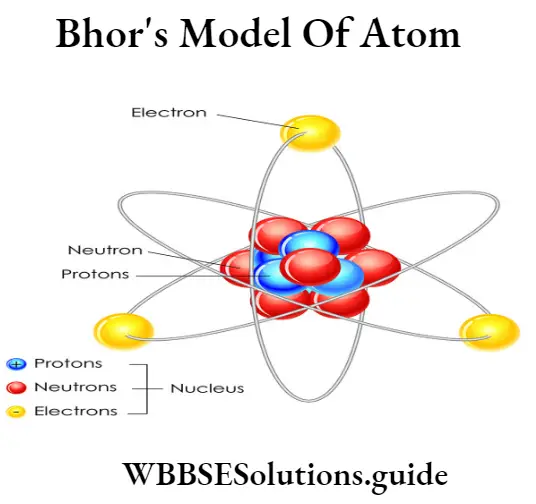
Bohr Model Of Atom  Question 6. Describe Bohr’s model of the atom.
Answer:

According to Bohr’s theory :

(1) The atom consists of a small positively charged nucleus at its center.

(2) The whole mass of the atom is concentrated at the nucleus and the volume of the nucleus is smaller than the volume of the atom by a ratio of about 1:10°.

(3) The nucleus contains all the protons and neutrons of the atom.

(4) The electrons of the atom revolve around the nucleus in definite circular paths known as orbits which are designated as K, L, M, N or numbered as n=1, 2, 3, 4 outward from the nucleus.

(5) Each orbit is associated with a fixed amount of energy. Therefore, these orbits are also known as energy levels or energy shells.
WBBSE Solutions For Class 9 Physical Science And Environment Structure Atom Of Bohr's Model Of Atom


Bohr Model Of Atom Class 9 WBBSE

Question 7. Compare all the proposed models of an atom by J. J. Thomson, Rutherford, and Neils Bohr.
Answer:

J. J. Thomson: Since discharge tube experiments suggested the presence of negatively charged particles in a neutral atom, J. J. Thomson suggested that electrons are embedded in a sphere of positive charge.

E. Rutherford: The good foil experiment of Rutherford suggested that all the positive charge is located in a very small space which is 10° times the radius of an atom. Therefore, Rutherford gave a model in which electrons are revolving around the nucleus.

Neils Bohr: To explain the stability of an atom and atomic spectra, Bohr suggested that electrons move around the nucleus in orbits that have fixed energy shells. There is a loss or gain in energy of an electron when it moves from one orbit to the other.

Question 8. How did Neils Bohr modify Rutherford’s model?
Answer:

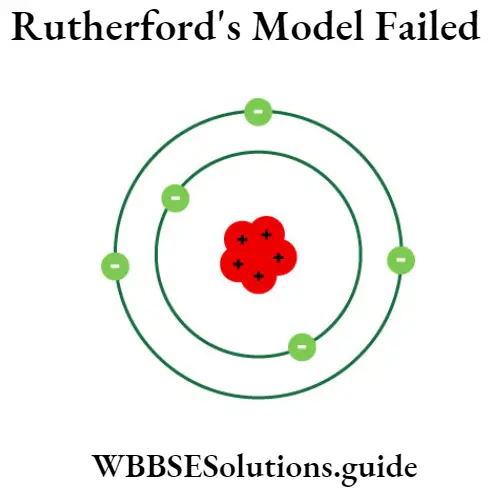
Rutherford’s model failed to explain the electromagnetic principles, stability of an atom, line spectra of an atom, etc. In 1913 Neils Bohr modified Rutherford’s model by taking the help of quantum theory.
WBBSE Solutions For Class 9 Physical Science And Environment Structure Of Atom Rutherford Failed Experiment

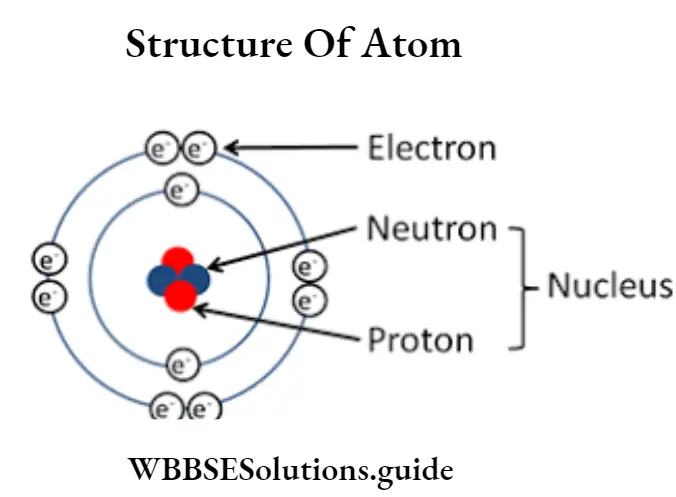
Structure Of Atom

Question 9. Describe the structure of the atom based on modern theory.
Answer:

Structure of the atom based on modern theory

Based on a modern concept, the atom is built up of tiny particles called sub-atomic particles—proton, and neutron. Atoms can be divided into two parts — the nucleus and the extranuclear part.

Bohr Model Of Atom Class 9 WBBSE

Nucleus: Protons and neutrons of an atom are packed in extremely small volumes of the Electron nucleus at the center of the atom. Shells All the protons are positively charged and hence nucleus has a positive charge. The proton and neutrons present in the nucleus together are called nuclei.

WBBSE Solutions For Class 9 Physical Science And Environment Structure Of Atom Structure Of Atom Modern Theory

The whole of the mass of an atom is due to the nucleus Electron (e7) containing proton and neutron. Electrons revolving outside are of negligible mass. Hence, the sum of neutrons and protons in the nucleus is known as the mass number.

The nucleus is the central part of the atom which contains protons and neutrons. Protons are positively charged particles while neutrons have no charge. Electrons revolve around the nucleus in different orbits having negligible mass. Electrons are negatively charged particles. The number of electrons is equal to the number of protons in an atom. The number of neutrons may or may not be equal to that of a proton.

Structure Of Atom

Question 10. Describe the fundamental particles of an atom.
Answer:

Fundamental particles of an atom

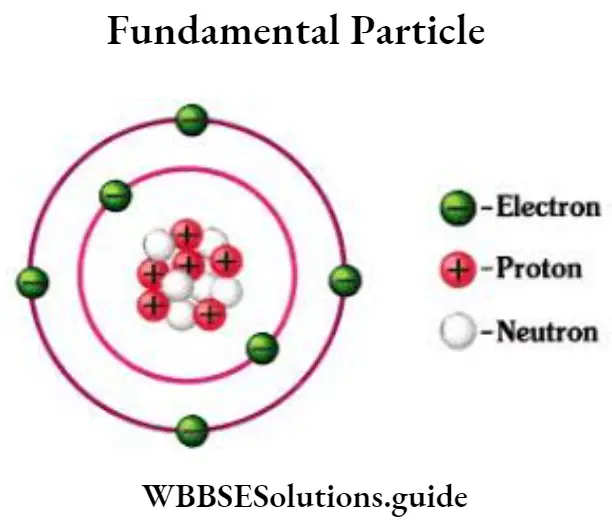
The main and fundamental particles of an atom are electrons, protons, and neutrons.

Electron: Electrons are negatively charged particles revolving around the nucleus in the extranuclear part of the atom, in the definite orbit (marked C in the given figure). The number of electrons is the same as the number of protons in an atom.

The charge on an electron is 4.8033 x10⁻¹⁰ e.s.u and in S.l. unit is 1.6022 x 10⁻¹⁹

Coulomb. The mass of electron in C.G.S unit = 9.0196 x10-38 gm and in a.m.u. = 0.00054859.

WBBSE Solutions For Class 9 Physical Science And Environment Structure Of Atom Fundamental Particles Of Atom

That electrons are negatively charged particles, is verified by the cathode rays tube.

Protons: Proton, the lightest positive charged particle, resides in the nucleus (marked A in the given figure). Its mass is about 1837 times the mass of an electron. The number of protons and electrons is equal in an atom.

The charge of a proton is 4.8033 x 10⁻¹⁰ e.s.u. and S.1. unit is 1.6022 x 10⁻¹⁹coulomb.

The mass of a proton is 1.6726 x 10⁻²⁴ gm and in a.m.u. is 1.007277.

Neutron: Neutrons exist in the nucleus and contain no charge (marked. as B i). The number of neutrons is independent of the number of protons. Ordinary hydrogen contains no neutrons.

The mass of neutrons in grams is 1.6749 x10⁻²⁴ and in amu, the unit is 1.008665.

Thus, the mass of one neutron is approximately equal to the mass of one proton.

Best study material for atomic structure WBBSE Class 9

Question 11. Define an atomic number of an element. State its main characteristics.
Answer:

Atomic number: The number of protons in the nucleus of an atom of an element is called its atomic number. Since an atom is electrically neutral, the number of protons is equal to the number of electrons in an atom.

The characteristics of atomic number are the following :

(1) The atomic number, of an element Represents its fundamental property. No two elements can have the same atomic number.
(2) An element is identified by its atomic number.
(3) The atomic number of an element is stable. It does not change during a chemical reaction.
(4) Atomic number of an element is usually denoted by the letter Z.

Question 12. What are the main points of similarities between the solar system and atomic structure?
Answer :

The similarities existing between the solar system and atomic structure are the following given below :

Solar System Atomic Structure
1.    In the solar system, planets revolve around the central sun in different fixed orbits. 1.    In atomic structure, the electrons revolve around the nucleus in different orbits.
2. Most of the space between the sun and the planets is empty. 2.    Most of the space between the nucleus and electrons is empty.
3.    The mass of the sun is several times greater than that of any other planet. 3.    The mass of the nucleus is many times greater than the revolving electrons.
4.    The path of rotation of planets around the sun is not circular but slightly elliptical. 4.    The rotational paths of electrons are circular and elliptical.
5.    There exists a gravitational force between the sun and rotating planets, necessary for the rotation of planets. 5.    There exists an electrostatic attractive force between the positively charged nucleus and negatively charged extra nuclear electrons, necessary for the rotation of electrons.
6. The planets rotate about their axis while revolving around the sun. 6.    Electrons rotate about their axis while revolving around the nucleus.


Question 13. Explain the electronic configuration of an atom in its extranuclear part. Circular and elliptical both.
Answer:

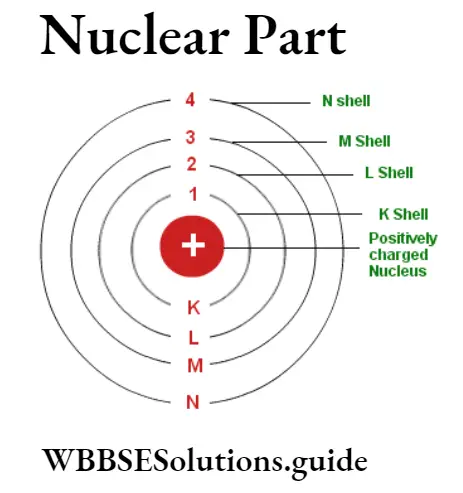
Electrons revolve around the nucleus part of the atom in definite orbits. These orbits are known as energy levels quantum numbers or shells. These orbits are known as first shell or K-orbit, second shell or L-orbit, third shell or M-orbit, etc. These orbits are K, L, M, N, O, P, and Q orbits.

The Bohr-Bury. scheme presented by Bohr and Bury in 1921 regarding filling the orbits of atoms with electrons is given as :

(1) An orbit can have a maximum number of2n2 electrons, where n represents the number of the orbit.
(2) The outermost orbit can not have more than 8 electrons and the inner orbit can not have more than 18 electrons.
(3) Before the completion of an orbit the next orbit starts filling, as soon as the outermost orbit gets 8 electrons, the next orbit starts filling.
(4)An atom becomes stable when it has 8 electrons in its outermost orbit.
WBBSE Solutions For Class 9 Physical Science And Environment Structure Of Atom Structure Of Atom Nuclear Part

Question 14. Mention the dissimilarities between the solar system and the structure of atoms.
Answer :

Following are the main points of dissimilarities between the solar system and the structure of atoms.

Solar System Atomic Structure
1.    In the solar system, there is one planet in one orbit. 1.    In atomic structure, the number of electrons in an orbit may be one or more than one.
2.    The force acting between the sun and the planets is gravitational. 2.    The force acting between the nucleus and electrons is electrostatic.
3.    The planets experience gravitational attraction between them. 3.    The force acting between electrons is repulsive.
4.    In the solar system the planets are of different masses and different volumes. 4.    In atomic structure all the electrons are of the same mass and volume.
5.    The planetary orbitals lie nearly in the same plane. 5.    In atomic structure, the electrons’ orbitals lie in different planes.
6.    The sun and planets are not electrically charged. 6.    The nucleus is charged positively and electrons are charged negatively.
7.    Some of the planets in the solar system have satellites as Earth has a moon. 7.    Electrons in an atom do not have satellite electrons.
8.    The planets do not escape from the solar system. 8.    Electrons can leave an atom or more electrons can be gained by an atom.


Question 15. Define the mass number of an element. State its main characteristics.
Answer:

Mass number: The total number of protons and neutrons in one atom of an element is called its mass number.

The characteristics of mass number are the following :

(1) Mass number = number of protons + number of neutrons.
(2) It is usually denoted by the letter A.
(3) A mass number is always a whole number. Since the number of protons and the number of neutrons are in whole numbers, hencé mass number cannot be in fractions.

Question 16. How are the mass number and atomic number of an element represented symbolically? Give the example of oxygen.
Answer:

Generally mass number of an element is represented on the upper left or right side of the symbol and the atomic number in subscripts is on the lower left side of the symbol of the element.

For example, the symbol of oxygen can be written as 6O16 or 8O16
where, mass number = 16, atomic number = 8.
The number of neutrons = A- Z=16-8=8.

Question 17. Explain the electronic configurations of some elements from hydrogen to calcium element.
Answer:

The electronic configurations of some elements are given in the following table :

Element Symbol Atomic number Electronic arrangement In different orbit
K L M N 0 P
Hydrogen H 1 1
Helium He 2 2
Lithium U 3 2 1
Berylium Be 4 2 2
Boron B 5 2 3
Carbon. C 6 2 4
Nitrogen N 7 2 5
Oxygen O 8 2 6
Fluorine F 9 2 7
Neon Ne 10 2 8
Sodium Na 11 2 8 1
Magnesium Mg 12 2 8 2
Aluminium Al 13 2 8 3
Silicon Si 14 2 8 4
Phosphorus P 15 2 8 5
Sulfur s 16 2 8 6
Chlorine s 16 2 8 7
Argon Ar 18 2 8 8
Potassium K 19 2 8 8 1
Calcium Ca 20 2 8 8 2


Question 18. What is orbital? What are the differences between orbit and orbital?
Answer:

Orbital: An orbital may be defined as a region in the space around the nucleus where the probability of finding the electron is maximum.

The main differences between orbits and orbitals are :

(1) Orbit is a well-defined circular path around the nucleus in| which electrons revolve. Orbital represents the region in space around the nucleus in which the probability of finding the electrons is maximum.
(2) Orbit represents the planar motion of an electron. Orbital represents the three-dimensional motion of an electron around the nucleus.
(3) All orbits are circular. Orbitals have different shapes. The orbitals are s, p, d, f, …, etc. The s – s-orbital is spherical, the p-orbital is dumbbell-shaped, etc.
(4) Orbits have a definite path of an electron, while orbitals do not specify any definite path.

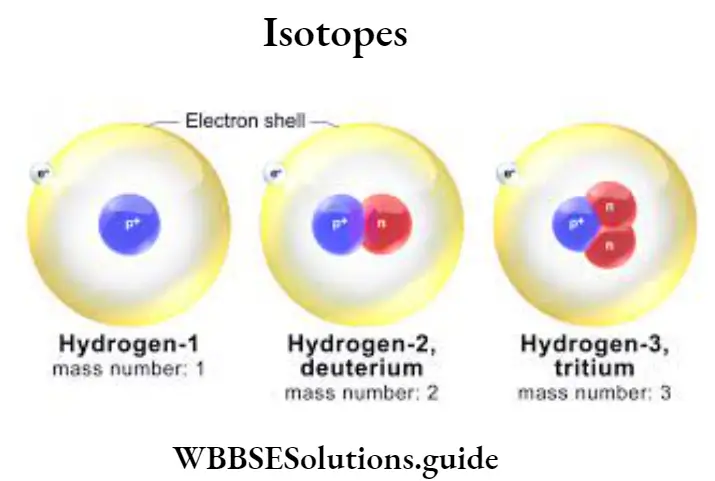
Question 19. Describe the different isotopes of hydrogen gas.
Answer :

Hydrogen gas has three isotopes :

(1) Ordinary hydrogen (Protium)
(2) Deuterium, and

(3) Tritium. Ordinary hydrogen (Protium) is represented by 1H1

Mass number = 1
Number of protons (Atomic number) = 1
Number of electrons = 1.
Number of neutrons = 0

Deuterium is represented by 1H2

Mass number = 2
Number of protons (Atomic number) = 1
Number of electrons = 1
Number of neutrons = 1

Tritium is represented by 1H3

Mass number = 3
Number of protons (Atomic number) = 1
Number of electrons = 1
Number of neutrons = 2

Diagrammatically they are expressed as below :

WBBSE Solutions For Class 9 Physical Science And Environment Structure Of Atom Different Types Of Isotopes

Question 20. What are the differences between atomic weight and the weight of an atom?
Answer:

The differences between atomic weight and the weight of an auto

Atomic Weight Weight of an atom
1.    Atomic weight does not represent the actual weight of an atom. 1. The weight of an atom represents its actual weight.
2.    Atomic weight represents the ratio of the average mass per atom of the element to 1/12th of an atom of 6c12 2. The weight of an atom represents the summation of masses of all constituent particles present in that atom.
3.    Since atomic weight is a ratio of two weights, it is a dimensionless physical quantity. 3. The weight of an atom has a definite unit
Example: The atomic weight of hydrogen is 1.0078, which is a pure number.  Example: The actual weight of a hydrogen atom is 1.6725 x 10⁻²⁴g).


WBBSE class 9 atomic structure question and answers

Question 21. Define an ion. State its different types.
Answer:

Ion

When an atom loses one or more electrons from an outermost orbit or gains one or more electrons in that orbit, then the resultant electronically Onaged particle is called an Ions are of two types: cations and anions.

(1) Cation: Cation is a positively charged atom or radical. When an atom loses one or more electrons from its outermost orbit, it becomes. A cation (positively charged particle).
For example :   Na-e→   Na+
(2,8,1)      (2,8)

(2) Anion: Anion is a negatively charged atom or radical. When an atom of an element accepts one or more electrons in its outermost orbit, the atom becomes an anion (negatively charged).
Cl +e→   Na+
(2,8,7)         (2,8,8) 

Question 22. Is there any difference between atomic weight and mass number? Explain with a suitable example. In most cases which is greater and why?
Answer:

Atomic Weight Mass Number
1.    Atomic weight represents the ratio of the average mass per atom of the element to 1/12th of an atom of 6c12. 1. The mass number of an atom is the total number of protons and neutrons present in the nucleus.
 2.    Atomic weight may be a fraction. 2. A mass number is always a whole number and can’t be a fraction.


In most of the cases mass number is greater than the atomic weight. Most of the elements have more than two isotopes. So mass number is greater than the atomic weight.

Example: Oxygen has three isotopes 8 O16, 8 O17, and  8 O18. The atomic weight of oxygen is 16. Mass numbers of  8 O17 and 8 O18 atoms are greater than the atomic weight of an oxygen atom.

Question 23. Why are atomic weight and mass number of all elements not the same? For which element are these same?
Answer:

Atomic weight and mass number have different values due to the presence of different numbers of isotopes of a particular element. This is because the atomic weight of those elements is the average of the mass numbers of isotopes present in different ratios.

(1)Example: isotopes of chlorine having mass numbers 35 and 37 are present in the chlorine gas in 75.4 % and 24.6 % respectively, so

atomic weight of chlorine\(=\frac{35 \times 75.4+37 \times 24.6}{100}\)\(=35.46 \approx 35.5\)

∴  The atomic weight and mass number of chlorine are different.

(2)Elements that have no isotopes have identical atomic weights and mass numbers.

(3)Example: Sodium has no isotope. The atomic weight and mass number of sodium are the same (23).

Question 24. Write the importance of Dalton’s atomic theory.
Answer:

Importance of Dalton’s atomic theory

(1) Dalton’s atomic theory for the first time stated that the atom is the smallest particle of an element which is a revolutionary idea in science.
(2) Atomic theory can explain how atoms of different elements combine to form compounds.
(3) Atomic theory can explain the law of conservation of mass and other laws of chemical combination (except Gay Lussac’s law).
(4) Avogadro’s hypothesis. The concept of molecules was derived from Dalton’s atomic theory.

WBBSE class 9 atomic structure question and answers

Question 25. Compare electron and proton.
Answer:

Similarities :

(1) Both are present in all atoms of all elements.
(2) Both are electrically charged particles.

Dissimilarities :

(1) The electron is negatively charged. The proton is positively charged.
(2) A proton is 1836 times heavier than an electron.
(3) Proton exists in the nucleus. Electrons rotate around the nucleus in definite orbits.

Question 26. State the difference between atoms and ions.
Answer:

Difference between atoms and ions

Atoms Ions
1.    An atom is electrically neutral. The number of protons in the nucleus is the same as the number of electrons in its shells. 1.    An ion is an electrically charged particle formed either by accepting an electron or donating an electron by an atom of an element.
2. The electronic configuration of atoms in their outermost shell ranges from 1 to 7 electrons (except noble gases). 2.    All ions have an electronic configuration of either 2 or 8 in their outermost shells.
3.    An atom may or may not be able to exist independently. 3.    An ion cannot exist independently.
4. The properties of an atom are independent of the properties of its ions. 4. The properties of ions are different from that of atoms.


WBBSE Class 9 Bohr’s and Rutherford’s model solutions

Question 27. How is the nucleus stable though it contains positively charged protons?
Answer:

In the nucleus, there should be repulsion between positively charged particles and protons and the nucleus should be unstable, but this is not happening. This contradiction was solved by Yukawa. According to him, protons emit π+ meson which is absorbed by neutron.

p −π+ → n

n+ π+ → p

Thus, the conversion of proton into neutron and neutron into proton is responsible for the origin of nuclear force between them which binds the nucleons. Thus, the nucleus becomes stable.

Question 28. Compare an electron, a proton, and a neutron concerning their masses, charges, and positions in the atom.
Answer:

Name of the particle and symbol Mass (g) Amount and nature of charge Position In atom
Electron (e or  1e0) 9.11×10⁻²⁸ 4.8x 10⁻¹⁰esu ofcharge or 1.6×10⁻¹⁹  coulomb, negatively charged In different orbits outside the nucleus of an atom
Proton (P or 1H1) 1.6725×10⁻²⁴ 4.8x 10⁻¹⁰ esu o charge or 1.6×10⁻¹⁹   coulomb, positively charged Inside the nucleus of an atom
Neutron(n or 0n1) 1.675×10⁻²⁴ 0, neutral Inside the nucleus of an atom


Question 29. An ion is more stable than an atom. Explain.
Answer:

An ion is more stable than an atom.

An ion attains stability when its parent atom gains or loses electrons, as the case may be. The stability of the ion is total if its parent atom gains or loses electrons to its full capacity and the stability is partial if the process of gain or loss of electrons is partial at a certain stage. For example, a calcium atom of atomic number 20 (2, 8, 8, 2) can lose 2 electrons to establish the stable octet state, but if at a certain stage of its incomplete ionization process, it loses one electron producing the unstable Ca+  ion its

Stability is partial; ultimately when it loses both the electrons producing the Ca+ + ion, it is stable. An ion is stable if it does not at all tend to gain or lose electrons. Hence, an ion is more stable than an atom.

Question 30. The atomic number of an element is 2 and its mass number is A. What is the structure of the nucleus? Name the element.
Answer:

The atomic number of an element is 2 and its mass number is A.

The number of protons in the nucleus of the atom is 2 since the atomic number is 2. Again, its mass number is 4, number of neutrons is 4 – 2 of 2. Thus, the nucleus contains 2 protons and 2 neutrons.

Also, the number of protons equals the number of electrons. The number of electrons in the K shell is 2. The element is helium.

Question 31. Describe the structures of the nuclei of different isotopes of carbon.
Answer:

There are three isotopes of carbon: 6A12, 6A13  and 6A14

Isotopes Mass Number Atomic Number Number of protons =AtomNumberic Number of neutrons =mass number -atomic number
1.6c12 12 6 6 12 – 6 =6
2. 6c13 13 6 6 13-6=7
3. 6c14 14 6 6 14-6 = 8


Question 32. Describe the structures of the nuclei of the three isotopes of oxygen.
Answer:

Isotopes Mass Number Atomic Number Number of protons = Atomic Number Number of neutrons = mass number -atomic number
1. 8c16 16 8 8 16-8 = 8
2. 8c17 17 8 8 17-8 = 9
3. 8c18 18 8 8 18-8= 10


Question 33. Describe the structures of the nuclei of different isotopes of uranium.
Answer:

Isotopes Mass Number Atomic Number Number of protons = Atomic Number Number of neutrons = mass number -atomic number
1. 92U235 235 92 92 235 – 92 = 143
2. 92U238 238 92 92 238 – 92 = 146
3. 92U239 239 92 92 239 – 92 = 147


WBBSE class 9 atomic structure question and answers


Question 34. Write the limitations of Dalton’s atomic theory.
Answer:

Limitations of Dalton’s atomic theory

(1) The concept that atoms are indivisible is no longer valid. Now, it is known that atoms are divisible and composed of sub-atomic particles like protons, neutrons, electrons,s and other particles.

(2) This theory fails to explain Gay Lussac’s law of gaseous volumes.

(3) Atoms of the same element are always the same in all respects and atoms of different elements are different in all respects this statement is also not correct. After the discovery of isotopes, it is known that atoms of the same element may differ in mass and physical properties. Similarly, after the discovery of isobars, it is known that atoms of different elements may have the same mass.

(4) At present, the atoms of Uranium like heavy elements can be split to produce several atoms of different lighter elements by the process of nuclear fission. Again, an atom of a new heavy element can be formed from several hydrogen atom-like atoms at a very high temperature through the process of nuclear fusion. So, atoms can be created or destroyed.

(5) Dalton’s atomic theory fails to explain how atoms combine to form molecules.

(6) Dalton gave an idea regarding atoms. He was not able to give any idea regarding the molecules of an element or a compound. Thus, he even considered the smallest particle of a compound to be an atom. This is also a limitation of Dalton’s atomic theory.

Question 35. What are the numbers of protons and neutrons in a 4020 X atom? Write down the electronic configuration of the atom. 
Answer:

4020X Number of protons = 20

Number of neutrons = 40 − 20 = 20

Electronic configuration

K (Shell) – 2

L (Shell) – 8

M (Shell) – 8

N (Shell)- 2 electrons and the number of protons are the same in these atoms.

Question 36. Define atomic mass. Can the atomic mass and molecular mass be the same for any element? Answer with reason. 
Answer:

Atomic mass: The atomic mass of an element is defined as the average relative mass of an atom of an element as compared to the mass of an atom of Carbon (C12) taken as 12.

In other words, atomic mass is a number that expresses how. Many times an atom of the element is heavier than 1/12 th of the mass of a Carbon atom(C12). Therefore,

\(\text { Atomic mass }=\frac{\text { Mass of an atom }}{1 / 12 \text { Mass of a Carbon atom }\left(\mathrm{C}^{12}\right)}\)

The atomic mass and molecular mass are the same for only monoatomic elements. Example Sodium. Because the symbol and formula for sodium is Na.

The atomic mass of sodium = 23.

The molecular mass of sodium = 23.

WBBSE class 9 atomic structure question and answers

Question 37. What is the relation between 35 17A and  37 17A? What are the number of neutrons in each of them? What is an ion? 
Answer:

The relation between 35 17A and  37 17A

The nuclides   35 17A and  37 17A differ in mass number (35 & 37), and hence, in the number of neutrons. The former contains 2 more neutrons than the latter. The two species, despite having different mass numbers, have the same number of protons or atomic numbers (17), and hence, contain the same number of protons or electrons. So they are isotopes of each other and will have the same chemical properties.

Both have the same number of protons (17) and extra-nuclear electrons (17).
17 Cl 35 contains two more neutrons (20) than 17 Cl 35 (number of neutrons in it = 35 − 17 = 18).

38. What is the relationship between the two atoms 35 17A and   3717 B? Will the chemical properties of these be entirely different or approximately similar? Justify your answer.
Answer:

Relationship between the two atoms 35 17A and   3717 B

3517A and   3717B are isotopes of each other because they have the same atomic number but different mass numbers. They have the same chemical properties because their outermost electronic configurations are the same. The number of electrons in both atoms is 17, so they have approximately the same chemical properties.

Question 39. The electronic configuration of an element is K(2), L(8), and M(6).

(1) What will be its period and group in Mendeleev’s periodic table?
Answer:

(1) Period − 3rd
(2) Group − 6th

(2) What are the number of valence electrons?
Answer:

Number of valence electrons = 6.

(3) What will be its valency?
Answer:

Valency −  2

(4) Is the element a metal or non-metal?
Answer:

The element is a non-metal.

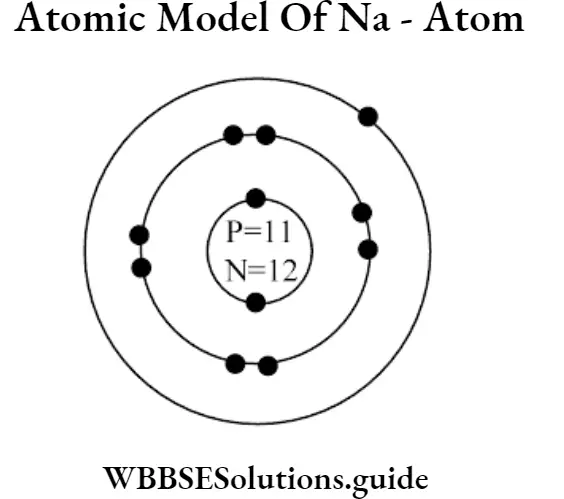
Question 40. Write the names of three particles present in an atom. What is the solar model of the atom? Show with diagram.
Answer:

(1) Electrons, protons, and neutrons are the particles present in an atom.

(2) Solar model of the atom :

(1) In the solar model of an atom the rotational paths of electrons are slightly elliptical.
(2) Nucleus lies at the focus.
(3) The nucleus is composed of neutrons and protons. They are called nucleons.
(4) The atom is not at all solid, most of the atomic space is empty.
(5) The atomic nucleus is positively charged because it.is composed of positively charged protons and electrically neutral neutrons.
(6) Nuclear density is very high because of its low volume.
WBBSE Solutions For Class 9 Physical Science And Environment Structure Of Atom Atomic Model Of Na-Atom

WBBSE Solutions for Class 9 Physical Science And Environment

WBBSE Solutions For Class 9 Physical Science And Environment Chapter 3 Matter: Structure And Properties

Chapter 3 Matter: Structure And Properties Very Short Answer Type:

Question 1. What is the unit of density in the SI system?
Answer: The unit of density in the SI system is: kg\(m^{-3}\).

Question 2. What is the unit of specific gravity in the CGS system?
Answer: The unit of specific gravity in the CGS system is: gc\(m^{-3}\).

Question 3. What is fluid?
Answer: The word fluid comes from the Latin word ‘fluere’ meaning ‘to flow’.

Question 4. Is pressure a scalar quantity?
Answer: No, pressure is not a scalar quantity. It is a vector quantity.

Read and Learn all WBBSE Solutions for Class 9 Physical Science And Environment

Question 5. Give the dimensional formula of pressure.
Answer: The dimensional formula of pressure is : \(\left[\mathrm{ML}^{-1} \mathrm{~T}^{-2}\right]\).

Question 6. What is the relation between the density and the specific gravity of a substance?
Answer: The relation is ey of substance = specific gravity of the substance x density of water at 4°C.

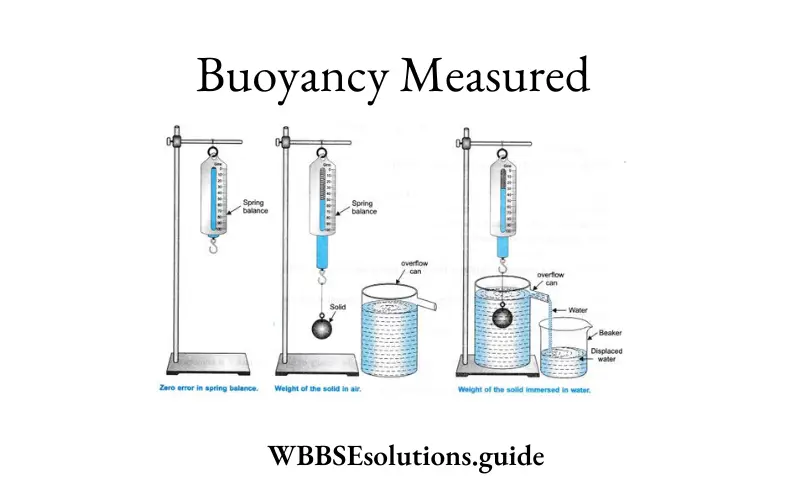
Question 7. What is buoyancy?
Answer: The upward thrust that any fluid exerts upon a body partly or wholly submerged in it is called its buoyancy.

WBBSE Solutions For Class 9 Physical Science And Environment Chapter 3 Matter Structure And Properties

WBBSE Class 9 matter structure and properties solutions

Question 8. Does buoyancy depend on the depth of the liquid in which a body is immersed?
Answer: The buoyancy does not depend on the depth of the liquid in which the body is immersed.

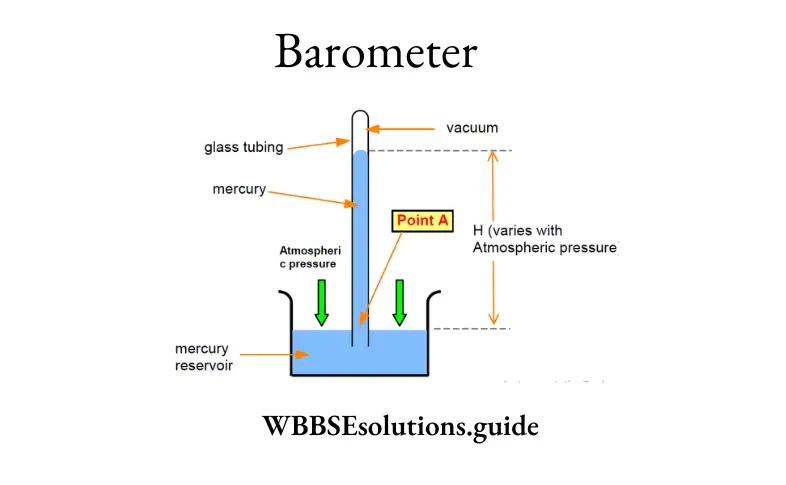
Question 9. Is there any gas in the Torricellian space?
Answer: The space above the mercury level in the tube contains practically nothing but a negligible amount of mercury vapor and is known as the Torricellian vacuum.

Question 10. Will the siphon work if there is a hole at any point in the longer arm above the surface of the liquid in the vessel in which the shorter arm is placed?
Answer: When a hole is made at any point in the longer arm above the surface of the liquid in the vessel in which the shorter arm is placed, the siphon will not work.

Question 11. Is surface tension a vector quantity?
Answer: Surface tension is a scalar quantity as it has no specific direction.

Question 12. What is the unit of surface energy?
Answer: The unit of surface energy is Joule.

Question 13. What is capillarity?
Answer: The phenomenon of rise or fall of liquid in a capillary tube is called capillarity.

Question 14. Define ‘angle of contact’.
Answer: The angle at which the tangent to the liquid surface at the point of contact makes with the solid surface inside the liquid is called the angle of contact.

Question 15. What happens to the surface tension of a liquid when an impurity is mixed in it?
Answer: The presence of impurities in the liquid surface or dissolved in it considerably affect the force of surface tension and surface tension depends on the degree of contamination.

Question 16. How can the rough sea be calmed?
Answer: The rough sea can be calmed by pouring oil on seawater.

Question 17. In a streamlined flow, what is the velocity of the liquid in contact with the containing vessel?
Answer: Zero.

Question 18. What is terminal velocity?
Answer: Terminal velocity of a body is the constant maximum velocity acquired by a body while falling through a viscous fluid.

Question 19. Can two streamlines cross each other?
Answer: No. Two streamlines cannot cross each other.

Matter structure and properties WBBSE Class 9 solutions with answers

Question 20. What is the terminal velocity of a body in a freely falling system?
Answer: Terminal velocity of a body in a freely falling system is zero.

Question 21. What is the acceleration of a body falling through a viscous fluid after terminal velocity is reached?
Answer: Zero.

Question 22. The velocity of water in a river is less on the bank and large in the middle. Explain.
Answer: The velocity of water in contact with solid banks is zero and it increases as we go towards the middle of the river.

Question 23. The velocity of fall of a man jumping with a parachute first increases and then becomes constant. Why?
Answer: It is because of the fact the man attains terminal velocity.

Question 24. What is the SI unit of coefficient of viscosity?
Answer: The SI unit of coefficient of viscosity is Decapoise (Ns\(m^{-2}\)).

Question 25. What is critical velocity?
Answer:

Critical velocity: It is the velocity of flow of a liquid up to which its flow is streamlined and above which its flow becomes turbulent.

Question 26. Does viscosity come into play if there is relative motion of the liquid layers?
Answer: Yes, it depends on the relative velocity of the two layers.

Question 27. Does viscosity depend on the area of the layers in contact?
Answer: Viscosity depends on the area of the liquid layers.

Question 28. What do you mean by an ideal fluid?
Answer: An ideal fluid has zero viscosity and zero compressibility.

Question 29. Is viscosity a vector?
Answer: No, viscosity is a scalar quantity.

Question 30. Write down the dimensional formula for the coefficient of viscosity.
Answer: The dimensional formula for the coefficient of viscosity is : \(\left[\mathrm{ML}^{-1} \mathrm{~T}^{-1}\right]\)

Question 31. How does the viscosity of a liquid change with change in temperature?
Answer: The viscosity of liquid increases with a decrease in temperature and vice-versa.

Question 32. How does the viscosity of a gas change with change in temperature?
Answer: The viscosity of a gas increases with increase in temperature and vice-versa.

Question 33. What is the value Reynold  number for streamline flow?
Answer: NR < 2000.

Question 34. Why does an air bubble in a liquid rise up?
Answer: As terminal velocity of the air bubble is negative.

Question 35. Is Bernoulli’s theorem valid for viscous liquid?
Answer: No.

WBBSE Class 9 Physical Science matter structure notes

Question 36. Water and castor oil are taken in two different flasks and shaken Violently and kept on a table. Which liquid will come to rest earlier?
Answer: Castor oil having higher viscosity will come to rest earlier.

Question 37. Between friction force and viscous force, which one depends on velocity?
Answer: Viscous force depends on velocity, but friction force is independent of velocity.

Question 38. The hotter liquid flows faster than a colder one. Why? 
Answer: The coefficient of viscosity of ligule decreases with rise in temperature and so liquid flows faster.

Wbbse Class 9 Physical Science Solutions

Question 39. What are the properties of a liquid satisfying Bernoulli’s theorem?
Answer: The liquid must be an ideal one.

Question 40. What are the dimensions of stress and strain?
Answer: Stress = \(\left[\mathrm{ML}^{-1} \mathrm{~T}^{-2}\right]\) and strain = \(\left[\mathrm{M}^{0}{L}^{0} \mathrm{~T}^{0}\right]\).

Question 41. What is more elastic — water or air?
Answer: Water.

Question 42. Why are springs made of steel and not of copper?
Answer: Because the modulus of elasticity of steel is more than that of copper.

Question 43. What is the value of modulus of rigidity for a liquid ?
Answer: Zero.

Question 44. What is the value of Young’s modulus for an incompressible liquid ?
Answer: Zero.

Question 45. What is the unit of Poisson’s ratio?
Answer: Poisson’s ratio is a pure number and thus it has no unit.

Question 46. What is the value of bulk modulus for an incompressible liquid ?
Answer: Infinite.

Question 47. What is more elastic — steel or rubber?
Answer: Steel.

Question 48. What is more fundamental stress or strain?
Answer: Strain, as stress is developed only when a body is strained.

Question 49. Is Poisson’s ratio an elastic modulus?
Answer: No. Poisson’s ratio is unitless while elastic modulus has unit N\(m^{-2}\).

Wbbse Class 9 Physical Science Solutions

Question 50. Is there any truly rigid body?
Answer: No.

Question 51. If the barometer reading at a place be 74.5 cm, find the pressure per square centimeter.
Answer:

Here, h = 74.5 cm, d = 13.6 g/c\(m^{3}\)

Hence the pressure, p = hdg = 74.5 x 13.6 x 980 = 992936 dyn/c\(m^{2}\).

Question 52. Atmospheric pressure at a place is 750 mm. Find the pressure at the place. [Given, density of mercury = 13.6 g/cc and g = 980 cm/\(m^{2}\).
Answer:

p = hdg = 75 x 13.6 x 980 = 0.9995 x 10⁶ dyn/c\(m^{2}\).

Question 53. Find the pressure at a depth of 5 m below the surface of a lake. (Density of water = 1000 kg \(m^{-3}\)).
Answer:

Pressure = hpg

=5 x 1000 x 9.8 = 4.9 x \({10}^{4}\) N\(m^{-2}\).

Wbbse Class 9 Physical Science Solutions

Question 54. What is hydrostatics?
Answer:

Hydrostatics: The branch of physics that deals with fluid at rest is called hydrostatics.

Question 55. What is hydrodynamics ?
Answer:

Hydrodynamics: The branch which deals with fluid in motion is called hydrody- namics.

Question 56. What is density?
Answer:

Density: The density of a substance is its mass per unit volume.

Question 57. What is specific gravity?
Answer:

Specific gravity: Specific gravity of a substance is the ratio of the density of the substance to the density of water at 4°C.

Question 58. What is relative density?
Answer:
Relative density: The specific gravity being ratio of two densities, it is also called relative density.

Question 59. What is hydrostatic pressure?
Answer:

Hydrostatic pressure: The normal force exerted by a fluid at rest per unit area of the surface in contact with it is called the pressure of the fluid or hydrostatic pressure.

Wbbse Class 9 Physical Science Solutions

Question 60. What is thrust ?
Answer:

Thrust: The total normal force exerted by a fluid at rest on a surface in contact with it is called thrust.

Question 61. What are the units of pressure?
Answer:

Unit of pressure :

(1) CGS : Dyne c\(m^{-2}\)
(2) SI: N\(m^{-2}\) or pascal (Pa).

WBBSE class 9 physical science chapter 3 question answer

Question 62. Write the dimensional formula of pressure.
Answer:

Dimension of pressure : \(\left[\mathrm{ML}^{-1} \mathrm{~T}^{-2}\right]\)

Important questions on matter structure WBBSE Class 9

Question 63. What are the units of thrust?
Answer:

Units of Thrust :

(1) CGS: Dyne
(2) SI: Newton (N).

Question 64. What are the units of surface tension?
Answer:

Units of surface tension :

(1) CGS: Dyne c \(m^{-1}\)
(2) Sl: N \(m^{-1}\).

Question 65. What is the dimensional formula of surface tension?
Answer:

Dimensional formula of surface tension : \(\left[\mathrm{MT}^{-2}\right]\)

Question 66. What is decompose?
Answer:

Decapoise: If 1-newton tangential force is required to maintain a velocity gradient of 1 m \(s^{-1}\)/m between two layers each of area 1 \(m^{2}\), it is called 1 decapoise.

Question 67. What is poise?
Answer:

Poise: If 1 dyne tangential force is required to maintain a velocity gradient of 1 cm \(s^{-1}\)/cm. between two layers each of area 1 c \(m^{2}\), it is called 1 poise

WBBSE class 9 physical science chapter 3 question answer

Question 68. Write the mathematical expression of terminal velocity.
Answer:

The expression of terminal velocity : v\(=\frac{2 r^2(\alpha-d) g}{9 \eta}\)

(Consider a small sphere of radius r and density d falling under gravity in a viscous fluid of density α and coefficient of viscosity η and terminal velocity is r)

Question 69. What is Reynold’s number?
Answer:

Reynold’s number (R): It is the ratio of the inertial force per unit area to viscous force per unit area for a flowing fluid.

Question 70. What is the perfectly inelastic body?
Answer:

Perfectly inelastic body: A body is said to be perfectly inelastic or plastic when it does not regain its original configuration at all on the removal of deforming force, however small it may be.

Question 71. What is tensible stress?
Answer:

Tensible stress: If there be an increase in length or extension of a body in the direction of the applied force, the stress developed is called tensile stress.

Question 72. What is compression stress?
Answer:

Compression stress: When the deforming force acts tangentially to the surface of a body to produce a change in the shape of the body, then the stress developed in the body is called tangential stress.

Chapter 3 Matter: Structure And Properties 2 Marks Questions And Answers:

Question 1. What is air pressure?
Answer:

Air pressure

Air has weight. Air pressure is the weight of the column of air above a horizontal surface of a unit area (e.g. one square meter). The column of air extends to the top of the atmosphere. As we go up and reach a higher altitude, the pressure is lower because the column of air is reduced.

Question 2. How is air pressure measured?
Answer:

Mercury barometers and aneroid barometers are commonly used to measure air pressure. The height of the mercury column will vary according to the air pressure. The higher the air pressure, the greater will be the height of the mercury column. By measuring the height of the column, the air pressure at the base of the column can be determined.

Question 3. What is an aneroid barometer?
Answer:

Aneroid barometer

An aneroid barometer consists of a disk-shaped capsule made of a thin metal membrane. The capsule is partially evacuated of air. Changes in atmospheric pressure change the size of the capsule, which in turn, moves an ink pointer.

In this way, pressure changes are recorded continuously as the pointer moves over a rotating drum. Nowadays, digital barometer is commonly used because it is portable and accurate. An electrical capacitor it is used to measure the change in air pressure.

WBBSE class 9 physical science chapter 3 question answer

Question 4. What is the unit of pressure?
Answer:

Unit of pressure

Pascal (Pa) is the international standard unit for pressure. The meteorological community uses hectopascal (hPa) as the unit of pressure.

Question 5. How do we compare the pressure measured at different locations?
Answer:

To compare pressure readings taken at different locations, it is convenient to convert them to a common level, e.g. the sea level. The conversion takes into account a number of factors that affect the weight of air (e.g. temperature, gravity of the earth).

Question 6. What is pressure in liquids?
Answer:

Pressure in liquids

Liquid has its own weight, this causes pressure on the wall of the container in which liquid is held; it also causes pressure on any object immersed in the liquid.

Question 7. How is the pressure of liquids measured?
Answer:

Pressure in liquids is due to the weight of the liquid acting on the surface of any object in the liquid.

Formula: Pressure caused by liquid, P=h.d.g

P = Pressure
h = Depth
d = Density of liquid
g = Gravitational Field Strength.

Question 8. What are the characteristics of pressure in liquid?
Answer:

Characteristics of pressure in liquid

(1) Pressure acts in all directions.
(2) Pressure acting on a liquid at rest will be transmitted equally in all directions.
(3) The pressure in a liquid increases with depth.
(4) Pressure in a liquid depends only on its vertical distance from the surface of the liquid.

WBBSE class 9 physical science chapter 3 question answer

Question 9. What does Archimedes’ principle state?
Answer:

The principle states that : “A body immersed in a liquid forces weight by an amount equal to the weight of the liquid displaced.”

Archimedes’ principle also states that  “When a body is immersed in a liquid, an upward thrust, equal to the weight of the liquid displaced, acts on it.” Thus, when a solid is fully immersed in a liquid, it loses weight which is equal to the weight of the liquid it displaces.

Question 10. What does the law of floatation state? 
Answer:

Law of floatation state

A body will float if the weight of the body is equal to the weight of the liquid displaced. If the weight of the immersed body is more than the weight of the water displaced, the body will sink.

Question 11. Define the density of a substance.
Answer:

Density of a substance

The density of a substance is its mass per unit volume:

Density = Mass /Volume.

Wbbse Physical Science And Environment Class 9 Solutions

Question 12. Define relative density or specific gravity.
Answer:

Relative density or specific gravity

The “relative density” or “specific gravity” of a substance is defined as the ratio of its density to the density of water at 4 degrees Celsius.

Relative density = Density of substance ÷ Density of water at 4°C.

Question 13. What is surface tension?
Answer:

Surface tension

Surface tension is a property of liquids that arises from unbalanced molecular cohesive forces at or near a surface. At an air-water interface, the surface tension results from the greater attraction of water molecules to each other (due to cohesion) than to the molecules in the air (due to adhesion). The net effect is an inward force at its surface that causes water to behave as if its surface were covered with a stretched elastic membrane.

Because of the relatively high attraction of water molecules for each other, water has a high surface tension. Surface tension arises from the strong interactions between water molecules, called hydrogen bonding. It is this strong interaction which also manifests itself in the other unusual properties of water such as its high boiling point.

Question 14. Why is a meniscus the curve in the upper surface of a liquid close to the surface of the container? 
Answer:

The meniscus is the curve in the upper surface of a liquid close to the surface of the container or another object. It is caused by surface tension. It can be either convex or concave, depending on the liquid and the surface.

Question 15. Explain the formation of a meniscus in the upper surface of a liquid.
Answer:

A concave meniscus occurs when the particles of the liquid are more strongly attracted to the container than to each other, causing the liquid to climb the walls of the container. This occurs b

etween water and glass.

A convex meniscus occurs when the particles in the liquid have a stronger attraction to each other than to the material of the container. Convex menisci. occur, for example, between mercury and glass in barometers.

Question 16. State the factors affecting the surface tension: of a liquid.
Answer:

(1) Presence of impurities in the liquid surface or dissolved in it.
(2) Surface tension is dependent on temperature.

Question 17. What is viscosity?
Answer:

Viscosity

The viscosity of a fluid is a measure of its resistance to gradual deformation by shear stress or tensile stress. For liquids, it corresponds to the informal concept of “thickness”. For example, honey has a much higher viscosity than water.

Viscosity is a property arising from collisions between neighboring particles in a fluid that are moving at different velocities. When the fluid is forced through a tube, the particles that comprise the fluid generally move more quickly near the tube’s axis and more slowly near its walls.

Wbbse Physical Science And Environment Class 9 Solutions

Question 18. Explain the Laminar Flow.
Answer:

Laminar Flow

The resistance to flow in a liquid can be characterized in terms of the viscosity of the fluid if the flow is smooth. In the case of a moving plate in a liquid, it is found that there is a layer or lamina that moves with the plate, and a layer, which is essentially stationary if it is next to a stationary plate.

There is a gradient of velocity as you move from the stationary to the moving plate, and the liquid tends to move in layers with successively higher speed. This is called laminar flow, or sometimes, “streamlined” flow. Viscous resistance to flow can be modeled for laminar flow, but if the lamina breaks up into turbulence, it is very difficult to characterize the fluid flow.

Question 19. What is Dynamic (shear) viscosity?
Answer:

Dynamic (shear) viscosity

The dynamic (shear) viscosity of a fluid expresses its resistance to shearing flows, where adjacent layers move parallel to each other with different speeds. It can be defined through the idealized situation known as a Couette flow, where a layer of fluid is trapped between two horizontal plates, one fixed and one moving horizontally at constant speed u.

Question 20. What is Kinematic viscosity?
Answer:

Kinematic viscosity

The kinematic viscosity (also called “momentum diffusivity”) is the ratio of the dynamic viscosity “μ” to the density of the fluid “μ”. It is usually denoted by the Greek letter nu (μ).

WBBSE Class 9 solved exercises on matter structure and properties

Question 21. What is Bulk viscosity?
Answer:

Bulk viscosity

When a compressible fluid is compressed or expanded evenly, without shear, it may still exhibit a form of internal friction that resists its flow. These forces are related to the rate of compression or expansion by a factor “μ”; called the volume viscosity, bulk viscosity or second viscosity.

Question 22. What is a Viscometer?
Answer:

Viscometer

Viscosity is measured with various types of viscometers and rheometers. A rheometer is used for those fluids that cannot be defined by a single value of viscosity and, therefore, require more parameters to be set and measured than is the case for a viscometer. One of the most common instruments for measuring kinematic viscosity is the glass capillary viscometer.

Wbbse Physical Science And Environment Class 9 Solutions

Question 23. Explain the rate of flow. of a liquid.
Answer:

Rate of flow. of a liquid

The common application of laminar flow would be in the smooth flow of a viscous liquid through a tube or pipe. In that case, the velocity of the flow varies from zero at the walls to a maximum along the centerline of the vessel. Dividing the flow into thin cylindrical elements and applying the viscous force to them, we can calculate the flow profile of the laminar flow in a tube.

Question 24. Define Bernoulli’s Theorem.
Answer:

Bernoulli’s Theorem

Bernoulli’s Theorem states that for the streamlined flow of an ideal liquid, the total energy (i.e., the sum of pressure energy, potential energy, and kinetic energy) per unit mass remains constant at every cross-section throughout the liquid flow.

Question 25. What is elasticity?
Answer:

Elasticity

Elasticity is the property of an object or material that causes it to be restored to its original shape after distortion. It is said to be more elastic if it restores itself more precisely to its original configuration.

Question 26. Give an example of an elastic object.
Answer:

Example of an elastic object

A spring is an example of an elastic object when stretched, it exerts a restoring force that tends to bring it back to its original length. This restoring force is generally proportional to the amount of stretch, as described by Hooke’s Law. For wires or columns, the elasticity is generally described in terms of the amount of deformation (strain) resulting from a given stress.

Question 27. Define stress and strain.
Answer:

Stress and strain

Normal stress on a body causes a change in length or volume and tangential stress produces a change in the shape of the body. The ratio of change produced in the dimensions of a body by a system of forces or couples, in equilibrium, to its original dimensions is called strain.

Strain = Change in Dimension / Original Dimension.

Question 28. What are the units of strain?
Answer:

Units of strain

As strain is a ratio, it has no units and dimensions.

Question 29. What is Hooke’s law?
Answer:

Hooke’s law

Hooke’s law gives a relationship between stress and strain. According to Hooke’s law, within the elastic limit, the strain produced in a body is directly proportional to the stress produced.

Or stress /strain = a constant.

Question 30. What is the Modulus of Elasticity?
Answer:

Modulus of Elasticity

Stress/Strain a constant, known as the Modulus of Elasticity. Its unit is N\(m^2\).

Corresponding to the three types of strain, there are three moduli of elasticity :
1. Young’s modulus, corresponding to longitudinal strain;
2. Bulk modulus, corresponding to volume strain; and,
3. Rigidity modulus, corresponding to shearing strain.

Question 31. Calculate the pressure at the bottom of a pond of depth 10 m. Given that density of water = 1000 kg/\(m^3\) and acceleration due to gravity at that place = 9.8 m/\(s^2\).
Answer:

Here, depth of the pond (h) = 10 m, density of water (d) = 1000 kg/\(m^3\)

acceleration due to gravity (g) = 9.8 m/\(s^2\)

∴  Pressure at the bottom of the pond (P) = hdg = 10 x 1000 x 9.8 = 98000 N/\(m^2\).

∴  Required pressure at the bottom of the pond = 98000 N/\(m^2\).

Question 32. Calculate the depth of water in a cistern that is filled with water of density 1000 kg/\(m^3\) and pressure at any point on its bottom is 9800 N/\(m^2\). Take g = 9.8 m/\(s^2\)
Answer:

Here, pressure at the bottom (P) = 98000 N/\({m}^{2}\); density of water (d) = 1000 kg/\(m^3\) acceleration due to gravity (g) = 9.8 m/\(s^2\).

∴ P=hdg    ∴h\(=\frac{P}{d g}\)=\(\frac{9800}{1000 \times 9.8}\)=1m.

∴Depth of water in the cistern = 1 m.

Wbbse Class 9 Physical Science And Environment Solutions

Question 33. The mass of 4 m of iron is 31200 kg. Calculate the density of iron in SI unit.
Answer:

Given

The mass of 4 m of iron is 31200 kg.

Density \(=\frac{\text { Mass }}{\text { Volume }}\)     (Here, mass = 31200 kg, volume = 4 \(m^3\))

⇒ \(=\frac{31200}{4}\) kg/ \(m^3\) =7800 kg/\(m^3\)

∴ Density of iron = 7800 kg/\(m^3\).

Question 34. A body of mass 100 g has a volume of 40 cc. Determine the density of the material of the body. If the density of water is 1 g/cc, then state whether the body will sink or float in water.
Answer:

Given

A body of mass 100 g has a volume of 40 cc.

Here, mass = 100 g, volume = 40 cc.

∴ Density for the material of the body\(=\frac{\text { Mass }}{\text { Volume }}\) \(=\frac{100}{40}\)g/cc=2.5g/cc

Since the density of the body (2.5 g/cc) is greater than the density of water (1 g/cc), the body will sink in water.

WBBSE Class 9 Physical Science states of matter solutions

Question 35. The relative density of gold is 19.3. If the density of water be \({10}^{3}\)Kg/\({m}^{3}\)‘, calculate the density of silver in SI unit.
Answer:

Given

The relative density of gold is 19.3. If the density of water be \({10}^{3}\)Kg/\({m}^{3}\)‘,

Relative density of a substance \(=\frac{\text {Density of the substanc }}{\text { Density of water }}\)

19.3\(=\frac{\text { Density of the gold }}{10^3 \mathrm{~kg} / \mathrm{m}^3}\).

∴Density of gold =19.3 × \({10}^{3}\)Kg/\({m}^{3}\)

Question 36. When a tensile force of 60 N is applied to a metal wire of length 50 m and area of cross-section \({10}^{-6}\) \({m}^{2}\), elongation of the wire is 4 x 10\({m}^{-3}\). Calculate :
(1) stress and
(2) strain.
Answer:

Hence, force (F) = 60 N, area of cross-section (A) = \({10}^{-6}\) \({m}^{2}\)

The original length of the wire (1) = 5 m,

Expansion in length (Δl) = 4 x\({10}^{-3}\) m.

(1) Stress \(=\frac{F}{A}\)= \(\frac{60}{10^{-6}} \mathrm{~N} / \mathrm{m}^2\)

\(=6 \times 107 \mathrm{~N} / \mathrm{m}^2\)

(2) Strain \(=\frac{\Delta l}{I}\)

=\(\frac{4 \times 10^{-3}}{5}\)

=0.8 \(10^{-3}\)=\(8 \times 10^{-4}\)

Wbbse Class 9 Physical Science And Environment Solutions

Question 37. If the strain be 1% of 0.1, find the change in length of a wire 5 m long. If the cross-section is 1 mm? and load 19 kg-wt, what is the ratio of stress to strain? Change in length
Answer:

Strain\(=\frac{\text { Change in length }}{\text { Original length }}\)

∴ Change in length = Strain x original length\(=\left(\frac{1}{100} \times 0.1 \times 5\right)\)=5×\(10^{-3}\) m=5mm.

Now, stress =\(\frac{\text { Load }(F)}{\text { Area of cross }-\sec \text { tion }(A)}\)\(=\frac{10 \times 9.8 \mathrm{~N}}{1 \times 10^{-6} \mathrm{~m}^2}\)=9.8 ×\(10^7 \mathrm{~N} / \mathrm{m}^2\).

⇒ \(\frac{\text { Stress }}{\text { Strain }}\)=\(\frac{9.8 \times 10^7}{\frac{1}{100} \times 0.1} \mathrm{~N} / \mathrm{m}^2\)=N/\({m}^2\)=9.8×1010 N\({m}^2\).

Question 38. A solid body weighs 50 N. It is immersed in water and the weight of it in water is 45 ar the relative density of the solid.
Answer:

Weight of the body in air (\(W_1\)) = 50 N.

Weight of the body in water (\(W_2\)) = 45 N.

Loss of weight of the body in water=50N-45N=5N

Therefore, R.D. of the body \(=\frac{W_1}{W_1-W_2}\)=\(\frac{50 N}{5 N}=\)=10.

Question 39. A block of 36 cc ice floats on water. What volume of it remains above water surface?
Answer:

It is known that nearly 1/12 part of the volume of an ice block remains above water when it floats on water.

Here, the total volume of the ice block is 36 cc.

∴1/12 of 36 cc = 3 cc.

So, 3 cc of ice remains above the water surface.

Wbbse Class 9 Physical Science And Environment Solutions

Question 40. The weight of a body in air is 33 g-wt and when immersed in a liquid of density 0.75 g/cc, it weighs 24 g-wt. Determine the volume and density of the body.
Answer:

Given

The weight of a body in air is 33 g-wt and when immersed in a liquid of density 0.75 g/cc, it weighs 24 g-wt.

Apparent loss of weight of the body when immersed in the liquid

= (33 — 24) g-wt, or 9 g-wt, so, the mass of the liquid displaced by the body is 9 g.

Now, volume of the body = volume of the displaced liquid = 9 g/0.75 g/cc = 12 cc.

Density of the body = mass/volume = 33 g/12 cc = 2.75 g/cc. (sin¢e, 33 g-wt has the mass 33 g).

Question 41. Gold has a density of 19.3 g/cc. An ornament weighs 5.80 g in air and 5.25 g in water. Is the ornament made of pure gold?
Answer:

Given

Gold has a density of 19.3 g/cc. An ornament weighs 5.80 g in air and 5.25 g in water.

From Archimedes’ principle, the volume of the ornament = (5.80 − 5.25) cc = 0.55 cc. Now, considering the density of pure gold as 19.3 g/cc, the weight of the ornament in air = (19.3 x 0.55) g-wt = 10.615 g-wt. But as indicated in the problem, the weight of the ornament in the air is 5.80 g-wt. Hence, the ornament is not made of pure gold.

Question 42. 20 kg weight is suspended from a wire 600.5 cm long and 1 m\(m^2\)cross section. When the weight is removed, the length of the wire decreases by 0.5 cm. Find Young’s modulus of the wire.
Answer:

Given

20 kg weight is suspended from a wire 600.5 cm long and 1 m\(m^2\)cross section. When the weight is removed, the length of the wire decreases by 0.5 cm.

We. know if the initial length of a wire is L the change of its length is x, weight suspended from the wire is mg, then longitudinal strain = x/L and longitudinal stress  = mg/π\(r^2\);

Therefore, Young’s modulus, Y \(=\frac{\text { Longitudinal stress }}{\text { Longitudinal strain }}\)\(\frac{m g / \pi r^2}{x / L}\)=\(\frac{m g L}{\pi r^2 x}\).

In the problem, mass m is 20 x 1000 g and acceleration due to gravity is g = 980 cm/\(\sec ^2\)

Initial length L= 600.5 − 0.5 = 600 cm, change of length x = 0.5 cm. π\(r^2\)= 1 m\(m^2\)

=0.01c\(m^2\)

therefore, Y\(=\frac{20 \times 1000 \times 980 \times 600}{0.01 \times 0.5}\)=2.35×\(10^{12} \mathrm{dyn} / \mathrm{cm}^2\).

Wbbse Class 9 Physical Science And Environment Solutions

Question 43. 2.2 kg weight is suspended from a wire 10 m long and a cross-section area 2mm. If the strain be 0.001%, find the elongation of the wire.
Answer:

Given

2.2 kg weight is suspended from a wire 10 m long and a cross-section area 2mm. If the strain be 0.001%,

The length of the wire is 1000 cm if the increase in length of the wire is x cm, then percentage strain \(\frac{x}{1000} \times 100\)= 0.001 (according to the problem).

Therefore, x = 0.001 x 10 = 0.01 cm.

Cross-section of the wire = 2 m\({m}^{2}\) = 0.02 c\({m}^{2}\), 1 kg weight = 1000 x 980 d

Hence, stress \(=\frac{1000 \times 980}{0.02}\)=\(\frac{98 \times 10^4}{2 \times 10^{-2}}\)=48×106 dyne/c\({m}^{2}\).

Question 44. 8 kg weight is suspended from a wire of length 2 m and diameter 0.5 mm. If the length of the wire increases by 2.88 mm, find Young’s modulus of the wire.
Answer:

Given

8 kg weight is suspended from a wire of length 2 m and diameter 0.5 mm. If the length of the wire increases by 2.88 mm

Here, the length of the wire L = 200 cm, the radius of the wire (r) = 0.25 mm = 0.025 cm.

Therefore, the cross-section area of the wire = π\({r}^{2}\) = π x\((0.025)^2\); increase in length, x = 0.228 cm, weight (mg) = 8 x 1000 x 980 dyne.

Therefore, Young’s. modulus \(=\frac{\text { Stress }}{\text { Strain }}\)

= \(\frac{\mathrm{mg} / \pi r^2}{\mathrm{x} / \mathrm{L}}\)

⇒ \(=\frac{m g L}{\pi r^2 x}\)

⇒ \(=\frac{8 \times 1000 \times 980 \times 200}{\pi \times(0.025)^2 \times 0.288}\)

⇒ \(=2.773 \times 10^{12} \mathrm{dyn} / \mathrm{cm}^2\).

Wbbse Class 9 Physical Science And Environment Solutions

Question 45. A cylindrical vessel of diameter 28 cm contains a liquid up to a height of 20 cm. Find the pressure and thrust on the bottom of the vessel. (Given density of the liquid = 0.9 g\({m}^{-3}\)).
Answer:

Given, diameter of the vessel = 28 cm; radius, r \(=\frac{28}{2}\) = 14cm

Height of the liquid in the vessel = 20cm

Area of the bottoms of the vessel =π\(r^2\)=π×\({14}^{2}\)=616c\({m}^{2}\)

Density of the liquid, ρ= 0.9 g c\({m}^{-3}\)

Pressure = hρg = 20 x 0.9 x 980 =17840 dynes/\({m}^{-2}\)

Thrust = Pressure x area = 17640 x 616 = 10866240 dyne.

Question 46. A body having a volume of  \(50 \mathrm{~cm}^3\) weighs 0.5 kg In air. Find its density.
Answer:

Given, volume of the body = 50c[latex]{m}^{3}[/latex]=50×\({10}^{-6}\)\({m}^{3}\)

Mass of the body =0.5kg.

Density of the body \(=\frac{\text { mass }}{\text { volume }}\)\(=\frac{0.5}{50 \times 10^{-6}}\)=104 Kg\({m}^{-3}\).

Question 47. The density of water is 1000 kg \({m}^{-3}\). if the density of gold be 19320 kgm\({m}^{-3}\), find the relative density of the gold. 
Answer:

Given, density of water = 1000 kg\({m}^{-3}\).

Density of gold = 19320 kg\({m}^{-3}\).

∴ Relative density of gold \(=\frac{\text { density of gold }}{\text { density of water }}\)

⇒ \(=\frac{19320}{1000}\)=19.32.

Question 48. The relative density of silver is 10.5. Find the density of silver.
Answer:

Given, the relative density of silver = 10.5

Now, relative density of silver \(=\frac{\text { density of gold }}{\text { density of water }}\)

∴ density of silver = relative of silver x density. of water

= 10.5 x 1000 = 10500 kg\({m}^{-3}\).

Question 49. A metallic wire of length 60 cm when stretched along length by a normal force becomes 61 cm. Find the longitudinal strain.
Answer:

Given, the original length of the wire, l= 60cm.

The final length of the wire, l’= 61 cm.

Increase in length, Δl = l− l’=61 = 60 = 1 cm.

Longitudinal strain \(=\frac{\Delta l}{1}\)=\(\frac{1}{60}\)=0.017.

Question 50. A metallic wire of radius 0.1 cm and length 2 m is extended by a weight of 2.5 kg. Find the normal stress set up.
Answer:

Given external deforming force, F = 2.6 kg wt = 2.5 x 9.8 N.

Radius of the wire, r=0.1cm=0.1×\({10}^{-2}\)

Area of cross-section of the wire =π\({r}^{2}\)\(=\pi(10-3)^2 \mathrm{~m}^2\).

∴ Normal stress \(=\frac{\text { external decor ming force }}{\text { area }}\)

∴ \(=\frac{2.5 \times 9.8}{\pi\left(10^{-3}\right)^2}\)=\(7.8106 \mathrm{Nm}^{-2}\).

Question 51. The ratio of radii of two Wires of the same material is 2: 1. If these wires are stretched by equal force, find the ratio of the stresses produced in them.
Answer:

Given,\(r_1: r_2\)=2:1;\(F_1: F_2\)=F

stress(S)\(=\frac{\text { force }}{\text { area }}\)\(=\frac{F}{\pi r^2}\) or, sα\(\frac{1}{r^2}\)

∴\(\frac{s_1}{s_2}\)=\(\frac{r_2^2}{r_1^2}\)\(=\left(\frac{1}{2}\right)^2=\frac{1}{4}\).

Question 52. A force on 1000 N causes an increase of 0.1% in the length of a wire of area of cross-section\(10^{-6} \mathrm{~m}^2\), Calculate the Young’s modulus of the material of: ‘the wire.
Answer:

Given, F = 1000 N; a =\({10}^{-6}\)

⇒ \({m}^{2}\)

⇒ \(\frac{\Delta l}{I}\)=0.1%\(=\frac{1}{1000}\)=\(10^{-3}\)

Y\(=\frac{\mathrm{F} / \mathrm{a}}{\Delta \mathrm{l} / \mathrm{l}}\)=\(\frac{1000}{10^{26} \times 10^{-3}}\)\(=10^{12} \mathrm{Nm}^{-2}\)

Question 53. A water-filled cone of height 50 cm and the base area 20 cm? is placed on a table with the base on the table. What is the thrust offered by the water on the table?
Answer:

Thrust = Pressure x area = hdg x A

∴Thrust

= 50 x 1 x 980 x 20, h = 50cm

= 9.8 x 10⁵ dyne, d = 1 gc\({m}^{-3}\)

= 9.8N, g = 980cm/\({s}^{-2}\)

A = 20 c\({m}^{2}\)                                    

Question 54. The pressure of air in a soap bubble of 0.7 cm diameter is 8 mm of water above the atmospheric pressure. Calculate the surface tension of the soap solution.
Answer:

The excess of pressure inside a soap bubble is given by

P\(=\frac{4 T}{r}\) , P=8mm=0.8cm, r=0.7cm/2=0.35cm

∴T\(=\frac{\mathrm{Pr}}{4}\)

∴ \(=\frac{0.8 \times 980 \times 0.35}{4}\)

=68.6 dyne c\(m^{-1}\).

Question 55. The surface tension of water is 0.072 N\({m}^{-1}\) Calculate the excess pressure inside a water drop of diameter 1.2 mm.
Answer:

P\(=\frac{2 T}{r}\)=\(\frac{4 T}{d}\),  R=0.72N\({m}^{-1}\)

⇒ \(=\frac{4 \times 0.072}{1.2 \times 10^{-3}}\)

d=1.2 mm=1.2×\({10}^{-3}\)

⇒ \(=240 \mathrm{Nm}^{-2}\)

Question 56. One end of an iron wire of length 250 cm of diameter 1 mm is rigidly fixed with a beam and a weight of 8 kg is placed at the other end. Calculate the elongation of the wire. (Y of iron\(=20 \times 10^{11} \text { dyne } \mathrm{cm}^{-2}\),=9.8 m \({s}^{-2}\)).
Answer:

l\(=\frac{F L}{A}\)

L=250cm=2.5m

or,l\(=\frac{8 \times 9.8 \times 2.5}{\pi / 4\left(10^{-3}\right)^2 \times 2 \times 10^{11}}\)

=0.125×\({10}^{-2}\)m

d =1mm=\({10}^{-3}\)m

W=8kg-wt

=20 1011 dyne c\({m}^{-2}\) =2.01011N\({m}^{-2}\)

g = 9.8 m \({s}{-2}\)

l  = ?

Question 57. What is Pascal’s law?
Answer:

Pascal’s Law: The pressure applied at any place to an enclosed fluid at rest is transmitted with undiminished magnitude to every portion of the fluid and acts normally to the surface in contact with the fluid.

Question 58. What are the conditions for Archimedes’ principle and buoyancy?
Answer:

Conditions for Archimedes’s principle and buoyancy :

(1) As Archimedes’ principle involves the weight of a body, so the principle does not hold when the body is in weightless condition like the state of free fall of the body in an artificial satellite moving in a circular orbit. ‘
(2) The buoyancy does not depend on the depth of the liquid to which the body is immersed or on the immersed volume of the body and the density of the displaced liquid at a particular place.

Question 59. What is S.T.P.?
Answer:

Standard or Normal temperature and pressure: The standard or normal atmospheric pressure is defined as the pressure exerted by a column of mercury 76 cm high at 0°C at 45° latitude and mean sea level.

Question 60. State any two conditions for working of a. siphon.
Answer:

Conditions for the working of a siphon are :

(1) At first the whole tube must be filled with liquid.
(2) The end of the longer tube must be below the level of the liquid in the other vessel.

Question 61. What is: surface energy?
Answer:

Surface energy: It is the amount of work done against the force of surface tension in forming the liquid surface of a given area at a constant temperature.

Question 62. What is the angle of contact?
Answer:

The angle of contact: The angle at which the tangent to the liquid surface at the point of contact makes with the solid surface inside the liquid is called the angle of contact.

Question 63. State two factors on which the value of the angle of contact depends.
Answer:

The value of angle of contact :

(1) Depends on the nature of the liquid and the solid in contact.
(2) Depends on the medium above the free surface of the liquid.

Question 64. State two applications of surface tension.
Answer:

Applications of surface tension :

(1) The surface tension of soap solution is low, and thus it is used for washing. Hot soap solution is still better as surface tension decreases with rise in temperature.

(2) Surface tensions of lubricating oils and paints are kept low so that they can spread easily.

Question 65. State the units of co-efficient of viscosity in CGS and SI systems.
Answer:

Units of co-efficient of viscosity :

(1) CGS: Poise
(2) SI: Pascal-second (PaS) or decompose.

Question 66. State two factors on which terminal velocity depends.
Answer:

(1) The terminal velocity of a sphere varies directly as the square of its radius of it.
(2) The terminal velocity of a sphere is inversely proportional to the coefficient of viscosity.

Question 67. State two factors affecting viscosity.
Answer:

(1) The viscosity of a liquid decreases with an increase in temperature.
(2) The viscosity of all gases increases with increase in temperature.

Question 68. What is streamlined flow?
Answer:

Streamline Flow: The streamlined or orderly flow of a fluid is that flow in which every particle of the fluid follows exactly the path of its preceding particle and has the same velocity in magnitude and direction as that of its preceding particle while crossing that point.

Question 69. What is Turbulent flow?
Answer:

Turbulent Flow: When a fluid moves with a velocity greater than its critical velocity, the motion of the particles of the fluid becomes disorderly or irregular and such a flow is called turbulent flow. :

Question 70. What is the significance of Reynold’s number?
Answer:

Significance of Reynold’s number (R) :

(1) R < 2000, the flow of a liquid is streamline or laminar.
(2) R > 3000, the flow of a liquid is turbulent.
(3) 2000 < R < 3000, the flow is streamline or turbulent.

Question 71. What is pressure energy?
Answer:

Pressure energy: The energy possessed by a liquid by virtue of its pressure and is measured by work done in pushing the liquid in the vessel against the pressure without imparting any velocity to it is called the pressure energy of the liquid.

Question 72. State any application of Bernoulli’s theorem. 
Answer:

(1) Atomiser or sprayer: It is based on Bernoulli’s principle. It is used for spraying liquids like perfumes, etc.

Question 73. State two limitations of Bernoulli’s theorem.
Answer:

(1) It is assumed that the velocity of every particle of a liquid passing through any particular cross-section of the tube is uniform. But actually, particles of the liquid in the central layer have maximum velocity and those closer to the tubewell have minimum velocity. Thus, the mean velocity of the particles should be taken.

(2) The liquid in motion experiences a viscous drag, which should be considered.

Question 74. What is a perfectly rigid body?
Answer:

Perfectly rigid body: A body is said to be perfectly rigid when no relative displacement between its parts occurs under the action of a deforming force, however large it may be.

Question 75. What is normal stress?
Answer:

Normal stress: When the deforming force acts normally over an area of a body, then the internal restoring force set up per unit area of cross-section is called normal stress.

Question 76. What is tangential stress?
Answer:

Tangential stress: When the deforming force acts tangentially to the surface of a body to produce a change in the shape of the body, then the stress developed in the body is called tangential stress.

Question 77. A floating body loses it weight explains.
Answer:

Explanation: The weight of a floating body is equal to the weight of the liquid displaced by it. These two forces act in opposite directions along the vertical line. Thus these forces balance each other and apparently, the floating body loses weight.

Question 78. Does siphon work on the surface of the moon? Explain.
Answer:

Explanation: There being no atmosphere on the moon, there is no atmospheric pressure. So, the siphon does not work on the moon.

Question 79. Explain whether the rate of flow of a liquid through a siphon will change if the atmospheric pressure changes.
Answer:

Explanation: No. The rate of flow of a liquid through a siphon depends on the differences of pressures of liquid columns in its two limbs and not on the barometric pressure.

Question 80. Can you siphon out water from a leaking boat to the river?
Answer:

Explanation: No, the boat is floating on the river, and water leaks into the boat from the river. Thus water inside the boat would be always on the same level as that of the river outside. So, it is not possible to siphon out water in this case.

Question 81. Why should a field be plowed before sowing?
Answer:

Explanation: This is done to break the tiny capillaries through which water rises and finally evaporates. The plowing of the field helps the soil to retain moisture.

Question 82. Explain why oil rises in the wick of a lamp.
Answer:

Explanation: The pores in the wick serve the purpose of a number of line capillaries. The oil rises due to capillary action.

Question 83. What is elastic fatigue?
Answer: The property of an elastic body by virtue of which its behavior becomes less elastic under the action of repeated alternating deforming forces is called elastic fatigue.

Question 84. How will the reading of a mercury barometer, placed inside a lift, change if the lift starts moving downwards with a given acceleration? Give reasons for your answer.
Answer:

Reason: Let the left descend with acceleration f. The effective acceleration with which it descends will be (g − f). Thus, the weight of the mercury column in the barometer decreases. But atmospheric pressure remains the same, the height of the mercury column in the barometer would be more.

Question 85. Will the rate of flow change in a siphon if water is replaced by mercury?
Answer:

No, the rate of flow of liquid in a siphon does not depend on the density of the liquid.

Question 86. Can you use water in a barometer?
Answer:

The height of the water barometer would be about 10 m, which is not practicable. Further, water sticks to glass, and water is to be colored.

Question 87. Why does not water wet a glass rod coated with wax?
Answer:

Because the force of adhesion between water and wax is less than the force of cohesion between water molecules.

Question 88. Water is coming out of a hole made on the wall of a freshwater tank. If the size of the hole is increased,
(1) will the velocity of the efflux of water change?
(2) will the volume of water coming out per second change?
Answer:

(1) Velocity of efflux remains unaltered, as it depends only on the depth of the hole below the fresh surface of the water,
(2) Volume changes, as the volume of the liquid flowing per second depends upon the area of the cross-section of the hole.

Question 89. Explain why still water runs deep.
Answer:

Explanation: From the equation of continuity, we have, av = constant.

The speed of still water is very small so the area would be large. Thus still water becomes deep.

Question 90. Why does the velocity increase when water flowing in a broader pipe enters into a narrower pipe?
Answer:

From the equation of continuity, we have av = constant. So, when water enters into a narrower pipe flowing from a broader pipe, then the area of the cross-section decreases, and thus the velocity of flow increases.

Question 91. Why does not mercury wet glass?
Answer:

The cohesive force between mercury molecules is greater than the adhesive force between mercury and glass.

Question 92. Why does hot soup taste better than cold soup?
Answer:

Soap bubbles burst when the pressure inside them becomes more than outside atmospheric pressure. So, soap bubbles burst after some time.

Question 93. The diameter of a ball is twice that of another ball. What will be the ratio of their terminal velocities in water?
Answer:

We know that the terminal velocity is directly proportional to the square of the radius of the ball, i.e., the terminal velocity o (radius of the ball).

∴ The ratio of their terminal velocities will be 4: 1.

Question 94. Small air bubbles rise slower than the bigger on through a liquid, why?
Answer:

The terminal velocity of the bubble is proportional to the square of the radius of the bubble. So, smaller air bubbles having smaller radii would have low values of terminal velocities and. rise at a slower rate.

Question 95. Why do clouds float in the sky?
Answer:

The tiny drops of water present in clouds have negligibly small terminal velocities. So, clouds float in the sky.

Question 96. Why should the lubricant oils be of high viscosity?
Answer:

Lubricants are used to decrease dry friction between different parts of the machines. The lubricants with high viscosity would stick to the machine parts and would not come out during the movements of the machine parts.

Question 97. Why is viscosity called internal friction?
Answer: There is a backward drag on each of the upper layers of a flowing liquid by the lower layer. So, viscosity acts like friction from within and thus it is called internal friction.

Question 98. What is the elastic limit?
Answer:

Elastic limit: It is the upper limit of deforming force up to which the body regains its original shape or size completely or the removal of deforming force and beyond which, on increasing the deforming force, the body loses its property of elasticity and gets permanently deformed.

Question 99. How will the weight of a body be affected when it falls with its terminal velocity through a viscous medium?
Answer:

When a body falls through a viscous medium with its terminal velocity, it moves with constant velocity. So, no resultant force is acting on the body, as pull due to gravity is balanced by viscous drag and buoyancy of the medium. Hence the effective weight of the body becomes zero.

Question 100. The stream of water flowing at high speed from a garden hose pipe tends to spread like a fountain when held vertically up but tends to narrow down when held vertically down. Why?
Answer:

As the stream falls, its speed v increases, and consequently its area of cross-section, a will decrease; according to the equation of continuity, av = constant, and hence the stream becomes narrow. When the stream goes up, its speed decreases, so its area of cross-section increases, and hence it becomes broader and spreads out like a fountain.

Question 101. It is advised not stand near a running train. Why?
Answer:

When a fast-moving train passes on a rail, the velocity of streams of air between the rail and the man standing near the rail will be larger than the velocity of air streams on the other side of the man away from the rail.

Following Bernoulli’s theorem, the pressure of air will be low in between the man and the rail and high on the other side of the man. Thus the man may be pushed towards the rail and may meet with an accident.

Question 102. ‘The Poisson’s ratio depends only on the nature of the material and not at all on the stress applied within elastic limit’ explains.
Answer:

Poisson’s ratio\(=\frac{\text { lateral strain }}{\text { longitudinal strain }}\) which does not involve stress within the elastic limit and depends only on the nature of the material.

Question 103. Why are small liquid drops spherical in shape, while big drops are flat?
Answer:

A liquid drop attains a spherical shape to have minimum surface area and hence minimum potential energy state. In a small liquid drop the force due to surface tension is large compared to the force due to the weight of the drop or gravitational pull and the drop attains a spherical shape. But as the size of the drop increases, its weight also increases, which pulls the drop downwards and it becomes flat.

Question 104. Water rises in a capillary tube whereas mercury falls in the same tube. Explain.
Answer:

Explanation: The cohesive force between mercury molecules is much larger than the force of adhesion between mercury and glass, while the force of adhesion between water and glass is much more than the force of cohesion between water molecules.

Question 105. Two soap bubbles of unequal sizes are blown at the ends of a capillary tube. Which one will grow at the cost of the other?
Answer:

Excess of pressure p is inversely proportional to the radius r of the soap bubble,i.e., p inside a small bubble will be more than that inside the large bubble. So, the big bubble will grow at the cost of the smaller one.

Question 106. Oil spreads over the surface of the water while it does not do so on the oil surface. Explain.
Answer:

Explanation: The surface tension of oil is less than the surface tension of water. So on spreading oil on the surface of water, it spreads in all directions due to the higher force of surface tension of water.

Question 107. Why does? surface tension varies with temperature?
Answer:

With the increase of temperature, the force of cohesion of the liquid molecules decreases. So surface tension decreases with the increase of temperature.

Question 108. Why do two mercury drops form one drop when brought in contact?
Answer:

Explanation: Liquids tend to attain a minimum surface area state due to surface tension. When two drops come in contact, they form a single drop for decreasing surface area.

Question 109. Explain how a spider walks easily on the surface of water.
Answer:

Explanation: The free surface of water behaves as a stretched membrane due to surface tension. This membrané is depressed due to the weight of the spider. The vertical component of the surface tension balances the weight of the spider and hence it is able to walk on the water surface.

Question 110. A needle may float on clean water but sink in water having detergent. Explain.
Answer:

Explanation: The free surface of water acts like a stretched membrane due to surface tension and a needle can float on it. But on adding some detergent, the surface tension of water decreases and the tension in the membrane is weakened and it can no longer hold the weight of the needle. ?

Question 111. Small pieces of camphor dance when placed on the surface of water. Why?
Answer:

The surface tension of water decreases when camphor dissolves in it. Due to its irregular shape, the camphor dissolves unevenly on different sides. So, unbalanced surface tension forces act on the camphor, and hence the piece of camphor moves randomly in different directions.

Question 112. The velocity of water in a river is less on the bank and larger in the middle; why?
Answer:

Explanation: The water in the river flows in the form of streams. The forces of adhesion is less on the streams in the middle of the river than near the bank. So, the velocity of streams near the bank is minimum and maximum in the middle of the river.

Chapter 3 Matter: Structure And Properties 3 Marks Questions And Answers

Question 1. What happens when a metallic block is immersed in a liquid?
Answer:

When a metallic block is immersed in water (or any other liquid), four vertical forces act upon the block below the surface of water. These forces can be grouped into two types of forces.

Downward forces:
(1) The weight of the block.
(2) The downward thrust due to the pressure of the liquid on the upper surface of the block.

Upward forces :
(1) The tension of the spring which measures the apparent weight.
(2) The upward thrust due to the liquid present below the lower surface of the block. This upward thrust is known as Buoyancy.

Question 2. What happens to the weight of a body when immersed in water?
Answer: T

he more a body is immersed in water, the more the weight of the body decreases. The weight of the body is least when it is completely immersed in water. This means that loss in weight of the body increases as it is completely immersed in water. When a body is partly or completely immersed in water (or any other liquid), then Loss in weight of the body

= Weight of water (liquid) displaced by the body

= Buoyant forcé or upthrust exerted by water (any liquid) on the body.

Question 3. Explain the effects of surface tension.
Answer:
Several effects of surface tension can be seen with ordinary water:

(1) Beading of rain water on a waxy surface, such as a leaf. Water adheres weakly to wax and strongly to itself, so water clusters into drops.

(2) Formation of drops occurs when a mass of liquid is stretched. The animation shows water adhering to the faucet gaining mass until it is stretched to a point where the surface tension can no longer keep the drop bonded to the faucet.

(3) Floatation of objects denser than water occurs when the object is non-wettable and
its weight is small enough to be borne by the forces arising from surface tension.

(4) Separation of oil and water (in this case, water, and liquid wax) is caused by a tension in the surface between dissimilar liquids. This type of surface tension is called “interface tension”.

Question 4. Explain the types of Strain.
Answer: Strain is of three types depending upon the change produced in a body and the stress applied.

The three types of strain are :
1. Longitudinal Strain,
2. Volume Strain and
3. Shearing Strain.

Longitudinal Strain: It is the ratio of the change in the length of a body to the original length of the body. If L is the original length of a wire or a rod and the final length of the wire or the rod is L+ΔL under the action of normal stress, the change in length is ΔL.

Longitudinal. Strains = Change in length/ Original length = ΔL/L

Volume Strain: It is the ratio of the change in volume of a body to its original volume. if V is the original volume of a body and V+ΔV is the volume of the body under the action of normal stress, the change in volume is ΔV.

Volume Strains Change in volume/ Original volume= ΔV/V

Shearing Strain: It is the angle through which a face originally perpendicular to the fixed face is tuned. (or) 4 is the ratio of the displacement of a layer to its distance from the fixed layer.

Question 5. Explain the effect of
(1) Density,
(2) Temperature,
(3) Pressure on the viscosity of liquids and gases.
Answer:

(1) With the increase in density, the viscosity of liquid increases, while for gases, it decreases.

(2) With the increase in temperature, the viscosity of a liquid decreases, while that of gases increases.

(3) With the increase in pressure, the viscosity of liquids except water increases and that of water decreases. In the case of gases, viscosity is practically independent of pressure.

Question 6. Write a short note on the siphon and its application.
Answer:

Siphon and its application: Siphon is an arrangement used to transfer liquid from one vessel to the other without disturbing the liquid. Its action depends on atmospheric pressure. A siphon, in its simplest form, consists of an inverted U-tube, completely filled with liquid and its shorter arm dips into the liquid to be transferred, while the longer arm is put in the vessel of lower level with respect to the liquid to be transferred.
WBBSE Solutions For Class 9 Physical Science And Environment Chapter 3 Matter Structure And Properties siphon

The action of siphon : Let us take two points A and B inside the liquid on the same horizontal plane.

Now, pressure at the point A, \(\left(P_A\right)\)

= Atmospheric pressure − pressure of the liquid column AC =\(P_0-h_1\) dg and d = density of the liquid

Again, pressure at the point B, \(\left(P_B\right)\)= Atmospheric pressure − pressure of the liquid column BD \(=P_0-h_2\)

As \(h_1<h_2\)  ∴\(h_1 d g<h_2 d g\)

∴\(\left(P_0-h_1 d g\right)>\left(P_0-h_2 d g\right)\) or,\(P_A>P_B\)

Hence, liquid will flow from A to B and it flows continuously until \(\mathrm{h}_1\)=\(\mathrm{h}_2\)   siphon does not work in vacuum and for the working of siphon, the height,\(\mathrm{h}_1\) should not be greater than the barometric height for the liquid used.

Application : A siphon is used to transfer liquid from one vessel to the other easily without disturbing the whole volume of the liquid.:It is also used in automatic flushes fitted in lavatories.

Question 7. What are the factors affecting the surface tension of a liquid?
Answer:

The surface tension of a liquid depends on. the following factors :

(1) Temperature: The surface tension of a liquid usually decreases with an increase in the temperature of the liquid. Beyond a certain characteristic temperature of a liquid, called critical temperature, the surface tension of the liquid vanishes.

(2) Presence of dissolved substances in a liquid : The surface tension a liquid is affected by the presence of dissolved substances. in a liquid, its surface tension changes. Presence of dissolved inorganic substances in a liquid surface tension of the liquid increases but due to the Riesenes of dissolved organic substances in a liquid, its surface tension decreases.

(3) Presence, of impurity : Due to presence. of impurity surface tension of a liquid usually decreases. For example, due to the presence of oil, grease, etc. in water, the surface tension of contaminated water decreases.

(4) Nature of the medium in contact with the liquid: The surface tension of the liquid depends on the nature of the medium in contact with the liquid. For example, the surface tension of water in contact with dry air is more than the surface tension of water in contact with moist air.

(5) Electrification of the surface of a liquid: Usually surface tension of a liquid decreases the surface of that liquid is electrified.

Question 8. State and explain Bernoulli’s theorem.
Answer:

For the streamlined flow of a non-viscous and incompressible ideal fluid, the sum of the pressure energy, kinetic energy, and potential energy per unit mass of the fluid is always constant. This is known as Bernoulli’s theorem.

Mathematically\(\frac{P}{\rho}+\frac{1}{2} v^2+\)+gh=Constant

(Where \(\frac{P}{\rho}\) is the pressure energy per unit mass; oY is the kinetic energy per unit mass \(\frac{1}{2} v^2\)is the potential energy per unit mass]

If the pressure of the fluid be P, then work done by the fluid pressure

W = Force displacement = PA. x = P.V [A = area, V = volume]

∴pressure energy per unit mass\(=\frac{W}{m}\)=\(\frac{P V}{m}\)=\(\frac{P}{\frac{m}{V}}\)=\(\frac{P}{\rho}\)

∴(\(\rho=\frac{m}{\rho}\) = density of the fluid)

Kinetic energy per unit mass\(=\frac{\frac{1}{2} m v^2}{m}\)  [v = velocity of the fluid]\(=\frac{1}{2} v^2\)

Potential energy per unit mass \(=\frac{P . E}{\text { mass }}\)=\(\frac{m g h}{m}\) (where the symbols have their usual meanings)

So, Bernoulli’s theorem states that the total energy of a small amount of an ideal liquid flowing without friction from one point to the other, in a streamlined flow, remains constant. It should be noted here that while obtaining Bernoulli’s equation, the force of viscosity of the fluid that comes into play has not been accounted for. In this equation loss of energy due to heat is also not considered.

Question 9. Write a short note on Hooke’s law.
Answer:

Hooke’s law: English physicist Robert Hooke studied the relation between elongation produced in an elastic wire and the tension in it. He formulated a law in 1676, known as Hooke’s law of elasticity. It is stated that within the elastic limit, stress is directly proportional to strain.

Mathematically, stress cc strain (within elastic limit) = constant this constant is known as modulus of elasticity which depends mainly upon the nature of the material of the body.

Physical and chemical properties Class 9 WBBSE notes

Question 10. What are the characteristics of liquid pressure? 
Answer:

(1) The liquid at rest exerts equal pressure at a point inside the liquid in all directions.

(2) The liquid at rest exerts equal pressure at all points at the same horizontal level in the liquid.

(3) The liquid pressure is independent of the shape of the liquid surface or the area of the liquid surface but depends upon the height of the liquid column.

(4) Total pressure at a depth ‘h below the liquid surface is equal to (p + hdg), where ‘p’ is the atmospheric pressure and is the density of the liquid.

(5) Average pressure on the side walls of a container having liquid of density D up to a height; h’ is ½ hdg.

(6) The liquid pressure is a scalar quantity.

(7) The thrust exerted by a liquid on the walls of the vessel in contact with the liquid acts normally to the surface of the vessel.

(8) The free surface of a liquid at rest is horizontal.

(9) The liquid always finds its own level.

(10) The gauge pressure at a point in a liquid is the difference between total pressure at that point and atmospheric pressure.

11. What are the conditions for the floatation of a body?
Answer:

Conditions for floatation of a body :

(1) When the weight of the body (w) is greater than the weight of the liquid displaced (w), then the body sinks, i.e., w > w.

(2) When the weight of the body (w) is equal to the weight of the liquid displaced (w), then the body floats completely immersed anywhere within the liquid, i.e., w = w’.

(3) When the weight of the body is less than the weight of the liquid displaced, then the body floats partly immersed on the surface of the liquid, j.e., w < wi.

Question 12. What are the conditions for the working of a siphon?
Answer:

Conditions for the working of a siphon are :

(1) At first the whole tube must be filled with liquid.

(2) The end of the longer tube must be below the level of the liquid in the other vessel.

(3) The height h must be less than the height of the corresponding liquid barometer, otherwise, the atmospheric pressure will not be able to raise the liquid to the top of the tube.

(4) The siphon will not work in a vacuum due to the absence of atmospheric pressure.

Question 13. State some applications of surface tension.
Answer:

Applications of surface tension :

(1) Surface tension of soap solution is low, and thus it is used for washing. Hot soap solution is still better as surface tension decreases with rise in temperature.

(2) Surface tension of lubricating oils and paints is kept low so that they can spread easily.

(3) The surface tensions of antiseptics are kept low so that they can spread quickly.

(4) Oil spreads over the surface of water because the surface tension of oil is less than that of water.

(5) Rough sea can be calmed by pouring oil on seawater.

(6) In soldering, flux is added to reduce the surface tension of molten tin, so that it can spread.

Question 14. What are the factors on which terminal velocity depends?
Answer:

Terminal velocity depends upon :

(1) The terminal velocity of a sphere varies directly as the square of the radius of it.

(2) The terminal velocity of a sphere is inversely proportional to the coefficient of viscosity.

(3) If the density of the material of the sphere be less than the density of the fluid, then the sphere would move upwards to attain terminal velocity.

Question 15. What are the factors on which viscosity depends?
Answer:

Variation of viscosity:

(1) The viscosity of a liquid decreases with an increase in temperature.

(2) The viscosity of all gases increases with increase in temperature.

(3) With the increase in pressure, the viscosity of liquids increases, but the viscosity of water decreases.

(4) With the increase in pressure, the viscosity of gases remains unchanged.

Question 16. What are the types of energy a liquid possesses in motion?
Answer:

Energy of a liquid in motion: A liquid in motion possesses three types of energy. These are :

(1) Pressure energy : The energy possessed by a liquid by virtue of its pressure and is measured by the work done in pushing the liquid in the vessel against the pressure without imparting any velocity to it is called the pressure energy of the liquid.

(2) Potential energy: The energy possessed by a liquid by virtue of its height or position above the surface of the earth or any reference level taken as zero level is called the potential energy of the liquid.

(3) Kinetic energy: The energy possessed by a liquid by virtue of its. motion or velocity is called the kinetic energy of the liquid.

Question 17. State some applications of Bernoulli’s theorem.
Answer:

Applications of Bernoulli’s theorem :

(1) Atomiser or sprayer: It is based on Bernoulli’s principle. It is used for spraying liquids like perfumes, etc.

(2) Blowing off the roofs during storms: During storms or cyclones, sometimes, the roofs of a hut are found to blow off without causing any damage to the side walls of the house.

(3) Motion on two parallel boats: The boats sailing in the same direction parallel to each other, a small distance apart, are found to come closer to each other.

(4) Shape of an airplane wing: The shape of an airplane’s wings, i.e., aerofoil is made in such a way that its upper surface is curved more than its lower surface.

(5) Spinning of a ball (Magnus effect): A cricket ball is thrown straight without any spin. The streamlines of air passing are seen evenly passing above and below the ball and the ball continues to move along the original straight direction. But if the ball is released with a spin, the streamlines of air in the same direction as the direction of spinning of the ball, while these are oppositely directed.

Question 18. State the limitations of Bernoulli’s theorem.
Answer:

Limitations of Bernoullis’s theorem :

(1) It is assumed that the velocity of every particle of the liquid passing through any particular cross-section of the tube is uniform. But actually, particles of liquid in the central layer have maximum velocity and those closer to the tubewell have minimum velocity. Thus, the mean velocity of the particles should be taken.

(2) The liquid in motion experiences a viscous drag, which should be considered.

(3) It is assumed here that there is no loss of energy when liquid is in motion. But there is always some loss of energy as some kinetic energy is lost as heat.

(4) When the liquid is flowing on a curved path, the energy due to centrifugal force should be considered.

Question 19. Classify physical bodies on the basis of elastic property.
Answer:

Types of bodies according to elastic property :

(1) Perfectly rigid body: A body is said to be perfectly rigid when no relative displacement between its parts occurs under the action of a deforming force, however large it may be.

(2) Perfectly elastic body: A body is said to be perfectly elastic when it regains its original configuration immediately and completely after the removal of the deforming force, however large it may be.

(3) Perfectly inelastic body: A body is said to be perfectly inelastic or plastic when it does not regain its original configuration at all on the removal of deforming force, however small it may be.

(4) Partly elastic body: A body is said to be partly elastic when after the removal of the deforming force, it regains only partly its original configuration.

Question 20. Classify the modulus of elasticity.
Answer:

Types of modulus of elasticity :

(1) Young’s modulus of elasticity: It is the ratio of the longitudinal stress to the longitudinal strain within the elastic limit.

(2) Bulk Modulus of Elasticity: Bulk modulus of elasticity is the volume stress (normal stress) to the volume strain within the elastic limit. ape

(3) Modulus of rigidity: Modulus of rigidity or shear modulus of a material fs the ratio of the shearing stress to the shearing strain within the elastic limit.

Best study material for matter structure WBBSE Class 9

Question 21. Write a short note on the elastic property of a material.
Answer:

Elastic property of Material: A stress-strain curve for a wire of elastic material is shown in the figure below. From the figure it is found that OA y portion of the curve is a straight line, i.e., stress is linearly related to strain. Hence, the material obeys Haoke’s law. This is the c region of perfect elasticity and ‘A’ represents the elastic limit of the material.

WBBSE Solutions For Class 9 Physical Science And Environment Chapter 3 Matter: Structure And Properties Elastic property of material


When the stress on the wire is increased beyond ‘A’, ie., of elastic limit. Hooke’s law is no longer capable of explaining the =O elastic behavior. On removal of stress, the wire does not regain the Elastic property of its original length completely and the wire is said to have acquired a material permanent set. The wire behaves like a plastic body.

If the process of stretching continues further, a stage is reached when the wire is found to undergo a relatively large strain with almost no increase of stress. This occurs at point ‘B’ called yield point. Beyond this point, metals are called ductile.

Further, an increase in stress ultimately results in the breaking of the wire, and the corresponding point ‘C’ on the curve is called the breaking point. Breaking stress is the maximum stress that can be applied to a material before it ruptures. If a solid breaks soon after crossing the elastic limit, it is called brittle.

Question 22. Mathematically express the flow of a liquid.
Answer:

Flow’ of liquid: Let us consider a non-viscous liquid in streamlined flow through a tube AB of varying cross-section. Let \(a_1\) and \(a_2\) are the areas of a cross-section of the tube at A and B and\(v_1\) and \(v_2\) are the velocities of the flow of liquid at A and B respectively.

Also, let \(ρ_1\) and (be the densities of the liquid at A and \(ρ_2\). Thus volume of liquid entering per second at A =\(a_1\)\(v_1\) , and mass ot this liquid =\(a_1\)\(v_1\) \(ρ_1\).

Similarly, volume of the liquid leaving per second at B =\(a_2\)\(v_2\) and its mass = \(a_2\)\(v_2\) \(ρ_2\).

If the flow is steady and there is no loss of liquid, then \(a_1\)\(v_1\) \(ρ_1\). = \(a_2\)\(v_2\) \(ρ_2\).

As the liquid is incompressible, then \(a_1\)\(v_1\)=\(a_2\) \(v_2\) Or, av = constant.\(ρ_1\)=\(ρ_2\)
WBBSE Solutions For Class 9 Physical Science And Environment Chapter 3 Matter Structure And Properties Flow of LiquidThis is known as the equation of continuity. Thus, the larger the area of the cross-section, the smaller will be the velocity of liquid flow and vice-versa. Again, the rate of flow of liquid = av = constant.

Thus in a streamlined flow of a non-viscous liquid through a tube the rate of flow of liquid is constant. It is found that the stream of water coming out has different velocities at different places, consider two points A and B separated by a vertical distance h, having cross-sectional areas\(a_1\) and\(a_2\) respectively. Let the velocities of the stream of water at A and B be \(v_1\) and \(a_1\) respectively. Now we have,
WBBSE Solutions For Class 9 Physical Science And Environment Chapter 3 Matter: Structure And Properties Streamline flow

⇒ \(v_2^2\)=\(v_1^2+2 g h\)

i.e.,\(v_1\) >\(v_2\)

Now, from\(a_1\)\(v_1\)=\(a_2\)\(v_2\)we have

⇒ \(a_1\)>\(a_1\)

So, the jet of following water becomes narrower as it goes down. For the same reason, deep water runs slow.

Question 23. Mention some applications of elasticity in daily life.
Answer:

Elasticity in daily life: In our daily lives, most of the materials we use undergo different types of stress. So, in designing a structure, proper consideration is given to possible stresses.

Some of the examples are :

(1) The parts of the machine are designed in such a way that they are not subjected to stress beyond the elastic limit.

(2) In cranes, used for lifting heavy loads, thick and strong metallic ropes are used and the thickness of these ropes is determined by the elastic limit of the material of the rope.

(3) The bridges are so designed that they do not bend much or break under their own weight or of the heavy load of traffic.

(4) Electric poles are made hollow instead of solid ones as hollow shafts are stronger than solid ones.

(5) Maximum height of a mountain on the earth can be estimated from the elastic behavior of the earth.

WBBSE Class 9 atomic structure and bonding solutions

Question 24. How do materials behave beyond elastic limits?
Answer:

The behavior of materials beyond the elastic limit: When a wire is stressed beyond the elastic limit of the material of the wire, Hooke’s law is no longer applicable to account for the elastic behavior of the material. The wire does not regain its original shape completely even after the removal of stress and the wire acquires a permanent set. The solid behaves like a plastic body.

(1) Ductility: The materials that show a light plastic range beyond the elastic limit are called ductile materials. Now a wire of the material is found to undergo a relatively large strain with practically no increase of stress. At this stage, wires can be drawn from the rods of metals. This property of the materials is called ductility. Examples of ductile materials are copper, silver, iron, aluminum, etc:

(2) Brittleness: The solids which break soon after crossing the elastic limit, are called brittle and the property is called brittleness. Examples include glass, cast iron, etc.

(3) Malleability: If a solid is subjected to compression, instead of tension, then also the body acquires a permanent set beyond a certain stage. This is the elastic limit for compression. Beyond this limit, the body behaves like a plastic body and the material of the body is called malleable. These materials can be hammered or rolled into sheets.

Question 25. Derive the expression of pressure of a liquid at a point.
Answer:

Pressure of a liquid at a point: As shown in the diagram, a vessel contains some liquid of density d. P is a point within the liquid. Around P area A is considered. This area A is considered as the base of an imaginary cylinder whose height ‘h’ extends up to the surface of the liquid.

So, the weight of the liquid is contained. in this imaginary cylinder is the thrust on the area a. Volume of the liquid contained in the imaginary cylinder = Ah. Mass of the liquid in the imaginary cylinder = Ahd (∴mass = volume x density).
WBBSE Solutions For Class 9 Physical Science And Environment Chapter 3 Matter Structure And Properties Pressure Of Liquid

∴ Weight of the liquid in the imaginary cylinder = Ahdg (g is acceleration due to gravity). Thus, the thrust on the area A = Ahdg

And pressure P \(=\frac{\text { Thrust }}{\text { Area }}\)=\(\frac{\text { Ahdg }}{A}\)=hdg.

Hence, pressure at a point inside a liquid = depth of the point x density of the liquid x acceleration due to gravity. ‘ Thus it can be concluded that pressure at a point in a liquid thus increases with depth.

Question 26. Experimentally prove that liquid has a lateral pressure which increases with depth.
Answer:

Experiment: A long jar with three outlets A, B, and C along its length is taken. The three outlets are closed with corks or with molten wax. The jar is now filled with water or with any other liquid. The three openings are then opened simultaneously. Liquid flows out through the holes in jets. other vessels also. Although the vessels have different shapes

Observation: Of the three liquid jets, the range of the middle one is the longest on the horizontal plane that passes through the base of the cylinder. The liquid jets exert a pushing force on finger tips with which the liquid flow is put to stop.

Now, it can be noted that the force increases appreciably from the upper outlet A to the lower ones; it is maximum at the lowermost outlet C.
WBBSE Solutions For Class 9 Physical Science And Environment Chapter 3 Matter Structure And Properties Hydrostatic PressureInference: Liquid has lateral pressure which increases with depth.

Question 27. Demonstrate the principle liquid finds its own level.
Answer:

Water finds its own level: It means that different segments of water or any other liquid in unequal levels attain the same horizontal level when the segments are brought in an interconnected state.

A demonstration: As shown in the adjacent diagram, A, B, C, D, and E are a few glass vessels, the shapes and each other at their bases. Now, some water, preferably colored, is poured in any of the vessels.

It will be seen that the liquid flows into And volumes and contains unequal in quantities of water, yet, the height of water in each is the same. Also, the water surface in each vessel is horizontal.
WBBSE Solutions For Class 9 Physical Science And Environment Chapter 3 Matter Structure And Properties Liquid it has own level

Question 28. State two applications of the principle that liquid finds its own level.
Answer:

(1) Water supply in the city: The important property of a liquid is that it finds its own level helps the water supply in cities. Here, drinking water is raised with a pump to the main reservoir placed at such a great height that taps, tanks, etc. in domestic and public uses at different parts of the city are much below it.
WBBSE Solutions For Class 9 Physical Science And Environment Chapter 3 Matter Structure And Properties Water Supply in CityThus, a large difference of levels is maintained between the water in the main reservoir and that in any domestic water tank. Since liquid flows from higher level to lower level, water from the main reservoir flows to domestic taps and reservoirs.

(2) Artesian well: An artesian well is named after the province of Artois in France. Various types of rocks exist below the earth’s surface. One type of these is generally made of sand, clay, gravel, etc. and so water can sip through it. This rock is known as permeable rock. Another type of rock made of slate and stone is known as impermeable rock.

Water cannot percolate through it. Due to atmospheric pressure as well the heavy weight of impermeable rocks above, the water in the permeable rock is under high pressure. But water cannot flow up or down, because impermeable rock layers are present above and below the permeable rock.

Now, if a vertical tunnel is drilled to reach nearly the bottom of the permeable rock, water gushes out. This rush of water occurs because liquid finds its own level.
WBBSE Solutions For Class 9 Physical Science And Environment Chapter 3 Matter Structure And Properties Artesian Well

Question 29. Write a short note on the barometer.
Answer:

In the laboratory, occasionally, information about atmospheric pressure becomes necessary for different experiments. A barometer is an instrument used to measure atmospheric pressure at a place.

The principle of the barometer is dependent on Pascal’s law. The law states that if pressure is exerted within a confined liquid, the; iL liquid transmits that pressure within itself in all directions in Gas: Soe unchanged magnitude, and the transmitted pressure acts normally at each point on the walls of the container.
WBBSE Solutions For Class 9 Physical Science And Environment Chapter 3 Matter Structure And Properties BarometerUses of barometer :

(1) It is normally used to measure atmospheric pressure at a place.

(2) It is known that atmospheric pressure changes by about 2.5 cm for a change of altitude of 275 m. With this relation, the altitude of some places may be determined. For this purpose, a modified form of the barometer, known as an Aneroid barometer is used. This instrument is used in airplanes. Reservoir

(3) It is used for forecasting weather.

Question 30. How is buoyancy measured?
Answer:

Take a spring balance and a block of wood. Also, take a beaker containing some water. First, the body is weighed in air with the help of a spring balance. The reading in the balance is noted. Now weigh the body with about half a portion of the body being immersed in water. Reading in the balance is noted.

Now weigh the body with the spring balance, the body is fully immersed in water. The reading in the balance is noted. It is seen that the weight of the body decreases as a greater portion of it is immersed in water.

Thus, buoyancy a body depends on the volume of it immersed in water. The greater part of the body immersed in water, the less is the weight.
WBBSE Solutions For Class 9 Physical Science And Environment Chapter 3 Matter Structure And Properties Buoyancy Measured

Question 31. The base area of a bottle is 5 c\({m}^{2}\)? and the depth of water in that bottle when it is completely filled is 30 cm. If the density of water be 1 g/cc then calculate the pressure and the thrust exerted by water at the bottom of the bottle. (Given g = 980 cm/\({s}^{2}\)),
Answer:

Here, depth of water (h) = 30 cm

density of water (d) = 1 g/cc

acceleration due to gravity (g) = 980 cm/\({s}^{2}\).

area of the base (A) = 5 c\({m}^{2}\)

∴The pressure of water at the bottom of the bottle,

P = hdg = 30 x 1 x 980 = 29400 dyne/c\({m}^{2}\)

Thrust exerted at the bottom = Pressure x Area = (29400 x 5) dyne = 147000 dyne.

∴Pressure at the bottom = 29400 dyne/c\({m}^{2}\)

and thrust at the bottom = 147000 dyne.

Question 32. The volume of a solid body of mass 490 g is 175 cc. Calculate
(1) The density of the solid body,
(2) Mass of water displaced by the solid body when fully immersed,
(3) Relative density of the solid. State whether the body will float or sink in water.
Answer:
Solution: (1) Density of the solid body\(=\frac{\text { Mass }}{\text { Volume }}\)=\(\frac{490}{175}\) =2.8/cc

(2) Here, the solid body will displace its own volume of water when fully immersed. So, the volume of displaced water is 175 cc, As the density of water is 1g/cc, so the mass of water displaced by the body = volume x density = (175 x 1)g = 175 g.

(3) Relative density of this solid\(=\frac{\text { Density of Solid }}{\text { Density of Water }}\)=\(\frac{2.8 \mathrm{~g} / \mathrm{c} . c \text { : }}{1 \mathrm{~g} / \mathrm{c} . \mathrm{c} .}\)=2.8.

As the relative density of the material of the solid (2.8) is greater than that of water (1); so the solid body will sink in water.

Question 33. Relative densities of two substances P and Q are 3.5 and 0.8 respectively. Find the densities of P and Q. Also find whether they will float or sink in water (Given that density of water = 1000 kg/\({m}^{3}\)).
Answer:

Relative density of P = 3.5

∴\(\frac{\text { Density of } P}{\text { Density of water }}\)=3.5

∴ Density of P = 3.5 x density of water = (3.5 x 1000) kg/\({m}^{3}\) = 3500 kg/\({m}^{3}\) .

Similarly, density of Q = 0.8 x density of water = (0.8 x 1000) kg/\({m}^{3}\) = 800 kg/\({m}^{3}\) .

Since the density of P is greater than that of water, the substance P will sink in water.

Again, the density of Q is less than that of water, so the substance Q will float in water.

Question 34. A wire 30 m long and 2 m\({m}^{2}\)? The cross-section is stretched by 0.49 cm when a load of 5 kg is hung from its free end. Find
(1) longitudinal stress,
(2) longitudinal strain and
(3) Young’s modulus for the material of the wire.
Answer:

Here, the original length of the wire (l) = 30 m.

Area of its cross-section (A) = 2 m.\({m}^{2}\) = 2 x  \({10}^{-6}\) \({m}^{2}\) .

Elongation in length (Δl) = 0.49 cm = 4.9 x \({m}^{-3}\) m.

Load applied (F) = 5 kg-wt = (5 x 9.8) N.

(1) Longitudinal stress \(\left(\frac{F}{A}\right)\)=\(\frac{5 \times 9.8}{2 \times 10^{-6}}\)=\(2.45 \times 10^7 \mathrm{~N} / \mathrm{m}^{2}\)

(2) Longitudinal strain \(\left(\frac{\Delta l}{1}\right)\)=\(\frac{4.9 \times 10^{-3}}{30}\)=1.5×\(10^{11} \mathrm{~N} / \mathrm{m}^2\)

(3) Young’s modulus (Y) \(=\frac{\frac{F}{A}}{\frac{\Delta I}{1}}\)=\(\frac{2.45 \times 10^7}{1.63 \times 10^{-4}}\)
=1.5×\(10^{11} \mathrm{~N} / \mathrm{m}^2\)

Question 35. A steel rod has a radius of 1 cm and a length of 1 m. A 100 KN force stretches it along its length. Calculate the
(1) Stress,
(2) Elongation and
(3) Percentage strain on the rod. Given that Young’s modulus of elasticity for the steel rod = 2 x \({10}^{11}\) N/\({m}^{2}\)
Answer:

Here, the area of the cross-section of the rod (A) =π\(\left(10^{-2}\right)^2 \mathrm{~m}^2\)\(10^{-4}\)π=\({m}^{2}\).

Initial length (l) = 1m

Force applied (F) = 100 kN =\({10}^{5}\)N

Young’s modulus (Y) = 2 x\({10}^{11}\)N/\({m}^{2}\).

(1) Stress \(=\frac{F}{A}\)=\(\frac{10^5}{10^{-4} \pi}\)=3.18×\(10^8 \mathrm{~N} / \mathrm{m}^2\)

(2) Elongation =Δl\(=\frac{F \cdot L}{A Y}\)=\(\frac{10^5 \times 1}{10^{-4} \pi \times 2 \times 10^{11}}\) =1.59×\({10}^{-3}\)

(3) Percentage strain \(=\frac{\Delta l}{1} \times 100 \%\)\(=\frac{1.59 \times 10^{-3}}{1} \times 100 \%\)=1.59×\({10}^{-3}\)×100%=0.159%.

Question 36. The volume of a solid of mass 700 g is 350 cc. Find the density of the solid, the weight of water displaced by it, and R.D. of the body.
Answer:

Mass of the body = 700 g.

The volume of the body = 350 cc

Therefore, density of the solid\(=\frac{700 \mathrm{~g}}{350 \mathrm{cc}}\) = 2 g/cc.

The body displaces water equal to its own volume. The volume of the body is 350 cc, so the body displaces 350 cc of water. The weight of 350 cc water is 350 gram-weight. Hence, the weight of water displaced by the body is 350 grams.

So, R.D.\(=\frac{700 \text { gram weight }}{350 \text { gram weight }}\)=2.

Question 37. A body weighs 78 g-wt in air. It displaces 13 g-wt water when completely immersed in it.
(1) What is the apparent weight of the body?
(2) What is the buoyancy on the body?
(3) What is the volume of displaced water?
(4) What is the volume of the body?
Answer:

(1) Apparent wt. = wt. in air −wt. of displaced water. = (78− 13) g-wt = 65 g-wt.
(2) Buoyancy on the body = wt. of the water displaced by the body = 13 g-wt.
(3) The volume of displaced water is 13 cc, for, 1 g-wt water has 1 cc volume.
(4) Volume of the body = volume of the water displaced by it = 13 cc.

WBBSE Solutions for Class 9 Physical Science And Environment

WBBSE Solutions For Class 9 History And Environment Chapter 2 Revolutionary Ideals : Napoleonic Empire And The Idea Of Nationalism

Chapter 2 Revolutionary Ideals: Napoleonic Empire And The Idea Of Nationalism Introduction

Napoleon Bonaparte is known as one of the greatest generals in the world. He was born in 1769 in Corsica, an island in the Mediterranean Sea, ruled by the French. At the age of 15, he became an officer in the French army. In 1789, a great revolution broke out in France.

The king and the queen were executed. Spain and England attacked France to put an end to the French Revolution. Napoleon defeated them. Later, when Austria attacked France, Napoleon defeated the Austrian army too. Not content with driving off his enemies, Napoleon started attacking his neighbors. The Tsar of Russia, Alexander I, agreed with Napoleon. Only Britain remained outside Napoleon’s influence.

Learn and Real all  WBBSE Solutions for Class 9 History and Environment

Napoleon decided to attack Britain. Nelson, the British admiral, defeated Napoleon in the Battle of the Nile. Napoleon managed to return to Paris and took over the Government He was made the First Consul and in 1804, he became the Emperor of France.

His domestic achievements were long-lasting. He introduced a new legal code known as Code Napoleon. He centralized the administration, established a national educational network, reduced the power of the church, and abolished serfdom.

As an emperor, he reshaped Europe. By 1807, Napoleon’s armies had taken over nearly the whole of Europe. Garmany, Italy, Holland, Prussia, Switzerland, Spain, Naples, Denmark, and Portugal were part of his empire. Except for Britain and Russia, the whole of Europe came under his control.

Class 9 English Bliss Class 9 Life Science
Class 3 English Class 9 Geography 
Class 10 Life Science  Class 9 History 
Class 9 History Class 9 Maths

Napoleon adopted the policy of economic blockade against the English which is known as the Continental System. He forbade all his allies from engaging in trade with England. As a result, many sea battles between the English and the French followed. England attacked France through Spain and Portugal. Next, Napoleon attacked Russia. He lost his grand army in Russia.

After this disaster, the rest of Europe joined hands with the English armies which then entered Paris and defeated Napoleon in 1814. He was sent as a prisoner to Elba. A new king, Louis XVIII, was crowned in France. A year later, Napoleon escaped a.nd came to power again, but only for 100 days. He tried to drive away the foreign allied troops but was defeated in the Battle of Waterloo in 1815. He was sent to St Helena. He died there six years later, at the age of 51.

WBBSE Solutions For Class 9 History And Environment Chapter 2 Revolutionary Ideals Napoleonic Empire And The Idea Of Nationalism

Wbbse Solutions For Class 9 History Chapter 2 Revolutionary Ideals Napoleonic Empire And The Idea Of Nationalism

Chapter 2 Revolutionary Ideals: Napoleonic Empire And The Idea Of Nationalism Multiple Choice Type :

WB Class 9 History Question Answer

Question 1. Napoleon’s greatest enemy was

  1. Austria
  2. England
  3. Prussia
  4. Russia

Answer:  (2) England

Question 2. The ‘Child of the French Revolution was

  1.  Charles 4
  2. Napoleon
  3. Arthur Wellesley
  4. Louis 16

Answer:  (2) Napoleon

Question 3. Napoleon invaded Milan in

  1.  1795
  2. 1796
  3. 1797
  4. 1798

Answer:  (2) 1796

Question 4. The currency system in France was reformed by

  1.  Louis 16
  2. Louis 18
  3. Napoleon
  4. Calonne

Answer:  (3) Napoleon

Question 5. Conferring of the Legion of Honour on men of eminence was an important reform introduced by

  1. Montesquieu
  2. Voltaire
  3. Napoleon
  4. Charles 2

Answer:  (3) Napoleon.

Class 9 History Revolutionary Ideals Napoleonic Empire Solutions Wbbse

Class 9 English Bliss Class 9 Life Science
Class 3 English Class 9 Geography 
Class 10 Life Science  Class 9 History 
Class 9 History Class 9 Maths

Question 6. The number of departments into which Napoleon divided France was

  1. 80
  2. 82
  3. 83
  4. 93

Answer:  (3) 83

Question 7. Napoleon, by the Concordat of 1801, solved the question of conflict between

  1. The First Estate and the Third Estate
  2. The French Government and the army
  3. The French Government and the clergy
  4. The French Government and the Pope

Answer:  (4) The French Government and the Pope

Question 8. The greatest achievement of Napoleon’s financial system was the foundation of the

  1. Heavy Industries
  2. Rationing system
  3. Bank of France
  4. Employment exchange

Answer:  (3) Bank of France

WB Class 9 History Question Answer

Question 9. After the Battle of Waterloo, Napoleon was sent to

  1. Elba
  2. Sparta
  3. St Helena
  4. Corsica

Answer:  (3) St Helena

Question 10. In the Battle of Waterloo, Napoleon was defeated by

  1. Nelson
  2. Talleyrand
  3. Alexander 2
  4. Duke of Wellington

Answer:  (4) Duke of Wellington

Question 11. In 1804 the legal veil of republicanism was dropped and

  1. Dictatorship was established in France.
  2. Monarchy was established in France.
  3. Democracy was established in France.
  4. Kingship was established in France.

Answer:  (1) Dictatorship was established in France.

Question 12. The Code Napoleon incorporated the noble principles of the French Revolution such as 

  1. Banning of trade unions.
  2. Equality before the law.
  3. Abolition of private property.
  4. Censorship of the press.

Answer:  (2) Equality before the law.

Wbbse Class 9 History Chapter 2 Questions And Answers

Question 13. The Continental System imposed by Napoleon intended to 

  1. Bring Russia under control.
  2. Bring Austria under control.
  3. Bring England under control.
  4. Bring Spain under control.

Answer:  (3)Bring England under control.

Question 14. Napoleon’s Moscow expedition failed because of 

  1. Natural features and climatic conditions.
  2. Shortage of arms and weapons.
  3. Revolt by Napoleon’s soldiers.
  4. Lack of adequate preparation for war.

Answer:  (1) Natural features and climatic conditions.

Question 15. One of the causes of the downfall of the Napoleonic empire was 

  1. Military weakness
  2.  Financial weakness
  3. Built on military force and not on the consent of the people
  4. Vast extent

Answer:  (3) Built on military force and not on the consent of the people

Question 16. Napoleon was influenced by contemporary philosophers like 

  1. Karl Marx
  2. Rousseau
  3. Engels
  4. Thomas Paine

Answer:  (2) Rousseau

WB Class 9 History Question Answer

Question 17. Napoleon denied, one of the major ideals of the French Revolution

  1. Fundamental rights
  2. Liberty
  3. Equality
  4. Fraternity

Answer:  (2) Liberty

Question 18. Declared a counter blockade against the Berlin Decree known as Orders-in-Council

  1. Italy
  2. Germany
  3. Russia
  4. England

Answer:  (4) England

Question 19. The ‘Spanish Ulcer’ ruined

  1. Arthur Wellesley
  2. Nelson
  3. Duke of Wellington
  4. Napoleon

Answer:  (4) Napoleon

Question 20. The Moscow Expedition of the soldiers failed.

  1.  British
  2. Germans
  3. Italian
  4. French

Answer:  (4) French

Question 21. Introduced the doctrine of career open to talent.

  1. Louis 16
  2. Louis 18
  3. Napoleon
  4. Pope

Answer:  (3) Napoleon

Chapter 2 Revolutionary Ideals: Napoleonic Empire And The Idea Of Nationalism Very Short Answer Type :

Question l. Who was defeated in the battle of Fried land?
Answer: In the Friedland battle Napoleon defeated Russia in 1807.

Question 2. Who was defeated in the battle of Austerlitz?
Answer: In the Austerlitz battle, Napoleon defeated Austria in 1805.

Question 3. Which country was defeated by Napoleon in 1806 in the battle of Auserstadt?
Answer: In 1806, Napoleon defeated Prussia in the battle of Auserstadt

Question 4. In which year was the Bank of France founded?
Answer: In 1800 Napoleon founded the Bank of France.

Question 5. When was the second coalition of European powers formed against France?
Answer: In 1799 the second coalition of European powers against France was formed, consisting of England, Austria, and Russia.

Question 6. Who said, “I am the Revolution”?
Answer: Napoleon said, “I am the Revolution”.

Question 7. Why did the French people surrender to Napoleon?
Answer: The French people were tired of disorder and insecurity and Napoleon restored order and guaranteed the fruits of the Revolution.

Question 8. In which year did Napoleon become Emperor?
Answer: On December 2, 1804 Napoleon became emperor.

Question 9. Which country was defeated in the battle of Jena?
Answer: Prussia was defeated in the battle of Jena.

Question 10. When was the Third Coalition of European Powers formed against Napoleon?
Answer: In 1805 the Third Coalition of European Powers was formed against France consisting of England, Sweden, Austria, and Russia.

Question 11. When and between which powers was the battle of Austerlitz fought?
Answer: In 1805 the battle of Austerlitz was fought between Austria and France.

Question 12. Who did Napoleon call a ‘Nation of Shopkeepers’?
Answer: England was called a ‘Nation of Shopkeepers7 by Napoleon.

Class 9 History Chapter 2 Important Questions With Answers Wbbse

Question 13. When and between whom was the treaty of Amiens signed?
Answer: In 1802 the treaty of Amiens was signed between England and France.

Question 14. What is the Legion of Honour?
Answer: A special title of merit awarded by the Napoleonic Government was the Legion of Honour.

Question 15. Who said, “Impossible is a word which can only be found in the dictionary of the fools”?
Answer: The word “Impossible is a word which can only be found in the dictionary of the fools” was said by Napoleon.

Question 16. When was the Fourth Coalition against Napoleon formed?
Answer: The Fourth Coalition of the European powers against Napoleon was formed in 1813. England, Russia, Prussia, Austria, and Sweden joined the Coalition.

Question 17. When did the first restoration in France take place? Who was restored to the throne of France?
Answer: By the First Treaty of Paris of 1814, Louis XVIII, brother of Louis XVI, the late king of France, was restored to the throne of France.

Question 18. Where and when was Napoleon Bonaparte born?
Answer: Napoleon Bonaparte was born in Ajaccio on the island of Corsica in 1769.

Question 19. What was the period of rule of the consulate in France?
Answer: The period of rule of the consulate in France was 1794-1799.

Question 20. Who is known as Justinian II and why?
Answer: The most important of Napoleon’s contributions was the Code Napoleon which incorporated the noble principles of the French Revolution. For his progressive code, he was known as Justinian II.

Question 21. In which year did Napoleon become the Emperor of France?
Answer: Napoleon became the Emperor of France in 1804.

Question22. When and against whom did the Battle of Trafalgar take place?
Answer: The Battle of Trafalgar took place in 1805 against Napoleon.

Question 23. When and between whom was the Battle of Ulm fought?
Answer: The Battle of Ulm was fought in 1805 between France and Austria.

Question 24. Which two countries of Europe did Napoleon reconstitute?
Answer: Napoleon reconstituted Italy and Germany.

Question 25. Who introduced the Continental System and when.
Answer: Napoleon introduced the Continental System in 1806.

Question 26. What was the Berlin Decree?
Answer: The Berlin Decree issued by Napoleon in 1806 declared a naval blockade against England, i.e., the countries allied to Napoleon would have to stop trade with England.

Question 27. What was the Milan Decree?
Answer: The Milan Decree issued by Napoleon in 1807 was that any ship of any country trying to reach England would be caught and confiscated.

Question 28. When and between whom was the Treaty of Tilsit concluded?
Answer: The Treaty of Tilsit was concluded in 1807 between Napoleon Bonaparte, the ruler of France, and Alexander I, the Czar of Russia.

Question 29. What was the year of the Peninsular War?
Answer: The year of the Peninsular War was 1808.

Question 30. When did Napoleon invade Russia?
Answer: Napoleon invaded Russia in 1812.

Question 31. Which country followed the “scorched earth policy” against France?
Answer: Russia followed the “scorched earth policy” against France.

Question 32. When and against whom did the Battle of Nations take place?
Answer: In 1813 the Battle of Nations took place against Napoleon Bonaparte.

Question 33. When did the Battle of Waterloo take place?
Answer: The Battle of Waterloo took place in 1815.

WB Class 9 History Question Answer

Question 34. Who was defeated in the Battle of Waterloo?
Answer: Napoleon was defeated in the Battle of Waterloo.

Question 35. Name the final battle that sealed Napoleon’s fate.
Answer: The final battle that sealed Napoleon’s fate was the Battle of Waterloo.

Question 36. Into how many parts were Code Napoleon divided?
Answer: Code Napoleon was divided into five parts—the Civil Code, the Criminal Code, the Penal Code, the Commercial Code, and other codes.

Question 37. What is known as the “Bible of the French”?
Answer: “Code Napoleon’ is known as the Bible of the French.

Question 38. Who established the Bank of France?
Answer: Napoleon established the Bank of France.

Question 39. What is Lycos?
Answer: Lycos is the residential semi-military school of France where boys of noble and aristocratic families used to study to become officers in the army.

Question 40. Who established the Louvre Museum?
Answer: Napoleon established the Louvre Museum.

Question 41. Name the islands where Napoleon was banished.
Answer: Napoleon was banished to the islands of Elba and St. Helena.

Question 42. Mention the period of the “Hundred Days” Rule”.
Answer: The period of the Hundred Days’ Rule was from 20th March to 29 June 1815.

Question 43. Write one chief feature of the Napoleonic empire.
Answer: Religious tolerance was one of the chief features of the Napoleonic Empire.

Question 44. Why did Napoleon introduce the Continental System?
Answer: Napoleon introduced the Continental System in order to defeat England in an indirect war.

Question 45. France lacked which thing to successfully enforce the Continental System.
Answer: France did not have the naval power required to successfully enforce the Continental System.

Question 46. Name a battle in which Napoleon was defeated.
Answer: Napoleon was defeated in the Battle of Nations.

History Class 9 WBBSE

Question 47. Who ascended the throne of France after Napoleon’s departure to Elba?
Answer: Louis XVIII ascended the throne of France after Napoleon’s departure to Elba.

Question 48. For how many days did Napoleon rule after his return from Elba?
Answer: Napoleon ruled in France for only 200 days after his return from Elba.

Question 49. Mention the merit of Napoleon’s legal code.
Answer: Napoleon’s legal code is still the basis of French laws.

Wbbse Class 9 History Revolutionary Ideals Mcq With Answers

Question 50. What were the codes issued by Napoleon?
Answer:

There were five codes in all: the Civil Code, the Code of Civil Procedure, the Code of Criminal Procedure and Penal Law, the Penal Code and the Commercial Code.

Question 51. What did Napoleon do with the palace of Louvre?
Answer: Napoleon converted the palace of the Louvre into a museum.

Chapter 2 Revolutionary Ideals: Napoleonic Empire And The Idea Of Nationalism 2 Marks Questions And Answers

Question 1. Where was Napoleon born? How did he come into the political picture of France?
Answer:

Napoleon was born in Ajaccio in Corsica in 1769. He saved the Convention in 1794 from the Parisian mob. Next, he was appointed to the command in Italy where he laid the foundation of his imperishable military career. Henceforth, the Revolution merged with the career of Napoleon.

Question 2. What do you know of the battle of Valmy?
Answer:

Battle of Valmy

In September 1792, the battle of Valmy was fought between the revolutionary army of France and Prussia. In this battle, Prussia was defeated.

Question 3. When and between which powers was the treaty of Campo-Formio signed? What was its importance?
Answer:

In 1797 the Treaty of Campo-Formio was signed between Austria and France. By the treaty of Campo-Formio Austria recognized France’s right of occupation in Italy.

WB Class 9 History Question Answer

Question 4. Why did Napoleon attack Egypt? What was its result?
Answer:

Napoleon attacked Egypt to humble England by conquering the East But Napoleon was completely defeated by Nelson, the British admiral in the battle of Abukiray, better known as the Battle of Nile, in 1798.

Question 5. When was the Consulate formed? Who was the First Consul?
Answer:

The Consulate was formed in 1799. Napoleon was appointed the First Consul.

Question 6. What do you know of the Civil Code of Napoleon?
Answer:

Civil Code of Napoleon

Napoleon’s greatest achievement in the work of internal reconstruction was the Civil Code known as the Code Napoleon. Napoleon’s famous Code gave to France a common system of law, at once a clear, orderly, and systematic judicial administration, and thereby made justice more rapid and reliable.

It established social equality in the eyes of law, secured religious toleration to all, and perpetuated much of the social gains that had been won by the Revolution.

Question 7. What is Concordat?
Answer:

Concordat

Napoleon agreed with the Pope in 1801, known as the Concordat By it Catholicism was recognized as the religion of the great majority of the French people. The Bishops were nominated by the State but invested by the Pope and they must take an open oath of infidelity to the Government and the Church was made dependent on the State.

Question 8. What are the characteristics of Napoleonic reforms?
Answer:

Characteristics of Napoleonic reforms

Napoleon gave equality to the people but no liberty.

Question 9. When was the battle of Trafalgar fought? What was its result?
Answer:

The battle of Trafalgar fought

In 1805 the battle of Trafalgar was fought Admiral Nelson of England defeated Napoleon with the combined fleets of England and Spain. But he himself was mortally wounded and died soon after the battle was over. The victory destroyed the French naval power and thus closed the possibility of the invasion of Britain.

Question 10. What is the Confederation of the Rhine?
Answer:

The Confederation of the Rhine

In the year 1805 in Germany Napoleon formed a new political union under French patronage which was known as the Confederation of the Rhine. The new organization was meant to counterpoise the powers of Austria and Prussia. Moreover, it dealt a death blow to the Holy Roman Empire.

Question 11. In which year and between which powers were the treaty of Tilsit signed?
Answer:

In 1807, between France and Russia, the treaty of Tilsit was signed. Czar Alexander I of Russia and the French Emperor Napoleon were the signatories of the treaty of Tilsit. By this treaty, Napoleon was to have Russia’s support in his economic war with England.

Question 12. What do you understand by Continental System?
Answer:

Continental System

In 1806 Napoleon issued from Berlin a series of decrees declaring a blockade of the British Isles and forbidding all commerce with them. All British goods were ordered to be seized. In 1807 Napoleon declared the Milan decrees by which he decreed that any ship of any country which should touch a British port was liable to be seized and treated as a prize. The Berlin and Milan decree formed what is called Napoleon’s Continental System.

Question 13. What was the result of Napoleon’s Continental System?
Answer:

Result of Napoleon’s Continental System

The Continental System was one of its greatest blunders of Napoleon. The attempt at industrial strangulation of England rebounded upon Napoleon himself and it was one of the potent causes of his downfall.

Question 14. What is the significance of the Spanish Ulcer or the Peninsular War?
Answer:

Significance of the Spanish Ulcer or the Peninsular War

Spanish Ulcer means Spanish opposition to Napoleon and his defeat in the Peninsular War. It encouraged other nations to rise against France.

Question 15. When did Napoleon take recourse to the Moscow expedition?
Answer:

In 1812 Napoleon led the Moscow expedition. The ill-fated expedition shattered the military power of Napoleon and encouraged the powers of Central Europe to shake off his dominions.

Question 16. When did the War of Liberation or the Battle of Leipzig take place? What was its result?
Answer:

In 1813 the War of Liberation or the Battle of Leipzig took place. With the defeat at Leipzig, Napoleon’s political structure of Germany collapsed and Napoleon’s final surrender became a matter of time. Almost all of Europe took arms against Napoleon in 1813, so the Battle of Leipzig is known as the Battle of Nations.

Question 17. When did Napoleon abdicate? Where was he sent after the abdication?
Answer:

In 1814 Napoleon abdicated the throne of France. By the treaty of Fontainebleau, Napoleon abandoned his European position and he had to retire to the island of Elba where he was allowed to exercise sovereignty.

Question 18. Who ruled for ‘Hundred Days’ and when?
Answer:

In February 1815, Napoleon suddenly escaped from Elba and landed near Cannes in France. He was enthusiastically received by the people and his old soldiers joined him. Louis XVIII fled across the border and Napoleon entered Paris amidst the widest acclamation.

He ruled France almost for hundred days before his final defeat in the Battle of Waterloo. The restoration of Napoleon is called “Hundred Days Rule”.

WB Class 9 History Question Answer

Question 19. Where and by whom Napoleon was finally defeated? Who defeated Napoleon in the battle?
Answer:

Napoleon was finally defeated in the battle of Waterloo in Belgium on June 18, 1815, by the combined armies of England, Portugal, Belgium, and Prussia under the British General Duke of Wellington and the German General Blucher.

Question 20. What were the results of the Battle of Waterloo?
Answer:

The results of the Battle of Waterloo

Napoleon was defeated in the Battle of Waterloo and fled to Paris. He abdicated for the second time and tried to escape to America. But he surrendered to the captain of a British ship, was taken as prisoner, and carried by the English to St Helena where he died six years after (1821).

Question 21. What were the cardinal principles of the French Revolution of 1789? How did it influence Europe?
Answer:

Cardinal principles of the French Revolution of 1789

The cardinal principles of the French Revolution were – Liberty, Equality, and Fraternity. The French Revolution was not merely a local event It burst the boundaries of France, carrying with it new ideas of social and political organization and thus, in the long run, helped to refashion Europe on new principles. Everywhere people heard the siren song of Liberty, Equality, and Fraternity, and the example of France became the inspiration of Europe.

Revolutionary Ideals Napoleonic Empire Class 9 Wbbse Notes

Question 22. Which incident is known in France as the 13th Vendemiaire? Or, What was the Incident of October 5, 1795?
Answer:

The incident of 5 October 1795 was an important stage in the rise of Napoleon to power who got the responsibility of commanding the French army in Italy. At that time the Reign of Terror was going on in France.

On 5 October 1795, the members of the National Convention were attacked by a rowdy mob. Napoleon with the help of his soldiers resisted the attack and thus saved the National Convention. This incident is known in history as the 13th Vendemiaire.

Question 23. What do you mean by the rule of the ‘Consulate’?
Answer:

Rule of the ‘Consulate’

In 1799 Napoleon took away the powers of the Directory, concentrated power in his own hands, and became the ruler of the country. At this time he introduced an administration popularly known as the ‘Consulate’. Under the Consulate France was ruled by a council that consisted of three members.

Question 24. What is known in history as the 18th Brumaire?
Answer:

History as the 18th Brumaire

When the popularity of the Directors of France was at its lowest ebb, Napoleon took advantage of the unpopularity of the Directory administration. He joined hands with a few Directors to overthrow it. Ultimately, by a military coup, Napoleon seized the administrative power of France on 9-10 November 1799. This incident is known in history as the 18th Brumaire.

Question 25. What were the provisions of the Treaty of Campo-Formio?
Answer:

The provisions of the treaty were:

(1) Austria gave up the Netherlands and Lombardy to France.
(2) The province of Rhine situated between Austria and Germany was also handed over to France.
(3) Italy accepted the supremacy of France over Lombardy.
(4) In return France gave Austria most of the old Venetian republic.

Question 26. What was the first military success of Napoleon?
Answer:

The first military success of Napoleon

Napoleon removed the English from the port of Toulon in 1793 as an employee of the French army and curbed the counter-revolutionaries there. This was the first military success of Napoleon.

Question 27. What was the Fontainebleau Decree?
Answer:

The Fontainebleau Decree

To make the Continental System successful, Napoleon issued the Fontainebleau Decree in 1810. It was declared that those found guilty of violating the commercial rules of France would be punished. By this decree, it was declared that the goods confiscated would be burnt publicly. A court of law was also established for those found guilty.

WB Class 9 History Question Answer

Question 28. What is the importance of Code Napoleon?
Answer:

The importance of Code Napoleon introduced by Napoleon Bonaparte is as follows :

(1) It protected the interests of the rising middle class.
(2) It guaranteed civil liberties.
(3)It preserved the social aims of the revolution.

Question 29. What do you mean by the ‘Concordat’ of 1801?
Answer:
Napoleon entered into an agreement with the Pope in 1801 which is known as the ‘Concordat’ in the history of Europe. The terms of the agreement were :

(1) All the Bishops would be appointed by the Pope from a list proposed by the state, and all the officials would receive their salary and take an oath of loyalty to the Government;
(2) The Pope agreed to the decision taken during the revolutionary period that the property of the church which was confiscated during the course of the Revolution would not be given back.

Question 30. In which year and by whom was the Battle of Pyramid fought? Who was defeated?
Answer:

The Battle of Pyramid was fought between France and England in 1798. England was defeated in the Battle of Pyramid.

Question 31. In which year and by whom was the Battle of Nile fought? Who was defeated?
Answer:

The Battle of Nile was fought in 1798 between England and France. France was defeated in the Battle of the Nile.

Question 32. Give an account of Napoleon’s invasion of Egypt.
Answer:

Napoleon’s invasion of Egypt

In 1798 Napoleon launched a campaign against Egypt On his way to Egypt he conquered Malta and Alexandria and achieved victory in the Battle of Pyramid. The Egyptian army was defeated by him and he entered Cairo, the capital of Egypt

Question 33. Write a short note on the Battle of Leipzig  (or Battle of Nations), in 1813.
Answer:

Battle of Leipzig 

The European nations were annoyed by Napoleon’s expansionist policy and the dissatisfied nations like Prussia, Russia, Sweden, England, and Austria formed a coalition against Napoleon.

A fierce battle which is known as the Battle of Leipzig between Napoleon and the allied countries was fought in 1813. In this battle also known as the ‘Battle of Nations’, Napoleon was defeated.

Question 34. Why is the Battle of Leipzig also known as the ‘Battle of Nations’?
Answer:

The Battle of Leipzig (1813) was fought between Napoleon and dissatisfied nations like Prussia, Russia, Sweden, England, and Austria. This battle is also known as the Battle of Nations because in this battle soldiers of all nations except Turkey fought against Napoleon.

Question 35. Why did Napoleon annex Portugal?
Answer:

Napoleon introduced the Continental System. When Portugal, an ally of the British, rejected the Continental System, Napoleon sent the French army to Portugal through Spain without caring to take the consent of the Spanish King. Portugal was annexed in 1807.

Question 36. What was the ‘Peninsular War’ (1808)?
Answer:

‘Peninsular War’

Portugal suffered greatly because of the Continental System introduced by Napoleon and naturally began to flout it Napoleon, therefore, attacked Portugal and occupied it. The French army on their way back to France occupied Spain. At this time Portugal joined Spain and declared war against Napoleon which is known as the Peninsular War (1808).

Question 37. “The Spanish Ulcer ruined me”. Who said this and why?
Answer:

“The Spanish Ulcer ruined me”.

Napoleon came to know through his agencies that Spain was not following his Continental System. He, therefore, launched an attack on Spain in 1808 but his so far invincible army was defeated by Spain with the help of the English army in 1808. The Spanish attack proved disastrous and ultimately Napoleon himself accepted it to be an ‘ulcer’ for him

Question 38. Why was Napoleon banished to the island of Elba?
Answer:

The European nations were threatened by Napoleon’s expansionist policy and dissatisfied nations like Prussia, Russia, Sweden, England, and Austria formed a coalition against Napoleon. A fierce battle was fought at Leipzig between Napoleon and the allied countries in 1813.

In this battle, Napoleon was defeated. Napoleon could not defend France from the violent invasion of the European powers. By the treaty of Fontainbleau, he resigned from the crown of France. He was banished to the island of Elba, a small island in Corsica.

Question 39. Who was Napoleon Bonaparte? Can he be called a Liberator?
Answer:

In 1804, Napoleon Bonaparte crowned himself the emperor of France and reintroduced monarchy in France. He conquered his neighboring countries and created kingdoms where he placed his own family members. Initially, people believed that Napoleon was a liberator who would bring freedom to the people, but soon his army was viewed as an invading force. So he was finally defeated in the Battle of Waterloo.

Question 40. Why is Napoleon called a modernizer of Europe?
Answer:

Napoleon is called a modernizer of Europe because he introduced many laws such as the protection of private property and a uniform system of weights and measures as provided by the decimal system.

Question 41. When and where was Napoleon born?|
Answer:

Napoleon was born (1769) in a respectable family in Ajaccio, the capital city of the island of Corsica. A Corsican by birth, Napoleon was French only because the island of Corsica had been annexed to France the year just before he was born.

Question 42. Why was Napoleon appointed by the Directory in 1796?
Answer:

The Directory appointed Napoleon as the commander of the army in the Italian campaign (1796). The appointment of Napoleon as the commander, however, was not without reason. For, he had already given proof of his ability by the expulsion of the British army from Toulon (1793).

Question 43. Which decrees constituted the Continental System of Napoleon?
Answer:

In 1806 Napoleon blockaded England through the Berlin Decree. The main object was to prevent the countries allied to Napoleon from doing business with England. After a few days, by the Milan Decree, Napoleon proclaimed that any ship of any country trying to reach the English ports would be caught and confiscated. The Berlin Decree and the Milan Decree constituted the Continental System of Napoleon Bonaparte.

Question 44. State two measures of Napoleon which violated the ideals of the French Revolution.
Answer:

Some of the measures Napoleon had taken as the Emperor clearly violated the ideals of the French Revolution. For instance, he severely restricted the scope of the representative institutions. Individual liberties were crushed by restrictions imposed on the freedom of expression. Restrictions were imposed on the press. Publication of articles on controversial subjects was prohibited.

WB Class 9 History Question Answer

Question 45. Did Code Napoleon aim to protect the basic principles of the French Revolution?
Answer:

The Civil Code of Napoleon aimed to protect some of the basic principles of the French Revolution. It provided:

(1) legal and social equality, equal rights of property among the children of a father.
(2) It assured freedom of thought, religion and individual liberty, and freedom of work.
(3) It made laws secular in character.

Question 46. Why were the “Orders in Council” issued by England?
Answer:

In 1807 Napoleon issued the Milan Decree by which the whole of the British Isles and her colonies were put under blockades. Neutral countries were warned not to enter any British or her colonial or allied port. All goods seized from English or neutral vessels were to be treated as enemy goods and were to be burnt. England strongly reacted and in 1870 issued the Orders in Council.

Chapter 2 Revolutionary Ideals: Napoleonic Empire And The Idea Of Nationalism 4 Marks Questions And Answers

Question 1. What was Code Napoleon?
Answer:

Code Napoleon

The most important of Napoleon’s contributions was the Code Napoleon—the French civil code established by him in the year 1804. France was plagued by numerous conflicting codes of law. These codes obstructed administrative efficiency as well as national unity.

Napoleon, therefore, instituted the codification of the laws of France and gave it a new name-Code Napoleon. It incorporated the great principles of the French Revolution of 1789—equality before the law, career open to talent, freedom of thought and religion, individual liberty, abolition of serfdom, protection of private property, and secularisation of the states.

Question 2. What is “Legion of Honour”?
Answer:

“Legion of Honour”

Napoleon introduced a special title of honor for eminent citizens called the Legion of Honour in 1802. Eminent writers, poets, scientists, and army generals were admitted to it on the basis of their merit. Those who could show their ability, courage, or any other work of outstanding ability were given the title of Legion of Honour. Its inductees received the Legion’s small white enameled cross which hung on a red silk ribbon as a public show of gratitude.

Question 3. What were the defects of Code Napoleon?
Answer:

The most important of Napoleon’s contributions was the Code Napoleon. The defects of Code Napoleon were :

(1) Women were declared to be inferior to men by law. Complete freedom was not granted to women.
(2) Workers were denied collective bargaining and trade unions were outlawed.
(3) The civil code was incomplete and full of inconsistencies.

Question 4. What were the terms of the Treaty of Tilsit?
Answer:

The terms of the Treaty of Tilsit (1807) signed between Czar Alexander of Russia and Napoleon Bonaparte were as follows:

(1) Czar Alexander of Russia recognized the Napoleonic settlement in Germany, Italy, and Poland.
(2) Napoleon and Alexander were free to interfere according to their will in western and eastern Europe.
(3) A new state named Westphalia was created by taking the provinces of the Rhine from Prussia.
(4) Russia was to act as a mediator between England and France.

Question 5. What were the consequences of Napoleon’s defeat in Russia?
Answer:

The consequences of Napoleon’s defeat in Russia

Napoleon made the most daring adventure in his life by launching the invasion of Russia in 1812. His invasion of Russia not only failed but proved contrary to his expectations.

(1) His Russian campaign destroyed his military strength.
(2) The enemies of Napoleon, being inspired by his defeats, raised their heads against him. The countries of central Europe were inspired and tried to achieve their independence. They united themselves for a war of liberation.

Question 6. How did Napoleon reorganize Germany?
Answer:

Napoleon virtually became the master of Germany after the defeat of Austria and Prussia. His most significant work was the reorganization of Germany. He organized 150 small states of Germany into 39 states and established a Federal Diet for their administration in which the protestants were in the majority in comparison to Catholics.

His aim was to create 39 kingdoms as satellites of France. He formed :

(1) The Confederation of the Rhine with 28 kingdoms,
(2) The kingdom of Westphalia with the rest and
(3) The Grand Duchy of Warsaw. His brother Jerome was appointed as the king of the Rhine kingdom and the ruler of Saxony. Another client of Napoleon became the ruler of Warsaw. He introduced Code Napoleon and his land reforms in Germany. Though he undertook all these activities for his own advantage, indirectly it contributed a lot towards the unification of Germany.

Class 9 History West Bengal Board

Question 7. How did Napoleon reorganize Italy?
Answer:

In Italy, Napoleon carried the reorganization by the Treaties of Campo-Formio (1798) and Pressburg (1805).

(1) He assumed the title of the king of Italy and he appointed his stepson Prince Eugine as the Governor of North Italy.
(2) He appointed his brother Joseph as the king of Naples.
(3) He created uniformity in different laws, taxes, educational systems, coins and weights, and measures.

Question 8. “The French blockade was a paper blockade” -Explain.
Answer:

“The French blockade was a paper blockade”

Napoleon Bonaparte, the Emperor of France, made several attempts to defeat England in direct wars, but he was unsuccessful due to a lack of naval force. So, Napoleon introduced the Continental System in order to defeat England in an indirect war. Through this system of economic warfare, he wanted to destroy the trade and commerce of England.

The Continental System introduced by Napoleon failed. British goods were smuggled to different parts of Europe and Napoleon could not check them due to his weak navy. It was impossible for Fir to need to control the vast sea without a powerful fleet. So it has been remarked that “the French blockade was a paper blockade.”

Question 9. What are the Decrees through which Napoleon declared the Continental System?
Answer:

(1) In 1806 the Berlin Decree was issued by Napoleon which declared a naval blockade against England, i.e., the countries allied to Napoleon would have to stop trade with England. ‘
(2) The Milan Decree issued by Napoleon in 1807 was that any ship of any country trying to reach England would be caught and confiscated.
(3) The Warsaw and Fontainebleau Decrees issued by Napoleon said that all goods seized from English or neutral vessels would be treated as enemy goods and were to be burnt

Question 10. What were the provisions of the Orders-in-Council?
 Answer:

The provisions of the Orders-in-Council

(1) The French and her allies and colonial ports were henceforth under British blockade.
(2) No country, not even neutral countries, could import goods from France or her colonies or any allied port. Violation of this order would be punished by seizure and confiscation.
(3) Any neutral country willing to send goods to France, must visit at first any British port and take a license for going to France or to any allied port of France by payment of heavy fees.

Question 11. Write a note on the Battle of Trafalgar (1805).
Answer:

Battle of Trafalgar

Napoleon chalked out a plan to attack England and mustered a large army. He gathered a large army at Boulogne. Villeneuve, the French naval commander, proceeded to Spain. The Spanish fleet tried to join Villeneuve, but could not unite with them due to the presence of the British fleet under the command of Admiral Nelson.

‘A fierce naval battle was fought by both commanders on the island of Trafalgar (1805). The French and Spanish fleets were completely destroyed. The supremacy of the English naval fleet was established. After this fateful battle, Napoleon realized that England could not be defeated in a direct war and abandoned the idea of defeating England on the sea.

Question 12. Why did Napoleon invade Russia?
Answer:

Napoleon and the Czar of Russia became allies after the Treaty of Tilsit (1807) but this relationship did not last long. Very soon differences arose between the two due to the following reasons :

(1) Napoleon was annoyed with the Czar because he felt that the Czar had not helped him in the battle of 1809 between Austria and France.
(2) Napoleon turned against the Czar as the latter was not following the Continental System rigidly.
(3) The Czar had a fear that Napoleon would help and instigate the Poles against him.
(4) The Czar doubted that Napoleon wanted to establish his sway over the whole of Europe including Russia. So he became suspicious of Napoleon.

Class 9 History West Bengal Board

Question 13. How did the Code Napoleon become a lasting gift to France?
Answer:

The Code Napoleon, despite its flaws, was a lasting gift to France because of the following :

(1) It helped to turn away from the past
(2) It cemented the idea of equality for all Frenchmen and freedom of civil society from religious control.
(3) By providing uniformity of laws it promoted unity fostered by the French Revolution.
(4) It gave a further impulse to the rise of the bourgeoisie.

Question 14. What were the causes of Napoleon’s defeat in Russia?
Answer:

Napoleon made the most daring adventure in his life by launching the invasion of Russia in 1812 with 600,000 French soldiers. The causes of his defeat were as follows:

(1) As a General and Commander Napoleon committed certain mistakes which resulted in his defeat
(2) Napoleon had not made proper arrangements to fight against Russia. Disaster hit the French army in the form of severe cold, lack of food, clothing and war materials
(3) The French army was shattered due to the guerrilla tactics of the Russian soldiers.
(4) The superior military tactics of the Russian commanders made Napoleon’s defeat inevitable.
(5) The Russians followed the ‘scorched earth policy’. Napoleon’s road to return was destroyed by the Russians. Bridges were demolished, food supplies were cut off and towns were destroyed by the ‘scorched earth policy’. His grand army was decimated due to starvation.

Question 15. Write a note on the Battle of Waterloo.
Answer:

Battle of Waterloo

In 1815 Napoleon came to France from Elba and his faithful soldiers and officers joined him. The allies forgot all their differences and prepared themselves to crush him. They accused Napoleon of disturbing the peace of Europe. Napoleon had a firm faith that he would defeat the joint army of the allies.

The allies also organized two armies under the Chief Commander Duke of Wellington and Marshall Blucher. Blucher was defeated at Ligny. The Duke of Wellington gathered a huge army on the plains of Waterloo. In June 1815 a fierce battle was fought for seven hours on the plains of Waterloo. Napoleon and his soldiers fought gallantly but were defeated in the Battle of Waterloo (1815). This battle sealed the fate of Napoleon forever.

Class 9 History West Bengal Board

Question 16. What was the “One Hundred Days’ Rule” of Napoleon?
Answer:

“One Hundred Days’ Rule” of Napoleon

Napoleon, the ruler of France, was defeated in the Battle of Leipzig (1813). After his defeat, he was exiled to the island of Elba. Meanwhile, when the allies were engaged in the process of distributing the territories of the vanquished among themselves in Vienna, Napoleon reached France evading the notice of England, and ran back to France. As soon as he reached France, faithful soldiers and officers joined him. Louis XVIII who had been appointed the King of France in the meantime fled the country.

Thus, without shedding a drop of blood Napoleon occupied the throne of France again and ruled for 100 days. The allies were alarmed at the news and prepared to crush him. The Duke of Wellington gathered his army in the plains of Waterloo in 1815. In the fierce Battle of Waterloo, the fate of Napoleon was sealed forever.

Question 17. Write a note on Napoleon’s campaign in Italy.
Answer:

Napoleon’s campaign in Italy

With a shabbily equipped army, Napoleon was called upon to meet the Austrians and the Sardinians whose troops numbered twice as large as his. By a quick march, he unexpectedly appeared before the gates of Turin and compelled the Sardinians to sue for peace by the cession of Silvoy and Nice. Next, he turned against the Austrians, crossed the bridge of Lodi in the teeth of a murderous fire, and entered Milan in triumph.

The Austrians were driven out of Lombardy. Napoleon next besieged Mantua where the Austrians had retired. The Austrians made repeated efforts to relieve Mantua but were terribly beaten at Bassano, Areola, and Riflloli. Mantua fell, and Venice was conquered. The Italian program of Napoleon included an attack upon the Papacy.

He invaded the Papal territory and forced upon the Pope the Treaty of Tolentino by which the latter agreed to maintain a neutral attitude, cede territories, and recognize the newly formed republics in Italy. The victorious conqueror then crossed the Alps and by a rapid march came within the striking distance of Vienna.

This sudden move frightened Emperor Francois II and so he concluded peace with Napoleon through the Treaty of Campo Formio (1797). By this treaty, Austria ceded Belgium to France and recognized the French possession of the Ionian islands and the extension of the French frontiers up to the Rhine.

She also recognized the two republics which Napoleon had created in Italy and made dependent on France. These were the Ligurian Republic created out of the old republic of Genoa, and the Cisalpine Republic created out of the Austrian province of Lombardy. In return for these concessions, France gave to Austria and Venice including Venetian territories in Istria and Dalmatia.

Question 18. What were the results of the Treaty of Campo Formio?
Answer:

The results of the Treaty of Campo Formio

The Treaty of Campo Formio initiated the process of changing the map of Europe which was to be carried on several times in the years to come. Bonaparte now secured to France the “scientific frontier” for which Louis XIV had striven in vain. France now acquired the Rhine frontier down to the Batavian Republic (Holland), which was virtually subject to her.

On the southeast, she had gained her natural frontiers (the Alps) by the acquisition of Savoy and Nice from Sardinia. These extensions of French territory were in accordance with the traditional principles of the French monarchy. To this system which was traditional, the Directory added a second, viz. the policy of surrounding France with a belt of dependent territories serving as so many buffer states of the Revolution.

The two republics created in Italy and the Batavian Republic are instances in point. They followed the train of French policy and represented a new element in Europe. The Treaty of Campo Formio was thus a great triumph for France. It secured France her natural frontiers and established her domination in Italy and Holland.

It gave her the Ionian islands which were so many stepping stones toward Egypt. Lastly, it shattered the remains of the once great first coalition and left France without any enemy on the Continent and left England without an ally in Europe. England alone had to struggle against the ever-increasing power of France.

Class 9 History West Bengal Board

Question 19. Was the peace of Amiens a triumph for Napoleon?
Answer:

Amiens was a great triumph for Napoleon. England agreed to recognize his annexations in Europe and to abandon them as an intervention in continental affairs. Thus he was given a free hand to impose his own policy on Europe. England had made war in 1793 to exclude France from Belgium, but she had to make peace in 1802 by accepting her own exclusion from Belgium.

But it should be noted that the Peace was too favorable for France to last long. England surrendered most of her overseas conquests although she had not suffered any serious reverse. France, on the other hand, retained all her conquests in Europe. This one-sided settlement could not be expected to prove long-lasting.

It was the weakness of the settlement of Amines that an undefeated party was pledged to a policy of non-intervention in Europe without either the compensation of colonial gains or an effective guarantee of non-aggressive policy in the future on the part of the other party. The Peace thus did not conform to the reality of the European situation.

Question 20. How did Napoleon become the emperor?
Answer:

Napoleon once said: “I found the crown of France lying on the ground and I picked it up with my sword”. Ever since his brilliant successes in the Italian campaigns, Napoleon had so fashioned his conduct as to make himself the most powerful man in the State.

The following are the steps by which he made himself Emperor of the French.

(1) The directory Govt was overthrown by Napoleon and His appointment as the First Consul placed the supreme executive power in his hands.
(2) The reforms he introduced further strengthened his position by enabling him to conciliate all hostile elements. A considerable portion of the people became reconciled to his paramount position.|
(3) The Legion of Honour he instituted formed the basis of a new aristocracy dependent upon him. This was a distinct advance in the direction of imperialism. (4) In 1802, he had himself elected consul for life. This step made him the absolute ruler of France and brought him within view of the throne.

Question 21. Why did the Treaty of Amiens rupture?
Answer:

The Peace of Amiens proved to be a hollow truce of short duration. Napoleon wanted a short space of time to consolidate his position at home by introducing some healing measures. His real object was to husband all his resources and then to make a bold bid for world domination. England, on the other hand, expected that peace with France would be followed by a revival of trade and industries. But she was greatly disappointed when she found Napoleon establishing high protective tariffs which excluded, or at least reduced English competition.

Thus tension of feeling continued which was intensified by Napoleon’s aggressive attitude. He annexed Piedmont, intervened in the affairs of Switzerland by sending troops and became its “mediator,” and virtually incorporated Holland in France. England complained that Napoleon’s aggression in times of peace was hardly less numerous than in times of war. This rapid extension of French influence was greatly alarming to Great Britain.

Question 22. What were the effects of Napoleon’s rule on Germany?
Answer:

The effects of Napoleon’s rule on Germany

It should be noted that the reconstruction of Germany by Napoleon began soon after the Treaty of Luneville (1891). In that treaty, it was agreed that the secular rulers of Germany who had been dispossessed of their territory by the French occupation of the left bank of the Rhine should receive compensation on the right bank of the river. In 1803 Napoleon used his influence at the Imperial Diet to procure the suppression of all the ecclesiastical states of Germany, and their territories were distributed among the lay states to whom compensation had been promised.

Subsequently, forty-four out of fifty-one free cities were also wiped out of existence. One hundred and twelve small states were thus absolutely annihilated, being absorbed into their greater neighbors. The same policy of mediatization was also followed after the Peace of Pressburg. As the result, the complicated political map of Germany was greatly simplified.

The old Germany was gone forever. By erasing a mazy network of internal frontiers Napoleon unconsciously took an important step in the Direction of German unity. Certainly, no other means than force such as Napoleon had at his disposal, could have reduced the multitude of small states to a reasonable number in so short a time.

Along with French influence there came into Germany many beneficial changes. In the territories annexed to France were introduced better government and higher ideals of social life based on Napoleon’s Civil Code. In the rest of the country, the inspiration of the French example had a very stimulating effect. Hence in the long run Germany gained much by the rule of Napoleon.

WBBSE Class Ix History Question Answer

Question 23. Why was Napoleon overthrown? Or, the reason behind the downfall of Napoleon.
Answer:

The real cause of Napoleon’s overthrow was his insatiable ambition. It blinded him to the sense of what is practicable or not, and so led him to stretch his power to the breaking point His attempt to establish a universal empire with himself at its head was fraught with inseparable difficulties which the rashness of his genius ignored or minimized. The empire he had hastily built up rested upon no sure foundation. Built up by war and conquest, it was environed by the hatred of the conquered.

Based on the force, it could be maintained only by force. As his Government was based on despotism, it evoked no loyalty but only obedience through fear. And lastly, erected by the genius of a single man, it depended solely upon his life, and fortunes and fortune are notoriously fickle. Hence with his fall, the imposing fabric of his empire fell to the ground. Besides his inordinate ambition, there were other forces at work that combined to bring about his overthrow. These were mainly the outcome of his mistakes, the results of which he could not foresee.

These were:

(1) His most serious blunder was the Continental System. The blockade of the continental ports caused a dislocation of trade and thereby enormously raised the prices of the articles of common necessity. Dire distress followed which made Napoleon’s rule highly unpopular. To enforce this system he had to adopt a policy of wanton aggression, which raised around him a host of enemies. His attack on Portugal, his treacherous seizure of the Spanish crown, and his quarrel with the Pope and the Czar of Russia, all were the outcome of his anxiety to rigidly enforce this system.

(2) His second great mistake was his attempt to place his own brother on the Spanish throne. This roused the national spirit of the Spaniards and evoked a corresponding sense of national patriotism in other nations. The national resistance that he met with in Spain, Prussia, and Russia considerably undermined his power. Napoleon had to learn that the roused spirit of nationalism could not be conquered. It was this rising tide of national enthusiasm which formed one of the most potent causes of his downfall.

Another serious lapse of judgment on Napoleon’s part was his harsh treatment of the Pope. He demanded that the Papal ports should be dosed against British ships but the Pope replied that he would remain neutral. Thereupon Napoleon imprisoned the Pope and annexed his territories. This gratuitous affront to the Pope shocked the Catholic sentiment of Europe and did much to shake the fabric of Napoleon’s power.

Lastly, it should be noted that the imperial system of Napoleon was largely based upon his alliance with Russia. His rupture of this alliance was perhaps the most important cause of his downfall. At the bottom, his power rested with the army, but his Grand Army was shattered to pieces as a result of his ill-fated Moscow expedition. By the army, he rose and with its collapse, he fell.

The Russian disaster encouraged the powers to combine against him, and this combination cion eventually proved fatal to him. The verdict of Waterloo registered his fate. Napoleon summed up the causes of his downfall in three words —Spain, Pope, and Russia. To these must be added the persistent hostility of England and her naval supremacy.

Class 9 History Napoleonic Empire Short Questions And Answers Wbbse

Question 24. How did Napoleon rise to power?
Answer:

Napoleon Bonaparte was born at Ajaccio in Corsica on 15 August 1769 shortly after the island was purchased by France from Genoa. In his youth, his great ambition was to free Corsica from French control. He was educated at the military schools of Brienne and Paris. At sixteen he became a sub-lieutenant of artillery. By 1793 he was a Colonel. In the struggle between the Girondists and the Jacobins, Napoleon sided with the latter.

In 1793 he distinguished himself by driving the English from Toulon. It was his first victory, the presage of his future greatness. He was given the rank of Brigadier-General. He further made his mark in 1795 by defending the Convention against the royalist insurrection.

Napoleon impressed the Directory with his military skill and in 1796 he was appointed commander-in-chief of Italy where he laid the foundation of his imperishable military fame. His Italian campaign lasted a year from April 1796 to April 1797. He was a military genius. His policy was to see that his enemies did not mute and then beat each other in turn.

With amazing speed and brilliant tactics, Napoleon led his forces across the Alps, humbled the Sardinians, and occupied every fort in Northern Italy. Sardinia was compelled to cede Nice and Savoy to France. When Bonaparte’s army approached Vienna, Austria sued for peace. By the Treaty of Campo Formio (October 1797) Austria gave up Belgium to France and abandoned to her the left bank of the Rhine. In return, Venice was handed over to Austria.

On his return to France, Napoleon was received with wild enthusiasm. But the time was not ripe for him to impose his authority upon the French people. Napoleon, therefore, persuaded the Directory that it was in the best interest of France that England should be ruined.

She was the soul and purse of the continental opposition. He took his army to Egypt and thence across the desert of Sinai towards the East. But he never reached India. He actually lost most of his fleet, failed to conquer Syria, and barely got back to France (October 1799) through Nelson’s fleet after abandoning his army. He arrived in Paris at the most opportune moment

WBBSE Class Ix History Question Answer

Question 25. What were the financial and religious reforms of Napoleon?
Answer:

1)Financial Reforms: Napoleon put the financial administration in proper order. He reduced public expenditure in a rigid economy. He increased the national income by centralizing the system of collecting taxes. The Bank of France was founded in 1800 and in 1803 it was given the monopoly of issuing bank notes. Thus France enjoyed a degree of stability she had never known before.

Napoleon imitated the good features of the age of Louis 14. He inaugurated a series of public works. Napoleon continued the protectionist tariff policies of the Directory which were directed primarily at Britain. Everything possible was done to promote the industry. There was a growth of 25 percent in the French industry. It may be said that the groundwork for the Industrial Revolution in France was laid during the Napoleonic period. Napoleon’s engineers built or repaired about 50,000 miles of roads. Every remote village benefited.

2)Religion: Napoleon regarded religion as a useful political instrument, a social cement, and a safety value. He wanted to come to an understanding with the Church, for he believed that religion was essential to strengthen his political career. He made a treaty of Concordat with Pope Pius VII in July 1801 whereby he set aside the Civil Constitution of the Clergy. He guaranteed freedom of worship and recognized Catholicism as the religion of the majority of the French people.

By the Concordat the higher clergy, though appointed by the state, must receive the confirmation of the Pope; the lower clergy were to be appointed by the bishops. In return, the State undertook to pay the salaries of all.

In April 1802 Bonaparte embodied the Concordat in a general Law of Public Worship which subjected the clergy to minute state regulation. Napoleon’s ecclesiastical settlement was a compromise. It left both extremes dissatisfied as it did not restore to the Church its property which had been confiscated during the Revolution. Nevertheless, the settlement continued in force till 1905.

Question 26. Write a note on the legal and educational reforms of Napoleon.
Answer:

1)Legal Reform: One of the greatest evils of the ancient regime was the lack of a uniform code of law. With the help of a commission of jurists, Napoleon in 1804 evolved a Code consisting of 2,287 articles. The Code emphasized the principles of Roman law, which made it more acceptable to other European countries in later times. There were five codes in all—the Civil Code, the Code of Civil Procedure, the Code of Criminal Procedure and Penal Law, the Penal Code, and the Commercial Code.

Of the five codes, the civil code was the most important. These codes granted religious toleration, civil equality, equality of inheritance, enjoined civil marriage, and permitted divorce. On the other hand, it upheld strongly the bond of family life, paternal authority, the sanctity of private property, and the subjection of women. Napoleon was rightly regarded as a Second Justinian. In Holland, Germany, and Italy, wherever the French armies marched, the Code exercised enduring influence. The Codes presented to Europe the main rules which should govern a civilized society.

2)Legion of Honour: Napoleon created a new aristocracy of merit by introducing the Legion of Honour in 1802. This he distributed primarily to soldiers but also to civilians of high merit.

3)Education: Napoleon ensured free social and educational opportunities and made possible a ‘career open to talents’. In his attitude towards culture, Napoleon could hardly be called liberal. The purpose of the schools, according to him, was to rear up faithful citizens, taught by men with fixed principles. He established four types of schools: primary, secondary, semi-military boarding schools, and schools for technical training. At the head of all was the Imperial University created in 1808.

He reorganized the Institute de France which had been established in 1795 for higher study and research. He prohibited the study of moral and political sciences. Napoleon preserved and expanded the Bibliotheque Nationale (National Library) and provided the Archives TMationales a new home in 1804. The whole structure formed a rigid hierarchy with an imposing bureaucratic apparatus centered in Paris and charged with regulating the educational life of France down to the smallest detail. He was equally opposed to the freedom of the press.

WBBSE Class 9 History Question Answer

Question 27. Comment on the Spanish expedition of Napoleon.
Answer:

The Spanish War: To enforce the Continental System on Portugal, an ally of England, Napoleon concluded a secret treaty with Spain for the partition of Portugal. The royal family of Portugal fled to Brazil in South America. Then Napoleon forced the Bourbon King of Spain to resign all claims to the Spanish Throne. In May 1808 Napoleon placed his elder brother Joseph on the throne.

Thus Spain owned France. He could not realize how difficult it was to subdue proud Spanish people amidst its mountains and arid plains. Spanish peasantry made common cause with nobles and priests. Guerilla force drove Joseph from Madrid and defeated two French divisions in the field at Baylen in July 1808. Thus began the Peninsular War which lasted until 1813 and baffled him at every stage and ultimately brought disaster to him. It cost him half a million men and perhaps his throne.

|Backed by British naval power and British forces under Sir Arthur Wellesley (later Duke of Wellington), the Spaniards cleared the Peninsula in 1813. Napoleon remarked later, “It was the Spanish ulcer that ruined me.” The significance of the Spanish War lay in the fact that it was the beginning of a nationalist movement of resistance in other parts of Europe.

Napoleon underestimated the strength of the Spanish national resistance. Religion and national pride were the chief passions of the Spanish people which guided them to an obstinate resistance to the French. The French Emperor had to learn that a whole people is more powerful than disciplined troops’. Moreover, instead of harnessing all his resources into the enterprise, Napoleon hurried away in 1809 before he had completed the conquest of Spain.

He did not support Massena in 1810; he withdrew South in 1812; in 1813 he made futile efforts to hold Spain with armies which, if transferred to Central Europe, might have saved the Empire. Moreover, the physical features affording great facilities for guerilla warfare harassed the French armies and ultimately enfeebled them. In addition, the help of the British was of utmost importance to the Spaniards.

Question 28. Write a short note on the Treaty of Amiens.
Answer:

Treaty of Amiens

After the Peace of Luneville, the only member of the coalition that held out against France was England. But these two powers were hardly within striking distance of each- other. England had no allies on the continent, and France had no fleets on the sea. Unable to strike England on the sea, Napoleon turned to diplomacy and made use of the grievances of neutral powers against England.

The British ships used to search even neutral ships for French goods. Napoleon instigated the Czar to revive against England the Armed Neutrality, consisting of Russia, Prussia, Sweden, and Denmark. The object of this league was to prevent England from searching neutral ships for French goods.

As soon as this league was formed the English fleet under Nelson bombarded Copenhagen, and captured the Danish fleet to prevent it from falling into the hands of Napoleon. This victory, as well as the assassination of the Czar Paul of Russia, broke up the Armed Neutrality.

Napoleon’s plan was foiled and England was saved from a formidable coalition. The English were also successful in Egypt. Abercromby’s victory at Abukir, followed by the surrender of the French garrison at Cairo, compelled the French to evacuate Egypt All these French reverses inclined Napoleon to conclude peace with England, and England too, tired of war, was ready to lend a willing ear.

By the Peace of Amiens which followed, England restored all conquests from France and her allies except Ceylon and Trinidad and promised to evacuate Malta. France agreed to evacuate Naples and the Papal States and to restore Egypt to the Sultan of Turkey. This peace was favorable to France and England tacitly recognized the predominance of France on the Continent as it was established by the Treaty of Luneville (1802).

Question 29. What was the significance of the Consulate?
Answer:

Significance of the Consulate: The work of the Consulate was an honest and successful attempt to secure to the French people the fruits of the Revolution by reducing the ideas of 1789 to a system of law. The Civil Code abolished all traces of aristocratic privileges and established equality in the eyes of the law.

By the Concordat the Pope recognized the new land system of France which rested on the revolutionary Church property. Thus the peasant was secured in the possession of what he had gotten by the Revolution. The Concordat further healed the ecclesiastical discord which was a source of the weakness of the Revolution.

In a word, feudalism, privilege, and all the social anomalies for the abolition of which the French people had made violent efforts in the past were all removed and the Consulate confirmed the revolutionary changes which had been effected in the social and economic life of France. But in politics, the Consulate showed a reaction towards the centralized despotism of the Bourbons.

WBBSE Class 9 History Question Answer

Question 30. Write an essay on Napoleon’s reconstruction of Germany.
Answer:

Napoleon’s reconstruction of Germany

The most striking changes he affected were in Germany. Napoleon’s Garman policy may be summed up in this picturesque expression, ‘to abuse the mountains and exalt the valleys’. In other words, his policy was to increase the lesser states of Germany to neutralize the power of the two great states, Austria and Prussia. So he lavished favor on these lesser states and made them strong enough to be useful as allies.

As these states were bound to France by selfish interests, they formed so many buffer states between France on the one hand and Austria and Prussia on the other. Thus, by the Peace of Pressburg, he raised Bavaria and Wurtemburg, hitherto duchies to the rank of kingdoms, and considerably enlarged their territories at the expense of Austria.

The elector of Baden also received a share of the outlying Austrian provinces in western Germany and assumed the title of Grand Duke. The Austrian power was thus reduced within the narrowest limits. Equally severe was his treatment of Prussia. During the campaign of Austerlitz Prussia had threatened intervention.

Napoleon and had thereby incurred his displeasure. So, by the treaty of Scbonbrunn Napoleon forced Prussia to surrender Rheniah territories which were converted into the Grand Duchy of Berg and placed under the charge of Munt. In exchange, Prussia received the most unwelcome gift of Hanover, which carried with it the certainty of war with England, and had to agree to close all her coastline to English commerce.

Having thoroughly humbled Austria Napoleon set himself on the task of reconstructing the German political system. In Germany, he formed a new political union under French patronage, called the Confederation of the Rhine. It was composed of Bavaria, Wurtemburg, Baden, and thirteen other minor states of southwestern Germany. These states renounced their allegiance to the Holy Roman Empire, agreed to recognize Napoleon as their Protector, and pledged themselves to support him in all his wars with an army of 63,000 men.

All the smaller princes and Imperial Knights within the limits of the Confederation were mediatized, that is, deprived of their governing rights, and their territories annexed to the large provinces in which they were situated. This new organization was meant as a counterpoise to the power of Prussia and Austria. It was also directed against Russia whom Napoleon sought to exclude from Western Europe by the erection in Germany of a political system subservient to French policy.

Russia remained his only enemy on the Continent after the break¬up of the Third Coalition at Austerlitz.
The secession of these states affected a revolution in the old German political system. The Confederation of the Rhine destroyed the Holy. Roman Empire, shadowy and unreal as it was, had been in existence for 110 thousand years. Emperor Francois formally resigned his imperial dignity and adopted the title of Franois I. Emperor of Austria. Thus perished the Holy Roman Empire.

Question 31. What were the causes of French failure in Spain?
Answer:

Causes of French failure: There were many reasons for the military failure of Napoleon in Spain. First, he had as many calls upon his attention that he could not personally control all the operations in Spain and so could not secure that unity of action which was essential to success. He left the task mostly to his generals whose jealousies prevented concerted action at many critical junctures. Secondly, he underestimated the strength of the Spanish national resistance and so did not throw all his resources into the enterprise.

The result was that throughout the conduct of the war, he committed grave mistakes. Thus in 1809, he hurried away to France before the Spanish rebellion was completely suppressed. In 1811 he did not adequately support Massena before Torres Vedras and in 1813 he made futile efforts to hold Spain with armies that, if transferred to Central Europe, might have saved the Empire. These mistakes of policy coupled with the absence of unity of action led to serious reverses. Thirdly, the physical features of Spain fought the French army.

The country is mountainous and poor so it was difficult for the French to secure food and transport for a large army for any length of time. Spain Is the typical example of a country”Where “large armies starve and small armies get beaten”.

The physical features were also well suited for guerilla warfare for which the Spaniards showed great aptitude. Lastly, Napoleon’s treachery provoked a national spirit and he had to learn that “a whole people is more powerful than disciplined troops”. This spirit was well sustained by Wellington whose endurance, political tact, and generalship were factors omitted from Napoleon’s calculations.

WBBSE Class Ix History Question Answer

Question 32. What was the significance of the Peninsular War?
Answer:

Significance of Peninsular War: Napoleon’s attempt to conquer Spain was more than a failure. It brought about his downfall. He expected a short contest but found himself involved in a long exhausting war. Everywhere the people spontaneously rose in arms.

To cope with the headed resistance he had to keep enormous war armies in Spain. This weakened his operations elsewhere and drained his resources which should have been carefully husbanded for more important purposes. Secondly, Napoleon’s intervention in Spain produced an outburst of national feeling throughout the country such as he had never met before.

He was confronted with the determined opposition of the whole people, and he had to learn that the Spanish nation was not the same thing as the Spanish Government which he had so easily overthrown.

Other nations took the cue from the Spaniards and organized popular and national resistance before which Napoleon had to give way. In other words, with the Spanish rising, the national reaction began, and its effect was seen in the immense impulse when to the national movement in Germany.

The Peninsular War thus proved to be a “veritable ulcer” that ate away the strength of Napoleon at a time when the European situation demanded all his strength. Lastly, the Spanish insurrection was rendered vastly more injurious to Napoleon because it gave the small land army of England exactly the theatre in which it could most effectively deploy its resources. Besides, bringing their weight to bear upon the struggle the English soldiers did much to stiffen the resistance of the Spaniards.

Question 33. Write an essay on Napoleon’s expedition to £gypt.
Answer:

Napoleon’s Expedition to Egypt : On his return to France after the Italian campaigns, Napoleon was received with transports of enthusiasm. His brilliant victories had lifted his head and shoulders above all rivals and henceforward he was at the forefront of public affairs in France.

Austria was humbled, and only one power remained at war with France, namely, England. The Directory appointed Napoleon to the command of the army meant for the invasion of England. But a direct invasion of England seemed impossible without a powerful fleet, so Napoleon advised the Directory to fit out an expedition for the conquest of Egypt, the key to the East.

This would be an indirect blow to England undermining her supremacy in the East and destroying her commerce. The Directors agreed to his proposal with a sense of relief as they were afraid of the military predominance of the great general and wanted him to be away from France.

Napoleon left Toulon and set sail for Egypt in May 1198. It should be noted that the Egyptian expedition of Napoleon was the outcome of his comprehensive Eastern design which aimed at destroying British power in India, as well as taking Europe in the rear by way of Constantinople.

The first indication of his Eastern design was to be found in his occupation of the Adriatic port of Ancona during his campaigns in Italy. The acquisition of the Ionian islands by the Peace of Campo Formio and the correspondence that he carried on with the Albanian subjects of Turkey were the deliberate steps already taken by him to promote his designs on Turkey.

He planned the Egyptian expedition as the culmination of his Levantine (eastern)projects. The conquest of Egypt would give him an- invaluable base for operations both against Turkey whos dismemberment he sought and against India from which he sought to expel the English. Eluding the vigilance of the British fleet Napoleon managed to reach Egypt, conquering Malta on the way. He won the famous Battle of the Pyramid which made him master of the basin of the Nile.

But the English admiral Nelson followed him closely and the battle of Abukir Bay, generally known as the Battle of the Nile, destroyed the French fleet. This victory was entirely out of Bonaparte and his army from communication with the French and he was as good as imprisoned in Egypt. He then invaded Syria but failed in his attempt to take Acre. He then returned to France leaving his army to its fate.

Question 34. Write a short note on the Consulate.
Answer:

Consulate

The overthrow of the Directory by Napoleon necessitated the revision of the constitution. Its forms and details as drawn up by Sieyes and amended by Napoleon gave to France a Consular Constitution.

The following were its main features :

(1) The executive power was vested in three Consuls who were to be elected by the Senate for ten years. One of them was to be the First Consul who was to have the power of making war and peace, appointing ministers, ambassadors, and all other officers, both civil and military. The other two consuls had only a consultative voice,

(2) The Legislative functions were distributed amongst three separate bodies, namely, the Council of State. Tribunate and the Legislative Body. The first drafted all laws and bills, the second discussed them without voting and the third voted upon them without discussing them.

There was also to be a fourth body higher than the others. It was a Senate of sixty members whose function was to reject or to ratify the measures referred to it by the Legislative Body. It was also an electing body; it chose the consuls, the members of the Tribunate, and the Legislative Body. But the members of the Council of State were to be nominated the First Consul. The constitution as drawn up by the Consulate was a mere sham. Appearances of popular Government were kept up to deceive the people.

All power was practically concentrated in the hands of the First Consul. The legislative functions were so divided as to leave no influence either on the Tribunate or the Legislative Body. The Senate and the Council of State, being nominated by the First Consul, were tools in his hands. France was a republic in name the Government became a veiled monarchy. Under this new Constitution, known as the Constitution of the year VIII, Napoleon was chosen as the First Consul and he took a long step towards making himself Emperor.

Question 35. What were the aims and objectives of the reforms of Napoleon?
Answer:

Aims and Objectives of the Reforms of Napoleon: Between 1799 and 1803 Napoleon as the First Consul was free to devote his energies to the internal reconstruction of France. As an administrator and a reformer, Napoleon was to some extent influenced by the philosophers of that time. From the history of England, Greece, etc. Napoleon learned lessons about the need for the establishment of a welfare state and reforms for the welfare of the people.

In his reforms, Napoleon was guided by four specific aims and objectives :

(1) To establish equality and fraternity in the socio-economic life of France that had been disturbed by the Revolution;
(2) To strengthen the central Government and to concentrate all powers at the center to root out internal disorder and establish national unity
(3) To reduce the rights and powers of the self-governing institutions; and
(4) To leave behind a fame that would be very well remembered by the posterity

Question 36. Write a short note on the conflict between the Napoleonic Empire and the new ideas of nationalism.
Answer:

The conflict between the Napoleonic Empire and the New Ideas of Nationalism: Napoleon sought to develop a new model of government and administration throughout the Empire. Such a model was for the middle-class people and the military. But it had relatively little appeal to the common people, both urban and rural of the Napoleonic Empire. The increase in taxation was resented by them.

The enlightened reforms like civil and legal equality granted by the satellite rulers of the Empire were less attractive to the common people when it was forced by the power of French guns. In such a background the significance of the newly emerging nationalism in Europe could not be ignored.

The sense of nationalism propounded by the bourgeoisie in Europe became widespread among the intellectuals and the educated middle class. This may be illustrated by the developments in Germany, particularly in Prussia. The defeat of Prussia at Jena and Auerstadt by Napoleon which led to the loss of independence created a deep sense of shame. It wounded the pride of the Prussians.

In consequence, a new sense of freedom and energy was spreading through society. The thinkers like Fichte and others began to emphasize the superiority of the German cultural tradition. This tradition was more based on emotions rather than the principles of the French Revolution. It was cultivated as a source of resistance to French domination and acted as a stimulus to German national consciousness. Herein lay the conflict between the Napoleonic Empire and the ideas of nationalism realized by revolutionary France.

Question 37. What were the noble ideas which spread through the Napoleonic Empire?
Answer:

Different noble ideas spread to different parts of Europe through the Napoleonic Empire.

These were nationalism, religious toleration, and secularism.

(1) Ideas of nationalism and patriotism spread to Europe through the Napoleonic Empire. Before the outbreak of the French Revolution, the people of Europe were loyal to the monarchy. However the French Revolution taught the people to give top priority to national interests. The deep sense of nationalism spread to different parts of Europe through the Napoleonic Empire. The concept of the national flag, national song, and national school inspired the people and spread throughout the Napoleonic Empire.

(2) Napoleon showed religious toleration to the Jews. This put to shame many European countries even in the nineteenth and twentieth centuries. The idea of religious toleration was adopted by almost all modern states.

(3) Through the Napoleonic Empire secularism, i.e., the idea that religion was separate from politics came to be established in Europe. Henceforth, in any matter of the state, the church was not involved.

Question 38. Why did Napoleon Bonaparte introduce the Continental system?
Answer:

Napoleon Bonaparte introduced the Continental System in 1806 which was an economic strategy in Europe intended to cripple Great Britain.

The reasons for the introduction of the Continental System were :

(1) If England’s trade and commerce were destroyed, it would ruin her economically.
(2) If the British-made goods were not exported, she would become bankrupt and she. could neither wage war nor help her allies.
(3) If the manufactured goods were not exported, the factories of England would be ruined. The businessmen and capitalists would suffer.
(4) The condition of England would deteriorate and thus England would have to sue for a treaty.

Question 39. What were the causes of the failure of the Continental System?
Answer:

The Continental System introduced by Napoleon failed due to various reasons :

(1) Most of the European countries depended on British goods, but when the supply of these articles was stopped, people had to face great difficulties and they began to oppose the Continental System.
(2) It was impossible for France to control the vast sea without a powerful fleet.
(3) British goods were smuggled to different parts of Europe and Napoleon could not check it due to his weak navy.
(4) Spain and Portugal did not join this scheme and extended their cooperation to England.
(5) Napoleon lost the sympathy of the people.
He was hated by the people for his selfish and tyrannical rule. Napoleon’s Continental System was a total failure and proved suicidal for him.

Question 40. Describe the nationalist reactions against the Napoleonic empire.
Answer:

The nationalist reactions against the Napoleonic empire

Napoleon declared himself the ‘Emperor of France’ in 1804 and he established a vast empire. He conquered Italy, Germany, Prussia, Holland, Switzerland, Denmark, Spain, Portugal, and Naples. But his empire did not last long and there were nationalist reactions against his empire.

(1) He was regarded as a foreigner by the people of the vanquished nations. Gradually, the spirit of nationalism grew powerful and people began to oppose him.

(2) The people of Spain began to organize revolutionary councils and national guards. All of Spain stood as one man against Napoleon.

(3) The spirit of nationalism that developed in Spain gradually spread to other European countries and initiated a formidable liberation struggle. The nationalist spirit of the Dutch, Belgians, Germans, Italians, Swiss, and Poles was provoked when they found that the French formed a ruling class over them.

(4) When Napoleon was trying to consolidate at home, Germans started their war of liberation under the leadership of Prussia, to which Austria and Russia also joined.

(5) Students, teachers, peasants, clergy, and nobles of Germany joined hands against Napoleon. Thus Napoleon had to face people imbued with the spirit of nationalism.

Question 41. Give an account of the reactions of the people against the Napoleonic Empire.
Answer:

The reactions of the people against the Napoleonic Empire

Napoleon Bonaparte, the French emperor, pursued a vigorous foreign policy to rebuild the French colonial empire which resulted in acquiring for France a large number of territories. He conquered most of Europe and Egypt for France. There were reactions from the people against the Napoleonic Empire.

(1) The Battle of Leipzig was a battle of nations and nationalities. Students, teachers, peasants, clergy, and nobles of Germany joined hands against Napoleon.

(2) Napoleon’s empire became very vast. There were Dutch, Belgians, Germans, Italians, Swiss, and Poles in his empire. The nationalist spirit of the people was provoked when they found that the French formed a ruling class over them and brought no new message.

(3) The people of Holland enthroned the Prince of Orange against the wishes of Napoleon.

(4) The Italian provinces rose in revolt against Napoleon.

(5) Even in France people began to oppose Napoleon. They were against the policy of forced

(6) He lost the support of the people of Europe. When he captured the Papal kingdom and imprisoned the pope for the latter’s refusal to accept the Continental System, the whole of the Christian world blamed him as a high-handed man.

Question 42. Can Napoleon be called the ‘Destroyer of the Revolution’?
Answer:

Napoleon was a supporter of the principles of the French Revolution, viz. liberty, equality, and fraternity. He provided equality to every individual in the country by implementing his code. Though he provided equality to his people, he took away their liberty. He believed in absolute monarchy and established his empire based on his personality. The administration was centralized completely.

He captured the real power of the provincial Government by placing all the officials under the central government. With all the rights of the judiciary and executive vested in him, he used to live in the palace of Tuileries like the absolute Bourbon kings. He established full control of education and destroyed individual freedom, the rule of law, freedom of speech, and the press. He sent honest critics arbitrarily to prison. Thus he killed the principles of the revolution keeping in view the necessity of the time. He is thus called ‘the destroyer of the Revolution’.

Question 43. Write a note on Napoleon’s campaign against Russia.
Answer:

Napoleon’s campaign against Russia

Ever since the Peace of Tilsit, Russia had been Napoleon’s ally, but circumstances combined to weaken this alliance and eventually bring about a rupture. The matrimonial alliance between Austria and Napoleon offended the Czar and the coolness which sprang up, was heightened by Napoleon’s seizure of the duchy of Oldenburg which belonged to the Czar’s brother-in-law. The Czar had all along looked upon with suspicion the creation of the Grand Duchy of Warsaw by Napoleon.

The suspicion was changed into positive distrust when Napoleon enlarged the Grand Duchy by the territory acquired from Austria after Wagram. He feared that Napoleon’s object was to re-establish Poland and encourage Polish nationalism. Lastly, the rift between the two powers was completed by the Czar’s refusal to increase the rigors of Napoleon’s economic blockade of England.

The Continental system which the Czar had agreed to support, was causing great financial loss to Russia. So the Czar issued an edict in 1810, modifying his adhesion to the Continental System. This completed the rupture, as Napoleon would not tolerate any breach of the system by which he sought the compass of the economic ruin of England.

Both the powers prepared for war and Napoleon invaded Russia with the largest army he had ever commanded. Napoleon thought that a smashing victory like that of Friedland would speedily bring Czar Alexander to terms. Instead, he found that the Russians would not fight.

They steadily retorted, adopting the policy of avoiding fights and luring the enemy farther and farther into a country that they took pains to devastating as they retreated. Napoleon followed the Russians with his dogged energy, defeating them and finally occupying Moscow (1812). The Russians deserted their ardent capital and set it on fire.

This compelled Napoleon to retreat during which his army was exposed to indescribable hardships of hunger and exhaustion, intensified by the rigor of a Russian winter and the harassing attacks of the Cossack guerilla bands. Napoleon deserted the army and hurried to Paris. His Grand Army was reduced to a few paltry thousands. This ill-fated expedition shattered the military power of Napoleon and encouraged the powers of Central Europe to shake off his domination.

Chapter 2 Revolutionary Ideals: Napoleonic Empire And The Idea Of Nationalism 8 Marks Questions And Answers

Question 1. How did Napoleon rise to power in France?
Answer:

(1) Early life: Napoleon was born on August 15, 1769, on the island of Corsica, in a not-very-well-to-do family. Napoleon was enrolled as a student of the Military Academy of France and made his mark in the school through his brilliance. He displayed a marked fondness for mathematics, history, and the science of war. He also studied the works of the current philosophers. He had a faculty of keen observation and a capacity to learn from experience.

(2) Rise to fame: As an officer of the French army, Napoleon made his mark during the regime of the National Convention. By brilliant artillery action, he beat back the English invasion of the port of Toulon in 1793. As a result, he was promoted to the rank of brigadier general. He defended the Government from the attack of the Parisian mob in 1795. His profession of Jacobin faith made him acceptable to the government.

All these factors contributed to his promotion to the rank of a full general. But it was not till the Italian campaign that Napoleon could emerge from obscurity to the commanding reputation of the foremost general of France. Bonaparte’s name became familiar to the Parisians after his brilliant defense of the Directory from the mob in 1795.

(3) His Italian Campaign: When the Directory was faced with the formidable challenge of the First Coalition, Carnot the Minister of the charge of defense invested Napoleon with the charge of the Italian campaign. Carnot had seen a plan prepared by Napoleon for the conquest of Italy and became highly impressed by it. In 1796 Napoleon was appointed in Italy where he could apply his new principles of warfare and won striking success.

The Italian campaign was the dawn of his career and his accession to the French throne in 1809 was its logical result. Napoleon reorganized Italy after his sleeping victory and sealed it with the Treaty of Campo Formio with Austria. By this treaty, France got the Ionian Islands which provided for French foothold in the Eastern Mediterranean. Austria recognized the Italian republic founded by Napoleon. Peace was established between France and her allies.

(4) Napoleon’s expedition to Egypt: Napoleon’s sweeping victory in Italy and the treaty of Campo Formio made him a national hero. Paris gave him a rousing reception after his return from Italy. After tasting, success in Italy Napoleon displayed his contempt for the Directory and pursued his ambition. The Directors became jealous of his power and popularity. They prepared a plan of invasion of England and asked Napoleon to execute it.

Napoleon feared that the plan would be a failure which would ruin his career. Napoleon landed in Egypt with fifty-five thousand men, ships full of libraries accompanied by experts in history, archaeology, science, and medicine. He routed the Mameluks in the battle of the Pyramid. The French killed and imprisoned 24 thousand men with a loss of 200 men on their side.

This glazing victory was darkened by the bad news of the battle of Abukir Bay in which the French fleet was destroyed by the heroic English sea lord Admiral Nelson. The loss of the French fleet cut off Napoleon and his men from Europe and they were stranded like fishes out of water. Finding no other alternative to save his men, he left them and returned to France in 1799 on a daring adventure.

(5) End of the Directory: It was a puzzled and dejected France that received Napoleon in 1799. The corrupt administration of the Directory as well as the excesses committed by the radicals during the Reign of Terror made France tired of both the moderates and the radicals. There was a general desire for peace and security. Externally, the mismanagement of foreign affairs by the Directory led to the formation of the second coalition. The advantage gained by France by the Treaty of Campo Formio was lost by the Directory.

No one in France reproached Napoleon for his failure in Egypt. On the contrary, they welcomed him as the savior who could give the people order and glory through his strong Government. Napoleon was not slow to understand that fortune was smiling at him. Fie organized a coup on November 9, 1799, and overthrew the Directory. A Consulate form of Government was established in France and Napoleon became the First Consul with almost unlimited power.

(6) Conclusion: Napoleon had many great personal qualities that account for his success. Fie was marvelously versatile. Fie had a keen insight into the forces at work. Fie could do incessant hard work to the extent of 18 hours a day. Fie was immensely resourceful in ideas. His brain was never idle. Wherever he went, he prepared some plan for the improvement of the place. But he never made snap judgments. He carefully examined the minute details.

But he did pretend to be omniscient. He made himself the idol of his soldiers and developed familiarity even with the ordinary troopers. He spoke to them in a tone of fellowship which earned their devotion to him. All these qualities pave the way for the rise of Napoleon in France.

Question 2. Was Napoleon the “Child of the Revolution”?
Answer:

(1) Introduction: The rise of Napoleonic dictatorship and the foundation of the Napoleonic empire logically postulate the question as to what was Napoleon’s relation with the Revolution. Napolean called himself the ‘child of the revolution’. He was a supporter of the principles of revolution life liberty, equality, and fraternity. No correct assessment of Napoleon’s relation with the Revolution can be made unless we determine at first the heritage of the Revolution and judge Napoleon’s attitude towards it

(2) Napoleon and the Revolution: Napoleon’s youthful mind was saturated with the revolutionary ideas of the philosophers. He rode to the crest of revolutionary waves to reach the steps of the French throne. In their earlier life, he had worked with the Jacobins and saved them during the National Convention.

(3) Napoleon’s attachment to equality: Of the three great ideas of the Revolution—Liberty, Equality, and Fraternity, Napoleon rejected Liberty and selected the other two. He translated them into reality. Equality is closely connected with both the democratic passion of envy and the philosophical notion of justice. It was suitable to his scheme of centralization and dictatorship. It also suited the people’s desires. Hence most of his reforms were based on equality. It was in that sense he • was too, the heir and executor of the Revolution.

In short, the reforms of Napoleon were inspired by the spirit of Equality. The revolutionary settlement of land which abolished feudalism and the revolutionary tax system which abolished privileges were all retained by him. It ensured equality. Secondly, Napoleon maintained legal equality and social equality, opening careers to talents. Equal inheritance was assured. His Code Napoleon was an embodiment of these principles.

The Civil Code of Napoleon providing civil marriage and divorce liberated Europe from clerical tyranny of family life. For the first time since Constantine, Europe accepted a code of secular life ordained by a secular State. Napoleon made revolutionary philosophy a practical one by combining liberty with order. What he did was a synthesis between Revolutionary France and Old France and he left out those ideas like Liberty that stood in his way.

(4) European settlement based on Equality: Equality, the great message of the French Revolution, was spread by Napoleon outside France through the mouth of his guns. If he was the tyrant of Europe, he was also its benefactor. Wherever new conquests were made, Napoleon took special care to reorganize the area in the light of the French State refashioned by them; wherever he could lay his hands he abolished feudalism and serfdom and enforced equality—legal and moral. Napoleon’s Civil Code spread through Europe. The fame of the institutions of new France inspired the people of Europe.

The principle of Liberty— the cardinal doctrine of the Revolution was rejected by Napoleon when it conflicted with his purpose or wherever it conflicted with equality, he sacrificed liberty. The very constitution of the consulate which made the First Consul, the dictator of France as well as the foundation of the hereditary monarchy of his house, was the negation of liberty. Fie replaced the principle of reaction by appointment and made the legislature subservient to his will. Although he confirmed his despotic Government by a plebiscite, but that was merely a window dressing.

(5) Over-centralization of administration: Napoleon’s reforms overcentralized everything. It made every organ of society subjected to him. Education, religion,
administration, and law almost everything came under his control. It was a negation of liberty. The full expression of Liberty is nationality. Napoleon’s conquest of foreign lands and the system of despotism that he imposed on the conquered countries violated the aspect of the Revolution. In Spain and Germany, his rule became particularly hateful. Vanity and self-interest marred his judgment.

(6) Destroyer of Revolution: If Napoleon was the child of the Revolution, he was a genius in reaction against it. Fie trampled upon liberty which was one of the three great ideas of the Revolution. Fie established a despotism under a constitutional wig of the plebiscite. The wig soon fell when he overthrew the republic and declared himself Emperor.

His rigid centralization of administration extinguished all local elected bodies. His principle of selection banished the principle of election. He even policed the mind of the people through the system of regimented education. He even did not hesitate to police their soul by nominating the bishops.

Independence of sovereignty of legislature became a myth. Censorship of the press gagged the liberty of the press. Napoleon destroyed the Revolution and harnessed it to the chariot of autocracy. In Europe, while he sowed the seeds of new ideas on one hand by introducing his beneficial reforms, on the other :
on the other hand, he destroyed its liberty by establishing his domination over it.

Wbbse Class 9 History Chapter 2 Solutions

Question 3. Give a short sketch of the carrier of Napoleon the Great.
Answer:

Carrier of Napoleon the Great

(1) Early life of Napoleon Bonaparte: Napoleon Bonaparte was born in Ajaccio at Corsica in 1769, in a family of Italian origin. Napoleon was educated in French military schools at Brienne and Paris. At the age of sixteen, he left military school and became a second lieutenant in the artillery. By 1796 Bonaparte was appointed to command the army in Italy.

(2) Character of Napoleon: Napoleon was a marvelously gifted man. His character was a happy combination of the qualities of the practical and the poetic, the realistic and the imaginative, such reached the highest pitch. They were rendered potent by an obstinate will and almost superhuman activity.

(3) Napoleon’s character best suited for France: French politics gave Napoleon an extraordinary opportunity for his ambition, selfishness, and egoism. France was easily acquired in the usurpation of the power of Napoleon because of the foreign danger that threatened the country. The needs of France were such that only the highest of powers of technical administration were adequate to meet them.

Napoleon possessed exactly that combination of qualities that mark great Statesmanship and practical judgment. He had a clear intellect and he developed scrupulous attention to minute details. Napoleon was one of those men for whom everything—from a saucepan to the governing of men—was capable of improvement.

(4) Napoleon and Revolution: Napoleon said on one occasion, “I am the Revolution” and on another that “he had destroyed the Revolution.” It was Napoleon’s function in history to fuse old France with the new. A great opportunist Napoleon was not the man to be led away by revolutionary dogmatism. But he understood that whatever disgust might have been left for the Republic, France was still wedded to the cause of the Revolution.

(5) Rise to power:

Italian Campaign of 1796-1797: The Italian Campaign of 1796-1797 was the beginning of a long series of sensational military exploits that were to rank Napoleon as the great commander of modern times. The Sardinians were defeated and Bonaparte turned his attention to the Austrians.

To the famous exploits of Lodi, Napoleon with reckless courage at the risk of his own life affected the passage of the bridge of Lodi, and the Austrians were defeated. Austria concluded the Treaty of Campo Formio. France secured the Rhine frontier and control of the Cisalpine Republic in Italy. He overthrew the ancient Republic of Venice and plundered Italy with her works of art. The Italian campaign was the stepping stone of Napoleon’s fame.

(6) The Egyptian Campaign: After the Treaty of Campo Formio, only England remained at war with France. The Directory now appointed Napoleon as commander of the “Army of England”. They were glad to send him far away from Paris because his popularity became a menace to them. Napoleon, who had imitated Charlemagne in Italy, now dreamt of rivaling the exploits of Alexander in Egypt. The Egyptian expedition was doomed to fail as France lacked naval control. The French fleet was destroyed by Admiral Nelson in the Battle of the Nile and Napoleon secretly escaped to Paris in 1799.

(7) The Coup d’etat of Brumaire: The tragedy of the Egyptian campaign cast no shadow on the fortunes of Bonaparte. On November 9-10, 1799, Napoleon, assisted by Abbe Sieyes, successfully overthrew the unpopular and inefficient Directory, an incident known as the coup d’etat of Brumaire.

A new Constitution was drawn up for France with Napoleon as First Consul and Ducos and Abbe Sieyes being the other Consuls. This form of Government was known as the Consulate. As the First Consul Napoleon proved himself a successful administrator and introduced social, economic, political, administrative, and religious reforms to make France a modern and powerful State.

(8) War of the Second Coalition: A Second Coalition was formed against France by Britain, Austria, and Russia. Napoleon led the French army in person into Italy. The Austrians were decisively defeated at Marengo in 1800—one of the greatest victories of Napoleon. Austrians led for peace. England concluded the Peace of Amiens by which she recognized the existence of the French Republic.

(9) The Empire: On December 2, 1804, in the presence of Pope Pius VII, Napoleon placed a crown upon his head and assumed the title of Napoleon I, Emperor of the French, in the Cathedral of Notre Dame. The establishment of the Empire was an outright repudiation of the French Revolution.

(10) Napoleon, The Imperialist: The history of the Empire is the history of ten years of continuous war. Napoleon was inspired by the name and example of Charlemagne and aspired to unite the Latin and Teutonic peoples under his Imperial crown. It was clear that the Holy Empire was doomed and the Austrian Empire faced ruinous defeat. Europe was threatened by a universal menace in the ascendency of France. Napoleon appealed to the French national thirst for military glory.

Question 4. Explain the workings of the Continental System.
Answer:

The workings of the Continental System

(1) Introduction: The Peace of Tilsit (July 7, 1807) left Napoleon face to face with only one power and that was England. The destruction of the French fleet at Trafalgar and the diminution of the strength of the Grand Army from the losses suffered at Austerlitz, Jena, and Dylan proved to the Emperor of the French that he had better abandon his project to invade England. But if he could not cross the channel in force or meet the English fleet at sea, he believed he could ruin England by excluding her from the markets of the continent.

The English ministry in pursuance of its reading of international law had closed all neutral sea-borne commerce from the mouth of the Elbe to the extremity of the French coast. Napoleon answered the measure by his Berlin decree which was issued on November 21, 1806, in that city and declared the British islands to be in a state of blockade. All English merchandise was to be confiscated as well as all ships which had touched either at a British port or a port in the British colonies.

(2) Progress of the Continental System: Napoleon followed up this measure with the Milan decree of December 17, 1807, by which he declared that any ship of any country which had touched a British port was liable to be seized and treated as a prize. He declared an absolute boycott of English goods throughout the continent. Every port in Europe from the Baltic to the Black Sea was to be hermetically sealed against their importation. But to make this blockade at all effective, Napoleon needed to obtain control of the navies of the few states that still maintained neutrality.

The entry of Russia into the scheme of the Continental Blockade would Napoleon hoped entirely ruined the English trade, but in reality, it did nothing of the sort. English commerce was as active and enterprising as ever, and the risks it encountered in running the continental blockade only increased the profits of the English merchants. The real sufferers were the inhabitants of the continent, who had to pay enhanced prices for such articles of prime necessity. Napoleon had hermetically sealed or seemed to have sealed the continent from St.

Petersburg to Lisbon, from Naples to Antwerp and Hamburg to the products and ships of the hated ‘nation of the shop keepers’. As a result, the popularity that the Emperor had originally enjoyed as the bringer of revolutionary benefits was gradually replaced by a sullen irritation.

The new state of mind was sedulously fanned to flame by the unreconciled patriots to be found in every country that had been obliged to assume the Napoleonic yoke. Their men were cut too quickly by the disgrace of their countries’ subjection and pictured Napoleon as a cruel tyrant and heartless conqueror against whom the nation must assert itself, otherwise, it would perish

Napoleon’s expectation that the carrying trade of the world would desert England and fall into the hands of France was not fulfilled, because English fleets remained complete masters of the sea and effectually, prevented the rise of any other commercial power. Denmark was the first victim indicated in the Tilsit agreement But Canning, then foreign minister of England, got wind of these secret agreements and promptly forestalled Napoleon. An English fleet was sent to Copenhagen to request the deposit of the Danish fleet for the period of the war.

But Denmark resented the demand and England was under the regrettable necessity of bombarding Copenhagen and taking by force the ships of Denmark refused to deposit with her. Nothing but a unique situation could justify conduct so highhanded but Napoleon had declared that he would not spare the Danish fleet It is clear then, that in the coercion of Denmark, Canning merely forestalled Napoleon. Portugal was another neutral country. After Tilsit, Napoleon required her to adhere to his Continental system. But as Denmark, so in Portugal, England with her command of the sea was able to frustrate Napoleon’s object.

The ‘Spanish ulcer’ then became a prolonged drain upon Napoleon’s resources and the Spanish resistance was a continual inspiration to the people of Europe. Holland which was almost entirely a commercial nation was so seriously affected that its King Joseph Bonaparte, Napoleon’s brother refused to promulgate the Imperial Decree. The result of the continental system was, therefore, the impoverishment of the allies of France and their consequent hatred, while it increased rather than diminished the commercial prosperity of England.

Question 5. Discuss the impact of Napoleon on France and Europe.
Answer:

The impact of Napoleon on France and Europe

(1) Impact on France: For a decade and a half as never before or since in human history, the record of Western civilization was to be dominated by the biography of one man. As the First Consul with plenty of power and plenty of work, Napoleon had virtually been made the dictator of France.

Napoleon devoted himself immediately to the restoration of order within France. They constitute his best claim to statesmanship and have been eloquent testimony to his administrative genius which was nearly as high as his military abilities. Religion, Government, legal justice, and education, all came within the comprehensive scheme of reform.

His primary object was to restore order, confidence, and respect for authority. His financial measures complied with the establishment of the Bank of France and did much to restore financial confidence. The whole system of education was reorganized and higher studies on research were encouraged. His monumental civil code established civil equality and religious toleration.

He threw careers open to talent and thus removed all traces of aristocratic privileges. In a word, he consolidated revolution by securing to the people its more valued fruits. Thus he proved himself one of the greatest social reformers.

(2) Influence on Europe: But the French Revolution was not merely a local event. It burst the boundaries of France carrying new ideas of social and political organization and thus, in the long run, helped to refashion Europe on new principles. Everywhere the people heard the siren song of liberty, equality, and fraternity and the example of France became the inspiration of Europe.

The cardinal idea was that of liberty—an idea that found noble expression in the famous Declaration of Rights. In France, it made herself the spokesman of the human race, and it became the watchword of the charter of all reformers and revolutionists. Liberty, personal and political, became a universal creed. The serfdom was abolished,

Not only in France but all over the continent. Political privileges and despotism even of a benevolent type were abolished forever. It is practically identical to democracy and popular sovereignty. In the nineteenth century, the majority of the States of Europe had popularly elected parliaments with varying degrees of authority.

The example set by the French Revolution in establishing social equality was infectious. In the nineteenth century, the influence of this idea is seen in growing social conscience and in the increasing recognition given to the interests of the great masses of the people.

Another great legacy of the French Revolution was the idea of nationalism. It was the urge of national patriotism that for a time made the French people invincible in Europe. Eventually, France was beaten with her weapon when her action provoked similar national sentiments in other countries. Thus arose a new factor in Europe politics which was to be the most potent force in reshaping the boundaries of Europe.

The history of Europe in the nineteenth century is the story of the triumph of nationalism in Belgium, Italy, Germany, and the Balkan Peninsula. The history of Europe since 1815 has been the history of the growth of these ideas. The forces let loose by the French Revolution of 1789 are potent even to this day and are working out visibly or invisibly the destinies of the nations of the world.

Question 6. What were the effects of the Napoleonic regime on Germany and Italy?
Answer:

The effects of the Napoleonic regime on Germany and Italy

(1) Introduction: It is one of the ironies of history that Napoleon generated in Europe the very force that brought about his downfall—Nationalism. In Italy, it roused the national spirit by ruling in agreement with it, and Germany by ruling in defiance of it. Italy was the land of Napoleon’s ancestors. In no quarter of Europe was the unifying effect of Napoleon’s rule more felt than in Italy.

(2) Napoleon and Italy :

French Administration introduced in Italy: Under Napoleon’s rule for the first time since the Lombard invasions, the whole of the Italian Peninsula was governed on a single plan. The French codes were introduced throughout the length and breadth of Italy. French engineers built bridges and roads. Church properties were put to secular uses, towns were provided with lighting and conscription was introduced. The ablest sons of Italy entered the civil service and the armies of the Empire opened up careers to many Italians.

(3) French monarchies created in Italy: Napoleon became a creator and destroyer of the Italian states. The old aristocratic Republic of Genoa was changed into the Ligurian Republic, giving it a constitution similar to that of France. Napoleon’s most notorious act was the overthrow of the famous old republic of Venice. In 1809, the States of the Church were carved into Departments and incorporated into the French Empire. The new monarchies of a military dynasty brought life into a country that had been distinguished by the dying languor of old age.

(4) Obstacles to Italian Unification Removed Temporarily :

The French armies that followed Napoleon across the mountains into Italy, believed that France had a liberating message to give to the Italians. In the history of the Italian people, the first campaign of Bonaparte marks the beginning of the resurgence of national feeling, which is known as the ‘Risorgimento’.

The three great obstacles to Italian unity—the domination of the foreign dynasties of Flapsburgs and Bourbons, the Papacy, and the spirit of the locality were for a moment broken in the great movement of the French Empire. A way was prepared for the union of Italy and here, the name of Napoleon was long remembered.

(5) Napoleon and Germany : The Napoleonic Government of Germany was a salutary episode in the history of the German people. Before his iron touch, many of the time-honored political and social institutions crumbled away and Germany emerged as more manageable and easy to unite. She became more formidable to France. It is one of the ironies of history that Napoleon the Great prepared the way for Bismarck.

(6) Simplification of political geography: There was never so restless a diplomatist as Napoleon and never did territorial changes follow one another with such bewildering rapidity. A great simplification of the complicated political geography of Germany was carried out in March 1803. Of all the ecclesiastical States of Germany and of the fifty free States, only six remained. Of the 360 States that composed the Holy Roman Empire or German Empire in 1792, only 81 remained in 1802.

(7) Confederation of Rhine: After the Battle of Austerlitz, the pace of transforming Germany increased, ending in the destruction of the German Empire. The result was that in 1806, the new kings of Bavaria and Wurtumburg and fourteen other German princes formed a new Confederation of the Rhine.

They renounced their allegiance to the German Emperor, recognized Napoleon as their protector, and made an offensive and defensive alliance with him. Napoleon secured control of their foreign policy, the settlement of questions of peace and war, and the guarantee of 63,000 German troops for his wars. Many more petty German States were dissolved and annexed by the fourteen States.

The League which was inimical to German nationality received a large measure of support from the German princes as Napoleon bribed the German princes into marriages into the charmed circle of the imperial family of Bonaparte. After the battles of Austerlitz and Jena, there was no armed force among the Germans capable of resisting the Grand Army of Napoleon.

But more than fear and corruption, Napoleon’s policy received popular sympathy in Germany, because in Bavaria the Austrians had been regarded as a menace and in the Rhineland, the Prussians were hated. Napoleon’s policy was hailed until the pressure of his tyranny turned favor into bitter hatred.

History Class 9 WBBSE

(8) Dissolution of the Holy Roman Empire, 1806: Napoleon broke the spell of a thousand years with the dissolution of the Holy Roman Empire in 1806. The formation of the Confederation of the Rhine had killed it. Emperor Francis who was defeated by Napoleon at Austerlitz renounced his title as Holy Roman Emperor Francis II of the Holy Roman Empire and became Francis I, hereditary Emperor of Austria.

The elimination of Austria which was an essential step in the unification of Germany was temporarily achieved. The formation of a united Germany without the Hapsburgs became one of the permanent political ideas in the German mind.

(9) Patriotism roused :

French Influence on Germany: French ideas modified the civil life of South Germany, where feudalism was to a great extent destroyed and religious liberty was established. But all these benefits were very soon forgotten for there was a negative influence of the reaction. Paradoxically, Napoleon had no intention of educating the German nation. These States should develop an.

independent or liberal life was the last thing that Napoleon desired. His object was to make Germany merely an arsenal to feed the French army. Cut off from colonial trade, denied entry into the French markets, and held down by foreign armies of occupation which plundered and pillaged the country, she was drained of men and bled white for money. No wonder, the Germans longed for a strong German nation to throw off the foreign yoke.

(10) The reaction of Germany: The reactionary movement against the French tyranny found its head and heart in Prussia, for that country nursed a vengeance since the battle of Jena. The kingdom of Prussia was marked out for special humiliation. She was deprived of her Westphalian and Polish provinces, condemned to pay a crushing war indemnity and to support the burden of a French army of occupation.

From every quarter, from poets and historians, from philosophers to men of action, came the cry that the German nation must be liberated from the Latin yoke. Even the French codes were denounced as alien to the Teutonic genius and the historic tradition of the German race.

(11) Conclusion: It is hard to believe that Napoleon had any permanent plan for the settlement of Europe.

Question7. Give an account of the code Napoleon vis-a-vis the ideals of the French Revolution.
Answer:

The Code Napoleon vis-a-vis the Ideals of the French Revolution :

The revolutionaries of France were keen on destroying the numerous legal systems that prevailed in the ‘ancient’ regime. They also hoped to codify the existing laws into a simple and uniform national code. The National Convention actually started the work, but it couldn’t complete it It was under Napoleon Bonaparte that real progress was made in this direction. Under the pressure from Napoleon as the First Consul, the insurmountable task of codifying the laws was undertaken by a Council although all the plans were supervised by Napoleon himself.

The Council held 84 sessions to discuss various drafts of the new codes, and Napoleon himself presided over as many as 36 sessions. The members of the Council based its approach on the revolutionary principles of absolute equality of persons, civil marriage, divorce, equal division of property among heirs, etc.

The final draft of the Code (in 1804), however, favored Roman Law rather than the ideas of the revolutionary period. In a word, the Code Napoleon rejected many ideals like the liberalism of the Revolution. The areas where the Code deviated from the ideals of the Revolution and reflected the ideas of the ‘ancient’ regime may be studied.

(1) Under the Code the right of individual property was assured. But the father was a despot and his authority over his wife and children, as prevalent in the ancient regime, was restored. A rebellious child could be imprisoned by his father.

(2) The status of women was lowered. A husband could divorce his wife on the grounds of adultery. Though such a right was accorded to women it came with many limitations. For example, a wife could divorce her husband on the same grounds only if the husband insisted on bringing his mistress into the household. Such kind of discrimination went against the ideals of liberalism of the Revolutionary period. Napoleon himself was hostile to any kind of women’s liberation.

(3) The Code Napoleon propounded equality of all in the eye of the law. But at the same time, the penal measures in the Code resembled more the ancient regime rather than the Revolutionary principles. For instance, trial by jury was not at the level it was earlier. The method of arbitrary imprisonment of the pre-Revolutionary days was revived. Special prisons were established for political offenders.

(4) The Code, while rejecting the democratic principles of Revolutionary France, adopted altogether a new concept of property rights and rights of citizens. Earlier concepts like feudalism and feudal privileges were destroyed. The Code insisted on an equal division of estates among sons. It has been pointed out by some historians that the most important of all the articles of the Code was that which insisted on an equal division of estates among sons.

History Class 9 WBBSE

Question 8. What was the conflict between the imperial ideology and the ideals of the French Revolution?
Answer:

The conflict between the imperial ideology and the ideals of the French Revolution

By 1810 the French Empire occupied much of Europe. Much of Europe was ruled directly by Paris. Historians were not unanimous if Napoleon had any definite master plan for the development of Europe. However the imperial ideology was that of a centralized empire that was to be ruled by Paris.

1. Napoleon ordered the dependent satellite kingdoms like Holland, Italy, Naples, Westphalia, Spain, and others intended to provide Napoleon with troops and money.

2. His other enemies were also conquered by him one after another. Austria and Prussia were forced to sign peace treaties and give up their lands to France. Napoleon also provided the thrones of the Netherlands and Spain to his brothers.

3. By 1808 barring Great Britain every major European nation was either directly under the control of France or was allied with France.

4. On the surface it seemed that wherever it went, the French army carried the revolutionary ideas of ‘liberty, equality and fraternity’ and Napoleon was cheered as a liberator. But soon the conquered people’s illusion was shattered and they realized that they had only exchanged one kind of absolute rule for another. The conquered peoples were often sent off to fight Napoleon’s wars. The citizens were forced to provide accommodation to the French soldiers in their homes. They were also forced to pay a high rate of tax.

5. Napoleon’s rule over the empire was mainly designed to serve the interests of France. It rested on force and the military. Hence the people did not accept the French hegemony of their free will.

6. Conclusively it can be said that liberty and equality were the minimum demands of the French Revolution. But as in France, so also in Europe, Napoleon did not permit them to flourish. Nowhere did he allow his subjects to enjoy individual liberty. Napoleon’s imperial ideology conflicted with the revolutionary ideals of ‘Liberty, Equality, and Fraternity’.

Wbbse Class 9 History Chapter 2 Long Questions With Answers

Question 9. What was the reaction of the people of France, Germany, and the Iberian peninsula against Napoleon?
Answer:

The reaction of the people of France, Germany, and the Iberian peninsula against Napoleon

The wars waged by Napoleon before and after his assumption of the title ‘The Emperor of the French’ differed greatly. Before he became the Emperor, Napoleon had to wage wars merely against the Governments and the official armies. However, after becoming an Emperor, he did not fight against governments alone. The people of different countries took together a part in them. Not only that but at a point in time in his own country (France) as well, Napoleon had to face the reaction of the population as a whole.

(1) France: Napoleon Bonaparte became the dictator of France in 1799. At that time the people neither got involved in organizing political opposition nor did they display any genuine enthusiasm for such activities. The promise of domestic peace and isolation with which Napoleon had come to power was achieved partially. For example, in the urban areas, efficient administrative machinery was proactive, and repressive measures could also be effectively enforced. But unrest in the countryside could never be contained.

(1) In the rural areas popular opposition to the Napoleonic regime took the form of desertion from the army. Resistance to conscription was another characteristic form of reaction against Napoleon.

(2) Reaction against Napoleon, however, was not confined to the rural areas. In the urban areas, the propertied class and the middle-class people rallied to the Napoleonic Empire in the aspiration of securing social stability. However, the Napoleonic regime never succeeded in attracting the obstinate loyalty of the bourgeoisie. Particularly, after 1812 when Napoleon missed victory the popular support degraded. This was one of the reasons behind the overnight downfall of the Napoleonic regime in France.

(2) Germany: After conquering Prussia, the leading German state, in the battle of Jena (1806), Germany was determined to recover its position by uprooting the Napoleonic regime. Meanwhile, there were indications of popular resistance all over Germany. Particularly in the greater part of North Germany, the patriots developed a system of secret communication amongst themselves.

The first martyr in the movement against Napoleon was a bookseller named Johann Philippe Palm. In 1806 he was murdered because he had authored a pamphlet entitled ‘Germany in her deep humiliation against the French’. A popular general insurrection was not yet possible. However, Napoleon’s army had to meet a hostile population in the countryside of Germany.

(3) The Iberian Peninsula :

It was in 1807 that Napoleon thought of capturing the Iberian Peninsula. Spain and Portugal were the two countries in the peninsula that were loyal to Britain which was a diehard enemy of Napoleon. Napoleon envisaged a plan for the invasion of Portugal through Spain.

Napoleon thought that it would be possible for him to incorporate Portugal and Spain into the French Empire without much difficulty. However, Napoleon didn’t possess much knowledge of the Iberian Peninsula. Fie also made a mistake in supposing that French ideas had a wider appeal in the two countries.

But unfortunately, the French were not at all welcome by the peoples of Portugal and Spain. Popular revolts broke out in Lisbon, the capital of Portugal. They prevented Napoleon from fully occupying the country. In Madrid, the capital of Spain, a large section of the politicians became strongly anti-French and hence anti-Napoleon. In Spain, Napoleon’s army found itself among a hostile population. In the rural areas, the village headmen (mayors) organized ceremonies in which declarations of war were made.

Question 10. Estimate Napoleon’s statesmanship.
Answer:

Napoleon’s statesmanship

Napoleon’s domestic measures amounted to a wholesale reconstruction of France. They constituted his best claim to statesmanship and bear eloquent testimony to his administrative genius which was nearly as high as his military abilities. Religion, government, legal justice, and education all came within his comprehensive scheme of reform. Being raised above the strife of factions he could see the needs of the country as a whole, and he brought rare insight and detachment to the work of reconstruction and glorification.

In all that he did his primary object was to restore order, confidence, and respect for authority. His financial measures coupled with the establishment of the Bank of France did much to restore financial confidence. Social confidence was restored by the repeal of the decrees against emigrants well as other tyrannical laws of the Jacobins. Ecclesiastical tranquility was restored by the famous Concordat which healed the schism in the church. Thus he purged the Revolution of its excess and conciliated all sections of the people so that they became reconciled with the new order.

His monumental Civil Code established civil equality and religious toleration. He threw careers open to talent and thus removed all traces of aristocratic privilege. The whole system of education was recognized, and higher study and research, especially in physical science, was encouraged. In a word, he consolidated the Revolution by securing to the people its more valued fruits. Thus he proved himself to be one of the greatest social reformers.

In this work of reorganizing the institutions of France, “Napoleon showed himself at once the heir of the Revolution and the product of the reaction against it.” Of the cardinal principle of the Revolution, he was undisguisedly opposed to “liberty”; but he adopted the principle of “equality” in social and fiscal matters. His reforms were in accordance with. the principles of the Revolution in so far as equality was concerned.

His famous Civil Code enshrined that idea. He showed no partiality and had no favorites. All shred in bearing the nation’s burden in proportion to their ability and all had an equal chance of holding public offices. By throwing “carries open to talent”.he secured all equal opportunities and thus ignored any privileged caste. Thus the social basis of France remained revolutionary.

But Napoleon did not respect political liberty, the grand idea of the Revolution. He thought of liberty as a disturbing factor that prevented the efficiency of a state. Hence he allowed neither liberty of speech nor. the liberty of the press. He deprived the “Departments” of all powers of self-government and emphasized a reaction towards the old system of intendants by a law that imposed a perfect and a sub-perfect on every department. These officers were appointed by the central executive power in Paris, that is, virtually by Napoleon himself.

Thus the principle of election was subordinated to that of selection. By centralizing the administration and making it more efficient he did much to organize the ancient regime. In this respect, he may be looked upon as the “destroyer” of the Revolution.

The vigorous impulse given to useful and splendid public works, the attempt at the restoration of the colonial empire lost by Louis 15, the centralization of rule, and the restriction of political liberty—all these marked returns to the method of Louis XIV and Colbert. Again, the Revolution had accepted the principle of nationality, but Napoleon showed himself strongly anti-national in his dealings with foreign countries, especially Germany and Spain.

Question 11. Why did France submit to the monarchial rule of Napoleon?
Answer:

It looks like a paradox that France after having destroyed the Bourbon monarchy, should revert to hereditary absolutism, and surrender her political liberty at the feet of Napoleon. But the paradox can easily be explained. The French people were tired of the series of vicissitudes of fortune through which they had recently passed. They were sick of the trial of political experiments, none of which could give them peace and security. After ten years of war and revolution, they desired nothing so much as peace and a stable Government.

They clearly saw that only a soldier’s sword could free France from the entanglements of faction and establish an era of ordered progress. Hence they turned with a sense of relief to Napoleon who, they thought* was the only man who could restore discipline and respect for authority, which none of the previous governments could do.

Besides, Napoleon was the product of the Revolution and so his power was a guarantee that aristocratic privileges would not be restored and that the people would remain in secure possession of the lands they had acquired as the result of revolutionary arrangements.

Napoleon did protect the more valued fruits of the Revolution and thus reconciled the French people to his rule. In this connection, it should be noted that the French Revolution was motivated more by social wrongs and economic injustice than by political grievances.

Hence when Napoleon ensured equality in the sense of equal opportunity, the French people did not grudge about the loss of their liberty. Secondly, we should take into account the magnetic personality of Napoleon and his astounding victories. The French people loved nothing more than glary and they had their fill of it under Napoleon’s rule.

Question 12. What was the extent of the Napoleonic empire at its zenith?
Answer:

The extent of the Napoleonic empire at its zenith

Napoleon reached the apogee of his power at Tilsit (1807), but his territories received considerable addition after that date. They reached their maximum in 1811. At its height, the Napoleonic Empire “stretched without interruption across the continent from selt to sea.”

It had flung out its two arms. One to the northwest and the other to the southwest along the coastline of Europe. To the northwest, Napoleon annexed Holland in 1810, because his brother Louis who ruled there refused to sacrifice the interests of his Dutch subjects by enforcing the Continental System.

Next, he annexed a considerable portion of North Germany up to the Baltic to close the northern coastline of Europe to British ships. Similar considerations urged him to extend his empire to the southeast. To exclude the British from the Mediterranean he conquered Genoa and Tuscany in Italy, and then added the Papal States because the Pope proved unwilling to “march to his tune”. These states together with Piedmont (already annexed) formed an integral part of France. The other two Italian units were the Kingdoms of Italy and Naples.

Its king was Napoleon himself and it was ruled by his stepson-, Eugene as his regent. Naples was under Joseph Bonaparte and then on Joseph’s transfer to the Spanish throne, it was placed under Murat, his brother-in-law. Across the Adriatic, Illyria was incorporated into France.

In Germany Napoleon’s control was secured by the Confederation of the Rhine. Its policy was subservient to the needs of France, while its army was at the disposal of the Emperor. Outside the Confederation, Prussia was still under Napoleon, thumb, and Austria was crippled for the time being. Switzerland from which the Valais had been added to France, was well within the orbit of his power. Thus Napoleon controlled central Europe.

In the east, the creation of the Grand Duchy of Warsaw gave France an important strategic position. It enabled Napoleon to keep a sharp watch on Prussia as well as Russia who was a doubtful ally.  In the extreme southeast, Spain had been reduced to a vassal state under the rule of his brother, Joseph. The neighboring country of Portugal also formed part of his system.

Thus Napoleon bestrode Europe like a Colossus with one foot resting on the ocean and the other touching the realm of his ally, the Czar of all the Russians. He was the master of the continent and Paris became the political capital of Europe.

WBBSE Solutions for Class 9 History and Environment

WBBSE Solutions For Class 9 History And Environment Chapter 7 The League Of Nations And The United Nations Organisation

Chapter 7 The League Of Nations And The United Nations Organisation Introduction

The terrible repercussions of the First World War (1914-18) had a strong impact on the minds of the people and made them cry out for peace. President Wilson of America took the initiative and made a plan for the establishment of a world peace organisation known as the League of Nations.

The League was established to prevent armed conflicts and to amicably settle international disputes, reduce armaments and achieve international peace and security.

Learn and Real all  WBBSE Solutions for Class 9 History and Environment

Many international issues arose after the First World War. At first, the problems were comparatively easy and the League was able to solve them by peaceful means were: But the League was too weak to deal with cases which involved the interests of the great powers.

Its influence began to decline gradually. The League failed utterly to prevent war and to maintain world peace. The Second World War broke out in 1939.

In spite of the failure of the League of Nations, statesmen were hopeful that world peace could be established by mutual cooperation, harmony and the feeling of internationalism. This gave birth to the international peace organisation — United Nations Organisation.

WBBSE Solutions For Class 9 History And Environment Chapter 7 The League Of Nations And The United Nations Organisation

WBBSE Class 9 History Chapter 7 The League Of Nations And The United Nations Organisation Solutions

Chapter 7 The League Of Nations And The United Nations Organisation Very Short Answer Type :

Question 1. What were the three principal organs of the League of Nations?
Answer:

The three principal organs of the League of Nations were :

(1) The Assembly
(2) The Council and
(3) The Secretariat.

Question 2. Who could become members of the General Assembly of the League of Nations?
Answer: All the states which were the members of the League of Nations were essentially the members of the General Assembly.

Question 3. How were new members admitted in the League Assembly?
Answer: Any member could be admitted in the League Assembly by a vote of assent by 2/3 of the existing members.

Question 4. Name the two great powers which were not members of the League in the beginning.
Answer: The two great powers which were not members of the League, in the beginning, were U.S.A and Germany.

Question 5. Who elected the temporary members of the League Council?
Answer: The temporary members of the League Council were elected by the League Assembly.

Question 6. Name the countries which were first elected as members of the League Council.
Answer: The countries which were first elected as members of the League Council were England, France, Italy and Japan.

WB Class 9 History Question Answer

Question 7. What were the two autonomous bodies of the League of Nations?
Answer:

The two autonomous bodies of the League of Nations were :

(1) The Permanent Court of International Justice
(2) The International Labour Organisation.

Question 8. When was the first session of the League convened?
Answer: The first session of the League was convened in 1920.

Question 9. Where was the first session of the League of Nations held?
Answer: The first session of the League of Nations was held in the city of Geneva, Switzerland. ‘

Question 10. When was the last session of the League of Nations held?
Answer: The last session of the League of Nations was held on 14th December 1939.

Question 11. What is Covenant?
Answer: The Constitution of the League of Nations is called Covenant

Question 12. How was the Secretary General of the League of Nations appointed?
Answer: The Secretary General of the League of Nations was appointed by the Council the Assembly was necessary.

Question 13. When was the Permanent Court of International Justice opened and where?
Answer: The Permanent Court of International Justice was opened in 1922 in Hague, the erstwhile capital of Holland.

Question 14. What was the function of the Permanent Court of International Justice?
Answer: The function of the Permanent Court of International Justice was to settle international disputes which might be referred to it by the Council of the League and interpreting international treaties and other legal complications.

Question 15. Who selected the name United Nations Organisation?
Answer: The name United Nations Organisation was selected by the American President Franklin Roosevelt.

Question 16. From where did Franklin Roosevelt select the name United Nations Organisation?
Answer: Franklin Roosevelt selected the name United Nations Organisation from Lord Byron‘s poem ‘The Childe Harold’s Pilgrimage’.

Question 17. When was the U.N.O established and where?
Answer: The U.N.O was first established on 24 October 1945 in New York, U.S.A.

Question 18. How many members are there in the Security Council of the U.N.  at present
Answer: There are 15 members in the Security Council of the U.N.O at present.

Question 19. For how many years and by whom are the members of the Security Council elected?
Answer: The members of the Security Council are elected for two years by the members of the General Assembly.

Question 20. How are new members admitted in the U.N.O?
Answer: New members are admitted in the U. N.O. on the recommendation of the Security Council and by a vote of assent by 2/3 of the existing members of General Assembly.

WB Class 9 History Question Answer

Question 21. What is the seventh principle enumerated in the UN Charter?
Answer: The seventh principle enumerated in the UN Charter is that UN would not interfere in matters strictly within the domestic jurisdiction of any state.

Question 22. How many principles have been mentioned in the UN Charter?
Answer: Seven principles have been mentioned in the UN Charter.

Question 23. Who is the present Secretary General of U.N.O?
Answer: The present Secretary General of U.N.O is Ban-Ki-Moon.

Question 24. How many charter members were there in the U.N.O.?
Answer: There were 51 charter members in the U.N.O.

Question 25. Which countries are the five members of the Security Council with the power of Veto?
Answer: The five members of the Security Council who have the power of Veto are U.S.A, U.S.S.R., England, France and China.

Question 26. What is the judicial organ of the United Nations?
Answer: The judicial organ of the United Nations is the International Court of Justice.

The League Of Nations And The United Nations Organisation Class 9 WBBSE Notes

Question 27. How many judges are there in the International Court of Justice?
Answer: There are 15 judges in the International Court of Justice.

Question 28. How are the judges of the International Court of Justice elected?
Answer: The judges of the International Court of Justice are elected by the General Assembly and the Security Council.

Question 29. Name two organisations under the Economic and Social Council.
Answer: The two organisations under the Economic and Social, Council are UNESCO (United Nations Educational Scientific and Cultural Organisation) and FAO (Food – and Agricultural Organisation).

Question 30. What does UNICEF stand for
Answer: UNICEF stands for United Nations International Children’s Emergency Fund.

Question 31. Where are the headquarters of WHO?
Answer: The headquarters of WHO are in Geneva.

Question 32. What does WHO stand for?
Answer: WHO stands for World Health Organisation.

Question 33. What does UNESCO stand for?
Answer: UNESCO stands for United Nations Educational Scientific and Cultural Organisation.

Question 34. What is the composition of the Trusteeship Council?
Answer: The Trusteeship Council is composed of the representatives of permanent members of Security Council, representatives of all those states which hold the administration of colonies and some representatives elected by the General Assembly.

Question 35. How is the head of the Secretariat of U.N.O. appointed?
Answer: The head of the Secretariat, the Secretary-General, is appointed by the General Assembly on the recommendation of the Security Council.

WB Class 9 History Question Answer

Question 36. Who were the original members of the League of Nations?
Answer: The Allied powers in the First World War who signed the different peace treaties, were called the original members of the League of Nations.

Question 37. What was the aim of the League of Nations?
Answer: The aim of the League of Nations was to maintain peace, order and security among the countries of the world.

Question 38. Where were the headquarters of the League of Nations?
Answer: The headquarters of the League of Nations were at Geneva, Switzerland.

Question 39. Which organ of the League had principal executive power?
Answer: During the time of the League, the Council had principal executive power.

Question 40. What did the Permanent Secretariat of the League consist of?
Answer: The Permanent Secretariat of the League consisted of a Secretary-General appointed by the Council and approved by the Assembly.

Question 41. Where was the Permanent Secretariat situated?
Answer: The Permanent Secretariat was situated at Geneva.

Question 42. What was the function of the World Court?
Answer: The Permanent Court of International Justice was to interpret any disputed point in international law. It also determined when treaty obligation had been violated.

Question 43. Which peace organisation was established after the Second World War?
Answer: The U.N.O was established after the Second World War.

Question 44. What is the executive authority of the U.N.O.?
Answer: The name of the executive authority of the U.N.O. is Security Council.

Question 45. Who signed the UN Charter for India?
Answer: Ramaswami Mudaliar. signed the UN Charter for India.

Class 9 English Bliss Class 9 Life Science
Class 3 English Class 9 Geography 
Class 10 Life Science  Class 9 History 
Class 9 History Class 9 Maths

Chapter 7 The League Of Nations And The United Nations Organisation 2 Marks Questions And Answers

Question 1. How was the League of Nations founded?
Answer:

The terrible repercussions of the First World War (1914-18) made a strong impact on the minds of the people and made them cry out for peace. President Woodrow Wilson of the United States of America took the initiative and made a plan to establish a world peace organization in 1920 known as the League of Nations which would solve disputes peacefully.

WBBSE Class 9 History Chapter 7 Notes In Bengali

Question 2. With what aim was the League of Nations founded?
Answer:

After the First World War (1914-18) an international peace organization known as the League of Nations was established in 1920 with

The following aims in view:

(1) To prevent armed conflict and to promote international peace and cooperation,
(2) To establish honorable relations among different nations
(3) To promote international disarmament in order to reduce tension and
(4) To find out ways and means for peaceful settlement of international disputes.

WB Class 9 History Question Answer

Question 3. Describe the structure of the League of Nations.
Answer:

The structure of the League of Nations

The League of Nations had four main organs, the first of which was the Assembly consisting of representatives of every member state, meeting once a year in Geneva. The second organ was the Council, i.e., the executive committee composed of one representative from each of the five permanent states (Great Britain, France, Germany, Italy, and Japan) and a temporary of nine other member states, chosen by the Assembly.

The third was the Permanent Secretariat, located at Geneva. The fourth organ was the Permanent Court of International Justice which was a court of arbitration for the settlement of international disputes with its office at Hague.

Question 4. Write a note on the Covenant of the League of Nations.
Answer:

Covenant of the League of Nations

The Constitution of the League of Nations, called the Covenant, consisted of 26 articles among which the tenth, twelfth, and sixteenth articles were of great significance.

(1) Under the tenth article of the Covenant, the members of the League of Nations promised to respect the political independence and territorial integrity of the member countries of the League.

(2) According to the twelfth article, the members unanimously decided to solve their problems through mutual negotiations.

WBBSE Class 9 History Chapter 7 Question Answers

Question 5. Give an account of the General Assembly of the League of Nations.
Answer:

General Assembly of the League of Nations

The League of Nations functioned through a number of organs, the most important of which was the Assembly. All the states which were the members of the League were essentially the members of the Assembly. Every member state could send three representatives, although no state had more than one vote.

The function of the Assembly of the League was:

(1) to establish world peace
(2) to resolve international disputes
(3) to extend international security and
(4) to work to safeguard the interests of minorities.

Question 6. Who were they? members of the League Council?
Answer:

The members of the League Council were divided into two divisions:

(1) Permanent members
(2) Temporary members. There were five permanent members of the Council, viz. Great Britain U.S.A., France, Italy, and Japan. As the United States did not accept membership of the

League of Nations, the number of permanent members remained only four. The number of temporary members was four.

Question 7. What was the function of the Assembly of the League of Nations?
Answer:

The function of the Assembly of the League of Nations was :

(1) To establish world peace
(2) To resolve international disputes
(3) To extend international security and (iv) to work to safeguard the interests of the minorities.

Class 9 History West Bengal Board

Question 8. Give an account of the Council of the League of Nations.
Answer:

The Council of the League of Nations

The League Council comprised nine members, of which five were permanent and four temporary members. The five permanent members were Great Britain, U.S.A., France, Italy and Japan.

As the U.S.A. did not accept the membership of the League, the member of permanent members remained only four. Later on, the number of permanent members was increased to six. Germany and Russia became the new permanent members.

Question 9. Who are the permanent members of the League Council?
Answer:

The Council of the League consisted of four permanent members. Later the number of members was increased to six. England, France, Italy, and Japan were permanent members. Later on Russia and Germany were admitted as permanent members.

Question 10. What were the main functions of the League Council?
Answer:

The main functions of the League Council were :

(1) To discuss about various international disputes and to resolve them
(2) To make efforts to stop war and to reduce armaments
(3) Summoning of international conferences to resolve disputes.

Question 11. What was the function of the Secretariat of the League of Nations?
Answer:

The functions of the Secretariat of the League of Nations were:

(1) To list the subjects to be considered in the Assembly
(2) To preserve the documents and necessary papers regarding the minutes of the meetings, settlements, and treaties concluded among the member states
(3) To offer necessary suggestions for effecting modifications in the treaties.

Question 12. Mention any two causes of the failure of the League of Nations.
Answer:

Two causes for the failure of the League of Nations were:

(1) The League was never able to make itself truly representative of the entire world. Countries like the U.S.A., Germany, Russia, Italy, and Japan were not members of the League at different stages and no international organization can be really successful if some of the great powers remain outside it.

(2) The League had no army, navy, or air force of its own nor was it in a position to apply economic sanction on the Great Powers which looked after their own interests instead of fulfilling their obligations to the League.

WBBSE Class 9 History And Environment Chapter 7 Solved Exercises

Question 13. How did the United Nations Organisation come into being?
Answer:

Winston Churchill, Prime Minister of Britain and Franklin Roosevelt, President of the U.S.A. announced the Atlantic Charter where the term ‘United Nations’ was first adopted. In the Moscow Conference (1943) Britain, the U.S.A., Russia, and China were unanimous that an international peace organization should be set up.

This resolution was confirmed in the Dumbarton Oaks Conference (1944) and the Yalta Conference (1945). Representatives of 50 nations met in San Francisco (1945) and prepared a Charter for world peace called the UN Charter on 24 October 1945 the U.N.O came into existence.

Question 14. What are the principal aims (objectives) of the U.N.O.?
Answer:

The principal aims (objectives) of the U.N.O. established after the Second World War are:

(1) To protect world peace, prevent armed conflict among nations, promote peaceful settlement of international disputes, and to remove international tension
(2) To promote education, culture, and health of mankind and to promote the economic condition of poor and underdeveloped nations.

Class 9 History West Bengal Board

Question 15. What is the UN Charter?
Answer:

UN Charter

Between April and June 1945, representatives of 51 nations who were directly or indirectly involved in the war against the Axis Powers (Germany, Italy, and Japan), met at a conference at San Francisco. The Big Four (Britain, France, the U.S.A, and Russia) dominated the conference and prepared a charter for world peace called the UN Charter.

Question 16. Name two basic principles of U.N.O.
Answer:

Two basic principles of the U.N.O are:

(1) All the members, big or small, in order to enjoy the rights and benefits would sincerely carry out their duties as per the U.N.O Charter.
(2) All members shall settle international disputes by peaceful means

Question 17. Write a note on the membership of the U.N.O.
Answer:

Membership of the U.N.O

(1) The membership of the U.N.O is open to all peace-loving nations of the world that accept the obligation of the U.N.O and are willing to carry out these obligations.

(2) 51 states who signed the UN Charter are the original members of the UN.

(3) Any member could be admitted in the UN on the recommendation of the Security Council and by a vote of assent by 2 of the existing members of the General Assembly.

(4) America, England, France, Russia, and China are the permanent members of the UN Security Council.

Class 9 History The League Of Nations And The United Nations Organisation WBBSE Long Answers

Question 18. The International Court of Justice (ICJ)
Answer:

The International Court of Justice (ICJ)

Composition: The International Court of Justice is located at Hague in the Netherlands. It consists of 15 judges. The judges are elected for a nine-year term. The Court elects its President and vice-president for a period of 3 years.

Function :

(1) A copy of a treaty signed between two or more two states is submitted to the International Court.

(2) It interprets international laws.

(3) It provides advice to the General Assembly and Security Council on any legal question.

(4) It has played an important role in the codification of International Laws.

(5) The Secretariat.

Class 9 History West Bengal Board

Question 19. What are FAO and WHO?
Answer:

FAO and WHO

FAO and WHO are two organs of the Economic and Social Council. FAO is the Food and Agricultural Organisation and WHO is the World Health Organisation.

Question 20. What are the six main organs of the U.N.O.?
Answer:

The six main organs of the United Nations organization are :

(1) The General Assembly
(2) The Security Council
(3) The Economic and Social Council
(4) The Trusteeship Council
(5) The International Court of Justice and
(6) The Secretariat.

Question 21. Why is 24 October celebrated as the United Nations Day?
Answer:

Between April and June of 1945, representatives of 51 nations who were directly or indirectly involved in the war against the Axis Powers met at a conference led by Britain, France, U.S.A., and Russia at San Francisco and prepared a charter for world peace called the UN Charter.

The Charter became officially effective on 24 October. So this day is celebrated as the United Nations Day.

Question 22. What is ‘Veto’?
Answer:

‘Veto’

The foremost responsibility of the Security Council is the maintenance of international peace and security. All the five permanent members of the Security Council (U.S.A, U.S.S.R., U.K., France, and China) must agree on all important issues.

A negative vote by any one permanent member is called a ‘Veto’. If the Veto is exercised, then the proposal or resolution is considered not passed. So on this issue the Security Council cannot take any action.

Question 23. What are the different functional agencies of the Economic and Social Council?
Answer:

The different functional agencies of the Economic and Social Council are:

(1) ILO (International Labour Organisation)

(2) UNESCO (United Nations Educational Scientific and Cultural Organisation)

(3) WHO (World Health Organisation)

(4) FAO (Food and Agricultural Organisation)

(5) IMF (International Monetary Fund)

Question 24. What is the composition of the General Assembly?
Answer:

The composition of the General Assembly

The General Assembly of the U.N.O. consists of all member states of the United Nations Organisation. Each member ‘state can send five representatives to the session of the General Assembly. The total strength of the U.N. General Assembly is now 193.

Class 9 History The League Of Nations And The United Nations Organisation WBBSE Exam Questions

Question 25. What is the composition of the Security Council of the United Nations Organisation?
Answer:

The composition of the Security Council of the United Nations Organisation

The most important organ of the U.N.O. is the Security Council. There are two types of members in the Council permanent and non-permanent. Five permanent members are the U.S.A, U.S.S.R., U.K., France and China. The ten non-permanent members are elected by the General Assembly for a term of two years.

Question 26. Write a note on the membership of the Security Council.
Answer:

The membership of the Security Council

The Security Council is the most important organ of the U.N.O. There are two types of members in the Security Council permanent and non-permanent. Five permanent members are the U.S.A., U.S.S.R, France, and China. The other ten non-permanent members are elected by the General Assembly for a term of two years.

Class 9 History West Bengal Board

Question 27. Name the permanent members of the Security Council of the U.N.O.
Answer:

The Permanent members of the Security Council of the U.N.O are :

(1) America
(2) England
(3) France
(4) Soviet Russia and
(5) China

Question 28. What is the function of UNESCO?
Answer:

Function of UNESCO

UNESCO deals with the issues of economic and social welfare and works for the preservation of human rights across the globe. This body fights against illiteracy and devotes itself to the protection of health, the spread of education, improvement of the standard of living of the people. The task before UNESCO includes education, social science, natural science, mass communication, cultural activities, and relief services.

Question 29. What is the function of WHO?
Answer:

Function of WHO

WHO (World Health Organisation) organizes campaigns throughout the world against diseases such as pox, plague, smallpox, cholera, and others. It undertakes medical research to find out the causes of diseases, improve vaccines, and train medical research and aid workers.

Question 30. What is the function of UNICEF?
Answer:

Function of UNICEF

The function of UNICEF is to help the member countries improve the health condition of their children and to save the lives of sick or starving children in the world who suffer from malnutrition, hunger, and different kinds of diseases. It also looks after social welfare and vocational training of children. It also helps in the production of inexpensive books for children.

Class ix History Question Answer

Question 31. What is the function of the Security Council of the U.N.O.?
Answer:

The functions of the Security Council of the U.N.O. is :

(1) It maintains international peace and security
(2) It investigates all disputes and recommends ways and means for peaceful settlement
(3) It can also take action against a defaulting state and can ask its members to send military forces in order to control a dangerous situation.

Question 32. What is the function of the Economic and Social Council?
Answer:

The functions of the Economic and Social Council, a non-political organ of the U.N.O. are as follows :

(1) To promote economic and social advancement of all people

(2) Planning of economic development, financial and technical assistance to underdeveloped countries, industrialization of backward countries, improvement of education and aid to the world’s needy children; and,

(3) To appoint special committees from time to time to study specific problems.

Question 33. Write a short note on the International Labour Organisation (ILO).
Answer:

The International Labour Organisation (ILO)

The headquarters of the International Labour Organisation were established in Geneva. All the member-states were also members of the International Labour Organisation. The main aim behind its establishment was to improve the condition of the Iabourers in different countries.

Question 34. What is the function of the Trusteeship Council?
Answer:

Function of the Trusteeship Council

After World War II, some underdeveloped countries were placed under the supervision of the Trusteeship Council. The primary task of the Council is to look after the economic, social, political, and cultural development of these countries.

An indirect function of the Trusteeship Council is to eliminate the possibility of rivalry among powerful nations of the world for the exploitation of underdeveloped nations.

Question 35. What is the function of the head of the Secretariat?
Answer:

Function of the head of the Secretariat

The head of the Secretariat, the Secretary-General, prepares an annual progress report of the U.N.O. and places it before the General Assembly. He has the right to draw the attention of the Security Council to any matter which, in his opinion, may threaten international security.

Question 36. When was the Yalta Conference held? Name the countries which took part in the Yalta Conference.
Answer:

The Yalta Conference was held in 1945. The countries that took part in the Yalta Conference were the U.S.A., Britain, and Russia.

Question 37. When and where was the Atlantic Charter signed?
Answer:

The Atlantic Charter was signed on 11 August 1941. Winston Churchill, the Prime Minister of Britain, and Franklin Roosevelt, President of U.S.A. met together on a warship called the ‘Prince of Wales’ in the Atlantic Ocean near Newfoundland and signed the Atlantic Charter.

Question 38. What is the importance of the Atlantic Charter?
Answer:

Importance of the Atlantic Charter

The Atlantic Charter is important because it contained the aims and fundamental principles for the reconstruction of the post-Second World War. An indication to set up a world organization for the preservation of peace in the world was given in this Charter. In this Charter, the term ‘United Nations’ was first adopted.

Class ix History Question Answer

Question 39. Mention two limitations of the U.N.O.
Answer:

Limitations of the U.N.O

(1) The first limitation in the Charter of the U.N.O is that the right of absolute veto has been given to each of the ‘Big Five’. The Big Powers have always on several occasions misused this right in their self-interest,

(2) The U.N.O has not achieved success in gaining the cooperation of all the ‘Big Five’ at a time on the question of the enforcement of the decision of the Security Council with the help of an international army.

Chapter 7 The League Of Nations And The United Nations Organisation 4 Marks Questions And Answers:

Question 1. Comment on the weaknesses of the League of Nations.
Answer:

The major weaknesses of the League of Nations are as follows :

(1) The first major failure came over the World Disarmament Conference. No agreement could be reached on this issue due to Franco-German mutual distrust and concealed unwillingness of the great powers to disarmament.

(2) The World economic crisis and economic depression of 1930 gave a serious blow to the League’s survival. Nations became more concerned with their economic survival than with making sacrifices for the fulfillment of the objects of the League.

(3) Meanwhile, Germany resigned from the League on the grounds that there was no equality among the members of the League.

(4) Japan violated the League’s ideals of peace and made a blatant attack on the Manchurian province of China. On China’s appeal, the League appointed the Lytton Commission which reported that Japan attacked Manchuria unprovoked.

The League declared Japan as an aggressor. Japan gave a rébuff to the League by withdrawing her membership and the League failed to punish Japan by applications of Article-16. The League’s failure to take action against Japan ruined the League’s prestige. Small nations of the World became aware that the League was unable to protect them.

(5) Italy felt encouraged at Japan’s instance. She attacked Abyssinia violating the ceasefire order of the League, while a commission of the League was engaged in a survey in Abyssinia. Italy’s arrogance angered world opinion and she was declared an aggressor.

The League applied sanction or economic blockade on her according to Art-16. Italy resigned her membership of the League and Germany, which had already resigned, supplied arms and ammunitions to Italy. The latter defied the League, defeated Abyssinia, and annexed it.

This was a major nail in the coffin of the League of Nations. The League lost its effectiveness in Nazi Germany’s aggression in the Rhineland, Austria, and Czechoslovakia. Britain did not actively support the League and the USA remained aloof. It was finally dissolved in 1946.

Question 2. Write a note on the evolution of the United Nations.
Answer:

The evolution of the United Nations

The League of Nations had failed to provide effective means for the peaceful settlement of international disputes among the great powers. Early in the Second World War, statesmen considered the necessity of replacing the League of Nations with a more effective body.

In August 1941 Churchill and Roosevelt met on a battleship in the Atlantic and issued a joint declaration, subsequently known as the Atlantic Charter.

This declaration laid down that the two countries abandoned any intention to annex any foreign territories, affirmed the principles of self-determination, and held out to all states equal freedom of access to trade and raw materials. On January 1, 1942, representatives of the twenty-six ‘United Nations’ signed a joint declaration endorsing the Atlantic Charter.

In the Moscow conference which met in November 1943, America, Britain, Russia, and China discussed the idea of a world peace organisation for the maintenance of international peace and security.

At the Teheran Conference in December, Roosevelt, Churchill, and Stalin called for a world family of democratic nations. Early in 1914 the British and United States Governments began to work out detailed schemes for the future World Organisation.

A British Committee drew up proposals which were placed before a meeting of Dominion Prime Ministers in London in May 1944.

The proposals were for a World Assembly in which all member states would be represented and a World Council representing four powers and a number of other states. The World Council would take the initiative to maintain peace, which would be binding on the members of the organisation.

Representatives of Britain, Russia, China, and the United States met to consider the various proposals at a conference at Dumbarton Oaks, near Washington, in August and September 1944.

They reached an agreement on all important matters except the voting procedure. This was decided by the ‘Big Three’ at the Yalta Conference in February 1945. It was decided at Yalta to call a ‘Conference of the United Nations’ at San Francisco ‘to prepare the Charter of such an organization, along the lines proposed in the informal conversations at Dumbarton Oaks’.

On April 25, 1945, shortly before the end of the war, representatives from fifty-one nations met at San Francisco, to draw up a constitution for the new organization, to be called the United Nations.

The negotiations in San Francisco were not smooth. While the ‘Big Four’ were pledged to defend a common set of proposals, the lesser powers ‘the middle and smaller countries’ naturally resented what they alleged was excessive domination of the UN by the Great Powers as symbolized in the veto.

Although the Dumbarton Oaks framework remained virtually intact, important modifications were introduced. The Charter in its final form was adopted on June 26, 1945. The Charter came into effect on October 24, 1945, which is now observed throughout the world as ‘U.N. Day’.

Class ix History Question Answer

Question 3. Write the aims and objectives of UNO.
Answer:

Aims and objectives of UNO

UNO was formed on 24th October 1945 with wide objectives which may be Classified under 2 groups – Primary objectives and Secondary objectives.

1. Primary Objectives :

The Primary objectives of UNO were formed to save the succeeding generations from the scourge of war and to establish such conditions under which international laws can be maintained.

2. Secondary Objectives :

(1) To maintain international peace and security.

(2) to recognize the right of self-determination of every nation of the world and to establish friendly relationship between states.

(3) The improve the economic, social, scientific ate cultural coming in every country.

(4) To co-operate mutually in solving the problems of food, health, education, unemployment, etc.

(5) To allow every nation of the world, whether great or ack to enjoy the status of ‘nation’.

(6) To maintain the sanctity of every country’s territorial limits and not to apply force on any other state.

(7) To assist in the improvement of backward and underdeveloped nations.

Question 4. Write a note on the dispute-solving mechanism of the League of Nations.
Answer:

If a dispute did occur, the League, under its Covenant

Could do three things These were known as its sanctions :

(1) It could call on the states in dispute to sit down and discuss the problem in an orderly and peaceful manner. This would be done in the League’s Assembly which was essentially the League’s parliament which would listen to disputes and come to a decision on how to proceed. If one nation was seen to be the offender, the League could introduce verbal sanctions — warning an aggressor nation that she would need to leave another nation’s territory or face the consequences.

(2) If the states in dispute failed to listen to the Assembly’s decision, the League could introduce economic sanctions. The purpose of this sanction was to financially hit the aggressor nation so that she would have to do as the League required. The logic behind it was to push an aggressor nation towards bankruptcy, so that the people in that state would take out their anger on their Government, forcing them to accept the League members not to do any trade with an aggressor nation in an effort to bring that aggressor nation to heel.

(3) If this failed, the League could introduce physical sanctions. This meant that military force would be used to put into place the League’s decision. However, the League did not have a military force at its disposal and no member of the League had to provide one under the terms of joining — unlike the current United Nations. Therefore, it could not carry out any threats and any country defying its authority would have been very aware of this weakness.

The only two countries in the League that could have provided any military might were Britain and France and both had been severely depleted strength-wise in World War I and could not provide the League with the backing it needed. Also, both Britain and France were not in a position to use their finances to pay for an expanded army as both were financially hit very hard by World War I.

Question 5. Write about the formation of the League of Nations.
Answer:

Formation of the League of Nations :

The horrors of the devastating warfare and the huge losses sustained during the First World War had a stunning effect on mankind. People all over the world were demanding peace. The result was the birth of the League of Nations.

President Woodrow Wilson of the USA, who was its real creator in the last of his Fourteen Points, said “A general association of nations must be formed … for the purpose of affording mutual guarantees of political independence and territorial solidarity of great and small states alike.”

The delegates to the Paris Peace Conference supported the proposal of Wilson and set up a commission to ponder over the formation of the proposed international institution. The commission recommended the setting up of an international body under the name League of Nations with its constitution and other relevant terms and conditions.

The recommended Covenant (pledge) for the League of Nations was subsequently accepted by the representatives of the Paris Peace Conference. The League Covenant contained 26 Articles specifying its objects, structure, etc.

Class ix History Question Answer

Question 6. Comment on the nature of the United Nations.
Answer:

Nature of the United Nations: The principal aim of the UNO is the maintenance of international peace and security. Such responsibility is vested in the hands of the Security Council. On the basis of performance, it may be said that the UN has saved mankind from the deadly military conflict and the World War Il has not been followed by World War Ill.

This may be regarded as the most important achievement of the UN. It must, however, be said at the same time that the capacity of the UN to enforce a system of collective security is very much limited by the fact that it was essentially a puppet devised by its members.

In fact, the UN can do no more than its members, particularly the Permanent Members of the Security Council, permit. Thus its role has not been confined to provide ways and means that facilitate the peaceful resolution of international disputes.

Andrew Haywood has pointed out that even in this respect its record has been clean. The UNO was, indeed, successful in negotiating a ceasefire between India and Pakistan (1948). But during the long period of the Cold War (1947-1990) the UN was virtually paralyzed by the superpower rivalry.

The end of the Cold War raised new hope in the effectiveness of the UNO. But it was found confronted with new problems. Significantly the new task before the UN is to shift from traditional peacekeeping to ‘multidimensional’ or ‘robust’ peacekeeping.

Question 7. What is the United Nations Charter?
Answer:

The United Nations Charter: The United Nations Organization was formally established on 24 October 1945. When the UNO began to function its total number of member countries was 51. At present (December 2014) the total number of members stands at 193.

The constitution of the UNO is called the Charter. More than ten thousand words have been used in the Charter. It is thus a very long charter it consists of a Preamble, 19 Chapters, and 3 Articles. The Preamble of the UN

The Charter reflects the spirit of the UNO, which is as follows :

We The Peoples of The United Nations Determined :

(1) To save succeeding generations from the scourge of war, which twice in our lifetime has brought untold sorrow to mankind.

(2) To reaffirm faith in fundamental human rights, in the dignity and worth of the human person, in the equal rights of men and women and of nations large and small, and

(3) To establish conditions under which justice and respect for the obligations arising from treaties and other sources of international law can be maintained, and

(4) To promote social progress and better standards of life in larger freedom. And For These Ends

(5) To practice tolerance and live together in peace with one another as good neighbors, and

(6) To unite our strength to maintain international peace and security, and

(7) To ensure, by the acceptance of principles and the institution of methods, that armed force shall not be used, save in the common interest, and

(8) To employ international machinery for the promotion of the economic and social advancement of all peoples, Have Resolved To Combine Our Efforts To Accomplish These Aims

Accordingly, our respective Governments, through representatives assembled in the city of San Francisco, who have exhibited their full powers found to be in good and due form, have agreed to the present Charter of the United Nations and do hereby establish an international organization to be known as the United Nations.

WBBSE Solutions For Class 9 History Chapter 7

Question 8. What is the composition and role of the General Assembly in the U.N.O? What is the function of the Security Council?
Answer:

(1) Composition:

(1) All members of the UN send representatives to the General Assembly.

(2) Important decisions, budgetary matters, and admission of new members are taken by 2/3″ majority of the members.

(3) The General Assembly meets every year on the 3rd Tuesday of September.

(2) Functions:

(1) To discuss everything relating to international peace and security.

(2) To make recommendations on the maintenance of peace and security.

(3) To see the working of other agencies and organs

(4) To consider and approve the U.N. budget.

Functions of the Security Council:

(1) To maintain international peace.

(2) To investigate disputes and make recommendations about solving them.

(3) Take military action against the aggressors.

Chapter 7 The League Of Nations And The United Nations Organisation 8 Marks Questions And Answers:

Question 1. Discuss the structure of the League of Nations.
Answer:

Formation of the League of Nations : The horrors of mechanized warfare and the huge losses sustained during the First World War had a stunning effect on mankind. People all over the world were demanding peace. The result was the birth of the League of Nations.

In 1920 President Woodrow Wilson of the USA who was its real creator in the last of his Fourteen Points, said “A general association of nations must be formed … for the purpose of affording mutual guarantees of political independence and territorial integrity of great and small states alike.”

The delegates to the Paris Peace Conference supported the proposal of Wilson and set up a commission to ponder over the formation of the proposed international institution. The commission recommended the setting up of an international body under the name League of Nations with its constitution and other relevant terms and conditions.

The recommended Covenant (pledge) for the League of Nations was subsequently accepted by the representatives of the Paris Peace Conference. The League Covenant contained 26 Articles specifying its objects, structure, etc.

The Structure of the League of Nations : The League of Nations began functioning through an Assembly, a Council, and a permanent Secretariat. Moreover, it had under it two autonomous bodies, namely, the Permanent Court of International Justice and the International Labour Organization.

The International Court of Justice had the responsibility to judge and settle international disputes, and the International Labor

The organization was to develop labor relations. Besides, there were some other socio-economic organizations under the domination of the League. Sessions of the League were to be held at Geneva annually in the month of September.

Special sessions, however, might be held in times of emergency. The first session of the League was convened on 15 November 1920, and the last, the 20th session on 14 December 1939.

(1) Assembly: The assembly of the League consisted of the representatives of all the member states, each being entitled to only one vote. The Assembly was a deliberative and advisory body. It had no power to legislate or compel acceptance of its decisions.

It made the budget for the League. It also elected the non-permanent members of the League Council and admitted new states as members of the League.

(2) Council: The League Council comprised of Permanent and Non-Permanent members. Originally there were five Permanent members, €.g. Great Britain, France, Italy, Germany and the USA. Four Non-Permanent members were elected from lesser important powers by the Assembly.

The non-permanent members were to serve for fixed terms. However, as a result of non-adherence by the USA, the Permanent members of the Council were reduced to four, while the non-permanent members were increased to six. During the time period of the League of Nations, the Council was the principal executive power.

The functions of the Council were :

(1) To formulate plans for the reduction of armaments.

(2)To advise on the ways and measures to be taken by the whole League to protect member states from aggression.

(3) To mediate and settle disputes between members.

(4) All emergencies arising in international affairs were to be dealt with by the Council.

(5) All important decisions of the Council were required to be unanimous.

(3) Permanent Secretariat: The Permanent Secretariat of the League consisted of a Secretary-General appointed by the Council and approved by the Assembly.

The functions of the Secretariat were : 

(1)To compile data on international problems.

(2) To register treaties.

(3) To act as secretaries at deliberations of the Council and of the Assembly. The Permanent Secretariat was situated at Geneva.

(4) Other Important Bodies: The League had two other important bodies, namely, the Permanent Court of International Justice and the International Labor Organization. The Permanent Court of International Justice (or the World Court) had the responsibility to interpret any disputed point in international law.

It also determined when treaty obligations had been violated. The other body was the International Labour Organization which had the responsibility to secure and maintain fair and humane conditions of labor for men, women, and children.

Assessment of the League: The League started its work very well. The record of the League since its inception was one of success. In its attempts to prevent war the League also achieved some remarkable success. However, for the sectarian and selfish policy pursued by the big powers, this international organization finally failed to make the world a secure place to live with peace.

For example, when Japan attacked Manchuria in 1931, the League failed to discharge its responsibilities. Ultimately after Hitler started conquering territories in utter disregard to the Treaty of Versailles, the fall of the League became inevitable.

Class 9 WBBSE History Chapter 7 Important Questions

Question 2. Compare and contrast the League of Nations and the United Nations.
Answer:

Comparing The League of Nations and the United Nations

The ideals of the League of Nations and of the United Nations were more or less similar. They were formed with the purpose of ensuring international peace and security. The idea of world organization embedded in the League of Nations has assumed greater significance in the creation of the United Nations.

In matters of organization, the two bodies are almost similar. The League had three organs the Assembly, the Council, and the Security Council. The organization of the United Nations is more elaborate and it has six organs the General Assembly, the Security Council, the Economic and Social Council, the International Court of Justice, and the Secretariat.

In the League of Nations, the Big Powers exercised influence in shaping its policy. Similarly, in the United Nations, the Big Five, America, Russia, Britain, France, and China, play a crucial role in directing the activities of the United Nations.

Both organizations have relied on peaceful methods for the solution of international disputes and have urges and sanctions against the disturbance of peace.

“For all their differences” it has been said, the League and the U.N., “are basically the same-voluntary associations of states established to foster cooperation among their members in certain stipulated political, economic, and social areas.

They were both endowed with essentially the same organizational limbs, including an assembly, council, economic and social bodies, trusteeship committee, courts, and secretariat. In most matters, these organs were authorized only to recommend, not command.

In the security sphere, their founders intended that action to extinguish threats to the peace should be left primarily to the political councils dominated by the great powers”. But in spite of the similarities, there have been wide differences between the two organizations. Both the United States and the Soviet Union who have been members of the United Nations from the beginning were not originally included in the League of Nations.

While all important decisions in the League Assembly required unanimity, in the General Assembly of the United Nations, they require a two-thirds majority of the members present and voting.

The power and responsibility of the League Assembly and the League Council were not clearly defined. But in the United Nations, the positions of the General Assembly and the Security Council have been clearly demarcated.

The Security Council has been given wider authority than the Council of the League, for in that body rests the primary responsibility for the maintenance of international peace and security.

The incorporation of the Covenant of the League of Nations in the peace treaty of Versailles weakened the League. It appeared that the League of Nations was an attempt on the part of the victors to devise a political settlement intended to serve their interests. But the United Nations had nothing to do with any peace treaty. “It was the job of the United Nations to maintain peace, not to create peace”.

On the whole, the objectives of the Charter are far more comprehensive and radical than those of the Covenant. The League was not an effective instrument for the enforcement of sanctions. But the framers of the U.N. Charter ‘put teeth’ into the new collective security system. International organizations in 1919 had no concrete

Precedent whereas the United Nations of 1945 had twenty years experience behind them. In several respects, the United Nations is somewhat tighter than the League. “Its organs, when they can function at all, can do more.

But how far they can function at all depends, as before, on the will of its leading members to make them function”. The fabric of international society has been strengthened by putting more emphasis on the role of specialized agencies in promoting economic, social, cultural, and technical cooperation.

Question 3. How was UNO formed?
Answer:

Formation of UNO: The United Nations Organization is an international body. It was established on 24th October 1945 in order to maintain peace and security.

Circumstances leading to the formation of UNO: Nearly 50 million people lost their life during World War II. The deadly weapons terrified the men. The failure of the League of Nations forced the nation heads to form an international institution to establish durable peace and security in the world.

Different steps :

1. London Declaration: The London Declaration was the first step towards the foundation of UNO. In June 1941 the representatives of Britain, Canada, New Zealand, Australia, and South Africa met in London and proposed for the first time to establish an effective organization to maintain international peace and security. This announcement came to be known as the London Declaration.

2. Atlantic Charter: In 1941 the British Prime Minister Mr. Churchill and the US President Mr. Franklin Roosevelt met on board of a British Warship (Augusta) somewhere in the Atlantic Ocean. Their declaration came to be known as the Atlantic Charter.

It became an important document when 26 leaders of different states including Stolin, the President of Russia put Here, in the conference, as many as 51 representatives of different states signed a document known as the United Nations Charter.

These 51 signatory states are the original members of the United Nations. The aims, objectives, composition, etc. of the United Nations were clearly laid down in the charter. Thus, UNO was formed on 24th October 1945 and this day is celebrated as UN Day every year.

3. Washington Declaration: In 1942 the representatives of 26 nations signed a declaration known as the United Nations Declaration. The name United Nation was devised by President Franklin Roosevelt. Most of the principles of the Atlantic Charter were accepted

4. Moscow Declaration: In 1943 the foreign ministers of Britain, America, Russia, and China met at Moscow. It was decided that an international body was “formed after World War – II. A joint communique was issued on ist November 1943. The first formal decision to establish the United Nations was taken at Moscow in 1943.

5. Dumbarton Oaks Conference:  The representative of Britain, America, Russia, and amet in 1944 at an estate known as Dumbarton Oaks, near Washington. At this Conference draft of the UN, charter was formulated.

6. The San Fransisco Conference and the Birth of the United Nations: The final step towards the formation of an international body, the United Nations, was taken at the San Francisco Conference of 1945.

Question 4. Write a note on the purposes and membership of the U.N.O.
Answer:

Purposes and Principles of the U.N.:The purposes of the United Nations are set forth in Article I of the Charter. These are :

(1) Maintenance of international peace and security;

(2) Development of friendly relations among nations;

(3) International cooperation in solving problems of economic, social, cultural, and humanitarian nature; promotion and encouragement of respect for human rights and fundamental freedom; and

(4) To be a center for harmonizing the actions of nations to achieve the above ends.

In order to fulfill the purposes for which UNO was established, the UN acts in accordance with the following principles, as envisaged in Article 2 of the Charter :

(1) The organization is based on the principle of the sovereign equality of all its members

(2) All members shall fulfill in good faith the obligation they have assumed under the Charter

(3) They shall settle their international disputes by peaceful means

(4) They shall refrain in their international relations from the threat of use of force in any manner inconsistent with the purposes of United Nations

(5) They shall give the United Nations every assistance in any action it takes in accordance with the Charter, and to refrain in giving assistance to any State against which the organization is taking preventive enforcement action

(6) The United Nations to ensure that non-members act in accordance with these principles so far as is necessary for maintaining international peace and security;

(7) The organization shall not intervene in matters essentially within the domestic jurisdiction of any State. This provision shall not, however, prejudice the application of enforcement action with respect to threats to the peace, breaches of the peace, and acts of aggression.

Membership: There are two kinds of members of the United Nations. According to Article 3, there are original members who participated in the San Francisco Conference or had signed earlier the Declaration by the United Nations on January 1, 1942, and signed the Charter and ratified it also. In all 51 States are regarded as original members.

Subsequent members are elected under Article 4 of the Charter, by the General Assembly on the recommendation of the Security Council. Membership of the United Nations is open to all peace-loving countries that accept the Charter and have faith in the judgment of the Charter.

Any prospective country desiring to become a member must submit an application including a declaration that it accepts the obligations envisaged by the Charter. New members are admitted by two-thirds votes of the members of the General Assembly on the recommendation of the Security Council. Membership becomes effective on the date on which the Assembly accepts the application.

Question 5. Write an essay on the specialized agencies of the U.N.
Answer:

UNDP :

The United Nations Development Programme (UNDP) is active in more than 150 developing countries and territories. This organ provides multilateral, technical, and pre-investment aid. It has five-year programs that cover varied fields like farming, fishing, forestry, mining, manufacturing, power, transport, communication, housing and building, trade and tourism, health and environmental sanitation, education and training community, economic planning and public administration.

The UNDP aims to help developing countries to make better use of their human and natural resources and improve living standards. Natural resources are surveyed and other potentials for increased output are examined. Educational systems are strengthened. Vocational and technical instruction is given at various levels.

UNICEF :

The United Nations International Children’s International Children’s’ session in 1946 to meet the emergency needs of children in post-war Europe and China, for food, medicines, and clothing. In 1950 to main objective of this agency was changed to promoting programs for the benefit of children of developing countries. Its name was changed to United Nations Children’s Fund but the by now popular acronym was kept. Whenever there are natural disasters, civil wars, or epidemics, UNICEF acts swiftly to help children and mothers.

All aspects of child care, immunization, breastfeeding, growth monitoring, and simple methods of rehydration have been included in the work of UNICEF. The training of national personnel consisting of teachers, health and sanitation workers, nutritionists, and child welfare specialists has been undertaken by UNICEF.

Paper for textbooks, equipment, and medicine for health clinics, pipes, and pumps for supplying clean water have been provided. Voluntary contributions finance UNICEF. About three-quarters of its income comes from Governments, the rest are donations. It also raises money by its sale of greeting cards and other fund-raising activities.

WHO:

The World Health Organisation (WHO) has its headquarters at Geneva. It is governed by the World Health Assembly on which 166 member states are represented. The Executive Board has 31 members sent by as many countries.

As the name implies, WHO aims to raise the health levels of all the people in the world. The World Health Assembly set a goal which was “Health for All by the year 2000”. Cooperation between Governments and people helps the programmes of WHO which involve eight essential elements.

Education about prevailing health problems, an adequate and nutritious food supply, safe water and sanitation, maternal and child health, immunization against major infectious diseases and appropriate treatment of common diseases and injuries, and supply of essential drugs, form important elements of the programmes.

The decade from 1981 to 1990 has been declared as “The International Drinking Water Supply and Sanitation Decade”.

UNESCO :

The United Nations Educational Scientific and Cultural Organisations (UNESCO) has its headquarters in Paris. UNESCO’s primary aim is to promote peace by making the member nations understand each other’s culture and collaborate through education, science, culture, and communication.

Firstly, UNESCO expands and guides education so that the people of every country learn to take care of their own development.

It also helps to establish scientific and technological foundations in order to enable the country to make better use of its resources. A special effort is made to encourage national culture and to preserve the cultural heritage of member nations.

Education is a field where UNESCO plays an important part. Literacy, universal primary education, training of teachers, educational planners and administrators, and the supply of equipment to schools, are all involved in the program initiated by this agency.

The International Labour Organisation (ILO) is older than the United Nations as it was established in 1919, under the Treaty of Versailles, along with the League of Nations. The ILO became the first specialized agency under the United Nations when an agreement establishing its relationship with the UN was approved in December. 1946. It has its headquarters at Geneva.

The League Of Nations And The United Nations Organisation Class 9 WBBSE Summary

Question 6. Discuss the composition of the UNO.
Answer:

Composition of the UNO

The United Nations Organization (U.N.O.) was set up on October 24, 1945.

Main Aims of the U.N.O. :

(1) To maintain international peace and security.

(2) To promote friendly relations among different nations.

(3) To achieve international cooperation in solving the worldwide economic, social, and cultural problems.

(4) To promote respect for human rights, dignity and freedom.

(5) To promote respect among the member-nations for fundamental rights and freedom of mankind.

The principal organs of the U.N.O. :

(1) The General Assembly
(2) The Security Council
(3) The Economic and Social Council
(4) The Trusteeship Council
(5) The International Court of Justice and

(6) The Secretariat:

(1) General Assembly: This is the main body of the United Nations. The representatives of all the member countries sit in this Assembly. At present, it has about 150 members as its members. Every member nation can send 5 representatives in this Assembly but they will have a single vote. Its session is held once in a year.

Functions :

(1) This assembly thinks over the matters to maintain peace and security.

(2) It passes the budget of the United Nations.

(3) The Members of the General Assembly elect the members of other organs of the United Nations.

(4) The assembly takes the decisions to give membership to the new nations and to remove the existing nations if the need arises.

(2) Security Council: This Council is the executive wing of the United Nations. It has total 15 members 10 temporary and 5 permanent.

Its permanent members are :

(1) U.S.A.
(2) Russia
(3) England,
(4) France and
(5) Communist China.

Its temporary members are elected by the General Assembly for the term of two years.

Functions of the Security Council :

(1) This Council is responsible for the establishment of peace in the world. Every member country of the United Nations has the right to send its complaint to the Security Council.

(2) It settles the disputes and conflicts among the countries of the world. If the need arises it has the authority to use force against any country.

(3) This council appoints the judges of the International Court of Justice, along with the cooperation of the General Assembly.

(3) Economic and Social Council: This Council consists of 27 members. They are elected by the General Assembly for three years. 1/3 members retire every year and the new ones are elected.

Functions: This Council considers matters concerning Economic, Social, Cultural, and Educational matters of all the member countries of the United Nations.

(4) Trusteeship Council: This Council is formed to look after the matters and administration of those countries that have been kept in trusteeship of some countries by the United Nations. Its members are also elected by the General Assembly.

Functions :

(1) The Trusteeship Council sends its missions from time to time to those countries that have kept in trust of the United Nations.

(2) It listens to the complaints of the people of those countries which have been kept in trust.

(5) International Court of Justice: This Court of Justice is one of the important organs of the United Nations. This court is of 15 Judges. The judges are elected by the members of the General Assembly and Security Council for nine years.

Functions :

(1) This court decides those disputes which are presented to it by different countries of the world.

(2) This court has advisory functions also. It provides legal advice to the different organs of the United Nations.

(6) Secretariat: This is the main office of the United Nations. Its head is called “Secretary General”. He is nominated by the General Assembly on the recommendation of the Security Council. About 6000 employees work under him in the office. These days Mr. Ban ki-Moon is the Secretary General of the United Nations.

Functions of the Secretariat: The Secretariat is involved in all the paperwork of the U.N. It organizes seminars, and coordinates the work of organs and agencies.

Specialized Agencies of the U.N.O. :

(1) The United Nations Educational, Scientific and Cultural Organization. (UNESCO)

(2) The World Health Organization. (W.H.O)

(3) The Food and Agriculture Organization. (FA.O.)

(4) The International Labour Organization. (I. L.O)


WBBSE Solutions for Class 9 History and Environment

WBBSE Solutions For Class 9 History And Environment Chapter 6 The Second World War And Its After Math

Chapter 6 The Second World War And Its Aftermath Introduction:

About the Second World War and its Aftermath :

The germs of the Second World War lay in the Treaty of Versailles (1919) which was imposed on defeated Germany after the First World War. It was a humiliating and shameful treaty for Germany which imposed drastic losses and unbearable burdens on her. The treaty made the Germans feel a desire to have the treaty nullified as soon as possible.

Learn and Real all  WBBSE Solutions for Class 9 History and Environment

The problems and needs of the victorious powers in the First World War. were also not settled by the Treaty of Versailles. The new states which had arisen in central Europe felt insecure about their fate.

There were also rivalries over political ideologies of democracy and dictatorship. There was also the challenge of communism. The western democratic countries were not happy with the growing power of the USSR and the spread of communism in Eastern Europe.

So the western democratic countries preferred to appease Germany and Italy. This emboldened Hitler. In 1938 he first occupied Austria and then Czechoslovakia, then Danzing on the Baltic Sea. On 1 September 1939, the German army marched into poland. So Britain and France declared war on Germany on September 3 and the Second World War started.

The war, in the beginning, proved to be highly favourable to Germany. From the end of 1944, the war situation began to change in favour of the Allies. In early 1945 the Allies launched massive attacks on Germany and the German armies surrendered. Japan’s surrender came a few months later when the U.S.A dropped two atom bombs on Hiroshima and Nagasaki in August 1945.

The Second World War destroyed far more lives and properties than the First World War. In Germany, Russia and Japan several millions of people lost their lives.The signing of treaties after the Second World War did not mean the coming of peace.

Armed conflict ended but a cold war between two superpowers – the U.S.A and USSR started. International agencies like the U.N.O were set up to settle international issues and for the establishment of peace, but these have not been able so far to prevent the race for armament, in particular, nuclear armament which is a great menace to world peace even today.

One positive result of the war was that the war weakened the old colonial empires and forced them to grant independence to their colonies which they had held for generations.

WBBSE Solutions For Class 9 History And Environment Chapter 6 The Second World War And Its After Math

WBBSE Class 9 History Chapter 6 The Second World War And Its Aftermath Solutions

Chapter 6 The Second World War And Its Aftermath Very Short Answer Type :

Question 1. Which treaty is known as a ‘dictated peace’?
Answer: The Treaty of Versailles is known as a ‘dictated peace’.

Question 2. What is the name of the republic that was established after 1918 in Germany?
Answer: The name of the Republic that was established after 1918 in Germany was known as the Weimer Republic.

Question 3. On which date did the Second World War begin?
Answer: The Second World War began in September 1939.

Question 4. Who was the Prime Minister of England when the Second World War started?
Answer: Neville Chamberlain was the Prime Minister of England when the Second World War started.

Question 5. Who was the Prime Minister of France when the Second World War broke out?
Answer: Daladier was the Prime Minister of France when the Second World War broke out

Question 6. Who was the founder of the Nazi Party?
Answer: The founder of the Nazi Party was Hitler.

Question 7. When did Germany withdraw from the League of Nations?
Answer: Germany withdrew from the League of Nations in 1933.

WB Class 9 History Question Answer

Question 8. Which country was first attacked by Hitler during the Second World War?
Answer: Poland was first attacked by Hitler during the Second World War.

Question 9. Which port of Poland was demanded by Hitler?
Answer: Danzig, a port of Poland, was demanded by Hitler.

Question 10. Who was Hindenburg?
Answer: Hindenburg was the President of German Republic.

Question 11. Which country other than Germany and Italy was a part of the Axis group of nations?
Answer: Japan was a part of the Axis group of nations other than Germany and Italy.

Question 12. Which British Prime Minister appeased Germany?
Answer: The British Prime Minister who appeased Germany was Neville Chamberlain.

Question 13. When did Japan attack Manchuria?
Answer: Japan attacked Manchuria in 1931.

Question 14. Which British warships were drowned by German U-boats?
Answer: The British warships HMS Courageous and the HMS Royal Oak were drowned by German U-boats.

Question 15. Who was Mac Arthur?
Answer: Mac Arthur was the American military General.

Question 16. Which American naval base in the Pacific Ocean was attacked by Japan?
Answer: The American naval base at Pearl Harbour was attacked by Japan.

Question 17. In which year was Pearl Harbour attacked by Japan?
Answer: Pearl Harbour was attacked by Japan in 1941.

Question 18. In which year did Hitler attack Russia?
Answer: Hitler attacked Russia in 1941.

Question 19. In which year did Japan surrender to the Allies during the Second World War?
Answer: Japan surrendered to the Allies during the Second World War in 1945.

Question 20. When did the Second World War come to an end?
Answer: The Second World War came to an end in 1945.

Question 21. Where is Pearl Harbour located?
Answer: Pearl Harbour is located on the island of O’ahu in Hawaii.

WB Class 9 History Question Answer

Question 22. Who were the US Presidents during World War II?
Answer: Franklin Delano Roosevelt and Harry S. Truman both served as United States Presidents during World War II.

Question 23. Name the World War II General who went on to become the President of the United States of America.
Answer: The World War II General Eischen hower went on to become the President of the United States of America.

Class 9 English Bliss Class 9 Life Science
Class 3 English Class 9 Geography 
Class 10 Life Science  Class 9 History 
Class 9 History Class 9 Maths

Question 24. In which year was the Tehran Conference held?
Answer: The Tehran Conference was held in 1944.

Question 25. In which year was the San Francisco Conference held?
Answer: The San Francisco Conference was held in 1945. ©

Question 26. Who first popularised the term ‘Cold War’?
Answer: The term ‘Cold War’ was first popularised by Walter Lipmann.

Question 27. Name two superpowers which were the main rivals in the Cold War.
Answer:

The superpowers who were the main rivals in the Cold War were:

(1) United States of America and
(2) Soviet Russia.

Question 28. Name two parties in the Cold War.
Answer:

The two parties in the Cold War were:

(1) United States of America and
(2) Soviet Russia.

Question 29. What does NATO stand for?
Answer: NATO stands for North Atlantic Treaty Organisation.

Question 30. What does SEATO stand for?
Answer: SEATO stands for South East Asia Treaty Organisation.

Question 31. In which year was Truman Doctrine proclaimed?
Answer: Truman Doctrine was proclaimed in.1947.

Question 32. In which year was Marshall Plan proclaimed?
Answer: Marshall Plan was proclaimed in 1947. :

Question 33. Who is the author of the poem “The White Man’s Burden”?
Answer: The author of the poem “The White Man’s Burden” is Rudyard Kipling.

Question 34. What is the concept of ‘The White Man’s Burden’?
Answer: ‘The White Man’s Burden’ is the idea that white people are superior to then on white races and so, colonial rulers have a duty to take care of and ‘civilise’ the native inhabitants of their colonies.

Question 35. When and between whom was the Russo-German Non-Aggression pact signed?
Answer: The Russo-German Non-Aggression pact was signed ch 23 August 1939 between Russian foreign minister Molotov and German foreign minister Ribbentrop.

WB Class 9 History Question Answer

Question 36. After which incident did U.S.A join the Second World War?
Answer: When Japan attacked the US naval base at Pearl Harbour, U.S.A joined the World War II.

Question 37. What was the direct cause of Second World War?
Answer: The direct cause of Second World War was Hitler’s attack on Poland.

Question 38. Which day is known as the ‘D-Day’ (Deliverance Day)?
Answer: 6th June 1944 is known as the ‘D-Day’.

The Second World War And Its Aftermath Class 9 WBBSE Notes

Question 39. Who followed the polic
Answer: The Prime Minister of Britain, Neville Chamberlain and Edouard Daladier, the Premier of France followed this policy.

Question 40. Name the countries which took part in the Second World War.
Answer: The countries which took part in the Second World War were Germany, Italy, Japan, Britain, France, Soviet Union, U.S.A, Poland, Yugoslavia, Romania, Greece, Czechoslovakia, Austria, Hungary, Holland, Belgium, Finland, Bulgaria, Albania, Norway, Denmark, etc.

Question 41. What is meant by Third World countries?
Answer: A group of developing countries in Asia, Africa and South America which achieved independence after the Second World War were known as the Third World countries.

42. What is a Non-Alignment policy?
Answer: Non-Alignment policy which aims at ensuring international peace means keeping away form the two military blocks led by U.S.A and USSR and solving all international conflicts and disputes peacefully through cooperation.

Question 43. When did the Second World War come to an end?
Answer: The Second World War came to an end on 2 September 1945.

Question 44. For how many years did the Second World War continue?
Answer: The Second World War started on 1 September 1939 and ended on 2 September 1945 so the war continued for 6 years.

Question 45. What was the aim of the Versailles Treaty
Answer: The Treaty of Versailles aimed to weaken Germany both economically and militarily.

Question 46. In which year was the Battle of Britain fought?
Answer: The Battle of Britain was fought in 1940.

Question 47. What was the main reason of the defeat of Germany in the Second World War?
Answer: The main reason of the defeat of Germany in the Second World War was the conspiracy of the German generals and the discontent of the soldiers.

Question 48. Name the Czar of Russia who established his capital at Leningrad.
Answer: The Czar of Russia who established his capital at Leningrad was Peter the great.

Question 49. When was the U.N.O established?
Answer: U.N.O was established on 24 October 1945.

WB Class 9 History Question Answer

Question 50. Why was Hitler in favour of union between Germany and Austria?
Answer: Hitler was in favour of union between Germany and Austria as a sizeable number of Germans lived in Austria.

Question 51. Under whose leadership did the Russian army defeat the Germans?
Answer: Under the leadership of Marshall Zhukov the Russian army defeated the GermAnswer:

Question 52. How did the U.S.A become the arsenal of democracy?
Answer: U.S.A became the arsenal of democracy when the American Senate enacted the Land-Lease Act in March 1941 and allowed the US government to offer warships, war planes and other weapons to the Allied powers to fight against Fascism.

Question 53. Which Act made the U.S.A. the ‘Arsenal of Democracy’?
Answer: The Land Lease Act enacted by the American Senate in 1941 made the U.S.A. the ‘Arsenal of Democracy’.

Question 54. Which day is regarded as a date which will live in infamy in the U.S.A.?
Answer: The day is regarded as a date which will live in infamy in the history as Japan bombed the US naval base at Pearl Harbour on this day.

Question 55. When was ‘Victory-in-Europe Day’ observed?
Answer: Germany surrendered to the Allied Powers formally on May 7, 1945, and the whole of Europe observed May 8, 1945, as ‘the Victory-in-Europe Day’.

Question 56. What was the Grand Alliance?
Answer: U.S.A, Great Britain and Soviet Russia formed an alliance against the Axis powers which is known as the Grand Alliance.

Question 57. Who followed the ‘one by one policy’?
Answer: Hitler, the German dictator, followed ‘one by one’ policy.

Question 58. What was the ‘Land Lease Act’?
Answer: The American Senate enacted the Land Lease Act in March 1941 and allowed the US Government to offer warships, war planes and other weapons to the Allied powers to fight against fascism.

Question 59. Under whose leadership did the German soldiers start ‘Operation Barbarossa’?
Answer: The German soldiers started ‘Operation Barbarossa’ under the leadership of Hitler.

Question 60. When and by whom was the Anglo-Russian Alliance signed?
Answer: Churchill, the British Prime Minister, concluded the Anglo-Russian Alliance of 1941.

Question 61. Which incident made the Far East the centre of war during World War II?
Answer: The Japanese attack on the US naval base at Pearl Harbour made the Far East the centre of war during World War II.

Question 62. After which invasion did the ‘Beginning of the End’ of Germany start under the leadership of Hitler?
Answer: After the invasion of Russia, the ‘Beginning of the end’ of Germany started under the leadership of Hitler.

Question 63. Name the two atom bombs dropped by the U.S.A. on Japan.
Answer: U.S.A. dropped the atomic bombs named ‘Little Boy’ on Hiroshima and ‘Fat man’ on Nagasaki in Japan. :

WB Class 9 History Question Answer

64. Why did Hitler attack Poland?
Answer: After the Munich Pact, Hitler demanded the use of the port of Danzig and also the Polish corridor to reach the port. When Poland refused this demand, Hitler attacked Poland.

Question 65. What was the aim of Hitler’s foreign policy?
Answer: Hitler’s foreign policy aimed at German expansion in East Europe in order to carve out some ‘Living Space’ (Lebensraum) for the surplus German population.

Chapter 6 The Second World War And Its Aftermath 2 Marks Questions And Answers:

Question 1. Name the Allied and Axis powers in the Second World War.
Answer:

In the Second World War, the Allied powers were England, France, the USSR, U.S.A. and China. The Axis powers were Italy, Germany and Japan.

Question 2. Through which military campaign did Mussolini try to fulfil his imperial ambition?
Answer:

The Fascist Government under Mussolini became hungry for colonies and Mussolini tried to fulfil his imperial ambitions through his military campaign in the East African country of Ethiopia (Abyssinia). In 1935 he attacked Ethiopia to exploit its minerals and raw materials for industrial development and Ethiopia was formally in 1936.

Question 3. Why did Hitler sign the Munish Pact?
Answer:

England and France followed the policy of appeasement towards Hitler and signed the Munich Pact in 1938. Hitler agreed to sign the Munich Pact because:

(1)Germany was authorised to occupy four border provinces of Czechoslovakia within ten days.
(2) The Czechoslovakian Government was forced to release all the political prisoners of Sudetenland. This territory was also given to Germany.

Question 4. Write a note on the Battle of Leningrad.
Answer:

Battle of Leningrad

At the initial stage of the Second World War, the German arty achieved great success. They besieged Leningrad. The Soviet army followed the ‘Scorched Earth’ policy and guerilla model of warfare. As a result, the Nazi forces began to retreat. In the beginning of 1942, Leningrad was vacated by the Russian Red Army.

Question 5. Which incident forced the U.S.A. to join the Second World War?
Answer: The sudden Japanese air attack with 360 aircraft struck at the American fleet at Pearl Harbour in the Hawaiian Islands on 7 December 1941 and wiped out all the American planes on the ground there. This incident at Pearl Harbour forced U.S.A. to join the Second World War.

Question 6. Write a note on bombing the U.S.A. at Hiroshima and Nagasaki.
Answer:

Bombing the U.S.A. at Hiroshima and Nagasaki

The U.S.A. prepared a plan to drop the newly discovered atomic bomb on Japan on August 6, 1945. The atomic bomb was dropped on Hiroshima, an industrial town in Japan, which destroyed half the city and caused 80,000 deaths.

This was the first use of a top bomb during World War II. On August 9, a second atomic bomb was dropped at Nagasaki in Kyum, destroying the whole municipal area and killing 40,000 people. The whole world was alarmed at the extensive destructive capacity of these new weapons.

Question 7. How can you explain the Second World War as a struggle between Fascism and Nazism versus democratic ideals?
Answer:

The Second World War was, in fact, the struggle of two contradictory principles, versus democratic principles. England, France and America were the supporters of the principles of democracy, while the principles of autocracy were fully supported. by Nazi Germany and Fascist Italy. Thus war was inevitable between the supporters of these two contradictory principles.

Class 9 History West Bengal Board

Question 8. What is UNRRA?
Answer:

UNRRA

As a result of the Second World War, there was total destruction, devastation and despair in the whole of Europe. In order to regenerate the economy of the devastated countries, the United Nations Relief and Rehabilitation Administration (U.N.R.R.A.) was set up in 1943 in Washington, U.S.A.

It was an international body to provide relief to countries liberated from the German occupation. This economic recovery programme provided substantial economic help to the war ravaged countries like Poland, Italy, Yugoslavia, Czechoslovakia, Greece, Austria, etc.

Question 9. What was the ‘Fulton Speech’?
Answer:

‘Fulton Speech’

On 5 March 1946 the former British Prime Minister Winston Churchill delivered a speech at Westminster College, Fulton in the state of Missouri, U.S.A. He warned that a large part of Europe from Stettin to Triest had passed under the “iron curtain” of the Soviet Union. He warned that America should become alert otherwise the Soviet Union would one day conquer the entire continent of Europe.

Question 10. What was the Vichy Government?
Answer:

Vichy Government

A puppet French Government led by Petain was established under the control was the capital of this new French Government, it was also called the Vichy Government.

Question 11. When was the Yalta Conferénce held ? Name the countries which took part in the Yalta Conference.
Answer:

The Yalta Conference was held in 1945. The countries which took part in the Yalta Conference were the U.S.A., Britain and Russia.

Question 12. What is the Marshall Plan?
Answer:

Marshall Plan

The American Foreign Secretary, George Marshall, in a lecture at Harvard University, spoke of a plan of economic resurgence of the war-ravaged countries like France, Britain, Belgium, Italy, West Germany, etc. The plan of Marshall which wanted to save Europe from poverty, hunger and lawlessness is known as the Marshall plan, a programme to finance the recovery of the European economy.

WBBSE Class 9 History Chapter 6 Question Answers

Question 13. What is internationalism?
Answer:

Internationalism

Internationalism is a movement which advocates the economic and political benefit of all. It is the belief that countries can achieve more advantages by working together and trying to understand each other than by arguing and fighting wars with each other.

Question 14. What is nationalism?
Answer:

Nationalism

Nationalism is basically a collective state of mind or consciousness in which people believe their primary duty is loyalty to the nation-state. It implies national superiority and glorifies various national virtues. It is a political or social philosophy in which the welfare of the nation-state as an entity is considered paramount

Question 15. What is the Maginot line?
Answer:

Maginot line

The Maginot Line, an elaborate defensive barrier in northeast France, was named after its principal creator, Andre Maginot who was France’s Minister of War when the fortification was ‘begun in 1929: It was a line of fortification. built by France to defend its border with Germany prior to World War ll.

Class 9 History West Bengal Board

Question 16. What is Operation Barbarossa?
Answer:

Operation Barbarossa

On June 22, 1941, Nazi Germany and her allies began a massive invasion of the Soviet Union under Operation Barbarossa. Hitler changed the original name Operation Fritz to Operation Barbarossa to refer to Frederick Barbarossa, the Holy Roman Emperor, who had set out to conquer the Holy Land in 1190.

Question 17. What is Seigfreid Line?
Answer:

Seigfreid Line

Seigfreid Line was a line of defensive forts and tank defences built along the German western frontier opposite the French Maginot Line in the 1930s and greatly expanded in 1941.

Question 18. What was decided in the Yalta Conference?
Answer:

In the Yalta Conference (1945) it was decided that:

(1) Britain, America and Russia would divide Germany after her surrender into four sectors and each power would occupy one sector. Berlin, the capital of Germany, also was to be divided into four parts.

(2) The heads of different states would meet at a conference at San Francisco to prepare a charter for an international body.

Question 19. What are the characteristic features of democracy?
Answer:

The characteristic features of democracy

The characteristic features of democracy include open-minded critical enquiry and ‘mutual regard and compromise’. The opposition functions as a legitimate partner of the democratic system. Democracy refuses to go by one-party rule and recognizes ‘individual liberty’.

Question 20. Why did democracy come under strain in Europe?
Answer:

The causes may be described as follows :

(1) Economic crises included inflation in post-war Europe. The Great Depression led to tariff barriers and disruption of trade.

(2) Some of the states suffered racial instability as a result of conflicting ethnic groups.

Class 9 History West Bengal Board

Question 21. What are the characteristic features of fascism?
Answer:

However, a clearer understanding may be found by an analysis of the characteristics of

Fascism which were as follows :

(1) Aggressive nationalism and racism,
(2) Mass support,
(3) The leader principle,
(4) Undecided relationship with socialism, and
(5) Autarchy (economic self-sufficiency).

Question 22. Why did dictatorship supplant democracy?
Answer:

Firstly, a strong anti-democratic movement developed in Europe in the Liberalpolitics ceased being favoured. Secondly, during the period after 1920, liberal politics was not looked upon with much favour. Rule by committee and discussion which is a part of the democratic process came to be considered as inappropriate to deal with the critical issues at hand.

Question 23. What is the relation between nationalism and fascism?
Answer:

The relation between nationalism and fascism

Nationalism was the springboard of Fascism. To the Italian nationalists whatever was a ‘mutilated victory’. This national frustration was a major factor that paved the way to the rise of Fascism.

Question 24. How did the Second World War outbreak?
Answer:

The outbreak of the Second World War: A worldwide conflict became inevitable when Germany invaded Poland on 1 September 1939. The war was between the Allied Powers and the Axis Powers.

The Allied Powers principally consisted of Britain, France and Poland, the USSR (joined in 1941), the USA (joined in 1941) and several other small powers. The Axis Powers were Germany, Italy (from 1940) and Japan (from 1941), supported by Bulgaria, Finland, Hungary and Romania.

Question 25. What do you mean by Phony War?
Answer:

Phony War: The period between the start of World War II in 1939 and the German onslaught towards the West in 1940 came to be called the ‘Phony War’. During the period Hitler’s Soviet Russian ally invaded Poland in the east and German troops in the west.

As a result Poland quickly collapsed. On the other hand, the Allied strategy aimed only at holding off German pressure on the Polish front.

Question 26. Why was the Russo-German Non-Aggression Pact signed?
Answer:

Hitler’s agenda was to annex Poland which was opposed by Britain and France. In the event of a war Britain and France would lend support to Poland. But if the Soviet Union were to side with Germany, Poland would be caught in a German-Russian trap. For Stalin negotiations with Britain and France had limited progress.

Stalin was becoming increasingly convinced that the two democracies had no real sympathy for Soviet security concerns. This creates a suitable pepper for the signing of a Nazi-Soviet Non-Aggression Pact.

Class 9 History West Bengal Board

Question 27. What prompted Hitler to invade the Soviet Union?
Answer:

The answer may be found in the following :

(1) Hitler was not at all sincere in signing the Pact with the Soviets. He signed it as a strategic move.
(2) Without winning over the Soviet Union to his side, it would have been impossible for the Nazis to win the wars of 1939-1940.

Question 28. What was the Pearl Harbour incident?
Answer:

Pearl Harbour incident

The Pearl Harbour Incident: Pearl Harbour in Hawaii was the main US naval base. Without any formal declaration of war, the Japanese airforce attacked Pearl Harbour early on 7 December 1941 sinking as many as 19 ships, destroying 188 planes and killing 2400 people.

Immediately the USA declared war on Japan, and it was a matter of days before Germany and Italy, who were Japan’s allies, declared war on the USA. American naval losses at Pearl Harbour gave an advantage to Japanese sea power immediately after the attack. However, the strategically important aircraft carriers remained undamaged as these were not in the harbour at that time.

Question 29. What are the major differences between Democracy and Fascism?
Answer:

The major differences between democracy and Fascism are :

(1) Democracy allows and encourages different political parties and political views to function in the political system to turn the wheels of the political system to turn the wheels of the political machinery. On the other hand, Fascism does not tolerate any political party or political views other than the view sponsored by the Fascist dictator.

(2) Democracy develops balanced, healthy and creative nationalism. This appears to be a source of strength and progress in the life of a nation. But Fascism generates hatred and preaches aggressive nationalism. Such perverted nationalism is the cause of conflict among different nations.

Question 30. What was ‘NATO’ and ‘Warsaw Pact’?
Answer:

‘NATO’ and ‘Warsaw Pact’

After the Second World War U.S.A and Soviet Russia who had helped each other in the Second World War became rivals and a competition arose between them to assume the leadership of the world. In 1949 U.S. formed a military alliance called NATO (North Atlantic Treaty Organisation) with 15 nations as its members.

It was strong enough to repulse any invasion of West Europe by the Red Army. The Soviet Union, on the other hand, apprehended an invasion of East Europe and Russia by the NATO army. She entered into the Warsaw Pact with East European countries in 1955,

Class 9 History The Second World War And Its Aftermath WBBSE Long Answers

Question 31. What is the ‘Cash and Carry’ policy?
Answer:

‘Cash and Carry’ policy

In 1939 the American legislature allowed the U.S.A. to help the Western democratic states and sell arms and ammunition to them. This policy was known as the ‘Cash and Carry’ policy. It was a policy to preserve neutrality while aiding the Allies.

It allowed the sale of arms, ammunition and war materials to belligerents (countries engaged in war) as long as the recipients arranged for transportation using their own. ships and paid immediately in cash, assuming all risks in transportation.

Question 32. What was the Cold War?
Answer:

Cold War

Tension of war without an actual shooting of war has been termed as the Cold War. Cold War is a state of tension between countries in which each side adopts policies designed to strengthen itself and weaken the other by falling short of actual war. It is a kind of verbal war and even more terrible than the ‘Warm War’.

Class ix History Question Answer

Chapter 6 The Second World War And Its Aftermath 4 Marks Questions And Answers

Question 1. Would you say that Europe was on the brink of war in 1939?
Answer:

On the Brink of War : 1939: By 1939 Europe was on the brink of another World War.

The causes leading to the hostilities were as follows :

(1) Failure of the peace talks and initiatives at the end of the First World War.

(2) The imperialist policy pursued by Nazi Germany under the leadership of Hitler.

(3) The policy of appeasement followed by Britain and France.

(4) The policy of isolationism was followed by the USA. By the Munich Pact (1938), signed by the representatives of Britain, France, Germany and Italy, the occupation of Sudetenland (a part of Czechoslovakia) by Germany was agreed upon and ratified.

Britain and France hoped that the agreement would put an end to Hitler’s territorial ambitions and demands. In fact, by the Munich Pact Hitler promised that he would not use again war as a means to settle political disputes. With this belief, Chamberlain, the then-British Prime Minister, claimed that another World War had been avoided. But destiny had some other answer Soon it became clear that Hitler had fooled all concerned when in March 1939 Hitler occupied the entire Czechoslovakia.

The seizure of Czechoslovakia by Hitler alarmed the British and the French. They feared that Hitler would next annex Poland. Hence the British and French Governments promised to stand by the Poles (people of Poland) in case of an attack from Germany.

Question 2. What were the contributions of the USA to the Second World War?
Answer:

The USA and the Second World War: At the outbreak of World War II the USA remained committed to a policy of isolation or non-participation under the ‘Neutrality Act’ of 1937. People hoped that the USA could avoid future wars by neutrality.

However, the circumstances of war events led to almost an immediate change in the policy. The American attitude drastically changed on Sunday 7, December 1941 when the Japanese bombers attacked the US naval base at Pearl Harbour at Hawaii and the airfield at Manila. The USA was now formally engaged at war against the Axis Powers.

The American Contribution: The American Government stepped up its aid.to Britain on a massive scale. Despite Pearl Harbour, the US President Roosevelt insisted in. giving priority to the European theatre of the global conflict.

For, America’s huge production potential was always likely to ensure the defeat of the Axis. The US economy was fully mobilized to produce huge quantities of weaponry which included tanks, merchant shipping and aircraft.

Besides, about 1-5 crore of men and women were enlisted in the war effort. It has been pointed out that the American entry into the war led to another major consequence. It marked the decline of Europe which became more and more dependent on decisions made in Washington.

Question 3. Would you say that World War II was truly a ‘global’ war?
Answer:

The Second World War as a truly ‘global’ War: The Second World War is called the really ‘global’ war for the first time. The cause of it lies in the fact that it was the only war fought on most of the inhabited parts of the earth.

Over 90 million (900 Lakh) soldiers were mobilized, of which war dead ranged from 40 to 60 million (4 to 6 Crore). However, the Second World War was truly ‘global’ in the sense that it had started as a European war with the invasion of Poland by Nazi Germany. Within a few days, Britain and France formally declared that they were engaged in

war as Germany attacked the country. In 1941 Yugoslavia, Greece and the Soviet Union were engulfed in the war due to the German invasion. The war spread to Asia due to the Japanese attack at Pearl Harbour that drew the USA into war against the Axis powers.

The Japanese involvement in the war resulted in a front in Burma (present Myanmar) and much of Southeast Asia and the Pacific. From 1942 onwards the war also spread to Africa. In view of the involvement of most of the countries of the world in the war, the Second World War was truly a ‘global war’.

Question 4. What were the qualitative and quantitative changes in the destructiveness of war?
Answer:

Qualitative and Quantitative Changes in the Destructiveness of War :

During the Second World War, scientists on both sides were employed in inventing weapons. Their motive was to invent such weapons that were more destructive than anything that the world had ever seen.

Apart from the technological changes that increased the effectiveness of the weaponry, the Germans invented long-range rockets and flying bombs which needed no pilots. These were radio-controlled.

These could be bombed on targets like cities where thousands of civilians — innocent men, women and children lived. But the most terrible weapon of all was the atomic bomb, finally developed by the USA.

This was a terrible weapon which was thousands of times more destructive than any ordinary bomb. The Atom Bomb explodes using the energy that is produced when an atom or atoms split.

One Atom Bomb is sufficient to destroy a whole town. An example can be had of Hiroshima where alone over 50,000 people were killed and another 100,000 injured by one Atom Bomb. Thus in the Second World War, there were some qualitative and quantitative changes in the destructiveness of war.

Question 5. How has aggressive nationalism been a threat to internationalism?
Answer:

Aggressive Nationalism versus Internationalism : Broadly speaking nationalism incorporates identical sentiments over allegiance to the state, traditional cultural heritage, unity among the people, territorial integrity and sovereignty But when it assumes an aggressive posture it may prove self-destructive. In this regard, the Nazi regime of Germany may be an example.

As against ‘aggressive nationalism’ emerged the phenomenon of internationalism. Internationalism is a practice of politics based on cooperation among nations. Internationalism recognizes the right of all nations of national sovereignty, security and self-determination.

It also includes cultural peace, socio-economic Progress and the right to defend the country’s borders against external aggression. There has been a bloom of internationalism in the era we are living in.

The international agencies that have contributed to the growth of internationalism are the United Nations Organization (UNO), the Non-Aligned Movement (NAM), etc. However, it is worthy of mention here that the recent state of international terrorism is a danger to the spirit of internationalism. The trend can only be eliminated if all the nations of the world stand united against the menace of aggressive nationalism.

Question 6. Write a short note on the Pact of Paris.
Answer:

Pact of Paris

The most important milestone in the history of international relations after the Locarno Treaty was the Kellogg-Briand Pact or the Pact of Paris. On April 6, 1927, French Foreign Minister Briand had sent a message to the American people, in which he suggested that the tenth anniversary of the entry of the United States

Into the war might be celebrated by a mutual agreement in favour of ‘the renunciation of war as an instrument of national policy’, American Secretary of State, Kellogg, after a long delay, replied with a counter-proposal that the suggested pact should be universal.

Briand agreed. Eventually, on April 27, 1928, representatives of the six great powers (America, Britain, France, Germany, Italy and Japan), the other three Locarno powers (Belgium, Poland and Czechoslovakia) and the British Dominions and India met in Paris and signed the Pact. This was known as the Kellogg-Briand Pact or the Pact of Paris.

In the first article, the signatories condemned recourse to war for the solution of international controversies and renounced it as an instrument of national policy in their relations with one another. Within a few years, sixty-five nations, including the Soviet Union, signed the pact.

The Pact of Paris was not a far-reaching event. It renounced only wars of aggression. War was not outlawed :

(1) When resorted to in self-defence

(2) In the fulfilment of responsibilities under the League Covenant or Locarno agreement. Though the Pact condemned aggressive wars, it made no provision for punishing the guilty. There was not even a provision for consultation among the signatory powers in case of a breach of the Pact. The assertion of self-defence by Britain and the United States exposed the hollowness of the Pact. The original authors of the Pact did not ban war in self-defence.

Nevertheless, the Pact of Paris was an important landmark. The universal repudiation of war as an instrument of policy seems to have a unique importance. It continued a great step forward on the road to international security.

Question 7. Narrate in brief the collapse of Germany in World War II.
Answer:

Collapse of Germany in World War II

Even in the midst of defeat, Nazi Germany made a determined bid to recover its power. In mid-November 1944 a general offensive was launched by all six Allied armies on the Western front. It yielded little result at a heavy cost In mid-December the Germans under their experienced commander, Marshal Von Runstedt, struck back at the heavily forested area of Ardennes.

Soon a whole sector of the Allied line in Belgium and Luxemburg was thrown into confusion; a great ‘bulge’ opened which had to be closed at all costs. In the so-called ‘Battle of the Bulge’, Runstedt cut fifty miles through American lines and reinvaded Belgium.

Supplementing this effort, Hitler employed small, unpiloted air-craft bombers which did considerable damage to the civilian population of London. Next were the long-range rockets – so-called V 2 – against which no effective defence could be found in time. But the Nazi offensive proved to be temporary.

By the end of January 1945, the Germans were again driven out of France with the loss of 120,000 men. The Arderures offensive had exhausted Hitler’s last reserves — it hastened rather than delayed the fall of Germany.

The opening of the Second Front in June 1944 brought great advantage to the RussiAnswer: After overrunning Romania, Bulgaria, and Poland, Russian forces reached by January 31, 1945, the Lower Order, only 40 miles from Berlin. Meanwhile in early February 1945 Churchill, Roosevelt and Stalin met at Yalta in Crimea. Here a general plan for the destruction of Germany was approved.

In early March, Eisenhower’s armies began a general advance towards the Rhine. They were followed by the British to the north and the French to the south. On April 11, the Allied armies readied the Elbe, only 60 miles from Berlin.

In March and April 1945, Russian armies under Generals Zhukov and Konev took Danzig and Vienna, overran Czechoslovakia and rushed towards Berlin. By April 25, Berlin had been encircled by the armies of Zhukov and Konev. On the 27th Konev’s forces joined the Americans on the Elbe. On April 30, 1945, Hitler shot his mistress and himself in a bunker in Berlin.

Goebbels and his family also took their own lives. On May 2, after desperate street-by-street resistance by the Germans, Berlin capitulated. On May 7, 1945, the Third Reich, under Admiral Karl Doenitz, surrendered unconditionally to the Allies.

It was a formal ending of the Second World War. The real ending took place on August 14, 1945, when Japan surrendered on the terms laid down by the Allies.

WBBSE Solutions For Class 9 History Chapter 6

Question 8. What was the immediate cause of the Second World War?
Answer:

Immediate cause of the Second World War

In the Second World War (1939-1945) Germany, Italy and Japan were on one side and Britain, France, USSR, U.S.A and China were on the other. The immediate cause of the Second World War is to be found in a series of acts of aggression by the German leader Hitler.

Germany annexed Austria and then demanded Sudetenland from Czechoslovakia. By the Munich Pact of 1939 the Allies admitted the German claim. Soon after, Germany swallowed up the remaining portion of Czechoslovakia and demanded Danzig from Poland.

Britain, France and Poland formed an alliance against German aggression. Great Britain and France were engaged in negotiations with Russia. In the meantime Germany and Russia concluded a Non-Aggression Pact for 10 years (1939).

Hitler thus emboldened, invaded Poland without any formal declaration of war. Great Britain and France declared war against Germany in September 1939 and the Second World War started.

Question 9. Discuss the nature of the Second World War.
Answer:

Within twenty years of the First World War (1914-18) the Second World War broke out on 13 September 1939.

The nature of the Second World War is discussed below :

(1) The Second World War was more destructive and extensive than the First World War.

(2) This was for the first time that the war was extended in three fronts—land, air and water. It was fought on all major seas in Asia, Africa and Europe. Sixty nations were involved in the war, seven of them on the side of the Axis.

(3) Deadly weapons and the dreadful atom bombs were used in the war. Airplanes played a major role. Fleets of aeroplanes attacked troops and naval units, destroyed railroads and prepared the way for invasion.

(4) The war was fought not only by armed forces ‘at the battlefield but also by civilians in the factories and at home. School children also took part in the war, collecting rubber, newspapers and scrap metal, assisting in War Bond drives and helping air raid wardens.

Class ix History Question Answer

Question 10. What was the ‘D-Day’?
Answer:

‘D-Day’

‘D-Day’ was the Deliverance Day, (June 5, 1944). On that day vast Anglo- American force Ianded at the Normandy coast of northern France by crossing the English Channel. The operation was gigantic. The Military General of U.S.A, Eisenhower took the leadership.

One thousand Anglo-American air crafts conducted a massive dropping of Allied air-troopers behind the German lines by parachute. Nearly 11 thousand warplanes were ready for their defence. Four thousand Allied naval ships and thousands of land forces joined. Caught between the Allied army in the

front and at the back, the Germans became bewildered. The superior Allied forces captured Toulon, Marseilles, Nice, Lyons and the German airfields in France. They liberated Paris from foreign occupation on April 25, 1944. The Allied army then proceeded towards Germany.

Question 11. What were the main theatres of the Second World War?
Answer:

The Second World War began in 1939 and ended in 1945 after lasting for six years. Around 60 countries were involved in this violent war. The war was fought on the Mediterranean, the Atlantic and the Pacific, and in four major land campaigns—in the Soviet Union, North Africa and the Mediterranean, western Europe, and the Far East.

The main theatres of the war were:

(1) The Russian Theatre or Eastern Theatre
(2) The Mediterranean Theatre
(3) The African Theatre
(4) The Pacific Theatre
(5) The Asian Theatre
(6) Arctic and Atlantic Theatre.

Question 12. When was the Potsdam Conference held? Name the countries which took part in the Potsdam Conference. What was decided in the Potsdam Conference?
Answer:

The Potsdam Conference was held in 1945. The countries which took part in the Potsdam Conference were Russia, America and Britain.

At the Potsdam Conference, it was decided:

(1) Germany was to be divided into four zones, namely American, Soviet, French and British.

(2) Like Germany, its capital Berlin was also to be divided into four zones.

(3) Berlin would be placed under a council named ‘Allied Kommandatura’.

(4) Though Germany was divided into four zones, it was to be treated as a single economic unit.

(5) The Allied Control Council would be formed to supervise the working of Germany as a single economic unit.

(6) Germany would undergo the ‘Five Ds’ (demilitarization, deindustrialisation, decentralisation, democratization and denazification).

Question 13. Write a note on the evolution of internationalism after the Second World War.
Answer:

Evolution of internationalism after the Second World War

The destructive effect of the Second World War (1939-45) opened the eyes of different countries of the world. They realised that peace and cooperation could not be established without mutual cooperation and trust. They also realised that war was not the ultimate means to solve problems.

The international peace organisation   The League of Nations which was established after the First World War collapsed before the selfish motives of different nations. International cooperation failed in the field of politics and the Second World War broke out in 1939. After the Second World War, different nations again realised the importance and necessity of mutual cooperation.

They decided to solve their problems through peaceful meetings so that the damage of war might be removed forever and peace might be established among different nations of the world. The United Nations Organisation (U.N.O) was established in 1945 the sole aim of which was to maintain international peace and security, to develop friendly relations and international cooperation.

Question 14. What were the factors that helped in speeding up the collapse of imperialism after the Second World War?
Answer:

The factors that helped in speeding up the collapse of imperialism after the Second World War

After the Second World War, there have been vast political, economic and social changes in every part of the world. Within about 25 years of the end of the Second World War, most countries of Asia, Africa and Latin America which had been under imperialist rule, won their freedom.

The rise of nationalism and the growth of nationalist movements in Asia and Africa increased rapidly. The Second World War had, besides destroying fascism, weakened the imperialist countries of Europe.

Many of these countries had themselves taken victim to fascist aggression. For example, three imperialist countries of Europe France, Belgium and Holland (The Netherlands) had been under German occupation during the war. Their military power as well as economies had been shattered during the war.

The main factors of the collapse of imperialism were as below :

(1) Setting up of socialist Governments in Eastern Europe under the rule of Communist parties

(2) Serious internal problems

(3) Imperialism no longer was considered a mark of superior civilization

(4) Imperialism associated with injustice and exploitation

(5) Dominant ideas of self-determination, national sovereignty and equality

(6) Cooperation in international relations

(7) Growth of solidarity among the freedom movements of different countries. Each country’s freedom movement supported the freedom struggle in other countries.

(8). The United Nations also has been a major force in promoting the process which has brought about the ending of imperialism.

Class 9 WBBSE History Chapter 6 Important Questions

Question 15. What is the composition and role of the General Assembly in the U.N.O? What is the function of the. Security Council?
Answer:

(1) Composition:

(1) All members of the UN send representatives to the General Assembly
(2) Important decisions, budgetary matters, and admission of members are taken by 2/3 majority of the members.
(3) The General Assembly meets every year on the 3rd Tuesday of September

(2) Functions:

(1) To discuss everything relating to international peace and security
(2) To make recommendations on the maintenance of peace and security
(3) To see the working of other agencies and organs
(4) To consider and approve the U.N. budget

Functions of the Security council:

(1) To maintain international peace
(2) To investigate disputes and make recommendations about solving them
(3) Take military action against the aggressors

16. When was the Yatla Conference held? Name three prominent leaders who attended it. Name any two military alliances which came into being as a consequence of the Cold War.
Answer:

The Yatla Conference was held in 1945. The three prominent leaders were US President Roosevelt, the British P.M. Churchill and the Soviet Premier Stalin. NATO, Warsaw Pact were two military alliances which came into being as a consequence of the Cold War.

Class ix History Question Answer

Question 17. What were the Internal Policies of Mussolini?
Answer:

The internal policies of Mussolini are as follows :

(1) Mussolini and the Working class: Fascism opposed the Marxian theory of class struggle. It believed in the harmony of capital and labour. To gain the support of workingmen, it undertook social changes and established a ‘corporate State’.

In 1926, non-Fascist trade unions and all strikes were banned. ‘Syndicates’ were organised of thirteen members—six of employers, six of employees and one of professional men. Under these were tribunals to settle labour disputes. The working hours in the day were fixed at eight. The employers were to contribute to the insurance of the workers against illness, accidents and old age.

(2) Mussolini and the Catholics: Mussolini won the support of the Italian Catholics by the Lateran Treaty of 1929 with Pope Pius XI. It was like the Concordat of Napoleon. It recognised the independence of the Pope in the Papal States. However, soon differences arose on the questions of schools and youth organisations.

(3) Education: The system of education was based upon regimentation. The youths were indoctrinated with Fascist ideologies, nationalism and militarism. The army was increased by conscription and its equipment improved.

(4) Public Works: For patriotic reasons as well as the solution to the unemployment problems, the government fostered a great variety of public works. Mussolini aimed at economic self-sufficiency for Italy. Ancient monuments were repaired and modern improvements were made. Marshes were drained. Railways and huge steamships were built. An electric power plant was constructed.

(5) International Relations : Fascism was a disruptive force in international relations, for it glorified war. In ranting speeches, Mussolini praised war and the war like virtues of the ItaliAnswer: He followed a policy of agressive imperialism. In 1935 Mussolini defied the League and occupied Abyssinia.

In 1936, the ‘Berlin- Rome Axis’ came into being directed against Russia. In the same year Japan, Germany and Italy together made the Anti-Commintern Pact to fight communism. In 1939 when the Second World War began Mussolini joined the Axis and ultimately brought disaster to Italy and to himself.

Question 18. What was the impact of the World War II on contemporary world history?
Answer:

Impact of the Second World War on Contemporary World History: Despite all the suffering and loss of life and materials the Second World War was of profoundly important consequences. e As pointed out by A. J. P.

Taylor, despite all the killing and destructions that accompanied it, ‘the Second World War was a good war’. With the defeat of the Axis powers, the world was relieved of the destructiveness of Fascism. The conflict also brought about certain indirect benefits. Great advances were made in science and in state planning.

In Britain, for example, guidelines were issued for the creation of a Welfare State and state socialism. Even the invention of nuclear weapons with all their potential evils has in the long run proved beneficial to mankind. By multiplying man’s power to destroy his own kind, they have made the consequences of another war so horrifying that they have been an effective instrument for the prevention of war.

It thus contributed to peace. As the destruction of material assets was enormous, Europe seemed destined for some years to endure poverty and starvation. In contrast, the USA appeared immensely strong as rejuvenated.

Out of the Second World War emerged two superpowers, namely the USA and the Soviet Union. It became clear after 1945 the two superpowers would enjoy a predominant influence in world affairs.

One of the most important changes that took place after 1945 that was the growth in the number of new, independent states, most of them in Asia and Africa. The colonial empires of Britain and France disappeared. In their place new nations, such as India, Pakistan, Algeria, Nigeria and a host of independent countries emerged.

Question 19. Write about the technological changes in war weaponry during the Second World War.
Answer:

Technological Changes in War Weaponry During the Second World War: Technology played a crucial role in the course of the World War Il in determining its course and outcome. In the beginning, the soldiers fought with technology that had remained mostly unchanged from World War I.

However, within six years, between 1939 and 1945, technology was rapidly adavancing by leaps and bounds. Scientists were engaged by the both sides for the improvement in the technology in the war weaponry. In the European scenario of the World War II air attacks became crucial throughout the war.

It was possible for the German armies to overrun Western Europe with great speed in 1940 due to the use of sophisticated aircrafts of improved technology. The Soviet JS-3 or the German Panther tank outclassed the best tanks used in the initial stage of the war.

In the navy the battleship, long seen as a dominant element of sea power was displaced by the technological innovation of the aircraft carrier.

The amphibious tanks, amphibious trucks, Higgins boat and many others were the new generation of weaponry developed for use during the war. These are some of the war weaponries developed as a result of the technological changes that took place during the period of the war.

The most dreaded and deadly weapon invented and devised causing massive destruction during the World War II, however, was the Atom Bomb, and henceforth, our age has come to be called the Nuclear Age.

Question 20. The fundamental cause of World War II must be sought in the Treaty of Versailles – Discuss.
Answer:

The fundamental cause of World War II must be sought in the Treaty of Versailles

(1) The Treaty of Versailles has been called ’a dictated Treaty’ which was imposed upon vanquished Germany by the victorious Allied Powers. The delegates of Germany were not invited to the Paris Peace Conference (1919) and the treaty was a revengeful treaty.

(2) The treaty did not adhere to the principle of self-determination. The right of self-determination was not applied for Sudetenland which was transferred to Czechoslovakia. It led to a loss of balance of power in Europe.

(3) While England and France increased their colonies, German colonies were confiscated in the name of good government.

(4) The provinces of Alsace and Lorraine were taken away from Germany and were given back to France. The Saar Valley on the western frontier of Germany was handed over to France for fifteen years, after which the fate of the region was to be settled by a plebiscite. The port of Danzig was also snatched away from the possession of Germany.

(5) Germany was saddled with a huge reparation amount by the Treaty which was impossible for her to pay.

(6) The German bared of staff or general of the army was dissolved. Germany had to surrender her fleet to the Allies. According to Wilson’s Fourteen Points, it was decided that all the states would reduce their war armaments. But this clause was only applied to Germany.

Humiliated Germany was looking forward to another war as an opportunity to avenge her defeat. So it is said that the fundamental cause of World War I] must be sought in the Treaty of Versailles.

Class ix History Question Answer

Question 21. How did the failure of the League of Nations constitute a cause of the Second World War?
Answer:

The terrible effects of the First World War (1914-13) had stunning effects on the minds of the people and made them cry for peace. President Wilson of America took the initiative and made a plan for the League of Nations which was established in 1920, the primary object of which was to prevent armed conflict. Many international problems arose after the First World War.

At first, the problems were comparatively easy and the League of Nations was able to solve some of them by peaceful methods. But the League’s inability to control the Great Powers became quite evident in the thirties which constituted a cause of the Second World War.

In 1931 when Japan swallowed Manchuria the League did not adopt any penal measure against Japan, and the grievances of China remained unredressed. Encouraged by the failure of the League the autocrats of different countries also started aggression totally ignoring the League of Nations.

In 1935 Italy, under the dictatorship of Mussolini, invaded and occupied Ethiopia (Abyssinia) in Africa. Ethiopia complained to the League and a decision was made by the League Council for enforcement of economic sanctions against Italy.

But Italy did not obey the League’s order and resigned from the League of Nations. During the Spanish Civil War, the League was unable to adopt effective measures to restore peace in Spain and to prevent external intervention.

Franco became victorious and this added to German confidence. For this reason, the Spanish Civil War is regarded as the stage rehearsal for the Second World War. The failure of the League made Hitler and Mussolini bolder.

Immediately after the assumption of dictatorial power Hitler withdrew Germany from the Disarmament Conference in 1933 and from the League of Nations. Within a few years, Hitler swallowed Austria and Czechoslovakia (1938- 39) and invaded Poland in 1939.

The invasion of Poland by Germany was the signal for the outbreak of the Second World War. In no case could the League of Nations prevent or restrict Hitler’s aggressions. Thus the failure of the League of Nations in different international disputes constitute a cause of the Second World War.

Question 22. Discuss the role of the U.S.A. in the Second World War.
Answer:

The role of the U.S.A. in the Second World War

The U.S.A. followed a policy of neutrality towards international politics after the First World War. She did not join the Second World War and kept herself aloof from the war. But when Japan attacked the US naval base at Pearl Harbour on 7 December 1941, the U.S.A. joined the war.

(1) Deviation from the path of neutrality: During World War II, the U.S.A. was sympathetic towards the Allied powers. In 1939 the American legislature allowed the U.S.A. to help the Western democratic states and sell arms and ammunition to them.

This policy was known as the ‘Cash and Carry Policy’. It was a policy to preserve neutrality while aiding the Allies. It allowed the sale of arms, ammunition and war materials to belligerents (countries engaged in war) as long as the recipients arranged for transportation using their own ships and paid immediately in cash, assuming all risk in transportation. !

(2) System of conscription: In the U.S.A a system of conscription was introduced. According to this, all youths in the age group between 21 and 31 were obliged to join the army.

(3) Land Lease Act: The American Senate enacted the Land Lease Act in March 1941 and allowed the US Government to offer warships, warplanes and other weapons to the Allied Powers to fight against fascism. U.S.A became the arsenal of democracy.

(4) Incident of Pearl Harbour :

Japan attacked the American fleet at Pearl Harbour in the Hawaiian islands on 7 December, 1941with 350 aircraft and wiped out the American planes on the ground there. This incident forced U.S.A to join the Second World War.

Chapter 6 The Second World War And Its Aftermath 8 Marks Questions And Answers:

Question 1. Describe the rise of Fascist Dictatorship in Italy.
Answer:

The rise of Fascist Dictatorship in Italy

(1) Introduction: In the period following the close of the World War 1, liberalism was in its deathbed. It witnessed the close of the 19th-century liberal democracy and the rise of dictatorships in almost all the countries of Europe—Italy, Germany, Poland, Spain, Portugal, Yugoslavia, Hungary, Austria and Turkey.

In Russia Czardom was replaced by the totalitarian States of the Communists. In the years after the war the world was faced with the strange phenomenon of dire poverty existing in the midst of unexampled plenty. Laissez-faire had to give place to a planned economy.

(2) Favourable conditions in Italy for the rise of Fascists: Fascists depict that in the years which immediately followed the war of 1914-1918, Italy was in the grip of the post-war slump. It was in the State of economic dislocation which the feeble government under Nitti and Goiliti was unable to deal with.

Distress and disorder was the order of the day. Agriculture was stagnant and hunger led to disturbances, strikes and riots. Italy was in danger of turning communist.

The real discontent in Italy as in Germany, was embitterment of the army politic

They were disappointed with Italian gains in the war. The Fascist Party exploited their discontent and recruited supporters from the war veterans. All this would have subsided, but for the emergence of dynamic personality in the person of Mussolini whose ambition was to become the dictator of Italy.

(3) Benito Mussolini: Benito Mussolini was the son of a socialist blacksmith at Forli. In his early life, he was an elementary school teacher and before the war, a left-wing socialist. He served jail lived in exile and at length, became the editor of the ‘Avanti’ or the official organ of the Italian socialists.

During the war, he became an ultra-patriot and broke away from the socialist party on the issue of Italy’s attitude to the war. He gained the support of the restless demobilized soldiers, dissatisfied workers, youthful intellectuals and groups of frightened businessmen.

(4) Growth of Fascism: The word Fascism was derived from ‘Fascio’ or club which Mussolini organised at Milan in 1919. In the next two years, he gave time and energy to organise a network of similar clubs all over Italy.

In 1921 they were consolidated into a political party with Mussolini at its head. Fascism adopted the symbolism and ceremony of Rome in the days of Caesar. It promised to revive the glories of Imperial Rome. They expected to make the Mediterranean Sea an Italian lake.

Fascists wore black shirts in imitation of Garibaldi’s red shirts. The Black Shirts’ of Mussolini corresponded to Hitler’s ‘Storm Troopers’. With perfect organisation and violence, Fascists gathered momentum during 1921-1922 while its opponents Liberals, Socialists and Catholics were divided and weak.

In October 1922, Mussolini ordered the mobilization of the Black Shirts and Emmanuel III, convinced of the Fascist strength, asked Mussolini to form the ministry.

(5) Mussolini becomes a Dictator : Fascism is a totalitarian concept which glorifies the State and subordinates the individual to it. The Duce or the leader of the Fascist Party controls the political, military and economic institutions of the kingdom. He is the commander of the Fascist militia and presides over the Grand Council of Fascism.

Mussolini emerged as a dominant figure in a totalitarian regime. He forced the terrified Parliament to grant her dictatorial powers. Fascists were speedily put into key positions throughout the country and were given a monopoly on propaganda.

Socialists were suppressed and their strikes stopped. Strict censorship was forceful and police measures set up a veritable reign of terror. Opponents were imprisoned or exiled. Critics were silenced.

Between the years 1925 and 1929 Mussolini consolidated his dictatorship. Political parties other than the Fascists were banned. Mussolini was authorised to initiate legislation and appoint local officials. The electoral law wase changed to a mere ‘yes’ or ‘no’ vote on a list of Fascist candidates.

The Second World War And Its Aftermath Class 9 WBBSE Summary

Question 2. What are the achievements of Mussolini?
Answer:

(1) Mussolini’s achievements: Fascism, as organised by Mussolini, set before itself three definite aims :

Exaltation of the state, protection of private property, and a strong foreign policy which would rehabilitate Italy’s position as a great power. The movement began as an impulse towards law and order and sought to safeguard existing institutions against the destructive influences of Bolshevism.

But as it progressed, it developed a philosophy. It claimed to be a spiritual movement aiming at re-vivifying the Italian soul in terms of duty to the Italian state. It thus became the essence of nationalism and stood for the grandeur that was ancient Rome.

Fascism achieved much for Italy. It restored the nation’s confidence in itself and made the administration of Government efficient in every respect. Mussolini balanced the budget, stabilised the currency, and adjusted the difference between labour and capital so that the two should act as partners under the supervision of the state.

Fascism encouraged economic self-sufficiency and efforts were made to reduce the country’s dependence upon foreign imports of wheat, cotton and tobacco.

Energetic measures were taken to develop Italy’s share of grid shipping and tourist traffic. Education was encouraged by increasing the number of schools by enforcing laws for compulsory school attendance.

One of Mussolini’s outstanding achievements was the settlement of the long-standing dispute with the Papacy. By the Lateran Treaty of 1929, the Pope recognised the Kingdom of Italy under the House of Savoy, with Rome as its capital.

The Italian state, on the other hand, recognised the Pope as a sovereign power in the Vatican and indemnified him for the loss of his temporal possessions. Along with this treaty, a Concordat was concluded by which the future relations between the State and the Papacy were defined.

The result of this pact was to secure for the State the unstinted support of the Church and thereby to remove one of the causes which had largely contributed to the weakness of the Italian Government.

The Italians would no longer have to choose between their loyalty to the state and obedience to their religious head. They could be good citizens as well as good Catholics. Like Bonapartism, Fascism made political use of religion and saw in it a valuable aid to authority and a stabilising force against social upheaval.

Thus under the Fascist regime Italy was saved from disorder and anarchy and she came to occupy a commanding position in Europe. But these advantages were secured at a price, namely, political liberty.

Fascist rule is frankly autocratic, in which there is no room for popular sovereignty. Parliament was not abolished, but the electoral system was so altered as to ensure Fascist predominance with the result that Parliament was reduced to the humble position of an advisory council.

The Press was rigidly censored and freedom of meeting and speech severely restricted. Opposition to Fascism was severely punished, and anybody not believing in its creed was open to suspicion and subject to surveillance.

The murder of a socialist member of Parliament in 1924 showed the new regime at its worst. Fascism tolerates no difference of opinion. Mussolini was, in theory, the premier of a constitutional sovereign, but in fact he was a dictator.

(2) Fascist Foreign Policy: One of the fundamental articles of the Fascist faith was the raising of Italian prestige in the eyes of foreign nations. The Fascists glorified war as a symbol of national virility. Hence Mussolini aimed at reviving the prestige of ancient Rome and securing for Italy the position of a world power.

At the peace conference, the Allies had neglected Italy in the distribution of mandates and so Mussolini sought to rectify this wrong by adopting a vigorous policy of colonial expansion.

He turned his eyes to Tunisia and Corsica which were French possessions, and maintained that Italy had a better right to them. Besides, the two countries were competing for control of the Western Mediterranean and for superiority in naval armaments. Mussolini’s bellicose utterances put a severe strain on Franco-Italian relations for a time and pretended a crisis.

This was, however, averted and Mussolini turned to Eastern Europe for expansion. He secured for Italy the Dodecanese islands and definitely acquired Fiume in 1924. Italy’s relations with Yugoslavia also became more and more strained as the latter, prompted by irredentist movements, wanted to acquire a large portion of Dalmatia from Italy.

The Italo-Yugoslav quarrel was in essence a struggle for the control of the Adriatic. This struggle was further intensified when Mussolini conquered Albania from King Zogin in 1939.

But the most spectacular of Mussolini‘s achievements was the conquest of Ethiopia. He wanted to wipe off the humiliation of Italian defeat at Adqwa at the hands of the Abyssinians in 1896.

But the real cause was that Italy needed colonies to enhance her prestige and to find more room and more food for her growing population. Hence, Mussolini took advantage of some border “incidents” at Walwal to attack Abyssinia in 1935.

Its king Haile Selassie appealed to the League of Nations for arbitration, which promptly declared. Italy to be the aggressor. Mussolini, however, defied the League, conquered Abyssinia and proclaimed King Victor Emmanuel as the Emperor of Ethiopia (1936).

After this war Italy drew closer to Germany and became estranged from France and Britain. Mussolini came to an understanding with Hitler and thus arose what was called the Rome-Berlin Axis. When the Second World War broke out and the power of France collapsed, Mussolini joined Germany and declared war on Britain and France (1940).

Class ix History Question Answer

Question 3. Why did Japan join the Second World War?
Answer:

(1) Japan’s pre-war policy: Japan’s attack on Manchuria in 1931 was a serious blow at the League of Nations and also at the system of balance of powers which has been established at the Washington Conference in 1921. Japan’s aggression against China began anew in 1937. This Sino-Japanese war merged into the Second World War in 1941 and came to close with the fall of Japan in 1945.

Japan joined the Anti-Commintern Pact with Germany in 1939. Her main purpose was to keep the Western powers far away from China, which she wanted to bring within her grip, and so she wanted to convince them that she was like Germany a sworn enemy of communism. The relations between Tokyo and Berlin cooled off when Hitler concluded the Non-aggression Pact with Stalin in 1939.

After the fall of France, which Japan took as a spectacular demonstration of Hitler’s power, she joined the Berlin-Rome Axis, thus converting it into the Berlin-Rome-Tokyo Axis (1940). But her real interest lay in Asia where she was afraid of Russian attack. So Japan concluded a Neutrality Pact with the Soviet Union a few months before her own surprise attack on the United States at Pearland! Harbour on December 7, 1941.

(2) Why Japan joined World War II: The outbreak of war in Europe in 1939 provided Japan a fresh opportunity to “carrying her mission and fulfilling her special responsibilities in Eastern Asia”

The resistance of China under Chiang Kai-Shek had spoiled the Japanese plans for the satisfaction of their political, economic and nationalistic aspirations. The fall of France (1940) opened new prospects for Japan’s political and economic expansion in Southeast Asia. The concept of ‘Greater East Asia’ under Japanese hegemony emerged immediately after the fall of France.

By the Tripartite Pact of 1940 (Berlin-Rome-Tokyo Axis), Germany and Italy “recognised and respected the leadership of Japan in the establishment of a new or in Greater East.Asia.” The treaty was in no way to affect the existing relations between the three contracting parties and the Soviet Union.

Obviously, the alliance was aimed at the United States. This became quite clear when Japan signed its Treaty of Neutrality with the Soviet Union in 1941.

Strengthened her alliance with Germany, Japan secured from the French authorities in Indo-China, who were loyal to the Vichlo Government sponsored by Hitler after the fall of France, important concessions including the occupation of territory and setting up of naval and air bases.

Japan also tried to extend its control to Siam (Thailand). These aggressive measures were inconsistent with the policy of the United States.

It was officially declared by Washington that any Japanese action against Thailand would cause the United States great concern. At the same time, President Roosevelt and Prime Minister Churchill issued a joint declaration, known as the Atlantic Charter stating the general principles of post-war political reconstruction.

Despite definite warnings from Washington and London the Japanese continued their military preparations. In Japan, Konoe as Prime Minister (1941) was somewhat moderate towards America, Japan’s principal rival.

Roosevelt was willing to meet with Konoe, but Hull, the U.S. Secretary of State, insisted that any compromise with Japan would sanction aggression, while negotiations for an American-Japanese agreement were going on, the Japanese made a surprise attack on the naval base at Pearl Harbour (Hawaii) where a large portion of the American navy was at anchor (December 7, 1941). Thus Japan struck the first blow, she brought the war to the Far East and dragged the United States into formal war.

(3) Japan’s war aims: Japan’s primary concerns were Asian. From 1938, Japan’s problem was how to settle the mess in China. A second problem was Soviet Russia. A third problem was the United State’s navy in the Pacific, which was a threat to Japan‘s navy. A fourth area of Japanese concern was South-East Asia rich in raw materials.

The key to Japan’s war aim is to be found in her plea that she had a mission as also ‘special responsibilities’ in Eastern Asia. She claimed a special position in China. In the years preceding the Second World War, she had occupied two Chinese provinces— Manchuria and Jehol — and established puppet regimes in inner Mongolia and Hopei. Japan‘s original imperialism centred around China. During the thirties, Japan had spelled out her China programme.

As a small country with an expanding population, she wanted colonial territory. The militarists wanted a forward policy for glory and the nationalists were dazzled by the vision of a great Japan.

As early as 1936, Japan had submitted her terms to China on the basis of Japan’s guardianship. Hitler’s occupation of France and Holland and the isolation of Britain exposed the French Dutch and English colonial possessions in South-East Asia to Japanese ambition. Japan coveted the rubber, oil, tin and rice which this region produced in abundance.

She proposed to create ‘a new order’ and a ‘co-prosperity sphere’, but her triumphal march through Indo-China, Indonesia, Malaya and Burma proved that was a merciless exploiter rather than a generous liberator of Asiatic peoples from Western Colonialism.

The desire to dominate the whole of East Asia—to exploit this vast region politically and economically—was the key to Japanese policy during the Second World War.

Question 4. Briefly narrate the fall of Italy in the World War II.
Answer:

Fall of Italy in the World War II

For many months after the fall of France in June 1940, fighting between the belligerents was confined to North and East Africa. In August 1940 the Italians seized British Somaliland. The Italian attack on Egypt opened in September.

In December 1940, the British in Egypt, under General Wavell, counter-attacked and took 1,30,000 prisoners. Between January and May 1941, the British troops overwhelmed the Italian garrisons in Somaliland, Eritrea and Ethiopia and restored Haile Selassie to the throne.

Meanwhile, in March 1941, the Germans shipped men and materials under an experienced tank commander, General Rommel, to the assistance of the Italians. Within less than a month the Allies were ousted from Libya, except for the garrison in Tobruk, held out until relieved in November by General Sir Claude Auchinleck.

In May 1942 Rommel embarked on a new full-scale offensive. In June he captured Tobruk and advanced to El Alamein, only sixty miles west of Alexandria.

The advance of the Axis forces under Rommel posed a great threat to the Suez Canal. Churchill dismissed Auchinleck and put General Montgomery in command of the Eighth Army. Montgomery re-equipped the troops with new and heavier tanks sent from the United States.

The decisive battle of El Alamein was fought in October 1942. One thousand massed guns opened with an intense barrage. The British armoured tanks advanced. Unable to break through, Rommel ordered a general retreat.

He lost some 60,000 men, 500 tanks and 1000 guns. Within a few weeks, Tobruk and Benghazi were again occupied by the British. In January 1943 Tripoli fell and the Allied forces were within striking distance of Tunis, the gateway to Italy.

Meanwhile, the Anglo-American forces under General Dwight Eisenhower landed in Morocco and Algeria on November 8, 1942. The Allies hoped to close in on Tunis before German reinforcements could be concentrated there.

During January and February 1943 powerful attacks were launched against American forces along the Algeria-Tunisia border. But by early March they had checked the assault and affected a junction with the British forces under Montgomery on April 7.

On May 5, the Allies won a decisive victory. More than 2,50,000 Germans and Italians were taken prisoner. It was a decisive Axis defeat as within a week the entire Axis forces in Africa surrendered. It made possible the next steps — an attack by the Allies upon the Balkans and upon Italy and was the prelude to the collapse of Mussolini’s regime.

The invasion of Italy began in early July. On July 9, 1943, the Allied forces numbering about 13 divisions, landed on the coast of Sicily and quickly overcame the Italian defence. On July 25, 1943, King Victor Emmanuel dismissed Mussolini and took him into custody. The King entrusted the Government to Marshal Badoglio who opened secret negotiations with the Allies.

On September 3, Badoglio signed an armistice, amounting to unconditional surrender. The Allies crossed from Sicily to the Italian mainland. Despite the resistance of the Germans, the Allied forces captured Naples by October 1. Meanwhile, the Nazis had freed Mussolini from prison and the latter set up a puppet Fascist republic. At last on June 4, 1944, the Allied forces entered Rome.

WBBSE Class 9 History And Environment Chapter 6 Solved Exercises

Question 5. What were the political consequences of the Second World War?
Answer:

The political consequences of the Second World War are

The political consequences of the war were immense. The immediate consequence was the disappearance of the German State. In accordance with the decisions reached at Yalta, Germany was divided into four zones, to be occupied and administered by Britain, France, the Soviet Union and the United States.

The Soviet zone would cover the eastern part of the country, while the western part would comprise zones for Britain, the United States and France.

In each zone, authority was vested in the military commander of the occupying power, and the four commanders together constituted a ‘Control Council’ for Germany as a whole. Berlin was divided into four sectors as occupied by four powers.

Each power behaved in its own way in its own zone presaging the division of Germany into the German Democratic and German Federal Republic.

Germany had to suffer great territorial losses, Russia getting the northern part, East Prussia including Konigsberg and Poland obtaining Danzig, Upper and Lower Silesia, eastern Brandenburg, most of Pomerania, and a southern strip of East Prussia.

In addition, Aloace-Lorraine was restored to France; Eupen and Malmedy to Belgium; the Sudetenland to Czechoslovakia Austria was detached and divided into zones for Allied military occupation, and the Saar basin was put under French control.

Russia emerged from the war with enlarged territory. Apart from retaining all the territory – Karelia, the Baltic countries (Estonia, Latvia, Lithuania), Polish White Russia, Bessarabia, northern Bukovina, acquired as a result of the German-Soviet Pact, she added East Prussia and Ruthenia, East Germany, Austria, Poland, Hungary, Czechoslovakia, Rumania and Bulgaria. In Asia, she added the Kurile Islands, South Sakhalin, Dairen and Port Arthur. Russia showed tremendous resilience after the war.

The Second World War diminished Britain’s strength and crippled her economic resources. France had to suffer much during four years of Nazi occupation and in the difficult months after liberation.

The situation was made worse by unusually severe winters in 1945-46 and 1946-47. The existence of various political groups and activities of the communists weakened France. The difficulty was increased by De Gaulle’s resignation on January 20, 1946.

It was not until the establishment of the second parliament of the Fourth Republic that France could become politically stable. Italy became a Republic (1946) with no overseas colonies, impoverished, but able to recover economically.

The Second World War shifted the balance of power. Out of the war emerged two great world powers the United States and the Soviet Russia. Both had been strong states before the war, but in the years that immediately followed it they became the arbiters of the international events.

In the struggle between two ideologies democracy and communism, the latter emerged with remarkable strength. During 1946-47 the Governments of Poland, Yugoslavia, Bulgaria Albania, Rumania, Flungary, and Czechoslovakia were converted, step by step, into virtual communist dictatorships. Democratic monarchies were restored in Norway, Denmark, the Netherlands and Belgium.

The divisions of the world into two ideologies led to significant new political alignments. During the war Britain, France, Russia, China and the United States were allied against Germany, Italy and Japan. Not long after the war almost complete reversal of alignment took place.

The United States came to lean heavily on the support of West Germany, Japan and Italy. Conversely, Russia, Communist China, and their allies became another bloc.

Thus, the post-war world saw a growing tension among the Allies, between East and West, and more specifically between Russia and the United States. To counteract communism, the Western responses were the Truman Doctrine, the Marshall Plan and the North Atlantic Treaty Organisation (NATO).

The Warsaw Pact was the Soviet rejoinder. Thus old conflicts subsided into new discords and the result was not peace but a ‘cold war’. After the Second World War, a third force emerged which refused to join either of the two sides in the Cold War. India became one of the two important leaders of the uncommitted or non-aligned powers, most of which were Afro-Asian.

Class ix History Question Answer

Question 6. What was Hitler’s contribution to the origin of World War II?
Answer:

Hitler’s Policy Aggression: When Hitler assumed supreme power in 1934, he made no secret of his intentions. He meant to reverse the verdict of Versailles, redeem Germany’s honour and establish her unchallenged dominance in Europe.

At first, he proceeded with caution. In March 1935 he introduced conscription and began to rearm openly on a large scale in violation of the Treaty of Versailles. In March 1936 Hitler occupied the demilitarised Rhineland.

In November 1936 Germany and Japan signed an Anti-Commintern Pact. In 1937 Italy joined the Pact and thus was formed the Rome-Berlin-Tokyo Axis. In November 7937 Hitler announced that Germany’s basic need was greater living space to be attained only through military conquest.

In March 1938 Hitler marched troops on Austria and annexed it. Thereafter Hitler demanded Sudetenland, a portion of Czechoslovakia where three million Germans lived. The situation seemed ripe for the outbreak of a war.

But Chamberlain, the British Prime Minister, was opposed to war. He seemed ready to believe that by permitting Germany to annex Sudetenland Hitler would be appeased and there would be no war. At the Munich Pact (October 1, 1938), Hitler got a free hand to annex the Sudetenland. But it was only six months afterwards, Hitler conquered the whole of Czechoslovakia.

Hitler’s Demand on Poland: On March 27, 1929, Hitler seized Memel, a port of Lithuania. In April, Italy occupied Albania. Simultaneously, Hitler demanded from Poland Danzig and the narrow corridor that separated East Prussia from the rest of Germany.

This was too much for Chamberlain. On March 31, he guaranteed Polish independence and France did likewise. On April 5, Poland accepted the Franco-British guarantee as a mutual obligation.

As the situation worsened, Britain introduced conscription. On May 22, 1939, was signed a ten-year alliance between Italy and Germany, the so-called ‘Pact of Steel’ which provided for immediate military aid in case either signatory became involved in hostilities. Meanwhile, attempts were made, though half-heartedly, by the Western Powers, to draw the Soviet Union with them.

But on August 23, the world was surprised by the news of the German-Soviet Non-Aggression Pact. Events moved swiftly. At dawn, on September 1, 1939, Germany, without declaring war, attacked Poland. Fifty hours later, on September 3, Britain declared war against Germany. France joined the war at once.

Class 9 History The Second World War And Its Aftermath WBBSE Exam Questions

Question 7. Write how democracy was under strain between the two World Wars.
Answer:

Democracy versus Dictatorship: After the end of the First World War the victorious Allies remade Europe under the slogan of ‘self-determination’. It seemed that an age of democracy had dawned.

It was believed that all states were progressing uniformly towards parliamentary politics. In 1920 almost all countries of Europe (except Russia) were under democracy. But surprisingly, after twenty years, prior to the Second World War most European states were dictatorships.

The authoritarian rule of one man and a single party came to be established in those countries. Clearly, democracy was on the back foot. R. J. Overy has said that the apparent decline of progress (democracy) sustained a sense of crisis throughout the inter-war years.

Democracy Under Strain: Before discussing the question of why dictatorship replaced democracy, it is better to know what was meant by the ‘democratic’ state and what were its ideals. The features of democracy include open-minded critical enquiry and ‘mutual regard and compromise’.

The opposition functions as a legitimate partner of the ruling party in the democratic system. Democracy refuses to go by one-party rule and recognizes ‘individual liberty’,

Democracy also envisages the extension of voting rights (suffrage) and stimulating the powers of representative institutions like parliament. Unfortunately, democracy everywhere in Europe soon came under severe strain.

The causes may be described as follows :

(1)Economic crises such as inflation in the post-War Europe. The Great Depression led to tariff barriers and disruption of trade.

(2)Some of the states suffered racial discrimination as a result of conflicting ethnic groups.

(3) Social disruption was caused due to growing hostilities towards the regime of different social classes.

(4) The economic, racial and social crises had a serious impact the political parties in different democracies.

(5) In such a state of affairs what was needed was a stable political framework to restore firm resolve to preserve democracy which was missing.

(6) The trend leading away from democracy was assisted by another defect that existed in some of the new constitutions.

For instance, the Weimar Constitution of Germany gave the President of the Republic emergency powers as and when he needed them. Thus Germany became authoritarian under the Weimar Republic. This made the political atmosphere for the rise of a dictator like Hitler.

(1) It has been pointed out by historian Stephen J. Lee that the weakening of the democracies was also due to the absence of any really popular statesman during the inter-war period. Contrarily, the dictators of the period had tremendous popularity. The masses were tempted by their charisma.

(2) Thus weakness of democracy and the simultaneous emergence of great personalities, who were opposed to democracy, paved the way for the emergence of dictatorship in Europe.

Question 8. What were the causes of the defeat of the Axis Powers in the Second World War?
Answer: In the Second World War (1939-45) the Axis powers (Germany, Italy and Japan) were defeated by the Allied powers (England, France, Russia, U.S.A. and China).

The causes of the defeat of the Axis Powers are as follows: 

(1) The Axis Powers were not equipped for a major world war and could not withstand the combined attack of three advanced nations like Britain, U.S.A. and the Soviet Union.

(2) Germany produced all sorts of wonderful gadgets during World War II—except the one that mattered the atomic bomb. Germany’s nuclear project was disjointed and poorly supported.

(3) Hitler relied on the strength of the German airforce which was outnumbered due to the entry of the U.S.A and the Soviet Union.

(4) The German attackers believed that Soviet Communism was a corrupt and primitive system that would collapse. But the air and tank armies were reorganised and the technology available was hastily modernised to match the GermAnswer

(5) Spain was a member of the Axis Powers during the war, but it never committed troops to the effort. Led by Fascist dictator Francisco Franco, the country steadfastly refused to enter into the thrall.

(6) The Allied Powers who wanted to establish democracy had world sympathy behind them, which the Axis Powers failed to ‘get.

(7) The people of the territories Conquered by the German armies were harshly treated and the Nazis faced opposition from the conquered territories.

(8) Intrigue among the German Generals also contributed to the defeat of Germany.

(9) When U.S.A. joined the war, the power of the Allies exceeded all that Germany, Japan and her allies could summon together and led to the defeat of Germany.

(10) Hitler’s high ambition and dominating nature were also responsible for his failure. He was suspicious and even distrusted his lieutenants like Goering and Himmler, which brought about his downfall.

WBBSE Solutions for Class 9 History and Environment

WBBSE Solutions For Class 9 History And Environment Chapter 3 Europe In The 19th Century : Conflict Of Nationalist Andmonarchial Ideas

Chapter 3 Europe In The 19th Century: Conflict Of Nationalist AndMonarchial Ideas Introduction

The defeat of Napoleon, the French emperor in the Battle of Waterloo (1815) meant the overthrow of the vast empire he had built. It was necessary to decide the fate of the territories which Napoleon had conquered.

So the leaders who played the most important part in defeating Napoleon met in Vienna (1815) to draw up a new map of Europe. However, the spirit propagated by the French Revolution created problems. The concept of nationalism and nation-state was championed by the people. Thus, a conflict between monarchical and nationalist forces arose.

Learn and Real all  WBBSE Solutions for Class 9 History and Environment

The conflict ultimately ended in the triumph of liberalism’s overreaction. The Vienna Settlement (1817) restored the old ruling families to their respective thrones. Moreover, it stood for restoration-revolution conditions but the Vienna Congress completely ignored the will of the common people. The people demanded the right to participate in the government.

Thus the was a conflict between monarchical and nationalist ideals. In monarchical states like France, Austria, and other countries people launched movements for democratic rights. Suppress nationalities like the Germans, Italians, and Hungarians started movements for the establishment of nation-states. Ultimately democracy was established in France. Italy and Germany emerged as nation-states.

Moreover, the hopes and aspirations of the Christian nationalities in the Balkan region gave rise to complex problems. In 1854, the Crimean War broke out. The Treaty of Paris brought an end to it in 1856 but it failed to resolve the Eastern
Question.

In Russia also revolutionary forces were increasingly activities Czar AlexanderIl passed the Emancipation Statute which generated new socio-political and intellectual forces – this clash with the existing political framework of Czarist
absolutism.

Class 9 English Bliss Class 9 Life Science
Class 3 English Class 9 Geography 
Class 10 Life Science  Class 9 History 
Class 9 History Class 9 Maths

The nationalist and democratic ideals of the French Revolution influenced the Greeks and they also started ‘their own struggle for freedom. The Greek struggle for independence began with the activities of secret societies. The Greeks ultimately severed themselves from Turkish domination and came to be recognized as an independent state.

WBBSE Solutions For Class 9 History And Environment Chapter 3 Europe In The 19th Century Conflict Of Nationalist Andmonarchial Ideas

Wbbse Solutions For Class 9 History Chapter 3 Europe In The 19th Century Conflict Of Nationalist And Monarchical Ideas

Chapter 3 Europe In The 19th Century: Conflict Of Nationalist Andmonarchial Ideas Very Short Answer Type :

WB Class 9 History Question Answer

Question 1. Which countries constituted the Quadruple Alliance?
Answer: The Quadruple Alliance was concluded among England, Austria, Russia, and Prussia.

Question 2. Who was the President and Secretary of the Congress of Vienna?
Answer: Prince Metternich was the President and Von Gentz was the Secretary of the Congress of Vienna.

Question 3. What is the legacy of the Congress of Vienna?
Answer: The Vienna Congress introduced a new epoch and the germs of future development.

Question 4. Who was Polignac?
Answer: Polignac was the ultra-conservative minister of Charles X of France.

5. Who was the king of France when the July Revolution started in 1830?
Answer: Charles X, the younger brother of Louis XVI and Louis XVIII was the King of France when the July Revolution, of 1830 began.

Class 9 English Bliss Class 9 Life Science
Class 3 English Class 9 Geography 
Class 10 Life Science  Class 9 History 
Class 9 History Class 9 Maths

Question 6. Who wrote ‘Organisation of Labour’?
Answer: Louis Blanc wrote ‘Organisation of Labour’. Its objectives were to organize labor organizations and fight for the right to work.

Question 7. Who popularised in France the maxim of ‘Right Work’?
Answer: Louis Blanc popularised the maxim of ‘Right to work’.

Question 8. Who said, “When France sneezes Europe catches a cold”?
Answer: Prince Metternich, the Prime Minister of Austria.

Question 9. Which year in the history of Europe is known as the Year of Revolutions?
Answer: In Europe, 1848 is known as the Year of Revolutions.

Question 10. Which country of Europe was known as “the Sickman of Europe”?
Answer: Turkey is known as “the Sickman of Europe”.

Question 11. Which was known as the most unnecessary war in the history of Europe?
Answer: Crimean war (1854-1856) is known as the most unnecessary war.

Question 12. “The die is cast and we have made history”- Who said this?
Answer: Count Cavour, Prime Minister of Piedmont-Sardinia, said so. When Austria declared war upon Italy in 1859, Cavour said so because it was his personal triumph to make Austria an aggressor.

Question 13. Name the makers of Italian unification.
Answer: Mazzini, Garibaldi, Cavour, and Victor Emmanuel II were the makers of the Italian unification.

Question 14. Name the Pope who helped to unite the Italian unification.
Answer: Pope Pius IX helped to unite Italian unification.

Question 15. What is the name of the Prussian Parliament?
Answer: Diet is the name of the Prussian Parliament.

Question 16. When was Bismarck appointed the Chancellor of Prussia?
Answer: In 1862 Bismarck was appointed the Chancellor of Prussia.

WB Class 9 History Question Answer

Question 17. Who said Germany was too narrow for Austria and Prussia?
Answer: Otto Von Bismarck said that Germany was too narrow for Austria and Prussia.

Question 18. Which war is known as the Seven Weeks War?
Answer: Austro-Prussian war, of 1866 is known as the Seven Weeks War.

Question 19. With which war the battle of Sadowa or the battle of Koniggratz is associated?
Answer: The battle of Sadowa is associated with the Austro—Prussian war.

Question 20. When did the Franco-Prussian war break out? By which treaty did the war come to an end?
Answer: In 1870 the Franco-Prussian war broke out In 1871. The treaty of Frankfurt, came to an end.

Question 21. When did the Second Empire of France come to an end?
Answer: In 1871 the Second Empire of France came to an end.

Question 22. What were the most important results of the Franco-Prussian war?
Answer: The Franco-Prussian war laid out two important results. In Germany, Italy, and France completely undid the work of the Congress of Vienna.

Class 9 History Europe In The 19th Century Solutions Wbbse

Question 23. With which war the battle of Sedan is associated? What is its importance?
Answer:
Franco-Prussian war (1870-1871) :
The war helped to complete the unification of Germany.

Question 24. Who was the first Emperor of the United German Empire?
Answer: William I was the first Emperor of united Germany.

Question 25. Who was known as the Czar Liberator?
Answer: Czar Alexander II of Russia is known as the Czar Liberator.

Question 26. By which treaty was the Austro-Prussian war concluded?
Answer: Austro-Prussian war was concluded by the Treaty of Prague in 1866.

Question 27. Who wrote the novel ‘Fathers and sons’ which expressly defined the creed of Nihilism?
Answer: Turgenev’s ‘Fathers and sons’ expressly defined the creed of Nihilism.

Question 28. Who said, “Germany is a satiated power”?
Answer: Bismarck said that Germany is a satiating power.

Question 29. What was Bismarck’s attitude towards England?
Answer: Bismarck carefully kept England out of his European system.

Question 30. When was Bismarck, the Pilot of the German Empire, dropped?
Answer: In 1890.

Question 31. Who was known as the ‘Iron Chancellor’?
Answer: Bismarck.

WB Class 9 History Question Answer

Question 32. What was the ordained principle of Kaiser William II’s foreign policy?
Answer: Kaizer William II sought to make Germany a world power.

Question 33. Who inaugurated the new era of Welt Politik (World Policy) for Germany?
Answer: Kaiser William II inaugurated the new era of welt-Politik in Germany.

Question 34. What was the name of United Moldavia and Wallachia?
Answer: Rumania.

Question 35. What was the greatest demerit of the Treaty of Berlin of 1878?
Answer: The Treaty of Berlin (1878) ignored the sentiments of the people of Berlin.

Question 36. What are the modern ideals born of the French Revolution?
Answer: The modern ideals born of the French Revolution are nationalism, liberalism, and democracy.

Question 37. Which period is known as the Age of Metternich?
Answer: 1815-1848 is known as the Age of Metternich.

Question 38. Which dynasty was restored in France according to the Principle of Legitimacy?
Answer: The Bourbon dynasty was restored in France according to the Principle of Legitimacy.

Question 39. Name the King who was restored to the throne of France according to the ‘Principle of Legitimacy’.
Answer: The King who was restored to the throne of France according to the Principle of Legitimacy, was Louis XVIII.

Question 40. Who were the members of the Concert of Europe?
Answer: The members of the Concert of Europe were Austria, Russia, Prussia, and England.

Question 41. What was the objective of the Principle of Legitimacy of the Vienna Congress?
Answer: The objective of the Principle of Legitimacy of the Vienna Congress was to bring back the original ruling dynasties which used to rule in different parts of Europe before the outbreak of the French Revolution.

Wbbse Class 9 History Chapter 3 Questions And Answers

Question 42. What was the objective of the Principle of Balance of Powers of the Vienna Congress?
Answer: The objective of the Principle of Balance of Powers of the Vienna Congress was to reconstitute the map of Europe in such a way that one state could not beat another in the race for power.

Question 43. What was the objective of the Principle of Compensation of the Vienna Congress?
Answer: The objective of the Principle of Compensation of the Vienna Congress was to reward those powers which played an important part in the defeat of Napoleon with
the possession of different territories.

WB Class 9 History Question Answer

Question 44. Name the countries which were benefitted from the Principle of Compensation.
Answer:
The countries which were benefitted from the Principle of Compensation were:
(1) Austria
(2) Russia
(3) Prussia and
(4) England.

Question 45. What is the ‘Concert of Europe’?
Answer: The Big Four–Austria, Prussia, England, and Russia devised a system known as the ‘Concert of Europe’ to maintain the political arrangement made in the Vienna
Congress and to ensure peace in Europe.

Question 46. Who were the Big Four at the Congress of Vienna?
Answer: The Big Four at the Congress of Vienna were Austria, Russia, Prussia, and England.

Question 47. When did the July Revolution break out in France?
Answer: The July Revolution broke out in France in 1830.

Question 48. Name the countries where the impact of the July Revolution was felt.
Answer: The impact of the July Revolution was felt in Germany, Belgium, Poland, Spain, Portugal, and England.

Question 49. Name the countries which were inspired by the success of the July Revolution.
Answer: The countries which were inspired by the success of the July Revolution were Belgium, Poland, Portugal, Spain, England, ‘Italy, and Germany.

Question 50. Name two leaders of the July Revolution.
Answer: Two leaders of the July Revolution were Thiers and Lafayette.

Question 51. Who issued the ‘July Ordinance and when?
Answer: The July Ordinance was issued by the French emperor Charles X in 1830 (25th July).

Question 52. Name the Bourbon king who was overthrown by the July Revolution in France.
Answer: The Bourbon king who was overthrown by the July Revolution in France was Charles X.

Question 53. Who was Polignac?
Answer: Polignac was the minister of the French King Charles X, who issued arbitrary ordinances like restricting the freedom of the press, diminishing the number of electors
and curbing the voting rights of the people.

Question 54. Which year is known as the ‘Year of Revolutions’ and why?
Answer: The year 1848 is known as the ‘Year of Revolutions’ because of the revolution which broke out in 1848 in France expedited national movements in 15 European
countries.

Question 55. What was the period of the ‘July Monarchy’?
Answer: The period of the July Monarchy was 1830-1848.

Question 56. Name the countries which were influenced by the February Revolution.
Answer: The countries that were influenced by the February Revolution were Germany, Italy, Austria, Hungary, Denmark, Netherlands, etc.

Question 57. In which year Louis Napoleon declared himself the ‘Emperor of France’?
Answer: In 1852 Louis Napoleon declared himself the Emperor of France.

Question 58. Which country stood in the way of unity and democracy in Italy?
Answer: Austria stood in the way of unity and democracy in Italy.

Question 59. Name the leaders who played the most important part in the unification of Italy.
Answer: The leaders who played the most important part in the unification of Italy were Mazzini, Cavour, and Garibaldi.

WB Class 9 History Question Answer

Question 60. Which treaty ended the Battle of Sadowa?
Answer: The Battle of Sadowa ended with the treaty of Prague. 5

Question 61. In which year and by whom was the Battle of Sedan fought?
Answer: The Battle of Sedan was fought in 1870 between Prussia and France.

Question 62. In which year and by whom was the Battle of Sadowa fought?
Answer: The Battle of Sadowa was fought in 1866 between Prussia and Austria.

Question 63. In which year and by whom was the treaty of Villafranca signed?
Answer: The treaty of Villafranca was signed in 1859 between Austria and France.

Question 64. Name the only state which was independent before the unification of Italy.
Answer: The only state which was independent before the unification of Italy was Piedmont-Sardinia.

Question 65. Name one secret society established during the Italian unification movement.
Answer: Carbonari was a secret society established during the Italian unification movement.

Question 66. Who established Young Italy?
Answer: Young Italy was established by Mazzini.

Question 67. What is Carbonari?
Answer: Carbonari was a secret society of Italy that aimed to unite Italy into a single state, achieve liberty and drive the Austrians out of Italy.

Question 68. When was the Italian unification completed?
Answer: The Italian unification was completed in 1870.

Question 69. Name the countries where the impact of the July Revolution was felt.
Answer: The impact of the July Revolution was felt in Belgium, Poland, Spain, Portugal, England, Italy, and Germany.

Question 70. What is ‘Pan-Germanism’?
Answer: ‘Pan-Germanism’ means the idea or sentiment of a united German people which developed in Germany under the influence of poets, philosophers, and historians like Bohmer, Fichte, Hegel, Hausser, etc.

Question 71. Who was the real architect of the unification of Germany?
Answer: The real architect of the unification of Germany was Bismarck.

Question 72. When was the Second Republic established in France?
Answer: Second Republic was established in France in 1848.

Question 73. Who became the emperor or ‘Kaiser’ after German unification?
Answer: The Prussian King William I became the emperor or Kaiser after German Unification.

Question 74. In which year was the treaty of Frankfurt signed?
Answer: The treaty of Frankfurt was signed in 1871.

Question 75. What is the ‘Confederation of the Rhine’?
Answer: Napoleon Bonaparte formed forty-nine states of the former three hundred states in Germany and inaugurated a federal administrative system in Germany known as the Confederation of the Rhine.

Question 76. Who followed the policy of ‘Blood and Iron’?
Answer: Otto Von Bismarck followed the policy of ‘Blood and Iron’.

Question 77. Who was called the ‘Red Shirts’?
Answer: Garibaldi’s followers were called the Red Shirts.

Wb Class 9 History Question Answer

Question 78. Who was Count Benedetti?
Answer: Count Benedetti was the ambassador of the French King Napoleon III to the Prussian emperor William I.

Question 79. Who was the general of the Red Shirt volunteer force?
Answer: The general of the Red Shirt volunteer force was Garibaldi.

Question 80. What is the other name of the ‘Balkan’ region?
Answer: The other name of the Balkan region is Near East.

Question 81. Name some nationalities living in the ‘Balkan’ region.
Answer: Some nationalities living in the Balkan region were Greek, Serb, Romanian, Albanian, Bulgarian, etc.

Question 82. In which year and by whom was the Treaty of San Stephano signed?
Answer: The Treaty of San Stephano was signed in 1878 between Russia and Turkey.

Question 83. In which year and by which treaty did Turkey accept the independence of Greece?
Answer: Turkey accepted the independence of Greece through the Treaty of London in 1832.

Question 84. Why was the war between England, France, and Russia in 1854 known as the Crimean War?
Answer: The war between England, France, and Russia in 1854 was known as the Crimean War because it was fought in the Crimean peninsula in Southern Russia.

Question 85. When was the Crimean War fought?
Answer: The Crimean War was fought during 1854-56.

Question 86. Which region is known as the ‘Balkan’?
Answer: The ‘Balkan’ means the hilly region between the Aegean Sea and the Danube river.

Question 87. Name one socialist leader of Europe.
Answer: One socialist leader was Louis Blanc.

Question 88. What are the modern ideals born of the French Revolution?
Answer: The modern ideals born of the French Revolution are nationalism, liberalism, and democracy.

Question 89. Which period is known as the Age of Metternich?
Answer: 1815-1848 is known as the Age of Metternich.

Question 90. Who was the real architect of the unification of Germany?
Answer: The real architect of the unification of Germany was Bismarck.

Question 91. Name one socialist leader of Europe.
Answer: One socialist leader was Louis Blanc.

Chapter 3 Europe In The 19th Century: Conflict Of Nationalist Andmonarchial Ideas 2 Marks Questions And Answers :

Question 1. Name some of the leading diplomats of Europe who met in Vienna.
Answer:

The leading diplomats who assembled at Vienna were Prince Metternich, the Prime Minister of Austria, Czar Alexander of Russia, Castlereagh, the Foreign Minister of England, and Talleyrand, the clever diplomat of France.

Question 2. What were the three guiding principles of the Congress of Vienna?
Answer:

The guiding principles of the Congress of Vienna were :

(1) Balance of Power
(2) Legitimacy and,
(3) Rewards to the victors at the expense of the vanquished.

Question 3. What arrangements did the Congress of Vienna do for Germany’s political settlement?
Answer: Germany was formed into a loose confederation of thirty-nine States whose affairs were to be conducted by a Federal Diet under the presidentship of Austria.

Question 4. What arrangements were made by the Congress of Vienna for the settlement of the Italian political problems?
Answer: In Italy, Austrian interests determined the territorial arrangements. Austria herself received Lombardy and Venice while rollers connected with the Austrian imperial family were restored to their thrones of Parma Madona and Tuscany. The Papal States were re-established. Naples was restored to the Bourbon king Ferdinand and Genoa was annexed to Sardinia. Thus Italy became a mere geographical expression.

WB Class 9 History Question Answer

Question 5. Why has the Congress of Vienna been harshly criticized?
Answer: The Congress of Vienna ignored the principles of nationalism and democracy. By its policy also the interests of the smaller States were sacrificed and the bigger ones benefitted.

Question 6. What arrangements were made to make Vienna Settlement permanent?
Answer: Two different organizations were formed to make the Vienna settlement permanent. The first was the Holy Alliance sponsored by Czar Alexander I of Russia, and the second was the Concert of Europe based upon the Quadruple Alliance of big four powers, viz. Russia, England, Prussia, and Austria.

Question 7. What was the nature of the Holy Alliance?
Answer: The Holy Alliance was not a treaty and so had no building force. It was politically useless because of its vagueness. Charity and love are not capable of being defined in diplomatic terms. The Holy Alliance was a hobby of Alexander and came to an end with his death in 1825.

Question 8. What is the importance of the Holy Alliance in the subsequent history of Europe?
Answer: The importance of the Holy Alliance lies in the fact that it had the germs of the idea of international cooperation for peace, which in future found expression in the international peace movement of the Hague Conference.

Question 9. What is the importance of the Concert of Europe? What was its aim?
Answer: The Concert of Europe was the first experiment in internationalism. Its aim was to maintain peace and order in Europe and check the revolutionary ideas.

Question 10. Whom did the Allies restore on the throne of France after the battle of Waterloo? How long did he rule in France?
Answer: After the battle of Waterloo the victorious Allies restored the rule of the Bourbon dynasty in France in the person of Louis XVIII, brother of Louis XVI. Louis
XVIII ruled in France from 1815 to 1824.

Question 11. How did Louis XVIII, the King of France want to rule his kingdom? What was the result?
Answer: Louis18 clearly realized that the restoration of the royal line did not mean the restoration of the Old Regime and that concessions must be made to the new spirit. He, therefore, granted a Charter to his people, ensuring them a Constitutional Government.

The Charter established a Parliament of two Houses a Chamber of Peers, appointed for life, and a Chamber of Deputies, elected by a very limited body of voters. The Constitution though falling short of the aspirations raised by the Revolution, was a liberal one, indeed more liberal than France had at any time enjoyed.

Question 12. What was the July Ordinance issued by Charles X ? What were its results?
Answer: At the instance of the reactionary Chief Minister, Polignac, Charles X issued four Ordinances on July 26, 1830. This Ordinance suspended the liberty of the press, dissolved the Chamber of Deputies, changed the electoral system, and reduced the number of voters. When the news of the Ordinance reached Paris, the people immediately broke out in revolt.

Question 13. What was the result of the July Revolution in France?
Answer: At the outbreak of the July Revolution Charles X fled and abdicated in favor of his grandson. But the people passed over his claims and set up a provisional Government with Louis Philippe, Duke of Orleans. Louis Phillippe was offered the crown which he accepted under the title of the King of France.

Question 14. Indicate the time span of the July Monarchy. Who ruled during that time?
Answer: The July Monarchy ruled in France from July 1830 to February 1848. Louis Philippe ruled France in that period.

Question 15. To which dynasty did Louis Philippe belong? Why was he called ‘Citizen king’?
Answer: Louis Philippe belonged to the House of Orleans. As Louis Philippe was dependent on the middle class for support, the Orleanist Monarchy became a middle-class monarchy run on a limited franchise for the benefit of the middle class. The angered other parties in derision gave Louis the derisive sobriquet ‘Citizen King’.

WB Class 9 History Question Answer

Question 16. When did Socialism begin to appear in the political ideas of France? What was its immediate effect in France?
Answer: ‘Socialism’ bred from industrialism began to make headway in France during the reign of Louis Philippe (1830-1848). Socialism became a potent factor in the Revolution of 1848 which overthrew the Orlean Monarchy.

Question 17. What was the immediate cause of the French Revolution of 1848?
Answer: The immediate cause of the French Revolution of 1848 was the king’s refusal to allow any further extension of the franchise. Guizot, the Prime Minister of Louis Philippe, denied listening to any proposal of electoral reform. Theirs and his followers organized a series of reform banquets in order to stir up the people in favor of the extension of the franchise.

Guizot was dismissed by the king but the people were not satisfied and a riot broke out in Paris. Louis Philippe abdicated and fled to England and the Revolution was complete.

Question 18. When was the Second Republic of France formed? Who was the head of the Second Republic of France?
Answer: In 1848, after the February Revolution of France, the so-called Second Republic of France was formed. Lamartine headed the Second Republic of France.

Question 19. Name some of the leaders of France who brought a political change to France in 1848.
Answer: The leaders who brought a political change in France in 1848 are Ijunartine, Louis Blanc, Theirs, etc.

Question 20. Name the parties which opposed the Government of Louis Philippe.
Answer: Except for the Party of Constitutionalists, all the other political parties in France were against the accession of Louis Philippe. The Legitimists wanted a Bourbon Prince on the throne and considered Louis as a usurper, who belongs to the Or leans family.

The Bonapartists recalled the glories of Napoleon and had no love for a King whose foreign policy was timid and peaceful. His moderate policy and refusal to allow any further extension of popular influence estranged the Republicans. Moreover, there was another new force hostile to Louis Philippe. This was Socialism. Socialism became a potent factor in the Revolution of 1848.

Question 21. Which Monarchy was known as the July Monarchy? When did it come to an end?
Answer: The Monarchy established by Louis Philippe in France in 1830 was known as the July Monarchy. July Monarchy came to an end by the February Revolution of 1848.

Question 22. What were the repercussions of the July Revolution of France in Europe?
Answer: The July Revolution in Paris found its echo in many of the States of Europe. It was the signal and encouragement for widespread popular movements all over Europe and destroyed the whole structure created by the Congress of Vienna, in 1815.

The success of the Parisians in obtaining a Constitutional Government was a triumph for liberation and the voice of the people was everywhere on behalf of freedom and self—government in Belgium, Germany, Italy, Poland, and England.

Question 23. What was the main cause of the revolt in Belgium in 1830? What was its result?
Answer: The July Revolution in Paris awakened the first responsive echo in Belgium. The Belgians protested against their artificial union with Holland by the Congress of Vienna. As a result of the revolt of the Belgians, Belgium became a separate kingdom with Leopold of Saxe-Coburg as its king in 1831. The independence of Belgium is an important victory of the principle of nationality and was the first breach in the Vienna settlement, the first conspicuous example of the abandonment of the system of Metternich.

Question 24. What was the importance of the July Revolution (1830) in Europe?
Answer: The July Revolution of France (1830) was an event of resounding importance in Europe. It secured the independence of Belgium, established a Constitutional Monarchy in France, and helped the cause of Parliamentary reform in England.

Question 25. What was the result of the February Revolution in 1848?
Answer: The triumph of the democratic revolution in France in 1948 sent a thrill of hope throughout Europe and released the ’ ..tup feelings of liberalism everywhere. It was the signal for the widest -as Ad far-reaching popular movement all over Europe. It was so strong in Central-“Europe that for a time it swept everything before it and Prussia and Austria, bulwarks of absolutism, were shaken to their very foundations.

WB Class 9 History Question Answer

Question 26. Which period of Europe is called the “Era of Metternich” and why?
Answer: The period from 1815 to 1848 in the history of Europe is known as the “Era of Metternich” because his reactionary political ideals were predominant in the course of the history of the continent

Question 27. What do you know of the Frankfurt Parliament?
Answer:

Frankfurt Parliament

A National Parliament (Vor Parliament) was elected by universal alignment at Frankfurt in Germany in 1848 to draw up a Constitution for United Germany. Austria was excluded from it and Prussia was given a prominent position which showed the future trend of German politics and German unity of Prussia.

Question 28. Who promised to assume the leadership of the movements of Germany? Why did he refuse it later on?
Answer: Frederick William of Prussia promised to assume the leadership of the movements for a United Germany. The Constitution as framed by the Frankfurt Parliament in 1848 provided for a single hereditary emperor to rule over all of Germany and a Legislature of two Houses.

The Crown was offered to the Prussian King but Frederick William refused it. He refused it for two reasons: firstly, because it might lead to war with Austria which would not submit to the second position in Germany; and secondly, because he disliked the idea of receiving a Crown from a revolutionary assembly that had a doubtful right to make the offer.

Question 29. What is Zollverein? What is its importance?
Answer:

Zollverein

In 1818 on the initiative of Prussia was established the Zollverein or Customs Union by which Prussia and the neighboring States were included under one economic system based upon free trade. The members of the Union established free trade among themselves by removing their respective tariff walls and thus came to have a common fiscal policy.

By 1850 nearly all the States of Germany except Austria joined the Zollverein and Prussia found herself at the head of a comprehensive economic Union. The political value of solidarity of the economic interests of the German States was very great. It turned men’s eyes from Austria to Prussia and constituted a real preparation for German unity under Prussian leadership. The commercial union became a precursor of the political Union.

Question 30. What was the result of the political uprising in 1848 in Austria?
Answer:

Result of the political uprising in 1848 in Austria

The popular insurrection first broke out in Austria’s capital Vienna. There a turbulent mob of students and workingmen clashed with the imperial troops. At first shock, Metternich was compelled to flee to England. Emperor Ferdinand I was forced to grant a liberal Constitution guaranteeing freedom to the press, civil liberty, and Parliament. But when the popular insurrection started all over the Austria-Hungarian Empire, Emperor Ferdinand abdicated in favor of his nephew Francis.

Question 31. What do you know of ‘Carbonari?
Answer:

Carbonari

Carbonari (‘burning charcoal’) was a secret political organization of Italy that fostered the ideal of nationalism and fomenting insurrections.

Question 32. Who founded Young Italy? What were its ideals?
Answer: In 1831 Mazzini established a society called Young Italy. God, the People, and Italy were the cries of the society; education and literary propaganda and, if necessary, revolution were its methods the conversion of an idea into a popular cause was its achievement.

Question 33. What do you know about Charles Albert?
Answer:

Charles Albert

Charles Albert, the king of Piedmont Sardina, declared war against Austria in 1848. But he was defeated at the battle of Novara in 1849. Sick at heart Charles Albert abdicated in favor of his son Victor Emmanuel II. The defeat of Novara shattered the hopes of the Italians and marked the beginning of the reaction. Victor Emmanuel II ruled Italy from 1849 to 1878.

Question 34. What was the result of the Revolution of 1848?
Answer:

Result of the Revolution of 1848

The result of the revolutionary movements of 1848 was extremely disappointing to the liberals. Reaction triumphed everywhere, the old Government slipped back into the old grooves. But it should be noted that the revolution was not a total failure. The political earthquake of 1848 had shaken the foundation of autocracy all over Europe, and the succeeding generations were encouraged to strike effective blows at the tottering structure.

Question 35. What was the general nature of the Revolution of 1848?
Answer:

The general nature of the Revolution of 184

The Revolution of 1848 was distinctly a republican movement strongly colored by socialistic ideas. It was the joint product of political and economic causes.

WB Class 9 History Question Answer

Question 36. What do you know of Carlsbad Decrees? Who issued them?
Answer:

Carlsbad Decrees

In 1819 Metternich arranged a conference of German princes at Carlsbad where it was agreed to suppress liberal movements. The Conference passed a number of decrees by which the Press was put under strict censorship, the universities were placed under Government control and the student societies were suppressed. It was also forbidden to grant any Constitution inconsistent with the monarchical principle.

Question 37. What do you know of Hetairia Phalke?
Answer:

Hetairia Phalke

In the first quarter of the 19th century the Greeks, under the rule of the Turks, were touched by the new ideas of freedom which awakened their aspiration for national independence. In 1849 they founded a secret society known as the Philke Hetairia with the object of disseminating nationalist doctrines and fostering insurrection against the Turks.

Question 38. Why were Decemberists so-called?
Answer: In Russia, the turning point in relations between the monarchy and the nation came in 1825, with the so-called Decemberist Revolt. Before his death, Czar Alexander I intended that his younger brother Nicholas should succeed him, although Constantine was next in the line of succession. Thus, an absurd situation arose in which Nicholas at St. Petersburg proclaimed him Emperor, and Constantine declared himself Emperor at Warsaw.

For nearly several weeks in December 1825, the throne remained vacant. The secret societies seized the chance to stage a revolt against the army at St. Petersburg with the aim of summoning a national assembly. But the plotters had no clear plan or organization and had made adequate preparations. So, they were crushed with great severity. As the revolt took place in the month of December, it is known as Decemberist Revolt.

Question 39. Why did the Crimean war break out? By which treaty it came to an end?
Answer: The Crimean War broke out in 1854. It came to an end with the treaty of Paris in 1856.

Question 40. Why is the Crimean war called the watershed of European history?
Answer: The Crimean war occupies a peculiar place of importance in the history of ‘Europe. It re-opened the Eastern question and renewed the divergent interest of the powers in the Near East. What was more serious, it was the prelude to the most momentous developments of the nineteenth century.

Its events left a trail of consequences in the unification of Italy and Germany in the estrangement of Russia and Prussia. Hence, it has been remarked that the Crimean war was in a general sense the watershed of European history.

Question 41. Who proposed the partition of Turkey? What was British policy on this point?
Answer: Nicholas, the Czar of Russia, proposed something like a joint Anglo-Russian partition of the Turkish Empire. He suggested that England might have Egypt and Crete while Russia might occupy Constantinople, although not in proprietary right. England declined to fall in with the scheme of partition. The maintenance of the integrity of Turkey was the traditional policy of England and there was no desire to alter it.

Question 42. What was the prelude to the Crimean war?
Answer:

Prelude to the Crimean war

A quarrel broke out between the Latin monks and the monks of the Greek church ever the custody of the Holy places of Jerusalem. France had a traditional right to the guardianship of the Holy places. Czar Nicholas I, as the head of the Greek church, championed the cause of the Greek monks. Turkey attempted a compromise that satisfied neither side and it precipitated a crisis in the Turkish Empire in 1854.

Question 43. Why did Napoleon III, the French Emperor come to champion the cause of the Latin monks?
Answer: Napoleon III wanted to signalize his accession to the French throne with a spectacular foreign policy that was likely to reconcile the French people to his rule. A war with Russia in support of the Latin monks would suit the purpose nicely.

It would please the clerical party in France, whose support Napolean III considered essential to his purpose. Moreover, it would maintain the prestige of France in the East, which had sunk low owing to the timid policy of Louis Philippe. Above all, a victory over Russia would gratify French national pride by avenging the humiliation of Moscow.

Question 44. What were the political ideas of Mazzini?
Answer:

Political ideas of Mazzini

Mazzini was the prophet of Italian unity. Mazzini was an idealist. This belief he communicated to the people with a religious ardor which made its appeal irresistible. Italy united, and republican was the all-absorbing passion and ideal. Mazzini stirred the people and kindled their enthusiasm for greater success.

WB Class 9 History Question Answer

Question 45. Name the countries which joined Turkey against Russia in the Crimean war.
Answer: The names of the countries that joined the war for Turkey were England and France. After the outbreak of war Piedmont-Sardinia also joined Turkey.

Question 46. What is ‘Vienna Note’?
Answer:

‘Vienna Note’

When the dispute between France and Russia over the Holy places in Jerusalem precipitated a crisis in the Turkish Empire in 1854, diplomacy made a last attempt to prevent the outbreak of hostilities. England, France, Prussia, and Austria met at Vienna and drew up a declaration known as the Vienna Note. It asserted the need of protecting the Christian subjects in Turkey. The Note was presented both to Russia and Turkey. Russia accepted the Note but Turkey rejected it and war became irresistible.

Question 47. What were the most important results of the Crimean war?
Answer:

The most important results of the Crimean war were:

(1) Liberation of Italy;
(2) Rupture of good feeling between Russia and Austria and,
(3) Good understanding between Prussia and Russia.

Class 9 History West Bengal Board

Question 48. What are the effects of the Crimean war in Russia?
Answer:

The effects of the Crimean war in Russia

The Crimean war affected Russia deeply. At home, it led to a series of reforms carried out by Czar Alexander II, the most important of which was the emancipation of the Serfs. Abroad it gave a new turn to Russian expansion. The expansion checked in Europe was transferred to Central Asia where she began to push forward with great strides.

Question 49. What do you know of the Compact of Plombieres?
Answer:

The Compact of Plombieres

In 1858 Napoleon III of France and Count Cavour, the Prime Minister of Piedmont-Sardinia met at Plorilbieres, wherein a secret meeting the fate of Italy was decided. By the compact of Plombieres, it was agreed that Napoleon III would join Sardinia in the event of war with Austria and make her free from the Alps to the Adriatic. But at the price of his aid Napoleon III was to receive Savoy and Nice.

Question 50. What do you know of the treaty of Villafranca?
Answer:

Treaty of Villafranca

Amid the Austro-Italian War (1859) Napoleon 3 suddenly called a halt and without consulting his allies, arranged the terms of treaties with Austria at Villafranca (1859). Their terms were ratified by the Treaty of Zurich. By the terms of the treaty of Villafranca, it was settled that Austria was to cede Lombardy to Sardinia but retain Venetia.

The rulers of Tuscany, Parma, and Modena who have been expelled by their subjects on the outbreak of war were to be restored and an Italian Federation was to be formed under the Presidency of the Pope.

Question 51. What do you know of the March of the Thousand?
Answer:

March of the Thousand

In 1960 Garibaldi mailed to Sicily, leading his famous expedition of the Thousand. Within three months Garibaldi was the master of the island and proclaimed himself dictator of Sicily in the name of Victor Emanuel II. Never had such a rapid conquest by such a handful of men been known in the pages of history.

Question 52. Whom do you regard as mainly responsible for the unification of Italy?
Answer: Cavour, Prime Minister of Piedmont-Sardinia, fathomed clearly the political situation of Europe, and by three diplomatic masters strokes he completed his mission; first by sending 17000 soldiers to the Crimean war, second by signing the Treaty of Plombieres with Napoleon III and third by assisting secretly Garilbaldi’s venture.

Class 9 History West Bengal Board

Question 53. When did United Italy occupy Rome?
Answer: During the Franco-Prussian war (1870-1871), after the defeat of France in the battle of Sedan, French troops withdrew from Rome and Victor Emmanuel II seized the opportunity to occupy Rome which became the capital of united Italy. Before the occupation of Rome by united Italy Turin was the capital of united Italy.

Question 54. How was the Italian unification completed?
Answer: Italy’s unification was completed by Mazzini’s moral enthusiasm, Garibaldi’s sword, Cavour’s diplomacy, and Victor Emmanuel II’s tact and good sense.

Question 55. Who was known as the ‘Man of Blood and Iron’ and why?
Answer: Otto Von Bismarck, the Chancellor of Prussia, was known as the ‘Man of Blood and Iron’ because he believed that not by speeches and resolutions of the majority are the great questions of the day were to be decided but by the policy of ‘blood and iron’, which means the use of arms. For this, his policy is known as the blood and iron policy.

Question 56. Name the war after which Italy got Venetia and Rome. What were the effects of the Austro-Prussian War on Italy?
Answer: By the terms of the Treaty of Prague after the battle of Sadowa in 1866, Italy had acquired Venetia and thereby advanced one step further towards her complete union. Thus she got rid of her greatest enemy and was within sight of the national goal—the acquisition of Rome which she occupied after the battle of Sedan.

Question 58. In which year, they enacted the Edict of emancipation?
Answer: In 1861 Tsar Alexander II of Russia, better known as the Czar Liberator, promulgated the Edict of Emancipation. By it, serfdom was abolished throughout the Russian empire. This ended the legal jurisdiction of the lords over the serfs who became personally free.

Question 59. What were the main reforms of Alexander II of Russia?
Answer:

The major reforms of Alexander II were:

(1) Emancipation of the serfs,
(2) Creation of local councils or Zemstvos and
(3) Radical reorganization of the law courts.

Class 9 History West Bengal Board

Question 60. Why was the Czar Liberator Alexander II a target of the attack of Nihilists?
Answer: The Nihilists expected much more liberal reforms from Czar Alexander II of Russia. But he failed to satisfy them and, therefore, he became their target.

Question 61. What were Zemstvos? How were they formed?
Answer:

Zemstvos

District Local Councils of Russia created by the reforms of Czar Alexander II were known as the Zemstvos. These were formed by the representatives elected by the people representing all classes of the community.

Question 62. What is Mir? What were its functions?
Answer:

Mir

Mir is a village community that, according to the Edict of Emancipation promulgated by Czar Alexander II of Russia, was to parcel the lands of the village among its resident peasants.

Question 63. What is Nihilism? What were the motives of Nihilism?
Answer:

Nihilism

The followers of Nihilism are called Nihilists. Nihilism is a spirit of absolute negation and of barren criticism. In short, Nihilism would not bow before any authority and would not accept any principle unproved. They wanted to find a state of reason.

Question 64. Who wrote ‘Napoleonic Ideas’? What were its contents?
Answer: In 1839 Louis Napoleon, (Napoleonic II] of France) wrote and published‘Napoleonic Ideas’ Napoleonic Ideas maintained that the great Napoleon stood for order, authority, religion, the welfare of the people at home, and national glory abroad. Napoleonic Ideas proved a very useful agency of propaganda and served to discredit the dull mediocrity of the Orleanist regime of Louis Philippe.

Question 65. When was the battle of Sedan fought? What was its result?
Answer: The battle of Sedan was fought in 1870-1871. In this battle, France was totally defeated and as a result, the unification of Germany was completed. The Prussian King became the Emperor of the United German Empire.

Question 66. What is Kultur kampf ?
Answer:

Kultur kampf

Within a short time after the Franco-Prussian War, Bismarck became involved in a protracted struggle with the Catholic church. This conflict has been dignified by the name of Kultur Kampf, which meant struggle for civilization. It arose from the almost inevitable opposition of the Catholic church to the German empire in which Protestant Prussia was supreme.

Class 9 History West Bengal Board

Question 67. What is the May Laws? What were its repercussions?
Answer:

May Laws

In 1873, Bismarck, the Chancellor of Germany passed the May Laws which enjoined compulsory civil marriage and declared that all candidates for the priesthood should be German citizens educated in German public schools and universities and that no bishop or priest might be appointed without notification to the Government which reserved the right to veto the appointment Pope Pius IX declared the laws null and void and the Catholics offered an obstinate resistance to this policy of persecution.

Question 68. How did Bismarck intend to improve the social condition of working men? What was its importance?
Answer: By slow and gradual degrees Bismarck instituted a comprehensive scheme of insurance against the vicissitudes of life, such as compulsory insurance against accidents, sickness, old age, etc. The policy is known as State socialism and it was Bismarck’s chief contribution to the solution of the social question of the time. In this respect, he was a pioneer.

Question 69. What were the main objectives of the foreign policy of Bismarck?
Answer: Bismarck sought to maintain peace in order to consolidate his newly created empire. So he tried to isolate France and maintain a friendship with Austria and Russia.

Question 70. What do you know of Dreikaiserbund or Three Emperors’ League? When did Russia withdraw from the League?
Answer: Bismarck arranged a meeting in 1872 between the Emperors of Austria, Russia, and Germany in Berlin. The meeting of the three Emperors resulted in the entente known as the Dreikaiserbund or the Three Emperors’ League. It was not a treaty of the alliance but an announcement to the world of the intimate and cordial relations between the three powers.

Though not a treaty, the political significance of the Dreikaiserbund was important. It meant that Austria had forgiven Sadowa and accepted the exclusion from Germany and she no longer mediated revenge. At the time of the Berlin Treaty (1878), Germany showed special care for the interest of Austria and Russia left Dreikaiserbund in disgust.

Question 71. What was the cause of conflict between Kaiser William II and Bismarck?
Answer:

The cause of conflict between Kaiser William II and Bismarck

The cause of conflict between Kaiser William II and Bismarck was really one for power, the question being whether the Hoheuzollem dynasty or Bismarck should rule. As Bismarck declined to accede to the Emperor’s order, he was forced out of office in 1890. Thus fell the ‘Iron Chancellor’, undoubtedly one of the greatest but one of the least attractive men of the century.

Question 72. Could Bismarck, a believer in the policy of “blood and iron”, maintain it all through?
Answer: After the unification of Germany in 1871, Bismarck abandoned the policy of blood and iron and mainly followed a policy of peace and appeasement to maintain the change in the political system of Europe already made.

Question 73. What do you know of the Treaty of San Stefano, 1871?
Answer:

Treaty of San Stefano, 1871

The Treaty of San Stefano, which Russia forced upon Turkey, practically decreed the dissolution of the Turkish Empire. According to the treaty, the Sultan of Turkey was to recognize the independence of Serbia and Montenegro. But the most striking feature of the treaty was the creation of Big Bulgaria which was to be an autonomous State tributary to Turkey and was to extend from the Danube to the Aegean and from the Black sea to Albania. It was revised by the treaty of Berlin, in 1878.

Class 9 History West Bengal Board

Question 74. What do you know of the Treaty of Berlin?
Answer:

Treaty of Berlin

The extension of Russian influence in the Balkans was prejudicial to England’s interest and so she demanded a revision of the Treaty of San Stefano by a Congress of European powers.

The Congress met at Berlin in 1878 by which the following arrangements were made :

(1) Montenegro, Serbia, and Rumania were declared independent of Turkey
(2) The Big Bulgaria of the Treaty of San Stefano was divided into two parts
(3) Austria was allowed to administer Bosnia and Herzegovina
(4) England secured the control of Cyprus and,
(5) The Sultan of Turkey in his turn, promised to protect his Asiatic subjects.

Question 75. Who played the role of ‘honest broker’ in the time of the Berlin Treaty?
Answer: Otto Von Bismarck played the role of the honest broker at the time of the conclusion of the Berlin Treaty.

Question 76. What did Napoleon do to unify Italy?
Answer: Before the conquest of Napoleon Italy was divided into small petty kingdoms, mostly ruled by foreign rulers. When Napoleon conquered Italy he united the different provinces of Italy and enforced his laws known as Code Napoleon. He drove away the feudal lords and built roads to unite different parts of Italy.

Question 77. What arrangements were made in Europe according to the Principle of Legitimacy?
Answer: According to the Principle of Legitimacy, the new king Louis XVIII of the Bourbon dynasty ascended the French throne and the House of Orange was restored to the throne of Holland. The House of Savoy was restored to the kingdom of Piedmont in Italy and the Pope was restored to his papal kingdom. The rulers of small kingdoms overthrown by Napoleon were also brought back to their respective territories.

Question 78. What were the main weaknesses of the Vienna Congress?
Answer: The system built at Vienna Congress (1815) did not last long.

Its main weaknesses were :

(1) It completely ignored the will of the people. The people did not forget the lessons of the French Revolution and demanded that the Government should be formed so as to derive its right from the will of the governed.

(2) Moreover, in some countries like Germany and Italy, people who spoke the same language and were members of the same nationality were compelled to live in separate states into which the countries were artificially divided.

Class ix History Question Answer

Question 79. What led to the summoning of the Vienna Congress?
Answer: The defeat of Napoleon, the French emperor, in the Battle of Waterloo (1815) meant the overthrow of the vast empire he had built. It was necessary to decide the fate of the territories which Napoleon had conquered. So, the leaders who had played the most important part in defeating Napoleon met in Vienna (1815) to reconstruct the political map of Europe devastated by Napoleonic warfare.

Question 80. Who first protested against the system of 1815 and why?
Answer: The first protest against the system of 1815 came from the youths and students of Germany. They wanted to overthrow the system, according to which the country was divided into a number of separate states. They also resented the cruel laws under which they suffered.

Question 81. What arrangements were made in Europe according to the Principle of Balance of Powers?
Answer: In order to ensure that peace prevailed in all of Europe, it was decided at the Vienna Congress that the power of different countries of Europe should be balanced so that no country could become powerful enough to threaten another country. France was responsible for disturbing the peace of Europe.

Therefore, it was necessary to control her power. Keeping in view the idea of permanent peace in Europe, the power of Bavaria, Holland, Saxony, Sardinia, and Prussia was increased.

Question 82. What was the ‘Metternich System’?
Answer:

‘Metternich System’

From the year 1815 to 1848, the Austrian Minister Metternich was the most commanding personality in Europe. He was the central figure of European diplomacy. He represented reaction in its extreme form and was the enemy of both democracy and nationalism. His policy was the maintenance of the status quo keeping things as they were.

Hence he set himself to resist all demands for reforms, all struggles for national independence, and all aspirations for self-government. He aimed at making Europe go back to the condition prevailing before 1789.

Question 83. What were the four ordinances issued by Charles X in 1830?
Answer:

The four ordinances issued by Charles X in 1830 were:

(1) Suspending the liberty of the press
(2) Dissolving the Chamber of Deputies
(3) Changing the electoral system
(4) Ordering fresh elections.

Question 84. What do you mean by ‘July Monarchy’?
Answer:

‘July Monarchy’

Louis Philippe was nominated by the French Parliament to be the constitutional monarch of France in 1830. His monarchy is also known as the ‘July Monarchy’ because of its installation as a result of the Revolution that took place in the month of July.

Question 85. Why is the period between 1815 to 1848 known as the ‘Era of Metternich’?
Answer: Metternich was the most influential man in Europe from 1815 to 1848. After the fall of Napoleon Bonaparte in the Battle of Waterloo, Metternich became the central figure not only in the politics of Austria but in the politics of the whole of Europe. Owing to his unlimited influence, the period of 34 years (1815-1848) is called the ‘Age of Mettermich’ in the history of Europe.

Class ix History Question Answer

Question 86. What was the condition of Italy before unification?
Answer:

Italy, before unification, was a divided country.

(1) Besides Piedmont and the island of Sardinia, which were ruled by an Italian king in the north, the different parts of Italy were occupied by one or the other country.
2) Central Italy was ruled by the Pope, who was the head of the Church as well as of the Roman empire.
(3) Austria occupied the northern part of Italy.
(4) The southern part of Italy which included Naples and the island of Sicily was under the rule of the King of Naples.
(5) Besides, many smaller parts of Italy were ruled by the princes of Austria.

Question 87. What was ‘Young Italy’?
Answer:

‘Young Italy’

Joseph Mazzini was an inspiring leader of Italy. He founded a party known as Young Italy in 1832. He had immense faith in the power and strength of the Italian youths. Young men up to the age of forty could be its members.

Question 88. What were the wars waged by Bismarck for the unification of Germany?
Answer: Bismarck waged three wars for the unification of Germany. These were the Danish war (1864); Austro-Prussian War (1866) and Franco-Prussian War (1870).

Question 89. What was the policy of ‘Blood and Iron’?
Answer:

Policy of ‘Blood and Iron’

According to Bismarck, the greatest obstacle to German unity was Austria. He used to say that the greatest question of the day would be decided not by speeches and majority resolutions but by a policy of ‘blood and iron’. His motto was to oust Austria from Germany if possible by diplomacy, if necessary by ‘blood and iron’ or war.

Question 90. What is Phalke Hetaira?
Answer:

Phalke Hetaira

The Greeks were under the subjugation of Turkey and they fought for independence. The struggle of the Greeks originated in the activities of the Phalke Hetaira (a secret society for friendly brotherhood) formed in Odesa (now in Ukraine) in 1814. Its main object was to spread the doctrine of liberty and expel the Turks from Europe. They aimed to revive the old Greek empire of the east.

Question 91. Why was the Ottoman empire so named?
Answer: During the period between the fifteenth and seventeenth centuries Turkey was a dominating power. The Turkish empire included vast areas of Europe and Africa and was known as the Ottoman empire after the name of one of her Amirs, Othman.

Question 92. What were the provisions of the Treaty of Adrianople?
Answer: Russia defeated Turkey in the Battle of Navarino and forced the Treaty of Adrianople on Turkey in 1829. According to the terms of this treaty, Turkey recognized the independence of Greece. Russia got Wallachia and Moldavia. Russia also acquired commercial and political rights in some territories in Asia.

Question 93. Did Czar Alexander II really liberate the serfs?
Answer: Czar Alexander 2 passed the ‘Emancipation Statute’ in 1861 which abolished serfdom in Russia and came to be known as ‘Czar the liberator’. However, in practice, the peasants were not liberated. The ownership of land was denied to them and was vested in the hands of ‘mirs’. The serfs were subjected to the village mirs instead of the lords who exploited them in various ways.

Question 94. Which period is known as the ‘Age of Conferences’? What were the conferences held during this period?
Answer: The period between 1815-1825 is called the ‘Age of Conferences’ in the history of Europe.

Five Conferences were held during this period. These were :

(1) Aix-Ia-Chapelle (1818)
(2) Troppau (1820)
(3) Laibach (1822)
(4) Verona (1822)
(5) St. Petersburg (1825)

Class ix History Question Answer

Question 95. What is the importance of the July Revolution of 1830?
Answer:

Importance of the July Revolution of 1830

The July Revolution of 1830 is one of the most important events in the history of France. From the following facts, it can be proved that the July

Revolution was an event of utmost importance :
(1)After -the July Revolution, a constitutional monarchy was established in France under Louis Philippe in place of the absolute monarchy of the Bourbons.
(2) Before the July Revolution, the aristocracy and the clergy of France used to enjoy unlimited rights and privileges. However, after the July Revolution, all these classes were deprived of their privileges.

Question 96. How was Rammohan Roy influenced by the July Revolution?
Answer: The July Revolution of 1830 in France bore a rich legacy for the people of the world during the 19th and 20th centuries. This was because the ideals of liberty, equality, liberalism, and democracy became popular among the people. These ideals spread rapidly from France to other countries of the world. Rammohan Roy, the ‘first modern man of India’ was greatly influenced by the July Revolution. He took an intense interest in the July Revolution which he viewed as a triumph of liberty.

He celebrated the success of the July Revolution in France. He was an internationalist and supported the cause of freedom everywhere. Deeply influenced by the ideals of the Revolution Rammohan Roy thought of monarchy and its absolutism as great evils.

Question 97. What was the Frankfurt Parliament?
Answer:

Frankfurt Parliament

The national leaders of German established a Parliament at frankfurt in Germany in 1815 whose members when elected on the basis of a universal adult franchise. The main function of this Parliament was to frame a constitution for Germany to achieve political unity and liberty and establish a popular government in place of the government of absolute monarchy.

According to the decisions of the Frankfurt Parliament, the crown of a united Germany was offered to Frederick William. But he refused this offer. His view was that he should not receive the crown as a gift from the representatives of the people. He believed in the unification of Germany through sheer force.

Question 98. Which treaty was concluded after the Crimean War? What were the provisions of the treaty?
Answer: The Treaty of Paris (1856) was concluded after the Crimean War (1854).

According to the provisions of the treaty

(1) England, France, and Austria admitted Turkey to the European family of states.
(2) The Sultan of Turkey promised to improve the condition of the Christians living in Turkey.
(3) Russia and Turkey returned the conquered provinces to each other.
(4) Russia promised not to interfere in the internal affairs of Turkey.

Question 99. How did the Crimean War lay the foundation for the unification of Italy?
Answer: The Crimean War (1854) laid the foundation for the unification of Italy. Cavour, the Prime Minister of Piedmont, was a great diplomat. He wanted to unify Italy but, at the same time, he knew that Italy could not be unified without driving out Austria from Italy and that was quite impossible without foreign help.

He wanted to put the Italian question on an international platform. He, therefore, sent his soldiers to the Crimean War in support of the Allies. He soon achieved success in his object when he was invited to the Treaty of Paris. He succeeded in gaining the sympathy of the Allies.

Question 100. What is the significance of the Greek War of Independence?
Answer:

The Greek war of Independence is a landmark in the history of Europe.

(1) It showed that the resolutions of the Congress of Vienna were impractical and that national forces could not be checked by reactionary guiding principles.
(2) The Greek War of Independence was a great blow to the Metternich system.
(3) The European powers were attracted to the near east for the first time.
(4) They felt that each had a common interest in the region. They also felt the need to free the Christian states from oppressive Turkish rule.

Question 101. How would you criticize the Emancipation Statute of 1861?
Answer:

The Emancipation Statute of 1861 passed by Alexander II, the Czar of Russia, was criticized on the following grounds :

(1) The nobles resented the loss of land. The Act also deprived them of the services of the serfs.
(2) The edict did not fulfill the expectations of the serfs. The ownership of land was denied to them and was vested in the hands of ‘mirs’.
(3) The serfs were subjected to the village mirs instead of the lords.
(4) The annual installment of redemption money payable to the Government by the serfs in addition to other taxes put a heavy burden on them.

Chapter 3 Europe In The 19th Century: Conflict Of Nationalist Andmonarchial Ideas 4 Marks Questions And Answers:

Question 1. Why was there a conflict between monarchical and nationalist ideals after 1815?
Answer: The defeat of Napoleon, the French emperor, in the Battle of Waterloo (1815) meant the overthrow of the vast empire he had built. It was necessary to decide the fate of the territories which Napoleon had conquered. So the leaders who played the most important part in defeating Napoleon met at Vienna (1815) which completely ignored the will of the people.

The people did not forget the lessons of the French Revolution and demanded that the Government should be formed so as to derive its right from the will of the governed. Moreover, in some countries like Italy and Germany, people who spoke the same language and were members of the same nationality were compelled to live in separate states into which these countries were artificially divided.

Thus the aspirations of the people were twofold :
(1) democratic or liberal which aimed at winning the people the right to participate in the Government, and
(2) nationalist which was the outcome of the people’s desire to form themselves into a unified state. As a result, there was a conflict between monarchical and nationalist ideals after 1815.

Question 2. What do you know as ‘Ems Telegram’?
Answer:

Ems Telegram: The French King sent his ambassador Count Benedetti to the Prussian Emperor William I to get an assurance that none of the Hohen Colle. the dynasty would ever lay claim to the throne of Spain the Prussian Emperor William. I was enjoying his holiday at Ems. He politely refuses to make such a promise to Benedetti. A repo no the whole matter Was sent to Bismarck by telegram (13th July 1870). Known as 5my Telegram in European history.

Change in a telegram by Bismarck: Bismarck immediately found an opportunity to read his ‘Ems Telegram’, Shortening the text of the telegram on Purpose, Bismarck public the same in the next day’s paper. As a result of the change of words effected by Bismarck, the whole meaning of the telegram stood changed beyond recognition. The published matter appeared to indicate that the French ambassador, Benedetti had been insulted by the Prussian Emperor.

Consequence: This infuriated the Frenchmen and a strong public opinion was created in France Fora a war with Prussia. When France declared war against Prussia on 15th July 1870, it was Bismarck’s diplomacy that carried the day. Bismarck was always ready for the fray, he was just seeking an opportunity. As an aggressor, again France could not secure the support of any European power. But Prussia with the help and cooperation of Italy and Austria was able to resist the French attack. The battle that followed between France and Prussia in 1870 is known in history as the Battle of Sedan.

Question 3. “The Vienna Treaty was a reasonable and statesmanlike settlement.” Write in support of the Vienna settlement. Or, In what ways was the Vienna Congress successful?
Answer:

“The Vienna Treaty was a reasonable and statesmanlike settlement.”

It is generally said that “The Congress of Vienna made mistakes both of omission and commission”.In spite of the mistakes,

This conference proved very useful in the following ways:

(1) It was the first occasion when the representatives of almost all the countries of Europe gathered to solve international problems.
(2) It saved Europe from the continental wars for a period of about forty years. No war was fought for about 40 years, i.e., 1815-1856.
(3) It abolished the inhuman system of slavery. The diplomats passed a resolution and made an appeal to abolish slavery.
(4) Thus it may be concluded that although the Vienna Congress committed many mistakes yet it is true that it was “an honest attempt to prevent future war and the best that could have been derived in 1815.”

Question 4. What decisions were taken regarding France at the Vienna Congress (1815)?
Answer:

The following decisions were taken regarding France at the Vienna Congress (1815).

(1) The Bourbon dynasty was restored in France according to the Principle of Legitimacy. Louis XVIII of the Bourbon dynasty was placed on the throne of France.
(2) France was asked to pay the war expenses amounting to seventy million francs.
(3) 150,000 soldiers of the allied countries would stay in France till the full payment of the war expenses had been made.
(4) France was to go back to her boundaries as in 1789 and sacrifice all lands conquered by Napoleon.
(5) States like Holland, Piedmont, Prussia, and Austria bordering France were strengthened so that France would moe be able to disturb the European order in future years.
(6) France was required to restore all the historical artifacts and works of art which Napoleon had brought to France from different parts of Europe.

Question 5. What was the contribution of Mazzini to the Italian unification movement?
Answer:

The contribution of Mazzini to the Italian unification movement

Mazzini was considered the prophet of the Italian movement for unification. He was the founder of the Young Italy movement. He founded a party known as Young Italy in 1832. He had immense faith in the power and strength of the Italian youths. Young men up to the age of forty could be its members.

The objectives of Young Italy were as follows :

(1) Italy should be unified as one nation.
(2) Austria should be driven out of Italy.
(3) Republic should be established in Italy.
(4) In the war against Austria foreign help. was not necessary.
(5) Italian unification movement should be carried on by the Italians only. The mass uprising organized by the Young Italians for the unification and liberation of Italy ended in failure due to a lack of organization and a plan of action among the rebels. His greatest contribution was that he could make the Italians realize that it was possible to have the dream of the unification of Italy materialized.

Question 6. What were the main objectives of the Quadruple Alliance?
Answer:

The Allied powers — Great Britain, Russia, Austria, and Prussia signed a document in 1815 which was called the ‘Quadruple Alliance’.

Their main objectives were :

(1) To unitedly oppose the attempts of Napoleon and his descendants to grab the throne of France
(2) To take united action, if necessary, in order to prevent the growth of the spirit of revolution in the European countries.
(3) To strictly implement the decisions of the Congress of Vienna in all countries of Europe.
(4) To make united attempts to maintain peace and order in Europe.

Question 7. Give an account of ‘the February Revolution in France (1848).
Answer:

The February Revolution in France

Louis Philippe. came to the throne of France on 30th July 1830. After coming to the throne of France, Louis Philippe introduced some liberal reforms. He introduced the freedom of the press and declared France to be a secular state. He could not satisfy the different political parties of France and failed to keep pace with their ideals and aspirations.

Popular discontent gradually increased and a movement under the leadership of Thiers started. People demanded the end of the monarchy in France. Guizot, the Prime Minister was not in favor of any administrative reforms. As the popular agitation took a serious turn, Guizot was dismissed from office. An armed Clash took place on 23rd February in front of the house of the deposed Minister Guizot in which many agitators were killed. This happened in the month of February and came to be known as the February Revolution. Louis Philippe abdicated and France was declared a ‘Republic’.

Question 8. Explain the concept of the nation-state.
Answer:

The concept of the nation-state

The emergence of nation-states brought in a new life force.in the political life of the world. It had its beginning in Europe in the modern period. Nationalism, however, was a consequence of the French Revolution and Napoleonic warfare in Europe.

Nation-State: When a group of people living in a particular geographical area, speaking the same language combine together as ‘one people’, distinct from others, under a powerful: king, a nation-state may be said to have developed. Various factors account for the growth of nation-states.

(1) In the middle ages the powerful feudal lords weakened the kings by limiting their powers. Some of the contemporary monarchs tried to control the feudal lords but they failed miserably. Due to the decay of feudalism towards the end of the middle ages, the feudal lords were no longer able to oppose the power of the kings. Thus was possible the emergence of nation-states.

(2) The Christian church which earlier opposed royal power now became a supporter of a powerful monarchy. By defending the royal power the church helped the growth of nation-states.

(3) Support of the middle class to the kings was another important factor in the growth of nation-states. The financial support of the wealthy middle class made the kings more and more powerful.

(4) The aforesaid causes jointly helped in giving rise to a number of nation-states under powerful kings.

(5) By uprooting feudalism and weakening the power of the church politically independent nation-states paved the way for a new modern political system. The beginning of nationalism and the Divine Right of kingship (or absolute monarchy) dates from such times.

(6) The first two nation-states under strong monarchies were England and France.

Class 9 History Chapter 3 Important Questions With Answers Wbbse

Question 9. Explain the term nationalism and its development in modern Europe.
Answer:

Nationalism: All over the world political life is commonly taking place in the form of nationalism. Yet historians on nationalism like C.J.H. Hayes and Hans Kohn admit that no satisfactory single definition of nationalism is possible. Generally speaking, nationalism is the sense of unity felt by people who share the same history, language, and culture.

Nationalism was the root cause behind it and provided fuel to many of the struggles for unification as also as independence. In the nineteenth century, nationalism became more intense for the people who had already become united like the British, French, Spaniards, and others.

(1) Factors Helping Nationalism: The development of national consciousness or nationalism took place mainly due to absolute monarchy. The monarch became the symbol of national unity and independence. It was around the institution of monarchy that nationalism accumulated. Besides, the rise of national patriotism was also reflected in the rise of vernacular literature.

(2) Emergence of Modern Nationalism: The period of the French Revolution and the Napoleonic Wars was particularly fruitful for the evolution of modern nationalism in Europe. The French Revolution united all classes of people and inspired loyalty in them toward the country.

Hayes has pointed out that a sudden spurt of nationalism was one of the most impressive features of the French Revolution. During that time new symbols of nationalism were created in France. The Frenchmen wore liberty caps and, equipped with primitive weapons, rushed to the war front. Troops from different parts of the country sang a new hymn of freedom, La Marseillaise that later on became the national anthem of France. ,

(3) Napoleon Bonaparte and Nationalism: In the process of empire building, the French troops led by Napoleon invaded the different countries of Europe. The people whose countries had been defeated and annexed started to feel the emotion of nationalism. Napoleon was not a believer in nationalism. Yet he had raised the banner of nationalism and so he led the French army to conquer countries one after another.

In fact, the Napoleonic Empire was built by extinguishing the liberties of many peoples. Not only that, by creating a new unified state for the Italians, Poles, and some of the Germans, Napoleon unintentionally inspired nationalism amongst them. After the downfall of Napoleon, the reorganization of Europe under the Vienna Settlement didn’t give much emphasis on the newborn idea of nationalism.

Question 10. What were the aspirations of the people of Europe after 1815?
Answer:

Aspirations of the Peoples of Europe After 1815: The French Revolution and Napoleon had a tremendous influence on the minds of the people of Europe. People cherished the ideas of democracy and nationalism. But both nationalism and democracy were given a setback due to the arrangements made in the Vienna Congress. The people landed in a world of repressive autocrats. In the years following 1815, the aspirations of the people were mainly twofold—nationalist and democratic. The people who were yet to achieve unity were enthusiasts and felt happiness by the very hope of it.

The popular aspirations turned towards unity or independence. Germany and Italy are two such examples. In countries where national unity and independence had already been achieved, the people’s struggles were directed toward the achievement of democratic principles and institutions. France, Spain, Russia, and England are the countries that belonged to the second type.

Question 11. What were the objectives of the Metternich system?
Answer:

The Metternich System: As the Vienna Congress had vanquished the principle of nationalism, its effect was bound to be temporary. Yet Metternich, the Chancellor of Austria, through his ‘system’ or arrangement, commonly known as the Metternich System sought to give permanence to the settlement made in the Vienna Congress.

The objectives of the ‘system’ were:

Preservation of the arrangements made in the Vienna Congress; Refrainment from Liberalism and Nationalism; and Preservation of the monarchy.

(1) As a believer in monarchy, Metternich considered monarchy as the only natural form of Government. According to him, only the presence of a king ruling at the length of the society could guarantee social order. Alongside preserving the system of monarchy Metternich also took steps to prevent the growth of the liberal and nationalist ideas released by the French Revolution.

(2) Metternich devised the Vienna Congress to convince the big powers that there was a revolutionary conspiracy in Europe against the monarchical system and he succeeded in it. This amounted to a threat to the existence of monarchical supremacy.

(3) Metternich formed a Quadruple Alliance of the big powers (Austria, Russia, Prussia, and England) at the Vienna Congress. Thus, he virtually built up a ‘police system’. The intention was to oversee the preservation of the monarchical predominance and prevention of the spread of the ideas of liberalism and nationalism.

Question 12. What was the importance of the February Revolution?
Answer:

Importance of the February Revolution: The February Revolution was successful in the same matters. Its most important consequence was that it was finally successful in overthrowing the reactionary Metternich System. The System had been silencing the waves of nationalism all over Europe since 1815.

The Revolution of 1848 also proved that ideas couldn’t be destroyed easily. The forces of liberalism and nationalism released by the French Revolution worked their way through the artificial iron shell with which the conservative diplomats kept it covered for a time.

In Germany and Italy, the Revolution of 1848 unified the people and deepened nationalist sentiments. In Germany, the liberals summoned a national assembly at Frankfurt, elected on the basis of adult suffrage. The Foundation of the Frankfurt Parliament was just the beginning of the greater goal of German unification.

The nationalist struggle in Italy revealed that Piedmont-Sardinia should be the center wherefrom the movement for Italian unification should begin. Italy was previously divided and weakened but the feeling of nationalism revived it as a result of the Revolution of 1848. In Hungary, the liberals affected a revolution in their country. Press was freed and the vestiges of feudalism were abolished. A liberal Government was established. Hungary emerged as a free national state.

Question 13. What were the contributions of the Young Italy movement?
Answer:

Young Italy: In 1848 when the tidal wave of the Revolution in France swept over Europe Young Italy, under the leadership of Mazzini, organized a mass uprising in many parts of Italy, But the Young Italy movement fizzled out for lack of organization and coordination among the rebels.

Role of Mazzin: Giuseppe Mazzini founded a youth organization called Young Italy in 1831. He created the mental climate that was so necessary for building a new united Italy and it is for this that he is remembered rightly as the pioneer in the movement for a united independent Italy. The mass uprising organized by young Italians for the unification and liberation of Italy ended in failure.

The objectives and program of Young Italy were as follows:-

(1) Italy should be unified as one nation.
(2) Austria should be driven out of Italy.
(3) Republic should be established in Italy.
(4) In the war against Answertria foreign help was not taken.
(5) Italian unification movement should be carried on by the Italians only.

Role of Cavour: After the failure of the Young Italy movement, the leadership of the Italian unification passed on to Count Camillo Cavour.

His objectives were as follows:

(1) Cavour wanted to make the problem of the unification of Italy a European question.
(2) Cavour decided to drive out Austria from Italian soil with the help of foreign powers.
(3) He believed that Italian unity was possible only under the leadership of Piedmont – Sardinia. Thus, when Victor Immanuel II, king of Piedmont Sardinia, appointed Cavour as the prime to his dream of a united Italy following principal stated above.

Contributions: Young Italy’s uprising of 1848 showed the unpractical nature of Mazzini/s program. Yet the movement expressed the nationalist aspirations of the Italian people. The frustrated people rose from a slough of despair. The disunited people of Italy realized that their independence was not merely an elusive dream. Mental strength was created among the Italians which was so necessary for building a new united Italy.

Question 14. Write about the spurt of nationalism in Serbia.
Answer:

The spurt of nationalism in Serbia

Serbia lost her independence a long time back. They remei’.ed under Turkish rule until the beginning of the nineteenth century. Though King Alexander 1889 granted a liberal constitution, yet failed to win the support of the people to his side, and political unrest went on unabated. The rebels in 1903 placed one Peter on the throne and restored the Constitution of 1889.

Under Peter, the Serbians concentrated on a nationalistic policy that would bring all the Serbs of the Balkans. into one large state. But the dream of a larger Serbia could not be realized without a conflict with Austria-Hungary. The movement, therefore, turned revolutionary and directed against the integrity of Austria-Hungary. Thus it became the most dangerous ‘irredentist’ (advocating annexation of territories administered by another state on the grounds of common ethnicity) problem in Europe.

Question 15. “The real purpose of the Congress of Vienna was to divide among the conquerors the spoils taken from the vanquished.” – Discuss
Answer:

“The real purpose of the Congress of Vienna was to divide among the conquerors the spoils taken from the vanquished.”

According to the Principle of Compensation of the Vienna Congress (1815), the old ruling families were brought back to their respective thrones. The Congress generally followed the rule of restoring to everyone, prince or duke, the territory which had been his before 1789. Care wag, however, was taken so that each of the big four powers Austria, Russia, Prussia, and England got additional territories.

(1) England: England got Malta, the Ionian Island in the eastern Mediterranean, Heligoland, Trinidad and Mauritius, Ceylon, and the Cape of Good Hope.

(2) Austria: Austria was compensated for the loss of Belgium by getting the Italian possessions of Lombardy and Venetia and, she also received Tyrol, Salsbury, and Illyria

(3) Prussia: Prussia got the northern part of Saxony, Posen, Thorn, Danzig, the Rhine area, and West Pomerania.

(4) Russia: Russia got one-fourth part of Poland and also got compensation in Finland and in the Turkish province of Bessarabia.

Question 16. Discuss the basic principles of the Vienna Congress.
Answer:

After the downfall of Napoleon, a conference of the heads of the European countries was held at Vienna, the capital of Austria in 1815.

The basic principles of the Vienna Congress were:

(1) The Principle of Legitimacy
(2) The Principle of Balance of Powers and
(3) The Principle of Compensation.

The Principle of Legitimacy: According to this principle, it was decided that those rulers who had been driven from their states and had been deprived of their thrones should be reinstated. In other words, the diplomats of the Vienna Congress did not recognize any political: change that had occurred in Europe after 1789. They were determined to bring back the Europe that existed before the French Revolution.

The Principle of Balance of Powers: The diplomats of the Vienna Congress decided that the powers of the different countries should be balanced so that no country could threaten another. It indicated balancing the neighboring kingdom of France with the latter in such a way that France would not be able to disturb the European order of 1815 in the coming years.

The Principle of Compensation: According to this principle, it was decided that those states which had helped the allies against Napoleon were to be rewarded, but those which had supported Napoleon were to be punished. Moreover, it was also decided that those kingdoms should be compensated that had either been destroyed or had suffered losses because of Napoleon. Since the allies had taken an active ” part in the downfall of Napoleon, it was also decided to compensate them by giving them some new territories.

Question 17. Criticism of the work of the Vienna Congress.
Answer:

The Vienna Cc ingress (1815) was convened with the declaration of high morals and principles. It was expected that the settlement of the Vienna Congress would
prove valuable for the establishment of peace based upon a just division of power. But it has been remarked that it was a symbol of the reaction, conservatism, and selfishness of big powers.

It was criticized on the following grounds :

(1) The principles adopted at the Vienna Congress were overlooked by the diplomats. The Principle of Legitimacy was not applied in many states like Naples, Saxony, and Genoa. Each representative was eager to grab as many provinces as he could.

(2) The representatives of the Vienna Congress did not represent the common people. Congress ignored the feelings of the common people and did not respect their rights of the people.

(3) Congress ignored the feelings of nationality. They divided many states and annexed them to one another without keeping in their minds the idea of nationality. The rulers rearranged Europe according to their own desires; disposing of it as if it was their own personal property.

(4) The Congress ignored the feelings of the revolution. The feelings of liberty, equality, and fraternity were ignored while undertaking the great work of the reconstruction of Europe.

Question 18. What arrangements were made in Europe according to the Principle of Compensation?
Answer:

According to the Principle of Compensation of the Vienna Congress, it was decided that those states which had helped the Allies against Napoleon, were to be rewarded. But those states which had supported Napoleon were to be punished.

(1) As England played the most important role in bringing about the defeat of Napoleon, England received the lion’s share of compensation. England got Malta, the Ionian Islands in the eastern Mediterranean, Heligoland, Ceylon, Trinidad, Mauritius, and the Cape Colony in Africa.

(2) Russia got most of the Polish territory, Finland and Bessarabia, and the Turks and a major part of the Grand Duchy of Warsaw.

(3) Prussia got Swedish Pomerania, some Polish territory, about two-fifth of Saxony, and large districts of the Rhine.

(4) Austria was given Venetia and Lombardy in Italy as compensation for the loss of Belgium. It got Tyros from Bavaria and Illyrian provinces along the Eastern coast of the Adriatic.

(5)It was also decided that those states which had supported Napoleon were to be punished. Poland was punished. This big country was divided into three parts and given to Russia, Prussia, and Austria respectively.

(6)As the King of Denmark had helped Napoleon against the Allies, Denmark was punished. Norway was snatched away from her and given to, Sweden.

Wbbse Class 9 History Europe In The 19th Century Mcq With Answers

Question 19. What were the main features of Czar Alexander II’s Emancipation Statute?
Answer:

There were about 45 million serfs in Russia comprising 50% of the total population. The condition of the serfs was miserable. They were treated like animals by their masters. Czar Alexander II passed the ‘Emancipation Statute’ in 1861 and abolished serfdom.

The main features of the ‘Emancipation Statute were as follows:

(1) The Russian serfs were declared free. They were granted civ rights equal to that of the free peasants.
(2) All the rights of the lords on the serfs ceased to exist.
(3) The serfs were granted full freedom. The liberated serfs could own property, engage in business, and were free to marry at their will.
(4) The landed estates of the lord were to be divided into two parts. The serfs would get 50 of the land they used to cultivate under the lords.
(5) The serfs must pay the landlord for the land received from him. Since the serfs had no money to pay, the Government would advance the money to the lords on behalf of the serfs. The serfs were to pay back to the Government in 49 installments.
(6) The land was not vested with individual serfs, but the village mirs got the land and controlled it.

Question 20. What was the contribution of Garibaldi to the unification of Italy?
Answer:

The contribution of Garibaldi to the unification of Italy

Garibaldi was a famous patriot of Italy. He was influenced by the ideas of Mazzini and he joined Young Italy. In 1860 the people of Sicily rose in revolt against their King Francis II of Naples. The rebels requested Garibaldi to help them. Garibaldi decided to come ahead to help the Sicilians. An army of volunteers was organized at Genoa with one thousand of them wearing red shirts.

Therefore, they were called the ‘Red Shirts’. On 5 May 1860, the Red Shirts under the leadership of Garibaldi went to Sicily. It was called ‘Expedition of the thousands’. It seemed that the campaign would fail, for the King of Naples had 24,000 troops in Sicily and about 100,000 in Naples.

But fortune favored Garibaldi. The army of Sicily was badly defeated by the soldiers of Garibaldi. Now he decided to take Naples also. In spite of a big army, the King of Naples could not fight with Garibaldi and fled. Garibaldi took possession of Naples. After freeing Sicily and Naples from the autocracy of Francis II, Garibaldi decided to attack Rome in order to complete the unification of Italy.

But Cavour did not allow this because he apprehended that Garibaldi’s increased strength would be an impediment to Italian unification under the leadership of Piedmont-Sardinia. Garibaldi accepted the proposal and gave up all the conquered provinces in favor of Victor Emmanuel II.

Question 21. What is Ems Telegram?
Answer:

Ems Telegram

In 1869 the Spanish throne became vacant. Leopold of the Prussian Hohenzollern family was invited by the Spaniards to become the King of Spain. With the possibility of both Prussia and Spain coming under the rule of the Hohenzollern family, the balance of power in Europe was threatened. In these circumstances, France put tremendous pressure on Spain, as a result of which Leopold declined the offer.

Not satisfied with this, Napoleon III, the French king, sent his ambassador Count Benedetti to the Prussian emperor William I to get an assurance that none of the Hohenzollern dynasties would ever lay claim to the throne of Spain. The Prussian emperor William was enjoying his holiday at Ems. He politely refused to make such a promise to Benedetti. A report on the whole matter was sent to Bismarck by telegram (13th July 1870). Bismarck immediately found an opportunity after reading this famous ‘Ems Telegram’.

Bismarck abridged the telegram in such a way that it appeared to the French that their ambassador Benedetti was insulted and it appeared to the Prussians that their King was insulted. Bismarck had the abridged telegram published in the newspaper. This infuriated the French. An outcry for a war against Prussia grew and the war was declared by France on 19th July 1870.

Consequence: This infuriated the Frenchmen and a strong public opinion was created in France for war with Prussia. When France declared war against Prussia on 15th July 1870, it was Bismarck’s diplomacy that carried the day. Bismarck was always ready for the fray, he was just seeking an opportunity. As an aggressor, again, France could not secure the support of any European power. But Prussia with the help and cooperation of Italy and Austria was able to resist the French attack. The battle that followed between France and Prussia in 1870 is known in history as the Battle of Sedan.

Question 22. What do you know as ‘Ems Telegram’?
Answer:

‘Ems Telegram’

The French King sent his ambassador Count Benedetti to the Prussian Emperor William I to get an assurance that none of the Hohenzollern dynasties would ever lay claim to the throne of Spain. The Prussian Emperor William I was enjoying his holiday at Ems. He politely refused to make such a promise to Benedetti. A report on the whole matter was sent to Bismarck by telegram (13th July 1870), known as Ems Telegram in European history.

Change in a telegram by Bismarck: Bismarck immediately found an opportunity after reading this ‘Ems Telegram’, Shortening the text of the telegram on purpose, Bismarck published the same in the next day’s paper. As a result of the change of words effected by Bismarck, the whole meaning of the telegram stood changed beyond recognition. The published matter appeared to indicate that the French ambassador, Benedetti had been insulted by the Prussian Emperor.

Consequence: This infuriated the Frenchmen and a strong public opinion was created in France for war with Prussia. When France declared war against Prussia on 15th July 1870, it was Bismarck’s diplomacy that carried the day. Bismarck was always ready for the fray, he was just seeking an opportunity. As an aggressor, again, France could not secure the support of any European power. But Prussia with the help and cooperation of Italy and Austria was able to resist the French attack. The battle that followed between France and Prussia in 1870 is known in history as the Battle of Sedan.

Question 23. Give a pen picture of the life of the serfs in Russia. Who was known as ‘Czar the Liberator’ and why?
Answer:

There were about 45 million serfs in Russia comprising 50% of the total population. The condition of the serfs was miserable. They were treated like animals by their masters. They could be auctioned. They were subjected to physical punishment. The serfs were tied to the lords for everything and had no freedom. The law did not recognize or protect their rights. Czar Alexander II abolished serfdom and came to be known as ‘Czar the Liberator’.

The serf system was detrimental to Russia’s progress. The unskilled, illiterate serfs were unfit to work in the factories or in modern agricultural farms. The Serf system lost its utility and became a barrier to the economic progress of Russia. By the Emancipation Statute of 1861, the Russian serfs were declared free. They were granted civil rights equal to those of the free peasants.

All the rights of the lords on the serfs ceased to exist. They were granted full freedom. The liberated serfs could Own property, engage in business, and were free to marry at their will. The land to be received by the serfs was to be fixed by magistrates called Arbiters of peace.

Chapter 3 Europe In The 19th Century: Conflict Of Nationalist Andmonarchial Ideas 8 Marks Questions And Answers:

Question 1. Why was the Vienna Settlement formed?
Answer: After the fall of Napoleon in 1814, it was decided that a Congress should be held in Vienna to undertake the task of territorial reconstruction. The territorial settlement made at Vienna was signed in June 1815 before the battle of Waterloo. It was in effect made by the representatives of the five Great Powers.

There was the Tsar Alexander I of Russia, Metternich, the Chancellor of Austria, King Frederick William III of Prussia, Lord Castlereagh, the British Foreign Secretary, and Talleyrand, the skillful representative of France. All the powers were represented in Congress except Turkey. After much bargaining, the treaty was signed on 9 June 1815.

One great principle underlying the Vienna Settlement was the restoration, as far as possible, of the boundaries and reigning families of Europe, as they had been before 1789. It was this principle of legitimacy which Talleyrand urged in order to preserve France.

In line with this principle, the Bourbons were reinstated in Spain and in the Two Sicilies, the House of Orange in Holland, the House of Savoy in Sardinia, the Pope in the Papal State, and a number of German princes in their former possessions. The Swiss Confederation was restored. In the name of legitimacy, Austria recovered Tyrol and most of the territories she had lost.

The second principle involved compensation to those who had played major roles in defeating Napoleon. Prussia was strengthened. She was given a large slice of Saxony, Westphalia, and more territory along the Rhine. The strengthening of Prussia on the Rhine made her ultimately the national champion of Germany against France. Germany was reconstituted as a loose confederation of thirty-nine states with a Diet consisting of delegates of various rulers. Austria presided over the Diet and dominated the Confederation.

Austria recovered certain Polish lands and received Northern Italy, henceforth known as the Lombardo-Venetian Kingdom. She also recovered the Illyrian provinces along the eastern coast of the Adriatic which she had lost in 1809. She also got Tyrol and other valleys of the eastern Alps.

Moreover, the restored rulers of Parma, Modena, and Tuscany in north-central Italy belonged to the Habsburg family. Britain, the most persistent enemy of Napoleon and the pay-mistress of the allies, took her reward in the form of colonies and naval bases. She occupied Heligoland in the North Sea, Malta and Ionian Islands in the Mediterranean, Cape colony in South Africa, and Ceylon in the Indian Ocean.

The third principle which guided the Congress of Vienna was to provide a guarantee for the future peace of Europe by weakening France. She was reduced to the boundaries that she possessed before the outbreak of the Revolution. Steps were taken to surround France with strong states as bulwarks against future aggressions. Thus north Belgium, previously an Austrian province, was joined to Holland as one kingdom under the House of Orange.

In the southeast the kingdom of Sardinia—Piedmont was strengthened by the acquisition of Genoa. Among other important changes, Norway was taken from Denmark and joined Sweden. Switzerland was strengthened by the addition of three Cantons which had previously been incorporated in France.

Question 2. Narrate how France became a republic for the second time in 1848.
Answer:

France became a republic for the second time in 1848 

Louis Philippe’s legal title to the throne of France was very weak. He was invited to ascend the throne by only 219 members of the Chamber of Deputies out of 430, a bare majority. Though the franchise was slightly extended, it was still open only to the wealthy. Louis Philippe’s Government rested, therefore, on the support of the bourgeois, the well-to-do trading, and manufacturing classes.

As Louis Philippe’s rule lacked any popular sanction, it had many enemies from the start Legitimists, Bonapartists, and Republicans. The Legitimists defended the rights of Charles X and his descendants. The Bonapartists recalled the glorious days of Napoleon and looked with contempt upon a king whose foreign policy was timid. The Republicans were opposed to any form of monarchy.

In June 1832, an insurrection broke out in Paris. It was important as being the first republican outbreak since 1815. The Government passed a law restricting the right of association. Hardly had the new law been passed than new insurrections broke out in several cities.

The most important was that in Lyons in April 1834 which grew out of labor troubles. Determined to strike hard at all opponents, the Government secured the passage in 1835 of new laws–September Laws- concerning the special (assize) courts, the jury system, and the press. Special courts were established to judge summarily all those attacking the security of the state. Press censorship. was re-established. These laws greatly weakened the July Monarchy.

The parliamentary history of France during the ten years from 1830 to 1840 was marked by instability. There were ten ministers within ten years. Yet there was a fairly continuous policy. The main work was to consolidate the July Monarchy, put down its enemies, and keep peace with foreign countries. In.1840 Guizot, the reactionary became the Prime Minister .who remained in power till the monarchy collapsed in 1848.

The three things that combined to overthrow the Orleans foreign policy were the growing tide of socialism and Guizot’s reactionary measures. In the thirties, Louis Philippe determined all costs to avoid war. Despite the sympathy of The French people gave no support to the insurrection in Poland and Italy. In the crisis of the East in which Mehmet Ali, Pasha of Egypt, declared war against Turkey, France alone sided with the former. The diplomatic isolation of France was clear when the Powers Russia, Prussia, Austria, and Britain—met in London in 1840. They made a treaty with Turkey, pledging themselves to force

Mehmet Ali to terms. Finally, Louis Philippe estranged England through a diplomatic conflict over the affairs of the Spanish Marriage. In that country, Queen Isabella and her sister Louisa were both unmarried. It was arranged that they should marry the two sons of Louis Philippe.

Because of opposition, Isabella married her cousin, the Duke of Cadiz and Louisa married the Duke of Montpensier, son of Louis Philippe. The two marriages were celebrated on 10th October 1846 though the French Government had promised the British that Louisa should not marry a French prince until Isabella was married and had children. The result was that Louis Philippe had lost the friendship of Britain, his best ally in Europe.

The July Monarchy was a Government of the bourgeoisie, of the capitalists. Under Louis Philippe, France was passing from the old industrial system to the new factory system. This transition was in every country painful. The number of paupers doubled during the July Monarchy.

The doctrines of Socialism, advocated by Saint-Simon, Fourier, and Louis Blanc spread far and wide among the workers. Saint-Simon preached the gospel of work, ‘man must work’, He believed that the State should own the means of production and should organize industry on the principle of ‘Labour according to capacity and reward according to services’.

Fourier advocated that each worker must share in its products and be guaranteed a sufficient minimum to free him from anxiety. But the eloquent champion of Socialism was Louis Blanc, who in 1839 published the Organisation of Labour. The State must acknowledge and implement the ‘right to work’ and must protect the poor and the weak.

Guizot refused to recognize that France needed any change in her political institutions. He opposed any extension of suffrage and any legislation for the laboring classes. The amount of discontent with the Government of France was steadily growing. Yet it could do nothing because the ministry was steadily supported by the Chamber of Deputies. Deputies were bribed directly or indirectly to support the Government. About 200 of the 430 deputies were at the same time office-holders. The revolutionary movement began in 1847 when the opposition organized the ‘reform banquet’.

On 28 December 1847, in a speech from the throne, Louis Philippe denounced agitations. The opposition arranged a great banquet in Paris on 22 February 1848. Eighty-seven prominent deputies promised to attend. In alarm, the Government prohibited the banquet. This prohibition led to the French Revolution of 1848. On 22 February the populace crowded the streets shouting for reform. Students and workers clashed with the police.

The National Guard was called out but refused to fire. The King dismissed Guizot and prepared for gram reforms. Now the Republicans entered the scene. On 23rd February a Paris mob attacked Guizot’s residence. On the 24th morning, the streets of Paris were barricaded by workmen. Louis Philippe, after vainly trying to win over the populace, abdicated in favor of his ten-year-old grandson, the Count of Paris, and fled to England. Thus in 1848, France became a Republic for the second time.

Question 3. Write an essay on Mazzini and Young Italy.
Answer:

Mazzini and Young Italy

In 1831, a young Genoan, Guiseppe Mazzini (1805-1872) founded a new society ‘Young Italy’. As a student, Mazzini loved the works of the romantic writers of Italy, France, Britain, and Germany. Young Italy was to be a people’s movement dedicated to the establishment of a free, independent, and republican Italian nation. Mazzini’s methods differed from those of the Carbonari in two main respects.

First, he placed less emphasis on plots and secrecy, and more on, propaganda. Secondly, he addressed himself not to the educated classes only, but to the people as a whole. Mazzini had a religious, almost mystic enthusiasm for his work, for he loved Italy above everything else. Italy had a third life to lead. This noble dream was bound to have a limited appeal. The rural masses were generally unmoved by it and the middle classes were not attracted toward a revolution that threatened the social as well as political structure.

Nevertheless, Mazzini must be regarded as one of the pioneers in forging national unity. His ceaseless propaganda created a vigorous public opinion in favor of national independence without which the great plans of unification could not have succeeded. He had all the faith of a prophet and the courage of a crusader.

It was the kind of spirit that produced a Garibaldi. Even after his influence had begun to wane, it was strong enough to act as a spur to Cavour. His faith in liberation by popular insurrection had its greatest triumph in southern Italy in 1860. Among the makers of modern Italy, Mazzini holds an imperishable place as she laid the moral foundations of Italian unification.

The next step in the movement of revolution was taken by the Neo-Guelfs whose leader Gioberti wanted to evolve a federation of Italian states under the Pope. But the greatest drawback of Gioberti was that he did not offer any program for freeing Italy from the Austrians. In 1846 with the election of Piux 9 as Pope, the Italian question entered a new phase.

He championed the cause of nationality and introduced reforms in the Government of the Papal States. In 1847 occurred the Milanese ‘tobacco riots’. Then in January 1848 a revolution broke out in Sicily followed by that of Sardinia. Finally came the news of the March Revolution in Vienna, and all of Italy took fire. The leadership was grasped by Charles Albert, King of Sardinia, who declared war against Austria.

But in 1849, the Austrians won a decisive victory at Novara over the King of Sardinia. The threatening intervention of Louis Napoleon saved the Kingdom of Sardinia from total extinction. Thus ended in failure the first attempt of Italy to win unity and liberty. Charles Albert had declared that Italy could save itself without foreign allies.

Now the Italians had learned that with all their zeal they could not hope to contend against Austria unaided. There must be one Italian state around which the others might rally. Sardinia was the obvious choice which had now a new King, Victor Emmanuel II, and a minister of exceptional talent in the person of Cavour.

Europe In The 19th Century Class 9 Wbbse Notes

Question 4. What was the Eastern Question? What were the factors in the Eastern Question?
Answer:

Eastern Question

The term Eastern Question came into use at the time of the Greek War of Independence. But the problem had existed ever since the middle of the fourteenth century when the Ottoman Turks had set foot on European soil. The Turks conquered the peoples of the Balkan Peninsula, Serbs, Bulgars, Greeks, and Romans. The upper class was the Turks, most of whom were feudal lords and government officials. The Rumanians and Bulgarians were peasants, while the Greeks were sea-faring people.

The great majority of the inhabitants were Christians, members of the Greek Church, which in belief and ritual, was almost identical to the Orthodox Church in Russia. At its head was the Patriarch in Constantinople, who was always a Greek; but he was appointed by the Sultan, the head of the Mohammedan faith and the oppressor of the Christians.

In the 19th century, the Eastern Question developed three distinctive features. First, the growing weakness of Turkey made it impossible for her to resist the aggressions of her neighbors. Turkey had her period of greatness but her decline had already set in. Secondly, the rivalries of European powers created tension in Eastern Europe. While Britain and France became protectors of Turkey, Russia and Austria were interested in the disintegration of the Ottoman Empire.

Thirdly, the ideas of democracy and nationalism propagated by the French Revolution encouraged the Christian nationalities to throw off the Turkish yoke. In 1804 the Serbs revolted and waged a determined struggle until in 1817 they obtained substantial concessions from the Turks. In the first half of the nineteenth century, Russia was eager to annex Constantinople and her territories as well.

During the period 1830-41, France was equally interested in dismembering Turkey and she favored the revolt of Egypt against Turkey. England, on the other hand, was as anxious as ever to preserve the Turkish Empire. Though Russia wanted to break the Ottoman Empire, Britain believed that the existence of Turkey in Europe as a barrier against Russia was necessary to safeguard her Empire in India and her position in the Mediterranean Ever since 1815 British statesmen had been obsessed with the thought that if France ceased to dominate Europe, Russia would take her place.

British policy, therefore, revolved around France by strengthening the latter against Russia’s domination, yet keeping France harmless. Apart from this element, British policy was to develop the independence of Central Europe so that it could hold its own against both Russia and France. Britain’s natural allies, therefore, were Austria and Prussia.

Russian ambition to control Turkey was to a certain extent checked by the Treaty of Adrianople (1829). It laid down that there should be freedom of trade and navigation in the Black Sea, and that the Bosphorus and Dardanelles should be open to all Russian merchant ships and to the merchant ships of all other powers with which Turkey was at peace. In 1833, Russia. secured her unrivaled influence over Turkey as a price of protection against Egypt with which the former had been involved in a war.

By the treaty of Unkiar-Skelessi (1833) Russia obtained complete control over the Black Sea and free passage of her warships through the. Straits of Dardanelles and Bosphorus. But in 1840 Palmerston insisted that the affairs of Turkey were of general European concern. By the Treaty of London in July 1841, the Five Great Powers—England, Russia, France, Austria, and Prussia—agreed that the Straits be closed to all foreign ships of war so long as Turkey was at peace.

Question 5. Write an essay on the Crimean War.
Answer:

Crimean War

The Crimean War occupies a chief place in the history of Europe in the nineteenth century. The war arose out of a petty quarrel between Roman Catholic and Greek or Orthodox Christians in Palestine which ignited the latent conflict between Russia and France. The Tsar had long been interested in the Ottoman Empire, whose Sultan Nicholas was described as the sick man of the East.

In January 1853, Tsar Nicholas proposed to England to partition Turkish territories between them leaving France out of the deal. England did not accept this proposal. Then arose the question of the holy place. The Greek or Orthodox claims were pressed upon Turkey by the Tsar, who also demanded that Russia be allowed to protect the Christians in the Ottoman Empire. The acceptance of the Russian claims by Turkey would have virtually placed Turkey under  Russian control.

The cause of the Roman Catholics was championed by France whose Emperor Napoleon III wished to strengthen his position at home by winning the support of the Catholic party. The Russian ambassador at Constantinople, Menshikoff, opposed the French demand but Lord Stratford de Redcliffe, the British ambassador, supported it. Britain had already been committed to preventing Russia. expansion in the Balkans at any cost.

In July 1853, Russian troops occupied Moldavia and Wallachia (modern Roumania). In October Turkey declared war. An attempt was made by the European powers when they met in Vienna to settle the question by peaceful means. The meeting ended in failure. in March 1854, Britain and France declared war on Russia. Sardinia, eager to curry Franco-British favor, provided an expeditionary force in 1855. British and French fleets came to the Black Sea and attacked Crimea. Since military operations were confined mostly to this peninsula, the conflict is known as the Crimean War.

Before long Russia, fearing that Austria should join with other powers, withdrew from Moldavia and Wallachia. The allies decided to besiege the Russian naval base of Sebastopol on the southern side of the Crimean peninsula. The siege of Sebastopol was a mad venture and the methods employed were tragic. Battles occurred at Balaclava and Inkerman—remarkable for the bravery of the troops and the incapacity of their leaders. The siege continued till September 1855. The besieging forces, harassed by Russian winter and sickness, suffered great losses.

The British made a desperate attempt to storm the Redan, one of the strongest forts around Sebastopol, while the French succeeded in capturing the Malakoff. In September the Russians under Gortschakoff evacuated Sebastopol. This was practically the end of the war. Russia was exhausted by the war and peace must be made. Although Palmerston, on behalf of Britain, was in favor of continuing the war to crush Russia, Napoleon saw that he had nothing to gain by continuing it. The Treaty of Paris signed on 30 March 1856 brought the war to a conclusion.

The Treaty of Paris guaranteed the independence of Turkey. It was laid down that no power had the right to interfere between the Sultan and his Christian subjects. Turkey was admitted to the concert of Europe. The Black Sea was neutralized, its waters and ports being thrown open to merchant ships of all nations.

The navigation of the Danube was declared to be free. Greater independence was granted to the provinces of Moldavia and Wallachia. The independence of Serbia was guaranteed. To Modavia Russia gave up a part of Bessarabia. The Russian right to the guardianship of Christian peoples was thus abandoned. A treaty of peace can only define the conditions of the present; it cannot bind the future. Thus the Russians, fifteen years later, repudiated the Black Sea clauses of the Treaty of Paris.

In 1872 Russia completely wiped away the humiliation of Crimea by recovering Bessarabia. The peace conference of Paris settled certain questions of maritime law. Privateering was declared abolished; enemy goods, except contraband of war, were not to be seized in neutral ships.

For a blockade to be effective must be maintained by an adequate naval force. The improvement of nursing and medical services affected by the work of Florence Nightingale and others was another lasting benefit of the war. The significance of the Crimean War lay in the fact that it shattered the peace in Europe and ushered in a succession of wars. It removed the shadow of Russian power from Central European affairs.

The war was a personal triumph of NapoleonIII and he had covered France with glory. By participating in the war Sardinia got the opportunity to champion the cause of Italian liberation. The Crimean war was an important chapter in the Eastern Question and the prelude to the most important political development of the nineteenth century.

The Peace of Paris reaffirmed the principle of collective responsibility by the Great Powers which believed that the European Concert would be effective in the years that followed. The Peace Treaty gave the powers acting in concert a general right to intervene in international disputes. Thus, the Crimean War was a fumbling war, probably unnecessary, largely futile, yet rich in unintended consequences.

Question 6. How did the Ottoman Empire decay due to the attitude of the European powers?
Answer: Until the twentieth century Turkey was known as the Ottoman which denoted a dynasty. In the Ottoman Empire, Islam was the established religion. Christians were regarded with contempt and had to suffer from various disabilities. The Government of Turkey was an absolute monarchy, with all power vested in the Sultan.

The Ulemas and the Janissaries, the Sultan’s picked bodyguards, resisted western ideas. The Sultan, Selim III (1789-1807), felt the necessity of introducing radical military reform, only to be impeded by a reaction that led to his deposition. Mahmud II (1808-39) had to wait until he felt strong enough to suppress the Janissaries (1826) and revive a reform of the army. But this came too late and the Greek revolt could not be averted.

The Empire still had a medieval and feudal structure, capped by a top-heavy bureaucracy. Apart from inflation which hindered the economic growth of the country, agriculture and industry was crippled by taxes. The ‘Eastern Question’ has always been an international question. The question took different shapes at different times. While the Ottoman Empire posed a serious threat to Europe and Asia, European statesmen no longer feared the expansion of the Ottoman Empire. They feared its dismemberment and tried to take advantage of its weakness.

Russia was bound to the Balkan peoples by ties of religion and race and beneath the intention of protecting them from Turkish misrule lay the ostensible object of securing access to the Mediterranean. Russian policy in the Near East had been to seize Constantinople as an ultimate goal.

Between the years 1788 and 1791, Austria and Russia attacked Turkey in concert. On the plea of protecting the Christians in the Turkish Empire, Russia advanced as far as the port of Oczakov on the Black Sea. Younger Pitt of Britain was quick enough to realize the portents of the Russian advance and the menace to Turkey’s integrity. Though Parliament did not support him over the incident, Britain with varying degrees followed a pro-Turkish and anti-Russian policy.

At the dawn of the nineteenth century, Russia began to look covetously on Constantinople. In the eyes of Austria, Russian ascendancy in the Balkans foreshadowed a great Slav Empire. The growth of the Pan-Slavic movement in the Balkans encouraged by the Russians was a menace to the integrity of the Austrian Empire.

After the expulsion of Austria from Italy and Germany, she sought to find compensation in the southeast at the expense of Turkey. British policy in the Near East had not been consistently anti-Russian before the Crimean War. Until the beginning of 1853, British suspicions were turned against France both at Constantinople and in Egypt; and Britain and Russia often pitted themselves against French encroachment.

In 1871 it appeared that the whole Eastern Question was ready to burst into flames. The failure of reforms in Turkey and the weakening of Turkish rule foreshadowed a fast-approaching upheaval. But events in Western and Central Europe absorbed the attention of the Great Powers.

Austria and Russia made every effort to outbid’ each other in their expansionist plans. France and Italy were embroiled in the consolidation of new regimés. Britain still clung to the idea of maintaining the integrity of Turkey as a bulwark against Russian expansionism. Bismarck was so preoccupied with completing the work of unifying the new German Reich that he treated the Eastern Question as of negligible importance.

Yet from this time onward the Eastern Question assumed a new dimension to demand the attention of the Great Powers. The last quarter of the nineteenth century which was filled with frequent crises and wars owed not a little to this Eastern Question.

Question 7. Write an essay on the Treaty of Berlin.
Answer:

Treaty of Berlin

Balkan affairs formed the chief event that brought the imperial powers into bloody conflict in 1914. Until about 1830 the Balkan peoples were subjects of the Sultan of Turkey. With the decline of the Ottoman Empire, they increased their agitation for unity and independence. In 1830 Greece won its independence and Serbs and parts of Romania were granted autonomy. But Balkan nationalities were determined to continue their struggle for independence.

In 1875 the oppressed peoples of Bosnia and Herzegovina revolted against their Turkish masters. The revolt rapidly spread to Serbia and Montenegro. For several months in the summer of 1875, the Turks busied themselves with savage reprisals against the rebel provinces. In December 1875 the Austrian Chancellor, Count Andrassy, with the approval of Russia and Germany, drew up a note which was presented to Turkey. The note demanded various kinds of reforms in the disaffected regions. But the Turkish Government had no intention of carrying out the proposed reforms.

Meanwhile, Bulgaria broke out into revolt in April 1876, and in Constantinople, Sultan Abdul Aziz was deposed and replaced by Murad V. He occupied the throne for a few weeks and was deposed by his unscrupulous brother, Abdul Hamid II. On 11 May 1876, the Austrian and Russian Chancellors met Bismarck at Berlin and proposed to impose an armistice upon Turkey. Though France and Italy agreed to the measure, Britain refused her assent. Hence the proposed intervention was given up. During May 1876 the Turks adopted severe repressive measures and cruelly massacred twelve thousand Bulgars.

Britain could not maintain her support of the Sultan in the face of such inhuman misdeeds. Serbia and Montenegro declared war against the Sultan in June and July respectively. An international conference that met at Constantinople during the winter of 1876-77, proposed terms for pacification. But the Sultan rejected these proposals. There- Russia, having secured the friendly neutrality of Austria, declared war in April 1877. By the beginning of 1878 Russian forces had taken Sofia and were advancing to the gates of Constantinople. At this point, Turkey asked for an armistice in March.1878 signed the treaty of San Stefano.

The Sultan recognized the independence of Rumania, Serbia, Montenegro, and a greatly enlarged Bulgaria. Russia was to gain Bessarabia and the Dobruja in exchange for other territories granted to Rumania. The treaty was extremely unpopular to Britain and Austria who feared that Russia would dominate the new Bulgaria.

Moreover, Romania, Serbia, and Greece disliked the rise of Bulgaria. Britain and Austria threatened war unless the settlement was submitted to a Congress of the powers. Accordingly, in June 1878, the Congress met in Berlin under the presidency of Bismarck, attended by Russia, France, Britain, Austria, Italy, and Turkey.

The Treaty of Berlin recognized the complete independence of Romania, Serbia “and Montenegro. The enlarged state of Bulgaria was reduced in size by the exclusion of Rumelia and Macedonia, the latter being placed under direct Turkish rule. Austria-Hungary was allowed to occupy and administer Bosnia and Herzegovina. Britain gained the island of Cyprus.

Thessaly was promised to Greece, but only given up three years later. Russia was obliged to be content only with Bessarabia. Rumania received the province called Dobruja. France was promised a free hand in Turkey’s North African territory of Tunisia. Only Germany and Italy left the Congress without territorial gains.

This comprehensive settlement was to be strengthened by reforms in European Turkey. The Turkish Government was to uphold religious liberty and equality. The Treaty of Berlin formed an important landmark in the history of the Eastern Question. Russia’s ambition in south-eastern Europe had been checked much to the satisfaction of England who occupied the island of Cyprus.

The treatment accorded to Russia by the Treaty of Berlin eventually strained her relations with Germany and she formed an alliance with France. Bismarck was founded in Austria-Hungary. A valuable friend as the latter’s interests were more closely interlinked with Balkan Peninsula. Thus the Congress of Berlin recreated the alliance system of pre- 1815 and emphasized the play of power politics. If it prevented a localized European war in 1878, the Congress of Berlin sowed many of the seeds of a far greater conflict to come.

Question 8. Write an essay on the Balkan Wars.
Answer:

Balkan Wars

In 1912 an unprecedented development had taken place. Owing largely to the statesmanship of Venizelos of Greece, a league had been formed between Greece, Serbia, Montenegro, and Bulgaria. There were a number of factors that helped to bring about the unity of the Balkans against Turkey.

The success of Austria in annexing Bosnia and Herzegovina created a sense of panic among the Balkan States. Their object was now to prevent any further increase in the threatening Austro-German. control of the Peninsula. Since the beginning of the nineteenth century, Macedonia had been the storm center of the Balkan peninsula in which a large number of Christians were inhumanly prosecuted.

On the triumph of the ‘Young Turks’ in Turkey (1908), the lot of the Christians in Greece grew worse. These events inflamed the people of the Balkan States with the desire to liberate their brothers in Macedonia.

For some years Russia had been active in bringing about a league of the Balkan states under her auspices a weapon that might be used not only. against Turkey and Austria as well. After Turkey’s defeat by Italy in a brief war (1910-11), the Balkan States believed that their hour had come. Russia and Austria, not yet ready for a showdown between themselves, warned the Balkan states not to attack Turkey.

First Balkan War: On 8 October 1912, Montenegro declared war on Turkey and very soon was joined by Bulgaria, Greece, and Serbia. To everyone’s surprise, the Balkan allies overwhelmed the Turkish resistance and captured Salonica and Monastir. By March 1913, the Bulgarians were in possession of Adrianople, while the Serbs took Scutari in April. Thus the Balkan League had practically destroyed all of European Turkey outside Constantinople.

This alarmed both Austria and Russia. A conference was summoned to London to settle a new map of the Balkans. On 30 May 1913, the Treaty of London was signed. By this Treaty, Turkey lost all its European territory save Constantinople and a narrow strip along the Bosphorus and Dardanelles. Albania was set up as an autonomous state.

Crete was allowed to unite with Greece. The danger that the great powers might be dragged into a general war had been averted because both Russian and Austrian interests had been safeguarded. Britain and Germany were satisfied with the improvement of their own relations in the process.

Second Balkan War: No sooner was peace concluded than the Balkan allies began to quarrel over the division of the spoils. The Great Powers were no less responsible for the Second Balkan War. Austria was determined to prevent Serbia from gaining Albania. In this determination, Austria was backed by Germany and Italy.

Albania had been created as an independent state. Thus the hostile attitude of the Powers checked Serbia from gaining an outlet on the Adriatic. In her disappointment, Serbia demanded a part of Macedonia which had been assigned to Bulgaria. Greece was also at odds with Bulgaria over the division of Thrace. Russia sought to intervene with offers of arbitration. The situation seemed to be saved.

But Austria had made up her mind to smash the Balkan League and she deliberately incited Bulgaria against her allies. On 29 June 1913, a war broke out between Bulgaria on one side. and Serbia, Montenegro, Greece, and Romania on the other.

The Turks, hopeful of regaining some of their losses, fought against Bulgaria. In July the Turks recaptured Adrianople, while the Greeks, Serbs, and Rumanians threatened the Bulgarian capital, Sofia. King Ferdinand of Bulgaria had to make peace and the Treaty of Bucharest (10 August 1913) imposed a new settlement on the Balkans.

By this treaty, Romania gained the Silistrian plateau at the expense of Bulgaria. Serbia annexed northern and central Macedonia. Greece secured Crete, southern Epirus, southern Macedonia (including Salonica), and part of western Thrace.

Turks wrested from Bulgaria, the town of Adrianople, and a larger part of Thrace. Bulgaria received a part of Thrace and Eastern Macedonia, with a few miles of the Aegean Coast. It was estimated that as a result of the Treaty of Bucharest, over a million Bulgarian people passed under foreign rule. Thus ended the Balkan Wars and seldom in history have any wars changed their character so rapidly.

Question 9. Write in brief about Balkan nationalism.
Answer:

Rise of Balkan Nationalism: The Sultan of Turkey, Abdul Macid I (1839-1861) couldn’t gain from the Treaty of Paris. He failed to introduce necessary reforms for ensuring the territorial integrity of the empire. The main events of the next few years after the Crimean War concerned the small Balkan States.

(1) Greece: In 1862 the Greek King Otto had to abdicate after a long period of misgovernment. The new King George I brought in a system of parliamentary Government. The Greeks were prosperous. This encouraged their nationalist desires for the annexation of the Greeks in Crete, Salonica, and the Aegean Islands. With the help of Serbia and Bulgaria in the Balkan War (1912-1913) the Greeks received the desired territories and became unified forming a whole and complete nation.

Greek Nationalism and Hetairia Philike: The Greeks of the Ottoman Empire began a national revival at the time of the French Revolution and Napoleon. The propounders of Greek nationalism were Adamantios Korais and Constantine Rigas. They founded secret societies and in a secret and illicit manner circulated newspapers for the cause of Greek independence.

In 1814 a Greek revolutionary. the society named Hetairia Philike was founded in the. The Russian city of Odessa in Russia. The society soon was stuffed with thousands of members. Prince Alexander Ypsilanti was the president of the society. Ypsilanti entered Rumania, a province of the Ottoman – Empire, and organized a national Greek revolt. But the Turkish troops captured the Greek leader and sent him to an Austrian prison.

(2) Serbia: Serbia lost her independence a long time ago. She remained under Turkish rule until the beginning of the nineteenth century. Though King Alexander 1889 granted a liberal constitution, yet failed to win the support of the people to his side, and political unrest was carried on unrestricted. The rebels in 1903 placed one named Peter on the throne and restored the constitution of 1889.

Under Peter, the Serbians formulated a nationalistic policy that would bring all the Serbs of the Balkans into one large state. But the dream of a larger Serbia could not be realized without a conflict with Austria-Hungary. The movement, therefore, turned revolutionary and directed against the territorial integrity of Austria-Hungary. Thus it became the most dangerous ‘irredentist’ (advocating annexation of territories administered by another state on the grounds of common ethnicity) problem in Europe and created great havoc.

(3) Moldavia and Wallachia: The two districts of Moldavia and Wallachia, at the mouth of the Danube River, consequently became independent at the end of the Crimean War. But these two had been occupied by the Russian forces at any time there had been a war between Turkey and Russia.

The people of Moldavia and Wallachia, however, had always shown a strong sense of nationalism. Little progress was made until 1856 when the powers recognized the two provinces’ independence with two separate assemblies. But nevertheless, this was overcome by the two assemblies, each choosing the same prince. Thus the two provinces were united to form the new state of Romania in 1861. But this name, however, was not given till 1866.

(4) Montenegro: Of the other Balkan states the independence of Montenegro under a separate Prince was recognized in 1878. It prospered under Prince Nicholas, who also advanced political democracy in the state. A constitution was adopted to provide for a Parliament elected by universal manhood suffrage in 1905.

(5) Insurrections in Other Balkan States: The oppressions of the Turkish Officials ultimately compelled the peasants of Herzegovina to rise in insurrection. Very soon they were joined by the fellow Slavs of Bosnia in 1875. The next year the people of Bulgaria bust out in rebellion against the Turkish officials. The Bulgarians were tortured by the Turkish soldiers with utmost brutality. The mass killing in Bulgaria enthralled and engrossed all of Europe. Meanwhile, Serbia and Montenegro declared war against Turkey in 1876. The Balkan issues were finally settled at a European Congress held in Berlin (Berlin Congress) in 1878.

Wbbse Class 9 History Chapter 3 Long Questions With Answers

Question 10. Describe the settlement effected by the Congres of Vienna. What were its defects? Or, Discuss the three principles of the Vienna settlement. Was the settlement a reactionary one?
Answer:

(1) Introduction:
The destruction of the Napoleonic regime necessitated the reconstruction of Europe. The work of reconstruction that was undertaken by the Congress of Vienna, was one of the most important diplomatic gatherings in the history of Europe. At the Austrian capital Vienna, in the autumn of 1814, assembled the most illustrious personages in Europe.

There were the Emperors of Austria and Russia and the kings of Prussia, and Bavaria. Wurtumburg and Denmark, Louis, 18 of France were represented by Talleyrand and Great Britain by the Duke of Wellington and Lord Castlereagh. Foremost in the assemblage was Prince Metternich, Chief Minister of Austria. The Congress of Vienna set itself to undo the work of the revolution and Napoleon.

(2) Principles underlying the Vienna Congress :

The Congress of Vienna was based on the following three principles:

(1) Legitimacy and Restoration: Legitimacy and Restoration were the watchwords of the Congress of Vienna. Metternich insisted upon the restoration of the boundaries of States as they had been before the Revolution. Talleyrand championed the cause of legitimate dynasties who had been dethroned by the revolution.
(2) Compensation: Territorial compensations were to be awarded to those who played major roles in defeating Napoleon at the expense of States that had supported Napoleon.
(3) Balance of Power: The Congress attempted to restore the balance of power in Europe which had been upset by the sudden damage to peace on the part of France, the Congress undertook to build strong States around France.
(3) The settlement: The so-called Congress of Vienna was hardly a congress in the usual sense. The delegates met only to sign a general treaty that had been largely determined beforehand by the ‘Big Four’, Austria, Prussia, Russia, and Great Britain. The main work of the Congress was the distribution of the territories that France had been forced to give up.

This Congress of aristocrats hated the ideas of nationality and democracy proclaimed by the revolution. They rearranged Europe according to their desires, ignoring the national sentiments or the historical traditions of the people

(4) Legitimacy and Restoration :

(1) France was reduced to its original boundaries.
(2) The Bourbons were reinstated in France, Spain, and the two Sicilies.
(3) The House of Orange in Holland, the House of Savoy in Sardinia, and the Pope in the Papal States were reinstated.
(4) Several German princes were restored to their former possessions.
(5) In the name of legitimacy, Austria recovered Tyrol and most of the other lands she had lost.
(6) The Swiss Confederation was restored under a guarantee of neutrality.

(5) Compensation and Balance of Powers :

The application of these principles led to the following changes :

(1) Great Britain was awarded most of the French and Spanish colonies.
(2) The Dutch were given the Austrian Netherlands. This transfer of Belgium to Holland compensated the Dutch and also created a strong country on the border of France.
(3) Austria was given a commanding position in Italy and allowed to take Venice, Milan, and Tyrol. Members of the Austrian Hapsburg family were seated on the throne of Tuscany, Parma, and Modena.
(4) Russia was compensated with Finland, Polish territory, and Bessarabia.
(5) Sardinia was strengthened by the addition of Savoy, Piedmont, and Genoa.
(6) Prussia made notable gains by receiving Swedish Pomerania, all of Westphalia, most of the Rhineland, and two-fifths of Saxony.
(7) Sweden was compensated for ceding Finland to Russia and Pomerania to Prussia by being awarded Norway.
(8) In Germany, no attempt was made to resurrect the Holy Roman Empire. The remaining 38 States were into a loose organization known as the German Confederation with a Diet consisting of delegates of various rulers. Austria presided over the Diet and dominated the confederation.

(6) Criticism: In the work of the Congress of Vienna, there was little that was permanent and much that was temporary. The policy of the Vienna Congress was extremely reactionary. The arbitrary settlements made by Congress illustrate the total disregard for national aspirations. Peoples and provinces were bartered away like pawns in a game. The Catholic and Celtic people of Belgium were joined with Calvinistic and Teutonic Holland. Norway, which had been close to Denmark, was added to Sweden. The demands of Italians and Germans for unification were set aside. The aspirations of Poland for freedom were suppressed.

(7) Significance: The German Confederation simplified the political geography of Germany and the strengthening of Prussia made a rival to Austria for hegemony in Germany. The enlargement of Sardinia inspired her to aspire to Italian leadership. By the acquisition of Bessarabia, Russia was drawn into the Eastern Question. Finally, the Congress of Vienna marked the disappearance of the Holy Roman Empire. The greatest achievement of the Vienna Congress was that in spite of its defects, it gave Europe forty years of peace.

Question 11. What were the aims and objects of the Holy Alliance and the Concert of Europe between 1815 and 1825? How far were they realized? Why did the Concert of Europe fail?
Answer:

(1) Introduction: ‘The Holy Alliance’ and ‘The Concert of Europe’ were the first attempts in modern times at international organizations. The wars of Napoleon left Europe satiated with blood. The Statesmen of the age were painfully anxious to devise a form of international Government as a security against the menace of future wars. This experiment was the Concert of Europe which lasted for eight years. Its history and causes of failure convey a profound lesson to future times when the world is put in a similar situation.

(2) The Holy Alliance: The Holy Alliance was sponsored in 1815 by the Czar Alexander I of Russia who was a man of noble ideas. Alexander proposed that the sovereign of Europe should enter into a ‘Holy Alliance’ pledging themselves to govern their people and conduct their relations with one another according to the principle of the Christian religion. They were to regard each other as brothers, and their subjects as children whom they were to rule ‘as fathers of families’.

(3) Criticism: The Holy Alliance was greatly misunderstood. It was regarded at that time as a symbol of reaction, a conspiracy against ‘liberalism’, a league of Princes against their peoples. None of the statesmen of the age took it seriously.

Though it had no practical value, it disclosed the difference of opinion among the powers, which was the cause of the failure of the Concert of Europe. The Holy Alliance failed to draw together the powers because of its vagueness. They were proposed to cooperate for a brief span through the formation of the Quadruple Alliance, which was practical.

(4) Concert of Europe: In November 1815, a quadruple Alliance was signed by Russia, Prussia, Austria, and England for the maintenance of the treaties signed with France and for the consolidation of the intimate relations then uniting the four sovereigns for the welfare of the world.

They agreed to hold periodical meetings of the four signatory powers, either under the immediate auspices of the sovereigns or through their respective ministers, meetings devoted to the grand interest they have in common and to the discussion of measures which shall be judged to the most salutary for the repose and prosperity of the nations and for the maintenance of the peace of Europe.

(5) Congress and Conference: The first congress was held at Aix-la-Chapelle to consider the position of France which had paid the war indemnity by the year 1818. It was decided to withdraw the Allied army of occupation from French soil and to admit her representatives to the Concert of Europe.

At the same time, it set itself to a strict observance of the right of peoples; to give an example of justice, concord, and moderation, to project the art of peace, to increase the prosperity of states, and to awaken those sentiments of religion and morality which had been so much weakened by the misfortune of the time.

But before the Congress of Aix-la-Chapelle was dissolved, signs had already appeared of the divergent interests and mutual jealousies, which were to paralyze action and break up the Concert of Europe. First was the question of the rebellious South American Colonies of Spain and second was the Barbary pirates in North Africa. Of the selfishness of the great powers, joint action was not possible.

The second Congress of the Powers held significantly in Austrian territory, first at Troppau in 1820 and then by the adjournment at Libach in 1821, revealed already, the fatal anomalies of the European situation and vital differences of views and interests between the allied States.

But the Congress of Troppau was called practically for the purpose of sanctioning the suppression of the Italian rebellion. Ignoring the opposition of France. and Great Britain, the Troppau Protocol was issued and signed by three eastern powers.

States that had changed Government due to revolution, the result of which threatened other States, ipso facto, to cease to be members of the European alliance and remain excluded from it until their situation gave a guarantee for legal order and stability. If owing to such alteration immediate danger threatens other States, the powers bind themselves, by peaceful means, or if needed by arms to bring back the guilty State into the bosom of the great alliance. Castlereagh, the foreign minister of England, therefore, strongly demurred and although there was as yet no actual breach of the Alliance, there was the considerable widening of the rift within it.

(6) Causes of failure: The alliance was thus sundered and with the Spanish manifesto, the Congress separated. But one more feeble tribute to the idea of European cooperation was paid in 1825 when Czar Alexander I summoned two conferences at St. Petersburg to consider the eastern question. Yet the Concert of Europe could not be saved. It had gone to pieces on many rocks, chiefly on Great Britain’s withdrawal and on the mutual jealousies of the powers.

But the British assertion of the principle of non-intervention was more than a claim for natural isolation and national liberty; it was a stand against the autocracy of Europe and a protest against the dictatorship and system of Metternich. For the attempted concert of Europe was based upon no league of democratic nations, it was an alliance of monarchs, three at least of whom were autocrats, and an acceptance of the principle of intervention might easily have resulted in the establishment of an intolerable despotism.

Question 12. “Metternich was the champion of reaction’-Discuss. Does Metternich deserve the title ‘Prime Minister of Europe’?
Answer:

“Metternich was the champion of reaction’

(1) Introduction: The period from 1815 to 1848 has been usually called the ‘Era of Metternich’. Metternich was the most famous statesman Austria produced in the 19th century. He was the central figure not only in Austria and German politics but also in European diplomacy.

He became the Austrian Chancellor in 1809 and played a leading part in the formation of the Fourth Coalition against Napoleon and in the Battle of Nations. Metternich was the guiding angel of the Congress of Vienna and the Concert of Europe. The politics of Europe at this time was so thoroughly dominated by him that his importance is shown in the phrase ‘System of Metternich’.

(2) Metternich as a diplomat: Metternich, the prince of diplomatists, was born into a family of diplomats. He married the granddaughter of Prince Kaunitz, the famous minister of Maria Theresa who engineered the Diplomatic Revolution of 1756. His self-esteem was very great.

(3) The policy of Metternich: The policies of Metternich were frankly conservative. He detested the Revolution and believed in an absolute monarchy. He was the opponent of all struggles for national independence and self-government. He was especially anxious to prevent the recurrence of revolutionary violence and international war. Metternich clearly saw the division of Europe into revolutionary West and reactionary East.

Himself a reactionary, Metternich desired to create a strong reactionary Austrian Empire as a bulwark against the disturbing forces of revolution, and to this end, he championed the principles of Legitimacy and Restoration and re-established old regimes as a man of the status quo. Through his efforts, Metternich succeeded in transferring the leadership of Europe from revolutionary France to reactionary Austria.

(4) His role in the Congress of Vienna: It was due to the recognition of the commanding personality of Metternich that Vienna was chosen as the meeting place of the International Congress. Metternich was the central figure of the Congress and the general principles underlying the settlement were his. It was the restoration of the boundaries and the reigning families of several European countries as they had been before the Revolution of 1789. Metternich secured Austria, Tyrol, and other lands which she had earlier lost.

(5) Metternich and the Concert of Europe: Metternich was anxious to make Vienna Settlement permanent He was anxious to maintain international peace and prevent the outbreak of revolution in the future. For this purpose, the Quadruple Alliance of Austria, Russia, Prussia, and Great Britain was transformed into an organization for the preservation of the peace and of the status quo by the Treaty of Paris in 1815. This Concert of Europe was sufficient for Metternich who made it an instrument in his duty to stamp out revolution even to the extent of interfering in the domestic affairs of friendly States.

(6) Metternich as the Prime Minister of Europe: During the years 1815 to 1848, Metternich, by direct interference in Germany and Italy and by the pressure of his influence on the sovereigns of Europe, dominated the continent. Thus he can be rightly called the ‘Prime Minister of Europe’.

(7) Metternich and Germany :

(1) In 1817 a liberal movement broke out in Germany. In 1819 Metternich was summoned. a meeting of German statesmen at Carlsbad and secured the promulgation of the ‘Carlsbad Decrees’. Accordingly, university professors and students, and the press were subjected to close supervision. It provided for the establishment of a committee to investigate revolutionary plots.
(2) Revolts in the German States of Brunswick, Saxony, and Hesse Cassel were put down in 1830.

(8) In Italy :

(1) Metternich helped Ferdinand to restore the old regime in Naples
(2) In 1821 he crushed a revolt in Piedmont.
(3) In 1830 revolts of Modena, Parma, and in parts of the Papal States were easily put down.

(9) In Spain:

(1) In 1823 with the approval of Metternich, Louis XVIII of France sent military aid to Spain to suppress a popular rising.
(2) In Russia:(1) Alexander I, Czar of Russia, was a patron of liberal ideas for a few years and attempted to introduce reforms but later, under the influence of Metternich, he withdrew the reforms.

(10) Domestic policy: Within Austria, Metternich mercilessly suppressed the activities of nationalists and liberals. He maintained a strong army and an efficient police system. The press and the Theatre were censored, and education was entrusted to conservative religious orders. He erected a protective wall of tariffs around Austria as a check against the inroads of revolutionary ideas. This, however, proved ruinous to her trade and industry.

(11) Failure of Metternich :

The success of Metternich was only short-lived and his failure was the outcome of the following factors :

(1) The forces of nationalism and liberalism proved to be too strong.
(2) The Concert of Europe broke down with the withdrawal of England.
(3) Great Britain did not subscribe to the idea of interfering in the internal affairs of European States.
(4) The Monroe Doctrine, announced by President James Monroe of the U.S.A., checked Metternich, from restoring to Spain, her colonies in America which had revolted.
(5) Russia defied his policy of non-intervention in the Balkans and actively supported
a resolution in Greece.
(6) In 1830, revolutions broke out in France and Belgium which once and for all, destroyed the system of Metternich.

Question 13. Would you consider the reign of Nicholas I an important chapter in the history of Russia?
Answer:

(1) Czar Nicholas: The Crimean War (1854-1856) was in a sense the watershed of European history—the statement may be with particular force may be applied to Russia. The Russian defeat discredited wholly the system of Nicholas I and set a movement toward democracy which in one form or another has been the principal theme of her internal history from the day to this.

(2) The reign of Nicholas: The thirty-year reign of Czar Nicholas 1(1825-1855) was spent in the defense of autocracy. His training was not in politics or administration but in the army. His mind was practical, narrow, rigid, and exceedingly conservative. He sought to eradicate abuses wherever he discovered them, but in so vast an Empire it was impossible for the Emperor to control efficiently and effectively the detail of the administration. His policy was uncompromisingly absolutistic, both at home and abroad, at home, all kinds of measures were adopted to exclude or suppress liberal ideas.

A stringent intellectual quarantine was maintained upon the western frontiers, foreign literature excluded. Russian subjects were prevented from traveling abroad, the native, press was censored and the writers who did not show themselves “well-intentioned” were silenced. The university was circumscribed with their personnel and curricula, the number of military schools was increased and the police, the third section of Tsar’s chancellory were given arbitrary powers of arresting, imprisoning, deploring, and making away with anyone, whom the chief of the department selected.

Nicholas I’s foreign policy was marked by the same characteristics and made him hated throughout Europe. Nicholas, I suppressed the Polish insurrection of 1830-1831, abolished the Constitution granted by Alexander I, and incorporated Poland into Russia.

He waged two wars against Turkey and interfered decisively to suppress the revolution of the Hungarians in 1848-1849, and in German politics, he was a great factor of importance. His prestige was great after 1849. But the Crimean war in which Nicholas I became involved in 1854 proved the hollowness of his power and prestige. The prestige of Russia was so overwhelming since Napoleon’s flight from Moscow was completely shattered.

Czar Nicholas, I expired on March 2, 1855, and with him fell in ruins the system of. which his personality was everywhere regarded as the incarnation. The European predominance of St. Petersburg, built up by Catherine II and strengthened by Alexander I, had come to an end, but Russia, in some measure at least, was to become Russia of the Russian people. But in this great national humiliation lay the best hope of the future. As Prussia arose and reformed her institutions after Jena, so did Russia after the Crimean war.

That war is a landmark in her history, as it inaugurated a period of extensive reorganization and improvement. The smoldering discontent of the people flared up into open protests against the existing regime and the people demanded radical changes in the social and political organization.

Alexander II, who succeeded his father Nicholas I, tried earnestly to satisfy the aspirations of the people. On the other side, foreign literature of a liberal nature was rigorously excluded. Nicholas encouraged Russian literature in a form that seemed harmless. While his reign was called “the Augustan Age of Russia” rendered notable by the poetry.

Pushkin, the novels of Turgeniff, Dostoievsky, and Gogol. He encouraged research in lines that he considered legitimate and showed his humanitarianism by abolishing capital punishment, except for treason, at a time when the English penal code was barbarous in its severity.

But on the whole the reign of Nicholas I was one of repression and stagnation, and after the fall of Sebastopol, liberal propaganda was circulated by hand in manuscript literature, and satire and appeals were drawn into its service against the Government. Russian society was stirred by as violent a movement and optimism as was France on the eve of the French Revolution.

Question 14. Give an account of the Greek war of Independence.
Answer:

(1) Revival of the National Spirit in Greece: The Greeks of the early 19th century were the degenerate descendants of the noble race of ancient times. But they were the first among the Balkan people to throw off the Turkish yoke and achieve independence. Although the Greeks were permitted to practice their religion, they suffered from Turkish oppression, being subjected to heavy taxation and brutal treatment.

In the 18th and early 19th centuries, there was a revival of the Greek national spirit consequent upon the decline of Ottoman power. Ancient Greek literature was read with an interest in the intellectual glories of their ancestors. It stimulated the national consciousness of the Greeks and they longed for freedom. In 1814, a secret society called the Hetairia Philike was formed at Odessa which aimed at ending Turkish rule in Greece and expelling the Turks from Europe.

(2) The First Rising in 1921: The Hetairia Philike became widespread and powerful and in 1921 the first outburst of the Greeks occurred in Wallachia and Moldavia. The revolt was led by Prince Alexander Ypsilanti. The Greeks failed to receive the Russian and Rumanian help on which they had counted and the revolt was easily crushed by the Turkish armies in Wallachia.

(3) The Greek War of Independence: In 1821, war broke out in the Morea islands. The war of Greek Independence was fought with great ferocity on both sides and was marked by horrible atrocities on each side. The Greeks massacred the Turkish peasantry and the Turks took revenge by hanging the patriarch of Constantinople the head of the Greek Church on Easter Day, 1821. For some, years, both sides carried on the struggle with utmost barbarity.

The European nations sympathized with the Greeks and many of them formed societies for the purpose of assisting the Greeks with men and money. Thousands of volunteers fought for the Greeks and put up an equal first with the Turks in Morea for three years. Further, the Greeks possessed the advantage of being superior to the Turks on the sea. The fireships of the Greeks prevented the Turks from landing reinforcement.

(4) Egyptian Intervention: The whole situation suddenly changed with the intervention of Mahamat Ali, the Pasha of Egypt, on the side of the Porte. At first, the Egyptian intervention seemed to be an omen of utter ruin to the Greeks. The army of Egypt under Ibrahim, the son of the Pasha, overrun Morea and the navy of Egypt dominated the Aegean Sea. The whole population of the Greek mainland stood in danger of destruction.

(5) European Intervention: Western nations could not stand Greece, the most illustrious corner of Europe and the original home of civilization, being subjected to the cruelties of Ibrahim. But the principles of the Holy Alliance could not be applied to Greece, for the reactionary powers under the leadership of Metternich feared that the Greek success would encourage rebellions elsewhere in Europe. Canning, the British Foreign Minister felt that if the Czar intervened on behalf of the Greeks, it would extend Russian influence in the Balkan peninsula. For this reason, he did not wish to see the Ottoman Empire weakened.

As for Russia, Czar Alexander, although he had no sympathy for the rebellion, wished to interfere on grounds of religion, for the Greeks professed the same form of Christianity as the Russians. Canning realized that on the ground of humanity it would not be possible to object to Russia, taking up arms. So, he agreed to a Joint Anglo-Russian action in the Balkans. France approved the Anglo-Russian policy out of sentiment. In 1827, by the Treaty of London, the three Powers agreed to compel the Sultan, by the peaceful naval blockade to grant autonomy to the Greeks. The Treaty of London was the real foundation of Greek independence.

(6) Battle of Navarillo, 1827: The Sultan refused to recognize the autonomy of the Greeks and the members of the Triple Alliance sent their fleets into Turkish waters. A chance shot brought about a battle to the Bay of Navarino and the Turko-Egyptian fleet was destroyed. The battle of Navarino was accidental, but it was decisive. Greek independence, though not achieved yet, was no longer in doubt.

(7) Treaty of Adrianople, 1829: After the battle of Navarino, Great Britain withdrew from participation in Near Eastern affairs. In 1828 Russia declared war on Turkey and a Russian army marched toward Constantinople. The Sultan gave way and signed the treaty of Adrianople in 1829. Greece was recognized as a self-governing State under Turkish overlordship. The provinces of Moldavia and Wallachia were granted autonomy and put under Russian protection.

The treaty of Adrianople is a diplomatic triumph for Russia. The Greeks felt that their independence was, in the main, the result of Russian intervention. Russian prestige and influence increased in the Balkan peninsula. Moldavia and Wallachia too felt grateful to Russia.

(8) The Kingdom of Greece: Greece refused to accept the solution to her problem offered by the treaty of Adrianople in 1829. Russia preferred the arrangement, for as long as Greece was only an autonomous state, it gave her scope for future interference in the Balkans. But the way was cleared for the recognition of a new Greek State completely independent of Turkey in 1810 when Palmerston who was a liberal came to the Foreign Office in England. A series of conferences were held in London between France, Britain, and Russia. Finally, in 1832, Greece was recognized as fully independent. A constitutional monarchy was set up in Greece in 1833, with Otto, the Bavarian Prince, as king.

(1) Significance of the Greek War of Independence: The tiny kingdom of Greece had in no way altered the balance of power in Europe. Yet the resurrection of Greece was the most significant fact. Greece dealt the first successful blow to the Concert of Europe and took the best step in the dissolution of the Turkish Empire in Europe. Finally, Greece gave the impetus to the modern spirit of nationalism which brought the Austrian Empire to the ground.

Class 9 History Europe In The 19th Century Short Questions And Answers Wbbse

Question 15. Examine briefly the rule of the restored Bourbons in France and account for the July Revolution of 1830.
Answer:

The rule of the restored Bourbons in France and account for the July Revolution of 1830

It is hard to be expected that the history of France, after the violent alternations of the last 25 years from monarchy to regicide, Terror to Empire, victory to defeat, and Bonaparte to Bourbon should be free from oscillation. There was the heritage of the Revolution to be reconciled with the restoration of royalism, the lilies with the tricolor, the natural desire of the returned exiles for restitution with the irrevocable march of time, and the growth of new vested interests.

Louis 18, the uninspired but not vindictive brother of Louis 16, had returned to France with a Constitutional charter granting an elective chamber, personal equality, freedom of religion, and the Press. But he was, however, unable to control the ultraroyalist forces that pressed upon the ministry and the country.

Immediately after the Hundred Days, a popular outburst in the south of France against the Republicans and Bonapartists recalled in the white Terror, the worst excesses of the French Revolution, while a Royalist chamber of Deputies demanded the proscription of the ‘traitors’ of the Hundred Days, even putting to death the indomitable Ney. The reaction was strengthened by the unfortunate murder in 1820 of the Duke of Berrison

Of Comte of Artois. Laurel, the assassin, a Bonapartist soldier, swore that he had no accomplices, but his act was made to recoil upon the liberal party, the King allowed. the country to drift upon the tide of a clerical and anti-liberal reaction, headed by the emigre party which had “learned nothing and forgotten nothing” during its exile.

Opposition began to form and the Napoleonic legend was beginning to hallow the name of the dead Emperor. But Louis 18 died peacefully in his bed. It was the Comte de Artois, raised to the throne in 1824 as Charles X, who drove the opposition to rebellion.

A Government based on the pretensions of the divine right, conducted in the interests of the emigres and Jesuits, carried on by the repression of criticism and free election and at the expense of popular liberty and equality, provoked a furious discontent which not even the participation in the Battle of Navarins and the conquest of Algiers could assuage. Matters came to a crisis when Charles appointed a most reactionary ministry headed by Polignac. In 1830 he attempted what was virtually a royalist coup defeat; the charter was superseded by a series of ordinances issued from St. Cloud.

Under the cover of this provision, Charles issued, on July 25th, three ordinances

(1) Setting aside the recent elections as null and void, and summoning a new Chamber
(2) Narrowing the franchise and,
(3) Silencing the Press. Polignac also announced his determination “to reorganize the society to give back the clergy their weight in State affairs, they create a powerful aristocracy, and to surround it with privileges.” The next day Paris, at to instigation of the journalists, broke out in revolt and erected barricades. While the signal for insurrection was given by journalists, the movement itself was organized by republicans, who had prepared for the day of revolution by establishing secret societies among the population of Paris.

As the significance of the ordinances came to be more clearly seen, popular anger began to manifest itself. Fuel was added to the rising flame by the appointment of Marmont Odious as a traitor to France in 1814, to the command of the troops in Paris. The workmen of the printing establishments, thrown out of employment, began agitating and other workmen joined them. On Wednesday, July 28, civil war broke out. The war lasted three days.

It was the July Revolution, the glorious three days. The ministry, taken by complete surprise, was unable to coerce the capital into submission and a provisional Government was set up at the Hotel de Ville, under the famous revolutionary leader Lafayette. The king now sought to revoke the ordinances, but it was too late, and after a futile attempt to save his dynasty by abdicating in favor of his grandson, he passed into exile.

Question 16. Describe the Revolution of 1830 in France and point out its effects on Europe.
Answer:

The Revolution of 1830 in France and point out its effects on Europe

(1) Introduction: The Bourbons of France had learned nothing from the Revolution of 1789. The Revolution of 1830 in France was the result of an attempt by Charles X to restore royal absolutism and the privileges of the nobility. In July 1830, he dissolved the Chambers and issued the Ordinance of St Cloud breaking his promises to rule Constitutionally.

Paris rose in revolt, and the King capitulated to his people and abdicated his throne. The crown was offered to Louis Philippe, Duke of Orleans. Despite the change of dynasty, the monarchy itself was not overthrown. The French established a constitutional monarchy which was a middle course, between the evils of the absolute monarchy on the one hand and mob rule on the other.

(2) Effects of the Revolution on Europe: The French Revolution of 1830 had far-reaching consequences. It looked as such the system of Metternich was giving way and the forces of the reaction were breaking down. Another wave of liberalism and nationalism once again swept over Europe. Revolts broke out in Belgium, Poland, Italy, and Germany. In Italy and Germany, however, the revolts were quickly stamped out by the members of the Quadruple Alliance.

(3) Belgian Revolt: The Belgian Revolution was the first successful revolution in Western Europe in 1830. The Congress of Vienna had arbitrarily joined Belgium with Holland. The Belgians differed from the Dutch in all ways language, religion, and economic life. The Belgians spoke a language similar to French.

They were Catholic while the Dutch were Protestants. The Dutch were agricultural and commercial people, but the Belgians were only manufacturers. So, the Belgians resented the union with the Dutch. Under these circumstances, the King of Holland attempted to force the Dutch language on Belgium. The French Revolution of 1830 aroused in the Belgians the spirit of nationalism. Revolution spread rapidly on October 4, 1830. Belgium declared its independence. They elected king Leopold of Coburg as their King and he was crowned in 1831.

The reactionary powers were prevented from intervening by the warning of Louis Philippe of France. In 1831, at a conference in London, Russia, Prussia, Austria, and England recognized the independence of Belgium. This was the first setback to the forces of reaction.

(4) Poland: The Congress of Vienna had made Czar Alexander of Russia, the King of Poland. Alexander granted the Poles very liberal institutions. However, the Poles were dissatisfied with their limited powers and aspired for an independent and united Poland. The spirit of unrest in Poland was strong.

When the July Revolution broke out, Czar Nicholas I, the successor of Alexander, ordered the Polish army to prepare a campaign for the suppression of the Belgian revolt. The Poles rose in revolt and fought desperately to throw off Russian rule. The revolt was crushed by the Czar who recaptured Warsaw and annexed Poland to Russia. Poland ceased to exist as a separate kingdom. It became merely a province of the Russian Empire.

(5) Italy: Italy also felt the revolutionary wave of 1830. Revolution broke out in the Duchies of Parma and Modena and in parts of the Papal States. The rulers of Modena and Parma were forced to flee. The Italians hoped for the support of Louis Philippe which did not come forth. Austrian troops suppressed the revolts and restored the exiled rulers. Reaction again held sway in Italy.

(6) Germany: In 1830, revolts broke out in Germany, in Brunswick, Saxony, Hesse-Cassel, and Hanover. The people of these States secured new constitutions. However, Metternich succeeded in carrying the reaction further and passed new regulations which reduced the freedoms won to the minimum.

(7) Significance of the July Revolution: Except for the birth of Belgium as a new State, the Revolution of 1830 had no achievement to its credit in Europe. Even in France, the Revolution failed to establish a Republic, although it was planned and carried out by democrats. Nonetheless, it would be a mistake to minimize the importance of the Revolution. The significance of the July Revolution, like that of the English Revolution of 1688, was negative rather than positive. No advance was made in the direction of democracy. Thus the Revolution of 1830 was the complement of the Revolution of 1789.

Question 17. Discuss the events leading to the downfall of Louis Philippe. Or, What were the causes of the February Revolution (1848) in France? Or, What were the causes of the downfall of the July monarchy?
Answer:

Causes of the July Revolution: The Bourbons of France had learned nothing from the Revolution of 1789. The Revolution of France was the result of an attempt by Charles X to restore royal absolutism and the privileges of the nobility. In July 1830 he dissolved the chambers and issued the ordinance of St Cloud, breaking his promises to rule constitutionally. Paris rose in revolt, and the King capitulated to his people and abdicated his throne.

The crown was offered to Louis Philippe, Duke of Orleans. Despite the change of dynasty, the monarchy itself was not overthrown. The French established a constitutional monarchy which was a middle course between the ‘evils of absolute monarchy on the one hand and mob rule on the other. As the rule of the Orleans began in July (1830), it was known as the July Monarchy.

But the reign of Louis Philippe (1830-1848), the ‘citizen king’ of France, in due course proved unsuccessful and unpopular. The fundamental cause of Louis Philippe’s unpopularity was his refusal to accommodate himself to the prejudices of the French people and to shape his diplomacy on lines acceptable to the nation at large.

On two occasions it was furnished with an opportunity to satisfy the French yearning for glory, it was the unpardonable offense of the King, that on each occasion and stood between the nation and the satisfaction of its desires. The first Opportunity came at the moment of his accession to the throne. The French Revolution of 1830 convulsed every State and rocked every throne on the continent. The French people demanded that the monarchy should intervene on behalf of the oppressed nationalities.

In 1840 the international situation afforded a second Opportunity to the Orleans monarchy to abandon its pacific policy and identify itself unreservedly with the national aspirations. The military achievements of Mehamet Ali, the Party of Egypt, had aroused the unbounded enthusiasm of the French people, who were carried away by the idea that upon his shoulders had fallen the mantle of Napoleon. France

“became the patron of Mehamet. But she stood alone. The treaty of London (1840) was signed among the great powers excluding France. France became politically isolated. Her Prime Minister Thiers urged the adoption of warlike measures but the King vigorously opposed such proposals which would involve the French of the July monarchy in the greatest danger.

France adopted a policy of peace and the danger of war passed. Thiers resigned and Guizot now became the chief minister. Thus France’s popular approval was withheld from the Government owing to its foreign policy of ‘resistance’ only served to strengthen the opposition.

The July monarchy was a Government of the bourgeoisie, of the well-to-do, of the capitalists. They alone possessed suffrage. They had wrested the fruits of victory out of the hands of the populace which had borne the heat of the struggle and had established the Citizen King on the throne to consolidate their position in the community as the governing class.

The grievances of the working class alone attracted the attention of republicans and accordingly, they began to concentrate upon social and parliamentary reforms, as the starting point of the new order. Year after year the two demands were brought forward in the Chamber; year after year they were voted down by the majority.

Prime Minister Guizot was vehemently criticized for his action. The people of France exceedingly dissatisfied with the existing order, converged in 1848, though unintentionally and unsympathetically, toward the most violent of reckless upheavals France has known since 1789 a movement initiated by the Moderate monarchists rapidly furthered by the Republicans, in the end partly dominated by the socialists. Guizot believed that the demands of the reform were the cry of a few for political gain, and people as a whole were entirely indifferent.

But in 1847 a series of reform bouquets were published by the people with the help of the reformers. They wanted to change the policy of the Government But the king, advised by Guizot, refused to yield.

On the other hand, the leaders of the opposition party demanded the legal right of the people to hold public meetings, to test the right before the courts of law. The opposition arranged a great meeting on Feb 22, 1848. The Government called out the National Guard. It referred to a march against the insurgents. Finally, on February 24, the King abdicated and another French King took the road to England to enter a life of exile.

Question 18. Describe the February Revolution of 1848 in France. What were its effects on Europe?
Answer:

(1) French Revolution of 1848: The reign of Louis Philippe, the ‘citizen king’ of France in due course proved unsuccessful. The Royalists treated him as a usurper, for he was not the legitimate king. He was equally a usurper to the common people because he belied their hopes of a republic. The overthrow of Louis Philippe was precipitated by two questions, viz. foreign policy, and reform. The French people demanded that he should intervene on behalf of the oppressed nationalities of Europe.

Louis refused to involve himself in wars. Louis Blanc began to preach socialism and the opponents of the Government demanded electoral reform. Louis Philippe made no attempt to overcome the movement. He gave way at once and took refuge in England. This was the February Revolution of 1848. The Second Republic was set up in France headed by Lamartine.

(2) Effects of the Revolution in Europe: The French Revolution of 1848 caused the most widespread disturbances in Europe. Revolution broke out from the Baltic to the Mediterranean, from France to the Russian frontier. The system of Metternich crushed in confusion. Revolt broke out in the very heart of Austria, at Vienna, which was the bulwark of reaction. It looked as if the monarchy was coming to an end all over Europe.

Revolts broke out in every part of the Austrian Empire. Austrian Empire seemed to be on the eve of dissolution. But at every point reaction set in and revolution was defeated. All these revolutions aimed at national independence and free constitutions. They were not much concerned with social reconstruction.

(3) Revolution in Austrian Empire :

(1) Vienna: In 1848, Vienna rose in revolt. The immediate impetus came from Hungary. The rising in Vienna was largely organized by students and the working class. Metternich was forced to resign and he fled away to England. A Constituent Assembly met which abolished all feudal abuses and began to draw up a new Constitution.

(2) Hungary: Serious troubles broke out in Hungary led by Louis Kossuth, one of Hungary’s greatest heroes. The revolt in Vienna reacted upon Hungary. In 1848, the Hungarian Diet passed the March Laws, which swept away the old aristocratic political machinery and substituted a modern democratic Government. Feudal dues -were abolished and freedoms of the press religion and trial by jury were established.

(3) Bohemia: The example of Hungary was followed by Bohemia. There were two faces in Bohemia-the Germans, wealthy and educated, and the Czechs, poorer but the majority. The Czechs claimed equality with the Germans and the same things that the Hungarians had demanded. The Emperor conceded them.

(4) Italy: The Italians seized the opportunity created by the general unrest everywhere and. attempted to overthrow Austrian influence in Italy. Lombardy and Venice rose against Austria and they were supported by Piedmont and Sardinia. Revolts also broke out in Tuscany, the Papal States, and Napoleon. Several of these States gained liberal constitutions, Mazzini organized a revolt in Rome and the Pope was driven out. Italy had thus practically declared her independence.

(5) Suppression of the Revolts in Austrian Dominions: By the end of March 1848, the revolution was successful everywhere. But the period of triumph was brief. Prague was occupied and a dictatorship was established in Bohemia. Charles Albert, King of Sardinia, was defeated by the Austrians at Custozza and Novara. Venice and Lombardy were crushed.

The Catholics of France swept away the Mazzini’s Republic of Rome. In Hungary, racial rivalries broke out between the Magyars on one hand and the Serbs, Croatians, and Rumanians and the other. Austria exploited the situation and fanned a civil war. At last in 1849, Austria with Russian aid, defeated the Magyars at Vilagos, Kossuth fled to Turkey and the Hungarian War of Independence was over.

(6) Germany: In 1848 not satisfied with the powers granted by Frederick William IV of Prussia, the people of Berlin revolted. William IV pacified the revolt by granting a Constitution and liberal reforms. But the news of the suppression of the revolt in Vienna encouraged the King of Prussia to undo the reforms he had introduced.

With the aid of his army, he dissolved the assembly. Next under the presidency of Prussia, a federal Constitution was drawn up for North Germany. Austria opposed it by re-establishing the Federal Assembly of Frankfurt. Prussia humiliated itself by surrendering her claim to Austria at Olmutz. Thus Austria seemed to dominate Germany.

(7) Significance of the Revolt of 1848: The Revolution of 1848 was another great leap forward on the path of nationalism and liberalism in Europe. Another striking feature was that it constituted an epoch in political democracy and economic democracy.

The Revolution of 1789 was directed against the arbitrary monarchy, the Revolution of 1830 against aristocratic privilege, and the Revolution of 1848 against middle-class Government. In other words, legal equality was established in 1789, social equality in 1830, and political equality in 1848. The Revolution of 1848 introduced manhood suffrage in France which destroyed the political power of the bourgeoisie. Political power was now extended to the people.

The Revolution was also remarkable for an experiment in socialism which was exhibited in the national workshops and ended in failure. The watchword of the Revolution was ‘the right to work’. A new and potent force was brought to life—the Proletariat.

Question 19. Compare and contrast the Revolutions of 1830 and 1848.
Answer:

The Revolutions of 1830 and 1848: The French Revolution of 1830 was a constitutional movement. The French Revolution of 1830 was a protest against the reactionary policy followed by Charles X of France. It was the outcome of the growing liberal tendencies of the time and it aimed at securing a constitutional form of Government. It was not republican in spirit; it was not directed against the monarchy. It sought to put an end to autocracy.

The expulsion of Charles X was not followed by the establishment of a republic but by the accession of another king who professed more liberal views. The result was that a despotic monarchy was supplanted by a constitutional monarchy. The Revolution of 1848 was, on the other hand, a distinctly republican movement, strongly colored by socialistic ideas. It was the joint product of political and economic causes. The people demanded an enlargement of the franchise. Side by side with this demand arose the demands of the socialists who aimed not merely at the.

Extension of political power, but at the reconstruction of satiety in the interest of the working classes. Socialism and republicanism would not brook monarchy and so the expulsion of Louis was followed by the establishment of a republic. Thus the aims and objects of the two Revolutions were different.

Both revolutions found their echo in almost all the countries of Europe. However, the movements that followed the July Revolution of 1830 were democratic. They aimed at securing constitutional governments. The only exception was the case of Belgium where the movement was distinctly nationalist.

However, the outbreaks that followed the French Revolution of 1848 were in most cases national movements. They aimed at securing merely a constitutional Government but a Government that should represent the nation’s will., This was especially the case in Germany, Italy, and Hungary.

As regards results, the two Revolutions were somewhat alike. Both ended in failure. The only success which attended the Revolution of 1830 was the independence of Belgium. But that was largely due to the intervention of foreign powers who were actuated more by considerations of self-interest than by a desire to support liberalism. The Revolution of 1848 was likewise attended with scanty success.

Only two states, Prussia and Sardinia, obtained constitutions. But one point should be noted, i.e., that these constitutions were the free gifts of rulers and not extorted from them. This shows that not merely the people but some of the rulers had realized the necessity of a constitutional form of Government. In this respect, the Revolution of 1848 marks a distinct advance in the direction of liberalism and so may be looked upon as more successful than that of 1830.

Question 20. Explain the characteristics of the period from 1815 to 1850 in the history of Europe.
Answer:

(1) A period of struggle between liberalism and conservatism: The period 1815-1848 was one of a struggle between the antagonistic forces of liberalism and conservatism. It opens with the meeting of a Congress in Vienna where the diplomats of Europe sought to bridle the new forces unleashed by the French Revolution.

The diplomats assumed that the storm which had recently raged over Europe for nearly a quarter of a century was only a passing event that had temporarily disorganized Europe. So they ignored its challenge and sob to work to restore pre-revolutionary conditions so far as practicable.

The revolution, however, had left behind its heritage of ideas and influences–the unsettling forces of democracy and nationalism. These forces, though impalpable, were strong and intoxicating enough to take a firm hold on the minds of the people.

They became the creed of a new political group! and the people clung to them with almost religious ardor. Hence the attempt of the diplomats of Vienna to put back the hands of the clock clashed with the newly awakened aspirations of the people. As the result, the period witnessed several popular outbreaks, which on two occasions became epidemics in 1830 and in 1848.

(2) A new experiment in international government: At the beginning of this period an interesting experiment, the first of its kind, in international or congressional government was made. The settlement of Vienna was placed under the collective guarantee of four great powers, viz. Austria, Prussia, Russia, and Great Britain bound themselves in a Quadruple Alliance to maintain the territorial arrangements as made by Congress.

At the same time, they proposed to meet in periodical Congresses to discuss common interests and such measures as would contribute to the maintenance of peace in Europe. It was this proposal for periodical meetings that gave birth to the so-called Concert of Europe. Four such meetings were held, at Aix-Ia-Chapelle in 1818, at Troppau in 1820, at Laibach in 1921, and at Verona in 1822. Under the guidance of Metternich, the Concert increasingly became an instrument for the suppression of liberalism and revolution.

Castlereagh, although an ardent promoter of the congressional Government, protested against its policy of intervention in the internal affairs of other states. His successor in the British Foreign Office, Canning, went further and ended this hazardous experiment by taking a firm stand against the policy of binding Europe in chains.

(3) Dominance of Metternich: During this period Mettemich was the central figure of European diplomacy. So strong was his influence that the King of Prussia and Czar Alexander of Russia followed his lead. He was, however, the reactionary genius of Europe, an implacable enemy of liberalism. His policy was to preserve the peace of Europe and to maintain its status quo. But to him, the preservation of peace meant the preservation of autocracy.

He was responsible for the Carlsbad decrees which laid Germany under the iron heels of reaction. In Italy, his influence was successfully exerted to suppress all liberal and nationalist aspirations. At a time when the heroic struggle of the Greeks for freedom aroused sympathy all over Europe.

Metternich stood for his principle of legitimacy and looked upon the Greeks as rebels against established authority and held back the Czar from coming to their help. For Europe tired and timid after the onslaughts of the French Revolution, he was a necessary man but he became an anachronist when he was growing old and the whole world was renewing its youth.

(4) Results of the revolutions: In the struggle of the people to realize their liberal and national aspirations, the victory was for a time on the side of the autocratic powers. The revolutions were suppressed and the reaction was triumphant. Thus the period was one of aspiration rather than solid achievement Only two states, Sardinia and Prussia, were, by the pressure of events, compelled to grant constitutions. As regards nationalism, it scored only two victories, one in Greece and the other in Belgium. Thus, judged by tangible results, the achievement so far was very meager.

Nevertheless, it should be noted that autocracy everywhere had received a staggering blow and significant breaches had been made in Metternich’s system. The rulers began to realize that it was not safe to disregard the wishes of the people.

Besides, the strength and force of the passionate efforts of the people, the enthusiasm evoked by their devotion and heroism, did not perish altogether. The revolutions of 1848, though crushed, left their marks everywhere to inspire future generations. The sense of national unity in Germany and Italy was checked, but in no sense destroyed. In no distant future, both countries achieve national unity under better auspices and abler guidance.

Class 9 History Europe In The 19th Century Short Questions And Answers Wbbse

Question 21. Assess the role of Metternich in the history of Europe from 1815 to 1848. Or, Explain the principal features of the system of Metternich and discuss the causes of its final overthrow. Or, What is understood by the term Metternich system? Or, Form an estimate of the role played by Metternich in the history of Europe from 1815 to 1848.
Answer:

(1) Prince Metternich (1773-1859): Prince Metternich was the most important and the most outstanding personality in Europe between 1815 and 1848. The European diplomacy during this period centered around his person and so great was his importance that this period in European history is often called the Metternich Era or the System of Metternich. Autocratic European monarchs sought his advice, and revolutions trembled at his sight. He was a Prince among diplomats. At the age of thirty-six, he became the Chancellor of Austria.

For forty years he ruled the country with a stern hand. Metternich had an inborn hatred for democratic institutions. He was an avowed enemy of the French Revolution. He struck Napoleon at the right time. Austria joined the campaign of 1814 and brought about the fall of the great conqueror.

(2 Metternich at the Congress of Vienna: Metternich presided over the Congress of Vienna and as such he was the main architect of the new Europe, carved out in Vienna. He succeeded to a great extent in bringing back to their former glories the absolute Princes of Europe, who had earlier fled before the tide of popular revolutions.

He gave up the distant and risky provinces of the Austrian Netherlands and got in exchange the nearer Italian provinces of Lombardy and Venetia. Germany was left divided under the Austrian grip. Thus, at the Congress of Vienna, Metternich proved to be the embodiment of reaction.

(3) Metternich and the Concert of Europe: To hold his system intact, and to preserve peace and order in Europe, Metternich proposed periodic conferences of the great powers, and thus signed the Quadruple Alliance in November 1815, between Austria, Russia, Prussia, and Great Britain. France was allowed to join this brotherhood in 1818. Metternich’s idea was to have an international police force to help maintain law and order in Europe.

The Quadruple Alliance powers agreed to meet from time to time to discuss the problems facing them and thereby maintain the peace of Europe. These periodic conferences of the powers were to be the beginning of the Concert of Europe. The first of a series of Conferences took place at Aix-La-Chapelle in 1818. France was admitted to the Alliance and agreed to the use of force by the rest of the four powers in case of a revolution within her territory.

Two years later, the Alliance powers met at Troppau in 1820 to take stock of the situation created by the disorders in Spain, Portugal, Naples, Sardinia, and Greece. Austria, Russia, and Prussia signed a protocol and declared their intention not to recognize any change in the status quo of Europe and to meet any revolutionary changes by force. This conference was a great triumph for Metternich. Another conference took place at Laibach in 1821.

Austria was chosen to be the executioner in Italy and France was to help to restore the autocratic rule of Ferdinand in Spain. The fourth and last conference was held at Verona in 1822. It dealt exclusively with the problem of Spain. Ferdinand VII was restored to his absolutism with the help of French bayonets. Thus Metternich had succeeded in keeping the European States tied up to his order and system. His name had become a terror in European Capitals.

(4) Metternich and Austria-Hungary: The suppression of all liberal ideas and free thinking was the keynote of the policy of Metternich. He did not want to take any risks in matters of law and order. The preservation of the status quo was his greatest aim. He believed that the circumstances demanded a very strict and extreme reactionary policy. The racial admixture in Austria—Hungary did not allow any loosening of the grip, or else the empire would be in danger of dismemberment. To avoid any complications for the administration, prevention at an earlier stage was better than a cure later. Thus a reign of tyranny and repression was let loose in Austria.

Strict censorship was imposed on the press of the country. Universities were brought under strict control of the Government and no liberal thinking and teaching were allowed therein. A regular spy ring was established at these educational institutions. No foreign literature of liberal views was allowed to be imported into the country. Foreign travel was not encouraged. In fact, an attempt was made to shut out and segregate Austria from the rest of the world.

The Government did not bother and care for the economic development of the country. The result was that trade sickened and commerce lagged. Emperor Francis I of Austria was in complete agreement with the policy of his Chancellor and backed him up in his methods of dealing with the people. In short, Austria-Hungary from 1815 to 1848 was in the iron grip of Metternich and the people had to wait patiently for any relief for this monster to meet his doom.

(5) Metternich and Germany: Germany had come out of the Vienna settlement with thirty-eight sovereign states, loosely united together in the German confederation under the leadership of Austria. This again was a triumph for Metternich. Prussia remained weak—unable to do anything for German unity. The small states of Germany were jealous of one another and Metternich took full advantage of this mutual jealousy.

He established his system in the Germanies as well, where freedom of any kind for liberal thinking was not allowed, The German Diet was persuaded in 1819 to enact the famous Carlsbad decrees. According to those laws, liberty of any Kind ceased to exist in most of the German States. A commission was appointed for the purpose of tracing out the secret organizations and conspiracies. Such unsocial activities were to be vigorously crushed. An elaborate spy system was established. Liberal teaching was forbidden at the universities.

(6) The Metternich System in Italy :

Metternich had succeeded in keeping. Italy was a “geographical expression” at the Vienna settlement. His greatest aim after 1815 was to preserve what he had achieved in Italy. The Habsburg rulers of Parma, Modena, and Tuscany, who had run away, were restored to their thrones with all the evils of their despotism. Further, he guaranteed the rulers of Naples and Sicily a despotic rule and Austrian help in the name of a revolution. Other rulers of Italy too were encouraged to be despotic and curb liberals. Thinking in their dominions. True to his word, the Austrian Chancellor despatched Austrian troops to the aid of the King of Naples, when there was a popular uprising there in 1820. A similar revolt was crushed in Piedmont in 1821. Insurrections broke out again in Italy in 1831 and 1832 against the despotic regimes there. But once again these revolts were suppressed with Austrian assistance. Lombardy and Venetia were ruled directly by Austria as her provinces, and the rest of the Italian States were subject to the tyranny of Metternich.

(7) Metternich and Spain :

Spanish people had forced their King Ferdinand VII to grant them a constitution. This was, however, not to the liking of Metternich. When Ferdinand appealed to him for help against his own people, Metternich at once decided to come to the rescue of the Spanish King in restoring his autocracy over his dominions. Consequently, the Congress of Verona (1822) commissioned France to lead an army into Spain. The French armies invaded Spain and the absolutism of Ferdinand was restored. Thus Metternich succeeded in establishing his system in Spain too.

(8) Metternich and Tzar Alexander of Russia :

The young Tzar Alexander I of Russia was an idealist and a liberal. He disliked Metternich at the Congress of Vienna and regarded him as a hypocrite and a liar. Later events changed his views and made him rather a disciple of Metternich. The revolt of the Polish people against him had been the most disgusting thing to him. In his own country, the liberals were out to trouble him. He could not remain an idle spectator to these developments under his very nose. Thus he was convinced of the efficiency of his methods of Metternich in dealing with these problems.

(9) An estimate of Metternich :

There is not much that could be said in praise of Metternich except that he preserved the peace of Europe for a sufficiently long time with his system of restraint. He was at the same time the most detestable personality on the continent and if the suffering multitudes of Europe prayed and asked for anything, it was for his exit.

Question 22. Briefly explain the Italian war of liberation from 1815-1848.
Answer:
(1) Secret societies instigate plots and revolts :

The political arrangement of Italy as made by the Congress of Vienna left her prey to disunion, despotism, and foreign domination. Austria was allowed a predominant influence in Italy. She directly controlled the two richest provinces, Lombardy and Venice, while the Duchies of Parma, Modena, and Tuscany were well within the orbit of her influence as their rulers were connected with her imperial House. Naples was also a satellite as its ruler Ferdinand II had undertaken not to introduce a form of government inconsistent with the Austrian system. Thus to all intents and purposes, Austria was for a space the arbiter of Italian destiny.

The country was parcelled out into a number of petty states whose rulers were all petty despots hostile to the forces of liberalism and nationalism. But the impulse towards liberalism and unification given by the Napoleonic regime in Italy could not be wiped out. The autocratic rulers indeed banned all public manifestations of liberalism, but the movements were kept alive by secret societies, of which the most important was the Carbonari. These societies spread all over Italy, fostering the ideals of nationalism and tormenting insurrections. It was owing to their activity that in 1820 a revolution broke out in Naples, and another in Piedmont in 1821, but both were suppressed by Austrian troops. Liberalism was cowed. In 1830 a few small outbreaks occurred in the Papal States and in Parma and Modena. Austria again intervened and extinguished the flames of insurrection. The risings were local and spasmodic and were rather protests against the existing conditions than signs of a new age.

(2) Mazzini, the prophet of Italian nationalism :

With the appearance of Mazzini, an ardent idealist, in the field of Italian politics, there came a great change in the outlook of the people. Mazzini was caught by the vision of a free and united Italy and became the most eloquent prophet of her regeneration. In 1831 he founded a society called “Young Italy” with the motto “God and the People.” It was to be an educative body seeking to found the new Italian nation on the gospel of duty. He infused into the Italian movement a moral fervor that it so long lacked, kindled the enthusiasm of the people, and kept alive the spirit of insurrection. Mazzini’s great achievement was in the realm of ideas. He held up before the people the ideal of national unity and liberation and made it into a popular movement. As a consequence, what was before? only the passionate cry of a few became the creed of the masses.

(3) Pope Pius IX gives an impulse to reform :

Thus in the forties of the century, there was a great ferment of thought in Italy. The people received a fresh impulse in 1846 when Pius IX, a man of liberal views, was elected to the Papal chair. His first act was to issue an amnesty for political prisoners, and this was followed by other liberal reforms such as the relaxation of the censorship of the press, admission of laymen to certain posts in the Papal states, and the modification of the ecclesiastical character of the Government. These measures were received with unbounded enthusiasm ‘and Pius IX became immensely popular. The hopes of the people ran high and liberalism raised its head everywhere in Italy, especially in Tuscany and Piedmont. Metternich was, however, much alarmed and sought to coerce the Pope by occupying Ferrara. This measure caused a wave of indignation to sweep all over Italy. It intensified the demand for reform and at the same time produced a strong current of anti-Austrian feelings in 1847. The next year was the year of revolution in Europe and it also broke out in Italy.

The first outbreak of the people occurred at Palermo in Sicily. They demanded Sicilian autonomy and constitutional reforms. The movement spread to the mainland of Naples. Ferdinand II was frightened into granting a constitution both to Naples and to his island kingdom of Sicily. The success scored by the people in the south of Italy was a signal for democratic risings all over the country even before the outbreak of the revolution in France. Demands for reform were made everywhere and demonstrations in favor of a constitution occurred in Piedmont, Tuscany, and the Papal States. In all these principalities the rulers had to grant constitutions and parliamentary Governments. So far the movement was a democratic one and it met with temporary success.

(5) The revolt develops into a struggle for Italian liberation :

But the democratic movement soon developed into a struggle for national independence. The news of the rising in Paris, followed by the news of the revolution in Vienna and the flight of Metternich, sent a thrill of hope throughout Italy. Milan rose against the bated rule of Austria and after five days of street-fighting, the Austrian troops were compelled to withdraw from the city. A similar movement followed in Venice where the people, led by a liberal patriot named Manin, drove out the Austrian troops and proclaimed a republic. A universal impulse stirred all of Italy. Volunteers poured into Lombardy all quarters to strike a blow against Austria.

There arose wide demand for war to terminate Austrian domination, and Cavour, the young editor of Risorgimento, wrote a stirring appeal to Charles Albert of Sardinia-Piedmont to lead the national war against Austria. Urged on by his own subjects and the Lombards alike, Charles Albert declared war against the Austrians in 1848. King Leopold of Tuscany followed his example, while the Pope and Ferdinand of Naples were forced by their subjects to lend support. The struggle was no longer a revolutionary insurrection, it assumed

The aspect of a national war led by an Italian Prince and supported by contingents from all of Italy. But the impulse to unity was shortlived. The Pope, torn by conflicting sentiments, declared his opposition to a war with a Catholic power, while Ferdinand of Naples recalled his army to put down a revolt in his capital. The defection of the Pope and Ferdinand sealed the fate of the war. Charles Albert was defeated by the Austrian commander Redetzky at Custozza and was forced to sign an armistice and withdraw from Lombardy (1848). The Italian revolution had received a decisive check.

(6) Republic set up in Rome by Mazzini :

The withdrawal of the Sardinian King and Pope Pius IX from the national struggle gave a new turn to the Italian movement. Hitherto it was a constitutional and monarchical movement; it now took on a republican character. Serious disturbances occurred in Rome and the people there overthrew the temporal power of the Papacy and proclaimed a republic under Mazzini’s leadership. The Pope in fear fled from Rome. Tuscany followed Rome’s example and set up a republic. The fate of Italy hung upon the attitude of Charles Albert of Piedmont. Yielding to popular pressure he once more braced himself for the task of liberating Italy. He denounced the armistice with Austria and crossed the frontier for a fresh dash at Milan. But at Novara, he was completely defeated by the Austrians (1849). Sick at heart, Charles Albert abdicated in favor of his son, Victor Emmanuel II. The defeat at Novara shattered the hopes of the Italians and marked the beginning of the reaction.

(7) Fall of the Roman Republic:

The flight of the Pope from Rome caused a stir in the Roman Catholic world. Louis Napoleon, the newly elected President of the French Republic, desired to make a counter-demonstration against the power of Austria in Italy, and so took up the cause of the Pope. He desired to please the powerful Catholic party in France, which viewed the overthrew of the Papal Government with horror. So he sent an army against Mazzini’s republic in Rome. After a brilliant defense conducted by Garibaldi for over two months, Rome surrendered to the French troops. Louis Napoleon thus won the prestige of restoring Papal supremacy in Rome. Pins IX returned to the Vatican, cured of any suspicion of liberalism.

(8) Collapse of the struggle:

Thus collapsed the premature struggle for Italian independence. Austria regained her position in Lombardy and Venetia. Absolutism was restored in the collapse of all the States except Piedmont were Victor Emmanuel II remained loyal to the constitution which his father had granted. The failure of the nationalist movement, was due in part to the confusion of aims, in part to a lack of sound leadership. No great leader arose to guide the movement into the right channel. Mazzini could inspire, and Garibaldi could fight but neither of them had that sound statesmanship that alone could utilize the forces of the time to its own advantage.

(9) Significance of the Italian revolution of 1848:
But though a failure, the struggle of the Italians was not altogether fruitless. For the first time, they had combined for a common cause, and in the name of nationalism.

Question 23. Write a note on the story of the unification of Italy.
Answer:

The story of the unification of Italy

The unification of Italy in the 19th century is an important landmark in the history, of Europe. Italy was divided into a number of small kingdoms. Taking advantage of this, big powers like France, Austria, and Spain dominated Italy.

’ Risorginena literary, meaning resurgence or re-birth, was the term used to give a call to the Italians for their unity and liberty. The Risorgimento was successful in achieving of unification of Italy.

Role of Carbonari :

The Italian terrorists, known as the Carbonaries, fired the first shot in the Italian movement for unity and liberty. The Carbonaries were so-called .as they used to burn charcoal Carbonari, the secret society sprang up in Naples and spread throughout Italy.

The risings were organized by the Austrian troops. Its chief value lay in its keeping the revolutionary spirit alive among the common people. It was the only organization of the patriots of Italy which was composed of people of all classes. They expressed their discontent through acts of violence. Thus, though Carbonari failed, their contribution to Italian unification can’t be ignored.

Role of Mazzin :

Giuseppe Mazzini founded a youth organization called Young Italy in 1831. He created the mental climate that was so necessary for building a new united Italy and it is for this that he is remembered rightly as the pioneer in the movement for a united independent Italy. The mass uprising organized by young Italians for the unification and liberation of Italy ended in failure.

The objectives and program of Young Italy were as follows:-
(1) Italy should be unified as one nation.
(2) Austria should be driven out of Italy.
(3) Republic should be established in Italy.
(4) In the war against Answertria foreign help was not taken.
(5) Italian unification movement should be carried on by the Italians only.

Role of Cavour :

After the failure of the Young Italy movement, the leadership of the Italian unification passed on to us. Camillo Cavour.

His objectives were as follows:-
(1) Cavour wanted to make the problem of the unification of Italy a European question.
(2) Cavour decided to drive out Austria from Italian soil with the help of foreign powers.
(3) He believed that-the Italian unity was possible only under the leadership of Piedmont – Sardinia. Thus, when Victor Immanuel II, king of Piedmont Sardinia, appointed Cavour as the prime to his dream of a united Italy following principal stated above.

Role of Garibaldi :

Garibaldi was a famous patriot of Italy. He played a vital role in the unification of Italy. He was highly influenced by the ideas of Mazzini and he joined Young Italy. Meanwhile, with the outbreak of a mass uprising in 1860 in Sicily against their king Francis. Garibaldi appeared there with his one thousand volunteers called red shirts. As the volunteers used to wear red shirts, they were called the ‘red shirts’ On 5th May 1860, the Redshirts under the leadership of Garibaldi went to Sicily. It was called ‘Expedition of the thousands’. It seemed that the campaign would fail, for the king of Naples had 24,000 troops in Sicily and about 1,00,000 in Naples. But fortune favored Garibaldi.

Italy united :

Defeated at the Battle of Sadowa (1866) Austria had to leave Venice for Italy. Again, in 1870 after the defeat of France in the Battle of Sedan (1870), she was compelled to pull her forces out of Rome. Thus, if finally a united Italy was born out of the battle of Sedan.

Question 24. Give an account of the unification of Germany. Or, Estimate the contribution of Bismark to the unification of Germany.
Answer:

Unification of Germany

(1) Introduction :

In Germany as in Italy, the Congress of Vienna in 1815 had torn into pieces Napoleon’s work of stitching Germany together. Germany once more became a collection of patches. Nevertheless, the seeds of democratic and national ideals were stirring in their beds.

(2) Earlier attempts at unification :

(1) Carlsbad Decrees :
In 1817, the students of Jena University held the patriotic demonstration of the Wartburg Festival to celebrate the battle of Leipzig. This created panic in the Governments of Germany. Metternich successfully worked upon their fears. The Federal Diet passed the famous Carlsbad Decrees which inaugurated an era of repression and despotism in Germany for 30 years.

(2) French Revolution of 1830 :
When the success of the Paris Revolution of 1830 reached Germany, it had repercussions. In Bavaria, a monster meeting was held to celebrate the Dawn of Liberty and of German Unity. Metternich, the Policeman of Europe, summoned a Diet of the princes and rulers of Germany and rushed through a number of repressive decrees to silence public opinion.

(3) French Revolution of 1848 :
It was Paris again that gave the signal in 1848 and everywhere in Germany, the people shouted for a ‘German National Parliament’.

(4) The Frankfurt Parliament :

The rulers and Princes of Germany gave way and a Parliament was summoned in 1848 at Frankfurt The Frankfurt Parliament formally offered the crown of ‘United Germarfy’ to King Frederick William IV of Prussia. The King of Prussia refused it because it was offered to him by the people.

(5) Convention of Olmutz, 1850 :

Having refused the crown from the revolutionary assembly, Frederick William IV proposed the formation of a confederation united under the hegemony of Prussia and he was forced to accept the humiliating Convention of Olmutz in 1850. By this, the Union was dissolved and the old Bund was established with a Diet at Frankfurt to control it

(6) Bismarck appears on the scene :

In 1861, Frederick William IV was succeeded by his brother king William I. This was a turning point in the history of Germany. He believed that Prussia’s destiny depended upon the army. Prussia’s army needed strengthening, but the Prussian Parliament would not grant the necessary money. A deadlock ensued. As a last experiment, he called Otto Von Bismarck who was appointed Minister-president or Chancellor of Prussia in 1862. He boldly denied Parliament the control of the purse and the army reforms were carried through. The Prussian army was made the strongest military engine in Europe.

(7) The views of Bismarck :

Bismarck was distinguished for his strong monarchical sentiments. He believed that it was Prussian kings, nor the Prussian people who made Prussia great. He realized that one great obstacle to German unification was Austria and Austria was to be driven out by the strength of Prussian arms. Germany was to be united, with Prussia at the head of it He would effect the union of Germany not by ‘speeches’ but by the sword, ‘blood and iron’ as he called it To this end, he would follow any means however unscrupulous. Bismarck was a man of action and the most successful statesman of his age.

(8) War with Denmark :

Bismarck achieved the unification of Germany in three wars. The first of these was the war with Denmark which was precipitated by the question of the Duchies of Schleswig and Holstein. They belonged to the King of Denmark. The people of these Duchies were predominantly German and desired a union with Germany. In 1853, against their wish, King Charles IX of Denmark incorporated Schleswig in Denmark. Bismarck saw the situation as an opportunity for a quarrel with Austria. He induced Austria to cooperate and the two powers, Austria and Prussia easily defeated Denmark which was forced to cede the Duchies to them jointly.

(9) The Austro-Prussian War :

As expected and desired by Bismarck, Austria picked up a quarrel about the future of the Duchies. Bismarck did not want any compromise and Austria played into his hands by not yielding. He isolated Austria by winning over Russia, Italy, and Napoleon III of France. War broke out in 1866. The Austro-Prussian War or the Seven Weeks’ War was short and decisive. Austrian forces were routed at Sadowa and Austria was expelled from German Confederation. By the treaty of Prague, she was to cede Venetia to Italy but to lose no other territory. France gained nothing and was dissatisfied. Thus the Austro-Prussian war led to the Franco – Prussian War. In other words, Sadowa led to Sedan.

(10) Franco-Prussian War :

Prussian victory over Austria was regarded by the French as the defeat of France. The opposition press in France attacked the Government. Napoleon III hoped to avoid the situation by getting compensation from Germany for neutrality in the Austro-Prussian War. No expectation could be more futile. Compensation could be obtained in one way only—at the point of the sword. Bismarck on his part desired war with France and manipulated public opinion in both countries to fever heat. But the famous Ems Telegram on the question of Spanish crown France, through her ambassador Benedict, demanded that Prussia should never revive the claims of.

Leopold was a relative of King William 1 of Prussia to the Spanish throne. William, I refused. When this news reached Bismarck he sent out a telegram to the press in such as to indicate that the French ambassador was insulted by the Prussian Emperor. Bismarck intended Ems Telegram to be a red rag to the French. But Napoleon III declared war on Prussia. Bismarck defeated him at Metz and at Sedan he was taken captive in 1870. Bismarck wrested Alsace-Loraine from France by the Treaty of Frankfurt.

(11) The German Empire :

The King of Prussia was made the President of the North German Confederation in 1867 by Bismarck. After the battle of Sedan and before the capture of Paris in 1871, Bismarck arranged the ceremony of inaugurating the German Empire. The King of Prussia has crowned German Emperor in the Hall of Mirrors in the grand palace of Louis XIV at Versailles.

Question 25. Analyze the main features of the foreign policy of Bismarck up to 1878.
Answer:

The main features of the foreign policy of Bismarck up to 1878

(1) Introduction :

The Frankfurt fiasco of 1848 was a triumph for Austria, but to no one did it give greater satisfaction than to a Prussian subject. The man destined to fame as the cheater of German unity, Count Otto Von Bismarck. In 1862, William, the Emperor of Prussia appointed Bismarck as his minister. In the meantime, Bismarck had not only gained much experience of German affairs at Frankfurt but as ambassador at St. Petersburg from 1859 to 1862 and for a few months at Paris had acquired first-hand knowledge of the main lines of European diplomacy.

At Paris he had taken the measure of Emperor Napoleon III, his experience at Frankfurt had made him realize Austria’s bitter hostility to Prussia, his sojourn at St. Petersburg had convinced him that “Prussia must never let Russia’s friendship grow cold”, and that as Russia’s interest was concentrated on the east, she was naturally of Prussia. The Polish insurrection in 1863 gave him the opportunity at once. manifesting his friendship with Russia and frustrating the attempt of the poles to regain independence. Bismarck was a hater of democracy, he believed in the principle of “blood and iron” and he was a royalist to the core.

(2) Bismarck’s Policy :

The German empire is the result of the policy of blood and iron as carried out by Prussia through three wars which crowded in the brief period of six years the war with Denmark in 1864, with Austria in 1866, and with France in 1870-1871, the last two of which were the result of Bismarck’s will and diplomatic ingenuity and unscrupulousness and the first of which he exploited consummately, for the advantage of Prussia.

The first of these grew out of one of the complicated issues that have ever perplexed diplomatists and statesmen about the future of Schleswig and Holstein after the death of Frederick II, King of Denmark in 1863. Moreover, Bismarck saw in the situation a chance for the eventual aggrandizement of Prussia and a possible future quarrel with Austria. Denmark could not resist the combined attacks of Austria and Prussia, and soon a war broke out between the two German powers over the future of the two Duchies Schleswig and Holstein. In the meantime, Bismarck came to terms with Napoleon III at Biarritz (1865) and promised Venetia Victor Emmanuel II of Italy (1866).

In 1866 war broke out between Austria and Prussia and within six weeks Austria was defeated. The Germanic Confederation was dissolved, Austria was expelled from the Germanic body and gave Venetia to Italy, and in 1867 the German States north of Maine were virtually annexed by Prussia. After Austria, it was the turn of France. Moreover, Napoleon III had fallen on troublous days. From a successful war with France, Bismarck might not only expect a restoration of Alsace-Lorrain but the completion of the Imperial edifice of Germany and the transference of European hegemony from Paris to Berlin.

With the victory at Sedan (1870), Bismarck consummates his life’s work. Terms of union between north and south Germany had already been arranged and on January 18, 1871, King William I of Prussia accepted the Imperial Crown from his fellow prices and proclaimed Versailles as the first German Emperor. But the Franco-Prussian War (1870-1871) left behind its embittered memories. The French people refused to accept the verdict of Sedan as final, their hopes for
the future was expressed in the single word ‘revenge’.

In these circumstances, Bismarck put all his energies into the task of isolating France from Europe. In 1872 he built up another Holy Alliance, popularly known as Dreikaiserbund, by which Germany, Austria, and Russia united to crush liberal movements. But the reopening, of the Eastern question in 1875 introduced a new factor in the situation. At the Congress of Berlin (1878), Germany co-operated with Austria, and Russia was violently incensed at the ingratitude of the power to whom she had rendered signal services in 1870. The entente of the three Emperors was rudely shattered and Bismarck turned closer to Austrian friendship.

Question 26. Compare and contrast the unification of Italy with that of Germany.
Answer:

The two unifications present points of resemblance as well as difference.

(1) Resemblance :
(1) Both had the same end in view; the one sought the unity of Germany and the other unity of Italy.
(2) To both Italy and Germany, the first requisite was the expulsion of foreign domination, namely that of Austria.

(2) Difference :

(1) Cavour was a liberal, whereas Bismarck was a reactionary.

(2) Cavour followed constitutional and legitimate methods. The monarchy in Italy went hand in hand with the popular movement. But Bismarck believed in Prussian despotism and followed methods of ‘blood and iron’ and vile diplomacy and aggressive policy.

(3) Bismarck, unlike Cavour whose aim was not Piedmont but Italy, believed in unification with Prussian hegemony. He did not allow Prussia to be dissolved into Germany, but the rest of Germany was absorbed into Prussia. Italy absorbed Piedmont whereas Prussia absorbed Germany.

(3) Criticism :

The German Empire was the result of the policy of blood and iron carried out by Bismarck in three wars. Thus it rested upon the sword. When Cavour died, his work was substantially complete. But Bismarck, as Lipson points out, left behind problems that involve uncertainty as to the destiny of the structure he created. Later events were to prove that he gave wholly a false direction to German political development.

Question 27. Give an account of Bismarck’s internal policy.
Answer:

Bismarck’s internal policy

(1) Introduction :

The appearance of Bismarck marks the beginning of a new epoch in European history. Bismarck was one of the most original and remarkable characters of his century. He was one of the greatest men in action with an iron resolve and the most successful statesman of his age. Bismarck ranks in history as one of the few great founders of the States.

(2) The views of Bismarck :

Bismarck was distinguished for his strong monarchical sentiments. He hated democratic ideas and the anarchy left loose by the Revolution in France. To his end, Bismarck devoted all his energies. After having achieved the unification of Germany in three wars he turned his attention to the internal consolidation of the German Empire.

(3) Consolidation of the German Empire :

(1) The Constitution of the new German Empire was put into force in 1871. It was a federal constitution with the King of Prussia ipso facto the German Emperor.

(2) The Imperial Legislature: The Bundesrat :
This was the most powerful institution which possessed legislative, executive, and judicial functions. It represented the states in the federation, but representation to states was most unequal, out of 58 members Prussia alone was given 17. The Bundesrat was not a deliberative body but acted according to the instructions from the home government.

(3) The Reichstag :

The Reichstag was the popular body elected by adult suffrage. But it was powerless and little more than an advisory body. Thus, Bismarck created a staunchly monarchical confederation under Prussian hegemony. The main spring of power was the Bundesrat and the Kingdom of Prussia.

(4) The Prussian Government :

When the Prussian Government came into conflict with the royal power, Bismarck flouted it and trampled it underfoot. The Parliament of Prussia possessed no controlling voice in the state. The executive was not subject to it. The executive in Prussia was the King as Emperor, he gained his great power from the fact that he was the King of Prussia. Bismarck was known as the ‘Tamer of Parliament’.

(5) Conflict with the Church :

The New German Empire had to face a fierce religious conflict called Kultur Kampf or war in defense of civilization, for many years. It was a contest between the State and the Roman Catholic Church. The religious hatred in Germany between the Catholics and the Protestants was intensified by Prussian victories over Austria and France. They were Victories of a Protestant state over two strong Catholic powers. The Catholics won a good number of seats in the Reichstag. Bismarck did not like the appearance of the clerical party in the political arena. He believed that Church should keep out of politics.

(1) The Kultur Kampf :

The Kultur Kampf was a quarrel among the Catholics themselves. In 1870, the Vatican Council proclaimed the new dogma of Papal infallibility. The large majority of Catholic princes in Germany accepted it, but some refused. There the majority demanded that those who had not accepted it should be removed from their positions in universities and schools. The Prussian Government refused to remove them. A religious war broke out.

(2) The Falk :

The Prussian legislature passed the Falk or May Laws which forbade Catholic priests from intervening in civil affairs. The state exercised control over the appointment and dismissal of priests. A law was passed making civil marriages compulsory. The Government took repressive measures like fines and imprisonment to enforce these laws. The nation’s life was disturbed.

(3) Compromise :

The religious policy of Bismarck failed and he was forced to compromise. The anti-clerical legislation was gradually repealed except that concerning civil marriage. The only permanent result of the religious conflict was the strengthening of the Catholic party in Germany.

(6) Suppression of Socialists :

In 1878, Bismarck turned his attention to the socialist party which was founded by Ferdinand Lassalle. The socialists demanded political and civil freedoms, economic and social reforms, and humanitarian measures in the interests of the working class. Bismarck who hated the Socialists adopted two methods in dealing with them:

(1) stern repression of socialist agitation, and

(2) concessions to the working class. First came repression. In 1878 he passed a law of great severity which forbade all socialist associations, meetings, and publications. It also made provision for the promulgation of Martial Law. But repression failed to check the socialists. Bismarck tried the second method. He tried to improve the condition of the working class by adopting the policy of State Socialism Sickness. Accident, Old Age Insurance laws were passed. In this legislation, Bismarck was the pioneer in Europe. The Socialists denounced these laws as inadequate. Thus both his methods failed and the socialist party steadily increased in Germany.

(7) Army Reforms :

To safeguard the new Germany, Bismarck turned to both diplomacy and military preparedness. The German military machine was always growing, never shrinking, after 1871 Bismarck introduced compulsory military service.

(8) Judicial Reforms :

The whole judicial administration was reorganized and a uniform code of procedure was introduced for the whole empire. A Supreme Court was established at Leipzig.

(9) Economic Measures :

Bismarck brought about a thorough change in the financial and industrial policy of Germany. In the interest of the development of German manufactures, he adopted in 1879, the policy of protection by introducing high tariffs. For the same purpose in 1884, he introduced the vigorous colonial policy. Germany was thoroughly industrialized. The iron mines of Lorraine as well as the coal mines or the Ruhr were fully exploited. Steel and Textile industries were promoted and Railway was extended. The Reich Bank was established and the coinage was improved.

(9) “Dropping of the Pilot” :

In 1888, Frederick William I was succeeded by his ‘son, William II. The new Kaiser could not break the controlling influence of the great chancellor. Bismarck was forced to resign in 1890. The removal of Bismarck was a great loss to Germany as shown in the phrase “dropping of the pilot” which is applied to describe it.

Question 28. What were the aims of the foreign policy of Bismarck from 1861 to 1871?
Answer:

The aims of the foreign policy of Bismarck from 1861 to 1871

(1) Introduction :

The appearance of Bismarck marked the beginning of a new epoch in European history. Bismarck who entered the stage of European politics in 1861, was one of the most original and remarkable characters of his century. He was one of the greatest of the diplomats and men of a Nation with an iron resolve. Like Napoleon, he was a destroyer but unlike Napoleon, he has never led astray on ambition. Bismarck was a realist and the most successful statesman of his age. A great diplomat, he struck at the right moment.

(2) The aims of Bismarck’s foreign policy :

Bismarck was distinguished for his strong monarchical sentiments and his hatred of the anarchy of democracy let loose by the Revolution. His sole aim was the unification of Germany under Prussian hegemony. He aimed at making Prussia the strongest and the greatest power in Europe. To this end, he followed any means however unscrupulous. He would achieve the unification of Germany not by ‘speeches’ but by the sword, “blood and iron” as he called it. His foreign policy was aggressive. He did it under the protection of self-defense, forcing his opponents to take the initiative. Bismarck possessed the wonderful skill of making friends and dividing his enemies. Bismarck’s policy was aggressive nationalism but not aggressive imperialism as his second master Kaiser William II mistook it for.

(3) Foreign policy before unification :

(1) The war against Denmark and the Austro-Prussian War :

Before the unification of Germany, Bismarck’s foreign policy aimed at the expulsion of Austrians from the Germanic Confederation. He realized that the main obstacle to the unification of Germany was Austria. He induced Austria to cooperate with Prussia in a war against Denmark over the question of the duchies of Schleswig and Holstein. Bismarck could foresee the aggrandizement of Prussia as well as a chance to quarrel with Austria, both of which he desired, for the greatest glory of the country. Denmark was defeated and Austria picked up a quarrel on the question of the future of the duchies. Bismarck, by clever diplomacy, isolated Austria by winning the friendship of Russia and Italy and securing the neutrality of France. Having thus isolated Austria, he forced Austria to take initiative and declare war. Austria was defeated at Sadowa and expelled from Germany.

(2) The Franco-Prussian War :

The traditional policy of France was to keep Germany disunited. So, Bismarck desired war with France. France also felt wounded for receiving no compensation for the neutrality in the Austro-Prussian War. Bismarck again set to work and this time to isolate France. He secured the support of Austria in the Treaty of Prague at the end of the Austro-Prussian War. He made public the aggressive designs of Napoleon III for Belgium, Luxembourg, and Palatinate and thereby caused a breach between France and Britain. Italy nourished a grudge against Napoleon III for his betrayal of her cause in the unification of Italy and for

his having wrested Savoy and Nice. Russia was secretly encouraged to violate the Black Sea clauses of the treaty of Paris. Thus having rendered the isolation of France complete, she defeated her at Sedan. By the Treaty of Frankfurt, Bismarck secured for Germany the provinces of Alsace and Lorraine from France. He proclaimed the King of Prussia as the German Emperor in the French Palace of Mirror at Versailles. The French never forgave these two things, and revenge upon Germany became the whole concern of France in the years to come.

Question 29. Critically examine the foreign policy of Germany from 1871 to 1890.
Answer:

The foreign policy of Germany from 1871 to 1890

(1) Introduction :

The France-Prussian War left behind embittered memories. France was bent upon revenge and recovering the provinces of Alsace-Lorraine. Hence, Bismarck was forced to follow the policy of isolating France from Europe and conquering her weak so that she might not be a danger to Germany. With this end in view, he formed the League of Three Emperors (Dreikaiserbund) in 1872.

(2) The League of Three Emperors (Dreikaiserbund), 1872 :

Bismarck invited the Emperors of Prussia and Austria, the possible allies of France to Britain. He convinced them of the common danger from Revolutionary France to all monarchs alike. Thus, the three Emperors of Russia, Austria, and Prussia formed an alliance.

(1) The Congress of Berlin :
The League of Three Emperors was not to be destined to last, for Austria and Russia were rivals in the Balkans. The actual break-up took place with the Congress of Berlin in 1878. Bismarck, who played the honest broker, supported the claims of Austria against Russia in securing Bosnia and
Herzegovina which was claimed by Serbia is an ally of Russia.

(2) The Dual Alliance :
Having lost the friendship of Russia, Bismarck made up for the loss through a closer alliance mth Austria. Austria and Germany signed the Dual Alliance.

(3) The Triple Alliance :

The Dual Alliance was converted into a Triple Alliance by admitting Italy into it. Italy was offended by the French occupation of Tunis and threw in her lot with the Central Powers. The isolation of France was made complete. This alarmed France. She gradually patched up her differences with Russia and Britain and formed the Triple Entente to counterpoise the Triple Alliance. Thus the policy of Bismarck led to the division of Europe into two rival camps.

(3) Colonial Policy :

One of the important features of the closing years of Bismarck’s political career was the beginning of a German colonial empire. In 1871, he refused to demand as a prize any of the French colonial possessions. He believed that Germany should consolidate and should not risk the hostility of other nations by entering the path of colonial rivalry.

But after 1880, Bismarck was attracted by the activities of energetic merchants from Hamburg and Bremen who established trading. Stations in Africa and the islands of the Pacific. He adopted the policy of protection and the development of German manufacturers to the utmost and aspired for new markets for German products.

In 1884, he adopted a vigorous colonial policy and took part in the scramble for Africa. Germany acquired Cameroon, Togoland, German South-West Africa, German East Africa, and also a part of New Guinea.

(4) Criticism :

In 1888, Kaiser William 1 was succeeded by his son William II. The new Kaiser could not break the control of the great Chancellor. Bismarck was forced to resign in 1890. The German Empire that Bismarck established rested upon the sword and its foundations were a series of contacts between different governments.

As such, it required delicate and skillful handling. With the ‘dropping of the pilot’ in 1890, all political wisdom vanished in Germany. Diplomacy gave place to tactless aggression.

The military engine created by Bismarck became a menace to Europe until it was blown up in the flames of World War I. Thus, it will be seen that Bismarck gave a wholly false direction to German political development.

Question 30. “Alexander II may be regarded as the Czar Liberator.” -Discuss.
Answer:

“Alexander II may be regarded as the Czar Liberator.”

(1) Introduction :

The Crimean War was in a general sense the watershed of European history; the statement may be with particular force applied to Russian defeat which discredited wholly the system of Nicholas I and set on foot a movement toward democracy, which in one form or another, has been the principal theme of her internal history from that day to this.

(2) Alexander II :

The way to reform in Russia was prepared by the death of Czar Nicholas I at the beginning of 1855 and by the accession of Alexander II. He was a man of kindly and humane instincts, with none of his father’s love of soldiering. He was a great lover of Russia, deeply sensitive to her humiliations and conscious of his own responsibility. The reforms upon which he embarked at the beginning of his reign, were not the emanations of democratic conviction.

(3) The Treaty of Paris :

The new Czar Alexander II who succeeded Nicholas I made peace with the Allies in 1856, known as the Treaty of Paris. The treaty did not refer to the petty quarrel on which the war broke out, but it attempted to reach a settlement of the Eastern Question.
(1) Conquests made during the war were to be restored.
(2) Moldavia and Wallachia were declared autonomous. Russia lost its protectorate over them.
(3) The Black Sea was neutralized and its ports were thrown open to the merchant ships of all nations.
(4) The Russians undertook not to fortify Sebastopol.
(5) To Moldavia was ceded southern Bessarabia by Russia.
(6) Kars was returned to Turkey.
(7) Russia was given back Crimea.
(8) Their freedom was guaranteed by the Great Powers.
(9) The powers collectively guaranteed not to interfere in the internal affairs of the Ottoman Empire and to preserve its territorial integrity.
(10) The Sultan promised to introduce liberal reforms in the Balkan states.
(11) Turkey was admitted to the ‘European concert’ and the Sultan was empowered to send representatives to the future congress of the powers.

(4) Criticism of the Treaty :

There were nearly 45 million serfs forming about half of her population, 23 million belonged to the crown, and the rest to the private lords and church. Those in the royal domain were far better off than those in the private ‘and. The Edict of Emancipation of Alexander II a measure not only of profound moral but also of greatest economic importance—was based on four main principles. The first was embodied in the concession of full civic rights. The serf became a free peasant freed from bondage to his master.

Secondly, the serf was to be given not only freedom but land and the noble was to lose not only his labor but some of his property. Otherwise, the landless peasants would create a greater number of social and economic problems than had been removed by liberation.

The third principle enjoined that the land was not to be bestowed upon the peasant in personal ownership, but in communal ownership upon the village group or ‘mir’ to which he was attached. The mir held the land and the mir was collectively responsible for certain yearly payments which were to be given to the lord. Lastly, the Government was to help the village groups to redeem the annual dues to the former owner of the soil by lending them sums of money equal to the capitalized value of the land. The practical effects of emancipation on the land-owning classes varied in different parts of the country. But to the peasant, it brought deep disappointment. On the surface the edict was revolutionary, in practice, it affected little economic improvement in their condition. They found that the authority of the mir was as irritating as that of the lords.

(5) Other Reforms :

The emancipation of the serfs, the greatest of Alexander’s reforms, was speedily followed by others. The disabilities were removed from the universities and from foreign travel, the press censorship was considerably modified, the army and navy reorganized and important changes were introduced into the judicial administration and into local government. The Judicial system was full of abuses and it was rotten to the core with wholesale corruption. An entirely new judicial structure was set up, modeled on English and French lines.

The administrative and judicial functions have separated the independence of the magistrates and promoted oval procedures of trial by jury established. A new penal code was introduced and civil and criminal cases were simplified. Justices of the peace, chosen by popular election, were instituted to deal with minor affairs, and more important suits were reserved for regular tribunals composed of trained judges supported by the crown.

The Crimean War has shown the inefficiency of the administration and. radical changes were introduced in the Moscow provinces, in the direction of decentralization and local autonomy. New Councils or Zemstvos were set up representing the classes of the community. The councils were of two kinds, the district council elected by popular suffrage, and the provincial council elected by the District Council. But their powers were restricted by the right of veto over their decisions possessed by the Governor of the province and by the lack of their inadequate financial resources.

(6) Conclusion :

Through the wide reforms, Alexander II performed a great service as Peter the Great in bringing Russia into line with western nations. A new spirit began to pervade Russia, new literature and economics and philosophy and politics sprang up and a marked impulse was given to education and the press swarmed with Utopias. The concession and local autonomy was merely a preface to the grant of complete political self-government. Russia was to imitate the nations of the West.

WBBSE Solutions for Class 9 History and Environment

WBBSE Solutions For Class 9 History And Environment Chapter 5 Europe In The Twentieth Century

Chapter 5 Europe In The Twentieth Century  Introduction

In the early years of the 20″ century, the political atmosphere of the European continent was quite tense. Europe was in the throes of a devastating war—the First World War (1914-18).

Never before had a war been fought over an area which was nearly as wide as the world. It was fought between the Allied Powers comprising Britain, France, Russia, and Serbia and the Central Powers comprising Germany, Austria, Hungary, and Turkey. With the surrender of Germany in 1918, the First Wold War came to an end.

Learn and Real all  WBBSE Solutions for Class 9 History and Environment

As an answer to all European problems the President of America, Woodrow Wilson. came up with peace proposals known as the Fourteen Points. The defeated Germans expected a peace settlement to be based upon the Fourteen Points.

The Treaty of Versailles. This treaty imposed unjust and humiliating terms on defeated Germany. Naturally, Germany continued to nourish grievances about the treaty.

The next major event of 20th century Europe was the establishment of an established after the First World War. Its aim was to prevent armed conflict and to establish honourable and just relationships among different nations.

The next historical event was the establishment of dictatorial governments in different parts of Europe. After the First World War, the situation in Italy was very serious.

Prices soared high and poverty and insufficiency stalked the land. Mussolini’s party became the dictator of Italy. The First World War and the Treaty of Versailles brought in a host of evils like unemployment, price rise and taxation.

Class 9 English Bliss Class 9 Life Science
Class 3 English Class 9 Geography 
Class 10 Life Science  Class 9 History 
Class 9 History Class 9 Maths

The Weimar Republic in Germany failed to solve the economic problems. Hitler fully exploited the discontent of his countrymen. and became a dictator.

Another epoch-making event of the 20th century was the outbreak of the Russian Revolution (1917). Various socio-political, economic and intellectual causes were responsible for the Russian Revolution.

The Russian Revolution had a tremendous impact on the Russian and non-Russian nationalities. It ushered in a great socialist movement and created panic in the capitalist world. The revolution era of nationalist struggle against colonial rule. The Russian Peasants stood against the Czarist rule due to the legislation of 1861.

Russia witnessed a series of revolts between 1861 be and 1863. In this concern, the names of the Nihilist and Narodnik movements are worthy to be mentioned.
WBBSE Solutions For Class 9 History And Environment Chapter 5 Europe In The Twentieth Century

Wbbse Class 9 History Chapter 5 Europe In The Twentieth Century Solutions

Narodnik:

The most important political movement that gained prominence in Russia in the 60s of the 19th century was the Narodnik (or Narodniki) Movement. The Russian word ‘narod’ means the ‘People’ of course during the nineteen 19th century the term narod was used to denote the peasants rather than common people.

One who sought to help the people (peasantry, i.e., narod) take the road of revolutionary struggle for a just and happy life was known as a narodnik. Hence, their movement is known as the Narodrik Movement. The peasants were tortured humiliated and exploited in many ways.

Aims and Method :

(1) Overthrow of the Tsarist autocracy
(2) Destruction of the prevalent social structure
(3) Its repacement by an agarian socialistic society

As an ideological movement, the Naodnik were not a homogeneous body. Its leaders like Bakunin, Labrov, Peter Teacher, etc. had the same objective but they adopted different methods. For example, Bakunin advocated a revolutionary struggle, and Lavrov believed in propagating consciousness among the peasants about revolutionary struggle.

Result: The Narodrik Movement was crushed and ended in failure. It failed to evoke interest among the peasantry. Anyway, after the failure of Narodnik, a section of the formed

Chapter 5 Europe In The Twentieth Century 1 Mark Questions And Answers:

Multiple Choice Type :

Question 1. The Paris Peace Conference took place in
(1) 1919
(2) 1920
(3) 1921
(4) 1922

Answer: (1) 1919

Question 2. ‘Fourteen Points’ were put before Germany by
(1) Lloyd Gorge
(2) Orlando
(3) Woodrow Wilson
(4) Clemenceau

Answer: (3) Woodrow Wilson

Question 3. Name the country which did not join the League of Nations.
(1) America
(2) Germany
(3) Spain
(4) England

Answer: (1) America

Question 4. The Bolshevik Revolution broke out in Russia in
(1) 1915
(2) 1916
(3) 1917
(4) 1918

Answer: (3) 1917

WB Class 9 History Question Answer

Question 5. Mussolini’s party came to be known as
(1) Fascist Party
(2) Socialist Party
(3) Nazi Party
(4) Communist Party

Answer: (1) Fascist Party

Question  6. The formation of Union of the Soviet Socialist Republic was formally declared in
(1) 1920
(2) 1921
(3) 1922
(4) 1923

Answer: (3) 1922

Question 7. The Bolsheviks captured power in Russia by the
(1) November Revolution
(2) July Revolution
(3) February Revolution
(4) October Rovolution

Answer: (4) October Rovolution

Question 8. Lusitania was
(1) A country in Europe
(2) The name of a ship
(3) The name of a captain
(4) The name of an island.

Answer: (2) The name of a ship

Question 9. The American President during World War I was
(1) Woodrow Wilson
(2) Abraham Lincoln
(3) George Washington
(4) George Barlow

Answer: (1) Woodrow Wilson

Question 10. A special secret police was formed by the Bolsheviks called
(1) Duma
(2) Cheka
(3) Soviets
(4) Aurora

Answer: (2) Cheka

Question 11. President Wilson belonged to
(1) Britain
(2) China
(3) America
(4) Japan

Answer: (3) America

WB Class 9 History Question Answer

Question 12. The First World War broke out in
(1) 1912
(2) 1915
(3) 1913
(4) 1914

Answer: (4) 1914

Question 13. The First World War came to an end in
(1) 1919
(2) 1918
(3) 1913
(4) 1914

Answer: (2) 1918

Question 14. Who of the following was most active in the establishment of the League of Nations?
(1) Lloyd George
(2) Orlando
(3) Clemenceau
(4) Woodrow Wilson

Answer: (4) Woodrow Wilson

Question 15. The League of Nations was formed after
(1) First Balkan War
(2) World War I
(3) 2nd Balkan War
(4) World War II

Answer: (2) World War I

Question 16. What was the date and year of Bloody Sunday?
(1) 9 January 1905
(2) 12 January 1905
(3) 4 April 1906
(4) 9 August 1906

Answer: (1) 9 January 1905

Question 17. Rasputin was a
(1) Minister
(2) Czar of Russia
(3) Mystic Saint
(4) Close relative of Czar

Answer: (3) Mystic Saint

Question 18. The Bolshevik Revolution was led by
(1) Stalin
(2) Lenin
(3) Trotsky
(4) None of them

Answer: (2) Lenin

Question 19. Nazism cropped up after the First World War in
(1) Italy
(2) Spain
(3) Russia
(4) Germany

Answer: (4) Germany

Question 20. Hitler became the Prime Minister of Germany in
(1) 1931
(2) 1932
(3) 1933
(4) 1934

Answer: (3) 1933

Europe In The Twentieth Century Class 9 Wbbse Notes

Question 21. Who was known as ‘Czar the Liberator’?
(1) Czar Alexander II
(2) Czar Nicholas II
(3) Czar Alexander III
(4) Czar Nicholas III

Answer: (2) Czar Alexander II

Question 22. Hitler concluded the Non-Aggression Pact with
(1) England
(2) France
(3) Russia
(4) Italy

Answer: (3) Russia

WB Class 9 History Question Answer

Question 23. Archduke Francis Ferdinand was assassinated in
(1) Bosnia
(2) Sarajevo
(3) Herzegovina
(4) Poland

Answer: (2) Sarajevo

Question 24. The leadership in the march to St. Petersburg by the workers was given by
(1) Stalin
(2) Father Gapon
(3) Trotsky
(4) Lenin

Answer: (2) Father Gapon

Question 25. The Great Depression of 1929 first started in
(1) Germany
(2) America
(3) France
(4) Spain

Answer: (2) America

Question 26. The members of the Fascist party were known as
(1) Red Shirts
(2) Brown Shirts
(3) Black Shirts
(4) Blue Shirts

Answer: (3) Black Shirts

Question 27. Swastika was the symbol of the
(1) Nazi Party
(2) Fascist Party
(3) Communist Party
(4) Socialist Party

Answer: (1) Nazi Party

Question 28. The leader of the Spanish Civil War was
(1) Goebels
(2) Hitler
(3) General Franco
(4) Himmler

Answer: (3) General Franco

Question 29. The Central Powers of World War I were
(1) France, Britain and Russia
(2) Russia, Italy and Romania
(3) Germany, Austria and Turkey
(4) Italy, France and Britain

Answer: (3) Germany, Austria and Turkey

Wb Class 9 History Question Answer

Question 30. Germany was declared a ‘republic’ by the provisional Government set up under
(1) The leadership of Hitler
(2) The Chancellorship of Ebert
(3) The viceroyalty of Mussolini
(4) The Chancellorship of Lenin

Answer: (2) The Chancellorship of Ebert

Question 31. The Russian Revolution of 1917 brought an end to
(1) The autocratic rule of the Czar
(2) The rule of the Fascists in Russia
(3) Monarchical rule in Russia
(4) Democracy in Russia

Answer: (1) The autocratic rule of the Czar.

Question 32. A parallel Government was set up in St. Petersburg by
(1) The Kerensky Government
(2) Social Democratic Party of Russia
(3) The Mensheviks
(4) The Bolsheviks

Answer: (4) The Bolsheviks.

Question 33. The Treaty of Brest Litovsk was signed between Germany and
(1) The federal Government of Russia
(2) The independent Government of Russia
(3) The communist Government of Russia
(4) The democratic Government of Russia

Answer: (3) The communist Government of Russia

Question 34. USSR joined the League of Nations in 1934 but was expelled
(1) For aggression in 1939 when it invaded Finland
(2) When it invaded Abyssinia
(3) Because it lacked the power to solve disputes
(4) It was the root of the Great Depression

Answer: (1) For aggression in 1939 when it invaded Finland

Question 35. The immediate cause of the First World War was
(1) The formation of secret and diplomatic alliances among the European powers
(2) The rise of the feeling of ultra-nationalism
(3) The problem of Bosnia-Herzegovina
(4) Because the murder of Archduke Francis Ferdinand

Answer: (4) Because the murder of Archduke Francis Ferdinand

Question 36. The League of Nations was established
(1) To find a way to maintain peace
(2) To end the First World War
(3) To try and improve the condition of the labourers
(4) To settle the dispute that arose between Sweden and Finland

Answer: (1) To find a way to maintain peace.

Question 37. One characteristic feature of the New Economic Policy of Lenin was
(1) Encouragement to artisan industry
(2) Emphasis on large-scale heavy industry
(3) A special detachment sent to collect foodgrains
(4) Industrial establishment factory committee formed

Answer: (1) Encouragement to artisan industry

Question 38. America joined the First World War because
(1) American ships were destroyed by Germany
(2) Germany conquered America
(3) Germany joined France against America
(4) England pressurised America to join

Answer: (1) American ships were destroyed by Germany.

Wb Class 9 History Question Answer

Question 39. By the Treaty of Versailles Germany was demilitarised
(1) To establish balance of power
(2) To take control of German arms
(3) So that Germany could not disturb peace in future
(4) So that Germany would not declare war against the Allied powers

Answer: (3) So that Germany could not disturb peace in future.

Question 40. Which policy shows that appeasement does not always prevent war?
(1) United States policy towards Cuba in the early 1960s
(2) Iraqi policy towards Iran in the 1980s
(3) British policy towards Germany during 1930 s
(4) French policy towards Indo-China in the 1950s

Answer: (3) British policy towards Germany during 1930 s

Question 41. The harsh conditions imposed by the Treaty of Versailles after World War I helped to lay the foundation for the
(1) Uprising during the French Revolution
(2) Bolshevik Revolution in Russia
(3) Rise of fascism in Germany
(4) Division of Korea along the 38th parallel

Answer: (3) Rise of fascism in Germany.

Wbbse Class 9 History Chapter 5 Question Answers

Question 42. One reason the Fascist Government of Adolf Hitler and Benito Mussolini came to power in Italy and Germany was that these nations
(1) Supported the civil liberties of people
(2) Faced economic and political difficulties
(3) Were threatened by the United States of America
(4) Failed to join the League of Nations

Answer: (2) Faced economic and political difficulties

Question 43. A major cause of the Russian Revolution of 1917 was the
(1) Appeal of Marxism to the Russians
(2) Defeat of Germany in Russian campaign
(3) Existence of sharp economic differences between social classes
(4) Marriage of Czar Nicholas II to a German princess

Answer: (3) Existence of sharp economic differences between social classes

Question 44. The Russian peasants supported the Bolsheviks in the Russian Revolution of 1917 because the Bolsheviks promised to
(1) Redistribute the land owned by the nobility
(2) Introduce modern technology to Russian farms
(3) Redistribute the land owned by the Government
(4) Establish collection farms

Answer: (1) Redistribute the land owned by the Government

Question 45. A significant cause of the Great Depression of 1929 was that
(1) Some banking policies were unsound and had led to the over-expansion of credit
(2) Consumer goods were relatively inexpensive
(3) A wave of strikes had paralysed the industries
(4) A decrease in protective tariff opened America to competition from abroad

Answer: (1) some banking policies were unsound and had led to the over-expansion of credit.

Question 46. During the First World War the Emperor of Germany was
(1) Charles X
(2) Kaiser William II
(3) Frederick William IIT
(4) Kaiser William IIT

Answer: (2) Kaiser William II

Wb Class 9 History Question Answer

Question 47. After the First World War, the humiliating treaty which was imposed on Germany was the Treaty of
(1) Brest-Litovsk
(2) Versailles
(3) Lussane
(4) Sevres

Answer: (2) Versailles

Question 48. People of the Weimer Republic lost confidence in the democratic
(1) Alliance
(2) Parliamentary
(3) Values
(4) Attitude

Answer: (2) Parliamentary

Question 49. After the First World War; the new Republican Government of Germany was established in
(1) Berlin
(2) Weimer
(3) Brussels
(4) Sicily

Answer: (2) Weimer

Question 50. By the October Revolution of 1917 the captured power in Russia.
(1) Mesheviks
(2) Bolsheviks
(3) Communists
(4) None of the above

Answer: (2) Bolsheviks

Question 51. The Treaty of Brest-Litovsk was signed between Germany and
(1) Britain
(2) Italy
(3) Russia
(4) Spain

Answer: (3) Russia

Question 52. The Red Army was organised by
(1) Stalin
(2) Trotsky
(3) Lenin
(4) Engels

Answer: (2) Trotsky

Question 53. The New Economic Policy of Lenin was a compromise between Socialism and
(1) Capitalism
(2) Communism
(3) Nazism
(4) Fascism

Answer: (1) Capitalism

Question 54. The Great Depression was a period of
(1) Political crisis
(2) Economic crisis
(3) Religious crisis
(4) Global Crisis

Answer: (2) Economic crisis

Question 55. General Franco was the dictator of
(1) Netherlands
(2) Sardinia
(3) Sicily
(4) Spain

Answer: (4) Spain

Question 56. The SAAR Valley was put under an international commission for
(1) 13
(2) 14
(3) 15
(4) 16
Answer: (3) 15

Class 9 History West Bengal Board

Question 57. The Treaty of St. Germain was signed between the victorious allies and defeated Austria in
(1) 1916
(2) 1918
(3) 1919
(4) 1920

Answer: (3) 1919

Question 58. The Revolution of 1905 in Russia broke out during the reign of
(1) Czar Alexander II
(2) Nicholas I
(3) Peter the Great
(4) Catherine II

Answer: (1) Czar Alexander II

Question 59. The Treaty of Portsmouth was signed between Japan and
(1) China
(2) France
(3) Russia
(4) Italy

Answer: (3) Russia

Question 61. ‘Pravda’ was the mouthpiece of the party.
(1) Menshevik
(2) Bolshevik
(3) Communist
(4) Socialist

Answer: (2) Bolshevik

Question 62. formed the paramilitary force known as ‘Storm Trooper’.
(1) General Franco
(2) Mussolini
(3) Hitler
(4) Tojo

Answer: (3) Hitler

Class 9 History West Bengal Board

Question 63. The Treaty of contained the seeds of the Second World War.
(1) Trianon
(2) Neuilly
(3) Versailles
(4) Portsmouth

Answer: (3) Versailles

Question 64. Morocco is in
(1) Africa
(2) America
(3) China
(4) Japan

Answer: (1) Africa

Class 9 History Europe In The Twentieth Century Wbbse Long Answers

Question 65. The two factions of the Social Democratic Party are the Bolsheviks and
(1) Communists
(2) Mensheviks
(3) Socialists
(4) Bonapartists

Answer: (2) Mensheviks

Question 66. Czar showed his liberalism by releasing the Dekabrists.
(1) Alexander I
(2) Alexander II
(3) Nicholas I
(4) Nicholas II

Answer: (2) Alexander II

Question 67. The Rome-Berlin-Tokyo Axis was signed in
(1) 1932
(2) 1933
(3) 1934
(4) 1935

Answer: (1) 1932

Question 68. Kaiser William II abdicated the throne in
(1) 1916
(2) 1917
(3) 1918
(4) 1919

Answer: (3) 1918

Class 9 History West Bengal Board

Question 69.  The Weimer Republic was established in
(1) 1915
(2) 1916
(3) 1918
(4) 1919

Answer: (4) 1919

Question 70. The U.S.A. entered the First World War in
(1) 1917
(2) 1918
(3) 1919
(4) 1920

Answer: (1) 1917

Question 71. Herbert Hoover was the President of
(1) Britain
(2) America
(3) France
(4) USSR

Answer: (2) America

Question 72. Archduke Francis Ferdinand was the heir to the throne of
(1) Spain
(2) Austria
(3) Bosnia
(4) Herzegovina

Answer: (2) Austria

Question 73. was called the ‘Father of the League of Nations’.
(1) Llyod George
(2) Woodrow Wilson
(3) Gorky
(4) Clemenceau

Answer: (2) Woodrow Wilson

Class Ix History Question Answer

Question 74. ‘War Communism’ was introduced by
(1) Trotsky
(2) Lenin
(3) Franco
(4) Hitler

Answer: (2) Lenin

Question 75. In the American share market crashed.
(1) 1928
(2) 1929
(3) 1930
(4) 1932

Answer: (2) 1929

Question 76. is known as the Black Day in the history of the U.S.A.
(1) 24 October 1929
(2) 26 October 1929
(3) 22 October 1939
(4) 25 June 1930

Answer: (1) 24 October  1929

Chapter 5 Europe In The Twentieth Century Introduction Very Short Answer Type

Question 1. By which Treaty the First World War came to an end?
Answer: Treaty of Versailles, 1919 brought to an end World War I.

Question 2. Who were the ‘Big Four’ at the time of the Treaty of Versailles?
Answer: Among the leading Allied Powers, Great Britain was represented by Lloyd George, France by Clemenceau, Italy by Orlando and the United States of America by President Wilson. They were the ‘Big Four’ who for several months made the principal decisions.

Question 3. When was the Armistice between Germany and the Allied Powers signed?
Answer: On November 11, 1918, the Armistice between Germany and the Allied Powers was signed.

Question 4. Who was known as “The Tiger’?
Answer: M. Clemenceau of France is known as ‘The Tiger’.

Question 5. Who was the President of the Peace Conference of Paris?
Answer: M. Clemenceau was the President of the Peace Conference of Paris.

Question 6. On which day was the Treaty of Versailles signed?
Answer: On June 4, 1920, the Treaty of Versailles was signed.

Question 7. Name the treaties which were signed with the Axis Powers.
Answer:

The terms of the peace were embodied in five main Treaties: Of Versailles with Germany, of St. German with Austria, of Trianon with Hungary, of Neuilly with Bulgaria and of Sevres with Turkey.

Question 8. Which treaty was imposed on Russia by Germany during World War I?
Answer: Treaty of Brest-Litovsk.

Class Ix History Question Answer

Question 9. What was the name of the final treaty concluded between Turkey and the Allied Powers?
Answer: The Treaty of Lausanne, July 9, 1923, was concluded between Turkey and the Allied Powers.

Question 10. When was the League of Nations formed?
Answer: January 13, 1920.

Question 11. Where was the headquarters of the League of Nations?
Answer: Geneva, Switzerland.

Question 12. Name the main organs of the League of Nations.
Answer: The General Assembly, Council, Secretariat, Permanent Court of International Justice and International Labour Organisation were the main organs of the League of Nations.

Question 13. Where was the headquarters of the Permanent Court of International Justice located?
Answer: The headquarters of the Permanent Court of International Justice was at the Hague, Netherlands.

Question 14. Who was the Czar of Russia when the Russian Revolution, of 1917 broke out?
Answer: Czar Nicholas II was the Czar of Russia when the Russian Revolution broke out in 1917.

Question 15. What do you know of Rasputin?
Answer: Gregory Rasputin was a Russian monk who possessed a great influence on the court of Czar Nicholas II.

Question 16. What do you know of Benito Mussolini?
Answer: Mussolini was born in Italy in 1883 and died in 1945. He was the founder of the Fascist Party and Dictator of Italy from 1923 to 1943. He was better known as Duce.

Question 17. What plans were formulated to have separation from Germany?
Answer: Dawes Plan and Young Plan.

Question 18. When did the Spanish Civil War start?
Answer: In 1936 Spanish Civil War started.

Question 19. Who was Venezoles?
Answer: Venezoles was the Prime Minister of Greece. He represented Greece the Peace Treaty of Paris in 1919.

Question 20. When did the Second World War start?
Answer: On September 1, 1939, when Hitler invaded Poland without any declaration of war, the Second World War started.

Question 21. What was the period of the First World War?
Answer: The period of the First World War was 1914-1918.

Question 22. Which country declared war on Serbia in 1914?
Answer: Austria declared war on Serbia in 1914.

Question 23. What is the ‘Polish Corridor’?
Answer: According to the Treaty of Versailles (1919), a 27-mile-wide corridor through Germany was given to Poland to reach the Baltic Sea, which is known as the ‘Polish Corridor’.

Question 24. When did the Paris Peace Conference meet?
Answer: The Paris Peace Conference met in 1919.

Question 25. Name the treaty that was concluded after the end of the First World War.
Answer: The treaty that was concluded after the First World War was the Treaty of Versailles.

Question 26. Which treaty contained the seeds of the Second World War?
Answer: The Treaty of Versailles contained the seeds of the Second World War.

Question 27. Between whom was the Battle of Jutland fought?
Answer: The Battle of Jutland was fought between England and Germany.

Question 28. In which year was the Treaty of St. German signed?
Answer: The Treaty of St. Germain was signed in 1919.

Question 29. What was achieved by the Treaty of Bucharest?
Answer: By the Treaty of Bucharest the Second Balkan War came to an end.

Question 30. What was the Russian Parliament called?
Answer: The Russian Parliament was called the Duma.

Question 31. What is ‘Narodnia Volya’ ?
Answer: Narodniya Volya was a secret society of Russia.

Question 32. Why did the Narodnik movement fail?
Answer: The Narodnik movement failed due to the repressive measures of Czar Alexander III.

Question 33. What were the revolutions which broke out during the reign of Czar Alexander II?
Answer: The Revolution of 1905 and the Bolshevik Revolution of 1917 broke out during the reign of Czar Alexander II.

Question 34. Between whom was the Treaty of Portsmouth signed?
Answer: The Treaty of Portsmouth was signed between Japan and Russia.

Question 35. What were the two groups into which Russia’s ‘Social Democratic Party’ came to be divided? 
Answer:

Russia’s ‘Social Democratic Party’ came to be divided into two groups:

(1) The Bolsheviks and
(2) The Mensheviks.

Question 36. Which incident marked the end of the Romanov dynasty of Russia?
Answer: The Romanov dynasty of Russia ended after the Bolshevik Revolution of 1917.

Question 37. Who was Queen Alexandra?
Answer: Alexandra was the queen of Czar Nicholas II.

Question 38. Which incident led to the Russo-Japanese War (1904-05)?
Answer: The conquest of Manchuria and Korea by Russia led to the outbreak of the Russo-Japanese War.

Question 39. Which revolution is known as the ‘Socialist Revolution’?
Answer: The November Revolution of 1917 in Russia is known as the Socialist Revolution.

Question 40. What is ‘Pravda’?
Answer: Pravda was the mouthpiece of the Bolshevik Party.

Question 41. When did Czardom come to an end in Russia?
Answer: Czardom came to an end in Russia on 13 March 1917.

Question 42. Who was the Czar of Russia when the Bolshevik Revolution broke out?
Answer: Nicholas II was the Czar of Russia when the Bolshevik Revolution broke out.

Question 43. Who was Leni?
Answer: Lenin was the leader of the Bolshevik Revolution and the first President of Soviet Union.

Question 44. Who was Trotsky?
Answer: Trotsky was a leader of the Bolshevik Revolution and the first foreign minister of the Soviet Union.

Question 45. What was the new name of Russia after the Bolshevik Revolution?
Answer: The new name of Russia after the Bolshevik Revolution was the Union of Soviet Socialist Republic.

Question 46. What is the full name of Lenin?
Answer: Lenin’s full name is Vladimir Ilyich Ulyanov.

Question 47. In which year did the Bolshevik Revolution break out?
Answer: The Bolshevik Revolution broke out in 1917.

Question 48. Name the leader who led the procession of workers to the Winter Palace.
Answer: The leader who led the procession of workers to the Winter Palace was Father Gapon.

Question 49. Into how many classes was Russian society divided in the 19th century? What are these?
Answer:

The Russian society was divided into two classes in the 19th century. These were:

(1) The aristocrats and
(2) The peasants.

Question 50. Who established the Bible Society and when?
Answer: The Bible Society was established by the Russian Czar Alexander I in 1812.

Question 51. What is the ‘Third Section’?
Answer: The ‘Third Section’ or the secret police was a body vested with unlimited powers to arrest, imprison, exile and even execute people.

Question 52. Name two intellectuals of Russia who demanded the abolition of serfdom.
Answer: Two intellectuals of Russia who demanded the abolition of serfdom were Tolstoy and Turgenev.

Question 53. What is the most remarkable contribution of Czar Alexander II?
Answer: The most remarkable contribution of Czar Alexander II was the abolition of serfdom.

Question 54. Who announced the ‘New Economic Policy’ (NEP) in Russia?
Answer: Lenin announced the ‘New Economic Policy’ in Russia.

Question 55. What does the Russian word ‘Narod’ mean?
Answer: The Russian word ‘Narod’ means ‘the people’.

Question 56. What does ‘NEP’ stand for?
Answer: ‘NEP’ stands for New Economic Policy.

Question 57. What were the two factions of the Social Democrats of Russia?
Answer:

The two factions of the Social Democrats of Russia were:

(1) The Bolsheviks and
(2) The Mensheviks.

Question 58. Name the reigning Czar of Russia when the Revolution of 1917 broke out.
Answer: The reigning Czar of Russia during the outbreak of the Revolution of 1917 was Nicholas II.

Question 59. Who was Rasputin?
Answer: Alexandra, the queen of Czar Nicholas II, was enamoured by a fake priest named Rasputin who charmed the Queen to such a degree that his voice became the ultimate commanding force in the Government.

Question 60. What is the importance of 1917 in the history of Europe?
Answer:

The importance of 1917. in the history of Europe are :

(1) Fall of Czardom in Russia
(2) Under the leadership of Lenin Bolshevik Revolution broke out in Russia;
(3) Russia emerged as the first socialist state in the world.

Question 61. Name one Russian philosopher who helped to create the climate for the outbreak of the Russian Revolution.
Answer: The Russian philosopher Gorky contributed to preparing the climate for the outbreak of the Russian Revolution.

Question 62. When and where was the ‘Social Democratic Party’ established? What were its two factions?
Answer: The ‘Social Democratic Party’ was established in Russia in 1898.

Its two factions were:

(1) The Bolsheviks and
(2) The Mensheviks.

Question 63. Who announced the ‘April Thesis?
Answer: Lenin announced the ‘April Thesis’.

Question 64. Mention any one of the principles of NEP (New Economic Policy).
Answer: One principle of NEP introduced by Lenin was that henceforth peasants could sell their surplus produce freely in the open market according to market prices.

Question 65. Who was ‘the Father of the Russian Revolution?
Answer: Lenin was the ‘Father of the Russian Revolution’.

Question 66. In which year did Hitler occupy Austria?
Answer: Hitler occupied Austria in 1938.

Question 68. What do you mean by the October Revolution in Russia? Or, What do you mean by the November Revolution in Russia?
Answer: The Bolshevik Revolution of 7th November (common calendar) took place on 25th October according to the old Russian calender. That is why the Boshevik Revolution of Russia is known as both the ‘November’ and ‘October’ Revolutions.

Question 69. What was the name of the Bolshevik Party’s newspaper?
Answer: The Bolshevik Party’s newspaper was Pravda.

Question 71. Who set up a republican Government after the fall of monarchy in German?
Answer: Fredrick Elbert set up a republic Governement after the fall of monarchy in Germany.

Question 72. In which year did Kaiser William II of Germany abdicate the thron?
Answer: Kaiser William II of Germany abdicated the throne in 1918.

Question 73. What do you mean by ‘Storm Troopers’?
Answer: Hitler formed a paramilitary force with unemployed youths known as ‘Storm Troopers’. They used to manhandle opposition leaders and disturb meetings convened by the opposition parties.

Question 74. What is ‘Gestapo’?
Answer: A secret police force organised by Hitler was known as Gestapo. The main function of which was to arrest those persons whose activities were found doubtful and against the principles of Nazism.

Question 75. Mention two similarities between Nazism and fascism?
Answer:

Two similarties between Nazism and Facism were :

(1) Both were against
(2) Both generated hatred against communication

Question 76. In which year and by whom was the ‘Rome-Berlin-Tokyo Axis’ signed? Or, Mention the names of the Axis powers.
Answer: The Rome-Berlin-Tokyo Axis was signed in 1932 between Italy, Germany and Japan.

Question 77. What was the two opposite blocks in Europe before the outbreak of the Second World War?
Answer:

The two opposite blocks before the outbreak of the Second World War were :

(1) Allied Powers: Britain, France and Soviet Union.
(2) The Axis powers: Italy, Germany and Japan.

Question 78. In which year was the Weimer Republic established?
 Answer: The Weimer Republic was established in 1919.

Question 79. What were the territories Hitler occupied before the Second World War?
Answer: Before the outbreak of the Second World War Hitler, the Chancellor of Germany, occupied Saar region (19350), Rhineland (1936), Austria (1938), Czechoslovakia (1938), etc. After this when he invaded Poland on 1 September 1939, the Second World War started.

Question 80. Who was Mussolini?
Answer: Mussolini was the leader of the Facist Party and the dictator of Italy.

Question 81. Which part of Poland was demanded by Hitler?
Answer: Danzig was demanded by Hitler.

Question 82. Who was General Franco?
Answer: General Franco was the leader of the Spanish Civil War.

Question 83. Which war is known as the ‘Little World War’?
Answer: The Spanish Civil War is known as the ‘Little World War’.

Question 84. Which day is known as the “Black Day’ in the history of the U.S.A?
Answer: 24 October 1929 is known as the Black Day in the history of U.S.A.

Question 85. What new weapons were manufactured during the First World War?
Answer: During the First World War many new weapons were manufactured, such as machine guns and tanks, and German-made submarines called U-boats; ‘poison gas’ was used for the first time as were chloramines, mustard gas and phosgene.

Question 86. Which period is known as the period of armed peace?
Answer: 1871-1913 is the period of armed peace.

Question 87. Who was murdered in Sarajevo and when?
Answer: Francis Ferdinand, the heir to the Austrian throne and his wife Sophia were murdered in Sarajevo on 28 June 1914.

Question 88. Who was responsible for the murder at Sarajevo?
Answer: Naverilo Princep, a member of the terrorist organisation ‘Black Hand’ was responsible for the murder at Sarajevo.

Question 89. Who received the ‘Polish Corridor’ according to the Treaty of Versailles?
Answer: Poland received the ‘Polish Corridor’ according to the Treaty of Versailles.

Question 90. What was the amount of reparation imposed on “German?
Answer: The amount of reparation imposed on Germany was 660 crore pounds.

Chapter 5 Europe In The Twentieth Century 2 Marks Questions And Answers:

Question 1. What do you know of Agadir Incident?
Answer:

Agadir Incident

In 1911 France sent an army to Fez, the capital of Morocco. Thereupon Germany sent a gunboat, the Panther, to the Moroccan port of Agadir to exert her right in that area. At the result of this, a highly critical situation developed between France and Germany. At last the situation was calmed by the intervention of England.

Question 2. When was the Archduke of Austria murdered? What was the significance of the murder of Archduke Francis Ferdinand?
Answer: Francis Ferdinand, Archduke of Austria was murdered in the Bosnian Capital Europe ablaze and the World War I began.

Question 3. What were the outstanding results of the World War I?
Answer:

Outstanding results of the World War I

(1) Victory of Nationalism
(2) Rise of Democracy, and
(3) Rise of Dictatorship were the outstanding results of the World War I.

Question 4. Who announced the famous ‘Fourteen Points’ ?
Answer: President Willson of U.S.A. In January, 1917, President Willson of U.S.A. made a statement of the war aims of the Allies in his address to the Congress. In his famous ‘Fourteen Points’, he had outlined the basis of a peace settlement and given expression of his ideal of establishing a lasting peace among the war scared nations of the world.

Question 5. What was the Appeasement policy of Chamberlain British Prime Minister, in regard to Germany?
Answer: When Hitler came to power he pledged to recover for Germany the position of power and importance which she had-held before the First World War, his first significant step was to withdraw from the disarmament Conference and announce a programme of conscription.

Next he left the League of Nations and openly flouted it by occupying the demilitarised Rhineland. England and France timely acquiesced in the violation of treaty obligatons and Hitler was encouraged to take large risks.

In the cases of Austria and Sudetenland Hitler became successful only for the weakness of British Prime Minister Neville Chamberlain. This policy of appeasement paved the way for the World War II.

Question 6. What do you know of Hitle ?
Answer:

Hitle

Hitler was born in,1899 and died in 1945. He rose from the rank of a corporal to become a dictator of Germany (1933-1945). He was appointed Chancellor of the Reich in 1933 and became Fuehrer in 1934.

He involved his country in the World War II and was defeated in 1945. He is presumed to have committed suicide when the Russians encircled Berlin on April 30, 1945.

Question 7. What is Fascism?
Answer:

Fascism

The word Fascism is derived from the term ‘Facis’ which means a bundle of rods. Mussolini developed unit communistic anti-liberal anti-democratic system based on extreme nationalism and militarism known as fascism.

Question 8. What is Nazism?
Answer:

Nazism

The Nazi Party was’ an abbreviated from National Socialist Party. Nazism could be defined as ‘Fascism Plus Racialism’. It was totally dictatonal in charcter.

Question 9. Which peace treaty was known as the ‘dictated peace’?
Answer: The Peace Treaty of Versailles, 1919 is known as dictated peace.

Question 10. What do you mean by NEP ? :
Answer:

NEP

The New Economic Policy introduced by Lenin is known as NEP. Its novel feature was to improve the economic condition through planning. The Bolsheviks wanted to construct a new social order by improving the lot of the people by NEP.

Question 11. What do you know of Lenin ?
Answer:

Lenin

Vladimir Ilich Ulyanov, better known as Lenin (1870-1924), was the founder of the Bolshevik communism in Russia and was by far the greatest single driving force behind the Soviet Revolution of November 1917.

Question 12. Who were the authors of the Geneva Protocol? What was the aim of the Geneva Protocal of 1924?
Answer: Mr. Macdonald, Prime Minister of England and M. Herriot, Prime Minister of France were the authors of the Geneva Protocol of 1924. The Geneva Protocol required its members to renounce all war and to take offensive measures against any nation which went to War by refusing to accept League arbitration.

Question 13. When was the Locarno Pact signed? Why was the Locarno Pact concluded?
Answer: In 1925 Locarno Pact was signed by the representatives of Great Britain, France, Germany, Belgium, Czechoslovakia, Poland and Italy. The treaty provided that any dispute arising among the signatory States would by settled either by diplomatic conferences or by a tribunal or by the International Court of Justice.

Question 14. When did the Spanish Civil War start?
Answer: In 1928 Kellong Briand Pact was signed. The main object of the treaty was to outlaw war.

Question 15. When was the Munich Pact signed? What was its significance?
Answer: The Munich Pact was signed in 1939. By the terms of the Pact Hitler was allowed to annex Sudetenland of Czechoslovakia to Germany. It was signed England, France, Italy and Germany. Daladier of France, Chamberlain of England, Mussolini of Italy and Hitler of Germany were the signatories of the Pact. By this Pact the independece of Czechoslovakia was left at the mercy of Germany.

Question 16. Why did Russia sign the Treaty of Brest-Litovsk?
Answer: As a result of the Revolution of Russia in November 1917, the Czar Nicholas II was expelled from the throne and the power soon passed into the hands of the Bolsheviks. Anarchy followed and the army was demoralised and disorganised:

Question 17. Who was the author of the ‘Main Kampf’? What was the importance of the book?
Answer: The author of Main Kampf is Adolf Hitler. The book was written when the author was in prison. The book lays stress on the sovereignty and greatness of the German people. The author also discusses vividly in this book the aims and ideals of the Nazis. So, Main Kampf is also called the Bible of the Nazis.

Question 18. Who signed the Treaty of Rapallo (1922)?
Answer: In 1922 Soviet Russia and Germany signed the Treaty of Rapallo. By the treaty Soviet Union was officially recognised by a great European Power. Here also, in embryo, was the future Nazi-Soviet Pact of 1939, heralded the Second World War.

Question 19. What is the Anti-Commintern Pact ? Who concluded it?
Answer: At Berlin on November 25, 1936, Germany and Japan signed the Anti-Commintern Pact. It was concluded to oppose the growth of communism, especially the influence of Soviet Russia.

Question 21. What do you know of Washington Conference?
Answer:

Washington Conference

The first concrete step towards disarmament was taken at the Washington and the United States. Japan’s strength in capital Ships was fixed at 60 percent of the British and American figures. The French and Italian quotas were 35 percent. There were substantial measures, but their scope was limited to naval power only.

Question 22. What were the immediate effects of the Nazi-Soviet Non-aggression Pact?
Answer:

The immediate effects of the Nazi-Soviet Non-aggression Pact

From the theoretical point of view Hitler made an important concession; he had to swallow all his anti-communist utterances. From the practical point of view Hitler gave Russia an opportunity to exploit strategic adventages in the Baltic States over the eastern half of Poland to Russia.

In turn he secured a free hand in dealing with the western half of Poland and Lithuania including Vilna. Hitler also felt assured that Russia would not assist the Poles against a German invasion. He also felt assured that he would not have to fight simultaneously on two fronts; in the east against Russia and in the west against France and Britain.

Question 23. What were the effects of Spainsh Civil War, 1936?
Answer:

The effects of Spainsh Civil War, 1936

In Spain, Franco’s victory did not give Fascism the politics dividend which they expected. Spain observed neutrality throughout the Second World War; Franco did not consider it necessary to assist his partrons— Italy and Germany. But the immediate effect of his victory was to raise the prestige of Facism in Europe.

Another consequence was that the no-intervention policy of Britain and France drove a further wedge between Soviet Russia and the Western Powers. This was indirectly helpful for Hitler in his diplomatic reapproachement with Stalin.

Question 24. What do you mean by ultranationalism?
Answer:

Ultranationalism

During the late 19th century and the beginning of 20th century there was the development of ultranationalism in different countries of Europe.

The ultranationalists loved their own country only. They thought of the interests, aspirations and urges of their own nation. They regarded their country as the best nation in the world. This feeling of ultranationalism was indeed an alarm of danger for world peace and internationalism.

Question 25. Give two examples of insatiated nationalism before the outbreak of the First World War.
Answer:

Two examples of insatiated nationalism before the outbreak of the First World War were :

(1) Italians of Trieste, Trentio and Tyrol who were under the rule of the Dual Monarchy of Austria-Hungary wanted to join Italy.

(2) Ambition of Alsace and Lorraine which was under German occupation to join France.

Question 26. What were the two rival contending parties in the First World War?
Answer:

In the First World War the two rival contending parties were :

(1) On one side was the Triple Entente of twenty-three countries including France, England and Russia. Later on Italy (which was a member of Triple Alllance), Romania, Japan, China, Portugal joined the Triple Entente. They were known as Allied Powers.

(2)On the other side were the members of Triple Alliance-Germany/ Austria, Turkey, Bulgaria, etc. They were called ‘Axis Powers’ or ‘Central Powers’.

Question 27. What was the Bosnia-Herzegovina problem before the outbreak of the First World War?
Answer: Before the First World War Bosnia and Herzegovina were annexed by Austria. This injured the nationalistic feelings of the people of these two places as they desired to unite with Serbia. The people supported by Serbia Government rose in revolt against Austria.

Question 28. What is Moroccan crisis?
Answer:

Moroccan crisis

France had vital colonial interests in Morocco in north Africa—a region rich in mineral resources and dominated by the Muslims. Kaiser William Il of Germany protested against the supremacy of France in Morocco and appeared in the port of Tangier in 1905.

He provoked the Sultan of Morocco against the French and declared that he would support Moroccan independence against France. This led to a war situation between France and Germany. This is known ‘as Moroccan Crisis (1905).

Question 29. What was Agadir Crisis?
Answer:

Agadir Crisis

In 1911 in Morocco in North Africa some Europeans lost their lives during a tribal movement. Under this circumstance France occupied a part of Morocco. Germany protested against this and the German gunboat ‘Panther’ was sent to the port of Agadir in Morocco with the ulterior motive of establishing German claim in Morocco. England in support of France sent warships to Agadir. This led to a war situation which is known in history as the Agadir crisis.

Question 31. Mention three territorial clauses of the Treaty of Versailles.
Answer:

Three territorial clauses of the Treaty of Versailles (1919) were:

(1) The provinces of Alsace and Lorraine were taken away from Germany and were given back to France.

(2) The Saar Valley on the western frontier of Germany was handed over to France for fifteen years, after which the fate of the region was to be settled by a plebiscite.

(3) The port of Danzig was also snatched away from the possession of Germany and was declared a free port under the League of Nations.

Question 33. Mention three military clauses of the Treaty of Versailles.
Answer:

Three military clauses of the Treaty of Versailles were:

(1) The German board of staff or generals of the army was dissolved
(2) The universal compulsory military service was dissolved
(3) Germany had to surrender her fleet to the Allies

Question 32. What were the economic implications of the Treaty of Versailles (1919)?
Answer:

The economic implications of the Treaty of Versailles (1919)

In the First World War Germany was defeated and the Treaty of Versailles was imposed upon Germany. The heavy burden of compensation imposed upon Germany brought in a host of evils like unemployment, taxation and hyperinflation. The hyperinflation combined with the effects of the Great Depression underminedthe stability of the German economy and destabilized the Weimer Republic and paved the path for Hitler’s rise to power.

Question 33. Why is the Treaty of Versailles known as a ‘dictated peace’?
Answer: The treaty of Versailles has been called a ‘dictated peace’ because the treaty was imposed upon defeated Germany by the victorious powers of World War |. The delegates of Germany were not invited to the Conference of Paris and the treaty was not based on mutual negotiation. The German representative was forced to sign the treaty on threat of aerial bombardment of Germany.

Question 34. When did Russia withdraw her self from the First World War?
Answer: Russia signed the Treaty of Brest-Litovsk with Germany in 1918. After signing the Treaty Russia withdrew herself from the First World War.

Question 35. Why was the new republican Government set up in Germany after the First World War known as the Weimer Republic?
Answer: After the defeat of Germany in -the First World War there were protests from the industrialists, intellectuals and the common people. As Berlin, the capital of Germany was a hotbed of discontent, the new republican Government began to function from nearby Weimer. This is why the Republic was called Weimer Republic.

Question 36. What was the main cause of the failure of the Weimer Republic?
Answer:

The main cause of the failure of the Weimer Republic

After the First World War there was an acute economic crisis in Germany. The main cause of the failure of the Weimer Republic was its inability to solve the economic crisis of the post-war period.

Question 37. Why did the United States of America join the First World War?
Answer: The United States of America joined the First World War due to the aggressive policy of Germany. The U.S.A suffered great losses when American ships were destroyed by Germany. America asked Germany not to attack the vessels of neutral countries and the American ships in the open seas but Germany paid no heed to this. So the U.S.A joined the First World War.

Question 38. What is Fascism?
Answer:

Fascism

Fascism means autocracy or dictatorship where all the powers of the state are vested in one person only and nobody can question, criticise and oppose that authority. It denies individualism, democracy and socialism.

Question 40. What kind of political system did Mussolini set up in Italy?
Answer: Mussolini established a totalitarian state with himself as ‘The leader’ or ‘Il Duce’. He controlled everything in the state, including the Fascist Party. Political liberty was abolished, censorship and espionage were introduced and all associations were placed under the Fascist Party. Fascism was directed against individualism, democracy, socialism and international peace. As for the political system, majority rule was rejected in favour of dictartorial rule.

Question 41. What kind of racial segregation was practised by the Nazis?
Answer: Once in power, the Nazis in Germany quickly began to implement their dream of creating an exclusive racial community of pure Germans by physically eliminating ll those who were seen as ‘undesirable’ in the extended empire. The Nazis wanted a society of only pure healthy Nordic Aryans who were considered ‘desirable’. This meant that even those Germans who were seen as impure or abnormal had no right to exist

Question 42. Mention two instruments through which Czar Nicholas I followed a policy of repression.
Answer:

Two instruments through which Czar Nicholas I followed a policy of repression were:

(1) The Board of Censorship kept a close watch on the people. The universities, the schools and the press were particularly controlled by it.

(2) The Third Section or the secret police was a body vested with unlimited powers to arrest, imprison, exile and even execute people.

Question 43. Mention two important contributions of Czar Nicholas I.
Answer:

Two contributions of Czar Nicholas I were:

(1) His reign was marked by the emergence of industrial revolution in Russia. There was tremendous growth of light industry and particular progress in cotton textile and beet sugar industries.

(2) Study of literature was encouraged by him so that people might forget politics.

Question 44. Give some examples of the withdrawal of the repressive policy by Czar Alexander II.
Answer:

Examples of the withdrawal of the repressive policy by Czar Alexander II

Czar Alexander II withdrew fe repressive Asters existing in Russia.

(1) He showed his liberalism by releasing the Dekabrists from the prison and calling back the others from exile, who had been punished by his father 30 years ago for revolting against him.
(2) He relaxed the censorship.

Question 45. What was the total number of serfs in Russia at the time of emancipation?
Answer: At the time of emancipation there were about 45 million serfs in Russia comprising about 50% of the total population. Of the total number of serfs, 23 million belonged to the crown and the rest to the private lords.

Question 46. Name the important movements which broke out during the rule of the Russian Czars.
Answer:

The important movements which broke out during the rule of the Russian Czars were:

(1) Russian literary movement (1840’s)
(2) Nihilist movement (1860’s)
(3) Populist ,or Narodnik movement (1870’s)
(4) The Revolution of 1905 and (v) ane Botshevik Revolution of 1917.

Question 47. What is ‘October Manifesto’ ?
Answer:

‘October Manifesto’

After the violent incident on 9 January, 1905 (Bloody Sunday), Czar Nicholas ll of Russia bowed down to the storm and purchased peace by introducing certain liberal reforms published in a document known as October Manifesto.

Througn this Manifesto he granted:

(1) Freedom of speech
(2) Freedom of press
(3) Freedom of public meetings
(4) Legislative powers to the Duma,
(5)That a new legislative assembly would be elected on the basis of universal suffrage.

Question 48. What was the condition of the serfs during the rule of the Czars?
Answer:

The condition of the serfs during the rule of the Czars

During the rule of the Czars the condition of the serfs was miserable. They were like the personal possessions of the lords and had no freedom. They lived on small portions of land assigned to them and had to work four to five days per week in the lord’s manor without any wage. The law did not acknowledge or protect their rights. Their masters treated them as animals. They could be auctioned and they were subjected to physical punishment.

Question 49. What do you understand by the term ‘War Communism ?
Answer:

‘War Communism

During the civil war in Russia the Bolshevik Government faced a major problem of production and supply of necessary articles due to the occupation of food-producing and industrial areas by the opponents or the ‘whites’. To tide over the situation, Lenin introduced ‘War Communism’ which meant total control of state over every aspect of economic activity.

Question 50. How did economic crisis begin in U.S.A?
Answer: In U.S.A economic crisis began with the crash of the Wall Street Exchange in 1929, when U.S.A could not recover back loans. Fearing a fall in price, people made frantic efforts to sell their shares. On a single day, 13 million shares were sold. Factories were shut down, banks became bankrupt, exports fell, farmers were badly hit, leading to unemployment.

Question 51. Why is 24 October, 1929 known as the ‘Black Thursday’?
Answer: 24 October, 1929 is known as the ‘Black Thursday’ because on this day the American share market crashed. As the share holders were traumatised, millions of shares had been sold on this fateful day.

Question 52. Why is the share market crash of 24 October, 1929 known as Wall Street Crash?
Answer: On 24 October, 1929 the American share market crashed because on this day the panicked shareholders sold millions of shares. The crash is known as Wall Street Crash because Wall Street in New York, U.S.A was the location of the principal share market.

Question 53. What was the effect of the Great Depression of 1929 on U.S.A?
Answer: The Great Depression of 1929 had profound effect on U.S.A. Over the next three years, between 1929 and 1932, the national income of the U.S.A fell by half. The speculators withdrew their money from the market. Factories shut down, exports fell, farmers were badly hit and millions of workers lost their jobs.

Question 54. Was the Treaty of Versailles (1919) based on Wilson’s ‘Fourteen Points’?
Answer: The Treaty of Versailles made between the victorious powers and Germany was not purely based on Fourteen Points. Throughout the Paris Peace Conference there was a conflict between Wilson’s idealism and nationalist realism. In fact, the Fourteen Points of Wilson was given only lip service. Wilson had to make a compromise between Clemenceau’s practicalism and Lloyd George’s opportunism. The Fourteen Points did not provide for any partition of German territory.

Question 55. What do you know about ‘Bloody Sunday’ ? Or, Who was Father Gapon?
Answer: In 1905, on 9 January Sunday about 6000 industrial workers under the leadership of Gapon assembled in front of the Winter Palace at St. Petersburg to present a petition to Czar Nicholas II.

The demands of the workers were:

(1) Release of the political prisoners
(2) Summoning of a representative assembly
(3) Eight hours of work a day for the workers.

The peaceful assembly was headed by Father Gapon, a priest who was in reality a secret police agent. Nicholas II ordered his troops to open fire on the workers. The firing caused the death of about one thousand workers and more than 2000 were injured. This incident is known in history as the Bloody Sunday as January 9 (1905)was a Sunday.

Question 56. When did the Nihillist movement break out in Russia? What did the Nihilists believe in?
Answer: The Nihilist movement broke out in Russia during the reign of Czar Alexander II (1855-81).

They believed in :

(1) Total destruction of the Old Order and to create a vacuum so that only then-a new civilisation could grow.
(2) Liberty and freedom of thought and action as the starting point of liberty.
(3) What is real and useful to the people.
(4) War against the Czardom, the orthodox church, the feudalism, the aristocracy, the existing values of society.

Question 57. Name two repressive measures introduced by Czar Alexander III.
Answer:

Czar Alexander Ill or Russia introduced the following repressive measures:

(1) Russification of minorities.
(2) The administration of the Mirs or village communities were put under the control of the landed proprietors who were appointed by the Central Government.

Question 58. What was the impact of the Bolshevik Revolution on Europe and the world?
Answer:

The impact of the Bolshevik Revolution on Europe and the world

The Bolshevik attempts to bring about a global socialist revolution through the Third International formed in 1919 ended in failure. But as years went by the ideal of socialist Government became popular. As a result, several states in North, Central and Eastern Europe like Poland, Czechoslovakia, Romania, Hungary, Bulgaria, Albania and East Germany set up communist governments. Outside Europe the most successful country with a communist regime is provided by the People’s Republic of China. Cuba in South America is another country that is a communist state.

Question 59. With what aims was the League of Nations founded?
Answer: After the First World War (1914-18), an international organisation known as the League of Nations was established in 1920 with

The following aims in view :

(1) To prevent armed conflict and to promote international peace and cooperation;
(2) To establish honourable and just relation among different nations
(3) To implement the provisions of the treaties registered at the Paris Peace Conference;
(4) To promote international disarmament in order to reduce tension and to find out ways and means for peaceful settlement of international disputes.

Question 60. Mention two problems faced by the Weimer Republic.
Answer:

The problems faced by Weimer Republic were the following :

(1) The infant Weimer Republic was forced to pay for the sins of the old empire. The republic carried the burden of war guilt and was financially crippled by being forced to pay compensation.
(2) There was the economic crisis of 1923. Prices of goods soared high.

Question 61. How far was the Great Depression of 1929 responsible for the rise of Nazism?
Answer: The Great Depression of 1929 was to a large extent responsible for the rise of Nazism: The German Government faced economic problems like mass unemployment and inflation.

The American investors recalled their short term loans from Germany. One of Germany’s joint stocks bank collapsed in 1931. When America withdrew he loans from Germany her export trade and production declined considerably. The number of unemployed people rose. Faced with economic crises the Germans lost their faith in the Republican Government.

The Nazis promised to nationalize the big businesses, provide employment for all workers and implement land reform for peasants. It is not surprising that the people turned to Nazism for a remedy.

Question 62. Name two agencies which Hitler used to suppress all opponents and create total Nazi domination?
Answer: Hitler used different agencies to suppress all opponents and create total Nazi domination.

(1) Hitler formed a para-military force with unemployed youths known as “Storm Troopers’ who manhandled opposition leaders and disturbed the meetings convened by the opposition parties.
(2) He also organised ‘Youth Brigade’ and ‘Girl Brigade’ who constantly shouted ‘Hail Hitler’ and silenced all criticism against him.

Question 63. What was the effect of the Great Depression of 1929 on Germany?
Answer:

The effect of the Great Depression of 1929 on Germany

The Great Depression of 1929 had profound effect on Germany. The German economy was the worst hit by the Great Depression. By 1932, industrial production was reduced to 40% of the 1929 level. Workers lost their jobs or were paid reduced wages.

The number of unemployed people touched an unprecedented 6 million. On the roads of Germany men could be seen with placards around their necks saying, ‘Willing to do any work’. Unemployed young men played cards. or simply sat at street corners or desperately queried up at the local employment exchange. As the young men had no jobs, they took to criminal activities.

Question 64. Write about the foreign policy of Hitler.
Answer:

Foreign policy of Hitler

In foreign affairs Hitler, after coming to power in 1933, sought to implement four principles.

These were as follows:

(1) Rejection of compromise and the reliance on force, and to restore and increase the armed strength of Germany
(2) Rejection of the provisions of the Treaty of Versailles as the Germans called its a ‘dictated peace’
(3) To build up a vast German Empire (Third Reich) to include all the Germans.
(4) Hitler also aimed at conquering Eastern Europe to provide the Germans Lebensraum (living space). It is obvious that the implementation of such foreign policy objectives would involve aggressiveness.

Chapter 5 Europe In The Twentieth Century 4 Marks Questions And Answers:

Question 1. What were the “fourteen points” of Woodrow Wilson?
Answer:

“Fourteen points” of Woodrow Wilson

Woodrow Wilson of America had been genuinely stunned by the savagery of the Great War. He could not understand how an advanced civilisation could have reduced itself so that it had created so much devastation. He had already written about what he believed the world should be like in his

“Fourteen Points.” The main points in this document were:

(1) No more secret agreements (Open covenants openly arrived at).
(2) Free navigation of all seas.
(3) An end to all economic barriers between countries.
(4) Countries to reduce weapon numbers.
(5) All decisions regarding the colonies should be impartial.
(6) The German Army is to be removed from Russia. Russia should be left to develop her own political setup.
(7) Belgium should be independent like before the war.
(8) France should be fully liberated and allowed to recover Alsace-Lorraine.
(9) All Italians are to be allowed to live in Italy. Italy’s borders are to “along clearly recognisable lines of nationality.”
(10) Self-determination should be allowed for all those living in Austria-Hungary.
(11) Self determination and guarantee of independence should be allowed for the Balkan states.
(12) The Turkish people should be governed by the Turkish Government. Non- Turks in the old Turkish Empire should govern themselves.
(13) An independent Poland should be created which should have access to the sea.
(14) A League of Nations should be set up to guarantee the political and territorial independence of all states. :

Question 2. Write a note on the other peace settlemens besides the Treaty of Versailles.
Answer:

The other peace settlements : Austria-Hungary had to sign two peace settlements indicative of the fact that this state was shortly to be divided into two :

(1) Austria signed the Treaty of Saint Germain
(2) Hungary signed the Treaty of Trianon

Austria and Hungary were treated as two completely new countries after these treaties were signed. Both lost land to neighbouring countries; the new state of Czechoslovakia was effectively created out of this carve up of land; large blocks of land went to Poland, Romania and Yugoslavia.

Part of Austria went to Italy. Both new countries had to reduce their military capability and both states had to pay reparations for war damage. However, the figures involved were nowhere near as high as the figure imposed on Germany.

Bulgaria had to sign the Treaty of Neuilly. Bulgaria lost land to the new state of Yugoslavia, had to reduce her military capability and had to pay reparations. Turkey or the Turkish Empire, to be, sprecieg, had to sign the Treaty of Sevres.

Turkey lost :

(1)most of her land in Europe. Turkey was left with but a toe hold on what is considered Europe.

(2)The Turkish Straits was put under the control of the League of Nations at a time when it was dominated by Britain and France. the land held by Turkey in Arabia was made into a mandate.

(3)The land was ruled by the British and French until the people of the areas were ready to govern themselves. Syria and Lebanon went to France while Iraq, Transjordan and Palestine went to Britain.

Armies from Britain, France, Greece and Italy occupied what was left of Turkey, the area known as Asia Minor. The treaty only served to anger the nationalist Turks who sought to overturn it. This they started to do it in 1921.

Question 3. What were the causes of Russian Revolution?
Answer:

The causes of Russian Revolution

Like the other revolutions of the world, the Russian Revolution was also the result of various accumulated factors. The causes of Russian Revolution may be classified under following groups.

(1) Political Causes: The political condition of the country was unstable. Censorship was notorious and the police system ruthless. Nicholas was, however, well intentioned and patriotic but was extremely weak. He was under the influence of his queen Alexandria who exercised a baneful influence upon the day-to-day administration of the country.

She herself was again under the hypnotic influence of a Siberian monk, named Rasputin. Nicholas was compelled to grant his people a parliament called Duma.

(2) Social Causes: Social inequalities were one of the main reason behind the Russian Revolution. The wealthy class, nobles, and aristocracy enjoyed all the privileged. The majority of people were deprived of social facilities.

Out of every 1000 Russians, there were 17 nobles, 125 merchants and more than 800 peasants. The lands belonged to the community and peasant had no right on it. Thus, the social condition in Russian during the pre-revolutionary period was worst in- Europe.

(3) Economic causes : Marxist historians think that un equal distribution of wealth was one of the main reasons behind Russian Revolution. The peasants were tortured, humiliated and exploited.

The industrial workers were forced to work in the factories in unhygeinic condition for more than 12 hours. Strikes were suppressed with force. Trade unions were broken.In 1905 there were many6 strikes and rights in cities of Russia including St. Petersburg and Moscow. All these prepared road to the Russian Revolution.

(4) Intellectual class: Just as French Revolution was result of influence of philosophers, similarly the Russian philosophers and Marxist writers had profound impact on Russian people. The writers like Gorky, Tolstoy, etc. inspired the Russian People. The writing of Bukanin, Karl Marx, reidrich Engels and the ideal of a society free from exploitation inspired the Russian people significantly.

(5) Conclusion: Thus, the above-mentioned factors prepared road to the Russian Revolution. In fact, the Revolution of 1905 was a dress rehearseal of Bolshevik Revolution of 1917.

Question 4. What were the consequences of the Balkan Wars?
Answer:

The Balkan Wars of 1912 and 1913 had many consequences.

(1) The Balkan nations for the first time defied the great powers and tried to settle their fate by themselves. The hegemonistic attitude of the great powers no longer paid any dividend.

(2) By the Treaty of Bucharest all the terms of the Treaty of London were revised by them except Albanian terms.

(3) The territorial gains for Serbia were great. Rumania got some strategic positions.

(4) Turkish empire in Europe vanished. The vacuum caused by Turkish withdrawal was fatal. Austria and Russia tried to fill the vacuum. This led to bitter Austro- Russian rivalry in which Germany became involved too.

(5) Serbia’s relations with Austria became most critical. Serbia demanded restoration of Bosnia and Herzegovina from Austria which contained predominantly Serbian population.

(6) Bulgaria changed her policy of seeking protection from Russia. She turned to Russia’s enemies Germany and Austria. As a result Serbia changed her allegiance. She now became a pro russian power tied to Russia by alliance.

(7) Last of all, the Russian Government found that she failed to wipe out Art. 65 of the Treaty of Berlin, closing the straits to her fleet during the Balkan wars. Unless a great war did upset all previous treaties, she had no hope to fulfil her ambition. She took a more assertive and aggressive role of power politics. Thus the Balkan wars prepared the way for the outbreak of the First World War.

Question 5. What were the German objections against the Versailles Treaty ?
Answer:

German objections against the Versailles Treaty

Germany criticised the Versailles Treaty as grave injustice done to her. She used choicest words to express her contempt for the treaty. In her opinion it was “dictated peace”, because it was imposed on Germany by the victorious allies. She was not invited to join the Peace Conference. She was not permitted to discuss the terms of the treaty. Her delegates were given the option of either to sign the treaty or face aerial bombardment on Germany.

(1) Having no other way, the German delegates signed the treaty under protest. Hence Germany protested that the treaty was one sided and unjust. It was a Machievellian treaty written by the blood of Germany.

(2) She had no moral obligation to respect the treaty imposed on her without her consent.

(3) Germany objected that a grave injustice was done by partitioning her frontier areas and transferring them arbitrarily to her neighbours. German population as a result was separated from their fatherland and compelled to live as minorities in neighbouring countries. Germany coal, iron mines and fertile tracts were handed over to her neighbours. This was highly unjust because it violated the Wilsonian doctrine of one nation one state.

(4) Germany further protested that gravest injustice was done to her on the Eastern front.

(1) West Prussia, Posen, Danzig which were exclusive German territories, were transferred to Poland.
(2) The Polish corridor separated German East Prussia from German mainland.
(3) Silesia, an exclusive German territory, was partitioned and Sudetenland was given to Czechoslovakia. All these arrangements violated the one nation one state principle of Wilson.

(5) The Versailles Treaty as a whole was a departure from the fourteen points of Wilson. The fourteen points did not mention eB enAy OR But Germany had to accept reparation demand.

(6) Wilson spoke of general disarmament. But only Germany was forced to disarm. France and England remained fully armed. Germany was only decolonised while France and Britain multiplied their colonies.

Question 6. What were the merits of the Treaty of Versailles ?
Answer:

Merits of the Treaty of Versailles

It is said, the merits of the Versailles Settlement should not be over looked.

(1) The settlement washed out the old order of dynasties of Europe. The hereditary dynasties held Europe under their feet and prevented the progress of nationalism and democracy. The Romanovs, the Kaisers, the Hapsburgs were replaced and in their place came parliaments and elected democracies.

(2) Europe was reshaped mainly on the basis of one nation, one state. The familar picture of modern Europe was drawn at Versailles which has survived even to-day.

(3) Kaiser’s militarism and welt politics were buried. The League of Nations laid down a new world order based on security and independence of all nations.

(4) The Versailles Settlement sought to give Europe a protracted period of peace by disarming German militarism. No longer sword was the arbitrer of all questions. The League of Nations tried to solve international disputes by peaceful means.

(5) Nation states grew by the Versailles Settlement A long standing problem that plagued Europe was solved.

(6) International rivalries and the problem of Franco-German, Austro-Serbian rivalries were buried by the Versailles Settlement.

Question 7. What was the impact of the Great Depression on Germany?
Answer:

Impact of the Great Depression on Germany

Germany: After the Treaty of Versailles, a Republican Government came to power in Germany in 1919 by a general election. The National Assembly met at a place called Weimar because Berlin was still torn by political unrest.

The Weimar constitution gave its name the Weimar Republic. This Republic lasted till 1933 when it was destroyed by Hitler. From the very beginning, the Republic was unpopular because it had accepted the humiliating treaty of Versailles.

The German people never forgave it for that reason. The Republic faced serious economic problem from the very beginning. In 1919 Germany was very close to bankruptcy because of huge war expenditure. Moreover, the payment of reparation instalments made the situation worse.

French occupation of the Ruhr industrial area and sub sequent German policy of passive resistance also weakened the economy. The inflation crisis became a serious one. The lower middle class suffered most. Inflation wiped out pensions, savings and insurance.

This class never recovered from this blow and became bitter towards the Republic. It was from this class of Germans that Hitler got his fanatical followers.

Question 8. Briefly narrate the rise of Mussolini.
Answer:

Rise of Mussolini

Mussolini, son of a blacksmith, was born on July 29, 1883. He taught at a school for some time. In 1902 he went to Switzerland, engaging in Socialist journalism. Expelled from Switzerland, he returned to Italy in 1904 to serve in the army.

His subsequent participation in Socialist agitation cost him an imprisonment in 1908. Shortly afterwards he went to the Austrian district of Trent (Trentino) where he edited a newspaper in support of revolutionary socialism of Italian cause. After his expulsion from Trent, he returned to Italy.

He denounced the parliamentary system of Government and advocated violence. In 1911 he was jailed by the Italian Government for his attacks upon government policy in North Africa.

In 1912, he became the editor of Awanti, the official paper of the Italiarr Socialist Party. But when he began to propagate the idea of nationalism and urge intervention in the war, he was made to resign from Awanti. Thereupon Mussolini founded his own paper, at Milan and campaigned for, intervention. He served in the army from 1915 to 1917. After being wounded, he returned to patriotic journalism.

Mussolini observed the weakness of parliamentary Government after the war. In March 1919 he founded at Milan the fasci (bundle) which gave rise to a network of similar fasci all over Italy. The new organisation was at first more a movement than a party. Unemployed war veterans, passionate nationalists and exploited peasans – all joined the Fascists. After September 1920, the Fascists took the lead in a violent campaign against Socialists and communists.

They broke up Socialist and Communist mettings and burned trade union halls. By these actions, the Fascists won the sympathy of employers and others who feared revolution. In April 1921 some 35 Fascists were elected to the Chamber of Deputies.

In the November of the same year, the Fascist political party was organised with a graded hierarchy and rigid discipline. Fascists wore black shirts in imitation of Garibaldi’s Red Shirts. The Fascist militia, squadristi, bound by an oath to Mussolini, was founded.

‘The Fascist movement gathered momentum during 1921-22 while its opponents Liberals, Socilist and Catholic remained divided. The Government, first led by Bonomi and then by Facta, failed to form a stable ministry. In August 1922 the Socialists declared a general strike which irritated the public who was tired of strikes.

The Fascists declared open war on socialism and destroyed all Socialist and union headquarters in Genoa and other key cities. Conditions were ripe for Mussolini’s bid. In October 1922 Mussolini held a party conference in Naples at which he demanded that the Government be turned over to him.

Other wise he would march on Rome and seize control. Then as the Liberal Prime Minister, Luigi Facta resigned on October 27, 1922, Mussolini marched with his followers on Rome. King Victor Emmanuel III asked Mussolini to form a ministry. The Fascist dictatorship of Italy had begun.

Question 9. Write a short note on the organisation of Nazi Party.
Answer:

The organisation of Nazi Party

The advent of the Great Depression in 1929 served to bring about the weakness of the Weimer Republic. Adolf Hitler who had established the National Socialist or Nazi Party in 1920, found his opportunity in an atmosphere of discontent and frustration. In 1923 having failed to seize political power he went to jail and wrote Mein Kampf in which he told how Germany‘s wrongs would be righted.

On emerging from prison, Hitler rebuilt his party of National Socialists, called Nazis in short. The party had a number of organs, like the political organisation which looked after foreign affairs, labour relations, agriculture, justice, and national economy. There was also a separate propaganda division in which Hitler took prominent interest, a department to study defence questions and a youth organisation.

He organised the party’s paramilitary forces, the Schutzstaffel or S.S. Originally designed as a personal bodyguard of Hitler, this body found its permanent chief in-Heinrich Himmler. They adopted a brown shirt uniform and the emblem of a black swastika on a red field.

At the head of the elaborate organisation stood Hitler himself. He maintained his control of the party by the sheer strength of his will. Most of his close associated  Hess, Goebbels, Goering regarded him with awe and veneration. Hitler sought to strengthen his influence among the people, especially the middle class youths who turned to National Socialism after 1929.

After a slow growth during the years 1925-29, the party gained considerably after 1929. The economic depression and the growing unemployment generated a sense of frustration among the people who sought salvation in National Socialism. In the elections of 1930, the Nazis made their first breakthrough by winning 107 seats to become the second largest party after the Socialists.

Question 10. How did the German attack on Poland trigger the Second World War?
Answer: On March 21, 1939 Hitler seized from Lithuania the port of Memel. In April, Italy occupied albania. Simultaneously, Hitler demanded from Poland Danzig and the narrow corridor that separted East Prussia from the rest of Germany.

Poland refused to accept these terms. She was fortified by the British offer of an Anglo- French guarantee against aggression, which Chamberlain, the British Prime Minister, made in the House of Commons on March 31. On April 6, Poland accepted the mutual obligation and one week later Britian and France guaranteed the independence of Greece and Rumania. In May, Britain signed with Turkey a mutual assistance pact.

As things were looking ominous, Britain introduced conscription. Germany countered this by denouncing the Anglo-German Naval agreement of 1935. Germany also drew closer to Italy, On May 22, 1939 Foreign Ministers Ciano and Ribbentrop signed a ten-year alliance at Berlin, the so-called ‘Pact of Steel’, It provided for immediate military aid in case either signatory became involved in hostilities. On the following day, Hitler confidentially reported to his chief advisers that Poland must be attacked ‘at the first suitable oppotunity’.

After concluding a Non-Aggression Pact with Russia on August 23, 1939, Hitler proceeded swiftly. On August 25, Britain signed a formal alliance with Poland. On August 31, the German Government broadcasted a sixteen-point proposal for the settlement of all German-Polish differences. At dawn on September 1, Germany without declaring war, sent its army and plane to Poland. Both Britain and France sent warning notes to Berlin on the 1.

Fifty hours later, on September 3, 1939, after a German refusal to withdraw from the territory it had already occupied, Chamberlain declared war against Germany. Within a few hours France also declared war. Thus, twenty-five years after the outbreak of the First World War, Europe entered the Second World War.

Question 11. Write a short note on Lenin’s New Economic Policy.
Answer:

Lenin’s New Economic Policy

In 1921, Lenin proclaimed a New Economic Policy  generally known in the abbreviated form as the NEP. It was a temporary halt in the revolutionary policy of socialism, a step back in order to move two steps forward later. The policy of forced grain collections was abandoned. The peasant was allowed to trade on the open market with whatever surplus he might have.

This measure was supplemented bothers to restore a limited market economy in food and other consumer goods, to permit revival of the handicraft and cottage industries, and to make possible the operation of small industrial and commercial enterprises. The state retained complete control of banking, foreign trade and large-scale industry.

The NEP served its purpose successfully. By the end of 1922, Soviet Russia made so called ‘Scissors Crisis’ developed in the Soviet economy. Industrial prices rose dramatically at the expense of agricultural prices. At the twelfth Party Congress in April 1923, Trotsky produced a diagram which showed how the ‘scissors’, representing the blades of agricultural and industrial prices, had opened more and more widely.

In October the ratio of industrial prices to agricultural prices was three times as high as in 1913. The crisis was overcome by the establishment of a system of price controls, under which prices on industrial goods were brought down.

By the summer of 1924, a growing confidence was visible in Soviet economy. Therecovery of Russian agriculture in the years of the mid-twenties was destroyed. Industry steadily revived. The currency reform was completed in March 1924, when the gold-based currency was adopted, and the old Soviet rouble notes withdrawn.

Foreign trade, managed by a separate commissionariat, reached favourable figures for the first time in the year 1923-24. Of exports, 75 per cent were agricultural products, including grain; of imports, nearly 75 per cent were taken by industry.

Question 12. What was the nature of the Tsarist rule in Russia?
Answer:

The nature of the Tsarist rule in Russia

Tsardom or the Tsarist Rule : The Government under the Tsars was a pure and simple autocracy. The Russian emperor was an absolute autocrat. There was none to check on his exercise of power. The selection of ministers and Governmen to fficials was solely decided by the Tsar.

National policies were also formulated by him. A word from the Tsar was enough to change or abolish any existing institution or law. In the eighteenth and nineteenth centuries attempts were made to introduce some kind of reforms that would control the unlimited power of the Tsar.

But none of these was successful. It was not before the revolutionary distrubances of 1905 that Nicholas II, the last Tsar of Russia, was compelled to grant certain concessions.

For example, he agreed to hold elections to the legislative assembly called Duma; political parties were legalized, a set of Fundamental Laws were promulgated, etc. Inspite of such concessions the form of Government remained basically absolute autocracy. The combination of representative assembly and the autocracy of the Tsar and his reforms were impractical and so it eventually failed.

Question 13. Narrate the circumstances in which Tsar Nicholas II abdicated the throne.
Answer:

The circumstances in which Tsar Nicholas II abdicated the throne

Russia in 1917 Due to of Russia’s participation in the World War I the Russian people were exposed to great hardships. Meanwhile, the dignity and popularity of the royal family of Russia was totally lost due to the undue influence of Tsar’s wife, Empress Alexandra and Rusputin, a Siberian monk. At the beginning of the year 1917, a series of strikes were called in Petrograd (later renamed Leningrad), the capital city. Troops were called in to disperse the mobs roaming the streets.

Abdication of Nicholas II During the turmoil the representatives of the workers organized an assembly known as the Petrograd Soviet. They took the cooperation of the rebel troops. Thus, the Petrograd Soviet was able to take control of the city. On 1 March 1917, a Provisional Government was formed that sent messengers to Tsar Nicholas II urging him to step down from the throne. On 12 March Nicholas II fearing form being dethroned resigned as the Tsar.

Question 14. Would you say that in the process of peace-making after the First World War there was a conflict between realism and idealism?
Answer:

Woodrow Wilson’s Fourteen Points The United States of America did not wish any territorial gains but entered into the war to ‘make the world safe for democracy’ and to end the wars. Woodrow Wilson, the then President of the USA, in a document called Fourteen Points issued in January 1918, enunciated his goals for keeping peace in future.

The Fourteen Points were :

  1. Abandonment of secret diplomacy and negotiation
  2. Freedom of the seas
  3. Removal of tariff barriers
  4. Reduction of armaents
  5. Absolutely impartial adjustment of colonial claims
  6. Providing for the lost territories of Russia
  7. Restoration of Belgium
  8. Restoration of Alsace-Lorraine to France
  9. Readjustment of the Italian frontiers
  10. Accepting of the principle of self-determination
  11. Central Powers to evacuate the Balkans
  12. Autonomy for all non-Turkish nationalities and opening of the Dardanelles to the ships
  13. Creation of an independent state of Poland
  14. Creation of an association of nations to guarantee the independence of all nations.

Idealism versus Realism : While some points of Wilson’s Fourteen Points coincided with the aims of the Allies, the spirit of it was different from the spirit of the secret treaties executed by the Allies. The spirit of the Fourteen Points was betrayed more in their breaches.

Yet the Fourteen Points were accepted by the Allies for being the basis on which peace could be made. The problem of the peace making was to be the problem of reconciling the selfish revengeful ambitions of the Allies with the idealism propounded by the Fourteen Points.

Question 15. Write about the revolutionary tradition in Russia?
Answer:

Revolutionary Tradition in Russia :Revolutionary forces had been active in Russia since when the foundations of the Romanoff dynasty were laid. In fact, the Romanoffs who were wiped away by the Revolution of 1917, themselves had ascended the throne by way of revolution.

However, the early revolts were not specially directed against the Tsar, or precisely, against the autocracy as an institution. The first open attempt at revolutionary change was the ill-fated Decemerist Revolt (so called after the date of the insurrection on 14 December) of 1825.

It was only after the Emancipation Statute of Tsar Alexander II that any practical revolutionary activity took place. The political movement having tremendous importance that gained prominence in the 60s of the nineteenth century was the Narodnik (or Narodniki) movement.

The Narodniks were ‘populists’ who sincerely believed peasantry to be the leading figure in the liberation struggle in Russia. But the movement was unsuccessful. After the failure of the Narodnik movement a fraction of them formed a terrorist organization called Narodnaya Volya (meaning People’s Will).

One of its members is said to have committed the assassination of Tsar Alexander III. But in the economic sector he effected regeneration by the industrialization of Russia. At the same time, by doing so a situation was created which provided incentive to the spread of mass discontent expressed in workers’ strike, working class consiousness, agitation and propaganda of revolutionary activities. Among these were some who were attracted towards the theories of Karl Marx and Friedrich Engels.

Question 16. What were the economic implications of the Treaty of Versailles ?
Answer:

The Economic Implications of the Treaty of Versailles: The economic implications of the Treaty of Versailles signed by the Allies with Germany was a matter of grave concern for the Germans. In the pre-armistice terms Germany had agreed to compensate for all the damage done to the civilian population of the Allies and also the property damaged due to her aggression by land, sea and air.

Since the Allies could not agree upon a fixed amount to be charged from Germany, the fixation of the final amount was postponed for the time being. A Reparation Commission was to be established to determine the German obligation. The Commission assessed the debt as high as 660 crores of Sterling Pound.

Meanwhile Germany was responsible to deliver large quantities of coal to France, Belgium and Italy for 15 years. A large number of horses, cattle, sheep, etc. was to be delivered to France and Belgium by Germany. For 5 years the Allies were given concessions on certain imports into and exports from Germany. Besides, various other demands were pressed on Germany that disrupted the German economy.

(1)Under the strain of the post-war economic problems German monetary system collapsed.

(2)The result was disastrous. The German currency Mark (Deutsch Mark) was not worth the paper it was printed on. The German shopkeepers refused to accept money in exchange for goods. In such asituation the German people were forced to resort to the ancient system of barter to get the goods they required. This was the period of ‘hyperinflation’.

(3)Before the war most countries of Europe used coins made of gold. But after the war the gold coins were replaced by paper currency.

(4)In Germany where money was in great shortage the Government began to print more and more currency notes. This resulted in a decrease of the value of money.

(5) Reduction in the value of money ruined those who depended on wages and salaries paid in cash. As their life savings and hopes vanished in front of their eyes, they became ready to listen to anyone who would promise them a better future.

Question 17. Comment on the rise of General Franco?
Answer:

Rise of General Franco : In the elections of February (1936) a ‘Popular Front’ which was a political term, consisting of members from the republicans, socialists and communists, won and formed the Government. The new Government was opposed by the right-winger Falange or the Spanish Fascist Party (founded by Jose Antonio).

Gradually Spain was once again in the grip of chaos and confusion. Strikes, burning of churches, assassinations and such other social disorder became absolutely common. It became clear to everybody that the Government had lost ontrol over the country. In such a disastrous situation General Franco, a soldier of military ability, organized a revolt that ultimately assumed the proportions of a civil war.

Question 18. How did the Treaty of Versailles lead to the growth of aggressive nationalism?
Answer: The Settlement of Versailles and the Growth of Aggressive Nationalism: The Treaty of Versailles Allied Powers singed the with Germany after her defeat in the World War | The Germans called the treaty a ‘dictated peace’ because they had had no voice in its drafting.

The treaty caused great bitterness among the Germans especially because of the war-guilt clause, which stated that the Germans accepted the full responsibility for having caused the war. First World War was one cause of the the strong feeling of nationalism prevailing in different European countries. The

Germans felt betrayed by the treaty presented to them. Because of all this every political party in Germany condemned the Treaty of Versailles as ‘unjust and unacceptable’. In a situation like this Germans were attracted to aggressive or extreme nationalism.

The aggressive nationalism found expression in the Nazi ideology which developed out of the particular circumstances of Germany. The Versailles treaty . needed to be cancelled; the lost territories had to be restored to Germany. But the aggressive nationalism appealed for more than a mere restoration of the 1914 frontiers.

This meant creation of an empire to include all the Germans who lived beyond the territorial limits of Kaiser William’s Germany (i.e., before the World War |). This meant the Austrian Germans, the Sudeten Germans, Germans living along the Baltic coast all were to be included within the Greater German empire.

However, the Nazi national aims hadonly just begun there. The aggressive nationalism of the Nazis under Hitler dreamt of a Germany that would be a superpower and compete with the British Empire and the USA. Such an objective could be fulfilled only by a territorial expansion on a greater scale.

The aggressive nationalism of the Nazi variety was not original. As pointed out by Geoff Layton, the every aspect of the Nazi thinking as produced by Hitler got reflected in the nationalist and racist writings of the nineteenth century. In fact, his nationalism was an extension of the fervour generated in Germany in the years between Prussia’s struggle against Napoleon and the unification of Germany in 1871.

Question 19. What were the causes of victory of the Allied Powers in the First World War ?
Answer:

The First World War ended in 1918 with the victory of the Allied Powers and defeat of the Central Powers.

The causes of victory of the Allied Powers are discussed below:

(1) The Allied Powers had greater manpower and resources than Germany.

(2) The entry of U.S.A. in the war turned the tide in favour of the Allied Powers.

(3) The Allied Powers had greater manpower than Germany.

(4) The democratic countries like England, France got the support of the people than an autocratic country like Germany.

(5) The Allies by opening two fronts in the war forced Germany to meet the challenge from two sides. Germany could not continue the war because Germany had neither the war equipment nor financial resource to continue the war for long on two frontiers.

(6) One important reason for the victory of the Allied Powers was their superiority in naval strength compared to Germany and her associates.

Question 20. Justify the Treaty of Versailles (1919).
Answer:
The Treaty of Versailles (1919) imposed on Germany by the victorious Allied Powers has been justified on the following grounds:

(1) According to the principles laid down by President Wilson, the League of Nations was established with the avowed aim to establish permanent peace and order in the world.

(2) When the frontier areas of Germany were partitioned, the principal and integral part of Germany was kept united under a sovereign Government.

(3) The colonies of Germany were divided among the Allies on the basis of the Mandate system.

(4) Germany was not asked to pay the whole expenses of war. She was asked to pay only the damages suffered by the civilian population of the Allied countries due to the German aggression.

(5) According to the principle of nationalism and self-determination, many new states were created, viz. Poland, Finland, Czechoslovakia, Yugoslavia, Lithuania, etc. It was. for the first time, when the principle of nationalism was enforced on a large scale. As a result of this, only three percent people of the total population of Europe remained under the yoke of the foreigners.

Question 21. Comment on the international significance of the Russian Revolution?
Answer:

International significance of the Russian Revolution

The Revolution of 1917 is an epoch-making event in the history of the world. Marx and Engels visualised the proletarian revolution sweeping all over Europe. By a systematic appeal to peace, the Bolsheviks hoped to lead the European masses towards a general revolution. The example and propaganda of the Bolshevik Revolution helped to found Communist parties in different countries.

These were federated in 1919 in a Third International (Comintern) with headquarters at Moscow. Through the Comintern, Russia directed the policies and activities of Germany, France, Italy and most other countries on the European continent.

The Indian Communist Party was formed in 1925 and Manabendra Nath Roy (M.N. Roy) was the first Indian to be elected to the Communist International. The Bolshevik Revolution ushered in a great socialist movement and created panic in the capitalist world.

As a matter of fact, the Fascist revolution after 1920 was the outcome of the hatred and fear of Communism. The impact of the Bolshevik Revolution was felt not only in western Europe but also in the colonial world. It opened an era of nationalist struggle against the colonial rule. By propagating the doctrine that the last of capitalism in imperialism, the Bolshevik Revolution became an eloquent champion of racial equality and freedom. The Bolshevik Revolution influenced the Chinese nationalist revolution.

The example of the Bolshevik success inflamed imaginations everywhere. European labour became militant and tried to forge the unity of workers as whole. Socialism, as opposed to imperialism, emerged as a great force for order and stabilisation in Western and Central Europe. Moreover, the success of Russia’s economic planning gave great encouragement to various countries of the world to reach the goal of economic progress.

22. Briefly describe the causes of the failure of the League of Nations?
Answer:

After the First World War (1914-18) an international organisation, known as the League of Nations, which was formed to promote

International cooperation andpeace failed due to various reasons :

(1) The League was never able to make itself truly ‘representative of the entire world’. Countries like U.S.A, Russia, Germany, Japan and Italy were not members of the League at different stages and no international organisation can be really successful if some of the Great Powers remain outside its orbit.

(2) Mere protests could not check the aggressive policy of the members of the League. Effective economic and military sanctions were necessary but military sanctions were left to the discretion of the members. Without military punishment the aggressor could not be checked.

(3) The League had no army, navy or airforce of its own nor was it in a position to apply economic sanctions without the cooperation of the great powers. But the great powers looked after their own interests instead of fulfilling their obligations to the League. (iv) The rise of dictatorship in different countries in the third decade of the 20th century frustrated the peace-making efforts of the League.

Question 23. Briefly describe the reasons for the rise of the Nazis to power.
Answer:
The reasons for the rise of the Nazis were as follows :

(1) In the First World War (1914-18) Germany was defeated and the humiliating Treaty of Versailles was imposed upon Germany in 1919 and the rise of Nazis is traced to the severity of the terms imposed upon Germany by this shameful Treaty of Versailles.

(2) The heavy burden of compensation imposed upon Germany brought in a host of evils like unemployment, price rise and taxation.

(3) Democracy in Germany remained as weak as it could be and the suffering of the people knew no bounds. Hitler cleverly exploited the discontent of his countrymen and his theory of the superiority of the German race restored confidence in the people.

(4) His oratory, uniform (Brown Shirt of the Nazi members), the swastika flag, use of violence—all together appealed to many classes of the German people.

(5) The Nazis provided an outlet for the military leanings of the German youths. The German minds reacted favourably to dictatorial movements. (vi) Moreover, due to the fear of a communist revolution, the opponents of communism supported the Nazis and it was under these circumstances that Nazism gained ground in German soil.

Question 24. Write a note on Paris Peace Conference.
Answer:

Paris Peace Conference

The First World War came to an end with the surrender of Germany in 1918. The Great Powers decided to convene a conference at Paris to find out the possibilities of the establishment of peace and to conclude the treaty with the defeated nations.

The main aspects of the conference were:

(1) The Big Four Thirty-two nations sent their spokesmen to assemble at the Paris Peace conference and effect a territorial resettlement of the war-torn. world. The leaders of the conference, the Big Four, were President Woodrow Wilson of the U.S.A, Clemenceau of France, Lloyd George of Great Britain and Orlando of Italy.

(2) Foundation of the League of Nations Wilson, the President of America, joined the Paris Peace Conference with the aim of establishing such an organisation which might work effectively to prevent wars in future and to establish permanent peace in the world.

(3) Five Treaties The terms of the Peace Settlement were embodied in five main treaties:

(1) The Treaty of Versailles (1919) between Allied powers and Germany
(2) The Treaty of St. Germain (1919) between Allied powers and Austria
(3) The Treaty of Neuilly (1919) between Allied powers and Bulgaria
(4) The Treaty of Sevres (1920) between the Allied Powers and Turkey and the
(5)Treaty of Trianon (1920) between the Allied Powers and Hungary

Question 25. What were the treaties signed in the Paris Peace Conference (1919)?
Answer:

The treaties signed in the Paris Peace Conference (1919) Are

The First World War came to an end in 1918 with the surrender of Germany. In the Paris Peace Conference (1919) the following peace treaties were concluded

(1) The Treaty of Versailles The Treaty of Versailles was concluded in 1919 between the victorious allies (comprising Britain, France, Russia, Serbia) and the
defeated Germany after World War I.

(1) Germany lost Alsace-Lorraine to France, Upen, Malmedy, Morisnet to Belgium, Memel to the Allies, west Prussia and most of Posen to Poland. She handed over the province of Schleswig to Denmark.

(2) Danzig was made a free port.

(3) The Saar Valley was put under an international commission for 15 years.

(4) Germany was required to surrender her colonies, navy and coal mines.

(5) Germany had to pay heavy war reparations.

(2) The Treaty of Saint Germain :This treaty was signed between victorious Allies and defeated Austria in 1919. By this treaty

(1) the old House of Hapsburg was abolished and(2) Austria had to accept the true existence of Hungary, Poland and Czechoslovakia.

(3) The Treaty of Neuilly : This treaty was signed between the victorious allies and Bulgaria in 1919. According to this treaty

(1) Four provinces of Western Bulgaria were given to Yugoslavia and
(2) The strength of Bulgarian army was reduced to ten thousand.

(4) The Treaty of Trianon : The Allied powers concluded this treaty with Hungary in 1920. By this treaty

(1) a large portion of territory was taken away from Hungary and
(2) the strength of the Hungarian army was reduced.

(5) The Treaty of Sevres : The victorious Allies concluded this treaty with Turkey in 1920. By this treaty

(1) The Turkish empire was abolished and
(2) Turkey had to give up her rights over Egypt, Cyprus, Morocco, Palestine, Arabia and Mesopotamia. Turkey’s army was also reduced.

Question 26. Criticise the Treaty of Versailles Or, “The Treaty of Versailles contained the seeds of the Second World War”.Discuss.
Answer:

Treaty of Versailles

(1) The Treaty of Versailles has been called ‘a dictated treaty’ which was imposed upon by the defeated Germany by the Allied powers. The delegates of Germany were not invited to the Paris Peace Conference (1919) and the treaty was a vengeful treaty.

(2) The Treaty did not adhere to the principle of self-determination. The right of self-determination was not applied for Sudetenland which was transferred to Czechoslovakia, It led to a loss of balance of power in Europe.

(3) While England and France increased their colonies, German colonies were confiscated in the name of good government.

(4) Germany was saddled with a huge reparation amount by the Treaty which was impossible for her to pay.

(5) According to Wilson‘s Fourteen Points, it was decided that all the states would reduce their war armaments. But this clause was only applied to Germany. Humiliated Germany was looking forward to another war as an opportunity to avenge her defeat. It is thus said that the Treaty of Versailles contained the seeds of the Second World War.

Question 27. What do you mean by Great Economic Depression ? What were the causes of the economic depression of 1929 ?
Answer:

Great Economic Depression

The Great Economic Depression was a severe worldwide economic crisis in the decade preceding World War II that affected most of the developed world except Soviet Union throughout 1930. The causes of the Great Depression in America or world economic crisis were as follows:

(1) After the First World War there was overproduction of industrial goods in America. The surplus goods could not be sold in the domestic market or across the Atlantic.

(2) After the First World War different European countries increased their industrial production. As a result demand for American goods dropped leading to economic
crisis.

(3) During the First World War farmers produced far more food than the population consumed. Farmers expanded their production to aid the war effort. After the war as demand

dropped with increasing supply, the prices of products fell and farmers suffered. They fell into debt.

(4) On 24 October, 1929 the American share market crashed. As the shareholders were panicked millions of shares had been sold on this fateful day.

(5) America imposed high rate of tariff on goods imported from different European countries. The European countries also adopted the same policy. As surplus goods could not be sold in the market America’s foreign trade suffered. Many industries were closed and the people became jobless.

Question 28. What was the Narodnik Movement  ? What was the aim of the movement  ? Was the movement a failure?
Answer:

Narodnik Movement

The most important movement in Russia in the 50s of the 19% century was the Narodnik movement. The Russian word ‘Narod’ means the ‘people’, One who sought to help the people (peasants, i.e., narod) take the path of revolutionary struggle for a just life was known as Narodnik.

The aim of the Narodnik movement was :

(1) overthrow the rule of the autocratic Czars in Russia
(2) destruction of the prevalent social structure and
(3) agrarian socialist society to be established.

The Narodniks failed to motivate the peasants with their ideology. Their movement, though a failure, made the doctrine of socialism known to the people. People were trained for future revolution.

Wbbse Solutions For Class 9 History Chapter 5

Question 29. What were the causes of Russian Revolution?
Answer: The Russian Revolution of 1917 is a very important event in world history. It brough t an end to Czarist autocracy and established socialist Russia.

The causes of the Russian Revolution are as follows:

(1) The Czars were corrupt. There was absolutely no progress in any aspect of life’ of the common Russians. Though the life of the people was miserable, no effort was made to remove their grievances. Naturally the Russians desired the fall of Czarist rule.

(2) The mental climate for the outbreak of the revolution was prepared by philosophers like Gorky, Turgenev, Dostoevsky, Leo Tolstoy and others.

(3) The Russian army was inefficient. Russia was defeated in the Crimean War (1854-66) and the Russo-Japanese War (1905). This exposed the weakness of the Czarist rule.

(4) Russian society was divided into the ‘Haves’ and the ‘Have-nots’. The ‘Haves’ were those who were very rich. The ‘Have nots’ were poor farmers and labourers. This created a feeling of class struggle among the people.

(5) The Industrial Revolution was another factor contributing to the outbreak of the Russian Revolution. Owing to the use of machines the labourers were thrown out of employment and were forced to live in miserable conditions.

(6) The bureaucracy of Russia was also responsible for the outbreak of the Russian revolution. Most of the high officers belonged to rich families. They had no sympathy for the common people and always exploited them. The people of Russia were thus firmly determined to bring about a thorough change in the system of administration. Thus the Russian Revolution broke out.

Question 30. What was Lenin’s ‘April Thesis’?
Answer:

Lenin’s ‘April Thesis’

Lenin, the leader of the Bolshevik party in Russia, was the pioneer of the October Revolution. The Menshevik thesis was rejected by Lenin. The people were attracted to the Bolshevik when they promised bread to the workers, peace to the army and land to the peasants. Yet the people could not decide their future plan. In early April 1917 Lenin returned from his exile in Switzerland and announced his famous ‘April thesis’ titled “What is to be done”.

In his thesis he said :

(1) History has given a very opportune time to the Bolsheviks.
(2) The provisional republic is yet out of roots. Once it wins a general election it will be impossible for the Bolsheviks to overthrow it. So Lenin put forward his idea of ‘Now or Never’.
(3) Since the Bolsheviks were the aipehiettc of the 1917 revolution, they have every right to hold a government lawfully.
(4) The bourgeoisie and the proletarian revolution—both will happen simultaneously and the proletarian will overthrow the bourgeoisie system.
(5) The Russian peasants and soldiers will offer their allegiance to,the Soviet only and those who will not do so will be punished.
(6) In the villages and towns workers will capture power and they will defy the provisional republican Government.
(7) The war with Germany launched by the Provisional Government was an imperialist war—the Russian people had no sympathy for it.

Question 31. Write a note on the Spanish Civil War and progressive movements in India.
Answer:

Spanish Civil War and progressive movements in India

After the First World War the political, social and economic condition of Spain was not stable. In 1931 general elections were held in Spain in which the monarchists were defeated. Democratic Republican Government was established in Spain. But the newly established republican Government could not work successfully. General Franco attacked the republican Government and overthrew it. Thus a civil war broke out in Spain.In this civil war Italy and Germany helped General Franco.

The attitude of India was different In the Faizpur session of the Indian National Congress (1936) Jawaharlal Nehru, a leader of the Indian freedom movement, in his presidential address said that the civil war in Spain was not simply a war between Franco and the republican Government or a war between Fascism and democracy.

He called it a war between reactionary and progressive forces. He remarked, “The struggle today is fiercest and clearest in Spain and on the outcome of that depends war or peace in the world in the near future”.

An association was established in London by the Indians in support of the republican Government in Spain. This association also raised a fund to support the republican Government in Spain in 1937. During the Spanish civil war Jawaharlal Nehru visited Spain in June 1938. In this year on 13, October Mahatma Gandhi sent a message to the Prime Minister of Spain telling him that his full sympathy was with them.

Question 32. Write a note on Hoover’s Moratorium ?
Answer:

Hoover’s Moratorium

Herbert Hoover became the President of the U.S.A in 1929. He said, “We in America are nearer to the final triumph over poverty than ever before in the history of any land”. But very soon came the economic crash of 1929.

Total industrial production fell by 48 percent, the result being a rapid growth of unemployment. The business houses faced a great deal of losses. In order to speed up economic revival, However proposed an international moratorium from mid 1931 to mid 1932. To meet rising unemployment, the Government allotted large sums for the constructionof public buildings and highways.

The threatened insolvency of many banks and many railways forced the Government to underwrite the credit structure. A Reconstruction Finance Corporation was created which was authorised to lend money . for three years for financing commerce, industry and agriculture and for exportation of agricultural and other products.

All these measures to solve the economic depression of the country failed. By 1932 over five thousand banks collapsed and the number of unemployed people rose to over 12 million. The Americans turned with hope to the new leadership of Franklin Roosevelt.

Question 33. What is the ‘New Deal’ of Roosevelt ?
Answer:

‘New Deal’ of Roosevelt

When Franklin Delano Roosevelt became the President of U.S.A in 1933 the country was on the verge of complete collapse. He prophesied that U.S.A would ‘revive and prosper’ and he promised a New Deal for the American people.

The New Deal was a series of domestic programme enacted in the United States between 1933 and 1938 and a few that came later. They included both laws passed by Congress as well as presidential executive orders during the first term (1933-37) of President Roosevelt.

The programme were in response to the Great Depression and focussed on what historians call the 3R’s- ‘Relief, Recovery, Reform’, that is Relief for the unemployed and poor, Recovery of the economy to normal level and Reform of the finances.

In the realm of Relief the Government gave federal loans to rich business. It inaugurated a programme of public works in order to stimustimulate business and provide employment. It set up elaborate system of conservation of nature resource.

The New Deal reopened banks under strict supervision of the Government. It controlled the selling of stocks and bonds and other securities. The New Deal paid particular attention to agriculture, labour and social security.

Question 34. What were the reasons that led to the substitution of Europe by the U.S.A as the power centre of the world ?
Answer:

The reasons that led to the substitution of Europe by the U.S.A as the power centre of the world are

In the beginning of the 20th century the centre of power of the world was shifted from Europe to U.S.A due to the following reasons:

(1) With the entry of U.S.A into the First World War in 1917 a new chapter area in world history. Her participation changed the course of the war and enabled Britain and France to win the war.

(2) At the Paris Peace Conférence (1919) President Wilson was one of the Big Four who laid the foundation of the world peace organisation, the League of Nations. U.S.A‘s prestige was raised and she became a prominent power in the world.

(3) U.S.A’s emergence as a world power was also caused by her economic prosperity. The economic depression of 1929-33 affected not only U.S.A but also other countries of the world. President Roosevelt of U.S.A helped other countries to tide over this economic crises and U.S.A‘s prestige was raised as a first class world power.

(4) U.S.A rendered military and material help to the allies and totally changed the course of the war. U.S.A forced Japan to surrender in 1945 and played a leading role in the Second: World War. She made her the arbitrer of international politics.

(5) U.S.A’s advancement in science and technology especially in weapons of mass destruction raised her status. She was the first to invent atom bomb and the successful dropping of it in Japan made her the most prominent power in the world.

(6) U.S.A took the lead to counteract Russia’‘s influence. She took the initiative of extending economic assistance to Europe, especially through the Marshall Plan. U.S.A helped to restore all economies and modernise the armed forces of western Europe and became the centre of world politics.

(7) The Second World War (1939-45) weakened Britain and France. Britain’s economic crisis after the war was relieved to some extent by loan from the US which heightened the prestige of U.S.A.

Question 35. What was the impact of World War I on Europe?
Answer:

There was left a great impact on Europe of the World War 1.

Some of them are as follows:

(1) End of great powers:  The major Europen empires, i.e., Germany, Russia, Turkey and Austria-Hungary were destroyed.

(2) Development of Nationalism: The feeling of nationalism developed in many countries. Poland, Ireland, Turkey, Yugoslavia witnessed the emergence of Nationalism.

(3) Establishment of Democracy: The declining monarchy paved the way for democracy such as Weimer Republic was established in Germany. The Sultan of Turkey was dethroned and a democratic Government was established there under the leadership of Kamal Pasa.

(4) Emergence of autocracy:
 As the democratic Government failed to solve the socio-economic problems like price rise, unemployment, food crisis, etc. the emer- gence of autocracy took place in Europe. For example, Hitter gave rise to Nazism in Germany and Mussolini to Fascism in Italy.

(5) Formation of League of Nations: The 14 points programme of U.S. Presi- dent Wilson led to the formation of League of Nations.

(6) Decline in the position of Anglo-French powers: Though the Anglo-French powers won the World War I, their prestige and position declined to some extent. Russia and America emerged as big powers.

(7) End of hegemony of Europe: The hegemony of Europe had in the world trade and in industrial production in the pre war years came to an end after the end of World War I.

(8) Spread of Trade Union Movement: Trade Union Movement gained strength in the post war days.

(9) The Great. Depression: The most important economic feature in the post war years was the Great Depression (1929) in U.S.A. Each and every country of the world felt the burnt of it.

(10) Internationalism: spread as an upshot of the World War I. Eagerness for nternational co-operation gave birth to the League of Nations.

Question 36. To what extent did imperialist rivalry lead to the outbreak of the First World War?
Answer: Commercial and colonial rivalry among the European nations was a major cause of the First World War. The Industrial Revolution resulted in a huge rise in production in most European countries. Native industrialists and capitalists became more prosperous with a large capital which they wanted to invest in new markets.

The search was on for colonies which would serve as markets for products, sources of raw materials and as investment opportunities; pressures were mounted on governments for urgent colonisation.

Since Industrial Revolution happened early in England, France, Russia, Portugal and Spain, their colonising drive took off earlier too in the underdeveloped countries of Asia and Africa. The Industrial Revolution arrived much later in Germany and Italy. But soon German industries made a marked progress, especially during the reign of Kaiser William II and Germany too felt the need for colonisation to secure markets and raw materials.

Pressure was exerted on the Government by German capitalists in this regard. But by this time, England, France, Russia, Portugal and Spain had consolidated their control over most of the countries of Asia and Africa and very little was left for Germany, Austria and Italy. With an object to expand trade in the Middle East, Kaiser planned to build the Berlin-Baghdad railway. England.

Opposed the plan from security concern for the Indian empire. The Kaiser tried to interfere in the French colony of Morocco. At this time, Italy was busy to colonising Tripoli in north Africa, Russia in Middle East and Far East, and Japan had imperialist schemes in the Far East Europe was thus caught in feuds over colonisation and the natural outcome was the First World War. Lenin, in his booklet, “Imperialism – the Highest Stage of Capitalism”, points at this economic reason behind the First World War.

Question 37. What is imperialism? State its causes?
Answer:

Imperialism

By imperialism is generally meant “the domination or occupation of one country by another, going against the people”. New imperialism is a total concept which engulfs the economic, cultural and social life of the colonies. The period between 1870-1914, points out David Thomson, “has come to be known in some specially significant and discreditable sense, as the age of imperialism”.

Causes:

The most prominent causes of imperialism are as follows :

(1) The industrial advancement of most of the european countries led them to look for markets beyond Europe, in Asia and Africa.
(2) Political domination would secure markets in the two continents.
(3) Besides market, the import of raw materials also lay behind imperialism.
(4) Imperialism was considered necessary for safety of investment.
(5) Strategic consideration was an important factor in imperialist domination.

38. What was the economic condition of European countries at the end of the First World War ? Account for the failure of democracy in Italy and Germany. Which political party rose to power in Italy?
Answer:

The economic condition of European countries at the end of the First World War

The First World War which was longest for about 4 years, both the parties faced a huge loss of wealth. As a result of this, England’s national debt raised upto 74,350 lakh pound, French’s 14,74,750 lakh frank and Germany’s 16,06,000 lakh mark. During the First World War, unrest mounted steadily in Italy, peasants and working men suffered from the increased prices, heavier taxes, and other war burdens. After the war with peace, however, came a disastrous economic crisis.

Industry and trade became disorganized, agriculture stagnated and unemployment grew in the cities. The condition in Germany was far from normal. The Republic was born as a result of defeat in war. It was associated with sufferings and humiliation. One crisis followed another in quick succession. The national currency collapsed. For the German default in paying reparation the French took possession of the factories in Rurh. Elbert was too weak to meet the situation.

The situation in Germany was grave enough. In despair many of the German people turned to any party and any programme that held out the prospect of better times. Some joined the Monarchist party, some became Communist, while the vast majority of the Germans joined the party of the National Socialists. It was then led by Adolf Hitler. On 28th October, 1932 Mussolini organized a march in Rome. There was no resistance, rather the King of Italy asked Mussolini to join the Government. Hence the Fascist Party rose to power in Italy.

Question 39. When did the First World War start and end ? Which of the countries took part in it ?
Answer:

Duration of the First World War : The First World War commenced in 1914 and continued upto 1918 A.D.

Participating Countries: The First World War was fought between two rival and hostile blocs. On one side were the Allies or the countries like Serbia, Russia, France, England, Japan, America and Italy. On the other side were the Central powers or the countries like Germany, Austria, Hungary, Turkey and Bulgaria. These two groups prepared themselves to measure their armed strength. The very emergence of these two hostile camps was a sure indication of the World War.

Italy was a member of the Triple Alliance. She remained neutral before jumping into the war against Germany and Austria in 1915 AD. Her enmity with Austria was on the issue of the control of the new colonies. Roughly speaking, eighty-six countries of the world participated in the First World War.

40. How was Rome-Berlin Tokyo-Axis formed ? Or, Write a note on Rome-Berlin Tokyo Axis?
Answer: Formation of Rome-Berlin Tokyo Axis wrecked the balance of power and prepared road to the Second World War.

Formation of Rome-Berlin Axis :

(1) Germany was diplomatically isolated in Europe by Anglo-French Powers. A.G.P, Taylor has remarked, “Hitler was the 3rd Bismark of Germany”. Hitler planned to form a close alliance with the Fascists in Italy in order to break the isolation.
(2) Gemany and Italy were frustrated due to the Versailles Treaty of 1919.
(3) Gemany and Italy thought that they would encircle France from East and South-East.
(4) Ideologically, Nazism and Fascism were dictatorships. Thus, Germany and Italy both concluded Anti-Comintern pact in 1936 which later on came to be known as Rome-Berlin Axis.

Joining of Japan in the Axis – After Manchurian invasion in 1931, Japan deserted the League of Nations and remained diplomatically isolated. Japan found that she would end her isolation by joining the axis. On the other hand, the Italy-German Government thought if Japan kept British and America busy in Asia, their plan of expansion in Europe would face less obstruction. Thus, Japan joined the Rome-Berlin Axis in 1937. Hence Rome-Berlin-Tokyo Axis was formed. This Axis was one group which began the Second World War.

Question 41. Write a note on the Treaty of Versailles.
Answer:

Treaty of Versailles

As a result of the discussions at the Paris conference on June 29, 1919, theTreaty of Versailles was signed. The treaty was designed to prevent Germany fromgoing to war again.

Terms The treaty contains the following terms:

(1) Germany had to pay 33 billion dollars as war compensation.
(2) German colonies were snatched in China and Africa.
(3) The land, air and naval forces of Germany was to be dissolved.
(4)Germany lost Lorraine to France, Eupen-et-Malmedy to Belgium, Schleswing to Denmark.
(5) The area of the Rhine valley was to be demilitarised.
(6) The coalmines of Germany area called SAAR was ceded to France for 15 years.

Reaction of Germany – The Marxist historians said that the provisions of the Treaty were imposed on Germany. That is why the treaty was called a dictated peace by the Germans. Hitler took full advantage of German discontentment and grabbed the power in his own hands. Thus, the treaty was absolutely one sided. Germany was reduced to the status of hermit kingdom. Acc. to E.W. Caar, “There was no justice behind the Versailles Treaty”. Historians think that this eventually led to the World War II.

Question 42. What were the principles of Fascism?
Answer:

The features of fascism are as follows :

(1) No place for opposition Fascism was a supporter of one party and one leader. There was no place of opposition in Fascism. Mussolini had said, “All parties must end, must fall. I want to see a panorama of ruins around me, the ruins of other political forces so that Fascism may stand gigantic and dominant”.

(2) All powerfull leaders – All power would rest with the leader and none else. The leader would be the symbol of the state and the unity.

(3) Denies the existence of Individual – Fascism was against the individual. It laid more stress on the duties of the individual and the rights of the state. That is why it has been said, “The individual exists solely for the society of which he forms a part that the state delibertates all individual rights”.

(4) Power and prestige of the country – Fascism wanted to enhance the power and prestige of the country by making it powerful.

(5) Establishment of peace – According to Fascism, peace should be established in the country and private property should be maintained.

(6) Imperialist and aggressive policy Fascism was the supporter of an imperialist and aggressive policy. According to Mussolini, “Fascism is based on the resolutions, looks and objectives of the state. According to it, state is complete but the individual associations are incomplete”.

Question 43. What were the ideals of Nazism?
Answer:

The ideals of Nazism are as follows :

(1) The state is above all. All powers hould be with the state and it should have hold on all political, social and economic programmes.
(2) To end the parliamentary institutions.
(3) To have control over press, education, radio and to maintain its own powers.
(4) To crush all sorts of party formations and oppositions.
(5) To root out communism and liberalism.
(6) The right to private property was recognised only upto a limit which wasn’t harmful to the national interest.
(7) The Nazi Party considered Germany superior to all other nations and wanted to have her influence all over the world. It was of the view “The stronger must rule and not fuse with the weaker and so sacrifice its own greatness.”
(8) To turn out the Jews from Germany as they was a great loss due to the economic hardship of the people of Germany.
(9) To denounce the degrading Treaty of Versailles.
(10) To increase the German military power and the expansion of the German empire.

Question 44. Write about the internal policy of Mussolini?
Answer:

Internal policy of Mussolini

Internally, Mussolini wanted to transform Italy into a Fascist State. State would be all powerful, and Mussolini himself as the leader of the Fascist Party would control everything.

(1) Immediately after establishing himself as the Fascist dictator of Italy, Mussolini in 1926 passed a law organizing unions and employers into corporations. The greater part of the population was grouped according to occupation into corporations.

(2) The corporations were authorized to settle wages and working conditions. In case of any dispute, the same was to be referred to tribunals.

(3) Strikes, lockouts, etc. were strictly forbidden.

(4) Mussolini abolishe the parliament which was replaced by a body representing the Fascist Party. With the help of these measures Mussolini made himself the Fascist dictator of Italy. In 1926 Mussolini assumed the title II Duce.

(5) By the Lateran Treaty (1929) signed between the Church and the Fascist Government the breach between the two was finally resolved. The Vatican City was recognized as an independent state, and in return the Church recognized the Kingdom of Italy.

(6) Mussolini projected the public works like construction of roads, bridges, canals, railways and similar other things as the chief solution to unemployment. It must, however, be remembered that despite all this the standard of living hardly increased.

(7) Mussolini established total governmental control over the press.

(8) It must, however, be pointed out that despite all these efforts the Fascist rule could hardly improve the economic condition of the general people. The unemployment problem also could not be resolved. When the popular discontent reached such a pitch by 1935, Mussolini sought to divert the attention of people away from it by pursuing a vigorous foreign policy.

45. Write about the foreign policy of Mussolini.
Answer:

Foreign policy of Mussolini

(1) Motives:Mussolini pursued a strong foreign policy in which the general objects were as follows:

(1) To raise Italy’s prestige in Europe so that Italy is respected and feared. Mussolini knew that he had to improve Italy’s international status, for this was the criterion by which his regime would stand or fall.

(2) Formation of a vast Italian colonial empire so that the growing Italian population may be accommodated.

(3) Expansion of Italy’s colonial empire in Africa.

(4) To expand Italian influence in the Mediterranean region. With these ends in view, Mussolini followed a strong and active foreign policy. ;

(2) Implementation of the Foreign Policy: With the above objectives in view Mussolini followed a strong and aggressive foreign policy.

(1) In 1923, on the ground that four Italians were murdered in Greece, Mussolini placed a demand of 500 million Lira (Italian currency) as compensation, also he threatened to occupy Corfue. However, Mussolini had to rest his content by compensation only.

(2) In 1924 Mussolini occupied Fiume, an Italian speaking area of Yugoslavia. This occupation no doubt increased the prestige of Mussolini.

(3) Italian aggression of Ethiopia (Abyssinia) in 1935 was an example of Italian expansionism towards Africa. On the complaint of the Abyssinian Emperor, Haile Selassie the League of Nations declared Italy an ‘aggressor’. The League, however, was unable to take any effective step against Mussolini and as such Ethiopia could not be saved. The. result of the affair strained relations between Italy and Britain and France. But at the same time it led to closer relations between Italy and Germany.

(4) Again, in the Spanish Civil War in Spain (1936) the Spanish dictator General Franco was supported by Hitler and Mussolini. This helped closed ties between Nazi Germany and Fascist Italy. However, till 1940 Mussolini’s aggressive foreign policy may be said to be successful. But after 1940 Mussolini had been increasingly enslaved to the overlordship of Nazi Germany.

Question 46. Write about the internal policy of Hitler?
Answer:

Objectives and Implementation : Internally, Hitler’s objectives were :

(1) Totalitarianism That is to say, to bring everything under the control of the party. The totalitarianism differs from the democratic State because the former prohibits all political parties other than the party that supports the Government.

(2) Extreme nationalism or racial exclusiveness It exalted the purity of the race as the sole criterion of nationality. In this case it was stated that the Germans were the only. nation that came from the Aryan stock. It denied the rights of citizenship to those born and reared in the German soil, if the blood of ‘non-Aryans’ flowed in their veins With these objectives in view, Hitler’s measures of implementation were as follows:

(1) The national life of Germany was placed under the total control of the Nazi Party. The influence of the party was all-pervasive in every sphere of life whether Political,
economic or cultural.

(2) There was to be only one political party, the Nazi Party, in. Germany.

(3) All the trade unions were annulled. Instead workers were organized into the ‘German Labour Front’. German industries were all placed under the control of this German Labour Front.

(4) The Nazi Government abolished freedom of the press, of the radio, of the universities and schools. Strict censorship was imposed.

(5) It did not recognize the personal rights or safety of the individual, who could be arrested and imprisoned without ever being brought to trial.

(6) The Reichstag was restricted to the members of one party, that is, the Nazis, and met only at rare intervals.

(7) To intimidate people ‘concentration camps’ were instituted where prisoners were kept for unlimited period without any trial. Considering all aspects of the internal policy, it may be said that the Nazi regime was not a Government by consent, but Government by coercion.

(8) The Gestapo or Secret State Police was formed and run by Himmler who was the most powerful man after Hitler.

Question 47. What were the unjust features of the treaty of Versailles?
Answer:

Unjust features of the Treaty: The peace treaties belied the hopes of the European powers and the world had failed to lay the foundation of a just and stable peace.

Its main causes were :

(1) The treaties contained certain provisions which were the seeds of further conflicts.

(2) Some victorious countries also felt that they had been cheated because all their hopes had not been realised.

(3) The Allies had entered into many secret treaties for dividing the spoils of war. The Allies had claimed that the war was being fought for freedom and democracy, but inspite of this, the distribution of the colonies of defeated countries took place among the victors. The League of Nations also recognised the division of the spoils. The former German and Turkish possessions given to Britain, France and others as “mandates” in the interests of the people, were actually treated as their colonies.

(4) Imperialism was not destroyed. The victorious powers had enlarged their possessions and the factors which had caused rivalries and conflicts among imperialist countries remained as before.

(5) The emergence of the Soviet Union was thought to be a danger to the existing social and economic systems in many countries. So they wanted to destroy it

(6) The League of Nations that had been established for the preservation of peace and to guarantee the independence of all States was never an effective organisation. In 1930s, many countries resorted to aggression and defied the League. Besides these factors, certain other developments took place in the following two decades which made another world war inevitiable.

Question 48. What were the causes of rise of the Nazism in Germany ?
Answer:

After the World War I, Germany had to face an economical crisis. Due to unrest and lawlessness that ppeared at that time, there were revolts in many places which could not be controlled by the Government. So, Kaiser William Il resigned and a new republican government called ‘Weimar Republic’ was formed on 10th August, 1919. But this government also failed giving rise to dictorship or Nazism in Germany under the leadership of Adolf Hitler.

Causes of the rise :

1. Humiliating Treaty of Versailles: Germany was forced to sign the Treaty of Versailles by which she had to pay a huge war compensation. This created a feeling of dissatisfaction among the Germans. When Hitler assured the Germans about the establishment of the old prestige, they became his followers.

2. Economic Crisi : Germany had to face an economic depression after the World War I. Many soldiers died and many became unemployed. Trade and commerce was also ruined. The republic also failed to solve the economic crisis. Then the ‘people believed that a brilliant like Hitler could bring back the promised prestige of Germany.

3. Spread of Communism: Being inspired by the Russian Revolution of 1917, the German communists also tried.to bring a revolution in Germany. But Hitler feared that Germany would become a slave of Russia as communism spread there, so he provoked the people against communism and masses joined the Nazi Party in large.

4. Germany had no faith in democracy: The Germans had no faith in the democracy. They prefered prestige and glory to liberty and freedom. So, they gave support to Hitler who could tranform their dreams into reality instead of the republican Government.

5. Personality of Hitler: Hitler possed a very influenting and charming personality. He was a very good orator. He was a resourceful person, a tireless worker and an able organiser. Naturally, the people began to havea blind faith in him and they started thinking of him as a great leader.

Question 49. Briefly describe the causes of failure of League of Nations?
Answer:

The causes of failure of League of Nations

During the World War I, people experienced untold sorrows and sufferings. So the need of establishment of an International Organisation was felt to maintain peace and security in the world. As a result the League of Nations was found in 1920.

But the League failed in its mission owing following reasons :

1. Aloofness of great powers: The League of Nations was actually an organisation of the victors. Germany, Italy, Japan,.USA were absent from.the League for a long time. The USA never joined the League of Nations. The absence of all these powers made the League weak.

2. Refusal of great powers to honour their pledges and obligations: Provisions of the Treaties were violated by the great powers. Neither the League nor its members were sincere enough to maintain peace and security. Whenever their national interest clashed with the principles of the League, they ignored the League.

3. Weakness of the organisation: The League of Nations showed weakness in front of aggressive policy of the great powers. Italy invaded Abyssinia and conquered it Japan occupied Manchuria, Germany occupied Austria and Czechoslovakia. The League was a silent spectator of all these cases.

4. Absence of Arm: The League have no army of its own. It had no power to compel any nation to abide by its decision.

5. Failure of Disarmament: Disarmament was one of the objectives of the League. But Geneva Disarmament conference could not succeed as the allied powers wanted to Disarm Germany.

6. Rise of Dictatorship and Socialism: After the First World War, Dictorship was. established in Germany, Italy and Spain. The Dictators adopted Millitant Nationalism. In Russia, Socialism was founded during the war. All these developments paralysed the League. It lost its significance and could do nothing when the Second World War broke out.

Question 50. “The Treaty of Versailles had in itself the germs of Second World War”. Explain?
Answer:

“The Treaty of Versailles had in itself the germs of Second World War”

After World War I, many conventions were held at Versailles in France to decide the peace treaties. The American President Woodrow Wilson, British Prime Minister Lloyd George and the French Prime Minister, Clemenceau also attended these conventions.

They prepared a document for world peace. As a result many peace treaties were concluded with the defeated countries – Germany, Austria, Hungary and Turkey. But they succeeded in bringing peace to the world for a temporary period only and the world saw another war after a period of 20 years only.

The following points can be stated to prove that the treaties were unjust and harsh :

(1) These treaties were forcibly imposed upon the defeated countries by the victors. Germany: and other defeated countries were not called to decide their terms and conditions.

(2) Germany was solely held responsible for the war. It was wrong because other countries like Serbia, France and Russia were also equally responsible for it.

(3) German territories and colonies were taken away from her. She was also forced to reduce her army. It was unjust because such conditions were not binding on the allies, i.e., England, France and Russia, etc.

(4) Germany was also forced to pay a huge war indemnity of 600 crores. It was a very heavy punishment.

(5) Like Germany, her allies (Austria-Hungary, Turkey and Bulgaria, etc.) were also treated harshly. Many of their territories were taken away from them. Their military power was reduced and they were forced to pay heavy war indemnities. Thus, Treaty was absolutely one sided. According to E. W. Caar, “There was no justice behind versailles treaty”. Historians think that defects in treaty of Versailles prepared ‘road to the World War II.

Question 51. Write a note on the League of Nations?
Answer:

League of Nations

The scheme for a League of Nations, sponsored with special enthusiasm and fervour by President Woodrow Wilson but eventually modified in accordance with British and French proposals, could be viewed in two different lights.

In one aspect it was the revival and elaboration of the idea of the Concert of Europe into a Concert of most of the world, that is, it provided regular occasions when the representatives of all member States could meet and discuss not only common problems but any matter that seemed liable to endanger world peace.

In proving standing machinery for such gatherings and permanent means of joint discussion, the League was an improved and wider version of the series of Congresses which the great powers of Europe had held from time to time throughout the century before 1914.

In another light it was something new and very different, it was a multilateral agreement by which each participant bound itself not only to seek peaceful means of settling any dispute in which it became involved, but also to shoulder some share of responsibility for defending every other signatory against aggression.

This notion known loosely as a ‘system of collective security’, was the teeth within the Concert-the supposed sanction which by deffering an aggressor would keep the peace. In this second aspect only was it based on a new concept, and in this aspect it failed.

The composition and function of the principal organs of the League of Nations are described in the Convenant. The principal organs were the Assembly, the Council, the Secretariat, and the Permanant Court of International Justice.


Question 52. Write a note on the causes of the rise of Hilter?
Answer:

Causes of the rise of Hitler :

Causes of Hitler’s rise to power are to be found in two factors :

(1) the German view of the Treaty of Versailles; and

(2) the failure of the Weimer Republic to solve the political and economic problems of the post-war years. The war and the peace settlement left Germany crushed spiritually and materially. The Germans could not forge the humiliation of defeat and of the ictate of Versailles which injured their national self-respect and caused grave material injury. The suffering caused by the inflationary crisis and even by the world economic depression of the thirties was attributed to reparations and the loss of Danzig, the Rhineland, the Saar, etc. which were integral parts of the peace settlement.

The Weimer Republic, it was generally felt, had failed to deal boldly with the legacies of war and defeat. It had adopted a policy of conciliation and proved its incapacity to assert itself strongly in international affairs. The complacent republican politicians were depriving Germany of a glamorous and secure future by their ‘treachery’ and ‘cowardice’.

Apart from specific complaints, there was a general weariness about the manner in which the democratic parliamentary system was functioning. Many people were impatient with the bickering and quarrelling that marked the proceeding of the Reichstag. Empty promises took the place of effective system; there was a clear contrast with the old days of order and discipline. German prestige and prosperity could be restored.

Psychologically, also the Weimar Republic failed to respond to some deep seated popular sentiments. It tolerated attempts to drag down the ideals and heroes of imperial Germany. The abandonment of the old flag and military uniforms implied a break with the past which was not popular. Believers in German culture and Germany’s historic mission felt uneasy about the Rapallo system of friendship with the Bolsheviks.

Question 53. What was the relation between the Bolshevik Revolution and the First World War?
Answer:

The relation between the Bolshevik Revolution and the First World War

One of the first acts of the new Government was to conclude peace with Germany. The Russian army had broken down completely. The few units that retained some resemblance of discipline were gererally anti-bolshevik. The Commander in Chief, Dukhonin, was asked to treate for an armistice. When he refused to do this, he was dismissed once. When his successor, Krylenko, arrived at the front, Dukhonin was lynched by the infuriated soldiers.

An armistice was concluded in December 1917. In February 1918 peace negotiations opened at Brest-Litovsk. Trotsky, who led the Soviet delegation, embarrassed the German delegation by pressing the demand for ‘peace without annexations or indemnities’. He could not reconcile. with his revolutionary principles to sign a humiliating treaty with an imperialist power—a course which Lenin came to regard as inevitable.

Trotsky demanded self-determination for the conquered Russian territory in vain. In the end, he broke off the discussions with a vague formula ‘no war and no peace’. When Germany renewed the offensive in February 1918, Lenin used the argument that to renew resistance would militate against the revolutionary war. By a narrow margin Lenin had his way and the treaty was signed on March 3, 1918.”

The terms of the Treaty of Brest-Litovsk were severe. Russia was forced to accept the loss of Poland, the Baltic States, Finland, large parts of Byelo russia, Ukraine and part of Transcaucasia. Lenin found it hard to accept the humiliating conditions. But he was thinking not of Russian territory but of world revolution. He found a breathing space indispensable. According to Lenin, the reason for accepting the disgraceful peace was that Russia needed ’a delay in order to put social reforms into effect; we need to consolidate, and for that we need time’.

Question 54. What was the war-guilt clause of the Treaty of Versailles? What was the reaction of the Germans to it ? What was the reaction of the imposition of the Treaty of Versailles upon Germany?
Answer:

War-guilt Clause: War-guilt clause that was imposed upon Germany stated hat Germany accepts the responsibility for causing all the loss and damage due to the War.

Reaction of Germany: The reaction of the Germans was immediate. They cried that they had been “stabbed in the back”. The Germans considered that they had been cheated by the Allies who had ignored the ideals of Wilson’s Fourteen Prin- ciples.

Reaction of the Germans to the Versailles Treaty The Treaty of Versailles was signed between the defeated Germany and the victorious Allied Powers. It is better to say that the provisions of the treaty were imposed upon. Germany. That is why the Treaty of Versailles was called a ‘dictated peace’. Naturally, the reaction of such an imposed treaty was bound to be adverse. Hitler took full advantage of the German people’s discontent and grabbed the state-power.

Hitler’s primary objective now was to repudiate the Treaty of Versailles. Britain and France, realising the wrongs one to Germany by the Treaty of Versailles, tried to appease Hitler. This had a disastrous effect as Germany started annexing countries one after another. This eventually led to the World War II.

Question 55. When was the Munich Pact signed and by whom? Why was it generally condemned as an act of betrayal?
Answer:

The Munich Pact 1938 AD Germany was making a plan to attack Czecho- slovakia. Adolf -Hitler claimed a part of Czechoslovakia, called Sudetenland because it has substantial German population. At this juncture the Prime Minister of Britain and France met Adolf Hitler and Mussolini in September, 1935 AD. and agreed to Hitler’s terms without consulting Czechoslovakia.

Soon Sudetenland was occupied by Germany. Within a few months, Germany occupied the whole of Czechoslovakia. On ist September, 1939 AD. the German forces attacked Poland. It was the last straw to break the camel’s back. On 3rd September, England and France declared war against Germany.

But the German forces conquered the whole of Poland withinthree weeks But by then the Second World War had already started. Munich Pact was signed between Hitler and the Heads of the States of England and France on 29 and 30 September, 1938 in generally condemned as on act of betrayal because western countries were having democratic set up like Czechoslovakia and that country was having friendly relations with them.

Moreover, it led Germany to make more demands. The only way the Fascist aggression could have been checked and another world war prevented was an alliance’ of the western powers with the Soviet Union.

Chapter 5 Europe In The Twentieth Century 8 Marks Questions And Answers:

Question 1. Give an account of the events of World War I?
Answer:

The events of World War I

Introduction The First World War was precipitated by the assassination of the  Archduke Francis Ferdinand, heir to the Austrian throne, with his wife, by a young Bosnian fanatic in the streets of Sarajevo, the capital of Bosina. A storm of indignation swept throught Austria- Hungary. Austria believed that the crime was inspired by the Serbran Armaments. Europe became an armed camp with each nation possessing a military machine ready for use.

Naval rivalry strained the relations between England and Germany while the competition of land armies and armanents increased fear and hostility among all countries of Europe. It is rightly observed that the national industry of Prussia was war.

Social: The evil secial effects that provoked further cause for war, resulted from the application of ‘Darwinism’ in a military sense. War was looked upon as a healthy pail of the struggle for existence as it would lead to the survival of the fittest and the superior. The Germans believed in the superiority of their ‘Kultur’ (culture). Alongside with this, the decline in Christian faith helped to create a mood in which war was less shocking. Materialisrn justified the use of material force to gain masterful ends.

Imperialistic: The imperialism of the 19th century was a product of the Industrial Revolution. Increased production created the need for raw materials and increased markets, which led to the ‘Scramble for Africa’ and colonial rivalries in Asia. These, in turn, gave rise to a series of international crises.

France and Germany clashed in Morocco, and the British into vention on behalf of France brought about a breach between England and Germany. Kaiser William II raised imperial slogans like ‘Berlin to Bagdad’ and the Germans claimed a “place in the sun”. The Kaiser’s project of the Berlin Bagdad Railway threatened Russian interests in the East. The Central Powers were thus surrounded on land by a ring of enemies  Belgium, France, Italy and Russia.

Naval warfare: The encircle of the Central Powers was completed by the British navy which was mainly concentrated in the North Sea. The French and Italian navies with some British support dominated the Mediterranean. A blockade of the German coast was maintained from the beginning to the end of the war.

The German cruiser, the Emden inflicted heavy losses on the British mercantile marine. But the German menace grew less after the Daggar Bank in which the German battle cruiser, the Beucher was destroyed by a British squadron.

The Germans desperately tried to end the blockade in the battle of Jutland in 1916, where the British was destroyed. Both sides sustained severe losses. The Battle of Jutland was a British victory as the German fleet returned to a port at Kiel and emerged only to surrender at the end of the war.

Collapse of Russia: The first signs of exhaustation and collapse came from Russia. The enormous losses sustained by Russia discredited the ancient regime in Russia. Revolution broke out in-1917 and made the peace of Brest- Litovsk with the Central Powers. The withdrawal of Russia enabled the Central Powers to transfer their troops from the East and to press the West.

Entry of the United states The German Government organised a counter-blockade to England by means of submarines. The United States which was neutral and favourable to Germany was irritated by the activity of the German submarines. In 1915, a British passenger vessel, the Lousitania, on board of which were American passengers, was sunk by the Germans.

Further, the German Government sanctioned ‘Unrestricted’ submarine warfare. This led the United States to enter the War in 1917 on the side of the Allies. America entered late and afresh and its entry decided the war against the Central Powers.

Collapse of the Central Powers or Axis : In the spring of 1918, Germany and Austria made the last desperate efforts to secure victory. All Allied armies were placed under the command of Marshal Foch and the trench warfare was given up and the line began to advance.

The Germans were strained to the breaking point. The economic blockade had resulted in a shortage in central Europe, of all necessaries of life and sapped the morale of the people. Turkey and Bulgaria collapsed and Austria followed them sueing for peace. In November 1918, the German Emperor Kaiser William II fled to Holland. The German Empire was overthrown and was replaced by the Republic which concluded an armistice. The First World War was over.

Class 9 Wbbse History Chapter 5 Important Questions

Question 2. What were the causes for the success of the Allies in World War I?
Answer:

The causes for the success of the Allies in World War I

In the early stages of the war, Central Powers overwhelmed the Allies inflicting enormous losses in men and material. The tactics and strategies of the German commanders, added to the German soldiers, rendered the military mest formidable.

German U-boats and submarines compensated for the superiority of the British navy. But the tide of fortune turned in 1917 when German offensive began to collapse. The Allies gradually gained the upper hand till they were able to force Germany to surrender in 1918. The following factors contributed to the

Ultimate victory of the Allies and the defeat of the Central Powers :

British supremacy on the seas: The British navy with the co-operation of the navies of France and Italy imposed an economic blockade on the Central Powers. They were starved and it weakened the morale of their people.

Shifting of Alliances: Italy and Romania, who originally belonged to the group of the Central Powers, deserted them and went over to the side of the Allies. All though Italy was of little help as she suffered severe defeats against Austria, yet she rendered a signal service to the Allies in diverting the Austrian armies and by keeping a large pail of it engaged.

Internal weakness of the Central Powers: The fact that the Central Powers like Turkey consisted of heterogeneous elements contributed to the weakness of the Central Powers. The subject nationalities of these states sympathised with the Allies against their Imperial overlords. The Bosnians supported the Serbs against Austria and the Arabs threw in their lot with the British against Turkey.

Communist Revolution of Russia: Although the collapse of Russia and its withdrawal from the war was a great shock, in a way it also added to the strength of the Allies and undermined the strength of the Central powers. The Russian prisoners of war, being released, returned to the countries in Central Europe, infused with the revolutionay dogma of socialism. They spread revolutionary ideas in the ranks of the armies of the Central Powers, which impaired their discipline and destroyed their morals.

Entry of the U.S.A.: The United States entered the war on the side of the Allies. She entered late when the European Powers were exhausted and brought with them fresh energy, thus tilting the balance in favour of the Allies. American men and money poured into Europe which pulled up the morale of the Allies, as it made a psychological depression in the Central Powers and destroyed their morals.

Freedom Struggle: Above all, the war was a great conflict between freedom-loving democracies on the one hand and the enslaving imperial powers on the other. As it was meant to be, the forces of freedom proved stronger.

Question 3. How far was Germany responsible for the beginning of the  World War?
Answer:

Introduction: Otto Von Bismark, shortly before his death, predicated that the Great war would come from the Near East. He was right, but the Balkans were not only the storm centre. Among the immediate antecedents of the war, Morocco was hardly less important.

The incident of Morocco: After the death of Muley Hassan, the Sultan of Morocco, the country rapidly lapsed into a condition of anarchy. Anarchy in Morocco alarmed France. The condition of Morocco furthered the subject of serious controversies between England and German diplomatists from 1899-1901, and from 1901 onwards it became plain that France had serious designs on it.

In 1902, France proposed to Spain a scheme for the partition of Morocco and in 1903 France informed the British Government that she could not be indifferent to the prevalence of anarchy in Morocco. That claim was frankly admitted in the Anglo-French agreement of 1904. But in March 1905, Kaiser visited Tangier and announced that his visit was paid to an “independent sovereign”. It was followed by a demand for the summoning or a conference and for the repudiation by France of the minister “who had made the trouble”.

France Conscious of her unpreparedness for war yielded for the moment to this arrogant demand and on June 12, 1905, Declasse resigned. The French-German Agreement was vague and the French were compelled to land troops in Fez, the Moroccan capital. But the French retired from Fez in June and July, 1, Germany informed France that a German gunboat, the Panther had been sent to Agadir, to protect German interest in Morocco.

The Agadir incident is still wrapped in some mystery, but Germany’s action was evidently intended to inflict humiliation upon France and demand for the partition of Morocco. Great Britain supported France and war seemed imminent.

But at the eleventh hour Germany gave way and in November Germany concluded a treaty with France by which Germany virtually acknowledged a French protectorate over Morocco and France to Germany half of the French Congo. The wrath of Germany, diverted from France, was now turned full upon England. A conflict with her was now declared by Germany to be “more than ever inevitable”. But it was postponed by events in the Near East.

Near Eastern problem: Nevertheless from 1911 to 1918 wars were almost continuous in Europe. Italy set the ball rolling. The advance of France in North Africa alarmed her though her rights on Tripoli were recognised in the Anglo-French Agreement of 1904 and again in Algeciars.

But after the young Turk revolution, 908, her rights were threatened from another quarter. Strengthened by the diplomatic consents of Russia, France and Great Britain, Italians occupied the coast towns of Tripoli. The Turks were in great difficulties and concluded peace with Italy at Lausane on October 8, 1912.

The great significance of the war lay in the fact that it began again the process of the violent dismemberment of the Turkish Empire and what is most important, that it contributed directly to a far more serious attack upon Turkey by the Balkan states, which led to the European war.

The tinder box was lighted and in general European conflagration resulted ‘In 1914 events moved more rapidly; on June 28, Franz Ferdinand, the heir to the Hapsburg Empire paid a visit with his consort to’Serajavo, the Bosnian capital ‘and the husband and wife were there assassinated. The murderers, though Bosnian subjects, were by birth serbs. Austria naturally held Serbia responsible for a crime committed by serbs and planned at Belgrade.

On July 23, 1914, she addressed an ultimatum to Serbia and gave her only 48 hours for a reply. Serbia accepted promptly 8 out of 10 demands. But Austria was not satisfied and on July 28, declared war on Serbia. Serbia applied to Russia for help.

England had made earnest endeavours to avert a war, but it proved fruitless. Russia meanwhile had began to mobilize. Germany declared war upon her on August 1, on France on 3, and on August 4 sent an army in Belgium. At midnight of that day Great Britain and Germany were at war.

Responsibility of Germany: In the hour of victory, the Allied held Germany solely responsible for the outbreak of the World War I, and the consequent losses in men and money, by the ‘war-guilt’ clause. It is true that German diplomacy by isolating France drove her in desperation to build up a counter-alliance in self-defence. But the immadiate criminal was Austria.

The uncompromising attitude of Austria and Russia dragged Germany into the war. Germany was as much committed to support Austria as was Russia to support Serbia. If France had persuaded Russia as much as Germany had tried to check Austria, war would have been postponed, if not avoided. Thus it is wrong to blame Germany entirely. Reputed scholars now universally hold the opinion that all the five powers imrnediately involved—Aus.ria, Russia, Germany, France and Great Britain assume some measure of responsibility.

The background of the Peace treaties: Much was expected of the Peace Conference but no equitable peace could be achieved due to certain facts which could not be ignored and due to the differences in the temper and purposes of the “deciding personages.

Moreover, the diplomats assembled in Versailles could not ignore the secret treaties concluded among different powers during the war-period. Or lando had a legal mind but lacked force, Lloyd George was an opportunist prepared for compromise, Wilson was a visionary and was blind to facts.

Besides, he was almost ignorant. of the complicated politics of the Europe’on continent. Of the four, Clemenceau was the most skilful in maneouvres and best informed on European questions.

England wanted the destruction of the German navy. America wanted the League of Nations. France wanted the Rhine Buffer State. Italy wanted Mountain barriers. The Poles, the Czechs and the Serbs aspired for national independence.

The Allied powers were in angry mood and strongly held Germany responsible for the destruction and suffering caused by the war. All wanted peace, but a peace that suited each. In such an atmosphere of diversities equitable peace became impossible.

The settlement :

The Covenant of the Leagure of Nations: The first aspect of settlement was the Covenant of the League of Nations. Every treaty was prefaced with it and every nation which signed the treaties bound itself to observe the Covenant. Thus, the League of Nations was established. At first the defeated nations not given membership.

Question 4. Discuss briefly the background ofthe Bolshevik Revolution, 1917.
Answer:

The background ofthe Bolshevik Revolution, 1917

(1) Introduction: The Great War (1914- 1918) had been the faithful mother of revolutions. The Russian Revolution was the direct consequence of the war of 1914-1918. It is the most important of all the many important results of the war. The Bolshevik Revolution shook Russian society to its very foundations. It caused not only the structure of the state but the social order itself to collapse in ruins. There were two revolutions – the political and the social. The March Revolution put an end to the autocracy of the Czars by setting aside the last of the Romanoffs. The Revolution in November gave the land to the peasants.

(2) Cause: The Czar’s Government in Russia was at last shaken to its foundations by disaster abroad and universal hatred at home.

(1) Western influence: Since the time of Peter the Great western ideas profoundly influenced the Russians. The watchwords of the French Revolution inspired the
intelligentsia of Russia. After the Great War the Be a impulses of a few became a mass MEVSTGAC

(2) Political causes:

Autocracy : The Russian government was sharoushiy autocratic and tyrannical. The political structure was highly centralised. The church and the army were subservient to the Czar. Political and civil liberties had no place in Russia The Czar was the sole law-giver and the sole judge. He could arrest imprison and put to death any of his subjects. The tyranny became tragic during-the reign of Nicholas I.

(3) Social conditions Russia like France of old Regime had’a privileged nobility. The vast majority of the population were seffs who lived on the verge of starvation. They were in bondage to the landed nobility. They could not marry, without leave and they were subject to floggings.

(4) Emancipation of serfs No Emancipation : Czar Alexander II liberated all serfs throughout Russia compelling the nobles to surrender land to the serfs in return for money payments. The nobles demanded sums far in excess of the value of the land to be given up. The liberated serfs could only pay by running into heavy debts.

(5) The Terrorists The other schemes of reform of Alexander II were dashed to the ground by his assassination at the hands of the ‘Terrorists’. They were a group of Russians, known as the Nihilists, who vowed to fight the Government by terror. For a time, Russian history was filled with assassinations of the most hated officials and agents of the Government. Alexander III, who succeeded Alexander II, fell back on the old methods of repression and so darkness closed down on Russia once more.

(6) Economic causes The Industrial Revolution Russia had been an agrarian country and the peasants were subjected to all sorts of hardships by the ‘Kulaks’ or peasant capitalists in the villages. Agriculture was primitive and famine was a permanent feature of Russian life. In the reign of Nicholas II Russia suddenly changed under the spreading influence of the Industrial Revolution. Railways, machines and factories were introduced and with them rose a class of industrial wage-earners or the proletariat. The grand was ready for the advent of socialism. At the same time, a new class of rich manufacturers and employers of labour was created. They were shut out from any share in the Government equally with the working class. They were deprived like everyone in Russia of the most elementary rights and liberties.

(7) Intellectual causes From this new middle class, came the leaders of Russian Liberal Movement, they were influenced by the ‘Interligentsia’ or a group of writers like Tolstoy, Gorki, Turgenov, Chekov and others. Their writings encouraged anarchism and Nihilism which undermined the old order.

(8) Foreign Policy of the Czars The Czars followed on aggressive foreign policy.in the Balkans and in Siberia which added to the misery of the people. Russian defeats in the Crimean War and more in particular in the Russo-Japanese War in 1905 exposed the incompetence and inefficiency of the Russian Government

(9) The Political Parties In the years following the Russo-Japanese War, the Czarist Regime became a veritable Reign of Terror. The workers organised strikes and processions and they were shot down by the Cossacks. But strikes increased rather than by the Cossacks. But strikes increased rather than diminished, for they were inspired by a new party, the Social Democratic Party that was formed at Minsk in 1898 by Lenin.

It was influenced by the teachings of Karl Marx. A Marxist paper ‘Iskra’ (Spark) was struggled into Russia from a broad. The Social Democratic Party split into two groups the Mensheviks, who wanted to bring about changes by gradual peaceful means, and the Bolsheviks who advocated a violent revolution of the working class.

(10) The immediate cause The people demanded that ‘Dumma’ or Parliament should be given civil and political rights. The Government turned a deaf ear to these demands. In 1905, a procession of workers to the Imperial palace at St. Petersburg was shot down.

This is the fearful tragedy of ‘Bloody Sunday’. The same year Lenin organised the biggest strike the ‘General Rehearsal’. The Czar yielded and called for a Duma. But under the evil influence of Rasputin, a monk, the Czar acted much in the same way as did Louis XVI of France or Charles I of England. He began to dismiss one Duma after another.

Question 5. Form an estimate of the achievements of Lenin.
Answer:

The achievements of Lenin

(1) Introduction In November 1917 the Bolsheviks had seized power in Russia, not from the Czardom, but from the Provisional Liberal Government of Kerensky, which six months earlier had overthrown the Czardom.

Lenin who had created the Bolshevik Party as the agency of revolution, was the architect of the new state. In the pamphlet ‘State and Revolution’ which Lenin wrote during the late summer of 1917, he defined his purpose to set up forthwith the dictatorship of Proletariat. Lenin was the prophet and the Communist Party the chuch of Russian Communism.

The Bolshevik Revolutions of 1917 is greater than any movement of its kind which Europe had experienced. It shook Russian society to its very foundations and caused not only the structure of the state but also the social order itself to collapse in ruins.

Out of this chaos, it built up a new social and political order based on the teachings of Karl Marx. In the face of innumerable handicaps, the Soviet Government had continuously pursued the gigantic task of socialisation and industrialisation. The Revolution brought a new force into political and international politics – ‘Socialism’, and opened up a new chapter in the history of the world.

(2) Treaty of Brest-Litovsk, 1918 The first act of the new Bolshevik Government established under the leadership of Lenin, was to wipe out the traces of war. For this purpose, peace was necessary and it was concluded with Germany in 1918, at Brest-Litovsk. Lenin did not mind giving up Poland, the Baltic Regions, Kars, Batourn and other places, for he wanted peace at any cost for the economic construction of Russia.

(3) Civil War and Foreign Intervention The newly-born Soviet Republic was threatened for first three years by Civil War and foreign intervention. The dispossessed classes the capitalists, the nobility and the clergy with the support of the Allied Powers organised armed resistance Russia became a prey to the ‘Red Terror’ of the Revolution and the ‘white Terror of the counter Revolutions’.

(4) Cheka and the Red Army Under the leadership of Trotsky the formidable Red Army was organised. Lenin also organised a secret police called the Cheka. These were the two instruments with which the Bosheviks routed out internal as well as external dager.

(5) The Agrarian Revolution The most momentous changed produced by the Bolsheviks was in the sphere of agriculture. Land was confiscated from the landlords without compensation and was nationalised.

(6) The New Economic Policy (NEP) At first the state took over all industries and private capital was abolished. Industries were nationalised and private retail trade was prohibited. Money wages were replaced by commodity cards for necessities. This resulted in an alarming decline in production and peasant outbreaks.

Hence in 1927, Lenin adopted a New Economic Policy which was a return to capitalism in some measure. Peasants were allowed to sell their produce in the open market and retail trade

was permitted. Banking and credit system was restored and the use of money was revived. State industries were given a large measure of autonomy.

In April 1921 a newly created State General Planning Commission (Gosplan) began its work, which was to bear fruit later in the great Five Year Plans; when Lenin died in 1924 the new regime had survived. It had weathered famine as well as civil and foreign war, and had tightened its control over the whole country. Even in international politics Soviet Russia has been able to acquire an honourable position.

Question 6. Critically discuss the political and other settlements effected by the Treaty of Versailles.
Answer:

(1) Introduction The victorious allies held their chief Peace Conference in Austria, Hungary, Turkey and Bulgaria. The terms of peace were embodied in five main Treaties of Versailles with Germany, of St. Germain with Austria, of the Treaty of Trianon with Hungary and of Sevres with Turkey.

Of these the first and the most important was the peace treaty with Germany signed at Versailles in 1919 in the Hall of Mirrors, where Bismarck had crowned the German Emperor. The proceedings of the peace conference were dominated by President Wilson of the U. S. A., Lloyd George, Prime Minister of France and Orlando, Prime Minister of Italy.

(2) The settlement :

(1) The Covenant of the League of Nations :

The first aspect of settlement was the Covenant of the League of:
Nations. Every treaty was prefaced with it and every nation which signed the treaties bound itself to observe the Covenant. Thus the League of Nations was established. At first the defeated nations were not given rnembership.

(2) Reparation :

The treaty of Versailles showed heavy reparations on Germany. She was held completely responsible for the great losses of the war by the ‘war guilt’ clause. Germany had to pay the cost of restoring the devasted areas and the cost of the damage done to the civilian property. In addition, she had to pay war pensions to Allied countries and take over the Belgian debt. She had to surrender her merchant marine and pay an annual tribute of coal to Belgium, France and Italy. The Saar coal fields were to be occupied by France for 15 years. Indemnity schemes were also imposed on Austria and Bulgaria. A reparation commission was to be appointed by the Allies to determine the total amount of reparation and to draw up a schedule of payments.

(3) Disarmament :

Germany was to be disarmed as a guarantee against the outbreak of war in future. Her fleet was to be handed over to Britain and her army was reduced to an insignificant number. She was forbidden to maintain tanks, big guns, submarines and military aeroplanes. The army was limited to 100,000 men, including a maximum of 4000 officers. The German general staff was abolished. Conscription was prohibited, only voluntary enlistments for limited periods were allowed. The manufacture of armaments, munitions and war materials was limited. No war materials were to be imported or exported. Poison gases, armoured cars and tanks were neither to be manufactured nor to be purchased.

The naval provisions permitted Germany to’ retain only 6 battleships without submarines. The naval personnel was limited to 15000 men jncluding a maximum of 1500 officers. Germany was forbidden to have any military or naval air forces. The disarmament was to be supervised by inter-allied commissions of control. The net result was that the German army remained not much larger than Belgium’s and her navy formerly second only to Britain’s.was virtually wiped out

(4) Territorial Cessions :

By the treaty of Versailles Germany in the west ceded to Belgium the small districts of Eupen and Malmedy subject to conditions concerning popular consultation and returned to France Alsace and Lorraine which had been taken away in 1870. The old frontier with the Austro-Hungarian Empire was retained with the men or exception of a wedge in upper Silesia ceded to the new Czechoslovakia. In the east Germany concided to the new Poland a roughly ethnic frontier giving her Posen and west Prussia with a corridor to the Baltic.

The German Port of Danzig was constituted on outline for Poland as a free city under the auspices of the League of Nations. Thus was fulfilled the 13th item in Wilson’s Fourteen points, viz. Poland “should be assured a free and secure access to the sea”. Moreover, Germany lost Memal which eventually passed to Lithuania.

After a plebiscite, Denmark received the northern part of Schleswig which had been taken from her, Prussia and Austria in 1864. In the plebiscite in Upper Silesia, held in 1921, Germans secured 60% of the votes against 40% for Poland. The League of Nations partitioned the province having Germany more than half of the people and land area, but giving Poland more of the economic resources. The award satisfied neither party, there was especial resentment in Germany against a frontier which afforded so much to the Pole.

Germany was forbidden to maintain. or construct any fortifications either on the left bank of the Rhine or on the east of the Rhine in a specified zone. Armed forces could not be assembled nor manoeuvres, held in this area. All existing fortifications were to be dismantled. Apart from the provisions in regard to the Saar and the Rhineland, Germany lost131/2% her territory, a roughly similar proportion of her economic productivity, and much of her population.

She also lost all her colonies, these being later apportioned among the victorious Allies and mandates of the League. All her special rights and privileges in China, Siam, Liberia, Morocco and Egrpt had to be given up. All her property and concessions in the Ottoman Empire and Bulgaria, were forfeited. She had to recognise the severence of Luxemburg from the German Customs Union.

(5) War crimes and war guilt :

The former German Emperor, William II was assigned for a supreme offence against international morality and the sanctity of treaties. A special Allied Tribunal was to be appointed to try him, but the Government of the Netherlands-where he had taken asylum refused to surrender him. The treaty also bound the German Government to hand over for trial before Allied Military Tribunals all persons accused of complicity in atrocities during the war. Eventually only 2 were accused and were tried by the German Supreme Court at Leipzig, where they were either acquited or given inadequate sentences.

(6)The article in the treaty:

which aroused the fiercest German rescruitment was the so called “war-guilt clause” through which Germany was compelled to accept responsibility for causing all the loss and damage to which the Allied and associated Governments and their nationals have been subjected as a consequence of the war imposed upon them by the aggression of Germany and her allies. Above all, the war-guilt clause and the treatment accorded to Germany were such that the Germans entertained ideas of revenge. Germany was deprived of her colonies, coal field and industrial resources and saddled with indemnities. She was deprived of her means to pay and fined heavily.

Question 7. Write a note on the Assembly and the Council of the League of Nations.
Answer:

The Assembly :

The Headquarters of League of Nations were in Geneva, Switzerland. The Assembly was a deliberative body consisting of representatives of all member States. Every member State could send not more than three representatives, but no member State had more than one vote. The Assembly met at least once a year or as after as it might require. The representatives did not vote according to their own judgement, they carried out instruction of their respective Governments.

The Assembly elected its own President and framed its own rule of business. Business was conducted through several committees. All decisions except those on procedural matters the required a unanimous vote, but in some cases, e.g. admission of new members, a two-third vote was required Article 3 of the Covenant conferred upon the Assembly very wide jurisdiction. It could deal with any matter within the sphere of the League of affecting the peace of the world. It could consider political, economic and technical questions of international importance, including scrutiny of treaties.

It prepared the annual budget of the League. It elected new members of the League. By a majority of votes it elected annually three of the nine non-permanent members of the Council. It approved the nomination of the Secretary-General by the Council. Along with the council it elected every nine years fifteen judges of the Permanent Court of International Justice.

Despite this imposing list of powers and functions, the Assembly was a deliberative and recommendatory body, not a decision-making body so far as international problems were concerned. It had no binding authority on the Member States. It influenced the formation of the basic policies of the League. Its voice representated that of ‘World Conscience’ even though some Big Powers did not join the League.

(2) Council :

The Council was originally composed of the representatives of the Principal Allied and Associated Powers—the United States, Great Britain, France, Italy and Japan and of four smaller powers. As the United States did not join the League, the Council had eight members at the initial stage. Gradually its membership rose to fifteen. Germany and the Soviet Union joined the League as permanent members of the Council in 1926 and 1934 respectively.

But Japan, Germany and Italy left the League in 1934, 1935 and 1937 respectively. By 1938 only Great Britain, France and Soviet Union were left as permanent members of the Council and there were eleven non-permanent members. The expulsion of the Soviet Union in 1939 reduced the total membership of the Council to 13 but by that time the

League was virtually dead. By granting permanent seats to some of the Big Powers the Covenant violated the principle of equality of States. The Chairmanship of the Council rotated among its members in the alphabetical order of their names.

As it was a small body it did not work like the Assembly through committees. All discusions except those of procedural matters—required a unanimous vote; but in certain cases, e.g. election of judge of the Permanent Court of International Justice, decisions could be taken by a majority vote, for no one can be a judge in his own case.

The Council was the dominant organ of the League. It had executive, deliberative and supervisory powers. It could deal with any matter within the sphere of the League. The peaceful settlement of international disputes was its special concern.

It could make enquiry, offer advice and decide upon application of sanctions. It directed and supervised the work of the Secretariat. It supervised the administration of the Mandates, the working of the Minorities Treaties and the implementation of the League provisions relating to the Saar and Danzig. It carried out the recommendations of the Assembly. It nominated the Secretary-General and elected along with the.

Assembly Judges of the Permanent Court of International Justice. It could expel anymember of the League for the violation of the ovenant. As in the Assembly, so in the Council, the representatives of the member States did not vote according to their own judgement, they carried out the instructions of their respective governments. If the League failed to solve the international problems of peace and war the responsibility fell largely on the Council.

Question 8. Write a note on the League Secretariat, Court of International Justice and International Labour Organisation.
Answer:
Secretariat :

League Secretariat

The League Secretariat was a permanent international civil service establishment with its office at Geneva. Its head was the League Council with the approval of the Assembly. It was composed of about 750 persons representing different nationalities.

It was international in composition as also in outlook. Its members were in no way subject to the control or influence of their own national Governments; they were only subordinate to the Secreatary-General who performed the duties under the direction and control of the League Council. They were paid from the League fund in terms of the budget passed by the Assembly. The first Secretary General, Sir Eric Drummond was a very competent administrator with wide and liberal views.

The League Secretariat performed functions similar to those usually performed by national civil services, although its work related to international issues. It collected and analysed information on matters to be dealt with by the Assembly, the Council and various committees. It arranged publicity for the activities of the League. In emergencies it had to assume responsibility for important decisions because it was the only organ of the League always at work. It maintained offices at the capitals of the Big Powers and a Bureau of Liaison in South America.

Permanent Court of International Justice :

The Statute of the Permanent Court of International Justice was adopted by the League Assembly in 1920 under the provisions of the Covenant. The Court began to function in 1922. Originally there were eleven Judges and four Deputy Judges. Later on the number of Judges was raised to fifteen but the posts of Deputy Judges were abolished. They were elected by the Assembly and the Council.

Their terms were nine years but they were eligible for re-election. They elected their own President for three years and laid down their own rules of procedure. Their office was whole time and carried a high salary and allowances. There were international functionaries and not the representative of their Governments. The court sat at the Hague, Netherland.

The Permanent Court was judicial tribunal and not an agency for conciliation. It gave decision based on law and was not guided by political considerations. Its judgements, orders and opinions were given in open. In 17 years (1922-1939) it dealt with 65 cases and delivered 32 judgements, in addition to issuing 200 orders and 27 advisory opinions. In doing so it built up a valuable body of precedents covering many aspects of international law. It built up a reputation for impartiality by placing law and logic alone without national interest and prejudices.

United Nations accepted with practically no change the Statute of the International Court of Justice.In respect of cases submitted to it by parties the court issued judgements and orders. When a dispute or question was referred to it by the Assembly or the Council, it could give an advisory opinion. Although the advisory opinion had technically speaking, no binding force, they carried weight in view of the prestige of the Court

International Labour Organisation Technically the International Labour Organisation (ILO) was not an organ of the League, it was an autonomous body associated with the League, it was created by the Treaty of Versailles. It reflected the idea that world peace was based on social justice which required satisfactory solution of the labour problem. It was an advisory body and its duty was to recommend conventions on labour legislation for adoption by the member States.

Question 9. Write a critical note on the Peace Settlement of 1919. Was it a dictated peace ?
Answer:

Peace Settlement of 1919

(1) Introduction :

At the Peace Conference of Paris two ideas were struggling for mastery. On the one side were the idealistic principles of reconstruction sponsored by President Wilson of America, on the other hand were the selfish motives that the Allies sought for territorial and economic profit as well as security against recurrence of danger from the defeated enemy. President Wilson drew up 14 proposals, known as the 14 points, which in his opinion, would make a just and lasting peace founded upon an impartial respect for the wishes of the people and a universal dominion of right.

So long as Germany remained undefeated, these noble principles were echoed by the statesmen of Allied countries. But with the collapse of Germany the undercurrent of selfish ambition which ran in the minds of the Allied powers, became a mighty torrent and swept aside all considerations of impartial distribution of justice.

(2) Terms of the treaty The drastic and the severe terms imposed by the Peace treaties upon the defeated parties clearly show what was uppermost in the minds of the victors. Those were the horrors of the recent past, fear of the near future and vindictiveness.

The empire of Germany in Europe was shrunken, her colonies were all taken away and she was impoverished and disarmed. Austria was reduced to a size smaller than that of Portugal. Turkey was brought to the point of extinction.

The peace treaties which emanated from Paris have their defenders and their apologists as well as their critics. But it must be admitted that peace was concluded in an atmosphere in which passions were high and the feeling against Germany was very bitter.

The conflicting difficulties and numberless complicated problems of the peace makers must not be forgotten, nor their anxiety to preserve at least an outward appearance. of harmony among themselves, nor the bitterness of spirit in those lands occupied by Germany. Hence, it was natural for them to be harsh and vindictive.

Oreover, Europe had also seen in the treaties of Brest-Litovsk and Bucharest something of the lines on which Germany herself would have made peace if had she been victorious. Lastly, the Allies were handicapped by previous secret treaties by which they had sought to strengthen and enlarge their coalition against the enemy. By these treaties many States were brought irito the war by liberal promises of territorial gains and so these could not entirely be ignored.

A careful consideration of the details of the Treaty of Versailles will make it ‘clear that the statesmen who framed it failed to rise to the height of the occasion. They made a peace which was no peace. Events subsequently proved that the treaty held the germs of another great war.

She was stripped of her armaments and left naked before her enemy. She was deprived of her enemies as well as all interests of trading privileges outside her boundary. Add to these a crushing war indemnity and loss of territory which deprived her of about six million of her people and some of her richest mineral districts, and the picture of her humiliation will be complete.

The whole scheme seemed designed to keep her in perpetual subjugation. The terms of the treaty were not only harsh and inequitable but betrayed a lack of sincerity and good faith on the part of the Allies. The basis of the territorial rearrangements as made by the treaty was. the principle of self-determination. But in Austria and Germany this principle was ignored.

(3) Defects of the treaty But the moral defects of treaty are no more glaring than the practical. It is idle to expect that a great nation like Germany would submit for an indefinite period to discrimination in the matter of armaments.

That a small State like Belgium should be superior to Germany in armaments and soldiers seemed absurd. Lastly, while a huge indemnity was imposed on Germany, her natural resources were materially reduced. Thus the treaty left many sore places. Europe had not been made safe for democracy.

Question 10. “The years 1924-1930 were the period of the League’s greatest prestige and authority” – Do you agree? 
Answer:

“The years 1924-1930 were the period of the League’s greatest prestige and authority”

(1) Introduction According to E.H. Carr, the years 1924 to 1930 were the period of the League’s greatest prestige and authority. Prior to 1924, members of the League had been normally representated at Geneva by delegates who, however distinguished, had not been the ministers responsible for the foreign policy of their countries.

When Mac Donald and Herriot came in person to Geneva for Assembly of 1924, they set a precedent of far-reaching importance thereafter, and nearly every session of the Council. This example was soon followed by the foreign ministers of most other European powers so that Geneva in September came to be recognised meeting place for the statesmen of Europe.

In one year (1929) the Assembly was attended by every European foreign minister. The non-European countries were by force represented on most occasions by their diplomats resident in European capitals or by professional delegates stationed at Geneva.

(2) Success of the League The admission of Germany in 1926 brought the League up to its maximum strength. In North and South America, the largest countries, the U.S.A, Argentina and Brazil were all absent, and the bevy of smaller Central and South American States contributed little materially and nothing morally, to its support. In the Far East Japan, China and Siam as well as India were members, and in the Middle East Persia, but Turkey held aloof.

In Africa, the union of South Africa usually sent delegates to the Assembly, but Liberia and Abyssinia were members with some what dubions qualifications. Australia and New Zealand represented the fifth continent. But Europe was the Kernel of the League and when Spain returned to the fold in 1928, its membership was complete except for the Soviet Union the only great power which was still outside. Yet from 1927, the Soviet Government began to

Follow the example of the U.S.A. by regularly co-operating in the economic, humanitarian and disarmament activities of the League. The principal business of the League was, and was bound to remain, the prevention of war by the peaceful settlement of disputes. The dispute over the boundary between Turkey and Iraq was peacefully settled by the Council of the League. The report of the International Boundary Commission was at last accepted by U.K.,

Turkey and Iraq in June 1926. The next dispute came from the Balkans. The frontier between Greece and Bulgaria had been the scene of minor raids and disturbances for sometime. Bulgaria appealed to the League. According to the verdict of the League, the Greek forces retired frorn Buigarian soil, and Greece was compelled to pay compensation to Bulgaria for the violation of her territory.

By which Poland had been left in possession of Vilna. Lithuania’s severed relation with Poland and declared a State of war between the two countries. In this dispute, the League was also successful to reconcile both the party. The most noteworthy fact about all these successes of the League was that during the period of its greatest power and prestige the League relied solely on its moral authority, for Article 11 of the Covenant conferred on it the method of conciliation.

Before 1932 no attempt was ever made to resort to the procedure of judgement and penalty provided in Articles 15 and 16. The League also solved a number of minor disputes, of which the sovereignty of Memel and Sardish-Finnish quarrel over the Aaland Islands may be mentioned as examples.

But though the preservation of peace was the League’s most important and conspicuous function, the League also provided new and elaborate machinery for international co-operation in the economic and political sphere. A general financial onference was held at Brussels in 1920 and an economic conference at Geneva in 1927 which were mainly concerned with the financial reconstruction of the post war era.

The social and humanitarian works of the League were also satisfactory. A slavery convention was concluded at Geneva in 1925 and in 1932 the League decided to set up a permanent slavery in dangerous drugs, the traffic in women, the protection of children, the relief and settlement of refugees and health and disease in their international disputes.

Finally, there were two international organisations which, though borne on the League’s budget, were administratively independent of the League, the International Labour Organisation and the International Court of Justice.

The International Labour Organisation was created by the Peace Treaties to provide for the improvement of labour conditions by international agreement. The Permanent Court of International Justice was established by the League under Article 14 of the Covenant for the purpose of deciding any dispute of an international character which the parties thereto submit to it, and of giving advisory opinions on questions referred to it by the Council of Assembly. By 1927 the International Court of Justice had handled 26 cases, delivered 11 judgements and recorded 13 advisory opinions.

Question 11. Account for the failure of the Weimer Republic.
Answer:
(1) Weimer Rupublic :

After the cessation of hostilities elections for the National Assembly took place in January 1919. The Social Democrats capturing 163 out of the available 421 seats, became the largest single group in the Assembly. The Centrists received 88 seats, the Democrats 75, Nationalists 42, the Independent Socialist 22 and the Peoples Party 71. In order to protect itself against violence the Assembly met on February 1919 in the peaceful city of Weimer.

A provisional government was formed a coalition of Social Democrats, Centrists and Democrats with Friedrich Elbert as President of the Republic. A Constitution was adopted in July 1919, it defined the Reich as a Federation of Republican States, its President to be elected by a popular vote for seven years.

The suffrage was given to all men and women over twenty years on a basis of proportional representation. There was a bill of rights. The National Government was given the usual powers of a central authority as well as the paramount right to legislate upon railways.

There was to be a Chancellor who would select the Cabinet and formulate policy, The ministers were made responsible to the Reichstag. No action of the President would be valid unless countersigned by the Chancellor or appropriate minister. THe Reichstag was the chief legislative body, with members elected for four years. The upper house, representing the States, was called Reichstag.

(2) Working of the Weimer Constitution The National Assembly prolonged its existence even after the making of the Constitution and continued to function till 1927. Elbert continued to function till 1925. He was succeeded by Hindenburg.

His election was widely regarded as a blow at the Republic, but he took the oath to support the Republican Constitution. without reservation, and his moderation soon won confidence at home and abroad. By adapting a German rather than a partisan policy, he was able to reconcile many factions in Germany and bring together a host of former opponents.

Between 1920 and 1924 four Chancellors tried to give stablity to the Republic. The Luther Ministry, which came into office in 1924, survived till 1926, after a crisis in 1925 during which there was a threat of Presidential Dictatorship. The succeeding Mark Ministry remained in office till 1928 when Hermann Muller became the first Socialist Chancellor since 1920. The latter resigned in 1930, and Heinrich Bruning became Chancellor.

In 1932 Hindenburg was re-elected President defeating Hitler and Bruning resigned. Papen was selected as Chancellor by the President, but he had to resign a few months later. After a brief term for Schleicher in 1932, Hitler became Chancellor in January 1933.

This brief summary of political development of the country shows that in course of 13 years (1920-33) as many as 11 persons held the office of the Chancellor. This is a clear indication of the political instability of the Weimar regime.

The cabinets were usually coalitions of different parties shifting alliances rather than consolidated political machineries for the pursuit of consistent policies. On several occassions inter-party tension became very serious. For instance, Hindenburg dissolved the Reichstag in 1930 because party bickering did not cease. Again, in the election of 1932, no party or group or group of parties gained control of the Reichstag; obviously, the parliamentary system devised Weimar did not take root in Germany.

(3) Economic Crisis The early years of Weimer Republic saw an unprecedented inflationary crisis. Towards the end of 1922 a dollar normally worth 4.2 marks, would purchase 7000 marks. The crisis was heightened during the foreign occupation of the Ruhr. In 1923 milk sold for 250 billion marks a quart and was scarce at that price.

The whole middle class of rentier and pensioner, small businessmen and minor officials, was ruined. The incalculable result of the suffering was the mood of black fear and hysteria fostered among the dispossessed middle classes, who alone might have given the new regime stability and permanence. Hitler’s failure in 1923 would turn into success ten years later.

(4) Treaty of Versailles Reparations played a decisive role in the psychological crisis which accompanied the economic crisis. In the German mind reparations became the sole cause of German poverty. Links were established between reparations and the rest of the Treaty of Versailles.

(5) Rise of Hitler During the early stage of the Hitlerite movement one of its pillars was the white-collar section of the middle class. Among other groups of the Nazi enthuniasts were those who resented Jewish competition in professions and trade, the peasants of South Germany and university students.

In the fortnight preceding the election of 1930 the Nazis held more than 30,000 meetings, they reminded the people of Germany’s ‘enslavement’ and of the Government’s “subserviency” to the Allies. The ‘war-guilt clause’ was furiously attacked, and the reparations were denounced. Yet Chancellor Bruning was able to muster sufficient support to remain in office until 1932.

The elections of July, 1932, gave the Hitlerite 230 seats, an increase of 123 since 1930. In another election held in November 1932, the votes of the Nazis fell off, but they emerged as the largest party in the Reichstag holding 196 out of 584 seats.

Hindenburg, invited Hitler to form a Government, but when the Nazi leader demanded dictatorial powers, the President appointed Schleicher as Chancellor. Eight weeks later (January, 1933) Schleicher resigned and Hitler became Chancellor.

The Reichstag was dissolved, and in the election held in March 1933, the Nazis captured 288 out of 647 seats. After a few days of the voting the Reichstag building in Berlin was destroyed by fire, and the Nazis leld the Communists responsible. Restriction were put on the electionneering rights of the anti-government parties.

Immediately after the election the new Reichstag passed a law which in effect suspended the Weimar Constitution and endowed the Hitler Government with dictatorial power (March 1933). In 1934 the Reichstag abolished the “popular representation of the States” and authorised the Reich Government to “determine new Constitutional law”. The supreme and final authority in all matters lay in the hands of Hitler later to be known officially as De Fuhrer.

(6) Conclusion In the post-war years, the Germans could not forget the humiliation of defeat and the ‘dictate of Versailles’ which injured their national self-respect and caused grave material injury. They resented the Weimer regime’s acceptance of disabilities and its inability to assert itself strongly in international affairs.

Many especially the younger generation believed themselves deprived of a glamorous and secure future by the “cowardice” and “treachery” of the complacent Republican politician. Many Germans were weary of the manner in which the democratic parliamentary system was working. Instead of energetic action the republican legislature spent its time in bickering and quarrelling.

Moreover, the republic did not show much respect for Germany’s glorious past, it tolerated attempts to drag down the ideals and heroes of imperial Germany. The Nazi leaders understood these grievances, and with their remarkable propaganda methods capitalized them. Their oratory, theory of race superiority, the dynamic personality of Hitler, these things attracted millions of Germans at a time when democracy appeared to offer worse depression and continued foreign impasse.

Question 12. Explain the causes of the failure of the League of Nations.
Answer:

The causes of the failure of the League of Nations are as follows :

(1) Partial success It would be wrong to say that the League of Nations was an unqualified failure. In twenty years it was called upon to deal with about forty political disputes mostly connected with issues arising out of the First World War, and it was able to solve some of them.

Generally speaking, its authority was effective if small states were involved. But as it had little more than moral authority and practically no coercive power, it failed to restrain the Big Powers. The decline of the League began with its failure to check the Japanese aggréssion in Manchuria.

It was weakened by the withdrawal of Germany, Japan and Italy. It failure to deal effectively with the Italian aggression in Abyssinia with a death below. It existence was virtually ignored during the crisis in Austria and Czechoslovakia. In 1939 Russia was expelled from the League for her invasion of Poland. By 1940 Britain and France were the only Great Powers left in the League.

(2) Defects in the Coventant There were some defects in the Covenant which crippled the League as an instrument of peace from the beginning. War was not outlawed or absolutely forbidden, it was forbidden only in certain circumstances.

Under the Articles relating to the Pacific settlement of international disputes, war was lawful:

(1) if the League Council fail to submit a unanimous report on the dispute brought before it
(2) if the Council found that the dispute was covered by domestic jurisdiction, and
(3) after three months of arbitral award judicial decision or Council report.

Moreover, the Covenant did not cover forcible measures short of war. In the thirties Undeclared War’ came into prominence. Military operations which did not fall within the legal definition of war did not come within the League’s jurisdiction. For instance, the Japanese agression in Manchuria was not war in the technical sense and Japan was not named as an agressor by the League. Thirdly, the Covenant provided for a very weak system of sanctions.

The procedure of judgement and penalty under Articies 15 and 16 was applied only in the case of the Japanese aggression in Manchuria and Italian aggression in Abyssinia. In both cases the League failed to achieve its purpose, instead of being deterred or punished, the aggressor withdrew from the League and satisfied their territorial appetite.

The League never applied military sanctions, indeed it was virtually impossible to apply them in view of the League’s lack of military resources and the jealousies among the Big Powers. The League as a body had no military power of the member states.

(3) Absence of United States It was President Wilson of the United States who insisted upon the insertion of the Covenant in the treaty of Versailles. But the U.S. Senate refused to ratify the treaty as a result the United states did not join the League as a member, although the Covenant had given it a permanent seat in the Council.

It has ceased to be the centre of the world. It was necessary to establish a new balance of power on a worldwide scale. This could not be done by Europe without American co-operation. Thus, in organising a new world based on the ideal of peace, the League was handicapped from the start.

(4) Role of Britain and France When the League started functioning the United States kept aloof. Russia was engulfed in Revolution and Italy was in disorder. Naturally the task of defending the Versailles system and upholding the authority of the League fell upon Britain and France. They became the guarantors of the stability and equilibrium of the new order, the agents of the League and the keepers of the peace. They had the responsiblity and hegemony of Europe thrust upon them. The arrangement led to two difficulties.

First, Britain and France did not see eye to eye on many issues, including those relating to Germany. Thus the League could not get united leadership. Secondly, there was resentment against Anglo-French leadership and the League controlled by these two powers was regarded as a partisan body. Thus the League’s moral authority was weakened.

(5) Covenant as a part of Versailles Treaty To include the Covenant in the treaty was a grave political mistake, it should have been kept separate like the U.N. Charter as an independent document. It seemed as if the various Powers wanted to build up a world organisation on the basis of the humiliation and the weakness of the defeated powers. The League appeared to be an instrument safe guarding a political system organised by the victors for their own advantage.

Naturally it could not command the confidence and respect of the defeated Powers. Germany under Hitler regarded the League as a drag on her recovery and progress. Even victorious powers like Japan and Italy could not tolerate the status quo protected by
the League.

(6) Democratic ideology Although the League was conceived as a world organisation, its working was based on democratic practices and Parliamentary traditions which were familiar to Britian and Frace and unfamiliar to the majority of its members. The latter found it difficult to adjust themselves to majority rule, compromise, etc. which were the main features of the Parliamentary system. The rise of Fascism in Italy and Nazism in Germany underlined this difficulty. It is significant that the dictators of these two contries delivered mortal blows at the League.

(7) Conclusion The League died, “unwept, unhonoured and unsung” amidst the chaos the Second World War, but it had not completely failed as an experiment in international cooperation.

Question 13. What are the achievements of the Bolsheviks?
Answer:

The achievements of the Bolsheviks

(1) Introduction The Bolshevik Revolution of 1917 is greater than any movement of its kind which Europe had experienced. It shook Russian society to its very foundations and caused not only the structure of society but also the social order itself to collapse in ruins. Out of this chaos, it built up a new social and political order based on the teaching of Karl Marx. In the face of imumerable handicaps the Soviet Government had continuously pursued the giagantic task of socialisation and industrialisation.

(2) Vladimir Lenin Vladimir Lenin was the prophet of the Communist Party, the church of Russian communism.

(3) The Treaty of Brest-Litovsk The first act of New Bolshevik Government established under the ledership of Lenin, was to wipe out the traces of war. For this purpose, peace was necessary and the treaty of Brest-Litovsk was concluded with Germany in 1918. Lenin did not mind giving up Poland, the Baltic Regions, Kars, Batoum and other places, for she wanted peace at any cost for the economic reconstruction of Russia.

(4) Civil war and Foreign intervention The newly born Soviet Republic was threatened for the first three years by civil war and foreign intervention. The dispossessed classes the nobility, the capitalists and the clergy with the support of the Allied Powers organised armed resistance. Russia became a prey to the ‘Red Terror’ of the Revolution and the ‘White Terror’ of the Counter-Revolution.

(5) Cheka and the Red Army :

Under the leadership of Trotsky, the Russian Carnot, the formidable Red Army was created. Lenin also organised a secret police called the Cheka. These were the two instruments with which the Bolsheviks routed out internal and external danger.

(6) The Agrarian Policy :

The most momentous change produced by the Bolsheviks was in the sphere of agriculture. Land was consfiscated from the landlords without
compensation and nationalised.

(7) The New Economic Policy (NEP) :

At first the State took over all industries and private capital was abolished. Industries were nationalised and private retail trade was prohibited. Money wages were replaced by commodity cards for necessities. This resulted in an alarming decline in production and peaseant out breaks. Hence in 1921, Lenin adopted a ‘New Economic Policy’ which was a return to capitalism in some measures. Peasants were allowed to sell their produce in open market and retail trade was permitted. Banking and credit system were restored and the use of money was revived. State industries were given a large measure of autonomy.

(8) The Soviet Constitution :

The new Constitution adopted in 1936, defined the Union of Soviet Socialist Republic (U.S.S.R.), as a Socialist State of workers and peasants. Its political foundation is the ‘Soviets of Toilers’ and its economic foundation is the ‘Socialist System of Economy’. The U.S.S.R. is a federal State. The highest organ and the exclusive legislature is the Supreme Soviet. When it is not in session, the controlling organ is the Presidium. The highest executive is the Council of People’s Commissionars. The basic freedoms are granted by the Constitution and elections are based on universal, equal and direct suffrage.

Western critics point out that on paper the New Soviet Constitution is democratic but in reality it is controlled by the Communist Party. According to them, the Soviet Union is a totalitarian State which tolerates only one political party. Thus the Communist Party controls the machinery of Government, the economic system and the apparatus of culture.

(9) Joseph Stalin :

The death of Lenin in 1924 was followed by a keen contest between two of his disciples—Joseph Stalin, ‘man of steel’ and Leo Trotsky, chief of the Red Army. It ended in the victory of Stalin. Trotsky fled and was ultimately murdered in Mexico in 1940. Stalin, according to Gunther, was a man who looked ahead. He subordinated the slogan of world revolution to intense nationalism.

(10) The Five Year Plan :

Stalin was a staunch believer in the Marxian System and he gave up the New Economic Policy of Lenin. Instead he sponsored the First Five Year Plan by which socialisation of industry and agriculture were achieved alongside with the introduction of modern machinery and model methods. The Second Five Year Plan doubled the output of coal, iron and oil. Engineers were coaxed to turn out quick results. The vocabulary of war was frequently employed in this great offensive against poverty. All Russians had to live like Spartans until the Five Year Plans were completed. Giant enterprises such as Magnitogorsk, Steel Works and Dniperostory Power Plant rank among the world’s greatest industrial achievements.

Question 14. What do you know of the economic depression in the United States of America?
Answer:
(1) The economic crash in 1929 :

The first sector of the world’s economy to feel the effects of the coming blizzard was, significantly, American and Canadian agricuiture. Throughout the North American continent. agricultural prices began to fall sharply after 1926. The recovery of agriculture in Europe, and in places with a positive increase in agricultural production, made the vast output of North America largely superfluous to Europe’s needs. Grain was a commodity in which Europe as a continent could almost been self-sufficing, and for which its demand was idealistic.

The American farmer, faring badly, cut down his own expenditures, and American industry also began to feel the pinch. But it was the bubble of speculation which brought the real crash, and it burst on Wall Street in October 1929. Later on 23 and 24 October Black Thursday there was a panic rush of stockholders to unload. On the twenty-fourth alone nearly thirteen million shares were sold and on Tuesday the twenty-ninth and sixteen and a half million changed hands. By the end of the month American investors had lost 40,000 million dollars. This collapse of the New York market brought with it the final collapse of agricultural prices in America and sent a shudder of apprehension round the world.

After a temporary rise in early November prices began to fall again, and continued to fall thereafter, undettered’ by the belated efforts of bankers and the Government to check them. The repercussions of the collapse on Governmental finances and on industry ran parallel to the devastating given to producers of food and raw materials. The previous decade had been a time of chronic depression in agriculture all over the world, but especially in those large areas of the world which specialized in primary products for export. North American farmers, Australian fruit and meat growers, Brazilian coffee growers, sugar planters in Java, found world prices for their produce depressingly low.

Scientific methods enabled them to grow an abundance of goods which the consumers of the world could not at that time afford to buy. The demand for their products in the more industrialised countries was inelastic, and the underfed masses of Asia and Africa who needed them most could not afford to pay even very low prices. Any further contraction of trade had, therefore, disastrous effects.

After the crash of 1929 failing prices spelled ruin of so large a part of so many communities meant a drop in the demand for all the goods which these people could now no longer afford to buy. So general prices dropped further, and the crises spread from one sector of the world’s economy to another. Trade between nations shrank rapidly and steadily from the end of 1929 until 1934, in an ever contracting spiral. The efforts of most countries to shelter their farmers or manufacturers from this process by protective tarrifs on price fixing only tended to check still further the flow of international trade.

As bankruptices occurred, and factories slowed down production or went out of business, millions of workers thrown out of work. The decline in their purchasing power lowered still more the eflective demand for goods. Thus arose throughout the world, the hunting paradox of ‘poverty amidst plenty’ the strange grievance of ‘over production’ when million went on hungry and homeless the destruction of stocks of food because too many were too poor to eat it.

(2) The remedical steps :

In the United States of Arnerica the situation was transformed by the election of Franklin D. Roosevelt as President in the autumn of 1932 and by even America’s abandonment of the gold standard in March 1933. The new President brought to American politics a new spirit of courage, vigour and determination. Not for nothing had he discovered, a cripple thrown on his back for eight years by paralysis, how to overcome the cruellest physical disabilities by force of will and spirit. Believing that American and even world paralysis, too, might be defeated if men were resolved to beat it, he inspired the nation with fresh heart and hope just as the collapse had begun in the United States, so to recovery began there.

Question 15. Write a note on the “New Deal”.
Answer:

New Deal :

The Great economic depression of 1929 :

Almost all the countries of the world and the Government of the different countries reacted to the new world economic situation in three different ways. Firstly, they tended to assume more drastic powers to control currency and exchange rates they raised tarrifs; they impored stiffer quotas on imports; they took, in short, sterner separate measures to shield their countries against the depression. Secondly, they sought regional or sectional arrangements as did the scandinavian countries of the ‘Oslo Group’, or the agricultural lands of Eastern Europe, or the British commonwealth in the Ottawa.

Agreements of 1932. Thirdly, they attempted more comprehensive collective action, as in the Lausanne Convention of July 1932 and as in the World Economic Conference, which representatives of sixty-six states attended in London in June 1933. In the United States the situation was transformed by the election of Franklin D. Roosevelt as President in the autumn of 1932. Once international efforts to arrest the crisis had failed, Governments reverted to separate internal national action. Each nation adopted ways most suited to it. Gradually by 1934, the conditions of crisis receded and the wheel began to turn again. In the United States, President.

Roosevelt launched his ‘New Deal’, based at first on stringent federal control of credit one of his earlier and less sensational measures was the Glass-Steagall Act.of June 1933, designed to restore confidence in American banking combined with the Presidential power to control the fortunes of the dollar, the Act began a great extension of the directing and regulating power of the Treasury Department. The rest of the New Deal involved extension of the federal authority and especially of the presidential power to counter the effects of the crisis on industry and mass unemployment.

Question 16. Describe the rise of Fascist Dictatorship in Italy.
Answer:

The rise of Fascist Dictatorship in Italy

(1) Introduction :

In the period following the close of the World War I, liberalism was in its death-bed. It witnessed the close of the 19th-century liberal democracy and the rise of dictatorships in almost all the countries of Europe, Italy, Germany, Poland, Spain, Portugal, Yugoslavia, Hungary, Austria and Turkey. In Russia Czardom was replaced by the totalitarian States of the Communists. In the years after the war, the world was faced with the strange phenomenon of dire poverty existing in the midst of unexampled plenty. Laissez faire had to give place to planned economy.

(2) Favourable conditons in Italy for the rise of the Fascists :

Facists depict that in the years which immediately followed the war of 1914-1918, Italy was in the grip of the post-war slump. It was in the state of economic dislocation which the feeble Government under Nitti and Goiliti was unable to deal with. Distress and

Disorder was the order of the day. Agriculture was stagnant and hunger led to disturbances, strikes and riots. Italy was in the danger of turning communist. The real discontent in Italy as in Germany, was embitterment of the army politicians. They were disappointed with Italian gains in the war. The Fascist Party exploited their discontent and recruited supporters from the war veterans. AII this would have subsided, but for the emergence of dynamic personality in the person of Mussolini whose ambition was to become the dictator of Italy.

(3) Benito Mussolini :

Benito Mussolini was the son of a socialist blacksmith at Forli. In his early life, he was an elementary school teacher and before the war, a left-wing socialist. He served jail, lived in exile and at length, became the editor of the ‘Avanti’ or the official organ of the Italian socialists. During the war he became an ultra patriot and broke away with the socialist party on the issue of Italy’s attitude to the war. He gained the support of the restless demobilized soldiers, dissatisfied workers, youthful intellectuals and groups of frightened businessmen.

(4) Growth of Fascism :

The word Fascism was derived from ‘Fasco’ or club which Mussolini organised at Milan in 1919. In the next two years he gave time and energy to organise a network of similar clubs all over Italy. In 1921, they were consolidated into a political party with Mussolini at its head. Fascism adopted the symbolism and ceremonial of Rome in the days of Caesar. It promised to revive the glories of Imperial Rome. They expected to make the Mediterranean Sea an Italian lake. Fascists wore black shirts in immitation of Garibaldi’s red shirts.

The Black Shirts of Mussolini corresponded to Hitler’s ‘Storm Troopers’. With perfect organisation and violence Fascism gathered momentum during 1921-1922 while its opponents Liberals, Socialists and Catholics were divided and weak. In October 1922, Mussolini ordered mobilization of the Black Shirts and they marched on Rome. King Victor Emmanuel III, convinced of the Fascist strength, asked Mussolini to form a ministry.

(5) Mussolini becomes a Dictator :

Fascism is a totalitarian concept which glorifies the State and subordinates the individual to it. The Duce or the leader of the Fascist Party controls the politcal, military and economic institutions of the kingdom. He is the commander of the Fascist militia and presides over the Grand Council of Fascism. Mussolini emerged as a dominant figure in a totalitarian. regime. He forced the terrified Parliament to grant her dictatorial powers.

Fascists were speedily put into key positions throughout the country and were given a monopoly on propaganda. Socialists were suppressed and their strikes stopped. Strict censorship was forceful and police measures set up a veritable reign of terror. Opponents were imprisoned or exiled. Critics were silenced. Between the years 1925 and 1929, Mussolini consolidated his dictatorship. Political parties other than the Fascists were banned. Mussolini was authorised to initiate legislation and appoint local officials. The electoral law was changed to a mere ‘yes’ or ‘no’ vote on a list of Fascist candidates.

(6) Internal Policies of Mussolini :

(1) Mussolini and the Working class :

Fascism opposed the Marxian theory of class struggle. It believed in the harmony of capital and labour. To gain the support of workingmen, it undertook social changes and established a ‘corporate State’. In 1926, non-Fascist trade unions and all strikes were banned. ‘Syndicates’ were organised of thirteen members six of employers, six of employees and one of professional men. Under these were tribunals to settle labour disputes. The working hours in the day were fixed at eight. The employers were to contribute to the insurance of the workers against illness, accidents and old age.

(2) Mussolini and the Catholics :

Mussolini won the support of the Italian Catholics by the Lateran Treaty of 1929 with Pope Pius XI. It was like the Concordat of Napoleon. It recognised the independence of the Pope in the Papal States. However, soon difference arose on questions of schools and youth organisations.

(3) Education :

The system of education was based upon regimentation. The youths were indoctrinated with Fascist ideologies, nationalism and militarism. The army was increased by conscription and its equipment improved.

(4) Public Works :

For patriotic reasons as well as the solution of the unemployment problems, the Government fostered a great variety of public works. Mussolini aimed at economic self-sufficiency for Italy. Ancient monuments were repaired and modern improvements were made. Marshes were drained. Railways and huge steamships were built. Electric power plants were constructed.

(5) International Relations :

Fascism as a disruptive force in international relations, for it glorified war. In ranting speeches, Mussolini praised war and the war like virtues of the Italians. He followed a policy of agressive imperialism. In 1935 Mussolini defied the League and occupied Abyssinia. In 1936, the ‘Berlin- Rome Axis’ came into being directed against Russia. In the same year Japan, Germany and Italy together made the Anti-Commintern Pact to fight communism.. In 1939 when the Second World War began Mussolini joined the Axis and uiennesSNy brough disaster to Italy and to himself.

Wbbse Class 9 History And Environment Chapter 5 Solved Exercises

Question 17. What are the achievements of Mussolini ?
Answer:

(1)Mussolini’s achievements :

Fascism as organised by Mussolini set before itself three definite aims :

Exaltation of the state, protection of private property, and a strong foreign policy which would rehabilitate Italy’s position as a great power. The movement began as an impulse towards law and order and sought to safeguard existing institutions against the destructive influences of Bolshevism. But as it progressed, it developed a philosophy. It claimed to be a spiritual movement aiming at revivifying Italian soul in terms of duty to the Italian state. It thus became the essence of nationalism and stood for the grandeur that was ancient Rome.

Fascism achieved much for Italy. It restored the nation’s confidence in itself and made the administration of Government efficient in every respect. Mussolini balanced the budget, stabilised: the currency, and adjusted the difference between labour and capital so that the two should act as partners under the supervision of the state. Fascism encouraged economic self-sufficiency and efforts were made to reduce the country’s dependence upon foreign imports of wheat, cotton and tobacco.

Energetic measures were taken to develop Italy’s share of grid shipping and the tourist traffic. Education was encouraged by increasing the number of schools and by enforcing laws for compulsory school attendance. One of Mussolini’s outstanding achievements was the settlement of the long-standing dispute with the Papacy. By the Lateran Treaty of 1929, the Pope recognised the Kingdom of Italy under the House of Savoy, with Rome as its capital. The Italian state, on the other hand, recognised the Pope as a sovereign power in the Vatican and indemnified him for the loss of his temporal possessions. Along with this treaty a Concordat was concluded by which the future relations between the State and the Papacy were defined.

The Pope was to appoint all bishops in Italy but was to communicate the name of each candidate to the Italian Government “in order to be sure that the latter has objection from a political standpoint against the nomination.” The state also agreed to pay the salaries of bishops and priests. The result of this pact was to secure for the State the unstinted support of the Church and thereby to remove one of the causes which had largely contributed to the weakness of the Italian Government.

The Italians would no longer have to choose between their loyalty to the State and obedience to their religious head. They could be good citizens as well as good Catholics. Liké Bonapartism, Fascism made a political use of religion and saw in it a valuable aid to authority and a stabilising force against social upheaval. Thus, under the Fascist regime Italy was saved from disorder and anarchy and she came to occupy a commanding position in Europe. But these advantages were secured at a price, namely, political liberty. Fascist rule is frankly, autocratic, in which there is no room for popular sovereignty.

Parliament was not abolished, but the electoral system was so altered as to ensure Fascist predominance with the result that Parliament was reduced to the humble position of an advisory council. The press was rigidly censored and freedom of meeting and speech was severely restricted. Opposition to Fascism was severely punished and anybody not believing in its creed was open to suspicion and subject to surveillance. The murder of a socialist member of Parliament in 1924 showed the new regime at its worst. Fascism tolerates no difference of opinion. Mussolini was, in theory, premier of a constitutional sovereign, but in fact he was a dictator.

(2) Fascist Foreign Policy :

Foreign Policy :

One of the fundamental articles of the Fascist faith was the raising of Italian prestige in the eyes of foreign nations. The Fascists glorified war as a symbol of national virility. Hence Mussolini aimed at reviving the prestige of ancient Rome and securing for Italy the position of a world power. At the peace conference the Allies had neglected Italy in the distribution of mandates and so Mussolini sought to rectify this wrong by adopting a vigorous policy of colonial expansion. He turned his eyes to Tunisia and Corsica which were French possessions, and maintained that Italy had a better right to them. Besides, the two countries were competing for the control of the Western Mediterranean and for superiority in naval armaments.

Mussolini’s bellicose utterances put a severe strain on Franco-lItalian relations for a time and portended a crisis. This was, however, averted and Mussolini turned to Eastern Europe for expansion. He secured for Italy the Dodecanese islands and definitely acquired Fiume in 1924. Italy’s relations with Yugoslavia also became more and more strained as the latter prompted by irrendist movements, wanted to acquire a large portion of Dalmatia from Italy. The Italo- Yugoslav quarrel was in essence a struggle for the control of the Adriatic. This struggle was further intensified when Mussolini conquered Albania from King Zogin in 1939.

But the most spectacular of Mussolini’s achievements was the conquest of Ethiopia. He wanted to wipe off the humiliation of Italian defeat at Adgwa at the hands of the Abyssinians in 1896. But the real cause was that Italy needed colonies to enhance her prestige and to find more room and more food for her growing population. Hence, Mussolini. took advantage of some border “incidents” at Walwal to attack Abyssinia in 1935. Its king Haile Selassie appealed to the League of Nations for

arbitration, which promptly declared Italy to be the aggressor. Mussolini, however, defied the League, conquered Abyssinia and proclaimed King Victor Emmanuel as the Emperor of Ethiopia (1936). After this war Italy drew closer to Germany and became estranged from France and Britain. Mussolini came to an understanding with Hitler and thus arose what was called the Rome-Berlin Axis. When the Second World War broke out and the power of France collapsed, Mussolini joined Germany and declared war on Britain and France (1940).

Question 18. Describe the causes of the rise of Nazi Dictatorship in Germany.
Answer:

The causes of the rise of Nazi Dictatorship in Germany.

(1) Introduction :

In the period following the close of World War I liberalism was on its death-bed. It witnessed the total collapse of the 19th century liberal democracy and the rise of dictatorships in almost all the countries of Europe—titaly, Germany, Poland, Spain, Portugal, Yugoslavia, Hungary, Austria and Turkey. In Russia Czardom was replaced by the totalatarian State of the communists. In the years after the war, the world was faced with strange phenomenon of dire poverty existing in the midst of unexampled plenty. Laissez-faire had to give place to planned economy.

(2) Circumstances leading to the risé of the Nazis :

The Great War overthrew the Hohenzollern Empire in Germany which Bismarck had created in 1871. The Weimer Republic was established in 1919. It is the failure of the Republic that gave rise to the Nazis. The Weimer Republic was thoroughly democratic, but democracy never took deep roots in Germany. Moreover, the success of democracy in Germany largely depended on the peace terms of the Treaty of Versailles. Unfortunately, the Allies greatly paralysed Germany. Yet the Republic could restore the currency, liberate the Fatherland from the foreign troops imposed by the League and obtain a reduction in reparation debt to a nominal figure. But certain factors discredited the Republic and prepared the situation which Hitler was to turn to his ends.

In the Rhine Valley which was under the occupation of the French or attempted to foster movement to break up the Germans. Further German pride was insulted by their being asked to work along with Negroes in the coal mines. The German Government by its financial policy increased inflation and created feelings of insecurity among the middle class. They began to denounce capitalism. The economic depression of 1929, resulting from the stopping of American loans, gave the opportunity to the Nazis. Distress, unemployment, and heavy taxation made the Germans to the National Socialist Party (Nazis) under Hitler as a remedy for all these grievances.

(3) Disillusionment and Pessimism :

In the years immediately following the war a wave of pessimism swept over the German people Oswald Spengler’s ‘Decline of the West’ was widely regarded as a well-founded prophecy of the downfall of the Western Supremacy.

(4) Rise of Hitler :

Adolf Hitler was born in a middleclass German family in Austria in 1889. He passed his early days as a house painter. He was a careful reader of literature on racial, moral, social, economic and political problems confronting the German-speaking people in Austria and Germany. Gradually the spirit of German nationality grew stronger in him and his hatred of international socialism increased. He associated immorality and radicalism with Judaism and regarded socialism as a ruse of international Jewry to control the workers. Thus he became a fanatic and anti-semitic.

In the First World War he fought in the Bavarian army. The events of 1918 filled him with bitterness. In 1923 he joined Ludendorft in an unsuccessful attempt to overthrow the republican Government of Germany. Sentenced to five years imprisonment, he was released after having served a few months. For technical reasons he was not a citizen, of Austria or Germany till 1932. It thus happened that the leader of one of the most nationalistic groups in the world was for few years a man without a country.

(5) Nazi Movement :

In 1919 Hitler had joined a political organisation called the National Socialists German Workers Party. Upon his release from prison he put new life into it There was a party programme of “Twenty-five Points” which was later expanded by Hitler in his memoir Mein Kampf Among the pillars of the Nazi movement was the white collar section of the middle class. This class did not look to the Socialists for economic relief; it was ready to try Nazi remedies. Similar in political approach were thousands of former army officers, soldiers, widows and retired tradesmen.

The Anti-Semitism of the appealed to the professionals who resented Jewish competition in law, medicine, banking and trade. Support came from retail shopkeepers and from the peasantry. University students and graduates also contributed to Nazi strength. To the unemployed any programme of political overturn seemed promising. There were industrialists whose fear of communism led them to support Hitlerism. Stout support also came from labour.

(6) Seizure of Power: Of the election of 1930 in which as many as 27 parties took part, the outstanding feature was the gain made by the Communist Party and the Nazis. The former increased the membership in the Reichstag from 54 to 77 while the latter raised it from 12 to 107.

Hitler’s followers now formed the second largest group in the Reichstag. In 1932 Hitler contested the Presidency against the sitting President, Hindenburg and other candidates. Hindenburg was elected. Hitler defeated his other two rivals. In the general election held September, 1932, the Nazis secured 230 seats, an increase of 123 since 1930.

But the Reichstag was dissolved and another general election was held in November 1932. On this occasion the voters of the Nazis fell off but they emerged as the largest party, not, however, enjoying a majority in Reichstag. Hindenburg invited Hitler to form a Government, but when the Nazi leader demanded dictatorial powers, the President selected Schleicher. In January 1933. Schleicher resigned and Hitler became Chancellor.

Hitler arranged new elections in March 1933 with a view to gaining control of Reichstag in which he then held only 190 out of 584 seats. A few days before the voting the Reichstag building in Berlin was nearly destroyed by fire and the Nazis threw the blame on the Communisists. In the election, Nazis captured 288 out 647 seats. The new Reichstag passed a law which suspended the Weimer Constitution and invested Hitler Government with dictatorial powers. Henceforth, the Hitler’s Cabinet alone was to have the right to enact laws for the Reich.

In the following months Hitler ‘co-ordinated’ under the Nazi aegis the political, economic and cultural life of the people. The supreme and final authority in all matters was Hitler himself, and later became to be known officially as Der Fuhrer. On the death of President Hindenburg in August 1934, the office of the President and Chancellor were united, both being vested in Hitler. Now he began to rule alone.

Question 19. Give an account of Hitler’s foreign policy during the period 1933 and 1939. Or, Analyse the foreign policy of the Nazi Germany.
Answer:

(1) Hitler’s programme: There was bitter resentment in the German minds against the Treaty of Versailles which had crippled Germany politically, militarily and economically and humiliated her by the forced confession of war guilt and the obligation of surrendering her nationals accused of war crimes. It was by exploiting this resentment that the Nazi Party under Hitler rose to power. As early as 1920 the official programme of the.

Nazi Party laid down three objectives of German foreign policy :

(1) All people of German race should be united in a single State-one Great Germany.

(2) The restriction imposed on Germany and Austria by the treaties of Versailles and St. Germain should be removed.

(3) Germany should be allowed to acquire new territories for the support of her people and the settlement of her population. Such territorial expansion was to be sought in Hitler’s view in the east at the cost of the Soviet Union and the border States dependent upon it.

These specific points were given very wide. background in Hitler’s autobiography Mein Kampf in which he defined his final political objective to be “world power or nothing”. He was not prepared to tolerate the existence of “two Continental Powers in Europe”. His programme was “directly opposed, not only to the post-war system of the League of Nations, but to the pre-war system of multiple balance of powers.”

(2) End of Versailles and Locarno: In 1933 Hitler became the Chancellor of Germany. The Disarmament Conference sponsored by the League of Nations had already reached a deadlock primarily because the French demand for security and the German demand for disarmament could not be reconciled. Hitler withdrew from the Disarmament Conference and then from the League as well (1933). The Disarmament Conference ceased to meet, the League became weaker as a result of Germany’s withdrawal. The Versailles system received a rude shock.

Immediately afterwards Hitler began his search for allies. Ip. 1934 Germany and Poland concluded a pact by which the parties gave up for a period of ten years the use of force for the settlement of their disputes. Poland came out of the French sphere of influence and sought security aganist Russian aggression in the new understanding with Germany.

In the Balkans Hitler supported the revisionist claims of Hungary and Yugoslavia and tried to weaken to ‘Little Entente’ States (Czechoslovakia and Rumania) which were allies of France. Enormous economic and military resources were acquired by Germany through her contact with Hungary and Yugoslavia.

A German-ltalian entente developed stage by stage. Hitler adopted a policy of neutrality towards Mussolini’s Abyssinian adventure. The two dictators pursued a common policy in the time of the Spanish Civil War (1936), both of them gave military aid to Spain.

A German-Italian Condominium was established over Austria in 1936. Two years later Hitler occupied Austria through direct military action and Italy did not oppose. In 1937 Mussolini joined the German-Japanese pact against communism (Anti-Comintern Pact). In 1939 he concluded formal military alliance with Hitler. In 1940 he joined Hitler in the Second World War.

In 1935 the fate of Saar was determined by a plebiscite held under the supervision of an international force. About 90% voters were cast in favour of merger with Germany. Thus Hitler got the Saar in a peacful manner. Immediately afterwards he repudiated the treaty of Versailles on the ground that it was a ‘dictated peace’. In 1938, he occupied Austria through direct military action in violation of the revisionist claims of Rumania and Yogaslavia was a protest against the post-war settlements in the Balkans.

The Franco-Soviet Pact of 1935 was regarded by Hitler as a military alliance directed exclusively against Germany. He argued that it was incompatible with the Locarno treaties, for France had undertaken obligations towards the Soviet Union which were inconsistent with her obligations under the Locarno treaties.

Hitler claimed that the Locarno treaties had lost their ‘inner meaning’. So he repudiated them and occupied the Rhineland with his troops. Germany showed that she was bold and strong enough to tear solemn international agreements into pieces. France and Britain took no action against her.

(3) Appeasement Thus the Versailles-Locarno system was broken up by Hitler within a few years of his accession to power. The political system built upon the post-war treaties was demolished by an entirely new technique, viz. the unshamed use of force or threat of force.

France and Britain, the principal upholders of the post-war system, failed to make an accurate appraisal of Hitler’s motives and methods. They sought to maintain peace by a policy of appeasement and found themselves confronted with the greatest war in history.

For Hitler the occupation of the Rhineland (1936) was the test case. France and Britain were then too deeply involved in the Abyssinian crisis to take action against Germany’s open violation of the treaties of Versailles and St. Germain with impunity. After swallowing Austria Hitler turned towards Czechoslovakia.

He found an excellent plea for the dismemberment of that weak State in the desire of its German population (Sudeten Germans) for merger with the Fatherland, i.e., the League of Nations was too weak to save the Czechs. The British Prime Minister, Neville Chamberlain, accepted the Munich Agreement containing Hitler’s terms for the partition of Czechoslovakia.

It was hoped that Hitler would be satisfied and international peace would be maintained. But Hitler’s ambition was to seize world power. After annexing Bohemia and Moravia (parts of Czechoslovakia), he swallowed the Baltic Port of Memel (in Lithuania) and demanded from Poland the surrender of Danzig in violation of the treaty of Versailles, and also of the German Polish Pact of 1934. The Policy of appeasement was found to be futile. The decision of Poland to resist, and of France and Britain to support the Poles, marked the beginning of the Second World War.

(4) Nazi-Soviet Pact of 1939: Shortly before the outbreak of the war the world heard in amusement of a strange alliance between Nazi Germany and the Soviet Union. Hitler was proclaimed enemy of Communism, his Anti-Comintern Pact with Japan and Italy (1936-1937) was a declaration of crusade against Comrnunism.

This paved the way far Rome-Berlin-Tokyo Axis. Hitler and Mussolini on 22 May 1939, converted the Axis in a formal military alliance, the so called ‘Pact of Steel’.

But Stalin had realised the significance of Hitier’s rise to power even before the conclusion of their pact, the Franco-Soviet Pact of 1935 reflected his anxiety for protection against the Nazis. Yet Hitler and Stalin came to terms in 1939 and promised mutual non-aggression. The curious arrangement was the product of two factors. Hitler wanted neutralisation of the Soviet Union in respect of his invasion of Poland.

He did not want to fight on two fronts, in the west against France and Britain, in the east against Russia. Stalin was afraid that the western powers wanted to get Russia involved in hostilities with Germany. His fear was confirmed by the failure of Anglo-French talks with Russia in 1939.

Moreover, an understanding with Hitler provided for him an opportunity for extension of Russian influence in eastern Europe. The Hitler-Stalin Pact was, however, an unnatural alliance, and it was broken by the German invasion of Russia in 1941.

Class 9 History Europe In The Twentieth Century Wbbse Exam Questions

Question 20. Write a note on the Spanish Civil War.
Answer:

Spanish Civil War

(1) Introduction: Spain was neutral in the First World War, but she could not escape political and economic instability which gripped Europe after the war. Though the country was a monarchy; it was ruled dictatorials, by General Primo de Rivera during the period 1923 to 1930.

The difficulty of establishing order in the country and the World Economic Depression led to his resignation in 1930. King Alfonso XIII restored the Constitution which the Generai had suppressed, but republican sentiments were so strong that he abdicated in 1931. A republic was proclaimed and Azana, the leader of the radicals, became its President.

A democratic Constitution was framed and introduced but the situation was not favourable for the smooth functioning of democracy. There was continuous political struggle between the Right and the Left and local insurrections sponsored by the Socialists and the Communists created an atmosphere of violence.

In 1936 the Popular Front organised by the Left won the general election and a progressive Government was formed under the leadership of Azana. The army chiefs complained that the new Government was unable to maintain order. A military rebellion followed.

It leadership was assumed by General Franco who made himself master of Morocco and then invaded Spain with an army composed largely of Moorish troops. To resist them Azana set up a dictatorship under the premiership of Cabellaro, a left wing socialist, who sought and found alliance in the Communist Camp. As the Civil War progressed it became a struggle between Communist-dominated republicans and Fascists representing vested interests. The latter won in 1939 and General Franco became the dictator of Spain.

(2) International background A civil war in Spain leading to change of Government in that country would have been a local episode without significant repercussions. But the Spanish Civil War assumed an international complexion because other European Powers took a direct interest in it.

That interest arose out of ideological consideration and selfish political motives. The triumph of Fascism was fast changing the political situation in Europe during the period of the Spanish Civil War (1936-1939). Mussolini had seized Abyssinia in defiance of the League. The system of collective security was practically dead.

The League was paralysed. Hitler had repudiated the Locarno treaties and swallowed Austria and Czecholslovakia. Britain and France had committed themselves to appeasement. Soviet Russia was threatened directly by the Anti-Commintern Pact uniting Germany, Japan and Italy in an international crusade against Communism.

In such a situation it was natural for both camps—Fascists and Communists to seek allies and satellites. The Civil war made Spain a covetable prize. If the Republicans under Cabellaro won, the Soviet Union would have Spain as a satellite.

If Italy won Spain would enter the Fascist orbit. How could Stalin, Hitler and Mussolini remain indifferent towards the vicissitudes of the Spanish Civil War They extended their patronage to their potential partisans and converted a civil war into an international war. Spain virtually became the battleground of Soviet Russia on one side and Germany and Italy on the other.

The Spanish republicans received some assistance from Soviet Russia, but due primarily to geographical reasons, Moscow could not do much for them. Communist volunteers trained in Soviet Russia took an active part in the war, one of them being, Tito of Yugoslavia. Moreover, ‘international brigades’ of communists were formed in many countries, even in.the U.S.A. to ‘defend the Republic’.

Much more substantial aid was given to Franco by Germany and Italy. Powerful units of German and Italian armies fought on his side. He also received generous supplies of technicians, planes, submarines, trucks, tanks, automobiles, ammunition, etc. His superiority in air power was one of the primary causes of his victory.The two other Great Powers of Europe,Britain and France, pursued an ineffective policy of non-intervention. They had some sympathy for the republicans, but they were afraid that any practical demonstration of that sympathy would provide excuse for greater German-Italian assistance to France.

Moreover, as the possibility of Franco’s victory could not be ruled out, neither Britain, nor France was prepared to offend him. Spain could interfere with sea routes in which both them had vital imperial interest. Complete alienation of France was, therefore, considered unsafe from a long term point of view. Perhaps the pronounced Communist leanings of the Spanish republicans created suspicions in Britain and France.

(3) Effects :

Franco’s victory did not give the Fascist powers the political dividend which they had expected. Spain observed neutrality throughout the Second World War. Franco did not consider it necessary to assist his patrons. But the immediate effect of his victory was to raise the prestige of Fascism in Europe. Another consequence also deserves notice. The non-intervention policy of Britain and France ‘drove a further wedge between Soviet Russia and the Western Powers’. This was indirectly helpful for Hitler in his diplomatic reproachment with Stalin.

Question 21. Why did the U.S.A join the First World War ? What were America’s contributions to allied victory ?
Answer:

The apparent and most obvious cause of the U.S.A.’s joining the war of 1914-18 was Germany’s unrestrained submarine attack on neutral shipping which greatly affected American ship movements, caused loss of merchandise and human lives. America claimed that international law never permitted belligerent attack on the shipping of neutral nations. This violated the doctrine of “freedom of the high seas”.

Why then Germany would violate this sacred international law and drown American merchant and passenger ships ? American protests to Germany were rudely rejected. American patience broke down when German submarine drowned a passenger liner, The Lusitania. Those who were drowned belonged to first governing families of the U.S.A. Hence, the U.S.A. declared war against Germany and her allies.

Looking deep, however, it is clear that American economic and commercial interests were badly affected by German submarine attack. American doctrine of freedom of neutral shipping on high seas was working for her economic interests. The American industrialists and armament producers hoped that they would sell ship loads of resources and weapons to European belligerent and extract huge profit. The Anglo French powers were their main buyers. On the other hand, Germany found that unless American supply of resources and weaporns to Britain and France could not be stopped, it was difficult to lend their back.

Hence, Germany resorted to unrestained submarine attack. American capitalist and merchant class became furious at the loss of their trade. Germany protested that if her submarine warfare was illegal and violated freedom of the navigation of seas, then blockade of Germany’s coast was equally illegal. Whydid the U.S.A. not protest against the blockade ? American Press replied that blockade did not affect the life of American citizens, while submarine attack led to loss of

American lives. Secondly, Germany’s reply to American protests were naughty and arrogant. Germany’s reply was that why did Americans travel in ships, they should keep at home. Thirdly, Germany gave the warning that American ships should keep out of the German ring fence of submarine attack.

Apart from the above causes, politically the U.S. senators feared that balance of power would stand as a monolithic rival of the U.S.A. British Prime Minister Lord Grey warned the U.S.A. that Britain was fighting Germany not only for her own cause but for the U.S.A/’s interest too.

The majority of the U.S. citizens were descendants of the Anglo-Saxon race to which English men belonged. Their forefathers came to settle in America from England. Hence racially they feel affinity with England. England and France had democratic constitutions like that of the U.S.A., while Germany had an autocratic monarchy. American public sentiment, American press supported Anglo-French powers out of emotion and sentiment. The British propaganda machine carried ceaseless propaganda against barbarism of German troops.

Meanwhile, anticipating that the U.S.A. might ultimately join the war against her, German war agents started sabotage in American factories and engineered strikes. A secret letter from Germany’s Foreign Secretary Zimmerman to German agents in the U.S.A. became out. Its publication in the press inflamed public opinion. Zimmeraman incited Mexico to attack Texas, Arizona and New Mexico provinces of the U.S.A. on the ground the formerly the area belonged to Mexico.

American bankers had given a lot of credit to Anglo-French powers. When the course of the war turned against them and Germany made massive attack in 1916, the capitalist class pressurized their own Government to give active support to the Allies. Otherwise the money would be lost. Thus economic as well as humanitarian factors drove the U.S.A. to vortex of the great war. We shall now discuss the U.S.A.’s contribution to Allied victory. Broadly speaking, the war would never end in 1918 and Allied victory might be uncertain if the U.S.A. remained neutral to the last.

(1) American resources and supplies put heavy pressure on Germany. There the American soldiers lacked experience and skill of European warfare. But they had, according to Agatha Ramm, youth and unbounded confidence.

(2) The Bolshevik Revolution and the withdrawal of Russia put the Anglo-French Allies in the Western Front in a great jeopardy. The German army was withdrawn from the Eastern Front and fell upon the Western Front as an avalanche. In this hour of crisis, when Anglo-French army was struggling in severe trench warefare, the arrival of fresh soldiers from the U.S.A. turned the tide of the war. It compensated the loss of Russia.

(3) The U.S.A. gave unlimited supplies in men and money. Supply of American ammunition was unfimited.

(4) From Lundendorf’s memoirs, we know that Germany calculated that submarine warfare would cut off American supply. Within 12 months Britain would be on her kness. Lundendorff says that the calculation was lundicrously false. Million tonnes of war materials poured in western fron from the U.S.A.

Thus the U.S.A.’s contribution to Allied victory was immense. We do not know what would have been the fate of the Allies, if the U.S.A. did not join the war on their behalf. However, the U.S.A. tried to impose her own terms at the end of the war as a price for her support, failing which she again sank into a policy of isolation. The vacuum caused by the U.S.A’s withdrawal after 1919 was dangerous. The balance of power became unstable which Nazi Germany rudely shattered in 1939.

Question 22. Narrate the causes of Germany’s defeat in the First World War.
Answer:

The causes of Germany’s defeat in the First World Wa

Germany’s collapse in 1918 surprised many people in 1918. She began the war with the best army, highest preparation. She made lightning advances both in the Eastern and on the Western Front. In the end everything ended in vain. The causes of Germany’s defeat were many

(1) Germany’s man power and resources were much poorer than the combined man power and resources of the Entente Powers. In a short period of war, Germany could achieve success. If the war was prolonged then Germany would collapse for lack of men and resources.

Ludendorff, the famous German General, said in his Memoirs, German youth fought for 4 years (1914-18). In the fifth year the youth force of Germany had perished. The Allied powers adopted the tactics of prolonging the war by trench warfare so that German strength would get exhausted.

(2) Germany’s material shortage was very great. They had no tanks, no supply of rubber, leather, chemicals. Towards the end of war, Germany had no food and fuel, famine and epidemic exhausted her strength.

Anglo-French naval blockade made devastating impact on Germany. She failed to procure essentials and ammunitions from outside. At last Germany surrendered. The British navy ruthlessly blockaded Northern coast and the French navy blockaded the Mediterranean cost of Germany. On the other hand, the Allied powers could draw inexhaustable supply of men and resources from their colonial possessions.

Germany tried to break the blockade without success. She let loose unrestricted submarine attack at American supplies in the hope of starving out Anglo-French allies. But the effectiveness of submarine warfare became blunt when the Allies discovered the convoy system and anti-submarine weapons.

As regards strategy, Germany committed several blunders:

(1) During the early years of the war when Germany’s strength was undiminished, they ought to have fought with a determination of “now or never’ But after the battles of Marne and Somme, Lundendorff withdrew behind Hindenburg line and did not launch any offensive attack. Had he done it, the tide of war might go in favour of Germany.

(2) Germany failed to take offensive in the Western Front when there was mutiny in the French army. Unfortunately the German spies could not discover the fact. French Marshall Petain suppressed the mutiny in iron hand and made the French army battle worthly.

(3) German General Lundendorff made scattered attack on this Anglo-French line, now here, now there. He did not try to break allied line by any determined attack on a point. Hence his “Buffalo strategy” failed before the “Bull strategy” of British General Haig.

(4) Lundendorff hesitated to take decision and took much time to reach in compared to Marshall Foch and General Weygand. Their brain was so sharp that they did not carry any file in the meeting of Allied commanders. They carried all information in their brain.

(5) Geographically, Germany had no depth of defence. Like Russia, she did not have vast territory to which she could draw the enemy and digest them. Hence,

offensive strategy was most suitable for Germany. She could fight in the enemy’s country. But defensive strategy was a blunder. In 1917-18 she fought on the defensive and got exhausted. Apart from these factors, the entry of the U.S.A. in the War led to collapse of Germany.

Question 23. Write on essay on the terms of the Versailles Treaty.
Answer:

Versailles Treaty

The peace makers at Paris were in a difficult position to settle the peace terms with Germany. So far Llyod George was concerned, he felt satisfied that Germany’s sea power was destined to get to the bottom of the seas and British colonies were now safe from German attack.

But French apprehended that in no time Germany would re-attack France for the fourth time. Keeping this point in view, Clemenceau wanted imposition of harsh terms on Germany. Ultimately a compromise between French security, American idealism and British practicalism led to the drafting of the Versailles Treaty with Germany.

It was agreed that :

(1) Territorially Germany must surrender the following places on her frontier to her neighbour.

(1) On the western front Alsace and Lorraine were to be returned by Germany to France for historical justice.

(2) The Saar valley, the coal districts, were to be administered by the League of Nations at present for 15 years. After the expiry of the period, the fate of Saar valley was to be decided by a plebiscite. In the meantime France would use its coal mines.

(3) On the Belgian Front, Germany surrendered Eupen, Malmedy and Moresnet to Belgium for the latter’s security.

(4) For the sake of French security, Germany’s territory on the west bank of the Rhine was to be permanently demilitarized. Neither Germany nor France would build army fortification in the area.

(5) On the Eastern bank of the Rhine 50 k.m. area were to be demilitarized by Germany. That is to say, by the above two articles, Rhineland of Germany became a demilitarized zone, a buffer between France and Germany. It was hoped that French security would be ensured by those clauses.

(2) After setting territory on the Western Front of Germany, the Versailles Treaty laid down that on the Northern Front of Germany

The following settlements would be enforced :

(1) The province of North Schleswig with predominant Danish population wouid be returned to Denmark for historical justice.

(2) The province of Holsbik with predominant German population would be kept with Germany.

(3) In the Eastern frontier of Germany, it was not easy to draw the line because in Poland, German and Polish population were intermixed.

(1) Ultimately, it was decided that according to the fourteen points, Poland would be an independent sovereign state. The great injustice done to her by partitions of Poland in the past would be now rectified by promoting Polish unity and nationalism.

(2) Poland would be connected with the Baltic Sea by a corridor running through Germany’s province.of East Prussia. The corridor would join with the German port of Danzig on the Baltic sea. Germany would handover the port of Danzig to the League of Nations and would be a free city under Polish control. West Prussia and Posen were to be united with the new Poland.

(3) Further, the province of Silesia of Germany was partitioned by a plebiscite. One part called Sudetenland, rich in coal, iron and German man power, was added to the newly created Czechoslovakia. Another part comprising good number of German population was united with Poland. The remaining part was retained by Germany. As a result Poland acquired a sufficient number of German population which caused much problem in future.

(4) By the Versailles Treaty apart from the above territorial clauses military, economic and miscellaneous clauses were also irnposed on Germany.

(1) Militarily Germany was disarmed and demilitarized. She could only keep 1,00,000 forces to keep law and order.

(2) Germany’s army, navy and air force were disbanded and dissolved.

(3) Mass conscription and compulsory military training in Germany was banned because Germany was declared guilty of war and violating international laws.

(4) Gerrnany’s general staff would be dismissed and her navy would surrender to England.

(5) Germany could not produce war materials and produce no air force or submarines.

(5) Economically, Germany was declared guilty for starting a war. She was asked to pay reparation or war indemnity to the victorious powers for the damage caused to them during the war. The Reparation Commission fixed the amount payable by Germany was € 6,600 million. Till reparation was paid, the Allied troops would occupy part of Rhineland.

(6) Germany’s colonies were liquidated and brought under the mandate of the League of Nations for better and enlightened government.

(1) Her trading privileges outside Germany in Morocco, China, Africa, were abrogated.

(2) Germany’s main artery, the Rhine was internationalised and opened to international navigation.

(3) The Kiel Canal was demilitarized and neutralized.

(7) Among miscellaneous clauses it was said that the deposed German Emperor Kaiser William II was a war criminal. If he could be arrested, he would be tried and punished in international court. German generals guilty of giving order violating international law would be punished.

(8) A League of Nations was to be immediately set up to protect the status quo of the treaty system and to settle future international disputes by peaceful means. Such were the main provisions of the Versailles treaty.

Europe In The Twentieth Century Class 9 Wbbse Summary

Question 24. Give on account of Mussolini as the dictator of Italy.
Answer:

Mussolini as the dictator of Italy.

On October 31, 1922 Mussolini became Prime Minister and obtained a grant of dictatorial powers for a year. Then he proceeded to consolidate the Fascist rule in. Italy. He secured control of the local administration. Order was restored and economies were introduced into government.

The imposition of dictatorship was gradual. He transformed the Fascist militia squadron into a national party militia paid by the State. The Fascist Grand Council, set up at the end of 1922, was parallel to the Govemment. At the end of 1923, he passed the so-called Acerbo electoral bill.

The bill established that the party securing at least 25 per cent of the total votes cast, should automatically secure two-thirds of the seats in the Chamber of Deputies. In the elections of April 1924, the Fascists secured two-thirds of the seats in the Chamber. Mussolini now moved faster. Giacomo Matteotti, the leader of the Socialists in the Chamber and a bitter critic of Mussolini, was murdered by a fascist gang in June 1924. Luigi Sturzo, who led the Popular Party, fled into exile. Political opponents were either imprisoned or terminated.

By early January 1925 he was sufficiently strong to proclaim his personal responsibility for crime and terrorism. After suppressing the Socialist Party in October 1925, Mussolini banned all political parties a year after. The rule of one-party had begun. By a series of enactments Mussolini consolidated his dictatorship. He suppressed all public criticism. By 1925 he dismissed all disloyal officials and stopped all local elections. The freedom of the press disappeared. The Law on Public Security of November 1926 provided the penalty of political exile, reintroduced death penalty and left the individual with no appeal against the state. The police became an instrument of oppression.

Mussolini, as Prime Minister, was authorised to initiate all legislation. The local prefects were to be directly responsible to him and he would appoint governors of cities and villages. By a law of 1928, parliamentary elections were replaced by the choice of candidates from a single list by the Fascist Grand Council. And the chairman of the Grand Council was Mussolini who was also the Prime Minister of the State. Though the King remained as the nominal sovereign, the whole Govemment was dominated by the party organisation of the Fascists.

Mussolini denounced popular sovereignty and professed that it could never work. His ideal was a state in which the individual must subordinate himself to the state in which the individual must subordinate himself to the state. The masses had no inherent rights. There was to be no proletarian regime, and hence any resort to a strike was strictly prohibited. A strict censorship was established. ‘Fascism’, said Mussolini, ‘tolerates no differences of opinion’. Mussolini’s slogan was ‘Believe, obey and fight’. The most vocal critic of the Fascist doctrine was Benedetto Croce, Italy’s greatest philosopher. In the actual practice of fascism there was little that could be called noble virtues.

To gain the support of working classes, Mussolini created a ‘corporate state’. In 1926, after banning strikes and lockouts and dissolving trade unions, he instituted thirteen syndicates or corporations of employers, employees, and professional men, under whose joint auspices labour courts were .established to deal wth disputes. This was supplemented by a Charter of Labour guaranteeing working conditions and providing social insurance. In 1934 a National council was created of deputies from the various corporations to advise parliament on economic and social legislations.

To secure the support of the Catholic masses, Mussolini reversed anti-clerical policies and reached accord with the Pope. By the Lateran treaty of 1929, he agreed to the sovereignty of the Pope within a small and independent Papal State (Vatican City and Castle Gandolfo). In return the Pope (Pius XI) recognized the Kingdom of Italy. Agreement was also reached in between Church and State in such matters as education, marriage laws and the appointment of bishops.

Question 25. Briefly explain Italy’s expansion on Africa.
Answer:

Italy’s expansion on Africa

Ever since the establishment of Fascist dictatorship, Mussolini had been anxious to win for Italy a commanding position in the Mediterranean and particularly to bring the East African Kingdom of Ethiopia lay between Eritrea and Italian Somaliland and was reputed to possess mineral wealth.

Italy already enjoyed certain heights there. In 1925 an agreement between Italy and Britain, while granting to the latter free water rights in northern Ethiopia, promised to Italy certain concessions.

In the rest of the country. Ethiopia vainly protested to the League of Nations against these foreign spheres of influence in the country. In 1928 Italy concluded with Ethiopia a treaty of perpetual friendship and arbitration. After the accession of Haile Selassie as Emperor, Ethiopia refused the requests of Italy for concessions and favours. In December 1934 there occurred a clash between the Abyssian forces and Italian troops near the village of Walwal. The Italian Government demanded an apology and a substantial indemnity from the Ethiopian Government.

In January 1935 Mussolini secured from France an agreement that Italy should have a free hand in Ethiopia. Britain was intent on maintaining friendship with Italy. Early in 1935 Ethiopia appealed to the League and pleaded for arbitration in accordance with the Italo-Ethiopian treaty of 1928. At League Council’s suggestion, representatives of Britain, France and Italy meat Paris (August 1935). Britain and France agreed to give Italy extensive economic rights in Ethiopia. Mussolini, however, rejected the offer. The League, therefore, took up the matter once more and appointed a neutral committee of conciliation.

The conciliation committee drafted a plan for the international development of Abyssinia with a recognition of Italy’s special interests. Though the Emperor Haile Selassie accepted the plan in principle, but Mussolini rejected it Britain took up a stern attitude towards Italy as she feared that Italy’s Abyssinian venture might endager British pre-dominance along the Red Sea and in north- eastern Africa. The new British Foreign Secretary, Sir Samuel Hoare, emphatically declared at the Assembly on September 11, 1935 of the British Government’s intention to carry out its obligation under the Covenant.

But on October 3, 1935, without declaring war, Mussolini lanuched an attack and captured Adowa. This time the League Council acted promptly. On October 7, it declared Italy an aggressor nation and agreed to impose economic sanctions against her.

The sanctions caused some distress in Italy, but they failed in their purpose. Sanctions were not imposed on oil, Italy’s prime need while the latter obtained war materials from Germany. Britain and France avoided putting war materials from Germany. Britain and France avoided putting such pressure upon Italy as it might involve them in war.

In December 1935, Hoare and Laval agreed on a plan whereby Italy was to keep most of the extensive territory she had acquired by that date, while Abyssinia was to get in exchange a narrow corridor to the Red Sea through Eritrea. The Chamberlain Cabinet, in the face of public outcry, repudiated it. Hoare resigned and was succeeded by Eden. When Foreign Secretary Eden proposed oil sanctions in early 1936, French Foreign Minister Flandin suggested a policy of appeasement.

In May 1936 the Italians captured the capital Addis Ababa and the whole country was formally annexed to Italy. King Victor Emmanuel III assumed the title of the Emperor of Ethiopia. Italy thus defied the League though the latter declined to recognise Italy’s conquest. Haile Selassie went into exile in Britain until he recovered his Empire during the Second World War.

Question 26. How did the Anglo French policy of appeasement lead to the signing of Russo-German Non-Aggression Pact ?
Answer: On November 5, 1937, in a secret talk with his military chiefs, Hitler gave them a clear idea of his foreign policy. Germany would have to acquire living space (Lebensraum ) in Eastern Europe which would be possible only by the use of force. The first stages of the solution were to be the absorption of Austria and the destruction of Czechoslovakia. Hitler was aware that in carrying out such a policy, ‘German policy would have to reckon with the two hateful antagonists England and France’.

The new British Prime Minister, Neville Chamberlain, who succeeded Stanley Baldwin in May 1937, pursued a policy of appeasement towards Germany. In November “1937 the new Foreign Secretary, Lord Halifax visited Hitler. He admitted that certain changes in Eastern Europe, notably in Austria, Czechoslovakia and Danzig, could not probably be avoided in the long run. This green signal Hitler could hardly afford to ignore.

On March 12, 1938 Hitler invaded Austria and annexed it to the German Reich. Chamberlain’s policy of appeasement became manifest when he signed an agreement with Italy in April 1938. Italy promised to get out of Spain as soon as possible and to stop anti-British propaganda. Britain promised in return to work for general recognition of Italy’s conquest of Ethiopia. By this agreement Chamberlain expected to alienate Italy from Germany.

But no sooner was Italy appeased than Germany made further demands. Hitler demanded a further slice of Czechoslovakia-Sudetenland where more than three million Germans lived. In March 1938 France and Soviet Union pledged to assist the Czechs if they were attacked. But Chamberlain refused to give any assurance to maintain Czech independence against German aggression. For a few days the crisis was acute and war seemed imminent. Chamberlain made an appeal for peace.

On September 28, Chamberlain invoked the aid of Mussolini in proposing a four-power conference to settle the Sudeten question. On the following day, Chamberlain, Daladiar, Hitler and Mussolini met at Munich. The pact was signed on October 1, 1938. Sudeten province and the ‘Littfe Maginot Line’, the only effective defence of Czechoslovakia was handed over to Hitler. A separate agreement, signed by Hitler and Chamberlain, stipulated that any differences between their two countries in future would be settled by negotiation.

It was only six months after the Munich Pact, Hitler conquered the whole of Czechoslovakia. Chamberlain’s policy of appeasement was at as end. The Munich part convinced Stalin that Britain and France were now concerned to direct Germany’s expansion eastward and against Russia.

Since Russia controlled the balance of power in Europe, Stalin could afford to make terms with Germany. As Hitler had eyes on Poland, Stalin could expect large share of Polish territory in any partition of Poland. This would create a buffer between Soviet Union and Germany and encourage Hitler to direct his main attack against the West. Moreover, Hitler was deterred from any military action unless he was sure of the attitude of the Soviet Russia.

On August 23, 1939 Germany and the Soviet Union, acting through Foreign Ministers Ribbentrop and Molotov, signed a Non-Agression Pact for ten years’ duration. Each Power promised not to attack the other ‘either individually or jointly with others’. A secret protocol provided for a division of territory between the two powers. Germany was to have Finland, Estonia, Latvia, the eastern part of Poland and Rumanian province of Bessarabia. Now Hitler had nothing to fear on his eastern front.

Question 27. Briefly describe the course of the Russian Revolution.
Answer:

The course of the Russian Revolution

The Course of the Russian Revolution : During the year 1917, two revolutions took place in Russia. The February revolution of 1917 led to the defeat of Czarism and a republic was established in its place. However, the October Revolution of 1917 established the dictatorship of the proletariat (i.e., the labouring class).

The February revolution of 1917 began with the bread riots on February 23. This was followed by a general industrial strike on February 25, in Petrograd. The entire Petrograd garrison and the police joined the revolution by February 27, and by the following day, Petrograd fell into the hands of the revolutionaries.

The February revolution was the spontaneous outbreak of a large number of workers and peasants. By February 27, two organizations came into existence, namely the Provisional Committee of the Duma and the Provisional Executive Committee of the Petrograd Soviet of Workers’ Deputies. The latter, which represented factory workers, social revolutionaries, Mensheviks and Bolsheviks, was to guide the revolution.

The Czarist ministers were arrested on February 28, 1917 and Commissars were appointed in their place by the Provisional Committee of the Duma. The mutiny of the troops occurred on March 1, 1917. Though the Czar Nicholas II was forced to abdicate on March 2, 1917, all the members of the royal family remained under house arrest, until they were shot dead on July 16, 1918. This brought the Czarism in Russia to an end. ‘

A provisional coalition Government came into existence by March 3, 1917, under the. premiership of Prince George Lvov. The Allied powers soon recognized the provisional Government; it was considered the ‘legal successor’ to the Czarist Government. However, an ever-increasing number of workers and soldiers came to recognize the Soviets of Workers’ and Soldiers. Thus a Dual Power was established by the revolution, namely the Provisional Government and the Government of the Soviets of Workers” and Soldiers’ Deputies. The latter was soon established in all cities, towns and districts. The first All -Russian Congress was announced by the end of March, 1917.

The brilliant leadership and the moving spirit of Lenin was responsible for the October Revolution in Russia. Under his leadership, the Bolsheviks criticized and exposed the shortcomings of the Provisional Government. A huge armed demonstration was held against the Provisional Government in Petrograd, on July 17, 1917. Prime Minister George Lvov was forced to resign. He was succeeded by Alexander Kerensky as the new Prime Minister.

However, Kerensky’s new coalition Government soon grew unpopular. At the same time, the masses became attracted towards the Bolsheviks, whom they regarded as the true champions of the revolution. The Bolsheviks. became the majority party in most of the Soviets by October 2. They formed the Military Revolutionary Committee under Leon Trotsky. Under this committee, the Red Guards were organized and commissars were procured to take charge of the Petrograd army units. Thus the complete allegiance of the Petrograd troops was secured.

On October 25, the Winter Palace, where the Provisional Government was in session under armed protection, was attacked by the Red Guards. All the ministers were arrested and killed. Since the October revolution was a deliberately planned coup d’etat by Lenin and the Bolshevik-controlled Petrograd Soviet, Lenin is rightly considered to be the Father of the Bolshevik Revolution. According to the Constitution.

Published and adopted on July 10, 1918, Russia was named as the Russian Socialist Federated Soviet Republic. While the Constitution of 1918 guaranteed certain basic rights to the exploited people, it also imposed some basic obligations on them. In 1922, the All-Russian Congress of Soviets created the Union of Soviet Socialist Republic.

Question 28. Explain the main principles of Hitler’s foreign policy. How did Rome- Berlin Tokyo axis power come into being?
Answer:

Hitler’s Foreign Policy The methods by which the Nazis established their domination in the domestic sphere were also applied in the sphere of foreign policy. In foreign affairs Hitler, after coming to power in 1933, sought to implement four principles.

These were as follows :

(1) Rejection of compromise and the reliance on force, and to restore and increase the armed strength of Germany.
(2) Rejection of the provisions of the Treaty of Versailles as the Germans called it a ‘dictated peace’.
(3) To build up a vast German Empire (Third Reich) to include all the Germans.
(4) Hitler also aimed at conquering Eastern Europe to provide the Germans Lebensraum (living space).

It is obvious that the implementation of such foreign policy objectives would involve aggressiveness. Formation of the Rome-Berlin-Tokyo Axis wrecked the balance of power and prepared road to the Second World War.

Formation of Rome-Berlin Axis :

(1) Germany was diplomatically isolated in Europe by Anglo-French Powers. A.G.P. Taylor has remarked “Hitler was the 3rd Bismark of Germany”. Hitler planned to form a close alliance with the Fascists in Italy in order to break the isolation.
(2) Gemany and Italy were frustrated due to the Versailles Treaty of 1919.
(3) Gemany and Italy thought that they would encircle France from East and South-East.
(4) Ideologically, Nazism and Fascism were dictatorships. Thus, Germany and Italy both concluded Anti-Comintern pact in 1936 which later on came to be known as Rome-Berlin Axis.

Joining of Japan in the Axis – After the Manchurian invasion in 1931, Japan deserted the League of Nations and remained diplomatically isolated. Japan found that she would end her isolation by joining the axis. On the other hand, the Italo- German Government thought if Japan kept British and America busy in Asia, their plan of expansion in Europe would face less obstruction. Thus, Japan joined the Rome-Berlin Axis in 1937. Hence Rome-Berlin-Tokyo Axis was formed. This Axis was one group which began the Second World War.

Question 29. What were the ideals of Nazism ? What are the differences between Nazism and Fascism?
Answer:
The ideals of Nazism were as follows :

(1) The state is above all. All powers should be with the state and it should have hold on all political, social and economic programmes.
(2) To end the parliamentary institutions.
(3) To have control over press, education, radio and to maintain its own powers.
(4) To crush all sorts of party formations and oppositions.
(5) To root out communism and liberalism.
(6) The right to private property was recognised only upto a limit which wasn’t harmful to the national interest.
(7) The Nazi party considered Germany superior to all other nations and wanted to have her influence all over the world. It was of the view “The stronger must rule and not fuse with the weaker and so sacrife its own greatness”.
(8) To turn out the Jews from Germany as they were a great loss of the economic hardship of the people of Germany.
(9) To denounce the degrading Treaty of Versailles.

(10) To increase the German military power and the expansion of the German empire.

Differences between Fascism and Nazism :

(1) Fascism of Italy did not hate any social group or section of their country while Nazis of Germany hated Jews. In Germany Jews were made victims of an organised campaign of humiliation and violence.

(2) Nazis exploited the misery of the people of Germany which had become wors- ened due to the reparations which Germany was made to pay to the Allied powers. In 1929 there occurred the most serious economic crisis which affected all the capitalist countries of the world. On the other hand, Fascists came into power before the Great Economic Depression.

(3) The victory of Nazism in Germany unlike of Fascism in Italy was neither the outcome of a popular uprising, nor the result of Sham March on Berlin such as Mussolini’s on Rome.

Question 30. What is meant by ‘Fascism’? How did Fascism become victorious in Italy?
Answer:

Meaning of Fascism : The word ‘Fascism’ has its root in the Italian word ‘Faisio’ which means ‘a bundle of Royal sticks’. These sticks were carried by the
Roman Emperors as a symbol of dictatorial authority. Thus Fascism means autoc- racy or dictatorship where all the powers of the State are held by one person alone.

Main features of the Fascist Movement : After the First World War, a powerful man of Italy, Benito Mussolini established his dictatorship in Italy. The political ideas which he gave to the country were known as the Fascist Movement.

The main features of the Fascist Movement were the following :

(1) It believed in the dictatorship of one man or one party. Once Mussolini remarked, “All parties must end, must fall”.
(2) Fascism preferred the State or Government to one man. It believed in the dictum. “the individual exists only for the society.”
(3) Glorification of the use of force and brutality, and ridicule of internationalism and peace.
(4) Hostility to democracy and socialism and establishment of dictatorship.
(5) Fascism believed and supported imperialism and expansionism.
(6) This body did not believe much in internationalism. It rather preached nationalism.

Victory of Fascism in Italy :

The Fascist movement rose in Italy after the  World War I under Mussolini. The Fascist party which Mussolini organised consisted of armed gangs supported by landlords and the industrialists. Hence, from the very first day, the Fascists were against the workers, the socialists and the communists. The Fascists launched a systematic campaign of terrorism against the working class while the Government of the day did very little to resist the armed gang fascists.

During the elections of 1921, the Fascist party under Mussolini got just 35 seats against 138 seats obtained by the socialists and the communists. Even with so small a following in the Legislature, Mussolini talked of seizing power and promising people to get all their war-times promises fulfilled once he had the power.

Encouraged by people’s response, Mussolini arranged a march on Rome in October 1922. Fearing the loss of throne, the King invited Mussolini to join the Government. Once, Mussolini.got the power, he suppressed all working class movements, banned all political parties except the Fascist party, introduced anti-democratic measures and followed colonial, imperialistic and expansionist policy towards the other countries.

Question 31. Bring out the similarities between the upsurge of Fascism and Nazism in Italy and Germany respectively.
Answer:

Fascist Movement : After the First World War a powerful man of Italy, Benito Mussolini established his dictatorship in Italy. The political ideas which he gave to the country are known as the Fascist Movement.

The main features of the Fascist Movement were the following :

(1) Fascism was the supporter of one party and one leader in the country.
(2) Fascism was the supporter of dictatorship rather than democracy.
(3) Fascism preferred the State to the man. According to this movement, the “individual exists only for the society”.
(4) Fascism laid stress on nationalism rather than on internationalism.
(5) Fascism was hostile to socialism and communism.
(6) Fascism was the supporter of an imperialist and aggressive foreign policy. According to the fascists, “Nations which do not expand, cannot survive for long”.

Nazi Movement : Soon after the conclusion of the First World War, the Nazi movement arose in Germany under the leadership of Adolf Hitler.

Following were the main features of this movement :

(1) Nazi philoshophy says, “People exist for the State rather the State for the people”.
(2) Nazi Movement was in favour of ending all types of Parliamentary and democratic institutions and glorified the rule by a great leader.
(3) This movement was in favour of completely rooting out liberalism, socialism and communism.
(4) This movement was in favour of increasing German military power.
(5) The Nazi Movement wanted German influence all over the world.
(6) It aimed at the expansion of the German empire and wanted to acquire all the colonies which she had been occupying before the First World War.

WBBSE Solutions for Class 9 History and Environment

WBBSE Solutions For Class 9 History And Environment Chapter 4 Europe In The 19th Century : Conflict of Nationalist And Monarchial Ideas

Chapter 4 Europe In The 19th Century: Conflict 0f Nationalist And Monarchial Ideas Introduction

A Peaceful Revolution to First World War (1914-1918): The eighteenth century saw a revolution that was different from most revolutions. When we talk of the revolutions in America and France, we use the word ‘revolution’ in the usual sense.

Those revolutions brought about violent, drastic, and sudden changes through tumult and bloodshed. The Industrial Revolution was altogether different in character. There was nothing sudden or violent about it.

The Industrial Revolution was a peaceful revolution that brought about a change in the system of production – the replacement of humans with mechanical labor. This meant greater production in lesser time.

Learn and Real all  WBBSE Solutions for Class 9 History and Environment

The Industrial Revolution first occurred in England and then spread to other countries. The newly industrialized countries required raw materials for the newly-established industries and also markets to sell the finished products.

Thus, there was a scramble among the European powers to establish colonies. Aggressive imperialism of different European countries was one of the causes of the First World War which broke out in 1914.

WBBSE Solutions For Class 9 History And Environment Chapter 4 Europe In The 19th Century Conflict of Nationalist And Monarchial Ideas

WBBSE Class 9 History Chapter 4 Europe in the 19th century solutions

Chapter 4 Europe In The 19th Century: Conflict 0f Nationalist And Monarchial Ideas Very Short Answer Type :

Question 1. Give names of two scholars who were among the first to use the term ‘Industrial Revolution’.
Answer: Two scholars who were among the first to use the term ‘Industrial Revolution’ were Auguste Blanqui, a French economist and Arnold Toynbee, the great historian.

Question 2. Where did the Industrial Revolution first start?
Answer: The Industrial Revolution first started in England.

Question 3. What are the three ingredients necessary for Industrial Revolution?
Answer: The three main ingredients necessary for Industrial Revolution are
(1) Raw materials
(2) Capital and
(3) Labour.

WB Class 9 History Question Answer

Question 4. Define the term ‘Capitalism’.
Answer: Capitalism is an economic system in which the principal means of production, distribution and exchange are in private hands and are operated for profit.

Question 5. Name two European countries which established their colonies outside Europe.
Answer: Two European countries which established their colonies outside Europe are Germany and France.

Class 9 English Bliss Class 9 Life Science
Class 3 English Class 9 Geography 
Class 10 Life Science  Class 9 History 
Class 9 History Class 9 Maths

Question 6. Which country is known as the ‘manufactory of the world’?
Answer: England is known as the ‘manufactory of the world’.

Question 7. Which country is known as ‘The Jewel in the crown of the British Empire’?
Answer: India is known as ‘The Jewel in the Crown of the British Empire’.

Question 8. Who invented the ‘Flying Shuttle’?
Answer: John Kay invented the Flying Shuttle.

Question 9. Who invented the Spinning Jenny?
Answer: James Hargreaves invented the Spinning Jenny.

Question 10. Who was James Waitt?
Answer: James Watt was a Scottish inventor who redesigned the steam engine so that it produced more power and consumed less fuel.

Question 11. Where was the first modern railway line opened?
Answer: The first modern railway line was opened from Darlington to Stockton in England.

Question 12. When and where did railways first start in Germany?
Answer: Railways first started in 1835 in Bavaria in Germany.

Question 13. Name two cities of England which developed around industries.
Answer: Two cities which developed around industries are Liverpool and Manchester,

Question 14. Who gave leadership in ‘Luddite riot’?
Answer: General Ned Ludd gave leadership in the ‘Luddite riot’.

Question 15. Name the workers’ union formed under the leadership of Robert Owen.
Answer: The workers’ union formed under the leadership of Robert Owen is ‘Grand Consolidated National Union’.

Question 16. Who was Saint Simon?
Answer: Saint Simon (1760-1825) was a Utopian Socialist who advocated common ownership of all land and capital to be managed scientifically by the state.

Question 17. Name one Utopian socialist.
Answer: Charles Fourier was a Utopian socialist.

WB Class 9 History Question Answer

Question 18. Who is known as the founder of Scientific Socialism?
Answer: Karl Marx is known as the founder of Scientific Socialism.

Question 19. Who wrote ‘Communist Manifesto’?
Answer: ‘Communist Manifesto’ was written by Karl Marx and Frederich Engels.

Conflict of Nationalist and Monarchial Ideas Class 9 WBBSE notes

Question 20. Who wrote Das Capital?
Answer: Das Capital was written by Karl Marx.

Question 21. Name two places of Africa where Portugal established her colonies.
Answer: Two places of Africa where Portugal established her colonies were Angola and Mozambique.

Question 22. When was the Entente Cordiale signed?
Answer: The Entente Cordiale was signed in 1904.

Question 23. Name the two opposite camps which developed in Europe before the outbreak of the First World War.
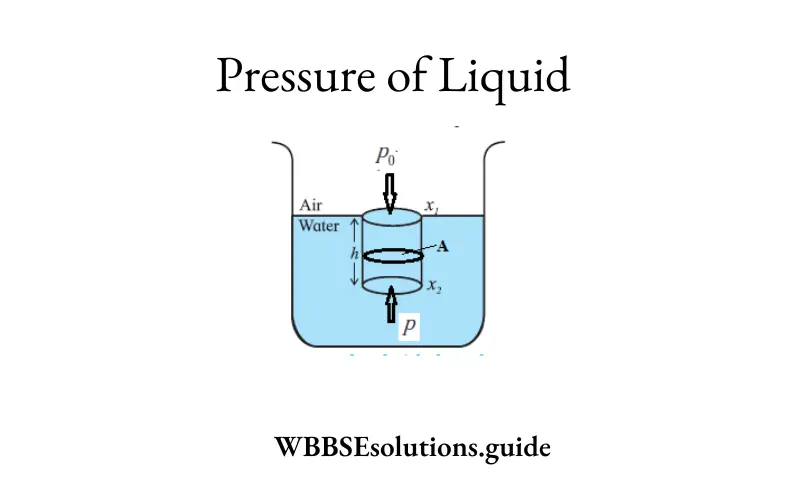
Answer: The two opposite camps which developed in Europe before the outbreak ofthe First World War were :
(1) the Triple Alliance and
(2) the Triple Entente.

Question 24. Name the main contending powers in the partition of China.
Answer: The main contending powers in the partition of China were Britain, France, Germany and Russia.

Question 25. What was the period of the First World War?
Answer: The period of the First World War was 1914-1918.

Question 26. Which country declared war on Serbia in 1914?
Answer: Austria declared war on Serbia in 1914.

Question 27. What is ‘Ghetto’? 
Answer: ‘Ghetto’ is an overcrowded urban slum where the poor factory workers’ families live in small, dark rooms in unhygienic condition.

Question 28. When was the Anglo-French Entente concluded?
Answer: In 1904 the Anglo-French Entente was concluded.

Question 29. When and among whom was the Triple Entente concluded?
Answer: In 1907 The Triple Entente was concluded among England, France and Russia.

Question 30. When did the World War I begin?
Answer: The World War I began on July 28, 1914.

Question 31. Name the most important Allied and Axis powers in the First World War.
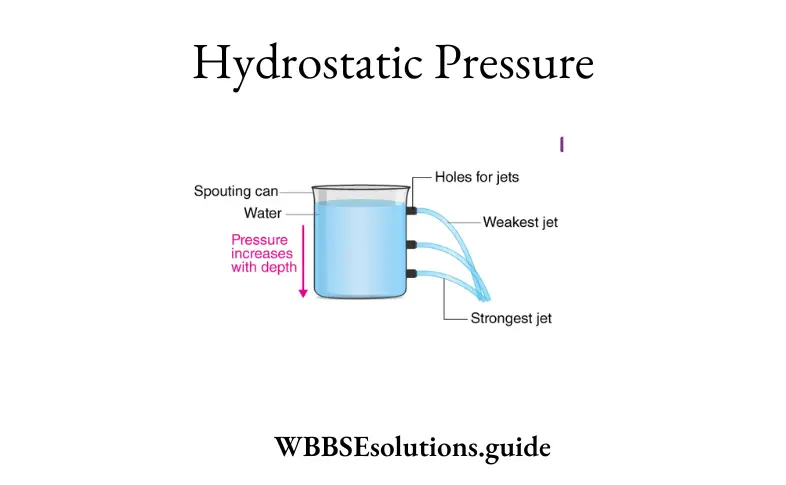
Answer: Allied Powers — England, France, Italy, Russia, Japan, U.S.A., etc. Axis Powers Germany, Austria, Turkey, etc.

Question 32. When and with what object did Italy join the Allied powers?
Answer: Italy joined the Allies in 1915. Her object was to recover from Austria some of the provinces which formally belonged to her.

WB Class 9 History Question Answer

Question 33. What does the word ‘Revolution’ mean?
Answer: The word ‘Revolution’ means a change.

Question 34. When did the Industrial Revolution began in Britain?
Answer: The Industrial Revolution began in Britain in the first half of the 17th century.

Question 35. What contribution did Industrial Revolution make to the Western nations?
Answer: The Industrial Revolution made the Western nations rich and powerful.

Question 36. Which Revolution gave birth to the factory system?
Answer: Industrial Revolution gave birth to the factory system.

Question 37. When did the real beginning of the Industrial Revolution start in Russia?
Answer: The real beginning of the Industrial Revolution in Russia dates from 1861 after the Emancipation statute of 1871 was passed.

Question 38. Which industry was most emphasised in the Industrial Revolution?
Answer: The most significant impact of the Industrial Revolution was on cotton textiles.

Question 39. What happened to cottage industries after the Industrial Revolution?
Answer: Due to the Industrial Revolution, cottage industries lost their importance.

Question 40. Until what time the manufacturing locations were domestic?
Answer: Until the first half of the 17th-century things were made by people in their homes.

WBBSE Class 9 History Europe in the 19th century question answer

Question 41. Why was Africa colonised?
Answer: Africa was colonised to gain control over its mines which are rich in gold, diamonds and rubies.

Question 42. Which were the only two independent countries in Africa in 1895?
Answer: In 1895 Ethiopia and Liberia were the only two independent countries in Africa.

Question 43. What happened to India after deindustrialisation?
Answer: After deindustrialisation, India was transformed from an exporter to an Unb Oils.

Question 44. Who gave leadership in ‘Luddite riot’?
Answer: General Ned Ludd gave leadership in the ‘Luddite riot’.

Question 45. Name two natural resources necessary for industrialisation.
Answer: Coal and iron are two natural resources necessary for industrialisation.

Question 46. In England which movements preceded Industrial Revolution?
Answer: In England Agricultural Revolution and Enclosure Movement preceded Industrial Revolution.

Chapter 4 Europe In The 19th Century: Conflict 0f Nationalist And Monarchial Ideas 2 Marks Questions And Answers:

Question 1. What do you know of the Entente Cordiale?
Answer:

Entente Cordiale

In 1904, the Entente Cordiale was signed between England and France. By it, a long series of standing disputes over such matter as Newfoundland fisheries, Siam, Madagascar, West Africa, and above all, Egypt were settled.

Question 2. What do you know of Triple Entente?
Answer:

Triple Entente

After the Entente cordiale with France, England made up all her differences with Russia and signed conventions with regard to non-competition in Persia, Afghanistan and Tibet. Thus was formed a new diplomatic group known as the Triple Entente (1907). It was not an alliance, still, it was a potent force and with which the Triple Alliance had to reckon.

Question 3. What do you know of the policy of Russification?
Answer:

Policy of Russification

The policy of Russification was systematically followed by the Czar Alexander III of Russia. In other words, Czar Alexander III wanted to introduce uniform conditions by taking away the privileges that had been enjoyed by the non-Russian people in the Empire.

WB Class 9 History Question Answer

Question 4. When did the Russo-Japanese war take place? What were its results?
Answer: The Russo-Japanese War took place in 1904-1905. Russia was defeated and she accepted the terms of the Treaty of Portsmouth which was concluded through the mediation of President Roosevelt of America.

Question 5. What was the main cause of the Russo-Japanese War?
Answer: The main cause of the Russo-Japanese War was the quarrel between Russia and Japan over Korea.

Question 6. What do you know of Agadir Incident?
Answer:

Agadir Incident

In 1911 France sent an army to Fez, the capital of Morocco. ThereuponGermany sent a gunboat, the Panther, to the Moroccan port of Agadir to exert her right in that area. At a result of this, a highly critical situation developed between France and Germany. At last the situation was calmed by the intervention of England.

Question 7. When was the Archduke of Austria murdered? What was the significance of the murder of Archduke Francis Ferdinand?
Answer: Francis Ferdinand, Archduke of Austria, was murdered in the Bosnian Capital of Serajevo on June 28, 1914. This was the spark which set all Europe ablaze and the World War I began.

Question 8. What do you mean by Division of Labour?
Answer:

Division of Labour

In Division of Labour, the production process is divided into several parts and each part was to be produced separately. Division of labour helps in the specialisation of a particular process but the labourer becomes ignorant of the total system of production.

Question 9. What conditions are necessary for industrialisation?
Answer:

The following conditions are necessary for industrialisation :

(1) Natural resources likes coal and iron
(2) Sufficient capital
(3) Plenty of raw materials
(4) Cheap labour
(5) Markets for finished goods
(6) Political stability.

Question 10. What are the main features of Industrial Revolution?
Answer:

The main features of Industrial Revolution are :

(1) Mechanisation of industry and use of modern technology for production
(2) Production of goods by machines and factories instead of individual labour and cottage industries
(3) Investment of huge amount of capital
(4) Marketing the finished goods on a large scale for profit.

WB Class 9 History Question Answer

Question 11. Which were the main locations of the Industrial Revolution?
Answer:

The main locations of the Industrial Revolution were :
England, Belgium, France Germany, Italy, Russia, the U.S.A, Japan and China.

Question 12. How did the Industrial Revolution lead to the growth of new cities?
Answer: Before the Industrial Revolution the people lived primarily in villages. Agriculture was main occupation of the people. After Industrial Revolution there was a migration which displaced agricultural labourers to industrial areas on a large scale, who sought and found employment in the industries. Towns gradually developed around these industrial centres.

Question 13. Name two scientific inventions which helped in Industrial Revolution in England.
Answer:

Two scientific inventions which helped in Industrial Revolution in England are :
(1) Steam engine invented by James Watt, and
(2) Safety Lamp invented by Humphry Davy.

Question 14. What do you mean by ‘Luddite riot’?
Answer:

‘Luddite riot’

‘Luddite riot’ was a protest movement of the workers led by General Ned Ludd in England.

The rioters demanded :

(1) A minimum wage
(2) Control over labour for women and children
(3) Work for those who had lost their job because of the coming of machinery and
(4) Right to form trade unions so that they could present their demands legally and officially.

Question 15. Who are called ‘Utopian Socialists’?
Answer: In the 19th-century socialist thought made great advancement due to the birth of industrial population. The pre-Marxist socialists and thinkers are called early socialists or ‘Utopian Socialists’.

Question 16. What is Paris Commune?
Answer:

Paris Commune

In 1871, the revolutionary workers of Paris established an organisation known as Paris Commune and defied the central government and captured power. On 18 March this Commune exercised administrative power in Paris for almost two months.

Question 17. What is ‘Bloody May Week’?
Answer:

‘Bloody May Week’

In 1871 when the revolutionary workers of Paris established the Paris Commune in order to take over the administration of Paris in their own hands, the soldiers of the French Government fired indiscriminately on the revolutionary workers. There was desperate fighting for a week (22 May-29 May). About 17,000 persons were killed. Historians refer to this week as ‘Bloody May Week’.

Question 18. What do you understand by the term ‘imperialism’?
Answer:

‘imperialism’

The term ‘imperialism’ means the practice of extending the control, power or rule by a country over the economic and political life of the people of areas outside its own boundaries. This may be done by direct rule over the country, or indirect control of the people or through settlements. The essential feature of imperialism is exploitation. The imperialist power subordinates the colony of the country which it controls indirectly to serve its own economic and political interests.

Question 19. In the 19th century what changes took place in the nature of the trade relations between England and India?
Answer: In the 18th century, English merchants used to purchase Indian goods and earn profits by selling them in England and other European countries. In the 19th century, changes took place in the nature of trade between England and India. During this period, Britain did not import goods from India. On the other hand, the Indian market was flooded with British goods and India who had so long been a manufacturer and exporter of finished goods became an exporter of agricultural products like indigo, cotton, jute and wheat.

WB Class 9 History Question Answer

Question 20. What were the wars through which the English established their control over Mysore?
Answer:

The wars through which the English established their control over Mysore were :
(1) First Anglo-Mysore War (1767-69)
(2) Second Anglo-Mysore War (1780-84)
(3) Third Anglo—Mysore War (1790-92) and
(4) Fourth Anglo—Mysore War(1799)

Question 21. What were the wars through which the English established their supremacy over the Marathas?
Answer:

The wars through which the English established their supremacy over the Marathas were :
(1) First Anglo-Maratha War (1785-82)
(2) Second Anglo-Maratha War (1803-05) and
(3) Third Anglo-Maratha War (1818).

Question 22. What were the battles through which the English had established their supremacy in Bengal?
Answer:

The battles through which the English established their supremacy over Bengal are :
(1) The Battle of Plassey (1757) and
(2) The Battle of Buxar (1764).

Question 23. What is ‘drain of wealth’?
Answer:

‘Drain of wealth’

The drain of wealth from India which started during the period following the Battle of Plassey in 1757 is an important feature of British imperialism. From the 18th century up to the middle of the 19th century, English East India Company and its servants collected a huge amount of wealth from India and sent the entire amount to England. This flow of wealth from India to England is known as the drain of wealth.

Historians have observed that wealth was transferred from India to England In five ways These were :

(1) Presents
(2) Collusive contracts
(3) Private trade
(4) Free merchants and
(5) Investment.

Question 24. Name the books which contain the political ideals of Karl Marx.
Answer:

The books which contain political ideals of Karl Marx are:
(1) Communist Manifesto
(2) Das Capital
(3) Critique of Political Economy
(4) Philosophy of Poverty.

Class 9 History West Bengal Board

Question 25. Which is the First International Working Men’s Union? When was it established and under whose leadership?
Answer: The First International Working Men‘s Union is the Communist League. It was established in 1847 under the leadership of Karl Marx.

Question 26. What was Zollverein?
Answer:

Zollverein

The first stage in the unification of Germany was the creation of Zollverein or the customs union of the German kingdoms. The main terms of entry into the Zollverein were complete free trade between state and uniform tariff on all frontiers.

Question 27. Where and why was the Zollverein formed?
Answer: Zollverein was an organisation in Germany through which the distracted German people experienced a sort of commercial cooperation amongst themselves.

Question 28. Name the countries that rushed to establish colonies in Africa.
Answer: The countries that rushed to establish colonies in Africa were Great Britain, Germany, France, Belgium, Italy and Spain.

Question 29. What do you understand by ‘Scramble for Africa’?
Answer:

‘Scramble for Africa’

During the 1800s, France, Britain, Italy, Spain, Germany and Belgium competed with each other to establish a foothold in Africa as Africa was rich in natural resources. They thought that they required to do this to maintain their lifestyle and to develop their homelands. This rush among the various European powers to establish colonies in Africa is known as ‘Scramble for Africa’,

Question 30. In which year and between whom was the Treaty of Nanking signed?
Answer: The Treaty of Nanking was signed in 1842 between Britain and China.

Question 31. What were the terms of the treaty of Nanking?
Answer:

The terms of the treaty were :

(1) Opium trade was legalised
(2) Five ports including Canton was opened to foreign trade
(3) Japan ceded Hong Kong to the British
(4) It was proclaimed that the British subjects would no longer be subject to Chinese law, and (5) China paid heavy war indemnity to England.

Question 32. In which year and between whom was the Treaty of Tientsin signed?
Answer: The Treaty of Tientsin was signed in 1858 between England, France and China.

Question 33. What were the terms of the treaty?
Answer:

The terms of the Treaty were :
(1) Ten more ports were opened to the British and French merchants
(2) China was forced to set up a foreign mission in Beijing,
(3) China had to pay heavy war indemnity, (4) China admitted that foreign residents in China would be under the laws of their respective countries and not the laws of China.

Class 9 History West Bengal Board

Question 34, What was the ‘March of the Blanketeers’?
Answer:

‘March of the Blanketeers’

Thousands of workers started a march in 1819 from Manchester towards the Parliament House in London in order to put forward their long standing demands for improvement of their working conditions. The workers carried with them their blankets on their shoulders for sleeping at night. This was known as the ‘March of the Blanketeers’,

Question 35. Name the countries which fought the First Balkan War. Name the treaty which brought an end to the war.
Answer: The First Balkan war was fought in 1912 between Turkey and the member countries of the Balkan League (Greece, Serbia, Montenegro, Bulgaria). The First Balkan War came to an end with the signing of the Treaty of London (1913).

Question 36. Between whom was the Second Balkan War fought? Name the treaty which put an end to the war.
Answer: In 1913 the Second Balkan War was fought between Serbia and Bulgaria. Greece and Romania joined Serbia. The Second Balkan War came to an end with the signing of the Treaty of Bucharest (1913).

Question 37. What is Neo-colonialism?
Answer:

Neo-colonialism

Neo-Colonialism means that western European countries and the U.S.A., even after decolonisation, exerted a great deal of control over the new states, which continued to need the markets and the investment that the West could provide.

Question 38. What was Hobson’s view about imperialism?
Answer:

Hobson’s view about imperialism

Hobson, an economic historian, theorised that capitalism led to imperialism which ultimately led to the First World War. According to him, the industrialists of Britain, France and Germany accumulated excessive amount of capital. These industrial capitalists forced their respective Governments to establish colonies in order to have abundant supply of raw materials and to invest the surplus capital in the colonies. Capitalist governments of different countries entered into competition with each other in order to establish monopoly right on colonies which ultimately led to war.

Question 39. In which year was the Triple Alliance formed? Who were the members of the Triple Alliance?
Answer: The Triple Alliance was formed in the year 1882. The members of the Triple Alliance were Germany, Austria and Italy.

Question 40. In which year was the Triple Entente formed? Who were the members of the Triple Entente?
Answer: The Triple Entente was formed in the year 1907. The members of the Triple Entente were England, France and Russia.

Question 41. When did World War I break out? What was the ‘Serajevo incident’?
Answer: World War I broke out on 28 July 1914. On June 28, 1914 Archduke Francis Ferdinand, nephew of emperor Joseph of Austria and heir to the throne of Austria, was assassinated along with his wife Sofia in Serajevo, the capital of Bosnia, by Narvilo Princep, a member of ‘Black Hand’ terrorist organisation. This incident is known as ‘Serajevo incident’.

Question 42. Through which military campaign did Mussolini try to fulfil his imperial ambition?
Answer: The Fascist Government under Mussolini became hungry for colony and Mussolini tried to fulfil his imperial ambition through his military campaign in the East African country of Ethiopia (Abyssinia). In 1935 he attacked Ethiopia to exploit its raw materials and materials for industrial development. Ethiopia was formally annexed in 1936.

Question 43. When did the Industrial Revolution take place?
Answer: There is no agreed opinion as regards the starting-point of the Industrial Revolution. Toynbee, for example, took the starting point as 1760 when there was the Industial Revolution in England. Professor Nef, an American historian, on the other hand, is not in favour of fixing any time or particular year for the Industrial Revolution.

Class 9 History West Bengal Board

Question 44. How did England become the workshop of the world?
Answer: Industrial Revolution first made its appearance in England. Big mills and factories were established where necessary goods of daily use were produced for the markets. By the nineteenth century England became, as it were, the ‘workshop of the world’.

Question 45. How did Industrial Revolution take place in Belgium?
Answer: No European country even attempted to follow in England’s footsteps till the end of the Napoleonic era. Almost immediately after, Belgium undertook a movement of industrialization with the indirect help of England. However, it was not before 1830 that the movement gained momentum. Thereafter it speeded up so sharply that by 1870 Belgium became the most industrialized nation.

Question 46. What was Napoleon’s contribution to the Industrial Revolution in France?
Answer: Napoleon made a determined effort to build up industry in France. His industrial efforts included foundation of technical schools, advancing government loans to the manufacturers, etc. It may be said that the support and encouragement that Napoleon had given, however, served the basis on which the edifice of French industrialization was built at a later date. Bank of France established by Napoleon also helped the process of industrialization by a liberal credit policy.

Question 47. When did Industrial Revolution start in Germany?
Answer: As Germany remained divided into a number of small states, it is very difficult to fix the precise date when industrial revolution began there. The real beginning of industrial revolution in Germany began only after she attained her unity in 1870. Despite her uneven growth due to political reason, a unified Germany far outdistanced France after 1870.

Question 48. What do you meen by Ghetto?
Answer:

Ghetto :
A Ghetto is a part of a city in which members of minority group live, especially because of social, legal or economic pressure. As a consequence of the Industrial Revolution, towns sprang up like mushrooms around the factories. The workers and their families were herded in cheap tenements, constituting a slum very much akin to the ghettos.

Question 49. How were railways established in Belgium?
Answer: Shortly after the introduction of railways in England the Belgian Parliament adopted a plan for construction of railways. The plan was drawn up by an English engineer, George Stephenson. Moreover, the project was implemented with capital made available by England as a loan.

Question 50. What was the most important feature of industrialisation in Russia?
Answer: Most important feature of industrialization in Russia was that the industries were mostly established with the aid of foreign capital. According to one estimate, by 1914 some 2000 millions of rubles (Russian currency) of foreign capital had been invested in Russia.

Question 51. How was the beginning of the Factory system?
Answer:

Factory System :
The introduction of intricate machinery made the factory system possible. The old method of small production in the home with one’s own tools could not meet the competition of machine production. The cost of machinery was prohibitive to individual workers. Hence was the beginning of the factory system.

Class 9 History West Bengal Board

Question 52. What were the classes which Industrial Revotion gave rise to?
Answer: Industrial Revolution gave rise to two classes, namely Industrial bourgeoisie and Industrial proletariat. The industrial bourgeoisie (middle class) amassed enormous capital and funds from profiteering and exploitation. The position of the industrial proletariat (working class), on the other hand, was one of extreme hardship.

Question 53. What was the role of women in Industrial Revolution?
Answer:

The role of women in Industrial Revolution

One of the socio economic consequences of the Industrial Revolution was the growing employment of the women of the countryside. The adoption of the power loom in the cloth mills led to a change in the labour force. From the very beginning, the mill owners depended on tall, single women from the countryside as labourers. In fact, women remained a key labour force for the growing cotton mills.

Question 54. What were the colonies of France outside Europe? 
Answer:

The colonies of France outside Europe

France, besides countinuing to hold a few trading posts on the Indian coast, built up a colonial empire in Indo-China (Cambodia, Loas and Vietnam). In 1899 France leased Kwangchow from China and obtained a privileged position in some Chinese provinces. According to Carlton N. H. Hayes, by 1914 France ruled over more than twenty million Asians.

Question 55. Which inventions marked the beginning of the railways?
Answer: About 1801 Richard Trevithick made a seccessful experiment to move the wheels of a wagon along iron rails. Later, in 1825 George Stephenson built a steamlocomotive able to pull heavy loads along a track. Stephenson’s locomotive, the Rocket made its first trip form Liverpool to Manchester in 1829. This was the beginning of the railways.

Question 56. What was the Schlieffen Plan?
Answer:

Schlieffen Plan :
At the start of the war, the German armies operated according to the Schlieffen Plan. The Plan intended to ensure a German victory over Franco-Russian alliance by holding up any Russian advance westwards.

Question 57. How did the factory system originate?
Answer: The effects of the scientific discoveries and inventions which happened after the French Revolution were revolutionary in character. They changed the entire face of England, both rural and urban. The ordinary workman could no longer live in a poverty cottage and weave cloth on his own loom. Now that machines were set up, he had to go where the machines were working and find a job. There hundreds and even thousands of people worked under the same roof. They assembled together under a factory shed and worked with tools and machineries supplied by the factory owner. This gave rise to the factory system.

Question 58. What were the inventions of the Industrial Revolution?
Answer:

The inventions of the Industrial Revolution

In 1733, John Kaye invented a new machine, known as the Flying Shuttle which brought about a complete change in the weaving system. In 1764 another important invention was the Spinning Jenny made by James Hargreaves. Some years later, Richard Arkwright brought further improvement in the method of spinning by introducing rollers worked with water power (1769). Ten years later, Samuel Crompton invented another machine by combining the devices of Hargreaves and Arkwright, called the mule. In 1781 James Watt successfully devised the system of using steam power to work the machines.

Class 9 History West Bengal Board

Question 59. Mention two effects.
Answer:

The effects of industrialisation on transport were:

(1) For rapid and safe transport of raw materials and manufactured goods from centres of production to consumption centres mechanised roads, i.e., pucca roads were constructed.
(2)Canals were dug primarily for cheap and easy shipment of coal from mines to
industries.

Question 60. How did the Industrial Revolution lead to colonial expansion?
Answer: As a result of the Industrial Revolution, huge quantities of finished goods were produced within a short time, which was more than what was necessary for the domestic markets of the European countries. This ultimately led to the rise of colonial expansionism in the undeveloped countries of the world. The industrialised countries like Britain, France and Germany sought new markets by capturing colonies where they could sell their finished goods. So they began to extend their colonial empire in industrially backward countries of Asia like India, China, Burma, Ceylon, Egypt and Congo.

Question 61. What was the effect of Industrial Revolution on the communication system?
Answer:

The effect of Industrial Revolution on the communication system

The Industrial Revolution had a great impact on the communication system. The means of communication improved greatly. Samuel Morse (1791-1872) invented telegraph to send messages. The Trans-Atlantic underseas cable connecting the United States with Europe continent was laid by Cyrus W. Field in 1866. Graham Bell invented the Telephone system in 1876. Marconi was the first to demonstrate
the utility of the wireless in saving life at sea

Question 62. Mention two seasons why industrialisation started late in Germany.
Answer:

The reasons were:
(1) Germany was divided into numerous states which were often at war with each other. This political disunity slackened the growth of industrialisation in Germany.
(2) As the population in Germany did not increase tremendously, there was scarcity of cheap labour.

Question 63. Mention two of the impacts of Industrial Revolution on different classes of women in society.
Answer: The Industrial Revolution had varied impact on different classes of women in society

(1) It made life of the women of upper and middle-class families more comfortable. These women had more time for leisure, entertainment, pursuit of intellectual activities, such as reading and writing of novels.

(2) Women from low-income families who were actively involved in domestic work and farms earlier sought employment in factories. They were employed by factory owners in large numbers and were mercilessly exploited. They worked for long hours and were paid very meagre wages.

Europe in the 19th century Class 9 WBBSE long answers

Question 64. What is Dreikaiserbund?
Answer:

Dreikaiserbund

Bismarck, the Chancellor of Germany, was eager to have friendly relations with different countries. He had good relations with Austria but the problem was that the relations between Austria and Russia generally remained strained over to the Eastern Question. Therefore, Bismarck concluded a friendly alliance with Russia and Austria. His chief aim was not only to secure the friendship of Russia but also to improve the relations between Austria and Russia. This alliance of three emperors of Germany, Austria and Russia is known as Dreikaiserbund. It was neither a definite treaty nor an alliance. It was only a compromise among the three emperors. It is also known as ‘Three Emperor’s League’ (1873).

Question 65. What is Open Door Policy (1899)?
Answer:

Open Door Policy (1899)

In the Sino-Japanese War (1894) China was defeated by Japan which inaugurated the process of dismemberment of China. Countries like Russia, Britain, France and Germany were the main contenders for the partition of China. Russia occupied North China and obtained permission to build a railway line. Germany landed an army in China and took possession of some important territories. France acquired Kwangchow. Britain got Hong Kong and some concessions. Thus the economically important areas of China passed into foreign hands. At this juncture, Sir John Hay, the US Secretary of State, issued the famous Open Door Policy (1899), according to which no Chinese port was to be considered an exclusive property of any particular foreign power.

Question 66. Mention two steps taken by Bismarck to industrialise Germany.
Answer: Bismarck, the Chancellor of Germany, took different steps to industrialise Germany.

These were :
(1) Reorganised the banking system in order to remove the scarcity of capital in Germany.
(2) He introduced federal currency called Reichmark, a standard tariff for internal trade and standard weights and measures which helped a lot in industrialisation.

Question 67. Mention two main constraints to industrialisation in Germany.
Answer: Industrialisation started rather late in Germany. This was due to many obstacles which Germany faced.

These obstacles were:

(1) Germany was divided into 39 states dominated by foreign powers. Each state followed its own tariff of export and import policies.
(2) Napoleonic wars had devastated Germany economically. Proper banking system did not develop. As a result, there was scarcity of capital necessary for industrialisation.

Question 68. Who was Robert Owen?
Answer:

Robert Owen

Robert Owen was a Socialist thinker. He upheld the view that the capitalists should share a portion of their profit with their employees. He introduced a new doctrine known as ‘New Harmony.’ He believed that if the workers are satisfied and reasonably rewarded, they would work for the improvement of production in factories. He rejected any competition between employer and worker. He himself was a factory owner. He introduced many benefits for his workers.

Question 69. What was Entente Cordiale (1904) ?
Answer:

Entente Cordiale (1904)

After concluding the Anglo-Japanese alliance in 1902, Britain turned towards France, the enemy of Germany. France also wanted Britain as her ally so that she could concentrate against Germany. In 1904 Britain and France reached a series of agreements. These agreements settled their old colonial disputes in Siam, Madagascar and West Africa, New Hebrides and fighting rights in Newfoundland. Moreover, France recognised Egypt and Sudan as British spheres of influence. Britain recognised Morocco as French sphere of influence. It was also decided that both England and France would recognise their spheres of influence. This Entente Cordiale (friendly agreement) was signed in 1904.

Question 70. What was Lenin’s view about colonialism?
Answer:

Lenin’s view about colonialism

Lenin in his pamphlet ‘Imperialism, the highest stage of capitalism pointed out that in a capitalist economy the government has no control over surplus production of goods. The industrial owners believe that they will earn more profits if they produce more. When the market is full of goods there is no further demand for goods in the home market. In that case, the industrial owners force the government to capture new. colonies where they could get monopoly market in order to sell surplus goods and also get cheap raw materials. The competition for the capture of colonies ultimately leads to imperialism.

Question 71. What were the differences between early socialists and Karl Marx?
Answer:

Difference Between Early Socialists and Marx :

Socialism propounded by Marx and that of the early socialists differed in two ways.

(1) The early socialists believed in gradual and peaceful development to establish an ideal condition for the workers. But Karl Marx forecasted that a violent uprising would enable the workers to capture the political power that would be used to secure their own welfare.

(2) The early socialists were in favour of working within the framework of the capitalistic system for the development of the condition of the workers. But Marx opined that there will certainly occur the destruction of the capitalistic system. Marx considered the industrial workers as the force of change that would destroy capitalism and establish socialism. He also believed that the key to this was the change through class conflict or struggle between two opposing economic orders bourgeoisie and proleteriat.

Chapter 4 Europe In The 19th Century: Conflict 0f Nationalist And Monarchial Ideas 4 Marks Questions And Answers

Question 1. Why did Industrial Revolution first start in Britain?
Answer:

Industrial Revolution first started in Britain due to the following reasons:

(1)Unlike other European countries such as France, Britain was politically stable with England, Wales and Scotland unified under a monarchy.
(2) Britain’s unrivalled power in overseas trade enabled accumulation of vast profits, which provided necessary capital for investment
(3) In England Agricultural Revolution and Enclosure Movement preceded Industrial Revolution. The landless farmers -who migrated to
towns in large numbers provided cheap, abundant wage labour to work in factories.
(4) A single currency, common laws, a market not fragmented by local taxes, use of money as medium of exchange, all worked to Britain’s advantage.
(5) Huge colonies in different parts of the world supplied raw materials for the industries and were ready markets for finished goods.
(6) Emergence of London as a centre of global trade.
(7) Good network of navigable rivers and indented coastline enabled good and cheap mode of water transport.
(8) Natural resources like coal and iron were available in plenty and technological inventions largely helped industrialisation.

Question 2. How was the life of the workers after the Industrial Revolution?
Answer:

Evidence of British factory records reveals that the workers had miserablelives after the Industrial Revolution. The living conditions of the workers were far from satisfactory.

(1) The wages they were paid were extremely low.
(2) Their houses were in terrible slums and were dirty.
(3) The hours of their work were unlimited.
(4) They had to live in small rooms.
(5) Women and child labourers werein humanly treated. They were subjected to long monotonous hours of work in un healthy environment under strict discipline and cruel forms of punishment.
(6) The conditions in the mines were even worse. In the narrow passages children pushed coal trucks along with the adults. They were paid meagre salaries.
(7) The crowded towns and damp factories were disastrous for the workers. This ruined their health. Several labourers were injured in the factories during working hours and these injured workers were removed from their jobs and no compensation was paid to them.

Question 3. What were the effects of railways in different countries of the world?
Answer:

The effect of the introduction of railways in different countries of the world varied greatly.

(1) The effect of the railways was positive in imperialist countries, e.g. Britain. The railways not only revolutionised transport system, but it also spearheaded the industrial revolution in imperialist countries like Britain, France, Portugal and Spain.

(2) Railways provided better, cheaper, faster and easy means of transport, unified different areas and had great impact-on industries.

(3) Railways boosted activity in construction and public works department, provided employment, and accelerated trade and commerce.

(4) On the other hand, railways in countries like India resulted in further colonisation and underdevelopment of the economy.

(5) As a result of the introduction of railways, the colonisers were able to fully tap the untapped resources of the colonised country for raw materials and then send finished goods to the remote parts of the country.

Question 4. Write briefly about the causes of decline of the indigeneous industries during company’s rule. Mention its effect on cotton industry.
Answer:

Causes – (1) Fall of Native kingdoms:

The native rulers were patron of handicraft and cottage products. They purchased clothes, perfumes, etc. for their family and weapons for their army. In the words of Gadgil, “The disappearance of the courts and the establishment of alien rule contributed mainly to the decay of Indian handicrafts.”

(2) Industrial Revolution:

After the industrial revolution in England, the hand made goods couldn’t compete with the machine made goods of Europe and the Indian markets were flooded with an unequal competition.

(3) Preference of rich people :

The rich people usually liked to wear foreign expensive cloths and used foreign goods. Thus the market for cottage products diminished.

(4) Exploitation of weavers and artisans:

The weavers and artisans were forced to purchase raw cotton at a very high rate and sell their finished products at very less rate to the British officers. As a result thousands of weavers fled away from the villages.

(5) Tax Burden:

According to R.C. Dutta, the vital cause of the decline of Indian cottage industries was the imposition of 10% duty on Indian clothes’ export and 2% duty on import of British clothes. As a result, Indian goods lost market in European market. Thus, Indian cottage industry was ruined due to step motherly attitude of EastIndia Commany. Acc. to Dadabhai Naoroji, “India was forced to be a land of poor people”. Cotton industry with an unequal competition ruined. As a result thousands of weavers and artisans were thrown out employment with machine made cheap products and were ruined.

Question 5. Make a list of Industrial Revolution : Inventors and Inventions.
Answer:

A list of Industrial Revolution : Inventors and Inventions

Inventor

Invention Year

John Kay

Flying Shuttle 1733

James Hargreaves

Spinning Jenny

1765

Richard Arkwright

Spinning Frame

1769

James Watt

Steam Engine

1775

Samuel Crompton

Spinning Mule

1779

Edmund Cartwright

Power loom

1785

John Fitch

Steam boat

1786

Eli Whitney

Cotton Gin

1793

Humphry Davy

First Electric Light

1809

Samuel E.B. Morse

Telegraph

1836

Elias Howe

Sewing machine

1851

Alexander Graham Bell

Telephone

1876

Thomas Edison Phonograph

1877

Rendolf Diesel Diesel Engine

1892


WBBSE solutions for Class 9 History Chapter 4

Question 6. Why did industrialisation start late in France than England?
Answer:

While England was having rapid industrialisation, France was lagging behind due to the following reasons:

(1) France was torn by revolution during the period 1789-1848; Socio-economic and political disorder was a major obstacle to industrialisation in France.

(2) Another hindrance to industrialisation was the non- availability of coal. Industrialisation made steady progress in mid-eighteenth century when the coalfiels were tapped.

(3) Another cause of late industrialisation was that France suffered from transport crisis. Raw materials could not be easily brought to
the industrial towns for Iack of transport, nor manufactured goods could be sent to the market.

(4) Moreover, the people of France had a medieval outlook. They had contempt for persons who earned money by their own labours, landholding and taking part in administration were regarded as virtues. This medieval outlook of life was a hindrance to industrial growth.

(5) The industrialists of France were not encouraged by the rulers of France. Lack ofcapital, scarcity of coal, undeveloped banking system slackened the process of industrialisation in France.

Question 7. Give an account of the Chartist Movement in England.
Answer:

Chartist Movement in England

The Chartist Movement is an important chapter in the history of working class movement in England. The London Working Men’‘s Association was founded in 1836 by William Novett This organisation presented a large petition to the British Parliament which was known as ‘People’s Charter’.

It said :
(1) Members of Parliament must be annually elected.
(2) There must be equal voting rights.
(3) Electoral areas must have equal population figure.
(4) Voting right based on qualification should be ballot.
(5) Elected members of Parliament must be granted some allowances.

The association threatened the Government that if the demands made in the Charter are rejected, they will call general strike all over the country and paralyse the Government. The Government tried to pacify the workers by passing a series of welfare acts in 1838. The Chartist movement left its influence and served as an inspiration to later workers, movements.

Question 8. What is ‘Peterloo Massacre’?
Answer:

‘Peterloo Massacre’

Inthe early period of Industrial Revolution the condition of the workers in factories was miserable. The workers’ organisations in England resorted to strikes and other forms of violence to improve their material condition. The Tory Government passed prohibitory acts against working class meetings and denied them the right of Habeus Corpus. The workers could not be suppressed. Thousands of workers started a march from Manchester towards the Parliament House in London in 1819 in order to put forward their demands; they carried blankets on their shoulders for sleeping at night. This was ridiculed by Tory newspaper as ‘March of the Blanketeers’. The army fired on these unarmed workers and killed eleven of them at St. Peters. Thousands of them were wounded. The press of London condemned this massacre and ridiculed it as ‘Peterloo massacre’, a name invented to rhyme with Waterloo. The Government under pressure changed its attitude and withdrew the Combination Act and Anti-Trade Union Act.

Question 9. Write a note on Berlin Congress (1878).
Answer:

Berlin Congress (1878)

The Eastern Question was not solved by the Crimean War (1854-56) and the Peace of Paris. During the nationalist movement in Bulgaria, the Turkish army killed many Bulgarians. Russia defeated Turkey and imposed the Treaty of San Stephano| (1877) on Turkey. England and other European powers opposed this Treaty of San Stephano. In the international conference convened at Berlin in 1878 known as Berlin Congress, Bismarck acted as President. The terms of the Treaty of San Stephano were altered and a new pact, Berlin Treaty (1878) was signed.

According to it :
(1) Serbia, Montenegro and Rumania were declared free.
(2) Russia was given Bessarabia. She also got the provinces of Batum, Kars and Armenia.
(3) England got the island of Cyprus. England assured the safety of the Turkish empire.
(4) The Sultan of Turkey promised to grant full religious freedom. (5) Serbia was to enjoy semi-independent status under nominal Turkish suzerainty.
(6) Moldavia and Wallachia were also to enjoy autonomy under nominal Turkish rule.

Question 10. What do you mean by ‘Cutting of the Chinese Melon’?
Answer:

‘Cutting of the Chinese Melon’

In the mid-nineteenth century different European powers like Britain, France, Russia made attempts to penetrate into the Chinese empire. After 1860 the ambition of the European powers continued to grow. They now wanted more territories. In 1873 Russia, England and France obtained bases of territories or spheres of influence in China. Japan too followed their example and made war on China (1894-95) in.

Which China was defeated. The weakness of China stood more distinct than ever after her defeat at the hands of littlke known Japan. This encouraged the western powers to make fresh bids for territorial gains in China. But it was soon found that the gains obtained by one power at China’s expense, made other powers jealous. In other words, many powers wanted to cut China into slices, as if it were a melon. European powers like Britain, Russia, Germany and France were the main contenders for the partition of China.

Question 11. How were the ‘Triple Alliance’ and ‘Triple Entente’ formed?
Answer: Before War World I .two opposite alliances developed due to Bismarck’s diplomacy. These two opposite alliances were-Triple Alliance and Triple Entente.

Triple Alliance (1882) :

In 1879 Germany entered into an alliance with Austria.Hungary. In 1882 Italy joined the Austria-German alliance. As a result, the alliance
came to be known as the Triple Alliance.

Triple Entente (1907) :

German foreign policy changed after Bismarck’s death. Germany ignored Russia, and so, Russia began to lean towards France. Meanwhile, England tried to enter into an alliance with Germany but failed. So, in 1904, England made an alliance with France. At last with the signing of the Anglo—Russian convention, the Triple Entente came into existence in 1907.

Question 12. To waht extent did imperialist rivalry lead to the outbreak of the First World War?
Answer: The growth of economy and expansion trade gave birth to the idea of imperalism. It is a policy by which a country dominates over other country and her people. Hobson, an English economic historian, expounded the theory that capitalism led to Imperalism which further led to the great war. V.I. Lenin pointed out that in a capitalist economy, there is no control of Govermment surplus-production of goods.

The capitalist forced their government to capture new coloniés where they could get monopoly market for their surplus goods. The competition for capture of colonies led to imperalism which led to First World War.According to the above thinkers, Britiain and France had captured vast colonies in India, China, Srilanka, Indochina and also in Africa. Germany wanted to capture some colonies which gave rise to confilict between old colonial power like Britiain and France and newly emerging powers like Germany. The competition among colonial powers for colonies prepared road to world war |.

Question 13. Write a short note on the revolution in industrial technology.
Answer:

Revolution in Industrial Technology :

The Industrial Revolution ushered in immense changes in the industrial technology which is called a revolution. In manufacturing industry the most technologically changed industry were the textile industries. In textiles it was the cotton industry that had been revolutionized by the early years of the nineteenth century. In iron industry the traditional charcoal-fired furnaces was completely displaced. Fundamental difference in the new industrial order was the development of a cheap, portable source of power. James Watt’s invention of steam power made the steam engine the prime mover for all kinds of machinery. In building industry too there were important changes in techniques. The use of timber was replaced by greater use of stone.

Question 14. How did Industrial Revolution lead to the rise of new cities in England ?
Answer:

Rise of New Cities :

Varied were the changes in the life of the people, particularly the working people caused by the Industrial Revolution. No longer did the workers labour outdoors as farmers. The majority of the people worked in factories and they generally lived in large, crowded cities. England was the first industrial power. At the same time, this was the country in which the urban population was pretty much more than the rural population. In course of industrialization, London apart other big industrial towns such as Birmingham, Manchester, Newcastle, etc. grew up in England.

These cities had very large populations even by the measures of those times. Workers, however, did not move from farms to cities overnight. This was a gradual process. In cities living was not attractive. Most| workers lived in small, one-family houses. Houses were built side to side and back to back so that there were no windows except in the front of each house. The housing was filthy, unsanitary and airless. This kind of new cities in England were buitlt up due to the Industrial Revolution.

Question 15. How did the Industrial Revolution lead to the development of a bourgeoisie-capitalistic political system in England?
Answer:

Development of a Bourgeoisie-Capitalist Political System :

Capitalism developed along with the changes of the Industrial Revolution. The term bourgeoisie denotes the social class whose concern was the preservation of capital and to ensure the continuity of their economic supremacy. In a capitalist system profit is the primary motive. Profit is the difference between expenses and income. Capital will accumulate with the increase in profit. For example, capitalists expect the expenses to be less than the income. The part of the profit could be reinvested to make further profit. The profit motive was certainly the greatest encouragement for rapid development of manufacturing industries and businesses of many kinds. The rapid development of capitalism in the nineteenth century helped the bourgeoisie to consolidate their wealth and power.

Because of enormous wealth at their disposal, the bourgeoisie was unwilling to accept the lack of rights and political power in the
monarchical system of Government. In a word, they aspired for a major role in politics by participation in the Government. Thus there developed a political system in which the bourgeoisie could participate in the administration of the, country. Parliamentary system of Government was the answer to this. An example of this is England. By the Reform Bill of 1832 in England, the seats in Parliament were
redistributed to grant representation from the new industrial centres.

Question 16. How was the Suez Canal built? What was the importance of it?
Answer:

The Suez Canal :

For centuries men had dreamt of linking the Indian Ocean and the Mediterranean Sea by means of a canal. But there was too much difference of levels in the two so that it was considered an impossible task. When Napoleon Bonaparte visited Egypt in 1799 he envisioned the building of a waterway across the Isthmus of Suez. But no plan for such a canal could be undertaken seriously till 1854 when a French diplomat, Ferdinand de Lesseps, obtained permission from the then ruler of Egypt, to start the venture.

The Suez Canal was completed in 1869 by a company named Suez Canal Company. England was willing to control the sea route to India, so England was the major shareholder of the company and thus brought the Canal under its control. Opening of the Suez Canal made carrying cargo between East and West easier and it made the development of international trade faster. Another impact of the opening of the Suez Canal was that it encouraged the European search for colonies in the closing years of the nineteenth century.

Question 17. Comment on the economic aspect of colonial expansionism.
Answer:

Economic Aspect of Colonial Expansion :

With the advancement of the nineteenth century, the European countries became more and more interested and active in overseas expansion.

1. The Industrial Revolution gave birth to the capitalist system of production. Under the system maximization of profit was the primary motive of production. When the major European powers had become industrialized, it was not possible to sell the products to one another. Hence the industrialized countries started exploring new markets and buyers for selling the goods they were producing.

2. Larger markets for selling the surplus products were needed as the industrialized nations of Europe sought to protect their own industries. The industrialized nations for protection of their industries raised the tariff or tax barrier against each other. In this way, it was ensured that one industrialized country could not sell its manufacturers to another industrialized country.

3. Another incentive for colonial expansion was the tendency to export surplus capital from the industrialized nations of Europe to under developed countries where rates of interest were usually higher than at home.

4. European countries found markets for selling their surplus goods in Asia and Africa where industrialization had not taken place. Political domination had to take place in order to protect the market from other European rivals.

5. In addition to markets, the European countries needed raw materials to feed their own industries. As all that was needed could not be procured locally.

The European countries had to look out for such countries where the:
raw materials were available at a cheap price, There were plentiful amounts of raw materials in Asia and Africa, which attracted the European countries to establish political domination over the two continents.

Question 18. Write a short note on Jingoistic Nationalism.
Answer:

Jingoistic Nationalism :

Nationalism in the late nineteenth century came to be associated with chauvinism or jingoism. Some European nations developed themyth of their superiority over other peoples. Not only that, in the second half of the nineteenth century imperialism became a fashion of the age. The power and prestige of a European nation depended on the colonies it had acquired. Even the writers of the time were in favour of the idea of imperialism. Moreover, many Europeans favoured imperialism as a civilizing mission. They considered imperialism as a way to bring civilization to the uncivilized backward peoples of the world.

For example, Jules Ferry of France said “superior races have the duty of civilizing the inferior races”, Likewise Rudyard Kipling of England promoted the idea of developed countries like Britain specially shouldering what he called ‘white man’s burden’. That is to say, the white people (meaning the Englishmen) should discharge their responsibility of civilizing the backward peoples of the world. The above reasons prompted imperialism by the European powers. The weak governments of the countries of Africa and Asia became the soft targets for the European powers.

Question 19. Make a brief overview of the First World War.
Answer:

A Brief Overview of the First World War: The contestants in the First World War were :

The Triple Alliance or the Central Powers (Germany, Austria-Hungary, Turkey, Bulgaria and Turkey) and the Entente Powers (Russia, France,
Britain, Italy, the USA, Belgium, Serbia, Romania and Greece).

1. Schlieffen Plan :

At the beginning of the war, the German armies operated according to the Schlieffen Plan. The Plan intended to ensure a German victory over Franco-Russian alliance by holding up any Russian advance westwards.

2. The Western Front :

In 1914 the Germans decided to concentrate their war efforts on attacking Russia in the east. At the same time, measures were taken to defend the Western Front.

3. The Eastern Front :

Fighting on the Eastern Front began with the Russian invasion of East Prussia and Austria in 1914. After initial Russian success, the German troops were hurried from the Western Front that successfully stopped the Russian forces.

4. End of the War :

At an enormous cost to both sides in men and materials, Germany ultimately surrendered. An armistice was signed in November 1918. At the Paris Peace Conference (1919) injustciable terms were imposed on the defeated powers of the Triple Alliance.

Question 20. Make a comparative study of Industrial Revolution in England and the Continent.
Answer:

Comparative Discussion on Industrial Revolutions in England and the Continent :

After the restoration of peace in Europe in 1815, machine production was extended to the Continent. At the initial stage the English capital was easilyavailable for the industrial enterprises in the Continent, and English engineers supplied the necessary technological knowledge. This may be illustrated by a few examples. Shortly after the introduction of railways in England the Belgian Parliament adopted a plan for the construction of railways. The plan was drawn up by the English engineer, George Stephenson. Moreover, the project was implemented with the financial help made available by England as a loan. e An important aspect of industrialization in France was the role of the French Government. While in England the Industrial Revolution had been the work of the capitalist class, in France industrialization was achieved mainly through Government initiative.

In fact, in the construction of railways the required money was made available by the Government . e In Germany as well the railways were built with the additional aid of English capital. However, in Germany unlike England, Belgium and France railway construction was doen before the real beginning of industrialization. The most important feature of industrialization in Russia was that the industries were mostly established with the aid of foreign capital. According to one estimate, by 1914 some 2000 millions of rubles (Russian Currency) of foreign money had been invested in Russia. Thus Russia was absolutely dependent on foreign capital and her industry remained majorly weak.

Question 21. Give an account of the development of telegraph system.
Answer:

The development of telegraph system

Telegram is the device or system for transmitting messages to a distant place by making and breaking electrical connection. It was the first form of communication that could be sent over a great distance. Its creation was one of the key inventions to the industrial age. The use of telegram became very popular from the middle of the 19th century. The telegram system played an important part in establishing and expanding colonies by the industrially developed countries.

In 1850 the first experimental electric telegram line was started between Calcutta and Diamond Harbour. In 1851 it was opened for the use of the British East India Company. In 1854 telegram link was established between Calcutta and Agra, Bombay and Madras. A telegram line of 20,000 miles was established in America in 1851. In 1866 when Atlantic Cable was installed, link could be established between England and America. As a result England’s imperialistic rule was consolidated in America.

Telegram was also introduced in the colonies of Africa. A company of Denmark established telegram system in China in 1871. In 1872 the first telegram system was introduced in Australia and later on in Malay, Vietnam and other places. As a result of the introduction of telegram, the European powers were able to establish quick control over the colonies. Foreign control over the colonies was strengthened. Trade of the industrialised countries was increased.

Question 22. Give an account of the socialist movement in Europe.
Answer:

Socialist movement in Europe

The Industrial Revolution led to the decline of small scale industries and encouraged the rise of the factory system. The living condition of the workers of the factories was terrible. The socialists raised their voices of protest against the dismal condition of the workers created by industrialisation.

(1) Robert Owen, a humanitarian factory-owner, upheld the view that the capitalists should share a portion of their profits with his employees. As a factory owner, he introduced many benefits for the workers.

(2) Fourier, a Frenchman pleaded for a new social organisation based .on cooperative communities.

(3) Another socialist thinker was St. Simon who advocated that the state should assume control of production and distribution.

(4) Proudhon wanted to abolish private ownership of Property.

(5) Louis Blanc, a French thinker advocated that the state must come forward to protect the rights of workers and make laws. He condemned accumulation of unlimited, profit of the employer and advocated that profit should be equitably divided between the landlord and the workers.

(6) Other Socialists were Philip Bunarothen, August Blaqui. They condemned competition which led to exploitation of workers.

(7) The greatest advocates of socialism were Karl Marx and Friedrich Engels. To them history was a class struggle especially between the upper middle classes and the proletariat. In the Communist Manifesto Marx made an appeal to the workers of the world to unite.

Question 23. What were the effects of British industrialisation on India?
Answer:

The effects of British industrialisation on India

The principal motive for the coming of the English East India Company was to participate in and make profits from trade but over time India was reduced to the status of a British colony. Indian silk and cotton had a wide market in Britain but with the coming of the
Industrial. Revolution the whole scenario changed.

The effects of British industrialisation on India were :

(1) India was flooded with cheap machine-made goods whereby Indian textiles lost their market in India also.

(2) Laws were passed in Britain to prohibit and restrict the sale of Indian goods.

(3) India was reduced to the level of supplier of raw materials (e.g. cotton, silk, indigo) and importer of British machine-made goods.
(4) Desire for new markets for British goods resulted in Britain’s undertaking fresh conquest in India.

(5) Free and unrestricted supply of British goods proved detrimental to the Indian handicrafts as they were faced with unequal competition of machine made goods.

(6) Self sufficiency of Indian villages came to an end.

(7) There was stagnation in Indian agriculture. The British did  nothing to improve Indian agriculture.

Question 24. What were the causes of the ‘Scramble for Africa’ ?
Answer:

The causes of the ‘Scramble for Africa’

During the 1800s, there was a rush among the European countries to establish their colonies in Africa which is known as the ‘Race for Africa’ or the ‘Scramble for Africa’.

There were many causes of the scramble for Africa which are discussed below :

(1) The Industrial Revolution first started in England and then spread to other parts of Europe. The factories which were established to produce different types of things needed raw materials such as cotton, coal, iron ore and others. Africa was a very rich source of all such raw materials. So the various European countries competed with each other to establish their colonies in Africa.

(2) After the Industrial Revolution, when new machines were introduced, the rate of production increased manifold. They not only met the demand of the people but also generated surplus goods. The Europeans required a big market to sell these extra goods and a vast country like Africa was a good market for them.

(3) Africa is rich in gold, diamonds, rubies and precious stones. The Europeans took Africa to be a rich source for making money.

(4) There were some other causes for the scramble for Africa. Some countries desired to establish their colonies only because other countries already had their colonies in Africa.

(5) Moreover, there were some countries which thought that the strength of a country depends on the number of colonies it had. So they wanted to establish their colonies in Africa.

Question 25. What policy did Mussolini take to fulfil his imperial design in Ethiopia?
Answer: Mussolini, the Fascist dictator of Italy, became hungry for colonies. Mussolini had been eager to bring the East African country of Ethiopia (Abyssinia) under Italian sway and to exploit its raw materials and minerals. An agreement was reached in 1925 between Italy and Britain which promised Italy certain concessions in Ethiopia. Ethiopia vainly protested to the League of Nations against the foreign sphere of influence in Ethiopia. In 1928 a treaty of perpetual friendship and arbitration was concluded between Italy and Ethiopia. When Haile Selassie became the emperor of Ethiopia, he turned down the request of Italy for concessions and favour.

In 1934 there occurred a clash between the Ethiopian force and Italian troops near the villagers of Walwal. The Italian Government demanded an apology and compensation from the Ethiopian Government. Emperor Haile Selassie appealed to the League of Nations for protection. At the League Council’s suggestions representatives of Britain, France and Italy met at Paris (1935). Britain and France agreed to give Italy extensive economic rights in Ethiopia. While the League Commission was in Abyssinia, Italy launched an attack on Abyssinia. The League Council declared Italy an aggressor nation and imposed economic blockade on Italy. Partial economic sanction could not put any pressure upon Italy. Italy defied the League of Nations and resigned from its membership. In 1936 Ethiopia was formally annexed to Italy.

Class 9 WBBSE History Chapter 4 important questions

Question 26. What was the role of Suez Canal in the development of communication and transportation system?
Answer:

The role of Suez Canal in the development of communication and transportation system

Along with the expansion of industrialisation, attention of the European countries was drawn to the use of waterways for carrying goods like coal, iron, etc. So side by side with the existing waterways canals began to be constructed. Industrialised countries in different parts of the world constructed a number of artificial canals to make journey faster and easier. The most important of all these canals was the Suez Canal. It was difficult for the western industrialised countries to maintain commercial relationship with the eastern countries covering long distances. It was also a huge wastage of time and money. To make journey between the East and the West faster digging of the Suez Canal through Egypt by France began in 1859.

To maintain easy communication with India England was very keen to establish control over the Suez Canal. By the joint venture of England and France Condomonian was established in 1876. As a result there was the dominance of England and France in the region. In 1869 the Canal was opened commercially and ships began to pass through the Suez Canal. From 1869 England, France, Germany, Denmark, Belgium, Spain, Portugal and other European countries began to use this canal extensively to maintain trade relations with the eastern countries. Universal Suez Canal Company took responsibility of the Canal for 99 years on the basis of a contract.

To maintain the security of the Suez Canal, the British Government got the right to station British soldiers in this region upto 1956. So though the Suez Canal was an integral part of Egypt, it lost control over the Suez Canal and its adjacent areas. The European countries could easily keep close contact with the eastern countries through the Suez Canal. Imperialist control over the eastern countries was much more strengthened. British control over India became stronger. Through the control of Suez Canal region Anglo-French supremacy in middle and east Africa was gradually strengthened.

Question 27. What was the role of Karl Marx in the spread of socialism?
Answer:

The role of Karl Marx in the spread of socialism

In the first half of 19th century the ideals of Utopian Socialism were very popular, but Utopian Socialism failed to show the right path to the society. In the second half of 19th century Karl Marx (1818-83) made popular his ideas of scientific socialism which is also known as Marxism. As he was a radical thinker he was banished from his homeland Prussia and he took shelter first in France and then in Brussels in Belgium. In 1843 he moved to Paris where he formed his lifelong friendship with Friederich Engels (1820-95) and established the Communist League witn his help. In 1864, he convened the International Working Men’s Association which was also known as the First International. Marx, as the leader of this organisation, tried to lay down the strategy and tactics for the unification of the workers of the world.

In 1848, Marx and Engels brought out the famous Communist Manifesto. Marx wrote that few men who owned the factories exploited workers because these people depended on them. Marx wanted working people to revolt. If they did so, the wealth could be distributed among all, and not remain concentrated in the hands of a few people. While in London he brought out his great work ‘Das Capital’ in 1867 and established his claim to be regarded as the founder of modern socialism. In this book capitalism was criticised and class struggle was emphasised. The book is called the ‘Bible of Socialism’.

The important principles of Marxism are :

(1) Historical materialism
(2) Surplus capitalism
(3) Class struggle, and
(4) Revolution. Karl Marx did not live to see the fulfilment of his dream. He had given hope to the oppressed section of the people all over the world. The value of Marxism lies in the hope and aspiration it has aroused among the suffering humanity holding out to them the prospect of a better and happier world to live in.

Chapter 4 Europe In The 19th Century: Conflict 0f Nationalist And Monarchial Ideas 8 Marks Questions And Answers:

Question 1. What were the economic, political and social effects of the Industrial Revolution?
Answer:

Industrialization brought about unforeseen consequences. The personal relationship that had existed earlier between the employed and the employee waslost as a result of mechanization. The mass of workers started migrating to cities where large factories were established.

1. Social Consequences :

Social Classes :

In England where industrialization had its beginning and progressed rapidly the social consequences were also felt by all alike. Industrial Revolution gave rise to two classes, namely industrial bourgeoisie and industrial proletariat. The industrial bourgeoisie (middle class) required enormous capital and funds from profiteering and exploitation. The position of the industrial proletariat (working class), on the other hand, was one of extreme hardship. This working class gradually emerged with the growth of new industries. Initially, they had no experience of political struggle and remained unorganized. Leaving aside the two classes mentioned above, the remaining classes like the nobility, peasantry, etc. played a minor role in the society. But the middle class and the working class of
people became as the two most important social classes.

2. Rise of New Cities :

The Industrial Revolution brought about significant changes in the life of the people, particularly the working people. No longer did the workers labour outdoors as farmers. The majority of the people hustled in factories and they generally lived in large, crowded cities. England was the first industrial power. At the same time this was the country in which the urban population was pretty much more than the rural population. In course of industrialization, London apart other big industrial towns such as Birmingham, Manchester Newcastle, etc. grew up in England. These cities had very large populations by the standards of those times. Workers, however, did not move from farms to cities over night. This was a gradual process. In cities living was not attractive. Most workers lived in small, one family houses. Houses were built side to side and back to back so that there were no windows except in the front of each house. The housing was filthy, unsanitary and airless. This was the kind of cities built up after the Industrial Revolution.

3. Migration from Rural Areas to the Urban Centres :

The Industrial Revolution also brought about a shift in the population. People gradually moved from rural areas to the cities. Before the Industrial Revolution majority of the population lived in villages as it was dependent on agriculture or was attached to land in one way or
the other. With the growth of industrialization, the scenario changed completely. The centre of economic life departed from village and went to cities. The new cities that had grown were important centres of industry. Consequently there was a shift of the population. People gradually moved from villages to cities. This was inevitable as factories were located in cities where people could find jobs. According to one estimate, in England, less than 20% of the population remained attached to land after the process of industrialization.

4. Development of a Bourgeoisie-Capitalist Political System :

Capitalism developed along with the changes of the Industrial Revolution. The term bourgeoisie denotes the social class whose concern was the preservation of capital and to ensure the continuity of their economic supremacy. In a capitalist system profit is the primary motive. The difference between expenses and income is profit. Capital will accumulate with increase in profit. For example, capitalists usually think the expenses to be less than the income. The part of the profit (difference between expenses and income) could be reinvested to make further profit. The profit motive proved to be greatest inducement and incentive for rapid development of manufacturing industries and businesses of many kinds. The rapid development of capitalism in the nineteenth century helped the bourgeoisie to consolidate their wealth and power.

With enormous wealth at their disposal, the bourgeoisie was determined to fight against the lack of rights and political power in the monarchical system of Government. In a word, they aspired for a major role in politics by participation in the Government. Thus there developed a political system in which the bourgeoisie could participate in the administration of the country. Parliamentary system of Government was the answer to this. An example of this can be found in Britain. By the Reform Bill of 1832 in England the seats in Parliament were redistributed to grant representation from the new industrial centres.

5. Inequality of Distributing the resources: Rise of New classes :

During the late nineteenth century as industries expanded the capitalists continued to make immense profit. As they became richer, the gulf separating them from the working class grew wider. By the end of the nineteenth century there was an end to the time when there was personal contact between the employers and the employees, or say, owners of industry and the working people. Inequality between the two went on increasing day by day. The workers lived in cities in unhealthy living conditions while the wealthy factory owners lived in the elegant residential areas of the cities. The life of the rich was not same as that of the working class people. There was another group of people who were neither rich nor poor; they were the middle class.

The middle class included government officials, professionals, teachers, doctors, lawyers, etc. The people gradually became aware of the economic differences due to which different classes were separated. The economic differences took expression, for example, in travel by railways. There had been three or even four different classes of passenger tickets. The wealthier people travelled in first class and the poor people in the third or fourth class. The economic disparity also engendered to social differences. There were separate waiting rooms in the railway stations for people traveling in different classes so that people traveling with tickets of different prices would not have to bother about coming in contact with one another.

Question 2. Write an essay on the critiques of the industrial society.
Answer:

Critiques of the Industrial Society :

The social and economic changes made by the Industrial Revolution caused and helped in boosting the growth of the science of economics or political economy, as it was called. In the eighteenth century various theories were developed by economists for the improvement of the economic condition of the poor. Against those theories arose the socialist point of view.

1. The Socialist Critiques :

Some reformers believed that a new political and economic system was needed for emancipation of the lot of the common people. Such reformers were called the Socialists. The socialists criticised the evils associated with the Industrial Revolution. They proposed to do away with private right or ownership in either capital or property. In a word, control over production and distribution based on social ownership of the means of production may be termed as socialism. Socialism is diametrically opposite of capitalism. The socialists at the first instance were concerned with England as the evils of industrialization had surfaced first there. Of the socialists the most important one was the leading English socialist, Robert Owen. Besides, Frenchmen like Saint Simon, Louis Blanc and others were notable socialists of the nineteenth century. Robert Owen was an industrialist. He adopted certain measures to eradicate the evils of the capitalist system of production.

In his own factory Owen reduced the hours of labour, did not employ children and introduced a pleasant working condition. He also gave some part of the profits to the workers of his factory. But the later experiments of the same sort by Owen and others were not so satisfactory. In France the socialists like Saint Simon, Fourier and Louis Blanc tried to improve the condition of the workers. But their idealistic schemes were not practical. However, the early socialists were able to create a public opinion against the capitalist system of production.

2. Critiques by Karl Hein Reich Marx and Frederich Engels :

The early socialists, however, had no influence in the beginning. But towards the second half of the nineteenth century, socialism became an important ideal of philosophy in Europe. This was due to a German named Karl Hein Reich Marx, popularly known as Karl Marx. He had a different idea about socialism. His theories became the basis for the communism of the present day. He was banished from France in 1845, he from there went to Brussels, where with hard labour and in collaboration with Friederich Engels, he wrote a famous book entitled Das Kapital (1867-94). In the book he enunciated his philosophy of Scientific Socialism (or Communism).

Discarding all non-revolutionary postulations of socialism Marx and Engels went about to spread his revolutionary thesis through the media of many institutions. The famous Communist Manifesto written by him jointly with Engels was published in 1848. The Das Kapital and Marx’s other writings including the Communist Manifesto are the basis for the politico-economic system known variously as Scientific Socialism, Marxism or Communism.

(1) Difference Between Early Socialists and Marx :

Socialism as taught by Marx and that of the early socialists differed in two ways. The early socialists believed in gradual and peaceful development to establish an ideal condition for the workers. But Karl Marx made a forecast that a violent uprising would enable the workers to capture the political power that would be used to secure their own welfare. The early socialists opined that people should work within the framework of the capitalistic system for the development of the condition of the workers. But Marx

predicted an inevitable destruction of the capitalistic system. Marx considered the industrial workers as the force of change that would destroy capitalism and establish socialism. He also believed that the root cause of this was the change through class conflict or struggle between two opposing economic orders.

(2) The Ideas of Marx and Engels :

Marx and Engels condemned capitalism. Both of them considered it to be a system whereby rich men own factories and other business establishments and pay wages to other men to do hard labour for them. They predicted that a time would come .very soon when the workers would rise up against their employers, the owners of factories, and establish a socialist state. In such a state the Government and industry would be controlled by the workers. Neither Marx nor Engels lived to see their ideas materialized. In many countries, however, Marxist revolutionaries began developing workers’ revolutions. Attempts were also made to overthrow the existing governments and set up socialist or communist states in other parts of the world.

Question 3. How did Industrial Revolution lead to colonial expansion?
Answer:

Colonial Expansion as an Outcome of Industrial Revolution :

The Industrial Revolution resulted in the development of industries. Due to the invention of machines, the production of goods increased by leaps and bounds. Consequently, a new economic system developed that came to be known as the capitalist system. Under capitalism, the main motive behind of production was ‘profit’. To ensure maximization of profit the capitalists followed two methods. One was. to increase production of goods, and the other was to offer minimum wages to the workers. But such courses created a problem.

The low wages to the workers meant low purchasing power of the workers who constituted the majority of the population. Thus the huge production of goods with the help of machines remained unsold as the local people were unable to consume or purchase. So the industrialized European countries needed new markets and buyers for the goods their industries were producing. Again, the European countries could not sell their surplus goods to one another. For, with the spread of the Industrial Revolution in Europe all the industrialized countries had been facing the same problem of having surplus goods.

In such a situation the European countries began exploring markets overseas. Asia and Africa, where industrialization had not taken place, offered the best markets for selling the surplus goods of the European countries. In addition to markets, the industrialized countries of Europe needed raw materials at cheaper rates for running their industries. All this favoured the growth of colonial expansionism of the European powers. Thus the Industrial Revolution made European countries depend on Asian and African countries for their economic and industrial development. This led to the building of colonial empires by the European powers.

Question 4. Write an essay on the Eurpean colonies outside Europe.
Answer:

The European Colonies Outside Europe :

The most important cause that led to establishment of colonies in Asia and Africa was the absence of industrialization in these two continents. Nation-states in the modern sense of the term were also absent there. Besides, during the nineteenth century, the Governments of the countries in Asia and Africa were very weak. The rulers there didn’t care to stem the tide of the foreigners in their countries. All this encouraged the European powers to establish their colonies in different parts of Asia and Africa. England and France were the two leading nations that established colonies outside Europe. Besides, Portugal, Holland (the Dutch), Germany and Russia were other European powers that adopted the same policy.

England :

By the second half of the eighteenth century England (Britain) emerged as the foremost colonial power in the world. It was the mistress of all lands north of the American continent The British overseas possession continued to grow. Particularly after she won war against France (1763), England firmly established herself in India. Meanwhile, the battle of Plassey in 1757 gave a firm footing to a British colonial empire in India. After the Revolt of 1857 the British Government took over direct control of India. It may be noted here that till 1857 the British possession in India had been under the English East India Company.

However, in 1877 the British Queen Victoria took the title ‘Empress of India’. The British colonial establishment in India brought about many changes in the Indian socio—economic life. Outside India Penang, Malacca, Singapore, Ceylon, Burma came under the British possession in South-East Asia. Simultaneously, the entire continent of Australia was colonized by England. Even more important than the land empire that England had built was the command over the sea that gave her paramountcy over all rival powers.

France :

France, besides continuing to hold a few trading posts on the Indian coast, built up a colonial empire in Indo-China (Cambodia, Laos and Vietnam). In 1899 France leased Kwangchow from China and obtained an advantageous position in some Chinese provinces. According to Carlton J. H. Hayes, by 1914 France ruled over more than twenty million Asians. Holland (The Dutch) The Dutch colonial empire was greatly extended through the conquest of the islands of Sumatra, Celebes, Borneo, major portion of New Guinea, etc. Altogether the Dutch by 1914 dominated fifty-four million Asians. Portugal and other Powers   Portugal still held some trading posts in India. The port of Macao in China and half of the island of Timor were under its possession. Russia, another European power, held Siberia and pushed her frontier through west-central Asia to the borders of India. Germany in 1880 captured of a portion ofNew Guinea. Also she leased Kiaochow from China in 1898.

Question 5. Give an account of the transformation of India from an exporter to an importer. Why did India get the epithet ‘the jewel in the crown of the British Empire’?
Answer:

Transformation of India from an Exporter to an Importer:

After the English came to rule over Indian territories, their primary motive was to extend market for British goods. Previously Indian handicrafts had a steady market in Europe. Particularly, India was the world’s principal producer and exporter of cotton textiles. But the Industrial Revolution in England completely changed her economic relations with India. With the help of modern machines England developed her industry that produced huge quantity of goods. The products of England entered into Indian markets. The Indian hand-made goods were not able to compete with the cheaper machine made goods produced in the factories of England. Thus India not only lost foreign markets for her manufactures but also saw her own shops flooded with the goods produced in England.

Deprived of exporting her manufactures India was now forced to export raw materials which was the major need of the industrial establishments of England. The raw materials like cotton, raw silk or plantation products like indigo, tea and other things were in short supply in England. But in order to run the industries, abundant supply of raw materials was essential and India being a colony of England was guided by the needs of the British industry. Thus India, previously an exporter of finished products under the British colonial rule, was ransformed into a country that imported machine-made products from England.

India as the ‘Jewel’ in the Crown of the British Empire :

In view of the richness of the Indian resources, the British as colonial rulers found it as an important country for extraction. The British found India as a source of several materials which they could extract to make their own country richer and wealthy. Besides draining out India’s wealth in different forms, the English industrialists recognised the country as a rich source of raw materials to feed the British industries at a cheap cost. Moreover, the British found the country a beautiful place to travel. The scenic beauty of the countryside as also the presence of several historical sites attracted the people of England for tourism. In view of all this ‘Benjamin Disraeli, the Prime Minister of England (1874-1881) named India as ‘the brightest Jewel in the Crown of the British Empire’.

Question 6. Write an essay on the scramble for Africa.
Answer:

Africa :

Up to the middle of the nineteenth century, the interior of Africa was not exposed to the outside world. Africa was known as the Dark Continent. Only in the coastal regions of Africa trading settlements were established by the European powers. Yet till 1875 less than one-tenth of Africa came under European sway. In the next few years, however, the entire continent was captured and divided among European powers who built up their colonial empires in the occupied territories. he years 1879 to 1886 were a time of extensive colonial rivalry amongst the European powers in Africa.

The Scramble was on. A characteristic of the Scramble was that Britain was involved in rivalry with virtually every other European power at one stage or another. There was, of course an anti-British element to it. This is not surprising since Britain had used her séa-power to assert a sort of ‘paramountcy’ over most of Africa’s coasts in the mid-nineteenth century’ Egypt became a contentious issue between France and Britain.

Britain, in order to make sure that her loan (in the making of the Suez Canal) would be repaid, was also anxious to protect the sea – route to India-occupied Egypt in 1882. Large-scale European annexation in Africa began in 1884. In that year the German Chancellor Otto von Bismarck called a conference (Berlin Conference). In the conference decisions were taken for completion of European conquest of Africa. After dividing Africa amongst themselves, the colonial powers of Europe began draining the wealth of gold, copper, rubber, spices, etc.

from Africa. In area further south of Africa the Boers resisted the annexation of territories by the British troops. However, after the defeat of the Boers in the Boer War (1899-1902) all the Boer republics (South Africa) came under British sway. The Boer War destroyed the mood of ‘jingo imperialism’ in Britain. The continental press rejoiced every setback to British arms. It revealed how unpopular the leading imperial power had become. Britain’s colonial empire in Africa grew at times by defeating all those African countries who opposed.

In occupying Sudan the British troops killed thousands of Sudanese (1898). Soon after, Britain gained control of Uganda, East Africa, Rhodesia, Gold Coast, etc. While England consolidated her colonial gains in Africa other European countries also completed the process of their colonization. For example, Portugal established control over Angola, Guinea and Mozambique. France had captured the’ greater part of the African continent, especially in the Sahara and West Africa.

Germany controlled parts of West Africa. Italy gained control of Eritrea, Somaliland and Libya. Spain did not give up her control over Rio de Oro. It may be said that by 1914 European colonization was complete. If we compare between imperialism in China and the Scramble for Africa, it may be said that in China a genuine economic imperialism may be observed, The European powers exercised pressure on the Chinese Government to open up the country to western trade and investment. But the feature of the Scramble for Africa was the domination of European control over vast tracts of African territory without any immediate profitability.

Europe in the 19th century Conflict of Nationalist and Monarchial Ideas summary Class 9

Question 7. What were the different crises that led to the World War I ?
Answer:

The different crises that led to the World War I

1872 Bismarck had formed the Three Emperor’s League or Drei-Kaiserbund between the rulers of Germany, Austria-Hungary and Russia. But when in 1878 Russian interests clashed with Austria in the Balkans in consequence of the Russo- Turkish War, Russia withdrew from the League. In compensation, Bismarck in 1879concluded with Austria-Hungary a treaty of reciprocal protection in case Russia should attack either power. In 1882 when Italy joined Germany and Austria, it came to be called Triple Alliance.

Fearing that Russia might draw closer to France, Bismarck contracted Reinsurance Treaties of 1881 and 1887 with Russia and cultivated friendly relations with England. After 1890, when Germany failed to renew the treaty with Russia, the latter concluded an alliance with France in 1895. It bound both parties in the event of a German attack upon either to come to one another’s assistance with a large army. Towards the end of the nineteenth century, Britain had made vain attempts to form a relation with Germany.

In 1902 Britain’s isolation was ended when she concluded an alliance with Japan. Thereafter in 1904, Britain concluded with France the Entente Cordiale, a cordial understanding. By this agreement, France recognised British control over Egypt while Britain promised not to oppose French claims in Morocco. In 1907, Britain concluded a similar entente with Russia and settled their conflicting interests in Persia, Afghanistan and Tibet. Thus was born the Triple Entente between England, France and Russia. From 1907 Europe was grouped, somewhat artificially into two armed camps.

Moroccan Crisis :

The major powers of Europe clashed over territorial interests. Morocco, a backward country, bordering on the French empire in Africa, became the scene of international rivalry. The independence of Morocco had been guaranteed by an international Congress at Madrid in 1880. But the French were anxious to gain control of Morocco. French control of Morocco would round off her large African empire stretching from Tunisia, Algeria, then to Morocco and through the Saharan desert hinterland to French West Africa. The French Foreign Minister Delcasse had obtained the assent of Italy in 1900 and Great Britain in 1904; and he had just reached an agreement with Spain giving the latter a protectorate over the part not appropriated by France.

Germany, anxious to weaken the Entente between France and Britain, decided to exploit the Moroccan question for this purpose. Taking advantage of Russia’s defeat by the Japanese when the former could give no support to France, the Kaiser (William IT) landed at Tangier in Morocco at the end of March 1905. He dramatically declared the Sultan’s independence in whose lands all foreign powers were to enjoy equal rights. Since Germany had no direct interest in Morocco, this was a provocative act. The French appeared to give way. The Germans demanded the removal of Delcasse, the French Foreign Minister and the architect of Entente. In June 1905 he

was forced to resign. France also agreed to Germany’s demand for an international conference to settle Morocco’s question. The conference met at Algeciras in Spain in January 1906. While France’s special position in Morocco was recognised by the majority of powers, the French annexation of Morocco was forbidden and the ‘open door’ theoretically established. The settlement of 1906 did not solve the Moroccan crisis. A second crisis arose in 1908 when three German deserters from the French Foreign Legion were sheltered by the German consul at Casablanca. The incident ended in arbitration at the Hague Tribunal which was unfavourable to Germany (November 1908). In February 1909 France and Germany signed a Declaration known as the ‘Morocco Pact’. This recognised France’s special political influence in Morocco, while giving to Germany equal economic opportunities.

Agadir Crisis :

But the Franco-German agreement was not observed. The French discriminated against German trade and the Germans protested against the tightening of French control. The domestic situation of Morocco was also not stable. The Sultan was overthrown in 1908 and his brother usurped the throne. Though the new Sultan was recognised by the powers, he was not obeyed by many of his subjects. He appealed to France for aid. In April 1911 France sent troops to Fez, the Moroccan capital, to restore order. This action annoyed Germany. The Foreign Minister Alfred Von Kiderlen Wachter, without warning, despatched the German gunboat Panther to the Moroccan port of Agadir in July 1911. Kiderlen’s action was intended to be a ‘bluff. He demanded from France a large slice of the French Congo in return for her abandoning political designs in Morocco.

This menacing action puzzled Europe. To the Western Powers, German claim seemed as a mere pretext for military action. On July 21, 1911, Grey, the British Foreign Secretary, categorically told the German ambassador that Britain thought Germany’s demands for the Congo excessive. The British Chancellor of the Exchequer, Lloyd George, in a public speech, threatened to take action if Britain was disregarded in a matter affecting its interests. Encouraged by the British attitude, the French refused to make any concession. In the end, however, tension was relaxed when an accord was reached in the second week of October.

Finally an agreement was signed on November 4,1911. France was allowed to establish her protectorate over Morocco on the condition that the ‘open door’ was maintained. In compensation, Germany obtained two large strips of French Congolese territory. The Agadir crisis in 1911 served to quicken anti-German feeling in France and helped to consolidate the friendship between France and Britain. On the other hand, it accentuated Anglo- German rivalry and inflamed public opinion in Germany in the cause of national prestige.

The Balkan Crisis:

In the Balkans, the national aspirations of new-born states threatened the Ottoman rule in Europe. A pan—Slav movement began in the Balkans under Serbia. This was supported by Russia ‘who regarded Serbia as a sort of outpost of the Balkans calculated to strengthen her supremacy in the Near East. But Russian claims in the Balkans were contested by Austria. In 1908 she annexed the provinces of Bosnia and Herzegovina which greatly enraged Serbia. This also proved a serious setback to Russia’s prestige. Though Russia had been humiliated, she began in 1909 the reconstruction of her armed forces on a large scale. In 1912 a league was formed between Greece, Serbia, Montenegro and Bulgaria.

Its object was to prevent any further increase in the threatening Austo-German control of the peninsula. The two great Powers   Austria and Russia most interested in the Balkans intervened. An international conference which met at London in May 1913 restored peace by creating an independent Albania and compensating Serbia with territory in the interior. The creation of an independent Albania cut off Serbia from the sea. During the Second Balkan war, Austria planned to launch an attack upon Serbia. But she was held back by Germany and Italy. The Austro-Serbian feud was greatly aggravated. The influence of Russia in the Balkans had changed the balance of power. After the Second Balkan War Russia was preparing further alternations in her favour. Germany could not passively watch the establishment of absolute Russian hegemony in the Balkans.

Question 8. Give an account of the industrial development of England and her neighbouring countries.
Answer:

(1) Industrial development of England :

During the years 1950-1870 the proportion of Western European trade which was purely internal decreased. The change is commonly described, for the United Kingdom, as her becoming ‘the workshop of the world’- a change which was well on the way by the time of the Great Exhibition in 1851, but which was to become of supreme importance, both for Britain and for Europe, by 1871. What had been true for the cotton industry in the first half of the century became more and more true for the heavy industries and for the ship building and engineering industries in the third quarter of the century.

Their prosperity depended on imported raw materials or on exported manufactured goods or on both. In general, Britain came to rely for essential food stuffs expecially grain—upon imports. She paid for these imports by exporting industrial products, by shipping and insurance services and by interest upon her capital investments abroad. Britain committed herself fully to being an industrial state.

In consequence, she became a crucial factor in the whole economy of the world.In the 1850 many of the railways in the Western Europe were built by British contractors, partly with British and partly with local capital. In the following decade, Western European enterprise completed the railroad networks, expanded home industries, and mechanised manufacture. Meanwhile, after the financial crisis of 1857 and the Indian Mutiny of the same year, British interests moved on to the outerzone of raw material supplies. The great age of British railway building in India began to be financed almost entirely by British capital and in Argentina and Brazil the first railway were built in 1850s, with the new bulk of railroads and during the 1860s, of ships—which it had become a great new industry of Britain to build—the two zones became more and more closely interconnected.

The opening of the Suez Canal in 1869 was the symbol of the demand for quicker transit between the centre and the periphery of the new economic complex. Though it was built with the French capital and by French enterprise, more than half the shipping that passed through it was British. Moreover, Britain, because of her world wide colonial connections, set the pace in forging new economic links between the inner and the outer zones. After the middle of the century, the colonies were turned from remote outposts and bases, difficult of access, into a more closely knit mesh of economic interests.

(2) France :

France, like Britain, got most of her raw cotton from United States and cotton imports made the fortune of La Harve as a port. During the second Empire, France’s imports tended to exceed her imports, and she was sending capital abroad heavily. But this was for the first time, and most of it went into railways, canals, mines and government bonds. Internally theré was great concentration in the control of some industries, most notably in iron. The famous comite des Forges was founded in 1864 and its interests were éxtended to Belgium and Germany. Great families like the Pereiras and the Foulds controlled large sectors of national industry and business. French colonial possessions were increasing too, though less spectacular than Britain’s. Algeria had been completely taken over by 1857.

Though its products were too similar to France’s own for it served the same purposes as were served by Britain colonies, it became a good market for French cotton goods. Tahiti and Ivory Coast had been added, even before 1850, and the Second Empire sent an expedition to Peking in 1859-1860 and to Syria in 1861. Explorers to West Africa, and new settlements to Dahomey and the Guinea Coast. New Caledonia was occupied in 1853 and after the capture of Saigon in Indo-China in 1859 three provinces of Coachin-China were annexed and a protectorate was established over Cambodia. In these ways France, like Britain, became indisputably a world colonial power with national interests strading both in the inner and outer zones of the world economy. She differed from Britain in that her colonies were not used primarily for settlement, being mainly tropical or semi-tropical character, and her industrial development no less than her geographical position, anchored her firmly in Europe.

(3) Belgium :

Until 1860’s Belgium was the only European country to keep pace with Britain in industrial growth. In her resources of coal, iron and zinc she was particularly fortunate, and she enjoyed, as did Britain, the advantage of the early establishment of iron and engineering industries. By 1870 she too had adopted a policy af free trade as regards the import of food and raw materials. By that date her own mineral resources of iron and zinc were being exhausted, but she remained a manufacturing and exploring country because she had the technicians and skilled workers, the industrial plant, enterprising management and business

Organisatian, and good communications. She exported heavy equipment such as machines locomotives, and rails, as well as lighter goods such as glass and textiles. In 1860′ she was exporting capital for the construction of railways in Spain, Italy, the Balkans and even South America. On balance she was, like Britain, a heavy importer af food, ” particularly wheat and cattle feed. After her separation from the Netherlands, Belgium lacked colonies until she acquired the rich territory of the Congo in the last quarter of the century.

(4) Russia :

The forces of change fermenting in Russian life by 1871 were the consequence of the reforms af Tsar Alexander II rather than the result of any marked industrial development. The Crimean War (1854-1886) led toa rapid growth of railroads. A special body called the General Company of Russian Railways ramated them and by 1870 there were more than 1,06,000 kilometrés of track, combined with the emancipatian of serfs, even this moderate amount of railroad construction was enough to carry Russia forward, for the first time into a money economy.

But even then industry remained subservient to the land, and factory workers aften went back to agricultural labour in the summer. By Western or German standards industrial progress in Russia was slow, industrial organisation primitive, until at least at the end of the century. In mining, transport and the building industries, a favourite method of organisation was the cartel or cooperative labour group. Each member performed his agreed share of the work in return for an agreed share of the earnings, and a leader conducted the bargaining for the whole group.

Travelling artels of carpenters or masons, numbering anything from 20 to 200, moved from their villages to the towns each year, completing the work contracted for and then returning to the villages for the winter, spinning and weaving, metal work and wood work, were often organised along similar lines in the villages themselves by the peasants working in their own homes or in the co-operative workshops. These peculiarly Russian modes of production had many admirable features. They served to strengthen the bargaining power of the otherwise.

Helpless workers ensured a good level of craftsmanship and industriousness and prevented widespread unemployment. But they linked industry very closely to an agriculture that was primitive and to a domestic system that resisted mechanization. The general retarding of the economic development of Russia in these years was to have far-reaching consequences in the twentieth century.

Question 9. Brief discuss the development of industry in Germany.
Answer:

Industrial development in Germany :

Germany outplaced all other nations in the production of wealth. If the output of France’s blast furnace increased six fold between 1870 and 1904, that of Germany’s grew ten fold. By exploiting the rich mineral resources of the Ruhr, the Saar, and Alsace-Lorraine, as well as the newly unified labour power of the Reich, Germany by 1914 had become the greatest industrial nation in Europe. The ratio of industrial potential between Germany and her two Western neighbours at that date has been estimated as Germany three, Britain two and France one. This rapid ascendency of Germany in the economic life of Europe was the most significant feature of the pre- war generation. Moreover, whereas France manufactured for home rather than world markets, and her industrial structure of small farms slowed down standardization and total output, Germany manufactured increasingly for export.

This made her the chief European rival to Great Britain as the ‘worshop of the world’ as well as banking, insurance and shipping. This rivalry added greatly to the international fears and tensions that sprang from other considerations of national security, naval power and colonial possessions. The rule of the Iron Chancellor Bismarck inaugurated an age of iron and steel-commodities which the Reich, as he forged it, was especially well- equipped to produce. Within the territories of the Reich a rapid expansion of all means of transport and communication—-of road, railroad and water ways, mail and telegraph service—welded the country into one great economic unit. The 11,000 kilometres of railways in 1860 became 19500 by 1870, 43000 by 1890 and 61,000 by 1910. Between 1879 and 1884 most of the Prussia’s roads were brought under state control.

Germany’s coal output multiplied nearly seven fold between 1877 and 1913, and her output of lignite, ten fold. The marriage of coal and iron gave her the greatest iron and steel industry in Europe. The firms of Krupp, Thyssen, Stumm- Halberg arid Donnersmark developed huge steel empires. British coal production kept ahead of German, but in the output of pig-iron Germany overtook the United Kingdom before 1900. After 1878 English discovery of the Thomas Gilchrist process for smelting ore made the phosphoric iron ores of Lorraine available for German steel manufacturing, and was partly responsible for its rapid expansion. The heavy industries of the Ruhr, the Saar, Lorraine and Silesia became the very foundation of German prosperity and power in Europe.

German electrical and chemical industries expanded no less impressively. Warner Von Siemens, who invented the electric dynamo, built up the firm of Siemens and Halske, which specialised in heavy incurrent and in 1905 merged into the Siemens- Schuckert Werke Combine. Imil Rathenau created the German Edison Company of 1883, which later became the famous AEG (Allgemeine Elektrizitats Gasselschaft). Between them these two gigantic concerns literally electrified Germany, and by 1906 this new industry was employing more than 1,00,000 people. In 1913 electrical equipment and electrical goods of all kinds were among Germany’s most valuable exports. Her chemical industries prospered partly because of her excellent scientific education could be married to rich mineral resources.

With the production of wide variety of industrial and agricultural chemicals, ranging from sulphuric acid and ammonia to pyrites and potassium salts, there grew up important national industries in dyes and fertilizers as well as the explosives and armaments. The number of people employed in the chemical industries nearly quadrupled between 1885 and 1913, the years of most rapid expansion. The combination these two especially modern electrical and chemical industries modernized Germany’s whole industrial equipment, and gave her immense advantages over other nations. It was inevitable in these circumstances that German trade should come to rival that of United Kingdom in European markets. The completion of the railway. network in Europe brought Germany immense advantages. It also converted her geographical position, previously a handicap, into a positive asset.

It no longer mattered that several of her rivers ran northwards into the Baltic, nor that mountains hammed her in on the south. As the great central land power in Europe, she became the focus of the whole European network of railroads, with access by rail to Russia and Turkey, by tunnel to Italy, the Balkans and the Mediterranean ports, by steamship to Atlantic and Pacific. From 1880 onwards the Reich also promoted the reconstruction of its already good internal canal system and widened and extended waterways to take steamer traffic. The Kiel Canal was built more for strategic than for economic reasons. From 1886 onwards the great Hamburg-Amerika line was expanded by Albert Ballin. The ports and harbours of Hamburg and Bremen had to be repeatedly extended and even between 1900 and 1914 their tonnage of shipping was doubled, when the war began, the German merchant fleet was the second largest in the world, exceeded only by Great Britains.

Its steam fleet had come to exceed that of France during 1880’s and by 1910 was three times as great, and the total tonnage of the
German merchant marine in 1913 was nearly 490 times greater than its tonnage in 1870. In 1913 the value of German exports to all foreign and colonial countries was a little less than two and a half billion dollars; that of British exports was a little more than this figure. French foreign trade was in value little more than half the British, Russian only half the French and even less than that of Belgium. But the most important overriding fact in the fifteen years before 1914 was that world trade as a whole was rapidly expanding and a very high proportion of it was European trade. It was Germany’s share of this European and world phenomenon, her place in a rapidly expanding global economy, that gave her an irrefutable claim to be a world power.

Question 10. Give an exposition of Marxian socialism or scientific socialism.
Answer:

(1) Marxian Socialism :

In the latter half of the nineteenth century, the earlier brands of socialism were swallowed up by the now theory of history propounded by Karl Marx. He was the son of a Jewish lawyer of Germany. For revolutionary activities, he was forced to leave Germany and to go to Paris in 1843. There he met Engels, the son of a wealthy Prussian manufacturer, and their life long collaboration in writing and other activities began. Marx stayed at Brussels for some time and after 1849 moved to London where he spent the rest of his life of exile.

(2) The Communist Manifesto :

Marx and Engels constructed a philosophy of “scientific socialism” by analysing the strong forces and impulses which govern human nature and mould its environment. It is the business of social philosophy to discover these forces and not to describe panaceas or to work out the details of an Utopia as the earlier socialists had done. His theory, with all. its consequences, embodied in the Communist Manifesto which appeared in 1848, and which has been aptly described as “the birth-cry of modern socialism.” It begins by declaring that “the history of all hitherto existing society is the history of class struggles.” It then proceeds to describe in some details the evolution of history as the inevitable result of the struggle between those who have and those who have not, leading ultimately to the dictatorship of the proletariat.

The Manifesto is thus a ringing call to the labouring class to rise in revolt against the tyranny of the capitalist class. The“s Manifesto is a document whose influence has not been matched by any other in modern history except the French Declaration of the Rights of Man. The teachings of Marx and Engels were further elaborated in the Das Capital, of which the first volume was published by Marx in 1867 and two other volumes after his death, by Engels. This massive treatise became, and has since remained, the Bible of the socialist the world over.

(3) Economic interpretation of history :

The philosophy of history as propounded by Marx is based upon “economic determinism” or economic interpretation of history. In his opinion the fundamental impulse of life is economic, and economic factors have always determined the course of historical development, in all aspects of human life. Among the economic factors, the most important are the means of production and the manner in which they are exploited. Those who control the means of production dominate the society, and it is their interest so to fashion the laws and institutions as to perpetuate their social and political pre-eminence. Thus arises the division of society into those who control and those who are controlled, those who have and those who have not.

It is from this division of the society into two antagonistic sections that there arises class war and history is a record of such class struggles. Marx points out that the present society has been evolved gradually out of many class struggles in the past. There had been struggles between freeman and slave, between lord and serf, between the landed aristocracy and the bourgeoisie. History is simply the record of how one class has gained wealth and political power only to be overthrown and succeeded by another class. The Industrial Revolution has destroyed the power and political influence of the old aristocracy and magnified those of the bourgeoise, the middle-class capitalists.

But it has also created a class of wretched wage—earners; the proletarians, who are being mercilessly exploited by the capitalists. Hence these two classes are set in mutual hostility with the result that a severe conflict between the two is inevitable. This would be the last and final struggle leading to a terrible revolution, which would establish the dictatorship of the proletariat. This would be ushered in a classless, socialist state. The class struggle would come to an end for there would be only one class.

(4) Theory of surplus value :

Economic interpretation of history and class war are the two main principles of Marxian Socialism. Marx next directs his attack upon capital through the economic theory of surplus value. According to it, all wealth is the product of labour, and labour is the only measure of value. Hence workmen have the right to the whole produce of labour. “Lastly, Marx is of opinion that capitalism is digging its own grave. Its inevitable tendency is the progressive concentration of wealth in the hands of increasingly fewer men, the big capitalists swallowing up the little ones. The result of this tendency would be to swell the number of the proletariat, so that, society would come to be composed of only two classes sharply differentiated by increasing wealth and increasing misery. The only
logical outcome of this state of things is revolution in which the many will dispossess he few, and inaugurate the communist state. The social revolution which will bring about the fall of capitalism is thus inevitable.

(5) International character of Marx’s socialism :

Another feature of Marxian socialism is its international character. Marx appeals to working men of all countries. He holds that labourers of one country have far more in common with the labourers of other countries than they have with the capitalists of their own. To promote this unified interest of the labourers Marx took a leading part in organising “the International Workingmen’s Association” which met in London in 1864 and which is known as the First International. It was attended by delegates from most of the countries of Europe and was pledged to the advocacy of Marxian teachings. For several years it held annual congresses in different European towns and advocated socialistic measures, but in the seventies several events conspired to bring about the failure of the First International.

The first blow came when Bakunin and his anarchist followers joined it. This led to a clash of programmes, giving rise to bitter internal dissensions. In the end the anarchists were expelled. The failure of the communist uprising of 1871 in Paris with which Marx heartily sympathised, discredited the International in the eyes of those who stood for law and order. Attacked from without and torn within by rival factions the First International lost its vitality and died of inanition. Its last congress was hold at Geneva in 1873. The international organisation of socialism wag sought to be revived in 1889 when the Second International was founded. But it was no more successful than the first. It collapsed with the outbreak of the Great War. The Third International was orgationised by the Russian communists in 1919 at Moscow.

(6) Influence of Socialism :

The failure of the International meant by no means the failure of Marxian socialism. Marx had brought down Socialism from the clouds, had clearly defined its aims and methods, had made it a living force in every country. Specially this was the case in Germany. There, under the brilliant leadership of Ferdinand Lassalle, a Social Democratic Party grew up which in course of time became the largest party in Germany. It became the model for similar organisation for the spread of Marxian socialism in other countries. Even an unbending autocrat like Bismarck had to bow before the storm and had to pass measures in conformity with the principles of Socialism. He nationalised the railways and established asystem of old age pensions and workmen’s insurance. After Lassalle the ablest leader of the Social Democratic party was George Ebert, a saddler who rose to be the first President of the German Republic in 1919.

In England the cause of socialism was represented by the Fabian Society and the Independent Labour Party. As a matter of fact the working class movement was one of the chief features of the forty years preceding the Great War. Every country has a socialist party and nearly every statesman has to contend with socialism. Legislation to prevent the many abuses of the factory system has been undertaken in almost every civilised state. Education, health, sanitation and schemes for the welfare of workmen, such as, old age pensions and insurance against the vicissitudes of life, occupy an ever-increasing share of the legislator’s attention. In foreign affairs, however, the influence of the socialists is negligible.

Their internationalism has been eclipsed by the militant nationalism of the period. They are opposed to militarism and imperialism but hitherto their cry against them has been in the wilderness. It should be noticed that although socialism is an important factor in politics, and rival parties bid against one another for the support of the working class, it was till 1914 urging a purely propagandist war. But the capture of the Russian state by Lenin in 1917 and the Bolsheviks made it clear that Marx was no more doctrinaire but exportor of a faith that could be translated in to practice.

In general, Britain, however, had asserted and reinforced her naval supremacy in the eastern Mediterranean and the Straits, and France had opened new door for her diplomacy of recovery and her future policy of colonialism. Territorial gains such as Russia’s occupation of Bosnia and Herzegovina were of little profit. If the legacy of inflamed, frustrated Balkan nationalism was to continue to embroil all the powers in future crisis and wars. International tenion was increased, not eased, by the events of these years. The new balance of power, now clearly centred on Germany, was destined to preserve the peace for another whole generation. But it was doomed to be the most uneasy and unstable peace, subject to recurrent crises and threats of war. The next general European Congress met forty years later, not in Berlin but in Paris, and as it were to be no representatives of the Dreikaiserbund.

Question 11. Give an account of the partition of Africa.
Answer:

Partition of Africa

(1) Introduction :

In 1780’s, except for a few coastal areas, Africa was still a dark and little known continent. Of all the underdeveloped of the regions of the world, none offered such a vast wealth in raw materials, such golden opportunities for trade as the continent of Africa. From 1850 onwards explorers like David Living stone and Stanley revealed to the world the untapped wealth in the rubber and tropical products locked up in the heart of the continent. The ‘grab for Africa, began and between the years 1875 and 1900, practically the whole of the continent had been partitioned among the European powers—Great Britain, Russia, France Belgium Germany and Italy. The ‘Scramble for Africa’ led to serious diplomatic complications among these nations.

(2) Scramble for Africa :

The ‘Scramble for Africa’ began with international Congress at Berlin in 1885. This Congress permitted king Leopold II of Belgium to erect his holdings in Africa. Into the Congress Free State, Leopold poured considerable capital. He soon reaped a rich reward. Later, due to pressure of public opinion, he transferred the Congo Free State to the Belgian Government. It was henceforth called the Belgian Congo. The Congo was merely a start. Within a brief span of 27 years, beginning in 1885 and ending in 1912, the whole of Africa except Ethiopia and Liberia, was taken over by the European countries. In the general scramble, Great Britain and Germany came off with the richest prizes.

(1) Great Britain’s Share :

The lion’s share in the partition went to Britain and to France. Before 1880, Britain already held the Cape colony at the extreme south. England secured the Cape Colony from the Dutch at the Congress of Vienna. The Dutch or the Boers who had difference with the British migrated to north and established the colonies of Transval and Orange Free State. As both the British and the Boers were threatened by native tribes, the British annexed Natal and the New Boer Colonies. This led to two Boer Wars in which Britain defeated the Boers. However, in 1907, they were granted autonomy and the states of Natal, Transval. Orange Free State and Cape Colony were joined into the union of South Africa.

Britain also established control over Egypt by virtue of her buying shares in the Suez Canal and conquered Sudan. It addition, she secured Zanzibar, Uganda, the Gold Coast, Nyasaland and Rhodesia and British East Africa. On the whole, she secured a territory larger in area than the whole of Europe and extending in an almost continuous line from the Cape to Cairo.

(2) France’s Share :
France secured Algeria and a large territory in North-West Africa (Sahara). She established a protectorate over Tunis and brought Morocco entirely under her influence.

(3) Germany’s share :
Germany secured Togoland, Cameron, German East Africa and German South-West Africa.

(4) Belgium’s share :
Belgium’s share was Congo Basin. It is perhaps the richest area of all because of the rubber wealth of the Congo Basin.

(5) Italy’s share :
Italy got Eritrea and Tripoli.

(6) Portugal’s share :
Portugal secured Mozambique, Angola and Guines.

(3) Trouble Sports :
(1) Fashoda :

In 1883, a revolt broke out in Sudan and Britain occupied it. This brought about complications with France. The French Major Merchand marched his army to Fashoda on the Upper Nile which was in the British sphere of influence. This incident seemed likely to lead to a European War. In the end, France withdrew and smooth relations were established between the two countries in the Anglo-French Entente, 1904.

(2) Tunis :

Trouble arose in 1881 between France and Italy over the question of Tunis. Italy denied to secure Tunis and the action of France drove her to join the alliance of Germany and Austria which became the Triple Alliance. However, Italy needed the help of France to secure hold on Tripoli. So in 1902, she concluded a secret alliance with France which diminished the importance of the Triple Alliance.

(3) Morocco :

The ambitious policies of German Emperor Kaiser William IT forced England to abandon her policy of splendid isolation and she concluded the Dual Entente. This breach was completed by the Morocco crisis. France forced the Sultan of Morocco to introduce reforms, but the Sultan took shelter under assurance from the Kaiser to protect his independence. The matter was settled in 1906 in the Algeciars Conference. France with the support of Britain established a protectorate over Morocco. British attitude on the Morocco question widened the gulf between England and Germany. Thus the scramble for Africa played a considerable part in the formation of the Triple Entente and the Triple Alliance in Europe.

WBBSE Class 9 History and Environment Chapter 4 solved exercises

Question 12. Give an account of the subjugation of China by Western Imperialism.

Answer:

The subjugation of China by Western Imperialism

(1) Introduction :

China is one of the oldest nations of the world and is more extensive and probably more popular than Europe. She was highly civilised long before Europe. Her people were devoted to the peaceful pursuits of industry and despised the arts of war. China had always lived a life of isolation hating the outside world. She had no diplomatic relations with any country and no foreign ambassadors lived in Peking. Foreigners were permitted to trade in only one Chinese port, Canton, and even there under severe restrictions. The Chinese desired nothing better than to be let alone. But this was not to be in the Modern Age. As the nineteenth century progressed, the isolation of China was gradually shattered and China was forcibly ‘opened’ by the newly industrialised Great Powers of Europe by a series of aggression of territory and trading privileges and to enter into dipolomatic intercourse.

(1) The Opium War :

First Opium War; 1839-1842 :

The process of European agression which forced open the doors of China to European influence, began in 1840, with the so-called ‘Opium War’ waged by Great Britain against the Chinese Empire. The Chinese Government had forbidden the importation of opium as injurious to their people. The British traders at Canton it is persisted in bringing it from India into China as they had no wish to give up the enormous profits of the opium trade. In 1839, Chinese Government appointed a special commissioner to check smuggling. He seized and destroyed 20,000 chests of opium at Canton. Thereupon, the First Opium War broke out. It lasted for two years and the British bombered several Chinese cities on the coast. The war ended in a victory for Great Britain. The Chinese sued for peace and concluded the treaty of Nanking. The terms of the treaty ofNanking (1842)

That brought the First Opium War to a close were as follows:
(1) China was forced to pay a large indemnity.
(2) The city of Hong Kong was ceded to Britain.
(3) The four ports of Amoy, Ningpo, Foochow and Shanghai were thrown open to foreign trade.
(4) By the principle of most favoured nation clause, the French, the Germans, the Dutch and the Russians received the above privileges.
(5) They were also granted ‘extra-territorial’ rights by which the Chinese laws did not apply to foreigners.

(2) The Treaty of Wanghsia (1844) :

The United States sent Caleb Cushing to make a commercial treaty with China and accordingly the treaty of Wanghsia was concluded in 1844. The number of the treaty ports was increased to over forty and China was obliged to abandon her policy of isolation and to send and receive ambassadors. Thus, the fruits of British victory was shared with other Western powers—America, Russia, France, Belgium Prussia, Dutch and the Portuguese. At last the doors of MChina were opened to foreign influence.

(3) The Second Opium War; 1856-1860 :

In 1856, both France and Great Britain waged war on China. The former wanted to avenge the murder of a missionary and the latter the arrest of a crew sailing under a British flag as pirates by a Chinese official. The British again occupied Canton, the combined Franco-British forces captured Tientsin and advanced towards Peking, the capital of the Chinese Empire. The Second Opium War ended by the Treaty of Tientsin, 1860. By the Treaty of Tientsin,

China agreed to the following conditions :
(1) To open six additional ports including Tientsin to foreign trade.
(2) To legalise the opium traffic.
(3) To receive foreign ministers at Peking.
(4) To tolerate and protect Christian missionaries.
(5) To guarantee the safety of Europeans travelling in the interior of China.

(4) Russia secures Amur District :

In this very year, 1860, Russia extorted from China the Amur coastal district in the far north-east. Then Russia founded the port
of Vladivostok and used it to radiate her influence in Manchuria.

(5) Further Dismemberment :

More steps towards the dismemberment of the Chinese Empire were taken in 1890’s. They were inaugurated by the Sino—Japanese War of 1894-1895 war. This was a period of critical importance in China’s relationwith Europe. The immediate cause of the outbreak of the Sino-Japanese War in 1894 was the relation of the two powers with Korea. After her defeat in the Sino-Japanese War, the alarmed Chinese Government made peace with Japan in 1895 at Shimonoseki. China paid a large war indemnity to Japan and in addition, ceded to her Port Arthur, the Liaotung Peninsula, the island of Formosa and the Pescadores Islands. China also recognised the complete independence of Korea.

(6) European Intervention :

In the hour of its triumph, Japan war deprived of the fruits of her victory by European intervention. In particular Russia with the support of France and Germany forced Japan to restore Port Arthur and the Liaotung Peninsula to China.

(7) Germany and Shantung :

In 1897, two German missionaries were murdered in the province of Shantung. Germany took advantage of it and by way of redress, secured from China a ninety-nine year lease of the fine harbour of Kiauchau and extensive commercial and financial privileges in the whole province of Shantung. Shantung became a German ‘sphere of influence’.

(8) Russia secures Port Arthur :

The action of Germany encouraged Russia to make further demands. She acquired from China a lease for 25 years of Port Arthur, the strongest position in Eastern China. In addition, Russia obtained permission to extend the Trans Siberian Railway to Viadivastak.

(9) Britain and France secure Ports :

Britain occupied the naval strong hold of Weihaiwei and france secured the Bay of Kwangchaw in South China.

(10) Sphere of Influence :

The Western Imperialists carved out ‘sphere of influence’—Britain in Yantse Valley, Russia in Manchuria and Mongolia, France in South-West China, Japan in Fukien and Germany in Shantung. It seemed in the summer of 1898 that China was about to undergo the fate of Africa.

(11) The Open Door Policy of U.S.A. :

The actual partitioning and annexation of China by the Great Powers were prevented by the rivalry among the imperial powers themselves. Britain and USA opposed all ideas of partition. In 1899 John Hay, the Secretary of State of the United State proclaimed of famous ‘Open Door Doctrine’. This Doctrine did not abrogate any of the privileges that the Powers had already secured in China. But it was laid down that all parts of China should be open on equal terms to the citizens of all foreign countries for commerce and investment The policy was acceptable to all and China was saved from annexation. Although she continued as an independent country, her independence was only nominal.

Question 13. What were the conditions favourable for Industrial Revolution in England?
Answer:

The conditions favourable for Industrial Revolution in England

The Industrial Revolution started in England, because of the fact that certain essential conditions prevailed in England more completely than in any other country.

They were as follows :

(1) Capital :

For intensive industrialisation, capital in‘ large quantities is necessary to build factories and machines to hire workers and to buy raw materials. This was made available in England by the following agencies—the Bank of England, the London Money Market, the sound system of coinage and Paper Money and Joint | Stock Banks. It was further provided by the efficient handling of governmental finances. Thus the formation of joint stock corporations for industry, commerce and finance was made simple and easy.

(2) Labour :
Workers for the new industries come from a number of sources. The British population was growing very rapidly and in addition, there was immigration of continental and Irish labour in England.

(3) Techniques :
England developed techniques, processes and machines necessary for large-scale industries.

(4) Resources :
England possessed just the resources needed for industrialisation. Its climate was damp and highly suitable for cotton industry. Its water resources were ample. Above all, England was rich in iron and coal.

(5) Transportation :
England had many ports and extensive shipping for seaborne transport. In addition, she constructed a network of roads and canals.

(6) Markets :
The union of England, Scotland and Ireland provided an extensive home market free of tariffs. Moreover, England had established markets all over Europe, in the New World, in Africa and Asia. She had no serious competitors. From these places flowed in raw materials in abundance. India supplied cheap cotton.

Class 9 History Europe in the 19th century WBBSE exam questions

Question 14. What were the Great inventions that favoured the Industrial Revolution?
Answer:

Great inventions that favoured the Industrial Revolution

(1) Weaving and Spinning :

The 18th century came to be known as the century of inventions. In 1738, John Kay of Lancashire invented the Fly Shuttle which doubled the output. In 1764 a man called Hargreaves invented the Spinning Jenny which increased the production of yarn. Next came Arkwright who made the Water Frame, a spinning machine worked by water power. It could spin a hundred threads at a time. In 1779, Samuel Crompton brought together the best feature of Hargreaves and Arkwright machines and it came to be known as the Mule which in its modern improved form carries 2000 spindles. The inventions of Hargreaves, Arkwright and Crompton gave the English textile industries a stimulating that was truely remarkable. In 1785 Cartwright invented a powerloom worked by water and this completely modernised the cotton industry.

(2) Coal and Iron :

The old handlooms had been made of wood but the new machines were made of iron and steel. This increased the demand for iron, which in turn necessitated the invention of machinery for increasing the output of iron. In 1735, Abraham Darby discovered the process of smelting iron ore and coke. Before the end of the century, the modern blast furnace and iron foundry were established. Watt’s steam pump overcame the problem of floods and Humphrey Davy’s ‘Safety Lamp’ reduced the danger of underground explosions in coal mines. Thus Darby, Waitt and Davy laid the foundation of modern coal and iron industry.

(3) Steam :

The greatest achievement of James Watt was the invention of effective steam pump for mining operations. In 1785 he produced a steam engine ‘Beelzebub’ which could turn belts and wheels on any machine. As a result steam power rapidly displaced water power in driving the new spinning and weaving machines. The Age of Steam had arrived. James Watt was, in truth, ‘the father of modern industry’.

(4) Communications :

In 1814, George Stephenson, the creator of the locomotive, constructed a steam engine to run on rails. In 1830, Stephenson’s engine, the ‘Rocket’ travelled at 35 miles an hour. Soon in England there was established a network of railways. The first steam boat was launched in the Clyde canal. In 1819, an American ship, the Savannah crossed the Atlantic. Modern road—making engineering began with Metcalf, the blind road maker. After him came Telford, a Scot by birth. Macadam, another Scottish engineer, established in 1827, the ‘mechanised’ road made by small broken rolled and bitten hard. Macadam’s system held the field until the coming of the modern concrete road. The beginning of hundreds of miles of canals was begun by James Brindley. In 1761, he constructed the Bridgewater Canal. In 1777, the Grand Canal was dug.

Question 15. What were the effects of the Industrial revolution?
Answer:

The effects of the Industrial revolution were far-reaching and widespread.

Good effects-Economic results :

(1) Increased Production :
Manual labour was replaced by elaborate machinery worked by power which resulted in increased production.

(2) Improvement of agriculture :
Increase of production created a great demand for raw materials which led to an increase in agricultural output by the application of scientific methods.

(3) Reduction in prices :
Increase of production reduced the prices of articles and greater comforts were made available for greater number of people.

Evil effects :
(1) Rise of Capitalism :
Large-scale industries require larger capital and hence it led to the rise of capitalism, the evil effect of which is the concentration of wealth in the hands of a few.

(2) Low Wages :
The motive of the capitalist being greater profits in the earlier stage of the Industrial Revolution, low wages and long hours of work were common features.

(3) Unemployment :
The displacement of cotton industries by machines created unemployment.

(4) Imperialism :
The demand for raw materials and markets resulted in a race for colonies and imperialistic rivalries among the nations of Europe.

(4) Social Results :

(1) Unhygienic condition of living :
Large-scale industries led to the concentration of population in towns. Overpopulation and crowding resulted in unhygienic conditions of living, especially in the slums.

(2) Specialisation :
Division of labour and specialisation characteristic of modern industry is monotonous for the labourer. He began to find relief.in vices like drink, gambling and the yellow press.

(3) Employment of children and women :
In the earlier stages children and women were employed in dangerous jobs and were treated cruelly.

(5) Political Results :

The Industrial Revolution divided society. into two distinct groups—the rich middle class-bourgeoisie comprising of manufacturers, merchants, bankers and professional men on the one hand; and the wage-earning proletariat consisting of mill and factory workers on the other. The gap between employer and employee gave rise to many of our present-day economic and social problems. The evil effects of society led to humanitarian movements for the betterment of the conditions of labourers such as the methodist movement. As workers grew more and more conscious of their weight in the life of the country, they began to demand political rights and representation in the Government by organising themselves into Trade Unions. Some of such movements can be mentioned, the Chartist Movement and the various Franchise Acts in England. Thus, it led to the growth of democracy.

(6) Rise of New Doctrines :

Laissez-faire :

The nineteenth century was dominated by the philosophy of laissez- faire or unrestrained competition propounded by Adam Smith. It demanded free competition and least interference on the part of the state. Laissez-faire is extreme individualism.

Socialism :

The opposite of Laissez-faire is Socialism whose best exponent is Karl Marx. Socialism demanded abolition of private ownership of meens of production and advocates state ownership. It is the result of class rivalry between the capitalists and the working class.

Question 16. Give an account of the western bid for supremacy in China.
Answer:

The western bid for supremacy in China

For thousands of years since the beginning of her history China lived in a state of isolation but the western powers were keen to establish contact with her. In the mid-nineteenth century, Britain and U.S.A made attempts to penetrate into the Chinese empire. Opium was introduced in China by the English traders. Opium in large quantities was imported in China by the British. All classes of Chinese people gradually became addicted to opium. The Chinese Government issued orders putting a bar on the import of opium. War broke out when the Chinese seized British vessels carrying opium and destroyed their cargo. In the First Opium War (1839-42) the Chinese were defeated by the British and the Treaty of Nanking was concluded between Britain and China. The Treaty of Nanking

(1) Legalized the opium trade,
(2) Opened up five ports including Canton to foreign trade,
(3) Ceded Hong Kong to the British,
(4) Proclaimed that the British subjects would no longer be subject to Chinese law and
(5) Made China pay war indemnity.

France and England took advantage of China’s weakness and declared war:
The Second Opium War (1857-58) like the first war ended in China’s defeat. The Tientsin Treaty (1861) which ended the war

(1) Opened eleven more ports to foreign trade,
(2) Compelled China to set up foreign mission in Beijing,
(3) Pay heavy war indemnity and
(4) Admit that foreign residents in China would be under the laws of respective countries and not the laws of China.

After 1860 the ambition of the European powers continued to grow. They now wanted more territories. Russia, France and England obtained bases of territories or spheres of influence in China, Japan too followed their example and declared war on China (1894-95) and compelled China to surrender. The weakness of China encouraged the western powers to make fresh bids for territorial gains in China, but it was soon found that the gains obtained by one power at China’s expense made other powers jealous. In other words, while many powers wanted to cut China into slices as if it was a melon, the interests of one power came into conflict with those of others.

The western powers were torn with jealousies against one another to such an extent that they had little hesitation in accepting the Hay Memorandum (1901)which recommended
(1) Equal opportunities for all nations to trade in China,
(2) That the western powers should throw their respective spheres of influence open to all, and above all,
(3) They should guarantee the territorial integrity of China. Thus China was saved from being partitioned among the western powers.


WBBSE Solutions for Class 9 History and Environment