WBBSE Solutions For Class 10 Maths Chapter 11 Construction Of Circumcircle And Incircle Of A Triangle Exercise 11.1

WBBSE Solutions For Class 10 Maths Chapter 11 Construction Of Circumcircle And Incircle Of A Triangle Exercise 11.1

Question 1. Let us draw the following triangles. By drawing the circumcircle in each case, let us write the position of the circumstances and the length of the circumradius by measuring it. 

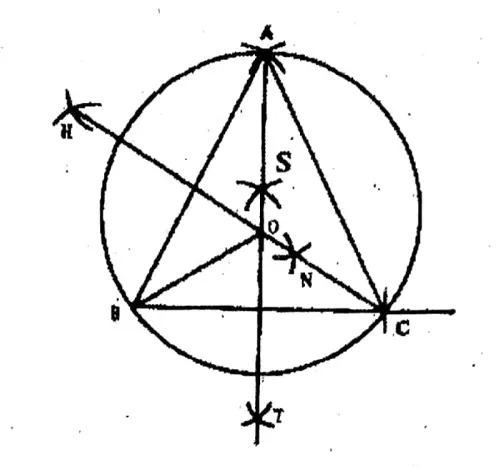
1. An equilateral triangle having each side of length 6 cm.

Solution: ABC is an equilateral triangle whose each side is 6 cm. Circumcentre O is inside the triangle.

Read and Learn More WBBSE Solutions For Class 10 Maths

WBBSE Solutions For Class 10 Maths Chapter 11 Construction Of Circumcircle And Incircle Of A Triangle 1

“WBBSE Class 10 Maths Construction of Circumcircle and Incircle of a Triangle Exercise 11.1 solutions”

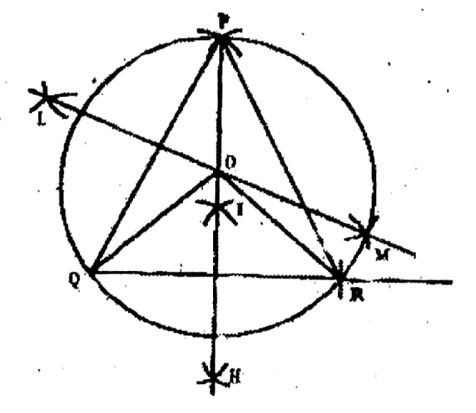
Question 2. An isosceles triangle whose length of the base is 5.2 cm and each of the equal sides is 7 cm.

Solution: O is the circumstances of the circumcircle of the PQR, whose length of circumradius is 4 cm. Centre O is inside the triangle.

WBBSE Solutions For Class 10 Maths Chapter 11 Construction Of Circumcircle And Incircle Of A Triangle 2

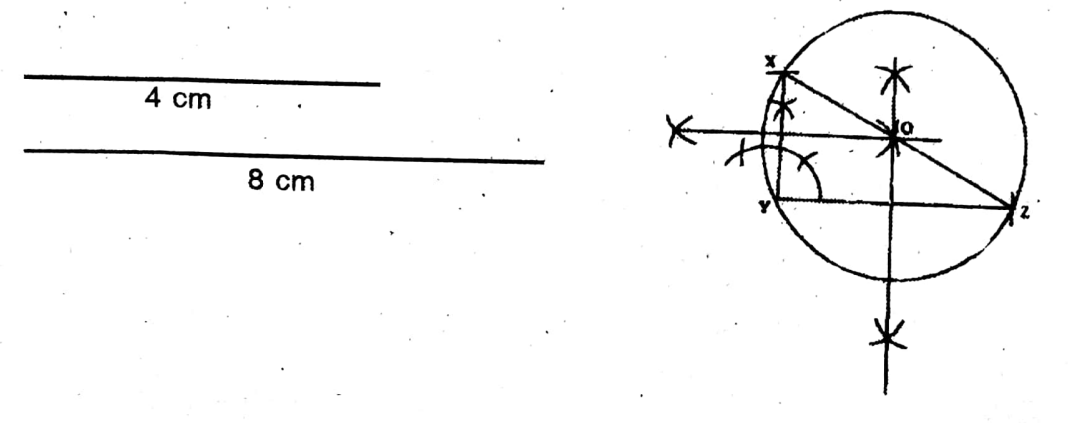
Question 3. A right-angled triangle has two sides 4 cm and 8 cm in length, containing the right angle.

Solution: We draw the circumcircle of the right-angled triangle XYZ, whose centre is at the midpoint of the hypotenuse length of the circumradius is 4.6 cm.

WBBSE Solutions For Class 10 Maths Chapter 11 Construction Of Circumcircle And Incircle Of A Triangle 3

WBBSE Solutions For Class 10 Maths Chapter 11 Construction Of Circumcircle And Incircle Of A Triangle Exercise 11.1

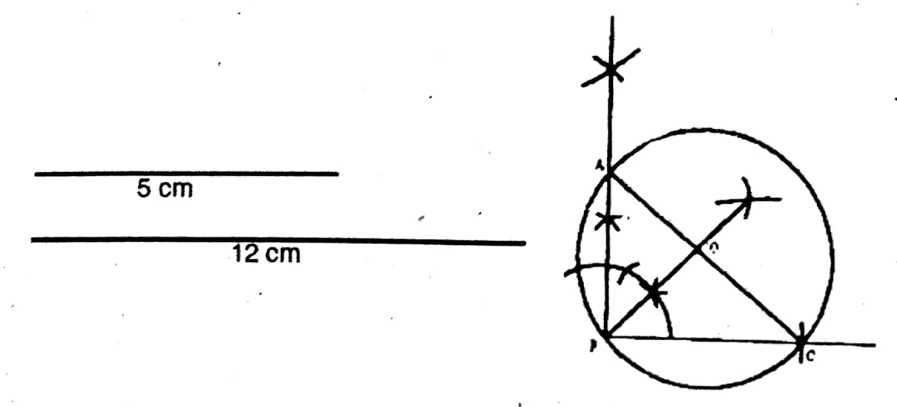
Question 4. A right-angled triangle has a length of hypotenuse 12 cm and another side of 5 cm in length.

Solution: ABC is a right-angled triangle whose length of the hypotenuse is 12 cm & length of the other side is 5 cm. Centre O is on the midpoint of the hypotenuse.

WBBSE Solutions For Class 10 Maths Chapter 11 Construction Of Circumcircle And Incircle Of A Triangle 4

Class 10 Maths Class 10 Social Science
Class 10 English Class 10 Maths
Class 10 Geography Class 10 Geography MCQs
Class 10 History Class 10 History MCQs
Class 10 Life Science Class 10 Science VSAQS
Class 10 Physical Science Class 10 Science SAQs

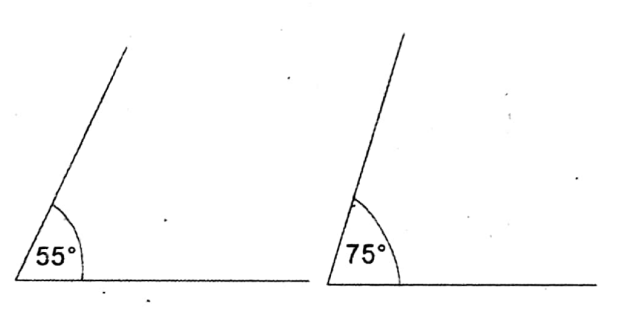
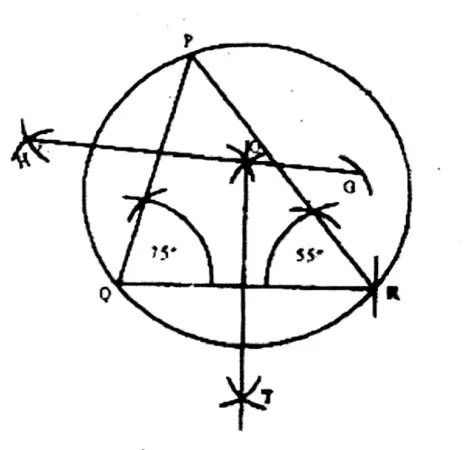
Question 5. A triangle whose length of one side is 6.7 cm and the two angles adjacent to this side are 75° and 55°.

Solution:

WBBSE Solutions For Class 10 Maths Chapter 11 Construction Of Circumcircle And Incircle Of A Triangle 5

WBBSE Solutions For Class 10 Maths Chapter 11 Construction Of Circumcircle And Incircle Of A Triangle 6

“West Bengal Board Class 10 Maths Chapter 11 Construction of Circumcircle and Incircle of a Triangle Exercise 11.1 solutions”

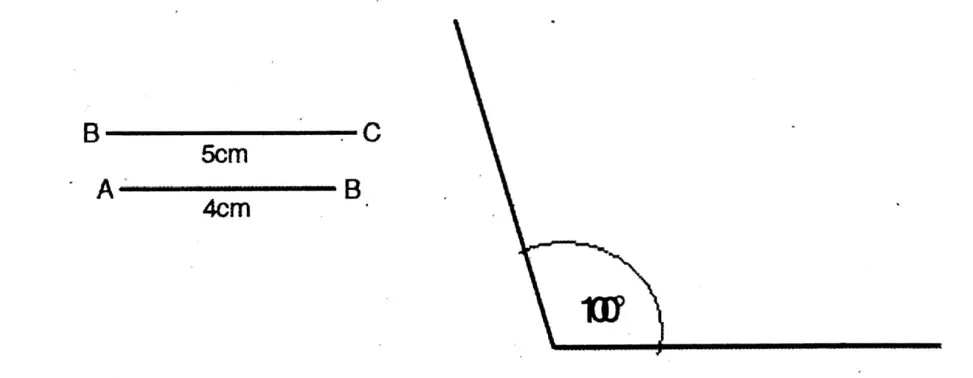
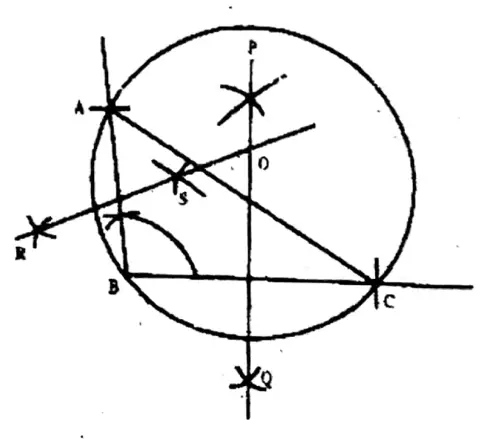
Question 6. ABC is a triangle whose BC = 5 cm, ∠ABC= 100°, and AB = 4 cm. 

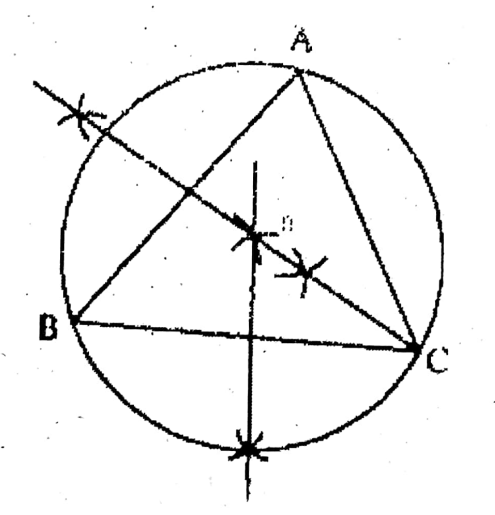
Solution: Draw the circumcircle of ABC, whose center is outside the triangle & the length of the circumradius is 3.7 cm.

WBBSE Solutions For Class 10 Maths Chapter 11 Construction Of Circumcircle And Incircle Of A Triangle 7

WBBSE Solutions For Class 10 Maths Chapter 11 Construction Of Circumcircle And Incircle Of A Triangle 8

“WBBSE Class 10 Construction of Circumcircle and Incircle of a Triangle Exercise 11.1 solutions explained”

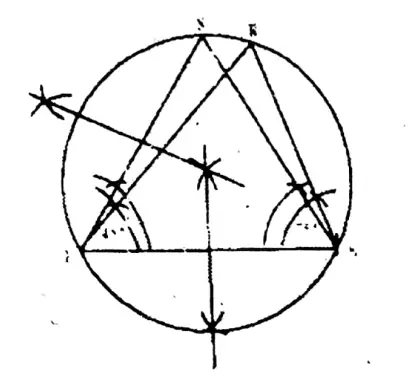
Question 7. Given PQ = 7.5 cm. QPR = 45°, PQR = 75°; PQ = 7.5 cm. ZQPS = 60°, PQS = 60°. Let us draw APQR and APQS in such a way that the points R and S lie on the same side of PQ, let us draw the circumcircle of APQR, and let us observe and write the position of the point S within, on, and outside the circumcircle. Let us find out its explanation.

Solution:

Given PQ = 7.5 cm. QPR = 45°, PQR = 75°; PQ = 7.5 cm. ZQPS = 60°, PQS = 60°. Let us draw APQR and APQS in such a way that the points R and S lie on the same side of PQ

We draw the circumcircle of the APQR. Point S is on that circumcircle.

WBBSE Solutions For Class 10 Maths Chapter 11 Construction Of Circumcircle And Incircle Of A Triangle 9

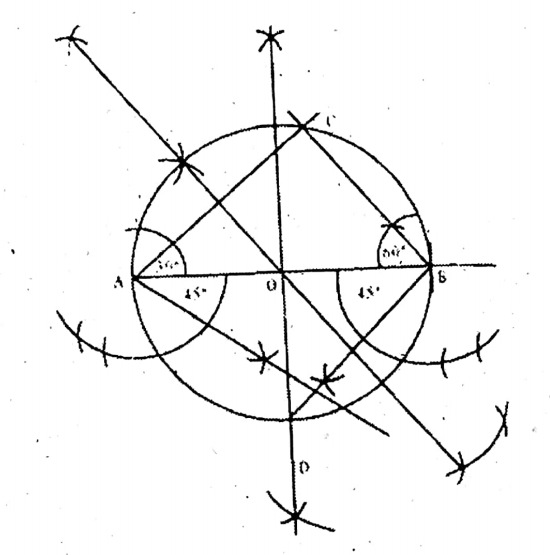
Question 8. Given AB = 5 cm, <BAC = 30°, ∠ABC = 60°; AB = 5 cm, ∠BAD = 45°, ∠ABD = 45°. Let us draw AABC and AABD in such a way that points C and D lie on opposite sides of AB. Let us draw the circle circumscribing AABC. Let us write the position of point D with respect to the circumcircle. Let us write by understanding what other characteristics we are observing here.

Solution:

Given AB = 5 cm, <BAC = 30°, ZABC = 60°; AB = 5 cm, BAD = 45°, ZABD = 45°. Let us draw AABC and AABD in such a way that points C and D lie on opposite sides of AB.

We draw the circumcircle of AABC. Point D is on the circumcircle. The centre is on the midpoint of AB.

WBBSE Solutions For Class 10 Maths Chapter 11 Construction Of Circumcircle And Incircle Of A Triangle 10

“Class 10 WBBSE Maths Exercise 11.1 Construction of Circumcircle and Incircle of a Triangle step-by-step solutions”

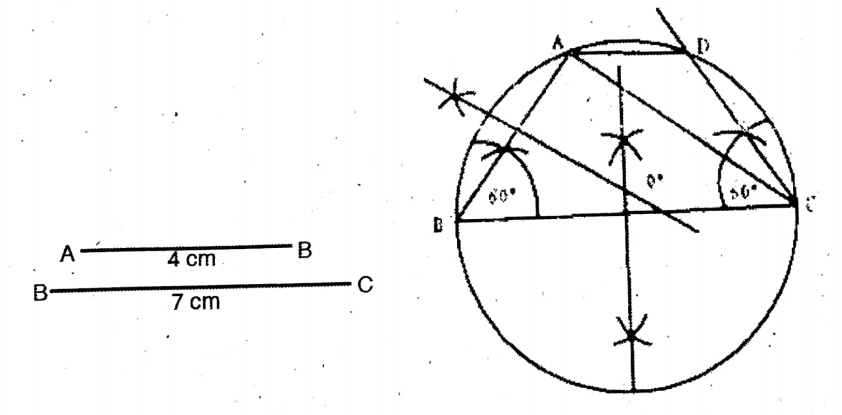
Question 9. We draw a quadrilateral ABCD having AB = 4 cm, BC = 7 cm CD = 4 cm, ZABC = 60°, BCD = 60°. Let us draw the circle circumscribing ABC and write what other characteristics we observe.

Solution: We draw the circumcircle of AABC whose center O is inside the AABC & inside the quadrilateral ABCD.

WBBSE Solutions For Class 10 Maths Chapter 11 Construction Of Circumcircle And Incircle Of A Triangle 11

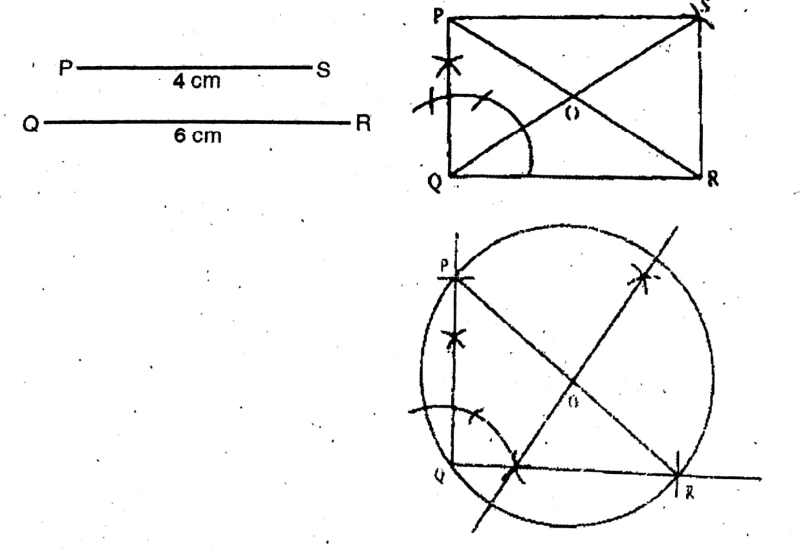
Question 10. Let us draw the rectangle PQRS having PQ = 4 cm, and QR = 6 cm. Let us draw the diagonals of the rectangle. Let us write by calculating the position of the center of the circumcircle of △PQR and the length of the circumradius without drawing. By drawing the circumcircle of △PQR, let us verify.

Solution: The diagonals PQ & RS of the rectangle PQRS are drawn. The centre of the △PQR is at the intersecting point of the diagonals. The length of the circumradius is 3.8 cm.

WBBSE Solutions For Class 10 Maths Chapter 11 Construction Of Circumcircle And Incircle Of A Triangle 12

“WBBSE Class 10 Maths Exercise 11.1 Construction of Circumcircle and Incircle of a Triangle problem solutions”

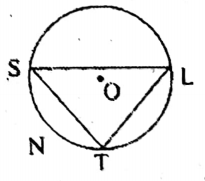
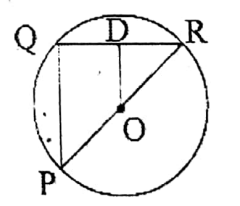
Question 11. If any circular picture is given, then how shall we find its center? Let us find the center of the circle in the adjoining.

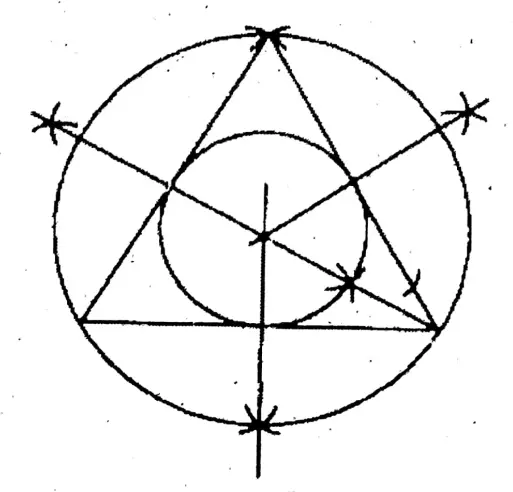
Solution: By drawing, the centre & incentre of an equilateral triangle are the same.

WBBSE Solutions For Class 10 Maths Chapter 11 Construction Of Circumcircle And Incircle Of A Triangle 13

WBBSE Solutions For Class 10 Maths Chapter 11 Construction Of Circumcircle And Incircle Of A Triangle 14

WBBSE Solutions For Class 10 Maths Chapter 10 Theorems Related To cyclic Quadrilateral Exercise 10.1

WBBSE Solutions For Class 10 Maths Chapter 10 Theorems Related To Cyclic Quadrilateral Exercise 10.1

Question 1. Look at the picture of two circles with centre O given below and let us write by calculating the value of x° in each case.

Solution:
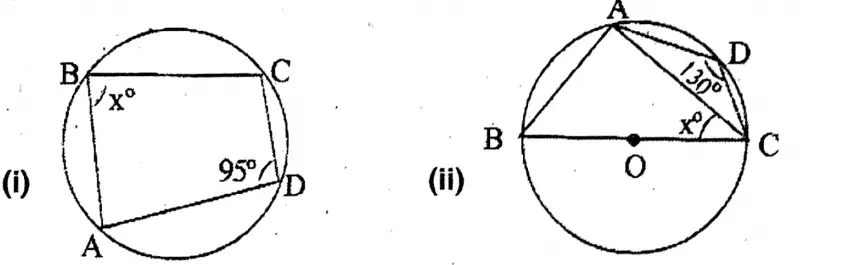
WBBSE Solutions For Class 10 Maths Chapter 10 Theorems Related To cyclic Quadrilateral 1

Read and Learn More WBBSE Solutions For Class 10 Maths

1. ABCD is a cyclic quadrilateral.

∴ ∠ABC + ∠ADC

180° – 130° = 50°

∴ x = 50.

2. ABCD is a cyclic quadrilateral.

∴ ∠ABC + ∠ADC = 180°

∴ ∠ABC = 50°

Again, ∠BAC = one right angle

∴ ∠BAC = 90°

∴ x° + ∠ABC + ∠BAC = 180°

∴ x° + 50° + 90° = 180°;

∴ x = 40°
WBBSE Solutions For Class 10 Maths Chapter 10 Theorems Related To cyclic Quadrilateral Exercise 10.1

Question 2. ABCD is a cyclic quadrilateral and O is the centre of that circle. If <COD 120° and <BAC 30°, let us write by calculating the value of <BOC and <BCD.

Solution: ∠BOC is angle at the centre and ∠BAC is angle at the circle standing on the Same minor arcBC.

∴ ∠BOC = 2∠BAC = 60°

∠COD is the angle at the centre and ∠CAD is the angle at the circle standing on the same minor arcCD.

∴ \(\angle \mathrm{CAD}=\frac{1}{2} \angle \mathrm{COD}=\frac{1}{2} \times 120^{\circ}=60^{\circ}\)

∴ ∠BAC = 30° + 60° = 90°

∴ In concyclic quadrilateral ABCD, ∠BCD + ∠BAD = 1

∴ ∠BCD = 90°

“WBBSE Class 10 Maths Theorems Related to Cyclic Quadrilateral Exercise 10.1 solutions”

Question 3. Sides AD and AB of a cyclic quadrilateral ABCD beside are produced to the points E and F respectively. If <CBF = 120°, let us write by calculating the value of CDE.

Solution:

Given

Sides AD and AB of a cyclic quadrilateral ABCD beside are produced to the points E and F respectively. If <CBF = 120°

In the figure, ∠BAD= ∠CBF=120º

∠CDE = 180º-120º

= 60º

The value of CDE = 60º

Question 4. ABCD is a cyclic quadrilateral. Sides AB and DC, when produced, meet at point Q. If ZADC = 85° and BPC = 40°, let us write by calculating the value of ZBAD and COD.

Solution:

Given

ABCD is a cyclic quadrilateral. Sides AB and DC, when produced, meet at point Q. If ZADC = 85° and BPC = 40°,

For cyclic quadrilateral ABCD, 

exterior ∠PBC = ∠ADC = 85° 

∴ In ΔBPC, ∠BCP = 180° – (85° + 40°) = 55°

Again, ∠BAD = exterior∠BCP = 55°

∴ In ΔCQD, ∠CQD + ∠DCQ = 85°

∴ ∠CQD = 85° – ∠DCQ 

= 85° – ∠BCP 

= 55°

∴ ∠BAD = 55° 

and ∠CQD = 30°

Again, ∠BAD = exterior ∠BCP = 55°

∴ In ΔCQD, ∠CQD + ∠DCQ = 85°

∴ ∠CQD = 85° – ZDCQ 

= 85° – ∠BCP 

= 55°

∴ ∠BAD = 55° 

and ∠CQD = 30°

“West Bengal Board Class 10 Maths Chapter 10 Theorems Related to Cyclic Quadrilateral Exercise 10.1 solutions”

Question 5. Let us prove that a cyclic parallelogram is a rectangular 

Solution :

Given: ABCD is a cyclic parallelogram.

To prove: Quadrilateral ABCD is a rectangular picture.

Proof: ABCD is a parallelogram.

∴∠ABC =∠ADC

Again, ABCD is a cyclic quadrilateral.

∴ ∠ABC + ∠ADC = 180°

So, 2∠ABC= 180°. 

∴ ∠ABC = 90°

One angle of the parallelogram is a right angle. So, ABCD is a rectangular picture.
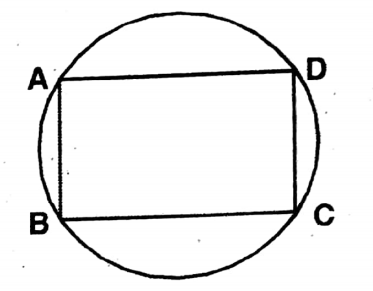
WBBSE Solutions For Class 10 Maths Chapter 10 Theorems Related To cyclic Quadrilateral 4

Question 6. In the picture beside two diagonals of quadrilateral PQRS in- intersect each other at point X in such a way that PRS = 65° and ZRQS = 45°. Let us write by calculating the value of SQP and ZRSP. 

Solution:

Given

In the picture beside two diagonals of quadrilateral PQRS in- intersect each other at point X in such a way that PRS = 65° and ZRQS = 45°.

SQP = PRS = 65° (on the same segment)

RPS = RQS = 40° (on the same segment)

∠RSP = 180° – (65° +45°)

= 180° – 110°

= 70°
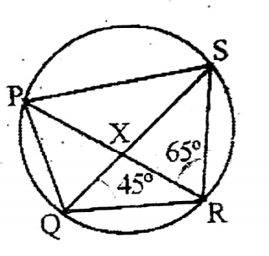
WBBSE Solutions For Class 10 Maths Chapter 10 Theorems Related To cyclic Quadrilateral 5

Class 10 Maths Class 10 Social Science
Class 10 English Class 10 Maths
Class 10 Geography Class 10 Geography MCQs
Class 10 History Class 10 History MCQs
Class 10 Life Science Class 10 Science VSAQS
Class 10 Physical Science Class 10 Science SAQs

Question 7. Side AB of a cyclic quadrilateral ABCD is produced to the point X and by measuring we see that XBC= 82° and ADB = 47°. Let us write by measuring the value of <BAC.

Solution:

Given

Side AB of a cyclic quadrilateral ABCD is produced to the point X and by measuring we see that XBC= 82° and ADB = 47°.

Find BAC.

As ABCD is a cyclic quadrilateral.

.. ∠ADC + ∠ABC = 2 rt. angles

Again, ∠ABC +∠XBC= 2 rt. angle 

.. ∠ADC + ∠ABC = ∠ABC + <XBC 

∠ADC = ∠XBC = 80° (given)

.. ∠BDC + ∠BDA = ∠ADC

∠BDC + 47° = 80° [∠BDA = 47° (given)]

.. ∠BDC = 82°-470°

= 35°

.. ∠BDC & ∠BAC are in the same segment.

.. <BAC = ∠BDC = 35°

.. <BAC 35°
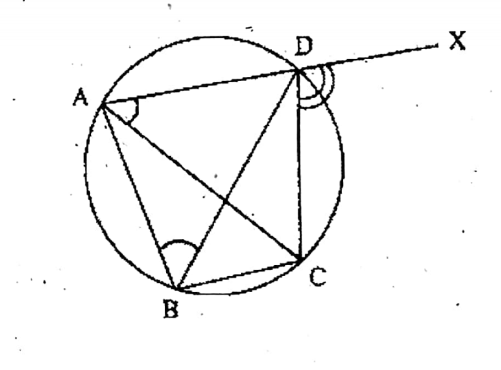
WBBSE Solutions For Class 10 Maths Chapter 10 Theorems Related To cyclic Quadrilateral 6

“WBBSE Class 10 Theorems Related to Cyclic Quadrilateral Exercise 10.1 solutions explained”

Question 8. Two sides PQ and SR of a cyclic quadrilateral PQRS are produced to meet at the point T. O is the centre of the circle. If POQ = 110°,QOR = 60°, andROS = 80°, let us write by measuring RQS and OTR.

Solution:

Given

Two sides PQ and SR of a cyclic quadrilateral PQRS are produced to meet at the point T. O is the centre of the circle. If POQ = 110°,QOR = 60°, and ∠ROS = 80°,

PQ & RS, the two sides of the cyclic quadrilateral, meet at T, when produced. 

O is the centre of the circle.

∠POQ=110°, 

∠QOR = 60°, 

& ∠ROS = 80°

To find ∠RQS &∠QTR.

On the same segment SR, ∠RQS is the angle on the circumference &

∠ROS =1/2 

∠ROS =1/2 x 80° = 40°

.. We know, ∠POQ + ∠QOR + ∠ROS + ∠SOP = 360°

..∠SOP= 360° – (∠POQ+ ∠QOR + ∠ROS)

= 360°-(110° +60° +80°) 

= 360° – 250° 

= 110°

or, ∠SOP = 110°, 

∠PQR = ∠PQS + ∠SQR 

= 55° + 40° = 95° 

.. ∠PQR + ∠RQT = 180°

∠RQT 180° – ∠PQR 180° – 95° = 85°

In ΔQOR, OQ = OR (same radiii)

∴ ∠OQR = OR

Again, ∠OQR + ∠ORQ+∠QOR = 180°

or, 2∠OQR +60° = 180°

∠OQR = 1/2 (180° 60°) 60° = ∠ORQ

Again, In ΔORS, OR = OS (same radii)

∴ ∠ORS = ∠OSR

∠ORS + ∠OSR +∠SOR= 180°

2∠ORS+80° = 180°

∠ORS = ∠OSR =1/2(180° 80°)= 50°

∠SRQ = ∠ORS + ∠ORQ = 50° + 60° = 110° 

∠QRT = 180°-∠SRQ 

= 180°-110°-70°

In ΔQTR, ∠QTR + ∠QRT+ ∠RQT = 180° 

∠QTR = 180° (∠QRT + ∠RQT)

= 180° (70° 85°) = 25°

∴ ∠RQS = 40° &∠QTR = 25°
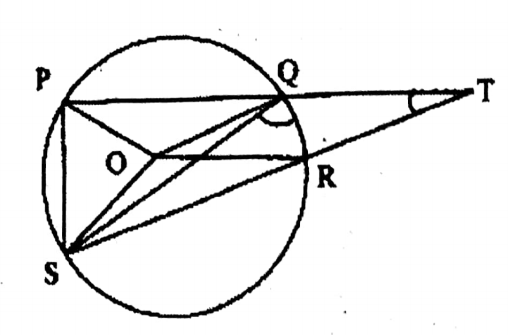
WBBSE Solutions For Class 10 Maths Chapter 10 Theorems Related To cyclic Quadrilateral 7

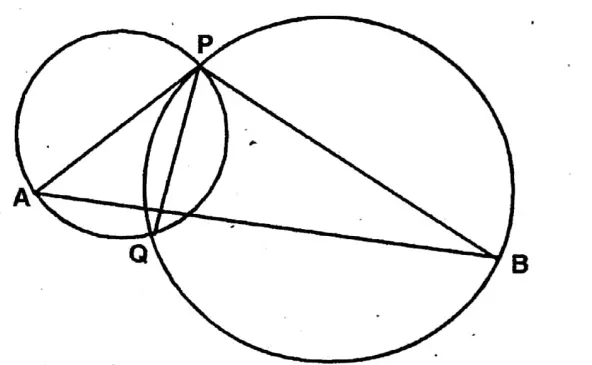
Question 9. Two circles intersect each other at points P and Q. Two straight lines through points P and Q intersect one circle at points A and C respectively and the other circle at points B and O respectively. Let us prove that AC || BD.

Solution:

Given

Two circles intersect each other at points P and Q. Two straight lines through points P and Q intersect one circle at points A and C respectively and the other circle at points B and O respectively.

To prove AC || BD.

Join A, C; B, D & P, Q.

Proof ACQP is a cyclic quadrilateral.

:. ∠PAC + ∠PQC = 2 rt. angles

Again, PQ meets CD at Q

∴∠PAC+ ∠PQD = 2 rt. angles

∴ ∠PAC + ∠PQC =∠PQC +∠PQD 

∠PAC = ∠PQD

As PQDB is a cyclic quadrilateral.

∴ ∠PBD + ∠PQD = 2 rt. angles

or, ∠PBD +∠PAC = 2 rt. angles (∠PQD = ∠PAC)

.. AB cuts AC & BD, and the sum of the internal angles of the same sides of the intercepts is equal to two right angles.

.. AC || BD
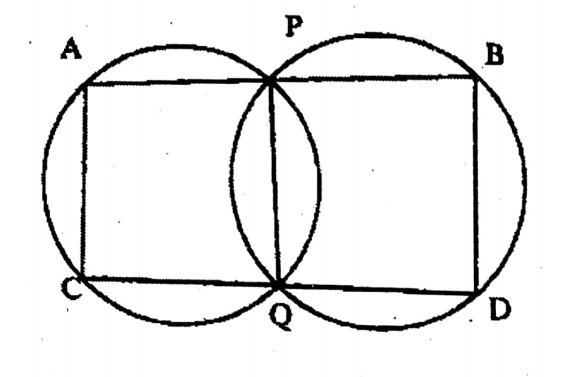
WBBSE Solutions For Class 10 Maths Chapter 10 Theorems Related To cyclic Quadrilateral 8

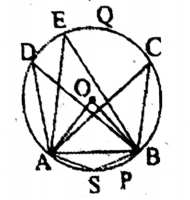
Question 10. I drew a cyclic quadrilateral AQCD and the side BC is produced to point E. Let us prove that the bisectors of BAD and DCE meet in the circle.

Solution: ABCD is a cyclic quadrilateral. 

Side BC is produced to E & the bisector of ∠BAD cuts the circle at F.

Join C, F.

To prove, CF straight line bisects DCE.

Proof: DCF & ∠DAF are in the same segment.

∴ ∠DCF = ZDAF

AF bisects ∠BAD.

∴ ∠DAF = 1/2  ZBAD

∴ ∠DCF =∠DAF = ∠BAD———(1)

ABCD is a cyclic quadrilateral. 

∴ ∠BAD + 2BCD = 2 rt. angles ——-(2)

BE meets DC at C.

∴ ∠DCE + ∠BCD = 2 rt. Angles ——(3)

From (2) & (3),

∠BAD + ∠BCD = ∠DCE + ∠BCD

or ∠BAD = ∠DCE ———-(4)

∴ ∠DCE= 2∠DCF

∴CF is the bisector of ∠DCE.
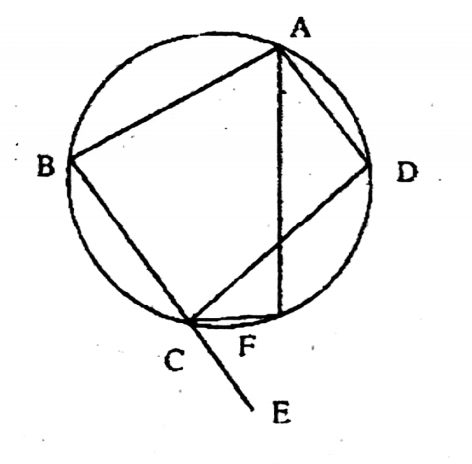
WBBSE Solutions For Class 10 Maths Chapter 10 Theorems Related To cyclic Quadrilateral 9

“WBBSE Class 10 Maths Exercise 10.1 Theorems Related to Cyclic Quadrilateral problem solutions”

Question 11. Mohit drew two straight lines through any point X exterior to a circle to intersect the circle at points A, B, and points C, D respectively. Let us prove logically that ΔXAC and ΔXBD are equiangular.

Solution:

Given

Mohit drew two straight lines through any point X exterior to a circle to intersect the circle at points A, B, and points C, D respectively.

From an external point X, two straight lines are drawn, which cut the circle at A, B, and C, D. 

To prove that two angles of each of the ΔXAC & ΔXBD are equal.

i.e., ΔXAC & ΔXBD are equiangular.

Join A, C & B, D.

ABCD is a cyclic quadrilateral

∴ ∠ABD + ∠ACD = 2 rt. angles——-(1)

AC meets DX at C

∴ ∠ACD + ∠ACX 2 rt. angles———–(2)

∠ABD+∠ACD = ∠ACD +∠ACX

∠ABD = ∠ACX = <XBC

Again, as ΔBCD is a cyclic quadrilateral,

∠BDC + <BAC = 2 rt. angles

& ∠BAC + ∠CAX = 2 rt. angles. 

∠BDC + ∠BAC = ∠BAC + ∠CAX . 

∠BDC=∠CAX or, ∠BDX = <CAX

Now, in Δ XAC & ΔXBD,

∠XCA = ∠XBD; 

∠XAC = <BDX 

& ∠AXC = ∠BXD (Same angle)

∴ΔXAC & ∴XBD are equiangular.
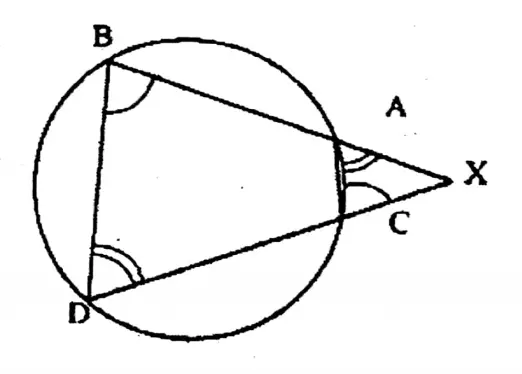
WBBSE Solutions For Class 10 Maths Chapter 10 Theorems Related To cyclic Quadrilateral 10

Question 12. I drew two circles that intersect each other at points G and H. Now I drew a straight line through point G which intersects two circles at points P and Q and the straight line through point H parallel to PQ intersects the two circles at points R and S. Let us prove that PQ = RS.

Solution: Two circles intersect each other at G & H. A straight line passing through G cuts the circles at P & Q. 

And a straight line passing through H cuts the circles at R & S. To prove PQ = RS.

Join P, R; G, H & Q, S.

PRHG is a cyclic quadrilateral.

∴ ∠RPG + ∠RHG = 2 rt. angles.

Again, GH meets RS at H.

∴ ∠RHG + ∠GHS = 2 rt. angles

∴ ∠RPG+∠RHG = ∠RHG + ∠GHS

∴ ∠RPG = ∠GHS——–(1) 

Again, as GHSQ is a cyclic quadrilateral. 

∴ ∠GQS+ ∠GHS = 2 rt. angles. 

and ∠GHS + ∠GHR = 2 rt. angles. 

∠GQS +∠GHS = ∠GHS + ∠GHR 

∠GQS = ∠GHR——(2)

Adding (1) & (2).

<RPG + ∠GQS = <GHS + ∠GHR

or, ∠RPG+∠GQS = 2 rt. angles

i.e., straight line PQ cuts PR & QS, & the sum of the internal angles on the same side of the intercept are equal to 2 rt. angles.

.. PR || QS & PQ || RS (given).

PQSR is a parallelogram.

.. PQRS Proved.
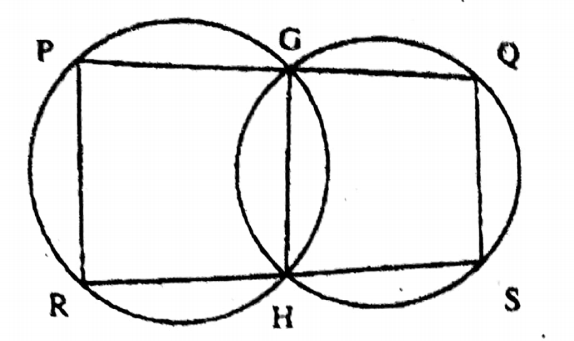
WBBSE Solutions For Class 10 Maths Chapter 10 Theorems Related To cyclic Quadrilateral 11


Question 13. I drew a triangle ABC of which AB = AC and E is any point on BC produced. If the circumcircle of ABC intersects AE at point D. Let us prove that ACD =AEC. 

Solution: In AABC, AB = AC, E is a point on produced BC.

AE cuts the circumcircle of AABC at D.

To prove, ∠ACD = ∠AEC

Join C,D.

Proof: ABCD is a cyclic quadrilateral.

∠ABC + ∠ADC = 2 rt. angles.

Again, straight-line CD meets AE at D. 

∴ ∠ADC + ∠CDE = 2 rt. angles. 

∴ ∠ABC + ∠ADC= ∠ADC + ∠CDE 

∴ ∠ABC = CDE

In ΔABC, AB = AC, 

∴ ∠ABC = ∠ACB 

∴∠ACB = ∠CDE

Again, side EC of CDE is produced.

External vDCB = ∠CDE+∠CED

or, ∠ACB+∠ACD = ∠CDE + ∠AEC

or, ∠CDE+∠ACD = ∠CDE + ∠AEC [ ∠ACD = ∠CDE]

∴∠ACD = ∠AEC. Proved.
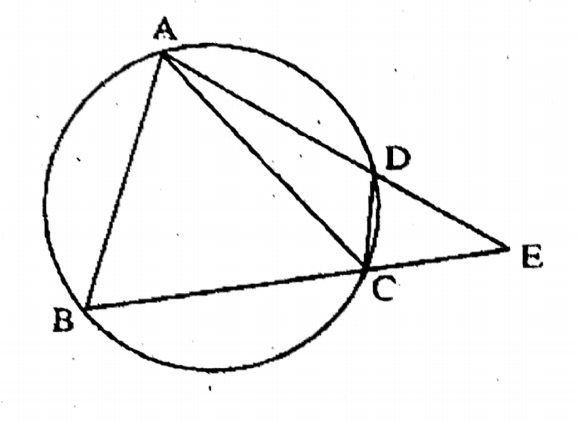
WBBSE Solutions For Class 10 Maths Chapter 10 Theorems Related To cyclic Quadrilateral 12

“Class 10 WBBSE Maths Exercise 10.1 Theorems Related to Cyclic Quadrilateral step-by-step solutions”

Question 14. ABCD is a cyclic quadrilateral. Chord DE is the external bisector of BDC. Let us prove that AE (or produced AE) is the external bisector of <BAC. 

Solution: ABCD is a cyclic quadrilateral, and chord DE is the extra 

To prove, AE (or produced AE) is the external bisector of <BAC. 

Proof: DE is the external bisector of ∠BDC.

∴ ∠AED = ∠ACD = ∠ABC (angles on the same segment) 

Again, <BAC = ∠BDC (angles on the same segment) [as DE is A ∠BDC]

.. AE is the external bisector of BAC.
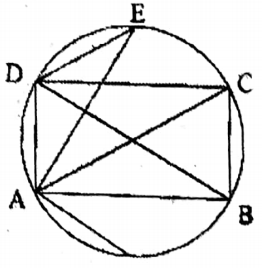
WBBSE Solutions For Class 10 Maths Chapter 10 Theorems Related To cyclic Quadrilateral 13

Question 15. BE and CF are perpendicular on sides AC and AB of t Let us prove that four points B, C, E, and F are on the same circle 

Solution: InΔABC, BE & CF are two perpendiculars on the side To prove points B, C, E, and F are on the same circle.

That prove also AAEF & AABC are equiangular.

Join E, F.

Proof: AS 1 BE 1 AC & CF 1 AB

∴ ∠BEC = 1 rt angle & ZBFC = 1 rt. angle

∴ BEC = ∠BFC = 1 rt. angle

∴Points B, C, E, and F are on the same circle.

Now, inΔAEF &ΔABC,

∠FAE=∠BAC (Same angle)
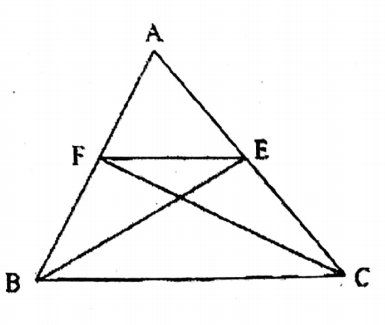
WBBSE Solutions For Class 10 Maths Chapter 10 Theorems Related To cyclic Quadrilateral 14

Question 16. ABCD is parallelogram. A circle passing through points A and B intersects the sides AD and BC at points E and F respectively. Let us prove that the four points E, F, C, and D are concyclic.

Solution: ABCD is a parallelogram. 

A circle passing through points A & B intersects the sides AB & BC at E & F respectively. 

To prove that the points E, F, C, and D are concyclic. 

Join E, F.

Proof: ABCD is a parallelogram.

∴ ∠BAD + ∠ADC = 2 rt. angles.

Again, ABEF is a cyclic quadrilateral.

∠BAE+∠BFE = 2 rt. angles

∴ ∠EFC =∠BAE

∠EFC = <BAD

But∠BFE+∠CFE = 2 rt. angles.

∴∠EFC + ∠ADC = 2 rt. angles.

∠EFC + ∠EDC = 2 rt. angles. 

∴∠EFCD is a cyclic quadrilateral. 

.. Points E, F, C,D are concyclic
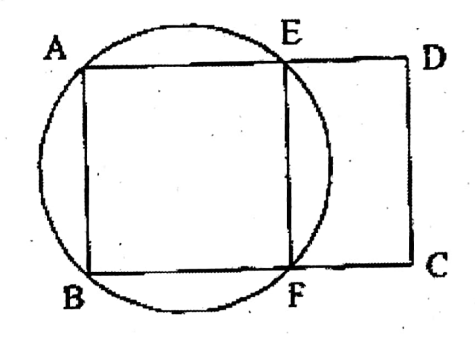
WBBSE Solutions For Class 10 Maths Chapter 10 Theorems Related To cyclic Quadrilateral 15

Question 17. ABCD is a cyclic quadrilateral. The two sides AB and DC are produced to meet at point P and the two sides AD and BC are produced to meet at point R. The two circumcircles of ABCP and ACDR intersect at point T. Let us prove that the points P, T, and R are collinear.

Solution: To prove that points P, T, and R is collinear.

Joint P, T;

T, R & C, T.

In BCP & ADP,

∠BPC = ∠APD; ∠PBC =∠ADP

& ∠BCP = ∠PAD

∴ΔBCP & ΔAPD are equiangular.

i.e., they are similar.

Now, in ΔPCT & ΔRCT,

∠PCT = ∠CRT,

CT common & ∠RCT = ∠TPC

∴ΔPCT ≅ ΔRCT

∴<PTC =∠RTC (corresponding angle)

As CT is the common side of∠PTC & ∠RTC

∴TR & TP are on the same straight line.

∴ P, T, and R are collinear.
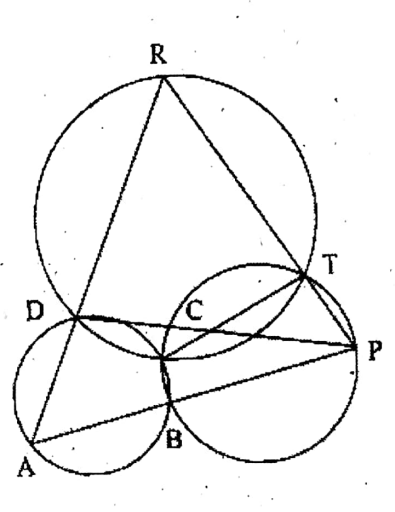
WBBSE Solutions For Class 10 Maths Chapter 10 Theorems Related To cyclic Quadrilateral 16

Question 18. If point O is the ortho of triangle ABG, let us prove that it is the incentre of ΔDEF.

Solution: To prove O is the incentre of the ΔDEF.

In ΔBDO & ΔAEO.

∠BOD = ∠AOE, ∠BDO = ∠AEO = 90°

& Rest ∠BDO = Rest ∠EAO

ΔBDO ≅ ΔΑΕΟ,

∴ OD = OE

Similarly, ΔBOD ≅ ΔAFO

∴ OD = OF 

∴ OD =OE = OF

∴ O is the incentre of the ΔDEF.
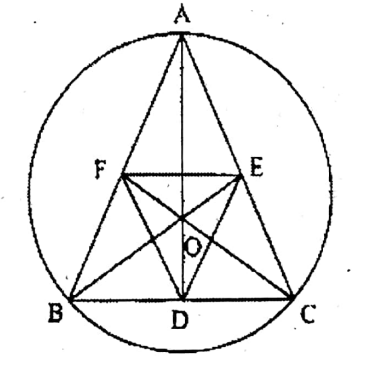
WBBSE Solutions For Class 10 Maths Chapter 10 Theorems Related To cyclic Quadrilateral 17

Question 19. I drew a cyclic quadrilateral ABCD such that AC bisected <BAD. Now produced AD to a point E is such a way that DE AB. Let us prove that CE = CA.

Solution: To prove CE = CA

Join B, D.

Proof: Diagonal AC bisects ZBAD.

∴<BAC = ∠DAC

Again, ∠DBC= <DAC

As these angles are on the same segment DC, 

Again, ∠BDC= <BAC

As on the same segment BC,

∴ ∠DBC= <BDC

∴ BC= DC.

Again, ∠ACD = ∠ABD

As on the same segment AD, 

∴ ∠ABC = ∠ABD + ∠DBC

∠CDE = <DAC + ∠ACD

∴ ∠ABC = ∠CDE

Now, in ΔABC & ΔCED,

AB = DE (given), 

BC = DC & ∠ABC = ∠CDE

∴ ABC == ΔCED (SAS)

∴ AC = CE
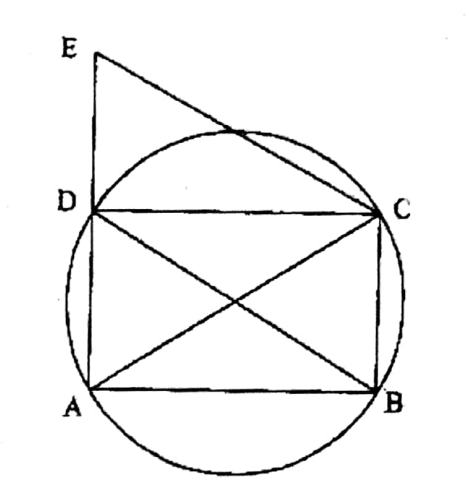
WBBSE Solutions For Class 10 Maths Chapter 10 Theorems Related To cyclic Quadrilateral 18

“WBBSE Class 10 Chapter 10 Theorems Related to Cyclic Quadrilateral Exercise 10.1 solution guide”

Question 20. In two circles, one circle passes through the centre Q of the other circle and the two circles meet each other at point A intersecting the circle which passes through point O at the point P and the circle with centre O at point R. Joining P, B, and R, B. Let us prove that PR = PQ.

Solution: Let the straight line PB cut the circle with centre O at point C.

Join A, C.

In ΔPRB & ΔACP

∠BPR = ∠APC (same angle)

∠PBR = ∠CAP [. ARBC is a cyclic quadrilateral]

∴ ∠PBR + ∠RAC = 2 rt. angles

= ∠RAC + ∠CAP

∴ ΔPRB + ΔACP are obtuse-angled triangles, i.e., sim

∴∠PRB = ∠PBR

∴ PB = PR Proved.
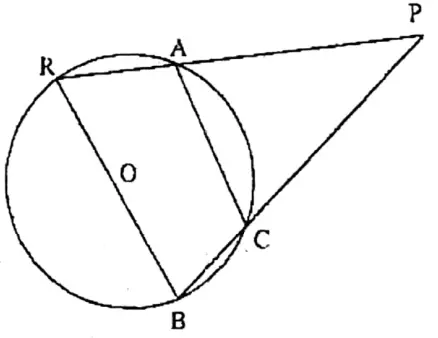
WBBSE Solutions For Class 10 Maths Chapter 10 Theorems Related To cyclic Quadrilateral 19

Question 21. Let us prove that any four vertices of a regular pentagon are concyclic.

Solution: Let ABCDE is a pentagon.

To prove A, B, C, and E are concyclic.

Join C, E parallel to AB.

As AB || CE

∴ ∠ABC +∠EAB = 2 rt. angles

Again,∠ABC + ∠BCE 2 rt. angles

As the sum of opposite angles of the quadrilateral ABCE is a supplement

∴ Points A, B, C, and E are concyclic.
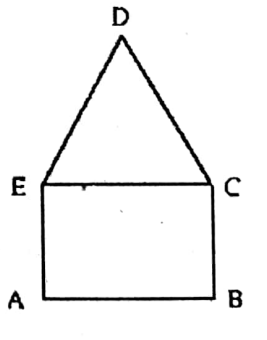
WBBSE Solutions For Class 10 Maths Chapter 10 Theorems Related To cyclic Quadrilateral 20

Multiple Choice Questions Chapter 10 Theorems Related To cyclic Quadrilateral Exercise 10.1

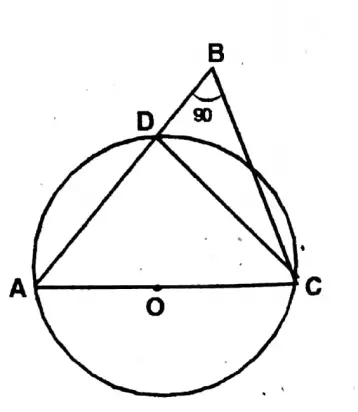
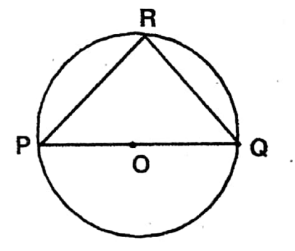
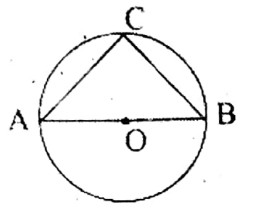
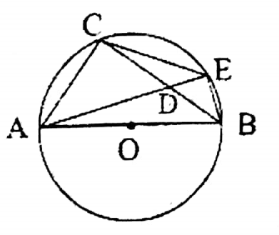
Question 1. In beside O is the centre of the circle and AB is the diameter. ABCD is a cyclic quadrilateral. <BAC is

1. 50°
2. 60°
3. 30°
4. 40°

Solution: ABC 180° = 120° = 60°

∴∠ACB = 90° (semicircle angle)

<BAC = 180° – (90° +60°) 

= 180° – 150° 

= 30°

Answer. 3. 30°
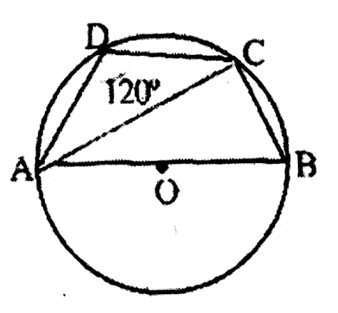
WBBSE Solutions For Class 10 Maths Chapter 10 Theorems Related To cyclic Quadrilateral 21

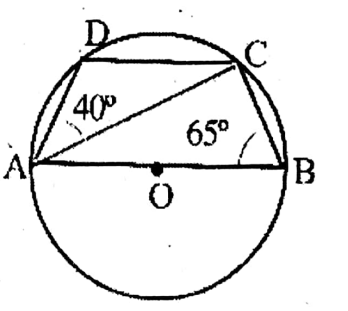
Question 2. In beside O is the centre of the circle and AB is the diameter. ABCD is a cyclic quadrilateral. The value of ∠BCD is

1. 75°
2. 105°
3. 115°
4. 80°

Solution: ∠ACB 90° (semicircle angle)

∠ADC = 180° – 65° 

= 115°

∠ACD = 180° – (115° 40°) 

=180° – 155° 

= 25°

∠BCD = (90° +25°) 

= 115°

Answer. 3. 115°
WBBSE Solutions For Class 10 Maths Chapter 10 Theorems Related To cyclic Quadrilateral 22

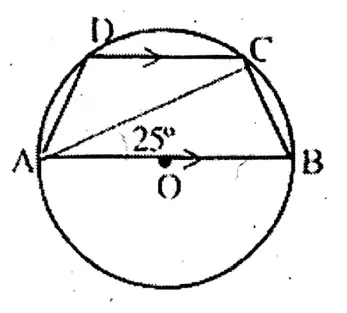
Question 3. In beside O is the centre of the circle and AB is the diameter. ABCD is a cyclic quadrilateral in which AB || DC and if BAC = 25° then the value of <DAC is

1. 50°
 2. 25°
3. 130°
4. 40°

Solution: ∠ACB = 90° (semicircle angle)

∴∠ABC = 180° – (90° +25°)

= 180° – 115° 

= 65°

∠DCA alternate ∠CAB = 25°

∠ADC = 180° – 65° 

= 115°

∠DAC = 180° – (115° +25°) 

= 180° – 140° 

= 40°

Answer. 4. 40°
WBBSE Solutions For Class 10 Maths Chapter 10 Theorems Related To cyclic Quadrilateral 23

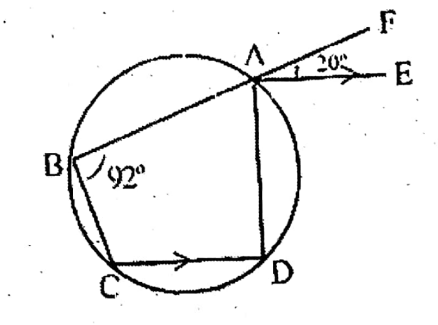
Question 4. Besides ABCD is a cyclic quadrilateral. BA is produced to the point F. If AE || CD, ABC= 92° and  FAE = 20°, then the value of BCD is

1. 20°
2. 88°
3. 108°
4. 72°

Solution:ADC = 180° – 92° 

= 88°

∠DAF = ADC = 88° [AE || CD]

∠DAE = 88° + 20° 

= 108°

∠BAD = 180° – 108° 

= 72°

∠BCD = 180° – 72° 

= 108°

Answer. 3.108°
WBBSE Solutions For Class 10 Maths Chapter 10 Theorems Related To cyclic Quadrilateral 24

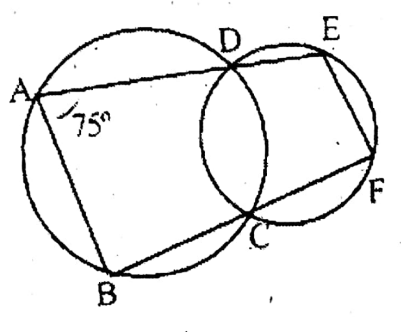
Question 5. Besides two circles intersect each other at points C and D. Two straight lines through points D and C intersect one circle at points E and F respectively. If DAB = 75°, then the value of DEF is

1. 75°
2. 70°
3. 60°
4. 105°

Solution: Join D, C.

ZDCF = ZBAD = 75°

ZDEF = 180°- 75° 

= 105°

Answer. 4. 105°
WBBSE Solutions For Class 10 Maths Chapter 10 Theorems Related To cyclic Quadrilateral 25

Chapter 10 Theorems Related To cyclic Quadrilateral Exercise 10.1 True Or False

1. The opposite angles of a cyclic quadrilateral are complementary.

False

2. If any side of a cyclic quadrilateral is produced, the exterior angle so formed is equal to the interior opposite angle. 

True

Chapter 10 Theorems Related To cyclic Quadrilateral Exercise 10.1  Fill In The Blanks

1. If the opposite angles of a quadrilateral are supplementary then the vertices of the quadrilateral will be Concyclic. 

2. A cyclic parallelogram is a Rectangle.

3. The vertices of a cyclic square are Concyclic.

Chapter 10 Theorems Related To cyclic Quadrilateral Exercise 10.1 Short Answer

Question 1. In the beside two circles with centres P are Q intersect each other at points B and C. ACD is a line segment. If ARB = 150°, ZBQD = x°, then let us find the value of x.

Solution:

In the beside two circles with centres P are Q intersect each other at points B and C. ACD is a line segment. If ARB = 150°, ZBQD = x°

BCD 150°

.. Reflex ∠BQD = 2 x 150° 

= 300°

.. x° = zBQD 

= 360° – 300° 

= 60°

.. x = 60°
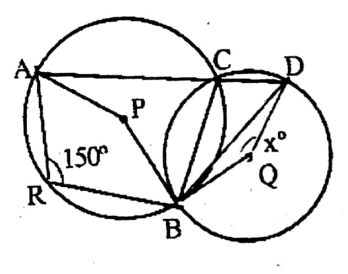
WBBSE Solutions For Class 10 Maths Chapter 10 Theorems Related To cyclic Quadrilateral 26

“West Bengal Board Class 10 Maths Exercise 10.1 Theorems Related to Cyclic Quadrilateral solutions”

Question 2. In the beside two circles intersect at the points P and Q. IfQAD = 80° and PDA = 84°, then let us find the value of QBC and BCP.

Solution.

In the beside two circles intersect at the points P and Q. IfQAD = 80° and PDA = 84°,

QPC = <DAQ = 80°

∠QBC 180° – 80° = 100°

∠PQB = ∠ADP = 84°

∠BCP = ∠AQD  = 180° – (100° + 60°) 

= 20°
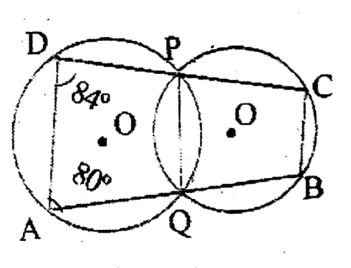
WBBSE Solutions For Class 10 Maths Chapter 10 Theorems Related To cyclic Quadrilateral 27

“WBBSE Class 10 Chapter 10 Theorems Related to Cyclic Quadrilateral Exercise 10.1 problem-solving steps”

Question 3. If BAD = 60°, ABC = 80°, then let us find the value of DPC and BQC.

Solution. ∠ADQ = ∠ADC= 180° 80° = 100°

∠DPC = ∠APB 

= 180° – (80° +60°) 

= 40°

∠BQC = ∠AQD 

=180° – (100° + 60°) 

= 20°
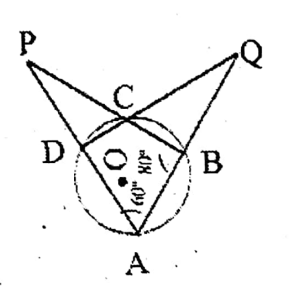
WBBSE Solutions For Class 10 Maths Chapter 10 Theorems Related To cyclic Quadrilateral 28

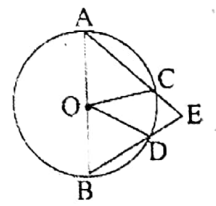
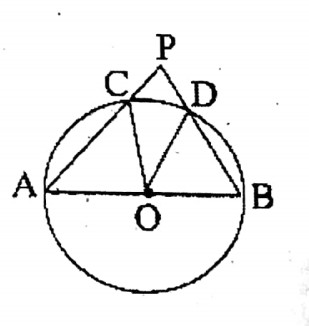
Question 4. In beside O is the centre of the circle and AC is its diameter. IfAOD = 140° and CAB = 50°, let us find the value of BED.

Solution. ∠BOC =180° – 80° =100°

<BEC = 1/2 <BOC = 1/2 x 100° = 50°

.. OB = OC 

∠OCB =∠OBC = 180°-100°/2

= 80°/2

= 40°

∠BCF =(40° + 10°) = 50°

.. BED (50° + 50°) = 100°
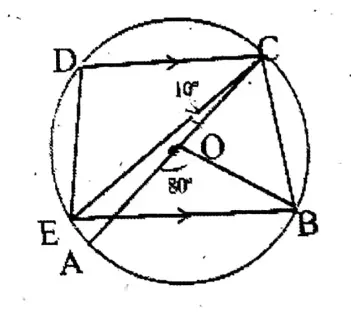
WBBSE Solutions For Class 10 Maths Chapter 10 Theorems Related To cyclic Quadrilateral 29

“Class 10 WBBSE Maths Exercise 10.1 solutions for Theorems Related to Cyclic Quadrilateral”

Question 5. Beside O is the centre of the circle and AB is its diameter. IfAOD = 140° and CAD = 50°, let us find the value of BED.

Solution. ∠BOD = 180°-140° 

= 40°

.. OB = OD

∠OBD = ∠ODB = 140°/2

= 70°

∠DBE = 180°-70° 

= 110°

∠ACF = 180°-70° 

= 110°

∠BED = ∠AEC = 180° – (110° +50°) 

= 180° – 60° 

=20°
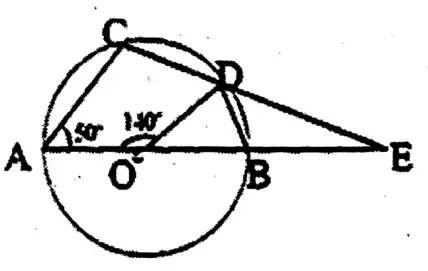
WBBSE Solutions For Class 10 Maths Chapter 10 Theorems Related To cyclic Quadrilateral 30

WBBSE Solutions For Class 10 Maths Chapter 9 Quadratic surd Exercise 9.3

Chapter 9 Quadratic surd Exercise 9.3

Question 1. If m + 1/m = √3, let us calculate the simplified value of (i) m2 + 1/m2 and  (ii) m3 + 1/m3.

Solution (1):  m2 + 1/m2 = (m + 1/m)2 – 2.m.1/m

=(√3)2-2

=3-2 

= 1 

Read and Learn More WBBSE Solutions For Class 10 Maths

Solution (2): m3 + 1/m3 = (m+1/m)3 -3.m.1/m(m+1/m)

 =(√3)2-3√3

= 3√3-3√3 

=0 Ans.

“WBBSE Class 10 Maths Quadratic Surd Exercise 9.3 solutions”

2. Let us show that√5+√3 / √5-√3 – √5 – √3 / √5+ √3 = 2√15.

Solution: √5+√3 / √5-√3 – √5 – √3 / √5+ √3 = 2√15

L.H.S.= √5+√3 / √5-√3 – √5-√3 / √5+√3.

= (√5+√3)²-(√5-√3)² / (√5-√3) (√5+√3)

= (5+3+2√15)-(5+3-2√15) / (√5)²-(√3)²

= 8+2√15-8+2√15 /5-3

=4√15 / 2

= 2√15 R.H.S.

Question 2.

1. √2 (2+ √3) / √3(√3+1)  – √2 (2-√3) /√3(√3-1)

Solution : √2 (2+ √3) / √3(√3+1)  – √2 (2-√3) /√3(√3-1)

= √2 / √3 [2+√3 / √3+1 – 2-√3 / √3-1]

= √2 (2√3 −2+3−√3)-(2√3+2−3−√3) / (√3)2-(1)2

= √2 / √3[2√3-2+3-√3-2√3-2+3+√3 / 3-1]

= √2 / √3 x 6-4/2

= √2 / √3 x 2/2

= √2 x √3 / √3.√3

=√6/3

√2 (2+ √3) / √3(√3+1)  – √2 (2-√3) /√3(√3-1) =√6/3

WBBSE Solutions For Class 10 Maths Chapter 9 Quadratic surd Exercise 9.3

2. 3√7 / √5+ √2 – 5√5 / √2 + √7 + 2√2 / √7 + √5

Solution: 3√7 / √5+ √2 – 5√5 / √2 + √7 + 2√2 / √7 + √5

= 3√/7(√5 – √2) / (√5+√2)(√5+√2) –  5√5(√7-√2) / (√7+√2)(√7-√2) + 2√5/(√7+√5)(√7-√5)

= (√5+√2) √5-√2) (√7 + √2) √7 – √2) + (√7+ √5 √7-√5)

= 3√7(√5-√2)/(5)2-(√2)2 – 5√5(√7-√2) / (√7)2-(√2)2 + 2√2 / (√7)2-(√5)2

= 3√7(√5-√2) /5-2 – 5√5(√7-√2)/7-2 + 2√2(√7-√5)/7-5

= 3√2(√5-√2)/3 – 5√5(√7-√2)/5 + 2√2(√7-√5)/2

=√35-√14-√35+√10+√14-√10

= 0

3√7 / √5+ √2 – 5√5 / √2 + √7 + 2√2 / √7 + √5 = 0

“West Bengal Board Class 10 Maths Chapter 9 Quadratic Surd Exercise 9.3 solutions”

3. \(\frac{4 \sqrt{3}}{2-\sqrt{2}}-\frac{30}{4 \sqrt{3}-\sqrt{18}}-\frac{\sqrt{18}}{3-\sqrt{12}}\)

Solution:

\(\frac{4 \sqrt{3}}{2-\sqrt{2}}-\frac{30}{4 \sqrt{3}-\sqrt{18}}-\frac{\sqrt{18}}{3-\sqrt{12}}\)

= \(\frac{4 \sqrt{3}(2+\sqrt{2})}{(2-\sqrt{2})(2+\sqrt{2})}-\frac{30(4 \sqrt{3}+\sqrt{18})}{(4 \sqrt{3}-\sqrt{18})(4 \sqrt{3}+\sqrt{18})}-\frac{\sqrt{18}(3+\sqrt{12})}{(3-\sqrt{12})(3+\sqrt{12})}\)

= \(\frac{4 \sqrt{3}(2+\sqrt{2})}{(2)^2(\sqrt{2})^2}-\frac{30(4 \sqrt{3}+\sqrt{2})}{(4 \sqrt{3})^2-(\sqrt{18})^2}-\frac{3 \sqrt{2}(3+2 \sqrt{3})}{(3)^2-(\sqrt{12})^2}\)

= \(\frac{4 \sqrt{3}(2+\sqrt{2})}{4-2}-\frac{30(4 \sqrt{3}+\sqrt{2})}{16 \times 3-18}-\frac{3 \sqrt{2}(3+2 \sqrt{3})}{9-12}\)

= \(\frac{4 \sqrt{3}(2+\sqrt{2})}{2}-\frac{30(4 \sqrt{3}+3 \sqrt{2})}{30}-\frac{3(3+2 \sqrt{3})}{-3}\)

= \(4 \sqrt{3}+2 \sqrt{6}-4 \sqrt{3}-3 \sqrt{2}+2 \sqrt{6}\)

= 4√6

Class 10 Maths Class 10 Social Science
Class 10 English Class 10 Maths
Class 10 Geography Class 10 Geography MCQs
Class 10 History Class 10 History MCQs
Class 10 Life Science Class 10 Science VSAQS
Class 10 Physical Science Class 10 Science SAQs

4. \(\frac{3 \sqrt{2}}{\sqrt{3}+\sqrt{6}}-\frac{4 \sqrt{3}}{\sqrt{6}+\sqrt{2}}+\frac{\sqrt{6}}{\sqrt{2}+\sqrt{3}}\)

Solution:

\(\frac{3 \sqrt{2}}{\sqrt{3}+\sqrt{6}}-\frac{4 \sqrt{3}}{\sqrt{6}+\sqrt{2}}+\frac{\sqrt{6}}{\sqrt{2}+\sqrt{3}}\)

= \(\frac{3 \sqrt{2}(\sqrt{6}-\sqrt{3})}{(\sqrt{6}+\sqrt{3})(\sqrt{6}-\sqrt{3})}-\frac{4 \sqrt{2}(\sqrt{6}-\sqrt{2})}{(\sqrt{6}+\sqrt{2})(\sqrt{6}-\sqrt{2})}+\frac{\sqrt{6}(\sqrt{3}-\sqrt{2})}{(\sqrt{3}+\sqrt{2})(\sqrt{3}-\sqrt{2})}\)

= \(\frac{3 \sqrt{2}(\sqrt{6}-\sqrt{3})}{6-3}-\frac{4 \sqrt{3}(\sqrt{6}-\sqrt{2})}{6-2}+\frac{\sqrt{6}(\sqrt{3}-\sqrt{2})}{3-2}\)

= \(\frac{3 \sqrt{2}(\sqrt{6}-\sqrt{3})}{3}-\frac{4 \sqrt{3}(\sqrt{6}-\sqrt{2})}{4}+\frac{\sqrt{6}(\sqrt{3}-\sqrt{2})}{1}\)

= \(\sqrt{12}-\sqrt{6}-\sqrt{18}+\sqrt{6}+\sqrt{18}-\sqrt{12}\)

= 0

“WBBSE Class 10 Quadratic Surd Exercise 9.3 solutions explained”

Question 3. If x = 2, y = 3 and z = 6 let us write by calculating the value of \(\frac{3 \sqrt{x}}{\sqrt{y}+\sqrt{z}}-\frac{4 \sqrt{y}}{\sqrt{z}+\sqrt{x}}+\frac{\sqrt{z}}{\sqrt{x}+\sqrt{y}}\)

Solution: \(\frac{3 \sqrt{x}}{\sqrt{y}+\sqrt{z}}-\frac{4 \sqrt{y}}{\sqrt{z}+\sqrt{x}}+\frac{\sqrt{z}}{\sqrt{x}+\sqrt{y}}\)

= \(\frac{3 \sqrt{2}}{\sqrt{3}+\sqrt{6}}-\frac{4 \sqrt{3}}{\sqrt{6}+\sqrt{2}}+\frac{\sqrt{6}}{\sqrt{2}+\sqrt{3}}\)

= \(\frac{3 \sqrt{2}}{\sqrt{6}+\sqrt{3}}-\frac{4 \sqrt{3}}{\sqrt{6}+\sqrt{2}}+\frac{\sqrt{6}}{\sqrt{3}+\sqrt{2}}\)

= \(\frac{3 \sqrt{2}(\sqrt{6}-\sqrt{3})}{(\sqrt{6}+\sqrt{3})(\sqrt{6}+\sqrt{3})}-\frac{4 \sqrt{3}(\sqrt{6}-\sqrt{2})}{(\sqrt{6}+\sqrt{2})(\sqrt{6}-\sqrt{2})}+\frac{\sqrt{6}(\sqrt{3}-\sqrt{2})}{(\sqrt{3}+\sqrt{2})(\sqrt{3}-\sqrt{2})}\)

= \(\frac{3 \sqrt{2}(\sqrt{6}-\sqrt{3})}{6-3}-\frac{4 \sqrt{3}(\sqrt{6}-\sqrt{2})}{6-2}+\frac{\sqrt{6}(\sqrt{3}-\sqrt{2})}{3-2}\)

= \(\frac{3 \sqrt{2}(\sqrt{6}-\sqrt{3})}{3}-\frac{4 \sqrt{3}(\sqrt{6}-\sqrt{2})}{4}+\frac{\sqrt{6}(\sqrt{3}-\sqrt{2})}{1}\)

= \(\sqrt{12}-\sqrt{6}-\sqrt{18}+\sqrt{6}+\sqrt{18}-\sqrt{12}\)

= 0

“WBBSE Class 10 Maths Exercise 9.3 Quadratic Surd problem solutions”

Question 4. If x = √7+√6 let us calculate the simplified values of

1. x – 1/x

Solution: x-1/x = (√7+√6)+(√7-√6)

= √7+√6 – √7 +√6

=2√6

x-1/x =2√6

2. x + 1/x

Solution: x – 1/x

= (√7+√6) + (√7-√6)

=√7+√6+√7-√6

=2√7

x – 1/x = 2√7

3. x²+1/x²

Solution: x²+1/x²

=(x+1/x)² – 2.x.1/x

=(2√7)² – 2.1

= 28-2

= 26

x²+1/x² = 26

4. x³ +1/x³

Solution: x³+1/x³

= (x+1/x)³ – 3.x.1/x(x+1/x)

=(2√7)³-3.1.2√7

=8 x 7√7 – 6√7

= 50√7

x³+1/x³ = 50√7

Question 5. x+√x2-1/x-√x2-1+ x-√x2-1/x+√x2-1 If the simplified value is 14, let us write by calculating what is the value of x.

Solution: \(\frac{x+\sqrt{x^2-1}}{x-\sqrt{x^2-1}}+\frac{x-\sqrt{x^2-1}}{x+\sqrt{x^2-1}}\)

\(\frac{\left(x+\sqrt{x^2-1}\right)^2+\left(x-\sqrt{x^2-1}\right)}{\left(x-\sqrt{x^2-1}\right)\left(x+\sqrt{x^2-1}\right)}\)

= \(\frac{x^2+x^2-1+2 x \sqrt{x^2-1}+x^2+x^2-1-2 x \sqrt{x^2-1}}{(x)^2-\left(\sqrt{x^2-1}\right)^2}\)

= \(\frac{4 x^2-2}{x^2-\left(x^2-1\right)}=\frac{4 x^2-2}{x^2-x^2+1}=4 x^2-2\)

According to the problem,

4x2 – 2 = 14

Or, 4x2 = 14 + 2 = 16

x2 = \(\frac{16}{4}\) = 4

\(x= \pm \sqrt{4}= \pm 2\)


Question 6. If a= √5+1 / √5-1 and b= √5-1/√5+1, let us following expressions

\(a+b=\frac{\sqrt{5}+1}{\sqrt{5}-1}+\frac{\sqrt{5}-1}{\sqrt{5}+1}=\frac{(\sqrt{5}+1)^2+(\sqrt{5}-1)^2}{(\sqrt{5}-1)(\sqrt{5}+1)}\)

= \(\frac{5+1+2 \sqrt{5}+5+1-2 \sqrt{5}}{5-1}=\frac{12}{4}=3\)

& \(a-b=\frac{\sqrt{5}+1}{\sqrt{5}-1}-\frac{\sqrt{5}-1}{\sqrt{5}+1}=\frac{(\sqrt{5}+1)^2-(\sqrt{5}-1)^2}{(\sqrt{5}-1)(\sqrt{5}+1)}\)

= \(\frac{(5+1+2 \sqrt{5})-(5+1-2 \sqrt{5})}{5-1}=\frac{5+1+2 \sqrt{5}-5-1+2 \sqrt{5}}{4}=\frac{4 \sqrt{5}}{4}=\sqrt{5}\)

ab = \(\frac{\sqrt{5}+1}{\sqrt{5}-1} \times \frac{\sqrt{5}-1}{\sqrt{5}+1}=1\)

“Class 10 WBBSE Maths Exercise 9.3 Quadratic Surd step-by-step solutions”

1. \(\frac{a^2+a b+b}{a^2-a b+b^2}\)

Solution: \(\frac{a^2+a b+b}{a^2-a b+b^2}\)

= \(\frac{a^2+b^2+a b}{a^2+b^2-a b}\)

= \(\frac{(a+b)^2-2 a b+a b}{(a+b)^2-2 a b-a b}\)

= \(\frac{(a+b)^2-a b}{(a+b)^2-3 a b}\)

= \(\frac{(3)^2-1}{(3)^2-3.1}\)

= \(\frac{9-1}{9-3}\)

= \(\frac{8}{6}\)

= \(\frac{4}{3}\)


2. (a-b)³/(a+b)³

Solution: (a-b)³/(a+b)³

= (√5)³/(3)

=5√5/27

(a-b)³/(a+b)³ =5√5/27

3. \(\frac{3 a^2+5 a b+3 b^2}{3 a^2-5 a b+3 b^2}\)

Solution: \(\frac{3 a^2+5 a b+3 b^2}{3 a^2-5 a b+3 b^2}\)

= \(\frac{3 a^2+6 a b+3 b^2-a b}{3 a^2-6 a b+3 b^2+a b}\)

= \(\frac{3\left(a^2+2 a b+b^2\right)-1}{3\left(a^2-2 a b+b^2\right)+1}\)

= \(\frac{3(a+b)^2-a b}{3(a-b)^2+a b}\)

= \(\frac{3(3)^2-1}{3(\sqrt{5})^2+1}\)

= \(\frac{27-1}{3.5+1}\)

= \(\frac{26}{16}\)

= \(\frac{13}{8}\)

= \(1 \frac{5}{8}\)


4. \(\frac{a^3+b^3}{a^3-b^3}\)

Solution: \(\frac{a^3+b^3}{a^3-b^3}\)

= \(\frac{(a+b)^3-3 a b(a+b)}{(a-b)^3+3 a b(a-b)}\)

= \(\frac{(3)^3-3.1 \cdot 3}{(\sqrt{5})^3+3 \cdot 1 \cdot \sqrt{5}}\)

= \(\frac{27-9}{8 \sqrt{5}}\)

= \(\frac{18 \sqrt{5}}{8 \sqrt{5} \cdot \sqrt{5}}\)

= \(\frac{18 \sqrt{5}}{8 \times 5}\)

= \(\frac{9 \sqrt{5}}{20}\)

“WBBSE Class 10 Chapter 9 Quadratic Surd Exercise 9.3 solution guide”

Question 7. If x = 2 + √3, y = 2-√3, let us calculate the simplified value of:

Solution : x = 2+√3

∴ 1/x = 1/2-√3

= 2-√3/(2+√3)(2-√3)

=2-√3/4-3

=2-√3/1

2-√3

Again, y=2-√3

∴ 1/y = 1/2- √3

=(2+√3)/(2+√3)(2-√3)

=2+√3/4-3

=2+√3/1

2+√3

1. x-1/x

Solution: x-1/x

=(2+√3) – (2-√3)

= 2+√3-2+√3

=2√3

x-1/x =2√3

2. y²+1/y²

Solution: y²+1/y²

=(y+1/y)²-2.y.1/y

={(2-√3)+(2+√3)}²

=(2-√3+2+√3)²-2

={(4)²-2)}

= 16-2

= 14

y²+1/y² = 14

3. x³-1/x³

Solution: x³-1/x³

= (x-1/x)³+3.x.1/x(x-1/x)

=(2√3)³+3.1.2√3

=8.3.√3+6√3

=24√3+√3

=30√3

x³-1/x³ =30√3

4. xy+1/xy

Solution: xy+1/xy

=x.y

=(2+√3)(2-√3)

=(2)²-(√3)²

= 4-3

= 1

∴ xy +1/xy

1+1/1

=1+1

=2

xy+1/xy =2

“West Bengal Board Class 10 Maths Exercise 9.3 Quadratic Surd solutions”

5. 3x²-5xy+3y²

Solution: 3x²-5xy+3y²

=3x²-6xy+3y²+xy

=3(x²-2xy+y²)+xy

=3(x-y)²+xy

=3{(2+√3)-(2-√3)}²+1

=3 x 4 x3 +1

=36+1

=37

3x²-5xy+3y² =37

Question 8. If x = √7+√3/√7-√3 and xy=1, let us show that x²+xy+y²/x²-xy+y² = 12/11

Solution:

\(\frac{\sqrt{7}+\sqrt{3}}{\sqrt{7}-\sqrt{3}} \& x y=1, show that \frac{x^2+x y+y^2}{x^2-x y+y^2}\)

x = \(\frac{(\sqrt{7}+\sqrt{3})(\sqrt{7}+\sqrt{3})}{(\sqrt{7}-\sqrt{3})(\sqrt{7}+\sqrt{3})}=\frac{(\sqrt{7}+\sqrt{3})^2}{(\sqrt{7})^2(\sqrt{3})^2}=\frac{7+3+2 \cdot \sqrt{7} \cdot \sqrt{3}}{7-3}=\frac{10+2 \sqrt{21}}{4}\)

= \(\frac{2(5+\sqrt{21})}{4}=\frac{5+\sqrt{21}}{2}\)

As xy = 1

∴ \(y=\frac{1}{x}=\frac{2}{5+\sqrt{21}}=\frac{2(5-\sqrt{21})}{(5+\sqrt{21})(5-\sqrt{21})}\)

= \(\frac{2(5-\sqrt{21})}{(5)^2-(\sqrt{21})^2}=\frac{2(5-\sqrt{21})}{25-21}=\frac{2(5-\sqrt{21})}{4}=\frac{5-\sqrt{21}}{2}\)

x + y = \(\frac{5+\sqrt{21}}{2}+\frac{5-\sqrt{21}}{2}=\frac{5+\sqrt{21}+5-\sqrt{21}}{2}=\frac{10}{2}=5\)

Now, \(\frac{x^2+x y+y^2}{x^2-x y+y^2}=\frac{x^2+y^2+x y}{x^2+y^2-x y}=\frac{x^2+y^2+x y}{x^2+y^2-x y}\)

= \(\frac{(x+y)^2-x y}{(x+y)^2-3 x y}=\frac{(5)^2-1}{(5)^2-3.1}=\frac{25-1}{25-3}=\frac{24}{22}=\frac{12}{11}\)


Chapter 9 Quadratic surd Exercise 9.3 Multiple Choice Question

Question 1. If x=2+√3, the value of x + 1/x is

1. 2
2. 2√3
3. 4
4. 2-√3

Solution: 

x=2+√3

.. 1/x

=1/ 2+√3

=1x(2-√3)/(2+√3)(2-√3)

=2-√3/4-3

2-√3/1

2-√3

.. x+1/x = 2+v3+2-√3

=4

x+1/x =4

Answer. 3. 4

Question 2. If p + q = √13 and p-q= √5 then the value of pq is

1. 2
2. 18
3. 9
4. 8

Solution: We know,

pq = (p+q-p-q)/4 

=(√13)2-(√5)2/4

= 13-5/4

=8/4

=2

The value of pq is 2

Answer. 1. 2

“Class 10 WBBSE Maths Exercise 9.3 solutions for Quadratic Surd”

Question 3. If a + b = √5 and a-b=√3, the value of (a² + b²) is

1. 8
2. 4
3. 2
4. 1

Solution: a²+ b²= (a+b)²+(a-b)2/2

= (√5)²+(√3)2/2

= 5+3/2

=8/2

=3

The value of (a²+ b²) is 3

Answer. 1. 8

Question 5. If we subtract √5 from √125, the value is

1. √80
2. √120
3. √100
4. none of these

Solution: √125-√5 

= √5x5x5

= √5x5x5-√5-√5

=4√5

= √16×5

= 80

√125-√5  = 80

Answer. 1. √80

Question 6. The product of the bracketed terms (5 -√3), (√3 -1), (5+ √3), and (√3+1) is

1. 22
2. 44
3. 2
4. 11

Solution: (5-√3) (5+√3) (√3-1) (√3+1)

= {(5)2- (√3)2} {(√3)2- (1)}

=(23) x (3-1)

=22 x 2 

= 44

(5-√3) (5+√3) (√3-1) (√3+1) = 44

Answer. 2. 44

Chapter 9 Quadratic surd Exercise 9.3 True Or False

1. √75 and √147 are similar surds.

Solution: √75 & √5x5x3

=5√3 & √147

= √7x7x3 

=7√3

√75 & √5x5x3 =7√3

Answer. True

“WBBSE Class 10 Maths Quadratic Surd Exercise 9.3 answers”

2.√π is a quadratic surd. 

Answer. False

Chapter 9 Quadratic surd Exercise 9.3 Fill In The Blanks

1. 5√11 is an Irrational number (rational/irrational)

2. Conjugate surd of (√3-5) is   -√3-5.

3. If the product and sum of two quadratic surds is a rational number, then the surds are Irrational surd.

Chapter 9 Quadratic surd Exercise 9.3 Short Answers

Question 1. If x=3+2√2, let us write the value of x + 1/x

Solution: 1/x =1/3 +2√2

1x(3-2√2) / (3+2√2) (3-2√2)

=3-2√2/9-8

=3-2√2

=3+2√2+3-2√2=6

x + 1/x =6

Question 2. Let us write which one is greater between (√15+ √3) and (√10+ √8). 

Solution: Now, (√15+√3)2 =(√15)2+(√3)2+2.√15.√3

= 15+ 3 + 2√45

= 18+ 2√45

(√10 + √8)2 = (√10)2+(√8)2 +2. √10 √8 

= 10 +8 +2√80 

= 18+2√80

As 2√80 is greater than 2√45.

(√10+√8)2 > (√15+√3)2

(√10+√8) is greater than (√15+√3).

“WBBSE Class 10 Chapter 9 Quadratic Surd Exercise 9.3 problem-solving steps”

Question 3. Let us write two quadratic surds whose product is a rational number. 

Solution: (5+2√6) & (5-2√6).

Question 4. Let us write what should be subtracted from √72 to get √32.

Solution. Required number = √72-√32 = √6x6x2 – √4x4x2 

=6√2 -4√2 

= 2√2.

Question 5. Let us write the simplified value of (1/√2+1 + 1/√3+ √2 + 1/√4+ √3)

Solution: 1(√2-1)/(√2+1) (√2-1) + 1(√3-√2)/(√3 + √2) (√3-√2)+1(√4-√3)/(√4+ √3)(√4-√3)

=√2-1/2 -1 +  √3-√2/3-2 +  √4-√34-3

=√2-1+√3-√2+√4-√3

= √4-1

=2-1

= 1.

(1/√2+1 + 1/√3+ √2 + 1/√4+ √3) = 1

WBBSE Solutions For Class 10 Maths

WBBSE Solutions For Class 10 Maths

WBBSE Solutions For Class 10 Maths

WBBSE Solutions For Class 10 Maths Chapter 9 Quadratic surd Exercise 9.2

WBBSE Solutions For Class 10 Maths Chapter 9 Quadratic surd Exercise 9.2

Question 1:

1. Let us find the product of 3  and √3.

Solution: 31/2 x  √3

= 31/2 x  31/2 = 31/2+1/2 = 31 = 3.

Read and Learn More WBBSE Solutions For Class 10 Maths

2. Let us write what should be multiplied by 2√2 to get the product 4.

Solution: Required Number = 4/2√2

= 2 x 2 /2√2

=2/√2

=2.√√2/√2.√2

=2√2/2

=√2

“WBBSE Class 10 Maths Quadratic Surd Exercise 9.2 solutions”

3. Let us calculate the product of 3√5 and 5√3. 

Solution: 3√5×5√3

=3×5 x√5 × √3 

= 15√15

The product of 3√5 and 5√3 = 15√15

4. If √6 x √15 =x√10, then let us write by calculating the value of x.

Solution: If √6 x √15 

= x√10

or, √90 = x√10

or, √9x√10=x.√10

∴ x = √9 = 3

The value of x = 3

WBBSE Solutions For Class 10 Maths Chapter 9 Quadratic surd Exercise 9.2

5. If (√5+ √3) (√5-√3) = 25-x2 is an equation, then let us write by calculating the value of x.

Solution: If (√5+√3) (√5-√3)

= 25 – x²

Or, (√5)²-(√3)²

= 25-x2

or, 2=25-x²

or, x² = 25-2 = 23

∴ x = ±√23

The value of x = ±√23

“West Bengal Board Class 10 Maths Chapter 9 Quadratic Surd Exercise 9.2 solutions”

Question 2:

1. √7 x √14

Solution: √7x√14 = √7x√7×2 = √7× √7×√2

= 7√2

√7x√14 = 7√2

2. √12 x 2√3

Solution: √12×2√3 = √2×2×3×2√3 = 2√3×2√3 =2x2x√3.√3

= 4 x 3 

=12

√12×2√3 =12

3. √5 x √15 x √3

Solution: √5x√15x√3

= √15x√15 √15×15

= 15

√5x√15x√3 = 15

4. √2x (3+ √5)

Solution: √2x(3+√5) = 3√2+√2 × √5 = 3√2+√10

5. (√2+ √3) (√2 – √3)

Solution: (√2+√3)(√2-√3) = (√2)-(√3) 2-3-1

“WBBSE Class 10 Quadratic Surd Exercise 9.2 solutions explained”

6. (2√3 +3√2) (4√2 + √5)

Solution:

(2√3+3√2) (4√2+√5)

=8√6+2√15+12√4+3√10

=8√6+2√15+12.2+3√10

=8√6+2√15 +24+3√10

(2√3+3√2) (4√2+√5) =8√6+2√15 +24+3√10

7. (√3+1) (√3-1) (2-√3) (4+2√3)

Solution : (√3+1)(√3-1) (2-√3) (4+2√3)

= {(√3)2 -(1)2} (2−√3) (4+2√3)· 

=(3-2) (2-√3) × 2(2+√3). 

=2×2×(2-√3) (2+√3) 

= 4x {(2)² – (√3)²}

= 4x (4-3)

= 4 × 1 

= 4 

(√3+1)(√3-1) (2-√3) (4+2√3) = 4 

“WBBSE Class 10 Maths Exercise 9.2 Quadratic Surd problem solutions”

Question 3:

1. If √x is the rationalizing factor of √5, let us write by calculating the smallest value of x (where x is an integer).

Solution: x = √5

2. Let us calculate the value of 3 √2 ÷ 3.

Solution: 3√2 ÷ 3 

= 3√2/3

=√2

Class 10 Maths Class 10 Social Science
Class 10 English Class 10 Maths
Class 10 Geography Class 10 Geography MCQs
Class 10 History Class 10 History MCQs
Class 10 Life Science Class 10 Science VSAQS
Class 10 Physical Science Class 10 Science SAQs

3. Let us write which smallest factor we should multiply with the denominator to rationalize the denominator of 7 ÷ √48.

Solution: 7÷ √48 

= 7/√48

= 7/√4x4x3

= 7/4√3

Required smallest factor = √3

4. Let us calculate the rationalizing factor of (√5+2) which is also its conjugate surd. 

Solution: (√5+2)

The conjugate surd of (√5+2) is 2- √5.

5. If (√5+ √2) ++ √7 = 1/7(√35 + a), let us calculate the value of a.

Solution: (√5+√2) ++√7 = 1/7(√35+a)

If √5+ √2 /7 =√35+a/7

=(√5+√2)√7 / √7 x √7 = √35+a/7

Or, √35+ √14/7 = √35+a/7

Or, √35+ √14 = √35+a

∴ a = √14

6. Let us write a rationalizing factor of 5/√3-2 which is not its conjugate surd.

Solution: 5/√3-2

The rationalizing factor of the denominator of 5/√3-2 is (√3+2).

Question 4. Let us write the conjugate surds of mixed quadratic surds (9-43) and (-2 -√7). 

Solution: Conjugate surd of (9-4√5) is (9+4√5)

& conjugate surd of (-2-√7) is (-2+√7).

5. Let us write two conjugate surds of each of the mixed quadratic surds given below.

1. √5+ √2

Solution: √5+√2

Two conjugate surds of √5+ √2 are (√5-√2) & (√5+√2).

2. 13+ √6

Solution: 13+ √6

Two conjugate surds of 13+ √6 are (13-√6) & (-13+ √6). 

3. √8-3

Solution: √8-3

Two conjugate surds of √8-3 are (- √8-3) & (√8+3).

4. √17-√15

Solution: √17-√15

Two conjugate surds of √17-√15 are (√17 + √15) & (-√17 – √15).

6. Let us rationalize the denominators of the following surds 

1. 2√3+3√2 / √6

Solution: 2√3+3√2/√6 

=(2√3+3√2) x √6/ √6 x √6 

= 2√18+3√12/6

=2×3√2+3×2√3 / 6

=6√2+6√3 / 6

= 6(√2+√3)/6

=√2 + √3

2√3+3√2/√6 =√2 + √3

“Class 10 WBBSE Maths Exercise 9.2 Quadratic Surd step-by-step solutions”

2. 2-1+6 / √5

Solution: √2-1+√6/√5

 = (√2-1+ √6)x√5 / √5 x √5

= √10-√5+√30 / 5

√2-1+√6/√5 = √10-√5+√30 / 5

3. √3-1 / √3+1

Solution: √3-1 / √3+1

= (√3+1)(√3+1) / (√3-1)x(√3+1)

= 3+1+2√3 / 3-1

=4+2√3 / 2

=2(2+√3) / 2

= (2 + √3) 

√3-1 / √3+1 = (2 + √3) 

4. 3+√5 / √7-√3

Solution: 3+√5 / √7-√3 

= (3+√5) (√7 + √3) / (√7-√3) (√7 + √3) 

= 3√7+√35+3√3+ √15 / (7)²-(3)²

= 3√7+√35+3√3+ √15 / 7-3

= 3√7+√35+3√3+√15 / 4

3+√5 / √7-√3  = 3√7+√35+3√3+√15 / 4

5. 3√2+1 / 2√5-1

Solution: 3√2+1 / 25-1

(3√2+1)x(2√5+) / (2√5-1)(2√5+1) 

= 6√10+3√2+2√5+1 / (2√5)² – (1)²

=6√10 +3√2+2√5+1 / 4×5-1

6√10+3√2+2√5+1 / 19

3√2+1 / 25-1 = 6√10+3√2+2√5+1 / 19

6. 3√2+2√3 / 3√2-2√3

Solution: 3√2+2√3 / 3√2- 2√3

= (3√2+1)x(3√2+2√3) / (3√2-2√3) (3√2+2√3)

=9×2+6√6+6√√6+4×3 / (3√2)²-(2√3)²

= 18+12√6+10 / 9×2-4×3

30+12√6 / 18-12

 6(5+2 5+2√3) / 6

=5+2√3.

3√2+2√3 / 3√2- 2√3  =5+2√3.

“WBBSE Class 10 Chapter 9 Quadratic Surd Exercise 9.2 solution guide”

7. Let us divide first by second and rationalize the divisor.

1. 3√2 + √5, √2+1

Solution : 3√2+√5 / √2+1

= (3√2+√5)x(√2-1) / (√2+1)x(√2-1)

= 3×2-3√2+√10-√5 /(√2)² – (1)²

= 6-3√2+√10-√5 / 2-1

=6-3√2+√10-√5 Ans.

3√2+√5 / √2+1 =6-3√2+√10-√5

2. 2√3-√2, √2-√3

Solution:

= 2√3-√2 – √2-√√3

=(2√3-√2)x(√2+√3) / (√2-√3)x (√2+√3)

= 2√6+2×3-2-√6 / (√2)-(√3)

= √6+6-2 / -1

= √6+4 / -1

=  -(√6+4)

2√3-√2 – √2-√√3 =  -(√6+4)

3. 3+√6, √3+√2

Solution:  3+√6  / √3+√2

= (√3+√6) (√3-√2) / (√3+√2) (√3-√2) 

= 3√3-3√2+√18-√12 / (√3)²-(√2)²

= 3√3-3√2+3√2-2√3 / 3-2

=3

3+√6  / √3+√2 =3

Question 8: 

1. 2√5+1 / √5+1 – 4√5-1 / √5-1

Solution: 2√5+1 / √5+1 – 4√5-1 / √5-1

= (2√5+1)(√5-1) – (4√5-1√5+1)  / √5+1 √5-1

= (2×5-2√5+√5-1)-(4×5+4√5-√5-1) / (√5)²-(1)²

= 10-√5-1-20-3√5+1 / 5-1

= -10-4√5 / 4 

= 2(-5-2√5) / 4

= (-5-2√5) / 2

2√5+1 / √5+1 – 4√5-1 / √5-1 = (-5-2√5) / 2

2. 8+3√2 / 3+√5 – 8-3√2 / 3-√5

Solution: 8+3√2 / 3+√5 – 8-3√2 / 3-√5

=(8+3√2 3-√5)-(8-3√2)(3 -+√5) / (3+√5) (3-√5)

=(24-8√5+9√2-3√10)-(24+8√5-9√2-3√10) / (3)²-(√5)²

=24-8√5+9√2-3√10-24-8√5+9√2+3√10 / 9-5

18√2-16√5 / 4

2(29√2-8√5) / 2

= 9√2-8√5 / 2

8+3√2 / 3+√5 – 8-3√2 / 3-√5 = 9√2-8√5 / 2

Question 9.  3√20+2√28+ √12 / 5√45+2√175+√75

Solution: 3√20+2√28+√12 / 5√45+2√175+√75

= 3x√2x2x5+2√2x2x7 +2√2x2x3 / 5√3x3x5 +2√5x5x7 + √5x5x3

= 6√5+4√7+4√3 / 15√5+10√7+5√3 

= 2(3√5+2√7+√3) / 5(3√5+2√7+√3)

= 2/5

3√20+2√28+√12 / 5√45+2√175+√75 = 2/5

“West Bengal Board Class 10 Maths Exercise 9.2 Quadratic Surd solutions”

Question 10. 5 / √2+√3 – 1/√2-√3

Solution: 5/√2+√3 – 1/√2-√3

= 5(√2-√3)-1(√2+√3) / (√2+√3)(√2-√3 )

= 5√2-5√3-√2-√3 / (√2)² – (√3)²

= 4√2-6√3 / 2-3

= 4√2-6√3 / -1

=6√3-4√2 

5/√2+√3 – 1/√2-√3 =6√3-4√2 

Question 11. If x =  √3+√2  let us calculate the simplified value of (x – 1/x) (x³ – 1/x³) and (x² – 1 / x²)

Solution: If x = √3+√2, find the values of (x – 1/x) (x³ – 1/x³) and (x² – 1 / x²)

1/x = 1 / √3-√2

∴ x – 1/x = (√3+√2)-(√3-√2)

=√3+ √2−√3+ √2 

=2√2

=(√3+√2)+(√3-√2)

=√3+ √2+√3-√2 

=2√3

Now, x³ + 1/x³

=(x + 1/x)³ – 3.x.1/x(x+1/x)

=(2√3)³-3×2√3 

=8×3√3-6√3

=24√3-6√3 

= 18√3

&  x²- 1/x² = (x + 1/x)(x – 1/x)

=2√3 ×2√2 

= 4√6

WBBSE Solutions For Class 10 Maths Chapter 9 Quadratic surd Exercise 9.1

Chapter 9 Quadratic surd Exercise 9.1

Question 1. I write by understanding 4 pure quadratic surds and 4 mixed quadratic surds.

Solution: 4 pure quadratic surds are √3,- √5

4 mixed quadratic surds are 2-√3; 2+ √6 , 3/2 – 10 , 3+ √5

Question 2. Are √4, √25 quadratic surds?

Solution: Apparently √4. √25 are in the form of surds but they are not surds. 

Rational number, √4 = 2 and √25 = 5.

I apply Sreedhar Acharyya’s formula for solving the equation x2 – 2ax + (a2-b2) = 0. 

We see that the roots are a + √b and a- √b, 

Read and Learn More WBBSE Solutions For Class 10 Maths

both of which are mixed surds, where b is a positive rational number which is not a square number of any rational number.

“WBBSE Class 10 Maths Quadratic Surd Exercise 9.1 solutions”

Question 3. What type of number do we get by the addition, subtraction, multiplication, division, and square of the two numbers 8 and 12?

Solution: 8+ 12 = 20 (Integer)

8-12= -4 (Integer)

8 x 12 = 96 (Integer)

8/12 = 2/3 (Rational)

WBBSE Solutions For Class 10 Maths Chapter 9 Quadratic surd Exercise 9.1

Question 4. We write similar surds in a specific place from the following quadratic surds. 

√45, √80, √147, √180 and √500

Solution:  √45, √80, √147, √180 and √500

√45

= √9×5 

= 3√5

√45 = 3√5

√80

= √16×54 

= 45

√80 = 4√5

√147

= √7x7x3

= 7√3

√147 = 7√3

“West Bengal Board Class 10 Maths Chapter 9 Quadratic Surd Exercise 9.1 solutions”

√180

=√6x6x5 

= 6√5

√180 = 6√5

√500

= √2x2x5x5x5 

=2×5√5

=10√5

√500 =10√5

Class 10 Maths Class 10 Social Science
Class 10 English Class 10 Maths
Class 10 Geography Class 10 Geography MCQs
Class 10 History Class 10 History MCQs
Class 10 Life Science Class 10 Science VSAQS
Class 10 Physical Science Class 10 Science SAQs

Question 5. Let us write the similar surds among the quadratic surds √48,

√27, √20 and √75

Solution: √48,√27, √20 and √75

√48

= √2x2x2x2x3

= 4√3

√27

= √3x3x3

= 3√3

√20

=√2×2×5

=2√5

√75

= √5x5x3

=5√3

√48. √27 √75 are similar surds.

“WBBSE Class 10 Quadratic Surd Exercise 9.1 solutions explained”

Question 6. Let us write by calculating the value of (√12+√45) and (√2-√8) and see whether they can be expressed in pure quadratic surds.

Solution:

√2+ √8

= √2 + √2×2×2

= √2+2√2

= 3√2

√2-√8 

= √2-√2x2x2

= √2-2√2

=-√2

(√2-√8)  is a pure quadratic surd.

Question 7. Let us write by calculating the sum of √12,-4√3 and √3 

Solution: (√12)+(-4√3) +6√3

= 2√3 −4√3 +6√3

= 4√3.

(√12)+(-4√3) +6√3 = 4√3.

Question 8. (9-2√5) + (12+7√5)   

Solution: (9-2√5) + (12+7√5)

=9+12-2√5

= 21 +5√5

(9-2√5) + (12+7√5) = 21 +5√5

“WBBSE Class 10 Maths Exercise 9.1 Quadratic Surd problem solutions”

Question 9. I write any other two quadratic surds whose sum is a rational number. 

Solution: (6+√7)+(6-√7)=6+6+ √7-√7 = 12

Question 10. Let us write the following numbers in the form of the product of rational and irrational numbers.

1. √175

Solution: √175

=√5x5x7

= 5√7

√175 = 5√7

2. 2 √112

Solution: 2√112

= 2.√4x4x7

=2×4√√7=8√7

2√112 =8√7

3. √108

Solution: √108 

= √2x2x3x3x3

=2×3√3 =6√3

√108 =6√3

“Class 10 WBBSE Maths Exercise 9.1 Quadratic Surd step-by-step solutions”

4. √125

Solution: √125

= √5x5x5

= 5√5

√125 = 5√5

5. 5√√119

Solution: 5√119

= 5√7×17

= 5√119

5√√119 = 5√119

Question 11. Let us show that √108-√75 = √3

Solution: √108 – √75 = √3

L.H.S

= √108√75 

= √6x6x3 – √5x5x3

= 6√3-5√3 

= √3 

R.H.S.

“WBBSE Class 10 Chapter 9 Quadratic Surd Exercise 9.1 solution guide”

Question 12. Let us show that √98+ √8-2√32 = √2

Solution: √98 + √8-2√32 = √2

L.H.S= √98 + √8 -2√32 

= √7x7x2 + √2x2x2 -2√4x4x2 

=7√2 +2√2 -2×4√2

=9√2-8√2 

= √2 

R.H.S.

Question 13. Let us show that 3 √48-4√75+ √192 = 0

Solution: 3√48 -4√75 + √192 =0

L.H.S.

= 3√48-4√75 + √192

= 3√4x4x3 -4√5x5x3 + √8x8x3

=3×4√3-4×5√3 +8√3 

= 12√3-20√3 +8√3 

=20√3-20√3 

= 0 

R.H.S.

Question 14. Let us simplify: √12 + 18+ √27 – √32

Solution: √12+ √18+ √27-√32

=√2x2x3 + √3x3x2 + √3×3×3 – √4x4x2

=2√3 +3√2 +3√3-4√2

=2√3 +3√3 +3√3 -4√2

=5√3 – √2

Question 15.

1. Let us write what should be added with √5+ √√3 to get the sum 2√5. 

Solution: Required number = 2√5 – (√5+√3)

=2√5-√5-√3

=√5-√3

2. Let us write what should be subtracted from 7-√3 to get the sum of 25.

Solution: Required number = (7-√3)-(3+√3)

=7-√3-3-√3 

=7-3-√3 

=4-2√3.

3. Let us write the sum of 2+√3, √3+ √5, and 2+ √7. 

Solution: Required sum = 2 + √3 + √3 + √5 +2+√7

=2+2 + √√3 + √√3 + √5 + √7

=4+2√3 +√5+√7.

4. Let us subtract (-5+3 √11) from (10+ √11) and let us write the value of the subtraction.

Solution: Required subtraction = (10-√11)-(-5+3√11)

= 10- √11+5-3√11 

= 15-4√11

5. Let us subtract (5+ √2+ √7) from the sum of (-5+ √7) and (√7 + √2) and find the value of the subtraction.

Solution: Required value of subtraction = (-5+√7) + (√7+√2) – (5+√2+√7)

=-5+ √7 + √7 + √2-5-√2-√7 

=-10+ √7

6. I write two quadratic surds whose sum is a rational number. 

Solution: Two quadratic surds whose sum is a rational number, 

5+√3:5-√3.

Question 16. Let us write by calculating the product of (3+ √7 √5) and (2√2-1) 

Solution: (3+ √7-√5) x (2√2-1)

=6√2-3+2√14 – √7-2 √10-√5

“West Bengal Board Class 10 Maths Exercise 9.1 Quadratic Surd solutions”

Question 17. Let us write two rationalizing factors of √7. 

Solution: √7 & 2√7

Question 18. Let us see what will be the rationalizing factor of (5+ √7).

Solution : (5+√7)

= (5+√7)x (5-√7)

= (5)²- (√7)²

= 25-7

=18 [ (a+b) (a-b) = a2-b2]

Again, (5+√7)x(5+7)

=(√7 +5) (√7 -5)

=(√7)²- (5)²

=-18

Question 19. Let us write two rationalizing factors of 7-√3 

Solution: 7-√3

=(7+√3); (-7-√3)

Question 20. Let us see the rationalizing factors of (√11 – √6).

Solution: (√11-√6) (√11+√6)

=(√11)²-(√6)²

= 11-6

=5

Again, (√11-√6) √11-√6) = [(√11-√6) (√11+√6)]

= [11 – 6]

=-5

Question 21. Let us write two rationalizing factors of (√15+ √3)

Solution : (√15+√3)

(√15-√3): (-√15+√3)

Question 22. Let us write the conjugate guards of the following mixed and pure surds

1. 2+√3

Solution: 2+√3

=2-√3

2. 5-√2

Solution: 5-√2

=5+√2

3. √5-7

Solution: √5-7

=-√5+7 

4. √11 + 6

Solution: √11 + 6

= (6-√11)

5. √5

Solution: √5

= – √5

Question 23. Let us rationalize the denominator of

1. 4√5 / 5/√3

Solution:4√5 / 5√3

=4√5.√3 / 5√3.√3

=4√3/5×3

= 4√3 / 15

4√5 / 5√3 = 4√3 / 15

2. √6/3√7

Solution: √6/3√7

= 3√7/√6

= 3√7x√6 /√6x√6

= 3√42 /6

= √42/2

√6/3√7 = √42/2

 Question 24. Let us rationalize the denominator of 

1. (4+2√3)+(2-√3)

Solution: 4+2√3 / 2-√3

=(4+2√3) (2+√3) /(2-√3)2+√3)

=8+4√3 +4√3 +6/(√2)²-(√3)²

=14+8√3/4-3

= 14+8√3

4+2√3 / 2-√3 = 14+8√3

“Class 10 WBBSE Maths Exercise 9.1 solutions for Quadratic Surd”

2. (√5+ √3) + (√5 – √3)

Solution: √5+√3/√5-√3

=(√5+√3)(√5+√3)/(√5-√3)(√5+√3)

= 5+2√5.√3+3 /(5)²-(√3)²

=8+2√15/ 5-3 

=2(24+√15)/2

= 4+ √15.

√5+√3/√5-√3 = 4+ √15.

WBBSE Solutions For Class 10 Maths Chapter 8 Right Circular Cylinder Exercise 8.2

WBBSE Solutions For Class 10 Maths Chapter 8 Right Circular Cylinder Exercise 8.2

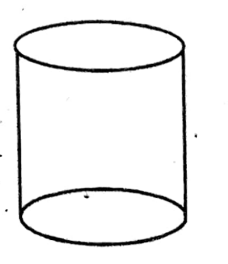
Question 1. Let us look at the picture of the solid below and answer the following

1. Solid has  WBBSE Solutions For Class 10 Maths Chapter 8 Right Circular Cylinder 1   surfaced.

Answer. 3

2. Number of the curved surfaces is  WBBSE Solutions For Class 10 Maths Chapter 8 Right Circular Cylinder 1  and number of plane surface is WBBSE Solutions For Class 10 Maths Chapter 8 Right Circular Cylinder 1                                                             

Answer. 1, 2.

Read and Learn More WBBSE Solutions For Class 10 Maths

WBBSE Solutions For Class 10 Maths Chapter 8 Right Circular Cylinder 1


Question  2. Let us write the names of five solid objects of my house, the shapes of which are right circular cylinder.

Solution: Glass, 

Pipe, 

Tube light, 

Pencil, 

Gas cylinder.

“WBBSE Class 10 Maths Right Circular Cylinder Exercise 8.2 solutions”

Question  3. The length of diameter of a drum made of steel covered with a lid is 28 cm. If a 2816 sq cm steel sheet is required to make the drum, let us write by calculating the height of the drum.

Solution:

Given

The length of diameter of a drum made of steel covered with a lid is 28 cm. If a 2816 sq cm steel sheet is required to make the drum

Let the height = h cm

& radius of the drum = 28/2 = 14 cm.

According to the problem,

2π(14+ h) x 14 = 2816

or, 2 x 22/7 x 14 (14+ h) = 2816

or, 14+h=2816 x 7/2 x 22 x 14 

= 32

∴ h=32-14

18 cm.

∴Height of the drum = 18 cm.

WBBSE Solutions For Class 10 Maths Chapter 8 Right Circular Cylinder Exercise 8.2

Question  4. Let us write by calculating how many cubic decimetres of concrete materials will be necessary to construct two cylindrical pillars, each of whose diameter is. 5.6 decimetres and height are 2.5 meters.

Solution: Height of each pillar = h = 2.5 m = 25 dcm.

Radius of each pillar = (r) = 5.6/2 = 2.8 dcm.

The volume of plaster materials required to cover the two pillars

= 2 × π  x (2.8)2 × 25 cu dcm.

= 2x 22/7 x 28/10 x 28/10 25 

= 56 x 22

= 1232 cu dcm.

“West Bengal Board Class 10 Maths Chapter 8 Right Circular Cylinder Exercise 8.2 solutions”

The curved surface area of two pillars = 2 x π x 2.8 x 25 sq dcm.

= 2 x 2 x 22/7 x 28/10 

= 880 Sq dcm. 

= 8.80 sqm.

Total cost at the rate of Rs. 125 per sqm for the two pillars

= Rs. 8.8 x 125

= Rs. 1100. 

Class 10 Maths Class 10 Social Science
Class 10 English Class 10 Maths
Class 10 Geography Class 10 Geography MCQs
Class 10 History Class 10 History MCQs
Class 10 Life Science Class 10 Science VSAQS
Class 10 Physical Science Class 10 Science SAQs

Question  5. If a gas cylinder for fuel purposes having a length of 7.5 dcm and the length of an inner diameter of 2.8 dcm carries 15.015 kg of gas, let us write by calculating the weight of the gas of per cubic dcm.

Solution:

If a gas cylinder for fuel purposes having a length of 7.5 dcm and the length of an inner diameter of 2.8 dcm carries 15.015 kg of gas

Weight of gas in the cylinder 15.015 kg = 15015. gm.

The radius of the cylinder = 2.8/2

= 1.4 dcm.

∴The volume of the cylinder = (1.4)2 x 7.5 cu dcm.

=22/7 x 14/10 x 14/10 x 75/10

=462/10

= 46.2 cu dcm.

∴ Weight of 1 cu dcm gm = 15015/46.2gm 

= 325 gm.

Question  6. Out of three jars of equal diameter and height, 2/3 part of the first, 5/6 part of the second, and 7/9 part of the third were filled with dilute sulphuric acid. The whole of the acid in the three jars was poured into a jar of 2.1 dcm diameter, as a result the height of acid in the jar becomes 4.1 dcm. If the length of the diameter of each of the three equal jars is 1.4 dcm, let us write by calculating the height of the three jars.

Solution:

Given

Out of three jars of equal diameter and height, 2/3 part of the first, 5/6 part of the second, and 7/9 part of the third were filled with dilute sulphuric acid. The whole of the acid in the three jars was poured into a jar of 2.1 dcm diameter, as a result the height of acid in the jar becomes 4.1 dcm. If the length of the diameter of each of the three equal jars is 1.4 dcm

Let the height of each jar = h dcm.

According to problem,(2/3 + 5/6 + 7/9) x h = π(2.1/2)2 x 4.1

Or,12+15+14/18 x h

= 22/7 x 21/20 x 21/20 41/10

.. h = 21/7 x 21/20 x 21/20 x 41/10 c 18/41 

4.05 dcm.

∴ The height of each jar is 4.05 dcm.

Question  7. The total surface area of a right circular pot open at one end is 2002 sq cm. If the length of diameter of base of the pot is 14 cm, let us write by calculating how many liters of water the drum will contain.

Solution:

Given

The total surface area of a right circular pot open at one end is 2002 sq cm. If the length of diameter of base of the pot is 14 cm

Let the height of the cylinder = h cm.

& the radius of the cylinder =14/2 = 7 cm.

According to the problem,

or, 2π x 7 x h + л(7)2 = 2002

or, 2 x 22/7 x 7 x h+ 22/7 x 7 x 7 = 2002

or, 44h+ 154 = 2002

∴ 44h = 2002 – 154 = 1848

∴ h= 1848/44

= 42

∴ Height of the cylinder = 42 cm. = 4.2 dcm.

The radius of the cylinder = 7 cm. = 0.7 dcm.

∴ The volume of water in the cylinder = 7(0.7)2 x 4.2 cu dcm.

= 22/7 x 7/10 x 7/10 x 42/10 

=6468 / 1000

= 6.468 cu dcm.

=6.468 litre [1 cu dcm = 1 litre]

“WBBSE Class 10 Right Circular Cylinder Exercise 8.2 solutions explained”

Question  8. If a pump set with a pipe of 14 cm diameter can drain 2500 meters of water per minute, let us write by calculating how much kilometer of water that pump will drain per hour. [1 liter = 1 cubic dcm.]

Solution: Radius of the pipe = 14/2 = 7 cm = 0.7 dcm.

Height of the pipe = 2500 m = 25000 dcm. 

The cross-sectional area of the mouth of the pipe

= 22/7 x 72 sq cm. = 154 Sq cm. 1.54 sq dm.

The volume of water irrigated by the pipe in one minute

= (1.54 x 25000) cu dcm 

= 38500 cu dcm

∴ The volume of water irrigated by the pipe in one hour

= (38500 x 60) cu dcm 

= 2310000 cu dcm.

Now, 1 cu dcm = 1 liter

∴ The pump set can irrigate 2310000 liters

= 2310 Kilolitre in 1 hour.

Question  9. There is some water in a long gas jar of 7 cm in diameter. If a solid right circular cylindrical pipe of iron having 5 cm length and 5.6 cm diameter be immersed completely in that water, let us write by calculating how much the level of water will rise. 

Solution:

Given

There is some water in a long gas jar of 7 cm in diameter. If a solid right circular cylindrical pipe of iron having 5 cm length and 5.6 cm diameter be immersed completely in that water

Let the water level will rise by h cm.

According to the problem,

π(7/2)² x h = π(5.6/2)² x 5

49/4 h = 28/10 x 28/10 x 5 

H = 28 x 28 x 5 / 10 x 10 x 49 x 4 

= 32/10

= 3.2

∴ The water level will rise by 3.2 cm.

Question  10. If the surface area of a right circular cylindrical pillar is 264 sq meters and the volume is 92 cubic meters, let us write by calculating the height and length of the diameter of this pillar.

Solution:

Given

If the surface area of a right circular cylindrical pillar is 264 sq meters and the volume is 92 cubic meters

Let the radius of the pillar = rm & height = h m.

According to 1st condition, 2πth = 264 ——– (1)

According to 2nd condition, πr²h = 924———(2)

πr²h/2πrh = 924/264

Or, r = 7

2πrh 2 x 22/7 x 7 h = 264

H = 264/44 

= 6

∴ Diameter of the pillar = 2 x 7 = 14 m

& height of the pillar = 6 m.

“WBBSE Class 10 Maths Exercise 8.2 Right Circular Cylinder problem solutions”

Question  11. A right circular cylindrical tank of 9 meters in height is filled with water. Water comes out from there through a pipe having a length of 6 cm diameter with a speed of 225 meters per minute and the tank becomes empty after 2 hr. 24 minutes, let us write by calculating the length of the diameter of the tank.

Solution: Let the radius of the tank = R m

& radius of the pipe = 6/2 

= 3 cm.

= 0.03m.

According to the problem,

π R² x9= 36 (0.03)∴ x 225       (Where radius of pipe = R)

R² = 36 x 3/100 x 3/100 x 225 x 1/9

= 81/100

∴ R = 9/10

Diameter of the tank = 2 x 9/10

= 1.8 m.

Question  12. The curved surface area of the right circular cylindrical log of wood of uniform density is 440 sq dcm. If I cubic dcm of wood weighs 1.5 kg and the weight of the log is 9.24 quintals. Let us write by calculating the length of the diameter of the log and its height. 

Solution:

The curved surface area of the right circular cylindrical log of wood of uniform density is 440 sq dcm. If I cubic dcm of wood weighs 1.5 kg and the weight of the log is 9.24 quintals

Weight of the wooden log = 9.24 quintal = 924 kg.

∴ The volume of the log = 924 / 1.5 cu dcm 616 cu dcm.

Let the radius of the log = r dcm

& height of the log = h dcm.

According to 1st condition, 2лth = 440———-(1)

 According to 2nd condition, лr²h = 616———(2)

= лr²h/2лrh = 616/440 

Or, r/2 = 616/440

R = 2 x 616 / 440

= 28/10

Or, 2 x 22/7 x 28/10 

h = 100/4

= 25

∴ Diameter of the log = 2 x 28/10 

= 56/10

= 5.6

Height of the log = 25. dcm.

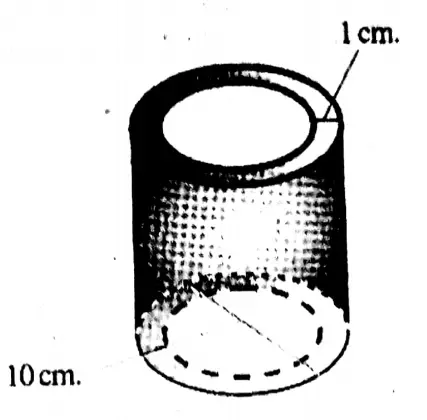
Question  13. The lengths of the inner and outer diameter of a right circular cylindrical pipe open at two ends are 30 cm and 26 cm respectively and the length of the pipe is 14.7 metres. Let us write by calculating the cost of painting its all surfaces with coal tar at Rs. 2.25 per dcm.

Solution:

Given

The lengths of the inner and outer diameter of a right circular cylindrical pipe open at two ends are 30 cm and 26 cm respectively and the length of the pipe is 14.7 metres.

Internal radius of the pipe = 26/20

= 1.3 dcm.

The external radius of the pipe = 30/20

= 1.5 dcm.

Height of the pipe 14.7 m = 147 dcm.

The total surface area of the pipe

= [27(1.5+ 1.3) 147+ 2π((1.5)2- (1.3)2)] sq dcm..

= [2π x 2.8 × 147 + 2 x 2.8 x 0.2] sq dcm.

= 2π x 2.8(147+ 0.2)

= 2x 22/7 x 28/10 x 147.2 sq dcm.

= 17.6 x 147.2 2590.72 sq dcm.

Total cost for painting with coal tar

= Rs. (2.25 x 2590.72)= Rs. 5829.12.

Question  14. The height of a hollow right circular cylinder, open at both ends, is 2.8 metres. If the length of the inner diameter of the cylinder is 4.6 dcm and the cylinder is made up of 84.48 cubic dcm of iron, let us calculate the length of the outer diameter of the cylinder. 

Solution:

The height of a hollow right circular cylinder, open at both ends, is 2.8 metres. If the length of the inner diameter of the cylinder is 4.6 dcm and the cylinder is made up of 84.48 cubic dcm of iron

Let the external radius = r dcm. of the cylinder & the height of the cylinder = 2.8 m = 28 dcm.

The internal radius of the cylinder = 4.6/2

= 2.3 dcm.

According to the problem,

л(r² (2.3)²) x 28 = 84.48

or,22/2(r2-5.29) × 28 = 84.48

r² – 5.29 = 84.48/88 = 0.96

R² = 5.29

= 5.29 + 0.96

= 6.25

External diameter = 2 x 2.5 5 dcm.

Question  15. Height of a right circular cylinder is twice its radius. If the height would be 6 times its radius, then the volume of the cylinder would be greater by 539 cubic dcm, let us write by calculating the height of the cylinder.

Solution:

Height of a right circular cylinder is twice its radius. If the height would be 6 times its radius, then the volume of the cylinder would be greater by 539 cubic dcm

Let the height of the cylinder = h dcm & radius = r dcm.

∴ h = 2r

Volume of the cylinder = r2 x 2r= 2πr3 

If height h=6r, volume = r2 x 6г = 6πr3 

According to the problem, 6r²r³ = 539

4πr³ = 536

Or, 4 x 22/4 x r³ =539

∴ r³ = 539 x 7/88

=(7/3)³

r =7/2

2r = 7

∴ Height 2r= 7dcm.

Question  16. A group of fire brigade personnel carried a right circular cylindrical tank filled with water and pumped out water at a speed of 420 metres per minute to put out the fire in 40 minutes by three pipes of 2 cm in diameter each. If the diameter of the tank is 2.8 meters and its length is 6 metres, then let us calculate 

1. what volume of water has been spent in putting out the fire and 

2. the volume of water that still remains in the tank.

Solution:

A group of fire brigade personnel carried a right circular cylindrical tank filled with water and pumped out water at a speed of 420 metres per minute to put out the fire in 40 minutes by three pipes of 2 cm in diameter each. If the diameter of the tank is 2.8 meters and its length is 6 metres,

Radius of the tanker = 2.8/2

= 1.4

= 14 dcm.

Length of the tanker = 6 m = 60 dcm.

The volume of the tanker = π(14)² x 60 cu dcm.

Radius of each pipe = 2/2 

= 1 cm

= 1/10 dcm.

Length of the pipe = 420 m = 4200 dcm.

Quantity of water ejected in 40 minutes by 3 pipes

= 40 x 3 x π(1/10)² x 4200 cu dcm.

= 40 x 3 x 22/7 x 1/10 x 1/10 x 4200 cu dcm.

= 15840 cu dcm.

∴ Quantity of water left in the tanker

= (3696015840) cu dcm.

= 21120 cu dcm.

“Class 10 WBBSE Maths Exercise 8.2 Right Circular Cylinder step-by-step solutions”

Question  17. It is required to make a plastering of sand and cement with 3.5 cm thick, sur- rounding four cylindrical pillars, each of whose diameter is 17.5 cm.

1. If each pillar is of 3-meter height, let us write by calculating how many cubic dcm of plaster materials will be needed.

2. If the ratio of sand and cement in the plaster material be 4: 1, let us write how many cubic dcm of cement will be needed. 

Solution: Length of each pillar = 3 m = 30 dcm.

Internal radius of each pillar = 17.5/2

175/20 cm.

= 7/8 dcm.

The external radius of each pillar = (7/8 + 75/10) dcm.

= (7/8 + 35/100)

= (7/8 + 7/20)dcm.

= 35+14 / 40

= 49/40 dcm.

1. Plaster material is required for 4 pillars

= 4 π {(49/40)² – (7/8 )²} x 30 cu dcm.

= 4x 22/7 {(49/40 + 7/8)(49/40 – 7/8)} x 30 cu dcm.

= 4 x 22/7 x 84/40 x 14/40 x 30 cu dcm.

= 2772/10

= 277.2 cu dcm.

2. Volume of cement required = 1/5x 277.2 cu dcm. 

= 55.44 cu dcm.

Question 18. The length of the outer and inner diameter of a hollow right circular cylinder are 16 cm and 12 cm respectively. Height of the cylinder is 36 cm. Let us calculate how many solid cylinders of 2 cm radius and 6 cm length may be obtained by melting this cylinder.

Solution:

The length of the outer and inner diameter of a hollow right circular cylinder are 16 cm and 12 cm respectively. Height of the cylinder is 36 cm.

External radius of the cylinder = 16/2

= 8 cm.

Internal radius of the cylinder = 12/2

= 6 cm.

Height of the cylinder = 36 cm.

The radius of the solid cylinder = 2/2 

= 1 cm.

Height of the cylinder = 6 cm.

Volume of hollow cylinders = π{(8)²- (6)²} x 36 cu cm.

The volume of x no. of solid cylinders = x. π(1)². 6 cu cm.

According to the problem,

2. π(1)². 6=π{(8)² – (6)²) x 36

or, x. π. 1.6 = πx (64-36) x 36

or, x = 28 x 36 / 6

= 168

∴ No. of solid cylinders = 168.

Right Circular Cylinder Multiple Choice Questions

Question 1. If the lengths of radii of two solid right circular cylinders are in the ratio 2:3 and their heights are in the ratio 5: 3, then ratio of their lateral surface areas is

1. 2:5
2. 7:7
3. 10: 9
4. 16:9

Solution: Ratio of area of curved surfaces

=2π ×2×5:2π × 3 × 3 

=10:9

Answer. 3. 10: 9

Question 2. If the lengths of radii of two solid right circular cylinders are in the ratio 2 : 3 and their heights are in the ratio 5: 3, then the ratio of their volumes is

1. 27: 20
2. 20:27
3. 40:9
4. 9:4

Solution: Ratio of volumes of the cylinder

=π(2)² × 5: π(3)² x 3 = 20:27

Answer. 2. 20:27

Question 3. If volumes of two solid right circular cylinders are the same and their heights are in the ratio 1 2, then the ratio of lengths of radii is

1. 1:√2
2. √2:1
3. 1:2
4. 2:1

Solution: Ratio of the radius of the cylinder = √2:1

Answer. 2. √2:1

“WBBSE Class 10 Chapter 8 Right Circular Cylinder Exercise 8.2 solution guide”

Question 4. In a right circular cylinder, if the length of radius is halved and height is doubled, volume of the cylinder will be

1. Equal
2. Double
3. Half
4. 4 times

Solution: Let radius & height of cylinder are r unit & h Unit respectively,

Volume (v1) = πr2h cu unit.

Now, if radius & height of cylinder r/2 unit & 2h unit respectively volume (v2)

= \(\pi\left(\frac{r}{2}\right)^2 \times 2 h\)

= \(\frac{1}{2} \pi r^2 h\)

= \(\frac{1}{2} \mathrm{v}_1\)

Answer. 3. Half


Question 5. If the length of the radius of a right circular cylinder is doubled and the height is halved, the lateral surface area will be

1. Equal
2. Half
3. Double
4. 4 times

Solution: Let radius & height of cylinder are r unit & h unit.

Area (A1) = 2πrh

Now, if radius & height be 2r unit & h/2 unit respectively

Area (A2) = \(2 \pi(2 r) \frac{\mathrm{h}}{2}\)

= 2πrh

= A1

Answer. 1. Equal


Right Circular Cylinder True Or False

1. The length of a right circular drum is r cm and the height is h cm. If half part of the drum is filled with water then the volume of water will be r2h cubic cm.

False

2. If the length of the radius of a right circular cylinder is z unit, the numerical value of volume and surface area of the cylinder will be equal for any height.

True

Right Circular Cylinder Fill In The Blanks

1. The length of a rectangular paper is units and the breadth is b units. The rectangular paper is rolled and a cylinder is formed whose perimeter is equal to the length of the paper. The lateral surface area of the cylinder is lb sq unit.

2. The longest rod that can be kept in a right circular cylinder has a diameter of 3 cm and height of 4 cm, then the length of the rod is 5  cm.

3. If the numerical values of volume and lateral surface area of a right circular cylinder are equal then the length of the diameter of the cylinder is 4 units.

Chapter 8 Right Circular Cylinder Exercise 8.2 Short Answers

Question 1. If the lateral surface area of a right circular cylindrical pillar is 264 sq meters and the volume is 924 cubic meters, let us write the length of the radius of the base of the cylinder.

Solution:

If the lateral surface area of a right circular cylindrical pillar is 264 sq meters and the volume is 924 cubic meters

Let the radius & height of the pillar = r m & h m respectively.

According to 1st condition, 2rh = 264——–(1)

According to 2nd condition, r2h = 924 ——-(2)

(2) ÷ (1),

= πr²h/2πrh

= 924/264

Or, r/2 = 7/2

R = 7

∴ Radius = 7 cm.

Question 2. If the lateral surface area of a right circular cylinder is c square units, the length of the radius of the base is r units and the volume is cr/v cubic units, let us write the value of 

Solution.

If the lateral surface area of a right circular cylinder is c square units, the length of the radius of the base is r units and the volume is cr/v cubic units

Let height = h unit.

Cr/v=  2πrhxr / πr²h

= 2

 Question 3. If the height of a right circular cylinder is 14 cm and the lateral surface area is 264 sq cm, let us write the volume of the cylinder.

Solution.

If the height of a right circular cylinder is 14 cm and the lateral surface area is 264 sq cm

Let the height of the cylinder = r cm.

∴ 2πгh = 264 

or, 2 x 22/7 x r x 14= 264

r=3

∴ Volume = π(3)² x 14 cu cm 

= 22/7 x 9 x 14 cu cm = 396 cu cm.

“West Bengal Board Class 10 Maths Exercise 8.2 Right Circular Cylinder solutions

 Question 4. If the heights of two right circular cylinders are in the ratio of 1: 2 and prim- meters are in the ratio of 3: 4, let us write the ratio of their volumes.

Solution.

If the heights of two right circular cylinders are in the ratio of 1: 2 and prim- meters are in the ratio of 3: 4

The Radius & height of the two cylinders are r unit & R unit & heights are h unit & 2h unit respectively.

∴ 2πr : 2πR 3:4 

∴ r: R 3:4 

h =3R / r

The ratio of volume = (r)² h: (R)²

2h = (3R/4)²: 2R²

Or, 9R/16 : 2R2 = 9:32

Question 5. The length of the radius of a right circular cylinder is decreased by 50% and height is increased by 50%, let us write by how much percent of the volume will be changed.

Solution: Let radius & height are r unit & h unit respectively.

Volume (v1) = πr2h cu. unit.

It is reduced by 50%, \(\frac{50 \mathrm{r}}{100}=\frac{\mathrm{r}}{2} \text { unit }\)

& height is increased by 50% \(\frac{150 \mathrm{~h}}{100}=\frac{3 \mathrm{~h}}{2} \text { unit. }\)

∴ Volume (v2) = \(\pi\left(\frac{\mathrm{r}}{2}\right)^2 \times \frac{3 \mathrm{~h}}{2}=\frac{3}{8} \pi \mathrm{r}^2 \mathrm{~h} \text { cu unit. }\)

∴ Volume reduced = \(\left[\frac{\pi r^2 h-\frac{3}{8} \pi r^2}{\pi r^2 h} \times 100\right] \%\)

= \(\frac{5}{8} \times 100 \%=62 \frac{1}{2} \%\)


WBBSE Solutions For Class 10 Maths Chapter 7 Theorems Related To Angles In A Circle Exercise 7.1

WBBSE Solutions For Class 10 Maths Chapter 7 Theorems Related To Angles In A Circle Exercise 7.1

Question 1. In the adjoining figure, ∠AMB, formed by the circular arc ÁPB, is WBBSE Solutions For Class 10 Maths Chapter 7 Theorems Related To Angles In A Circle 1the angle, and ∠ANB, formed by the circular arc WBBSE Solutions For Class 10 Maths Chapter 7 Theorems Related To Angles In A Circle 1 is the front angle of the circle.
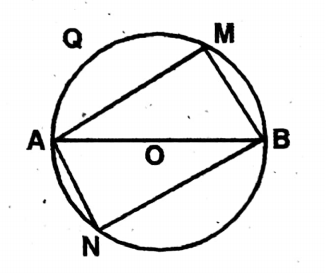
WBBSE Solutions For Class 10 Maths Chapter 7 Theorems Related To Angles In A Circle 2

“WBBSE Class 10 Maths Theorems Related to Angles in a Circle Exercise 7.1 solutions”

Solution: In the adjoining figure, ∠AMB formed by the circular arc APB is a cyclic angle and ∠ANB formed by circular arc AQB is the front angle of the circle.

WBBSE Solutions For Class 10 Maths Chapter 7 Theorems Related To Angles In A Circle Exercise 7.1

Read and Learn More WBBSE Solutions For Class 10 Maths
Question 2. ∠SLT in the adjoining figure at point L by the chordWBBSE Solutions For Class 10 Maths Chapter 7 Theorems Related To Angles In A Circle 1is front angle. Again, since the point L lies on the circle, so angle formed
by the chord ST is a front angle in the segment. Again, ∠SLT is formed by the circular arc WBBSE Solutions For Class 10 Maths Chapter 7 Theorems Related To Angles In A Circle 1is front angle of the circle. The four angles in the segment of a circle with center O in the adjoining figure areWBBSE Solutions For Class 10 Maths Chapter 7 Theorems Related To Angles In A Circle 1,WBBSE Solutions For Class 10 Maths Chapter 7 Theorems Related To Angles In A Circle 1, WBBSE Solutions For Class 10 Maths Chapter 7 Theorems Related To Angles In A Circle 1and WBBSE Solutions For Class 10 Maths Chapter 7 Theorems Related To Angles In A Circle 1

Solution: ∠SLT in the adjoining figure at the point L by the chord ST is the front angle.

Again, since point, L lies on the circle, so angle SLT formed by the chord ST is a front angle in the segment.

WBBSE Solutions For Class 10 Maths Chapter 7 Theorems Related To Angles In A Circle 3————–(1)

Again, ∠SLT formed by the circular arc SNT is a front angle of the circle. The four angles in the segment of a circle with centre O in the adjoining figure are

Class 10 Maths Class 10 Social Science
Class 10 English Class 10 Maths
Class 10 Geography Class 10 Geography MCQs
Class 10 History Class 10 History MCQs
Class 10 Life Science Class 10 Science VSAQS
Class 10 Physical Science Class 10 Science SAQs

∠ADB, ∠AEB, ∠ACB and ∠ASB.

WBBSE Solutions For Class 10 Maths Chapter 7 Theorems Related To Angles In A Circle 4—————–(2)

“West Bengal Board Class 10 Maths Chapter 7 Theorems Related to Angles in a Circle Exercise 7.1 solutions”

We see in no. (1), (2) circles the angle at the center formed by the arc AQB is ZAOB and an angle in the segment is ZAPB. But in no. (3) circle, the angle at the center formed by the arc ASB is ZAOB and the angle in the segment formed by the arc ASQ is ZAPQ.

WBBSE Solutions For Class 10 Maths Chapter 7 Theorems Related To Angles In A Circle 5

WBBSE Solutions For Class 10 Maths Chapter 7 Theorems Related To Angles In A Circle Exercise 7.5

WBBSE Solutions For Class 10 Maths Chapter 7 Theorems Related To Angles In A Circle Exercise 7.5

Question 1. In AABC, ZB is a right angle. A circle drawn taking AC as diameter intersects AB at the point P; let us write the correct information from the followings:

1. AB > AD

2. AB = AD

3. AB < AD.

Solution:

In AABC, ZB is a right angle. A circle drawn taking AC as diameter intersects AB at the point P

We know the angle in a semicircle angle = 90°

∴ ∠ADC = 90° (given)

But ABC 90°

It is possible that points B & point D are the same points. 

Read and Learn More WBBSE Solutions For Class 10 Maths

∴ AB = AD

WBBSE Solutions For Class 10 Maths Chapter 7 Theorems Related To Angles In A Circle 1

“WBBSE Class 10 Maths Theorems Related to Angles in a Circle Exercise 7.5 solutions”

Question 2. Let us prove that the circle drawn with any one of the equal sides of an isosceles triangle as diameter bisects the unequal side.

Solution: In Δ ABC, AB = AC.

A circle with center O and AB as the diameter is drawn.

The circle cuts BC at D.

To prove D bisects BC.

Proof: Join A, B.

As AB is the diameter,

.. ∠ADB is one right angle.

i.e., AD ⊥ BC & ∠ADC = 90°

Now, in two right-angled ΔABD & ΔACD, Hypotenuse AB Hypotenuse AC (given), And AD are common.

∴ΔABD ≅ ΔACD 

∴ BD = CD

∴ D bisects the unequal side of the isosceles triangle ABC.

WBBSE Solutions For Class 10 Maths Chapter 7 Theorems Related To Angles In A Circle 2

Question 3. Sahana drew two circles that intersect each other at the points P and Q. If the diameters of the two circles are PA and PB respectively, then let us prove that A, Q, and B are collinear.

Solution:

Given

Sahana drew two circles that intersect each other at the points P and Q. If the diameters of the two circles are PA and PB respectively

Two circles cut each other at P & Q.

If PA & PB are the diameters of the two circles, 

prove that points A, Q, and B are collinear.

Proof: Join Q, A; Q, B & P, Q.

As AP is the diameter & AQP is a semi-circle angle,

∴ ∠AQP = 1 rt. angle

Similarly, BP is the diameter.

Class 10 Maths Class 10 Social Science
Class 10 English Class 10 Maths
Class 10 Geography Class 10 Geography MCQs
Class 10 History Class 10 History MCQs
Class 10 Life Science Class 10 Science VSAQS
Class 10 Physical Science Class 10 Science SAQs

∴∠BQP = 1 rt. angle

∴ ∠AQP+∠BQP = 2 rt. angles

Now, AQ & BQ meet at Q & the sum of the adjacent angles = 2 rt. angles

∴ AQ and BQ are on the same straight line.

∴ A Q & B are collinear.

WBBSE Solutions For Class 10 Maths Chapter 7 Theorems Related To Angles In A Circle 3

WBBSE Solutions For Class 10 Maths Chapter 7 Theorems Related To Angles In A Circle Exercise 7.5

Question 4. Rajat drew a line segment PQ whose midpoint is R and two circles are drawn with PR and PQ as diameters. I drew a straight line through point P which inter- sects the first circle at point S and the second circle at point T. Let us prove with the reason that PS = ST.

Solution:

Given

Rajat drew a line segment PQ whose midpoint is R and two circles are drawn with PR and PQ as diameters. I drew a straight line through point P which inter- sects the first circle at point S and the second circle at point T.

PQ is a straight line whose midpoint is R. Now two circles are drawn with PR & PQ as diameter.

A straight line passing through P is drawn which cuts the 1st circle at S & cuts the 2nd circle at T.

To prove PS = ST.

Join R, S & Q, T.

As PR is the diameter of the 1st circle,

∴ Semicircle angle PSR = 90°

∴ SR ⊥ PT

Similarly, PTQ = 90°

∴ QT I PT

∴ SR & QT are both perpendiculars on PT.

∴ SR || QT

In APQT, the midpoint PQ is R

and SR || OT.

∴ S is the midpoint of PT.

∴PS = ST.

WBBSE Solutions For Class 10 Maths Chapter 7 Theorems Related To Angles In A Circle 4

“West Bengal Board Class 10 Maths Chapter 7 Theorems Related to Angles in a Circle Exercise 7.5 solutions”

Question 5. Three points P, Q, and R lie in a circle. The two perpendiculars PQ and PR at point P intersect the circle at points S and T respectively. Let us prove that RQ = ST.

Solution:

Given

Three points P, Q, and R lie in a circle. The two perpendiculars PQ and PR at point P intersect the circle at points S and T respectively

Let P, Q & R are the three points on a circle.

Perpendiculars drawn from P on the chords PQ & PR are PS & PT, which cut the circle

at S & T respectively.

To prove RQ ST.

Proof Join R, Q; S, T; S, Q; & T, R.

Let the straight lines RT & SQ intersect at O.

∠SPQ = 1 rt. angle [as PS ⊥ PQ (given)]

∴SQ is a diameter.

Again, RPT 1 rt. angle [as PT ⊥ PR (given)]

∴RT is a diameter.

∴O is the center as the diameters SQ & RT intersect each other.

∴ OR= OQ =OT

∴In triangles ORQ & OST,

OR=OS (Radius of the same circle)

OQ= OT (Radius of the same circle)

and ∠ROQ=∠SPT (vertically opposite)

∴ΔORQ ≅ ΔOST

∴RQ = ST. Proved.

WBBSE Solutions For Class 10 Maths Chapter 7 Theorems Related To Angles In A Circle 5

Question 6. ABC is an acute-angled triangle. AP is the diameter of the circumcircle of the triangle ABC; BE and CF are perpendiculars on AC and AB respectively and they intersect each other at point Q. Let us prove that BPQC is a parallelogram. 

Solution:

Given

ABC is an acute-angled triangle. AP is the diameter of the circumcircle of the triangle ABC; BE and CF are perpendiculars on AC and AB respectively and they intersect each other at point Q.

ABC is an acute-angled triangle. AP is the diameter of the circumcircle of ΔABC.

BE & CF are the perpendiculars on the sides AC & AB, respectively.

They meet at Q.

To prove BPCQ is a parallelogram..

“WBBSE Class 10 Theorems Related to Angles in a Circle Exercise 7.5 solutions explained”

Proof: CF AB (given)

and ∠ABP is a semicircle angle.

∴ BP ⊥ AB

CF || BP or CQ || BP

Again, BE 1 AC (given)

and ∠ACP is an angle in a semi-circle.

∴CP ⊥ AC

∴CP || BE or CP || BQ.

∴BPCQ is a parallelogram. Proved.

WBBSE Solutions For Class 10 Maths Chapter 7 Theorems Related To Angles In A Circle 6

Question 7. The internal and external bisectors of the vertical angle of a triangle intersect the circumcircle of the triangle at the points P and Q. Let us prove that PQ is the diameter of the circle.

Solution:

Given

The internal and external bisectors of the vertical angle of a triangle intersect the circumcircle of the triangle at the points P and Q.

ABC is a triangle, and internal & external bisectors of ∠A of ΔABC are AP & AQ, respectively, which cut the circumcircle of ΔABC at P & Q respectively.

To prove PQ is the diameter of the circle.

Proof: As AP & AQ are the internal & external bisectors of∠A.

∴ ∠PAQ = 90°

∴ PAQ is a semi-circle angle.

∴ PQ is the diameter. Proved.

Question 8. AB and CD are two diameters of a circle. Let us prove that ABCD is a rectangular

Solution: Let AB & CD be two diameters of the circle with center O

Join AC, BD, AD & BC.

To prove ACBD is a rectangle.

Proof: ∠ADB = ∠ACB= 1 rt. angle

& ∠CAD = DBC = 1 rt. angle

In ACBD quadrilateral,

∠A = ∠C = ∠B = <D = 1 rt. angle

∴ACBD is a rectangle.

Question 9. Let us prove that if the circles are drawn having sides of a rhombus as diameter then the circles pass through a fixed point.

Solution: If circles are drawn with diameters of the sides of a rhombus, they will pass a fixed point.

Let ABCD is a rhombus. The circle with AB as diameter cuts BC or produced BC at D. Join A, D.

∠ADB= 1 rt. angle (as a semicircle angle)

∴∠AOC = 1 rt. angle

Again the circle as AC diameter will pass through point D.

∴ Two circles with AB & AC as diameters intersect each other at D.

∴Circles with diameters of the sides of a rhombus will pass through a fixed point. Proved.

“WBBSE Class 10 Maths Exercise 7.5 Theorems Related to Angles in a Circle problem solutions”

WBBSE Class 10 Solutions Chapter 7 Theorems Related To Angles In A Circle Exercise 7.5 Multiple Choice Question

Question 1. PQ is a diameter of a circle with center O, and PR RQ; the value of <RPQ is 

1. 30°
2. 90°
3. 60°
4. 45°

Solution: As PR RQ, 

∴ PRQ 90° (semi-circle angle)

∴RPQ = RQP = 180°-90° / 2 

=90° /2 

Answer. 4.  45°

WBBSE Solutions For Class 10 Maths Chapter 7 Theorems Related To Angles In A Circle 7

Question 2. QR is a chord of a circle and POR is a diameter of a circle. OD is perpendicular on QR. If OD = 4 cm, the length of PQ is

1. 4 cm
2. 2 cm
3. 8 cm
4. none of these

Solution:

QR is a chord of a circle and POR is a diameter of a circle. OD is perpendicular on QR. If OD = 4 cm

PQ = 2 x OD = 2 x 4 = 8 cm.

Answer. 3. 8 cm.

WBBSE Solutions For Class 10 Maths Chapter 7 Theorems Related To Angles In A Circle 8

“Class 10 WBBSE Maths Exercise 7.5 Theorems Related to Angles in a Circle step-by-step solutions”

Question 3. AOB is a diameter of a circle. The two chords AC and BD when extended meet at point E. If ∠COD = 40°, the value of CED is

1. 40°
2. 80°
3. 20°
4. 70°

Answer. 3. 20°

WBBSE Solutions For Class 10 Maths Chapter 7 Theorems Related To Angles In A Circle 9

Question 4. AOB is the diameter of a circle. If AC = 3 cm, BC = 4 cm, then the length of AB is

1. 3 cm
2. 4 cm
3. 5. cm.
4. 8 cm.

Solution:

AOB is the diameter of a circle. If AC = 3 cm, BC = 4 cm

AB2 = √AC²+BC²

= √3²+4²

=√25 

= 5

Answer. 3. 5. cm

WBBSE Solutions For Class 10 Maths Chapter 7 Theorems Related To Angles In A Circle 10

“WBBSE Class 10 Chapter 7 Theorems Related to Angles in a Circle Exercise 7.5 solution guide”

Question 5. In the adjoining figure, O is centre of circle & AB is a diameter, if BCE = 20°, ZCAE= 25°, the value of ZAEC is

1. 50°
2. 90°
3. 45°
4. 20°

Solution:

In the adjoining figure, O is centre of circle & AB is a diameter, if BCE = 20°, ZCAE= 25°

ACE = 90° + 20° = 110°; AEC = 180°- (110° +25°) = 45° A 

Answer. 3. 45°

WBBSE Solutions For Class 10 Maths Chapter 7 Theorems Related To Angles In A Circle 11

Chapter 7 Theorems Related To Angles In A Circle Exercise 7.5  True Or False

1. The angle in the segment of a circle that is greater than a semi-circle is an obtuse angle.

False

2. O is the midpoint of the side AB of the triangle ABC, and OA = OB = OC; if we draw a circle with side AB as diameter, then the circle passes through point C.

True

Chapter 7 Theorems Related To Angles In A Circle Exercise 7.5  Fill In The Blanks

1. Semicircular angle is a Right angle.

2. The angle in the segment of a circle that is less than a semicircle is an Obtuse angle.

3. The circle is drawn with the hypotenuse of a right-angled triangle as the diameter passes through the Vertices.

Chapter 7 Theorems Related To Angles In A Circle Exercise 7.5 Short Answer

Question 1. In isosceles triangle ABC, AB = AC; a circle drawn taking AB as diameter meets the side BC at point D. If BD = 4 cm, let us find the value of CD.

Solution. ABC is an isosceles triangle, where AB AC. A circle is drawn with AB as the diameter, the circle will cut BC at D.

If BD = 4 cm.

Find CD.

BD= CD = 4 cm.

“West Bengal Board Class 10 Maths Exercise 7.5 Theorems Related to Angles in a Circle solutions”

Question 2. Two chords AB and AC of a circle are mutually perpendicular to each other. If AB = 4 cm, AC = 3, let us find the length of the radius of the circle.

Solution. AB & AC the two chords of a circle are perpendicular to each other. 

AB = 4 cm, AC 3 cm, 

the radius of the circle =?

Diameter (BC)=√32+42

= √25

= 5,

radius = 5/2

= 2.5 cm.

Question 3. Two chords PQ and PR of a circle are mutually perpendicular to each other. If the length of the radius of the circle is r cm, let us find the length of the chord QR.

Solution. PQ & PR are two chords of a circle perpendicular to each other;

if radius = r cm. find the length of the chord QR.

QR-Diameter – 2r cm [.. QPR = 1 rt. Angle]

Question 4. AOB is a diameter of a circle. Point C lies on the circle. If ZOBC = 60°, let us find the value of ZOCA.

Solution. AOB is a diameter of a circle. C is any point on the circle; if ZOBC= 60°, find ZOCA. 

∴ OB OC

ZOBC= ZOCB = 60°

∴ ZOCA = 90° – 60° 30°

“Class 10 WBBSE Maths Exercise 7.5 solutions for Theorems Related to Angles in a Circle”

Question 5. In the picture beside, O is the center of the circle and AB is the diameter. The length of the chord CD is equal to the length of the radius of the circle. AC and BD produced meet at the point P, let A us find the value of ∠APB.

Solution.

In the picture beside, O is the center of the circle and AB is the diameter. The length of the chord CD is equal to the length of the radius of the circle. AC and BD produced meet at the point P

OA = OC = OB = OD = CD

∴ ΔOCD is an equilateral triangle.

∴ ∠COD 60°

∠APB = 60°

WBBSE Solutions For Class 10 Maths Chapter 7 Theorems Related To Angles In A Circle 12

WBBSE Solutions For Class 10 Maths Chapter 8 Right Circular Cylinder Exercise 8.1

WBBSE Solutions For Class 10 Maths Chapter 8 Right Circular Cylinder Exercise 8.1

Question 1. If the length of the radius of the base of a right circular cylinder is 12 cm and the height is 21 cm, let us write by calculating its lateral surface area.

Solution:

Given

If the length of the radius of the base of a right circular cylinder is 12 cm and the height is 21 cm

The length of the radius of the cylinder is 12/2 cm = 6 cm.

∴The lateral surface area of a cylinder is = 2 x π x 6 x 21 sq cm.

= 2 x 22/7 x 6 x 21 sq cm. 

= 792 sq cm.

The lateral surface area of a cylinder is 792 sq cm.

Read and Learn More WBBSE Solutions For Class 10 Maths

Question 2. The perimeter of a right circular cylinder is 44 meters and the height is 14 meters, let us write by calculating its lateral surface area. 

Solution:

The perimeter of a right circular cylinder is 44 meters and the height is 14 meters

Surface area of the cylinder = circumference of base x height

= (44 x 14) sqm = 616 sqm.

Surface area of the cylinder = 616 sqm.

“WBBSE Class 10 Maths Right Circular Cylinder Exercise 8.1 solutions”

Question 3. The base area of a closed cylindrical water tank is 616 sq. meters and the height is 21 meters. Let us write by calculating the total surface area of that tank. 

Solution:

Given

The base area of a closed cylindrical water tank is 616 sq. meters and the height is 21 meters.

Let the length of the radius of the circular base of the water tank = r meter.

∴ Base area = πr² sq meter

By the condition, 

πr² = 616

or, 22/7 x r²  = 616

or, r²  = 616 7/22

r = √196 

= 14

Total surface area of water tank is = (2лr²  + 2лrh) sq meter [where height of cylinder = h meter]

= 2 x 22/7 x r(r + h) sq meter

= 2x 22/7 x 14(14+21) sq meter

= 3080 sqm.

Total surface area of water tank is 3080 sqm.

WBBSE Solutions For Class 10 Maths Chapter 8 Right Circular Cylinder Exercise 8.1

Question 4. If the perimeter of the base of any closed cylindrical pot is 22 dm and the height is 5 dm, let us write by calculating the area that will be colored to paint the outside of that pot. 

Solution:

If the perimeter of the base of any closed cylindrical pot is 22 dm and the height is 5 dm

Let radius = r dm & height = h dm.

∴2πr = 22 &h=5

2 x 22/7 x r = 22. 

r = 7/2 dm.

“West Bengal Board Class 10 Maths Chapter 8 Right Circular Cylinder Exercise 8.1 solutions”

Question 5. The total surface area of a right circular cylinder with one end open is 1474 sq cm. If the length of the diameter of the base is 14 cm, let us write by calculating its height. Again, if the pot would be closed at two ends, let us write by calculating what would be its total surface area

Solution:

Given

The total surface area of a right circular cylinder with one end open is 1474 sq cm. If the length of the diameter of the base is 14 cm, let us write by calculating its height. Again, if the pot would be closed at two ends

The length of the radius of the base of the right circular cylindrical pot = 14/2 cm. = 7 cm.

Let the height of the pot is h cm.

∴The total surface area of pot = area of the base + area of the lateral surface

= (22/7×72+2 22/7 x 7 x h) sq cm.

= (154 + 44h) sq cm.

By the condition, 154 + 44h = 1474

∴ h = 30

∴ The height of the pot is 30 cm.

If the pot would be closed at two ends, the surface area of that pot

= Area of the upper end surface + 1474 sq cm.

22/7 x 72 + 1474) sq cm. 

=.1628 sqcm.

Class 10 Maths Class 10 Social Science
Class 10 English Class 10 Maths
Class 10 Geography Class 10 Geography MCQs
Class 10 History Class 10 History MCQs
Class 10 Life Science Class 10 Science VSAQS
Class 10 Physical Science Class 10 Science SAQs

Question 6. The length diameter of the base of a drum with a lid made of steel sheet is 4.2 dcm. If 112.20 sq dcm of steel sheet is required to make the drum, let us write by calculating the height of the drum. Again, if the price of 1 sq dcm of steel is Rs. 25, let us calculate the production cost of the drum. 

Solution:

The length diameter of the base of a drum with a lid made of steel sheet is 4.2 dcm. If 112.20 sq dcm of steel sheet is required to make the drum, let us write by calculating the height of the drum. Again, if the price of 1 sq dcm of steel is Rs. 25

Let the height of the drum = h dcm.

The radius of the drum = 4.2/2 = 2.1 dcm.

According to the problem,

2.π x 2.1 (2.1+ h) = 112.20

or, 2x 22/7 x 22/7( 2.1+ h) = 112.20

(2.1+ h) = 1122x7x10 / 10×2×22×21

h 8.5 – 2.1 = 6.4 dcm.

Total surface area = 112.20 sq dcm = 1.1220 sqm.

Total cost Rs. 25 x 1.1220 = Rs. 28.05

Question 7. If the length of the diameter of the base of the glass is 11.2 cm and the height is 15 cm, let us calculate the volume of water that the glass will contain.

Solution:

If the length of the diameter of the base of the glass is 11.2 cm and the height is 15 cm

We understand, if the length of the diameter of the base of the glass is 11.2 cm, and the height is 15 cm, the glass will contain water

= π Χ (11.2/2)2 x 15 cubic cm.

=22/7 x 56/10 x 56/10 x 15

= 1478.4 sq cm.

The volume of water that the glass will contain = 1478.4 sq cm.

“WBBSE Class 10 Right Circular Cylinder Exercise 8.1 solutions explained”

Question 8. The height of a right circular cylinder made of iron open at two ends is 42 cm. If the thickness of the cylinder is 1 cm and the length of its external diameter is 10 cm, let us calculate the volume of iron in it.

Solution:

Given

The height of a right circular cylinder made of iron open at two ends is 42 cm. If the thickness of the cylinder is 1 cm and the length of its external diameter is 10 cm

The length of the external radius of the cylinder = 10/2 cm. = 5 cm.

It is 1 cm in thickness.

Length of internal radius of the cylinder = (5-1) cm. = 4 cm. volume of iron

=22/7 (5²-4²) x 42 cubic cm.

= 2/7 x (5+4) (5-4) × 42 cubic cm.

[a²b² = (a + b) (a – b)]

=22/7 x 9 x 1 x 42 cubic cm.

= 22 x 9 x 6 cubic cm.

= 1188 cu cm.

Length of internal radius of the cylinder = 1188 cu cm.

WBBSE Solutions For Class 10 Maths Chapter 8 Right Circular Cylinder 1

Question 9. If we color the inside and outside of the hollow right circular cylinder (Application 8) open at two ends, let us write by calculating how much area we shall color.

Solution: The sum of the inner and outer surface area of this hollow right circular cylinder open at two ends

=(2 ×π × 5 × 21+ 2x π x 4 x 21) sq cm.

= 2 × π x 21(5+4) sq cm.

= 2 x 22/7 x 21 x 9 sq cm.

= 1188 sq cm.

Question 10. If the inner and outer radii of a hollow right circular cylindrical pipe of 6 meter in length are 3.5 cm and 4.2 cm respectively, let us write by calculating the volume of the iron that the pipe contains. If I cubic decimetre of iron weighs 5 kilograms, let us write by calculating the weight of the pipe.

Solution:

If the inner and outer radii of a hollow right circular cylindrical pipe of 6 meter in length are 3.5 cm and 4.2 cm respectively, let us write by calculating the volume of the iron that the pipe contains. If I cubic decimetre of iron weighs 5 kilograms

Height of pipe = 6 m = 60 dcm.

Interval radius of pipe = 3.5/20 = 35/200 dcm.

The external radius of pipe = 4.2/20 = 42/100 dcm.

∴ Volume of Iron = π {(42/200)² – (35/200)² x 60} cu dcm.

= 22/7 x 77/200 x 7/200 x 60 cu dcm.

= 121 x 21 / 1000 cu dcm. 

= 2541/ 1000 cu dcm.

= 2.541 cu dcm.

∴ Weight of 1 cu dcm of iron 5 kg.

∴ Weight of 2.541 cu dcm of iron = (2.541 x 5) kg 

= 12.705 kg.

“WBBSE Class 10 Maths Exercise 8.1 Right Circular Cylinder problem solutions”

Question 11. If the area of the base of a cylinder is 13.86 sq meters and the height is 8 meters, let us calculate the volume of the cylinder.

Solution:

If the area of the base of a cylinder is 13.86 sq meters and the height is 8 meters

Let the length of the radius of the base of the cylinder is r. meter. 

By the condition, πr²= 13.86

Or, 22/7 r² = 1386/100 x 7/22 = 441/100

∴r = 21/10 m.

∴The volume of the cylinder is 22/7 x 21/10 x 21/10 x 8 cubic meters

= 110.88 cu cm.

Question 12. If the perimeter of the base of a cylinder is 15.4 cm and the height is 10 cm, let us calculate its volume. 

Solution: Let the radius of the base of the cylinder r cm & height = h cm = 10 cm.

∴Circumference = 2πr = 2 x 22/7 x r = 15.4

r = 154/10 x 7/2×22 = 49/20 cm.

∴The volume of cylinder πr2h

= 22/7 x 49/20 x 49/20 x 10 cu cm.

=3773/20

= 188.65 cu cm.

Question 13. If the glass of a tube light is 105 cm long and external circumference is 11 cm and it is 0.2 cm thick, let us write by calculating the volume (in cc) of the glass that will be required to make 5 such tube lights.

Solution: Let the length of external radius of tube light = r1 cm,

Length of internal radius = r2 cm and height is h cm.

By the condition,

External circumference is = 2r1 = 11 or,

\(r_1=\frac{11 \times 7}{2 \times 22}=\frac{7}{4}\)

∴ The length of external radius is = \(\frac{7}{4}\) cm = 1.75 cm.

The glass of tube light is 0.2 cm thick.

∴ Length of internal radius of tubelight = r2

= (1.75 – 0.2)cm.

= 1.55 cm.

Question 14. Through a hole, 110 kiloliter of water enters a ship. After closing the hole a pump is connected for the drainage of water. If the length of the diameter of the pipe of the pump is 10 cm and the speed of water flow is 350 meters/minute, let us write by calculating the time that will be required by the pump to clear off all water in the ship.

Solution:

Through a hole, 110 kiloliter of water enters a ship. After closing the hole a pump is connected for the drainage of water. If the length of the diameter of the pipe of the pump is 10 cm and the speed of water flow is 350 meters/minute

The volume of water can be cleared off by the pump in 1 minute

=22/7 x 10/2 x 10/2 x1/100 x 3500 cubic dcm.

= 2750 cubic dcm = 2750 liters [1 cubic dcm. 1 liter.]

Time required to clear off 110 kilolitres of water =110000 / 2750

minutes 40 minutes.

So, the time required by the pump to clear off all water in the ship = is 40 minutes.

“Class 10 WBBSE Maths Exercise 8.1 Right Circular Cylinder step-by-step solutions”

Question 15. A right circular cylindrical tank of 5 meters in height is fixed with water. Water comes out from there through a pipe having a length of diameter 8 cm at a speed of 225 meters/minute and the tank becomes empty after 45 minutes. Let us write by calculating the length of the diameter of the tank.

Solution:

A right circular cylindrical tank of 5 meters in height is fixed with water. Water comes out from there through a pipe having a length of diameter 8 cm at a speed of 225 meters/minute and the tank becomes empty after 45 minutes

Let the radius of the tank = r m.

∴Radius of pipe = 8/2 = 4 cm = 1/25 m.

∴ πr² x 5 = 45 x π (1/25)² X 225

5r² = 45×225 / 25×25

∴ r² = 45 x 1 x 9 / 5 x 25 

=81/25

∴ r = 9/5 m.

∴Diameter of the tank = 2 x 9/5

= 18/5 

3.6 m.

The length of the diameter of the tank is 3.6 m.