WBBSE Solutions For Class 10 Maths Chapter 3 Theorems Related To Circle Exercise 3.1

WBBSE Solutions For Class 10 Maths Chapter 3 Theorems Related To Circle Exercise 3.1

Question 1. Let us see the adjoining figure of the circle with center O and write the rate which is situated in the segment PAQ.

Answer:

In the circle with center O, OP, OA, OC, and OQ are the radii in the A segment PAQ. 

             WBBSE Solutions For Class 10 Maths Chapter 3 Theorems Related To Circle 1

Question 2. Let us write in the following    2023-02-23 16_40_07-Window   by understanding it.

1. In a circle, there is  2023-02-23 16_40_07-Window number of points.

Answer: Infinite.

Read and Learn More WBBSE Solutions For Class 10 Maths

2. The greatest chord of the circle is 2023-02-23 16_40_07-Window

Answer: Diameter.

“WBBSE Class 10 Maths Theorems Related to Circle Exercise 3.1 solutions”

3. The chord divides the circular region into two 2023-02-23 16_40_07-Window

Answer:  Sector.

4. All diameters of the circle pass-through  2023-02-23 16_40_07-Window

Answer: Centre.

5. If two segments are equal, then their two arcs are   2023-02-23 16_40_07-Window      in length.

Answer: Equal.

Class 10 Maths Class 10 Social Science
Class 10 English Class 10 Maths
Class 10 Geography Class 10 Geography MCQs
Class 10 History Class 10 History MCQs
Class 10 Life Science Class 10 Science VSAQS
Class 10 Physical Science Class 10 Science SAQs

6. The sector of the circular region is the region enclosed by the arc and the two  2023-02-23 16_40_07-Window

Answer: Radii.

7. The length of the line segment joining the point outside the circle and the center is  2023-02-23 16_40_07-Window  than the length of the radius.

Answer: Greater.

WBBSE Solutions For Class 10 Maths Chapter 3 Theorems Related To Circle Exercise 3.1

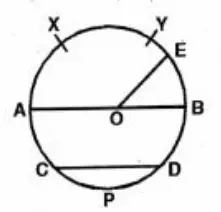
Question 3. With the help of scale and pencil, compass let us draw a circle and indicate centre, chord diameter, radius, major arc, minor arc on it

Answer: Centre O

Chord – CD

Diameter – AB

Radius OE = OA = OB

Minor arc – \(\overline{x y}\)

Major arc – \(\overline{x p y}\)

WBBSE Solutions For Class 10 Maths Chapter 3 Theorems Related To Circle 1

Chapter 3 Theorems Related To Circle Exercise 3.1 True or False

1. The circle is a plane figure.

Answer:  Circle is a rectilinear figure

True

“West Bengal Board Class 10 Maths Chapter 3 Theorems Related to Circle Exercise 3.1 solutions”

2. The segment is a plane region.

Answer:  A segment of a circle is a rectilinear figure.

True

3. The sector is a plane region.

Answer:  The sector is rectilinear.

True

4. The chord is a line segment.

Answer: A chord is a line segment.

True

5. The arc is a line segment.

Answer:  Arc is a line segment.

False

6. There are a finite number of chords of the same length in a circle.

Answer:  A circle contains an infinite number of equal chords.

False

7. One and only one circle can be drawn by taking a fixed point as its center.

Answer:  Only one circle can be drawn with a center.

False

8. The lengths of the radii of two congruent circles are equal.

Answer:  The lengths of the radius of two congruent circles are equal.

True

“WBBSE Class 10 Theorems Related to Circle Exercise 3.1 solutions explained”

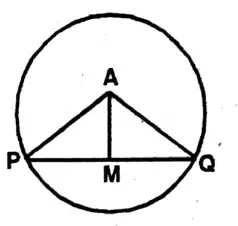
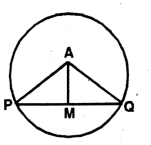
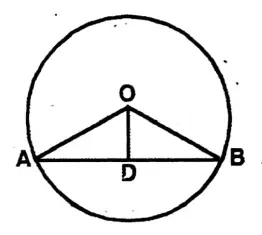
Question 1. I draw a chord PQ of the circle with the Centre, which is not a diameter. I draw a perpendicular  on  from . I prove with reason that  MQ:

Solution: PQ is a chord of a circular with Centre A. AM is the perpendicular from A to PQ

To prove, PM = MQ Join A, P and A, Q.

Proof: In two right angled triangles APM & AQM,

Hypotenuse AP = Hypotenuse AQ  [Radii of same circle] AM common.

∴ ΔAPM = ΔAQM (R.H.S)

∴ PM = MQ (Corresponding sides). Proved.

WBBSE Solutions For Class 10 Maths Chapter 3 Theorems Related To Circle 3

Question 2. I prove the theorem-33 by the proof of congruency of an OBD with the help of the S-A-S axiom of congruency. 

Solution: In ΔOAD & ΔOBD

OA = OB (radii of same circle)

∠OAD = ∠OBD (Corresponding angle)

& AD = DB [∵ D is the mid point of AB]

∴ ΔOAD = ΔOBD

∴ ∠ODA = ∠ODB  (Corresponding angle)

the adjacent angles formed by OD standing on AB are equal.

∴ OD is perpendicular on AB.


WBBSE Solutions For Class 10 Maths Chapter 3 Theorems Related To Circle 5

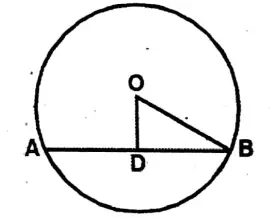
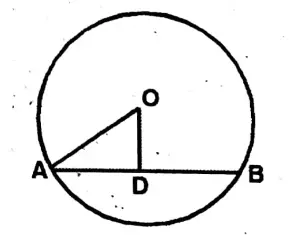
Question 3. The perpendicular distance of a chord from the center of a circle, having a radius of  is in length. Let us write by calculating the length of its chord. 

Solution: Here OB = 17 cm, OD = 8 cm.

∴ B^2=17^2-8^2=289-64=225

∴ BD = √225 = 15 cm

∴ Chord AB = 2 x 15 cm = 30 cm.


WBBSE Solutions For Class 10 Maths Chapter 3 Theorems Related To Circle 7

“WBBSE Class 10 Maths Exercise 3.1 Theorems Related to Circle problem solutions”

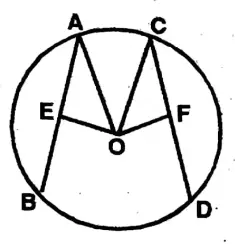
Question 4. I prove with the reason that two equal chords of any circle are equidistant from its centre.

Solution: To prove that two chords of a circle equidistance from the centre are equal.

And OE ⊥ AB, & OF ⊥ CD OE = OF

To prove, AB = CD.

Proof: In two right angled ΔAOE & ΔCOF,

hypotenuse OA = OC (radii of same circle)

OE = OF. (Given)

∴ ΔAOE = ΔCOF

∴ AE = CF (Corresponding sides)

∴ 2 x AE = 2 x CF

∴ AB = CD Proved.

“WBBSE Class 10 Chapter 3 Theorems Related to Circle Exercise 3.1 solution guide”

WBBSE Solutions For Class 10 Maths Chapter 3 Theorems Related To Circle 11

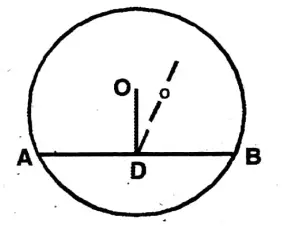
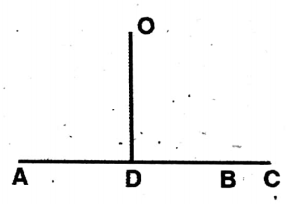
Question 5. Let us prove that the perpendicular bisector of a chord of a circle passes through its centre. 

Solution: The prove that the perpendicular of any chord is passing through the centre of the circle.

Let O is the centre and AB is a chord of the circle.

OD ⊥ AB, if possible, let the perpendicular bisect meets at O1.

i.e., OD & OD1 both are perpendicular on AB; it will be possible it OD0 and OD1 coincide with each other.

∴ The perpendicular bisector of the chord is passing through the centre.


WBBSE Solutions For Class 10 Maths Chapter 3 Theorems Related To Circle 13

“Class 10 WBBSE Maths Exercise 3.1 Theorems Related to Circle step-by-step solutions”

Question 6. Let us prove that a straight line cannot intersect a circle at more than two points. 

Solution: To prove that a straight line cannot cut a circle at not more than two points.

If possible let the straight line cuts two circles with centre O, at A, B & C points.

Draw the perpendicular on OD from the centre O.

∴ AD = DB & AD = DC.

∴ DB = DC; It will be possible if points B coincide with point C.

∴ A straight line can not cut a circle at more than two points.


WBBSE Solutions For Class 10 Maths Chapter 3 Theorems Related To Circle 15

WBBSE Solutions For Class 10 Maths Chapter 3 Theorems Related To Circle Exercise 3.2

WBBSE Solutions For Class 10 Maths Chapter 3 Theorems Related To Circle Exercise 3.2 Solutions

Question 1. The length of a radius of a circle with its centre O is 5cm and the length of its chord AB is 8cm. Let us write by calculating the distance of chord AB from the centre O.

Solution: Centre O, chord AB = 8 cm.

Radius = OA = 5 cm. AD = 4 cm.

\(\mathrm{OD}^2=\mathrm{OA}^2-\mathrm{AD}^2\)

= (5)^2-(4)^2=25-16

\(\mathrm{OD}^2=9\)

∴ OD = 3 cm.

WBBSE Solutions For Class 10 Maths Chapter 3 Theorems Related To Circle 2

“WBBSE Class 10 Maths Theorems Related to Circle Exercise 3.2 solutions”

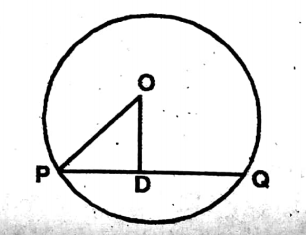
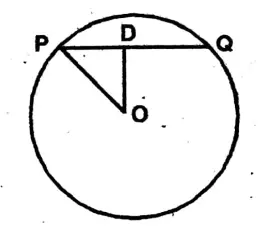
Question 2. The length the diameter of a circle with its centre at O is 26cm. The distance of the chord PQ from point O is 5. Let us write by calculating the length of the chord PQ.

Solution: Diameter = 26 cm

∴ Radius = 13 cm

∴ OP = 13 cm

OD = 5 cm.

Class 10 Maths Class 10 Social Science
Class 10 English Class 10 Maths
Class 10 Geography Class 10 Geography MCQs
Class 10 History Class 10 History MCQs
Class 10 Life Science Class 10 Science VSAQS
Class 10 Physical Science Class 10 Science SAQs
\(P D^2=O P^2-O D^2\)

= \(13^2-5^2=169-25=144\)


WBBSE Solutions For Class 10 Maths Chapter 3 Theorems Related To Circle 4

WBBSE Solutions For Class 10 Maths Chapter 3 Theorems Related To Circle Exercise 3.2

Question 3. The length of a chord PQ of a circle with its centre O is  4cm and the distance of PQ from the point O  is 2.1 cm. Let us write by calculating, the length of its diameter

Solution: Centre O;

chord PQ = 4 cm;

OD = 2.1 cm.

\(\mathrm{PO}^2=\mathrm{OD}^2+\mathrm{PD}^2\)

= \((2.1)^2+(2)^2=4.41+4=8.41\)

\(\mathrm{PO}=\sqrt{8.41}=2.9\)

∴ Radius = 2.9 cm;

Diameter = 2 x 2.9 cm

= 5.8 cm.


WBBSE Solutions For Class 10 Maths Chapter 3 Theorems Related To Circle 6

“West Bengal Board Class 10 Maths Chapter 3 Theorems Related to Circle Exercise 3.2 solutions”

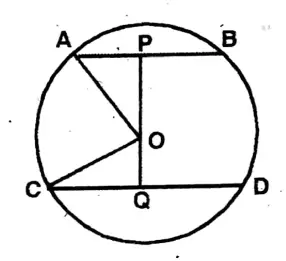
Question 4. The lengths of two chords of a circle with its centre at O are  6CM and 8CM. If the distance of the smaller chord from the centre is 4CM, then let us write by calculating, the distance of another chord from the centre.

Solution: Centre O.

Larger chord CD = 8 cm.

Small chord AB = 6 cm

OP = 4 cm; AP = 3 cm

∴ In △AOP

\(\mathrm{OA}^2=\mathrm{OP}^2+\mathrm{AP}^2\)

= \(4^2+3^2\)

= 16 + 9

= 25

OA = √25

= 5 cm.

∴ OC = 5 cm,

\(\mathrm{CQ}=\frac{1}{2} \mathrm{CD}=\frac{1}{2} \times 8 \mathrm{~cm}=4 \mathrm{~cm}\) \(\mathrm{OQ}^2=\mathrm{OC}^2-\mathrm{CQ}^2=5^2-4^2=25-16=9\)

OQ = √9 = 3 cm.


WBBSE Solutions For Class 10 Maths Chapter 3 Theorems Related To Circle 8

“WBBSE Class 10 Theorems Related to Circle Exercise 3.2 solutions explained”

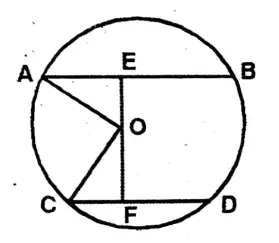
Question 5. If the length of a chord of a circle is 48CM  and the distance of it from the centre is 7CM, then let us write by calculating the length of the radius of the circle.

Solution: Centre O; AB = AD = 48 cm, OE = 7 cm.

\(\mathrm{OA}^2=\mathrm{AE}^2+\mathrm{OE}^2(24)^2+(7)^2\)

= 576 + 4 = 625

∴ OA = √625 = 25

∴ OC = 25 cm; OF = 20 cm.

\(\mathrm{CF}^2=\mathrm{OC}^2-\mathrm{OF}^2=25^2-20^2=625-400=225\)

CF = √225 = 15 cm.

CD = 2 x CF = 2 x 15 = 30 cm.

Length of the 2nd chord = 30 cm.


WBBSE Solutions For Class 10 Maths Chapter 3 Theorems Related To Circle 10

WBBSE Solutions For Class 10 Maths Chapter 3 Theorems Related To Circle 11

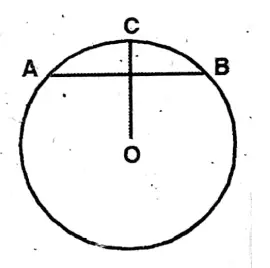
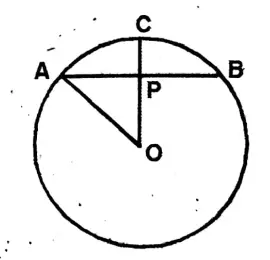
Question 6. In the circle of the adjoining figure with its centre at O, OP⊥AB;  if  AB = 6CM and PC = 2CM, then let us write by calculating the length of the radius of the circle.

Solution: Centre of the circle O.

Chord AB = 6 cm, AP = 3 cm, PC = 2 cm.

Let Radius OA = OC = r cm.

OP = OC – PC

= (r – 2)cm.

\(\mathrm{OA}^2=\mathrm{OP}^2+\mathrm{AP}^2\) \(r^2=(r-2)^2+3^2\) \(r^2=r^2-4 r+4+9\)

4r = 13.

∴ r = \(\frac{13}{4}\) cm.

= 3.25 cm.

WBBSE Solutions For Class 10 Maths Chapter 3 Theorems Related To Circle 13

“WBBSE Class 10 Maths Exercise 3.2 Theorems Related to Circle problem solutions”

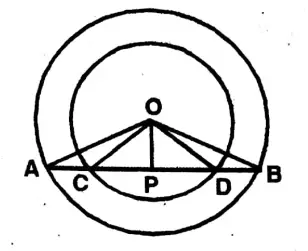
Question 7. A straight line intersects one of the two concentric circles at points A and B and the other at points C and D. I prove with the reason that AC=DB.

Solution: A straight line AB cuts two concentric circles with centre O at A & B and C & D points.

To prove, AC = BD.

As OP is the perpendicular on the chord AB.

∴ AP = BP

Again, OP is the perpendicular on the chord CD.

∴ CP = DP

∴ AP – CP = BP – DP

Or, AC = BD (Proved)


WBBSE Solutions For Class 10 Maths Chapter 3 Theorems Related To Circle 15

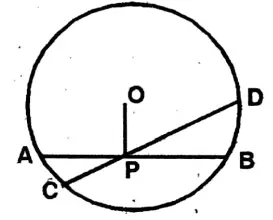
Question 8. I prove that the two intersecting chords of any circle cannot bisect each other unless both of them are diameters of the circle.

Solution: Let O is centre of the circle. Two chords AB & CD interest each other at P, such that the point P is the midpoint of AB.

To prove: P is not the midpoint of CD. Join O, P.

Proof: As P is the midpoint by AB.

∴ OP ⊥ AB

Again, chord AB & CD passing through P. It is not possible that AB & CD both are perpendicular on OP at P.

As AB is perpendicular on OP.

∴ CD is not the perpendicular on OP.

Again, the straight line joining the center and midpoint of the chord, is the perpendicular on the chord.

∴ P is not the midpoint of the chord CD.

If the both straight lines be the diameter, then they will bisect each other.


WBBSE Solutions For Class 10 Maths Chapter 3 Theorems Related To Circle 17

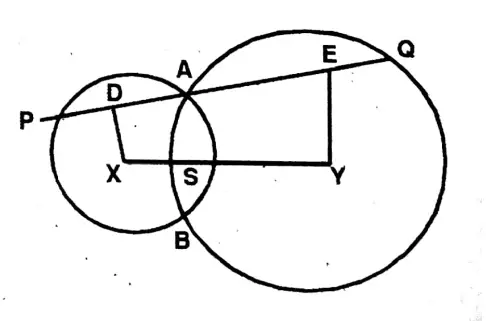
Question 9. The two circles with centres X and Y intersect each other at points  A and B. A is joined with the mid-point ‘ S ‘ of  XY and the perpendicular on SA through the point A is drawn which intersects the two circles at the points P and Q. Let us prove that PA = AQ.

Solution: Two circles with centres X & Y intersect each other at A and B. S is the mid joint of the line joining X & Y. Join AS The perpendicular on AS cut the circles at P & Q.

To Prove: AP = AQ.

Construction: From two centres X & Y, two perpendiculars drawn on PQ are XD & YE.

Proof: As three straight lines XD, SA & YE are each perpendicular on PQ.

∴ XD ∥ SA ∥ YE

As S is the midpoint of XY.

∴ SX = SY

As three parallel straight lines XD, SA & YE cut the straight line XY in two equal parts, then the lines XD, A, YE cut the other straight PQ into two equal parts.

i.e., DA = AE [As the straight line XD from Y will perpendicular on chord PA]

∴ DA = \(\frac{1}{2}\)AP

Similarly, YE ⊥ AW,AE = \(\frac{1}{2}\)AQ

As DA = AE

∴ \(\frac{1}{2}\)AP = \(\frac{1}{2}\)AQ


WBBSE Solutions For Class 10 Maths Chapter 3 Theorems Related To Circle 19

“Class 10 WBBSE Maths Exercise 3.2 Theorems Related to Circle step-by-step solutions”

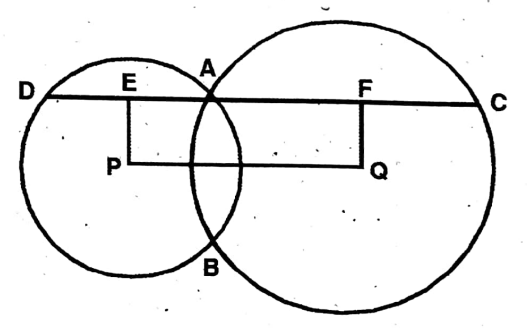
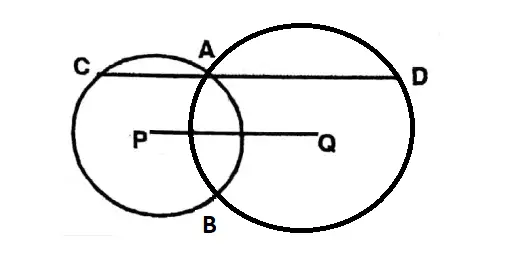
Question 10. The centres of the two circles are P and Q; they intersect at points  A and B. The straight line parallel to the line segment PQ  through point A intersects the two circles at points  C and D.1 prove that CD = 2PQ.

Solution: From the centres P & Q two perpendiculars PE & QF are drawn on CD.

QF bisects AD; AF = \(\frac{1}{2}\)AD.

Again, PE bisects AC; AE = \(\frac{1}{2}\)AC

EF = AF + AE

= \(\frac{1}{2} \mathrm{AD}+\frac{1}{2} \mathrm{AC}\)

EF = \(/frac{1}{2}\)CD

Again, PQ = EF

∴ PQ = \(\frac{1}{2}\)CD

∴ CD = 2PQ (Proved).


WBBSE Solutions For Class 10 Maths Chapter 3 Theorems Related To Circle 24

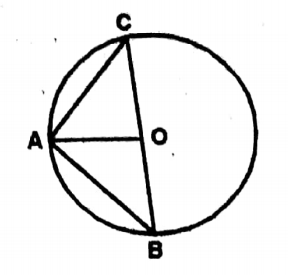
Question 11. The two chords AB and AC of a circle are equal. I prove that the bisector of ∠BAC passes through the centre.

Solution: AB & AC are two equal chords of the circle with centre O.

Join OA & OB

In △AOC & △AOB,

1. OB = OC (Radii of same circle)

2. AO Common

3. AB = AC (Given)

∴ \(\triangle \mathrm{AOC} \cong \triangle \mathrm{AOB}\)

∴ ∠OAV = ∠OAB

∴ OA is the bisector of ∠BAC.

∴ Bisector of ∠BAC, is passing through centre (A).

WBBSE Solutions For Class 10 Maths Chapter 3 Theorems Related To Circle 26

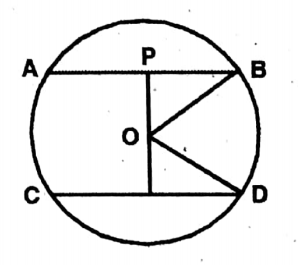
Question 12. I prove that, among two chords of a circle, the length of the chord nearer to the centre is greater than the length of the other.

Solution: AB & CD are two chords of the circle with centre O.

Their distances from the centre are OP & OQ. OP ∠ OQ.

To prove AB > CD Join OB & OD.

As P is the midpoint of AB

∴ PB = \(\frac{1}{2}\)AB and Q is the midpoint of CD.

∴QD = \(\frac{1}{2}\)CD

In \(\triangle \mathrm{OPB}, \mathrm{OB}=\sqrt{\mathrm{PB}^2+\mathrm{OP}^2}\)

In \(\triangle O Q D, O D=\sqrt{O Q^2+Q D^2}\)

∴ \(\sqrt{\mathrm{PB}^2+\mathrm{OP}^2}=\sqrt{\mathrm{OQ}^2+\mathrm{QD}^2}\)

\(\mathrm{PB}^2+\mathrm{OP}^2=\mathrm{OQ}^2+\mathrm{QD}^2\)

As OP < OQ

∴ OB > QD

\(\frac{1}{2} \mathrm{AB}>\frac{1}{2} \mathrm{CD}\)

WBBSE Solutions For Class 10 Maths Chapter 3 Theorems Related To Circle 30

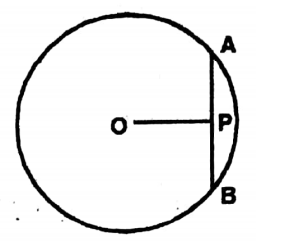
Question 13. Let us write by proving the chord with the least length through any point in a circle.

Solution: P is a point inside the circle.

Chord AB passing through P will be smaller if the point P will be the midpoint of AB.

If P in the mid point of AB

∴ OP ⊥ AB

as perpendicular distance is the shortest distance.

∴ AB is smallest (Proved).

WBBSE Solutions For Class 10 Maths Chapter 3 Theorems Related To Circle 32

Chapter 3 Theorems Related To Circle Exercise 3.2 Multiple Choice Questions

Question 1. The lengths of two chords of a circle with centre O are equal. If ∠AOB = 60°, then the value of ∠COD is

1. 40°
2. 30°
3. 60°
4. 90°

Answer:

The lengths of two chords of a circle with centre O are equal. If ∠AOB = 60°,

AB & CD are two equal chords of the circle with O if LAOB = 60°; then /COD = 60°———-(3)

Question 2. The length of the radius of a circle is 13 cm and the length of a chord of a circle is 10 cm, the distance of the chord from the centre of the circle is

1. 12.5 cm
2. 12 cm
3. √69 cm
4. 24 cm

Answer:

The length of the radius of a circle is 13 cm and the length of a chord of a circle is 10 cm

Radius = 13 cm. length of chord = 10 cm, Distance from the centre = √132 -52

= √169-25

= √144

=12-——(2)

The distance of the chord from the centre of the circle is 12

“WBBSE Class 10 Chapter 3 Theorems Related to Circle Exercise 3.2 solution guide”

Question 3. AB and CD are two equal chords of a circle with its centre O. If the distance of the chord AB from the point O is 4 cm then the distance of the chord from the centre O of the circle is

1. 2 cm
2. 4 cm
3. 6 cm
4. 8 cm

Answer:

AB and CD are two equal chords of a circle with its centre O. If the distance of the chord AB from the point O is 4 cm

AB & CD are two equal chords.

If the distance of AB from the centre O = 4 cm.

then the distance of CD from the centre O 4 cm. ——- -(2)

Question 4. The length of each of the two parallel chords is 16 cm. If the length of the radius of the circle is 10 cm., then the distance between two chords is

1. 12 cm.
2. 16 cm.
3. 20 cm.
4. 5 cm.

Answer:

The length of each of the two parallel chords is 16 cm. If the length of the radius of the circle is 10 cm

Two parallel chords of equal length 16 cm.

Length of the radius = 10 cm.

Distance between them = √102-82 + √102-826+6 12 cm. ————(1)

Question 5. The centre of two concentric circles is O; a straight line intersects a circle at points A and B and the other circle at the point C and D. If AC = 5 cm, then the length of BD is

1. 2.5 cm
2. 5 cm
3. 10 cm
4. None of these

Answer:

The centre of two concentric circles is O; a straight line intersects a circle at points A and B and the other circle at the point C and D. If AC = 5 cm

When a straight line cuts two concentric circles at A & B and C & D points, AC = BD.

BD 5 cm.———–(2)

Chapter 3 Theorems Related To Circle Exercise 3.2 True or False

1. Only one circle can be drawn through three collinear points.

Answer: False

2. The two circles ABCDA and ABCEA are the same circle.

Answer: True

3. If two circles AB and AC of a circle with its centre O are situated on opposite sides of the radius OA, then LOAB = LOAC.

Answer: False

Chapter 3 Theorems Related To Circle Exercise 3.2  Fill In The Blanks

Question 1. If the ratio of two chords PQ and RS of a circle with its centre O is 1: 1, then, LPOQ: LROS =—————–

Answer: LPOQ: LROS = 1:1.

Question 2. The perpendicular bisector of any chord of a circle is—————–

Answer: Passing through the centre.

“West Bengal Board Class 10 Maths Exercise 3.2 Theorems Related to Circle solutions”

Chapter 3 Theorems Related To Circle Exercise 3.2 Short Answers

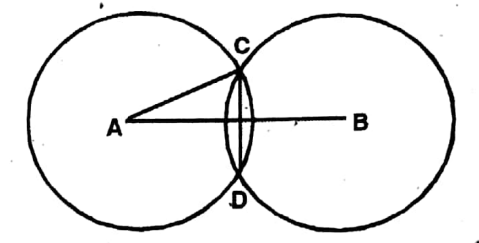
Question 1. Two equal circles of radius 10 intersect each other and the length of their common chord is 12 cm. Let us determine the distance between the two centres of the two circles.

Solution: CD = 12 cm.

∴ CO = \frac{12}{2} = 6 cm.

AO = \sqrt{10^2-6^2}=\sqrt{64}=8

AB = 2 x 8 = 16 cm.

∴ Distance between two centres = 16 cm.


WBBSE Solutions For Class 10 Maths Chapter 3 Theorems Related To Circle 34

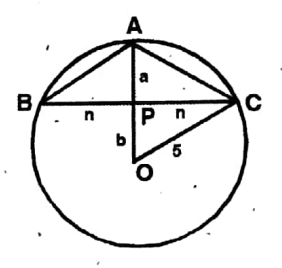
Question 2. AB and AC are two equal chords of a circle having a radius of 5 cm. The centre of the circle is situated at the outside of the triangle ABC. IF AB = AC = 6 cm, then let us calculate the length of the chord BC.

Solution: AB = AC = 6 cm.

OA = 5 cm.

Let AP = a cm. PO = b cm.

OA = a + b = 5 cm.

\(\mathrm{BP}=\mathrm{CP}=\mathrm{na}^2+\mathrm{n}^2\)

= \(6^2 \& b^2+n^2\)

= \(5^2 a^2+n^2-b^2-n^2\)

= \(6^2-5^2\)

= 36 – 25

= \(11 a^2-b^2\)

= 11.(a – b) x (a + b)

= 11

∴ (a – b) x 5 = 11a – b

= \(\frac{11}{5} \mathrm{a}=\frac{1}{2}\left(\frac{11}{2}+5\right)=\frac{18}{5}\)

∴ \(n=\sqrt{6^2-\left(\frac{18}{5}\right)^2}=\sqrt{36-\frac{324}{25}}=\sqrt{\frac{576}{25}}=\frac{24}{5}\)

∴ \(\mathrm{BC}=2 \mathrm{n}=2 \times \frac{24}{5}=9.6 \mathrm{~cm}\)


WBBSE Solutions For Class 10 Maths Chapter 3 Theorems Related To Circle 36

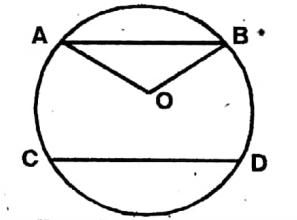
Question 3. The length of two chords AB and CD of a circle with its centre O are equal. If LAOB = 60° and CD = 6 cm, then let us calculate the length of the radius of the circle. Ans. AB = CD = 6 cm.

Solution: AB = CD = 6 cm.

∠AOB = 60°

∴ △AOB is an equilateral triangle.

OA = OB = 6 cm.

∴ Radius = 6 cm.


WBBSE Solutions For Class 10 Maths Chapter 3 Theorems Related To Circle 38

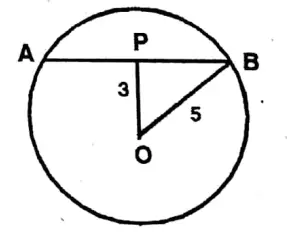
Question 4. P is any point in a circle with its centre O. If the length of the radius is 5 cm and OP = 3 cm, then let us determine the least length of the chord passing through the point P.

Solution: BP = \(\sqrt{5^2-3^2}\)

= \(\sqrt{25-9}=\sqrt{16}=4\)

AB = 2 x BP = 2 x 4 = 8 cm.


WBBSE Solutions For Class 10 Maths Chapter 3 Theorems Related To Circle 40

“Class 10 WBBSE Maths Exercise 3.2 solutions for Theorems Related to Circle”

Question 5. The two circles with their centres at P and Q intersect each other at points A and B. Through point A, a straight line parallel to PQ intersects the two circles at points C and D respectively. If PQ = 5 cm, then let us determine the length of the CD.

Solution: PQ = 5cm, CD = ?

CD = 2PQ = 2 x 5 cm

= 10 cm


WBBSE Solutions For Class 10 Maths Chapter 3 Theorems Related To Circle Exercise

WBBSE Solutions For Class 10 Maths Chapter 1 Quadratic Equations In One Variable Exercise 1.2

WBBSE Solutions For Class 10 Maths Chapter 1 Quadratic Equations In One Variable Exercise 1.2

Question 1: In each of the following cases, let us justify & write whether the given values are the roots of the given quadratic equation:

1. x2+x+1=0

Solution:  f(X) = x2+x+1=0

When x = 1 ;

(1)2+1+1=1+1+1 = 3

Again when x = -1 ;

(-1)2+1(-1)+1=1-1+1 = 1

(1) & (-1) are not the roots of the given equation

“WBBSE Class 10 Maths Quadratic Equations in One Variable Exercise 1.2 solutions”

2. 8x2+7x=0

Solution: f(X) = 8x2+7x=0

When x = 0

8(0) +7(0) = 0

When x = -2

8(-2)2+7(-2) = 32-14= 18

0 & (-2) are not the roots of the given equation.

Chapter Name Solutions
Chapter 1 Quadratic Equations in One Variable Exercise 1 Exercise 2 Exercise 3 Exercise 4 Exercise 5
Chapter 2 Simple Interest Exercise 1 Exercise 2
Chapter 3 Theorems related to Circle Exercise 1 Exercise 2
Chapter 4 Rectangular Parallelopiped or Cuboid Exercise 1 Exercise 2
Chapter 5 Ratio and Proportion Exercise 1 Exercise 2 Exercise 3
Chapter 6 Compound Interest and Uniform Rate of Increase or Decrease Exercise 1 Exercise 2
Chapter 7 Theorems Related To Angles In A Circle Exercise 1 Exercise 2 Exercise 3 Exercise 4 Exercise 5
Chapter 8 Right Circular Cylinder Exercise 1 Exercise 2
Chapter 9 Quadratic Surd Exercise 1 Exercise 2 Exercise 3
Chapter 10 Theorems Related To Cyclic Quadrilateral Exercise 1
Chapter 11 Construction Of Circumcircle and Incircle Of A Traingle Exercise 1 Exercise 2
Chapter 12 Sphere Exercise 1 Exercise 2
Chapter 13 Variation Exercise 1 Exercise 2
Chapter 14 Partnership Business Exercise 1
Chapter 15 Theorems Related To Tangent To A Circle Exercise 1 Exercise 2
Chapter 16 Right Circular Cone Exercise 1
Chapter 17 Construction Of Tangent To A Circle Exercise 1
Chapter 18 Similarity Exercise 1 Exercise 2 Exercise 3 Exercise 4
Chapter 19 Problems Related To Different Solid Objects Exercise 1
Chapter 20 Trigonometry: Concept of Measurement Of Angle Exercise 1
Chapter 21 Construction: Determination Of Mean Proportional Exercise 1
Chapter 22 Pythagoras Theorem Exercise 1
Chapter 23 Trigonometric Ratios And Trigonometric Identities Exercise 1 Exercise 2 Exercise 3
Chapter 24 Trigonometric Ratios Of Complementary Angle Exercise 1
Chapter 25 Application Of Trigonometric Rations: Heights & Distances Exercise 1
Chapter 26 Statistics: Mean, Median, Ogive, Mode Exercise 1 Exercise 2 Exercise 3 Exercise 4

3. x +1/x =13/6

Solution: When x = \(\frac{5}{6}\)

∴ \(\frac{5}{6}+\frac{1}{5 / 6}=\frac{5}{6}+\frac{6}{5}=\frac{25+36}{30}=\frac{61}{30}\)

∴ \(\frac{4}{3}+\frac{1}{4 / 3}=\frac{4}{3}+\frac{3}{4}=\frac{16+9}{30}=\frac{25}{12}\)

And when x = \(\frac{4}{3}\)

5/6 & 4/3 are not the roots of the given equation.

4. x2– √3x-6=0

Solution: f(X) = x2– √3x-6=0

When x = – √3

(√3)2-√3(-√3)-6=3+3-6 = 0

&  When x = 2√3,

(2√3)2-√3 (2√3)-6=12-6-6 = 0

(√3) & (2√3). are the roots of the given equation.

“West Bengal Board Class 10 Maths Chapter 1 Quadratic Equations Exercise 1.2 solutions”

Question 2:

1. Let us calculate and write the value of k for which 2/3 will be a root the quadratic equation 7x2 + kx – 3=0.

Solution: \(7 x^2+k x-3=0\)

As \(\frac{2}{3}\) is one root of the equation \(7 x^2+k x-3=0\)

∴ \(7\left(\frac{2}{3}\right)^2+k \cdot \frac{2}{3}-3=0\)

⇒ \(7 \cdot \frac{4}{9}+\frac{k \cdot 2}{3}-3=0\)

⇒ \(\frac{28}{9}+\frac{2 k}{3}-3=0\)

⇒ \(\frac{2 k}{3}=3-\frac{28}{9}\)

⇒ \(\frac{2 k}{3}=\frac{-1}{9}\)

∴ \(k=\frac{-3}{9 \times 2}=-\frac{1}{6}\)

WBBSE Solutions For Class 10 Maths Chapter 1 Quadratic Equations In One Variable Exercise 1.2

2. Let us calculate and write the value of k for which -a will be a root of the quadratic equation x2 + 3ax + k = 0.

Solution:

Given

x2 + 3ax + k = 0

As (-a) is the root of the equation

x2 + 3ax + k = 0

⇒  (-a)2 + 3a(-a) + k = 0

⇒ +a2-3a2 + k = 0

⇒ -2a2+ k = 0

k =  2a2  Solution

The value of k = 2a2

3. If 2/3 and -3 are the two roots of the quadratic equation ax2 + 7x + b = 0, then Let me calculate the values of a and b.

Solution: When x = \(\frac{2}{3}\)

∴ \(a\left(\frac{2}{3}\right)^2+7\left(\frac{2}{3}\right)+b=0\)

⇒ \(\frac{4 a}{9}+\frac{14}{3}+b=0\)

⇒ \(\frac{4 a+42+9 b}{9}=0\)

4a + 9b = -42

When x = -3

∴ \(a(-3)^2+7(-3)+b=0\)

9a – 21 + b = 0

9a + b = 21

Now, solving 4a + 9b = -42 & 9a + b = 21

we get, a = 3 & b = -6.

“WBBSE Class 10 Quadratic Equations Exercise 1.2 solutions explained”

Question 3: Let us solve

1. 3y2-20 = 160 – 2y2

Solution: \(3 y^2-20=160-2 y^2\)

⇒ \(3 y^2+2 y^2=160+20\)

⇒ \(5 y^2=180\)

⇒ \(5 y^2-180=0\)

⇒ \(5\left(y^2-36\right)=0\)

⇒ \(y^2-36=0\)

⇒ \((y)^2-(6)^2=0\)

∴ (y + 6)(y – 6) = 0

∴ When y + 6 = 0 & when y – 6 = 0

2. (2x+1)2 + (x + 1)2 = 6x + 47

Solution: \((2 x+1)^2+(x+1)^2=6 x+47\)

⇒ \(4 x^2+4 x+1+x^2+2 x+1-6 x-47=0\)

⇒ \(5 x^2-45=0\)

⇒ \(5\left(x^2-9\right)=0\)

⇒ \((x)^2-(3)^2=0\)

⇒ (x + 3)(x – 3) = 0

∴ Either x + 3 = 0

x = -3

Or, x – 3 = 0

∴ x = -3

3. (x-7) (x-9) = 195

Solution: (x – 7)(x – 9) = 195

⇒ \(x^2-7 x-9 x+63-195=0\)

⇒ \(x^2-16 x-132=0\)

⇒ \(x^2-22 x+6 x-132=0\)

⇒ x(x – 22) + 6(x – 22) = 0

⇒ (x – 22)(x + 6) = 0

∴ Either x – 22 = 0

x = 22

or, x + 6 = 0

∴ x = -6.

“WBBSE Class 10 Maths Exercise 1.2 Quadratic Equations problem solutions”

4. 3x-24/x=x/3, x ≠ 0

Solution: \(\frac{3 x^2-24}{x}=\frac{x}{3}\)

⇒ \(\left(3 x^2-24\right) \times 3=x^2\)

⇒ \(9 x^2-72-x^2=0\)

⇒ \(8 x^2-72=0\)

⇒ \(8\left(x^2-9\right)=0\)

⇒ \(\left(x^2-9\right)=0\)

⇒ \((x)^2-(3)^2=0\)

⇒ (x + 3)(x – 3) = 0

Either x + 3 = 0

∴ x = -3

or, x – 3 = 0

∴ x = 3.

5. \(\frac{x-2}{x+2}+\frac{6(x-2)}{x-6}=1\), x ≠ -2 , 6

Solution: \(\frac{x-2}{x+2}+\frac{6(x-2)}{x-6}=1\)

⇒ \(\frac{(x-2)(x-6)+6(x-2)(x+2)}{(x+2)(x-6)}=1\)

⇒ \(x^2-8 x+12+6\left(x^2-4\right)=(x+2)(x-6)\)

⇒ \(7 x^2-8 x-12=x^2+2 x-6 x-12\)

⇒ \(7 x^2-8 x-12-x^2+4 x+12=0\)

⇒ \(6 x^2-4 x=0\)

⇒ 2x(3x – 2) = 0

Either 2x = 0

∴ x = 0

Or, 3x – 2 = 0

∴ x = 2/3

6. \(\frac{x+5-(x-3)}{(x-3)(x+5)}=\frac{1}{6}\), x ≠ 3,-5

Solution: \(\frac{x+5-(x-3)}{(x-3)(x+5)}=\frac{1}{6}\)

⇒ \(\frac{x+5-x+3}{x^2+5 x-3 x-15}=\frac{1}{6}\)

⇒ \(x^2+2 x-15=48\)

⇒ \(x^2+2 x-63=0\)

⇒ \(x^2+9 x-7 x-63=0\)

⇒ x(x + 9) – 7(x + 9) = 0

⇒ (x + 9)(x – 7) = 0

∴ Either x + 9 = 0

∴ x = -9

or, x – 7 = 0

∴ x = 7.

7. \(\frac{x}{x+1}+\frac{x+1}{x}=2 \frac{1}{12}\), x ≠ 0 , -1

Solution: \(\frac{x}{x+1}+\frac{x+1}{x}=2 \frac{1}{12}\)

⇒ \(\frac{x^2+(x+1)^2}{x(x+1)}=\frac{25}{12}\)

⇒ \(\left(x^2+x^2+2 x+1\right) \times 12=25\left(x^2+x\right)\)

⇒ \(24 x^2+24 x+12=25 x^2+25 x\)

⇒ \(24 x^2-25 x^2+24 x-25 x+12=0\)

⇒ \(-x^2-x+12=0\)

⇒ \(x^2+x-12=0\)

⇒ (x + 4).(x – 3) = 0

Either x + 4 = 0

∴ x = -4

or, x – 3 = 0

∴ x = 3.

8. \(\frac{a x+b}{a+b x}=\frac{c x+d}{c+d x}\)[x≠ b, c≠ d] , x≠ a/b , -c/d

Solution: \(\frac{a x+b}{a+b x}=\frac{c x+d}{c+d x}\)

⇒ (ax + b)(c + dx) = (a + bx).(cx + d)

⇒ \(a c x+b c+a d x^2+b d x=a c x+b c x^2+a d+b d x\)

⇒ \(a d x^2-b c x^2+b d x-b d x+a c x-a c x=a d-b c\)

⇒ \(x^2 \cdot(a d-b c)=(a d-b c)\)

∴ \(x^2=\frac{a d-b c}{a d-b c}=1\)

∴ x = ±1

∴ x = +1

“Class 10 WBBSE Maths Exercise 1.2 Quadratic Equations step-by-step solutions”

9. \((2 x+1)+\frac{3}{2 x+1}=4\), x≠ -1/2

Solution: \((2 x+1)+\frac{3}{2 x+1}=4\)

⇒ \(\frac{(2 x+1)^2+3}{2 x+1}=4\)

⇒ \(4 x^2+4 x+1+3=8 x+4\)

⇒ \(4 x^2+4 x-8 x+4-4=0\)

⇒ \(4 x^2-4 x=0\)

⇒ 4x(x – 1) = 0

∴ Either 4x = 0

∴ x = 0

Or, x – 1 = 0

∴ x = 1

10. \(\frac{x+1}{2}+\frac{2}{x+1}=\frac{x+1}{3}+\frac{3}{x+1}-\frac{5}{6}\), x≠ -1

Solution: \(\frac{x+1}{2}+\frac{2}{x+1}=\frac{x+1}{3}+\frac{3}{x+1}-\frac{5}{6}\)

⇒ \(\frac{2}{x+1}-\frac{3}{x+1}=\frac{x+1}{3}-\frac{x+1}{2}-\frac{5}{6}\)

⇒ \(\frac{2-3}{x+1}=\frac{2(x+1)-3(x+1)-5}{6}\)

⇒ \(\frac{-1}{x+1}=\frac{2 x+2-3 x-3-5}{6}\)

⇒ \(-\frac{1}{x+1}=\frac{-x-6}{6}\)

∴ \(-\frac{1}{x+1}=\frac{-(x+6)}{6}\)

\(x^2+7 x+6=6\)

⇒ \(x^2+7 x=0\)

⇒ x(x + 7) = 0

∴ Either x = 0

or, x + 7 = 0

∴ x = -7

“Class 10 WBBSE Maths Exercise 1.2 solutions for Quadratic Equations”

11. \(\frac{x+3}{x-3}+\frac{6(x-3)}{x+3}=5\), x≠ 3 , -3

Solution: \(\frac{x+3}{x-3}+\frac{6(x-3)}{x+3}=5\)

or, \(\frac{(x+3)^2+6(x-3)^2}{(x-3)(x+3)}=5\)

or, \(x^2+6 x+9+6\left(x^2-6 x+9\right)=5\left(x^2-9\right)\)

or, \(7 x^2-30 x+9+54-5 x^2+45=0\)

or, \(2 x^2-30 x+108=0\)

or, \(x^2-15 x+54=0\)

or, \(x^2-9 x-6 x+54=0\)

or, x(x – 9) – 6(x – 9) = 0

or, (x – 9)(x – 6) = 0

Either x – 9 =0

∴ x = 9

Or, x – 6 = 0

∴ x = 6

12. \(\frac{1}{a+b+x}=\frac{1}{a}+\frac{1}{b}+\frac{1}{x}\), x≠ 0 , -(a+b)

Solution: \(\frac{1}{a+b+x}=\frac{1}{a}+\frac{1}{b}+\frac{1}{x}\)

or, \(\frac{1}{a+b+x}-\frac{1}{x}=\frac{1}{a}+\frac{1}{b}\)

or, \(\frac{x-(a+b+x)}{x(a+b+x)}=\frac{b+a}{a b}\)

or, \(\frac{x-a-b-x}{x^2+a x+b x}=\frac{a+b}{a b}\)

or, \(\frac{-(a+b)}{x^2+a x+b x}=\frac{a+b}{a b}\)

or, \(x^2+a x+b x=-a b\)

or, \(x^2+a x+b x+a b=0\)

or, x(x + a) + b(x + a) = 0

or, (x + a)(x + b) = 0

Either x + a = 0

∴ x = -a

or, x + b = 0

∴ x = -b.

“WBBSE Class 10 Chapter 1 Quadratic Equations in One Variable Exercise 1.2 solution guide”

13. \(\frac{1}{x}-\frac{1}{x+b}=\frac{1}{a}-\frac{1}{a+b}\), x ≠ 0 , -b

Solution: \(\frac{1}{x}-\frac{1}{x+b}=\frac{1}{a}-\frac{1}{a+b}\)

or, \(\frac{1}{x}-\frac{1}{a}=\frac{1}{x+b}-\frac{1}{a+b}\)

or, \(\frac{a-x}{a x}=\frac{(a+b)-(x+b)}{(x+b)(a+b)}\)

or, \(\frac{a-x}{a x}=\frac{a+b-x-b}{a x+a b+b x+b^2}\)

or, \(\frac{a-x}{a x}=\frac{a-x}{a x+b x+a b+b^2}\)

or, \(\frac{a-x}{a x}-\frac{a-x}{x(a+b)+b(a+b)}=0\)

\((a-x)\left[\frac{1}{a x}-\frac{1}{x(a+b)+b(a+b)}\right]=0\)

Either a – x = 0

∴ x = a

or, \(\frac{1}{a x}-\frac{1}{(a+b) x+b(a+b)}=0\)

or, (a + b)x + (a + b)b = ax

or, \(a x+b x+a b+b^2-a x=0\)

∴ \(b x=-a b-b^2\)

∴ bx = -b(a + b)

∴ x = -(a + b) & x = a

14. \(\frac{1}{(x-1)(x-2)}-\frac{1}{(x-2)(x-3)}+\frac{1}{(x-3)(x-4)}=\frac{1}{6}\), x≠ 1,2,3,4

Solution: \(\frac{1}{(x-1)(x-2)}-\frac{1}{(x-2)(x-3)}+\frac{1}{(x-3)(x-4)}=\frac{1}{6}\)

or, \(\frac{1}{x-2}-\frac{1}{x-1}+\frac{1}{x-3}-\frac{1}{x-2}+\frac{1}{x-4}-\frac{1}{x-3}=\frac{1}{6}\)

or, \(\frac{1}{x-4}-\frac{1}{x-1}=\frac{1}{6}\)

or, \(\frac{(x-1)-(x-4)}{(x-4)(x-1)}=\frac{1}{6}\)

or, \(\frac{x-1-x+4}{x^2-5 x+4}=\frac{1}{6}\)

∴ \(x^2 – 5x + 4 = 18\)

or, \(x^2-5 x+4-18=0\)

or, \(x^2-5 x-14=0\)

or, \(x^2-7 x+2 x-14=0\)

or, (x – 7) + 2(x – 7) = 0

or, (x – 7)(x + 2) = 0

Either x – 7 = 0

x = 7

or, x + 2 = 0

x = -2

15. a/x-a + b/x-b = 2c/x-c , x≠ a b,c 

Solution: \(\frac{a}{x-a}-\frac{c}{x-c}=\frac{c}{x-c}-\frac{b}{x-b}\)

or, \(\frac{a(x-c)-c(x-a)}{(x-a)(x-c)}=\frac{c(x-b)-b(x-c)}{(x-c)(x-b)}\)

or, \(\frac{a x-a c-c x-a c}{x-a}=\frac{c x-b c-b x+b c}{x-b}=0\)

or, \(\frac{x(a-c)}{x-a}-\frac{x(c-b)}{x-b}=0\)

or, \(x\left[\frac{a-c)}{x-a}-\frac{(c-b)}{x-b}\right]=0\)

∴ Either x = 0 (1)

or, \(\frac{a-c}{x-a}=\frac{c-b}{x-b}\)

(a – c)(x – b) = (c – b)(x – a)

ax – cx – ab + bc = cx – bx – ac + ab

ax – cx – cx + bx = ab + ab – ac – bc

x(a + b – 2c) = 2ab – av – bc

∴ \(x=\frac{2 a b-a c-b c}{a+b-2 c} \& x=0\)

16. x2-(√3+2)x+2√3-0

Solution: \(x^2-\sqrt{3} x-2 x+2 \sqrt{3}=0\)

or, x(X – √3) – 2(x – √3) = 0

or, (x – √3)(x – 2) = 0

∴ Either x – √3 = 0

∴ x = √3

Or, x – 2 = 0

∴ x = 2.

“West Bengal Board Class 10 Maths Exercise 1.2 Quadratic Equations solutions”

Question 17. The unit digit of a two-digit number exceeds the tens digit by 6 and the product of two digits is less by 12 than the number, let us write by calculating the possible unit digit of the two-digit number.

Solution: Let in a two digit number the digit in the tenth place is x.

∴ Digit in the unit place is x + 6.

∴ The two digited number is 10x + x + 6.

According to the given problem,

x(x + 6) + 12 = 10x + x + 6

or, \(x^2+6 x+12=11 x+6\)

or, \(x^2+6 x-11 x+12-6=0\)

or, \(x^2-5 x+6=0\)

or, \(x^2-3 x-2 x+6=0\)

or, x(x – 3) – 2(x – 3) = 0

∴ (x – 3)(x – 2) = 0

WBBSE Solutions For Class 10 Maths Chapter 2 Simple Interest Exercise 2.1

WBBSE Solutions For Class 10 Maths Chapter 2 Simple Interest Exercise 2.1

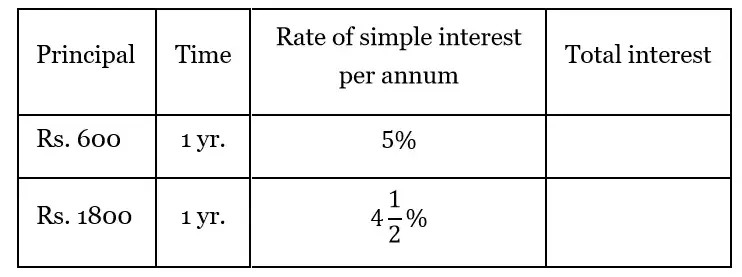
Question 1:

WBBSE-Solutions-For-Class-10-Maths-Chapter-2-Simple-Interest-1-4.

1. Solution: Interest on Rs. 100 for 1 year is Rs. 5.

∴ Interest on Rs. 600 for 1 year Rs. \(\frac{5}{100} \times 600=30\).

∴ Interest = Rs. 30

2. Solution: Interest on Rs. 100 for 1 year is Rs. \(4 \frac{1}{2}=\text { Rs. } \frac{9}{2}\)

Interest on Rs. 1800 for 1 year \(\text { Rs. } \frac{9}{2} \times \frac{1800}{100}=\text { Rs: } 81\)

Read and Learn More WBBSE Solutions For Class 10 Maths

Question 2. In one year, if Shraboni would get Rs. 60 as interest at the rate of simple interest 5% per annum in the bank, then how much amount would she de posit, let us calculate and write it. 

Solution: Rs. 5 is the interest for 1 year when the principal is Rs. 100.

Rs. 1 is the interest for 1 year when the principal is Rs. \(\frac{100}{5}\)

Rs. 60 is the interest for 1 year when the principal is Rs. \(\frac{100}{5} \times 60=\text { Rs. } 1200\)

∴ Principal = Rs. 1200.

“WBBSE Class 10 Maths Simple Interest Exercise 2.1 solutions”

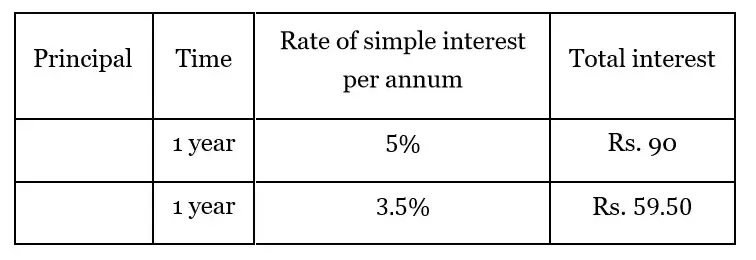
Question 3:

WBBSE Solutions For Class 10 Maths Chapter 2 Simple Interest Exercise 4

1. Solution: Rs. 6 is the interest for 1 year when the principle is Rs. 100.

Rs. 1 is the interest for 1 year when the principal is Rs. \(\frac{100}{6}\)

Rs. 90 is the interest for 1 year when the principal is \(\text { Rs. } \frac{100}{6} \times 90=\text { Rs. } 1500\)

∴ Principal = Rs. 1500.

2. Solution: Rs. 3.5 is the interest for 1 year when the principal is Rs. 100

Rs. 59.50 is the interest for 1 year when the principal = Rs. \(\frac{100}{3.5} \times 59.50=\text { Rs. } 1700\)

∴ Principal = Rs. 1700.

Class 10 Maths Class 10 Social Science
Class 10 English Class 10 Maths
Class 10 Geography Class 10 Geography MCQs
Class 10 History Class 10 History MCQs
Class 10 Life Science Class 10 Science VSAQS
Class 10 Physical Science Class 10 Science SAQs

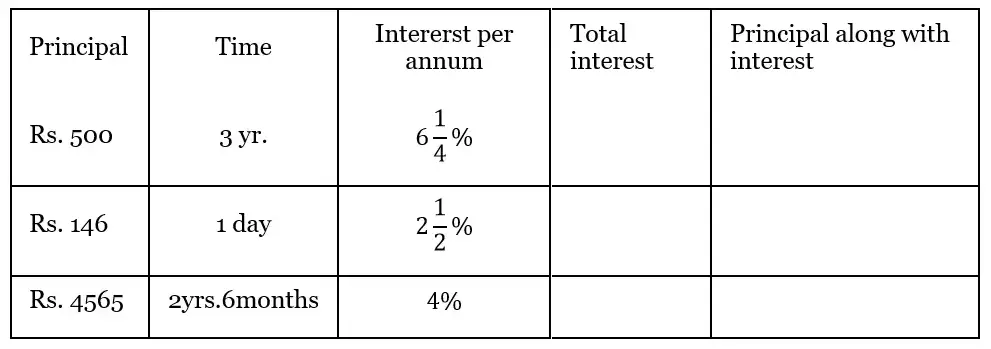
Question 4:

WBBSE Solutions For Class 10 Maths Chapter 2 Simple Interest Exercise 7

1. Solution: Interest (I) = \(\frac{\text { Principal }(P) \times \text { Rate }(r) \times \text { time }(t)}{100}\)

= \(\text { Rs. } \frac{500 \times \frac{25}{4} \times 3}{100}\)

= \(5 \times \frac{25}{4} \times 3 \text { Rs. } 93.75\)

Amount (P + I) = Rs. (500 + 93.75) = Rs. 593.75

2. Solution: Here P = R Rs. 146,

r = \(2 \frac{1}{2} \%=\frac{5}{2} \%\)

t = 1 day

= \(\frac{1}{365} \text { Interest }=\frac{146 \times \frac{5}{2} \times \frac{1}{365}}{100}\)

= Rs. \(\frac{1}{100}\) = Rs. 0.01 Amount

= Rs. (146 + 0.01) = 146.01

“West Bengal Board Class 10 Maths Chapter 2 Simple Interest Exercise 2.1 solutions”

3. Solution: Here P = Rs. 4565;

r = 4%;

t = 2 years 6 months

= 2 \(\frac{1}{2}\) years.

= \(\frac{5}{2}\) years.

Interest = Rs. \(\frac{4565 \times 4 \times \frac{5}{2}}{100}\)

= Rs. \(\frac{4565 \times 10}{100}\)

= Rs. 456.50 Amount = Rs. (4565 + 456.50)

= Rs. 5021.50

WBBSE Solutions For Class 10 Maths Chapter 2 Simple Interest Exercise 2.1

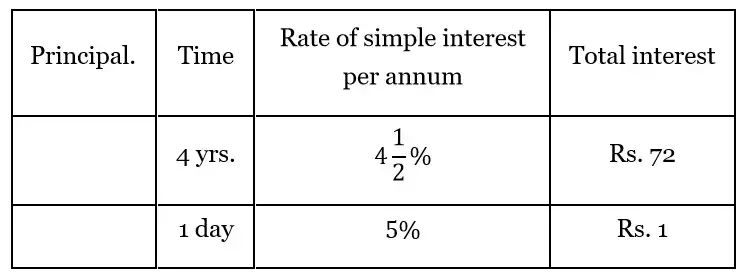
Question 5: Let us write in the blank calculate it

WBBSE Solutions For Class 10 Maths Chapter 2 Simple Interest Exercise 8

1. Solution: Here P = \(\frac{\mid \times 100}{r \times t}\)

Here I = Rs. 72

r = \(4 \frac{1}{2} \%=\frac{9}{2} \%\)

t = 4 years.

= \(\text { Rs. } \frac{72 \times 100}{\frac{9}{2} \times 4}\)

= \(\text { Rs. } \frac{72 \times 100}{18}\)

= Rs. 400

2. Solution: Here P = \(\frac{I \times 100}{r \times t}\)

= Here I = Rs. 1

r = 5%

t = 1 day = \(\frac{1}{365}\)

= \(\frac{1 \times 100}{5 \times \frac{1}{365}}\)

= Rs. 73 x 100

= Rs. 7300.

Question 6:

Principal Time Rate of simple interest per annum Principal with interest
Rs.6400 4 ½% Rs.1008
Rs.500 5% 6%


Solution: 1. Time = \(\frac{\text { Interest } \times 100}{\text { Principal } \times \text { rate }}\)

Here, Interest = Rs. 1008

Rate = \(4 \frac{1}{2}\)% = \(\frac{9}{2}\)%

Principal = Rs. 6,400

= \(\frac{1008 \times 100}{6400 \times \frac{9}{2}}\)

Time = \(\frac{1008}{32 \times 9}\)

= 3.5 years

= \(3 \frac{1}{2}\) years.

2. Solution: Time = \(\frac{\text { Interest } \times 100}{\text { Principal } \times \text { Rate }}\)

Here, Interest = Rs. 50

Rate = 5%

Principal = Rs. 500

= \(\frac{50 \times 100}{500 \times 5}\)

= 2 years

∴ Time = 2 years.

“WBBSE Class 10 Simple Interest Exercise 2.1 solutions explained”

Question 7. Let us determine the rate of simple interest in percent per annum if the interest of Rs. 500 in 4 yrs. is 100.

Solution:

1st process:

Principal = Rs. 500,

Interest = Rs. 100,

Time = 4 years,

Rate = ?

Interest on Rs. 500 for 4  yrs is 100.

Interest on Rs. 100 for 1 yrs is \(\frac{100}{500} \times 100\)

Interest on Rs. 100 for 1 yr is \(\frac{100 \times 100}{500 \times 4}=5\)

∴ Rate = 5%

Question 8. By calculating let us write the rate of simple interest in percent per annum when the principal with interest of Rs. 910 in 2 yrs. 6 months will be Rs. 955.50.

Solution: Here, Principal = Rs. 910

Interest = Rs. (955.50 – 910)

= Rs. 45.50

Time = 2 years 6 months

= \(2 \frac{1}{2} \mathrm{yrs}\)

= \(\frac{5}{2}\) yrs

∴ Rate = \(\frac{\text { Interest } \times 100}{\text { Principal } \times \text { Time }}\)

= \(\frac{45.50 \times 100}{910 \times \frac{5}{2}}\)

= \(\frac{4550 \times 2}{910 \times 5}=2 \%\)

∴ Rate = 2%.

“WBBSE Class 10 Maths Exercise 2.1 Simple Interest problem solutions”

Question 9. The amount (principal along with interest) of same money becomes Rs. 496 in 3 yrs. and Rs. 560 in 5 yrs. at the same rate of simple interest in percent per annum. By calculating, let us write the principal and the rate of simple interest in percent per annum.

Solution: Principal + Interest for 5  years = Rs. 560

& Principal + Interest for 3 years = Rs. 496

∴ Interest for 2 years = Rs. 64

∴ Interest for 1 year = Rs. \(\frac{64}{2}\) = 32

& Interest for 3 years = Rs. 32 x 3 = Rs. 96

∴ Principal + Interest for 3 years = Rs. 496

Interest for 3 years = Rs. 96

∴ Principal = Rs.(496 – 96) = Rs. 400

Rate = \(\frac{\text { Interest } \times 100}{\text { Principal } \times \text { Time }}=\frac{96 \times 100}{400 \times 3}=8\)

∴ Rate = 8%.

Question 10. Bimalkaku deposited Rs. 1,87,500 for his son of 12 yrs. age and daughter of 14 yrs. age in the bank at the rate of simple interest  per annum in such away that both of them will get equal principal along with interest after reaching their 18 yrs. of age. Let us calculate the money he had deposited in the bank for each of his son and daughter.

Solution: Let Bimal babu deposited Rs. x for his 12 yrs old son & Rs. y for his 14 yrs old daughter.

∴ x + y = 187500

When his son will be 18 yrs, i.e., after 6 yrs, h son’s amount = Rs. \(\left(x+\frac{x \times 6 \times 5}{100}\right)\)

= \(\frac{10 x+3 x}{5}=\text { Rs. } \frac{13 x}{10}\)

Again, when his daughter will be 18 years, i.e., after 4 yrs.

His daughter’s amount = Rs \(\left(y+\frac{y \times 4 \times 85}{100}\right)=\frac{5 y+y}{, 5}=\frac{6 y}{5}\)

According to the problem,

\(\frac{13 x}{10}=\frac{6 y}{5}\)

or, 13x – 12y = 0

x + y = 187500

or, 12x + 12y = 12 x 187500 = 2250000

& 13x – 12y = 0

Adding, 25x = 2250000

x = \(\frac{2250000}{25}=90000\)

y = 187500 – 90000= 97500

“Class 10 WBBSE Maths Exercise 2.1 Simple Interest step-by-step solutions”

Question 11. Jayanta deposits Rs. 1000 on the first day of every month in monthly savings scheme. In the bank, if the rate of simple interest is  per annum, then let us calculate the amount Jayanta will get at the end of 6 months.

Solution: Interest on Rs. 1000 at the rate 5% for each month

= Rs. \(\left[\frac{1000 \times 5 \times 6}{100 \times 12}+\frac{1000 \times 5 \times 5}{100 \times 12}+\frac{1000 \times 5 \times 4}{100 \times 12}+\frac{1000 \times 5 \times 3}{100 \times 12}+\frac{1000 \times 5 \times 2}{100 \times 12}+\frac{1000 \times 5 \times 1}{100 \times 12}\right]\)

= Rs. \(\frac{1000 \times 5}{100 \times 12}[6+5+4+3+2+1]=\text { Rs. } \frac{50}{12} \times 21=\text { Rs. } \frac{175}{2}=87.50\)

Amount = Rs.(1000 x 6 + 87.50) = Rs. (6000 + 87.50)

= Rs. 6087.50

Question 12. Soma aunti deposits Rs. 6,20,000 in such a way in three banks at the rate of simple interest of  per annum for 2 yrs. and . respectively so that the total interests in the 3 banks are equal. Let us calculate the money deposited by Soma aunti in each of the three banks.

Solution: Let Soma aunti deposited Rs. p, Rs. x & Rs. y in 3 banks respectively at the rate of 5% S.I.

∴ p + x + y = 620000

Now, the interest from 3 banks are

\(\frac{p \times 5 \times 2}{100}=\frac{x \times 5 \times 3}{100}=\frac{y \times 5 \times 5}{100}\)

2p = 3x = 5y = k(let)

∴ \(p=\frac{k}{2} ; x=\frac{k}{3} ; y=\frac{k}{5}\)

As, p + x + y = 620000

or, \(\frac{k}{2}+\frac{k}{3}+\frac{k}{5}=620000\)

or, \(\frac{15 k+10 k+6 k}{30}=62,0000\)

∴ \(\frac{31 k}{30}=620000\)

\(k=\frac{620000 \times 30}{31}=60,0000\)

∴ \(p=\frac{k}{2}=\frac{60,0000}{2}=300,000\)

\(x=\frac{k}{3}=\frac{60,0000}{3}=200,000\) \(y=\frac{k}{5}=\frac{60,0000}{5}=120,0000\)

∴ She deposited Rs. 300,000; Rs. 200,000 and Rs. 1200,000respectively in 3 banks.

WBBSE Solutions For Class 10 Maths Chapter 1 Quadratic Equations In One Variable Exercise 1.5

WBBSE Solutions For Class 10 Maths Chapter 1 Quadratic Equations In One Variable Exercise 1.5

Question 1. Let us write the nature of two roots of the following quadratic equations:

1. 2x2 + 7x+3=0

Solution: Here, Discriminant = \(b^2-4 a c\)

= \((7)^2-4.2 \cdot 3\)

= 49 – 24 = 25 > 0

∴ Roots are real & unequal.

“WBBSE Class 10 Maths Quadratic Equations in One Variable Exercise 1.5 solutions”

2. 3x2-2√6x+2=0

Solution: Discriminant = \(b^2-4 a c\)

= \((-2 \sqrt{6})^2-4.3 .2\)

= 24 – 24 – 0

∴ Roots are real & equal.

Read and Learn More WBBSE Solutions For Class 10 Maths

3. 2x2– 7x+9=0

Solution: Discriminant = b2 – 4ac

= (-7)2 – 4.2.9

= 49 – 72

= -23 < 0

∴ the equation has no real roots.

WBBSE Solutions For Class 10 Maths Chapter 1 Quadratic Equations In One Variable Exercise 1.5

Chapter Name Solutions
Chapter 1 Quadratic Equations in One Variable Exercise 1 Exercise 2 Exercise 3 Exercise 4 Exercise 5
Chapter 2 Simple Interest Exercise 1 Exercise 2
Chapter 3 Theorems Related to Circle Exercise 1 Exercise 2
Chapter 4 Rectangular Parallelopiped or Cuboid Exercise 1 Exercise 2
Chapter 5 Ratio and Proportion Exercise 1 Exercise 2 Exercise 3
Chapter 6 Compound Interest and Uniform Rate of Increase or Decrease Exercise 1 Exercise 2
Chapter 7 Theorems Related To Angles In A Circle Exercise 1 Exercise 2 Exercise 3 Exercise 4 Exercise 5
Chapter 8 Right Circular Cylinder Exercise 1 Exercise 2
Chapter 9 Quadratic Surd Exercise 1 Exercise 2 Exercise 3
Chapter 10 Theorems Related To Cyclic Quadrilateral Exercise 1
Chapter 11 Construction Of Circumcircle and Incircle Of A Traingle Exercise 1 Exercise 2
Chapter 12 Sphere Exercise 1 Exercise 2
Chapter 13 Variation Exercise 1 Exercise 2
Chapter 14 Partnership Business Exercise 1
Chapter 15 Theorems Related To Tangent To A Circle Exercise 1 Exercise 2
Chapter 16 Right Circular Cone Exercise 1
Chapter 17 Construction Of Tangent To A Circle Exercise 1
Chapter 18 Similarity Exercise 1 Exercise 2 Exercise 3 Exercise 4
Chapter 19 Problems Related To Different Solid Objects Exercise 1
Chapter 20 Trigonometry: Concept of Measurement Of Angle Exercise 1
Chapter 21 Construction: Determination Of Mean Proportional Exercise 1
Chapter 22 Pythagoras Theorem Exercise 1
Chapter 23 Trigonometric Ratios And Trigonometric Identities Exercise 1 Exercise 2 Exercise 3
Chapter 24 Trigonometric Ratios Of Complementary Angle Exercise 1
Chapter 25 Application Of Trigonometric Rations: Heights & Distances Exercise 1
Chapter 26 Statistics: Mean, Median, Ogive, Mode Exercise 1 Exercise 2 Exercise 3 Exercise 4


Question 2. By calculating, let us write the value/values of k for which each of the following quadratic equations has real and equal roots-

1. 3x2-5x+2k = 0

Solution: As the roots of the equation are real & equal.

∴ b2 – 4ac = 0

i.e., (-5)2 – 4.3.2k = 0

or, 25 – 24k = 0

∴ 24k = 25

∴ k = \(\frac{25}{24}\)

2. 9x2-24x + k = 0

Solution: As the roots of the equation are real & equal.

∴ Discriminant = b2 – 4ac = 0

i.e., (-24)2 – 4.9.k = 0

or, 576 – 36k = 0

∴ 36k = 576

∴ k = \(\frac{576}{36}\) = 16

“West Bengal Board Class 10 Maths Chapter 1 Quadratic Equations Exercise 1.5 solutions”

3. 2x2 + 3x + k=0

Solution: As the roots of the equation are real & equal.

∴ Discriminant = b2 – 4ac = 0

i.e., (3)2 – 4.2.k = 0

or, 9 – 8k = 0

∴ 8k = 9

∴ k = \(\frac{9}{8}\)

4. x2-2 (5+ 2k) x + 3 (7+10k) = 0

Solution: As the roots of the equation are real & equal.

∴ Discriminant, b2 – 4ac = 0

i.e., {-2(5 + 2k)}2 – 4.1.3(7 + 10k) = 0

or, 4(25 + 20k + 4k2) – 12(7 + 10k) = 0

or, 100 + 80k + 16k2 – 84 – 120k = 0

or, 16k2 – 40k + 16 = 0

or, 8(2k2 – 5k + 2) = 0

or, 2k2 – 4k – k + 2 = 0

or, 2k(5k – 2) – 1(k – 2) = 0

or, (k – 2)(2k – 1) = 0

Either k – 2 = 0

∴ k = 2

2k – 1 = 0

∴ k = 1/2

5. (3k+ 1)x2 + 2 (k+1)x + k = 0

Solution: As the roots of the equation are real & equal.

∴ Discriminant b2 – 4ac = 0

i.e., {2(k + 1)}2 – 4.(3k + 1).k = 0

or, 4(k2 + 2k + 1) – 12k2 – 4k = 0

or, 4k2 + 8k + 4 – 12k2 – 4k = 0

or, -8k2 + 4k + 4 = 0

or, -4(2k2 – k – 1) = 0

or, 2k2 – k – 1 = 0

or, 2k2 – 2k + k – 1 = 0

or, 2k(k – 1) + 1(k – 1) = 0

or, (k – 1)(2k + 1) = 0

Either k – 1 = 0

∴ k = 1

2k + 1 = 0

∴ k = -1/2

“WBBSE Class 10 Quadratic Equations Exercise 1.5 solutions explained”

Question 3. Let us form the quadratic equations from two roots given below-

1. 4, 2

Solution: When roots are 4, 2:1

The required equation: x2 (Sum of the roots) x + product of roots = 0 i.e., x2 – (4+2)x + 4.2 = 0

or, x2-6x+8=0

2.-4, -3

Solution: When roots are -4, -3:

The required equation:- x2 – (Sum of the roots) x + product of the roots = 0

i.e. ; x2(43) x + (-4) (-3)=0

or, x2 + 7x+12=0

3. -4, 3

Solution: When roots are -4, 3:

The required equation: x2 – (Sum of the roots) x + product of the roots = 0

i.e., x2-(-4+3) x + (-4).3 = 0

or, x2 + 1x-12=0

or, x2+x-12=0

4. 5, -3

Solution: When roots are 5, -3:

The required equation: x2 – (Sum of the roots) x + product of the roots = 0

i.e., x2 (5-3) x + 5 (-3)=0

or, x2-2x-15=0

“WBBSE Class 10 Maths Exercise 1.5 Quadratic Equations problem solutions”

Question 4. If two roots of the quadratic equation (a2+ b2)x2 -2 (ac + bd)x + (c2 + d2) = 0 are equal, then let us prove that, a/c = b/d

Solution: (a2 + b2)x2 – 2(ac + bd)x + (c2 + d2) = 0.

As the roots of the equation are equal.

∴ Discriminant b2 – 4ac = 0

i.e., {-2(ac + bd)}2 – 4(a2 + b2)(c2 + d2) = 0

or, 4(a2c2 + b2d2 + 2abcd) – 4(a2c2 + a2d2 + b2c2 + b2d2) = 0

or, 4a2c2 + 4b2d2 + 8abcd – 4a2c2 – 4a2d2 – 4b2c2 – 4b2d2 = 0

or, 8abcd – 4a2d2 – 4b2c2 = 0

or, -4(a2d2 – 2abdc + b2c2) = 0

or, (ad – bc)2 = 0

∴ ad = bc

∴ \(\frac{\mathrm{a}}{\mathrm{b}}=\frac{\mathrm{c}}{\mathrm{d}}\)      proved.

Question 5. Let us prove that the quadratic equation 2(a2 + b2)x2 + 2 (a + b) x + 1 = 0 has no real root if a b.

Solution: 2(a2 + b2)x2 + 2(a + b)x + 1 = 0

As the equation has no real roots.

∴ Discriminant b2 – 4ac < 0

i.e., {2(a + b)}2 – 4.2(a2 + b2).1 < 0

or, 4a2 + 4b2 + 8ab – 8a2 – 8b2 < 0

or, -4a2 – 4b2 + 8ab < 0

or, -4(a2 + b2 – 2ab) < 0

or, a2 + b2 – 2ab > 0

or, (a – b)2 > 0

∴ a – b > 0

i.e., a ≠ b Proved.

“Class 10 WBBSE Maths Exercise 1.5 Quadratic Equations step-by-step solutions”

Question 6. If two roots of the quadratic equation 5x2+2x-3= 0 are x and ẞ, then let us determine the value of :

Solution: As x and are the roots of the equation 5x2 + 2x – 3 = 0

∵ \(\alpha+\beta=-\frac{2}{5} \text { and } \alpha \beta=-\frac{3}{5}\)

1. α2+ β2

Solution: \((\alpha+\beta)^2-2 \alpha \beta\)

= \(\left(-\frac{2}{5}\right)^{2^{\prime}}-2\left(-\frac{3}{5}\right)^2\)

= \(\frac{4}{25}+\frac{6}{5}=\frac{4+30}{25}=\frac{34}{25}\)

(2) α3 +ẞ3

Solution: \((\alpha+\beta)^3-3 \propto \beta(\alpha+\beta)\)

= \(\left(-\frac{2}{5}\right)^3-3\left(-\frac{3}{5}\right)\left(-\frac{2}{5}\right)\)

= \(-\frac{8}{125}-\frac{18}{25}=\frac{-8-90}{125}=\frac{-98}{125}\)

(3) α2 /B + B2/ α

Solution: \(\frac{\alpha^3+\beta^3}{\alpha \beta}=\left(\frac{-98}{125}\right) \div\left(\frac{-3}{5}\right)\)

= \(\frac{-98}{125} \times\left(\frac{-5}{3}\right)=+\frac{98}{75}\)

Question 7. If one root of the equation ax2 + bx + c = 0 is twice of the other, then let us show that 2b2 = 9ac.

Solution: ax2 + bx + c = 0

Let one root is β, then the other root = 2α.

∴ \(\alpha+2 \alpha=-\frac{b}{a}\)

or, \(3 \propto=-\frac{b}{a}\)

or, \(\alpha=-\frac{b}{3 a}\)

Again, \(\alpha .2 \alpha=\frac{\mathrm{c}}{\mathrm{a}}\)

or, \(2 \propto^2=\frac{c}{a}\)

∴ \(2\left(-\frac{b}{3 a}\right)^2=\frac{c}{a}\)

\(\frac{2 b^2}{9 a^2}=\frac{c}{a}\)

∴ 2b2 = 9ac proved.

Question 8. Let us form the equation whose roots are reciprocals to the roots of equation x2 + px + 1 = 0.

Solution: x2 + px + 1 = 0

Let the roots of equation be α and β.

∴ \(\alpha+\beta=\frac{-p}{1}=-p\)

& \(\alpha \beta=\frac{1}{1}=1\)

Now, the roots of the new equation are \(\frac{1}{\alpha} \text { and } \frac{1}{\beta}.\)

∴ Some of the roots = \(\frac{1}{\alpha}+\frac{1}{\beta}=\frac{\alpha+\beta}{\alpha \beta}=\frac{-p}{1}=-p\)

Product of the roots = \(\frac{1}{\alpha} \cdot \frac{1}{\beta}=\frac{1}{\alpha \beta}=\frac{1}{1}=1\)

∴ The required equation is x2 – (sum of the roots)x + product of the roots = 0

or, x2 – (-p)x + 1 = 0 i.e., x2 + px + 1 = 0

Chapter 1 Quadratic Equations In One Variable Exercise 1.5 Multiple Choice Questions

Question 1. The sum of the two roots of the equation x2-6x + 2 = 0 is

1. 2

2. -2

3. 6

4. -6

Solution: Sum of the roots = – (-6)/1= 6………………(c)

Question 2. If the product of two roots of the equation x2 – 3x + k = 10 is -2, then the value of k is

1. -2

2. -8

3. 8

4 12

Solution:

Given

x2 – 3x + (k-10) = 0

Product of the roots = k -’10

K-10=-2              k10-28 —–(c)

“WBBSE Class 10 Chapter 1 Quadratic Equations in One Variable Exercise 1.5 solution guide”

Question 3. If two roots of the equation ax2 + bx + c = 0 (a + 0) are real and unequal, then b2 -4ac will be

1. > 0

2. = 0

3. < 0

4. None of these

Solution: The roots of the equation ax2 + bx + c = 0 (a + 0)

are real & unequal if b2-4ac >0—– (a).

Product of the roots = k -’10

k-10=-2              k10-28 —–(c)

Question 4. If two roots of the equation ax2 + bx + c = 0 (a + 0) are real and unequal, then b2 -4ac will be

1. > 0

2. = 0

3. < 0

4. None of these

Solution: The roots of the equation ax2 + bx + c = 0 (a + 0)

are real & unequal if b2-4ac >0—– (a).

Question 5. If two roots of the equation ax2 + bx + c = 0 (a + 0) be equal, then

1. c=-b/2a

2. c=b/2a

3. c= -b2/4a

4. c=b2/4a

Solution: The roots of the equation ax2 + bx + c = 0 will be equal if b2 = 4ac.

or, c =b2/4a

Question 6. If two roots of the equation 3x2 + 8x+2=0 be∞ and ẞ, then the value of (1/∞+1/ ẞ) is

1. -3/8

2. 2/3

3. -4

4. 4

Solution: The roots of the equation 3x2 + 8x + 2 = 0

are α and β then \(\frac{1}{\alpha}+\frac{1}{\beta}\)

= \(\frac{\alpha+\beta}{\alpha \beta}\)

= \(\frac{-\frac{8}{3}}{\frac{2}{3}}\)

= –\(\frac{8}{2}\)

= -4

Chapter 1 Quadratic Equations In One Variable Exercise 1.5 True or False:

Question 1. The roots of equation x2 + x + 1 = 0 are real.

Answer: False, as here b2-4ac1-4.1.1-4 <1.

Question 2. The roots of the equation x2 – x + 2 are not real.

Answer: True, as here b2-4ac = (-1)2-4.1.2-1-8-7 <1.

Chapter 1 Quadratic Equations In One Variable Exercise 1.5  Fill in the blanks:

Question 1. The ratio of the sum and the product of two roots of equation 7x2 – 12x + 18 = 0 ——————-

Solution: Sum of the roots = \(-\frac{-(12)}{7}=\frac{12}{7}\)

and product of the roots = \(\frac{18}{7}\)

∴ the ratio of sum & product.

= \(\frac{12}{7}: \frac{18}{7}\) = 12 : 18 = 2 : 3.

Question 2. If two roots of the equation ax2 + bx + c = 0 (a + 0) are reciprocal to each other, then c =—————–

Solution: As the roots of this equation are reciprocal

∴ \(\propto \frac{1}{\alpha}=\frac{\mathrm{c}}{\mathrm{a}} \text { or } \frac{\mathrm{c}}{\mathrm{a}}=1\)

∴ c = a

∴ a + c = 0

Question 3. If two roots of the equation ax2 + bx + c = 0 (a + 0) are reciprocal to each other and opposite (negative).

Solution: \(X \times\left(-\frac{2}{x}\right)=\frac{c}{a}\)

∴ \(\frac{c}{a}\) = -1

or, c = -9

∴ a + c = 0

“West Bengal Board Class 10 Maths Exercise 1.5 Quadratic Equations solutions”

Chapter 1 Quadratic Equations In One Variable Exercise 1.5 Short Answers

Question 1. Let us write the quadratic equation if the sum of its roots is 14 and the product of them is 24.

Solution: The sum of the roots. 14 & the product of the roots = 24.

The required equation is x2 – 14x + 24 = 0.

Question 2. If the sum and the product of two roots of the equation kx2 + 2x + 3k = 0 (k = 0) áre equal, let us write the value of k.

Solution: The sum of the roots = –\(\frac{2}{k}\)

and the product of roots = \(\frac{3 k}{k}\) = 3.

∴ –\(\frac{2}{k}\)

or, 3k = -2

∴ k = –\(\frac{2}{3}\)

Question 3. If x and ẞ be the two roots of the equation x2 – 22x + 105= 0, let us write the value of (x – B).

Solution: As α and β are the roots of the equation x2 – 22x + 105 = 0

∴ \(\alpha+\beta=-\left(\frac{-22}{1}\right)=22 \text { and } \alpha \beta=105\)

\((\alpha-\beta)^2=(\alpha+\beta)^2-4 \propto \beta=(22)^2-4 \times 105=484-420=64\)

∴ \((\alpha-\beta)=\sqrt{64}= \pm 8\)

Question 4. If the sum of two roots of the equation x2-x= k (2x-1) is zero, let us write the value of k.

Solution: Given x2 – x = k(2x – 1)

or, x2 – x – 2kx + k = 0

or, x2 – (1 + 2k)x + k = 0

as the sum of the roots = 0

∴ 1 + 2k = 0

∴  k = –\(\frac{1}{2}\)

“Class 10 WBBSE Maths Exercise 1.5 solutions for Quadratic Equations”

Question 5. If one of the roots of the two equations x2 + bx+12= 0 and x2 + bx + q = 0 is 2, let us write the value of q.

Solution: As 2 is the common root of the equation x2 + Dx + 12 = 0

i.e., (2)2 + b x 2 + 12 = 0

or, 2b = -16

∴ b – 8

Again, 2 is the root of the 2nd equation x2 + bx + q = 0

∴ (2)2 + (-8) x 2 + q = 0

or, 4 – 16 + q = 0

∴ q = 12.

WBBSE Solutions For Class 10 Maths Chapter 1 Quadratic Equations In One Variable Exercise 1.4

WBBSE Solutions For Class 10 Maths Chapter 1 Quadratic Equations In One Variable Exercise 1.4

Question 1. Let us write by understanding whether Sreedhar Acharya’s formula is applicable or not applicable to solve the equation 4x2 + (2x-1) (2x + 1) = 4x (2x-1).

Solution: 4x2 + (2x-1) (2x + 1) = 4x (2x-1)

=> 4x2 + 4x2 – 1 = 8x2 – 4x

=> 8x2-8x2+4x-1=0

=> 4x-1=0

It is a linear equation of one variable. So, it is not possible to apply Sreedhar Acharya’s formula.

WBBSE Solutions For Class 10 Maths Chapter 1 Quadratic Equations In One Variable Exercise 1.4

Read and Learn More WBBSE Solutions For Class 10 Maths

Question 2. Let us write by understanding what type of equation can be solved with the help of Sreedhar Acharyya’s formula.

Solution: Quadratic equation in one variable.

“WBBSE Class 10 Maths Quadratic Equations in One Variable Exercise 1.4 solutions”

Question 3. By applying Sreedhar Acharyya’s formula in equation 5×2 + 2x-7= 0, it is found that x = k±12/10; let us write by calculating what will be the value of k.

Solution: Applying Sreedhar Acharyya’s formula in a quadratic equation we get,

\(x=\frac{-2 \pm \sqrt{(2) 2-4.5(-7)}}{2 \times 5}\) \(x=\frac{-2 \pm \sqrt{4+140}}{10}=\frac{-2 \pm 12}{10}\)

∴ \(\frac{\mathrm{k} \pm 12}{10}=\frac{-2 \pm 12}{10}\)

∴ k = -2.


Chapter Name Solutions
Chapter 1 Quadratic Equations in One Variable Exercise 1 Exercise 2 Exercise 3 Exercise 4 Exercise 5
Chapter 2 Simple Interest Exercise 1 Exercise 2
Chapter 3 Theorems related to Circle Exercise 1 Exercise 2
Chapter 4 Rectangular Parallelopiped or Cuboid Exercise 1 Exercise 2
Chapter 5 Ratio and Proportion Exercise 1 Exercise 2 Exercise 3
Chapter 6 Compound Interest and Uniform Rate of Increase or Decrease Exercise 1 Exercise 2
Chapter 7 Theorems Related To Angles In A Circle Exercise 1 Exercise 2 Exercise 3 Exercise 4 Exercise 5
Chapter 8 Right Circular Cylinder Exercise 1 Exercise 2
Chapter 9 Quadratic Surd Exercise 1 Exercise 2 Exercise 3
Chapter 10 Theorems Related To Cyclic Quadrilateral Exercise 1
Chapter 11 Construction Of Circumcircle and Incircle Of A Traingle Exercise 1 Exercise 2
Chapter 12 Sphere Exercise 1 Exercise 2
Chapter 13 Variation Exercise 1 Exercise 2
Chapter 14 Partnership Business Exercise 1
Chapter 15 Theorems Related To Tangent To A Circle Exercise 1 Exercise 2
Chapter 16 Right Circular Cone Exercise 1
Chapter 17 Construction Of Tangent To A Circle Exercise 1
Chapter 18 Similarity Exercise 1 Exercise 2 Exercise 3 Exercise 4
Chapter 19 Problems Related To Different Solid Objects Exercise 1
Chapter 20 Trigonometry: Concept of Measurement Of Angle Exercise 1
Chapter 21 Construction: Determination Of Mean Proportional Exercise 1
Chapter 22 Pythagoras Theorem Exercise 1
Chapter 23 Trigonometric Ratios And Trigonometric Identities Exercise 1 Exercise 2 Exercise 3
Chapter 24 Trigonometric Ratios Of Complementary Angle Exercise 1
Chapter 25 Application Of Trigonometric Rations: Heights & Distances Exercise 1
Chapter 26 Statistics: Mean, Median, Ogive, Mode Exercise 1 Exercise 2 Exercise 3 Exercise 4


Question 4. If the following quadratic equations have real roots, then let us determine them with the help of Sreedhar Acharyya’s formula.

1. 3x2+11x-4=0

Solution: 3x2 + 11x – 4 = 0

\(x=\frac{-11 \pm \sqrt{(11)^2-4.3(-4)}}{2 \times 3}\)

= \(\frac{-11 \pm \sqrt{121+48}}{2 \times 3}\)

= \(\frac{-11 \pm \sqrt{169}}{6}=\frac{-11 \pm 13}{6}\)

∴ \(x=\frac{-11+13}{6}\)

& \(x=\frac{-11-13}{6}\)

x = \(\frac{2}{6}\)

x = \(\frac{1}{3}\)

& x = –\(\frac{24}{6}\)

x = -4

∴ x = 1/3 and x = -4.

2. (x-2) (x+4) +9=0

Solution: (x – 2)(x + 4) + 9 = 0

⇒ x2 + 2x – 8 + 9 = 0

⇒ x2 + 2x + 1 = 0

\(x=\frac{-(+2) \pm \sqrt{(+2)^2-4.1 .1}}{2 \times 1}=\frac{-2 \pm \sqrt{4-4}}{2}=\frac{-2 \pm 0}{2}\)

∴ x = -1 & x = -1.

“West Bengal Board Class 10 Maths Chapter 1 Quadratic Equations Exercise 1.4 solutions”

Question 5. Let us express the following mathematical problems in the form of quadratic equations with one variable and solve them by applying Sreedhar Acharyya’s formula or with the help of factorization.

1. Sathi has drawn a right-angled triangle whose length of the hypotenuse is 6 cm more than twice of the shortest side. If the length of the third side is 2 cm less than the length of the hypotenuse, then by calculating, let us write the lengths of the three sides of the right-angled triangle drawn by Sathi.

Solution: Let the length of smallest side of the triangle = x cm.

∴ Length of hypotenuse = (2x + 6)cm.

&  length of the 3rd side = 2x + 6 – 2 = 2x + 4

∴ \((2 x+6)^2=x^2+(2 x+4)^2\)

⇒ \(4 x^2+24 x+36=x^2+4 x^2+16 x+16\)

⇒ \(x^2+16 x-24 x+16-36=0\)

⇒ \(x^2-8 x-20=0\)

∴ \(x=\frac{-(-8) \pm \sqrt{(-8)^2-4.1(-20)}}{2 \times 1}=\frac{8 \pm \sqrt{64+80}}{2}=\frac{8 \pm 12}{2}\)

∴ \(x=\frac{8+12}{2} \& x=\frac{8-12}{2}=-2\)     (not possible)

⇒ \(x=\frac{20}{2}=10\)

∴ The length of the sides are 10cm, 24 cm & 26 cm.

2. If a two-digit positive number is multiplied by its unit digit, then the product is 189 and if the ten’s digit is twice of the unit digit, then let us calculate the unit digit.

Solution: Let in a two digit number the digit in the tenth place 2x.

∴ The number is 10(2x) + x = 21x.

According to the problem,

21x x = 189

⇒ 21x2 = 189

x2 = 9

∴ x = ±3

∴ The digit in the unit place = 3.

3. The speed of Salma is 1m/second more than the speed of Anik. In a 180 m run, Salma reaches 2 seconds before Anik. Let us write by calculating the speed of Anik in m/sec.

Solution: Let the speed of Anik is xm/sec.

∴ Speed of Salma is (x + 1)m/sec.

To go 180 m, Anik takes\(\frac{180}{x}\) sec & Salma takes \(\frac{180}{x+1}\)sec.

According to the problem,

\(\frac{180}{x}-\frac{180}{x+1}=2\)

⇒ \(180\left(\frac{1}{x}-\frac{1}{x+1}\right)=2\)

⇒ \(\frac{x+1-x}{x(x+1)}=\frac{2}{180}=\frac{1}{90}\)

⇒ x2 + x = 90

⇒ x2 + x – 90 = 0

⇒ x2 + 10x – 90 – 90 = 0

⇒ x(x + 10) – 9(x + 10) = 0

⇒ (x + 10)(x – 9) = 0

∴ x = -10  (It is impossible)

or, x – 9 = 0

∴ x = 9

∴ Speed of Anis is 9m/sec

“WBBSE Class 10 Quadratic Equations Exercise 1.4 solutions explained”

4. There is a square park in our locality. The area of a rectangular park is 78 sqm less than the twice of area of that square-shaped park whose length is 5 m more than the length of the side of that park and the breadth is 3 m less than the length of the side of that park. Let us write by calculating the length of the side of the square- shaped park.

Solution: Let each side of the square park = xm & its area = x2 sqm.

∴ Length of the rectangle = (x + 5)m

& the breadth of the rectangle = (x – 3)m.

Area of the rectangle = (x + 5)(x – 3)sqm.

According to the problem,

2x2 – (x + 5).(x – 3) = 78

⇒ 2x2 – (x2 + 5x – 3x – 15) – 78 = 0

⇒ 2x2 – x2 – 2x + 15 – 78 = 0

⇒ x2 – 2x – 63 = 0

⇒ x2 – 9x + 7x – 63 = 0

⇒ x(x – 9) + 7(x – 9) = 0

⇒ (x-9)(x+7)=0

∴ Eitherx-9=0       ∴x=9.

Or, x+7=0            ∴x=-7 (Not possible)

∴ Length of each side of the square field=9 m. Ans.

5. In our village, Proloy babu bought 350 chili plants for planting on his rectangular land. When he put the plants in rows, he noticed that if he would put 24 rows more than the number of plants in each row, 10 plants would remain in excess. Let us write by calculating the number of plants he put in each row.

Solution: Let proloy baby puts x plants in each row.

According to the problem,

x x (x + 24) + 10 = 350

⇒ x2 + 24x + 10 – 350 = 0

⇒ x2 + 24x – 340 = 0

⇒ x2 + (34 – 10)x – 340 = 0

⇒ x2 + 34x – 10x – 340 = 0

⇒ x(x + 34) – 10(x + 34) = 0

⇒ (x + 34)(x – 10) = 0

Either x + 34 = 0

∴ x = -34      (It is impossible)

or, x – 10 = 0

∴ x = 10

∴ No. of plants in each row = 10.

6. Joseph and Kuntal work in a factory. Joseph takes 5 minutes less time than Kuntal to make a product. Joseph makes 6 products more than Kuntal while working for 6 hours. Let us write by calculating, the number of products Kuntal makes during that time.

Solution: Let Kuntal takes x min. to make an article & Joesph takes (x – 5)min to make the article.

∴ In 6 hrs. Kuntal makes \(\frac{6 \times 60}{x}\) & Joesph makes \(\frac{6 \times 60}{x-5}\) articles respectively.

∴ According to the problem,

\(\frac{6 \times 60}{x-5}-\frac{6 \times 60}{x}=6\)

or, \(6 \times 60\left(\frac{1}{x-5}-\frac{1}{60}\right)=6\)

or, \(\frac{x-x+5}{x(x-5)}=\frac{1}{60}\)

∴ x2 – 5x = 300

or, x2 – 5x – 300 = 0

or, x2 – 20x + 15x – 300 = 0

or, x(x – 20) + 15(x – 20) = 0

or, (x – 20)(x + 15) = 0

either x – 20 = 0

or, x + 15 = 0

∴ x = 20

∴ in 20 min. kuntal makes 1 article.

∴ In 6hrs = 6 x 60 min.

Kuntal makes \(\frac{1}{20} \times 6 \times 60=18\) articles.

7. The speed of a boat in still water is 8 km/hr. If the boat can go 15 km downstream and 22 km upstream in 5 hours, then let us write by calculating, the speed of the stream.

Solution: Let the speed of current = x km/hr

As the speed of the boat = 8 km/hr

∴ Speed of the boat with the current = (8 + x)km/hr

& Speed of the boat against the current = (8 – x)km/hr

∴ According to the problem,

\(\frac{15}{8+x}+\frac{22}{8-x}=5\)

or, \(\frac{15(8-x)+22(8+x)}{(8+x)(8-x)}=5\)

or, 120 – 15x + 176 + 22x = 5(64 – x2)

or, 296 + 7x = 320 – 5x2

or, 5x2 + 7x – 24 = 0

or, 5x2 + 15x – 8x – 24 = 0

or, 5x(x + 3) -8(x + 3) = 0

or, (x + 3).(5x – 8) = 0

either x + 3 = 0

x = -3 (not possible)

or, 5x – 8 = 0

5x = 8

∴ \(x=\frac{8}{5}=1 \frac{3}{5}\)

∴ Speed of the current = \(1 \frac{3}{5}\) km/hr

“WBBSE Class 10 Maths Exercise 1.4 Quadratic Equations problem solutions”

8. A superfast train runs having a speed of 15 km/hr more than that of an express train. Leaving the same station the superfast train reached a station of 180 km distance 1 hour before that the express train. Let us determine the speed of the superfast train in km/hr.

Solution: Let the speed of the superfast train = \(\frac{x \mathrm{~km}}{\mathrm{hr}}\) &

the speed of the express train = (x – 15)km/hr

According to the problem,

\(\frac{180}{x-15}-\frac{180}{x}=1\)

or, \(180\left(\frac{1}{x-15}-\frac{1}{x}\right)=1\)

or, \(\frac{x-x+15}{x(x-15)}=\frac{1}{180}\)

or, x2 – 15x = 15 x 180

or, x2 – 15x – 2700 = 0

or, x2 – 60x + 45x – 2700 = 0

or, x(x – 650) + 45(x – 60) = 0

or, (x – 60)(x + 45) = 0

Either x – 60 = 0

x = 60

or, x + 45 = 0

x = -45 (not possible)

∴ Speed of the superfast train = 60km/hr.

9. Rehana went to the market and saw that the price of dal of 1 kg is Rs. 20 and the price of rice of 1 kg Is Rs. 40 less than that of fish of 1 kg. The quantity of fish and that of dal in Rs. 240 is equal to the quantity of rice in Rs. 280. Let us calculate the cost price of 1 kg of fish.

Solution: Let the price of fish = Rs x /kg &

the price of rice = Rs. (x – 40)/kg &

the price of pulse = Rs (x – 20)/kg

∴ According to the problem,

\(\frac{240}{x}+\frac{240}{x-20}=\frac{280}{x-40}\) \(240\left[\frac{1}{x}+\frac{1}{x-20}\right]=\frac{280}{x-40}\) \(6\left[\frac{x-20+x}{x(x-20)}\right]=\frac{7}{x-40}\) \(6 \times \frac{(2 x-20)}{x^2-20 x}=\frac{7}{x-40}\)

or, 6 x (2x – 20)(x – 40) = 7(x2 – 20x)

or, 12x2 – 7x2 – 600x + 140x + 4800 – 0

or, 5x2 – 460x + 4800 = 0

or, 5(x2 – 92x + 960) = 0

x2 – 80x – 12x + 960 = 0

x(x – 80) – 12(x – 80) = 0

or, (x – 80)(x – 12) = 0

Either x – 80 = 0

∴ x = 80

or, x – 12 = 0

∴ x = 12  (Not possible)

∴ Price of Fish = Rs. 80/kg

Question 6. I determine the nature of the two roots of the following quadratic equations: 2x2+x-2

Solution: 2x2 + x – 2 = 0

Here, Discriminant = b2 – 4ac

= (1)2 – 4.2(-2)

= 1 + 16 = 17 > 0

∴ Roots are real & unequal.

“WBBSE Class 10 Chapter 1 Quadratic Equations in One Variable Exercise 1.4 solution guide”

Question 7. By understanding, let us write the value of k for which the two roots of the quadratic equation 2x2 – 10x + k = 0 are real and equal. 

Solution: 2x2 – 10x + k = 0

Here, Discriminant = b2 – 4ac

= (-10)2 – 4.2.k

= 100 – 8k

As the roots of the equation are real & equal,

∴ 100 – 8k = 0

∴ 8k = 100

∴ \(k=\frac{100}{8}=\frac{25}{2}\)

Question 8. I determine the sum and product of two roots of the quadratic equations: 4x2-9x=100

Solution: 4x2-9x-100 = 0

Sum of roots = \(-\frac{b}{a}=\frac{-(-9)}{4}=\frac{9}{4}\)

Product of roots = \(\frac{c}{a}=\frac{-100}{4}=-25\)

Question 9. If one of the roots of the quadratic equation 3x2 – 10x + 3 = 0 is then let me 3. determine the other root of it. 

Solution: 3x2 – 10x + 3 = 0

If one root = \(\frac{1}{3}\) & let the other root = x.

∴ Sum of the roots = \(\frac{-(-10)}{3}=\frac{10}{3}\)

\(\frac{1}{3}+x=\frac{10}{3}\)

∴ \(x=\frac{10}{3}-\frac{1}{3}=\frac{9}{3}=3\)

“Class 10 WBBSE Maths Exercise 1.4 Quadratic Equations step-by-step solutions”

Question 10. If a and ẞ are two roots of the quadratic equation ax2 + bx + c = 0 [a + 0], then let Us express the value of (1/α2 + 1/ ẞ2) in terms of a, b, and c.

Solution: Given, ax2 + bx + c = 0. [x and β are the roots of the equation]

∴ \(\alpha+\beta=\frac{-\mathrm{b}}{\mathrm{a}} \& \propto \beta=\frac{\mathrm{c}}{\mathrm{a}}\)

\(\frac{1}{\alpha^3}+\frac{1}{\beta^3}=\left(\frac{\alpha^3+\beta^3}{\alpha^3 \beta^3}\right)=\frac{(\alpha+\beta)^3-3 \alpha \beta(\alpha+\beta)}{(\alpha \beta)^3}=\frac{\left(\frac{-b}{a}\right)^3-3 \frac{c}{a}\left(-\frac{b}{a}\right)}{(c / a)^3}\)

= \(\frac{\frac{-b^3}{a^3}+\frac{3 b c}{a^2}}{c^3 / a^3}=\frac{\frac{-b^3+3 a b c}{a^3}}{c^3 / a^3}=\frac{3 a b c-b^3}{c^3}\)

Question 11. By determining, we are observing that two roots of the quadratic equation x2-7x+12= 0 are 3 and 4.

Solution: x2 – 7x + 12 = 0

∴ \(x=\frac{-(-7) \pm \sqrt{(-7)^2-4.1 .12}}{2 \times 1}=\frac{7 \pm 1}{2}\)

∴ \(x=\frac{7+1}{2}=4\)

\(x=\frac{7-1}{2}=3\)

WBBSE Solutions For Class 10 Maths Chapter 1 Quadratic Equations In One Variable Exercise 1.3

WBBSE Solutions For Class 10 Maths Chapter 1 Quadratic Equations In One Variable Exercise 1.3

Question 1: The difference between two positive whole numbers is 3 and the sum of their squares is 117 by calculating, let us write the two numbers.

Solution: Let one positive number is x & the other is x + 3.

According to the problem,

\(x^2+(x+3)^2=117\)

⇒ \(x^2+x^2+6 x+9-117=0\)

⇒ \(2 x^2+6 x-108=0\)

⇒ \(2 x\left(x^2+3 x-54\right)=0\)

⇒ \(x^2+3 x-54=0\)

⇒ \(x^2+9 x-6 x-54=0\)

⇒ x(x + 9) – 6(x + 9) = 0

(x – 6)(x + 9) = 0

when x – 6 = 0

∴ x = 6

when x + 9 = 0

∴ x = -9 (not possible)


Chapter Name Solutions
Chapter 1 Quadratic Equations in One Variable Exercise 1 Exercise 2 Exercise 3 Exercise 4 Exercise 5
Chapter 2 Simple Interest Exercise 1 Exercise 2
Chapter 3 Theorems related to Circle Exercise 1 Exercise 2
Chapter 4 Rectangular Parallelopiped or Cuboid Exercise 1 Exercise 2
Chapter 5 Ratio and Proportion Exercise 1 Exercise 2 Exercise 3
Chapter 6 Compound Interest and Uniform Rate of Increase or Decrease Exercise 1 Exercise 2
Chapter 7 Theorems Related To Angles In A Circle Exercise 1 Exercise 2 Exercise 3 Exercise 4 Exercise 5
Chapter 8 Right Circular Cylinder Exercise 1 Exercise 2
Chapter 9 Quadratic Surd Exercise 1 Exercise 2 Exercise 3
Chapter 10 Theorems Related To Cyclic Quadrilateral Exercise 1
Chapter 11 Construction Of Circumcircle and Incircle Of A Traingle Exercise 1 Exercise 2
Chapter 12 Sphere Exercise 1 Exercise 2
Chapter 13 Variation Exercise 1 Exercise 2
Chapter 14 Partnership Business Exercise 1
Chapter 15 Theorems Related To Tangent To A Circle Exercise 1 Exercise 2
Chapter 16 Right Circular Cone Exercise 1
Chapter 17 Construction Of Tangent To A Circle Exercise 1
Chapter 18 Similarity Exercise 1 Exercise 2 Exercise 3 Exercise 4
Chapter 19 Problems Related To Different Solid Objects Exercise 1
Chapter 20 Trigonometry: Concept of Measurement Of Angle Exercise 1
Chapter 21 Construction: Determination Of Mean Proportional Exercise 1
Chapter 22 Pythagoras Theorem Exercise 1
Chapter 23 Trigonometric Ratios And Trigonometric Identities Exercise 1 Exercise 2 Exercise 3
Chapter 24 Trigonometric Ratios Of Complementary Angle Exercise 1
Chapter 25 Application Of Trigonometric Rations: Heights & Distances Exercise 1
Chapter 26 Statistics: Mean, Median, Ogive, Mode Exercise 1 Exercise 2 Exercise 3 Exercise 4

∴ One number is 6 & the other number is 6 + 3 = 9.

Read and Learn More WBBSE Solutions For Class 10 Maths

Question 2. The base of a triangle is 18m. more than two times its height, if the area of the triangle is 360 sq.m, then let us determine its height of it.

Solution: Let the height of the triangle is xm.

∴ Base of the triangle = (2x + 18)m.

According to the problem,

Area of the triangle = \(\frac{1}{2} x base x height\)

⇒ \(\frac{1}{2} \text { base } \times \text { height }=360\)

⇒ \(\frac{1}{2} \times x(2 x+18)=360\)

⇒ \(\frac{1}{2} \times 2 x(2 x+18)=360\)

⇒ \(x^2+9 x-360=0\)

⇒ \(x^2+24 x-15 x-360=0\)

⇒ x(x + 24) – 15(x + 24) = 0

∴ (x + 24)(x – 15) = 0

When x + 24 = 0

∴ x = -24 [it is not possible]

& when x – 15 = 0

∴ x = 15

∴ Height of the triangle is 15 m.

WBBSE Solutions For Class 10 Maths Chapter 1 Quadratic Equations In One Variable Exercise 1.3

Question 3. If 5 times of a positive whole number is less by 3 than twice of its square, then let us determine the number.

Solution: Let the required number is x.

According to the problem,

\(2 x^2-3=5 x\)

⇒ \(2 x^2-5 x-3=0\)

⇒ \(2 x^2-6 x+x-3=0\)

⇒ 2x(x – 3) + 1(x – 3) = 0

⇒ (x – 3)(2x + 1) = 0

When x – 3 = 0

∴ x = 3

& when 2x + 1 = 0

∴ x = -1/2 (Not possible)

∴ The required number = 3.

Question 4. The distance between two places is 200 km; the time taken by a motor car from one place to another is less by 2 hrs. than the time taken by a Jeep car. If the speed of the motor car is 5 km/hr. more than the speed of the Jeep car, then by calculating let us write the speed of the motor car.

Solution: Let the speed of the car = \(\frac{\mathrm{x} \mathrm{km}}{\mathrm{hr}}\)

& the speed of the Jeep = \(\frac{(x+5) \mathrm{km}}{\mathrm{hr}}\)

To go 200 km the car takes = \(\frac{200}{x}\) hr and the Jeep takes = \(\frac{200}{x+5} h r\)

∴ \(\frac{200}{x}-\frac{200}{x+5}=2\)

⇒ \(200\left(\frac{1}{x}-\frac{1}{x+5}\right)=2\)

⇒ \(\frac{x+5-x}{x(x+5)}=\frac{2}{200}\)

⇒ \(x^2+5 x=500\)

⇒ \(x^2+5 x-500=0\)

⇒ \(x^2+25 x-20 x-500=0\)

⇒ x(x + 25) – 20(x + 25) = 0

∴ (x + 25)(x – 20) = 0

Either x + 25 = 0

∴ x = -25 (Not possible)

or, x – 20 = 0

∴ x = 20

∴ Speed of the car = 20 km/hr.

Question 5. The area of Amita’s rectangular land is 2000 sq.m and the perimeter of it is 180 m. By calculating, let us write the length and breadth of the Amita’s land.

Solution: Let the length of the land xm.

∴ Breadth of the land = \(\frac{2000}{x} \mathrm{~m}\)

Perimeter = 180 m.

∴ \(2\left(x+\frac{2000}{x}\right)=180\)

⇒ \(x+\frac{2000}{x}=90\)

⇒ \(x^2+2000=90 x\)

⇒ \(x^2-90 x+2000=0\)

⇒ \(x^2-(50+40) x+2000=0\)

⇒ \(x^2-50 x-40 x+2000=0\)

⇒ x(x – 50) – 40(x – 50) = 0

∴ (x – 50)(x – 40) = 0

∴ Either x – 50 = 0

∴ x = 50

or, x – 40 = 0

∴ x = 40

∴ Length of the land = 50 m.

& Breadth of the land = \(\frac{2000}{50}=40 \mathrm{~m} \text {. }\)

Question 6. The tens digit of a two-digit number is less by 3 than the unit digit. If the product of the two digits is subtracted from the number, the result is 15, let us write the unit digit of the number by calculation.

Solution: In a two digit number the digit in the unit place is (x + 3).

∴ The digit in the tenth place is x & the number is 10x + (x + 3).

According to the problem,

10x + (x + 3) – x(x + 3) = 15

⇒ \(11 x+3-x^2-3 x-15=0\)

⇒ \(-x^2+8 x-12=0\)

⇒ \(x^2-8 x+12=0\)

⇒ \(x^2-6 x-2 x+12=0\)

⇒ x(x – 6) – 2(x – 6) = 0

⇒ (x – 6)(x – 2) = 0

When x – 6 = 0

∴ x = 6

& when x – 2 = 0

∴ x = 2

∴ the digit in unit place 6 + 3 = 9 or 2 + 3 = 5.

Question 7. There are two pipes in the water reservoir of our school. Two pipes together take 11 1/9 minutes to fill the reservoir. If the two pipes are opened separately, then one pipe would take 5 minutes more time than the other pipe. Let us write by calculating the time taken to fill the reservoir separately by each of the pipes.

Solution: Let the two pipes take x min & (x + 5)min.

To fill the tank respectively.

∴ In 1 min the two pipes fill the portion of the tank \(\frac{1}{x}\) part & \(\frac{1}{x+5}\) part, respectively

∴ In 1 min they together fill \(\left(\frac{1}{x}+\frac{1}{x+5}\right)\) part of the tank.

∴ \(\left(\frac{1}{x}+\frac{1}{x+5}\right) \times 11 \frac{1}{9}=1\)

⇒ \(\frac{x+5+x}{x(x+5)} \times \frac{100}{9}=1\)

⇒ (2x + 5) x 100 = x(x + 5) x 9

⇒ \(9 x^2+45 x=200 x+500\)

⇒ \(9 x^2+45 x-200 x-500=0\)

⇒ \(9 x^2-155 x-500=0\)

⇒ \(9 x^2-180 x+25 x-500=0\)

⇒ 9x(x – 20) + 25(x – 20) = 0

∴ (x – 20)(9x + 25) = 0

Either x – 20 = 0

∴ x = 20

or, 9x + 25 = 0

∴ x = –\(\frac{25}{9}\) (Not possible)

∴ 1st pipe takes 20 min & the 2nd pipe take 25 min.

Question 8. Porna and Pijush together complete a work in 4 days. If they work separately, then the time taken by Porna would be 6 days more than the time taken by Pijush. Let us write by calculating the time taken by Porna alone to complete the work.

Solution: Let Porna alone can do a work in x days &

Pijush alone can do the work in (x + 6) days.

∴ In 1 day, Parna can do \(\frac{1}{x}\) if the work &

Piyush can do \(\frac{1}{x+6}\) par of the work

∴ They together can do in 1 day

\(\left(\frac{1}{x}+\frac{1}{x+6}\right) \text { part }=\frac{x+6+x}{x(x+6)}=\frac{2 x+6}{x(x+6)}\)

∴ They together can do in 4 days = \(\frac{2 x+6}{x(x+6)} \times 4\)

According to the problem,

\(\frac{4(2 x+6)}{x^2+6 x}=1\)

⇒ \(x^2+6 x-8 x-24=0\)

⇒ \(x^2+6 x=8 x+24\)

⇒ \(x^2-2 x-24=0\)

⇒ (x – 6)(x + 4) = 0

Either x – 6 = 0

∴ x = 6

Or, x + 4 = 0

∴ x = -4

∴ Porna alone can do the work in 6 days.

Question 9. If the price of 1 dozen pens is reduced by Rs. 6, then 3 more pens will be purchased in Rs. 30. Before the reduction of price, let us calculate the price of 1 dozen pen.

Solution: Let previous price of 1 dozen pen is Rs. x.

∴ Now price of 1 dozen pen is Rs. (x – 6)

Previously in Rs. 30 no. of pens available = \(\frac{1}{x} \times 30 \text { dozen }=\frac{30}{x} \text { dozen }\)

At present in Rs. 30, no. of pen available = \(\frac{1}{x-6} \times 30 \text { dozen }=\frac{30}{x-6} \text { dozen }\)

According to the problem,

\(\frac{30}{x-6}-\frac{30}{x}=\frac{3}{12} \quad\left[3=\frac{3}{12} \text { dozen }\right]\)

⇒ \(30\left(\frac{x-x+6}{x(x-6)}\right)=\frac{1}{4}\)

⇒ \(x^2-6 x=720\)

⇒ \(x^2-6 x-720=0\)

⇒ \(x^2-30 x+24 x-720=0\)

⇒ x(x – 30) + 24(x – 30) = 0

∴ (x – 30)(x + 24) = 0

Either x – 30 = 0

or, x + 24 = 0

∴ x = 30

Previous price of 1 dozen pens is Rs. 30.

WBBSE Class 10 Quadratic Equation In One Variable Exercise 1.3 Multiple Choice Questions

Question 1. The number of roots in a quadratic equation is

1. One

2. Two

3. Three

4. None of them

Answer: 2. Two

Question 2. If ax2 + bx + c is a quadratic equation then

1. b + 0

2. c + 0

3. a + 0

4. None of these

Answer: 3. a + 0

Question 3. The highest power of the variable of a quadratic equation is

1. 1

2. 2

3. 3

4. None of these

Answer: 2. 2

Question 4. The equation 4 (5x2-7x+2) = 5 (4x2-6x + 3) is

1. Linear

2. Quadratic

3. 3rd degree

4. None of these

Answer: 1. Linear

Question 5. The root/roots of equation, x2/x = 6 are:

1. 0

2. 6

3. 0 & 6

4. -6

Answer: 3. 0 & 6

Chapter 1 Quadratic Equations In One Variable Exercise 1.3 True or False

Question 1. (x-3)2= x2-6x + 9 it is a quadratic equation

Answer: False

Question 2. Equation x2 = 25 has only one root (s)

Answer: False

Chapter 1 Quadratic Equations In One Variable Exercise 1.3 Let Us Fill In The Blank :

1. If a = 0 & b + 0, in the equation ax2 + bx + c = 0, then the equation is a Linear equation.

2. If the two roots of a quadratic equation are equal and equal to 1, then the equation is    x2 – 2x + 1 = 0.

3. The two roots of the x2-6x are   0   &   6

Chapter 1 Quadratic Equations In One Variable Exercise 1.3 Short Answers

Question 1. Let us find the value of an if one root of equation x2 + ax + 3 = 0 is 1.

Solution:

If x2 + ax + 3 = 0 has one root = 1,

the other root is 12+ a.1 +3 = 0

⇒ a+ 4 = 0

⇒  a = -4

Question 2. Let us find the value of the other root if one root of the equation x2 – (2 + b) x + 6 = 0 is 2.

Solution: If one root of x2 – (2 + b) x + 6 = 0 is 2, the other root

⇒ (2)2 (2+b) 2+6= 0

⇒ 4-4-2b+6=0

⇒ 2b = 6

⇒ b = 3

The other root = 3

Question 3. Let us write the value of the other root if one root of equation 2x2 + kx + 4 = 0 is 2.

Solution: \(2 x^2+k x+4=0\)

As one root of this equation is 2,

then \(2(2)^2+k \cdot 2+4=0\)

or 8 + 2k + 4 = 0

∴ k = -6

∴ Equation is \(2 x^2-6 x+4=0\)

or, \(x^2-3 x+2=0\)

or, \(x^2-2 x-x+2=0\)

or, x(x – 2) – 1(x – 2) = 0

(x – 2)(x – 1) = 0

∴ One root is 2 and the other root = 1.

Question 4. Let us write the equation if the difference between a proper fraction and its reciprocal is 9/20.

Solution: Let the proper fraction is x & its reciprocal =  \(\frac{1}{x}\).

∴ \(\frac{1}{x}-x=\frac{9}{20}\)

Question 5. Let us write the values of a and b if the two roots of the equation ax2 + bx +35 = 0 are -5 and -7.

Solution: When one root of the equation ax2 + bx + 35 = 0, is (-5)a(-5)2 + (-5)a + 36 = 0

or, 25a – 5b + 35 = 0

or, 5a – b + 7 = 0     ……(1)

Again, when the other root is -7

∴ a(-7)2 + (-7)b + 35 = 0

or, 49a – 7b + 35 = 0

or, 7a – b + 5 = 0              …..(2)

by solving equations (1) & (2) we get, a = 1 & b = 12.

Chapter 1 Quadratic Equations In One Variable Application

Question 1. Let us check whether the two obtained values of x, that is, x = 10 and x = -7 satisfy the quadratic equation (1) or not.

Solution: x2 – 3x – 70 = 0

when x = 10

(10)2 – 3(10) – 70 = 0

100 – 30 – 70 = 0

& when x = -7,

(-7)2 – 3(-7) -70 + 49 + 21 + 70 = 0

∴ x = 10 & x = -7

satisfy the equation x2 – 3x – 70 = 0.

Question 2. The product of two consecutive positive odd numbers is 143. Let me construct the equation and write the two odd numbers by applying Sreedhar Acharyya’s formula. 

Solution: Let two consecutive positive numbers are (2x – 1) & (2x + 1).

∴ (2x – 1)(2x + 1) = 143

⇒ 4x2 – 1 = 143

⇒ 4x2 – 144 = 0

⇒ 4(x2 – 36) = 0

⇒ (x – 6)(x + 6) = 0

∴ x = 6 & x = -6 (Not possible)

∴ The numbers are (2x – 1) = 12 – 1 = 11 & (2x + 1) = 12 + 1 = 13.

Question 3. If the following quadratic equations have real roots, then let us determine their roots by applying Sreedhar Acharyya’s formula.

1. 1- x = 2x2

Solution: 1 – x = 2x2

or 2x2 + x – 1 = 0

Comparing this equation with ax2 + bx + c = 0,

∴ a = 2; b = 1; c = -1

∴ \(b^2-4 a c=(1)^2-4.2(-1)=1+8=9>0\)

∴ The roots of the equation are real.

The roots are = \(\frac{-b \pm \sqrt{b^2-4 a c}}{2 a}=\frac{-1 \pm \sqrt{(1)^2-4.2(1)}}{2 \times 1}=\frac{-1 \pm 3}{2} x=\frac{-1+3}{2}=\frac{2}{2}=1\)

& \(x=\frac{-1-3}{2}=\frac{-4}{2}=-2\)

∴ the roots are (1, -2).

2. 2x2 – 9x+7=0

Solution: 2×22 – 9x + 7 = 0

Comparing this equation with ax2 + bx + c = 0, a = 2; b = -9; c = 7

\(\mathrm{b}^2-4 \mathrm{ac}=(-9)^2-4 \cdot 2 \cdot 7=81-56=25>0\)

∴ The roots of the equation are real.

The roots are = \(\frac{-(-9) \pm \sqrt{(-9)^2-4.2 .7}}{2 x^2}=\frac{9 \pm \sqrt{25}}{4}=\frac{9 \pm 5}{4}\)

∴ \(x=\frac{9+5}{4}=\frac{14}{4}=\frac{7}{4}\)

& \(x=\frac{9-5}{4}=\frac{4}{4}=1\)

3. x2 – (√2+1) x + √2 =0

Solution: \(\mathbf{x}^2-(\sqrt{2}+1) \mathbf{x}+\sqrt{2}=\mathbf{0}\)

Comparing this equation with ax2 + bx + c = 0

∴ a = 1; \(b=-(\sqrt{2}+1) ; c=\sqrt{2}\)

∴ \(b^2-4 a c=\{-(\sqrt{2}+1)\}^2-4 \cdot 1 \cdot \sqrt{2}=2+1+2 \sqrt{2}-4 \sqrt{2}=3-2 \sqrt{2}>0\)

∴ The roots of the equation are real.

The roots are = \(\frac{(\sqrt{2}+1) \pm \sqrt{3-2 \sqrt{2}}}{2.1}=\frac{(\sqrt{2}+1) \pm(\sqrt{2}-1)}{2}\)

\(x=\frac{\sqrt{2}+1+\sqrt{2}-1}{2}=\frac{2 \sqrt{2}}{2}=\sqrt{2}\)

& \(x=\frac{\sqrt{2}+1-\sqrt{2}+1}{2}=\frac{2}{2}=1\)

∴ The roots are √2 & 1.

WBBSE Solutions For Class 10 Maths Chapter 1 Quadratic Equations In One Variable Exercise 1.1

WBBSE Solutions For Class 10 Maths Chapter 1 Quadratic Equations In One Variable Exercise 1.1

Question 1: write the quadratic polynomials from the following polynomials by understating them.

  1. x2 – 7x+2
    Solution:  It is a quadratic equation.
  2. 7x3– x(x+2)
    = 7x3– x2 – 2x
    Solution: It is not a quadratic equation.
  3. 2x(x+5)+1
    =2x2+10x + 1
    Solution: It is a quadratic equation.
  4. 2x – 1
    Solution: It is not a quadratic equation.

Question 2: Which of the following equations can be written in the form of ax2+ bx + c = 0, where a, b, c are real numbers and a 0?

Read and Learn More WBBSE Solutions For Class 10 Maths

⇒ \(x-1+\frac{1}{x}=6,(x \neq 0)\)

Solution: \(\frac{x^2-x+1}{x}=6\)

⇒ \(x^2-x+1=6 x\)

⇒ \(x^2-x-6 x+1=0\)

⇒ \(x^2-7 x+1=0\)

This is a quadratic equation in the general form: ax2 + bx + c = 0

1. x +3/x = x2, (x ≠ 0)

Solution: \(\frac{x^2+3}{x}=x^2\)

⇒ \(x^2+3=x^3\)

⇒ \(x^3-x^2-3=0\)

This is not a quadratic equation.

“WBBSE Class 10 Maths Quadratic Equations in One Variable Exercise 1.1 solutions

2. x2-6√x+2=0

Solution: This is not a quadratic equation.

3. (x-2)2= x2-4x+4

Solution: This is not a quadratic equation; it is an identity.

WBBSE Solutions For Class 10 Maths Chapter 1 Quadratic Equations In One Variable Exercise 1.1

Question 3. Let us determine the power of the variable for which the equation x – x3– 2 = 0 will become a quadratic equation.

Solution: x6-x3-2=0

=>(x3)2-1.x3-2=0

This is a quadratic equation with respect to x3.

Question 4. 1. Let us determine the value of ‘a’ for which the equation (a-2)x2+ 3x + 5 = 0 will not be a quadratic equation.

Solution:

Given

(a-2)x2+3x+5=0.

If the value of a = 2, it will be 0x2 + 3x + 5 = 0

=> 3x + 5 = 0

So, if the value of a = 2, it will not be a quadratic equation. X

2. If x/4-x=1/3x(x =not 0, x =not 4) be expressed in the form of ax2 + bx + c = (a =not 0), then4-x 3x let us determine the co-efficient of x.

Solution: \(\frac{x}{4-x}=\frac{1}{3 x}\)

⇒ \(\frac{x}{4-x}-\frac{1}{3 x}=0\)

⇒ \(\frac{3 x^2-(4-x)}{(4-x) 3 x}=0\)

⇒ \(3 x^2-4+x=0\)

⇒ \(3 x^2+x-4=0\)

3. Let us express 3x2 + 7x + 23 = (x + 4) (x+3)+ 2 in the form of the quadratic equation ax2 + bx + c = 0 (a ≠ 0)

Solution: \(3 x^2+7 x+23=(x+4)(x+3)+2\)

⇒ \(3 x^2+7 x+23=x^2+7 x+12+2\)

⇒ \(3 x^2+7 x-7 x+23-14-x^2=0\)

⇒ \(2 x^2+0 \cdot x+9=0\)

4. Let us express the equation (x+2)3= x(x2-1) in the form of ax2 + bx + c = 0 (a = not0) and write the coefficients of x2, x, and x°.

Solution: \((x+2)^3=x\left(x^2-1\right)\)

⇒ \(x^3+6 x^2+12 x+8=x^3-x\)

⇒ \(x^3-x^3+6 x^2+12 x+x+8=0\)

⇒ \(6 x^2+13 x+8=0\)

∴ Co-efficient of x2 is 6,

Co-efficient of x is 13,

The coefficient of x0 is 8.

“WBBSE Class 10 Quadratic Equations Exercise 1.1 step-by-step solutions”

Question 5. Let us construct quadratic equations in one variable from the following statements.

1. Divide 42 into two parts such that one part is equal to the square of the other part.

Solution: Let one part be x and the other part is 42 – x.

∴ \(x^2=42-x\)

⇒ \(x^2+x-42=0\)

Where x is the first part.

2. The product of two consecutive positive odd numbers is 143.

Solution: Let one positive odd number be 2x – 1 & the next odd number is 2x + 1.

∴ (2x – 1)(2x + 1) = 143

⇒ \(4 x^2-1=143\)

⇒ \(4 x^2-1-143=0\)

⇒ \(4 x^2-144=0\)

⇒ \(x^2-36=0\)

3. The sum of the squares of two consecutive numbers is 313.

Solution: Let one number be x and the other number be x + 1.

According to the given conditions,

⇒ \((x)^2+(x+1)^2=313\)

⇒ \(x^2+x^2+2 x+1-313=0\)

⇒ \(2 x^2+2 x-312=0\)

⇒ \(2\left(x^2+x-156\right)=0\)

∴ \(x^2+x-156=0\)

Question 6. Let us construct the quadratic equations in one variable from the following statements.

1. The length of the diagonal of a rectangular area is 15 m and the length exceeds its breadth by 3 m

Solution:

Given

The length of the diagonal of a rectangular area is 15 m and the length exceeds its breadth by 3 m

Let the breath and length of the rectangle be x m. and (x+3) m respectively.

According to the given problem,

⇒ \(x^2+(x+3)^2=(15)^2\)

⇒ \(x^2+x^2+6 x+9=225\)

⇒ \(2 x^2+6 x+9-225=0\)

⇒ \(2 x^2+6 x-216=0\)

⇒ \(2\left(x^2+3 x-108\right)=0\)

∴ \(x^2+3 x-108=0\)

Class 10 Maths Class 10 Social Science
Class 10 English Class 10 Maths
Class 10 Geography Class 10 Geography MCQs
Class 10 History Class 10 History MCQs
Class 10 Life Science Class 10 Science VSAQS
Class 10 Physical Science Class 10 Science SAQs

2. One person bought some kg sugar for Rs. 80. If he could get 4 kg more sugar with that money, then the price of 1 kg sugar would be less by Rs. 1.

Solution:

Given

One person bought some kg sugar in Rs. 80. If he would get 4 kg more sugar with that money,

Let the price of x kg. sugar is Rs.80

∴ The price of 1 kg sugar is Rs. \(\frac{80}{x}\)

∴ According to the given problem,

⇒ \(\left(\frac{80}{x}-1\right) \times(x+4)=80\)

⇒ \(80-x+\frac{320}{x}-4-80=0\)

⇒ \(-x^2+320-4 x=0\)

∴ \(x^2+4 x-320=0\) is the required equation.

3. The distance between the two stations is 300 km. A train went to the second station from the first station with uniform velocity. If the velocity of the train is 5 km/hour more, then the time taken by the train to reach the second station would be less by 2 hours.

Solution: Let the speed of the train be x m/hr.

∴ To go 300 km the train takes \(\frac{300}{x} \mathrm{hr}.\)

If the speed of the train is (x + 5) km/hr, the time required will be \(\frac{300}{x+5} \mathrm{hr}\)

According to the problem,

⇒ \(\frac{300}{x}-\frac{300}{x+5}=2\)

⇒ \(\frac{300(x+5)-300(x)}{x(x+5)}=2\)

⇒ \(300 x+1500-300 x=2\left(x^2+5 x\right)\)

⇒ \(1500=2\left(x^2+5 x\right)\)

⇒ \(x^2+5 x-750=0\)

“West Bengal Board Class 10 Maths Quadratic Equations Exercise 1.1 solutions”

4. A clock seller sold a clock by purchasing it at Rs. 336. The amount of his profit percentage is as much as the amount with which he bought the clock.

Solution: Let the cost price of the watch is Rs. x.

∴ Profit = x% of x = \(\text { Rs. } x \times \frac{x}{100}=\text { Rs. } \frac{x^2}{100}\)

According to the problem,

⇒ \(x+\frac{x^2}{100}=336\)

⇒ \(100 \mathrm{x}+\mathrm{x}^2=33600\)

⇒ \(x^2+100 x-33600=0\)

5. If the velocity of the stream is 2 km/hr, then the time taken by Ratanmajhi to cover 21 km downstream and upstream is 10 hours.

Solution: Let the speed of the boat in still water is x km/hr.

∴ Speed of the boat with the current is (x + 2)km/hr and speed of the boat against the current is (x – 2)km/hr.

According to the problem,

⇒ \(\frac{21}{x+2}+\frac{21}{x-2}=10\)

⇒ \(\frac{21(x-2)+21(x+2)}{(x+2)(x-2)}=10\)

⇒ 21x – 42 + 21x + 42 = 10(x + 2)(x – 2)

⇒ \(42 x=10\left(x^2-4\right)\)

⇒ \(21 x=5\left(x^2-4\right)\)

⇒ \(-5 x^2+21 x+20=0\)

∴ \(5 x^2-21 x-20=0\) is the required equation.

6. The time taken to clean out the garden of Majid is 3 hours more than Mahim. Both of them together can complete the work in 2 hours.

Solution: Let Mahim alone take x hrs. to finish the work & Majid alone takes (x + 3) hrs to finish the work.

According to the problem,

⇒ \(\left(\frac{1}{x}+\frac{1}{x+3}\right) \times 2=1\)

⇒ \(\left(\frac{x+3+x}{x(x+3)}\right) \times 2=1\)

⇒ \(4 x+6=x^2+3 x\)

⇒ \(x^2+3 x-4 x-6=0\)

∴ \(x^2-x-6=0\) is the required equation.

Question 7. The unit digit of a two-digit number exceeds its ten’s digit by 6 and the product of two digits is less by 12 from the number.

Solution: Let in a two-digit number, the digit in the tenth place is x and the digit 2 unit place is (x + 6)

∴ The number is 10x + (x + 6)

According to the given problem,

x(x + 6) + 12 = 10x + x + 6

⇒ \(x^2+6 x+12=11 x+6\)

⇒ \(x^2-5 x+6=0\) is the required equation.

Question 8. There is a road of equal width around the outside of a rectangular playground having a length of 45 m and breadth of 40 m and the area of the road is 450 sq.m.

Solution: Let the width of the path = xm.

According to the problem,

⇒ (45 + 2x) x (40 + 2x) – 45 x 40 = 450

⇒ \(1800 + 90x + 80x + 4 x^2 – 1800 = 450\)

⇒ \(4 x^2+170 x-450=0\)

⇒ \(2 x^2+85 x-225=0\) is the required equation.

Question 9. Let me write by calculating, for what value of k, 1 will be a root of the quadratic equation x2 + kx+3=0.

Solution: As one root of the equation \(x^2+k x+3=0\) is 1

∴ \(1^2+\mathrm{k} \cdot 1+3=0\)

⇒ 1 + k + 3 = 0

∴ k + 4 = 0

∴ k = -4

Question 10. I solve and write the two roots of the quadratic equation \(\frac{a}{a x-1}+\frac{b}{b x-1}=a+b,\left[x \neq \frac{1}{a}, \frac{1}{b}\right]\)

Solution: \(\frac{a}{a x-1}-a+\frac{b}{b x-1}-b=0\)

or, \(\frac{a-a^2 x+a}{a x-1}+\frac{b-b^2 x+b}{b x-1}=0\)

or, \(\left(2 a-a^2 x\right)(b x-1)+\left(2 b-b^2 x\right) \cdot(a x-1)=0\)

or, \(2 a b x-a^2 b x^2-2 a+a^2 x+2 a b x-a b^2 x^2-2 b+b^2 x=0\)

or, \(-a^2 b x^2-a b^2 x^2+2 a b x+a^2 x+2 a b x+b^2 x-(2 a+2 b)=0\)

or, \(-\left(a^2 b+a b^2\right) x+\left(a^2+b^2+4 a b\right) x-(2 a+2 b)=0\)

or, \(\left(a^2 b+a b^2\right) x^2-\left\{(a+b)^2+2 a b\right\} x+(2 a+2 b)=0\)

or, \(a b(a+b) x^2-\left\{(a+b)^2+2 a b\right\} x+2(a+b)=0\)

or, \(a b(a+b) x^2-(a+b)^2 x-2 a b x+2(a+b)=0\)

or, (a + b)x{abx – (a + b)} – 2{abx – (a + b)}

or, {(a + b)x – 2}{abx – (a + b)} = 0

Either (a + b)x – 2 = 0

∴ \(x=\frac{2}{a+b}\)

or, abx – (a + b) = 0

∴ \(x=\frac{a+b}{a b}\)

“WBBSE Class 10 Maths Quadratic Equations Exercise 1.1 solution guide”

Question 11. I solve the quadratic equation \(\frac{x+3}{x-3}+\frac{x-3}{x+3}=2 \frac{1}{2}\) (x ≠ -3, 3 ) .

Solution: \(\frac{x+3}{x-3}+\frac{x-3}{x+3}=2 \frac{1}{2}\)

⇒ \(\frac{(x+3)^2+(x-3)^2}{(x+3)(x-3)}=\frac{5}{2}\)

⇒ \(\left(x^2+6 x+9+x^2-6 x+9\right) \times 2=5\left(x^2-9\right)\)

⇒ \(x^2+36=5 x^2-45\)

⇒ \(5 x^2-4 x^2-45-36=0\)

⇒ \(x^2-81=0\)

⇒ \((x)^2-(9)^2=0\)

⇒ (x + 9)(x – 9) = 0

∴ Either x + 9 = 0

∴ x = -9

or, x – 9 = 0

∴ x = 9.

WBBSE Solutions For Class 10 Maths Chapter 2 Simple Interest Exercise 2.2

WBBSE Solutions For Class 10 Maths Chapter 2 Simple Interest Exercise 2.2

Two friends together took a loan amount of Rs. 15,000 to run a business from a bank at the rate of simple interest of per annum. Let us write, by calculating, the interest they have to pay after 4 yrs.

Solution: Here principal (P) = Rs. 15,000

Rate (r) = 12%

Time (t) = 4 yrs.

∴ Interest (I) = \(\frac{Prt}{100}\)

= \(\text { Rs. } \frac{15000 \times 12 \times 4}{100}\)

= Rs. 7200

Question 2. Let us determine the interest of Rs. 2000 at the rate of simple interest per annum from 1st January to 26th May 2005.

Read and Learn More WBBSE Solutions For Class 10 Maths

Solution: No. of days from 1st January to 26th May 2005.

Time = 31 + 28 + 31 + 30 + 25

= 146 days

= \(\frac{146}{365}\)

= \(\frac{2}{5}\) yrs.

Principal (P) = Rs. 2000

Rate (r) = 6%

Interest = \(\frac{Prt}{100}\)

= \(\text { Rs. } \frac{2000 \times 6 \times \frac{2}{5}}{100}\)

= Rs. 48.

“WBBSE Class 10 Maths Simple Interest Exercise 2.2 solutions”

Question 3. Let us determine the amount (principal along with Interest) of Rs. 960 at the rate of simple interest of annum for 1 yr 3 months.

Solution: Principal (P) = Rs. 960

Rate(r) = \(8 \frac{1}{3} \%=\frac{25}{3} \%\)

Time (t) = 1 yrs m = \(1 \frac{3}{12}=1 \frac{1}{4}=\frac{5}{4} \mathrm{yrs}\)

Interest (I) = \(\frac{\text { prt }}{100}=\text { Rs. } \frac{960 \times \frac{25}{3} \times \frac{5}{4}}{100}=\frac{80 \times 25 \times 5}{100}\)

= Rs. 100 Amount = Principal + Interest

= Rs. (960 + 100) = Rs. 1060.

Question 4. Utpalbabu took a loan of Rs. 3200 for 2 yrs. from a Cooperative bank for the cultivation of his land at the rate of simple interest per annum. Let us write by calculating the money she has deposited in the bank.

Solution: Here, Principal (P) = Rs. 3200

Rate (r) = 6%

Time (t) = 2 yrs.

Interest (I) = \(\frac{\text { Prt }}{100}=\text { Rs. } \frac{3200 \times 6 \times 2}{100}=\text { Rs. } 384\)

∴ Amount = Rs. (3200 + 384) = Rs. 3584.

Question 5. Sovadebi deposited some amount of money in a bank at the rate of simple interest of 5.25% per annum. After 2 yrs. she has got Rs. 840 as interest. Let us write by calculating the money she has deposited in the bank.

Solution: Here, Interest (I) = Rs. 840

Rate (r) = 5.25%

Time (t) = 2 yrs.

∴ Principal (P) = \(\frac{\text { Interest } \times 100}{\text { Rate } \times \text { Time }}\)

= \(\text { Rs. } \frac{840 \times 100}{5.25 \times 2}=\text { Rs. } \frac{840 \times 100 \times 100}{525 \times 2}\)

= Rs. 40 x 200 = Rs. 8000

∴ She deposited Rs. 8000.

“West Bengal Board Class 10 Maths Chapter 2 Simple Interest Exercise 2.2 solutions”

Question 6. Goutam took a loan of some money from a Cooperative bank for opening a poultry farm at the rate of simple interest per annum. Every month he has to repay Rs. 378 as interest. Let us determine the loan amount taken by him.

Solution: Total Interest = Rs. 378

Rate = 12%

Time = \(\frac{1}{12}\) yrs.

Principal = \(\frac{\text { Interest } \times 100}{\text { Rate } \times \text { Time }}\)

= \(\text { Rs. } \frac{378 \times 100}{12 \times \frac{1}{12}}=\text { Rs. } 37800\)

∴ He takes loan of Rs. 37800.

Class 10 Maths Class 10 Social Science
Class 10 English Class 10 Maths
Class 10 Geography Class 10 Geography MCQs
Class 10 History Class 10 History MCQs
Class 10 Life Science Class 10 Science VSAQS
Class 10 Physical Science Class 10 Science SAQs

Question 7. Let us write by calculating the number of years for which an amount becomes twice its principal having the rate of simple interest of per annum.

Solution: Let Principal = Rs. x

Rate = 60%

Interest = Rs. x

Time = ?

Time = \(\frac{\text { Interest } \times 100}{\text { Principal } \times \text { Rate }}\)

= \(\frac{x \times 100}{x \times 6}=16 \frac{2}{3} y r s .\)

∴ Time = \(16 \frac{2}{3} \mathrm{yrs}\)

Question 8. Mannan Miyan observed, after 6 years of taking a loan of some money, that the interest to be paid had become Th of its principal. Let us determine the rate of simple interest in percent per annum.

Solution: Let the principal = Rs. x

Interest = Rs. \(\frac{3 x}{8}\)

Time = 6 yrs, Rate = ?

Rate = \(\frac{\text { Interest } \times 100}{\text { Principal } \times \text { Time }}=\frac{\frac{3}{8} x \times 100}{x \times 6}\)

= \(\frac{3}{8} \times \frac{100}{6}=\frac{25}{4}=6 \frac{1}{4}\)

∴ Rate = \(6 \frac{1}{4}\) yrs.

Question 9. An agricultural Cooperative society gives agricultural loans to its members at the rate of simple interest per annum. But interest is to be given at the rate of simple interest per annum for a loan taken from the bank. If a farmer being a member of the Cooperative society takes a loan of Rs.  from it instead of taking a loan from the bank, then let us write, by calculating, the money to be saved as interest per annum.

Solution: Principal = Rs. 5,000

Time = 1yr

Rate (1st case) = 4%

Rate (2nd case) = 7.4%

∴ saving in interest for 1 yr = (7.4 – 4) = 3.4%

∴ He saved Rs. 3.4 on Rs. 100.

i.e., on Rs. 100, Interest saved = Rs. 3.4

∴ On Rs. 5000 Interest saved = \(\frac{3.4}{100} \times 5000\)

= Rs. 34 x 5

= Rs. 170.
WBBSE Solutions For Class 10 Maths Chapter 2 Simple Interest Exercise 2.2

Question 10. If the interest of Rs. 292 in 1 day is 1 paise, then let us write by calculating the rate of simple interest in percent per annum.

Solution: Interest on Rs. 292 for 1 day = 5P

Interest on Rs 1 for 1 day = \(\frac{5}{292}\) P

Interest on Rs. 100 for 365 days = \(\frac{5}{292} \times 100 \times 365 \mathrm{P}\)

= Rs. \(\frac{25 \times 25}{100}\) = Rs. \(\frac{25}{4}\)

∴ Rate of interest = \(\frac{25}{4}=6 \frac{1}{4} \%\)

“WBBSE Class 10 Simple Interest Exercise 2.2 solutions explained”

Question 11. Let us write by calculating the number of yrs. for which the interest of Rs. 600 at the rate of simple interest in percent per annum.

Solution: Principal (P) = Rs. 600

Rate (r) = 8%

Interest (I) = Rs. 168

Time = ?

Time = \(\frac{\text { Interest } \times 100}{\text { Principal } \times \text { Rate }}\)

= \(\frac{168 \times 100}{600 \times 8}=\frac{21}{6}=\frac{7}{2} \mathrm{yrs}=3 \frac{1}{2} \mathrm{yrs}\)

∴ Time = \(3 \frac{1}{2}\) yrs.

Question 12. If I get Rs. 1200 return as the amount (principal along with interest) by depositing Rs. 800 in the bank at the rate of simple interest of per annum, then let us write by calculating the time for which the money was deposited in the bank.

Solution: Amount = Rs. 120,

Principal = Rs. 800

Interest = Rs. (1200 – 800) = Rs. 400

Rate = 10%

Time = ?

∴ \(\text { Time }=\frac{\text { Interest } \times 100}{\text { Principal } \times \text { Rate }}\)

= \(\frac{400 \times 100}{800 \times 10}=5 y r s\)

∴ Time = 5 yrs.

Question 13. At the same rate of simple interest in percent per annum, if a principal becomes the amount of Ps. 7100 in 7 yrs and of Ps. 6200 in 4 yrs, let us determine the principal and rate of simple interest in percent per annum.

Solution: Principal + Interest for 7 yrs = Rs. 7100

Principal + Interest for 4 yrs = Rs. 6200

∴ Interest for 3 yrs = Rs. 900

Interest for 1 yrs = Rs. \(\frac{900}{3}\) = Rs. 300

Interest for 4 yrs interest = Rs. 300 x 4 = Rs. 1200

Principal + 4 yrs interest = Rs. 6200 + 4 yrs interest = Rs. 1200

∴ Principal = Rs. 5,000

Rate = \(\frac{\text { Interest } \times 100}{\text { Principal } \times \text { Time }}=\frac{1200 \times 100}{5000 \times 4}=6\)

∴ Rate = 6% & Principal = Rs. 5000.

Question 14. Amal Roy deposits Ra. 2000 in the bank and Pashupati Ghosh deposits Ra. 2000 in the post office at the same time. After 3 yrs. they get the return amounts Rs. 2360 and Let us write by calculating the ratio of the rate of simple interest in percent per annum in the bank and that in the post office.

Solution: In case of Amal Roy:

Principal = Rs. 2000

Interest = Rs. (2360 – 2000) = Rs. 360

Time = 3 yrs.

Rate = \(\frac{\text { Interest } \times 100}{\text { Principal } \times \text { Time }}\)

Rate = \(\frac{360 \times 100}{2000 \times 3}=6\)

In case of Pasipati chosh:

Principal = Rs. 2000

Interest = Rs. (2480 – 2000) = Rs. 480

Time = 3 years

Rate = \(\frac{\text { Interest } \times 100}{\text { Principal } \times \text { Time }}\)

= \(\frac{480 \times 100}{2000 \times 3}=8\)

∴ Ratio of Rate = 6 : 8 = 3 : 4.

Question 15. A weaver cooperative society takes a loan of Ris, 15,000 at the time of buying a power loom. After 5 yrs society has to repay As. 22125 for recovering the loan. Let us determine the rate of simple interest in percent per annum.

Solution: Principal = Rs 15,000

Interest = Rs. (22125 – 15,000) = Rs. 7125

Time = 5 years

Rate = \(\frac{\text { Interest } \times 100}{\text { Principal } \times \text { Time }}\)

= \(\frac{7125 \times 100}{15000 \times 5}\)

= \(\frac{1425}{150}=\frac{95}{10}=9.5\)

∴ Rate = 9.5%.

Question 16. Aslamehacha got Ra. 10,000 when he retired from his service. Ho deported some of that money to the post office and got Ra. 5400 in total per year as interest. If the rates of simple interest per annum in the bank and in the post office are and 64 respectively, then let us write by calculating the money he had deposited in the bank and post office.

Solution: Let he deposited Rs. x at the rate of 5% for 1 year in bank and he deposited Rs. (10,000 – x) at the rate of 6% for 1 year in post office. 1st case of Bank:

Interest = \(\frac{\text { Principal } \times \text { rate } \times \text { time }}{100}\)

= Rs. \(\frac{x \times 5 \times 1}{100}=\text { Rs } \frac{5 x}{100}\)

2nd case (In Post office)

Interest = \(\frac{\text { Principal } \times \text { rate } \times \text { time }}{100}\)

= \(\frac{{Rs}(100000-x) \times 6 \times 1}{100}\)

= \(\frac{{Rs}(100000-x) \times 6}{100}\)

According to the problem,

\(\frac{5 x}{100}+\frac{(10000-x) 6}{100}=5400\)

= \(\frac{5 x+600000-6 x}{100}=6400\)

= -x + 600000 = 540000

60,0000 – 540000 = x

60000 = x

∴ He deposited Rs. 60,000in bank & Rs. {100000 – 60000} = Fis. 40,000 in post office.

Question 17. Relhadidi deposited Rs. 10,000 of her savings in two separate banks at the same time. The rate of simple interest per annum is of in one bank and that of  In another bank; after 2 yrs, If she gets Rs. 1260 in total as interest, then let us write by calculating. the money she deposited separately in each of the two banks.

Solution: Let she deposited F = x in the 1st bank at the rate of 6% as (10000 – x) in the 2nd bank at the rate of 7% for 2 yrs.

According to the problem,

Rs. \(\left[\frac{\mathrm{x} \times 6 \times 2}{100}+\frac{(10000-\mathrm{x}) \times 7 \times 2}{100}\right]\) = Rs. 1280

or, \(\frac{12 \mathrm{x}}{100}+\frac{14(10000-\mathrm{x})}{100}=1260\)

or, \(\frac{12 x+140000-14 x}{100}=1280\)

or, -2x + 140000 = 1280 x 100

or, 140000 – 128000 = 2x

∴ \(x=\frac{12000}{2}=6000\)

∴ She deposited Rs. 6000 in the 18th bank & Rs. 4000 in the 2nd bark.

Question 18. A bank gives simple interest per annum. In that bank, Dipubabu deposits Rs. 15,000 at the beginning of the year, but withdraws Rs. 3000 after 3 months, and then again, after 3 months he deposits Rs. 8000 . Let us determine the amount (principal along with interest) Dipubabu will get at the end of the year.

Solution: Dipu babu’s total interest for 1 year

= \(\left[\frac{15000 \times 5}{100} \times \frac{3}{12}+\frac{12000 \times 5}{100} \times \frac{3}{12}+\frac{20000 \times 5}{100} \times \frac{6}{12}\right]\)

= Rs. \(\left[\frac{150 \times 5}{4}+150+500\right]\)

= Rs. [187.50 + 150 + 500] = Rs. 837.50

His amount will be Rs. [20000 + 837.50] = Rs. 20837.50.

Question 19. Rahamatchacha takes a loan amount of Rs.  from a bank for constructing a building at the rate of simple interest of per annum. After of taking the loan, he rents the house at the rate of Rs. 5200 per month. Let us determine the number of yrs. he would take to repay his loan along with interest from the income of the house rent.

Solution: Let after x years he will repayment the amount.

Interest of Rs. 240000 at 12% for x years

= \(\frac{240000 \times 12 \times x}{100}=28800 x\)

Amount = Principal + Interest

= Rs. (240000 + 28800x)

Now, house rent for 1 year (12 m) = Rs. 5200 x 12

∴ House rent for (x – 1) yrs = Rs. 5200 x 12 x (x – 1)

= 62400(x – 1)

According to the problem,

62400(x – 1) = 240000 + 28800x

or, 62400x – 62400 = 240000 + 28800x

or, 62400x – 28800x = 240000 + 62400

or, 33600x = 302400

∴ \(x=\frac{302400}{33600}=9\)

∴ After 9 years he will repay his loan with interest.

Question 20. Rothinbabu deposits the money for each of his two daughters in such a way that when the age of each of his daughters will be 18 yrs., each one will get Rs, . The rate of simple interest per annum in the bank is and the present ages of his daughters are 13 yrs. and 8 yrs. respectively. Let us determine the money he had deposited separately in the bank for each of his daughters.

Solution: Let Rathin babu deposited Rs. x for his 1st daughter (13 yrs old) and he deposited Rs. y for his 2nd daughter (8 yrs old).

When his 1st daughter will be 18 yrs, old i.e., after (18 – 13) = 5 years

her amount = \(x+\frac{x \times 5 \times 10}{100}=120000\)

or, \(\frac{10 \mathrm{x} \times 5 \mathrm{x}}{10}=120000\)

or, 15x = 120000 x 10

or, \(x=\frac{1200000}{15}=80,000\)

When his 2nd daughter will be 18 years old, i.e., after (18 – 8) = 5 years

her amount = \(y+\frac{y \times 10 \times 10}{100}=2 y\)

∴ 2y = 120000

y = 60000

Chapter 2 Simple Interest Exercise 2.2 Multiple Choice Questions

Question 1. If the interest of Rs. p at the rate of simple interest of r% per annum in t years is I, then

1. I = prt
2. prt = 100 x 1
3. prt I = 100 x I
4. None of these

Solution: \(1=\frac{\text { prt }}{100} \text { or prt }=100 \times 1—-(\mathrm{c})\)

Question 2. A principal becomes twice of its amount in 20 yrs at a certain rate of simple interest. At the same rate of simple interest, that principal becomes thrice of its amount in

1. 30 yrs.
2. 35 yrs.
3. 40 yrs.
4. 45 yrs.

Solution: \(I=\frac{P r t}{100}\)

i.e., \(\mathrm{p}=\frac{{pr} \times 20}{100}\)

∴ r = 5

\(2 p=\frac{{Pr} t}{100}\)

i.e., 2 x 100 = t x 5

∴ t = 40

“WBBSE Class 10 Maths Exercise 2.2 Simple Interest problem solutions”

Question 3. If a principal becomes twice its amount in 10 yrs., the rate of simple interest per annum is

1. 5%

2. 15%

3. 10%

4. 20%

Solution: \(I=\frac{\text { Prt }}{100}\)

i.e., \(\mathrm{p}=\frac{\mathrm{p} \times \mathrm{r} \times 10}{100}\)

∴ r = 10 ….(b)

Question 4. If the total Interest becomes Rs. x for any principal having the rate of simple Interest of x% per annum for x years then the principal will be

1. Rs. x
2. Rs 100/ X
3. Rs. 100x
4. Rs.100/x2

Solution: \(\mathrm{x}=\frac{\mathrm{px} \cdot \mathrm{x}}{100} \quad \mathrm{px}=100\mathrm{p}=\frac{100}{\mathrm{x}} \ldots \ldots \text { (c) }\)

Question 5. The total interest of a principal in n yrs. at the rate of simple interest of r% per annum is  pnr/25 the principal will be

1. Rs. 2p
2. Rs. 4p
3. Rs. P/2
4. Rs. p/4

Solution: \(P=\frac{\mid \times 100}{r \times t}=\frac{p n r \times 100}{25 \times r \times n}=4 p\)

Chapter 2 Simple Interest Exercise 2.2 True or False

Question 1. A man who takes a loan is called a debtor. 

Answer: True

Question 2. If the principal and the rate of simple interest in percent per annum be constants, then the total interest and the time are in inverse relation.

Answer: False

Chapter 2 Simple Interest Exercise 2.2 Fill In The Blanks

Question 1. A man who gives a loan is called

Answer: The man who gives a loan is called a money lender.

Question 2. The amount of Rs. 2p in t yrs. at the rate of simple interest per annum is Rs. (2p+————-)

Solution: Interest = \(\frac{2 \mathrm{p} \times \mathrm{t} \times \frac{\mathrm{r}}{2}}{100}=\frac{\mathrm{prt}}{100}\)

Amount = \(2 \mathrm{p}+\frac{\mathrm{prt}}{100}\)

Question 3. The ratio of the principal and the amount (principal along with interest) in 1 yr. is 8: 9; the rate of simple interest per annum is —————

Solution: Let the principal = Rs. 8x & the amount = Rs. 9x.

∴ Interest = Rs. x

∴ Rate = \(\frac{\text { Interest } \times 100}{\text { Principal } \times \text { Time }}\)

= \(\frac{x \times 100}{8 x \times 1}=\frac{25}{2}\)

∴ Rate = \(12 \frac{1}{2} \%\)

Chapter 2 Simple Interest Exercise 2.2 Short Answers

Question 1. Let us write the number of yrs. for which a principal becomes twice its amount having the rate of simple interest of 6 1/4% /9  per annum.

Solution: Let the principal = Rs. 100

∴ Amount = Rs. 200 and Interest = Rs. (200 – 100) = Rs. 100

Rate = \(6 \frac{1}{4} \%=\frac{25}{4} \%\)

∴ Time = \(\frac{\text { Interest } \times 100}{\text { Principal } \times \text { Rate }}\)

= \(\frac{100 \times 100}{100 \times \frac{25}{4}}=\frac{100 \times 4}{25}=16 \text { years }\)

∴ Required time = 16 years.

Question 2. The rate of simple interest per annum reduces by 4% to 3 3/4 %, and for this, Amal bab’s annual income decreases by  s. 60, Let us determine Amal babu’s principal.

Solution: On Rs. 100, income (Interest) decreased from Rs 4 to Rs. \(3 \frac{3}{4}\)

= Rs \(4-3 \frac{3}{4}=\frac{1}{4}\) in 1 year

∴ His income decreases by Rs, \(\frac{1}{4}\) in 1 year on Rs. 100.

∴ His income decreases by Rs. 40 in 1 year an Rs. \(\frac{100}{1 / 4} \mathrm{n} 60\)

= Rs. 100 x 4 x 60 = Rs. 24000.

∴ Amal babu’s capital = Rs. 24000.

“Class 10 WBBSE Maths Exercise 2.2 Simple Interest step-by-step solutions”

Question 3. What is the rate of simple interest per annum, when the interest of the same money for 4 yrs. will be 8/25 part of its principal – let us determine it.
Solution: Let the principal = Rs. x

∴ Interest = \(\text { PB. } \frac{B}{25} x\)

Time = 4 years

Rate = \(\frac{\text { Interest } \times 100}{\text { Principal } \times \text { Time }}=\frac{\frac{8}{25} \times \times \times 100}{x \times 4}=8\)

∴ Rate = 4%.

Question 4. What is the rate of simple interest per annum, when the interest of some money is in 10 yrs. will be 2/5  part of its amount (principal along with interea1) – Let us determine it.
Solution: Let the amount = Rs. x

∴ Interest = \(\frac{2}{5} \cdot \times \text { Rs. } x=\text { Rs. } \frac{2 x}{5}\)

∴ Principal = \(\text { Rs. }\left(x-\frac{2 x}{5}\right)={Rs} \cdot \frac{5 x-2 x}{5}={Rs} \cdot \frac{3 x}{5}\)

Time = 10 years

∴ Rate = \(\frac{\text { Interest } \times 100}{\text { Principal } \times \text { Time }}\)

= \(\frac{\frac{2 x}{5} \times 100}{\frac{3 x}{5} \times 10}\)

= \(\frac{20 \times 2}{2 \times 3}=\frac{20}{3}=6 \frac{2}{3}\)

∴ Rate = \(6 \frac{2}{3}\)

“WBBSE Class 10 Chapter 2 Simple Interest Exercise 2.2 solution guide”

Question 5. Let us determine the money for which monthly interest is Re. 1 having the rate of simple interest of 5% per annum.

Solution: Here let principal = Rs. x.

Rate = 5%

Interest = Rs 1

∴ Principal = \(\frac{\text { Interest } \times 100}{\text { Rate } \times \text { Time }}\)

= \(\frac{1 \times 100}{5 \times \frac{1}{12}}\)

= Rs. 20 x 12

= 240