NEET Biology Microbes As Biocontrol Agents Multiple Choice Question And Answers

Biology MCQ For NEET With Answers Microbes As Biocontrol Agents

Question 1. The natural method of pest and pathogen control involving the use of viruses, bacteria, and other insects is called

  1. Biochemical control
  2. Biological gene control
  3. Biocontrol
  4. Chemical control

Answer: 3. Biocontrol

The natural method of pest and pathogen control involving the use of viruses, bacteria, and other insects is called biocontrol or biological control. For example, ladybird beetle feeds on aphids, while dragonflies prey upon mosquitoes.

Question 2. The biological control component is central to advanced agricultural production. Which of the following is used as a third-generation pesticide?

  1. Pathogens
  2. Pheromones
  3. Insect repellents
  4. Insect hormone analogs

Answer: 4. Insect hormone analogs

Professor Carroll M. Williams (1956) was probably the first to recognize the potential of applying insect hormones in pest control and in 1967 hailed them as ‘third-generation pesticides. The first generation is exemplified by an arsenate of lead and the second by ddt.

Read And Learn More: NEET Biology Multiple Choice Question And Answers

Question 3. Ipm (integrated pest management) involves

  1. Biological control
  2. Pesticides
  3. Confusion technique
  4. Biofertilizers

Answer: 1. Biological control

According to IBM, biological control methods should be followed and the use of chemical pesticides should be minimized.

Biology MCQ For NEET With Answers

NEET Biology Microbes As Biocontrol Agents Multiple Choice Question And Answers

NEET Biology Microbes as Biocontrol Agents MCQs with answers

Question 4. Integrated pest management (IPM) discourages the excessive use of

  1. Biological methods
  2. Chemical pesticides
  3. Mechanical methods
  4. Variable cultural controls

Answer: 2. Chemical pesticides

“microbes in human welfare “

  • Ipm discourages the excessive use of chemical pesticides. Sustainable pest management (spam) is otherwise known as integrated pest management (pm).
  • Ipm involves the use of different pest control methods, which are ecologically safe, for example, biological control methods, and better agricultural practices like crop rotation, sanitation, etc.

Question 5. A biocontrol agent to be a part of integrated pest management (ipm) should be

  1. Species-specific and symbiotic
  2. Free-living and broad spectrum
  3. Narrow spectrum and symbiotic
  4. Species-specific and inactive on

Answer: 4. Species-specific and inactive on

A biocontrol agent to be a part of an item should be species-specific and inactive on non-target organisms.

Question 6. The latest trend in plant disease control in Punjab

  1. Chemical control
  2. Biological control
  3. Good manure and fertilizer
  4. Breeding for disease resistance

Answer: 2. Biological control

Biological pest control is one of the suitable methods, i.e. Use of other organisms to kill the pests. Thus, the latest trend in plant disease control is biological control.

Important MCQs on Microbes as Biocontrol Agents for NEET

Question 7. Milkweed vine is being eradicated from citrus with the help of herbicide

  1. Phytophthora parthenium
  2. Phytophthora palmivora
  3. Pyrethrin
  4. 2, 4- D

Answer: 2. Phytophthora palmivora

The first bioherbicide developed in 1961 was a mycoherbicide derived from a fungus, phytophthora palmivora which controls the growth of milkweed vines in citrus orchards.

Biology MCQ For NEET With Answers

Question 8. The free-living fungus Trichoderma can be used

  1. For killing insects
  2. As a biological control of plant diseases
  3. To control butterfly caterpillars
  4. For producing antibiotics

Answer: 2. As a biological control of plant diseases

“select the correct group of biocontrol agents “

Trichoderma is a free-living saprophytic fungus that most commonly lives on dead organic matter in the soil and rhizosphere. It acts as a biopesticide for the biological control of many soil-borne plant diseases.

Read And Learn More: NEET Biology Multiple Choice Question And Answers

Question 9. Consider the following statements.

  1. Ladybirds and dragonflies are used to get rid of aphids and mosquitoes.
  2. The bacteria Bacillus thuringiensis (Bt) are used to control butterflies.
  3. Trichoderma sp. Is present in root ecosystems where they act against several plant pathogens.
  4. Rhizobium is a symbiotic bacterium that lives in the stem of legumes.

Which of the statements given above is correct?

  1. 1, 2 And 3
  2. 1, 3 And 4
  3. 2, 3 And 4
  4. 2 And 4

Answer: 1. 1, 2 And 3

  • All given statements are correct except statement iv. The incorrect statement can be corrected as
  • Rhizobium is a symbiotic bacterium that lives in the root nodules of legumes and fixes atmospheric nitrogen into organic compounds.

Microbes as Biocontrol Agents chapter-wise MCQs for NEET

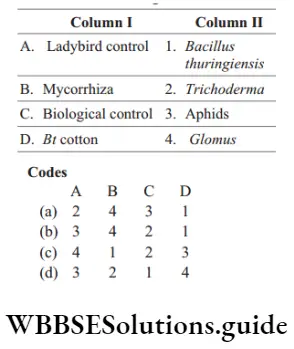
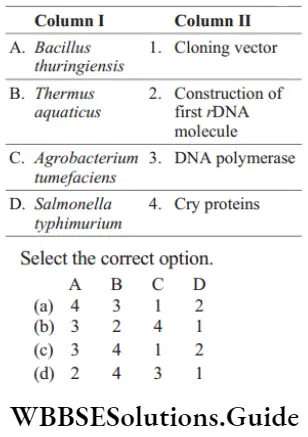
Question 10. Match the following columns

NEET Biology Microbes as Biocontrol Agents MCQs Question 10 Match the following columns.

Answer: 2. A–3, b–4, c–2, d–1

Question 11. Microbe used for biocontrol of pest butterfly caterpillars is

  1. Saccharomyces cerevisiae
  2. Bacillus thuringiensis
  3. Streptococcus sp.
  4. Trichoderma sp.

Answer: 2. Bacillus thuringiensis

  • Biopesticides are biological agents that are used to control weeds, insects, and pathogens. The microorganisms used as biopesticides are viruses, bacteria, protozoan, fungi, and mites.
  • The spores of Bacillus thuringiensis bacterium produce an insecticidal cry protein that kills the larvae of insects upon ingesting them. Thus, bacillus thuringiensis is a biopesticide for butterfly caterpillars

Biology MCQ For NEET With Answers

Question 12. Trichoderma harzianum has proved a useful microorganism for

  1. Bioremediation of contaminated soils
  2. Reclamation of wastelands
  3. Gene transfer in higher plants
  4. Biological control of soil-borne plant pathogens

Answer: 4. Biological control of soil-borne plant pathogens

  • Trichoderma harzianum is a useful microorganism for the biological control of soil-borne plant pathogens.
  • It is a fungus that is also used as a fungicide. It is used for foliar application, seed treatment, and soil treatment for suppression of various diseases causing fungal pathogens.

“an example of endomycorrhiza is “

Question 13. The viruses which have been tested as insecticides against the serious pest of cotton Heliothis species are

  1. Cytoplasmic polyhedrosis virus
  2. Entomopoxvirus
  3. Nuclear polyhedrosis
  4. All of the above

Answer: 4. All of the above

  • Heliothis is a genus of moths, whose larvae are agricultural pests on crop species such as tobacco, cotton, soybean, and pigeon pea.
  • The viruses, which have been tested as insecticides against the serious pest of cotton Heliothis species are cytoplasmic polyhedrosis virus and entomopoxvirus, and nuclear
    polyhedrosis.

NEET quiz on Microbes as Biocontrol Agents with solutions

Question 14. Ecological suicide is forced on to rice moth Corcyra cephalonica by a compound extracted from

  1. Chrysanthemum
  2. Neem
  3. Eichhornia crassipes
  4. All of the above

Answer: 3. Eichhornia crassipes

  • Ecological suicide is forced on to rice moth, Corcyra cephalonica by a compound extracted from Eichhornia crassipes. The prothoracic gland of insects secretes molting hormones or ecdysone which is responsible for the molting, pupation, and maturation of insects.
  • This hormone can be used to bring the insect into developing conditions during unfavorable seasons, thus forcing them to commit ecological suicide. One such compound is isolated from Eichhornia crassipes, which has a similar mode of action.

Biology MCQ For NEET With Answers

Question 15. Which of the following can be used as a biocontrol agent in the treatment of plant disease?

  1. Trichoderma
  2. Chlorella
  3. Anabaena
  4. Lactobacillus

Answer: 1. Trichoderma

Fungus Trichoderma is a biological control agent that is being used in the treatment of plant diseases.

Question 16. Which of the following statements regarding baculoviruses as biocontrol agents is/are correct?

  1. Baculoviruses are pathogens that attack insects and other arthropods.
  2. Most of these biocontrol agents belong to the genus– nucleopolyhedrovirus.
  3. They do not harm plants mammals, birds, fish, and other non-target insects.
  4. Baculoviruses are helpful in integrated pest management (ipm) programs, in which beneficial insects are conserved.

Choose the correct option.

  1. 1, 2 And 3
  2. 1, 2 And 4
  3. 2, 3 And 4
  4. 1, 2, 3 And 4

Answer: 4. 1, 2, 3 And 4

  • All given statements are correct. Baculovirus Heliothis (a group of viruses) are known to infect the larval stages of many harmful insects beetles, wasps, and ants.
  • A number of baculoviruses, which are used as biopesticides belong to the genus nucleopolyhedrovirus. These biological weapons are effective as potential biological control of harmful insects and are harmless to non-target organisms (plants, birds, mammals, non-target insects, etc).
  • Baculoviruses are helpful in integrated pest management (ipm) programs in which beneficial insects are conserved.

Question 17. One of the following is third-generation pesticides

  1. Chemosterilants
  2. Organochlorines
  3. Antifeedants
  4. Carbamates

Answer: 3. Antifeedants

Antifeedants are organic compounds produced by plants to inhibit attack by insects and grazing animals. So, they are third-generation pesticides.

Biology MCQs with answers for NEET

Question 18. The antifeedant compound is extracted from

  1. Sesbania rostrata
  2. Trifolium repens
  3. Azadirachta indica
  4. None of the above

Answer: 3. Azadirachta indica

Azadirachtin from indian neem tree azadirachta indica, is a most versatile antifeedant

“microbes in human welfare neetprep “

Question 19. Thuriocide is released by

  1. Bacillus thuringiensis
  2. Virus
  3. Fungi
  4. Protozoan

Answer: 1. Bacillus thuringiensis

Thuriocide is a toxin produced by the bacterium, bacillus thuringiensis. Thus, it is of bactericidal origin. It is first used as a bioinsecticide on a commercial scale in the world, as it is highly effective against disease-causing insects like flies, moths, mosquitoes, etc. If consumed by mistake, it acts as a stomach poison.

NEET expected MCQs on Microbes as Biocontrol Agents 2025

Question 20. The cultivation of cotton has been much in the news. The prefix bt refers to

  1. ‘Barium-treated’ cotton seeds
  2. ‘Bigger thread’ variety of cotton with better tensile strength
  3. ‘Biotechnology’ process using restriction enzymes and ligases
  4. An endotoxin gene carried by bacillus thuringiensis

Answer: 4. An endotoxin gene carried by Bacillus thuringiensis

In Bt cotton, bt means carrying an endotoxin gene from Bacillus thuringiensis. Specific Bt toxin genes were isolated from Bacillus thuringiensis and incorporated into several crop plants such as cotton, and corn. The toxin is coded by a gene named cry.

21. Which bacterium was first used as biopesticide on a commercial scale in the world?

  1. Bacillus thuringiensis
  2. Escherichia coli
  3. Pseudomonas aeruginosa
  4. Agrobacterium tumefaciens

Answer: 1. Bacillus thuringiensis

Thuriocide is a toxin produced by the bacterium, bacillus thuringiensis. Thus, it is of bactericidal origin. It is first used as a bioinsecticide on a commercial scale in the world, as it is highly effective against disease-causing insects like flies, moths, mosquitoes, etc. If consumed by mistake, it acts as a stomach poison.

Question 22. Cry I endotoxins obtained from Bacillus thuringiensis are effective against

  1. Mosquitoes
  2. Flies
  3. Nematodes
  4. Bollworms

Answer: 4. Bollworms

Cry I endotoxin obtained from Bacillus thuringiensis is effective against bollworms. A bollworm is a common term for any larva of a moth that attacks the fruiting bodies of certain crops, especially cotton.

Biology MCQs with answers for NEET

Question 23. Bioherbicides and bioinsecticides

  1. Are non-persistent, non-toxic, and biodegradable
  2. Maintain the biodiversity and stability of the ecosystem
  3. Decrease the chances of environmental pollution and degradation
  4. All of the above

Answer: 4. All of the above

Bioherbicides and bioinsecticides are biocontrol agents that exhibit high pest specificity and biodegradability. Thus, they are non-persistent in the environment and do not cause environmental pollution. Due to their host specificity, they maintain biodiversity and ecological stability.

Question 24. The first bioherbicide developed in 1981 was based on

  1. Phytophthora palmivora
  2. Phytophthora infestans
  3. Bacillus thuringiensis
  4. Azadirachta indica

Answer: 1. Phytophthora palmivora

The first bioherbicide was developed in 1981. It is a mycoherbicide, based on the fungus, phytophthora palmivora, which controls the growth of milkweed vines in citrus orchards.

NEET Biology Microbes as Biocontrol Agents MCQs with explanations

Question 25. Devine and College are two trade names in agriculture. They are used as

  1. Bioinsecticides
  2. Natural insecticides
  3. Biofungicides
  4. Bioherbicides

Answer: 4. Bioherbicides

  • Devine is the first bioherbicide registered in the united states and is used for controlling milkweed vines. College is another bioherbicide made from Colletotrichum gloeosporioides.
  • the anthracnose-causing fungal pathogen and is used to control aeschynomene Virginia in rice and soybean crops. So, they are used as bioherbicides.

Question 26. Most recent insecticides in India are

  1. Chlorinated hydrocarbons
  2. Organophosphorus compounds
  3. Carbamates
  4. Pyrethroids

Answer: 4. Pyrethroids

Pyrethroids are the most recent insecticides in India. These are called ‘third generation insecticides’, for example, deltamethrin. Chlorinated hydrocarbons are first-generation insecticides. Carbamate and organophosphorus are second-generation insecticides.

Question 27. Pyrethrin is obtained from

  1. Azadirachta indica
  2. Rosa indica
  3. Poa indica
  4. Chrysanthemum

Answer: 4. Chrysanthemum

Pyrethrins are a class of organic compounds normally derived from chrysanthemum cinerariifolium. They have potent insecticidal activity by targeting the nervous systems of insects. Pyrethrins are less toxic pesticides from a human health standpoint.

Biology MCQs with answers for NEET

Question 28. Which among the following is a mycoherbicide?

  1. Beauveria bassiana
  2. Bacillus thuringiensis
  3. Xanthomonas sp.
  4. Alternaria crassa

Answer: 4. Alternaria crassa

A mycoherbicide is a herbicide based on a fungus, Alternaria crassa. As a biological agent, these ‘mycoherbicides act by producing toxic compounds that dissolve the cell walls of targeted plants.

Microbes as Biocontrol Agents mock test for NEET preparation

29. Which weed has been eradicated by biological control?

  1. Parthenium
  2. Cactus
  3. Eichhornia
  4. Chrysanthemum

Answer: 2. Cactus

Cactus has been eradicated by the method of biological control. It was done by introducing the cochineal insect, cactoblastis cactorum. The insect is a type of moth that exceptionally feeds on the cactus plant.

30. Biological control of weeds is carried out by

  1. Insects that feed on weeds and not the crop
  2. Use of pathogen microbes that cause disease only in weeds
  3. Both (1) and (2)
  4. Use of chemical pesticides

Answer: 3. Both (1) and (2)

Biological weed control involves the use of living organisms such as insects, nematodes, bacteria, or fungi to reduce weed populations. These organisms feed upon or cause diseases in weeds only and do not affect other crops.

Question 31. Confusion technique involves

  1. Laying traps containing pheromones
  2. Confusing insects by releasing sterile males
  3. Spreading pheromone containing hydrophobic papers
  4. Introducing pheromones at juvenile

Answer: 3. Spreading pheromone containing hydrophobic papers

  • ‘Confusion technique’ involves the use of pheromones or sex attractants. In this technique, hydrophobic paper having pheromones is placed over the crop area, due to which characteristic smell is spread over.
  • The whole field and thus males are unable to locate the females. This technique helps to prevent the mating of pests and thus check their population.

Question 32. Fruitflies have been controlled by

  1. Sterilization
  2. Pheromonal compounds as synthetic methyl eugenol
  3. Cultural control
  4. All of the above

Answer: 2. Pheromonal compounds as synthetic methyl eugenol

  • A large number of pheromones have been identified and their usefulness as bait or an attractant to collect a large number of insects to be killed or herded away from the opposite sex has been proved.
  • Some of these compounds are phenols, which attract the grass grubs and others like synthetic methyl eugenol have practically been used for controlling fruit flies.

Question 33. Which bioherbicide was first used?

  1. Mycoherbicide
  2. Molluscoherbicide
  3. Nematoherbicide
  4. Insecticide

Answer: 1. Mycoherbicide

The first bioherbicide was developed in 1981. It is a mycoherbicide, based on the fungus, phytophthora palmivora, which controls the growth of milkweed vines in citrus orchards.

NEET Biology Mcq

Question 34. Agrobacterium radiobacter strain 

  1. Fungal pesticide
  2. Microbial pesticide
  3. Mycoherbicide
  4. Viral pesticide

Answer: 2. Microbial pesticide

Agrobacterium radiobacter strain k1026 is a microbial pesticide that can be used to treat germinating seeds or roots and stems of certain stone fruit (such as cherries and plums), nut trees, and ornamentals to protect them from crown gall disease.

Question 35. Which of the following statements is/are correct?

  1. Herbicides kill plants mostly by blocking photosystem-ii and occasionally phloem transport
  2. Insecticides kill insects mostly through impairment of nerve conduction and sometimes through respiratory arrest
  3. Both (1) and (2)
  4. None of the above

Answer: 3. Both (1) and (2)

  • Herbicides kill weeds and unwanted plants in cultivated land. They kill plants mostly by blocking photosystem-ii and occasionally phloem transport.
  • Insecticides are those chemicals that destroy or kill insects mostly through impairment of nerve conduction and sometimes through respiratory arrest. Thus, the option is correct.

Question 36. Allethrin is a commonly used

  1. Fertiliser
  2. Herbicide
  3. Growth hormone
  4. Insecticide

Answer: 4. Insecticide

The allethrins are a group of related synthetic compounds used as insecticides. Allethrin was the first pyrethroid. They are commonly used in ultra-low volume sprays for outdoor mosquito control, including many household insecticides such as raid as well as mosquito coils.

Question 37. Which of the following is bioinsecticide?

  1. Ladybirds beetle
  2. Dragonflies
  3. Bees
  4. Both (1) and (2)

Answer: 4. Both (1) and (2)

Ladybird beetles control aphids, whereas dragonflies control mosquitoes. Bees have no role as bioinsecticides.

Question 38. Ladybird beetle is a predator of

  1. Moths
  2. Beetles
  3. Bacteria
  4. Aphids

Answer: 4. Aphids

There are many species of ladybird beetles, also referred to as ladybeetles or ladybugs. Ladybird beetle is a predator of aphids, spiders, mites, scale insects, white flies, leaf beetle larvae, some insect eggs, and small caterpillars.

NEET Biology Mcq

Question 39. Meliantiol and galanin bioinsecticides have been extracted from

  1. Chrysanthemum cinerariifolium
  2. Derris elliptica
  3. Azadirachta indica
  4. Eichhornia

Answer: 3. Azadirachta indica

The neem (Azadirachta indica) is one of the best sources of the most useful natural insecticides. Natural insecticides, for example. Azadirachtin, mediation, salanin, etc., Are extracted from neem. These are very effective as insecticides as well as insect repellents and antifeedants.

Question 40. The biocontrol of larvae of mosquitoes is done by

  1. Ladybird beetles
  2. Gambusia fish
  3. Eichhornia
  4. Azolla

Answer: 2. Gambusia fish

Effective biocontrol agents include predatory fish that feed on mosquito larvae such as mosquito fish, gambusia affinis, and some cyprinids, carps, and minnows.

41. Biopesticides are

  1. The chemicals which are used to destroy pests
  2. The living organism or their products which are used for pest control
  3. The organism which destroys crops
  4. None of the above

Answer: 2. The living organism or their products that are used for pest control

Biopesticides are less harmful than conventional pesticides. They are biological control agents which are used to control weeds and pests. They are of two types, i.e. Bioherbicides, and bioinsecticides.

NEET practice test on Microbes as Biocontrol Agents

Question 42. A fungal pesticide, beauvericin bassiana is used to kill

  1. Whiteflies and mites
  2. Larvae of Aedes
  3. Larvae of mosquitoes
  4. Cacti

Answer: 1. White flies and mites

Beauveria bassiana can be used as a biological insecticide to control a number of pests such as termites, white flies, and many other insects.

Question 43. A viral pesticide used against gypsy moths is

  1. Npv
  2. Nosema locustae
  3. Fusarium
  4. Beauveria bassiana

Answer: 1. NPV

Npv, i.e. Nucleopolyhedrovirus is a baculovirus that is a viral pesticide used against gypsy moths, aphids, and beetles.

Question 44. Which of the following is not a correctly matched pair?

  1. Azadirachtin–neem
  2. Nicotine–tobacco
  3. Pyrethrum–datura
  4. Rotenone–derris elliptical

Answer: 3. Pyrethrum–datura

Matched pair and can be corrected as pyrethrum is obtained from chrysanthemum. Rest options are correctly matched pairs.

Question 45. In the USA, the return of brown pelican is the result of banning the use of which pesticide?

  1. 2, 4-D
  2. Ddt
  3. Bordeaux mixture
  4. Malathion

Answer: 2. Ddt

  • There has been a decline in the number of ospreys and bald eagles along the eastern coast of the united states due to DDT pesticide contamination. Ddt reaches these birds through biomagnification.
  • It makes their eggs non-viable, as the disturbed calcium metabolism in these birds causes the formation of eggs with fragile shells. So, brown pelican populations recovered after the banning of most uses of ddt.

NEET Biology Mcq

Question 46. Consider the following statements.

  1. Biocontrol refers to the use of biological methods for controlling plant diseases and pests.
  2. The use of biocontrol measures greatly reduces our dependence on toxic chemicals and pesticides.

Choose the correct option.

  1. Statement 1 is correct, but 2 is incorrect
  2. Statement 1 is incorrect, but 2 is correct
  3. Both statements 1 and 2 are correct
  4. Both statements 1 and 2 are incorrect

Answer: 3. Both statements 1 and 2 are correct

Question 47. Consider the following statements about bt.

  1. The bacteria Bacillus thuringiensis (Bt) is used to control butterfly caterpillars.
  2. Fresh spores of bt are mixed with water and sprayed on plants such as brassica and fruit trees.
  3. Insect larvae after eating, but spores are killed by the toxin released in their gut.
  4. Bt toxin genes have been introduced into animals to prey on pests.

Choose the option containing the correct statements.

  1. 1, 2 And 3
  2. 1, 3 And 4
  3. 2, 3 And 4
  4. 1, 2, 3 And 4

Answer: 1. 1, 2 And 3

All given statements are correct except iv. Thus, the option is correct. Bt toxin genes have been introduced into plants so as to kill insect pests. Thus, an option is correct.

NEET Biology Microbes In Human Household Products Multiple Choice Question And Answers

Biology MCQ For NEET With Answers Microbes In Human Welfare

Question 1. Identify the habitat of microorganisms.

  1. Soil, air, water and inside the bodies of living organisms
  2. Thermal vents deep in the soil
  3. Under snow as well as the acidic environment
  4. All of the above

Answer: 4. All of the above

Microbes can be found everywhere, i.e. In soil, water, air and inside the bodies of living organisms. They can be found in thermal vents deep in the soil, under snow as well as in acidic environments.

Question 2. Which of the following microbes play an important role in converting milk into curd?

  1. Bacteria
  2. Virus
  3. Fungi
  4. Protozoa

Answer: 1. Bacteria

“microbes in human welfare “

In the process of making curd, bacteria convert milk into curd and milk protein into predigest milk protein.

Read And Learn More: NEET Biology Multiple Choice Question And Answers

Question 3. Identify the correct statement.

  1. Microorganism like lactobacillus is commonly called the lab
  2. The lab is widely used in food fermentation
  3. Lab has the ability to improve the flavour of food products
  4. All of the above

Answer: 4. All of the above

Microorganism such as lactobacillus is commonly called lactic acid bacteria (lab). These bacteria are widely used in food fermentation because of their ability to improve the flavours, texture and safety of perishable raw materials such as milk, meat and vegetables.

NEET Biology Microbes in Household Products MCQs with answers

Question 4. Which of the following bacteria convert milk into curd?

  1. Propionibacterium shermanii
  2. Saccharomyces cerevisiae
  3. Lactobacillus
  4. Thermophilic bacteria

Answer: 3. Lactobacillus

Lactic acid bacteria (lab) like lactobacillus are added to milk. It converts the lactose sugar of milk into lactic acid. Lactic acid causes coagulation and partial conversion of milk protein casein to paracaesinate. Thus, milk is changed into curd, yoghurt and cheese.

Question 5. Curd is formed by adding a small amount of curd to milk. This small amount is referred to as

  1. Starter
  2. Inoculum
  3. Both (1) and (2)
  4. None of the above

Answer: 3. Both (1) and (2)

Curd is formed by adding a small amount of curd to milk. This small amount of curd is referred to as a starter or inoculum. The starter or inoculum used in the preparation of milk products actually contains millions of lactic acid bacteria (lab).

“select the correct group of biocontrol agents “

Biology MCQ For NEET With Answers

NEET Biology Microbes In Human Household Products Multiple Choice Question And Answers

Important MCQs on Microbes in Household Products for NEET

Question 6. Consider the following statements about the lab.

  1. It increases the vitamin 12 amount, thus increasing the nutrient quality of milk.
  2. It checks disease-causing microbes in the stomach.

Choose the correct option.

  1. Statement 1 is correct, but 2 is incorrect
  2. Statement 1 is incorrect, but 2 is correct
  3. Both statements 1 and 2 are correct
  4. Both statements 1 and 2 are incorrect

Answer: 3. Both statements 1 and 2 are correct

  • Both statements 1 and 2 are correct. A small amount of curd added to the fresh milk as inoculum or starter contains millions of lab, which at suitable temperatures multiply, thus converting milk to curd.
  • It improves its nutritional quality by increasing vitamin B12. In our stomach too, the lab plays a very beneficial role in checking disease-causing microbes.

Question 7. Lactic acid coagulates and partially digests the milk protein …………… During the curdling of milk.

  1. Casein
  2. Albumin
  3. Serum
  4. Lactoferrin

Answer: 1. Casein

Lactic acid bacteria (lab) like lactobacillus are added to milk. It converts the lactose sugar of milk into lactic acid. Lactic acid causes coagulation and partial conversion of milk protein casein to paracaesinate. Thus, milk is changed into curd, yoghurt and cheese.

Biology MCQ For NEET With Answers

Question 8. …A… Released by the lab during growth coagulate and partially digest …b… Here, A and B refer to

  1. A–acid, b–milk protein
  2. A–base, b–harmful bacteria
  3. A–enzyme, b–milk protein
  4. A–bacteria, b–other microbes

Answer: 1. A–acid, b–milk protein

Question 9. The starter or inoculum is added to the fresh milk in order to convert milk into curd. The term starter or inoculum here refers to

  1. Bacteria rich in vitamin B12
  2. Bacteria rich in protein
  3. Liquid containing millions of lab
  4. The fresh milk

Answer: 3. Liquid containing millions of lab

Curd is formed by adding a small amount of curd to milk. This small amount of curd is referred to as a starter or inoculum. The starter or inoculum used in the preparation of milk products actually contains millions of lactic acid bacteria (lab).

NEET quiz on Microbes in Household Products with solutions

Question 10. An enzyme used in cheese-making is

  1. Protease
  2. Rennet
  3. Glucoamylase
  4. Lactase

Answer: 2. Rennet

Rennet is extracted from the stomach of the calf and is used to prepare cottage cheese.

Question 11. Toddy is

  1. A traditional drink of southern India.
  2. Made by fermentation of sap from palm trees by bacteria.

“an example of endomycorrhiza is “

Which of the statements given above about toddy is/are correct?

  1. Only 1
  2. Only 2
  3. 1 And 2
  4. None of these

Answer: 3. 1 And 2

Both statements I and ii are correct. Toddy is a traditional drink of some parts of south India, which is made by fermentation of sap from palm trees by bacteria.

Biology MCQ For NEET With Answers

Question 12. Swiss cheese is ripened by

  1. Propionibacterium shermanii
  2. Penicillium roqueforti
  3. Penicillium camembert
  4. Streptococcus lactis

Answer: 1. Propionibacterium shermanii

Swiss cheese is characterised by large holes and it is ripened by the bacteria, propionibacterium shermanii. Penicillium roqueforti is involved in the ripening of Roquefort cheese. Camembert cheese is ripened by penicillium camembert.

Question 13. Big holes in Swiss cheese are formed as a result of

  1. Machine used for making the cheese
  2. A bacterium producing a large amount of carbon dioxide
  3. A bacterium that is visible to the naked eyes
  4. A fungus that produces large amounts of carbon dioxide

Answer: 2. A bacterium producing a large amount of carbon dioxide

Large holes in Swiss cheese are formed by the CO2 produced (causing holes) by a bacterium called Propionibacterium shermanii.

NEET expected MCQs on Microbes in Household Products 2025

Question 14. In cheese manufacturing, microorganisms are used

  1. Only for souring of milk
  2. Only for ripening
  3. Both (1) and (2)
  4. To prevent spoilage

Answer: 3. Both (1) and (2)

During cheese production, lactic acid bacteria help in souring milk. Ripening of cheese is done by bacteria (propionibacterium shermanii) or moulds (penicillium roqueforti). So, the microorganisms are used for souring milk and ripening in cheese manufacturing.

Biology MCQ For NEET With Answers

Question 15. Conversion of milk to curd improves its nutritional value by increasing the amount of

  1. Vitamin-D
  2. Vitamin-E
  3. Vitamin-B12
  4. Vitamin-A

Answer: 3. Vitamin-b12

Milk is converted to curd by certain bacteria called lactic acid bacteria. These bacteria, during the process of curdling milk, also increase its nutritive value by increasing the content of vitamin B12

Question 16. What makes Idli soft and puffy?

  1. A blending of idli batter
  2. Addition of baking soda into idli batter
  3. Bubbles of co 2 produced by microorganisms
  4. Addition of lactobacilli culture

Answer: 3. Bubbles of co 2 produced by microorganisms

In the preparation of idli batter, the batter is fermented using bacteria or yeast. During fermentation, CO2 bubbles which are released get trapped in the gluten, thus making idli soft and puffy.

Question 17. Which gas is released during the process of fermentation of dough giving it a puffy appearance?

  1. CO2
  2. CO
  3. O2
  4. H2

Answer: 1. CO2

CO2 gas is released during the process of fermentation. It gives a puffy appearance to a dough.

Question 18. The dough in bread making is fermented by

  1. Bacteria
  2. Virus
  3. Prions
  4. Yeast

Answer: 4. Yeast

The dough used for making bread is fermented by saccharomyces cerevisiae or commonly called baker’s yeast. Co2 released during the process of fermentation gives a puffy appearance to the dough. It is used to make foods like idli, dosa, bread, etc.

Biology MCQs with answers for NEET

Question 19. What is used in the production of leavened bread?

  1. Aspergillus
  2. Rhizopus
  3. Saccharomyces
  4. None of the above

Answer: 3. Saccharomyces

  • Saccharomyces is used in the production of leavened bread. The dough used for making bread is fermented by saccharomyces cerevisiae or commonly called baker’s yeast.
  • CO2 released during the process of fermentation gives a puffy appearance to the dough. It is used to make foods like idli, dosa, bread, etc.

“microbes in human welfare neetprep “

Question 20. Assertion yeasts such as saccharomyces cerevisiae are used in the baking industry.

Reason (R) Carbon dioxide produced during fermentation causes bread dough to rise by thermal expansion.

  1. Both a and r are true and r is the correct explanation of a
  2. Both a and r are true, but r is not the correct explanation of a
  3. A is true, but r is false
  4. Both a and r are false

Answer: 1. Both a and r are true and r is the correct explanation of a

  • Both a and r are true and r is the correct explanation of a the dough used for making bread is fermented by saccharomyces cerevisiae or commonly called baker’s yeast.
  • CO2 released during the process of fermentation gives a puffy appearance to a dough. It is used to make foods like idli, dosa, bread, etc.

NEET Biology Microbes in Household Products MCQs with explanations

Question 21. Which of the following food items undergo fermentation?

  1. Idli
  2. Dosa
  3. Toddy
  4. Cheese

Choose the correct option.

  1. 1, 2 And 3
  2. 1, 3 And 4
  3. 2, 3 And 4
  4. 1, 2, 3 And 4

Answer: 4. 1, 2, 3 And 4

  • All given food items undergo fermentation. Idli and dosa are fermented preparation of rice and black gram. The two are allowed to ferment for 3-12 hours with airborne leuconostoc and streptococcus species of bacteria.
  • Toddy is a traditional drink of some parts of south India, which is made by fermentation of sap of palms by bacteria. Cheese is formed by the partial degradation of milk by different microorganisms.

Biology MCQs with answers for NEET

Question 22. The fungus involved in the ripening of Roquefort cheese gives it the unique

  1. Colour
  2. Flavour
  3. Shape
  4. Texture

Answer: 2. Flavour

Roquefort cheese is formed by ripening with the fungi penicillium roqueforti, for a particular flavour.

Question 23. Roquefort cheese is obtained by ripening with the fungi

  1. Propionibacterium shermanii
  2. Penicillium roqueforti
  3. Propionibacterium roqueforti
  4. Penicillium Sherman

Answer: 2. Penicillium roqueforti

Roquefort cheese is formed by ripening with the fungi penicillium roqueforti, for a particular flavour.

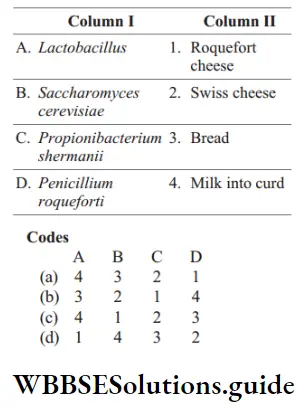
Question 24. Match the following columns.

NEET Biology Microbes in Household Products MCQs Question 24 Match the following columns.

Answer: 1. A–4, b–3, c–2, d–1

Microbes in Household Products mock test for NEET preparation

Question 25. Pasteurisation is a process that is undertaken to

  1. Kill all microbes
  2. Kill the pathogenic microbes
  3. Make milk tastier
  4. Make beverages

Answer: 2. Kill the pathogenic microbes

Pasteurisation is a process that is undertaken to kill all pathogenic microbes. Methods of pasteurisation of milk used commercially include a low-temperature holding (lth) method and a high-temperature short-time (test) method. The first process employs equipment capable of exposing milk to a temperature.

NEET practice test on Microbes in Household Products

Question 26. Consider the following statements.

  1. Pasteurisation alters the taste of food products.
  2. The process of pasteurisation is named after Louis Pasteur.

Choose the correct option.

  1. Statement 1 is correct, but 2 is incorrect
  2. Statement 1 is incorrect, but 2 is correct
  3. Both statements 1 and 2 are correct
  4. Both statements 1 and 2 are incorrect

Answer: 2. Statement 1 is incorrect, but 2 is correct

  • Statement 1 is incorrect, but 2 is correct. The incorrect statement can be corrected as pasteurisation is a process whereby fluids such as wine and milk are heated for a predetermined time at a temperature that is below the boiling point of the liquid.
  • The treatment kills any microorganisms that are in the fluid but does not alter the taste, appearance, or nutritive value of the fluid.
  • The process of pasteurisation is named after the French chemist Louis Pasteur (1822–1895), who is regarded as the founder of the study of modern microbiology.

Biology MCQs with answers for NEET

Question 27. Pasteurised milk is

  1. Sterile and do not turn sour
  2. Free from pathogenic bacteria
  3. Not free from bacteria
  4. Both (1) and (2)

Answer: 4. Both (1) and (2)

Pasteurised milk is considered to be healthy for a person to consume as the process kills disease-causing germs, such as campylobacter, e. Coli and salmonella from milk. Pasteurisation does not reduce milk’s
nutritional value but kills the pathogenic bacteria in it. Due to this, the milk does not turn sour.

NEET Biology Microbes In The Production Of Biogas Multiple Choice Question And Answers

Biology MCQ For NEET With Answers Microbes In The Production Of Biogas

Question 1. Biogas production from waste biomass with the help of methanogenic bacteria is

  1. Multi steps process
  2. One-step process
  3. Two steps process
  4. Three steps process

Answer: 4. Three steps process

Biogas is methane-rich fuel gas produced by the anaerobic breakdown of biomass by methanogenic bacteria. It is a three steps process.

Question 2. Both power and manure are provided by

  1. Biogas plant
  2. Distillation plant
  3. Sugar processing plant
  4. Nuclear plant

Answer: 1. Biogas plant

Biogas is used as fuel for heating cooking and lighting. Slurry remaining after the production of biogas can be used as fertilizers

Read And Learn More: NEET Biology Multiple Choice Question And Answers

Question 3. The first step in biogas production is

  1. Generation of methane
  2. Aerobic breakdown of polymers
  3. Anaerobic breakdown of polymers
  4. Conversion of monomers to organic acids

Answer: 3. Anaerobic breakdown of polymers

“microbes in human welfare “

In the first step of biogas production, the polymer, cellulose that is present in the raw material like cow dung, is hydrolyzed to simple compounds anaerobically, i.e. Anaerobic breakdown of polymers.

Question 4. Biogas is ………….. Source of energy.

  1. Conventional and non-renewable
  2. Non-conventional and renewable
  3. Conventional and renewable
  4. Non-conventional and non-renewable

Answer: 2. Non-conventional and renewable

Biogas is considered to be a renewable and non-conventional resource because its production and use cycle is continuous and it generates no net carbon dioxide.

NEET Biology Microbes in Biogas Production MCQs with answers

Question 5. The main raw material used in biogas production is

  1. Vegetable waste
  2. Cow dung
  3. Agricultural waste
  4. Domestic waste

Answer: 2. Cow dung

Cattle dung has been recognized as the chief raw material for biogas plants. Other materials like night soil, poultry litter, and agricultural waste are also used.

NEET Biology Microbes In The Production Of Biogas Multiple Choice Question And Answers

Important MCQs on Microbes in Biogas Production for NEET

Question 6. Name the group of microbes observed in a biogas plant.

  1. Lactic acid bacteria
  2. Cyanobacteria
  3. Both (1) and (2)
  4. Methanogens

Answer: 4. Methanogens

Certain bacteria which grow anaerobically on cellulosic material, produce large amounts of methane along with carbon dioxide and hydrogen gas. These bacteria are collectively called methanogens. They are used in biogas plants.

Question 7. Which of the following wastes are used in biogas production?

  1. Domestic waste, agricultural waste
  2. Agro waste, municipal waste
  3. Forestry waste
  4. Chemical waste

Choose the option containing

  1. 1 And 4 are used
  2. 2 And 3 are used
  3. 1, 2, And 3 are used
  4. 2 And 4 are used

Answer: 3. 1, 2 And 3 are used

Except for chemical wastes, all the organic waste like domestic, agricultural, municipal, forestry, etc. Waste can all be used in biogas production.

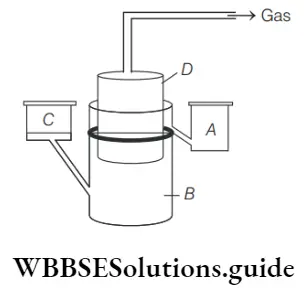
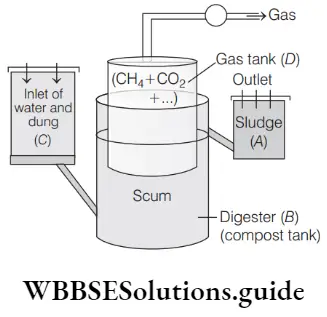
8. The diagram below represents a typical biogas plant. Select the correct option for a, b, c, and d, respectively.

NEET Biology Microbes in Production of Biogas MCQs Typical biogas plant

  1. A–sludge, b–dung+water, c–gas tank, d–outlet
  2. A–gas tank, b–dung+water, c–sludge, d–inlet
  3. A–sludge, b–digester, c–an inlet of dung and water, d–gas tank
  4. A–gas tank, b–sludge, c–dung + water, d–inlet

Answer: 3. A–sludge, b–digester, c–an inlet of dung and water, d–gas tank

NEET Biology Microbes in Production of Biogas MCQs Gas tank

NEET quiz on Microbes in Biogas Production with solutions

Question 9. During anaerobic digestion of organic waste, such as in producing biogas, which of the following is not degraded?

  1. Hemicellulose
  2. Cellulose
  3. Lipids
  4. Lignin

Answer: 4. Lignin

Lignin does not degrade in the production of biogas.

Question 10. Biogas production is an

  1. Aerobic process
  2. Anaerobic process
  3. Active process
  4. None of the above

Answer: 2. Anaerobic process

“select the correct group of biocontrol agents “

Biogas generation is a three-stage process of anaerobic digestion of animal and other organic wastes by methanogenic bacteria.

Biology MCQ For NEET With Answers

These are.

  1. Breakdown of polymers.
  2. Conversion of monomers into organic acids by fermentation of microbes.
  3. Generation of methane by methanogenic bacteria (conversion of organic acids into ch4 and CO2).

Question 11. In a biogas plant, a mixture of cow dung and water is fed in the ratio of

  1. 2:1
  2. 1:1
  3. 1:2
  4. 3:1

Answer: 2. 1:1

  • The mixture of dung and water which enters the biogas plant in semiliquid form is called ‘undigested slurry.’ It contains cow dung and water in a 1:1 ratio.
  • The undigested slurry undergoes a series of anaerobic digestion processes or fermentation in a biogas digester and is converted into a combustible gas called ‘biogas.’

Question 12. The anaerobic digestion of biogas production involves

  1. Conversion of insoluble polymers to simple soluble monomers
  2. Conversion of monomers to organic acids
  3. Conversion of organic acids to methane
  4. Conversion of monomers to methane

Answer: 1. Conversion of insoluble polymers to simple soluble monomers

Anaerobic digestion is the process by which insoluble polymers of organic matter such as animal or food waste are broken down into simple soluble monomers to produce biogas and biofertiliser. This process happens in the absence of oxygen in a sealed, oxygen-free tank called an anaerobic digester.

NEET expected MCQs on Microbes in Biogas Production 2025

Question 13. For biogas production, besides dung which one of the following weed is recommended in our country?

  1. Eichhornia crassipes
  2. Hydrilla
  3. Mangifera
  4. Solanum nigrum

Answer: 1. Eichhornia crassipes

Eichhornia crassipes is recommended because of its extremely high rate of development. It is an excellent source of biomass. The harvested biomass would then be converted to ethanol, natural gas, hydrogen or gaseous nitrogen, and fertilizer.

Biology MCQ For NEET With Answers

Question 14. The ph at which methane is produced by bacteria is

  1. Neutral
  2. Acidic
  3. Alkaline
  4. All of these

Answer: 2. Acidic

In the second stage of biogas formation, acetogenic bacteria form organic acids such as acetic or propionic acid which are further converted to methane. Hence, methane formation takes place in acidic ph.

15. Household sewage mainly contains large amounts of …A… And …B… The most suitable answer is

  1. A–excreta, b–vegetable waste
  2. A–organic matter, b–pathogenic microbes
  3. A–inorganic matter, b–virus
  4. A–non-decomposable matter, b–water

Answer: 2. A–organic matter, b–pathogenic microbes

Sewage contains large amounts of organic matter and pathogenic microbes (b).

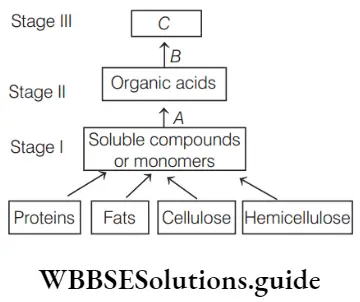
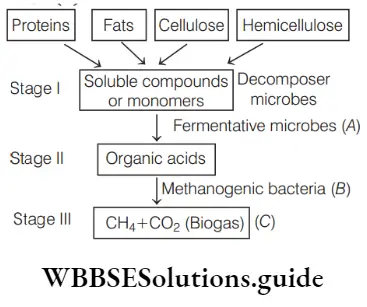
Question 16. Study the following flowchart of biogas production and select the correct option for a, b and c

NEET Biology Microbes in Production of Biogas MCQs Organic acids

  1. A–methanogenic bacteria, b–fermentative microbes, c–hydrogen (biogas)
  2. A–fermentative microbes, b–methanogenic bacteria, c–methane (biogas)
  3. A–anaerobic microorganisms, b–echinococcus, c–nitrogen (biogas)
  4. A–aerobic microorganism, b–methanobacter, c–methane (biogas)

Answer: 2. A–fermentative microbes, b–methanogenic bacteria, c–methane (biogas)

NEET Biology Microbes in Production of Biogas MCQs Soluble compounds or monomers

NEET Biology Microbes in Biogas Production MCQs with explanations

Question 17. Biogas is composed of a mixture of inflammable gases like

  1. Methane, CO2, H2, and H2S
  2. Methane, CO2, H2, and N2
  3. CO2, H2, and H2S
  4. CO, methane, and N2

Answer: 1. Methane, CO2, H2, and H2S

The major component of biogas is methane (which is highly inflammable), CO2, H2, and H2S

Biology MCQs with answers for NEET

Question 18. Biogas contains

  1. 10-30% Methane
  2. 30-40% Methane
  3. 50-80% Methane
  4. 80-90% Methane

Answer: 3. 50-80% Methane

Biogas is produced by anaerobic fermentation of biomass. It consists of 50-80% methane, 15- 45% co2, and traces of hydrogen, oxygen, and nitrogen.

Question 19. The proportion of methane and carbon dioxide in biogas is about

  1. 2: 1
  2. 2:2
  3. 1: 2
  4. 3:1

Answer: 1. 2: 1

Biogas contains about 70% methane and about 40% carbon dioxide. Thus, the approximate ratio is about 2:1.

Question 20. Methanogens do not produce

  1. Nitrogen
  2. Methane
  3. Hydrogen sulfide
  4. Carbon dioxide

Answer: 1. Nitrogen

Methanogens derive energy by converting carbon dioxide, hydrogen, formate, acetate, and other compounds from the organic matter of peat to methane. They do not produce nitrogen.

Question 21. Consider the following statements about methanogens.

  1. Methanogen bacteria are commonly found in the anaerobic sludge formed during sewage treatment.
  2. These bacteria occur in the rumen of cattle where they break down cellulose.
  3. Methanogens are present in harsh environments such as hydrothermal vents.

Choose the option containing

Correct statements.

  1. 1, 2 And 3
  2. 1 And 2
  3. 1 And 3
  4. 2 And 3

Answer: 1. 1, 2 And 3

  • All the given statements are correct about methanogens. Methanogens, particularly methanobacterium, anaerobically break down cellulosic material to produce hydrogen that can be used in methanogenesis.
  • These are found in anaerobic sludge and rumen of cattle. Thermophilic methanogens are found in hydrothermal vents at temperatures between 55°c-80°c.

NEET Biology Mcq

Question 22. Pollution from animal excreta and organic waste from kitchens can be most profitably minimized by

  1. Storing them in underground storage tanks
  2. Using them for producing biogas
  3. Vermiculture
  4. Using them directly as biofertilizers

Answer: 2. Using them for producing biogas

“an example of endomycorrhiza is “

  • Pollution from human excreta and organic wastes from the kitchen can be most profitably minimized by using them for producing biogas.
  • These wastes release methane and other gases, as a result of the action of anaerobic microorganisms. Biogas contains methane in bulk and other gases like h s2 and h2.

Question 23. Biogas plant is not popular in an urban area because

  1. It has a foul smell
  2. Raw materials are not easily available
  3. Biogas is highly inflammable
  4. Biogas manufacturing plant is costly

Answer: 2. Raw materials are not easily available

Biogas production has been taken up on a large scale in India, whereas in urban areas it is not so popular because the raw material used is not easily available.

Microbes in Biogas Production mock test for NEET preparation

Question 24. Which one of the following statements is incorrect about biogas?

  1. It contains 50-80% methane
  2. Agricultural wastes are utilized
  3. It is highly polluting
  4. Biogas plant is difficult to construct

Answer: 3. It is highly polluting

Biogas mostly consists of 50-70% methane. It burns with a blue flame and does not produce smoke. Thus, it is not polluting. Rest statements are correct about biogas.

NEET Biology Mcq

Question 25. Which of the following aquatic weeds is not used in the production of biogas?

  1. Eichhornia crassipes
  2. Hydrilla
  3. Pistia stratiotes
  4. Spirulina

Answer: 4. Spirulina

Spirulina is a blue-green algae used as a source of valuable food specifically for proteins. It is not used in the production of biogas.

Question 26. Assertion biogas is used as fuel for cooking and lighting.

Reason (R) is considered an eco-friendly and non-polluting source of energy.

  1. Both a and r are true and r is the correct explanation of a
  2. Both a and r are true, but r is not the correct explanation of a
  3. A is true, but r is false
  4. Both a and r are false

Answer: 2. Both a and r are true, but r is not the correct explanation of a

“microbes in human welfare neetprep “

Both a and r are true, but r is not the correct explanation of a. Biogas is a mixture of inflammable gases due to which it is used as fuel for cooking, lighting, generating power for irrigation, and other purposes, as an alternative to firewood, kerosene, dung cakes or even electricity. It is an eco-friendly and pollution-free source of energy.

Question 27. The technology of biogas production from cow dung was developed in India largely by the efforts of the organization/institution that played a great role in developing a technology of producing biogas from cow dung in India was

  1. Oil and natural gas commission
  2. Gas Authority of India
  3. Indian agricultural research institute and khadi and village industries commission
  4. Indian oil corporation

Answer: 3. Indian agricultural research institute and khadi and village industries commission

Biogas or gobar gas generation has been taken up in India on a large scale. The technology was developed by the collaboration of the Khadi and village industries commission (kvic) and the Indian agricultural research institute.

NEET practice test on Microbes in Biogas Production

Question 28. Which of the following is not an advantage of biogas?

  1. It is cheap
  2. A large quantity of raw material is required
  3. It does not cause pollution
  4. It is used for cooking and lighting

Answer: 2. Large quantity of raw material is required

“microbes in human welfare neetprep “

Producing biogas gives many advantages for the environment, companies, and people involved. The advantages are

  1. Biogas is a green energy source in the form of electricity and heat for the local grid.
  2. Less emission of the greenhouse gasses like methane, co2 and nitrous oxide. So, biogas does not cause pollution.
  3. Environment-friendly recirculation of organic waste from industry and households. So, biogas is cheap.
  4. Less odour inconveniences when spreading slurry on the fields. The fermented slurry smells considerably less than normal slurry and the smell decreases faster.

NEET Biology Microbes In Industrial Products Multiple Choice Question And Answers

Biology MCQs with answers for NEET Microbes In Industrial Products

Question 1. Which organism is responsible for alcoholic fermentation?

  1. Chlorella
  2. Yeast
  3. Agaricus
  4. Puccinia

Answer: 2. Yeast

Alcoholic fermentation is carried out by yeast. It converts sugars to ethanol, CO2 and other metabolic byproducts.

Question 2. Saccharomyces cerevisiae is used in the commercial production of

  1. Butanol
  2. Ethanol
  3. Methanol
  4. Yeast

Answer: 2. Ethanol

Saccharomyces cerevisiae is used in the commercial production of ethanol. It is a single-celled eukaryotic budding yeast belonging to the ascomycetes (a highly diverse group of fungi).

Read And Learn More: NEET Biology Multiple Choice Question And Answers

Question 3. Which one of the following enzymes is secreted by yeast for fermentation?

  1. Enolase
  2. Invertase
  3. Zymase
  4. Dehydrogenase

Answer: 3. Zymase

Zymase is secreted by yeast for fermentation. It is a mixture of enzymes obtained from yeast which catalyse the breakdown of sugars in alcoholic fermentation.

microbes in household products class 12

Question 4. Identify the organism used in the production of beverages like wine, beer, whisky, brandy or rum.

  1. Clostridium bretylium
  2. Aspergillus niger
  3. Saccharomyces cerevisiae
  4. Penicillium notatum

Answer: 3. Saccharomyces cerevisiae

Beverages are formed by fermenting malted cereals and fruit juices with saccharomyces cerevisiae or brewer’s yeast to produce ethanol.

NEET Biology Microbes in Industrial Products MCQs with answers

Question 5. Brewer’s yeast is

  1. Aspergillus fumigatus
  2. Saccharomyces cerevisiae
  3. Streptomyces griseus
  4. Clostridium botulinum

Answer: 2. Saccharomyces cerevisiae

Yeast species used in alcoholic fermentation is s. Cerevisiae. So, brewer’s yeast is saccharomyces cerevisiae.

Biology MCQs with answers for NEET

NEET Biology Microbes In Industrial Products Multiple Choice Question And Answers

Important MCQs on Microbes in Industrial Products for NEET

Question 6. The conversion of sugar into alcohol during fermentation is due to the direct action of

  1. Temperature
  2. Microorganisms
  3. The concentration of sugar solution
  4. Zymase

Answer: 4. Zymase

Conversion of sugar into alcohol directly is found in yeast fermentation in which glucose is converted to ethyl alcohol and CO2. The conversion occurs in the presence of an enzyme called zymase which is found naturally in yeast.

Question 7. A non-distilled alcoholic beverage produced by using grain mash fermentation is

  1. Beer
  2. Rum
  3. Curd
  4. Wine

Answer: 1. Beer

A non-distilled alcoholic beverage produced from grain mash fermentation is beer. Beer has an alcoholic content of 3-6%.

Question 8. Which step is not involved in beer production?

  1. Malting and mashing
  2. Fermentation
  3. Clarification and carboxylation
  4. Distillation

Answer: 4. Distillation

  • Distillation is not involved in beer production. Brewing is the process of production of malt beverages, for example, beer. It is a complex fermentation process.
  • It differs from other industrial fermentation because flavour, aroma, clarity, colour, foam production, foam stability and percentage of alcohol are the factors associated with the finished product.

Question 9. Whisky is obtained by fermenting

  1. Jowar and banjara
  2. Groundnut and jowar
  3. Barley, rye, maize
  4. Milletes, oats

Answer: 3. Barley, rye, maize

Whisky or whiskey is a type of distilled alcoholic beverage made from fermented grain mash. Various grains (which may be malted) are used for different varieties, including barley, corn, rye, maize and wheat.

microbes in household products class 12

Question 10. The distillation process is involved in

  1. Production of beer
  2. Production of wine
  3. Production of whisky
  4. Both (1) and (2)

Answer: 3. Production of whisky

The distillation process is involved in the production of whisky. It is not involved in the making of wine and beer.

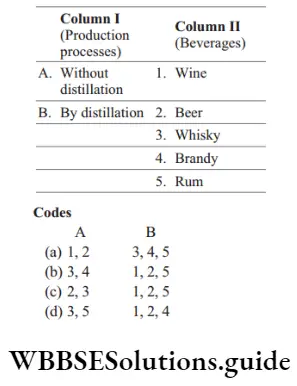
Question 11. Match the following columns.

NEET Biology Microbes in Industrial Products MCQs Question 11 Match the following columns.

Answer: 1. A–1, 2; b–3, 4, 5

NEET quiz on Microbes in Industrial Products with solutions

Question 12. What are the important products of yeast fermentation?

  1. Ethanol and acetic acid
  2. Butanol, glycerol and pyruvic acid
  3. Phenylethanol, amyl alcohol and caproic acid
  4. All of the above

Answer: 4. All of the above

By fermentation, the yeast species saccharomyces cerevisiae converts carbohydrates to carbon dioxide, acetic acid and alcohols like ethanol, butanol, phenyl ethanol and amyl alcohol. Yeast produces caproic acid by the fermentation of corn.

Biology MCQs with answers for NEET

Question 13. The first antibiotic was discovered in the year

  1. 1928
  2. 1914
  3. 1980
  4. 1930

Answer: 1. 1928

Penicillin was the first antibiotic to be discovered by alexander fleming in 1928.

Question 14. Most of the antibiotics are extracted from

  1. Algae
  2. Virus
  3. Bacteria
  4. Plants

Answer: 3. Bacteria

Most antibiotic drugs today are variations of substances that were originally isolated from bacteria or fungi. Penicillin is produced by a fungus, whereas streptomycin, chloramphenicol and tetracycline, are produced by soil bacteria.

microbes in household products class 12

Question 15. The highest number of antibiotics are produced by

  1. Bacillus
  2. Penicillium
  3. Streptomyces
  4. Cephalosporium

Answer: 3. Streptomyces

Many of the most important antibiotics used in hospitals around the world come from streptomyces bacteria. They are valued by scientists because they produce a variety of ‘secondary metabolites’ chemicals that help the bacteria prosper by inhibiting rival microbes.

Biology MCQs with answers for NEET

Question 16. The term ‘antibiotic’ was first coined by

  1. Fleming
  2. Pasteur
  3. Waksman
  4. Lister

Answer: 3. Waksman

  • The chemical substances produced by some microbes which can kill or retard the growth of other microbes are called antibiotics.
  • The term antibiotic was first coined by Waksman (1942). Penicillin was the first antibiotic to be discovered by alexander fleming (1928).

Question 17. Which one of the following is not an antibiotic?

  1. Streptomycin
  2. Citric acid
  3. Griseofulvin
  4. Cephalosporin

Answer: 2. Citric acid

Citric acid is obtained through the fermentation carried out by Aspergillus niger and mucor species on sugary syrups. It is not an antibiotic.

Question 18. The property of antibiotics to kill pathogenic microorganisms is called

  1. Bacteriogenesis
  2. Angiogenesis
  3. Antibiosis
  4. Antibiogenesis

Answer: 3. Antibiosis

Antibiosis is defined as an antagonist association between an organism (especially a microorganism) and the metabolic substances produced by another. This property of antibiotics is widely used to kill pathogenic microorganisms.

NEET expected MCQs on Microbes in Industrial Products 2025

Question 19. Antibiotics are Kerala

  1. Drugs to kill viruses
  2. Toxins produced by bacteria
  3. Products of bacterial metabolism
  4. Both (2) and (3)

Answer: 4. Both (2) and (3)

Antibiotics are toxic chemical substances produced by bacteria during bacterial metabolism. These chemicals are used to kill pathogenic microorganisms, particularly bacteria. These do not act against viruses.

Biology MCQ For NEET With Answers

Question 20. Antibiotics are used in the treatment of diseases like

  1. Diphtheria, whooping cough
  2. Plague
  3. Leprosy
  4. All of the above

Answer: 4. All of the above

Antibiotics are used as medicines for the treatment of a number of pathogenic bacterial diseases, e.g. Plaque, typhoid, tuberculosis, whooping cough, diphtheria, leprosy, etc.

Question 21. Streptomycin and actinomycin were discovered by

  1. Waksman
  2. Woodruff
  3. Fleming and Waksman
  4. Waksman and woodruff

Answer: 1. Waksman

Streptomycin and actinomycin were discovered by American biochemists Selman Waksman, Albert Schatz and Elizabeth Bugie in 1943.

Question 22. Which antibiotic was extensively used to treat American soldiers wounded in world war ii?

  1. Streptokinase
  2. Penicillin
  3. Statins
  4. Neomycin

Answer: 2. Penicillin

In 1940, e chain and h Florey obtained a relatively stable preparation of penicillin, which was extensively used to treat wounded American soldiers in World war-ii.

Question 23. Antibiotics of fungal origin are

  1. Penicillin
  2. Cephalosporin
  3. Both (1) and (2)
  4. Gentamicin

Answer: 3. Both (1) and (2)

The first antibiotic to be mass-produced was penicillin, derived from the fungi, penicillium. The cephalosporins were first isolated from cultures of the fungus Cephalosporium acremonium.

microbes in household products class 12

Question 24. Rhizopus nigricans is used in the production of

  1. Citric acid
  2. Gluconic acid
  3. Fumaric acid
  4. Acetic acid

Answer: 2. Gluconic acid

Rhizopus nigricans (mucor stolonifer) and some aspergilli are able to form fumaric acid.

Biology MCQ For NEET With Answers

Question 25. Statins used as blood cholesterol-lowering agents are extracted from

  1. Algae
  2. Yeast
  3. Virus
  4. Bacteria

Answer: 2. Yeast

Statins are products of the fermentation activity of yeast monascus purpureus. They are used in lowering blood cholesterol. Statins competitively inhibit enzymes for cholesterol synthesis.

NEET Biology Microbes in Industrial Products MCQs with explanations

Question 26. Bioactive molecules produced from monascus purpureus which inhibit cholesterol synthesis in blood are

  1. Gluconic acid
  2. Statins
  3. Gibberellins
  4. Bacitracin

Answer: 2. Statins

Statins are products of the fermentation activity of yeast monascus purpureus. They are used in lowering blood cholesterol. Statins competitively inhibit enzymes for cholesterol synthesis.

Question 27. Identify the microbe used in the commercial production of butyric acid.

  1. Clostridium bretylium
  2. Streptococcus bretylium
  3. Trichoderma polysporum
  4. Saccharomyces cerevisiae

Answer: 1. Clostridium bretylium

Clostridium butylicum is used in the commercial production of butyric acid.

Question 28. Cyclosporin-a, used as an immunosuppression agent is produced from

  1. Saccharomyces purpureus
  2. Monascus purpureus
  3. Penicillium notatum
  4. Trichoderma polysporum

Answer: 4. Trichoderma polypore

Cyclosporin-a is an eleven-membered cyclic oligopeptide obtained through the fermentative activity of the fungus Trichoderma polypore. It inhibits the activation of t-cells and therefore prevents rejection reactions in organ transplantation.

Question 29. Identify the blank spaces a, b, c and d given in the following table and select the correct answer. Type of microbe → scientific name → commercial product bacterium → a → lactic acid → fungus → b → cyclosporin-a → c→ monascus purpureus → d → fungus → e → penicillin

  1. A–lactobacillus, b–Trichoderma polypore, c–yeast, d–statins, e–Penicillium notatum
  2. A–staphylococcus, b–clostridium, c–yeast, d–penicillin, e– Penicillium notatum
  3. A–lactobacillus, b–Microsporum, c–plant, d–yeast, e–Trichoderma polypore
  4. A–staphylococcus, b–Microsporum, c–Agaricus, d–penicillin, e–lactobacillus

Answer: 1. A–lactobacillus, b–Trichoderma polypore, c–yeast, d–statins, e–Penicillium notatum

Biology MCQ For NEET With Answers

Question 30. The utility of fungi for steroid conversion was demonstrated by

  1. Kohler and Milstein
  2. Murray and Peterson
  3. Kornberg and miller
  4. Waksman and Monod

Answer: 2. Murray and Peterson

Murray and Peterson demonstrated the utility of fungi for steroid conversion by using the Rhizopus stolonifera

microbes in household products class 12

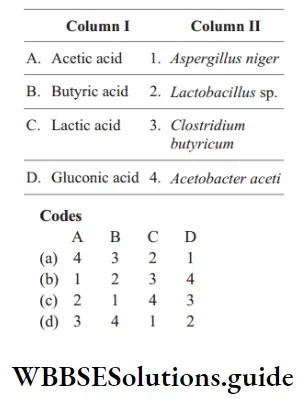
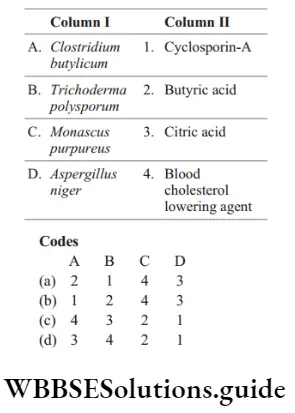
Question 31. Match column 1 and column 2 and choose the correct option from the codes given below.

NEET Biology Microbes in Industrial Products MCQs Question 31 Match the Column 1 and Column 2 and choose the correct option from the codes given below.

Codes

  1. 4 3 2 1
  2. 3 2 1 4
  3. 1 4 3 2
  4. 2 1 4 3

Answer: 1. A–4, b–3, c–2, d–1

Question 32. During the production of tea, the flavouring of leaves is done with the help of

  1. Bacillus subtilis
  2. B. Aceti
  3. B. Megatherium
  4. B. Radicicola

Answer: 3. B. Megatherium

The flavouring of tea leaves is done by Bacillus megatherium. It is isolated from tea rhizospheres which help to solubilize phosphate and promotes the growth of tea plants. It also affects sclerotial blight disease and induces systemic resistance in tea plants.

Question 33. Chloromycetin is obtained from

  1. Streptomyces griseus
  2. Streptomyces venezuelae
  3. Bacillus subtilis
  4. Saccharomyces cerevisiae

Answer: 2. Streptomyces venezuelae

Chloromycetin is an antibiotic first isolated from cultures of streptomyces venezuelae in 1947 but is now produced synthetically.

Microbes in Industrial Products mock test for NEET preparation

Question 34. For the commercial and industrial production of citric acid, which of the following microbe is used?

  1. Aspergilus niger
  2. Lactobacillus sp.
  3. Saccharomyces cerevisiae
  4. Clostridium bretylium

Answer: 3. Saccharomyces cerevisiae

Aspergillus niger is used to prepare citric acid.

Biology MCQ For NEET With Answers

Question 35. The enzyme which is used as a ‘clot buster’ to cure a patient suffering from myocardial infarction is

  1. Rennet
  2. Streptokinase
  3. Proteases
  4. Lipases

Answer: 2. Streptokinase

Enzyme streptokinase is used as a ‘clot buster’ for removing blood clots from the blood vessels of patients suffering from myocardial infarction.

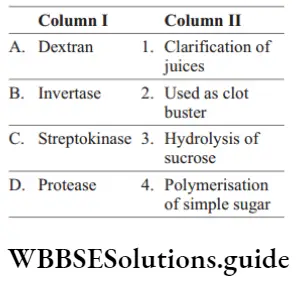
Question 36. Match column 1 and column 2 and choose the correct option from the codes given below.

NEET Biology Microbes in Industrial Products MCQs Question 36 Match the Column 1 and Column 2 and choose the correct option from the codes given below

Answer: 1. A–4, b–3, c–2, d–1

Question 37. Which one of the following is a wrong match of a microbe and its industrial product?

  1. Yeast – statins
  2. Acetobacter aceti – acetic acid
  3. Clostridium acetobutylicum – lactic acid
  4. Aspergillus niger – citric acid

Answer: 3. Clostridium acetobutylicum – lactic acid

Butyric acid is produced during the fermentation activity of the bacterium Clostridium acetobutylicum. Lactic acid fermentation is carried out by Lactobacillus sp. Rest options are correctly matched pairs.

NEET Biology Mcq

Question 38. Consider the following statements.

  1. The yeast used in making bread and beverages is a prokaryotic fungus.
  2. Streptokinase produced by streptococcus is modified by genetic engineering and used as a clot buster.
  3. Lipases are added to detergent for removing oily stains from laundry.
  4. Pectinases are used in clearing fruit juices.

Choose the option containing

Correct statements.

  1. 1, 2, 3 And 4
  2. 1, 2 And 3
  3. 2, 3 And 4
  4. 3 And 4

Answer: 3. 2, 3 And 4

All given statements are correct except i. The incorrect statements can be corrected as yeast used in baking and in the preparation of alcoholic beverages is a type of eukaryotic fungus.

NEET practice test on Microbes in Industrial Products

Question 39. Which industrial products are synthesised from microbes?

  1. Antibiotics
  2. Fermented beverages
  3. Bioactive molecules
  4. Enzymes

Choose the correct option.

  1. 3 And 4
  2. 2, 3 And 4
  3. 1, 3 And 4
  4. 1, 2, 3 And 4

Answer: 4. 1, 2, 3 And 4

All given industrial products are synthesised from microbes. Microbes are used to synthesise a number of products valuable to human beings. Beverages, antibiotics, bioactive molecules and enzymes are some examples.

microbes in household products class 12

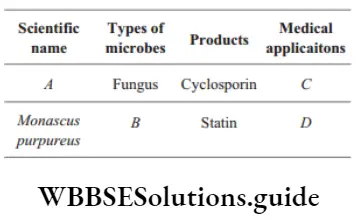
Question 40. Identify the blank spaces a, b, c and d given in the following table and select the correct answer.

NEET Biology Microbes in Industrial Products MCQs Question 40 Identify the blank spaces A, B, C and D given in the following table and select the correct answer.

  1. A–Trichoderma polisporum, b–yeast, c–as an immunosuppressive agent in organ transplant patients, d–as a blood-cholesterol lowering agent
  2. A–Trichoderma polisporum, b–protozoa, c–as blood-cholesterol lowering agent, d–as an immunosuppressive agent in organ transplant patients
  3. A–clostridium bretylium, b–yeast, c–used as a clot buster, d–as a blood-cholesterol agent
  4. A–clostridium bretylium, b–yeast, c–as blood-cholesterol lowering agent, d–used as a clot buster

Answer: 1. A–Trichoderma polisporum, b–yeast, c–as an immunosuppressive agent in organ transplant patients, d–as a blood-cholesterol lowering agent

NEET Biology Mcq

Question 41. Probiotics are

  1. Cancer inducing microbes
  2. New kinds of food allergens
  3. Live microbial food supplement
  4. Safe antibiotics

Answer: 3. Live microbial food supplement

Probiotics are defined as live microorganisms, including lactobacillus species, bifidobacterium species and yeasts, that may beneficially affect the host upon ingestion by improving the balance of the intestinal microflora. These are widely used as food supplements.

Question 42. Read the following statement having two blanks a and b. A drug used for …a… Patients are obtained from a species of the organism … B…

The one correct option for the two blanks is

  1. A–heart, b–penicillium
  2. A–organ transplant, b–trichoderma
  3. A–swine flu, b–monascus
  4. A–aids, b–pseudomonas

Answer: 2. A–organ transplant, b–trichoderma

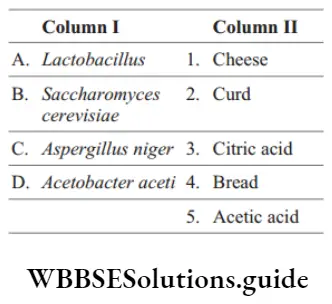
Question 43. Match the following organisms in column 1 with the products they produce in column 2.

NEET Biology Microbes in Industrial Products MCQs Question 43 Match the following organisms Column 1 with the products they produce Column 2.

Codes

  1. 2 4 5 3
  2. 2 4 3 5
  3. 3 4 5 1
  4. 2 1 3 5

Answer: 2. A–2, b–4, c–3, d–5

microbes in household products class 12

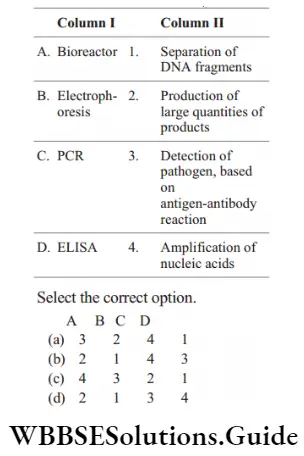
Question 44. Match the following columns.

NEET Biology Microbes in Industrial Products MCQs Question 44 Match the following columns.

Answer: 1. A–2, b–1, c–4, d–3

Question 45. Consider the following statements.

  1. Antibiotics are chemical substances produced by some microorganisms, which can kill or retard the growth of other disease-causing microorganisms.
  2. Penicillin is the first antibiotic to be discovered and was discovered by alexander fleming (1928) while working on the bacterium Staphylococcus aureus.
  3. The function of penicillin as an antibiotic was established by Ernst Chain and Howard Florey.

Choose the option containing 

Correct statements.

  1. 1 And 2
  2. 1 And 3
  3. 2 And 3
  4. 1, 2 And 3

Answer: 4. 1, 2 And 3

  • All given statements are correct. Antibiotics are chemical substances produced by some microorganisms, which can kill or retard the growth of other disease-causing microorganisms. Penicillin, discovered by alexander fleming, is the first antibiotic to be discovered.
  • While working on staphylococcus aureus bacteria, Fleming observed the growth of mould around, where the bacteria did not grow.
  • It was found to be a chemical penicillin, produced by penicillium notatum. The function of penicillin as an antibiotic was established by Ernst Chain and Howard Florey.

NEET Biology Mcq

Question 46. Fill up the blanks.

  1. Ethanol is produced by the action of …a…
  2. Large-scale fermentation in industries is carried out in large vessels called …b…
  3. Penicillin was discovered by …c…
  4. Lab checks disease-causing microbes in …d…

A to D in the above statements refer to

  1. A–virus, b–fermenters, c–Alexander fleming, d–intestine
  2. A–yeast, b–fermenters, c–Alexander fleming, d–stomach
  3. A–chest, b–fermenters, c–s Waksman, d–bacteria
  4. A–bacteria, b–fermenters, c–s waksman, d–liver

Answer: 2. A–yeast, b–fermenters, c–Alexander fleming, d–stomach

NEET Biology Microbes In Sewage Treatment Multiple Choice Question And Answers

Biology MCQ For NEET With Answers Microbes In Sewage Treatment

Question 1. Primary treatment involves

  1. Physical removal of large and small particles from sewage
  2. Biological removal of large and small particles from sewage
  3. Chemical removal of large and small particles from sewage
  4. Both (2) and (3)

Answer: 1. Physical removal of large and small particles from sewage

Primary treatment of sewage is the process of removal of small and large, floating and suspended solids from sewage through filtration and sedimentation.

Question 2. In the primary treatment of sewage, the floating debris is removed by passing the sewage through wire mesh screens. This is known as

  1. Sequential filtration
  2. Sedimentation
  3. Aeration
  4. Evaporation

Answer: 1. Sequential filtration

In the primary treatment of sewage, the floating debris is removed by sequential filtration by passing through wire mesh.

Read And Learn More: NEET Biology Multiple Choice Question And Answers

Question 3. Which of the following in sewage treatment removes suspended solids?

  1. Tertiary treatment
  2. Secondary treatment
  3. Primary treatment
  4. Sludge treatment

Answer: 3. Primary treatment

Primary treatment of sewage is the process of removal of small and large, floating and suspended solids from sewage through filtration and sedimentation.

Biology MCQ For NEET With Answers

NEET Biology Microbes In Sewage Treatment Multiple Choice Question And Answers

NEET Biology Microbes in Sewage Treatment MCQs with answers

Question 4. Sand and small pebbles are removed in

  1. Grit chambers
  2. Sludge digesters
  3. Aeration tank
  4. Effluent tank

Answer: 1. Grit chambers.

“microbes in human welfare “

  • The wastewater is passed through a screen to remove rags and large debris. The screening system washes and dewaters the debris before discharging it into a garbage cane.
  • The screened wastewater then flows to an aerated grit chamber that facilitates the sedimentation of heavier inorganic materials, such as sand and grit, by reducing the velocity of the wastewater.
  • The grit chamber is aerated to increase the dissolved oxygen content of the wastewater, which supports the aerobic biological process used later in the treatment system.
  • The material collected at the bottom of the grit vessel is removed by an auger and mixed with biosolids generated during the treatment process. Thus, sand and small pebbles are removed in grit chambers.

Question 5. Sewage water can be purified for recycling with the action of

  1. Aquatic plants
  2. Penicillin
  3. Microorganisms
  4. Fishes

Answer: 3. Microorganisms

Microbes or microorganisms play an essential role in sewage treatment plants by decomposing organic matter both aerobically and anaerobically. They help to purify and recycle the sewage water.

Question 6. Sewage water cannot be discharged directly into rivers because

  1. It contains a high level of organic matter
  2. It contains pathogenic microbes
  3. It may destroy the flora and fauna of the river
  4. All of the above

Answer: 4. All of the above

  • Sewage water cannot be discharged directly into rivers because sewage is a liquid containing organic wastes from households, industrial and agricultural activities discharged into water. It contains harmful substances and disease-causing microbes.
  • All these components can adversely affect the flora and fauna of water bodies. Therefore, it is dangerous to release untreated sewage into the water.

Biology MCQ For NEET With Answers

Question 7. Secondary sewage treatment is basically

  1. A chemical process
  2. A physical process
  3. A mechanical process
  4. A biological process

Answer: 4. A biological process

Secondary treatment of the liquid effluent from the primary settling tank is purely a biological treatment, involving microbial activity.

“select the correct group of biocontrol agents “

Question 8. In the biological treatment of sewage, the mass of bacteria is held together by fungal filaments and forms a mesh-like structure called

  1. Activated sludge
  2. Aerobic process
  3. Flocs
  4. Anaerobic sludge

Answer: 3. Flocs

  • Useful aerobic microbes grow rapidly and form flocs. Flocs are masses of bacteria associated with fungal filaments to form mesh-like structures.
  • The growing microbes consume organic matter and thus, reduce the biochemical oxygen demand (bod).

Important MCQs on Microbes in Sewage Treatment for NEET

Question 9. In sewage treatment, bacterial flocs are allowed to sediment in a settling tank. This sediment is called as

  1. Activated sludge
  2. Primary sludge
  3. Anaerobic sludge
  4. Secondary sludge

Answer: 1. Activated sludge

In sewage treatment, when the biochemical oxygen demand (body) of sewage has reduced, the effluent is passed into the settling tank. Since the sludge consists of active biological material such as flocs, it is referred to as activated sludge.

Question 10. Bod of wastewater is estimated by measuring the amount of

  1. Carbon dioxide present
  2. Biodegradable organic matter
  3. Oxygen evolution
  4. Oxygen consumption

Answer: 4. Oxygen consumption

Biochemical oxygen demand (bod) measures the amount of organic matter in water by measuring the rate of oxygen uptake (i.e. Oxygen consumption) by microbes.

Biology MCQ For NEET With Answers

Question 11. Bod is

  1. Biochemical oxygen demand
  2. Biological oxygen deficit
  3. Biochemical oxygen deficit
  4. Botanical oxygen demand

Answer: 1. Biochemical oxygen demand

Biochemical oxygen demand (bod) measures the amount of organic matter in water by measuring the rate of oxygen uptake (i.e. Oxygen consumption) by microbes.

Question 12. The purpose of biological treatment of wastewater is to

  1. Reduce bod
  2. Increase bod
  3. Reduce sedimentation
  4. Increase sedimentation

Answer: 1. Reduce bod

The growing microbes consume organic matter and thus reduce the biochemical oxygen demand (bod).

13. Good drinking water should have a body level at

  1. 9-12 Ppm
  2. 1-2 Ppm
  3. 15-20 Ppm
  4. 10.2 ppm

Answer: 2. 1-2 Ppm

  • A body level of 1-2 ppm is considered very good. There will not be much organic waste present in the water supply. A water supply with a body level of 3-5 ppm is considered moderately clean.
  • In water with a body level of 6-9 ppm, the water is considered somewhat polluted because there is usually organic matter present and bacteria are decomposing this waste. At body levels of 100 ppm or greater, the water supply is considered very polluted with organic waste.

14. Consider the following statements.

  1. Biochemical oxygen demand (bod) represents the amount of dissolved oxygen that would be consumed if all the organic matter in 1 l of water were oxidised by microorganisms.
  2. The low value of the body means the water is either normal or less polluted by organic matter.
  3. The high value of the body means the water is highly polluted by organic matter.

Choose the option containing

Correct statements.

  1. 1 And 2
  2. 1 And 3
  3. 2 And 3
  4. 1, 2 And 3

Answer: 4. 1, 2 And 3

  • All given statements are correct. Bod refers to the amount of oxygen consumed if all the organic matter in one litre of water is oxidised by bacteria. A body level of 1-2 ppm is considered very good.
  • There will not be much organic waste present in the water supply. A water supply with a body level of 3-5 ppm is considered moderately clean.
  • In water with a body level of 6-9 ppm, the water is considered somewhat polluted because there is usually organic matter present and bacteria are decomposing this waste. At body levels of 100 ppm or greater, the water supply is considered very polluted with organic waste.

Biology MCQ For NEET With Answers

15. Which of the following plan has been initiated by the Ministry of Environment and Forests to protect rivers from water pollution?

  1. Ganga action plan
  2. Yamuna action plan
  3. Both (1) and (2)
  4. Neither (1) nor (2)

Answer: 3. Both (1) and (2)

“an example of endomycorrhiza is “

In order to protect the major rivers of India from sewage pollution, the Ministry of Environment and Forests has initiated the development of sewage treatment plants under the national river conservation authority, Examples: Ganga action plan (gap), yamuna action plan, Sutlej Action plan, gomti action plan, etc.

Question 16. When a huge amount of sewage is dumped into a river, the body will

  1. Increase
  2. Remain unchanged
  3. Slightly decrease
  4. Decrease

Answer: 1. Increase

  • When huge amounts and sewage are dumped into a river, the body will increase. Untreated sewage contains large amounts of organic matter.
  • Bod is the amount of oxygen required to decompose the organic matter present in a water body. The higher the body, the more polluted the water.

NEET quiz on Microbes in Sewage Treatment with solutions

Question 17. Given below is the flowchart of sewage treatment. Identify a, b, c, d and e and select the correct option.

NEET Biology Microbes in Sewage Treatment MCQs Primary sludge

  1. A– secondary treatment, b–microbial digestion, c–high bod, d–activated sludge, e–aerobic sludge digesters
  2. A–aerobic treatment, b–mechanical agitation, c–low bod, d–deactivated sludge, e–aerobic sludge digesters
  3. A–small aeration tank, b–microbial digestion, c–low bod, d–activated sludge, e–anaerobic sludge digesters
  4. A–secondary treatment, b–mechanical agitation, c–reduced body, d–activated sludge, e–anaerobic sludge digesters

Answer: 4. –Secondary treatment, b–mechanical agitation, c–reduced body, d–activated sludge, e–anaerobic sludge digesters

NEET Biology Mcq

Question 18. Microbes are used in

  1. Primary treatment of sewage
  2. Secondary treatment of sewage
  3. Anaerobic sludge digesters
  4. Production of biogas

Choose the correct option.

  1. 1, 2 And 3
  2. 1, 3 And 4
  3. 2, 3 And 4
  4. 1, 2, 3 And 4

Answer: 3. 2, 3 And 4

  • All listed processes involve the use of microbes except primary treatment of sewage because primary treatment is the physical removal of large and small particles from sewage.
  • Secondary treatment of the liquid effluent from the primary settling tank is purely a biological treatment involving microbial activity.
  • In the anaerobic sludge digesters, heterotrophic microbes anaerobically digest bacteria and fungi in sludge producing a mixture of gases such as methane, hydrogen sulphide and CO2 which form the biogas.

Question 19. During secondary treatment,

  1. Primary effluent is continuously agitated in the aeration tank
  2. There is vigorous growth of useful aerobic microbes into flocs
  3. Reduction in body level
  4. All of the above

Answer: 4. All of the above

  • In the secondary treatment, the effluent is present in large effluent tanks. Air is constantly pumped and the effluent is agitated. This results in rapid growth of microbial flocs which are associations of bacteria and fungi.
  • These flocs feed on the organic matter present in the effluent thereby, reducing the body. On significant reduction of body, the effluent is then passed to the settling tanks.

Question 20. What gases are produced in anaerobic sludge digesters?

  1. Methane and co2 only
  2. Methane, hydrogen sulphide and
  3. Methane, hydrogen sulphide and o2
  4. Hydrogen sulphide and co2

Answer: 2. Methane, hydrogen sulphide and

In an anaerobic sludge digester, due to the activity of anaerobic bacteria like methanogenic and sulphur bacteria, gases like ch4, h s2 and co2 are produced.

NEET Biology Mcq

Question 21. What will happen to the activated sludge floc if oxygen is reduced?

  1. It will slow down the rate of degradation of organic matter
  2. The centre of flocs will become anoxic resulting in death
  3. Flocs would increase in size as anaerobic bacteria would grow around flocs
  4. Protozoa would grow in a large number

Answer: 3. Flocs would increase in size as anaerobic bacteria would grow around flocs

Without oxygen, the microbes cannot survive. If O2 is reduced, the centre of the flocs will become anoxic, which would cause death.

“microbes in human welfare neetprep “

Question 22. Choose the incorrect statement about secondary sewage treatment.

  1. In the settling tank, the bacterial flocs settle and the sediment is called activated sludge
  2. A small part of the sludge is used as an inoculum. The remaining part is passed into anaerobic sludge digesters
  3. On anaerobic digestion of bacteria and fungi, a mixture of gases such as carbon dioxide, nitrogen and carbon monoxide are produced
  4. None of the above

Answer: 3. On anaerobic digestion of bacteria and fungi, a mixture of gases such as carbon dioxide, nitrogen and carbon monoxide are produced

  • The statement in the option is incorrect and can be corrected as methane, hydrogen sulphide and CO2 are the main gases produced in the digesters by the anaerobic digestion by heterotrophic bacteria and fungi.
  • Carbon monoxide is not produced during this process. Rest statements are correct about secondary sewage treatment.

NEET Biology Microbes in Sewage Treatment MCQs with explanations

Question 23. Which of the following is put into an anaerobic sludge digester for further sewage treatment?

  1. Floating debris
  2. The effluent of primary treatment
  3. Activated sludge
  4. Primary sludge

Answer: 3. Activated sludge

Activated sludge is put into an anaerobic sludge digester for further sewage treatment. It contains biological flocs that contain bacteria and fungi for further digestion of organic waste.

NEET Biology Biotechnology Principles And Processes Miscellaneous Multiple Choice Question And Answers

Biotechnology Principles And Processes Miscellaneous

Question 1. The RTF region enables the plasmid to

  1. Be transmitted to other bacteria by conjugation
  2. Undergo transformation
  3. Replicate in the host cell
  4. Code for enzymes that inactivate specific drugs

Answer: 1. Be transmitted to other bacteria by conjugation

Read And Learn More: NEET Biology Multiple Choice Question And Answers

  • Resistance or R plasmid is a circular DNA that consists of genes that make the bacterium antibiotic-resistant. Such a plasmid consists of two segments of DNA, one is responsible for replication as well as the transfer of R.
  • Plasmid and the second have the genes that produce substances neutralizing the action of one or another antibiotic or other drugs. These plasmids are conjugative and spread among the bacteria through conjugation.

NEET Biology Mcq Chapter Wise

Question 2. Which one of the following is a case of incorrect matching?

  1. Somatic hybridization – a fusion of two diverse cells
  2. Vector dna – site for tRNA synthesis
  3. Micropropagation– in vitro production of plants in large numbers
  4. Callus – an unorganized mass of cells produced in tissue culture

Answer: 2. Vector dna – site for tRNA synthesis

“biotechnology principles and processes “

  • (2) Option (2) is incorrect matching and can be corrected as vectors are dna molecules that can carry a foreign dna segment and replicate inside the host cell.
  • They are used in recombinant dna technology because it is harmless and can be easily cultured. Rest all options are correct matchings.

Question 3. Paleontologists unearthed a human skull during excavation. A small fragment of the scalp tissue was still attached to it. Only a little dna could be extracted from it. If the genes of ancient man need to be analyzed, the best way of getting a sufficient amount of dna from this extract is

  1. By hybridizing the dna with a dna probe
  2. By subjecting the dna to a polymerase chain reaction
  3. By subjecting the dna to gel electrophoresis
  4. By treating the dna with restriction endonucleases

Answer: 2. By subjecting the dna to polymerase chain reaction

The polymerase chain reaction (PCR) is a technique by which small samples of dna can be quickly amplified. Starting with only one gene-sized piece of dna, this technique is used to make billions of copies in only a few hours.

“plasmid has been used as vector because “

Question 4. Escherichia coli is an important material for genetic experiments because

  1. It is harmless
  2. It is haploid
  3. It can be easily cultured
  4. Both (1) and (3)

Answer: 4. Both (1) and (3)

Of all the model organisms and tools for genetic modification available, e. Coli stands out as a model organism. It is harmless and can be easily cultured. Thus, option (4) is correct.

NEET Biology Mcq Chapter Wise

NEET Biology Biotechnology Principles And Processes Miscellaneous Multiple Choice Question And Answers

NEET Biology Biotechnology Principles and Processes MCQs with Answers

Question 5. In vitro, clonal propagation in plants is characterized by

  1. Pcr and rapid
  2. Northern blotting
  3. Electrophoresis and HPLC
  4. Microscopy

Answer: 1. Pcr and rapid

  • Clonal propagation represents the technique in which vegetative tissue is used to produce plants that are genetically identical to their parents. It can be characterized by PCR and rapid.
  • The polymerase chain reaction (PCR) technique, generates microgram (mg) quantities of dna copies (up to billion copies) of the desired dna or RNA segment, present even as a single copy in the initial preparation, in a matter of few hours.
  • Rapid stands for random amplification of polymorphic dna. It is a type of PCR, but the segments of dna that are amplified are random.

Question 6. The frequency of recombination is

  1. Same for all genes
  2. Highest for genes that first entered the recipient cells
  3. Lowest for genes that first entered the recipient cells
  4. None of the above

Answer: 2. Highest for genes that first entered the recipient cells

  • The frequency of recombinants determines the order of entry for each gene. During the process of conjugation, the genes are transferred through the conjugation tube. Spontaneous breakage of this tube creates a natural gradient of transfer.
  • There are fewer chances that the latter genes will be received by the bacterial cell. The gene which enters the first in the cell has the maximum frequency of recombination as compared to those genes which enter later.

“biotechnology principles and processes class 12 “

Question 7. Prophage comprises

  1. Viral dna attached to host dna
  2. Viral dna found in a host
  3. Dna and protein particles in the host
  4. Naked viral dna

Answer: 1. Viral dna attached to host dna

  • A provirus is a virus genome that is integrated into the dna of the host cell. In the case of bacterial viruses (bacteriophages), proviruses are often referred to as prophages.
  • Reverse transcription of retroviral genomic RNA yields double-stranded dna that is integrated into the host genome to form a provirus.

NEET Biology rDNA Technology and Gene Cloning MCQs

Question 8. How many recombinant therapeutics have been used for human diseases throughout the world?

  1. 12
  2. 24
  3. 30
  4. 56

Answer: 3. 30

Recombinant therapeutics refer to specialized medicines made up of recombinant protein. The production of recombinant therapeutics is possible only due to recombinant dna technology. At present 30 recombinant therapeutics have been approved for the use of humans around the world.

Question 9. In addition to the taq polymerase enzyme which other thermostable dna polymerases have been isolated to be used in a polymerase chain reaction (PCR)?

  1. Vent polymerase
  2. Pfu polymerase
  3. Both (1) and (2)
  4. None of these

Answer: 3. Both (1) and (2)

  • Pfu polymerase and tli polymerase (vent), which are both thermostable have been isolated in addition to taq dna polymerase. Pfu polymerase is isolated from micrococcus furiosus and pneumococcus litoralis provides tli (vent) polymerase.
  • The use of thermostable taq allows the PCR to operate at high temperatures, thereby promoting the high specificity of the primers and reducing the output of non-specific products, such as primer dimers. Thus, option (3) is correct.

NEET Biology Mcq Chapter Wise

Question 10. Retroviruses have genetic material which is

  1. Dna
  2. Rna
  3. Both and
  4. Proteins

Answer: 2. Rna

Retroviruses have RNA as their core nucleic acid, e.g. Rous sarcoma virus, avian leukemia virus, and the virus-causing aids (half – 3). In retroviruses, transcription can take place in the reverse direction, i.e. From rna to dna

“principles and processes of biotechnology “

Question 11. Restriction endonuclease requires which of the following ions for cleavage?

  1. Na +
  2. Mg 2+
  3. K+
  4. H +

Answer: 2. Mg 2+

  • Restriction endonucleases as well as many other enzymes that act on phosphate-containing substrate require mg 2+ or some other similar divalent cation for activity.
  • Additional studies proved that a second magnesium ion must be present in an adjacent site for eco rv endonuclease to cleave its substrate.

Important MCQs on Biotechnology Principles and Processes for NEET

Question 12. Choose the correct pair from the following.

  1. Polymerases – break the dna into fragments
  2. Nucleases – separate the two strands of dna
  3. Exonucleases– make cuts at specific positions within dna
  4. Ligases– join the two dna molecules

Answer: 4. Ligases– join the two dna molecules

Tools and Techniques in Biotechnology MCQs for NEET

Question 13. Match the organism with its use in biotechnology.

NEET Biology Miscellaneous MCQs Match the organism with its use in biotechnology.

Answer: 2. A-4, b-3, c-1, d-2.

NEET Biology Process Of Recombinant DNA Technology Multiple Choice Question And Answers

Biology MCQ For NEET With Answers Process Of Recombinant DNA Technology

Question 1. Gene recombinant technology is used for

  1. Vector less gene transfer into the target cell
  2. Vector-based gene transfer into the target cell
  3. The direct transfer of dna protein complex
  4. Liposome base direct gene transfer into the target cell

Answer: 2. Vector-based gene transfer into a target cell

In molecular cloning, the dna molecules are used as the vector to transfer the desired gene into the host genome and then replicate to express the gene. The vectors are constructed using recombinant dna technology

Question 2. A gene carried by recombinant dna is cloned when

  1. Its host bacterium divides by binary fission
  2. It is transcribed
  3. It is fragmented by restriction enzymes
  4. It is hybridized

Answer: 1. Its host bacterium divides by binary fission

“biotechnology pyq neet “

Replication of chromosomal dna in bacteria starts at a specific chromosomal site called the origin and proceeds bidirectionally until the process is complete.

  • Vector dna with foreign genes is called recombinant dna. Rdna undergoes multiplication by binary fission of host cells or gene cloning process. The bacterium is divided by binary fission.

Read And Learn More: NEET Biology Multiple Choice Question And Answers

Question 3. An enzyme used to remove bacterial cell walls for genetic engineering is

  1. Lysozyme
  2. Pectinase
  3. Cellulase
  4. Lipases

Answer: 1. Lysozyme

The bacterial cell is treated with the enzyme lysozyme to remove the cell wall of peptidoglycan in bacteria for genetic engineering.

Question 4. Proteins are removed by treatment with

  1. Ribonuclease
  2. Chitinase
  3. Cellulase
  4. Protease

Answer: 4. Protease

Proteins are removed by treatment with protease.

Biology MCQ For NEET With Answers

NEET Biology Process Of Recombinant DNA Technology Multiple Choice Question And Answers

NEET Biology recombinant DNA technology MCQs with answers

Question 5. Rna is removed by the treatment with

  1. Ribonuclease
  2. Protease
  3. Chitinase
  4. Cellulase

Answer: 1. Ribonuclease

Rna is removed by treatment with ribonuclease.

Question 6. The cell or organism from which the required gene is taken is called

  1. Plasmid
  2. Cloning vector
  3. Donor
  4. Vector

Answer: 3. Donor

The cell or organism from which the required gene is taken is called a donor. Using recombinant technology, genes from a donor cell can be transplanted into a bacterium for dna replication and protein synthesis. The kinds of cells that can be used as a donor in this technology are either yeast or bacteria or eukaryotic cells.

“biotechnology principles and processes “

Question 7. Which of the following is not correctly matched for the organism and its cell wall degrading enzyme?

  1. Bacteria – lysozyme
  2. Plant cells – cellulase
  3. Algae – methylase
  4. Fungi – chitinase

Answer: 3. Algae – methylase

(3) Option (3) is not correctly matched for the organism and its cell wall degrading enzyme and can be corrected as in algae, the cell wall is made up of cellulose which can be degraded by enzyme cellulase. Rest all options are correctly matched.

Biology MCQ For NEET With Answers

Question 8. Fill up the blanks.

  1. Bacterial cell walls dissolve with …a…, Whereas plant cells are dissolved by the action of …b…
  2. Rna and proteins are removed by the treatment of …c… And …d…, respectively.
  3.  …e… Is used to precipitate the purified dna.
  4. Since dna is …f… Charged, it moves towards the …g… In gel electrophoresis.

Choose the correct order.

  1. A–lysozyme, b–cellulase, c–deoxyribonuclease, d-lipase, e–chilled aniline, f–positively,
    g–cathode
  2. A–lysozyme, b–cellulase, c–ribonuclease, d–protease, e–chilled ethanol, f–negatively, g–anode
  3. A–chitinase, b–cellulase, c–ribonuclease, d–carboxylase, e–chilled benzene, f–positively, g–cathode
  4. A–chitinase, b–cellulase, c–deoxyribonuclease, d–amylase, e–chilled ethanol, f–negatively g–anode

Answer: 2. A–lysozyme, b–cellulase, c–ribonuclease, d–protease, e–chilled ethanol, f–negatively, g–anode

Question 9. The construction of recombinant dna involves

  1. Cleaving dna segments with ‘ligase’ and rejoining them with endonuclease
  2. Cleaving and rejoining dna segments with ‘ligase’ alone
  3. Cleaving and rejoining dna segments with ‘endonuclease’ alone
  4. Cleaving dna segments with ‘endonuclease’ and rejoining them with ‘ligase’

Answer: 4. Cleaving dna segments with ‘endonuclease’ and rejoining them with ‘ligase’

Recombinant DNA technology multiple choice questions for NEET

Question 10. Arrange the following steps of recombinant biotechnology in the correct order.

  1. Extraction of the desired gene product.
  2. Amplification of the gene of interest.
  3. Isolation of a desired dna fragment.
  4. Ligation of the dna fragment into a vector.
  5. Insertion of recombinant dna into the host.

Choose the correct order.

  1. 1 → 2 → 3I → 4 → 5
  2. 3 → 2 → 4 → 5 → 1
  3. 2 → 4 → 5 → 3 → 1
  4. 1 → 4 → 5 → 3 → 2

Answer: 2. 3 → 2 → 4 → 5 → 1

“principles and processes of biotechnology “

Recombinant dna technology involved the following steps

  • Isolation of dna.
  • Fragmentation of dna by restriction endonucleases.
  • Isolation of a desired dna fragment.
  • Amplification of the gene of interest.
  • Ligation of the dna fragment into a vector.
  • Insertion of recombinant dna into the host.
  • Culturing the host cells on a suitable medium at a large scale.
  • Extraction of the desired gene product.
  • Downstream processing of the products as finished products ready for marketing.
  • Thus, the correct order is shown in option (b).

Biology MCQ For NEET With Answers

Question 11. The assertion in recombinant dna technology, human genes are often transferred into bacteria or yeast. Reason (R) Both bacteria and yeast multiply very fast to form a huge population that expresses the desired gene.

  1. Both a and r are true and r is the correct explanation of a
  2. Both a and r are true, but r is not the correct explanation of a
  3. A is true, but r is false
  4. Both a and r are false

Answer: 1. Both a and r are true and r is the correct explanation of a

NEET MCQs on recombinant DNA technology with solutions

Question 12. Which of the following is used in the recombinant dna technique?

  1. The cell wall of the virus
  2. Gene which produces capsid of the virus
  3. Virus
  4. Capsid of virus

Answer: 3. Virus

In recombinant dna technology, a desired segment of dna or a gene is made to combine with the dna of an organism where it will multiply and produce its copies. Plasmids and viruses are the most commonly used cloning vectors in recombinant dna technology.

Question 13. Pcr stands for

  1. Polymerase chain reaction
  2. Primary chain reaction
  3. Polymerase chemical reaction
  4. Polymerase chain restriction

Answer: 1. Polymerase chain reaction

Pcr stands for polymerase chain reaction. It is a method for amplifying dna and was invented by Kary Mullis. It takes a single copy of a dna molecule and uses it to create millions or billions of copies of itself.

Question 14. Who discovered PCR (polymerase chain reaction)?

  1. Wilmut
  2. A Jeffreys
  3. Einthoven
  4. Kary Mullis

Answer: 4. Kary Mullis

Pcr stands for polymerase chain reaction. It is a method for amplifying dna and was invented by Ary Mullis. It takes a single copy of a dna molecule and uses it to create millions or billions of copies of itself.

Biology MCQs with answers for NEET

Question 15. Polymerase chain reaction is a technique used for

  1. In vivo replication of DNA
  2. In vivo synthesis of mRNA
  3. In vitro synthesis of mRNA
  4. In vitro replication of specific DNA

Sequence using thermostable dna polymerase

Answer: 4. In vitro replication of specific dna

The polymerase chain reaction is a technique that is used for in vitro replication of specific dna sequences using thermostable dna polymerase.

Question 16. The correct order of steps in polymerase chain reaction (PCR) is

  1. Extension, denaturation, annealing
  2. Denaturation, annealing, extension
  3. Denaturation, extension, annealing
  4. Annealing, extension, denaturation

Answer: 2. Denaturation, annealing, extension

The PCR technique is used for making multiple copies of genes (or dna) of interest in vitro. Each cycle has three steps

  1. Denaturation
  2. Annealing
  3. Extension

Question 17. The temperature required for various steps of polymerase chain reaction (a, b, and c ) are

  1. Denaturation
  2. Annealing
  3. Extension

Choose the correct option.

  1. A–94°c, b–40°c, c–72°c
  2. A–40°c, b–72°c, c–94°c
  3. A–72°c, b–94°c, c–40°c
  4. A–94°c, b–72°c, c–40°c

Answer: 1. A–94°c, b–40°c, c–72°c

Biology MCQs with answers for NEET

Question 18. Match the following columns.

NEET Biology Process of Recombinant DNA Technology MCQs Question 18 Match the following columns.

Answer: 4. A–4, b–3, c–1, d–2

“selection of recombinants “

Question 19. The enzyme used in polymerase chain reaction (PCR) is

  1. Taq polymerase
  2. Rna polymerase
  3. Ribonuclease
  4. Endonuclease

Answer: 1. Taq polymerase

The key ingredients of the polymerase chain reaction are taq polymerase which is the DNA polymerase enzyme isolated from a bacterium, Thermus aquaticus.

Question 20. The Taq polymerase enzyme is obtained from

  1. Thermus aquatics
  2. Thiobacillus ferroxidans
  3. Bacillus subtilis
  4. Pseudomonas putida

Answer: 1. Thermus aquaticus

The enzyme taq polymerase is a thermostable enzyme that is obtained from Thermus aquaticus.

Important recombinant DNA technology questions for NEET exam

Question 21. During the amplification of the gene using PCR, Taq polymerase is used between

  1. Denaturation and annealing
  2. Annealing and extension
  3. Extension and amplification
  4. None of the above

Answer: 2. Annealing and extension

  • During the amplification of the gene in PCR, taq dna polymerase is used between extension and annealing. During the first step, the dna containing the sequence to be amplified is denatured by heating.
  • This denatured dna is then annealed to an excess of the synthetic oligonucleotide primers. Then taq polymerase is used to replicate the dna segment between the sites complementary to oligonucleotide primer and extend it. Taq polymerase usually replicates dna segments of up to 2 kb.

Biology MCQs with answers for NEET

Question 22. Which is an incorrect statement?

  1. Taq dna polymerase is important for pcr
  2. Taq dna polymerase is not thermostable
  3. In PCR, two nucleotide primers are used
  4. Taq dna polymerase isolated from a bacterium, Thermus aquaticus

Answer: 2. Taq dna polymerase is not thermostable

The statement in option (2) is incorrect and can be corrected as taq dna polymerase is a thermostable enzyme, isolated from a thermophilic bacterium, Thermus aquaticus, and remain active at high temperature. Rest all options are correct statements.

Question 23. What has initiated the increase in usage of pcr (polymerase chain reaction

  1. Easy availability of dna template
  2. Availability of synthetic primers
  3. Availability of cheap deoxyribonucleotides
  4. Availability of thermostable dna polymerase

Answer: 4. Availability of thermostable dna polymerase

The availability of thermostable dna polymerase has initiated an increase in the usage of PCR. It is highly efficient and remains enzymatically active after each cycle.

Question 24. Which one is a true statement regarding dna polymerase used in PCR?

  1. It is used to ligate introduced dna in the recipient cell
  2. It serves as a selectable marker
  3. It is isolated from a virus
  4. It remains active at high temperature

Answer: 4. It remains active at high temperature

  • The statement in option (4) is true regarding the DNA polymerase used in PCR as it remains active at high temperatures.
  • Other statements are incorrect and can be corrected as follows dna polymerase in PCR is used to extend nucleotide sequences by replication, it does not serve as a selectable marker and it is isolated from a bacteria.

“selection of recombinants “

Question 25. Primers are

  1. Small chemically synthesized oligonucleotides of about 10-18 nucleotides that are complementary to the region of template dna
  2. Chemically synthesized oligonucleotides of about
    10-18 nucleotides that are not complementary to the region of template dna
  3. The double-stranded dna that needs to be amplified
  4. Specific sequences present on recombinant dna

Answer: 1. Small chemically synthesized oligonucleotides of about 10-18 nucleotides that are complementary to the region of template dna

NEET Biology Mcq

26. Amplification of desired dna requires

  1. Dna fragments to be amplified
  2. Primers
  3. dNTPs and dna polymerase
  4. All of the above

Answer: 4. All of the above

Gene amplification using primers can be done by polymerase chain reaction (PCR). In this reaction, multiple copies of the dna fragment are amplified in vitro using two sets of primers and the enzyme dna polymerase. Thus, option (4) is correct.

Question 27. Amplification of gene of interest by using dna polymerase may go up to

  1. 0.1 million times
  2. 1.0 million times
  3. 1.0 billion times
  4. 1.0 trillion times

Answer: 3. 1.0 billion times

  • The polymerase chain reaction (PCR) provides a simple and ingenious method for the exponential amplification of specific dna sequences by in vitro dna synthesis.
  • If the process of replication of dna is repeated many times (approximately 30 times), then the segment of dna can be amplified to a billion times also.

Question 28. The ideal host for the amplification of dna molecules is

  1. Viruses
  2. Plants
  3. Bacteria
  4. Animals

Answer: 3. Bacteria

  • Bacteria are an ideal host for the amplification of dna because for various reasons like, their short doubling time and availability, extensive knowledge, and tools for manipulating the bacteria.
  • The short doubling time is advantageous because it provides enough amounts of amplified dna in a short span of time. The fact that tools are available helps us to amplify a variety of dna molecules.

Question 29. The figure shows three steps (a, b, c) of polymerase chain reaction (PCR). Select the option giving correct identification together with what it represents.

NEET Biology Process of Recombinant DNA Technology MCQs Region to be amplified

  1. A–denaturation at a temperature of about 98ºc separating the two dna strands
  2. A–denaturation at a temperature of about 50ºc
  3. C–extension in the presence of heat-stable dna polymerase
  4. A–annealing with three sets of primers

Answer: 3. C–extension in the presence of heat-stable dna polymerase

  • (3) Option (3) is correct identification as the reaction mixture is first heated to a temperature between 90-98°c (commonly 94°c) that ensures dna denaturation, i.e. The separation of the two strands.
  • Every single strand of the target dna then acts as a template for dna synthesis. B represents the attachment of short oligonucleotide sequences called primer by a process called annealing and Fig c represents the extension of the dna segment by the addition of nucleotides by the action of the thermostable polymerase called taq (dna) polymerase.

NEET Biology Mcq

Question 30. In the PCR technique, polymerization involves

  1. Synthesis of dna with the help of taq polymerase, dNTPs, and mg2+ at 72°c
  2. Hybridization of primers to single-stranded dna at 55°c
  3. Heating of double-stranded dna at 94°c
  4. Formation of single-stranded dna

Answer: 1. Synthesis of dna with the help of taq polymerase, dNTPs, and mg2+ at 72°c

  • In the PCR technique, polymerization involves taq polymerase dna polymerase-i named after the thermophilic bacterium, Thermus aquaticus.
  • Deoxynucleoside triphosphates (dNTPs) consist of four basic nucleotides, data, data, data, and dTTP, as building blocks of new dna strands. Magnesium is a required cofactor for thermostable dna polymerases. Mg 2+ in the PCR mixture stabilizes dsDNA

Question 31. Which of the following steps are catalyzed by taq polymerase in a PCR reaction?

  1. Denaturation of template dna
  2. Annealing of primers to template dna
  3. Extension of primer end on the template dna
  4. None of the above

Answer: 3. Extension of primer end on the template dna

During extension, the enzyme, Taq polymerase synthesizes the dna segment between the primers. The two primers extend towards each other in order to copy the dna segment typing between the two primers. This step requires the presence of deoxynucleoside triphosphates (dNTPs), mg 2+, and occurs at 72°c.

Solved MCQs on recombinant DNA technology for NEET Biology

Question 32. Thermal cycling used in PCR technique is nothing but

  1. Raising the temperature of the PCR sample
  2. Decreasing the temperature of the PCR sample
  3. Alternate heating and cooling PCR sample
  4. Heating the PCR sample to its boiling point

Answer: 3. Alternate heating and cooling PCR sample

Thermal cycling exposes reactants to repeated cycles of heating and cooling to permit different temperature-dependent reactions specifically, dna melting and enzyme-driven dna replication.

“selection of recombinants “

Question 33. The most sensitive technique to detect malignant cells in non-Hodgkin’s lymphoma is

  1. Polymerase chain reaction
  2. Gene therapy
  3. Stem cell therapy
  4. None of the above

Answer: 1. Polymerase chain reaction

The most sensitive technique to detect malignant cells in non-Hodgkin’s lymphoma is a polymerase chain reaction. In recent times, PCR is being used in the detection of HIV (virus of aids) also.

Question 34. Human genetic disorders can be detected by which of the following techniques?

  1. Polymerase chain reaction (PCR)
  2. Gel electrophoresis
  3. Spectroscopy
  4. All of the above

Answer: 1. Polymerase chain reaction (PCR)

Pcr can be used to diagnose various genetic disorders like phenylketonuria, muscular dystrophy, sickle-cell anemia, hepatitis, chlamydia, and tuberculosis.

NEET Biology Mcq

Question 35. Applications of PCR include

  1. Detection of pathogens.
  2. Diagnosis of a specific mutation.
  3. Dna fingerprinting.

Choose the correct option.

  1. 1 And 2
  2. 1 And 3
  3. 2 And 3
  4. 1, 2 And 3

Answer: 4. 1, 2 And 3

In recent times, PCR is being used in the detection of HIV. By using PCR, phenylketonuria, muscular dystrophy, sickle-cell anemia, hepatitis, chlamydia, and tuberculosis can be diagnosed. Pcr is also used in dna fingerprinting. Thus, option (4) is correct.

Question 36. After completion of the biosynthetic stage in bioreactors, the product undergoes separation and purification processes, collectively termed as

  1. Transformation
  2. Transduction
  3. Downstream processing
  4. Upstream processing

Answer: 3. Downstream processing

After the formation of the product in the bioreactors, it undergoes some processes before a finished product is ready for marketing. The processes include the separation and purification of products, which are collectively called downstream processing.

Question 37. The process of separation and purification of expressed protein before marketing is called

  1. Upstream processing
  2. Downstream processing
  3. Bioprocessing
  4. Postproduction processing

Answer: 2. Downstream processing

  • The down-streaming process helps in the recovery and purification of biosynthetic products. It is mainly used during the large-scale production of metabolites.
  • The steps included in downstream processing are removal of insoluble, isolation of product, purification of product, and product polishing.

Question 38. Downstream process includes

  1. Formation of the product with suitable preservatives.
  2. Purification of the product.
  3. Quality control testing and clinical trials in the case of drugs.
  4. Separation of the product from the reactor.

Which of the statement given above are correct?

  1. 1, 2 And 3
  2. 1, 2 And 4
  3. 2, 3 And 4
  4. 1, 2, 3 And 4

Answer: 4. 1, 2, 3 And 4

  • All given statements are correct about the downstream process. down streaming process helps in the recovery and purification of the biosynthetic product.
  • It is mainly used during the large-scale production of metabolites. The steps included in downstream processing are removal of insoluble, isolation of product, purification of product, and product polishing.

Question 39. A bioreactor is

  1. Hybridoma
  2. A culture containing radioactive isotopes
  3. Culture for the synthesis of new chemicals
  4. Fermentation tank

Answer: 4. Fermentation tank

The bioreactor is a simple and widely used fermenter design that consists of a cylindrical vessel with a stirrer. The design has been used extensively in all microbial fermentations and has been the main system used in yeast fermentation in the brewing industry for countries.

Best MCQs on recombinant DNA technology for NEET preparation

Question 40. Which of the following is not a component of downstream processing?

  1. Separation
  2. Purification
  3. Preservation
  4. Expression

Answer: 4. Expression

Downstream processing is the recovery of biological products which includes extraction, separation, purification, and preservation of the biotechnological products. The product is formulated with suitable preservatives. So, expression is not a component of downstream processing.

Question 41. Bioreactors are useful in

  1. Separation and purification of a product
  2. Processing of large volumes of culture
  3. Microinjection
  4. Isolation of genetic material
  5. Amplification of genes

Answer: 2. Processing of large volumes of culture

  • Bioreactors are large culture vessels in which raw materials are biologically converted into specific products, using microbial plant, animal, or human cells or their enzymes.
  • A bioreactor provides the optimal condition for achieving the desired product by providing optimum growth conditions (temperature, ph, substrate, salts, vitamins, oxygen, etc.) And helps in processing large volumes (100-1000 l) of culture.

“selection of recombinants “

Question 42. Consider the following statements about bioreactors.

  1. They provide optimal conditions for temperature, ph, substrate, salt, vitamin, and oxygen, required for obtaining a desired product.
  2. Well suited for large-scale production of microorganisms under aseptic conditions for a number of days.

Choose the correct option.

  1. Statement 1 is correct, but 2 is incorrect
  2. Statement 1 is incorrect, but 2 is correct
  3. Both statements 1 and 2 are correct
  4. Both statements 1 and 2 are incorrect

Answer: 3. Both statements 1 and 2 are correct

  • Both statements 1 and 2 are correct as bioreactors are large volume vessels (100-1000 l) in which raw materials are biologically converted into specific products on a large scale, under aseptic conditions.
  • They provide all the optimal conditions for achieving the desired product by providing optimal growth conditions like temperature, ph, substrate, salts, vitamins, and oxygen.

Question 43. The components of a bioreactor are

  1. An agitator system
  2. An oxygen delivery system
  3. Foam control system
  4. Temperature control system
  5. Ph control system
  6. Sampling ports to withdraw cultures periodically

Choose the correct option.

  1. 1, 2, 3, 4 And 5
  2. 2, 4, 5 And 6
  3. 1, 2, 3, 4 And 6
  4. 1, 2, 3, 4, 5 And 6

Answer: 4. 1, 2, 3, 4, 5 And 6

The components of a bioreactor include an agitator system, an oxygen delivery system, a foam control system, a temperature control system, a ph control system, and sampling ports to withdraw culture periodically. Thus, option (4) is correct.

Recombinant DNA technology NEET practice questions and answers

Question 44. Identify the correct match for the given diagram.

NEET Biology Process of Recombinant DNA Technology MCQs Apparatus and Functions Sterile air

Apparatus – functions

  1. Gene gun – vector less direct gene transfer
  2. Electrophoresis – differential migration of dna fragments
  3. Bioreactor – raw materials are biologically converted into specific products
  4. Respirometer – finding out the rate of respiration

Answer: 4. Bioreactor – raw materials are biologically converted into specific products

(3) Option (3) is the correct match. The given diagram is of a bioreactor. These are vessels of large volumes (100-1000 l) in which raw materials are biologically converted into specific products.

Question 45. Consider the following statements.

  1. Bioreactors are large vessels in which raw materials are biologically converted into specific products.
  2. Stirring type is one of the most commonly used bioreactors.
  3. On a small scale, shake flasks are used for growing and mixing the desired materials in the laboratory.
  4. Large-scale production of the desired biotechnological products is done by using ‘bioreactors’.

Choose the option containing

Correct statements.

  1. 1 And 2
  2. 1 And 3
  3. 1, 2 And 3
  4. 1, 2, 3 And 4

Answer: 4. 1, 2, 3 And 4

  • All given statements are correct as small-volume cultures are usually employed in laboratories for research and production of fewer quantities of products, for example. In shake flasks. However, large-scale production of the products is carried out in ‘bioreactors’.
  • These large vessels (having a volume of 100 to 1000 l) are used for the biological conversion of raw materials into specific products. The most commonly used bioreactors are of stirring type.

Question 46. Which one of the following equipment is essentially required for growing microbes on a large scale, for the industrial production of enzymes?

  1. BOD incubator
  2. Sludge digester
  3. Industrial oven
  4. Bioreactor

Answer: 4. Bioreactor

Question 47. The simple stirred-tank bioreactor is given below. Identify a, b, and d

NEET Biology Process of Recombinant DNA Technology MCQs Flat bladed impeller

Choose the correct option.

  1. A–acid/base for ph control, b–steam for sterilization, c–sterile air, d–foam breaker
  2. A–foam breaker, b–steam for sterilization, c–sterile air, d–acid/ base for ph control
  3. A–acid/base for ph control, b–vacuum chamber, c–steam for sterilization, d–sterile air
  4. A–steam for sterilization, b–foam breaker, c–sterile air, d–acid/base for ph control

Answer: 1. A–acid/base for ph control, b–steam for sterilization, c–sterile air, d–foam breaker

NEET Biology Process of Recombinant DNA Technology MCQs Acid and base for PH control

Question 48. Stirred-tank bioreactors have been designed for

  1. Purification of the product
  2. Addition of preservatives to the product
  3. Availability of oxygen throughout the process
  4. Ensuring anaerobic conditions in the culture vessel

Answer: 3. Availability of oxygen throughout the process

  • A stirred-tank bioreactor is usually cylindrical and provided with rotating shafts and blades to facilitate the mixing of the reaction contents.
  • The stirrer provides the facility of mixing the contents as well as the availability of oxygen throughout the process. Alternatively, air can be bubbled through the reactor.

Question 49. Stirrer is provided with a rotating shaft and blades for

  1. Proper foam control
  2. Proper mixing
  3. Control of temperature
  4. Control of ph

Answer: 2. Proper mixing

  • A stirred-tank bioreactor is usually cylindrical and provided with rotating shafts and blades to facilitate the mixing of the reaction contents.
  • The stirrer provides the facility of mixing the contents as well as the availability of oxygen throughout the process. Alternatively, air can be bubbled through the reactor.

Question 50. What is the advantage of stirred-tank bioreactors over shake flasks?

  1. Provides high temperature and pH
  2. Provides better aeration and mixing properties
  3. Does not allow the entry of co 2
  4. Easier to operate

Answer: 2. Provides better aeration and mixing properties

A stirred-tank bioreactor is more advantageous over shake flasks. It has an agitator system to mix the contents properly, an oxygen delivery system to ensure the availability of oxygen, a foam control system, a temperature control system, a ph control system, and a sampling port to withdraw the small volumes of the culture periodically. Thus, it provides better aeration and mixing properties.

Question 51. Identify the correct statements with respect to a bioreactor.

  1. It can process a small volume of culture.
  2. It provides optimum temperature, ph, salt, vitamins, and oxygen.
  3. The sparged stirred-tank bioreactor is a stirred-type reactor in which air is bubbled.

Choose the correct option.

  1. 1 And 2
  2. 1 And 3
  3. 2 And 3
  4. None of the above

Answer: 3. 2 And 3

Statements 2 and 3 are correct. Statement 1 is incorrect and can be corrected as bioreactors can process culture in large volumes.

Question 52. Microorganisms can be grown in bioreactors by Odisha

  1. Support growth system
  2. Agitated growth system
  3. Suspended growth system
  4. Both (1) and (3)

Answer: 4. Both (1) and (3)

Microorganisms can be grown in the bioreactors by a support growth system and a suspended growth system. Thus, option (4) is correct.

“selection of recombinants “

Question 53. Which of the following would have the highest oxygen transfer rate characteristics?

  1. A sparged stirred tank bioreactor being stirred at 200 pm
  2. A non-sparged stirred tank bioreactor being stirred at 200 pm
  3. A shake flask being mixed at 200 pm
  4. All of the above would have equivalent oxygen transfer rate characteristics

Answer: 1. A sparged stirred tank bioreactor being stirred at 200 pm

A sparged stirred-tank bioreactor being stirred at 200 rpm, overcome the limitation of bulk mixing. The air bubble produced in the sparger increases the surface area for the transfer of oxygen.

Question 54. Match the following techniques or instruments with their usage.

NEET Biology Process of Recombinant DNA Technology MCQs Question 54 Match the following techniques or instruments with their usage.

Answer: 1. A-2, b-1, c-4, d-3

NEET Biology Tools Of Recombinant DNA Technology Multiple Choice Question And Answers

Biology MCQ For NEET With Answers Tools Of Recombinant DNA Technology

Question 1. Restriction enzyme belongs to which of the following classes of enzymes?

  1. Nucleases
  2. Transferases
  3. Polymerases
  4. Reductases

Answer: 1. Nucleases

Restriction enzymes are nucleases that split only those DNA molecules in which they recognize particular sequences.

biotechnology question bank

Question 2. Following statements describe the characteristics of the enzyme restriction endonuclease. Identify the incorrect statement.

  1. The enzyme cuts dna molecule at an identified position within the dna
  2. The enzyme binds dna at specific sites and cuts only one of the two strands
  3. The enzyme cuts the sugar-phosphate backbone at specific sites on each strand
  4. The enzyme recognizes a specific palindromic nucleotide sequence in the dna

Answer: 2. The enzyme binds dna at specific sites and cuts only one of the two strands

  • Statements in option (2) are incorrect and can be corrected as Restriction enzymes cut DNA molecules at a particular point by recognizing a specific sequence.
  • Once it finds its specific recognition sequence, it binds to the DNA and cuts each of the two strands of the double helix at specific points in its sugar-phosphate backbone. Rest all statements are correct.

Read And Learn More: NEET Biology Multiple Choice Question And Answers

Question 3. An enzyme catalyzing the removal of nucleotides from the ends of dna is

  1. Endonuclease
  2. Exonuclease
  3. Dna ligase
  4. Hind 2

Answer: 2. Exonuclease

An enzyme catalyzing the removal of nucleotides from the ends of DNA is exonuclease.

Question 4. During genetic engineering, restricted endonucleases are needed to

  1. Transform the host cell
  2. Ligate the foreign dna into the host dna
  3. Produce nicks in the host dna
  4. Polymerize the vector molecule

biotechnology question bank

Answer: 3. Produce nicks in the host dna

  • Restriction endonucleases are a very important tool used in genetic engineering. These are the enzymes that make cuts (nicks) at specific positions within the double-stranded DNA molecule.
  • They recognize the palindromic base sequence in DNA duplex and form nicks in its strands. For example, restriction endonuclease EcoRI recognizes the base sequence GAATTC in the DNA duplex and cuts the strands between G and A.

Biology MCQ For NEET With Answers

NEET Biology Tools Of Recombinant DNA Technology Multiple Choice Question And Answers

NEET Biology tools of recombinant DNA technology MCQs with answers

Question 5. Restriction endonucleases

  1. Are synthesized by bacteria as part of their defense mechanism
  2. Are used for in vitro dna synthesis
  3. Are used in genetic engineering for the ligation of two dna molecules
  4. Are present in mammalian cells for the degradation of dna when the cell dies

Answer: 1. Are synthesized by bacteria as part of their defense mechanism

  • Restriction endonucleases are synthesized by bacteria as part of their defense mechanism. These are bacterial enzymes that cut double-stranded DNA.
  • These enzymes were discovered from E. coli strains that appeared to be restricting the infection by certain bacteriophages.
  • Restriction enzymes, therefore, are believed to be a mechanism evolved by bacteria to resist viral attack and to help in the removal of viral sequences.

Question 6. Polylinker dna is one which

  1. Does not code for any protein
  2. Has restriction sites for several enzymes
  3. Is used for dna transfer
  4. Is seen in single-stranded dna only

Answer: 2. Has restriction sites for several enzymes

A polylinker is a short DNA sequence containing two or more different sites for cleavage by restriction enzymes. Thus, option (2) is correct

Biology MCQ For NEET With Answers

Question 7. The endonucleases commonly used in genetic engineering are

  1. Type 1
  2. Type 2
  3. Type 3
  4. Type 4

Answer: 2. Type 2

The endonucleases commonly used in genetic engineering are type-2. This endonuclease cuts the DNA at the site of recognition, unlike the other endonucleases which cut the DNA strand away from recognition sites.

Question 8. The first discovered restriction endonuclease that always cuts dna molecules at a particular point by recognizing a specific sequence of six base pairs is

  1. Eco ri
  2. Adenosine deaminase
  3. Thermostable dna polymerase
  4. Hind 2

Answer: 4. Hind 2

biotechnology question bank

Hind II was the first discovered endonuclease. It was isolated by Smith Wilcox and Kelley (1968) from Haemophilus influenzae bacterium. It always cuts bacterium DNA at a particular point by recognizing a specific sequence of six base pairs. It is known as the recognition sequence for Hind 2 and reads as

5 – G T C G A C- 3′ ′

3 – C A G C T G -5′ ′

Important multiple choice questions on recombinant DNA tools for NEET

Question 9. The special sequence in the dna recognized by restriction endonuclease is called

  1. Restriction nucleotide sequence
  2. Palindromic nucleotide sequence
  3. Recognition nucleotide sequence
  4. All of the above

Answer: 2. Palindromic nucleotide sequence

The special sequence in the DNA recognized by restriction endonuclease is called the palindromic nucleotide sequence.

Question 10. Select the dna sequences which would act as a restriction site.
NEET Biology Tools of Recombinant DNA Technology MCQs the DNA sequences

Answer: 4.

The nucleotide sequence recognized for cleavage by a restriction enzyme is called as the restriction site. Typically, a restriction site is a palindromic sequence of about four to six nucleotides long. Hence, option (4) is the correct answer.

Biology MCQ For NEET With Answers

Question 11. Given below is a sample of a portion of the DNA strand giving the base sequence on the opposite strands. What is so special shown to it?

5 ′- Gaattc – 3 ′

3 ′- Cttaag – 5 ′

  1. Replication completed
  2. Deletion mutation
  3. Start codon at the 5′ end
  4. The palindromic sequence of base pairs

Answer: 4. Palindromic sequence of base pairs

biotechnology question bank

The palindromes in DNA are base pair sequences that are the same when it is read forward (left to right) or backward (right to left) from a central axis of symmetry. The given sequences read the same in 5′ → 3′ direction and 3′ → 5′ direction.

For example

5′- GAATTC´-3′

3′- CTTAAG -5′

Question 12. Which one of the following can give a complimentary and palindromic sequence?

  1. 5′-Atatcc-3′
  2. 5′-Ccgaat-3′
  3. 5′-Gaattc-3′
  4. 5′-Aggttc-3′

Answer: 3. 5′-Gaattc-3′

The palindromes in DNA are base pair sequences that are the same when it is read forward (left to right) or backward (right to left) from a central axis of symmetry. The given sequences read the same in 5′ → 3′ direction and 3′ → 5′ direction.

For example

5′- GAATTC´-3′

3′- CTTAAG -5′

Biology MCQs with answers for NEET

Question 13. Go through the figure and select the option for c and d. Here, a and b are taken as vector/plasmid dna and foreign dna, respectively.
NEET Biology Tools of Recombinant DNA Technology MCQs plasmid DNA

Restriction enzyme recognizing palindrome c → enzyme joining the sticky ends d

  1. Eco ri → dna ligase
  2. Dna ligase → eco ri
  3. Exonuclease → dna ligase
  4. Dna ligase → exonuclease

Answer: 1. Eco ri → dna ligase

(1) The restriction enzyme that recognizes this palindrome is EcoRI (3). The enzyme that can link these two DNA fragments–DNA ligase (4).

biotechnology question bank

Question 14. Which of the following is known as the joining enzyme or repair enzyme of dna?

  1. Transcriptase
  2. Kinase
  3. Ligase
  4. Polymerase

Answer: 3. Ligase

DNA ligase is a specific type of enzyme that facilitates the joining of DNA strands together by catalyzing the formation of a phosphodiester bond. It plays a role in repairing single strands break in duplex DNA, in living organisms.

Solved MCQs on restriction enzymes and DNA ligase for NEET

Question 15. Ligases catalyze the formation of bonds between

  1. C=c
  2. P=o
  3. C-c
  4. H-h

Answer: 2. P=o

Ligases catalyze the formation of bonds between P==O.

Biology MCQs with answers for NEET

Question 16. The specific palindromic sequence which is recognized by eco ri is

  1. 5 3′ ′-Ggaacc – 3′ ′-ccttgg – 5
  2. 5 3′ ′-Cttaag – 3′ ′-gaattc – 5
  3. 5 3′ ′-Ggatcc – 3′ ′-Stagg – 5
  4. 3′ ′-Cttaag – 5

Answer: 4. 3′ ′-Cttaag – 5

Restriction enzyme Eco RI cuts the DNA between base G and A only when the sequence in DNA is GAATTC.

Question 17. Which is not true about restriction endonuclease?

  1. Restriction endonuclease cuts the dna at specific points
  2. It used as a tool for gene cloning
  3. The first word of restriction endonuclease indicates the name of the scientist who isolated it
  4. Most restriction sites are palindromes

Answer: 3. The first word of restriction endonuclease indicates the name of the scientist who isolated it

(3) Option (3) is not true. While naming restriction endonuclease, the first letter of the enzyme indicates the genus name followed by the first two letters of the species, then the strain of the organism, and finally, a Roman numeric indicating the order of discovery. Rest options are true about restriction endonuclease

biotechnology question bank

Question 18. There is a restriction endonuclease called eco ri. What does the ‘co’ part in it stand for?

  1. Coelom
  2. Strain of bacterium
  3. Coli
  4. Colon

Answer: 3. Coli

  • (3) Option (3) is not true. While naming restriction endonuclease, the first letter of the enzyme indicates the genus name followed by the first two letters of the species, then the strain of the organism, and finally, a Roman numeric indicating the order of discovery.
  • Rest options are true about restriction endonuclease. The restriction enzyme derived from Escherichia coli RY13 is called Eco RI. E stands for Escherichia and co stands for coli.

Biology MCQs with answers for NEET

Question 19. In eco iii, e and r stand for

  1. Europe and Russia
  2. England and Russia
  3. Escherichia and strain ry 13
  4. Escherichia and strain rough

Answer: 3. Escherichia and strain ry 13

EcoRI comes from Escherichia coli RY13. So, E and R stand for Escherichia and strain RY13, respectively.

Question 20. In hind iii, Roman number iii indicates

  1. 3 Types of enzymes
  2. Order of discovery
  3. Strain of bacteria
  4. None of the above

Answer: 2. Order of discovery

Roman numbers following the names indicate the order of discovery in which the enzymes were isolated.

Question 21. Hind ii is isolated from

  1. E. Coli
  2. Haemophilus influenzae
  3. Haemophilus aegyptius
  4. Arthrobacter luteus

Answer: 2. Haemophilus influenzae

The first restriction endonuclease Hind 2 (type 2) was isolated by Smith, Wilcox, and Kelley from Haemophilus influenzae bacterium.

biotechnology question bank

Question 22. When restriction enzymes cut the strand of dna a little away from the center of the palindrome sites between the same two bases of opposite strands, it produces

  1. Sticky end
  2. Blunt end
  3. Flush end
  4. Non-cohesive end

Answer: 1. Sticky end

When restriction enzymes cut the strands of DNA a little away from the center of the palindrome sites between the same two bases of opposite strands, it produces sticky ends. Sticky ends are also called cohesive ends. They easily form hydrogen bonds with their complementary counterparts.

NEET Biology Mcq

Question 23. Eco ri cleaves the dna strands to produce

  1. Blunt ends
  2. Sticky ends
  3. Satellite ends
  4. Ori replication end

Answer: 2. Sticky ends

Eco RI is a restriction endonuclease, isolated from the bacterium Escherichia coli RY13. It cleaves DNA strands at palindromic sequence which is

5 G AATTC 3′ ↓ ′

3 CTTAA G 5′ ↑ ′

and produces sticky ends.

Question 24. Which of the following restriction enzymes produce sticky ends?

  1. Sal 1
  2. Alu 1
  3. Hae 3
  4. Hpa 1

Answer: 1. Sal 1

Sal I restriction enzyme produces sticky ends. The other restriction enzymes, Alu I, Hae 3, and Hpa I produce blunt ends.

Question 25. The sticky ends of a fragmented dna molecule are made up of

  1. Calcium salts
  2. Endonuclease
  3. Unpaired bases
  4. Methyl groups

Answer: 3. Unpaired bases

  • The simplest DNA end of a double-stranded molecule is called a blunt end. In a blunt-ended molecule, both strands terminate in a base pair.
  • Non-blunt ends are sticky ends that are created by various overhangs. An overhang is a stretch of unpaired nucleotide on either strand, creating either 3′ or 5′ overhangs.

biotechnology question bank

Question 26. Dna fragments with sticky ends are not allowed to undergo self-ligation by

  1. Unwindase
  2. Single-strand binding proteins
  3. Gyrase
  4. Alkaline phosphatase

Answer: 4. Alkaline phosphatase

Alkaline phosphatase removes 5′ phosphate groups from the vector so that it prevents self-ligation of the vector.

NEET Biology Mcq

Question 27. Which of the following restriction enzymes produces blunt ends?

  1. Sal 1
  2. Eco rv
  3. Xho 1
  4. Hind 3

Answer: 2. Eco rv

Eco RV is a type 2 restriction endonuclease isolated from strains of E. coli. It creates blunt ends. The enzyme recognizes the palindromic 6-base DNA sequence and makes cuts at the vertical lines. The blunt ends are formed as shown below
NEET Biology Tools of Recombinant DNA Technology MCQs DNA sequence and makes cut at vertical line.

Role of vectors and plasmids in rDNA technology NEET MCQs

Question 28. Restriction endonuclease cleaves the dna molecule by hydrolyzing

  1. H-bonds
  2. Phosphodiester bonds
  3. Oh bonds
  4. Phosphate bonds

Answer: 2. Phosphodiester bonds

Restriction enzymes are the endonucleases that cleave the DNA at specific sites. These enzymes act on the phosphodiester bond, which attaches two nucleotides in the polynucleotide chain. There are specific restriction sites at which the enzymes make blunt or staggered cuts to produce the fragments of the DNA.

Question 29. The restriction enzyme(s) used in recombinant dna technology that makes staggered cuts in dna leaving sticky ends is/are

  1. Eco ri
  2. Hind 3
  3. Bam hi
  4. All of these

Answer: 4. All of these

In staggered cutting or cohesive end style or sticky end style cleavage, the cuts are made in two strands of DNA at two different sites, a few nucleotides away from each other, thus producing two strands with protruding ends. Enzymes Eco RI, Hind 3, Bam HI, Pst I, etc., produce sticky ends.

Question 30. Bam hi, eco ri, sma I am the types of

  1. Restriction end-oxidases
  2. Restriction endonucleases
  3. Restriction exonucleases
  4. Restriction polymerases

Answer: 2. Restriction endonucleases

The different restriction endonucleases are classified into four different restriction types, 1, 2, 3, and 4. Bam HI, Eco RI, and Sma I are examples of restriction endonucleases, which are used in genetic engineering techniques for cleavage of the desired gene and bacterial plasmid.

NEET Biology Mcq

Question 31. Which of the following sequences is cleaved by hind 3?

  1. 5′ Aagctt 3′ 3′ ttcgaa 5′
  2. 5′ Gtcgac 3′ 3′ cagctg 5′
  3. 5′ Gatatc 3′ 3′ ctatag 5′
  4. 5′ Ggcc 3′ 3′ ccgg 5′

Answer: 1. 5′ Aagctt 3′ 3′ ttcgaa 5′

Hind 3 cleaves the palindromic sequence AAGCTT and produces sticky ends as shown below

5′-A↓ A G C T T-3′

3′-T T C G A ↑ A-5′

These ends can join similar complementary ends of other DNA fragments and form recombinant DNA.

Question 32. Match the following columns.
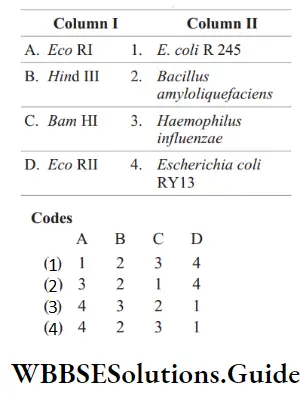
NEET Biology Tools of Recombinant DNA Technology MCQs Question 32 Match the following columns.

Answer: 3. A–4, B–3, C–2, D–1

Question 33. Select the correct statement from the following.

  1. Gel electrophoresis is used for the amplification of a dna segment
  2. The polymerase enzyme joins the gene of interest and the vector dna
  3. Restriction enzyme digestions are performed by incubating purified dna molecules with the restriction enzymes of optimum conditions
  4. Pcr is used for the isolation and separation of genes of interest

Answer: 3. Restriction enzyme digestions are performed by incubating purified dna molecules with the restriction enzymes of optimum conditions

(3) Statement in option (3) is correct as restriction enzyme digestions are performed by incubating purified DNA molecules with the restriction enzymes of optimum conditions. Other statements are incorrect and can be corrected as

biotechnology question bank

  • Gel electrophoresis is used for separation and isolation of DNA fragments.
  • The polymerase enzyme uses DNA templates to catalyze
    polymerization of deoxynucleotides.
  • PCR is Polymerase Chain Reaction. It is used for amplification of a DNA segment.

Question 34. Identify the wrong statement with regard to restriction enzymes.

  1. They cut the strand of dna at palindromic sites
  2. They are useful in genetic engineering
  3. Sticky ends can be joined by using dna ligases
  4. Each restriction enzyme functions by inspecting the length of a dna sequence`

Answer: 3. Sticky ends can be joined by using dna ligases

(3) Statement in option (3) is incorrect sticky ends are self-ligating ends that form hydrogen bonding and thus do not require DNA ligase.

Question 35. Which of the following techniques is most widely employed to check the progress of restriction enzyme digestion?

  1. Agarose gel electrophoresis
  2. Centrifugation
  3. Polyacrylamide gel electrophoresis
  4. Pcr

Answer: 1. Agarose gel electrophoresis

Agarose gel electrophoresis is a technique most widely employed to check the progress of restriction enzyme digestion. Chopped DNA fragments are introduced and passed through an electrophoresis setup containing agarose gel polymer where the fragments get separated on the basis of their size.

Question 36. In a mixture, dna fragments are separated by

  1. Bioprocess engineering
  2. Restriction digestion
  3. Electrophoresis
  4. Polymerase chain reaction

Answer: 3. Electrophoresis

A molecule of DNA can be cut into fragments by the enzyme restriction endonucleases. These fragments of DNA can be separated by a technique of gel electrophoresis. It is a technique used for the separation of substances with different ionic properties.

Question 37. Gel electrophoresis is used for Kerala

  1. Separation and isolation of dna fragments
  2. Construction of recombinant dna by joining with cloning vectors
  3. Culturing the host cells in a medium at a large scale
  4. Replication of dna for many times
  5. (E) cutting of dna into fragments

Answer: 1. Separation and isolation of dna fragments

Gel electrophoresis is used to separate macromolecules, like DNA, RNA, and proteins according to their size and charge. Gel electrophoresis is used for a range of purposes like to get a DNA fingerprint for forensic purposes, for paternity testing, and to check PCR reactions.

38. Agarose is extracted from

  1. Seaweeds
  2. Blue-green algae
  3. Ephedra
  4. Sargassum

Answer: 1. Sea weeds

Agarose is extracted from seaweed. It is a polysaccharide made up of repeating units of disaccharide, made up of D-galactose and 3,6-anhydro-L-galactopyranose.

NEET Biology Mcq

Question 39. The matrix used in electrophoresis is

  1. Polyethylene glycol
  2. Agarose
  3. Ethidium bromide
  4. Cellulose

Answer: 2. Agarose

In gel electrophoresis, agarose extracted from seaweed is used as a matrix. Gel agarose, made up of 0.7% gel, shows a good resolution of large DNA, and 2% gel shows a good resolution of small fragments.

40. In gel electrophoresis separated dna fragments can be visualized with the help of

  1. Ethidium bromide in UV radiation
  2. Acetocarmine in UV radiation
  3. Ethidium bromide in infrared radiation
  4. Acetocarmine in bright blue light

Answer: 1. Ethidium bromide in UV radiation

The DNA fragments separated on an agarose gel can be visualized after staining with ethidium bromide. The separated DNA fragments appear as orange-colored bands while viewed under UV light or radiation.

NEET Biology multiple choice questions on polymerase chain reaction (PCR)

Question 41. The movement of dna during the process of electrophoresis is

  1. From positive pole to negative pole
  2. From negative pole to positive pole
  3. From cathode to anode
  4. Both and (c)

Answer: 4. Both and (c)

DNA being negatively charged, migrates from negative pole (cathode) to positive pole (anode) during gel electrophoresis. Thus, option (4) is correct.

Question 42. What is the criterion for dna fragments movement on agarose gel during gel electrophoresis?

  1. The larger the fragment size, the farther it moves
  2. The smaller the fragment size, the farther it moves
  3. Positively charged fragments move to the farther end
  4. Negatively charged fragments do not move

Answer: 2. The smaller the fragment size, the farther it moves

  • During gel electrophoresis, the criterion for the movement of DNA fragments on the gel is that the smaller the fragment size, the farther it moves.
  • Gel electrophoresis is the mechanism of separation of macromolecule and fragment on the basis of charge and size. It consists of a positive end and a negative end, molecules are separated after the application of an electric source.
  • The molecules or fragments such as the DNA fragments get separated on the basis of their size due to the sieving effect of the agarose gel.

NEET Biology Mcq Chapter Wise

Question 43. During electrophoresis, the separated bands of dna are cut out from the agarose gel and extracted from the gel piece. This is called

  1. Elution
  2. Degradation
  3. Polymerization
  4. Denaturation

Answer: 1. Elution

The DNA fragments are seen as orange-colored bands. The separated bands of DNA are cut out and extracted from the gel piece. This step is called elution.

Question 44. Consider the following statements with respect to dna fragmentation.

  1. Gel electrophoresis and elution are two important processes.
  2. After staining with ethidium bromide, it has to be exposed to UV light.

Choose the correct option.

  1. Statement 1 is correct, but 2 is incorrect
  2. Statement 1 is incorrect, but 2 is correct
  3. Both statements 1 and 2 are correct
  4. Both statements 1 and 2 are incorrect

Answer: 3. Both statements 1 and 2 are correct

  • The DNA fragments are seen as orange-colored bands. The separated bands of DNA are cut out and extracted from the gel piece. This step is called elution.
  • Agarose is extracted from seaweed. It is a polysaccharide made up of repeating units of disaccharide, made up of D-galactose and 3,6-anhydro-L-galactopyranose.

Question 45. Spooling is

  1. Amplification of dna
  2. Cutting of separated dna bands from the agarose gel
  3. Transfer of separated dna fragments to synthetic membranes
  4. Collection of isolated dna

Answer: 4. Collection of isolated DNA

Spooling is the method of collection of isolated DNA in the form of fine threads in the suspension. This is done to isolate DNA from the cell during the process of recombinant DNA technology.

biotechnology question bank

46. Which of the following are used in the process of gel electrophoresis?

  1. Sample dna is cut into fragments
  2. Restriction endonucleases
  3. Agarose gel
  4. Ethidium bromide
  5. Uv-radiation
  6. Elution

Mark the correct sequence of their use.

  1. 1, 2, 3, 6, 5 and 4
  2. 1, 2, 3, 4, 5 and 6
  3. 4, 5, 6, 1, 2 and 3
  4. 1, 2, 4, 5, 6 and 3

Answer: 2. 1, 2, 3, 4, 5 and 6

Gel electrophoresis is a technique used to separate DNA fragments according to their size. Isolation and cutting of DNA, restriction endonucleases, agarose gel, ethidium bromide, UV radiation, and elution are used in the process of gel electrophoresis. Thus, the correct sequence of the process of gel electrophoresis is shown in option (2).

NEET Biology Mcq Chapter Wise

Question 47. Having become an expert on gel electrophoresis, you are asked to examine a gel for a colleague. Where would you find the smallest segment of dna?

  1. Near the positive electrode, farthest away from the wells
  2. Near the negative electrode, close to the wells
  3. Near the negative pole
  4. Near the middle, they tend to slow down after the first few minutes

Answer: 1. Near the positive electrode, farthest away from the wells

A molecule of DNA can be cut into fragments by the enzyme restriction endonucleases. These fragments of DNA can be separated by a technique of gel electrophoresis. In this process, the smallest segment of DNA travels towards the anode (+ve electrode), farthest away from the wells.

Question 48. Identify the correct match for the given diagram.
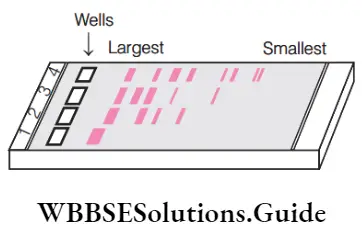
NEET Biology Tools of Recombinant DNA Technology MCQs Electrophoresis and migration

  1. Electrophoresis–migration of undigested and digested sets of dna fragments
  2. Bioreactor–raw materials are biologically converted into specific products
  3. Microinjection–the technique of introducing foreign genes into a host cell
  4. Gene gun–the technique of obtaining identical copies of a particular dna segment

Answer: 1. Electrophoresis–migration of undigested and digested sets of dna fragments

(1) Option (1) is the correct match for the given diagram as Electrophoresis – Migration of undigested and digested sets of DNA fragments.

Question 49. Study the given figure carefully and read the following statements.
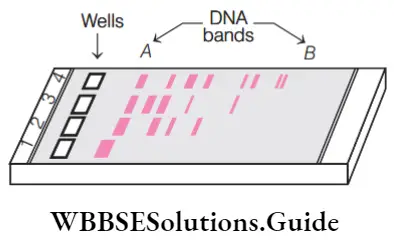
NEET Biology Tools of Recombinant DNA Technology MCQs DNA bands

  1. A typical agarose gel electrophoresis shows differential migration of dna fragments.
  2. Lane 1 contains undigested dna fragments.
  3. Lanes 2 to 4 contains digested dna fragment.
  4. The smallest dna bands are present at position b and the largest dna bands are present at position A.

Choose the option containing

Correct statements.

  1. 1, 2, 3 And 4
  2. 1, 2 And 4
  3. 2 And 3
  4. 3 And 4

Answer: 1. 1, 2, 3 And 4

All statements are correct.

NEET Biology Mcq Chapter Wise

Question 50. Given below are four statements pertaining to the separation of dna fragments using gel electrophoresis. Identify the incorrect statements.

  1. DNA is a negatively charged molecule and so it is loaded on gel towards the anode terminal.
  2. DNA fragments travel along the surface of the gel whose concentration does not affect the movement of dna.
  3. The smaller the size of dna fragment, the larger the distance it travels through it.
  4. Separated DNA fragments can be visualized directly by exposure to UV radiation.

Choose the correct option from the options given below.

  1. 1, 3 And 4
  2. 1, 2 And 3
  3. 2, 3 And 4
  4. 1, 2 And 4

Answer: 4. 1, 2 And 4

  • Statements 1, 2, and 4 are incorrect and can be corrected as Gel electrophoresis is a technique used to separate DNA fragments according to their size.
  • DNA samples are loaded into wells at one end of a gel toward the cathode terminal and an electric current is applied to pull them through the gel, DNA fragments are negatively charged, so they move toward the positive (anode) electrode.
  • The concentration of gel affects the resolution of DNA because DNA moves through the pores of the gel. So, the concentration of gel must be maintained in separation.
  • The DNA fragments separated on an agarose gel can be visualized after staining with ethidium bromide (EtBr) stain and these appear as orange colored bands under UV light.

Question 51. In the recombinant dna technique, the term vector refers to

  1. Plasmids that can transfer foreign dna into a living cell
  2. Cosmids that can cut dna at the specific base sequence
  3. Plasmids that can join different dna fragments
  4. Cosmids that can degrade harmful proteins

Answer: 1. Plasmids that can transfer foreign dna into a living cell

  • The DNA used as a carrier for transferring a fragment of foreign DNA into a suitable host is called vehicle DNA or cloning vector or gene carrier.
  • When the desired gene is introduced into a vector, recombinant DNA is formed. Vectors may be plasmids, a bacteriophage, cosmids, phagemids, Yeast Artificial Chromosomes (YACs), Bacterial Artificial Chromosomes (BACs), etc.

NEET practice questions on biotechnology and genetic engineering tools

Question 52. In genetic engineering, a dna segment (gene) of interest is transferred to the host cell through a vector. Consider the following four agents (I -iv) in this regard and select the correct option about which one or more of these can be used as vector/vectors.

  1. Bacterium
  2. Plasmid
  3. Plasmodium
  4. Bacteriophage

Choose correct option

  1. 1, 2 And 4
  2. Only 1
  3. 1 And 3
  4. 2 And 4

Answer: 4. 2 And 4

  • 2 and 4 agents are used as vectors. Circular plasmid DNA which is used as a vector, can be cleaved at one site with the help of an enzyme to give a linear DNA molecule.
  • A foreign DNA segment can now be inserted, by joining the ends of broken circular DNA to the two ends of foreign DNA, thus regenerating a bigger circular DNA molecule. Bacteriophages provide another source of cloning vectors.
  • Since, usually, a phage has a linear DNA molecule, a single break will generate two fragments, which are later joined together with foreign DNA to generate a chimeric phage particle. Rest agents are not used as vectors.

NEET Biology Mcq Chapter Wise

Question 53. A eukaryotic cloning vector is

  1. Bacteriophage
  2. Yeast episomal plasmid
  3. Cosmid
  4. Bacterial plasmid

Answer: 2. Yeast episomal plasmid

Yeast Episomal Plasmid (YEP) is a shuttle vector that exists in E. coli as well as in eukaryotic cells.

Question 54. Bac vector is preferred because it contains

  1. Selectable marker
  2. F-factor
  3. Cloning sites
  4. All of the above

Answer: 4. All of the above

BAC vectors are preferred for genetic studies because they accommodate much larger sequences without the risk of rearrangement. They have a selectable marker, F-factor, and cloning site and it is more stable than other cloning vectors. Thus, option (4) is correct.

Question 55. Which of the following viruses are used as vectors?

  1. Tmv
  2. Sv-40
  3. Adenovirus
  4. All of these

Answer: 4. All of these

  • The most important viral vectors are retroviruses and adenoviruses. Retroviruses are small RNA-based viruses. They reproduce by integrating their RNA into a host’s DNA. Adenoviruses are medium-sized, non-enveloped viruses.
  • TMV is one of the most studied plant viruses and has become the natural choice for vector development. Simian virus (SV-40), an icosahedral papovavirus, was modified to serve as a gene delivery vector. Thus, option (d) is correct.

Question 56. Commonly used bacteriophages as cloning vectors are

  1. T3 phage
  2. T4 phage
  3. M 13 and lambda phage
  4. Both t3 and t4 phage

Answer: 3. M 13 and lambda phage

Bacteriophages such as M13 and lambda phage transfer their DNA in the host cell and express themselves, thus acting as cloning vectors.

Question 57. Plasmid is

  1. An autonomously replicating circular extrachromosomal dna
  2. An autonomously replicating circular extrachromosomal rna
  3. A circular protein molecules
  4. An autonomously replicating chromosomal dna

Answer: 1. An autonomously replicating circular extrachromosomal dna

Plasmids are extrachromosomal, self-replicating (autonomously) usually circular, double-stranded DNA molecules found naturally in many bacteria and also in some yeast.

Question 58. Plasmids are extrachromosomal genetic material of

  1. Bacteria
  2. Virus
  3. Algae
  4. Amoeba

Answer: 1. Bacteria

Plasmids are extrachromosomal, self-replicating (autonomously) usually circular, double-stranded DNA molecules found naturally in many bacteria and also in some yeast.

Question 59. Which of the following is not a correct statement about the plasmids? Odisha

  1. It is the extrachromosomal dna in bacteria
  2. It is not an integral part, but inert genetic material
  3. Host chromosomes can be integrated with the plasmid
  4. Transfer of plasmid can be done from cell to cell without killing the host

Answer: 2. It is not an integral part, but inert genetic material

  • All given statements are correct about the plasmids except the statement given in option (2) because In addition to the single large circular chromosome, each bacterial cell contains from 1 to 20 much smaller circular duplex DNA molecules, which are called as plasmids.
  • It replicates along with the bacterial chromosome. Their function varies some of them become incorporated into host cell chromosomes and are called episomes. These are sometimes transferred from one bacterial cell to another by the process of conjugation.

Question 60. Assertion plasmids are tools of genetic engineering. Reason (R) virulence plasmids provide pathogenicity to bacteria.

  1. Both a and r are true and r is the correct explanation of a
  2. Both a and r are true, but r is not the correct explanation of a
  3. A is true, but r is false
  4. Both a and r are false

Answer: 2. Both a and r are true, but r is not the correct explanation of a

Both A and R are true, but R is not the correct explanation of A. Plasmids are used in genetic engineering for gene transfer of bacterial cells or to cells of superior organisms, whether other plants animals, or other living organisms to improve their resistance to diseases or to improve their growth.

Question 61. Plasmids are used in genetic engineering because they are

  1. Easily available
  2. Able to replicate
  3. Able to integrate with the host chromosome
  4. Inert

Answer: 2. Able to replicate

  • The most important feature in a plasmid to be used as a vector is the origin of replication (ori). The origin of replication is a specific sequence of DNA bases that is responsible for initiating replication.
  • A prokaryotic DNA has a single origin of replication, while eukaryotic DNA may have more than one origin of replication. Thus, plasmids are used in genetic engineering because they are able to replicate.

Question 62. The plasmid that does not show resistance to ampicillin is

  1. Pbr327
  2. Pbr322
  3. Puc 19
  4. None of these

Answer: 4. None of these

All three plasmids possess resistance to ampicillin. pBR327 and pBR322 contain both ampicillin and tetracyclin resistance. pUC19 contains only ampicillin resistance.

Best MCQs on recombinant DNA tools for NEET preparation

Question 63. The first cloning vector to be developed was pbr322 in the year … a…. It was developed by … b … and … c… from e. Coli plasmid.

  1. A–1976, b–boliver, c–rodriguez
  2. A–1975, b–Sibelius, c–rodriguez
  3. A–1977, b–boliver, c–rodriguez
  4. A–1978, b–ho smith, c–kw Wilcox

Answer: 3. A–1977, b–boliver, c–rodriguez

  • pBR322 vector was the first artificial cloning vector constructed in 1977 (A) by Boliver (2) and Rodriguez (3). It is widely used in gene cloning experiments.
  • In pBR322, p denotes that it is a plasmid. BR stands for Boliver and Rodriguez, who constructed this plasmid. 322 is a number given to distinguish this plasmid from others developed in the same laboratory.

Question 64. Bacterial resistance to antibiotics is a genetic trait carried in the bacterial

  1. Introns
  2. Exosomes
  3. Plasmids
  4. Chromosome

Answer: 3. Plasmids

Plasmids are extrachromosomal material in bacteria and are used as a carrier DNA because it has an antibiotic resistance gene which makes it easy to isolate the transformed cell with the desired insert in it.

Question 65. Plasmids are suitable vectors for genetic cloning as they

  1. Have low molecular weight
  2. Have the ability to combine readily with host cells
  3. Have several sites for a large number of restriction enzymes
  4. All of the above

Answer: 4. All of the above

Plasmids are suitable vectors for gene cloning because they replicate autonomously, have low molecular weight and can integrate within the host cell, and have several sites for a large number of restriction enzymes. Thus, option (4) is correct.

Question 66. A commonly used plasmid from e. Coli in genetic engineering is

  1. Yep
  2. Pbr322
  3. M 13
  4. Puc13

Answer: 2. Pbr322

pBR322 of E. coli was the first and most widely used plasmid for the construction of recombinant DNA.

Question 67. The plasmid derived from e. Coli is

  1. Pbr327
  2. Pbr322
  3. Both and (b)
  4. None of the above

Answer: 3. Both and (b)

pBR327 vectors are derived from pBR322 by deletion of nucleotide between 1427 to 2516. Thus, option ( 3) is correct

Question 68. The letters ‘pbr’ of pbr322 stand for

  1. Plasmid, bacterium
  2. Plasmid, boliver, Rodriguez
  3. Pseudomonas, bacillus, rhizobium
  4. Plasmid, bacteriophage

Answer: 2. Plasmid, boliver, Rodriguez

  • pBR322 vector was the first artificial cloning vector constructed in 1977 (1) by Boliver (2) and Rodriguez (3). It is widely used in gene cloning experiments. In pBR322, p denotes that it is a plasmid.
  • BR stands for Boliver and Rodriguez, who constructed this plasmid. 322 is a number given to distinguish this plasmid from others developed in the same laboratory.

Question 69. Which of the following is not a characteristic of the pbr322 vector?

  1. It is the first artificial cloning vector constructed in 1977 by Boliver and Rodriguez
  2. It is the most widely used, versatile, and easily manipulated vector
  3. It has two antibiotic resistance genes, tet r, and amp r
  4. It does not have a restricted site for sale 1

Answer: 4. It does not have a restriction site for sal 1

(4) Option (4) is not a characteristic of the pBR322 vector. It can be corrected as pBR322 has a restriction site for Sal I. Rest options are characteristic of pBR322 vectors.

Question 70. Which one among the following is just a cloning plasmid, not an expression plasmid?

  1. Pbad18-cam
  2. Pbc sk
  3. Puc19
  4. Pet

Answer: 3. Puc19

  • Cloning plasmids are the plasmids that serve to carry the foreign DNA segment into host cells, while expression plasmids carry expression signals also to ensure maximum expression of the foreign gene.
  • pBAD18. Cam, pBC SK, and pET are expression plasmids, carrying strong promoter and termination codons to ensure maximum gene expression. pUC19 is a cloning vector only and does not carry the sequences to facilitate gene expression.

Question 71. The given figure is the diagrammatic representation of the e. Coli vector pbr322. Which one of the given options correctly identifies its certain component(s)?
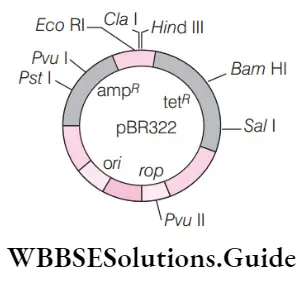
NEET Biology Tools of Recombinant DNA Technology MCQs Correctly identifies

  1. Ori–original restriction enzymes
  2. Rop–reduced osmotic pressure
  3. Hind 3, EcoRI–selectable markers
  4. Amp r, tet r– antibiotic resistance genes

Answer: 4. Amp r, tet r– antibiotic resistance genes

  • (4) Option (4) correctly identify its certain component of pBR322. amp R (ampicillin resistance gene) and tetR (tetracycline resistance gene) are antibiotic resistance genes.
  • Rest options are not correct. Ori is the origin of replication rop is a repressor of primer and Hind 3, Eco RI are restriction enzymes

Question 72. Identify a, b, c, and d in the given diagram of. Coli cloning vector pbr322.
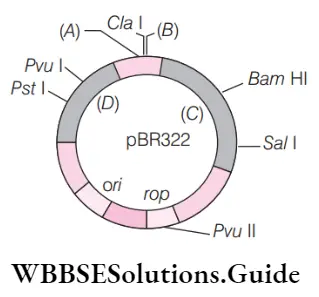
NEET Biology Tools of Recombinant DNA Technology MCQs coli cloning vector

  1. A–eco ri, b–hind iii, c–tet r, d–amp r
  2. A–amp r, b–ori, c–bam hi, d–ecori
  3. A–ori, b–bam hi, c–eco ri, d–amp r
  4. A–bam hi, b–eco ri, c–amp r, d–ori

Answer: 1. A–eco ri, b–hind iii, c–tet r, d–amp r

Question 73. What are cosmids?

  1. Plasmids with fragments of e. Coli
  2. Plasmids with fragments of lambda phage
  3. Plasmids with fragments of m 13 phage
  4. Plasmids with fragments of transposon

Answer: 2. Plasmids with fragments of lambda phage

(2) Cosmids are hybrid or recombinant vectors constructed by inserting the cos site of phage lambda heads into plasmid DNA. They infect bacteria and replicate like plasmids. They can clone DNA fragments up to 45 kb of length.

74. Cosmids can clone dna fragments up to

  1. 45 Kb in size
  2. 55 Kb in size
  3. 85 Kb in size
  4. 75 Kb in size

Answer: 1. 45 Kb in size

(2) Cosmids are hybrid or recombinant vectors constructed by inserting the cos site of phage lambda heads into plasmid DNA. They infect bacteria and replicate like plasmids. They can clone DNA fragments up to 45 kb of length.

Question 75. The plasmid with the largest base pairs are

  1. λ phage
  2. Bacteriophage
  3. P elements
  4. Yac

Answer: 4. Yac

(4) A cosmid vector can accommodate foreign DNA of about 45 kb. Yeast Artificial Chromosome (YAC) has been developed to accommodate DNA fragments of 200-500 kb length (largest base pairs).

Question 76. The plasmid called recombinant plasmid and used for the introduction of the large genome to host cells is

  1. Lamda
  2. Mu (µ)
  3. Cosmid
  4. F

Answer: 3. Cosmid

  • The plasmid called recombinant plasmid and used for the introduction of the large genome to the host cell is cosmid.
  • Cosmids are hybrid or recombinant vectors constructed by inserting the cos site of phage lambda heads into plasmid DNA. They infect bacteria and replicate like plasmids. They can clone DNA fragments up to 45 kb of length.

Question 77. In cloning, which of the following is formed?

  1. The somatic nucleus is inserted into the cytoplasm of fertilized egg
  2. Ova are fertilized outside artificially
  3. Other specialized cells are made for embryogenic development
  4. Zygote is fused with somatic cells

Answer: 3. Other specialized cells are made for embryogenic development

  • Normal mammalian embryonic development results from selective expression of some genes and repression of others. In order for the DNA of a differentiated adult cell to direct embryonic development in cloning, it must be epigenetically reprogrammed.
  • The difference in the extent of epigenetic reprogramming in different cloning events leads to dissimilar protein expression and biological properties of cloned stem cells. Thus, other specialized cells are made for embryogenic development in cloning.

Question 78. ……….. Is used as vectors in insects.

  1. Tmv virus
  2. Bacteriophage
  3. Baculovirus
  4. Yac

Answer: 3. Baculovirus

Baculovirus vectors can be used for a variety of applications. These include producing proteins in insect larvae, insect cells, and mammalian cells. So, baculovirus is used as vectors in insects.

Question 79. Which of the following is a cloning vector?

  1. Dna of salmonella typhimurium
  2. Ti-plasmid
  3. Any dna containing antibiotic-resistance genes
  4. Ori minus pbr322

Answer: 2. Ti-plasmid

  • The Ti-plasmid (tumour-inducing plasmid) is a cloning vector. It is present in Agrobacterium tumefaciens, a Gram-negative soil bacterium that infects a wide range of plants and causes tumorous growth, especially at the root /stem junction (crown gall).
  • The Ti-plasmid comprises the gene responsible for the tumorous growth, gets incorporated into the genome of infected plant cells.
  • This property is of interest for genetic engineering as Ti-plasmid can be used as a DNA vector by replacing the tumor-inducing genes with the gene of interest and a marker gene to enable the selection of transformed cells.

Question 80. Which of the following plasmid is given a name based on the place of its discovery?

  1. Eco ri
  2. Puc
  3. Pbr322
  4. Hind 3

Answer: 2. Puc

pUC is the plasmid from the University of California.

Question 81. Match the following columns.
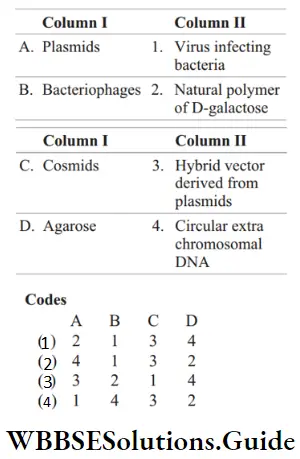
NEET Biology Tools of Recombinant DNA Technology MCQs Question 81 Match the following columns.

Answer: 2. A–4, B–1, C–3, D–2

Question 82. The recombinant plasmid is introduced into bacterial cells by the process of

  1. Conjugation
  2. Transformation
  3. Transduction
  4. Transfection

Answer: 2. Transformation

The plasmid can be introduced into a bacterium by the process called transformation. Researchers can insert DNA fragments or genes into a plasmid vector to create a recombinant plasmid.

Question 83. Transformation is defined as the procedure by which a piece of …a… Is introduced into the …b… Host. Here, a and b refer to
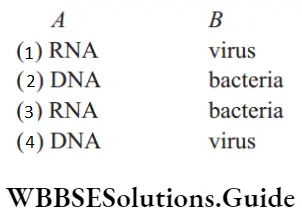
NEET Biology Tools of Recombinant DNA Technology MCQs A piece of ...A...is introduced into the ...B... host.

Answer: 2. Dna bacteria

A–DNA, B–bacteria.

Question 84. The sequence that controls the copy number of the linked dna in the vector is termed

  1. Ori site
  2. Palindromic sequence
  3. Recognition site
  4. Selectable marker

Answer: 1. Ori site

  • The sequence that controls the copy number of linked DNA in the vector is called on-site. The origin of replication is a sequence from where replication starts and any foreign DNA is linked to this region.
  • On-site is also responsible for controlling copy number of linked DNA. Therefore, if any person wants to produce many copies of the target DNA he should close on a vector whose on site supports high copy number.

Question 85. An antibiotic-resistance gene in a vector usually helps in the selection of

  1. Transformed cells
  2. Competent cells
  3. Mutant cells
  4. None of these

Answer: 1. Transformed cells

An antibiotic-resistance gene in a vector usually helps in the selection of transformed cells.

Question 86. A gene whose expression helps to identify transformed cells is known as

  1. Selectable marker
  2. Vector
  3. Plasmid
  4. Structural gene

Answer: 1. Selectable marker

Selectable markers play an important role in recombinant DNA technology. These are genes that are present in the vector of cells involved in imparting resistance to a particular toxic substance. It helps in identifying and eliminating non-transformants and permitting the growth of the transformed cells.

Question 87. The function of a selectable marker is

  1. Eliminating transformants and permitting non-transformants
  2. Identify on site
  3. Elimination of non-transformants and permitting transformants
  4. To destroy recognition sites

Answer: 3. Elimination of non-transformants and permitting transformants

Selectable markers play an important role in recombinant DNA technology. These are genes that are present in the vector of cells involved in imparting resistance to a particular toxic substance. It helps in identifying and eliminating non-transformants and permitting the growth of the transformed cells.

Question 88. In recombinant dna technology antibiotics are

  1. To keep medium bacteria-free
  2. To detect alien dna
  3. To impart disease resistance to the host plant
  4. As selectable markers

Answer: 4. As selectable markers

  • In recombinant DNA technology antibiotics are used as selectable markers. Which helps in identifying and eliminating non-transformants and selectively permitting the growth of the transformants.
  • Normally, the genes encoding resistance to antibiotics such as chloramphenicol, ampicillin, tetracycline, or kanamycin, etc., are considered useful selectable markers for E.coli.

Question 89. Due to the chloramphenicol resistance gene, one is able to select a transformed cell in the presence of chloramphenicol. The chloramphenicol resistance gene in this case is called

  1. Origin of replication
  2. Cloning sites
  3. Selectable marker
  4. None of the above

Answer: 3. Selectable marker

Due to the chloramphenicol resistance gene, one is able to select a transformed cell in the presence of chloramphenicol. The chloramphenicol resistance gene in this case is called a selectable marker.

Question 90. If a recombinant dna-bearing gene for ampicillin resistance is transferred into e. Coli cells and the host cells are spread on agar plates containing ampicillin,

  1. Both transformed and untransformed recipient cells will die
  2. Both transformed and untransformed recipient cells will grow
  3. Transformed recipient cells will grow and untransformed recipient cells will die
  4. Transformed recipient cells will die and untransformed recipient cells will grow

Answer: 3. Transformed recipient cells will grow and untransformed recipient cells will die

Transformation is a procedure through which a piece of DNA is introduced in a host bacterium. DNA bearing ampicillin resistance gene (transformed recipient cells) when introduced into the plate containing ampicillin, will grow. In contrast DNA not bearing the ampicillin resistance gene (untransformed recipient cells) will die.

Question 91. Consider the following statements regarding selectable markers.

  1. It helps to select the host cells which contain the vector and eliminate the non-transformants.
  2. Genes encoding resistance to antibiotics like ampicillin, chloramphenicol, tetracycline, or kanamycin, are useful selectable markers for e. Coli.

Choose the correct option.

  1. Statement 1 is correct, but 2 is incorrect
  2. Statement 1 is incorrect, but 2 is correct
  3. Both statements 1 and 2 are correct
  4. Both statements 1 and 2 are incorrect

Answer: 3. Both statements 1 and 2 are correct

  • (3) Both statements 1 and 2 are correct as the Selectable marker helps to select the host cells which contain the vector and eliminate the non-transformants.
  • Genes encoding resistance to antibiotics like ampicillin, chloramphenicol, tetracycline, or kanamycin are useful selectable markers of E. coli. The normal E. coli cells do not carry resistance against any of these antibiotics.

Question 92. How are transformants selected from non-transformants?

  1. Presence of more than one recognition site in the vector dna
  2. The presence of alien dna into the vector dna results in insertional inactivation of selectable marker
  3. The antibiotic resistance gene gets inactivated due to the insertion of alien dna
  4. Both and (c)

Answer: 4. Both and (c)

  • Selectable markers help in identifying and eliminating non-transformants and selectively permitting the growth of the transformants. The ligation of alien DNA is carried out at a restriction site present in one of the two antibiotic-resistance genes.
  • In this case, one antibiotic resistance gene helps in selecting the transformants whereas the other antibiotic resistance gene gets inactivated due to the insertion of alien
    DNA and helps in the selection of recombinants.

93. The phenomenon in which the cloned dna fragment disturbs the coding sequence of the gene is called

  1. Insertional inactivation
  2. Stimulation-inhibition
  3. Insertional activation
  4. Recombination

Answer: 1. Insertional inactivation

Insertional inactivation is a technique used in recombinant DNA technology. In this procedure, a bacteria carrying recombinant plasmid or a fragment of foreign DNA is made to insert into a restriction site inside a gene to resist antibiotics, hence causing the gene to turn non-functional or in an inactivated state.

Question 94. The colonies of recombinant bacteria appear white in contrast to the blue colonies of non-recombinant bacteria because of

  1. Insertional inactivation of alpha-galactosidase in non-recombinant bacteria
  2. Insertional inactivation of alpha-galactosidase in recombinant bacteria
  3. Inactivation of glycosidase enzyme in recombinant bacteria
  4. Non-recombinant bacteria containing beta-galactosidase

Answer: 2. Insertional inactivation of alpha-galactosidase in recombinant bacteria

  • In blue-white screening or insertional inactivation, recombinant DNA is inserted with a coding sequence ofβ-galactosidase which breaks galactose into lactose.
  • This results in the inactivation of enzymes, due to which recombinant colonies do not produce any color and appear white. In contrast, non-recombinant cells appear blue in color due to the presence of a chromogenic substrate.

Question 95. Ti-plasmid transfer works with

  1. Only monocots
  2. Only dicots
  3. All plants
  4. All of these

Answer: 2. Only dicots

(2) Ti-plasmid can be used for the transfer of a desired gene in dicot plants.

Question 96. The tumor-inducing capacity of Agrobacterium tumefaciens is located in large extrachromosomal plasmids called

  1. Ri-plasmid
  2. Lambda phage
  3. Pbr322
  4. Ti-plasmid

Answer: 4. Ti-plasmid

(4) Ti-plasmid is found in Agrobacterium tumefaciens, which produces crown gall (tumor) in a large number of dicot species. A. tumefaciens is a Gram-negative soil bacterium that infects a wide range of plants and causes crown galls.

Question 97. The vector for t-dna is

  1. Thermus aquaticus
  2. Salmonella typhimurium
  3. Agrobacterium tumefaciens
  4. Escherichia coli
  5. (E) bacillus thuringiensis

Answer: 3. Agrobacterium tumefaciens

The vector used to introduce new genes into plant cells is most often a plasmid from the soil bacterium Agrobacterium tumefaciens. This is the Ti-plasmid (Tumour inducing plasmid). The part of Ti-plasmid transferred into plant cell DNA, is called the T-DNA

Question 98. What is the source of the ti (tumor-inducing) plasmid which is modified and used as a cloning vector to deliver the desirable genes into plant cells?

  1. Agrobacterium tumefaciens
  2. Thermophilus aquaticus
  3. Pyrococcus furiosus
  4. Aedes aegypti

Answer: 1. Agrobacterium tumefaciens

  • The delivery of genes by pathogens in their eukaryotic ‘hosts has generated knowledge to transform tools of pathogens into useful vectors for delivering genes of interest to humans or plants.
  • The tumor-inducing (Ti) plasmid of Agrobacterium tumefaciens has been modified into a cloning vector that is no more pathogenic to the plants but is still able to use the mechanisms to deliver genes of our interest into a variety of plants.

Question 99. Which of the following is correctly matched?

  1. Agrobacterium tumefaciens tumour
  2. Thermus aquaticus – bt gene
  3. Pbr322 – enzyme
  4. Ligase – molecular scissors
  5. (E) hind ii – plasmid vector

Answer: 1. Agrobacterium tumefaciens tumor

  • (1) Option (1) is correctly matched as Agrobacterium tumefaciens is a tumor-inducing organism that carries Ti-plasmid.
  • Taq polymerase obtained from Thermus aquaticus, is a type of DNA polymerase that is used in polymerase chain reaction for the polymerisation of nucleotides.
  • Ligase is an enzyme that helps in binding DNA by forming a phosphodiester bond. Hind 2 acts as molecular scissors as it is a type of restriction endonuclease that cleaves the DNA strands at a specific recognition site.

Question 100. A dicotyledonous plant forms a crown gall

  1. Agrobacterium tumefaciens comes in contact with the plant
  2. Agrobacterium Rhizogenes comes in contact with the plant
  3. A specific part of dna from the ti-plasmid gets integrated with the plant chromosome
  4. A specific part of dna from the ri plasmid gets integrated with the plant chromosome

Answer: 3. A specific part of dna from the ti-plasmid gets integrated with the plant chromosome

  • (3) Ti (tumor-inducing) plasmid from a soil bacterium, Agrobacterium tumefaciens induces the formation of cancerous growth called crown gall tumor by transferring its DNA into plant cells.
  • Thus, a dicotyledonous plant forms a crown gall when a specific part of DNA from the Ti-plasmid gets integrated with the plant chromosome.

Question 101. Assertion agrobacterium tumefaciens is popular in genetic engineering because this bacterium is associated with roots of all cereals and pulse crops. Reason (R) a gene incorporated in the bacterial chromosomal genome gets automatically transferred to the crop with which the bacterium is associated.

  1. Both a and r are true and r is the correct explanation of a
  2. Both a and r are true, but r is not the correct explanation of a
  3. Both a and r are true
  4. Both a and r are false

Answer: 4. Both a and r are false

  • (4) Both A and R are false and can be corrected as Agrobacterium tumefaciens is a rod-shaped Gram-negative soil bacterium.
  • This is used extensively in genetic engineering because of its ability to transfer its DNA into the plants. A. tumefaciens naturally infect the wound sites in dicotyledons and cause crown gall tumors.
  • These tumors are incited by the conjugative transfer of DNA segment (T-DNA) from the bacterial tumor-inducing Ti-plasmid.

Question 102. Consider the following statements.

  1. Dna being a hydrophilic molecule cannot pass through cell membranes.
  2. Agrobacterium tumefaciens delivers a piece of dna known as ‘z-dna’ in the ti -plasmid which transforms normal plant cells into tumor cells to produce chemicals against pathogens.
  3. Retrovirus, adenovirus, and papillomavirus are also now used as cloning vectors in animals because of their ability to transform normal cells into cancerous cells.
  4. In genetic engineering, dna from different sources is cut with the same restriction enzymes, so that both dna fragments have the same kind of sticky ends.

Choose the option containing an incorrect statement.

  1. Only 1
  2. Only 2
  3. Only 3
  4. Only 4

Answer: 2. Only 2

(2) Statement II in option (2) is incorrect and can be corrected as Agrobacterium tumefaciens delivers a piece of DNA known as ‘T-DNA’ in the Ti -plasmid which transforms normal plant cells into tumor cells to produce chemicals against pathogens. Rest all statements are correct.

Question 103. The biological enzymes used to synthesize dna segments in retrovirus is

  1. Reverse transcriptase
  2. Restriction endonucleases
  3. Restriction exonucleases
  4. Restriction DNAase

Answer: 1. Reverse transcriptase

The biological enzyme used to synthesize DNA segments in retrovirus is reverse transcriptase. Reverse transcriptase is a polymerase that uses RNA as a template to transcribe a single-stranded DNA molecule as a product.

Question 104. Which one of the following is used as a vector for cloning genes into higher organisms?

  1. Baculovirus
  2. Salmonella typhimurium
  3. Rhizopus nigricans
  4. Retrovirus

Answer: 4. Retrovirus

(4) Retrovirus has the ability to transform normal cells into cancerous cells. Hence, it can be used as a vector for cloning desirable genes into higher organisms and animal cells.

Question 105. Retroviruses in animals including humans are able to change normal cells into

  1. Germ cell
  2. Cancerous cells
  3. Cosmid
  4. None of the above

Answer: 2. Cancerous cells

(2) Retrovirus has the ability to transform normal cells into cancerous cells. Hence, it can be used as a vector for cloning desirable genes into higher organisms and animal cells.

106. Bacterial cells are made competent by treating it with

  1. Divalent cation of calcium
  2. Monovalent cation of calcium
  3. Divalent cation of potassium
  4. Monovalent cation of potassium

Answer: 1. Divalent cation of calcium

(1) Making the bacterial cell competent means enhancing the entry of DNA into bacteria through pores on a cell wall. Bacterial cells are made competent by treatment with divalent cations like calcium.

Question 107. The polyethylene glycol method is used for

  1. Biodiesel production
  2. Seedless fruit production
  3. Energy production from sewage
  4. Gene transfer without a vector

Answer: 4. Gene transfer without a vector

  • (4) Direct gene transfer is the transfer of naked DNA into plant cells, but the presence of a rigid plant cell wall acts as a barrier. Therefore, protoplasts are the favored target for direct gene transfer without a vector.
  • Polyethylene glycol-mediated DNA uptake is a direct gene transfer method that utilizes the interaction between polyethylene glycol, naked DNA, salts, and the protoplast membrane to bring about the transport of the DNA into the cytoplasm.

Question 108. In order to induce the bacterial uptake of plasmids, the bacteria are made ‘competent’ by first treating

  1. Sodium chloride
  2. Potassium chloride
  3. Magnesium chloride
  4. Calcium chloride

Answer: 4. Calcium chloride

  • (4) In order to induce the bacterial uptake of plasmids, the bacteria are made competent by first treating them with calcium chloride. Calcium salts increase the efficiency with which DNA enters the bacterium through pores in its cell wall.
  • Recombinant DNA can then be forced into such cells by incubating cells with the recombinant DNA on ice, followed by placing them briefly at 42°C (heat shock) and then putting them back on ice.

Question 109. Consider the following statements.

  1. Dna being a hydrophilic molecule cannot pass through cell membranes.
  2. The bacteria should be made competent to accept the dna molecule.

Choose the correct option.

  1. Statement 1 is correct, but 2 is incorrect
  2. Statement 1 is incorrect, but 2 is correct
  3. Both statements 1 and 2 are correct
  4. Both statements 1 and 2 are incorrect

Answer: 3. Both statements 1 and 2 are correct

  • (3) Both statements I and II are correct as Hydrophobic molecules can diffuse through the lipid bilayer of the plasma membrane and not hydrophilic molecules. DNA being hydrophilic with the sugar-phosphate backbone, cannot pass through the cell membrane.
  • Bacterial cells can be made competent to take up the recombinant DNA from a medium with the help of electroporation.

Question 110. The significance of the heat shock method in bacterial transformation facilitates

  1. Binding of dna to the cell wall with the help of proteins
  2. Uptake of dna through membrane transport proteins
  3. Uptake of dna through transient pores in the bacterial cell wall
  4. Expression of antibiotic resistance gene

Answer: 3. Uptake of dna through transient pores in the bacterial cell wall

  • (3) DNA is a hydrophilic molecule that cannot pass through cell membranes. Therefore, the bacteria should be made competent to accept the DNA molecule.
  • In this case, the cell is treated with a specific concentration of a divalent cation such as calcium to increase pore size in bacterial cell walls.
  • The cells are incubated with recombinant DNA on ice, followed by placing them briefly at 42°C and then putting it back on ice. This is called heat shock treatment. The bacterium now takes up the recombinant DNA.

Question 111. One physical method of gene transfer is

  1. Shotgun technique
  2. Use of enzymes
  3. Peg application
  4. Use of salts

Answer: 1. Shotgun technique

(1) Physical method of gene transfer is shotgun cloning. It involves cutting the DNA of the entire genome into pieces with a restriction enzyme, inserting these pieces or fragments into bacteria or yeast with plasmids or viruses, and allowing the organism to reproduce, making copies or clones of the DNA fragments.

Question 112. Biolistics (gene gun) is suitable for

  1. Disarming pathogen vectors
  2. Transformation of plant cells
  3. Construction recombinant dna by joining with vectors
  4. Dna fingerprinting

Answer: 2. Transformation of plant cells

(2) The biolistic method is a method of transformation of plant cells. It is used to transfer foreign DNA into a plant cell. For this purpose, cells are bombarded with high-velocity micro-particles of gold or tungsten coated with DNA.

Question 113. For transformation, microparticles coated with dna to be bombarded with gene guns are made up of

  1. Silver or platinum
  2. Platinum or zinc
  3. Silicon or platinum
  4. Gold or tungsten

Answer: 4. Gold or tungsten

(4) For gene transfer into the host cell without using a vector, microparticles made up of tungsten and gold coated with foreign DNA are bombarded into target cells at a very high velocity.

Question 114. Consider the following statements about the gene gun method.

  1. This method is also known as the biolistic technique.
  2. Important crop plants like maize, rice, and wheat have now been transformed by this method.

Choose the option containing

Correct statements.

  1. 1 And 2
  2. Only 1
  3. Only 2
  4. None of the above

Answer: 1. 1 And 2

(1) Both statements are correct as In the biolistic or gene gun method, cells are high-velocity microparticles of gold or tungsten coated with DNA in plants. Important crop plants like maize, rice, and wheat have now been transformed by this method.

Question 115. Consider the following statements.

  1. In recombinant dna technology after several treatments, the purified dna is precipitated by adding chilled ethanol.
  2. The bacterial/plant, animal cell is broken down by enzymes to release dna, along with RNA, proteins, polysaccharides, and lipids.

Choose the correct option.

  1. Statement 1 is correct, but 2 is incorrect
  2. Statement 1 is incorrect, but 2 is correct
  3. Both statements 1 and 2 are correct
  4. Both statements 1 and 2 are incorrect

Answer: 3. Both statements 1 and 2 are correct

(3) Both statements 1 and 2 are correct.

Question 116. In the microinjection method, the RDNA is incorporated into the host cell by using

  1. Micropipettes
  2. Microneedles
  3. High voltage electric impulse
  4. Both and (2)

Answer: 4. Both and (2)

  • (4) In the microinjection method, foreign DNA is directly injected into the nucleus of an animal cell or plant cell by using microneedles or micropipettes.
  • This method of gene transfer is used to introduce DNA into large cells such as oocytes, eggs, and the cells of early embryos. Thus, option (4) is correct.

Question 117. Consider the following statements.

  1. The microinjection method is used in oocytes, eggs, and embryos.
  2. Electroporation is the formation of temporary pores in the plasma membrane of the host cell by using lysozyme or calcium chloride.
  3. In chemical mediated gene transfer method, certain chemicals such as ca help foreign dna to enter the host cell.

Which of the statements given above is correct?

  1. Only 1
  2. 1, 2 And 3
  3. 2 And 3
  4. 1 And 3

Answer: 1. 1, 2 And 3

  • (1) Statement 1 is correct and statements 3 and 4 are incorrect. These can be corrected as
  • Electroporation involves the application of a high-voltage pulse to protoplasts/cells/tissues to make transient (temporary) pores in the plasma membrane which facilitates the uptake of foreign DNA.
  • Chemical-mediated gene transfer chemicals like Polyethylene Glycol (PEG) and dextran sulfate induce DNA uptake into plant protoplasts. Calcium phosphate is also used to transfer DNA into cultured cells.

Question 118. Select the incorrect statement.

  1. The presence of chromogenic substrate gives blue color colonies if the plasmid in the bacteria does not have an insert
  2. Retroviruses in animals have the ability to transform normal cells into cancerous cells
  3. In microinjection, cells are bombarded with high-velocity microparticles of gold or tungsten coated with dna
  4. Since dna is a hydrophilic molecule it cannot pass through cell membranes
  5. (E) dna is a negatively charged molecule

Answer: 3. In microinjection, cells are bombarded with high-velocity microparticles of gold or tungsten coated with dna

  • (3) Statement in option (3) is incorrect and can be corrected as In the microinjection method of DNA transfer, foreign DNA is directly injected into the nucleus of animal cells or plant cells by using microneedles or micropipettes.
  • It is used in oocytes, eggs, and embryos. In the gene gun method, tungsten or gold particles coated with foreign DNA are bombarded into the target cell at a very high velocity. Rest options are true statements.

Question 119. Plant cells can be transformed by

  1. Electroporation
  2. Electrophoresis
  3. Electrocution
  4. Electrolysis

Answer: 1. Electroporation

  • (1) Plant cells can be transformed by electroporation. It is a well-established method for the production of transgenic plants.
  • Short high-voltage pulses can permeabilize the protoplast plasma membrane, facilitating the uptake of plasmid DNA that can become expressed transiently and eventually incorporated into the genome.

Question 120. Electroporation procedure involves

  1. Fast passes of food through sieve pores in phloem elements with the help of electric stimulation
  2. Opening of stomatal pores during the night by artificial light
  3. Making transient pores in the cell membrane to introduce gene constructs
  4. Purification of saline water with the help of a membrane system

Answer: 3. Making transient pores in the cell membrane to introduce gene constructs

(3) Electroporation method is used for the introduction of recombinant DNA into the host. In this procedure, temporary (transient) pores are formed in the plasma membrane of the host cell by high voltage current. These pores permit the entry of foreign DNA.


NEET Biology Strategies For Enhancement In Food Production Miscellaneous Multiple Choice Question And Answers

Biology MCQs with answers for NEET Strategies For Enhancement In Food Production Miscellaneous

Question 1. Which of the following group of insects is beneficial to man?

  1. Honeybee, lac insect, cochineal insect
  2. Silkworm, honeybee, wasp
  3. Honeybees, silkworms, cockroaches
  4. Sandfly, butterfly, honeybee

Answer: 1. Honeybee, lac insect, cochineal insect

  • Cochineal insect produces carminic acid from which carmine dye is obtained. Honeybee provides honey, bee wax, etc.
  • Lac insects produce lac that has several industrial uses.
  • Thus, option 1 is a group of insects that are beneficial to man.

Read And Learn More: NEET Biology Multiple Choice Question And Answers

Question 2. Match the Column 1 animals with Column 2 under the given products they are primarily associated with. Choose the correct option from the codes given below.

NEET Biology Strategies For Enhancement In Food Production Miscellaneous Question 2 Match The Column

strategies for enhancement in food production pyq neet

Answer: A–4, B–3, C–1, D–2

Question 3. The remains of crops that are allowed to decay and decompose in the farmland is called

  1. Strip cropping
  2. Contour farming
  3. Mulching
  4. Terracing

Answer: 3. Mulching

  • Mulching is a widely practised gardening technique that is beneficial for plants when done properly.
  • It is the act of covering the soil with mulches such as bark, wood chips, leaves and other organic material in order to preserve moisture and improve the condition of the soil.

Biology MCQs with answers for NEET

NEET Biology Strategies For Enhancement In Food Production Miscellaneous Multiple Choice Question And Answers

NEET Biology strategies for enhancement in food production MCQs with answers

Question 4. Consider the following four statements (1-4) and select the option which includes the correct statements.

  1. Single-cell Spirulina can produce large quantities of food rich in protein, minerals, vitamins, etc.
  2. Body weight-wise, the microorganism Methylophilus methylotrophs may be able to produce several times more proteins than the cows per day.
  3. Common button mushrooms are a very rich source of vitamin- C.
  4. A rice variety has been developed which is very rich in calcium.

Choose the correct option.

  1. 3 and 4
  2. 1, 3 and 4
  3. 2, 3 and 4
  4. 1 and 2

Answer: 4. 1 and 2

  • Statements 1 and 2 are correct.
  • Spirulina is single cell rich in protein, vitamins and minerals.
  • 250 biomass of Methylophilus methylotrophs produces 25 tonnes of protein/day, while cow of 250 kg produces only 200 g protein/day.
  • Statements 3 and 4 are incorrect and can be corrected as
  • Common button mushrooms are a very rich source of vitamin- D.
  • A rice variety has been developed which is very rich in iron content.

Question 5. A drug to cure hypertension is derived from the roots of

  1. Atropa belladonna
  2. Femia asafoetida
  3. Rauwolfia serpentina
  4. Digitalis purpurea

Answer: 3. Rauwolfia serpentina

  • Rauwolfia serpentina, the Indian snakeroot, devil pepper or serpentine wood, is a species of flower in the milkweed family- Apocynaceae.
  • It is a compound commonly used in Ayurvedic medicines. Rauwolfia serpentina is a safe and effective treatment for hypertension.

Strategies for enhancement in food production multiple choice questions for NEET

Question 6. Pests which only feed and (oviposit) on crop are called

  1. Major pest
  2. Minor pest
  3. Accidental pest
  4. Occasional pest

Answer: 2. Minor pest

  • Minor pests are the species that are recorded feeding or ovipositing on the crop plants.
  • They usually inflict only slight damage on the host and often their effect on the plant is indiscernible.

Biology MCQs with answers for NEET

Question 7. Coffee is mainly produced in

  1. Tamil Nadu
  2. Andhra Pradesh
  3. Karnataka
  4. Kerala

Answer: 3. Karnataka

  • Coffee production in India is dominated in the hill tracts of South
  • Indian states with Karnataka accounting for 71%, followed by
  • Kerala with 21% and Tamil Nadu (5% of overall production with 8,200 tonnes).
  • Thus, coffee is mainly produced in Karnataka.

strategies for enhancement in food production pyq neet

Question 8. Match Column 1 with Column 2 and choose the correct option from the codes given below.

NEET Biology Strategies For Enhancement In Food Production Miscellaneous Question 8 Match The Column

Answer: A–4, B–3, C–5, D–2, E–1

Important food production enhancement questions for NEET Biology

Question 9. Pasteurisation of milk involves heating for

  1. 60 minutes at about 90°C
  2. 30 minutes at about 50°C
  3. 30 minutes at about 60°C
  4. 60 minutes at 1000°C

Answer: 3. 30 minutes at about 60°C

Pasteurisation of milk is a method of partial sterilisation by heating the milk at 60-70°C for 30 min.

Question 10. Who is the first observed petroleum plant?

  1. Melvin Calvin
  2. Darwin
  3. Arnon
  4. R Hill

Answer: 1. Melvin Calvin

  • Hydrocarbon plants are plants that follow certain metabolic pathways and produce hydrocarbon products similar to petroleum.
  • The family– Euphorbiaceae has been studied in detail by Dr Melvin Calvin, Nobel Laureate and discoverer of the Calvin Cycle.
  • So, he used the first observed petroleum plant.

Biology MCQs with answers for NEET

Question 11. Which wild plant is a good source of rubber?

  1. Parthenium argentatum
  2. Psophocarpus tetragonolobus
  3. Simmondsia chinensis
  4. Leucaena leucocephala

Answer: 1. Parthenium argentatum

Parthenium argentatum, commonly known as the guayule can be used as an alternative source of latex that is also hypoallergenic, unlike the normal Hevea rubber. So, It is a good source of rubber.

Question 12. Match the names of branches of biology listed under Column 1 with the fields of study given under Column 2.

NEET Biology Strategies For Enhancement In Food Production Miscellaneous Question 12 Match The Column

Answer: A–2, B–3, C–4, D–1

strategies for enhancement in food production pyq neet

Question 13. Match Column 1 in the pests with Column 2 in their most favoured host and choose the correct option from the codes given below.

NEET Biology Strategies For Enhancement In Food Production Miscellaneous Question 13 Match The Column

Answer: A–1, B–2, C–4, D–3

Solved MCQs on enhancement in food production for NEET

Question 14. The biggest drawback of draught animals is

  1. More consumption of bioenergy than production
  2. Short lifespan
  3. Early retirement
  4. Less reliability

Answer: 1. More consumption of bioenergy than production

A working animal or draught (draft) animal is domesticated and trained to perform tasks. Their biggest drawback is that they consume more bioenergy than they produce.

Biology MCQ For NEET With Answers

Question 15. The art and science of combining ideas, facilities, processes, materials and labour to produce and market a worthwhile product or service successfully is called

  1. Marketing
  2. Improvement
  3. Management
  4. Both 1 and 3

Answer: 3. Management

The art and science of combining, ideas, facilities, processes, materials and labour to produce and market a worthwhile product or service successfully called management.

Question 16. Assertion (A) The invasion of a part of the body of man or other animals by the eggs or larvae of flies is called myiasis. Reason (R) Musca domestica is known to oviposit in human tissues, so exhibit myiasis.

  1. Both A and R are true and R is the correct explanation of A
  2. Both A and R are true, but R is not the correct explanation of A
  3. A is true, but R is false
  4. Both A and R are false

Answer: 1. Both A and R are true and R is the correct explanation of A

Myiasis is the parasitic infestation of the body of a live animal by fly larvae (maggots) that grow inside the host while feeding on its tissue.

Role of plant breeding in food production NEET MCQs with answers

Question 17. The botanical name of Sanjeevani is

  1. Selaginella utricularia
  2. Selaginella biopterin
  3. Selaginella crotalaria
  4. None of the above

Answer: 2. Selaginella biopterin

  • Selaginella biopterin (also called ‘Sanjeevani’or ‘Sanjivini booti’) is a lithophytic plant that is native to India.
  • Traditional uses include relief from heat stroke, dysuria, irregular menstruation and jaundice, It is also useful for coma patients.

Question 18. Match the following columns.

NEET Biology Strategies For Enhancement In Food Production Miscellaneous Question 18 Match The Column

Answer: A–6, B–5, C–3, D–4, E–2, F–1

Best multiple choice questions on food production enhancement strategies for NEET preparation

Question 19. The female silkworm moth produces a chemical termed ‘Bombykol’. It is a

  1. Sex hormone
  2. An alarm pheromone
  3. Sex pheromone
  4. Juvenile hormone

Answer: 3. Sex pheromone

Bombykol is a pheromone released by the female silkworm moth to attract mates. It is also the sex pheromone in the wild silk moth (Bombyx mandarina).

strategies for enhancement in food production pyq neet

Question 20. They are called fixed oils as they are chemically esters of fatty acids synthesised by plants.

  1. Essential oils
  2. Vegetable oils
  3. Latex
  4. All of these

Answer: 2. Vegetable oils

  • Fixed oils are pressed from the fatty portions of a plant or botanical, such as the seeds, nuts or kernels.
  • They are also known as vegetable oils.

Biology MCQ For NEET With Answers

Question 21. Which of the following statements are correct?

  1. The maintenance of hives for the production of honey is called apiculture.
  2. A group of animals related by descent and similar in most characters is called a breed.
  3. The agriculture practice of breeding and raising livestock is called animal husbandry.

Choose the correct option.

  1. 1, 2 and 3
  2. 1 and 2
  3. 1 and 3
  4. 2 and 3

Answer: 1. 1, 2 and 3

All given statements are correct.

NEET Biology Single Cell Protein And Tissue Culture Multiple Choice Question And Answers

Biology MCQ For NEET With Answers Single Cell Protein And Tissue Culture

Question 1. Single-cell protein refers to

  1. A specific protein extracted from pure culture of single type of cells
  2. Sources of mixed proteins extracted from pure or mixed culture of organisms or cells
  3. Proteins extracted from a single cell
  4. A specific protein extracted from a single cell

Answer: 2. Sources of mixed proteins extracted from pure or mixed culture of organisms or cells

Single-cell protein refers to sources of mixed proteins extracted from pure or mixed culture of microorganisms or microbes. The cell of microorganisms are dried and used as a protein source.

Read And Learn More: NEET Biology Multiple Choice Question And Answers

Question 2. Single-cell proteins are derived from

  1. Plant
  2. Microbes
  3. Recombinant dna technology
  4. All of the above

Answer: 2. Microbes

“what is single cell protein class 12 “

Question 3. Single-cell proteins and alternative protein source is obtained form microorganisms like

  1. Spirulina
  2. Methylophilus methylotrophs
  3. Candida utilise
  4. All of the above

Answer: 4. Candida utilise

  • Single-cell proteins are the dried cells of microorganisms belonging to bacteria, yeasts, molds, higher fungi, and some algae. example,
  • Bacteria – Methylophilus – methylotrophs
  • Yeast -Candida utilise
  • Cyanobacteria – Spirulina

Biology MCQ For NEET With Answers

NEET Biology Single Cell Protein And Tissue Culture Multiple Choice Question And Answers

NEET Biology single cell protein MCQs with answers

Question 4. Production of SCP involves

  1. Preparation of suitable medium with a suitable carbon source
  2. Prevention of contamination of medium
  3. Production of desired microorganism followed by separation of microbial biomass
  4. All of the above

Answer: 4. All of the above

All given options involve the production of SCP.

Question 5. Which is taken as protein supplements in diet?

  1. Chlorella
  2. Gracilaria
  3. Spirulina
  4. All of these

Answer: 4. All of these

  • All given microbes are taken as protein supplements in diet.
  • Chlorella is protein-rich green alga and produces an annual yield of 20 tonnes of proteins per acre.
  • Spirulina is a rich source of protein and

Question 6. From 250 g of Methylophilus methylotrophic bacterium, the amount of proteins that can be produced is

  1. 15 tonnes of proteins
  2. 25 tonnes of proteins
  3. 35 tonnes of proteins
  4. 50 tonnes of proteins

Answer: 2. 25 tonnes of proteins

  • A 250 kg cow produces 200 g of protein per day.
  • In the same period, 250 g of a microorganism like Methylophilus methylotrophs, because of its high rate of biomass production and growth, can produce about 25 tonnes of proteins.

Biology MCQ For NEET With Answers

Question 7. Spirulina belongs to

  1. Cyanobacteria
  2. Fungi
  3. Protozoan
  4. Brown algae

Answer: 1. Cyanobacteria

Spirulina belongs to cyanobacteria. These are also called as blue-green algae due to their blue-green color appearance.

Question 8. Consider the following statements.

  1. Single-cell proteins are not easy to grow.
  2. Single-cell proteins provide nutrient-rich food.

Choose the correct option.

  1. Statement 1 is correct, but 2 is incorrect
  2. Statement 1 is incorrect, but 2 is correct
  3. Both statements 1 and 2 are correct
  4. Both statements 1 and 2 are incorrect

Answer: 2. Statement 1 is incorrect, but 2 is correct

  • The incorrect statement can be corrected as
  • Single cell proteins are easy to grow, microbes can be grown on materials like wastewater from potato processing plants, straw, molasses, animal manure, and sewage.

Tissue culture and single-cell protein multiple-choice questions for NEET

Question 9. Increase in dependence on Single Cell Protein (SCP) as a nutrient resource reduces

  1. Environmental pollution
  2. Greenhouse effect
  3. Global warming
  4. Production and growth of crop

Answer: 1. Environmental pollution

“what is scp in biology class 12 “

  • The microorganisms used in the production of SCP use such substrates which otherwise cause environmental pollution.
  • Therefore, the production of SCP helps in the reduction of environmental pollution.

Question 10. SCP is rich in high quality of and poor in content.

  1. Protein, minerals
  2. Protein, fats
  3. Fats, protein
  4. Lipid, protein

Answer: 2. Protein, fats

The SCP is rich in high quality of protein and poor in fats content.

Biology MCQ For NEET With Answers

Question 11. Tissue culture means

  1. Cultivation of tissue in the laboratory through formation of new cells
  2. Introduction of new tissue in an animal body
  3. A technique for maintaining fragments of cells alive after their removal from an organism
  4. Maintaining tissue alive by immersing it partially in a nutrient fluid

Answer: 1. Cultivation of tissue in the laboratory through formation of new cells

Plant tissue culture is a technique of growing or cultivating cells, tissues, or organs in sterilized nutrient media under controlled aseptic conditions.

Question 12. Aseptic culture means

  1. Absence of life
  2. Presence of bacteria
  3. Absence of other organisms like microbes
  4. Parthenogenetic development

Answer: 3. Absence of other organisms like microbes

Aseptic procedures ensure that cultures are free of microbes (i.e. absence of other organisms like microbes) that can overwhelm and kill a tissue culture explant.

Question 13. Axenic culture is

  1. Culture of tissue
  2. Culture of genes
  3. Pure culture without any contamination
  4. Pure culture of a microbe without any nutrient

Answer: 3. Pure culture without any contamination

  • Tissue culture support the growth and development of isolated plant cells, tissues or organs on an artificial, nutritive medium.
  • Generally, such cultures are axenic, which means there is no other life form or contamination present on the culture medium than the plant tissue of interest.

Biology MCQs with answers for NEET

Question 14. Which of the following terms is used to describe the component isolated from a plant, for in vitro culturing in the specific medium?

  1. Callus
  2. Embryoid
  3. Synthetic seeds
  4. Explant

Answer: 4. Explant

  • The plant tissue or organ excised and used for in vitro culture is known as explant.
  • Any plant part such as shoot tip, root tip, leaf tip, pollen grains, etc., may be used as an explant.
  • The choice of explant depends mainly on the objective of the culture and the regeneration potential of different organs of a plant species.

Question 15. The enzyme used for the isolation of vsingle cell from explant/cell is

  1. Pectinase
  2. Catalase
  3. Ligninase
  4. Both 1 and 3

Answer: 1. Pectinase

  • The enzyme used for the isolation of single cell from an explant cell is pectinase.
  • The cell walls of cell are digested by enzymes like pectinase and cellulase to expose the naked protoplasts.

Important single cell protein and tissue culture questions for NEET

Question 16. A plant cell has potential to develop into full plant. This property of the plant cell is called

  1. Tissue culture
  2. Totipotency
  3. Pluripotency
  4. Gene cloning

Answer: 2. totipotency

  • Totipotency is the ability of a living somatic plant cell to develop into a complete plant.
  • This technique is now used for multiplying rare and endangered plants through micropropagations.

Biology MCQs with answers for NEET

Question 17. Who proposed the idea of totipotency of a plant cell?

  1. PR White
  2. Louis Pasteur
  3. FC Steward
  4. G Haberlandt

Answer: 4. G Haberlandt

G Haberlandt gave the idea that every cell is totipotent.

Question 18. Totipotency was demonstrated by

  1. Mendel
  2. Gautheret
  3. Haberlandt
  4. FC Steward

Answer: 4. FC Steward

“what is scp in biology class 12 “

Totipotency was first demonstrated by FC Steward et. al (1964) using phloem cells of carrot.

Question 19. In tissue culture method, the embryoids formed from pollen grain is due to

  1. Cellular totipotency
  2. Organogenesis
  3. Triple fusion
  4. Callus culture

Answer: 1. Cellular totipotency

  • Cellular totipotency is the ability of cell to give rise to a complete plant when cultured in a suitable culture medium at appropriate temperature and aeration condition.
  • Embryoids from pollen grains in tissue culture are formed by this property only.

Question 20. Cellular totipotency is demonstrated by

  1. All eukaryotic cells
  2. Only bacterial cells
  3. Only gymnosperm cells
  4. All plant cells

Answer: 4. All plant cells

Cellular totipotency is demonstrated by all plant cells due to dedifferentiation, till they are viable.

Biology MCQs with answers for NEET

Question 21. What is a clone?

  1. A heterozygote produced by sexual means
  2. A homozygote produced by asexual means
  3. A heterozygote produced by asexual means
  4. A homozygote produced by sexual means

Answer: 2. A homozygote produced by asexual means

A clone is an organism or cell or group of organisms or cells, produced asexually from one ancestor or stock, to which they are genetically identical or homozygous.

Question 22. Tissue culture technique can produce infinite number of new plants from a small parental tissue. The economic importance of the technique is in raising

  1. Variants through picking up somaclonal variations
  2. Genetically uniform population identical to the original parent
  3. Homozygous diploid plants
  4. Development of new species

Answer: 2. Genetically uniform population identical to the original parent

  • The method of producing thousands or infinite number of new plants from a small parental tissue through tissue culture is called micropropagation.
  • Each of these plants are genetically identical to the original parent plant, from which they were grown, i.e. they are some clones.
  • Many important food plants like tomatoes, bananas, apples have been produced on a commercial scale using this method.

Solved MCQs on tissue culture and single cell protein for NEET

Question 23. A commonly used medium in tissue culture is

  1. Knop’s medium
  2. Haberlandt’s medium
  3. Tulecke’s medium
  4. Murashige and Skoog’s medium

Answer: 4. Murashige and Skoog’s medium

  • Murashige and Skoog’s medium is a plant growth medium used in the laboratories for cultivation of plant cell or tissue cultures.
  • It was invented by plant scientists Toshio Murashige and Folke K. Skoog in 1962.

Question 24. Agar is added to tissue culture medium as

  1. A sugar
  2. A micronutrients
  3. A solidifying agent
  4. Stimulus for rooting

Answer: 3. A solidifying agent

Agar melts on heating but solidifies at room temperature. So, it is used to prepare a solid culture medium.

Question 25. Agar is obtained from which of the following alga?

  1. Sargassum
  2. Spirogyra
  3. Gelidium
  4. Chondrus crispus

Answer: 3. Gelidium

  • Agar is a polysaccharide obtained from the most advanced, red algae, Gelidium, Gracilaria, and Pterocladia.
  • It is used as artificial culture media.

Question 26. The explant is disinfected using

  1. 1 % sodium hypochlorite
  2. 10 % hydrogen peroxide
  3. 70 % ethanol
  4. All of the above

Answer: 4. All of the above

Explant can be disinfected using a particular concentration of 1% sodium hypochlorite, 10% hydrogen peroxide, or 70% ethanol.

Question 27. Consider the following statements.

  1. The process of treating explants with chemicals is called surface sterilisation.
  2. Chemical treatment of the explant makes it sterile.

Choose the correct option.

  1. Statement 1 is correct, but 2 is incorrect
  2. Statement 1 is incorrect, but 2 is correct
  3. Both statements 1 and 2 are correct
  4. Both statements 1 and 2 are incorrect

Answer: 3. Both statements 1 and 2 are incorrect

Question 28. The nutrient medium for tissue culture should have

  1. Sucrose
  2. Inorganic salts
  3. Growth regulators
  4. Vitamins
  5. Amino acids

Choose the correct option.

  1. 1, 2, 3, 4 and 5
  2. 2, 3, 4 and 5
  3. 1, 2, 3 and 4
  4. 1, 2, 4 and 5

Answer: 1. 1, 2, 3, 4 and 5

The nutrient medium for tissue culture should have sucrose, inorganic salts, growth regulators, vitamins, and amino acids.

Question 29. The pH of culture medium is kept between

  1. 4-4.8
  2. 5-5.8
  3. 6-6.8
  4. 7-7.8

Answer: 2. 5-5.8

At pH between 5 to 5.8, the conditions are ideal for proper callus growth in the culture medium.

Biology MCQs with answers for NEET

Question 30. The equipment employed for sterilising glass and culture media is known as

  1. Dry oven
  2. Incubator
  3. Autoclave
  4. Dehumidifier

Answer: 3. Autoclave

  • To destroy microorganisms, the culture media are properly plugged and autoclaved (steam heating under pressure).
  • The medium can be completely sterilized by maintaining it at 120°C for about 15 minutes. Autoclave is also used for sterilising glass and equipments.

Best multiple choice questions on single cell protein and tissue culture for NEET preparation

Question 31. In case of tissue culture, the transfer area for tissue culture should have sterile environment. The special cabinets designed to direct a gentle flow of ultrafiltered sterile air across the work area are called

  1. Sterile factor cabinets
  2. Laminar air flow cabinets
  3. Bacterioimmune cabinets
  4. All of the above

Answer: 2. Laminar air flow cabinets

  • A laminar air flow cabinet is an inoculation chamber, where tissue culture process is carried out.
  • It helps to provide a sterile environment across the tissue culture work area.

Question 32. Hydroponics is the method of

  1. Water conservation
  2. Plant development in water without soil
  3. Plant development without minerals
  4. Plant development in saline soil

Answer: 2. Plant development in water without soil

  • In natural conditions, soil acts as a mineral reservoir but soil itself is not essential to plant growth.
  • When the mineral nutrients of the soil dissolve in water, plant roots are able to absorb them.
  • Soil is no longer required for the plant to thrive.
  • Almost any terrestrial plant can be grown by hydroponics.

Question 33. Transfer of a part of old culture to new culture vessel is called

  1. Inoculation
  2. Subculturing
  3. Multiple culture
  4. Regeneration

Answer: 2. Subculturing

  • A subculture is a new cell or microbiological culture made by transferring some or all cells from a previous culture to fresh growth medium.
  • This action is called subculturing or passaging the cells. Subculture is used to prolong life or expand the number of cells or microorganisms in the culture.

Question 34. Which of the following is used in tissue culture?

  1. Cow milk
  2. Buffalo milk
  3. Goat milk
  4. Coconut milk

Answer: 4. Coconut milk

Coconut milk is rich in cytokinins and used as natural nutritive liquid medium for tissue culture.

Biology MCQs with answers for NEET

Question 35. In a tissue culture media, the resource of the phytohormone is

  1. Agar-agar
  2. Glucose
  3. Micronutrients
  4. Coconut milk

Answer: 4. Coconut milk

  • The composition of plant tissue culture medium can vary depending upon the type of plant tissue or cell that are used for culture.
  • A typical nutrient medium consists of inorganic salts, a carbon source (usually sucrose), vitamins, amino acids, etc.
  • Other compounds like coconut milk, malt extract, yeast extract casein hydrolysate, tomato juice, etc., may be added for specific purposes.
  • Coconut milk provides growth regulators like auxin, cytokinin, and gibberellin to the nutrient media.
  • Plant hormones play important role in growth and differentiation of cultured cells and tissues.

Question 36. In some tissue culture medium, coconut milk is used because it is rich in

  1. Sucrose
  2. Vitamins
  3. Cytokinins
  4. Minerals

Answer: 3. Cytokinins

Question 37. In tissue culture of parenchyma, mitosis is accelerated in the presence of

  1. Auxin only
  2. Cytokinin only
  3. Auxin and cytokinin
  4. Gibberellin and auxin

Answer: 3. Auxin and cytokinin

  • Auxins and cytokinins act as growth regulators in tissue cultures.
  • The most important function of cytokinins is the promotion of cell division. This has been established in roots, anthers, and in callus tissue.
  • Auxin promotes cell enlargement and cell division. So, in tissue culture of parenchyma, mitosis is accelerated in the presence of auxin and cytokinin.

Question 38. Culturing of shoot apex as explant on nutrient medium in tissue culture gives rise to disease free plants

  1. Since the explant is metabolically active
  2. As it contains toxins
  3. Since the explant is pathogen free
  4. As sterilisation kills all pathogens

Answer: 3. Since explant is pathogen free

  • Culturing of shoot apex as an explant on nutrient medium gives rise to disease-free plants because the shoot tips are free of infections or pathogens such as bacteria, fungi, viruses, etc.
  • The infection cannot invade into shoot tip because the shoot tip cells show a high rate of cell division.

NEET Biology Mcq

Question 39. A plant that is cultivated by tissue culture technique is

  1. Citrus
  2. Apple
  3. Pear
  4. Guava

Answer: 1. Citrus

Members of family Rutaceae (citrus family) are cultivated by tissue culture techinque for obtaining virus-free and mycopasma-free stocks.

Question 40. Callus is

  1. Undifferentiated mass of tissue
  2. Root formation in culture media
  3. Plant hormones
  4. Plant byproduct

Answer: 1. Undifferentiated mass of tissue

Callus is a growing mass of undifferentiated cells in culture media.

Question 41. The phenomenon that operates in the formation of root or shoot in a callus culture is

  1. Differentiation
  2. Redifferentiation
  3. Dedifferentiation
  4. Rejuvenation

Answer: 1. Differentiation

  • The cells derived from root apical and shoot apical meristems and cambium differentiates and mature to perform special functions.
  • It is termed as differentiation. During differentiation, cells undergo few to major structural changes both in their cell walls and protoplasm.

Question 42. During callus differentiation, which of the cells divide?

  1. Parenchyma only
  2. Meristematic only
  3. Both 1 and 2
  4. No division

Answer: 2. Meristematic only

The callus is composed of meristematic cells which differentiate into new shoots and roots and give rise to new plants.

NEET Biology Mcq

Question 43. In tobacco callus, which one shall induce shoot differentiation in combination of auxin and cytokinin?

  1. Higher concentration of cytokinin and lower concentration of auxin
  2. Lower concentration of cytokinin and a higher concentration of auxin
  3. Only cytokinin and no auxin
  4. Only auxin and no cytokinin

Answer: 1. Higher concentration of cytokinin and lower concentration of auxin

  • In tobacco callus, the root and shoot formation are initiated by culture containing auxin and cytokinin.
  • Callus is transferred to the media with the high concentration of cytokinin and a low concentration of auxin for the development of shoot.
  • After the development of shoots, it is transferred to rooting media, which contains high concentration of auxin and low concentration of cytokinin for root development.

Question 44. In callus culture, roots can be induced by the supply of 

  1. Auxin
  2. Cytokinin
  3. Gibberellin
  4. Ethylene

Answer: 1. Auxin

Question 45. Consider the following statements.

  1. In suspension culture, cell aggregates are dispersed in liquid medium.
  2. The productivity of suspension culture decreases over extended subculture periods.

Choose the correct option.

  1. Statement 1 is correct, but 2 is incorrect
  2. Statement 1 is incorrect, but 2 is correct
  3. Both statements 1 and 2 are correct
  4. Both statements 1 and 2 are incorrect

Answer: 3. Both statements 1 and 2 are correct

NEET Biology Mcq

Question 46. Which of the following shows the correct chronological order of the events occurring during callus culture?

  1. Callus → Cell division → Explant → Addition of cytokinin → Cells acquire meristematic property
  2. Explant → Cell division → Addition of cytokinin → Cells acquire meristematic property
  3. Explant → Cell division → Callus → Addition of cytokinin → Cells acquire meristematic property
  4. Callus → Explant → Cell division → Addition of cytokinin → Cells acquire meristematic property

Answer: 3. Explant → Cell division → Callus → Addition of cytokinin → Cells acquire meristematic property

  • Option 3 shows the correct chronological order of the events occurring during callus culture as
  • Explant → Cell division → Callus → Addition of cytokinin → Cells acqnire meristematic properties.

Question 47. Pollen grains of a plant whose 2n = 28 are cultured to get callus by tissue culture method. What would be the number of chromosomes in the cells of the callus?

  1. 14
  2. 56
  3. 28
  4. 21

Answer: 1. 14

  • Since pollen grains are produced by meiosis in diploid pollen mother cells, pollens of a plant with 2n=28 will have n=14 chromosomes.
  • Callus is a mass of undifferentiated cells that are produced by mitotic division in the isolated plant cell.
  • Hence, cell division in pollens (n=14) will produce callus with cell carrying 14 chromosomes.

Question 48. In nature, callus is formed for

  1. Vegetative growth
  2. Reproductive growth
  3. Healing of wounds
  4. Multiplication

Answer: 3. Healing of wounds

  • In nature, callus is produced as a defense mechanism to heal or cover the wound and to inhibit entry of pathogens or microorganisms.
  • This callus is induced by repeated cell division due to increased levels of endogenous hormones caused by the wound stimulus.
  • This is called as wound callus. So, a callus is formed for healing of wounds in nature.

Question 49. The development of organs from callus in tissue culture is called

  1. Organography
  2. Organotrophy
  3. Organogenesis
  4. Organometry

Answer: 3. Organogenesis

  • Development of organs from callus is called as organogenesis.
  • It is induced by the application of plant growth regulators.

NEET Biology Mcq Chapter Wise

Question 50. The mode of nutrition of the explant before organogenesis is

  1. Photosynthetic
  2. Autotrophic
  3. Heteromorphic
  4. Heterotrophic

Answer: 4. Heterotrophic

  • An explant is an excised piece of tissues or organs used for culture.
  • An explant before organogenesis is heterotrophic which grows on a synthetic medium and sucrose is the most commonly used carbon source.

Question 51. Micropropagation is a technique for the production of

  1. Genetically identical plants
  2. Haploid plant
  3. Somatic hybrids
  4. Somaclonal plants

Answer: 1. Genetically identical plants

  • Micropropagation is the use of plant tissue culture to regenerate large number of plants.
  • This results in genetically identical plants and is also called clonal propagation.
  • Micropropagation is widely used in forestry, horticulture, and in floriculture to produce large number of plantlets in short duration in vitro.
  • It can also be used to conserve rare and endangered plant species.

Question 52. Micropropagation is

  1. Propagation of microbes in vitro
  2. Propagation of plants in vitro
  3. Propagation of cells in vitro
  4. Growing plants on smaller scale

Answer: 2. Propagation of plants in vitro

  • Micropropagation can be defined as growing plants from seed or small pieces of tissue under sterile conditions in a laboratory on specially selected media.
  • This technique includes in vitro (in glass) laboratory propagation from vegetative material and germination of seeds and spores.

NEET Biology role of tissue culture in biotechnology MCQs

Question 53. Somaclones are prepared by

  1. Callus culture
  2. Dobson Units (DU)
  3. Micropropagation
  4. Cubic centimetre

Answer: 3. Micropropagation

  • Somaclones are genetically identical plants developed from any part of a plant by tissue culture or micropropagation.
  • This type of micropropagation is also called somaclonal propagation.

Question 54. The micropropagation technique has been commercially and successfully used in the multiplication of

  1. Wheat, cotton, and bananas
  2. Orchids, bananas, and potatoes
  3. Wheat and sugarcane
  4. Sugarcane, barley, and sugarbeet

Answer: 2. Orchids, bananas, and potatoes

Micropropagation has been commercially used in the multiplication of orchids, bananas, and potatoes.

NEET Biology Mcq Chapter Wise

Question 55. Plants produced from tissue culture are genetically identical to the explant, hence they are called

  1. Somaclones
  2. Clones
  3. Paraclones
  4. None of these

Answer: 1. Somaclones

Question 56. To meet the demands of society, in vitro production of a large number of plantlets in a short duration is practiced in floriculture and horticulture industry today. It is called

  1. Somatic hybridisation
  2. Micropropagation
  3. Hybridoma technology
  4. Somaclonal variation

Answer: 2. Micropropagation

Question 57. In order to obtain disease-free plants through a technique of tissue culture, the most suitable is

  1. Embryo culture
  2. Protoplast culture
  3. Meristem culture
  4. Anther culture

Answer: 3. Meristem culture

  • Healthy plants can be recovered from diseased plants by the meristem culture method. Apical and axillary meristems are the only virus-free part of a virus-infected plant.
  • By removing the meristem and growing it in vitro, disease-free plants (i.e. virus-free plants) can be obtained.

Question 58. Which are least useful in plant cloning techniques?

  1. Apical meristem cells
  2. Cortex cells
  3. Somatic cells
  4. Mature xylem vessel

Answer: 4. Mature xylem vessel

  • Mature xylem consists of elongated dead cells, arranged end to end to form continuous vessels (tubes).
  • Mature xylem vessels do not contain cytoplasm. They are impermeable to water.
  • Thus, a mature xylem vessel is not used in plant cloning techniques.

NEET Biology Mcq Chapter Wise

Question 59. In crop improvement programs, virus-free clones can be obtained through

  1. Grafting
  2. Hybridisation
  3. Embryo culture
  4. Shoot apex culture

Answer: 4. Shoot apex culture

  • The tissue culture technique can be utilized for the production of virus-free plants either by meristem culture chemotherapy or selective chemotherapy of larger explants from donor plants.
  • Shoot apex consists of meristematic cells, thus shoot apex culture is successful to obtain virus-free clones in crop improvement programmes.

Question 60. Meristem culture is practised in horticulture to get

  1. Somaclonal variation
  2. Haploids
  3. Virus-free plants
  4. Slow-growing callus

Answer: 3. Virus-free plants

Question 61. Assertion (A) Virus-free plants can be produced from virus-infected plants by means of meristem tissue culture. Reason (R) The virus fails to grow during the growth of the host tissue in the artificial medium.

  1. Both A and R are true and R is the correct explanation of A
  2. Both A and R are true, but R is not the correct explanation of A
  3. A is true, but R is false
  4. Both A and R are false

Answer: 3. A is true, but R is false

  • Virus-free plants can be produced from the virus-infected plants by means of meristem tissue culture.
  • By removing the meristem and growing in vitro, virus-free plants can be obtained because meristems remain non-infected due to actively dividing cells.
  • Some plants developed through meristem culture are bananas, sugarcane, potato, etc.

Question 62. In 1964, Guha and Maheshwari successfully raised androgenic haploids of

  1. Datura innoxia
  2. Hyoscyamus niger
  3. Nicotiana tabacum
  4. Petunia axillaris

Answer: 1. Datura innoxia

Guha and Maheshwari (1964) were the first to produce haploid plants of Datura innoxia through the culture of anthers containing immature pollens (androgenic haploids).

Question 63. The technique that was employed to produce haploids of Datura was

  1. Meristem culture
  2. Anther culture
  3. Embryo culture
  4. Protoplast culture
  5. Callus culture

Answer: 2. Anther culture

Question 64. Haploid plants can be produced by

  1. Pollen culture
  2. Cotyledon culture
  3. Embryo culture
  4. Meristem culture

Answer: 1. Pollen culture

  • Haploid plants are those plants that have single set of chromosomes.
  • Pollen grains are haploid as they are produced after meiosis. So, pollen cultures are used for haploid plant production.

Question 65. Androgenic haploids have been found quite useful in plant breeding. These are developed from

  1. Anther wall
  2. Tapetum
  3. PMC
  4. Pollens

Answer: 4. Pollens

Androgenic haploids have been found quite useful in plant breeding. These are developed from pollens.

Applications of single cell protein NEET MCQs with answers

Question 66. Valuable plant materials or cultivation are kept preserved in viable conditions in

  1. Gene library
  2. Gene pools
  3. Gene banks
  4. Bioreserves

Answer: 3. Gene banks

Gene banks are a type of biorepository which preserve genetic material. Plant genetic material in a ‘gene bank’ is preserved at -196° Celsius in liquid nitrogen as mature seed (dry) or tissue (meristems).

Question 67. Consider the following statements.

  1. The process of shoot formation during organogenesis is called lysogenesis.
  2. Rhizogenesis is the process of root formation in tissue culture.

Choose the correct option.

  1. Statement 1 is correct, but 2 is incorrect
  2. Statement 1 is incorrect, but 2 is correct
  3. Both statements 1 and 2 are correct
  4. Both statements 1 and 2 are incorrect

Answer: 4. Both statements 1 and 2 are incorrect

  • Statement 1 is incorrect, but 2 is correct.
  • Incorrect statement can be corrected as
  • The process of shoot formation during organogenesis is called callogenesis

NEET Biology Mcq Chapter Wise

Question 68. On culturing the young anther of a plant, a botanist got a few diploid plants along with haploid plants. Which of the following might have produced the diploid plants?

  1. Exine of pollen grain
  2. Vegetative cell of pollen
  3. Cells of another wall
  4. The generative cell of pollen

Answer: 3. Cells of another wall

  • The cells of anther wall are diploid which might have produced diploid plants during culturing.
  • Exine of pollen grain is non-living, its vegetative cell and generative cells are haploids.

Question 69. Somatic hybridisation is a technique of

  1. Natural breeding
  2. Natural pollination
  3. Artificial pollination
  4. Artificial breeding

Answer: 4. Artificial breeding

  • Somatic hybridisation is an artificial breeding technique that allows the manipulation of cellular genomes by protoplast fusion.
  • Its major contribution to plant breeding is in overcoming common crossing barriers among plant species and in organelle genetics and breeding.

Question 70. Somatic hybrids are useful in introducing genes for

  1. Male sterility
  2. Disease resistance
  3. Herbicidal resistance
  4. All of the above

Answer: 4. All of the above

  • Somatic hybrids are obtained by the fusion of two somatic cells. This is generally carried out by protoplast fusion.
  • It is used for introducing new genetic characteristics like male sterility, disease resistance, herbicide resistance, improved characters, etc.

Question 71. During somatic hybridisation in plants,

  1. The cell walls and the middle lamella are digested before fusing the cells
  2. Somaclones are produced in large numbers
  3. Crop plants with higher levels of vitamins, proteins, and minerals are hybridised
  4. The apical meristems are cultured to get virus-free plants

Answer: 1. The cell walls and the middle lamella are digested before fusing the cells

  • The process of producing somatic hybrids (fusion of cells of two varieties or species) by PEG (Polyethylene Glycol), etc., is called somatic hybridisation.
  • The cell wall and the middle lemella are digested before fusing the cells during somatic hybridization.
  • The plant cells without cell wall are called protoplast.
  • The separation of protoplasts is done by treating cells with pectinase and cellulase enzymes.
  • Pomato is a somatic hybrid between tomato and potato and is an intergeneric hybrid.

Question 72. _______ is the process of fusion of protoplast of somatic cells obtained from different varieties or species of plant on a suitable nutrient medium in vitro to develop a somatic hybrid.

  1. Somatic hybridisation
  2. Cross hybridisation
  3. Interspecific hybridisation
  4. Both 1 and 3

Answer: 1. Somatic hybridisation

The process of fusion of protoplast of somatic cells obtained from different varieties or species of plant on a suitable nutrient medium in vitro to develop a somatic hybrid is called somatic hybridisation.

Question 73. Somatic hybridisation can be done by

  1. Protoplast fusion
  2. Cell culture
  3. Haploid anther
  4. Pollen culture

Answer: 1. Protoplast fusion

  • During somatic hybridisation, the protoplasts (plant cells without cell walls) of two plants are made to fuse together in a solution of Polyethylene Glycol (PEG) or sodium nitrate.
  • Protoplast fusion involves the fusion of cytoplasm as well as nuclei.
  • The fused protoplasts are then allowed to grow on culture medium, develop their own walls, and are now referred to as somatic hybrid cells.

Question 74. Somatic embryos can be developed in plant tissue culture from

  1. A somatic cell
  2. Single germ line cell
  3. Any type of fertilised cell
  4. Anthers

Answer: 1. A somatic cell

  1. A somatic embryo develops from a somatic cell. The pattern of development of a somatic embryo is comparable to that of a zygotic embryo.
  2. Somatic embryo culture is induced by a high concentration of auxin, such as 2, 4-D. These embryos develop into mature embryos.
  3. Mature somatic embryos or embryoids germinate to give complete plantlets.

Question 75. A plant cell not containing the cell wall is known as

  1. Protoplast
  2. Cytoplast
  3. Nucleoplasm
  4. None of these

Answer: 1. Protoplast

Question 76. The enzymes required to obtain cell wall-free naked protoplast are

  1. Amylase and pectinase
  2. Cellulase and pectinase
  3. Cellulase and amylase
  4. Protease and lipase

Answer: 2. Cellulase and pectinase

Question 77. One of the recent methods of crop improvement is the protoplast technology. The protoplast of two different varieties can be made to fuse with the help of

  1. Mutation
  2. Hybridisation
  3. Peg
  4. Emasculation

Answer: 3. Peg

Question 78. PEG is used in protoplast culture as

  1. Solidifying agent
  2. Alkylating agent
  3. Mutagen
  4. Fusogen

Answer: 4. Fusogen

  • Several chemicals have been used to induce protoplast fusion.
  • Sodium nitrate (NaNO3), Polyethylene Glycol (PEG), Calcium ions (Ca2+), Polyvinyl alcohol, etc., are the most commonly used protoplast fusion-inducing agents which are commonly known as chemical fusogens.

Question 79. Gradual exposure of plantlets to the environment is called

  1. Subculturing
  2. Hardening
  3. Transplanting
  4. Regenerating

Answer: 2. Hardening

  • Hardening is gradual exposure of plantlets to an environmental conditions or outdoor conditions.
  • It enables the plantlet to withstand the changes in environmental conditions they will face when planted outside in the garden.
  • It encourages a change from soft, succulent growth to firmer, harder growth.
  • After hardening, plantlets are transferred to the greenhouse or field conditions.

Question 80. Hardening in tissue culture is

  1. Keeping 30-50°c temperature for about 30 minutes
  2. Acclimatization of tissue culture plants slowly before growing in the field
  3. Plunging the vials into water at 37-40°c
  4. None of the above

Answer: 2. Acclimatisation of tissue culture plants slowly before growing in the field

Hardening is the acclimatization of plants formed by tissue culture before growing them in the field to make them strong so that they can adapt in new environments.

Question 81. Pomato is the intergeneric hybrid produced through the protoplast fusion of

  1. Potato and raphanus
  2. Potato and sweet potato
  3. Potato and tomato
  4. Potato and tobacco

Answer: 3. Potato and tomato

Pomato is intergeneric (somatic) hybrid produced through protoplast fusion of potato and tomato.

Question 82. A hybrid obtained by the fusion of the cytoplasm of two parent cells by retaining only one parental nucleus is called

  1. Asymmetric somatic hybrid
  2. Cytoplasmic hybrid
  3. An interbreed
  4. Symmetric somatic hybrid

Answer: 2. Cytoplasmic hybrid

When the nuclear genetic material of one of the parents is eliminated though the cytoplasm, such a fusion product is called a cybrid or cytoplasmic hybrid, or heteroplast.

Question 83. Which of the following statements is not true about somatic embryogenesis?

  1. The pattern of development of a somatic embryo is comparable to that of a zygotic embryo
  2. Somatic embryos can develop from microspores
  3. Somatic embryo is induced usually by an auxin such as 2, 4-D
  4. A somatic embryo develops from a somatic cell

Answer: 2. Somatic embryos can develop from microspores

  • Statement in opton 2 is not true about somatic embryogenesis and can be corrected as
  • Microspores are haploid cells and do not give rise to somatic embryos.
  • Somatic embryos develop from somatic cells. Their development is comparable to that of a zygotic embryo.
  • They are just like normal embryo except that their development is induced from a diploid somatic cell. Rest statements are true about somatic embryogenesis.

Question 84. Which one of the following statements is incorrect with reference to somatic hybridisation?

  1. Naked protoplasts are used
  2. Interspecific hybrids are produced
  3. Used protoplasts are identical
  4. PEG is used as fusogens

Answer: 3. Used protoplasts are identical

  • Statement in option 3 is incorrect with reference to somatic hybridization and can be corrected as During somatic hybridisation, naked non-identical protoplasts from different species are brought together and allowed to fuse in the presence of fusogenic.
  • This technique is used to overcome the incompatibility between unrelated plant species.
  • Rest statements are correct with reference to somatic hybridisation.

Question 85. Assertion (A) In plant tissue culture, somatic embryos can be produced from any plant cell. Reason (R) Any viable plant cell can differentiate into somatic embryos.

  1. Both A and R are true and R is the correct explanation of A
  2. Both A and R are true, but R is not the correct explanation of A
  3. A is true, but R is false
  4. Both A and R are false

Answer: 1. Both A and R are true and R is the correct explanation of A

In tissue culture, somatic embryos or embryoids are non-zygotic embryo-like structures that develop in vitro cultures from somatic cells of any type of tissue, as any viable plant cell can differentiate into a somatic embryo.

Question 86. Given below are a few statements regarding somatic hybridisation.

  1. Protoplasts of different cells of the same plant can be fused.
  2. Protoplasts from cells of different species can be fused.
  3. Treatment of cells with cellulase and pectinase is mandatory.
  4. The hybrid protoplast contains characters of only one parental protoplast.

Choose the option containing correct statements.

  1. 1 and 2
  2. 1 and 3
  3. 2 and 3
  4. 3 and 4

Answer: 3. 2 and 3

  • Statements 2 and 3 are correct regarding somatic hybridisation.
  • Statements 1 and 4 are incorrect and can be corrected as
  • The protoplasts of same plant cannot be fused. The hybrid protoplast contains characters of both parental protoplast.

Question 87. Consider the following statements with respect to advantages of tissue culture/ micropropagation.

  1. A large number of plants can be grown in short time.
  2. Disease-free plants can be developed from diseased plants.
  3. Seedless plants can be multiplied.
  4. Somatic hybrids can be raised by tissue culture, where sexual hybridization not possible.

Choose the option containing the correct statements.

  1. 1, 2 and 3
  2. 2, 3 and 4
  3. 1, 2 and 4
  4. 1, 2, 3 and 4

Answer: 4. 1, 2, 3 and 4

All given statements are correct with respect to the advantages of tissue culture/micropropagation.

Question 88. The problem of necrosis and gradual senescence, while performing tissue culture can be

  1. Spraying auxins
  2. Spraying cytokinins
  3. Suspension culture
  4. Subculture

Answer: 2. Spraying cytokinins

  • Cytokinins are essential for tissue culture because beside cell division, they are also involved in morphogenesis.
  • Cytokinin application to plant is helpful in developing resistance to pathogens and extremes of temperature and it also delays the senescence of intact plant parts.

Question 89. Hybridization through protoplast fusion is called

  1. Emasculation
  2. Parasexual hybridisation
  3. Germinal hybridisation
  4. Inbreeding

Answer: 2. Parasexual hybridization

Parasexual hybridisation is also called as somatic hybridization. It is the obtained as a result of the fusion of protoplasts.

Question 90. Tissue culture techniques has wide applications in all listed fields except

  1. Production of disease-free plants
  2. Production of secondary metabolites
  3. Production of fertilisers
  4. Production of somaclonal variations

Answer: 3. Production of fertilisers

  • The tissue culture technique enables the production of disease-free varieties, pest-resistant varieties, high-yielding varieties, plants with somaclonal variations, production of secondary metabolites, and also producing a large number of plants at the same time.
  • Thus, tissue culture techniques has wide application in all listed field except the production of fertilizers.