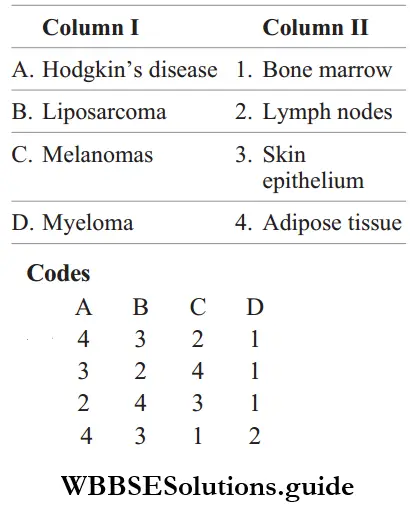
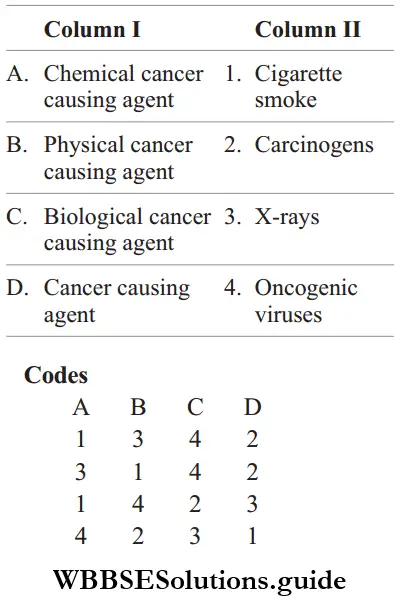
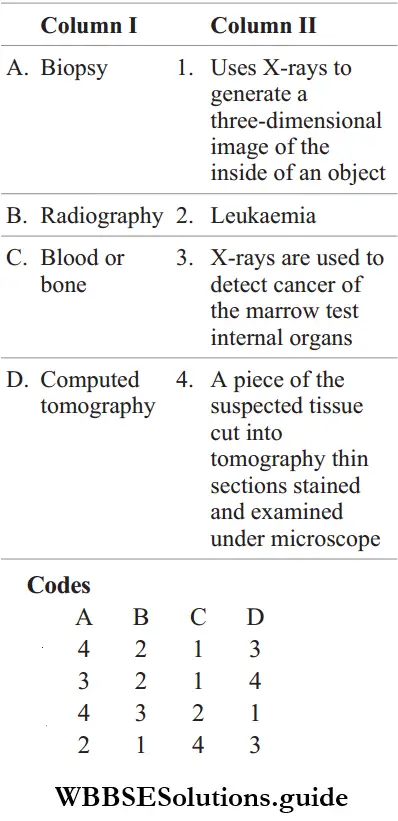
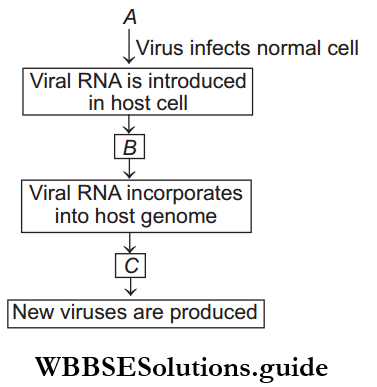
NEET Biology DNA Fingerprinting Multiple Choice Question And Answers

 DNA Fingerprinting

Question 1. The technique of dna fingerprinting was initially developed by

  1. Lalji Singh
  2. Alec Jeffreys
  3. Frederick sanger
  4. Jacob and Monod

Answer: 2. Alec Jeffreys

Dr. Alec Jeffrey developed the techniques of DNA fingerprinting and he is the father of DNA fingerprinting. Dr. Lalji Singh is the father of Indian DNA fingerprinting.

Read And Learn More: NEET Biology Multiple Choice Question And Answers

Question 2. The percentage of similarity between the nucleotides of two individuals is

  1. 98%
  2. 99%
  3. 99.9%
  4. 99.8%

Answer: 3. 99.9%

99.9% of nucleotide bases are exactly the same in all people.

“molecular basis of inheritance “

Question 3. For dna fingerprinting, dna is obtained from

  1. White blood corpuscles
  2. Hair root cells
  3. Body secretion
  4. All of the above

Answer: 4. All of the above

The first step in the procedure for creating a DNA fingerprint involves obtaining a sample of cells, such as blood, semen, saliva, skin, urine, or hair, which contain DNA. The DNA is extracted from the cells and purified.

Dna Fingerprinting Mcq

NEET Biology DNA Fingerprinting Multiple Choice Question And Answers

NEET Biology DNA Fingerprinting MCQs with Answers

Question 4. During dna fingerprinting, dna fragments are separated by

  1. Electrophoresis
  2. Peg
  3. Liposome
  4. Polymerases

Answer: 1. Electrophoresis

Gel electrophoresis is a technique used to separate dna fragments according to their size. Dna samples are loaded into wells (indentations) at one end of a gel and an electric current is applied to pull them through the gel.

Dna fragments are negatively charged, so they move toward the positive electrode.

Question 5. Dna fingerprinting involves identifying the differences in some specific regions in dna sequence called

  1. Non-repetitive dna
  2. Coding dna
  3. Non-coding dna
  4. Repetitive dna

Answer: 4. Repetitive dna

Dna fingerprinting involves identifying differences in repetitive dna because, in these sequences, a small stretch of dna is repeated
many times. These sequences do not code for any proteins but form a large portion of the human genome..

“molecular biology mcq “

Question 6. The bulk of dna (other than repetitive) forms major peaks during density gradient centrifugation. The other small peaks are referred to as

  1. Satellite dna
  2. Non-satellite dna
  3. Exonic dna
  4. Intronic dna

Answer: 1. Satellite dna

The basis of dna fingerprinting involves identifying the differences in some specific regions in dna called repetitive dna.

These repetitive dna are separated from the bulk genomic dna as different peaks during density gradient centrifugation. The bulk dna forms the major peak and other small peaks are referred to as satellite dna

Question 7. Satellite dna or repetitive dna

  1. Do not code for any protein
  2. Form a large portion of the human genome
  3. Shows a high degree of polymorphism
  4. All of the above

Answer: 4. All of the above

Satellite dna or repetitive dna does not code for any protein. They form the major part of dna or the human genome.

These sequences show a high degree of polymorphism (variation at the genetic level due to mutation) and thus, form the basis of dna fingerprinting.

Dna Fingerprinting Mcq

Question 8. The short repeating sequences of dna useful in dna fingerprinting are

  1. Vntrs
  2. Codons
  3. Introns
  4. Exons

Answer: 1. Vntrs are short, repeated sequences of nucleotides ranging between 20-100 base pairs.

They provide the scientific marker of identity known as dna fingerprint.

Question 9. Vntr belongs to the class of satellite dna referred to a

  1. Microsatellite dna
  2. Minisatellite dna
  3. Megasatellite dna
  4. Repetitive dna

Answer: 2. Minisatellite dna

Vntr is referred to as minisatellite dna (15-400 bp average about 20). It repeats generally 20-50 times.

Important MCQs on DNA Fingerprinting for NEET

Question 10. Vntrs are the key factor in dna profiling because

  1. The length of the regions having voters is different for each individual
  2. The length of the regions having voters is the same in each individual
  3. They have nucleotide
  4. Short pieces of nucleotides are the same in all persons

Answer: 1. The length of the regions having voters is different in each individual

Vntrs are key factors in dna profiling because their length differs in each individual. These include satellite dna, minisatellites, or microsatellites.

Dna Fingerprinting Mcq

Question 11. Tandem repeat dna

  1. Is classified as microsatellites and minisatellites.
  2. Normally does not code for any protein.
  3. Shows polymorphism.
  4. Is used in fingerprinting.

Choose the correct option.

  1. 1 And 3
  2. 1, 2 And 3
  3. 1, 3 And 4
  4. 1, 2, 3 And 4

Answer: 4. 1, 2, 3 And 4

Tandem repeats dna is the repetitive dna used for dna fingerprinting. These do not code for any protein.

It is highly repetitive and shows polymorphism. It is further classified into multiple copy genes, minisatellites, and microsatellites dna.

“rna polymerase diagram “

Question 12. RFLP analysis is a technique that

  1. Uses hybridization to detect specific dna restriction fragments in the genomic dna
  2. Is used to determine whether a gene is transcribed in specific cells or not
  3. Measures the transfer frequency of the genes during conjugation
  4. Is used to detect genetic variations at the protein level

Answer: 1. Uses hybridization to detect specific dna restriction fragments in the genomic dna

RFLPs (restricted fragment length polymorphisms) are used to detect the specific dna fragments in the genomic dna through hybridization techniques.

They are frequently used in dna fingerprinting

Biology MCQs with answers for NEET

Question 13. When the number of genes increases in response to some signal, the effect is called

  1. Gene dosage
  2. Gene pool
  3. Gene amplification
  4. Gene frequency

Answer: 3. Gene amplification

Gene amplification is an increase in the number of copies of a gene without a proportional increase in other genes.

This can result from duplication of a region of dna that contains a gene through errors in dna replication and repair machinery.

Role of VNTRs in DNA Fingerprinting MCQs for NEET

Question 14. The process used for the amplification or multiplication of dna during fingerprinting is

  1. Polymerase chain reaction (PCR)
  2. Nesslerisation
  3. Southern blotting
  4. Northern blotting

Answer: 1. Polymerase chain reaction (PCR)

Pcr is the technique in which several copies of dna are made synthetically (in vitro). It is used in fingerprinting and extensively in genetic engineering.

Biology MCQ For NEET With Answers

Question 15. Southern blotting technique .involves the transfer of dna from

  1. Gel to membrane
  2. Membrane to gel
  3. Solution to gel
  4. Gel to gel

Answer: 1. Gel to membrane

During dna extraction, the dna is transferred from the electrophoresis plate to the nitrocellulose or nylon membrane sheet. This is called Southern blotting.

“questions about dna “

Question 16. Which of the following statement is incorrect?

  1. Southern blotting is useful in determining certain genetic defects
  2. Southern blotting is used to generate dna fingerprints
  3. Dna fingerprints of any two individuals may be similar
  4. Dna fingerprint is a person-specific southern blot

Answer: 3. Dna fingerprints of any two individuals may be similar

The statement in option 3 is incorrect and can be corrected as dna fingerprinting is a highly specific process with very little
chances of error.

The chances of two people having the same identical fingerprint are about one in one billion. This chance of having the same genetic fingerprint can be decreased by using a larger number of probes in the test.

Question 17. During dna fingerprinting, the radioactive probes

  1. Hybridize with dna sample and form a double-stranded structure
  2. Degrade the dna
  3. Create a positive charge on dna
  4. Produce cut-in dna samples at various site

Answer: 1. Hybridize with dna sample and form a double-stranded structure

In dna fingerprinting, dna probes are hybridized with dna samples and form a double-stranded structure.

Thus, these single-stranded dna fragments are used to detect the presence of complementary nucleic acid sequences by hybridization.

Principle and Steps of DNA Fingerprinting MCQs for NEET

Question 18. Dna probes used in fingerprinting are

  1. Highly sensitive electron microscope
  2. Uv beams
  3. Dna segments having radioactive isotopes
  4. X-ray scanners

Answer: 3. Highly sensitive electron microscope

Dna probes are fragments of dna that are radioactively or fluorescently labeled.

These are used in dna samples to detect the presence of nucleotide substances that are complementary to the sequence in the probe.

NEET Biology Mcq

Question 19. Dna sample hybridized with dna probe when kept in contact with x-ray film results into

  1. Photographic image of radioactive probe
  2. Photographic image of dna bands due to radioactive probe
  3. Photographic image of nylon membrane
  4. Both 1 and 2

Answer: 2. Photographic image of dna bands due to radioactive probe

The dna bands due to the radioactive probes give a photographic image on x-ray film for documentation.

Question 20. The basis for dna fingerprinting is

  1. Occurrence of restriction fragment length polymorphism (RFLP)
  2. Phenotypic differences between individuals
  3. Availability of cloned dna
  4. Knowledge of human karyotype

Answer: 1. Occurrence of restriction fragment length polymorphism (RFLP)

Dna fingerprinting is a technique to identify a person on the basis of his
dna which is specific for every individual.

“which one of the following is not applicable to rna “

The dna of an individual carries specific sequences of nucleotides which are repeated many times throughout the length of dna. This reveals polymorphism in dna.

These are inherited. Each individual inherits these repeats from his/her parents which are used as genetic markers in dna fingerprinting. So, the basis for dna fingerprinting is RFLP.

Question 21. Assertion dna fingerprinting is applied in paternity testing in case of disputes.

  1. Reason (r) employs the principle of polymorphism in dna sequences as the polymorphisms are inheritable from parent to child.
  2. Both a and r are true and r is the correct explanation of a
  3. Both a and r are true, but r is not the correct explanation of a
  4. A is true, but r is false
  5. Both a and r are false

Answer: 1. Both a and r are true and r is the correct explanation of a

Dna fingerprinting is a technique to identify a person on the basis of his dna which is specific to every individual.

The dna of an individual carries specific sequences of nucleotides which are repeated many times throughout the length of dna.

This reveals polymorphism in dna. These are inherited. Each individual inherits these repeats from his/her parents which are used as genetic markers in dna fingerprinting. So, the basis for dna fingerprinting is RFLP.

DNA Fingerprinting and Its Uses in Forensic Science MCQs for NEET

Question 22. Applications of dna fingerprinting involve

  1. Phylogenetic studies
  2. Determination of population and genetic diversities
  3. Forensic analysis
  4. All of the above

Answer: 4. All of the above

Applications of dna fingerprinting include The most common uses for dna fingerprinting include forensics.

Dna fingerprinting can be accomplished with a very small quantity of dna and is a surefire way to ‘detect’ a culprit in a crime. Dna fingerprinting can be used to identify genetically modified plants or plants that are likely to have therapeutic value.

It also can be used for phylogenetic studies and to prove pedigree in valuable animals such as racehorses.

NEET Biology Plant Breeding Multiple Choice Question And Answers

Biology MCQ For NEET With Answers Plant Breeding

Question 1. The largest industry and main occupation in India is

  1. Oil
  2. Agriculture
  3. Transport and communication
  4. Steel

Answer: 2. Agriculture

  • Agriculture accounts for approximately 33% of India’s GDP and employs nearly 62% of the population.
  • So, the largest industry and main occupation in India is agriculture.

Read And Learn More: NEET Biology Multiple Choice Question And Answers

Question 2. Science of altering the genetic pattern of plants in order to increase their value and utility for human welfare is called

  1. Plant breeding
  2. Agriculture
  3. Plant genetics
  4. Botany

Answer: 1. Plant breeding

plant breeding class 12th

Plant breeding is the science of altering the genetic pattern of plants so as to increase desired characteristics, value and utility for human welfare.

Question 3. The objectives of plant breeding include

  1. Production of high-yielding varieties
  2. Improvement in the quality of crops
  3. Increasing the tolerance limits to environmental stresses
  4. All of the above

Answer: 4. All of the above

Plant breeding is the purposeful manipulation of plant species in order to create plant types that are better suited for cultivation, give better high-yielding varieties, tolerant to environmental stresses and are disease resistant.

NEET Biology Plant Breeding MCQs with answers

Question 4. The root of any breeding programme is

  1. Genetic variability
  2. Cross hybridisation
  3. Hybrid vigour
  4. Heterosis

Answer: 1. Genetic variability

Genetic variability is the root of any breeding programme. During breeding of plants pre-existing genetic variability is collected from wild varieties, species and relatives of the cultivated crop species.

Biology MCQ For NEET With Answers

NEET Biology Plant Breeding Multiple Choice Question And Answers

Important MCQs on Plant Breeding for NEET

Question 5. Pureline breed refers to

  1. Heterozygosity only
  2. Homozygosity only
  3. Homozygosity and self-assortment
  4. Heterozygosity and linkage

Answer: 2. Homozygosity only

Homozygosity refers to the pattern of inheritance of same alleles for a particular gene from both parents. It is induced by pure line breeds.

Question 6. A true breeding plant is

  1. One that is able to breed on its own
  2. Produced due to cross-pollination among unrelated plants
  3. Near homozygous and produces offspring of its own kind
  4. Always homozygous recessive in its genetic constitution

Answer: 3. Near homozygous and produces offspring of its own kind

  • True breeding line is one that, have undergone continuous self-pollination, shows stable trait inheritance and expression for several generations.
  • It is both homozygous recessive as well as dominant in the genetic constitution and produces progeny of its own kind.

Question 7. In plant breeding, the entire collection of plants/seeds having diverse alleles of all genes in a particular organism is called

  1. Gene bank
  2. cDNA library
  3. Genomic library
  4. Germplasm

Answer: 4. Germplasm

  • Germplasm is the sum total of all the alleles of the genes present in a crop and its related species.
  • The entire collection of plants/seeds having all the diverse alleles for all genes in a given crop is called germplasm collection.

Biology MCQ For NEET With Answers

Question 8. A good germplasm collection is essential for

  1. A successful breeding programme
  2. Hybridisation
  3. Selection of plant
  4. Emasculation

Answer: 1. A successful breeding programme

A good germplasm collection is essential for a successful breeding programme.

plant breeding class 12th

Question 9. Improvement of crops by preserving germplasm in frozen state is called 

  1. Cold storage preservation
  2. Cryopreservation
  3. Vernalisation
  4. In situ preservation

Answer: 2. Cryopreservation

Cryopreservation or cryopreservation is a process where organelles, cells, tissues, extracellular matrix, organs or any other biological constructs, susceptible to damage caused by unregulated chemical kinetics are preserved by cooling (frozen) at very low temperatures.

Question 10. Cryopreservation of germplasm is done at

  1. 0°C
  2. – 50° C
  3. – 196° C
  4. – 273° C

Answer: 3. – 273° C

The term ‘cryopreservation’ (cryogenic preservation) refers to the storage of cells, tissues and organs at the ultralow temperature in liquid nitrogen (-196°C).

Question 11. Which of the following is the main aim of the evaluation of germplasm in plant breeding programmes?

  1. To identify plants with desirable combinations of characters
  2. For effective exploitation of the natural genes
  3. Both 1 and 2
  4. For a collection of variability

Answer: 1. To identify plants with a desirable combination of characters

Evaluation of germplasm is carried out to identify plants with desirable combinations of characters.

NEET quiz on Plant Breeding with solutions

Question 12. The various methods of crop improvement are

  1. Selection
  2. Hybridisation
  3. Polyploidy
  4. Mutation breeding
  5. Genetic engineering

Choose the correct option.

  1. 1, 2, 3, 4 and 5
  2. 1, 2, 3 and 5
  3. 2, 3, 4 and 5
  4. 1, 3, 4 and 5

Answer: 1. 1, 2, 3, 4 and 5

All the listed methods are used in the crop improvement programme

Biology MCQ For NEET With Answers

Question 13. Selection of homozygous plant is

  1. Mass selection
  2. Pureline selection
  3. Mixed selection
  4. None of the above

Answer: 2. Pureline selection

Pureline is true breeding genotype, a line that has been rendered homozygous for all genes under consideration in successive generations, a line in which homozygous individuals produce only homozygous offspring like parents. Thus, pure line breed refers to homozygosity only.

plant breeding class 12th

Question 14. The simplest selection of cross-pollinated crop is

  1. Selection
  2. Introduction
  3. Mass selection
  4. None of these

Answer: 3. Mass selection

  • Mass selection is the method of selection practised in self-pollinated or cross-pollinated plants.
  • Here, a number of superior variety plants are selected from mixed populations, harvested and their products are combined together, i.e. enmassed.
  • These are sown in next year and further selection is made in the same way. This is repeated for 5 to 6 generations or more till desired improvement is obtained.
  • It takes 8 years to get the new desired variety by mass selection.

Biology MCQs with answers for NEET

Question 15. Hybrid vigour is mostly occurred due to

  1. Heterozygosity
  2. Homozygosity of pure characters
  3. The superiority of all the genes
  4. Mixing up of cytoplasm of the male with that of female exclusively

Answer: 1. Heterozygosity

  • Hybrid vigour or heterosis is defined as the superiority of the hybrid over its parents in which the expression of characteristics is greater in the heterozygous offspring than in homozygous parents.
  • So, the hybrid vigour is mostly occurred due to heterozygosity.

Question 16. Why is there a requirement for breeding plants?

  1. Lack of adequate food having sufficient nutritional requirements in the world.
  2. The majority of population are unable to buy food resources high in nutrients.
  3. Essential micronutrients are absent from diet.

Choose the correct option.

  1. 1 and 2
  2. 1 and 3
  3. 2 and 3
  4. 1, 2 and 3

Answer: 4. 1, 2 and 3

  • All given statements are correct. Three billion people suffer from protein, vitamin and micronutrient deficiencies as these people cannot afford to buy enough vegetables, fruits, legumes, fish and meat.
  • Their food does not contain essential micronutrients such as iron, iodine, zinc and vitamin-A.
  • Breeding of crops with higher levels of vitamins, minerals or higher protein and healthier fats is called biofortification.
  • This is the most practical aspect to improve the health of the people.

Biology MCQs with answers for NEET

Question 17. Mating between two individuals differing in genotype to produce genetic variation is called

  1. Domestication
  2. Introduction
  3. Hybridisation
  4. Mutation

Answer: 3. Hybridisation

Hybridisation is the production of new varieties by crossing two or more plants having different genetic constitution.

Question 18. Genetic diversity in agricultural crops is threatened by

  1. Introduction of high-yielding varieties
  2. Intensive use of fertilisers
  3. Extensive intercropping
  4. Intensive use of biopesticides

Answer: 1. Introduction of high-yielding varieties

  • Genetic diversity in agricultural crops is mostly threatened by the introduction of high-yielding varieties because the latter eliminate or minimise the cultivation of rest of the species.
  • High-yielding varieties already have the required traits and hence, these are always bred purely.

Question 19. Scientists have problems in introducing new genetically improved food centres around due to

  1. Adverse effect on economy of developing countries
  2. Adverse effect on marketing and production of seed crops
  3. New allergens and diseases in human due to the introduction of new foreign proteins
  4. Thier unpalatable to humans

Answer: 3. New allergens and diseases in human due to introduction of new foreign proteins

Scientists have problems in introducing new genetically improved food centres around due to new allergens and diseases in human due to the introduction of new foreign proteins.

Question 20. Desired improved varieties of economically useful crops are raised by

  1. Migration
  2. Biofertiliser
  3. Hybridisation
  4. Natural selection

Answer: 3. Hybridisation

In hybridisation, two or more plants of different genotypes are crossed together to get offspring with new desirable combinations of characters as a result of genetic recombinations.

Question 21. By which of the following methods, new and better varieties of plants can be formed?

  1. Selection
  2. Grafting
  3. Hybridisation
  4. Hybridisation followed by selection

Answer: 4. Hybridisation followed by selection

plant breeding class 12th

  • Selection is picking up only those plants for reproduction which have desired qualities.
  • Hybridisation is the crossing of two or more types of plants for bringing their traits together in the progeny.
  • Thus, new and better varieties of plants can be formed by hybridisation followed by selection method.

Question 22. The process of removing stamens from the flower bud during hybridisation is called

  1. Crossing
  2. Selfing
  3. Emasculation
  4. Capping

Answer: 3. Emasculation

Emasculation is the process of removal of stamens to prevent self-pollination during hybridisation.

Biology MCQs with answers for NEET

Question 23. Emasculation helps to prevent

  1. Diseases
  2. Cross-pollinations
  3. Self-pollination
  4. Fertilisation

Answer: 3. Self-pollination

Question 24. In plant breeding, cross-hybridisation is a tedious process because

  1. Pre-existing genetic variability is to be collected from various varieties of a species
  2. Progeny with hybrid and desired characters should be chosen
  3. In order to obtain a hybrid, emasculation and bagging technique must be performed
  4. Both 1 and 2

Answer: 3. In order to obtain a hybrid, emasculation and bagging technique must be performed

Cross-hybridisation is a time-consuming and tedious process because it involves emasculation and bagging techniques to transfer desired pollen grains to a desire plant.

Question 25. Hybrid vigour is induced by

  1. Clonal selection
  2. Crossing in same plant
  3. Crossing two plants
  4. None of the above

Answer: 3. Crossing two plants

Hybrid vigour is induced by crossing two or more plants having different genetic constitution.

Question 26. Consider the following statements.

  1. Inbreeding is not used in crop improvement.
  2. Inbreeding does not induce variations

Choose the correct option.

  1. Statement 1 is correct, but 2 is incorrect
  2. Statement 1 is incorrect, but 2 is correct
  3. Both statements 1 and 2 are correct
  4. Both statements 1 and 2 are incorrect

Answer: 3. Both statements 1 and 2 are correct

  • Inbreeding does not help in inducing variation, instead it will increase homozygosity.
  • Therefore, it is not used for crop improvement programmes.

Biology MCQs with answers for NEET

Question 27. Given below are steps involved in plant breeding.

  1. Collection of germplasm
  2. …A…
  3. Cross breeding/hybridisation.
  4. …B…
  5. Testing, release and commercialisation of the new cultivar.

Choose the option containing correct missing steps A and B.

  1. A-Selection of parents, B-Testing of superior recombinants
  2. A-Evaluation of parents, B-Selection of parents
  3. A-Testing of recombinants, B-Selection of superior recombinants
  4. A-Evaluation and selection of parents, B-Selection and testing of superior recombinants

Answer: 4. A-Evaluation and selection of parents, B-Selection and testing of superior recombinants

NEET expected MCQs on Plant Breeding 2025

Question 28. If breeders want to incorporate desired characteristics into the crop plants, they should

  1. Increase yield and improve quality.
  2. Increase tolerance to salinity.
  3. Increase pathogen resistance.
  4. Increase tolerance to insect pests.

Choose the correct option.

  1. 1 and 2
  2. 1, 2 and 3
  3. 2, 3 and 4
  4. 1, 2, 3 and 4

Answer: 4. 1, 2, 3 and 4

All the given steps are required to get the desired characters into the crop plants.

plant breeding class 12th

Question 29. Who is the pioneer of mutational breeding in India?

  1. Dr Khorana
  2. Dr Basiswar Sen
  3. Dr Pushkar Nath
  4. Dr Swaminathan

Answer: 4. Dr. Swaminathan

  • Dr Swaminathan is the pioneer of mutational breeding in India.
  • Other options are explained as Dr Khorana synthesised artificial genes.
  • Dr Pushkar Nath is a famous potato breeder. Dr Basiswar Sen is a famous maize breeder.

NEET Biology Mcq

Question 30. The name of Norman Borlaug is associated with

  1. Green revolution
  2. Yellow revolution
  3. White revolution
  4. Blue revolution

Answer: 1. Green revolution

  • The scientists associated with Green Revolution are Vogel, NE Borlaug, O.
  • Eggum and MS Swaminathan. The Father of Green Revolution is Borlaug, who transferred the dwarf genes of wheat species ‘Gaines’ to Mexican spring wheat.
  • The semidwarf varieties (90-120 cm) brought the Green revolution.

Question 31. Father of Green Revolution in India is

  1. MS Swaminathan
  2. NE Borlaug
  3. Misra
  4. P Maheswari

Answer: 1. MS Swaminathan

Professor Monkombu Sambasivan Swaminathan has been recognised as the Father of the Green Revolution in India.

Question 32. In 1963, during green revolution, an increase in crop production of wheat was due to the introduction of

  1. Semidwarf varieties of wheat
  2. Jaya and Ratna
  3. Both 1 and 2
  4. Sonalika and Kalyan Sona

Answer: 1. Semidwarf varieties of wheat

  • In 1963, an increase in crop production was due to the introduction of semidwarf varieties of wheat.
  • Semidwarf wheat was developed by Norman E Borlaug at International Centre for Wheat and Maize Improvement in Mexico.

Question 33. Green Revolution in India was possible due to

  1. Exploitation of high-yielding varieties
  2. Intensive cultivation
  3. Better irrigation, fertilisers and pesticide facilities
  4. All of the above

Answer: 4. All of the above

During the 1970s, India witnessed a rapid increase in the production of agricultural products (particularly wheat) through the introduction of high-yielding varieties, increased irrigation facilities, application of fertilisers and pesticides, multiple cropping and better agricultural management or intensive cultivation.

NEET Biology Mcq

Question 34. The Nobel prize in year 1970 for food technology was won by

  1. Swaminathan
  2. Norman Borlaug
  3. Sundarlal Bahuguna
  4. Primji

Answer: 2. Norman Borlaug

In 1970, Norman Borlaug was awarded the Nobel Peace Prize by the Norwegian Nobel Committee ‘for his contributions to the green revolution. ’It had a huge impact on food production, particularly in Asia and in Latin America.

Question 35. India’s wheat yield revolution in the 1960s was possible primarily due to

  1. Increased chlorophyll content
  2. Mutations resulting in plant height reduction
  3. Quantitative trait mutations
  4. Hybrid seeds

Answer: 2. Mutations resulting in plant height reduction

High yield of India’s wheat yield revolution in 1960s was possible primarily due to the mutations resulting in plant height reduction.

Question 36. Semidwarf rice varieties were introduced in India in

  1. 1966
  2. 1965
  3. 1967
  4. 1969

Answer: 1. 1966

Semidwarf rice varieties were introduced in India in 1966.

NEET Biology Plant Breeding MCQs with explanations

Question 37. Better-yielding semidwarf varieties of rice are

  1. Jaya and Ratna
  2. Himgiri and Sonora-64
  3. Sonalika and Kalyan Sona
  4. Co-421 and Co-419

Answer: 1. Jaya and Ratna

  • Jaya and Ratna are semiwarf rice varieties.
  • Other options are explained as Himgiri, Sonora-64, Sonalika, Kalyan Sona are improved varieties of wheat. Whereas, Co-421 and Co-419 are improved varieties of sugarcane.

Question 38. Semidwarf varieties of rice were developed from

  1. IR-8
  2. Taichung Native-1
  3. Both 1 and 2
  4. Jaya and Ratna

Answer: 3. Both 1 and 2

Semidwarf varieties of rice were developed from IR-8 and Taichung Native-1.

NEET Biology Mcq

Question 39. Semidwarf wheat was developed at

  1. International Centre for Wheat and Maize Improvement, Brazil
  2. International Maize and Wheat Improvement in Mexico
  3. International Centre for Wheat and Rice Improvement, Japan
  4. International Centre for Wheat and Gram Improvement, Peru

Answer: 2. International Maize and Wheat Improvement in Mexico

In International Centre for Maize and Wheat Improvement, Mexico, semidwarf wheat was developed.

plant breeding class 12th

Question 40. Which tropical species of sugarcane is high yielding and with high sugar content?

  1. Saccharum barberi
  2. Saccharum officinarum
  3. Sharbati Sonora
  4. Sorghum

Answer: 2. Saccharum officinarum

  • Saccharum Officinarum is high yielding variety of sugarcane and it has high sugar content.
  • Other options are explained as
  • Saccharum barberi is a variety of sugarcane with poor yield and less sugar content sugarcane.
  • Sharbati Sonora is a hybrid variety of wheat.
  • Sorghum is a genus of family- Poaceae

Question 41. Polyploidy is induced in plants by the chemicals

  1. 2, 4-D
  2. 2, 4, 6-T
  3. Cytokinin
  4. Colchicine
  5. Cycocel

Answer: 4. Cycocel

  • Polyploidy is the phenomenon of having more than two sets of chromosomes or genomes.
  • The induction of polyploidy is a common technique to overcome the sterility of a hybrid species during plant breeding.
  • Polyploidy in crop plants is most commonly induced by treating seeds with the chemical colchicine.

Question 42. Triticale is an example of

  1. Autopolyploidy
  2. Allopolyploidy
  3. Aneuploidy
  4. None of these

Answer: 2. Allopolyploidy

  • Allopolyploidy has developed through hybridisation between two species followed by the doubling of chromosomes.
  • Triticale is the first man-made allopolyploid, developed by crossing wheat (Triticum turgidum) and rye (Secale cereale).

Question 43. In crop improvement programmes, haploids are of great importance because they

  1. Grow better under adverse conditions
  2. Are useful in the study of meiosis
  3. Require only about half the amount of chemical fertilisers compared to diploids
  4. Give homozygous lines

Answer: 4. Give homozygous lines

In crop improvement programmes, haploids are of great importance because they can immediately express mutation and also form homozygous line or pure lines.

NEET Biology Mcq

Question 44. Given below are different varieties of food crops and their categories.

  1. Kalyan Sona – Semidwarf wheat
  2. IR-8 – Semidwarf rice
  3. Ratna – Native wheat variety
  4. Kalyan Sona – Native rice variety

Choose the option containing incorrectly matched pairs.

  1. 1 and 3
  2. 2 and 3
  3. 3 and 4
  4. 1 and 4

Answer: 3. 3 and 4

  • 3 and 4 are incorrectiy matched pairs and can be corrected as Ratna is semidwarf variety of rice and Kalyan Sona is a semidwarf variety of wheat.
  • Rest others are correctly matched pairs.

Question 45. Several South Indian states raise 2-3 crops of rice annually. The agronomic feature that make this possible is

  1. Shorter rice plant
  2. Better irrigation facilities
  3. Shorter maturity duration
  4. Disease-resistant rice variety

Answer: 3. Shorter maturity duration

Several South Indian states raise 2-3 crops of rice annually. The agronomic feature relies in the fact that it makes early-yielding rice variety possible, i.e. it has a short maturity duration.

Question 46. International Rice Research Institute (IRRI) is situated at

  1. New York (USA)
  2. Tokyo (Japan)
  3. Laguna (Philippines)
  4. Hyderabad (India)

Answer: 3. Laguna (Philippines)

IRRI was founded in 1960 by Ford and Rockefeller Foundations. It is situated in Laguna (Philippines).

Question 47. ________ is the genetic ability of a plant to prevent pathogens from causing disease.

  1. Resistance
  2. Prevention
  3. Pathogenicity
  4. None of these

Answer: 1. Resistance

The genetic ability of a plant to prevent pathogens from causing disease is called resistance.

Question 48. The method of breeding technique that helps a plant in acquiring disease resistance is/are

  1. Conventional breeding techniques
  2. Mutational breeding
  3. Inbreeding

Choose the correct option.

  1. 1 and 2
  2. 1 and 3
  3. Only 1
  4. Only 3

Answer: 1. 1 and 2

  • Breeding is carried out by conventional breeding techniques or by mutational breeding. The conventional method of breeding for disease resistance involves hybridisation and selection.
  • Mutation breeding is defined as the process of breeding by artificially inducing mutations using chemicals (like aniline) or radiation (like gamma radiation).
  • Thus, conventional breeding and mutational breeding help a plant in acquiring disease resistance.

Mock test on Plant Breeding for NEET preparation

Question 49. How can we make our crops disease resistant?

  1. By spraying insecticides and pesticides
  2. By crossing them with their wild relatives
  3. Destroying diseased ones
  4. Eliminating wild species

Answer: 2. By crossing them with their wild relatives

  • Genes from wild plants provide resistance against pests and diseases and improved tolerance to abiotic stresses.
  • Thus, crops can be made disease resistant by crossing them with their wild relatives.

plant breeding class 12th

Question 50. What is the outcome of increase in resistance power in crops?

  1. Enhanced production.
  2. Reduce in dependence on fungicides and bactericides.
  3. Reduce in dependence on technical agricultural tools.

Choose the correct option.

  1. 1 and 2
  2. 1 and 3
  3. 2 and 3
  4. 1, 2 and 3

Answer: 1. 1 and 2

  • Statement 1 and 2 are the outcome of increase in resistance power in crops.
  • The outcome of increase in resistance power in crops enhances food production.
  • This also helps to reduce the dependency on use of fungicides and bactericides.

Question 51. Which disease was made resistant in the new variety of moong bean through mutation?

  1. Yellow mosaic virus
  2. Powdery mildew
  3. Black rust

Choose the correct option.

  1. 1 and 2
  2. 1 and 3
  3. 2 and 3
  4. 1, 2 and 3

Answer: 1. 1 and 2

In moong beans, resistance to yellow mosaic virus and powdery mildew were introduced by mutations.

Question 52. Black rot of crucifers is

  1. Fungal disease
  2. Bacterial disease
  3. Viral disease
  4. Insect disease

Answer: 2. Bacterial disease

  • Black rot of crucifers is caused by the bacterium, Xanthomonas campestris. It is the most common and destructive disease of the cabbage family worldwide.
  • The disease spread quickly between plants in a row by splashing rain and gains entry through water pores at leaf margins or through wounds.
  • So, the black rot of crucifers is bacterial disease.

Question 53. Himgiri developed by hybridisation and selection for disease resistance against rust pathogens is a variety of

  1. Chilli
  2. Maize
  3. Sugarcane
  4. Wheat

Answer: 4. Wheat

‘Himgiri’ is a wheat variety that is resistant to leaf and stripe rust, hill bunt, etc.

Question 54. Resistance to the yellow mosaic virus in Bhindi was introduced from a wild species. This resulted in the birth of a new variety of A. esculentus called

  1. Golden Kranti
  2. Sonalika
  3. IR-8
  4. Parbhani

Answer: 4. Parbhani

In bhindi (Abelmoschus esculentus), resistance to yellow mosaic virus was introduced from a wild species resulting in a new variety called Parbhani Kranti.

Question 55. Which of the following is a correct match between crop, variety and resistance to diseases?

  1. Crop > Variety > Resistance to diseases
  2. Wheat > Himgiri > White rust
  3. Brassica > Pusa Sadabahar > Black rot
  4. Cowpea > Pusa Komal > Bacterial blight
  5. Chilli > Pusa Swarnim > Chilli mosaic virus

Answer: 3. Brassica > Pusa Sadabahar > Black rot

  • Option (3) is correct match whereas rest options are not correct match between crop, variety and resistance to diseases.
  • Incorrect matches can be corrected as Wheat > Himgiri > Leaf and stripe rust.
  • Brassica > Pusa Swarnim > White rust

Question 56. Match the following columns.

NEET Biology Plant Breeding MCQs Question 56 Match The Column

Answer: A-1, 2, 3; B-4, 5, 6; C-7, 8

Question 57. Consider the following statements.

  1. Maize variety shows resistance towards maize stem borers.
  2. Maize has low aspartic acid content and high nitrogen.

Choose the correct option.

  1. Statement 1 is correct, but 2 is incorrect
  2. Statement 1 is incorrect, but 2 is correct
  3. Both statements 1 and 2 are correct
  4. Both statements 1 and 2 are incorrect

Answer: 1. Statement 1 is correct, but 2 is incorrect

  • Statement 1 is correct, but 2 is incorrect. The incorrect statement can be corrected as
  • In maize, the presence of high aspartic acid, low nitrogen and sugar content, protect them from stem borers.

plant breeding class 12th

Question 58. Presence of hairy leaves of many plants are associated with

  1. Resistance to insect pests
  2. Resistance to bacteria
  3. Resistance to virus
  4. Resistance to bollworm

Answer: 1. Resistance to insect pests

Hairy leaves of many plants are associated with resistance to insect pests. For example, resistance to Jassids in cotton and cereal leaf beetle in wheat.

NEET practice test on Plant Breeding

Question 59. Which one of the following is linked to the discovery of the Bordeaux mixture as a popular fungicide?

  1. Bacterial leaf blight of rice
  2. Downy mildew of grapevine
  3. Loose smut of wheat
  4. Black rust of wheat

Answer: 2. Downy mildew of grapevine

  • Bordeaux mixture was discovered by Millardet in France in 1882. It is prepared by dissolving 40 g of copper sulphate and 40 g of calcium hydroxide in 5 L of water.
  • It was first used to control downy mildew disease of grapevine that is caused by a fungus Plasmopara viticola.

Question 60. The scientific process by which crop plants are enriched with certain desirable nutrients.

  1. Bioneutralisation
  2. Plant breeding
  3. Biofortification
  4. Bioremediation

Answer: 3. Biofortification

Biofortification focuses on making plant foods more nutritious when the plants are growing. The desired nutrients are infused in crop plants only.

Question 61. The objective of biofortification is to improve

  1. Protein content and quality
  2. Oil content and quality
  3. Vitamin content
  4. Micronutrients and mineral content

Choose the correct option.

  1. 1, 2 and 3
  2. 1, 2 and 4
  3. 2, 3 and 4
  4. 1, 2, 3 and 4

Answer: 4. 1, 2, 3 and 4

Plant breeding programme designed to increase the vitamins, minerals, higher protein and healthier fat content in crop yields is called biofortification.

Question 62. Co-421 and Co-453 are improved varieties of

  1. Wheat
  2. Rice
  3. Bajra
  4. Sugarcane

Answer: 4. Sugarcane

  • Co-421 and Co-453 are improved varieties of sugarcane.
  • These are high-yielding varieties in Bihar and UP.

Question 63. Sonora-64 and Lerma Rojo are the varieties of

  1. Wheat
  2. Rice
  3. Pea
  4. Maize

Answer: 1. Wheat

  • Sharbati Sonora and Pusa Lerma are the two important varieties of wheat that are responsible for Green Revolution in India.
  • These are produced by gamma rays treatment of Sonora- 64 and Lerma Rojo- 64, which are the Mexican dwarf varieties.

Question 64. Which is correct about Atlas-66?

  1. It has high protein content
  2. It has been used as a donor for improving cultivated wheat
  3. Both 1 and 2
  4. None of the above

Answer: 3. Both 1 and 2

Atlas-66 or soft wheat have been used since 1953 as a genetic source of higher protein in wheat. It has been used as a donor for improving cultivated wheat.

Question 65. Golden rice or Miracle Rice is transgenic rice rich in

  1. Vitamin-B and iron
  2. Vitamin-A and iron
  3. Vitamin-A and vitamin-B
  4. Iron only

Answer: 2. Vitamin-A and iron

Golden rice or miracle rice is a variety of rice (Oryza sativa) produced through genetic engineering to biosynthesise beta-carotene, a precursor of vitamin- A in the edible parts of rice. So, it is transgenic rice rich in vitamin-A and iron.

Question 66. Shakti, Rattan and Protina are three important lysine-rich varieties of

  1. Rice
  2. Pulses
  3. Wheat
  4. Maize
  5. Cotton

Answer: 4. Cotton

  • Three varieties of maize namely, Shakti, Rattan and Protina have been developed, evaluated and released for cultivation based on being rich in the amino acid, lysine.
  • Generally, cereal and millet proteins are deficient in lysine and tryptophan, amino acids which are called essential amino acids.

Question 67. Which variety of Okra shows insect resistance?

  1. Pusa Sawni
  2. Pusa Gaurav
  3. Pusa A-4
  4. Both 1 and 2

Answer: 4. Both 1 and 2

Pusa Sawni and Pusa A-4 are varieties of Okra (bhindi), which shows resistance towards shoot and fruit borer insects.

Question 68. Wonder wheat is new wheat variety developed by

  1. Mexico’s International Wheat and Maize Improvement Centre
  2. Indian National Botanical Research Institute
  3. Australian Crop Improvement Centre
  4. African Crop Improvement Centre

Answer: 1. Mexico’s International Wheat and Maize Improvement Centre

Wonder wheat is a new wheat variety with a yield of 18 tonnes per hectare. It has been some 200 grains per stalk and has developed by Mexico’s International Wheat and Maize Improvement Centre.

Question 69. Triticum aestivum, the common breed of wheat is

  1. Triploid with 21 chromosomes
  2. Tetraploid with 28 chromosomes
  3. Hexaploid with 42 chromosomes
  4. Diploid with 14 chromosomes

Answer: 3. Hexaploid with 42 chromosomes

  • A natural mutant of T. turgidum is represented by tetraploid T. durum. (4n = 28).
  • The latter was crossed with diploid wild grass, Aegilops squarrosa (2n = 14) under natural conditions.
  • The resultant triploid hybrid was sterile, which upon doubling of chromosomes, produced the hexaploid breed of wheat, Triticum aestivum (6n = 42).

Question 70. Quality of seed is certified by an agency called

  1. IRRI
  2. NSC
  3. INRI
  4. ICAR

Answer: 2. NSC

National Seed Corporation (NSC) is an agency which certifies the quality of seed.

Question 71. Dr MS Swaminathan could produce an amber-seeded high-yielding wheat variety called ‘Sharbati Sonora’ from the Mexican dwarf variety by using

  1. Radiations of ultraviolet and gamma rays
  2. Chemical mutagens
  3. Tissue culture
  4. Crossbreeding techniques

Answer: 1. Radiations of ultraviolet and gamma rays

Sharbati Sonora was produced by Dr MS Swaminathan through the radiations, i.e.ultraviolet and gamma rays treatment on Sonora- 64 which was the Mexican dwarf variety.

plant breeding class 12th

Question 72. Which plant has a potential source of protein almost equal to soybeans?

  1. Parthenium argentatum
  2. Psophocarpus tetragonolobus
  3. Lucaena leucocephala
  4. Simmondsia chinensis

Answer: 2. Psophocarpus tetragonolobus

  • Winged bean, Psophocarpus tetragonolobus (L.) DC. is analogous to soybean in yield and nutritional quality of protein.
  • Thus, it is a valuable alternative to soybean in tropical regions of the world.

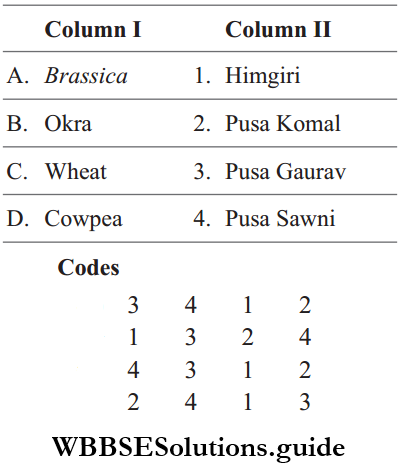
Question 73. Match Column-1 with Column-2 and select the correct option from the codes given below.

NEET Biology Plant Breeding MCQs Question 73 Match The Column

Answer: A-3, B-4, C-1, D-2,

Question 74. The Indian Agricultural Research Institute, New Delhi has released several fortified vegetable crops that are rich in vitamins and minerals. Identify the option with correct nutrients and plants.

  1. Vitamin-A enriched–carrot, spinach and pumpkin
  2. Vitamin-C enriched–bitter gourd, bathua, mustard and tomato
  3. Iron and calcium-enriched– spinach and bathua
  4. Protein-enriched–broad beans, French bean and garden pea

Choose the correct option.

  1. 1, 2, 3 and 4
  2. 1, 3 and 4
  3. 2, 3 and 4
  4. None of these

Answer: 1. 1, 2, 3 and 4

All the options represent correctly match pairs.

NEET Biology Animal Husbandry Multiple Choice Question And Answers

NEET Biology Mcqs Animal Husbandry

Question 1. ______ is the agricultural practice of feeding, breeding, and raising livestock whose primary purpose is to provide meat and milk.

  1. Animal husbandry
  2. Cattle improvement
  3. Both (1) and (2)
  4. Cattle farming

Answer: 1. Animal husbandry

Animal husbandry is the agricultural practice of feeding, breeding, and raising livestock to obtain meat and milk. It deals with the care and breeding of livestock like buffaloes, cows, pigs, horses, cattle, sheep, camels, goats, etc., that are useful to humans.

Read And Learn More: NEET Biology Multiple Choice Question And Answers

Question 2. More than 70% of the world’s livestock population is found in _____ A _______ and ____ B _______, but contribute only 25% to the world farm production.

  1. A–India, B–China
  2. A–Japan, B–China
  3. A–India, B–US
  4. A–US, B–Brazil

Answer: 1. A–India, B–China

It is estimated that more than 70% of the world livestock population is in India (A) and China (B). However, it is surprising to note that their contribution to the world farm produce is only 25%, i.e. the productivity per unit is very low.

Animal Husbandry Mcqs

NEET Biology Animal Husbandry Multiple Choice Question And Answers

NEET Biology Animal Husbandry MCQs with Answers

Question 3. The management of animals for milk and its products for human consumption is called

  1. Dairy farming
  2. Poultry
  3. Cattle farming
  4. Cattle rearing

Answer: 1. Dairy farming

The management of animals for milk and its products for human consumption is called dairying. Milk yield here is dependent primarily on the quality of breeds.

Question 4. National Dairy Research Institute is located at

  1. Lucknow
  2. Mumbai
  3. Chennai
  4. Karnal

Answer: 4. Karnal

dairy questions and answers pdf

The National Dairy Research Institute (NDRI), located in Karnal (Haryana) is a premier research organisation under the aegis of Indian Council of Agricultural Research (ICAR).

Question 5. Consider the following statements.

  1. In dairy management, processes that improve and increase quality and yield of milk are used.
  2. Animals like cow, sheep, buffaloes are found in dairy.

Choose the correct option.

  1. Statement 1 is correct, but 2 is incorrect
  2. Statement 1 is incorrect, but 2 is correct
  3. Both statements 1 and 2 are correct
  4. Both statements 1 and 2 are in correct

Answer: 3. Both statements 1 and 2 are correct

Question 6. Father of White Revolution in India is

  1. Dr. Verghese Kurien
  2. Dr. MS Swaminathan
  3. Alexander Fleming
  4. Norman Borlaug

Answer: 1. Dr. Verghese Kurien

Dr. Verghese Kurien is Father of White Revolution in India. White revolution contributed to huge production of milk and its products during the 1970s.

Question 7. The practices involving improvement in animal husbandry can be brought about by

  1. Better management of farm and farm animals
  2. Increasing the number of breeding animals
  3. Managing the amount of feedstock given
  4. None of the above

Answer: 1. Better management of farm and farm animals

The practices concerned with the improvement in animal husbandry include management of farms, farm animals, and animal breeding.

Question 8. The milk-yielding capacity of buffalo is

  1. More than cows
  2. Less than cows
  3. Equal to cows
  4. None of the above

Answer: 1. More than cows

The average annual milk yield of a buffalo is 491 liters as against 173 liters of a cow in India. So, the milk-yielding capacity of buffalo is more than cows.

Animal Husbandry Mcqs

Question 9. Milk of which breed is nutritionally superior?

  1. Cow milk
  2. Camel milk
  3. Goat milk
  4. Buffalo milk

Answer: 4. Buffalo milk

Buffalo’s milk has higher fat, calcium, and protein contents than cow’s, camel’s, and goat’s milk.

Important MCQs on Animal Husbandry for NEET

Question 10. Which of the following is observed in animal husbandry?

  • Breeding of livestock buffaloes, cows, sheep, camels, etc., that is useful to humans.
  • Rearing, catching, selling, etc., of fish, molluscs, and crustaceans.
  • Breeding of fowls for human use.

Choose the option containing correct statements.

  1. 1 and 2
  2. 1 and 3
  3. 2 and 3
  4. 1, 2 and 3

Answer: 4. 1, 2 and 3

  • All given statements are correct. In animal husbandry, meat animals include beef, cattle, sheep, and meat goats. Milk animals include cows and buffaloes.
  • Fisheries is also an important source of animal food, which is concerned with rearing, catching, and selling of fish, mollusks (shellfish), crustaceans, prawns, crabs, etc. Poultry is a class of domesticated fowl used for food and for their eggs.

Question 11. India is the largest exporter of ___________

  1. Milk and butter
  2. Meat and eggs
  3. Hides and skin
  4. Wool

Answer: 3. Hides and skin

dairy questions and answers pdf

India is the largest exporter of hides and skin in the world. Animal hides are stretched, dried, and tanned for human use. Most hides are processed from domesticated animals.

Question 12. Consider the following statements.

  1. Most of the animals are sheared once in a year.
  2. The major shearing season is May to December.

Choose the correct option.

  1. Statement 1 is correct, but 2 is incorrect
  2. Statement 1 is incorrect, but 2 is correct
  3. Both statements 1 and 2 are correct
  4. Both statements 1 and 2 are incorrect

Answer: 4. Both statements 1 and 2 are incorrect

  • Both statements 1 and 2 are incorrect and can be corrected as
  • Most animals are shorn twice a year. The major shearing seasons are January to March, June to August, and October to December.

Animal Husbandry Mcqs

Question 13. The parameters carried out for managing dairy farm are

  1. Selection of high-yielding males and females showing resistance to diseases.
  2. Visits by a veterinary doctor on a regular basis.
  3. Each animal should be fed nutritious feed in a proper proportion.
  4. Following of good animal management and general supervision.

Which of the above statement are correct?

  1. 1 and 2
  2. 1, 2 and 3
  3. 2, 3 and 4
  4. 1, 2, 3 and 4

Answer: 4. 1, 2, 3 and 4

  • All given statements are correct. Parameters of managing dairy farm are as follows
  • Selection of good breeds having high yielding potential, resistance to diseases, etc.
  • Cattles have to be well looked after by experienced doctors on regular basis.
  • Quality and quantity of fooder in proper ratio should be given.
  • The shed must be clean spacious, possess adequate facilities of light, water, drainage, etc.

Question 14. Buffaloes are considered better than cows because

  1. They are resistant to diseases
  2. They give more milk
  3. They live longer
  4. All of the above

Answer: 4. All of the above

  • Buffaloes are considered better than cows because their milk contain more calcium and other minerals like potassium, phosphorus, etc.
  • Also, buffaloes are more resistant to diseases due to which they live longer as compared to cows.

Animal Husbandry Mcqs

Question 15. The yellow colouration of cow’s milk is due to the

  1. Presence of carotene
  2. Absence of albumin
  3. Absence of casein
  4. Presence of lactose

Answer: 1. Presence of carotene

dairy questions and answers pdf

The yellow colour of cow milk is due to the presence of carotene, which is a precursor for yellow colour in cow’s milk and is a derivative of vitamin-A.

Question 16. Domesticated birds used for eggs or food is called

  1. Poultry
  2. Egg farming
  3. Apiculture
  4. Fowl farming

Answer: 1. Poultry

Poultry includes the class of domesticated fowl (birds) used for food or for eggs.

Livestock Management and Animal Breeding MCQs for NEET

Question 17. The common poultry bird(s) is/are

  1. Geese
  2. Turkey
  3. Chicken
  4. All of these

Answer: 4. All of these

The common poultry birds are chickens, turkeys, ducks, geese, guinea fowls, and pigeons.

Question 18. The ideal floor space requirement for a layer bird is about

  1. 2.5 to 3 sq. ft
  2. 3 to 4 sq. ft
  3. 10 sq. ft
  4. 4 to 5 sq. ft

Answer: 1. 2.5 to 3 sq. ft

  • Generally, egg-laying hens require about 2.5 to 3 square feet floor space for each bird.
  • For example, if you build a house having 5 feet width and 6 feet long then you can raise a maximum number of 10 hens in the house.

Question 19. Which is the key factor in selecting fowl for poultry?

  1. It must be easily available, may or may not be prone to diseases
  2. It must be cheap, slowly maturing, and have low-quality of meat and egg
  3. It must be fast-growing, resistant against diseases, and provide more eggs and good-quality meat
  4. All of the above

Answer: 3. It must be fast-growing, resistant to diseases, and provide more eggs and good-quality meat

The fowls selected for poultry must be fast-growing, resistant to diseases, provide more eggs and quality meat.

Animal Husbandry Mcqs

Question 20. Bird, especially chicken, grown for meat only is known as

  1. Hybrid
  2. Broiler
  3. Bird management
  4. Bird culture

Answer: 2. Broiler

A broiler is any chicken that is breed and raised specifically for meat production.

Question 21. Fowls raised for eggs are called

  1. Layers
  2. Broilers
  3. Broody
  4. None of the above

Answer: 1. Layers

Poultry fowls are of two types, i.e. layer chicks are for egg purpose and broilers are 8-10 weeks old chicken raised specifically for meat.

Question 22. Consider the following statements.

  1. Typically broilers have white feathers and yellowish skin.
  2. Duck and pigeons are not poultry birds

Choose the correct option.

  1. Statement 1 is correct, but 2 is incorrect
  2. Statement 1 is incorrect, but 2 is correct
  3. Both statements 1 and 2 are correct
  4. Both statements 1 and 2 are incorrect

Answer: 1. Typically broilers have white feathers and yellowish skin.

Statement 1 is correct, but 2 is incorrect. Incorrect statement can be corrected as The common poultry birds are chickens, turkeys, ducks, geese, guinea fowls and pigeons.

Animal Husbandry Mcqs

Question 23. The important parameters of poultry farm management are given below.

  1. Selection of disease-free breed.
  2. Clean farm and proper disposal of wastes.
  3. Safe, hygienic, and pest-free food and water should be provided.
  4. The temperature of poultry farm should be high for egg laying.

Which of the statements given above is/are true and which is/are false?

  1. T T T F
  2. F T T T
  3. T T F T
  4. T F T F

Answer: 1. Selection of disease-free breed

Statements 1, 2, and 3 are true, but statement 4 is false. The incorrect statement can be corrected as The temperature of the poultry shed should be optimum, not too high or not too low.

dairy questions and answers pdf

Question 24. In poultry ‘broiler finish mash’ is fed to the chicks between __________ weeks.

  1. 1 to 6
  2. 7 to 10
  3. 10 to 15
  4. 15 to 20

Answer: 2. 7 to 10

Finish mash is fed to the chicks between 7 to 10 weeks. It helps to build the muscles which are mainly used for meat production.

Question 25. The yolk of avian eggs contain

  1. Albumin
  2. Provitellin
  3. Vitellin
  4. Lecithin
  5. All of these

Answer: 5. All of these

The yolk of avian eggs contain various proteins including vitellin, livetins, phosvitin, phosphoproteins, lipoproteins, lipovitellin, provitellin, lecithin, albumin, etc.

Question 26. Breeding of fowl is preferably done between

  1. Dark coloured hen and light coloured cock
  2. 2 years old hen and 1-year-old cock
  3. 1-year-old hen and 2 years old cock
  4. 2 years old cock and hen

Answer: 2. 2 years old hen and 1-year-old cock

For the purpose of fowl breeding, two years old hen and one-year-old cock are considered.

NEET Biology Mcq Chapter Wise

Question 27. Identify the groups including animals whose eggs are consumed by humans.

  1. Gallus, Turtle, Chantecler
  2. Turkey, Fowl, Duckbill platypus
  3. Rana hexadactyla, Varanus, Gallus
  4. Python, Gallus, Chantecler

Answer: 1. Gallus, Turtle, Chantecler

The chicken (Gallus gallus domesticus) is a type of domesticated fowl. Turtle’s eggs are usually eaten raw or very lightly heated and their taste is said to be more flavourful than chicken eggs though some experience a ‘musky’ aftertaste. The Chantecler is as edible breed of chicken that originated in Canada.

Question 28. In India, which state occupies the first position in poultry farming?

  1. Kerala
  2. MP
  3. Andhra Pradesh
  4. UP

Answer: 3. Andhra Pradesh

  • Tamil Nadu tops in egg production after the separation of Andhra Pradesh and Telangana. Tamil Nadu’s Namakkal is famous for its eggs.
  • Every day, Tamil Nadu produces 3 crore eggs. This is followed by Andhra Pradesh (2.75 crores), Telangana (2 crores) and Punjab (1 crore).
  • So, out of the given options we can say that Andhra Pradesh state occupies the first position in poultry farming in India.

Question 29. The egg layer variety of birds popular all over the world is

  1. Plymouth rock
  2. Hampshire
  3. White leghorn
  4. Wyandotte

Answer: 3. White leghorn

The most common egg layer variety of bird used for commercial production throughout the world is white leghorn.

Question 30. Austra white is the hybrid vigor of

  1. Gallus and white leghorn
  2. Desi variety with exotic bird
  3. Australorp male and white leghorn female
  4. None of the above

Answer: 3. Australorp male and white leghorn female

  • The Austra whites is cross between a black Australorp male and white leghorn female. It is a chicken developed for people who desire an abundance of white eggs and a calm hen to produce them.
  • Austra whites are excellent layers and you can expect more than 250 eggs per year from each hen. Additionally, they can also be raised as meat birds because they possess heavyweight.

Topic-wise Animal Husbandry MCQs for NEET with Explanation

Question 31. Desi breeds of fowl are

  1. Plymouth rock
  2. Brahma
  3. New Hampshire
  4. Rhode Island

Answer: 2. Brahma

Some important indigenous breeds of domestic fowl (desi hens) include Aseel, Karaknath, Basara, Chittagong, Ghagus, Brahma, and Cochin.

Question 32. Consider the following statements.

  1. Desi hens are weak and do not possess natural immunity against common diseases.
  2. The average egg production of desi hen is very high, i.e. ~150 eggs/ annum

Choose the correct option.

  1. Statement 1 is correct, but 2 is incorrect
  2. Statement 1 is incorrect, but 2 is correct
  3. Both statements 1 and 2 are correct
  4. Both statements 1 and 2 are incorrect

Answer: 4. Both statements 1 and 2 are incorrect

  • Both statements 1 and 2 are incorrect and can be corrected as
  • Desi hens are strong and possess natural immunity against common diseases, but they are small, slow growing, and lay small-sized and less number of eggs.
  • The average egg production of a desi hen is about 60 eggs per annum, which is very poor. Keeping this fact in mind, a large number of poultry birds have been imported.

NEET Biology Mcq Chapter Wise

Question 33. Broodiness in layer birds can be rectified by giving the hormonal injection of

  1. Progesterone
  2. Oestrogen
  3. Prolactin
  4. Both (1) are (2)

Answer: 4. Both (1) are (2)

  • Broodiness is the tendency of layer birds to stop egg-laying, eating food, and sitting morbidly.
  • It can be rectified by giving them the hormonal injection of estrogen and progesterone. Broodiness is induced by the prolactin hormone.

Question 34. The process of elimination of profitable birds from a flock is called

  1. Brooding
  2. Dubbing
  3. Culling
  4. De-worming

Answer: 3. Culling

Culling is the separation and elimination of sick and non-productive birds from the flock to prevent diseases in profitable birds.

Question 35. In the poultry industry, the production of hatching eggs is more expensive than the production of market eggs mainly because

  1. Cost of males and their depreciation value is high
  2. Mortality among females is usually lower when they are mated with males
  3. Number of eggs produced by hatchery flock are to be sold only as market eggs
  4. Some of the eggs produced by hatchery flocks are not acceptable for incubation

dairy questions and answers pdf

Answer: 4. Some of the eggs produced by hatchery flocks are not acceptable for incubation

  • Not all eggs laid by a breeding flock are incubated. Eggs that are cracked or dirty are usually not used for hatching.
  • Very small or very large eggs do not hatch. Eggs with thin or very porous shells are not likely to hatch well because of excessive loss of water during incubation.
  • So, in the poultry industry, production of hatching egg is more expensive than the production of market eggs mainly because some of eggs produced by hatchery flocks are not acceptable.

Question 36. Eggs of chicken are incubated at

  1. 37°C
  2. 45°C
  3. 27°C
  4. 10°C

Answer: 1. 37°C

Chicken eggs should be incubated at a temperature between 37 and 39°C (37.5 is often considered to be ideal) and 50 to 65% relative humidity (60% is often considered ideal).

Question 37. Match the different chickens given under Column 1 with their respective uses given under Column 2. Choose the answer. which gives the correct combination of alphabets of two columns.
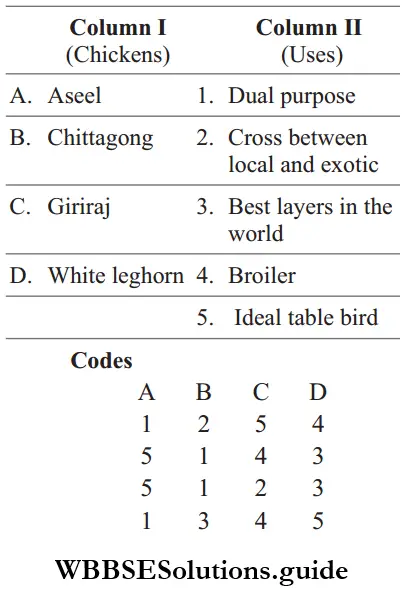
NEET Biology Animal Husbandry MCQs Question 37 Match The Column

Answer: A-5, B-1, C-2, D-3

Question 38. HH 260 is a breed of

  1. Cock
  2. Pig
  3. Buffalo
  4. Hen

Answer: 4. Hen

Rhode Island Red, Black Minorca, and HH 260 are high egg-yielding breeds of hens. HH 260 is improved cross breed and highly used one. It has a very low level of climatic tolerance.

dairy questions and answers pdf

Question 39. Given below are different breeds of fowls and their characteristics

  1. New Hampshire – Non-American type
  2. Plymouth rock – Local breed
  3. Rhode Island Red – Mediterranean type
  4. White leghorn – American type

Choose the option containing incorrectly matched pairs.

  1. 1 and 4
  2. 2 and 3
  3. 2, 3 and 4
  4. 1, 2, 3 and 4

Answer: 4. 1, 2, 3 and 4

All the given pairs are incorrectly matched pairs and can be corrected as New Hampshire is an American type. Plymouth rock is the most popular breed of the USA. Rhode Island is American class breed. White leghorn is Mediterranean type.

NEET Biology Mcq Chapter Wise

Question 40. Blackhead disease in poultry is caused by

  1. Haemophilus
  2. Histomonas
  3. Eimeria
  4. None of these

Answer: 2. Histomonas

Blackhead, also referred to as histomoniasis, is a disease caused by the protozoan, Histomonas meleagridis. This disease initially affects the intestinal ceca and liver, thus causing tissue destruction.

Question 41. Pullorum disease of poultry is otherwise known as

  1. Coccidiosis
  2. White diarrhea
  3. Fowl pox
  4. Avian diphtheria

Answer: 2. White diarrhea

Pullorum disease is caused by a bacterium, Salmonella pullorum. It results in loss of appetite, difficulty breathing, and white diarrhoea. This disease primarily affects turkeys, but other poultry species could be infected as well.

Question 42. Which is a fungal disease of poultry?

  1. Candidiasis
  2. Pox
  3. Cholera
  4. Ranikhet

Answer: 1. Candidiasis

Candidiasis is a fungal disease of poultry. Pox and Ranikhet are viral diseases. Cholera is a bacterial disease.

Question 43. One of the following is a disease of poultry.

  1. Ranikhet disease
  2. Anthrax
  3. Pebrine disease
  4. Foot and mouth disease

Answer: 1. Ranikhet disease

Ranikhet disease, also known as new castle disease. It is a contagious and highly fatal disease of fowl. In spite of the notable work done towards its control, this disease still ranks as one of the most serious viral diseases of poultry.

Question 44. The causative agent of bird flu is

  1. fungus
  2. bacteria
  3. protozoan
  4. virus

Answer: 4. virus

Bird flu is caused by a virus called H5N1.

Question 45. Consider the following statements.

  1. Bird flu is caused by H5N1 virus.
  2. H5N1 can infect humans.

Choose the correct option.

  1. Statement 1 is correct, but 1 is incorrect
  2. Statement 1 is incorrect, but 1 is correct
  3. Both statements 1 and 2 are correct
  4. Both statements 1 and 2 are incorrect

Answer: 3. Both statements 1 and 2 are correct

dairy questions and answers pdf

Bird flu resembles influenza and is caused by a virus H5N1. The virus enters the man through the uncooked chicken.

NEET Biology Mcq Chapter Wise

Question 46. If chicken and eggs are cooked properly (above 100°C), then the chances of catching bird flu are

  1. Very high
  2. High
  3. Moderate
  4. Nil

Answer: 4. Nil

The chances of catching bird flu from properly cooked chicken and egg are nil. It is confirmed by UN Food and Agriculture Organisation (FAO) and World Health Organisation (WHO)

Question 47. Fowl pox is caused by

  1. Ectoparasites
  2. Endoparasites
  3. Bacteria
  4. Virus

Answer: 4. Virus

Fowl pox causes warty lesions on the feet, on combs, and eyelids. It is caused by the genus of the virus Avipoxvirus.

Question 48. Which of the following is a fungal disease in poultry?

  1. Thrush
  2. Fowl pox
  3. Cholera
  4. Ranikhet

Answer: 1. Thrush

Thrush or mycosis or sour crop is a fungal disease of the digestive tract of various avian species, including chickens, turkeys, and quail.

Question 49. ‘Thrush disease’ in poultry is caused by

  1. Candida
  2. Aspergillus
  3. Puccinia
  4. None of these

Answer: 1. Candida

Thrush is caused by fungus, Candida albicans. It is also called Moniliasis disease and other fungal diseases include aspergillosis and aflatoxicosis.

Question 50. Gumboro disease in poultry is caused by

  1. Bacteria
  2. Virus
  3. Fungi
  4. Eimeria

Answer: 2. Virus

Gumboro disease leads to loss of appetite, diarrhea, and enlargement of the Bursa. It is caused by the bursal disease virus.

Question 51. Coccidiosis in poultry is caused by

  1. Protozoan parasite, eimeria
  2. Helminth parasites
  3. Virus
  4. Fungi

Answer: 1. Protozoan parasite, eimeria

Coccidiosis is an intestinal disease caused by intracellular protozoan parasites. It occurs when pathogenic populations of the causative agent rapidly build up. Most coccidias in poultry belongs to the genus- Eimeria, which are highly host-specific.

Question 52. Aspergillosis disease of fowl is a

  1. Fungal disease
  2. Bacterial disease
  3. Viral disease
  4. None of these

Answer: 1. Fungal disease

Aspergillosis is a disease caused by a fungus (or mold) called Aspergillus. So, it is a fungal disease.

Question 53. Coryza disease in poultry is spread by

  1. Litter feed
  2. Water
  3. Air
  4. All of these

Answer: 4. All of these

Coryza is caused by a bacterium, Haemophilus pargallinarum. It spreads through airborne bacteria consuming contaminated feed or water. Symptoms include nasal and eye discharge with a foul smell, acute respiratory problems, and inflamed and swollen eyes.

NEET Biology Mcq

Question 54. Chronic respiratory disease in poultry is caused by

  1. Algae
  2. Fungi
  3. Bacteria
  4. Virus

Answer: 3. Bacteria

Chronic Respiratory Disease (CRD) is one of the most common causes of disease in backyard fowls. CRD occurs when chickens and turkeys that are infected with Mycoplasma gallisepticum are stressed. The bacteria then cause major damage to the bird’s respiratory system.

Question 55. In poultry birds, nasal and eye discharge with a foul smell, acute respiratory problem, and inflamed and swollen eyes are the symptoms of

  1. Chronic respiratory disease
  2. Infectious coryza disease
  3. Brooder pneumonia disease
  4. Marek’s disease

Answer: 2. Infectious coryza disease

All the given symptoms in question are of infectious coryza disease in poultry birds.

Question 56. A serious disease of poultry that reduces immunity and spreads through contaminated food is

  1. Ranikhet disease
  2. Aflatoxicosis
  3. Thrush
  4. Marek’s disease

Answer: 2. Aflatoxicosis

Aflatoxicosis represents one of the serious diseases of poultry, livestock, and other animals. The cause of this disease in poultry and other food-producing animals has been attributed to the ingestion of various feeds contaminated with A. flavus.

Question 57. Which of the following is a disease-resistant, high-yielding breed of poultry developed in Karnataka?

  1. Aseel
  2. White leghorn
  3. Giriraja
  4. Plymouth rock

Answer: 1. Aseel

Aseel is an indigenous breed. It is one of the best table birds, but it cannot be raised for commercial purposes because of its poor growth and low fertility.

Question 58. Poultry diseases include

  1. Fowl typhoid, blue tongue, Ranikhet
  2. Fowl typhoid, tick fever, blue tongue
  3. Ranikhet, blue tongue, tick fever
  4. Fowl, cholera, Ranikhet, tick fever

Answer: 4. Fowl, cholera, Ranikhet, tick fever

dairy questions and answers pdf

Poultry birds suffer from a variety of diseases like – nutritional (rick), viral (Ranikhet), bacterial (fowl cholera, salmonellosis), and tick fever.

Question 59. Which one of the following is a viral disease of the poultry?

  1. Coryza
  2. New castle disease
  3. Pasteurellosis
  4. Salmonellosis

Answer: 2. New castle disease

New Castle disease is a highly contagious disease of birds caused by a paramyxovirus.

NEET Biology Mcq

Question 60. Avian diphtheria is caused by

  1. Bacteria
  2. Virus
  3. Fungi
  4. Eimeria

Answer: 1. Bacteria

Avian diphtheria is a bacterial disease that commonly affects young chicks.

Question 61. Identify the main objective of animal breeding.

  1. Improved growth rate.
  2. Increase in production of milk, meat, egg, wool, etc.
  3. Superior quality of milk, meat, eggs, wool, etc.
  4. Improved resistance to various diseases.

Choose the correct option.

  1. 1 and 1
  2. 1, 1 and 3
  3. 2, 3 and 4
  4. 1, 2, 3 and 4

Answer: 4. 1, 2, 3 and 4

All the listed objectives are correct with respect to animal breeding.

Question 62. A group of animals which are related by descent and share many similarities are referred to as

  1. Breed
  2. Race
  3. Variety
  4. Species

Answer: 1. Breed

A group of animals, which are related by descent and share many similarities are referred to as breed.

Question 63. The process of mating two closely related individuals within the same breed for 4 to 6 generations is called

  1. Heterosis
  2. Self-breeding
  3. Inbreeding
  4. Hybridization

Answer: 3. Inbreeding

The process of breeding, which occurs between closely related individuals of the same breed, is called inbreeding.

Question 64. The steps involved in the process of inbreeding are

  1. Mating these superior males and females with each other.
  2. Identifying superior males and females of the same breed.
  3. Examining and choosing progeny with superior traits.
  4. Superior progenies thus obtained are further mated.

Arrange the above given steps in correct sequence and select the correct answer.

  1. 1 → 3 → 3 → 4
  2. 2 → 1 → 3 → 4
  3. 3 → 1 → 2 → 4
  4. 3 → 2 → 1 → 4

Answer: 2. 2 → 1 → 3 → 4

  • The correct sequence of steps in inbreeding is 2 → 1 → 3 → 4. Firstly, the superior males and females of same breed having desired characteristics are identified and then mated to obtain progenies.
  • The resultant progenies are examined for desired traits and those possessing the quality traits are chosen for further mating. This process is continued for atleast 4-6 generations

Question 65. The process which enables in identification superior males and superior females of the same breed is

  1. Inbreeding
  2. Outbreeding
  3. Outcrossing
  4. None of these

Answer: 1. Inbreeding

Inbreeding helps in identifying superior males and superior females of same breed.

Question 66. Homozygous pure lines in cattle can be obtained by

  1. Mating of related individuals of same breed
  2. Mating of unrelated individuals of same breed
  3. Mating of individuals of a different breed
  4. Mating of individuals of different species

Answer: 1. Mating of related individuals of same breed

Inbreeding results in an increase in homozygosity. Hence, the mating of the related individuals of same breed will increase homozygosity. Homozygous pure lines in cattle are obtained by this method only.

NEET Biology Mcq

Question 67. Inbreeding depression is

  1. Reduced motility and immunity due to close inbreeding
  2. Decreased productivity due to mating of superior male and inferior female
  3. Decrease in body mass of progeny due to continued close inbreeding
  4. Reduced fertility and productivity due to continued close inbreeding

Answer: 4. Reduced fertility and productivity due to continued close inbreeding

Inbreeding depression is continued inbreeding, especially close breeding which reduces fertility and even productivity in animals. This problem is usually overcome by outbreeding.

dairy questions and answers pdf

Question 68. Inbreeding in animal husbandry is beneficial as it

  1. Increases vigour
  2. Improves the breed
  3. Increases heterozygosity
  4. Increases homozygosity

Answer: 4. Increases homozygosity

Increasing homozygosity due to inbreeding results in a decrease in variation within the group and stabilization of a particular type, i.e. pure line.

Question 69. In order to overcome inbreeding depression, the few animals are mated with

  1. Unrelated superior animals
  2. Related inferior animals
  3. Unrelated inferior animals
  4. Related superior animals

Answer: 1. Unrelated superior animals

In case of an inbreeding depression condition, the selected animal of the breeding population should be mated with superior animals of the same breed, but they should be unrelated to the breeding population.

Question 70. Select the incorrect statement.

  1. Inbreeding increases homozygosity
  2. Inbreeding is essential to evolve pure lines in any animal
  3. Inbreeding selects harmful recessive genes that reduce fertility and productivity
  4. Inbreeding helps in the accumulation of superior genes and the elimination of undesirable genes

Answer: 3. Inbreeding selects harmful recessive genes that reduce fertility and productivity

  • The statement in option (3) is incorrect and can be corrected as Inbreeding exposes harmful recessive genes that are eliminated by selection.
  • It also helps in accumulation of superior genes and the elimination of less desirable genes. Therefore, due to selection at each step, it increases the productivity of inbreed population. The rest statements are correct.

Question 71. Breeding of unrelated animals even those belonging to the same breed and with no common ancestor for minimum four generations is called

  1. Outbreeding
  2. Inbreeding
  3. Inbreeding depression
  4. Hybridization

Answer: 1. Outbreeding

  • Outbreeding refers to the mating of unrelated animals belonging to
  • The same breed but have no common ancestors.
  • The different breeds (cross-breeding).
  • Different species (interspecific hybridization).
  • Thus, out-breeding may be divided into three different types on the basis of the individual selected for mating. These are outcrossing, cross-breeding, interspecific hybridization, and controlled breeding using artificial insemination.

Question 72. Outbreeding is an important strategy of animal husbandry because it

  1. Is useful in overcoming inbreeding depression
  2. Exposes harmful recessive genes that are eliminated by selection
  3. Helps in the accumulation of superior genes
  4. Is useful in producing pure lines of animals

Answer: 1. Is useful in overcoming inbreeding depression

  • Outbreeding is the breeding of unrelated animals, which may be between individuals of the same breed (but having no common ancestors) or between different breeds (cross-breeding) or different species (interspecific hybridization).
  • Outbreeding is an important strategy of animal husbandry as it helps to overcome inbreeding depression.

Question 73. Which method of animal breeding is used for cattle which are below average in milk production and growth rate in beef?

  1. Outcrossing
  2. Crossbreeding
  3. Inbreeding
  4. Interspecific hybridization

Answer: 1. Outcrossing

  • Outcrossing or outbreeding means the crossing between different breeds with no common ancestors.
  • This is the practice of introducing unrelated genetic material into a breeding line. Thus, it could be used for cattle having below-average milk production and growth rate in beef.

Question 74. Mating of superior males of one breed with superior females of other breed is

  1. Inbreeding
  2. Outbreeding
  3. Outcrossing
  4. Interspecific breeding
  5. Crossbreeding

Answer: 5. Crossbreeding

Crossbreeding refers to the cross of superior males of one breed with superior females of another breed, e.g. Hisardale (a new sheep breed) was obtained in Punjab by crossing Bikaneri ewes and Merino rams.

Question 75. By which method was a new breed ‘Hisardale’ of sheep formed by using Bikaneri ewes and Marino rams?

  1. Mutational breeding
  2. Crossbreeding
  3. Inbreeding
  4. Outcrossing

Answer: 2. Crossbreeding

Question 76. Crossbreeding

  1. Refers to the cross of superior male with superior females of different breeds.
  2. Helps to accumulate desired genes of two breeds in a progeny.
  3. Progeny with desired characters may be used for commercial production.

Which of the statements given above are correct?

  1. 1 and 2
  2. 1 and 3
  3. 2 and 3
  4. 1, 2 and 3

Answer: 4. 1, 2 and 3

All given statements are correct with respect to cross-breeding.

Question 77. Consider the following statements about outcrossing.

  1. Involves the breeding of animals within the same breed without common ancestors for 4-6 generations.
  2. It is done to increase milk production and growth rate in animals.

Choose the correct option.

  1. Statement 1 is correct, but 2 is incorrect
  2. Statement 1 is incorrect, but 2 is correct
  3. Both statements 1 and 2 are correct
  4. Both statements 1 and 2 are incorrect

Answer: 3. Both statements 1 and 2 are correct

  • Mating between unrelated members of the same breed is called outcrossing. However, the mating partners should not have common ancestors on either side of their pedigree upto 4-6 generations.
  • Outcrossing is usually preferred in animals having poor productivity of milk, poor growth rate, and suffering from inbreeding depression. Thus, to overcome this problem, outbreeding is done.

Question 78. In which method of animal breeding two different species of male and female animals are mated?

  1. Crossbreeding
  2. Interspecific hybridisation
  3. Outbreeding
  4. Outcrossing

Answer: 2. Interspecific hybridization

dairy questions and answers pdf

  • In interspecific hybridization, male and female animals of two different species are mated. The progeny obtained from such a mating is usually different from both the parental species.
  • But in some cases, the progeny may combine the desirable characteristics of both parents. Mule is produced from a cross between a female horse (mare) and a male donkey. Mules are sturdier than their parents and are well-suited for hard work in mountainous regions.

Question 79. Mule is a result of

  1. Inbreeding
  2. Artificial insemination
  3. Interspecific hybridisation
  4. Intraspecific hybridisation

Answer: 3. Interspecific hybridisation

Question 80. Mule is a cross between ________ and _________

  1. Female horse, male donkey
  2. Male horse, female donkey
  3. Male horse, female horse
  4. Male donkey, female donkey

Answer: 1. Female horse, male donkey

Question 81. Fill in the blanks. Choose the correct option depicting A to C.
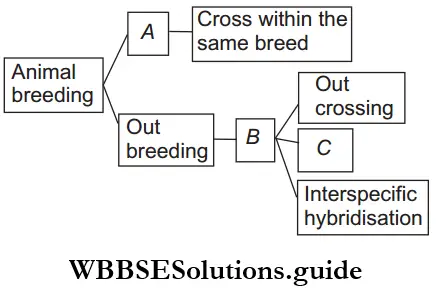
NEET Biology Animal Husbandry MCQs Question 81

  1. A–Inbreeding, B–Cross between animals of different breeds, C–Crossbreeding
  2. A–Cross inbreeding, B–Cross between animals of same breed, C–Outcrossing
  3. A–Crossbreeding, B–Cross between animals of a different breed, C–Cross hybridization
  4. A–Inbreeding, B–Cross between animals of same breed, C–Outbreeding depression

Answer: 1. A–Inbreeding, B–Cross between animals of different breeds, C–Crossbreeding

NEET Biology Animal Breeding and Dairy Farming MCQs

Question 82. In cattle, the superior female is the ______ A _____, which produces more ______ B _____ Superior males are _______ C ______ from which superior quality _____ D ______ is obtained.

  1. A–cow, B–milk per lactation, C–bull, D–sperm
  2. A–buffalo, B–male, C–bull, D–superior progeny
  3. A–cow, B–milk per progeny, C–bull, D–inferior progeny
  4. A–buffalo, B–male, C–bull, D–inferior progeny

Answer: 1. A–cow, B–milk per lactation, C–bull, D–sperm

Question 83. MOET refers to

  1. Multiple Ovulation Embryo Transfer technology
  2. More Ovulation Embryo Transfer technology
  3. Multiple Ovulation Embryo Test technology
  4. None of the above

Answer: 1. Multiple Ovulation Embryo Transfer technology

Multiple Ovulation Embryo Transfer (MOET) technologies is a hybridization technique for herd improvement in animals like cattle, sheep, rabbits, and buffaloes. In this, high milk-yielding breeds of females are breed with high-quality meat-yielding bull to increase herd size in lesser time.

Question 84. MOET (Multiple Ovulation Embryo Transfer) is the method of

  1. Fish cultivation
  2. Hybridization of cattle
  3. Birth control
  4. Cloning of sheep

Answer: 2. Hybridisation of cattle

Question 85. In order to induce follicular maturation and superovulation during MOET in a cow, which of the following hormones are administered?

  1. Follicle Stimulating Hormone (FSH)
  2. Progesterone
  3. Androgen
  4. Oestrogen

Answer: 1. Follicle Stimulating Hormone (FSH)

  • MOET is program for herd improvement in animals like cattle sheep, and rabbits. buffaloes, mares, etc. A cow is administered FSH-like activity hormones to induce follicular maturation and superovulation.
  • The cow produces 6-8 eggs instead of one egg (produced normally). It is now, either mated with an elite bull or artificial insemination is carried out.
  • When the fertilized eggs attain 8-32 cells stage, they are non-surgically removed and transferred to a surrogate mother. The genetic mother can be superovulated again.

Question 86. In MOET technology, what cell stage is transferred to surrogate mothers?

  1. 2-4 cell stage
  2. 4-8 cell stage
  3. 32-34 cell stage
  4. 8-32 cell stage

Answer: 4. 8-32 cell stage

dairy questions and answers pdf

Question 87. The semen of a bull meant for artificial insemination is preserved in

  1. Liquid N2
  2. Liquid O2
  3. Liquid CO2
  4. Refrigerated at temperature below 10ºc

Answer: 1. Liquid N2

  • Liquid nitrogen (N2) plays a vital role in storing the frozen semen straws, at a temperature of-196°C for longer periods.
  • Artificial Insemination (AI) is the process of collecting sperm cells from a male animal and manually depositing them into the reproductive tract of a female.

Question 88. _________ technique involves mating of high milk-yielding female breeds with high-quality meat bulls to obtain a better breed in short time.

  1. MOET
  2. Artificial insemination
  3. Crossbreeding
  4. Induced mutation

Answer: 1. MOET

Question 89. The yellow-colored milk secreted by cattle soon after the birth of a calf is called

  1. Chyme
  2. Chyle
  3. Cholesterol
  4. Colostrum

Answer: 4. Colostrum

Colostrum is a breast fluid produced by humans, cows, and other mammals during the onset of lactation. It promotes growth and health in infants and newborn animals.

Question 90. What will you conclude, when a cow is crossed to a bull and the female progeny is yielding more milk than its mother?

  1. More number of genes for high-yielding milk is inherited, only from the female parent
  2. More number of genes for high-yielding milk is inherited only, from the male parent
  3. More number of genes for high-yielding milk is inherited from both the parents
  4. The progeny through mutation achieved more genes for high-yielding milk

Answer: 3. More number of genes for high-yielding milk is inherited from both the parents

In the given situation, more genes for high-yielding milk are inherited by progeny from both parents because it is a polygenic trait.

Question 91. Identify A, B, C, and D.

  1. A–Cross of superior males of one breed with superior females of another breed.
  2. B–Controlled breeding involving semen transfer into the reproductive tract of selected female.
  3. C–Cross between male and female animals of two different species.
  4. D–Programme for herd improvement in animals like cattle, sheep, buffaloes, etc.
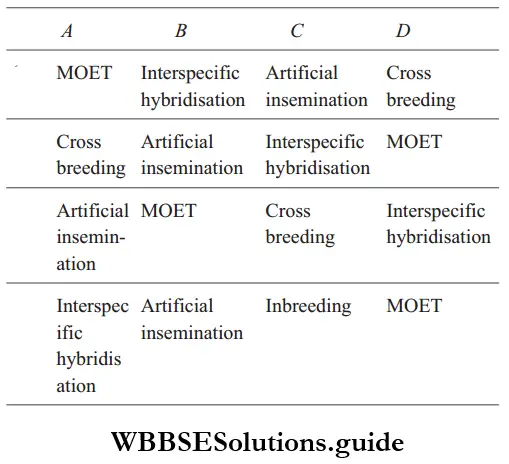
NEET Biology Animal Husbandry MCQs Question 91

Answer: 2. B–Controlled breeding involving semen transfer into the reproductive tract of selected female.

  • Crossbreeding (A) refers to the cross of superior males of one breed with superior females of another breed, for example, Hisardale.
  • Artificial insemination (B) is a method of controlled breeding in which semen from the selected male parent is injected into the reproductive tract of the selective female parents.
  • Interspecific hybridization (C) refers to crossing between male and female animals of two different species, for example, a mule was obtained by crossing a male donkey and a female horse.
  • MOET (D) is a programme for herd improvement in animals.

Question 92. In the cloning of cattle, a fertilised egg is taken out of the mother’s womb and

  1. In the eight-cell stage, cells are separated and cultured until small embryos are formed which are implanted into the womb of other cows
  2. In the eight-cell stage, the individual cells are separated under an electrical field for further development in culture media
  3. From this upto eight identical twins can be produced
  4. The egg is divided into 4 pairs of cells
  5. which are implanted into the womb of other cows

Answer: 1. In the eight-cell stage, cells are separated and cultured until small embryos are formed which are implanted into the womb of other cows

  • In the cloning of cattle, a fertilized egg divides into 2, 4, and then into 8 celled stage. This embryo is carefully removed from the womb in eight-cell stage.
  • The embryonic cells are then separated using enzymes. Each isolated cell is kept in a nutrient medium and cultured until small embryos are formed. These are later implanted into the womb of a different ‘host mother’ cow.

Question 93. Infertility of local breeds of cattle can be overcome by the use of

  1. Cross-breeding with exotic breeds
  2. Good nourishment
  3. Stilbesterol
  4. Gonadotropin

Answer: 4. Gonadotropin

Infertility in local breeds of cattle can be overcome through the use of pregnant serum gonadotropin.

Question 94. Sahiwal is a breed of

  1. Buffalo
  2. Horse
  3. Dog
  4. Cattle

Answer: 4. Cattle

  • Sahiwal is a breed of Zebu cattle which is primarily used in dairy production.
  • The name Sahiwal originates from the Sahiwal district of Punjab province in Pakistan and is found in Ferozpur, Amritsar, and Sri Ganganagar in India.

Question 95. Jaffrabadi is a variety of

  1. Cow
  2. Buffalo
  3. Sheep
  4. Goat

Answer: 2. Buffalo

Jaffarabadi is one of the heaviest buffalo breeds.

Question 96. The Jaffrabadi breed is distributed in

  1. Gujarat
  2. Malvi
  3. Halliker
  4. None of these

Answer: 1. Gujarat

Jaffarabadi is a native of the Saurashtra region of Gujarat around the Gir forest. It is also known as Bhavanagri, Gir, or Jaffari. It is named after the town of Jaffarabad of Gujarat.

Question 97. Dual breed variety of cattle is

  1. Jersey
  2. Ayrshire
  3. Brown swiss
  4. All of the above

Answer: 2. Ayrshire

Ayrshire is dual breed of cattle from Ayrshire in South-west Scotland. It is used for dairy and meat production. Jersey and Brown Swiss are exotic milch breeds of cattle.

Question 98. Assertion (A) Cattle breeds can be improved by superovulation and embryo transplantation.Reason (R) Superovulation in high milk-yielding cows is induced by hormonal injection.

  1. Both A and R are true and R is the correct explanation of A
  2. Both A and R are true, but R is not the correct explanation of A
  3. A is true, but R is false
  4. Both A and R are false

Answer: 2. Both A and R are true, but R is not the correct explanation of A

  • Both A and R are true, but R is not the correct explanation of A.
  • Cattle breeds can be improved by superovulation and embryo transplantation as it helps to produce higher number of quality eggs in short period of time. Superovulation in high milk-yielding cows is induced by hormonal injection.

Question 99. Match the breeds of cattle given under Column 1 with the place of their origin listed under Column 2. Choose the answer which gives the correct combination of alphabets of the two columns.
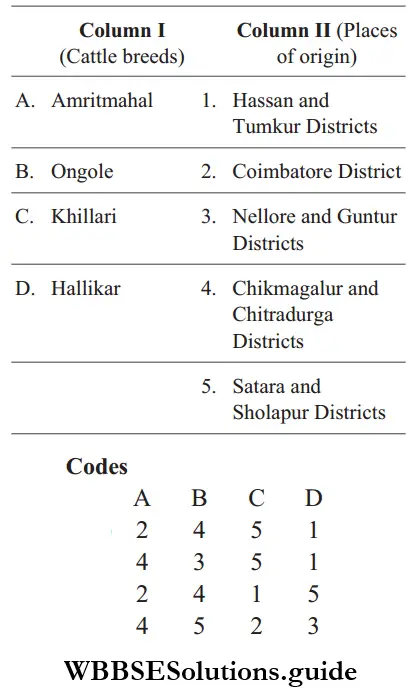
NEET Biology Animal Husbandry MCQs Question 99 Match The Column

Answer: A-4, B-3, C-5, D-1

Question 100. Which of the following is an exotic breed of cattle?

  1. Brown jersey
  2. Friesian
  3. Holstein
  4. All of the above

Answer: 4. All of the above

Holstein-Friesian is a native cow of Holland which it is called Friesian and is exotic dairy breed of cattle. Jersey is native cow of Jersey Island and is an exotic breed.

dairy questions and answers pdf

Question 101. Holstein-Friesian cattle were developed from the breeds of

  1. Denmark
  2. English channel
  3. Netherlands
  4. Switzerland

Answer: 3. Netherlands

Holstein cows come from a region in northern Germany, while Friesians originally came from the Netherlands. Thus, Holstein-Friesian cattle were developed from the breeds of Netherlands.

Question 102. Given below are different breeds of buffalo and their characteristics.

  1. Murrah – Found in Punjab and Haryana
  2. Mehsana – Breed of water buffalo
  3. Jaffarabadi – Low-weight breed

Choose the option containing incorrectly matched pairs.

  1. 1, 2 and 3
  2. 1 and 2
  3. 2 and 3
  4. 1 and 3

Answer: 3. 2 and 3

  • Pairs 2 and 3 are incorrectly matched, but I is a correctly matched pair. Incorrect matched paris can be corrected as
  • The Murrah buffalo is a breed of water buffalo mainly kept for milk production. It originates in Punjab and Haryana.
  • Mehsana is a dairy breed of buffalo found in Mehsana, Sabarkanda, and Banaskanta Districts in Gujarat and adjoining Maharashtra state. The breed is evolved out of cross-breeding between the Surti and the Murrah.
  • Jaffarabadi is one of the heaviest buffalo breeds and is a native of the Saurashtra region of Gujarat around Gir forest.

Question 103. Which of the following breeds of milk-yielding cows has been formed from Indian and Swiss cows?

  1. Red Sindhi
  2. Sahiwal
  3. Sunandini
  4. Deoni

Answer: 3. Sunandini

Sunandini is a composite breed of cattle developed in India by crossing Indian cattle with Brown Swiss, Jersey cattle, and Holstein-Friesian cattle.

Question 104. Consider the following statements.

  1. The progeny of cross-breeding may be used for commercial production.
  2. In case of artificial insemination, the semen can be used immediately or can be frozen for later use.
  3. Controlled breeding experiments are carried out using artificial insemination and MOET technology.

Which of the statements given above are correct?

  1. 1 and 2
  2. 1 and 3
  3. 2 and 3
  4. 1, 2 and 3

Answer: 4. 1, 2 and 3

  1. All the given statements are correct.
  2. Crossbreeding refers to the cross of superior males of one breed with superior females of another breed.
  3. The progeny may be used for commercial production, for example, Hisardale. In case of artificial Insemination (AI), the semen can be used immediately or can be frozen in liquid nitrogen for later use.
  4. Multiple Ovulation Embryo Transfer (MOET) technology is a programme for herd improvement. Controlled breeding programs involve the use of AI and MOET technologies.

Question 105. Highest milk yielding variety of cattle in the world is

  1. Brown Jersey
  2. Ongole
  3. Holstein-Friesian
  4. Hallikar

Answer: 3. Holstein-Friesian

Holstein-Friesian gives 5000 L /lactation. It is the highest milk-yielding variety of cattle in world.

Question 106. Lactation in sterile cows is induced by giving

  1. Stilbestrol
  2. Gonadotropin
  3. Vitamin-B12
  4. None of these

Answer: 1. Stilbestrol

The majority of Indian cattle have been on marginal inputs and are infertile and poor milk yielders. Stilbestrol tablets are administered to induce lactation in sterile cows and immature females. Stilbestrol is a synthetic non-steroidal oestrogen.

Question 107. Milch breeds are

  1. Good meat-producing bulls
  2. Good milk-producing cows
  3. Good working bullocks
  4. None of the above

Answer: 2. Good milk-producing cows

Milch breeds are cows that produce large quantities of milk per lactation.

Question 108. The milch breed of cattle are

  1. Hillikar, Nageri and Malvi
  2. Gir, Sahiwal and Deoni
  3. Kankrej, Haryana and Ongole
  4. Tharpakar, Kangayan

Answer: 2. Gir, Sahiwal and Deoni

Milch cattle are kept for the purpose of milk production. Sahiwal, Gir, Deoni, Red Sindhi, and Rathi are examples of milch breed of cattle.

Question 109. Dual purpose breed is

  1. Jersey
  2. Brown Swiss
  3. Krishna valley
  4. All of these

Answer: 3. Krishna valley

  • Krishna valley is a dual-purpose breed of recent origin with an inherent ability to toil in extremely hot and humid climatic conditions. They are a draught breed and are mainly used for agricultural purposes.
  • The cows are moderate milk producers while the bulls are known for their strength and endurance.

Question 110. Cattle fed with spoilt hay of sweet clover which contains dicumarol

  1. Are healthier due to a good diet
  2. Catch infections easily
  3. May suffer vitamin-K deficiency and prolonged bleeding
  4. May suffer from beri -beri due to deficiency of vitamin-B6

Answer: 3. May suffer vitamin-K deficiency and prolonged bleeding

Dicumarol is an anticoagulant which inhibits the synthesis of prothrombin in the liver. Thus, it may cause prolonged bleeding by inhibiting the coagulation of blood.

Question 111. Mad cow disease in cattle is caused by an organism which has

  1. Inert crystalline
  2. Abnormally folded protein
  3. Free RNA without protein coat
  4. Free DNA without protein coat

Answer: 2. Abnormally folded protein

Mad cow disease in cattle is a progressive fatal neurological disorder that is caused from an infection by a prion. It is an abnormally folded protein with the ability to transmit misfold shape to other proteins.

Question 112. Given below are the animals useful to us in several ways. Select an appropriate code to match the animals to their utility.
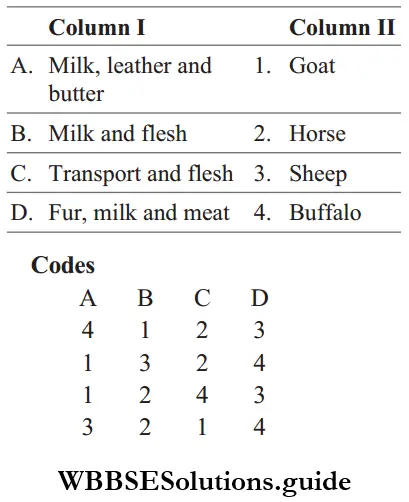
NEET Biology Animal Husbandry MCQs Question 112 Match The Column

Answer: A-4, B-1, C-2, D-3

NEET Exam Animal Husbandry Most Repeated MCQs

Question 113. Match the following columns and choose the correct option.
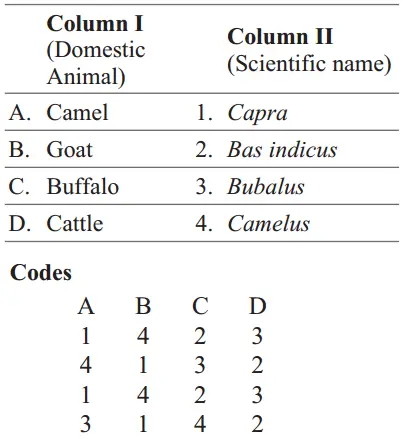
NEET Biology Animal Husbandry MCQs Question 113 Match The Column

Answer: A-4, B-1, C-3, D-2

Question 114. Hinny is a hybrid of male

  1. Horse and female donkey
  2. Donkey and female horse
  3. Goat and female lamb
  4. Sheep and female goat

Answer: The hybrid between the female donkey and male horse is called hinny.

Question 115. The breeds of sheep which give good-quality wool are

  1. Lohi and Nellore
  2. Rampur and decani
  3. Nellore and decani
  4. Nali and lohi

Answer: 4. Nali and lohi

  • Nali is a good carpet-quality wool breed, with the densest and heaviest fleeces among the breeds of Rajasthan.
  • Lohi sheep is found in Southern Punjab in India. It is used for its carpet-quality wool and meat production. The body is white and the head is usually black or brown.

Question 116. Superior quality wool is obtained from the sheep raised in

  1. Kashmir and Himachal Pradesh
  2. Bihar and Tamil Nadu
  3. Maharashtra and Gujarat
  4. Odisha and Rajasthan

Answer: 1. Kashmir and Himachal Pradesh

Pashmina is the most sought-after wool in the world because of its superior quality. It is found in Himachal Pradesh and Kashmir in India.

Question 117. The world’s highly prized wool-yielding ‘Pashmina’ breed is

  1. Sheep
  2. Goat of high himalayan altitudes
  3. Goat-sheep cross
  4. Kashmir Afghan sheep cross

Answer: 2. Goat of high himalayan altitudes

Pashmina is the underfur of Kashmiri and Tibetan goats, indigenous to high altitudes of the Himalayan Range Belt of Asia.

Question 118. Match the following columns.
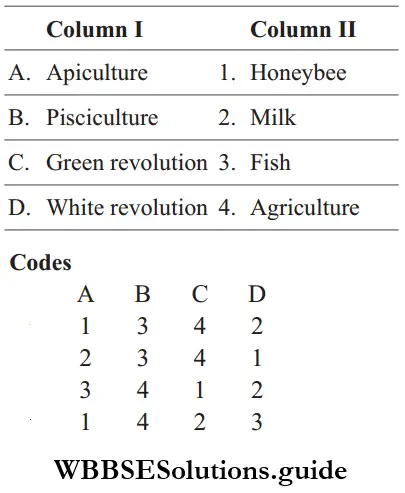
NEET Biology Animal Husbandry MCQs Question 118 Match The Column

Answer: A-1, B-3, C-4, D-2

Question 119. Domestication of honeybees is called

  1. Sericulture
  2. Apiculture
  3. Tissue culture
  4. Pisciculture

Answer: 2. Apiculture

Apiculture or bee culture is the rearing of honeybees by culturists in different parts of the world to obtain honey and bees wax on commercial scale.

dairy questions and answers pdf

Question 120. Queen bee is specified for

  1. Administration
  2. Making hive
  3. Egg laying
  4. Collection of food

Answer: 3. Egg laying

  • The term queen bee is typically used to refer to an adult, mated female (gyne) that lives in a honeybee colony or hive.
  • She is usually the mother of most, of the bees in the beehive. Queens are developed from larvae selected by worker bees and specially fed in order to become sexually mature and lay eggs.

Question 121. In which bee, wax glands are found?

  1. Queen bee
  2. Drone
  3. Workers
  4. Both (1) and (3)

Answer: 3. Workers

  • The wax gland in the honeybee colony is found in workers. The wax gland complex of the honeybee worker consists of 3 cell types, epithelial cells, oenocytes, and adipocytes, which act synergistically to secrete wax.
  • It is a complex mixture of hydrocarbons, fatty acids, and proteins (lipoproteins).

Question 122. In which part of the body, does honeybee keep the nectar for some time?

  1. Crop
  2. Mouth
  3. Gizzard
  4. Pollen basket

Answer: 1. Crop

Nectar ingested by bee is mixed with saliva and collected in the honey sac or crop until honey is regurgitated into hive cell.

Question 123. The name ‘honey stomach’ in bees is applied for

  1. Gizzard
  2. Pharynx
  3. Stomach
  4. Crop

Answer: 4. Crop

In stinging bees, oesophagus enlarges to form crop to store the liquid. Later on, it is regurgitated as honey. It may contain 75 mg of nectar and known as honey stomach.

Question 124. In which of the following is parthenogenesis observed?

  1. Honeybee
  2. Silkworm
  3. Earthworm
  4. Housefly

Answer: 1. Honeybee

Parthenogenesis is a form of asexual reproduction in which growth and development of embryos occur without fertilisation. This occurs in honeybees. Males (drones) are produced parthenogenetically from unfertilised eggs.

Question 125. In honeybees, the drones (males) are produced from

  1. Unfertilised eggs
  2. Fertilized eggs
  3. Larvae fed by royal jelly
  4. Fasting larvae

Answer: 1. Unfertilised eggs

Question 126. Drone is

  1. Sterile male
  2. Fertile male
  3. Sterile female
  4. Fertile female

Answer: 2. Fertile male

A drone is a fertile male honeybee. Unlike the female worker bee, drones do not have stingers and gather neither nectar nor pollen. A drone’s primary role is to mate with an unfertilised queen.

Question 127. Lifespan of worker bee is

  1. 10 days
  2. 15 days
  3. 5-6 weeks
  4. 10 weeks

Answer: 3. 5-6 weeks

During the active season, the lifetime of a worker is five to six weeks. Worker bees usually confine themselves to one task at a time and work without pause. The first few weeks of a worker’s life are spent working within the hive, while the last weeks are spent foraging for food and gathering pollen or nectar.

Question 128. In which part of the body ‘pollen basket’ is found in the honeybee?

  1. Prothoracic leg
  2. Mesothoracic leg
  3. Metathoracic leg
  4. At union of thorax and abdomen

Answer: 3. Metathoracic leg

Each metathoracic leg of a honeybee has a large tibia with a cavity having bristles forming a pollen basket or corbicula. It is used for storing pollen during collection.

Question 129. For its committed functions, a worker bee is provided with

  1. Powerful wings
  2. Mouthparts for sucking
  3. Legs as carriers of pollen grains
  4. All of the above

Answer: 4. All of the above

Worker bees perform all the work of the colony. For this purpose, they are provided with mouth parts suitable for sucking nectar, leg suitable for carrying pollen, wax glands, stings and powerful wings.

Question 130. The Nobel Prize for studing honey bees was given to

  1. Karl Korrens
  2. Karl von Frisch
  3. Hugo de Vries
  4. Parkinson

Answer: 2. Karl von Frisch

  • Honeybees, despite their small size, have one of the most sophisticated communication systems.
  • In a series of classic experiments dating from the 1920s, the Austrian Biologist Karl von Frisch investigated how honeybees communicate with each other.
  • He received Nobel Prize for Physiology or Medicine, with K. Lorenz and N. Tinbergen for his achievements in comparative behavioral, physiology, and pioneering work in communication between insects (1973).

Question 131. Honeybees exhibit a type of dance to communicate the location of food. This is known as

  1. Waggle dance
  2. Tap dance
  3. Round dance and waggle dance
  4. Breakdance

Answer: 3. Round dance and waggle dance

  • Bees perform two types of dances, the ‘round’ and ‘waggle tail’ dance. The round dance is performed by the scouts when the food source is within a couple of 100 m of the hive.
  • The waggle dance is performed when food sources are away, greater than a couple of 100 m.

Question 132. In bees, dance is meant for

  1. Only reproduction
  2. Communication
  3. Visiting the source of food
  4. Both (2) and (3)

Answer: 4. Both (2) and (3)

Bees perform two types of dances to communicate about the source of food at various angles and the movements of dance help the bees to visit the food source.

Question 133. The stimuli through which a dancing scout bee communicates the location of a food source to other worker bees in a hive are

  1. Visual
  2. Acoustic
  3. Contact
  4. Both (1) and (3)

Answer: 4. Both (1) and (3)

During the dance, the scouts move their body in different angles and locations to send visuals signals to the community. They also pass signal of nectar to other workers, which is a form of contact communication.

Question 134. Which one of the following statement is correct in relation to honeybees?

  1. Apis indica is the largest sized wild honey bee in India
  2. Honey is predominantly sucrose and arabinose
  3. Bee wax is a waste product of honeybees
  4. Communication in honeybees was discovered by Karl von Frisch

Answer: 4. Communication in honeybees was discovered by Karl von Frisch

  • The statement in option (4) is correct whereas other statements are incorrect. Incorrect statements can be corrected as Apis dorsata is a bigger bee than Apis indica (a medium-sized bee).
  • Honey is predominantly glucose and fructose. Beeswax is secreted by special wax glands to make compartments. Thus, it is not a waste product.

Question 135. Assertion (A) The behaviour of honeybees to come out of the hive in large number is called swarming. reason (R) It relieves the crowding and provides a means of founding new colonies.

  1. Both A and R are true and R is the correct explanation of A
  2. Both A and R are true, but R is not the correct explanation of A
  3. A is true, but R is false
  4. Both A and R are false

Answer: 1. Both A and R are true and R is the orrect explanation of A

  • Swarming is the process by which a new honeybee colony is formed when the queen bee leaves the colony with a large group of worker bees.
  • In the prime swarm, about 60% of the worker bees leave the original hive location with the old queen.
  • Swarming is a honeybee colony’s natural means of reproduction.

Question 136. Assertion (A) The honeybee queen opulates only once in her lifetime. eason (R) The honeybee queen an lay fertilised as well as fertilised eggs.

  1. Both A and R are true and R is the correct explanation of A
  2. Both A and R are true, but R is not the correct explanation of A
  3. A is true, but R is false
  4. Both A and R are false

Answer: 2. Both A and R are true, but R is not the correct explanation of A

  • Both A and R are true, but R is not the correct explanation of A.
  • Queen is the only fertile female in a beehive. She lays about 2000 or more eggs in a day.
  • The fertilised eggs are laid in a worker or queen cell or honeycomb, while unfertilised eggs are laid in a drone cell, the latter develops parthenogenetically. The queen mates only once in a lifetime.
  • The sperms stored in her spermatheca fertilise her eggs as long as she lives.

Question 137. At times of need, a worker bee can e converted into a queen by

  1. Placing the worker bee in the queen’s chamber
  2. Suspension of worker’s duties
  3. Feeding the worker bee with ‘royal early during its larval period
  4. None of the above

Answer: 3. Feeding the worker bee with ‘royal early during its larval period

  • A bee becomes a queen bee by the efforts of the existing worker bees in the hive. A young larva (newly hatched baby insect) is fed special food called ‘royal jelly’ by the worker bees.
  • Royal jelly is richer than the food given to worker larvae and is necessary for the larva to develop into a fertile queen bee.

Question 138. Sting apparatus in honeybees is a modified form of

  1. Ovipositor
  2. Wax glands
  3. Alkaline glands
  4. Podical valves

Answer: 1. Ovipositor

A bee’s abdomen have one notable appendage the stinger, which is a modified ovipositor or egg depositor.

dairy questions and answers pdf

Question 139. Which of the following is correctly matched?

  1. Apiculture – Honeybee
  2. Pisciculture – Silk moth
  3. Sericulture – Fish
  4. Aquaculture – Mosquitoes

Answer: 1. Apiculture – Honeybee

  • Option (1) is correctly matched pair. Apiculture is the rearing of bees or beekeeping for the production of honey and wax. Other options represent incorrectly matched pairs and can be corrected as
  • Pisciculture is the rearing of fish.
  • Sericulture is silk farming.
  • Aquaculture is culture of freshwater amimals.

Question 140. Silk, honey, and lac are

  1. The secretory substance of insects
  2. Secretory substance of plants
  3. Artificial chemicals
  4. All of the above

Answer: 1. Secretory substance of insects

Silk, honey, and lac all are secretory substances of insects. Silk is produced from the insect Bombyx mori. Honey is produced from the Apis indica, whereas lac is produced from insects Laccifer lacca.

Question 141. Which among the following is the real product of the honeybee?

  1. Pollen
  2. Bee wax
  3. Honey
  4. Propolis

Answer: 2. Bee wax

  • Bee wax is the natural secretion of the worker bees and is poured out in thin delicate flakes. It is made of
  • Even numbered alcohols.
  • Even numbered fatty acids.
  • Odd-numbered normal paraffin.
  • Honey and propolis are derived from beehives whereas pollens are products of flower.

Question 142. The wax glands in honeybee are present

  1. On the ventral side of the last segment
  2. On the ventral side of last four abdominal segments
  3. On the dorsolateral side of first two abdominal segments
  4. On the lateral side of last two abdominal segments

Answer: 2. On the ventral side of last four abdominal segments

Worker bees (females) have eight wax-producing glands on the ventral side of abdominal segments 4 -7, to produce bee wax.

Question 143. The product used to manufacture cosmetics, shaving creams, and polishes of various kinds is

  1. Bee wax
  2. Honey
  3. Latex
  4. Resin

Answer: 1. Bee wax

Bee wax is used to manufacture cosmetics, shaving creams, and polishes.

Question 144. A waxy substance produced by honeybees to repair combs is called

  1. Propolis
  2. Honeydew
  3. Nectar
  4. Sporopollenin

Answer: 1. Propolis

Propolis is a mixture of resin that honeybees collect from flower saps or buds of plant and is used as a seal in repairing hives.

Question 145. Honey is

  1. Acidic
  2. Alkaline
  3. Neutral
  4. Acidic when fresh and alkaline when old

Answer: 1. Acidic

The pH of honey ranges from 3.4 to 6.1, the average being 3.9. Thus, it is acidic in nature.

Question 146. In honey, the percentage of maltose and other sugars is

  1. 9.2
  2. 8.81
  3. 10.5
  4. 11.2

Answer: 2. 8.81

Honey is a natural sweet syrup extracted from the hives of honey bees. The chemical composition of honey is ash 01.00%, enzyme and pigments 2.21%, maltose and other sugar 8.81 %, water 17.20%, dextrose 21.28%, and levulose 88.90%.

Question 147. The composition of honey is

  1. Water, sucrose and dextrine
  2. Fructose, glucose, water, maltose,
  3. Water, protein, sucrose and dextrin
  4. Water, sucrose, glucose and dextrin

Answer: 2. Fructose, glucose, water, maltose,

Honey is primarily fructose (38%), glucose (31%), water (17%), maltose (7%), and small amounts of trisaccharides, other higher carbohydrates, sucrose, minerals, vitamins, and enzymes.

Question 148. Honey is

  1. A natural valuable tonic for human body.
  2. Of high medicinal value as it contains important enzymes, vitamins, and disaccharide sugars mainly glucose and fructose.
  3. Consumed alongwith a number of ayurvedic medicines.

Which of the statements given above are correct?

  1. 1 and 2
  2. 1 and 3
  3. 2 and 3
  4. 1, 2 and 3

Answer: 4. 1, 2 and 3

All the given statements are correct.

dairy questions and answers pdf

Question 149. Identify the flower that is pollinated by honeybees.

  1. Sunflower
  2. Apple and pear
  3. Brassica
  4. All of these

Answer: 4. All of these

Bees are the pollinators of many of crop species, such as sunflower, Brassica, apple, and pear.

Question 150. Consider the following statements.

  1. Keeping beehives in crop fields during flowering period increases both crop yield and honey yield.
  2. Successful bee-keeping requires management of beehives during different seasons.

Choose the correct option.

  1. Statement 1 is correct, but 2 is incorrect
  2. Statement 1 is incorrect, but 2 is correct
  3. Both statements 1 and 2 are correct
  4. Both statements 1 and 2 are incorrect

Answer: 3. Both statements 1 and 2 are correct

  • Usually, the most common places for keeping beehives are the courtyard, on the roof, in the crop fields during flowering period, etc.
  • The beehives when kept in the fields, increase the pollination efficiency of flowering plants and improve the yields. Successful bee-keeping requires management of beehives during different seasons.

Question 151. Bee venom is used for the preparation of medicines against

  1. Slipped disc
  2. Rheumatoid arthritis
  3. Tuberculosis
  4. Cancer

Answer: 2. Rheumatoid arthritis

Bee venom is collected on a commercial scale for the treatment of snake bite, rheumatoid arthritis, and many other diseases.

Question 152. Most common honeybee species in India is

  1. Apis indica
  2. Apis florea
  3. Apis mellifera
  4. Apis dorsata

Answer: 1. Apis indica

The most common species of honeybee is Apis indica. Relatively non-aggressive and rarely exhibiting swarming behavior, it is ideal for bee-keeping.

Question 153. European bee is called as

  1. Apis indica
  2. Apis florea
  3. Apis dorsata
  4. Apis mellifera

Answer: 4. Apis mellifera

An exotic European variety of bees is Apis mellifera (an Italian variety). It is used in apiaries for large-scale production of honey and wax.

Question 154. The highest amount of honey is made available by

  1. Apis indica
  2. Apis mellifera
  3. Apis calculate
  4. Apis florea

Answer: 2. Apis mellifera

  • The average yield of honey from Apis mellifera is 45 to 180 kg/ year/colony. It is the highest quantity among all the honeybees.
  • So, the highest amount of honey is made available by Apis mellifera.

Question 155. Which of the following is a ferocious bee?

  1. Apis mellifera
  2. Apis florea
  3. Apis indica
  4. Apis dorsata

Answer: 4. Apis dorsata

Apis dorsata generally live in hilly areas. So, they are called ‘rock bees’. Sometimes they are called monster bees. This bee is the biggest, very fearful, and ferocious nature, among all the bee species.

Question 156. Which of the following is rock bee?

  1. Apis mellifera
  2. Apis indica
  3. Apis dorsata
  4. Apis florea

Answer: 3. Apis dorsata

dairy questions and answers pdf

Question 157. Largest honeybee is

  1. Apis mellifera
  2. Apis indica
  3. Apis dorsata
  4. Apis florea

Answer: 3. Apis dorsata

Question 158. The most commonly maintained species of bee by beekeepers is

  1. Apis mellifera
  2. Apis dorsata
  3. Apis indica
  4. Apis florea

Answer: 1. Apis mellifera

The most commonly maintained species of bee by beekeepers is Apis mellifera. At present time, Apis mellifera is used in apiaries for large-scale production of honey and wax.

Question 159. The silk industry is related to

  1. Sericulture
  2. Apiculture
  3. Pisciculture
  4. Horticulture

Answer: 1. Sericulture

  • Sericulture or silk farming, is the cultivation of silkworms to produce silk. Apiculture is the management and study of honeybees. Pisciculture also known as fish farming is the rearing of fish for food in enclosures such as fish ponds or tanks.
  • Horticulture is the branch of plant agriculture dealing with garden crops, generally fruits, vegetables, and, ornamental plants.

Question 160. The life cycle of the mulberry silkworm is completed in

  1. 2-3 weeks
  2. 4-5 weeks
  3. 6-8 weeks
  4. 5-7 weeks

Answer: 4. 5-7 weeks

The silkworm larval life has five instars, with four skin molts and four distinct development stages, to complete one generation of the species. These are ova, larvae, pupae, and imago. The life cycle takes 5-7 weeks, depending on climatic conditions.

Question 161. Caterpillar of silkworm voraciously feeds upon

  1. Apple leaves
  2. Guava leaves
  3. Mulberry leaves
  4. All of the above

Answer: 3. Mulberry leaves

Pale, naked caterpillars feed upon mulberry leaves until pupation begins.

Question 162. Voracious feeder in life history of silk moth is

  1. Adult female
  2. Eggs
  3. Larva
  4. Pupa

Answer: 3. Larva

The larva is a voracious feeder and during this period, it moults four times. When fully grown, it stops feeding and starts secreting liquid silk through spinnerets.

Question 163. In which stage of its life cycle, the silk moth begins to produce silk fiber?

  1. 3rd instar larva
  2. 4th instar larva
  3. 5th instar larva
  4. Pupa

Answer: 4. Pupa

The pupa of the silkworm spin a cocoon of one continuous white or yellow silken thread.

Question 164. The maximum length of silk fiber that surrounds the single cocoon is about

  1. 8000 – 12000 ft
  2. 1000 – 1500 m
  3. 800 – 1200 ft
  4. 8000 – 12000 m

Answer: 2. 1000 – 1500 m

Cocoon is white colored bed of pupa that gives thread of up to 1000-1500 m. It is estimated that 2500 cocoons produce one pound of silk.

Question 165. In the silkworm, if no Juvenile Hormone (JH) is present when it molts, it will

  1. Die
  2. Moult into another larval stage
  3. Moult into pupa
  4. Moult into an adult

Answer: 2. Moult into another larval stage

The presence of juvenile hormone is necessary for metamorphosis to adult. In its absence, the larva moults into another form, but it will not die or become adult.

Question 166. Silk is the secretion of

  1. Cephalic glands
  2. Gastric glands
  3. Buccal glands
  4. Salivary glands

Answer: 4. Salivary glands

The saliva from the salivary gland of silkworm is a component of silk and is produced by the larva of the silkworm (cocoon).

Question 167. Secretion of silk gland comes through a small pore. This pore is situated on

  1. Exopodite of 2nd maxilla
  2. Endopodite of 1st maxilla
  3. Prostheca of mandible
  4. Anterior part of hypopharynx

Answer: 4. Anterior part of hypopharynx

The anterior parts of both the silk glands are united to form a common duct that open through a spinneret situated on the hypopharynx which secrete the silk.

Question 168. Protein present in silk fibre is

  1. Collagen
  2. Fibroin
  3. Elastin
  4. Casein

Answer: 2. Fibroin

  • Silk protein fibroin (β -keratin protein) is produced by modified salivary glands of silkworms (silk moth larvae) and by spiders, among other arthropods.
  • Silk is composed of two kinds of very large molecular weight amphoteric colloidal proteins, i.e. fibroin and sericin, where fibroin constitutes about 75% and sericin is 25% of the thread.

Question 169. The silkworm larva ceases to eat and starts spinning silk around its body

  1. At random
  2. From inside to outside
  3. From outside to inside
  4. All of the above

Answer: 3. From outside to inside

In silkworm, mature caterpillar stops feeding and returns to a corner of mulberry leaves. Its salivary glands now secrete a sticky fluid. This sticky substance turns into a solid silk thread after coming in contact with air. It spins silk from outside to inside around its body.

Question 170. Given below are the different variety of silk found in India and the organisms from which it is derived.

  1. Mulberry silk – Bombyx mori
  2. Tassar silk – Attaccus ricini
  3. Muga silk – Antheraea mylitta
  4. Eri silk – Antheraea assamensis

Choose the option containing incorrectly matched pairs.

  1. 1 and 2
  2. 3 and 4
  3. 1, 2 and 4
  4. 2, 3 and 4

Answer: 4. 2, 3 and 4

Pairs 2, 3, and 4 are incorrectly matched and can be corrected as Tassar silk (Antheraea mylitta), Muga silk (Antheraea assamensis), and Erisilk (Attaccus ricin). Pair 1 is correctly matched.

Question 171. Largest silk producing state of India is

  1. Karnataka
  2. Bihar
  3. Assom
  4. Bengal

Answer: 1. Karnataka

Karnataka is the largest producer of silk in India. The state produces an average of around 8,200 metric tonnes of silk every year, which is about one-third of the total silk production in India.

Question 172. Which species produces superior-quality of silk?

  1. Attacus ricini
  2. Bombyx mori
  3. Antheraea assamensis
  4. Attacus atlas

Answer: 2. Bombyx mori

Bombyx mori is known to produce the superior-quality of silk.

dairy questions and answers pdf

Question 173. The number of eggs laid by Bombyx mori are

  1. 200 to 300
  2. 300 to 500
  3. 400 to 600
  4. 500 to 700

Answer: 2. 300 to 500

Just after copulation, female Bombyx mori starts egg laying which is completed in 1-24 hours. One moth lays 300 to 500 eggs depending upon the climatic conditions and the supply of food.

Veterinary Science and Animal Health MCQs for NEET

Question 174. The silkworm which is reared on castor plants is

  1. Eri silkworm
  2. Muga silkworm
  3. Oak silkworm
  4. Tassar silkworm

Answer: 1. Eri silkworm

  • Eri silk is also known as Endi or Errandi. It is produced by Philosamia ricini which is commonly called as eri silkworm. It primarily feeds on castor leaves and is thus, reared on castor plants.
  • The manufacturing process of Eri allows the pupae to develop into adults and only the open-ended cocoons are used for obtaining silk. Thus, it is also popularly known as non-violent silk.

Question 175. Food ofAntheraea assamensis is

  1. Terminalia arjuna
  2. Machilus bombycina
  3. Ricinus communis
  4. Euphorbia pulcherrima

Answer: 2. Machilus bombycina

Muga silk is the product of the silkworm Antheraea assamensis, endemic to Assom. The larvae of these moths feed on Som (Machilus bombycina) leaves. This silk is known for its glossy fine texture and durability.

Question 176. The scientific name of the oak silkworm is

  1. Bombyx mori
  2. Antheraea assamensis
  3. Antheraea pernyi
  4. Philosamia ricini

Answer: 3. Antheraea pernyi

Antheraea pernyi is the scientific name of oak silkworm.

Question 177. Tassar silk is extracted from

  1. Bombyx mori
  2. Apis indica
  3. Anthrerea paphia
  4. Apis dorsata

Answer: 3. Anthrerea paphia

  • Tussar silk, also often referred to as ‘wild silk, which is an exquisite thread obtained from a wide-winged moth that is yellowish-brown in colour.
  • The scientific name of these moths is Antheraea paphia and they are a part of the group known as Emperor Moths or Saturnids.

Question 178. In addition to Bombyx mori, there are several other organisms that produce commercial silk. Match the following columns given having name of the species with the correct commercial name of their produce by selecting the appropriate answer from the given codes.
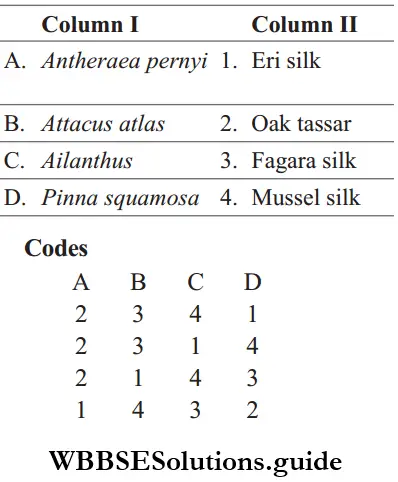
NEET Biology Animal Husbandry MCQs Question 178 Match The Column

Answer: A–2, B–3, C–4, D–1

Question 179. Process of twisting silk strands to make it more thicker and stronger yarn is

  1. Spinning
  2. Throwing
  3. Stifling
  4. Raising

Answer: 2. Throwing

Several silk strands are twisted together to make thicker, stronger yarn in the process called throwing. It produces various yarns, differing according to the amount and direction of the twist imparted.

Question 180. Which of the following statements is/are true?

  1. Salivary glands of moth secrete silk
  2. Larval form of moth secretes silk
  3. Silk is extracted from the cocoon of the moth by boiling
  4. Both (2) and (3)

Answer: 4. Both (2) and (3)

  • Statements in options (2) and (3) are true whereas (1) is not true.
  • Incorrect statement can be corrected as Silk is produced by the salivary glands of the larval stage of moth and not by moth itself.
  • When pupa spin the cocoon of about 1000 m, it is killed with hot air or boiling in water, to preserve the thread intact.

Question 181. Flacherie disease of the silkworm is caused due to

  1. Bacteria
  2. Virus
  3. Protozoans
  4. Fungi

Answer: 1. Bacteria

Flacherie’s disease in silkworms is associated with bacterial infections. Wide fluctuations in temperature and humidity with poor-quality mulberry leaves are the major predisposing factors.

Question 182. Pebrine is a disease of

  1. Honeybee
  2. Fish
  3. Silkworm
  4. Lac insect

Answer: 3. Silkworm

Pebrine is caused by protozoan Nosema bombycis. It causes death of eggs or larva during their third moult. It is the worst disease of silkworms.

Question 183. Lac-producing insect is

  1. Lytta
  2. Tachardia lacca
  3. Bombyx mori
  4. Antheraea assamensis

Answer: 2. Tachardia lacca

Tachardia lacca is a lac-producing insect.

Question 184. Indian Lac Research Institute is situated at

  1. Ranchi
  2. Mysore
  3. Dehradun
  4. Nagpur

Answer: 1. Ranchi

‘Indian Lac Research Institute’ is situated in Namkum, Ranchi, Jharkhand. It is a nodal institute at the national level for research and development on all aspects of lac and other natural gums or resins such as harvesting/tapping, processing, product development, training, information repository, technology dissemination, and national/international cooperation.

Question 185. Consider the following statements.

  1. Lac is used in making bangles and furniture polish.
  2. India is largest producer of lac in world.

Choose the correct option.

  1. Statement 1 is correct, but 2 is incorrect
  2. Statement 1 is incorrect, but 2 is correct
  3. Both statements 1 and 2 are correct
  4. Both statements 1 and 2 are incorrect

Answer: 3. Both statements 1 and 2 are correct

Lac is used in ammunition, airplanes, furniture polish, and perfumes and in making bangles, imitation fruits, and flowers. India is the largest producer of lac in the world and contributes to about 70% of the world’s need.

Question 186. Lac is produced as

  1. Feces of lac insect
  2. Secretion from body
  3. Excretion from body
  4. Excess food oozing out of body

Answer: 2. Secretion from body

Larvae of insect, Tachardia lacca secretes resinous substance by special dermal glands located all over the body. Reisinous secretion becomes hard after coming in contact with air and it forms lac.

Question 187. The female of lac insect lays about _________ eggs at a time.

  1. 150-250
  2. 200-300
  3. 250-450
  4. 300-400

Answer: 2. 200-300

Each female lac insect lays 200-300 eggs. The eggs hatch into red-coloured larvae.

Question 188. The cultivation of aquatic animals or plants for food is called

  1. Aquaculture
  2. Pisciculture
  3. Sericulture
  4. Apiculture

Answer: 1. Aquaculture

Aquaculture is the farming of aquatic organisms such as fish, crustaceans, mollusks, and aquatic plants.

Question 189. In culture fishery, the fingerlings are developed in

  1. Breeding happy
  2. Nursery pond
  3. Hatching happy
  4. Stocking pond

Answer: 2. Nursery pond

Fingerlings are juvenile fishes. In culture fishery, development upto the fingerling stage is carried out in nursery ponds.

Question 190. Hypophysation is done in major carps

  1. To increase size
  2. To increase their growth period
  3. To carry out breeding in the fishes
  4. To increase their palatability

Answer: 3. To carry out breeding in the fishes

The technique of breeding the fish by administering pituitary gland extract injection is known as induced breeding or hypophysation. The pituitary gland secretes several hormones, of which gonadotropin is the most important for breeding.

Question 191. Crustacean fishery involves

  1. Exploitation of oysters and crabs
  2. Exploitation of mussels and squids
  3. Exploitation of shell and cuttlefish
  4. Exploitation of lobster and prawn

Answer: 4. Exploitation of lobster and prawn

Crustacean fishery is concerned with exploitation of lobsters, crabs, and prawns.

Question 192. ‘Inland fisheries’ is referred to

  1. Culturing fish in freshwater
  2. Trapping and capturing fishes from sea coast
  3. Deep sea fishing
  4. Extraction of oil from fishes

Answer: 1. Culturing fish in freshwater

Freshwater fisheries and brackish water fisheries are collectively called inland fisheries. Marine fisheries is the culture of fishes in marine waters.

Question 193. Which one of the following is not amarine fish?

  1. Sardine
  2. Catla
  3. Mackerel
  4. Bombay duck

Answer: 2. Catla

  • Marine fishes are sardine, mackerel, and Bombay duck.
  • Freshwater fishes include rohu, Catla, calabash, mrigal, chital, common carp, etc.

Question 194. The term ‘blue revolution is associated with

  1. Apiculture
  2. Sericulture
  3. Dairy
  4. Fishery

Answer: 4. Fishery

Blue revolution refers to the growth in the aquaculture industry which includes culturing of all types of aquatic animals (fishery) and plants even those in brackish water too.

Question 195. Blue Revolution refers to

  1. The rapid expansion intensive commercial aquaculture.
  2. Increase in global food production and reduction in widespread hunger.

Which of the statements given above is/ are correct?

  1. Only 1
  2. Only 2
  3. 1 and 2
  4. None of these

Answer: 3. 1 and 2

During the last two decades, due to impact of blue revolution, there has been a rapid global expansion of commercial aquaculture and it now contribute significantly to the total global seafood production.

Question 196. Consider the following statements.

  1. Isinglass is a gelatinous byproduct obtained from fishes.
  2. Fish meal is a good source of protein.

Choose the correct option.

  1. Statement 1 is correct, but 2 is incorrect
  2. Statement 1 is incorrect, but 2 is correct
  3. Both statements 1 and 2 are correct
  4. Both statements 1 and 2 are incorrect

Answer: 3. Both statements 1 and 2 are correct

Isinglass is produced from the air bladder of catfishes and carps. Fish meal is a good source of protein for cattle and poultry. It is obtained from the non-edible (waste) parts of fish like tails and fins.

Question 197. The adhesive for paper, wood, etc., obtained from fish is

  1. Fish guano
  2. Fish glue
  3. Fish oil
  4. Fish chum

Answer: 2. Fish glue

  • Fish glue is extracted from fish by heating the skin or bones in water.
  • The purest form of fish glue is made from the membrane of the swim bladder of sturgeon and is called isinglass.

Question 198. Fish roes widely used for high biological value is rich in

  1. Thymine and creatine
  2. Lecithin and cholesterol
  3. Vitamin B6, C, and B12
  4. All of the above

Answer: 4. All of the above

Fish roe is fully ripe egg masses of fish. It is a type of seafood. It is highly nutritious as it contains vitamin- B(10%), vitamin- B12 (89%), vitamin-C (27%), cholesterol (59%), proteins (58%), and amino acids like lecithin, thymine, creatine, etc.

Question 199. Among the following edible fishes, which one is a marine fish having rich source of omega-3 fatty acids?

  1. Mystus
  2. Mangur
  3. Mrigala
  4. Mackerel

Answer: 4. Mackerel

Mackerel is a marine fish having rich quality of omega-3 fatty acid.

Poultry Farming and Fisheries MCQs for NEET with Answers

Question 200. Cod liver oil is extracted from

  1. Bony fishes
  2. Gadidae
  3. Buffaloes
  4. Whales

Answer: 2. Gadidae

Cod liver oil is a dietary supplement derived from the liver of cod fish, Gadidae. As with most fish oils, it contains omega-3 fatty acids, Eicosapentaenoic Acid (EPA), and Docosahexaenoic Acid (DHA).

Question 201. Cod liver oil is rich in

  1. Iodine
  2. Vitamin-A
  3. Vitamin-B
  4. Vitamin-C

Answer: 2. Vitamin-A

Cod liver oil is one of the best sources of omega- 3 fatty acids (EPA and DHA) and it contains relatively high amounts of vitamin- A and vitamin- D.

Question 202. Isinglass is

  1. Collagen0
  2. Pigment obtained from scales
  3. A substance obtained from air bladder
  4. Glass preparation from fish fin

Answer: 3. Substance obtained from air bladder

Isinglass is produced from the air bladder of catfishes and carps. It is principally used for clarifying wines, and beer and making purse, honey, comb, book, and ribbon. The isinglass prepared in Russia is of the best quality in the world.

Question 203. Isinglass, a type of byproduct of fish industry is principally used for

  1. Feeding cattle, pigs, and poultry
  2. Preparation of paints and varnishes
  3. Clarification of vinegar, wines, and beer
  4. Production of insulin

Answer: 3. Clarification of vinegar, wines, and beer

Question 204. Consider the following statements.

  1. Pearl is produced by marine mollusks.
  2. Pearl oysters are major source of pearls.

Choose the correct option.

  1. Statement 1 is correct, but 2 is incorrect
  2. Statement 1 is incorrect, but 2 is correct
  3. Both statements 1 and 2 are correct
  4. Both statements 1 and 2 are incorrect

Answer: 3. Both statements 1 and 2 are correct

  • Pearls is produced by marine molluscs such as pearl oyster and mussel. Pearls are intensively produced by cultivating pearl oysters.
  • The most important mollusks cultivated for pearls are Pinctada vulgaris.

Question 205. Natural pearl is formed by

  1. A bivalve
  2. Prawn
  3. Crayfish
  4. Fish

Answer: 2. Prawn

Pearls are formed in molluscan bivalves (clams, oysters, mussels) of several species by the secretion of a substance known as nacre around an irritant in the outer tissue (mantle) of the organism or between the outer tissue and the shell. Nacre is also the substance that coats the inner surface of bivalve shells.

Question 206. A pearl oyster secretes pearls to

  1. Regenerate injured parts
  2. Protect itself against invading parasite
  3. Harden its mantle cavity
  4. Isolate-damaged tissues of the body

Answer: 2. Protect itself against invading parasite

Pearl is secreted by a nacreous layer of pearl oyster as a protection against foreign body such as parasite or sand particle.

Question 207. Which of the following nutrients are added to improve fish culture?

  1. NO3 and SO42-
  2. PO43- and NO3
  3. SO42- and I2
  4. Both (1) and (2)

Answer: 4. Both (1) and (2)

Fish culture is improved by mixing fish food with superphosphates (PO43-), nitrates (NO3), and ammonium sulfates (SO42-) during culture.

Question 208. Rohu is zoologically known as

  1. Labeo rohita
  2. Catla catla
  3. Harpadon nehereus
  4. Mrigala cirrhinus

Answer: 1. Labeo rohita

The rohu is a species of fish of the carp family, found in rivers in South Asia. It is a large omnivore and extensively used in aquaculture. Its zoological name is Labeo rohita.

Question 209. Which of these is not an exotic fish?

  1. Gourami
  2. Sardine
  3. Anchors
  4. Mackerel

Answer: 1. Gourami

Exotic species of animals are those which are introduced from some other country and were not native of the present country. Gourami is a native to countries of Asia.

Question 210. Choose the freshwater fishes from the options given below.

  1. Catla
  2. Rohu
  3. Common carp
  4. All of these

Answer: 4. All of these

Some of the common freshwater fishes are rohu, Catla, calabash, mrigal, chital, common carp, etc.

Question 211. Identify the edible marine fish.

  1. Hilsa
  2. Pomfret
  3. Both (1) and (2)
  4. Catla

Answer: 3. Both (1) and (2)

The common marine fish varieties popularly consumed as food are hilsa, sardines, mackerel, tuna, pomfrets, eel, Bombay duck, etc.

Question 212. Match the following columns.
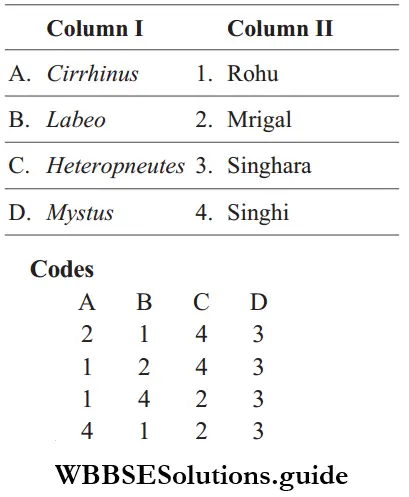
NEET Biology Animal Husbandry MCQs Question 212 Match The Column

Answer: A–2, B–1, C–4, D–3

Question 213. Which one of the following edible fishes is introduced in India by foreigners?

  1. Labeo rohita
  2. Stromateus argenteus
  3. Mystus singhala
  4. Clarias batrachus

Answer: 2. Stromateus argenteus

Stromateus argenteus or pomfret fish was introduced in India by foreigners as an edible fish.

Question 214. Bombay duck is

  1. Hilsa hilsa
  2. Harpadon nehereus
  3. Podiceps ruficollis
  4. Oreochromis mossambicus

Answer: 2. Harpadon nehereus

The Bombay duck or bummalo (Harpadon nehereus) is a lizard fish.

Question 215. ______. is a larvivorous fish, which eat larva of mosquito.

  1. Gambusia
  2. Catla
  3. Rohu
  4. Mrigal

Answer: 1. Gambusia

Gambusia is a freshwater fish which feeds on the larvae of mosquitoes. Due to this, it is also called mosquito fish.

Question 216. Gill rot disease in fishes is caused by

  1. Aeromonas sp.
  2. Bacillus polymyxa
  3. Branchiomyces sanguinis
  4. Bacillus subtilis

Answer: 3. Branchiomyces sanguinis

  • Branchiomycosis affects the fish’s gills by causing them to become mottled or blotchy in appearance due to the dying tissue.
  • For this reason, it is also known as ‘gill rot.’ It is a fungal disease caused by Branchiomyces sanguinis.

Question 217. Which one of the following is bacterial disease of fish?

  1. Gill rot
  2. Fin rot
  3. Skin lesions
  4. Anaemia

Answer: 2. Fin rot

Fin rot is caused by Gram-negative bacteria, Aeromonas or Vibrio. So, it is a bacterial disease of fish.

Question 218. From the options given below, the edible aquatic animals is/are

  1. Crab
  2. Lobster
  3. Oyster
  4. All of these

Answer: 4. All of these

Crabs, oysters, lobster are edible aquatic animals.

 

NEET Biology Immune System Multiple Choice Question And Answers

Biology MCQs with answers for NEET Immune System

Question 1. To which type of barriers under innate immunity, do the saliva in the mouth and the tears from the eyes, belong?

  1. Cytokine barriers
  2. Cellular barriers
  3. Physiological barriers
  4. Physical barriers

Answer: 3. Physiological barriers

The saliva in the mouth and the tears from the eyes belong to physiological barriers.

Read And Learn More: NEET Biology Multiple Choice Question And Answers

Question 2. Macrophages are also known as

  1. Tumour cell
  2. Natural killer cells
  3. Phagocytes
  4. B-cells

Answer: 3. Phagocytes

“human health and disease pyq “

Macrophages are large phagocytic cells that arise by enlargement of monocytes. They besides destroying the microbes, also engulf the microbes and display the antigens of microbes to alert the lymphocytes

Question 3. Identify the True/False statements.

  1. Innate immunity is obtained by providing different types of barriers.
  2. Sweat, tears, acid in the stomach and saliva prevent microbial growth.
  3. Acquired immunity is present from birth and is inherited from parents.

Codes

  • True False True
  • True True False
  • False False True
  • False True True

Answer: 2. Sweat, tears, acid in the stomach and saliva prevent microbial growth.

All statements are true except statement 3. Incorrect statement can be corrected as Acquired immunity is not present from the birth and develops during an individual’s lifetime. It is pathogen-specific.

NEET Biology Immune System MCQs with answers

Question 4. Select the incorrect statement.

  1. Keratin on human skin acts as a mechanical barrier to pathogens
  2. Fever and inflammation provide an early line of defence against pathogen
  3. Human milk is rich in antibacterial substances which fight against staphylococci
  4. Interferons are a part of the physiological barrier

Answer: 4. Interferone are a part of the physiological barrier

All given statements are correct except option (4). It can be corrected as Interferons are a part of the cytokine barrier. They are the proteins secreted by the virus-infected cells, which protect non-infected cells from further viral infection.

Biology MCQs with answers for NEET

NEET Biology Immune System Multiple Choice Question And Answers

“questions on human health and disease “

Question 5. The epithelial lining of the respiratory tract acts as the

  1. Inflammatory barrier
  2. Phagocytic barrier
  3. Anatomical barrier
  4. Physiological barrier

Answer: 3. Anatomical barrier

The epithelial lining of the respiratory tract helps in trapping microbes entering the body, thus acting as an anatomical barrier.

Question 6. Lysozyme that is present in perspiration, saliva and tears destroys

  1. Most virus-infected cells
  2. Certain fungi
  3. Certain types of bacteria
  4. All viruses

Answer: 3. Certain types of bacteria

Lysozyme breaks down the peptidoglycan present in the bacterial cell wall, thereby causing lysis of the bacterial cell. So, it is present in perspiration, saliva and tears and destroys certain types of bacteria.

NEET important MCQs on Immune System

Question 7. The full form of PMNL is

  1. Poly Morpho-Nuclear Leukocytes
  2. Para Morpho-Nuclear Lymphocytes
  3. Penta Morpho-Nuclear Leukocytes
  4. Poly Morpho-Nuclear Lymphocytes

Answer: 1. Poly Morpho-Nuclear Leukocytes

PMNL is Poly Morpho-Nuclear Leukocytes.

Question 8. Which one of the following acts as a physiological barrier to the entry of microorganisms in human?

  1. Epithelium of urogenital tract
  2. Tears
  3. Monocytes
  4. Skin

Answer: 2. Tears

Physiological barriers include acid in the stomach, saliva in the mouth, tears from eyes. They all prevent microbial growth

Biology MCQs with answers for NEET

Question 9. Swelling due to the infection or injury of tissues is an example of

  1. Anatomical barrier
  2. Physiological barrier
  3. Phagocytic barrier
  4. Inflammatory barrier

Answer: 4. Inflammatory barrier

“human health and disease “

Swelling or inflammation is an important defense mechanism of host to prevent infection. It is induced in response to tissue damage caused by microorganisms, toxins or by mechanical means. Thus, it is an inflammatory barrier.

Question 10.  ______ is an anatomical barrier.

  1. Saliva
  2. Lysozyme
  3. Interferon
  4. Mucus

Answer: 4. Mucus

Mucous membrane secretes mucus and the mucus coating on the epithelial lining of the respiratory, gastrointestinal and urinogenital tracts help in trapping microbes entering the body. Thus, mucus acts as an anatomical barrier to pathogens.

NEET Immune System chapter-wise MCQs

Question 11. Which of the following in the mammalian body is especially concerned with fighting against pathogens?

  1. Liver
  2. Kidney
  3. Endocrine glands
  4. Sebaceous gland

Answer: 4. Sebaceous gland

The secretions of the sebaceous gland of the skin contain bactericidal and fungicidal substances, which kill the bacteria and fungi on the skin.

Question 12. Action of lysozyme is

  1. Physiological
  2. Anatomical
  3. Morphological
  4. None of the above

Answer: 1. Physiological

  • Lysozyme is an antibacterial enzyme. It is widely distributed in body fluids and secretions, including tears, sweat and saliva.
  • Lysozyme is capable of breaking the chemical bonds in the outer cell wall of the bacteria. The action of lysozyme is physiological because it is an antimicrobial enzyme which kills bacteria.

Biology MCQs with answers for NEET

Question 13. Identify the physiological barrier which prevents entry of microorganisms in our body.

  1. Acid in the stomach
  2. Saliva in the mouth
  3. Tears from eyes
  4. All of the above

Answer: 4. All of the above

Question 14. Consider the following statements.

  • Lactoferrin and Neuraminic acid are antibacterial substances in human milk.
  • Defensins are antimicrobial peptides secreted by human body against pathogens.

Choose the correct option.

  1. Statement 1 is correct, but 2 is incorrect
  2. Statement 1 is incorrect, but 2 is correct
  3. Both statements 1 and 2 are correct
  4. Both statements 1 and 2 are incorrect

Answer: 3. Both statements 1 and 2 are correct

“common cold differs from pneumonia in that “

  • Lactoferrin and neuraminic acid are effective antibacterial againt E.coli.
  • These are present in human milk.
  • Defensins are diverse members of a large family of antimicrobial peptides, contributing to the antimicrobial action of granulocytes, mucosal host defence in the small intestine and epithelial host defence in the skin and elsewhere.

Question 15. Identify the first line of defence in humans.

  1. Skin
  2. Mucus coating
  3. Lysozyme secretion from eyes
  4. All of the above

Answer: 4. All of the above

The body’s first line of defence against pathogens uses mostly physical and chemical barriers such as sweat in the skin, lysozyme in tears, mucus, acid in the stomach, etc.

Biology MCQs with answers for NEET

Question 16. Natural killer lymphocytes are an example for

  1. Physical barrier
  2. Cytokine barrier
  3. Cellular barrier
  4. Physiological barrier

Answer: 3. Cellular barrier

  • Leukocytes (WBCs) act cellular barriers and are the second line of the innate immune system.
  • The innate leucocytes include the phagocytes, innate lymphoid cells, mast cells, eosinophils, basophils and natural killer cells. Hence, natural killer lymphocytes are an example of cellular barrier.

Question 17. The cytokine barrier among these is

  1. Polymorphonuclear neutrophil
  2. Monocyte
  3. Nk cell
  4. Interferon
  5. Macrophage

Answer: 4. Interferon

“virus infected cells secrete proteins called “

  • Polymorphonuclear neutrophils, monocyte, NK cell and macrophage represent cellular barrier of innate immunity and interferon is a cytokine barrier.
  • Cytokines are small protein hormones produced by lymphocytes (helper T-cells), fibroblasts, endothelial cells and antigen-presenting cells.
  • The immune response requires complex interactions between different cells.
  • The communication required for this is mediated by cytokines which act as chemical messengers of immune cells.

Biology MCQ For NEET With Answers

Question 18. The dead bacteria and pus formation in a wounded region is known as

  1. Inflammatory response
  2. Immune response
  3. Immune reaction
  4. Phagocytic response

Answer: 1. Inflammatory response

Inflammation is the defence reaction of tissue to injury, infection, or irritation by chemicals or physical agents, for example, pus formation in wounded area.

Question 19. Fill in the blanks.

_______ A ______ and ____ B _____ makeup the primary lymphoid organs. They are here that lymphocytes differentiate and form sensitive lymphocytes. These lymphocytes on maturation migrate to ______ C ____ B-lymphocytes develop and mature in the _______D ____Whereas ____E____ matures in the thymus.

  1. A-Liver, B-bone marrow, C-main lymphoid organ, D-thymus, E-T-lymphocyte
  2. A-Bone marrow, B-thymus, C-tertiary lymphoid organs, D-thymus, E-B-lymphocyte
  3. 4-Bone marrow, 5-thymus, C-secondary lymphoid organs, D-bone marrow, 5-T-lymphocyte
  4. 4-Heart, 5-liver, C-main lymphoid organ, D-thymus, 5-B-lymphocyte

Answer: 3. 4-Bone marrow, 5-thymus, C-secondary lymphoid organs, D-bone marrow, 5-T-lymphocyte

NEET Immune System quiz with solutions

Question 20. The location where B-lymphocytes differentiate and mature is in the

  1. Bone marrow
  2. Bursa of Fabricius
  3. Both (1) and (2)
  4. Thymus

Answer: 3. Both (1) and (2)

  • Bone marrow is the main lymphoid organ where all blood cells including lymphocytes are formed.
  • Maturation of β- lymphocytes occurs here. Thymus is the site of
  • T-lymphocyte maturation.
  • Bursa of Fabricius is a lymphoid organ present in birds where lymphocytes differentiate and mature.

Biology MCQ For NEET With Answers

Question 21. Humoral immunity is also known as

  1. Antibody-mediated immunity
  2. Non-specific immune response
  3. Antigen mediated immunity
  4. None of the above

Answer: 1. Antibody-mediated immunity

  • Humoral immunity is also known as antibody-mediated immunity.
  • There are five different types, of antibodies produced in our body, for example, IgO, IgA, IgM, IgE and IgG. Because these antibodies are found in the blood, the response is also called as humoral immune response.

Question 22. Which one of the following is related to humoral immunity?

  1. T-lymphocyte
  2. B-lymphocyte
  3. I-lymphocyte
  4. P-lymphocyte

Answer: 2. B-lymphocyte

Humoral immunity consists of antibodies (specialised proteins) that circulate in the body fluids like blood plasma and lymph. B-lymphocytes (cells) produce antibodies that regulate humoral immunity.

Question 23. Humoral immunity is mediated by

  1. Cytotoxic t-cell
  2. Plasma cell
  3. Eosinophil
  4. Neutrophil

Answer: 2. Plasma cell

The humoral immune response is mediated by antibody molecules that are secreted by plasma cells.

Question 24. Which of the following helps in the primary and secondary immune responses?

  1. Immunoglobulins
  2. T-lymphocytes
  3. Both (1) and (2)
  4. Lysozymes

Answer: 3. Both (1) and (2)

  • The primary and secondary immune responses are carried out with the help of two special types of lymphocytes present in our blood, i.e. B-lymphocytes and T-lymphocytes.
  • The B-lymphocytes produce an army of proteins in response to pathogens into our blood to fight them. These proteins are called antibodies. Antibodies are protein molecules and are also called immunoglobins (Igs).

Biology MCQ For NEET With Answers

Question 25. Immunodeficiency makes a person highly susceptible to infection. It is caused by

  1. Lack of b-cells
  2. Lack of t-cells
  3. Both (1) and (2)
  4. Lack of WBC

Answer: 3. Both (1) and (2)

  • The B-cells and T-cells are produced in bone marrow. The T-cells (T-helper cells) stimulate B-cells to produce antibodies.
  • Antibodies are the main component of the immune system. Immunodeficiency is characterised by a very low number of circulating lymphocytes (B and T-cells) and the affected persons usually die at an early age.

Question 26. Surgical removal of thymus in a newborn shall result in the failure to produce

  1. Basophils
  2. Neutrophils
  3. B-lymphocyte
  4. T-lymphocyte

Answer: 4. T-lymphocyte

Surgical removal of the thymus in a newborn shall result in failure of production of T-lymphocyte. Thymus provides the microenvironment for the development and maturation of T-lymphocytes

NEET expected questions on Immune System 2025

Question 27. Which of the following options represent the first line of defence?

  1. Cerumen
  2. Complement system
  3. Vaginal bacteria
  4. All of the above

Answer: 4. All of the above

All of the given options are represented as the first line of defence. The first line of defence is over the innate immune system. For example, skin, cerumen, vaginal bacteria, complement system, etc.

Question 28. Consider the following statements regarding lymphocytes.

  • T-lymphocytes form Cell-Mediated Immune System (CMIS).
  • The T-lymphocyte cells do not secrete antibodies but help the B-lymphocyte cells to produce them.

“bank of biology class 12 human health and disease “

Choose the correct option.

  1. Statement 1 is correct, but 2 is incorrect
  2. Statement 1 is incorrect, but 2 is correct
  3. Both statements 1 and 2 are correct
  4. Both statements 1 and 2 are incorrect

Answer: 3. Both statements 1 and 2 are correct

Both statements 1 and 2 are correct. The T-lymphocytes mediate Cell-Mediated Immune System (CMIS). The B-lymphocytes produce antibodies. The T-cells themselves do not secrete antibodies but help B-cells to produce them.

Biology MCQ For NEET With Answers

Question 29. T-lymphocytes differentiate and mature in

  1. Bone marrow
  2. Kidneys
  3. Thyroid
  4. Thymus gland

Answer: 4. Thymus gland

  • T-lymphocytes originate in bonen marrow from lymphatic stem cells and then young lymphocytes migrate into the thymus gland for maturation.
  • Afterwards, they pass on to all the lymphoid tissues of the body and get lodged there.

Question 30. The option containing lymphatic organs is

  1. Thymus, lymph nodes and spleen
  2. Liver, spleen and thymus
  3. Tonsils, payer’s patches and liver
  4. Thymus, liver and tonsils

Answer: 1. Thymus, lymph nodes and spleen

The primary lymphoid organs are bone marrow and thymus. The secondary lymphoid organs are spleen, lymph nodes, tonsils, Peyer’s patches of small intestine and appendix. So, option (1) containing lymphatic organ is the thymus, lymph nodes and spleen. Liver is not a lymphoid organ.

Question 31. Which of the following is not a principal lymphoid organ?

  1. Spleen
  2. Kidney
  3. Lymph nodes
  4. Thymus

Answer: 2. Kidney

  • Lymphoid organs are those organs where the origin and/or maturation and proliferation of lymphocytes occurs.
  • Kidney is an excretory organ (present in pair) which is responsible for the excretion of wastes, principally urea from the blood. It is not a principal lymphoid organ.

Question 32. Identify the secondary lymphoid organs.

  1. Spleen
  2. Tonsils
  3. Both (1) and (2)
  4. None of the above

Answer: 3. Both (1) and (2)

Spleen and tonsils are called secondary lymphoid organs. After maturation, the lymphocytes migrate to secondary lymphoid organs like the spleen, lymph nodes, tonsils, Peyer’s patches of small intestine and appendix.

Question 33. MALT constitutes about per cent of the lymphoid tissue in human body.

  1. 50
  2. 20
  3. 70
  4. 10

Answer: 1. 50

MALT is Mucosa Associated Lymphoid Tissue and it constitutes about 50 per cent of the lymphoid tissue in human body.

Question 34. All of the following are examples of mucosa-associated lymphoid tissue. Identify the odd one.

  1. Appendix
  2. Peyer’s patches
  3. Tonsils
  4. Liver

Answer: 4. Liver

  • Option (4) is odd because liver is not a lymphoid tissue. The liver is a vital organ present in vertebrates and some other animals.
  • It has a wide range of functions, including detoxification, protein synthesis and production of biochemical necessary for digestion.

NEET Biology Immune System MCQs with explanations

Question 35. A large group of lymphoid tissue present in the respiratory, digestive and urogenital tract are collectively called

  1. MALT
  2. Peyer’s patches
  3. Mucosa lymph nodes
  4. Thymus

Answer: 1. MALT

  • A lymphoid tissue also located within the lining of the major tracts (respiratory, digestive and urogenital tracts) called Mucosa Associated
  • Lymphoid Tissue (MALT). It constitutes about 50% of the lymphoid tissue in the human body.

Question 36. Match the following columns.

NEET Biology Immune System MCQs Question 36 Match The Columns

Answer: A-3, B-1, C-4, D-2

Question 37. Aggregates of lymphoid tissue present in the distal portion of the small intestine are known as 

  1. Villi
  2. Peyer’s patches
  3. Rugae
  4. Choroid plexus

Answer: 2. Peyer’s patches

  • Peyer’s patches are a secondary lymphoid organ present in the distal portion of the small intestine.
  • The secondary lymphoid organs provide the sites for interaction of lymphocytes with the antigens, which then proliferate to become effector cells that produce an immune response.

Question 38. The largest lymph organ of the body is

  1. The cervical node
  2. The spleen
  3. The axillary node
  4. Inguinal node

Answer: 2. The spleen

The spleen is the largest lymphatic organ in the body. It contains white blood cells that fight infection and disease.

Question 39. Spleen is a storage site for

  1. Erythrocytes
  2. Basophils
  3. Platelets
  4. Both (1) and (2)

Answer: 1. Erythrocytes

Spleen is a large reservoir of erythrocytes. The spleen is a large bean-shaped organ. It mainly contains lymphocytes and phagocytes.

NEET Biology Mcq Chapter Wise

Question 40. Antibodies are

  1. Y-globulins
  2. Albumins
  3. Vitamins
  4. Both (1) and (2)

Answer: 1. Y-globulins

Antibodies are Y-globulins and the proteins (immunoglobulins) formed in response to an antigen and they can specifically react with that antigen.

Question 41. Colostrum, the yellowish fluid secreted by the mother during the initial days of lactation is very essential to impart immunity to the newborn infants because it contains

  1. Natural killer cells
  2. Monocytes
  3. Macrophages
  4. Immunoglobulin-a

Answer: 4. Immunoglobulin-a

  • Colostrum, the yellowish fluid secreted by the mother during initial days of lactation is very essential to impart immunity to the newborn infant because it contains immunoglobulin-A.
  • The abundant (IgA) protects the infant from several diseases.

Question 42. Antibodies are produced by the

  1. Lymphocytes
  2. Leucocytes
  3. Erythrocytes
  4. None of these

Answer: 1. Lymphocytes

Lymphocytes are a type of white blood cell, which are an important part of the immune system. Two special types of lymphocytes are present in our blood, i.e. B-lymphocytes and T-lymphocytes

Question 43. Which of the following is not the class of immunoglobulin?

  1. IgM
  2. IgB
  3. IgA
  4. IgG

Answer: 2. IgB

  • Immunoglobulin (Ig) is one of a group of proteins (globulins) in the body that act as antibodies. They are produced by specialised white blood cells called B-cells and are present in blood serum and other body fluids.
  • There are five classes with distinct immunological and physical properties. These are IgG, IgM, IgA, IgD and IgE. IgB is no such immunoglobin.

NEET Biology Mcq Chapter Wise

Question 44. Immunoglobulins are made up of

  1. Two polypeptide chains
  2. Four polypeptide chains
  3. Three amino acids
  4. Five nucleotides

Answer: 2. Four polypeptide chains

  • Immunoglobulins are present in serum and provide immunity to body against disease.
  • Each immunoglobulin is made up of four polypeptide chains, i.e. two heavy-weight chains and two lightweight chains.
  • These chains are joined to each other by disulphide bonds.

Question 45. Immunoglobulins are proteins that

  1. Primary
  2. Secondary
  3. Tertiary
  4. Quaternary

Answer: 4. Quaternary

  • Immunoglobulins or antibodies are large molecules composed of 4 polypeptide chains. It contains 2 identical heavy chains and 2 identical light chains, thus forming a tetrameric quaternary structure.
  • The two heavy chains are linked to each other and a light chain each by disulphide bonds. The resulting tetramer has two identical halves which together form the Y-like shape.

Question 46. Which one of the following combinations acts as a usual antigen binding site of an antibody?

  1. Variable regions of a light and another heavy chain
  2. Variable regions of two light chains
  3. Variable regions of two heavy chains
  4. Variable region of a heavy chain and constant region of a light chain

Answer: 1. Variable regions of a light and another heavy chain

  • The antibody molecule is a Y- Y-shaped structure, which consists of two heavy and two light chains.
  • The amino acid sequence at the tips of ‘Y’ varies greatly among different antibodies and comprises variable regions.
  • It includes ends of the light and heavy chains and gives the antibody its specificity for binding antigens.
  • Thus, the antigen binding sites are formed by variable regions of light and heavy chains.

Question 47. The figure given below shows an antibody molecule. Name the parts A, B and C.

  1. A-Light chain, B-Heavy chain, C-Antigen binding site
  2. A-Antibody binding site, B-Light chain, C-Heavy chain
  3. A-Long chain, B-Short chain, C-Antigen binding site
  4. The a-Antibody binding site, B-Long chain, C-Short chain

NEET Biology Immune System MCQs Anti Body Molecule

Answer: 1. A-Light chain, B-Heavy chain, C-Antigen binding site

Question 48. The long chain of antibodies are called

  1. Light chains
  2. Heavy chains
  3. Parallel chains
  4. Antiparallel chains

Answer: 2. Heavy chains

Each antibody molecule consists of two heavy chains and two light chains. The two heavy chains are long chains and these are linked to each other by disulphide bonds. The light chains are small chains.

NEET Biology Mcq Chapter Wise

Question 49. Consider the following statements.

  • IgG has six antigen-binding sites.
  • Both heavy and light chains of immunoglobulins contain variable and constant regions.

Choose the correct option.

  1. Statement 1 is correct, but 2 is incorrect
  2. Statement 1 is incorrect, but 2 is correct
  3. Both statements 1 and 2 are correct
  4. Both statements 1 and 2 are incorrect

Answer: 2. Statement 1 is incorrect, but 2 is correct

Statement 1 is incorrect, but 2 is correct. The incorrect statement can be corrected as IgG has two antigen-binding sites.

Question 50. Antigen binding site in antibody is found between

  1. Two light chains
  2. Two heavy chains
  3. One heavy and one light chain
  4. Changes acoording to the nature of antigen

Answer: 3. One heavy and one light chain

Antigen binding site in antibodies is found between one heavy and one light chain.

Question 51. Four polypeptide chains of an antibody are held together by

  1. Disulphide bond
  2. Glycosidic bond
  3. Phosphodiester bond
  4. None of the above

Answer: 1. Disulphide bond

The four polypeptide chains of an antibody are held together by disulphide bonds (-S-S-) to form a Y-shaped structure.

Question 52. Antibodies perform their action by

  1. Agglutination
  2. Complex formation
  3. Neutralisation
  4. Both (1) and (2)

Answer: 4. Both (1) and (2)

  • Antibodies bind to specific antigens to produce large insoluble complexes which render them harmless and facilitate their destruction by other cells of the immune system this process is called agglutination.
  • T-cells largely recognise proteins that have been processed within antigen-presenting cells and presented on the cell surface in form that is bound to a molecule known as Major Histocompatibility Complex (MHC).
  • So, antibodies perform their action by agglutination and complex formation.

Question 53. Consider the following statements.

  • IgE antibodies are produced in an allergic reaction.
  • B-lymphocytes mediate cell-mediated immunity.
  • The yellowish fluid colostrum has abundant IgE antibodies.
  • Spleen is a secondary lymphoid organ.

Choose the correct option.

  1. Only 1 is correct
  2. 1 and 2 are correct
  3. 2 and 3 are correct
  4. 3 and 4 are correct
  5. 1 and 4 are correct

Answer: 5. 1 and 4 are correct

Statements 1 and 4 are correct, while 2 and 3 are incorrect. The incorrect statement can be corrected as Colostrum, the first milk secreted by mother is rich in IgA antibody. It provides protection against bacteria and virus. B-lymphocytes mediate

NEET Biology Mcq Chapter Wise

Question 54. Which of the following components are involved in allergic reaction?

  1. IgE and mast cells
  2. IgG and mast cells
  3. IgA and mast cells
  4. IgG and basophils

Answer: 1. IgE and mast cells

  • The exaggerated response of the immune system to certain antigens present in environment is called allergy.
  • Allergic response mainly involves IgE antibodies and chemicals like histamine and serotonin from mast cells.

Question 55. The mast cell is a cell of the ____ A _____ of vertebrate animals. Mast cells mediate inflammatory responses such as ____ B ___ Mast cells store a number of different chemical mediators including___C __ and ____ D ______

Here A to D refer to

  1. A-bone marrow, B-allergic reactions, C-mucus, D-cerumen
  2. A-immune system, B-allergic reactions, C-histamine, D-serotonin
  3. A-thymus, B-allergic reactions, C-histamine, D-cerumen
  4. A-immune system, B-allergic reactions, C-cerumen, D-serotonin

Answer: 2. A-immune system, B-allergic reactions, C-histamine, D-serotonin

Question 56. Immediate hypersensitivity which results in the release of histamine and other inflammatory substances is mediated by

  1. IgA
  2. IgD
  3. IgE
  4. IgG

Answer: 3. IgE

  • Immediate hypersensitivity is mediated by IgE. The primary cellular component in this hypersensitivity is the mast cell or basophils.
  • The mechanism of reaction involves the production of IgE in response to certain allergens.
  • IgE binds with mast cells or basophils. Subsequent exposure to the same allergen cross-links the cell-bound IgE and triggers the release of various pharmacologically active substances.

NEET mock test on Immune System chapter

Question 57. Identify from the following the substance injected into the patient’s body for determining the cause of allergy.

  1. Pure allergen to which the patient is allergic
  2. IgG
  3. IgE
  4. Steroids

Answer: 1. Pure allergen to which the patient is allergic

For determining the cause of the allergy, the patient is exposed to or injected with very small doses of possible allergens and the reactions studied.

Question 58. Small foreign molecules that do not stimulate antibody formation are

  1. Epitopes
  2. Hapten
  3. Agglutinogens
  4. All of these

Answer: 2. Hapten

Haptens are small foreign molecules that do not stimulate antibody formation. Therefore, these are tagged with macromolecules.

Question 59. Which of the following disease is due to allergic reactions?

  1. Hay fever
  2. Skin cancer
  3. Enteric fever
  4. Malaria

Answer: 1. Hay fever

Hay fever is caused by an allergic response to outdoor or indoor allergens such as pollen, dust mites or tiny flecks of skin and saliva shed by cats, dogs and other animals with fur or feathers.

Question 60. Many children in metropolitan cities of India are suffering from allergies or asthma. The main causes for the same may be

  • Sensitivity to the environment.
  • Because of the environment provided early in life.
  • Modern-day lifestyle.
  1. 1 and 2
  2. 1 and 3
  3. 2 and 3
  4. 1, 2 and 3

Answer: 4. 1, 2 and 3

  • Modern-day lifestyle has resulted in a lowering of immunity and more sensitivity to allergens.
  • More and more children in metro cities of India suffer from allergies and asthma due to sensitivity to the environment.
  • This could be because of the protected environment provided early in life.

NEET Biology Mcq

Question 61. Chemical substances such as histamines, vasodilators, bring certain reactions in the body after the introduction of allergens which are called

  1. Anaphylatoxins
  2. Antigen-antibody complexes
  3. Antibodies
  4. None of the above

Answer: 1. Anaphylatoxins

  • Anaphylatoxins or complement peptides, are fragments (C3a, C4a and C5a) that are produced as part of the activation of the complement system.
  • These are low molecular weight peptides responsible for acute inflammatory responses like smooth muscle contraction, and vasodilation. histamine release, etc.

Question 62. During an allergic reaction, the binding of antigens to IgE antibodies initiates a response, in which chemicals causes the dilation of blood vessels and physiological changes. Such chemicals are

  1. Interferons
  2. Hormones
  3. Histamines
  4. Acetylamine

Answer: 3. Histamines

  • Histamine is released from mast cells during allergic reactions. It can occur in various tissues but is concentrated in connective tissue.
  • It is formed from the amino acid histidine. It causes dilation and increases the permeability of small blood vessels, which results in localised swelling, itching, sneezing and runny eyes and nose.

Question 63. The use of antihistamines and steroids give quick relief from

  1. Nausea
  2. Cough
  3. Headache
  4. Allergy

Answer: 4. Allergy

  • Antihistamines are drugs which are used to treat allergic rhinitis and other allergies.
  • It gives relief when a person has nasal congestion sneezing or hives because of pollen, dust mites or animal allergy. A steroid is a biologically active organic compound.
  • Steroids such as corticosteroids are used in the treatment of allergic reaction by reducing inflammation associated with allergies.

Question 64. Hypersensitivity to an allergen is due to

  1. Aberrant function of immune system
  2. Food habits
  3. Increase in humidity
  4. Increase in temperature

Answer: 1. Aberrant function of immune system

The exaggerated response of the immune system to certain antigens present in the environment is called allergy. So, hypersensitivity to an allergen is due to aberrant function of immune system.

NEET Biology Immune System practice test online

Question 65. A localised inflammatory response appearing at the site of infection causes redness, swelling, pain and heat due to certain chemicals. They are

  1. Histamine and prostaglandins
  2. Cerumen and mucus
  3. Histamine and cerumen
  4. Prostaglandins and cerumen

Answer: 1. Histamine and prostaglandins

  • Inflammation is the defence reaction of tissue to injury, infection, or irritation by chemicals or physical agents.
  • Cells in the affected tissue release various substances, including histamine, serotonin, kinins and prostaglandins. These cause localised dilation of blood vessels so that fluid leaks out and blood flow is increased.
  • They also attract white blood cells (lymphocytes) to the site. Overall, these responses lead to swelling, redness, heat and often pain. White blood cells, particularly phagocytes, enter the tissue and an immune response is stimulated.

NEET Biology Mcq

Question 66. Increased asthmatics attacks in certain seasons are related to

  1. Eating fruits preserved in tin containers
  2. Inhalation of seasonal pollen
  3. Low temperature
  4. Hot and humid environment

Answer: 2. Inhalation of seasonal pollen

  • Inhalation of pollen grains of many species are responsible for some of the severe allergies and bronchial infection.
  • In some people, these often lead to chronic respiratory disorders, asthma, and bronchitis. So, increased asthmatic attacks in certain seasons are related to inhalation of seasonal pollen.

Question 67. Pollen-like agents which produce allergy is known as

  1. Antigens
  2. Allergens
  3. Oncogenes
  4. None of these

Answer: 2. Allergens

The substance, which produces an immune response in an individual are called allergens and pollen is one of its examples.

Question 68. Which statement is incorrect?

  • Mast cells and basophils secrete histamine and heparin
  • Mast cells are long-lived, basophils are short-lived
  • Mast cells are smaller than basophils with a bilobed nucleus
  • Mast cells are relatively sessile, basophils are mobile

Answer: 3. Mast cells are smaller than basophils with a bilobed nucleus

The statement in option (3) is incorrect and can be corrected as Mast cells are larger than basophils with a bilobed. Rest statements are correct.

Question 69. Match the types of immunity listed in Column 1 with examples listed in Column 2.

NEET Biology Immune System MCQs Question 69 Match The Column

Answer: A–4, B–5, C–3, D–1

Question 70. People administered with preformed antibodies get

  1. Active immunity kerala
  2. Innate immunity
  3. Autoimmunity
  4. Natural immunity
  5. Passive immunity

Answer: 5. Passive immunity

  • In artificial passive immunity, the resistance is passively transferred to the recipient by the administration of antibodies.
  • This is done by administration of hyperimmune serum of man or animals. The serum contains antibodies.
  • For example, Anti-Tetanus Serum (ATS) is prepared in horses by active immunisation of horses with tetanus toxoid, bleeding them and separating the serum.
  • ATS is used for passive immunisation against tetanus.

Question 71. Active immunity may be produced by

  1. Contracting a disease
  2. Readymade antibodies
  3. Receiving gamma globulin infection
  4. Both (1) and (2)

Answer: 4. Both (1) and (2)

Active immunity is defined as immunity to a pathogen that occurs following exposure to said pathogen when the body is exposed to a novel disease agent, B cells, a type of WBC create antibodies that assist in destroying or neutralising the disease agent.

NEET Biology Mcq

Question 72. If a quick immune response is needed as in tetanus infection, preformed antibodies or antitoxin is injected into the patient’s body. This type of immunisation is called

  1. Active immunisation
  2. Passive immunisation
  3. Innate immunity
  4. Humoral immunity

Answer: 2. Passive immunisation

If a quick immune response is needed as in tetanus infection, preformed antibodies or antitoxin is injected into the patient. This type of immunisation is called passive immunisation.

Question 73. Identify the wrong statement with reference to immunity.

  1. When readymade antibodies are directly given, it is called ‘passive immunity
  2. Active immunity is quick and gives full response
  3. Foetus receives some antibodies from the mother, it is an example of passive immunity
  4. When exposed to antigen (living or dead ) antibodies are produced in the host’s body. It is called active immunity

Answer: 2. Active immunity is quick and gives full response

  • The statement in option (2) is wrong and can be corrected as Active immunity is slow and takes time to give its full effective response in comparison to passive immunity where preformed antibodies are administered.
  • Rest statements are correct with reference to immunity.

Question 74. The treatment of snake-bite by poly venin is an example of

  1. Artificially acquired active immunity
  2. Artificially acquired passive immunity
  3. Naturally acquired passive immunity
  4. Specific natural immunity

Answer: 2. Artificially acquired passive immunity

Artificially acquired passive immunity is a short-term immunisation by the injection of antibodies, such as infection of antivenin against snake venom.

Question 75. The yellowish fluid ‘colostrum’ secreted by the mammary glands of the mother during the initial days of lactation has abundant antibodies (IgA) to protect the infant. This type of immunity is called as

  1. Passive immunity
  2. Active immunity
  3. Acquired immunity
  4. Autoimmunity

Answer: 1. Passive immunity

Short-lived immunity acquired from mother to foetus across the placenta or through the mother’s milk to the infant is categorised as passive immunity. In passive immunity, there is transfer of preformed IgA antibodies from host to the recipient.

Question 76. Which among the following refers to immunity transfer of immune produced from an individual to a non-immune individual?

  1. Active
  2. Passive
  3. Cell-mediated
  4. Humoral

Answer: 2. Passive

Passive immunity is a type of acquired immunity in which there is transfer of immune products, like antibodies, etc., to a recipient in a readymade form.

Question 77. Column 1 lists the components of body defence and Column 2 lists the corresponding descriptions. Choose the correct option from those given.

NEET Biology Immune System MCQs Question 77 Match The Column

Answer: A–3, B–4, C–5, D–2

Question 78. Injection of antitoxin or toxoid serum is given to prevent

  1. Diphtheria
  2. Smallpox
  3. Chickenpox
  4. Chronic headache

Answer: 1. Diphtheria

Active immunisation using toxoid, formalin detoxified diphtheria toxin prevents diphtheria.

Question 79. Monoclonal antibodies are used for

  1. Purification of microorganisms for lab and industrial process
  2. Studying life cycle of virus
  3. To study the affect of certain microorganisms
  4. All of the above

Answer: 4. All of the above

  • Monoclonal antibodies are homogeneous immunological reagents of defined specificity, so that these can be utilised for diagnosis and screening with certainty.
  • These can be used in detecting allergies, diagnosing viral diseases and in detecting certain types of cancer.

Question 80. Interferon a type of protein is used in the cure of

  1. Homeostatic disorder
  2. Hepatitis caused by virus
  3. Common cold caused by virus
  4. Both (2) and (3)

Answer: 4. Both (2) and (3)

Interferon, a kind of protein, is a polypeptide produced by a T-cell infected with a virus that diffuses to surrounding cells and stimulates them to manufacture biochemicals that harm viral replication. It helps in curing hepatitis and the common cold caused by virus.

NEET Biology Mcq

Question 81. Passive immunity can be obtained by injecting

  1. Antibodies
  2. Antigens
  3. Antibiotics
  4. Vaccination

Answer: 1. Antibodies

  • Passive immunity is a type of acquired immunity in which there is the transfer of immune products, like antibodies, etc., to a recipient in a readymade form.
  • It is procured by infusing antibodies, sensitised lymphocytes or both from some other person or animal which has been actively immunised against the pathogen or antigen.

Question 82. Magic bullets are

  1. Recombinant drugs
  2. Monoclonal antibodies
  3. Chemotherapy drugs
  4. Anabolic steroids somaclonal antibodies

Answer: 2. Monoclonal antibodies

  • Monoclonal antibodies are highly specific antibodies derived from only one clone of a specific hybridoma cell.
  • They recognise only one specific site of an antigen. These can be used in detecting allergies, diagnosing viral diseases and in detecting certain types of cancer.
  • Monoclonal antibodies are nowadays marketed as magic bullets. The idea of the magic bullet was first proposed by Paul Ehrlich.

Question 83. Suspension of killed or attenuated pathogenic microorganisms on inoculation if stimulate the formation of antibodies, it is known as

  1. Vaccine
  2. Antibiotic
  3. Sera
  4. Antitoxins

Answer: 1. Vaccine

Vaccine contains a dead, attenuated form or antigen of a pathogen which can be injected to provide immunity towards that pathogen.

Question 84. Which one of the following statements is correct with respect to immunity?

  1. Preformed antibodies need to be injected to treat the bite by a viper snake
  2. The antibodies against smallpox pathogen are produced by T-lymphocytes
  3. Antibodies are protein molecules, each of which has four light chains
  4. Rejection of a kidney graft is the function of B-lymphocytes

Answer: 1. Preformed antibodies need to be injected to treat the bite by a viper snake

  • The statement in option (1) is correct with respect to immunity. In snake-bite, the injection which is given to the patients contains preformed antibodies against the snake venom.
  • This type of immunisation is called passive immunisation. Other statements are incorrect and can be corrected as Antibody against smallpox is generated by B-lymphocytes.
  • Antibodies are immunoglobulins which are made up of four peptide chains, i.e. two light and two heavy chains. Rejection of kindney graft is a function of T-lymphocytes.

NEET Biology Mcq

Question 85. Globulins contained in human blood plasma are primarily involved in

  1. Defence mechanisms of body
  2. Osmotic balance of body fluids
  3. Oxygen transport in the blood
  4. Clotting of blood

Answer: 1. Defence mechanisms of body

Globulins contained in human blood plasma are primarily involved in the defence mechanisms of the body. Some examples are rabies immune globulin, Rho (D) immune globulin, specific immune globulin, tetanus immune globulin, etc.

Question 86. Gamma globulins are synthesised in

  1. Liver
  2. Kidney
  3. Bone marrow
  4. Lymphatic tissue

Answer: 4. Lymphatic tissue

Gamma globulins are synthesised in germinal centres of lymphatic tissue.

Question 87. How many polypeptide chains are present in gamma immunoglobulin?

  1. 5
  2. 4
  3. 6
  4. 2

Answer: 2. 4

  • Gamma immunoglobulin (IgG) has four polypeptide chains. Of the four chains, there are two long chains, called heavy chains and two short chains, called light chains, which may be either lambda or kappa type.
  • The four polypeptide chains are held together by disulphide bonds to form a Y-shaped molecule.

Question 88. Active immunity may be acquired by

  1. Toxoids
  2. Natural infection
  3. Vaccines
  4. All of these

Answer: 4. All of these

Acquired active immunity occurs when the person is exposed to a live pathogen develops the disease and becomes immune as a result of the primary immune response. Active immunity may be acquired by toxoids, natural infections and vaccines.

Question 89. The cell-mediated immunity inside the human body is carried out by

  1. Thrombocytes
  2. Erythrocytes
  3. T-lymphocytes
  4. B-lymphocytes

Answer: 3. T-lymphocytes

Cell-mediated immunity is mediated by T-lymphocyte. These cells get activated in response to pathogen attack and undergo proliferation and differentiation into various effector cells, for example, T-helper, T-cytotoxic, T-memory cells, etc.

Question 90. Proteins present in our body for self-defence are

  1. Antibodies
  2. Antigens
  3. Hormones
  4. Trypsin or trypsinogen

Answer: 1. Antibodies

  • Antibodies, also known as immunoglobulins, are Y-shaped proteins that are produced by the immune system to stop intruders from harming the body.
  • When an intruder enters the body, the immune system springs into action. These invaders, which are called Antibodies

Question 91. During blood typing, agglutination indicates that the

  1. RBCs carry certain antigens
  2. Plasma contains certain antigens
  3. RBCs carry certain antibodies
  4. Plasma contains certain antibodies

Answer: 1. RBCs carry certain antigens

Antibodies bind to specific antigens to produce large insoluble complexes which render them harmless and facilitate their destruction by other cells of the immune system. This process is called agglutination, which means that RBCs carry certain antigens.

Question 92. Memory cells are

  1. Cells responsible for immunologic memory
  2. Antigens
  3. Cells of cerebrum
  4. Cells responsible for memory in brain

Answer: 1. Cells responsible for immunologic memory

The memory cells recognise the antigen quickly and control the invaders by producing a large number of lymphocytes and antibodies. These are formed by differentiated T-cells. Thus, memory cells are responsible for immunologic memory.

Question 93. Cyclosporin-A which is used as an immunosuppressive agent, is produced by

  1. Aspergillus
  2. Clostridium
  3. Saccharomyces
  4. Monascus
  5. Trichoderma

Answer: 5. Trichoderma

Cyclosporin-A is a bioactive molecule and is used as an immunosuppressive agent in organ-transplant patients. It is produced by the fungus, Trichoderma polysporum.

Question 94. Consider the following four statements (1 – 4) regarding kidney transplants and select the two correct ones out of these.

  • Even if a kidney transplant is proper the recipient may need to take immunosuppressants for a long time.
  • The cell-mediated immune response is responsible for the graft rejection.
  • The B-lymphocytes are responsible for the rejection of the graft.
  • The acceptance or rejection of a kidney transplant depends on specific interferons.

The two correct statements are

  1. 2 and 3
  2. 3 and 4
  3. 1 and 4
  4. 1 and 2

Answer: 4. 1 and 2

  • Statements 1 and 2 are correct, while 3 and 4 are incorrect.
  • Incorrect statements can be corrected as The T-lymphocytes are responsible for graft rejection and it depends on cell-mediated immune response.

Question 95. Rejection of transplants is brought about mainly by

  1. Cytotoxic T-cells
  2. Suppressor T-cells
  3. B-cells
  4. Macrophages

Answer: 1. Cytotoxic T-cells

Cytotoxic T-cells cause the rejection of tissue and organ transplants.

Question 96. Assertion (A) Organ transplantation patients are given immunosuppressive drugs. Reason (R) Transplanted tissue has antigens which stimulate the specific immune response of the recipient.

  1. Both A and R are is true and R is the correct explanation of A
  2. Both A and R are true, but R is not the correct explanation of A
  3. A is true, but R is false
  4. Both A and R are false

Answer: 1. Both A and R are true, but R is not the correct explanation of A

Both A and R are true and R is the correct explanation of A. Organ transplantation patients are given immunosuppressive drugs because transplanted tissue less antigens which stimulate the specific immune response of the recipient both.

Question 97. Xenograft means

  1. A graft between two genetically identical individuals
  2. A graft in which a tissue is grafted from one individual to another individual of the same species
  3. A graft between individuals of different species
  4. Tissue grafted from one area to another of the same individual

Answer: 3. A graft between individuals of different species

Xenograft (heterograft) is a living tissue graft that is made from an animal of one species to another of a different species. For example, attempts have been made to graft animal organs into humans.

Question 98. Vaccines are not given through route.

  1. Intramuscular
  2. Intravenous
  3. Oral
  4. Subcutaneous

Answer: 2. Intravenous

Vaccines are not given intravenously. It helps to preserve the immunogenicity of the vaccine and minimise its adverse effects.

Question 99. Vaccines are prepared from

  1. Attenuated pathogen
  2. Activated pathogens
  3. Disease-causing active pathogens
  4. All of the above

Answer: 1. Attenuated pathogen

A vaccine contains a dead, attenuated form or antigen of a pathogen which can be injected to provide immunity towards that pathogen. Vaccines are made from microbes that are dead or inactive so that they are unable to cause the disease.

Question 100. Vaccination protects a person from disease because it

  1. Helps in better digestion
  2. Increases RBC count
  3. Stimulates the production of antibodies
  4. Improves healing system

Answer: 3. Stimulates production of antibodies

Vaccination protects a person from disease because it stimulates the production of antibodies.

Question 101. Vaccination provides

  1. Natural immunity
  2. Passive immunity
  3. Active immunity
  4. Both (1) and (2)

Answer: 3. Active immunity

Vaccines provide artificial active acquired immunity to disease.

Question 102. Vaccine prepared through genetic engineering is different from other vaccines in which following respect?

  1. Attenuated pathogens
  2. Purified antigens of pathogens
  3. Purified antibodies from other animals
  4. Purified antibodies by hybridoma techniques

Answer: 4. Purified antibodies by hybridoma techniques

Hybridoma technology is a method for producing large numbers of identical antibodies (also called monoclonal antibodies). This process starts by injecting a mouse (or other mammal) with an antigen that provokes an immune response.

Question 103. What is not true about the purpose of vaccination?

  1. It prevents the entry of pathogenic germs into the body
  2. It increases the level of resistance of the body by increased the quantum of specific antibodies
  3. With secondary infection, there is a prompt spurt of production of specific antibodies
  4. Even with a second attack, the virulence of the disease is lowered down very much

Answer: 1. It prevents the entry of pathogenic germs into the body

  • All given options are true about the purpose of vaccination except option (1) because Vaccination does not prevent the entry of concerned pathogenic germs into the body.
  • But, it increases the body capacity to resist the adverse effects of the pathogen by stimulating the body to produce a spurt of required antibodies.
  • Thus, even with second attack, the virulence of the disease is lowered down very much.

Question 104. Generally, the number of vaccinations given is to obtain complete immunity.

  1. 2 to 3
  2. Only 2
  3. Only 3
  4. Only 4

Answer: 1. 2 to 3

  • Vaccines work to prime the immune system against future ‘attacks’ by a particular disease.
  • There are vaccines against both viral and bacterial pathogens or disease-causing agents. To obtain complete immunity, generally, the number of vaccination given is 2 to 3.

Question 105. After vaccination, the body builds up

  1. Toxins
  2. Lymph
  3. Antibodies
  4. Plasma

Answer: 3. Antibodies

  • Our body continues making antibodies and memory B-cells for a couple of weeks after vaccination.
  • Over time, the antibodies will gradually disappear, but the memory B-cells remain dormant in the body for many years.

Question 106. The vaccine for hepatitis B is obtained from

  1. Yeast
  2. Bacteriophage
  3. Bacteria
  4. All of these

Answer: 1. Yeast

The human hepatitis-B virus vaccine is prepared by using antigen produced by recombinant technology in yeast (Saccharomyces cerevisiae).

Question 107. Vaccine for tuberculosis is known as

  1. PAS vaccine
  2. BCG vaccine
  3. OPV
  4. DPT

Answer: 2. BCG vaccine

  • Tuberculosis is an infectious disease that may affect almost any tissue of the body, especially lungs.
  • Many countries use Bacillus Calmette-Guerin (BCG) vaccine as part of their TB control programmes, especially for infants. The BCG vaccine is one of the most widely used of all current vaccines reaching 80% of neonates and infants in countries with a national vaccination schedule.

Question 108. Match the vaccines and their mode of immunisation given in Column 1 and Column 2.

NEET Biology Immune System MCQs Question 108 Match The Column

Answer: A–4, B–1, C–2, D–3

Question 109. Edward Jenner is the discoverer of

  1. BCG
  2. Immunisation against polio
  3. Vaccination against smallpox
  4. Immunisation against smallpox

Answer: 3. Vaccination against smallpox

Edward Jenner observed the immunity to smallpox in milkmaids who were liable to occupational cowpox infection. He introduced the technique of vaccination using cowpox material (1796).

Question 110. MMR, a vaccine, stands for

  1. Measles, Mumps, Rubella
  2. Measles, Mumps, Ranikhet
  3. Mumps, Measles, Rabies
  4. Mumps, Malaria, Rabies

Answer: 1. Measles, Mumps, Rubella

MMR stands for Measles, Mumps and Rubella. These are three different diseases which are caused by three different viruses.

Question 111. Which disease is not cured by triple antigens?

  1. Tetanus
  2. Diphtheria
  3. Whooping cough
  4. Typhoid

Answer: 4. Typhoid

DPT is effective against diphtheria, pertussis (whooping cough) and tetanus. Typhoid is not cured by it.

Question 112. Vaccination of malaria is not possible because

  1. They produce antibodies and antitoxins
  2. They do not produce antibodies and antitoxins
  3. Antibodies resistant to vaccines are produced
  4. None of the above

Answer: 2. They do not produce antibodies and antitoxins

Vaccine for malaria is not feasible because Plasmodium do not stimulate the development of antibodies and antitoxins.

Question 113. Which one of the following cannot be used for preparation of vaccines against the plague?

  • Formalin-inactivated suspensions of virulent bacteria
  • A-virulent living bacteria
  • Synthetic capsular polysaccharide material
  • Heat-killed suspensions of virulent bacteria

Answer: 3. Synthetic capsular polysaccharide material

  • Synthetic polysaccharide vaccines are commercially available for the treatment in which the key carbohydrate antigens of the pathogens are produced synthetically.
  • This type of synthetic vaccine is used for the treatment of pneumonia (not plague) Streptococcus pneumonia, influenza (Hemophilus influenza).
  • Vaccine preparation for plague involves killed pathogenic organisms by heat/ultraviolet rays, alcohol/formalin/phenol or inactivated virulent (a-virulent) pathogens (Yersinia pestis, a bacterium).

Question 114. The function of vaccine is the production and storage of

  1. Antigens
  2. Immune bodies
  3. Immune reactions
  4. Antibodies

Answer: 4. Antibodies

The function of a vaccine is the production and storage of antibodies. The vaccine contains a dead, attenuated form or antigen of a pathogen which can be injected to provide immunity towards that pathogen.

Question 115. How does vaccination work?

  1. The immune system produces antibodies which stay in the blood
  2. Memory lymphocytes are produced to fight off any future infection
  3. Dead pathogen stays in the body and constantly stimulates the immune system
  4. All of the above

Answer: 4. All of the above

  • A vaccine works by training the immune system to recognise and combat pathogens either viruses or bacteria.
  • To do this certain molecules from the pathogen must be introduced into the body to trrigger an immune response.
  • These molecules are called antigens and they are present on all viruses and bacteria.

Question 116. After vaccination, the dose given for the immunisation is known as

  1. Essential dose
  2. Deficient dose
  3. Booster dose
  4. Resistant dose

Answer: 3. Booster dose

A booster dose is given at some time after an initial dose to enhance the effect, said usually of antigens for the production of antibodies.

Question 117. BCG is a type of vaccine.

  1. Live attenuated
  2. Recombinant antigen
  3. Toxoid
  4. Live vector

Answer: 1. Live attenuated

BCG is a type of live attenuated vaccine in which weakened pathogens are injected in the body to elicit immune response.

Question 118. Bence-Jones protein is

  1. A vaccination
  2. An antigen
  3. An immunoglobulin light chain often found in patients with myeloma
  4. Both (2) and (3)

Answer: 3. An immunoglobulin light chain often found in patients with myeloma

  • Bence-Jones protein is a monoclonal globulin protein or immunoglobulin light chain found in the urine, with a molecular weight of 22-24 kDa.
  • Detection of Bence-Jones protein may be suggestive of multiple myeloma or Waldenström’s macroglobulinemia.
  • Bence-Jones proteins are present in 2/3 of multiple myeloma cases.

Question 119. In higher vertebrates, the immune system can distinguish between self-cells and non-self. If this property is lost due to genetic abnormality and it attacks self-cells, then it leads to

  1. Allergic response
  2. Graft rejection
  3. Autoimmune disease
  4. Active immunity

Answer: 3. Autoimmune disease

If self and non-self-recognition power is lost then immune cells can attack our own body cells and cause an autoimmune disease.

Question 120. Which one of the following is not an autoimmune disease?

  1. Graves’ disease
  2. Pernicious anaemia
  3. Rheumatoid arthritis
  4. Insomnia

Answer: 4. Insomnia

Insomnia is not an autoimmune disease. It is the inability to fall asleep which may be associated with physical disease, particularly if there are painful symptoms and depression, etc.

Question 121. An immune disease in which the body destroys the ill-functioning thyroid gland is called

  1. Cretinism
  2. Myxedema
  3. Simmond’s disease
  4. Hashimoto’s disease

Answer: 4. Hashimoto’s disease

Hashimoto’s disease or Hashimoto’s thyroiditis, is an autoimmune disease that damages the thyroid gland. It affects more women than men. It is the most common cause of hypothyroidism (underactive thyroid).

Question 122. Myasthenia gravis is an example of

  1. Viral diseases
  2. Immunodeficient diseases
  3. Autoimmune diseases
  4. Allergic reactions

Answer: 3. Autoimmune diseases

Myasthenia gravis is an example of an autoimmune disease which affects the neuromuscular junction leading to fatigue, weakening and paralysis of skeletal muscles.

Question 123. In myasthenia gravis, acetylcholine

  1. Receptors on motor end plate are reduced
  2. Secretion from nerve terminals is reduced
  3. Esterase activity is inhibited
  4. Secretion from nerve terminals is enhanced

Answer: 1. Receptors on motor end plate are reduced

  • Myasthenia gravis is an autoimmune disease in which autoantibodies bind to cholinergic receptors on muscle cells which impairs the ability of the neurotransmitter acetylcholine to induce muscular contraction.
  • In myasthenia gravis, acetylcholine receptors on motor end plate are reduced.

Question 124. The immunological destruction of tissues of their products in the host, to the immunological reaction of autoantigens and autoantibodies are called as

  1. Prophylaxis
  2. Anaphylaxis
  3. Autoimmune diseases
  4. All of the above

Answer: 3. Autoimmune diseases

  • Autoimmune diseases are certain unrelated disorders caused by inflammation and destruction of tissues by the body’s own immune response.
  • These disorders include acquired haemolytic anaemia, pernicious anaemia, rheumatic fever, rheumatoid arthritis, glomerulonephritis, etc.

Question 125. Which of the following is not an autoimmune disease? 

  1. Psoriasis
  2. Vitiligo
  3. Alzheimer’s disease
  4. Rheumatoid arthritis

Answer: 3. Alzheimer’s disease

  • Psoriasis, vitiligo and rheumatoid arthritis are all autoimmune disorders in which antibodies are produced against our own immune system.
  • Alzheimer’s is caused by brain cell death. It is a neurodegenerative disease. There is progressive brain cell death that happens over time.


NEET Biology Biodiversity And Its Conservation Miscellaneous Multiple Choice Question And Answers

NEET Biology Mcqs Biodiversity And Its Conservation Miscellaneous

Question 1. The major characteristics of the vegetation of a locality are controlled by

  1. Man Only
  2. Mainly By Climate
  3. Animals Only
  4. Altitude of place only

Answer: 2. Mainly By Climate

The vegetation of a particular locality depends upon the climatic conditions prevailing in the area.

Question 2. It is considered poor man’s timber.

  1. Mango wood
  2. Bamboo
  3. Acacia wood
  4. Eucalyptus wood

Answer: 2. Bamboo

Bamboos have thousands of economic applications, hence people call them ‘green gold’, ‘poor man’s timber’, ‘friend of the people’ and ‘cradle to coffin timber’.

Read And Learn More: NEET Biology Multiple Choice Question And Answers

Question 3. What is the animal symbol of WWF (World Wildlife Fund)?

  1. Dolphin
  2. Kangaroo
  3. Tiger
  4. Giant panda

Answer: 4. Giant panda

” viable material of endangered species can be preserved by”

The inspiration for the WWF logo came from Chi-Chi, a giant panda that was living at the London Zoo in 1961, the same year WWF was created. WWF’s founders were aware of theneed for a strong, recognisable symbol that would overcome all language barriers.

NEET Biology Biodiversity And Its Conservation Miscellaneous Multiple Choice Question And Answers

NEET Biology Biodiversity and Its Conservation MCQs with Answers

Question 4. The grasslands in Asia are known as

  1. Prairies
  2. Pampas
  3. Veldt
  4. Savannahs

Answer: 4. Savannahs

Savannahs are tropical grassland with scattered, drought resistant trees not exceeding 10 m in height. The grassland biome is found where rainfall is 25-75 cm per year. The largest areas of savannah are found in Africa, South America, Australia, India, Myanmar, Thailand and Madagascar.

Question 5. Match the following columns.

NEET Biology Biodiversity and its Conservation Miscellaneous Match the columns Q5

“biodiversity questions “


Answer: 2. A–2, B–1, C–4, D–3

Question 6. Which of the following is correctly matched?

  1. Aerenchyma – Opuntia
  2. Age pyramid – Biome
  3. Parthenium hysterophorus – Threat to biodiversity
  4. Stratification–Population

Answer: 3. Parthenium hysterophorus – Threat to biodiversity

Option 3 is correctly matched. Parthenium hysterophorus is an exotic or alien species which causes extinction of native or indegenous species.

NEET Biology Mcqs

Question 7. Which of the following statements is correct?

  1. Species diversity in general increases from poles to the equator
  2. Conventional taxonomic methods are equally suitable for higher plants and microorganisms
  3. India’s share of global species
    diversity is about 18%
  4. There are about 25,000 known species of plants in India

Answer: 1. Species diversity in general increases from poles to the equator

  • Statement in option 1 is correct as Species diversity in general increases from poles to the equator. Other statements are incorrect and can be corrected as
  • Conventional taxonomic methods are not equally suitable for higher plants and microorganisms. Microorganisms cannot be preserved easily and so cannot be classified easily.
  • India has only 2.4% of the world’s land area its share of the global species diversity is an impressive 8.1%. So, it makes our country one of the megadiversity countries of the world.
  • Nearly 45,000 species of plants and twice as many of animals have been recorded from India.

Miscellaneous MCQs on Biodiversity and Conservation for NEET

Question 8. Assertion The National Bird of New Zealand is Apteryx. Reason (R) Flightless birds are native of New Zealand.

  1. Both A and R are true and R is the correct explanation of A
  2. Both A and R are true, but R is not the correct explanation of A
  3. A is true, but R is false
  4. Both A and R are false

Answer: 1. Both A and R are true and R is the correct explanation of A

Both A are R are true and R is the correct explanation of A. Kiwi or Apteryx, flightless birds are native to New Zealand and is also the National, bird of New Zealand.

“biodiversity questions and answers pdf “

Question 9. Consider the following statements.

  1. The estuaries are semienclosed coastal body of water which has a free connection with the open sea.
  2. Estuaries may be considered as ecotones between the fresh and marine habitats.
  3. Estuaries are salt-water lakes.
  4. Estuaries are freshwater lakes.

Choose the option containing correct statements.

  1. 1 and 2
  2. 2 and 3
  3. 3 and 4
  4. 1, 2 and 3

Answer: 1. 1 and 2

Statements I and II are correct. An estuary is a partially (semi) enclosed coastal body of brackish water with one or more rivers or streams flowing into it, and with a free connection to the open sea. Estuaries form a transition zone between river environments and marine environments known as ecotone. Other statements are incorrect.

Different Aspects of Biodiversity and Its Conservation MCQs for NEET

Question 10. Which bird is the symbol of ‘The Bombay Natural History Society (BNHS)’?

  1. Hornbill
  2. Spoonbill
  3. Egret
  4. Sunbird

Answer: 1. Hornbill

The BNHS logo (symbol) is the great hornbill, inspired by a great hornbill named William, who lived on the premises of the Society from 1894 until 1920. Inquiline is an animal that lives in close association with another animal without harming it in any serious manner whereas a cultigen is a domesticated plant species of unknown or obscure origin, distinct in its characteristics from known natural species.

Question 11. Animals like cockroaches, lizards and mice share buildings of human dwellings. Such animals are

  1. Transgenic
  2. Endemic
  3. Inquilines
  4. Cultigens

Answer: 3. Inquilines

Animals like cockroaches, lizards and mice share buildings of human dwellings. Such animals are inquilines.

Question 12. Wildlife of Nature is renamed as

  1. World wildlife conservation of nature
  2. World wildlife of nature
  3. World wild fauna
  4. World wildlife fund

Answer: 4. World wildlife fund

World Wildlife Fund (WWF) was renamed as Wildlife of nature in 1986 which has a membership of about 23 countries including India.

“which one is an endangered species in the following “

Question 13. Choose the incorrectly matched pair.

  1. World Summit on Sustainable Development, 2002 – Johannesburg
  2. Carrot grass – Lantana
  3. Wildlife safari parks – Ex situ conservation
  4. Amazon rainforest – Lungs of the planet
  5. Khasi and Jaintia hills – Meghalaya

Answer: 2. Carrot grass – Lantana

Option 2 is incorrectly matched pair and can be corrected as Botanical name of carrot grass is Parthenium hysterophorus. Carrot grass belongs to family–Asteraceae and is native to subtropics of North and South America. Rest options are correctly matched pairs.

NEET Biology Mcqs

Question 14. Find the incorrectly matched pair.

  1. Endemism – Species confined to a region and not found anywhere else
  2. Hotspots – Western ghats
  3. Sacred groves – Jaintia Hills of Rajasthan
  4. Ex situ conservation – Zoological parks
  5. Alien species to India – Water hyacinth

Answer: 3. Sacred groves – Jaintia Hills of Rajasthan

Option 3 is incorrectly matched pair and can be corrected as Sacred groves are forest patches around places of worship which are held in high esteem by tribal communities.They are found in several parts of India, e.g. Karnataka, Maharashtra, Rajasthan (Aravalli), Meghalaya. In Meghalaya, sacred groves are found in Jaintia and Khasi hills. Rest options are correctly matched pairs.

NEET Biology Mcqs Chapter Wise

Question 15. Find the incorrectly matched pair.

  1. Endemism–Species confined to one region and not found anywhere else
  2. Hotspots – Regions with species richness
  3. Alien species to India – Clarias gariepinus
  4. Lungs of the planet – Amazon rainforest
  5. In situ conservation – IVF

Answer: 5. In situ conservation – IVF

Option 5 is an incorrectly matched pair and can be corrected as IVF is In Vitro Fertilisation, which is a method of assisted reproduction for infertile couples. In this method, fertilization is done outside the body in almost similar conditions as that in the body. It is not a method of in situ conservation. Rest options are correctly matched pairs.

Question 16. ‘One of the following statements is incorrect with reference to biodiversity. Identify it.

  1. The richest reservoirs of animal and plant life (high species richness) with few or no threatened species are called ‘biodiversity hotspots
  2. Biodiversity increases from higher altitudes to lower altitudes
  3. Biodiversity decreases from the equator to polar regions
  4. Depletion in the genetic diversity of crop plants is mainly due to the introduction of better varieties

Answer: 1. The richest reservoirs of animal and plant life (high species richness) with few or no threatened species are called ‘biodiversity hotspots

  • The statement in option 1 is incorrect and can be corrected as Biodiversity hotspots are areas with a high density of biodiversity or megadiversity which are also the most threatened ones.
  • They are determined by mainly three factors.
  • Number of species/species diversity.
  • Degree of endemism.
  • Degree of threat to habitat due to its degradation and fragmentation. Rest of other statements are correct with reference to biodiversity.

NEET Biology Human Health And Disease Miscellaneous Multiple Choice Question And Answers

Biology MCQs with answers for NEET Human Health And Disease

Question 1. Toxins produced by plants are

  1. Phytoalexins
  2. Phytochrome
  3. Phytoferritin
  4. Phytotoxins

Answer: 1. Phytoalexins

Phytoalexins are the phenolic compounds synthesized by plants against microorganism infections.

Read And Learn More: NEET Biology Multiple Choice Question And Answers

Question 2. Match the following columns.

NEET Biology Human Health And Diseases Miscellaneous MCQs Question 2 Match The Following Column

Answer: A–1, B–4, C–3, D–2

“mcq on malaria “

Question 3. Which is the first country to socialise medicine completely and to give its citizens a constitutional right to all health services?

  1. UK
  2. USA
  3. Russia (USSR)
  4. India

Answer: 3. Russia (USSR)

  • Russia was the first country to socialize the medicine completely and to give citizens a constitutional right to all health services.
  • Germany led the way to social medicine by instituting compulsory sickness insurance in 1883. Great Britain nationalised its health services in 1946.

Question 4. Match the names of the diseases given under Column 1 with the names of the causal agents given under Column 2. Choose the answer which gives the correct matching of the alphabet of the two columns.

NEET Biology Human Health And Diseases Miscellaneous MCQs Question 4 Match The Following Column

Answer: A–5, B–3, C–2, D–4

NEET Biology Human Health and Disease MCQs with Answers

Question 5. Read the following statement having two blanks (A and B).

A drug used for ______ A ______ patients is obtained from a species of the organism _______ B ____

The one correct option for the two blanks is

  1. Heart Penicillium
  2. Organ transplant Trichoderma
  3. Swine flu Monascus
  4. AIDS Pseudomonas

Answer: 2. Organ transplant Trichoderma

NEET Biology Human Health And Disease Miscellaneous Multiple Choice Question And Answers

Biology MCQs with answers for NEET

A drug (Cyclosporin) used as an immunosuppressive agent in organ transplant (A) patients, is produced by the fungus Trichoderma polysporum (B).

Question 6. Bursa of Fabricius is an important organ of birds. This organ is associated with

  1. Generation of basophils
  2. Production of uric acid
  3. Metabolism of fatty acid
  4. Generation of B-cell

Answer: 4. Generation of B-cell

“human health and disease “

Bursa of Fabricius is a sac-like lympho epithelial structure arising as a dorsal diverticulum from the cloaca in birds. It is a lymphoid organ present in birds where B-lymphocytes differentiate and mature and thus help in the generation of B-cells.

Important MCQs on Human Health and Disease for NEET

Question 7. Assertion (A) Westergren’s and Wintrobe’s methods are for erythrocyte sedimentation rate. Reason (R) It is done as a single test for diagnosing certain disease.

  1. Both A and R are true and R is the correct explanation of A
  2. Both A and R are true, but R is not the correct explanation of the A
  3. A is true, but R is false
  4. Both A and R are false

Answer: 3. A is true, but R is false

  • A is true, but R is false. The reason can be corrected as Erythrocyte Sedimentation Rate (ESR or sed rate) is a test that indirectly measures the degree of inflammation present in the body.
  • The ESR is not diagnostic, it is a non-specific test that may be elevated in a number of these different conditions. It provides general information about the presence or absence of an inflammatory condition.

Question 8. An organism that has been used as a weapon in biological war causes which of the following disease?

  1. Malaria
  2. Common cold
  3. Influenza
  4. Anthrax

Answer: 4. Anthrax

Anthrax is an acute infectious disease caused by the spore-forming bacterium Bacillus anthracis. The long-lived spores of this organism can also be found in soil and their stability makes them an ideal bio-weapon.

Biology MCQs with answers for NEET

Question 9. Which one of the following is correctly matched regarding an Institute and its location?

  1. National Institute of Virology – Pune
  2. National Institute of Communicable Diseases– Lucknow
  3. Central Drug Research Institute – Kasauli
  4. National Institute of Nutrition – Mumbai

Answer: 1. National Institute of Virology – Pune

  • Option (1) is correct, but other options are incorrectly matched and can be corrected as National Institute of Communicable diseases – Delhi Central Drug Research Institute -Lucknow
  • National Institute of Nutrition – Hyderabad

Immunity and Human Health MCQs for NEET

Question 10. Exaggerated dread is a death disease which is known as

  1. Haematophobia
  2. Algophobia
  3. Pathophobia
  4. Myophobia

Answer: 2. Algophobia

  • Algophobia is a phobia of pain an abnormal and persistent fear of pain that is far more powerful than that of a normal person. Algophobia is a self- destructive or cycling phobia (fear).

“common cold differs from pneumonia in that “

  • A person suffering from algophobia will feel psychological pain from the phobia, which again triggers the phobia and causes more pain, and so on a destructive cycle. The fear is excessive, beyond that which is expected under the circumstances, producing an anxiety reaction.

Question 11. Which of the following STDs are not curable?

  1. Genital herpes hepatitis-B, HIV infection
  2. Chlamydiasis, syphilis, genital warts
  3. HIV, gonorrhea, trichomoniasis
  4. Gonorrhoea, trichomoniasis, hepatitis-B

Answer: 1. Genital herpes hepatitis-B, HIV infection

Genital herpes, hepatitis B, and HIV infection are not curable to date.

Question 12. AKD in the treatment of typhoid stands for

  1. Acetone Killed and Dried
  2. Alcohol Killed and Developed
  3. Alcohol Killed and Dried
  4. Agar Killed and Dried

Answer: 1. Acetone Killed and Dried

AKD vaccine is acetone – inactivated dried typhoid vaccine given intramuscularly. It stands for Aceton killed and Dried.

Biology MCQ For NEET With Answers

Question 13. Rishikesh is famous for the production of

  1. Antibiotics
  2. Heavy electricals
  3. Fertilisers
  4. Transistorized radios

Answer: 1. Antibiotics

  • The Indian Drugs and Pharmaceutical Limited (IDPL) in Rishikesh was established in 1967 in Virbhadra, Rishikesh city. The plant manufactures penicillin, tetracycline, oxytetracycline, and streptomycine.
  • So, it is famous for the production of antibiotics.

Question 14. The study of the malformations of newborn babies is called

  1. Malacology
  2. Trichology
  3. Teratology
  4. Mutalogy

Answer: 3. Teratology

Teratology is the study of abnormalities of physiological development. It is often thought of as the study of human congenital abnormalities, but it is broader than that, taking into account other non-birth developmental stages, including puberty and other organisms, including plants.

Topic-wise Human Health and Disease MCQs for NEET with Explanation

Question 15. The features of schizophrenia are

  1. Thought insertion and broadcasting
  2. Paranoid delusions
  3. Passivity
  4. All of the above

Answer: 4. All of the above

  • In schizophrenia a person suffers from distorted thoughts, he/ she shows some extreme responses, sometimes auditory hallucinations.
  • It is characterized by thoughts or experiences that seem out of touch with reality, disorganized speech or behavior, and decreased participation in daily activities.

Question 16. Assertion (A) The phenomenon where tumour cells detach and migrate to other parts of the body where they give rise to secondary tumors is called metastasis. Reason (R) Abnormal antigens on the surface of cell and an unusual number of chromosomes cause metastasis.

  1. Both A and R are true and R is the correct explanation of A
  2. Both A and R are true, but R is not the correct explanation of A
  3. A is true, but R is false
  4. Both A and R are false

Answer: 1. Both A and R are true and R is the correct explanation of A

  • Both A and R are true and R is the correct explanation of A.
  • A phenomenon in which cancer cells are spread to distant sites through body fluids to develop a secondary tumour called metastasis.
  • Abnormal antigens on the surface of the cell and unusual number of chromosomes causes metastasis.

Biology MCQ For NEET With Answers

Question 17. Match the following columns.

NEET Biology Human Health And Diseases Miscellaneous MCQs Question 17 Match The Following Column

Answer: A–2, B–3, C–4, D–1, E–5

NEET Biology Common Diseases in Humans MCQs

Question 18. Match the short and expanded form given in columns 1 and 2 correctly.

NEET Biology Human Health And Diseases Miscellaneous MCQs Question 18 Match The Following Column

Answer: A–4, B–3, C–2, D–1

“virus infected cells secrete proteins called “

Question 19. Which of the following vaccines are injected to babies at the age of 1 1/2, 2 1/2, and 3 1/2 months?

  1. DPT-Hib and Polio
  2. Polio and BCG
  3. BCG and DPT-Hib
  4. BCG and hepatitis-B
  5. Polio and hepatitis-B

Answer: 1. DPT-Hib and Polio

  • DPT vaccine provides immunity against the diseases diphtheria, tetanus, and pertussis. It is given to the baby at 1.5 months, 2.5 months, and 3.5 months of age.
  • When children are 1.5 years old, babies are given a second dose of the DPT vaccine. On reaching the age of 5, children are given a dose of the Double DT vaccine that contains germs to prevent diphtheria and tetanus.

Biology MCQ For NEET With Answers

Question 20. ‘Antibiotics are chemical substance which are obtained from certain organisms and used to kill other organisms. This is a statement of

  1. Louis Pasteur
  2. Alexander Fleming
  3. Selman Waksman
  4. Florey and Chain

Answer: 4. Florey and Chain

With DPT Hib and Polio vaccines are also given.

Question 21. Match the items in Column 1 with Column 2 and choose the correct alternative.

NEET Biology Human Health And Diseases Miscellaneous MCQs Question 21 Match The Following Column

Answer: A–2, B–5, C–4, D–1, E–3

Cancer, AIDS, and Drug Addiction MCQs for NEET

Question 22. MHC proteins

  1. Determine the blood group of a person
  2. Are surface markers on the cell
  3. Different for different tissues
  4. Same for all organisms

Answer: 2. Are surface markers on the cell

  • A cluster of a gene called Major Histocompatibility Complex (MHC) encodes for a set of marker proteins called histocompatibility proteins (or histocompatibility antigens) which occur on the surface of cells and are principal self-recognizing proteins.
  • Each species has a unique set of MHC proteins and it is very difficult in human transplantation to match donor and recipient tissue exactly.
  • MHC proteins play a vital role in the immune responses with cytotoxic T-cells to identify foreign antigens.

Question 23. For minor troubles as cold, antibiotics should not be consumed

  1. As they can damage intestinal wall
  2. As they can create resistance for bacteria in future
  3. Both (1) and (1)
  4. None of the above

Answer: 2. As they can create resistance for bacteria in future

  • For minor troubles or colds, antibiotics should not be consumed because they can create resistance for bacteria in the future.
  • Antibiotics are substances that destroy or inhibit the growth of microorganisms, particularly disease-producing bacteria and fungi.
  • Since the viruses do not possess cell wall and their own protein-synthesizing apparatus, they are not attacked by antibiotics.

Question 24. Whenever antibiotics are prescribed it is also advised to consume vitamin B complex as

  1. Synthesis of coenzymes requires extra energy in the presence of antibiotics
  2. Intestine becomes sterilized leading to a deficiency of vitamin B and K
  3. Extra supply of vitamins help to kill bacteria
  4. All of the above

Answer: 2. Intestine becomes sterilized leading to deficiency of vitamin B and K

  • Antibiotic alters normal intestinal flora which produces many vitamins like vitamin K and vitamin B.
  • Multivitamins and vitamin B complex tablets compensate for this loss.

Lifestyle Diseases and Their Prevention MCQs for NEET

Question 25. The mechanism of drug resistance in bacteria may be due to

  1. Alteration of ribosomal protein
  2. Competitive inhibition between an essential metabolite and a metabolic analog (drug)
  3. Production of an altered enzyme functioning on behalf of the cell, but not affected by drug
  4. All of the above

Answer: 4. All of the above

The mechanism of drug resistance in bacteria may be due to the alteration of ribosomal protein, and competitive inhibition between an essential metabolite, and a metabolic analog (drug). Production of an altered enzyme functioning on behalf of the cell, but not affected by drug.

NEET Biology Drugs And Drug Abuse Multiple Choice Question And Answers

Biology MCQs with answers for NEET Drugs And Drug Abuse

Question 1. Opium is obtained from

  1. Oryza sativa
  2. Coffea arabica
  3. Thespesia popular
  4. Papaver somniferous

Answer: 4. Papaver somniferous

  • Papaver somniferum, commonly known as the opium poppy or bread seed poppy, is a species of flowering plant in the family–Papaveraceae.
  • It is the species of plant from which opium or poppy seeds are derived and is a valuable ornamental plant, grown in gardens.

Read And Learn More: NEET Biology Multiple Choice Question And Answers

Question 2. The other name for heroin is

  1. Hemp
  2. Smack
  3. Coke
  4. Bhang

Answer: 2. Smack

Some common names for heroin are smack, white junk, brown crystal, black tar, horse, etc.

Question 3. Smack is a drug obtained from the

  1. Latex of papaver somniferum
  2. Leaves of cannabis sativa
  3. Flowers of datura
  4. Fruits of Erythroxylum coca

Answer: 1. Latex of papaver somniferum

Smack is obtained by acetylation of morphine, which is extracted from the latex of the poppy plant Papaver somniferum.

the term psychological dependence is used when

Question 4. Which part of the poppy plant yields opium?

  1. Latex from unripe capsules
  2. Dried roots
  3. Dried leaves
  4. Dried seeds

Answer: 1. Latex from unripe capsules

Opium is obtained from the latex of unripe capsules of the poppy plant (Papaver somniferum)

Biology MCQs with answers for NEET

Question 5. Smack is generally consumed

  1. By snorting
  2. By injection
  3. Both (1) and (2)
  4. None of these

Answer: 3. Both (1) and (2)

Heroin is a white or brown powder, odourless, bitter, crystalline compound. It can be mixed with water and injected with a needle. Heroin can also be smoked or snorted up the nose.

NEET Biology Drugs and Drug Abuse MCQs with Answers

Question 6. Diacetylmorphine is commonly known as

  1. Morphine
  2. Cannabis
  3. Heroin
  4. Cocaine
  5. Hashish

Answer: 3. Cocaine

Heroin is an opiate narcotic (opium derivative). Chemically, it is diacetylmorphine.

Question 7. Which of the following set of drugs is extracted along with unripe opium fruit?

  1. Codeine, morphine and heroin
  2. Hashish, codeine, pethidine, morphine and methadone
  3. Codeine, pethidine, methadone, morphine and heroin
  4. Codeine, pethidine, methadone and cocaine

NEET Biology Drugs And Drug Abuse Multiple Choice Questi

Answer: 1. Codeine, morphine and heroin

  • Opium poppy (Papaver somniferum) is a flowering plant of the family–Papaveraceae and is native to Turkey.
  • Opium, morphine, codeine and heroin all are derived from the milky latex found in its unripe seed capsule.
  • It is also grown for its tiny non-narcotic ripe seeds, which are kidney-shaped and greyish-blue to dark blue. The seeds are used in bakery products and for seasoning, oil and birdseed.

the term psychological dependence is used when

Question 8. Drug called ‘Heroin’ is synthesised by

  1. Methylation of morphine
  2. Acetylation of morphine
  3. Glycosylation of morphine
  4. Nitration of morphine

Answer: 2. Acetylation of morphine

Heroin, commonly called smack and is chemically diacetylmorphine, which is synthesised by acetylation of morphine.

Biology MCQs with answers for NEET

Question 9. Which is the most dangerous narcotic?

  1. Morphine
  2. Heroin
  3. Opium
  4. Codeine

Answer: 2. Heroin

Heroin is the most dangerous amongst opiate narcotics as it produces total dependency.

Question 10. Consider the following statements.

  1. Opioids are drugs, which bind to opioid receptors in the central nervous system and gastrointestinal tract.
  2. Heroin is a white, odourless, bitter, crystalline compound.
  3. Heroin is commonly called smack.

Which of the statements given above is/are correct?

  1. 1 and 2
  2. Only 3
  3. Only 2
  4. 1, 2 and 3

Answer: 4. 1, 2 and 3

  • All the given statements are correct.
  • Opioids are drugs, which bind to opioid receptors in the central nervous system and gastrointestinal tract.
  • Drugs derived from the extract of opium (poppy), for example, morphine, heroin, brown sugar, etc. Heroin, commonly called smack is chemically diacetylmorphine, which is a white, odourless, bitter, crystalline compound.
  • This is obtained by acetylation of morphine, which is extracted from the latex of the poppy plant Papaver somniferum.

Question 11. Smack is chemical ___________ A ________, which is white, odourless and crystalline in nature. This is obtained by _________ B _______

  1. A–diacetylmorphine, B–acetylation of morphine
  2. A–morphine, B–acetylation of hashish
  3. A–stimulant, B–acetylation of morphine
  4. A–hallucinogen, B–acetylation of hashish

Answer: 1. A–diacetylmorphine, B–acetylation of morphine

Biology MCQs with answers for NEET

Question 12. Opium, morphine, heroin, pethidine and methadone are collectively called as

  1. Tranquilisers
  2. Stimulants
  3. Hallucinogens
  4. Opiate narcotics

Answer: 4. Opiate narcotics

Opiate narcotics are opium and its derivatives which suppress brain activity and relieve pain. These include opium, morphine, pethidine etc.

the term psychological dependence is used when

Question 13. Naloxone is used as an antidote given intravenously for the overdose of

  1. Heroin
  2. Opium
  3. Librium
  4. Morphine
  5. Alcohol

Answer: 2. Opium

  • Opioid (opium) overdose is a challenging condition that requires a difficult balancing act between over and under-treatment with naloxone.
  • The later is an antidote of opium and it is given intravenously for quick reactions.

Biology MCQs with answers for NEET

Question 14. The effect of opiates is

  1. Numbing of pain causing drowsiness, lethargy and feeling of well-being
  2. Reduction of anxiety and tension
  3. Lowering of blood pressure and breathing rate
  4. All of the above

Answer: 4. All of the above

Opium suppresses pain, reduces anxiety and tension, induces drowsiness and lower breathing rate and blood pressure.

Question 15. Overindulgence in food and then vomiting is the nervous disorder called

  1. Schizophrenia
  2. Amnesia
  3. Anorexia nervosa
  4. Bulimia

Answer: 4. Bulimia

  • Bulimia nervosa, also known as simply bulimia, is an eating disorder characterised by binge eating followed by purging.
  • Binge eating refers to eating a large amount of food in a short amount of time.
  • Purging refers to the attempts to get rid of the food consumed. This may be done by vomiting or taking laxatives.

Question 16. Opioids are drugs that bind to specific opioid receptors present in our

  1. Central nervous system
  2. Urinogenital system
  3. Gastrointestinal tract
  4. Both (1) and (3)

Answer: 4. Both (1) and (3)

Opioids are drugs, which bind to specific opioid receptors present in our central nervous system and gastrointestinal tract.

Question 17. The king of narcotics is

  1. Opium
  2. Lsd
  3. Alcohol
  4. Cocaine

Answer: 1. Opium

  • Of the 20 or more alkaloids found in opium, the most important is morphine, which is primarily responsible for opium’s narcotic properties.
  • Drugs with actions similar to morphine that are produced synthetically are known as opioids.
  • Opium can rightly be called the ‘king of narcotics’ perhaps no other narcotic enjoys so much popularity as opium. Strong addictive drugs, such as heroin are synthesised from it.

Biology MCQ For NEET With Answers

Question 18. ‘Hot shot’ relates to ________ of abusive drugs.

  1. Injection
  2. Inhalation
  3. Drinking
  4. Shooting

Answer: 1. Injection

Sometimes an addict gets a sample of heroin which is adulterated with dangerous poison strychnine. Its injection is known as a ‘hot shot’ can cause quick death. 3-5% pure heroin can also cause hot shot.

Question 19. Morphine is

  1. A very effective sedative and pain-killer
  2. Very useful in patients who have undergone surgery
  3. Both (1) and (2)
  4. Stimulant

Answer: 3. Both (1) and (2)

Morphine is a very effective sedative, pain-killer and is very useful in patients who have undergone surgery.

the term psychological dependence is used when

Question 20. Cannabinoids is obtained from ________ of ________

  1. Inflorescence, cannabis sativa
  2. Fruits, papaver somniferum
  3. Latex, cannabis sativa
  4. Inflorescence, papaver somniferum

Answer: 1. Inflorescence, cannabis sativa

Cannabinoids can be extracted from the dried, seedless inflorescence of female Cannabis sativa plants.

Biology MCQ For NEET With Answers

Question 21. The drug ‘marijuana’ is obtained from

  1. Cannabis sativa
  2. Papaver somniferum
  3. Atropa belladonna
  4. Datura alba

Answer: 1. Cannabis sativa

  • The term marijuana most commonly used in America, corresponds to the Indian bhang. The drug is obtained from dried leaves, stems and flowering shoots of male and female Cannabis sativa plants.
  • Sometimes even the seeds are included in the crude drug. Other names commonly used for the drug are ‘kif’, ‘dagga’, ‘pot’ and ‘grass’.

Question 22. Hashish and charas are obtained from

  1. Rauwolfia serpentina
  2. Cannabis sativa
  3. Papaver somniferum
  4. Claviceps purpurea

Answer: 2. Cannabis sativa

  • Cannabinoids are a group of chemicals, which interact with cannabinoid receptors present principally in the brain.
  • They include hashish and charas which obtained from Cannabis sativa.

the term psychological dependence is used when

Question 23. The flower tops, leaves and resin of Cannabis sativa produce.

  1. Marijuana
  2. Hashish
  3. Charas
  4. All of these

Answer: 4. All of these

The flower tops, leaves and the resin of Cannabis sativa are used to produce marijuana, hashish, charas and ganja.

Biology MCQ For NEET With Answers

Question 24. 9-tetrahydrocannabinol is extracted from

  1. Papaver
  2. Cannabis
  3. Ergot
  4. Erythroxylon

Answer: 2. Cannabis

9-Tetrahydrocannabinol (THC) is the chemical present in marijuana and is extracted from Cannabis.

Question 25. The drug useful to increase cardiovascular effects in human beings is

  1. Cocaine
  2. Barbiturate
  3. Benzodiazepine
  4. Insulin

Answer: 1. Cocaine

The drug useful to increase cardiovascular effect in human being is cocaine.

Question 26. Cocaine is obtained from

  1. Thea Sinensis
  2. Papaver somniferum
  3. Erythroxylum coca
  4. Coffea arabica

Answer: 3. Erythroxylum coca

The leaves of Erythroxylum coca (Coca bush) gives cocaine, a white crystalline alkaloid chemically called benzoylmethyl ecgonine.

NEET Biology Mcq

Question 27. Cocaine is native to

  1. North America
  2. South America
  3. India
  4. China

Answer: 2. South America

Cocaine in its various forms is derived from the coca plant, which is native to the high mountain ranges of South America.

Question 28. Maximum cocaine production is in

  1. Paris
  2. Colombia
  3. Bolivia
  4. Brazil

Answer: 2. Colombia

Colombia is the world’s top producer of cocaine and cultivation of coca. Colombian cocaine production hit record levels in 2017, according to newly released UN statistics. Peru and Bolivia are the other important cocaine-producing countries.

the term psychological dependence is used when

Question 29. Which one of the following is a stimulant?

  1. LSD
  2. Cocaine
  3. Opium
  4. Heroin
  5. Cannabis

Answer: 2. Cocaine

Cocaine is a stimulant drug as it directly affects the central nervous system. It was used in the past as a local aesthetic.

NEET Biology Mcq

Question 30. Some athletes use and consume cocaine because it acts as a

  1. Stimulant
  2. Hallucinogen
  3. Sedative
  4. Anabolic compound

Answer: 1. Stimulant

Cocaine is a powerful and addictive stimulant that can be snorted, smoked or injected. So, some athletes use and consume it.

Question 31. Overdose of cocaine causes

  1. Hallucination
  2. Respiratory disorders
  3. Cardiovascular failure
  4. All of the above

Answer: 4. All of the above

Cocaine is a strong stimulant and when taken in overdose causes headaches, convulsions hallucinations and death due to cardiovascular or respiratory failure.

Question 32. The given below figures show

NEET Biology Drugs And Drug Abuse MCQs Morphine And Canabinoid

  1. A–Cannabinoid, B–Morphine
  2. A–Morphine, B–Cannabinoid
  3. A–Morphine, B–Quinine
  4. A–Quinine, B–Cannabinoid

Answer: 2. A–Morphine, B–Cannabinoid

Important MCQs on Drugs and Their Effects for NEET

Question 33. The use of cannabis products (bhang, ganja, charas, marijuana or hashish) causes

  1. Depression of brain activity and feeling of calmness
  2. Alters thoughts, perceptions and feelings
  3. Suppresses brain function and relieves pain
  4. Stimulates the nervous system and increases alertness and activity

Answer: 2. Alters thoughts, perceptions and feelings

Hallucinogen like Cannabis products alters thoughts, perceptions and feelings.

the term psychological dependence is used when

Question 34. LSD is obtained from

  1. Erythroxylon coca
  2. Papaver somniferum
  3. Cannabis sativum
  4. Claviceps purpurea
  5. Neurospora crassa

Answer: 4. Claviceps purpurea

Lysergic Acid Diethylamide (LSD), also known as acid, is a hallucinogenic drug. Ergot of rye is produced by a lower fungus. LSD is obtained from Claviceps purpurea.

Question 35. LSD addiction causes

  1. Kidney damage
  2. Increase in heartbeat rate
  3. Hallucinations
  4. Mental and emotional disturbance

Answer: 3. Hallucinations

  • Serotonin is a neuromodulator contained mainly in brain stem neurons and produced in full alertness.
  • Most of hallucinogenic agents like LSD and alcohol inhibit serotonergic neurons of the cerebellum, thus causing hallucinations.

Question 36. Pickup the psychedelic drug amongst the following.

  1. Lysergic acid diethylamide
  2. Barbiturate
  3. Cocaine
  4. Monoamine oxidase

Answer: 1. Lysergic acid diethylamide

Lysergic Acid Diethylamide (LSD) is an extremely potent psychedelic ergot alkaloid derived from the fungus (Claviceps purpurea). LSD is one of the most powerful hallucinogenic drugs known.

Question 37. Which of the following are psychotropic drugs?

  1. Hallucinogenic
  2. Stimulants and tranquilisers
  3. Both (1) and (2)
  4. None of the above

Answer: 2. Stimulants and tranquilisers

  • Stimulants and tranquillizers are psychotropic drugs. These drugs affect behaviours, mood, thoughts or perception.
  • These either stimulate or depress the brain activity and act as anti-anxiety agents.

Types of Drugs and Their Effects MCQs for NEET

Question 38. The alkaloid ajmalicine is obtained from

  1. Atropa
  2. Papaver
  3. Curcuma
  4. Sarpagandha

Answer: 4. Sarpagandha

Sarpagandha botanically known as Rauwolfia serpentina belongs to the family- Apocyanceae. Its tuberous roots are used as medicines. Ajmalicine is isolated from Rauwolfia roots.

Question 39. Which one of the following is the correct match?

  1. Reserpine – Tranquiliser
  2. Cocaine – Opiate narcotic
  3. Morphine – Hallucinogenic
  4. Bhang – Analgesic

Answer: 1. Reserpine – Tranquiliser

Reserpine derived from Rauwolfia, is used as a tranquiliser. Other options are incorrectly matched pairs and can be corrected as Morphine is an opiate narcotic, bhang is a hallucinogen, and cocaine is a stimulant.

NEET Biology Mcq

Question 40. A drug called Reserpine was discovered by

  1. JR Vakil
  2. Paul Ehrlich
  3. Hansen
  4. Alexander wood

Answer: 1. JR Vakil

Rustom JR Vakil discovered reserpine from Rauwolfia.

Question 41. Resperine, a hypersensitive, drug is obtained from

  1. Seeds of Withania foraminifera
  2. Catharanthus roseus
  3. Rauwolfia
  4. Syzygium

Answer: 3. Rauwolfia

  • Reserpine is an alkaloid, derived from the roots of Rauwolfia serpentine and vomitoria.
  • It is an adrenergic uptake inhibitor with antihypertensive effects. Reserpine is lipid soluble and can penetrate the blood-brain barrier.

the term psychological dependence is used when

Question 42. The drugs used by weight-conscious people, to reduce appetite and increase alertness are

  1. LSD
  2. Morphine
  3. Amphetamines and cocaine
  4. Aspirin

Answer: 3. Amphetamines and cocaine

  • Amphetamine is a powerful stimulator of the central nervous system. In the past, it has been used to treat narcolepsy and to help with weight loss, but this is less common now.
  • Now, it is mainly used to treat ADHD and rarely, depression. The effects of cocaine include elevated mood, increased alertness and suppression of appetite and fatigue.

Topic-wise Drug Abuse and Its Consequences MCQs for NEET with Explanation

Question 43. Which is the particular type of drug that is obtained from the plant whose one flowering branch is shown here?

NEET Biology Drugs And Drug Abuse MCQs Abuse Plant Obtained

  1. Hallucinogen
  2. Depressant
  3. Stimulant
  4. Pain-killer

Answer: 1. Hallucinogen

The plant illustrated in the diagram is Datura. Seeds of Datura stramonium are misused for their hallucinogenic properties because of the presence of anticholinergic alkaloids atropine, hyoscyamine and scopolamine ( hyoscine). However, even in slight excess, they can cause death.

Question 44. Barbiturates are

  1. Antidepressant
  2. Sedatives
  3. Narcotics
  4. Antibiotic

Answer: 2. Sedatives

Drugs like barbiturates are normally used as medicines to help the patient cope with mental illnesses like depression and insomnia, so it acts as sedatives.

Question 45. Patients suffering from mental illness are prescribed ________ as drugs.

  1. Barbiturates
  2. Amphetamines
  3. Lysergic acid diethyl amides
  4. All of the above

Answer: 4. All of the above

Drugs like barbiturates, amphetamines, benzodiazepines, Lysergic Acid Diethyl amides (LSD) and other similar drugs, are normally used as medicines to help patients cope with mental illnesses like depression and insomnia.

Question 46. Sleeping pills contain

  1. Barbiturates
  2. Cocaine
  3. Opiates
  4. LSD

Answer: 1. Barbiturates

Barbiturates are a drug in the sedative-hypnotic class. They depress your central nervous system and can make a person sleepy.

Question 47. Sedatives are

  1. Pain reliever
  2. Sleep inducer
  3. Anxiety reliever
  4. All of these

Answer: 4. All of these

  • Sedative drugs are helpful for treating anxiety and sleep problems, but using them can lead to dependence or addiction. Sedatives are a category of drugs that slow brain activity.
  • Also known as tranquilisers or depressants, sedatives have a calming effect and can also induce sleep.

Question 48. Aspirin is given for minor heart stroke because

  1. It reduces oedema
  2. It is a painkiller
  3. It has ability to inhibit the production of blood platelet aggregates
  4. All of the above

Answer: 3. It has the ability to inhibit the production of blood platelet aggregates

  • Aspirin keeps platelets from clumping together, thus helping to prevent or reduce blood clots.
  • During a heart attack, blood clots form in an already-narrowed artery and block the flow of oxygen-rich blood to the heart muscle (or to part of the brain, in the case of stroke).

NEET Biology Drug Addiction, Withdrawal Symptoms, and Treatment MCQs

Question 49. A male shows increased aggressiveness, mood swings, depression, reduction in testicle size, decreased sperm production, enlargement of breast, premature baldness. These are indicators of

  1. Use of anabolic steroids
  2. Use of heroin
  3. Use of marijuana
  4. Use of morphine

Answer: 1. Use of anabolic steroids

In males, drug effects include acne, increased aggressiveness, mood swings, depression and reduction of size of the testicles, decreased sperm production, potential for kidney and liver dysfunction, breast enlargement, premature baldness, and enlargement of the prostate gland. These all symptoms mean, there is the use of anabolic steroids.

the term psychological dependence is used when

Question 50. Steroids have been used as anti-inflammatory drugs in the treatment of

  1. Rheumatic fever
  2. Acute glomerulonephritis
  3. Rheumatoid arthritis
  4. All of the above

Answer: 4. All of the above

Steroids have been used as anti-inflammatory drugs in the treatment of rheumatic fever, acute glomerulonephritis, rheumatoid arthritis, etc.

Question 51. Women who consumed the drug thalidomide for relief from vomiting during the early months of pregnancy gave birth to children with

  1. No spleen
  2. Hare-lip
  3. Extra fingers and toes
  4. Underdeveloped limbs

Answer: 4. Underdeveloped limbs

  • Intake of thalidomide during pregnancy provides relieve from morning sickness and vomiting.
  • The mechanism behind birth defects induced by thalidomide involves its teratogenic ability to bypass the placenta and it results into underdeveloped limbs of foetus.

Question 52. Those who take intravenous drugs develop a risk of

  1. AIDS
  2. Hepatitis-B
  3. Both (1) and (2)
  4. Malaria

Answer: 3. Both (1) and (2)

  • Those who take intravenous drugs (direct injection into the vein using a needle and syringe) are much more likely to acquire serious infections like AIDS and hepatitis-B.
  • The viruses, which are responsible for these diseases, are transferred from one person to another by sharing of infected needles and syringes.

Question 53. Analgesic dugs

  1. Form tissues
  2. Relieve pain
  3. Relieve fatigue
  4. Cause pain

Answer: 2. Relieve pain

Analgesic drugs relieve pain, example ibuprofen.

Question 54. Adolescence is derived from ‘adolescent’ which is a

  1. French word
  2. Greek word
  3. German word
  4. Italian word

Answer: 1. French word

Adolescence is a bridge linking childhood and adulthood. It is derived from the French word ‘adolescence’.

Question 55. Adolescence means

  1. Growing up in height
  2. Growing up mentally
  3. Growing up physically
  4. Growing up in all respects

Answer: 4. Growing up in all respects

  • Adolescence means growing up in all respects physically, mentally, etc. It is accompanied by several biological and behavioural changes.
  • The period between 12-18 years of age may be thought of as adolescence period.

Question 56. During adolescence, a person wants to establish

  1. His/her own identity
  2. Good moral character
  3. As an important member of the family and society
  4. All of the above

Answer: 4. All of the above

  • During adolescence, a person wants to establish his/her own identity, develop his moral character, wants to be a responsible and important member of family and society.
  • It is a critical stage where the holistic development of an individual takes place.

NEET Biology Mcq

Question 57. The physical changes during adolescence in boys are as follows. 

  • Development of hair on the face, in the armpit and pubis
  • There is a change in voice which become hoarse
  • Development of Adam’s apple in the neck
  • Development of breast

Answer: 4. Development of breast

The physical changes in boys between the ages of 13 and 17 include rapid growth, an increase in body and facial hair, developing sexual organs and undergoing voice changes. Breast do not develop in boys.

Question 58. The physical changes during adolescence in girls are as follows. 

  1. Menstruation
  2. Development of Adam’s apple in the neck
  3. Development of pubic hair and hair in armpits
  4. Development of breast

Answer: 2. Development of Adam’s apple in the neck

Development of Adam’s apple does not take place in females.

Question 59. Fill up the blanks.

  1. A person in the age group _________ can be referred to as an adolescent.
  2. The period of adolescent is bridge between _____ and ________
  3. _________ and _______ are damaged due to drug and alcohol abuse.
  4. Persistent use of alcohol during _________ causes Foetal Alcohol Syndrome (FAS)


  1. 1–12-18, 2–childhood, adulthood, 3-Digestive system, heart, 4–childhood
  2. 1–10-15, 2–puberty, adulthood, 3–Heart, stomach, 4–adulthood
  3. 1–15-20, 2–adulthood, old age, 3-Liver, kidney, 4–pregnancy
  4. 1–12-18, 2–childhood, adulthood, 3–Nervous system, liver, 4– pregnancy

Answer: 4. 1–12-18, 2–childhood, adulthood, 3–Nervous system, liver, 4– pregnancy

the term psychological dependence is used when

Question 60. Which of the following is/are the reasons for alcohol abuse in adolescents?

  1. Social pressure.
  2. Curiosity and need for adventure, excitement and experiment.
  3. To escape from stress, depression and frustration.
  4. To overcome hardships of daily life.

Which of the statements given above are correct?

  1. 1, 2 and 3
  2. 1, 3 and 4
  3. 2, 3 and 4
  4. 1, 2, 3 and 4

Answer: 4. 1, 2, 3 and 4

  • All given statements depict accurate reason for alcohol abuse in adolescents. Curiosity, need for adventure and excitement and experimentation, social pressure, constitute common causes, which motivate youngsters towards drug and alcohol use.
  • Thus, the first use of drugs or alcohol may be out of curiosity or experimentation, but later the child starts using these to escape facing problems.
  • Of late, stress, from pressures to excel in academics or examinations, has played a significant role in persuading youngsters to try alcohol and drugs.

Prevention and Control of Drug Abuse MCQs for NEET

Question 61. Side effects of use of anabolic steroids in females are

  1. Masculinity
  2. Aggressiveness
  3. Mood swings, depression
  4. Abnormal menstrual cycle
  5. Excessive facial and body hair

Choose the correct option.

  1. 1, 2 and 3
  2. 1, 2, 3 and 4
  3. 2, 3, 4 and 5
  4. 1, 2, 3, 4 and 5

Answer: 4. 1, 2, 3, 4 and 5

The side effects of the use of anabolic steroids in females include masculinisation (features like males), decreased aggressiveness, mood swings, depression, abnormal menstrual cycles, excessive hair growth on the face and body, enlargement of the clitoris, and deepening of the voice.

Question 62. Anabolic steroids are misused by

  1. Doctors for self-medication
  2. Players
  3. People who have to remain wake for long as soldiers
  4. All of the above

Answer: 2. Players

  • Anabolic steroids help build muscle tissue and increase body mass by acting like the body’s natural male hormone, testosterone. So, it is misused by players.
  • However, steroids cannot improve an athlete’s ability or skill.

Question 63. Cataract is a common symptom with patients who consume __________ for long duration.

  1. Analgesic drugs
  2. Alcohol-based drugs
  3. Steroids
  4. All of the above

Answer: 3. Steroids

  • Taking steroids can cause posterior subcapsular cataracts. They cause a small, cloudy area to form underneath the eye’s lens.
  • While cataracts are a known side effect for some people when taking steroids, they are highly treatable.

Question 64. Tunnel vision is associated with

  1. Alcoholism
  2. Drug addiction
  3. Smoking
  4. Mental health

Answer: 1. Alcoholism

Not only can general vision be affected by excessive alcohol consumption, but alcohol can also lower peripheral vision sensitivity, creating the sensation of tunnel vision.

Question 65. Chronic use of alcohol can lead to

  1. Hepatitis-b
  2. Cirrhosis
  3. Pneumonia
  4. AIDS

Answer: 2. Cirrhosis

The chronic use of alcohol causes liver cirrhosis, a condition where the liver becomes tawny (orange-brown in colour) and characteristically knobbly (due to the nodules).

Question 66. Dipsomania is

  1. A type of depression
  2. Insanity due to psychosis
  3. Severe addiction to alcohol
  4. Tendency to take much water

Answer: 3. Severe addiction to alcohol

Dipsomania is a historical term to describe a medical condition involving an uncontrollable craving for alcohol.

NEET Biology Mcq Chapter Wise

Question 67. Assertion (A) Alcohol consumption during pregnancy is harmful. Reason (R) Alcohol causes physical and mental defects in the offspring called Foetal Alcohol Syndrome (FAS).

  1. Both A and R are true and R is the correct explanation of A
  2. Both A and R are true, but R is not the correct explanation of A
  3. A is true, but R is false
  4. Both A and R are false

Answer: 1. Both A and R are true and R is the correct explanation of A

  • Both A and R are true and R is the correct explanation of A. High alcohol consumption can be harmful during pregnancy.
  • Foetal Alcohol Syndrome (FAS) is the name given to a group of physical and mental defects caused by foetal exposure to alcohol in the womb.

Impact of Drugs on Nervous System and Behavior MCQs for NEET

Question 68. Warning signs of drug and alcohol abuse in children/adolescents.

  1. Excellence in academic performance.
  2. Absence from school college.
  3. Lack of interest in personal hygiene.
  4. Isolation, depression, fatigue, aggressive and rebellious behaviour.

Codes

  1. 1, 2 and 3
  2. 1, 3 and 4
  3. 2, 3 and 4
  4. 1, 2, 3 and 4

Answer: 3. 2, 3 and 4

  • All the given points are warning signs of drugs and alcohol abuse in children adolescents except statement 1.
  • The most common warning signs of drug and alcohol abuse among youth include drop in academic performance, unexplained absence from school/college, lack of interest in personal hygiene, withdrawal, isolation, depression, fatigue, aggressive and rebellious behaviour, deteriorating relationships with family and friends, loss of interest in hobbies, change in sleeping and eating habits, fluctuations in weight, appetite, etc.

Question 69. The most specific indication in case of cirrhosis of liver cells is the increase in the level of which enzyme?

  1. Co-A
  2. SGPT
  3. LDH
  4. CPK

Answer: 2. SGPT

SGPT stand for Serum Glutamic Pyruvic Transaminase. High levels of SGPT indicate liver damage.

Question 70. Disulfiram (tetraethyl thiuram disulphide) for treatment of alcoholism was introduced by

  1. E Jacobsen
  2. Eithoven
  3. Hill
  4. Yanofsky

Answer: 1. E Jacobsen

  • Disulfiram (trade name: Antabuse) is a drug used to support the treatment of chronic alcoholism by producing an acute sensitivity to ethanol (drinking alcohol).
  • Disulfiram works by inhibiting the enzyme acetaldehyde dehydrogenase, causing many of the effects of a hangover to be felt immediately following alcohol consumption.
  • Erik Jacobsen and Jens Hald accidentally discovered that drinking alcohol while the drug was still in their bodies made them mildly sick.

the term psychological dependence is used when

Question 71. Anaemia in alcoholism may be due to a deficiency of

  1. Vitamin-H
  2. Vitamin-B17
  3. Folic acid and vitamin-B12
  4. Vitamin-C

Answer: 3. Folic acid and vitamin-B12

  • Megaloblastic anaemia has several different causes – deficiencies of either cobalamin (vitamin-B12) or folate (also known as folic acid or vitamin B) are the two most common causes.
  • These vitamins play an essential role in the production of red blood cells. Alcoholics may develop folate deficiency because alcohol does not contain folate and may impair the breakdown (metabolism) of folate in the body.

Question 72. Absorbed alcohol is metabolised in the liver into acetaldehyde by

  1. Aldehyde dehydrogenase
  2. Alcoholic dehydrogenase
  3. Both (1) and (2)
  4. None of the above

Answer: 3. Both (1) and (2)

  • Alcohol is metabolised by several processes or pathways. The most common of these pathways involves two enzymes; Alcohol.
  • Dehydrogenase (ADH) and Aldehyde Dehydrogenase (ALDH).
  • These enzymes help to break apart the alcohol molecule, making it possible to eliminate it from the body.

Question 73. Korsakoffs disease is related to

  1. Alcohol abuse
  2. Drug abuse
  3. Smoking abuse
  4. None of the above

Answer: 1. Alcohol abuse

Korsakoff syndrome is as a result of vitamin (thiamine) deficiency and chronic alcoholism.

Question 74. A poorly nourished alcoholic should receive large doses of _________ to prevent Wernicke’s syndrome.

  1. Mg, K ions
  2. Saline and glucose
  3. Thiamine and other types of vitamin-B
  4. Caffeine

Answer: 3. Thiamine and other types of vitamin-B

  • Wernicke’s syndrome, also known as Wernicke encephalopathy, is a neurological disease characterised by the clinical triad of confusion, the inability to coordinate voluntary movement (ataxia) and eye (ocular) abnormalities.
  • Wernicke-Korsakoff syndrome is a severe memory disorder usually associated with chronic excessive alcohol consumption and deficiency in vitamin-B thiamine.
  • Thus, a poorly nourished alcoholics should receive large doses of vitamin- B or thiamine.

Question 75. In the liver, alcohol is converted into a more toxic substance called

  1. Acetaldehyde
  2. Formaldehyde
  3. Hydrogen cyanide
  4. Methane

Answer: 1. Acetaldehyde

  • Alcohol gets distributed widely in the body and crosses blood barrier efficiently. Some amount of ethanol is excreted directly through the lungs, urine or sweat, but the greater part is metabolised to acetaldehyde in the liver.
  • Acetaldehyde is oxidised to acetate. The specific significance of acetaldehyde is not fully known, but its low levels may cause stimulation and behavioural reinforcement.
  • Accumulation of higher levels in liver, brain or other body tissues may cause organ damage.

NEET Biology Mcq Chapter Wise

Question 76. Consumption of alcohol may lead to

  1. Accumulation of acetaldehyde in liver
  2. Synthesis of fat in liver
  3. Lowering of blood glucose level of the body
  4. All of the above

Answer: 4. All of the above

  • Consumption of alcohol may have disastrous effects on body. Alcohol reduces gluconeogenesis. In the period between 6-36 hours of intake of alcohol, the blood has lesser amount of glucose.
  • Also, the liver synthesises fat from alcohol and some it gets metabolised to acetaldehyde.

Question 77. In chronic alcoholism, the liver is damaged due to

  1. Liver destruction
  2. Degradation of metabolites
  3. More urea formation
  4. Deposition of fats

Answer: 4. Deposition of fats

  • The most important organ which is damaged by alcohol is the liver. The liver is the storehouse of glycogen, but alcohol causes the storage of fat in the liver.
  • It causes fatty liver syndrome. Gradually, the liver hardens and dries up as its cells are replaced by a fibrous tissue. This kind of liver degeneration is called cirrhosis.
  • Once the liver is damaged, it affects the other organs of the body also.

Question 78. Assertion (A) Alcohol acts as diuretic. Reason (R) Sweating is enhanced by alcohol and so it is endothermic.

  1. Both A and R are true and R is the correct explanation of A.
  2. Both A and R are true but R is not the correct explanation of A.
  3. A is true, but R is false.
  4. Both A and R are false.

Answer: 3. A is true, but R is false.

  • A is true, but R is false and Reason can be corrected as Alcohol is a diuretic. Drinking alcohol inhibits the body’s release of the hormone vasopressin or Anti-Diuretic Hormone (ADH).
  • Typically, the brain signals the release of ADH in response to an increase in plasma osmolality. The ADH signals kidneys to hold on to water. By suppressing
  • ADH, alcohol can make the kidneys release more water. This can have a dehydrating effect on body. Due to this, sweating is diminished or does not occur at all.

Question 79. Addiction to smoking is harmful as smoke produces polycyclic aromatic hydrocarbons, that

  1. Reduces oxygen transport
  2. Increases blood pressure
  3. Causes cancer
  4. Retards growth of foetus

Answer: 3. Causes cancer

Various substances and industrial processes, surrogates of exposure to Polycyclic Aromatic Hydrocarbons (PAHs), are currently classified as human carcinogens. The cancer-causing agents are called carcinogens.

NEET Biology Mcq Chapter Wise

Question 80. Cigarette smoke contains the carcinogen

  1. N-nitroso dimethylamine
  2. Aflatoxin
  3. Vinyl chloride
  4. Diethylstilbestrol

Answer: 1. N-nitroso dimethylamine

N-nitroso dimethylamine present in cigarette smoke affects the lungs.

Question 81. Smoking is harmful as it produces polyaromatic hydrocarbon which causes

  1. Excitement
  2. Stimulations of brain
  3. Lung cancer and emphysema
  4. Depression

Answer: 3. Lung cancer and emphysema

Smoking is associated with increased incidence of cancers of the lung, urinary bladder and throat, bronchitis, emphysema, coronary heart disease, gastric ulcer, etc.

Question 82. In heavy smokers, the alveoli of the lungs are enlarged and damaged, which reduces the surface area for the exchange of respiratory gases. This condition is called

  1. Asthma
  2. Silicosis
  3. Emphysema
  4. Insomnia
  5. Bronchitis

Answer: 3. Insomnia

Emphysema is a type of Chronic Obstructive Pulmonary Disease (COPD) involving damage to the air sacs (alveoli) in the lungs.

the term psychological dependence is used when

Question 83. Nicotine, the main alkaloid in tobacco is synthesised in plants by

  1. Stump
  2. Leaves
  3. Roots
  4. All of these

Answer: 3. Roots

Nicotine synthesis occurs in roots by the uptake of nitrogen.

Question 84. Nicotine is

  1. An alkaloid
  2. Steroid
  3. Stimulant
  4. Barbiturates

Answer: 1. An alkaloid

  • Tobacco contains large number of chemical substances including nicotine which is an alkaloid.
  • Nicotine stimulates the adrenal gland to release adrenaline and nor-adrenaline into blood circulation, both of which raise blood pressure and increase the heart rate.

Question 85. Bidi is made by

  1. Tobacco leaves
  2. Leaves of the chinensis
  3. Leaves of tendu, diospyros melanoxylon
  4. Leaves of ficus elastica

Answer: 3. Leaves of tendu, diospyros melanoxylon

A beedi (also spelt bidi or biri) is a thin cigarette or mini-cigar filled with tobacco flake and commonly wrapped in a Tendu (Diospyros melanoxylon) or Piliostigma racemosum leaf tied with a string or adhesive at one end. It originates from the Indian subcontinent.

NEET Biology Mcq Chapter Wise

Question 86. Smokeless tobacco causes

  1. Oral cancer
  2. Lung cancer
  3. Bronchitis
  4. Blood cancer

Answer: 1. Oral cancer

Chewing of tobacco causes oral cancer, which becomes fatal in extreme conditions.

Question 87. Smokers metabolise nicotine to

  1. Uric acid
  2. Urea
  3. Cotinine
  4. All of these

Answer: 3. Cotinine

Although on average, about 70-80% of nicotine is metabolised, via. the cotinine pathway in humans, only 10-15% of nicotine absorbed by smokers appears in the urine as unchanged cotinine (an alkaloid).

Question 88. Smoking causes many types of cancers including ___________ cancer.

  1. Lung
  2. Urinary bladder
  3. Throat
  4. All of these

Answer: 4. All of these

  • Smoking is associated with increased incidence of cancers of the lung, urinary bladder and throat, bronchitis, emphysema, coronary heart disease, gastric ulcer, etc.
  • Tobacco chewing is associated with an increased risk of cancer of the oral cavity.

Question 89. Most of the carcinogenic part of tobacco smoke is

  1. Tar
  2. Nicotine
  3. Filter
  4. Benzopyrene

Answer: 4. Benzopyrene

Benzopyrene is the most carcinogenic part present in tobacco smoke.

Question 90. Assertion (A) Smoking causes oxygen deficiency in the body. Reason (R) Carbon monoxide when inhaled while smoking, combines with haemoglobin to form a chemically stable compound.

  1. Both A and R are true and R is the correct explanation of A
  2. Both A and R are true, but R is not the correct explanation of A
  3. A is true, but R is false
  4. Both A and R are false

Answer: 1. Both A and R are true and R is the correct explanation of A

Both A and R are true and R is the correct explanation of A. Smoking causes oxygen deficiency in the body because carbon monoxide when inhaled while smoking, combines with haemoglobin to form a chemically stable compound.

Question 91. Building up of ___________ is observed as a result of smoking which reduces the ____________ availability to the tissues.

  1. Carbon dioxide, carbon monoxide
  2. Carbon dioxide, oxygen
  3. Carbon monoxide, oxygen
  4. Oxygen, carbon monoxide

Answer: 3. Carbon monoxide, oxygen

Smoking increases carbon monoxide (CO) content in the blood and reduces the concentration of haem bound oxygen. This causes oxygen deficiency in the body tissues.

Question 92. Tobacco protein-induced arteriosclerotic disease is

  1. Aneurysm
  2. Polyarteritis nodosa
  3. Thromboangiitis obliterans
  4. DVT

Answer: 3. Thromboangiitis obliterans

The tobacco protein-induced arteriosclerotic disease is thromboangiitis obliterans, which causes thrombotic occlusion of distal lower limb vessels. It occurs in young males especially using cigars. It leads to ischemia or gangrene of the feet.

Question 93. Consumption of coffee, i.e. one cup of instant coffee will contribute about 60-100 mg of caffeine which is a

  1. Sedative
  2. Antidepressant
  3. Stimulant
  4. Psychedelic

Answer: 3. Stimulant

  • Caffeine is a stimulant drug that acts on the brain and nervous system.
  • Like many other drugs, it is possible to become dependent on caffeine. Pregnant women, athletes and children should limit their intake of caffeine.
  • Energy drinks typically have more caffeine and sugar than soft drinks.

NEET Biology Mcq Chapter Wise

Question 94. Which part of coffee plant gives caffeine?

  1. Roots
  2. Shoots
  3. Seeds
  4. Leaves

Answer: 3. Seeds

A coffee bean is a seed of the coffee plant and the source of caffeine.

Question 95. Which one is the mildest stimulant?

  1. Tea
  2. Amphetamine
  3. Cocaine
  4. Tobacco

Answer: 1. Tea

The average cup of tea contains less than 200 mg/day of caffeine and not associated with health risk.

Question 96. ‘Golden triangle’ and ‘Golden crescent’ is famous for

  1. Gold
  2. Poppy
  3. Ships
  4. Cocaine

Answer: 2. Poppy

The largest quantities of poppy or opium come from three areas of the world: the Golden Triangle (Laos, Burma, Thailand), the Golden Crescent (Afghanistan, Pakistan and Iran) and Mexico.

the term psychological dependence is used when

Question 97. Sportspersons are frequently accused of abusing the drug known as

  1. Morphine
  2. Cocaine
  3. Heroin
  4. Amphetamine

Answer: 4. Amphetamine

  • Amphetamines are synthetic drugs that are commonly abused by sports person. They are commonly called pep pills, anti-sleep drugs or supermen pills as they are CNS stimulants.
  • They cause alertness, self-confidence, talkativeness and increased work capacity, stimulated respiratory centre, postponement of sleep and increased wakefulness.

Question 98. Which one of the following is the correct statement regarding the particular psychotropic drug specified?

  1. Hashish causes afterthought perceptions and hallucinations
  2. Opium stimulates the nervous system and causes hallucinations
  3. Morphine leads to delusions and disturbed emotions
  4. Barbiturates cause relaxation and temporary euphoria

Answer: 1. Hashish causes afterthought perceptions and hallucinations

Hashish causes after-thought perceptions and hallucinations. Hashish is a preparation of Cannabis composed of the compressed trichomes collected from the Cannabis plant.

Question 99. Initial stage of drug addiction is

  1. Tolerance
  2. Habituation
  3. Sleep
  4. Dependence

Answer: 2. Habituation

Habituation is a condition due to repeated consumption of a drug with a desire to continue its use but with little or no tendency to increase the dose. Thus, it is the initial stage of drug addiction.

Question 100. Every time, a dosage of a drug has to be increased to achieve the same ‘kick’ that initially occurred in response to a smaller dose, this condition is known as

  1. Rebound effect
  2. Tolerance
  3. Withdrawal symptoms
  4. Addiction

Answer: 2. Tolerance

  • Tolerance is the reduction or loss of the normal response to a drug or other substance that usually provokes a reaction in the body. Drug tolerance may develop after taking a particular drug over a long period of time.
  • In such cases increased doses are necessary to produce the desired effect. Some drugs that cause tolerance also cause dependency.

Question 101. Assertion (A) Good athletes take amphetamine. Reason (R) Amphetamine brings increase activity and alertness.

  1. Both A and R are true and R is the correct explanation of A
  2. Both A and R are true but R is not the correct explanation of A
  3. A is false, but R is true
  4. Both A and R are false

Answer: 3. A is false, but R is true

A is false, but R is true, Assertion can be corrected as Athletes take illegal amphetamines for a number of reasons, including to enhance performance and to lose weight. Good athletes would not follow such illegal practices.

Question 102. Withdrawal symptoms of drug addiction are

  1. Showed during epilepsy
  2. Unpleasant symptoms showed due to the non-availability of addictive drugs
  3. Unpleasant symptoms showed due to alcoholism
  4. Unpleasant symptoms showed due to narcotic drugs

Answer: 2. Unpleasant symptoms shown due to non-availability of addictive drugs

  • Withdrawal symptoms are physical and psychological disturbances which appear in an addict when they do not take the needed dosages of drugs, alcohol or tobacco.
  • Their behaviour changes and they loose self-control, it results in unpleasant symptoms. Thus, non-availability of drugs causes unpleasant symptoms.

Question 103. Assertion (A) Cocaine is a good local anaesthetic. Reason (R) It delays fatigue.

  1. Both A and R are true and R is the correct explanation of A
  2. Both A and R are true, but R is not the correct explanation of A
  3. A is true, but R is false
  4. Both A and R are false

Answer: 2. Both A and R are true, but R is not the correct explanation of A

  • Both A and R are true, but R is not the correct explanation of A.
  • Cocaine is a good local anaesthetic because it inhibits excitation of nerve endings or block conduction in peripheral nerves.
  • Cocaine withdrawal symptoms include fatigue, depression and agitation.

the term psychological dependence is used when

Question 104. Psychotropic drugs are also called

  1. Narcotics
  2. Mood altering drugs
  3. Hallucinogens
  4. All of the above

Answer: 2. Mood-altering drugs

  • Any drug capable of affecting the mind, emotions and behaviour. Some legal drugs, such as lithium for bipolar disorder, are psychotropic.
  • Many illicit drugs, such as cocaine, are also psychotropic. It is also known as a psychodynamic (mood-altering) drug.

Question 105. Match Column 1 with Column 2 and choose the correct answer from the codes given below.

NEET Biology Drugs And Drug Abuse MCQs Question 105 Match The Column

Answer: A–3, B–1, C–4, D–2

NEET Biology Cancer Multiple Choice Question And Answers

Cancer Biology Mcq -Cancer

Question 1. Oncogenes were discovered by

  1. SB Prussiner
  2. FP Rous
  3. A Fleming
  4. JM Bishop and HE Varmus

Answer: 4. JM Bishop and HE Varmus

  • In the mid-1970s, the American microbiologist’s John Michael Bishop and Harold Varmus tested the theory that healthy body cells contain dormant viral oncogenes that, when triggered, cause cancer.
  • They discovered and showed that oncogenes are actually derived from normal genes (proto-oncogenes) present in the body cells of their host.

Question 2. Scientists who study cancer are known as

  1. Cancerologists
  2. Oncologists
  3. Conchologists
  4. Cancer specialists

Answer: 2. Oncologists

Oncology is a branch of medicine that deals with the prevention, diagnosis and treatment of cancer. A medical professional who practices oncology is an oncologist.

Read And Learn More: NEET Biology Multiple Choice Question And Answers

Question 3. The form of tumour remain confined to their original location and not spreading to other parts of the body. Identify it.

  1. Malignant tumour
  2. Benign tumour
  3. Both (1) and (2)
  4. Leukaemia

Answer: 2. Benign tumour

  • A benign tumour is a mass of cells (tumour) that lacks the ability to invade neighbouring tissue or metastasis.
  • These characteristics are required for a tumour to be defined as cancerous and therefore, benign tumours are non-cancerous.
  • Benign tumours generally have a slower growth rate than malignant tumours.

Cancer Biology Mcq

NEET Biology Cancer Multiple Choice Question And Answers

NEET Biology Cancer MCQs with Answers

Question 4. Malignant tumours

  1. Are mass of neoplastic cells.
  2. Are cells that grow very rapidly
  3. And damage the surrounding normal tissue.
  4. Are cells that show the property of metastasis.

Which of the statements given above are correct?

  1. 1 and 2
  2. 1 and 3
  3. 2 and 3
  4. All of them

Answer: 4. All of them

  • The malignant tumours are the mass of proliferating cells called neoplastic or tumour cells. These cells grow very rapidly, invade and damage the surrounding normal tissues.
  • As these cells actively divide and grow, they also starve the normal cells by competing for vital nutrients.
  • Cells sloughed from such tumours reach distant sites through blood and wherever they get lodged in the body, they start a new tumour there. This property called metastasis is the most feared property of malignant tumours.

“questions about cancer “

Question 5. A benign tumour differs from a malignant one in that

  1. A benign tumour shows metastasis
  2. It presses on neighbouring organs to produce acute pain
  3. It is enveloped within a capsule
  4. All of the above

Answer: 3. It is enveloped within a capsule

A benign tumour remains confined in the organ affected and does not spread to other body parts. It is enclosed in a connective tissue sheath, (i.e. enveloped within a capsule) whereas a malignant tumour is not enclosed.

Question 6. Cancer is caused by

  1. Uncontrolled meiosis
  2. Uncontrolled mitosis
  3. Rupturing of cells
  4. Loss of immunity of the cells

Answer: 2. Uncontrolled mitosis

  • Cancer is an abnormal and uncontrolled mitotic division of cancer cells that invade and destroy the surrounding tissues.
  • Generally, cancer is defined as the uncontrolled proliferation of cells without any differentiation.

Cancer Biology Mcq

Question 7. The spread of cancerous cells to distant sites is termed as

  1. Metastasis
  2. Oncogenes
  3. Proto-oncogenes
  4. Malignant neoplasm

Answer: 1. Metastasis

Metastasis is the ability of cancer cells to move from one part of the body to the other. This results in the manifestation of malignancy as a secondary growth from the primary growth in a new location.

Question 8. Cancer-causing viruses are called

  1. Oncogenic viruses
  2. Retroviruses
  3. Adenoviruses
  4. Both (1) and (3)

Answer: 1. Oncogenic viruses

An oncogene is a gene that has the potential to cause cancer. In tumour cells, they are often mutated or expressed at high levels. Tumour viruses or cancer-causing viruses are called oncogenic viruses.

Important MCQs on Cancer for NEET Biology

Question 9. In humans, the retrovirus is considered as a cause of cancer because

  1. An oncogene is present in their genome
  2. Their hereditary material is made up of single-standard rna
  3. They have a gene for reverse transcriptase
  4. In their genome, there may be a cellular proto-oncogene

Answer: 4. In their genome, there may be a cellular proto-oncogene

The genome of retrovirus contains cellular proto-oncogenes. Upon mutation, these can become oncogenes and encode oncoproteins. The latter, then can cause cancer in humans.

Cancer Mcq With Answers

Question 10. Which is a cancer-causing virus?

  1. Myxovirus
  2. Rubella
  3. SV-40
  4. All of these

Answer: 3. SV-40

SV-40 (Simian vacuolating virus) and polyomavirus produce malignant tumours when inoculated into newborn mice or hamsters. These viruses have been widely employed in the study of viral oncogenesis.

Question 11. The genes which on activation produce malignant neoplasm are

  1. Pleiotropic genes
  2. Multiple genes
  3. Oncogenes
  4. Neonatal genes

Answer: 3. Oncogenes

HIV (Human Immuno Deficiency Virus) destroys CD4 T-lymphocytes, i.e. white blood cells that play a large role in helping our body to fight disease. The fewer CD4 T-lymphocytes one have, the weaker is his immune system is becoming.

Cancer Mcq With Answers

Question 12. ‘Blood cancer’ is also known as

  1. Leucopoenia
  2. Leucoderma
  3. Leucocytosis
  4. Leukaemia

Answer: 4. Leukaemia

Leukaemia is a cancer of blood cells and lymph, (blood cancer).

Question 13. Chemical carcinogens present in smoke have been identified as a major cause of

  1. Lung cancer
  2. Liver cancer
  3. Oral cancer
  4. Throat cancer

Answer: 1. Lung cancer

Chemical carcinogens present in smoke have been identified as a major cause of lung cancer.

Question 14. Vinyl chloride causes cancer of

  1. Liver
  2. Stomach
  3. Prostate
  4. Kidney

Answer: 1. Liver

Vinyl chloride exposure is associated with an increased risk of a rare form of liver cancer as well as brain and lung cancers.

Cancer Mcq With Answers

Question 15. A most common form of cancer among women is

  1. Uterine cervical cancer
  2. Cancer of breast
  3. Cancer of lung
  4. Mouth and throat cancer

Answer: 2. Cancer of breast

  • Breast cancer was the most common cancer in women worldwide, contributing 25.4% of the total number of new cases diagnosed in 2018.
  • The top three, breast, colorectal and lung cancers contributed 43.9% of all cancers (excluding non-melanoma skin cancer).

Question 16. Which of the following is/are early signs of lung cancer?

  1. A new cough that is persistent or worsens
  2. Cough that produces blood
  3. Lung infections such as bronchitis or pneumonia that would not go away
  4. All of the above

Answer: 4. All of the above

When lung cancer does cause signs in its early stages, they may vary from person to person, but commonly include new cough that is persistent or worsens, or a change in an existing chronic cough, a cough that produces blood, pain in the chest, back or shoulders that worsens during coughing, laughing or deep breathing, shortness of breath that comes on suddenly and occurs during everyday activities, unexplained weight loss, feeling that you are tired or weak, loss of appetite, lung infections such as bronchitis or pneumonia that would not go away, hoarseness or wheezing.

Mcq On Cancer With Answers

Question 17. Cervical cancer can be caused by

  1. Chlamydia sp.
  2. Human papilloma virus
  3. Herpes simplex virus
  4. Neisseria gonorrhoeae

Answer: 2. Human papillomavirus

  • Cervical cancer is caused by sexually acquired infection with certain types of HPV (Human Papilloma Virus).
  • Two HPV types (16 and 18) cause 70% of cervical cancers and pre-cancerous cervical lesions.
  • There is also evidence linking HPV with cancers of the anus, vulva, vagina, penis and oropharynx.

Causes and Types of Cancer MCQs for NEET

Question 18. Cancer of bone belongs to

  1. Sarcoma
  2. Carcinoma
  3. Leukaemia
  4. Malignant lymphoma

Answer: 1. Sarcoma

Sarcoma is a cancer of the connective or supportive tissue, i.e. bone, cartilage, fat, muscle, blood vessels and soft tissue.

Question 19. Retinoblastoma is an eye cancer caused due to

  1. Heredity
  2. Chemicals
  3. Harmful radiation
  4. Radiation

Answer: 1. Heredity

  • Retinoblastoma occurs when nerve cells in the retina develop genetic mutations. These mutations cause the cells to continue growing and multiplying when healthy cells would die.
  • This accumulating mass of cells forms a tumour. Thus, retinoblastoma is an eye cancer caused due to heredity.

Question 20. Cancer of connective tissue is called

  1. Carcinoma
  2. Lymphoma
  3. Sarcoma
  4. Lipoma

Answer: 3. Sarcoma

Mcq On Cancer With Answers

Question 21. Cells affected in leukaemia are

  1. Plasma cells
  2. Erythrocytes
  3. Thrombocytes
  4. Leucocytes

Answer: 4. Leucocytes

  • Leukaemia is cancer of the white blood cells. White blood cells (also called leucocytes or WBCs) fight infections and other diseases.
  • In leukaemia, the bone marrow (spongy material inside the bones) makes many white blood cells that are not normal.
  • These abnormal WBCs crowd the bone marrow and get into the bloodstream.

Question 22. Cancer of melanocytes of skin is known as

  1. Lymphoma
  2. Melanoma
  3. Leukaemia
  4. Sarcoma

Answer: 2. Melanoma

The cancerous growth of melanocytes, a type of skin cell is called melanomas.

Question 23. TNM stands for

  1. Tumour, neoplasia, metastasis
  2. Tumour size, involvement of lymph nodes and metastasis
  3. Treatment, nodule, metastasis
  4. Tough, new and malignant

Answer: 2. Tumour size, involvement of lymph node and metastasis

T describes the size of the tumour and any spread of cancer into nearby tissue, N describes spread of cancer to nearby lymph nodes and M describes metastasis (spread of cancer to other parts of the body).

Question 24. Lymphoma involving enlargement of lymph glands is known as

  1. Cushing’s disease
  2. Melanoma
  3. Hodgkin’s disease
  4. Retinoblastoma

Answer: 3. Hodgkin’s disease

Hodgkin’s disease is a type of lymphoma, which is a cancer originating from white blood cells. It is characterised by the orderly spread of disease from one lymph node group to another and by the development of systemic symptoms with advanced disease.

Mcq On Cancer With Answers

Question 25. Cancer of adipose tissue is known as

  1. Adenoma
  2. Osteoma
  3. Lipoma
  4. Lymphoma

Answer: 3. Lipoma

Lipoma is a cancer of adipose tissue.

Question 26. Cancer of the liver can be caused by

  1. Alcohol
  2. Smoking
  3. Tea
  4. Coffee

Answer: 1. Alcohol

The chronic use of alcohol causes liver cirrhosis. Cirrhosis is a condition in which the liver responds to injury or death of some of its cells by producing interlacing strands of fibrous tissue between which are nodules of regenerating cells present.

Question 27. Match the following columns.

NEET Biology Cancer MCQs Question 27 Match The Column

Answer: A–2, B–4, C–3, D–1

Topic-wise Cancer MCQs for NEET with Explanation

Question 28. Smokers are at increased risk of developing lung cancer as tobacco smoke contains carcinogens such as

  1. Carbon monoxide
  2. Aliphatic ring compounds
  3. Oxides of nitrogen
  4. Polycyclic aromatic hydrocarbons

Answer: 4. Polycyclic aromatic hydrocarbons

Polycyclic Aromatic Hydrocarbons (PAHs) are made whenever substances are burned. PAHs may cause cancer and may affect the eyes, kidneys and liver.

Question 29. Cancerous cells spread through

  1. Lymph Haryana
  2. Blood
  3. Secondary Growth Of Malignant Tumour
  4. All of the above

Answer: 4. All of the above

Lymph, blood and secondary growth of malignant tumour spread cancerous cells.

“cancer questions “

Question 30. Which type of cancer affects lymph nodes and spleen?

  1. Carcinoma
  2. Sarcoma
  3. Leukaemia
  4. Lymphoma

Answer: 4. Lymphoma

Lymphoma is cancer of lymphoid tissue. Lymphoid organs are those organs where the origin and/ or maturation and proliferation of lymphocytes occurs, for example, bone marrow, spleen, lymph nodes, and thymus.

Question 31. Which of the following is not correctly matched?

  1. Carcinomas–Cartilage
  2. Sarcomas–Connective tissue
  3. Lymphomas–Lymph node
  4. Adenomas–Thyroid gland

Answer: 1. Carcinomas–Cartilage

Option (1) is not correctly matched pair and can be corrected as Carcinoma is a malignant growth of epithelial tissue, which lines the body organs, for example, lung cancer, stomach cancer, etc.

Question 32. Consider the following statements.

  1. The property of metastasis is observed in malignant tumours.
  2. Carcinogens are agents that cause cancer.
  3. Benign tumour causes little damage to body cells.

Which of the statements given above are correct?

  1. Only 1
  2. 1 and 3
  3. 2 and 3
  4. 1, 2 and 3

Answer: 4. 1, 2 and 3

  1. All the given statements are correct.
  2. A malignant tumour is a cancerous tumour. It shows metastasis and thus invades other body parts.
  3. The cancer-causing agents are called carcinogens, for example, chemical agents – aniline dyes, physical agents – X-rays, Y-rays, UV-rays and biological agents-oncogenic viruses.
  4. A benign tumour is a non-cancerous tumour. It is less fatal to the body.

Question 33. Which one of the following is carcinogenic?

  1. Mustard gas
  2. Infrared radiations
  3. Methyl nitro-nitrosoguanidine
  4. All of the above

Answer: 1. Mustard gas

Mustard gas is known to be a human carcinogen based on sufficient evidence of carcinogenicity from studies in humans. It can cause lung, tongue, throat and voice box cancer.

Question 34. ___________ causes lung cancer.

  1. Tobacco smoke
  2. X-rays
  3. UV-rays
  4. Vehicle smoke

Answer: 1. Tobacco smoke

The carcinogens present in tobacco smoke have been identified as a major cause of lung cancer.

NEET Biology Oncogenes and Tumor Suppressor Genes MCQs

Question 35. Aromatic amines used in the manufacture of synthetic dyes cause cancer of the

  1. Skin
  2. Lung
  3. Liver
  4. Urinary bladder

Answer: 4. Urinary bladder

Workers in the rubber, chemical, leather, textile, metal and printing industries are exposed to substances such as aniline dye and aromatic amines that may increase their risk for urinary bladder cancer.

Question 36. Match the following columns.

NEET Biology Cancer MCQs Question 36 Match The Column

Answer: A–1, B–3, C–4, D–2

Question 37. The human papillomavirus vaccine is used to prevent

  1. Breast cancer
  2. Colon cancer
  3. Uterine cervical cancer
  4. Ovarian cancer

Answer: 3. Uterine cervical cancer

Human papillomavirus (HPV) vaccines are used to prevent infections by certain types of HPV which are associated with the development of uterine cervical cancer, genital warts and other cancers like vaginal or vulval cancer, anal cancer, cancer of the penis and cancer of the head and neck.

Question 38. Which one of the following is not the property of cancerous cells?

  1. They do not require extracellular growth factors
  2. They do not remain confined in the area of formation
  3. They show contact inhibition
  4. They divide in an uncontrolled manner

Answer: 3. They show contact inhibition

Normal cells show the property of contact inhibition. Normal somatic cells when grown in culture become growth inhibited when they encounter another cell. Cancerous cells lose the property of contact inhibition.

Mcq On Cancer With Answers

Question 39. Identify the wrong statements.

  1. The tumour of haematopoietic cells is called leukaemia.
  2. Cancer arising from the epithelial tissues of internal organs and glands is referred as melanoma.
  3. Sarcoma is a type of cancer where bone and cartilage are involved.
  4. Only benign tumours are called as true cancer or neoplasm.


  1. 1 and 2
  2. 2 and 2
  3. 2 and 4
  4. 1 and 3
  5. 3 and 4

Answer: 3. 2 and 4

  • Statements 2 and 4 are wrong and can be corrected as
  • Cancer arising from the epithelial tissues of internal organs and glands is referred to as carcinomas, while cancerous growth of melanocytes, a type of skin cell is called melanomas.
  • Neoplasm is a new abnormal tissue capable of continued growth forming tumours and disrupting the normal cells, while benign tumour are encapsulated localised mass of abnormal tissue, which does not infiltrate to adjacent tissues.
  • The rest statements are correct.

Question 40. Which one of the following statements is correct?

  1. Benign tumour show the property of metastasis
  2. Heroin accelerates body functions
  3. Malignant tumours may exhibit metastasis
  4. Patients who have undergone surgery are given cannabinoids to relieve pain

“cancer questions “

Answer: 3. Malignant tumours may exhibit metastasis

  • Malignant tumour exhibit metastasis. It is the phenomenon in which cancer cells spread to distant sites through body fluids to develop secondary tumour.
  • Other statements are incorrect.
  • Incorrect statements can be corrected as Benign tumour does not show the property of metastasis.
  • Heroin depresses the body functions.
  • Patients are given morphine after surgery to relieve pain.

NEET Biology Mcq

Question 41. Cancer of the prostate gland is caused due to the exposure to

  1. Hydrocarbons
  2. Cadmium oxide
  3. Methane gas
  4. Strontium compound

Answer: 2. Cadmium oxide

Cadmium, especially cadmium oxide, is probably a cancer-causing agent in humans. There is evidence that cadmium causes prostate and kidney cancer in humans.

NEET Exam Cancer Detection and Treatment Most Repeated MCQs

Question 42. Which of the following is a carcinogen?

  1. HS2
  2. Asbestos
  3. Pb
  4. Suspended particles

Answer: 2. Asbestos

Asbestos present in the atmosphere due to industrial emissions cause lung cancers (asbestosis). Thus it is a carcinogen.

Question 43. Which of the following statements is not true for cancer cells in relation to mutations?

  1. Mutations in proto-oncogenes accelerate the cell cycle
  2. Mutations destroy telomerase inhibitor
  3. Mutations inactivate the cell control
  4. Mutations inhibit the production of telomerase

Answer: 4. Mutations inhibit production of telomerase

  • The statement in option (4) is not true for cancer cell in relation to mutation.
  • It can be corrected as Cancer is caused by increased telomerase activity, making the cancerous cells immortal and not by inhibition of telomerase production.
  • Rest statements are correct.

Question 44. Epstein Barr virus may cause

  1. Lymphomas
  2. Carcinoma
  3. Polio
  4. Both (1) and (2)

Answer: 1. Lymphomas

Epstein Barr Virus (EBV), originally discovered through its association with Burkitt lymphoma, is now etiologically linked to a remarkably wide range of lymphoproliferative lesions and malignant lymphomas of B, T and NK-cell origin. It causes lymphomas.

NEET Biology Mcq

Question 45. Cancer cells show unlimited growth because of Haryana

  1. Differences in surface proteins, cytokines
  2. Difference in cholesterol
  3. Abnormal cytoplasm
  4. Abnormal nucleus

Answer: 1. Differences in surface proteins, cytokines

Cancer cells show unlimited growth because of differences in surface proteins, and cytokines.

Question 46. The symptoms of cancer include

  1. Change in bowel or bladder habit
  2. Unusual bleeding or discharge
  3. Thickening of mass in the breast or other body parts
  4. All of the above

Answer: 4. All of the above

The symptoms of cancer include change in bowel or bladder habits, unusual bleeding or discharge, and thickening of mass in the breast or other body parts.

NEET Biology Mcq

Question 47. Which is not a warning sign of cancer?

  1. Appearance of moles and warts
  2. Change in bowel and excretory movements
  3. Loss of appetite and weight
  4. Lump in breast

Answer: 1. Appearance of moles and warts

The appearance of mole is not necessarily cancerous. Enlargement of the mole also does not necessarily mean a mole is malignant. Some regular moles may increase in size and darken in pregnancy. Common warts never turn cancerous.

Question 48. Assertion (A) Cancer cells are virtually immortal until the body in which they reside, die. Reason (R) Cancer is caused by damage to gene regulation of the cell division cycle.

  1. Both A and R are true and R is the correct explanation of A
  2. Both A and R are true, but R is not the correct explanation of A
  3. A is true, but R is false
  4. Both A and R are false

Answer: 1. Both A and R are true and R is the correct explanation of A

  • Both A and R are true and R is the correct explanation of A.
  • Cancer is caused by damage to genes regulating the cell division cycle. It is an uncontrolled proliferation of the cells. All types of cancer have five basic characteristics. They are
  • Uncontrolled cell growth.
  • Loss of cell differentiation (specialisation).
  • Invasion of normal tissues.
  • Metastasis or spread to multiple sites.
  • Loss of contact inhibition.
  • All these characteristics make the cancer immortal until the body in which they reside die.

Immunotherapy and Chemotherapy MCQs for NEET

Question 49. Physical carcinogens are

  1. UV-rays
  2. X-rays
  3. γ -rays
  4. All of the above

Answer: 4. All of the above

“cancer questions “

  • The term ‘physical carcinogens’ includes a wide range of agents. Ionising radiations like X-rays and gamma rays and non-ionising radiations like UV-rays causes DNA damage, leading to neoplastic transformation.
  • It also includes radiation from radioactive materials in industry and in the general environment. Therefore, physical carcinogens include UV-rays, X-rays and γ-rays.

NEET Biology Mcq Chapter Wise

Question 50. Which one of the following techniques is safest for the detection of cancers?

  1. Magnetic Resonance Imaging (MRI)
  2. Radiography (X-ray)
  3. Computed Tomography (CT)
  4. Histopathological studies

Answer: 1. Magnetic Resonance Imaging (MRI)

  • The histopathological study is an invasive technique. Radiography and
  • CT scans involve X-rays which are harmful. In MRI, strong magnetic fields and non-ionising radiation are used to detect any physiological changes in the sample tissue.
  • Thus, among given options, MRI is the safest technique for detection of cancer.

Question 51. Which of the following techniques can be used to detect cancer of the internal organs?

  1. Radiography
  2. Computed tomography
  3. Magnetic resonance imaging
  4. All of the above

Answer: 4. All of the above

  • Techniques like radiography (use of X-rays), CT (Computed Tomography) and MRI (Magnetic Resonance Imaging) are very useful to detect cancers of the internal organs.
  • Computed tomography uses X-rays to generate a three-dimensional image of the internals of an object. It provides a different form of imaging known as cross-sectional imaging.
  • MRI uses strong magnetic fields and non-ionising radiations to accurately detect pathological and physiological changes in living tissue.

Question 52. Match the following columns.

NEET Biology Cancer MCQs Question 52 Match The Column
Answer: A–4, B–3, C–2, D–1

Role of Carcinogens and Mutations in Cancer MCQs for NEET

Question 53. Histological examination of affected tissues to detect the cancer is known as

  1. Autopsy
  2. Biopsy
  3. Postmortem
  4. Pap test

Answer: 2. Biopsy

  • When a sample of tissue or fluid is removed with a needle in such a way that cells are removed without preserving the histological architecture of the tissue cells, the procedure is called a needle aspiration biopsy.
  • Biopsies are most commonly performed for insight into possible cancerous and inflammatory conditions.

NEET Biology Mcq Chapter Wise

Question 54. A pap test is done for

  1. Detecting cervix cancer
  2. Detecting uterus cancer
  3. Detecting breast cancer
  4. Detecting oral cancer

Answer: 1. Detecting cervix cancer

A Pap smear is used to screen for cervical cancer. The Pap smear is usually done in conjunction with a pelvic exam.

Question 55. The common weed Catharanthus roseus or Vinca rosea is a source of

  1. High fever
  2. Two carcinogens, i.e. Vincristine and vinblastine
  3. Two anticancer drugs, i.e. Vincristine and vinblastine
  4. Skin rashes

Answer: 3. Two anticancer drugs, i.e. Vincristine and vinblastine

The common weed, Sada bahar (Catharanthus roseus or Vinca rosea) is a source of two anticancer drugs, i.e. vincristine and vinblastine, which are used in the treatment of leukaemia.

Question 56. Which of the following is not a part of radiation therapy?

  1. X-rays
  2. Cobalt – 60
  3. Radium
  4. Triethylene

Answer: 4. Triethylene

“cancer questions “

  • Cobalt-60 ( 60Co) has been used for radiotherapy cancer treatment, food irradiation and industrial applications. In radiation therapy. nowadays, gamma rays have replaced X-rays.
  • Radiation therapy began with radium and with relatively low-voltage diagnostic machines.
  • So, trimethylene is not a part of radiation therapy.

NEET Biology Mcq Chapter Wise

Question 57. Electron beam therapy is a kind of radiation therapy to treat

  1. Enlarged prostate gland
  2. Gallbladder stones by breaking them
  3. Certain types of cancer
  4. Kidney stones

Answer: 3. Certain types of cancer

  • Electron beam therapy or radiation therapy involves the use of radioactive waves to treat certain types of cancer.
  • Electron beams are of low energy. They are often used in skin conditions and cancers. Then procedure to deliver external beam radiation is somewhat similar to giving an X-ray.
  • This beam therapy involves iodine, cobalt, protons and electrons.
  • This therapy is used in cancer of cervix, cancer of larynx, germ cell cancer, Hodgkin’s lymphoma, prostate cancer, breast cancer, lung cancer, etc.

Question 58. Cancer treatment is a difficult process. Which of the following is a reason for it?

  1. Cancer cells can undergo uncontrolled divisions
  2. Cancer cells adapt and evolve in response to treatment
  3. Cancer cells become unresponsive to growth signals
  4. All of the above

Answer: 4. All of the above

  • Cancer treatment is a difficult process due to the metastatic (uncontrolled division) nature of cancer cells.
  • It is contributed by the unresponsive behaviour of cancer cells toward growth signals. Thus, they grow and invade new tissue sites rapidly.
  • They also exhibit heterogeneity due to which they evolve and adapt rapidly.

Question 59. Current treatment for cancer does not include which of the following?

  1. Chemotherapy
  2. Radiation therapy
  3. Surgery
  4. Physiotherapy

Answer: 4. Physiotherapy

Cancer can be treated by surgery, chemotherapy, radiation therapy, hormonal therapy, targeted therapy (including immunotherapy such as monoclonal antibody therapy) and synthetic lethality. So, physiotherapy is not used to treat cancer.

Question 60. Which of the following is not used for the treatment of cancer?

  1. 131I
  2. 60Co
  3. Taxol
  4. Streptokinase

Answer: 4. Streptokinase

Streptokinase (SK) is a thrombolytic medication and enzyme. It is not used for the treatment of cancer.

Question 61. Alpha-interferons

  1. Activate the immune system
  2. Help in destroying the tumour
  3. Both (1) and (2)
  4. None of the above

Answer: 3. Both (1) and (2)

  • Tumour cells have been shown to avoid detection and destruction by the immune system.
  • Therefore, the patients are given substances called biological response modifiers such as α-interferon, which activates their immune system and helps in destroying the tumours.

NEET Biology Aids Multiple Choice Question And Answers

Aids NEET Biology Mcqs

Question 1. AIDS stands for

  1. Acquired Immuno Deficiency Syndrome
  2. Acquired Immuno-Deficiency Sign
  3. Acquired Immuno-Deficiency System
  4. Acquired Immuno-Deficiency Structure

Answer: 1. Acquired Immuno Deficiency Syndrome

Question 2. AIDS was first reported in

  1. Russia
  2. France
  3. USA
  4. Germany

Answer: 3. USA

AIDS was first recognised in Haiti (USA) in 1981.

” hiv parasitizes”

Question 3. AIDS is a

  1. Cancer
  2. Virus borne disease
  3. Bacterial disease
  4. Deficiency disease

Answer: 2. Virus-borne disease

Read And Learn More: NEET Biology Multiple Choice Question And Answers

AIDS is caused by HIV virus. AIDS virus infects T4 lymphocytes in human body.

Question 4. Who discovered HIV, the causative agent of AIDS?

  1. Luc Montagnier
  2. WM Stanley
  3. Stanley Prusiner
  4. Lwoff and Guman

Answer: 1. Luc Montagnier

  • Dr Luc Montagnier was the head of the Viral Oncology Unit at the Pasteur Institute in Paris.
  • He discovered the human retrovirus, later to be known as HIV-1, the etiologic agent of AIDS in 1985.
  • His team isolated the second human AIDS virus, HIV-2, from West African patients.

NEET Biology Mcqs

NEET Biology Aids Multiple Choice Question And Answers

NEET Biology AIDS MCQs with Answers

Question 5. World AIDS Day is observed on

  1. May 1
  2. December 1
  3. December 20
  4. June 1

Answer: 2. December 1

World AIDS Day is observed on 1st December each year. It is an opportunity for people worldwide to unite in the fight against HIV, to show support for people living with HIV, and to commemorate those who have died from an AIDS-related illness.

“the first ever instance of aids was reported in 42 “

Question 6. HIV is a member of a group of viruses called

  1. Bacteriophages
  2. Geminiviruses
  3. Lysogenic viruses
  4. Retroviruses

Answer: 4. Retroviruses

  • Retrovirus is an RNA-containing virus that converts its RNA into DNA by means of the enzyme reverse transcriptase.
  • This enables it to become integrated into its host’s DNA. The best-known retrovirus is HIV, responsible for AIDS in humans.

Question 7. Select the correct statement.

  1. Two strains of HIV, viz HIV-1 and HIV-2 exist
  2. HIV have originated from non-human primates in West-Central Africa
  3. HIV-1 is more pathogenic and prevalent than HIV-2
  4. All of the above

Answer: 4. All of the above

All the given statements are correct.

Important MCQs on AIDS for NEET Biology

Question 8. HIV, responsible for AIDS in humans is a

  1. ssDNA virus
  2. dsDNA virus
  3. ssRNA virus
  4. dsRNA virus

Answer: 3. ssRNA virus

  • HIV (Human Immunodeficiency Virus) is a member of a group of viruses called retrovirus which have an envelope enclosing RNA genome.
  • It includes two single-stranded RNA (ssRNA) filaments.

Question 9. HIV exists in 2 forms. They are

  1. HIV-1 and HIV-2
  2. HIV-3 and HIV-4
  3. HIV-1 and HIV-2
  4. HIV-n and HIV-m

Answer: 1. HIV-1 and HIV-2

HIV has two strains, i.e. HIV-1 and HIV-2. HIV-3 is less easily transmitted. HIV-1 is predominant worldwide. HIV-1 has three groups, i.e. M, O and N.

Question 10. HIV belongs to the subfamily

  1. Lentivirus
  2. Hexponivirinae
  3. Adenoviridae
  4. Flavivirus

Answer: 1. Lentivirus

“hiv is thought to have originated from “

HIV belongs to the subfamily– Lentivirus. The core of the Lentivirus contains two single strands of RNA molecules, proteins and the enzyme, reverse transcriptase.

Question 11. The human immunodeficiency virus causes

  1. Depleting cd4 /t-helper lymphocytes
  2. Increasing cd/t-helper lymphocytes
  3. Depleting cds/t-helper lymphocytes
  4. Depleting cd/t-helper erythrocytes

Answer: 1. Depleting cd4 /t-helper lymphocytes

  • HIV infects vital cells in the human immune system such as T helper cells (specifically CD 4/ T-cells), macrophages and dendritic cells.
  • HIV infection leads to low levels of CD 4/ T cells through three main mechanisms
  • Direct viral killing of infected cells,
  • Increased rates of apoptosis in infected cells
  • Killing of infected cd 4/ t cells by
  • CDs cytotoxic lymphocytes that recognise infected cells. When CD 4/ T-cell numbers decline below a critical level, cell-mediated immunity is lost and the body becomes progressively more susceptible to opportunistic infections.

NEET Previous Year Questions on AIDS with Solutions

Question 12. In AIDS, the system which show failure is

  1. Digestive system
  2. Respiratory system
  3. Defence system
  4. Sensory system

Answer: 3. Defence system

An HIV infection damages the immune system, i.e. our body’s defence system that fight against diseases and infections.

Question 13. AIDS Related Complex (ARC) is a disease which leads to fever, swollen lymph nodes, night sweats, loss in weight, etc., and represents

  1. Severe form of aids
  2. Initial form of aids
  3. No link with aids
  4. None of the above

Answer: 2. Initial form of aids

AIDS-Related Complex (ARC), is a ‘prodromal or initial phase of infection with the Human Immunodeficiency Virus (HIV)’ that includes low grade fever, unexplained weight loss, diarrhoea, opportunistic infections and generalised lymphadenopathy.

NEET Biology Mcqs

Question 14. How does AIDS virus enter into man?

  1. Through food
  2. Through kissing
  3. Through water
  4. Through blood

Answer: 4. Through blood

AIDS can be transmitted by sharing of injection needles, surgical instruments with infected persons, transfusion of blood, etc.

Question 15. AIDS causing factors are associated with

  1. RNA virus
  2. DNA virus
  3. Bacteria
  4. Protozoa

Answer: 1. RNA virus

AIDS is caused by HIV virus. Its genome consists of a single-stranded RNA filament segmented into two identical filaments and associated with a ‘reverse transcriptase enzyme’.

how many stages of hiv infection exist

Question 16. In context of AIDS, how many statements are true?

  1. It is a viral disease.
  2. It is sexually transmitted disease.
  3. It can be transmitted through blood transfusion.
  4. It can be transmitted by shaking hand and sharing food.


  1. 1
  2. 2
  3. 3
  4. 4

Answer: 3. 3

  • Three statements, 1, 2, 3 are correct whereas 4 is incorrect.
  • Incorrect statement can be corrected as AIDS do not spread by touching, kissing and sharing food, etc., with patient.
  • It is a fluid transmitted disease that spread through blood or sexual secretions.

AIDS and HIV Objective Questions for NEET

Question 17. Modes of transmission of HIV occurs by

  1. Sexual contact with infected person.
  2. Transfusion of contaminated blood.
  3. Sharing infected needles.
  4. From infected mother to her baby mthrough placenta.

Which of the statements given above are correct?

  1. 1 and 2
  2. 1 and 3
  3. 2, 3 and 4
  4. 1, 2, 3 and 4

Answer: 4. 1, 2, 3 and 4

Transmission of HIV infection generally occurs by sexual contact with infected person, by transfusion of contaminated blood and blood products, by sharing infected needles as in the case of intravenous drug abusers and from infected mother to her child through placenta.

Question 18. World health organisation has started a number of programmes to prevent the spread of HIV infection. Identify them.

  1. Ensuring use of disposablem needles and syringes.
  2. Free distribution of condoms.
  3. Advocating safe sex.
  4. Controlling drug abuse.

Which of the steps given above are correct?

  1. 1 and 3
  2. 3 and 4
  3. 2, 3 and 4
  4. 1, 2, 3 and 4

Answer: 4. 1, 2, 3 and 4

  • World Health Organisation has started a number of programmes to prevent the spreading of HIV infection that includes
  • Making blood from blood banks safe from hiv
  • Ensuring the use of only disposal needles and syringes
  • Free distribution of condoms
  • Controlling drug abuse
  • Advocating safe sex and promoting regular checkups

Topic-wise AIDS MCQs for NEET with Explanation

Question 19. Choose the wrong statement.

  1. HIV has RNA as its genetic material
  2. HIV replicates in T-lymphocytes
  3. Antiretroviral drugs are partially, effective for AIDS treatment
  4. HIV spreads by sexual contact or sharing needle with the infected person and not by mere touch or physical contact with infected person
  5. The time lag between the infection and appearance of AIDS symptoms may vary from few hours to a week

Answer: 5. The time lag between the infection and appearance of AIDS symptoms may vary from few hours to a week

“questions about aids “

  • Statement in option (5) is wrong and can be corrected as There is always a time lag between the infection and appearance of AIDS symptoms.
  • This period may vary from a few months to many years (usually 5-10 years).

Question 20. Select the incorrect statement with respect to HIV structure.

  1. The core has two single-stranded RNA
  2. RNA is bound to nucleocapsid proteins
  3. Matrix is surrounded by a lipid bilayer envelope
  4. No glycoproteins is anchorded to lipid bilayer envelope

Answer: 4. No glycoproteins is anchorded to lipid bilayer envelope

  • Statement in option (4) is incorrect and can be corrected as Two glycoproteins, viz. gp120 and gp 41 are anchorded to the lipid bilayer envelope of HIV.
  • These glycoproteins help HIV to anchor to host cell and enter into it. Rest statements are correct with respect to HIV structure.

NEET Biology Mcqs

Question 21. During the treatment of AIDS, combination of several antiretroviral drug therapy is called

  1. Highly Active Antiretroviral Therapy
  2. Highly Accurate Antiretroviral Therapy
  3. High Active Antiretroviral Therapy
  4. High Accurate Antiretroviral Therapy

Answer: 1. Highly Active Antiretroviral Therapy

HAART is a Highly Active Anti Retroviral Therapy used in treatment of HIV. It has been very effective in reducing the number of HIV particles.

Question 22. ELISA stands for

  1. Enzyme linked Immuno Sorbent Assay
  2. Enzyme linked Immunesort Assay
  3. Enzyme like Immunosorbent Assay
  4. Enzyme like Immunesort Assay

Answer: 1. Enzyme linked Immuno Sorbent Assay

An Enzyme-Linked Immuno-Sorbent Assay, also called ELISA is a test that detects and measures antibodies in your blood.

“hiv aids questions “

Question 23. The confirmatory test used to diagnose AIDS is

  1. ELISA
  2. Western blot
  3. ESR
  4. PCR
  5. None of these

Answer: 1. ELISA

AIDS is diagnosed by ELISA test. It is a technique used to detect and quantitate extremely small amount of a protein, antibody or antigen with the help of enzyme.

Question 24. ELISA assay

  1. Uses complement mediated cell lysis
  2. Uses a radiolabelled second antibody
  3. Involves addition of substrate which is converted into coloured end product
  4. Requires red blood cells

Answer: 3. Involves addition of substrate which is converted into coloured end product

  • In ELISA (Enzyme Linked Immuno Sorbant Assay), the antibody is bound to an inert polymer support and then exposed to the sample.
  • The second antibody used is one that has an enzyme attached to it that converts a colourless or non-fluorescent substrate into a coloured or fluorescent product.

NEET Biology AIDS and HIV Practice Questions

Question 25. ELISA is used to detect viruses, where

  1. DNA-probes are required
  2. Southern blotting is done
  3. Alkaline phosphatase is the key reagent
  4. Catalase is the key reagent

Answer: 3. Alkaline phosphatase is the key reagent

In ELISA test, the commonly used enzymes are peroxidase and alkaline phosphatase. Southern blotting and DNA probes are used in molecular analysis of DNA. Catalase is not involved in ELISA.

NEET Biology Mcq Chapter Wise

Question 26. ELISA test and Western blot test gives result only after

  1. 5-6 weeks
  2. 2-30 weeks
  3. 1-35 weeks
  4. 2-24 weeks

Answer: 4. 2-24 weeks

ELISA and Western blot test give results only after 2-24 weeks of HIV infection as no antibodies are formed before this period.

NEET Biology Mcqs

Question 27. Which of the following is correct regarding AIDS causative agent HIV?

  1. HIV is enveloped virus containing one molecule of single-stranded RNA and one molecule of reverse transcriptase
  2. HIV is enveloped virus that containing two identical molecule of single-stranded RNA and two molecules of reverse transcriptase
  3. HIV is unenveloped retrovirus.
  4. HIV does not escape, but attacks the acquired immune response

Answer: 2. HIV is enveloped virus that containing two identical molecule of single-stranded RNA and two molecules of reverse transcriptase

  • Option (2) is correct regarding AIDS causative agent HIV.
  • Other statements are incorrect and can be corrected as
  • HIV is a virus containing dsRNA and reverse transcriptase enzyme enveloped by protein coat.
  • HIV is enveloped retrovirus.
  • HIV escapes the immune cells and attacks helper T-cells of immune system.

Question 28. In AIDS dementia, a person

  1. Show loss of appetite
  2. Suffer from high fever
  3. Develops discoloured patches on the skin
  4. Suffers from loss of memory and problem in coordination

Answer: 4. Suffers from loss of memory and problem in coordination

These symptoms are seen with HIV-linked dementia memory loss, thinking problems, trouble concentrating or staying focused, trouble speaking clearly or accurately, lack of interest in activities you used to enjoy, slow loss of motor skills or less coordination.

Question 29. The below flowchart describes the replication of retrovirus in a host cell. Observe and fill up the blanks A, B and C.

  1. A–Retrovirus, B–viral DNA is produced, C–New viral RNA is produced by host cell
  2. A–Transcriptase, B–Bacterial RNA is produced, C–New viral DNA is produced by the infected cell
  3. A–Reverse transcriptase, B–Viral DNA is produced, C–New viral RNA is produced by the infected cell
  4. A–Reverse transcriptase, B–Viral DNA is produced, C–New viral DNA is produced by the host cell

Human Health And Diseases Topic 4 Aids Flowchart

Answer: 3. A–Reverse transcriptase, B–Viral DNA is produced, C–New viral RNA is produced by the infected cell

Question 30. Consider the following statements about AIDS.

  1. People suffering from AIDS are easily infected by bacteria, viruses and even parasites.
  2. The person is prone to infection.
  3. National AIDS Control Organisation (NACO) and non-governmental organisations are trying their best to educate people about AIDS.

AIDS Symptoms and Prevention MCQs for NEET

Which of the statements given above are correct?

  1. 1 and 2
  2. 1 and 3
  3. 2 and 3
  4. 1, 2 and 3

Answer: 4. 1, 2 and 3

  • All given statements are correct about AIDS. The number of helper T-lymphocytes progressively decreases in the body of the infected persons.
  • With the decrease in number of T-cells, the immunity also decreases. Due to this, person is unable to produce any immunity even against common bacteria like Mycobacterium.
  • NACO and non-governmental organisation are trying their best to educate people.

NEET Biology Mcq Chapter Wise

Question 31. The word NACO stands for

  1. National AIDS Control Organisation
  2. Non-Governmental AIDS Control Organisation
  3. National Agrochemical Organisation
  4. Both (2) and (3)

Answer: 1. National AIDS Control Organisation

NACO stands for National AIDS Control Organisation. It was established in 1991.

NEET Biology Mcqs

Question 32. It is normally a rare cancer but became a marker for AIDS/HIV patients.

  1. Squamous cell carcinoma
  2. Retinoblastoma
  3. Kaposi’s sarcoma
  4. Leukaemia

Answer: 3. Kaposi’s sarcoma

  • Kaposi’s sarcoma is a malignant tumour arising from blood vessels in the skin and appearing as purple to dark brown plaques or nodules. It is common in patients with AIDS.
  • The tumour evolves slowly, radiotherapy is the treatment of choice for localised lesions, but chemotherapy may be of value in metastatic disease.

AIDS Related Diseases MCQs for NEET with Answers

Question 33. In AIDS, which kind of tumour is common?

  1. Lymphoma
  2. Sarcoma
  3. Adenocarcinoma
  4. Carcinoma

Answer: 2. Sarcoma

Sarcoma is the cancer of primitive mesodermal tissue like connective tissue, bone, muscle, etc. It is quite common in AIDS patients.

Question 34. AIDS can be prevented by avoiding unprotected sexual contact with

  1. Multiple partners
  2. HIV +ve person
  3. Homosexual
  4. All of the above

Answer: 4. All of the above

  • HIV is transmitted in blood, semen and vaginal fluid. The major routes of infection are unprotected vaginal and anal intercourse, intravenous drug abuse, the administration of contaminated blood, etc.
  • It can be prevented by avoiding unprotected sex with HIV positive, multiple partners and homosexuals, etc.

Question 35. The ‘window period’ in case of HIV infection is the

  1. Period with clear cut observable symptoms
  2. Stage, which has highest % of antibodies in blood
  3. Period in which infected person is tested negative when subjected to antibody blood test
  4. Stage when the person is not infected

Answer: 3. Period in which infected person is tested negative when subjected to antibody blood test

  • Window period is the period between the onset of infection with HIV and the appearance of detectable antibodies to the virus.
  • The window period is about three weeks. Within this period, the infected person is tested negative even when subjected to antibody blood test.

Question 36. Choose the incorrectly matched pair(s) of given drugs and function.

  • Dextran sulphate – Acts as reverse transcriptase inhibitor
  • Dioxycytosine – Inhibits reverse transcription
  • Phosphonoformate – Inhibits reverse transcription

Choose the correct option.

  1. Only 1
  2. 1 and 3
  3. 1, 2, 3
  4. Only 3

Answer: 4. Only 3

I is incorrectly matched pair and can be corrected as Dextran sulphate inhibits viral binding to the host cell. Reverse transcriptase inhibition is carried out by azidothymidine.

Rest options are correctly matched pairs.

Question 37. AZT is used to treat

  1. Malaria
  2. AIDS
  3. TB
  4. Kala-azar

Answer: 2. AIDS

Azidothymidine or AZT is a drug which suppresses AIDS.

NEET Biology Mcq Chapter Wise

Question 38. Consider the following statement.

  • AIDS has no cure, prevention is the best option.
  • During HIV infection, the person suffers from fever, weight loss and diarrhoea.
  • AIDS is a retrovirus, which means its genetic material is DNA.

Choose the option containing correct statements.

  1. 1 and 2
  2. 1 and 2
  3. 2 and 2
  4. None of them

Answer: 1. 1 and 2

  • All give stataement are correct except statement 3 incorrect statement can be corrected as
  • All the groups of viruses contain RNA and reverse transcriptase, including the virus that causes AIDS.
  • So, its genetic material is RNA.

Question 39. Assertion (A) AIDS and hepatitis-B are sexually transmitted diseases.

  1. Reason (R) There is no permanent cure for both of them.
  2. Both A and R are true and R is the correct explanation of A
  3. Both A and R are true, but R is not the correct explanation of A
  4. A is true, but R is false
  5. Both A and R are false

Answer: 2. Both A and R are true, but R is not the correct explanation of A

  • Both A and R are true, but R is not the correct explanation of A.
  • Diseases or infections which are transmitted through sexual intercourse are called Sexually Transmitted Diseases (STDs).
  • AIDS and hepatitis-B are sexually transmitted diseases.
  • There is no permanent cure for AIDS and hepatitis-B.

NEET Biology Principles And Processes Multiple Choice Question And Answers

Biology MCQ For NEET With Answers Principles Of Biotechnology

Question 1. The application of engineering and technological principles to the life sciences is called

  1. Biology
  2. Biotechnology
  3. Biological science
  4. Genetic engineering

Answer: 2. Biotechnology

The application of engineering and technological principles to life sciences is called biotechnology. It is the science of engineering and technology for industrial and other purposes, especially the genetic manipulation of microorganisms for the production of antibiotics, hormones, etc

Question 2. The field of science that deals with microorganisms, plant or animal cells, or their enzymes to produce products and processes useful to humans is

  1. Microbiology
  2. Biotechnology
  3. Molecular biology
  4. Biochemistry

Answer: 2. Biotechnology

biotechnology pyq neet

Biotechnology deals with microorganisms, plants, or animal cells or their enzymes to produce products and processes useful to a human.

Read And Learn More: NEET Biology Multiple Choice Question And Answers

Question 3. The term ‘biotechnology’ was given by

  1. Craig venter
  2. Robert Edward
  3. Karl ereky
  4. Wilcox and Kelley

Answer: 3. Karl Ereky

The term ‘Biotechnology’ was given in 1917 by a Hungarian Engineer, Karl Ereky, who describes a process of large-scale production of pigs.

Question 4. Efb stands for

  1. European federation of biotechnology
  2. Eurasian federation of biotechnology
  3. East Asia federation of biotechnology
  4. Ethiopian federation of biotechnology

Answer: 1. European federation of biotechnology

EFB stands for European Federation of Biotechnology. According to EFB, ‘Biotechnology is the integrated use of biochemistry, microbiology, and engineering sciences in order to achieve the technological application of the capabilities of microorganisms, cultured tissues/cells and part thereof.’

NEET Biology Principles and Processes MCQs with answers

Question 5. The technical manipulation of living organisms, to get the required products both in quality and quantity at low cost, on a massive scale is called

  1. Bioenergy
  2. Biophysics
  3. Biotechnology
  4. Biochemistry

Answer: 3. Biotechnology

“biotechnology principles and processes “

  • Biotechnology is the development of techniques for the application of biological processes for the production of materials to be used in medicine and industry.
  • By this technique, we prepare antibiotics, cheese, and wine through the activities of various fungi and bacteria.
  • Thus, the technical manipulation of living organisms, to get the required products both in quality and quantity at low cost, on a massive scale is called biotechnology.

Biology MCQs with answers for NEET

NEET Biology Principles And Processes Multiple Choice Question And Answers

Question 6. Who is the ‘father of genetic engineering’?

  1. Johann gregor mendel
  2. Paul berg
  3. Karl ereky
  4. Dale kaiser armin’

Answer: 2. Paul berg

In 1972, genetic engineering was started by Paul Berg. He was able to introduce a gene of the SV-40 virus into a bacterium with the help of the lambda phase. Berg is often considered as ‘Father of Genetic Engineering.’ He was awarded Nobel Prize in 1980.

Question 7. The term ‘genetic engineering is used for

  1. Blotting technique
  2. Rna reaction technique
  3. Protein synthesis technique
  4. Recombinant DNA technique

Answer: 4. Recombinant DNA technique

“plasmid has been used as vector because “

The term ‘recombinant DNA technology’ is used as a synonym for DNA cloning or gene cloning. A rather popular term for these processes is genetic engineering

Question 8. Modified forms of antibiotics are manufactured using the technique of

  1. Genetic engineering
  2. Ultracentrifugation
  3. Ultrafiltration
  4. All of the above

Answer: 1. Genetic engineering

Modified forms of antibiotics are manufactured using the technique of genetic engineering. Bacteria were the first organisms to be genetically modified.

Important MCQs on Principles and Processes for NEET

Question 9. Genetic engineering is the

  1. Formation of new genes naturally
  2. Formation of RNA from DNA artificially
  3. Modification of genes artificially
  4. Formation of DNA from non-DNA material

Answer: 3. Modification of genes artificially

  • Genetic engineering also called genetic modification, is the direct manipulation of an organism’s gene using biotechnology.
  • New DNA is obtained by either isolating or copying the genetic material of interest using recombinant DNA methods or artificially synthesizing the DNA.

Biology MCQ For NEET With Answers

Question 10. Transfer of any gene into a completely different organism can be done through

  1. Genetic engineering
  2. Tissue culture
  3. Transformation
  4. None of the above

Answer: 1. Genetic engineering

  • Genetic engineering is a biological method in which the genes of one organism are inserted into another organism. Other options are explained as Tissue culture is a technique to grow living tissues in an artificial medium.
  • Transformation is a technique in which direct uptake and incorporation of external genetic material is done from its surroundings through the cell membrane

Question 11. Manipulation of genes and genetic material by man is a fast-emerging branch of science that started with the formation of recombinant DNA molecules.

  1. Identify this branch of science.
  2. Recombinant DNA technology
  3. Genetic engineering
  4. DNA manipulation technology
  5. All of the above

Answer: 4. Dna manipulation technology

“biotechnology principles and processes class 12 “

  • Manipulation of genes and genetic material by man is a fast-emerging branch of science, which started with the formation of recombinant DNA molecules.
  • This branch of science is named recombinant DNA technology, genetic engineering, and DNA manipulation technology.
  • This technology involves cutting and pasting desired DNA fragments into the specified hosts for the benefit of human beings.

Mock test on Principles and Processes for NEET preparation

Question 12. Tool(s) used by stanley cohen and herbert boyer in genetic engineering was/were

  1. Antibiotic resistance
  2. Plasmid of salmonella
  3. E. Coli
  4. All of the above

Answer: 4. All of the above

Stanley Cohen and Herbert Boyer generated the first recombinant DNA molecule by linking a gene encoding antibiotic resistance with a native plasmid of Salmonella typhimurium, also they developed a method of chemical cell transformation for E. coli and constructed a plasmid called pSC

Biology MCQ For NEET With Answers

Question 13. The first recombinant DNA was constructed by

  1. Karl ereky
  2. Herbert boyer
  3. Stanley cohen
  4. Both (2) and (3)

Answer: 4. Both (2) and (3)

Stanley Cohen and Herbert Boyer generated the first recombinant DNA molecule by linking a gene encoding antibiotic resistance with a native plasmid of Salmonella typhimurium, also they developed a method of chemical cell transformation for E. coli and constructed a plasmid called pSC

Question 14. Recombinant DNA technology can be used to produce large quantities of biologically active forms of which of the following products in e. Coli?

  1. Ecdysone
  2. Interferon
  3. Rifamycin
  4. Luteinizing hormone

Answer: 2. Interferon

Recombinant DNA technology can be used to produce medically useful proteins such as somatostatin, insulin, human growth hormone, and interferon in E. coli.

Question 15. The construction of the first recombinant DNA was done by using the native plasmid of

  1. E. Coli
  2. Salmonella typhimurium
  3. Bacillus thuringiensis
  4. Yeast
  5. (E) agrobacterium

Answer: 1. E. Coli

PBR322 of E. coli was the first and most widely used plasmid for the construction of recombinant DNA. The recombinant DNA molecule is a vector (for example plasmid, phage, or virus) into which the desired DNA fragment has been inserted to enable its cloning in an appropriate host.

“principles and processes of biotechnology “

Question 16. Restriction enzymes are also called as

  1. Molecular scissors
  2. Molecular bulbs
  3. Cell regulators
  4. Director of cells

Answer: 1. Molecular scissors

Restriction enzymes are also called ‘molecular scissors’ as they cleave DNA at or near specific recognition sequences known as restriction sites. These enzymes make one incision on each of the two strands of DNA and are also called restriction endonucleases.

Biology MCQ For NEET With Answers

Question 17. Restriction endonuclease is used in

  1. Genetic engineering
  2. Tissue culture
  3. Cell fractionation
  4. Regeneration of tissues

Answer: 1. Genetic engineering

Restriction endonuclease is used in genetic engineering as it cut DNA molecules at specific sequences. The isolation of these enzymes was critical to the development of recombinant DNA (rDNA) technology and genetic engineering.

NEET practice test on Principles and Processes

Question 18. Restriction enzymes used in recombinant DNA technology are obtained from

  1. Bacterial cells
  2. Plasmids
  3. Bacteriophages
  4. All eukaryotic cells

Answer: 1. Bacterial cells

Restriction enzymes are DNA-cutting enzymes found in bacteria and provide a defense mechanism against invading viruses. Thus, restriction enzymes cased in recombinant technology are obtained from bacterial cells.

Question 19. Restriction endonucleases are enzymes which

  1. Make cuts at specific positions within the DNA molecule
  2. Recognize a specific nucleotide sequence for binding of DNA ligase
  3. Restrict the action of the enzyme DNA polymerase
  4. Remove nucleotides from the ends of the DNA molecule

Answer: 1. Make cuts at specific positions within the DNA molecule

Restriction endonuclease recognizes a specific DNA base sequence (recognition sequence, recognition site, restriction sequence, or restriction site having palindromic sequence) and cleaves both the strands of DNA at or near that site. The enzyme cuts the DNA, generating restriction fragments with overhanging ends or blunt ends.

Question 20. Cloning gene is a process where

  1. Gene is cloned in an animal
  2. Fragments of DNA are transferred from one organism to another, usually carried on a DNA vector
  3. Fragments of DNA cloned in the same organism using a carrier
  4. DNA is cloned in plants

Answer: 2. Fragments of DNA are transferred from one organism to another, usually carried on a DNA vector

Cloning is the process where a fragment of DNA from the donor cell is transferred to the recipient organism or cell with the help of vector DNA. Dolly sheep was the first cloned animal formed in 1997.

Question 21. ‘Cloning’ is meant for

  1. Production of the high gene in e. Coli
  2. To preserve the genotype of an organism
  3. To replace the original gene
  4. All of the above

Answer: 2. To preserve the genotype of an organism

A clone is a population of cells or individuals that are genetically identical. With the death of an organism, a particular genotype is lost.

NEET Biology Principles and Processes MCQs with explanations

Question 22. Plasmid was introduced by

  1. Kohenberg
  2. Watson
  3. Joshua Lederberg and william hays
  4. Benda

Answer: 3. Joshua Lederberg and william hays

Plasmids were discovered by William Hays and Joshua Lederberg (1952).

Question 23. Plasmid is

  1. Double-stranded circular DNA
  2. Single-stranded DNA
  3. Extrachromosomal linear DNA
  4. None of the above

Answer: 1. Double-stranded circular dna

“which of the following is used in genetic engineering “

Plasmids are extrachromosomal, self-replicating, usually circular, double-stranded DNA molecules, found naturally in many bacteria and also in some yeast.

Biology MCQ For NEET With Answers

Question 24. Which of the following is not used as a vector in genetic engineering?

  1. Plasmid
  2. Cosmids
  3. Bacteriophages
  4. Passenger dna

Answer: 4. Passenger dna

In molecular cloning, a vector is a DNA molecule used as a vehicle to artificially carry foreign genetic material into another cell, where it can be replicated and/ or expressed (for example plasmid, cosmid, Lambda phages).

NEET expected MCQs on Principles and Processes 2025

Question 25. The most important feature of a plasmid due to which it is used as a vector is

  1. Origin of replication
  2. Presence of a selectable marker
  3. Presence of sites for restriction endonuclease
  4. Its size

Answer: 1. Origin of replication

  • The most important feature in a plasmid to be used as a vector is the origin of replication (ori). The origin of replication is a specific sequence of DNA bases that is responsible for initiating replication.
  • A prokaryotic DNA has a single origin of replication, while eukaryotic DNA may have more than one origin of replication.