
The Fundamental Unit of Life Long Answer Questions
Directions: Give answer in four to fie sentences.
Question 1. How is the structure of a plasma membrane related to its function?
Answer:
1. The plasma membrane has three major functions:
- It selectively isolates the cytoplasm from the external environment,
- It regulates the flw of materials into and out of the cell, and
- It communicates with other cells.
Read And Learn More: NEET Class 9 Biology Long Question And Answers
The membrane consists of a bilayer of phospholipids in which a variety of proteins are embedded. There are three major categories of membrane proteins:
“the fundamental unit of life “
- Transport proteins, which regulate the movement of most water-soluble substances through the membrane;
- Receptor proteins, which bind molecules in the external environment, triggering changes in the metabolism of the cell; and
- Recognition proteins, which serve as identifiation tags and attachment sites.
NEET Biology The Fundamental Unit of Life long questions and answers
Question 2. What are the principles of cell theory? Describe it.
Answer:
The principles of the cell theory are:
1. Every living organism is made up of one or more cells and products of cells.
2. The smallest living organisms are single cells, and cells are the functional units of multicellular organisms.
3. All cells arise from preexisting cells.
Cells are limited in size because they must exchange materials with their surroundings by diffusion. Because diffusion is relatively slow, the interior of the cell must never be too far from the plasma membrane, and the plasma membrane must have a large surface area through which materials can diffuse relative to the volume of its cytoplasm. All cells are either prokaryotic or eukaryotic. Prokaryotic cells, or bacteria, are small and relatively simple in structure. More complex eukaryotic cells make up all other forms of life like protists, fungi, plants and animals.
Important long questions from The Fundamental Unit of Life for NEET
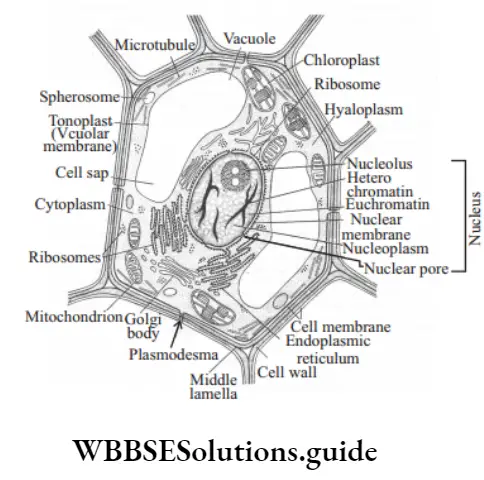
Question 3. Draw a neat labelled diagram of plant cell and label its parts.
Answer:
The Fundamental Unit of Life Class 9 long answer questions with answers
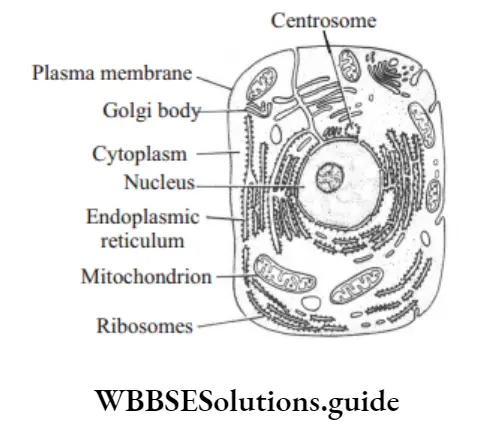
Question 4. Draw a neat labelled diagram of animal cell.
Answer:
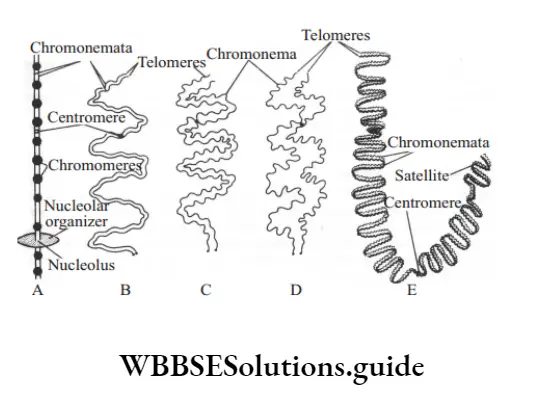
Question 5. Briefl explain the structure ofchromosomes.
Answer:
Chromosomes are thread-like structures usually present in the nucleus and become visible only during cell division. These contain hereditary information of the cell. DNA (deoxyribonucleic acid), and Proteins. DNA is the most important component of a chromosome. These look like rods during the metaphase stage of the cell division. Each chromosome consists of two arms called chromatids which lie side-by-side along their length. The two chromatids of a chromosome are attached at a point called primary constriction of centromere. One or both the arms of a chromosome may have secondary constrictions. The smaller part of chromosome separated by secondary constriction is called satellite. Chromosomes in which satellite is present are called SAT-chromosomes.
“fundamental unit of life “
Structure and function of cell organelles long answer questions
Question 6. Describe various components of a nucleus in a eukaryotic cell.
Answer:
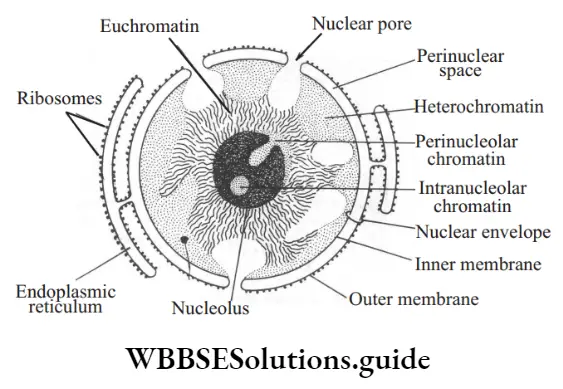
Nucleus envelope: It is bounded by two nuclear membranes, together referred to as nuclear envelope. The two nuclear membranes are designated as outer membrane and inner membrane.
Nuclear Sap: It is aclear, non-staining, flidmaterial present in the nucleus, also termed nucleoplasm. It contains raw materials, enzymes, proteins and metal ions for the synthesis of nucleic acids (DNA and RNAs) and ribosomal sub-units.
“class 9 science chapter 5 intext questions “
Chromatin material: It occurs in a non-dividing nucleus as fie fiaments termed as chromatin fires. These fires lie criss cross and give the appearance of a diffuse network. Chromatin fires help in cell division due to condensation of chromatin material. These are made up of DNA and proteins. The DNA possesses all the necessary information for the cell to function, grow and divide properly. The specifi segments of DNA are termed genes. These are the hereditary units.
Nucleus: There is/are one or more rounded bodies called nucleoli (singular: nucleolus) are present in the nucleoplasm.
Nuclear Matrix: It is a networkoffie, criss crossing, protein-containing firils which are joined to the nuclear envelope by their ends. These maintain the shape of nucleus.
Importance of osmosis and diffusion long answer questions NEET
Question 7. Explain structure and functions of plastids.
Answer:
The chloroplasts of higher plants are usually spherical, ovoid, discoidal or lens shaped. Each chloroplast is a vesicle bounded by double membrane envelope and filed with a flid matrix like the mitochondrion. The outer membrane is smooth and freely permeable to small molecules. Inner membrane is, however, selectively permeable. It has carrier proteins that control the passage of molecules. It is greatly infolded but the infolds become free in the mature chloroplast to lie as lamellae in the matrix.
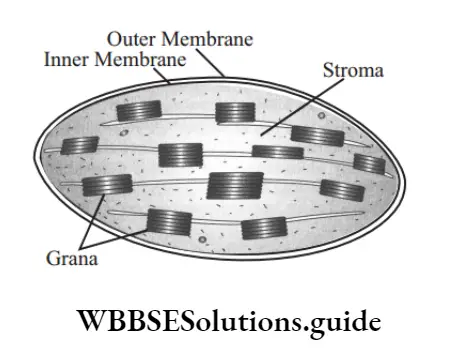
Plastids perform many important functions:
1. The chloroplasts trap the radiant energy of sunlight and transform it into the chemical energy of carbohydrates using water and CO2 (carbon dioxide). The process is called photosynthesis.
2. The chromoplasts impart various colours to flwers to attract insects for pollination and to the fruits for alluring certain animals for seed dispersal.
3. Leucoplasts store food in the form of starch (carbohydrates), fats and proteins.
“9 class science chapter 5 question answer “
Question 8.
1. What is endoplasmic reticulum?
Answer:
The ER is an extensive network of intracellular membrane-bound tubes and vesicles that occupies most of the cytoplasm in almost all eukaryotic cells.
2. Describe its structure.
Answer:
The membranes of endoplasmic reticulum system are lipoproteinic in nature similar in structure to the plasma membrane. The ER is more prominent in young and dividing cells as compared to older cells. It is absent in prokaryotic cells.
3. Name the two types of endoplasmic reticulum.
Answer:
The ER is of two types:
- Rough endoplasmic reticulum (RER)
- Smooth endoplasmic reticulum (SER)
NCERT-based long answer questions on The Fundamental Unit of Life
4. What crucial role does it play in the liver cells of vertebrates?
Answer:
The SER brings about detoxifiation in the liver, i.e., it converts harmful materials (drugs, insecticides, pollutants and poisons) into harmless substances for excretion by the cell.
5. What is membrane biogenesis?
Answer:
The endoplasmic reticulum helps in the manufacture of fat molecules or lipids, which are important for the cell function. These proteins and lipids helps in the building of the cell-membrane. This process is known as membrane biogenesis.
Plasma membrane and its functions long answer questions NEET
Question 9. Explain the following:
Answer:
Active transport
This type of transport across plasma membrane is rapid and requires the use of energy in the form of ATP. It usually occurs against the concentration gradient and involves the use of carrier proteins. Glucose, amino acids and some ions (e.g., Na+ and K+) pass through the plasma membrane by active transport or contransport.
Exocytosis
Exocytosis is the process that involves fusion of membrane of the exocytotic vesicle with the plasma membrane to extrude its contents to the surrounding medium.
Phagocytosis.
Phagocytosis is the intake of solid particles by a cell through cell membrane. It is also called cell eating. Phagocytosis is the major feeding method in many unicellular organisms (e.g. , Amoeba) and simple metazoa (e.g., sponges). It is also the means by which leucocytes of blood engulf uninvited microbes (e.g., viruses, bacteria), cellular debris etc. in the blood. Such cells are called phagocytes.