WBBSE Solutions for Class 9 History and Environment Chapter 1 Some Aspects of the French Revolution Long Question and Answers

Some Aspects Of The French Revolution Introduction 8 Marks Questions & Answers

Question 1. Why did the Revolution break out in France? What was its significance?

Answer:

The Revolution break out in France Because 

(1) New ideas: The French Revolution of 1789 broke out in France because the country was prepared for such a situation. It should be noted that the characteristics of the old Regime were not peculiar to France. Monarchical absolutism, oppression of the peasantry and several other features existed in most of the countries of Western Europe. So there was nothing exceptional in the character or in the extent of the grievances of the French people.

Hence we must not imagine that the people of France suffered more grievously than those of many other lands. What was peculiar to France was the fact that the people there were more enlightened and intelligent and so were more conscious of their sufferings.

That was why the evils of the Old Regime came under greater scrutiny in France than elsewhere. Hence the motive force ‘of the Revolution was not the intensity of the sufferings of the French people, but a new unwillingness to submit to the anomalies of the Old Regime. The change in the angle of vision was largely due to the influence of the writings of the French philosophers.

The material revolution of 1789 was preceded by a revolution in the realm of ideas. Thus intellectual revolt was brought about by a group of French philosophers, of whom the most prominent were Montesquieu, Voltaire and Rousseau. Their writings gave expression to the discontent and indignation which lay latent in the hearts of the French people.

Class 9 English Bliss Class 9 Life Science
Class 3 English Class 9 Geography 
Class 10 Life Science  Class 9 History 
Class 9 History Class 9 Maths

The manifold ills and anomalies from which the-station suffered, coupled with the mistakes of the Government, brought about the catastrophe. Nevertheless, these writers were a powerful factor in the Revolution. Into a soil prepared by social grievances and political abuses, the French philosophers flung broadcast the seed of philosophical speculation.

Their new ideas and theories upset men’s convictions and changed their outlook. Their writings exposed the evils of the Old Regime, focussed public attention upon them, compelled discussion and aroused the passion of the people instilling into them new ideas and doctrines. Thus the French philosophers habituated the people to the destructive criticism of the existing institutions and thereby prepared their minds for a revolutionary “change.

Wbbse Class 9 History Chapter 1 Some Aspects Of The French Revolution Long Questions With Answers

Question 2. What was the condition of France on the eve of the French Revolution of 1789?
Answer:

The condition of France on the eve of the French Revolution of 1789

(1) Evils of Absolutism: The Government of France was a highly centralised monarchy in France since the days of the reign of Louis 14. The representative institutions that France had at one time possessed had either been destroyed or brought under the King’s control. The States General (the feudal Parlement of France) had ceased to exist Hence the King ruled like an absolute monarch. His function was to command the people to obey.

All the functions of the Government being absorbed by the king required a ruler of exceptional ability to carry on the duties of the royal office. Louis 14, whatever might have been his defects, was never wanting in assiduity and anxious care for his country. But his successor, Louis 15 was weak and frivolous, enjoying the sweets of the royal office, while shirking the responsibilities attached to it The consequences of centralised Government under an incapable ruler soon manifested themselves.

The task of governing fell to a greedy horde of courtiers who sacrificed every interest of the state to advance their selfish ends. To the evils of corrupt administration were added the evils of oppression. Anybody might be imprisoned by the mere issue of warrants called letters de cachet, one of the most odious features of the Old Regime. A Government at once corrupt and arbitrary could not but produce widespread discontent and the people remained in sullen silence.

(2) Inequality: The French society was graded from top to bottom and each grade differed from others in legal rights and the enjoyment of powers and privileges. Broadly speaking, it may be said that France was divided into two classes, privileged and unprivileged. The privileged class included the nobility and the higher clergy.

They enjoyed a total or partial exemption from taxation and also had a monopoly of honours and emoluments. The unprivileged class included the bourgeoisie or the middle-class citizens, the labourers and the peasants. They formed what was called the Third Estates. They practically bore the whole burden of taxation and were at the same time excluded from all places of authority.

(3) The Nobility: The feudal nobles had mostly degenerated into a body of greedy courtiers. In feudal times the nobility enjoyed exemption from taxation as well as other feudal privileges in return for services they rendered to the Provincial Government. But as the monarchy became centralised the local services were performed by the Central Government, the nobles being deprived of all local power.

But they continued to enjoy the privileges of feudalism though they were not called upon to perform the duties attached to the system. The absence of duties made the continuance of rights anomalous and irritating. It was this that roused the indignation of the peasants when they were subjected to the feudal exactions of nobles.

(4) The clergy: The clergy along with the nobility formed the whole privileged class. In the Church as elsewhere, we find the same inequality and favouritism. The higher clergy monopolised all the lucrative Church offices but were quite indifferent to their spiritual duties.

They were recruited from the younger sons of the nobility and they conducted themselves as typical men of the world, being devoted to self-advancement and given to the pleasures, intrigues and dissipation of the court On the other hand, the lower clergy, who did the real work of spiritual consolation and instruction, were wretchedly recompensated. They had to work in poverty without any hope of promotion. Hence they formed a discontented class ready to join hands with the common people against the abuse of favouritism and absolutism.

(5) The Third Estate: Below the two privileged orders, there was the vast majority of the population called the Third Estate. It was not a homogeneous body. It comprised the bourgeoisie or the upper middle class, the artisans and the peasants.

(1) The bourgeoisie or the upper middle class formed the well-to-do, intelligent and energetic section of the community. They were practical businessmen who had gotten with wealth a secured monopoly of municipal appointments. Conscious that they were as good as the nobles, they keenly resented the existing system under which they were made to feel in numerous ways their social inferiority. Although their interests differed from those of the other members of the Third Estate, they were a discontented class and wanted political and social reforms.

(2) The artisans and labourers, although belonging to the Third Estate, were much worse off than the bourgeoisie. They were completely at the mercy of the rich middle class which controlled commerce and industry through guilds and similar close corporations.

(3) The condition of the peasantry, which formed by far the largest section of the population, was deplorable in the extreme. The peasant had to pay rent to his feudal lord, tithes to the Church and taxes to the king. The whole burden of taxation fell with a crushing weight upon him, especially because the privileged orders were more or less exempt from taxation.

(6) Inequality of taxation: The system of taxation had almost every conceivable defect. It was unjust, odious and honey-combed with favouritism. The privileged classes being more or less exempt from taxation, the burden fell more heavily on the common people. Thus the rich who could support the state paid the least, while the poor who were already over-burdened were crushed with the weight of taxation. The oppressive nature of taxation was further heightened by the method of its collection.

The state often sold the right of collection to private individuals who paid a lump sum to the Government and then collected the taxes themselves, seeking, of course, to exact as much as possible from the people. It is not unnatural that inequality of taxation and its oppressiveness should prove one of the most decisive causes of the Revolution.

Wbbse French Revolution Class 9 Short Question Answers

Question 3. What were the causes of the French Revolution?
Answer:

The causes of the French Revolution

(1) Introduction:  Next to the Reformation, the French Revolution was undoubtedly the greatest event in the history of Europe. It is of such far-reaching importance that the West is still under the influence of the forces, the Revolution let loose — Nationality and Democracy. The death of the Old Regime in France which was honey-combed with abuses of every sort was gone due to a combination of circumstances.

(2) Political Causes :

(1) Arbitrary rule: 1) Absolute divine-right monarchy was the rule all over the continent. The kings of France ruled arbitrarily. They imprisoned people without trial by a mere order, a letter de cachet There was no intellectual or civil liberty in France.

(2) The Palace of Versailles: The kings of France lived isolated twelve miles away from the capital amid the splendours of the palace of Versailles. The magnificent court of the French King was a riot of extravagance and the envy of Europe. It proved to be the veritable nation’s grave.

(3) The rule of weak kings: The kings that claimed absolute rights in France preceding the Revolution were not ‘grand monarchs’ like Louis XIV but weaklings like Louis XV and Louis XVI. They became puppets in the hands of the nobles and favourites. Louis XV was under the evil influence of Madam de Pompadour.

(4) Defective organisation of the State: The Government of France was highly corrupt, complicated and inefficient It was full of disunity, diversity and variety. France was split into forty provinces-‘forty Governments’. Weight and measures had different names in different parts of the country. Something like 285 codes of law prevailed.

(5) Over-centralisation: France was an over-centralised State but lacked unity. Local self-government did not exist in France. The Government was determined and t directed by Versailles which was the source of endless delays. The Central Government was represented by the Intendants on whom depended, in large measure, the happiness or misery of the people.

(6) Army: The French army was greatly reduced in numbers and was influenced by revolutionary ideas.

(7) Foreign policy: France, since the time of Richelieu, followed an ambitious foreign policy. It aimed at the glory of the Bourbons regardless of the French people. The various and costly wars of Louis 14 left France practically a desert.

(3) Social causes: The structure of French society was essentially feudal. It was divided into three classes, rigidly cut off from one another—the Nobles, the Bourgeoisie and the Peasantry. Graded from top to bottom, each social section sharply differed from another in the enjoyment of power and privileges. French society was cut into two distinct classes. One the privileged and the other unprivileged.

While the first included the nobility and the higher clergy, the second comprised the middle-class citizens or bourgeoisie, the labourers and the peasants. The third estate was the convenient name given to the second class. There was a strange relationship between the two classes. While the privileged class was affluent, it paid little to the State treasury, whereas the poor second class was heavily overburdened with taxes.

(1) The Nobility: The Nobles and the upper clergy were the most privileged class. They led lives of luxury in the court of the King and everybody was jealous of them. The nobles enjoyed the privilege of exemption. At the same time, they could levy certain taxes on their Estates. Another feudal privilege was the corvee or feudal labour on roads.

The lord could summon any of his peasants to work at road¬making, without wages. One more privilege was the exclusive right of hunting. The peasant had no right to disturb the game although it was destroying their crops. Thus, aristocratic privilege in France ruined agriculture and trade.

(2) The bourgeoisie: The bourgeoisie was the middle class, and was, like the nobles, small in numbers. But they were educated thinkers and comprised lawyers, physicians, teachers, merchants, bankers, etc. They were rich and intelligent and favoured a political reorganisation and social revolution. It was from this class that the revolutionary leaders sprang – Rousseau, Danton and Robespierre.

(3) The peasantry and the artisans: The peasants and the artisans were the lowest and the largest class. They constituted 4/5 of the entire population. The burden of society fell with a crushing weight upon them. They paid 55% of their earnings to their State. In addition, they had paid tithes to the Clergy, numerous feudal dues and salt and excise duties. In all, they paid 4/5 of their income by way of taxes and were left with only 1/5 to support their families. No wonder, they were the most discontented.

(4) Religious Causes: The Church in France, like the other institutions of the country, was corrupt Privilege and favouritism were found in the Church and elsewhere. The higher clergy resided in court and lived a gay and worldly life. The lower clergy were poorly paid. Hence, they sympathised with plans for reforms and powerfully aided the popular cause in the Revolution.

(5) Taxation: Those who could pay the taxes — the nobility and the royal prince—were exempt from taxation. So the burden fell upon the peasantry and the middle class. The system of taxation varied from region to region and from year to year.

Class 9 History Some Aspects Of The French Revolution Long Answer Questions Wbbse

Question 4. How far was the intellectual movement responsible for the Revolution of France? Or, Can you trace the influence of French philosophers on the course and events between 1789-1795? Or, Critically examine the influence of French philosophy on the causes of the French Revolution.
Answer:

(1) Ideas of the philosophers: The material revolution of France of 1789 was preceded by a revolution in the realm of ideas. Within the French society of discontents were the writers stimulating them, pointing their discontents, dissolving the traditions which alone held them together, voicing their grievances, giving them a lead of faith, for in a land of no Parliament the men of letters had come to be the politicians.

In innumerable ways, they demonstrated the rottenness of French institutions — by satire and wit, criticism and comparison, analogy and innuendo, scientific exposition, sociological theory, and downright abuse. The literature made excellent gunpowder for destroying the State, and never before was a revolution so armed with words and phrases.

Writers of all kinds prepared for the French Revolution. Early in the century, there was Montesquieu. He was not a revolutionary and he was both a Catholic and a monarchist. He criticised the abuses of the church and the despotism of the State. He criticised by satire.

He believed in the British system of Government, and he believed in the principle of liberty and equality which were the safeguards of freedom. In his famous book. ‘The Spirit of Laws’, he analysed the principle of Government and traced the evolution of laws and the Constitution with special reference to the theory of separation of powers.

A contrast to Montesquieu in method and temperament was his more famous junior contemporary Voltaire. He was the most honoured man in Europe in the middle of the 18th century. He was an indefatigable writer-poet, historian, philosopher, dramatist, correspondent and pre-eminently satirist.

He was inspired by a wide philanthropy, a caustic wit and a bitter hostility to the church. But he was not a Democrat. To attack the altar was ultimately to undermine the throne which rested on it, but Voltaire never consciously aimed at the monarchy and he was fully aware of the dangers of popular Government

The authority which Voltaire respected was destroyed by Jean Jacques Rousseau. Rousseau began where Voltaire left off; the latter harnessed the horses of reason, and the former unchained the tigress of emotion. The political influence of Rousseau’s works especially on Social contracts was incalculable not only in France but in all of Europe.

His fundamental theory was that of the inherent virtue of the “natural man” whom civilisation and institutions had corrupted and deprived of his natural rights to liberty and happiness. “Man is born free, but everywhere he is in chains.” According to Rousseau, laws should be the “general expression” of the deep, instinctive conscience of society.

Kings were the creations of an original contract framed by the people for the promotion of their welfare and a sovereign’s title was dependent upon his guardianship of the rights of his subjects. The people had lost their rights, the contract had been violated, and the crown had forfeited the allegiance of the nation. This revolutionary, though unhistorical, idea was destined to destroy the monarchy of France.

Montesquieu, Voltaire and Rousseau were the giants of the age. But there were other thinkers also whose contributions could not be neglected. Denis Diderot was a brilliant and versatile scholar. He organised a team of researchers and with their collaboration published the Encyclopaedia in seventeen volumes. In this book, Diderot collected together all human knowledge including the latest findings. It became a very popular work. In 1765, when it first appeared, four thousand copies were subscribed.

The philosophers directed their search enquiry also in the field of economics. A school of economists called physiocrats preached their theories. They were led by Quesnay. They criticised mercantilism and State regulation of trade and industry which prevailed in France.

They believed that nature was the single source of all wealth. They strongly urged free trade and free circulation of goods without Government interference. They denounced State paternalism of industry and advocated laissez-faire. Thus the French philosophers created a mental revolution by exposing the hollowness of the ancient regime.

Wbbse French Revolution Class 9 Short Question Answers

(2) Nature of the influence of the philosophers: Historians differ about the extent of the influence of the philosophers on the causation of the French Revolution. According to some of them, is a mistake to ascribe the French Revolution to the influence of the writings of these philosophers.

The manifold ills and anomalies from which the nation suffered, coupled with the mistakes of the Government brought about the catastrophe. Nevertheless, these writings were a powerful factor in the Revolution. Into a soil prepared by social grievances ended by political abuses, the French philosophers flung broadcast the seed of philosophical speculation.

Their new ideas and theories upset convictions and changed their outlook. Their writings exposed the evils of the Old Regime focusing public attention upon them, compelled discussion and aroused the passion of the people by instilling into them new ideas and doctrines.

Thus the French philosophers habituated the people to the destructive criticism of the existing institutions and thereby prepared their minds for a revolutionary change. In short, the idea of the philosophers filtered down among the Frenchmen and destroyed their faith in the old order in France.

Wbbse Class 9 History Chapter 1 Long Answer Type Questions With Solutions

Question 5. Describe the work of the National Assembly during the French Revolution.
Answer:

The work of the National Assembly during the French Revolution

(1) Introduction: Louis 16, unable to face the financial crisis in France, was at last forced to summon the States General in May 1789, which had not met for 175 years. A new chapter was opened up in the history of France. The King recalled Necker to head the ministry. The leaders of the Third Estate at that time were Mirabeau, Abbe Seiyes and Lafayette.

(2) The National Assembly: Friction arose between the Third Estate and the King on the question of voting. The nobility and the clergy wanted separate chambers in the assembly while the Third Estate insisted on only one. In June, it took the momentous and revolutionary step of declaring itself the National Assembly.

(3) Tennis Court Oath: At this, the king blocked the entrance of the Assembly Hall with soldiers. Thereupon the members of the Third Estate met at the adjoining Tennis Court and took the famous Tennis Court Oath, never to separate until the Constitution of the kingdom was established.

(4) The Royal Session: In the Royal Session of June 23, 1789, the king ordered the members of the Third Estate ‘to vote by order’. At their refusal, he sent a message demanding their withdrawal. The occasion brought forth.

(5) The National Constituent Assembly: The King yielded to the demands of the Third Estate and he ordered the Nobility and the Clergy to sit with the Third Estate in a single assembly. The National Assembly was now complete. It immediately appointed a committee to frame a Constitution and adopted the title of Constituent Assembly.

(6) The Storming of the Bastille: The King, inspired by the Court, made a second attempt to suppress the Assembly. A considerable number of mercenary soldiers began to appear near Versailles and Paris. On July 11, Necker was suddenly dismissed. The Paris mob became violent and on July 14, the Bastille, the notorious State person was stormed. It was the triumph of liberty. The 14th of July was declared a national holiday and the Bourbon flag was displaced by the new tricolour flag.

(7) Reforms of the National Assembly :

(1) The August Days:
The National Assembly in the “August Days” began tearing down the old regime and building up a new order in society, Church and State.

(2) Abolition of Feudalism: On August 4, 1789, a frenzy of generosity seized the Assembly and thirty decrees were passed which brought about an extraordinary social revolution in France. The Feudal dues and tithes were abolished. The guilds with their narrow restrictions were swept away, public offices were thrown open to all. Provinces as well as individuals were awarded equality. Distinctions of the class were abolished and the principle of equality was made the basis of the State.

(3) Declaration of the Rights of Man: The Declaration of the Rights of Man by the Constituent Assembly of France has been regarded as the gospel of modern times. This declaration reflected the influence of the philosophy of Rousseau and borrowed ideas and phrases from the English Bill of Rights and the American Declaration of Independence. It proclaimed the freedom of religion, expression, press, and property, and security and equality before the law. It announced that men are born free and equal in rights.

(4) The Civil Constitution of the Clergy: The Civil Constitution of the Clergy was promulgated by an Act of Assembly. By this new law, the bishops and priests were reduced in number. They were to be chosen by the Electors elected by the people, paid by the State and only nominally subjected to the Pope. All clergymen must take an oath to support this civil Constitution of the clergy. Naturally, such a Constitution was not acceptable to sincere Catholics.

(5) Financial Reforms: The primary function for which the National Assembly was summoned in 1789, was to solve the financial problem. It tried to solve this in two ways — firstly, by issuing paper currency, and secondly, by confiscating church lands. The paper money proved a total failure by 1791. The Assembly did nothing to improve the finances. It left national finance in a worse condition.

(6) Reorganisation of Administration: The old 32 provinces were abolished and France was divided into 83 departments of nearly uniform size, for administration and local Government. The departments were subdivided into Arrondissements, cantons and communes. Local officials were to be elected by the people. A new system of courts with elected judges was established. A highly centralised State became one highly decentralised. The local divisions made by the National Assembly exist in France even to this day.

(8) The Constitution of 1791: A new Constitution was promulgated in 1791 which incorporated Montesquieu’s theory of Separation of Powers. It introduced a Constitutional monarchy in France. The English system of Parliamentary Government was deliberately avoided. The executive or the ministers were separated from the legislature. The King was deprived of the law-making function, but he was given a suspensive veto. The Assembly was to consist only of one House. Its 745 members were to be elected for years indirectly by active citizens or taxpayers. This excluded the poor.

Wbbse French Revolution Class 9 Short Question Answers

Question 6. How far is it true to say that the old regime in France could not fit with the spirit of the time of 1789?
Answer:

With the meeting of the Estates General at Versailles in May 1789, the Ancient Regime came to an end together with a good many institutions and ideas to which Europe had grown accustomed during the previous three hundred years. But it is a paradox that no important people or forces in France of 1789 wanted revolution. Revolutions may begin as wars often begin a lot because people positively want them. They happen because people want other things that, in a certain set of circumstances, implicate them in war or revolution.

There had been growing in Europe, throughout most of the eighteenth century, what has been called the “revolutionary spirit.” This spirit, a spirit of rationalist criticism and resistance to the established powers of the Roman Catholic Church, the absolutist monarchy, and the privileged nobility was fostered particularly by the work of a remarkable series of French thinkers and literary men, the philosophers. The writings of men like Voltaire, Montesquieu, Diderot and Rousseau were widely read throughout Europe, and they became European figures of eminence and influence.

But the connection between their ideas and the outbreak of the revolution in 1789 is somewhat remote and indirect They did not preach revolution and were usually ready to lend support to any absolute monarch who was prepared to patronize them and adopt their teachings.

But no doubt they had fostered a critical and irreverent attitude towards all existing institutions. They made men more ready, when the need arose, to question the whole foundation of the old order. What mattered in 1789 and what made men revolutionary almost despite themselves, was the whole revolutionary situation and in producing that situation the works of the philosophers played no very important role.

Louis XVI won fresh popularity when he made known his intention of summoning the Estates General. His action aroused hopes of liberal and constitutional reforms and just as nobody of importance wanted revolution, so nobody of importance wanted a republic before 1792. Yet the king’s well-received action of summoning the Estates General precipitated revolution.

“The nobles fight, the clergy pray, the people pay” -this feudal idea was openly challenged by the Third Estate, the people, the non-noble and non-clerical class. Feudalism had come to mean social inequality and social privilege, beginning with class feelings and ending in the class war. The summoning of the Estates General suddenly allowed the leaders of the Third Estate to make their social and economic weight politically effective. It was a chance they seized with both hands.

By not only arousing hopes of liberal reform but also drawing together many of the people most eager for an overhand of the social and political system, Louis crystallized the revolutionary situation. It was only after he had forfeited his original public support by his lack of policy, his wavering and disappointing conduct and in the end the open betrayal of his own promises, that republicanism grew. But the King and his ministers were also in dilemma. They could not satisfy the demands of the middle class without destroying the ancient rights of the nobles and the clergy.

They could not do this without changing and challenging the feudal structure of French society. The Divine Right of the king was questioned, his autonomy in jurisdiction was denied and his financial powers were also a subject of criticism. So only a monarch prepared to be a revolutionary could have escaped from the dilemma. That is also a paradox. And it has been aptly remarked, “France presented indeed the combination of grievance and independence of obscurantism and enlightenment of irritation and incentive, which makes the best material for revolution.”

Wbbse Solutions For Class 9 History Chapter 1 Long Questions And Answers

Question 7. Examine the work of the Constituent Assembly in the French Revolution up to 1791.
Answer:

The work of the Constituent Assembly in the French Revolution up to 1791

The Assembly was unaware of the need for rules, it tolerated disorder in its meetings, it laid itself open to pressure from the galleries, and it forbade the King to choose his ministers from among its members — an insane decision which deprived France of a Mirabeau Cabinet. In short, the Assembly wanted parliamentarians without any of the conditions which make parliament possible.

In religious toleration the Constituents went beyond the Declaration on Dec. 27, 1789, protestants were given civic rights which were granted one month later to the Jews in southern France. Freedom of belief, however, did not triumph completely, and public worship remained a Catholic monopoly.

The Declaration recognised all citizens the right to take part in person or through their representatives in the making of laws. But the Constituent Assembly established a wholly representative system, national sovereignty was only exercised when elections were held, and thereafter the people’s delegates wielded unlimited power.

However, the Assembly could not establish a limited monarchy in France. The King was responsible to no one and was inviolable. No measures were taken to govern the case of high treason on his part The King was granted diplomatic initiative and the right to appoint military leaders, ambassadors and six ministers according to his own choice.

In defiance of the separation of powers, he was even given a suspensive veto to be valid for two legislatures over decisions of the Assembly, yet he was denied the exercise of powers and the Legislative Assembly was made master of the State, and the Legislative Assembly was the French bourgeoisie. Thus Constitutional monarchy was a bourgeoisie republic with no real government.

The Constituent Assembly, in effect, completely decentralised the administration of France. Provinces and local communities long ruled by intendants unanimously demanded the end of royal authority. Decree of Dec. 14, 1789, accordingly granted wide powers to municipalities. They were to levy and collect taxes, maintain public order and have the right to requisition troops and proclaim martial law.

Venality in office was forbidden and litigants would not have tolerated royal appointment of justices from the old regions to the new Courts. Judges were, therefore, elected like administrators. Central authority over administrative bodies was almost eliminated. The most the king could do was to suspend them, and the Assembly could reinstate them. By separating civil and criminal justice from administrative functions, an important improvement was made in that sphere.

Yet another great problem was before the Assembly to deal with, it was the reform of the clergy. On July 12, the Civil Constitution of the clergy was passed. The ecclesiastic organisation was adapted to the administrative framework. Each department had a bishop, and each commune had one or more local priests.

They would be elected like other civil servants. The Pope would no longer be able to draw on France for money, his supremacy was recognised but not his jurisdiction. But this arrangement did not satisfy the Pope and a permanent conflict continued with the Pope till the rise of Napoleon the Great

Class 9 History Chapter 1 Important Long Questions With Answers Wbbse

Question 8. Explain the specific features of the Constitutions of France of 1789, 1793 and 1795.
Answer:

The specific features of the Constitutions of France of 1789, 1793 and 1795

(1) Introduction: The deputies of the Legislative Assembly, just after their election, began to consider the new Constitution. They determined on the motion of Lafayette to publish a Statement of general principles, after the example of the American colonists. On August 12, therefore, was issued a Declaration of the Rights of Man, inspired by Geneva and Philadelphia, which proclaimed that all men being born equal should have equal rights.

But the cause of democracy was to suffer dearly for the comprehensiveness of its claims and for the reason it was a mistaken measure of policy. There was administered inevitable contradiction between the Declaration and the New Constitution which led to conflict for five years.

(2) Constitution of 1789: The political framework of the new Constitution was completed by the end of 1789. The legislative power was to be vested in a single chamber, chosen for two years, not by universal suffrage, but by a tax-paying electorate of a little over four million. Thus was the curtain immediately dropped upon the equal rights of man. Only men who paid at least fifty lives in taxes were landed proprietors. The same civil rights were extended to protestants, Jews and along with the abolition of titles, all careers were open to talent

The hereditary monarchy was retained, and the King, who was to adopt the title of King of the French, was to be the head of the army and the administration. He could nominate the highest officials and choose and dismiss ministers. He could coin money, direct the military forces, and if authorised by the Assembly, he could declare war. He was given only a suspensive veto, that is, he could delay the passing of a measure by holding it up until it had been passed by three successive assemblies.

Despite these limitations, the king retained as head of the executive a certain measure of power. In practice it was difficult for him to exercise it He had no taxing power; he could hardly initiate legislation, for none of his ministers could be members of the Assembly—a check upon the executive inspired by Montesquieu’s theory and America’s example.

The National Convention met on September 21, 1792, on the dissolution of the Legislative Assembly. It was summoned to draft a new Constitution, necessitated by the suspension of Louis XVI. Its first duty was to abolish the monarchy and declare France a Republic. It passed a decree of perpetual banishment against the emigres and adopted a revolutionary calendar from the birth of the republic.

In the meantime, Louis was found guilty by a narrow majority on the 18th of January 1793 and executed on the 21st Robespierre, now rapidly advancing to the leadership of the Jacobins, justified the judicial murder of the king. A Revolutionary Tribunal was set up in March 1793 and the Committee of Public Safety in April, and France was in the grip of the Terror for twelve months from September 1793 to September 1794. After the fall of Robespierre, the Jacobin club in Paris was closed in November. The terror was ended.

In 1795, the Republic attempted to establish a settled government in France by promulgating the Constitution of the year. The Executive was vested in a Directory, of five members, and profiting by previous blunders, a two-chamber legislature was set up. But the Directorial Constitution had a weakness of its own. With the help of a young Corsican, the Republic successfully suppressed the insurrection of the 13th Vendemiaire (5th October 1795). But in 1799, the Directory itself succumbed to a coup de tat effected by the gunner who had saved it in 1795.

Some Aspects Of The French Revolution Class 9 Long Questions Solutions

Question 9. Give an account of the Convention. Or, Describe the Reign of Terror during the Revolution.
Answer:

Convention

(1) Introduction: The National Convention was the third Revolutionary Assembly. It was assembled on September 20, 1792. It was in existence for three years. It became the task of the Convention to abolish royalty, establish a republic, consolidate the Revolution in France and wage a successful foreign war. These tasks were accomplished by terror, bloodshed and dictatorship.

(2) Girondins and the Jacobins: The majority of the members of the Convention belonged to the Girondins and the Jacobins. The Girondins and the Jacobins were entirely distinct revolutionary groups. The former was moderate and the latter extreme radicals. It is around the rivalry between the two that the period of the National Convention centres. The Girondins hated the leaders of the Jacobins— Robespierre, Marat and Danton.

(3) Work of the Convention :

(1) Abolition of Kingship: The first act of the Convention was the abolition of monarchy as an institution. It constructed a republican form of Government based on the principle of democracy.
(2) Execution of Louis 16: Louis XVI was brought to trial before the Convention on a charge of treason, found guilty and condemned to death. He was beheaded on January 21, 1793.
(3) The New Republican Army: Under the leadership of Carnot, the Convention inaugurated militarism which was quite novel in the world’s annals. In 1793, by conscription, an army of 7,70,000 was raised. A new group of dashing republican generals like Moreau, Pichegru and Jourdan rose to distinction. On the other hand, the first coalition of the European powers was formed this time and it began to attack the frontiers of France.
(4) Collapse of the Coalition: The country was cleared of foreign enemies and Carnot, the organiser of defence, led the country to victory. The first Coalition against France was dissolved. Spain and Russia made peace with France. Only Britain, Austria and Sardinia remained in arms against France.
(5) Effects: The military success of the Republic was achieved at too great a cost. The National Army became the chief concern and the pride of the revolution arose. It led to a serious peasant revolt in La Vendee to restore the monarchy and the Catholic Church. The revolt was crushed.

(4) Creation of a strong Central government: The Convention established a strong Central Government and powered a policy of terrorism. For this purpose, it created three organs :
(1) The Committee of Public Safety: It consisted of 12 members elected for one month. It discharged an enormous mass of business of every kind hour after hour.
(2) The Committee of General Security: Its business was the police duty of maintaining law and order throughout the country. A multitude of suspected persons was thrown into prison.
(3) The Revolutionary Tribunal: This was an extraordinary criminal court for trying traitors and conspirators rapidly by applying the Law of Suspects. No appeal could be taken from its decisions. Its sentences were always death sentences.

(5) The Reign of Terror-Danton: The creation of the instruments of despotism commenced in France, which is known as the Reign of Terror. Danton was the chief architect of the Reign of Terror in the first stage of the reign. It lasted from the summer of 1793 to that of 1794. The Terror began in Paris and spread to the Provinces. About 5000 in Paris and about 15000 in the Provinces were guillotined. Among those guillotined was Marie Antoinette, the hated ‘Austrian woman’ and wife of Louis 16. The chief spokesman of these atrocities was Danton, the Dictator, and the leader of the Cordelier Club.

All counsels of clemency were counted as treason. The Girondins became the victim of their moderation. Incited by Marat, a Parisian mob expelled the Girondins from the Convention. Many of them were afterwards guillotined. Among them was Madam Roland, the romantic woman leader of the Girondins. The worse ferocities were reserved for La Vendee. The Duke of Orleans who, as Philip Equality voted for the death of his cousin, Louis XVI, was executed.

Many distinguished men like Bailly and Barnaves were killed and Condercit, fleeing from the Terror, committed suicide. The Herbeitits, a group of extremists and socialists who favoured the destruction of all churches and the establishment of atheism, were executed jointly by Danton and Robespierre. Yet all this did not constitute the ‘great Terror’ that came later.

(6) The Great Terror: Robespierre: Danton who began the Reign of Terror himself paid the penalty. He grew sick of bloodshed and advocated moderation. Robespierre, his secret enemy, condemned Danton on a charge of treason and he was guillotined. Robespierre, the leader of the Jacobin Club, became supreme in the Convention and the Committee of the Public Safety with his advent, began what is called the Great Terror.

Day after day, the butchery went on. It brought about the fall of Robespierre, and he like Danton, went to the guillotine. With the death of Robespierre, the terror was gradually abandoned. The ‘Thermidorian Reaction’ set in and a milder regime began.

Wbbse Class 9 History Chapter 1 Essay Type Questions And Answers

Question 10. How do you explain the emergence of the Directory?
Answer:

(1) Introduction: After the end of the reign of Terror, the Convention sat until 1795. It reorganised its committees and readmitted surviving Girondins to positions of power. The Convention gave up attempts to enforce the laws of the Maximum and some of the emigres began to find their way back into France.

Abandoning the draft Constitutions of both of Girondins and the Jacobins, the Convention now drew up a third, which betrayed not only fear of the executive but also fear of the mob. It began with a declaration of duties as well as of rights. The Constitution came into operation in October 1795 and lasted until November 1799.

(2) The Directory: The Directory of the five, which held executive power under this new Constitution, was ill-fated from birth. The men who successively became Directors were, except for the patriotic organising genius of Carnot, disreputable and self-seeking politicians of little ability.

The corrupt leaders of a period when the moral standards of social and political life were exceptionally low-ebb, they presided over the final liquidation of the Revolution, opposed equality to royalist reaction and furthered mob violence, their aim was a Constitutional parliamentary system on a narrow base, moderate in action and so devised as to prevent dictatorship. They succeeded in preventing a repetition of Robespierre’s revolutionary dictatorship. Explanation of how this came about lies in their success in crushing rebellion at home and their failure to produce victory abroad.

At home, the Directory faced its first political crisis with the elections of 1797, which it was expected would result in an anti-Jacobin majority. Only 13 out of 216 retiring members of the Council were returned, a clear enough protest against the failure of the Government to restore French credit and currency and to alleviate the widespread social distress. In September 1797, the Directory forestalled the arrival of the new hostile and royalist majority.

With the help of Napoleon Bonaparte, it expelled the newly elected members from the assembly. By this coup, the directors forfeited their last shreds of legality and henceforth relied more openly on armed force. Bonaparte’s seizure of power was brought one step nearer. The political system was as bankrupt as the treasury. Of the five Directors, Barras and Sieyes were resolved to resort to the ultimate sanction, an open alliance with Napoleon Bonaparte, the most popular personality in France with a victorious army at his command.

In foreign affairs, the army assumed an ever greater role. By the beginning of 1796, France’s only active enemies on land were Austria and Sardinia and at sea Great Britain. The Convention made peace with Holland, Spain and Prussia. By incorporating the former Austrian Netherlands into France in October, it was committed to continuing the war against Austria, which would not accept this loss, while the British refusal to make peace, even after the break up of the first coalition, kept the war at sea.

Peace had also been made with Portugal and the German States, Saxony and the two Houses, with the Italian States of Naples, Parma and the Papacy. By the beginning of 1796, the Directory was able to concentrate all its efforts against Austria. On October 17, 1797, Austria signed the peace of Campo Formio and it was a settlement as characteristic of sly Napoleonic diplomacy as the campaign had been of Napoleonic generalship.

Then Napoleon departed on an expedition to Egypt designed to cut off the British from India. By May 1799, he was severely defeated by Nelson, the British admiral. The campaign produced a second coalition against France. Despite his losses and reverses, he was the only man in France who enjoyed general confidence and in the new conditions of emergency, it was to him that men burned.

(3) Unpopularity of the Directory: The tragedy of the Egyptian campaign cast no shadow on the fortunes of Bonaparte. A new Coalition had been formed against France in his absence, and the French were driven out of Italy and France itself was threatened with invasion. The Directory was discredited because of its corruption, incompetence and blunders.

When Bonaparte landed at Frejus, a thrill of delight and relief passed through France. Every peasant enquired about the news of General Bonaparte, but no one enquired after the Directory.

(4) Coup d’etat of Bonaparte : On November 9-10, 1799, Napoleon, assisted by Abbe Sieyes, successfully overthrew the Directory, an incident known as the Coup d’etat of Brumaire. A provisional consulate was appointed and a new Constitution was drawn up for France with Napoleon as First Consul and Ducos and Abbe Sieyes being the other Consuls.

WBBSE Solutions For Class 6 Maths

WBBSE Solutions For Class 6 Maths

Werner’s Theory of Coordination Compounds Notes

Werner’s Coordination Theory

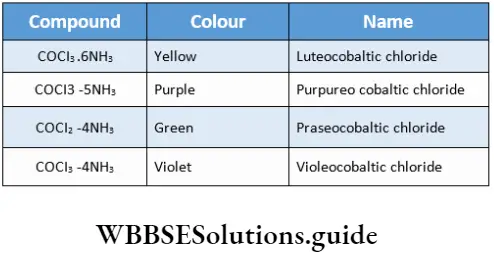
Alfred Werner, a Swiss chemist, won the Nobel Prize in 1913 for his work on the linkage of atoms and the coordination theory. Prior to him Tassaert had observed and noted that two stable compounds, cobalt(3) chloride and ammonia, combined to give a stable compound, CoCl3 -6NH3. A series of such compounds was then prepared and they were initially named on the basis of their colours.

Coordination Compounds and Organometallics Series of compounds formed by the reaction

Werner studied such compounds and, in 1893, proposed his coordination theory, which has been a guiding principle in the advancement of inorganic chemistry. Werner put forward his theory before the discovery of the electron and therefore had no idea about the electronic theory of valency.

The postulates of Werner’s theory are as follows.

  1. A metal exhibits two types of valency—(a) primary valency and (b) secondary valency. In modem terminology, primary valency refers to the oxidation state (number of charges on the complex ion) and secondary valency, to the coordination number. The primary valency is ionisable while the secondary valency is not.
  2. Every metal tends to satisfy both types of valency. The primary valency is satisfied by negative ions that neutralise the charge and the secondary valency by ligands (neutral molecules or negative ions).
  3. The secondary valencies are directed towards fixed positions in space.

Werner’s theory of coordination compounds class 12 notes

Such spatial arrangements are called coordination polyhedra. This leads to the definite geometry of coordination entities and explains isomerism. (Isomerism is noted in green and violet forms of CoCl3.4NH3.)

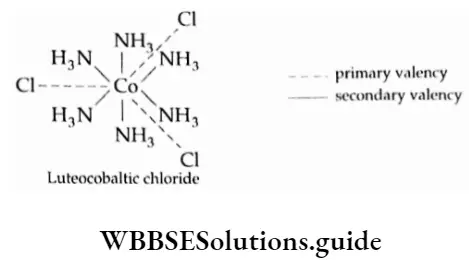
Werner designated CoCl3 -6NH3 as the coordination compound having three chlorines as primary valencies and six ammonia as secondary valencies.

Coordination Compounds and Organometallics Luteocobaltic chloride

Werner formulated the complex as (CO(NH3)6]CI3. The primary valency (Werner’s theory) or oxidation state (in modern terms) of cobalt is +3, satisfied by three chloride ions. The secondary valency or coordination number is 6, satisfied by six ammonia molecules.

The coordination sphere comprises cobalt and six NH, ligands which are nonionisable. The ionisation sphere comprises three ionisable Cl ions. The complex dissociates to give four ions, [CO(NH3)6]3+ and 3Cr.

When one mole of the compound is treated with excess silver nitrate, three moles of AgCl are precipitated. CoCl3 -5NH3 is formed from CoCl3•6NH3 by the loss of one ammonia molecule.

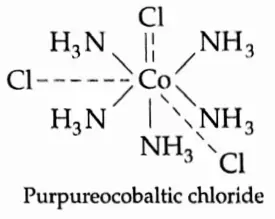
Coordination Compounds and Organometallics Praseocobaltic chloride

The complex was formulated as [Co(NH3)5CI]CI2. Werner did this in accordance with postulate 2, which states that both primary and secondary valencies must be satisfied. There are five NH3 molecules, so one Cl serves the dual purpose of satisfying primary and secondary valencies.

Such a Cl is nonionisable. On adding silver nitrate two CI ions are precipitated as AgCl and the complex ionises to give [Co[NH3)5Cl]2++ 2CI.

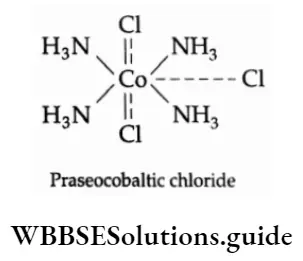
Extending the theory to CoCl3.4NH3, Werner gave the following formula for the compound: [CO(NH3)4Cl2 ]+ Cl. This gives 1 mole of AgCl with silver nitrate.

Coordination Compounds and Organometallics Praseocobaltic chloride.

Postulate 3 of the theory deals with the stereochemistry of coordination entities. Werner suggested that six-coordinate complexes have octahedral structures whereas four-coordinate complexes have square planar or tetrahedral structures.

Werner's Theory of Coordination Compounds Notes

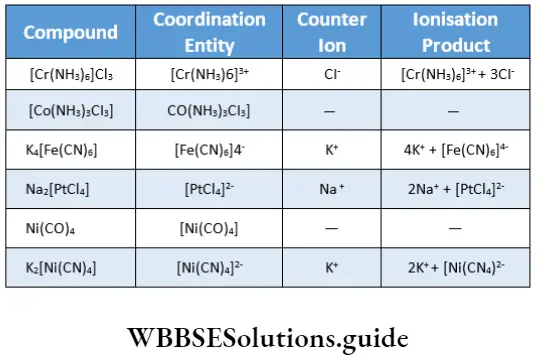
Example What are the coordination entities and counter ions in the given compounds? How do they ionise in solution?

⇒ \(\left[\mathrm{Cr}\left(\mathrm{NH}_3\right)_6\right] \mathrm{Cl}_3,\left[\mathrm{Co}\left(\mathrm{NH}_3\right)_3 \mathrm{Cl}_3 \mathrm{l}, \mathrm{K}_4\left[\mathrm{Fe}(\mathrm{CN})_6 \mathrm{l}, \mathrm{Na}_2\left[\mathrm{PtCl}_4 \mathrm{l}, \mathrm{Ni}(\mathrm{CO})_4, \mathrm{~K}_2\left[\mathrm{Ni}(\mathrm{CN})_4\right]\right.\right.\right.\)

Solution table

Coordination Compounds and Organometallics Coordination entities and counter ions

[CO(NH3)3CI3]and Ni(CO)4 do not have counter ions.

Example Specify the oxidation numbers of metals in the following.

  1. [Cr(CN)(H2O)(en)2]2+
  2. [PdBr4]2-
  3. [CoCI3(H2O)3]
  4. [CrCI2(en)2]+
  5. K3(Cr(CN6)]

Solution

To find the oxidation numbers of the respective metals in each case, let us assume the oxidation number to be x

(1) Oxidation state of CN = -1 and H2O and en are neutral.

∴ x-1 +0 + 0 = 2,   ∴  x = +3.

(2) The oxidation state of Br = -1.

∴ x + 4(-l) = -2

or x-4 = -2,    ∴  x = +2.

(3) The oxidation state of Cl = -1 and H2O is neutral.

x + 3{-1) + 0 = 0  or   x-3 = 0, ∴ x = +3.

(4) Oxidation state of Cl = -1 and en is neutral.

x + 2(-1) + 0 =1 or x- 2 =1,  ∴ x = +3.

(5) The oxidation state of K = +1 and

oxidation state of CN = -1.

∴  3×1+ x + 6(-1) = 0

or 3 + x- 6 = 0  or  x- 3 = 0,

.’. x = +3

Explanation of Werner’s theory in coordination chemistry

Example Write the correct formula for the following coordination compounds:

  1. CrCl3•6H2O (violet with 3 chloride ionslunit formula)
  2. CrCl3• 6H2O (light green with 2cI/unit formula)
  3. CrCl3 6H2O (dark green with1cI/unit formula)

Solution

  1. Since there are 3CI/unit formula, the primary valency of cobalt is 3 and the 3CI ions are in the ionisation sphere.
    Therefore, the formula is [Co(H2O)6]Cl3.
  2. There are 2cIin the ionisation sphere therefore formula is [Co(H2O)5CI]CI2•H2O.
  3. There is only one chloride ion in the ionisation sphere. Therefore, the formula is [Co(H2O)4Cl2]CI•H2O.

Nomenclature Of Coordination Compounds

A comprehensive system of nomenclature of coordination compounds has been given by the IUPAC. The basic rules for the systematic naming of coordination compounds are summarised as follows.

Rules For Naming A Mononuclear Complex

1. Order of listing ions The cation is named first followed by the anion. This is the normal practice while naming salt. For example,

(1) NaCl—sodium chloride

(2)[CO(NH3)6]CI3—hexaamminecobalt(HI) chloride

Here the cation is [Co(NH3)6]3+

(3) Nonionic complexes are given a one-word name

[PtCl2(NH3)2]—diamminedichoroplatinum(2)

2. Names of ligands While naming, the negative ligands end in -O, for example, chloro (Cl ) and cyano (CN)Neutral ligands have no special ending for example, aqua (H2O), ammine (NH3) and carbonyl (CO).

3. Order of listing ligands Ligands are named alphabetically prior to [CoBrCl(NH3)4]CI is called tetraammine bromochlorocobalt (3) chloride.

4. Numerical prefixes The prefixes di-, tri-, tetra-, penta-, etc., indicate the number of ligands of the same type. When the name of the ligand already includes such a prefix (like that in ethane-1, 2-diamine) t en to avoid confusion the modified prefixes bis-, tris-, tetrakis-, pentakis- are used and the ligand is p ce in parentheses.

For example, [Co(en)2]2(SO4)3 is named as bis(ethane-l, 2-diamine)cobalt(3) sulphate, ere en is NH2CH2CH2NH2.

5. Termination of names Cationic and neutral complexes have no special ending whereas anionic complexes terminate in -ate. example [Ag(NH3)2]+ is diamminesilver(1) ion and K2[PtCl6] is named potassium hexachloroplatinate(II). Sometimes Latin names of metals are used in anionic complexes.

The following examples illustrate this:

K3[Fe(CN)6] Potassium hexacyanoferrate(3)

Na2 [SnCl4] Sodium tetrachlorostannate(2)

K[AuCl4] Potassium tetrachloroaurate(1)

6. Oxidation number The oxidation number of the central metal atom is indicated in Roman numerals in parentheses after the name of the metal. In the examples given below, the oxidation number of cobalt is 3.

[CoCl2(NH3)4]NO3 Tetraamminedichlorocobalt(3) nitrate.

7. In the case of an ambidentate ligand, the atom coordinated to the central atom is indicated by writing the symbol of the donor atom in bold letters after the name of the ligand separated by a hyphen.

The following examples illustrate the rule.

Na3[Cr(SCN)6] Sodium hexathiocyanato-S-chromate(3)

Na3[Cr(NCS)6] Sodium hexathiocyanato-N-chromate(3)

The ambidentate nitrite ion may donate through the nitrogen or the oxygen atom. It is then referred to as nitrito-N and nitrito-O accordingly.

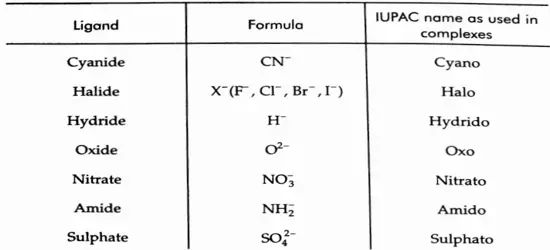
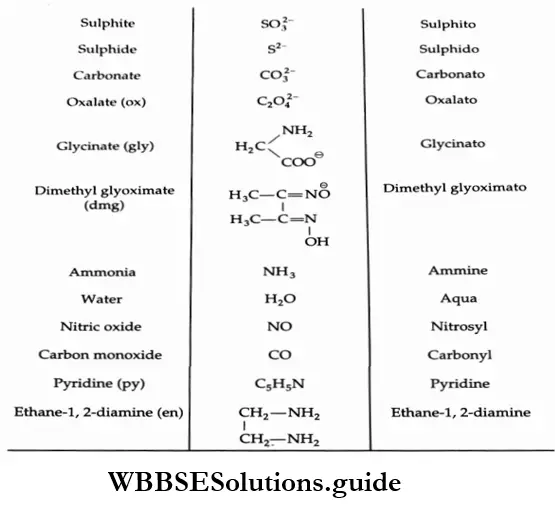
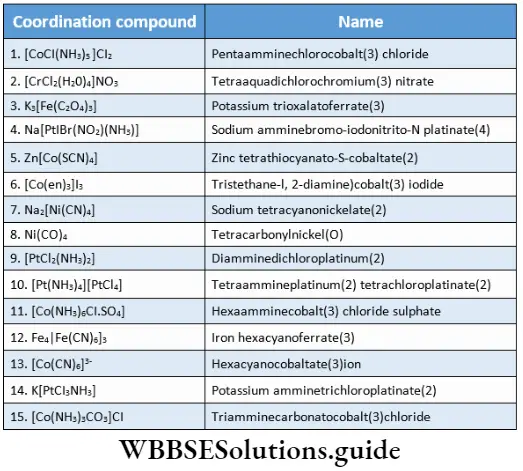
The names of some common ligands are given in followed by some examples of coordination compounds and their names

Coordination Compounds and Organometallics Common ligands and their names
Coordination Compounds and Organometallics Common ligands and their names.

Coordination Compounds and Organometallics Some coordination compounds and their IUPAC names

Rules For Formulating A Mononuclear Complex

1. Order of listing

  1. The central atom is listed first.
  2. The ligands are then listed alphabetically. The negative ligands are listed before the ligands. Polydentate ligands are also listed alphabetically.

2. Use of brackets The formula of the coordination entity is enclosed in square brackets, atomic and enclosed in parentheses.

3. Balancing of charges The charge of the cation(s) is balanced by the charge of the anion(s).

The following examples illustrate the rules.

Coordination Compounds and Organometallics Balancing of charges

Example Using IUPAC norms write the names of the following coordination entities and compounds.

  1. [CoCI(NO2)(NH3)4]CI
  2. [CuCI2(CH3NH2)2]
  3. [PtCl(NH2CH3)(NH3)2]Cl
  4. [Mn(H2O)6]2+
  5. [Co(en)3]3+
  6. [Cd(SCN)4]2+
  7. [Ti(H2O)6]3+

Solution

  1. Tetraamminechloronitrito-N-cobalt(3) chloride
  2. Dichlorobis(methylamine)copper(2)
  3. Wamminechloromethylamine platinum(2) chloride
  4. Hexaaquamaganese(2) ion
  5. Tris(ethane-1, 2-diamine)cobalt(3) ion
  6. Tetrathiocyanato-S-cadmium(2) ion
  7. Hexaaquatitanium(3) ion.

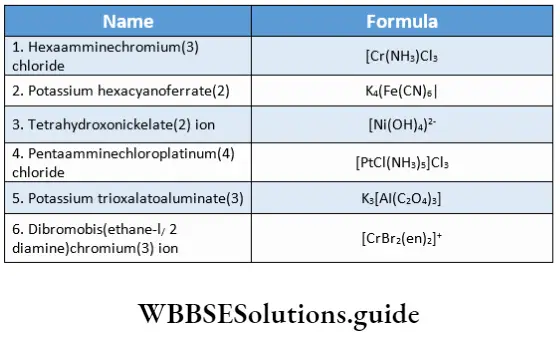
Werner’s theory key points and postulates

Example Using IUPAC norms write the formulae of the following.

  1. Tetrahydroxozincate(2) ion
  2. Hexaamminecobalt (3) sulphate
  3. Potassium tetrachloropalladated
  4. Potassium trioxalatochromated(3)
  5. Diamminedichloroplatinum(2)
  6. Hexaammineplatinum(4)
  7. Potassium tetracyanonickelate(2)
  8. Tetrabromocuprate(2)
  9. Pentaamminenitrito-O-cobaltate(3)
  10. Pentaamminenitrito-N-cobaltate(3)

Solution

  1. [Zn(OH)4]2-
  2. [Co(NH3)6]2(SO4)3
  3. K2[PdCl4]
  4. K3[Cr(C2O4)3]
  5. [PtCl2(NH3)2]
  6. [Pt(NH3)6]4+
  7. K2[Ni(CN)4]
  8. [CuBr4]2-
  9. [Co(ONO)(NH3)5]2-
  10. [Co(NO2)(NH3)5]2-

Isomerism In Coordination Compounds

Two or more compounds having the same molecular formula but different structural formulae and therefore different properties are known as isomers.

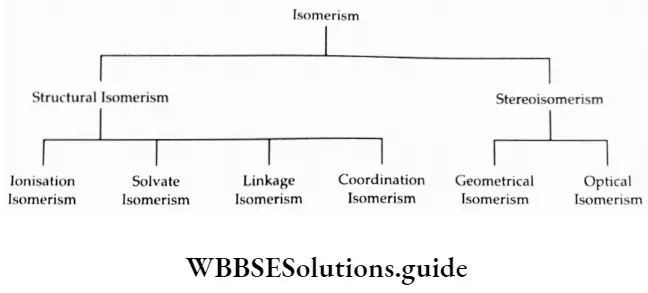
Coordination compounds exhibit two main types of isomerism – Structural isomerism and stereoisomerism.

These may be further classified as follows.

Coordination Compounds and Organometallics Isomerism

Ionisation Isomerism

Compounds having the same composition but yielding different ions in solution are called ionisation isomers. The isomerism arises due to the interchange of groups within and outside the coordination spheres. This happens when the counter ion in a complex salt is itself a potential ligand.

There are two isomers corresponding to the formula Co(NH3)5 BrSO4. One is red-violet yielding a white precipitate with BaCl2 and is represented as [CoBr(NH3)5]SO4. The other is red and gives a pale yellow precipitate with AgNO3 and is represented as [Co(SO4)(NH3)5]Br.

Other examples of the pairs of compounds which produce different ions in solution are [PtCl2(NH3)4 |Br2 and [PtBr2 and (NH3)4]CI2; [Co(NO3)(NH3)]NO3

Solvate Or Hydrate Isomerism

Hydrate isomers have the same molecular formula but differ in the number of water molecules present as ligands (in the coordination sphere) or as molecules of hydration (outside the coordination sphere).

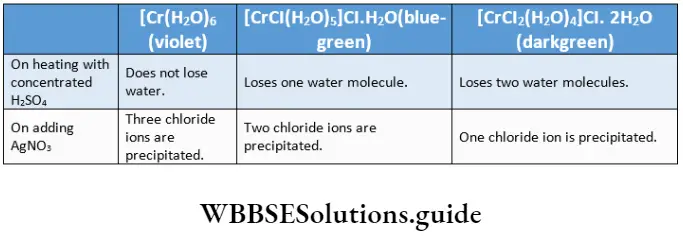
There are three distinct hydrate isomers of the compounds with the molecular formula CrCl3 -6H2O. They differ in colour and properties.

The three isomers can also be identified by the addition of excess silver nitrate to their aqueous solutions and on heating with concentrated sulphuric acid as given below.

Coordination Compounds and Organometallics Solvate or hydrate isomerism

Other examples of hydrate isomers are as follows.

[CoCl(H2O)(en)2]CI2 and [CoCl2(en)2 ]CI•H2O;

[CoCI(H2O)(NH3)4 ]Br2 and [CoBrCl(H2O)(NH3)4 ]Br•H2O

Linkage Isomerism

Linkage isomerism occurs in coordination compounds containing ambidentate ligands. The isomers differ in the mode of attachment of the ambidentate ligand.

For example, the NO2 ion can be attached either through the nitrogen or the oxygen atom and the SCN ion may be attached through either the sulphur or the nitrogen atom. The compound [Co(NO2)(NH3)5]CI2 is yellow and here the nitrogen atom of NO2 acts as the electron pair donor.

The other isomer [Co(ONO)(NH3)5]CI2 is red and a nitrite complex—it contains the Co(ONO) link. Na2 [Pt(SCN)4] and Na2 [Pt(NCS)4] form another example of linkage isomerism.

Werner’s theory of coordination compounds in organic chemistry

Coordination Isomerism

This type of isomerism is exhibited when both the cation and anion are complex ions and the interchange of ligands between cationic and anionic entities of different metal ions takes place. The isomers differ in the distribution of ligands in the cation and anion.

Some examples are as follows.

  1. [Co(NH3)6][Cr(CN)6] and [Cr(NH3) 6][Co(CN)6]
  2. [Cu(NH3)4][PbCl4] and [Pt(NH3) 4][CuCl4]
  3. [Co(en)3][CrCl6] and [Cr(en)3][CoCl3]

Geometric Isomerism

This type of isomerism arises due to ligands occupying different positions around the central metal ion. The ligands in question may be adjacent to each other (cis form) or opposite to each other (transform).

Hence this is also referred to as cis-trans isomerism. It is most common in square-planar and octahedral complexes.

1. Square-planar complexes

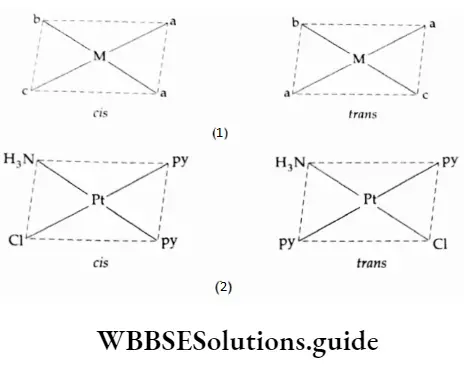
Square-planar complexes of the type [Ma2b2] and [Ma2bc] (where M is the metal and a, b, c are monodentate ligands) show geometrical isomerism.

The examples shown illustrate the point.

Coordination Compounds and Organometallics The cis and trans isomers of the square-planar [Ma2b2] type and The cis and trans isomers

Apart from colour, the isomers differ in physical and chemical properties. The cis isomer has a finite depth moment whereas the trans isomer has zero dipole moment, cis [PtCl2(NH3)2] is referred to as cis-platin and used in the treatment of cancer.

Coordination Compounds and Organometallics The cis and trans isomers of the square-planar (Ma2bc) type and The cs and trans isomers.

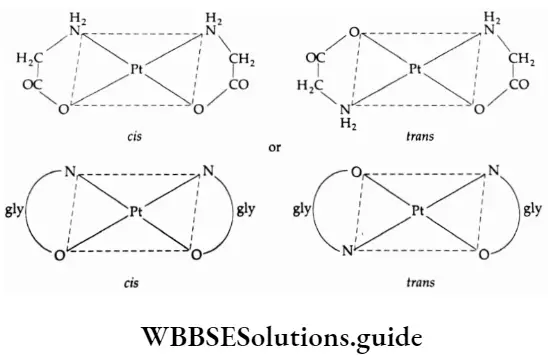
Square-planar complexes having unsymmetrical bidentate ligands or ligands whose donor atoms are different, for example, glycine where one donor atom is N and the other is O, exhibit this isomerism.

Coordination Compounds and Organometallics The cis and trans isomers of the glycine complex

It may be noted that square-planar complexes of the type Ma3b and Mab3 do not show geometrical isomerism as in all cases the spatial arrangement around the central metal is the same.

Tetrahedral complexes also do not show geometrical isomerism because, in a tetrahedral geometry, all positions are adjacent to each other.

2. Octahedral complexes

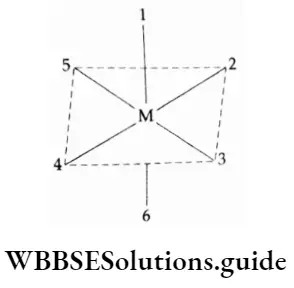
Octahedral complexes of the type (Ma4b2 ], [Ma2b4 ], [Ma3b3 ] and [Ma4be] exhibit geometric isomerism. Let us consider the six positions of an octahedron.

The trans-positions are 1-6, 2-4 and 3-5 while the cis-positions are 1-2, 1-3, 1-4, 1-5, 2-3, 6-3, 6-4, etc.

Coordination Compounds and Organometallics Six positions of on octahedron

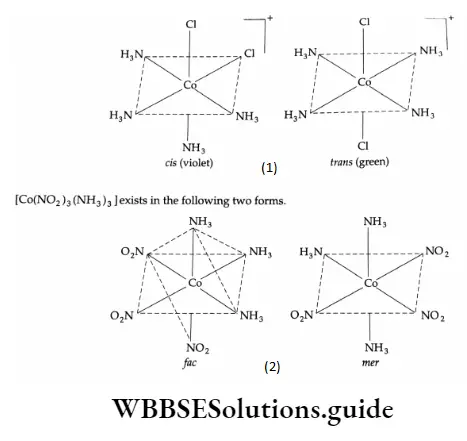
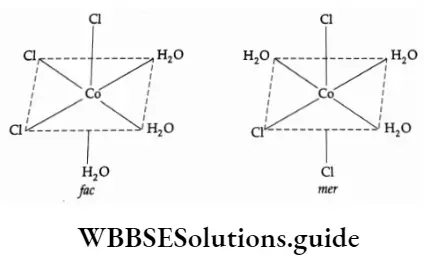
Geometrical isomerism in octahedral complexes of Ma3b3 types can also be of facial (fac) or meridional (mer) type.

Coordination Compounds and Organometallics The geometric isomers

In the face form a set of similar ligands forms one face of the octahedron and the isomer is called the facial (fac) isomer. On the other hand, when the positions are around the meridian of the octahedron, we get the meridional isomer (mer).

Optical Isomerism

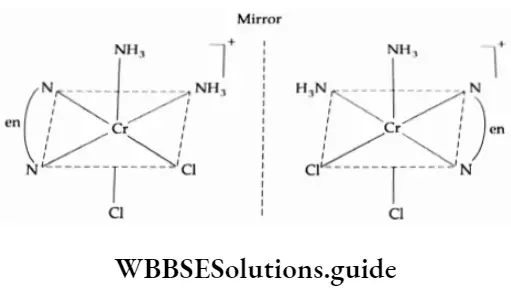
Optical isomers or enantiomers are pairs of molecules which rotate a plane of polarised light equally but in opposite directions. The isomers are non-superimposable mirror images of each other and have no plane of symmetry.

The only property that distinguishes the two isomers is the rotation of the plane of polarised light in a polarimeter. The isomer is dextrorotatory (d) or (+) if it rotates the plane of the polarised light to the right and laevorotatory (1) or (-) if the plane of the polarised light is rotated to the left. A mixture containing equal amounts of d and l or isomers is a racemic mixture with a net zero rotation.

Optical isomerism is common in octahedral complexes having bidentate ligands. Square planar complexes are seldom optically active.

Some typical examples of optically active octahedral complexes are as follows.

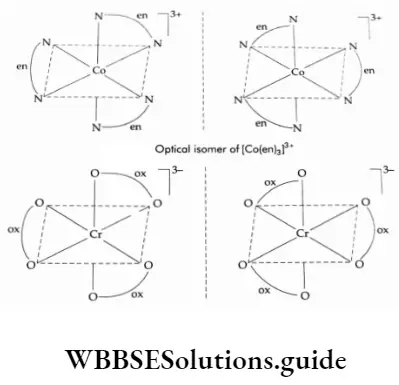
1. In a coordination entity of the type [M(AA)3 ], where AA is a symmetrical bidentate ligand the complex exists in two forms.

For example, in [Co(en)3]3+ and [Cr(ox)3]5- the symmetrical bidentate ligands are ethane-1, 2-diamine (en, N donor) and the oxalate ion (ox, O donor) respectively. Here en represents H2 NCH2 CH2 NH2.


Coordination Compounds and Organometallics Optical isomers

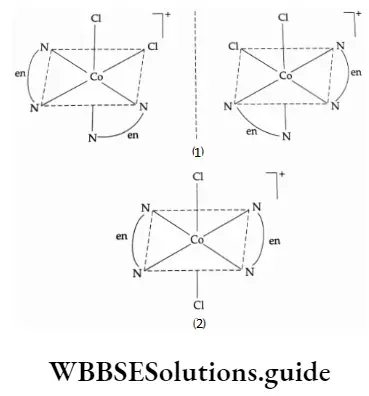
In the case of M(AA)2a2] and [M(AA)2ab] type of coordination entities where AA is a symmetrical, bidentate ligand and a, b are monodentate ligands only the cis-isomer shows optical activity.

For example, [CoCl2(en)2 ]+ exhibits geometrical isomerism and only the cis form is optically active. The transform, which is superimposable on its mirror image, is optically inactive.

Coordination Compounds and Organometallics Optical isomers of cis and Optically inactive trans

3. |M(AA)b2c2 ] type complexes exhibit optical activity, example [CrCl2(NH3)2(en)]+

Coordination Compounds and Organometallics complexes exhibit optical activity

As you can see, the structure is not superimposable in its mirror image.

Example Predict the type of isomerism in the following compounds.

  1. [PtBr(NH3)3 INO2 and [PtNO2(NH3)3]Br
  2. [Cr(ox)3]3-
  3. [CoCl2(en)2]+

Solution

  1. Ionisation isomerism
  2. Optical isomerism
  3. Geometrical isomerism; cis form will be optically active.

Example How will you distinguish between [Co(NH3)5SO4]Br and[Co(NH3)5Br]SO4?

The complex [Co(NH3)5SO4 ]Br in solution ionises to give [Co(NH3 )5SO4]+ and Br. Therefore, on adding AgNO3 to the solution, a pale yellow precipitate of AgBr is obtained.

On the other hand, the complex [CO(NH3)5 Br]SO4 will yield [Co(NH3)5Br]+ and SO4 in solution. On adding BaCl2 to the solution, a white precipitate of BaSO4 is obtained.

Solution

Example How many geometric isomers are possible in the following?

  1. [(Co(en)3]3+
  2. [CrCl3[H2O)3]

Solution

  1. None
  2. Two

Coordination Compounds and Organometallics geometric isomers are possible

Bonding In Coordination Compounds

Werner was the first to make an attempt to describe the bonding in coordination compounds. He did not have at his disposal any of the modem instruments and techniques to deduce the structure of coordination complexes.

The Werner theory put forward in 1893 was not based on any theoretical principles. Moreover, the electron was discovered later in 1896 by Sir Thomson.

Once the importance of the electron in chemical bonding was established, Sidgwick and Lowry suggested that the primary and secondary valencies of Werner’s theory actually ionic and covalent (coordinate) bonds respectively. Werner’s theory could not explain

  1. why do only transition metals form coordination compounds
  2. the directional nature of the bonds
  3. characteristic magnetic and optical properties of coordination compounds.

Many theories, that too after 1930, were extended to coordination compounds in order to explain the above points. These are Valence Bond Theory (VBT), Crystal Field Theory (CFT), Ligand Field Theory (LFT) and Molecular Orbital Theory (MOT). At this level of learning, we will restrict ourselves to an elementary treatment of the application of VBT and CFT to coordination compounds.

Primary and secondary valency in Werner’s theory

Metal Carbonyls

Metal carbonyls are a class of compounds involving carbon monoxide (CO) as a ligand. The first carbonyl to be synthesised was tetra carbonyl nickel Ni(CO)4. Carbonyls may be homoleptic or heteroleptic. In homoleptic carbonyls, the metal is bonded only to carbonyl ligands whereas in heteroleptic carbonyls, the metal is attached to other ligands, in addition to carbonyl.

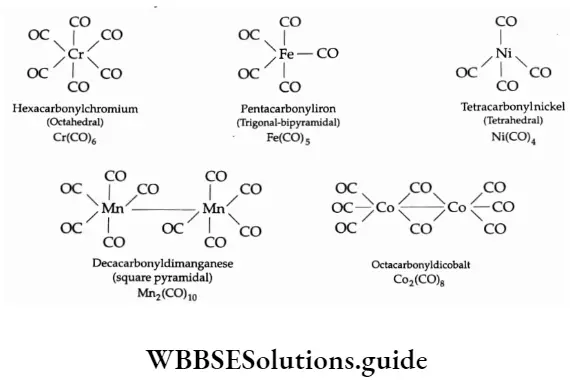
Most of the transition metals form stable homoleptic carbonyls. For example, Cr(CO)6, Mo(CO)6, W(CO)6, Mn2(CO)10, Fe(CO)5 , Fe2(CO)9, Fe3(CO)12, Co2(CO)8, Ni(CO)4, etc. The structures of some metal carbonyls are shown below.

Coordination Compounds and Organometallics Structures of some homoleptic metal carbonyls

The mononuclear carbonyls (involving one metal atom) have simple structures like octahedral, trigonal bipyramidal, tetrahedral, etc. In Mn2(CO)10, two square pyramidal Mn(CO)5 units are joined by an Mn—Mn bond. In Co2(CO)8 there is a Co—Co bond and two carbonyl groups act as a bridge between the metal atoms.

The mononuclear carbonyls are volatile and toxic. They are colourless or light-coloured at room temperature and pressure. The iron and nickel mononuclear carbonyls are exceptions—they are liquids.

Carbonyls are soluble in hydrocarbon solvents, with the exception of Fe2(CO)9. Polynuclear carbonyls are deeply coloured, example Fe3 (CO)12, dodecocarbonyltriiron is a dark grass green solid.

Bonding in carbonyls

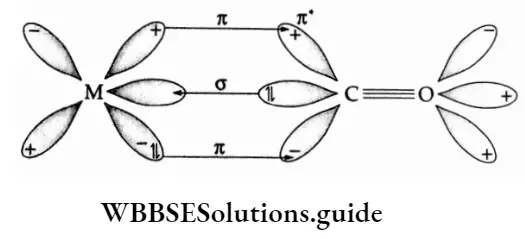
For convenience, the study of bonding in metal carbonyls may be considered to be a two-step process. In the first step, a weak cr-bond is formed by the donation of electrons from the carbonyl ligand to a vacant hybrid orbital of the metal.

In this process, carbon monoxide acts as a weak electron pair donor, i.e., a Lewis base. The weak cr-bond is strengthened by rt-bonding, which is the second step. In this step, the filled d orbitals of the transition metal overlap with a vacant antibonding (π) molecular orbital of carbon monoxide.

Coordination Compounds and Organometallics Synergic bonding in a metal carbonyl

Thus CO is also an electron pair acceptor, i.e., a Lewis acid. Therefore carbon monoxide is referred to as an o-b.ise and jo-add because during o-bond formation it acts as a Lewis base and during π-bond formation, as a Lewis acid. Such bonding is referred to as synergic bonding.

Applications Of Coordination Compounds And Organometallics

Coordination Compounds

Coordination compounds find manifold applications in biology, analytical chemistry and industry. Some of them are discussed as follows.

Biological systems

You have already studied chlorophyll (green photosynthetic pigment) and haemoglobin (red pigment of blood which transports oxygen), the two vital compounds in biological systems.

They are coordination compounds containing the macrocyclic porphyrin ligand attached to magnesium and iron respectively.

Myoglobin, the reservoir of oxygen in higher animals, and vitamin B12 are also coordination compounds of iron and cobalt. Many enzymes like carbonic anhydrase and carboxypeptidase A are also coordination compounds.

Analytical Chemistry

Coordination compounds are used in qualitative and quantitative analysis. The colour reactions undergone by metal ions with the different chelating ligands are highly sensitive and specific. They are used for the detection of micro amounts of metal ions.

For example, the cherry-red colouration of nickel(II) with dimethylglyoxime and the Prussian blue colouration of ferric ions with potassium ferrocyanide is a result of complex formation.

Ethylenediaminetetraacetic acid (EDTA) is a versatile chelating agent and is used in complexometric titrations (complexometric titration is a type of titration based on complex formation between the analyte and titrant) to estimate various metals.

A common application of EDTA titration is to determine the hardness of water by estimating the amount of Ca2+ and Mg2+ ions present in the sample.

Metallurgy

Complex formation is also used in the extraction processes of the noble metals silver and gold. When extracted from their ores silver and gold combine with potassium cyanide to form the complexes [Ag(CN2] and [Au(CN)2] respectively in an aqueous solution. The metals are then precipitated from this solution by adding a more electropositive metal zinc, which displaces the noble metal from the complex.

Industry

  1. Coordination compounds are used as catalysts in many chemical reactions. For example, [Co(CN)5]3- is used for the hydrogenation of alkenes. Tungsten and molybdenum complexes are used for chemical nitrogen fixation.
  2. The cyanide complexes of silver and gold are used for silver and gold plating of metal articles.
  3. Sodium thiosulphate (hypo solution) is used as a fixer in photography. It dissolves the undecomposed silver halides as a soluble coordination compound. The complex ion formed is [Ag(S2O3)2 ]3“.
  4. Many common dyes and pigments are coordination entities, for example, phthalocyanin blue.
  5. Many chelating agents are used as antidotes in cases of metal poisoning. EDTA is used in the treatment of lead poisoning. D-penicillamine and desferrioxime B are chelating ligands used to remove excess copper and iron. Cis diamminedichloroplatinum(2), known as cis-platin, is used as an anti-cancer agent.

Organometallics

  1. Organometallic compounds are widely used as catalysts in industrial processes. They may act as homogeneous (soluble in the reaction medium) or heterogeneous (insoluble in the reaction medium) catalysts.
    Examples of two important catalysts are chlorotic (triphenylphosphine)rhodium(1) (Wilkinson’s catalyst) used in the hydrogenation of alkenes and triethylaluminium which along with titanium tetrachloride (Ziegler Natta catalyst) is used in low-temperature polymerisation of alkenes.
  2. Organolithium and organomagnesium compounds are used for the synthesis of many organic compounds.
  3. Organoarsenic compounds are used in the treatment of syphilis. New drugs are synthesised nowadays by using metallocenes.
  4. Ethylmercury chloride is used in agriculture to prevent infection in young plants.

Coordination Compounds And Organometallics Multiple-Choice Questions

Question 1. Potassium ferricyanide is a

  1. Double Salt
  2. Mixed Salt
  3. Chelate
  4. Complex

Answer: 4. Complex

Question 2. EDTA is a

  1. Hexadentate Ligand
  2. Monodentate Ligand
  3. Bidentate Ligand
  4. Tridentate Ligand

Answer: 1. Hexadentate Ligand

Werner’s theory of coordination compounds and its significance

Question 3. Which reagent is used to identify nickel?

  1. 2, 2′-Dipyridyl
  2. Dimethylglyoxime
  3. Potassium Ferrocyanide
  4. Potassium Ferricyanide

Answer: 2. Dimethylglyoxime

Question 4. The IUPAC name for [CoCl3(NH3)2(H20)] is

  1. Diammineaquatrichlorocobalt(3)
  2. Aquatrichlorodiamminechlorocobalt(3)
  3. Diammineaquatrichlorocobaltate(3)
  4. Diamminetrichloroaquacobalt(3)

Answer: 1. Diammineaquatrichlorocobalt(3)

Question 5. In K4[Fe(CN)6] the hybridisation of the central metal is

  1. sp3
  2. dsp2
  3. d2sp3
  4. sp2

Answer: 3. d2sp3

Question 6. A complex involving square planar geometry displays the hybridisation

  1. sp3
  2. d2sp
  3. sp3d
  4. dsp2

Answer: 4. dsp2

Question 7. SCN is an example of an

  1. Ambidentate Ligand
  2. Bidentate Ligand
  3. Tridentate Ligand
  4. Chelating Ligand

Answer: 1. Ambidentate Ligand

Question 8. The oxidation number of Co in [Co(en)3]2(SO4)3 is

  1. +2
  2. +3
  3. +4
  4. +5

Answer: 2. +3

Question 9. Which among the following is colourless?

  1. [Ti(H2O)6]3+
  2. [Ti(NO3)4]
  3. [Cr(NH3)6]3+
  4. [Ni(H2O)6]2+

Answer: 2. [Ti(NO3)4]

Question 10. [Co(NH3)5NO3]SO4 and [Co(NH3)5SO4]NO3 exhibit

  1. Coordination isomerism
  2. Linkage isomerism
  3. Optical isomerism
  4. Ionisation isomerism

Answer: 4. Ionisation isomerism

Question 11. What is the coordination number of the metal in [Mn(en)2Cl2]?

  1. 6
  2. 4
  3. 5
  4. 3

Answer: 1. 6

Question 12. What is the oxidation state of iron in K4[Fe(CN)6]?

  1. 1
  2. 2
  3. 3
  4. 4

Answer: 2. 2

Postulates of Werner’s theory in coordination chemistry

Question 13. Which of these is correct?

  1. CuSO4 -5H2O is colourless.
  2. Fe(CO)5 is an organometallic compound.
  3. Zn2+ forms coloured compounds.
  4. [Ni(CN)4]2 is tetrahedral.

Answer: 2. Fe(CO)5 is an organometallic compound.

Question 14 How many ions are formed when [Co(NH3)6]CI3 is dissolved in water?

  1. 6
  2. 3
  3. 4
  4. 2

Answer: 3. 4

Question 15. Which of these ligands forms a chelate?

  1. Acetate
  2. Oxalate
  3. Ammonia
  4. Cyanide

Answer: 2. Oxalate

Question 16. The structure of Fe(CO)5 is

  1. Tetrahedral
  2. Square Pyramidal
  3. Octahedral
  4. Trigonal Bipyramidal

Answer: 4. Trigonal Bipyramidal

Question 17. Which among the following is the most stable?

  1. [Co(NH3)6]3+
  2. [CoF6]3
  3. [CoCl6]3
  4. [CoI6]3

Answer: 1. [Co(NH3)6]3+

Question 18. Which among the following will not exhibit geometrical isomerism?

  1. [Cr(NH3)4Cl2]+
  2. [Pt(NH3)2Cl2]
  3. [Cr(NH3)3Cl3]
  4. [Cr(NH3)5Cl]2+

Answer: 4. [Cr(NH3)5Cl]2+

Question 19. Which of these will show both geometrical and optical isomerism?

  1. [Co(en)2CI2]+
  2. [Co(NH3)5CI]2+
  3. [Co(NH3)4Cl2]+
  4. [Co(OX)3]3

Answer: 1. [Co(en)2CI2]+

Question 20. The IUPAC name for [Co(NH3)6][Cr(CN)6] is

  1. Hexaamminecobalt(3) Hexacyanochromate(3)
  2. Hexaamminecobaltate(3) Hexacyanochromium(3)
  3. Hexaamminecobalt(3) Hexacyanochromium(3)
  4. Hexaamminecobaltate(3) Hexacyanochromate(3)

Answer: 1. Hexaamminecobalt(3) Hexacyanochromate(3)

Question 21. The oxidation number of Pt in K[Pt(C2H4)Cl3] is

  1. 4
  2. 2
  3. 3
  4. l

Answer: 2. 2

Question 22. The Ziegler-Natta catalyst contains

  1. Iron
  2. Rhodium
  3. Titanium
  4. Magnesium

Answer: 3. Titanium

Question 23. The oxidation number of Ni in [Ni(CO)4] is

  1. 0
  2. 1
  3. 2
  4. 3

Answer: 1. 0

The concept of primary and secondary valency explained

Question 24. Which will yield Fe3+ in solution?

  1. [Fe(CN)6]3-
  2. Fe(CN)6]4
  3. FeSO4
  4. K2SO4 .Fe2(SO4)3

Answer: 4. K2SO4 .Fe2(SO4)3

Crystal Field Theory, Definition, Examples, Diagrams

Crystal-Field Theory (CFT)

Crystal-Field Theory (CFT):

This theory was proposed by Bethe and Van Vleck. In this theory, the attraction between the central atom and ligands is assumed to be purely electrostatic. The theory is very useful in explaining the magnetic behaviour and electronic spectra of transition metal complexes.

Before discussing the CFT it is worthwhile to study the shapes of d orbitals because the crystal field treatment of coordination compounds is based on the spatial relationships of the d orbital to the surrounding ligands in an asymmetric field.

Coordination Compounds and Organometallics The shapes of d orbitals and a set of octahedrally arranged ligands.

In CFT it is assumed that ligands are point charges if they are anions or point dipoles if they are neutral molecules. The other assumption is that there is no interaction between metal and ligand orbitals. In other words, there is no allowance for covalence in metal-ligand bonds.

Crystal field theory class 12 chemistry notes

The crystal-field theory may be applied to coordination complexes to answer the question as to how the energies of a set of d orbitals split when a set of ligands is placed around a central metal ion.

The d orbitals of an isolated gaseous metal atom or ion have the same energy, i.e., they are degenerate. If a spherically symmetrical field of negative charge surrounds the metal ion, the d orbitals remain degenerate.

However, in the presence of an asymmetric field (as in complexes), this degeneracy disappears, as the d orbitals, by virtue of the difference in their shapes, are not affected equally. This phenomenon is known as crystal-field splitting. Here we shall discuss the octahedral and tetrahedral complexes.

Octahedral complexes

The octahedral complex is the simplest case to consider. Assume that the metal atom is at the centre surrounded by six ligands at the vertices of an octahedron. For convenience, the arrangement is defined relative to a set of cartesian axes x, y and 2. The metal atom is at the origin and the ligands are positioned symmetrically along the cartesian axes.

Compare the shapes of the d orbitals with the octahedral arrangement of ligands. As you can see the lobes of the orbitals dx2-y2 and dz2 point along the x, y and z axes while those of the orbitals,dxy,dxz and dyz point between the axes.

This shows that the orbitals dx2-y2 and dz2 on the one hand and the orbitals, dxy,dxz and dyz on the other hand have equivalent relationships to the set of ligands. Therefore, we may say that five d orbitals form two sets each containing two and three orbitals respectively.

Then it should be obvious that the electron present in any one of the orbitals of a set will be repelled to the same extent by the ligands. Thus, the orbitals within a set are equivalent in energy or degenerate (remember this is not the case when a spherically symmetrical field surrounds the metal atom).

Coordination Compounds and Organometallics An odahedrally arranged set of ligands in relation to a set of cartesian coordinates with a metal atom at the centre

As the ligands approach the metal atom, the orbitals lying along the axes (dz2 and dx2-y2 ) get more strongly repelled than those which have lobes directed between the axes (dxy,dxz and dyz). Thus, one set of orbitals gets raised in energy and the other is lowered relative to the average energy in the spherical crystal field.

Therefore one conclusion of the crystal-field theory is that the spatial relationships of the d orbitals to the surrounding ligands cause the five d orbitals to split into two sets.

Definition and explanation of crystal field theory

The orbitals dxy,dyz and dzx with lower energy are known as the t2g orbitals. The orbitals dz2 and dx2-y2 are known as e8 orbitals.

In an octahedral field, the electrons present in eg orbitals experience greater repulsion than the electrons in t2g orbitals.

Coordination Compounds and Organometallics Splitting of d orbitals in an octahedral field

The difference in energy between the two sets of d orbitals is denoted by Δ0 (the symbol o in the subscript stands for octahedral) and is called crystal field stabilisation energy (CFSE). On splitting, the energy of two eg orbitals increases by (3/5) A0 and that of the three t2g orbitals decreases by (2/5) Δ0.

When a metal has only d electron (d ion), for example, [Ti(H2O)6]3+, then the electron is present in one of the lower t2g orbitals. In d2 and d3 entities, the three t2g orbitals are filled singly by Hund’s rule.

Crystal field theory with examples and diagrams

For a d4 ion, there are two possibilities -the fourth electron may enter an eg orbital of higher energy (t2g3eg1) or may pair an electron in a t2g orbital (t2g4 ).

The exact configuration adopted is governed by the relative magnitudes of Δ0 and P. (P is the energy needed to cause the pairing of an electron in an orbital.)

Crystal Field Theory, Definition, Examples, Diagrams

If Δ0 < P, then the fourth electron goes to the eg orbital as the energy needed for pairing is more. This is called a weak-field, high-spin situation. If A Δ0> P then pairing occurs in t2g orbitals. This is called a strong-field, low-spin situation. The strong-field situation is generally more stable than the weak-field situation.

Coordination Compounds and Organometallics strong-field a weak-field, high-spin situation.

The configuration of coordination entities with four to seven d electrons (the strong-field situation is more stable than the weak-field situation)

Tetrahedral Complexes

In tetrahedral complexes the direction of approach of ligands is different; the t2g orbitals are closer to the ligands than the eg orbitals. Thus the crystal field splitting in tetrahedral complexes is the opposite to that in octahedral complexes.

Coordination Compounds and Organometallics Splitting of d orbitals in tetrahedral field

The magnitude of crystal field splitting Δt is less than Δ0. \(\left(\Delta_t=\frac{4}{9} \Delta_0\right)\) (This number \(\left(\frac{4}{9}\right)\) has been obtained from spectroscopy). Δ0 is the energy difference between d orbitals in the octahedral field whereas At is the energy difference in the tetrahedral field.

Crystal field splitting energy and its significance

The magnitude of crystal field splitting depends on the

  1. Nature of the ligands
  2. Charge on the metal ion (generally A increases with charge)
  3. Position of the metal in the periodic table—whether it is in the first, second or third row of transition elements. The general trend for Δ is 3d < 4d < 5d. Thus, heavier transition metals generally form low-spin complexes.

Ligands causing small crystal-field splitting are called weak-field ligands while those causing large crystal-field splitting are called strong-field ligands.

The common ligands can be arranged in ascending order of A. This order is constant for different metals and is called the spectrochemical series.

weak-field I- < Br< S2 <cI < NO3 < F< OH- <C2O42-< H2O< EDTA < NH3 and pyridine < en < NO2 < CN< CO strong-field

Magnetic Properties Of Coordination Compounds

Coordination compounds may be paramagnetic or diamagnetic. Paramagnetism arises due to the presence of unpaired electrons and if no unpaired electrons are present, the compound is diamagnetic.

The magnetic moment of a coordination compound, which is related to the number of impaired electrons, is an experimentally determined value and is related to the number of unpaired electrons.

Crystal field splitting in octahedral and tetrahedral complexes

A study of the magnetic moment values of complexes of two metals of the 3d series reveals some interesting facts. For metal ions containing up to three electrons in the d orbitals, there is a direct relation between the magnetic moment values and the number of d electrons.

For example, in Ti3+ (d1 ), V3+ (d2 ) and Cr3+ (d3 ), the magnetic moment of the coordination compound is equal to that of the corresponding free ion. For these metal ions, two vacant 3d orbitals are available to hybridise with one 4s and three 4p orbitals to give six hybrid orbitals needed for octahedral geometry.

However, when the metal ion has more than three d electrons, the required number of d orbitals needed for octahedral hybridisation (d2 sp3 ) is not available. A vacant pair of d orbitals in such cases may result from the redistribution of electrons in d orbitals.

Thus, in a d4 system (Cr2+, Mn3+) one of the d electrons pairs up leaving two impaired electrons, while in d5(Mn2+, Fe3+) and d6 (Fe2+, Co3+) systems two and three electrons pair up leaving one and zero unpaired electrons respectively. Hence, in such cases, the magnetic moment of the coordination compound does not tally with that of the free metal ion.

In reality, all coordination compounds involving d4, d5 and d6 metal ions do not show similar magnetic properties. [Mn(CN)6]3 has a magnetic moment corresponding to two impaired electrons, while [MnF6]3- has a magnetic moment corresponding to four unpaired electrons.

Magnetic studies reveal that [Fe(H2O)6]3+ has five unpaired electrons, while [Fe(CN)6]4- has one unpaired electron. [Co(NH3)6]3+ is diamagnetic while [CoF6]3- has four unpaired electrons. Thus, the magnetic behaviour changes with the nature of the ligand.

Octahedral crystal field splitting diagram and explanation

The ligands which induce pairing of the 3d electrons form inner orbital complexes exhibiting d2sp3 hybridisation. In the case of ligands which do not cause pairing of the 3d electrons, complexes are of the outer orbital type (sp3 d2 ), where the metal utilises 4d orbitals.

The magnetic moment of an ion in a complex is given by

⇒ \(\mu=\sqrt{n(n+2)}\) where n is the number of impaired electrons.

Example Find the expected magnetic moment for tetrahedral and square planar complexes of (2) and Co(2).
Solution

Ni(U) has d8 configuration and in tetrahedral complexes will have 2 unpaired electrons. The magnetic moment will be \(\mu=\sqrt{n(n+2)}=\sqrt{2} \times 4 \approx 2.8 \mathrm{BM}\)

Ni(2) in square planar complexes that have no unpaired electron and are diamagnetic.

Co(II) has d7 configuration and in tetrahedral complexes will have 3 impaired electrons, i.e., n = 3.

∴\(\mu=\sqrt{3(3+2)}=3.87 \mathrm{BM}\)

Co(2) in square-planar complexes will have one unpaired electron, i.e., n =1.

∴\(\mu=\sqrt{1(1+2)}=1.73 \mathrm{BM}\)

Example The spin-only magnetic moment of (./[NICIJ2 is 2.83 IIM. Predict the geometry of the complex
Solution

The coordination number of Ni(2) in the above complex is 4 and the geometry can be tetrahedral or square planar. the number of 3d orbitals of Ni(2) is 8. Square planar geometry involves dsp2 hybridisation in this case the d electron paired up and occupied will be diamagnetic.

Coordination Compounds and Organometallics geometry of the complex.

If the geometry is tetrahedral, then the hybridisation is sp3 and there are two unpaired d electrons, making the complex paramagnetic.

Coordination Compounds and Organometallics geometry of the complex.

In this case \(\mu=\sqrt{2(2+2)}=\sqrt{8}=2.83 \text { BM. }\)

Thus the complex is tetrahedral.

Colour In Coordination Compounds

Coordination compounds of transition metals display a range of colours. Absorption of light at a specific wavelength in the visible part of the electromagnetic spectrum causes the excitation of a d electron from a lower energy d orbital to a higher energy one.

The colour of the coordination entity observed is complementary to the wavelength absorbed. The relation between colours absorbed and light reflected is shown in.

Coordination Compounds and Organometallics Colours absorbed, colours observed and wavelengths of light absorbed

Colour is associated with the electronic transition from a lower set of d orbitals to a higher set. The electron absorbs radiation in the visible range and undergoes this transition. When the electron returns to the original level the energy absorbed is emitted.

As the energy difference depends on the nature of the metal, the ligands and the oxidation number, it is obvious that the colour will be different in these cases.

For example, [Ni(H2O)6]2+ is green whereas [Ni(NH3)6]2+ is blue. The colour also varies with the oxidation number and coordination number of the metal. For example, [Cr(H2O)6]3+ and [Cr(H2O)6]2+ have different oxidation numbers.

The former is violet and the latter is blue. [Co(H2O)6]2+ and [CoCl4]2+ have different: coordination numbers. The former is pink and the latter is blue. The colour change is seen, since the value of •nergy difference depends on these factors.

Thus the crystal-field theory can successfully explain the colour of transition metal complexes.

The ion [Ti(H2O)6]3+ shows an absorption maximum at 498 runs and is violet in colour. This is an octahedral complex of Ti(m) which has a single d electron in a t2g level and the configuration may be represented as t21eg0. By absorbing energy corresponding to the blue-green region of the spectrum, the single d electron is promoted to the eg level and the configuration of the excited state is t2g0eg1.

Coordination Compounds and Organometallics The transition of the single electron

This type of electronic transition is called a d-d transition and it arises due to the splitting of d orbitals. Crystal-field splitting will not occur in the absence of ligands and thus anhydrous CuSO4 is colourless.

The magnitude of crystal-field splitting depends on the ligand and thus the colour of complex changes with the ligand, for example [Cu(H2O)4]2+ is pale blue while [Cu(NH3)4]2+ is dark blue (almost purple).

When nickel(2) chloride is dissolved in water the complex [Ni(H2O)6]2+ is formed. Now, if an aqueous solution of a bidentate ligand, ethane-1, 2, -diamine (en), is added to the aqueous solution in the molar ratios1:1, 2: 1 and 3: 1 progressively, a colour change is observed at each step as follows.

⇒ \(\left[\mathrm{Ni}\left(\mathrm{H}_2 \mathrm{O}\right)_6\right]^{2+}+\mathrm{en}=\left[\mathrm{Ni}\left(\mathrm{H}_2 \mathrm{O}\right)_4(\mathrm{en})^{2+}+2 \mathrm{H}_2 \mathrm{O}\right.\)
pale blue

⇒ \(\left[\mathrm{Ni}\left(\mathrm{H}_2\mathrm{O}\right)_4(\mathrm{en})\right]^{2+}+\mathrm{en}=\underset{\text { purple }}{\left[\mathrm{Ni}\left(\mathrm{H}_2 \mathrm{O}\right)_2(\mathrm{en})_2\right]^{2+}}+\underset{2 \mathrm{H}_2 \mathrm{O}}{\mathrm{O}}\)

⇒ \(\left[\mathrm{Ni}\left(\mathrm{H}_2 \mathrm{O}\right)_2(\mathrm{en})_2\right]^{2+}+\text { en }=\underset{\text { violet }}{\left[\mathrm{Ni}(\mathrm{en})_3\right]^{2+}+2 \mathrm{H}_2 \mathrm{O}}\)

This shows how the colour of a complex changes under the influence of a ligand.

Limitations Of Crystal-Field Theory

We have seen that the crystal-field theory can successfully explain the formation of coordination compounds and their structures, colours and magnetic properties. However, it suffers from some inherent weaknesses. It cannot correlate the extent of crystal-field splitting with the charge on the ligand.

Anionic ligands having high charge density should cause greater splitting, but this is not generally so. Another defect is that it considers the metal-ligand interaction to be electrostatic and ignores the covalent character of the bond.

These drawbacks are taken care of in more advanced models like the molecular orbital theory and ligand-field theory, which are beyond the scope of this book.

Stability Of Coordination Compounds

A coordination compound generally does not dissociate appreciably in solution. The extent of dissociation depends upon the strength of the metal-ligand bond. The stability of a coordination compound is measured in terms of its stability constant.

A metal ion in an aqueous solution is hydrated. On adding a ligand to the solution, the water molecules are replaced by the ligand. This generally occurs in a step-wise manner as follows.

⇒ \(\begin{aligned}
& {\left[\mathrm{M}\left(\mathrm{H}_2 \mathrm{O}\right)_n\right]+\mathrm{L} \rightleftharpoons\left[\mathrm{M}\left(\mathrm{H}_2 \mathrm{O}\right)_{n-1} \mathrm{~L}\right]+\mathrm{H}_2 \mathrm{O}} \\
& {\left[\mathrm{M}\left(\mathrm{H}_2 \mathrm{O}\right)_{n-1} \mathrm{~L}\right]+\mathrm{L} \rightleftharpoons\left[\mathrm{M}\left(\mathrm{H}_2 \mathrm{O}\right)_{n-2} \mathrm{~L}_2\right]+\mathrm{H}_2 \mathrm{O}} \\
& {\left[\mathrm{M}\left(\mathrm{H}_2 \mathrm{O}\right) \mathrm{L}_{n-1}\right]+\mathrm{L} \rightleftharpoons\left[\mathrm{ML}_n\right]+\mathrm{H}_2 \mathrm{O}} \\
&\end{aligned}\)

The equilibrium constant for each step is referred to as the formation constant.

For example, the formation constant for the first step is

⇒ \(K_1=\frac{\left[\mathrm{M}\left(\mathrm{H}_2 \mathrm{O}\right)_{n-1} \mathrm{~L}\right]}{\left[\mathrm{M}\left(\mathrm{H}_2 \mathrm{O}\right)_n\right][\mathrm{L}]}\)

It may be noted that charges have been omitted and L is considered to be an unidentate ligand for the sake of simplicity.

The overall reaction may be written as

⇒ \(\left[\mathrm{M}\left(\mathrm{H}_2 \mathrm{O}\right)_n\right]+n \mathrm{~L} \rightleftharpoons\left[\mathrm{ML}_n\right]+n \mathrm{H}_2 \mathrm{O}\)

The stability constant or the equilibrium constant of the reaction is denoted by β.

⇒ \(\beta_n=\frac{\left[\mathrm{ML}_n\right]}{\left[\mathrm{M}\left(\mathrm{H}_2 \mathrm{O}\right)_n\right][\mathrm{L}]^n}\)

Note that the concentration of water is assumed to remain constant.

Tetrahedral crystal field splitting diagram and energy levels

It can be easily shown that βn = k1….k2……kn

In other words, the overall stability constant is the product of the stepwise stability constants.

The stepwise and overall stability constants are generally expressed as log K1, log K2, log βn etc. The stability of a coordination compound is directly proportional to its stability constant. Let us consider the stepwise formation of [Cd(CN)4]2-. The reactions are as follows.

⇒ \(\mathrm{Cd}^{2+}+\mathrm{CN}^{-} \rightleftharpoons \mathrm{Cd}(\mathrm{CN})^{+} ; K_1=\frac{\left[\mathrm{Cd}(\mathrm{CN})^{+}\right]}{\left[\mathrm{Cd}^{2+}\right]\left[\mathrm{CN}^{-}\right]}\)

⇒ \(\mathrm{Cd}(\mathrm{CN})^{+}+\mathrm{CN}^{-} \rightleftharpoons \mathrm{Cd}(\mathrm{CN})_2 ; K_2=\frac{\left[\mathrm{Cd}(\mathrm{CN})_2\right]}{\left[\mathrm{Cd}(\mathrm{CN})^{+}\right]\left[\mathrm{CN}^{-}\right]}\)

⇒ \(\mathrm{Cd}(\mathrm{CN})_2+\mathrm{CN}^{-} \rightleftharpoons \mathrm{Cd}(\mathrm{CN})_3^{-} ; K_3=\frac{\left[\mathrm{Cd}(\mathrm{CN})_3^{-}\right]}{\left[\mathrm{Cd}(\mathrm{CN})_2\right]\left[\mathrm{CN}^{-}\right]}\)

⇒ \(\mathrm{Cd}(\mathrm{CN})_3^{-}+\mathrm{CN}^{-} \rightleftharpoons \mathrm{Cd}(\mathrm{CN})_4^{2-} ; K_4=\frac{\left[\mathrm{Cd}(\mathrm{CN})_4^{2-}\right]}{\left[\mathrm{Cd}(\mathrm{CN})_3^{-}\right]\left[\mathrm{CN}^{-}\right]}\)

On adding Equations (i) to (iv), p4 =\(\beta_4=\frac{\left[\mathrm{Cd}(\mathrm{CN})_4^{2-}\right]}{\left[\mathrm{Cd}^{2+}\right]\left[\mathrm{CN}^{-}\right]^4}\)

The stability constant values are log K1=5.48, log K2 =5.12, log K3 = 4.63, log K4 = 3.65 and log β4 =18.8. There is a decrease in successive stability constants.

The reciprocal of the stability constant is referred to as the dissociation constant or instability constant and gives a measure of the extent of dissociation of the complex.

Example: The overall stability constant for the complex [Cu(NH3)4]2+ and the values of log β4, log K1 log K2 and log K3 respectively are as follows.

log β4=11-9, log K1 = 4.0, log K2 = 3.2 and log K3 = 2.7. Find the value of the stepwise stability constant, i.e., log K4.
Solution

Given

The overall stability constant for the complex [Cu(NH3)4]2+ and the values of log β4, log K1 log K2 and log K3 respectively are as follows.

Factors affecting crystal field splitting energ

log β4=11-9, log K1 = 4.0, log K2 = 3.2 and log K3 = 2.7.

We know that β4 = K1 x K2 x K3 x X4.

log β4 = log K1 + log K2 + log K3 + log K4

or log K4 = log β4 – (log K1 + log K2 + log K3 )

=11.9 -(4.0 + 3.2 + 2.7) = 2.0.

Example: The overall stability constant, pÿfor[Ni(NH3)6]2+ is 9.98 x10⁷. Calculate the dissociation constant for the same.
Solution

Given

The overall stability constant, pÿfor[Ni(NH3)6]2+ is 9.98 x10⁷.

The overall dissociation constant is the reciprocal of the overall stability constant, i.e. \(\frac{1}{\beta_6}\)

⇒ \(\frac{1}{\beta_6}=\frac{1}{9.98 \times 10^7}=1.002 \times 10^{-8} \text {. }\)

Valence Bond Theory Of Coordination Compounds Notes

Valence bond theory (VBT)

This theory was proposed by Linus Pauling in 1931 and is closely related to the concept of hybridisation.

What Is A Valence Bond Theory?

The main postulates of the alence Bond theory are as follows.

  1. The central metal ion makes some vacant orbitals (equal to the coordination number of the metal) available to accept electron pairs from the ligands.
  2. Appropriate combinations of s, p and d orbitals hybridise to give equivalent orbitals having specific spatial orientations making for a definite geometry.
    • The common hybridisations we come across in coordination compounds are sp3 (tetrahedral), dsp2 (square planar), sp3d (trigonal bipyramidal or square pyramidal) and d2sp3 (octahedral).
  3.  Each ligand has at least one orbital containing a lone pair of electrons.
  4. The vacant hybrid orbitals of the metal overlap with the filled orbitals (with the lone pair of electrons) of the ligand to form a coordinate bond. Let us now study how VBT is applied to coordination compounds with coordination numbers 6 and 4

Coordination number 6

1. [Fe(CN)6]3- ion

Iron (Z = 26) has the outer electronic configuration of 3d6 4s2. In this compound, iron is in the +3 oxidation state, so the outer electronic configuration is 3d5.

Since Fe(3) has a 3d5 configuration, it is implied that the d orbitals are singly filled (Hund’s rule), i.e., they are five impaired electrons. But it was experimentally found that the complex has one unpaired electro! This is explained by the presence of the ligand (CN), the d electrons get paired up.

Now out of the fr degenerate d orbitals two contain a pair of electrons each, while one contains a single electron. The other two are vacant and accept electron pairs from ligands.

The six empty orbitals of the metal (two 3d, one and three 4p) hybridise forming d22p3 orbitals, which accept a pair of electrons from each CN ion.

Coordination Compounds and Organometallics d2sp3 hybridisation

The molecule has octahedral geometry and is paramagnetic due to the presence of one unpaired electrical

Valence Bond Theory Examples

Note: CN is referred to as a strong-field ligand and induces pairing of the d electrons of the metal. Another example of a strong-field ligand is NH3. The terms strong-field and weak-field originate from spectroscopy and crystal field effects, which are beyond the scope of this book.

2. [Fe(H2O)6]3+ ion

Valence Bond Theory of coordination compounds class 12 notes

Iron in this compound is in the +3 oxidation state. The compound is paramagnetic with five unpaired electrons. The d electrons remain unpaired and the metal makes available one 4s orbital, three 4p orbitals and two 4d orbitals (total 6) to form an octahedral complex.

Coordination Compounds and Organometallics octahedral complex

Note: H2O and F are weak-field ligands and do not induce pairing of the d electrons of the metal.

3. [CO(NH3)6]3+ ion

The outer electronic configuration of cobalt is 3d74s2 and in this compound, its oxidation state is +3. Ammonia is a strong-field ligand and induces pairing of 3d electrons giving a diamagnetic octahedral complex.

Coordination Compounds and Organometallics diamagnetic octahedral complex.

4. [CoF6]3- ion

This octahedral complex of Co3+ is paramagnetic having four unpaired electrons. The 3d electrons are not paired up as F is a weak-field ligand; thus the central metal utilises 4d orbitals for bond formation.

Coordination Compounds and Organometallics paramagnetic having four unpaired electrons.

Valence Bond Theory Examples

From the above examples, it should be clear that in octahedral complexes, the central metal may (n- 1)d or nd orbitals for bond formation. When a complex is formed by using (n- 1)d orbitals (when a strong-field ligand coordinates) it is called an inner orbital complex and when a complex is formed by using ud orbitals, it is called an outer orbital complex.

An outer orbital complex has a greater number of unpaired electrons than an inner orbital complex—consequently the former is called a high-spin comp ex and the latter, a low-spin complex.

Valence Bond Theory Of Coordination Compounds Notes

Coordination number 4

1. [Ni(CN)4]2- .

The outer electronic configuration of nickel is 3d8 4s2. CN is a strong-field ligand and causes the pairing of the 3d electrons leaving a vacant 3d orbital. The complex is therefore diamagnetic, has a dsp2 hybridisation and is square planar.

Coordination Compounds and Organometallics hybridisation and is square planar

2. [NiCl4]2-

The complex is paramagnetic and tetrahedral. The d electrons are not paired up as Cl is a weakfield ligand.

Key concepts in valence bond theory for coordination compounds

Valence Bond Theory Examples

Coordination Compounds and Organometallics The complex is paramagnetic and tetrahedral.

Limitations of VB theory or Valence Bond Theory Of Coordination Compounds Limitations

The valence bond theory is able to explain the structure and magnetic properties of a large number of coordination compounds.

However,Valence Bond Theory Of Coordination Compounds has the following limitations.

  1. It cannot explain the colour and spectra of complexes.
  2. The theory gives a rough idea about the magnetic behaviour of a complex from a knowledge of the number of unpaired electrons but does not explain the variation of magnetic moment with temperature.
  3. It does not give an idea about the kinetic stability of a complex.
  4. One cannot distinguish between a strong-field ligand and a weak-field ligand using this theory.

Valence Bond Theory in coordination chemistry explained

Example Applying Vbt to predict the shape and magnetic behaviour of [Co(CO)4].
Solution

Carbon monoxide is a neutral ligand and the oxidation state of cobalt is -1. The outer electronic configuration of Co is 3d-74s2. CO is a strong-field ligand that induces the pairing of 3d electrons and forces the 4s electron into the 3d orbital. Thus, the complex is sp3 hybridised, i.e., tetrahedral in shape and diamagnetic.

Coordination Compounds and Organometallics VBT predrict the shape and magnetic behaviour

Example Applying VBT predicts the number of unpaired electrons in the following complexes.

  1. [Fe(CN)6]4-
  2. [FeF6]3-
  3. [Pt(CN)4]2-
  4. [PtCI4 ]2-

Solution

  1. 0
  2. 5
  3.  0
  4. 2

NEET Class 7 Biology Multiple Choice Question and Answers

NEET Class 7 Biology Multiple Choice Question and Answers

WBBSE Class 10th Results Will Be Released on May 19,2023

WBBSE Madhyamik Results Results will be released on May 19,2023

The WBBSE Madhyamik Result 2023 Date has been issued by the West Bengal Board of Secondary Education. Results for the WB Class 10th will be released on May 19, 2023, at 10 a.m. Candidates may get the results at wbbse.wb.gov.in, the WBBSE’s official website, as well as at wbresults.nic.in.

Read and Learn also WBBSE Madhyamik Model Question Paper 2023 Geography And Environment

wbbse wb gov in madhyamik result

Bratya Basu, the West Bengal Education Minister, verified the results’ time and date on his official Twitter account. The tweet states, “WBBSE shall declare the results of Madhyamik Pariksha 2023 on 19th May 2023, Friday, 10 AM.”

“madhyamik 2023 date “

WBBSE Class 10th Results Will Be Announced On May 19, 2023

“west bengal madhyamik exam 2023 “

The Class 10 board exam was administered from February 23 to March 4 at different testing locations around the state. For all exams, the test lasted three hours, with fifteen minutes allotted for perusing the question paper.

WBBSE Class 10th Results Will Be Released on May 19,2023

How to Check The WBBSE Madhyamik Result 2023

Following the instructions below will allow candidates who took the Class 10 or Madhyamik exam to verify their results.

  • Visit the WBBSE’s official website at wbbse.wb.gov.in.
  • On the homepage, choose the WBBSE Madhyamik Result 2023 link.
  • Enter the necessary information, then press “Submit.”

“west bengal board result 2023 class 10 “

  • Your outcome will be shown to you on the screen.
  • Check the outcome and save the page.

WBBSE Solutions for Class 10 English Bliss

WBBSE Solutions for Class 10 English Bliss

WBBSE Solutions for Class 10 English Bliss